
Medication Administration and Delegation in Massachusetts Schools Training Manual
|
|
|
- Marianna Robbins
- 10 years ago
- Views:
Transcription
1 Medication Administration and Delegation in Massachusetts Schools Training Manual
2 Massachusetts Department of Public Health School Health Unit GUIDELINES FOR REVIEWING AND APPROVING APPLICATIONS TO REGISTER FOR DELEGATION OF PRESCRIPTION MEDICATIONS TO UNLICENSED PERSONNEL 105 CMR PLEASE NOTE THAT 1-5 APPLY TO SECTION I (FULL DELEGATION) 1-3 APPLY TO SECTIONS II AND III (FIELD TRIP and EPINEPHRINE) Only applications that meet the following criteria will be reviewed: 1. Dates and Signatures: All required signatures and dates signed must be complete and original. (Please note: No facsimiles or copies of the original application will be accepted for review.) 2. Printed Names: The names are printed in a legible way. 3. Attendance at the Medication Delegation Workshop: The date for attendance by the school nurse contact at the Northeastern University School Health Institute program ( " Medication Administration and Delegation in the School Setting," is included (Please note: the nurse contact's date of attendance should fall within the previous five years.) PLEASE INCLUDE THE ORIGINAL CERTIFICATE OF ATTENDANCE WHEN SUBMITTING THE COMPLETED APPLICATION. 4. School Building Profile: The "School Building Profile," a detailed document reflecting your school district's nursing coverage, is completed correctly with all fields accurately documented. This school building profile is critical when evaluating whether your school district may delegate prescription medications. (Please note: the application is for the entire school district.) 5. Sufficient Numbers of School Nurses: Delegation of prescription medications to unlicensed personnel is not intended to take the place of employment of professional school nurses (as defined by the Massachusetts Department of Education), but rather to add flexibility to the nurse's daily practice. 105 CMR requires that "When a School Committee or Board of Trustees, in consultation with the Board of Health where appropriate, has registered with the Department of Public Health and authorized categories of unlicensed school personnel to administer prescription medications, such personnel shall be under the supervision of the school nurse for the purposes of 105 CMR The School Committee or Board of Trustees, in consultation with the Board of Health where appropriate, shall provide assurance that sufficient school nurse(s) are available to provide proper supervision of unlicensed school personnel." In order to determine the safe level of coverage of school nurses, i.e., "sufficient numbers of school nurses", a needs assessment should be completed with attention paid to those children with special health care needs, as well as emergency response time for each building. The school nurse to student ratio (in each building) generally shall be no greater than 1:750 in a general population. 1 (Please note: in reviewing the application only the designated school nurses onsite will be considered when applying this ratio.) rev (9/2012) 1 Consistent with 1998 legislative report, Options for Developing School Health Services in Massachusetts, the recommended school nurse to student ratio is 1.0 fulltime equivalent (FTE) certified nurse in each building with 250 to 500 students. In buildings with more than 500 students, there should be 0.1 FTE for each additional 50 students. For buildings with fewer than 250 students, the ratio is calculated at 0.1 FTE: 25 students. School districts (public and private) that may apply for registration are listed in the Massachusetts Department of Education's school directory profile.
3 HIPAA and FERPA What is HIPAA? In 1996 the U.S. Congress passed the Health Insurance Portability & Accountability Act (HIPAA), which increased individuals' ability to maintain health insurance coverage. In addition, the U.S. Department of Health and Human Services was required under HIPAA to issue regulations: Standardizing the formats of electronic health care claims and transactions (known as the Transaction Rule); Establishing new requirements for the privacy of individually identifiable health care information (known as the Privacy Rule); and Establishing new requirements for the security of electronic health care information (known as the Security Rule). The FAQs below will discuss some of the effects of these rules on school health programs and staff, including whether school healthprograms must comply with the requirements of the Transaction, Privacy and Security Rules. What is a "Public Health Authority" under HIPAA? HIPAA defines a Public Health Authority as "an agency or authority of the United States, a State or territory, a political subdivision of a State or territory, or an Indian tribe, or a person or entity acting under a grant of authority from or contract with such public agency, including the employees or agents of such public agency or its contractors or persons or entities to whom it has granted authority, that is responsible for public health matters as part of its official mandate." 45 C.F.R HIPAA provides that covered entities may disclose PHI to a public health authority that is authorized by law to collect or receive such information for the purposes of preventing or controlling disease, injury, vital events such as birth or death, and the conduct of public health surveillance, public health investigations and public health interventions." 45 C.F.R (b) Is an authorization required before physicians and other covered providers are permitted under HIPAA to disclose information and records related to a patient s immunization status to a public school and its agents, including school nurses? No, an authorization is not required before physicians and other covered providers disclose information and records related to a patient s immunization status to a school and its agents, including school nurses. Under HIPAA (45 C.F.R (b)) health care providers are permitted to disclose immunization records, without an individual authorization, to public health authorities that are authorized by law to collect such information. 105 CMR (b) provides that "School nurses are authorized to obtain from health care providers the immunization records or other immunization related information required for school admission, without authorization of the child's parent(s) or legal guardian(s) " For a more detailed explanation, please visit: Release of immunization records from a health provider to school nurses without an authorization. How does HIPAA affect a nurse s authority to disclose immunization information to a physician? The parameters of a school nurse s ability to disclose health information about a student directly to a physician are dictated by the provisions of The Family Education Rights and Privacy Act (FERPA) and not by HIPAA. Therefore, the analysis in question three (3) does not apply when a school nurse discloses information to a physician. Under FERPA, a school nurse generally is not permitted todisclose immunization information to a physician without consent. However, with consent, a school nurse is free to communicatedirectly with a physician regarding immunization information. Therefore, school nurses should consider seeking consent on an annual basis from a student s parent or guardian to share information with physicians concerning immunizations. Is an authorization required before physicians and other covered providers are permitted under HIPAA to discuss the treatment of a patient with a school nurse, regarding a patient enrolled at the school? No, an authorization is not required. The HIPAA Privacy Rule permits a health care provider to disclose protected health information about an individual, without the individual s authorization, to another health care provider for that provider s treatment of the individual. See 45 CFR and the definition of treatment at 45 CFR Can a covered entity under HIPAA (for example a physician or other licensed health care provider) fax protected health information (PHI) to a school nurse? Yes. In December of 2002 the Office of Civil Rights issued guidance stating that the HIPAA Privacy Rule permits physicians to disclose protected health information to another health care provider by fax or by other means so long as: The disclosure is allowed under HIPAA and other applicable laws; and, Both the disclosing and receiving entity have in place reasonable and appropriate administrative, technical, and physical safeguards to protect the privacy of the PHI that is disclosed. What types of disclosures may a covered entity permissibly make to a school nurse under HIPAA?

4 A covered provider may permissibly disclose PHI to a school nurse including, but not limited to, the following situations: Immunization records, which may be disclosed to a school nurse without individual authorization pursuant to 45 CFR (b) and 105 CMR (B). PHI for which there is an individual authorization; PHI necessary for the treatment of the child. The provider may disclose treatment information to a school nurse, regardless of whether the school nurse is also a covered entity. 45 CFR (c) (1) or (2). What are examples of reasonable and appropriate administrative, technical, and physical safeguards to protect the privacy of the PHI that is disclosed by fax. Although school nurses are typically not covered entities under HIPAA, they should, nonetheless, develop and follow reasonable and appropriate safeguards for receiving as well as disclosing PHI by fax. Before covered entities will fax PHI to school nurses, they may require assurances that the school nurse has appropriate safeguards in place. Such safeguards may include, for example, procedures to assure that the fax is in a secure location accessed only by staff authorized to see PHI or procedures that assure that an authorized staff member is at the fax machine to receive the faxed PHI. Under the Privacy Rule can a covered entity honor an individual authorization form that is a faxed copy rather than the original form? Yes. Health and Human Services (HHS) stated with respect to this question that covered entities may rely upon a faxed copy of an individual authorization form as long as it is legible. The original is not required to meet the covered entity s responsibilities under the Privacy Rule. HHS also considers a copy or electronically transmitted version of a signed authorization a valid authorization under the Privacy Rule. 105 CMR: DEPARTMENT OF PUBLIC HEALTH

5 105 CMR : THE ADMINISTRATION OF PRESCRIPTION MEDICATIONS IN PUBLIC AND PRIVATE SCHOOLS Section : Purpose : Definitions : Policies Governing the Administration of Prescription Medications in Schools : Policies Regarding Delegation of Prescription Medication Administration : Responsibilities of the School Nurse Regarding Prescription Medication Administration : Self-Administration of Prescription Medications : Training of School Personnel Responsible for Administering Prescription Medications : Handling, Storage and Disposal of Prescription Medications : Documentation and Record-Keeping : Administration of Epinephrine : Purpose The purpose of 105 CMR is to provide minimum standards for the safe and proper administration of prescription medications to students in the Commonwealth s public and private primary and secondary schools. 105 CMR permit school nurses to delegate responsibility for administration of prescription medications to trained, nursing-supervised school personnel, provided the school district or private school registers with the Department of Public Health. The aim of 105 CMR 2I0.000 is to ensure that students requiring prescription medication administration during the school day will be able to attend school and to ensure that prescription medications are safely administered in schools. 105 CMR encourages collaboration between parents or guardians and the school in this effort : Definitions As used in 105 CMR , the following words, unless the context clearly requires otherwise, shall have the following meanings: Administration of Medication means the direct application of a prescription medication by inhalation, ingestion, or by any other means to the body of a person. Prescription Medication means any medication which by federal law may be obtained only by prescription. Cumulative Health Record means the cumulative health record of a pupil as specified under M.G.L. c. 71. Department means the Massachusetts Department of Public Health. Investigational New Drug means any medication with an approved investigational new drug (IND) application on file with the Food and Drug Administration (FDA) which is being scientifically tested and clinically evaluated to determine its efficacy, safety and side effects and which has not yet received FDA approval. Licensed Practical Nurse means an individual who is a graduate of an approved practical nursing program, and who is currently licensed as a practical nurse pursuant to M.G.L. c Licensed Prescriber means a health care provider who is legally authorized to prescribe medication pursuant to M~G.L c. 94C and applicable federal laws and regulations. Parenteral Medication means any medication administered in a manner other than by the digestive tract or topical application, as by intravenous, intramuscular, subcutaneous, or intradermal injection. 11/15/ CMR CMR: DEPARTMENT OF PUBLIC HEALTH : continued Physician means a doctor of medicine or osteopathy licensed to practice medicine in Massachusetts or in another state. School Nurse means a nurse practicing in a school setting, who is: (1) a graduate of an approved school for professional nursing; (2) currently licensed as a Registered Nurse pursuant to M.G.L c. 112; and (3) appointed by a School Committee or a Board of Health in accordance with M.G.L. c. 71, 53, 53A, and 53B or, in the case of a private school, by the Board of Trustees. School Physician means a physician appointed by a School Committee or Board of Health in accordance with M.G.L c. 71, 53, 53A, and 53B or, in the case of a private school, by the Board of Trustees. Supervision means guidance by a qualified school nurse to accomplish a task, with initial direction and instruction concerning the task and periodic inspection and oversight of activities related to the task. Teacher for the purpose of 105 CMR , means a professional school employee who: (1) instructs students or serves in the role of administrator below the rank of superintendent; and (2) is employed by a School Committee or Board of Trustees : Policies Governing the Administration of Prescription Medications in Schools
6 (A) The School Committee or Board of Trustees, consulting with the Board of Health where appropriate, shall adopt policies and procedures governing the administration of prescription medications and self administration of prescription medications within the school system, following development of a proposal by the school nurse, in consultation with the school physician. Review and revision of such policies and procedures shall occur as needed but at least every two years. At a minimum, these policies shall include: (1) designation of a school nurse as supervisor of the prescription medication administration program in a school; (2) documentation of the administration of prescription medications; (3) response to a medication emergency; (4) storage of prescription medications; (5) reporting and documentation of medication errors; (6) dissemination of information to parents or guardians. Such information shall include an outline of a school s medication policies and shall be available to parents and guardians upon request; (7) procedures for resolving questions between the school and a parent or guardian regarding administration of medications. Such procedures shall provide for and encourage the participation of the parent or guardian. Existing procedures for resolution of differences may be used whenever appropriate. (B) The School Committee or Board of Trustees shall submit these policies and procedures to the Department of Public Health upon request : Policies Regarding Delegation of Prescription Medication Administration (A) The School Committee or Board of Trustees, consulting with the Board of Health where appropriate, may approve a proposal developed by the school nurse and school physician, to permit the administration of prescription medications to be delegated by the school nurse to unlicensed school personnel. Such delegation may occur only if the school district registers with the Department of Public Health pursuant to the applicable provisions of 105 CMR and complies with the requirements of 105 CMR /1/ CMR CMR: DEPARTMEN7T OF PUBLIC HEALTH : continued (B) In accordance with the proposal of the school nurse and school physician, the School Committee or Board of Trustees may approve categories of unlicensed school personnel to whom the school nurse may delegate responsibility for prescription medication administration. (1) Said categories of personnel may include administrative and teaching staff, licensed health personnel, health aides and secretaries. (a) For the purposes of 105 CMR , health aide shall mean an unlicensed employee of the school district who is generally supervised by the school nurse and performs those health-related duties defined by the school nurse, the School Committee, Board of Health or Board of Trustees. (b) For the purpose of administering emergency prescription medication to an individual child, including parenteral administration of medication pursuant to 103 CMR 2l0.004(B)(4), the school nurse may identify individual school personnel or additional categories. Said school personnel shall be listed on the medication administration plan developed in accordance with 105 CMR (E) and receive training in the administration of emergency medication to a specific child. (2) An individual in an approved category may be authorized to administer prescription medication if he/she meets the following criteria: (a) is a high school graduate or its equivalent; (b) demonstrates sound judgment; (c) is able to read and write English; (d) is able to communicate with the student receiving the prescription medication or has ready access to an interpreter when needed; (e) is able to meet the requirements of 105 CMR and follow nursing supervision; (f) is able to respect and protect the student s confidentiality; and (g) has completed an approved training program pursuant to 105 CMR (3) A school nurse shall be on duty in the school system while prescription medications are being administered by designated unlicensed school personnel, and available by telephone should consultation be required. (4) The administration of parenteral medications may not be delegated, with the exception of epinephrine administered in accordance with 105 CMR (5) Prescription medications to be administered pursuant to p.r.n. ( as needed ) orders may
7 be administered by authorized school personnel after an assessment by or consultation with the school nurse for each dose. (6) For each school, an updated list of unlicensed school personnel who have been trained in the administration of prescription medications shall be maintained. Upon request, a parent shall be provided with a list of school personnel authorized to administer prescription medications : Responsibilities of the School Nurse Regarding Prescription Medication Administration (A) The school nurse, in consultation with the school physician and the school health advisory committee, if established, shall develop policies and procedures consistent with 105 CMR for approval by the School Committee or Board of Trustees, in consultation with the Board of Health where appropriate. (B) The school nurse shall have responsibility for the development and management of the prescription medication administration program. Such responsibility shall be delineated in policies and procedures adopted by the School Committee or Board of Trustees, in consultation with the-board of Health where appropriate. 4/1/ CMR CMR: DEPARTMENT OF PUBLIC HEALTH : continued (C) The school nurse, in consultation with the school physician, shall have final decision making authority with respect to delegating administration of prescription medications to unlicensed personnel in school systems registered with the Department of Public Health. (D) Medication Orders. (1) The school nurse shall ensure that there is a proper medication order from a licensed prescriber which is renewed as necessary including the beginning of each academic year. A telephone order or an order for any change in prescription medication shall be received only by the school nurse. Any verbal order must be followed by a written order within three school days. Whenever possible, the medication order shall be obtained, and the medication administration plan specified in 105 CMR (E) shall be developed before the student enters or re-enters school. (a) In accordance with standard medical practice, a medication order from a licensed prescriber shall contain: 1. the student s name; 2. the name and signature of the licensed prescriber and business and emergency phone numbers; 3. the name, route and dosage of medication; 4. the frequency and time of medication administration; 5. the date of the order; 6. a diagnosis and any other medical condition(s) requiring medication, if not a violation of confidentiality or if not contrary to the request of a parent, guardian or student to keep confidential; 7. specific directions for administration. (b) Every effort shall be made to obtain from the licensed prescriber the following additional information, as appropriate: 1. any special side effects, contraindications and adverse reactions to be observed; 2. any other medications being taken by the student; 3. the date of return visit, if applicable. (2) Special Medication Situations (a) For short-term prescription medications, i.e., those requiring administration for ten school days or fewer, the pharmacy-labeled container may be used in lieu of a licensed prescriber s order. If the nurse has a question, she may request a licensed prescriber s order. (b) For over-the-counter medications, i.e., non-prescription medications, the school nurse shall follow the Board of Registration in Nursing s protocols regarding administration of over-thecounter medications in schools. (c) Investigational new drugs may be administered in the schools with (1) a written order by a licensed prescriber, (2) written consent of the parent or guardian, and (3) a pharmacy-labeled container for dispensing. If there is a question, the school nurse may seek consultation and/or approval from the school physician to administer the medication in a school setting. (3) The school nurse shall ensure that there is a written authorization by the parent or guardian which contains: (a) the parent or guardian s printed name and signature and a home and emergency phone number;

8 (b) a list of all medications the student is currently receiving, if not a violation of confidentiality or contrary to the request of the parent, guardian or student that such medication not be documented; (c) approval to have the school nurse or school personnel designated by the school nurse administer the prescription medication; (d) persons to be notified in case of a medication emergency in addition to the parent or guardian and licensed prescriber. 4/1/ CMR CMR: DEPARTMENT OF PUBLIC HEALTH : continued (E) Medication Administration Plan: The school nurse, in collaboration with the parent or guardian whenever possible, shall establish a medication administration plan for each student receiving a prescription medication. Whenever possible, a student who understands the issues of medication administration shall be involved in the decision-making process and his/her preferences respected to the maximum extent possible. If appropriate, the medication administration plan shall be referenced in any other health or educational plan developed pursuant to St. 1972, c. 766 the Massachusetts Special Education Law (Individual Education Plan under Chapter 766) or federal laws, such as the Individuals with Disabilities Education Act (IDEA) or Section 504 of the Rehabilitation Act of (1) Prior to the initial administration of the prescription medication, the school nurse shall assess the child s health status and develop a medication administration plan which includes: (a) the name of the student, (b) a medication order from a licensed prescriber, which meets the requirements of 105 CMR (D)(1); (c) the signed authorization of the parent or guardian, which meets the requirements of 105 CMR (D)(3); (d) any known allergies to food or medications; (e) the diagnosis, unless a violation of confidentiality or the parent, guardian or student requests that it not be documented; (f) any possible side effects, adverse reactions or contraindications; (g) the quantity of prescription medication to be received by the school from the parent or guardian; (h) the required storage conditions; (i) the duration of the prescription; (j) the designation of unlicensed school personnel, if any, who will administer the prescription medication to the student in the absence of the nurse, and plans for back-up if the designated personnel arc unavailable; (k) plans, if any, for teaching self administration of the prescription medication; (1) with parental permission, other persons, including teachers, to be notified of medication administration and possible adverse effects of the medication; (m) when appropriate, the location where the administration of the prescription medication will take place; (n) a plan for monitoring the effects of the medication; (o) provision for prescription medication administration in the case of field trips and other short-term special school events. Every effort shall be made to obtain a nurse or school staff member trained in prescription medication administration to accompany students at special school events. When this is not possible, the school nurse may delegate prescription medication administration to another responsible adult. Written consent from the parent or guardian for the named responsible adult to administer the prescription medication shall be obtained. The school nurse shall instruct the responsible adult on how to administer the prescription medication to the child. (F) Developing Procedures for Administration of Prescription Medications. (1) The school nurse shall develop procedures for the administration of prescription medications which shall include the following: (a) A procedure to ensure the positive identification of the student who receives the medication; (b) A system for documentation and record-keeping which meets the requirements of 105 CMR (2) The school nurse shall develop a system of documenting observations by the nurse or school personnel and communicating significant observations relating to prescription medication effectiveness and adverse reactions or other harmful effects to the child s
9 parent or guardian and/or licensed prescriber: (3) The school nurse shall develop and implement procedures regarding receipt and safe storage of prescription medications; 4/1/ CMR CMR: DEPARTMENT OF PUBLIC HEALTH : continued (4) The school nurse shall develop procedures for responding to medication emergencies, i.e.. any reaction or condition related to administration of medication which poses an immediate threat to the health or well-being of the student. This includes maintaining a list of persons, with their phone numbers, to be contacted as appropriate, in addition to the parent/guardian, school nurse, licensed prescriber and other persons designated in the medication administration plan. Such persons may include other school personnel, the school physician, clinic or emergency room staff, ambulance services and the local poison control center, (5) The school nurse shall develop procedures and forms for documenting and reporting prescription medication errors. The procedures shall specify persons to be notified in addition to the parent or guardian and nurse, including the licensed prescriber or school physician if there is a question of potential harm to the student. A medication error includes any failure to administer prescription medication as prescribed for a particular student, including failure to administer the prescription medication: (a) within appropriate time frames; (b) in the correct dosage; (c) in accordance with accepted practice; (d) to the correct student. (6) The school nurse shall develop procedures to review reports of medication errors and take necessary steps to ensure appropriate prescription medication administration in the future. (G) Delegation/Supervision. When a School Committee or Board of Trustees, in consultation with the Board of Health where appropriate, has registered with the Department of Public Health and authorized categories of unlicensed school personnel to administer prescription medications, such personnel shall be under the supervision of the school nurse for the purposes of 105 CMR The School Committee or Board of Trustees, in consultation with the Board of Health where appropriate, shall provide assurance that sufficient school nurse(s) are available to provide proper supervision of unlicensed school personnel. Responsibilities for supervision, at a minimum, shall include the following: (1) After consultation with the principal or administrator responsible for a given school, the school nurse shall select, train and supervise the specific individuals, in those categories of school personnel approved by the School Committee or Board of Trustees, in consultation with the Board of Health where appropriate, who may administer prescription medications. When necessary to protect student health and safety, the school nurse may rescind such selection. (2) The number of unlicensed school personnel to whom responsibility for prescription medication administration may be delegated is to be determined by: (a) the number, of unlicensed school personnel the school nurse can adequately supervise on a weekly basis, as determined by the school nurse; (b) the number of unlicensed school personnel necessary, in the nurse s judgment, to ensure that the prescription medications arc properly administered to each student. (3) The school nurse shall support and assist persons who have completed the training specified in 105 CMR to prepare for and implement their responsibilities related to the administration of prescription medication. (4) The first time that an unlicensed school personnel administers medication, the delegating nurse shall provide supervision at the work site. (5) The degree of supervision required for each student shall be determined by the school nurse after an evaluation of the appropriate factors involved in protecting the student s health, including but not limited to the following: (a) health condition and ability of the student; (b) the extent of training and capability of the unlicensed school personnel to whom the prescription medication administration is delegated; (c) the type of prescription medication; and (d) the proximity and availability of the school nurse to the unlicensed person who is performing the prescription medication administration. 4/1/ CMR

10 105 CMR: DEPARTMENT OF PUBLIC HEALTH : continued. (6) For the individual child, the school nurse shall: (a) determine whether or not it is medically safe and appropriate to delegate prescription medication administration; (b) administer the first dose of the prescription medication, if: 1. there is reason to believe there is a risk to the child as indicated by the health assessment, or 2. the student has not previously received this prescription medication in any setting; (c) review the initial orders, possible side effects, adverse reactions and other pertinent information with the person to whom prescription medication administration has been delegated; (d) provide supervision and consultation as needed to ensure that the student is receiving the prescription medication appropriately. Supervision and consultation may include record review, on-site observation and/or assessment; (e) review all documentation pertaining to prescription medication administration on a biweekly basis or more often if necessary. (H) In accordance with standard nursing practice, the school nurse may refuse to administer or allow to be administered any prescription medication which, based on her/his individual assessment and professional judgment, has the potential to be harmful, dangerous or inappropriate. In these cases, the parent/guardian and licensed prescriber shall be notified immediately by the school nurse. (1) For the purposes of 105 CMR , a Licensed Practical Nurse functions under the general supervision of the school nurse who has delegating authority. (J) The school nurse shall have a current pharmaceutical reference available for her/his use, such as the Physician s Desk Reference (P.D.R.) or U.S.P. DI (Dispensing Information), Facts and Comparisons : Self Administration of Prescription Medications (A) Consistent with school policy, students may self administer prescription medication provided that certain conditions are met. For the purposes of 105 CMR , self administration shall mean that the student is able to consume or apply prescription medication in the manner directed by the licensed prescriber, without additional assistance or direction. (B) The school nurse may permit self medication of prescription medication by a student provided that the following requirements are met: (1) the student, school nurse and parent/guardian, where appropriate, enter into an agreement which specifies the conditions under which prescription medication may be self administered; (2) the school nurse, as appropriate, develops a medication administration plan (105 CMR (E) which contains only those elements necessary to ensure safe self administration of prescription medication; (3) the school nurse evaluates the student s health status and abilities and deems self administration safe and appropriate. As necessary, the school nurse shall observe initial self-administration of the prescription medication; (4) the school nurse is reasonably assured that the student is able to identify the appropriate prescription medication, knows the frequency and time of day for which the prescription medication is ordered, and follows the school self administration protocols; (5) there is written authorization from the student s parent or guardian that the student may self medicate, unless the student has consented to treatment under M.G.L c. 112, 12F or other authority permitting the student to consent to medical treatment without parental permission; 4/1/ CMR CMR: DEPARTMENT OF PUBLIC HEALTH : continued (6) if requested by the school nurse, the licensed prescriber provides a written order for self administration; (7) the student follows a procedure for documentation of self-administration of prescription medication; (8) the school nurse establishes a policy for the safe storage of self-administered prescription medication and, as necessary, consults with teachers, the student and parent/guardian, if appropriate, to determine a safe place for storing the prescription medication for the individual student, while providing for accessibility if the student s health
11 needs require it. This information shall be included in the medication administration plan. In the case of an inhaler or other preventive or emergency medication,, whenever possible, a backup supply of the prescription medication shall be kept in the health room or a second readily available location; (9) the school nurse develops and implements a plan to monitor the student s self administration, based on the student s abilities and health status. Monitoring may include teaching the student the correct way of taking the prescription medication, reminding the student to take the prescription medication, visual observation to ensure compliance, recording that the prescription medication was taken, and notifying the parent, guardian or licensed prescriber of any side effects, variation from the plan, or the student s refusal or failure to take the prescription medication; (10) with parental/guardian and student permission, as appropriate, the school nurse may inform appropriate teachers and administrators that the student is self-administering a prescription medication : Training of School Personnel Responsible for Administering Prescription Medications (A) All prescription medications shall be administered by properly trained and supervised school personnel under the direction of the school nurse. (B) Training shall be provided under the direction of the school nurse. (C) At a minimum, the training program shall include content standards and a test of competency developed and approved by the Department of Public Health in consultation with the Board of Registration in Nursing and practicing school nurses. (D) Personnel designated to administer prescription medications shall be provided with the names and locations of school personnel who have documented certification in cardiopulmonary resuscitation. Schools should make every effort to have a minimum of two school staff members with documented certification in cardiopulmonary resuscitation present in each school building throughout the day. (E) The school nurse shall document the training and evidence of competency of unlicensed personnel designated to assume the responsibility for prescription medication administration. (F) The school nurse shall provide a training review and informational update at least annually for those school staff authorized to administer prescription medications : Handling. Storage and Disposal of Prescription Medications (A) A parent, guardian or parent/guardian-designated responsible adult shall deliver all prescription medications to be administered by school personnel or to be taken by selfmedicating students, if required by the self-administration agreement (105 CMR (B)), to the school nurse or other responsible person designated by the school nurse. (1) The prescription medication must be in a pharmacy or manufacturer labeled container. (2) The school nurse or other responsible person receiving the prescription medication shall document the quantity of the prescription medication delivered. 4/1/ CMR CMR: DEPARTMENT OF PUBLIC HEALTH : continued (3) In extenuating circumstances, as determined by the school nurse, the prescription medication may be delivered by other persons; provided, however, that the nurse is notified in advance by the parent or guardian of the arrangement and the quantity of prescription medication being delivered to the school. (B) All prescription medications shall lie stored in their original pharmacy or manufacturer labeled containers and in such manner as to render them safe and effective. (C) All prescription medications to be administered by school personnel shall be kept in a securely locked cabinet used exclusively for medications, which is kept locked except when opened to obtain medications. The cabinet shall be substantially constructed and anchored securely to a solid surface. Prescription medications requiring refrigeration shall be stored in either a locked box in a refrigerator or in a locked refrigerator maintained at temperatures of 380F to 420F. (D) Access to stored prescription medications shall be limited to persons authorized to administer prescription medications and to self-medicating students, to the extent permitted by school policy developed pursuant to 105 CMR (B)(8). Access to keys and knowledge of the location of keys shall be restricted to the maximum extent possible. Students who are selfmedicating shall not have access to other students medications. (E) Parents or guardians may retrieve the prescription medications from the school at any time. (F) No more than a 30 school day supply of the prescription medication for a student shall be

12 stored at the school. (G) Where possible, all unused, discontinued or outdated prescription medications shall be returned to the parent or guardian and the return appropriately documented. In extenuating circumstances, with parental consent when possible, such prescription medications may be destroyed by the school nurse in accordance with any applicable policies of the Massachusetts Department of Public Health, Division of Food and Drugs : Documentation and Record-Keeping (A) Each school where prescription medications are administered by school personnel shall maintain a medication administration record for each student who receives prescription medication during school hours. (1) Such record at a minimum shall include a daily log and a medication administration plan, including the medication order and parent/guardian authorization. (2) The medication administration plan shall include the information as described in 105 CMR (E). (3) The daily log shall contain: (a) the dose or amount of prescription medication administered; (b) the date and time of administration or omission of administration, including the reason for omission; (c) the full signature of the nurse or designated unlicensed school personnel administering the prescription medication. If the prescription medication is given more than once by the same person, he/she may initial the record, subsequent to signing a full signature. (4) The school nurse shall document in the medication administration record significant observations of the prescription medication s effectiveness, as appropriate, and any adverse reactions or other harmful effects, as well as any action taken. (5) All documentation shall be recorded in ink and shall not be altered. 4/1/ CMR CMR: DEPARTMENT OF PUBLIC HEALTH : continued (6) With the consent of the parent, guardian, or student where appropriate, the completed prescription medication administration record and records pertinent to self administration shall be filed in the student s cumulative health record. When the parent, guardian or student, where appropriate, objects, these records shall be regarded as confidential medical notes and shall be kept confidential, except as provided in 105 CMR (B) Medication errors, as defined in 105 CMR (F)(5), shall be documented by the school nurse on an accident/incident report form. These reports shall be retained in a location as determined by school policy and made available to the Department of Public Health upon request. All suspected diversion or tampering of drugs shall be reported to the Department of Public Health, Division of Food and Drugs. All medication errors resulting in serious illness requiring medical care shall be reported to the Department of Public Health, Bureau of Family and Community Health. (C) The school district shall comply with the Department of Public Health s reporting requirements for prescription medication administration in the schools. (D) The Department of Public Health may inspect any individual student medication record or record relating to the administration or storage of prescription medications without prior notice to ensure compliance with 105 CMR : Administration of Epinephrine (A) A public school district or non-public school, as defined by the Massachusetts Department of Education, may register with the Department for the limited purpose of permitting properly trained school personnel to administer epinephrine by auto injector in a life-threatening situation during the school day when a school nurse is not immediately available, including field trips, provided that the following conditions are met: (1) the school committee or, in the case of a non-public school, the chief administrative officer, approves policies developed by the designated school nurse leader or, in the absence of a school nurse leader, a school nurse with designated responsibility for management of the program ( responsible school nurse ) governing administration of epinephrine by auto injector. This approval must be renewed every two years; (2) the school committee or chief administrative officer, in consultation with the nurse leader or responsible school nurse, provides a written assurance to the Department that the requirements of the regulations will be met; (3) in consultation with the school physician, the designated school nurse leader or responsible school nurse manages and has final decision making authority about the program. This

13 person, or school nurses designated by this person, shall select the individuals authorized to administer epinephrine by auto injector. Persons authorized to administer epinephrine shall meet the requirements of section (B)(2); (4) the school personnel authorized to administer epinephrine by auto injector are trained and tested for competency by the designated school nurse leader or responsible school nurse, or school nurses designated by this person, in accordance with standards and a curriculum established by the Department. (a) The designated school nurse leader or responsible school nurse, or school nurses designated by this person, shall document the training and testing of competency. (b) The designated school nurse leader or responsible school nurse, or a designee, shall provide a training review and informational update at least twice a year. (c) The training, at a minimum, shall include: (i) procedures for risk reduction; (ii) recognition of the symptoms of a severe allergic reaction; (iii) the importance of following the medication administration plan; (iv) proper use of the auto-injector; and (v) requirements for proper storage and security, notification of appropriate persons. following administration, and record keeping. (d) The school shall maintain and make available upon request by parents or staff a list of those school personnel authorized and trained to administer epinephrine by auto injector in an emergency, when the school nurse is not immediately available; (5) epinephrine shall be administered only in accordance with an individualized medication administration plan satisfying the applicable requirements of 105 CMR (E) and (A)(6), updated every year, which includes the following: (a) a diagnosis by a physician that the child is at risk of a life threatening allergic reaction and a medication order containing proper dosage and indications for administration of epinephrine; (b) written authorization by a parent or legal guardian; (c) home and emergency number for the parent(s) or legal guardian(s), as well as the names(s) and phone number(s) of any other person(s) to be notified if the parent(s) or guardian(s) are unavailable; (d) identification of places where the epinephrine is to be stored, following consideration of the need for storage: (i) at one or more places where the student may be most at risk; (ii) in such a manner as to allow rapid access by authorized persons, including possession by the student when appropriate; and (iii) in a place accessible only to authorized persons. The storage location(s) should be secure, but not locked during those times when epinephrine is most likely to be administered, as determined by the school nurse; (e) a list of the school personnel who would administer the epinephrine to the student in a life threatening situation when a school nurse is not immediately available; (f) a plan for comprehensive risk reduction for the student, including preventing exposure to specific allergens; and (g) an assessment of the student s readiness for self-administration and training, as appropriate. (6) when epinephrine is administered, there shall be immediate notification of the local emergency medical services system (generally 911), followed by notification of the student s parent(s) or guardian(s) or, if the parent(s)or guardian(s) are not available, any other designated person(s), the school nurse, the student s physician, and the school physician, to the extent possible; (7) there shall be procedures, in accordance with any standards established by the Department, for: (a) developing the medication administration plan; (b) developing general policies for the proper storage of medication, including limiting access to persons authorized to administer the medication and returning unused or outdated medication to a parent or guardian whenever possible; (c) recording receipt and return of medication by the school nurse; (d) documenting the date and time of administration; (e) notifying appropriate parties of administration and documenting such notification; (f) reporting medication errors in accordance with 105 CMR (F)(5); (g) reviewing any incident involving administration of epinephrine to determine the adequacy of the response and to consider ways of reducing risks for the particular

14 student and the student body in general; (h) planning and working with the emergency medical system to ensure the fastest possible response; (i) disposing properly of a used epinephrine injector; (j) submitting a written report to the Department of Public Health each time epinephrine is administered to a student or staff, on a form obtained from the Department; (k) permitting the Department of Public Health to inspect any record related to the administration of epinephrine without prior notice, to ensure compliance with 105 CMR (B) Epinephrine may be administered in accordance with these regulations in before and after school programs offered or provided by a school, such as athletic programs, special school events and schoolsponsored programs on week-ends, provided that the public school district or non-public school is registered with the Department pursuant to section (A) and meets the requirements set forth in section (B). (1) Epinephrine may be administered in such before and after school programs and special events, to students attending the school where the epinephrine is to be administered, provided that the following requirements are met: (a) the school committee or chief administrative officer in a non-public school approves, in the policy developed in accordance with section (A)(1), administration of epinephrine in such programs. The policy shall identify the school official(s), along with a school nurse for each school designated by the school nurse leader or responsible nurse, responsible for determining which before and after school programs and special events are to be covered by the policy; (b) the designated school nurse approves administration of epinephrine in that program and selects the properly trained person(s) to administer the epinephrine; (c) the school complies with the requirements of 105 CMR (A), including immediate notification of emergency medical services following administration of epinephrine, but need not comply with the requirement of section (B)(3); and (d) the program is not licensed by another state agency, in which case the regulations promulgated by that state agency will apply. (2) Epinephrine may be administered in such before and after school programs and special events to students from another school or school district if approved in the school policy developed pursuant to section (A)(1) and in accordance with the following requirements. (a) The school complies with the requirements of sections (A) and (B)(1), including immediate notification of emergency medical services following administration of epinephrine, except as provided in subsection (B)(2)(d). (b) In the event the student is accompanied by school personnel from the sending school, such personnel, whenever possible, shall assume responsibility for ensuring that the epinephrine is brought, properly stored and administered as necessary, in accordance with the medication administration plan developed by the sending school in accordance with subsection (A)(5). (c) In the event the student is not accompanied by school personnel from the sending school or such personnel are not trained in the administration of epinephrine, the receiving school may, in its discretion, assume responsibility for administering epinephrine, provided that: (i) the designated school nurse in the receiving school is provided with adequate prior notice of the request, which shall be at least one week in advance unless otherwise specified by the designated school nurse; (ii) the designated school nurse in the receiving school approves administration of epinephrine for that student; (ii) the designated school nurse selects properly trained person(s) to administer the epinephrine; and (iii) the student provides the designated school nurse or the person(s) selected by the designated school nurse to administer epinephrine with the medication to be administered. (d) If the receiving school assumes responsibility for administering epinephrine, whenever possible, the student shall provide the designated school nurse in the receiving school with a copy of the medication administration plan developed in accordance with section 105 CMR (E). The plan shall be provided to the designated school nurse in timely fashion in accordance with procedures established by the nurse. If no medication administration plan is provided, the student at a minimum shall provide to the designated school nurse in the receiving school:

15 (i) written authorization and emergency phone numbers from a parent or guardian; (ii) a copy of a medication order from a licensed provider; and (iii) any specific indications or instructions for administration. REGULATORY AUTHORITY 105 CMR : M.G.L. c. 94C, 7(g); c. 71, 54B. 11/15/ CMR

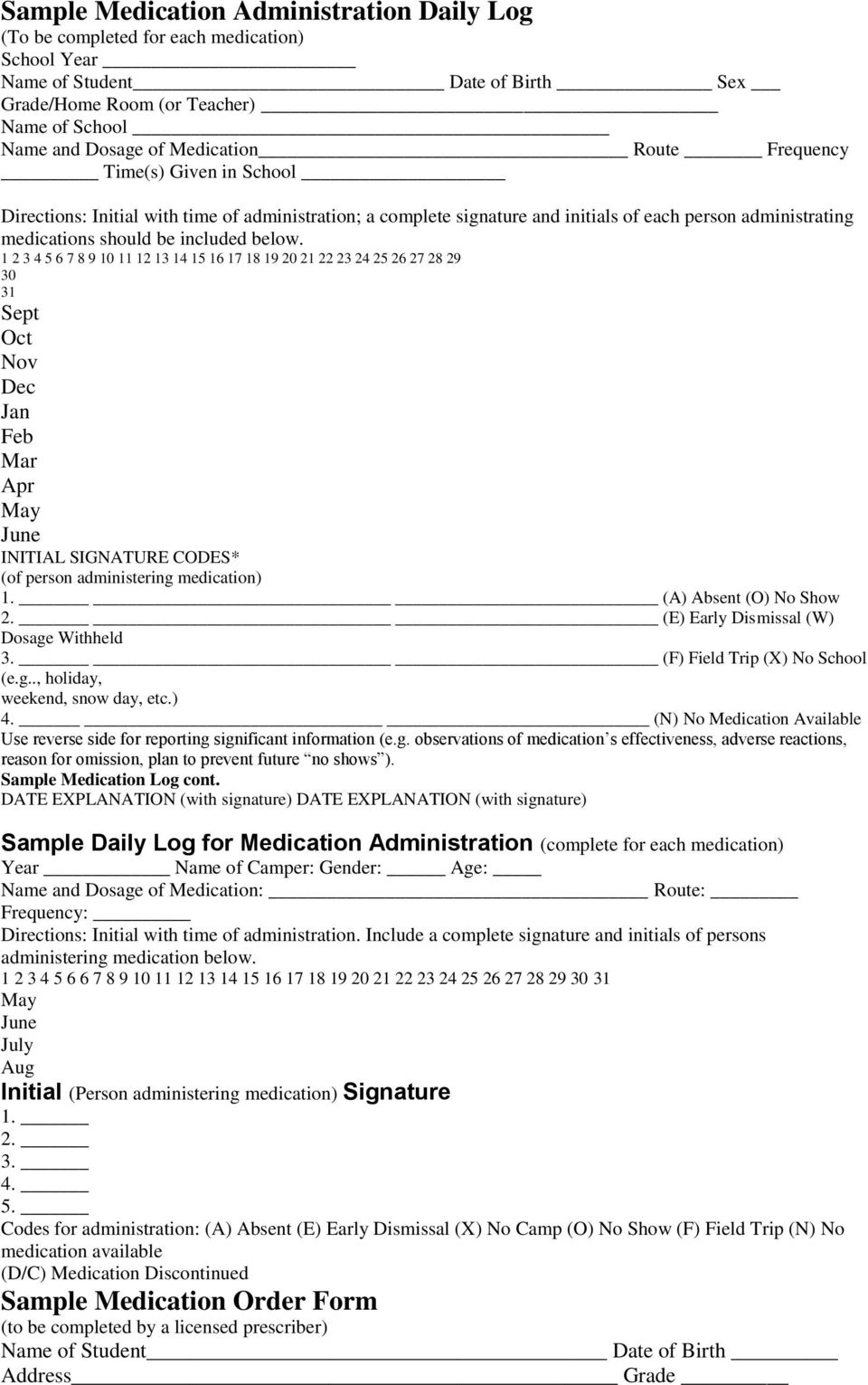
16 Sample Medication Administration Daily Log (To be completed for each medication) School Year Name of Student Date of Birth Sex Grade/Home Room (or Teacher) Name of School Name and Dosage of Medication Route Frequency Time(s) Given in School Directions: Initial with time of administration; a complete signature and initials of each person administrating medications should be included below Sept Oct Nov Dec Jan Feb Mar Apr May June INITIAL SIGNATURE CODES* (of person administering medication) 1. (A) Absent (O) No Show 2. (E) Early Dismissal (W) Dosage Withheld 3. (F) Field Trip (X) No School (e.g.., holiday, weekend, snow day, etc.) 4. (N) No Medication Available Use reverse side for reporting significant information (e.g. observations of medication s effectiveness, adverse reactions, reason for omission, plan to prevent future no shows ). Sample Medication Log cont. DATE EXPLANATION (with signature) DATE EXPLANATION (with signature) Sample Daily Log for Medication Administration (complete for each medication) Year Name of Camper: Gender: Age: Name and Dosage of Medication: Route: Frequency: Directions: Initial with time of administration. Include a complete signature and initials of persons administering medication below May June July Aug Initial (Person administering medication) Signature Codes for administration: (A) Absent (E) Early Dismissal (X) No Camp (O) No Show (F) Field Trip (N) No medication available (D/C) Medication Discontinued Sample Medication Order Form (to be completed by a licensed prescriber) Name of Student Date of Birth Address Grade
17 (street) (city/town) Name of Licensed Prescriber Title Business Phone Emergency Phone Medication Route of administration Dosage Frequency Time(s) of Administration (Please note: Whenever possible, medication should be scheduled at times other than school hours). Specific directions or information for administration: Date of Order Discontinuation Date Diagnosis* Any other medical condition(s)* Optional Information 1. Special side effects, contraindications, or possible adverse reactions to be observed: 2. Other medication being taken by the student: 3. The date of the next scheduled visit or when advised to return to prescriber: 4. Consent for self administration (provided the school nurse determines it is safe and appropriate). Yes No Signature of Licensed Prescriber * if not in violation of confidentiality. Sample Parent/Guardian Authorization

18 For Prescription Medication Administration Student s name Parent/Guardian printed name Telephone number Home: Cell Phone number Telephone number Work: Telephone number Emergency: Other person(s) to be notified in case of medication emergency: Name: Telephone number: My son/daughter is currently receiving the following medications (to be completed if not in violation of confidentiality): My son/daughter has the following food or drug allergies: I consent to have the school nurse or school personnel designated by the School Nurse administer the medication prescribed by: to Licensed Prescriber Student s Name I give permission for my son/daughter to self-administer medication, if the school nurse determines it is safe and appropriate. Yes No I give permission to the School Nurse to share information relevant to the prescribed medication administration as he/she determines appropriate for my son s/daughter s health and safety. I understand I may retrieve the medication from the school at any time; however, the medication will be destroyed if it is not picked up within one week following termination of the order or one week beyond the close of school. Parent/guardian signature Relationship to Student Address:

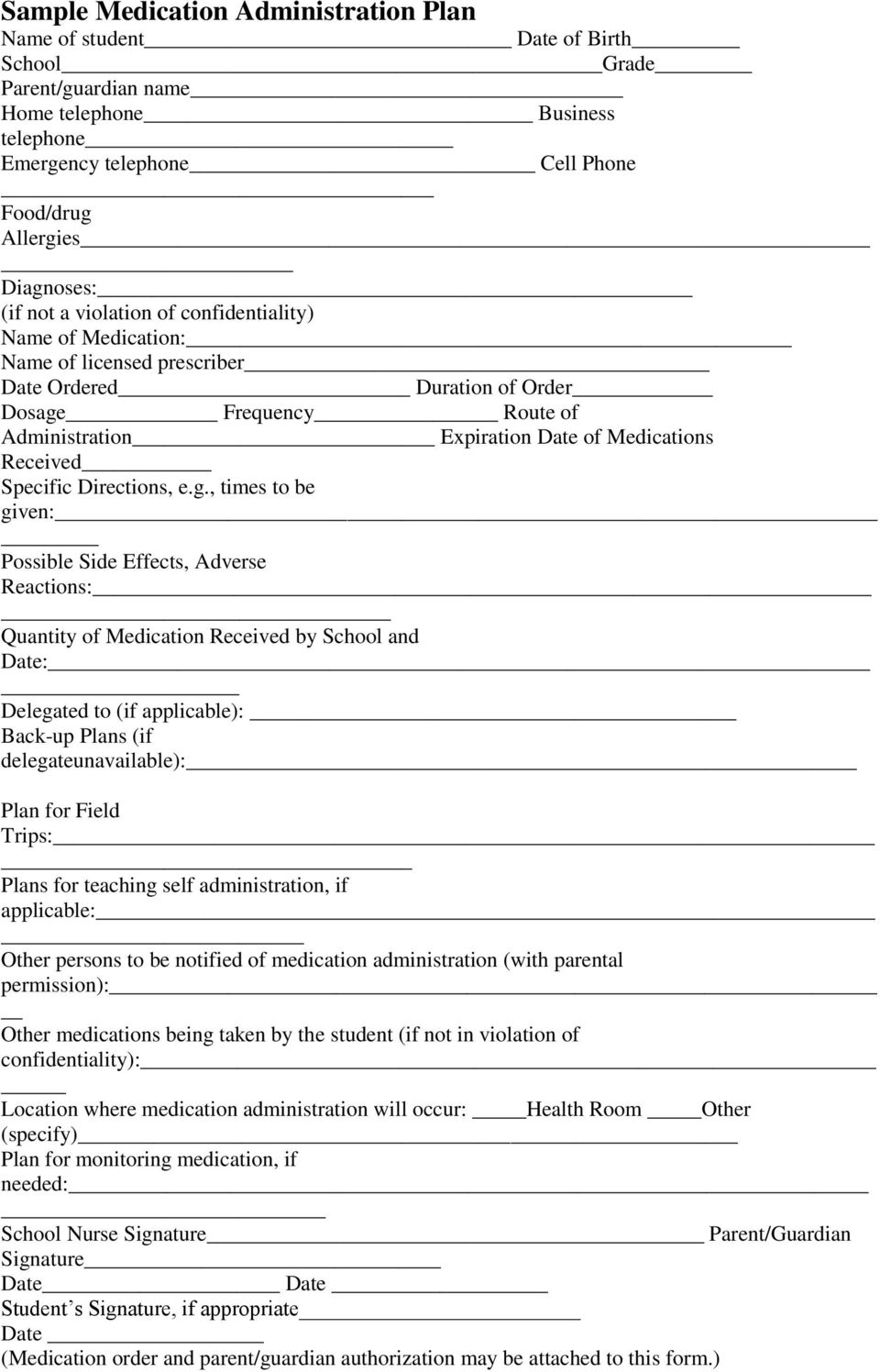
19 Sample Medication Administration Plan Name of student Date of Birth School Grade Parent/guardian name Home telephone Business telephone Emergency telephone Cell Phone Food/drug Allergies Diagnoses: (if not a violation of confidentiality) Name of Medication: Name of licensed prescriber Date Ordered Duration of Order Dosage Frequency Route of Administration Expiration Date of Medications Received Specific Directions, e.g., times to be given: Possible Side Effects, Adverse Reactions: Quantity of Medication Received by School and Date: Delegated to (if applicable): Back-up Plans (if delegateunavailable): Plan for Field Trips: Plans for teaching self administration, if applicable: Other persons to be notified of medication administration (with parental permission): Other medications being taken by the student (if not in violation of confidentiality): Location where medication administration will occur: Health Room Other (specify) Plan for monitoring medication, if needed: School Nurse Signature Parent/Guardian Signature Date Date Student s Signature, if appropriate Date (Medication order and parent/guardian authorization may be attached to this form.)
20 Sample Parent/Guardian Letter Dear Parent/Guardian: We would like to inform you of the policies that have been put in place to ensure the health and safety of children needing medications during the school day. Our school district requires that the following forms must be on file in your child's health record before we begin to give any medicine at school: 1. Signed consent by the parent or guardian to give the medication. Please complete the enclosed consent form and give it to your school nurse. 2. Signed medication order. The written medication order form should be taken to your child's licensed prescriber (your child's physician, nurse practitioner, etc.) for completion and returned to the school nurse. This order must be renewed as needed and at the beginning of each academic year. Medications should be delivered to the school in a pharmacy or manufacturer-labeled container by you or a responsible adult whom you designate. Please ask your pharmacy to provide separate bottles for school and home. No more than a thirty-day supply of the medicine should be delivered to the school. When your child needs a medication to be given during the school day, please act quickly to follow these policies so we may begin to give the medication as soon as possible. Thank you for your help. Sincerely yours, School Nurse Telephone Attachments: Written Parent/Guardian Consent Medication Order 1 Sample Policies and Procedures for the Administration of Medications (based on 105 CMR ) The School Committee/Board of Trustees, in consultation with the Board of Health (where applicable) approves the following policies governing administration of medications in the schools under its jurisdiction. I. Management of the Medication Administration Program A. The school nurse shall be the supervisor of the medication administration program in the school. B. The school nurse, the school physician, and the school health advisory committee, if established, shall develop and propose to the School Committee or Board of Trustees policies and protocols relating to the administration of medications. C. Medication Orders/Parental Consent: 1. The school nurse shall ensure that there is a proper medication order from a licensed prescriber, which is renewed as necessary, including the beginning of each academic year. A telephone order or an order for any change in medication shall be received only by the school nurse. Any such verbal order must be followed by a written order within three school days. Whenever possible, the medication order shall be obtained, and the medication administration plan shall be developed before the student enters or reenters school. a. In accordance with standard medical practice, a medication order from a licensed prescriber shall contain: (1) the student's name; (2) the name and signature of the licensed prescriber and business and emergency phone numbers; (3) the name of the medication; (4) the route and dosage of medication; (5) the frequency and time of medication administration; (6) the date of the order and discontinuation date; (7) a diagnosis and any other medical condition(s) requiring medication, if not a violation of confidentiality or if not contrary to the request of a parent, guardian or student to keep

21 confidential; and (8) specific directions for administration. b. Every effort shall be made to obtain from the licensed prescriber the following additional information, if appropriate: (1) any special side effects, contraindications and adverse reactions to be observed; (2) any other medications being taken by the student; (3) the date of the next scheduled visit, if known. 2 c. Special Medication Situations (1) For short-term medications, i.e., those requiring administration for ten school days or fewer, the pharmacy-labeled container may be used in lieu of a licensed prescriber's order; if the nurse has a question, she may request a licensed prescriber's order. (2) For "over-the-counter" medications, i.e., nonprescription medications, the school nurse shall follow the Board of Registration in Nursing's protocols regarding administration of over-the-counter medications in schools. (3) Investigational new drugs may be administered in the schools with (a) a written order by a licensed prescriber, (b) written consent of the parent or guardian, and (c) a pharmacy-labeled container for dispensing. If there is a question, the school nurse may seek consultation and/or approval from the school physician to administer the medication in the school setting. 2. The school nurse shall ensure that there is a written authorization by the parent or guardian, which contains: a. the parent or guardian's printed name, signature and an emergency phone number; b. a list of all medications the student is currently receiving, if not a violation of confidentiality or contrary to the request of the parent, guardian or student that such medications not be documented; c. approval to have the school nurse or school personnel designated by the school nurse administer the medication; and d. persons to be notified in case of a medication emergency, in addition to the parent or guardian and licensed prescriber. D. Medication Administration Plan: 1. The school nurse, in collaboration with the parent or guardian whenever possible, shall establish a medication administration plan for each student receiving a medication. Whenever possible, a student who understands the issues of medication administration shall be involved in the decision-making process and his/her preferences respected to the maximum extent possible. In Massachusetts, students 18 years of age or older are considered adults and parental/guardian involvement is not required. If appropriate, the medication administration plan shall be referenced in any other health or educational plan developed pursuant to the Massachusetts Special Education Law (Individual Education Plan under Chapter 766) or federal laws, such as the Individuals with Disabilities Education Act (IDEA) or Section 504 of the Rehabilitation Act of Prior to the initial administration of the medication, the school nurse shall assess the child's health status and develop a medication administration plan, which includes: 3 a. the name of the student; b. an order from a licensed prescriber, including business and emergency telephone numbers; c. the signed authorization of the parent or guardian, including home and business telephone numbers; d. any known allergies to food or medications; e. the diagnosis, unless a violation of confidentiality or the parent, guardian or student requests that it not be documented; f. the name of the medication; g. the dosage of the medication, frequency of administration and route of
22 administration; h. any specific directions for administration; i. any possible side effects, adverse reactions or contraindications; j. the quantity of medication to be received by the school from the parent or guardian; k. the required storage conditions; l. the duration of the prescription; m. the designation of unlicensed school personnel, if any, who will administer the medication to the student in the absence of the nurse, and plans for back-up if the designated persons are unavailable; n. plans, if any, for teaching self-administration of the medication; o. with parental permission, other persons, including teachers, to be notified of medication administration and possible adverse effects of the medication; p. a list of other medications being taken by the student, if not a violation of confidentiality or contrary to the request of the parent, guardian or student that such medication not be documented; q. when appropriate, the location where the administration of the medication will take place; r. a plan for monitoring the effects of the medication; and 4 s. provision for medication administration in the case of field trips and other short-term special school events. Every effort shall be made to obtain a nurse or school staff member trained in medication administration to accompany students at special school events. When this is not possible, the school nurse may delegate medication administration to another responsible adult. Written consent from the parent or guardian for the named responsible adult to administer the medication shall be obtained. The school nurse shall instruct the responsible adult on how to administer the medication to the child. 3. The school nurse shall develop a procedure to ensure the positive identification of the student who receives the medication. 4. The school nurse shall communicate significant observations relating to medication effectiveness and adverse reactions or other harmful effects to the child's parent or guardian and/or licensed prescriber. 5. In accordance with standard nursing practice, the school nurse may refuse to administer or allow to be administered any medication, which, based on her/his individual assessment and professional judgment, has the potential to be harmful, dangerous or inappropriate. In these cases, the parent/guardian and licensed prescriber shall be notified immediately by the school nurse and the reason for refusal explained. 6. For the purposes of medication administration, the Licensed Practical Nurse functions under the general supervision of the school nurse who has delegating authority. (Medication administration is within the scope of practice for the Licensed Practical Nurse under M.G.L. Chapter 112.) 7. The school nurse shall have a current pharmaceutical reference available for her/his use, such as the Physician's Desk Reference (PDR) or U.S.P.D.I. (Dispensing Information), Facts and Comparisons. E. Delegation/Supervision (This section applies to school districts or private schools which have been registered by the Massachusetts Department of Public Health to permit school nurses to delegate responsibility for administration of medication to trained nursingsupervised unlicensed school personnel.) The School Committee/Board of Trustees, in consultation with the Board of Health, where applicable, authorizes does not authorize that the responsibility for the administration of medication may be delegated to the following
23 categories of unlicensed school personnel according to criteria delineated in CMR (B)(2): administrative staff 5 teaching staff licensed health personnel health aides secretaries For the purpose of administering emergency medication to an individual child, including parenteral administration (i.e., by injection) of epinephrine pursuant to (B) (4), the school nurse may identify individual school personnel or additional categories. Said school personnel shall be listed on the medication administration plan and receive training in the administration of emergency medication to a specific child. 1. The school nurse, in consultation with the school physician, shall have final decisionmaking authority with respect to delegating administration of medications to unlicensed personnel in school systems registered with the Department of Public Health. 2. When medication administration is delegated by the school nurse to unlicensed school personnel, such personnel shall be under the supervision of the school nurse for the purposes of medication administration. 3. A school nurse shall be on duty in the school system while medications are being administered by designated unlicensed school personnel, and available by telephone should consultation be required. 4. The administration of parenteral medications may not be delegated, with the exception of epinephrine where the child has a known allergy or preexisting medical condition and there is an order for administration of the medication from a licensed prescriber and written consent of the parent or guardian. 5. Prescription medications to be administered pursuant to p.r.n. ("as needed") orders may be administered by authorized school personnel after an assessment by or consultation with the school nurse for each dose. 6. For each school, an updated list of unlicensed school personnel who have been trained in the administration of medications shall be maintained. Upon request, a parent shall be provided with a list of school personnel authorized to administer medications. 7. Supervision of Unlicensed Personnel Authorized unlicensed personnel administering medications shall be under the supervision of the school nurse. The School Committee or Board of Trustees, in consultation with the Board of Health where appropriate, shall provide assurance that sufficient school nurse(s) are available to provide proper supervision of unlicensed school personnel. Responsibilities for supervision at a minimum shall include the following: 6 (a) After consultation with the principal or administrator responsible for a given school, the school nurse shall select, train and supervise the specific individuals, in those categories of school personnel approved by the School Committee or Board of Trustees, in consultation with the Board of Health when appropriate, who may administer medications. When necessary to protect student health and safety, the school nurse may rescind such selection. (b) The number of unlicensed school personnel to whom responsibility for medication administration may be delegated is determined by: (1) the number of unlicensed school personnel the school nurse can adequately supervise on a weekly basis as determined by the school nurse; and (2) the number of unlicensed school personnel necessary, in the nurse's judgment, to ensure that the medications are properly administered to each student. (c) The school nurse shall supervise the training of the designees consistent with the Department of Public Health's requirements in CMR of the Regulations Governing the Administration of Prescription Medications in Public and Private
24 Schools. (1) The school nurse shall document the training and evidence of competency of unlicensed personnel designated to assume the responsibility for medication administration. (2) The school nurse shall provide a training review and informational update, at least annually, for those school staff authorized to administer medications. (d) The school nurse shall support and assist persons who have completed the training to prepare for and implement their responsibilities related to the administration of medication. (e) The first time that an unlicensed school personnel administers medication, the delegating nurse shall provide supervision at the work site. (f) The degree of supervision required for each student shall be determined by the school nurse after an evaluation of the appropriate factors involved in protecting the student's health including, but not limited to the following: (1) health condition and ability of the student; (2) the extent of training and capability of the unlicensed school personnel to whom the medication administration is delegated; (3) the type of medication; and (4) the proximity and availability of the school nurse to the unlicensed person who is performing the medication administration. (g) Personnel designated to administer medications shall be provided with the names and locations of school personnel who have documented certification in cardiopulmonary resuscitation. Schools should make every effort to have a minimum of two school staff members with documented certification in 7 cardiopulmonary resuscitation present in each school building throughout the day. (h) For the individual child, the school nurse shall: (1) determine whether or not it is medically safe and appropriate to delegate medication administration; (2) administer the first dose of the medication, if (a) there is reason to believe there is a risk to the child as indicated by the health assessment, or (b) if the student has not previously received this medication in any setting; (3) review the initial orders, possible side effects, adverse reactions and other pertinent information with the person to whom medication administration has been delegated; (4) provide supervision and consultation as needed to ensure that the student is receiving the medication appropriately. Supervision and consultation may include record review, on-site observation and/or student assessment; and (5) review all documentation pertaining to medication administration every two weeks or more often as necessary. II. Self Administration of Medications "Self administration" means that the student is able to consume or apply medication in the manner directed by the licensed prescriber, without additional assistance or direction. A student may be responsible for taking his/her own medication after the school nurse has determined that the following requirements are met: A. the student, school nurse and parent/guardian, where appropriate, enter into an agreement, which specifies the conditions under which medication may be self administered; B. the school nurse, as appropriate, develops a medication administration plan, which contains only those elements necessary to ensure safe self-administration of medication; C. the student's health status and abilities have been evaluated by the school nurse who then deems self-administration safe and appropriate. As necessary, the school nurse shall observe initial self-administration of the medication;
25 D. the school nurse is reasonably assured that the student is able to identify the appropriate medication, knows the frequency and time of day for which the medication is ordered; E. there is written authorization from the student's parent or guardian that the student may self medicate, unless the student has consented to treatment under M.G.L. c. 112, s. 12F 8 or other authority permitting the student to consent to medical treatment without parental permission; F. if requested by the school nurse, the licensed prescriber provides a written order for selfadministration; G. the student follows a procedure for documentation of self-administration of medication; H. the school nurse establishes a policy for the safe storage of self-administered medication and, as necessary, consults with teachers, the student and parent/guardian, if appropriate, to determine a safe place for storing the medication for the individual student, while providing for accessibility if the student's health needs require it. This information shall be included in the medication administration plan. In the case of an inhaler or other preventive or emergency medication, whenever possible, a backup supply of the medication shall be kept in the health room or a second readily available location; I. the student's self-administration is monitored based on his/her abilities and health status. Monitoring may include teaching the student the correct way of taking the medication, reminding the student to take the medication, visual observation to ensure compliance, recording that the medication was taken, and notifying the parent, guardian or licensed prescriber of any side effects, variation from the plan, or the student's refusal or failure to take the medication; and J. with parental/guardian and student permission, as appropriate, the school nurse may inform appropriate teachers and administrators that the student is self-administering a medication. III. Handling, Storage and Disposal of Medications A. A parent, guardian or parent/guardian-designated responsible adult shall deliver all medications to be administered by school personnel or to be taken by self medicating students (if required by the self administration agreement) to the school nurse or other responsible person designated by the school nurse. 1. The medication must be in a pharmacy or manufacturer labeled container. 2. The school nurse or other responsible person receiving the medication shall document the quantity of the medication delivered. 3. In extenuating circumstances, as determined by the school nurse, the medication may be delivered by other persons; provided, however, that the nurse is notified in advance by the parent or guardian of the arrangement and the quantity of medication being delivered to the school. B. All medications shall be stored in their original pharmacy or manufacturer labeled containers and in such manner as to render them safe and effective. Expiration dates shall be checked. C. All medications to be administered by school personnel shall be kept in a securely locked cabinet used exclusively for medications, which is kept locked except when opened to obtain medications. The cabinet shall be substantially constructed and anchored securely to a solid 9 surface. Medications requiring refrigeration shall be stored in either a locked box in a refrigerator or in a locked refrigerator maintained at temperatures of 38 to 42 degrees Fahrenheit. D. Access to stored medications shall be limited to persons authorized to administer medications and to self-medicating students. Access to keys and knowledge of the location of keys shall be restricted to the maximum extent possible. Students who are self-medicating shall not have access to other students' medications. E. Parents or guardians may retrieve the medications from the school at any time. F. No more than a thirty (30) school day supply of the medication for a student shall be stored at the school. G. Where possible, all unused, discontinued or outdated medications shall be returned to the parent or guardian and the return appropriately documented. In extenuating circumstances, with parental consent when possible, such medications may be destroyed
26 by the school nurse in accordance with any applicable policies of the Massachusetts Department of Public Health, Division of Food and Drugs. All medications should be returned at the end of the school year. IV. Documentation and Record-Keeping A. Each school where medications are administered by school personnel shall maintain a medication administration record for each student who receives medication during school hours. 1. Such record at a minimum shall include a daily log and a medication administration plan, including the medication order and parent/guardian authorization. 2. The medication administration plan shall include the information as described in Section (E) of the Regulations Governing the Administration of Prescription Medications in Public and Private Schools. 3. The daily log shall contain: (a) the dose or amount of medication administered; (b) the date and time of administration or omission of administration, including the reason for omission; and (c) the full signature of the nurse or designated unlicensed school personnel administering the medication. If the medication is given more than once by the same person, he/she may initial the record, subsequent to signing a full signature. 4. The school nurse shall document in the medication administration record significant observations of the medication's effectiveness, as appropriate, and any adverse reactions or other harmful effects, as well as any action taken. 5. All documentation shall be recorded in ink and shall not be altered With the consent of the parent, guardian, or student where appropriate, the completed medication administration record and records pertinent to self administration shall be filed in the student's cumulative health record. When the parent, guardian or student, where appropriate, objects, these records shall be regarded as confidential medical notes and shall be kept confidential. B. The school district shall comply with the Department of Public Health's reporting requirements for medication administration in the schools. C. The Department of Public Health may inspect any individual student medication record or record relating to the administration or storage of medications without prior notice to ensure compliance with the Regulations Governing the Administration of Prescription Medications in Public and Private Schools. V. Reporting and Documentation of Medication Errors A. A medication error includes any failure to administer medication as prescribed for a particular student, including failure to administer the medication: 1. within appropriate time frames (the appropriate time frame should be addressed in the medication administration plan); 2. in the correct dosage; 3. in accordance with accepted practice; and 4. to the correct student. B. In the event of a medication error, the school nurse shall notify the parent or guardian immediately. (The school nurse shall document the effort to reach the parent or guardian.) If there is a question of potential harm to the student, the nurse shall also notify the student's licensed prescriber or school physician. C. Medication errors shall be documented by the school nurse on the accident/incident report form. These reports shall be retained in the following location: and/or the student health record. They shall be made available to the Department of Public Health upon request. All medication errors resulting in serious illness requiring medical care shall be reported to the Department of Public Health, Bureau of Family and Community Health., School Health Unit. All suspected diversion or tampering of drugs shall be reported to the Department of Public Health,
27 Division of Food and Drugs. D. The school nurse shall review reports of medication errors and take necessary steps to ensure appropriate medication administration in the future. VI. Response to Medication Emergencies (Refer to the school's policy for handling all health emergencies in the school.) Such emergency policies shall contain (1) local emergency response system telephone numbers (including ambulance, poison control number, local emergency care providers, etc.), (2) persons to be notified, e.g., parent/guardian, licensed prescriber, etc., (3) names of persons in the school trained to provide first 11 aid and cardio-pulmonary resuscitation, (4) scheduled programs for staff to be trained in first aid and CPR, (5) provision of necessary supplies and equipment and (6) reporting requirements. The school nurse shall develop procedures for responding to medication emergencies, i.e., any reaction or condition related to administration of medication which poses an immediate threat to the health or well-being of the student. These procedures shall be consistent with the school's policy for handling all health emergencies and shall include maintaining a list of persons to be notified in case of a medication emergency. VII. Administration of Epinephrine by Auto-injector to Individuals Experiencing Life- Threatening Allergic Reactions A. If the school district/school is registered with the Department of Public Health the school nurse may train unlicensed personnel to administer epinephrine by auto-injector to individuals with diagnosed life-threatening allergic events. The training program is managed, with full decisionmaking authority, by the designated school nurse leader or responsible school nurse, in consultation with the school physician. This person, or school nurses designated by this person, shall select the individuals authorized to administer epinephrine by auto injector. Persons authorized to administer epinephrine shall meet the requirements of section (B)(2): A. The school personnel authorized to administer epinephrine by auto injector are trained and tested for competency by the designated school nurse leader or responsible school nurse, or school nurses designated by this person, in accordance with standards and a curriculum established by the Department. 1. The designated school nurse leader or responsible school nurse, or school nurses designated by this person, shall document the training and testing of competency. 2. The designated school nurse leader or responsible school nurse, or a designee, shall provide a training review and informational update at least twice a year. 3. The training, at a minimum, shall include: (a) procedures for risk reduction; (b) recognition of the symptoms of a severe allergic reaction; (c) the importance of following the medication administration plan; (d) proper use of the auto-injector; (b) requirements for proper storage and security,; (c) notification of appropriate persons following administration; and (d) record keeping. 4. The school shall maintain and make available, upon request by parents or staff, a list of those school personnel authorized and trained to administer epinephrine by auto injector in an emergency, when the school nurse is not immediately available. B. Epinephrine shall be administered only in accordance with an individualized medication administration plan satisfying the applicable requirements of 105 CMR (E) and (A)(6), updated every year, which includes the following: (1) a diagnosis by a physician that the child is at risk of a life threatening allergic reaction and a medication order containing proper dosage and indications for administration of epinephrine; (2) written authorization by a parent or legal guardian; 12 (3) home and emergency number for the parent(s) or legal guardian(s), as well as the names(s) and phone number(s) of any other person(s) to be notified if the parent(s) or guardian(s) are unavailable;
28 (1) identification of places where the epinephrine is to be stored, following consideration of the need for storage: (a) at one or more places where the student may be most at risk; (b) in such a manner as to allow rapid access by authorized persons, including possession by the student when appropriate; and (c) in a place accessible only to authorized persons. The storage location(s) should be secure, but not locked during those times when epinephrine is most likely to be administered, as determined by the school nurse; (1) a plan for comprehensive risk reduction for the student, including preventing exposure to specific allergens; and (1) an assessment of the student s readiness for self-administration and training, as appropriate. C. When epinephrine is administered, there shall be immediate notification of the local emergency medical services system (generally 911), followed by notification of the student s parent(s) or guardian(s) or, if the parent(s)or guardian(s) are not available, any other designated person(s), the school nurse, the student s physician, and the school physician, to the extent possible; Because of the danger of biphasic reactions, the child should be transported by trained emergency medical personnel to the nearest emergency medical facility. D. There shall be procedures, in accordance with any standards established by the Department for: 0. developing the medication administration plan; 0. developing general policies for the proper storage of medication, including limiting access to persons authorized to administer the medication and returning unused or outdated medication to a parent or guardian whenever possible; 0. recording receipt and return of medication by the school nurse; 0. documenting the date and time of administration; 0. notifying appropriate parties of administration and documenting such notification; 0. reporting medication errors in accordance with 105 CMR (F)(5); 0. reviewing any incident involving administration of epinephrine to determine the adequacy of the response and to consider ways of reducing risks for the particular student and the student body in general; 0. planning and working with the emergency medical system to ensure the fastest possible response; 0. disposing properly of a used epinephrine injector; 0. submitting a written report to the Department of Public Health each time epinephrine is administered to a student or staff, on a form obtained from the Department; and 0. permitting the Department of Public Health to inspect any record related to the administration of epinephrine without prior notice, to ensure compliance with 105 CMR F. Epinephrine may be administered in accordance with these regulations in before and after school 13 programs offered or provided by a school, such as athletic programs, special school events and schoolsponsored programs on week-ends, provided that the public school district or non-public school is registered with the Department pursuant to section (A) and meets the requirements set forth in section (B). 0. Epinephrine may be administered in such before and after school programs and special events, to students attending the school where the epinephrine is to be administered, provided that the following requirements are met: ) the school committee or chief administrative officer in a non-public school approves, in the policy developed in accordance with section (A)(1), administration of epinephrine in such programs. The policy shall identify the school official(s), along with a school nurse for each school designated by the school nurse leader or responsible nurse, responsible for determining which before and after school programs
29 and special events are to be covered by the policy; ) the designated school nurse approves administration of epinephrine in that program and selects the properly trained person(s) to administer the epinephrine; ) the school complies with the requirements of 105 CMR (A), including immediate notification of emergency medical services following administration of epinephrine, but need not comply with the requirement of section (B)(3); and ) the program is not licensed by another state agency, in which case the regulations promulgated by that state agency will apply. 2. Epinephrine may be administered in such before and after school programs and special events to students from another school or school district, if approved in the school policy developed pursuant to section (A)(1) and in accordance with the following requirements: ) The school complies with the requirements of sections (A) and (B)(1), including immediate notification of emergency medical services following administration of epinephrine, except as provided in subsection (B)(2)(d). ) In the event the student is accompanied by school personnel from the sending school, such personnel, whenever possible, shall assume responsibility for ensuring that the epinephrine is brought, properly stored and administered as necessary, in accordance with the medication administration plan developed by the sending school in accordance with subsection (A)(5). ) In the event the student is not accompanied by school personnel from the sending school or such personnel are not trained in the administration of epinephrine, the receiving school may, in its discretion, assume responsibility for administering epinephrine, provided that: (1) the designated school nurse in the receiving school is provided with adequate prior notice of the request, which shall be at least one week in advance unless otherwise specified by the designated school nurse; (2) the designated school nurse in the receiving school approves administration of epinephrine for that student; 14 (3) the designated school nurse selects properly trained person(s) to administer the epinephrine; and (4) the student provides the designated school nurse, or the person(s) selected by the designated school nurse to administer epinephrine, with the medication to be administered. d) If the receiving school assumes responsibility for administering epinephrine, whenever possible, the student shall provide the designated school nurse in the receiving school with a copy of the medication administration plan developed in accordance with section 105 CMR (E). The plan shall be provided to the designated school nurse in timely fashion, in accordance with procedures established by the nurse. If no medication administration plan is provided, the student, at a minimum, shall provide to the designated school nurse in the receiving school: (1) written authorization and emergency phone numbers from a parent or guardian; (2) a copy of a medication order from a licensed provider; and (3) any specific indications or instructions for administration. In addition to the above policies the Department recommends that each school district have a written protocol, signed by the school physician, authorizing the school nurse to administer epinephrine to previously undiagnosed individuals who experience their first life threatening allergic event in the school setting. Stock supplies of epinephrine should be maintained by the school nurse for this purpose. VIII. Dissemination of Information to Parents or Guardians Regarding Administration of Medication Such information shall include an outline of these medication policies and shall be available to parents and guardians upon request. IX. Procedures for Resolving Questions between the School and Parents Regarding Administration of Medications
30 (Refer to approved existing policies within the school district for the resolution of differences, if appropriate.) X. Policy Review and Revision Review and revision of these policies and procedures shall occur as needed but at least every two years. Approved by School Physician: Date Signature 15 Approved by School Nurse: Date Signature Date Approved by the School Committee/Board of Trustees Authorizing Signature: Date Registered by the Massachusetts Department of Public Health for Approval to Delegate to Unlicensed Personnel, if applicable,. 16
31 Medication Administration Training Objectives Upon completion of training, the participant in this course will demonstrate the following competencies: o Identify accurately the student for whom medication is ordered o Read and interpret accurately the medication administration plan o Follow directions on the medication administration plan o Read the medication label accurately o Follow the directions on the medication label o Demonstrate the safe handling and proper storage of medications o Demonstrate the ability to administer medication properly o Demonstrate appropriate and accurate correct record keeping regarding medications given and/or self administered o Demonstrate ability to make accurate notations on health record if medications are not taken/given either by refusal or omission o Describe the proper action to be taken if a medication is not taken/given either by refusal or omission or if an error was made o Ability to use resources appropriately: including school nurse, parent/guardian or emergency service when problems arise o Describe appropriate behaviors which assure confidentiality Role of Unlicensed School Personnel in Medication Administration o Administers medications or assists or reminds student to take own medications o Obtains medication information from the medication administration plan developed by the school nurse (RN) o Follows the specific instructions for the administration of each student s medication o Administers only those medication where there is a specific order for a specific child o Records the time of administration of medication and the effects observed o Reports any unusual reactions o Reports any problem to the school nurse o Seeks instruction from the school nurse for any problems or in case of uncertainty Confidentiality ALL information about students is Confidential Do not discuss or share information about students or medications with other school staff or people outside school unless directed to do so by the school nurse. Refer all questions or comments about students or medications to the school nurse Limitations of Unlicensed School Personnel May NOT administer Over-the-Counter medications under protocols (ie Standing Orders) May NOT give medication by injection EXCEPT epinephrine or other medication to be given in a life threatening situation where the student has a known allergy or other condition and there is a specific order from a licensed prescriber and written consent of parent or guardian.
32 Medication Administration Curriculum How Medications Work o Our body is made up of systems such as digestive, nervous, and respiratory. These systems are made up of organs which are made up of tissues and these tissues are made of cells. o Each one of the body s cells are continuously active with constant chemical reactions. Some of this activity happens with the cell and some by communicating with other cells. This communication between cells is called neurosynaptic transmission. o Medication changes the activity of the cells to produce a therapeutic effect. o In order to produce a therapeutic effect, there must be enough medication surrounding the cell(s), this is called the level of critical concentration. Effects of Medications o See medication administration plan and school nurse for expected and possible effects and side effects o Desired effect: The therapeutic effect means the medication is having the effect intended by the licensed prescriber. Side Effects o Effects caused by the medication that are not the desired effect. o May occur with the desired effect. o Many side effects are expected and predictable Ex. Drowsiness with phenobarbital when the desired effect is seizure control o Some side effects are unexpected and unpredictable, they are Adverse Effects Ex. Severe vomiting and diarrhea when the level of an antipsychotic has gotten too high in the blood for a student o A side effect may be potentially fatal (although it is rare) Ex. An allergic reaction to an antibiotic o Many side effects are difficult to detect or to determine as caused by the medication, such as lightheadedness, blurred vision, dry mouth, confusion, irritability, agitation, and lethargy. No Effect o The medication didn t work. There is always the possibility that this can happen. After allowing sufficient time (as described by the student s health care provider) for the medication to have its desired effect, there is no apparent change. Ex. A student has taken an antibiotic for 2 days and still has a fever and the symptoms of his illness remain the same. OR A student has been taking Dilantin for a week and her seizures are still occurring at the same rate and are a severe as before the medication was started. o ANY changes that you see (either physical or behavioral) or that are described to you by a student may be caused by a medication. Changes can occur from the first few minutes or day or weeks that a medication is taken or even after an extended length of time. Report ALL changes to the School Nurse and record in the medication log. Drug Interactions o Some students receive more than one medication as a time. o Some are medications taken on a regular basis and some on a temporary basis. o Whenever a student takes two or more different medication, a drug interaction may occur.
33 o A drug interaction occurs when one drug alters (decreases, increases or changes) the effect or action of another. Five Rights of Medication Administration o Right student Don t guess You must identify the student, if not ask another staff person Use a photo if possible to identify the student (stapled to med plan) o Right medication Compare the medication administration plan with the pharmacy label Double check, making sure they match If they do not match, do not give the medication and call the school nurse Check expiration date on medication label. Do not give if beyond the expiration date. Call the school nurse If medication appearance has changed (ex. Cloudy liquid, different color or shape of oral capsules or tablets) do not give the medication and call the school nurse. o Right dosage Compare the medication administration plan with the pharmacy label. Double check, making sure they match. Carefully measure or count the correct dosage and compare with the medication plan and the pharmacy label. Dosage must not be higher or lower than stated on the plan. If anything does not match, do not give the medication and call the school nurse. o Right time Give the medication at the time(s) stated in the medication administration plan. o Right route Medication is prescribed to be given in Tablets Capsules Liquids Drops Ointments Injectables Inhalants The form of the medication dictates the route of administration Oral route: tablets, capsules, and liquids that are swallowed Topical route: ointments are applied externally Inhalation: Asthma inhalers Injection: Emergency medication only as ordered for a specific student with a known diagnosis Follow directions on medication administration plan.
34 Steps in Medication Administration 1) Identify student 2) Read medication administration plan 3) Wash hands 4) Select and read label of medication 5) Prepare medication and read label again 6) Read label again and administer medication 7) Replace medication in cabinet 8) Lock cabinet 9) Document in medication log Do s and Don ts: Other Safeguards to follow o DO give your full attention to the task o Do remain with student until medication has been taken. Make sure oral med is swallowed. o DO prepare the medication for only one student at a time o DON T give medication from a container which has a label that can t be read. o DON T give medication from anther student s container. o DON T leave medications unattended o DON T try to hide a medication error. o DON T increase or decrease or change in any way any medication without specific instructions from the school nurse. Assisting Student with Self-administration 1) Identify the student 2) Unlock medication cabinet if appropriate 3) Select correct medication i. Read medication administration plan ii. Read label 4) Observe student prepare and take medication as per medication plan 5) Document as required or stated in plan i. By unlicensed school staff member ii. By student Recording Medication Administration 1) Use Medication Administration Daily Log (paper or computer) 2) Record in ink only if using paper. 3) Write legibly 4) Do not erase or use white out 5) If necessary to change an entry, cross out with a single line and initial
35 Massachusetts Department of Public Health School Health Unit Medication Administration COMPETENCY SKILL CHECK LIST (To be completed at the time the staff person [other than school nurse] administers medication for the first time via each route) Name and Title of Staff Person Date Medication Name Route (circle) Oral tablet, oral liquid, topical, drops: eye, ears, nose Other Identifies student Asks student how he/she feels Observes student Reads medication administration plan Washes hands Checks label of medication Prepares medication properly Reads label of medication a 2nd time Reads label of medication a 3rd time and administer med correctly Replaces medication in cabinet or refrigerator Locks cabinet Documents in medication log Comments: Signatures: Supervised by RN Staff person
36 Massachusetts Department of Public Health School Health Unit Medication Administration Written Competency Test Name Date RN Instructor 1) List the 5 Rights of Medication Administration a. b. c. d. e. 2) If you give a student the wrong medication, the first thing you should do is: (Choose one) a. Watch to see if the student has any ill effects b. Report it to the School Nurse immediately c. Watch for any ill effects and report to the School Nurse immediately 3) List four condition that require hand washing a. b. c. d. 4) What should be documented on the medication administration daily log a. b. c. d. 5) List the situations that constitute a medication error a. b. c. d. e. 6) If the label states that pills are 50 mgms, and a student is to take 200 mgms of the drug, how many pills would you give? (Circle answer) a. 2 b. 4 c. 3 7) What three documents do you need before give medication a. b. c. 8) What information is necessary before calling a School Nurse regarding a prn medication for a student with a specific order? a. b. 9) When a student is running out of a medication (Choose one) a. You may borrow the same medication from another student b. You may skip a dose c. You inform the appropriate person that the prescription needs to be refilled
37 10) When may the use of an epi-pen be necessary? a. b. 11) In the context of medications, ORAL means (Choose one) a. A student who talks a lot b. A drug/medication that is meant to be swallowed 12) How do you document a medication error? a. b. 13) To whom would you report an emergency in your school? a. b. 14) Where would you find information regarding side effects of a medication. 15) A student complains of nausea and refuses medication, you should: a. b. c. 16) When administering a medication, how will you identify the right student in your school? a. b. c. d. 17) When assisting a student to self-administer, what steps should you take? a. b. c. d. e. f. 18) In the contest or medication, TOPICAL application refers to (Choose one) a. A current situation b. A medication that is applied to an external area 19) List at least 2 times when you will contact the School Nurse? a. b. 20) What are the 3 times that you read the medication label? a. b. c. 21) What would you do if Johnny comes for his medication and looks flushed and says that his throat feels sore? (Choose one) a. Call the School Nurse b. Call the parent c. Call 911 d. Give Johnny his medication and write his complaints on the medication record. 22) Three children need their medication at the same time. How do you proceed? a. b.
38 23) An emergency should be reported (Choose one) a. As soon as possible b. Immediately c. When you finish what you are doing 24) If a student s medication looks different than before (cloudy instead of clear, tablets of different shape, size or color) what would you do? 25) Who has access to the keys to the medication cabinet? a. b. 26) The school principal asks you what medication a student is taking and why he/she is taking it. What will you do? a. Tell the principal you don t know b. Refer the principal to the School Nurse c. Show the principal the medication administration plan 27) If you do not understand the medication plan, what should you do? 28) List the nine steps involved in medication administration a. b. c. d. e. f. g. h. i.
39 Massachusetts Department of Public Health School Health Unit Answer Key: Medication Administration Written Competency Test Name Date RN Instructor 1) List the 5 Rights of Medication Administration a. Right Student b. Right Medication c. Right Dosage d. Right Time e. Right Route 2) If you give a student the wrong medication, the first thing you should do is: (Choose one) a. Watch to see if the student has any ill effects b. Report it to the School Nurse immediately c. Watch for any ill effects and report to the School Nurse immediately 3) List four condition that require hand washing a. Before eating b. After using the bathroom c. Before giving medication d. After giving medication 4) What should be documented on the medication administration daily log a. Time medication given b. Initals and signature of person giving medication c. Any observations of medication effectiveness or adverse reactions d. Special situations: no show, dosage withheld, absent 5) List the situations that constitute a medication error a. Wrong student b. Wrong medication c. Wrong dosage d. Wrong time e. Wrong route 6) If the label states that pills are 50 mgms, and a student is to take 200 mgms of the drug, how many pills would you give? (Circle answer) a. 2 b. 4 c. 3 7) What three documents do you need before give medication a. Medication administration plan b. Signed parent/guardian consent c. Signed medication order from a licensed provider 8) What information is necessary before calling a School Nurse regarding a prn medication for a student with a specific order? a. When did the student have a previous dose? b. What symptoms do you observe or does student describe? 9) When a student is running out of a medication (Choose one) a. You may borrow the same medication from another student b. You may skip a dose c. You inform the appropriate person that the prescription needs to be refilled
40 10) When may the use of an epi-pen be necessary? a. In an emergency situation only b. Student has a known allergy and a medication plan is in place. 11) In the context of medications, ORAL means (Choose one) a. A student who talks a lot b. A drug/medication that is meant to be swallowed 12) How do you document a medication error? a. Complete a Medication Error Report b. Call the School Nurse and make a note about it on the report 13) To whom would you report an emergency in your school? Able to name person(s) and phone number 14) Where would you find information regarding side effects of a medication. On the medication administration plan 15) A student complains of nausea and refuses medication, you should: (Choose one) a. Coax the student to take the medication b. Skip the dose c. Hold the medication and report it to the School Nurse immediately 16) When administering a medication, how will you identify the right student in your school? a. Ask student his/her name b. Ask student his/her birth date c. Check student s picture if available d. Ask teacher or other staff person to identify student 17) When assisting a student to self-administer, what steps should you take? a. Identify the student b. Unlock the medication cabinet c. Select the correct medication using proper procedure d. Refer to medication plan e. Observe that the student takes the medication f. Either document in log that student has taken the medication or observe the student document self administration 18) In the contest or medication, TOPICAL application refers to (Choose one) a. A current situation b. A medication that is applied to an external area 19) List at least 2 times when you will contact the School Nurse? a. Whenever I have a question about the medication administration b. In any emergency or situation where an error has occurred. 20) What are the 3 times that you read the medication label? a. When removing it from the medication cabinet b. While preparing medication c. Before administering medication to student 21) What would you do if Johnny comes for his medication and looks flushed and says that his throat feels sore? (Choose one) a. Call the School Nurse b. Call the parent c. Call 911 d. Give Johnny his medication and write his complaints on the medication record. 22) Three children need their medication at the same time. How do you proceed? a. Take care of one child at a time b. Ask others to wait until you are ready for them
41 23) An emergency should be reported (Choose one) a. As soon as possible b. Immediately c. When you finish what you are doing 24) If a student s medication looks different than before (cloudy instead of clear, tablets of different shape, size or color) what would you do? Call the School Nurse 25) Who has access to the keys to the medication cabinet? a. School Nurse b. Any other school staff person who have been trained and authorized to administer medications 26) The school principal asks you what medication a student is taking and why he/she is taking it. What will you do? a. Tell the principal you don t know b. Refer the principal to the School Nurse c. Show the principal the medication administration plan 27) If you do not understand the medication plan, what should you do? Call the School Nurse 28) List the nine steps involved in medication administration a. Identify student b. Read medication administration plan c. Wash hands d. Select and read label of medication e. Prepare medication and read label f. Read label and administer medication g. Replace medication in cabinet h. Lock cabinet i. Document administration
42 School Health Medication Error Report Form Massachusetts Department of Public Health Purpose: To track all medication variances resulting in serious illness requiring medical care. To improve the quality of medication administration practices in schools. Statutory Requirement: Medication errors, as defined in 105 CMR (F) (5), resulting in serious illness requiring medical care shall be reported to the Department of Public Health 105 CMR (6) (B). Instructions: For ALL variances, notify your nurse leader/ supervisor and principal/ superintendent immediately. Complete form if medication error resulted in serious illness or required medical care. 1. Form to be completed by the School Nurse Leader, or School Nurse. 2. Notify MDPH School Health Unit via fax: (617) within 24 hours and 3. Mail Medication Error Report Form to: School Health Advisor MDPH, School Health Unit 250 Washington St. (5th Floor) Boston, MA Diversion: All incidents of suspected or tampering of drugs should be reported to the local police as well as the MDPH, Division of Food and Drugs 105 CMR (D) Link: Drug Diversion Form Division of Food and Drugs, Drug Control Program 305 South Street, 2nd Floor Jamaica Plain, MA (617) Telephone (617) Fax MDPH School Health Medication Error Report Form School District: Incident Occurred at (Name of school): School address: School registered with MDPH for medication delegation? Yes If yes, please specify type: Full Registration Field Trip Date of Incident: / / Time of Error: No AM PM Month / Day / Year Person affected: Student Staff Other Gender: M F Age: years Location of error: Classroom Health Office Field Trip Other If other, please specify: Error made by: Name: Position: Medication Administration Variance Incident type: Wrong dose Wrong medication Wrong Route Wrong time Wrong individual Licensed Physician/Practitioner s order: Briefly describe what happened, probable precipitating factors that may have contributed to variance, and note if student/individual exhibited manifestations of adverse reaction/harm:
43 Please indicate all who were notified: Parent/Guardian Superintendent Principal Nurse Leader Primary Care Provider School Physician Disposition: Student/Staff/Visitor Incident Outcome: Transferred to Emergency Room: Yes No If yes, discharged after hours Hospitalized: Yes No Hospitalization date: Discharge date: Did a debriefing meeting occur? Yes No Other: Recommendation for change(s): Protocol Policy Education Information sharing None Comments: MEDICATION ERROR REPORT FORM COMPLETED BY: Name: Title: Date: / / Month / Day / Year Phone number: Ext: Work Cell address: Date sent to MDPH School Health Unit: DO NOT WRITE IN BOX BELOW MDPH School Health Unit Follow-Up: Date Received: Reviewed by: Report of Follow-up:
105 CMR: DEPARTMENT OF PUBLIC HEALTH 105 CMR 210.000: THE ADMINISTRATION OF PRESCRIPTION MEDICATIONS IN PUBLIC AND PRIVATE SCHOOLS
 105 CMR 210.000: THE ADMINISTRATION OF PRESCRIPTION MEDICATIONS IN PUBLIC AND PRIVATE SCHOOLS Section 210.001: Purpose 210.002: Definitions 210.003: Policies Governing the Administration of Prescription
Medication Administration and Delegation in Massachusetts Schools Presented by
 Medication Administration and Delegation in Massachusetts Schools Presented by Massachusetts Department of Public Health in collaboration with the Northeastern University School Health Institute Massachusetts
ADMINISTRATION OF MEDICATIONS POLICY
 Policy 6.007. ADMINISTRATION OF MEDICATIONS POLICY It is the policy of Cooperative Educational Services (C.E.S.) that students who require any medications to be administered during school hours, including
ADMINISTRATION OF PRESCRIPTION MEDICATIONS IN SCHOOLS OBJECTIVES. Purpose of Regulations 105 CMR 210.000. Diane M. Gorak, RN, MEd
 ADMINISTRATION OF PRESCRIPTION MEDICATIONS IN MASSACHUSETTS SCHOOLS Diane M. Gorak, RN, MEd OBJECTIVES Review Massachusetts Regulations Recognize Challenges Ensure Safe Delivery of Prescription Medications
This technical advisory is intended to help clarify issues related to delegation of medications during the school day.
 This technical advisory is intended to help clarify issues related to delegation of medications during the school day. Actual Text - Ed 311.02 Medication During School Day (a) For the purpose of this rule
STATE OF CONNECTICUT REGULATION of State Department of Education Name of Agency
 Page 1 of 12 STATE OF CONNECTICUT REGULATION of State Department of Education Name of Agency Concerning Subject Matter of Regulations Administration of Medication by School Personnel and Administration
Definitions For the purpose of this policy, the following definitions shall apply:
 5141.21 Administration of Student Medications in the Schools A licensed school nurse, or in the absence of such nurse, qualified personnel for schools may administer medication to students in the school
5141.21(a) Policy. Students. Draft Revised Policy. Administering Medication
 5141.21(a) Policy Draft Revised Policy Administering Medication The purpose of this policy is for the Board of Education (Board) to determine who shall administer medications in a school and the circumstances
5141.21(a) Students. Administering Medication
 5141.21(a) Administering Medication The purpose of this policy is for the Board of Education (Board) to determine who shall administer medications in a school and the circumstances under which self-administration
Lindenwold Board File Code # 5141.21 Of Education Page 1 of 7
 Of Education Page 1 of 7 The Board of Education disclaims any and all responsibility for the diagnosis and treatment of the illness be contingent upon the timely administration of medication duly prescribed
HEALTH REQUIREMENTS & SERVICES: MEDICAL TREATMENT
 DESCRIPTOR TERM: Students Millard District Policy File Code: 6200 1 st Reading: 05-08-14 HEALTH REQUIREMENTS & SERVICES: MEDICAL TREATMENT Purpose The purpose of this policy is to authorize school personnel
RULES FOR STUDENT POSSESSION AND ADMINISTRATION OF ASTHMA, ALLERGY AND ANAPHYLAXIS MANAGEMENT MEDICATIONS OR OTHER PRESCRIPTION MEDICATIONS
 DEPARTMENT OF EDUCATION Colorado State Board of Education RULES FOR STUDENT POSSESSION AND ADMINISTRATION OF ASTHMA, ALLERGY AND ANAPHYLAXIS MANAGEMENT MEDICATIONS OR OTHER PRESCRIPTION MEDICATIONS 1 CCR
Chicago Public Schools Policy Manual
 Chicago Public Schools Policy Manual Title: ADMINISTRATION OF MEDICATION POLICY Section: 704.2 Board Report: 12-0125-PO2 Date Adopted: January 25, 2012 THE CHIEF EXECUTIVE OFFICER RECOMMENDS: That the
BOARD OF EDUCATION Cherry Hill, New Jersey Policy 5141.21
 BOARD OF EDUCATION Cherry Hill, New Jersey Policy 5141.21 ADMINISTRATION OF MEDICATION (POLICIES AND PROCEDURES CONCERNING ADMINISTRATION OF MEDICATION CODE PURSUANT TO N.J.S.A. 18A:11-1, 18A:40-4, 40-12.3
MONROE SCHOOL DISTRICT NO. 103 No.: P5432 MONROE PUBLIC SCHOOLS STUDENTS BOARD POLICY PROCEDURE P5432 MEDICATION AT SCHOOL
 Page: 1 of 9 MONROE PUBLIC SCHOOLS STUDENTS BOARD POLICY PROCEDURE P5432 MEDICATION AT SCHOOL Each school principal shall authorize at least two staff members to administer prescribed or nonprescribed
ADMINISTRATION OF MEDICATION
 SOUTH LYON COMMUITY SCHOOLS 5330/page 1 of 6 ADMINISTRATION OF MEDICATION Definitions Medication includes both prescription and non-prescription medications including those taken by mouth, inhaler, injection,
Liberty Union High School District Administrative Regulation
 Page 1 of 7 Definitions Authorized health care provider means an individual who is licensed by the State of California to prescribe or order medication, including, but not limited to, a physician or physician
Medication Administration in Schools
 Medication Administration in Schools Last Reviewed November 2005 Definition Parental Responsibility Training of Unlicensed Staff Resources School Nurse Responsibility Coordination and Oversight Statutes
For purposes of this policy, "medication" means any prescription drug or over-the-counter medicine or nutritional supplement.
 5330/Page 1 of 5 M 5330 The Board of Education disclaims any and all responsibility for the diagnosis and treatment of the illness of any pupil. At the same time, the Board recognizes that a pupil's attendance
Chicago Public Schools Policy Manual
 Chicago Public Schools Policy Manual Title: ADMINISTRATION OF MEDICATION DURING SCHOOL HOURS Section: 704.2 Board Report: 06-0927-PO1 Date Adopted: September 27, 2006 Policy: The Chief Executive Officer
Date Submitted: July 20, 2000 Date Reviewed: May 31, 2005 January 17, 2006 March 17, 2009 Subject: Administration of Medication
 POLICY SOMERSET COUNTY BOARD OF EDUCATION 1. PURPOSE Date Submitted: July 20, 2000 Date Reviewed: May 31, 2005 January 17, 2006 March 17, 2009 Subject: Administration of Medication Number: 600-32 Date
Administration of Oral Prescription Medication Directive
 Administration of Oral Prescription Medication Directive Directive for Policy 4.2 Medical/Health Supports Projected Review Date: Nov. 2018 RATIONALE: Hamilton-Wentworth District School Board is committed
ADMINISTRATION OF DRUG PRODUCTS/MEDICATIONS TO STUDENTS
 ADMINISTRATION OF DRUG PRODUCTS/MEDICATIONS TO STUDENTS 453.4 Drug products/medications are given to students in the school setting to continue or maintain a medical therapy which promotes health, prevents
210. USE OF LIFE SAVING MEDICATIONS. 1. Purpose
 SHALER AREA SCHOOL DISTRICT No: 210 SECTION: PUPILS TITLE: USE OF LIFE SAVING MEDICATIONS ADOPTED: JULY 13, 1998 REVISED: JUNE 22, 2005; DECEMBER 13, 2006; JANUARY 11, 2012 210. USE OF LIFE SAVING MEDICATIONS
Administration of Medication in Schools
 Michigan Department of Education Michigan Department of Community Health Administration of Medication in Schools MODEL SCHOOL NURSE GUIDELINE Original Date of Issue: 2014 Michigan Department of Education,
Administration of Medications Policy
 5141.21 Administration of Medications Policy Statement of Purpose The policy and procedures for the administration of medication in schools are written in accordance with Connecticut Education Laws. Families
link to new law http://www.ilga.gov/legislation/publicacts/fulltext.asp?name=098-0795&ga=98
 New Section 1.540 (epinephrine auto-injectors): PA 98-795, effective August 1, 2014,amended Section 22-30 of the School Code [105 ILCS 5/22-30], in part, to authorize (but not require) the administration
SPRINGFIELD PUBLIC SCHOOLS COMPREHENSIVE SCHOOL HEALTH PROGRAM Administration of Medication in Springfield Public Schools
 SPRINGFIELD PUBLIC SCHOOLS COMPREHENSIVE SCHOOL HEALTH PROGRAM Administration of Medication in Springfield Public Schools LAW: Massachusetts General Law, Chapter 94 C These medical guidelines are established
Appendix A: Questions and Answers
 Appendix A: Questions and Answers Roles and responsibilities for nursing procedures and health-related activities in school and during all school-sponsored activities is complex and, at times, difficult
ADMINISTRATION OF MEDICATION
 ADMINISTRATION OF MEDICATION IN SCHOOLS MARYLAND STATE SCHOOL HEALTH SERVICES GUIDELINE JANUARY 2006 (Reference Updated March 2015) Maryland State Department of Education Maryland Department of Health
RULE. The Administration of Medication in Louisiana Public Schools
 RULE The Administration of Medication in Louisiana Public Schools Developed in 1994 by The Louisiana State Board of Elementary and Secondary Education and The Louisiana State Board of Nursing Amendments
Plum Borough School District Nursing Services Department
 Information Regarding the Student with an Allergy Student s Name Grade Homeroom Date Physician s Name Physician s Phone # Type of Allergy (Food, Bee, Wasp, Latex, Other: Specify): Type of Reaction: For
Students. Burr Ridge Community Consolidated School District #180 Policy Manual 7:270. Administering Medicines to Students 1
 Burr Ridge Community Consolidated School District #180 Policy Manual 7:270 Administering Medicines to Students 1 Students Students should not take medication during school hours or during school-related
Procedure for Students Using Medication
 Procedure for Students Using Medication Issued: 07/09 Procedure Number: 6125-P PROCEDURE FOR STUDENTS USING MEDICATION PURPOSE Medication therapy may be crucial in allowing students to function and learn
ADMINISTERING MEDICINES TO STUDENTS
 Adopted June 1977 Revised November 1985 Revised April 2004 Revised September 2007 APS Code: JLCD Students shall not be permitted to take medication while at school unless such medication is administered
Kansas Statutes for School Health Services
 Kansas Statutes for School Health Services Dental Screening 72-5201. Annual free dental inspection; exceptions. The boards of education of cities of the first and second class and school boards of school
Be it enacted by the People of the State of Illinois,
 AN ACT concerning schools. Be it enacted by the People of the State of Illinois, represented in the General Assembly: Section 5. The School Code is amended by changing Section 22-30 as follows: (105 ILCS
ADMINISTRATION OF MEDICATION BY SCHOOL PERSONNEL
 TRUMBULL BOARD OF EDUCATION SECTION: 5000 BOARD OF EDUCATION CATEGORY: Students POLICY MANUAL POLICY CODE: 5141.21-Administration of Medication by School Personnel Policy ADMINISTRATION OF MEDICATION BY
CHAPTER 6: MEDICATION ADMINISTRATION PROCEDURES TABLE OF CONTENTS. Definitions... VI-1. Purpose... VI-1. Guidelines... VI-2
 CHAPTER 6: MEDICATION ADMINISTRATION PROCEDURES TABLE OF CONTENTS Definitions... VI-1 Purpose... VI-1 Guidelines... VI-2 Responsibilities Related to Medication Administration... VI-2 Delegating Nurse Responsibilities...
MEDICATION ADMINISTRATION PROCEDURE
 MEDICATION ADMINISTRATION PROCEDURE Objective: To provide procedure and protocols to ensure the safe administration of medication to students at school. Always refer to FFAC Legal and FFAC Local for district-approved
Agency # 070.00 REGULATION 9 PHARMACEUTICAL CARE/PATIENT COUNSELING
 Agency # 070.00 REGULATION 9 PHARMACEUTICAL CARE/PATIENT COUNSELING 09-00: PATIENT COUNSELING 09-00-0001--PATIENT INFORMATION, DRUG USE EVALUATION, AND PATIENT COUNSELING The intent of this regulation
OFFICE OF CATHOLIC SCHOOLS ARCHDIOCESE OF CHICAGO
 OFFICE OF CATHOLIC SCHOOLS ARCHDIOCESE OF CHICAGO SCHOOL MEDICATION PROCEDURES Parents/guardians have the primary respomibility for (he adminislration of medical ion to their children. The administration
Ohio Department of Health Authorization for Student Possession and Use of an Epinephrine Autoinjector
 Ohio Department of Health uthorization for Student Possession and Use of an Epinephrine utoinjector In accordance with ORC 3313.718/3313.141 completed form must be provided to the school principal and/or
Regulation 757-3 STUDENTS November 13, 2013 STUDENTS. Student Health Services and Requirements
 STUDENTS November 13, 2013 STUDENTS Student Health Services and Requirements Guidelines for School Staff/Child Care Contractor (CCC) to Carry Out Health Treatment Procedure and/or Emergency Treatment Procedures
POLICY SERVICES ADVISORY
 POLICY SERVICES ADVISORY Volume 12, Number 2 April 2015 CONTENTS Policy Advisory No. 114 JLCG Emergency Administration of Medications to Students JLCG-R Emergency Administration of Medications to Students
Public Act 03-211 An Act Concerning the Provision of Medical Care for Students Health Care Needs
 To: School Nurse Supervisors School Medical Advisors From: Cheryl Carotenuti, Health Promotion Consultant State Department of Education Date: September 29, 2003 RE: Public Act 03-211 An Act Concerning
Health Professions Act BYLAWS SCHEDULE F. PART 3 Residential Care Facilities and Homes Standards of Practice. Table of Contents
 Health Professions Act BYLAWS SCHEDULE F PART 3 Residential Care Facilities and Homes Standards of Practice Table of Contents 1. Application 2. Definitions 3. Supervision of Pharmacy Services in a Facility
(S.4) It is hereby enacted by the General Assembly of the State of Vermont: (1) According to the Centers for Disease Control and Prevention:
 No. 68. An act relating to health and schools. (S.4) It is hereby enacted by the General Assembly of the State of Vermont: Sec. 1. FINDINGS The General Assembly finds: (1) According to the Centers for
CONNECTICUT. Downloaded January 2011 19 13 D8T. CHRONIC AND CONVALESCENT NURSING HOMES AND REST HOMES WITH NURSING SUPERVISION
 CONNECTICUT Downloaded January 2011 19 13 D8T. CHRONIC AND CONVALESCENT NURSING HOMES AND REST HOMES WITH NURSING SUPERVISION (d) General Conditions. (6) All medications shall be administered only by licensed
A b i l e n e I n d e p e n d e n t S c h o o l D i s t r i c t ABILENE INDEPENDENT SCHOOL DISTRICT MEDICATION ADMINISTRATION PROCEDURES
 A b i l e n e I n d e p e n d e n t S c h o o l D i s t r i c t 241 Pine Street Abilene, Texas 79601 (325) 677-1444 ABILENE INDEPENDENT SCHOOL DISTRICT MEDICATION ADMINISTRATION PROCEDURES All prescription
ADMINISTRATION OF MEDICATION BY AUTHORIZED POLK COUNTY SCHOOL PERSONNEL
 ADMINISTRATION OF MEDICATION BY AUTHORIZED POLK COUNTY SCHOOL PERSONNEL 1. Principals/Directors of each school are required to designate a minimum of three staff members as Health Contacts who will be
59A-4.150 Geriatric Outpatient Nurse Clinic.
 59A-4.150 Geriatric Outpatient Nurse Clinic. (1) Definitions: (a) Advanced Registered Nurse Practitioner a person who holds a current active license to practice professional nursing and a current Advanced
RULES AND REGULATIONS PERTAINING TO ACQUIRING AND STOCKING EPINEPRHINE AUTO- INJECTORS FOR EMERGENCY ADMINISTRATION
 RULES AND REGULATIONS PERTAINING TO ACQUIRING AND STOCKING EPINEPRHINE AUTO- INJECTORS FOR EMERGENCY ADMINISTRATION [R23-6.4-EPI] STATE OF RHODE ISLAND AND PROVIDENCE PLANTATIONS DEPARTMENT OF HEALTH February
HEALTH SERVICES PROGRAM
 HEALTH SERVICES PROGRAM The Board of Education will provide for the health and physical well being of students through the establishment of a district wide student Health Services Program in the school
Other Forms from Seattle Public School District
 SEATTLE PUBLIC SCHOOLS Other Forms from Seattle Public School District Medical & Other Forms Privacy Rights Student Survey Form to Identify Disabled Students (504-2) Authorization for Medications to be
Illinois State Board of Education
 Illinois State Board of Education April 2015 Guidance Document Self-Administration and Self-Carry of Medications for Asthma and Allergy (PA 98-0795) This document is intended to provide non-regulatory
SCHOOL DISTRICT OF BLACK RIVER FALLS HIPAA PRIVACY AND SECURITY POLICY
 SCHOOL DISTRICT OF BLACK RIVER FALLS HIPAA PRIVACY AND SECURITY POLICY School Board Policy 523.5 The School District of Black River Falls ( District ) is committed to compliance with the health information
5530 SUBSTANCE ABUSE (M)
 Haddonfield 5530 / Page 1 of 10 5530 SUBSTANCE ABUSE (M) The following procedures are established in implementation of Policy No. 5530, Substance Abuse. A. Definitions 1. Evaluation means those procedures
DRUG, NARCOTIC, AND ALCOHOL POLICY 6360
 POTTSTOWN SCHOOL DISTRICT DRUG, NARCOTIC, AND ALCOHOL POLICY 6360 6360.1 Through the use of an up-to-date curriculum, classroom activities, community support and resources, a strong and consistent administrative
Crosspoint Clubhouse
 Crosspoint Clubhouse To the Parents/Guardians of The health and safety of our students is a priority for our school. Because your child has a life threatening allergy that may require the use of an Epinephrine
CHAPTER 61-03-02 CONSULTING PHARMACIST REGULATIONS FOR LONG-TERM CARE FACILITIES (SKILLED, INTERMEDIATE, AND BASIC CARE)
 CHAPTER 61-03-02 CONSULTING PHARMACIST REGULATIONS FOR LONG-TERM CARE FACILITIES (SKILLED, INTERMEDIATE, AND BASIC CARE) Section 61-03-02-01 Definitions 61-03-02-02 Absence of Provider or Consulting Pharmacist
HIPAA Notice of Privacy Practices
 HIPAA Notice of Privacy Practices THIS NOTICE DESCRIBES HOW MEDICAL INFORMATION ABOUT YOU MAY BE USED AND DISCLOSED AND HOW YOU CAN GET ACCESS TO THIS INFORMATION. PLEASE REVIEW IT CAREFULLY. This Notice
HILLSDALE BOARD OF EDUCATION FILE CODE: 5131.6* SUBSTANCE ABUSE
 HILLSDALE BOARD OF EDUCATION Hillsdale, NJ 07642 SUBSTANCE ABUSE Possible Drug and Alcohol Related Situations Whenever it shall appear to any teaching staff member, school nurse or other education personnel
Wyckoff Administration Policy on Epinephrine Nurse, Student and or Delegate
 Wyckoff Administration Policy on Epinephrine Nurse, Student and or Delegate It is the policy of this school to apply New Jersey Law N.J.S.A. 18A: 40-12.3-12.6 in the following way: The school will provide
Policy for Administration of Medications in the Connecticut Technical High School System
 Policy for Administration of Medications in the Connecticut Technical High School System Approved March 2008 as Policy for Administration of Medications by CTHSS Personnel Revised January 2012 as Policy
5461 FOOD ALLERGIES POLICY
 5461 FOOD ALLERGIES POLICY The incidence of potentially life-threatening food allergies among children has increased over the years across the nation. For this reason, the New Canaan Public Schools are
POLICY. 2015 7513 1 of 5. Students ADMINISTRATION OF MEDICATION
 1 of 5 ADMINISTRATION OF MEDICATION The school's registered professional nurse may administer medication to a student during the school day under certain conditions. who have been determined by the school
How To Deal With A Pupil Who Is Under The Influence Of Alcohol Or Drugs
 R 5530/Page 1 of 12 R 5530 The following procedures are established in implementation of Policy No. 5530, Substance Abuse. A. Definitions 1. Evaluation means those procedures used by a certified or licensed
OPTOMETRIC INJECTIONS
 OPTOMETRIC INJECTIONS West Virginia Board of Optometry 179 Summers Street, Suite 231 Phone: 304-558-5901 Fax: 304-558-5908 E-Mail: [email protected] West Virginia Board of Optometry 179 Summers Street,
NOTICE REQUIREMENTS FOR PRESCRIPTION MONITORING PROGRAMS
 NOTICE REQUIREMENTS FOR PRESCRIPTION MONITORING PROGRAMS This project was supported by Grant No. G1299ONDCP03A, awarded by the Office of National Drug Control Policy. Points of view or opinions in this
UW School of Dentistry Comprehensive Medication Policy
 UNIVERSITY OF WASHINGTON SCHOOL OF DENTISTRY Subject: UW School of Dentistry Comprehensive Medication Policy Policy Number: Effective Date: December 2014 Revision Dates: June 2015 PURPOSE This policy provides
Custodial Procedures Manual Table of Contents
 Custodial Procedures Manual Table of Contents Page 1. Drug Policies and Procedures 1 A. Procurement of Prescription Drugs 1 i. Prescription drugs may only be accepted from 1 pharmacies and or practitioners.
a) Each facility shall have a medical record system that retrieves information regarding individual residents.
 TITLE 77: PUBLIC HEALTH CHAPTER I: DEPARTMENT OF PUBLIC HEALTH SUBCHAPTER c: LONG-TERM CARE FACILITIES PART 300 SKILLED NURSING AND INTERMEDIATE CARE FACILITIES CODE SECTION 300.1810 RESIDENT RECORD REQUIREMENTS
POLICY TINTON FALLS BOARD OF EDUCATION. PUPILS 5530/Page 1 of 10 SUBSTANCE ABUSE 5530 SUBSTANCE ABUSE
 5530/Page 1 of 10 M 5530 The Board of Education recognizes that a pupil's abuse of harmful substances seriously impedes that pupil's education and threatens the welfare of the entire school community.
Youth Camp Civic Center
 Youth Camp Civic Center Household ID # Please circle the session(s) that your child(ren) will attend Session One June 8- June 12 Session Two June 15 June 19 Session Three June 22 June 26 Session Four June
NOTICE OF PRIVACY PRACTICES Allergy Treatment Center of New Jersey, P.C. Effective Date: April 14, 2003
 Allergy Treatment Center of New Jersey, P.C. 388 Pompton Avenue 415 Avenel Street Cedar Grove, NJ 07009 Avenel, NJ 07001 (973) 857 9890 (732) 636-7030 NOTICE OF PRIVACY PRACTICES Allergy Treatment Center
MEDICATION ADMINISTRATION IN SCHOOLS: WHAT YOU NEED TO KNOW
 MEDICATION ADMINISTRATION IN SCHOOLS: WHAT YOU NEED TO KNOW Renae Sisk, RN, BSN, NCSN S t a te S c h o o l N u r se C o n sultant E m a il: r [email protected] P h o n e: 7 01. 328.4526 KEY POINTS: ND State
Section 400: Code # 453.4R
 Section 400: Code # 453.4R Administering Medication Conditions for Administering Prescription Drugs Except as otherwise specifically provided by law, a school bus driver, employee, or volunteer that has
MARY T. INC. PROGRAM POLICY MANUAL
 MARY T. INC. PROGRAM POLICY MANUAL POLICY Safe Medication Assistance and SECTION: 2-2C TITLE: Administration Policy REVISED BY: Jane Strobel, RN PAGE: 1of 6 APPLIES TO: All Services Operating Under Rule
ROLE OF THE PARENT/LEGAL GUARDIAN IN THE ADMINISTRATION OF MEDICATION AT SCHOOL
 ROLE OF THE PARENT/LEGAL GUARDIAN IN THE ADMINISTRATION OF MEDICATION AT SCHOOL The parent/legal guardian who wishes medication to be administered at school to his/her child has the following responsibilities:
Investigational Drugs: Investigational Drugs and Biologics
 : I. PURPOSE The purpose of this policy is to establish procedures for the proper control, storage, use and handling of investigational drugs and biologics to ensure that adequate safeguards are in place
MEDICATION ADMINISTRATION TO STUDENTS
 540 540 SECTION 540 MEDICATION AND FIRST AID SECTION 540A - MEDICATION MEDICATION ADMINISTRATION TO STUDENTS Medications are given to students in the school setting to continue or maintain a medical therapy
PINE HILL BOARD OF EDUCATION School Board Policy 1003 Turnerville Road Pine Hill, New Jersey 08021 5530- SUBSTANCE ABUSE
 PINE HILL BOARD OF EDUCATION School Board Policy 1003 Turnerville Road Pine Hill, New Jersey 08021 Phone: 856-783-6900 ext. 1115 FAX: 856-783-2955 Website: www.pinehill.k12.nj.us 5530- SUBSTANCE ABUSE
POLICY HIGH BRIDGE BOARD OF EDUCATION. Pupils 5530/Page 1 of 6 SUBSTANCE ABUSE 5530 SUBSTANCE ABUSE
 5530/Page 1 of 6 5530 M The Board of Education recognizes that a pupil s abuse of harmful substances seriously impedes that pupil s education and threatens the welfare of the entire school community. The