
Quick Guide. For Clinicians. Based on TIP 25 Substance Abuse Treatment and Domestic Violence
|
|
|
- Percival Atkinson
- 10 years ago
- Views:
Transcription
1 Quick Guide For Clinicians Based on TIP 25 Substance Abuse Treatment and Domestic Violence

2 Contents Why a Quick Guide? What is a TIP? Introduction Screening for Survivors Treatment Planning for Survivors Issues of Child Abuse or Neglect Screening Techniques and Questions for Batterers Treatment Planning for Batterers Referral and Linkages Legal Issues Phone and Internet Resources

3 Quick Guide For Clinicians Based on TIP 25 Substance Abuse Treatment and Domestic Violence This Quick Guide is based almost entirely on information contained in TIP 25, published in 1997 and based on information updated through June No additional research has been conducted to update this topic since publication of the original TIP.

4 2 Substance Abuse Treatment and Domestic Violence WHY A QUICK GUIDE? This Quick Guide was developed to accompany Substance Abuse Treatment and Domestic Violence, Number 25 in the Treatment Improvement Protocol (TIP) Series published by the Center for Substance Abuse Treatment (CSAT), Substance Abuse and Mental Health Services Administration. This Quick Guide is based entirely on TIP 25 and is designed to meet the needs of the busy clinician for concise, easily accessed "how-to" information. The Guide is divided into eight sections (see Contents). These sections will help readers quickly locate relevant material. Clinicians can use the Resources on page 31 to keep updated with current information on the most recent developments in the field of domestic violence. For more information on the topics in this Quick Guide, readers are referred to TIP 25.

5 What is a TIP? 3 WHAT IS A TIP? The TIP series has been in production since This series provides the substance abuse treatment and related fields with consensus-based, field-reviewed guidelines on substance abuse treatment. TIP 25, Substance Abuse Treatment and Domestic Violence Addresses the concerns of a broad range of readers including substance abuse treatment clinicians, domestic violence programs, social workers, medical personnel, program administrators, and policymakers Includes extensive research Lists numerous resources for further information Provides a reference for substance abuse treatment clinicians working with adults who have experienced domestic violence See the inside back cover for information on how to order TIPs and other related products.

6 4 Substance Abuse Treatment and Domestic Violence INTRODUCTION Domestic violence is the use of intentional emotional, psychological, sexual, or physical force by one family member or intimate partner to control another. Researchers have found that one fourth to one half of men who commit acts of domestic violence have substance abuse problems. While domestic violence affects a variety of populations, this Quick Guide only discusses the treatment of adult male batterers and adult female survivors. The Connections Between Substance Abuse and Domestic Violence Substance abuse doesn't "cause" domestic violence. It may afflict both batterers and survivors. Failure to address domestic violence may interfere with treatment effectiveness. A substance abusing woman may find her abusive partner becomes angry when she seeks help, and his violence could push her to drop out of treatment. Some batterers are worse domestic violence offenders when they are sober so partners of such batterers may try to subvert treatment efforts.

7 Introduction 5 Goals Attaining sobriety Ensuring survivors' safety Create Linkages To effect lasting change, people working in both fields must recognize the importance of holistic treatment and learn to collaborate on the client's behalf. This Quick Guide presents pertinent information on holistic treatment of domestic violence situations substance abuse treatment clinicians will need. This will include creating linkages with groups pertinent to a client's recovery, including Domestic violence programs Health care communities The criminal justice system Schools and educational institutes Employers Social welfare ATTENTION: Due to the high correlation between the two problems, all clients who present for substance abuse treatment should be questioned about domestic violence. For more detailed information, see TIP 25, pp. xiii xix.

8 6 Substance Abuse Treatment and Domestic Violence SCREENING FOR SURVIVORS CAUTION: It is important not to ask potentially painful questions too soon; otherwise, a client may feel overwhelmed and reluctant to return. Clues for the Treatment Provider Physical injuries around the face, neck and throat Inconsistent/evasive answers when questioned about injuries A history of relapse or noncompliance with substance abuse treatment Stress related illness and conditions Complications in pregnancy The way in which a client describes her partner's treatment of her can also be a clue to possible domestic violence. Does he isolate her? force her to sell drugs? harm other family members or pets? threaten to hurt her, himself or others?

9 Screening for Survivors 7 Child abuse is also a clue. Research indicates that a father who abuses his children often abuses his wife as well. ALERT: Survivors are often reluctant to disclose the amount of violence in their lives. Crisis Intervention When a woman informs staff she is a victim of domestic violence, providers should Ensure her safety: Whether a client is entering inpatient or outpatient treatment, the immediate physical safety of her environment must be of chief concern. If inpatient, security measures should be intensified; if outpatient, a safety plan should be developed. Assure her she is believed: Reinforcement of the counselor's belief of a survivor's victimization is a critical component of ongoing emotional support. Affirming the survivor's experience helps empower her to participate in immediate problem solving and longer term treatment planning. Identify her options: Treatment providers should ask the survivor to identify her options, share information that would expand her

10 8 Substance Abuse Treatment and Domestic Violence options, and support her in devising a safety plan. Evaluate health concerns, including any need for detoxification. Attend to anything that may interrupt the initiation of treatment. For more detailed information, see TIP 25, pp. 9 11, pp

11 TREATMENT PLANNING FOR SURVIVORS Treatment Planning for Survivors 9 Safety From the Batterer In the early stages of treatment, the substance abuse counselor should help the client develop a safety plan by referring her to a domestic violence service provider. It is also important to address the batterer's reaction to his partner being in treatment and minimize the client's risk of harm in order for her to more easily continue her treatment. Safety Tips for Survivors and Their Families The following pages contain tips that can be relayed to survivors and their families to help keep them safe from batterers. The following six pages are reprinted with permission from the American Bar Association (see resources section for more information). In an Emergency If you are at home and you are being attacked: Stay away from the kitchen (the abuser can find weapons there, such as knives). Stay away from bathrooms, closets or small spaces where the abuser can trap you. Get to a room with a door or window to escape.

12 10 Substance Abuse Treatment and Domestic Violence Get to a room with a phone to call for help; lock the abuser outside if you can. Call 911 (or your local emergency number) right away for help; get the dispatcher's name. Think about a neighbor or friend you can run to for help. If a police officer comes, tell him/her what happened; get his/her name and badge number. Get medical help if you are hurt. Take pictures of bruises and injuries. Call a domestic violence program or shelter (some are listed at the end of this document); ask them to help you make a safety plan. How to protect yourself at home Learn where to get help; memorize emergency phone numbers. Keep a phone in a room you can lock from the inside; if you can, get a cellular phone that you keep with you at all times. If the abuser has moved out, change the locks on your door; get locks on the window. Plan an escape route out of your home; teach it to your children. Think about where you would go if you need to escape.

13 Treatment Planning for Survivors 11 Ask your neighbors to call the police if they see the abuser at your house; make a signal for them to call the police; for example, if the phone rings twice, a shade is pulled down or a light is on. Pack a bag with important things you'd need if you have to leave quickly, put it in a safe place, or give it to a friend or relative you trust. Include cash, car keys and important information such as: court papers, passport or birth certificate, medical records and medicines, immigration papers. Get an unlisted phone number. Block caller ID. Use an answering machine; screen the calls. Take a good self-defense course. How to make your children safer Teach them not to get in the middle of a fight, even if they want to help. Teach them how to get to safety, to call 911, to give your address and phone number to the police. Teach them to call for help. Tell them to stay out of the kitchen.

14 12 Substance Abuse Treatment and Domestic Violence Give the principal at school or daycare center a copy of your court order; tell them not to release your children to anyone without talking to you first; use a password so they can be sure it is you on the phone; give them a photo of the abuser. Make sure the children know who to tell at school if they see the abuser. Make sure the school knows not to give your address or phone number to anyone. How to protect yourself outside the home Change your regular travel habits. Try to get rides with different people. Shop and bank in a different place. Cancel any bank accounts or credit cards you shared; open new accounts at a different bank. Keep your court order and emergency numbers with you at all times. Keep a cell phone and program it to 911 (or other emergency number). How to make yourself safer at work Keep a copy of your court order at work. Give a picture of the abuser to security and friends at work.

15 Treatment Planning for Survivors 13 Tell your supervisor see if he or she can make it harder for the abuser to find you. Don't go to lunch alone. Ask a security guard to walk you to your car or to the bus. If the abuser calls you at work, save your voice mail and save . Your employer may be able to help you find community resources. Using the law to help you Protection or restraining orders Ask your local domestic violence program to help you get a civil protection order and to help you with criminal prosecution. Ask for help finding a lawyer. In most places the judge can Order the abuser to stay away from you and your children. Order the abuser to leave your home. Give you temporary custody of your children and order the abuser to pay you temporary child support. Order the police to come to your home while the abuser picks up personal belongings.

16 14 Substance Abuse Treatment and Domestic Violence Give you possession of the car, furniture and other belongings. Order the abuser to go to a batterers' intervention program. Order the abuser not to call you at work. Order the abuser to give guns to the police. If you are worried about any of the following, make sure you Show the judge any pictures of your injuries. Tell the judge that you do not feel safe if the abuser comes to your home to pick up the children to visit with them. Ask the judge to order the abuser to pick up and return the children at the police station or some other safe place. Ask that any visits the abuser is permitted are at very specific times so the police will know by reading the court order if the abuser is there at the wrong time. Tell the judge if the abuser has harmed or threatened the children; ask that visits be supervised; think about who could do that for you. Get a certified copy of the court order. Keep the court order with you at all times.

17 Treatment Planning for Survivors 15 Criminal Proceedings Show the prosecutor your court orders. Show the prosecutor medical records about your injuries or pictures if you have them. Tell the prosecutor the name of anyone who is helping you (a victim advocate or lawyer). Tell the prosecutor about any witnesses to injuries or abuse. Ask the prosecutor to notify you ahead of time if the abuser is getting out of jail. Be safe at the court house Sit as far away from the abuser as you can; you don't have to look at or talk to the abuser; you don't have to talk to the abuser's family or friends if they are there. Bring a friend or relative to wait with you until your case is heard. Tell a bailiff or sheriff that you are afraid of the abuser and ask him/her to look out for you. Make sure you have your court order before you leave. Ask the judge or sherif to keep the abuser there for a while when court is over; leave quickly. If you think the abuser is following you when you leave, call the police immediately.

18 16 Substance Abuse Treatment and Domestic Violence If you have to travel to another State for work or to get away from the abuser, take your protection order with you; it is valid everywhere. Reprinted with permission from the American Bar Association Psychosocial Issues A key aspect of treatment for substance abuse is encouraging the client to assume responsibility for her addiction and dispelling the notion she is responsible for her partner's behavior. For some battered women, every aspect of their life has been controlled by the batterer. Helping her develop her own decisionmaking skills will be integral to her recovery. Posttraumatic stress disorder, the increased stress of abstinence, and the client's perception of her own safety are all issues that can affect her treatment and should be dealt with in treatment. Later Recovery Issues Practical concerns overwhelm many survivors of domestic violence after they become abstinent. Linkages with other programs and agencies become extremely important in meeting the client's responsibilities. Four areas that may need special consideration during this time are

19 Treatment Planning for Survivors 17 Social functioning: Social isolation is common among domestic violence survivors. Providers should encourage the client to make her own decisions about new activities and pastimes. Parenting: A survivor may need to learn new skills that take into account the reality of her status as a domestic violence survivor. Handling frustration and anger is a crucial life skill that must be addressed directly in treatment. Financial and legal concerns: Treatment providers should explore with the client her plans for future education and employment and should have information on a variety of options. Relapse prevention: Revictimization by their abusive partners poses the greatest risk of relapse for battered women. Careful attention to recurring episodes of violence is essential to working with survivor clients to prevent or minimize the negative effects of relapse. For more detailed information, see TIP 25, pp , pp

20 18 Substance Abuse Treatment and Domestic Violence ISSUES OF CHILD ABUSE OR NEGLECT The confidentiality regulations in Title 42, Part 2 of the Code of Federal Regulations require that a client be given notice regarding the limitations of confidentiality orally and in writing upon admission to a substance abuse program. Screening for Child Abuse or Neglect When family violence comes to the attention of the treatment provider, it is essential to determine whether children have been present or have been involved in any way. It is not advisable for the substance abuse clinician to perform an assessment of children for abuse or incest; this function should be performed by personnel with special expertise. Reporting Suspected Neglect or Abuse and Children's Protective Services Agencies Clients must be informed that mandated reporters, a category that includes substance abuse treatment providers, are required to notify Children's Protective Services (CPS) if they suspect child abuse or neglect. Clients can be informed of the right to report their partner's abuse of children.

21 Issues of Child Abuse or Neglect 19 It is ultimately the mandated reporter's responsibility to ensure CPS is contacted in the event of suspected child abuse or neglect. It is important to prepare for the impact of reporting child abuse on the children and the family as whole. It is imperative for professionals working with family members to provide information to them about what to expect from CPS and, if at all possible, to talk with CPS caseworkers and accompany the family to any court hearings. The Role of Treatment Providers in Supporting the Mother Help her identify and coordinate various services available to her. Support her efforts to participate in and take advantage of these services. Listen as she voices her frustration about the difficulties of meeting the demands of the various agencies. For more detailed information, see TIP 25, pp , pp
22 20 Substance Abuse Treatment and Domestic Violence SCREENING TECHNIQUES AND QUESTIONS FOR BATTERERS CAUTION: In asking questions about abuse, substance abuse treatment providers must be careful not to enable batterers to place blame for batterings on the victim or alcohol and drugs. Questions "Some people think that, under certain circumstances, it's OK to hit your wife (girlfriend, etc.). Under what circumstances do you think violence might be justified?" "If you were faced with overwhelming stress (use a hypothetical situation), do you think you could keep your cool?" "What do you think you'd do?" By taking an open-ended social and family history, the interviewer can gradually move to specific, direct questions. "Have you ever been physically hurt by someone in your family?" (If the client's partner has hurt him or her, the reverse may be true.) "Have you ever hurt someone in your family?"
23 Screening Techniques and Questions for Batterers 21 The "No-Violence Contract" Batterers entering treatment for substance abuse can be required to sign a contract agreeing to refrain from using violence. "No-violence" contracts are most effective when linkages with batterers' intervention programs are also in place, but they can also help structure treatment by specifying an achievable behavioral goal. Recovery Pitfalls for Batterers 12-Step programs can play a valuable role in supporting batterers' treatment and recovery when their principles are followed. However, providers should be alert to signs that clients are misinterpreting 12-Step philosophies to justify, excuse, or evade responsibility for their violence. Ongoing Attention to Issues of Domestic Violence Ongoing attention to issues of domestic violence is particularly important with these clients because it may take time for them to begin talking about the violence in their lives. As they become abstinent, additional issues can arise that are integrally related to the violence. The full dimensions of a domestic violence problem are seldom immediately clear and may emerge unexpectedly at a later stage in treatment. For more detailed information, see TIP 25, p. 48.
24 22 Substance Abuse Treatment and Domestic Violence TREATMENT PLANNING FOR BATTERERS Gauge client's acceptance of responsibility. Link client's actions with tangible consequences, e.g., through a no violence contract. Encourage the batterer client to develop enough self-awareness to recognize the beliefs and attitudes that are precursors to violence and to control the emotions that contribute to violence. Formulate a treatment plan with strategies that ensure safety for the partner and family members. Help the batterer focus on changing the behaviors and events that have precipitated violence or relapse. Watch for and stop clients from condoning violence or reinforcing each others' excuse-making. Raise the batterer's awareness of the impact his violence has on his children's future behavior (young boys often learn violent behavior from male role models). Help batterers adopt nonviolent modes of behavior through anger management and coping skills.
25 Treatment Planning for Batterers 23 Reinforce the importance of modeling nonviolent behavior in their interactions with their partners as well as their children. For more detailed information, see TIP 25, pp
26 24 Substance Abuse Treatment and Domestic Violence REFERRAL AND LINKAGES Referral When answers to screening suggest that the client may be a batterer or a survivor, he or she should be immediately referred to a domestic violence program. When referrals are not possible, ongoing consultation with a domestic violence expert is strongly encouraged. In some instances, clients have been mandated into substance abuse treatment by courts. Substance abuse providers use the leverage provided by the criminal justice system to ensure that clients who batter participate in batterer's treatment as well. Referring Survivors If the client reveals that she is in immediate danger, the counselor needs to attend to this before addressing other issues. Advise the client to take simple legal precautions and to safeguard important documents, e.g., social security card, driver license, etc. Discuss possible reprisal by the batterer if the police become involved and plan a response. If a survivor client expresses concern about her children, refer her for shelter and legal advocacy. Resources can be identified by contacting a local domestic violence program, a State pro-
27 Referral and Linkages 25 gram or the National 24-Hour Domestic Violence Hotline, SAFE. Referring Batterers When suspected batterers are identified, substance abuse treatment providers should refer them to batterer's intervention programs as a key part of treatment planning. With the client's signed consent to release information, substance abuse counselors can share pertinent information with domestic violence staff to ensure both problems are being addressed. Family therapy or family intervention for batterers and their partners should be provided by a domestic violence specialist or program. Linkages To effectively treat substance abuse, care must be coordinated with domestic violence programs and other agencies pertinent to a client's recovery, e.g., the criminal justice system, the workplace, etc. Substance abuse treatment providers, domestic violence experts, and legal or other relevant professionals should plan client treatment collaboratively. Substance abuse treatment providers should get to know what resources and institutions exist in their communities.
28 26 Substance Abuse Treatment and Domestic Violence 1) Domestic Violence Programs - Hotlines, - Shelters, - Clinicians, - Programs, 2) Health Care Services - Health Administrators, - Primary Care Physicians, 3) The Justice System - The Police Department, - Judges, 4) Education/Schools - Teachers, - Principles, - School Social Workers, 5) Employers, 6) Social Welfare - Social Welfare Administration, - Social Workers, Cross-screening of various problems by various agencies is a major step toward linkage. Because of its influence on the client, integrating the criminal justice system's efforts should be one of the first steps in forming linkages.
29 Referral and Linkages 27 Due to the increasing call for cost containment, collaborative endeavors are critical to the future of many programs. Collaborative Care Services When creating linkages, remember that collaborative services should be Client centered Holistic Flexible Collaborative Coordinated Accountable Case Management In the case management approach, a specially trained single practitioner or case management team is responsible for coordinating linkages to the wide variety of services needed by many if not most clients in substance abuse treatment. For more detailed information, see TIP 25, pp
30 28 Substance Abuse Treatment and Domestic Violence LEGAL ISSUES CAUTION: Neither this Quick Guide nor TIP 25 should be considered a substitute for competent legal advice from a qualified attorney. The Violence Against Women Act The Violence Against Women Act (VAWA) strengthens many of the laws regarding violence motivated by gender, outlines Federal as well as State enforcement provisions and penalties, and makes crimes against women and children a civil rights violation. Under VAWA Past sexual behavior or alleged sexual predisposition of the victim is no longer admissible evidence in civil or criminal proceedings involving sexual misconduct. New Federal criminal penalties apply to anyone who crosses a State line in order to commit domestic violence or to violate a civil protection order. States are required to enforce civil protection orders issued by other states.
31 Legal Issues 29 Victims must have the opportunity to testify regarding the potential danger of the pretrial release of a defendant. Disclosure and Consent Typically, State laws regulate the disclosure of patient information related to domestic violence. These laws differ from Federal laws that govern consent to disclose substance abuse-related information. When it comes to reporting crimes that are discussed in treatment to a third party (e.g., the police or a lawyer), the counselor must ask three questions: (1) Does State law require the program to make a report? (2) Does State law permit the program to make a report? (3) How can a report be made without violating the Federal law and regulations governing confidentiality or patients' records? Legal Resources State Department of Health Single State Authority for Substance Abuse and/or Domestic Violence State Attorney General Local bar associations
32 30 Substance Abuse Treatment and Domestic Violence Agency board members who are attorneys Local advocacy groups for people experiencing domestic violence Local law schools For more detailed information, see TIP 25, pp , pp
33 Phone and Internet Resources 31 SELECTED PHONE AND INTERNET RESOURCES Hotlines National Domestic Violence Hotline (800) 799-SAFE (800) Rape, Abuse, and Incest National Network (RAINN) (800) Child Help USA/National Child Abuse Hotline (800) 4A-CHILD General Resources National Coalition Against Domestic Violence (303) National Victim Center (NVC)/Infolink (800) FYI-CALL American College of Obstetricians and Gynecologists (ACOG) (202)
34 32 Substance Abuse Treatment and Domestic Violence Other Services Center for the Prevention of Sexual and Domestic Violence (206) Domestic Violence Project/Face to Face (800) Domestic Violence Training Project (800) Family Violence and Sexual Assault Institute (903) American Bar Association Commission on Domestic Violence
35 Ordering Information TIP 25 Substance Abuse Treatment and Domestic Violence TIP 25-Related Products KAP Keys for Clinicians based on TIP 25 Do not reproduce or distribute this publication for a fee without specific, written authorization from the Office of Communications, Substance Abuse and Mental Health Services Administration, U.S. Department of Health and Human Services. Easy Ways to Obtain Free Copies of All TIP Products 1. Call SAMHSA's National Clearinghouse for Alcohol and Drug Information (NCADI) at , TDD (hearing impaired) Visit CSAT's Website at
36 Other Treatment Improvement Protocols (TIPs) that are relevant to this Quick Guide: TIP 27, Comprehensive Case Management for Substance Abuse Treatment (1998) BKD251 TIP 35, Enhancing Motivation for Change in Substance Abuse Treatment (1999) BKD342 TIP 36, Substance Abuse Treatment for Persons With Child Abuse and Neglect Issues (2000) BKD343 See the inside back cover for ordering information for all TIPs and related products. DHHS Publication No. (SMA) Printed 2001
Domestic Violence and Protective Orders
 Domestic Violence and Protective Orders Domestic violence (also called family violence) is a pattern of behavior and a method of control which results in physical injury or places one in reasonable apprehension
It is a court order against someone who has abused or harassed you. That person is ordered either not to abuse you or not to have contact with you.
 WHAT IS A RESTRAINING ORDER? WILL IT PROTECT ME? It is a court order against someone who has abused or harassed you. That person is ordered either not to abuse you or not to have contact with you. A restraining
What is DOMESTIC VIOLENCE?
 What is DOMESTIC VIOLENCE? Domestic violence is a pattern of control used by one person to exert power over another. Verbal abuse, threats, physical, and sexual abuse are the methods used to maintain power
KAP Keys. For Clinicians. Based on TIP 25 Substance Abuse Treatment and Domestic Violence. CSAT s Knowledge Application Program
 KAP KEYS Based on TIP 25 Substance Abuse Treatment and Domestic Violence CSAT s Knowledge Application Program KAP Keys For Clinicians Based on TIP 25 Substance Abuse Treatment and Domestic Violence U.S.
ANSWERS TO COMMON LEGAL QUESTIONS AND RESOURCES FOR VICTIMS OF DOMESTIC VIOLENCE
 ANSWERS TO COMMON LEGAL QUESTIONS AND RESOURCES FOR VICTIMS OF DOMESTIC VIOLENCE WHAT IS DOMESTIC VIOLENCE? Domestic Violence or family violence is the abuse of power or control. It is behavior used by
What Happens Next? A PARENTS' A PARENTS GUIDE TO NEW YORK STATE CHILD PROTECTIVE SYSTEM
 What Happens Next? A PARENTS' A PARENTS GUIDE TO NEW YORK STATE CHILD PROTECTIVE SYSTEM Revised: April 2012 Adapted by Prevent Child Abuse New York, Inc. from a piece of the same name by Margo Hittleman,
DOMESTIC VIOLENCE IN FLORIDA
 DOMESTIC VIOLENCE IN FLORIDA The Petitioner may go to court on his/her own (without an attorney) to petition for an injunction to protect him/her against domestic violence (assault or battery by your spouse
Domestic Violence: Can the Legal System Help Protect Me?
 Domestic Violence: Can the Legal System Help Protect Me? What is domestic violence? Domestic violence is a pattern of physically and/or emotionally abusive behavior used to control another person with
County Court Restraining Orders
 Answers to Your Questions About County Court Restraining Orders Excellence in Customer Service Colorado Judicial Branch http://www.courts.state.co.us June 2002 CIVIL LAW In a civil case, the person seeking
Child Abuse, Child Neglect:
 Child Abuse, Child Neglect: What Out of Home Caregivers Should Know if They Are Investigated Written by South Carolina Appleseed Legal Justice Center With editing and assistance from the Children s Law
Understanding Nebraska's Protection Orders
 Understanding Nebraska's Protection Orders A guide for victims, law enforcement and service providers. What is a Protection Order? A protection order is a special type of order issued by a Judge which
Child Abuse, Child Neglect. What Parents Should Know If They Are Investigated
 Child Abuse, Child Neglect What Parents Should Know If They Are Investigated Written by South Carolina Appleseed Legal Justice Center with editing and assistance from the Children s Law Center and the
Victim Services. An Assistance Program for Victims and Family Survivors Of Violent Crimes BRENHAM POLICE DEPARTMENT. Victim Service Program
 Victim Services An Assistance Program for Victims and Family Survivors Of Violent Crimes BRENHAM POLICE DEPARTMENT Victim Service Program 1800 Longwood Drive Brenham, Texas 77833 979-337-7340 Cindy Kras
Domestic Violence. La violencia doméstica KNOW YOUR RIGHTS
 KNOW YOUR RIGHTS Domestic Violence CONOZCA SUS DERECHOS La violencia doméstica For immediate help call National Domestic Violence Hotline 1-800-799-SAFE or 1-800-787-3224 TTD You CAN do something about
Abuse in Same-Sex Relationships
 1 Abuse in Same-Sex Relationships Abuse in relationships is any behavior or pattern of behavior used to coerce, dominate or isolate the other partner. It is the use of any form of power that is imposed
Domestic Violence Victims in Virginia
 An Informational Guide for Domestic Violence Victims in Virginia Understanding The Legal Process Department of Criminal Justice Services Victims Services Section June 2004 THE AGENCY The Department of
Domestic Violence Resource Guide for Mecklenburg County Including Information about Domestic Violence Protective Orders
 Domestic Violence Resource Guide for Mecklenburg County Including Information about Domestic Violence Protective Orders Qualifications for a DV Protective Order (50B) 1. Must be a resident of Mecklenburg
How To Handle A Child Abuse Or Neglect Case In A Family Court
 THE BASICS Abuse and Neglect Cases in New York State 2013 Her Justice 1 This booklet explains: What child abuse and child neglect are. What happens in a Family Court case where a parent is accused of neglect
SOCIAL WORK PRACTICE AND DOMESTIC VIOLENCE
 SOCIAL WORK PRACTICE AND DOMESTIC VIOLENCE Working with Children and Families Mary Kate Barry, IASW 2015 How are you? Grand Ask me In the hospital Please ask me In the clinic In the church Ask me, ask
CRIMINAL LAW AND VICTIMS RIGHTS
 Chapter Five CRIMINAL LAW AND VICTIMS RIGHTS In a criminal case, a prosecuting attorney (working for the city, state, or federal government) decides if charges should be brought against the perpetrator.
APPENDIX B. ASSESSMENT OF RISK POSED TO CHILDREN BY DOMESTIC VIOLENCE Anne L. Ganley, Ph.D.
 APPENDIX B ASSESSMENT OF RISK POSED TO CHILDREN BY DOMESTIC VIOLENCE Anne L. Ganley, Ph.D. Assessment of Domestic Violence for Child Protective Services (CPS) Decision Making Guidelines for Interviewing
P. O. Box 1520 Columbia, South Carolina 29202. Effective date of implementation: January 1, 2005. Domestic Violence
 SOUTH CAROLINA DEPARTMENT OF SOCIAL SERVICES P. O. Box 1520 Columbia, South Carolina 29202 STANDARDS OF CARE FOR BATTERERS TREATMENT Effective date of implementation: January 1, 2005 Domestic Violence
Children s Protective Services Program
 A Parent s Guide to Working with Children s Protective Services Children s Protective Services Program Michigan Department of Human Services Dear Parent: We know that every parent wants to do the best
Know Your Rights NEW YORK STATE: WELFARE TO-WORK
 Know Your Rights NEW YORK STATE: WELFARE TO-WORK 395 Hudson Street New York, NY 10014-3684 t: 212.925.6635 f: 212.226.1066 www.legalmomentum.org Under federal welfare law, New York State receives a block
WHAT HAPPENS NEXT? A guide to the NORTH DAKOTA CHILD PROTECTION SERVICES. This guide is made available by
 WHAT HAPPENS NEXT? A guide to the NORTH DAKOTA CHILD PROTECTION SERVICES This guide is made available by NORTH DAKOTA CHILD PROTECTION SERVICES CHILDREN AND FAMILY SERVICES North Dakota Department of Human
A Guide for the Non-Professional Provider of Supervised Visitation
 A Guide for the Non-Professional Provider of Supervised Visitation Superior Court of California County of Orange Answers To Your Questions A Guide for the Non-Professional Provider of Supervised Visitation
Domestic Violence Laws and the Illinois Domestic Violence Act
 CHAPTER 8 Domestic Violence Laws and the Illinois Domestic Violence Act Although clergy and other spiritual leaders may not be directly involved in the legal procedures described below, it is important
Is someone you know being abused? Do you know the warning signs?
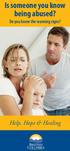 Is someone you know being abused? Do you know the warning signs? Help, Hope & Healing Are you concerned that someone is being abused, but don t know what to do? You may suspect abuse is happening to a
4 Criminal and Family Law
 4 Criminal and Family Law ENG 004/2010 FAMILY LAW FOR WOMEN IN ONTARIO All Women. One Family Law. Know your Rights. Criminal and Family Law This booklet is meant to give you a basic understanding of legal
Supervised Visitation
 Best practices A Public/Private Partnership with the New York State Unified Court System Supervised Visitation What Courts Should Know When Working with Supervised Visitation Programs Written by Samantha
Domestic Violence: How to Get Help
 f a m i l y v i o l e n c e a n d c h i l d a b u s e b u r e a u new york county district attorney s office Domestic Violence: How to Get Help cyrus r. vance, jr. district attorney questions and answers
Victim Services Programs. Core Service Definitions
 Victim Services Programs Core Service Definitions EFFECTIVE MAY 2012 1 P a g e Core Services Overview The Criminal Justice Coordinating Council (CJCC) strives to be a responsible and exemplary steward
About DCJS. table of ContentS. ACknowleDgmentS. Introduction...2. Domestic Violence Defined...3. Plan for Your Safety...3
 About DCJS The Virginia Department of Criminal Justice Services (DCJS) is a state agency whose mission is to improve the criminal justice system in Virginia s communities through effective training, partnerships,
court. However, without your testimony the defendant might go unpunished.
 Office of State Attorney Michael J. Satz VICTIM RIGHTS BROCHURE YOUR RIGHTS AS A VICTIM OR WITNESS: CRIMINAL JUSTICE PROCESS The stages of the criminal justice system are as follows: We realize that for
FLORIDA STATE UNIVERSITY POLICE DEPARTMENT Chief David L. Perry
 FLORIDA STATE UNIVERSITY POLICE DEPARTMENT Chief David L. Perry 830 West Jefferson Street 850-644-1234 VICTIMS' RIGHTS BROCHURE YOUR RIGHTS AS A VICTIM OR WITNESS: ------- We realize that for many persons,
Seeking Protection from Domestic Violence in New York s. Information for Immigrant Victims with Limited English Proficiency
 Seeking Protection from Domestic Violence in New York s Family Court: Information for Immigrant Victims with Limited English Proficiency What is domestic violence? If your current or former intimate partner
Have you ever asked yourself if you have been sexually assaulted?
 Have you ever asked yourself if you have been sexually assaulted? Sexual Assault/Rape Myth: Rape is just unwanted sex, and isn t really a violent crime. Fact: Rape is more than just unwanted sex. Rape
Guidelines for Setting up Security Measures to Stop Domestic Violence in the Workplace
 Guidelines for Setting up Security Measures to Stop Domestic Violence in the Workplace As of June 15, 2010, all employers in Ontario are responsible for protecting workers when domestic violence follows
Great Bay Mental Health Associates, Inc. Notice to Clients and Consent to Mental Health Treatment Agreement Courtney A. Atherton, MA, LCMHC, MLADC
 Great Bay Mental Health Associates, Inc. Notice to Clients and Consent to Mental Health Treatment Agreement Courtney A. Atherton, MA, LCMHC, MLADC Patient Name (please print): Welcome to the therapy services
Walking a Tightrope. Alcohol and other drug use and violence: A guide for families. Alcohol- and Other Drug-related Violence
 Walking a Tightrope Alcohol and other drug use and violence: A guide for families Alcohol- and Other Drug-related Violence Alcohol and other drug use and family violence often occur together. Families
A Guide for Larimer County Parents
 Services Child Protection A Guide for Larimer County Parents This booklet was prepared by the Program Committee of the Larimer County Child Advocacy Center in consultation with the Larimer County Department
Statutory Rape: What You Should Know
 Statutory Rape: What You Should Know 2013 Why Do You Need To Read This? Many teens are concerned about the laws regarding something commonly called statutory rape. This brochure will explain what statutory
Victims of Crime. information leaflet. Working together for a safer Scotland
 Working together for a safer Scotland If you have been a victim of crime this leaflet is to help let you know about how to find support and help and to tell you about the criminal justice system. Support
PERSONALIZED SAFETY PLAN FOR DOMESTIC VIOLENCE
 VCCB PERSONALIZED SAFETY PLAN FOR DOMESTIC VIOLENCE Adapted From: Barbara Hart and Jane Stuehling. (1992). Pennsylvania Coalition Against Domestic Violence. Reprinted with permission from the Washington
Guide For Advocates Working With Immigrant Victims of Domestic Violence
 Guide For Advocates Working With Immigrant Victims of Domestic Violence Created by the Domestic Violence Coordinating Council October 2009 This guide is intended to provide information to advocates working
RESTRAINING ORDERS IN MASSACHUSETTS Your rights whether you are a Plaintiff or a Defendant
 RESTRAINING ORDERS IN MASSACHUSETTS Your rights whether you are a Plaintiff or a Defendant Prepared by the Mental Health Legal Advisors Committee October 2012 What is a restraining order? A restraining
How To Get An Order Of Protection In A Divorce
 THE BASICS Orders of Protection in New York State Sadly, both men and women can, and do, abuse their intimate partners or members of their families. In this booklet, we assume that the abuser is a man
GOVERNOR S CRIME COMMISSION FUNDAMENTAL SERVICE ELEMENTS
 GOVERNOR S CRIME COMMISSION FUNDAMENTAL SERVICE ELEMENTS The Fundamental Service Elements (FSEs) are the minimum standards to which all domestic violence and sexual assault programs shall adhere in order
PERSONALIZED SAFETY PLAN FOR ABUSED WOMEN
 PERSONALIZED SAFETY PLAN FOR ABUSED WOMEN What is a safety plan? A safety plan represents possible strategies that can increase your safety and prepare you in advance for the possibility of further violence.
*****THIS FORM IS NOT A PROTECTIVE ORDER APPLICATION OR A PROTECTIVE ORDER*****
 SHAREN WILSON CRIMINAL DISTRICT ATTORNEY OF TARRANT COUNTY, TEXAS PROTECTIVE ORDER UNIT Family Law Center Phone Number 817-884-1623 200 East Weatherford Street # 3040 Fax Number 817-212-7393 Fort Worth,
How To Protect Yourself From Violence
 FAMILY VIOLENCE Violence takes many forms. It is unacceptable whenever it happens. Violence by a family member who is loved and trusted can be particularly devastating. Family violence happens where the
PARENT GUIDE TO THE JUVENILE COURT CHIPS PROCESS
 PARENT GUIDE TO THE JUVENILE COURT CHIPS PROCESS INTRODUCTION This booklet has been prepared to help parents gain a better understanding of what to expect in Juvenile Court CHIPS proceedings (Chapter 48
A Service Provider s Guide for Working with GBT Victims and Survivors of Domestic Abuse
 Page 1 of 6 A Service Provider s Guide for Working with GBT Victims and Survivors of Domestic Abuse Partner abuse is one of the most serious health issues for gay, bisexual, and transgender (GBT) men.
Domestic Violence Case Management Plan
 Domestic Violence Case Management Plan From the commencement of litigation to its resolution, whether by trial or settlement, it is the goal of this Court to reduce delay and enable just and efficient
*****THIS FORM IS NOT A PROTECTIVE ORDER APPLICATION OR A PROTECTIVE ORDER*****
 SHAREN WILSON CRIMINAL DISTRICT ATTORNEY OF TARRANT COUNTY, TEXAS PROTECTIVE ORDERS Family Law Center Phone Number 817-884-1623 200 East Weatherford Street # 3040 Fax Number 817-212-7393 Fort Worth, Texas
Community Legal Information Association of PEI, Inc. Sexual Assault
 Community Legal Information Association of PEI, Inc. Sexual Assault As an adult in Canada, you have the right to choose when or if you engage in sexual activity. Sexual activity without your consent is
FAQ s for Defense Attorneys Community-Based Domestic Violence Advocates: A Resource for Battered Women Charged with Crimes
 FAQ s for Defense Attorneys Community-Based Domestic Violence Advocates: A Resource for Battered Women Charged with Crimes The content for this article was developed by a group of attorneys and community-based
Module 4 Chapter 3: Minnesota Criminal Code - Chapter 609
 : Minnesota Criminal Code - Chapter 609 Overview This chapter provides an overview of Minnesota s Criminal Code, Chapter 609 of Minnesota Statutes, to help you recognize the most common types of criminal
Protective Orders Including: Order of Protection and Injunction Against Harassment
 Things You Should Know About Protective Orders Including: Order of Protection and Injunction Against Harassment This booklet is designed to provide general information about protective orders for domestic
SPECIAL OPTIONS SERVICES PROGRAM UNITED STATES PRETRIAL SERVICES AGENCY EASTERN DISTRICT OF NEW YORK
 SPECIAL OPTIONS SERVICES PROGRAM UNITED STATES PRETRIAL SERVICES AGENCY EASTERN DISTRICT OF NEW YORK February 4, 2013 1 I. Introduction The Special Options Services (SOS) Program was established in the
TABLE OF CONTENTS. Page. Guiding Principle 2. Safety Assessment for Families with Partner or family member assault/domestic violence 3
 TABLE OF CONTENTS Summary of Protocols for use when Partner or family member assault/domestic violence is present or suspected in Cases of Child Maltreatment Page Guiding Principle 2 Safety Assessment
THE BASICS Custody and Visitation in New York State
 THE BASICS Custody and Visitation in New York State This booklet answers common questions about custody and visitation when the parents cannot agree about who is responsible for taking care of the children.
How To Get Help In Alaska
 Information For Victims of Domestic Violence If you are a victim of domestic violence, and the police respond to assist you, they are required by law to read certain portions of this "booklet to you. An
California s Domestic Violence & Mandatory Reporting Law: Requirements for Health Care Practitioners
 California s Domestic Violence & Mandatory Reporting Law: Requirements for Health Care Practitioners TABLE OF CONTENTS 1) Most Common Questions and Answers on Mandatory Reporting Requirements for Health
SAN MATEO COUNTY MENTAL HEALTH SERVICES DIVISION. Assaults on Clients: Suspected or Reported
 SAN MATEO COUNTY MENTAL HEALTH SERVICES DIVISION DATE: March 22, 2001 MENTAL HEALTH POLICY: MH 01-03 SUBJECT: Assaults on Clients: Suspected or Reported AUTHORITY: California Welfare and Institution Codes
Stearns County, MN Repeat Felony Domestic Violence Court
 Stearns County, MN Repeat Felony Domestic Violence Court Planning and Implementation Best Practice Guide How can a community come together to change its response to domestic violence crimes? Can a court
4 What is Sexual Assault? 5 Why Me? 6 Common Reactions Following an Assault. 7 What Next? 10 Civil Legal Remedies. 13 Idaho Crime Victims Rights Act
 sexual assault No one deserves to be sexually assaulted. Most victims are sexually assaulted by someone they know. This handbook provides information on sexual assault and available resources. This handbook
New Perspective Counseling Services Child/Teen Intake Form
 Child/Teen Intake Form Welcome to New Perspective Counseling Services. We look forward to providing you with excellent and efficient counseling services. Please take a few minutes to fill out this form.
Obtaining Protective Orders and Peace Orders
 Domestic Violence Programs in Maryland Allegany County Hotline: 301-759-9244 TTY: 301-759-9244 Family Crisis Resource Center: 301-759-9246 Anne Arundel County Hotline: 410-222-6800 YWCA Domestic Violence
FACES of CHANGE. Do I have a problem with alcohol or drugs?
 FACES of CHANGE Do I have a problem with alcohol or drugs? 1 Alcohol and drug problems affect many people. Some people see that drinking alcohol or using illegal drugs is hurting them. But there are a
Self-Defense and Predominant Aggressor Training Materials
 Self-Defense and Predominant Aggressor Training Materials Self Defense and Defense of Self; There is a Difference The following materials provide an outline of topics to cover by someone in your community
Sexual Assault of a Child VOIR DIRE QUESTIONS
 ATTORNEYS Sexual Assault of a Child VOIR DIRE QUESTIONS 1. What are your feelings or opinions about criminal defense attorneys? 2. Have you ever had a bad experience with a criminal defense attorney? If
THE LAW AND YOU. What can I do when the School Board and I disagree on discipline? Do I have a choice when Family Court decides who I ll live with?
 THE LAW AND YOU 15-1 Each state has particular laws that deal with acts usually committed by young people. Just because someone is under the age of 17 (considered a juvenile) does not mean that laws do
Illinois Family Violence Coordinating Councils
 Illinois Family Violence Coordinating Councils Domestic Violence Court System Self-Assessment July 2006 The purpose of the self-assessment is to empower local domestic violence court systems by providing
Addiction Treatment Strategies
 Patient Registration Legal Name First Middle Last Birth Date Address Street City State Zip Phone(s) Home Cell Work Is it ok to contact your cell? Yes No SSN Email (Used for appointment reminder) Known
The Hidden Side of Domestic Abuse: Men abused in intimate relationships
 The Hidden Side of Domestic Abuse: Men abused in intimate relationships 2009 Pandora s Project By: Katy "Men too are victims and women too are perpetrators; neither sex has a monopoly of vice or virtue"
Glossary. To seize a person under authority of the law. Police officers can make arrests
 Criminal Law Glossary Arrest Charge Convicted Court Crime/Offence Crown Attorney or Prosecutor Criminal Custody Guilty Illegal Innocent Lawyer To seize a person under authority of the law. Police officers
SOME THINGS TO CONSIDER WHEN FILING FOR CUSTODY OR VISITATION MYTHS AND REALITIES
 SOME THINGS TO CONSIDER WHEN FILING FOR CUSTODY OR VISITATION MYTHS AND REALITIES The father is the parent responsible for supporting the child. The law states that both parents have an equal obligation
Protective Orders. What if the other person and I live together or have children together? What is a protective order?
 Protective Orders What is a protective order? It is a court order that protects you from someone who has been violent or threatened to be violent. How can a protective order help me? It can order the other
Jail, Warrants and Court Security
 CHAPTER 4 Jail, Warrants and Court Security St. Louis County Sheriff s Office 2 The New Orleans Blueprint for Safety Jail, Warrants and Court Security Jail Booking, Supervision, and Release Training Memos
National Statistics. Domestic Violence/Sexual Assault Fact Sheet: Oklahoma Department of Mental Health and Substance Abuse Services
 National Statistics Domestic Violence/Sexual Assault Fact Sheet: Oklahoma Department of Mental Health and Substance Abuse Services The National Domestic Violence Hotline has received more than 700,000
Domestic Violence. What you need to know
 Domestic Violence What you need to know Domestic Violence A pattern of controlling and/or assaultive behavior that one person inflicts on another. Includes adults, children, teens, elderly and vulnerable
DOMESTIC VIOLENCE. Do the right thing see your lawyer first
 DOMESTIC VIOLENCE Do the right thing see your lawyer first Contents 1. What is domestic violence? 2. What protection does the law offer? 3. Who can apply for protection? 4. What is a protection order?
Tool kit Domestic Violence
 Tool kit Domestic Violence A self-help resource to help people living with domestic violence Lifeline s domestic violence tool kit provides information about: Understanding what domestic violence is Developing
THE CHILD ABUSE ASSESSMENT:
 THE CHILD ABUSE ASSESSMENT: A Guide for Foster Parents Iowa Foster and Adoptive Parents Association Acknowledgements This publication was developed under the guidance of an advisory committee comprised
A Summary of Virginia s Crime Victim and Witness Rights Act
 A Summary of Virginia s Crime Victim and Witness Rights Act Your Rights and Responsibilities Department of Criminal Justice Services Victims Services Section December 2008 www.dcjs.virginia.gov Table of
The Victims of Crime Charter
 The Victims of Crime Charter All members of the community who come into contact with the criminal justice system, but particularly victims of crime, are entitled to know what their obligations are in helping
Are you living in fear? Is someone stalking you? STALKING is a crime in Minnesota! From the Office of Lori Swanson MINNESOTA ATTORNEY GENERAL
 Are you living in fear? Is someone stalking you? STALKING is a crime in Minnesota! From the Office of Lori Swanson MINNESOTA ATTORNEY GENERAL WHAT IS STALKING? Stalking is intentionally following or harassing
What Rights Do I Have As An LGBT Victim of Domestic Violence?
 Section of Individual Rights and Responsibilities Commission on Domestic Violence Criminal Justice Section In collaboration with What Rights Do I Have As An LGBT Victim of Domestic Violence? How do I
Child Abuse/Neglect Intake, Investigation and Assessment Diane Carver, Program Administrator DCF Prevention and Protection Services
 Child Abuse/Neglect Intake, Investigation and Assessment Diane Carver, Program Administrator DCF Prevention and Protection Services Strong Families Make a Strong Kansas Child Abuse Prevention and Treatment
Working at the Intersection: Substance Abuse and Trauma in the Context of Violence Against Women. Patricia J. Bland.
 Presented at the Moving Forward in Challenging Times Conference July 6-8, 2011 SafePlace Austin, TX Working at the Intersection: Substance Abuse and Trauma (Bland, Patricia; April 2012) Working at the
Frequently Asked Questions: Reporting Child Abuse and Neglect in the University System of Maryland
 Frequently Asked Questions: Reporting Child Abuse and Neglect in the University System of Maryland I. What Constitutes Child Abuse and Neglect A. What is Child Abuse? Abuse is defined in Maryland law as
Parent s Guide. to Child Protective Services (CPS) Children s. Administration. Division. of Children. and Family. Services
 Parent s Guide to Child Protective Services (CPS) Children s Administration Division of Children and Family Services Table Of Contents Topic Page What Is Child Protective Services (CPS)?... What Is Child
Toolkit for Immigrant Women Working with a Lawyer
 Toolkit Working with a Lawyer NOVEMBER 2010 www.bwss.org www.theviolencestopshere.ca Toolkit Working with a Lawyer NOVEMBER - 2010 www.bwss.org www.theviolencestopshere.ca This resource is part of Battered