
Learning with care. Experiences of student carers in the UK
|
|
|
- Amos Cecil Spencer
- 11 years ago
- Views:
Transcription
1 Learning with care Experiences of student carers in the UK

2


3 Foreword Foreword I am proud to introduce Learning with care, the firstever national research into the experiences of student carers. This report illuminates the experiences of students who are providing unpaid care alongside their studies, for instance supporting a relative or friend who could not manage without their help. In our society, care is gendered. This means not only that women are more likely to be found undertaking all sorts of caring roles, but also that caring is devalued and seen as less important than paid real work, primarily because it is more often performed by women. This pattern is repeated in further and higher education, where the majority of student carers are women, and where the care they provide and its impact on their studies is largely invisible to the universities and colleges that they attend. As you will see in the following pages, student carers face a myriad of barriers to accessing and succeeding in further and higher education. In the context of the gendered nature of care, this highlights a way in which women students experiences continue to be shaped by their gender. Although headline figures suggest that women are now taking up education at a higher rate than men in many areas of further and higher education, this situation may be reversed for student carers. For instance, we know that women carers aged are less likely to enter education than men carers of the same age group. Within a context of national and local cuts that disproportionately affect women, it is more important than ever that the services that women provide are valued and that women are not denied access to education as a result of providing care. Student carers are highly motivated and dedicated to their courses, but they face elevated financial hardship, decreased well-being, and their support needs are often misunderstood or ignored by their institutions. Carers provide a valuable service to society, and they deserve equal access to education. This research demonstrates how far we have to go to achieve this goal, but it also gives us valuable information that we can use to make equality for student carers a reality. The report makes seven key recommendations, calling on the Government, the further and higher education sectors, educational institutions, and students unions to improve the experiences and lives of student carers. I look forward to working with students and students unions to campaign for the implementation of these recommendations and to making real change in improving the lives of student carers. In unity, Kelley Temple National Women s Officer 1

4 Executive summary

5 Executive summary Executive summary Introduction and methodology Student carers students who provide unpaid support to family or friends who could not manage without this help are a hidden group of students who face unique barriers and challenges in accessing and succeeding in education. This report presents the findings of the first ever national research into the experiences of student carers in further and higher education. The research consisted of three elements: a review of the relevant literature; secondary analysis of a dataset on student finance and well-being; and primary qualitative research with 36 student carers. Who are student carers? There is no national data on the numbers of student carers in the UK, but estimates are that carers make up between three and six per cent of the student population. The majority of student carers (as carers in general) are women. Mature students are more likely to be student carers than young students but significant proportions of student carers are young students. Access and transition Student carers are under-represented in further and higher education. The difference is particularly stark for women aged 16 24; 10 per cent of women carers in that age range who care for more than 50 hours per week are in education, compared to 17 per cent of men carers. The support of educational institutions is key to helping student carers access and transition successfully to higher levels of learning. Student carers choice to study, as well as what and where to study, were often intrinsically linked to their caring responsibilities. Deciding where, when, and how to disclose caring responsibilities to their institution was a key struggle for student carers and there was widespread support for a system by which they could disclose this upon enrolment. Educational experience Only 36 per cent of student carers felt able to balance commitments such as work, study, and family/relationships, compared to 53 per cent of students without caring responsibilities. Just under half of interviewees felt that their academic performance or attainment had been negatively affected by their caring responsibilities, and only one felt that it had been positively affected. More than half of student carers (56 per cent) had seriously considered leaving their course, compared to 39 per cent of students without caring responsibilities. Student carers had experienced varying degrees of support from their institutions, but in all cases there was a lack of coordinated, systematic support. Finances Two thirds of student carers (67 per cent) regularly worry about not having enough money to meet their basic living expenses. Three in five (60 per cent) of student carers are combining paid work, caring, and studying. However, many student carers would like to work more, but are prevented by their caring responsibilities. Student carers who were in receipt of Carer s Allowance did not feel the benefit was adequate, but the fact that full-time students are not eligible for Carer s Allowance was considered unfair and contributing to their financial hardship. Student carers were three times as likely to have taken on high-risk debt as students without caring responsibilities, even though they were less likely to have taken out low-risk debt. 3
6 Learning with care Student life Many student carers have had to sacrifice all or some of their social life in order to study and provide care. Young student carers were more likely to support the idea of a (physical or virtual) student carers group, while mature student carers were more likely to say that they would not have time to participate in such a group. Personal impacts Student carers indicated lower well-being than students without caring responsibilities across all seven indicators in the survey. 15 per cent of student carers indicated that they had mental health difficulties, and our qualitative research shows that in some cases this can have a serious effect on their studies. The impact on their well-being was the most common area for student carers to identify as the worst part of being a student carer. Being a student carer has benefits as well as drawbacks. Having an identity outside of caring, gaining life skills and independence, and having a sense of accomplishment were identified as the best parts of being a student carer. Summary of recommendations: 1. Collect data on student carers 2. Include student carers in widening participation work 3. Improve information, advice, and guidance 4. Develop systems for disclosure and support 5. Advance institutional policies and practices 6. Replace the Carer s Allowance for full-time students 7. Enable participation in student life For the full recommendations see page 32 4

7 Contents Contents Background... 7 Methodology... 8 Research findings Who are student carers? Access and Transition Educational experience Finances Student life Personal impacts Recommendations Endnotes Appendix 1: Steering group members Appendix 2: Respondent demographics (survey data) Appendix 3: Participant demographics (qualitative research) Acknowledgements

8 Background and methodology

9 Background and methodology Background There are 6.5 million carers in the UK, representing more than 10 per cent of the population. The number of people providing unpaid care has grown rapidly in the past decade. The number of carers aged 24 and under has grown by 24 per cent between 2001 and But carers of all ages are still under-represented in further and higher education, 2 with women carers aged particularly under-represented. 3 Funding for statutory care services has failed to keep pace with demand in recent years. Over the four years between 2005/06 and 2010/11, demand for care had outstripped expenditure by nine per cent. 4 This has resulted in families stepping in to fill the gap left by services. The important role of unpaid caring in society has been increasingly recognised in recent decades. Carers contribute approximately 119 billion to the UK economy each year more than the annual cost of all aspects of the NHS. 5 They provide a vital service, not only to those they care for but to the country as a whole, and often make sacrifices to their own goals and well-being in order to do so. Alongside this recognition of the value of carers, organisations such as Carers UK and the Carers Trust have campaigned to make clear the importance of supporting carers to have lives alongside their caring roles. Local authorities now have a duty to consider carers aspirations to participate in paid work, education, training, or leisure, and to provide information, advice and support to make this possible. 6 These advances in carers rights are important, but they mean little if steps are not taken to ensure carers are able to access and succeed in further and higher education. carers, because they are more likely to face financial hardship than other students. At institutional level, cuts to student services and the increasing prevalence of rigid mitigating circumstances policies such as fitto-sit are endangering student carers ability to succeed in education. With a growing cohort of young and young adult carers, and an increased emphasis on enabling carers to access education and training, further and higher educational institutions should expect to see increasing numbers of students with caring responsibilities amongst their student bodies. A lack of monitoring data on student carers is a hindrance to ensuring student carers access to and support in education. The findings of this research shed light on this hidden group of students and their experiences, needs, and aspirations. This report presents the findings of the first ever national research into the experiences of student carers in further and higher education, including a literature review, secondary analysis of survey data, and original qualitative research with 36 student carers. The research covered all aspects of student carers experiences, including access and transition, the educational experience, institutional support, finances, student life, and personal impacts. The findings make a clear case for improving financial, academic, and pastoral support for student carers. There is a clear need for action on both national and institutional levels, as outlined in the recommendations at the end of the report. The policy environment in further and higher education has been characterised by rapid change in recent years, both on macro- and micro- levels. The increase in the cap on tuition fees in higher education, the removal of the Education Maintenance Allowance (EMA) and the Adult Learning Grant (ALG) in further education, along with other changes to the student finance system pose a risk to access for student 7

10 Learning with care Methodology This research was carried out between November 2012 and April 2013 and consisted of three elements: a review of the relevant literature, secondary analysis of a dataset on student finance and well-being, and primary qualitative research with 36 student carers. The research was guided by a steering group of stakeholders from both the carers sector and the further and higher education sectors (see Appendix 1). Little previous research exists that specifically examines the experiences of student carers. As a result, the literature review consulted existing policy and research evidence relating to carers in the UK, with a heightened focus on young carers and young adult carers. The literature review was targeted rather than exhaustive, but it shaped the direction of the research, which sought to confirm hypotheses and fill gaps in the evidence. NUS Pound in your Pocket programme of research into student finance (2012) included a survey of 14,404 students in further and higher education in England. The survey collected demographic information on respondents, including whether the respondent had caring responsibilities for someone over the age of 18. Just under three per cent (n=424) of the sample answered this question in the affirmative. We were then able to use the data from these respondents for the purposes of the report. A limitation of this approach is that it does not capture people who care for disabled children, who are generally included under the definition of a carer. It also does not capture students whose activities could be defined as caring but who do not readily see themselves as having caring responsibilities. Full information on the methodology of the survey is available from the NUS report, Understanding the Impact. 7 Secondary analysis of the Pound in your Pocket data offered insight into the status of student carers in relation to the key areas of inquiry of the survey, which included student wellbeing, the cost of study, the student support system, meeting the costs of study, and student debt. This was conducted using the quantitative analysis software SPSS. An initial report into the findings of this analysis was published in February Further analysis is presented in this report, and demographic information on survey respondents with caring responsibilities is available in Appendix 2. In this report, we will refer to this data set as our survey and individuals who form part of the data set as respondents. The qualitative research consisted mainly of semistructured interviews with student carers exploring their experiences in further and higher education, looking holistically at how the experience of being a student and a carer at the same time has shaped their lives, both inside and outside of education. Two focus groups were conducted, with two and three participants respectively. Due to the challenges of finding times that were convenient for larger groups of student carers, the decision was made to instead conduct more interviews than originally planned. Even so, the number of interviews was limited by the time and resource available to conduct them. In all, the research includes the experiences of 36 student carers. The majority of interviews (n=23) were conducted via telephone, with the remainder conducted in person (n=7) and over Skype (n=1). In this report we will refer to this data as our qualitative research and the individuals who form part of it as participants. The sample was recruited using recognised qualitative research methods such as the use of formal and informal student and carer networks, as well as gatekeepers such as students unions. 9 Efforts were made to ensure as diverse a participant profile as possible. Although the majority of participants were white, heterosexual women, the sample represents a diversity of gender identities, ethnicities, and sexual orientations. Half of the participants (n=18) were under thirty years of age, and half were over thirty. Fifteen participants (40 per cent) considered themselves to be disabled. Half (n=18) of the participants were studying an undergraduate degree, with the remainder split between those studying in further education and 8

11 Background and methodology those studying postgraduate degrees. The majority of participants (n=21) were studying full-time but a significant number studied part-time. There was also a mix of participants studying in Scotland and England; despite several attempts, it was not possible to recruit participants in Wales or Northern Ireland. Detailed demographic information on the participants is available in Appendix 3. Most interviews were audio recorded (n=29), while the focus groups were video recorded. The recordings (and notes for those not recorded) were subsequently transcribed in order to enable analysis. The data was coded using the qualitative analysis software NVivo 9 using thematic analysis. Themes were generated from the literature review and the secondary survey analysis, as well as those which arose from the qualitative data itself. 9

12 Research findings

13 Research findings Who are student carers? The Carers Trust gives the definition of a carer as someone of any age who provides unpaid support to family or friends who could not manage without this help. This could be caring for a relative, partner or friend who is ill, frail, disabled or has mental health or substance misuse problems. 10 For the purposes of this research, NUS has used a similar definition, referring instead to a student of any age rather than someone. The literature shows that many carers are unaware that they could be defined as such, and may miss out on support they are entitled to because of this, a concept which our qualitative research confirmed. 11 They may think that only providing a high level of personal care would qualify someone as a carer, or that they must care for a certain number of hours a week. Some may feel there is a stigma associated with the term and prefer not to think of themselves in that way. I didn t used to think I was a carer until people at church mentioned me as a carer. (FE student carer, woman, age 18) The term student carers has been used by NUS as part of our research in this area, but not all of our participants thought of themselves in this way. It is therefore important for individuals and organisations working with student carers to be mindful of how they communicate so as to ensure that their messages reach the right people. I ve never associated the two together. I ve always thought about it as I m a student and a carer, but not a student carer. (HE student carer, woman, age 28) What does caring involve? Carers situations are as diverse as the people that they care for. They can undertake a wide variety of tasks as part of their role. Many carers provide practical help (such as preparing meals, doing housework, or shopping) and help with financial matters or other correspondence. Providing personal care, physical help, and administering medication are also common. 12 The participants in our qualitative research had a similar profile, with practical help being the most Figure 1. Caring tasks of participants Practical help Personal care Finance/ correspondence help Administering medication common form of caring, followed by personal care, administering medication, helping with financial matters and correspondence, and providing physical help (Figure 1). The literature suggests that the largest group of carers (40 per cent) are providing care for their parents or parents-in-law, followed by those caring for a spouse or partner (28 per cent). 13 Small proportions of carers provide care for disabled children, adult children, grandparents, other relatives, and friends or neighbours. Our qualitative research found a similar pattern, with 19 of 36 caring for a parent (53 per cent), 8 of 36 caring for a partner (22 per cent), and smaller numbers caring for grandparents, siblings, friends and housemates, other family members and disabled children. 13 participants cared for more than one person (36 per cent) while the remainder cared for one person. Physical help 11

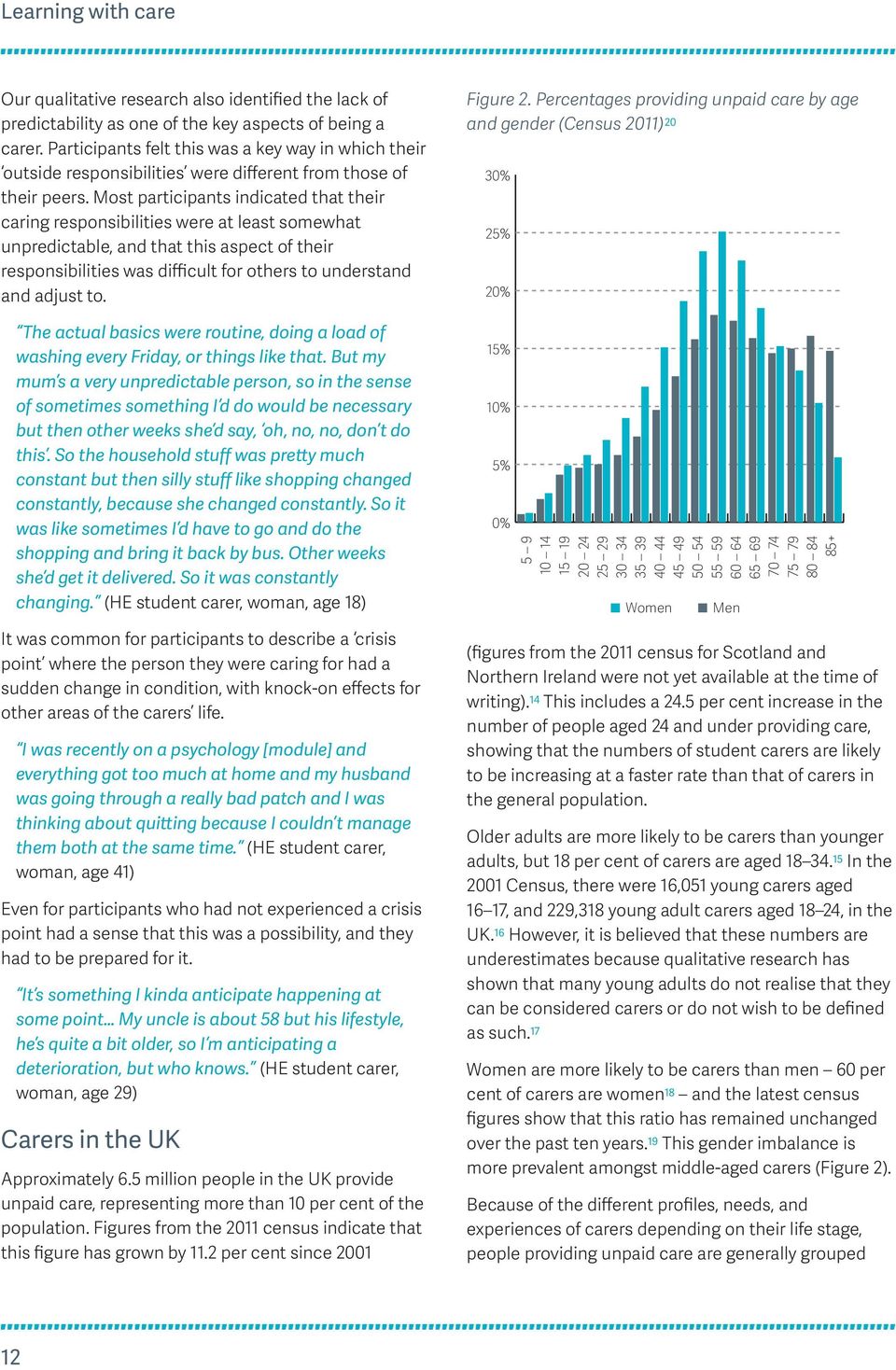
14 Learning with care Our qualitative research also identified the lack of predictability as one of the key aspects of being a carer. Participants felt this was a key way in which their outside responsibilities were different from those of their peers. Most participants indicated that their caring responsibilities were at least somewhat unpredictable, and that this aspect of their responsibilities was difficult for others to understand and adjust to. The actual basics were routine, doing a load of washing every Friday, or things like that. But my mum s a very unpredictable person, so in the sense of sometimes something I d do would be necessary but then other weeks she d say, oh, no, no, don t do this. So the household stuff was pretty much constant but then silly stuff like shopping changed constantly, because she changed constantly. So it was like sometimes I d have to go and do the shopping and bring it back by bus. Other weeks she d get it delivered. So it was constantly changing. (HE student carer, woman, age 18) It was common for participants to describe a crisis point where the person they were caring for had a sudden change in condition, with knock-on effects for other areas of the carers life. I was recently on a psychology [module] and everything got too much at home and my husband was going through a really bad patch and I was thinking about quitting because I couldn t manage them both at the same time. (HE student carer, woman, age 41) Even for participants who had not experienced a crisis point had a sense that this was a possibility, and they had to be prepared for it. It s something I kinda anticipate happening at some point My uncle is about 58 but his lifestyle, he s quite a bit older, so I m anticipating a deterioration, but who knows. (HE student carer, woman, age 29) Carers in the UK Approximately 6.5 million people in the UK provide unpaid care, representing more than 10 per cent of the population. Figures from the 2011 census indicate that this figure has grown by 11.2 per cent since 2001 Figure 2. Percentages providing unpaid care by age and gender (Census 2011) 20 30% 25% 20% 15% 10% 5% 0% Women Men (figures from the 2011 census for Scotland and Northern Ireland were not yet available at the time of writing). 14 This includes a 24.5 per cent increase in the number of people aged 24 and under providing care, showing that the numbers of student carers are likely to be increasing at a faster rate than that of carers in the general population. Older adults are more likely to be carers than younger adults, but 18 per cent of carers are aged In the 2001 Census, there were 16,051 young carers aged 16 17, and 229,318 young adult carers aged 18 24, in the UK. 16 However, it is believed that these numbers are underestimates because qualitative research has shown that many young adults do not realise that they can be considered carers or do not wish to be defined as such. 17 Women are more likely to be carers than men 60 per cent of carers are women 18 and the latest census figures show that this ratio has remained unchanged over the past ten years. 19 This gender imbalance is more prevalent amongst middle-aged carers (Figure 2). Because of the different profiles, needs, and experiences of carers depending on their life stage, people providing unpaid care are generally grouped 12
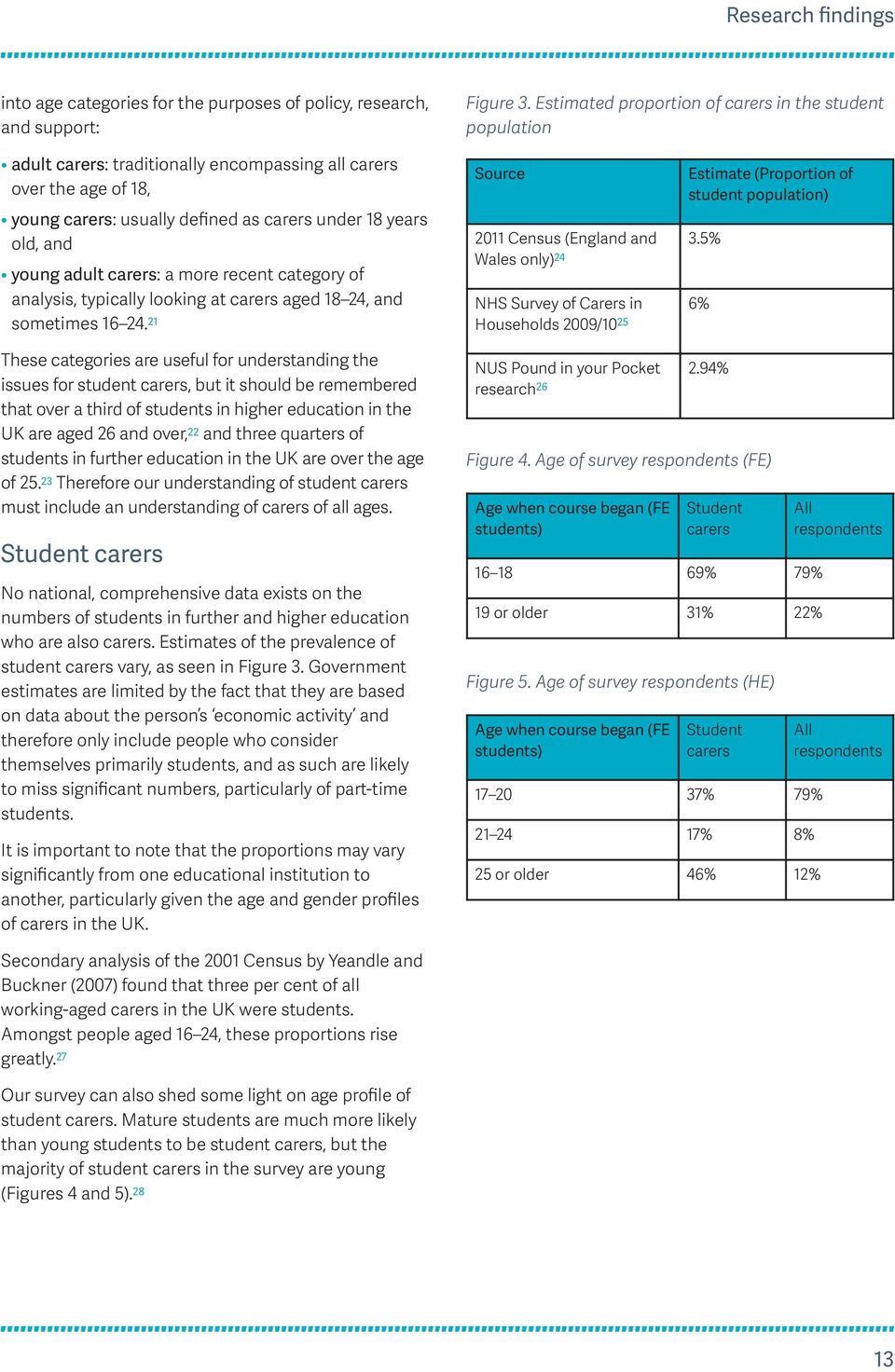
15 Research findings into age categories for the purposes of policy, research, and support: adult carers: traditionally encompassing all carers over the age of 18, young carers: usually defined as carers under 18 years old, and young adult carers: a more recent category of analysis, typically looking at carers aged 18 24, and sometimes These categories are useful for understanding the issues for student carers, but it should be remembered that over a third of students in higher education in the UK are aged 26 and over, 22 and three quarters of students in further education in the UK are over the age of Therefore our understanding of student carers must include an understanding of carers of all ages. Student carers No national, comprehensive data exists on the numbers of students in further and higher education who are also carers. Estimates of the prevalence of student carers vary, as seen in Figure 3. Government estimates are limited by the fact that they are based on data about the person s economic activity and therefore only include people who consider themselves primarily students, and as such are likely to miss significant numbers, particularly of part-time students. It is important to note that the proportions may vary significantly from one educational institution to another, particularly given the age and gender profiles of carers in the UK. Figure 3. Estimated proportion of carers in the student population Source 2011 Census (England and 3.5% Wales only) 24 NHS Survey of Carers in 6% Households 2009/10 25 NUS Pound in your Pocket 2.94% research 26 Estimate (Proportion of student population) Figure 4. Age of survey respondents (FE) Age when course began (FE students) Student carers % 79% 19 or older 31% 22% Figure 5. Age of survey respondents (HE) Age when course began (FE students) Student carers % 79% % 8% 25 or older 46% 12% All respondents All respondents Secondary analysis of the 2001 Census by Yeandle and Buckner (2007) found that three per cent of all working-aged carers in the UK were students. Amongst people aged 16 24, these proportions rise greatly. 27 Our survey can also shed some light on age profile of student carers. Mature students are much more likely than young students to be student carers, but the majority of student carers in the survey are young (Figures 4 and 5)
16 Learning with care Access and transition Caring can negatively affect individuals ability to access and remain in education and training. Research from The Children s Society shows that over 70 per cent of young carers felt their education had been significantly affected by their caring responsibilities. 29 These findings are confirmed by census data which shows that caring reduces the likelihood of being a student. In the 2011 Census, 1.5 per cent of all respondents gave their economic activity as student, but only 0.6 per cent of carers did so. 30 Access Figure 6 shows the proportions of young adult carers who are in education. Of note is the fact that women aged who are providing 20 or more hours of care are significantly less likely to be in education (than men with similar caring situations). 31 As policy attention in further and higher education increasingly focuses on the under-representation of men students, it is worth noting the continued disadvantage for women carers in accessing education. 32 The qualitative research was able to capture the experiences of some students at a stage in their education journey where they were considering moving on to a higher level. This allows us some insight into the potential impact that caring may have on progressing through study. Participants in this scenario expressed anxiety and caution about further study, and in some cases indicated that they had decided against further study because of their caring responsibilities. I tried A-levels and it didn t work out for me, just the structure and the workload with everything else I was doing at the time So I do a BTEC at college I decided that university wasn t right for me right now. Especially with dad being ill. (FE student carer, woman, age 19) I would like to go to university but practicalities are really difficult because I d feel really bad not being there for my grandparents. (FE student carer, woman, age 17) For mature student carers, this was a somewhat different picture. Some were coming back to education Figure 6. People aged 16 24, proportion who are students, by amount of care provided and gender (Census 2001, based on chart from Yeandle and Buckner 2007). 30% 25% 20% 15% 10% 5% 0% No care 1 19 hours/ week Women for a second time. For those who were entering further or higher education for the first time, their reasons for delaying their studies were generally not related to their caring responsibilities. In general, mature student carers had not been in their caring roles when they were at the traditional transition ages of 16 or 18. Motivations for study hours/ week Men 50+ hours/ week Participants reasons for deciding to study were often intrinsically linked with their caring responsibilities. For many, especially young student carers, their motivation came from the encouragement of the person who they care for. It wasn t always the plan [to go to uni], but when I got my results from A-level, cause the thing is I didn t think I was smart enough but then when I went to my results day for my AS-level, I got quite good grades so I started planning it At first I was quite worried, but [my mum] was like pushing it, she says, no, this is your life, you ve took care of me since I was young. (HE student carer, woman, age 17) 14

17 Research findings For mature student carers, the desire to do something for themselves was a strong motivation, even if the justification for this was sometimes that it, in turn, made them a better carer. I left school at 16 and basically left school on a Friday and went to work on the Monday. I got the envelope for my GCSE results and I didn t even open it But I went back to college to redo my GCSEs, just so I could see the way they are taught now [because I was supporting my son through his GCSEs]. (HE student carer, woman, age 44) I started that to sort of keep my grey cells active really. Being at home 24-7 and I thought, well, I ve got to be at home so I need something to keep me active, so that s why I decided to get a degree [via distance learning]. (HE student carer, woman, age 41) Choosing a subject Many participants had chosen a subject of study that was related to their caring responsibilities, with nursing and health and social care being the most common of these; it has already been suggested by previous research that student carers may be concentrated in these fields. 33 Nine respondents identified that their choice of subject was related to their caring responsibilities while four indicated that it had not been related to this. The most common ways that caring had influenced subject choice were that they were interested in becoming better carers through their studies, or else aiming to use their caring experiences to their advantage in the world of work. Because the subjects I ve chosen are around caring I ve got different insight to what I m doing I suppose. I mean the whole point I ve chosen the modules that I did is to give me more of an understanding of the way my husband accepts his life now. (HE student carer, woman, age 41) The reason why I chose nursing is because I have a background obviously in helping people. My dad goes to a charity centre that provides support for MS sufferers. So I ve been there before, I ve done work experience there, and I just enjoy helping people. So it s funny actually the MS in my family has made me go into a career. (HE student carer, woman, age 19) Choosing a place of study In addition to affecting carers decisions about whether and what they will study, caring responsibilities can also impact individuals decisions about where they will study. This primarily manifests itself in decisions about the location of the institution, but student carers also make decisions based on the availability of their preferred mode of study (i.e. fulltime or part-time) and in some cases by the possibility of maintaining existing support networks (such as the decision to progress to a higher level of study within the same educational institution). In some cases, participants chose to study via distance learning to minimise the hours they were required to be away from the person they were caring for. In all, 12 out of 36 participants said that their choice of educational institution had been affected by their caring responsibilities, while only three said that it definitely had not been affected by their caring responsibilities. I chose [my university] because it s close to home. And basically I did that because of my dad. Obviously his condition is so unstable, he can become ill and go to the hospital in seconds. I didn t want to be a hundred miles away. Also, it s a good uni so that worked out quite well. The main reason I chose it though was because it was close to home. (HE student carer, woman, age 18) Brick universities weren t really an option because I couldn t spend time away from my husband. (HE student carer, woman, age 41) Of course, other, more traditional considerations were also part of participants decision making processes, including the reputation of the institution, the availability of the course they wanted to study, and the financial support available to them. Participants reasons for choosing their institutions did not appear to differ based on the age of the individual, in contrast to many of the other experiences associated with accessing and transitioning into education. Managing transitions Many young adult carers do not transition between stages of education in the traditional, linear ways. 34 Qualitative research from Becker and Becker with young adult carers found that their experiences of school fell 15

18 Learning with care into one of two main categories: those who had received good recognition and support from their school in relation to their caring responsibilities, and those who had had a negative experience at school as a result of their caring responsibilities being ignored by school staff or even being punished as a result of their caring. Parental encouragement and positive attitudes towards education were important factors that influenced young carers school attendance and achievement. 35 Young student carers in our qualitative research often had transitioned into further or higher education along the traditional path; this is unsurprising as our research captured participants after they had already entered education, rather than when they were in the process of transitioning. They may be examples of the first camp of young adult carers identified by Becker and Becker; similar themes of the importance of support from both schools and parents earlier on in the education journey came through: You got a lot of support from the college. There was a full module on it, a personal development module. You started from the moment you started college, which was a little surreal. I was like we ve just started. But it made total sense by the time we got to January we were done and we were getting responses [from universities] back. (HE student carer, woman, age 28) I think, I was never, when I was thinking of going to uni, my dad didn t really factor into it, my parents encouraged me to go to uni, my school definitely was keen for me to go to uni. It was just expected of me, so I didn t really think about that. (HE student carer, woman, age 22) However, even those participants who could have been said to follow the traditional educational path described bumpy transitions, presaging some of the challenges that will be discussed further in the next chapter, including difficulties around managing disclosure, securing adequate support, and struggles with academic achievement and retention. [It] was okay for the first two years, the third year when I made the jump to uni was harder as the class sizes were larger and more impersonal. It was harder to get any one-to-one time to ask about things I was unsure of. I passed four out of the six modules. (HE student carer, woman, age 55) One point I want to make is that for young students that are coming into uni from school it s quite a change from having support of guidance teachers at school to having almost no one to speak to. (HE student carer, woman, age 19) I think everything s a lot harder in your first year because you don t know what to expect, but it feels like everything s trying to push me out of the course rather than bring me into it. (FE student carer, woman, age 16) It was common for participants to point out, however, that these struggles could be overcome with time and support. It takes time to adjust. Because last year I struggled, but then eventually I got the hang of it. Yeah it just takes time. (FE student carer, woman, age 18) By A-levels it seemed quite normal, compared to everything else. I d got used to it by then, so it was quite easy to just transfer it to A-levels. (HE student carer, woman, age 18) Managing disclosure One of the key difficulties that student carers face in transition (and beyond) is managing the process of disclosing their caring responsibilities to their institution. Participants had found it difficult to manage who in their institutions needed to know about their caring, and when it was appropriate to tell them. I just moved to another college that connects to [my college] for one of my courses. And they didn t know until I had to tell them, and it was quite difficult sitting there in front of quite high up people saying I m a carer and my mum is quite ill and it s quite difficult to balance time. They didn t really understand what I meant that I m a carer at my age, they think someone just comes in and cares for your mum or dad, but it s not as easy as that. (FE student carer, woman, age 16). Most participants waited until there had been an impact on their learning before disclosing to a lecturer or tutor, or until it came up naturally in conversation. While many carers were able to access the support they needed after disclosure, there is a risk that by 16

19 Research findings waiting until their studies had been affected, student carers are missing out on proactive steps that could prevent problems later on. My personal tutor is very aware of it because there were a couple of occasions leading up to exams in my first year where my dad was really ill and I was completely unprepared for my exams because the entire of the Christmas holiday he had come down with a bad cold, which means he was unable to do anything for himself. So his care needs were much greater. So I told my personal tutor then because, I thought it was gonna jeopardise my exam results. (HE student carer, woman, age 22) I probably told them quite early on. It was on a night that I had to stay in [the university town] for a while and we were having a meal and we got to talking about families, and it just came up. So I didn t really offer the information but it just came up fairly early on. I think it was maybe in the first three months and it was when I had to go off and stay up there for a week. So it came up quite early on so she knew I had elderly parents and that they hadn t been that well in the past and you had your ups and downs. (HE student carer, woman, age 35) There was great support amongst our participants for institutions to enable student carers to disclose their responsibilities during the enrolment period. It was thought that this would ease individuals access to support and would eliminate the time and stress involved in telling members of staff individually. I think I would have preferred to talk about it at the induction and enrolment because if that needed to take time out of a study day I would have to explain it anyway but if they already knew I could make arrangements around it or adjust my days or even do it through correspondence at home. (FE student carer, woman, age 18) I would ve ticked that box [to say I was a carer] if it was there, definitely. If you could tick a box to say that s what you re doing. It s not noticed at all, which is really bad as I go on further with my degree. (HE student carer, woman, age 28) Some previous research suggests that student carers are reluctant to share information about their caring roles with their institutions, 36 but only a minority of our qualitative research participants expressed hesitance to disclose their situation to their institutions, if given an easy mechanism for doing so. A key consideration was that participants did not want to receive special treatment because of their responsibilities, but for a majority of participants this would not prevent them from disclosing if they felt the information was relevant to a lecturer or other member of staff. I think you have to have a good relationship with them and to be able to trust them. So I mean at the moment none of my tutors know. Obviously my placement tutor knows, because he s asked have you got any commitments that will affect this, so I had to disclose that. But mostly I ve never needed to, it s not something that I want people to know about me. I don t want them to treat me any differently. But sometimes that s needed. (HE student carer, woman, age 19) 17

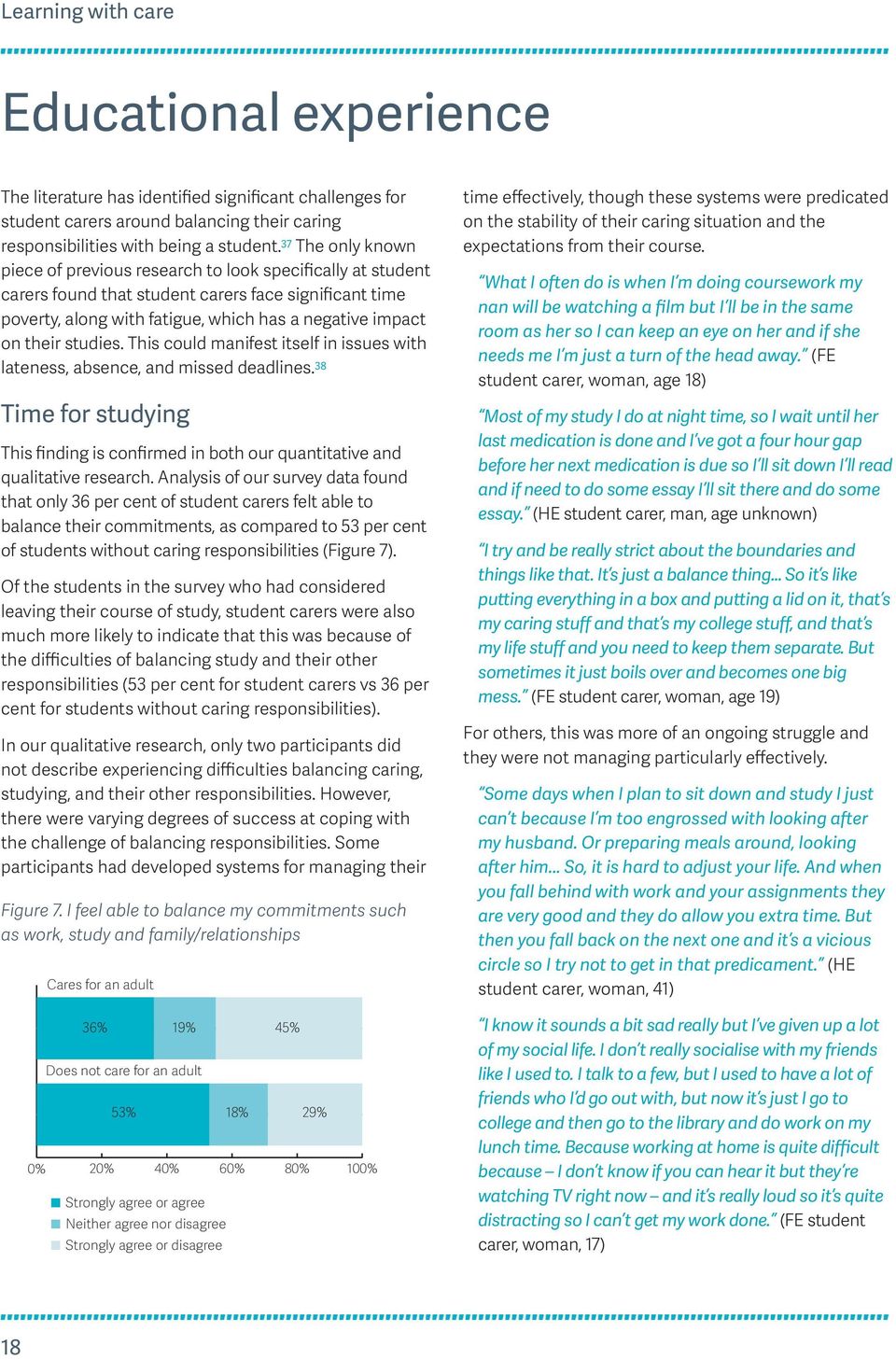
20 Learning with care Educational experience The literature has identified significant challenges for student carers around balancing their caring responsibilities with being a student. 37 The only known piece of previous research to look specifically at student carers found that student carers face significant time poverty, along with fatigue, which has a negative impact on their studies. This could manifest itself in issues with lateness, absence, and missed deadlines. 38 Time for studying This finding is confirmed in both our quantitative and qualitative research. Analysis of our survey data found that only 36 per cent of student carers felt able to balance their commitments, as compared to 53 per cent of students without caring responsibilities (Figure 7). Of the students in the survey who had considered leaving their course of study, student carers were also much more likely to indicate that this was because of the difficulties of balancing study and their other responsibilities (53 per cent for student carers vs 36 per cent for students without caring responsibilities). In our qualitative research, only two participants did not describe experiencing difficulties balancing caring, studying, and their other responsibilities. However, there were varying degrees of success at coping with the challenge of balancing responsibilities. Some participants had developed systems for managing their Figure 7. I feel able to balance my commitments such as work, study and family/relationships Cares for an adult 36% Does not care for an adult 53% 18% 29% 0% 20% 40% 60% 80% 100% Strongly agree or agree Neither agree nor disagree Strongly agree or disagree 19% 45% time effectively, though these systems were predicated on the stability of their caring situation and the expectations from their course. What I often do is when I m doing coursework my nan will be watching a film but I ll be in the same room as her so I can keep an eye on her and if she needs me I m just a turn of the head away. (FE student carer, woman, age 18) Most of my study I do at night time, so I wait until her last medication is done and I ve got a four hour gap before her next medication is due so I ll sit down I ll read and if need to do some essay I ll sit there and do some essay. (HE student carer, man, age unknown) I try and be really strict about the boundaries and things like that. It s just a balance thing So it s like putting everything in a box and putting a lid on it, that s my caring stuff and that s my college stuff, and that s my life stuff and you need to keep them separate. But sometimes it just boils over and becomes one big mess. (FE student carer, woman, age 19) For others, this was more of an ongoing struggle and they were not managing particularly effectively. Some days when I plan to sit down and study I just can t because I m too engrossed with looking after my husband. Or preparing meals around, looking after him... So, it is hard to adjust your life. And when you fall behind with work and your assignments they are very good and they do allow you extra time. But then you fall back on the next one and it s a vicious circle so I try not to get in that predicament. (HE student carer, woman, 41) I know it sounds a bit sad really but I ve given up a lot of my social life. I don t really socialise with my friends like I used to. I talk to a few, but I used to have a lot of friends who I d go out with, but now it s just I go to college and then go to the library and do work on my lunch time. Because working at home is quite difficult because I don t know if you can hear it but they re watching TV right now and it s really loud so it s quite distracting so I can t get my work done. (FE student carer, woman, 17) 18
21 Research findings This difficulty balancing responsibilities was often viewed as just the way it is ; ultimately the challenges of balancing caring and studying were seen as preferable to giving up either of these highly valued activities. It s going to be a constant question because you know what your heart wants and what your brain wants are two different things, and yes I d like to say I d give 100 per cent of my attention to my partner, but I have to say no I don t because I have to keep something for me, otherwise I d end up completely losing my mind and I d be no use to her. So you know yes I do need to spend more time on my study which would mean less time caring. (HE student carer, man, age unknown) Time poverty is clearly key for student carers, but as important is the lack of flexibility that student carers have about when they study. The consequence of developing these coping mechanisms is that carers must often dedicate a particular part of the day or week to their studies. I try to get my work done during the days that I m at college. Even if we have a free lesson or something I ll carry on working rather than sort of relax like everyone else. Because if I can spend an hour in college doing the work that s an hour less I ve got to spend at home doing the work. (FE student carer, woman, age 19) Attainment The literature suggests that students with caring responsibilities may face penalties to their academic performance as a result of some of the challenges of balance discussed above. 39 Of the 18 participants who discussed their academic performance, eight felt that their performance had been negatively affected by their caring responsibilities, one felt that it had been positively affected, and nine felt that it had not affected their academic performance. I m retaking the year because I ve got bad anxiety and I couldn t cope with it last year. (FE student carer, woman, age 17) Because I was used to juggling a lot of things, actually doing a PhD I was juggling less things than I would ve done in my normal working life. For me it was like I was in a protective bubble. (HE student carer, woman, age 35) I probably could have done better to be honest. I know from the marks that I got from when I had the time to really put the work in, I had firsts and distinction level. But most of the time I didn t get the time, and although I did the best with the time I had, it was rushed and I didn t get to do the reading I wanted to do, I didn t get the preparation I wanted to do. So although they re good, it s frustrating that I didn t get to the level that I would be if I had the 18 hours a week that I would have liked to. (HE student carer, woman, age 50) Without collecting systematic data on student carers it will be impossible to measure their actual attainment against their peers without caring responsibilities, but the fact that many student carers worry that their attainment is affected gives further credence to the arguments in favour of this kind of data collection and monitoring. Retention The lack of monitoring data on student carers also means that conclusions are difficult to reach on the retention rates of student carers. The literature does identify potential challenges around retention; for instance, carers must often miss scheduled learning activities in order to provide necessary care. This means that in many cases they do not leave education with the qualifications they were aiming for. 40 The NHS Survey of Carers in Households (2010) found that six per cent of all carers said that their ability to take up or stay in education was affected by their caring; in the age group, this rose to 12 per cent. 41 Our research targeted current student carers, meaning that those who had already made the decision to leave their course early will not have been captured. Nevertheless, our research raises serious concerns about retention for student carers. Over half (58 per cent) of student carers in our survey had seriously considered leaving their course, compared to 39 per cent of students without caring responsibilities (Figure 8). In the qualitative research, 15 out of 31 interviewees said that they had seriously considered leaving their course. One participant had previously left a course and was now enrolled at a new institution, and another was currently seriously considering leaving his course at the time of the interview. Three others had taken an interruption in their studies. 19
22 Learning with care Figure 8. Have you ever seriously considered leaving your course? Cares for an adult 0% 20% 40% 60% 80% 100% Yes 58% Does not care for an adult 38% 62% No Yeah I have [thought about leaving] recently because me and my mum are both ill so when she gets ill, because I m trying to help, I make myself ill. So it s a catch-22. And then I got told if I wasn t going to college enough I would get kicked off all my courses. And so it s like they re trying to make me go to college instead of looking after myself and my mum. So it makes me pretty angry because I get a bursary because my mum can t work. They ve threatened to stop the bursary because I hadn t been attending college enough. But then how am I going to college if I can t get the money? And it s just getting to the point where I was getting so frustrated with how the system is that It was getting too much for me to handle and I was getting so tired of having to balance everything. Because everything seems to be thrown against me rather than helping me to move forward. (FE student carer, woman, age 16) Institutional support 42% Due to the challenges outlined above, student carers may be in additional need of pastoral, academic, or other support from their institution, or may find it harder to access the support that is available. Campaigning from students and students unions, as well as the growing recognition in the policy world of the challenges facing young adult carers, has led some institutions to seek ways to better support student carers. A limited number of institutions have adopted student carers policies and/or providing targeted information about student support aimed specifically at student carers (Box 1). While these are welcome steps in the right direction, the experiences of participants in our qualitative research suggest that there is a long way to go for most institutions to provide adequate support for student carers. Participants had had mixed experiences of institutional support, but their experiences were most often shaped by the individual staff involved, rather than any coordinated system of support. I think the main problem is the lack of understanding from my tutors and lecturers. I ve had some that have been great and understanding and fine and I ve had some that can t really see the problem. (HE student carer, woman, age 22) The most common forms of support that participants needed were extensions, alternative exam arrangements, and pastoral support or counselling. 18 participants described positive experiences of institutional support. These were characterised by flexibility and understanding on the part of the tutor or lecturer involved. They ve all been understanding, because they re like as long as you tell us what s going on and as long as you keep us updated, like if your dad s in the hospital or is at home but needs a lot of caring. They re fine with me being late or having to leave a half hour early or something, as long as I get everything sorted. (FE student carer, woman, age 19) Box 1. Sample student carers policy statment 42 The University of Bradford is mindful of its responsibilities to all students and will support students who are/become carers during their period of study. The University believes that caring responsibilities, should not, in themselves, prevent any student from succeeding in their studies. The University is committed to showing as much flexibility as possible to facilitate a students success, making sure no student is disadvantaged whilst maintaining high academic standards. 20
23 Research findings People are really good about it once they know you re a carer. I ve never known anybody that s been really horrible about it yet. (HE student carer, woman, age 44) In some cases, participants who were disabled sometimes described being able to access the support they needed because of their disability, even if the reason they needed support was due to their caring responsibilities rather than their disability. They were satisfied with the support they received, but realised that the system was not functioning exactly as it should. I had an exam with my last module, and I have learning difficulties as well and they arranged for me to take my exam at home with my husband which I think was really good but I m not sure what the full extent of the allowance was because I think there was a crossover between my learning difficulties and the carer side is being forgotten. (HE student carer, woman, age 41) It s very unstructured in the department I m at. My supervisors aren t aware that there s any problem. But there certainly is. (HE student carer, man, age 55) The tutors themselves are very supportive but the policies of the university say I ve got an assignment coming up and I need a bit of extra time because I know I m going to be caring for my nan, they expect me to work around it but it s not easy for me to get extensions, it seems quite restricted around that just because I know about it. But surely because I know about it, it should be easier. The tutors themselves are supportive but restricted by the university a little bit. (HE student carer, woman, age 24) Twelve participants described negative experiences with their institutional support. In contrast to the positive experiences, these were characterised by a lack of understanding on the part of institutional staff. This could take both active and passive forms, with the former occurring normally after an individual had disclosed their caring responsibilities, and the latter having more to do with a tutor or lecturer not taking an active interest in their students needs. I ve had a couple of comments from my dissertation supervisor, he has my best interests at heart but he says stuff like you need to be selfish and take some time out because your family would want you to do well and want what s best for you, which is true, but it s very difficult when you re at home. If something needs doing I can t say no. It has to be done. And I understand where he s coming from, and in an ideal world I say I ve got to go and take this time for me, but you can t, it s just not something you can just pick up and put down. Caring is something that s a 24 hour role. (HE student carer, woman, age 22) Participants described a lack of structure to the support available; conversely, the policies of the institution were often too rigid to be helpful. 21
24 Learning with care Finances Debt and money worries are a fact of life for many carers. As documented by Carers UK (2012), they often live in households with people who are not working, and many must give up or reduce their working hours in order to provide care. 43 Our survey data confirms that these issues are just as salient for student carers, with two thirds of student carers indicating that they regularly worry about not having enough money to meet their basic living expenses, compared to 56 per cent of students without caring responsibilities (Figure 9). In our qualitative research, nearly all participants faced some level of financial strain. A combination of employment, financial support, and debt were used to alleviate this strain, with varying degrees of success. Financial support and benefits Figure 10. Which, if any, of the following types of financial support do you receive? 80% 70% 60% 50% 40% 30% 20% 10% Figure 10 shows the types of financial support that student carers use. Student carers are less likely than students without caring responsibilities to receive a student loan (51 per cent vs 71 per cent, respectively). Although this may partially be explained by higher numbers of part-time students, this would not explain the entire discrepancy, so further research is needed to understand this low take-up of student loans. Apart from student loans, student carers were as likely or more likely to receive all other types of student 0% Student loan for living costs Maintenance grant Institutional bursary or scholarship Disabled Students' Allowance Part-time course costs grant Special support grant Cares for an adult Access to Learning Fund Parents' Learning Allowance Childcare Grant Social work bursary Travel grant Adult Dependents' Grant None/missing Does not care for an adult Figure 9. I regularly worry about not having enough money to meet my basic living expenses such as rent and utility bills Cares for an adult 67% Does not care for an adult 56% 16% 28% 0% 20% 40% 60% 80% 100% Strongly agree or agree Neither agree nor disagree Strongly agree or disagree 12% 21% financial support, which fits with the expectation from the literature and our qualitative research that they face increased financial hardship. In keeping with this, student carers were twice as likely to have sought discretionary funding from their institution, with a quarter (24 per cent) of student carers applying for discretionary funds as compared to 13 per cent of students without caring responsibilities. The survey also asked about financial and other types of support to help with respondents living costs from business, charity, family, and friends. Student carers received similar levels of support from businesses and charities as students without caring responsibilities for an adult. However, only 47 per cent of student carers 22
25 Research findings received financial or other support from their families, compared to 57 per cent of students without responsibilities for caring for an adult. Some of this difference was made up in the proportion of student carers receiving support from friends, which at seven per cent was higher than the four per cent of students without adult caring responsibilities who received support from friends. The data also shows that student carers are more likely than students without caring responsibilities to receive state benefits (Figure 11). The prevalence of mature student carers with children may explain the increased likelihood to receive Child Benefit and Child Tax Credit, but in the broader sense this again speaks to the finding of the literature review that carers are more likely to be in financial hardship. Of the 25 participants who discussed their financial support, 13 said that there was not enough financial support available to them, while 12 participants felt that their current support was enough. Figure 11. Do you currently claim any of the following state benefits? (Please select all that apply) 100% 80% You know, parents get money for having children, from the course. Childcare grants and things. You would think about a carer, they have the same commitment if not more, you know what I mean. So if they re getting it, why aren t carers? (HE student carer, woman, age 19) Carer s Allowance Eight per cent of student carers in the survey were in receipt of Carer s Allowance, a benefit available to full-time carers over the age of 16 who receive only minimal income from other sources. At the time of writing, Carer s Allowance was set at per week. 44 Full-time students are the only group of people not eligible to receive Carer s Allowance even when the benefit s other conditions are met. The ineligibility of full-time students for Carer s Allowance has been identified by the Department for Work and Pensions (DWP) themselves as a significant barrier to carers accessing education. 45 In the qualitative research, Carer s Allowance came up frequently, both with part-time students who received it as well as full-time students who had had to give up their eligibility in order to undertake their course. For the part-time participants who were receiving it, Carer s Allowance was a crucial part of making ends meet, although it was regarded as poor compensation for the amount of hours and effort they spent caring. 60% 40% 20% 0% Child Benefit Child tax credit Housing Benefit Disability Living Allowance Working tax credit Income support Jobseeker's Allowance Employment and Support Allowance Carer's Allowance None of the above What part-time job would you get out of bed for and get that type of money for? You just wouldn t, would you? You wouldn t. But us carers have to lump it. I can t go out to work, I had to leave my job where I was earning lots of money, because I had to come home and look after my husband. To get that is just ridiculous. It just leaves me speechless, honestly. I mean it doesn t even fill up my tank with petrol to take my husband to a medical appointment. (HE student carer, woman, age 41) Full-time participants, who were also full-time carers, often cited the fact that they were ineligible to receive Carer s Allowance as part of the problem with their finances. Cares for an adult Does not care for an adult 23
26 Learning with care At one point I did look into Carer s Allowance for my gran because I do look after her enough hours in the day, but they say if you re a on a full time course it s not something you re allowed to apply for. So it would be handy because obviously it would make up the wages that, had I been working all the hours that I look after her obviously I would have an income coming in, so it would certainly make things easier. (HE student carer, woman, age 28) Previous research has identified that young adult carers who remain at home while they attend university see no reduction in the amount of time their caring takes up. 46 This makes the justification for restricting Carer s Allowance for full-time students ring hollow. Participants who considered themselves full-time carers described a variety of ways in which they managed to both study and care full-time. The relative flexibility of study time was key to this. In the summer before the second year of college I applied for Carer s Allowance because on paper it looked like I could claim for it, because if you re studying for more than 21 hours per week you re not eligible for it I was only there for 15 hours a week, in classes. But because they expect you to study 40 hours a week minimum on assignments, reading course books that caught me out. (HE student carer, woman, age 19) Figure 12. Types of debt for survey repondents 50% 40% Debt The survey found that student carers were less likely to have taken out low-risk debt (such as credit cards, overdrafts, and loans from family and friends) than students without caring responsibilities. However, student carers were three times as like to have taken on high risk debt (defined as payday loans, doorstep loans, etc), with six per cent of student carers having taken on high risk debt, compared to two per cent of students without caring responsibilities (Figure 12). Student carers in the survey also had greater total amounts of debt than students without adult caring responsibilities. Nearly one in five (19 per cent) of student carers had total debts greater than 5,000, compared with 11 per cent of students without caring responsibilities for an adult. The debt profile of student carers places them in a disadvantaged situation financially. Considered in conjunction with the lower uptake of student loans, this scenario could be at least partially explained by a lack of access to accurate information about debt and finances. Financial information The difficulty in accessing accurate financial information was repeatedly raised by participants in our qualitative research. Many of them were accessing both student support and state benefits, which makes for complex situations and often requires specialist financial advice. For many participants, this complexity contributed to their overall stress, and they were left wondering whether they were truly receiving all of the support they were entitled to. 30% 20% 10% 0% High risk debt Cares for an adult Low risk debt Does not care for an adult Understanding the maze of benefits and tax credits that I d have to negotiate to actually increase my income through paid work, and not just work for the sake of working, requires far more energy and financial uncertainty that I can cope with on top of my other commitments there are a lot of hurdles to maximising support and when you re already studying and caring for others, navigating this kind of bewildering bureaucracy is, in my experience, very draining. Often it seems easier just not to both with pursuing more help because getting help is in itself another exhausting job. (HE student carer, woman, age 33) 24
27 Research findings Our survey data confirms the difficulty for student carers of getting accurate financial information; 28 per cent of student carers said that it was not at all clear how much financial support they would receive before they started their course, compared to 19 per cent of students without caring responsibilities. Employment Carers are less likely to be in full time employment (but more likely to be in part time employment) than the general population. 47 This pattern is understandable given the loss of time available for work that comes with providing care. Our survey data shows that although student carers were less likely than students without caring responsibilities to be in paid employment, a majority of student carers (60 per cent) are combining caring, studying, and work (Figure 13). Figure 13. Do you currently have any form of paid employment or intend to arrange any in the current academic year, including the summer holidays? Please select all that apply 40% 35% 30% 25% 20% 15% 10% 5% 0% I am in the final year of study and intend to start work after my studies Yes, I will work during university/college holidays Cares for an adult Yes, I work during term time Yes, I work during term time and holidays No Does not care for an adult Student carers were about as likely as students without caring responsibilities to work during term time, as well as term time and holidays. The difference in the proportion of student carers working comes from those working during university/college holidays, suggesting that student carers are less able to take advantage of breaks in the academic year in order to work, perhaps because their academic responsibilities are not the primary determinant of their availability for work. Student carers in our survey were less likely than other students to work for one or two days and more likely to work for three, four, or five days. The survey also found that student carers had different motivations for working than their peers without caring responsibilities (Figure 14). The most common reason for student carers to give for working was to cover their or their household s basic living costs, which 72 per cent of student carers gave as a reason, compared to 60 per cent of students without caring responsibilities. Student carers were also more likely to indicate that they worked to cover costs indirectly related to their course; one explanation for this could be that there are costs associated with being a student and a carer at the same time which student carers are working to pay for. Student carers were less likely than other students to indicate that they worked to pay for extras for themselves. The qualitative research largely confirmed this picture, with a majority of participants in some form of paid employment. As with the survey data, covering basic living costs was a common reason for working, but participants also worked to gain experience and skills, and because they enjoyed it. Young carers also expressed a desire not to have to ask their parents for money. Before I started working it was pretty dire. I was lucky if I got 500 a month, if I was lucky. (HE student carer, woman, age 19) The extra money helped but for me it was more about keeping the career going, making sure I didn t lose those contacts, didn t lose those skills. (HE student Carer, woman, age 33) Despite the surprising proportion of students who were caring, working, and studying, there is evidence that student carers ability to work as much as they 25
28 Learning with care Figure 14. Why do you work? Please select all that apply (respondents who worked) 80% 70% 60% 50% When I was in college I had three jobs, and had college and looked after my mum when she was diagnosed At the end of the college year I crashed and burned. I d hit rock bottom and I quit everything. I just had a turnaround and thought, what am I going to do now? So I quit doing all my work, quit doing all my jobs and got my college thing in and then concentrated on my mum. (HE student carer, woman, age 28) 40% 30% 20% 10% 0% To pay for 'extras' for myself To cover mine or my household's basic living costs To cover costs directly related to my course To strengthen my CV To gain experience and skills To cover costs indirectly related to my course To avoid getting in to debt To maintain contact with the world of work To reduce the amount of money I will owe when I finish my course I am combining full time and part time study To pay for 'extras' for my children My employer is funding my studies It s not the whole reason it s been affected because there s no full-time jobs out there. So even if I wasn t at college I don t think I d be much better off with the job situation. But also trying to find someone who s flexible to say that, my dad s got cancer, I might need to go home halfway through the day or something. Not that many people are keen on taking on someone like that. They need someone they can rely on no matter what. And even though it s not my fault that I m in the situation that I m in, it s not the employer s fault either. So they don t want someone who s not always there, but I can t help it. (FE student carer, woman, age 19) Cares for an adult Does not care for an adult would like were curtailed by their caring responsibilities, as the literature suggests. This could be because of the difficulties of balancing so many competing responsibilities, but also because it was difficult to find an employer that allowed them the flexibility they needed to be able to care. 26
29 Research findings Student life Caring is known to have an impact on carers personal relationships, social life, and leisure. 48 According to Carers UK, two thirds of carers have experienced a negative effect on their friendships as a result of their caring. 49 Our qualitative research confirms these findings, with the majority of participants indicating that their social life was diminished. Socialising In seeking to balance work, study, and personal lives, many participants placed socialising at the bottom of the list. For the largest group of participants (n=11), this meant an extremely limited or nonexistent social life. Having a life, so having time to see friends that completely went and that wasn t from the PhD, that kept at a pretty constant level for three years, that was because I was doing more and more looking after [my partner]. (HE student carer, man, age unknown) For nearly as many participants (n=9), their situations enabled them to maintain a social life, even if it was not as expansive as they would like. I think it has and it hasn t [been affected by my caring]. During the week when I m here, I have the same social life as everyone else. Even if I m home in the weekend I might try to see my friends in the evening Since I ve been at uni, probably less than when I was at home. (HE student carer, woman, age 22) There were also a minority of participants (n=4) for whom their social life remained more or less intact. This was normally the result of having a strong family or other network so that caring tasks and time could be shared. In my first year of university I socialised quite a bit surprisingly. My mum was going through a good patch my big sister used to come down every Thursday, that was my night off, and my partner would look after my daughter. So on a Thursday I could come in, do my lectures and do my uni work, and then hit the bars. I didn t do it every Thursday as sometimes I d make sure I came home to see my daughter or see my mum not as a carer. (HE student carer, woman, age 28) Socialising is an important part of any person s life and is particularly relevant to students, many of whom view education as in part about making lifelong friends. A limited social life and also have knock-on effects for student carers well-being, as will be discussed in the next chapter. Students unions For most participants, involvement and interaction with the students union was low. For some, this was specifically related to their caring responsibilities. They felt that the students union did not adequately cater to students with caring responsibilities or recognise their needs. They ve got support and awareness for like LGB people, they have support for those with mental health, even students who ve got cancer, there s always support for that and support for those who ve got disabilities, but I ve never seen anything for carers. (FE student carer, woman, age 18) For mature and part-time participants, their age was often more salient than their caring responsibilities in shaping their relationship with their students union. The union building, I found it quite intimidating, I think it s quite intimidating for mature students really. I mean there s mature and there s mature, you know I seem like I just came out of an archaeological dig and students assume I m a tutor. (HE student carer, woman, age 44) When I started the PhD there wasn t a students union as such [at my university]. It was something they were working towards and they were focusing more of full-time students with sports facilities and the students union bar area didn t ever seem to be open in the daytime when I was there. (HE student carer, woman, age 45) 27
30 Learning with care Given the importance of extra-curricular activities in opening up opportunities for students and graduates, the fact that student carers find it difficult to access extra-curriculars further compounds the disadvantage they face. There were, however, a minority of participants who had had positive reactions with students unions in relation to their student welfare services such as advice and counselling. [The students union was] really helpful actually. I mean there were some things that some people just haven t flagged up, things like tax credits and a few other bits and bobs, that a welfare advisor, a council welfare advisor said we weren t entitled to and then the students union. they were like no, no you are, because your stipend doesn t count so the fact that they kind of knew a bit about student issues meant that actually yes, it completely changed the playing field. (HE student carer, man, age unknown) Having the time to meet up with someone, if it s in college times it would be possible like at lunch times you can eat food together. But if it s outside of college times it would be too difficult. (FE student carer, woman, age 18) There was also general support for creating online methods of socialising with other carers as a way to counteract the difficulties of physically meeting at a set time. Mature students were more likely to say that they would not have time to participate in such a group, and were more interested in the outcomes of a group beyond just sharing feelings. The student carers group, if that was advertised a bit more and I knew what it was then yeah it would be great. At the same time it shouldn t just be somewhere you go to moan. There should be something else to it because that s not helpful to me. (HE student carer, woman, age 24) Carers groups A small but growing number of students unions are introducing carers groups as a way of providing support and social activity for student carers, sometimes grouping them together with student parents. Participants perceptions of the usefulness of these groups were varied. A few participants were aware of existing carers groups or forums at their institutions, but none were active members of these groups. There was appetite for these types of groups, particularly from young participants, but this was balanced with a sense that their time was very precious and it would be difficult to find the time to get involved. It would be really nice if there was a group of carers that could meet up maybe once a month that could meet up and forget about our responsibilities and cause we re all in the same boat, because none of my friends are carers. It would be nice to meet up with people that you could relate to and you could just talk about it. That would be a good idea if the uni did something like that. (HE student carer, woman, age 18) 28
31 Research findings Personal impacts The impacts of combining studying and caring extend beyond the educational setting and into the personal lives of student carers. Our research demonstrates how being a student carer impacted on their well-being, mental health, ability to provide care, and other elements of their personal lives. Well-being Carers UK has reported that more than four out of five carers say that caring has had an impact on their physical health (82 per cent) or mental health (87 per cent). 50 Our survey confirms that student carers are at higher risk for low well-being, with student carers indicating lower well-being on each of the seven indicators in the survey. This included worrying about finances, where only 17 per cent of student carers agreed or strongly agreed that in general I don t worry about my financial situation, and indeed 43 per cent strongly disagreed with this statement. Similarly, only 24 per cent of student carers agreed or strongly agreed that they felt able to concentrate on their studies without worrying about finances, compared to 43 per cent of students without caring responsibilities (Figure 15). Mental health In our survey, 15 per cent of student carers indicated that they had mental health difficulties. In our Figure 15. I feel able to concentrate on my studies without worrying about my finances Cares for an adult 24% Does not care for an adult 0% 20% 40% 60% 80% 100% Strongly agree or agree 24% 52% 43% 20% 38% Neither agree nor disagree Strongly agree or disagree qualitative research, it was extremely common for participants to have experienced mental health difficulties, ranging from elevated stress levels through to severe anxiety requiring hospitalisation. In some cases participants were able to overcome these difficulties without requiring serious changes to their activities, but in other cases their mental health difficulties could be severely disrupting to their studies and their lives more broadly. Just before the end of my second year I was really struggling. I was worrying quite a bit about things at home. I hadn t been able to get home as much as I would like to. I ended up with an intervention guy, a doctor who told me I have to leave and go back and redo my second year. I was quite ill as well but I think it was, my dad was a big factor in why I was getting myself worked up. (HE student carer, woman, age 22) Participants were asked about the worst parts of being a student and carer at the same time, and the most common responses were that it was difficult to juggle their commitments, that they had no time for themselves, and the effect that it had on their mental health, indicating that well-being is the area in which student carers experience the biggest personal impact. Impact on caring From the perspective of an institution or students union, the most salient question may be how student carers studies are affected by their caring responsibilities. However, just as important to many student carers is the impact that studying has on their ability to provide care. The majority of participants agreed that there had been some impact on their caring; but this could be either positive or negative. About two thirds of those who felt their caring had been impacted said that there was a negative impact; most commonly this was in the form of less time to spend with the person they cared for or having less patience as a result of stress from their course. 29
32 Learning with care There s times where I don t have much time if I m doing my reading at home It tends to be that I go light on the studies at home for much of the module and he gets the full attention, but when it comes closer to the deadlines and exams then it has to take a bit of a back seat and it s not easy, it s not easy at all. And you re trying to deal with someone that has emotional problems as well. So yeah it does affect in that way, I m less patient and I have less time to do things, so it s in shorthand, or I m less reasonable with him. (HE student carer, woman, age 44) However, for about a third of participants, being a student carer had had a positive impact on their ability to care, most often because their schedule was more flexible than it would be if they were working, but also because studying gave them a physical and mental break from caring, so that they could be more compassionate and understanding carers the rest of the time. I could remember there were times when I had lots of assignments due and lots of deadlines looming, lots to do at work and [my mother in law] to look after. And then once you ve actually looked through that and that sense of achievement afterward. So that is actually great, that pause that you pulled it off. (HE student carer, woman, age 50) When I moved away from home for the first time I had already gained the skills of how to balance bills, cook for myself, look after myself I left home when I was 18 and I felt my my friends weren t able to do that. They couldn t look after themselves straight away. (HE student carer, woman, age 19) It was easier But that s being a PhD student because my time is so flexible, so it was easier than working. I mean I had a lovely job, and it s not like my job would have been awkward at all, it would have been very understanding but it was still easier because I didn t have to ask sort of, can I swap this day off, can I get out early, you know I just went and then I worked a couple hours in the evening. So from that point of view it was so much easier. (HE student carer, man, age unknown) Positive impacts When participants were asked about the best parts of being a student and a carer at the same time, the potential benefits of combining caring and studying came to light. Most commonly, participants identified that studying gave them a space to do something for themselves, and an identity outside of caring. The next most common benefits identified were the ability to gain life skills (and in the case of young carers, this was associated with independence) and the sense of accomplishment that came with achieving their goals. The best part has to be that it gives me a sense of worth, that I am doing something for me and my future. (HE student carer, woman, age 55) 30
33 Recommendations
34 Learning with care Recommendations Student carers are providing a valuable service and they deserve to be supported to achieve their goals and ultimately live fulfilled lives. As our research has demonstrated, carers still face too many barriers to enter and stay in education. There is a clear case for increased support for student carers at both national and institutional levels. The following recommendations would significantly improve the experiences of students with caring responsibilities in further and higher education. 1. Collect data on student carers National data collection via the Higher Education Statistics Agency (HESA) and the Individual Learner Record (ILR) is the only way to gain accurate information on the numbers of student carers in further and higher education, as well as to understand their attainment, retention, and graduate outcomes. The Universities and Colleges Admissions Service (UCAS) should also collect this data on applicants to university in order to create a better understanding of access to higher education for student carers. Institutions need not wait for national action in order to collect data on their numbers of student carers. They should collect this data on enrolment, ensuring that they clearly explain why and how the data will be used. 2. Include student carers in widening participation work Student carers are under-represented in further and higher education, and institutions should have due regard to this when planning their widening participation work. In addition to outreach activities, this should include programmes to support retention and success for student carers. Institutions should also consider the role that financial support plays in supporting retention and success, for instance by ensuring that student carers are able access hardship funding. 3. Improved information, advice and guidance Educational institutions at all levels of study should work together with local authorities and national organisations to ensure that carers have access to highquality information, advice and guidance about their options for entering into further and higher education. This should include information about student carers financial entitlements and benefits in order to ensure that a lack of financial information does not create a barrier to participation. 4. Develop systems for disclosure and support Institutions should develop systems to enable student carers to disclose their caring responsibilities easily and efficiently. Systems should make clear to student carers what information will be shared, and with whom. Institutions should also ensure that any system for disclosure is linked to support systems, so that students who declare that they have caring responsibilities have access to the support they need. Academic and pastoral support for student carers should be systematic and should ensure that all student carers have equal experiences of support, rather than leaving it up to the understanding of individuals involved. All staff who deal with students on a regular basis should have an understanding of how institutional policies apply to student carers. 5. Advance institutional policies and practices Institutions should make explicit via their policies that caring responsibilities should not, in themselves, prevent a student from succeeding. This could take the form of a separate Student Carer s Policy or of embedding an understanding of the issues facing student carers in all institutional policies. In particular, institutions should commit to be flexible, sensitive, and equitable in their approach to student carers. It is important that institutions consider their support for student carers from a proactive 32
35 Recommendations perspective, rather having a policy which is predicated on circumstances reaching a crisis point. Institutions should ensure that any policy relating to student carers includes clear expectations for when the institution and the individual need to take action. They should also consider where existing or proposed policies will have a disproportionately negative impact on student carers and should take steps to prevent this. 6. Replace Carer s Allowance for full-time students For many full-time carers, Carer s Allowance is a vital (if often inadequate) benefit and it is no surprise that the restriction on Carer s Allowance for those studying full-time creates a barrier to carers access to education. The student support system (in England, the Department for Business, Innovation and Skills, the Department of Health, and the Department for Education, and in the nations the devolved administrations as appropriate) should replace this income for carers in full-time education who would otherwise be eligible for Carers Allowance, in acknowledgement of the financial strain that student carers are under and in recognition of the service that they are providing in lieu of earning wages that would help them to meet the cost of study. 7. Enable participation in student life Students unions and institutions should work together to enable student carers to participate in student life to as great an extent as they wish to. This could include creating physical or virtual groups for student carers, but it should also include making all extracurricular activities more accessible for student carers. This may include giving consideration to the location, time of day, and type of activities that are on offer. Students unions should consult with student carers on what works best for them, and should also seek to ensure that they take an active role in representing the needs of student carers through their democratic structures. 33
36 Endnotes
37 Endnotes Endnotes 1. Carers UK (2012) Census: Provision of unpaid care by age and gender. attachments/2011_provision_of_unpaid_care_by_age_and_ gender.pdf [accessed 06/08/2013]. 2. Author s analysis, from Office of National Statistics (2011), Census 2011 data DC6301EWla 3. Yeandle, Sue and Buckner, Lisa (2007). Carers, Employment and Services: Time for a new social contract? Leeds: University of Leeds. 4. Commission on Funding of Care and Support (2011). Fairer Care Funding: Analysis and evidence supporting the recommendations of the commission on funding of care and support (Vol II). 5. Buckner, Lisa and Yeandle, Sue (2011). Valuing Carers: Calculating the value of carers support. London: Carers UK. 6. NHS Choices (2013). A guide to carers rights [accessed 06/08/2013]. 7. NUS (2012). Understanding the Impact: A review of the impact and effectiveness of student financial support in English further and higher education. 8. NUS (2013). The Pound in Your Pocket: Student Carers and their Finances. 9. Hennink, Monique, Hutter, Inge, and Bailey, Ajay (2011). Qualitative research methods. London: SAGE Publications Inc. 10. Carer s Trust (2012). What is a carer? [accessed 06/08/2013]. 11. Carers UK (2010). Carers Missing Millions: A report into carers unclaimed benefits. 12. NHS Information Centre, Social Care Team (2010). Survey of Carers in Households 2009/10. The Health and Social Care Information Centre. 13. NHS Information Centre (2010). 14. Carers UK (2012) Census: Provision of unpaid care by age and gender. attachments/2011_provision_of_unpaid_care_by_age_and_ gender.pdf 15. NHS Information Centre (2010). 16. Becker, Fiona and Becker, Saul (2008). Young Adult Carers in the UK: Experiences, Needs, and Services for Carers aged Princess Royal Trust for Carers. 17. Aylward, Nicola (2009). Access to Education and Training for Young Adult Carers: Policy Briefing Paper. Leicester: NIACE. 18. NHS Information Centre (2010). 19. Carers UK (2013). Census Data Update: Carer age, gender, ethnicity, employment and health local and national datasets. 20. Office for National Statistics (2011). Providing unpaid care by sex by age, England and Wales, Census data from DC3303EWr. Although the census collects data on sex, NUS uses the terms women and men to reflect gender rather than sex. 21. Becker and Becker (2008). 22. Equality Challenge Unit (2012). Equality in Higher Education: Statistical report The Data Service (2012). Statistical Frist Release Archive. ease/sfr_archive/ [accessed 06/08/2013] 24. Author s analysis, from Office of National Statistics (2011). Census 2011 data DC6301EWla. 25. NHS Information Centre (2010). 26. Although not intended to be a representative sample, the proportion of student carers in the Pound in your Pocket survey is useful as an indicative figure. 27. Yeandle and Buckner (2007). 28. Although the official definition of a mature student in HE is 21 or older, research suggests that 25 or older is often a more helpful distinction, eg. NUS (2010) Never too late to learn. 29. Frank, Jenny, Tatum, Chris, and Tucker, Stan (1999). On Small Shoulders: Learning from the experiences of former young carers. London: The Children s Society. 30. Author s analysis, from Office of National Statistics (2011). Census 2011 data DC6301EWla. 31. Yeandle and Buckner (2007). The labels on this chart have been amended to reflect gender rather than sex. 35
38 Learning with care 32. UCAS (2013). UK Application rates by country, sex, age and background (2013 Cycle, January deadline). 33. Kirton, Jennifer, Richardson, Kathleen, Jack, Barbara, and Jinks, Annette (2012). A study identifying the difficulties healthcare students have in their role as a healthcare student when they are also an informal carer. Nurse Education Today 32 ( ). 34. Aylward (2009). 35. Becker and Becker (2008). 36. Kirton, Richardson, Jack, and Jinks (2012). 37. Becker and Becker (2008). 38. Kirton, Richardson, Jack, and Jinks (2012). 39. Kirton, Richardson, Jack, and Jinks (2012). 40. Becker and Becker (2008). 41. NHS Information Centre (2010). 42. University of Bradford (2011). Student Carers Policy. AcademicDevelopment/StudentEngagement/Documents/St udent-carers-policy.pdf [accessed 06/08/2013]. 43. Carers UK (2012). Policy Briefing: Facts about carers GOV.UK (2013). Carer s Allowance. carers-allowance/overview [accessed 06/08/2013]. 45. Fry, Gary, Singleton, Benedict, Yeandle, Sue, and Buckner, Lisa (2011). Developing a clearer understanding of the Carer s Allowance claimant group. Department for Work and Pensions. 46. Becker and Becker (2008). 47. NHS Information Centre (2010); Carers UK (2012). Policy Briefing: Facts about carers NHS Information Centre (2010). 49. Carers UK (2012). Policy Briefing: Facts about carers Carers UK (2012). Policy Briefing: Facts about carers NUS (2012). 36
39 Appendices
40 Learning with care Appendix 1: Steering Group Members Saul Becker, University of Nottingham Jim Dale, University of East London Students Union Yola Jacobsen and Nicola Aylward, NIACE Jennifer Kirton and Kathy Richardson, Edge Hill University Hannah Lamb and Karen Bush, University of Essex Daniel Phelps and Anna Morris, Carers Trust Ailsa Tweedie, student, The Open University Chloe Wright, Carers UK 38
41 Appendix 2 Appendix 2: Respondent demographics (survey data) Demographic summary of student carers in the NUS Pound in your Pocket survey. 51 Age when course began (FE students) Number % % 19 or older 44 31% Total % Age when course began (HE students) Number % % % 25 or older % Total % Ethnicity Number % Asian (including Indian, Bangladeshi, Pakistani, Chinese, and others) 39 10% Black (including African, Caribbean, and others) 14 3% Mixed 13 3% White % Other Black or minority ethnic group 2 0% Prefer not to say 14 3% Total % Gender Number % Male % Female % Total % Disability Number % Any specific learning disability, other disability, impairment or long-term health condition % None % Unsure 19 5% Prefer not to say 7 2% Total % 39
42 Learning with care Type of disability, impairment, or long term health condition (respondents could tick all that apply) Number % of total sample Physical impairment 28 7% Blind or partially sighted 9 2% Deaf or hard of hearing 14 3% Mental health difficulties 64 15% Learning difficulty 49 12% Profound and/or multiple learning difficulties 0 0% Autism spectrum disorder 5 1% An unseen disability or health condition 58 14% Prefer not to say 12 3% Sexual orientation Number % Heterosexual or straight 35 84% Gay or lesbian 20 5% Bisexual 28 7% Prefer not to say 19 5% Total % Marital status Number % Married 73 18% Divorced/separated 16 4% Cohabiting 47 12% Single % Prefer not to say 19 5% Other 3 0% Total % 40
43 Appendix 3 Appendix 3: Participant demographics (qualitative research) Gender Number Mode of study Number Female 29 Male 6 Other 0 Unknown/missing 1 Total 36 Full-time 21 Part-time 12 Other 1 Unknown/missing 2 Total 36 Age Number Year of study Number and above 4 Unknown/missing Unknown/missing 7 Total 36 Total 36 Country of study Number Ethnicity Number England 26 Asian or Asian British 0 Black or Black British 1 White British 27 White: Other 2 Mixed/multiple ethnicities 1 Scotland 8 Northern Ireland 0 Wales 0 Unknown/missing 2 Total 36 Prefer not to say 1 Unknown/missing 4 Total 36 41
44 Learning with care Level of Study Number 1 (eg. basic skills, ESOL) 0 2 (eg. GCSEs, NVQ2) 1 3 (eg. A-levels, advanced apprentices) 5 4 (eg. Bachelor s degree, HND) 18 5 (eg. Master s, PhD) 8 Unknown/missing 4 Total 36 Disability Number Yes 15 No 17 Unknown/missing 4 Total 36 Sexual orientation Number Bisexual 4 Gay/lesbian 2 Heterosexual/straight 25 Unknown/missing 5 Total 36 Marital status Number Cohabiting 3 Married 11 Other 4 Single 13 Unknown/missing 5 Total 36 42
45 Acknowledgements Acknowledgements First and foremost, I would like to thank the student carers who took time from their incredibly busy lives to participate in this research, either through filling in the Pound in your Pocket survey or participating in the interviews and focus groups. Your willingness to be open and share your experiences is what made this report possible. Thanks also to the steering group for the advice and guidance provided throughout the project, and especially to our student representative, Ailsa Tweedie. Finally, thank you to my NUS colleagues who have offered their skills and expertise to make this project a success, especially to Nicole Rios for her research assistance at several stages of the project, and also to Sean Turnbull, Jo Goodman, Clare Huxley, David Malcolm, Kelley Temple, Phil Whyte, Stacey Devine, Minda Burgos-Lukes, Dan Higgins, Eimear Galvin, and Vicky Thomas. Lucy Buchanan-Parker Research and Policy Officer (Liberation) 43
46 Learning with care 44
47
48 Macadam House 275 Gray s Inn Road London WC1X 8QB t
MY VOICE HAS TO BE HEARD. Research on outcomes for young people leaving care in North Dublin. empowering people in care
 1 MY VOICE HAS TO BE HEARD Research on outcomes for young people leaving care in North Dublin empowering people in care MY VOICE HAS TO BE HEARD Research on outcomes for young people leaving care in North
September 2011. New directions: Young people s and parents views of vocational education and careers guidance
 September 2011 New directions: Young people s and parents views of vocational education and careers guidance September 2011 New directions: Young people s and parents views of vocational education and
of Scotland s looked after children & young people.
 JANUARY 2007 looked after children & young people: Working together to build improvement in the educational outcomes of Scotland s looked after children & young people. looked after children & young people:
We still need to talk. A report on access to talking therapies
 We still need to talk A report on access to talking therapies About the We need to talk coalition The We need to talk coalition is a group of mental health charities, professional organisations, Royal
The costs of not caring: supporting English care leavers into independence. December 2014
 The costs of not caring: supporting English care leavers into independence December 2014 Contents We would like to thank the practitioners involved in this research, who worked with passion and diligence
MAKE RUNAWAYS SAFE. Launch Report. makerunawayssafe.org.uk. Help us build a safety net for children who run away from home
 MAKE RUNAWAYS SAFE Launch Report Help us build a safety net for children who run away from home makerunawayssafe.org.uk A better childhood. For every child. Foreword Every five minutes in this country
Young people's perceptions about post- 18 education and training options. A report for the University and College Union
 Young people's perceptions about post- 18 education and training options A report for the University and College Union 8 th December 2014 CONTENTS CONTENTS... 2 OBJECTIVES AND METHODOLOGY... 4 Objectives...
Would they actually have believed me?
 Would they actually have believed me? A focus group exploration of the underreporting of crimes by Jimmy Savile September 2013 Contents 1. Introduction... 3 2. Methodology... 4 3. Responses to Focus Group
Between a rock and a hard place How parents deal with children who use substances and perpetrate abuse
 Between a rock and a hard place How parents deal with children who use substances and perpetrate abuse Project report Produced with funding support from the Department of Health Acknowledgements This report
child left out The impact of cancer on children s primary school education www.clicsargent.org.uk
 No child with cancer left out The impact of cancer on children s primary school education www.clicsargent.org.uk 2 No child with cancer left out Contents Contents Foreword 4 Introduction 7 Key findings
I Haven t Told Them, They Haven t Asked:
 2007 I Haven t Told Them, They Haven t Asked: The Employment Experiences of People with Experience of Mental Illness Written for the Mental Health Foundation of New Zealand by Debbie Peterson Mental Health
It takes a village to raise a child
 It takes a village to raise a child Adoption UK survey on adoption support by Erika Pennington Contents Introduction 3 Executive summary 7 Adoption: the current picture 9 Why support? 10 About trauma 11
Is that paper really due today? : differences in first-generation and traditional college students understandings of faculty expectations
 DOI 10.1007/s10734-007-9065-5 Is that paper really due today? : differences in first-generation and traditional college students understandings of faculty expectations Peter J. Collier Æ David L. Morgan
Kirsten Stalker Professor of Disability Studies University of Strathclyde
 Kirsten Stalker Professor of Disability Studies University of Strathclyde Charlotte MacDonald Caroline King Francis McFaul Colin Young Moyra Hawthorn Louis Patrizio September 2013 It always comes down
Students Perceptions of Their Community College Experiences
 Students Perceptions of Their Community College Experiences Students Perceptions of Their Community College Experiences by Thad Nodine, Laura Jaeger, Andrea Venezia, and Kathy Reeves Bracco, with research
Close to home. An inquiry into older people and human rights in home care
 Close to home An inquiry into older people and human rights in home care Inquiry into older people and human rights in home care Acknowledgements This has been a collaborative inquiry, significantly enhanced
Students experiences of full-time Foundation degrees
 Students experiences of full-time Foundation degrees A Report to fdf Holly Higgins, Jane Artess and Isla Johnstone 1 Students experiences of full-time Foundation degrees Contents Foreword 3 Executive Summary
The Silent Epidemic Perspectives of High School Dropouts
 The Silent Epidemic Perspectives of High School Dropouts A report by Civic Enterprises in association with Peter D. Hart Research Associates for the Bill & Melinda Gates Foundation March 2006 By: John
getting back into the world 1 Getting back into the world Reflections on lived experiences of recovery Rethink recovery series: volume 2
 getting back into the world 1 Getting back into the world Reflections on lived experiences of recovery Rethink recovery series: volume 2 2 getting back into the world Contents Summary 3 Introduction 5
Time to care. A UNISON report into homecare
 Time to care A UNISON report into homecare Time to care a UNISON report into homecare 2 Contents Introduction............................ 3 Key findings............................ 4 Scheduling and length
Exploring the Support at home Sarah Joy, Susana Corral and Femi Nzegwu
 Exploring the difference made by Support at home Sarah Joy, Susana Corral and Femi Nzegwu Exploring the difference made by Support at home 1 Exploring the difference made by Support at home Sarah Joy,
Assessments of parenting and parenting support need
 Assessments of parenting and parenting support need A study of four professional groups August 2009 Joanne Kellett and Joanna Apps How health, education and family practitioners assess what support parents
Schools for All. Schools for All. Including disabled children in education. Including disabled children in education. guidelines.
 practice guidelines Schools for All Including disabled children in education Experience from Save the Children and partners globally demonstrates that improvements in education quality go hand-in-hand
We need to talk. Getting the right therapy at the right time
 We need to talk Getting the right therapy at the right time About the We need to talk coalition The We need to talk coalition is a group of mental health charities, professional organisations, Royal Colleges
Life, not numbers. a report into the experiences of disabled students in higher education using personal care packages
 Life, not numbers a report into the experiences of disabled students in higher education using personal care packages Foreword Welcome to the NUS Disabled Students Campaign report, Life, not numbers,
Acknowledgements 02. Foreword 03. 1. Introduction 04
 Moving on up Contents Acknowledgements 02 Foreword 03 1. Introduction 04 1.1 An update on the evidence 04 1.2 The policy context 06 1.3 Exercise and mental health outcomes 06 2. The GP survey - Four years
Caring into later life. The growing pressure on older carers
 Caring into later life The growing pressure on older carers 02 Image: Chris Steele-Perkins Contents Introduction Key facts How many older carers are there? Dave s story Older carers demographics Barbara
Risks and Rewards. How PhD Students Choose Their Careers: Qualitative research report
 Risks and Rewards How PhD Students Choose Their Careers: Qualitative research report FEBRUARY 2013 LEGAL NOTICE 2012 IPSOS MORI ALL RIGHTS RESERVED. THE CONTENTS OF THIS REPORT CONSTITUTE THE SOLE AND