
The Truth About Predictive Coding: Getting Beyond The Hype
|
|
|
- Sheila McBride
- 10 years ago
- Views:
Transcription
1

2 The Truth About Predictive Coding: Getting Beyond The Hype

3 David R. Cohen Reed Smith LLP Records & E-Discovery Practice Group Leader David leads a group of more than 100 lawyers in his role as Practice Group Leader of Reed Smith s Records & E-Discovery group. He serves as e-discovery counsel for multiple companies and also counsels clients on records management and litigation readiness issues. David has been named a Pennsylvania Superlawyer in litigation and is Chambers-ranked nationally and internationally in the area of e- discovery. He is a frequent author and trains judges, mediators and lawyers in e-discovery issues. He has also been a court-appointed E- Discovery Special Master in multiple cases. M

4 Bryon Z. Bratcher Reed Smith LLP Director of Litigation Technology Services Bryon directs Reed Smith s global team of 25 Litigation Technology Analysts, drawing on more than a dozen years of experience in technology services for Am Law 100 firms. He assisted with the selection and implementation, and manages the firm s technologyassisted review tools, and in 2014 was named a winner of The Recorder s Law Firm Innovator award for co-developing Reed Smith s Periscope e-discovery metrics tool. M

5 Mark E. Harrington Guidance Software Senior Vice President, General Counsel & Corporate Secretary M


6 2014 kcura. All rights reserved. D
7 2014 kcura. All rights reserved. D
8 2014 kcura. All rights reserved. D

9 2014 kcura. All rights reserved. D
10 2014 kcura. All rights reserved. D

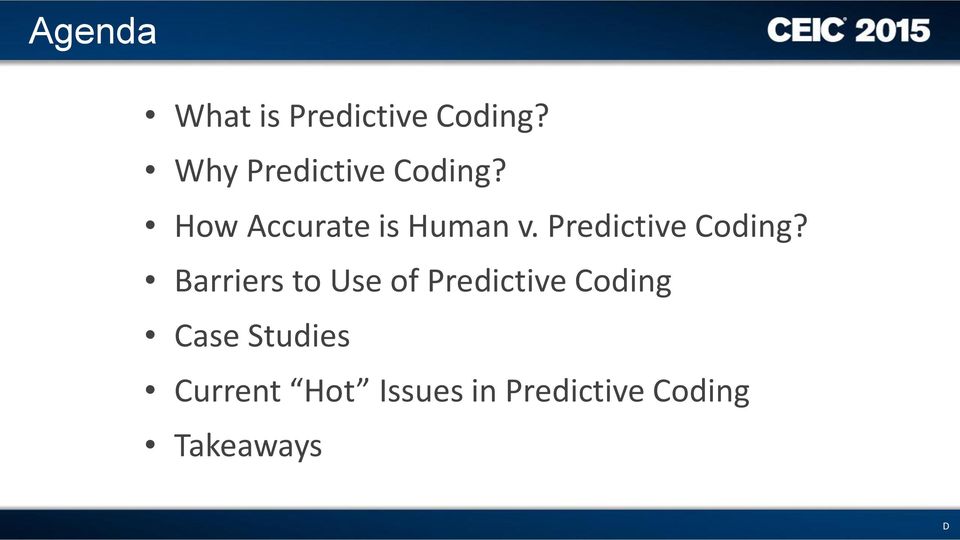
11 Agenda What is Predictive Coding? Why Predictive Coding? How Accurate is Human v. Predictive Coding? Barriers to Use of Predictive Coding Case Studies Current Hot Issues in Predictive Coding Takeaways D
12 What is Predictive Coding? a.k.a. TAR a.k.a. CAR, a.k.a. RAR Machine learning algorithms and statistical probability tools used to duplicate human decision making Software determines relevance after training by human reviewer Computer identifies properties to predict future coding Process continues until accuracy levels reach stability B


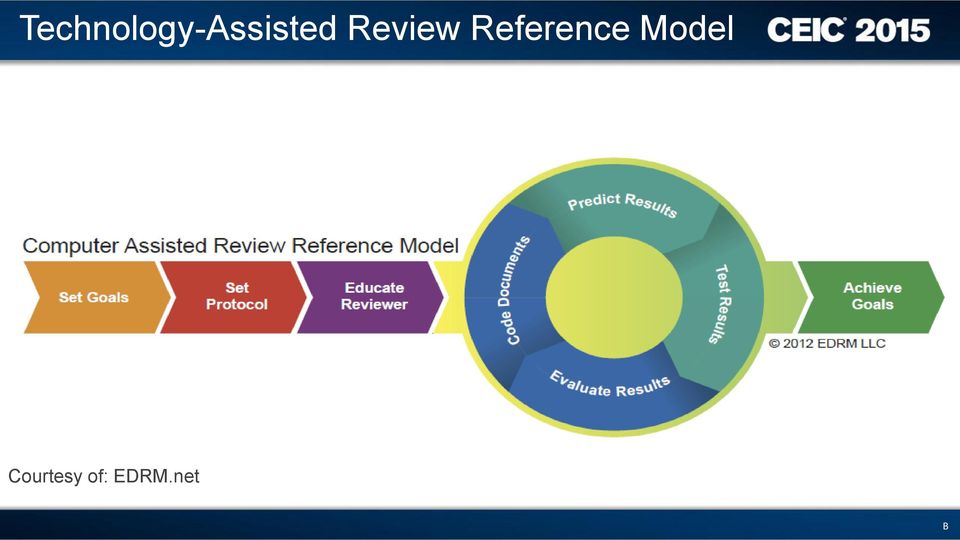
13 Technology-Assisted Review Reference Model Courtesy of: EDRM.net B
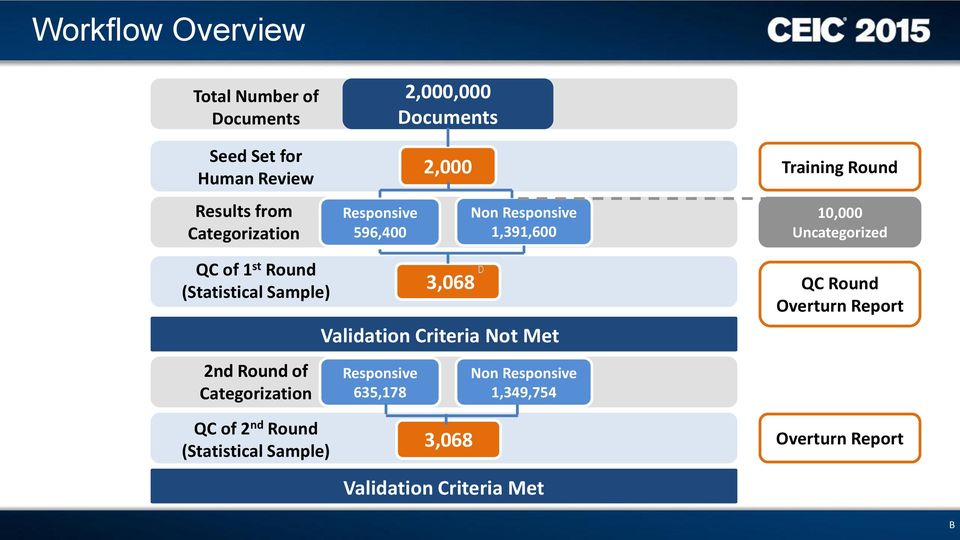
14 Workflow Overview Total Number of Documents 2,000,000 Documents Seed Set for Human Review 2,000 Training Round Results from Categorization Responsive 596,400 Non Responsive 1,391,600 10,000 Uncategorized QC of 1 st Round (Statistical Sample) 2nd Round of Categorization QC of 2 nd Round (Statistical Sample) Validation Criteria Not Met Responsive 635,178 3,068 3,068 Non Responsive 1,349,754 Validation Criteria Met QC Round Overturn Report Overturn Report B
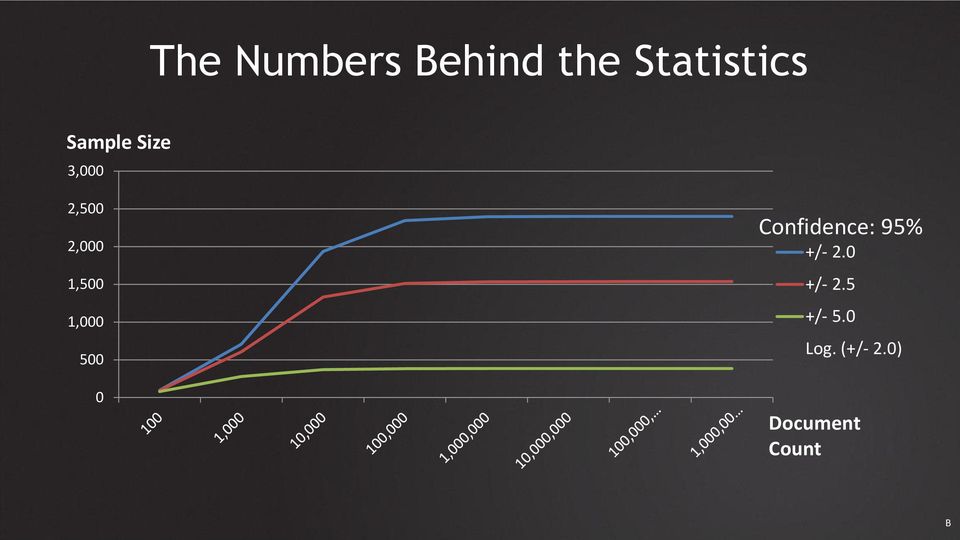
15 The Numbers Behind the Statistics Sample Size 3,000 2,500 2,000 1,500 1, Confidence: 95% +/ / /- 5.0 Log. (+/- 2.0) Document Count B
16 Why Predictive Coding? Cost savings Time savings Reduced risk of errors (?) Greater objectivity in classifications Sometimes volume of documents and/or value of case makes human review impractical D
17 Technology Assisted Review Universe of Available Documents D

18 Technology Assisted Review Relevant Documents Universe of Available Documents D

19 Technology Assisted Review Relevant Documents Universe of Available Documents Documents Selected D

20 Technology Assisted Review Relevant Documents Relevant Documents Mistakenly Missed (Poor Recall) Universe of Available Documents Irrelevant Documents Mistakenly Selected (Poor Precision) Documents Selected D

21 Myth #1 Computer Review Will Never Be As Accurate as Human Review D

22 Da Silva Moore v. Publicis Groupe & MSL Group 287 F.R.D. 182 (S.D.N.Y. 2012) Magistrate Judge Andrew J. Peck: while some lawyers still consider manual review to be the gold standard, that is a myth, as statistics clearly show that computerized searches are at least as accurate, if not more so, than manual review. D
23 Da Silva Moore v. Publicis Groupe & MSL Group 287 F.R.D. 182 (S.D.N.Y. 2012) Predictive Coding Was Appropriate Because: Parties Agreed Over 3 Million Documents Cost Effectiveness & Proportionality Transparent Process Proposed Spawned Huge Battle Over Protocol & Ultimate Motion to Recuse D
24 Da Silva Moore v. Publicis Groupe & MSL Group 287 F.R.D. 182 (S.D.N.Y. 2012) District Judge Approved Judge Peck s Proposal: The ESI protocol contains standards for measuring the reliability of the process and the protocol builds in levels of participation by Plaintiffs. It provides that the search methods will be carefully crafted and tested for quality assurance, with Plaintiffs participating in their implementation. D
25 Magistrate Judge Andrew Peck While this Court recognizes that computer-assisted review is not perfect, the Federal Rules of Civil Procedure do not require perfection. D
26 How Accurate is Human Coding? Technology-Assisted Review in E-Discovery Can Be More Effective and More Efficient Than Exhaustive Manual Review, Maura R. Grossman & Gordon V. Cormack, XVII Richmond Journal of Law and Technology 11 (2011) Computer 77%, Humans 60% The myth that exhaustive manual review is the most effective approach to document review is strongly refuted. Technology-assisted review can (and does) yield more accurate results than exhaustive manual review, with much lower effort. Technology-assisted reviews require human review of only 1.9% of the documents, a fifty-fold savings over exhaustive manual review. B
27 How Accurate is Human Coding? Document Categorization in Legal Electronic Discovery: Computer Classification vs. Manual Review, Herbert L. Roitblat et al., 61 Journal of American Society for Information Science and Technology 70 (2010) Performance of two computer systems was at least as accurate (measured against the original review) as that of human re-review Level of agreement among human reviewers: 70-75% B
28 How Accurate is Human Coding? Faster, better, cheaper legal document review, pipe dream or reality? Thomas I. Barnett and Svetlana Godjevac, Autonomy, Inc. (2011) 28,209 documents reviewed by 7 different reviewer groups (5 document review vendors and 2 law firms) Responsiveness rates of review groups ranged from 23% to 54% Unanimity of agreement less than half of the time Inconsistency in 57% of results B
29 Look the computer did as well as the humans! M
30 Using search terms is so last decade. - Judge Shira Sheindlin BUT, is predictive coding always a viable option? M

31 Myth #2 D

32 Barriers to Use of Technology Assisted Review Not viable for cases with fewer than 10,000-20,000 documents requiring review Limited potential cost savings (e.g. not reliable for privilege) Risk of not getting opposing counsel agreement Time and expertise required to train computer Multiple case problem Unsympathetic judges/discovery masters Danger of losing key word filtering D
33 Kleen Products LLC v. Packaging Corp. of Am., 2012 WL (N.D. Ill. Sept. 28, 2012) Plaintiffs requested court approval of predictive coding, defendant opposed Massive briefing and several days of hearings Plaintiff ultimately withdrew request as to current production requests Parties agreed to meet and confer regarding the search methodology for future production requests B
34 Kleen Products LLC v. Packaging Corp. of Am., 2012 WL (N.D. Ill. Sept. 28, 2012) STIPULATION & ORDER RELATING TO ESI SEARCH As to any ESI beyond the First Request, plaintiffs will not argue that defendants should be required to use predictive coding methodology... With respect to any requests for production beyond the First Request Corpus, the parties will meet and confer regarding the appropriate search methodology to be used for such newly collected documents. If the parties fail to agree on a search methodology, either party may file a motion with the Court seeking resolution. B
35 Myth #3 D
36 Rio Tinto PLC v. Vale S.A. 14 Civ. 3042, (RMB) (AJP) (S.D.N.Y. March 2, 2015) Magistrate Judge Andrew Peck, revisiting his landmark decision in De Silva Moore three years later: the case law has developed to the point that it is now black letter law that where the producing party wants to utilize TAR for document review, courts will permit it D
37 Rio Tinto PLC v. Vale S.A. 14 Civ. 3042, (RMB) (AJP) (S.D.N.Y. March 2, 2015) Observes that one TAR issue that remains open is how transparent and cooperative the parties need to be with respect to the seed or training set(s). In the absence of transparency, statistical estimation of recall and general quality control sampling can still be used to verify appropriate training of the software and secure satisfactory review outcomes D
38 Black Letter Law? A case law search for predictive w/2 coding returns 35 cases: 12 positive references, in commentary or tone 18 neutral references Often judicial approval of proposed ESI protocols 4 that utilized the term in a non-esi context Still gaining acceptance and momentum D
39 Global Aerospace Inc. v. Landow Aviation, L.P., 2012 WL (Vir.Cir.Ct. April 23, 2012) Defendants requested permission to use predictive coding Plaintiffs opposed the request Order issued approving the use of predictive coding Work now concluded B
40 Global Aerospace Inc. v. Landow Aviation, L.P., 2012 WL (Vir.Cir.Ct. April 23, 2012) 1.3 million docs after deduplication, 5,000 seeded Predictive coding identified 173,000 relevant docs 400 doc sample showed 80% precision Sample of 1.1 million irrelevant documents showed 2.9% relevant 31,000 missed relevant (over 80% recall) Time: 7 months/cost: $200,000 B
41 In re: Biomet M2a Magnum Hip Implant Products Liability Litigation Cause No. 3:12-MD-2391, (N.D. Ind., South Bend Div., April 18, 2013) Defendant Biomet used combination of electronic search functions to identify relevant documents Beginning universe was 19.5 million documents Used keyword culling and deduplication Reduced to 2.5 million Then employed predictive coding on those 2.5 million D
42 In re: Biomet M2a Magnum Hip Implant Products Liability Litigation Cause No. 3:12-MD-2391, N.D. Ind. (South Bend Division) April 18, 2013 Plaintiffs objected to this procedure -- requested that Biomet start over: Wanted Defendants to use predictive coding on all 19.5 million documents, with Plaintiffs and Defendants jointly training the software D
43 Biomet Resolution Court held that Biomet s methodology satisfied its obligations under F.R.C.P. 26(b)(2)(C) Likely benefits of going back to the 19.5 million document set would not outweigh burden and expense Assumed Biomet will remain open to additional reasonably targeted search terms If Plaintiffs wish to restart predictive coding process, Plaintiffs must bear the expense D
44 Progressive Casualty Insurance Co. v. Delaney 2014 WL (D.Nev. May 20, 2014) Court approved a Joint ESI Protocol under which: Parties mutually agreed to search terms for universe of collected documents Progressive had option to produce all non-privileged documents: Captured by the agreed search terms; or Captured by the agreed search terms responsive to the Defendants' document requests, subject to proper objections M
45 Progressive Casualty Insurance Co. v. Delaney 2014 WL (D.Nev. May 20, 2014) Progressive advised it would produce all docs Sept. Oct Progressive produced nothing in six months Collected 1.8 million ESI docs, culled to 556,000 using search terms Began to review manually After review began, determined manual review was too time intensive and expensive Without informing Defendants or Court, used predictive coding to review only the 556,000 M
46 Progressive Casualty Insurance Co. v. Delaney 2014 WL (D.Nev. May 20, 2014) Many have argued persuasively that the traditional ways lawyers have culled the documents for production manual human review, or keyword searches are ineffective tools to cull responsive ESI in discovery. Predictive coding has emerged as a far more accurate means of producing responsive ESI in discovery. Studies show it is far more accurate than human review or keyword searches which have their own limitations. M
47 Progressive Casualty Insurance Co. v. Delaney 2014 WL (D.Nev. May 20, 2014) Progressive is unwilling to engage in the type of cooperation and transparency that is needed for a predictive coding protocol to be accepted by the court or opposing counsel as a reasonable method to search for and produce responsive ESI. Progressive is also unwilling to apply the predictive coding method it selected to the universe of ESI collected. The method described does not comply with all of Equivio's recommended best practices. M
48 Progressive Casualty Insurance Co. v. Delaney 2014 WL (D.Nev. May 20, 2014) Had the parties agreed at the onset of this case to a predictive coding based ESI protocol, the court would not hesitate to approve a transparent mutually agreed upon ESI protocol. Ordered Progressive to produce the 565,000 hit documents culled from the use of the search terms, subject to privilege filters, the clawback provisions of FRCP 26(b)(5)(B), and FRE 502(d) and the existing ESI protocol. M
49 Case Study #1: Product Liability Case 3.5 million documents in Relativity Approximately 2 million had been reviewed Approximately an equal number of responsive vs. non-responsive documents Approximately 40 reviewers on case B
50 Barriers to Use of Predictive Coding Limited potential cost savings Difficult plaintiff s counsel MDL + numerous state cases Unsympathetic judges/discovery masters Danger of losing key word filtering B
51 How Could Predictive Coding Be Used? Accelerate the human review and improve our QC We could use predictive coding to accelerate the review, and check the human review It was impractical to use predictive coding as a substitute for human review in this case B
52 Case Study #1: Cost Analysis Docs/Hour Cost / Hour Total Records Total Cost Current 50 $ ,000,000 $1,580,000 Cost Tier 1 44 $ ,000 $448,863 Cost Tier 2 57 $ ,200,000 $831,578 Cost Tier 3 80 $ ,000 $148,125 TOTAL $1,428,566 Review Savings $151,434 Analytics Cost $60,000 Total Savings $91,434 B
53 Case Study #2 Client spinning off a division to become separate company Wants former employees to still access old Wishes to remove privileged documents from set to avoid waiver Perfection not required not an adversarial situation but needs defensible process B
54 Case Study #2 Total volume: Approximately 200,000 documents Document-by-document review and privilege determinations could cost up to $2 per document Total Cost: Up to $400,000 B
55 Case Study #2: Our Recommendations We recommended: search term filtering followed by sampling and predictive coding to identify and remove privileged documents Set budget of $30,000 B
56 Case Study #2: Our Process Following initial filtering, two experienced reviewers sampled hits and misses and adjusted filter terms to fine-tune filtering Reviewers then trained software on selected samples of the remaining hits Analytics accurately identified remaining documents most likely to be privileged Those results were then used for two additional iterations of filter fine-tuning B
57 Case Study #2: Results We were left with a document population that contains negligible privileged documents to make available to ex-employees Filtering was not perfect, but even human filtering is never perfect Client saved over 90% of the review costs, amounting to several hundred thousand dollars B
58 Current Hot Issues in Predictive Coding Do parties have to give advance notice and/or obtain consent from adversaries or the court? Should courts allow predictive coding where opposing parties don t consent? Is it okay to run keywords before starting the predictive coding? Should parties share their seed sets with opposing counsel, including irrelevant docs? What workflows are allowable or best? Must predictive coding meet Daubert standards? D
59 Takeaways Predictive coding is gaining acceptance by courts and will be used increasingly, with or without opposing party notice and/or consent Practical considerations continue to rule out primary reliance on predictive coding for many reviews Even when not replacing human review, predictive coding can still be useful for many purposes Non-adversary review situations Accelerating human review Improving quality control Finding key documents sooner D
60 Questions? David R. Cohen Bryon Z. Bratcher Mark E. Harrington x4660 Thank you!
61
62 David R. Cohen Bryon Z. Bratcher Mark E. Harrington Practice Group Leader Director Senior Vice President, Records & E-Discovery Litigation Technology Services General Counsel & Corp. Secretary M
MANAGING BIG DATA IN LITIGATION
 David Han 2015 MANAGING BIG DATA IN LITIGATION DAVID HAN Associate, Morgan Lewis & Bockius, edata Practice Group MANAGING BIG DATA Data volumes always increasing New data sources Mobile Internet of Things
THE PREDICTIVE CODING CASES A CASE LAW REVIEW
 THE PREDICTIVE CODING CASES A CASE LAW REVIEW WELCOME Thank you for joining Numerous diverse attendees Please feel free to submit questions Slides, recording and survey coming tomorrow SPEAKERS Matthew
Recent Developments in the Law & Technology Relating to Predictive Coding
 Recent Developments in the Law & Technology Relating to Predictive Coding Presented by Paul Neale CEO Presented by Gene Klimov VP & Managing Director Presented by Gerard Britton Managing Director 2012
How Good is Your Predictive Coding Poker Face?
 How Good is Your Predictive Coding Poker Face? SESSION ID: LAW-W03 Moderator: Panelists: Matthew Nelson ediscovery Counsel Symantec Corporation Hon. Andrew J. Peck US Magistrate Judge Southern District
case 3:12-md-02391-RLM-CAN document 396 filed 04/18/13 page 1 of 7 UNITED STATES DISTRICT COURT NORTHERN DISTRICT OF INDIANA SOUTH BEND DIVISION
 case 3:12-md-02391-RLM-CAN document 396 filed 04/18/13 page 1 of 7 UNITED STATES DISTRICT COURT NORTHERN DISTRICT OF INDIANA SOUTH BEND DIVISION IN RE: BIOMET M2a MAGNUM HIP IMPLANT PRODUCTS LIABILITY
Technology Assisted Review of Documents
 Ashish Prasad, Esq. Noah Miller, Esq. Joshua C. Garbarino, Esq. October 27, 2014 Table of Contents Introduction... 3 What is TAR?... 3 TAR Workflows and Roles... 3 Predictive Coding Workflows... 4 Conclusion...
PREDICTIVE CODING: SILVER BULLET OR PANDORA S BOX?
 Vol. 46 No. 3 February 6, 2013 PREDICTIVE CODING: SILVER BULLET OR PANDORA S BOX? The high costs of e-discovery have led to the development of computerized review technology by which the user may search
Intermountain ediscovery Conference 2012
 Intermountain ediscovery Conference 2012 From Technology Assisted Review to Twi6er: What Clients, Law Firms, and Vendors Need to Know David Horrigan, 451 Research 451 Research Global research analyst firm
Technology Assisted Review: The Disclosure of Training Sets and Related Transparency Issues Whitney Street, Esq. 1
 Technology Assisted Review: The Disclosure of Training Sets and Related Transparency Issues Whitney Street, Esq. 1 The potential cost savings and increase in accuracy afforded by technology assisted review
Technology- Assisted Review 2.0
 LITIGATION AND PRACTICE SUPPORT Technology- Assisted Review 2.0 by Ignatius Grande of Hughes Hubbard & Reed LLP and Andrew Paredes of Epiq Systems Legal teams and their outside counsel must deal with an
Traditionally, the gold standard for identifying potentially
 istockphoto.com/alexandercreative Predictive Coding: It s Here to Stay Predictive coding programs are poised to become a standard practice in e-discovery in the near future. As more courts weigh in on
The Predictive Coding Soundtrack: Rewind, Play, Fast-Forward
 The Predictive Coding Soundtrack: Rewind, Play, Fast-Forward LEGALTECH NEW YORK February 3, 2015 Moderator: Amy Hinzmann Senior Vice President, DiscoverReady DiscoverReady 2014 THE PANELISTS* Marla Bergman
The Case for Technology Assisted Review and Statistical Sampling in Discovery
 The Case for Technology Assisted Review and Statistical Sampling in Discovery Position Paper for DESI VI Workshop, June 8, 2015, ICAIL Conference, San Diego, CA Christopher H Paskach The Claro Group, LLC
A Practitioner s Guide to Statistical Sampling in E-Discovery. October 16, 2012
 A Practitioner s Guide to Statistical Sampling in E-Discovery October 16, 2012 1 Meet the Panelists Maura R. Grossman, Counsel at Wachtell, Lipton, Rosen & Katz Gordon V. Cormack, Professor at the David
Electronically Stored Information in Litigation
 Electronically Stored Information in Litigation Volume 69, November 2013 By Timothy J. Chorvat and Laura E. Pelanek* I. Introduction Recent developments in the use of electronically stored information
E-discovery Taking Predictive Coding Out of the Black Box
 E-discovery Taking Predictive Coding Out of the Black Box Joseph H. Looby Senior Managing Director FTI TECHNOLOGY IN CASES OF COMMERCIAL LITIGATION, the process of discovery can place a huge burden on
Predictive Coding Defensibility and the Transparent Predictive Coding Workflow
 WHITE PAPER: PREDICTIVE CODING DEFENSIBILITY........................................ Predictive Coding Defensibility and the Transparent Predictive Coding Workflow Who should read this paper Predictive
Predictive Coding Defensibility and the Transparent Predictive Coding Workflow
 Predictive Coding Defensibility and the Transparent Predictive Coding Workflow Who should read this paper Predictive coding is one of the most promising technologies to reduce the high cost of review by
The United States Law Week
 The United States Law Week Source: U.S. Law Week: News Archive > 2012 > 04/24/2012 > BNA Insights > Under Fire: A Closer Look at Technology- Assisted Document Review E-DISCOVERY Under Fire: A Closer Look
www.pwc.nl Review & AI Lessons learned while using Artificial Intelligence April 2013
 www.pwc.nl Review & AI Lessons learned while using Artificial Intelligence Why are non-users staying away from PC? source: edj Group s Q1 2013 Predictive Coding Survey, February 2013, N = 66 Slide 2 Introduction
Predictive Coding in Multi-Language E-Discovery
 Comprehending the Challenges of Technology Assisted Document Review Predictive Coding in Multi-Language E-Discovery UBIC North America, Inc. 3 Lagoon Dr., Ste. 180, Redwood City, CA 94065 877-321-8242
Predictive Coding Helps Companies Reduce Discovery Costs
 Predictive Coding Helps Companies Reduce Discovery Costs Recent Court Decisions Open Door to Wider Use by Businesses to Cut Costs in Document Discovery By John Tredennick As companies struggle to manage
Navigating Information Governance and ediscovery
 Navigating Information Governance and ediscovery Implementing Processes & Technology to Reduce Downstream ediscovery Cost and Risk Shannon Smith General Counsel, Globanet March 11 12, 2013 Agenda 1 Overview
Case 1:14-cv-03042-RMB-AJP Document 301 Filed 07/15/15 Page 1 of 6
 Case 1:14-cv-03042-RMB-AJP Document 301 Filed 07/15/15 Page 1 of 6 UNITED STATES DISTRICT COURT SOUTHERN DISTRICT OF NEW YORK --------------------------------------- x RIO TINTO PLC, -against- Plaintiff,
Predictive Coding, TAR, CAR NOT Just for Litigation
 Predictive Coding, TAR, CAR NOT Just for Litigation February 26, 2015 Olivia Gerroll VP Professional Services, D4 Agenda Drivers The Evolution of Discovery Technology Definitions & Benefits How Predictive
REDUCING COSTS WITH ADVANCED REVIEW STRATEGIES - PRIORITIZATION FOR 100% REVIEW. Bill Tolson Sr. Product Marketing Manager Recommind Inc.
 REDUCING COSTS WITH ADVANCED REVIEW STRATEGIES - Bill Tolson Sr. Product Marketing Manager Recommind Inc. Introduction... 3 Traditional Linear Review... 3 Advanced Review Strategies: A Typical Predictive
Three Methods for ediscovery Document Prioritization:
 Three Methods for ediscovery Document Prioritization: Comparing and Contrasting Keyword Search with Concept Based and Support Vector Based "Technology Assisted Review-Predictive Coding" Platforms Tom Groom,
Power-Up Your Privilege Review: Protecting Privileged Materials in Ediscovery
 Power-Up Your Privilege Review: Protecting Privileged Materials in Ediscovery Jeff Schomig, WilmerHale Stuart Altman, Hogan Lovells Joe White, Kroll Ontrack Sheldon Noel, Kroll Ontrack (moderator) April
White Paper Technology Assisted Review. Allison Stanfield and Jeff Jarrett 25 February 2015. 1300 136 993 www.elaw.com.au
 White Paper Technology Assisted Review Allison Stanfield and Jeff Jarrett 25 February 2015 1300 136 993 www.elaw.com.au Table of Contents 1. INTRODUCTION 3 2. KEYWORD SEARCHING 3 3. KEYWORD SEARCHES: THE
2011 Winston & Strawn LLP
 Today s elunch Presenters John Rosenthal Litigation Washington, D.C. [email protected] Scott Cohen Director of E Discovery Support Services New York [email protected] 2 What Was Advertised Effective
Mastering Predictive Coding: The Ultimate Guide
 Mastering Predictive Coding: The Ultimate Guide Key considerations and best practices to help you increase ediscovery efficiencies and save money with predictive coding 4.5 Validating the Results and Producing
SAMPLING: MAKING ELECTRONIC DISCOVERY MORE COST EFFECTIVE
 SAMPLING: MAKING ELECTRONIC DISCOVERY MORE COST EFFECTIVE Milton Luoma Metropolitan State University 700 East Seventh Street St. Paul, Minnesota 55337 651 793-1246 (fax) 651 793-1481 [email protected]
E-Discovery Best Practices
 José Ramón González-Magaz [email protected] E-Discovery Best Practices www.steptoe.com November 10, 2010 Importance of E-Discovery 92% of all data is ESI. Source: Berkeley Study. 97 billion e-mails
Case 1:11-cv-01279-ALC-AJP Document 96 Filed 02/24/12 Page 1 of 49
 Case 1:11-cv-01279-ALC-AJP Document 96 Filed 02/24/12 Page 1 of 49 UNITED STATES DISTRICT COURT SOUTHERN DISTRICT OF NEW YORK - - - - - - - - - - - - - - - - - - - - - - - - - - - - - - - - - - - - - -
Predictive Coding Defensibility
 Predictive Coding Defensibility Who should read this paper The Veritas ediscovery Platform facilitates a quality control workflow that incorporates statistically sound sampling practices developed in conjunction
Quality Control for predictive coding in ediscovery. kpmg.com
 Quality Control for predictive coding in ediscovery kpmg.com Advances in technology are changing the way organizations perform ediscovery. Most notably, predictive coding, or technology assisted review,
The case for statistical sampling in e-discovery
 Forensic The case for statistical sampling in e-discovery January 2012 kpmg.com 2 The case for statistical sampling in e-discovery The sheer volume and unrelenting production deadlines of today s electronic
Document Review Costs
 Predictive Coding Gain Earlier Insight and Reduce Document Review Costs Tom Groom Vice President, Discovery Engineering [email protected] 303.840.3601 D4 LLC Litigation support service provider since
Managed Services: Maximizing Transparency and Minimizing Expense and Risk in ediscovery and Information Governance
 Managed Services: Maximizing Transparency and Minimizing Expense and Risk in ediscovery and Information Governance January 18, 2013 Andrew Bayer, Director of Business Development Adam Wells, VP, Business
Predictive Coding: Emerging E Discovery Tool Leveraging E Discovery Computer Assisted Review to Reduce Time and Expense of Discovery
 Presenting a live 90 minute webinar with interactive Q&A Predictive Coding: Emerging E Discovery Tool Leveraging E Discovery Computer Assisted Review to Reduce Time and Expense of Discovery WEDNESDAY,
In my article Search, Forward: Will manual document review and keyword searches
 UNITED STATES DISTRICT COURT SOUTHERN DISTRICT OF NEW YORK - - - - - - - - - - - - - - - - - - - - - - - - - - - - - - - - - - - - - - x MONIQUE DA SILVA MOORE, et al., Plaintiffs, -against- PUBLICIS GROUPE
E-Discovery in Michigan. Presented by Angela Boufford
 E-Discovery in Michigan ESI Presented by Angela Boufford DISCLAIMER: This is by no means a comprehensive examination of E-Discovery issues. You will not be an E-Discovery expert after this presentation.
COURSE DESCRIPTION AND SYLLABUS LITIGATING IN THE DIGITAL AGE: ELECTRONIC CASE MANAGEMENT (994-001) Fall 2014
 COURSE DESCRIPTION AND SYLLABUS LITIGATING IN THE DIGITAL AGE: ELECTRONIC CASE MANAGEMENT (994-001) Professors:Mark Austrian Christopher Racich Fall 2014 Introduction The ubiquitous use of computers, the
Xact Data Discovery. Xact Data Discovery. Xact Data Discovery. Xact Data Discovery. ediscovery for DUMMIES LAWYERS. MDLA TTS August 23, 2013
 MDLA TTS August 23, 2013 ediscovery for DUMMIES LAWYERS Kate Burke Mortensen, Esq. [email protected] Scott Polus, Director of Forensic Services [email protected] 1 Where Do I Start??
TECHNOLOGY-ASSISTED DOCUMENT REVIEW: IS IT DEFENSIBLE?
 TECHNOLOGY-ASSISTED DOCUMENT REVIEW: IS IT DEFENSIBLE? By William W. Belt, Dennis R. Kiker and Daryl E. Shetterly* Cite as: William W. Belt, Dennis R. Kiker & Daryl E. Shetterly, Technology-Assisted Document
Software-assisted document review: An ROI your GC can appreciate. kpmg.com
 Software-assisted document review: An ROI your GC can appreciate kpmg.com b Section or Brochure name Contents Introduction 4 Approach 6 Metrics to compare quality and effectiveness 7 Results 8 Matter 1
Making Sense of E-Discovery: 10 Plain Steps for Producing ESI
 Making Sense of E-Discovery: 10 Plain Steps for Producing ESI The following article provides a practical guide to producing electronically stored information (ESI) that lawyers can apply immediately in
Effective Protocols for Reducing Electronic Discovery Costs
 Effective Protocols for Reducing Electronic Discovery Costs New Jersey Corporate Counsel Association September 21, 2012 Judge Patty Shwartz James Anelli Brian Halpin William Belt William Johnson Overview
Technology-Assisted Review and Other Discovery Initiatives at the Antitrust Division. Tracy Greer 1 Senior Litigation Counsel E-Discovery
 Technology-Assisted Review and Other Discovery Initiatives at the Antitrust Division Tracy Greer 1 Senior Litigation Counsel E-Discovery The Division has moved to implement several discovery initiatives
E-Discovery Guidance for Federal Government Professionals Summer 2014
 E-Discovery Guidance for Federal Government Professionals Summer 2014 Allison Stanton Director, E-Discovery, FOIA, & Records Civil Division, Department of Justice Adam Bain Senior Trial Counsel Civil Division,
Minimizing ediscovery risks. What organizations need to know in today s litigious and digital world.
 What organizations need to know in today s litigious and digital world. The main objective for a corporation s law department is to mitigate risk throughout the company, while keeping costs under control.
Predictive Coding Cases. 1. Da Silva Moore v. Publicis Groupe, 2012 U.S. Dist. LEXIS 23350 (SDNY, Feb. 24, 2012)
 Predictive Coding Cases 1. Da Silva Moore v. Publicis Groupe, 2012 U.S. Dist. LEXIS 23350 (SDNY, Feb. 24, 2012) 2. Robocast v. Apple, 2012 U.S. Dist. LEXIS 24879 (D. Del. Feb. 24, 2012) 3. In Re: Actos
THE NEW WORLD OF E-DISCOVERY
 THE NEW WORLD OF E-DISCOVERY Ralph Losey: partner and National e-discovery Counsel of Jackson Lewis LLP, a labor & employment firm with 700 lawyers and 46 offices nationwide. JacksonLewis.com author of
Predictability in E-Discovery
 Predictability in E-Discovery Presented by: John G. Roman, Jr. National Manager, Practice Group Technology Services Nixon Peabody LLP Tom Barce Assistant Director of Practice Support Fulbright & Jaworski
The Tested Effectiveness of Equivio>Relevance in Technology Assisted Review
 ediscovery & Information Management White Paper The Tested Effectiveness of Equivio>Relevance in Technology Assisted Review Scott M. Cohen Elizabeth T. Timkovich John J. Rosenthal February 2014 2014 Winston