
> Advanced Academic Programs
|
|
|
- Christopher Bennett
- 10 years ago
- Views:
Transcription
1 Krieger School of Arts & Sciences > Advanced Academic Programs Academic Catalog > Applied Economics > Advanced Biotechnology Studies > Communication > Energy Policy and Climate > Environmental Science and Policy > Global Security Studies > Government > Liberal Arts > Museum Studies > Writing advanced.jhu.edu

2 Academic and Registration Calendar Summer 2011 Start End Registration March 21 May 1 Late Registration May 2 May 8 Add/drop period for May intensive & 14-week summer May 16 (by 5pm) Add/Drop Period for 12 and 13-week semesters May 9 June 8 (by 5pm) May intensive May 9 May week semester (Applied Economics) May 9 August week semester* (Communication/Museum Studies) June 1 August week semester* (All other AAP programs) June 1 August 23 Withdraw/Audit deadline for 14-week summer courses July 11 Withdraw/Audit deadline for 12 &13-week summer courses August 3 Holidays May 30 (Memorial Day) July 4 (4th of July) * Substitute Saturday for July 4 holiday Fall 2011 Start End Registration July 11 August 21 Late Registration August 22 August 28 Add/drop period August 29 September 14 (by 5pm) 14 week semester (all other AAP programs) September 7 December week semester (Communication/Museum Studies) September 7 December 10 Withdraw/Audit deadline November 8 Thanksgiving Holiday November 23 November 27 Spring 2012 Start End Registration November 28 January 8 Late Registration January 9 January 15 Add/drop period January 17 January 30 (by 5pm) January Intersession January 3 January week semester (All other AAP programs) January 23 May 5 13 week semester (Communication/Museum Studies) January 23 April 28 Withdraw/Audit deadline March 26 Holidays January 2 (New Year s Observed) Spring Break March 19 March 25 May Intensive May 7 May 26 AAP Commencement Ceremony May 27 January 16 (Birthday of Martin Luther King, Jr.)

3 Zanvyl Krieger School of Arts and Sciences Advanced Academic Programs Academic Catalog The Washington, DC Center Administrative Offices 1717 Massachusetts Avenue, NW Suite 104 Washington, DC Homewood Campus 3400 N. Charles Street Suite S740 / Wyman Park Building Baltimore, Maryland Montgomery County Campus 9601 Medical Center Drive Rockville, Maryland Higher Education and Conference Center (HECC) 1201 Technology Drive Aberdeen, Maryland Online Courses aap. sakai.jhu.edu blackboard.jhu.edu advanced.jhu.edu/online [email protected] The university reserves the right to change without notice any programs, requirements, or regulations published in this catalog. This catalog is not to be regarded as a contract. Multiple means of communication may be used by the university for announcing changes of this nature including, but not exclusive to, and/or paper notice. Students are provided an account from Johns Hopkins University (JHU). The JHU account will be used by the university for general and official notice/business. To establish an account visit isis.jhu.edu. Published once a year by Johns Hopkins University, Zanvyl Krieger School of Arts and Sciences, Advanced Academic Programs. March Postmaster: Send address changes to The Johns Hopkins University, Advanced Academic Programs, 1717 Massachusetts Avenue, NW, Suite 104, Washington DC,
4

5 Academic Catalogue advanced.jhu.edu 3 A Message from the Dean We at the Johns Hopkins University Advanced Academic Programs want to help you get to where you want to be. We know that as an adult with a busy life you look for the flexibility and depth our part-time graduate programs offer for your personal and professional development. We hope you will find in this catalog courses that inspire you to achieve your goals. Advanced Academic Programs offers 14 graduate degrees and certificates in fields ranging from Biotechnology to Museum Studies. In all AAP programs, a strong academic foundation supports the applied knowledge and skills students acquire. Classes are offered in several locations and online. AAP also offers joint degrees with other schools at Johns Hopkins University. Our teachers include research faculty from across the university and practitioners at the highest levels of their professions from government, industry, and the non-profit sector. Our students choose Johns Hopkins because they desire an academically rigorous education that challenges them intellectually and offers them opportunities to meet others who have similar goals to advance in their careers or enrich their personal lives. Together, Advanced Academic Programs faculty and students create a learning experience that is unparalleled in part-time graduate education. Meeting the same criteria for excellence that characterize all Johns Hopkins University programs, AAP courses are judged among the best in the country, if not the world. We recognize that as an adult student you bring a wealth of life experience and practical insights to your classroom learning. Our faculty is committed to their teaching and to their own learning in professions that are rapidly changing. AAP demands that its faculty design and deliver courses that integrate your real-world perspectives with the knowledge they bring as researchers, scholars, and practitioners. The combination produces innovative ideas and engaged learning. In an AAP class, you will find your assumptions challenged, your old ways of thinking changed, and your mind opened to new concepts and conversations. Learning happens in the classroom, whether it is on site or online, and also in countries around the globe. Many of AAP s programs include workshops and short-term classes led by Johns Hopkins faculty in Europe, Asia, and other international locations. International students enroll in virtually all AAP programs, adding global perspectives to your discussions and enriching your network of colleagues and friends. While you are studying for your degree and after you graduate, AAP offers career advising on site and online; networking with alumni from throughout the university and the world; and many opportunities to become part of a vibrant community of faculty and students. We invite you to explore this catalog. Visit our website: advanced.jhu.edu and contact us for more information. We are eager to help you advance in your career, prepare for a new profession, and grow personally. We look forward to telling you more about the Advanced Academic Programs at Johns Hopkins University. Sincerely, Judith Babbitts, PhD

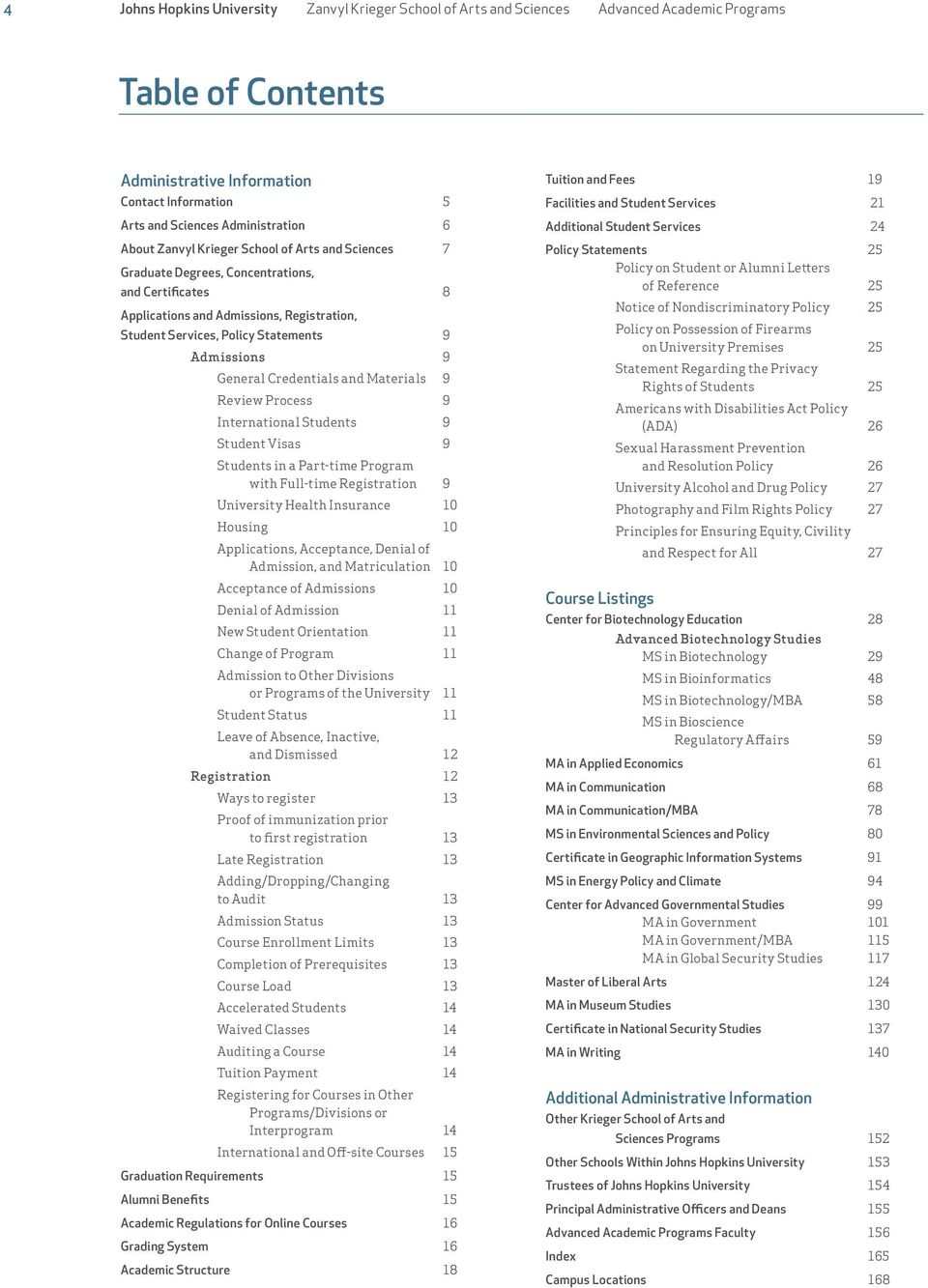
6 4 Johns Hopkins University Zanvyl Krieger School of Arts and Sciences Advanced Academic Programs Table of Contents Administrative Information Contact Information 5 Arts and Sciences Administration 6 About Zanvyl Krieger School of Arts and Sciences 7 Graduate Degrees, Concentrations, and Certificates 8 Applications and Admissions, Registration, Student Services, Policy Statements 9 Admissions 9 General Credentials and Materials 9 Review Process 9 International Students 9 Student Visas 9 Students in a Part-time Program with Full-time Registration 9 University Health Insurance 10 Housing 10 Applications, Acceptance, Denial of Admission, and Matriculation 10 Acceptance of Admissions 10 Denial of Admission 11 New Student Orientation 11 Change of Program 11 Admission to Other Divisions or Programs of the University 11 Student Status 11 Leave of Absence, Inactive, and Dismissed 12 Registration 12 Ways to register 13 Proof of immunization prior to first registration 13 Late Registration 13 Adding/Dropping/Changing to Audit 13 Admission Status 13 Course Enrollment Limits 13 Completion of Prerequisites 13 Course Load 13 Accelerated Students 14 Waived Classes 14 Auditing a Course 14 Tuition Payment 14 Registering for Courses in Other Programs/Divisions or Interprogram 14 International and Off-site Courses 15 Graduation Requirements 15 Alumni Benefits 15 Academic Regulations for Online Courses 16 Grading System 16 Academic Structure 18 Tuition and Fees 19 Facilities and Student Services 21 Additional Student Services 24 Policy Statements 25 Policy on Student or Alumni Letters of Reference 25 Notice of Nondiscriminatory Policy 25 Policy on Possession of Firearms on University Premises 25 Statement Regarding the Privacy Rights of Students 25 Americans with Disabilities Act Policy (ADA) 26 Sexual Harassment Prevention and Resolution Policy 26 University Alcohol and Drug Policy 27 Photography and Film Rights Policy 27 Principles for Ensuring Equity, Civility and Respect for All 27 Course Listings Center for Biotechnology Education 28 Advanced Biotechnology Studies MS in Biotechnology 29 MS in Bioinformatics 48 MS in Biotechnology/MBA 58 MS in Bioscience Regulatory Affairs 59 MA in Applied Economics 61 MA in Communication 68 MA in Communication/MBA 78 MS in Environmental Sciences and Policy 80 Certificate in Geographic Information Systems 91 MS in Energy Policy and Climate 94 Center for Advanced Governmental Studies 99 MA in Government 101 MA in Government/MBA 115 MA in Global Security Studies 117 Master of Liberal Arts 124 MA in Museum Studies 130 Certificate in National Security Studies 137 MA in Writing 140 Additional Administrative Information Other Krieger School of Arts and Sciences Programs 152 Other Schools Within Johns Hopkins University 153 Trustees of Johns Hopkins University 154 Principal Administrative Officers and Deans 155 Advanced Academic Programs Faculty 156 Index 165 Campus Locations 168
7 Academic Catalogue advanced.jhu.edu 5 Contact Information The Washington, DC Center Advanced Academic Programs Administrative Offices 1717 Massachusetts Avenue, NW Suite 104 Washington, DC advanced.jhu.edu [email protected] Montgomery County Campus 9601 Medical Center Drive Rockville, Maryland Administrative Offices, Gilchrist Hall Admissions and Registration, Suite 101 Main number Fax Number Administrative Office, Suite 104 Main number Fax Number Student & Faculty Support Services Washington Library Resource Center, Suite 100 Main number Fax Number Homewood Campus Wyman Park Building Suite S N. Charles Street Baltimore, Maryland Main number Fax Number Student & Faculty Support Services Montgomery County Library Resource Center General Information Course Schedules advanced.jhu.edu Weather/Cancellation Information Textbooks Admissions/Registration Washington, DC direct line from Baltimore Administrative Offices Main number Fax Number Student & Faculty Support Services Financial Aid 146 Garland Hall Milton S. Eisenhower Library Circulation University Registrar 75 Garland Hall Student Accounts B31 Garland Hall Transcripts 75 Garland Hall

8 6 Johns Hopkins University Zanvyl Krieger School of Arts and Sciences Advanced Academic Programs Zanvyl Krieger School of Arts and Sciences Administration and Faculty Administration Katherine S. Newman James Barclay Knapp Dean Judith Babbitts Vice Dean, Advanced Academic Programs Monica Moody Moore Executive Director, Academic Services Catherine A. Rossi Executive Director, Finance, Operations and Career Services Denise O Sullivan Director, Student and Faculty Services Colleen Connolly McCusker Associate Director, Career Services Faculty Advanced Biotechnology Studies Richard E. McCarty Program Chair Patrick J. Cummings Program Director and Director of the Center for Biotechnology Education Lynn Johnson Langer Program Director, Biotechnology Enterprise and Bioscience Regulatory Affairs Tom Colonna Associate Director, Bioscience Regulatory Affairs Kristina Obom Program Director, Bioinformatics and Biotechnology Robert Lessick Instructor, Biotechnology Online Education Meredith Safford Coordinator, Center for Biotechnology Education Environmental Sciences and Policy Energy Policy and Climate John Boland Program Chair Eileen McGurty David Elbert Program Director Senior Lecturer Regina Ryan Program Coordinator, Geographic Information Systems Government Global Security Studies Benjamin Ginsberg Program Chair Steven David Certificate Program Chair, National Security Studies Kathy Wagner Program Director and Director of the Center for Advanced Governmental Studies Dorothea Wolfson Alexander Rosenthal Ariel Roth Rameez Abbas Program Director, Government Assistant Director, Government Program Director, Global Security Studies Program Coordinator, Global Security Studies Master of Liberal Arts P. Kyle McCarter Program Chair D. Melissa Hilbish Program Director and Director of the Center for Liberal Arts Applied Economics Joseph E. Harrington Jr. Program Chair Dianne Scheper Program Coordinator, Master of Liberal Arts Brian Fitzek Associate Director of Non-Credit Programs Frank D. Weiss Program Director Ahmed Mahmud Program Coordinator Communication Robert H. Kargon Program Chair Museum Studies Robert H. Kargon Program Chair Phyllis Hecht Program Director Deborah Howes Assistant Director Erika Falk Program Director Sarah Chicone Program Coordinator Memi Miscally Assistant Director Judith Landau Internship Coordinator Priyanka Matanhelia Program Coordinator Paula Weissman Program Coordinator Writing John T. Irwin Program Chair David B. Everett Mark Farrington Program Director Assistant Director

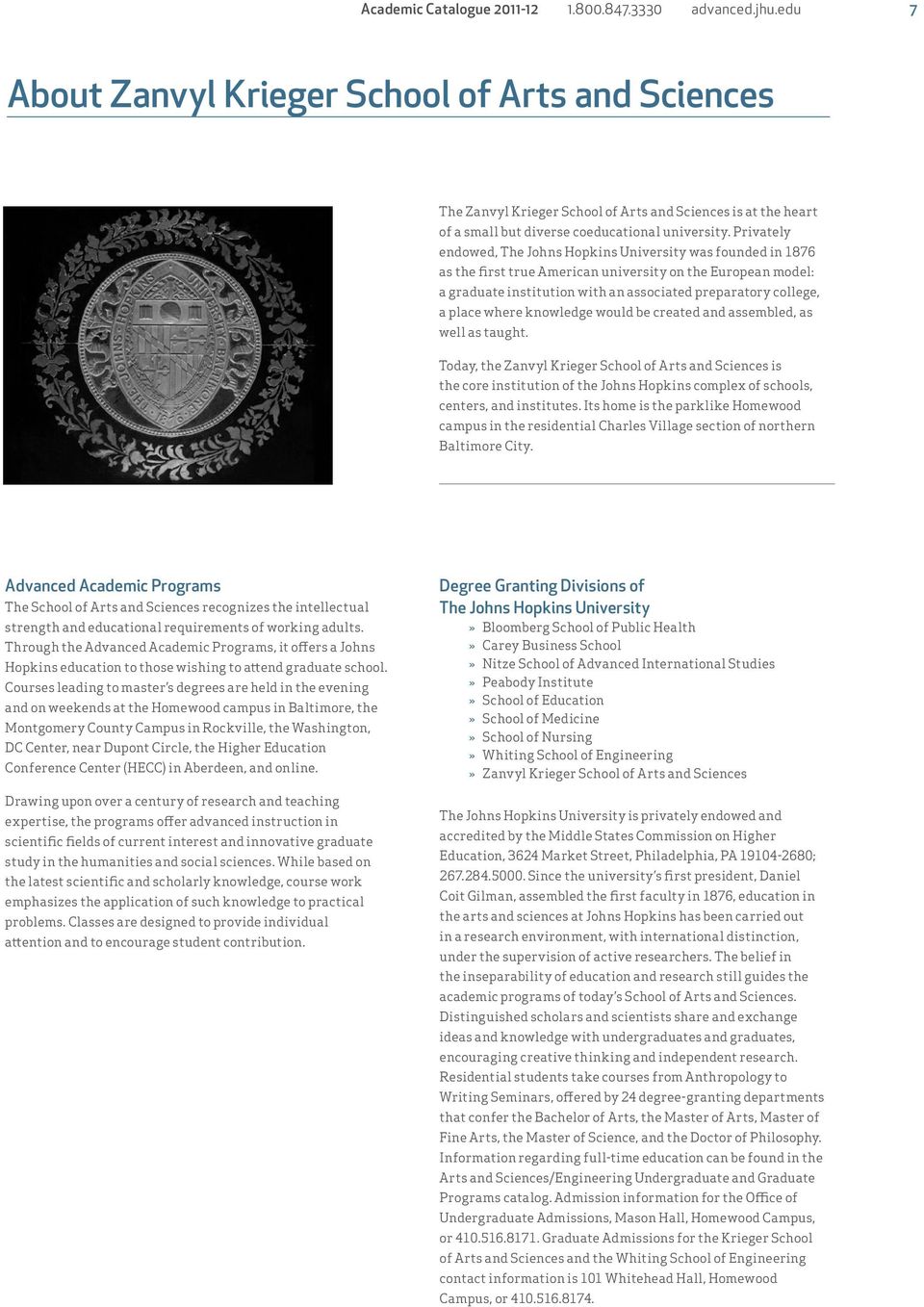
9 Academic Catalogue advanced.jhu.edu 7 About Zanvyl Krieger School of Arts and Sciences The Zanvyl Krieger School of Arts and Sciences is at the heart of a small but diverse coeducational university. Privately endowed, The Johns Hopkins University was founded in 1876 as the first true American university on the European model: a graduate institution with an associated preparatory college, a place where knowledge would be created and assembled, as well as taught. Today, the Zanvyl Krieger School of Arts and Sciences is the core institution of the Johns Hopkins complex of schools, centers, and institutes. Its home is the parklike Homewood campus in the residential Charles Village section of northern Baltimore City. Advanced Academic Programs The School of Arts and Sciences recognizes the intellectual strength and educational requirements of working adults. Through the Advanced Academic Programs, it offers a Johns Hopkins education to those wishing to attend graduate school. Courses leading to master s degrees are held in the evening and on weekends at the Homewood campus in Baltimore, the Montgomery County Campus in Rockville, the Washington, DC Center, near Dupont Circle, the Higher Education Conference Center (HECC) in Aberdeen, and online. Drawing upon over a century of research and teaching expertise, the programs offer advanced instruction in scientific fields of current interest and innovative graduate study in the humanities and social sciences. While based on the latest scientific and scholarly knowledge, course work emphasizes the application of such knowledge to practical problems. Classes are designed to provide individual attention and to encourage student contribution. Degree Granting Divisions of The Johns Hopkins University Bloomberg School of Public Health Carey Business School Nitze School of Advanced International Studies Peabody Institute School of Education School of Medicine School of Nursing Whiting School of Engineering Zanvyl Krieger School of Arts and Sciences The Johns Hopkins University is privately endowed and accredited by the Middle States Commission on Higher Education, 3624 Market Street, Philadelphia, PA ; Since the university s first president, Daniel Coit Gilman, assembled the first faculty in 1876, education in the arts and sciences at Johns Hopkins has been carried out in a research environment, with international distinction, under the supervision of active researchers. The belief in the inseparability of education and research still guides the academic programs of today s School of Arts and Sciences. Distinguished scholars and scientists share and exchange ideas and knowledge with undergraduates and graduates, encouraging creative thinking and independent research. Residential students take courses from Anthropology to Writing Seminars, offered by 24 degree-granting departments that confer the Bachelor of Arts, the Master of Arts, Master of Fine Arts, the Master of Science, and the Doctor of Philosophy. Information regarding full-time education can be found in the Arts and Sciences/Engineering Undergraduate and Graduate Programs catalog. Admission information for the Office of Undergraduate Admissions, Mason Hall, Homewood Campus, or Graduate Admissions for the Krieger School of Arts and Sciences and the Whiting School of Engineering contact information is 101 Whitehead Hall, Homewood Campus, or
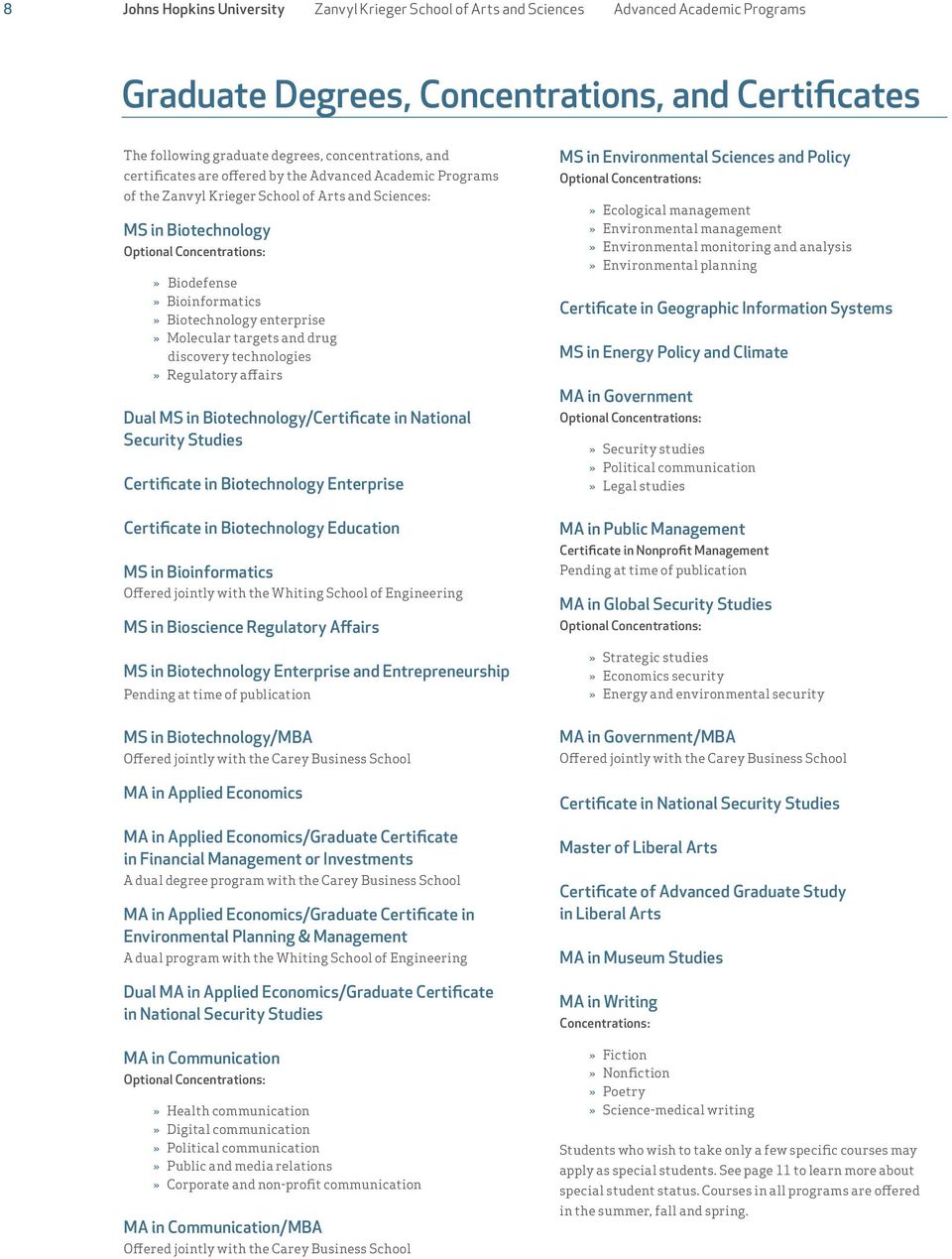
10 8 Johns Hopkins University Zanvyl Krieger School of Arts and Sciences Advanced Academic Programs Graduate Degrees, Concentrations, and Certificates The following graduate degrees, concentrations, and certificates are offered by the Advanced Academic Programs of the Zanvyl Krieger School of Arts and Sciences: MS in Biotechnology Optional Concentrations: Biodefense Bioinformatics Biotechnology enterprise Molecular targets and drug discovery technologies Regulatory affairs Dual MS in Biotechnology/Certificate in National Security Studies Certificate in Biotechnology Enterprise MS in Environmental Sciences and Policy Optional Concentrations: Ecological management Environmental management Environmental monitoring and analysis Environmental planning Certificate in Geographic Information Systems MS in Energy Policy and Climate MA in Government Optional Concentrations: Security studies Political communication Legal studies Certificate in Biotechnology Education MS in Bioinformatics Offered jointly with the Whiting School of Engineering MS in Bioscience Regulatory Affairs MS in Biotechnology Enterprise and Entrepreneurship Pending at time of publication MS in Biotechnology/MBA Offered jointly with the Carey Business School MA in Applied Economics MA in Applied Economics/Graduate Certificate in Financial Management or Investments A dual degree program with the Carey Business School MA in Applied Economics/Graduate Certificate in Environmental Planning & Management A dual program with the Whiting School of Engineering Dual MA in Applied Economics/Graduate Certificate in National Security Studies MA in Communication Optional Concentrations: Health communication Digital communication Political communication Public and media relations Corporate and non-profit communication MA in Communication/MBA Offered jointly with the Carey Business School MA in Public Management Certificate in Nonprofit Management Pending at time of publication MA in Global Security Studies Optional Concentrations: Strategic studies Economics security Energy and environmental security MA in Government/MBA Offered jointly with the Carey Business School Certificate in National Security Studies Master of Liberal Arts Certificate of Advanced Graduate Study in Liberal Arts MA in Museum Studies MA in Writing Concentrations: Fiction Nonfiction Poetry Science-medical writing Students who wish to take only a few specific courses may apply as special students. See page 11 to learn more about special student status. Courses in all programs are offered in the summer, fall and spring.
11 Academic Catalogue advanced.jhu.edu 9 Applications and Admissions, Registration, Student Services, Policy Statements The Advanced Academic Programs Enrollment Office consisting of the Office of Admissions and the Registration Office is located at the Johns Hopkins Bernstein-Offit Building, 1717 Massachusetts Avenue, NW, Suite 101, Washington, DC and is open Monday through Thursday from 9am to 6pm and Friday from 9am to 5pm. Students may also reach the office by [email protected] or [email protected]. Admissions Below are the general admissions criteria for all Advanced Academic Programs. Additional requirements specific to each program are listed in that program s section in this catalog. General Credentials and Materials Bachelor s degree from a regionally accredited US college or university. Programs require a minimum GPA of 3.0 on a 4.0 scale. Meeting the minimum GPA requirement does not guarantee admission. As detailed in the Student Status section that follows, an applicant with less than the required GPA may be admitted as a provisional student, on a case-by-case basis. A student admitted with provisional status must meet minimum grade requirements as specified by the program. Applicants who received their bachelor s degree in a country other than the US are required to provide credential evaluations and TOEFL scores if English is not their first language. Official transcripts of all college studies. A transcript is official if it is sent directly to the Advanced Academic Programs Office of Admissions from the institution the student attended or if a student delivers the transcript in a sealed institutional envelope Formal application form Applications can be found by selecting your program at advanced.jhu.edu/admissions Nonrefundable application fee: $75 Additional materials required by the chosen program as listed in that program s section Review Process The Admissions Committee for the chosen program assesses the application and its supporting documents. All materials must be received prior to the Admissions Committee review. Academic background; personal, professional, and field-related experience and achievements; and any program-specific criteria are all considered in this review. Applicants receive an admissions decision by mail. Review times may vary significantly by program depending on the volume of applications received for a given semester. Review times for completed applications range from one to three months depending on the program (Applied Economics and Liberal Arts often finalize decisions much sooner). If a decision is not reached by the program committee in time for the upcoming semester, the program will consider the applicant for the following semester. The Admissions Committees reserve the right to require that more than the minimum standards be met for admission to any academic program and may require additional materials of the applicant if deemed necessary to make an admission decision. International Students Students who earned their post-secondary degree(s) in a country other than the United States are required to have a course-bycourse credential evaluation with GPA performed by an outside evaluation service. A number of organizations render this service. The following two credential evaluation services are acceptable: World Education Services (WES) assists students with initiating the evaluation process and can be reached at wes.org or Students may also call the WES office in Washington, DC, at , where a local representative can assist them. Also, Educational Perspectives, educational-perspectives.org or Please allow four to six weeks for an official credential assessment to be completed and forwarded to the Advanced Academic Programs Admissions Office in Washington, DC. The Test of English as a Foreign Language (TOEFL) is required of any international applicant who has not graduated from an accredited college or university in the US or whose native language is not English. Submit results directly to the AAP Admissions Office. Photocopies will not be accepted. AAP requires a minimum score of 600 on the paper test, 250 on the computer-based test, and 100 on the Internet-based test. For information, contact the nearest American embassy; write to TOEFL Services, Educational Testing Services, Rosedale Road, Princeton, NJ or visit ets.org. International students should see the frequently asked questions page for international students on the AAP website, advanced.jhu.edu/students/international-students. Student Visas Students admitted as degree candidates who plan to take courses onsite in the USA, and who take at least three courses per semester, may request certification for an F-1 visa. Students for whom this may be a possibility should indicate yes on their admissions application at the appropriate checkbox regarding initiating the visa process. AAP international students on F-1 visas can only begin their program in the fall or spring semester. In order to maintain status on an F-1 visa, students in AAP must

12 10 Johns Hopkins University Zanvyl Krieger School of Arts and Sciences Advanced Academic Programs be enrolled in a minimum of three courses per semester, only one of which can be an online course. The Office of Admissions of the Advanced Academic Programs will assist in the certification process ([email protected]) which the student must complete with the Office of International Student and Scholar Services (OISSS). The International Student Office (OISSS) is available to answer questions for admitted students at or [email protected]. Special conditions and requirements apply for international students on a F-1 visa in applied economics (see applied economics program description) for details. Students in a Part-time Program with Full-time Registration Advanced Academic Programs consists of part-time graduate programs. Courses are offered in the evenings, on Saturdays, and online. Students taking three courses or more are considered as full-time status in a part-time program and are not eligible for certain services on the Homewood (Baltimore) campus designated only for students enrolled in full-time programs. For programs that are offered on multiple campuses, it is important to note that JHU does not provide transportation between campuses, and that public transportation between campuses is limited. The Homewood campus in Baltimore is approximately 42 miles (68 km) from Washington, DC and approximately 49 miles (79km) from the Montgomery County Campus. It is best for students to choose a primary campus or center location and consult with their academic advisor in course selection, as all courses are not offered each semester. Students can also carpool with other students and make use of the Zipcars on the Homewood campus (see Taxicab and limo service is also available but is a more costly alternative. University Health Insurance International students who are enrolled in three courses or more to satisfy their visa requirements.should enroll in the University Student Health Insurance plan or a comparable plan. The University plan is only open to AAP students enrolled in a minimum of three courses per semester. The University Student Health Insurance plan has enrollment periods over the summer (for fall enrollment) as well as during January (for spring enrollment). Additional information can be found at advanced.jhu.edu/students/student-healthinsurance. Housing Advanced Academic Programs does not provide housing for students. However we do provide a general resource of local housing information. Visit advanced.jhu.edu/students/housing-resources for more information. Applications, Acceptance, Denial of Admission, and Matriculation Students may apply throughout the year and begin study during any of the three semesters (summer, fall, spring). While applications are accepted year-round (summer,fall, spring) for all programs, all applicants are strongly encouraged to apply and complete the application process two to four months before the start of the desired semester. (Applied Economics and Liberal Arts applicants may apply one to four months before the start of the semester).international applicants must submit all application materials three months prior to the start of the intended semester of study. Once applicants have submitted a complete application, they will be assessed by the program s Admissions Committee. All materials must be received prior to the Admissions Committee review. Academic background, as well as personal, professional and field-related experience and achievements are considered in this review. Review times may vary significantly by program; review times range from one to three months. If a decision is not rendered in time for an upcoming semester, the application will be reviewed for the following semester. Application on file: The Johns Hopkins University Advanced Academic Programs accepts applications up to one year in advance of the intended semester of study. The Office of Admissions requires no deadlines by which an applicant needs to submit an application. However, many programs fill early and therefore encourage early application (3-4 months in advance). International applicants must submit all application materials three months prior to the start of the intended semester of study. Once the Office of Admissions receives a complete application, it is reviewed by the Admissions Committee for a decision. When a decision has been reached, the applicant will be notified via the US postal service for domestic applicants and via FedEx for applicants abroad. An incomplete application is valid for one semester following the intended semester of study. An applicant can only apply to one program at a time. An application is held on file for one year from the date of its initial receipt. Applicants who fail to submit required supporting materials within this period, and wish to be considered for admission, must submit another application and fee and all required supporting documents. Admitted students: Admitted students may defer the start of their studies for up to one year from the date of their admissions letter. Enrollment after the one-year grace period is possible only if a student submits another application and fee. A student who reapplies must satisfy admission and program requirements in effect at the time of reapplication. Acceptance of Admissions Newly accepted students are directed to a decision form available on the new student website. Access details are included in the admission letter. Failure to enroll within one year of the date of admission is interpreted as a change of plans on the student s part and necessitates reapplication if later enrollment is desired. Starting from the first course counted toward fulfillment of the master s degree program, the student has five years to complete all course work (see page 18, Time Limitation).

13 Academic Catalogue advanced.jhu.edu 11 Denial of Admission All admission decisions are final. Decisions are made by the program committee and are sent in writing to applicants. The Admissions Office cannot discuss the committee decision. In the case of denied admission, applicants are encouraged to review the admissions requirements for the program in which they are applying. The Advanced Academic Programs urge that denied applicants take the necessary time to improve their application before reapplying. Improvements can include (but are not limited to) taking the GRE, submitting a new writing sample or taking additional courses in a related field at an accredited college or university. Please note that an improvement to the application or reapplication does not guarantee admission into the program. The applicant will need to reapply to the program by submitting a new application, $75.00 application fee, and submit any additional supporting documents. New Student Orientation Once admitted to Advanced Academic Programs, students complete a web-based new student orientation at advanced.jhu.edu/ students/orientation. This orientation provides guidance for students to understand administrative processes at Advanced Academic Programs and to learn about available resources. The orientation provides important steps for all AAP students to cover, whether they are taking courses at the Washington, DC Center, on the Homewood campus, at the Montgomery County Campus, or online. Change of Program Students who wish to change to another degree program within the Advanced Academic Programs must fill out a Change of Program request form at advanced.jhu.edu, Current Students and Forms. Current students do not have to forward a new application, fee, or transcripts. Documents required by the new program, but not submitted previously, need to be added. Students are not automatically admitted to a new program; their request is reviewed by the appropriate Admissions Committee according to the stipulations of the new program. Admission to Other Divisions or Programs of the University An admitted student in the Advanced Academic Programs who wishes to transfer to another school in the university or to a full-time program in the School of Arts and Sciences must apply to the appropriate school or the Office of Admissions for Arts and Sciences full-time programs. Admission to the Advanced Academic Programs establishes no claim or priority for admission to other divisions or programs of the university. Student Status Degree Candidate Qualified applicants are admitted as degree candidates and structure course work toward a specific master s degree based on the program requirements with guidance from the advisor. To be admitted as a master s degree candidate, an applicant must be in the last semester of undergraduate study or hold a bachelor s degree from a regionally accredited college or university. An applicant is admitted as a degree candidate to a specific degree program after the Admissions Committee for that program reviews the completed application and determines eligibility. A degree candidate may also be a student who was initially admitted as a provisional student and fulfilled the criteria for change of status to degree candidate. Provisional Student Provisional students are admitted to this status because, in the view of the Admissions Committee, they do not fulfill academic requirements for admission as a degree candidate at the time of the application. Provisional students may be required to take specific prerequisite courses, and/or take a specific number of courses and complete them successfully in order to establish their eligibility to be admitted as a degree candidate. During the time of this provisional status, students are held to grading criteria stricter than those required of degree candidates (see page 16, Grading System, Requirements). Specifics of a provisional admission are outlined in a formal admissions letter mailed to the student. All listed criteria must be met for a student to continue to enroll in courses. The Writing Program may require the submission of certain new application materials for provisional students seeking degree candidacy. Upon receipt of additional materials and committee review, a follow-up formal admissions letter will be mailed to the student. Special Student A special student is one eligible for admission as a degree candidate to the chosen program, but is not interested in pursuing the degree. A special student may take courses for personal or career goals or for transfer to another university. To be able to register for any Advanced Academic Programs course, a student must submit all required admissions documents for the program in which the student desires to take courses and be accepted to the Advanced Academic Programs. Official transcripts are required. Special students are permitted to enroll in any courses for which they satisfy the stated prerequisites. In the MA in Writing Program, special students must obtain program approval for any course before registration. As long as special students do not interrupt their studies for more than one year and remain in good academic standing, they can continue taking courses indefinitely. If more than one year lapses between registrations, special students are required to reapply (see below, Leave of Absence, Inactive, and Dismissed).

14 12 Johns Hopkins University Zanvyl Krieger School of Arts and Sciences Advanced Academic Programs Special students are welcome to apply to be accepted as a degree candidate at any time during their studies. The Admissions Committee for their program will determine if any courses completed thus far can count toward the degree; program requirements and time limitations in effect at the time of this application will guide the admission decision. Special students taking Advanced Academic Programs courses in some programs under the auspices and with the advice of their home school must submit a letter to this effect from their home school before enrollment. Students in this group may take only those courses specified by their home school. Conditional Student A conditional student is an undergraduate student in the last semester of undergraduate studies. These applicants can be admitted with the condition that they successfully complete their undergraduate studies and submit an official transcript verifying degree conferral prior to registering for their second semester. Change of Student Status Once provisional students have met the criteria outlined in their admissions letter, the student must formally request a change in status. Complete a Request to Change Student Status Form available at advanced.jhu.edu by selecting Current Students, Forms. The request will be reviewed by the Registration Office and the academic program advisor to verify eligibility for degree candidacy. Writing Program students may have to submit additional materials to be reviewed by the Admissions Committee before seeking degree candidacy. Leave of Absence, Inactive, and Dismissed Leave of Absence Students who anticipate that they will not enroll in classes for a period of one year or more, but believe that they will resume their studies, must complete a Request for Leave of Absence Form at advanced.jhu.edu by selecting Current Students, Forms. The appropriate program committee will consider the request and will inform the student in writing of the decision. Students who are granted a leave of absence must contact AAP s Registration Office prior to resuming their studies at the end of the allotted leave time. If granted a leave of absence, students automatically receive an extension for the same period of time. All other criteria listed in the Time Limitation section (see page 18) remain in place. Leaves of absence are granted for up to two years. A leave of absence may not be granted to a student who is currently on thesis continuation. Inactive Students who do not attend courses for more than one year without obtaining a formal leave of absence from the Advanced Academic Programs lose their active status. The student is considered to have withdrawn from the program. To resume taking courses in the Advanced Academic Programs, students must reapply by submitting a new application form, a new application fee, and any new application materials required. Reapplying students are subject to the admissions and program requirements in effect at the time of the new application. Acceptance for inactive students is not guaranteed, and courses taken prior to the interruption of studies may not count toward degree requirements. Dismissed Provisional students who do not earn the necessary grades in any course are dismissed from their program. Degree candidates must adhere to grade requirements in order to remain in the program. Dismissed students may re-apply to another program in Advanced Academic Programs immediately; however, admission is not guaranteed. A dismissed student must wait four years from the date of dismissal for admission in the fifth year if re-applying to the same program from which he/she has been previously dismissed. Readmission is not guaranteed. Registration Requirements New and active students can register for courses online using the ISIS System (Integrated Student Information System) at isis.jhu.edu. Step-by-step instructions are provided on the site. The ISIS project represents the university s ongoing commitment to a fully integrated student information system accessible through the web. The system will provide students access to financial aid, billing, and enrollment records in one location with the same interface. Strong authentication security assures confidential access to information by students using any popular web browser and their JHED login ID and password. Students can also register using the paper Registration Form. The form can be found at advanced.jhu.edu/registration. Complete the form and fax to A completed registration requires payment or verification of how payment is to be made. Students who have not completed financial aid forms, or have unpaid bills from a previous semester/term, will have a Hold in the registration process and will not be allowed to register until Student Accounts processes payment and removes the Hold. Several business days are required to accomplish these processes.

15 Academic Catalogue advanced.jhu.edu 13 Students are asked to be sure they have fulfilled the appropriate prerequisites for each course before registering. It is the student s responsibility to make sure the requirements are met and appropriate grades are in place in order to register and advance through their academic program. Once a registration is received, allow four working days before checking your confirmation online at isis. jhu.edu. Students registering for their first fully online course (in any program) are required to take the Are You Ready for Distance Education? questionnaire at advanced.jhu.edu/online/survey before they register. An online orientation week precedes the start of each semester/term, and is a requirement for all first-time fully online course participants. Ways to register 1. Online at isis.jhu.edu 2. Mail to Johns Hopkins University, Advanced Academic Programs, Enrollment Office, 1717 Massachusetts Avenue, NW, Suite 101, Washington, DC Faxed: Hand-deliver to AAP at any of the three locations Each semester the course schedule is posted at advanced.jhu.edu/registration. The course schedule is available only online and students are encouraged to enroll early for best selection. Proof of immunization prior to first registration The District of Columbia requires all students under the age of 26 to submit an Immunization Form. This requirement applies also to students who are taking online classes. The form can be found at advanced.jhu.edu/students/forms. Late Registration Registration is open for approximately two months prior to the start of a semester/term, offering several ways for students to register. Late registration starts the day after registration ends and requires a $150 fee. Check the Academic and Registration Calendar for late registration deadlines. Students registering late should check the Refund Schedule. Students who wish to register late can fax their registration to Adding/Dropping/Changing to Audit The Add/Drop/Audit Form is for students who have registered for a course during the registration and late registration periods and who wish to add a course, drop a course, or change to audit. Complete the form by going to advanced.jhu.edu, Current Students, Forms. Students on financial aid should consult the Office of Financial Aid to ensure all required terms and conditions for aid have been satisfied. Submit the Add/Drop form to staff at the Montgomery County Campus, Homewood campus (Wyman Park Building), or Registration Office in Washington, DC. Students can also fax the request to Deadlines for completing this procedure are given in the Academic and Registration Calendar. Faculty cannot initiate, complete, or process Add/Drop changes. Students who register but never attend or stop attending a course but do not officially drop the course will be given an F grade for the course and will not be given a refund. Requests to drop a registration must be received by fax to be processed for the appropriate refund based on the date they are received by the Advanced Academic Programs Registration Office in Washington, DC. Admission Status Only students admitted to the Advanced Academic Programs with an active status may enroll in courses (see page 12, Inactive). The exception to this policy is students enrolling from other Johns Hopkins programs as detailed in Interdivisional and Interprogram Registration (see page 14). Course Enrollment Limits All AAP courses have enrollment limits. It is not always possible to offer additional sections of oversubscribed courses. A waiting list option is available in ISIS during the registration period for most courses with full enrollment. Completion of Prerequisites The prerequisites for each course can be found in the program sections of this catalog. It is the student s responsibility to check the prerequisites for each course and register appropriately. A student may be administratively dropped if he/she has not met the stated prerequisite. Course Load Students who are working full time are advised that two courses per semester is a challenging academic load. Students who elect to register for more than two courses should be working less than full time to successfully manage three or more courses per semester. Students expecting to take three or more courses (except international students seeking an F-1 visa who are required to be in a full-time classification) are required to complete a Request to Accelerate Academics Form. Go to advanced.jhu.edu, Current Students, Forms. The completed form will be sent to Registration and the academic advisor. Note that some programs require permission from the academic advisor before enrolling in three or more courses. Students have five years to complete their academic program from the start of their first graduate-level course toward their academic program, and it is highly recommended that students take the appropriate time to do well in all courses.

16 14 Johns Hopkins University Zanvyl Krieger School of Arts and Sciences Advanced Academic Programs Accelerated Students In some programs (Applied Economics, Biotechnology, and Government), recent Johns Hopkins undergraduates may apply to a special program that allows them to accelerate their time to degree completion. For more information contact the Office of Admissions at Waived Classes In some programs, students may wish to request that a core course or prerequisite course be waived based on previously completed course work. All requests must be submitted in writing to AAP Registration Office at least three weeks prior to the start of the semester. The request will be forwarded to the appropriate program committee. Supporting documentation such as copies of syllabi and course descriptions will aid the appropriate committee in making a decision in the best interest of the student. All waived core courses or prerequisite courses are replaced by electives or other courses so that students take the required number of courses to complete their degree. Auditing a Course Students may register as auditors. Auditors receive no credit for the course and a grade of AU is placed on their official transcript. There is no reduction of fees or tuition when auditing a course. Although regular attendance is expected of auditors, they are exempt from quizzes, examinations, and other assigned work. Students who take courses for credit are given enrollment priority over auditors. Students who are enrolled for credit but wish to become auditors during the active semester request the necessary change by filling out an Add/Drop form. Please refer to the Academic and Registration Calendar for the deadline by which to request to audit a course. Tuition Payment In order to complete your registration or verification of payment method of all tuition and fees is required for each semester at the time of registration. Registration forms can be downloaded from advanced.jhu.edu/registration or are available at the Advanced Academic Programs front desk in the Montgomery County, Washington, DC, and Homewood locations. AAP students may register online indicating payment by check, credit card, employer contract (employer authorization), tuition remission, or financial aid. Students registering in joint degree programs or dual degree programs are asked to register by fax or mail, in order to expedite registration in multiple divisions. In all cases, students are not permitted to register if there is a balance due on their account from a previous semester. Employer Contract Students whose tuition is paid by employer billing authorization (employer contract) should begin processing requests with their employers well before the start of registration. Hand deliver original documents to AAP staff at the front desk in Montgomery County, Washington, DC, or Homewood or mail to AAP Registration Office at 1717 Massachusetts Avenue NW, Suite 101, Washington, DC Students using an employer contract are financially responsible for any tuition and fees not paid by the employer. Employer Reimbursement Students who are requesting employer tuition reimbursement must pay for the course at the time of registration with their own funds and request reimbursement from the employer at the appropriate time. Financial Aid Students who plan to request financial aid to cover their tuition should submit the appropriate paperwork in time to register. Go to jhu.edu/finaid/part_time.html or [email protected]. Financial aid is available to students who take a minimum of two courses per semester. Students may also look at alternative loans for one course registration. The JHU Policy for Satisfactory Academic Progress requires all students to advance in their program with appropriate grades and within the appropriate timeline to continue receiving financial aid. The financial aid code for JHU/AAP Is E JHU Tuition Remission Students receiving tuition remission benefits from Johns Hopkins University should read the contract carefully. Call the Center for Training and Education at to address any questions. Registration is complete when the Registration Office receives a completed Tuition Remission Benefit Application and your registration form if registering by paper. The completed form may be faxed to Please note that students are financially responsible for dropped courses paid for with tuition remission and any associated fees, if applicable. See JHU s Benefits website for specific information regarding tuition remission: benefits.jhu.edu/ tuition/remission.cfm Registering for Courses in Other Programs/Divisions or Interprogram With advisor approval, Advanced Academic Programs (AAP) students may count up to two comparable courses, or their equivalent, toward their master s degree taken at other Johns Hopkins schools, in other Arts and Sciences programs, or in another program in AAP (see page 18, Time Limitation).

17 Academic Catalogue advanced.jhu.edu 15 Other Programs/Divisions Interdivisional Form To obtain advisor approval, students must forward to their advisor a written request which includes documentation of course description, number of credits, and any other information that may be helpful in assessing the course s applicability to a student s program. The student s advisor then determines if the requested course is appropriate and whether the student is eligible to take it. The advisor s approval should accompany the Interdivisional form documenting that the student can count the course from another division toward their degree. The student submits the Interdivisional form to the AAP Enrollment Office for review and processing. To ensure that there is time for review and approval from other divisions within Johns Hopkins, the Interdivisional form must be received in the AAP Registration Office no later than two weeks before the first day of class. Interdivisional registrations are processed during late registration to allow Advanced Academic Programs students first eligibility into courses. Interdivisional registration is not guaranteed. Interdivisional forms are available at the AAP Registration Office (1717 Massachusetts Avenue, NW, Suite 101) or at the AAP front desks at the Homewood and Montgomery County campuses. Interprogram AAP students wishing to count a course outside their program toward their degree need to obtain advisor permission, unless the course is cross-listed in the Course Schedule (advanced.jhu.edu/registration) or otherwise listed as part of shared concentrations. Up to two cross-listed courses may be applied toward a degree in AAP. Students in other divisions of Johns Hopkins may take courses in the Advanced Academic Programs if permitted by their home division, with permission of the AAP program advisor and if space is available after registration has closed. Such students must obtain their advisor s approval on an Interdivisional Registration form available from either their home school registrar or the AAP Enrollment Office. Interprogram registration is not guaranteed. International and Off-site Courses Some AAP programs may offer courses at an International location or at a site that is not on the Johns Hopkins University premises. These courses may have different registration deadline requirements and refund schedules as well as additional registration paperwork. Students should check the website and ISIS messaging carefully for these differences. Graduation Requirements Application for Graduation Students planning to complete their degree requirements at the end of the semester for which they are registering must notify the AAP Registration Office of their intentions by completing the online graduation application form found in ISIS. This form should be completed when registering for the last course(s) needed to complete the degree; it initiates the graduation review process without which a student cannot be cleared for graduation. The Registrar s Office will periodically correspond with the student using the JHU account address provided to all students in order to provide important information about administrative details, events, and deadlines. (Please note under Tuition and Fees, see page 19, there is a $100 graduation fee.) The application for graduation form is valid for only one semester. If students do not complete their degree requirements during the semester expected, they must resubmit the application form while registering for the next semester. However, students are charged only once for the $100 graduation fee. Completion of Degree Requirements The Johns Hopkins University confers degrees three times a year (August, December, and May) to all students who have completed requirements during the spring, fall, or summer semesters. The university-wide commencement ceremony and the master s degree ceremony take place once a year in May at the Homewood campus in Baltimore. Diplomas are mailed to graduates at the address given on the graduate application found online in ISIS. The conferral date is the date that will appear on a graduating student s transcript. Alumni Benefits Advanced Academic Programs alumni are always welcome to register for courses in AAP. Alumni are important resources for our programs, and should see our programs as a way to continue their education beyond their original degrees. In addition, having alumni in courses boosts the academic rigor, knowledge, and experience in the classroom. To promote this interaction and to provide opportunities for alumni to take courses they missed or that will help them remain current in their fields, AAP offers the Alumni Tuition Benefit Program. A special Registration Form is posted on the website for alumni. Interested alumni will select either a full-credit, full-tuition option or a non-credit, reduced-cost alumni benefit option. They will be required to complete the application form so we have updated information, but they will not be required to submit a resume, a writing sample, letters of recommendation, transcripts, or any other normal addenda. They will need to confirm with us that they are, indeed, graduates of AAP. The application fee will be waived for both options.
18 16 Johns Hopkins University Zanvyl Krieger School of Arts and Sciences Advanced Academic Programs Full-Tuition Option (with credit): Alumni who have applied through the method noted above will be able to register for an approved course as a special student. Their registration will be processed in a timely manner during regular registration or late registration. They will be in competition for seats along with current students (first-come, first-served). The course will appear on a transcript. Space-Available Tuition Benefit (non-credit): Alumni interested in this option will be eligible for a 50 percent reduction in tuition in any course for which they qualify, on a space-available system, in a participating program. No record of this course will appear on the transcript. Qualification Required: In all cases above, alumni can enroll only in courses for which they qualify. For instance, they would not be able to enroll in courses that require certain prerequisites they have not completed. Nor would alumni be able to enroll in courses outside their chosen concentration or degree program without qualifying for that course. Each participating program will determine the qualification process for a program, concentration, student, or course. A program may elect to limit the courses open to alumni or they may reserve a certain number of slots for current students. Academic Regulations for Online Courses Students submitting registration forms for online courses must have fulfilled the following criteria at the time registration is received: 1. All prior financial obligations to the university are met. 2. Payment for the course is included with the registration.(if paid for by financial aid, that financial aid has already been cleared with the Financial Aid Office.) Registration for online courses can only be processed when all the above requirements are fulfilled. Online courses often fill quickly. Any delay in submitting a completed registration form for an online class may result in that course being filled and no longer available when the registration is processed. Orientation Course All students taking their first fully online AAP course will be required to participate in an online Orientation course before the term starts. Students will learn how to navigate, collaborate, and communicate in a fully online course. The Orientation provides valuable hands-on experience with the course management system. Important information regarding the technical requirements and support resources available will be given in the Orientation. Students should expect to devote three to four hours to the Orientation, but it may be spread out over several days. Returning students are welcome to participate and to review techniques and tools. All students are encouraged to revisit the Orientation to test for access to online library resources in the Library Module. Information about where and how to take the Orientation course will be provided to students by to their JHU address. Online Library Access As part of online course offerings, Advanced Academic Programs is committed to providing online library resources to all students. New online students are required to obtain access as part of the orientation and are supported in this process. Instructions for remote library access can be found at library.jhu.edu/services/computing/remoteaccess.html. Class Structure Advanced Academic Programs online courses are asynchronous. Students access course materials and discussion at individually desired times. Students share learning actively through the web-based course site with readings, assignments, group activities, and threaded discussions as guided by their instructor. Course format and structure pro-mote active and interactive learning. Online Bookstore AAP has partnered with an online bookstore, MBS Direct, to service online students as well as students enrolled in on-site courses. MBS Direct offers competitive pricing, new and used books, and buy-backs from their large distribution center. Students can access the bookstore at mbsdirect.net approximately four weeks prior to the start of each semester to purchase their texts. Questions about MBS Direct or its services can be directed to the Customer Service Center at or [email protected]. Residency Requirement Some programs are offered fully online, and some have no online courses. Still others have an on-ground requirement in addition to courses offered online. Each program has specific requirements, and it is the student s responsibility to check with their program advisor to ascertain the requirements pertaining to their program. Grading System Scale The grading scale for students enrolled for credit is A+, A, A-, B+, B, B, C, and F. An I (Incomplete) grade is assigned by the instructor who has given the student permission to delay completion of specific course work for a justifiable reason for a specific amount of
19 Academic Catalogue advanced.jhu.edu 17 time. W (official Withdrawal), and AU (Audit) are requested by the student and cannot be assigned by the instructor. A grade of F indicates the student s failure to complete or comprehend the course work. An F grade is not removed from a student s transcript even if a course is repeated. Requirements If a degree candidate receives a grade of C or below in a core course, the student must repeat that course. Even if the course is repeated, the original grade will remain on the student s transcript, and the student may not receive another grade of C or below. Some programs also require students who earn a C or below in a required course to repeat the course. For specific guidelines on what courses are considered core and/or required, consult the program director of the respective program. Special students (those who satisfy all requirements for admission to degree candidacy but who choose not to seek a degree) are held to the same performance standards as degree candidates. Provisional students cannot continue in a program if they earn a grade of B or below in any course taken while they are in provisional admissions status. Probation and Dismissal Degree candidates who receive a grade of C or below are on academic probation. See Requirements section above for details and clarification regarding grade requirements for degree, special, and provisional students. When a course is repeated, both the original grade and repeated grade appear on the transcript. The degree candidate receives credit only once for the course; however, the original grade of C (or below) places the student on probation. If a degree candidate receives a grade of C in an elective course, the course need not be repeated, and the course can be counted toward degree requirements. Degree candidates who receive a second C or below in either a repeated core course or any course taken in the program will be dismissed from the program. Special students are held to the same performance standards as degree candidates. Provisional students who receive a grade of B or below in any course cannot repeat the course and are dismissed from the program. Students dismissed may apply to another program in Advanced Academic Programs immediately; however, admission is not guaranteed. A dismissed student must wait four years from the date of dismissal before reapplying for admission in the fifth year to the program in which he/she has been dismissed. Readmission is not guaranteed. Incomplete A designation of Incomplete (I) is assigned when a student fails to complete a course on time for valid reasons as determined by the instructor. A student requests a status of Incomplete from the instructor. The Resolution of Incomplete form can be found at advanced.jhu.edu, Faculty, Grading Policy. The student notes the reasons for requesting the Incomplete and plans for resolving it. Student and instructor sign the form. Instructors send the completed form to the JHU Registrar. An Incomplete is granted at the instructor s discretion; conditions for absolving it are established by the instructor. It is the student s responsibility to submit all work at the agreed-upon time. If a student does not complete the incomplete course by the time designated in the agreement with the instructor, the I will convert to an F. A $25 change-of-grade fee should be mailed to the Registration Office in Washington, DC, and is required to make the transcript change. Students who expect to complete degree requirements during a given semester/term but earn an Incomplete in that semester/term are not certified for graduation until the end of the semester/term that follows. Withdrawal The W (Withdrawal) grade signifies an official withdrawal approved by the Advanced Academic Programs Registration Office. The student initiates the withdrawal by faxing a completed Add/Drop form to The Add/Drop form can be found at advanced.jhu.edu, Current Students, Forms. A W (Withdrawal) cannot be assigned by the instructor. For further information see advanced.jhu.edu/registration, and then select Refund Policy. Transfer Credits Graduate courses taken at any institution other than The Johns Hopkins University are not accepted and cannot count toward graduate degree requirements in the Advanced Academic Programs, unless specific approval is received in writing by the program director. Academic Standing The university reserves the right to exclude at any time a student whose academic standing or general conduct is deemed unsatisfactory. Academic Integrity Graduate students at Johns Hopkins are expected to understand the ethical standards of the university, hold the highest standard of integrity for their work, and avoid academic dishonesty in all forms. Ignorance of ethical rules is no excuse for cheating. It is the further responsibility of every student to report to the instructor or their program s director any suspected violations of academic ethics by peers. Enforcement of our Code of Conduct is a shared responsibility and should not depend on the university alone. We all celebrate the rigor of a Johns Hopkins education, but that rigor loses its meaning if students cheat. Students who violate this Code of Conduct face a range of penalties, including failure of a course, permanent university transcript notice of an ethics violation, loss
20 18 Johns Hopkins University Zanvyl Krieger School of Arts and Sciences Advanced Academic Programs of a degree, or expulsion from the university. Please see the Code of Conduct for procedures and responsibilities. This pamphlet is available at all three Advanced Academic Programs sites and is available online at advanced.jhu.edu/media/files/policy/code_of_ conduct_student_6_2007.pdf. At The Johns Hopkins University and in the Advanced Academic Programs we have a zero tolerance policy for plagiarism and other violations of our ethics policy. Ethics violations of any kind are taken seriously and may result in dismissal from our program. The best way you can keep yourself from committing an act of plagiarism is to be properly informed. At a minimum, please remember that any words taken verbatim from a source must be cited and contained within quotation marks. Even if you have paraphrased an idea from a source you must provide the appropriate citations. Ignorance of these principles will not be an acceptable excuse for violation of the policy. For further information and assistance in determining when and how to properly cite your sources, please link to an excellent resource provided by the Eisenhower Library of Johns Hopkins University at library.jhu.edu/researchhelp/index.html. An equally useful resource with clear and specific definitions of plagiarism can be found at turnitin.com/static/home.html. Grade Disputes If a student does not agree with the grade an instructor assigned in a given course, the student must contact the instructor first to attempt to resolve the disputed grade. If the instructor and the student are unable to reach an agreement, the student may present his/her argument to the program committee in writing with supporting facts and documents. The program committee which may include other members of the AAP faculty may solicit the instructor s evaluation in writing or members may ask the instructor and/ or the student to appear before them. The committee then determines whether the disputed grade should be changed or retained and informs the student and the instructor of its decision. The committee s decision is final. Grade disputes must be submitted to the program committee no later than the last day of classes for the following semester. Time Limitation Students must complete all course work in a master s degree program within five years, calculated from the start of the first course that counts toward the degree. This time limit includes any courses taken at another Johns Hopkins division that have been approved to count toward the degree, whether or not such courses were taken during a student s studies in the Advanced Academic Programs. If necessary, students may request from their program committee an extension of time to complete their program beyond the five-year limitation. An Extension of Time Request Form is available at advanced.jhu.edu, Current Students, Forms. If an extension is granted, it will be communicated in a letter, and the five-year limit increased by the time included in the extension. All other criteria hold. An extension may be granted for a semester up to a full year, and in rare circumstances for two years. Academic Structure Advisors Each student accepted into a degree program is assigned an academic advisor who is available for consultation regarding the student s program of study. Advising is available year-round. Consultation takes place by phone, , Internet, or in person by appointment. Please see the program sections in this catalog for specific program advisor information. Semester/Term Schedule Courses in all programs are offered in the summer, fall and spring semesters. The summer semester permits a number of alternate formats; some courses meet intensively for six weeks, others for as many as 12, 13 or 14 weeks are possible, and some programs have two summer terms. The fall and spring semesters may have 13 or 14 weeks for regular classes depending on the program. The spring semester includes a three-week intersession course offered at the beginning of January and a May intensive schedule is available in select programs. Course Numbering System Advanced Academic Programs courses are numbered in the following form: (Example) 420 indicates the program in this case Environmental Sciences and Policy; 601 indicates the course number in this example Geological Foundations of Environmental Science 51 indicates the section number and location where the course is offered i.e., sections are offered at the Homewood campus in Baltimore; sections 51 to 59 are offered at the Washington, DC Center and satellites (e.g., international locations); section 61 is offered at HECC Center; sections are offered at the Montgomery County Campus in Rockville; and sections are offered online. Section 91/92 indicates an international or off-site course. Course Credit In keeping with the practice of other research universities, credit hours are not assigned to graduate-level courses (400-level and above) in the Zanvyl Krieger School of Arts and Sciences. However, if credits are required for transfer purposes, all courses at the 400-level and above carry the equivalent of four credits, and a memorandum to this effect can be included from the JHU Registrar s Transcript Office when a transcript is requested.
21 Academic Catalogue advanced.jhu.edu 19 Course Cancellations The university reserves the right to change instructors or cancel courses with insufficient enrollment or for reasons beyond the control of the university. Midterm Status Students are encouraged to talk with their instructor nearing midterm to determine the likelihood of their academic success. The student can then decide whether to initiate an Add/Drop Form to either withdraw or audit the course. Grade Reports Students may view their grades online by using the ISIS System at isis.jhu.edu/sswf. If a printed grade report is needed, students may contact the JHU Office of the Registrar, 75 Garland Hall, , to make arrangements. Enrollment/Degree Verification Enrollment Verification provides proof of enrollment for a student s financial lender, insurance company, sponsor, etc. Requests for enrollment verifications should be made to the Registrar s Office at the Homewood Campus in Baltimore. There is no fee for this service. Enrollment Verification can only be requested by the student via the request forms available in the Registrar s Office, 75 Garland Hall, 3400 N. Charles Street, Baltimore, MD 21218; or by using the form found on the following site: VerificationLetter.pdf. Verifications may also be placed through the National Student Clearinghouse. For more information visit jhu.edu/registrar/transcript.html. Transcripts The transcript is part of the student s permanent record at the university. No grade may be changed except to correct an error or to replace an Incomplete with a grade. An official transcript will be mailed at the written request of the student. There is no fee for this service. Requests for transcripts should be addressed to the Office of the Registrar, 75 Garland Hall, 3400 N. Charles Street, Baltimore, MD 21218; or call , or visit jhu.edu/registrartranscript.html. Second Master s Degree After receiving a master s degree from the Advanced Academic Programs, students may continue in a second program if prerequisites for that program are fulfilled. To receive a second master s degree from the Advanced Academic Programs, all course requirements for the second program must be satisfied. The student may count up to three courses taken as part of the first degree toward requirements of the second. However, the relevant program committee must approve the course(s) as appropriate to the plan of study, and the course(s) must satisfy the requirements of the second degree. The course(s) also must fall within the five-year limit for the second degree, (i.e., the second degree must be completed within five years, counting from the beginning of the first course accepted toward the second degree). To apply for a second master s degree, the student must submit a new Advanced Academic Programs application form, an application fee (waived if previous master s degree was earned within the past year), and any additional admissions materials required by the second degree program. Applying Courses from a Certificate toward a Degree in Advanced Academic Programs Programs within AAP may allow courses earned and applied toward a certificate to be applied toward a graduate degree. In most instances up to two courses may be applied from an AAP certificate program toward a degree. Contact the associate program chair of the respective program for details, conditions and approval. Tuition and Fees Full course tuition is due at the time of registration. All other fees are payable as noted below. Fees are not refundable. Application Fee The application fee is $75 for all programs. The application fee must be submitted with the application and is not refundable under any circumstances. Advanced Academic Programs degree recipients who wish to continue their studies or enter into another degree program in the Advanced Academic Programs, or in some other division of the university, may apply without paying a second application fee. Students who have paid an application fee (or who have graduated from any other Johns Hopkins program) within the past year do not have to pay the fee again when applying to the Advanced Academic Programs. Tuition Tuition in the Advanced Academic Programs for the academic year is $3020 per course in all programs except the Master of Arts in Writing Program, which is $2330 per course, and the Master of Liberal Arts Program, which is $1930. Courses in the parttime programs offered by other Johns Hopkins divisions carry the divisions published tuition fees. Students in AAP s programs jointly offered with other divisions pay the tuition fee published for each course. Tuition for courses in the daytime programs of the university is a percentage of full-time tuition.
22 20 Johns Hopkins University Zanvyl Krieger School of Arts and Sciences Advanced Academic Programs Course Fees Some courses require, in addition to tuition, field trip, laboratory, technology, and thesis fees. These fees, specified in the Course Schedule (advanced.jhu.edu/registration) for each semester/term, are payable at the same time as the regular tuition charges and are nonrefundable. Technology Fee A technology fee of $150 will be added for each online class in which a student registers. Fee for Removal of an Incomplete Grade Students who receive an Incomplete for a course are required to pay a $25 fee to have the I grade changed to the final grade once that grade has been submitted by the instructor. This fee must be paid to the Advanced Academic Programs Office in Washington, DC before the grade can be posted on the permanent record. No payment is required if the final grade is an F. Continuation of Enrollment Fee Students who are in a thesis course and do not finish the thesis in the semester in which they enrolled for it must pay a continuationof-enrollment fee of $500 for each subsequent semester/term (including summer) until a final grade has been submitted. Students submit a registration form with payment to the Enrollment Office. This fee also allows students to continue using university facilities such as libraries and the Johns Hopkins Enterprise Directory (JHED). Graduation Fee The graduation fee is $100, payable upon receipt of a bill (through your JHU account) from the Student Accounts office. Student Accounts sends this bill upon submission of the application to graduate. Billing schedule is subject to change without advanced notice. However, any student who graduates must pay the $100 graduation fee. Refund Policy Students may elect to withdraw from one or more course(s) for a variety of reasons. Refunds apply only to the tuition portion of a student s charges, excluding the field trip, lab, or technical fees, and are calculated from the date the student s written request for withdrawal is received in the Advanced Academic Programs Registration Office, The Johns Hopkins Bernstein-Offit Building, 1717 Massachusetts Avenue, NW, Suite 101, Washington, DC Such a request can be made by using the Add/Drop form found at advanced.jhu.edu, Current Students, Forms. Fax the form to the Registration Office at Telephone withdrawals are not accepted. Instructors or advisors never authorize or process withdrawals, though it is certainly courteous to inform the instructor of the intent to withdraw. Refunds are not granted to students suspended or dismissed for disciplinary reasons. Students who drop a course before or on the deadline for a 75% refund will not have that course listed on their official transcript. Students who drop a course after the deadline for a 75% refund (receiving a 50% refund or less) and before the end of the semester will receive a W. on their official transcript, indicating withdrawal from a course. The refund schedule for each semester is posted on the web at advanced.jhu.edu/registration/?step=3. Refunds are made in accordance with the schedule listed below and are updated on the web for each semester/term (jhu.edu/ registration). If you withdraw after your registration has been processed, the refund to which you are entitled depends on the date your written request is received by the Advanced Academic Programs Registration Office. Courses offered at locations other than Homewood, Montgomery County, Washington, DC, or online (e.g., international courses) may be subject to a separate refund policy. In the case of rare or exceptional circumstances, a student may request to appeal the standard AAP refund schedule/policy. Refund policy appeals must be submitted in writing (and received) by the Advanced Academic Programs Registration Office in Washington, DC no later than the last day of classes of the very next semester/term. All supporting documentation and/or a thorough written explanation for the appeal should be included. The appeal will be reviewed by an AAP refund appeals committee. Review times may vary depending upon the complexity of the appeal. Average review times for appeals range from four to six weeks from the date received. All decisions are final. Refund Schedule 100% Prior to late registration (See Academic and Registration Calendar). Course will not show on transcript. 90% Starting the first day of late registration and prior to the second class meeting. Course will not show on transcript. 75% Prior to the third class meeting. Course will not show on transcript. 50% Prior to the fourth class meeting. WD will be placed on transcript. 25% Prior to the sixth class meeting. WD will be placed on transcript. Please note: Students who are enrolled at The Johns Hopkins University for the first time and who are receiving federal student aid are subject to a separate refund policy during their first semester of enrollment. For further information, contact the Financial Aid Office, jhu.edu/finaid.
23 Academic Catalogue advanced.jhu.edu 21 Facilities and Student Services The Advanced Academic Programs of the Zanvyl Krieger School of Arts and Sciences are offered on the Homewood campus in Baltimore, the Montgomery County Campus in Rockville, the Washington, DC Center, HECC in Aberdeen, and online. Distances between the various AAP sites are considerable, and the university does not provide transportation between these sites. The educational and student facilities and services provided at each location are described below. The Johns Hopkins University portal at my.jhu.edu is the starting place for students and faculty and offers a one-stop-shop for Johns Hopkins news, information, and technology resources. The primary goal of the portal is to simplify and centralize access to JHU services and content. Logging in to the portal requires activation of a Johns Hopkins University Enterprise Directory (JHED) Login ID and password. The JHED Login ID and password are also used to access the Integrated Student Information System (ISIS) at isis.jhu.edu, where students can register for courses, check grades, and view and pay bills. JHED authentication is also needed for remote access to the JHU Sheridan Libraries. New faculty and students can go to my.jhu.edu to search for their name in the JHU directory and discover their personal JHED login ID. Click the First time Login tab and follow the instruction to activate the account. For additional assistance, the Hopkins Information Technology Systems help desk can be reached at HELP. Students can visit advanced.jhu.edu/students for information on student services at the various campus locations. Also located here are the steps for setting up a Johns Hopkins account. All official university information will be sent to the student s JHU address. All Locations CIRLA (Chesapeake Information and Research Library Alliance) CIRLA is a program allowing Johns Hopkins faculty and graduate students to go in person to a participating library in the region and borrow materials. A JCard must be presented to apply for CIRLA privileges. For participating libraries and instructions for borrowing, visit library.jhu.edu/services/circulation/otheraccess.html. Online Bookstore AAP has partnered with an online bookstore, MBS Direct, to service students at all locations as well as online. MBS Direct offers competitive pricing, new and used books, and buy-backs from their large distribution center. Students can access the bookstore at mbsdirect.net approximately four weeks prior to the start of each semester/term to purchase their texts. Questions about MBS Direct or its services can be directed to the Customer Service Center at or [email protected]. Homewood Campus Library Services The Sheridan Libraries encompass the Milton S. Eisenhower Library and its collections at the Albert D. Hutzler Reading Room in Gilman Hall, the John Work Garrett Library at Evergreen Museum & Library, and the George Peabody Library at Mount Vernon Place. Together these collections provide the major research library resources for the university. The Sheridan Libraries also provide a rich array of resources and services including research consultation, instructional services, and interlibrary loan services for part-time and full-time students. The Milton S. Eisenhower Library is the university s principal research library and the largest of a network of libraries at Johns Hopkins. The JCard serves as an ID and library card in the JHU libraries. Students who are Johns Hopkins employees at locations other than the Homewood campus use their divisional library or library/id card. For more information on current hours of operation, parking, and services, and to get started using the resources, please visit the libraries website: library.jhu.edu. Online Access to Library Resources Johns Hopkins University provides several options through which Johns Hopkins students and faculty can access library resources from any internet-connected location. For information on how to access these online resources when off-campus, please visit library. jhu.edu/services/computing/remoteaccess.html. For a list of resources, visit the library homepage at library.jhu.edu. Computers The range of HITS services, equipment, and instruction can be found at it.jhu.edu. This website serves as a repository for all IT-related information at Johns Hopkins. You will find a lot of useful information within this site, including an overview of the IT organization, its projects and services, support for applications and general questions, and news about emerging technologies and strategic imperatives. Students may also wish to learn more about computer facilities at the Homewood campus by visiting jhu.edu/classrooms. Johns Hopkins Bookstore Students can purchase supplies and JHU-themed merchandise at the Barnes & Noble Johns Hopkins Bookstore, located at 3300 St. Paul Street (at the corner of St. Paul and 33rd). For information and store hours, call or visit johns-hopkins.bkstore.com. Johns Hopkins Student Union The Student Union is located in Levering Hall and the Glass Pavilion and offers various programs and activities for students, faculty, staff, and friends of the university. Levering Hall also contains a complete dining facility that serves snacks and sandwiches during the late afternoon and early evening and hot meals during lunchtime.
24 22 Johns Hopkins University Zanvyl Krieger School of Arts and Sciences Advanced Academic Programs Evening Food Service There are various food venues located on and around the campus where you can have coffee, packaged sandwiches, and a broader range of dinner items. On campus options include: Nolans at Charles Commons Charles Street Market at Wolman Hall: Convenience Store with ready to eat options Silk Road Café Café Q There are also a large variety of off-campus dining options located on St. Paul Street, between 31st and 34th. Security Services Visit jhu.edu/security for an in-depth review of security services available to student, faculty, and visitors to the Homewood campus. All are encouraged to report crimes or suspicious activity by calling For any other security-related matters call Parking The Parking Office is located in the South Garage, on the south end of campus, under the Decker Quadrangle. Office hours are Monday through Friday, 7:30am 10pm and Saturday and Sunday 10am 6:30pm. Evening students and faculty have a number of options for on-campus parking. For further information and a parking map visit parking.jhu.edu or call PARK. Montgomery County Campus The Montgomery County Campus has been serving government agencies, technology and science firms, and consulting organizations on the I-270 corridor for over twenty years. Gilchrist Hall and the Academic and Research Building include administrative offices, classrooms, computer labs, a wet lab, and auditorium, and offer services such as wireless access, a library, a café, and parking. Advanced Academic Programs administrative and faculty offices are located in both buildings. Library Services Under the direction of the JHU Eisenhower Library, the Montgomery Library Resource Center (MLRC) provides reference consultation and instruction, and maintains a collection of materials for use by campus faculty and students. Subject areas in the collection include the biosciences, education,engineering, and business. In addition to the center collection, faculty and students have access to hundreds of full-text databases through workstations in the library, the open computer lab, and easy access from home and off-campus. Students and faculty can obtain journal articles, books and audio-visual material not available at the resource library. Articles can be delivered to the desktop, and material can be delivered to the center for pickup. To borrow materials, students must present their Johns Hopkins University J-Card at the circulation desk. The library is open year-round. During the fall and spring semesters, hours are noon to 9pm, Monday through Thursday; noon to 6pm, Friday; and 10am to 5pm on Saturday. To learn more, visit guides.library.jhu.edu/dcregional. Computers Computer facilities at the Montgomery County Campus include workstations and personal computers. In addition, students have access via high-speed data links to UNIX servers at Homewood. Open student computer lab hours are posted at web.jhu.edu/ MCC/computer.html. Wireless access is available in public spaces throughout the Montgomery County Campus. Food and Refreshments Royal Café, located in the Academic and Research Building, serves sandwiches, soups, and fruits in the early evening hours Monday through Thursday. Other buildings have snack vending and refreshment machines. There are student and faculty lounges in all buildings. Security Services The Montgomery County Campus has a security presence in all buildings and a security car used to patrol parking areas. In case of an emergency, call or contact the front desk in the Academic and Research Building, or front desk in Gilchrist Hall. Parking Free parking permits are issued at the front desk of the Gilchrist Hall, upon proof of identification. Those who need a valid parking permit may obtain it year-round. The entrance to the MCC parking lots has changed due to ongoing construction. Please visit web.jhu.edu/mcc for up-to-date information. Washington, DC Center The Johns Hopkins University Bernstein-Offit Building at 1717 Massachusetts Avenue, NW, is the administrative office for Advanced Academic Programs. Student Services, Admissions, Registration, and Career Services Center are located in Washington, just two blocks south of Dupont Circle accessible by Metro. The center includes a Library Resource Center, faculty and student lounges,
25 Academic Catalogue advanced.jhu.edu 23 an administrative and program management suite, as well as classrooms, executive education conference rooms, computer labs, wireless access, and a large presentation room. The Washington, DC Center provides an excellent learning environment for Advanced Academic Programs and many Arts and Sciences Washington-based initiatives. Guests, faculty, staff, and students must sign in at the security guard s desk in the lobby or show university ID. Library Services Under the direction of the Eisenhower Library, Advanced Academic Programs students in Washington are welcome to do research in the Washington Library Resource Center (WLRC). The center s staff provide reference consultation and instruction, and facilitate access to a vast array of electronic databases, journals, the online catalog, reserve services, and a collection of materials supporting each of the programs offered by the schools. Students and faculty can also obtain journal articles, books, and audio-visual material not available at the center library. Articles can be delivered to the desktop, and material can be delivered to the center for pickup. The JCard is used for identification and borrowing privileges. The Library Resource Center has 10 workstations in the Electronic Research Room. Additionally, students may access electronic resources from off-campus. The library is open year-round from noon to 8pm, Monday through Thursday; noon to 5pm, Friday; and 9:30am to 1:30pm on Saturday. To learn more, visit guides.library.jhu.edu/dcregional. Computers AAP has two teaching labs and one open lab for AAP students in the Bernstein-Offit building. Internet access connects students to university-wide electronic services. Conventional and specialized software applications are installed to meet the needs of students. Hours vary each semester and are posted at the center. Wireless Internet access is available throughout the building. Classrooms Nearly all classrooms at the Washington, DC Center are equipped with enhanced audio-visual technology including a PC, projector, audio speaker system, remote control presenter, VCR, and DVD player. Faculty and students can deliver presentations with the classroom computer provided by Advanced Academic Programs, or connect their own laptop to the AV projection system. Food and Refreshments The student lounge is located on the lower level and has snacks and refreshment machines. The lounge has tables and chairs for those who stop by any of the nearby eating establishments and wish to bring food to the center. The Galley Café, located at 1625 Massachusetts Avenue, NW, in the Airline Pilots Building, provides light fare to 7:30pm Monday through Thursday and is closed on weekends. Security Services Washington, DC students are encouraged to register with the JHU voluntary crisis alert system. This system sends text messages to students when emergency conditions exist. For more details: webapps.jhu.edu/jhuniverse/today/text_alert.pdf. At the Washington, DC Center, all students and faculty must show a JCard or other university ID at the lobby desk. Visitors are required to show a picture ID and sign in. There is a phone on the fourth floor that connects directly to the lobby security guard in case of an emergency. Parking There is a reduced-fee parking arrangement with Central Parking at 1800 Massachusetts Avenue NW. The garage is located in the lower level of the SEIU building on the corner of 18th and Massachusetts Avenue, with the entrance on 18th street. Students, faculty, and visitors may take advantage of the reduced fee 4:30 to 11pm Monday through Friday. Johns Hopkins University does not control the accessibility of this service. Online Learning Advanced Academic Programs maintains a commitment to intensive, interactive, and rigorous academic online courses. Frequent and regular participation is expected of all students, and the demands placed on online students are comparable to those of faceto-face courses. The bulk of course work is done on a student s own schedule throughout the week, making these courses ideal for serious students who need flexibility in location and timing. Course Management System All fully online courses and web-supported course sites are provided via Sakai, our Course Management System (CMS). At the time of publication for this catalog, the Advanced Academic Programs was in the process of beginning to adopt Blackboard as a CMS, which would ultimately replace Sakai in the coming semesters. Currently, students log in to Sakai using their JHED (Johns Hopkins Enterprise Directory) login ID and password. This is the same ID and password used for course registration in ISIS, remote library access, etc. For information on JHED login, course site addresses, help, and many of the Hopkins digital resources, students can visit advanced.jhu.edu/students. Students registering for online courses should be sure that to sign up for their Johns Hopkins University account and use this account for all JHU business and related academic matters.
26 24 Johns Hopkins University Zanvyl Krieger School of Arts and Sciences Advanced Academic Programs Registration Requirements for Online Courses Students taking their first online course with the Advanced Academic Programs must participate in an online Orientation Course prior to the start of the term. Please see Academic Regulations for Online Courses for each specific degree program. Library Services Advanced Academic Programs provides access to all JHU electronic library resources. Learn more at advanced.jhu.edu/students/ libraries. Online Course Technical Support AAP has a 24/7 help desk to assist students who are enrolled in fully online courses. The toll-free number is In addition, if you are enrolled In a fully online course and have a question regarding the course software (for example using the assignment tool, discussions, or exams) you can submit your question using the webform found at, embanet.com/help/jhu. Additional Student Services The Johns Hopkins Student Assistance Program The Johns Hopkins Student Assistance Program (JHSAP) is committed to assisting students in managing the challenges encountered during their academic careers. JHSAP is a life management resource that can help students identify and manage stress and other challenging issues in a healthy way before more significant problems develop. Getting help is free, easy, convenient, and confidential. JHSAP offers a variety of services including: Assessment of the current concerns/situation Brief, supportive counseling for challenges of daily living Referral to appropriate and accessible community services and resources Consultation that supports academic and/or professional development Immediate support and management for crisis situations All registered for-credit students of the Johns Hopkins University s Advanced Academic Programs may use JHSAP services. For information or to schedule an appointment, students should call or Students may also [email protected] to inquire about the program. Career Services Students and alumni seeking career counseling should contact Colleen Connolly McCusker, associate director, AAP Career Services at Students, alumni, and faculty are encouraged to join the AAP Virtual Career Network, advancedcareersjhu. aristotlecentral.com. This site has information about the job search process and an opportunity to join the networking community. Members are encouraged to post job openings and share career information. Students in the Government and Global Security Studies Programs are also welcome to contact Lucy Shapiro at for career counseling. Disabilities Services The Johns Hopkins University is committed to providing reasonable and appropriate accommodations to students with disabilities. For persons with disabilities it is important to provide to the university a comprehensive evaluation of a specific disability from an appropriate qualified diagnostician that identifies the type of disability, describes the current level of functioning in an academic setting, and lists recommended accommodations. All documentation will be reviewed, and reasonable accommodations will be provided based on the student s needs. Depending on the accommodation, there may be a time delay before accommodations can be implemented. Students should contact Denise O Sullivan, director, Student and Faculty Services at [email protected] or in the School of Arts and Sciences Advanced Academic Programs four weeks prior to the beginning of each semester or event to ensure that services will be available. Students should submit a request for accommodation form in addition to the appropriate documentation. Further information and a request for accommodation form can be found at advanced.jhu.edu/students/ disability-accommodations. Additional information is located at jhu.edu/disability. Regarding university-wide disability concerns, contact Peggy Hayeslip, director, ADA Compliance and Disability Services, or [email protected]. Inclement Weather Announcements When the university closes due to inclement weather, driving conditions, or other unforeseen circumstances, announcements are posted on the Emergency and Weather Hotline, at in Baltimore. For localities outside the Baltimore calling area, call The information is also made available on the Johns Hopkins University home page at my.jhu.edu. Financial Aid For information about federal financial aid in the form of student loans, whether taking one, two, or more courses, students should contact the Office of Student Financial Services, 146 Garland Hall on the Homewood campus. Call , at [email protected] or visit the financial aid web page at jhu.edu/finaid.
27 Academic Catalogue advanced.jhu.edu 25 Alternative Loans For students taking one course and seeking financial aid, please go to jhu.edu/finaid/grads_loans.html. For more information, call Financial Aid Programs Contact the Office of Student Financial Services for information about: Federal Direct Student Loan Federal Perkins Loan Title IV Refunds Veterans Benefits Johns Hopkins University is approved by the Maryland Higher Education Commission for the training of veterans and the widows and children of deceased veterans under provisions of the various federal laws pertaining to veterans educational benefits. General information and support is provided to veterans in multiple ways. The Advanced Academic Programs participates in the government initiated Yellow Ribbon program and offers a very limited number of financial assistance grants to eligible veterans. AAP students who are veterans may contact the AAP Registrar in Washington, DC with general inquiries: [email protected] or For detailed information about veterans benefits and enrollment procedures contact: Veterans Desk, Office of the Registrar 75 Garland Hall, The Johns Hopkins University, 3400 N. Charles Street, Baltimore, Maryland , , jhu.edu/registrar/veterans.html. Policy Statements Students enrolled in course offerings provided by the Advanced Academic Programs are responsible for adhering to the policies set forth and established by Johns Hopkins University. Students are to visit my.jhu.edu to explore a more comprehensive list of university policies. Although every university policy is not listed in the catalog, AAP students are responsible for adhering to all policies set forth by JHU. Policy on Student or Alumni Letters of Reference No member of the faculty is obliged to provide a student or graduate with an evaluation or letter of recommendation which does not accurately reflect that faculty member s true opinion and evaluation of that student s or former student s academic performance and conduct. Notice of Nondiscriminatory Policy The Johns Hopkins University admits students of any race, color, gender, religion, age, national or ethnic origin, disability, marital status or veteran status to all of the rights, privileges, programs, benefits, and activities generally accorded or made available to students at the university. It does not discriminate on the basis of race, color, gender, marital status, pregnancy, ethnicity, national origin, age, disability, religion, sexual orientation, gender identity or expression, veteran status, or other legally protected characteristic in any student program or activity administered by the university, including the administration of its educational policies, admission policies, scholarship and loan programs, and athletic and other university-administered programs or in employment. Questions regarding Title VI, Title IX, and Section 504 should be referred to the Office of Institutional Equity, 130 Garland Hall, Telephone: , TTY Policy on Possession of Firearms on University Premises The possession, wearing, carrying, transporting, or use of a firearm or pellet weapon is strictly forbidden on university premises. This prohibition also extends to any person who may have acquired a government-issued permit or license. Violation of this regulation will result in disciplinary action and sanctions up to and including expulsion, in the case of students, or termination of employment, in the case of faculty and staff. Disciplinary action for violations of this regulation will be the responsibility of the divisional student affairs officer, dean or director, or the vice president for human resources, as may be appropriate in accordance with applicable procedures. Any questions regarding this policy, including the granting of exceptions for law enforcement officers and for persons acting under the supervision of authorized university personnel, should be addressed to the appropriate chief campus security officer. Advanced Academic Programs will consider exceptions to this policy only for law enforcement personnel who are required by law or their agency s regulations to carry a weapon while on a campus or center. Requests for an exception must be addressed to Dr. Catherine Rossi, executive director, Finance and Operations ([email protected]) in advance of coming to a campus or center. Law enforcement personnel will be required to submit a letter from an authorized official on agency letterhead; the letter must satisfactorily address the justification and need for an exception to the JHU policy. Statement Regarding the Privacy Rights of Students The Johns Hopkins University complies with the provisions of the Family Educational Rights to Privacy Act of 1974 (P.L ) as amended (P.L ) and any regulations which may be promulgated there under. Students and others who desire specific information regarding their rights of access to institutional educational records maintained in their names are advised to contact the Registrar s Office, 75 Garland Hall, Homewood campus, for a copy of the university s policy.
28 26 Johns Hopkins University Zanvyl Krieger School of Arts and Sciences Advanced Academic Programs Americans with Disabilities Act Policy (ADA) The Johns Hopkins University does not discriminate on the basis of gender, marital status, pregnancy, race, color, ethnicity, national origin, age, disability, religion, sexual orientation, veteran status or other legally protected characteristics in any student program or activity administered by the university or with regard to admission or employment. A person with a disability is defined by the Rehabilitation Act of 1973 and by the Americans with Disabilities Act of 1990 as an individual who has a physical or mental impairment that substantially limits one or more major life activities, has a record of such an impairment, or is regarded as having such an impairment. For faculty, staff, and students with disabilities, it is important to provide to the university a comprehensive evaluation of a specific disability from an appropriate qualified diagnostician that identifies the disability, describes the current level of functioning in an academic or employment setting, and lists recommended accommodations. The university provides appropriate, necessary, and reasonable accommodations in programs and facilities for those individuals who are qualified. This policy is available on the JHU Disability Support Services website located atjhuaa.org/dss/index.html. Questions regarding compliance with the provisions of the American with Disabilities Act of 1990 and Section 504 of the Rehabilitation Act of 1973 should be referred to Peggy Hayeslip, associate director for disabilities services, Office of Institutional Equity, 130 Garland Hall, Homewood campus, or (TTY) Sexual Harassment Prevention and Resolution Policy Preamble The Johns Hopkins University is committed to providing its staff, faculty, and students the opportunity to pursue excellence in their academic and professional endeavors. This can only exist when each member of our community is assured an atmosphere of mutual respect, one in which they are judged solely on criteria related to academic or job performance. The university is committed to providing such an environment, free from all forms of harassment and discrimination. Each member of the community is responsible for fostering mutual respect, for being familiar with this policy, and for refraining from conduct that violates this policy. Sexual harassment, whether between people of different sexes or the same sex, is defined to include but is not limited to unwelcome sexual advances, requests for sexual favors, and other behavior of a sexual nature when: 1. Submission to such conduct is made implicitly or explicitly a term or condition of an individual s employment or participation in an educational program; 2. Submission to or rejection of such conduct by an individual is used as the basis for personnel decisions or for academic evaluation or advancement; 3. Such conduct has the purpose or effect of unreasonably interfering with an individual s work or academic performance or creates an intimidating, hostile, or offensive working or educational environment. Fundamental to the university s purpose is the free and open exchange of ideas. It is not, therefore, the university s purpose, in promulgating this policy to inhibit free speech or the free communication of ideas by members of the academic community. Policy The university will not tolerate sexual harassment a form of discrimination, a violation of federal and state law, and a serious violation of university policy. In accordance with its educational mission, the university works to educate its community regarding sexual harassment. The university encourages individuals to report incidents of sexual harassment and provides a network of confidential consultants by which individuals can report complaints of sexual harassment. The means by which complaints are resolved can range from informal to formal. The university encourages reporting of all perceived incidents of sexual harassment, regardless of who the alleged of-fender may be. Individuals who either believe they have become the victim of sexual harassment or have witnessed sexual harassment should discuss their concerns with any member of the Sexual Harassment Prevention and Resolution system. Complainants are assured that problems of this nature will be treated in a confidential manner, subject to the university s legal obligation to respond appropriately to any and all allegations of sexual harassment. The university prohibits acts of reprisal against anyone involved in lodging a complaint of sexual harassment. Conversely, the university considers filing intentionally false reports of sexual harassment a violation of this policy. The university will promptly respond to all complaints of sexual harassment. When necessary, the university will institute disciplinary proceedings against the offending individual, which may result in a range of sanctions, up to and including termination of university affiliation. Complaints of sexual harassment may be brought to Susan Boswell, dean of students, Levering Hall, ; Ray Gillian, associate provost and director of equal opportunity programs for the university; or Caroline Laguerre-Brown, associate director for compliance and conflict resolution, 130 Garland Hall, , TTY
29 Academic Catalogue advanced.jhu.edu 27 University Alcohol and Drug Policy In keeping with its basic mission, the university recognizes that its primary response to issues of alcohol and drug abuse must be through educational programs, as well as through intervention and treatment efforts. To that end, the university provides appropriate programs and efforts throughout the year. The brochure Maintaining a Drug-Free Environment: The Hopkins Commitment is distributed annually to all faculty, students, and staff of Johns Hopkins, and copies are available on request from the offices of the Faculty and Staff Assistance Program, 1101 East 33rd Street, Suite C-100, Baltimore, Maryland 21218; telephone ; or at the Counseling and Student Development Center located in 358 Garland Hall on the Homewood campus; telephone Photography and Film Rights Policy The Johns Hopkins University reserves the right from time to time to film or take photographs of faculty, staff, and students engaged in teaching, research, clinical practices, and other activities, as well as casual and portrait photography or film. These photographs and films will be used in such publications as catalogs, posters, advertisements, recruitment, and development materials as well as on the university s website, for various videos, or for distribution to local, state, or national media for promotional purposes. Classes will be photographed only with the permission of the faculty member. Such photographs and film including digital media which will be kept in the files and archives of The Johns Hopkins University, will remain available for use by the university without time limitations or restrictions. Faculty, students, and staff are made aware by virtue of this policy that the university reserves the right to alter photography and film for creative purposes. Faculty, students, and staff who do not want their photographs used in the manner(s) described in this policy statement should contact the Office of Communications and Public Affairs. Faculty and students are advised that persons in public places are deemed by law to have no expectation of privacy and are subject to being photographed by third parties. The Johns Hopkins University has no control over the use of photographs or film taken by third parties, including without limitation the news media covering university activities. Principles for Ensuring Equity, Civility and Respect for All The Johns Hopkins University is a leader in research, patient care and education. Our vision is to continue that leadership by ensuring a university culture that is without illegal discrimination and embraces both equity and diversity. We value all members of our community and their contributions to our mission. We demonstrate that value by ensuring that: The Johns Hopkins University is an environment in which all people behave in a manner that engenders mutual respect, treating each other with courtesy and civility regardless of position or status in the academy. Rude, disrespectful behavior is unwelcome and will not be tolerated. Our community is one where we demonstrate respect for each other; we accept our individual differences; and we provide opportunities for everyone to maximize his or her potential. Every member of our community will be held accountable for creating a welcoming workplace for all. Paths to leadership are clear so that opportunities are not blocked artificially. Leadership positions are filled from inclusive candidate pools established by casting wide nets in non-traditional ways. We will not tolerate exclusion based on gender, marital status, pregnancy, race, color, ethnicity, national origin, age, disability, religion, sexual orientation, gender identity or expression. Salary equity is reviewed on a regular basis. We compensate our employees for the job they do in a manner that is equitable and rewards excellence in performance. We will not pay lower salaries to women and people of color simply because they are women and people of color. We support work/life balance by encouraging flexibility in the workplace; establishing supportive human resource policies and practices; and providing employee benefits that encourage healthy work- and lifestyles. We will not sacrifice the health of our employees and their families in the pursuit of excellence. We hold our community and its individual members accountable for accomplishing these goals.
30 28 Johns Hopkins University Zanvyl Krieger School of Arts and Sciences Advanced Academic Programs Center for Biotechnology Education Graduate Programs, Youth Programs, Professional Development biotechnology.jhu.edu Center for Biotechnology Education The Center for Biotechnology Education, established in 2010, expands the scope of biotechnology education to build a pipeline of students and professionals prepared to achieve success in K-12 education, graduate school, and the work environment in the fields of biotechnology, bioinformatics, bioscience regulatory affairs, and bioscience business and leadership. The mission of the Center for Biotechnology Education is to increase public awareness and understanding of biotechnology, to inform educators of the resources and programs available locally and nationally, to become a resource center for biotechnology information, to coordinate training workshops for students and professionals, and to secure funds in support of biotechnology training and education locally, nationally, and internationally. The goals of the center are to develop partnerships with industry and government organizations to provide community outreach, professional development educational opportunities, workshops, research symposia, and lecture series for academia, industry, and the general public. Biotechnology, the application of biological systems to solve problems or make useful products, continues to expand with new discoveries and life-saving products at a breathtaking pace. The biotechnology industry harnesses advances in microbiology, cell biology, molecular biology, genomics, and proteomics to move discoveries and ideas out of the laboratory and into the product development pipeline. This dynamic field demands a multidisciplinary workforce skilled in basic research, drug discovery technologies, bioinformatics, regulatory affairs, and product commercialization. Johns Hopkins University offers students the ability to learn, advance, and succeed in this exciting field with a variety of learning opportunities designed to meet the needs of working adults. Classes may be taken at three regional campuses: Rockville, Aberdeen, and Baltimore, MD, and in our cyber campus, for our online courses. Students may choose from four different degree options and three certificates offered through the Center s Advanced Biotechnology Studies Program: Master of Science in Biotechnology Master of Science in Bioinformatics, a joint offering of the Zanvyl Krieger School of Arts and Sciences and Whiting School of Engineering Master of Science in Bioscience Regulatory Affairs Master of Science in Biotechnology/MBA, a joint degree program offered with the Carey Business School. Certificate in Biotechnology Enterprise Certificate in Biotechnology Education, a joint certificate offered with the JHU School of Education Master of Science in Biotechnology with a concentration in Biodefense and Certificate in National Security Studies Program Committee The program committee oversees the admissions, policy, and operations of Advanced Biotechnology Studies. Members of the committee include: Richard E. McCarty Professor, William D. Gill Professor of Biology Emeritus, Dean Emeritus of the Zanvyl Krieger School of Arts and Sciences, Chair, Center for Biotechnology Education and Advanced Biotechnology Studies, Zanvyl Krieger School of Arts and Sciences Patrick Cummings Director, Center for Biotechnology Education and Director, Biotechnology, Advanced Biotechnology Studies, Advanced Academic Programs Lynn Johnson Langer Director, Bioscience Regulatory Affairs and Biotechnology Enterprise, Center for Biotechnology Education, Advanced Biotechnology Studies, Advanced Academic Programs Kristina Obom Director, Biotechnology and Bioinformatics, Center for Biotechnology Education, Advanced Biotechnology Studies, Advanced Academic Programs Associate Directors Tom Colonna Associate Director, Bioscience Regulatory Affairs Robert Lessick Lecturer and Associate Director, Biotechnology Online Education Full-Time Faculty and Staff Thomas Koval Lecturer Audrey Moshfeghain Coordinator Sherry Ogg Lecturer Senior Laboratory Meredith Safford Lecturer and Coordinator for Biotechnology Karen Wells Lecturer
31 Academic Catalogue advanced.jhu.edu 29 Master of Science in Biotechnology Admission Requirements Credentials and Prerequisite Courses An undergraduate degree in the natural sciences or in engineering with at least a 3.0 on a 4.0 scale in undergraduate studies (relevant work experiences are also considered); applicants with degrees in other disciplines may be able to enroll if their undergraduate work included the prerequisite courses that follow: Two semesters of biology Two semesters of college chemistry, preferably with laboratories Two semesters of organic chemistry, preferably with laboratories; students without adequate organic chemistry may be admitted provisionally to take Bio-Organic Chemistry The admissions committee reserves the right to request additional information, such as a GRE score or letters of recommendation, from applicants to assess their candidacy for admission. Application Documents AAP application and fee Résumé or curriculum vitae Official undergraduate transcript 500-word statement of purpose TOEFL score for international students Three letters of recommendation are required for the fellowship applications. Admission Status Please see Student Status for descriptions and criteria of the different categories of student status. Course Requirements Four core courses: Biochemistry Molecular Biology Advanced Cell Biology I Advanced Cell Biology II Six elective courses (see course descriptions, must include at least two science electives) Course requirements differ for the certificate and concentration programs. Fellowship Programs The Johns Hopkins University, Advanced Biotechnology Studies Program, with our partners at the Center for Cancer Research/National Cancer Institute (CCR/NCI) and the United States Army Medical Research Institute of Infectious Diseases (USAMRIID) have developed two innovative graduate fellowships that prepare the next generation of scientists in the emerging fields of drug discovery and biodefense. These fellowships in Molecular Targets and Drug Discovery Technologies and Biodefense fully integrate the didactic training and hands-on laboratory experience required for graduates to contribute to the advancement of knowledge and research in these fields. Fellows earn an MS in Biotechnology with a concentration in Molecular Targets and Drug Discovery Technologies or Biodefense, participate in important basic and applied research, work in CCR/NCI or USAMRIID laboratories, and receive paid tuition for up to two years and an annual stipend. Fellows receive the stipend only if they are accepted into the Master of Science in Biotechnology and one of the fellowship programs. Degree and Fellowship Requirements and Prerequisites Degree An undergraduate degree in the natural sciences or in engineering with at least a 3.0 on a 4.0 scale Two semesters of Organic Chemistry with labs Advanced Biotechnology Studies For information on exact dates, times, locations, fees, and instructors for any semester/term, students should consult the Course Schedule at advanced.jhu.edu. Courses are open only to students who meet enrollment requirements. Please note: Many of the elective courses require prior completion of core courses. Requests to waive core science courses will only be considered if a GRE Biology subject test score accompanies the written request to the program advisor. Fellowship One course in probability and statistics or biostatistics Graduate of an accredited university/college A US citizen or permanent resident For information about concentration requirements, see Concentration in Biodefense or Concentration in Molecular Targets and Drug Discovery Technologies. Consult program advisor.
32 30 Johns Hopkins University Zanvyl Krieger School of Arts and Sciences Advanced Academic Programs Advanced Biotechnology Studies MS in Biotechnology Degree Concentrations (optional) Students wishing to focus on a specialized discipline within the MS in Biotechnology Program may enroll in one of five concentrations: biodefense, bioinformatics, biotechnology enterprise, molecular targets and drug discovery technologies, or regulatory affairs. The Molecular Targets and Drug Discovery Technologies concentration is only offered at JHU s Montgomery County Campus in Rockville, Maryland. Concentration in Biodefense The biodefense concentration integrates basic and translational science to train the next generation of professionals for employment in academia, industry, and government. The curriculum provides students with a solid foundation in basic science, and investigates the various applications of medical science and biotechnology for detection, identification, and response to biothreats. Specific disciplines of study include molecular biology, infectious diseases, bioinformatics, immunology, epidemiology, molecular diagnostics, and policy. Core Science Courses Core requirements differ for this concentration Biochemistry Molecular Biology Advanced Cell Biology I Introduction to Bioinformatics Biological and Chemical Response and Forensics Science, Medicine, and Policy in Biodefense One Laboratory Course ( , , , , , , or ) Biodefense Electives Choose three Advanced Cell Biology II Vaccinology Principles of Immunology Pathogenic Bacteriology Microbiology Virology Parasitology Agricultural Biotechnology Infectious Diseases Emerging Infectious Diseases Biology of HIV and AIDS Protein Bioinformatics Phylogenetics and Comparative Genomics Clinical and Molecular Diagnostics Biostatistics Cell Culture Techniques Radiation Biology Recombinant DNA Laboratory Biodefense Laboratory Methods Advanced Recombinant DNA Laboratory Immunological Techniques in Biotechnology Methods in Proteomics Epidemiology Genomic Sequencing and Analysis Theory and Application of Immunoassays Immunology of Infectious Diseases Crisis Management Microarrays and Analysis Bioassay Development Comparative Microbial Genomics MS in Biotechnology, Concentration in Biodefense/ National Security Studies (NSS) Certificate Students pursing a biodefense concentration with an interest in national security policy can obtain an additional credential by completing three additional courses offered by the National Security Studies Certificate Program in AAP. This combined credential will provide professionals with the policy language of national security along with the scientific expertise garnered through the MS in Biotechnology with a biodefense concentration. This combined credential will require students to complete 13 courses. NSS Certificate requirements Preserving American Security or American National Security in the 21st Century Two electives from the NSS electives list below: Crisis Management The Art and Practice of Intelligence Homeland Security: Threats, Challenges, and Solutions Congress and Homeland Security Constitutional Issues in National Security Preserving American Security in a Dangerous World Threats to America s National Security: Theory and History Contemporary Terrorism and then American Response Foreign Policy in the Age of Global Terrorism Executive Politics and Policymaking Administering Homeland Security Concentration in Bioinformatics Given the vast amounts of information generated from studies on humans and other organisms and the need of scientists and researchers to access and manipulate these data, the biotechnology program offers courses that can either be sampled individually or taken together to make up a concentration in bioinformatics. In addition to the four core courses (Biochemistry, Molecular Biology, Advanced Cell Biology I, and Advanced Cell Biology II), degree candidates must complete any four of these courses to satisfy the bioinformatics concentration requirements: Bioinformatics Courses Introduction to Bioinformatics Practical Computer Concepts for Bioinformatics Bioinformatics: Tools for Genome Analysis Protein Bioinformatics Phylogenetics and Comparative Genomics Biostatistics Methods in Proteomics
33 Academic Catalogue advanced.jhu.edu Genomic Sequencing and Analysis Microarrays and Analysis Bioperl Advanced Practical Concepts for Bioinformatics Advanced Genomics and Genetic Analysis Comparative Microbial Genomics Concentration Courses Bioassay Development Molecular Targets and Cancer Chemical Libraries and Diversity High Throughput Screening and Automation Laboratory Concentration in Biotechnology Enterprise For research discoveries to reach the public, an understanding of the overall enterprise of biotechnology is essential. Success in this industry requires two distinct sets of skills and perspectives: understanding the science and understanding the business. Students in this concentration must complete four core science courses, four core enterprise courses, and two science electives. Core Biotechnology Enterprise Courses Choose four Drug and Biologics Development: The Path to FDA Licensure* Bioethics Economic Dynamics of Change in Biotechnology Managing and Leading Biotechnology Professionals Marketing Aspects of Biotechnology Biostatistics Creating a Biotechnology Enterprise Research Ethics Introduction to Regulatory Affairs Legal Aspects of Biotechnology Clinical Development of Drugs and Biologics* Bioscience Communication Marketing in a Regulated Environment Managerial Finance for Biotechnology Commercializing Biotechnology Technology Transfer and Commercialization Emerging Issues in Biotechnology Ethical, Legal, and Regulatory Aspects of Biotechnology Enterprise Project Management Leading Change in Biotechnology Managing Innovation in the Life Sciences Regulatory and Economic Fundamentals of Drug Pricing and Reimbursement Grants and Federal Funding for Biotechnology Enterprises Funding a New Venture Elective Courses Two required Introduction to Bioinformatics Protein Bioinformatics Microarray and Analysis Molecular Basis of Pharmacology Microfluidics and Biosensors Cell Culture Techniques Current Topics in Molecular and Cellular Biology Biostatistics Concentration in Bioscience Regulatory Affairs Developed in consultation with representatives from the Food and Drug Administration (FDA), the Regulatory Affairs Professional Society (RAPS), and the biotechnology industry, this concentration in the Master of Science in Biotechnology provides students with the knowledge and understanding required for companies and organizations to comply with federal and state regulatory statutes for the development, approval, and commercialization of drugs, biologics, foods, and medical devices. Students in this concentration must complete four core science courses, four core regulatory affairs courses, and two electives. Concentration Cores Choose four Drug and Biologics Development: The Path to FDA Licensure* Introduction to Regulatory Affairs Clinical Development of Drugs and Biologics* Biological Processes in Regulatory Affairs* Food and Drug Law Introduction to cgmp Compliance Students may choose any two electives in the MS in Biotechnology or MS in Bioscience Regulatory Affairs for which they have met the prerequisites. For a complete list of electives, visit biotechnology.jhu.edu. Advanced Biotechnology Studies Concentration in Molecular Targets and Drug Discovery Technologies This concentration is open to MS in Biotechnology students who meet the standard admission requirements. The fellowship, however, is limited to recent post-baccalaureates who meet both the CCR/NCI Fellowship and MS degree requirements. This concentration is offered only at JHU s Montgomery County Campus in Rockville, Maryland. * Also counts as science elective Formerly Product Development: From Intellectual Property to Licensing Certificate in Biotechnology Enterprise Students who want a solid understanding of the biotechnology enterprise and are well-versed in the scientific aspects can apply to the certificate program in Biotechnology Enterprise. A bachelor s degree is required, and a degree in the life sciences is recommended. For consideration, students submit the standard application form and official transcripts. A grade point average of 3.0 on a 4.0 scale is expected. Certificate requirements consist of five courses chosen from the list below. Students may take either two or three of the required courses listed below and then complete two to three of the elective courses listed below for a total of five courses.
34 32 Johns Hopkins University Zanvyl Krieger School of Arts and Sciences Advanced Academic Programs Advanced Biotechnology Studies (While most courses have no science prerequisites, students should not enroll in Drug and Biologics Development: The Path to FDA Licensure* to Licensing or Clinical Development of Drugs and Biologics unless they have a strong background in molecular biology or have taken the core courses Biochemistry and Molecular Biology.) Students who successfully complete the certificate and subsequently decide to seek admission to the master s degree program in biotechnology will receive credit for three of the courses taken in the certificate. All time limit restrictions as noted in the admissions section of this catalog will apply. Middle and secondary teachers, as well as curriculum and instructional leaders, will strengthen their own content knowledge and pedagogic techniques in bioscience and develop ways to teach bioscience effectively in their classrooms. The Certificate in Biotechnology Education consists of five graduate-level courses. The courses emphasize inquiry-oriented approaches and integrating technology in bioscience education. Moreover, teachers will analyze recent research on bioscience education, reflect on their learning and practice, and develop teaching tools and assessment strategies to engage students in bioscience-related problems and inquiries. Required Courses Pick two to three of the following Managing and Leading Biotechnology Professionals Marketing Aspects of Biotechnology Managerial Finance for Biotechnology Electives Pick two to three of the following for a total of five courses Drug and Biologics Development: The Path to FDA Licensure* Bioethics Economic Dynamics of Change inbiotechnology Biostatistics Creating a Biotechnology Enterprise Research Ethics Introduction to Regulatory Affairs Legal Aspects of Biotechnology Clinical Development of Drugs and Biologics* Bioscience Communication Marketing in a Regulated Environment Commercializing Biotechnology Introduction to cgmp Compliance Technology Transfer and Commercialization Emerging Issues in Biotechnology Ethical, Legal, and Regulatory Aspects of Biotechnology Enterprise Project Management Leading Change in Biotechnology Managing Innovation in the Life Sciences Regulatory and Economic Fundamentals of Drug Pricing and Reimbursement Grants and Federal Funding for Biotechnology Enterprises Funding a New Venture Crisis Management Note: This list is subject to change. Please contact the program director to determine if an elective will count toward the certificate. Certificate in Biotechnology Education The Certificate in Biotechnology Education incorporates the fundamental and emerging ideas in biology and biotechnology as well as issues related to teaching and learning of bioscience at the middle and high school levels. * Also counts as science elective Formerly Product Development: From Intellectual Property to Licensing Students who complete the Certificate in Biotechnology Education are eligible to count the credits toward a Master of Science in Education offered by the JHU School of Education ( For more information about the certificate or how to apply, contact the School of Education at 877.JHU.SOE1 or [email protected]. Required Courses Introduction to Biotechnology Biochemistry Molecular Biology ED Bioscience Education I and II At Least One Laboratory Course Cell Culture Techniques Recombinant DNA Laboratory Immunological Techniques in Biotechnology Online Courses The Johns Hopkins Advanced Biotechnology Studies Program offers a wide range of online courses that can conveniently fit into your schedule. Designed for busy bioscience professionals, our online courses provide in-depth coverage of theoretical, applied, and specialized subjects, and are taught by expert faculty from academia, the private sector, and the government. You may complete the degree requirements completely online for the Master of Science in Biotechnology, Bioinformatics, or Bioscience Regulatory Affairs, and the Certificate in Biotechnology Enterprise. (Note that not all concentrations for the MS in Biotechnology can be completed online.) Students requiring hands-on laboratory skills must enroll in our laboratory courses offered at the Homewood and Montgomery County campuses. Laboratory courses are not offered online. Course Descriptions Bio-Organic Chemistry This course provides a foundation in structural organic chemistry, acid base chemistry, chemical thermodynamics, and reaction mechanisms. Subjects include Lewis structures, atomic and hybridized orbitals, stereochemistry, inter- and intramolecular forces of attraction, nucleophilic reaction mechanisms, functional groups, and the organic chemistry
35 Academic Catalogue advanced.jhu.edu 33 of biological molecules. Please note that this course does not count toward requirements for the master s degree in biotechnology. Prerequisite: Two semesters of college chemistry Bioscience for Regulatory Affairs This course examines the fundamental underlying scientific concepts utilized in the creation and development of biomedical products. Topics to be covered include the structure and function of biomolecules such as proteins, enzymes, carbohydrates, lipids, and DNA, as well as the structure and function of cellular components such as membranes, vesicles, organelles, and the cytoskeleton. In addition, students will examine the complexities of metabolism, DNA replication, transcription, translation, signal transduction mechanisms, apoptosis, the cell cycle, and cancer. Please note that this course does not count toward requirements for the master s degree in either biotechnology or bioscience regulatory affairs and is required as a prerequisite course for some students entering the Master of Science in Bioscience Regulatory Affairs. Core Science Courses Students must complete four core courses before they are allowed to enroll in most of the science electives. A student who has mastered some or all of the material covered in the core courses in previous academic work may request that one or more of these courses be waived. After reviewing the student s request, the program committee may approve a waiver. The student then is required to replace the waived core course(s) with science electives. Electives should be chosen in consultation with the student s advisor and should accommodate individual career goals Biochemistry This course explores the roles of essential biological molecules focusing on protein chemistry, while covering lipids and carbohydrates. It provides a systematic and methodical application of general and organic chemistry principles. Students examine the structure of proteins, their function, their binding to other molecules and the methodologies for the purification and characterization of proteins. Enzymes and their kinetics and mechanisms are covered in detail. Metabolic pathways are examined from thermodynamic and regulatory perspectives. This course provides the linkage between the inanimate world of chemistry and the living world of biology Molecular Biology This course provides a comprehensive overview of the key concepts in molecular biology. Topics to be covered include nucleic acid structure and function, DNA replication, transcription, translation, chromosome structure and remodeling, and regulation of gene expression in prokaryotes and eukaryotes. Extended topics to be covered include methods in recombinant DNA technology, microarrays, and microrna. Prerequisite: Biochemistry Advanced Cell Biology I This course covers cell organization and subcellular structure. Students examine the evolution of the cell, chromosome and plasma membrane structures and behaviors, mechanics of cell division, sites of macromolecular synthesis and processing, transport across cell membranes, cell dynamics, organelle biogenesis, and cell specialization. Students also are * Also counts as science elective introduced to the experimental techniques used in cell biology to study cell growth, manipulation, and evaluation Advanced Cell Biology II This course is a continuation of (Advanced Cell Biology I) and further explores cell organization and subcellular structure. Students examine cell-to-cell signaling that involves hormones and receptors, signal transduction pathways, second messenger molecules, cell adhesion, extracellular matrix, cell cycle, programmed cell death, methylation of DNA and modification of chromatic structure, and mechanisms of the cell. The involvement of abnormalities in signal transduction pathways to oncogenesis and other disease states will be stressed. Prerequisites: Biochemistry; Molecular Biology; Advanced Cell Biology I Science Elective Courses Please note that many of the elective courses require prior completion of most core courses Gene Organization and Expression Students use genetic analysis and molecular biology techniques to investigate chromosome organization, chromatin structure, functional genomics, and mechanisms of differential gene expression. Other topics include DNA methylation, silencers, enhancers, genomic imprinting, and microarray analysis. Prerequisites: Biochemistry; Molecular Biology Vaccinology This course will cover the biological development, immunologic concepts, and methods for vaccine delivery. Specific topics include new technologies for vaccine development such as DNA vaccines, recombinant mucosal vaccines, dendritic cells for antigen delivery, novel adjuvants, and methods to increase vaccine stability. Delivery systems for vaccines, both time-tested and new methodologies such as lipid-based systems, needle-free injection systems, and novel methods such as the use of genetically modified foods, will be discussed. The underlying biological role of the innate and adaptive immune systems will be explored in light of new types of vaccines and delivery systems. Finally the process of bringing vaccines to market will be covered including government oversight and licensure. Prerequisites: Biochemistry; Molecular Biology; Advanced Cell Biology I; Principles of Immunology, or undergraduate immunology course Human Molecular Genetics In this course students learn to use the tools of modern genomics to elucidate phenotypic variation within populations. The course uses human disease (from simple Mendelian disorders to common complex disorders) to exemplify the types of studies and tools that can be used to characterize cellular pathophysiology as well as to provide genetic diagnostics and therapies. Students become facile with linkage analysis, cancer genetics, microarray analysis (oligo and DNA arrays), gene therapy, SNP studies, imprinting, disequilibrium mapping, and ethical dilemmas associated with the Human Genome Project. Prerequisites: Biochemistry; Molecular Biology Advanced Biotechnology Studies
36 34 Johns Hopkins University Zanvyl Krieger School of Arts and Sciences Advanced Academic Programs Advanced Biotechnology Studies Principles of Immunology This course covers molecular and cellular immunology, including antigen and antibody structure and function, effector mechanisms, complement, major histocompatibility complexes, B- and T-cell receptors, antibody formation and immunity, cytotoxic responses, and regulation of the immune response. Students are also introduced to the applied aspects of immunology, which include immunoassay design and flow cytometry. Special topics include immunomodulation, immunosuppression, immunotherapy, autoimmunity, and vaccination. Prerequisites: Biochemistry; Molecular Biology; Advanced Cell Biology I Pathogenic Bacteriology Lecture and discussion augmented by guided readings on pathogenic bacteria, with special attention to microorganisms that cause human disease. The course is designed to impart to the student an appreciation as well as knowledge of the history, epidemiology, cultivation, morphology, serology, biochemistry, and clinical description of the major diseaseproducing bacteria. Discussion of therapeutic considerations and vaccination will also be included in this course. Prerequisites: Biochemistry; Molecular Biology; undergraduate microbiology course or permission of program committee Microbiology This course is an overview of microorganisms important in clinical diseases and biotechnology. Students are introduced to the general concepts concerning the morphology, genetics, and reproduction of these microbial agents. Lectures focus on individual organisms with emphasis on infectious diseases, biotechnology applications, molecular and biochemical characteristics, and molecular and serological identification methods. Students will also discuss the impact biotechnology, and particularly genomics, will have on the development of antibiotics and vaccines as treatment and preventive measures. Prerequisites: Biochemistry; Molecular Biology; Advanced Cell Biology I Virology This course covers the advanced study of viruses with regard to the basic biochemical, molecular, epidemiological, clinical, and biotechnological aspects of animal viruses primarily, and bacteriophage, plant viruses, viroids, prions, and unconventional agents secondarily. Specific areas of virology, including viral structure and assembly, viral replication, viral recombination and evolution, virus-host interactions, viral transformation, gene therapy, antiviral drugs, and vaccines, are presented. The major animal virus families are discussed individually with respect to classification, genomic structure, virion structure, virus cycle, pathogenesis, clinical features, epidemiology, immunity, and control. The viral vectors and their applications in biotechnology are discussed. Prerequisites: Biochemistry; Molecular Biology; Advanced Cell Biology I Marine Biotechnology This course covers the application of molecular techniques to study the marine environment and obtain useful products from marine systems. Students examine recent progress in discovery of drugs and enzymes from marine microbes and macroorganisms, biodiversity, bioremediation, molecular approaches in aquaculture, the role of marine microbes in global carbon cycling, and genomics of marine organisms. Prerequisites: Biochemistry; Molecular Biology; Advanced Cell Biology Parasitology The field of parasitology is immense. It covers a plethora of organisms and a multitude of disciplines. This course focuses on the parasites of medical importance that cause human morbidity and mortality throughout the world. It also introduces the student to the general aspects of parasitology. The developmental biology, natural history, and cell and molecular biology of the major eukaryotic parasites will be discussed. Also, the fundamental mechanisms of host-parasite relationships, diagnosis, pathogenesis, epidemiology, and control strategies will be emphasized. Prerequisites: Biochemistry; Molecular Biology; Advanced Cell Biology I Molecular Evolution and Phylogenetics This course covers the principles of molecular evolution and phylogenetics. Topics include patterns and analyses of DNA polymorphism, genetic evolutionary trees, molecular clocks, the evolution of multigene families, gene duplication and shuffling, transposition and horizontal gene transfer, gene number and genome size, organellar and nuclear genetic markers, genetic mutation and selection, genes in populations, viral evolution, human evolution, and the theoretical background for molecular phylogenetics. Examples of each concept will be drawn from the scientific literature in epidemiology and human or animal genetics. Prerequisites: Biochemistry; Molecular Biology Agricultural Biotechnology In this course, students are introduced to the application of recombinant DNA technology to agriculture. Studied are methods for the introduction of foreign DNA into plant and animal cells and generation of stably transformed plants and animals. Students consider specific examples of the use of transgenic plants and animals in biotechnology, which can provide protection against insects, diseases, and tolerance to specific herbicides. They also investigate how recombinant growth hormones can result in leaner meat, greater milk yield, better feed utilization, and how transgenic plants and animals can serve as bioreactors for the production of medicinals or protein pharmaceuticals. Because recombinant agricultural products are released into the environment or consumed as foods, students also need to become familiar with environmental safety issues. Prerequisites: Biochemistry; Molecular Biology; Advanced Cell Biology I Molecular Basis of Pharmacology This course begins by reviewing receptor binding and enzyme kinetics. Various cellular receptors and their physiology are discussed as well as the pharmacological agents used to define and affect the receptor s function. Students study the pharmacology of cell surface receptors and intracellular
37 Academic Catalogue advanced.jhu.edu 35 receptors. Also considered are the drugs that affect enzymes. Prerequisites: All four core courses Molecular and Cellular Physiology Students in this course gain an understanding of how coordinated regulation of bodily function occurs at the molecular and cellular levels of organization. The focus is on neurons, muscles, and hormones. Specific areas covered for excitable tissue include bioelectric properties of excitable membranes, Hodgkin-Huxley ion currents, voltage-gated ion channels and their structures, synaptic transmission, excitation-contraction coupling, and contractile properties of skeletal, cardiac, and smooth muscle cells. The biotechnological connection is the pharmacological interventions to modulate functioning of excitable tissues. For endocrine physiology, there is an overview of hypothalamic, pituitary, reproductive, and other hormones. The class uses leptin and obesity as a model hormone and pathology, respectively, and examines in detail its action as a putative fat-busting hormone. Prerequisites: Biochemistry; Molecular Biology; Advanced Cell Biology I System and Integrative Physiology This course is the second half of the Physiology sequence and involves the study of organ systems and how they are regulated by the central nervous and endocrine systems. Students will learn the structure and function of the cardiovascular, respiratory, digestive, renal, and reproductive systems, as well as their pathophysiology during disease processes. We will also study metabolic physiology in the context of exercise and diet. The biotechnological connection will be how the drug interventions modulate functioning of many of these systems. Prerequisites: Biochemistry; Molecular Biology; Advanced Cell Biology I; Molecular and Cellular Physiology is recommended but not required Industrial Microbiology This course covers the principles of various processes associated with the production and recovery of different bio-products derived from prokaryotes and eukaryotes. Topics include the classification of microorganisms, media development, instrumentation, fermentation principles, mammalian and insect cell propagation, product recovery, protein purification, and the principles of current good manufacturing practices (cgmp). Emphasis is on large-scale production methods and production of recombinant proteins for diagnostic and clinical applications. Prerequisites: Biochemistry; Molecular Biology; Advanced Cell Biology I Drug and Biologics Development: The Path to FDA Licensure Formerly Product Development: From Intellectual Property to Licensing. This course provides an extensive overview of a process for development of a pharmaceutical by a biotechnology or pharmaceutical company. The course emphasizes the importance of intellectual property, the basic sciences under-pinning the development of a product, and the importance of the interaction between a company and the Food and Drug Administration (FDA). Students learn to appreciate the importance of quality control and assurance, good manufacturing practices, preclinical and clinical testing, and the lengthy regulatory processes which govern the development, manufacture, and eventual sale of biotechnological products. Hands-on solving of practical problems and guest lecturers who are experts in the field familiarize students with the intricacies of the process. Prerequisites: Biochemistry and Advanced Cell Biology or Admission to MS in Bioscience Regulatory Affairs Neurobiology This course provides a framework for understanding the molecular physiology of neuronal structure, signaling, and circuitry and how this cellular design is ultimately integrated to achieve higher cognitive functions such as perception, control of movement, learning, and memory. The course introduces the students to various current neuroscience topics, including but not limited to membrane physiology and electrical excitability of neurons, neurotransmitters and synaptic transmission, signaling at the neuromuscular junction, cellular and higher-order aspects of perception and motor control, molecular mechanisms of neural development, and the molecular basis of learning and memory. This course places particular emphasis on the genetic and molecular bases of a wide variety of neurological and neurodegenerative diseases such as multiple sclerosis, amyotrophic lateral sclerosis, Parkinson s, and Alzheimer s. Prerequisites: All four core courses Genes and Disease Because of recent advances, powerful diagnostic tests now detect genetic diseases, and there is promise of gene re-placement therapy. In this course students cover general genetic principles, DNA tools for genetic analysis, cytogenetics, gene mapping, the molecular basis of genetic diseases, animal models, immunogenetics, genetics of development, genetics of cancer, and treatment of genetic diseases. Molecular methods of analysis are emphasized. Prerequisites: All four core courses Advanced Biotechnology Studies Molecular Development This course covers the molecular and cellular bases of development in a variety of experimental organisms with special emphasis on mammalian and human models. From the formation of germ cells, fertilization, and early embryonic development to the final formation of organs and tissues, developmental processes are considered in the context of biotechnological applications. Application possibilities include creation of transgenic animals and drug design to combat specific types of cancer. The molecular mechanisms of developmental processes and the identification of targets for therapeutic purposes are central themes. Prerequisites: All four core courses Gene Therapy Students are introduced to gene transfer, its technical evolution, and its testing through clinical studies. Gene therapy holds promise for both genetic diseases and acquired diseases such as cancer and AIDS. The health, safety, and ethical issues surrounding gene therapy are discussed, together with the review and oversight systems established to regulate this therapy. Students also consider how industry is developing these techniques, both in new start-up companies as well as in established biotechnology and pharmaceutical companies. An overview of proprietary and patent issues in gene therapy is part of the course. Prerequisites: Biochemistry; Molecular Biology; Advanced Cell Biology I
38 36 Johns Hopkins University Zanvyl Krieger School of Arts and Sciences Advanced Academic Programs Advanced Biotechnology Studies Infectious Diseases This course focuses on infectious diseases of mankind, presented in a system-by-system format. Basic principles of host defense and microbial virulence will be discussed. Practical up-to-date information on the clinical presentation, symptoms, physical findings, laboratory diagnosis, treatment, and prevention of the general array of diseases caused by bacteria and viruses will be presented. The use of antibiotics, prophylactic agents, and vaccines along with selected aspects of pathogenesis and epidemiology will be covered. More cursory coverage will be given to the fungal and parasitic agents of human disease. The student will develop a broad understanding of the many different kinds of infectious processes to which our bodies are subjected on an ongoing basis. Prerequisites: Biochemistry; Molecular Biology; Advanced Cell Biology I Emerging Infectious Diseases This course focuses on emerging infectious diseases from many different perspectives. The maladies addressed range from diseases that have reappeared in altered genetic forms, such as the influenza virus and the West Nile virus, to the lethal hemorrhagic fever caused by the Ebola virus. Also discussed is the threat of recombinant and ancient infectious agents such as Bacillus anthracis, causative agent of anthrax, which can be used in biological warfare weapons. Opinions from noted scientists and leaders concerning emerging diseases and the prospects for battling them successfully provide scientific and social perspective. Prerequisites: Biochemistry; Molecular Biology; Advanced Cell Biology I Introduction to Bioinformatics Retrieval and analysis of electronic information are essential in today s research environment. This course explores the theory and practice of biological database searching and analysis. In particular, students are introduced to integrated systems where a variety of data sources are connected through World Wide Web access. Information retrieval and interpretation are discussed, and many practical examples in a computer laboratory setting enable students to improve their data mining skills. Methods included in the course are searching the biomedical literature, sequence homology searching and multiple alignment, protein sequence motif analysis, and several genome analytical methods. Classes are held in a computer laboratory. Acquaintance with computers is required. Prerequisites: Biochemistry; Molecular Biology Practical Computer Concepts for Bioinformatics This course introduces students with a background in the life sciences to the basic computing concepts of the UNIX operating system, relational databases, structured programming, object-oriented programming, and the Internet. Included is an introduction to SQL and the Perl scripting language. The course emphasizes relevance to molecular biology and bioinformatics. It is intended for students with no computer programming background but with a solid knowledge of molecular biology. Prerequisites: Biochemistry; Molecular Biology megabase amounts of DNA sequences being deposited in public databases. As such, the sequences are of less use than those sequences that are fully annotated. Assigning annotations such as exon boundaries, repeat regions, and other biologically relevant information accurately in the feature tables of these sequences requires a significant amount of human intervention. This course instructs students on computer analytical methods for gene identification, promoter analysis, and introductory gene expression analysis using software methods. Additionally, students are introduced to comparative genomics and proteomic analysis methods. Students will become proficient in annotating large genomic DNA sequences. Students complete two large sequence analysis projects during the course. Prerequisites: Biochemistry; Molecular Biology; Introduction to Bioinformatics Biology of HIV and AIDS This course includes an overview of the biology and life cycle of the immunodeficiency virus, including the simian viruses (SIVs). Specific areas of HIV immunopathogenesis are emphasized, to include HIV diagnosis, HIV-induced immune dysfunction, and therapeutic breakthroughs in the treatment of HIV-1 disease. Students become familiarized with current methods in biotechnology that have advanced our understanding of the biology of retroviruses. Special topics include international genetic variation (subtypes and clades), HIV vaccine development, and global economic impact. Prerequisites: Biochemistry; Molecular Biology; Advanced Cell Biology I Cancer Biology This course provides students with knowledge of the fundamental principles of the molecular and cellular biology of cancer cells. Lectures and demonstrations explain the role of growth factors, oncogenes, tumor suppressor genes, angiogenesis, and signal transduction mechanisms in tumor formation. Discussion of aspects of cancer epidemiology, prevention, and principles of drug action in cancer management is part of the course. Prerequisites: All four core courses Protein Bioinformatics Because the gap between the number of protein sequences and the number of protein crystal structures continues to expand, protein structural predictions are increasingly important. This course provides a working knowledge of various computer-based tools available for predicting the structure and function of proteins. Topics include protein database searching, protein physicochemical properties, secondary structure prediction, and statistical verification. Also covered are graphic visualization of the different types of threedimensional folds and predicting 3-D structures by homology. Computer laboratories complement material presented in lectures. Prerequisites: Biochemistry; Molecular Biology; Introduction to Bioinformatics Bioinformatics: Tools for Genome Analysis Several large-scale DNA sequencing efforts have resulted in
39 Academic Catalogue advanced.jhu.edu Phylogenetics and Comparative Genomics This course will provide a practical, hands-on introduction to the study of phylogenetics and comparative genomics. Theoretical background on molecular evolution will be provided only as needed to inform the comparative analysis of genomic data. The emphasis of the course will be placed squarely on the understanding and use of a variety of computational tools designed to extract meaningful biological information from molecular sequences. Lectures will provide information on the conceptual essence of the algorithms that underlie various sequence analysis tools and the ration-ale behind their use. Only programs that are freely available, as either downloadable executables or as Web servers, will be used in this course. Students will be encouraged to use the programs and approaches introduced in the course to address questions relevant to their own work. Prerequisites: Biochemistry; Molecular Biology; Introduction to Bioinformatics Clinical and Molecular Diagnostics This course covers basic concepts and practical applications of modern laboratory diagnostic techniques. Topics include the principles of testing methodology, quality assurance, and the application of molecular methods to the clinical and research laboratory. The test methods to be covered include nucleic acid-based methods such as hybridization, amplification, and sequencing; non-nucleic acid methods such as HPLC, GLC, and protein analysis; and technologies such as PFGE, ribotyping, RFLP, and serological testing methodologies. In addition to the test procedures, students are exposed to aspects of statistics, quality control, regulatory issues, and applications of these methods to the diagnosis and prognosis of human disease. Prerequisites: Biochemistry; Molecular Biology Biostatistics This course introduces statistical concepts and analytical methods as applied to data encountered in biotechnology and biomedical sciences. It emphasizes the basic concepts of experimental design, quantitative analysis of data, and statistical inferences. Topics include probability theory and distributions; population parameters and their sample estimates; descriptive statistics for central tendency and dispersion; hypothesis testing and confidence intervals for means, variances, and proportions; the chi-square statistic; categorical data analysis; linear correlation and regression model; analysis of variance; and nonparametric methods. The course provides students a foundation to evaluate information critically to support research objectives and product claims and a better understanding of statistical design of experimental trials for biological products/devices. Prerequisites: Basic mathematics (algebra); scientific calculator Clinical Trial Design Through a case study approach, this course will cover the basic design issues of clinical trials, specifically targeting the Protocol, Case Report Forms, Analysis Plan, and Informed Consent. The design of a specific trial will be studied to illustrate the major issues in the design of a study, such as endpoint definition, control group selection, and eligibility criteria. The course will also covers the analysis plan for a study, including approaches that are central to clinical trials such as stratified analysis, adjustment factors, and intentionto-treat analysis. The planned analytical techniques will include the analysis of correlated data (i.e., clustered data, longitudinal data), survival analysis using the proportional hazards (Cox) regression model, and linear models. A semesterlong project will include the creation of a Protocol, Case Report Forms, and Informed Consent. Prerequisites: Biostatistics or equivalent (Required); Clinical Development of Drugs and Biologics (Recommended) Clinical Development of Drugs and Biologics This course introduces students to the planning and work required to develop potential new drugs and biologics efficiently. Students gain a thorough appreciation of FDA and ICH regulations and guidelines. Because the course emphasizes the importance of planning before the execution of any of the necessary steps, lectures use a backwards approach, discussing the final analysis and report before developing protocols. Topics also include an overview of pre-clinical investigations; NDA/BLA format and content; clinical development plans; product and assay development; the IND; and trial design, implementation, and management. Prerequisites: Biochemistry; Molecular Biology or admission to the MS in Bioscience Regulatory Affairs Tissue Engineering Tissue engineering is a highly multidisciplinary field that involves cell biology, chemistry, materials science, engineering, and medicine. This course will be a survey that introduces students to the field from scientific, clinical, manufacturing, and regulatory perspectives. Roughly the first half of the course will be devoted to background material, and the second half will focus on applications. Readings will be drawn from books and journals. Prerequisites: Biochemistry; Molecular Biology; Advanced Cell Biology I Radiation Biology This course will review types of ionizing radiation and their differences, physical and chemical interactions of radiation with key biological molecules, effects on living matter beginning with molecular and cellular interactions and proceeding to tissue, organ, and organism levels, emphasizing the human system. Radiation s beneficial effects in cancer therapy and medicine as well as detrimental and carcinogenic effects will be discussed. Specific units will consider food irradiation, nuclear power plant accidents, radiation terrorism, everyday sources of exposure to the US population, and other practical situations involving radiation. Prerequisites: Biochemistry; Molecular Biology; Advanced Cell Biology I Clinical Trial Management The goal of this course is to provide students with a functional understanding of all operational aspects of a clinical study. At the end of the course, students will be able to think about a study from the point of view of the Study Manager (primary focus of the course), and also from that of different team members, understand how regulations affect and guide a study, and be exposed to common issues and mistakes made during clinical trial management. Students will learn what happens at the site level and how and why sites are monitored, emphasizing potential site issues and what a study manager and team could do to resolve/prevent problems. An example study protocol will be used throughout the study and students Advanced Biotechnology Studies
40 38 Johns Hopkins University Zanvyl Krieger School of Arts and Sciences Advanced Academic Programs Advanced Biotechnology Studies will be required to write and review clinical site monitoring reports. Prerequisites: Clinical Trial Design Methods in Proteomics This course covers the analytical methods used to separate and characterize pharmaceutical compounds (predominantly proteins) derived through biotechnology. While emphasis is placed on the general principles and applicability of the methods, current protocols are discussed, and problem sets representing realistic developmental challenges are assigned. Topics include chromatography (HPLC, SEC, IEC), electrophoretic techniques (2-D gel electrophoresis), spectroscopic methods (UV/Vis, fluorescence, CD), analytical ultracentrifugation, microarrays, mass spectroscopy, amino acid analysis, sequencing, and methods to measure proteinprotein interactions. Prerequisites: Biochemistry; Molecular Biology Epidemiology: Diseases in Populations Epidemiology is the study of the patterns and determinants of disease in populations. It constitutes a basic science for public health and biomedical sciences, and its influence can be felt daily through the presentation of data by government, academic, and industry sources. The goal of this course is to present an introduction to epidemiological methods and inferences to biotechnology professionals with little prior experience in public health. Issues in epidemiological inference and the assessment of causal relationships from epidemiological studies will be discussed, introducing the issues of bias and confounding. Throughout the course, emphasis will be on the practical use of epidemiology, and lectures will be complemented by case studies and published literature. Examples will be drawn from contemporaneous issues in chronic and infectious diseases. At the conclusion of the course, students should have a greater appreciation for the role of the epidemiologic method and be able to evaluate a basic epidemiologic study, including how the study goals and research questions relate to the design, measures, and inferences. Recommended prerequisites: Undergraduate statistics course or Biostatistics Current Topics in Molecular and Cellular Biology This course is a literature-driven exploration of current topics and methodologies employed in cell biology research. By closely examining both fundamental and innovative experimental approaches, as well as cutting-edge technologies, we will explore a broad range of cell biology topics, many of which most students have previously encountered, at least at some level, in the core courses. The particular subjects and technologies discussed may vary widely from semester to semester; topics may include but are not limited to expression profiling (microarray analysis), knock-down with RNAi, the use of transgenic and knock-out mice, proteomics and mass spectrometry, microscopy applications (epifluorescence, confocal, and/or EM), characterizing protein/protein interactions, and detection methods for the movement of small molecules and ions. Students enrolling in this course are expected to already have some experience in critical reading and evaluation of the primary scientific literature. Prerequisites: All four core courses Genomic Sequencing and Analysis The completion of the human genome sequence is just the latest achievement in genome sequencing. Armed with the complete genome sequence, scientists need to identify the genes encoded within, to assign functions to the genes, and to put these into functional and metabolic pathways. This course will provide an overview of the laboratory and computational techniques beginning with genome sequencing and annotation, extending to bioinformatics analysis and comparative genomics, and including functional genomics. Prerequisites: Biochemistry; Molecular Biology; Introduction to Bioinformatics Theory and Applications of Immunoassays Antibodies are useful as molecular tools in a variety of applications in biotechnology. They can be produced quickly, inexpensively, and in very large quantities. Students will examine how antibodies can be configured as a measurement tool called an immunoassay. Students design immunoassays for their own laboratory applications such as radio- and enzyme-immunoassays, and competitive and immunometric immunoassays. They learn how to modify antibodies chemically for conjugation of reporter molecules; and they become aware that various immunoassay performance issues can affect results. Students also investigate immunoassay formats such as configuration of antibodies as biosensors and surface plasmon resonance signaling. Prerequisites: Biochemistry; Molecular Biology; Advanced Cell Biology I. Prior completion of Principles of Immunology is strongly recommended for approval of program Immunology of Infectious Diseases Immunology of Infectious Diseases is a lecture-based, advanced topics course designed for students who have a background in immunology and medical microbiology. The course provides a detailed description of specific pathogens (bacterial, viral, parasitic and fungal) and their interactions with the human immune system, including innate and acquired immunity. Pathogens covered in detail may include: mycobacterium (tuberculosis), gram-negative enteric bacteria (bacillary dysentery), paramyxovirus (measles virus), enterovirus (poliovirus), plasmodium parasites (malaria), intestinal protozoa (amoebiasis), trichinella, and candidiasis (thrush) and other opportunistic mycoses. Immunology topics covered in detail include: mucosal immune responses, the role of PRR and PAMPs; pathogen regulation of host immune response; pathogen evasion of immune effector mechanisms; polarization of CD4+ T helper cell subsets, mechanisms of immunopathogenesis, and vaccine design. Lectures will be supplemented with talks from scientific experts from the field. Prerequisites: Biochemistry; Molecular Biology; Advanced Cell Biology I Biology of Stress This course explores stress from a multidisciplinary perspective beginning with a history of stress research, which began in the early 20th century. Because of the interdisciplinary nature of the subject matter, a detailed consideration of anatomy and functioning of the central and peripheral nervous systems will be discussed. In addition, students will examine how stress affects the endocrine, cardiovascular, reproductive, digestive, and immune systems. Students will also learn the role of stress in cognition and
41 Academic Catalogue advanced.jhu.edu 39 complex behaviors such as memory, mood, appetite, sleep, and sexual desire. Animal and human studies will be discussed as well as current pharmacological treatments. Prerequisites: Biochemistry and Advanced Cellular Biology I methods, immunological analyses); and for chemical agents (gas chromatography and mass spectrometry). Prerequisites: Biochemistry; Molecular Biology; Advanced Cell Biology I; undergraduate Microbiology or Microbiology Microarrays and Analysis This course will focus on the analysis and visualization of microarray data. The general aim is to introduce students to the various techniques and issues involved with analyzing gene expression data and visualize the results using modern statistical scripting software. Topics include detecting and attributing sources of data variability, assessing sample size and power, identifying differentially expressed genes with relevant statistical tests, and controlling for false positive discovery. An introduction to linear and nonlinear dimensionality reduction methods, pattern recognition (clustering), and supervised classification techniques will be covered. Assignments and concepts will make use of real experimental data sets from platforms such as Affymetrix, Agilent, Illumina, and custom cdna. Analysis will be conducted in R using Bioconductor packages, with applications focused on target identification, biomarker discovery, pathogen detection, and many others. Prerequisites: Biochemistry; Molecular Biology; Biostatistics, and Practical Computer Concepts for Bioinformatics or an undergraduate computer programming course Biological Processes in Regulatory Affairs This course provides an overview of the biological processes and laboratory techniques utilized for the discovery, development and evaluation of therapeutic drugs. Students investigate drug development processes such as gene cloning, culture scale-up, downstream processing, and product purification. Emphasis is placed on the theory and application of laboratory methods used in drug development, such as recombinant DNA techniques, antibody technology, protein purification, immunoassays, highthroughput drug screening, chromatography, electrophoresis, cell receptor characterization, pharmacokinetics, drug toxicity testing and evaluation of therapeutic drugs, diagnostics, and vaccines. Prerequisites: Biochemistry; Cell Biology or admission to the MS in Bioscience Regulatory Affairs program Biological & Chemical Threat Response and Forensics This course introduces the methods and techniques used for biological and chemical threat agent characterization; methods of detection, identification, medical intervention, and forensic attribution are also discussed. Lectures cover a broad variety of topics pertaining to the use of biological and chemical agents including: historical background of biological and chemical agents in classic and discretionary warfare; the introduction of scientific evidence in criminal proceedings and chain of custody for evidentiary materials in crimes and terrorism; quality assurance in laboratory operations; threat containment; decontamination and remediation; health and safety of responders and analysts; and risk assessments. Laboratory methods employed in the characterization and forensic analysis of biological (bacterial, viral, biological toxins, agricultural threats), and chemical agents (classic military chemical agents, toxic industrial chemicals and materials) will also be discussed. General overviews of techniques and sample collection for classic biological and chemical agents (PCR, DNA sequencing Science, Medicine, and Policy in Biodefense This course provides a comprehensive introduction to the Concentration in Biodefense. Biological warfare is introduced in its historical context, followed by the properties of the most important biological threat agents, their medical consequences and treatment, diagnostics, and forensics. Relevant international and domestic policy issues are explored, along with defense strategies and the nature of existing dangers to national security. Students should leave the class with a deep understanding of biological warfare and terror agents, the consequences of their potential use, and the available means of protection. Prerequisites: Biochemistry; Molecular Biology; Advanced Cell Biology I; undergraduate Microbiology or Microbiology Applied Molecular Biology This course covers both basic and applied concepts in molecular biology. It is designed for students with a good working knowledge of molecular biology who want to study more advanced concepts and how they may be applied in biotechnology. Topics for discussion include DNA/RNA structure, DNA replication, transcription, translation, posttranslational modifications, restriction enzymes, general recombinant DNA techniques (DNA ligations, bacterial transformation, DNA/RNA isolation), DNA sequencing, plasmids, and polymerase chain reaction. Prerequisites: Biochemistry; Molecular Biology; Advanced Cell Biology I Bioassay Development This course will cover methodological approaches to bioassay development for high throughput screening. Both cellbased (cytotoxicity, cytoprotection, high content imaging, and reporter systems) and cell-free assay systems (enzyme, FRET, time resolved fluorescence, quenching assays, and immunological assays) will be included with discussion of the potential promise and pitfalls associated with each assay system. Various assay formats, visualization techniques, and current developments in assay technology will be discussed. Project management techniques will be utilized to aid in the process of assay development. Prerequisites: Biochemistry; Molecular Biology; Advanced Cell Biology I Microfluidics and Biosensors Microfluidics (Lab-on-a-chip technology) is the miniaturization of laboratory operations for micro-scale chemistry, high-throughput drug screening, environmental sensors, biothreat detectors, forensics, clinical diagnostics, and proteomics. This course will cover microfluidic implementations of bioassay development such as sample dilution, cell lysis, chromatography, solid-phase extraction, electrophoresis, nucleic acid amplification and sequencing, analyte detection, single-cell analysis, microarray design and mass spectrometry sample preparation. The materials, design, fabrication, and testing of microfluidic chips and biosensors will be discussed, with emphasis on the applications of this technology to detect microbial pathogens and cancer markers. Advanced Biotechnology Studies
42 40 Johns Hopkins University Zanvyl Krieger School of Arts and Sciences Advanced Academic Programs Advanced Biotechnology Studies In addition, the course will include case studies from the literature to introduce students to intellectual property issues related to microfluidic technology. Prerequisites: Biochemistry; Molecular Biology or approval of program committee Bioperl This course builds on the Perl concepts taught in Practical Computer Concepts for Bioinformatics. Perl has emerged as the language of choice for the manipulation of bioinformatics data. Bioperl, a set of object-oriented modules that implements common bioinformatics tasks, has been developed to aid biologists in sequence analysis. The course will include an overview of the principal features of Bioperl and give students extensive opportunity to use Perl and the tools of Bioperl to solve problems in molecular biology sequence analysis. Prerequisites : Biochemistry; Molecular Biology; Practical Computer Concepts for Bioinformatics Nanobiotechnology The emerging field of nanobiotechnology utilizes developments in nanotechnology and molecular biology for applications to biomedical science and clinical practice, as well as fundamental cell biology research and industrial biotechnology. Nanobiotechnology is an interdisciplinary field that exploits the unique functional properties of natural and synthetic biomolecular-sized (nanometer-scale) constructs such as quantum dots, carbon nanotubes, nanostructured surfaces, liposomes, artificial membranes, and molecular machines for biotechnology and medicine. This course is designed for biotechnology majors and will survey the research, development, and applications of nanotechnology to medical diagnostics, imaging, and therapeutics (including drug delivery and anti-cancer treatments); cell biology and single-cell analysis, nanofluidics, bioassays, biosensors, and bio-inspired engineering. Prerequisites: Biochemistry; Molecular Biology; Advanced Cell Biology I; Advanced Cell Biology II Advanced Practical Computer Concepts for Bioinformatics This intermediate-to-advanced-level course, intended as a follow-on to Practical Computer Concepts for Bioinformatics (a prerequisite for this new class), will integrate and expand on the concepts from that introductory class to allow students to create working, Web-based bioinformatics applications in a project-based course format. After a review of the concepts covered in , students will learn how to create functional Web applications on a UNIX system, using Perl and CGI to create forms that can be acted upon, and using the Perl DBI module to interface with MySQL relational databases that they will create and populate to retrieve and present information. This will be demonstrated by building an in-class, instructor-led project. More advanced SQL concepts and database modeling will also be covered, as well as a brief introduction to the PHP scripting language. Class time in the latter weeks of the class will be devoted to individual assistance on student projects as well as to short lectures on advanced Perl topics, object-oriented Perl, and installing Perl modules. The last two weeks will be devoted to student presentations and a peer critique of their project. Once again, whenever possible, this course will emphasize relevance to solving problems in molecular biology and bioinformatics. Prerequisites: Biochemistry; Molecular Biology; Practical Computer Concepts for Bioinformatics with a grade of A- or above or permission of program committee Advanced Genomics and Genetics Analyses The next generation of array and sequencing technologies provides the ability to investigate large quantities of genomics information with higher sensitivity, greater throughput, and lower costs. This also introduces new challenges in data management, novel algorithmic approaches, and general interpretation. This course builds on the topics in Microarrays and Analysis to address analysis of both genetic variation and genomics content using technologies measuring splice variants such as exon arrays, single nucleotide polymorphisms (SNPs) for genome-wide association studies (GWAS), copy number variation (CNV), and transcription factor binding sites. Analysis methods for high throughput sequencing (HTS) technologies are also introduced including: quantitative mrna content (RNA-Seq) and whole genome assembly methods with de novo and reference-based approaches. Prerequisites: Bioinformatics core courses and Microarrays and Analysis Molecular Targets and Cancer This course will investigate potential molecular targets in cancer including receptor tyrosine kinases, G-protein coupled receptors, the TGF beta signaling pathway, cell cycle check- points, kinases and phosphatases, chemokine and chemokine receptors, nuclear receptors, suppressor proteins, metastasis and angiogenesis targets, integrins, and matrix metalloproteinases. Discussion will also include topics on what defines a molecular target and the methods by which they are evaluated. Prerequisites: All four core courses Chemical Libraries and Diversity Chemical diversity and pharmacological space will be studied with an emphasis on disciplines related to drug discovery. Medicinal chemistry, natural product chemistry, focused synthetic libraries, and combinatorial chemistry will be covered. Lipinski s rules for drug-like molecules will be discussed in detail, as well as methods for chemical analysis, in silico drug design, molecular modeling, and compound storage and handling. In addition, techniques used for assessing and harnessing chemical diversity for drug discovery will be discussed. Prerequisites: All four core courses or approval of program committee Stem Cell Biology This course will involve discussion and debate on current topics concerning stem cell biology and the use of stem cells in biotechnology and therapeutics. Topics will include review and discussion of developmental and cell biology, stem cell characteristics, stem cell preparation and therapeutic uses, tissue engineering, global regulatory and ethical is-sues, and commercialization of stem cell therapy. Current peerreviewed literature and guest experts in the field will provide up-to-date information for discussion. Prerequisites: All four core courses
43 Academic Catalogue advanced.jhu.edu Comparative Microbial Genomics: From Sequence to Significance Hundreds of bacterial and archaeal genomes have been completely sequenced and thousands more will follow in the near future. In this course we will learn how to make sense of this vast sea of information in order to understand the diversity of microbial life on earth: transforming DNA data into knowledge about the metabolism, biological niche, and lifestyle of these organisms. The use and development of bioinformatic platforms for the sensible comparison of genetic function and context are essential for work in modern microbiology. Topics covered will include methods for sequencing, gene finding, functional prediction, metabolic pathway and biological system reconstruction, phylogenomics, ontologies, and high-throughtput functional genomics. Particular attention will be paid to publicly available bioinformatics resources and their proper use. Examples will be drawn from microbes of importance to human health, industry, ecology, agriculture, and biodefense. Lectures and discussions are integrated with computer exercises where appropriate. Prerequisites: Biochemistry; Molecular Biology; Introduction to Bioinformatics Biofuels In this course, students are introduced to the current technologies used in the production of biofuels. These technologies include ethanol distillation using a variety of bio-mass raw materials such as corn, sugar cane, cellulosic waste materials, and beer waste. Students will also study the methods used to produce biodiesel using agricultural products, such as soybeans and canola, used vegetable oil, and algae. They will also investigate the production of hydrogen from algae and bacterial sources. Students will also study the biodigester and how it can be used to transform waste into energy. In addition to studying the techniques used to produce biofuels, students will also discuss the economic and environmental impacts of using agricultural biomass sources, since many of these are also food sources. Prerequisites: Biochemistry, Molecular Biology, Cell Biology I Introduction to Biotechnology Biotechnology, the use of living organisms to solve technological problems, is arguably one of the cornerstones of today s economy. The goal of this course is to introduce professionals involved in secondary school science education to the workings of modern biotechnology. To build an understanding of the science behind modern biotechnology, the history of biotechnology and basic concepts in biology that are integral to biotechnological advances, including genetics, molecular biology and cell biology, will be covered. The course will also survey current and developing biotechnology including microbial, environmental, agricultural, and pharmaceutical applications. In addition students will be introduced to basic lab methods used in biotechnology and ethical issues facing the biotechnologist. This course is only available to students enrolled in the Certificate of Biotechnology Education. ED Bioscience Education I and II The goal of this course is to provide secondary science teachers with the requisite pedagogical knowledge and skills to enable the participants to effectively support student learning and achievement in bioscience. Students will engage in reflection on learning and teaching of bioscience and discuss implications for curriculum design and evaluation. Students will be exposed to the literature on biology/bioscience education, student learning and achievement, and assessment. There will be a particular emphasis on infusing inquiry and technology in biology curriculum topics. The purpose of this course is to support the students in the certificate program through creation of an online community of educators. This online community forum will be created at the beginning of the certificate program and will run through the certificate program concurrently with the content courses. The purpose of this forum is to engage the students (teachers) in reflection and dialogue related to the educational applications of the topics covered in the content courses. Special assignments related to the content courses will be given to the participants to develop inquiry-oriented problems for their instruction. They will also develop, discuss, and share problem-based activities, ideas for integrating technology in their bioscience lessons, and specific assessment instruments with each other in this course. After the completion of the con-tent courses in the certificate, students (teachers) will implement bioscience curriculum units and lesson plans in their own classrooms and construct case studies based on students response to these learning experiences. Students will also share and analyze these case studies. This course is only available to students enrolled in the Certificate in Biotechnology Education (This course is offered only to students pursuing the Certificate in Biotechnology Education) Independent Research in Biotechnology Students in the biotechnology program have the opportunity to enroll in an independent research course. This elective course is an option after a student has completed at least eight graduate-level courses and has compiled a strong academic record. Prior to proposing a project, interested students must have identified a research topic and a mentor who is familiar with their prospective inquiry and who is willing to provide guidance and oversee the project. The re-search project must be independent of current work-related responsibilities as determined by the project mentor. The mentor may be a faculty member teaching in the biotechnology program, a supervisor from the student s place of work, or any expert with appropriate credentials. Students are required to submit a formal proposal for review and approval by the biotechnology program committee. The proposal must be received by the Advanced Academic Programs office no later than one month prior to the beginning of the term in which the student wants to enroll in the course. Students must meet with a member of the program committee periodically for discussion of the project s progress, and a written document must be completed and approved by the program committee and project mentor for the student to receive graduate credit. Additional guidelines can be obtained from the AAP administrative office. Prerequisites: All four core courses and four elective courses Biotechnology Thesis (option) Students wishing to complete a thesis may do so by embarking on a two-semester thesis project, which includes Independent Research Project and Biotechnology Thesis courses. This project must be a hypothesis-based original research study. The student must complete Independent Research Project and fulfill the requirements of that course, including submission of project proposal, final paper, and poster presentation, before enrolling in the Advanced Biotechnology Studies
44 42 Johns Hopkins University Zanvyl Krieger School of Arts and Sciences Advanced Academic Programs Advanced Biotechnology Studies subsequent thesis course. For the thesis course, students are required to submit a revised proposal (an update of the proposal) for review and approval by the faculty advisor and biotechnology program committee one month prior to the beginning of the term. Students must meet the faculty advisor periodically for discussion of the project s progress. Graduation with a thesis is subject to approval by the thesis committee and program committee, and requires the student to present the project to a faculty committee both orally and in writing. The student must follow the university s Guidelines for the Preparation of Dissertations and Theses, to ensure thesis acceptance. The guidelines are available at library.jhu. edu/services/cbo/guidelines.html. Prerequisites: All four core science courses and six elective courses, which must include Independent Research Project and Biostatistics Laboratory Elective Courses All the following electives are wet lab courses. Students must bring lab coat and safety glasses to all meetings of the course Cell Culture Techniques This laboratory course illustrates the use of basic cell culture techniques for bioscience research and commercial applications. Students are introduced to cell cultivation methods, including proper use of a biological safety cabinet, sterile technique, cell enumeration and media preparation, primary cultures, cultivation of cell lines, detection of contamination, cryopreservation, transfection, and an introduction to bioassays. This course is designed for students with no prior knowledge or with limited knowledge of cell culture methods. Prerequisites: Biochemistry; Advanced Cell Biology I Recombinant DNA Laboratory This laboratory course introduces students to methods for manipulating and analyzing nucleic acids. Students gain extensive hands-on experience with plasmid purification, DNA quantification, restriction enzyme digestion, mapping, ligations, bacterial transformations, RNA purification, gel electrophoresis, PCR, qpcr, and an introduction to automated DNA technologies. This course is not recommended for students with substantial experience in these methodologies. Prerequisites: Biochemistry; Molecular Biology Recombinant Protein Expression, Production, and Analysis This laboratory course introduces students to the construction, production, processing, and analysis of recombinant proteins from prokaryotic and eukaryotic sources. Concepts include the design, construction, and delivery of recombinant expression clones, expression of recombinant genes in host cells, protein purification, and protein analysis. Laboratory exercises use current techniques and approaches for the cloning, expression, production, purification, and analysis of recombinant proteins in bacteria and mammalian cells. Prerequisites: Biochemistry; Molecular Biology; Recombinant DNA Laboratory; or consent of program committee Biodefense Laboratory Methods This laboratory course introduces students to the methods and techniques used for biothreat detection, surveillance, and identification. Using biosimulants and demonstrations, various biodetection platforms will be discussed and presented, such as point-of-detection devices and methods, laboratory, based screening and identification technologies (culture, RT-PCR, immunoassays, biosensors), and highthroughput environmental surveillance methods. Statistical methods for determining diagnostic sensitivity and specificity, and assay validity will be discussed. Laboratory practices and procedures for working in simulated Biosafety Level 2 and 3 environments will be practiced. Students will be introduced to the current bioinformatics genomic and proteomic databases used for select agent (category A, B, and C) identification and characterization. Prerequisites: Biochemistry; Molecular Biology; Advanced Cell Biology I; undergraduate Microbiology or Microbiology; or approval of program committee Advanced Recombinant DNA Laboratory This course is a continuation of Recombinant DNA Laboratory ( ), intended for those who have completed the introductory course, or who have extensive molecular biology laboratory experience. This second course consists of a series of integrated laboratory exercises designed to give students hands-on experience with a variety of advanced recombinant DNA techniques. Exercises include molecular cloning; PCR optimization; site directed mutagenesis; mutation detection; measuring gene expression by quantitative real time PCR (qrt-pcr); control of gene expression by RNA interference (RNAi). Students will be introduced to high throughput/high content screening procedures such as robotic liquid handling, microarray analysis, and actual utilization of bioinformatic techniques. Prerequisites: Biochemistry, Molecular Biology; Recombinant DNA Laboratory; or consent of program committee Immunological Techniques in Biotechnology This laboratory course introduces students to methods for analyzing the immune system. Participants gain experience with various immunologic techniques used in research and biotechnology laboratories such as immunoassays, immunofluorescence, western blot analysis, SDS-PAGE, antibody purification (protein A), and cytokine assays. Additional topics for discussion include hybridoma technology, phage antibody libraries, therapeutic monoclonal antibodies, and flow cytometry. Prerequisites: Biochemistry; Molecular Biology; Advanced Cell Biology I; Principles of Immunology or undergraduate immunology course highly recommended; or consent of program committee Bioprocessing and Scale-up Laboratory This course will provide students with hands-on experience in process development of biological product from a cell bank through purification. Students will develop two products; one produced in bacteria and the other in a mammalian cell culture system. Students will optimize growth conditions on a small scale and then produce the biologic in a bioreactor. Students will then purify the product after optimizing purification conditions. Topics to be covered include microbial fermentation, cell culture production, bioassays, product purification and the regulatory, engineering and business principles associated with scale-up of a biologic product. Prerequisites: Biochemistry, Molecular Biology, Cell Biology I
45 Academic Catalogue advanced.jhu.edu High Throughput Screening and Automation Laboratory This course will utilize hands-on instruction in automated bioassay systems for high throughput screening (HTS) as an entry point to covering pertinent aspects of HTS, such as data manipulation, storage, and analysis; liquid handling robotics; micro-titer plate washing, manipulation, and bar coding; HTS assay detectors; and automated devices for assay setup, validation, and visualization. Cost considerations, HTS amenable assay systems, and miniaturization and scale-up will also be discussed. Prerequisites: All four core courses and Bioassay Development Enterprise and Regulatory Affairs Non-science Courses Proseminar in Biotechnology The Biotechnology Proseminar introduces students to issues and challenges facing leaders of public and private sector organizations, and communities seeking to achieve shared goals within the biotechnology industry. The course brings together diverse academic science and business disciplines (science, regulatory affairs, marketing, finance, legal, ethics, communications, etc.). It explores how these disciplines can be used as powerful tools to create effective leadership, and productive collaborations within the industry, while improving managerial decision making. The Proseminar frames and integrates the combined MS/MBA Biotechnology content, methods, and tools of inquiry and analysis Bioethics Students in this course analyze and discuss traditional philosophical theories regarding the nature of the moral good. They then apply these theories to critical issues and selected cases involving experiments with human subjects, organ transplantation, in vitro fertilization, the use of animals in research, the collection and publication of research data, peer review, conflicts of interest, and other topics of current concern Economic Dynamics of Change in Biotechnology Governments around the world are beginning a long-term process that reviews and redesigns their health care systems addressing concerns of innovation, cost, equitable access, and sustained quality of health care. As a result health care is undergoing significant changes globally in R&D, marketing, pricing, sales, and distribution. This course helps students to understand these processes and the new business opportunities and new business models they will create. It provides some of the basics of macro- and microeconomics to clarify how economic and social forces drive changes in the pharmaceutical, biotech, and generic industry. Emphasis will be placed on the application of economics Managing and Leading Biotechnology Professionals The roles of managers and leaders within biotechnology companies undergo constant change. Biotechnology managers must engage in new and innovative problemsolving strategies; lead a diverse and global workforce; develop partnerships with other businesses, customers, and competitors; manage horizontally and across teams; and utilize technology as a competitive advantage. The student is able to address current challenges in his/her own organization and learn methods of implementing change, such as negotiation techniques and motivation. The course includes in-depth discussions of leadership skills, communication, conflict resolution, and goal integration. Students research a biotechnology organization and analyze what is working and not working within the management systems and suggest alternatives Marketing Aspects of Biotechnology This course introduces students to the strategic and tactical approaches used in the marketing of biotechnological products and services. Students gain a thorough understanding of the research and planning necessary to develop a marketing plan, the relationship between the marketing and sales functions, the difference between marketing a scientific product and a scientific service, pricing strategies, distribution alternatives, communications, promotion, and the importance of perception. Knowledge of marketing terminology and techniques prove helpful to anyone in the industry Creating a Biotechnology Enterprise This course provides a foundation to start or help grow a young biotechnology company from inception through early growth. Topics include market assessment of innovative technology, patents and licensing, corporate law, preparing a business plan, raising money from angels and venture capitalists, government grants, strategic alliances, sales and marketing, real estate, human resources, and regulatory affairs. The course provides a survey and overview of the key tasks and challenges typically faced by biotech entrepreneurs, their management team, and directors. Students will prepare a business plan for a biotech start-up and present the plan to a panel of industry experts and financiers. Leaders from our local bioscience community will be guest lecturers for many of the classes Research Ethics This course covers the basic ethical notions in the conduct of biomedical research with animals and human subjects and that make up the core values of scientific integrity. Students explore issues central to these areas, such as the appropriate use of animals in research, informed consent for human subjects, authorship, peer review, and the ethics of the business of science Introduction to Regulatory Affairs Regulatory affairs (RA) comprises the rules and regulations governing product development and post-approval marketing. In the US, the FDA establishes and oversees the applicable regulations. Biotechnology products may be classified as drugs, biologics, or medical devices. Each type is regulated by a different center within the FDA. This course provides an overview of RA and its impact on product development. Topics include RA history, regulatory agencies, how to access regulatory information, drug submissions, biologics submissions, medical device submissions, GLP, GCP, GMP, and FDA inspections Legal Aspects of Biotechnology In this course students gain a thorough understanding of the legal steps necessary to protect and market biotechnological inventions and of the procedures required to obtain the Advanced Biotechnology Studies
46 44 Johns Hopkins University Zanvyl Krieger School of Arts and Sciences Advanced Academic Programs Advanced Biotechnology Studies necessary permits and licenses from government agencies. Topics include inventorship and ownership issues in academia and industry; what can and should be patented in the United States and in other countries; how patents are granted; how to avoid losing patent rights; how to enforce and defend patents; and how to transfer rights to technology Bioscience Communication Researchers must communicate effectively so their discoveries can be shared with others. In this course, students learn how to communicate their ideas to other researchers, their scientific peers, and investment communities. Students master both written and verbal communication skills; they hone their expertise at making both formal and informal oral presentations; they prepare poster presentations, and develop their own public speaking strategies. The course also presents personal strategies for improving daily communications, cross-cultural communications, and non-verbal skills. Students improve their written communication, editing, and informal writing skills. Participants also learn effective strategies for getting their message across, and learn how effective writing can improve their chances of getting grant applications approved. Class assignments include preparation of scientific papers, general science writing, oral presentations, PowerPoint presentations, and scientific posters International Regulatory Law The sale of food, drugs, or medical devices generally requires prior government approval of the product and how the product will be made and sold for example, what representations will be made on the package and the label. The legal parameters governing the approval process vary across the world, and the regulatory rules and climate in, for example, Europe, Asia, Canada, and Australia will be examined. Those procedures then will be compared and contrasted with the laws, regulations, and processes of the United States. Opportunities for collaboration and cooperation between and among countries, such as settling on guidelines for conducting clinical trials in a foreign country, will be discussed. In light of the globalization of economies, is there a possibility of harmonization of approval processes? The regulation of the importation and exportation of products and information across borders will conclude the course International Regulatory Affairs The pharmaceutical/biotechnology product approval and marketing requires a good understanding of international regulatory affairs in order to successfully compete in today s global marketplace. It is important for tomorrow s leaders to understand and follow the regulatory differences to ensure optimum product development strategies, regulatory approvals and designs for exports conforming to the foreign regulatory bodies. There are various product development strategies that industry is using to shorten the product development time by conducting preclinical programs outside the United States; however, the strategy requires careful planning and interaction with the US and foreign regulatory agencies. With the increase in globalization of economy and exports, international regulations will have a bigger impact on the biotechnology business in the future. The course provides a review and analysis of the pharmaceutical/biotechnology product approval processes within the world s major markets. The key strategies required in preclinical product development to marketing approval of the products in Europe, Japan, and the United States will be compared and discussed. Students will explore the European Union (EU) regulations and their overall importance on international markets. The course will cover the salient features of common technical and regulatory documents required for submission and approval to the leading regulatory bodies in the world, general guidance documents, International Harmonization, and General Agreement on Tariffs and Trade (GATT) Food and Drug Law The Food, Drug, and Cosmetic Act (FD&C Act) governs the regulatory approval process for bringing a drug, biologic, medical device, food, or cosmetic to market. The class will discuss administrative procedures followed by the FDA. The course includes an overview of the drug, biologic, and medical device approval processes and the regulation of food and dietary supplements. Students then will be exposed to the enforcement activities of the FDA, including searches, seizure actions, injunctions, criminal prosecutions, and civil penalties authorized under the FD&C Act, as well as other statutes like the Public Health Service Act (which regulates the development and approval of biologics) Preparing a Successful Submission The federal Food, Drug and Cosmetic Act (FD&C Act) requires that a drug be the subject of an approved marketing application before it is transported or distributed across state lines. Because a sponsor will likely enter interstate commerce in the preparation or study of the investigational drug, it must seek an exemption from that legal requirement. The Investigational New Drug Application, or IND, is the means by which a sponsor obtains this exemption from the FDA. The New Drug Application, or NDA, is the application which, when approved by the FDA, provides the legal basis for marketing a new drug product. Beginning with the IND and moving through the NDA this course provides a comprehensive review and discussion of the IND and NDA and all related submissions required for life cycle maintenance of these applications Marketing in a Regulated Environment This course is designed to help students understand, use, and comply with the laws, regulations, and policy guidance documents governing advertising and promotion of products regulated by the Food and Drug Administration (FDA). The course provides an overview of the regulations, discussion of the FDA s advertising oversight, and FDA enforcement activities. The course content introduces students to advertising approved products. It provided insights on comparing competitor products, the need for head-tohead comparative data, dietary supplements, Rx products, OTC products, unapproved investigational products, and unapproved research products. The course also covers the different regulations from FDA, FTC, and CPSC. Labeling requirements, DoT, OSHA, and other international advertising activities are also covered Practicum in Bioscience Regulatory Affairs This integrative case-based course will focus on applying knowledge gained from previous courses in the MS in Bioscience Regulatory Affairs program to actual cases from the US Food and Drug Administration. For each case, students will assume the role of either a regulatory specialist, an FDA reviewer or senior-level policy-maker, or other involved
47 Academic Catalogue advanced.jhu.edu 45 stakeholders, such as a consumer group or an advocacy group. Students will be expected to research, evaluate, and present scientifically and legally justifiable positions on case studies from the perspective of their assigned roles. Students will present their perspectives to the class and be asked to debate the issues with the other students from the perspective of their assigned roles. The major responsibility of the students in this course will be to make scientifically and legally defensible recommendations and to justify them through oral and written communication. Please note that this course is only open to students in the MS in Bioscience Regulatory Affairs and should only be taken after all required courses are completed. and internationally. In the US, they are codified at the federal level, in the FD&C Act and the CFR, and actively enforced by FDA. These regulations, however, only begin to describe the practices used in the pharmaceutical and biotech industries. Additional sources of insight and guidance include FDA s guidance documents and training manuals, industry trade publications, international compendia, and standards-setting organizations. Students will learn the scope and history of the regulations, industry-standard implementation strategies and best-practices approaches, and FDA s current expectations. Students will also learn to apply practical solutions to the regulatory issues faced in the pharmaceutical and biotech industries today. Advanced Biotechnology Studies Managerial Finance for Biotechnology This course integrates the tools of financial analysis with real-world problems in biotechnology. Students will learn the necessary funding issues as they relate to biotechnology and financing a biotechnology organization. Students will read, prepare, and analyze financial statements as they relate to biotechnology. Topics include modeling, costs and benefits, and ratio and break-even analysis. The difference between management financial and tax financial statements will also be covered Commercializing Biotechnology This advanced course provides an integrated and practical approach to considering the principal areas of concern an entity faces when commercializing biotechnology, from creating or obtaining the technology through partnering with others to further develop and commercialize the technology, and finally selling the business or business line that incorporates that technology. The focus of this course is to highlight key junctures in a biotechnology company s evolution; help students identify key financial, management, and business issues at those junctures; and present practical alternatives for students to consider to resolve those issues. This course builds upon Legal Aspects of Biotechnology and Creating a Biotechnology Enterprise, but they are not prerequisites for the course Technology Transfer and Commercialization This course is an introduction to the multidisciplinary aspects involved in the process of bringing technical developments, particularly research emanating from universities and other nonprofit organizations, into commercial use. The course will provide an overview of the key policies, concepts, tools, issues, practices, and trends that are shaping the technology transfer field, with an emphasis on the life sciences sector Emerging Issues in Biotechnology Biotechnology impacts the world and our social, political, and physical environment in ways many both inside and outside the industry may not fully understand or appreciate. It is critical to ensure that advances in biotechnology be accompanied by important public, political, and social considerations and discussions. This course will cover issues including domestic and global public perception of biotechnology, its benefits and risks, advances in bioagriculture and genetically modified foods, the impact of recombinant therapeutics on the pharmaceutical and health care industry, ways in which advances in biotechnology have and will continue to change our views of what life is, and how the political climate impacts advances in biotechnology discoveries. This highly interactive course will include thought-provoking debate and discussion with industry leaders, both proponents and opponents of biotechnology Validation in Biotechnology Understanding validation and applying a comprehensive validation philosophy are essential in today s biotechnology industry. First and foremost, validation allows a company to operate in compliance with the regulations and guidance set forth by FDA. Perhaps more importantly, it results in equipment, assays, and processes that are well understood and robust, less prone to failure, and more cost-effective. This course will introduce the fundamentals of validation, validation master planning, resource management, types of validation and the associated documentation, departmental roles and interaction, and the differences between commissioning and validation. Students will have an opportunity to solve real-world problems, generate actual validation documents, and develop validation program elements that balance regulatory requirements, operational needs, and business expectations Introduction to cgmp Compliance Current Good Manufacturing Practice regulations are the minimum standards for the design, production, and distribution of drugs, biologics, and medical devices in the US QA/QC for the Pharmaceutical and Biotechnology Industries Many new quality initiatives for drugs, biotech products, and medical devices recently have been introduced. These include risk-based, science-based and systems-based assessments. Students will be presented with a comprehensive overview of the current best practices in quality assurance and quality control. Students will also be exposed to the most recent theories and expectations from the Food and Drug Administration Ethical, Legal, and Regulatory Aspects of the Biotechnology Enterprise This course provides an overview of the ethical and legal issues that are critical to the biotechnology industry, including a focus on regulation as a subset of law. Co-taught by a bioethicist and a lawyer and covering a variety of topical areas, the course explores the overlap, interplay, and differences between law and ethics as they influence research, product marketing and related issues. The material on ethics introduces students to the ethical principles and values that guide the practice of science and the methods of ethical
48 46 Johns Hopkins University Zanvyl Krieger School of Arts and Sciences Advanced Academic Programs Advanced Biotechnology Studies analysis. The material on legal issues focuses on key legal concepts in the United States, including intellectual property protection, regulations affecting drug and device research and marketing, animal welfare law, and the regulation of bioengineered food products. Selected international comparisons will also be made Technical Writing in a Regulated Environment In this practical course, students will learn both the basic concepts and the steps involved in writing documents and reports commonly associated with compliance and regulatory requirements in the biotech and pharmaceutical industries. Through course lectures and interactive exercises, students will learn how to write and revise clear, instructive, and readable regulatory documents, policies, and reports. This course will cover what to write, how to write, and why documents should be written in certain terms to assure successful communication as well as compliance in a regulated environment Drugs, Medical Devices, and Government In bringing a food, drug, or medical device to market, Patent Office activities and Food and Drug Administration activities will come into play. The course will explore the administrative roles of each agency and those instances where an intersection or overlap of activities of the agencies occurs. For example, the patentability requirements of utility and enablement of therapeutic methods can depend on the onset of clinical trials. A major nexus occurs in the regulatory approval of a generic form of a patented ethical or name brand drug. The patent holder can have the term of the patent extended as compensation for the often prolonged time to obtain regulatory approval. Thus, the patent term is extended beyond the 17-year or 20-year term. Conversely, the generic manufacturer can enter the regulatory process before the patent term expires. Thus, the generic manufacturer legally can make and use the patented invention of another. That is an excused infringement. The earliest generic manufacturer that files an ANDA also may be granted a monopoly period for exclusive sale. The practical aspects associated with the interplay of those two activities will be explored as will the ethical and public policy issues raised by the two activities Medical Device Regulation This course provides a comprehensive introduction into medical devices and how they are regulated by the US Food and Drug Administration (FDA). Topics that will be covered include: (1) an overview of the laws and regulations that govern medical devices; (2) FDA s organizational structure and responsibilities for medical device regulation; and (3) administrative and legal requirements for medical devices throughout the full product life cycle. Particular focus will be placed on the premarket review, postmarket programs enforcement (e.g., Quality System regulation, and FDA inspectional programs). Included will be discussions on the responsible offices and major program requirements and resources. Students will be given various case studies to examine the application of regulations, as well as to participate in a 510(k)/PMA workshop, mock inspectional audit, and a mock enforcement action. Upon completion of this course, the student will have a working knowledge of the requirements and policies of FDA regulation of medical devices Managing Innovation in the Life Sciences Innovation is the creation of value from new ideas, concepts, methods, materials, and organizational structures. Life Sciences organizations that seek to create value for their stakeholders must do so using available capital resources: financial capital, human capital, intellectual capital, and physical capital. They should manage those resources to gain leverage and maximize value realized. They then seek to defend and control the value created. Why, then, do most organizations treat innovation (and innovators) in ways similar to the body s immune system (i.e., by identifying the innovators, isolating them, killing them, and ejecting them from the organization)? This course will explore innovation, invention, and value creation as a driving force in the biotechnology or life sciences enterprise and the ways in which managers should plan to take full advantage of innovation as the only true competitive weapon for long-term success. A special emphasis will be placed on innovation as applied to life science applications (biotechnology, medical devices, health care delivery, drug discovery, development and packaging, bioinformatics, etc.). Topics include invention, ROI, disruption, creative destruction, types of innovation, technology brokering, organizational structures that foster innovation, planning and managing for innovation. Students are required read extensively, participate actively in discussions, do case studies, and develop a convincing pitch for an innovation project Regulatory and Economic Fundamentals of Drug Pricing and Reimbursement The US government is now the single largest purchaser of drugs in the world. As the realities of the economic crisis and long-term health care reform take root, pricing of pharmaceutical products and the reimbursement regulations that attach to drugs will shape research and development for years to come. As regulatory hurdles continue to climb, the burden of proof will increasingly continue to be on the pharmaceutical industry to prove the value of an individual pharmaceutical product. This course will examine the elements of pharmaceutical pricing and reimbursement to better understand accepted drug pricing models and how both government and industry look at drug pricing and reimbursement. This will include cost-effectiveness modeling of the drug development and manufacturing process, therapeutic cost utility and cost benefit analysis, US and international pharmaceutical product registration, accepted methods for valuing pharmaceuticals, macro- and microeconomic analysis and drug development decision modeling as part of a framework for health care economic evaluation, and the political and ethical underpinnings of health care reform as it reflects on the need for government and society to define the fundaments of drug pricing and reimbursement. The goal will be to provide the framework for the pharmaceutical industry professional to better understand the regulatory and economic fundamentals of drug pricing and reimbursement Funding a New Venture This course is designed to introduce students to the new venture creation, concept pitching and company funding processes from a venture capital perspective. Students will learn how to take a new idea, technology or business model and evaluate its merits for forming a new biotech
49 Academic Catalogue advanced.jhu.edu 47 venture. Students will also engage in projects and real-world experiences to learn how to develop a business plan for presentation to potential investors. The class will also utilize case studies and guest speakers to provide insight into how entrepreneurs successfully pitch their ventures to investors to obtain funding for building new companies Grants and Federal Funding for Biotechnology Enterprises This course is designed to help students working for life sciences companies understand the fundamentals of obtaining government funding for product/technology research and development. While the emphasis will be on grant funding from the National Institutes of Health, other Federal and state funding mechanisms will also be covered. Students will learn how to search for funding opportunities and receive an overview of the NIH funding mechanisms as well as background and history of the Small Business Innovation Research (SBIR) program, The course will provide insights on preparing an SBIR proposal and submission procedure. Fundamentals of government contracting law will also be covered Crisis Management This course will provide students with a fundamental understanding of crisis management, risk communications, media relations, and public opinion research techniques in the context of the worldwide controversy over biotechnology. Students will be introduced to crisis management principles, strategies, tactics, and communications methods that will enable them to predict, manage, and control real-world controversies they may confront as they pursue careers in biotechnology. Course participants will work as a team to develop a biotechnology-specific crisis management plan for analysis and discussion, and will also have the opportunity to hone their communications skills by participating in practice media interviews during in-class sessions. Advanced Biotechnology Studies Independent Studies in Regulatory Affairs Students in the bioscience regulatory affairs program have the opportunity to enroll in an independent study course. This elective course is an option after a student has completed at least eight graduate-level courses and has compiled a strong academic record. Prior to proposing a project, interested students must have identified a study topic and a mentor who is familiar with their prospective inquiry and who is willing to provide guidance and oversee the project. The study project must be independent of current work-related responsibilities as determined by the project mentor. The mentor may be a faculty member teaching in the bioscience regulatory affairs program, a supervisor from the student s place of work, or any expert with appropriate credentials. The goal of the study project should be a publishable article. Students are required to submit a formal proposal for review and approval by the bioscience regulatory affairs program committee. The proposal must be received by the Advanced Academic Programs office no later than one month prior to the beginning of the term in which the student wants to enroll in the course. Students must meet with a member of the program committee periodically for discussion of the project s progress, and a written document must be completed and approved by the program committee and project mentor for the student to receive graduate credit. Additional guidelines can be obtained from the AAP administrative office. Please note that this course is open only to students in the MS in Bioscience Regulatory Affairs program or the MS in Biotechnology with a concentration in Regulatory Affairs and may be taken only after five courses have been completed.
50 48 Johns Hopkins University Zanvyl Krieger School of Arts and Sciences Advanced Academic Programs Master of Science in Bioinformatics Joint Offering Zanvyl Krieger School of Arts and Sciences Advanced Academic Programs and Whiting School of Engineering Engineering for Professionals bioinformatics.jhu.edu Advanced Biotechnology Studies Johns Hopkins University offers an innovative graduate program that prepares professionals for success in bioinformatics. Drawing from the strengths of the Zanvyl Krieger School of Arts and Sciences and the Whiting School of Engineering, this program fully integrates the computer science, bioscience, and bioinformatics needed to pursue a career in this dynamic field. Students take 11 courses to complete the degree, five core courses, four concentration courses, an elective from bioscience and an elective from computer science. After completion of the core and concentration courses, students may choose an independent study project. Students have up to five years to complete the program. This program is designed for working adults. All classes are offered in the evening, on Saturdays or online. Please note that not every course is available at all onsite locations. All degree requirements can be completed at the Montgomery County Campus or online. Not all courses are offered at the Homewood campus. Fully Online MS in Bioinformatics In order to meet the needs of students who require flexibility in scheduling or who cannot relocate to the Baltimore/ Washington area, we now offer an option to complete the MS in Bioinformatics degree fully online. Our unique model for online education ensures students the same academic program as our onsite students and engages students through a variety of asynchronous interactions. Students interact with the instructor and other students through threaded discussions, group projects, and informal meetings such as chats and question and answer sessions. Course content is delivered via text notes, PowerPoint, narrated PowerPoint, streaming video and web-conferencing in order to meet the needs of various learning styles. MS in Bioinformatics with Thesis Option Students interested in pursuing the MS in Bioinformatics with the thesis are required to take 12 courses. The thesis is a two-semester research project. Students should take Independent Research project (Biotechnology) and the following semester Biotechnology Thesis. Students interested in this option should consult with the program advisor. Program Committee The program committee oversees the admissions, policy, and operations of the MS in Bioinformatics. The program committee members are: Richard E. McCarty Professor, William D. Gill Professor of Biology Emeritus, Dean Emeritus of the Zanvyl Krieger School of Arts and Sciences, Chair, Center for Biotechnology Education and Advanced Biotechnology Studies, Zanvyl Krieger School of Arts and Sciences Thomas Longstaff Co-Chair, Computer Science Program, Engineering for Professionals Whiting School of Engineering Edwin Addison EP Coordinator, Computer Science Program, Engineering for Professionals, Whiting School of Engineering Eleanor Boyle Chlan Associate Program Chair, CS, IA, and ISE, Senior Lecturer, Engineering for Professionals,Whiting School of Engineering Kristina Obom Senior Director, Biotechnology and Bioinformatics, Center for Biotechnology Education,Advanced Biotechnology Studies, Advanced Academic Programs,Zanvyl Krieger School of Arts and Sciences Patrick Cummings Director, Biotechnology Director, Center for Biotechnology Education Advanced Biotechnology Studies, Advanced Academic Programs, Zanvyl Krieger School of Arts and Sciences
51 Academic Catalogue advanced.jhu.edu 49 Admission Requirements Credentials and Prerequisite Courses An undergraduate degree in the biological sciences or in engineering with at least a 3.0 on a 4.0 scale. All the prerequisites listed below can be taken from the existing Master of Science in Computer Science or the Master of Science in Biotechnology Program. Students who have not completed all the prerequisites may be admitted provisionally to complete the admission requirements. Two semesters of Organic Chemistry (or Bio-Organic Chemistry) One semester of Biochemistry (or Biochemistry) Introduction to Programming Using Java, C++, or C (or Introduction to Programming Using Java) Data Structures (or Data Structures) One course in Probability and Statistics or ( Biostatistics) Calculus The admissions committee reserves the right to request additional information from applicants such as GRE or letters of recommendation, if needed, to assess their candidacy for admission. Application Documents AAP application and fee A resume or curriculum vitae Official undergraduate transcript 500-word statement of purpose TOEFL score for international students (minimum score on Internet based test is 100) Admission Status Please see Student Status for descriptions and criteria of the different categories of student status. Course Requirements Core Courses Five total Molecular Biology Gene Organization and Expression Foundations of Algorithms Principles of Database Systems or Practical Computer Concepts for Bioinformatics Introduction to Bioinformatics or Biological Databases and Database Tools Advanced Genomics and Genetic Analysis The Semantic Web Principles of Computational Biology Modeling and Simulation of Complex Systems Computational Aspects of Molecular Structure Computational Genomics Analysis of Gene Expression and High-Content Biological Data Systems Biology Computational Drug Discovery and Development Electives Choose one from Computer Science and one from Biotechnology Computer Science Foundations of Software Engineering Data Visualization Distributed Development on the WWW Collaborative Development with Ruby on Rails Software Systems Engineering Distributed Database Systems Machine Learning Evolutionary Computation Web Applications Development with Servlets and JavaServer Pages Rich Internet Applications with Ajax Independent Research Project in Bioinformatics XML:Technology and Applications Biotechnology Advanced Cell Biology I Advanced Cell Biology II Human Molecular Genetics Principles of Immunology Microbiology Virology Molecular Basis of Pharmacology Genes and Disease Gene Therapy Emerging Infectious Diseases Cancer Biology Clinical and Molecular Diagnostics Clinical Trial Design and Conduct Recombinant DNA Laboratory High Throughput Screening and Automation Laboratory Independent Research Project in Biotechnology Advanced Biotechnology Studies Concentration Courses Choose four Bioinformatics: Tools for Genome Analysis Protein Bioinformatics Phylogenetics and Comparative Genomics Methods in Proteomics Genome Sequencing and Analysis Microarrays and Analysis Comparative Microbial Genomics Bioperl Advanced Practical Computer Concepts for Bioinformatics
52 50 Johns Hopkins University Zanvyl Krieger School of Arts and Sciences Advanced Academic Programs Advanced Biotechnology Studies Course Descriptions Prerequisite Courses Introduction to Programming Using Java The objective of this course is to allow students without a background in software development to become proficient programmers who are prepared for a follow-on course in data structures. The Java language will be used to introduce foundational topics including basic syntax, primitive data types, iteration, conditional expressions, arrays, object references, methods, exception handling, and an introduction to object oriented programming. Students will learn problemsolving techniques and gain experience detecting and correcting software errors though several programming assignments. The course will also cover the standard libraries for string processing, mathematical routines, and input and output streams. Prerequisites: One year of college mathematics Data Structures This course investigates abstract data types (ADTs), recursion, algorithms for searching and sorting, and basic algorithm analysis. ADTs to be covered include lists, stacks, queues, priority queues, trees, sets, and dictionaries. The emphasis is on the trade-offs associated with implementing alternative data structures for these ADTs. There will be four or five substantial Java programming assignments. NOTE: This course DOES NOT count toward the Master of Science in Computer Science degree. Prerequisites: One year of college mathematics and Introduction to Programming using Java or equivalent Bio-Organic Chemistry This course provides a foundation in structural organic chemistry, acid base chemistry, chemical thermodynamics, and reaction mechanisms. Subjects include Lewis structures, atomic and hybridized orbitals, stereochemistry, inter- and intramolecular forces of attraction, neucleophilic reaction mechanisms, functional groups, and the organic chemistry of biological molecules. Please note that this course does not count toward requirements for the master s degree in biotechnology. Prerequisite: Two semesters of general or inorganic college chemistry Biochemistry This course explores the roles of essential biological molecules focusing on protein chemistry, while covering lipids and carbohydrates. It provides a systematic and methodical application of general and organic chemistry principles. Students examine the structure of proteins, their function, their binding to other molecules and the methodologies for the purification and characterization of proteins. Enzymes and their kinetics and mechanisms are covered in detail. Metabolic pathways are examined from thermodynamic and regulatory perspectives. This course provides the linkage between the inanimate world of chemistry and the living world of biology Biostatistics This course introduces statistical concepts and analytical methods as applied to data encountered in biotechnology and biomedical sciences. It emphasizes the basic concepts of experimental design, quantitative analysis of data, and statistical inferences. Topics include probability theory and distributions; population parameters and their sample estimates; descriptive statistics for central tendency and dispersion; hypothesis testing and confidence intervals for means, variances, and proportions; the chi-square statistic; categorical data analysis; linear correlation and regression model; analysis of variance; and nonparametric methods. The course provides students a foundation to evaluate information critically to support research objectives and product claims and a better understanding of statistical design of experimental trials for biological products/devices. Prerequisites: Basic mathematics (algebra); scientific calculator Core Courses Molecular Biology This course provides a comprehensive overview of the key concepts in molecular biology. Topics include nucleic acid structure and function, DNA replication, transcription, translation, chromosome structure and remodeling, and regulation of gene expression in prokaryotes and eukaryotes. Extended topics include methods in recombinant DNA technology, micro-arrays, and microrna. Prerequisite: Biochemistry Gene Organization and Expression Students use genetic analysis and molecular biology techniques to investigate chromosome organization, chromatin structure, functional genomics, and mechanisms of differential gene expression. Other topics include DNA methylation, silencers, enhancers, genomic imprinting, and microarray analysis. Prerequisites: Biochemistry; Molecular Biology Introduction to Bioinformatics Retrieval and analysis of electronic information are essential in today s research environment. This course explores the theory and practice of biological database searching and analysis. In particular, students are introduced to integrated systems where a variety of data sources are connected through World Wide Web access. Information retrieval as well as interpretation is discussed, and many practical examples in a computer laboratory setting enable students to improve their data mining skills. Methods included in the course are searching the biomedical literature, sequence homology searching and multiple alignment, protein sequence motif analysis, and several genome analytical methods. Classes are held in a computer laboratory. Acquaintance with computers is required. Prerequisites: Biochemistry; Molecular Biology Practical Computer Concepts for Bioinformatics This course introduces students with a background in the life sciences to the basic computing concepts of the UNIX operating system, relational databases, structured programming, object-oriented programming, and the Internet. Included is an introduction to SQL and the Perl scripting language. The course emphasizes relevance to molecular biology and bioinformatics. It is intended for students with no computer programming background but with a solid knowledge of molecular biology. Prerequisites: Biochemistry; Molecular Biology
53 Academic Catalogue advanced.jhu.edu Foundations of Algorithms This follow-on course to data structures (e.g., ) provides a survey of computer algorithms and examines fundamental techniques in algorithm design and analysis. Topics include advanced data structures (red-black and trees), recursion and induction, algorithm analysis and computational complexity (recurrence relations, big-onotation), sorting and searching, string processing (Boyer-Moore, Knuth-Morris- Pratt, and pattern matching), graph algorithms (depth-first and breadth-first search, connectivity, union-find, minimum spanning trees, and network flow), and computational geometry (points, lines, polygons, and convex hull). Selected advanced topics (dynamic programming and NP-complete problems) are also introduced. Grading is based on problem sets, programming projects, and examinations. Prerequisites: Working knowledge of data structures and Java C++, or C Principles of Database Systems This course examines the underlying concepts and theory of database management systems. Topics include database system architectures, data models, query languages, conceptual and logical database design, physical organization, and transaction management. The entity-relationship model and relational model are investigated in detail, object-oriented databases are introduced, and legacy systems based on the network and hierarchical models are briefly described. Mappings from the conceptual level to the logical level, integrity constraints, dependencies, and normalization are studied as a basis for formal design. Theoretical languages such as the relational algebra and the relational calculus are described, and high-level languages such as SQL and QBE are discussed. An overview of file organization and access methods is provided as a basis for discussion of heuristic query optimization techniques. Finally, transaction processing techniques are presented with a specific emphasis on concurrency control and database recovery Biological Databases and Database Tools The sequencing of the human genome and the emerging intense interest in proteomics and molecular structure have caused an enormous explosion in the need for biological databases. The first half of this course surveys a wide range of biological databases and their access tools and seeks to develop proficiency in their use. These may include general sequence databases such as GenBank and SWISS-PROT as well as more specialized databases such as those on protein structure, enzymes, biomolecular pathways, human gene indices, and genomes of other organisms. The second half of the course focuses on the design of biological databases including the computational methods to create the underlying data, as well as the special requirements of biological databases such as interoperability, complex data structures consisting of very long strings, object orientation, efficient interaction with computational operators, parallel and distributed storage, secure transactions, and fast recall. Practical issues of data capture and integration will be explored, including data captured by DNA arrays. The emerging SBML standard will be discussed. Students will create their own small data-base as a project for the course as well as complete homework assignments using databases. Students will become familiar with needed software tools such as UNIX, Perl, XML, CGI, and CORBA as necessary, as well as search methodologies such as BLAST and FASTA. Prerequisites: Principles of Database Systems or a working knowledge of SQL and some knowledge of molecular biology or bioinformatics Concentration Courses Bioinformatics: Tools for Genome Analysis Several large-scale DNA sequencing efforts have resulted in megabase amounts of DNA sequences being deposited in public databases. As such, the sequences are of less use than those sequences that are fully annotated. To assign annotations such as exon boundaries, repeat regions, and other biologically relevant information accurately in the feature tables of these sequences requires a significant amount of human intervention. This course instructs students on computer analytical methods for gene identification, promoter analysis, and introductory gene expression analysis using software methods. Additionally, students are introduced to comparative genomics and proteomic analysis methods. Students will become proficient in annotating large genomic DNA sequences. Students complete two large sequence analysis projects during the course. Prerequisites: Bioinformatics core courses Protein Bioinformatics Because the gap between the number of protein sequences and the number of protein crystal structures continues to expand, protein structural predictions are increasingly important. This course provides a working knowledge of various computer-based tools available for predicting the structure and function of proteins. Topics include protein database searching, protein physicochemical properties, secondary structure prediction, and statistical verification. Also covered are graphic visualization of the different types of three-dimensional folds and predicting 3-D structures by homology. Computer laboratories complement material presented in lectures. Prerequisites: Bioinformatics core courses Phylogenetics and Comparative Genomics This course will provide a practical, hands-on introduction to the study of phylogenetics and comparative genomics. Theoretical background on molecular evolution will be provided only as needed to inform the comparative analysis of genomic data. The emphasis of the course will be placed squarely on the understanding and use of a variety of computational tools designed to extract meaningful biological information from molecular sequences. Lectures will provide information on the conceptual essence of the algorithms that underlie various sequence analysis tools and the rationale behind their use. Only programs that are freely available, as either downloadable executables or as web servers, will be used in this course. Students will be encouraged to use the programs and approaches introduced in the course to address questions relevant to their own work. Prerequisites: Bioinformatics core courses Methods in Proteomics This course covers the analytical methods used to separate and characterize pharmaceutical compounds (predominantly proteins) derived through biotechnology. While emphasis is placed on the general principles and applicability of the methods, current protocols are discussed, and problem sets representing realistic developmental challenges are assigned. Topics include chromatography (HPLC, SEC, IEC), electrophoretic techniques (2-D gel electrophoresis), spectroscopic methods (UV/Vis, fluorescence, CD), analytical Advanced Biotechnology Studies
54 52 Johns Hopkins University Zanvyl Krieger School of Arts and Sciences Advanced Academic Programs Advanced Biotechnology Studies ultracentrifugation, microarrays, mass spectroscopy, amino acid analysis, sequencing, and methods to measure proteinprotein interactions. Prerequisites: Biochemistry; Molecular Biology Genomic Sequencing and Analysis The completion of the human genome sequence is just the latest achievement in genome sequencing. Armed with the complete genome sequence, scientists need to identify the genes encoded within, to assign functions to the genes, and to put these into functional and metabolic pathways. This course will provide an overview of the laboratory and computational techniques beginning with genome sequencing and annotation, extending to bioinformatics analysis and comparative genomics and including functional genomics. Prerequisites: Bioinformatics core courses Microarrays and Analysis This course will focus on the analysis and visualization of microarray data. The general aim is to introduce students to the various techniques and issues involved with analyzing gene expression data and visualize the results using modern statistical scripting software. Topics include detecting and attributing sources of data variability, assessing sample size and power, identifying differentially expressed genes with relevant statistical tests, and controlling for false positive discovery. An introduction to linear and nonlinear dimensionality reduction methods, pattern recognition (clustering), and supervised classification techniques will be covered. Assignments and concepts will make use of real experimental data sets from platforms such as Affymetrix, Agilent, Illumina, and custom cdna. Analysis will be conducted in R using Bioconductor packages, with applications focused on target identification, biomarker discovery, pathogen detection, and many others. Prerequisites: Bioinformatics core courses Bioperl This course builds on the Perl concepts taught in Practical Computer Concepts for Bioinformatics. Perl has emerged as the language of choice for the manipulation of bioinformatics data. Bioperl, a set of object-oriented modules that implements common bioinformatics tasks, has been developed to aid biologists in sequence analysis. The course will include an overview of the principal features of Bioperl and give students extensive opportunity to use Perl and the tools of Bioperl to solve problems in molecular biology sequence analysis. Prerequisites: Bioinformatics core courses Advanced Practical Computer Concepts for Bioinformatics This intermediate- to advanced-level course, intended as a follow-on to Practical Computer Concepts for Bioinformatics (a prerequisite for this new class), will integrate and expand on the concepts from that introductory class to allow students to create working, web-based bioinformatics applications in a project-based course format. After a review of the concepts covered in , students will learn how to create functional web applications on a UNIX system, using Perl and CGI to create forms that can be acted upon, and using the Perl DBI module to interface with MySQL relational databases that they will create and populate to retrieve and present information. This will be demonstrated by building an in-class, instructor-led project. More advanced SQL concepts and database modeling will also be covered, as well as a brief introduction to the PHP scripting language. Class time in the latter weeks of the class will be devoted to individual assistance on student projects as well as to short lectures on advanced Perl topics, object-oriented Perl, and installing Perl modules. The last two weeks will be devoted to student presentations and a peer critique of their project. Once again, whenever possible, this course will emphasize relevance to solving problems in molecular biology and bioinformatics. Prerequisites: Bioinformatics core courses Advanced Genomics and Genetics Analyses The next generation of array and sequencing technologies provides the ability to investigate large quantities of genomics information with higher sensitivity, greater throughput, and lower costs. This also introduces new challenges in data management, novel algorithmic approaches, and general interpretation. This course builds on the topics in Microarrays and Analysis to address analysis of both genetic variation and genomics content using technologies measuring splice variants such as exon arrays, single nucleotide polymorphisms (SNPs) for genome-wide association studies (GWAS), copy number variation (CNV), and transcription factor binding sites. Analysis methods for high throughput sequencing (HTS) technologies are also introduced including: quantitative mrna content (RNA-Seq) and whole genome assembly methods with de novo and reference-based approaches. Prerequisites: Bioinformatics core courses and Microarrays and Analysis Comparative Microbial Genomics: From Sequence to Significance Hundreds of bacterial and archaeal genomes have been completely sequenced and thousands more will follow in the near future. In this course we will learn how to make sense of this vast sea of information in order to understand the diversity of microbial life on earth: transforming DNA data into knowledge about the metabolism, biological niche, and lifestyle of these organisms. The use and development of bioinformatic platforms for the sensible comparison of genetic function and context are essential for work in modern microbiology. Topics covered will include methods for sequencing, gene finding, functional prediction, metabolic pathway and biological system reconstruction, phylogenomics, ontologies, and high-throughtput functional genomics. Particular attention will be paid to publicly available bioinformatics resources and their proper use. Examples will be drawn from microbes of importance to human health, industry, ecology, agriculture, and biodefense. Lectures and discussions are integrated with computer exercises where appropriate. Prerequisites: Biochemistry; Molecular Biology; Computers in Molecular Biology Principles of Computational Biology This course is an interdisciplinary introduction to computational methods used to solve important problems in DNA and protein sequence analysis. The course focuses on algorithms but includes material to provide the necessary biological background for science and engineering students. Algorithms to be covered include dynamic programming for sequence alignment, such as Smith-Waterman, FASTA, and BLAST; hidden Markov models, such as the forward, Viterbi,
55 Academic Catalogue advanced.jhu.edu 53 and expectation maximization algorithms; and a range of gene-finding algorithms, phylogeny tree construction, and clustering algorithms. Prerequisites: Bioinformatics core courses Modeling and Simulation of Complex Systems This course focuses on the application of modeling and simulation principles to complex systems. A complex system is a large-scale nonlinear system consisting of interconnected or interwoven parts (such as a biological cell, the economy, or an ecological system). The course begins with an overview of complex systems, followed by modeling and simulation techniques based on nonlinear differential equations, networks, stochastic models, cellular automata, and swarmlike systems. Existing software systems will be used to illustrate systems and provide practical experience. During the semester, each student will complete a modeling project of a complex system. While this course is intended for computer science or engineering students interested in modeling any complex system, it may also be taken by bioinformatics students interested in modeling complex biological systems. Students interested in bioinformatics will study a parallel track exposing them to existing whole cell modeling tools such as E-Cell, COPASI, and Bio. Prerequisites: Bioinformatics core courses The Semantic Web The Semantic Web is an activity by the WWW Consortium to create a large set of XML-based languages, along with information on how various tags relate to real-world objects and concepts. This course covers Semantic Web technologies, including RDF (Resource Description Format a structure for describing and interchanging metadata on the Web) and OWL (Web Ontology Language), with domain-specific standards and ontologies (formal specifications of how to represent objects and concepts). Representative applications of RDF, OWL, and ontologies will be discussed. Students will complete a Semantic Web project in an application area of interest to them. Examples will be drawn from several application areas throughout the course, including the life sciences, knowledge management, electronic commerce, and web services choreography. Domain-specific implementation strategies, such as LSID (Life Sciences Identifier), and various vertical ontologies will be addressed Computational Aspects of Molecular Structure This course focuses on computational methods for studying protein and RNA structure, protein-protein interactions and biological networks. Algorithms for prediction of RNA secondary structure, protein-protein interactions, annotation of protein secondary/tertiary structure and function are studied in depth. Students will apply various computer programs and structure-visualization software to secondary and tertiary protein structure prediction, structure-structure comparison, protein domain classification, annotation of functionally important sites and protein design. Interesting aspects of protein interaction and metabolic networks are also discussed. Prerequisites: Bioinformatics core courses Computational Genomics This course focuses on current problems of computational genomics. Topics include computational aspects of genome sequencing and assembly; genome annotation including finding genes in DNA sequence data, identifying biological functions and finding regulatory features such as ribosome binding sites, terminators, and operons; analysis of microarray data; and computational approaches to study genomes and their evolution including analysis of nucleotide and codon usage, gene order conservation, gene and genome duplications, building and interpreting phylogenetic trees, and predicting lateral gene transfer events. Prerequisites: Bioinformatics core courses Analysis of Gene Expression and High Content Data The development of microarray technology, rapid sequencing, protein chips, and metabolic data has led to an explosion in the collection of high-content biological data. This course explores the analysis and mining of gene expression data and high-content biological data. A survey of gene and protein arrays, laboratory information management systems, data normalization, and available tools is followed by a more indepth treatment of differential gene expression detection, clustering techniques, pathway extraction, network model building, biomarker evaluation, and model identification. Both clinical and research data will be considered. The student will develop skills in statistical analysis and data mining including statistical detection theory, nonlinear and multiple regression, entropy measurement, detection of hidden patterns in data, heuristic search and learning algorithms. Applied mathematical concepts and biological principles will be introduced, and students will focus on algorithm design and software application for designing and implementing novel ways of analyzing gene, protein and metabolic expression data. Students will complete data analysis assignments individually and in small teams. Prerequisites: Bioinformatics core courses Systems Biology During the last decade, systems biology has emerged as an effective tool for investigation of complex biological problems, placing emphasis on the analysis of large-scale datasets and quantitative treatment of experimental results. In this course students will explore recent advances in systems biology analysis of intracellular processes. Examples of modeling and experimental studies of metabolic, genetic, signal transduction and cell cycle regulation networks will be studied in detail. The classes will alternate between consideration of network-driven and network element (gene, metabolite, or protein) driven approaches. Students will learn to use Boolean, differential equations, and stochastic methods of analysis and will become acquainted with several powerful experimental techniques, including basics of microfabrication and microfluidics. As a course project, students will develop a model of a signal transduction or metabolic pathway. Prerequisites: Bioinformatics core courses and differential equations Computational Drug Discovery and Development Recent advances in bioinformatics and drug discovery platforms have brought us significantly closer to the realization of rational drug design and development. Across the pharmaceutical industry, considerable effort is being invested in developing experimental and translational medicine, and it is starting to make a significant impact on the drug discovery process itself. This course examines the major steps of the evolving modern drug discovery platforms, the computational techniques and tools used during each step of rational drug discovery, and how these techniques Advanced Biotechnology Studies
56 54 Johns Hopkins University Zanvyl Krieger School of Arts and Sciences Advanced Academic Programs Advanced Biotechnology Studies facilitate the integration of experimental and translation medicine with the discovery/development platforms. The course will build on concepts from a number of areas including bioinformatics, computational genomic/proteomics, in-silico system biology, computational medicinal chemistry, and pharmaceutical biotechnology. Topics covered in the course include comparative pharmacogenomics, protein/antibody modeling, interaction and regulatory networks, QSAR/ pharmacophores, ADME/toxicology, and clinical biomarkers. Relevant mathematical concepts are developed as needed in the course. Prerequisites: Bioinformatics core courses Electives Computer Science Electives Choose one Foundations of Software Engineering Fundamental software engineering techniques and methodologies commonly used during software development are studied. Topics include various life cycle models, project planning and estimation, requirements analysis, program design, construction, testing, maintenance and implementation, software measurement, and software quality. Emphasized are structured and object-oriented analysis and design techniques, use of process and data models, modular principles of software design, and a systematic approach to testing and debugging. The importance of problem specification, programming style, periodic reviews, documentation, thorough testing, and ease of maintenance are covered XML: Technology and Application This course covers the concepts, technology, and applications of XML (Extensible Markup Language), especially to webbased technologies. The course concentrates on XML fundamentals and associated technologies, and processing XML using Java. Topics include the XML Specification; XML Namespaces; Document Type Definitions (DTDs); XML Schemas; XML Transformation (XSLT); XML Links and XML Pointers; and parsing XML using the Document Object Model (DOM) and Simple API (Application Programming Interface) for XML (SAX), the Java API for XML Processing (JAXP), and the Java Document Object Model (JDOM). Additional topics may be drawn from Cascading Style Sheets (CSS); XQuery; the Simple Object-Oriented Protocol (SOAP); Web Services Description Language (WSDL); Universal Description, Discovery and Integration (UDDI); applications of XML such as RDF; and the architecture of Web Service, EAI, and B2B systems using XML. (This course is the same as XML: Technology and Applications.) Prerequisite: or equivalent Java experience Data Visualization This course explores the underlying theory and practical concepts in creating visual representations of large amounts of data. It covers the core topics in data visualization: data representation, visualization toolkits, scientific visualization, medical visualization, information visualization, flow visualization, and volume rendering techniques. The related topics of applied human perception and advanced display devices are also introduced Distributed Development on the World Wide Web This course examines three major topics in the development of applications for the World Wide Web. The first is web site development using HTML and related standards. The second is the implementation of client-side applications using the Java programming language, including user interface development, asynchronous event handling, multi-threaded programming, and network programming. Distributed object protocols via RMI or CORBA and distributed database access via JDBC may also be introduced. The third topic is the design of serverside web applications, for which students will examine the underlying web protocol (HTTP), the development of clientside interfaces (e.g., via HTML forms), and the implementation of server-side programs (e.g., via Java servlets or traditional CGI) Collaborative Development with Ruby on Rails Modern web applications are expected to facilitate collaboration, with user participation being a significant facet of the system. Components such as wikis, blogs, and forums are now commonplace. While feature sets continue to expand, there is continuing pressure to develop and deploy capabilities more quickly to enable organizations to remain competitive. This pressure has led to the development of languages and frameworks geared toward rapid prototyping, with Ruby on Rails being the most popular. Ruby on Rails is a Model-View- Controller (MVC) framework that enables efficient application development and deployment. Techniques such as Convention over Configuration and Object-Relational Mapping with ActiveRecord along with enhanced AJAX support offer a simple environment with significant productivity gains. This code-intensive course introduces Ruby on Rails, the patterns it implements, and its applicability to the rapid development of collaborative applications Software Systems Engineering Software Systems Engineering applies engineering principles and the system view to the software development process. The course focuses on the engineering of complex systems that have a strong software component. This course is based on the philosophy that the key to engineering a good software system lies just as much in the process that is followed as in the purely technical regime. The course will show how good a software development process is and how to make a software process better by studying successful techniques that have been employed to produce correct software systems within budget. Topics are explored in a sequence designed to reflect the way one would choose to implement process improvements. These topics include steps to initiate process change, methods to establish control over the software process, ways to specify the development process, methods for quantitative process control, and how to focus on problem prevention. Students will prepare term projects. Prerequisite: One software engineering course beyond Foundations of Software Engineering Distributed Database Systems This course investigates principles of distributed database systems, including design and architecture, query processing, transaction management, locking, recovery, and RAID technology. The course also covers JDBC programming through a variety of interfaces including stand-alone Java programs, Java applets on Web browsers, and Common Gateway Interface programs on Web browsers. The course blends theory with practice, and students will use distributed
57 Academic Catalogue advanced.jhu.edu 55 database concepts to develop JDBC applications and JDBC drivers for implementing web-based distributed databases. Prerequisites: Principles of Database Systems; Distributed Development on the World Wide Web, or equivalent knowledge of Java and HTML Machine Learning How can machines improve with experience? How can they discover new knowledge from a variety of data sources? What computational issues must be addressed to succeed? These are questions that are addressed in this course. Topics range from determining appropriate data representation and models for learning, understanding different algorithms for knowledge and model discovery, and using sound theoretical and experimental techniques in assessing performance. Specific approaches covered include statistical techniques (e.g., k-nearest neighbor and Bayesian learning), logical techniques (e.g., decision tree and rule induction), function approximation (e.g., neural networks and kernel methods), and reinforcement learning. The topics are discussed in the context of current machine learning and data mining research. Students will participate in seminar discussions and will complete and present the results of an individual project. Prerequisite: Artificial Intelligence recommended but not required rich-internet applications, or Web 2.0 applications. This course will examine techniques to develop and deploy Ajax applications. We will look at the underlying techniques, then explore client-side tools (e.g., scriptaculous), server-side tools (e.g., Direct Web Remoting), and hybrid tools (e.g., the Google Web Toolkit) to simplify the development process. We will also examine closely related technologies such as Flash/Flex and OpenLaszlo, along with the accompanying issues of usability, efficiency, security, and portability Web Application Development with Servlets and JavaServer Pages (JSP) This project-oriented course investigates techniques for building server-side programs for dynamically generated web-sites, electronic commerce, web-enabled enterprise computing, and other applications that require WWW access to server-based resources. Particular attention will be paid to methods for making server-side applications efficient, maintainable, and flexible. Topics include handling HTTP request information, generating HTTP response data, processing cookies, tracking sessions, designing custom JSP tag libraries, and separating content from presentation through use of JavaBeans components and the MVC (Model 2) architecture. Prerequisite: or equivalent Java experience Advanced Biotechnology Studies Evolutionary Computation Recently, principles from the biological sciences have motivated the study of alternative computational models and approaches to problem solving. This course explores how principles from theories of evolution and natural selection can be used to construct machines that exhibit nontrivial behavior. In particular, the course covers techniques from genetic algorithms, genetic programming, and artificial life for developing software agents capable of solving problems as individuals and as members of a larger community of agents. Specific topics addressed include representation and schemata; selection, reproduction, and recombination; theoretical models of evolutionary computation; optimal allocation of trials (i.e., bandit problems); search, optimization, and machine learning; evolution of programs; population dynamics; and emergent behavior. Students will participate in seminar discussions and will complete and present the results of an individual project. Prerequisite: Artificial Intelligence recommended but not required Rich Internet Applications with Ajax Using a web browser to access online resources is convenient because it provides universal access from any computer on any operating system in any location. Unfortunately, it often results in a poor user experience because HTML is a weak and noninteractive display language and HTTP is a weak and inefficient protocol. Full-fledged browserembedded programs (e.g., ActiveX components, Java applets) have not succeeded in penetrating the market adequately, so a new class of applications has grown up that uses only the capabilities already available in most browsers. These applications were first popularized by Google, but have since exploded in popularity throughout the developer community. The techniques to implement them were based on a group of technologies collectively known as Ajax, and the resultant applications were richer than the relatively static pure-html-based web applications that preceded them. These applications have become known as Ajax applications, Independent Project in Bioinformatics This course is for students who would like to carry out a significant project in bioinformatics as part of their graduate program. The course may be used to conduct minor research, an in-depth literature survey, or a software implementation related to recent developments in the field. Students who enroll in this course are encouraged to attend at least one industry conference in bioinformatics related to their area of study. To enroll in this course, the student must be within two courses of degree completion and must obtain the approval and support of a sponsoring faculty member. Biotechnology Electives Choose one Advanced Cell Biology I This course covers cell organization and subcellular structure. Students examine the evolution of the cell, chromosome and plasma membrane structures and behaviors, mechanics of cell division, sites of macromolecular synthesis and processing, transport across cell membranes, cell dynamics, organelle biogenesis, and cell specialization. Students also are introduced to the experimental techniques used in cell biology to study cell growth, manipulation, and evaluation Advanced Cell Biology II This course is a continuation of (Advanced Cell Biology I) and further explores cell organization and subcellular structure. Students examine cell-to-cell signaling that involves hormones and receptors, signal transduction pathways, second messenger molecules, cell adhesion, extracellular matrix, cell cycle, programmed cell death, methylation of DNA and modification of chromatic structure, and mechanisms of the cell. The involvement of abnormalities in signal transduction pathways to oncogenesis and other disease states will be stressed. Prerequisites: Biochemistry; Molecular Biology; Advanced Cell Biology I
58 56 Johns Hopkins University Zanvyl Krieger School of Arts and Sciences Advanced Academic Programs Advanced Biotechnology Studies Human Molecular Genetics In this course students learn to use the tools of modern genomics to elucidate phenotypic variation within populations. The course uses human disease (from simple Mendelian disorders to common complex disorders) to exemplify the types of studies and tools that can be used to characterize cellular pathophysiology as well as to provide genetic diagnostics and therapies. Students become facile with linkage analysis, cancer genetics, microarray analysis (oligo and DNA arrays), gene therapy, SNP studies, imprinting, disequilibrium mapping, and ethical dilemmas associated with the Human Genome Project. Prerequisites: Biochemistry; Molecular Biology Gene Therapy Students are introduced to gene transfer, its technical evolution, and its testing through clinical studies. Gene therapy holds promise for both genetic diseases and acquired diseases such as cancer and AIDS. The health, safety, and ethical issues surrounding gene therapy are discussed, together with the review and oversight systems established to regulate this therapy. Students also consider how industry is developing these techniques, both in new start-up companies as well as in established biotechnology and pharmaceutical companies. An overview of proprietary and patent issues in gene therapy is part of the course. Prerequisites: All four core courses Microbiology This course is an overview of microorganisms important in clinical diseases and biotechnology. Students are introduced to the general concepts concerning the morphology, genetics, and reproduction of these microbial agents. Lectures focus on individual organisms with emphasis on infectious diseases, biotechnology applications, molecular and biochemical characteristics, and molecular and serological identification methods. Students will also discuss the impact biotechnology, and particularly genomics, will have on the development of antibiotics and vaccines as treatment and preventive measures. Prerequisites: Biochemistry; Molecular Biology; Advanced Cell Biology I Virology This course covers the advanced study of viruses with regard to the basic biochemical, molecular, epidemiological, clinical, and biotechnological aspects of animal viruses primarily and bacteriophage, plant viruses, viroids, prions, and unconventional agents secondarily. Specific areas of virology, including viral structure and assembly, viral replication, viral recombination and evolution, virus-host interactions, viral transformation, gene therapy, antiviral drugs, and vaccines, are presented. The major animal virus families are discussed individually with respect to classification, genomic structure, virion structure, virus cycle, pathogenesis, clinical features, epidemiology, immunity, and control. The viral vectors and their applications in biotechnology are discussed. Prerequisites: Biochemistry; Molecular Biology; Advanced Cell Biology I Molecular Basis of Pharmacology This course begins by reviewing receptor binding and enzyme kinetics. Various cellular receptors and their physiology are discussed as well as the pharmacological agents used to define and affect the receptor s function. Students study the pharmacology of cell surface receptors and intracellular receptors. Also considered are the drugs that affect enzymes. Prerequisites: All four core courses Emerging Infectious Diseases This course focuses on emerging infectious diseases from many different perspectives. The maladies addressed range from diseases that have reappeared in altered genetic forms, such as the influenza virus and the West Nile virus, to the lethal hemorrhagic fever caused by the Ebola virus. Also discussed is the threat of recombinant and ancient infectious agents such as Bacillus anthracis, causative agent of anthrax, which can be used in biological warfare weapons. Opinions from noted scientists and leaders concerning emerging diseases and the prospects for battling them successfully provide scientific and social perspective. Prerequisites: Biochemistry; Molecular Biology; Advanced Cell Biology I Biology of HIV and AIDS This course includes an overview of the biology and life cycle of the immunodeficiency virus, including the simian viruses (SIVs). Specific areas of HIV immunopathogenesis are emphasized, to include HIV diagnosis, HIV-induced immune dysfunction, and therapeutic breakthroughs in the treatment of HIV-1 disease. Students become familiarized with current methods in biotechnology that have advanced our understanding of the biology of retroviruses. Special topics include international genetic variation (subtypes and clades), HIV vaccine development, and global economic impact. Prerequisites: Biochemistry; Molecular Biology; Advanced Cell Biology I Cancer Biology This course provides students with knowledge of the fundamental principles of the molecular and cellular biology of cancer cells. Lectures and demonstrations explain the role of growth factors, oncogenes, tumor suppressor genes, angiogenesis, and signal transduction mechanisms in tumor formation. Discussion of aspects of cancer epidemiology, prevention, and principles of drug action in cancer management is part of the course. Prerequisites: All four core courses Genes and Disease Because of recent advances, powerful diagnostic tests now detect genetic diseases, and there is promise of gene replacement therapy. In this course students cover general genetic principles, DNA tools for genetic analysis, cytogenetics, gene mapping, the molecular basis of genetic diseases, animal models, immunogenetics, genetics of development, genetics of cancer, and treatment of genetic diseases. Molecular methods of analysis are emphasized. Prerequisites: All four core courses Clinical and Molecular Diagnostics This course covers basic concepts and practical applications of modern laboratory diagnostic techniques. Topics include the principles of testing methodology, quality assurance, and the application of molecular methods to the clinical and research laboratory. The test methods to be covered include nucleic acid-based methods such as hybridization, amplification, and sequencing; non-nucleic acid methods such as HPLC, GLC, and protein analysis; and technologies such as PFGE, ribotyping, RFLP, and serological testing methodologies. In addition to the
59 Academic Catalogue advanced.jhu.edu 57 test procedures, students are exposed to aspects of statistics, quality control, regulatory issues, and applications of these methods to the diagnosis and prognosis of human disease. Prerequisites: Biochemistry; Molecular Biology Clinical Trial Design and Conduct Through a case study approach, this course will cover the basic design issues of clinical trials. The design of specific trials will be studied to illustrate the major issues in the design of these studies, such as end point definition, control group selection, and eligibility criteria. The course also covers the analysis of these studies, including approaches that are central to clinical trials, such as stratified analysis, adjustment factors, and intention-to-treat analysis. The analytical techniques will include the analysis of correlated data (i.e., clustered data, longitudinal data), survival analysis using the proportional hazards (Cox) regression model, and linear models. The course will also cover various aspects of statistical computing, including organizing data, data management, and performing analysis using computer software. The ethical reporting of clinical trial results will also be covered with reference to the medical research literature. Prerequisites: Clinical Development of Drugs and Biologics; Biostatistics (or equivalent) Recombinant DNA Laboratory This laboratory course introduces students to methods for manipulating and analyzing nucleic acids. Students gain extensive hands-on experience with plasmid purification, restriction mapping, ligations, bacterial transformations, gel electrophoresis, as well as applications of the polymerase chain reaction. This course is not recommended for students with substantial experience in these methodologies. Prerequisites: Biochemistry; Molecular Biology High Throughput Screening and Automation Laboratory This course will utilize hands-on instruction in automated bioassay systems for high throughput screening (HTS) as an entry point to covering pertinent aspects of HTS, such as data manipulation, storage, and analysis; liquid handling robotics; microtiter plate washing, manipulation and bar coding; HTS assay detectors; and automated devices for assay setup, validation, and visualization. Cost considerations, HTS amenable assay systems, and miniaturization and scale-up will also be discussed. Prerequisites: All four core courses and Bioassay Development Independent Research in Biotechnology Students in the biotechnology program have the opportunity to enroll in an independent research course. This elective course is an option after a student has completed at least eight graduate-level courses and has compiled a strong academic record. Prior to proposing a project, interested students must have identified a research topic and a mentor who is familiar with their prospective inquiry and who is willing to provide guidance and oversee the project. The research project must be independent of current work-related responsibilities as determined by the project mentor. The mentor may be a faculty member teaching in the biotechnology program, a supervisor from the student s place of work, or any expert with appropriate credentials. Students are required to submit a formal proposal for review and approval by the biotechnology program committee. The proposal must be received by the Advanced Academic Programs office no later than one month prior to the beginning of the term in which the student wants to enroll in the course. Students must meet with a member of the program committee periodically for discussion of the project s progress, and a written document must be completed and approved by the program committee and project mentor for the student to receive graduate credit. Additional guidelines can be obtained from the AAP administrative office. Prerequisites: All core courses four concentration courses Biotechnology Thesis Students wishing to complete a thesis may do so by embarking on a two-semester thesis project, which includes Independent Research Project and Biotechnology Thesis courses. This project must be a hypothesis-based original research study. The student must complete Independent Research Project and fulfill the requirements of that course, including submission of project proposal, final paper, and poster presentation, before enrolling in the subsequent thesis course. For the thesis course, students are required to submit a revised proposal (an up-date of the proposal) for review and approval by the faculty advisor and biotechnology program committee one month prior to the beginning of the term. Students must meet the faculty advisor periodically for discussion of the project s progress. Graduation with a thesis is subject to approval by the thesis committee and program committee, and requires the student to present their project to a faculty committee both orally and in writing. Prerequisites: All four core science courses and six elective courses, which must include Independent Re-search Project and Biostatistics. Thesis Guidelines: If students work on sponsored research, the thesis advisor (or sponsoring institution) and the student should sign a letter of agreement on publication rights and authorship before work on the thesis begins. Research expenses, such as lab supplies, related travel, and services essential to the collecting and processing of data, are paid for by the thesis advisor or sponsoring organization. Special costs of thesis production are the student s responsibility, such as typing, art work, and duplicating the thesis. Thesis Format: The student must follow the university s Guidelines for the Preparation of Dissertations and Theses, to ensure thesis acceptance. The guidelines are available at library.jhu.edu/ services/cbo/guidelines.html. Thesis Committee: The thesis committee includes the thesis advisor (mentor), faculty advisor, and a member of the program committee (or their designate). Advanced Biotechnology Studies
60 58 Johns Hopkins University Zanvyl Krieger School of Arts and Sciences Advanced Academic Programs Master of Science in Biotechnology/MBA Joint Degree Program of the Zanvyl Krieger School of Arts and Sciences Advanced Academic Programs and the Carey Business School biotechnology.jhu.edu Advanced Biotechnology Studies Johns Hopkins University has developed the first joint degree graduate program that prepares bioscience professionals for success in both the science and business of biotechnology. Drawing from the strengths of the Zanvyl Krieger School of Arts and Sciences and the Carey Business School, this innovative program allows students to earn two advanced degrees in less time than it takes to earn them separately. Students receive one diploma with signatures from the deans of both the Zanvyl Krieger School of Arts and Sciences and the Carey Business School. For more information on the MS in Biotechnology/MBA joint degree program at Johns Hopkins University, visit the website at biotechnology.jhu.edu or call Applicants must meet the following criteria to be considered for the MS in Biotechnology/MBA: A bachelor s degree from a regionally accredited college or university. Additional materials are required for international students. Strong communication and computer skills. Two semesters of college general chemistry, preferably with laboratories. Two semesters of college organic chemistry; students without this course work may be admitted provisionally but must complete Bio-organic Chemistry. A minimum of two years of full-time progressive work experience after completion of undergraduate studies. Documents Required Completed application form: advanced.jhu.edu/admissions Non-refundable application fee: $75 US Official transcripts from all college studies GMAT or GRE recommended for those students who do not hold a degree beyond a baccalaureate Current résumé or curriculum vitae Two letters of recommendation: advanced.jhu.edu/ admissions Typed essay (see application form for directions) International Applicants Applicants whose native language is not English and who have graduated from a college or university where English is not the language of instruction must take the TOEFL, with a minimum score of 250 on the computer-based, 600 on the paper-based test or 100 on the Internet-based test. Currently, international applicants to the MS in Biotechnology/ MBA Program are not eligible for the I-20 form (certificate of eligibility) needed to obtain an F-1 student visa. In order to qualify for the F-1 visa, a student is required to be enrolled full-time. Full-time status/full course of study is defined at the Carey Business School as enrolled in minimally nine credits each fall and nine credits each spring semester for graduate study. At the present time, the maximum number of credits offered per semester in this degree program is seven or less. Consequently, an F-1 student would not be able to meet their full-time requirements as defined by the US Citizenship and Immigration Services (USCIS) regulations. If an international is interested in obtaining a nonimmigrant visa type other than an F-1 visa, he/she should contact the US embassy in their home country. Students who have visa- or immigration-related questions may contact the International and Disability Services office (IDS) at [email protected] or / , option 6. Course Descriptions See Master of Science in Biotechnology for KSAS course descriptions. Contact [email protected] for the Carey Business School course descriptions. MS in Biotechnology/MBA Course Calendar Year 1 Year 2 Year 3 Fall Proseminar in Biotechnology Accounting for Decision- Making in Biotechnology Spring Biochemistry Managerial Finance for Biotechnology I Legal Issues in Biotechnology I Summer Business Elective Molecular Biology Fall Advanced Cell Biology I Economics of Biotechnology Business Communication January Intersession Managing and Leading Biotechnology Professionals Spring Biostatistics Managerial Finance for Biotechnology II Legal Issues in Biotechnology II Ethics and Humanity Summer Strategic Planning in Biotechnology Bioinformatics Fall Advanced Cell Biology II Marketing Aspects of Biotechnology Negotiation in Biotechnology Spring Introduction to Regulatory Affairs Capstone/Integrative Field Experience
61 Academic Catalogue advanced.jhu.edu 59 Master of Science in Bioscience Regulatory Affairs regulatory.jhu.edu As the biomedical industry continues to grow, more companies are developing and commercializing new products. There are thousands of biomedical products in the development pipeline that require regulatory oversight. Many of the companies providing reagents and supplies to the industry must also provide stringent quality controls to ensure compliance with FDA s current Good Manufacturing Practices (cgmps) and Quality Systems Regulations (QSRs). These companies will continue to require trained, educated staffing in regulatory affairs. Advanced Biotechnology Studies Students entering this program will have completed prerequisite courses in biochemistry and cell biology. Students take six required core regulatory courses. Students then may specialize in an aspect of regulatory affairs of their choice through three elective courses, including advanced regulatory and science courses. Our students receive practical hands-on, real-life regulatory science experience through case study assignments and a unique Practicum course at the end of the program which distinguishes this program as a leader in graduate regulatory science education. Students completing this regulatory science program are expected to become regulatory science leaders in government and industry. This degree program is designed for full-time working adults and should take approximately two years to complete, although students may accelerate completion of the program if they wish. The entire 10-course curriculum may be completed fully online or a combination of online and on-site in the classroom. The faculty members teaching in the program are all leaders in the field of regulatory sciences. They work in industry for both private biomedical science organizations and the federal government, including the Food and Drug Administration. Important notice for International students regarding visa requirements: While the program may be completed online or a combination of online and onsite, the degree may not be done fully onsite. Admission Requirements One semester of Biochemistry and Cell Biology at the undergraduate or graduate level An undergraduate degree in the life sciences or engineering from a four-year College with at least a 3.0 on a 4.0 scale Application documents A résumé 500-word statement of purpose Official transcripts The admissions committee reserves the right to request additional information from applicants, if needed, to assess their candidacy for admission. Program Committee The program committee oversees the admissions, policy, and operations of the MS in Bioscience Regulatory Affairs. Members of the committee include: Richard E. McCarty Professor, William D. Gill Professor of Biology Emeritus Dean Emeritus of the Zanvyl Krieger School of Arts and Sciences, Chair, Center for Biotechnology Education and Advanced Biotechnology Studies, Zanvyl Krieger School of Arts and Sciences Patrick Cummings Director, Center for Biotechnology Education and Director, Biotechnology, Advanced Biotechnology Studies, Advanced Academic Programs Lynn Johnson Langer Director, Bioscience Regulatory Affairs and Biotechnology Enterprise, Center for Biotechnology Education, Advanced Biotechnology Studies, Advanced Academic Programs Kristina Obom Director, Biotechnology and Bioinformatics, Center for Biotechnology Education, Advanced Biotechnology Studies, Advanced Academic Programs Thomas E. Colonna Associate Director Bioscience Regulatory Affairs, Advanced Biotechnology Studies, Advanced Academic Programs Degree Requirements Core courses Practicum Electives Six One Three Choose three electives from the Advanced Biotechnology Studies for which you have met the prerequisites or have received permission from the program committee. See Course Descriptions in the MS in Biotechnology for a list of courses.
62 60 Johns Hopkins University Zanvyl Krieger School of Arts and Sciences Advanced Academic Programs Advanced Biotechnology Studies Bioscience for Regulatory Affairs Prerequisite for provisional students accepted in program who have not previously taken biochemistry or cell biology This course examines the fundamental underlying scientific concepts utilized in the creation and development of biomedical products. Topics to be covered include the structure and function of biomolecules such as proteins, enzymes, carbohydrates, lipids, and DNA, as well as the structure and function of cellular components such as membranes, vesicles, organelles, and the cytoskeleton. In addition, students will examine the complexities of metabolism, DNA replication, transcription, translation, signal transduction mechanisms, apoptosis, the cell cycle, and cancer. Please note that this course does not count toward requirements for the master s degree in either biotechnology or bioscience regulatory affairs. 10-Graduate Course Program Required Courses Drug and Biologics Development: The Path to FDA Licensure This course provides an extensive overview of a process for development of a pharmaceutical by a biotechnology or pharmaceutical company. The course emphasizes the importance of intellectual property, the basic sciences underpinning the development of a product, and the importance of the interaction between a company and the Food and Drug Administration (FDA). Students learn to appreciate the importance of quality control and assurance, good manufacturing practices, preclinical and clinical testing, and the lengthy regulatory processes which govern the development, manufacture, and eventual sale of biotechnological products. Hands-on solving of practical problems and guest lecturers who are experts in the field familiarize students with the intricacies of the process Introduction to Regulatory Affairs Regulatory affairs (RA) comprises the rules and regulations governing product development and post-approval marketing. Biotechnology products may be classified as drugs, biologics, medical devices, or combination products. Each type is regulated by a different center within the FDA. This course provides an overview of RA and its impact on product development. Topics include RA history, regulatory agencies, regulatory information, requirements for submissions and approval, regulated products; compliance with GXP, Quality Systems Regulations, ethics, and FDA inspections Clinical Development of Drugs and Biologics This course introduces students to the planning and work required to develop potential new drugs and biologics efficiently. Students gain a thorough appreciation of FDA and ICH regulations and guidelines. Topics also include an overview of preclinical investigations; NDA/BLA format and content; clinical development plans; product and assay development; the IND; and trial design, implementation, and management. investigate drug development processes such as gene cloning, culture scale-up, downstream processing, and product purification. Emphasis is placed on the theory and application of laboratory methods used in drug development, such as recombinant DNA techniques, antibody technology, protein purification, immunoassays, high-throughput drug screening, chromatography, electrophoresis, cell receptor characterization, pharmacokinetics, drug toxicity testing and evaluation of therapeutic drugs, diagnostics, and vaccines Food and Drug Law The Food, Drug, and Cosmetic Act (FDCA) governs the regulatory approval process for bringing a drug, biologic, medical device, food, or cosmetic to market. The class will discuss administrative procedures followed by the FDA. The course includes an overview of the drug, biologic, and medical device approval processes and the regulation of food and dietary supplements. Students then will be exposed to the enforcement activities of the FDA, including searches, seizure actions, injunctions, criminal prosecutions, and civil penalties authorized under the FDC Act, as well as other statutes like the Public Health Service Act, which regulates the development and approval of biologics Practicum in Bioscience Regulatory Affairs (Open only to MS in BSRA students and should be taken only after completion of core required courses in program) This integrative case-based course will focus on applying knowledge gained from previous courses in the MS Bioscience Regulatory Affairs program to actual cases from the US Food and Drug Administration. For each case, students will assume the role of a regulatory specialist, an FDA reviewer or senior-level policymaker, or other involved stakeholders (such as a consumer group or an advocacy group). Students will be expected to research, evaluate, and present scientifically and legally justifiable positions on case studies from the perspective of their assigned roles. Students will present their perspectives to the class and be asked to debate the issues with the other students from the perspective of their assigned roles. The major responsibility of the students in this course will be to make scientifically and legally defensible recommendations and to justify them through oral and written communication Introduction to cgmp Compliance There are many sources describing Current Good Manufacturing Practice. The fundamentals are published in the Federal Food, Drug and Cosmetic Act and in 21 CFR part 211. These regulations, however, only begin to describe the practices required in the pharmaceutical and biotech industries. Additional sources include guidance published by the Food and Drug Administration, EIRs, Form 483s, warning letters and podium comments from FDA speakers. Students will learn the history of the regulations and of the Food and Drug Administration. Students will also learn practical solutions to the regulatory issues faced in the pharmaceutical and biotech industries today Biological Processes in Regulatory Affairs This course provides an overview of the biological processes and laboratory techniques utilized for the discovery, development, and evaluation of therapeutic drugs. Students
63 Academic Catalogue advanced.jhu.edu 61 Master of Arts in Applied Economics applied-economics.jhu.edu Economic analysis is no longer relegated to academicians and a small number of PhD-trained specialists. Instead, economics has become an increasingly ubiquitous, as well as rapidly changing, line of inquiry that requires people who are skilled in analyzing and interpreting economic data, and then using it to effect decisions about national and global markets and policy involving everything from health care to foreign aid to the environment. Advances in computing and the greater availability of timely data through the Internet have created an arena that demands skilled statistical analysis, complemented by economic modeling and reasoning. These skills are in very high demand by government agencies, congressional committees, international lending institutions, trade associations, private businesses (including those in the financial services sector), and private consulting firms. The Master of Arts in Applied Economics is designed to develop skill in both economic reasoning and in constructing and estimating economic models through the use of econometrics and other quantitative techniques. This is accomplished by a rigorous and demanding curriculum and a talented and committed staff of instructors. The foundation for intelligent economic reasoning is laid with courses in Microeconomic and Macroeconomic Theory; Statistics and Econometrics create the foundation for empirical analysis. These skills are deepened by taking an advanced econometrics course. A diverse array of electives provides detailed knowledge of specific areas of economics and additional experience in economic modeling and econometric estimation. Our objective is to graduate students who have learned the skills needed to develop and estimate models with which to address the questions they face in their professional activities. Program Committee Joseph E. Harrington Jr. Professor of Economics and Program Chair Frank D. Weiss Program Director Ahmed Mahmud Program Coordinator and our program provides it. Choose from among Monetary Economics, Topics in Macroeconomics, International Trade, International Finance, Public Economics: Taxation, Economics of Industry & Public Policy, and Financial Economics. The relevant quantitative tools are found in Macroeconometrics and Macroeconomic Forecasting. Salient business skills from Accounting, Marketing, and/or Organization can be acquired or deepened by taking two electives at the nearby Carey Business School. Economics Applied Illustrative Curricula Students tailor their own individual course of study. The program s electives in Quantitative Methods can be plugged in to the curricula that students build. The following illustrates the great substantive flexibility of the program: Public Policy For contributing to any level of government policy formulation and policy making. Choose from among a rich variety of electives: Economics of Industry and Public Policy, two courses in Public Economics, Economics of Health Care, Environmental and Resource Economics, Economics of Labor, Law and Economics, and Political Economy. Cost-Benefit Analysis provides conceptual and quantitative tools essential for contemporary microeconomic policy formulation and evaluation. Students complete Microeconometrics to take full advantage of the program. Business Economics For those who plan to work as economists in the private sector, breadth of training is highly desirable, Macroeconomics/ Financial Economics These are two strongly complementary subjects: Monetary Economics, International Finance [Open Economy Macro], and Topics in Macroeconomics treat the intertemporal aspects of the economic aggregates; Financial Economics lays the foundation for the intertemporal microeconomic analysis, and that of risk. Financial Intermediation & Financial Markets builds on that foundation, and quantitative tools are provided in Financial Econometrics, Macroeconometrics and Macroeconomic Forecasting. While Economics of Labor complements Macroeconomics, students can take up to two further Finance electives at the nearby Carey Business School International Economics and Development For an analytical and quantitative perspective on global issues. Substantive courses include International Finance, International Trade, and Economic Development and Growth. Here too, Cost-Benefit Analysis provides essential conceptual and quantitative tools. Microeconometrics and/or Macroeconometrics further develop the corresponding quantitative skills. A student
64 62 Johns Hopkins University Zanvyl Krieger School of Arts and Sciences Advanced Academic Programs Applied Economics can round out the subject in-house, or specialize further by taking up to two electives at the nearby School of Advanced International Studies. Environmental Economics For contributing to efficient policy. Students take Environmental and Resource Economics, Cost-Benefit Analysis, and Microeconometrics and/or Macroeconometrics in the Applied Economics Program, and choose two electives from virtually all science and policy courses in the AAP Environmental Sciences and Policy Program, in-house. Health Economics Bring to bear the tools of economics in this burgeoning field. Students take Economics of Health Care, Cost-Benefit Analysis, and Microeconometrics in the Applied Economics Program, and choose two electives from an approved set of science, quantitative, and policy courses in the part-time Master of Public Health Pro-gram at the Bloomberg School, offered online. Defense Economics For contributing to efficient allocation of resources in a vital sector. Students take Economics of Defense, Cost-Benefit Analysis, and Microeconmetrics and/ or Macroeconometrics in the Applied Economics Program. They should consider Game Theory and Economics of the Labor Market, and can choose up to two of their electives from the AAP National or Global Security Studies Programs, Strategic Studies concentration, in-house. Law and Economics For those planning to work on taxation, labor, regulatory, international trade, or anti-trust matters. Substantive courses are Law & Economics, Economics of Industry and Public Policy, Public Economics: Taxation, Economics of the Labor Market, Economics of Discrimination, International Trade, and Political Economy. Quantitative courses are Cost-Benefit Analysis, and Microeconometrics and/or Macroeconometrics. Students at good law schools are encouraged to create ad hoc dual degree programs for themselves that are acceptable to their home institutions and to us. Quantitative Methods Any or all of our courses offering training in advanced econometrics and empirical methods Microeconometrics, Macroeconometrics, Financial Econometrics, Macroeconomic Forecasting, Survey Research Methods, and Cost-Benefit Analysis are sincerely recommended for consideration to non-degree seeking students and degree candidates alike. Prerequisites can be taken course-by-course, too. Many of these courses are available online. Admission Requirements In addition to the materials and credentials required for all programs, the Master of Arts in Applied Economics also requires: A grade point average of at least 3.0 on a 4.0 scale in undergraduate and prior graduate studies. One semester of introductory microeconomics, passed with at least a B. One semester of introductory macroeconomics, passed with at least a B. One semester of undergraduate calculus or equivalent, passed with at least a B. Application Documents AAP application and fee An official undergraduate transcript, and all graduate transcripts, if any A one-page résumé and a statement of purpose not exceeding 500 words. Two letters of recommendation from colleagues, previous instructors, supervisors, or others. F-1 Visa Restrictions International students on an F-1 visa must take at least three courses in fall and spring semesters to maintain visa status. Such students must take Math Methods for Economists and Statistics online before entering the United States, and can then commence their studies on-site in fall or spring, but not in summer. Course Requirements Four Core courses (see below) Either Microeconometrics or Macroeconometrics (see below) Five other elective courses (see below) Courses are offered on-site in Washington, DC. Our required courses are additionally available online. For information on exact dates, times, fees, and instructors for any term, students should consult the Course Schedule available several months prior to the beginning of each term (see advanced.jhu. edu). Courses are open only to students who meet enrollment requirements and satisfy the prerequisites. Prerequisite Course Mathematical Methods for Economists This is a non-credit full-length course at half tuition, required of those students who have had only a single course in Calculus. It covers those parts of Integral Calculus, Multivariable Calculus, Optimization Theory, and Linear Algebra, which are necessary to pursue economics. Prerequisite: A course in Calculus Core Courses The core courses can be taken in any order except that Statistics must be completed before a student can enroll in Econometrics Microeconomics This course offers a systematic presentation of consumer theory, theory of the firm, and market equilibrium. Topics covered include constrained optimization, preferences and utility, exchange, production, pricing, market structures, and welfare economics. These concepts are then applied to various policy issues including price and quantity regulation, taxation of labor and capital, income distribution, and the minimum wage. Prerequisite Mathematical Methods for Economists Macroeconomics This course provides a systematic overview of the theory of aggregate output and employment, the rate of interest, and price level determination. Coverage includes the theories of consumption and investment, the demand and sup-ply of money, inflation, unemployment, and economic growth. These
65 Academic Catalogue advanced.jhu.edu 63 topics are discussed in the context of contemporary empirical work on aggregative relationships. Finally, the theory that is developed is applied to various policy issues such as a zero inflation rule, full employment legislation, and a balanced budget amendment. Prerequisite Mathematical Methods for Economists Statistics This course provides a general survey of statistical methodology. Topics include probability and sampling, distribution theory, hypothesis testing, estimation (Maximum Likelihood and Method of Moments), and Analysis of Variance. It is also designed to provide the requisite background for Econometrics Econometrics This course focuses on the application of statistical methods to the testing and estimation of economic relationships. After developing the theoretical constructs of classical least squares, common problems encountered when applying this approach, including serial correlation, heteroscedasticity, and multicolinearity, are discussed. Techniques for dealing with these problems are then examined. Models with lagged variables are considered, as is estimation with instrumental variables and two-stage least squares. Prerequisite: Statistics Elective Courses Not all elective courses are offered every year, though most are. Electives are chosen in consultation with the student s advisor and are designed to enhance a student s understanding of the theoretical and empirical issues in a topical area. Students may also consider the relevant offerings of other Johns Hopkins University schools Monetary Economics Among the topics covered in this course are money demand and money supply, inflation and the optimal quantity of money, the monetary policy transmission mechanism, the term structure of interest rates, strategies of monetary policy and optimal monetary policy, the time inconsistency problem in monetary policy, and monetary policy targets and rules. For each topic covered, the theory, policy relevance, and empirical evidence are presented and discussed. Prerequisites: Macroeconomics; Econometrics Topics in Macroeconomics This course covers nominal rigidities, dynamic-consistency theories of inflation, inflation inertia and the costs of disinflation, monetary policy, costs and benefits of price stability, benefits of output stabilization, alternative policy rules, measuring inflation, unemployment, efficiency-wage theories, the behavior of the NAIRU (Non-Accelerating Inflation Rate of Unemployment), macroeconomics in middle-income countries, high inflation and stabilization, and currency crises. The course also analyzes implications of the buffer-stock and habit formation theories of consumption for co-movement of aggregate variables and asset pricing. The models are applied to study the phenomena of declining US saving rate, the dynamic relationship between saving rates and growth, and the equity premium puzzle. Prerequisites: Macroeconomics; Econometrics Macroeconometrics This course focuses on the practical uses of time-series econometrics in a macroeconomic context. The topics covered include autoregressive-moving average processes, non-stationary time series models, unit root tests, vector autoregression models, and cointegration analysis. Prerequisites: Macroeconomics; Econometrics Macroeconomic Forecasting This course examines econometric approaches to forecasting macroeconomic activity. The approaches covered span the rather mundane single equation time series approach to the complex, large simultaneous equations systems approach. Different measures to assess the forecasting accuracy of these approaches are addressed. A discussion of these approaches and their relevance for policy recommendations is also covered. Prerequisites: Macroeconomics; Econometrics Political Economy This course examines how political and economic forces interact to influence the character of domestic economic policies. The course examines the role of various political institutions such as the structure of elections, the political party system, the legislative process, the powers of the executive, and lobbying. It then assesses how these institutions impact monetary, fiscal, and regulatory policy. An exploration of how the performance of these policies in turn influences the outcome of the political process concludes the course International Finance This course provides an overview of international financial markets and policies. The focus is on exchange rate determination, the importance of the balance of payments for both the domestic economy and the economies of other countries, international capital flows, the impact of internal debt on the balance of trade, and the interaction and potential conflicts between domestic and international economic policy objectives. Prerequisites: Macroeconomics; Econometrics Financial Intermediation & Financial Markets Examines why financial intermediaries exist, how they coexist with financial markets, and how they have been forced to switch from accepting deposits and making loans to using derivatives to manage risk. Shows how risk management differs between bank-based and market-based economies. Analyzes the economic consequences of financial market imperfections, especially for credit market equilibrium and rationing, theories of bank runs and systemic risk; and how different financial systems and governments can cope with financial crises, financial fragility, and credit market frictions. Prerequisites: Microeconomics; Econometrics Finance and the Macroeconomy This course explores the role of the financial sector in the overall macroeconomy. It begins by reviewing various financial instruments and markets, with a focus on their economic function. The course then examines the challenges to monetary and fiscal policy that arise because of macrofinancial linkages. Further, a number of analytical tools Economics Applied
66 64 Johns Hopkins University Zanvyl Krieger School of Arts and Sciences Advanced Academic Programs Applied Economics for assessing financial stability and vulnerabilities to macro shocks are presented. Several case studies are used to illustrate real-world situations facing policymakers. Prerequisites: Microeconomics; Macroeconomics; Econometrics Development Microeconomics This course analyzes the constraints on households and policy makers in developing countries using econometric tools. Empirical micro-economic studies of behavior and policy outcomes under different types of market failures are drawn upon. Topics include inter alia inequality, fertility, education, health, poverty, nutrition, and failures in land, labor, credit and insurance markets. Prerequisites: Microeconomics; and Econometrics Economic Growth Examines contemporary theories of economics growth and empirically applies them to panels of present day developing and industrialized countries, and to the historical evolution of individual countries and groups of countries. Topics include inter alia neoclassical growth models, population and growth, the economics of ideas, endogenous growth models, aid and growth, and policy and growth. Prerequisites: Microeconomics; Macroeconomics; and Econometrics Public Economics: Government Expenditure Programs and Social Regulation This course analyzes the determinants and properties of government expenditures and social regulation. The first part of the course is generic: It addresses efficiency and equity in income redistribution; the provision of public goods; coping with externalities, addiction and risk; and voting and bureaucracy. The second part of the course is particular: It examines health policy, education policy, statutory pensions, and welfare policy in a comparative international context. Prerequisites: Microeconomics; Macroeconomics; and Econometrics Public Economics: Taxation This course will develop the conceptual framework for analyzing governmental taxation. The theoretical impact of taxes on income distribution and resource allocation will be studied. These tools will then be used to evaluate the strengths and weakness of the current federal tax system as well as various proposals for fundamental tax reform. Prerequisites: Microeconomics; Econometrics Cost-Benefit Analysis The objective of this course is to develop and apply an analytical framework for evaluating projects with an emphasis on publicly funded projects. Coverage includes the evaluation of benefits and costs over time, and the assumptions necessary in the presence of uncertainty, in the absence of market prices, and when income distribution objectives need to be incorporated into a project s evaluation. Prerequisites: Microeconomics; Econometrics International Trade This course examines the causes of trade, the sources of the gains from trade, and the domestic and international distribution of these gains. In addition it introduces the politico-economic causes of trade policy. Next, the course examines in detail the instruments and consequences of trade policy, including tariffs and quantitative trade restrictions and their manifestation as anti-dumping and safeguard measures. Relevant analytical issues, which are also topical, such as trade and human rights, trade and the environment, and preferential trading areas, are addressed with the same analytical tools developed and applied throughout. The theory of international trade and the causes and consequences of trade policy are linked to contemporary empirical research. Prerequisites: Microeconomics; Macroeconomics; and Econometrics Economics of Industry and Public Policy In this course the focus is on the study of markets and the laws and regulations used to ameliorate some of their imperfections. The focus is on the problems caused by market structure and market power. Many of the economic models used to explain how markets work and what is necessary for market power to exist are investigated. Subsequently, the course explores how regulators and private litigants try to eliminate or control market power, particularly through antitrust law with respect to price fixing, mergers, and market dominance. Regulatory issues pertaining to such industries as telecommunication, transportation, electrical power, health, safety, and the environment are also covered. Prerequisites: Microeconomics; Econometrics Law and Economics Techniques of microeconomic theory and game theory are applied to analyze the effects of various laws on individual decisions and on the allocation of resources. Subject areas covered include the theory of public choice, the economics of property rights, contract law, and tort law. Topics include the efficient breach of contract, the determination of damages, the economics of patents and copyrights, optimal liability rules for environmental and other torts, economics of family law, bankruptcy law, zoning law, antitrust law, and the legal process. Prerequisites: Microeconomics; Econometrics Environmental and Resource Economics Beginning with the concept of sustainability, the course develops a framework for an economic assessment of environmental problems including the notion of market failure, valuation of environmental resources, and policy design issues associated with using alternative economic incentives and instruments. The second part of the course examines principles of the economically efficient management of non-depletable and depletable (e.g., fossil fuels, natural ecosystems) resources. Various applied settings are used to demonstrate the principles developed in the course. Prerequisites: Microeconomics; Econometrics Economics of Health Care This course explores the economics of the health care system in the United States by examining the demand for health care services, the behavior of health care providers, the influence of government policies, and the relationship between health
67 Academic Catalogue advanced.jhu.edu 65 care services and population health levels. Established health care systems and their potential for change in both the United States and other countries are considered in the context of current policy concerns. Prerequisites: Microeconomics; Econometrics Financial Economics Finance involves both the transfer of resources across time and the transfer of risk among economic entities. The aim of this course is to develop the microeconomic theory relevant to these types of transactions. A set of underlying economic principles is applied to the determination of the value of basic financial instruments such as stocks and bonds, as well as to more complicated derivative securities such as futures and options. Valuation concepts, in turn, allow for the analysis of various issues of interest to policymakers as well as portfolio managers and investors. These issues include the term structure of interest rates, portfolio theory, the capital structure of the firm, and risk management. Prerequisites: Microeconomics; Econometrics Economics of the Labor Market The economics of the determination of earnings and the allocation of labor is examined. This course develops the theory of labor markets focusing on the institutional structure of both labor supply and labor demand. This theory is then applied to questions of income distribution, unions, wage discrimination, wage rigidity, and government policies such as the minimum wage, affirmative action, and training and retraining programs. Prerequisites: Microeconomics; Econometrics Game Theory Game theory is a mathematical tool developed for the purpose of understanding not only the interaction of economic market participants but observed social phenomena as well. This course provides an introduction to game theory with applications to economics. Moreover, the course presents an approach to modeling a social situation as a game and develops techniques for solving the game in order to gain insight into individual behavior. Topics include repeated games, games with incomplete information, and the experimental testing of hypotheses. Prerequisites: Microeconomic Theory and Policy Economics of Defense This course analyzes the microeconomic theory of defense acquisition and the government s attempts to escape the monopoly/monopsony dilemma in a high tech, high investment industry, the finances and business strategies of defense companies, defense budgeting problems, prospects, and procedures, and applications of economic thinking to military and national strategy. Prerequisites: Microeconomics; Macroeconomics; and Econometrics Financial Econometrics This course introduces students to the methods most commonly used in empirical finance. Key models and methods are ARCH, GMM, Regime-Switching Models, test of CAPM (Capital Asset Pricing Model), term structure models, volatility models (implied, stochastic volatility). Students will also learn aspects of time series econometrics for both stationary and non-stationary variables at different time frequencies, with emphasis on financial variables. Prerequisites: Microeconomics; Econometrics; and any finance course, taken anywhere Microeconometrics This course covers a number of advanced techniques frequently encountered in applied microeconometric analysis. Topics include generalized method of moments estimation, nonlinear regression, estimation with panel data, systems of regression equations and simultaneous equation models, maximum likelihood estimation and likelihood ratio tests, and limited dependent variable analysis (i.e., Logit, Probit, Tobit, etc.).prerequisites: Microeconomics; Econometrics Survey Research Methods This course introduces students to the theory and practice of conducting surveys. Survey methods combines both social science economics, sociology, and psychology and quantitative methods mathematics, statistics, and computer science to develop a theory of how surveys can best be used to measure important aspects of the human condition. Key topics include sample design, weighting, data collection modes, administrative operations, questionnaire design, non-response, and estimation in surveys. Prerequisites: Statistics; Econometrics Wine Economics This course will survey theoretical and empirical analyses across the breadth and depth of wine economics through examination of the wine economics literature and practice. Topics covered include factors affecting the demand and supply of wine, determination of the price of wine, wine futures pricing, wine as an investment good, the production process for wine, wine in international trade and finance, the agricultural basis of wine, and human capital aspects of wine consumption. The course will suggest the unique, global research potential of wine economics. This class will also include an experiential component through visits to several local area wineries. Prerequisites: Microeconomics; Macroeconomics; Econometrics Independent Research Students may undertake their own research project for course credit. Prior to proposing a project, interested students must have clearly identified a research topic, and a mentor who is willing to provide guidance and oversee the project. The mentor must be faculty teaching at the Johns Hopkins University. Students then submit a formal proposal to the faculty advisor, no later than one month prior to the beginning of the term in which the student plans to enroll in the course. Students must meet with the mentor and the faculty advisor periodically for discussion of the project s progress, and must complete a research paper, to be approved by the mentor and the faculty advisor. Instructions for applying to enroll and meeting the standards of the course are available from the faculty advisor; actual enrollment of the student can only be undertaken by the faculty advisor. Prerequisites: All four core courses and four elective courses (including Microeconometrics or Macroeconometrics, and one or more Applied Economics courses in the substantive area of the proposed research), plus a strong academic record, are minimum requirements; admission is by selection. Economics Applied
68 66 Johns Hopkins University Zanvyl Krieger School of Arts and Sciences Advanced Academic Programs Applied Economics Independent Research, Continuation Students not finishing their paper during the term in which they enroll must register for Continuation in every ensuing semester (including summer) until their papers are accepted, but Continuation does not count as a separate course. Such students must pay a continuation-of-enrollment fee of $500 for each subsequent term until a final grade has been submitted. In Applied Economics, taking Continuation once may be considered the norm. Prerequisite: Independent Research Dual MA in Applied Economics/Graduate Certificates in Finance To allow students to better exploit the strong complementarity between finance and economics, the Carey Business School of Johns Hopkins University and the Applied Economics Program have eliminated the overlap between the MA in Applied Economics and the Graduate Certificate in Financial Management, and the Graduate Certificate in Investments. This enables students to earn both the MA degree and a Graduate Certificate for a total of 15 courses, eight at Applied Economics and seven at Carey. Those interested, including current students of either school, apply to the dual MA in Applied Economics/Graduate Certificate in Financial Management or Graduate Certificate in Investments through Advanced Academic Programs. Course requirements, which can be pursued simultaneously at both schools, are: MA in Applied Economics/ Graduate Certificates in Finance MA in Applied Economics 1. Microeconomic Theory & Policy Macroeconomic Theory & Policy Statistics Econometrics Microeconometrics or Macroeconometrics Financial Economics Applied Economics Elective I 8. Applied Economics Elective II Graduate Certificate in Financial Management 1. Accounting & Financial Reporting Finance and Capital Markets Investments Mergers & Acquisitions Corporate Governance 6. Carey Finance Elective I 7. Carey Finance Elective II MA in Applied Economics/Graduate Certificate in Environmental Planning and Management To considerably ease the study of environmental matters together with economics, the Applied Economics Program of JHU Advanced Academic Programs and the Environmental Engineering, Science and Management Program of JHU Engineering for Professionals are mutually recognizing one of each other s courses for credit. A student can earn the MA in Applied Economics and the Graduate Certificate in Environmental Planning and Management for a total of 14 courses, nine in Applied Economics, and five in Environmental Planning and Management, instead of the separately required 16. The Graduate Certificate courses are available online; the MA degree is available evenings near Dupont Circle in Washington, DC. Students applying to the dual degree program will download the application and submit supporting documents and application fee to the Advanced Academic Programs. The admissions department will forward the application to JHU Engineering for Professionals. Each program decides on admissions separately. The courses necessary to earn the two diplomas are shown below: Applied Economics Course Microeconomic Theory Course Macroeconomic Theory Course Statistics Course Econometrics Course Microeconometrics or Macroeconometrics Course Cost Benefit Analysis Course Environmental & Resource Economics Course XX Elective Course XX Elective Environmental Planning and Management Courses Selection of five 575.xxx courses with adviser approval. Credit is given for Microeconomic Theory, in lieu of Economic Foundations for Public Decision Making Science courses from outside the subfield allowed with adviser approval. Graduate Certificate in Investments 1. Accounting & Financial Reporting Finance and Capital Markets Investments Fixed Income Derivatives Carey Finance Elective I 7. Carey Finance Elective II Sample Courses Ecology Principles of Toxicology, Risk Assessment and Management Climate Change and Global Environmental Sustainability Air Resources Modeling and Management Water Resource Planning Environmental Law Environmental Impact Assessment Environmental Project Management
69 Academic Catalogue advanced.jhu.edu 67 MA in Applied Economics/Graduate Certificate in National Security Studies Economics has long contributed to analysis of national and global security matters. Prof. Arthur Pigou s Political Economy of War, Macmillan, 1921, new ed. 1941, is probably the first full-length work addressed to the subject. While subsequently analysis has never ceased, it is currently difficult for students interested in these applications and the associated careers to find a formal, structured educational program to systematically train them in the two fields together. To make it more convenient for students to study the two subjects together, the MA in Applied Economics and the Certificate in National Security Studies are recognizing one of each other s courses. The total number of courses required to obtain the two diplomas is thereby reduced from 15 to 13, nine in Applied Economics and four in National Security Studies. Each program maintains its own admissions requirements, but allows students to simultaneously apply to, and study in, the other field. Students initially apply to either of the two programs, mentioning their intent to pursue the dual diplomas in a statement of purpose, and requesting their applications to be forwarded to the other program. Adhering to this process will avoid the paying of two application fees. International Institute of Forecasters Certificate in Forecasting Practice The International Institute of Forecasters (forecasters. org) has approved two sequences of four of our courses as meeting their requirements for awarding their Certificate in Forecasting Practice: Students who have completed Statistics, Econometrics, Microeconometrics or Macroeconometrics, and Macroeconomic Forecasting with at least a B, and who have participated in an additional mini-course on Forecasting in Organizations, will be eligible for the Certificate in Forecasting Practice. The student fee to the IIF is $200. Those already holding MA Degrees in Economics from other institutions can typically have Statistics and Econometrics waived. Non-degree seekers are welcome to apply for the IIF Certificate as Special Students. Economics Applied This dual diploma is probably singular in its content and in its convenient, compact form. The course components are shown in the table. Applied Economics Course Microeconomic Theory Course Macroeconomic Theory Course Statistics Course Econometrics Course Microeconometrics or Macroeconometrics Course Economics of Defense Course Cost-Benefit Analysis Course XX Elective Course XX Elective National Security Studies Course American National Security in the 21st Century Course 11 Courses A course from the list of approved science courses. Two courses from the list of approved electives. For specific courses visit, advanced.jhu.edu/ academic/national-security/requirements
70 68 Johns Hopkins University Zanvyl Krieger School of Arts and Sciences Advanced Academic Programs Master of Arts in Communication communication.jhu.edu Hopkins Excellence Johns Hopkins University offers a serious, practical, and flexible Master of Arts in Communication degree. The Hopkins reputation is known world-wide for excellence. Communication classes in our master s program are small to provide maximum, meaningful interaction. Classes average 12 students. We provide a cutting-edge curriculum that integrates digital technology with innovative strategic communication and strong writing skills. Communication Professional Skills Meet Social Science Foundation The Hopkins MA in Communication teaches practical and applied knowledge from the perspective of social scientists who study effective communication and practitioners who use it. Electives engage students by having them tackle real-life communication issues, develop usable communication skills, and build a strong portfolio. Industry experts bring real-world lessons, experience, and best practices to the classroom. In our core courses, students learn to conduct and read primary research so they can create powerful messages and design and implement the most effective communication campaigns possible. Combining the study of best practices with what research shows is effective communication gives our Master of Arts in Communication graduates a competitive advantage in the workplace. Flexibility The Communication Program is designed to be flexible so students can take classes at a full- or part-time pace. We offer classes in the evenings and/or online so students need not interrupt their professional careers. Students who work full time can take one or two communication courses a semester; those who do not can take up to four. We offer courses and admission to the MA in Communication all year (fall, spring, and summer). Program Committee Bob Kargon Program Chair Erika Falk Program Director Priyanka Matanhelia Program Coordinator Susan Morris Program Advisor Jane Twomey Program Advisor Paula Weissman Program Coordinator Location The master s degree in Communication is housed at the Washington, DC Center of The Johns Hopkins University. The Center is walking distance from the Dupont Circle metro stop, and reduced rate garage parking is available to students during classes. There is no residency requirement for students who elect to take all of their classes online. Network Most of our students are full-time communication professionals who apply to our program for its flexibility and rigorous curriculum. They come to Johns Hopkins to get a practical education, and they comprise an important network of the region s most enterprising and aspiring professionals. Hopkins alumni from the Communication Program work in the press offices of federal agencies, in the public relations and marketing departments of major corporations, and as communication directors for non-profit organizations. Students and alumni have access to our exclusive job opportunities listserv and the Johns Hopkins Virtual Career Network. AAP also has a full-time career counselor on staff to work with students.
71 Academic Catalogue advanced.jhu.edu 69 Concentrations and Areas of Emphasis All students earn an MA in Communication. In addition, they may identify a concentration in one, or occasionally two, of the fields below. Concentrations are not required. Public and Media Relations The concentration in public relations covers everything from pitching and planning to budgeting and executing a comprehensive communication campaign. Courses include public relations, media relations, crisis communication, and strategic communication program management. Private companies, non-profit organizations, and federal agencies all employ communication strategies and need employees knowledgeable in theory and practice. Political Communication The concentration in political communication addresses issues from campaign strategies to running a press office to influencing public policy. Courses include public policy advocacy, campaign communication, crisis communication, and speech writing. Whether people are governing, running for office, or pushing for policy change, communication lies at the heart of politics. Health Communication The concentration in health communication considers how to develop and evaluate effective public information campaigns, how to manage the demands placed on communication specialists during a crisis, and how to incorporate behaviorchange messages into a variety of channels and genres such as entertainment. Courses include social marketing, health psychology, emergency and risk communication, and developing and evaluating communication campaigns. Health communication professionals must develop, deliver, and evaluate modern health communication programs. This concentration explores what has been done, what works, and why. Digital Communication The concentration in digital communication examines the strategic use of digital technologies for communication professionals. This concentration addresses how to use the web and social media to reach out to diverse publics and how to incorporate digital with traditional communication campaigns. Courses include effective web design and strategy, public relations in the digital age, using digital and social media, and devising a digital strategy for a non-profit organization. Digital communication tools are an important part of the modern communication workplace. Corporate and Non-Profit Communication The concentration in corporate and non-profit communication examines all of the important components of communication in an organizational context. Students study how managers communicate with staff, how businesses and non-profits communicate with the media, and how advertisers and marketers persuade potential consumers and donors. Courses include branding and advertising, integrated marketing communication, corporate social responsibility campaign strategies, and managerial communication. Successful organizations have solid internal and external communication strategies. Read more about the program and download an application online at communication.jhu.edu or contact us at Application Documents AAP application and fee A current résumé Two letters of recommendation that verify professional and/or academic accomplishments. Please make sure the people who write your letters of recommendation fill out the AAP recommendation form. The department prefers that these letters be writ-ten by professors or supervisors. Statement of Purpose: Please write a two-page essay in which you explain why you are interested in pursuing the Master of Arts in Communication at Johns Hopkins and why you think the committee should accept you to the program. This document serves as a writing sample and should be no more than 500 words. Please put your word count at the end of your double-spaced essay. Undergraduate and graduate transcripts from all institutions attended, not just the degree granting institution (A transcript is official if it is sent directly to the Advanced Academic Programs Admissions Office from the institution the student attended. If a student delivers the transcript in a sealed institutional envelope, the transcript must be dated within the last three months.) Applicants who have a cumulative undergraduate GPA of less than 3.60 must submit GRE scores. The GREscore requirement will be WAIVED for any applicants with at least five years of full-time work experience after completing college. Applicants with a cumulative undergraduate GPA of 3.60 or greater do not need to submit GRE scores. International students must submit TOEFL scores and a course-by-course credential evaluation of their under-graduate transcript performed World Education Service (WES) or by Educational Perspectives. Students do not need to seek a degree to take courses in the Communication Program; however, all students must meet enrollment and admissions requirements before taking classes. Curriculum Elective courses address best practices in the communication professions. The core curriculum teaches students to read and conduct applied research they can use at work. Students work with an advisor to design a course of study that best suits their needs. Students must take a total of 10 courses. Research and Writing Methods At least two core courses from the Informing Practice through Research group At least one course from the Applied Research for Communication Professionals group Five electives Thesis course Provisional students may not take classes online. Communication
72 70 Johns Hopkins University Zanvyl Krieger School of Arts and Sciences Advanced Academic Programs Communication Required Courses Research and Writing Methods Required as the first graduate course Thesis Required in the last semester of study All students must complete a thesis. Graduation is subject to completion of the thesis course and approval of the thesis by the thesis committee. Students who do not finish their theses in one semester must register for Thesis Continuation for every subsequent semester (including summer) until they complete their degrees. Students may not take a leave of absence while completing their theses. Students who earn a C or below in a required course must repeat that course. Core Requirements Students who earn a C or below in a core course may not count that course toward core requirements. Students should complete their core requirements PRIOR to beginning the thesis class as these courses prepare them for Thesis. Informing Practice through Research Group Students must take at least two courses from this group. Students must complete Research and Writing Methods before they can take a course in this group Introduction to the Digital Age Changing Behavior through Communication Media Effects Persuasion Applied Research for Communication Professionals Group Students must take at least one class from this group. Students must complete Research and Writing Methods before they can take a course in this group. Students planning to use quantitative methods in their theses must take 608. Students planning to use qualitative methods in their theses must take Applied Quantitative Research Applied Qualitative Research Electives Students may take electives in any of the areas listed below, regardless of concentration. Students may take up to two communication-related courses in other Johns Hopkins University departments, subject to the approval of the program director. Students may take additional core courses as electives. Concentrations All students earn an MA in Communication. Students are not required to specify a concentration. Students who want a concentration may identify one, or occasionally two, of the fields listed below. A concentration requires at least three courses in an area. A single course cannot count toward two concentrations. Students who want to earn two concentrations must take six electives. Students may take electives in any area regardless of concentration. Concentration availability is not currently guaranteed for students taking courses solely online. Concentration in Public and Media Relations Public Relations in the Age of Digital Influence Effective Web Design and Strategy Publishing and Journalism in the Digital Age Communication.org: Not-for-Profits in the Digital Age Using Social and Digital Media CSR Communication Strategies Branding and Advertising Public Relations Management Communicating for Social Change Strategic Communication Program Management Pitches, Press Releases, and Messages Introduction to Public Relations Public Relations Writing Crisis Communication Media Relations International Public Relations and Public Diplomacy Opinion Writing Integrated Marketing Communication Speech Writing Understanding Markets and Audiences Emergency and Risk Communication Law for Communication Professionals Spokesperson Development and Training Communication in China Public Relations and Public Affairs from a European Perspective Concentration in Political Communication Effective Web Design and Strategy Political Communication Campaigns Press Secretary: Theory and Practice Rise of Communications Technologies Digital Political Strategy Using Social and Digital Media Pitches, Press Releases, and Messages Public Relations Writing Crisis Communication International Public Relations and Public Diplomacy Opinion Writing Speech Writing Understanding Markets and Audiences Emergency and Risk Communication Law for Communication Professionals Government Relations and Lobbying Polling for Strategic Communication History of American Political Communication Public Policy Management and Advocacy Grassroots Political Communication Spokesperson Development and Training Communication in China Public Relations and Public Affairs from a European Perspective
73 Academic Catalogue advanced.jhu.edu 71 Concentration in Health Communication Communicating for Social Change Strategic Communication Program Management Crisis Communication Understanding Markets and Audiences Emergency and Risk Communication Law for Communication Professionals Polling for Strategic Communication Developing and Evaluating Health Communication Campaigns Health Psychology and Behavior Change Behavior Change and Education through Entertainment Intercultural Communication Concentration in Digital Communication Rise of Communications Technologies Public Relations in the Age of Digital Influence Essential Skills in Digital Media Literacy Effective Web Design and Strategy Digital Political Strategy Publishing and Journalism in the Digital Age Communication.org: Not-for-Profits in the Digital Age Using Social and Digital Media Internet and Mobile Strategy Lab Understanding Markets and Audiences Law for Communication Professionals Concentration in Corporate and Non-Profit Communication Organizational Communication Effective Web Design and Strategy Internet Strategies CSR Communication Strategies Branding and Advertising Managerial Communication Public Relations Management Communicating for Social Change Strategic Communication Program Management Introduction to Public Relations Crisis Communication Media Relations Integrated Marketing Communication Communication.org: Not-for-Profits in the Digital Age Using Social and Digital Media Speech Writing Understanding Markets and Audiences Law for Communication Professionals Government Relations and Lobbying Public Policy Management and Advocacy Intercultural Communication Course Descriptions Required Courses Research and Writing Methods Sophisticated communication professionals need to understand how to create and evaluate knowledge. This course is designed to improve critical thinking skills. It exposes students to the logic and conduct of research aimed at producing generalizable knowledge about human communication so that students can find, read, understand, and use communication research in their daily work. Toward that end, the course introduces students to systematic investigation and to research methods common to the field of communication. Students also learn how to read and understand statistics. Topics include how to use library re-sources to inform communication practice, how to conduct focus groups, interviews, surveys, and experiments. Many classes focus on how we know what we know and what methods are best used to answer different kinds of communication questions Thesis This course is designed to guide students though the thesis process. It is the last course students take in finishing their masters degrees. Students select a topic for original research and conduct and write up their research in the course of the class. Students are encouraged to select a topic that will be useful in the workplace and that can be part of their professional portfolio. Graduation is subject to approval of the thesis by the thesis committee and completion of a successful defense. Students are encouraged to enter the class with a clear idea of what they would like to research Thesis Continuation Students not finishing the thesis during the term in which they enroll in the Thesis course must enroll in Thesis Continuation in every ensuing semester (including summer) until they complete their degrees. It is not possible to take a semester off or a leave of absence while working on the thesis. Core Courses Introduction to the Digital Age The digital age is changing how communication professionals communicate with publics and how people access, understand, and process information. As a result, digital tools are an increasingly important part of the modern communicator s tool kit. This course examines empirical research that will help communication professionals in the digital age. Topics include creating us-able and credible websites and effective internet advertising. The course also examines blogs, social networking, and digital journalism. The digital age is explored through primary research across a range of subjects including public relations, political communication, and health communication. Prerequisite: Research and Writing Methods Changing Behavior through Communication The goal of many communication initiatives is to encourage some type of behavior change. Communication professionals who understand how people change their behavior can create more successful campaigns. This course surveys major theories used to predict when and under what circumstances individuals are most likely to change their behavior. Behavior Communication
74 72 Johns Hopkins University Zanvyl Krieger School of Arts and Sciences Advanced Academic Programs Communication change includes a variety of actions, such as voting for a candidate, purchasing a product, joining a social networking group, or adopting a new health habit. Individual-level, interpersonal-level, and community-level models of change are covered. By becoming familiar with specific theories and the empirical support for those theories, students learn how to use social-science based models to guide their communication strategies effectively. Prerequisite: Research and Writing Methods Media Effects This course surveys major theories about mass media, focusing on those theories that have empirical support. The course covers readings on how media affect what people think about, how people underestimate the effect of media on themselves, and how media affect what people see as the causes and solutions to social problems. The course also explores violence on television, the media s role in dividing and uniting society, and the influence of commercialization on news production. Other topics include diffusion of innovations, cultivation theory, and the hostile media effect. Prerequisite: Research and Writing Methods Persuasion Underlying virtually all communication is the idea of persuasion. This course tackles how to create a persuasive message, whether it is a press release, speech, advertisement, or letter. The primary goal of this course is to examine major theoretical perspectives and empirical evidence about what makes messages persuasive. Topics covered include source characteristics such as expertise, trustworthiness, and likeability; the use of emotions such as fear and humor; and the sequencing of messages for maximum impact. The course explores how psychological theories about consistency, conformity, and reciprocity help one understand what is persuasive and why. Prerequisite: Research and Writing Methods Applied Quantitative Research This hands-on course guides students through the various types of quantitative research they may need to perform on the job, such as, analyzing an audience, testing a message, doing a media audit, or demonstrating the effectiveness of a department. Students learn how to develop and design good survey questions, experiments, and content analyses, and how to run basic statistics on their data including the following: chi-square, t-test, and correlation. Students also learn how to write up and present the results of their research. Students should take this course prior to the semester in which they begin their theses. Prerequisite: Research and Writing Methods Applied Qualitative Research Communication professionals use qualitative methods to craft messages that resonate with audiences. This hands-on class exposes students to qualitative research methods that can be used on the job to guide communication efforts more strategically. Students learn how to design and conduct studies to gain insight into audience perceptions on a variety of issues. Specific techniques covered include in-depth interviews, focus groups, and rhetorical analysis. Through applied activities, students learn how to collect, analyze, and present qualitative research data. Students should take this course prior to the semester in which they begin their theses. Prerequisite: Research and Writing Methods. Elective Courses Organizational Communication This course explores the complexities and strategies of internal and external communication in public, private, and non-profit organizations. As a leadership tool, communication serves a political, informational, symbolic, and influential function. Organizational theory and research are core components of this course. Specifically, this course equips students to critique and develop the fundamentals of: vision and mission statements, strategic plans, white papers, annual reports, crisis communication, and marketing and promotional communication Political Communication Campaigns This course exposes students to practical applications of modern political communication. Through discussion and example, students gain working knowledge of recent and current campaign communication operations and their effectiveness, as well as an understanding of where the modern political communication operation and political media are heading in the 21st century. Students learn about the latest technological advancements and their role in the modern political campaign while gaining practical knowledge of a political press office or a political campaign press office. The course also examines the duties of a political press secretary, media advisor, or communication director, and the media professionals who cover them Press Secretary: Theory and Practice This class focuses on the skills required to be a press secretary and communication advisor working both inside and outside of government. It examines the roles, duties and responsibilities of press secretaries in a variety of settings: working for members of Congress, federal agencies, the White House, industry associations, non-profits, advocacy organizations, and political campaigns. It provides insight from journalists the immediate audience for much of a press secretary s efforts about effective techniques. Students create a variety of materials and deal with typical situations that a press secretary faces in the course of a day. By the end of the course, students will be able to draft and distribute materials such as press releases, op-ed pieces, talking points, press strategy memos, and to plan a press conference The Rise of Communications Technologies Why do we have the communications technologies we do? This course seeks to understand what drives the rise of certain communications technologies, and not others. The technologies of tomorrow will evolve from those we have today, due largely to the work of four groups of people: scientists and engineers, entrepreneurs, established businesses, and government. Through lectures, readings, and discussions, the course will explore the actions and interactions of these four groups. Of the four, government wields the most influence, through its role as the chief financial backer of R&D, as the chief buyer of technology prototypes, and through tax, regulatory, and legislative policies. The course will thus compare the evolution of primarily market-driven technologies (such as print, TV and imaging) with the development of primarily governmentdriven technologies (such as satellites, wireless, and the internet). Through individual research projects, each student
75 Academic Catalogue advanced.jhu.edu 73 will be able to explore an issue or technology of particular interest. The course should interest students in business, government, communications, and anyone curious about what drives new communications technologies Public Relations in the Age of Digital Influence Marketing and communication are changing. The levers that we have pulled for years to sell products and services, change behaviors, and advocate for causes no longer work the way they did. As trust in media and marketing plummets, trust in our peers, friends, family, and colleagues rises. Today we recognize new influencers in the people sitting next to us. Now, creating a conversation is just as important as driving media, forming partnerships and crafting messages. Call it influencer marketing. Call it brand stewardship in the network age. It s all public relations. This class covers how to create comprehensive digital-influence strategies and ultimately how to be an effective public relations professional in this new digital age Essential Skills in Digital Media Literacy This course teaches students how to become effective at creating, accessing, analyzing, and evaluating various digital media through instruction in media production skills and by applying the latest innovations in media literacy theory. The course focuses on the essential skills communication professionals need to create digital content (including digital slide presentation, photo manipulation, video/audio production, website, blog, and podcast publishing). At the same time, students will learn how to analyze media content and explore how media shape politics, culture, and society. possible in a networked world and learn what it takes to be a digital political strategist Communication.org: Not-for-profits in the Digital Age Students examine the primary reasons non-profit organizations exist, and the unique communication challenges they face in reaching their audiences and motivating their desired behaviors. They will examine leading trends in 21st century communication, and assess how non-profit communicators can capitalize on these trends for the benefit of their organizations. Finally, they will devise practical solutions to one or more of a non-profit client s challenges, using one or more of a wide variety of communication tools offered in the current media landscape Using Social and Digital Media In this class students learn about 12 useful social media tools, including blogging, Twitter, social networking, podcasting, online video, and Digg. More importantly, students apply what they learn by developing a social media plan for a company or organization that they choose. They will be the student s Client. Each week, students learn how to use a different social media tool to engage in conversations that help to tell their client s story. Students also learn the theories behind why social and digital media is fundamentally changing the way that customers, advocates, and engaged consumers are interacting with brands. By the end of semester, students will be able to not just answer, but inspire, the inevitable questions being raised in every organization today: Why should we care about social media? How is it changing the way individuals and organizations communicate? Where should we begin? Communication Effective Web Design and Strategy Today, a US online audience of nearly 200 million spends hours a day consuming media and communications on a collection of digital platforms that include the fixed web and, increasingly, the mobile web. Placing an impression in front of media-saturated users is easier than ever; getting them to pay attention has never been harder. The ability to effectively sequence and leverage digital channels and messages, and succeed at engaging, informing, acquiring, converting, and activating users (audiences) depends on the ability to define and design an effective web-based communications platform. This class prepares students to analyze the critical communications considerations that drive the strategy of successful websites, and provides them with the knowledge and vocabulary to structure, define, and lead the development of sophisticated, effective web-based communications platforms. From baselining and audience definition, through usability testing, information architecture, taxonomy, technologies, and design, students will learn how to define, design, and deploy smart sites that succeed communicate across divergent audiences, brands, businesses, and distribution platforms Digital Political Strategy No president will ever be elected again without an internet strategy. Mobile phones and Facebook are being used to organize mass protests. Thanks to YouTube, two Senators lost elections. Bloggers took down former CBS anchor Dan Rather and former Senate Majority Leader Trent Lott. Clearly, the world of political and issue campaigns has changed in the digital age. In this course students explore new strategies Internet and Mobile Strategy Lab Internet and Mobile Strategy Lab introduces students to the Internet and to mobile tools and strategies that can empower them to be more successful communication professionals. Tools include applications for the iphone; geolocation, visualization, and semantic web tools; blogs, and Twitter. Topics include designing and mobile messaging campaigns, purchasing Google and other online advertising, and producing and editing web video. Students develop a presentation and a dynamic communication campaign as a final project Corporate Social Responsibility Campaigns The Corporate Social Responsibility (CSR) movement is a world-wide phenomenon, and corporations, trade associations and nonprofits are being asked to step up and be accountable. Public relations and communication professionals need to develop the skills to prepare strategic communication plans that reflect their organization s commitment to CSR in order to protect and enhance their employer s reputation in the marketplace. This course examines the global CSR movement, explores the communication challenges it presents and offers practical suggestions and tactics to respond to this trend. The class features in-class activities, outside research and guest speakers from NGOs, communication firms, and major corporations with practical advice on meeting this challenge in the global marketplace Branding and Advertising Branding and advertising are major components of any business or non-profit organization. Showcasing products
76 74 Johns Hopkins University Zanvyl Krieger School of Arts and Sciences Advanced Academic Programs and services in creative ways increases visibility and improves sales. This course teaches students how to develop brands, create concepts, and develop advertising campaigns. Students also learn practical tips including how to organize a creative department, how to write a creative brief, how to create budgets and timelines, how to research and purchase visual imagery, and how to deter-mine appropriate media for particular branding and advertising campaigns. learning and planning software. Students develop two strategic communication programs, one as individual work and another as part of a team. Lectures and discussions utilize case studies to illustrate key points and desired learning. This course combines reality-based and conceptual approaches to provide students with the intellectual tools needed to assume senior management or outside counsel roles in developing and implementing fully integrated communication programs. Communication Managerial Communication Writer and historian James Humes said, The art of communication is the language of leadership. It is that simple comment that forms the foundation of this course. Here students explore the role of communication with stakeholders including subordinates, superiors, internal and external customers, suppliers, and the community. Students examine effective communication in hiring and promoting, in conflict, in community interaction and in the internal communication of an organization. The class is built around three precepts or questions: With whom does one communicate, what does one communicate and how does one communicate effectively? Students conduct an assessment from the perspective of senior leadership in an organization, so it involves the design and successful implementation of vision, mission, and strategic plans Public Relations Management This course explores how to effectively manage public relations for an organization. Readings address different conceptualizations of the organization within its larger competitive environment and the role practitioners should play to achieve organizational success. Seminar discussions will focus on how different management approaches lead to different communication strategies, tactics, and outcomes. Practical applications will be emphasized through a variety of case study analysis and strategic planning exercises Communicating for Social Change This course surveys the latest techniques used by nonprofit and for-profit sectors to promote social causes. As the boundaries blur between the social and corporate sectors, each sector relies increasingly on the other to realize its goals. Although the primary focus of the course is application of social marketing techniques, such topics as cause-related marketing, strategic philanthropy, community engagement, and corporate social responsibility are also examined. As part of the course, students explore principles and practices of social change initiatives, apply consumer research techniques to develop a social-change communication strategy, become familiar with case studies, and analyze social-change campaigns Strategic Communication Program Management This course covers strategic leadership and communication program development, management, and evaluation. It emphasizes basic communication research, strategic communication objectives and message design, selection of media, development of materials, management of teams, and impact evaluation. Crisis and issues management as well as the use of new communication technologies are also covered. The course focuses on a step-by-step design of a communication program using the highly acclaimed SCOPE Web (Strategic Communication Planning and Evaluation) Pitches, Press Releases, and Messages This course helps communication professionals to better understand and execute three particular public relations skills and how they work together. It s critical to know how to best pitch and present news to prospective media outlets. Pitching a story needs to move reporters to cover an issue or organization instead of competitors. Creating a media-rich press release is the emerging expectation. Students learn how and why it is best to incorporate multimedia, digital files, photos, video, and web links into press offerings and news releases. Developing a memorable message that connects and moves people to action is a critical challenge. Students learn various methods of creating messages such as message mapping technique, adding emotional elements, using frames and SWOT Introduction to Public Relations The Bureau of Labor Statistics lists public relations as one of the fastest growing professions in the United States. This introductory course, designed for career changers and those new to public relations, details the ideas, skills, and principles that underlie the public relations craft. Students in this class study the role and contributions of public relations practitioners in con-temporary society, learn about potential legal and ethical aspects of the practice of public relations, study the communication process and how persuasion is used with various audiences, and learn how to develop a strategic communication plan to achieve specific goals and objectives. The class will also introduce students to specialized practice areas within the public relations field such as business and industry, government, nonprofit and associations, and health care Public Relations Writing The primary goal of this course is for students to develop the professional-level persuasive writing skills expected of the best PR practitioners. Students are given weekly writing assignments outside of class and write on deadline during many class periods. The course covers various forms of public relations writing including press releases, op-ed essays, crisis communications and internal communications. Written work is judged using 10 tenets of good writing: organization, persuasion, clarity, focus, flow, tone, proper usage, timeliness, accuracy, and relevance Crisis Communication This course provides students with a fundamental understanding of crisis management, risk communication, media relations, and public-opinion research techniques in multiple contexts. It introduces students to crisis management principles, strategies, tactics, and communication methods. Course participants work as a team to develop a crisis management plan for analysis and discussion. Successful students are able transfer to the workplace the knowledge and skills developed in this course. Students learn to predict,
77 Academic Catalogue advanced.jhu.edu 75 manage, and control real-world controversies that they may confront as they pursue their careers. Moreover, students are able to manage effectively, participate in, and control volatile situations involving the news media Media Relations Media outreach is a critical piece of any strategic communication effort. This course prepares students to build, implement, and measure earned media programs that achieve policy, business, and philanthropic objectives. Class lectures, guest speakers, readings, and assignments give students an understanding of the priorities and expectations of various types of contemporary media, and how to successfully engage them through research-based strategies and tactics designed to reach key audiences International Public Relations and Public Diplomacy In today s global world, reaching international audiences is a key function of US government-funded public diplomacy pro-grams, corporate public relations, and non-governmental organizations involved in relief and development. Through readings, lectures, discussions, and exercises, this course examines the differences between domestic and international media environments. Students develop communication skills needed to deliver messages and craft outreach strategies and programs for non-american audiences. Special attention is paid to communicating with audiences in Africa, Latin America, and Southeast Asia, including Afghanistan, Pakistan, and India. Topics include a historical overview of international public relations and public diplomacy, opportunities and challenges for today s public diplomacy practitioner, using research to understand international audiences, writing effectively for international audiences, health and development communication, and communication in inter-national conflict resolution. Students emerge with skills to work overseas in the fast-growing areas of public diplomacy and international public relations Opinion Writing The world of Washington revolves around opinion, and access to the nation s editorial and op-ed pages is key to making sure your opinions (or those of your employer) are successfully shared with the policy makers and opinion leaders who shape public policy. Opinion pieces carry far more impact than news; consequently, the editorial and op-ed pages are much more difficult markets to crack than the news pages. The editorial and op-ed pages have their own writing style and standards of news judgment; once a writer knows them, though, opinion writing is some of the most rewarding journalism, personally and professionally. Students in this class learn to understand the anatomy of good editorial writing; how to write for opinion sections of newspapers, magazines, and other news outlets; how to pitch op-ed and opinion pieces; and how to sell ideas to editorial boards Integrated Marketing Communication Integrated marketing communication breaks down the traditional advertising, public relations, and marketing silos by challenging practitioners to apply the optimum mix of media and message to motivate the target audience to act. The rise of the internet and now Web 2.0 support the need to embrace integrated marketing communication as a comprehensive approach to reach target audiences. In this course students learn to evaluate audience demographics and apply the appropriate communication channels and messages based upon the audiences needs and the business realities of marketing campaigns. During the semester, students develop a tool kit of steps to follow to attain marketing success. Through simulation exercises, case study analysis, and selfdirected reading, students develop a results-oriented and measurable marketing campaign proposal Speech Writing Speechwriting is one of the most important but least instructed skills for Washington professionals. Through hands-on practice, students learn to write speeches for diverse clients, occasions and contexts including corporate and political speeches, key-note addresses, Congressional testimony, as well as informal remarks such as eulogies and toasts and to coach speakers for more effective delivery. The course integrates speechwriting with public relations skills in areas such as campaign messaging, investor relations, and crisis management Understanding Markets and Audiences The best communication decisions are based on evidence. This course introduces students to the secondary and syndicated information resources used by market researchers to develop and guide communication strategies. It is taught in the computer laboratory to allow for the collaborative study and use of specific information resources including government databases, business directories, Simmons Consumer Choices, Roper polling data, and other sources of consumer and market data. Students create media audits, competitive analyses, audience profiles, and other information products to provide the foundation to create, enhance, and evaluate their communication programs Emergency and Risk Communication Emergency and risk communication are an emerging set of practices that convey credible, accurate, and realtime information about adverse events and the degree of risk they pose. In a post-katrina, post-9/11 environment, communication professionals must be familiar with best practices in emergency and risk communication to effectively work with government, industry, the media, and the general public during crises and longer-term threats involving health, safety, security, and the environment. In this course, students become familiar with the core principles of emergency and risk communications and risk perception and have an opportunity to apply strategic communication approaches to real-world risk scenarios. Students learn to apply strategic communication approaches used in emergency preparedness, environmental health, food security, national security, and financial security Law for Communication Professionals Communication professionals encounter the law in many ways. They need to know what they can put on a website, what they can say about private citizens and public figures, what they have to say in a political commercials, what claims they can make about products they advertise. This course explores the laws the communication professionals need to know about to do their job effectively. Students will learn how to evaluate slander, libel, and defamation issues. Copyright, trademark, and privacy law will be addressed, including the fair use right Communication
78 76 Johns Hopkins University Zanvyl Krieger School of Arts and Sciences Advanced Academic Programs Communication to excerpt materials on and off the Internet. First Amendment issues to be covered include regulation of advertising and other government regulation of speech, as well as its impact on the rights of parent and children. Campaign finance issues will also be considered, including equal time, independent expenditures and candidates speech rights. The course also covers issues raised by broadband deployment, including spectrum management and open internet issues Government Relations and Lobbying This course introduces students to the practical applications of federal lobbying and governmental relations. Through discussion, reading, guest lectures, and actual site visits, students gain valuable applied knowledge in the communication tactics of this influential business. The course is designed to teach the students in a how to approach, with specific focus on success-fully communicating with governmental officials, designing lobbying campaigns and reviewing the foundations of governmental representation. This class conducts a detailed study of the structure of our government, ethical standards, influence methods, cultural appreciation, and the specific communication skills necessary of all advocacy professionals. The class explores various political and applied principals that are needed in practicing governmental representation. The course also gives students a practical understanding and unusual knowledge of the art of lobbying Polling for Strategic Communication Polling is more than a snapshot of who is winning and who is losing. Effective analysis is important for any campaign -- whether one s object is to elect a candidate for office, position a company or product, or advance an issue. This class concentrates on teaching students the best practices for designing, writing, and conducting polling, and how to use the results to formulate a successful communication strategy. Students critique existing opinion surveys and learn how to read and interpret polls, including those used in political and health campaigns and by corporations and other issue organizations Public Policy Management and Advocacy Washington DC is home to thousands of organizations attempting to influence public policy. Associations, foundations, think tanks and private lobbying firms are all competing for the attention of policymakers and the public. These groups invariably need competent communicators who can help them cut through jargon, crystallize their messages and strategically communicate with the key audiences imperative to advancing their policy goals. This course introduces students to the deliberate process organizations undertake to speak out on issues and exert influence over the policies that have the potential to impact them and the way they do business. The class will cover how organizations conduct advocacy efforts and how communication is used as a tool to advance policy change. Students will gain a practical understanding of how policy groups and communications professionals operate in the field Grassroots Political Campaigns Grassroots communication is critical for candidates and for causes. This course explores how grassroots political communication differs from other types of communication, when and where it s effective, and how to build an effective strategy and plan. Students discuss how grassroots communication links to the rest of the communication plan, which messages are best suited to it, and how it can be leveraged to benefit other activities. The data are rich, the anecdotes are informative, and the potential of grassroots political organizing is immense Spokesperson Development and Training This course provides students with the knowledge and skills necessary to perform effectively as spokespersons in news media interviews and other high-stakes situations requiring public testimony. Students learn what motivates news media and how journalists cover stories. They learn to recognize the numerous interview techniques used by reporters, and the major differences between broadcast and print interviews. Course participants also learn successful spokesperson strategies, tactics, and techniques designed to enhance their performance and reduce the risks inherent in today s volatile media environment. Students develop effective messages and the other tools needed to prepare for interviews and public testimony. Students use on-camera training throughout the course to sharpen interview skills and to critique student performance. Successful students are able to transfer the knowledge and skills acquired in this course to the workplace. They are prepared to serve as spokespersons in a wide array of situations ranging from routine news interviews to potentially volatile confrontations Developing and Evaluating Health Communication Campaigns This course prepares health communication professionals to lead the planning, implementation, and refinement of communication campaigns that affect individual-level behavior change and thus address public health problems. Throughout the semester, students practice the various stages of a health communication campaign based on real world conditions. They draw from health behavior theory; formative (including pretesting), process, impact, and outcome research; and expert opinion Health Psychology and Behavior Change This course provides an overview of health psychology: the scientific study of behaviors and cognitive processes related to health states. It addresses the mind/body connection, the influence of social and physical environments on our health, cognitive processing of health information, health belief models, and the link between personality traits and health. Understanding the interactions between these biological, psychological, and social influences on individuals health states is a key element in developing effective health communication and intervention programs. Students approach all course topics from both theory-driven and applied perspectives.
79 Academic Catalogue advanced.jhu.edu Behavior Change and Education Through Entertainment This course explores ways communication professionals can use entertainment to educate people and encourage them to adopt and enjoy improved life styles. Throughout history, stories, drama, poetry, music, dance, and other entertainment formats have been used to enlighten and educate both adults and children. In today s society, the channels of communication are ever increasing. This course investigates ways in which education can be subtly but effectively worked into both new and time-honored genres of entertainment to foster positive behavior change Intercultural Communication This course examines the meaning and importance of intercultural communication as it applies to individuals, groups, organizations, and nations. Students examine the meaning of culture and how culture can affect personal, national, and international understanding and communication, beliefs, and behaviors. The course examines the difficulties and dangers that can result from cultural misunderstanding. In a modern world with diverse communication methods, there is an ever-increasing need for intercultural understanding and communication. The course investigates the various ways in which cultures differ and the necessity of understanding and respecting other cultures. The course assists communication professionals to be more effective with external communication campaigns in other countries and internal communication within a diverse workplace. The course emphasizes clear and logical spoken and written expression to enhance individual ability to interact effectively with people of different cultures. Non-Graduate Course Introduction to Graduate Work in Communication This is an intensive course designed to help students maximize their performance and excel in the program. Each student s syllabus serves individual needs and interests. Topics typically include research, writing, citation, argument, using evidence, and a general introduction to graduate-level scholarship. The centerpiece of the course is that students meet not only in class sessions but also in bi-weekly, one-on-one mentoring and tutorial sessions with the instructor. We believe the course, which does not count toward the degree, is especially advantageous for students returning to school after an absence, for provisional students, and for those who want thorough preparation to achieve excellence in their graduate work at Johns Hopkins. Communication Communication in China This two-week study abroad course offers students an invaluable opportunity to examine first-hand the evolution, characteristics, and political implications of China s new communication reality. The course focuses on three major areas: China s new media order (including online media), China s public relations practices (including for example, Olympics PR, earthquake crisis management, etc.), and China s political communication. In addition to a brief but comprehensive overview of China s multifaceted transitions in mass media and communication during the past two decades, students broaden and deepen their understanding of the related issues through on-site visits to China s leading newspapers, PR agencies, and government sectors Public Relations and Public Affairs from a European Perspective This two-week study abroad course looks at the different ways in which PR and lobbying are developing in contemporary Eu-rope: from the UK, home of the world s largest PR industry outside the US, to the other western European democracies where PR is relatively undeveloped and sometimes seen as an unwelcome Anglo-Saxon import; and beyond that to the former Communist countries of Central and Eastern Europe where a surge in PR activity is closely associated with the move toward free markets and democracy. Students discuss the growing role of the European Union, the world s largest marketplace, and examine all the factors historical, political, cultural, and economic that make PR and lobbying distinctive in different parts of Europe, including the interaction with very different media systems.
80 78 Johns Hopkins University Zanvyl Krieger School of Arts and Sciences Advanced Academic Programs Master of Arts in Communication/MBA Joint Degree Program of the Zanvyl Krieger School of Arts and Sciences Advanced Academic Programs and the Carey Business School communication.jhu.edu/mba Leaders in business and industry recognize the importance of communication, but few MBA programs offer communication courses. At the same time, communication professionals recognize the importance of good business practices, but programs rarely offer courses in business. Communication MBA The MA in Communication/MBA prepares managers in public and media relations, advertising, crisis communication, organizational development, and risk communication. It provides managers with the knowledge and skills to solve communication problems in the workplace, use new media to transform existing business practices, reach out to media and clientele, and manage corporate images. This program enables communication professionals to expand their knowledge and skills in business and management, preparing them to lead nonprofit, public sector, or commercial enterprises. The Hopkins MA in Communication/MBA is a program that uniquely positions graduates for leadership careers in business and communication. Students in these degrees complete both the professional managerial education requirements of the MBA and the advanced disciplinary requirements of a specialized MA in Communication. Graduates of the Hopkins MA in Communication/MBA will integrate rigorous scholarship with business acumen to bring both intellectual and strategic leadership to the complex challenges of communication and business. The MA in Communication/MBA is designed with class schedules to accommodate working adults. All classes and program activities are conveniently located at Johns Hopkins Washington, DC Center (near Dupont Circle). Classes are offered in the evening so students do not need to break stride in their careers to attend. Students may also choose to complete the communication portion of this degree in a fully online format. Students who pursue the joint degree will take classes in the Communication Program at the School of Arts and Sciences and in the MBA Program at the Carey Business School. Students work with an advisor from each school who oversees their coursework. Students working full time can take up to two courses a semester. Students who do not work full time can take up to four courses a semester. Application Documents Advanced Academic Programs application and fee GRE and GMAT A current résumé Two letters of recommendation that verify professional and/or academic accomplishments. Please make sure the people who write your letters of recommendation fill out the AAP recommendation form. The Communication department prefers that these letters be written by professors or supervisors. Program Information MA in Communication Erika Falk, Program Director [email protected] MBA Inquiry and Admissions Mary M. Somers, MS, NCC, [email protected] MBA Program Advising Stephanie Gray [email protected] Statement of Purpose: Please write a two-page essay in which you explain why you are interested in pursuing the joint degree at Johns Hopkins and why you think the committees should accept you to the program. This document serves as a writing sample and should be no more than 500 words. Please put your word count at the end of your double-spaced essay. Official undergraduate and graduate transcripts from all institutions attended, not just the degree granting institution (A transcript is official if it is sent directly to the Advanced Academic Programs Admissions Office from the institution the student attended. If a student delivers the transcript in a sealed institutional envelope, the transcript must be dated within the last three months.) GRE scores: We will only waive the GRE scores for applicants who have a cumulative undergraduate GPA of 3.60 and higher or have at least five years of full-time work experience after completing college. The GMAT is required of applicants to the MBA program in the Carey School of Business. A GMAT waiver may be available to applicants who meet specific criteria established by Carey. To learn more about the GMAT
81 Academic Catalogue advanced.jhu.edu 79 waiver, visit carey.jhu.edu or contact International students must submit TOEFL scores and a course-by-course credential evaluation of your undergraduate transcript performed by an outside evaluation service Curriculum Students enrolled in the joint degree are required to take eight traditional semester-length courses in the Communication Program, 20 eight-week courses and one 16-week capstone course in the MBA. Joint-degree students register for MBA courses through the Advanced Academic Programs Registration Office. Master of Arts in Communication All MA in Communication/MBA students are required to complete the following eight communication courses: Research and Writing Methods ( ) This is the first class students take in the Communication department Two courses from the Informing Practice through Research group: Introduction to the Digital Age Changing Behavior through Communication Media Effects Persuasion One course from the Applied Research for Communication Professionals group: Applied Quantitative Research or Applied Qualitative Research Three electives Thesis All students must complete a thesis. This is the last class in the Communication department. Graduation is subject to completion of the thesis course and approval of the thesis by the thesis committee. Students who do not finish their theses in one semester must register for Thesis Continuation for every subsequent semester (including summer) until the thesis is accepted. Students may not take a leave of absence while on thesis continuation. department. Out-of-department enrollment is not allowed. Provisional students are not allowed to take online courses in the Communication department. Students using quantitative methods in their theses must take Students using qualitative methods in their theses must take For details on these concentrations and full list of classes and descriptions, see the section on the Master s Degree in Communication. For Information regarding the application process, contact the Johns Hopkins Zanvyl Krieger School of Arts and Sciences at or [email protected]. MBA All MA in Communication/MBA students are required to complete the following MBA courses in the following order: Business Communication Accounting & Financial Reporting Statistical Analysis Customer Focused Marketing Decision Models Finance and Capital Markets Economics for Decision Making Information Systems The Firm & the Macroeconomy Ethics & Humanity Negotiation Business Law Operations Management Leading in Organizations Investments Strategic Human Capital 17. Elective 18. Elective 19. Elective 20. Elective Strategic Management (16 weeks) MBA Communication Students who earn a C or below in a required Communication course must repeat that course. Students who earn a C or below in an Informing Practice through Research or Applied Research for Communication Professionals course may not count that course toward core requirements. Students should complete their core requirements prior to beginning the thesis class as these courses prepare them for Thesis. Students may select from the following concentrations: Corporate and Non-Profit Communication, Public and Media Relations, Health Communication, Political Communication, and Digital Communication. A concentration is not required. To earn a concentration, students must take three classes in that subject area. Concentration availability is not currently guaranteed for students taking courses solely online. For more information on concentrations, please see the section for the MA in Communication. Students enrolled in the joint degree must take all eight of their communication courses in the Communication
82 80 Johns Hopkins University Zanvyl Krieger School of Arts and Sciences Advanced Academic Programs Master of Science in Environmental Sciences and Policy environment.jhu.edu Environmental To manage Earth s environment effectively, we must understand the processes that shape our planet s surface, control the chemistry of our air and water, and produce the resources on which we depend. At the same time, in order to implement scientific solutions to environmental problems, we must establish and execute policies that are politically, socially, and economically feasible. Designed to address this challenge, the School of Arts and Sciences part-time graduate program in Environmental Sciences and Policy occupies a broad position centered at the juncture between science and policy. Graduates of the program emerge with a combination of expertise in science and policy that enables them to assume key positions in public and private entities responsible for safeguarding our environmental future. Many of our students are already employed in the environmental field but wish to enhance their training or move in new directions. Others are seeking to move into the arena of environmental science and policy. The program offers a flexible curriculum that allows students to tailor their academic experience to suit their personal needs and interests. It provides a comfortable entree to relevant areas of science for students with little scientific background. Core course work includes geology, hydrology, oceanography, meteorology, ecology, and policy making. Electives range across a spectrum from courses strongly oriented toward policy to ones focused more heavily on science, and they are selected by students with guidance but no constraints. Case studies and student projects receive special emphasis. This program is rooted in the Morton K. Blaustein Department of Earth and Planetary Sciences of the Zanvyl Krieger School of Arts and Sciences. Oversight by the eminent faculty of this department sustains the academic integrity and excellence of the program. Courses are taught by distinguished instructors with valuable experience in the academic, public, and corporate sectors, and many of the program s alumni are highly successful professionals. Program Committee John Boland Research Professor of Earth and Planetary Sciences and Program Chair Eileen M. McGurty Program Director, Environmental Sciences and Policy Darryn W. Waugh Morton K. Blaustein Professor and Chair of Earth and Planetary Sciences John M. Ferry Professor of Earth and Planetary Sciences Katalin Szlavecz Associate Research Scientist of Earth and Planetary Sciences Bruce D. Marsh Professor, Earth and Planetary Sciences Sharon Kingsland Professor, History of Science Peter Wilcock Professor, Geography and Environmental Engineering
83 Academic Catalogue advanced.jhu.edu 81 Admission Requirements In addition to the materials and credentials required for all programs (see Admission Requirements), the Master of Science in Environmental Sciences and Policy program requires: A grade point average of at least 3.0 on a 4.0 scale in the latter half of undergraduate studies. Particular interests and work experience may also be considered One semester of undergraduate calculus and one semester of undergraduate statistics Two semesters of undergraduate general chemistry Students who do not have the necessary undergraduate training in calculus, statistics, or chemistry may be offered provisional admission if their other credentials are strong. Students who are admitted provisionally due to lack of quantitative skills have the option to: 1. Take appropriate courses at an accredited college/ university; 2. Take Quantitative Methods for Environmental Sciences; or 3. Pass a math placement test, administered by the admissions staff. Students who are admitted provisionally due to lack of training in chemistry have the option of: 1. Taking two semesters of general chemistry at an accredited college or university; or 2. Taking Chemistry of Natural Processes. Math Test Those provisional students who are required to take Quantitative Methods for Environmental Sciences (see Prerequisite Courses in the course descriptions section) may choose to take a mathematics assessment test. If success-fully passed, provisional students will place out of the prerequisite. This test is administered on the Baltimore campus and at the Washington, DC Center at the student s convenience any working day. After a student is admitted, he/she may make an appointment to take the test and/or to obtain relevant study materials by calling the Admissions Office in Washington at Course Requirements Conditional prerequisite courses Provisional students who have not fulfilled one or more of the required courses for admission are required to complete one or more of the following prerequisites Quantitative Methods for Environmental Sciences Provisional students may also take appropriate undergraduate level courses at an accredited university, or successfully pass the math assessment test to fulfill this pre-requisite. Provisional students should discuss these options with their advisor Chemistry of Natural Processes Provisional students may also fulfill this prerequisite by taking two semesters of general chemistry at an accredited university. Provisional students should discuss these options with their advisor. Environmental Admissions Documents AAP application and fee A current résumé A statement of purpose (500 words) Two letters of recommendation, preferably one academic reference Admission Requirements Exceptions If you do not meet all the required criteria for admissions, you may still be admitted to the program and are encouraged to apply. Admission in these cases is determined on a case-bycase basis. Some candidates may be granted provisional status. Provisional Student Provisional students are admitted to this status because, in the view of the admissions committee, they do not fulfill all academic requirements for admission as a degree candidate at the time of the application. Provisional students may be required to take specific prerequisite courses, and/or take a specific number of graduate-level courses and complete them successfully in order to establish their eligibility to be admitted as a degree candidate. During the time of this provisional status, students are held to grading criteria stricter than those required of degree candidates (see Grading System, Requirements). Specifics of a provisional admission are outlined in a formal admissions letter mailed to the student. All listed criteria must be met for a student to continue to enroll in courses. MS in Environmental Sciences and Policy No Concentration Five core courses Five elective courses For more information about core and elective courses, please see course descriptions. Please note that not all courses are offered every semester, and the Environmental Sciences and Policy Course Schedule should be consulted for current classes and times. Electives should be chosen in consultation with the student s advisor and should accommodate individual career goals. When a student elects the MS degree without a concentration, electives may be chosen from any combination of the environmental sciences offerings, or from environmental policy offerings. Students may also consider the related courses in the schools of Engineering, Public Health, SAIS, Business, or Education (see Registering for Courses in Other Divisions/Programs). Please refer to the Advanced Academic Programs Course Schedule for exact dates, times, locations, fees, and instructors. Courses are open only to students who meet enrollment requirements. Residency Requirement Many courses are offered online. However, two courses must be taken in an onsite classroom to fulfill the requirements
84 82 Johns Hopkins University Zanvyl Krieger School of Arts and Sciences Advanced Academic Programs Environmental of the degree. Intensive courses are offered in three-week formats in January and in May to help facilitate the residency requirement. Independent Research Often, students in the MS in Environmental Sciences and Policy have a particular academic or professional interest they wish to pursue independent of a course that meets regularly. These students are welcome to consider Independent Research in Environmental Sciences and Policy. The Independent Research project is optional for students pursuing the MS degree without a concentration. It is required for the MS with a concentration. Research must be original and bring new perspective to a field or topic; it may include analysis of previously obtained data, and overview and synthesis of published interpretations of such data, or original primary research in the field or lab. The general guidelines can be found in the last course description in the course descriptions section. Four Concentrations A concentration is optional. See page 80 for degree requirements with no concentrations. Environmental Monitoring and Analysis This concentration focuses on identifying, assessing, monitoring, and quantifying environmental problems as well as progress toward redress of these problems. The concentration enables students to work on various topics with a focus on measurement and analytical techniques. Required Courses Environmental Policymaking and Policy Analysis Independent Graduate Project Choose three of the following: Geological Foundations for Environmental Sciences Hydrology and Water Resources Oceanic and Atmospheric Processes Principles and Methods of Ecology Electives Choose five of the following: Environmental Sciences and Policy Electives Ecological Assessment Natural Hazards: Impact Assessment and Mitigation Contaminant Transport Field Methods in Ecology Field Methods in Stream and Water Quality Assessment Introduction to GIS Remote Sensing: Earth Observing Systems Advanced GIS for Environmental Modeling Risk Assessment and Risk Management Environmental and Natural Resource Economics Environmental Impact Assessment and Decisionmaking Management for Environmental Results with Performance-based Measurements Strategies in Watershed Management Climate Change: Science and Policy Biotechnology Electives Epidemiology: Diseases in Populations Public Health Electives Principles of Toxicology Fundamentals of Occupational Health Principles of Epidemiology Engineering Electives Environmental Monitoring and Sampling Ecological Management This concentration focuses on the management of natural resources within an ecological context. It enables students to understand particular ecosystems as well as broader issues within the ecological sciences applicable to various systems. Required Courses Principles and Methods of Ecology Environmental Policymaking and Policy Analysis Independent Graduate Project Choose two of the following: Geological Foundations for Environmental Sciences Atmospheric and Oceanic Processes Hydrology and Water Resources Electives Choose five of the following: Ecological Assessment Soils in Natural and Anthropogenic Ecosystems Ecotoxicology Freshwater Ecology and Restoration of Aquatic Ecosystems Chesapeake Bay: Ecology and Ecosystem Management Field Methods in Ecology Ecology and Management of Wetlands Field Methods in Stream and Water Quality Assessment Introduction to GIS Biodiversity and Wildlife Conservation Coastal Geology and Policy Advanced GIS for Environmental Modeling Natural Resources Law Public Lands Private Interests Strategies in Watershed Management Coral Reefs and Caves: The Geology of the Bahamas Landscape Ecology Modern Agriculture and Water Resources
85 Academic Catalogue advanced.jhu.edu 83 Environmental Management This concentration focuses on finding balances among economic, environmental, and social interests. The field of study serves business leaders, who must consider environmental impacts of their decisions and must develop competitive advantage within an ecologically constrained world. The concentration is also important to environmental leaders who need business skills to keep agencies and nonprofits afloat and who need to include economic issues in their proposed solutions to environmental problems. Required Courses Environmental Policymaking and Policy Analysis Independent Graduate Project Choose three of the following: Geological Foundations for Environmental Sciences Atmospheric and Oceanic Processes Hydrology and Water Resources Principles and Methods of Ecology Electives Choose five of the following: Environmental Sciences and Policy Electives Natural Hazards: Impact Assessment and Mitigation Contaminant Transport Drinking Water, Sanitation, and Health Waste Policy Air Quality Management Bioremediation and Emerging Environmental Technologies Natural Resource Law and Policy Public Lands Private Interests Sustainable Cities Environmental Challenges for Energy Policy Transportation Policy and Smart Growth Strategic Management for Sustainability International Environmental Policy Risk Assessment and Risk Management Environmental Justice Natural Resource and Environmental Economics Environmental Impact Assessment and Decision Methods Environmental Issues and Congressional Policymaking Management for Environmental Results with Performance-based Measurements Climate Change: Science and Policy Coral Reefs and Caves: The Geology of the Bahamas Modern Agriculture and Water Resources Applied Economics Electives Cost-Benefit Analysis Government Program Electives The Administrative State: How Washington Regulates Carey Business School Electives The Nonprofit Sector: Scope, Structure, and Dynamics Managing the Nonprofit Organization: A Strategic Framework Financial Management for Nonprofits Resource Development (fund raising) Project and Team Management Whiting School of Engineering Radioactive Waste Management Industrial Processes and Pollution Prevention Environmental Compliance Management Environmental Project Management Environmental Planning The focus of this concentration is to implement solutions to environmental problems in concrete situations. Environmental planning examines the interaction of the built environment and the natural environment in order to reduce impacts and restore quality of both the natural environment and human settlements. Required Courses Environmental Policymaking and Policy Analysis Independent Graduate Project Choose three of the following: Geological Foundations for Environmental Sciences Oceanic and Atmospheric Processes Hydrology and Water Resources Principles and Methods in Ecology Electives Choose five of the following: Environmental Sciences and Policy Ecological Assessment Natural Hazards: Impact Assessment and Mitigation Drinking Water, Sanitation and Health Waste Policy Geographic Information Systems Remote Sensing: Earth Observing Systems and Applications Landscape Ecology Advanced GIS for Environmental Modeling Natural Resources Law Public Lands Private Interests: The Struggle for Common Ground Sustainable Cities Environmental Challenges for Energy Policy Transportation Policy and Smart Growth Risk Assessment and Risk Management Environmental
86 84 Johns Hopkins University Zanvyl Krieger School of Arts and Sciences Advanced Academic Programs Environmental Justice Practicum in Environmental Planning Environmental and Natural Resource Economics Environmental Impact Assessment and Decision Methods Management for Environmental Results with Performance-based Measurements Strategies in Watershed Management Climate Change: Science and Policy Modern Agriculture and Water Resources Whiting School of Engineering Water Resources Planning Real Estate Division of the Carey Business School Environmental Issues in Real Estate Urban Redevelopment core course(s) be waived (see Student Special Requests). If approved, the waived core course must then be replaced with an additional elective. The core courses can be taken in any order, although it is recommended that students begin with Geological Foundations of Environmental Science. Students must now complete fulfillment of the five core courses within the first seven courses in the program toward their degree Geological Foundations of Environmental Science This course provides an overview of Earth s materials, processes, and resources for environmental scientists and policy-makers. Topics include minerals, rocks, sediments, stratigraphy, structure, geomorphology, and geologic environments. Emphasis is placed on understanding geologic principles and methods as applied to environmental science, Earth resources, and public policy. Two field trips are part of the course. Environmental Prerequisite Courses The prerequisite courses below prepare provisional students for graduate work and do not count toward degree requirements. Students must be admitted as provisional in order to enroll in these courses Quantitative Methods for Environmental Sciences This prerequisite course provides the necessary background in mathematics for students who do not have sufficient undergraduate course work in calculus and statistics. Students who receive a provisional admission because of math deficiency can opt to take the mathematics assessment test. If the student earns a score of 80 percent or better, then s/he is not required to take the course. In this course, students acquire quantitative skills and an understanding of mathematical principles fundamental to environmental sciences, and necessary for evaluating the implications of pol-icy measures. Topics include probability and statistics, systems of equations, analytical geometry, and basic concepts of calculus. Problem sets, interpretation of data, and applications to everyday problems help students appreciate the usefulness of quantitative methods Chemistry of Natural Processes This course provides students with a basic understanding of the fundamentals of chemistry, of Earth s interrelated chemical systems, and of how to manipulate and interpret chemical data. Topics include molecules and chemical bonding, states of matter, thermodynamics, and kinetics. Through a series of exercises, students apply chemistry principles to solve real-world environmental problems. Prerequisite: Students are urged to take Quantitative Methods for Environmental Sciences before enrolling in this course. Core Courses The core courses introduce the relevant body of knowledge in science and policy upon which students can specialize their studies. Some students may have covered most of the material of one or more of the core courses in previous academic work. Such students should consider requesting that the appropriate Hydrology and Water Resources This course provides students with an introduction to the global hydrological cycle and the influence of climate, geology, and human activity has on water resources. Students study the principles of precipitation, evaporation, and transpiration; surface and groundwater flow; storage in natural and artificial reservoirs; water quality and pollution; and water resource management and regulation. One field trip is included Oceanic and Atmospheric Processes In this course, students study the oceans and the atmosphere as interrelated systems. The basic concepts of air masses, water masses, winds, currents, fronts, eddies, and storms are linked to permit a fundamental understanding of the similar nature of oceanic and atmospheric processes. Among the course s topics are weather forecasting, global climate change, marine pollution, and an introduction to applied oceanography. A field trip is included Principles and Methods of Ecology This course examines the relationship between organisms and their biotic and abiotic environment at three levels of biological hierarchy: individual organism, population, and community. Population characteristics, models of population dynamics, and the effect of ecological interactions on population regulation are discussed in detail. The structure and function of natural and man-made communities and the impact disturbances have on community structure are also examined. Students are led to appreciate the importance of ecology in solving environmental problems. Two field trips are included Environmental Policymaking and Policy Analysis This course provides students with a broad introduction to US environmental policymaking and policy analysis. Included is a historical perspective as well as an analysis of future policymaking strategies. Students examine the political and legal framework, become familiar with precedentsetting statutes such as NEPA, RCRA, and the Clean Air and Clean Water Acts, and study models for environmental policy analysis. Cost benefit studies, the limits of science in policymaking, and the impact of environmental policies on
87 Academic Catalogue advanced.jhu.edu 85 society are important aspects of the course. A comparison of national and international policymaking is designed to provide students with the proper perspective. Elective Science Courses action upon organisms, organ systems, and cellular functions. Models help to define fate and transport mechanisms, concentration effects, and selective toxicity. Also covered are toxicity testing, risk assessment, toxics reduction, and examples of bioremediation. Prerequisite: Principles and Methods of Ecology, equivalent course, or experience Ecological Assessment This course introduces students to concepts and tools used in quantitative ecological assessment and demonstrates how they can be applied in managerial or regulatory contexts. The course covers assessment strategies, methodologies for ecological assessment, design of sampling programs, indicators of ecological integrity, bioassessment, and coping with uncertainty, ecological risk assessment, and adaptive environmental assessment and management. Students are introduced to approaches for population, ecosystem, community, watershed, and landscape-level assessment. Computer exercises reinforce concepts and familiarize students with a variety of assessment techniques. Prerequisite: Principles and Methods of Ecology, equivalent course, or experience Soils in Natural and Anthropogenic Ecosystems This course introduces students to basic concepts of soil science and the soil s contribution to the functions of natural and anthropogenic ecosystems. It provides an overview of soil morphological, physical, chemical, and biological properties, and how these interact to form a soil with unique characteristics and ecosystem function. Students dis-cuss soils of the world from the perspective of soil taxonomy, the processes that form these soils, and land use properties specific to each soil order. Students learn to read soil maps, to interpret and predict the quality and land use potential of soils, and to use available soil data. Current issues regarding the proper use and management of soils are investigated. Field trips are included Freshwater Ecology and Restoration of Aquatic Ecosystems This course focuses on the ecology, protection, and restoration of nontidal waters. Students study the biological, chemical, and physical characteristics of Maryland waters and riparian zones, as well as the ecological responses to anthropogenic activity, and the approaches that can protect freshwater ecosystems or mitigate damage to them. Ongoing and planned protection and restoration activities in Maryland and elsewhere are presented. Students develop holistic restoration plans based on existing ecological data. Two weekend field trips are part of the course. Prerequisite: Principles and Methods of Ecology, equivalent course, or experience Contaminant Transport This course presents the basic principles underlying the movement of contaminants in the main environmental media: surface water, groundwater, and the atmosphere. These principles and the models built to understand and predict the transport of contaminants in different media are the tools to design remediation programs, provide the technical foundation of policy decisions, and support the evaluation of risk to the environment and human health caused by pollutants. The students will be able to ask the right questions of modelers, to understand the information provided by models as well as its limitations, and to communicate effectively this information to the public and decision makers. Students should have strong mathematical reasoning skills. Prerequisites: Hydrology and Water Resources, equivalent course or experience Environmental Natural Hazards: Impact Assessment and Mitigation This course examines several major natural hazards both from the standpoint of their causes (including what human factors turn a natural hazard into a disaster) and of the efforts to cope with and mitigate their effects on society. The course focuses on the factors that make us vulnerable to natural hazards and considers policies that can make society more resilient. Topics include methods of mitigation, monitoring, prediction and warning systems, hazard awareness, the role of technology in hazard reduction, emergency response, and community redevelopment. The course explores a sequence of individual hazards, while concentrating on the connections between them. The course is taught in the seminar-style and includes guest lectures by experts in disaster policy. Prerequisites: Geological Foundations of Environmental Science and Oceanic and Atmospheric Processes, equivalent courses, or experience Ecotoxicology This course begins with an overview of the basic principles of ecology including trophic structure, food-web dynamics, bioaccumulation, and effects of toxic materials upon ecosystems and individual organisms. Students then are introduced to the principles of toxicology, including chemical Chesapeake Bay: Ecology and Ecosystem Management This course examines the physical, chemical, and biological processes affecting coastal and estuarine ecosystems by using the Chesapeake Bay as a model system. Human influences on these ecosystems and the policy decisions made to manage and minimize human impact are explored in lecture and seminar formats. Topics include the hydrodynamics of shallow tidal waters; energy and material flows and transformations; diversity and adaptation of plant, animal, and microbial communities; population and pollution ecology; and ecosystem management. Case histories illustrate problems in fisheries management and the eutrophication of the Chesapeake Bay. Field trips are part of the course. Prerequisite: Principles and Methods of Ecology, equivalent course, or experience Field Methods in Ecology In this course students conduct fieldwork in various ecosystems. Field methods include quadrate, transect, and SAV sampling, as well as various techniques for surveying animal communities and monitoring water quality. While analyzing their own data, students become familiar with concepts such as species-area curves, importance values,
88 86 Johns Hopkins University Zanvyl Krieger School of Arts and Sciences Advanced Academic Programs Environmental species diversity, and community similarity indices. Students also are introduced to paleoecological tools such as sediment coring. Several ecological processes including succession and the effect of disturbances on community structure are demonstrated. The significance, advantages, and disadvantages of various surveying methods are explored in classroom meetings, but for much of the course students conduct their studies in the forests, fields, and wetlands of the area. Fieldwork is scheduled for a succession of Saturdays; some sections may conduct field trips on one or two Fridays and/or Sundays. Prerequisite: Principles and Methods of Ecology, equivalent course, or experience Ecology and Management of Wetlands This course explores the biological, physical, chemical, and ecological aspects of tidal and non-tidal wetland ecosystems. Topics include wetland classification, valuation, function, and dynamics. Wetland modification and manipulation are analyzed through case studies of restoration, construction, and mitigation. The effects of federal and state laws, of various regulations, and of human perturbations are related to successful water management and the use of wet-lands as biotic resources. Several field trips provide hands-on experience and demonstrate the significance of wetland mitigation, restoration, and construction projects. Prerequisite: Principles and Methods of Ecology, equivalent course, or experience Field Methods in Stream and Water Quality Assessment This course provides an overview of field methods used to sample and assess various biological, physical, and chemical components in streams, rivers, and lakes. It allows students to determine the impact human activity has on aquatic environments. Students gain hands-on experience with standard sampling techniques, and with the detection, identification, and quantification of biological specimens and chemical pollutants in the aquatic environment. Students discuss water quality standards and federal regulations such as the Clean Water Act and Safe Drinking Water Act. Also included are study design, gear selection, sample preservation, and safety. Basic approaches to analyze and re-port findings are covered, with emphasis on methods currently practiced by government resource agencies. Prerequisite: Principles and Methods of Ecology, equivalent course, or experience Outdoor Air Quality Management This course provides an overview of the principles and policies involved in outdoor air quality management, with an emphasis on the public health impacts of outdoor air pollution. Course topics include history of air quality management; major air pollutants and sources; atmospheric chemistry, transport and dispersion; measurement and monitoring; control technology; effects on human health, ecology, climate and materials; regulatory requirements and non-regulatory management approaches; and air quality management assessment tools. The effectiveness of the Clean Air Act, external factors impacting air quality management, and regulatory case studies will also be discussed. Prerequisite: Oceanic and Atmospheric Processes, equivalent course, or experience Geographic Information Systems (GIS) In this introductory course, students become familiar with the concepts and gain the experience necessary to appreciate the utility of Geographic Information Systems in decision-making. Topics covered include the fundamentals of cartography, georeferencing, data structures, quiering, data classification, and basic spatial data analysis. The course provides an overview of the capabilities of GIS software and applications of GIS. Class time is divided between lectures and GIS exercises that reinforce critical concepts. Students must complete a term project as part of the course Bioremediation and Emerging Environmental Technologies This course presents a brief review of environmental policy from its historical beginnings to present day impacts resulting from hazardous chemicals and endocrine blockers. The course presents remediation technologies available for reclaiming contaminated resources and reducing health risks. It covers the application of various physical and chemical technologies, but emphasis the biological systems for the cleanup of hazardous chemicals. Students are introduced to the nature of hazardous waste, the behavior of chemicals in the subsurface, the biochemistry of microbial degradation, and technology applications. Students will become familiar with the technologies of bioremediation: including bioventing, air sparging, monitored natural attenuation or intrinsic remediation, and chemical oxidation. Students will learn to select appropriate technologies for more detailed assessment on their use for cleanup of contaminated sites, design a monitoring program for assessing the applicability of bioremediation for site cleanup, examine the analytical data from a site monitoring program and assess the applicability of various bioremediation techniques, develop biological conceptual models for natural attenuation, and understand the key principles for design. However, this is not a design course. Case studies and problem sets acquaint students with field applications and introduce modeling techniques for predicting performance. Prerequisites: Geological Foundations of Environmental Science and Hydrology and Water Resources, equivalent courses, or experience Remote Sensing: Earth Observing Systems and Applications This course introduces remote sensing as an important technology to further our understanding of Earth s land, atmospheric, and oceanic processes. Students study remote sensing science, techniques, and satellite technologies to become familiar with the types of information that can be obtained and how this information can be applied in the natural and social sciences. Applications include assessment of land cover and land use; mapping and analysis of natural resources; weather and climate studies; pollution detection and monitoring; disaster monitoring; and identification of oceanographic features. Prerequisite: Oceanic and Atmospheric Processes, equivalent course, or experience Biodiversity and Wildlife Conservation This course examines the meaning of biodiversity, the disciplines associated with conservation biology, including taxonomy, genetics, small population biology, chemical
89 Academic Catalogue advanced.jhu.edu 87 ecology, and marine biology. It explores how conservation biology differs from other natural sciences in theory and in application. Students learn the major threats to biodiversity and what natural and social science methods and alternatives are used to stop the threats. The course also explores the economic and cultural tradeoffs associated with each conservation measure at the global, national, regional, and local levels. The course is taught in the seminar-style with a different lecturer from the specific field covered each class session. Prerequisite: Principles and Methods of Ecology, equivalent course, or experience Landscape Ecology Landscape ecology is a rapidly developing area of study that explicitly examines the effects of spatial pattern and scale on ecological processes that unfold over areas of several square kilometers or larger. Thus, landscape ecology provides many concepts, tools, and approaches that will enhance the effectiveness of endeavors such as watershed management, ecosystem management, design of conservation reserves and green infrastructure, and smart growth. The goal of this course is to give students a firm grasp of the concepts of landscape ecology and of how they can be applied to enhance the effectiveness of environmental policy, management, regulation, and assessment. Prerequisite: Principles and Methods of Ecology, equivalent course, or experience Advanced GIS for Environmental Modeling This course moves beyond the fundamentals of GIS to explore the constraints surrounding data modeling as well as methods to model spatial data. Students review current research in the field, learn relevant modeling techniques, and utilize advanced software tools for analysis. The course involves the use and integration of a variety of data sources, including baseline data layers, x-y coordinates, and satellite imagery. Specific GIS techniques in spatial analysis are introduced and the course builds on former GIS software experience. Students develop a significant GIS project over the course of the semester and present their findings at the end. Prerequisite: Geographic Information Systems (GIS) or comparable GIS software experience Coral Reefs and Caves: The Geology of the Bahamas This course will present an opportunity to study physical, chemical, and biological processes that operate to produce carbonate platforms (e.g., tides, waves, and the growth of corals), geomorphic processes that operate to further shape carbonate platforms (e.g., ground-water flow, cave development, and soil development), and the environmental impacts of human activities on carbonate platforms. The course consists of a week of intensive study at Johns Hopkins, followed by a week of field study at the Forfar Field Station on Andros Island in the Bahamas. Prerequisite: Geological Foundations for Environmental Sciences. Note: This course can count toward residency requirement. Prerequisite: Geological Foundations for Environmental Science Modern Agriculture and Water Resources By exploring the fundamentals of growing food and fiber we will develop an appreciation for the myriad approaches to modern agriculture. We will review documented examples of environmental impacts caused by modern agriculture such as water-resource depletion and nutrient enrichment of water bodies. More complex and understudied potential impacts on water resources due to agricultural uses of pesticides, veterinary pharmaceuticals, and other associated chemical and microbiological contaminants will also be investigated. Emphasis will be placed on textbook and case studies regarding the underlying physical and/or chemical processes, fate and transport of contaminants in the environment, and other pertinent hydrological and ecological principles. Independent work by students outside the classroom will be integral to the learning experience of each individual student and is expected to be shared by all via in-class discussions. Prerequisite: Hydrology and Water Resources Elective Policy Courses Drinking Water, Sanitation, and Health In this elective course students examine a number of scientific and public policy dilemmas related to the provision of safe drinking water and protection of human health in the U.S. and abroad. Through lectures, discussion, research and writing, and exercises, participants in this course will first gain a basic understanding of the fundamentals of water supply, treatment, regulation, and sanitation, and will then focus on some unresolved issues that currently confront scientists, resource managers, and policymakers. These issues include controlling pathogens from urban and agricultural runoff, managing harmful by-products of the disinfection process, regulating arsenic in ground water, evaluating the risk posed by exposure to mixtures of contaminants, and confronting the threat of terrorist attacks on water supplies. Students will be expected to recommend pathways that could lead to solutions. Prerequisite: Hydrology and Water Resources, equivalent course, or experience Waste Policy This course addresses all aspects of waste management including waste generation, human health and environmental hazards, waste treatment and disposal methods, recycling, and the regulations that govern transportation and disposal of waste. Solid and hazardous forms of waste are discussed. Students examine laws and agency regulations to determine their effectiveness in reducing waste and in cleaning up and containing waste already generated. Prerequisites: Environmental Policymaking and Policy Analysis, equivalent course, or experience Coastal Geology and Policy The course is designed to provide the student with knowledge to address modern coastal, environmental, geologic, and policy issues. The course will focus on the coasts, barrierislands, major estuaries, and inner continental shelf areas of the United States. Fundamental coastal engineering principles will be described in order to address methods used for public works projects including hurricane protection, beach nourishment, and tidal inlet maintenance. The policies pertinent to management and use of coastal environments will be studied. One weekend field trip will be required. Prerequisite: Geological Foundations for Environmental Sciences, equivalent course, or experience Environmental
90 88 Johns Hopkins University Zanvyl Krieger School of Arts and Sciences Advanced Academic Programs Environmental Natural Resource Law and Policy This course introduces students to federal and state legislation and policies of critical importance in natural resource management. Students explore such issues as regulation of ocean fishing, coastal zone management, mineral exploitation and associated environmental impact, water allocation and quality, hazardous waste cleanup programs under the Superfund law, urban industrial infrastructure such as water and sewage systems, land use management, and water and air pollution control. Prerequisite: Environmental Policymaking and Policy Analysis, equivalent course, or experience Public Lands Private Interests: The Struggle for Common Ground This course prepares students to participate in the great debate over the use and protection of America s federally owned forests, rangeland, parks, and sanctuaries. Students consider such questions as how much should be paid for grazing on federal lands; how to balance the demand for timber harvest with the need for watershed and wildlife management; who controls mineral and oil extraction on federal lands; and who has the rights to waters flowing through federal lands and stored behind federally-funded dams. These and similar issues of today and tomorrow are studied in the context of history, statute and case law, and administrative regulations. Prerequisite: Environmental Policymaking and Policy Analysis, equivalent course, or experience Environmentalism: History and Literature This course looks at the human dimension of environmental issues by framing them within a historical perspective. The purpose is to understand the historical interactions among environmental activists, scientists, and policymakers in order to explore the significance of these past relationships on current environmental policymaking. The course considers early US environmental history but focuses on the post- World War II era and the various institutions of modern environmentalism. The course will examine changing ideas and attitudes toward nature and how these changes influence the shape of emerging environmental policies and the institutions that influence environmental policymaking. Materials include primary and secondary historical texts and significant works from the American literature of environmentalism Sustainable Cities This course examines urbanization and its impacts on the environment. The goal of the course is to better understand how urbanization contributes to ecological damage as well as how cities can be constructed in ecologically healthy ways. Topics include land use planning transportation, waste management, water quality, open space/greening, green building technology, urban design, and urban ecology. The course takes an international perspective by using case studies of cities in North America, Europe, Asia, Latin America, and Africa. The case studies also include a wide range of cities with different populations, geographic scale, and growth rates. Prerequisite: Environmental Policymaking and Policy Analysis, equivalent course, or experience Environmental Challenges for Energy Policy The course examines two major sectors of energy policy, electricity and transportation, and their impacts on air quality and climate change. Students will gain a solid understanding of the economics, technology, and regulatory structure of the electricity and transportation industries as well as developing the analytical tools for assessing policy alternatives to deal with future domestic and international environmental challenges in air quality and climate policy. A full range of policy alternatives will be considered including traditional command and control-style regulations, emissions trading and other market-based tools, portfolio standards, and technology incentive approaches. The use of these mechanisms as well as their broader policy implications will be examined in the context of deregulated and regulated electricity markets at the state and federal levels as well as in the context of international climate negotiations. Prerequisite: Environmental Policymaking and Policy Analysis, equivalent course, or experience Transportation Policy and Smart Growth This course examines how transportation policy and decisions can alleviate or prevent problems resulting from urban sprawl. How can transportation decisions and planning contribute to more livable urban designs and land use pat-terns that promote smart growth growth that is environmentally and ecologically sustainable? Students discuss how different environmental media land, water, and air are affected by our transportation systems and resulting development patterns, and how the design of transportation systems the highways, roads, transit systems, and bike and walk paths can more closely harmonize with nature and provide communities with a better quality of life. A wide range of policy options is examined, from altering the structure of road pricing to redesigning neighborhoods and altering urban form. A number of case studies are examined to illuminate the issues and principles raised in the course. Prerequisite: Environmental Policymaking and Policy Analysis, equivalent course, or experience Strategic Management for Sustainability This course examines the greening of industry trend, its causes, and its implications for public policy. The course first examines environmental behavior from the strategic perspective of firms and industry associations. From the old emphasis on legal compliance, leading firms now have turned to a much more strategic view, and many have adopted an explicit goal of promoting sustainability. We consider the causes of this behavior among leading firms and the many forms that it has taken, as well as the meanings of sustainability within the industrial sector. The course then turns to a consideration of how public policy has influenced this trend and to government s response to these changes within industry. The course concludes with an evaluation of these policy responses and likely trends in industry and government. Prerequisite: Environmental Policymaking and Policy Analysis, equivalent course, or experience International Environmental Policy This course explores the methods and strategies for promoting solutions to global environmental problems.
91 Academic Catalogue advanced.jhu.edu 89 Through consideration of issues such as stratospheric ozone depletion, global climate change, tropical deforestation, loss of biodiversity, transnational pollution, and other threats to the international commons, students examine policymaking from the perspective of developed and developing countries, the United Nations system, international financial entities, and nongovernmental interest groups. By investigating important international agreements, students determine how far the international community has come in solving specific problems, what obstacles prevent effective international solutions, and what needs to be done to overcome barriers. Prerequisite: Environmental Policymaking and Policy Analysis, equivalent course, or experience Risk Assessment and Risk Management Analysis of risk is becoming an increasingly important component of regulatory decision making. Based on the premise that risk assessment has no right answers, this course explores what risk perception, risk management, and risk communication mean. Students are introduced to terminology and concepts necessary in risk communication. Case studies help to explain the complexities of risk assessment and management. Students learn how to balance the costs and benefits of risk reduction and how to account for the uncertainties in risk estimates. Prerequisite: Environmental Policymaking and Policy Analysis, equivalent course, or experience Environmental Justice The field of environmental justice (EJ) is with conflicts over the scope, measurement, evaluation, nature, and seriousness of environmental problems. This seminar attempts to provide options for resolving some EJ problems by discussing a set of practical and theoretical approaches for communication, understanding, and analysis that can bridge interests, reconcile differences, reduce confusions, and improve environmental decision making. In impoverished innercity neighborhoods, community regeneration, community decision making, and ecologically sustainable issues can contribute to the solution of regional as well as local urban and environmental issues. The course will investigate and evaluate the effectiveness and possibilities of policies that can highlight, educate, and develop understanding among communities concerned with environmental issues. The course will focus on how communication can encourage discussion about potential causes and responses to environmental justice concerns. A primary area of the course will be to examine how disenfranchised groups understand environmental justice within a hierarchy of community concerns and accumulated experience and particular histories within communities. The course has an applied aspect and will look at a local manifestation of how environmental justice is inseparable from broader components of justice such as living and working conditions, violence, powerlessness, marginalization, and processes producing and reproducing inequities. Prerequisite: Environmental Policymaking & Policy Analysis Practicum in Environmental Planning In this course, students tackle a real world environmental planning problem and complete a project for a specific client. The purpose of the course is to enable students to hone their skills in group projects and client-supported work. This semester students will work with the Army Corps of Engineers and the Baltimore Department of Planning on a wetlands restoration project on the Middle Branch in the Baltimore harbor. Students will be researching the impact of restoration on redevelopment in the adjacent neighborhoods, methods of developing open access to the waterfront, and supporting the redevelopment of brownfield sites in the neighborhood. This project will have a significant impact on making the wetlands restoration efforts successful and on creating a viable community in a distressed area of the city. The course uses a mixed format of lecture and workshop. Prerequisite: Environmental Policymaking & Policy Analysis Environmental and Natural Resource Economics This course presents fundamental concepts and applications of economic theory related to renewable and nonrenewable resources, and to environmental protection. Topics covered include the economics of resource use and depletion, the relationship between the environment and the economy as a whole, the role of government in addressing market failure, concepts and methods for valuing of environmental benefits, cost-benefit analysis of regulatory policies, and how economic incentives can be used to protect the environment. Prerequisite: Environmental Policymaking & Policy Analysis Environmental Impact Assessment and Decision Methods This course introduces the process of environmental impact assessment and policy decision making as required under the National Environmental Policy Act (NEPA) and the regulations of the Council of Environmental Quality (CEQ). Topics include identification of purpose and need for any actions affecting the environment, development of objectives and decision criteria, and various techniques for assessing impact and comparing alternatives for a given environmental intervention. The strengths and weaknesses of various approaches are evaluated with techniques that allow analysis of multiple objectives and conflicting uses of environmental resources. The importance of scientific credibility and public acceptance is demonstrated with actual cases. Prerequisite: Environmental Policymaking and Policy Analysis, equivalent course, or experience Management for Environmental Results with Performance-based Measurements At all levels of government and throughout private industry, performance-based initiatives now place unprecedented demands on environmental managers to achieve measurable environmental results. The goal of the various performancebased initiatives is to give environmental managers a systematic understanding of the causes of environmental problems, both natural and anthropogenic, and their human, ecological, and economic effects. It is also at the heart of sound environmental impact analysis, risk assessment, and benefitcost analysis. In this course, students learn the foundations and applications of modern performance-based initiatives. Using case studies taken from a variety of environmental programs, students learn to use available scientific knowledge to uncover the likely keys to program success. Students Environmental
92 90 Johns Hopkins University Zanvyl Krieger School of Arts and Sciences Advanced Academic Programs Environmental learn why success has so often eluded environmental managers in the past. The goal of this class is for students to critically assess the design, performance measurement and management of environmental programs on all scales and to recommend effective improvements. Students will develop skills for implementing results-oriented environmental management Introduction to Spatial Analysis with GIS This course introduces students to using statistical techniques for solving spatial problems. Students will learn to apply the principles of statistics to address the distributional and locational aspects of spatial data within a variety of situations. Examples and assignments are drawn from many GIS applications, such as business, urban planning, security, public health, transportation and crime analysis. Topics include spatial sampling, measures of dispersion and central tendency in spatial analysis,spational autocorrelation, regression analysis, hypothesis testing and decision support analyis. Prerequisite: Introduction to Geographic Information Systems Development & Management of GIS Projects This course imparts knowledge and skills for managing GIS projects,within an enterprise development environment, including technical, legal, ethical, and institutional problems. Cloud computing will be introduced as a software-as-aservice development platform model. Students will examine the institutional role of geographic information systems and technologies, explore key issues in organizational management of GIS projects (planning, staffing, budgeting), and develop skills to design and manage geospatial databases. Ethical and legal issues in data acquisition, sharing, and representation will also be explored. Prerequisite: Introduction to Geographic Information Systems Strategies in Watershed Management This course provides an overview of natural resource management using the watershed as an example. It proposes that water resources are a primary indicator of environmental quality and that the watershed of various dimensions is an appropriate context for addressing resource management concerns. In addition to examining the theoretical framework for watershed management, the class will spend several weekends conducing extensive field re-search to produce watershed quality management report for a selected watershed. Fieldwork will include documenting land use practices, tributary flow rates and characteristics, and water quality measurements for unit loading estimations, sediment sampling, and fish trawls. Some of this work will involve time on an EPA research vessel. Prerequisites: Principles and Methods of Ecology, equivalent course, or experience priorities, especially among poor countries. The course will also examine the challenges of using well-established techniques for incorporating with uncertainty and time into policies and look at some alternatives that might be more appropriate for the problems. An effective response to global future warming has to operate at two levels. At the technical level, the course will focus principally on the generation of electricity. Electricity generation accounts for a large and growing share of CO2 emissions, and it also offers the greatest technical opportunities for reducing those emissions. At the institutional level, the course will focus principally on actions that directly affect the United States. These include state and municipal actions and also actions undertaken in the private sector. Prerequisite: Oceanic and Atmospheric Processes, equivalent course, or experience Special Topics in Environmental Sciences and Policy Topics related to environmental sciences and policy that are not part of the regular course offerings will be examined with a particular emphasis on the applied and problem-solving aspects of the topics. Possible topics include climate change, agriculture policy, or environmental justice Independent Graduate Project in Environmental Sciences and Policy Independent graduate project is required for students electing the MS degree with one of the concentrations. It is optional but strongly recommended that students who are not electing a concentration complete an independent project. Students must have completed at least eight courses in the program before completing an independent graduate project. The independent project enables students to apply and synthesize the material learned in other courses, develop expertise on a specific environmental topic, work closely with experts in the field of study, and improve professional writing and presentation skills. Students who elect this option must identify a project topic and mentor who is both familiar with the chosen topic and willing to guide and oversee the project. The mentor may be a faculty member teaching in the program, a supervisor from the student s place of work, or any expert with appropriate credentials. Students have an opportunity to attend proposal-writing workshops prior to the start of the course. Formal proposals must be submitted at least two weeks prior to the start of the semester in which the project is to be completed. The proposal must be reviewed by the program committee prior to enrollment in the course. Permission of instructor is required Climate Change: Science and Policy The course has three goals: to understand the major factors that make climate change a difficult policy issue; to assess how those factors can be weighed in formulating climate change policy; and to review potential responses to the prospect of climate change. The course will look at three factors that make climate a difficult policy issue: uncertainty from the complex climate system, time lags of impacts, and competing
93 Academic Catalogue advanced.jhu.edu 91 Post-Baccalaureate Certificate in Geographic Information Systems gis.jhu.edu Reliance on Geographic Information Systems (GIS) is expanding into industries such as natural resource management, environmental planning, homeland security, defense and intelligence, marketing, telecommunications, economic development, transportation, law enforcement, and public health and other health care industries. Johns Hopkins online Certificate in GIS will provide a strong foundational education that delves into the principles and real-world applications of GIS, allowing students to build their credentials and capitalize on a marketplace that s hungry for skilled employees. The Certificate in GIS will help students become: Well-versed in GIS theory Knowledgeable and skilled in developing, constructing, and managing spatial databases Able to use various models for spatial analyses Skilled at effectively representing spatial information for decision-making purposes. Program Committee John J. Boland Emeritus Professor, Department of Geography and Environmental Engineering, Program Chair, Environmental Sciences and Policy GIS The certificate is designed for students who have little or no knowledge of the GIS field. Admission Requirements In addition to the materials and credentials required for all programs (see Admission Requirements), the Certificate in Geographic Information Systems program requires: A grade point average of at least 3.0 on a 4.0 scale in the latter half of undergraduate studies. Particular interests and work experience may also be considered. One semester of undergraduate calculus and one semester of undergraduate statistics or demonstration of proficiency in algebra and familiarity with the elements of calculus and statistics Students who do not have the necessary undergraduate training in calculus or statistics may be offered provisional admission if their other credentials are strong. Students who are admitted provisionally due to lack of quantitative skills have the option to: 1. Take appropriate courses at an accredited college/university; 2. Take Quantitative Methods for Environmental Sciences; or 3. Pass a math placement test, administered by the admissions staff. Eileen McGurty Program Director, Environmental Sciences and Policy Gregory Glass Professor, Department of Molecular Microbiology and Immunology, School of Public Health James Gillespie Library Services Manager, Government Publications Maps and Law Seth Guikema Department of Geography and Environmental Engineering Darryn Waugh Professor and Chair, Department of Earth and Planetary Science Admissions Documents AAP application and fee undergraduate transcipts A current résumé A statement of purpose (500 words) Two letters of recommendation, preferably one academic reference
94 92 Johns Hopkins University Zanvyl Krieger School of Arts and Sciences Advanced Academic Programs GIS Admission Requirements Exceptions If you do not meet all the required criteria for admissions, you may still be admitted to the program and are encouraged to apply. Admission in these cases is determined on a case-bycase basis. Some candidates may be granted provisional status. Provisional Student Provisional students are admitted to this status because, in the view of the admissions committee, they do not fulfill all academic requirements for admission as a degree candidate at the time of the application. Provisional students may be required to take specific prerequisite courses, and/or take a specific number of graduate-level courses and complete them successfully in order to establish their eligibility to be admitted as a degree candidate. During the time of this provisional status, students are held to grading criteria stricter than those required of degree candidates (see Grading System, Requirements). Specifics of a provisional admission are outlined in a formal admissions letter mailed to the student. All listed criteria must be met for a student to continue to enroll in courses. Math Test Those provisional students who do not have the necessary quantitative background may choose to take a mathematics assessment test. If successfully passed, provisional students will place out of the prerequisite. This test is administered on the Baltimore campus and at the Washington, DC Center at the student s convenience any working day. After a student is admitted, s/he may make an appointment to take the test and/ or to obtain relevant study materials by calling the Admissions Office in Washington at Program Structure Five courses are required to complete the certificate (see back) allowing students to finish in as little as one year. All courses will be taught online, giving students access to the best geospatial experts, regardless of their location Remote Sensing: Earth Observing Systems and Applications This course introduces remote sensing as an important technology to further our understanding of Earth s land, atmospheric, and oceanic processes. Students study remote sensing science, techniques, and satellite technologies to become familiar with the types of information that can be obtained and how this information can be applied in the natural and social sciences. Applications include assessment of land cover and land use, mapping and analysis of natural resources, weather and climate studies, pollution detection and monitoring, disaster monitoring, and identification of oceanographic features Introduction to Spatial Analysis with GIS This course introduces students to using statistical techniques for solving spatial problems. Students will learn to apply the principles of statistics to address the distributional and locational aspects of spatial data within a variety of situations. Examples and assignments are drawn from many GIS applications, such as business, urban planning, security, public health, transportation and crime analysis. Topics include spatial sampling, measures of dispersion and central tendency in spatial analysis, spational autocorrelation, regression analysis, hypothesis testing and decision support analysis Advanced GIS Modeling Formerly Advanced GIS for Environmental Modeling This course moves beyond the fundamentals of GIS to explore the constraints surrounding data modeling as well as methods to model spatial data. Students review current research in the field, learn relevant modeling techniques, and utilize advanced software tools for analysis. The course involves the use and integration of a variety of data sources, including baseline data layers, x-y coordinates, and satellite imagery. Specific GIS techniques in spatial analysis are introduced and the course builds on former GIS software experience. Students develop a significant GIS project over the course of the semester and present their findings at the end. Certificate Course Requirements The certificate requires the following five courses: Geographic Information Systems (GIS) In this introductory course, students become familiar with the concepts and gain the experience necessary to appreciate the utility of Geographic Information Systems in decision-making. Topics covered include the fundamentals of cartography, georeferencing, data structures, quiering, data classification, and basic spatial data analysis. The course provides an overview of the capabilities of GIS software and applications of GIS. Class time is divided between lectures and GIS exercises that reinforce critical concepts. Students must complete a term project as part of the course Development and Management of GIS Projects This course imparts knowledge and skills for managing GIS projects,within an enterprise development environment, including technical, legal, ethical, and institutional problems. Cloud computing will be introduced as a software-as-aservice development platform model. Students will examine the institutional role of geographic information systems and technologies, explore key issues in organizational management of GIS projects (planning, staffing, budgeting), and develop skills to design and manage geospatial databases. Ethical and legal issues in data acquisition, sharing, and representation will also be explored.
95 Academic Catalogue advanced.jhu.edu 93 Alternate Course Options Students who have completed one GIS course or who have GIS work experience can request a waiver of the introductory course, Geographic Information Systems. These students must choose an additional course to complete the certificate requirements. Such students can choose from courses that are offered by the Computer Science Program in the Whiting School s Engineering for Professionals or GIS courses offered in the Department of Epidemiology in the School of Public Heath. Students will need to meet the prerequisites for the specific computer science and epidemiology courses they choose. Relationship to MS in Environmental Sciences and Policy The online GIS Certificate is a stand-alone certificate. Students are not required to be enrolled in the MS in Environmental Sciences and Policy Program; however, should a student wish to pursue both degrees they may only matriculate into one program at a time. Upon completion of their program, a student may pursue the other degree and will be allowed to apply graduation credits earned from two previous courses toward their second degree. GIS
96 94 Johns Hopkins University Zanvyl Krieger School of Arts and Sciences Advanced Academic Programs Master of Science in Energy Policy and Climate energy.jhu.edu The program will prepare the next generation of interdisciplinary professionals to address the challenges of climate change and sustainable energy systems. Graduates will be able to demonstrate an understanding of the science related to a changing climate, the impacts of future climate change on natural and human systems, the vulnerabilities of these systems to predicted changes, and a variety of possible strategies for adaptation. Graduates will also develop a comprehension of energy production, delivery, and consumption for both traditional systems and sustainable/renewable energy alternatives. Energy Policy and Climate This program is rooted in the Morton K. Blaustein Department of Earth and Planetary Sciences of the Zanvyl Krieger School of Arts and Sciences. Oversight by the eminent faculty of this department sustains the academic integrity and excellence of the program. Courses are taught by distinguished instructors with valuable experience in the academic, public, and corporate sectors. The program seeks to build in students the technical and management skills needed to become highly competent and ethical professionals capable of leading societal responses to the challenges of a changing climate. The curriculum is designed to help students develop an understanding of policy strategies employed at all levels, from the local to the international level, in response to these challenges. Graduates of the program will have an understanding of the current state of the US response to climate change, as well as a familiarity with multilateral agreements and non-us based approaches to both mitigation of and adaptation to climate change. Program Committee John Boland Program Chair, Environmental Sciences and Policy Eileen McGurty Program Director, Environmental Sciences and Policy Benjamin F. Hobbs Theodore M. and Kay W. Schad, Professor in Environmental Management Brian S. Schwartz Professor, Environmental Health Sciences, Epidemiology, and Medicine Michael Mehling President,Ecologic Institute, Washington, DC Program Objectives Graduates will be able to demonstrate: Understanding of the scientific principles that lead to a comprehensive understanding of projected future climate changes and their impacts. Knowledge of the impacts of future climate change on natural and human systems, the vulnerabilities of these systems to predicted changes, and a variety of possible strategies for adaptation. Comprehension of the principles and applications of energy technologies for the mitigation of and adaptation to climate change. Business and management skills for designing and implementing carbon-constraint policies and carbon offset structures Understanding of policy options being considered at the local, state, and national level, including both regulatory and the market-based approaches, for addressing long-term climate change. Knowledge of multilateral agreements and non US based approaches to both mitigation and adaptation to climate change. Cindy Parker Director, Global Environmental Change and Sustainability Major, Department of Earth and Planetary Sciences Admission Requirements In addition to the materials and credentials required for all programs (see Admission Requirements), the Master of Science in Energy Policy and Climate program requires: A grade point average of at least 3.0 on a 4.0 scale in the latter half of undergraduate studies. Particular interests and work experience may also be considered. One semester of undergraduate calculus and one semester of undergraduate statistics Two semesters of undergraduate chemistry, and It is highly desirable, but not required, that applicants have taken one semester of undergraduate microeconomics. Students who do not have the necessary undergraduate training in calculus, statistics, or chemistry may be offered provisional admission if their other credentials are strong.
97 Academic Catalogue advanced.jhu.edu 95 Students who are admitted provisionally due to lack of quantitative skills have the option to: Course Requirements Conditional prerequisite courses 1 Take appropriate courses at an accredited college/ Provisional students who have not fulfilled one or more of the university; required courses for admission are required to complete one or 2. Take Quantitative Methods for Environmental more of the following prerequisites. Sciences; or 3. Pass a math placement test, administered by the admissions staff. Students who are admitted provisionally due to lack of training in chemistry have the option to: 1. Take two semesters of general chemistry at an accredited college or university; or 2. Take Chemistry of Natural Processes. Admissions Documents AAP application and fee A current résumé A statement of purpose (500 words) Two letters of recommendation, preferably one academic reference Admission Requirements Exceptions If you do not meet all the required criteria for admissions, you Quantitative Methods for Environmental Sciences Provisional students may also take appropriate undergraduate level courses at an accredited university, or successfully pass the math assessment test to fulfill this prerequisite. Provisional students should discuss these options with their advisor Chemistry of Natural Processes Provisional students may also fulfill this prerequisite by taking two semesters of general chemistry at an accredited university. Provisional students should discuss these options with their advisor. MS in Energy Policy and Climate Four core courses Five electives Capstone project may still be admitted to the program and are encouraged to apply. Admission in these cases is determined on a case-by- For more information about core and elective courses, please case basis. Some candidates may be granted provisional status. see course descriptions. Please note that not all courses are offered every semester, and the Environmental Sciences and Provisional Student Provisional students are admitted to this status because, in the view of the admissions committee, they do not fulfill all academic requirements for admission as a degree candidate at the time of the application. Provisional students may be Policy Course Schedule should be consulted for current classes and times. Electives should be chosen in consultation with the student s advisor and should accommodate individual career goals. and Climate Energy Policy required to take specific prerequisite courses, and/or take a specific number of graduate-level courses and complete them successfully in order to establish their eligibility to be admitted as a degree candidate. During the time of this Students may also consider the related courses in the schools of Engineering, Public Health, SAIS, Business, or Education (see Registering for Courses in Other Divisions/Programs). provisional status, students are held to grading criteria Please refer to the Advanced Academic Programs Course stricter than those required of degree candidates (see Schedule for exact dates, times, locations, fees, and Grading System, Requirements). Specifics of a provisional instructors. Courses are open only to students who meet admission are outlined in a formal admissions letter mailed enrollment requirements. to the student. All listed criteria must be met for a student to continue to enroll in courses. Core Courses Math Test The core courses introduce the relevant body of knowledge in Those provisional students who are required to take science and policy upon which students can specialize their Quantitative Methods for Environmental Sciences (see studies. Some students may have covered most of the material Prerequisite Courses in the course descriptions section) may of one or more of the core courses in previous academic work. choose to take a mathematics assessment test. If successfully Such students should consider requesting that the appropriate passed, provisional students will place out of the prerequisite. core course(s) be waived (see Student Special Requests). This test is administered on the Baltimore campus and at If approved, the waived core course must then be replaced with the Washington, DC Center at the student s convenience any an additional elective. The core courses can be taken in any working day. After a student is admitted, he/she may make an order, although it is recommended that students begin with appointment to take the test and/or to obtain relevant study Energy Production Technologies. Students must now materials by calling the Admissions Office in Washington at complete fulfillment of the five core courses within the first seven courses in the program toward their degree Energy Production Technologies The course examines energy supply and consumption, and how these activities impact the environment, with a focus on understanding the potential technology, market structure
98 96 Johns Hopkins University Zanvyl Krieger School of Arts and Sciences Advanced Academic Programs and policy implications for climate change. Students will gain a solid understanding of the science, economics, environmental impact associated with various electricity generation technologies, including renewable energy, conventional generation (existing and future), carbon storage and sequestration, and electricity storage. Transportation topics will address a variety of technologies, including hybrids and fuels cells, as well as the potential role for alternative fuels, including biofuels. Climate change and the potential impact and mitigation of carbon dioxide will be considered throughout the course Science of Climate Change and Its Impacts The course begins examining the basic processes of the climate system. The course, then, moves to the study of the changing climate. While natural changes will be studied, the emphasis will be on anthropogenic climate change. Various models for predicting future climate change will be presented, including the assumptions and uncertainties embedded in each model. The regional climate impacts and impacts on subsystems will be examined, including changes in rainfall patterns, loss of ice cover and changes in sea level. The possible ecological effects of these predicted changes will also be examined. Electives Choose five AS Climate Change Impacts, Adaptation, and Vulnerability The Earth s changing climate is projected to result in significant impacts on natural and human systems at global, regional, and local scales. This class will study methods for assessing the vulnerability and risk associated with climate change impacts at the regional and local levels. Students will learn how to assess the adaptive capacity of biological and ecological systems, critical infrastructure, social networks, and different sectors of the economy. Social and economic barriers and technological limits to various adaptive options will be evaluated. The role of public policy and the need for institutional and management reform will be assessed, as will the use of decision support tools for prioritizing options for strengthening existing capabilities and/or for developing new ones. The class will analyze several case studies to identify what factors determine the degree of successful implementation of regional and local adaptation plans for increasing resilience and reducing vulnerability to the impacts associated with climate change. Prerequisite: Science of Climate Change and Its Impacts Energy Policy and Climate Climate Change Policy Analysis After a study of the historical development of climate change policy, this course analyzes current policy options for mitigating for and adapting to long-term climate change. The course will examine various approaches available in the US for national level policy, including the regulatory approach and the market-based approaches, particularly cap-and-trade and carbon taxation. Various models for designing a cap-and-trade system will be studied, including the European experience and regional programs in the United States. Special attention will be paid to methods for setting initial prices and accounting for discounts. The course will focus primarily on national level carbon management policies, but international agreements will also be included, as well as equity considerations on a global level Carbon Management and Finance The course would develop analytical tools to manage assess company/institution s exposure to climate change risks and their GHG emissions. In addition, students will develop the financial analytic skills needed for carbon management, including analysis of the risks and opportunities for companies associated with emissions trading. Topics will also include carbon offset contract structures, in-depth study of project-based mechanisms (Clean Development Mechanisms and Joint Implementations), and GHG project certification protocols. In addition, the course will emphasize the principles of disclosure and issues of measurement, reporting, and verification Applications of Remote Sensing to Climate Remote sensing is becoming an increasingly important component of studying the climate system. This course surveys the physical basis for the primary remote sensing techniques used to study the climate system. Both active and passive systems will be surveyed. In addition, many of the main applications of these data to the climate problem will be examined. Prerequisite: Science of Climate Change and Its Impact Transportation Policy in a Carbon-constrained World This course examines how transportation decisions and policy can affect climate change, and the transportation solutions available to help solve the problem of climate change. Three sets of policies are examined that can reduce GHGs from the transportation sector cleaner vehicles, low GHG-emitting fuels and better management of travel demand. Each policy is covered in detail in this course. Prerequisite: Science of Climate Change and Its Impacts, Climate Change Policy Analysis Wind Energy: Science, Technology, and Policy Topics include the assessment of wind resources, basic principles of wind turbines and power transmission, electricity markets and wind power, technological and economic aspects of storage of intermittent wind power, legal issues at state and federal levels, international water issues, and environmental impact assessment processes for wind developments. Prerequisite: Energy Production Technologies Solar Energy: Science, Technology, and Policy The course focuses on the two main technologies photovoltaic cells (PV) and concentrated solar power (CSP), with a focus on PV. The course will investigate techniques for increasing efficiency, expanding storage and decreasing price. Solar energy for use as both distributed and grid-independent resources is considered. The course covers science and technologies as well as the environmental impact of solar
99 Academic Catalogue advanced.jhu.edu 97 technologies. The course also examines the market structure considerations for solar technology development. Prerequisite: Energy Production Technologies Alternative Fuels: Science, Technology and Policy This course will examine the significant proposed alternatives to conventional fuels and discuss the economic and environmental factors associated with the production, distribution, and use of these alternative fuels. Students will learn the technical and systemic barriers to the adoption of alternative fuels. Prerequisite: Energy Production Technologies Conventional Energy Generation and Climate Change Policy Coal, natural gas, and nuclear technologies provide the majority of existing electric power and will be an important part of future energy mix. Adjusting these technologies to reduce their climate impact is a challenge. The course will cover the possible future technologies related to these sources as well as the technological, policy, and economic barriers to making the necessary changes in conventional power generation. The role of carbon capture and sequestration from coal as well as the potential of integrated gasification combined cycle will be covered in depth. In addition, the environmental challenges from increased nuclear power generation will be examined. Prerequisite: Energy Production Technologies Renewable Energy Project Development and Finance This course examines the legal and regulatory issues associated with renewable energy projects (wind, solar, geothermal, etc.). Various ownership arrangements and contract agreements for successful development and financing will be examined. The federal and state level regulatory structure governing renewable energy project development and finance will be studied. Prerequisite: Carbon Management and Finance Energy Efficiency: Demand Side Options The focus of this course is reduction of energy use on the demand side with focus on buildings (their structure, design, the contents, e.g., refrigerators, standards, integration) and communities, and to a lesser extent industry technologies (e.g., timber, concrete). The course will also cover general concepts in demand side management and the benefits and implementation of a smart grid system. The course covers both technology and policy of energy efficiency. Prerequisite: Science of Climate Change and Its Impacts, Climate Change Policy Analysis Cities and Climate Change This course looks at the energy demands of cities and potential for alternative energy production in the urban con-text. Local level government climate policy options are also examined, including land use policies, building practices, green infrastructure, city-owned power facilities, local level offsets, and urban-based Clean Development Mechanisms. Adaptation policies for cities are also studied. Prerequisite: Science of Climate Change and Its Impacts, Climate Change Policy Analysis Ecological Impacts of Climate Change In this course, students study ecosystem responses to climate change. The course will investigate how various climaterelated stresses alter both ecosystem structure and function. The analysis will be at multiple scales and locations. The topics include species change, shifts in range and distribution, seasonal shifts, fire and ecosystem response. Also included is the study of techniques that are used to understand how ecosystems are changing in response to human-induced climate change. Prerequisite: Science of Climate Change and Its Impacts Water Resources and Climate Change The future effects of climate change on water resources will be significant. This course focuses on the potential effects of climate change on hydrology and water resources of the nation with emphasis on several major water basins such as the Colorado, Mississippi, and Columbia rivers. Course assesses changes of the basins water resources by comparing simulated hydrologic and water resources scenarios derived from downscaled climate simulations. Also, impacts on water management of the climate change related uncertainty will be stressed. Implementation of adaptation measures, such as water conservation, use of markets to allocate water, and the application of appropriate management practices will have an important role to play in determining the impacts of climate change on water resources. Prerequisite: Science of Climate Change and Its Impacts Ocean Issues and Global Climate Change The course looks at the most important issues facing the world s oceans as a result of the changing climate. The topics are addressed from a science-policy perspective. Topics include ocean acidification, sea level rise, saltwater intrusion into coastal aquifers, and collapse of ocean fisheries, among others. Prerequisite: Science of Climate Change and Its Impacts Climate Change and Human Health This course examines the potential impacts on human health from global climate change and the possible responses to and adaptations for these impacts. Topics include impacts on health of climate extremes, climate change and infectious diseases, health and climate refugees, national assessments of health impacts of climate change, monitoring the health effects of climate change, and public health policies for climate change. Prerequisite: Science of Climate Change and Its Impacts Understanding Future Climate through the Use of Climate Models This course is a survey of the history of climate modeling and the application of models for understanding Earth s climate on seasonal to centennial time scales. Students will examine emerging questions of societal significance, e.g. trends and rates of observed climate change, irreversibilities and abrupt changes in the climate system, and assumptions used in climate-forcing scenarios. Topics covered include uncertainties and model intercomparison for near-term and long-term climate projections, spatial resolution issues and limitations in modeling climate, and large-scale climate phenomena e.g. monsoons and El Niño Southern Oscillation. Prerequisite: Science of Climate Change and Its Impacts and Climate Energy Policy Regional Climate Change This course looks at specific regions of the world under various climate change scenarios. The focus is on regional climate
100 98 Johns Hopkins University Zanvyl Krieger School of Arts and Sciences Advanced Academic Programs Energy Policy and Climate patters and how the global shifts will impact each region differently. While regions around the world will be examined, the Chesapeake Bay region will receive particular focus. Prerequisite: Science of Climate Change and Its Impacts International Climate Change Policy This course focuses on the international frameworks for responding to climate change. It includes a review of the history of international responses to climate change, highlights the negotiations what is agreed, what is outstanding, and where the fault lines exist and then examines efforts at integrating climate change into various international institutions. The course includes an examination of how climate change is likely to affect the ability of countries to fulfill their international commitments under other agreements. The course also examines the role of a range of international organizations such as the World Trade Organization, the World Intellectual Property Organization, regional bodies, international river and lake basin organizations, the UN Security Council, and the UN High Commissioner for Refugees. Prerequisite: Science of Climate Change and Its Impacts, Climate Change Policy Analysis Adaptation to Climate Change This course considers the basic conceptual approaches for adaptation, trade-offs, challenges, and relevant institutions for dealing with the ongoing and anticipated future effects of climate change on water, biodiversity, coastal communities, agriculture, infrastructure, insurance, and other aspects of natural resources and society. The course highlights the linkages between science and policy, particularly how to manage in light of significant uncertainty. Financing adaptation will be covered in depth, but the course also examines a range of different approaches, ranging from market mechanisms to insurance to regulatory approaches. Prerequisite: Science of Climate Change and Its Impacts, Climate Change Policy Analysis infrastructure, e.g., smart grid, renewable and distributed systems, and superconductivity. Students will learn the complexity of renovating this 120-year old system and the promise it holds for the future. Prerequisite: Energy Production Technologies, Climate Change Policy Analysis Electives from Environmental Sciences and Policy Geographic Information Systems (GIS) Strategic Management for Sustainability Management for Environmental Results with Performance-based Measurement Environmental Impact Assessment and Decision Methods Environmental Issues and Congressional Policymaking Electives from Other AAP Programs Energy, Vulnerability, and War Electives from Other Johns Hopkins Divisions Engineering for Professionals Sustainable Development and Next Generation Buildings Financing Environmental Projects International Institutions and Climate Change This is a European-based course, enabling students to study with staff from the key international institutions involved in climate change policy making and implementation. Possible locations and organizations include UNFCCC secretariat (Bonn), the IUCN Environmental Law Center (Bonn), World Trade Organization (Geneva), UNHCR (Geneva), Joint UNEP/ OCHA Environment Unit (Geneva), the European Union (Brussels), UNEP s Division of Technology, Industry, and Economics (Paris). Prerequisite: Science of Climate Change and Its Impacts, Climate Change Policy Analysis The Future of the US Electric System in a Carbon-Constrained World The course looks at the future of the US electric system and the influence of climate change on it. The class will explore the increasing demands for low-carbon emissions, the need for increased quantity and quality of electric power, cybersecurity requirements, and other related issues. Class topics include constraints on the system such as the need for reliability, affordability, and geographic differences in the system and consumers requirements. The course will assess the strengths and weaknesses of current and next generation technologies expected to trans-form our Nation s electric
101 Academic Catalogue advanced.jhu.edu 99 Center for Advanced Governmental Studies MA in Government, MA in Government/MBA, MA in Global Security Studies, MA in Public Management (pending) government.jhu.edu The newly established Johns Hopkins University Center for Advanced Governmental Studies (Center) encompasses a broad set of programs and initiatives designed to enhance the understanding of the role, function, and impact of government. At the heart of the Center are four Master of Arts degree programs: MA in Government, MA in Global Security Studies, the joint MA in Government/MBA, and the MA in Public Management (pending at the time of publication). In addition, the Center is involved in a number of government and private sector partnerships. Based at the Johns Hopkins Washington, DC Center in Dupont Circle, the Center serves as a forum for policy discussions and provides a venue for unbiased efforts to expand knowledge of the various governmental components, how they interact, and how they comply with their mandated accountability in administering the affairs of state. The mission of all the Center s degree programs and initiatives is to provide a strong foundation of knowledge upon which innovative policy programs and promising leaders can develop. Program Committee Benjamin Ginsberg David Berman Professor of Political Science, Director of the Center for the Study of American Government, and Program Chair Kathy Wagner Director of the Center for Advanced Governmental Studies Dorothea Israel Wolfson Director of the MA in Government Program Ariel Ilan Roth Director of the MA in Global Security Studies Program Matthew A. Crenson Emeritus Professor of Political Science Steven David Professor of Political Science Robert H. Kargon Willis K. Shepard Professor of History of Science, Medicine, and Technology Graduate Degrees The graduate degree programs of the Center bring together theory and practice in the study of government and its impacts domestically and abroad, while preparing individuals for leadership positions in the public and private sectors. At the Center, students use their graduate studies to better inform their professional work and find that their practical work experience often augments their graduate studies. While our degree programs are designed as part-time studies, students have the option of accelerating their course of study by attending at a full-time pace. John Boland Professor Emeritus of Geography and Environmental Engineering, Program Coordinator Alexander Rosenthal Assistant Director of the MA in Government Program Rameez Abbas Program Coordinator of the MA in Global Security Studies Program that fit within the Center s goals of educational exchange and workshop/training efforts that further the understanding of the roles and functions of government. Government Note: When this catalog was published, the Center for Advanced Governmental Studies was working to create a new Master of Arts in Public Management, which is scheduled to launch in fall This new program is designed to help students develop their leadership and management skills for careers in public and nonprofit agencies and also prepare them to move between the public and private sectors. Students in the MA in Public Management will take a total of 12 courses to complete degree requirements (five required courses and seven electives). The end of the program culminates in The Capstone Seminar, in which students identify, and analyze management of, a policy issue or problem and propose a solution during the semester-long seminar. A certificate program for Non-Profit Management, which includes an online option, is also scheduled to be launched in fall For more information, please visit government.jhu.edu. Partnerships, Events, and Publications The Center for Advanced Governmental Studies is involved in a number of government and private sector partnerships. We welcome opportunities for collaborations and initiatives The Center has developed and instituted ongoing leadership exchange programs between US federal executives and their counterparts in China, Germany and other countries. In addition, the Center hosts special events, policy workshops, and summits with embassies, government agencies, Washington think tanks, and other organizations. A series of papers is published by the Center on topics that can help inform current policy debates. The most recent is Impacts of Comprehensive Climate and Energy Policy Options on the US Economy (energypolicyreport.jhu.edu). International Study The Center for Advanced Governmental Studies at JHU offers degree-seeking students opportunities for intensive international study in the summer. The basic format is two intensive course meetings and readings with Hopkins professors before the students leave; spending one or two weeks abroad with classes about four and a half hours a day and field trips or other exercises; and a research project or major paper due after students return.
102 100 Johns Hopkins University Zanvyl Krieger School of Arts and Sciences Advanced Academic Programs Government Study abroad course options to date or planned are: Belgium/Germany: Environmental Governance, Climate Change and Energy Security in Europe and America at the University of Leuven near Brussels, Belgium (with a twoday trip to Berlin, Germany). The negotiations leading up to the Copenhagen Accord at the United Nations Framework Convention on Climate Change in December 2009 provide a glimpse of what could be a new structure of world power in which resource scarcity and energy security play an increasingly central role. This course will compare the European and US approaches to climate change and international efforts to address it. The evolving nature of environmental governance in Europe and the US also will be explored from a comparative perspective. How energy security is defined and being pursued by countries such as Germany will be examined as well. Field trips will include trips to the European parliament and regional committees to meet with European Union officials and others involved in environmental policymaking. The class will also travel to Berlin, Germany to meet with German environmental policymakers addressing climate change and energy security. China: China Rising: Energy Needs, Environmental Protection and the Challenge to Governance at the SAIS-Nanjing Center in Nanjing and at Tsinghua University in Beijing, China. China s remarkable economic development has captured the attention of the world. At the same time, the economic rise is accompanied by a host of challenges including the challenge of sustainable development. In the context of China s extraordinary development this course will explore the profound challenges to governance and public policy posed by the rise of China. Italy: The US and the European Union: Allies, Partners or Rivals? at the SAIS-Bologna Center in Bologna Italy. This course will analyze, discuss, and debate the importance of the vast business, economic, political, and cultural relations that exist between the United States and the major European nations and between the United States and the EU. The world s largest trade and investment partnership is between American and European companies. The course will look at the inner workings of the EU and see how the European Commission makes trade and foreign policy decisions. Students will meet with European commissioners and other high ranking EU officials through field trips to Rome and other European capitals. Mexico: Policymaking in the US and Latin American: Perceptions and Misconceptions at CIDE University in Mexico City. This course will introduce students to major political trends in Latin America and the state of US relationships with countries in the region. The course will provide an overview of the history of countries in the region and the US relationship with each. Classes in Mexico will focus on Latin American integration, security, politics and US- Latin American relations. Field trips will include visits to embassies, trips to meet with Mexican congressional staff and key government agency staff. Cultural trips will include going to the Bellas Artes, the pyramids and the historical downtown of Mexico City. Admission Requirements In addition to the materials and credentials required for all programs, the Master of Arts in Government and the Master of Arts in Global Security Studies require: Credentials A grade point average of at least a minimum of 3.0 on a 4.0 scale in the latter half of undergraduate studies. Minimum GPA of 3.0 does not guarantee admission. Particular interests and work experience will also be considered. Please note that the GRE is not required, but will be considered if submitted. Application Documents AAP application and fee Undergraduate transcripts and graduate transcripts from all institutions attended, not just the degree granting institution(s) A current résumé Two letters of recommendation GRE is not required but will be considered if submitted A statement of purpose (1-2 pages) that explains the applicant s reasons for seeking admission and includes a plan of study addressing the applicant s analytical abilities and interest in studying the theory and practice of government and politics. A 5-page, double-spaced essay on the following question: MA in Government applicants If men were angels, no government would be necessary. If angels were to govern men, neither external nor internal controls on government would be necessary. In framing a government which is to be administered by men over men, the great difficulty lies in this: you must first enable the government to control the governed; and in the next place oblige it to control itself. James Madison, Federalist 51 In this well-known quote Madison points toward the age-old problem of reconciling democracy and political power. Discuss this problem in reference to some recent policy issues or political events, citing at least three references. MA in Global Security Studies applicants Please respond to the following: America does not go abroad in terms of monsters to destroy. She is the well-wisher to Freedom and independence of all. John Quincy Adams This quote reflects the trends in American national security for much of the nation s history. Are the implications that can be drawn from the statement consistent with the demands of American national security in the 21st century? Discuss this problem in reference to some recent policy issues or political events, citing at least three references. MA in Public Management applicants (degree pending) Please see above for application requirements»» No writing sample is required»» GMAT or GRE is not required but will be considered if submitted
103 Academic Catalogue advanced.jhu.edu 101 Master of Arts in Government government.jhu.edu Course Requirements Four core courses (includes Thesis courses) Seven elective courses Symposia (see below) For more information about core and elective courses, please see the Course Descriptions below. Please note that not all courses are available each semester. For information on exact dates, times, locations, fees, and instructors for any term, students should consult the Advanced Academic Programs Course Schedule (advanced.jhu.edu) available several months before each semester or term begins. Courses are open only to students who meet enrollment requirements. All classes are held at the Johns Hopkins Washington, DC Center at 1717 Massachusetts Avenue, NW, close to the Dupont Circle (South) exit. Curriculum The curriculum of the Johns Hopkins Master of Arts in Government Program is designed for working adult students who have specialized skills in a particular field and desire the broader perspective necessary for leadership in politics and administration. The courses are based on the latest scholarly and scientific knowledge, but emphasize the application of such knowledge to practical governmental, political, and policymaking problems of today. Classes are designed to maximize individual attention, encourage student contribution, build analytical skills, and provide the tools for engaging in original research. All of this leads to lively and stimulating seminar discussions and an enriching graduate school experience. There is an active speaker and symposia calendar of events as well, and students are required to attend two symposia events during each semester that they are enrolled in classes. Elective courses may be taken in any order, but the core courses must be taken in this sequence: Government and Politics, Research and Thesis I, Research and Thesis II, and Research and Thesis III. Students cannot register for these core courses out of order. In their first semester, students take the first of three core courses, Government and Politics, which introduces students to the basic tenets of government and politics. Students should take the second core course, Research and Thesis I early in the program (i.e., as their third or fourth class); and the third core class, Research and Thesis II shortly after. The final required course of the program is Research and Thesis III, which students take after completing all other core courses and electives. Thesis Process The thesis is a portfolio of three papers which are thematically linked and written during the course of the student s graduate school career. The papers are accompanied by an introductory critical comment of approximately 8-10 pages which elaborates on the contribution that these papers make to the existing literature and further addresses the way in which the three papers are interrelated. Students are expected to have written the literature review for their theses in the Government and Politics course prior to enrolling in Research and Thesis I. During Research and Thesis I, students will study research and writing methods in more depth and expand their literature review to write the first paper of their portfolio thesis. In Research and Thesis II, students will, under the supervision of the thesis instructor, write and revise the second and possibly third paper for submission that is appropriate for their thesis portfolio. By the conclusion of Research and Thesis I and II, all students will have at least two of their three required thesis papers completed. The third paper should be well under way in Research and Thesis II, also, but it can be reworked and revised during the remaining elective courses. Students will bring these three papers to their final class of the program, Research and Thesis III. In this course, students will work on any small revisions to the three papers and write the critical comment that thematically links the three papers together. The thesis must be successfully defended in order to graduate. Concentrations There are three concentrations offered in the Government Program for students choosing to specialize in one of these specific areas: Political Communication, Security Studies, and Legal Studies. The concentration in Political Communication provides students with the opportunity to study with practitioners in the field: reporters, political operatives, journalists, and campaign and news and media professionals. The concentration in Security Studies covers the fundamentals of administering and preserving American security. The concentration in Legal Studies provides students with an opportunity to better understand the interaction between political and governmental institutions in the legal and criminal justice system and related legal and ethical issues. Government
104 102 Johns Hopkins University Zanvyl Krieger School of Arts and Sciences Advanced Academic Programs Government Students must complete two cores, seven electives and symposia, and the Research and Thesis course which includes completion of the final thesis paper to be awarded an MA in Government. Students may (but are not required to) identify a concentration in one of the fields listed below after completion of the core courses. Core Courses and Thesis Government and Politics in the United States Research and Thesis I Note: Replaces Pre-Thesis: Research Methods and Design Research and Thesis II Research and Thesis III Note: Replaces Research and Thesis Political Communication Concentration Select four Leadership Skills in the 21st Century Speechwriting: Theory and Practice Interest Groups, Lobbying, and Policymaking Political Communication: Campaigns Understanding the Media: Old and New Primaries, Caucuses, Conventions, and the General Election Public Opinion and American Democracy Policy and Communications: The International Stage Negotiating as a Leadership Skill Political Psychology Public Affairs: Shaping Public Opinion, Driving Public Policy Politics, Media and the Culture Wars Politics and the New Journalism The Media and Presidential Politics Communications and Emergency Management Race, Pop Culture, and the Media Changing News Cycles Nonfiction Writing and Politics Political Journalism st Century Media and Print Journalism: Revolution or Evolution? Security Studies Concentration Select four Note: Any course offering in the MA in Global Security Studies counts toward this concentration Environmental Policymaking in the Global Economy Defense Policy Analyzing Military Policy Foreign Policy in the Age of Global Terrorism Executive Politics and Policymaking Negotiating as a Leadership Skill Government by Contract Democracy and Its Modern Critics Corruption and Other Pathologies of Government Contemporary Russian Politics Government and the Global Economy Multinationals and Governments in the Age of Globalization Constitutional Law Theory and Politics of Terrorism Administering Homeland Security War, Humane Behavior, and Morality Seminar in Homeland Security Politics, Language, and Culture of the Arab World Politics, Language, and Culture of Iran Administrative Law Military Strategy and National Policy National Security Western Military Strategy Nuclear Weapons and US Foreign Policy The Politics of Foreign Policy Intelligence: From Secrets to Policy Fanaticism and the Islamic World US-Mexico Relations: Migration, Trade, and Organized Crime Nation Building as Security Policy Crisis Management Concentration in Legal Studies American Political Thought Law of Public Institutions The Courts and Public Policy Foundations of Law and Justice Constitutional Law Special Topics in Criminal Investigation Courts, Trails, and Sentencing Seminar in Criminal Justice Administrative Law The Majesty of the Law The American Civil Trial Business Law and Corporations in the Global Economy Equality Law Intellectual Property Law Constitutionalism and Constitutional Design Constitutional Issues in National Security Elective Courses Proseminar: Essentials of Public and Private Management This is the core course for the MA in Government/MBA Program. The purpose of the class is to help equip students to operate effectively in both the public and private sectors. The class will cover three major topics: (1) an overview of managing public and private organizations, with special attention to their differing missions, capabilities, and environments, (2) a survey of important relationships between the public and private sectors, and (3) the need for improved coordination between the public and private sectors to achieve important public purposes. Students will be encouraged to make the course an interactive one and to share their personal knowledge in the context of the issues discussed. Students will be expected to complete a significant paper on a relevant topic approved by the instructor Public Policy and the Policy Process This course is designed to introduce students to the public policy making process, to the basics of policy analysis, and to the substance of some of today s major policy debates. The first half of the course focuses on establishing a framework in which to analyze public policy formulation within the United States. The class also review s the tools for developing and implementing policy. The second half of the course turns to policy analysis of some critical contemporary issues. Building
105 Academic Catalogue advanced.jhu.edu 103 on earlier readings, we will study current debates in economic/ tax policy, education, health care, social security, and national security Leadership Skills in the 21st Century This course will assist leaders in identifying their personal approach to leadership; provide tips on motivating staff by building trusting relationships and shoring up their credibility; suggest influence and persuasion strategies that leaders need to employ when working with bosses, colleagues, direct reports, and critical stakeholders, including funding agencies; develop strategies to build effective work teams; and consider approaches to monitor organizational performance in an ongoing fashion American Political Thought America is, as one political scientist famously termed it, the first new nation, one dedicated to the principles of natural right and equality. This course focuses on the development of these principles of equality and liberty, beginning with the founding period and ending with the rebirth of freedom at the close of the Civil War. The course will examine the many crises along the way toward the realization of America s principles, from the early debates over federalism and slavery, to the crisis of nullification, to the Civil War. Other themes will also be examined, including the development of American character and democratic culture. We will study these themes through an examination of primary source materials. These primary readings are organized using categories from classic political philosophy to cast light on the ideals of American democracy: we will begin with the vision of the lawgivers, then move on to the philosophic perspective of an early student of American democracy, Alexis de Tocqueville. We will spend several classes analyzing the speeches of the statesman, Lincoln, before concluding with the views of America s poet, Mark Twain American Conservative Political Thought This course examines the different strands of American conservative political thought. Readings from Edmund Burke, Leo Strauss, Michael Oakeshott, Russell Kirk, T.S. Eliot, Friedrich Hayek, and others help students to delineate the intellectual foundations of modern conservative thought. Students focus on the trajectory of American conservative political thought from the founding to the present and compare Southern conservative, neoconservative, religious conservative, and libertarian writers Bureaucratic Politics Formerly Politics Inside the Administrative State This course investigates the politics of organizational management in the federal executive establishment. Topics include administrative history, public law, the co-managership of the president and Congress, the role of central managerial agencies, the worldview of agency chiefs, government corporations and enterprises, third-party management, quasigovernmental institutions, and current issues of concern to the management of the federal bureaucracy Political Theory and Social Policy Formerly Social Justice and Social Policy This course examines the long-standing controversies in political theory such as need, equality, fairness, personal responsibility, the family, and the role of government, the market, and voluntary organizations and their expression in contemporary American social policy. Thinkers explored include Max Weber, Milton Friedman, John Rawls, Sheldon Wolin, and Lawrence Mead. Policy areas examined include welfare reform, compassionate conservatism, faith-based initiatives, and living-wage campaigns. The course provides students with an intellectual framework for understanding the theoretical and political dimensions of contemporary social policy American Liberal Political Thought This course examines the development of American liberalism, beginning with its intellectual foundation in 17th-century Europe and ending with contemporary American liberal thought. Readings are from John Locke, Jean Jacques Rousseau, Thomas Paine, Thomas Jefferson, John Stuart Mill, Woodrow Wilson, John Dewey, Franklin D. Roosevelt, Martin Luther King Jr., John Rawls, Betty Friedan, Ronald Dworkin, and others. Students consider what it means to be a liberal today Speechwriting: Theory and Practice The theory and practice of speechwriting are the focus of our study of the great political speeches of all time and especially those of the American political tradition. We will examine the content, structure, and purpose of high rhetoric ranging from Pericles to Solzhenitsyn, from Abraham Lincoln, Frederick Douglass, and Franklin D. Roosevelt to contemporary politicians. Based on their knowledge of the best models, students will draft and deliver their own speeches Law of Public Institutions Since laws determine the missions of federal departments and agencies and their ability to carry out these missions, it is crucial that students of American government have a solid understanding of these laws. Focusing on specific institutions and cases, students become familiar with major laws, regulations, procedures, judicial decisions, and their practical consequences for the operation of the federal government. Students also investigate the relationship of government to the private sector The Courts as Agents of Change Americans traditionally have viewed the courts as in the words of a constitutional scholar the least dangerous branch of government. They are seen as reflectors, not agents, of change. But in an age of government downsizing, the role of the courts bears renewed examination. Students explore the historical and philosophical roots for the notion that American courts, and the lawyers who appear before them, can and should make law and policy, and the alternatives to this function. Students consider prominent areas of public policy that have been shaped by the courts. Such areas include public policy regarding civil rights, family and domestic law, environmental and safety regulation, and the regulation of business and commerce. At the end of the course, students are asked to evaluate the implications of the courts involvement in important current policy issues such as the regulation of the tobacco and computer industries. Government
106 104 Johns Hopkins University Zanvyl Krieger School of Arts and Sciences Advanced Academic Programs Government Congressional Policymaking This course deals with the origins of legislation and how bills are processed through subcommittee, committee, and floor activities. Students are introduced to the many variables that influence the progress of a given bill. Students discuss House and Senate leadership and the ways in which congressional leaders contribute to overall policy outcomes State Politics and Policymaking This course provides an introduction to the form and function of state governments around the United States and the issues they are currently facing. During the semester, the course explores the interplay between the US Congress and state legislatures, the ways in which policies enacted by state government impact our daily lives, and the intricacies of the political process at the state level. Special emphasis will be placed on key issues currently being debated in many state capitals pertaining to gay marriage, gambling, health care, higher education, transportation infrastructure and the environment. A trip to the Maryland General Assembly to meet with the governor and legislative leaders might be arranged Public Policy and Participatory Government The drive toward greater participation in our democracy continues. More openness in the administrative process has resulted in more openness in the policymaking system. Citizen suits, increased use of referenda, and right-to-know legislation have had consequences in each of the branches of government. Students in this course are introduced to the historical background of participatory democracy. They then explore the specific kinds of participation possible in the modern technological age. Case studies of policy areas such as health care and environmental protection help to assess what more participation and more public access mean for the policy process and our system of representative democracy Interest Groups, Lobbying, and Policymaking This course examines the role of interest groups in American politics and how they seek to influence public policymaking. The media and many Washington observers believe interest groups and lobbyists exert too much influence; many political scientists take an opposite view. This course weighs each position. Other topics include the role of PACs and grassroots programs; the tactics and techniques employed by Washington lobbyists; the influence of foreign interests; recent lobbying reforms and the need, if any, for further reform Money, Politics, and Corruption Many consider money to be the root of all evil in politics. They believe campaign contributions distort elections and corrupt Congress, leading to favors for corporations, the rich, and other special interests. Such critics say money is destroying democracy in favor of the rule of a wealthy elite. These criticisms led Congress to pass laws regulating money in politics in 1974 and This course will examine both normative and empirical questions about money in politics. The normative side will focus on values like equality, electoral integrity, and freedom. The empirical part will consider what scholars have discovered about money in politics (including the effects of money, the role of political parties, and presidential fundraising), what Americans believe about money and politics, and how regulations have worked. Guest speakers will discuss and debate the role of money in politics and policymaking Business and Human Rights in the Global Economy Corporations operating around the world today are finding their overseas business practices subject to greater scrutiny from human rights and other civil society groups and, at times, national governments and international organizations as well. An understanding of, and strategy for addressing, the implications of this changing business environment is critical to those making policy decisions within corporations, nongovernmental groups, and many parts of government. This course will examine the different facets of the evolving relationship between business, civil society, and government with an eye toward identifying ways to respond effectively to new policy challenges Developing Institutions for Democracy This course is designed to explore issues in comparative public administration from an international perspective. This segment focuses on public administration technical assistance to the emerging democracies in Eastern Europe. Particular attention is given to the countries of Slovenia, Czechoslovakia, the Republic of Macedonia, Bulgaria, Romania, Albania, and others emerging from the former socialist and communist regimes. The course emphasizes the link between public administration reform efforts, their success and failure, and the establishment of democracy. The instructor has recently returned from the Republic of Macedonia where she was responsible for the national government reform efforts in civil service, ethics, administrative procedures, and citizen participation Understanding the Media No one who works inside the beltway, whether in government or the private sector, can escape the impact of the mass media. This course helps students understand the role and practices of the news media. It teaches critical skills in analyzing and interpreting the news and in assessing its impact on government and public policy. Students explore media ethics and First Amendment issues and hear from several guest lecturers who share their expertise Government and the American Economy Many Americans believe that there was a time when citizens were free of government controls. But there always have been significant government controls, which in our day we call public policies. This course analyzes major economic policy tools and their advantages and disadvantages. It provides an overview of issues confronting the American economy today including productivity, employment, international trade, and distribution of wealth and incomes. Students explore specific policy tools available to influence economic outcomes, among them monetary and fiscal policy, trade regulation, grant making, entitlement spending, and specialized interventions such as health care Primaries, Caucuses, and Conventions and the General Election: The 2008 Road to the White House Students in this course gain a practical understanding of the election process. Logistical issues to be explored include the campaign structure, hierarchy, field operations, precinct
107 Academic Catalogue advanced.jhu.edu 105 organization, scheduling, advance, voter targeting, and budgets. Students come to appreciate the importance of campaign financing, contemporary advertising techniques, the manipulation of the press, and the increasing power of campaign consultants. Course materials distinguish between local and national campaigns and discuss the impact of trends, issues, and ideology, as well as the relationship between campaigning and public policy. The complexity of the process is demonstrated by dissecting a number of recent campaigns The Politics of Health Care Policy This course introduces students to the political actors and influences that determine the nature of health care policy. Particular emphasis is placed upon the following areas: the debate over public versus private provision of health care; the availability of health insurance; health promotion; harm reduction; the role of alternative and complementary medicine; and proposed reforms to the current system, from adoption of a so-called single payer system to medical and health savings accounts. The obesity epidemic is featured as a real time case study in the interaction between science and politics. To improve their ability to perform comparative analysis, students are introduced to other nations health care systems. Particular emphasis is placed upon Canada s Medicare system and the United Kingdom s National Health Service Government, Banking, and the Financial System Formerly Government and the Credit Markets Support for credit markets is one of government s most important responsibilities. Yet few appreciate the scale of the government s involvement. This course examines policy tools the federal government uses to improve the performance of financial markets and enhance the flow of credit to serve public purposes. Students focus on the commercial banking system, federal deposit insurance, the Federal Reserve System and monetary policy; specialized lenders such as thrift institutions and government-sponsored enterprises; and federal loan and loan guarantee programs for housing, education, agriculture, and business. Topics also include the balance between the public sector and private financial institutions and the appropriate role of government in today s fluid economy Public Opinion and American Democracy Public opinion powerfully influences American politics and policymaking. This course examines public opinion in the light of both democratic ideals and political realities. It begins with a look at the history and theory of how public opinion should function in a democracy. Other parts of this course will look at how public opinion is formed and whether it affects public policy. In this course, students will consider how those opinions have changed over time. Students will also examine how government shapes as well as reflects public opinion Executive Politics and Policymaking The founders may have envisioned Congress as the premier branch of the federal government, but in the 20th century the president and the executive branch have typically occupied that position. This course examines presidential and bureaucratic power in the American political system. Students explore the political and policymaking dynamics at the top executive levels and within the bureaucracy. They also investigate the factors that account for variations in the power exercised by officials and consider the relationship between the executive branch and other centers of power in American politics. Finally, students will learn the processes and tools utilized by policymakers in the executive branch. In the final part of the course, students will participate in a simulation that will offer them the opportunity to see firsthand how the policymaking process operates in the executive branch Policy and Communications: The International Stage This course teaches the skills to both participate in and understand modern media and examines how communications influence public opinion. Guest speakers with senior-level experience in modern communications policy will discuss their roles in how the media and communication strategies influence public opinion. The course will address competitive writing, communications strategy, communication planning and execution, news analysis, and basic rules of media relations. A comparison of executive and legislative branch communications and strategies, the importance of visuals in modern communications, and how communications has changed over time will also be examined Negotiating as a Leadership Skill Conflict is part of organizational life. People in public sector agencies and nonprofit and for-profit organizations disagree over the meaning of regulations, the use of financial resources, office space, leave time, and many other issues. Managers must have the ability to diagnose disputes and to negotiate effectively to resolve conflicts. This course provides the theoretical background and conceptual framework needed for successful negotiation and mediation. Through presentations and discussions students become familiar with the tools necessary for conflict resolution in their agencies and organizations. Analysis of a party s interests, identification of the necessary style, awareness of communication skills, and planning and feedback is part of the process of becoming an accomplished negotiator. Students practice their negotiating skills by getting involved in hypothetical cases The Nature of Nonprofits: Culture, Governance, and Management This course examines the nature and culture of nonprofit organizations. Students consider the strengths, constraints, and unique characteristics of a sector that has captured surprisingly little attention from policy analysts, but upon which government and the public increasingly rely for social services, education and health care. Case studies help to illustrate and define the decision-making processes, management, and operational style of this important part of the nation s service delivery infrastructure Media and Politics Will the media rule the next presidential campaign? With firsthand testimony from veteran reporters and political operatives, this course will illuminate the interaction of journalism and politics that has transformed the way Americans choose their presidents. The lectures and readings will demonstrate that practitioners of both professions bear responsibility for the flaws of the modern system. From the seminal year of 1968 to the Bush-Gore cliffhanger of 2000, students will analyze the lessons of past struggles for the White House and use them as a prism for viewing the early Government
108 106 Johns Hopkins University Zanvyl Krieger School of Arts and Sciences Advanced Academic Programs Government skirmishes of the incipient campaign of 2004 and, more broadly, as a guide to a fuller understanding of national politics Government by Contract: The 20th Century Reform of American Government, Its Legacy, and the Future Formerly Government by Contractors and Other Third Parties In the global transformation from government to governance the performance of public purposes by a mix of state, market, and civil society actors the United States has pioneered in the deployment of private contractors and grantees to perform the basic work of government. Since World War II the federal budget has grown dramatically, and federal programs have multiplied. But there has not been an increase in the size of the civil service workforce. How is government s work done? This course explores growing official reliance on contractors, grantees, and other third parties in the performance of the basic work of government. The course will investigate the historical, philosophical, and legal underpinnings of the rapid 20th-century growth of third party use; consider the current roles of third parties in critical government activities including nation building, homeland security, and health care; and place American developments in the context of the ongoing global transformation from government to governance Democracy and Its Modern Critics Much of international politics in the last century can be described as a conflict between liberal democracy and its modern critics. During this period the values and political structures of liberal democracy have been extended to more parts of the world than ever before. Yet the same era also saw the emergence of powerful challengers to liberal democracy from both the right and the left. The resulting clash of ideologies defined such conflicts as World War II and the Cold War. In this course we will survey the intellectual roots of Fascism, National Socialism, Communism. We will also examine the question of Islam and democracy looking at both its proponents and its radical critics in the Islamic world. Through this study we will gain insight into the doctrines and appeal of ideologies that have provided the dominant challenges of American foreign policy. Among those whose writings we will examine are Karl Marx, V.I. Lenin, Benito Mussolini, Carl Schmitt, Charles Maurras, Syed Qutb, Ali Shariati, Muktedar Khan, and Ruhollah Khomeini The Budgetary Process The federal budget process is an enormously complex mixture of administrative routines and mechanisms designed to bias decisions, avoid blame, or reduce conflict. This course explores the structures of federal budgeting in terms of its varied goals and in the context of the wider governing process. The course will review the budgetary process in both the executive and congressional branching, as well as the interaction of those two systems. In order to gain understanding of the difficult policy choices and political pressures policymakers face, students will be asked to do a simulation of a budget process within the executive branch. The role of entitlements, scoring issues, and tax policy will be examined in the context of the debate over budget policy. The course will start with a short primer on finance theory Social Welfare Policy American social welfare policy has changed significantly in recent years. This course explores these developments in the context of the nation s history and political institutions. The course details programs for low-income families, in particular cash assistance and work support programs, tax expenditures, initiatives for children, Medicaid, and food stamps, and with attention also to housing, Social Security, and health policy more broadly. Students examine the role of national and state political institutions, federalism, race relations, and Americans traditional preference for private solutions to social problems Politics of Government Reform Government reform is a constant in the United States and is often linked to the division of power between Congress and the executive branch. Reforms address the structure of Congress, term limits, the initiative and referendum, the long and short ballot, and the legislative veto. Often proposed reforms are directed at depoliticizing the processes of government. At the same time, there has also been a long history of administrative reform including structural change, applying scientific management and new technology, and changing organization culture, including civil service reform. Recent administrative reforms have included efforts to reinvent and to apply the practices of business in government. Some of the proposals include liberation management, delayering, delegation, and privatization. This course is designed to provide an understanding of both legislative and administrative reform and their long-range consequences. Attempts that have been undertaken to assess the outcomes of these reforms will be reviewed. A review of the current administration s Presidential Management Agenda will be included The American Experience Post-9/11 Formerly American by Experiment and Design From the Founding Fathers to the denizens of today s think tanks, a central question for American government has been whether good government can be established by reflection and choice or whether societies are destined to depend on accident and force. Beginning with the drafters of the Constitution, a document that was to initiate a great experiment, and continuing through the Progressive Era, the New Deal, and the Great Society, lay and professional experts including prominent Johns Hopkins graduates and faculty such as Woodrow Wilson and John Dewey have sought to provide intelligence, purpose, and method to the course of government. The end of the Cold War and 9/11 may again bring America into a new age of great experimentation Corruption and Other Pathologies of Government A disturbing number of governments in the world are bad; they are corrupt, tyrannical, incompetent, or destructive. Authoritarian, self-serving leaders misallocate national resources, steal elections, terrorize citizens, and line their own pockets. Social programs are neglected and the will of the people ignored. Corruption becomes a way of life. Democracy and the rule of law are frustrated, and pathological policies and practices are made legal. Regulations, instead of protecting the public, become instruments of tyranny and petty bureaucracy. How do these things happen? How do we tell them when and why governments become pathological? The nature of such pathologies will be examined and frameworks
109 Academic Catalogue advanced.jhu.edu 107 for evaluation presented, drawing on theoretical work, as well as real life international examples and case studies from the US and around the world. Most important, the course will analyze how government pathologies can be prevented, mitigated, or resisted. Various practical means for the detection and reduction of corruption will be examined Contemporary Russian Politics This course examines the collapse of communism, focusing on the pivotal role of the loss of faith in the Soviet ideology. It examines the moral vacuum bequeathed to Russia by communism and the failure of the post-soviet reformers to establish a state based on law. Finally, it will consider the rise of a business criminal elite in Russia and its takeover of the machinery of the state, leading to the impoverishment and demoralization of the great majority of the population Government and the Global Economy This course seeks to give students a thorough understanding of the economic and political forces that have shaped what states, both historically and presently, can and cannot do in the world economy. The focus is both historical and analytical, beginning with state responses to the Great Depression in the 1920s and ending with the development of new sources of uncertainty and crisis in the globalized institutions of banking, finance, and trade of the present era Democracy, Development, and Globalization In this course, the main themes that characterize the relationship between the issues of development, democracy, and globalization are introduced and examined. The first part of the course focuses on the concept of development and investigates such issues as whether we can think about political development in the same way that we think about economic development. The second section of the course explores whether the process of economic development actually fares better or worse under democratic regimes and if, in fact, there is any necessary connection between democracy and successful economic development. In the third and final part of the course, students analyze globalization as the spread of integrated markets, increasingly mobile capital, and common economic policies and practices and ask whether this new world economic order enhances or inhibits prospects for development and democracy Presidential Power and Politics This course examines the historical and institutional development of the American presidency. We will pay particular attention to the growth in executive powers, institutional capacities, and public expectations associated with the modern presidency. In addition, we will consider how shifting partisan alignments and political contexts have shaped presidential leadership from George Washington to George W. Bush Politics, Media, and the Culture Wars This course examines the political impact of cultural conflict and the prominent role played by the press, television, and the newer forms of media in fanning the flames of cultural conflict. The Culture War has simmered and seethed since the birth of the nation, pitting traditionalists, unrelenting defenders of the social orthodoxy, against modernists agitating for social change. In the turbulent decade of the 1960s the Culture War erupted in the political arena where it thunders on today, escalated by the mass media. Students will first look at cultural conflict in the early 20th century when the KKK was riding high and evolution, Prohibition, and Al Smith s Catholicism bitterly divided the nation. Then students will focus on how cultural passions were ignited by the Vietnam War and the civil rights revolution and the impact of the public witnessing this turmoil on television. The role of the Culture War in the Clinton impeachment, the 2000 election campaign, the nation s response to the terrorist assaults of 9/11, and its dramatic impact on the election of 2004 will also be explored Religion and American Political Culture The relationship between religion and politics in the American context is one of peculiar complexity. This course has three main objectives: 1) to examine in general terms the role of religion in American public and political life as reflected in the debates concerning the use of religious symbolism and discourse in the public sphere; 2) to analyze how religiously informed moral argument has helped to shape public debate on key issues of public policy including the issues of civil rights, abortion, war and peace, and economic policy; and 3) to provide the necessary historical and philosophical context to help understand the present day intersection of religion and politics, and to see how previous generations of Americans approached similar problems Foundations of Law and Justice This is a survey course that examines the conflicting demands, roles, and choices that face law enforcement in a democratic society. This critical analysis explores the challenges confronting the senior practitioner, as well as those that policymakers in the area of law enforcement must consider. It examines such areas as recruitment, training, socialization, the police subculture, management and organization, ethics, police deviance, minorities in law enforcement, and the use of force Constitutional Law This survey course is designed to introduce students to the foundations of our constitutional system and constitutional analysis. Discussions will focus on the law as well as related policy, political, and societal implications of constitutional interpretation. The course will explore such areas as the roles and powers of the branches of federal government, separation of powers, federalism, and the commerce clause. It will also cover individual rights, due process, equal protection, church and state, and economic liberties Administering Homeland Security Working with other agencies, the new Department of Homeland Security must protect the country from a broad range of potential threats. High performance is essential. How should the government carry out its responsibilities? How should the federal government coordinate with healthcare providers and state and local public health departments? What are the trade-offs between citizen rights and homeland security? How can the federal government work with private Government
110 108 Johns Hopkins University Zanvyl Krieger School of Arts and Sciences Advanced Academic Programs Government organizations to protect important national infrastructure and systems? This course will take a tools of government approach to these and other questions of administering homeland security War, Humane Behavior, and Morality This course examines the nature of war and its relationship to morality. It is not a course in either philosophy or theology; rather it assesses case studies drawn from history and literature to address issues that penetrate to the heart of war and its relationships to humane behavior and morality (if any). Assigned books include The Western Way of War; War and Peace; We Were Soldiers Once and Young; A War to Be Won, Fighting the Second World War; The Peloponnesian War; The Trojan Women; Dereliction of Duty; and Downfall. This course is part of the Aitchison Public Service Undergraduate Fellowship in Government program offered by Johns Hopkins in Washington, DC The Administrative State: How Washington Regulates The regulatory process is neither simple nor straightforward. Congress writes the laws, which authorize or require the federal agencies to act (or prohibit them from acting). This course will explore why Congress delegates to the agencies, how much it may delegate, and how it influences the use of the power it has delegated. Most of the federal agencies are in the executive branch of the government, headed by the president; the rest are so-called independent regulatory agencies. How much authority does the president have in appointments and removal and in policy guidance, and what means does he use to exercise that power? What are the procedural requirements the agencies must follow in developing regulations? What are the substantive requirements (e.g., the role of science and economics)? What influence does the public have, including the general public, the states, and local governmental entities, and the special interests? The course will conclude with the role of the courts, which ultimately must decide questions of statutory interpretation and constitutional law Government and Strategic Communications The federal response to Hurricane Katrina was the largest, fastest, and most effective in our nation s history. Yet, because responding agencies failed to execute a strategic communications plan almost every American believes that Katrina is synonymous with government failure. This class will examine each of the four realms of the strategic communications: public affairs, information operations, public diplomacy, and psychological operations. It will address how they are integrated into government policy and make use of detailed case studies of the use or misuse of strategic communications during the war in Iraq, the Global War on Terrorism, and Hurricane Katrina. Students will develop a thorough understanding of the government s strategic communications infrastructure as well as how communications plans are designed and executed. In addition, students will explore how the structure of the current media environment can enhance or ruin even the best laid plans Criminal Law and the Constitution This course will survey major themes related to substantive criminal law and to constitutional criminal procedure. The first portion of the course will consider the government s constitutional and political authority to control undesirable behavior by defining criminal law. Through the use of doctrine, case law, and illustrative crimes such as homicide, rape, and theft, the course will examine the criminal act, intent, causation, attempts and inchoate offenses, justification and excuse, and competing rationales for and theories of criminal punishment and sentencing. The second portion of the course will examine the Constitution s procedural limits on the government s ability to investigate and detect crime. This will include study of searches and seizures, confessions and interrogations, and provisions for the right to counsel, as expressed in the Bill of Rights and Fourteenth Amendment and articulated in the opinions of the United States Supreme Court Seminar in Criminal Justice Administration This course focuses on the interaction between governmental institutions and the criminal justice system. Students examine both the classical and contemporary thought and principles of management. The emphasis is on an analytical rather than a descriptive approach to the role of criminal justice systems within a bureaucratic framework. The course explores the development and management and organizational theory, group influence on the organization, leadership and management, external and internal influences, control and accountability, organizational change and development, planning and decision making, and related topics Administrative Law This survey course will cover the foundations of administrative law, such as the role of administrative law in the US legal system and the basis of authority of administrative agencies vis-à-vis the legislative and judicial branches of government. Topics of inquiry will include the rule-making, investigatory and adjudicatory powers of agencies; due process; scope and implementation of open government laws; judicial review of agency actions; and doctrines of exhaustion, finality and ripeness. Discussions will include consideration of case-law development, policy implications, and political influences of agency actions Politics, Language, and Culture of the Arab World An introduction to Arabic politics, language, and culture as a foundation for understanding today s Arab world. This course provides students with an introduction to Arabic language and an appreciation of Arab political and economic structures, literature and art in the light of recent political, economic and social changes Understanding Islamist Terrorism This course looks at al Qaida and its associated community of Salafi jihadists through the lens of military thought. The course will consider the influence of Islamic theology and history, Western political thought, and important theories of revolutionary warfare on the evolution of Salafi jihadist revolutionary thought. It will examine competing theories of warfare within the jihadist community and ask to what extent the jihadists are able to implement these theories. It will conclude by considering the implications of these ideas for American strategy and policy.
111 Academic Catalogue advanced.jhu.edu Governing in China and America: Comparisons and Bridges Every day Americans open newspapers and other media to find articles about China s remarkable accomplishments and the problems that it still faces. Every day the Chinese learn about developments in the United States from television or through other media. Yet, China remains a mystery to most Americans and America remains a land of dreams for most Chinese. In the globalizing world, Chinese and Americans increasingly use the same words to discuss issues of the day, but the meanings of the words may differ. This course will bring together students and scholars from two leading universities to provide an introduction to one another of China and American domestic politics and government, of Sino-American relations, and of the way in which scholars and students in China and America see their own countries and one another s countries. The course features interactive teleconferences with a graduate class at Fudan University s Center for American Studies in Shanghai, China. In addition to the teleconferencing, the course will be taught online, but will feature a number of guest speakers Governing in Mexico and America: Trade, Migration, and Security The immigration issue with Mexico is being hotly debated as America continues to struggle with immigration policy reform in the post-9/11 era. Other important policy areas of mutual interest to Mexico and America as neighbors are trade, security, environmental, and energy issues. This course will explore and compare the government and politics of each country and important cultural differences impacting their governing styles and attempts at cooperation to address critical policy areas. The course will include at least six video-conference sessions with faculty and students at CIDE University in Mexico City. There also will be one videoconference session connecting the class with both CIDE and Fudan University (Shanghai, China) to discuss trade and global governance issues that are of interest to all three nations America and the Globe: Critical Policy Issues There are a number of critical global issues that students of government and policy need at least a basic knowledge of in order to work with senior policymakers and participate meaningfully in governmental policy decision making. Students will be exposed in each class to an issue of major global significance with the intention that enough foundation is established that further independent study. While the class will not go into an in-depth analysis on any particular subject, it will provide students with a basic level of knowledge of issues that are critical to understanding today s global environment. Topics include the global finance system, terrorism, international trade, pandemics, climate change, energy supply, and integrating emerging world powers st-Century Conflict This class will examine the origin and course of currently raging conflicts and try to make some reasoned predictions on the likelihood and direction of armed conflict in the future. Students will start with a survey of the true nature of war and the morality of conflict. From that basis, the class will move on to a brief overview of wars in the 21st century and how they set the conditions for current conflicts. An in-depth study of current conflicts includes but is not be limited to the global war on terrorism, ethnic/tribal war in Africa, narco-wars in South America, and an analysis of the war and insurgency in Iraq. The course will also examine current international stressors that could potentially spark future armed conflicts. Finally, the course will examine the policy choices that could forestall these conflicts along with what can be done to help post-conflict nations and failing states from falling back into the conflict-trap Legislative Language and Policymaking There is always some gap between what a law intends and what an agency actually achieves when implementing it. How large the implementation gap is may in large part have to do with the statutory language itself. Some political scientists argue that the type of policy (e.g., regulatory, redistributive, etc.) adopted will largely determine the nature of the politics surrounding the implementation of the policy whatever the subject area (e.g., health, economic, environmental, etc.). Could it be that if there was more understanding of the importance of legislative language and policy approach on the actual implementation of a law that more careful legislative drafting would occur and could improve implementation outcomes? This course examines the process of drafting legislation and the consequences of legislative language in the implementation and adjudication of federal policies. Focusing on the various stages of the legislative process, this course considers the expert and political sources of the legislative language in the US Congress and the importance of language in coalition-building for policy passage. Examining the interactions of Congress with the other branches of government, the course also considers how presidents, the executive branch, and the judiciary interpret statutory language Contemporary Congressional Politics What are the political forces that shape the contemporary Congress and how does Congress, in turn, reshape American politics? This course considers how political, social, and technological changes outside the institution help to explain contemporary congressional politics. Topics include Congress role in the separation of powers; its responsiveness to interest groups, ideology, and partisanship; competitiveness in congressional elections and constituency representation; and contemporary media politics. The course will also discuss the 2006 congressional election outcomes and the resulting changes in Congress Political Psychology The field of political psychology applies psychological theories and methods to the study of political behavior. This course will survey psychological approaches to politics by applying psychological research on attitudes, personality, emotion, group processes, memory, cognition, and decision making to the study of political behavior. Specific course topics include attitude formation, attitude change, decision heuristics and biases, personality, political leadership, voting behavior, public opinion, political communication, groupthink, intergroup conflict, and stereotypes. All course topics will be approached from both theory-driven and applied perspectives. Government
112 110 Johns Hopkins University Zanvyl Krieger School of Arts and Sciences Advanced Academic Programs Government Political Institutions and the Policy Process Bridging the divide between political science theories of policymaking and the actual workings of the policy process in the institutions of national government, this course examines the individual contributions of each of the legislative, executive, and judicial branches of government as well as the interactions and struggles between those branches. How do these various institutions set the policy agenda, develop and deliberate policy alternatives, make authoritative policy decisions, and implement those decisions? In what ways are the interactions between these institutions best considered conflict or cooperation? Also, how do outside actors and institutions the media, interest groups, public opinion, parties, and campaigns affect policymaking in these various institutional settings? Drawing on the constitutional design and historical development of these institutions as well as contemporary practice, this course examines the purposes, processes, and outcomes of policymaking from an institutional perspective Growing Apart? America and Europe in the 21st Century The tension between the United States and Europe over the war in Iraq, as well as the casting of an Old Europe, a New Europe, and a go-it-alone America, has brought into sharp relief that the two major high-income centers of the world economy may be following very different paths of development, politically, economically, and culturally. This course surveys how America and Europe are both similar and different, and how, despite the supposed homogenizing effects of globalization, those differences are actually becoming more, rather than less, pronounced over time. The class will examine how the United States and Europe have developed politically, economically, and culturally, sometimes along similar lines and sometimes along quite different lines. This course traces these developments and surveys why this historical moment seems to be one of growing apart and what still holds them together despite such differences Political Campaigns and the Media The purpose of this course is to understand the important interaction of politics and the media during political campaigns. Issues that eventually become policy when a candidate is victorious and wins office, usually were identified during a political campaign to win votes from various constituencies. The course will examine how the candidate decides on particular topics to stress and how the media decides to cover or not cover certain topics in the campaigns. The class will focus on particular foreign policy issues such as the War on Terrorism and the war in Iraq. It will also examine how the candidates, staffs, consultants, and the media handle these topics. Students will be involved in the presidential candidate press forum that the Government Program is co-sponsoring with SAIS and the Financial Times. Students in the class will be allowed to attend the press-only conferences and will have an opportunity to write profiles of the candidates in that forum that will be published on the Transatlantic magazine website. Guest speakers will include political campaign directors, consultants, and political journalists. Students will look inside political campaigns and how they operate from beginning to end and look inside media newsrooms to see how they decide to cover campaigns. The class also examines how campaigns and the media often use one another and at the same time can be adversaries Digital Citizenship This course will explore the technological and political implications of digital identity, its relation to various models of national identity and the emerging forms of political participation based, in part, on the increasing important of social software and related tools. We will examine the differences between digital identity and conventional identity (an aggregate model instead of a genealogical and geographical model) and the transition into a digital environment (bio-metrics, etc.). Special emphasis will be given to the political and cultural factors shaping the conception of identity White Collar Crime This course explores the internal workings of the individuals, corporations, and government agencies that abuse their fiscal responsibilities and societal privileges. The definition(s) of white-collar crime, other issues such as victimization, enforcement, and the sanctioning of organizations and individuals will be addressed. Students will examine and discuss important issues concerning punishment for those who commit white-collar crime and the debate between corruption and accepted business activity The Politics of Food This course examines the politics of food at the local, national, and global level. The production and consumption of food offers a unique lens into a range of political phenomena including interest group politics, the role of science in policymaking, and the dynamics of regulatory policy in the US and abroad. Course topics include the politics of agricultural subsidies, struggles over genetically modified foods, government efforts at improving food safety, and issues surrounding obesity and nutrition policy. This course can count toward the Homeland Security Concentration The Seen and Unseen This course will cover the traditional history of Washington the city as symbol and capital. Its founding, the federal and monumental core, the several wartime expansions, and its evolution into a world center will be explored. Additionally, the course will focus on the unusual qualities of the living cities such as the curious relationship between its citizens and the government over time, as a crucible of social struggles reflecting the realities of the nation. Through readings, guest speakers, and field trips, from Pierre L Enfant to Marion Barry and beyond, the course will take a broad look at the history, politics, and culture of this unique entity. There is no Wednesday symposium requirement for this class Islamic Fundamentalism A survey of the history and diversity of fundamentalist and radical Islamic movements in the Arab World. We will examine the history of the major movements, their theology and their radicalization as well as key differences between Sunni and Shia groups. Some of the issues we will examine in the seminar: What role will these movements play in the
113 Academic Catalogue advanced.jhu.edu 111 political future of the region? How do they negotiate with the diaspora in the West? What are the prospects for at least some of these groups to evolve into legitimate political players in the Arab World? What are the West s perceptions of Islamic Fundamentalism? The Death Penalty and American Criminal Justice This course examines the use, legitimacy, and legality of the death penalty in the American criminal justice system. Students will consider the moral, political, and penological justifications for the death penalty as criminal punishment, as well as the arguments against its employment. In addition, the course will involve a study of the constitutional law that has developed to regulate capital punishment, including the constitutional requirements of individualized sentencing and guided jury discretion; proportionality and the evolution of categorical prohibitions for certain classes of criminal offenders, such as rapists, the mentally retarded and mentally ill, and offenders under the age of 18; and challenges to the method of execution. Finally, the course examines the prospects for legislative reform or abolition, and the adequacy of alternatives to capital punishment Introduction to Law and Legal Methodology This course is taught by a sitting federal trial judge and introduces students to the fundamentals of legal analysis. Students will interpret the Constitution, statutes, and case law. The course will cover how the federal court system works and will read and dissect several Supreme Court, circuit, and trial court decisions. Students will learn how to brief a case to extract its essence and will understand what the holding and the principles articulated by the court are as well as the procedural posture of the case. The objective of the course is to train students in the fundamentals of how to approach the study of law The Majesty of the Law: The Judicial Process in America This course considers the philosophical underpinnings of the judiciary, including its origins in Article III of the US Constitution and its reliance on foundational principles of the rule of law and the independence of the judiciary. The class will examine the placement of the judiciary within the American policy, focusing heavily on the concepts of separation of powers and federalism. In this context, we will consider the relationships between the US courts and the other branches of government, as well as the various levels of court jurisdiction from the local county court to the US Supreme Court. The class will analyze the modern judiciary, including its size, scope, jurisdiction, and functioning; and discuss Hamilton s notion that this is the least dangerous branch of government possessing neither the sword nor the purse. Indeed, the budgetary challenges confronting the modern judiciary will be examined as well as various enforcement issues. Finally, the future of the judiciary will be assessed and the effect that technology is already having on this important branch of government will also be addressed Federalism: The Dynamic Interplay Between the States and Capitol Hill State governments are the laboratories of policy innovation and in turn often fuel action at the federal level. There are many meaningful lessons from successes in state government policymaking that could be informative to policymakers on Capitol Hill. What is the nature of the relationship between legislators on the federal level and legislators on the state level? What are the incentives or disincentives for members of Congress to interact with state legislators or vice versa? This course will address the general principles of federalism, then interplay between Congress and the state legislatures and the role that state legislatures play in shaping and driving policy discussions on Capitol Hill. The class will provide an in-depth analysis of specific policy issues that are currently debated on both Capitol Hill and the state legislatures in order to facilitate a comparison and critical examination of the public policy debate at the federal and state levels. A trip to the Maryland General Assembly for a visit with the governor and legislative leaders is planned Asian Politics: Challenges and Opportunities As the 20th century came to a close, many scholars and commentators predicted that the new century would become the Asian century. The prediction was based on economic expansion, political maturization and population growth in Asia that walked in step with a perceived decline in the West, particularly Europe. This course will provide a comprehensive examination of the issues involved in Asia s emerging prominence in the world. Central to the study will be consideration of the institutional, cultural, and political obstacles that stand in the way of regional progress. These issues include concrete problems such as ingrained poverty and corruption as well as intangible subjects such as the difficulty of creating independent, functioning governing institutions after centuries of colonialism. Security threats posed by Islamic fundamentalism and military imbalance of power are of increasing importance. Asia s challenges and opportunities carry major implications for the United States, the preeminent power in the Pacific. It is thus necessary to define US interests and examine various policy directions regarding Asia. By the end of the semester, students will understand where Asia stands today, how it got there, where it is going, and what all of this means for America The American Civil Trial This course, taught by a sitting federal trial judge, will introduce students to the trial as a critical element of the American legal system. Using a civil trial as a model, students will explore the procedures leading up to trial motions practice and discovery and the format of the trial itself, from opening statements to evidentiary issues, direct and cross examination, expert testimony and closing argument. Students will read excerpts from actual trial and pretrial proceedings and summaries of some noteworthy American trials. The course will give students a practical understanding and a unique perspective of the workings of the American legal system Policymaking in the US and Latin America: Perceptions and Misconceptions The course will introduce students to major political trends in Latin America and the state of US relationships with countries in the region. The design of the course is for four class sessions to be held in Washington before a weeklong seminar at CIDE University in Mexico City. CIDE University is a world-class research and teaching institution and is home to an MA degree program similar to our MA in Government Program in its Government
114 112 Johns Hopkins University Zanvyl Krieger School of Arts and Sciences Advanced Academic Programs Government emphasis on combining the study of theory with a focus on the development of practical professional skills. In addition to guest lectures by CIDE professors, public figures based in Mexico City will address the class, and there will be visits to the Mexican Congress and government agencies, Latin American embassies, and major cultural and historical sites. After returning to DC, students will meet for a final session and complete a final paper to fulfill course requirements for the class Business Law and Corporations in the Global Economy This course will introduce students of government and business to federal and state corporate law, and business law concepts that impact our daily existence. What is a partnership, joint venture, close corporate, or public corporation? What does limited liability mean? What are the duties and roles of corporate directors, officers, shareholders? How do the securities laws, antitrust laws, anti-bribery, merger and consumer protection laws affect business? Given these statutory and regulatory requirements, the course will address questions such as what is a contract, negligence, agency, and the rights of parties. The course will conclude with a brief view of the increasingly global reach of corporations and the international treaties that impact business choices Western Political Thought This is intended as a broad survey of Western political thought, particularly as it developed in the European historical context from the classical era to the 20th century. The thinkers we will discuss can be thought of as engaged in what Robert Hutchins called a great conversation across the centuries on the central questions of political philosophy. These questions include: What are the purposes of government? What is the best form of government? How are justice and liberty best realized in a political system? What are rights and where do they come from? What is sovereignty and in whom does it reside? What principles make political authority legitimate? Is disobedience to political authority ever justified? In many ways these questions are perennial ones, as relevant in our own time as in the distant past. Moreover the divergent systems of thought developed to answer these questions continue to shape much of contemporary political life, e.g., democracy, constitutionalism, liberalism, socialism, and conservatism. Among the political philosophers who will be examined are Plato, Aristotle, Augustine, Thomas Aquinas, Machiavelli, John Locke, Edmund Burke, Thomas Hobbes, Jean Jacques Rousseau, Friedrich Nietzsche, Karl Marx, Hannah Arendt, and Leo Strauss Education Policy and Federalism This course will explore contemporary issues in education policy with a focus on the evolving relationships between federal, state, and local governments in guiding America s schools. Topics will include the successes and failures of the federal No Child Left Behind Act, debates over the wisdom of national academic standards, the legal environment for public school finance, the growing role of non-governmental organizations like Teach for America and national charter school networks in public education, collective bargaining in education, and the political dynamics of education reform. The course will include group discussions and papers in which students will be required to select and defend specific policy positions in the areas discussed Equality Law This course will consider how the 14th Amendment and related statutory innovations have promoted equality among citizens. Students will read US Supreme Court opinions that established or modified precedents governing the constitutional meaning and enforcement of equality. Students also will study judicial interpretation and application of public policies designed to complement 14th Amendment guarantees, such as Title VII of the Civil Rights Act of 1964 and Title IX of the Education Amendments of Through an examination of legal controversies over rights, resources, differentiation, and stratification, students will become familiar with the role of law in mediating citizenship and social relations and will expand their understanding of the interpretive work of the Supreme Court Influence and Impact of Nonprofits The primary goal for this course is to convey the history, size and impact of the nonprofit sector on civil society in the United States, in the hope that the perspective thus gained will help us understand the organizations that are important to us whether we relate to them as employees, civil servants, donors, volunteers, board members, regulators, clients, neighbors, or simply as citizens. We will explore how nonprofit initiative strengthens civil society, how economic, social, and political trends affect the performance and sustainability of organizations, and how our predecessors made decisions that influence us today. We will also devote time to understanding our nonprofit counterparts in other countries. Focus will also be on how economic, regulatory, social, and political trends affect performance and sustainability in the public sector The Presidency and Congress This course examines the dynamics of the separation of powers, focusing on the two elected branches. We will study the tensions and conspiracies between and within those branches and look at competing notions of leadership, partisanship, representation, and constitutional government by focusing on the institutions, the revolutions within them, the crises that have defined them, and the character of the men and women who have shaped them Intellectual Property Law This course, taught by a sitting federal judge, will survey intellectual property law, including patent, copyright, and trademark law. The course will cover the basics of intellectual property and will be taught like a law school class using the case method. The course will also introduce students to the fundamentals of legal analysis. There will be no exam; students will be required to write a paper Communications and Congress This course will examine how Congress goes about the business of translating the public s concerns into legislation and shapes national policy. It will examine how the two chambers interact in this process; how the legislative branch complements and competes with the executive; what role the media, the public, and other institutions of government play in shaping Congress agenda and vice versa; and what impact the advent of 24-hour news, C-SPAN, and the internet have
115 Academic Catalogue advanced.jhu.edu 113 had on congressional deliberations. A historical approach will be taken in considering the evolution of Congress as an institution. Contemporary examples, where appropriate, will be used to underscore points made in the texts Principles of Nonprofit Management The course will explore the management implications of the significant trends in the nonprofit world, such as decreased government funding; increased competition for foundation, corporation, and donor support; and the devolution of government services. This course provides an introduction to managing and improving nonprofit organizations within this changing environment Communications and Emergency Management A series of unforeseen and unprecedented emergencies in recent years have posed steep challenges to private businesses, non-profit institutions, and local, state, and federal government. Terrorist attacks, pandemics, natural disasters, financial collapse, and other crises pose unique challenges to policy-makers. Increasingly, people in authority have had to implement plans, make announcements, and order evacuations, often on short notice, and bereft of effective tools. This has caused the public, private, and non-profit sectors to invest more resources on preparation. This course will examine approaches that have been taken with an eye toward minimizing damages and enhancing the security of the greatest number of people. It will examine some that have succeeded and others that have not. On occasion, guests, who have been on the front lines in emergency situations will appear in class to enhance students appreciation of the extent of these potential threats and to share their ideas as to how they might best be handled. Readings will focus on case studies of historical and contemporary emergency situations and how policy-makers addressed them Trade and Security Since the Second World War, American trade policy has been implemented through agreements with a growing array of foreign governments to encourage global economic integration by lowering barriers to international trade. The course will begin with a look at the foundation of this approach to trade policy at the end of the Second World War and the relationship the Roosevelt and Truman administrations saw between integration and security policy. It will then introduce students to the American trade regime of the early 21st century and the WTO, and examine the ways the US government has adapted this regime to regional challenges arising from relationships with Japan, China, and the Muslim world, and to policy issues like resource dependence, sanctions, and export controls. The course will have a midterm exam on America s trade regime and the concepts that have shaped it, and a final paper in which students will examine an issue of their choice in depth Changing News Cycles A news cycle was once measured in the number of hours between each issue of a newspaper. Today the architecture of news cycles is changing even more dramatically. Building on the coverage of the 2008 campaign, real time competition among cable news channels and on line media is creating news cycles of sometimes 15 or 20 minutes. This quickening is often accompanied by the demand for ever more information nearly simultaneous with developments and minute-by-minute evaluations. This compression, along with the demands of permanent campaigning, also creates new ways of talking and thinking about politics. Critics say the hyperactive coverage fosters a corrosive sense of politics that works against governance. This course will look at why the tempo of news stories is accelerating; how the changing structure of media is influencing and being influenced by it; and how the increasing velocity of news is affecting policy, politics, and public discourse. Part of the focus of the course will be on newer web outlets, like Politico and HuffPo, along with the trend toward ideologically framed cable news coverage (not just Glenn Beck) and the growing journalistic functioning of social media. Students will explore how news flows between the mainstream media and blogs and vice-versa and use for classroom discussion breaking news coverage to better understand these new patterns. Guest speakers will include journalists and political professionals who will share their insights and experiences adapting to this new dynamic of changing news cycles Constitutionalism and Constitutional Design This seminar examines the basic purposes and principles of democratic constitutions and some of the principal institutional design choices (including presidentialism vs. parliamentarianism; federalism; judicial review; and electoral and party systems). Roughly one-third of the course is devoted to constitutional and institutional theory; another third, to the United States Constitution; the remainder, to comparative questions, including constitutional design for divided societies Problems in State and Local Government: Can They Be Fixed? State and local budget and tax systems are not optimal and in many cases not functional for 21st-century governance. This course will look at aspects of budget and revenue systems that could be modernized and improved, and how that might be accomplished. Areas studied will include use of budget projections, tax expenditure policies, sales, income, and property tax issues, and business taxation, as well as issues of whether and/or how use of newer technologies and newer ways of doing business should be taxed. It also will consider some current trends that could further undermine governance, such as proposals to write specific funding formulas into state constitutions. Issues and trends will be considered across states, and students will be assigned specific states to study in depth and discuss during class time. Both policy solutions and the interest groups and political strategies that are necessary to achieve solutions will be discussed. The course will begin with a brief introduction to state and local finance The United Nations and International Diplomacy This online interdisciplinary course covers many facets of the United Nations, acquainting students with its structure, its operations, and its involvement in international events, past and present. It merges politics, economics issues, and the history of the UN in an effort to understand more fully the UN s role in international diplomacy. Current issues in international relations will be discussed and the course schedule will be interrupted to deal with current events. Government
116 114 Johns Hopkins University Zanvyl Krieger School of Arts and Sciences Advanced Academic Programs Global Climate Change and US Energy Security While the world negotiates a new climate change treaty, the US continues to work through its domestic climate change policy. Twenty states have developed statewide climate planning initiatives, and there are regional policy initiatives as well. At the federal level, legislation to address climate policy and energy security is being debated in Congress. In addition, as a follow-up to a 2007 Supreme Court ruling, the US Environmental Protection Agency is moving forward with a number of regulatory actions to address greenhouse gas emissions. This course will address each of these international and national efforts and their implications for the further development of climate change and energy security policy in the US The economic and social issues associated with these policies will be examined as well Practicum in Government and Politics One of the great strengths of the Government Program is that it brings theory and practice together, but it may be those attending on a full-time basis or those new to the DC area may not yet have employment experience in Washington. This course is designed to help new students to the program explore career options and/or locate employment opportunities (paid or unpaid) that will enrich their experience here. Government
117 Academic Catalogue advanced.jhu.edu 115 Master of Arts in Government/MBA Joint Degree Program of the Zanvyl Krieger School of Arts and Sciences Advanced Academic Programs and the Carey Business School government.jhu.edu/mba Management education typically addresses the public and private sectors separately. Universities typically offer the MBA degree for business leadership and the MA, MPP, or MPA for public sector management. The assumption is that managers working in the public and private sectors are involved with completely different sets of issues and problems. The reality is that both face similar challenges, and managers frequently move from the public sector to the private sector and vice versa. The MA in Government/MBA uniquely prepares individuals for the combination of public and private sector responsibilities they are likely to face during their careers. This program enables those working in government to expand their knowledge and skills in business and management, preparing them to take on leadership roles in nonprofit, public sector, or commercial enterprises. Students in these degrees complete both the professional managerial education requirements of the MBA and the advanced disciplinary requirements of a specialized MA in Government. Graduates of the Johns Hopkins MA in Government/MBA are capable of integrating rigorous scholarship with business acumen in bringing both intellectual and strategic leadership to the complex challenges of management in government and business in today s global economy. The MA in Government/MBA is designed with class schedules to accommodate working adults. All classes and program activities are conveniently located at Johns Hopkins Washington, DC Center (near Dupont Circle). Classes are offered in the evening or on Saturday so students do not need to break stride in their careers to attend. Students who pursue the joint degree will take classes in the Government Program at the School of Arts and Sciences and in the MBA program at the Carey Business School. They are assigned an advisor from each school who will over-see their course work. To earn the MA in Government/MBA students must take nine classes in the Government Program and 20 classes in the Carey Business School. Students working full time can take up to two courses a semester. Students who do not work full time can take up to four courses a semester. Admission Requirements: Please refer to the Center for Advanced Governmental Studies page for specific admissions requirements for the MA in Government Program. Program Information MA in Government Advising Kathy Wagner MBA Program Advising Stephanie Gray [email protected] A statement of purpose (approximately 1,000 words). The statement of purpose is the most important document the applicant is asked to submit. This statement should address the applicant s academic and professional goals. Transcripts from your undergraduate education International students must submit TOEFL scores and a course-by-course credential evaluation of your under-graduate transcript performed by an outside evaluation service. * Applicants to the joint degree program who meet specific conditions outlined by the Carey Business School may be eligible for a waiver of the GMAT. The GMAT is the desired standardized test for the Carey Business School. Contact Carey directly for terms and conditions, carey.jhu.edu. The MS in Government does not currently require the GRE or GMAT. MBA Government Application Documents AAP application and fee GRE or GMAT* A current resume Two letters of recommendation that verify professional and/or academic accomplishments. Applicants must use the AAP form.
118 116 Johns Hopkins University Zanvyl Krieger School of Arts and Sciences Advanced Academic Programs Curriculum All joint degree students are required to complete the following MA in Government Courses 1. Proseminar: Essentials of Public and Private Management 2. Government and Politics in the US Joint degree students must take an additional seven courses in the Government Program. Although not required, the following MA in Government courses are recommended electives for students in the joint degree program 10. Information Systems 11. Customer Driven Marketing 12. Leading Organizations 13. Operations Management 14. Global Strategy 15. Accounting & Financial Reporting 16. Strategic Management capstone course (16 weeks) 17. Three Electives 18. Strategic Management Some of these courses can be waived with replacement if the student passes a waiver exam or has taken an equivalent graduate-level class in the last three years with a B or better. For information on specific courses see the MBA catalog. Government MBA Law of Public Institutions Political Institutions and the Policy Process Budgetary Process Executive Politics and Policymaking Multinationals and Government in the Age of Globalization Negotiating as Leadership Skill Government by Contracts Business Law and Corporations in the Global Economy State Politics and Policymaking Influence and Impacts of Non-Profits Principles of Non-Profit Management Trade and Security Government, Banking, and the Financial System Economics, Interdependence, and Security The Global Economic Crisis Interests Groups, Lobbying, and Policymaking Leadership Skills in the 21st Century Intellectual Property Law Research and Thesis I, II (this course is required for MA/ MBA students who write a master s thesis) Thesis (optional for MA in Government/MBA candidates but strongly recommended; MA/MBA students who successfully complete and defend their thesis will be awarded Honors at graduation) Students wishing to earn a concentration may take a fourth elective. Concentrations are offered in Political Communication, Security Studies, and Legal Studies. To earn a concentration, students must take four classes in that subject area. For details on these concentrations and a full list of classes and descriptions see the AAP course catalog or web site: advanced.jhu.edu. MBA Course All joint degree students are required to complete the following MBA courses: 1. Negotiation 2. Decision Models 3. Statistical Analysis 4. Business Communication 5. The Firm & the Macroeconomy 6. Economics for Decision Making 7. Ethics & Humanity 8. Business Law 9. Finance and Capital Markets
119 Academic Catalogue advanced.jhu.edu 117 Master of Arts in Global Security Studies global-security.jhu.edu Course Requirements Four core courses Four elective courses Three core thesis module courses For more information about core, thesis module, and elective courses, please see the Course Descriptions below. Please note that not all courses are available each semester. For information on exact dates, times, locations, fees, and instructors for any term, students should consult the Advanced Academic Programs Course Schedule (advanced.jhu.edu) available several months before each semester or term begins. Courses are open only to students who meet enrollment requirements. All classes are held at the Johns Hopkins Washington, DC Center at 1717 Massachusetts Avenue, NW, close to the Dupont Circle (South) exit. Curriculum The curriculum of the Johns Hopkins Master of Arts in Global Security Studies is designed for working adult students who are looking to expand their expertise in the challenges of security in the 21st century with an eye to developing the perspective necessary to lead the formation of policy in this important area. electives for students not pursuing an area of concentration. Thesis Process The thesis is a portfolio of three papers that are thematically linked and written during the course of the student s graduate school career. The papers are accompanied by an introductory critical comment of approximately 8-10 pages which elaborates on the contribution that these papers make to the existing literature and further addresses the way in which the three papers are interrelated. Courses draw from the best in academia and policymaking in order to offer students the cutting edge in intellectual preparedness for meeting the multifaceted challenges of attaining security in an age of complex economic interdependence, global energy and environmental challenges, and enhanced military vulnerability. Classes are designed to maximize individual attention, encourage student contribution, build analytical skills, and provide the tools for engaging in original research. Sequence of Study Students must take the core course, American National Security in the 21st Century ( ) in their first semester. Students should take Research and Thesis I early in the program (i.e., in their second or third semester). Research and Thesis II should follow shortly after. The final required course of the program is Research and Thesis III, which students take after completing all other core courses and electives. The other cores and elective courses may be taken in any order. The other core classes are focused on the three concentrations, strategic studies, economic security, and energy and environmental security. In addition to the core courses, students must take four elective courses from the list below. Students may (but are not required to) pursue an area of concentration in one of the fields listed below. An area of concentration requires that at least four of the elective courses be from the list approved for that concentration. All area of concentration courses also count as general During Research and Thesis I, students will study research and writing methods and write the first paper of their thesis portfolio. In Research and Thesis II, students will, under the supervision of the thesis instructor, write and revise the second and possibly third paper for submission that is appropriate for their thesis portfolio. By the conclusion of Research and Thesis I and II, all students will have at least two of their three required thesis papers completed. The third paper should be well under way in Research and Thesis II, also, but it can be reworked and revised during the remaining elective courses. Students will bring these three papers to their final class of the program, Research and Thesis III. In this course, students will work on any revisions to the three papers and write the critical comment that thematically links the three papers together. The thesis must be successfully defended in order to graduate. Core Courses and Thesis American National Security in the 21st Century Global Political Economy Military Strategy and National Policy Any course designated as meeting the requirement for Energy and Environmental Security listed on the registration website. Please see the website for a comprehensive list of approved elective courses. Studies Global Security
120 118 Johns Hopkins University Zanvyl Krieger School of Arts and Sciences Advanced Academic Programs Global Security Studies Research and Thesis I, II, and III for Global Security Studies students. Strategic Studies Concentration Defense Policy Analyzing Military Policy Foreign Policy in the Age of Global Terrorism Theory and Politics of Terrorism War, Humane Behavior, and Morality Seminar in Homeland Security Understanding Islamist Terrorism st Century Conflict Growing Apart? America and Europe in the 21st Century National Security Western Military Strategy Nuclear Weapons and US Foreign Policy Strategies in Insurgent and Asymmetric Warfare The Politics of Foreign Policy Intelligence: From Secrets to Policy The Psychology of Terror Terrorism and Counterterrorism in Theory and Practice US Security Policy in the Middle East Conflict and Security in Cyberspace Assessing Military Power The Ethics of War The Art and Practice of Intelligence Contemporary Terrorism and the American Response Homeland Security: Threats, Challenges, and Solutions Crisis Management Technology of Weapons of Mass Destruction Technology and Security Economics Security Concentration Business and Human Rights in the Global Economy Government and the American Economy Government, Banking and the Financial System Government and the Credit Markets: Problems and Solutions Government and the Global Economy Multinationals and Governments in the Age of Globalization Business Law and Corporations in the Global Economy The Global Economic Crisis Trade and Security Ruling the 21st Century: Economic Success, Military Strength, and the Rise and Fall of Powers The Tools of Economic Diplomacy Economic Growth: The Politics of Development in Asia, Africa and Beyond Climate Change Economics Economics of Defense Energy and Environmental Security Concentration At time of publication additional courses are in development Environmental Policymaking and Policy Analysis The Politics of Food Environmental Issues and Congressional Policymaking Environmental Governance, Climate Change and Energy Security in Europe and America Transatlantic Learning: Lessons from European Energy and Environmental Policy Climate Change Economics Energy, Vulnerability and War Energy and Environmental Security Development of Climate, Energy and Security Plans General Electives Count toward the degree but not to any area of concentration Executive Politics and Policymaking Policy and Communications: The International Stage Negotiating as a Leadership Skill Democracy and Its Modern Critics Contemporary Russian Politics Presidential Power and Politics Administering Homeland Security Politics, Language, and Culture of the Arab World Politics, Language, and Culture of Iran Governing in China and America: Comparisons and Bridges Governing in Mexico and America: Trade, Migration and Security America and the Globe: Critical Policy Issues Constitutional Issues in National Security Islamic Fundamentalism Asian Politics: Challenges and Opportunities Public Diplomacy and Arab Public Opinion Policymaking in the US and Latin America Dissidents in American Foreign Policy China and America: Governance Alternatives for the 21st Century Communications and Emergency Management Democracy and Elections Understanding Contemporary Iran The Politics of Conflict and Security in South Asia Constitutionalism and Constitutional Design The United Nations and International Diplomacy Political and Security Issues in the Middle East The Practice of Public Diplomacy and Statecraft Constitutional Issues in National Security Course Descriptions Core Courses The four core courses provide an overview of the themes addressed by the Global Security Studies degree and the thesis module courses teach the methodology of social scientific inquiry. As noted above, students are required to take American National Security in the 21st Century ( ) in their first semester. Research and Thesis I: Global Security Studies should be taken in the second semester of study. Other cores and electives may be distributed as fits with the student s schedule.
121 Academic Catalogue advanced.jhu.edu American National Security in the 21st Century This class explores the complex global political environment in which the US pursues its interests. The purpose of the class is to provide a comprehensive examination of the political, economic, social and environmental challenges which shape and constrain the policy options open to decision makers. Topics explored include: Terrorism, WMD, Conventional Threats, Civil War, Economic Stability and more Global Political Economy The course will provide a systematic overview of basic concepts in macro and microeconomics, economic theory and several important issues areas including: international monetary economics, world trade, development, the economics of the environment and global welfare. This course has no prerequisites Military Strategy and National Policy War is the extension of politics by other means. This course aims to understand how and why states use force in pursuit of their national interest. This class will study the classical theories of warfare, including Clausewitz and Sun Tzu. Case studies in warfare from the 19th and 20th centuries will be used to develop a model of how states have traditionally used war to accomplish their political aims. In addition, the technological and political shifts of the last decade will be explored to determine what they imply about how states can and will use force in the future as a part of their comprehensive national security policies Research and Thesis I: Global Security Studies The goal of that class is to learn more about research methods and to complete the first paper of the thesis portfolio. Students will use the literature review from Government and Politics as the basis for the first paper of the thesis portfolio. Students will work closely with the instructor to refine their thesis topic, develop their research design and methodology, and complete the first paper of the thesis portfolio Research and Thesis II: Global Security Studies The purpose of this course is for students to work closely with the instructor to complete the second paper of the thesis portfolio and to make substantial headway on the third paper of the portfolio as well. Students must pass Re-search and Thesis I before enrolling in this course Research and Thesis III: Global Security Studies The purpose of this class is for students to complete their thesis portfolio, revise all papers to final form and craft the introduction and conclusion to their thesis. The class also prepares students for the public defense of their thesis Environmental Policymaking in the Global Economy Formerly Environmental Law and Politics Governments and companies around the world are changing the ways in which they address environmental protection. In the United States, the costly and burdensome implementation of the command-and-control system of environmental regulation devised in the 1970s continues to spur innovative alternatives. These alternatives rely on beyond compliance incentives for businesses and mechanisms to conserve government resources while reaping measurable environmental benefits. Students in this course examine the different policy approaches being taken domestically and internationally and determine if they are sufficient to address the environmental issues posing the greatest challenges to the planet. Problems investigated include climate change and chemical risks in our food, water, and workplace. Pollution prevention and sustainable development programs, such as the voluntary ISO environmental management standards, are examined. The impact of the greening of the global economy on general business practices and public policy responses is also assessed Defense Policy Today s military is undergoing dramatic transitions from its Cold War force structure to the force structure suited to an interwar period with respect to great power conflict. This course provides students with an understanding of defense policymaking in a period characterized by strategic uncertainty. It poses the question of whether the United States is producing a smaller Cold War military or a different force aligned with present needs. The course pays particular attention to the character, organization, and equipment of the uniformed services, the civilian leadership in the Office of the Secretary of Defense, the senior uniformed leadership in the Joint Chiefs of Staff, and congressional and executive office participation in the budget process. Course materials respond to current events Analyzing Military Policy This course will cover several approaches for evaluating military issues. Methodologies range from simple quantitative tools for understanding combat to structured use of military history to defense budget calculations to simple assessments of military technology. The course will address four main subjects, spending roughly comparable time on each: the defense budget and decisions on defense resource allocations; modeling and simulating combat; understanding issues in military technology such as missile defense and the hypothesis that a revolution in military affairs is underway; military transport, supply, and logistics including airlift, sealift, and ground transport. Studies Global Security Elective Courses Electives need to be chosen in consultation with the student s advisor and should accommodate professional and/or personal goals. Students may also consider and take up to two of the relevant offerings of the School of Public Health, the School of Advanced International Studies, and of other programs in the School of Arts and Sciences Foreign Policy in the Age of Global Terrorism Formerly Foreign Policy This course examines the key challenges facing US foreign policy in the new international security environment of the 21st century. Foremost among these challenges are the threats of global terrorism and the proliferation of weapons of mass destruction and the increasing prospects for terrorist groups to acquire such weapons. The various strategies and policies of the United States for coping with these threats are evaluated, including consideration of the constraints that act to impede realization of US objectives. Case studies of coercive
122 120 Johns Hopkins University Zanvyl Krieger School of Arts and Sciences Advanced Academic Programs Global Security Studies diplomacy are given special attention as are US efforts to build international security regimes and regional security structures. The rise of radical Islamic fundamentalism is given sustained attention. Other topics considered in the course include the increasing role of the United States in the politics of Central Asia; the emergence of serious rifts in the transatlantic alliance; the growing concerns of the United States regarding the nuclear ambitions of North Korea and Iran; and the US role in promoting democracy abroad International Security and America s Role in a Troubled World This course examines the changing requirements for global security and considers the response of the US to meet new kinds of threats. Using domestic policy debates as a backdrop, students explore US security objectives that include strategic and military dimensions but also economic and environmental concerns. In a world that is becoming increasingly interdependent, ethnic nationalism, international migration, and environmental and economic mismanagement pose new challenges to the world community in general and to the only remaining superpower in particular. This course focuses on the various kinds of international and regional organizations required to meet the global community s need for security. Students also consider how American foreign policy and diplomacy can make an effective contribution International Comparative Government Valuable lessons can be learned about governing from the experience of other countries as, for example, from the radical changes in the former Soviet bloc, the evolution of less developed countries, and the extraordinary experiments in government in China, India, and Russia. This course deals with the crucial problems of public management, including economic development, social services delivery, public regulation, and performance of governments themselves. Students compare US practices with those in other countries, and discuss the practical problems of delivering public services in environments far more difficult than in the US Students examine new approaches to government efficiency, shifts of roles to the private sector, intergovernmental devolution, and management innovation as they are tested in governments around the world Theory and Practice of Terrorism This course is designed to allow the criminal justice professional, policymakers, and others to understand better the impact of terrorism on political and governmental institutions. Terrorism is a tool used by some groups to achieve social change. This causes consternation for government and society as a whole because it disrupts the basic social contract. Acts of terrorism have two sets of victims: those immediately affected by the act and the entire society which loses a sense of security and confidence that governmental institutions can maintain social order. The emphasis of the course is both a descriptive and an analytical approach to terrorism. This course will examine areas such as terrorism as a crime, the history of terrorism, the rise of modern terrorism, weapons of mass destruction, cyberterrorism, terrorism and the media, and the impact of terrorism on national security policy. Cross-listed with the Biotechnology Program Seminar in Homeland Security Administration The United States faces a broad range of threats. Major homeland security efforts include border security, immigration control, protection of infrastructure, biodefense, and incident response. This course explores these and other selected topics in depth. Students are expected to produce an advanced research paper on an approved topic relating to homeland security. By the end of the class students will have a good picture of the process of administering homeland security our progress and shortcomings in critical areas. Prerequisite: Completion of a course on administering homeland security or instructor approval Military Strategy and National Policy War is the extension of politics by other means. This course aims to understand how and why states use force in pursuit of their national interest. This class will study the classical theories of warfare, including Clausewitz and Sun Tzu. Case studies in warfare from the 19th and 20th centuries will be used to develop a model of how states have traditionally used war to accomplish their political aims. In addition, the technological and political shifts of the last decade will be explored to determine what they imply about how states can and will use force in the future as a part of their comprehensive national security policies National Security Since the Second World War, the United States military instrument has grown increasingly isolated from the other instruments of national power. The needs of the post Cold War era are, however, for the more sophisticated orchestration of all instruments of national power. Students will be presented with the relevant concepts of international relations theory, national security strategy, legislation, and the executive branch organizations that wield the instruments of national power. The course pays particular attention to the National Security Council, established by 1947 legislation to integrate the domestic, foreign, and military policies of the United States as they relate to national security Western Military Thought One of the things that makes interagency cooperation difficult and often contentious in the Global War on Terrorism is that the military culture is so distinct and separate from other government institutions that they often fail to understand each other. At a time, when we are making Herculean efforts to understand our potential enemies it is just as critical to examine the warrior culture that is such a big part of all governmental interactions today. This course will examine how the military culture of the West developed in the 2,500 years since the Greeks defeated an invader from the east, and how these ideas and traditions continue to manifest themselves in current Western military institutions. As Victor Hanson has pointed out, in numerous books, the way the West fights wars means the only thing a Western army has to fear is another Western army. Students will be able to appraise the correctness of that belief and whether it still applies in the context of the 21st century Nuclear Weapons and US Foreign Policy This course examines the foreign policy of the United States in the nuclear age. Consideration is given to the closing days of WWII when nuclear weapons were used against Japan; the
123 Academic Catalogue advanced.jhu.edu 121 decades of the Cold War, the Cuban missile crisis, the Vietnam War; and the contemporary era in which US foreign policy is driven by concerns about nuclear weapons in the hands of rogue states and militant jihadists. Various theories and models of foreign policy decision making are tested against the reality of empirical cases Strategies in Insurgent and Asymmetric Warfare This class examines the phenomenon of irregular warfare of insurgencies and counterinsurgencies in particular through a historical lens. The course will give you insight into the origins, objectives, strategies, and tactics of irregular wars, as well as the principles of counterinsurgency theory and practice. Through the course you will analyze current irregular wars, understand what caused them and whether they are likely to be successful or unsuccessful, and see how they can be combated Public Diplomacy and Arab Public Opinion What are the factors shaping public opinion in the Arab world and how can the US best communicate with a growing and diverse population increasingly perceived as hostile to it. This course will examine various public diplomacy efforts by the US government in the Middle East, such as radio and television broadcasts and cultural exchange programs, and their reception by the Arab public as measured by public opinion and the reaction of the Arab press. How much US public diplomacy efforts differ from the current views in the Arab press and how the impact or influence of these diplomatic efforts can be measured will be examined and assessed in the course as well The Politics of Foreign Policy Former Secretary of State James Baker titled his memoir The Politics of Diplomacy, which is an indication of his views of how foreign policy is made. Foreign policy in the United States has its origins not only in the nation s vital interests and national security, but also in politics. This course will examine how campaign issues often formulated by political advisors becomes the foreign policy of the country and will study how future foreign policies of the winning candidate for the White House are based on what many only view as campaign rhetoric. It will explore the history of American foreign policy from John F. Kennedy to George W. Bush and to the presidential candidates in 2008 to determine how politics plays a role in foreign policy. The course will also look at the phenomenon of Americans electing former governors without much foreign policy experience to the White House and study how these new presidents get up to speed on international relations. The 2008 presidential campaign will serve as an example of how the candidates try to win the approval of various voting blocs and how this can translate into foreign policy in the future Intelligence : From Secrets to Policy This course examines the role that intelligence plays in the formation of national security policy. The course explores the forces and events that have shaped US intelligence. It examines the steps involved in producing intelligence from requirements through collection, analysis and the actual making of policy. The role of intelligence in the major intelligence issues facing the United States today will be discussed as well. The main text for the course will be Dr. Lowenthal s book of the same title published by CQ Press which has been called the best introduction to the role of the US intelligence community in the national security policymaking process Energy, Vulnerability, and War The course will examine the connection between energy usage and war, especially in light of global warming and the expanding use of fossil fuels. Climate destabilization is already causing melting of glaciers that could radically disrupt water supplies of many great rivers. Furthermore, some experts assert that each degree of temperature increase is associated with a 10 percent decrease in agricultural production. The rapid growth in conversion of agricultural land into plantations to produce transportation biofuels from palm oil, sugar cane, and corn is affecting food supply. The course will examine the potential of these changes to undermine the ability of some nations to govern. It will also provide an overview of some of the literature on the connections between ecological degradation in past centuries and famines, civil wars, and the collapse of civilizations. A review will be made of changes in the world since the 1980 publication of a report titled Energy, Vulnerability and War that examined the connection between centralized energy systems and their vulnerability to natural disasters, terrorism, and war. The course will look to the future of decentralized wind and solar systems and contrast such renewable energy options with the energy systems that have fueled the global economy over the last century Understanding Contemporary Iran This course provides an introduction to historical, religious, economic, and cultural patterns in Iran. Students will trace the philosophies that gave rise to the Islamic Revolution and analyze the balance between Iranian nationalism and Shi ism inherent in the Islamic Republic today. The course will cover oil politics, pre- and post-revolutionary foreign relations, and the organization and operation of the Islamic Republic The Politics of Conflict and Security in South Asia This course explores the contemporary domestic and foreign politics of India and Pakistan. It provides students with an overview of the political and socioeconomic landscape of each country and the major issues that frame their bilateral relationship. Themes include political institutions, democracy and authoritarianism, ethnic and regional conflicts, religious nationalism, secularism, and poverty. Throughout the course, we will pay particular attention to the implications of these topics for US foreign policy and security considerations National Intelligence Systems: A Comparative Study Which country has the best intelligence system? Can that question even be answered in a meaningful way? This class will consider theoretical ways of understanding and assessing national intelligence systems. It will consider political, historical, and cultural factors which may influence the development and functions of nations intelligence agencies and systems. The class will include an examination of the ways of intelligence of the United States, the United Kingdom, the USSR/Russia, Germany, China, Israel, and Iraq, among others. Studies Global Security
124 122 Johns Hopkins University Zanvyl Krieger School of Arts and Sciences Advanced Academic Programs Global Security Studies Ruling the 21st Century: Economic Success, Military Strength, and the Rise and Fall of Powers In the late 1980s, as US GDP growth slowed, budget deficits remained stubbornly high, and other economies outperformed the United States, it was frequent to hear people argue that the Cold War is over and Japan and Germany won. At least those latter powers were US allies. Since that time, moreover, they have encountered their own challenges--germany in reintegrating its own eastern half and then helping establish the viability of the EU and Euro systems, Japan in dealing with a protracted deflating of its earlier financial bubble combined with demographic challenges that leave its future economic prospects still quite uncertain. Today, we are witnessing a period of even greater American economic travails, much larger fiscal deficits, and the concern that less friendly powers China, Russia, perhaps India and others may be poised to benefit from the relative decline of the United States in specific and the West in general. Is this true? Even more to the point for this course, what do these shifting economic realities bode for the future of American power and ultimately the security of this country and its allies? This course, informed by both historical and technical perspectives, will wrestle with such broad questions about the architecture of the international power system. It will consider the relative decline of the United States that many consider underway to be already, and only likely to accelerate- -asking not only if it is indeed a reality, but also what its likely magnitude and scope will be. It will examine the promise of the rising powers, together with the structural constraints and other impediments that they will have to face themselves as they seek greater stature, clout, and prosperity in the 21st century. The course will be informed by readings such as those of Donald Kagan about the ancient empires of Rome and Greece, Paul Kennedy s Rise and Fall of the Great Powers with its emphasis on the last five centuries, Aaron Friedberg s study of Britain s decline a century ago called The Weary Titan, literature from the above-mentioned 1980s debate in the United States, and more contemporary materials. It will also include readings on China s economic prognosis, on America s technical and scientific fundamentals, and other related matters. The ultimate purpose of the course is to help students assess the emerging power structures of the 21st century and determine how they think the United States as well as other countries can best adapt to or alter the tectonic shifts that are underway Keeping Secrets: Cryptography and Intelligence This course will explore the various aspects of Cryptography from a historical, functional, and technological perspective. Students will be presented a recap of the major Cryptographic (Code Making) and Cryptanalysis (Code Breaking) events from ancient to modern times. A comprehensive overview of the fundamentals, objectives, techniques, weaknesses, and attacks on cryptography will be presented in a low-tech, non-computer science/engineering, and minimal mathematics approach. Modern day Crypto systems and technologies will be discussed and analyzed to understand the intricacies and complexities of secure enterprises, protecting secrecy and integrity, and understanding both the macro and micro risks associated to critical military, government, industrial, and corporate infrastructures. No extensive pre-existing technical or mathematics knowledge is assumed nor required; students should be comfortable with basic mathematics and limited understanding of typical IT systems From Information Warfare to Information Power This course explores the evolution of Information Warfare from its early concepts two decades ago to its current frontpage status and congressional debates. The course will examine some of the critical strategic issues that have been and remain at the heart of IW. Some of these are the role of Cyberspace on future warfare; the dependence of national infrastructures on the underlying information infrastructure and its vulnerability to computer attack; the role of Strategic Communication and Public Diplomacy in the war of ideas ; the relationships between Electronic Warfare, Information Warfare, and Computer Warfare; and a comparison of US and non-us doctrines and concepts. One of the course s key themes will be the exploration of both the myths and the realities, to discern how IW has been used in past conflicts and how it could be used in the future. Along with several small projects, the course has one major deliverable, an exploration of the role information power should play in national security strategy The Tools of Economic Diplomacy This course will look at the ways the United States and other governments use economic policy to defend their perceived interests and achieve their diplomatic goals. Topics will include the use of international financial and trade institutions to pursue visions of world order; trade sanctions and agreements as ways to develop relationships and alliances, promote domestic and international economic policy goals, or coerce unfriendly governments; aid programs and their goals; and economic policy as a tool in response to crisis Economic Growth: The Politics of Development in Asia, Africa and Beyond What makes some countries grow while others do not? What accounts for successful economic development versus stagnation? As these questions become ever more relevant in an increasingly globalized world, this course offers an introduction to the topic. The class will provide an overview of the main classic and current theories of economic development. It will then go on to explore specific current issues in development, including: development aid, role of international organizations, sustainable development, corruption, institution building and regime type. Specific case studies will be examined including China and India, the East Asian tigers, development failures in Africa and mixed outcomes in Latin America Climate Change Economics This course will examine the key issues, concepts and applications of economic analysis to climate change mitigation and adaptation policy development and implementation at the sub national and national levels. It will include concepts, techniques and case histories of microeconomic, macroeconomic, and distributional impact analysis as applied to specific sector based policies and measures and related policy instruments, as well as broader approaches
125 Academic Catalogue advanced.jhu.edu 123 for assessment and management of economic security. Emphasis will be on comprehensive understanding and skill development as applied to real world policy and business applications, including current economic, energy and environmental issues and assessments. Students do not need advanced economic, science, policy, or quantitative training for the course, but should have basic exposure to concepts and skills in these areas to support learning experiences and skill development Islam and Politics in the Middle East The Islamic Republic of Iran has become an increasingly important player on the international stage and remains a challenging issue for US policy-makers. This course examines Iran s rise as a regional power in the Middle East from the 1979 revolution through the contemporary period. It will explore four major topics: 1) the role of Islam and Islamist ideologies in the Iranian state; 2) Iranian political dynamics; 3) the Revolutionary Guards and their influence on Iranian policies; 4) Iran s foreign involvement, particularly in Lebanon and Iraq. Through readings, lectures, and class discussions this course will address several important questions: To what extent do Islamist ideologies impact Iranian policies and decision-making? What are the major issues driving current Iranian politics? What factors have led to the Revolutionary Guards ascendancy and what are the prospects of a military takeover of the regime? What are the roots and limits of Iran s foreign involvement and how do organizations like Lebanon s Hizballah support Iran s interests abroad? Is Iran a rational or ideological international actor? By the end of the course, students will be able to effectively address these questions and have a firm understanding of the key events, ideas, and issues impacting contemporary affairs in Iran and the broader Middle East Energy and Environmental Security This course surveys the multiple and overlapping aspects of energy security and environmental security. The main emphasis is on how increased competition for environmental and energy resources threaten international security and how these threats should be mitigated. Throughout the course neoliberal and geopolitical approaches to energy and environmental security are used to better understand the risks and opportunities involved in an era of increasing scarcity. region s complexity and tensions. They will be able to more capably understand and evaluate US interests in the region, and the ways in which American officials might prioritize policy interventions Development of Climate, Energy, & Security Plans This course will examine the key issues, concepts and techniques associated with the formal development and implementation of consensus-based policy agreements to advance and integrate climate, energy and economic security plans at the sub national, national and international levels. Students will learn the essentials of translating science to policy plans and programs across a wide array of economic sectors, policy instruments and levels of government as applied to culturally, economically, and geographically diverse regions. Issues and techniques will be discussed in relation to legislation, executive and administrative action. Students will focus on theory, advanced techniques, and real world cases in states and provinces, in addition to national and international policy agreements. Students are not required to have advanced backgrounds in economics, science, law, policy or negotiation, but should have basic familiarity with these issue and skill areas to enable learning and performance in a highly integrative environment The Practice of Public Diplomacy and Statecraft This course is designed to help participants gain insights and some mastery over the public dimension of national security policy formulation and implementation. (Much of the knowledge and skills imparted in the course will be applicable to domestic and trans-national affairs as well.) The course will highlight the role of publics and public opinion in the conduct of national security affairs. In addition to practical skills, participants will gain a greater appreciation of the limits as well as the potential strengths of public diplomacy. The course will deal with current international strategic communication challenges, ranging from Afghanistan to transnational environmental and health concerns. Studies Global Security Political and Security Issues in the Middle East The Middle East is an important region to examine given its historical significance, the various strategic issues that it raises and, perhaps most relevant for the participants of this course, the challenges that often spill over and become American foreign policy considerations. Building on a historical study of critical junctures in the region, this course aims to provide students with a framework for understanding the state of the region s core political and security issues. In particular, this course will focus on policy-relevant dilemmas surrounding Middle East affairs. After participating in this course, students will be more familiar with the key challenges presented by the Middle East and will have begun to consider the dilemmas that exist in this critical region. By the end of this seminar, participants will be more cognizant of the
126 124 Johns Hopkins University Zanvyl Krieger School of Arts and Sciences Advanced Academic Programs Master of Liberal Arts mla.jhu.edu Established in 1962, the program is recognized nationally for the quality of its teaching and the breadth of its course offerings. The 10-course program enables students to continue their intellectual growth and further their professional goals. The program features small, interactive seminars led by distinguished Johns Hopkins faculty and leading experts from cultural, artistic, government, and academic institutions in the region, including The Walters Art Museum, The Peabody Institute, the State Department, and the Maryland State Archives. Students study with and learn from other adults of diverse backgrounds, perspectives, and interests, and the seminars provide a challenging and nurturing environment. Students can focus on specific areas of learning or explore a wide range of engaging subjects in political science, art history, world religions and philosophy, history, music, literature, and science and technology. A key element of the Center for Liberal Arts, the Master of Liberal Arts Program places inter-disciplinary study at its core, and through this approach fosters greater understanding of the philosophical, historical, scientific, and aesthetic dimensions of the world s great civilizations. Admission Requirements Liberal Arts In addition to the materials and credentials required for all programs, the Master of Liberal Arts requires: Credentials A grade point average of at least 3.0 on a 4.0 scale in the latter half of undergraduate studies is expected for degree candidacy; particular interests and work experience are also considered. Application Documents AAP application and fee A current résumé A 2- to 3-page essay that allows assessment of the applicant s academic, professional, and personal goals Letters of recommendation are optional Advisory Board P. Kyle McCarter Jr. Professor, William Foxwell Albright Chair in Biblical and Ancient Near Eastern Studies, Chair, MLA Program George Fisher Emeritus Professor of Geology, JHU Mary Fissell Professor in History of Science, Medicine, and Technology, JHU Edward Papenfuse Maryland State Archivist Jonathan Pevsner Associate Professor of Neuroscience, JHU, Director, Bioinformatics Facility, Kennedy Krieger Institute Admission Interview After application materials have been evaluated, an admissions interview is scheduled with the MLA program director. Admission Status Please see descriptions and criteria of the different categories of student status. Applicants who have questions regarding their admissibility should contact the MLA program director. Elizabeth Rodini Associate Director, Museums and Society Program, JHU George Scheper Professor Emeritus, Humanities, Community College of Baltimore County-Essex Adam Sheingate Associate Professor of Political Science, JHU E. Ray Sprenkle Professor of Musicology and Music Theory at The Peabody Institute, JHU Gary Vikan Director, The Walters Art Museum Ronald G. Walters Professor of History, JHU Ex Officio D. Melissa Hilbish Program Director
127 Academic Catalogue advanced.jhu.edu 125 Fellowships Available for MLA Students Limited private, campus-based fellowships are available to cover tuition for individual courses taken by fully admitted MLA students. Application forms are available from the MLA program director. Course Requirements One core course Exploring the Liberal Arts should be taken within the first three courses. Eight electives (eight for Graduate Project option; nine for Portfolio option. (See Capstone Requirement.) The MLA is tailored to students needs and priorities. Courses described in this catalog are representative of the broad range of MLA offerings. The same courses are rarely offered two years in a row. For descriptions of the courses listed in Course Schedules that do not appear in this catalog, please contact the MLA program director. For information on exact dates, times, locations, fees, and instructors, students should consult the Course Schedule available at advanced.jhu.edu. Elective Courses Please note that this list is representative of the course offerings in the MLA Program Judaism, Christianity, and Islam Despite over a thousand years of conflict both external and internal, Judaism, Christianity, and Islam share doctrines and practices. Students will examine the essential teachings of the three great Abrahamic religion concerning revelation, scripture, sacred geography, worship, prophecy, holy war, divine justice and judgment, blasphemy (including sacrilegious humor), and the afterlife. Readings will include selections from the Bible, Qur an, St. Augustine s The City of God, Moses Maimonides The Guide for the Perplexed, The Alchemy of Happiness by Abu Hamid Muhammad al-ghazzali, as well as the contemporary classics What Do Jews Believe? by Rabbi David Ariel, Introduction to Christianity by Joseph Cardinal Ratzinger (Pope Benedict XVI), and The Heart of Islam: Enduring Values for Humanity by Seyyed Hossein Nasr. Visits to a synagogue, church, and mosque for a service of worship will be required. University of Cambridge Summer Course Since 1992, MLA students have had the option of taking one summer course at the University of Cambridge in England to transfer as an MLA elective. For details about registration, please contact the MLA program director. Certificate of Advanced Graduate Study in Liberal Arts The Certificate of Advanced Graduate Study in Liberal Arts is open to students who have earned a Master of Liberal Arts degree from Johns Hopkins or an equivalent degree from another institution. It consists of 10 courses. Applicants must submit standard application materials, though Johns Hopkins MLA graduates need not send transcripts or pay an application fee. Core Course Exploring the Liberal Arts: Ways of Knowing This seminar uses a theme through which to explore the liberal arts. Through the theme we explore what is meant by the liberal arts and how and why the liberal arts provide a useful interdisciplinary foundation through which to understand the world around us. How do the humanities, social sciences, natural sciences, and arts compare and contrast in terms of their methods of acquiring, analyzing, and conveying knowledge? We will look at how individual scholars from diverse fields understand the theme in their research and in their fields. Themes used in the past include Time The DaVinci Code, Nature and the American Experience, Seeing and Interdisciplinary Perspectives on the 1950s American Art and Literature of the 19th Century: From Yankees to Cosmopolitans Ever since the Mayflower docked at Plymouth, Americans have measured themselves against the yardstick of European civilization whether rejecting it altogether, clarifying their distinctness from it, or striving to become part of it. Students follow the evolution of American cultural identity in discussions of Hawthorne s The Marble Faun, Twain s Innocents Abroad, and James The American, as well as paintings by the Peales, Cole, Homer, Eakins, Whistler, and Sargent. In doing so they note how the optimistic, independent, and self-confident Yankee gave way to the introspective, critical, certainly sadder, and perhaps wiser Cosmopolitan Shakespeare s Tragedies and History Plays Why are Shakespeare s plays more popular today than ever before? What do his tragedies and histories tell us about the Elizabethan Age and, by comparison, our own? In this course, Hamlet, King Lear, Macbeth, and other tragedies are discussed as reflections of the paradox of spiritual victory through literal defeat. Students also explore the value systems and social hierarchy portrayed in such history plays as Richard II, Julius Caesar, and Henry IV (Part I). Finally the class examines the characteristics of the Shakespearean stage and the specific opportunities as well as demands that theater made on both the playwright and the playgoer Bioethics: Philosophy and Biomedicine This course draws on key concepts in philosophical analysis, particularly ethical theory, to address the myriad of complex moral issues that arise in the biomedical field. Assigned reading includes relevant works in philosophy by Aristotle, Kant, and Mill, as well as those by contemporary bioethicists. In this context students discuss such issues as death and dying, in vitro fertilization, human cloning, physician-assisted suicide, and experimentation with humans and animals. Liberal Arts
128 126 Johns Hopkins University Zanvyl Krieger School of Arts and Sciences Advanced Academic Programs Liberal Arts The Philosophy of the Universe What was happening before the Big Bang? Does the universe have a bound, and if so, what lies beyond? Objects are made of atoms, which in turn are made of elementary particles, but what exactly is an elementary particle? That is, what is it made of? In this course, which has no textbook, we answer the above questions. For us to arrive at answers that mean anything requires the use of some mathematics luckily, only high school algebra and geometry. (Don t worry if you only half-remember your high school math; the needed facts will be explained clearly in class.) We will follow the progress of human understanding from Copernicus through Einstein s theory of relativity to the most important human intellectual discovery ever, quantum mechanics. Remarkably, we will discover that some ancient Greek philosophers understood the nature of reality better than many professional scientists do today US Political Culture from 1877 to 1929: Inventing Modern America From the end of Reconstruction (1877) to the beginning of the Great Depression (1929), American society was characterized by major paradoxes like the emergence of a powerful national identity beset by searing conflicts of race, gender, and class. This course explores the development of such cornerstones of modern political culture as industrial corporations, state and federal bureaucracies, overseas imperialism, widespread migration and immigration, and the labor movement, women s suffrage, and civil rights movements. Students review several films (e.g., Birth of a Nation and Hester Street) and discuss both secondary and primary documents, including works by Theodore Roosevelt, Chief Joseph, Booker T. Washington, Julia Ward Howe, John Dewey, and George Santayana Cultural Eras: The 1960s The 60s. A collage of events, people, sights, sounds, and ideas immediately comes to mind. These powerful visual representations in many ways define the history of the 60s. In this course we will consider the images, memories, history, and legacy of the 60s through an interdisciplinary exploration using literature, art, history, politics, music, and film. Cultural identity is a key issue. Black, white, Vietnamese, astronaut, protester, journalist, soldier, woman, man, young, old, you. How do people see themselves within the context of larger cultural events and changes that many have labeled revolutionary? How did so-called ordinary Americans live their lives? Topics of study include but are not limited to presidential politics, the continuing Cold War, social movements (black power, civil rights, environmentalism, women s movement), the Vietnam War, the Space Program, and popular culture (music, film, Barbie) Film and Culture: Science Fiction Film in the 20th Century This course provides a survey of Science Fiction Film from the early part of the 20th century and the very beginnings of film, through We will look at influential filmmakers including George Melies, Fritz Lang, Stanley Kubrick, George Lucas, and Steven Spielberg and will analyze the basic component of the genre through science fiction classics like A Trip to the Moon, Metropolis, The Day the Earth Stood Still, A Clockwork Orange, Dr. Strangelove, Star Wars, Close Encounters, Blade Runner, and AI, among many others. The goal is to develop critical analytical skills in understanding the role of science fiction within culture. What is the science that drives the science fiction and what does it mean to be human? What is the view of the future, of technology? How are cultural and social concerns expressed through genre? The films and filmmakers are placed within a larger historical, cultural, and social context as we explore film as an industry, as a technology, as a form of communication, and as an artifact of culture Thinking Economically: A History of Economic Thought This course aims to provide the student with a critical understanding of both the politics inherent in discussions of the economy, and how the analysis of politics, using economic concepts and theories, has evolved over the past 400 years. The course is both historical and theoretical and overlaps with the disciplines of history, economics, and political theory. We begin with some of the most important classical statements (Aristotle, Locke) regarding the nature of the economy and its relation to other spheres of social and political life. After this introduction, the course traces the development of the notion of the economy through a consideration of some of the major contributions to the political study of the economy from the 17th century to the present through figures such as Ricardo, Smith, Marx, Keynes, Hayek, and Friedman From Jerusalem to Graceland: Elvis and the Idea of the Holy A familiar but puzzling phenomenon of American popular culture is the secular canonization of Elvis Presley. This seminar will explore the belief, ritual, and art associated with all those people, places, and things that have been revered as holy, from the earliest centuries of Christianity. And from this historical probing will be extracted a religious/anthropological model by which to deconstruct Elvis and Elvis-like examples of secular sanctification in contemporary life. Students will come to understand the significance of pilgrimage, relics, votives, sacred souvenirs, miraculous healing, and supernatural apparitions, as well as devotional images (icons), sacred time, and the literary genre of the Saint s Life. After drawing this all together in the lives and sacred places of the early saints of the Church, and then seeing many of its essential elements replicated in Elvis and at Graceland, students will be challenged to extend their newfound understanding and analytical skills to other holy people and places of our times, from Princess Diana to Ground Zero Living Sustainably During this century, the human population will increase to 9 billion or 10 billion people, constraining our use of natural, economic, and human resources. This course will provide a forum for exploring ways in which we might live sustainably, seen from the complementary perspectives of contemporary science and moral reflection within a variety of traditions, religious and secular. We will do our best to think and write critically and imaginatively about how cosmology, Earth science, philosophy, and theology can inform our choices as we attempt to negotiate the complexities of an increasingly global society.
129 Academic Catalogue advanced.jhu.edu Theories of Ethics Are there correct answers to ethical questions about what behavior is right and what is wrong? Or is no one person s opinion about ethics any more correct than anyone else s? In other words, are ethical judgments capable of being true, or are we being deceived by an illusion if we suppose so? Here is a basic and vexed problem, which has concerned many thinkers. Philosophers, ancient and moderns, such as Plato, Aristotle, Aquinas, Hobbes, Kant, and Nietzsche have put forward treatments of this problem, and theologians, psychologists, anthropologists, and political theorists also have written about it. A variety of these viewpoints will be considered and appraised, in search of a resolution to the problem The History of the Book in the West: This course explores the development of the book from its inception in the Late Roman Empire (the fourth and fifth centuries) to the dawn of printing with Gutenberg s invention of movable type at Mainz in Students consider the book as a product of new technologies (e.g., the invention of movable type), changing economic and social conditions (e.g., the rise of vernacular texts for a literate nobility), and religious and secular practices (e.g., books for monasteries, universities, and private houses).through this course, students gain an appreciation of objects that are both key historical documents and very often, consummate works of art. Note: Since this course draws upon the resources of the Department of Manuscripts at The Walters Art Museum, some class sessions are held at the museum Art Collectors and Collections Using the museums of the Washington/Baltimore area as classroom, this course traces a dual path through the history of art (particularly Renaissance to Modern painting) and the history of art collecting in the United States. The National Gallery will provide an overview of art history, and the Corcoran, Clarke, Phillips, Freer, Hirshhorn, Walters, and Cone collections will provide case studies. Issues of taste, who and what influence it, and the impact of private collections and the art museums that became their legacy on the development of American culture will be addressed. Particular attention will be paid to the choices made by individual collectors exploring the meaning and relevance of the works of art they selected to their own lives and also to the larger picture of American history during their lifetimes Shakespeare and the Film: A Cross-Cultural Perspective This seminar will examine modern adaptations of Shakespearean tragedy in English, American, Russian, and Japanese films. Emphasis will be on the film as a medium for performing Shakespeare in our own time, and on the importance of Shakespeare s plays to the East as well as to the West. In addition to considering the influence of native traditions on the interpretation of Shakespeare (such as that of Kabuki theater on Japanese film), the seminar will analyze the styles and cinematic techniques of individual directors Faulkner s Fiction: Beneath the Southern Facade Although Faulkner s fiction can be viewed as the historical culmination of works about the American South, it should also be placed in the larger artistic context of Shakespeare, Balzac, Melville, Twain, Conrad, Dickens, and Joyce. This course explores the development of Faulkner s psychological themes and innovative techniques in representative short stories, The Sound and the Fury, As I Lay Dying, Sanctuary, Light in August, Absalom, Absalom!, Hamlet, and Go Down, Moses. At the conclusion of the course, students have an opportunity to visit Oxford, Mississippi, the source of many characters and places in Faulkner s fiction The American Short Story Of all genres in American literature, the short story explores most profoundly and directly the complex issues of culture, gender, class, and race. Students examine thematic and technical developments from Irving s Rip Van Winkle and Hawthorne s Rappaccini s Daughter to works as diverse as Wharton s Roman Fever, Faulkner s That Evening Sun, and Baldwin s Sonny s Blues. Finally they discuss short fiction by Marylanders John Barth, Josephine Jacobsen, and Anne Tyler, as well as contemporary examples of the short-short story American and British Poets from the Romantics to the Present This course will examine the development of modernism in Anglo-American poetry while focusing on close readings of individual poems. Students will discuss Romantic concepts of transcendence in Wordsworth and Keats, Victorian skepticism in Arnold and Browning, and 20th-century ideas of alienation in selected works from the following group: Yeats, Eliot, Stevens, Millay, Plath, Atwood, Rich, Dove, Soyinka, Ondaatje, Li-Young Lee, and Heaney. The class will include both smalland large-group discussions Maya Worlds: Ancient and Modern This course will survey the Pre-Columbian Maya cultures of Mexico and Central America, in light of ongoing archaeological excavation work and the current project of glyph decipherment that has now established that the Maya of the Classic era (third to ninth centuries, CE) were a fully literate Native American civilization. Slide lectures on such important sites as Copán, Tikal, Palenque, Uxmal, and Chichen Itzá will explore basic urban layout, the design of ceremonial centers, and the symbolism and iconography of Maya art and architecture, and what these can tell us about the social, political, and religious life of the ancient Maya. The course moves on to study the period of European contact, of prolonged struggle, and of colonial and national hegemony, along with continued Maya strategies of cultural survival through accommodation and resistance. Topics will include the crises of the Caste Wars in the Yucatan; the neo-liberal reforms of the late 19th century that appropriated indigenous communal lands; and the genocidal repression of the 1980s in Guatemala. Special attention will be devoted to the subject of religious syncretism, the blending of Maya traditionalism with distinctively Maya forms of Catholicism, and other religious practices American Composers of the 20th Century: Ives, Gershwin, Copland, and Bernstein The musical legacy of this quartet of composers is, simply put, the notion that Americans can and have produced an art music competitive with that of their European counterparts. Classes first focus on the coming of age of the American Liberal Arts
130 128 Johns Hopkins University Zanvyl Krieger School of Arts and Sciences Advanced Academic Programs Liberal Arts composer and, afterward, study the art of four individuals whose contribution to music in America is as yet unmeasured. Although students examine the historical context of the music of Ives, Gershwin, Copland, and Bernstein, primary emphasis is on their melodic, rhythmic, harmonic, contrapuntal, and formal aspects The Literature of Oppression: Contemporary Latin American and Native American Fiction This course will study novels dealing with the effects of war, dispossession, and social upheaval on Latin American and Native American families. It will focus on works by Gabriel García Márquez (One Hundred Years of Solitude) and Isabel Allende (The House of the Spirits); and by N. Scott Momaday (House Made of Dawn) and Louise Erdrich (Love Medicine, Tracks). We will consider historical and mythological dimensions of these works for example, the Columbian civil wars in the work of García Márquez, and Indian rituals in that of Momaday; and also stylistic features, such as the magic realism of García Márquez and Allende, and the interlocking narratives of Erdrich Romanticism in Music Romanticism characterized 19th-century European music as well as literature and the visual arts. After examining works by such leading composers as Beethoven, Berlioz, Mendelssohn, Schumann, Chopin, Liszt, Wagner, Brahms, and Tchaikovsky, students discuss the important differences between romanticism and both 18th-century classicism and 20th-century modernism. By the conclusion of the course, students are able to identify the selections, themes, and composers of the music studied Film and Public Memory Both the feature film and the film documentary have the power to shape public perceptions of key historical events and individuals in US history and culture. This course examines the film as a form of public history replacing real history with a constructed, mediated version that more often reflects current controversies and cultural dramas through an exploration of the past. We explore the presentation of historical figures like Bonnie and Clyde and the wars (Dr. Strangelove, Platoon), analyze films that depict the nation s past (John Ford s West in The Searchers), and examine visions and perceptions of the future embodied in films like Star Wars King Arthur in Legend and Literature After reviewing early evidence for King Arthur, students discuss the Matter of Britain, the stories and legends surrounding Arthurian figures that appear in Welsh tradition and French romance. In addition to reading the romances of Chrétien de Troyes and Malory s Morte d Arthur, students investigate the appropriation of the Arthurian story in subsequent literature, including works by Tennyson, T.H. White, and recent writers The Artificial Human in Science, Myth, and Literature The changing concept of the artificial human sheds light on our view of human nature and its relationship to science and myth. Known in contemporary culture by various names (robot, android, and replicant), the artificial human has achieved a measure of possibility and reality in recent times. The works of philosophers (John Searle), writers (Isaac Asimov), and filmmakers (Ridley Scott) will guide the study of the evolution of the artificial human since World War II The Evolution of Modern Music This course examines the changes that occurred in musical thought, circa , by considering representative works of first-echelon composers. These are analyzed stylistically, meaning the focus of the course is the language of music: melody, rhythm, harmony, form, timbre, and so on. The philosophical/aesthetic changes that brought the changes into being are also discussed. The focus is music itself and the new craft(s) that set into play the whole notion of modern music The Idea of the South in American Literature The American South continues to cast a powerful mystique, though its meaning can vary considerably. Whose version of the South is recorded? How do we even define the South? What racial, sexual, and cultural tensions lie behind the fabled magnolia trees, white-pillared mansions, and mint juleps? Since literature has always captured the complex realities beneath deceptive appearances, this seminar explores such questions in works by Edgar Allan Poe, Mark Twain, William Faulkner, Lillian Hellman, Katherine Anne Porter, Robert Penn Warren, Toni Morrison, and others What Is History? How do historians evaluate evidence and draw conclusions about the past? How persuasive is the thesis of Simon Schama s Dead Certainties that the asking of questions and the relating of narratives need not be mutually exclusive forms of historical representation, and that history ultimately must be a work of the imagination? After probing these and other issues, and writing their own histories based upon the document packets, students focus on Allen Weinstein s Perjury: The Hiss-Chambers Case to discuss whether historians can ever determine the truth no matter how rich the evidence. This course is intended to be an introduction to the resources and tools for history available on the Internet and the World Wide Web, as well as a reflective exercise on the meaning of history Beethoven and His Age Beethoven s profound influence on the music of succeeding generations is as yet unmeasured. The main focus in this course is analyzing works from all periods of Beethoven s life in terms of melody, rhythm, harmony, and other aspects of musical style. Attention is also devoted to those contemporary developments such as the French Revolution which affected Beethoven s sensibility and made possible his appearance as a radically new kind of musician Medicine in the Ancient Near Eastern and Classical Worlds This seminar examines the practices of medicine in ancient Egypt, Mesopotamia, and Israel, as well as classical Greece and Rome. The primary emphasis is on early ideas about health and disease. Students discuss such issues as the practice of surgery, methods of hygiene, knowledge of contagion, definitions of illness, and concepts of ritual purity. Readings include primary texts surviving from ancient Near Eastern documents (e.g., Egyptian papyri and Mesopotamian cuneiform tablets), as well as the Hippocratic treatises and other medical literature from the Greco-Roman world.
131 Academic Catalogue advanced.jhu.edu The Dead Sea Scrolls: An Ancient Library Recovered The recovery of a massive ancient library from caves near Khirbet Qumran in the Judaean Desert has been described as one of the greatest archaeological discoveries in modern times. Seminar participants read the scrolls themselves in English translation to learn more about the Jewish apocalyptic in the Greco-Roman period. Jewish apocalyptic is important not only as a lost chapter in the history of Judaism but also as the spiritual and intellectual context out of which Christianity emerged. Topics include the circumstances of the scrolls discovery, theories of their origins, their historical context, and the ongoing controversy over publication rights The American West: Image and Reality The American West has always exerted a profound influence on American life and thought. This course examines the importance of the frontier in 19th-century history, as well as Americans changing perceptions of how the West was settled. Topics include the conflict between whites and Native Americans, the role of women on the frontier, the development of civilizing institutions like churches and schools, law-andorder justice, and the timeless distinctiveness of the West. Readings include Frederick Jackson Turner s essay about the importance of the frontier, Julie Jeffrey s Frontier Women, Owen Wister s The Virginian, and Walter Van Tilburg Clark s Ox-Bow Incident. Capstone The Capstone is designed to encourage the integration of course work in the program and comes at the end of a student s MLA career. Students conclude the MLA degree by doing a portfolio, graduate project, or internship. The student works with the associate program chair to determine the option best suited to the student s needs and goals Liberal Arts Portfolio The Liberal Arts Portfolio is a non-credit option within the MLA Capstone. Students who select the Portfolio option will take 10 courses in the program. The portfolio will be completed within the same semester as the 10th course, and for students not selecting a graduate project or thesis, the portfolio is a degree requirement. The associate chair serves as the portfolio advisor. The portfolio consists of a sampling of the best papers and projects written over the course of the student s graduate career. It is not simply a collection of papers but designed to help students see the intellectual point of convergence in their studies. It is also provides a travel log chronicling the student s journey toward their own way of knowing. The Center for Liberal Arts in Advanced Academic Programs greatthinkers.jhu.edu The Center for Liberal Arts (Center) provides a lively, intellectual space for students interested in a degree or those who want to learn more about the world and their own location in it. Courses, events, and special symposia offer an immersion in the great ideas and thinkers and a consideration of both the classic and the contemporary. Students of all ages and academic backgrounds come together to explore the social, cultural, and humanistic dimensions and context of the world and their own individual lives. The Center includes the Master of Liberal Arts, the Odyssey Program, and the Osher Lifelong Learning Institute. The Odyssey Program (celebrating 20 years) offers non-credit classes to working adults interested in the richness of the liberal arts. Go inside the palaces of King George IV, or study renowned artists and take a guided tour of their works at a local museum. Compare two of American s longest wars (Vietnam and Iraq) or take up your pen to begin that novel in a fiction writing class. Find the answer to the age-old question of, Why does the Leaning Tower of Pisa actually lean? The Odyssey Program also includes the Certificate on Aging and the Mini-Medical School. The Osher Lifelong Learning Institute at Johns Hopkins (formerly the Evergreen Society) was created in 1986 to enhance the leisure time of active semi-retired, and retired individuals in the community. The institute builds on the assets of the university to offer members intellectual growth, lively discussions, rewarding cultural experiences, and new friendships. The institute classes explore the worlds of art, history, philosophy, literature, politics, and science. Classes are offered in Baltimore, Columbia, and Montgomery County, Maryland. Liberal Arts MLA Graduate Project Most students enrolled in the Master of Liberal Arts program conclude their degree requirements by writing an independent project under the direction of a faculty sponsor. The graduate project is interdisciplinary in scope and reflects an emphasis or interest that the student has discovered in the MLA program. Before registering for the graduate project, a student must receive proposal approval from the faculty sponsor and the MLA associate program chair.
132 130 Johns Hopkins University Zanvyl Krieger School of Arts and Sciences Advanced Academic Programs Master of Arts in Museum Studies An Online Master s Degree Program museum-studies.jhu.edu To prepare current and future museum professionals to be the visionary leaders of museums in contemporary society, Johns Hopkins offers an innovative Master of Arts in Museum Studies. The format of the program itself an almost fully online program looks to the future. As an online program we are able to offer the expertise of highly regarded professors and museum professionals from around the world, innovative virtual field trips, and global resources from a wide array of museums brought together in new and exciting ways. An international student body provides diverse perspectives and experiences in a dynamic online learning environment. Museums of the 21st century are in the midst of a tremendous period of growth and change. New demands and challenges are emerging in every aspect of the museum landscape. Innovations in information and communication technologies are being integrated into the core strategies of the museum. Museums are increasing in number, expanding in size, and attracting more diverse audiences every day. The museums of the 21st century need leaders with the knowledge and skills to face these challenges and with a vision for the future. Program Committee Robert Kargon Willis K. Shepard Professor of the History of Science and Program Chair Museum Studies The aim of this program is to provide a perspective on the theory and practice of museums in a changing technological, social, and political environment for current and future museum professionals. It emphasizes the role of technology as a pervasive aspect in today s museum, examines new models of education, exhibition, and business strategies, and explores the role of the museum in a global society and as an agent of social change. We welcome students interested in all types of museums including history, technology, science, art, special topic or themed museums, historic sites, national parks and zoos and those interested in collections and exhibitions for corporations, government agencies, and private organizations. Degree Requirements All students earn a Master of Arts (MA) in Museum Studies. Nine online classes and one onsite seminar are required to complete the degree. These ten courses are made up of two required courses, three core courses, and five electives, which must be completed within five years of beginning the graduate program. Online Classes All online classes are offered as asynchronous learning experiences, allowing maximum flexibility in a student s schedule. Students can log on to an easy-to-use course management system at anytime, from anywhere, twenty-four hours a day, and seven days a week. Courses are structured around weekly course content and students log on multiple times a week at their convenience to access course materials, participate in discussion, submit assignments, or take exams. Phyllis Hecht Program Director Deborah Howes Assistant Director Sarah Chicone Program Coordinator and Full-time Faculty Judith Landau Internship Coordinator and Faculty Course content is delivered mainly via text, multimedia presentations, and threaded discussions. As an online program, we use the Internet to its full potential, and learning is enhanced through the most up-to-date web-based tools for design, collaboration, conferencing, and community building. Classes are kept small (15-17 students) to encourage active engagement and community among fellow students and students and faculty. Students have direct access to faculty in their courses and can arrange one-on-one student/faculty online meetings in real-time. To address student concerns or questions about an online learning environment, an orientation course, offered by the university, introduces the student to the online learning tools, and is required before taking the first online class. Onsite Seminar A two-week intensive period of on-ground museum study in Washington, DC, or in another location organized by the Museum Studies Program is a required component of the program. The seminar includes practicum opportunities in a variety of museum settings; conversations with local museum professionals; observation of and interaction with museum visitors; and class sessions to integrate the daily experiences. Using the rich diversity of museums in the Washington area or an equally suitable site, this course provides students
133 Academic Catalogue advanced.jhu.edu 131 with the chance to use what they have learned in their prior courses, develop networks with fellow students and museum experts, and explore the latest in museum practice, including exhibition design and development, public programming, collections management, conservation, and uses of technology in the museum. Students work in teams on directed activities during the two-week period. Note: Students must have completed a minimum of two courses in the program, one of which must be or , to register for this class. Some seminars may have other specific requirements. Students are responsible for travel to and from the location, accommodations, and meals, as well as any specified field trip fees. Waiver option: Students who are unable to travel to Washington, DC, or to other seminar locations, due to accommodation needs, financial hardship, or family challenges, may apply to the program director for an exemption to the two-week seminar. If a waiver is granted, the student must enroll in the internship option ( ) to fulfill the onsite component of the degree requirement. Community Students Students in the Museum Studies Program include current and aspiring museum professionals from around the world. We have students from a variety of academic and professional backgrounds, including those with degrees in areas such as art history, anthropology, history, economics, business administration, historic preservation, biology, archeology, music, philosophy, and film and media arts. Faculty The Museum Studies faculty is made up of highly regarded experts in the museum field and academia from diverse geographic locations. The faculty is primarily full time museum practitioners, who are active members of the museum community. They are passionate about training the next generation museum professional and enthusiastic about the online course format. Advisors All Museum Studies students are assigned an advisor who will help determine which courses are best for their career goals. Admission Requirements A grade point average of at least 3.0 on a 4.0 scale For students who have been out of school for some time, museum work experience employee, intern, or volunteer may also be considered. Strong writing skills Application Documents AAP application and fee A current résumé or CV Two letters of recommendation that verify professional and/ or academic accomplishments A statement of purpose (approximately 750 words). This statement should describe how your academic and professional experiences have led to your decision to pursue a career in the museum field, and how this Museum Studies degree will help you succeed in your goals in the museum profession. If you have worked for a museum in any capacity, please incorporate your experience into your statement. Your statement will be reviewed for content, organization, and writing style. Undergraduate and graduate transcripts from all institutions attended International students must submit TOEFL scores and a course-by-course credential evaluation of their undergraduate transcript performed by an outside evaluation service. All students who earned their post-secondary degree(s) in a country other than the United States must submit a course-by-course credential evaluation performed by an outside evaluation service. Curriculum The Museum Studies Program offers a structured curriculum of required and core courses augmented with electives. This curriculum provides opportunities for students to gain knowledge and skills necessary for current professional museum practice with an eye to the future and an integration of past philosophies. The program encompasses both theory and practice, focusing on providing real-world skills and training that enable students to move into the museum field or advance into jobs with more responsibility. Students must take a total of 10 courses Alumni Alumni from the program hold positions such as museum director, curator of collections, exhibition coordinator, registrar, visitor services coordinator, and education program assistant. The program maintains close ties with our alumni and they serve as ambassadors to prospective students. Network As an online program, we offer students valuable opportunities to meet museum professionals from around the world. We build community within the program through social media tools and a virtual museum café, where students meet others in the program, find internship and job announcements, and learn about relevant conferences and events. Exploring Museum Professions ( ) or Museums in the Digital Age ( ) At least three core courses Onsite two-week seminar ( ) Five elective courses An internship or project at a student s local museum, approved by the program director, may be substituted for one elective course. Students may take up to two courses in other JHU departments as electives, subject to the approval of the program director. Note: Students may not earn a C in a core course or required course. If you earn a C in a core or required course you must either repeat the course or take another core or required course to count toward your degree. Degree candidates who receive a second C or below in either a repeated core course or any course taken in the program will be dismissed from the program. Studies Museum
134 132 Johns Hopkins University Zanvyl Krieger School of Arts and Sciences Advanced Academic Programs Museum Studies Required Courses Students are required to take ; and Either or Exploring Museum Professions Managing today s museum relies upon the coordinated efforts of a wide range of specially-skilled staff. From directors to accountants, curators to educators, exhibit designers to event planners, registrars to conservators, IT to media, marketing to membership, security to facilities the professionals behind a museum s walls define the quality of the institution and each visitor s experience. Through readings and audio interviews with leaders in the museum field, this course examines the core functions of the museum and how the roles and responsibilities of museum professionals assure a museum s daily operation, growth, and sustainability. Current issues facing museums, including financial challenges and the effects of technology will also be explored. Note: This course may be taken as an elective, if you have taken to meet the requirement Museums in the Digital Age With the emergence of new media and the ever-expanding use of the Internet, the traditional role and scope of the museum is changing. The museum has a new position in global communication, dissemination of information, and cultural understanding. The introduction of technology into the museum is challenging traditional exhibition concepts, introducing new interactions with museum audiences, and affecting the museum s core operations. This course introduces students to the museum field and explores the impact of media and technology on the museum, including an overview of the historical role of the museum in society and an examination of the current uses and effects of digitization, the Internet, and wireless technologies in these institutions, as well as basic concepts underlying the planning of a technology project for a museum. Note: This course may be taken as an elective, if you have taken to meet the requirement Onsite Seminar A two-week intensive period of on-ground museum study in Washington, DC, or in another location organized by the Museum Studies program is a required component of the program. The seminar includes practicum opportunities in a variety of museum settings; conversations with local museum professionals; observation of and interaction with museum visitors; and class sessions to integrate the daily experiences. Using the rich diversity of museums in the Washington area or an equally suitable site, this course provides students with the chance to use what they have learned in their prior courses, develop networks with fellow students and museum experts, and explore the latest in museum practice, including exhibition design and development, public programming, collections management, conservation, and uses of technology in the museum. Students work in teams on directed activities during the two-week period. Note: Students must have completed a minimum of two courses in the program, one of which must be or , to register for this class. Some seminars may have other specific requirements. Students are responsible for travel to and from the location, accommodations, and meals, as well as any specified field trip fees. Waiver option: Students who are unable to travel to Washington, DC, or to other seminar locations, due to accommodation needs, financial hardship, or family challenges, may apply to the program director for an exemption to the two-week seminar. If a waiver is granted, the student must enroll in the internship option ( ) to fulfill the onsite component of the degree requirement. Core Courses Choose three out of four Introduction to Museum Education This course introduces students to the educational role of the museum. What benefits and services does museum education provide in a pluralistic society? What do educators do within the museum organization? We begin by tracing the history of education in museums. We review theories about how people learn, what constitutes good teaching practice in the museum, and the unique role that objects play in an informal learning environment. We look at the different kinds of audiences for education programs, how to develop museum experiences including effective education programs and services, how evaluation works in gathering feedback and assessing outcomes in a museum setting, and the role of educators in inter- and intra-museum collaborative projects such as the development of exhibition interpretation, marketing for educational programs, audience building, and interpretive planning. This course also considers the role and integration of digital technologies in the provision of educational services, products, and programs Exhibition Strategies This course introduces the diverse strategies and approaches used in exhibition planning, development, and implementation. It asks students to think critically about exhibitions and the interface between objects, concept, and experience. The course focuses on visitor-centered interpretive design and is applicable to a wide range of institutions. Students spend much of the semester working together in small teams, collaboratively producing a comprehensive exhibition project as they walk through the practical steps in exhibition development and design The Business of Museums Museums are stewards of cultural heritage and intellectual property, vortices of knowledge, and arbiters of taste. They are community icons, places of respite, and public education adjuncts. Museums don t necessarily deal in products for profit, yet they compete in an entertainment ecology. They must cultivate members, donors, government funds, and corporate contributions, and rely on programs, gifts, grants, sponsorships, retail operations, and planned giving to survive. They must advocate for themselves in the legislative arena, while constricted by their nonprofit status. Students will become conversant in the fundamentals of museum business including mission, nonprofit status, transparency, governance, programming, management, finance, fundraising, facilities,
135 Academic Catalogue advanced.jhu.edu 133 legal and ethics issues, the impact of technologies, and ever- changing audiences. They will achieve this through readings, thought-provoking essays, engaging discussions, museum news analysis, recorded public talks, and live online discussions with leading museum professionals Museums in a Global Perspective Museums are perhaps the most global of all educational enterprises: they exist everywhere, collect objects from around the world, and regularly attract international tourists. They are also particularly influenced by changes in politics, economics, cultural issues, and historical narratives. Through online discussions and collaborative role-play, this course explores and simulates how globalization affects the core mission of museums: from preservation of cultural heritage and collection policies, to exhibition practice and economic opportunities. This course requires extensive reading and many collaborative projects. Note: Students must have completed two courses in the program to register for this class. Electives Choose five History and Philosophy of US Museums From cabinets of curiosities to historical monuments and sites of memory, this course surveys museum history in the United States to examine how the museum s function has changed over time. Through case studies and course readings in museum history, theory, and methods, students will contextualize the philosophical trends that have impacted organizational structures, exhibition strategies, and the museum s role and relationship to its public Multimedia History, Theory, and Practice This course is an overview of the artists, scientists, philosophers, mathematicians, and engineers who have pioneered the scientific and artistic concepts central to our understanding of multimedia. It emphasizes a critical understanding of the cross-disciplinary nature of art, science, and technology, crucial to the effective incorporation of new media aesthetics, production strategies, trends, and sociocultural experiences into the museum environment. Seminal 20th-century interdisciplinary artistic movements and genres will be explored, i.e. kinetic sculpture, installation art, electronic theater, etc., to consider their interplay with the evolution of personal computing including: cybernetics, augmented intelligence, hypertext, graphical user interface, etc. Students will critique museum installations, online projects, and educational exhibits, applying concepts learned in the course, to better understand how digital multimedia has come to define our contemporary museum experience Ethnically Specific Museums This course examines the history, significance, and potential of ethnically specific museums to enliven the debate about who we are as a nation through our shared experiences and heritage. Students look at six diverse museums including the National Museum of the American Indian, the Japanese American National Museum, el MUSEO del barrio, the Arab American National Museum, the Jewish Museum, and the National Museum of African American History and Culture Ethics, Technology, and the Museum Professional This course explores the broad range of ethical issues in the 21st-century museum as related to new technologies including how current theories of business ethics can be applied to the museum, how to critically evaluate new technologies before adoption, and how and when to establish ethics policies Museum Controversies: Ethical Issues in Museums Museum directors, curators, and other staffers have faced an array of political and ethical dilemmas in an increasingly contentious environment. This course explores the historical, political, and cultural backgrounds to controversies surrounding exhibitions such as the Smithsonian s display of the Enola Gay, the Brooklyn Museum of Art s Sensation, the British Museum s Elgin Marbles, and the showing of illegally acquired antiquities at various art museums. Nationalism, religious beliefs, obscenity, and edutainment are among the issues discussed Evaluation Theory and Techniques for Museums This course covers evaluation theory, methodologies, and practical implementation of evaluation in museums and similar environments. The class explores the stages of evaluation, what can be achieved at each stage, and how those stages fit into educational technology development. Students practice developing clear evaluation questions, choosing appropriate methods, and assessing the benefits and tradeoffs of different evaluation strategies. Emphasis is given to the opportunities and challenges of evaluating all types of museum experiences (programs, exhibitions, architecture, wayfinding systems, various interpretive technology, etc.) from multiple points of view, including museum visitors and museum staff Architecture of Museums This course serves as an introduction to museum architecture, including the history of museum buildings, as well as current case studies of renovations, expansions, and new facilities. We will discuss relevant topics in creating a physical museum space, such as developing a museum program, planning the visitor experience, developing wayfinding systems, building a green museum, and incorporating technology in the initial plan. We will analyze museum buildings from multiple perspectives, including visitors, staff, and collections. Students will learn how to evaluate an existing museum building and will be guided through a mini-poe (postoccupancy evaluation) of a museum in their community Museums, Libraries, and Archives: Issues of Convergence for Collecting Institutions Convergence has been a buzzword for archives, museums, and libraries for most of the past decade. This course will look at areas of convergence among the three communities, focusing on issues that relate specifically to collecting institutions. Class work will involve the history of collecting and the development of the three communities (archives, libraries, and museums) in the United States in the late 19th century/early 20th century, before delving more deeply into ideas and ideals, missions, professional training, Studies Museum
136 134 Johns Hopkins University Zanvyl Krieger School of Arts and Sciences Advanced Academic Programs conservation, ethics, and services that are shared among the three communities. In the final weeks we will focus on how technology can help shape ongoing dialogues. website proposal for an actual museum. Note: Students are strongly encouraged to take Introduction to Museum Education ( ) before enrolling in this course. Museum Studies Curatorship: Principles and Practices Whether the museum is large or small, public or private, has several curatorial departments or a single director/curator, it must have a way to fulfill its curatorial obligations. Everyone in the museum should understand the institution s curatorial responsibilities, and every museum should have a curatorial strategy suited to its collection and/or its exhibitions. In this course, students will study principles and practices relating to core curatorial functions and learn about the relationship of curatorship to the museum s mission, ethical and other challenges facing museums, and how technology is changing the ways museums fulfill their curatorial responsibilities. Students will draft a position description for today s curator, write an acquisition proposal, present an exhibition proposal, and visit museums to critique specific curatorial practices Educational Programming for Museum Audiences Educational programming for today s museums requires more skills than ever before, from defining mission-driven educational goals to conducting summative evaluation, from understanding learning theory and characteristics of a myriad of museum audiences to designing and implementing technology solutions. Students in this course will learn the steps needed to design sound educational programming in museums, including developmentally appropriate learning theory and strategies for audiences such as children, families, adults, teachers, and students. Prerequisite: Introduction to Museum Education ( ) Electronic Media in the Museum Technology has become a core tool for interpretive and information programming in most museums today. From handheld devices to interactive tables, Imax to object theater, interactive media is being used to market, navigate, interpret, simulate, and above all, stimulate a growing number of museum visitors. Through presentations, interviews, handson experience, and even a behind-the-scenes tour, this course explores the wide range of technology options available today and in the near future. Beyond possibilities, the course provides the students with the basic skills to select the best solution and to plan, manage, and assess the production of successful in-museum media projects. Students will have the opportunity to produce a small media prototype or develop a proposal for a real or imagined production Creating Online Learning Environments for Museums This course will address how to develop collection materials into effective online learning environments. Through readings, discussion and hands-on experimentation, students learn how low-cost, web-based tools (such as blogs, wikis, and other content creation applications found in public websites like Google) can be used to create informal and formal learning experiences that mirror or expand onsite museum learning experiences. Social networking and media distribution sites (such as Facebook and Flickr) will also be examined for educational potential in a museum context. The class will culminate in a final team project to create an educational The Practice of Museum Publishing As content originators, museum curators, educators, conservators, public relations officers, development staff, and others will hold a stake in the publications process at some point in their careers. This course presents an overview of the range of print and electronic publications typical and not so typical of museums and the processes required to make them happen. Students will gain an understanding of schedules and budgets, the editorial process, design concepts, copyright issues, and printing, as well as how new technologies have affected both the way museums think about publications and how they get produced Expanding Roles of Museum Marketing and Communications This course explores the core responsibilities and the expanding roles of museum marketing and communications in an era of increasing competition for people s time, attention, and resources. Topics range from market research and branding to crisis communications and social media. Creative and strategic thinking and collaboration will be emphasized, and models from throughout the world will be presented and discussed Fundamentals of Museum Fundraising Through a combination of current and historical readings, case studies, discussions, and written assignments based on real-life scenarios, this course will cover general fundraising strategies and ethics, ephilanthropy, prospect research, grant writing, annual and capital campaigns, corporate giving and cause marketing, special events, and stewardship Management of Technology in Museums Every manager is constantly making decisions. To be better informed is to make better decisions. A successful manager of technology staff requires an understanding of the principles that support the various technologies in a museum environment, but does not necessarily have to be a technology professional. This course, tailored to individuals with little or no technology background, presents the principles necessary for any nontechnical supervisor to have the tools and confidence to successfully oversee museum technology staff, operations, and production Internet Strategies The Internet has made it increasingly possible for museums to extend their mission by quickly and cost-effectively publishing information to a broad audience and expanding their reach to those who may never step foot inside their physical walls. At the same time, the Internet provides new tools to help museums attract and cultivate local audiences and enhance on-site visits. In this course, students will survey the many means and methods available to museums on the Internet, including informational web pages, online exhibitions and collections, and newer tools such as blogs, podcasts, RSS feeds, and social networking. Consideration will be given to critical issues such as audience research, usability, marketing, legal matters, and strategic planning. Using
137 Academic Catalogue advanced.jhu.edu 135 concepts covered in the course, students will receive hands-on experience planning a web development project Collection Management Museums exist to preserve and share their collections with the world. Collection managers, or registrars, are essential to any collecting institution, whether collections are art, history, science, or live specimens. This course focuses on management principles that can be applied broadly to any type of collection. The course covers all aspects of collections care from the acquisition of objects, evaluation, care and storage, through loans and exhibitions. Safe collections care and handling using the most current methods are emphasized so objects may be preserved for future generations. Any student who intends to work at a collecting institution will benefit from mastering the practical knowledge and skills underpinning many phases of museum work, which will be taught in this class Collections Information Management Systems Collections Information Management Systems are the foundation upon which staff members and public audiences access collections information for myriad purposes. No longer silos of data about collections care, these systems are now being integrated with digital asset and content management systems; are used as collaborative tools, and are part of production activities throughout the museum. This course examines how these systems have evolved from static information archives databases to repositories for interaction and production, while focusing on the fundamentals of planning for the acquisition and implementation of an enterprise-wide collections information management system. Students will undertake a series of practical assignments and activities, including how to conduct a needs assessment, define requirements, author a request for proposal, assess responses, select a system, define data entry standards, and implement a system in an institution Cataloguing Museum Collections: History, Trends, and Issues Cultural heritage institutions including museums, libraries, and archives have as core responsibilities the safeguarding of the objects in their care and the education of the public about these objects. To support both of these responsibilities, one of the foundational activities of cultural heritage professionals is the cataloguing of the objects in their collections. This course will provide an overview of the definition, philosophy, rationale, practices, and problems of cataloguing cultural objects; a review of the uses of the cataloguing material produced by registrars, curators, authors, and other personnel of museums; and a glimpse of some interesting trends in cataloguing that include the solicitation and management of cataloguing information from museum visitors, the development of multilingual cataloguing strategies, and new tools that create opportunities for cross-collection aggregation and search Digital Preservation The digital revolution that began in the late 20th century is now affecting all organizations that conduct business, interact with the public, and maintain records of their activities. Museums face particular challenges as they begin to acquire permanent collections on digital media and create digital products for exhibition and online presentation. Even museums that don t include original digital media in their permanent collections need to manage internal documentation about their holdings, such as photographic images of the physical objects in their collections, acquisition and donor registers, and conservation and treatment records. Today these records are typically created in digital formats and stored in databases. In addition, many museums own fragile materials such as older audio recordings and newspapers that should be digitized to ensure preservation of the information recorded on them, and museums are also creating digital surrogates of physical originals to increase access to collections and engage audiences through online exhibits and social media activities. How should all of these digital assets be managed? How can preservation priorities be determined and long-term preservation of critical assets be ensured? This course introduces students to the current state of digital preservation (a moving target), to the big issues and challenges to be resolved, and to basic concepts for designing an effective digital preservation plan. Topics covered include: the relevance of digital preservation for museums; the importance of standards and policies; considerations involved in preservation strategies such as migration and emulation; issues relating to formats, repositories, and processes; and emerging preservation solutions and services Leadership of Museums This course addresses the complex role of the museum s chief executive. As the primary leader of the organization, the chief executive must articulate and persuade others of the value of the enterprise, inspire and motivate others to work for the cause, negotiate and orchestrate the interests of many stakeholders, uphold personal and professional values and standards, and maintain a sense of balance and wholeness in life. Thousands of books and articles have been written about leadership. The class will seek insights from many of these sources, weighed against the practicalities of running a museum in today s world Museum Procurement and Project Management Through case studies and sample materials of a variety of museum projects with emphasis on complex multimedia transactions and new media online activity students will gain a practical road map for defining a project, building internal support, soliciting proposals from vendors and contractors, and managing people, processes, and money. Students will learn best practices and acquire a deeper understanding of the contractual, legal, technical, and creative issues that museums typically face when working with vendors. Most importantly, students will acquire the tools necessary to help them navigate and set the expectations of their museum clients to assure successful collaboration between internal teams and external contractors Museums, Finance, and the Economy This course examines how changes in the economy can affect museum income, expenditures, fundraising, endowments, and attendance. It explores how various museum practices can mitigate the effects of a weak economy and capitalize on a strong economy. Through case studies of large and small museums, students examine information sources that managers use to identify changes in the local, regional, and Studies Museum
138 136 Johns Hopkins University Zanvyl Krieger School of Arts and Sciences Advanced Academic Programs national economy, which might affect their institutions. Students gain familiarity with economic and museum financial information by adopting two museums and tracking how changes in their finances and attendance relate to shifts in the economy. This course is critical for all students interested in the behind-the-scenes of museum management, including those with little or no background in finance or economics Museum Internship An internship or project at a student s local museum, approved by the program director and internship coordinator, may be substituted for one elective course. To fulfill the internship requirement, a student must complete 80 hours of work onsite as well as a 10- to 15-page research paper on an approved topic related to his/her experience or a practical product that is the outcome of a project worked on during the internship, due at the end of the semester. Students also participate in online discussion and course work during the semester. Before registering for the internship option, the student should obtain approval from the program director and internship coordinator. At least four to six weeks before the beginning of the semester in which the internship will take place, the student must submit: 1) a description of the intended project, including activities and/or responsibilities; 2) learning objectives and goals; 3) why this experience should be part of the Museum Studies degree; and 4) a signed letter of commitment from the site s internship supervisor. Note: Students must have completed a minimum of two courses in the program to register for an intern-ship. Museum Studies Museum Projects This course expands opportunities for practical experiences beyond the onsite seminar and internship elective. Offered as an online experience, this course will involve students in an actual museum or museum-related project. Students will work in collaborative teams facilitated by a JHU faculty member and engage with museum professionals outside of the program. The goal of the course will be to establish a prototype or complete a real-life project of value to the museum field while interacting with current museum professionals. Museum Projects will be offered on an occasional basis and will vary in topic. Different prerequisites will be set up each time the course is scheduled depending upon the specific project. In addition to weekly research, writing and asynchronous discussions in the course management system, students should expect to participate in five to seven real-time online meetings throughout the semester, dates of which will be determined by the Museum Project team in tandem with the project requirements and deadlines. Students must submit a Museum Project application form two weeks before registration begins to be approved for enrollment in the Museum Project course. On this form students will describe their interest in the specific Museum Project offered and other applicable topics as requested, as well as confirm their ability to attend five to seven real-time sessions. A selection committee will review the applications and determine enrollment eligibility before the semester s registration begins. Enrollment limits may vary depending upon the project.
139 Academic Catalogue advanced.jhu.edu 137 Certificate in National Security Studies national-security.jhu.edu The Certificate in National Security Studies is the perfect vehicle for students looking to expand their expertise and understanding of the broad range of threats facing the United States in our new century. The Certificate in National Security Studies draws on experts in government, international relations, bioscience, and military affairs in order to provide students with the tools to analyze threats that challenge US security, both in the realm of homeland security and to American interests worldwide. Professionally, the Certificate in National Security Studies is the ideal credential for those who want to capitalize on this vital and growing field. For those who want more, pairing the Certificate in National Security Studies with other Johns Hopkins programs, including the MA in Government, or the various programs in Biotechnology or the MA in Applied Economics, provides a comprehensive package for ambitious students to advance their career goals. Admission Requirements Application Documents Submit to Advanced Academic Programs (AAP) Admissions Office ([email protected] or fax ): AAP application and fee Undergraduate transcript indicating a minimum gradepoint average of 3.0 on a 4.0 scale. A current résumé Two letters of recommendation A statement of purpose Program Committee Steven David Professor of Political Science Benjamin Ginsberg David Bernstein Professor of Political Science, Director of the Center for the Study of American Government, and Program Chair, MA in Government Richard E. McCarty William D. Gill Professor of Biology, Program Chair, Advanced Biotechnology Studies Ariel Ilan Roth Program Director, Global Security Studies Course Requirements Students take two core courses, one from each area below: Foreign Policy Science National Security courses are designated by 406, and the course descriptions follow this list. Government designation is 470, and the course descriptions can be found in the catalog under the Government Program section. Communications course designation is 480, and course descriptions are in the catalog under the Communication Program section. Biotechnology course designation is 410, and course descriptions can be found in the catalog in the Advanced Biotechnology Studies Program section. In addition, students select three electives for a total of five courses. Please refer to the Advanced Academic Programs Course Schedule (advanced.jhu.edu) for exact dates, times, locations, fees, and instructors. Courses are open only to students who meet admission requirements. Core Courses Two required one from each area. The other courses listed can be taken as electives. Foreign Policy Foreign Policy in the Age of Global Terrorism American National Security in the 21st Century Preserving American Security in a Dangerous World Threats to America s National Security: Theory and History Contemporary Terrorism and the American Response Science Science and Biodefense The Technology of Weapons of Mass Destruction Technology and Security Weapons of War: The Technology and Uses of Weapons Keeping Secrets: Cryptography and Intelligence National Security Studies
140 138 Johns Hopkins University Zanvyl Krieger School of Arts and Sciences Advanced Academic Programs National Security Studies Elective Courses Select three National Security Studies Crisis Management The Art and Practice of Intelligence Homeland Security: Threats, Challenges, and Solutions Congress and Homeland Security Constitutional Issues in National Security Government Defense Policy I Defense Policy II Analyzing Military Policy Executive Politics and Policymaking Contemporary Russian Politics American Democracy in Wartime International Security and America s Role in a Troubled World The US and the European Union: Allies, Partners, or Rivals Constitutional Law Administered Homeland Security War, Humane Behavior, and Morality Bioterrorism and the Law Seminar in Homeland Security Administration America and the Globe: Critical Policy Issues st-Century Conflict Growing Apart? America and Europe in the 21st Century Military Strategy and National Policy Western Military Thought Nuclear Weapons and US Foreign Policy Islamic Fundamentalism Strategy in Insurgent and Asymmetric Warfare Asian Politics: Challenges and Opportunities Public Diplomacy and Arab Public Opinion The Politics of Foreign Policy Intelligence: From Secrets to Policy Terrorism and Counter-terrorism in Theory and Practice Conflict and Security in Cyberspace Assessing Military Power Understanding Contemporary Iran The Politics of Conflict and Security in South Asia Energy and Environmental Security Political and Security Issues in the Middle East Development of Climate, Energy and Security Plans The Practice of Public Diplomacy and Statecraft From Communications: Politics, Language, and Culture of the Arab World Politics, Language, and Culture of Iran From Advanced Biotechnology: Microbial Pathogens and the Impact on National Security Biothreat Response and Microbial Forensics Science, Medicine, & Policy in Biodefense For those interested in earning a master s degree, the Government program offers an MA in Global Security Studies. MA in Applied Economics/Certificate in National Security Studies The Certificate in National Security Studies may also be taken concurrently with the MA in Applied Economics. Those with an interest in both programs should apply to each and reference the concurrent program in the personal statement. MS in Biotechnology/Certificate in National Security Studies The Certificate in National Security Studies may also be taken jointly with the MS in Biotechnology. Applicants interested in pursuing both degrees simultaneously should apply to the joint program. Current students enrolled in either the MS in Biotechnology or the NSS Certificate may apply for the joint program at any time (prior to the completion of the initial degree or certificate). Students already accepted and/or enrolled in Advanced Biotechnology Studies who wish to add the NSS Certificate as part of their program may do so by completing the application to the joint MS in Biotechnology/NSS Certificate (fee and letter of recommendation waived). Students already accepted and/or enrolled in the NSS Certificate who wish to add the MS in Biotechnology to their program of study may do so by completing the application to the joint MS in Biotechnology/NSS Certificate (fee waived). Admission in either the Certificate or the MS in Biotechnology neither confers nor implies admission to the other pro-gram. The decisions on admission to each program are made by their respective admission committees alone. Enrolled students must complete all requirements of the MS in Biotechnology with a concentration in biodefense and take the following courses to receive the NSS certificate 13 courses total Preserving American Security OR American National Security in the 21st Century Biological & Chemical Response and Forensics Science, Medicine and Policy in Biodefense Elective from NSS Elective List Elective from NSS Elective List Preserving American Security in a Dangerous World This course presents an overview of the key security issues facing the United States. These issues include the causes of war, of peace, terrorism, the spread of weapons of mass destruction, the challenge from the developing world, and responses to security threats in the wake of 9/11. The format of the course is mostly lecture, but will include ample time for discussion Art and Practice of Intelligence This course is designed to give students an understanding of the history and fundamental concepts of intelligence gathering and analysis. In addition to tracing the development of intelligence organizations, it examines both the disciplines of intelligence (signals intelligence and espionage, for example) and its products. It focuses on the effects
141 Academic Catalogue advanced.jhu.edu 139 intelligence exercises on decision making, particularly, but not exclusively, in the realm of national security and military policy. It uses case studies to illustrate enduring issues or problems in the study of intelligence Contemporary Terrorism and the American Response September 11, 2001, was a watershed event in the history of terrorism. This course seeks to understand modern-day terrorism as a phenomenon and to examine the options and constraints inherent in counterterrorism efforts. Can terrorism be defined? Why does terrorism occur? What are the environmental factors and motivations that drive terrorists? How do terrorists operate? How do they support, facilitate and fund their activities? How is terrorism fought? How should governments respond to terrorism domestically? How can open societies fight terrorism? The course also addresses such issues as linkages between terrorist groups; state sponsorship of terrorism; terrorist financing; logistical support networks; terror tactics and strategies; terror and globalization; and counterterrorism methodologies Crisis Management This course provides students with a fundamental understanding of crisis management, risk communications, media relations, and public opinion research techniques in the context of the worldwide controversy over biotechnology. Students will be introduced to crisis management principles, strategies, tactics, and communications methods that will enable them to predict, manage, and control real-world controversies they may confront. Course participants will work as a team to develop a biotechnology-specific crisis management plan for analysis and discussion and will also have the opportunity to hone their communications skills by participating in practice media interviews during in-class sessions Congress and Homeland Security This course explores the partnership of the legislative branch with the Department of Homeland Security. Students will explore the Hill s critical role in helping create DHS and examine the evolving relationship of congressional oversight and legislative mandates. Issues to be covered include jurisdiction of committees, the budget, authorization and appropriation processes, committee interactions, and more. The course will explore these topics against the backdrop of real-world cases and issues Technology of Weapons of Mass Destruction Students gain the foundational knowledge behind WMD (both weapons of mass destruction and weapons of mass disruption) and about how these weapons threaten US homeland security. Weapons of mass destruction traditionally include nuclear, biological, and chemical weapons, while weapons of mass disruption include radiological weapons, such as dirty bombs. In addition, the course covers the technology behind three WMD delivery vehicles: ballistic missiles, cruise missiles, and unmanned aerial vehicles. In assessing each WMD threat, the course first examines the science and technology for each type of weapon and then applies this theory to real world threats emanating from state and nonstate actors. Students apply this knowledge by engaging in red team exercises to identify options for preventing and reducing vulnerabilities from WMD. Please note that students do not have to have prior technical knowledge about WMD issues to succeed in this course. National Security Studies
142 140 Johns Hopkins University Zanvyl Krieger School of Arts and Sciences Advanced Academic Programs Master of Arts in Writing Full degree programs available at the Washington, DC Center and at the Homewood campus in Baltimore writing.jhu.edu Even as technology and globalization alter our lives, creative writing remains essential to human interaction and expression. Through careful exploration, thoughtful revision, and analysis of contemporary works, students in the Master of Arts in Writing Program develop as writers in one of four concentrations: Fiction, Poetry, Nonfiction, and Science- Medical Writing. Experienced faculty members, all of whom are practicing writers or editors, provide practical direction and constructive criticism to help students craft successful short stories, articles, poems, essays, or books. Applicants to this part-time program may seek the entire master s degree or only a course or two of special interest. Writing Students in the Writing Program learn primarily through the practice of writing; literature is studied to clarify approaches to craft. Classes are kept small, especially the writing workshops required of all participants. Depending on student goals, the program offers a broad foundation in the fine arts or in journalism, or both. Some students cultivate skills to prepare for a career; others are seasoned writers who want to change focus; still others favor artistic exploration over professional ambition. Within the realm of literary writing, students have the flexibility to develop individual styles and pursue specialized subjects. The program s goal is to create a nurturing yet demanding environment where creative writers of diverse promise and purpose are challenged to work toward publication at the highest artistic and professional levels. We hope our graduates become tomorrow s citizens in the Community of Letters. Prospective students may apply to the MA in Writing Program year-round; accepted students may begin study in the fall, spring, or summer terms. Admission to the program is based on a competitive review of writing samples and other materials. The program strongly urges applicants to submit all materials two to three months before the desired term, although it will accept later applications as time and course openings allow. Financial aid is provided for qualified students through student loans and a limited scholarship program; many students receive employer assistance for tuition. Students complete the program part-time at their own pace usually in two to four years. The program is not designed for full-time study. Most students take only one or two courses per term, but some acceleration is allowed. The nine courses include core courses, workshops, electives, and a final thesis course. The program may add a tenth course to degree requirements, but only those who apply after the change will be affected. The full degree program is available at Dupont Circle in Washington, DC, and at the main Homewood campus in Baltimore. Students may take courses at either or both campuses. Our courses are taught on weekday evenings or Saturdays. The program may soon test a small number of online or partially online courses, but a fully online degree is not available. The program already offers online components of courses and uses innovative video technologies to combine students from both campuses into a single course. Accepted Program Committee John T. Irwin Decker Professor in the Humanities, The Writing Seminars, Chair, MA in Writing Program David Everett Director, MA in Writing Program Dave Smith Elliott Coleman Professor of Poetry and Chair, The Writing Seminars Alice McDermott Richard A. Macksey Professor of Fiction, The Writing Seminars Mary Jo Salter Professor of Poetry, The Writing Seminars Tristan Davies Senior Lecturer, The Writing Seminars, Instructor, MA in Writing Program Ann Finkbeiner Visiting Associate Professor of Science Writing, The Writing Seminars Mark Farrington Assistant Director and Faculty Advisor, MA in Writing Program Ed Perlman Coordinator and Faculty Advisor, MA in Writing Program students are given handbooks and assigned advisors to help guide their studies. Some applicants may be granted provisional status, with permission to take one or two courses, if the admissions committee believes they will develop enough for degree candidacy. Applicants not interested in a degree may seek permission to take individual courses as a special student, but such applicants must follow the usual application process and must obtain Admissions Committee or academic advisor approval for any course selected. The Writing Program s acclaimed summer experience, The Hopkins Conference on Craft, offers students full-course
143 Academic Catalogue advanced.jhu.edu 141 credit in an intensive, concentrated format at an off-site location. Recent conferences were held in Florence, Italy, and Bar Harbor, Maine; the 2011 event will return to Italy. Writing Program alumni may apply to the conference at special rates, and applications are accepted for a limited number of slots reserved for writers from outside Johns Hopkins. For details, see writing.jhu.edu/craftconference or [email protected]. For more information about the Master of Arts in Writing Program, visit online at writing.jhu.edu or [email protected]. At publication time for this catalog, the program was developing new courses in journalism, professional writing, editing, and other fields. See writing.jhu. edu for updates on when these courses might be offered. Special Note: The MA in Writing Program is the part-time alternative to The Writing Seminars, the nationally ranked, full-time graduate writing program at Johns Hopkins. The Writing Seminars offers classes only in Baltimore and has a separate curriculum and application process. The Seminars offers a two-year, full-time Master of Fine Arts degree in fiction and poetry and a one-year, full-time MA degree in science writing. For more information about the full-time program, call or visit online at writingseminars. jhu.edu. To avoid confusion or disappointment, prospective applicants should carefully review the admission requirements for the desired program. application, application fee, recent transcripts) and the following Writing Program materials, which each applicant must submit: (Applicants should closely examine all the information below; improper or incomplete applications are major reasons for delay or rejection.) A Statement of Purpose, explaining the applicant s aspirations as a writer and describing the applicant s recent reading (required) Recent writing samples in the chosen concentration, demonstrating the applicant s current development as a writer in that field (required) Up to three recommendation letters directly relating to the applicant s experience or promise as a writer (optional) Statement of Purpose The Statement of Purpose should describe the applicant s education, experience, and interest in the chosen writing area and share the applicant s aspirations as a graduate student and as a writer. Statements of Purpose are reviewed for content, creativity, and demonstrated interest in literary writing. The statement also must describe the applicant s recent reading. The statement should not exceed three typewritten pages (single- or double-spaced) and may be supplemented with a brief additional biographical sketch or résumé from the applicant. The Statement of Purpose should specify whether the applicant desires degree status or permission to take only a specific course or two, with the desired courses listed. Application and Admission Requirements In addition to the credentials and materials required for applications to all programs (see Application and Admissions in the front section of this booklet), the Master of Arts in Writing requires: Credentials and Experience Applicants are expected to have some familiarity with writing in their chosen concentration before beginning graduate-level courses, although they need not be published or professional writers. Fiction and poetry students should have read extensively in their area of interest and explored their writing voice. Nonfiction and science-medical writers should have read extensively in their field and been exposed to some journalistic fundamentals of writing and research. Applicants without such familiarity might need to take introductory courses elsewhere, or, depending on their development as writers, they might receive permission to take a core course in the program as a provisional student. (See Admission Status below.) All graduate writing students are expected to be proficient in grammar, punctuation, spelling, and usage. Applications lacking this proficiency will be rejected. For science-medical writing, a background in science or technology is helpful but not required. The program does not require a graduate entrance examination or proficiency in a foreign language. Application Documents On the application form, applicants must indicate the concentration in which they wish to specialize. Admission is based on a competitive evaluation of the Advanced Academic Programs standard application materials (including an Writing Sample The most important part of an application is the writing sample, which should be the applicant s best attempt at creative writing in the concentration of interest. The samples in fiction, nonfiction, and science-medical writing should total 20 to 40 typewritten, double-spaced pages, or about 5,000 to 10,000 words, in the concentration of interest. Poetry applicants should submit eight to 12 poems. Samples do NOT have to be a single, lengthy piece of writing. A combination of several shorter pieces is recommended as long as the combined length of all pieces equals the requirements. For more suggestions on writing samples in each concentration, see below. Samples significantly shorter than the required length will not be sufficient for an admission review. Applicants may submit copies of the published equivalent (print or digital) of the above lengths, although submitted samples do not have to be published. The samples should be no more than four years old. Writing that is not in the chosen concentration can supplement but will not be counted in meeting the length requirements above. Academic papers, internal business reports, speeches, or government documents generally are not recommended; the samples should be creative writing or journalism in the chosen concentration. Applicants may submit uncompleted work as part of their sample, but they should label any incomplete work. The writing sample for any concentration is to consist solely of typed or printed pages or photocopies thereof. Applicants submitting blog samples or other digital work should submit printed copies, with the online link or URL noted on the printout. While applicants may submit their application forms online, applicants should mail or deliver their statement and writing samples; , fax, or online submission of the Writing
144 142 Johns Hopkins University Zanvyl Krieger School of Arts and Sciences Advanced Academic Programs statement and samples is not permitted at this time. If the sample is part of a printed book or other print publication, pertinent pages should be photocopied; the publication itself should not be sent. Applicants should not submit the only copy of their work; samples cannot be returned. The program s admissions committees offer the following additional suggestions for writing samples for each concentration: Fiction: Up to four short stories or novel chapters, or any combination of the two forms, demonstrating literary content or themes. Poetry: At least eight but no more than 12 poems, demonstrating literary content or themes. Any style of poetry is acceptable, including rhymed verse, free verse, formal poetry, or any combination. Nonfiction: Up to five separate works of modern nonfiction about any subject, but demonstrating goals beyond a typical news report. Any nonfiction form or combination of forms, including feature article, commentary/blogs, memoir, travel, essay, profile, biography, book chapters, and creative nonfiction, is permitted. Academic assignments, term papers, or scholarly criticism generally are not acceptable nonfiction writing samples. Science-Medical Writing: Up to five articles, essays, or book chapters about any aspect of science, medicine, nature, technology, or the environment, written for a general audience. Peer-reviewed scientific papers, technical re-search reports, academic or internal business reports, term papers, scholarly papers, or government technical writing generally are not acceptable. The science-medical writing concentration does not focus on technical writing or the creation of peerreviewed scientific papers. Rather, students develop skills to communicate, explain, or comment on issues and topics in science, medicine, nature, or technology to a sophisticated or lay audience. For guidance, applicants should consult massmarket or specialized online or print magazines or books in science, medicine, nature, or technology. The part-time MA program offers courses year-round in Washington and Baltimore; the full-time MFA offers courses only in the fall and spring in Baltimore. Admission Status Applicants to the MA in Writing Program are either rejected or accepted as a degree candidate, provisional student, or special student. (See Student Status in the front section of this catalog.) Earning provisional student and special student status in the Writing Program does not eliminate the eventual need to submit full writing samples and undergo a full admissions review when requesting degree candidacy. Additionally, the Writing Program differs from other AAP graduate programs in the status of provisional and special students: (1) Provisional students who want degree candidacy in the Writing Program must submit new writing samples after the completion of the provisional course or courses. The program s admissions committee then compares the new samples to the previous ones to determine whether the student qualifies for degree candidacy. While a provisional student s work in the provisional course is important, degree candidacy will be determined by the second admissions review not by the provisional course instructor or grade. Provisional students should consult the program website at writing.jhu.edu for more information. (2) Special students in the Writing Program must get advisor permission for every course they take (3) In the Writing Program, special student status does not allow applicants to avoid submitting some kind of Statement of Purpose and writing samples. Unlike other AAP graduate programs, the Writing Program does not allow applicants to enroll in a program course without some type of review of writing samples and a Statement of Purpose, even if those applicants request special student or provisional status. The requirements and standards of the desired course will determine the admissions review for a request to register for that course; some courses require greater writing experience than others. Courses completed as a special student will count toward an MA degree if the student earns degree status. Writing Dual-Concentration Applicants In rare cases, applicants may seek degree candidacy in more than one concentration by submitting full writing samples in each proposed area. The program makes individual admission decisions for each concentration. Students applying in more than one concentration should explain their multiple interest and reading in a single Statement of Purpose. Dual-concentration students must complete two to four more courses than the nine required for a single-concentration degree. The Writing Seminars Applicants are reminded that Johns Hopkins has two graduate creative writing programs. Students interested in the MA in Writing Program should follow the process above. Students interested in the full-time MFA program, The Writing Seminars, should follow that program s separate application procedures. Applying to one program does not count as an application to the other. For more information about the Seminars, call in Baltimore or link online to writingseminars.jhu.edu. The MA in Writing Program accepts applications year-round; the Seminars accepts applications until a January deadline for a cohort class the following fall. Course Requirements To earn a Master of Arts in Writing, students must complete the following nine courses: The Techniques core course appropriate to the student s concentration The Contemporary core course appropriate to the student s concentration Three writing workshops in the chosen concentration (except for poetry, core courses usually must be completed before enrolling in a workshop) Three electives, approved by an advisor. (at least one elective must be exclusively in the student s concentration) The thesis course (all eight earlier courses must be completed before starting the thesis course) Core courses, workshops, and electives are described below. Accepted students should read and follow the program handbook to guide their studies. For the Writing Program thesis, students submit highly revised versions of writing selected from their work in earlier courses. Students therefore
145 Academic Catalogue advanced.jhu.edu 143 should work toward creating and revising a significant portfolio of writing in their workshops and elective courses. A thesis containing an assortment of articles, stories, or other writing does not necessarily need a common subject or theme, although such commonality is permissible. Courses Writing courses are open only to students who have submitted appropriate writing samples and received a formal admissions decision from the Writing Program. Please refer to each semester s Course Schedule (writing.jhu.edu) for exact dates, times, locations, fees, and instructors for that term s courses. Only a selection of courses from the curriculum is offered each term, although many required courses are offered more often than electives and specialized workshops. Writing students may take only one workshop per term, although students may enroll in one or two courses per term. Those who take two courses per term usually pair two core courses, or a workshop and an elective, until reaching thesis. Some electives are offered only every year or two. Students may take a term or two off, as their schedule requires, but any student needing to drop out for more than two terms should request a leave of absence. Special Note to Students from Outside the MA in Writing Program: The program encourages enrollment from students in other Johns Hopkins graduate programs. However, non-program applicants should be aware that all writing workshops and some other courses require the completion or waiver of certain prerequisite core courses, or they require an evaluation of the student s writing skills to determine whether he or she qualifies for the desired course. Non-Writing Program students may be asked to submit writing samples and/or a full description of their writing experience before being allowed to register for certain Writing Program courses. Non-Graduate Courses These courses cannot count toward the degree Graduate Writing Techniques This non-credit course is designed for students in the Advanced Academic Programs or others who want to improve their general academic and workplace writing skills. The 20-hour course focuses on techniques that can be applied to classroom papers, reports, and theses, or to workplace projects and documents. The course features exercises in structure, language, usage, and form. Students critique each other s work in a writing workshop, and some students may be able to submit writing from courses in other programs. This course is not a creative writing workshop and is not designed for students who need help with English for Speakers of Other Languages. This course is designed primarily for students from outside the MA in Writing Program. Core Courses Core courses provide foundation skills and theory in each concentration. Fiction, nonfiction, and science-medical writing students should complete both of their concentration s core courses before enrolling in a workshop, although they may take an elective at any time. The core courses for fiction students are Contemporary American Writers and Fiction Techniques. The nonfiction core courses are Nonfiction Techniques and Contemporary Nonfiction. (Nonfiction students are urged to take Nonfiction Techniques first, before Contemporary Nonfiction, if possible.) Science-Medical Writing students take Techniques of Science-Medical Writing and Contemporary Nonfiction. To improve foundation skills, nonfiction and science-medical writing students should consider Principles of Journalism as an additional core course or elective. The poetry core courses are Contemporary American Writers and Poetry Techniques. Unlike other concentrations, poetry students are encouraged but not required to complete both poetry core courses before enrolling in a workshop. Students may take a core course outside their concentration as an elective. (In some cases, fiction, nonfiction, or science-medical writing students may be allowed to register for a workshop before completing both core courses if a core course is not offered frequently enough in the course schedule. Advisor approval is required.) At publication time for this catalog, the program was developing new courses in journalism, professional writing, editing, and other fields. See writing.jhu.edu for updates. Waiver of a Core Course Some accomplished writers may seek a waiver of the Techniques course requirement in their concentration. Such students must submit a written request to the program director or assistant director explaining how they have previously acquired the appropriate writing skills. For example, applicants with numerous publication credits, extensive professional experience, or an undergraduate degree in their concentration may decide to request a Techniques waiver. If a waiver is granted, the student must replace the waived course with an additional workshop or elective. Waivers are rarely granted in Fiction or Poetry; waiver requests are more common from practicing journalists who apply in Nonfiction or Science-Medical Writing. Waiver requests must be submitted well in advance Contemporary American Writers This course surveys issues and trends in recent fiction and poetry, with emphasis on the diverse work and methods of American writers publishing today. Students read and discuss contemporary writing and hear lectures from Writing Seminars faculty or other accomplished writers. This course also focuses on developing an ability to read as a writer. This core course is required for all fiction and poetry students and usually must be taken before fiction students enroll in a workshop. Writing
146 144 Johns Hopkins University Zanvyl Krieger School of Arts and Sciences Advanced Academic Programs Writing Contemporary Nonfiction This course provides an overview of the elements of current nonfiction forms. Students analyze samples of feature articles, essays, reviews, columns/blogs, memoir, humor, science-medical writing, or other forms. Students then gain practical experience by writing short articles and essays in the various forms. Lectures and reading help students appreciate contemporary factual writing, the history of nonfiction, professional ethics, and the writing workshop process. This core course is required for all degree candidates in nonfiction and science-medical writing and must be taken before enrolling in any workshop. Nonfiction and science-medical writing students are encouraged to take their appropriate Techniques core course before enrolling in this course, although the two may be taken together Fiction Techniques Students examine the elements of fiction, including point of view, plot, character, setting, and the forms of short story and the novel. The course also introduces students to the writing process, the techniques of reading as a writer, and the workshop process. Readings usually include short stories, one or more novels, and books or articles on craft. Writing assignments may involve exercises, response writings, and one complete piece, either an original short story or novel chapter. Revisions also may be required. This core course is required for all incoming fiction students as a prerequisite to any workshop. Others may take it as an elective, although the program may limit the number of registrants from outside fiction Poetry Techniques This course offers an introduction to prosody and the technical elements of poetry with an emphasis on structural principles, metrical and syntactical rhythm, sound and rhyme, formal and stanzaic organization, and the use of figurative language. Students read and write poems exploring lyrical, narrative, and dramatic subjects. Writing assignments include exercises, imitations, responses, and original work. Students develop critical reading skills and familiarity with the workshop process. This core course is required for all incoming poetry students, although some students may receive Techniques credit for completing Advanced Poetry Form & Meter instead. Students outside the Poetry concentration should consider this course if they want to learn more about poetry Nonfiction Techniques The intensive reading and writing exercises of this course help students gather information and transform it into clear, creative prose whether in literary essay and memoir or journalistic forms such as articles, reviews, or opinion. Re-porting techniques include interviewing, personal observation, and examining documents. Writing techniques include structure, quotation, detail, editing, word choice, transition, and revision. This core course is required for all incoming nonfiction students prior to enrolling in a workshop. Students are encouraged to take this course before enrolling in Contemporary Nonfiction, although the two may be taken together. Students in fiction or poetry may consider this course as an elective Techniques of Science-Medical Writing This core course develops and hones the reporting, creative, and explanatory skills demonstrated by the best sciencemedical writers. In addition to writing assignments and exercises in journalistic and literary writing, students will complete field trips and other real-world experiences. The course covers interviewing, ethics, and the use of scientific journals and databases. In some cases, students may be able to choose from a range of writing topics, including nature, technology, health, space, biology, medicine, or other technical or scientific issues. Science-Medical Writing students should complete this course before enrolling in a writing workshop. Enrollment is encouraged by other students interested in this growing professional and creative field Principles of Journalism Optional core course for Nonfiction and Science-Medical Writing students Many of today s finest creative writers have backgrounds in journalism, with its emphasis on research, accuracy, clarity, ethics, and public responsibility. This course features intensive study and exercises in these and other elements, including news writing, interviewing, journalism history, objectivity, deadlines, professional standards, and competition. Students in nonfiction and science-medical writing without a background in journalism are strongly urged to consider this course as an additional foundation for their broader creative writing goals. The course includes frequent short to moderate length writing assignments, lectures from practitioners, and exercises in class and off-site, with analysis of online and print newspapers and newsmagazines, plus news broadcasts, blogs, and other forms. Some nonfiction and science-medical writing applicants or degree students may be urged to take this course to improve their writing samples or to help prepare for core courses or writing workshops. Fiction writers and poets may consider this course as an elective. Workshops The most important courses in the curriculum, workshops allow students to create and revise their own writing in an intensive group critique process. All courses that count as a workshop for degree requirements include the word workshop in their title. Courses without the word workshop in their title cannot count as a workshop. Some work-shops are general workshops, in which students may submit writing of any form or style within the specified concentration. A general workshop includes the concentration name in its title: Fiction Workshop, Nonfiction Workshop, Poetry Workshop, etc. Other workshops are specialized, meaning students must submit writing in a certain form or style within the concentration. Specialized workshops include Writing the Novel Workshop, Writing the Memoir & Personal Essay Workshop, Experimental Fiction Workshop, Profile & Biography Workshop, etc. Any workshop counts toward the requirement of three workshops for a degree. Students may take a general workshop multiple times, or they may take only specialized workshops or any combination. Unless a core course waiver has been granted or special permission is received, students in fiction, nonfiction, and science-medical writing must complete the appropriate
147 Academic Catalogue advanced.jhu.edu 145 Contemporary and Techniques core courses before enrolling in any writing workshop general or specialized. Poetry students are urged but not required to complete Contemporary American Writers and/or Poetry Techniques, if possible, before enrolling in a poetry workshop. All students are encouraged but not required to take each of their three required writing workshops from a different instructor Nonfiction Workshop These general workshops give students extensive experience in writing and revising their factual work, regardless of topic or form. Submissions are critiqued by peers as well as by the instructor. Students typically submit two to four essays, articles, or book chapters; revisions are required. Reading and writing exercises also may be required. Special Note: Students should not take more than one workshop per semester, and no student may take a writing workshop or other intensive writing course outside the student s concentration without the permission of the pro-gram director or assistant director. Additional writing samples or the completion of core courses may be required before such permission is granted; the non-concentration workshop will count as an elective. Please note the university uses three course numbers for general workshops in a given concentration. These numbers distinguish between the offerings in the three terms of an academic year; they do not indicate that workshops are sequential or that students need to take workshops with a different number to meet degree requirements. Because the numbering scheme is repeated every year, it is conceivable that a student s three completed general workshops will have the same course number Fiction Workshop Fiction workshops concentrate on intensive writing and revision, with some required reading. As members of a general workshop, students submit short stories or novel chapters to their instructor and to their peers for regular critiques. Typically, two or three stories or chapters are submitted during a semester; revisions are required. Workshop participants also must submit detailed critiques of their fellow students writing. In most cases, students need to submit short stories in at least one general workshop before progressing to novel chapters in a later course. See Writing the Novel Workshop below Poetry Workshop These general workshops provide an intensive writing experience in conjunction with appropriate reading. As members of a workshop, students submit poems to their instructor and to their peers for weekly critique sessions. Students are expected to spend their time generating new poems and revising others Combined Workshop in Nonfiction and Science-Medical Writing This course allows students in nonfiction and sciencemedical writing to earn a workshop credit in the same course. Students in both concentrations are urged to enroll. With the instructor s permission, students in one concentration may submit writing in the other concentration. For more information about the type of writing required for this course, see the descriptions below for Nonfiction Workshop and Science-Medical Writing Work-shop. This is NOT a workshop for writing only about science or medicine Science-Medical Writing Workshop In these general workshops, students receive professional guidance in translating complex scientific or medical knowledge and research into graceful, lucid prose. Directed to the general reader, science writing emphasizes clear, accurate writing about a broad range of scientific or technical subjects. Students may submit individual essays or articles, or parts of a larger work in progress. Writing submissions are critiqued by peers as well as by the instructor. To offer diverse writing opportunities, science-medical writing workshops may be combined with nonfiction workshops; see above. This course also counts toward the workshop requirements for nonfiction students Experimental Fiction Workshop This specialized workshop introduces students to innovative forms by comparing and analyzing two directions for American fiction in recent decades traditional and experimental. Assignments challenge students to experiment with styles that differ from their previous work; extensive reading assignments come from the latest collections. The course follows a format similar to that of Fiction Workshop above. The course is open to fiction students who have completed or waived the fiction core courses Writing the Novel Workshop This specialized workshop is designed for students who are writing a novel. Students must submit a total of pages of a novel in progress, plus a synopsis. Revisions also may be required. Included are readings and discussions on the particular demands of longer fiction. Prerequisite: Fiction Workshop, or permission of the program fiction advisor. (Enrollees also must have completed or waived the fiction core courses.) Literary Travel Writing Workshop The best travel writers weave a rich sense of place a trait also crucial to literary fiction, memoir, and creative nonfiction. The telling detail, apt metaphor, historical reference, cultural connection, and vivid character sketch, coupled with reflections that link these observations to broader themes, can elevate travel writing beyond the guidebook. In this specialized workshop, students complete exercises, hear guest speakers, and analyze the works of acclaimed writers such as Jan Morris, Barry Lopez, Ian Frazier, and Jonathan Raban. Students may be asked to visit an assigned nearby location to prepare writing. This workshop is intended for nonfiction and science-medical writing students and counts as a writing workshop. (Enrollees must have completed or waived nonfiction core courses.) Students in fiction or poetry may enroll with the permission of the program director or assistant director. Writing
148 146 Johns Hopkins University Zanvyl Krieger School of Arts and Sciences Advanced Academic Programs Writing Profile & Biography Workshop Articles or books about people are a central component of contemporary nonfiction and science-medical writing. In this specialized workshop, students examine methods used for profile articles, biographies, and, to a lesser extent, fictionalized biographical accounts. Students usually write two or three profiles or biography chapters in this course, plus revisions. This workshop is open to nonfiction and sciencemedical writing students who have completed or waived core courses in their concentrations Writing the Memoir & Personal Essay Workshop Writers have long enjoyed a major impact on contemporary thought by producing compelling essays about personal experiences, feelings, or ideas. In this specialized workshop, students experiment with memoir and the personal essay as distinct forms and as an exploration of the self. Seminal essays are read to clarify students thoughts and to help them develop their own voice and style in personal nonfiction. This workshop is open to nonfiction and science-medical writing students who have completed or waived core courses in their concentrations Government & Political Writing Workshop As the center of American government, Washington also is the capital of writing about government and politics. Students in this specialized workshop are introduced to the substantive topics and technical specifics necessary to report and write on government and politics. Students are asked to analyze, explain, and write about events as they occur in Congress, the White House, and elsewhere in the capital. Guest lecturers provide insights into their craft. This course is open to nonfiction and science-medical writing students who have completed or waived core courses in their concentrations Viewpoint Journalism Workshop This specialized workshop in nonfiction and science-medical writing combines extensive reading and writing in the area of opinion. Students explore the conventions governing effective editorials, personal columns, blogs, first-person writing, and other kinds of commentary. Specialists from different areas discuss their craft in guest lectures. This work-shop is open to students who have completed or waived the nonfiction and science-medical writing core courses Writing the Review Workshop This specialized workshop focuses on writing reviews. Students learn that reviews and criticism require special writing skills and detailed knowledge. Students read and write reviews of various entertainment and art, including books, films, plays, television, and music. Students might be asked to attend films, concerts, and plays, or to critique certain books and recordings. This course is not focused on literary criticism. It is designed for nonfiction and science-medical writing students who have completed or waived core requirements; fiction or poetry students may enroll with the permission of the program director or assistant director Advanced Workshop An advanced workshop is offered occasionally to select students, depending on enrollment and available faculty. The course may focus on a special form or topic, or it may be led by a visiting writer, special instructor, or other experienced faculty member. The concentration in which this course is offered varies. In most cases, enrollment will be competitive, and new writing samples may be required. This workshop counts as one of the three required for the degree. Interested students should discuss this course with their advisor or the program s director or assistant director. Application information and other details for each Advanced Workshop will be presented in the appropriate term s Course Schedule. Prerequisite: At least one workshop in the student s concentration or permission of the program director or assistant director, plus approval through any special application process. Elective Courses The program offers three types of elective courses: reading electives, craft electives, and cross-concentration electives. Reading electives are literature courses that involve craft-based analysis and discussion of intensive reading assignments, with few writing requirements. Craft electives focus on special issues of technique, such as voice or structure, and may involve extensive reading plus some writing exercises and assignments. Cross-concentration electives are courses that are open to students of several or all concentrations and may require intensive reading, exercises, and analysis. Students usually can take electives at any time, even if they have not completed required core courses. However, students are strongly urged to complete core courses as soon as possible, so they have the option of taking a workshop or elective in subsequent terms. Writing Program students usually must complete three electives to earn their degrees, although additional workshops may count as electives. At least one of those electives must be specifically within the student s concentration. Students should consult the course descriptions below or the Writing Program s Student Handbook for information on electives designed for their chosen concentration. Generally, electives numbered , , , , , and are designed for fiction students. Course numbers , , are for poetry students, while electives through and are meant for nonfiction or science-medical writers. Other electives ( , , , and ) are designed for students from any concentration. With an advisor s approval, students may take electives outside their chosen concentration. Depending on their background, students may be asked to submit appropriate writing samples for the new concentration before they are allowed to register. Students should carefully plan their studies to include their top choices for elective courses. Electives are offered on a rotating basis; some are scheduled only once every two or three years. While students generally register on a first-come, first-served basis, students within a concentration may, at the program s discretion, be granted enrollment priority when registering for required or elective courses within that concentration. New electives may be offered at any time.
149 Academic Catalogue advanced.jhu.edu Sentence Power: From Craft to Art This craft elective is open to students of all concentrations. Through close reading and brief exercises, students learn various techniques to assemble sentences and establish syntactic relationships within paragraphs. Students imitate other writers, as well as revise, exchange, and discuss paragraphs or stanzas from their own work. Authors to be studied may include Updike, Munro, and Welty in fiction; Dillard, Maclean, and Mitchell in nonfiction; Brodsky, Hecht, and Bishop in poetry; and Thomas, McPhee, and Quammen in science and nature Shakespeare: Art and Audience This reading elective is designed primarily for fiction and poetry students, although any student may enroll with an advisor s permission. The course focuses on Shakespeare s ability to create art of the highest quality while remaining entertaining to large audiences a goal that has proved elusive to many of today s writers. Students analyze how Shakespeare created dramatic and poetic traditions and was instrumental in shaping current prose fiction. The course involves reading, discussing, and possibly attending plays, as well as critical and creative writing options Novel Form, Style, and Structure This craft elective is meant primarily for fiction writers, especially those writing or wishing to write a novel. Others, however, might find it of interest. The course focuses on a writer s analysis of novels, expanding the study of fiction into techniques and issues relating to the longer form. Topics include structure, character arcs, style, consistency of voice, techniques of backstory, and plot management. Class assignments may include response writings and original fiction as well as oral presentations. Readings usually include a number of novels, plus books or essays on novel craft th-Century World Literature In this fiction reading course, stories or novels from such authors as Kafka, Beckett, Waugh, Marquez, Malamud, Coet-zee, and Tanizaki are used to explain how different cultures may have different literary traditions but how the mechanisms of good writing are universal. Class assignments may include response writings and original fiction as well as oral presentations Development of Poetry and Poetics I (20th Century) This reading/craft analysis course focuses on 20th-21st Century American poetry, primarily from the Modernists through the post World War II era. Students may choose either creative or critical writing assignments inspired by or based on the writers studied. This course is designed to pair with Development of Poetry and Poetics II, which covers poetry before the 20th century. Students wishing to take both do not have to take them in any order. Other students may consider either poetics course as an elective. (This course may be combined into a single course with Development of Poetry and Poetics II.) Voice in Modern Fiction In this craft elective, students examine aspects of voice in contemporary novels and short stories, considering how style, point of view, tone, structure, and culture all contribute to an author s or narrator s individual voice. To understand how authors use these elements, students complete exercises to strengthen their own fictional voices. Readings include novels, short stories, and articles on craft. Class assignments may include response writings and original fiction as well as oral presentations The Heritage of Fiction I & II This reading course examines the historical development of fiction craft, emphasizing the interrelationship of social and cultural development with the maturation of writing. Students learn to appreciate how contemporary authors have roots in the fiction of the past, and how they themselves might be inspired by those who came before them. The course requires extensive reading as well as creative and critical writing. Section I examines fiction before the 20th Century; Section II examines the 20th-21th Centuries. Either section may be taken, and neither has to be taken in order Development of Poetry and Poetics II Pre 20th Century This historical survey traces the changing conventions and innovations of English and American poetry before the 20th century. Students read representative poetry and seminal essays and produce creative and critical writing in response. The emphasis is on lyric poetry, with special attention to meter, figurative language, diction, and rhetorical stance, as well as on the evolution of the poet s role in society. This course is designed to pair with Development of Poetry and Poetics I, which covers poetry in the 20th century and beyond. Students wishing to take both do not have to take them in any order. Other students may receive permission to enroll in either course as an elective. (This course may be combined into a single course with Development of Poetry and Poetics I.) Identity in Contemporary Writing This cross-concentration reading elective explores how personal identity is transformed into fiction, poetry, and essays. Writers studied include those whose race, class, gender, ethnicity, sexual orientation, or disability figure prominently in their work, as well as writers who ignore or dismiss such categorization. Students may be asked to write responses, creative pieces, craft analyses, or essays for discussion by the class. This course should be of interest to students of any concentration The Short Story: Past and Present This fiction reading elective begins with a brief review of the history and development of short fiction, moving to analysis of contemporary forms, trends, and practitioners. Featured authors may include Chekhov, Carver, Paley, Barthelme, Munro, and Dixon. The course focuses on intense reading, analysis, and discussion more than writing assignments. Students also may be asked to make class presentations and to review a range of literary journals. Writing
150 148 Johns Hopkins University Zanvyl Krieger School of Arts and Sciences Advanced Academic Programs The Evolution of Fictional Forms This reading/craft elective examines the formative genres of fiction. Students will read examples of romance, confession, anatomy, and novel and consider contemporary fiction in terms of these historical trends. The readings will range from ancient Egyptian tales and Greek romances to typically misplaced 19th-century works such as Flaubert s The Legend of St. Julian the Hospitaller and Robert Louis Stevenson s The Strange Case of Dr. Jekyll and Mr. Hyde. Colette, Camus, Julian Barnes, Stephen Dixon, and Lucy Ellmann also may be included in the reading. Students will respond to the readings with fictional pastiches reflecting the forms under study, culminating in a final hybridized project Masters of Nonfiction This reading elective allows students to analyze and discuss contemporary nonfiction and science-medical writing without the additional requirement of extensive writing assignments. While students write brief reports and make a class presentation, the course largely involves reading and discussing such masters of the genre as McPhee, Mitchell, Didion, Talese, Kidder, and others. Extensive reading is required, and students should be prepared for significant class participation. This course is designed primarily for students in nonfiction and science-medical writing; fiction writers and poets also may find it of interest. The goal of the course is to develop reading and craft-analysis skills that will help writers grow throughout their lives Science Policy & Politics This course explores how science, medicine, and technology can be affected by politics and practices within government, the private sector, and within the fields themselves. Students use the evolution of science policy as context for discussion, research, and writing about contemporary issues. Students in science-medical writing are encouraged to take this course, which requires class presentations and an essay on science policy and politics. This course is open to students in other AAP graduate programs, including those in Government, Communication, Biotechnology, Environmental Sciences and Policy, and to those in other graduate programs at Hopkins The Nature of Nature This reading course focuses on Mother Nature, human nature, and the nature of the beast. The course is recommended for science-medical and nonfiction writers, although others may find it of interest. Students analyze books, essays, and articles from writers who tell gripping, true stories about topics ranging from outdoor adventure to personal reflections on illness. Readings include authors such as Richard Selzer, Diane Ackerman, E.O. Wilson, Amy Bloom, Reynolds Price, and John McPhee. subjects or to create lyrical writing. Assignments may include brief reviews and a team presentation of one of the books read for the course, which may include the work of such writers as Erik Larson, Atul Gawande, Rachel Carson, John McPhee, James Gleick, Lewis Thomas, Elizabeth Kolbert, and Jonathan Weiner Magazine Style and Substance This reading and craft elective course is designed for nonfiction and science-medical writers. To improve as writers and learn about markets, students read, study, and discuss a range of contemporary mass-market magazines and magazine writing in print and online. Students write brief reports and deliver presentations, although the course involves a minimum of writing and a maximum of reading. Students focus on magazines such as The Atlantic Monthly, Salon, Discover, Harper s, The New Yorker, Slate, Outside, Vanity Fair, Rolling Stone, and Wired, as well as less-prominent digital and print publications. This course generally does not cover literary journals International Nonfiction This reading elective, designed primarily for nonfiction and science-medical writers, focuses on an array of prizewinning authors from around the world. Through reading and discussion of such writers as Naipaul, Kapuscinski, Levi, Mehta, and Soyinka, students will discover new perspectives, subjects, voices, and writing techniques that may be used to enrich their own writing. Students spend most of their time analyzing and presenting factual books, memoirs, and essays, with the additional requirement of a final review, paper, essay, memoir, or piece of literary journalism Principles of Journalism Also listed as optional core course in Nonfiction and Science-Medical Writing Many of today s finest creative writers have backgrounds in journalism, with its emphasis on research, accuracy, clarity, ethics, and public responsibility. This craft course features intensive study and exercises in these and other elements, including news writing, interviewing, journalism history, objectivity, deadlines, competition, and professional standards. Students in nonfiction and science-medical writing without a background in journalism are urged to consider this course as an additional foundation for their broader creative writing goals. The course includes frequent writing assignments, lectures from practitioners, and exercises inclass and off-site, with analysis of online and print newspapers and news-magazines, plus news broadcasts, blogs, and other forms. Some nonfiction and science-medical writing applicants or degree students may be urged to take this course to improve their writing samples or to help prepare for core courses or writing workshops. Fiction writers and poets may consider this elective with an advisor s permission. Writing The Literature of Science In this reading elective, science-medical and nonfiction students analyze current and classic books, magazine articles, and newspaper series to discover how the best science, medical, nature, and environmental writers create compelling, entertaining factual literature. Craft topics include structure, pace, sources, content, and using language to explain complex Readings in Essay and Memoir This reading course focuses on essay and memoir both short and long, with the goal of deeper understanding of these popular writing forms. The course is designed for nonfiction and science-medical writing students; others may consider it with an advisor s permission. Only minor writing assignments or exercises are included. Students who want to submit their
151 Academic Catalogue advanced.jhu.edu 149 essays and memoir in a writing workshop should consider Writing the Memoir and Personal Essay or regular nonfiction workshops Crafting a Nonfiction Voice This craft elective should be of interest to nonfiction and science-medical writers. Through reading and writing exercises, students become familiar with the techniques of re-creating voices of others and of shaping a writing voice of their own. The skill to represent a person s character, mind, and feelings also is essential to ghostwriters, speechwriters, writing collaborators, feature writers, and novelists. This course focuses on the tools such writers use to craft a voice Medicine in Action This special course based at Johns Hopkins Hospital in Baltimore or at other hospitals in the Washington area allows writing students, program alumni, and others to experience the front lines of medicine. Participants spend time observing doctors and nurses in action and may be assigned to follow a practitioner during a full work shift at the hospital. The course also includes meetings with doctors, nurses, and patients and includes a final writing project. While the course targets science-medical writers, it will be of interest to a range of students, alumni, and others, including medical practitioners, scientists, and communication specialists. Students should be prepared to attend classes at the main hospital complex in Baltimore, at an assigned hospital in the Washington Metro Area, and at other locations such as the National Institutes of Health in Bethesda, Maryland Science in Action This new course takes students to the front lines of science, labs, and current research, with a focus on developing writing ideas, reporting skills, and the craft of explanatory writing. Depending on individual student interest, this course is designed as a companion or alternative to our Medicine in Action course. Science in Action focuses on fields beyond medicine and health, including space, environment, energy, climate change, and other topics. While this course will meet in regular classrooms for much of the term, the course also involves four to six field trips during or outside regular class time and sometimes beyond the student s home campus. This course often uses video conference technology or digital teaching tools to link to out-of-town labs or events, to discuss research with guest scientists, or to combine students from Washington and Baltimore Masterworks: Examining the Boundaries This cross-concentration reading course, designed for students of any concentration, focuses on a writer s analysis of masterworks in fiction, nonfiction, and science-medical writing. The course involves extensive reading and discussion to study matters of technique and to investigate the changing boundaries among the genres Teaching Writing: Theory, Practice & Craft This elective course, for students in all concentrations who now teach or want to teach writing, combines practical aspects such as creating a syllabus and responding to student writing, with a discussion of the use of technology, the role of teacher as expert or facilitator, and the philosophical consideration of what matters most to you as a teacher. While teaching at different venues will be covered, the focus is the college level. Students will design two courses, one on teaching a specific concentration (fiction, poetry, nonfiction, etc.) and a second on composition or literature. The course concludes with each student teaching part of a class Fiction for Young Readers This new elective course, covering fiction for children through young adults, combines lectures, reading, discussion, exercises, and brief critiques. Besides craft elements such as character, plot, voice, and humor, the course will ad-dress professional issues, such as markets, agents, and reader age groups. This course is not a workshop, but students will submit for critique one short picture book or novel chapter. This course is designed as an elective for fiction students. Students are urged to complete Fiction Techniques before enrolling. Students from outside the Fiction concentration must have the permission of the program fiction advisor before enrolling Essence of Place: Description, Detail, and Setting This craft elective course, designed for students from any program concentration, focuses on a wide range of writing techniques that add richness, context, and depth, including description, detail, setting, observation, metaphor and simile, allusion, contrast, and background research. Students will read and analyze travel, short fiction, memoir, science, novels, nature, poetry, creative nonfiction, and other forms. Technique will be developed through reading, analyses, and writing exercises. This course counts as an elective in nonfiction, fiction, science-medical writing, or poetry Technology Tools for Writers In the digital age, writers and editors need to be savvy about new and emerging tools that move beyond the traditions of publishing on paper. This new course is designed for students from any Writing Program concentration who want hands-on experience in using digital technology to research, develop, and distribute writing and related content, from blogs, Wikis, and Twitter, to podcasts, slide shows, and YouTube. Students will collaborate on a course Wiki and use free or inexpensive software to create short podcasts, a slide show, and video. The course will also discuss search engine optimization, writing and editing for the Web, and potential online markets for writing. Along the way, we ll discuss the implications of these new tools and those yet to come whether you want to post your next novel, essay, or poem on-line, report an article, blog, or exposé, or publish the work of others Drama and Playwriting This fiction craft elective involves intensive writing and reading to introduce students to basic elements of drama studies and playwriting. Playwriting, with its heritage of portraying events through conflict, remains one of our most active literary forms. Students write part or all of a short play for class critique and may be asked to attend one or more local productions. The course is designed primarily for fiction students who have completed Fiction Techniques. Fiction students who have not completed that course or other students interested in this course must first get their advisor s Writing
152 150 Johns Hopkins University Zanvyl Krieger School of Arts and Sciences Advanced Academic Programs Writing permission and then contact the program fiction advisor for permission to enroll. Enrollees should recognize the extensive writing requirements of this course if they decide to pair it with a workshop Film and Screenwriting Film is a central artistic medium of our age. In this intensive writing course, students are introduced to the basics of film studies and screenwriting by reading scripts, examining films from a writer s perspective, and writing one or more short screenplays. Topics include dialogue, characterization, plot, subtext, and visual storytelling. The craft elective is designed primarily for fiction students who have completed Fiction Techniques. Fiction students who have not completed that course or other students interested in this course must first get their advisor s permission and then contact the program fiction advisor for permission to enroll. Enrollees should recognize the extensive writing requirements of this course if they decide to pair it with a workshop Advanced Poetry Form and Meter This course offers an intense investigation of meter and form. Students read, write, and critique blank verse, ballad stanzas, sonnets, villanelles, and other forms, and investigate the ways in which contemporary poets work within the critical and historical traditions of formal verse. With their advisor s permission, poetry students may receive Poetry Techniques core course credit for this course Readings in Poetry This reading elective invites students to read closely and discuss the work of recent English-language poets and others who will be experienced in translation. The class will focus on extensive reading, analysis, and discussion, with occasional opportunities to write. Poets and prose writers are equally welcome to enroll Trends in Narrative Poetry For much of the past century, lyric poetic forms were favored so much that the reading public almost forgot narrative poems existed. But a close look at poetry from Frost, Robinson, and Jeffers reveals the beginnings of modernist narrative that survives richly into the 21st Century. From older poems like Frost s Maple or Warren s Audubon, to today s longer works such as Bricuth s Just Let Me Say This About That or Leithauser s Darlington s Fall, readers find a symbiotic combination of lyric and narrative elements so closely enjoined it is impossible to tease them apart. In this new reading course, poetry and fiction students focus on a broad selection of styles, forms, and subjects to explore narrative arc, character and scene development, dialogue, imagery, metaphor, and other elements. Poets will compose shorter narrative poems, and fiction writers will practice tight, intense narrative using poetic devices Advanced Revision Techniques in Fiction This new elective course is designed to hone skills in the elements of fiction through an intensive revision process. The course is intended for fiction students who have a significant body of writing. All enrolling students must have completed at least one, and preferably two, fiction workshops before attending. The course will cover fiction fundamentals such as setting, character, plot, and structure but also expand into advanced techniques such as symbolism, mood, and time movement. Students will improve the use of those and other techniques by reviewing and revising their own writing. While some workshop methods will be employed, this course will focus more on specific techniques than a workshop-style evaluation of student writing Writing Independent Study An independent study is a special project that an advanced student proposes to complete within a single semester, for either elective or workshop credit. Most independent studies in the Writing Program involve a student working one-onone with a regular faculty member. The project must involve writing or writing-related work equivalent to a full-semester, graduate-level course, and the project must not duplicate any course or other part of the program s curriculum. Students usually are not eligible to propose independent studies until they have completed at least six courses, including two workshops. The tuition for an independent study is the regular, single-course rate for the term in question. Proposals for an independent study must be submitted in writing to the program s independent study coordinator no later than 60 days before the start of the target semester. Proposals are evaluated competitively after that date, and only a small number of proposals will be approved. For more information about Independent Studies, see advanced.jhu.edu/academic/ writing/materials Writing Internship Advanced students in the Writing Program may propose an internship to receive on-the-job experience in writing or a writing-related profession. An approved internship receives one full course credit toward the MA in Writing degree. Students may propose to participate in existing internship programs, or they may arrange an individual intern-ship. In most cases, students should have completed four or more courses toward their degree before seeking an internship, and proposals must be submitted in writing to the program s internship coordinator at least 60 days before the start of the target term. Proposals are evaluated on a competitive basis. Only a limited number will be approved, and priority will be given to students who have completed the most degree-level courses and who submit proposals that demonstrate the best internship experience. Internships may be paid or unpaid. Because students receive course credit for internships, they pay tuition levels equal to one graduate course. For more information about Internships, see advanced.jhu.edu/ academic/writing/materials. Thesis Students may enroll in the final thesis course only after completion of all core courses, workshops, and electives. All thesis students must submit a Thesis Planning Form at least one month before taking the course. To submit the form or get more thesis information, link online to edu/academic/writing/materials. A writing program thesis must be based on work created and revised in previous courses.
153 Academic Catalogue advanced.jhu.edu Thesis and Publication This final course is required for all degree candidates and is offered only in the fall and spring terms. The two major goals of the course are the completion of a successful thesis and an enriching, challenging capstone experience for the entire program. A creative writing thesis must be of considerable ambition and length portions of a novel or a nonfiction or science-medical book, or a collection of poems, short stories, essays, or articles. Thesis students should select their best, most-revised work from previous program courses; not all program writing will become part of a student s thesis. Students taking this course are required to submit a full thesis draft by the second week of the course; the author spends the term revising the thesis under the supervision of an approved advisor. To provide extensive time for revision, thesis students meet as a class only for certain weeks during the term. During those class sessions, students contribute to and help edit a class journal project, engage in forward-looking discussions on the writing life, participate in a program-capping roundtable discussion, and rehearse and conduct a public reading. Prerequisite: All other required and elective courses; this course concludes the degree program. Students are not allowed to take any other course at the same time as Thesis & Publication unless the other course is additional to program requirements. Even in such cases, the program director or assistant director must approve the other course Thesis Continuation This course is only for thesis students who have completed Thesis & Publication but who failed to complete an approved thesis during that course and who were not approved for an Incomplete. If both conditions are met, students must register for this course for every term following Thesis & Publication until the Writing Program approves a final thesis. For more information, students should consult their faculty advisor or the program s thesis coordinator. Writing
154 152 Johns Hopkins University Zanvyl Krieger School of Arts and Sciences Advanced Academic Programs Other Zanvyl Krieger School of Arts and Sciences Programs Johns Hopkins Post-Baccalaureate Premedical Program The Johns Hopkins Post-Baccalaureate Premedical Program gives college graduates and professionals the opportunity to take the required courses for admission to leading medical schools. Students enroll in the Krieger School of Arts and Sciences day classes to complete the core premedical curriculum known for its rigor and quality. Designed to meet the needs of diverse and talented individuals, this program is for students who have excellent academic records in undergraduate (and graduate school, if applicable), have never applied to medical school, and have the ultimate goal of entering the medical profession. The basic curriculum includes Biology, General Chemistry, Organic Chemistry, and Physics with labs. Generally, students must not have previously taken more than one-half of the science courses required for entering medical school. The typical program takes 9 to 14 months of full-time study. This program emphasizes personal attention and numerous elective opportunities. An eight-week lecture series involving Hopkins medical school faculty is the basis of a one-credit seminar course taken exclusively by the post-baccalaureate students. Over intersession students may participate in a three-week hospital internship that includes medical rounds, patient reports, and mentoring by physicians. Students also gain experience in areas of interest related to medicine through classes provided by other university divisions, such as tutorials at the School of Medicine. Having a fulfilling post-baccalaureate experience is more than just academics. It is also being a part of the Johns Hopkins community of students and faculty. To help build student support and friendship there are planned activities that include speakers and monthly dinners. For more information please check the Post-Baccalaureate Premedical Program Web site at jhu.edu/postbac, or telephone Johns Hopkins Summer Programs Hopkins Summer Programs offers credit classes to Hopkins undergraduates, visiting undergraduates, and qualified high school students. The Summer Session includes two five-week terms, which run generally late May through early August. Five-week and two-week credit-bearing programs designed especially for high school students are also offered. The Krieger School of Arts and Sciences and the Whiting School of Engineering sponsor the Summer Session courses, providing the same academic rigor as required in their spring and fall terms. The Pre-college Program places academically talented high school students in undergraduate classes, allowing them to earn credit and a Hopkins transcript, useful in the college application process. Discover Hopkins Programs for high school students are topic-based programs that showcase Hopkins faculty and programs. Visiting students earn credit to transfer to their home institutions or to explore subjects of personal or professional interest. This variety of students and course offerings makes the Homewood campus a busy, vital educational center in the summer. Go to jhu.edu/summer.
155 Academic Catalogue advanced.jhu.edu 153 Other Schools Within Johns Hopkins University Carey Business School The Johns Hopkins University Carey Business School offers a wide variety of programs, including the MBA, that combine specialized skills and cross-disciplinary knowledge. Many programs are presented in a dual or joint degree format in collaboration with other top-ranked Johns Hopkins schools. Johns Hopkins has offered programs in business since 1916; the Carey Business School was established in 2007 with a gift from Johns Hopkins trustee emeritus William Polk Carey to further expand programs, increase research and development initiatives, and allow for continued growth. The school enrolls more than 1600 students at the Johns Hopkins Homewood campus in Baltimore and at four off-campus centers in the Baltimore-Washington area. For more information: carey.jhu.edu. School of Education For nearly a century, the Johns Hopkins School of Education has supported and advanced the quality of education and human services for the continuous development of children, youth and adults. The school, which awards graduate and doctoral programs, enrolls over 2,000 students at the Homewood campus and two off-campus locations in the Baltimore-Washington area. In addition, the school is supported by three research centers and its nationally renowned Division of Public Safety Leadership which offers undergraduate and graduate programs for police, fire, emergency medical personnel, and government security agencies. For more information: education.jhu.edu. Whiting School of Engineering Since 1915, Johns Hopkins University and the Whiting School of Engineering have recognized the importance of offering our community s workforce professional education in engineering. Today, Engineering for Professionals provides working students graduate programs in a wide variety of engineering disciplines, including bioinformatics, biomedical engineering, com-puter science, electrical and computer engineering, environmental engineering, technical management, and systems engineering. Currently, more than 2,300 students are enrolled in the programs at seven education centers located throughout the Baltimore-Washington area, including Southern Maryland. A growing selection of courses and two degree programs bioinformatics and environmental planning and management are also offered online. The faculty consists of outstanding practitioners and researchers from the region s top private and government organizations. Student services are structured to meet the needs of students who have responsibilities outside the classroom. The broad range in the academic programs offered and the added convenience of enabling students to complete their graduate degrees near where they work and live make it one of the nation s leading engineering education providers. To learn more about these programs visit epp.jhu.edu. Bloomberg School of Public Health The Johns Hopkins Bloomberg School of Public Health is the oldest, largest, and most academically acclaimed school of public health in the country. The school offers full- or part-time programs as well as short-term, intensive courses in classroom settings and via the Distance Education program. Three master s degrees (MPH, MHS, and MSc) and three doctoral degrees (PhD, ScD, and DrPH), as well as several joint degrees, are offered through the school s 10 academic departments. Certificate programs train degree- and non-degree-seeking students. For more information: jhsph.edu.
156 154 Johns Hopkins University Zanvyl Krieger School of Arts and Sciences Advanced Academic Programs Trustees of the University Members of the Board of Trustees Chair Pamela P. Flaherty Vice Chairs C. Michael Armstrong Richard S. Frary Mark E. Rubenstein Trustees Christopher C. Angell Jeffrey H. Aronson Janie E. Bailey Lenox D. Baker, Jr. Alfred R. Berkeley, III Abhiram R. Bhashyam Paula E. Boggs Michelle Ann Brown George L. Bunting, Jr. Francis B. Burch, Jr. Charles I. Clarvit N. Anthony Coles Ronald J. Daniels Sarah R. David Anthony W. Deering Ina R. Drew Harvey P. Eisen Maria T. Fazio Marjorie M. Fisher Louis J. Forster Sanford D. Greenberg Benjamin Howell Griswold, IV Taylor Hanex Lee Meyerhoff Hendler David C. Hodgson R. Christopher Hoehn-Saric Frank L. Hurley Stuart S. Janney, III Jeong H. Kim Donald A. Kurz Christopher H. Lee Joanne Leedom-Ackerman Alexander H. Levi Kwok-Leung Li Roger C. Lipitz Diana C. Liu Christopher E Louie Howard C. Mandel Christina L. Mattin Terri L. McBride Gail J. McGovern Westley W.O. Moore David P Nolan Ronald M. Nordmann Walter D. Pinkard, Jr. Joseph R. Reynolds, Jr. Brian C. Rogers David M. Rubenstein Marshal L. Salant Charles W. Scharf Robert A. Seder Donald J. Shepard Rajendra Singh Raymond W. Snow Adena W. Testa Selwyn M Vickers William F. Ward, Jr. James L. Winter Shirley S.L. Yang Emeritus Trustees Robert J. Abernethy Leonard Abramson Peter G. Angelos Norman R. Augustine H. Furlong Baldwin Jeremiah A. Barondess Ernest A. Bates David H. Bernstein Aurelia Garland Bolton Randolph W. Bromery Constance Rose Caplan Wm. Polk Carey A. James Clark Victor J. Dankis Edward K. Dunn, Jr. Manuel Dupkin, II James A. Flick, Jr. Robert D.H. Harvey Rafael Hernandez-Colon David H. Koch F. Pierce Linaweaver Raymond A. Mason Harvey M. Meyerhoff Charles D. Miller Naneen Hunter Neubohn Ralph S. O Connor Morris W. Offit George G. Radcliffe John F. Ruffle Arthur Sarnoff Frank Savage Wayne N. Schelle Herschel L. Seder Huntington Sheldon R. Champlin Sheridan, Jr. Wendell A. Smith Helmut Sonnenfeldt Shale D. Stiller Morris Tanenbaum Calman J. Zamoiski, Jr.
157 Academic Catalogue advanced.jhu.edu 155 Principal Administrative Officers and Deans President Ronald J. Daniels Provost and Senior Vice President for Academic Affairs Lloyd B. Minor Senior Vice President for Finance and Administration Daniel G. Ennis Senior Vice President for External Affairs and Development Michael C. Eicher CEO of Johns Hopkins Medicine and Vice President for Medicine Edward D. Miller Vice President for Development and Alumni Relations Fritz W. Schroeder Vice President and General Counsel Stephen S. Dunham Vice President for Finance and Treasurer Michael Strine Vice President for Government and Community Affairs Thomas S. Lewis Vice President for Human Resources Charlene Moore Hayes Secretary of the Board of Trustees Jerome D. Schnydman Interim Vice Provost for Student Affairs Sarah S. Steinberg Vice Provost for Academic Affairs Michela Gallagher Vice Provost for Academic Services Edgar E. Roulhac Vice Provost for Graduate and Post-doctoral Programs and Special Projects Jonathan A. Bagger Vice Provost for Information Technology and Chief Information Officer Stephanie Reel Vice Provost for Research Scott Zeger Vice Provost for Institutional Equity Caroline Laguerre-Brown Vice Provost for International Programs Pamela Cranston Controller Gregory S. Oler Executive Director of Facilities Larry Kilduff Executive Director of Internal Audits Francis X. Bossle Executive Director of Real Estate Brian B. Dembeck Chief Investment Officer Kathryn J. Crecelius Dean of the School of Advanced International Studies Jessica P. Einhorn Dean of the School of Arts and Sciences Katherine Newman Dean of the Carey Business School Yash P. Gupta Dean of the School of Education David Andrews Dean of the School of Engineering Nicholas P. Jones Dean of the School of Medicine Edward D. Miller Dean of the School of Nursing Martha N. Hill Director of the Peabody Institute Jeffrey Sharkey Dean of the School of Public Health Michael J. Klag Dean of University Libraries and Museums Winston Tabb Director of Applied Physics Laboratory Ralph Semmel
158 156 Johns Hopkins University Zanvyl Krieger School of Arts and Sciences Advanced Academic Programs Advanced Academic Programs Faculty Advanced Biotechnology Studies Fredric Abramson, PhD, SM, Esq. President & CEO, AlphaGenics, Inc. Steven Amato, PhD Lecturer Ed Addison,PhD Chief Technology Officer; Chairman of the Board, Teraffinity Inc. F. Alan Andersen, PhD Director, Cosmetic Ingredient Review Paolo Baroldi, MD, PhD Chief Medical Officer and SrVP,Supernus, Inc Jining Bai, PhD Lecturer Bruce K. Brown, PhD Staff Scientist; Vaccine Research, Henry M. Jackson Foundation Catherine E. Campbell, PhD Lead Molecular Biologist, Noblis John H. Carra, PhD Research Chemist, USAMRIID Kenneth C. Carter, PhD President and CEO, Noble Life Sciences, Inc. Andrea Chamblee, Esq. RAC, RAPS Fellow; Director, Division of Compliance Policy,FDA Office of Regulaory Affairs/Office of Enforcement Loretta E. Chi, JD Principal, LBR Partners LLC Calvin Chue Lecturer Thomas E. Colonna, PhD, JD Associate Director, Bioscience Regulatory Affairs Program, Center for Biotechnology Education Dave Gershon, MD, JD, MPH Standard & Poor s Healthcare Economics and Global Policy Industry Leader Valery Gordon, PhD, MPH Senior Extramural Policy Officer, National Institute of Biomedical Imaging and Bioengineering,National Institutes of Health, DHHS John M. Greene, PhD Principal and Director, Bioinformatics. SRA International, Inc. Eugene R. Heyman, PhD Consultant Brandon W. Higgs, PhD Bioinformatics and Statistical Consultant Russell T. Hill, PhD Associate Professor and Associate Director, Center of Marine Biotechnology, University of Maryland Biotechnology Institute Robert D. Horner, PhD Senior Lecturer, Department of Biology, Johns Hopkins University Lawrence A. Husick Managing Partner, Lipton, Weinberger & Husick, Intellectual Property and Technological Law Ekopimo Ibia, MD, MPH, FRCP Director, Global Medical and Regulatory Policy, Merck & Co., Inc. M. Sofi Ibrahim, MSc, PhD Microbiologist, US Army Medical Research Institute of Infectious Diseases James W. Karaszkiewicz, PhD Goldbelt Raven LLC, Sr. Scientist, Joint Product Management Office, Chemical Biological Medical Systems Joint Project, Management OfficeDepartment of Defense Roger W. Croswell, PhD Services, LLC President, Regulatory Consulting Nancy Karaszkiewicz, MS Principal Subject Matter Expert, General Dynamics Information Technology Patrick J. Cummings, ScD Senior Associate Program Chair, Director, Center for Biotechnology Education Robert W. Kaminski, PhD Institute of Research Immunologist, Walter Reed Army Alison Demarest, MS, MBA Principal, Meridian BioGroup LLC Evan G. DeRenzo, PhD Bioethicist, Center for Ethics. Washington Hospital Center Leon A. Epps, PhD Lecturer Jessica Faupel-Badger, PhD NCI, NIH, Lecturer John Finkbohner, PhD Director, Regulatory Affairs / Vaccines. MedImmune, Inc. Carolyn A. Fitch, PhD Research Scientist, Department of Biophysics, Johns Hopkins University Suzanne C. Fitzpatrick, PhD, DABT Senior Science Policy Analyst, Office of the Commissioner, Office of Science and Health Coordination, US Food and Drug Administration Stephen J Gange, PhD Professor of Epidemiology, Johns Hopkins Bloomberg School of Public Health Michael S. Kinch, PhD Vice President, Research and Development, Functional Genetics, Inc. Michael Koban, PhD Director of Graduate Studies, Associate Professor of Biology, School of Computer, Mathematical, and Natural Sciences, Morgan State University Thomas M. Koval, PhD Lecturer, Center for Biotechnology Education Eric S. Langer, MS President, BioPlan Associates, Inc. Lynn Johnson Langer, PhD, MBA Director, Enterprise and Regulatory Affairs Programs,Center for Biotechnology Education Frank J. Lebeda, PhD Deputy Chief, Integrated Toxicology Division, USAMRIID Michael S. Lebowitz, PhD Director of Research, 20/20 Gene Systems Robert W. Georgantas, PhD Scientist, MedImmune
159 Academic Catalogue advanced.jhu.edu 157 Robert Lessick, PhD Lecturer, Associate Director of Online Education, Center for Biotechnology Education Sean P. Roddy, CPA, CMA, MBA Meegan LLC Chief Operating Officer, Watkins Steven E. Linberg, PhD Pharmaceuticals Inc. Managing Director, Treasurer, Chiesi Michael E. Rodgers, PhD Research Scientist, Biology Department, Johns Hopkins University Jonathan Lochamy, PhD Georgia Perimeter College M J Rosevitz, PhD Lecturer Charles Maris, PhD Lecturer Melinda Maris, PhD Lectuter Diane Elizabeth Marotta, PhD Senior Research Investigator, University of Pennsylvania Ernest D. Marquez, PhD Associate Director, Special Populations, National Institute of Mental Health Michael G. Mauk, PhD Research and Development Engineer, University of Pennsylvania Richard McCarty, PhD Program Chair, Center for Biotechnology Education and Advanced Biotechnology Studies, Advanced Academic ProgramsWilliam D. Gill Professor of Biology, Emeritus, Dean Emeritus, Zanvyl Krieger School of Arts and Sciences Valery Nelson, MS Gene Dx, Lecturer Tam Nguyen, PhD Lecturer Carolyn R. Norris, PhD Senior Lecturer, Department of Biology, Johns Hopkins University Kristina Obom, PhD Director, Biotechnology and Bioinformatics, Senior Lecturer, Center for Biotechnology Education Sherry Ogg, PhD Lecturer, Center for Biotechnology Education Meredith Safford, PhD Biotechnology Coordinator, Center for Biotechnology Education Elena I. Schwartz, PhD Staff Scientist, 20/20 Gene Systems Richard Shingles, PhD Lecturer, Center for Educational Resources, Johns Hopkins University Lisa A. Selbie, PhD Consultant, Growing Your Knowledge Pty Ltd Jeremy Selengut, PhD The Institute for Genomic Research Suzanne M. Sensabaugh, MS, MBA Vice President, Biopharmaceutical Development, Development and Regulatory Services Evan Thompson, PhD Lecturer Maddalena T. Tilli, PhD Postdoctoral Fellow, Georgetown University Philip G. Vanek, PhD Head of Business Development, Cell Therapy, Lonza Emil P. Wang, JD Senior Regulatory Counsel, US Food and Drug Administration Dr. Robert P. Webb Molecular Biologist, Department of Molecular Biology, Integrated Toxicology Division, US Army Medical Research Institute for Infectious Diseases Taras K. Oleksyk, PhD Lecturer Mark A. Olson, PhD Lecturer Karen M. Wells, PhD Education Lecturer, Center for Biotechnology Weiying Pan, PhD Lecturer Rekha G. Panchal, PhD Principal Investigator, USAMRIID Leigh A. Penfield, JD, MIP, MS Associate Director, Johns Hopkins Technology Transfer, Johns Hopkins University Rebecca Pearlman, PhD Lecturer, Department of Biology, Johns Hopkins University Jonathan Pevsner, PhD Associate Professor, Kennedy Krieger Institute and Johns Hopkins School of Medicine Victoria R. Polonis, PhD Assistant Chief, Department of Vaccine Research and Principal Investigator, Humoral Immunology Core Laboratory, The US Military HIV Research Program, Division of Retrovirology, Walter Reed Army Institute of Research Mathumathi Rajavel, PhD Lecturer Ryan T. Ranallo, PhD Principal Investigator, Army Institute of Research, Division of Bacterial and Rickettsial Diseases, Walter Reed Bonnie L. Robeson, PhD President, Spectrum BioScience Inc. Master of Arts in Applied Economics David M. Arseneau, PhD Economist, Federal Reserve Board Laurence Ball, PhD Professor of Economics, Johns Hopkins University Alessandro Barabrino, PhD Economist, Federal Reserve Board Daniel Barth PhD Candidate in Economics, Johns Hopkins University Daniel Becker, PhD Economist, Federal Trade Commission David Blair, PhD Professor of Economics, National Defense University Ron Borzekowski, PhD Economist, Federal Reserve Board Allan Brunner, PhD Senior Economist International Monetary Fund Cory Capps, PhD Principal, Antitrust Practice Group at Bates White Octavian Carare, PhD Lecturer, Department of Economics, University of Maryland
160 158 Johns Hopkins University Zanvyl Krieger School of Arts and Sciences Advanced Academic Programs Curtis Carlson, PhD of Treasury Financial Economist, Department James Lake PhD Candidate in Economics, The Johns Hopkins University Julie Carlson, PhD Economist, Federal Trade Commission Sang-Sub Lee, PhD Risk Analysis Director, Freddiemac William Carrington, PhD Principal Analyst, Congressional Budget Office Stephen Chaikind, PhD Professor of Economics and Finance, Gallaudet University Matthew Chesnes, PhD Economist, Federal Trade Commission Sanjay K. Chugh, PhD Assistant Professor, Department of Economics, University of Maryland James Campbell Cooper, PhD Deputy Director, Office of Policy Planning, Federal Trade Commission Kenneth Danger, PhD Economist, Commodity Futures Trading Commission Nandita Dasgupta, PhD Instructor, University of Maryland, Baltimore County Paul Dockins, PhD Director, Science Policy and Analysis Division, National Center for Environmental Economics,Environmental Protection Agency Julia Driessen PhD Candidate in Economics, Johns Hopkins University John Driscoll, PhD Senior Economist, Federal Reserve Board Eric Emch, PhD Economist, Antitrust Division, US Department of Justice Jay Ezrielev, PhD Vice President, Compass Lexecon Christopher Garmon, PhD Economist, Federal Trade Commission Brett Gelso, PhD Consultant,Boos Allen Hamilton Andrew Gillen, PhD Director of Research,Center for College Affordability and Productivity Nathan Goldstein, PhD Research Economist, Antitrust Division, US Department of Justice Elise Gould, PhD Economist,Economic Policy Institute Charles Griffiths, PhD Economist, National Center for Environmental Economics, Environmental Protection Agency Joseph Gruber, PhD Economist, Federal Reserve Board Danny Gubits, PhD Researcher, Abt Associates Joseph Harrington, PhD Program Chair, Master of Arts in Applied Economics, Advanced Academic Programs Ruth Hill, PhD Research Fellow, International Food Policy Research Institute Hai Huang, PhD Lecturer, Advanced Academic Programs Mina Kim, PhD Research Economist, Bureau of Labor Statistics Michael Lettau, PhD Kurt Lewis, PhD Prakash Loungani, PhD Ahmed Mahmud, PhD Economist, Bureau of Labor Statistics Economist, Federal Reserve Board Advisor, International Monetary Fund Program Coordinator, Master of Arts in Applied Economics, Advanced Academic Programs John D. McClelland, PhD Tax Analysis, Department of the Treasury Robert McClelland, PhD Director, Revenue Estimating, Office of Chief, Division of Price and Index Number Research, Bureau of Labor Statistics Aditi Mehta, PhD of Justice Gil Mehrez Alexandra Minicozzi, PhD Gabriela Mundaca, PhD Fabio Natalucci, PhD Esen Onur, PhD Economist, Antitrust Division, Department Senior Economist, International Monetary Fund State University at Sacramento Charles Pierret, PhD Bureau of Labor Statsitics Richard Prisinzano, PhD Treasury Analyst, Congressional Budget Office Senior Economist, World Bank Senior Economist, Federal Reserve Board Assistant Professor of Economics, California Director, National Longitudinal Surveys, Financial Economist, Department of Seth Pruitt, PhD Economist, Federal Reserve Board Brian Rowe, PhD Economist, Federal Trade Comission Jeremy B. Rudd, PhD Seth Sacher, PhD Trade Commission John W. Schindler, PhD Reserve Board Senior Economist, Federal Reserve Board Economist, Antitrust Division, Federal Senior Economist, Federal Edward Seiler, PhD Senior Economist, Fannie Mae Michael Shelby, PhD Chief Economist, Transportation and Climate Division, Environmental Protection Agency Hugette Sun, PhD Research Economist, Bureau of Labor Statistics Cleve Tyler, PhD Principal, Berekely Research Group Jonathan R. Veum, PhD Vice President, Credit & Prepayment Modeling, Freddie Mac David A. Weiskopf, PhD Vice President, Compass Lexecon Frank Weiss, PhD Program Director, Master of Arts in Applied Economics, Advanced Academic Programs Robert Kneuper, PhD Senior Managing Economist, LECG Elliot Williams, PhD Economist, Bureau of Labor Statistics Matthew Knittel, PhD Office of Tax Policy, Dept of Treasury
161 Academic Catalogue advanced.jhu.edu 159 Dean V. Williamson, PhD Division, US Department of Justice Research Economist, Antitrust Nathan Wilson, PhD Economist, Antitrust Division, US Department of Justice Erez Yoeli, PhD Economist, Federal Trade Commission Yongli Zhang, PhD Assistant Professor, China Economics and Management Academy, Central University of Finance and Economics, Beijing, China Wei Zhao PhD Candidate in Economics, Johns Hopkins University Master of Arts in Communication, Master of Arts in Communication/MBA Joint Degree For a full list of our faculty see communication.jhu.edu Deborah Beck, MA President, Beck Research, LLC John Bell Managing Director, 360 Digital Influence, Ogilvy Public Relations Worldwide David Belman, MFA Founding Partner, Threespot Stephen Bickel, MS Director of Market Research, D&R International Jennifer Anne Bishop, ScD, MPH Deputy Director, Legal and Compliance Office, US Department of Health and Human Services (HHS) Michael Carney, MA Jill Egeth, PhD Vice President, Fleishman-Hillard Lead Behavioral Scientist, MITRE Corporation Erika Falk, PhD Senior Associate Program Chair, Johns Hopkins University Wendy Feliz Sefsaf, MA Immigration Council Una Hildebrandt, MLS Anna Karavanov, PhD Social Change Robert Kargon, PhD Ann Lion, PhD Communications Director, American Communications Consultant, Accenture Principal, Communicating for Program Chair, Johns Hopkins University Project Director, Abt Associates Benjamin Lozare, PhD Associate Director, Center for Communication Programs, Johns Hopkins University Monte Lutz, MBA Edelman Priyanka Matanhelia, PhD University Senior Vice President, Digital Public Affairs, Program Coordinator, Johns Hopkins Jad Melki, PhD Research Director, International Center for Media and the Public Agenda Monica Moody Moore, MEd Executive Director, Johns Hopkins University, Principal, High Aspirations, LLC Joan Mower, MA Director of Development and Public Relations, Voice of America Nick Nichols Founder, Retired Chairman, CEO, Nichols- Dezenhall Communications Management Group, Ltd. William Pierce, MA Ron Phillips, MS Senior Vice President, APCO Worldwide President and CEO, Republic Consultants Joel Ranck, MBA Principal Consultant, Lincoln Park Communications/LLC, Manager CME, Children s National Medical Center Alan Rosenblatt, PhD Associate Director of Online Advocacy, Center for American Progress Action Fund Andrew Jay Schwartzman, JD Media Access Project Adam J. Segal, MA President and CEO, President, The 2050 Group, LLC Gregory Weiner, MA, President, Content Communications Paula Weissman, MA, Program Coordinator, Johns Hopkins University Master of Science in Environmental Sciences and Policy, Master of Science in Energy Policy and Climate, Certificate in Geographic Information Systems Jocelyn C. Adkins Attorney-Advisor, Office of General Counsel/ International Environmental Law Practice Group, US Environmental Protection Agency Anup Bandivadekar, PhD Passenger Vehicle Program Lead, International Council on Clean Transportation Carl Bausch, JD Office of Human and Natural Environment, Federal Transit Administration Steven Bennett, PhD Technology Brent Blackwater, PhD the Earth Scientist, EA Engineering Science and President Emeritus, Friends of John Boland Emeritus Professor, Department of Geography and Environmental Engineering, Johns Hopkins University Program Chair, Master of Science in Environmental Sciences and Policy Daniel Boward, MS Program Chief, Monitoring and Non-tidal Assessment Division, Resource Assessment Service, Maryland Department of Natural Resources Carl Bruch, JD Senior Attorney and Co-Director of International Programs, Environmental Law Institute Véronique Bugnion, PhD Managing Director and Global Head, Trading Analytics and Research, Point Carbon Michael C. Ciarlo, PhD Senior Scientist, EA Engineering, Science, and Technology Tara Clapp, PhD Assistant Professor, City and Community Planning, Iowa State University John T. Cookson Jr., PhD Part-time Employee, Xpert Design and Diagnostics, LLC,Environmental Consulting David Curson, PhD Maryland-DC Director of Bird Conservation, Audubon
162 160 Johns Hopkins University Zanvyl Krieger School of Arts and Sciences Advanced Academic Programs Paul Christen Dockins, PhD Director, Innovations and Emerging Challenges Division, National Center for Environmental Economics, USEPA Eileen McGurty, PhD Program Director Robert C. Means, LLB, SJD Independent Consultant Sylvia Edgerton, PhD Program Coordinator, Energy Policy and Climate, Johns Hopkins University Robert Murphy, MS Solutions, Inc. Executive Director, Ecosystems David Elbert Research Scientist, Earth and Planetary Sciences, Johns Hopkins University Michael Focazio, PhD Senior Hydrologist, US Geological Survey Joseph Garner, MA Instructional Designer, Advanced Academic Programs, Johns Hopkins University Earl Greene, PhD Deputy Chief Scientist, US Geological Survey Charles Griffiths, PhD Economist National Center for Environmental Economics, USEPA Leila J. Hamdan, PhD Research Microbiologist, US Naval Research Laboratory Philippe Hensel, PhD Coastal Elevation Dynamics Specialist, NOAA National Geodetic Survey Heather Hicks, PhD Group Lead, GIS Department, Encana Oil and Gas William Bryan Hilgartner, PhD Science Department Chair, Friends School Daniel Hinckley, PhD Environmental Chemist, EA Engineering, Science, and Technology Ede Ijjasz, PhD Manager, Water and Sanitation Program (WSP) Energy Sector Management Assistance Program (ESMAP), World Bank Paul T. Jacobson, PhD Water Power Program Manager, Electric Power Research Institute Thomas Jenkin, PhD Senior Energy Analyst National Renewable Energy Laboratory John W. Jones, PhD Research Geographer, US Geological Survey Paul Kazyak, MS Action Program Liaison for Maryland, Maryland Department of Natural Resources Glenn G. Patterson, MS Research Associate Advisor to the National Park Service on USGS Water Activities Geological Survey, Hydrologist Retired, Colorado State University Gergana Pepe, PhD Spence Putnam, MBA Instructor, ESRI Green Mountain College K. Jon Ranson, PhD Head, Biospheric Sciences Branch, NASA Goddard Space Flight Center Linda I. Rogness, PhD Chemistry, Muskingum College John Rowland, PhD Interior Retired Christine Runyan, MS US Associate Professor of Education and Marine Geologist, The US Department of Researcher, Center for Urban Environmental Research and Education David Ruppert Research Assistant, Department of Environmental Science and Technology, University of Maryland at College Park Regina Ryan, MS Senior Geospatial Analyst, Technology Associates International Corporation Andrew D. Sawyers, PhD Program Administrator, Maryland Water Quality Financing Administration (WQFA) Maryland Department of Environment Kathryn A. Schubel, PhD Michael Shelby, PhD Scientific Exhibit Consultant Chief Economist, Transportation and Climate Division, US Environmental Protection Agency Larry Silverman, LLB Rhey Solomon, MS Solutions, LLP James Taylor, PhD Attorney-at-Law Partner with Environmental and Training Consultant Arthur T. Koines Senior Advisor, US Environmental Protection Agency Pawan Tyagi, PhD of Columbia Visiting Professor, University of the District Jun Ma, PhD Research Scientist, Computational Physics, Inc. Sophie Lambert,MS, AICP Director of Neighborhood Development, US Green Building Council John Larson, MS Climate and Energy Senior Associate, World Resources Institute Bruce Lindsay, PhD Analyst, Emergency Management Policy, Congressional Research Service Albert M. Manville II, PhD Wildlife Biologist, Division of Migratory Bird Management, US Fish and Wildlife Service Jeffrey G. Masek, PhD Research Scientist, NASA-Goddard Flight Space Center Christopher S. Van Wyk, Esq. Attorney-Advisor, Federal Transit Administration Mohan Prasad Wagley, PhD Associate Professor, Kathmandu Forestry College Ronald H. White, MST Associate Scientist, Department of Epidemiology, Deputy Director, Risk Sciences and Public Policy Institute, Johns Hopkins Bloomberg School of Public Health Carol Whitman, PhD Senior Principal, Energy and Environmental Policy, National Rural Electric Cooperative Association
163 Academic Catalogue advanced.jhu.edu 161 Nathaniel S Winstead, PhD Senior Professional Staff Scientist, Johns Hopkins University Applied Physics Laboratory, Meteorology Lecturer, Whiting School of Engineering Master of Arts in Government, Master of Arts in Global Security Studies,Master of Arts in Government/MBA Joint Degree Rameez Abbas, PhD Program Coordinator, MA in Global Security Studies, Johns Hopkins University Francis Blackwelder, PhD of the Earth Charles Blair, PhD Kevin Carey,MA The Honorable William F. Clinger President Emeritus, Friends Federation of American Scientists Policy Director, Education Sector Joseph Libonati, PhD Lecturer Mark Luckner Policy Analyst, Office of the Hon. Martin O Malley, Governor, Maryland Mark Lowenthal, PhD President and CEO, Intelligence & Security Academy, LLC Glenn Marcus Documentary Writer/Producer, New Voyage Communication Ken Masugi, PhD Author William McCants, PhD Senior Adviser, US Department of State Dale Medearis, PhD Senior Environmental Planner, Northern Virginia Regional Commission Alistair Millar Director, Center for Global Counterterrorism Cooperation Brett M. Decker Editorial Page Editor, Washington Times Gwendolyn Mink, PhD Author Milad Doueihi, PhD Honorary Professorial Fellow, University of Glasgow Jill Egeth, PhD Social, Behavioral, and Linguistic Sciences, The MITRE Corporation Blake Ethridge Lecturer, Johns Hopkins University Charlene Mollison, MA Consultant Douglas T. Nelson, JD, MA, PhD Executive Vice President, General Counsel & Secretary, CropLife America James Norton Director of Government Relations, General Dynamics, Inc Alvin Felzenberg, PhD Writer, Former Chief Spokesperson for the 9/11 Commission Michael O Hanlon, PhD Brookings Institute Senior Fellow in Foreign Policy, Brian Feldman, JD Legislator, Maryland House of Delegates Louis Fisher, PhD Resident Scholar, The Constitution Project Sam Fulwood Senior Fellow, Center for American Progress Benjamin Ginsberg, PhD Program Chair, Master of Arts in Government, Advanced Academic Programs, Director, Center for the Study of American Government David Bernstein Professor Political Science, Johns Hopkins University Edward Gresser Democratic Leadership Council Dan Guttman, JD Attorney, Peking University School of Law Public Interest law program Robert J. Guttman Director, Center on Politics & Foreign Relations, Paul H. Nitze School of Advanced International Studies, Johns Hopkins University Robert P. Haffa Jr., PhD Corporate Director, Northrop Grumman Analysis Center, Northrop Grumman Corporation Nancy Hall, MBA Consultant Thomas Hannon Former Political Director, CNN Douglas B. Harris, PhD Associate Professor of Political Science, Loyola College Lisa Jaeger, JD Partner, Bracewell & Giuliani LLP James L. Pavlik, MA Assistant Inspector General, Office of the Inspector General, Department of Defense W. Edward Perlman, MA Poetry Advisor, Lecturer, Writing Program, Advanced Academic Programs Thomas Peterson Founder, Center for Climate Strategies Alexander Rosenthal, PhD Assistant Director, MA in Government, Johns Hopkins University Ariel Ilan Roth, PhD Program Director, Global Security Studies, Johns Hopkins University Dr. John Samples Director, Center for Representative Government, Cato Institute David Satter,PhD Senior Fellow Hudson Institute, Visiting Scholar, Johns Hopkins University, School of Advanced International Studies Michael Schneider, PhD Syracuse University Kevin Scott, PhD Social Science Analyst, The Administrative Office of the US Courts Andrew D. Selee, PhD Director, Mexico Institute, Woodrow Wilson Center Robert Shogan Author Michael Eric Siegel, PhD Senior Training Specialist, The Federal Judicial Center in Washington, DC James Lacey Analyst, Institute for Defense Analyses Thomas H. Stanton, JD Attorney-at-Law Iris Lav, MBA Senior Advisor, Center on Budget and Policy Priorities Mark Stout, PhD Lecturer, Johns Hopkins University
164 162 Johns Hopkins University Zanvyl Krieger School of Arts and Sciences Advanced Academic Programs Michael Vlahos, PhD Professor, US Navy War College Kathy Wagner, PhD Director, Center for Advanced Governmental Studies, Johns Hopkins University Paul Weinstein Jr. Chief Operating Officer/Visiting Fellow, Progressive Policy Institute/Johns Hopkins University Kenneth D. Wilde, PhD Chief, Division of Environmental Microbiology (Retired), Maryland Public Health Laboratories Margaret Williams, PhD Research Associate, Federal Judicial Center in Washington, DC Mary Ellen Coster Williams, JD Judge, US Court of Federal Claims Dorothea Israel Wolfson, PhD Director, MA in Government, Johns Hopkins University D. Robert Worley, PhD Visiting Professor/Fellow, University of Missouri-Kansas City The National Academy of Public Administration Master of Liberal Arts Stephen F. Barker, PhD Professor of Philosophy, Emeritus, Johns Hopkins University Matt Belzer Director of Jazz Studies, University of Maryland, Baltimore County Phyllis Berger Photography, Homewood Arts Len Bowman, PhD Lecturer D. Duane Cummins, PhD Lecturer David C. Dougherty, PhD Professor of English, Loyola University George W. Fisher, PhD Emeritus Professor of Geology, Earth and Planetary Sciences Department, Johns Hopkins University Earle Havens, PhD Curator of Race Books, Sheridan Libraries B.N. Hebbar, PhD Professor of Religion, George Washington University Richard Conn Henry, PhD Professor, Physics and Astronomy, Zanvyl Krieger School of Arts and Sciences, Johns Hopkins University Melissa Hilbish, PhD Director, Center for Liberal Arts, Advanced Academic Programs, Program Director, MLA Program Paul Kramer, PhD Assistant Professor of History, Zanvyl Krieger School of Arts and Sciences Amy Landau, PhD Assistant Curator, Manuscripts and Rare Books, The Walters Art Museum Susan Langley Maryland State Underwater Archaeologist P. Kyle McCarter Jr., PhD William F. Albright Professor of Biblical and Ancient Near Eastern Studies, Zanvyl Krieger School of Arts and Sciences, Program Chair, Master of Liberal Arts, Advanced Academic Programs, Johns Hopkins University Susan Foster McCarter, PhD Adjunct Assistant Professor, Johns Hopkins University, Adjunct Professor, York College of Pennsylvania William Noel, PhD Curator, Department of Manuscripts and Rare Books, The Walters Art Museum Nancy R. Norris-Kniffin, PhD Edward C. Papenfuse, PhD Land Patents, State of Maryland Jonathan Pevsner, PhD Lecturer State Archivist and Commissioner of Associate Professor, Kennedy Krieger Institute and Johns Hopkins School of Medicine Harold K. Resnick, PhD Bruce C. Robertson, PhD Elizabeth Rodini, PhD Management Consultant, Basehart Inc. Lecturer Society, Johns Hopkins University Diane Scheper, PhD Johns Hopkins University George L. Scheper, PhD Associate Director, Museums and Program Coordinator, MLA Program, Professor Emeritus and Coordinator of Humanities, Community College of Baltimore County Adam Sheingate, PhD Associate Professor, Department of Political Science, Johns Hopkins University Linda Skalet, PhD Independent Art Historian E. Ray Sprenkle, DMA Faculty, Peabody Institute, Johns Hopkins University Gary Vikan, PhD Director, The Walters Art Museum Ronald G. Walters, PhD Professor, Department of History, Johns Hopkins University Susan Zimmerman, PhD Associate Professor of English, Queens College, CUNY Nancy E. Zinn, PhD Exhibitions, The Walters Art Museum Associate Director for Collections and Master of Arts in Museum Studies Stephanie Brown, PhD Executive Director, Chevy Chase Historical Society, Chevy Chase, Maryland Allegra Burnette, MFA Museum of Modern Art, New York Sarah Chicone, PhD Creative Director of Digital Media The Program Coordinator and Full-time Faculty, Master of Arts in Museum Studies, Johns Hopkins University, Advanced Academic Programs Susan Chun Cultural Heritage Consultant Kate Diggle Collen, MA Collections Database Administrator, National Postal Museum, Smithsonian Institution Jacqueline Copeland, MA Director of Education and Public Programs, Walters Art Museum, Baltimore Laura Coyle, PhD Collection Manager, National Museum of African American History and Culture, Smithsonian Institution
165 Academic Catalogue advanced.jhu.edu 163 William Crow, PhD Candidate Head of School and Teacher Programs, The Metropolitan Museum of Art Herminia Wei-Hsin Din, PhD Associate Professor of Art Education Department of Art University of Alaska Anchorage Robin Dowden Director, New Media Initiatives, Walker Art Center John Durel, PhD Independent Consultant, Museums and Cultural Organizations Elizabeth Eder, PhD Lecturer, Master of Arts in Museum Studies, Johns Hopkins University, Advanced Academic Programs Bruce Falk, JD Contracting Officer United States Holocaust Memorial Museum Redell Hearn, PhD Candidate Independent Museum Professional Phyllis Hecht, MA Program Director, Master of Arts in Museum Studies, Johns Hopkins University, Advanced Academic Programs Marissa Hoechstetter, MA Development Associate, Special Events and Public Relations Archives of American Art, Smithsonian Institution Brian Hogarth Independent Art Educator Nik Honeysett, MSc Head of Administration, The J. Paul Getty Museum Deborah Seid Howes, MA Assistant Program Director, Master of Arts in Museum Studies, Johns Hopkins University, Advanced Academic Programs Robert Kargon, PhD Program Chair, Master of Arts in Museum Studies and Program Chair, Master of Arts in Communication Program Willis K. Shepard Professor of the History of Science Johns Hopkins University Richard Kissel, PhD Vertebrate Paleontologist and Director of Teacher Programs, Paleontological Research Institution and its Museum of the Earth Judith Landau, MA Internship Coordinator and Faculty, Master of Arts in Museum Studies, Johns Hopkins University, Advanced Academic Programs Susan Higman Larsen, MA Director of Publications Detroit Institute of Arts Elise LeCompte, MA Registrar, Anthropology Division, Florida Museum of Natural History Miriam R. Levin, PhD Associate Professor of History and Art History Case Western Reserve University Kent Lydecker, PhD Director, Museum of Fine Arts, St. Petersburg, Florida Matthew D. MacArthur, MA Director of New Media National Museum of American History Smithsonian Institution Rebecca McGinnis, PhD Candidate Museum Educator, Access and Community Programs, The Metropolitan Museum of Art Marla A. Misunas, MA Francisco Museum of Modern Art Arthur P. Molella, PhD Collections Information Manager San Director, Lemelson Center for the Study of Invention & Innovation, National Museum of American History, Smithsonian Institution Alan Morrison Faculty, Department of English, Linguistics and Cultural Studies, University of Westminster, London Randall Packer, PhD Charles Patch, MS Consultant Paul Pearson, MA, MFA Interpretive Planning for Museums Sarah Pharaon, MA Artistic Director, Zakros InterArts Museum Information Management Independent Consultant, Strategic and Program Director, North America, International Coalition of Sites of Conscience Liza Reich Rawson, MA Management Consultant Joyce Ray, PhD Experience Development and Project Associate Deputy Director for Library Services, Institute of Museum and Library Services Douglas Robertson, PhD Comptroller of the Currency Scott Sayre, EdD Anna Slafer, MA International Spy Museum Angela T. Spinazze, MA Leonard Steinbach JD Talasek, MA, MFA National Academy of Sciences Selma Thomas, MA Financial Economist Office of the Principal Sandbox Studios/ Museum411 Director of Exhibitions and Programs, Principal ATSPIN consulting Principal Cultural Technology Strategies Director Cultural Programs of the Independent Producer and Filmmaker President, Watertown Productions, Inc. Kris Wetterlund Holly R. Witchey, PhD Cleveland, Ohio Karen Wizevich, PhD Principal Sandbox Studios/ Museum-Ed Art Historian and Museum Consultant, Museum Planning and Evaluation Carole R. Zawatsky, MA Chief Program Officer, Arts, Culture and Jewish Life, Jewish Community Center of San Francisco Deborah Ziska Chief of Press and Public Information National Gallery of Art, Washington National Security Studies Certificate Steven R. David, PhD Professor and Director, International Studies Program, Political Science Vice Dean, Programs and Centers, Zanvyl Krieger School of Arts and Sciences, Program Chair, National Security Studies Charles D. Ferguson, PhD President, Federation of American Scientists, Alistair Millar, PhD candidate, Director, Center on Global Counterterrorism Cooperation
166 164 Johns Hopkins University Zanvyl Krieger School of Arts and Sciences Advanced Academic Programs James Norton Global Dynamics, Ariel Ilan Roth, PhD, Program Director, Global Security Studies Mark Stout Research Staff Member, Institute for Defense Analyses Master of Arts in Writing Cathy Alter, MA Author, Freelance Writer, Faculty Advisor in Nonfiction, Master of Arts in Writing Program Mary Amato, MA Author, Poet, Playwright, Singer, Dancer Marc Lapadula, MA, MFA Screenwriter, Dramatist, Editor, Visiting Associate Professor, The Writing Seminars, Johns Hopkins University Nancy Lemann, MFA, Novelist, Freelance Writer, Author, Visiting Writer, Master of Arts in Writing Program William Loizeaux, MA Author, Fiction Writer, Novelist, Writer in Residence, Master of Arts in Writing Program Karen Masterson, MA Journalist in Residence, The Stimson Center William Black, MFA Writer, Arts Activist Margaret Meyers, MA, MFA Fiction Writer, Essayist Ann Marie Blum, MA Poet, Editor Madeleine Mysko, MA Poet, Novelist, Freelance Writer Michelle Brafman, MA Fiction Writer, Filmmaker J. Dudley Clendinen Journalist, Author, Freelance Writer, Visiting Writer, Master of Arts in Writing Program Elizabeth J. Cooper, PhD Poet, Editor, Associate Professor of English (ret.), Virginia Commonwealth University Tristan Davies, MA Senior Lecturer, The Writing Seminars, Johns Hopkins University Susan Muaddi Darraj, MA Fiction Writer, Author, Senior Editor, The Baltimore Review Ellen M. Dudley, MA Author, Editor, Essayist David Everett, MA Essayist, Journalist, Fiction Writer, Editor, Director, Master of Arts in Writing Program, Director, Hopkins Conference on Craft, Johns Hopkins University Mark Farrington, MFA Fiction Writer, Editor, Assistant Director and Faculty Advisor in Fiction, Master of Arts in Writing Program, Johns Hopkins University Suzanne Fierston, MA Writer and Painter, Suzanne Fierston Studios Harvey Grossinger, MA, MFA Author, Fiction Writer, Critic Richard Peabody, MA Poet, Fiction Writer, Publisher, Arts Activist, Editor, Gargoyle magazine W. Edward Perlman, MA Poet, Editor, Founder of Entasis Press, Coordinator and Faculty Advisor in Poetry, Master of Arts in Writing Program Leslie Pietrzyk, MFA Novelist, Columnist Daniel Saalfeld, MFA Poet, Poetry Teacher Nancy Shute, MSL Freelance writer, columnist Joanne Cavanaugh Simpson, MA Instructor, The Writing Seminars Tim Wendel, MA Author, Novelist, Sportswriter, Editor Laura Wexler, MA Author, Writer, Editor Eleanor Williams, MA, PhD Novelist, Editor, Fiction Writer Greg Williamson, MA Senior Lecturer, The Writing Seminars, Johns Hopkins University Robert Wilson Author, Critic, Editor, The American Scholar Celia Wren, MA Critic, Freelance Writer, Fiction Writer, Theatre Writer, The Washington Post Margaret Guroff, MA Ruth Levy Guyer, PhD Haverford College Features Editor, AARP, The Magazine Author, Bioethicist, Visiting Professor, Melissa Hendricks Freelance Writer, Editor, Faculty Advisor in Science-Medical Writing, Events Coordinator, Master of Arts in Writing Program Arthur Hirsch, MS Feature Writer and Editor, The Baltimore Sun Karen Houppert Author, Freelance Writer, Homewood Coordinator, Master of Arts in Writing Program John Irwin, MA, PhD Decker Professor in the Humanities, The Writing Seminars Program Chair, Master of Arts in Writing Program, Johns Hopkins University Dale Keiger Associate Editor, Johns Hopkins Publishing Group, Associate Editor, Johns Hopkins Magazine Mary Knudson Freelance Writer, Author, Editor
167 Academic Catalogue advanced.jhu.edu 165 Index A Academic Integrity 17 Academic Regulations for Online Courses 16 Academic Standing 17 Academic Structure 18 Accelerated Students 14 Acceptance of Admissions 10 Adding/Dropping/Changing to Audit 13 Additional Student Services 24 Admissions 9 Admission Status 13 Admission to Other Divisions or Programs of the University 11 Advanced Academic Programs Faculty 156 Advanced Biotechnology Studies 28 Advisors 18 Alternative Loans 25 Alumni Benefits 15 Americans with Disabilities Act Policy (ADA) 26 Application Fee 19 Application for Graduation 15 Applications and Admissions 9 Arts and Sciences Administration 6 Auditing a Course 14 C Center for Biotechnology Education 28 Career Services 24 Certificate in Geographic Information Systems 91 Certificate in National Security Studies 137 Change of Program 11 Change of Student Status 12 CIRLA (Chesapeake Information and Research Library Alliance) 21 Class Structure 16 Completion of Degree Requirements 15 Continuation of Enrollment Fee 20 Course Cancellations 19 Course Credit 18 Course Enrollment Limits 13 Course Fees 20 Course Load 13 Course Management System 23 Course Numbering System 18 D Degree Candidate Status 11 Directions and Maps 168 Disabilities Services 24 E Employer Contract 14 Employer Reimbursement 14 F Facilities and Student Services 21 Fee for Removal of an Incomplete Grade 20 Financial Aid, Tuition Payment 14 Financial Aid, Office and Programs 24 G Grade Disputes 18 Grade Reports 19 Grading System 16 Graduate Degrees, Concentrations and Certificates 8 Graduation Fee 20 Graduation Requirements 15 H HECC Center, Map 168 Homewood Campus, Facilities and Services 21 Homewood Campus, Map 168 Hopkins Student Union 21 Completion of Prerequisites 13 Conditional Student Status 12 Contact Information 5
168 166 Johns Hopkins University Zanvyl Krieger School of Arts and Sciences Advanced Academic Programs I Inactive 12 Inclement Weather Announcements 24 Incomplete 17 Interdivisional 15 International Students 9 Interprogram 15 J Johns Hopkins Student Assistance Program 24 JHU Tuition Remission 14 K Krieger School of Arts and Sciences 7 L Late Registration 13 Leave of Absence 12 M MA in Applied Economics 61 MS in Bioinformatics 48 MS in Bioscience Regulatory Affairs 59 MS in Biotechnology 29 MS in Biotechnology/MBA 58 MA in Communication 68 MA in Communication/MBA 78 MA in Global Security Studies 117 MS in Energy Policy and Climate 94 MS in Environmental Sciences and Policy 80 MA in Government 101 MA in Government/MBA 115 Master of Liberal Arts 124 MA in Museum Studies 130 MA in Writing 140 Midterm Status Reports 19 Montgomery County Campus Facilities and Services 22 Montgomery County Campus, Map 168 N Notice of Nondiscriminatory Policy 25 O Online Access to Library Resources 21 Online Bookstore 16 Online Learning 23 Online Library Access 16 Orientation Course for Online Students 16 Other Krieger School of Arts and Sciences Programs 152 Other Schools within Johns Hopkins University 153 P Photography and Film Rights Policy 27 Policy on Possession of Firearms on University Premises 25 Policy on Student or Alumni Letters of Reference 25 Policy Statements 25 Principal Administrative Officers and Deans 155 Probation and Dismissal 17 Provisional Student Status 11 R Refund Policy 20 Refund Schedule 20 Registering for Courses in Other Programs/ Divisions or Interprogram 14 Registration Requirements 12 Registration Requirements for Online Courses 24 Requirements, Grades 17 Residency Requirements 16 Review Process 9 S Second Master s Degree 19 Semester/Term Schedule 18 Sexual Harassment Prevention and Resolution Policy 26 Special Student Status 11 Statement Regarding the Privacy Rights of Students 25 Student Status 11 Student Visas 9 T Time Limitation 18 Title IV Refunds 25 Transcripts 19 Transfer Credits 17
169 Academic Catalogue advanced.jhu.edu 167 Trustees of the University 154 Tuition and Fees 19 Tuition Payment 14 U University Alcohol and Drug Policy 27 V Veterans Benefits 25 W Waived Classes 14 Washington Center /Administrative Office, Facilities and Services 22 Washington Center, Map 168 Withdrawal 17
170 168 Johns Hopkins University Zanvyl Krieger School of Arts and Sciences Advanced Academic Programs Campus Locations The Advanced Academic Programs holds classes at four locations: The Washington, DC Center 1717 Massachusetts Ave NW, Suite 104 Washington, DC Homewood Campus Wyman Park Building Suite S N. Charles Street Baltimore, MD SAM EIG HWY FIELDS ROAD 355 ROCKVILLE PIKE REDLANDS RD GREAT SENECA HIGHWAY KEY WEST AVENUE MED CTR DR SHADY GROVE ROAD GUDE DRIVE DARNESTOWN ROAD 28 Montgomery County Campus 9601 Medical Center Drive Rockville, MD Higher Education and Conference Center 1201 Technology Drive Aberdeen, MD
171
172 Advanced Academic Programs Zanvyl Krieger School of Arts and Sciences Wyman Park Building, Suite S N. Charles Street Baltimore, Maryland About Johns Hopkins University Johns Hopkins University, founded in Baltimore, Maryland in 1876, was the first research university in the western hemisphere that integrally linked teaching and research for the advancement of knowledge. Its establishment engendered a revolution in US higher education. Over the course of nearly 20 years, Advanced Academic Programs has worked diligently to add new degree programs that fit within the academic structure of the School of Arts and Sciences and satisfy the demands of the marketplace. This approach to growing AAP has quickly become its hallmark, allowing it to be nimble and forwardthinking, while staying true to its core academic disciplines. > Washington, > Baltimore > Rockville > Online AAP1120 March 2011
Academic and Registration Calendar
 Academic and Registration Calendar 2013 14 Summer 2013 Start End Registration March 18 May 5 Late Registration May 6 May 12 Add/drop period for 14- and 13-week semesters May 13 May 20 Add/drop period for
Graduate Programs Manual Shawnee State University
 Graduate Programs Manual Shawnee State University INTRODUCTION The following is a guide to graduate programs at Shawnee State University (SSU). SSU retains the right to change its course offerings, academic
The Masters of Arts Program in Politics The Wilf Family Department of Politics Graduate School of Arts & Science New York University.
 The Masters of Arts Program in Politics The Wilf Family Department of Politics Graduate School of Arts & Science New York University Student Handbook Last Revised August 2014 Welcome to the Wilf Family
Master s in Educational Administration K-12 / Tier I Credential Application Checklist
 Master s in Educational Administration K-12 / Tier I Credential Application Checklist Students applying for admission to the dual Master of Arts Degree/Preliminary Administrative Credential Program need
Engineering for Professionals
 Engineering for Professionals WHITING SCHOOL OF ENGINEERING ep.jhu.edu 2013 2014 Graduate Programs Welcome to Johns Hopkins University s Engineering for Professionals (EP). As part of the Whiting School
LL.M. Admissions (Non-U.S. law school graduates)
 GRADUATE PROGRAMS OFFICE International Students Division LL.M. Admissions (Non-U.S. law school graduates) Frequently Asked Questions (FAQ) 1. INTRODUCTION TO THE LAW SCHOOL 1.1. I did not receive the information
ADMISSION REQUIREMENTS AND PROCEDURES
 ADMISSION REQUIREMENTS AND PROCEDURES Changes to some admission requirements have occurred, edits are indicated below in red. Santa Fe University of Art and Design is an academically challenging institution
GRADUATE STUDENT HANDBOOK 2013-2014
 Herbert H. Lehman, CUNY THE OFFICE OF GRADUATE STUDIES GRADUATE STUDENT HANDBOOK 2013-2014 The Office of Graduate Studies: Shuster Hall, Room 279 (2 nd floor) Graduate Studies Office Assistant: Patrice
Department of Computer Science Academic Policies
 Department of Computer Science Academic Policies January 2012 This manual describes the academic policies for the Master of Science Degree in Computer Science, Master of Science Degree in Computer Information
GRADUATE PROGRAMS PURPOSE STATEMENT AMERICAN COUNCIL ON EDUCATION DEGREE PROGRAMS DISTANCE LEARNING TRANSFER COURSES GRADING SYSTEM
 GRADUATE PROGRAMS PURPOSE STATEMENT Graduate education in the School of Adult and Continuing Education (ACE) is grounded in the mission of Barry University. Students educational experiences contribute
Department of Computer Science Academic Policies
 Department of Computer Science Academic Policies Version 4 August 2008 This manual describes the academic policies for the Master of Science Degree in Computer Science, Master of Science Degree in Computer
HANDBOOK. Educational Specialist Students. fv{ééä Éy Xwâvtà ÉÇ. for. TÇwÜxãá hç äxüá àç UxÜÜ xç fñü Çzá? ` v{ ztç
 HANDBOOK for Educational Specialist Students fv{ééä Éy Xwâvtà ÉÇ TÇwÜxãá hç äxüá àç UxÜÜ xç fñü Çzá? ` v{ ztç SPECIALIST CANDIDATE HANDBOOK INTRODUCTION This Handbook has been published to help students
Application Deadlines - If students are relying on financial aid, it is best to apply for the Fall semester.
 General Instructions Once you have submitted your application online, all supplemental application materials should be sent to the following address: BOSTON UNIVERSITY COLLEGE OF ENGINEERING GRADUATE PROGRAMS
ACADEMIC REGULATIONS FOR MASTER'S DEGREE PROGRAMS
 Additional Requirements 1. At least six hours of electives must be completed to present a minimum total of 120 semester hours. 2. A cumulative grade point average of 2.0, including a minimum of 2.0 in
Engineering for Professionals Part-Time Graduate Education in Engineering and Applied Sciences
 Engineering for Professionals Part-Time Graduate Education in Engineering and Applied Sciences 2014 2015 Graduate Programs ep.jhu.edu Dear Students, The most successful engineers are those who never stand
Please refer to www.ubalt.edu/gradadmission for the current address to which all application supporting materials should be mailed.
 ADMISSION Office of Graduate Admission Academic Center, Room 117 Tel: 410.837.6565, 1.877.ApplyUB (toll free) Fax: 410.837.4793 Email: [email protected] Web: www.ubalt.edu/gradadmission Office of
Masters Program in Political Science:
 Masters Program in Political Science: Frequently Asked Questions Division of Political Science Mark O. Hatfield School of Government www.pdx.edu/hatfieldschool/political- science (Updated, September 2011)
COLLEGE OF WILLIAM AND MARY ANTHROPOLOGY GRADUATE PROGRAM PROCEDURES
 1 COLLEGE OF WILLIAM AND MARY ANTHROPOLOGY GRADUATE PROGRAM PROCEDURES TABLE OF CONTENTS PROGRAM OVERVIEW 2 ADMINISTRATIVE STRUCTURE. 2 ADMISSION TO THE PROGRAM 3 Page MASTER OF ARTS 1. Introduction. 4
ADMISSION REQUIREMENTS PROGRAM REQUIREMENTS. Of interest to PH.D. IN COMPUTER SCIENCE PROGRAM DEGREE PROGRAMS APPLICATIONS REGISTRATION
 PH.D. IN COMPUTER SCIENCE PROGRAM ADMISSION REQUIREMENTS PROGRAM REQUIREMENTS ADMISSION REQUIREMENTS FOR THE PH.D. IN COMPUTER SCIENCE A student can be admitted into one of the following graduate degree
UNDERGRADUATE PROGRAM UNDERGRADUATE PROGRAM. Undergraduate Admission Traditional Programs
 UNDERGRADUATE PROGRAM Undergraduate Admission Traditional Programs 800.422.4101 Institutional Codes 574.807.7600 ACT 1178 574.807.7650 (fax) SAT 1079 [email protected] TOEFL 1079 Bethel College
The Graduate School promotes the professional competency of persons in schools, industry, and
 Graduate School A. JERALD AINSWORTH., Dean INITIAL STATEMENT OF PURPOSE The Graduate School promotes the professional competency of persons in schools, industry, and business, and prepares individuals
Florida Gulf Coast University General Graduate Academic Policies
 I. Graduate Admission Policies Florida Gulf Coast University General Graduate Academic Policies A. Graduate Admission Requirements Applicants to graduate degree programs or post-baccalaureate professional
Graduate Studies in. Civic Leadership. Linda Peek Schacht Executive Director, Nelson and Sue Andrews Institute for Civic Leadership
 Graduate Studies in Civic Leadership Linda Peek Schacht Executive Director, Nelson and Sue Andrews Institute for Civic Leadership Graduate Studies in Civic Leadership Master of Arts Linda Peek Schacht,
MASTERS DEGREES. Master's Degree Programs at Missouri S&T. Master of Science Degree With Thesis. Time Limits for Earning a Master s Degree
 Missouri University of Science and Technology 1 MASTERS DEGREES Master's Programs at Missouri S&T Missouri S&T offers three programs leading to master of science degrees: the master of science with thesis
Summer Semester, First Year SOPSY 660, Contemporary Social Psychology, is frequently offered during the summer.
 Sequence of Academic Activities Social Psychology* * Students completing a Double Major in Counseling and Social Psychology should also consult the Resources for Counseling Students Fall Semester, First
Graduate Academic Policies and Procedures
 Graduate Academic Policies and Procedures Graduate Programs Sarah Lawrence offers 11 distinctive master s degree programs in the arts, humanities, and sciences: The Art of Teaching (Master of Science in
Part-time Graduate Programs in Arts and Sciences and Engineering
 Johns Hopkins University - 2013-2014 1 Degree Programs Degree Programs in Arts and Sciences and See program descriptions for the specific degrees offered. Arts and Sciences Program Major Bachelors Combined
Manual for the Master of Public Administration Degree. College for Design and Social Inquiry Florida Atlantic University www.fau.
 Manual for the Master of Public Administration Degree College for Design and Social Inquiry Florida Atlantic University www.fau.edu/spa/mpa Make a difference through public service. THE MASTER OF PUBLIC
Coastal Carolina University Catalog 2004/2005 ADMISSIONS
 ADMISSIONS 25 ADMISSION INFORMATION The Office of Admissions is committed to marketing the University and attracting students who seek to attend a comprehensive liberal arts institution. As a team, we
Admission to the College of Graduate Studies
 30 Admission to the College of Graduate Studies Admission to the College of Graduate Studies The University welcomes applications from individuals qualified for graduate study. Admission to graduate studies
How To Get A Computer Science Degree At Mississippi State
 Mississippi State University 1 Computer Science and Engineering Department Head: Dr. Donna Reese Graduate Coordinator: Dr. T.J. Jankun-Kelly 300 Butler Hall Box 9637 Mississippi State, MS 39762-9637 Telephone:
Manual for the Master of Public Administration Degree. College for Design and Social Inquiry Florida Atlantic University www.fau.
 Manual for the Master of Public Administration Degree College for Design and Social Inquiry Florida Atlantic University www.fau.edu/spa/mpa Make a difference through public service. THE MASTER OF PUBLIC
GRADUATE SCHOOL OF EDUCATION AND HUMAN DEVELOPMENT
 GRADUATE SCHOOL OF EDUCATION AND HUMAN DEVELOPMENT Dean M.J. Feuer Senior Associate Dean C.A. Kochhar-Bryant Associate Dean for Research and External Relations M.B. Freund Administrative Dean and Chief
IMPORTANT DATES FOR STUDENTS 2015-2016
 Fall 2015 August 4, Tuesday August 26, Wednesday IMPORTANT DATES FOR STUDENTS 2015-2016 Fall 2015 payment due. New transfer student check-in and orientation. Opening day for new students. New student check-in
Graduate Studies promotes the professional competency of persons in schools, industry, and business, and prepares individuals to pursue
 Graduate Studies INITIAL STATEMENT OF PURPOSE Graduate Studies promotes the professional competency of persons in schools, industry, and business, and prepares individuals to pursue further graduate education.
APPLICATION DE PAUL UNIVERSITY. School of Public Service
 Graduate Programs International Public Service Graduate Programs Leadership and Policy Studies Graduate Programs Nonprofit Management Graduate Programs Public Service Management Graduate Programs Public
Policies and Procedures
 1 Policies and Procedures Observance of Bulletin Requirements A student, except a classified graduate student, who remains in continuous attendance in regular sessions and continuing in the same curriculum
MBA Program. Master of Business Administration
 MBA Program Master of Business Administration Overview The goal of the Montclair State University MBA program is to ensure that our graduates have the skills and knowledge needed to be effective managers
Admission Information and Requirements
 Admission Information and Requirements Admission Contacting the Office of Admission Office of Admission Butler University 4600 Sunset Ave. Indianapolis, IN 46208-3485 Local: (317) 940-8100 Fax: (317) 940-8150
www.usc.edu/dept/ise Ph.D. Handbook 2013-2014
 www.usc.edu/dept/ise Ph.D. Handbook 2013-2014 DISCLAIMER This handbook is produced by the Daniel J. Epstein Department of Industrial and Systems Engineering as an unofficial guide to graduate studies in
APPLICATION DE PAUL UNIVERSITY. College of Communication
 Graduate Programs Journalism Graduate Programs Media and Cinema Studies Graduate Programs Organizational and Multicultural Communication Graduate Programs Public Relations and Advertising Graduate Programs
UNIVERSITY OF MARYLAND. College of Education, Graduate Studies. Progress to Degree for the Master s Degree: Expectations for Completion
 UNIVERSITY OF MARYLAND College of Education, Graduate Studies Progress to Degree for the Master s Degree: Expectations for Completion Students are responsible for knowing and securing policies, regulations,
graduate academic policies and procedures
 graduate academic policies and procedures These pages contain information on policies, procedures, and regulations that are specific to graduate study at Columbia College Chicago. Students should check
the polytechnic school
 the polytechnic school graduate student handbook make your ideas happen at the polytechnic school table of contents introduction about the polytechnic school graduate programs purpose of this handbook
Academic Policies. Grading Guidelines
 Academic Policies Grading Guidelines Ashesi s grading system is modeled after University of Cape Coast as required by the National Accreditation Board. Student work is evaluated throughout the semester
GRADUATE PROGRAM IN THEOLOGY MASTER OF ARTS IN CATHOLIC THEOLOGY
 GRADUATE PROGRAM IN THEOLOGY MASTER OF ARTS IN CATHOLIC THEOLOGY The Theology Program at Our Lady of Holy Cross College offers a Master of Arts in Catholic Theology (MACT). This degree is designed to be
Academic Policies and Procedures
 Academic Policies and Procedures Academic policies can be changed at any time by the University of North Texas Health Science Center School of Public Health (UNTHSC-SPH). Students should review the Student
GUIDELINES FOR CERTIFICATE PROGRAMS
 GUIDELINES FOR CERTIFICATE PROGRAMS These guidelines are intended to increase uniformity at GW in the use of the terms for certificate programs and related non-degree programs and to set guidelines for
American University. Academic Rules and Regulations for Graduate Students
 American University Academic Rules and Regulations for Graduate Students Ratified May 13, 2015 by American University Faculty Senate Effective August 31, 2015 for all American University students enrolled
Department of Bioengineering. Master s Student Handbook. Graduate Group in Bioengineering University of Pennsylvania
 Department of Bioengineering Master s Student Handbook Graduate Group in Bioengineering University of Pennsylvania INTRODUCTION... 2 UNIVERSITY OF PENNSYLVANIA... 3 BIOENGINEERING OVERVIEW... 3 GOAL AND
Online Doctor of Education (Ed.D.) in Educational Leadership
 Overview: Higher Education Leadership The Ed.D. degree /Higher Education Leadership is designed for experienced professionals working in the field of higher education who are interested in earning the
Dr. Don Geddes Director, Graduate Studies in Information Security. Graduate Studies in. Information Security
 Dr. Don Geddes Director, Graduate Studies in Information Security Graduate Studies in Information Security Graduate Studies in Information Security Master of Science Dr. Don Geddes, Program Director The
GRADUATE APPLICATION INSTRUCTIONS
 201/201 GRADUATE APPLICATION INSTRUCTIONS All applicants must submit all of the required materials listed below to complete their applications for review. Do not send materials/credentials to departments.
Graduate Studies in. Civic Leadership. Linda Peek Schacht Executive Director, Nelson and Sue Andrews Institute for Civic Leadership
 Graduate Studies in Civic Leadership Linda Peek Schacht Executive Director, Nelson and Sue Andrews Institute for Civic Leadership Graduate Studies in Civic Leadership Master of Arts Linda Peek Schacht,
ADMISSION REQUIREMENTS BY PROGRAM
 ADMISSION REQUIREMENTS BY PROGRAM MASTER OF ARTS IN COUNSELING Candidates for admission to the Master of Arts in Counseling program must meet the following criteria: 1. Have earned an undergraduate degree
P.C. Rossin College of Engineering and Applied Science Graduate Programs
 11-03-2011 P.C. Rossin College of Engineering and Applied Science Graduate Programs Listed below are the degree programs offered through the P.C. Rossin College of Engineering and Applied Science at Lehigh
2004 Fall Semester. 2004-2005 University Calendar
 4 University Calendar Check the Schedule of Classes for any calendar changes that may have been approved after the publication of this Bulletin. February 1 - Sunday Deadline for International, Health Sciences,
Admission ADMISSION. Requirements for Admission
 ADMISSION T he admission of graduate students to the College of Graduate Studies of the University of Toledo Health Science Campus is determined by the recommendation of the program Admissions Committees
Graduate Program Application for Admission
 Graduate Program Application for Admission Graduate Program Division of Education, Supervision and Instruction Tougaloo College Tougaloo, MS 39174 601-977-7744 [email protected] SOCIAL SECURITY NUMBER:
School of Pharmacy TEMPLE UNIVERSITY
 School of Pharmacy TEMPLE UNIVERSITY Regulatory Affairs and Quality Assurance Graduate Program Te mple Unive rsity School of Pharmacy Re gulatory Affairs and Quality Assurance Graduate Program 4 25 Comme
Transfer Dictionary Academic Advisor Academic Affairs Academic Program Admissions Advanced Placement Courses (AP) Application Applied Degree
 Transfer Dictionary Academic Advisor Academic advisors assist students in defining and reaching their academic and career goals. All degree-seeking, undergraduate students are assigned to an academic advisor.
Master of Science in Computer Science Degree Requirements, Policies, and Procedures
 Master of Science in Computer Science Degree Requirements, Policies, and Procedures Summary of Procedures for M.S. Students Complete every deficiency course with a B or higher within the first two terms
Admissions. Admissions Policy. Admissions Process
 Admissions Policy Admissions Persons wishing to enroll at Faith Theological Seminary must apply by completing the Application for Admission form or by completing the web-based Application for Admission
Registration and Other Procedures
 University of California, Irvine 2015-2016 1 Registration and Other Procedures On This Page: Schedule of Classes and Registration Information Registration Procedures Enrolling in Classes Payment of Tuition
NURSING COLLEGE OF NURSING AND HEALTH SCIENCES LEADING TO THE DEGREE OF MASTER OF SCIENCE IN NURSING (M.S.N
 NURSING COLLEGE OF NURSING AND HEALTH SCIENCES LEADING TO THE DEGREE OF MASTER OF SCIENCE IN NURSING (M.S.N.) INTERCOLLEGIATE CONSORTIUM FOR A MASTER OF SCIENCE IN NURSING DESCRIPTION OF THE PROGRAM The
Kogod Application Guide
 Kogod Application Guide Overview The application for admission to a Kogod Graduate degree program is available online only. To begin the application process, please create an account along with a username
Online Doctor of Education (Ed.D.) in Educational Leadership
 Overview: K-12 Leadership The Ed.D. degree is designed to provide in-depth knowledge and skills to educational leaders who seek to transform complex problems in education through practice in the educational
Syracuse University Application Instructions Specific to the School of Information Studies (ischool)
 Syracuse University Application Instructions Specific to the School of Information Studies (ischool) I. APPLICATION DATES II. NEED- BASED FINANCIAL AID III. CONTACT INFORMATION IV. APPLICATION MATERIALS
Tuition and Fees 2014-2015. Academic and Registration Info
 Tuition and Fees 2014-2015 Academic and Registration Info North Idaho College 31 2014-2015 REGISTRATION Registration is the official process of enrolling in classes. NIC is on a 16-week Fall/Spring Semester,
MSW APPLICATION PROCESS
 MSW APPLICATION PROCESS FLORIDA A & M UNIVERSITY DEPARTMENT OF SOCIAL WORK MASTER OF SOCIAL WORK PROGRAM Suite 300, Banneker Building B Tallahassee, Florida 32307 Telephone: 850/561-2590 Fax Number: 850/599-3215
G E N E R A L I N F O R M A T I O N F O R G R A D U A T E S T U D E N T S
 G E N E R A L I N F O R M A T I O N F O R G R A D U A T E S T U D E N T S This supersedes previous announcements by the Department of Philosophy. All regulations are to be interpreted in conformity with
Temple University - School of Pharmacy 425 Commerce Drive, Suite 175 Fort Washington, PA 19034. Phone: 267.468.8560 Fax: 267.468.
 Temple University - School of Pharmacy 425 Commerce Drive, Suite 175 Fort Washington, PA 19034 Phone: 267.468.8560 Fax: 267.468.8565 POST-MASTER S CERTIFICATE in CLINICAL TRIAL MANAGMENT Designed for Pharmaceutical
GRADUATE HANDBOOK: Online Master s Degree in Family and Human Development
 GRADUATE HANDBOOK: Online Master s Degree in Family and Human Development GUIDE TO GRADUATE PROGRAM PROCEDURES T. DENNY SANFORD SCHOOL OF SOCIAL AND FAMILY DYNAMICS ARIZONA STATE UNIVERSITY PO BOX 873701
Guidelines For Graduate Studies In Biology The Master of Science in Biology
 Guidelines For Graduate Studies In Biology The Master of Science in Biology Department of Biology Virginia Commonwealth University 1000 W. Cary St. Richmond, VA 23284-2012 Telephone: (804) 828-1562 Fax:
Admissions. Admissions Policy
 Admissions Admissions Policy 27 University of the West offers a diverse and inclusive learning community and welcomes applications from all individuals. Students are admitted based on their academic achievement
PHARMACOEPIDEMIOLOGY AND DRUG SAFETY CERTIFICATE OVERVIEW
 PHARMACOEPIDEMIOLOGY AND DRUG SAFETY CERTIFICATE OVERVIEW The Certificate in Pharmacoepidemiology and Drug Safety is designed for masters and doctoral degree students enrolled at the Johns Hopkins Bloomberg
ANDREWS UNIVERSITY SCHOOL OF EDUCATION
 ANDREWS UNIVERSITY SCHOOL OF EDUCATION MS: EDUCATION CANDIDATE HANDBOOK Special Education/Learning Disabilities This Handbook has been published to assist in the planning and execution of the Special Education
Doctor of Architecture and Master of Architecture
 Michael Speaks, Ph.D., is Dean of the. David Biagi, M.Arch., is Director of the School of Architecture. Ann Whiteside-Dickson, M.S., is Director of the. The strives to be a leading force in the world of
DEGREE REQUIREMENTS & ACADEMIC GUIDELINES
 Sam Houston State University 1 DEGREE REQUIREMENTS & ACADEMIC GUIDELINES Graduate Degree Requirements (p. 1) Academic Expectations and Guidelines (p. 3) Graduate programs are typically regarded as either
Undergraduate Programs. Graduate Programs 244 ANDREWS UNIVERSITY
 244 ANDREWS UNIVERSITY God calls students to live by principles of good health as stewards of His gift of life. God calls students to develop and maintain supportive personal and professional relationships
DOCTOR OF PHILOSOPHY (Ph.D.) DEGREE PROGRAMS IN EDUCATIONAL ADMINISTRATION with an emphasis in HIGHER EDUCATION ADMINISTRATION
 DOCTOR OF PHILOSOPHY (Ph.D.) DEGREE PROGRAMS IN EDUCATIONAL ADMINISTRATION with an emphasis in HIGHER EDUCATION ADMINISTRATION Department of Educational Leadership & Policies College of Education University
HOW TO APPLY TO THE MSW PROGRAM Accredited by CSWE June 2013
 HOW TO APPLY TO THE MSW PROGRAM Accredited by CSWE June 2013 Thank you for your interest in applying to the University of Texas at El Paso s Master of Social Work Program. Before completing the application
Master of Science in Health Care Administration Accelerated Program
 Master of Science in Health Care Administration Accelerated Program Thank you for your interest in the Master of Science in Health Care Administration Accelerated Program. Included in this package you
Department of Electrical and Computer Engineering. The University of Texas. San Antonio DOCTORAL PROGRAM ACADEMIC POLICIES AND PROCEDURES.
 Department of Electrical and Computer Engineering The University of Texas San Antonio DOCTORAL PROGRAM ACADEMIC POLICIES AND PROCEDURES August 2012 (Date of approval: Aug. 24, 2011) 1 I. Ph.D. Program
NORTHEASTERN UNIVERSITY College of Social Sciences and Humanities Department of History REGULATIONS GOVERNING GRADUATE STUDY IN HISTORY
 NORTHEASTERN UNIVERSITY College of Social Sciences and Humanities Department of History REGULATIONS GOVERNING GRADUATE STUDY IN HISTORY Applicable to Students Matriculating in September 2014 The Department
Department of Education School of Education & Human Services Master of Arts in Teaching Policy Manual
 Department of Education School of Education & Human Services Master of Arts in Teaching Policy Manual Prepared by: Dr. Stacey Brown Hobbs, PDS Liaison AY 2015-2016 TABLE OF CONTENTS Introduction... 2 Program
Graduate Student. Handbook
 Graduate Student Handbook Contents 3 Your main CCAS Contacts Your faculty advisor Your CCAS program coordinator 4 Registration 7 Academic Standing Continuing Research and Continuous Enrollment Leave of
General University Academic Information
 General University Academic Information 43 General University Academic Information Academic Rules and Regulations The general policies, procedures and minimum requirements for advanced degrees are stated