
APA Guidelines for the Undergraduate Psychology Major. version 2.0 August 2013
|
|
|
- Angel Wilkerson
- 11 years ago
- Views:
Transcription
1 APA Guidelines for the Undergraduate Psychology Major version 2.0 August 2013
2 APA Guidelines for the Undergraduate Psychology Major version 2.0 APA Board of Educational Affairs Task Force on Psychology Major Competencies (2012) Members Jane S. Halonen (Chair) University of West Florida William Buskist Auburn University Dana S. Dunn Moravian College James Freeman G. William Hill IV Kennesaw State University Carolyn Enns, Cornell College & APA Board of Educational Affairs R. Eric Landrum Boise State University Jerry Rudmann Irvine Valley College Michael Stoloff James Madison University Nadine Kaslow Emory University & APA Board of Directors APA Staff Liaisons Martha Boenau Robin Hailstorks University of Virginia Maureen McCarthy Kennesaw State University

3 This document is the most recent revision of the document originally titled APA Guidelines for the Undergraduate Psychology Major, first approved by the APA Council of Representatives in August This first revision is effective as of August 2013 and supersedes the previous version. It is available online at Printed single copies are available from: Precollege and Undergraduate Education Education Directorate American Psychological Association 750 First Street, NE Washington, DC Suggested bibliographic reference: American Psychological Association. (2013). APA guidelines for the undergraduate psychology major: Version 2.0. Retrieved from Copyright 2013 by the American Psychological Association. This material may be reproduced and distributed without permission provided that acknowledgment is given to the American Psychological Association. This material may not be reprinted, translated, or distributed electronically without prior permission in writing from the publisher. For permission, contact APA, Rights and Permissions, 750 First Street, NE, Washington, DC

4 Contents Executive Summary 1 Introduction 3 Why We Needed the APA Guidelines for the Undergraduate Psychology Major 6 Why We Need Guidelines How Diversity Has Evolved in Guidelines Conclusion and Encouragement 13 Framework of Guidelines A Summary of the Learning Goals 15 The Comprehensive Learning Goals 17 Goal 1: Knowledge Base in Psychology 17 Goal 2: Scientific Inquiry and Critical Thinking 20 Goal 3: Ethical and Social Responsibility in a diverse World 26 Goal 4: Communication 30 Goal 5: Professional Development 33 Sociocultural Learning Outcomes: The Infusion Approach 38 Appendices 47 Appendix A: Rationale for Parameters of Change 48 Appendix B: Formal Linkage Between Original Guidelines and Guidelines Appendix C: Representation of Sociocultural Focus in Guidelines Appendix D: Recommendations for Strengthening Quality in the Undergraduate Psychology Major 62 Appendix E: Roster of Job Prospects for Psychology Graduates 65 Appendix F: Roster of Advisory Groups/Reviewers 67 Appendix G: Roster of Independent Contributors/Reviewers 68 Looking to the Future 41 References 43 iii

5 Executive Summary the APA Guidelines for the Undergraduate Psychology Major: Version 2.0 (hereinafter referred to as Guidelines 2.0) represents a national effort to describe and develop high-quality undergraduate programs in psychology. Guidelines 2.0 grew out of an expectation expressed in the first iteration of the Guidelines that policy documents on curricular matters should be living documents meaning that the recommendations must be systematically revised over time to ensure their relevance. The task force charged with the revision of Guidelines 2.0 examined the success of implementing the original document and made changes to reflect emerging best practices and to integrate psychology s work with benchmarking scholarship in higher education. Guidelines 2.0 abandoned the original distinction drawn between psychology-focused skills and psychology skills that enhance liberal arts development. Instead, the new Guidelines describes five inclusive goals for the undergraduate major that represent more robust learning and assessment activities. Developmental levels of student learning outcomes capture expectations at both a foundation level, which represents the completion of approximately the first four courses in the major, and a baccalaureate level, which corresponds to the indicators in the original Guidelines. Although in most cases foundation and baccalaureate developmental changes occur across courses in the curriculum, some changes can occur within specific courses (e.g., scientific reasoning and critical-thinking skills developed in research methods and statistics courses). Another major change in Guidelines 2.0 is the emphasis on the advantages of studying psychology as a strong liberal arts preparation for attaining a position in the professional workforce. A final improvement in Guidelines 2.0 includes a carefully designed infusion approach to the important goals related to the development of cultural competence and diversity skills development. 1
6 Introduction the APA Guidelines for the Undergraduate Psychology Major: Version 2.0 captures a set of optimal expectations for performance by undergraduates who are engaged in the study of psychology. The document outlines five broad goals and corresponding student learning outcomes that represent reasonable departmental expectations for the undergraduate psychology major across different kinds of educational contexts. The selection of the five goals and corresponding student learning outcomes reflects emerging best practices from the scholarship of teaching and learning in psychology as well as the experiences reported from academic program reviewers. The APA Board of Educational Affairs Task Force on Psychology Major Competencies also developed indicators of progress on student learning outcomes representing two levels of development: foundation and baccalaureate. At both levels, the task force selected indicators that could reasonably be achieved by students who are successfully pursuing the major. The task force adopted a developmental approach in identifying indicators to promote stronger coherence between levels of courses offered in the major, assist in building meaningful required sequences of study to strengthen student success and retention, and facilitate smoother articulation between community college preparation and baccalaureate programs. Foundation indicators roughly represent progress that students should make after completing several lower level courses in the major. Although the task force does not stipulate specific courses for completion of the foundation, beginning courses should introduce students to the scope of content involved in the discipline and the values and characteristics of psychological ways of thinking. Ideally, foundation courses are likely to include an introductory psychology course and a methods course along with other lower level requirements or electives that firmly establish the nature of the discipline. The foundation level approximates the skills and content characterizing the kinds of achievements of students who complete a minor in psychology or an associate s degree with an emphasis in psychology. Upon completion of a good foundation in psychology, students should demonstrate the impact of learning a psychological worldview on how they think about behavior. For example, they should apply psychological principles to making good consumer choices. However, their sophistication in describing, explaining, and predicting behavior will be more limited than would be expected at the conclusion of the major. In some cases, students may achieve at higher levels in the foundation courses; however, the expectation for the majority of students in beginning courses would be performance at a foundation level. 3

7 APA Guidelines for the Undergraduate Psychology Major: Version In contrast, baccalaureate indicators correspond to expectations for performance at the completion of the major. The baccalaureate level captures the nature of expectations for those who do not necessarily continue their education in graduate school. Although the endpoint indicators apply to those students who intend to make a stronger commitment to psychology through extended professional training in graduate and professional schools, the focus of Guidelines 2.0 provides a careful delineation of what the achievements should be for students who stop at the completion of the baccalaureate program. Consequently, baccalaureate indicators should fully develop psychology as a liberal arts degree that effectively prepares students for the workforce. Although these students may not be pursuing their own development as scientists or professional practitioners in psychology, the professional pursuits of the successful baccalaureate student should reflect the benefits of applying scientific principles more systematically to describe, explain, and predict behavior in the contexts in which the baccalaureate student will be employed. In short, students who graduate with a baccalaureate degree should be able to demonstrate psychological literacy (e.g., Cranney & Dunn, 2011; McGovern et al., 2010). In summary, Guidelines 2.0 provides targets of achievement to assist departments in curriculum design, goal setting, and assessment planning. However, other factors will give shape to department accountability plans, including the institutional and departmental mission, characteristics of the students, and resources (e.g., faculty time and program funding) available to support assessment efforts. In this spirit, broad discussion of the document can facilitate departmental collaboration in designing programs that are not only well tailored to the institution s mission and students needs but also respond to appropriate educational benchmarks. We encourage departments to view Guidelines 2.0 as more than an aspirational document; we hope the Guidelines will motivate departments and programs to pursue meaningful assessment of a welldesigned program tailored to their shared programmatic mission and vision. Faculty in undergraduate psychology programs should be eager to document their success and use their successes to create persuasive arguments for more resources and confer protection during periods of resource competition and reallocation. The task force believes that the proposed framework will be helpful to departments as they respond to accountability demands. The task force retained the emphasis of several features of the original Guidelines, including the following: Promotion of psychology as a science Links to Scholarship of Teaching and Learning (SoTL) literature Use of action verbs to support measurable aspects of student learning Broad consideration of assessment options Inclusion of important areas of effort even if difficult to measure Prominence of sociocultural and contextual influences in curriculum planning Broad applicability across diverse contexts in which psychology programs educate students Emphasis on aspirational levels of achievements This iteration of Guidelines 2.0 attempted to integrate various influences in its recommendations regarding curriculum and assessment, including these changes:

8 Introduction Reduced scope of learning goals from 10 specific domains to 5 broader domains. Although no areas were explicitly deleted, several areas were consolidated or distributed in a different manner to make a more user-friendly framework for implementation. Linked achievement expectations with emerging assessment scholarship in higher education and standards-oriented work in psychology, particularly integrating work previously accomplished through projects sponsored by the American Psychological Association (APA). Included areas emerging as important in the higher education landscape, including civic engagement, environmental stewardship, and health and safety concerns. Paid careful attention to realistic achievements within a typical/standard high-quality undergraduate program. Added student learning outcomes to address developmental progression after students complete some foundation courses. Reduced jargon that may render the Guidelines more accessible to audiences without formal psychology education. Delineated attitudes and attributes arising from more visible, measurable behaviors that provide evidence of achievement of the outcomes. More deliberately infused sociocultural indicators in the evaluation scheme. Tailored assessment suggestions to the level of development of the program undertaking assessment planning. In this revision of the APA Guidelines for the Undergraduate Psychology Major, the task force provides readers with suggestions about assessment approaches. These approaches are suggestive rather than prescriptive. Although Guidelines 2.0 can be seen as aspirational, this living document has a greater impact when programs, departments, and faculty feel inspired to obtain measures of the five goals and then use the resulting assessment data for systemic improvement. Assessment becomes an advantageous process by providing a method to document promising practices and continued success and by avoiding the loss of successful program elements (Kuh, Kinzie, Schuh, & Whitt, 2010). The task force also remained committed to ensuring that the findings were representative and broadly vetted. The task force surveyed various stakeholder groups before its revision discussions began. The members also planned systematic gathering of feedback during the process to promote interest in the process and consideration of diverse viewpoints. The task force included appendices to support the proposed framework. In Appendix A, the task force provides a rationale for the new configuration of each of the five goals. Appendix B details the correspondence between student learning outcomes in the original document and Guidelines 2.0. Appendix C outlines the sociocultural learning outcomes infused throughout the five learning goals presented in this document. Appendix D describes associated recommendations for an assessment strategy or a curriculum that develop from adoption of Guidelines 2.0. Appendix E includes a roster of potential entry-level jobs for which undergraduate psychology students can qualify to assist with the professional development goal. The report concludes by identifying and expressing gratitude to the various associations (Appendix F) and independent individuals (Appendix G) who provided constructive feedback at various stages during the revision process. 5
9 APA Guidelines for the Undergraduate Psychology Major: Version 2.0 Why We Needed the APA Guidelines for the Undergraduate Psychology Major 6 Accountability concerns about quality in education have been part of the educational landscape for a long time (Association of American Colleges and Universities [AAC&U] and Council for Higher Education Accreditation, 2008). Current best practices in higher education rely on setting clear expectations for student learning, aligning curricula with these expectations, assessing student attainment, and using assessment results to effect changes that promote more efficient and effective student learning. The APA Board of Educational Affairs (BEA) responded to these concerns by appointing a task force in 2002 to describe what psychology graduates should know and be able to do as a consequence of their major. The focus of the original APA Guidelines for the Undergraduate Psychology Major was the articulation of performance expectations at the conclusion of undergraduate studies. The original task force anticipated a variety of challenges that hindered coming to consensus on learning goals and outcomes. For example, college campuses house psychology programs in different locations. In some colleges and universities, psychology is part of a school or college comprising the social sciences. In others, psychology may align with the natural sciences, humanities, or education. Each kind of affiliation can exert influence on the priorities of a psychology program that could produce drift from a restrictive curricular standard. As such, programs may have differing emphases, student characteristics, faculty expertise, and resources. Undergraduate programs vary as they should to meet local, state, regional, and national needs. Despite these differences, the BEA task force developed goals and outcomes that could be broadly applied across diverse educational contexts, including face-to-face programs and online delivery modes. The architecture of the original Guidelines divided learning goals into two major categories: goals that distinctly characterize learning in psychology and goals to which psychology contributes as part of a strong liberal arts education. The discussion focused on outcomes that should characterize student knowledge and ability at the conclusion of students studies. Beyond the curricular assistance, the original Guidelines also reflected a number of related needs that were part of the educational landscape: Psychology s recognition as a science. The Guidelines firmly supported the major as a science, reinforcing the perception of a common science identity despite the variations in the major s delivery. For example, even in programs emphasizing human service applications as a driving force in the major, scientific principles should be prominent throughout the curriculum. Assessment planning as a primary driver. Departments were reporting substantial pressures from their institutions to provide evidence that they were delivering on the promise of their respective mission statements. The growth and challenges of the scholarship of teaching and learning. The task force conceptualized the Guidelines as a stimulus to research on learning and teaching effectiveness. Consequently, the Guidelines contributed to increasing acceptance of this form of scholarship as a legitimate faculty activity in relation to tenure and promotion requirements.
![of American Colleges and Universities [AAC&U] and Council for Higher Education Accreditation, 2008).](/docs-images/41/2581/images/page_9.jpg "Current best practices in higher education rely on setting clear expectations for student learning, aligning curricula with these expectations, assessing student attainment, and using assessment")
10 Introduction The prominence of international concerns. The Guidelines acknowledged the growth of psychology s interest in contributing to international discussions about what is important in the major. In addition, many pressing behavioral issues confronting humankind involve international elements (e.g., immigration, international conflict). The need for curricular continuity. The Guidelines expanded curricular attention to comparable work that articulated goals for high school psychology (e.g., the APA National Standards for High School Psychology Curricula; APA, 2011a). By crafting expectations about what students should know and do as the result of their first formal exposure to the discipline of psychology, the original task force then articulated similar ideas about achievements at the undergraduate level. Similarly, work subsequent to the development of the Guidelines (e.g., the 2008 APA National Conference on Undergraduate Education in Psychology, also known as the Puget Sound Conference; Halpern, 2010b) purposefully built on the progress made in the original Guidelines document. At the same time, other groups in higher education (e.g., the AAC&U) began comparable explorations about what undergraduates should know and do at the point of completion of their baccalaureate experience. The emergence of online options. At the beginning of the work of the original task force, online education was just emerging as a convenient alternative to face-to-face delivery, and educators wanted guidance on how to make the experiences comparable. The popularity of online courses has dramatically increased, including not just isolated courses but whole academic programs in psychology that need assistance in documenting their rigor and achievement. The original Guidelines became official APA policy in 2006 after substantial consultation with a range of constituents in APA. The task force developed, in addition to the original document, a digital guidebook called the Assessment Cyberguide to assist departments in implementing and assessing the outcomes that had been successfully proposed in the Guidelines. The Assessment Cyberguide was subsequently updated to address the burgeoning literature in assessment (Pusateri, Halonen, Hill, & McCarthy, 2009). 7
11 APA Guidelines for the Undergraduate Psychology Major: Version 2.0 Why We Need Guidelines APA reconvened the discussions on the document in 2012, since the original conception of the work was that it should be treated as a living document, with systematic review and revision. Several members of the original committee, including the chair of the original task force, served on this task force to provide continuity to the process. Several new members joined the task force to reexamine the education context, review the success of the original work, and begin the refinement. The full committee represented psychology educators from community colleges, baccalaureate-focused institutions, comprehensive universities, and research universities. Both experienced and new staff members participated in the review process. During the decade that transpired since the original development of the document and since the revision team began its work, multiple outcomes-based initiatives from diverse directions became public and proved persuasive. These efforts enriched the discussions in the review and provided a resource from which explicit improvements could be extracted in the redesign of the APA goals and outcomes. These national and international projects, which were not specific to the psychology curriculum, included the following: The Lumina Degree Qualifications Profile (Adelman, Ewell, Gaston, & Schneider, 2011) The AAC&U LEAP initiative (AAC&U, 2012) The Bologna Accord (Bologna Working Group, 2005; Gaston, 2010) The Crucible Moment (National Task Force on Civic Learning and Democratic Engagement, 2012) The committee reviewed all relevant initiatives to ensure that an APA revision would be consistent with the trends emerging in these other high-profile formulations. Psychology educators also made progress on a variety of projects that added to the continuity of performance expectations in psychology programs. These included the following: Teaching, Learning, and Assessing in a Developmentally Coherent Curriculum: Learning Goals and Outcomes (APA, 2008) promoted discussions among 2-year psychology program faculty. The document, produced by the BEA Task Force on Strengthening the Teaching and Learning of Undergraduate Psychological Science, adopted the updated Bloom s Taxonomy (Anderson & Krathwohl, 2001) to provide some learning scaffolds and offer benchmarks that would be useful in community college settings. APA (2003) produced the Guidelines on Multicultural Education, Training, Research, Practice, and Organizational Change for Psychologists ( resources/policy/multicultural-guidelines.aspx) to assist in the development of cultural competence. Undergraduate Education in Psychology: A Blueprint for the Future of the Discipline (Halpern, 2010b) emerged from the Puget Sound Conference. Both the curricular and assessment discussions provided helpful suggestions. The task force also reviewed relevant literature on the scholarship of teaching and learning not just to assess the impact of the Guidelines on national curricular and assessment practices but also to determine what
12 Introduction other factors might emerge as critical to address in a revision. The task force conducted surveys on the Guidelines impact and also gathered suggestions for improvement. The Association of Heads of Departments of Psychology (AHDP), the Council of Graduate Departments of Psychology (COGDOP), and a sample of Psi Beta (community college honor society) advisors contributed feedback to assist in the revision. Conversations about the Guidelines also took place at the 2012 Farmingdale Conference on the Teaching of Psychology, the 2012 APA Education Leadership Conference, and the 2011 annual meetings of both AHDP and COGDOP. The consensus regarding the impact of the original document was noteworthy and, on the whole, quite positive. Many respondents expressed gratitude for the provision of a starting point for program conversations necessitated by local demands for assurance of learning. Accountability activities driven by regional accrediting bodies had been ramping up across the nation; psychology departments reported that their faculties felt increasing pressure to articulate relevant student learning outcomes along with evidence that students were achieving those outcomes. The original Guidelines provided the help that departments needed to engage in meaningful assessment discussions. Although the document assisted in launching department-based curriculum and assessment initiatives, several points of consensus also provided explicit direction for consideration in the revision: 1. Ten goals are too many. Very few departments gave evidence of developing curricular and assessment strategies that reflected all 10 goals; many reported that the breadth of the scope outlined in the Guidelines was off-putting. Despite the hard work that many departments had invested in using the Guidelines to frame their work, the most robust criticism was that the scope of the Guidelines felt discouraging. Consequently, the task force began its work with the intention of reducing the major goals. 2. The Guidelines should cohere with recent APA publications about how content might be functionally divided. Although many strategies are possible, recent discussions emerging from the Puget Sound Conference suggest that the primary content domains in psychology should be considered cognition and learning, developmental, biological, and sociocultural (Dunn et al., 2010) to enhance continuity among contemporary curriculum proposals. 3. Psychological skills received too little emphasis. When significant confusion exists in the public eye about the value of a psychology degree, the Guidelines could do a better of job reinforcing the value of selecting the psychology major. A more formal emphasis on the skill sets that psychology contributes to in a unique way would be a welcomed change. 4. The original division between psychology- focused and liberal arts supported skills felt confusing and arbitrary. The dichotomy sometimes prompted departments to ignore the liberal arts structure, since it was construed that those goals should be primarily accomplished through general education or other required courses (e.g., public speaking gets a separate 9

13 APA Guidelines for the Undergraduate Psychology Major: Version course taught by communications faculty, enabling psychology faculty to overlook this area). Many critics recommended that the emphasis in the Guidelines should be on what psychology uniquely contributes to student learning. 5. The document needs to continue to focus on the broad liberal arts preparation achievable at the undergraduate level but factor in multiple possible destinations (e.g., graduate school, professional schools, pro- fessional workforce). Confusion continues to plague public understanding of what a psychology major should know and do. Newly declared psychology majors often face derision or angst from concerned others that the choices they have made will limit their options. Similarly, psychology faculty themselves are sometimes guilty of paying the greatest attention to the minority of students who will be headed to graduate school in pathways similar to the ones they took. This document does not distinguish differential treatment of students headed in different professional directions. The focus remains on articulating expectations that should be broadly achieved by students in psychology as a liberal arts program at critical points in the undergraduate major rather than serving as a profile of those who are headed to graduate or professional school. 6. Too little attention was paid to psychology as an appropriate degree for workforce preparation. Departments across the country are experiencing pressure about the legitimacy of the psychology degree as a foundation for a productive career. Gardner (see suggested that faculty reluctance to explore career opportunities contributes to the production of psychology graduates who are not only ill prepared for the workplace but who also demonstrate significant naiveté about the workplace and entitled attitudes that do not breed workplace success. Clearer linkages between baccalaureate preparation and workplace success should address this problem. Incorporating workforce preparation as a central feature should not only improve graduate competitiveness for the current job market but should also establish a strong foundation for future careers that will emerge over time. 7. Assessment support could have been better articulated for the audience. Many respondents described the detailed work in the Assessment Cyberguide (Pusateri et al., 2009), an electronic document supporting the original Guidelines and hosted on the APA website, as helpful but overwhelming. Chairs, especially, requested more assistance with best practices in assessment that could lead to practical implementation strategies. Several of the 10 goals produced little or no assessment activity across the nation s programs. The domains of sociocultural awareness, values, personal development, and career planning seemed especially underdeveloped and problematic. 8. The sociocultural domain was cast in negative terms. The thrust of discussion points regarding the sociocultural domain emphasized negative motives and situations (e.g., conflict, oppression) more heavily than methods of responding to and resolving these issues. In addition to framing these issues as problems that should be overcome, the current Guidelines also focuses on positive outcomes (e.g., richer discussions) that emerge from promoting diversity.
14 Introduction 9. Community college programs needed more help. The 4-year-degree targets in the original Guidelines challenged those working in 2-year programs. Faculty at 2-year colleges found it difficult to adapt to reasonable performance expectations in their more course-constrained context. Adding foundational indicators to the mix facilitates articulation between 2- and 4-year programs. 10. Expectations for achievement may have been overestimated. Some of the end points detailed expectations that were beyond the scope of undergraduate psychology programs. 11. Some departments wanted APA endorse- ment for effective programs. The document did not propose appropriate incentives for departments to adopt the principles. This criticism has resurrected discussions about whether an approval or accreditation process might not be a worthwhile action to take in the evolution of psychology accountability in undergraduate education. 12. The identity of psychology as a STEM discipline should be strengthened. The national demand for an improved pipeline for training STEM discipline (science, technology, engineering, and math) professionals does not routinely recognize psychology as a STEM discipline, despite its formal inclusion in the National Science Foundation roster of recognized STEM disciplines. Additional support touting the scientific nature of the major could strengthen this argument. 13. Psychology should be promoted as hub science. Interdisciplinarity often emerges as a strategy for addressing complex problems. Cacioppo (2007) suggested that psychology can play a unique role in helping disciplines converge on problem solving. The document should reflect the opportunity for psychology to provide that integrating influence. 14. The Guidelines should encourage appro- priate course experiences, sequencing, and timing. A review of national practice suggests that nearly 75% of programs require introductory psychology as a foundation course, followed by at least one methods or statistics class (Stoloff et al., 2009). Other foundational courses, such as life span development, should develop a broad base of knowledge about psychological theory and concepts. Guidelines 2.0 suggests that the methods and statistics core requirement common to most programs needs to be taken toward the end of the first 2 years to provide the proper research orientation for later advanced classes. Guidelines 2.0 also supports suggestions (e.g., those made at the Puget Sound Conference) to provide capstone or culminating experiences along with other high-impact practices to promote retention and improve student success. 11
15 APA Guidelines for the Undergraduate Psychology Major: Version 2.0 How Diversity Has Evolved in Guidelines 2.0 Dunn et al. (2010) wrote that psychologists must concern themselves with diversity, or the ways in which people differ from one another. Learning about diversity and culture should be a critical learning outcome for all students (p. 57). The task force is mindful of the importance of diversity as an outcome of quality undergraduate education in psychology. The term diversity encompasses human, sociocultural, sociohistorical, and sociopolitical diversity in its many forms, including race, ethnicity, gender identity/expression, sexual orientation, age, religious affiliation, health and disability status, national identity and immigration status, and social class, among other sociocultural differences and distinctions. Diversity also comprises intersections among these social identities and the social power differences that are associated with diverse identities and multiple contexts. Incorporating the meaningful consideration of diversity promotes understanding of how people differ. Successful diversity-related educational experiences should go beyond recognition and acceptance for the sociocultural differences found among people. A curricular emphasis on multiculturalism should foster a rich appreciation for those differences, which strengthen the fabric of the culture as a whole in a world of increasing diversity. As we developed this document, we welcomed the thoughtful comments sent by individuals and groups regarding the importance of diversity to undergraduate education in psychology. These views have informed our thinking on how best to ensure that diversity issues and concerns are prominent in Guidelines 2.0. Following existing APA resources aimed at improving the teaching and learning of psychology, we propose that diversity not only be incorporated in one of the five domains of effort in Guidelines 2.0 but that diversity issues need to be recognized as an essential feature and commitment of each of the five domains presented in this document. To that end, we believe diversity issues should be infused throughout the undergraduate learning goals and outcomes. We recognize that some programs are inclined to handle diversity issues in a single course. We applaud the inclusion of courses in the undergraduate curriculum that provide an intense, immersive experience in diversity concerns. We think a broad infusion strategy that includes some stand-alone course experience represents an optimal approach to fulfilling the goals of the undergraduate major. To communicate succinctly and inclusively in the development of the outcomes and performance indicators in Guidelines 2.0, the task force relied on phrases such as sociocultural factors, diverse populations/ groups, or social identity to convey outcomes and indicators associated with specific guidelines. We see these phrases as relevant to the full range of human diversity, including race, ethnicity, gender, sexual orientation, age, religious affiliation, disability status, social class, culture, and other identities associated with sociocultural diversity. A variety of APA guidelines emphasize the importance of infusing diversity and sociocultural issues in all facets of psychological practice, including education at the undergraduate level. For example, the recommendations for a coherent undergraduate core curriculum 12
16 Introduction explicitly encourage the integration of diversity-related materials within the foundational, intermediate, advanced, and capstone courses that constitute the psychology major (see the chapter by Dunn et al. in Halpern, 2010b). Other supporting statements include the Principles for Quality Undergraduate Education in Psychology (APA, 2011b), the Guidelines on Multicultural, Training, Research, Practice, and Organizational Change for Psychologists (APA, 2003), the Guidelines for Psychological Practice With Lesbian, Gay, and Bisexual Clients (APA, 2012b), the Guidelines for Psychological Practice With Girls and Women (APA, 2007a), the Guidelines for Psychological Practice With Older Adults (APA, 2004a), and the Guidelines for Assessment of and Intervention With Persons With Disabilities (2012a). Related relevant APA resolutions focus on poverty and socioeconomic status (APA, 2000), culture and gender awareness in international psychology (APA, 2004b), and racism (APA, 2001). The documents listed previously are highly relevant to teaching about diversity across all five learning goals of the undergraduate psychology curriculum. Each set of guidelines raises awareness about social oppressions associated with specific minority statuses, identifies methods for increasing awareness and knowledge of diverse social identities and associated sociocultural issues, and articulates methods for working toward social justice. We believe that individuals, departments, and programs who follow and use Guidelines 2.0 to improve teaching and learning will best serve their students by ensuring that diversity is not just a stand-alone experience but a central feature of all student learning goals. Conclusion and Encouragement The task force recognizes that many psychology programs may not enthusiastically accept the magnitude of change proposed in Guidelines 2.0, particularly if the faculty have already made huge investments in the original version. However, we believe psychology should be leading curricular change among the disciplines. To do so requires embracing change that we think will help all programs realize the best outcomes. The reconfiguration of the learning indicators helped the task force incorporate many of the elements that were present in the goals of the original Guidelines that are no longer prominent in Guidelines 2.0. For example, many of the liberal arts-focused skills can be discerned in the foundation-level indicators embedded in the remaining five goals. 13

17 Framework of Guidelines 2.0 A Summary of the Learning Goals This framework includes four skills-based goals and one content-focused goal. The roster of Guidelines 2.0 includes the following: Goal 1: Knowledge Base in Psychology Goal 2: Scientific Inquiry and Critical Thinking Goal 3: Ethical and Social Responsibility in a Diverse World Goal 4: Communication Goal 5: Professional Development Each goal begins with a definition that describes the scope of the ideas contained in the overview of the goal. Each goal contains an appropriate range of explicit student learning outcomes that incorporate action verbs and measurement potential. A summary of each of the five learning goals and their associated outcomes follows. Goal 1: Knowledge Base in Psychology Students should demonstrate fundamental knowledge and comprehension of the major concepts, theoretical perspectives, historical trends, and empirical findings to discuss how psychological principles apply to behavioral problems. Students completing foundation courses should demonstrate breadth of their knowledge and application of psychological ideas to simple problems; students completing a baccalaureate degree should show depth in their knowledge and application of psychological concepts and frameworks to problems of greater complexity. 1.1 Describe key concepts, principles, and overarching themes in psychology 1.2 Develop a working knowledge of psychology s content domains 1.3 Describe applications of psychology Goal 2: Scientific Inquiry and Critical Thinking The skills in this domain involve the development of scientific reasoning and problem solving, including effective research methods. Students completing foundation-level courses should learn basic skills and concepts in interpreting behavior, studying research, and applying research design principles to drawing conclusions about psychological phenomena; students completing a baccalaureate degree should focus on theory use as well as designing and executing research plans. 2.1 Use scientific reasoning to interpret psychological phenomena 2.2 Demonstrate psychology information literacy 2.3 Engage in innovative and integrative thinking and problem solving 2.4 Interpret, design, and conduct basic psychological research 2.5 Incorporate sociocultural factors in scientific inquiry Goal 3: Ethical and Social Responsibility in a Diverse World The skills in this domain involve the development of ethically and socially responsible behaviors for professional and personal settings in a landscape that involves increasing diversity. Students completing foundation-level courses should become familiar with the formal regulations that govern professional ethics in psychology and begin to embrace the values that will contribute to positive outcomes in work settings and in building a society responsive to multicultural and global concerns. Students completing 15
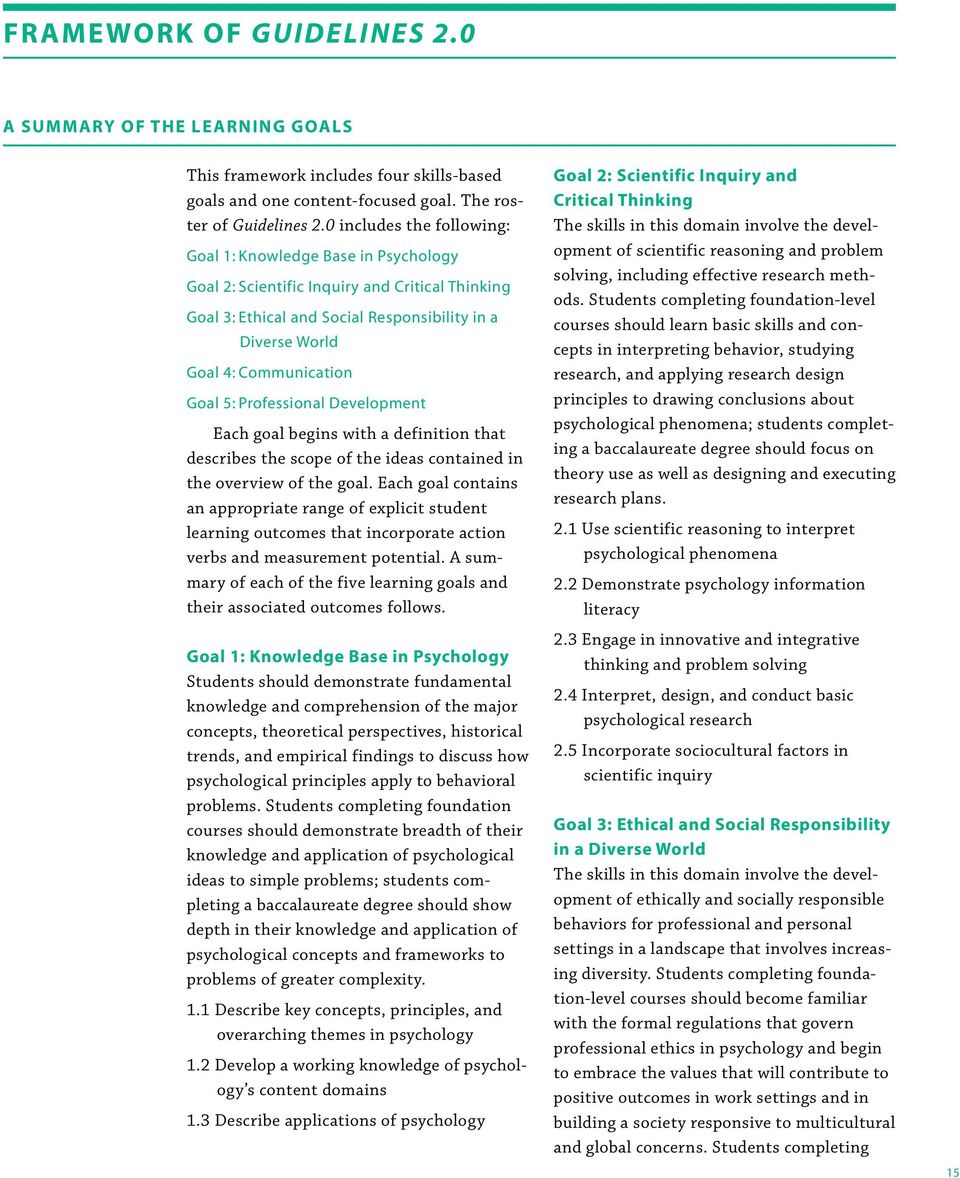
18 APA Guidelines for the Undergraduate Psychology Major: Version 2.0 a baccalaureate degree should have more direct opportunities to demonstrate adherence to professional values that will help them optimize their contributions and work effectively, even with those who do not share their heritage and traditions. This domain also promotes the adoption of personal and professional values that can strengthen community relationships and contributions. 3.1 Apply ethical standards to evaluate psychological science and practice 3.2 Build and enhance interpersonal relationships 3.3 Adopt values that build community at local, national, and global levels Goal 4: Communication Students should demonstrate competence in writing and in oral and interpersonal communication skills. Students completing foundation-level courses should write a cogent scientific argument, present information using a scientific approach, engage in discussion of psychological concepts, explain the ideas of others, and express their own ideas with clarity. Students completing a baccalaureate degree should produce a research study or other psychological project, explain scientific results, and present information to a professional audience. They should also develop flexible interpersonal approaches that optimize information exchange and relationship development. 4.1 Demonstrate effective writing for different purposes 4.2 Exhibit effective presentation skills for different purposes 4.3 Interact effectively with others Goal 5: Professional Development The emphasis in this goal is on application of psychology-specific content and skills, effective self-reflection, project-management skills, teamwork skills, and career preparation. Foundation-level outcomes concentrate on the development of work habits and ethics to succeed in academic settings. The skills in this goal at the baccalaureate level refer to abilities that sharpen student readiness for postbaccalaureate employment, graduate school, or professional school. These skills can be developed and refined both in traditional academic settings and in extracurricular involvement. In addition, career professionals can be enlisted to support occupational planning and pursuit. This emerging emphasis should not be construed as obligating psychology programs to obtain employment for their graduates but instead as encouraging programs to optimize the competitiveness of their graduates for securing places in the workforce. 5.1 Apply psychological content and skills to career goals 5.2 Exhibit self-efficacy and self-regulation 5.3 Refine project-management skills 5.4 Enhance teamwork capacity 5.5 Develop meaningful professional direction for life after graduation 16
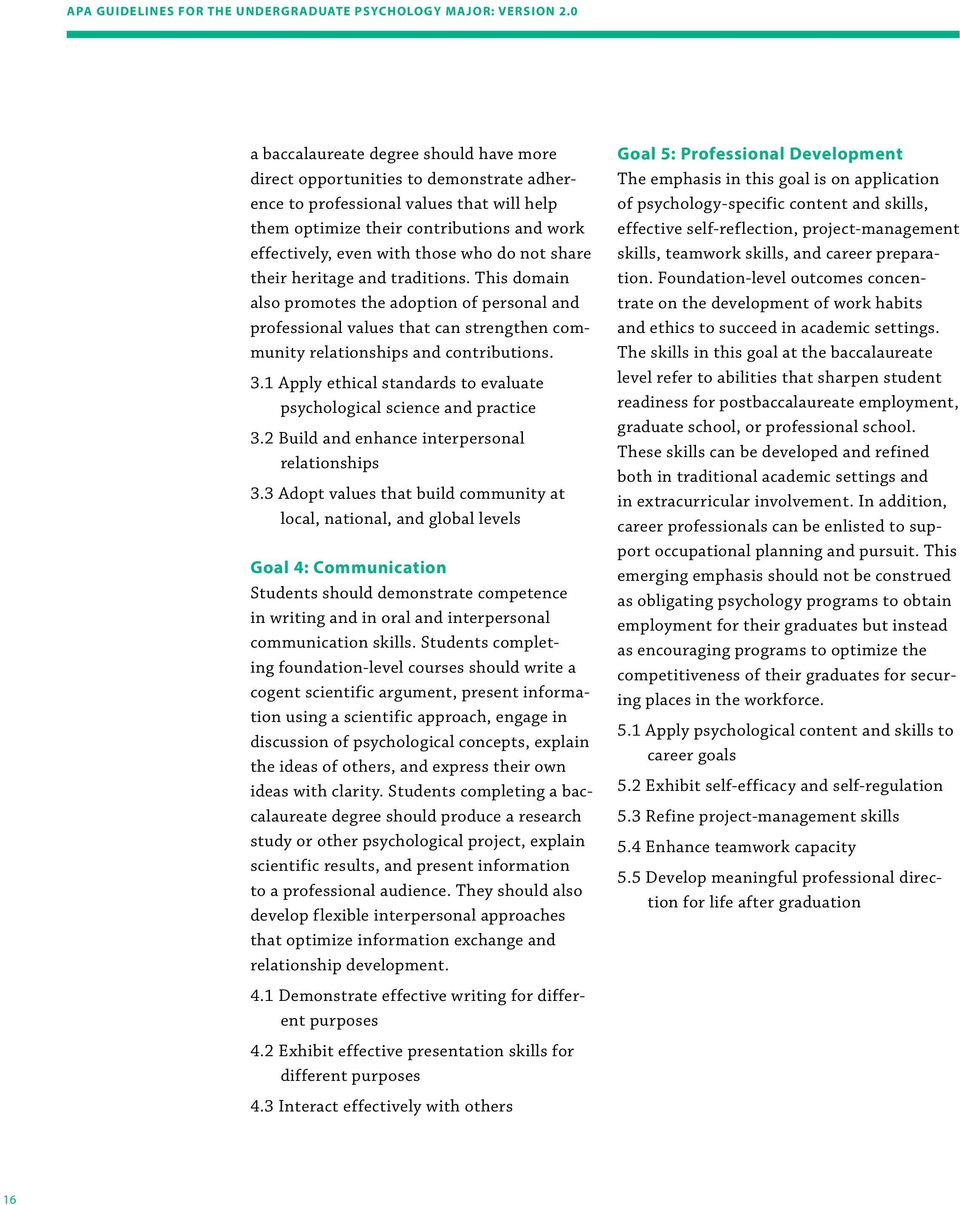
19 Framework of Guidelines 2.0 The Comprehensive Learning Goals This section elaborates the five learning goals and corresponding outcomes to address developmental indicators at the foundation and baccalaureate levels. It provides assessment information for evaluating achievements in learning as well. First, the kinds of attributes associated with strong performance in each of the learning goals are outlined. These adjectives typically surface in letters of recommendation of students for future employment or graduate school. As such, they reflect the kinds of implicit judgments faculty have always crafted in response to student requests of this type. The connection between those descriptors and performance domains is made more explicit. Second, contemporary information about promising practices used to assess achievement in the five goals through objective testing, authentic assessment, or test instruments with national norms is provided. The roster of instruments is not exhaustive or comprehensive; other assessment tools may be available or become available in the future that would be helpful in monitoring student achievement. These descriptors are not intended to be prescriptive or exhaustive but merely to provide an array of relevant choices for programs that are designing the most appropriate expectations for their specific contexts. Programs tend to articulate assessment strategies that differ in their comprehensiveness (Stanny & Halonen, 2011). Programs with less experience in assessment practices may be inclined to adopt a limited number of the outcomes provided and develop serviceable strategies for gathering the data they need to meet institutional expectations. Programs with more experience in assessment planning tend to be more comprehensive and well articulated in their assessment objectives. Their advanced assessment plans include manageable data collection strategies, appropriate interpretation of the results, and systematic review of the results to generate program improvements. The task force refined the current Guidelines as motivational for programs aspiring to be successful with more comprehensive, mature assessment plans. The framework provides five overarching goals or domains of effort. Each goal lists several relevant outcomes numbered sequentially within the goal. For example, the first outcome of the first goal is denoted 1.1. Indicators for achieving the outcomes are further denoted by level. We denote indicators for foundation achievement with a lowercase letter (e.g., 1.1a). Corresponding indicators at the baccalaureate level are indicated with capital letters (e.g., 1.1A). These designations should help departments adopt or adapt the outcomes and indicators. Goal 1. Knowledge Base in Psychology Overview Students should demonstrate fundamental knowledge and comprehension of the major concepts, theoretical perspectives, historical trends, and empirical findings to discuss how psychological principles apply to behavioral phenomena. Students completing foundation courses should demonstrate breadth of their knowledge and application of psychological ideas to simple problems; students completing a baccalaureate degree should show depth in their knowledge and application of psychological concepts and frameworks to problems of greater complexity. 17
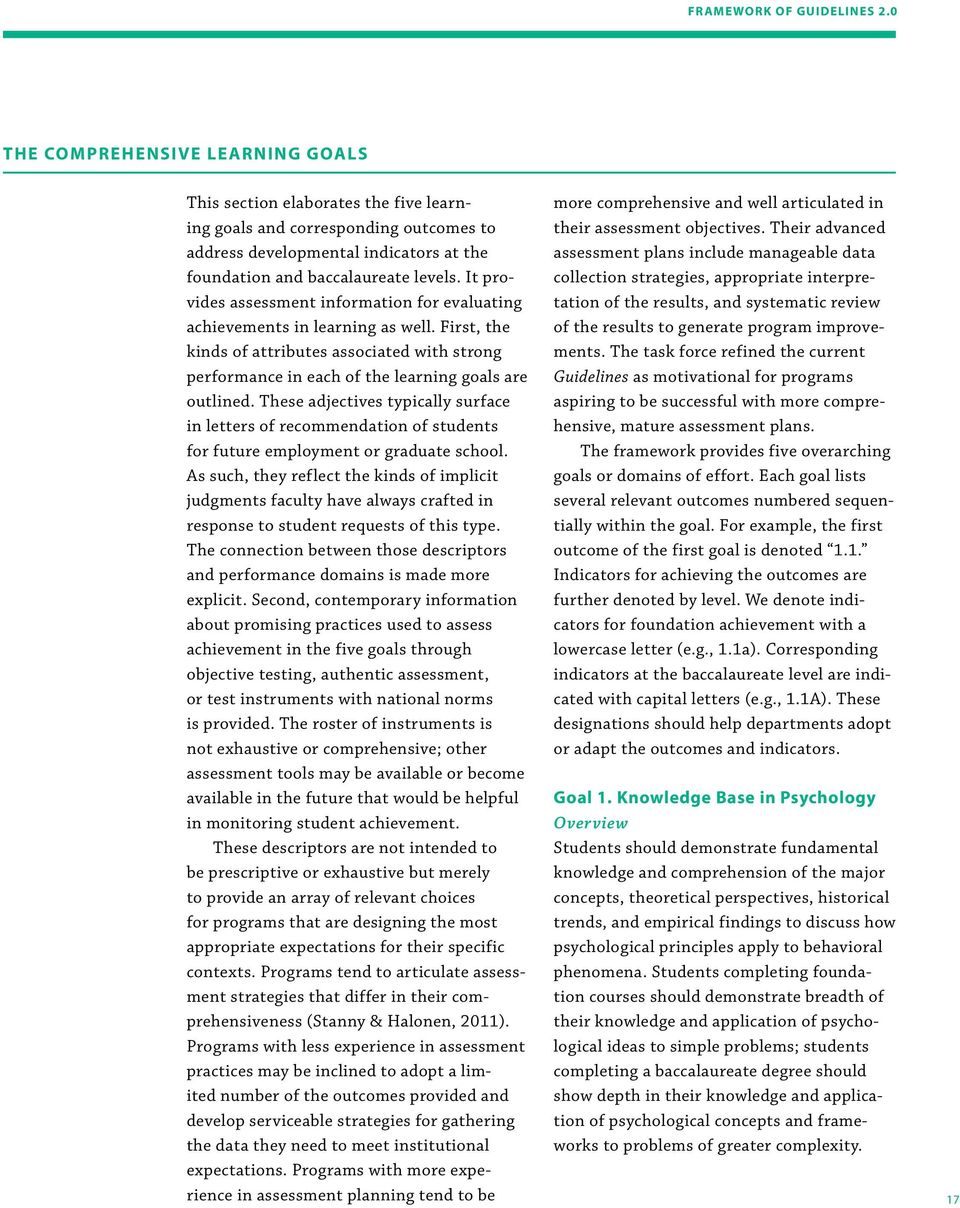
20 APA Guidelines for the Undergraduate Psychology Major: Version 2.0 Goal 1. Knowledge Base in Psychology (continued) Outcomes 1.1 Describe key concepts, principles, and overarching themes in psychology Foundation Indicators 1.1a Use basic psychological terminology, concepts, and theories in psychology to explain behavior and mental processes 1.1b Explain why psychology is a science with the primary objectives of describing, understanding, predicting, and controlling behavior and mental processes 1.1c Interpret behavior and mental processes at an appropriate level of complexity 1.1d Recognize the power of the context in shaping conclusions about individual behavior 1.1e Identify fields other than psychology that address behavioral concerns Baccalaureate Indicators 1.1A Use and evaluate theories to explain and predict behavior, including advantages and limitations in the selected frameworks 1.1B Describe the complexity of the persistent questions that occupy psychologists attention 1.1C Analyze the variability and continuity of behavior and mental processes within and across animal species 1.1D Examine the sociocultural and international contexts that influence individual differences (e.g., personality traits, abilities) and address applicability of research findings across societal and cultural groups 1.1E Compare and contrast the nature of psychology with other disciplines (e.g., biology, economics, political science), including identifying the potential contribution of psychology to interdisciplinary collaboration Develop a working knowledge of psychol- ogy s content domains 1.2a Identify key characteristics of major content domains in psychology (e.g., cognition and learning, developmental, biological, and sociocultural) 1.2b Identify principal methods and types of questions that emerge in specific content domains 1.2c Recognize major historical events, theoretical perspectives, and figures in psychology and their link to trends in contemporary research 1.2d Provide examples of unique contributions of content domain to the understanding of complex behavioral issues 1.2e Recognize content domains as having distinctive sociocultural origins and development 1.2A Compare and contrast psychology s major subdisciplines 1.2B Speculate about why content domains differ in the kinds of questions asked and the methods used to explore them 1.2C Summarize important aspects of history of psychology, including key figures, central concerns, methods used, and theoretical conflicts 1.2D Explain complex behavior by integrating concepts developed from different content domains 1.2E Predict how sociocultural and international factors influence how scientists think about behavioral and mental processes

21 Framework of Guidelines 2.0 Outcomes 1.3 Describe applica- tions of psychology Foundation Indicators 1.3a Describe examples of relevant and practical applications of psychological principles to everyday life 1.3b Summarize psychological factors that can influence the pursuit of a healthy lifestyle 1.3c Correctly identify antecedents and consequences of behavior and mental processes 1.3d Predict how individual differences influence beliefs, values, and interactions with others, including the potential for prejudicial and discriminatory behavior in oneself and others Baccalaureate Indicators 1.3A Articulate how psychological principles can be used to explain social issues, address pressing societal needs, and inform public policy 1.3B Evaluate how the mind and body interact to influence psychological and physical health 1.3C Propose and justify appropriate psychology- based interventions in applied settings (e.g., clinical, school, community, or industrial settings) 1.3D Explain how psychological constructs can be used to understand and resolve interpersonal and intercultural conflicts Attributes Inferred From Successful Demonstration Capable of coping with complexity and ambiguity Conversant about psychological phenomena Curious Flexible in thinking Knowledgeable about psychology Motivated Open minded Prepared Psychologically literate Assessment Implications Students will demonstrate sufficient understanding of psychology to respond correctly to questions on an examination of fundamental principles of the discipline. The focus on breadth of knowledge lends itself to objective tests; however, other forms of authentic assessment can also be implemented to demonstrate lower level content acquisition. 1 The emphasis on depth at the advanced level encourages higher levels of cognition (c.f. Anderson & Krathwohl, 2001; Bloom, Englehart, Furst, Hill, & Krathwohl, 1956) that can be demonstrated through productive measures (e.g., essays, theses, projects). Nationally normed achievement tests (see Table 1, p. 20) used for exit assessment purposes can effectively target content knowledge at lower levels of cognition. Upon graduation, students will be able to discuss the complexity of several psychological principles and applications of psychology, demonstrating an in-depth understanding of the many factors that influence behavior and mental processes. 1 Assessment options detailed at the conclusion of each goal provide a sample of instruments psychology programs are currently using but should not be construed as a comprehensive representation of what may be available to assess outcomes in the area or a formal recommendation of use by the task force. In addition, undergraduate programs should select appropriate assessment instruments based on a review of relevant validity and reliability metrics, where these are available. The task force encourages programs to review any assessment instrument carefully in relation to its fit with program assessment objectives. For detailed information on currently published tests, visit the Committee on Psychological Testing and Assessment s FAQ/ Finding Information About Psychological Tests website at testing/find-tests.aspx. 19
22 APA Guidelines for the Undergraduate Psychology Major: Version 2.0 Table 1. Assessment Instruments Related to Knowledge Base in Psychology Measure Description Source Psychology Area Concentration Achievement Test (ACAT-P) GRE Subject Test in Psychology Major Field Test in Psychology (4GMF) The ACAT-P provides multiple formats for addressing selected content dimensions from the psychology curriculum, with options ranging from 4 areas at 48 minutes in length to 10 areas at 120 minutes in length. Although the GRE Subject Test was not designed to measure undergraduate achievement, many programs have used the measure to determine quality of program gains. The Psychology 4GMF features 140 multiple-choice questions spread over broad subdisciplines and takes 2 hours. National comparative data are provided and relative strengths and weaknesses of individual programs. PACAT, Inc. Educational Testing Service Educational Testing Service Goal 2. Scientific Inquiry and Critical Thinking Overview The skills in this domain involve the development of scientific reasoning and problem solving, including effective research methods. Students completing foundation-level courses should learn basic skills and concepts in interpreting behavior, studying research, and applying research design principles to drawing conclusions about psychological phenomena; students completing a baccalaureate degree should focus on theory use as well as designing and executing research plans. Outcomes 2.1 Use scientific reasoning to inter- pret psychological phenomena Foundation Indicators 2.1a Identify basic biological, psychological, and social components of psychological explanations (e.g., inferences, observations, operational definitions, interpretations) 2.1b Use psychology concepts to explain personal experiences and recognize the potential for flaws in behavioral explanations based on simplistic, personal theories Baccalaureate Indicators 2.1A Describe the value and limitation of using theories to explain behavioral phenomena 2.1B Develop plausible behavioral explanations that rely on scientific reasoning and evidence rather than anecdotes or pseudoscience 20
23 Framework of Guidelines 2.0 Outcomes Foundation Indicators 2.1c Use an appropriate level of complexity to interpret behavior and mental processes Baccalaureate Indicators 2.1C Incorporate several appropriate levels of complexity (e.g., cellular, individual, group/system, societal/cultural) to explain behavior 2.1d Ask relevant questions to gather more information about behavioral claims 2.1D Generate alternative explanations based on perceived flaws in behavioral claims 2.1e Describe common fallacies in thinking (e.g., confirmation bias, post hoc explanations, implying causation from correlation) that impair accurate conclusions and predictions 2.1E Use strategies to minimize committing common fallacies in thinking that impair accurate conclusions and predictions 2.2 Demonstrate psychology informa- tion literacy 2.3 Engage in innovative and integrative thinking and problem solving 2.2a Read and summarize general ideas and conclusions from psychological sources accurately 2.2b Describe what kinds of additional information beyond personal experience are acceptable in developing behavioral explanations (i.e., popular press reports vs. scientific findings) 2.2c Identify and navigate psychology databases and other legitimate sources of psychology information 2.2d Articulate criteria for identifying objective sources of psychology information 2.2e Interpret simple graphs and statistical findings 2.3a Recognize and describe well-defined problems 2.3b Apply simple problem-solving strategies to improve efficiency and effectiveness 2.2A Read and summarize complex ideas accurately, including future directions, from psychological sources and research 2.2B Describe the characteristics and relative value of different information sources (e.g., primary vs. secondary, peer reviewed vs. nonreviewed, empirical vs. nonempirical) 2.2C Develop a comprehensive strategy for locating and using relevant scholarship (e.g., databases, credible journals) to address psychological questions 2.2D Evaluate psychology information based on the reliability, validity, and generalizability of sources 2.2E Interpret complex statistical findings and graphs in the context of their level of statistical significance, including the influence of effect size, and explain these findings using common language 2.3A Describe problems operationally to study them empirically 2.3B Select and apply the optimal problem- solving strategy from multiple alternatives 2.3c Describe the consequences of problem- solving attempts 2.3C Evaluate the effectiveness of selected problem-solving strategies 21
24 APA Guidelines for the Undergraduate Psychology Major: Version 2.0 Goal 2. Scientific Inquiry and Critical Thinking (continued) Outcomes Foundation Indicators Baccalaureate Indicators 2.4 Interpret, design, and conduct basic psychological research 2.4a Describe research methods used by psychologists including their respective advantages and disadvantages 2.4A Evaluate the effectiveness of quantitative and qualitative research methods in addressing a research question 2.5 Incorporate sociocultural factors in scientific inquiry 2.4b Discuss the value of experimental design (i.e., controlled comparisons) in justifying cause effect relationships 2.4c Define and explain the purpose of key research concepts that characterize psychological research (e.g., hypothesis, operational definition) 2.4d Replicate or design and conduct simple scientific studies (e.g., correlational or two-factor) to confirm a hypothesis based on operational definitions 2.4e Explain why conclusions in psychological projects must be both reliable and valid 2.4f Explain why quantitative analysis is relevant for scientific problem solving 2.4g Describe the fundamental principles of research design 2.5a Relate examples of how a researcher s value system, sociocultural characteristics, and historical context influence the development of scientific inquiry on psychological questions 2.5b Analyze potential challenges related to sociocultural factors in a given research study 2.4B Limit cause effect claims to research strategies that appropriately rule out alternative explanations 2.4C Accurately identify key research concepts in existing and proposed research projects 2.4D Design and conduct complex studies to confirm a hypothesis based on operational definitions 2.4E Design and adopt high-quality measurement strategies that enhance reliability and validity 2.4F Use quantitative and/or qualitative analyses to argue for or against a particular hypothesis 2.4G Apply knowledge of research skills necessary to be an informed consumer of research or critic regarding unsupported claims about behavior 2.5A Recognize the systemic influences of sociocultural, theoretical, and personal biases on the research enterprise and evaluate the effectiveness with which researchers address those influences in psychological research 2.5B Design studies that effectively address the effects of sociocultural factors 22
25 Framework of Guidelines 2.0 Outcomes Foundation Indicators 2.5c Describe how individual and sociocultural differences can influence the applicability/ generalizability of research findings 2.5d Identify under what conditions research findings can be appropriately generalized Baccalaureate Indicators 2.5C Evaluate and design research with respect to controls for variations in behavior related to individual and sociocultural differences that can influence research outcomes 2.5D Evaluate the generalizability of specific findings based on parameters of the research design, including caution in extending western constructs inappropriately Attributes Inferred From Successful Demonstration Amiably skeptical Logical Careful Open minded Collaborative Persistent Constructively Precise critical Self-directed Creative Self-starting Curious Systematic Intentional Tolerant of ambiguity Inventive Assessment Implications Traditional objective testing. Although it is possible to demonstrate critical thinking using traditional objective test measures, it is difficult. Test questions about research methods and critical thinking must be carefully constructed to produce distracters that represent flawed reasoning. However, lower level objectives that concentrate on acquiring scientific terminology can reasonably be addressed with objective testing. Strategies that require students to identify flaws in research design can also be useful in assessing reasoning and knowledge of methods. Authentic assessment. Successful participation in research, either independently or as part of a team, provides powerful evidence of the degree to which students have mastered critical thinking and research skills. Rubrics can provide a continuum of feedback from unsuccessful to exceeds criteria on various components that constitute research skills. Similarly, critical thinking projects can be evaluated on various components that reflect aspects of critical-thinking skills (e.g., depth of explanation, accuracy of components, quality of critical commentary). Hands-on experience in the research enterprise or criticizing and building theory promote stronger ownership of the abilities, which may encourage students to pursue such experiences beyond the classroom. Examinations with national norms. A variety of nationally normed tests also can produce evidence of achievement in this domain, as shown in Table 2 (p. 24). These selections include some instruments that assess critical thinking as a general education skill, whereas others are more closely linked to critical thinking in the context of psychological problem solving. 23
26 APA Guidelines for the Undergraduate Psychology Major: Version 2.0 Table 2. Assessment Instruments Related to Scientific Inquiry and Critical Thinking Measure Description Source California Critical Thinking Skills Tests (CCTST) Cambridge Thinking Skills Assessment (TSA) Collegiate Assessment of Academic Proficiency Critical Thinking Test (CAAP) Collegiate Learning Assessment (CLA) Cornell Critical Thinking Test (CCTT) Ennis Weir Critical Thinking Essay Test Halpern Critical Thinking Assessment (HCTA) The CCTST represents a family of tests for different populations, from elementary school through doctoral levels. The tests target analytic skills and information interpretation from charts, texts, and images. California-Critical-Thinking-Skills-Test-Family The Cambridge TSA is a multiple-choice test involving 25 questions measuring problem solving and 25 questions examining critical thinking. The test has been used since 2001 to assess critical thinking outcomes. tsa-cambridge/about-tsa-cambridge The CAAP assessment program enables colleges and universities to assess and evaluate both general education program outcomes and outcomes from institutional student learning outcomes. The CLA measures critical thinking, analytic reasoning, problem solving, and written communication skills using open-ended questions to determine value added to student learning from college programs. The CCTT (Level Z) presents a series of scenarios and presents an appropriate and logical solution from multiple options. The test evaluates deduction, induction, credibility, and identification of assumptions. The Ennis Weir Test requires the production of an essay prepared as a letter to the editor of a newspaper. To measure critical thinking ability, the test focuses on identification of main point, reasons, and assumptions as well as seeing other possible explanations. The HCTA test includes five dimensions of critical thinking verbal reasoning, argument analysis, thinking as hypothesis testing, likelihood and uncertainty, and decision making and problem solving using both constructed and recalled answers in response to 25 scenarios. Insight Assessment (2013) Admissions Testing Service ACT, Inc. Council for Aid to Education Ennis & Millman (2005) Ennis & Weir (1985) Halpern (2010a) 24
27 Framework of Guidelines 2.0 Measure Description Source icritical Thinking International Critical Thinking Essay Test Measure of Academic Proficiency and Progress (MAPP) Proficiency Profile Psychological Critical Thinking Exam Watson Glaser Critical Thinking Appraisal The icritical Thinking Test s 14 items can be administered in minutes and address 21st-century skills, such as information literacy, argumentation, communication to specific audiences, and problem definition. This essay-based exam involves two parts analysis and assessment of writing prompts and is graded holistically by individual graders. The MAPP evaluates general education skills, including critical thinking, reading, writing, and mathematics. The test has been included in the Degree Qualifications Profile and has also been supported by the Lumina Foundation. The Proficiency Profile provides institutional data about program value by examining critical thinking, writing, reading, and mathematics and has been selected by the Voluntary System of Accountability (VSA) as a primary measure of general education quality. This test provides a way to differentiate gains in critical thinking related to psychology. The approach in this test involves recognizing assumptions, evaluating arguments, and drawing conclusions and is used in academic and workplace settings to identify talent. Educational Testing Service Paul & Elder (2006) Educational Testing Service Educational Testing Service Lawson (1999) Watson & Glaser (1980) 25
28 APA Guidelines for the Undergraduate Psychology Major: Version 2.0 Goal 3. Ethical and Social Responsibility in a Diverse World Overview The skills in this domain involve the development of ethically and socially responsible behaviors for professional and personal settings in a landscape that involves increasing diversity. Students completing foundation-level courses should become familiar with the formal regulations that govern professional ethics in psychology and begin to embrace the values that will contribute to positive outcomes in work settings and in building a society responsive to multicultural and global concerns. Students completing a baccalaureate degree should have more direct opportunities to demonstrate adherence to professional values that will help them optimize their contributions and work effectively even with those who do not share their heritage and traditions. This domain also promotes the adoption of personal and professional values that can strengthen community relationships and contributions. Outcomes 3.1 Apply ethical standards to evaluate psychological science and practice 3.2 Build and enhance interpersonal relationships Foundation Indicators 3.1a Describe key regulations in the APA Ethics Code for protection of human or nonhuman research participants 3.1b Identify obvious violations of ethical standards in psychological contexts 3.1c Discuss relevant ethical issues that reflect principles in the APA Ethics Code 3.1d Define the role of the institutional review board (IRB) 3.2a Describe the need for positive personal values (e.g., integrity, benevolence, honesty, respect for human dignity) in building strong relationships with others Baccalaureate Indicators 3.1A Evaluate psychological research from the standpoint of adherence to the APA Ethics Code in psychological research involving human or nonhuman research participants 3.1B Justify recommendations for consequences for ethical violations based on APA Ethics Code requirements 3.1C Explain how the APA Ethics Code can be used to guide decisions in ethically complex situations 3.1D Evaluate critically or complete an IRB application that adheres to ethical standards 3.2A Exhibit high standards of positive personal values in interpersonal and work- related relationships 3.2b Treat others with civility 3.2B Promote civility in self and others c Explain how individual differences, social identity, and worldview may influence beliefs, values, and interaction with others and vice versa 3.2C Predict and explore how interaction across racial, ethnic, gender, and class divides can challenge conventional understanding of psychological processes and behavior
29 Framework of Guidelines 2.0 Outcomes 3.3 Adopt values that build community at local, national, and global levels Foundation Indicators 3.2d Maintain high standards for academic integrity, including honor code requirements 3.3a Identify aspects of individual and cultural diversity and the interpersonal challenges that often result from diversity and context 3.3b Recognize potential for prejudice and discrimination in oneself and others 3.3c Explain how psychology can promote civic, social, and global outcomes that benefit others 3.3d Describe psychology-related issues of global concern (e.g., poverty, health, migration, human rights, rights of children, international conflict, sustainability) 3.3e Articulate psychology s role in developing, designing, and disseminating public policy 3.3f Accept opportunity to serve others through civic engagement, including volunteer service Baccalaureate Indicators 3.2D Describe, explain, and uphold academic integrity within the context of psychology as a discipline and an academic profession 3.3A Exhibit respect for members of diverse groups with sensitivity to issues of power, privilege, and discrimination 3.3B Develop psychology-based strategies to facilitate social change to diminish discriminatory practices 3.3C Pursue personal opportunities to promote civic, social, and global outcomes that benefit the community 3.3D Consider the potential effects of psychology-based interventions on issues of global concern 3.3E Apply psychological principles to a public policy issue and describe the anticipated institutional benefit or societal change 3.3F Seek opportunity to serve others through volunteer service, practica, and apprenticeship experiences 27
30 APA Guidelines for the Undergraduate Psychology Major: Version Attributes Inferred From Successful Demonstration Beneficent Moral Civically engaged Community involved Conventional Courageous Ethical Fair minded Generous Reliable Respectful Rigorous Sensitive Tolerant Trustworthy Assessment Implications Students who complete introductory courses in psychology learn about basic research methods, including informed consent and ethical treatment of human and animal participants in research contexts. Typically, in this context, instructors describe the APA Ethical Principles of Psychologists and Code of Conduct (2010) but will probably not encourage direct study. Test banks linked to mainstream introductory texts include both objective and openended questions dealing with the ethical responsibilities of psychologists. As students move into advanced courses, more authentic assessments of ethical responsibility can be administered to them. For example, in the context of research methodology, students can write and submit institutional review board (IRB) proposals for course-based research; they can learn to debrief human participants when conducting research; and they can demonstrate the importance of identifying ethical problems by reviewing peer proposals in the classroom. Project papers (e.g., experimental reports, honors theses, capstone papers) can also be used as assessable evidence of ethical, responsible behavior and students understanding of psychologists responsibility toward research participants. Objective and open-ended questions on exams can also capture students awareness and knowledge of ethical responsibilities in the research process and features from the Ethics Code (2010). Works are also available that can be used in class discussion to present students with ethical dilemmas linked to psychology (e.g., Bersoff, 2008; Chastain & Landrum, 1999; Sales & Folkman, 2000), allowing students to demonstrate their ethical reasoning in writing or orally. The assessment of socially responsible behavior outside the classroom is a greater challenge. Formal assessment tools are limited outside structured settings. Peers (fellow students), instructors, and supervisors of internships, field placements, or service learning opportunities can be asked whether an individual regularly displays behavior that can be seen as civil, sensitive, respectful, trustworthy, generous, and the like. Beyond these reports, written supervisor assessments and letters of recommendation also can be sources of feedback on socially responsible behavior. Ethical and socially responsible thought and action can also be measured and evaluated by asking students to engage in selfreflection and self-evaluation regarding their course work, employment, internship, and service learning experiences (e.g., Dunn, McEntarffer, & Halonen, 2004). They can be asked to reflect on their local contributions (i.e., to their college or university community, the community in which they live) and how their knowledge of the discipline could be used to advance public policy or impact global concerns. The task force is not aware of published measures of ethical competence appropriate for the undergraduate psychology major. But measures are available of sociocultural and interpersonal awareness (see Table 3).
31 Framework of Guidelines 2.0 Table 3. Assessment Instruments Related to Ethical and Social Responsibility in a Diverse World Measure Description Source Color-Blind Racial Attitudes Scale (CoBRAS) Diverse Learning Environments Survey (DLE) Global Awareness Profile (GAP) Global Perspective Inventory (GPI) Intercultural Development Inventory (IDI) Beliefs, Events, and Values Inventory (BEVI) Multicultural Awareness Knowledge and Skills Survey (MAKSS) Munroe Multicultural Attitude Scale Questionnaire (MASQUE) Scale of Ethnocultural Empathy (SEE) The CoBRAS is a 20-item examination that uses Likert scales to identify the degree of blindness that exists for color and privilege. The DLE provides an online survey to identify awareness and advantages of learning in an environment that promotes diversity. The GAP is based on 126 questions testing common knowledge in six geographic regions (Asia, Africa, North America, South America, the Middle East, and Europe) and six subject areas (environment, politics, geography, religion, socioeconomics, and culture). global-awareness-profile The GPI measures cognitive, intrapersonal, and interpersonal dimensions of how people relate in the world. The IDI comprises 50 theory-based items to address cultural competence and is available in 12 languages. The BEVI addresses what people believe and under what circumstances in a 45-minute test that includes life history, process questions, and reflection opportunities. The MAKSS was designed for use in multicultural training and focuses on awareness, knowledge, and skills in dealing with minority populations. The MASQUE extends Banks s transformative approach that includes knowing, acting, and caring domains to promote attitude change through multicultural training. The SEE has three components, including intellectual empathy, empathic emotions, and expressiveness related to cross-cultural concerns. Neville, Lilly, Duran, Lee, & Brown (2000) Higher Education Research Institute Global Awareness Consulting and Assessment Services Braskamp, Braskamp, Merrill, & Engberg (2012) Hammer, Bennett, & Wiseman (2003) Shealy (2010) D Andrea, Daniels, & Heck (1991) Munroe & Pearson (2006) Wang et al. (2003) 29
32 APA Guidelines for the Undergraduate Psychology Major: Version 2.0 Goal 4. Communication Overview Students should demonstrate competence in writing and in oral and interpersonal communication skills. Students completing foundation-level courses should be able to write a cogent scientific argument, present information using a scientific approach, engage in discussion of psychological concepts, explain the ideas of others, and express their own ideas with clarity. Students completing a baccalaureate degree should produce a research study or other psychological project, explain scientific results, and present information to a professional audience. They should also develop flexible interpersonal approaches that optimize information exchange and relationship development. Outcomes 4.1 Demonstrate effective writing for different purposes Foundation Indicators 4.1a Express ideas in written formats that reflect basic psychological concepts and principles 4.1b Recognize writing content and format differ based on purpose (e.g., blogs, memos, journal articles) and audience 4.1c Use standard English, including generally accepted grammar Baccalaureate Indicators 4.1A Construct arguments clearly and concisely using evidence-based psychological concepts and theories 4.1B Craft clear and concise written communications to address specific audiences (e.g., lay, peer, professional) 4.1C Use grammar appropriate to professional standards and conventions (e.g., APA writing style) 4.1d Write using APA style 4.1D Employ APA writing style to make precise and persuasive arguments 4.2 Exhibit effective presentation skills for different purposes 4.1e Recognize and develop overall organization (e.g., beginning, development, ending) that fits the purpose 4.1f Interpret quantitative data displayed in statistics, graphs, and tables, including statistical symbols in research reports 4.1g Use expert feedback to revise writing of a single draft 4.2a Construct plausible oral argument based on a psychological study 4.1E Tailor length and development of ideas in formats that fit the purpose 4.1F Communicate quantitative data in statistics, graphs, and tables 4.1G Seek feedback to improve writing quality resulting in multiple drafts 4.2A Create coherent and integrated oral argument based on a review of the pertinent psychological literature 30
33 Framework of Guidelines 2.0 Outcomes Foundation Indicators 4.2b Deliver brief presentations within appropriate constraints (e.g., time limit, appropriate to audience) 4.2c Describe effective delivery characteristics of professional oral performance Baccalaureate Indicators 4.2B Deliver complex presentations within appropriate constraints (e.g., time limit, appropriate to audience) 4.2C Achieve effective delivery standards in professional oral performance 4.2d Incorporate appropriate visual support 4.2D Integrate visual and oral elements 4.2e Pose questions about psychological content 4.2E Anticipate answers to questions about psychological content 4.3 Interact effectively with others 4.3a Identify key message elements in communication through careful listening 4.3b Recognize that culture, values, and biases may produce misunderstandings in communication 4.3c Attend to language and nonverbal cues to interpret meaning 4.3A Show capacity for listening and decoding both overt and covert messages 4.3B Deploy psychological concepts to facilitate effective interactions with people of diverse backgrounds 4.3C Interact sensitively with people of diverse abilities, backgrounds, and cultural perspectives 4.3d Ask questions to capture additional detail 4.3D Generate questions to reduce ambiguous communications 4.3e Respond appropriately to electronic communications 4.3E Use social media responsibly Attributes Inferred From Successful Demonstration Attentive Precise Comprehensible Prepared Flexible Respectful Investigative Assessment Implications The need for measures of communication skills competency has been acknowledged for some time (Spitzberg & Hurt, 1987) in multiple disciplines (DeShields, Hsieh, & Frost, 1984; Rider, Hinrichs, & Lown, 2006). The foundation-level indicators for writing in a beginning core course can be evaluated by using a common rubric to evaluate writing (McCarthy, Niederjohn, & Bosack, 2011). Using this embedded evaluation technique or other shared rubric strategies will allow programs to evaluate how students are progressing on the written communication dimension using common terminology and expectations within a program. As students progress in the discipline, they should make systematic improvement in the caliber of their writing to achieve professional levels of expression. Performance criteria in capstone courses should approximate the level of writing in professional contexts. 31
34 APA Guidelines for the Undergraduate Psychology Major: Version 2.0 An evaluation of presentation skills should follow a similar model. Dunn, Baker, McCarthy, Halonen, and Lastres (2012) provided a framework and a set of resources that can be used to evaluate oral presentation and speaking skills across the undergraduate experience. Interpersonal effectiveness may be among the most challenging outcomes to measure despite its important contribution to student success both during and after college. Development and measurement of these abilities can be embedded in courses dedicated to small group dynamics. Alternatively, rubrics that govern projects can include an interpersonal dimension to encourage feedback on achievements or disappointments. In addition, the domain lends itself well to informal opportunities for teaching in which mentors, advisors, and others in positions of authority and influence can provide feedback to students about more effective interpersonal strategies. Psychology-specific published research has not incorporated any of the communication skills measures presented here. The task force is not aware of any formal instruments that have achieved broad acceptance specific to communication in psychology. As shown in Table 4, an array of tests has emerged to address the measurement of some aspects of communication, although none is specific to communications in psychology. Table 4. Assessment Instruments Related to Communication Measure Description Source Collegiate Assessment of Academic Proficiency (CAAP) Writing Essay Test and Writing Skills Test COMPASS Writing Skills Test and Writing Essay Test (e-write) WorkKeys Foundational Skills Assessments Collegiate Level Assessment (CLA) Written Communication The CAAP Writing Essay Test and Writing Skills Test provide an assessment of essay writing skills that can be used in general education assessment. The COMPASS evaluates usage mechanics and rhetorical skills of organization and style. The WorkKeys Skills Assessments assess business writing, listening for understanding, and teamwork. The CLA a evaluates the impact of institutions on the development of writing and critical thinking skills by requiring the construction of an argument. ACT, Inc. ACT, Inc. ACT, Inc. Council for Aid to Education 32
35 Framework of Guidelines 2.0 Measure Description Source College-Level Academic Skills Test (CLAST) Essay and English Language Skills Subtests The CLAST was developed in Florida to decide academic placement in mathematics and communication. Its use was required in Florida from 1982 through Florida Dept. of Education a Increased interest has emerged with the use of this instrument (Glenn, 2010), primarily on the basis of its prominence in the critique of general education achievement in the book Academically Adrift (Arum & Roska, 2011). Goal 5. Professional Development Overview The emphasis in this goal is on application of psychology-specific content and skills, effective self-reflection, project-management skills, teamwork skills, and career preparation. Foundation-level outcomes concentrate on the development of work habits and ethics to succeed in academic settings. The skills in this goal at the baccalaureate level refer to abilities that sharpen student readiness for postbaccalaureate employment, graduate school, or professional school. These skills can be developed and refined both in traditional academic settings and in extracurricular involvement. In addition, career professionals can be enlisted to support occupational planning and pursuit. This emerging emphasis should not be construed as obligating psychology programs to obtain employment for their graduates but instead as encouraging programs to optimize the competitiveness of their graduates for securing places in the workforce. Outcomes 5.1 Apply psycholog- ical content and skills to career goals Foundation Indicators 5.1a Recognize the value and application of research and problem-solving skills in providing evidence beyond personal opinion to support proposed solutions 5.1b Identify range of possible factors that influence beliefs and conclusions 5.1c Expect to deal with differing opinions and personalities in the college environment Baccalaureate Indicators 5.1A Describe and execute problem-solving and research methods to facilitate effective workplace solutions 5.1B Disregard or challenge flawed sources of information 5.1C Expect and adapt to interaction complexity, including factors related to diversity of backgrounds, in work organizations 5.1d Describe how psychology s content applies to business, health care, educational, and other workplace settings 5.1D Apply relevant psychology content knowledge to facilitate a more effective workplace in internships, jobs, or organizational leadership opportunities 33
36 APA Guidelines for the Undergraduate Psychology Major: Version 2.0 Goal 5. Professional Development (continued) Outcomes 5.2 Exhibit self-efficacy and self-regulation Foundation Indicators 5.1e Recognize and describe broad applications of information literacy skills obtained in the psychology major 5.1f Describe how ethical principles of psychology have relevance to nonpsychology settings 5.2a Recognize the link between efforts in self-management and achievement Baccalaureate Indicators 5.1E Adapt information literacy skills obtained in the psychology major to investigating solutions to a variety of problem solutions 5.1F Apply the ethical principles of psychology to nonpsychology professional settings 5.2A Design deliberate efforts to produce desired self-management outcomes (e.g., self-regulation, hardiness, resilience) 5.2b Accurately self-assess performance quality by adhering to external standards (e.g., rubric criteria, teacher expectations) 5.2c Incorporate feedback from educators and mentors to change performance 5.2B Accurately self-assess performance quality by melding external standards and expectations with their own performance criteria 5.2C Pursue and respond appropriately to feedback from educators, mentors, supervisors, and experts to improve performance 5.2d Describe self-regulation strategies (e.g., reflection, time management) 5.2D Attend to and monitor the quality of their own thinking (i.e., make adaptations using metacognitive strategies) 5.3 Refine project- management skills 5.3a Follow instructions, including timely delivery, in response to project criteria 5.3b Identify appropriate resources and constraints that may influence project completion 5.3c Anticipate where potential problems can hinder successful project completion 5.3d Describe the processes and strategies necessary to develop a project to fulfill its intended purpose 5.3A Develop and execute strategies for exceeding project criteria or, in the absence of such criteria, to meet their own project performance criteria 5.3B Effectively challenge constraints and expand resources to improve project completion 5.3C Actively develop alternative strategies, including conflict management, to contend with potential problems 5.3D Evaluate how well the processes and strategies used help a project fulfill its intended purposes 34
37 Framework of Guidelines 2.0 Outcomes Foundation Indicators Baccalaureate Indicators 5.4 Enhance teamwork capacity 5.4a Collaborate successfully on small group classroom assignments 5.4A Collaborate successfully on complex group projects 5.4b Recognize the potential for developing stronger solutions through shared problem solving 5.4B Describe problems from another s point of view 5.5 Develop mean- ingful professional direction for life after graduation 5.4c Articulate problems that develop when working with teams 5.4d Assess strengths and weaknesses in performance as a project team member 5.4e Describe strategies used by effective group leaders 5.4f Describe the importance of working effectively in diverse environments 5.5a Describe the types of academic experiences and advanced course choices that will best shape career readiness 5.5b Articulate the skill sets desired by employers who hire or select people with psychology backgrounds 5.5c Describe settings in which people with backgrounds in psychology typically work 5.5d Recognize the importance of having a mentor 5.5e Describe how a curriculum vitae or résumé is used to document the skills expected by employers 5.5f Recognize how rapid social change influences behavior and affects one s value in the workplace 5.4C Generate, apply, and evaluate potential solutions to problems that develop when working with teams 5.4D Assess the basic strengths and weaknesses of team performance on a complex project 5.4E Demonstrate leadership skills by effectively organizing personnel and other resources to complete a complex project 5.4F Work effectively with diverse populations 5.5A Formulate career plan contingencies based on accurate self-assessment of abilities, achievement, motivation, and work habits 5.5B Develop evidence of attaining skill sets desired by psychology-related employers 5.5C Evaluate the characteristics of potential work settings or graduate school programs to optimize career direction and satisfaction 5.5D Actively seek and collaborate with a mentor 5.5E Create and continuously update a curriculum vitae or résumé 5.5F Develop strategies to enhance resilience and maintain skills in response to rapid social change and related changes in the job market 35
38 APA Guidelines for the Undergraduate Psychology Major: Version Attributes Inferred From Successful Demonstration Adaptable Intuitive Collaborative Prepared Confident Reflective Conscientious Resilient Dependable Resourceful Directed Responsible Efficient Sensitive Industrious Assessment Implications Because these outcomes represent skills that can be developed both in and outside the classroom, assessment strategies are somewhat challenging in this domain. Little attention has been paid to development of these skills explicitly in psychology contexts. However, opportunities for feedback in the various learning outcomes that populate this domain are plentiful. Although there is support in the literature for the importance of demonstrated accurate self-assessment skills (Dunn et al., 2004), there is also a growing body of knowledge of the difficulty of producing valid self-assessments (Dunning, Heath, & Suls, 2004). Self-assessments tend to be influenced by culture and gender for example, males may demonstrate a tendency to overestimate performance, whereas females assessments may be inappropriately modest (Lundenberg, Fox, & Punccohar, 1994; Sylvia, 1990). Therefore, coworkers and supervisors may be more astute in judging actual achievement than the person actually performing the behavior. The emergence of practices that incorporate clear behavioral criteria is relatively new. Consequently, the task force thinks there is value in building in opportunities to practice self-assessment to be able to compare self-judgment with the judgments of other authoritative critics. Project-management skills get attention from educators implicitly through grading. For example, poor time management lowers grades due to missed deadlines. However, feedback specific to project-management development should be made explicit in any project work within the program. For example, any assigned projects should ideally include student self-assessment of the progress of their project management and instructor input of suggestions for improvement, where relevant. In addition, students advisors can enhance development by asking students to report their own progress in their abilities to manage projects successfully in this area, cutting across course and extracurricular opportunities. Course-based or embedded assessments make intuitive sense regarding the assessment of a students professional development; additional challenges are presented when considering meaningful midpoint and assessment of desired professional development domain goals. Similarly, collaborative skills are often required but may rarely receive explicit commentary from the instructor. Performance rubrics that help students describe their roles in achieving a project outcome, particularly if peers can verify their claims, can be helpful in encouraging greater mastery of teamwork skills. Feedback should be made explicit about positive achievements in skilled collaboration rather than serve only as commentary on teamwork lapses or failures. A guiding principle in effective assessment design of projects is that feedback should be provided on both the quality of the process and the product. Assessment is complicated by the fact that nonperforming team
39 Framework of Guidelines 2.0 members can negatively influence individual performance. However, instructors need to encourage students to see such frustrations and disappointments as learning opportunities that will correspond to challenges they will face in workplace settings. Life after graduation has achieved some attention in psychology to address this goal, although there are no known nationally available measures. Thomas and McDaniel (2004) published a Psychology Major Career Information Survey and a Psychology Major Career Information Quiz that can assist faculty members and departments in career planning and student development efforts. Regarding the career preparation and workforce readiness of psychology alumni, Landrum, Hettich, and Wilner (2010) reported workplace qualities for which the undergraduate degree provided adequate preparation and reported on changes that transpired since graduation. Alumni respondents provided insightful open-ended comments as to how to improve workforce readiness during one s undergraduate career. Departments may need to be more proactive in facilitating achievements in professional development as a shared mission. This domain encourages the incorporation of high-impact practices with individualized feedback and attention. Facilitating internship or field experiences becomes a natural venue for learning and demonstrating the abilities; however, such activities can be complex, time-consuming, and fraught with maintenance issues, particularly when the occasional student is unsuccessful. Department members can collectively contribute to this goal by sharing rubrics, style sheets, or criteria. In addition, the department may develop explicit expectations about the contributions specific courses could make to the development of this skill set, a position that has implications for academic freedom. Relevant assessment instruments for professional development goals and outcomes are outlined in Table 5. Table 5. Assessment Instruments Related to Professional Development Measure Description Source Metacognitive Awareness Inventory (MAI) Emotional and Social Competency Inventory (ESCI) Learning and Study Strategies Inventory (LASSI) The MAI offers a 52-item inventory to stimulate self-reflection. metacognitive-awareness-inventory.pdf The ESCI takes minutes and measures 18 abilities divided into four areas: self-awareness, self-management, social awareness, and relationship management. The LASSI is an 80-item, 10-scale inventory that assesses student study strategies, self-regulation skills, and belief about success. Schraw & Dennison (1994) Boyatzis & Goleman (2007) Weinstein, Schulte, & Palmer (2002) 37
40 APA Guidelines for the Undergraduate Psychology Major: Version 2.0 Table 5. Assessment Instruments Related to Professional Development (continued) Measure Description Source College Success Factors Index (CSFI) The CSFI examines 10 dimensions of learning, including responsibility, competition, task planning, expectations, family involvement, college involvement, time management, wellness practices, precision, and persistence. Cengage Publishers Sociocultural Learning Outcomes: The Infusion ApproACh 38 Historically, sociocultural influences tended to be ignored by disciplines, which contributed to a myopic and majority-focused worldview. However, many strides have been made in higher education to promote a healthier platform for not just recognizing and accepting differences among people but acknowledging and appreciating the benefits of those differences for the common good. Adapting a sociocultural focus in higher education, which involves incorporating how such factors as age, race, gender, and a host of other sociocultural variables influence what we know and how we know it, has been challenging. Carr (2007) noted that scholars in the humanities and social sciences were among the first to embrace the necessity of including sociocultural issues in the curriculum. Much of the curricular activity seemed most allied with feminist psychology, ethnic studies, women s studies, and sociology of education and often resulted in a campus solution of a required diversity course as part of the curriculum. Regardless of the specific disciplinary flavor of the course, common diversity topics include identity formation, power and access, privilege, and oppression. Marchesani and Adams (1992) suggested that a comprehensive approach to curricular reform is in order if we are to achieve the lofty goals associated with enhancing the coverage of sociocultural content. Although a required course that addresses sociocultural concepts is a step in the right direction, the authors argued that true reform must integrate an appropriate curriculum and pedagogy in the context of the attitudes, perceptions, and beliefs of students and teachers alike. Both the complexity and the urgency of these issues require not just deft design but strong commitment from the implementing campus and its faculty to strategies that will produce optimal gains in promoting multicultural collaboration and harmony. According to a best practice review by the AAC&U (2005), the preferred manner of tackling diversity goals is incorporated in the context of the major. When students encounter a stand-alone course requirement or a forced diversity add on to an existing course, we are likely to fail to achieve the outcomes we seek. Diversity objectives can be marginalized when students think of these experiences as just one more requirement to check off on the way to graduation. AAC&U argued that sociocultural concerns fare best when infused throughout students chosen majors. This approach emphasizes that diversity concerns are core within the major and sheds light broadly on the role of diversity in the culture as well. Sociocultural learning outcomes are clearly central to the discipline of psychology (Dunn et al., 2010). To address this important dimension of the curriculum, the
41 Framework of Guidelines 2.0 previous version of the APA Guidelines for the Undergraduate Major in Psychology (APA, 2007b) included a separate sociocultural and international awareness goal (Goal 8), which was consistent with the stand-alone approach that influenced early diversity curriculum design. In Guidelines 2.0, the task force not only highlighted diversity concerns as a context for Goal 3 (Ethical and Social Responsibility in a Diverse World) but also opted to promote an infused design for its greater promise in advancing more effective and inclusive coverage of sociocultural content within undergraduate psychology. We are not arguing against a required diversity course as part of the curriculum; such experiences can be powerful vehicles for helping individuals understand the impact of culture and heritage. However, we believe a more enlightened approach can be achieved through a more broad-based treatment infused throughout the curriculum. This approach for addressing diversity is consistent with the recommendations of the 2008 National Conference on Undergraduate Education in Psychology (Halpern, 2010) and the APA Principles for Quality Undergraduate Education in Psychology (APA, 2011b). Consequently, Guidelines 2.0 reflects the infused rather than the stand-alone outcome structure. We provide a summary of the sociocultural student learning outcomes across the goals in Appendix C. We fully recognize that many departments may not yet have embraced the need to scrutinize the curriculum from the standpoint of infusion, but we believe that Guidelines 2.0 should reflect the best practice of an infused approach, and we encourage departments to undertake a meaningful review from this vantage point. We offer a final note in this section regarding our hopes for advancing an inclusive undergraduate psychology curriculum. Focusing on the advantages of promoting a diversity-rich culture will help our students and ourselves address the urgency of producing culturally competent individuals. We refined the outcomes infusing sociocultural goals in this document to address positive motives for incorporating meaningful multicultural learning experiences. Although we have not solved the challenges associated with discrimination and oppression, we wanted to emphasize the potential for enrichment when individuals of diverse backgrounds and experience come together to solve problems. Our greatest hope is that the undergraduate major can provide an optimal experience in reaping the benefits of exploring differences in a meaningful way for the benefits of students and the culture as a whole. 39
42 Looking to the Future never before have the stakes been so high in presenting a clear picture of the value of a major in psychology. In times of challenging economics and limited job growth, legislators, taxpayers, and parents justifiably want to be assured that the choice of a major can lead to a viable position in the workforce. Some current legislators have wondered whether pursuing a psychology degree is a waste of time and money (Halonen, 2011). Since the word psychology is unlikely to appear in advertisements for jobs that can be obtained following the completion of a baccalaureate degree, the burden falls to educational practitioners to make a compelling case about the value of the major. Consequently, one objective of Guidelines 2.0 is to provide a document that makes that compelling case. Psychology has evolved into a complex discipline with a broad array of subdisciplines and specialties. We need to converge on the fundamental concepts of the discipline in their most basic forms to provide a firm foundation from which more advanced study in psychology can benefit. If properly designed and executed, Guidelines 2.0 should provide such a foundation. External factors intensify the need for psychology faculty to not just accept assessment obligations as a standard way of doing business. Valid external criticisms prompt the investment of energies to produce teaching and learning strategies that more closely approximate the paradigm shift from teacher-centered to learner-centered as proposed by Barr and Tagg (1995). Assessment results should push educators in the direction of high-impact practices, integrative capstone experiences, direct research experience, and authentic assessment strategies. There is much work to be done to provide the appropriate documentation of the advantages of an undergraduate degree in psychology. If the proposed new goals drive future program-review activity, then tremendous opportunities exist in the area of teaching and learning scholarship to document curricular achievements. Indeed, the development and dissemination of authentic assessment strategies that promote sound practice should be a top priority for psychology departments in the coming decade. One advantage of strengthening the major through assessment evidence is the greater case that can be made for psychology as a STEM discipline. Given the promise of STEM disciplines in addressing our global economic woes, a scramble seems to be transpiring for the boundaries of disciplines that should be included in this group. Should STEM be redefined as STEMM to 41
43 APA Guidelines for the Undergraduate Psychology Major: Version incorporate disciplines that have a medical orientation? Should STEM incorporate a role for the arts and become STEAM, as argued recently in Scientific American (Pomeroy, 2012)? Even in the absence of these boundary challenges, the rigorous nature of research methods and statistics makes a persuasive case that psychology is firmly entrenched as a STEM discipline. Perhaps as Cacioppo (2007) argued, psychology can play an important role as a hub discipline in developing connections across STEM disciplines. Many departments, especially those that adopted and invested substantial energies in the original Guidelines, have questioned whether the disciplinary community would benefit from a process that endorses high-quality curriculum design for those departments that adhere to the Guidelines. Although most departments would balk at the expense in time and money of mounting full-blown accreditation of the undergraduate program, many also see this approach as one of the strategies that will help produce a more persuasive campaign to establish psychology as a STEM discipline. A future goal for APA could be the development of an APA endorsement mechanism to recognize highly effective departments judged to have an APA- approved curriculum based on Guidelines 2.0. The task force will be following up on this important objective with a proposal to the Board of Educational Affairs; however, the details of such a process need to be developed. Finally, in an echo of a principle established in the first Guidelines, the 2.0 version still needs to be considered somewhat temporary. The current Guidelines 2.0 represents a response to a particular set of historical and sociological conditions. In the next decade, more changes may be a part of the landscape that will prompt new revisions if Guidelines 2.0 is to be an accurate reflection of contemporary practice. We recommend reconvening for that consideration in the year This recommendation is consistent with APA Association Rule requiring cyclical review of approved standards and guidelines within periods not to exceed 10 years. Comments and suggestions geared toward improvement of the document are welcome and should be forwarded to: Education Directorate American Psychological Association 750 First Street, NE Washington, DC [email protected]
44 References Adelman, C., Ewell, P., Gaston, P., & Schneider, C. G. (2011). Lumina Foundation degree qualifications profile. Retrieved org/publications/the_degree_qualifications_ Profile.pdf American Psychological Association. (2000). Resolution on poverty and socioeconomic status. Retrieved from policy/poverty-resolution.aspx American Psychological Association. (2001). Resolution against racism and in support of the 2001 UN World Conference Against Racism, Racial Discrimination, Xenophobia, and Related Intolerance. Retrieved from about/policy/racism American Psychological Association. (2003). Guidelines on multicultural education, training, research, practice, and organizational change for psychologists. American Psychologist, 58, American Psychological Association. (2004a). Guidelines for psychological practice with older adults. American Psychologist, 59, American Psychological Association. (2004b). Resolution on culture and gender awareness in international psychology. Retrieved from American Psychological Association. (2007a). Guidelines for psychological practice with girls and women. American Psychologist, 62, American Psychological Association. (2007b). Guidelines for the undergraduate psychology major. Retrieved from Resources/Documents/otrp/resources/ apapsymajorguidelines.pdf American Psychological Association. (2008). Teaching, learning, and assessing in a developmentally coherent curriculum: Learning goals and outcomes. Washington, DC: American Psychological Association, Board of Educational Affairs. Retrieved from ed/governance/bea/curriculum.pdf American Psychological Association. (2010). Ethical principles of psychologists and code of conduct. Retrieved from code/index.aspx American Psychological Association. (2011a). National standards for high school psychology curricula. Retrieved from education/k12/national-standards.aspx American Psychological Association. (2011b). APA Principles for quality undergraduate education in psychology. Retrieved from education/undergrad/principles.aspx American Psychological Association. (2012a). Guidelines for assessment of and intervention with persons with disabilities. American Psychologist, 67, American Psychological Association. (2012b). Guidelines for psychological practice with lesbian, gay, and bisexual clients. American Psychologist, 67, Anderson, L. W., & Krathwohl, D. R. (Eds.). (2001). A taxonomy for learning, teaching, and assessing: A revision of Bloom s taxonomy of educational objectives. New York, NY: Addison Wesley Longman. Appleby, D. C., Millspaugh, B. S., & Hammersley, M. J. (2011). An online resource to enable undergraduate psychology majors to identify and investigate 172 psychology and psychology-related careers. OTRP Online. Retrieved from files/2011/03/careers-in-psych.pdf Arum, R., & Roksa, J. (2011). Academically adrift: Limited learning on college campuses. Chicago, IL: University of Chicago Press. Association of American Colleges and Universities. (2005, December). Wheaton College builds inclusive excellence through curriculum innovation. AAC&U News: Insights and Campus Innovations in Liberal Education. Retrieved from AACUNews05/December05/feature.cfm 43
45 APA Guidelines for the Undergraduate Psychology Major: Version Association of American Colleges and Universities. (2012). Liberal education and America s promise (LEAP). Retrieved from Association of American Colleges and Universities and Council for Higher Education Accreditation. (2008). New leadership for student learning and accountability. Retrieved from Leadership_Statement.pdf Barr, R. B., & Tagg, J. (1995, Jan/Feb). From teaching to learning: A new paradigm for undergraduate education. Change, 27(6), Bersoff, D. N. (2008). Ethical conflicts in psychology (4th ed.). Washington, DC: American Psychological Association. Bloom, B. S., Englehart, M. B., Furst, E. J., Hill, W. H., & Krathwohl, D. R. (1956). Taxonomy of educational objectives: The classification of educational goals. Handbook 1: Cognitive domain. New York, NY: McKay. Bologna Working Group on Qualifications Frameworks. (2005). A framework of qualifications of the European higher education area. Copenhagen, Denmark: Ministry of Science, Technology and Innovation. Retrieved from doc/050218_qf_ehea.pdf Boyatzis, R. E., & Goleman, D. (2007). Emotional and Social Competency Inventory (4th rev.). Boston, MA: Hay Group. Braskamp, L. A., Braskamp, D. C., Merrill, K. C., & Engberg, M. (2012). Global Perspective Inventory (GPI): Its purpose, construction, potential uses, and psychometric characteristics (Rev. ed.). Retrieved from supportdocs/manual.pdf Cacioppo, J. T. (2007). Psychology is a hub science. APS Observer, 20(8), 5, 42. Carr, J. F. (2007). Diversity and disciplinary practices. In J. Branche, J. Mullennix, & E. Cohn (Eds.), Diversity across the curriculum: A guide for faculty in higher education (pp ). Bolton, MA: Anker. Chastain, G., & Landrum, R. E. (1999). Protecting human subjects: Departmental subject pools and institutional review boards. Washington, DC: American Psychological Association. Cranney, J., & Dunn, D. S. (2011). The psychologically literate citizen: Foundations and global perspectives. New York, NY: Oxford University Press. D Andrea, M., Daniels, J., & Heck, R. (1991). Evaluating the impact of multicultural counseling training. Journal of Counseling & Development, 70, DeShields, S. M., Hsieh, H. K., & Frost, D. (1984). The measurement of writing skills: Some problems and a probable solution. Educational and Psychological Measurement, 44, Dunn, D. S., Baker, S. C., McCarthy, M. A., Halonen, J. S., & Lastres, A. (2012). Integrating public speaking into psychology classes: A framework and rubric for assessing skills. In D. S. Dunn, S. C. Baker, C. M. Mehrotra, R. E. Landrum, & M. A. McCarthy (Eds.), Assessing teaching and learning in psychology: Current and future perspectives (pp ). Belmont, CA: Wadsworth/Cengage. Dunn, D. S., Brewer, C. L., Cautin, R. L., Gurung, R. A., Keith, K. D., McGregor,... Voight, M. J. (2010). The undergraduate psychology curriculum: Call for a core. In D. F. Halpern (Ed.), Undergraduate education in psychology: A blueprint for the future of the discipline (pp ). Washington, DC: American Psychological Association. Dunn, D. S., McEntarffer, R., & Halonen, J. S. (2004). Empowering psychology students through self-assessment. In D. S. Dunn, C. M. Mehrotra, & J. S. Halonen (Eds.), Measuring up: Assessment challenges and practices for psychology (pp ). Washington, DC: American Psychological Association.
46 References Dunning, D., Heath, C., & Suls, J. M. (2004). Flawed self-assessment: Implications for health, education, and the workplace. Psychological Science in the Public Interest, 5, Ennis, R. H., & Millman, J. (2005). Cornell Critical Thinking Test, Level Z. Seaside, CA: Critical Thinking Company (formerly Midwest Publications). Ennis, R. H., & Weir, E. E. (1985). The Ennis Weir Critical Thinking Essay Test: An instrument for teaching and testing. Pacific Grove, CA: Midwest Publications. Gaston, P. L. (2010). The challenge of Bologna: What U.S. higher education has to learn from Europe and why it matters that we learn it. Sterling, VA: Stylus. Glenn, D. (2010, September 24). A measure of education is put to the test. Chronicle of Higher Education, 57(5), A1, A8 A9. Halonen, J. (2011, February 5). Are there too many psychology majors? (White paper prepared for staff of State University System Board of Governors of Florida). Retrieved from www. cogdop.org/page_attachments/0000/0200/ FLA_White_Paper_for_cogop_posting.pdf Halpern, D. F. (2010a). Halpern Critical Thinking Assessment. Retrieved from lafayettelifesciences.com/product_detail. asp?itemid=2050 Halpern, D. (Ed.). (2010b). Undergraduate education in psychology: A blueprint for the future of the discipline. Washington, DC: American Psychological Association. Hammer, M. R., Bennett, J. J., & Wiseman, R. (2003). Measuring intercultural sensitivity: The Intercultural Development Inventory. International Journal of Intercultural Relations, 27, doi: / S (03) Insight Assessment. (2013). California Critical Thinking Skills Test. San Jose, CA: California Academic Press. Retrieved from insightassessment.com/products/products- Summary/Critical-Thinking-Skills-Tests/ California-Critical-Thinking-Skills-Test-CCTST/ (language)/eng-us Kuh, G. D., Kinzie, J., Schuh, J. H., Whitt, E. J., & Associates. (2010). Student success in college: Creating conditions that matter (Rev. ed.). San Francisco, CA: Jossey-Bass. Landrum, R. E., Hettich, P. I., & Wilner, A. (2010). Alumni perceptions of workforce readiness. Teaching of Psychology, 37, doi: / Lawson, T. J. (1999). Assessing psychological critical thinking as a learning outcome for psychology majors. Teaching of Psychology, 26, Lundenberg, M. A., Fox, P. W., & Punccohar, J. (1994). Highly confident but wrong: Gender differences and similarities in confidence judgments. Journal of Educational Psychology, 86, Marchesani, L. S., & Adams, M. (1992). Dynamics of diversity in the teaching learning process: A faculty development model for analysis and action. In M. Adams (Ed.), Promoting diversity in college classrooms. New Directions for Teaching and Learning, 52, McCarthy, M. A., Niederjohn, D. M., & Bosack, T. N. (2011). Embedded assessment: A measure of student learning and teaching effectiveness. Teaching of Psychology, 38, doi: / McGovern, T. V., Corey, L., Cranney, J., Dixon, W. E., Jr., Holmes, J. D., Kuebli, J. E.,... Walker, S. J. (2010). Psychologically literate citizens. In D. F. Halpern (Ed.), Undergraduate education in psychology: A blueprint for the future of the discipline (pp. 9 27). Washington, DC: American Psychological Association. Munroe, A., & Pearson, C. (2006). The Munroe Multicultural Attitude Scale Questionnaire. Educational and Psychological Measurement, 66,
47 APA Guidelines for the Undergraduate Psychology Major: Version National Task Force on Civic Learning and Democratic Engagement. (2012). The Crucible Moment call to action follow-up activities report. Washington, DC: American Association of Colleges and Universities. Retrieved from www. aacu.org/civic_learning/crucible/may12.cfm Neville, H. A., Lilly, R. L., Duran, G., Lee, R. M., & Brown, L. (2000). Construction and initial validation of the Color-Blind Racial Attitude Scale (CoBRAS). Journal of Counseling Psychology, 47, doi: / Paul, R., & Elder, L. (2006). The International Critical Thinking Reading & Writing Test. Dillon Beach, CA: Foundation for Critical Thinking. Pomeroy, S. R. (August 22, 2012). From STEM to STEAM: Science and art go hand-in-hand [Blog post]. Retrieved from scientificamerican.com/guestblog/2012/08/22/from-stem-to-steamscience-and-the-arts-go-hand-in-hand Pusateri, T., Halonen, J. S., Hill, B., & McCarthy, M. (2009). The assessment cyberguide for learning goals and outcomes (2nd ed.). Retrieved from assessment-cyberguide-v2.pdf Rajecki, D. W. (2008). Job lists for entry-level psychology baccalaureates: Occupational recommendations that mismatch qualifications. Teaching of Psychology, 35, doi: / Rajecki, D. W., & Borden, V. M. H. (2011). Psychology degrees: Employment, wage, and career trajectory consequences. Perspectives in Psychological Science, 6, doi: / Rider, A., Hinrichs, M. M., & Lown, B. A. (2006). A model for communication skills assessment across the undergraduate curriculum. Medical Teacher, 28, doi: / Sales, B. D., & Folkman, S. (2000). Ethics in research with human participants. Washington, DC: American Psychological Association. Schraw, G., & Dennison, R. S. (1994). Assessing metacognitive awareness. Contemporary Educational Psychology, 19, Shealy, C. N. (2010). About the BEVI Beliefs, Events, and Values Inventory. Retrieved from Spitzberg, B. H., & Hurt, H. T. (1987). The measurement of interpersonal skills in instructional contexts. Communication Education, 36, Stanny, C. J., & Halonen, J. S. (2011). Accreditation, accountability, and assessment: Faculty development s role in addressing multiple agendas. In L. Stefani (Ed.), Evaluating the effectiveness of academic development practice: A professional guide (pp ). New York, NY: Routledge. Stoloff, M., McCarthy, M., Keller, L., Varfolomeeva, V., Lynch, J., Makara, K., Smiley, W. (2009). The undergraduate psychology major: An examination of structure and sequence. Teaching of Psychology, 37, Sylvia, B (1990). Gender differences in the accuracy of self-evaluations of performance. Journal of Personality and Social Psychology, 59, Thomas, J. H., & McDaniel, C. R. (2004). Effectiveness of a required course in career planning for psychology majors. Teaching of Psychology, 31, Wang, Y-W., Davidson, M. M., Yakushko, O. F., Savoy, H. B., Tan, J. A., & Bleier, J. K. (2003). The Scale of Ethnocultural Empathy: Development, validation, and reliability. Journal of Counseling Psychology, 50, doi: / Watson, G., & Glaser, E. M. (1980). Watson Glaser Critical Thinking Appraisal. San Antonio, TX: Psychological Corporation. Weinstein, C. E., Schulte, A. C., & Palmer, D. R. (2002). Learning and Study Strategies Inventory. Clearwater, FL: H&H Publishing.
48 appendices
49 Appendix A Rationale for PARAMEters of Change in the Learning Goal Areas: From the Original Guidelines to Guidelines 2.0 Goal 1: Knowledge Base in Psychology The new Knowledge Base goal was revised to include what was formerly Goal 1 (Knowledge Base) and Goal 5 (Application of Psychology) from the original Guidelines document. Goal 2: Scientific Inquiry and Critical Thinking The new Goal 2 represents a synthesis of the former Goal 2 (Research Methods in Psychology), Goal 3 (Critical Thinking Skills in Psychology), and Goal 6 (Information and Technological Literacy). This updated treatment also highlights sociocultural concerns that were prominent in Goal 8 (Sociocultural and International Awareness). Goal 5: Professional Development Substantial changes that produced the new Goal 5 involve the synthesis of former Goal 9 (Personal Development) and Goal 10 (Career Planning and Development). Revision of this goal was fueled by turbulent economic conditions and persistent perceptions that an undergraduate psychology major cannot lead to gainful employment. Career readiness concerns were purposefully infused throughout developmental levels in this goal. Goal 3: Ethics and Social Responsibility in a Diverse World The new Goal 3 builds upon the former Goal 5 (Values in Psychology), with considerable enhancement of elements of Goal 8 (Sociocultural and International Awareness) and emerging national initiatives regarding civic engagement. Goal 4: Communication The focus of Goal 4 in Communication retained the emphasis on writing and speaking but enhanced the importance of interpersonal communications, including an emphasis on developing communication skills to work effectively across societal contexts. 48
50 Appendix B Formal Linkage Between Original Guidelines and Guidelines 2.0 This table identifies how the original guidelines were purposefully integrated into Version 2.0. In both the foundation and baccalaureate indicators, the numbers reflect a meaningful link to a specific learning indicator in the original version. Therefore, the first exemplar in the foundation indicators in the table below corresponds to two indicators in knowledge base (1.3a&b) and to an indicator in the second goal of critical thinking (2.1). Goal 1: Knowledge Base in Psychology Outcomes Foundation Indicators Baccalaureate Indicators 1.1 Describe key con- cepts, principles, and overarching themes in psychology 1.3a&b, 2.1 Use basic psychological terminology, concepts, and theories to explain behavior and mental processes 1.3d, 1.4b, 1.2d Use and evaluate theories to explain and predict behavior, including advantages and limitations in the selected frameworks 1.1a&b, 2.1 Explain why psychology is a science with the primary objectives of describing, understanding, predicting, and controlling behavior and mental processes 1.3c Interpret behavior and mental processes at an appropriate level of complexity 1.2d Describe the complexity of the persistent questions that occupy psychologists attention 1.2d2 Analyze the variability and continuity of behavior and mental processes within and across animal species 8.2 Recognize the power of the context in shaping conclusions about individual behavior 8.2 Examine the sociocultural and international contexts that influence individual differences (e.g., personality traits, abilities) and address applicability of research findings across societal and cultural groups 1.1c Identify fields other than psychology that address behavioral concerns 1.1c&d, 1.4a Compare and contrast the nature of psychology with other disciplines (e.g., biology, economics, political science), including identifying the potential contribution of psychology to interdisciplinary collaboration 49
51 APA Guidelines for the Undergraduate Psychology Major: Version 2.0 Goal 1: Knowledge Base in Psychology (continued) Outcomes Foundation Indicators Baccalaureate Indicators 1.2 Develop a working knowledge of psychol- ogy s content domains 1.2, 1.4 Identify key characteristics of major content domains in psychology (e.g., cognition and learning, developmental, biological, and sociocultural) 2.2a Identify principal methods and types of questions that emerge in specific content domains 1.2b Recognize major historical events, theoretical perspectives, and figures in psychology and their link to trends in contemporary research 3.1 Provide examples of unique contributions of content domain to the understanding of complex behavioral issues 1.2d(6) Recognize content domains as having distinctive sociocultural origins and development 1.4a Compare and contrast psychology s major subdisciplines 2.2a Speculate about why content domains differ in the kinds of questions asked and the methods used to explore them 1.2b, 1.2d Summarize important aspects of history of psychology, including key figures, central concerns, and theoretical conflicts 3.1 Explain complex behavior by integrating concepts developed from different content domains 1.2d Predict how sociocultural and international factors influence how scientists think about behavior and mental processes 1.3 Describe applica- tions of psychology 4.1, 4.4 Describe examples of relevant and practical applications of psychological principles to everyday life 4.2a Summarize psychological factors that can influence the pursuit of a healthy lifestyle 1.3b Correctly identify antecedents and consequences of behavior and mental processes 8.3 Predict how individual differences influence beliefs, values, and interactions with others, including the potential for prejudicial and discriminatory behavior in oneself and others 4.3 Articulate how psychological principles can be used to explain social issues, address pressing societal needs, and inform public policy 1.2d(5) Evaluate how the mind and body interact to influence psychological and physical health 4.2d Propose and justify appropriate psychology- based interventions in applied settings (e.g., clinical, school, community, or industrial settings) 4.2e Explain how psychological constructs can be used to understand and resolve interpersonal and intercultural conflicts 50
52 Appendix B Goal 2. Scientific Inquiry and Critical Thinking Outcomes 2.1 Use scientific reasoning to inter- pret psychological phenomena 2.2 Demonstrate psychology informa- tion literacy Foundation Indicators 1.3a, 2.3 Identify basic biological, psychological and social components of psychological explanations (e.g., inferences, observations, interpretations, operational definitions) 3.1a Use psychology concepts to explain personal experiences and recognize the potential for flaws in behavioral explanations based on simplistic, personal theories 1.3.c Use an appropriate level of complexity to interpret behavior and mental processes 5.2 Ask relevant questions to gather more information about claims 3.1e Describe common fallacies in thinking (e.g., confirmation bias, post hoc explanations, implying causation from correlation) that impair accurate conclusions and predictions 2.4a, 6.1d Read and summarize general ideas and conclusions from psychological sources accurately 6.1a Describe what kinds of additional information beyond personal experience are acceptable in developing behavioral explanations (i.e., popular press reports vs. scientific findings) 2.4a Identify and navigate psychology databases and other legitimate sources of psychology information 3.1a Articulate criteria for identifying objective sources of psychology information Baccalaureate Indicators 1.3d Describe the value and limitation of using theories to explain behavioral phenomena 3.1d Develop plausible behavioral explanations that rely on scientific reasoning and evidence rather than anecdotes or pseudoscience 1.2c, 1.3e Incorporate several appropriate levels of complexity (e.g., cellular, individual, group/ system, societal/cultural) to explain behavior 3.1d, 5.3 Generate alternative explanations based on perceived flaws in claims 3.1e Use strategies to minimize committing common fallacies in thinking that impair accurate conclusions and predictions 2.4a Read and summarize complex ideas, including future directions, from psychological sources and research accurately 6.1c Describe the characteristics and relative value of different information sources (e.g., primary vs. secondary, peer reviewer vs. nonreviewed, empirical vs. nonempirical) 2.2C Develop a comprehensive strategy for locating and using relevant scholarship (e.g., databases, credible journals) to address psychological questions 3.1b Evaluate psychology information based on the reliability, validity and generalizability of sources 51
53 APA Guidelines for the Undergraduate Psychology Major: Version 2.0 Goal 2. Scientific Inquiry and Critical Thinking (continued) Outcomes 2.3 Engage in innovative and inte- grative thinking and problem solving 2.4 Interpret, design, and conduct basic psychological research Foundation Indicators 2.4e Interpret simple graphs and statistical findings 3.4a Recognize and describe well-defined problems 3.4 Apply simple problem-solving strategies to improve efficiency and effectiveness 3.4d Describe the consequences of problem-solving attempts 2.2b Describe research methods used by psychologists including their respective advantages and disadvantages 2.2c Discuss the value of experimental design (i.e., controlled comparisons) in justifying cause effect relationships 2.4 Define and explain the purpose of key research concepts that characterize psychological research (e.g., hypothesis, operational definition) 2.4e Replicate or design and conduct simple scientific studies (e.g., correlational or two-factor) to confirm a hypothesis based on operational definitions Baccalaureate Indicators 2.4e Interpret complex statistical findings and graphs in the context of their level of statistical significance, including the influence of effect size, and explain these findings using common language 2.4b Describe problems operationally to study them empirically 3.4 Select and apply the optimal problem- solving strategy from multiple alternatives 2.2b Evaluate the effectiveness of selected problem-solving strategy 2.4e Evaluate the effectiveness of a quantitative and qualitative research methods in addressing a research question 2.4 Limit cause effect claims to research strategies that appropriately rule out alternative explanations 2.4 Accurately identify key research concepts in existing and proposed research projects 2.4b&e Design and conduct complex studies to test a hypothesis based on operational definitions 2.3d, 2.4c Explain why conclusions in psychological projects must be both reliable and valid 2.3d, 2.4d Design and adopt high-quality measurement strategies that enhance reliability and validity 2.3b Explain why quantitative analysis is relevant for scientific problem solving 2.3b, 7.3 Use quantitative and/or qualitative analyses to argue for or against a particular hypothesis 52
54 Appendix B Outcomes Foundation Indicators 2.2a Describe the fundamental principles of research design Baccalaureate Indicators 3.1g Apply knowledge of research skills necessary to be an informed consumer of research or critic regarding unsupported claims about behavior 2.5 Incorporate sociocultural factors in scientific inquiry 2.2d Relate examples of how a researcher s value system, sociocultural characteristics, and historical context influence the development of scientific inquiry on psychological questions 2.4f Analyze potential challenges related to sociocultural factors in a given research study 2.6d Describe how individual and sociocultural differences can influence the applicability/ generalizability of research findings 2.6 Identify under what conditions research findings can be appropriately generalized 2.4f Recognize the systemic influences of sociocultural, theoretical, and personal biases on the research enterprise and evaluate the effectiveness with which researchers address those influences in psychological research 2.4f Design studies that effectively address the effects of sociocultural factors 2.6d, 2.4f Evaluate and design research with respect to controls for variations in behavior related to individual and sociocultural differences than can influence research outcomes 2.6 Evaluate the generalizability of specific findings based on parameters of the research design, including caution in extending western constructs inappropriately Goal 3. Ethical and Social Responsibility in a Diverse World Outcomes 3.1 Apply ethical standards to evaluate psychological science and practice Foundation Indicators 2.5 Describe key regulations in the APA Ethics Code for protection of human or nonhuman research participants 2.5 Identify obvious violations of ethical standards in psychological contexts 1.2e Discuss relevant ethical issues that reflect principles in the APA Ethics Code Baccalaureate Indicators 2.5 Evaluate psychological research from the standpoint of adherence to the APA Ethics Code in psychological research involving human or nonhuman research participants 2.5 Justify recommendations for consequences for ethical violations based on APA Ethics Code requirements 4.5, 5.1 Explain how the APA Ethics Code can be used to guide decisions in ethically complex situations 3.1d Define the role of the institutional review board (IRB) 3.1D Evaluate critically or complete an IRB application that adheres to ethical standards 53
55 APA Guidelines for the Undergraduate Psychology Major: Version 2.0 Goal 3. Ethical and Social Responsibility in a Diverse World (continued) Outcomes 3.2 Build and enhance interpersonal relationships Foundation Indicators 8.1, 9.4 Describe the need for positive personal values (e.g., integrity, benevolence, honesty, respect for human dignity) in building strong relationships with others) Baccalaureate Indicators Exhibit high standards of positive personal values in interpersonal and work- related relationships 9.3 Treat others with civility 9.3 Promote civility in self and others 3.3 Adopt values that build community at local, national, and global levels 5.5 Explain how individual differences, social identity, and worldview may influence beliefs, values, and interaction with others and vice versa 6.3, 9.4 Maintain high standards for academic integrity, including honor code requirements 5.5a Identify aspects of individual and cultural diversity and the interpersonal challenges that often result from diversity and context 5.5 Predict and explore how interaction across racial, ethnic, gender, and class divides can challenge conventional understanding of psychological processes and behavior 9.4 Describe, explain, and uphold academic integrity within the context of psychology as a discipline and an academic profession 5.5b, 8.4 Exhibit respect for members of diverse groups with sensitivity to issues of power, privilege, and discrimination 5.5b, 8.4 Recognize potential for prejudice and discrimination in oneself and others 5.6 Explain how psychology can promote civic, social, and global outcomes that benefit others 4.3 Describe psychology-related issues of global concern (e.g., poverty, health, migration, human rights, rights of children, international conflict, sustainability) 4.3c Articulate psychology s role in developing, designing, and disseminating public policy 5.6 Accept opportunity to serve others through civic engagement, including volunteer service 5.5b, 8.5 Develop psychology-based strategies to facilitate social change to diminish discrimination practices 5.6 Pursue personal opportunities to promote civic, social, and global outcomes that benefit the community 4.3 Consider the potential effects of psychology- based interventions on issues of global concern 4.3c Apply psychological principles to a public policy issue and describe the anticipated institutional benefit or societal change 5.6 Seek opportunity to serve others through volunteer service, practica, and apprenticeship experiences. 54
56 Appendix B Goal 4. Communication Outcomes 4.1 Demonstrate effective writing for different purposes Foundation Indicators 7.1 Express ideas in written formats that reflect basic psychological concepts and principles 7.1 Recognize writing content and format differ based on purpose (e.g., blogs, memos, journal articles) and audience 7.1a Use standard English, including generally accepted grammar Baccalaureate Indicators 7.1 Construct arguments clearly and concisely using evidence-based psychological concepts and theories 7.1 Craft clear and concise written communications to address specific audiences (e.g., lay, peer, professional) 7.1a Use grammar appropriate to professional standards and conventions (e.g., APA writing style) 7.1a Write using APA style 7.1a Employ APA writing style to make precise and persuasive arguments 7.1 Recognize and develop overall organization (e.g., beginning, development, ending) that fits the purpose 7.3d Interpret quantitative data displayed in statistics, graphs, and tables, including statistical symbols in research reports 7.1 Use expert feedback to revise writing of a single draft 7.1 Tailor length and development of ideas in formats that fit purpose 2.4e Communicate quantitative data in statistics, graphs, and tables 7.1 Seek feedback to improve writing quality resulting in multiple drafts 4.2 Exhibit effective presentation skills for different purposes 7.2 Construct plausible oral argument based on a psychological study 7.2 Create coherent and integrated oral argument based on a review of the pertinent psychological literature 7.2 Deliver brief presentations within appropriate constraints (e.g., time limit, appropriate to audience) 7.2 Describe effective delivery characteristics of professional oral performance 7.2 Deliver complex presentations within appropriate constraints (e.g., time limit, appropriate to audience) 7.2 Achieve effective delivery standards in professional oral performance 7.2 Incorporate appropriate visual support 7.2 Integrate visual and oral elements 7.2 Pose questions about psychological content 7.2 Anticipate answers to questions about psychological content 4.3 Interact effectively with others 7.4a Identify key message elements in communication through careful listening 7.4a, 8.3 Show capacity for listening and decoding both overt and covert messages 55
57 APA Guidelines for the Undergraduate Psychology Major: Version 2.0 Goal 4. Communication (continued) Outcomes Foundation Indicators 7.4g, 8.2 Recognize that culture, values, and biases may produce misunderstandings in communication 7.4f Attend to language and nonverbal cues to interpret meaning Baccalaureate Indicators 7.4g Deploy psychological concepts to facilitate effective interactions with people of diverse backgrounds 7.4g, 8.1 Interact sensitively with people of diverse abilities, backgrounds, and cultural perspectives 3.1i Ask questions to capture additional detail 3.1i Generate questions to reduce ambiguous communications 6.4c Respond appropriately to electronic communications 6.4c Use social media responsibly Goal 5. Professional Development Outcomes 5.1 Apply psycholog- ical content and skills to career goals Foundation Indicators 4.4 Recognize the value and application of research and problem-solving skills in providing evidence beyond personal opinion to support proposed solutions 8.3 Identify range of possible factors that influence beliefs and conclusions 3.1h, 5.5 Expect to deal with differing opinions and personalities in the college environment 4.2 Describe how psychology s content applies to business, health care, educational, and other workplace settings 6.1 Recognize and describe broad applications of information literacy skills obtained in the psychology major 9.4 Describe how ethical principles of psychology have relevance to nonpsychology settings Baccalaureate Indicators 4.2 Describe and execute problem-solving and research methods to facilitate effective workplace solutions 3.1c Disregard or challenge flawed sources of information 7.5b, 8.6 Expect and adapt to interaction complexity, including factors related to diversity of backgrounds, in work organizations 4.2 Apply relevant psychology content knowledge to facilitate a more effective workplace in internships, jobs, or organizational leadership opportunities 4.4 Adapt information literacy skills obtained in the psychology major to investigating solutions to a variety of problem solutions 9.4 Apply the ethical principles of psychologists to nonpsychology professional settings 56
58 Appendix B Outcomes 5.2 Exhibit self-efficacy and self-regulation Foundation Indicators 9.2a Recognize the link between efforts in self-management and achievement 9.2b Accurately self-assess performance quality by adhering to external standards (e.g., rubric criteria, teacher expectations) 9.2c Incorporate feedback from educators and mentors to change performance Baccalaureate Indicators 9.3 Design deliberate efforts to produce desired self-management outcomes (e.g., self-regulation, hardiness, resilience) 9.2.b Accurately self-assess performance quality by melding external standards and expectations with their own performance criteria 9.2c Pursue and respond appropriately to feedback from educators, mentors, supervisors, and experts to improve performance 5.3 Refine project- management skills 9.2a Describe self-regulation strategies (e.g., reflection, time management) 9.2 Follow instructions, including timely delivery, in response to project criteria 3.4d Identify appropriate resources and constraints that may influence project completion 3.4c Anticipate where potential problems can hinder successful project completion 3.4b Describe the processes and strategies necessary to develop a project to fulfill its intended purpose 9.2d Attend to and monitor the quality of their own thinking (i.e., make adaptations using metacognitive strategies) 9.2 Develop and execute strategies for exceeding provided project criteria or, in the absence of such criteria, to meet their own project performance criteria 3.2a Effectively challenge constraints and expand resources to improve project completion 3.4c Actively develop alternative strategies to contend with potential problems including conflict management 3.4e Evaluate how well the processes and strategies used help a project fulfill its intended purposes 5.4 Enhance teamwork capacity 7.5a Collaborate successfully on small-group classroom assignments 7.5b, 9.5 Recognize the potential for developing stronger solutions through shared problem solving 7.5c Articulate problems that develop when working with teams 7.5a Collaborate successfully on complex group projects 7.5b Describe problems from another s point of view 7.5c Generate, apply, and evaluate potential solutions to problems that develop when working with teams 9.2b Assess strengths and weaknesses in performance as a project team member 7.5 Assess the basic strengths and weaknesses of team performance on a complex project 57
59 APA Guidelines for the Undergraduate Psychology Major: Version 2.0 Goal 5. Professional Development (continued) Outcomes 5.5 Develop mean- ingful professional direction for life after graduation Foundation Indicators 4.3b, 4.4 Describe strategies used by effective group leaders 8.1 Describe the importance of working effectively in diverse environments 10.2 Describe the types of academic experiences and advanced course choices that will best shape career readiness 10.4 Articulate the skill sets desired by employers who hire or select people with psychology backgrounds 10.3 Describe settings in which people with backgrounds in psychology typically work 5.5E, 10.4 Describe how a curriculum vitae or résumé is used to document the skills expected by employers Baccalaureate Indicators 4.3b, 4.4 Demonstrate leadership skills by effectively organizing personnel and other resources to complete a complex project 8.1 Work effectively with diverse populations 10.3 Formulate career plan contingencies based on accurate self-assessment of abilities, achievement, motivation, and work habits 10.4 Develop evidence of attaining skill sets desired by psychology-related employers 10.3 Evaluate the characteristics of potential work settings or graduate school programs to optimize career direction and satisfaction 5.5E, 10.4 Create and continuously update a curriculum vitae or résumé 7.5d Recognize the importance of having a mentor 7.5d Actively seek and collaborate with a mentor 10.5 Recognize how rapid social change influences behavior and affects one s value in the workplace 3.4, 10.5 Develop strategies to enhance resilience and maintain skills in response to rapid social change and related changes in the job market 58
60 Appendix C Representation of Sociocultural Focus throughout Guidelines 2.0 Knowledge Base Outcomes Foundation Indicators Baccalaureate Indicators 1.1 Describe key con- cepts, principles, and overarching themes in psychology 1.2 Develop a working knowledge of psychol- ogy s content domains 1.1d Recognize the power of the context and the influence of sociocultural factors in shaping conclusions about individual behavior 1.2e Recognize content domains as having distinctive sociocultural origins and development 1.1D Examine the sociocultural and international contexts that influence individual differences (e.g., personality traits, abilities) and address applicability of research findings across societal and cultural groups 1.2E Predict how sociocultural and international factors influence thinking about behavioral and mental processes 1.3 Describe applica- tions of psychology 1.3d Predict how individual differences are related to beliefs, values, and interactions with others 1.3D Explain how psychological constructs can be used to understand and resolve interpersonal and intercultural conflicts Scientific Inquiry and Critical Thinking Outcomes 2.5 Incorporate socio- cultural factors in scientific inquiry Foundation Indicators 2.5a Relate examples of how a researcher s value system, sociocultural characteristics, and historical context influence the development of scientific inquiry on psychological questions 2.5b Analyze potential challenges related to sociocultural factors in a given research study 2.5c Describe how individual and sociocultural differences can influence the applicability/generalizability of research findings 2.5d Identify under what conditions research findings can be appropriately generalized Baccalaureate Indicators 2.5A Recognize the systemic influences of sociocultural, theoretical, and personal biases on the research enterprise and evaluate the effectiveness with which researchers address those influences in psychological research 2.5B Design studies that effectively address the effects of sociocultural factors 2.5C Evaluate and design research with respect to controls for variations in behavior related to individual and sociocultural differences that may influence research outcomes 2.5D Evaluate the generalizability of specific findings based on parameters of the research design, including possible limitations based on sociocultural differences 59
61 APA Guidelines for the Undergraduate Psychology Major: Version 2.0 Ethical and Social Responsibility in a Diverse World Outcomes 3.2 Build and enhance interpersonal relationships 3.3 Adopt values that build community at local, national, and global levels Foundation Indicators 3.2a Describe the need for positive personal values (e.g., integrity, benevolence, honesty, respect for human dignity, and awareness of sociocultural differences) in building strong relationships with others 3.2b Treat others with civility regardless of sociocultural differences (e.g., gender, race, class, culture, ethnicity, age, ability, and sexual orientation) 3.2c Explain how individual differences, social identity, and world view may influence beliefs, values, and interaction with others and vice versa 3.3a Identify human diversity in its many forms and the interpersonal challenges that often result from the diversity 3.3b Recognize potential for prejudice and discrimination in oneself and others 3.3c Explain how psychology can promote civic, social, and global outcomes that benefit others 3.3d Describe psychology-related issues of global concern (e.g., poverty, health, migration, human rights, international conflict, sustainability) Baccalaureate Indicators 3.2A Exhibit high standards of positive personal values and sociocultural sensitivity in interpersonal and work-related relationships 3.2B Promote civility and respect for sociocultural differences 3.2C Predict and explore how interaction across racial, ethnic, gender, and class divides can challenge conventional understanding of psychological processes and behavior 3.3A Exhibit respect for members of diverse groups with sensitivity to issues of power, privilege, and discrimination 3.3B Develop psychology-based strategies to facilitate social change to diminish discriminatory practices 3.3C Pursue personal opportunities to promote civic, social, and global outcomes that benefit the community 3.3D Consider the potential effects of psychology-based interventions on issues of global concern 60
62 Appendix C Communication Outcomes Foundation Indicators Baccalaureate Indicators 4.3 Interact effectively with others 4.3b Recognize that culture, values, and biases may produce misunderstandings in communication 4.3B Deploy psychological concepts to facilitate effective interactions with people of diverse backgrounds 4.3c Attend to language and nonverbal cues to interpret meaning 4.3C Interact sensitively with people of diverse abilities, backgrounds, and cultural perspectives Professional Development Outcomes 5.1 Apply psycholog- ical content and skills to career goals Foundation Indicators 5.1c Expect to deal with differing opinions and individuals with diverse backgrounds and personalities in the college environment Baccalaureate Indicators 5.1C Expect and adapt to interaction complexity, including factors related to diversity of backgrounds, in work organizations 5.4 Enhance teamwork capacity 5.4b Recognize the potential for developing stronger solutions through shared problem solving 5.4f Describe the importance of working effectively in diverse environments 5.4B Describe problems from another s point of view with respect to sociocultural factors 5.4F Work effectively with diverse populations 61
63 Appendix D Recommendations for Strengthening Quality in the Undergraduate Psychology Major 62 Enhancing Student Awareness Outline student learning outcomes explicitly in all course syllabi. Describe learning goals and how they can be achieved through course work and special opportunities (research experiences, internships, and volunteer work) in advising materials. Develop a checklist of courses required for completion of the major and résumé-enhancing activities that can be used by students completing the major. Coordinate departmental efforts with other campus resources (e.g., student success, career and/or service learning center, international programs, etc.). Display APA-sponsored poster of learning goals and student outcomes prominent in the program workspace. Designing Curriculum Map individual courses to curriculum outcomes to: Establish the extent to which each course focuses on each program objective, Ensure that the program includes a strong core that focuses on the fundamental knowledge and skills that define an excellent program, and Determine the depth of experience students have with each outcome by compiling the number of courses that students relate to each outcome. Audit curriculum quality to determine program strengths and weaknesses to address the following: Beyond the promise suggested in course titles and descriptions, does skill development activity actually transpire within classes? What percent of students participate in highimpact activities, such as research experiences, internships, project-based learning, etc.? How many small-group experiences will a typical student experience? What percent of students will have small-group experience? Do all students have an opportunity to develop those skills regardless of the path taken through the major? Require the completion of methods courses early in the major and build on the foundation of empirical psychology in more advanced courses. Require strategically aligned advanced courses that build on methods and content knowledge, allow exploration of a topic in great depth, and appropriately showcase the expertise of faculty. Encourage faculty to embed assessments of fundamental program-wide learning outcomes in existing courses. Coordinate efforts when more than one faculty member teaches a particular course to encourage discussions that promote a focus on and consistent approach to core goals in every course section. Support common assessment strategies across different sections of the same course. Incorporate core elements of the major in one (or more) required capstone experiences and evaluate student achievement through integrated assessment strategies.
64 Appendix D Promoting Student Success Blend formal elements of career preparation throughout the curriculum. Focus on high-quality academic advising as a focus of faculty discussions by attending to the following questions: How are you preparing students for future careers including both preparation for work and graduate school? Are you helping students maintain a focus on career objectives or just helping them navigate course requirements for completion of their degree? Implement a sophomore-level course in psychology careers to assist commitment to the major. Explain the value of enrichment experiences that build skills and develop the résumé. Promote skill and résumé-building opportunities, including activities within the department, across the college, and off campus. Encourage students to engage in volunteer work and/or take advantage of summer opportunities and alternative break options. Identify successful alumni and articulate the performance profiles that made them successful in college and in professional life. Take advantage of multiple communication channels to spotlight successful alumni, including the following options: Departmental website and other means of electronic communication (e.g., Facebook, LinkedIn, Twitter, etc.) Electronic or print newsletters Hallway posters Display of alumni business cards or brief descriptions with pictures in prominent showcases in department hallways Alumni guest speakers for student organization events and/or classes Promoting Faculty Engagement in Assessment Support the value of assessment activity overtly. Assessment requires faculty to engage in conversations about what they want students to achieve and how they might best facilitate student development; faculty focused on providing good educational opportunities want to talk about these goals. Promote the development of assessment processes that fit organically with the mission of the department; mature assessment programs will shift from data collection from an orientation of because we have to toward because it is the right thing to do. Collaborate on assessment design using Guidelines 2.0 as a starting point to the conversation using the following questions: Do the faculty agree that these guidelines reflect what is important about the undergraduate psychology major? How well does your program help students meet these objectives? Are there any distinctive features that Guidelines 2.0 does not capture? Make program assessment the responsibility of the whole department; build assessment obligations formally into the faculty work assignments rather than housing burden on the shoulders of a single representative. Require faculty to document their assessment responsibilities as part of annual evaluation. Provide funding for faculty to attend conferences that refine assessment practices contingent on faculty sharing what they learn at the conference with their colleagues. Make the value of SOTL research explicit in department regulations addressing tenure and promotion. 63
65 APA Guidelines for the Undergraduate Psychology Major: Version 2.0 Recognize high-quality contributions in assessment through rewards (e.g., public recognition, release time, seed funding). Developing Exemplary Assessment Practices Collect assessment data using good scientific methods. Take advantage of course-embedded assessments wherever possible. Consider canceling classes on one day once per year to gather assessment data. Share assessment findings annually among the faculty of the department. Close the loop by using assessment data to make program refinements and document all changes in curriculum to assist in accreditation review. Share assessment findings with students, including Describe the characteristics of the most successful students and encourage students to follow their examples. Reveal weaknesses and promote student attention on correcting deficiencies. 64
66 Appendix E Roster of Job Prospects for Psychology Graduates What can students do with a background in psychology? Although no listing of possible psychologyrelated jobs can be exhaustive or completely accurate, the chart below distinguishes between typical jobs associated with a bachelor s degree and jobs associated with careers that routinely involve training beyond the baccalaureate level. Critics often malign the baccalaureate degree in psychology as ineffective preparation for the workforce. However, the list below of potential careers for someone with a bachelor s degree suggests that a psychology major s skills can be effectively deployed in a variety of workplace contexts, including human services, health care, research, sales and marketing, and many others. A bachelor s degree in psychology may not necessarily be required for the job titles in the first column of the chart below (Appleby, Millspaugh, & Hammersley, 2011), but a psychology background can help students be competitive in these job areas. Even if a student receives a bachelor s degree in psychology, that student is not required to go into a psychology-related field when entering the workforce. Consequently, psychology graduates may emerge in occupations that would not necessarily be expected from their academic preparation. Career choices that represent positions requiring additional education beyond the baccalaureate degree both in psychology graduate programs (e.g., counselor, psychologist, psychology professor) and other professional pathways (e.g., lawyer, veterinarian, psychiatric nurse) have less obvious connections to the undergraduate psychology major. Cautionary note: The roster should not be construed as a guaranteed job pathway. Success in obtaining a position that benefits from a background in psychology will always be dependent on a combination of factors, including the applicant s job-seeking skills and marketplace demands. Rajecki (2008) suggested that some job lists may be misleading in that psychology majors looking at these job lists are either underqualified or overqualified for the position. Thus, in providing a broad look at job opportunities, students may be mismatched with occupations. For a broad perspective about careers within psychology, see Rajecki and Borden (2011). Potential careers for a bachelor s degree in psychology Activities Director Admissions Evaluator Advertising Sales Representative Alumni Director Animal Trainer Army Mental Health Specialist Benefits Manager Career/Employment Counselor Career Information Specialist Caseworker Child Development Specialist Child Welfare/ Placement Caseworker Claims Supervisor Coach Community Organization Worker Community Worker Computer Programmer Conservation Officer Correctional Treatment Specialist Corrections Officer Criminal Investigator (FBI and other) Customer Service Representative Supervisor Database Administrator Database Design Analyst Department Manager Dietician Disability Policy Worker Disability Case Manager Employee Health Maintenance Program Specialist Employee Relations Specialist 65
67 APA Guidelines for the Undergraduate Psychology Major: Version 2.0 Potential careers for a bachelor s degree in psychology (continued) Employment Counselor Labor Relations Manager Police Officer Polygraph Examiner Public Relations Representative Employment Loan Officer Preschool Teacher Purchasing Agent Interviewer Management Analyst Probation/Parole Real Estate Agent Financial Aid Market Research Officer Recreation Leader Counselor Analyst Project Evaluator Recreation Supervisor Fund Raiser Mental Retardation Psychiatric Aide/ Recreational Therapist Health Care Facility Aide Attendant Research Assistant Administrator Newswriter Psychiatric Technician Retail Salesperson Host/Hostess Occupational Analyst Psychological Stress Sales Clerk Human Resource Patient Resources Evaluator Advisor Social Services Aide and Reimbursement Psychosocial Information Specialist Agent Substance Abuse Rehabilitation Counselor Job Analyst Personnel Recruiter Specialist (PSR) Systems Analyst Technical Writer Veterans Contact Representative Veterans Counselor Victims Advocate Vocational Training Teacher Volunteer Coordinator Writer 66 Careers requiring a degree beyond the bachelor s degree in psychology Academic Counselor Applied Statistician Art Therapist Counseling Psychologist Developmental Marriage and Family Therapist Mathematical/ Physical Therapist Physician Psychiatric Nurse Psychologist Quantitative Assessment Psychiatric Social Professional/Program Domestic Violence Psychologist Worker Evaluator Counselor Medical Social Worker Psychiatrist Biogerontologist Educational Mental Health Psychological Psychologist Counselor Chief Psychologist Anthropologist Exercise Therapist Military Chaplin Child Abuse Psychologist Counselor Experimental Military Counselor Psychometrician Psychologist Child Counselor Minister, Priest, Rabbi, Psychotherapist Family Counselor/ Chaplain, etc. Child Psychologist Caseworker Rehabilitation Multicultural Clinical Psychologist Psychologist Forensic Psychologist Counselor Clinical Social Worker Gerontological Music Therapist School Psychologist Cognitive Counselor School Social Worker Neurologist Neuroscientist Geropsychologist Social Psychologist Neuropathologist Cognitive Guidance Counselor Speech Pathologist Psychologist Neuropsychologist Health Psychologist Sport Psychologist College/University Neurosurgeon Professor Industrial/ Veterinarian Occupational Organizational Community Therapist Vocational Psychologist Rehabilitation Psychologist Optometrist Lawyer Counselor Comparative Pediatrician Psychologist Licensed Professional Personnel Counselor Consumer Psychologist Psychologist Marriage and Family Physiatrist Counselor
68 Appendix F Roster of Advisory/Reviewing Groups Ad Hoc Committee on Psychology and AIDS (COPA) American Psychological Association of Graduate Students (APAGS) Association of Heads of Department of Psychology (AHDP) Board of Educational Affairs (BEA) Board for the Advancement of Psychology in the Public Interest (BAPPI) Board of Scientific Affairs (BSA) Committee of Psychology Teachers at Community Colleges (PT@CC) Committee on Aging (CONA) Committee on Children, Youth, and Families (CYF) Committee on Disability Issues in Psychology (CDIP) Committee on Lesbian, Gay, Bisexual, and Transgender Concerns (CLGBTC) Committee on Psychological Tests and Assessments (CPTA) Committee on Socioeconomic Status (CSES) Committee of Teachers of Psychology in Secondary Schools (TOPSS) Committee on Women in Psychology (CWP) Council of Graduate Departments of Psychology (COGDOP) Council of Specialties in Professional Psychology (CoS) Psi Beta Advisors Policy and Planning Board of the American Psychological Association 2012 Farmingdale Conference on the Teaching of Psychology Committee on Division/APA Relations (CODAPAR) Committee on International Relations in Psychology (CIRP) Committee on Legal Issues (COLI) 67
69 Appendix G Roster of Independent Contributors/Reviewers Kathryn Clancy David Daniel Eric Dubrow Graham Higgs Cynthia Legin-Bucell Bernard Whitley Paul Hettich From the 2012 APA Education Leadership Conference Donna Alexander Frank Andrasik Eve Brank James Bray Charles L. Brewer Deborah A. Carroll Sue Frantz Richard Kindred Trudy Frey Loop Kris Leppien-Christensen Susan A. Nolan Debra Sue Pate Michael Ray Jodie Ullman Susan Krauss Whitbourne Katherine Wickes Jason R. Young Special thanks to John Norcross for his consistent, careful, and constructive feedback throughout the development of Guidelines
70
EXCELLENCE. Characteristics of. in Higher Education. Middle States Commission on Higher Education
 Characteristics of EXCELLENCE in Higher Education Requirements of Affiliation and Standards for Accreditation Online Version - Revised March 2009 (pages xii and xiii) Middle States Commission on Higher
Making Diversity Work on Campus: A Research-Based Perspective
 Making Diversity Work on Campus: A Research-Based Perspective By Jeffrey F. Milem, Mitchell J. Chang, and Anthony Lising Antonio One in a series of three papers commissioned as part of the Making Excellence
GUIDE TO EVALUATING INSTITUTIONS
 GUIDE TO EVALUATING INSTITUTIONS A Publication of the Accrediting Commission for Community and Junior Colleges Western Association of Schools and Colleges JULY 2013 Edition ACCJC/WASC 10 Commercial Blvd.
English as a New Language Standards
 FOR CANDIDATES APPLYING 2011 OR LATER. English as a New Language Standards Second Edition for teachers of students ages 3-18+ National Board Certification for Teachers English as a New Language Standards
A Framework for Success for All Students
 A Framework for Success for All Students Collected Papers from the Technical Support Team for the Schools for a New Society Initiative and Carnegie Corporation of New York A Framework for Success for All
Looking at Classroom Practice
 Support Materials Contents This resource guide has been developed to support the work of school leaders, teachers and educators who work in and with schools across Australia. guide is designed to enable
The Essentials of Baccalaureate Education for Professional Nursing Practice
 The Essentials of Baccalaureate Education for Professional Nursing Practice October 20, 2008 TABLE OF CONTENTS Executive Summary 3 Background 5 Nursing Education 6 The Discipline of Nursing 7 Assumptions
STEWARDS. Stepping Forward As PLACE
 STEWARDS of Stepping Forward As PLACE AASCU Task Force on Public Engagement James C. Votruba, President Northern Kentucky University (Chair) Muriel A. Howard, President State University of New York College
Youth Work Core Competencies. A Review of Existing Frameworks and Purposes
 Youth Work Core Competencies A Review of Existing Frameworks and Purposes Developed for School s Out Washington by Betsy Starr, Nicole Yohalem and Ellen Gannett, Next Generation Youth Work Coalition October
Developmentally Appropriate Practice in Early Childhood Programs Serving Children from Birth through Age 8
 Position Statement Developmentally Appropriate Practice in Early Childhood Programs Serving Children from Birth through Age 8 Adopted 2009 A position statement of the National Asssociation for the Education
Toward a More Comprehensive Conception of College Readiness
 Toward a More Comprehensive Conception of College Readiness 2007 David T. Conley Prepared for the Bill & Melinda Gates Foundation, March 2007 Table of Contents Introduction. 5 An Operational Definition
Rethinking Classroom Assessment with Purpose in Mind
 Rethinking Classroom Assessment with Purpose in Mind Assessment for Learning Assessment as Learning Assessment of Learning Rethinking Classroom Assessment with Purpose in Mind Assessment for Learning
A Culture of Evidence:
 A Culture of Evidence: An Evidence-Centered Approach to Accountability for Student Learning Outcomes Catherine M. Millett David G. Payne Carol A. Dwyer Leslie M. Stickler Jon J. Alexiou Copyright 2008
At Home. in the World: Bridging the Gap Between Internationalization and Multicultural Education
 Global Learning for All: The Fourth in a Series of Working Papers on Internationalizing Higher Education in the United States At Home in the World: Bridging the Gap Between Internationalization and Multicultural
How Young People Develop Long-Lasting Habits of Civic Engagement. A Conversation on Building a Research Agenda
 How Young People Develop Long-Lasting Habits of Civic Engagement A Conversation on Building a Research Agenda Sponsored by the Spencer Foundation, June 24 26, 2008 Elizabeth Hollander, Senior Fellow, Tisch
Preparing Secondary Students for Work. A framework for vocational learning and VET delivered to secondary students
 Preparing Secondary Students for Work A framework for vocational learning and VET delivered to secondary students Copyright and Terms of Use Education Services Australia 2014, as the legal entity for the
BUILDING A STRONGER EVIDENCE BASE FOR EMPLOYEE WELLNESS PROGRAMS
 Meeting Brief n May 2011 BUILDING A STRONGER EVIDENCE BASE FOR EMPLOYEE WELLNESS PROGRAMS NIHCM Foundation n May 2011 TABLE OF CONTENTS Acknowledgements.....................................................
PEOPLEINAID. Code. of good practice. in the management and support of aid personnel
 PEOPLEINAID Code of good practice in the management and support of aid personnel The People In Aid Code of Good Practice, 2003, is a revision of the People In Aid Code of Best Practice, 1997 PEOPLEINAID
Consumers, the health system and health literacy: Taking action to improve safety and quality. Consultation Paper
 Consumers, the health system and health literacy: Taking action to improve safety and quality Consultation Paper June 2013 Commonwealth of Australia 2013 This work is copyright. It may be reproduced in
Common Core State Standards for. English Language Arts & Literacy in History/Social Studies, Science, and Technical Subjects
 Common Core State Standards for English Language Arts & Literacy in History/Social Studies, Science, and Technical Subjects Table of Contents Introduction 3 Standards for English Language Arts & Literacy
Our Responsibility, Our Promise. Transforming Educator Preparation and Entry into the Profession
 Our Responsibility, Our Promise Transforming Educator Preparation and Entry into the Profession A Report by the CCSSO Task Force on Educator Preparation and Entry into the Profession THE COUNCIL OF CHIEF
National Action Plan. to Improve Health Literacy
 National Action Plan to Improve Health Literacy Suggested citation: U.S. Department of Health and Human Services, Office of Disease Prevention and Health Promotion. (2010). National Action Plan to Improve
Securing Their Future
 Securing Their Future The New South Wales Government s reforms for the Higher School Certificate Foreword It is three and a half decades since the decision was taken to restructure New South Wales secondary
About learning. Report of the Learning Working Group
 About learning Report of the Learning Working Group Open access. Some rights reserved. As the publisher of this work, Demos has an open access policy which enables anyone to access our content electronically
Computing Curricula 2005
 Computing Curricula 2005 The Overview Report covering undergraduate degree programs in Computer Engineering Computer Science Information Systems Information Technology Software Engineering A volume of
Work-Integrated Learning in Ontario s Postsecondary Sector
 Work-Integrated Learning in Ontario s Postsecondary Sector Prepared by Academica Group Inc. for the Higher Education Quality Council of Ontario Disclaimer: The opinions expressed in this research document
Page 0 Leading for All: Executive Summary. [Type text]
![Page 0 Leading for All: Executive Summary. [Type text]](/thumbs/17/71664.jpg "Page 0 Leading for All: Executive Summary. [Type text]") Page 0 Leading for All: Executive Summary Page 1 Leading for All: Executive Summary Leading for All: A research report of the development, design, implementation and impact of Ontario s Essential for Some,
Page 0 Leading for All: Executive Summary Page 1 Leading for All: Executive Summary Leading for All: A research report of the development, design, implementation and impact of Ontario s Essential for Some,