
Rules Governing the Licensing of Educators and the Preparation of Educational Professionals
|
|
|
- Stewart Allison
- 10 years ago
- Views:
Transcription
1 Rules Governing the Licensing of Educators and the Preparation of Educational Professionals Issued by: The Effective Date: December 26, 2014 Educator Quality Division (802)
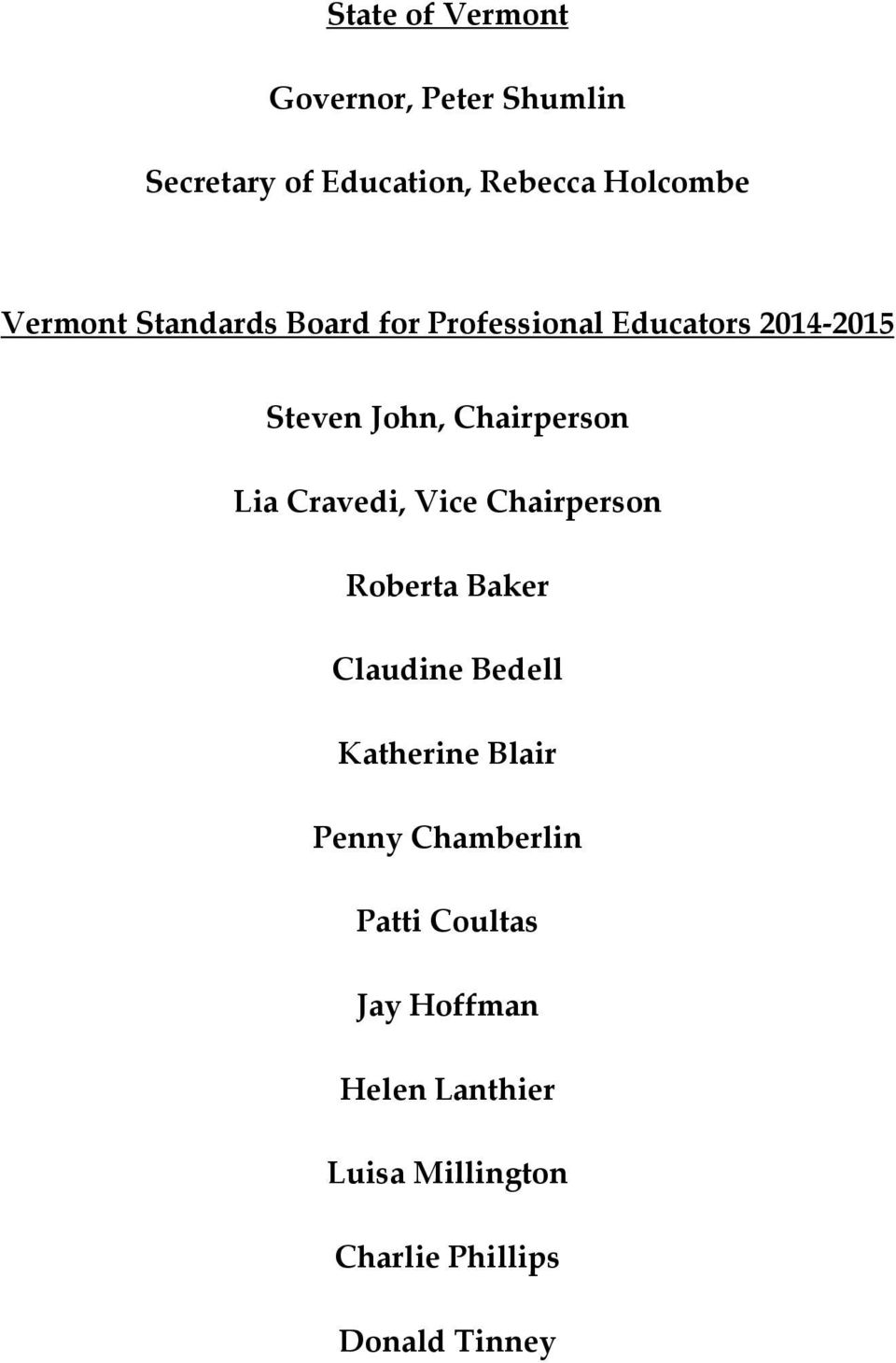
2 State of Vermont Governor, Peter Shumlin Secretary of Education, Rebecca Holcombe Steven John, Chairperson Lia Cravedi, Vice Chairperson Roberta Baker Claudine Bedell Katherine Blair Penny Chamberlin Patti Coultas Jay Hoffman Helen Lanthier Luisa Millington Charlie Phillips Donald Tinney
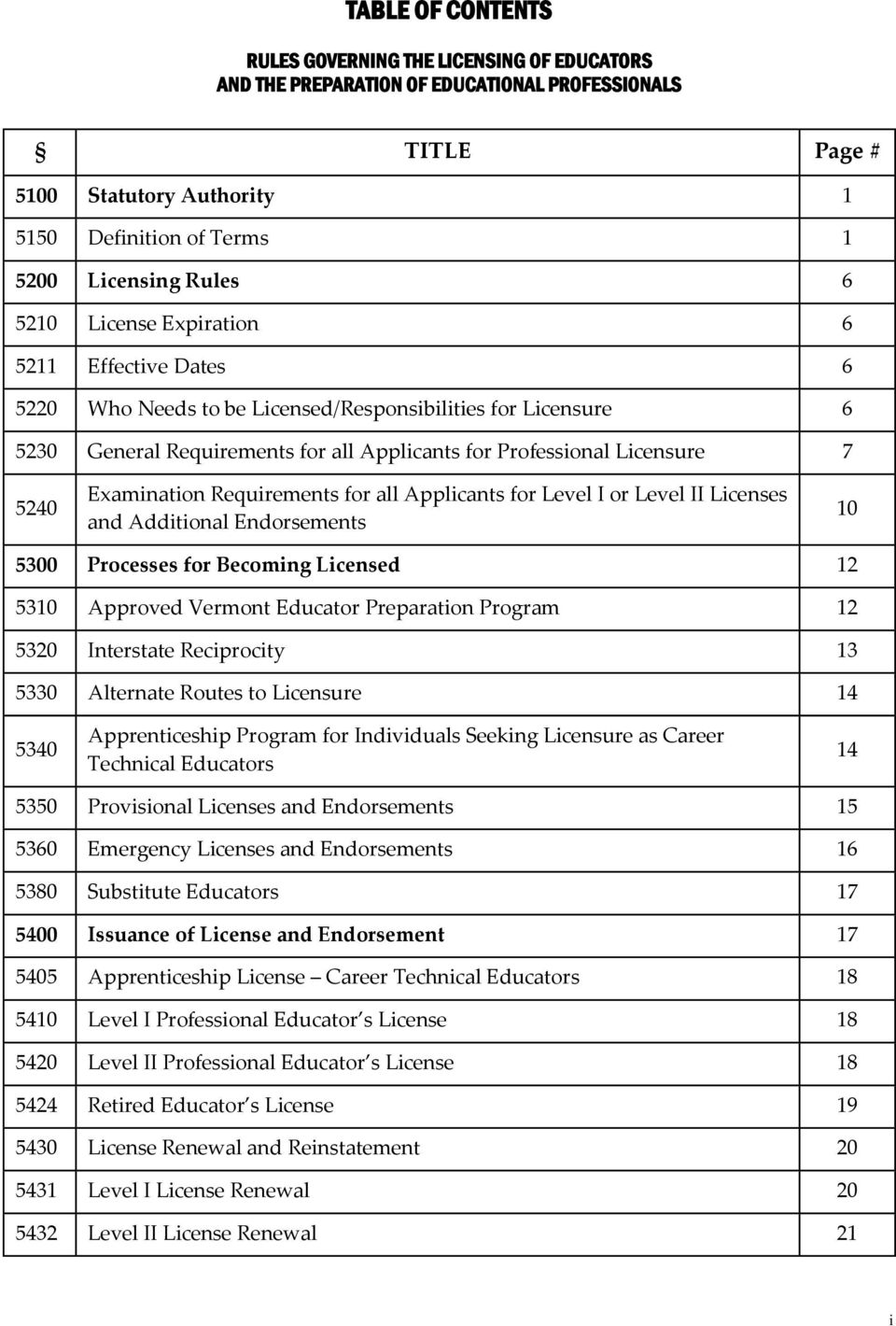
3 TABLE OF CONTENTS RULES GOVERNING THE LICENSING OF EDUCATORS AND THE PREPARATION OF EDUCATIONAL PROFESSIONALS TITLE Page # 5100 Statutory Authority Definition of Terms Licensing Rules License Expiration Effective Dates Who Needs to be Licensed/Responsibilities for Licensure General Requirements for all Applicants for Professional Licensure Examination Requirements for all Applicants for Level I or Level II Licenses and Additional Endorsements Processes for Becoming Licensed Approved Vermont Educator Preparation Program Interstate Reciprocity Alternate Routes to Licensure Apprenticeship Program for Individuals Seeking Licensure as Career Technical Educators Provisional Licenses and Endorsements Emergency Licenses and Endorsements Substitute Educators Issuance of License and Endorsement Apprenticeship License Career Technical Educators Level I Professional Educator s License Level II Professional Educator s License Retired Educator s License License Renewal and Reinstatement Level I License Renewal Level II License Renewal 21 i
4 TITLE Page # 5433 Retired Educator License Renewal Reinstatement of Lapsed Licenses or Endorsements Audiologists and Speech Language Pathologists Endorsements Code of Professional Ethics and Rules of Professional Conduct for Vermont Educators Code of Professional Ethics Rules of Professional Conduct Administrative Bodies The Local Standards Board (LSB) Regional Standards Board (RSB) License Surrender, Negotiated Settlement, Reinstatement After Suspension or Revocation, Reprimands, and Posting of Licensing Actions Administrative Provisions Access to License Records Approval of Educator Preparation Programs Approval Criteria Student Teaching Requirements Review Process for Program Approval Reports and Responses Action by the VSBPE Waiver Rule 49 ii

5 LICENSING RULES 5100 STATUTORY AUTHORITY 16 V.S.A. 1691a; 16 V.S.A. 1692; 16 V.S.A. 1694; 16 V.S.A. 1695; 16 V.S.A Definition of Terms For the purpose of these Licensing Rules, unless the context otherwise clearly requires, the following definitions apply: Academic Review refers to a pathway by which applicants seeking an initial administrator licensure can be licensed. Applicants must submit coursework that is aligned with the Core Leadership Standards for Vermont Educators for which the applicant received graduate credit. Administrator candidates must also meet the internship requirement and the examination requirement as determined by the Standards Board. Add-On refers to an endorsement that may only be acquired as an additional endorsement to an existing Level I or II educator license. Administrator means an individual licensed under 16 V.S.A. Chapter 51 the majority of whose time in a public school, school district, or supervisory union is assigned to developing and managing school curriculum, evaluating and disciplining personnel, or supervising and managing a public school system or public school program. Administrative Internship means a minimum of 300 hours of supervised, substantive field experience in two or more types of school settings, including employment on a provisional license as an administrator, or other concentrated field experience however named, in which the candidate shall demonstrate competence in the Core Leadership Standards for Vermont Educators. Applicant means an individual applying for a license. Approved Educator Preparation Program(s) means one or more programs offered within an institution of higher education or other educational organization, that meets established standards for licensure according to these rules, and is approved to recommend candidates for educator licensure by the or a national accreditation process accepted by the Standards Board. Associate s Degree means a minimum of forty-eight (48) college credit hours from a regionally accredited or state-approved institution. Career Technical Education Endorsement means an endorsement to teach one or more of the specific trades or industries specified in Section 5445 of these rules. Rules Governing the Licensing of Educators and the Preparation of Educational Professionals 12/26/14 1

6 Cooperating Educator means an educator assigned to a student teacher or intern by a local school in order to fulfill the requirements of Section 5923 of these rules. Core Content Areas means English, math, science, and social studies. Core Teaching Standards for Vermont Educators means the core standards for what all educators should know and be able to do as defined in the document titled Core Teaching and Leadership Standards for Vermont Educators as developed, and periodically updated, by the. Core Leadership Standards for Vermont Educators means the core standards for what all educators should know and be able to do as defined in the document titled Core Teaching and Leadership Standards for Vermont Educators as developed, and periodically updated, by the. Diverse Learning Needs means the needs of all learners including: females as well as males; members of ethnic and racial minorities as well as ethnic and racial majorities; learners who are socioeconomically disadvantaged, as well as those who are more advantaged; learners who have not been successful in school as well as those who have been successful; and learners who have been denied access in any way to educational opportunities as well as those who have not. Educational Entities means Vermont public schools, Independent Schools approved by the State Board of Education, and Recognized Schools. Educational Functions means activities such as planning, development, or management of curriculum; provision or oversight of instructional or learner support services; assessment or oversight of the assessment of learners; or supervision or evaluation of educational staff. Educator means any teacher or administrator requiring a license under 16 V.S.A. Chapter 51. Endorsement means the grade level and field in which an educator is authorized to serve, pursuant to Rule 5440, as identified by the code numbers and legend printed on the license. A license shall bear one or more endorsements. Field means an administrative or instructional area, or area of professional practice. Hearing Panel means the persons assigned in individual cases to find facts, reach conclusions of law, and make decisions regarding compliance with standards for obtaining, retaining, and renewing licenses. Initial Licensure means the first professional educator license and endorsement acquired by an applicant. All subsequent licenses and/or endorsements shall be considered additional, whether they are acquired concurrently or subsequently. Rules Governing the Licensing of Educators and the Preparation of Educational Professionals 12/26/14 2

7 Interdisciplinary Major means a planned program of study, approved by the institution, which includes courses in no more than three disciplines in the liberal arts or sciences and at least eighteen (18) credit hours in one of those disciplines. Internship means a graduate experience in which one is supervised by both an onsite supervisor and qualified faculty of an institution of higher education. Interstate Agreement means the system whereby a recommendation for licensure from a state-approved educator preparation program at an accredited college or university, or a professional license, is recognized in another state. The reciprocity is governed by the Interstate Agreement developed by the National Association of State Directors of Teacher Education and Certification (NASDTEC). It does not guarantee that a license in one state can simply be traded in for a license in another state. Each state that is a signatory to the Agreement sets its own rules and conditions under which a license will be issued. Liberal Arts and Sciences means those academic courses of instruction intended to provide a general knowledge in the arts, humanities, sciences, and mathematics, as opposed to professional and technical subjects. License means a license to engage in teaching or school administration, as the context requires, in the state and includes the endorsements the licensee possesses. Licensee means an individual licensed under 16 V.S.A. Chapter 51. Licensing Action means action that suspends, revokes, limits, or conditions licensure or certification in any way and includes warnings, reprimands, probation, and administrative penalties. Local Standards Board (LSB) means a board whose majority membership shall be licensed teachers and that is established and maintained pursuant to Rule 5620 for the primary purpose of recommending teachers for relicensure pursuant to these rules. Major means an academic major granted as part of a bachelor s degree by an accredited/approved four-year institution. The equivalent of a major is defined as a compilation of at least thirty (30) credit hours in the specified major field from accredited/approved institution(s), at least nine (9) of which shall be advanced undergraduate courses or higher. Master s degree means an advanced academic degree granted by an accredited/approved graduate institution. Minor means an academic minor granted as a part of a bachelor's degree by an accredited/approved four-year institution, or a compilation of at least eighteen (18) credit hours in the specified minor field from accredited/approved institution(s), at least six (6) of which shall be advanced undergraduate courses or higher. Rules Governing the Licensing of Educators and the Preparation of Educational Professionals 12/26/14 3

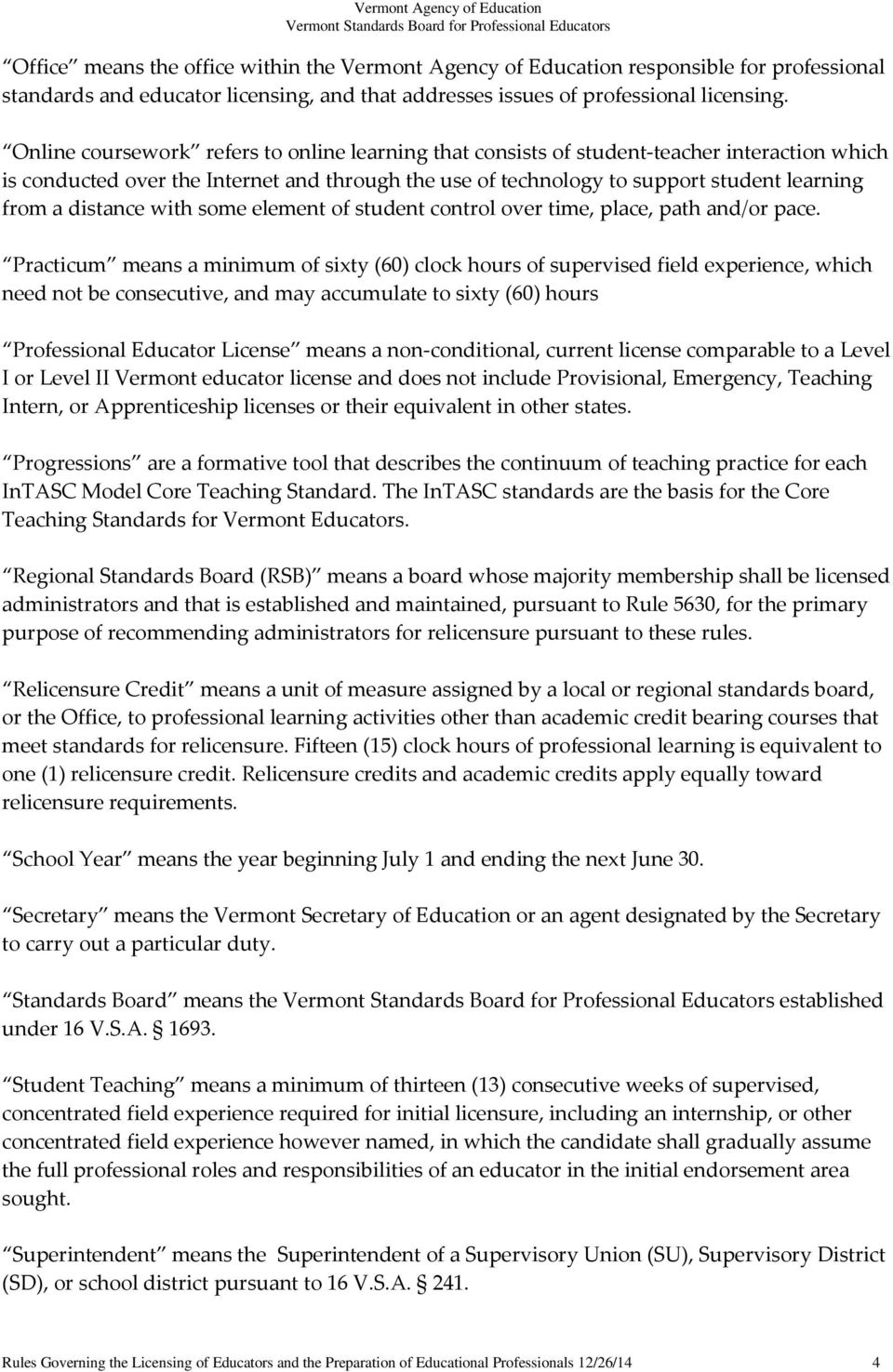
8 Office means the office within the Vermont Agency of Education responsible for professional standards and educator licensing, and that addresses issues of professional licensing. Online coursework refers to online learning that consists of student-teacher interaction which is conducted over the Internet and through the use of technology to support student learning from a distance with some element of student control over time, place, path and/or pace. Practicum means a minimum of sixty (60) clock hours of supervised field experience, which need not be consecutive, and may accumulate to sixty (60) hours Professional Educator License means a non-conditional, current license comparable to a Level I or Level II Vermont educator license and does not include Provisional, Emergency, Teaching Intern, or Apprenticeship licenses or their equivalent in other states. Progressions are a formative tool that describes the continuum of teaching practice for each InTASC Model Core Teaching Standard. The InTASC standards are the basis for the Core Teaching Standards for Vermont Educators. Regional Standards Board (RSB) means a board whose majority membership shall be licensed administrators and that is established and maintained, pursuant to Rule 5630, for the primary purpose of recommending administrators for relicensure pursuant to these rules. Relicensure Credit means a unit of measure assigned by a local or regional standards board, or the Office, to professional learning activities other than academic credit bearing courses that meet standards for relicensure. Fifteen (15) clock hours of professional learning is equivalent to one (1) relicensure credit. Relicensure credits and academic credits apply equally toward relicensure requirements. School Year means the year beginning July 1 and ending the next June 30. Secretary means the Vermont Secretary of Education or an agent designated by the Secretary to carry out a particular duty. Standards Board means the established under 16 V.S.A Student Teaching means a minimum of thirteen (13) consecutive weeks of supervised, concentrated field experience required for initial licensure, including an internship, or other concentrated field experience however named, in which the candidate shall gradually assume the full professional roles and responsibilities of an educator in the initial endorsement area sought. Superintendent means the Superintendent of a Supervisory Union (SU), Supervisory District (SD), or school district pursuant to 16 V.S.A Rules Governing the Licensing of Educators and the Preparation of Educational Professionals 12/26/14 4
9 Teacher means an individual licensed under 16 V.S.A. Chapter 51, the majority of whose employed time in a public school district or supervisory union is assigned to furnish to learners direct instructional or other educational services, as defined by rule of the Standards Board, or who is otherwise subject to licensing as determined by the Standards Board. Professional Learning Plan means a plan that sets forth how an applicant for licensure with a Career Technical Education endorsement who has not met the requirements of Sections of these rules intends to meet those requirements. Transcript Review means the process of qualifying for additional endorsement and/or initial licensure (only an option in a limited number of endorsement areas) by documentation of qualifications via academic transcripts. Rules Governing the Licensing of Educators and the Preparation of Educational Professionals 12/26/14 5

10 5200 LICENSING RULES 5210 License Expiration Any license issued shall expire on June 30 of the expiration year specified on the license Effective Dates It is the responsibility of higher education institutions with approved educator preparation programs and of coordinators of approved alternate route to licensure programs to ensure that they are aware of all changes to licensing rules and/or policies, including endorsement changes, including those made subsequent to their program approval date. The Office will inform, in a timely manner, higher education institutions with approved educator preparation programs and coordinators of approved alternate route to licensure programs of any changes to licensing rules and/or policies Approved educator preparation and alternate route to licensure programs shall ensure that all general licensure competencies (if appropriate), specific endorsement competencies and additional requirements, if any, and other licensure requirements in effect on the date of application for program approval are addressed for each candidate in the program Candidates for licensure via any alternate route to licensure approved under 5332 shall be required to demonstrate competence in accordance with the general licensure competencies, specific endorsement competencies and additional requirements, if any, and other licensure requirements in effect at the time of written notification of acceptance of their credentials for review under Rule 5333(academic review), 5310 or 5323 (transcript review), or 5332 (alternate routes) Who Needs To Be Licensed/Responsibilities for Licensure Except as set forth in rule 5380, any educator employed in a public school shall possess a valid Vermont educator license, an endorsement appropriate to the professional assignment, and any other license or credential required by these rules or the applicable endorsement, on the first day of service. The educator shall maintain the educator license, endorsement, and any other applicable license or credential throughout the period of service Except as set forth in rule 5380, any individual who performs educational functions covered by any endorsement authorization statement in these rules, whether as an independent contractor or an employee of a school district or supervisory union, shall hold an appropriate license and endorsement. Rules Governing the Licensing of Educators and the Preparation of Educational Professionals 12/26/14 6

11 In limited circumstances, qualified professionals or skilled people trained in a field other than education may perform educational functions without licensure providing they are supplementing the educational functions performed by licensed school personnel. Supplementing means extending or intensifying the educational functions performed by licensed personnel. Individuals who are supplementing educational functions shall work under the supervision of a licensed educator(s) who is appropriately endorsed for the assignment. For purposes of this rule, supervision means direct responsibility for overseeing the work of the non-licensed individual Paraprofessionals, student teachers, and volunteers are not required to hold licenses but shall work under the on-site supervision of licensed educators A license and/or an endorsement is not valid until it is issued in the name of the Standards Board It is the responsibility of the individual to obtain a license, an endorsement(s), and any other license or credential required by these rules or by the applicable endorsement, to attend to all renewal requirements and to seek renewal in a timely manner It is the responsibility of the superintendent or director of an independent Career Technical center to ensure that on the first day of any assignment of duties requiring licensure under these rules, each educator has a valid license, an appropriate endorsement, and any other applicable license or credential for the educator's assigned duties, and to ensure that the license and endorsement, as well as any other applicable licenses or credentials, are maintained throughout the assignment. Failure to do so may subject the superintendent or director of an independent Career Technical center to the discipline under provisions of 16 V.S.A. Chapter Clerical Error, Omission or Misrepresentation Any license or endorsement mistakenly issued by the Standards Board may be voided by the Secretary without need for revocation proceedings under the following circumstances: A. clerical error by any party; B. omission of information required by the applicant; or C. erroneous information provided by any party. When a license and/or endorsement is voided under this rule, the holder shall receive written notice of the action and reason thereof General Requirements for All Applicants for Professional Licensure Rules Governing the Licensing of Educators and the Preparation of Educational Professionals 12/26/14 7

12 5231 Except as otherwise noted by this section, the applicant shall hold a baccalaureate degree from a regionally accredited or state-approved institution and shall have successfully completed a major, or its equivalent, in the liberal arts and sciences, or in the content area of the endorsement sought. An applicant for a Career Technical Education endorsement, or an educator who holds a Career Technical Education endorsement, need not hold a bachelor's degree or have a major in the liberal arts and sciences. However, an applicant for a Career Technical Education endorsement shall hold at least an Associate s Degree, or the equivalent, in order to qualify for Level I Licensure. Applicants for the Junior ROTC Instructor endorsement need not hold a bachelor s degree. An applicant for a School Nurse endorsement shall have graduated from a nationally accredited, four-year nursing program. An applicant for an Associate School Nurse endorsement shall hold at least an RN degree from a nationally accredited nursing program. Holders of Career Technical Education, Junior ROTC Instructor, or Associate School Nurse endorsements must meet the baccalaureate degree requirement if they wish to qualify to add additional endorsements other than those exempted from the baccalaureate degree requirement in this section. Applicants for Audiology and Speech Language Pathology licenses or Educational Speech Language Pathology, School Psychologist, School Social Worker, School Nurse, Associate School Nurse, Junior ROTC Instructor, Work-Based Learning Coordinator, endorsements need not meet the requirements of sections 5233 and 5235 of these rules. However, individuals holding endorsement(s) in one or more of these areas who have not already met the requirements of sections 5233 and 5235 of these rules must meet these requirements in order to qualify for additional endorsements in any other teaching or administrative area Documentation of the specified content knowledge and performance standards and additional requirements, if any, for the endorsement(s) being sought Documentation of required student teaching or administrative internship experience Student Teaching. Evidence of at least thirteen (13) consecutive weeks of student teaching, or an equivalent learning experience as determined by Standards Board policy or by the requirements of the endorsement Administrative Internship. Evidence of at least 300 hours of an administrative internship for those seeking an initial administrator endorsement Demonstrated ability to communicate effectively in speaking, writing, and other forms of creative expression and the ability to apply basic mathematical skills, critical thinking skills, and creative thinking skills. Rules Governing the Licensing of Educators and the Preparation of Educational Professionals 12/26/14 8
13 5235 Demonstrated competency as specified in the following educator requirements: Learner Development. The teacher understands how learners grow and develop, recognizing that patterns of learning and development vary individually within and across the cognitive, linguistic, social, emotional, and physical areas, and designs and implements developmentally appropriate and challenging learning experiences Learning Differences. The teacher uses understanding of individual differences and diverse cultures and communities to ensure inclusive learning environments that enable each learner to meet high standards Learning Environments. The teacher works with others to create environments that support individual and collaborative learning, and that encourage positive social interaction, active engagement in learning, and self-motivation Content Knowledge. The teacher understands the central concepts, tools of inquiry, and structures of the discipline(s) he or she teaches and creates learning experiences that make the discipline accessible and meaningful for learners to assure mastery of the content Application of Content. The teacher understands how to connect concepts and use differing perspectives to engage learners in critical thinking, creativity, and collaborative problem solving related to authentic local and global issues Assessment. The teacher understands and uses multiple methods of assessment to engage learners in their own growth, to monitor learner progress, and to guide the teacher s and learner s decision making Planning for Instruction. The teacher plans instruction that supports every learner in meeting rigorous learning goals by drawing upon knowledge of content areas, curriculum, cross-disciplinary skills, and pedagogy, as well as knowledge of learners and the community context Instructional Strategies. The teacher understands and uses a variety of instructional strategies to encourage learners to develop deep understanding of content areas and their connections, and to build skills to apply knowledge in meaningful ways Professional Learning and Ethical Practice. The teacher engages in ongoing professional learning and uses evidence to continually evaluate his/her practice, particularly the effects of his/her choices and actions on others (learners, families, other professionals, and the community), and adapts practice to meet the needs of each learner. Rules Governing the Licensing of Educators and the Preparation of Educational Professionals 12/26/14 9

14 Leadership and Collaboration. The teacher seeks appropriate leadership roles and opportunities to take responsibility for student learning, to collaborate with learners, families, colleagues, other school professionals, and community members to ensure learner growth, and to advance the profession. Demonstrated competency as specified in the following administrator requirements: Vision, Mission, and Goals. An education leader promotes the success of every learner by facilitating the development, articulation, implementation, and stewardship of a vision of learning that is shared and supported by all stakeholders Teaching and Learning. An education leader promotes the success of every learner by advocating, nurturing and sustaining a school culture and instructional program conducive to student learning and staff professional growth Managing Organizational Systems and Safety. An education leader promotes the success of every learner by ensuring management of the organization, operation, and resources for a safe, efficient, and effective learning environment Collaborating with Families and Stakeholders. An education leader promotes the success of every learner by collaborating with faculty and community members, responding to diverse community interests and needs, and mobilizing community resources Ethics and Integrity. An education leader promotes the success of every learner by acting with integrity, fairness, and in an ethical manner The Education System. An education leader promotes the success of every learner by understanding, responding to, and influencing the political, social, economic, legal, and cultural context Applicants shall meet all other requirements specified by law and regulation Examination Requirements for all Applicants for Level I or Level II Licenses and Additional Endorsements 5241 Except as otherwise provided by Rule 5246, or Rule (B), all applicants for initial licensure under sections 5310, 5320, 5330, or 5340 of these rules shall be required to meet the passing scores established by the Standards Board on the Praxis Core Series examinations in reading, writing, and mathematics or other skills examinations selected by the Standards Board. Rules Governing the Licensing of Educators and the Preparation of Educational Professionals 12/26/14 10
15 5242 Except as otherwise provided by Rule 5246, all applicants for initial or additional endorsements shall be required to meet the passing scores established by the Standards Board on the applicable Praxis II examination or other examination required by the Standards Board in the endorsement area sought Alternatives to Examinations. The Standards Board may adopt an alternative method to an examination requirement for all applicants when it is shown to provide evidence of basic skill or content competency comparable to that of the passing scores on the required examinations Adoption of Testing Elements, Public Notice, and Consideration of Recommendation. Before adopting: A. scores for passing the examinations required under these rules; B. examinations other than Praxis Core Series and Praxis II; C. alternative methods of demonstrating competency; or D. additional endorsement areas to be subject to examination requirements; the Standards Board shall, after public notice of its deliberations consider the recommendations of interested individuals and organizations. The effective date of any examination or alternative to an examination adopted to take the place of the Praxis Core Series or Praxis II examination requirement or the addition of new endorsement areas subject to examination requirements shall be no less than one (1) year from the date of adoption Review of Passing Scores. Passing scores for examinations will remain in effect for three years. At the end of the first three-year period, and every three years thereafter, the Standards Board shall review the passing scores and any alternatives then in place, and may make modifications to be in effect during the ensuing three-year period. Scores adopted by the Standards Board for passing the examinations, or alternatives to examinations required under these rules, shall apply to any application for licensure submitted subsequent to the effective date specified at the time of adoption. A candidate who retakes an applicable examination in order to achieve a passing score, or who seeks to qualify by applying for the second or subsequent time with an alternative requirement, must meet the standard in effect when the score or alternative is submitted as part of an otherwise complete application for licensure Exemptions. Candidates meeting the following criteria shall be exempt from the examination requirements set forth in these rules: A candidate who qualifies under the NASDTEC Interstate Agreement s provisions of these rules, and who has a minimum of three (3) school years of at least half-time employment experience during the seven (7) years immediately Rules Governing the Licensing of Educators and the Preparation of Educational Professionals 12/26/14 11

16 preceding the application for a Vermont license, as a professionally licensed educator in the endorsement area for which an endorsement is sought A candidate who, prior to the effective date of a particular examination requirement, has received written notification from the Office or a panel convened to review credentials under section 5330 of these rules that a license will be granted upon completion of specified requirements A candidate who otherwise qualifies for a license or endorsement, and who is certified by the National Board for Professional Teaching Standards in the applicable endorsement area Waiver Of Praxis Core Series Requirement A. A superintendent may apply for the waiver on behalf of the school district. B. The school district would need to demonstrate that not being given a waiver would substantially inhibit the district s ability to carry out its locally established objectives. C. The prospective teacher on whose behalf the waiver is being requested must document that he/she: 1. has undertaken additional efforts to acquire knowledge and skills necessary such as tutoring and courses, 2. has an identified and documented disability and has exhausted all ETS procedures for accommodations for that disability; and 3. has taken the exam a minimum of three times without being able to meet the required cut scores. D. If A - C are met and the VSBPE finds that the candidate is otherwise qualified, the VSBPE will instruct the Educator Quality Division s Licensing Office to issue a license that is restricted to teaching in the school building of the district making the waiver request PROCESSES FOR BECOMING LICENSED Applicants may seek licensure, through written application, by the following methods: 5310 Approved Vermont Educator Preparation Program The applicant has successfully completed and been recommended for licensure by a Vermont educator preparation program approved by the Standards Board pursuant to Section 5900 of these rules. The applicant shall meet requirements for updated knowledge and skills as established by Standards Board policy when there is a time lapse of ten (10) or more years between the time of recommendation for licensure and application for licensure. An applicant who completed an approved Vermont educator preparation program and holds a current license in another state shall be considered under Section 5320 of these rules. Rules Governing the Licensing of Educators and the Preparation of Educational Professionals 12/26/14 12
17 The knowledge and skills of an applicant for an initial license who wishes to qualify for an endorsement for which an approved Vermont educator preparation program does not exist, or did not exist within the last five (5) years, shall be evaluated by the Standards Board, or its designee, on an individual basis, through transcript review, to establish that the applicant meets the requirements of these rules. Only coursework which appears, for credit, on an official transcript and for which the applicant received a grade of C or better, may be counted toward the requirements for initial licensure through transcript review Interstate Agreement 5321 An applicant who has successfully completed a state-approved educator preparation program in a state with which Vermont has signed the NASDTEC Interstate Agreement and who meets the requirements specified in such Agreement and ancillary requirements as defined in such Agreement and specified in these rules shall be issued a comparable license and/or endorsement(s) according to the provisions of these rules. The applicant shall meet requirements for updated knowledge and skills as established by Standards Board policy when there is a time lapse of ten (10) or more years between the time of recommendation for licensure and application for licensure An applicant who holds a professional license in a state with which Vermont has signed the NASDTEC Interstate Agreement, has provided satisfactory service under that license as an educator in a school in an assignment covered by the endorsement sought, on at least a half-time basis for not fewer than three (3) school years during the seven (7) years immediately preceding the application for a Vermont license, and who meets the requirements of the Agreement and ancillary requirements as defined in the Agreement and specified in these rules shall be issued a comparable license and/or endorsement(s) according to the provisions of these rules An applicant for Vermont licensure who holds a professional license in a state not participating in the NASDTEC Interstate Agreement, or an applicant whose category of licensure is not covered by the Agreement, shall be evaluated by the Standards Board, or its designee, on an individual basis by transcript review to establish whether the applicant meets the competency requirements of these rules. Only coursework which appears, for credit, on an official transcript and for which the applicant received a grade of C or better, may be counted toward the requirements for initial licensure through transcript review. The applicant shall meet requirements for updated knowledge and skills as established by Standards Board policy An applicant for Vermont licensure who is certified by the National Board for Professional Teaching Standards shall be issued a license in the comparable endorsement area When an endorsement requires an additional license or certificate, a copy of the valid document shall be provided by the applicant. Rules Governing the Licensing of Educators and the Preparation of Educational Professionals 12/26/14 13

18 5326 A Vermont license and endorsement(s) issued through the NASDTEC Interstate Agreement shall be subject to renewal provisions of Section 5430 of these rules Alternate Routes to Licensure 5332 An individual who holds at least a baccalaureate degree from a regionally accredited or state-approved institution and who has successfully completed a major, or its equivalent, in the liberal arts and sciences, or in the content area of the endorsement sought, may be licensed by completing an alternate preparation process approved by the Standards Board. For endorsement areas requiring an advanced degree, the individual must hold the specified advanced degree in order to be deemed eligible to proceed with any other alternate preparation process approved by the Standards Board Academic Review for Individual Seeking Licensure as an Administrator. An applicant for a Vermont administrator license who has not completed an approved preparation program (including Peer Review) may be evaluated by the Standards Board, or its designee, on an individual basis by academic review to establish whether the applicant meets the competency requirements of these rules. Only coursework, appearing on an official transcript, for which the applicant received graduate credit with a grade of C or better, may be counted toward the requirements for initial licensure through academic review. Administrator candidates must also meet the internship, the examination, and requirements for updated knowledge and skills as established by the Standards Board Apprenticeship License for Individuals Seeking Licensure as Career Technical Educators Upon employment by a Career Technical Center, an applicant for licensure as a Career Technical educator with a Career Technical Education endorsement, who does not otherwise meet the requirements of Sections of these rules as demonstrated through one of the processes outlined in of these rules, shall develop a Professional Learning Plan which sets forth how the applicant intends to meet those requirements The Professional Learning Plan shall be developed by the applicant and the director of an approved Career Technical teacher education program and be approved by the Director of the Career Technical Center An Apprenticeship License shall be issued when the Apprenticeship License Application with an approved Professional Learning Plan is submitted to the Standards Board, or its designee. The Apprenticeship License shall be valid for up to three (3) years The director of the career technical teacher education program will verify satisfactory completion of the Professional Learning Plan. Satisfactory Rules Governing the Licensing of Educators and the Preparation of Educational Professionals 12/26/14 14

19 completion shall be indicated on a form signed by the director of the career technical teacher education program, which shall be submitted with the Level I licensing application. The Apprenticeship License shall not be extended unless the Standards Board, or its designee, determines extenuating circumstances exist that prevented the holder from satisfactorily completing an Associate s Degree, or the equivalent, or the Professional Learning Plan, within the three (3) years. Under these conditions, the Apprenticeship License may be extended for an additional two (2) year period Provisional Licenses and Endorsements 5351 The Standards Board, or its designee, shall issue a two-year Provisional License with an endorsement to an individual on the application of a superintendent or director of an independent school when the local district or independent school is unable to find an appropriately licensed and/or endorsed applicant after making all reasonable efforts to do so, or when a licensed or endorsed applicant does not possess the qualifications necessary for the specific assignment. The application for a Provisional License or endorsement shall include a plan for obtaining a Level I License or endorsement and an explanation of how the applicant will be mentored and supervised during the two-year period of the Provisional License. Qualifications With the exceptions below, applicants for a Provisional License and/or endorsement shall possess a baccalaureate degree and meet at least one of the following criteria: A. possess any valid educator license from Vermont or from another state; or B. possess any expired Vermont educator license or any expired educator license from another state, provided the license expired no longer than 10 years ago; or C. have a major in the content area of the provisional endorsement sought; or D. have successfully completed the licensure content assessment for the provisional endorsement sought. Applicants for a Provisional School Nurse or Associate School Nurse endorsement must hold an RN degree and a current Vermont nursing license. Applicants for Provisional Associate School Nurse endorsements must have an Associate s Degree/Diploma from a nursing program accredited by the National League for Nursing (NLN) but are exempt from the baccalaureate degree requirement. Applicants for Provisional Career Technical Education endorsements must have an Associate s Degree, or its equivalent, but are exempt from the baccalaureate degree requirement. Applicants for a Provisional Educational Speech Language Pathologist endorsement must hold a current Vermont clinical SLP license. Applicants for Provisional Junior ROTC Instructor endorsements must hold the Department of Defense certification as a junior ROTC instructor and are exempt from the baccalaureate degree requirement. Rules Governing the Licensing of Educators and the Preparation of Educational Professionals 12/26/14 15

20 Applicants for Provisional Driver and Traffic Safety Education endorsement must demonstrate coursework equivalent to Vermont s Driver Education I and II and meet the Additional Requirements for the endorsement. Applicants for a Provisional School Psychologist endorsement must hold a current Vermont Clinical Psychologist license or be a currently Nationally Certified School Psychologist (NCSP) through the National Association for School Psychologists (NASP) A provisional endorsement may be requested without making all reasonable attempts to find a properly endorsed person when the superintendent wishes to assign a current employee who is licensed in Vermont, but not properly endorsed for the assignment, or an unlicensed individual who is a candidate in a diversity program approved by the Secretary. In either instance the individual must submit a plan by which he/she will qualify for licensure and/or endorsement within the two year provisional period. If the employee is not properly endorsed at the expiration of the provisional endorsement, the district shall make all reasonable efforts to seek a properly endorsed applicant Provisional License or endorsement requests shall not be approved before June 1 for the ensuing year unless the request is for an administrator whose assignment for the ensuing year begins prior to that date. Provisional License requests for such assignments shall not be approved prior to April 1 for the ensuing school year A Provisional License or endorsement shall expire on June 30 of the second school year for which it was granted A Provisional License or endorsement shall not be extended for any individual unless the Standards Board, or its designee, determines that extenuating circumstances existed that prevented the individual from completing the approved plan for Level I licensure An educator who holds a Provisional License may be employed by any school district during the life of the Provisional License if the employing district shows need in accord with Section 5351 of these rules Emergency Licenses and Endorsements The Standards Board, or its designee, shall issue a one-year Emergency License or endorsement to an individual on the application of a superintendent or director of an independent school when the local district or independent school is unable to find appropriately licensed and/or endorsed applicants, or applicants who meet the qualifications for provisional, apprenticeship, after making all reasonable efforts to do so Emergency Licenses and endorsements shall be issued only to individuals who hold a baccalaureate degree, but do not meet the qualifications for a Provisional License as stated in Section 5351 of these rules. The application for an Emergency License shall Rules Governing the Licensing of Educators and the Preparation of Educational Professionals 12/26/14 16

21 include an explanation of how the applicant will be mentored and supervised. Applicants for emergency Career Technical Education endorsements need not meet the baccalaureate degree requirement No Emergency License or endorsement shall be approved before July 15 for the ensuing school year An Emergency License or endorsement shall expire on June 30 of the school year in which it was issued, shall be valid only for the assignment for which it was issued, and cannot be extended for a second year An Emergency License shall not be issued for the following endorsements: Special Educator Special Education Consulting Teacher Early Childhood Special Educator Intensive Special Education Teacher Teacher of the Blind and Visually Impaired Teacher of the Deaf and Hard of Hearing Career Technical Education Special Needs Coordinator School Nurse Associate School Nurse School Psychologist Educational Speech Language Pathologist School Counselor Career Technical Education School Counseling Coordinator School Social Worker Junior ROTC Instructor Driver and Traffic Safety Education All Administrator endorsements: o Adult Services Coordinator o Supervisor o Director of Special Education o Superintendent o Principal o Career and Technical Center Director o Director of Curriculum 5380 Substitute Educators 5381 Qualifications Each local school board shall adopt a policy establishing employment qualifications for persons who substitute for educators in their absence. Each policy shall require at minimum that the substitute has graduated from high school. Rules Governing the Licensing of Educators and the Preparation of Educational Professionals 12/26/14 17
22 5382 Time Limits and Extensions Vermont Agency of Education An unlicensed person employed as a substitute pursuant to local school board policy may substitute for up to thirty (30) consecutive calendar days in the same assignment. In order to continue to employ the unlicensed person in this assignment beyond thirty (30) days, the superintendent shall apply for an Emergency or Provisional License for the person pursuant to Sections 5350 and 5360 of these rules. Licensed educators may substitute in a field outside of their endorsement field for thirty (30) consecutive calendar days in the same assignment. Upon application by the superintendent, the Standards Board or its designee may grant one extension for an additional thirty (30) days. In order to continue to employ a licensed educator beyond sixty (60) days outside of his/her endorsement field, the superintendent shall apply for a Provisional License for the person pursuant to Section 5350 of these rules ISSUANCE OF LICENSE AND ENDORSEMENT The issuance of a license authorizes the holder to practice as an educator in the endorsement fields(s) and grade level(s) specified. Each license issued shall indicate the type of license and the endorsement(s) and grade level(s) for which the license is valid Apprenticeship License - Career Technical Educators The Standards Board, or its designee, shall issue a three (3) year Apprenticeship License to individuals seeking licensure as Career Technical educators with Career Technical Education endorsements who do not meet the requirements for a Level I License under sections of these rules and who are enrolled in the Career Technical Education Program as specified in The educator examination requirements of Sections 5240 through 5246 of these rules shall not apply to applicants for Apprenticeship Licenses Level I Professional Educator s License 5411 A Level I Professional Educator s License shall be issued to an applicant who has satisfactorily met all requirements for licensure in Sections 5230 through 5246 through one of the processes in Section 5300 or met the requirements for an additional endorsement in Section 5443 of these rules A Level I License is valid for three (3) years, shall expire on June 30 of the third school year for which it was issued, and may be renewed subject to the provisions of Section 5430 of these rules. The expiration date of any additional Level I endorsement(s) shall be the expiration date of the current Level I License A Level II License may not revert back to a Level I License after it has been moved to a Level II License. Rules Governing the Licensing of Educators and the Preparation of Educational Professionals 12/26/14 18
23 5420 Level II Professional Educator s License A Level II License is valid for five (5) years, shall expire on June 30 of the fifth school year for which it was issued, and may be renewed subject to the provisions of Section 5430 of these rules A Level II Professional Educator s License shall be issued, upon recommendation of a local or regional standards board, or the Office if the educator is not employed by an entity served by a local or regional standards board, to educators who have: A. Practiced in Vermont in an endorsement area for three (3) years under a Level I License, or who have practiced in another state under a valid license of that state in the endorsement area and are currently practicing and licensed in Vermont B. Provided documentation of three (3) credits or 45 hours of professional learning. At least one (1) credit or 15 hours must address the specific knowledge and performance standards of the endorsement being moved to Level II and must occur within the three (3) years preceding application for the Level II Educator License in each endorsement area; and C. If practicing in an endorsement area, documentation of a self-assessment in relation to the Core Teaching Standards and Progressions or the Core Leadership Standards. The Office shall provide a verification form for L/RSBs for this purpose. Provided verification from the current administrator who supervises the educator's work that the educator is performing at a professional level in relation to the Core Teaching Standards or the Core Leadership Standards. The Office shall provide a verification form for administrators to use for this purpose; and D. Provided documentation of any valid licenses or credentials that are required by the endorsement(s) sought Educators who hold both a current Level I License and a current Level II License, and have Level I endorsement(s) being recommended for a Level II License, shall have the endorsement(s) issued on their current Level II License. The expiration date of any additional Level II endorsement(s) shall be the expiration date of the current Level II License Applicants for licensure through the NASDTEC Interstate Agreement may be eligible for an endorsement on a Level II License upon presenting evidence of a minimum of three (3) school years of at least half-time employment experience as a professionally licensed educator in the endorsement area for which an endorsement is sought Retired Educator License This license may only be issued for Level II endorsements held by the educator at the time of application. A person who has a minimum of fifteen (15) years of experience as a licensed educator, who has withdrawn from active service, and who is receiving a retirement allowance from his/her service as an educator, shall qualify for a five (5) year Rules Governing the Licensing of Educators and the Preparation of Educational Professionals 12/26/14 19
24 retired educator's license upon application to the Office. An initial Retired Educator License may only be issued to an educator who has completed three (3) professional learning credits or 45 hours. At least one (1) credit or 15 hours must address the specific knowledge and performance standards of the endorsement(s) being sought and must occur within the three (3) years preceding application for the Retired Educator License in each endorsement area. A self-assessment in relation to the Core Teaching Standards and Progressions or the Core Leadership Standards will be required when moving from a Level II License to a Retired Educator License. The Office shall provide a verification form for L/RSBs for this purpose. Level II License holders employed as educators in a Vermont entity served by a local or regional standards board shall have their professional learning credits approved by the board. A Level II License holder who is not employed by a Vermont entity served by a local or regional standards board at the time of application shall present their professional learning credits directly to the Office for approval. A self-assessment in relation to the Core Teaching Standards and Progressions or the Core Leadership Standards will be required when moving from a Level II License to a Retired Educator License License Renewal and Reinstatement A license and endorsement(s) shall be renewed or reinstated in the name of the Standards Board as set forth in Sections 5431 through 5435 of these rules. When an endorsement requires an additional license or credential, a copy of the valid document shall be provided by the educator at the time of renewal or reinstatement Level I License Renewal Educators who have worked in Vermont under the Level I endorsement for three (3) years. A. Level I endorsement holders who have practiced in an endorsement area for three (3) years must seek a recommendation from their local or regional standards board, or from the Office if the educator is employed by an entity not served by a local or regional board, for a Level II endorsement pursuant to section 5421 of these rules. B. An educator who does not receive a recommendation to move his/her Level I endorsement to a Level II license upon initial application, shall renew the Level I endorsement for three (3) years and re-apply to move the endorsement to a Level II license prior to the expiration of the renewal. To renew the Level I endorsement(s) the educator must show: 1. professional learning through completion of a minimum of three (3) credits or 45 hours in the endorsement area. At least one (1) credit or 15 hours must address the specific knowledge and Rules Governing the Licensing of Educators and the Preparation of Educational Professionals 12/26/14 20
25 performance standards of the endorsement(s) being renewed and must occur within the three (3) years preceding renewal of the Level I Educator License in each endorsement area. 2. If practicing in an endorsement area, documentation of a selfassessment in relation to the Core Teaching Standards and Progressions or the Core Leadership Standards.3) any required additional licenses or credentials specific to a particular endorsement. C. The Level I endorsement of an educator who does not receive a recommendation to move the endorsement to a Level II license after the second application shall become lapsed and may not be reinstated Educators who have not worked under the Level I endorsement for three (3) Years. A. Level I license holders who have not practiced in a particular endorsement area for three (3) years, shall seek a recommendation for renewal of that Level I endorsement through their local or regional standards board or from the Office if the educator is employed by an entity not served by a local or regional board. B. To receive a three (3) year renewal of a Level I endorsement under which the educator has not practiced for three (3) years, the educator shall show: 1. Professional learning through completion of a minimum of three (3) credits or 45 hours in the endorsement area. At least one (1) credit or 15 hours must address the specific knowledge and performance standards of the endorsement(s) being renewed and must occur within the three (3) years preceding application for the Retired Educator License in each endorsement area. 2. Any required additional licenses or credentials specific to a particular endorsement. C. The holder of a Level I endorsement that has been renewed shall continue to seek renewal of that endorsement in accord with Rule until such time as the educator qualifies to apply for renewal of the endorsement as a Level II endorsement Level II License Renewal Level II license holders shall seek a recommendation for renewal of their Level II license and endorsement(s) from their local or regional standards board or from the Office if the educator is employed by an entity not served by a local or regional board A Level II license holder employed by a Vermont independent school shall seek a recommendation for renewal from a local standards board designated by the Standards Board to serve independent schools, or may seek a recommendation Rules Governing the Licensing of Educators and the Preparation of Educational Professionals 12/26/14 21
26 for renewal from the local standards board for the school district in which the independent school is located if that board agrees to serve that independent school or educator The local or regional standards board or the Office shall recommend renewal of a Level II endorsement if the applicant presents the following: A. Professional learning through completion of a minimum of six (6) credits or 90 hours in the endorsement area. Professional Learning may apply to more than one endorsement if applicable, however, at least two (2) credits or 30 hours must address the specific knowledge and performance standards of the endorsement(s) being renewed and must occur within the five (5) years preceding renewal of the Level II Educator License in each endorsement area. Professional learning will be verified in accordance with Standards Board policy by the local or regional standards Board or the Office who will determine the applicability of the professional learning activities. B. Evidence of any required additional licenses or credentials specific to a particular endorsement. C. If practicing in an endorsement area, documentation of a self-assessment in relation to the Core Teaching Standards and Progressions or the Core Leadership Standards. The Office shall provide a verification form for L/RSBs for this purpose Approved professional learning activities shall be accepted on a reciprocal basis by local and regional standards boards and by the Office when the educator is not under the jurisdiction of a local or regional standards board Retired Educator Renewal A Retired Educator License holder may renew the license every five (5) years. The expiration date of any additional endorsement(s) shall be the expiration date of the current Retired License. Educators who have worked in Vermont under the Retired License shall seek a recommendation from their local or regional standards board or from the Office if the educator is employed by an entity not served by a local or regional board. If the applicant presents the following: A. Documentation showing completion of three (3) credits or 45 hours of professional learning completed within the preceding three (3) years, with at least one (1) credit or 15 hours shall address the specific knowledge and performance standards in each endorsement of the endorsement(s) being renewed. B. Evidence of any required additional licenses or credentials specific to a particular endorsement. C. Verification that the licensee is receiving a retirement allowance from his/her service as an educator. Educators who exceed the earnings cap determined Rules Governing the Licensing of Educators and the Preparation of Educational Professionals 12/26/14 22
27 by the Vermont State Teachers Retirement System (VSTRS) must reinstate their Level II license Reinstatement of Lapsed Licenses or Endorsements After a professional license, or endorsement lapses, an applicant who wishes the license and/or endorsement to be reinstated shall provide, in accordance with Standards Board policy, evidence of professional growth equivalent to that which would have been required for the maintenance of each license and/or endorsement under current rules, and provide copies of valid additional licenses or credentials, that are required for the specific endorsement If the applicant who wishes to reinstate a lapsed endorsement is served by a local or regional standards board, the board shall evaluate, and verify, as appropriate, the professional learning activities,. any other required credentials. The applicant must then submit documentation of this approval to the Office who will review and approve, as appropriate, the application for reinstatement. If an applicant is not under the jurisdiction of a local or regional standards board, the applicant shall apply for reinstatement directly to the Office, including submission for approval of documentation of professional learning activities if required The local or regional standards board and the Office shall apply the same standards with regard to approval of professional learning for reinstatement as they apply to license renewals To reinstate a lapsed Level II endorsement, six (6) credits or 90 hours of professional learning is required within the last five (5) years in the endorsement(s) areas being sought. To reinstate a lapsed Level I or Retired Educator License, three (3) credits or 45 hours 90of professional learning is required 5within the last three (3) years in the endorsement(s) areas being sought. Any additional licenses or credentials specific to a particular endorsement are required as well Licenses issued under previous rules shall be reinstated at the equivalent level of licensure when all requirements for reinstatement are met. If the applicant was eligible to move a Level I endorsement to a Level II License at the time the license lapsed, then the license will be reinstated for one year as a Level I, and the applicant will have to apply to move the endorsement to a Level II License before expiration of the reinstated Level I License Reinstatement of a revoked or suspended license and/or endorsement is also subject to provisions in Section 5700 of these rules Audiologists and Speech Language Pathologists Rules Governing the Licensing of Educators and the Preparation of Educational Professionals 12/26/14 23
28 Definitions: Terms defined in 26 V.S.A shall have the same meaning when used in Rules 5436 through General requirements for all applicants for professional Audiology or Speech Language Pathologist license. A. Applicants for Audiology or Speech Language Pathology licenses shall submit an application to the Office of Licensing and Professional Standards along with payment of the specified fee and evidence of the following qualifications: 1. a master s degree or doctoral degree in audiology or speech language pathology from an educational institution approved by the American Speech Language-Hearing Association (ASHA) or the American Board of Audiology (ABA); 2. completion of a period of post-graduate professional training, the length and content of which shall comply with standards established by ASHA or ABA; and 3. passing scores on the Praxis II examination or other examination in audiology or speech language pathology selected by the Standards Board pursuant to Rules 5240 et seq. B. Applicants who qualify for a current Certificate of Clinical Competence from ASHA or for board certification in Audiology from ABA shall be deemed to have met the above requirements General requirements for all applicants for provisional Audiology or Speech Language Pathologist license. A. Provisional licenses in audiology and speech language pathology are intended for recent graduates of speech-language pathology or audiology programs who are completing the Clinical Fellowship Year requirement for professional licensure. B. Applicants for Audiology or Speech Language Pathology provisional licenses shall submit an application to the Office of Licensing and Professional Standards along with payment of the specified fee and evidence of the following qualifications: 1. a master s degree or doctoral degree in audiology or speech language pathology from an educational institution approved by ASHA or ABA; 2. passing scores on the Praxis II examination or other examination in audiology or speech language pathology selected by the Standards Board pursuant to Rules 5240 et seq. C. Provisional licenses shall be granted for a period of two years and are nonrenewable Waiver for applicants in private practice. Rules Governing the Licensing of Educators and the Preparation of Educational Professionals 12/26/14 24
29 A. "Private practice" means any work performed by a licensed speech-language pathologist or audiologist that is not within the jurisdiction of the Standards Board under its authority set forth in 16 V.S.A B. The Office of Licensing and Professional Standards shall waive the requirements of subsections 1 through 3 of Rule (a) for applicants who were engaged in private practice on July 1, Evidence submitted to qualify for waivers under this section shall be submitted on or before October 1, 2004, and shall be accompanied by a completed application for licensure as an audiologist or speech language pathologist. C. Waivers under this section shall be granted to applicants who present proof of: 1. employment as an audiologist or speech language pathologist on July 1, 2003, and 2. passing scores on the examination required by Rule (a)(3). D. Proof of employment under this section shall include a notarized affidavit signed by the practitioner attesting in detail as to the location and nature of the applicant's private practice. Falsification of any statement in the affidavit or application shall constitute unprofessional conduct and shall be grounds for withdrawal of a waiver, denial of a license application and/or license revocation pursuant to 3 V.S.A. 129a(a)(1). E. Waivers granted under this section shall expire on July 1, After July 1, 2008, holders of waivers under this section shall be granted licenses upon meeting the requirements of Section Renewal of professional Audiology or Speech Language Pathology licenses. A. Audiology and Speech Language Pathology licenses shall be issued for an initial period of three years, and shall be renewed for three-year periods thereafter. B. Renewal shall be granted to applicants who show qualifications sufficient to maintain certification by ASHA in speech-language pathology or audiology or by ABA in audiology. The Office of Licensing and Professional Standards may consult with advisors appointed pursuant to 26 V.S.A when determining whether an applicant's qualifications are sufficient under this section Requirements for all new applicants for Educational Speech Language Pathologist endorsements. A. Educational Speech Language Pathologist endorsements (Rule ) shall be granted to holders of speech language pathologist licenses who: 1. demonstrate the educational speech language pathologist endorsement competencies established by the Standards Board, and 2. submit passing scores on the Praxis Core Series examination or other skills examination selected by the Standards Board under Rule Rules Governing the Licensing of Educators and the Preparation of Educational Professionals 12/26/14 25
30 B. Except as otherwise provided in Section , renewal of Educational Speech Language Pathologist endorsements shall be granted to applicants provided that at least one half of the renewal credits submitted are related to the knowledge and performance standards of the educational endorsement Requirements for applicants who held Speech Language Pathologist endorsements on July 1, A. Applicants who held a speech language pathologist endorsement on July 1, 2003 shall be granted renewal of that endorsement through July 1, 2008 upon completion of the renewal requirements in Sections 5431 through 5435 of these rules. B. Applicants who held a speech language pathologist endorsement on July 1, 2003 shall complete the requirements of subsections 1 through 3 of Rule (a) as a condition of renewal on or after July 1, However, those speech language pathologists who, as of July 1, 2003, had been practicing for five or more years under a VT educator licensure as a speech language pathologist shall not be required to meet the Clinical Fellowship Year Requirement [ (a)(2)] Requirements for individuals who hold professional licensure as Audiologists or Speech Language Pathologists in other states and wish to work in Vermont. A. Individuals providing audiology or speech language pathology services in Vermont must be licensed in Vermont regardless of the duration of their service. B. Individuals licensed as professional audiologists or speech language pathologists in other states will be granted Vermont licenses, upon payment of the appropriate fees, provided they have no disciplinary actions against them and they were licensed under standards that are substantially similar to Vermont's. The Office of Licensing and Professional Standards shall consult with advisors appointed pursuant to 26 V.S.A when determining whether the licensure standards of another state are substantially similar. C. 26 V.S.A. section 4463 requires licensees in private practice to maintain a Vermont business address. For the purposes of these rules, a Vermont business address shall be defined as the individual's place of employment Disclosure of Prices A licensee in private practice must disclose in a clear and conspicuous manner the range of prices charged for goods and services. For dispensers of hearing aids, the disclosure shall include the range of prices for each product category sold from the least expensive to the most expensive. Rules Governing the Licensing of Educators and the Preparation of Educational Professionals 12/26/14 26
31 5440 Endorsements 5441 In order to be valid, each professional educator's license shall have one or more endorsements. Each license shall have a code(s) as specified in Section 5445 that indicates the endorsement field(s) and/or grade level(s) in which the holder is authorized to practice Limited Endorsements Endorsements limited in time, grade level, or scope may be issued by the Standards Board based on the applicant s background and experience. These endorsements shall permit practice in a specialized area within a broader endorsement field or restrict assignment to specific grade levels or to a specific period of time Additional Endorsements The holder of any license who wishes to qualify for an additional endorsement via transcript review shall present evidence of meeting the knowledge and performance standards and additional requirements, if any, of the endorsement. A minimum of eighteen (18) credit hours in the endorsement field is required. Only coursework for which the applicant received a grade of C or better may be counted toward the requirements for any additional endorsement. The applicant shall meet requirements for updated knowledge and skills as established by Standards Board policy Additional endorsement(s) granted via Peer Review or transcript review shall be granted as Level I License endorsements. Additional endorsements for which an applicant is eligible under interstate reciprocity shall be granted as Level I or Level II endorsements as outlined in Sections 5320 and Endorsement Standards The Standards Board shall establish and amend as needed the standards necessary to obtain an endorsement in a specific field of practice Endorsements for Vermont Educators Endorsements may be obtained in the following areas. For the purposes of these rules, the number preceding each endorsement title shall be the code for that endorsement. (20) Assistant Director for Adult Education Administrator Endorsements Rules Governing the Licensing of Educators and the Preparation of Educational Professionals 12/26/14 27
32 The holder is authorized to design, implement, and administer educational and employment and training programs for adults in Vermont secondary schools and Career Technical centers. (92) Career Technical Center Director The holder is authorized to serve as director of a Career Technical center. An educator serving as Assistant Career Technical Center Director, however named, shall hold a Career Technical Center Director endorsement. (93) Director of Curriculum The holder is authorized to coordinate the curriculum, instruction, assessment, and professional learning activities of a school district or supervisory union. (86) Director of Special Education The holder is authorized to provide, administer, supervise, and evaluate special education programs and services, and to coordinate them with regular education programs, home-based services, and community-based services for learners with disabilities. An educator serving as an Assistant Director of Special Education, however named, shall hold a Director of Special Education endorsement. (91) Principal The holder is authorized to serve as a school principal. An educator serving as an Assistant Principal, however named, shall hold a Principal endorsement. (90) Superintendent The holder is authorized to serve as the Superintendent of a Supervisory Union (SU), Supervisory District (SD), or school district pursuant to 16 V.S.A An educator serving as an Assistant Superintendent, however named, shall hold a Superintendent endorsement. (75) Supervisor The holder is authorized to supervise and evaluate instructional personnel and/or programs within the supervisor s specific area(s) of expertise. Educators with a supervisor endorsement can retain, renew, and reinstate this endorsement. No new supervisor endorsements will be issued (effective August 2, 2013). (02) Art Teacher Endorsements The holder is authorized to teach art in grades PK-6, 7-12, or PK-12, as specified on the endorsement. Rules Governing the Licensing of Educators and the Preparation of Educational Professionals 12/26/14 28
33 (39) Bilingual Education The holder is authorized to teach learners who are English Language Learners (ELL) and/or native speakers of English, in a language other than English, as well as in English. This endorsement is an add-on endorsement only and is limited to holders of endorsements in early childhood, elementary education, middle grades, special education, English Language Learners, science, social studies, mathematics, or English language arts. The holder's language(s) of concentration and instructional level shall be indicated on the endorsement. (03) Business Education The holder is authorized to teach business education in grades 5-12 in middle and high schools. (17) Career Technical Education The holder is authorized to teach one or more career cluster area courses of study offered by a Career Technical center in grades 7-12 as specified on the endorsement. (73) Career Technical Education School Counseling Coordinator The holder is authorized to coordinate and provide Career Technical education school counseling services in grades (14) Computer Science The holder is authorized to teach computer science in grades (38) Dance The holder is authorized to teach dance in grades PK-6, 7-12, and PK-12, as specified on the endorsement. (10) Design and Technology Education The holder is authorized to teach design and technology education in grades 5-12 in middle and high schools. (30) Driver and Traffic Safety Education The holder is authorized to teach driver and traffic safety education in grades (36) Early Childhood Education The holder is authorized to teach young children birth through PK, grades K through three, or birth through grade three, as specified on the endorsement. Rules Governing the Licensing of Educators and the Preparation of Educational Professionals 12/26/14 29
34 (42) Educational Technology Specialist Vermont Agency of Education The holder is authorized to plan and implement instruction and evaluate student learning in the use and integration of educational technologies in grades PK-12. (00) Elementary Education The holder is authorized to teach grades K-6. (05) English The holder is authorized to teach English language arts in grades (40) English Language Learners The holder is authorized to provide instruction in English language development to English Language Learners (ELLs) and to support the learning of ELL learners in all content areas through collaboration with teachers, administrators, and parents. The holder is authorized to teach grades PK-6, 7-12, or PK-12, as specified on the endorsement. (09) Family and Consumer Sciences The holder is authorized to teach family and consumer sciences in grades 5-12 in middle and high schools. (31) Health Education The holder is authorized to teach health education in grades PK-6, 7-12, or PK-12, as specified on the endorsement. (16) Junior ROTC Instructor The holder is authorized to provide junior Reserve Officer Training Corps instruction to learners in grades 9-12 who are enrolled in junior ROTC programs. (61) Library Media Specialist The holder is authorized to provide library media services and instruction in grades PK-12. (11) Mathematics The holder is authorized to teach mathematics in grades (19) Middle Grades Rules Governing the Licensing of Educators and the Preparation of Educational Professionals 12/26/14 30
35 The holder is authorized to teach one or more of the following content areas English Language Arts, Mathematics, Science, Social Studies--in grades 5-9, as specified on the endorsement. (06) Modern and Classical Languages The holder is authorized to teach a modern (including American Sign Language) and/or classical language(s) in grades PK-6, 7-12, or PK-12, as specified on the endorsement. (12) Music The holder is authorized to teach music in grades PK-6, 7-12, or PK-12, as specified on the endorsement. (25) Online Teaching Specialist The holder is authorized to teach students from a distance who are enrolled in online coursework. This endorsement is an add-on endorsement only and is limited to holders of PK- 12 teaching endorsements. The holder's area of online instruction and instructional level shall be indicated on the endorsement. (08) Physical Education The holder is authorized to teach physical education in grades PK-6, 7-12, or PK-12, as specified on the endorsement. (78) Reading/English Language Arts Coordinator The holder is authorized to provide leadership in the implementation of reading instruction and assessment practices that are informed by research, including coordination and management of all aspects of the school's or district's reading program and guidance of professional development in the area of reading, in order to help all learners achieve standards. This endorsement is limited to those who hold or are eligible to hold the Reading/English Language Arts Specialist endorsement. (76) Reading/English Language Arts Specialist The holder is authorized to function as a school-wide resource to support teachers to implement reading instruction and assessment practices that are informed by research, and to provide instruction in reading to learners in grades PK-12. This endorsement is limited to those who hold or who are eligible to hold endorsements in early childhood, elementary education, middle grades, the secondary content areas, special education, or English Language Learners. (64) School Counselor The holder is authorized to provide school counseling services in grades PK-12. Rules Governing the Licensing of Educators and the Preparation of Educational Professionals 12/26/14 31
36 (65) School Nurse The holder is authorized to provide school health services in grades PK-12 and to collaborate with teachers and administrators to integrate health and wellness knowledge and skills throughout the school and curriculum. (65A) Associate School Nurse The holder is authorized to provide school health services in grades PK-12. (66) School Psychologist The holder is authorized to provide school psychological services in grades PK-12. (54) School Social Worker The holder is authorized to provide school social work services to learners and their families in grades PK-12. (13) Science The holder is authorized to teach science in grades (15) Social Studies The holder is authorized to teach history and the social sciences in grades (37) Theater Arts The holder is authorized to teach theater arts in grades PK-6, 7-12, and PK-12, as specified on the endorsement. (60) Work-Based Learning Coordinator The holder is authorized to establish and coordinate experiential learning opportunities between industry and other community employers and secondary institutions in order to reinforce a learner s program of study, career interests, and goals. Special Education Endorsements (87) Career Technical Education Special Needs Coordinator The holder is authorized to coordinate educational support services for learners on educational plans (e.g., IEPs, 504 Plans, and 157 Plans) with the sending schools, to provide academic support services, to conduct basic academic skill assessments, and to determine appropriate Rules Governing the Licensing of Educators and the Preparation of Educational Professionals 12/26/14 32
37 placements in Career Technical Education programs for individuals in grade 7 through adulthood who are or will be enrolled in Career Technical Education programs. (85) Special Education Consulting Teacher The holder is authorized to provide comprehensive special education services, in any public education setting, to learners in grades K-8 and/or grade 7 through age 21, as specified on the endorsement, and to provide leadership in the implementation of best practices in special education. The holder may provide instruction to learners who are visually impaired, or Deaf, or who have intensive special needs, as those terms are defined in federal regulations pertaining to special education eligibility, in consultation with a Teacher of the Blind and Visually Impaired, Teacher of the Deaf and Hard of Hearing, or Intensive Special Education Teacher. (80) Early Childhood Special Educator The holder is authorized to provide early childhood education, birth through preschool, and early intervention and special education services, including service coordination, case management and comprehensive evaluation services, to children from birth to age 6. (84) Educational Speech Language Pathologist The holder is authorized to provide speech and language services, including case management and comprehensive evaluation services, to individuals age 3 through 21. (Requires the clinical SLP License.) (81) Intensive Special Education Teacher The holder is authorized to provide comprehensive special education services, in any public education setting, to individuals age 3 through 21 with intensive special needs, as defined in federal regulations pertaining to special education eligibility. The holder is authorized to provide or oversee the provision of instructional services and to collaborate with an interdisciplinary team to design, implement, and evaluate educational plans and accommodations for individuals with intensive special needs. (82) Special Educator The holder is authorized to provide specialized instruction and intervention services, including case management, in any public education setting, to learners in grades K-8 and/or grade 7 through age 21, as specified on the endorsement. The holder may also provide comprehensive evaluation and Individual Education Plan (IEP) development services with professional and technical assistance from a Special Education Consulting Teacher or Director of Special Education. The holder may provide instruction to learners who are visually impaired, Deaf, or who have intensive special needs, as those terms are defined in federal regulations pertaining to special education eligibility, in consultation with a Teacher of the Blind and Visually Impaired, Teacher of the Deaf and Hard of Hearing, or Intensive Special Education Teacher. Rules Governing the Licensing of Educators and the Preparation of Educational Professionals 12/26/14 33
38 (67) Teacher of the Blind and Visually Impaired The holder is authorized to provide comprehensive special education services, in any public education setting, to individuals age 3 through 21 who are blind or visually impaired as defined in federal regulations pertaining to special education eligibility. The holder is authorized to provide or oversee the provision of instructional services and to collaborate with an interdisciplinary team to design, implement, and evaluate educational plans and accommodations for individuals with visual impairments. (68) Teacher of the Deaf and Hard of Hearing The holder is authorized to provide comprehensive special education services, in any public education setting, to individuals age 3 through 21 who are Deaf or hard of hearing as defined in federal regulations pertaining to special education eligibility. The holder is authorized to provide or oversee the provision of instructional services, and to collaborate with an interdisciplinary team to design, implement, and evaluate educational plans and accommodations for individuals who are Deaf or hard of hearing CODE OF PROFESSIONAL ETHICS AND RULES OF PROFESSIONAL CONDUCT FOR VERMONT EDUCATORS 5510 Code of Professional Ethics The essential qualities of the competent and caring educator include moral integrity, humane attitudes, reflective practice, and a sound understanding of academic content and pedagogy. The public vests educators with trust and responsibility for educating the children of Vermont. We believe that fulfilling this charge requires educators to demonstrate the highest standards of professional conduct. We, as professional educators, respect the dignity and individuality of every human being. We are committed to, and model for our learners, the lifelong pursuit of learning and academic excellence. We are dedicated to effective scholarly practice, further enhanced by collaboration with colleagues and with those in the greater educational community. Furthermore, we are dedicated to compassionate service on behalf of our learners and their families, and we advocate for them in the school and community settings. We recognize and accept both the public trust and the magnitude of responsibility inherent in our profession. To this end, we put forth these rules of conduct as the foundation for professional practice for all Vermont educators to honor and follow Rules of Professional Conduct Rules Governing the Licensing of Educators and the Preparation of Educational Professionals 12/26/14 34
39 What follows is a statement of fundamental principles which all Vermont educators should follow, each of which is accompanied by an enumeration of examples of unprofessional conduct which could subject an educator to licensing action Principle I. A professional educator abides by all federal, state and local laws and regulations. Unprofessional conduct includes all conduct listed in 16 V.S.A. 1698(1) Principle II. A professional educator maintains a professional relationship with all learners, both inside and outside the classroom, and makes reasonable efforts to protect learners from conditions which are harmful to their health and safety. Unprofessional conduct includes, but is not limited to: A. Committing any act of child abuse, including physical and/or emotional abuse; B. Committing any act of cruelty to children, or any act of child endangerment; C. Committing any sexual act with, or soliciting any sexual act from, any minor, or any elementary or secondary learner regardless of age; D. Committing any act of harassment as defined by state or federal law or regulation; E. Soliciting, encouraging or participating in a romantic or sexual relationship (whether written, verbal or physical) with a learner, the educator knows or should know is a learner, in the absence of countervailing facts; F. Using patently offensive language including, but not limited to, improper sexual comments; G. Taking patently offensive pictures (digital, photographic or video) of learners; H. Patently improper contact with any minor, or with any elementary or secondary learner regardless of age, using any means including electronic media; I. Furnishing alcohol or illegal or unauthorized drugs to any learner, or allowing or encouraging a learner to consume alcohol or illegal or unauthorized drugs Principle III. A professional educator refrains during the course of professional practice from the use of alcohol or drugs not prescribed for the educator's use. Unprofessional conduct includes, but is not limited to: A. Unlawful possession of a drug so as to evidence moral unfitness to practice as an educator; B. Possessing, using or being under the influence of alcohol or drugs, not prescribed for the educator's use, when on school premises or at a school sponsored activity where learners are present or may reasonably be expected to be present. (16 V.S.A. 1698(1A)) Principle IV. A professional educator exemplifies honesty and integrity in the course of professional practice. Unprofessional conduct includes, but is not limited to: A. Falsifying, fraudulently altering or deliberately misrepresenting professional qualifications, degrees, academic awards and/or related employment history, when applying for employment and/or licensure; Rules Governing the Licensing of Educators and the Preparation of Educational Professionals 12/26/14 35
40 B. Failure to notify the state, at the time of application for licensure, of past criminal convictions, or of revocations or suspensions of a certificate or license by Vermont or any other jurisdiction; C. Deliberately falsifying, deliberately misrepresenting, or deliberately omitting when requested, information regarding the evaluation of learners and/or personnel; D. Deliberately improper administration of state or federal mandated standardized tests (including, without limitation, changing a learner s test answers, copying or teaching identified test items, and reading a test to learners without authorization); E. Falsifying, or deliberately misrepresenting, information submitted to the Agency of Education in the course of an official educational inquiry and/or investigation Principle V. A professional educator entrusted with public funds and/or property honors that trust with a high level of honesty, accuracy and responsibility. Unprofessional conduct includes, but is not limited to: A. Misusing, failure to account for, or unauthorized use of, public or school-related funds or property; B. Using any school equipment for the purpose of gaining access to pornography Principle VI. A professional educator maintains integrity with learners, colleagues, parents, and others regarding gifts and other favors. Unprofessional conduct includes, but is not limited to: A. Soliciting or accepting gifts or other favors for personal use or gain where there may be an actual or apparent conflict of interest Principle VII. A professional educator complies with state and federal laws and regulations, relating to the confidentiality of learner and employee records, unless disclosure is required or permitted by law. Unprofessional conduct includes, but is not limited to: A. Sharing of confidential information concerning learner academic or disciplinary records, health and medical information, family status and/or income, and assessment/testing results, with unauthorized individuals or entities; B. Sharing of confidential information by an administrator about employees with unauthorized individuals or entities Principle VIII. A professional educator fulfills all of his or her obligations to learners. Unprofessional conduct includes, but is not limited to, the failure to provide appropriate supervision of learners at school or school-sponsored activities, or the failure to ensure the safety and well-being of learners Principle IX. A professional educator complies with obligations to report alleged unprofessional conduct. Unprofessional conduct of an administrator includes, but is not limited to: Rules Governing the Licensing of Educators and the Preparation of Educational Professionals 12/26/14 36
41 A. The failure of a superintendent who has reasonable cause to believe an educator has engaged in unprofessional conduct to submit a written report to the Secretary; B. The failure of a principal who submits to the Secretary a report of alleged unprofessional conduct to submit it to his or her superintendent as well Principle X. A professional educator ensures just and equitable treatment for all members of the profession in the exercise of academic freedom, and in professional rights and responsibilities. Unprofessional conduct includes, but is not limited to: A. Conduct that unreasonably impairs a colleague s ability to teach or perform his or her professional duties, including acts of harassment or interfering with the free participation of colleagues in professional associations; B. Taking, sharing or disseminating inappropriate pictures (digital, photographic or video) of colleagues. Application Notes: 1. The foregoing Code of Professional Ethics is adopted in accordance with 16 V.S.A. 1694(5). 2. Nothing in these Rules can, or is intended to, vary the definition of unprofessional conduct which is contained in 16 V.S.A Rather, these Rules enumerate a non-exclusive list of conduct which, if proven in a particular case, might constitute unprofessional conduct ADMINISTRATIVE BODIES 5610 The (Standards Board) Employment Status Change A member whose employment status changes during his or her term on the board shall remain on the Standards Board for the duration of the term for which he or she was appointed Allowable Expenses Standards Board members shall be eligible for reimbursement by the Vermont Agency of Education for allowable expenses as defined by 32 VSA Institutions which employ educator members shall be reimbursed for the cost of substitutes. Members of the Standards Board shall receive a per diem in addition to their expenses Policy Agenda and Annual Report Rules Governing the Licensing of Educators and the Preparation of Educational Professionals 12/26/14 37
42 The Standards Board may develop an annual policy agenda in consultation with the Secretary and the State Board of Education which includes ongoing work and new issues for study. The Standards Board may submit an annual report to the Secretary and the State Board of Education Duties The duties of the Standards Board, in addition to those duties specified in 16 V.S.A. Chapter 51 include: 1. defining high quality, practical professional learning that includes, but is not limited to, linking school practitioners and higher education; 2. examining issues in educator preparation, licensure and relicensure; 3. developing relicensing policies and procedures for the Office and local and regional standards boards; 4. approving local and regional standards boards plans of operation and amendments to the plans; 5. monitoring, promoting, and supporting the effective operations of the local and regional standards boards and local and regional relicensing procedures Local Standards Board (LSB) 5621 Establishment and Maintenance A local standards board shall be established and maintained for each of the supervisory unions/districts and the Corrections Education Program A supervisory union/district may form more than one local standards board or be part of a collaborative board with other supervisory union/districts. Such formations are subject to the approval of the Standards Board Educational entities, other than supervisory union/districts, that employ licensed educators may establish a local standards board, or a collaborative board, subject to approval by the Standards Board. Such boards shall be subject to all conditions that apply to local standards boards in supervisory unions/districts Each supervisory union/district, through its superintendent, shall be responsible for facilitating and supporting the local standards board development and operation Educational entities other than supervisory unions/districts that choose to have a local standards board shall designate a person to be responsible for facilitating and supporting the development and operation of the board. Rules Governing the Licensing of Educators and the Preparation of Educational Professionals 12/26/14 38
43 5622 Primary Purpose A local standards board shall be established and maintained for the primary purpose of recommending teachers for relicensure. Such recommendations shall be based on the following: verified professional learning activities, these rules, standards defined by the Standards Board, and procedures set forth in a local plan of operation that has been approved locally and by the Standards Board. Current teachers who also hold administrator endorsements shall renew those endorsements through the local standards board Membership Membership of the LSB shall be composed of not less than five licensed educators. At least a majority of the membership shall be licensed teachers selected by licensed teachers Plan of Operation Each local standards board shall develop its own plan for operation according to guidelines, policies and procedures established by the Standards Board The plan of operation shall indicate that an annual report will be submitted to the Standards Board on or before a date to be determined by the Standards Board The plan of operation shall be subject to approval by the Standards Board The plan of operation may be amended according to procedures defined in said plan. All amendments shall be subject to approval by the Standards Board Reciprocity Verified professional learning activities have reciprocity with local standards boards throughout the state and with the Office when the educator is not under the jurisdiction of a local standards board Transfers Educators transferring from one Vermont supervisory union/district, or other educational entity with a local standards board, to another shall be responsible for transferring their professional learning records to the new local or regional standards board within six (6) months of employment Volunteer Service Rules Governing the Licensing of Educators and the Preparation of Educational Professionals 12/26/14 39
44 For the purposes of 1 V.S.A. 310(3), a local standards board is an administrative body and is not a board, council or commission, nor a committee or subcommittee of a board, council or commission of a political subdivision of the state. Further, for the purposes of 3 V.S.A. 1101(b)(4), a member of a local standards board is a volunteer for the Standards Board and provides services at the request of and under the direction and control of the Standards Board Regional Standards Board (RSB) 5631 Establishment and Maintenance A regional standards board shall be established and maintained in each of the five (5) regions in the state. Unless otherwise determined by the Standards Board, the five regions shall be those that correspond to the existing Superintendent regions. Supervisory union/districts in each region, through their superintendents, shall be responsible for facilitating and supporting the regional standards board development and operation Primary Purpose A regional standards board shall be established and maintained for the primary purpose of recommending administrators for relicensure. Such recommendations shall be based on the following: verified professional learning activities, these rules, standards defined by the Standards Board, and procedures set forth in a regional plan of operation that has been approved regionally and by the Standards Board. Current administrators who also hold endorsements in fields other than administration shall renew those endorsements through the regional standards board Determination of Administrator Status For relicensing purposes an educator shall be considered an administrator and utilize the services of a regional standards board when the majority of his or her employed time in a school, school district, or supervisory union is devoted to direct responsibility for the evaluation and discipline of personnel, the development and management of the curriculum of the school, or supervision or internal management of a school system or school program. When a question arises as to the appropriate standards board to handle an educator relicensing request, the superintendent of schools in the educator's district shall make the determination Membership The membership of a regional standards board shall include a majority of licensed administrators. Rules Governing the Licensing of Educators and the Preparation of Educational Professionals 12/26/14 40
45 5635 Plan of Operation Each regional board shall develop its own plan for operation according to guidelines, policies, and procedures established by the Standards Board The plan of operation shall provide that an annual report will be submitted to the Standards Board on or before a date to be determined by the Standards Board The plan of operation shall be subject to approval by the Standards Board The plan of operation may be amended according to procedures defined in said plan. All amendments shall be subject to approval by the Standards Board Reciprocity Verified professional learning activities have reciprocity with regional standards boards throughout the state and with the Office when the educator is not under the jurisdiction of a regional standards board Transfers Administrators transferring from one supervisory union/district, or other educational entity with a regional standards board, to another, shall be responsible for transferring their professional learning records to the new regional standards board within six (6) months of employment Volunteer Service For the purposes of 1 V.S.A. 310(3), a regional standards board is an administrative body and is not a board, council or commission, nor a committee or subcommittee of a board, council or commission, of a political subdivision of the state. Further, for the purposes of 3 V.S.A. 1101(b) (4), a member of a regional standards board is a volunteer for the Standards Board and provides services at the request of and under the direction and control of the Standards Board LICENSE SURRENDER, NEGOTIATED SETTLEMENT, REINSTATEMENT AFTER SUSPENSION OR REVOCATION, REPRIMANDS, AND POSTING OF LICENSING ACTIONS 5710 Requirements for Reinstatement/ Re-application after Suspension or Revocation A. In addition to the requirements of Sections 5430 through , a license or endorsement that has been suspended or revoked may be reinstated or reapplication granted if: Rules Governing the Licensing of Educators and the Preparation of Educational Professionals 12/26/14 41
46 1. the period of the suspension has passed and any and all conditions that may have been placed on reinstatement/re-application have been satisfied. 2. the educator whose license has been revoked demonstrates, by clear and convincing evidence, that he/she has been rehabilitated. B. A license or endorsement, including one that is limited in time, level or scope may be issued subject to terms deemed necessary for ensuring compliance with licensing requirements and professional standards if the license has been suspended or revoked Negotiated Settlement A negotiated settlement of a licensing action may be entered into between the educator and the Secretary at any stage of the investigation or proceedings Surrender of License At any stage of investigation or proceedings, an educator may surrender a license or endorsement. A surrendered license or endorsement shall be considered to have the same force and effect as a revocation and any re-application or request for reinstatement shall be dealt with in accordance with Section 5710 of these rules Private Reprimands The existence of a private reprimand and the grounds for the reprimand shall be public information within the meaning of 1 V.S.A. 317 et seq. but the identity of the Licensee, including any information that would lead to the identification of the Licensee, shall be confidential Public Reprimands The existence of a public reprimand shall be public information within the meaning of 1 V.S.A. 317 et seq. and the details of the reprimand itself shall be subject to disclosure Posting of Licensing Actions on Agency Website All private reprimands shall be reported on the Agency of Education website and shall include only the grounds for such disciplinary action, absent any information that would lead to the identification of the Licensee. All public reprimands, suspensions and revocations shall be reported on the Agency of Education website and shall include: A. Name of Licensee; B. Business address at time of action; C. School where incident occurred or where licensee was employed; Rules Governing the Licensing of Educators and the Preparation of Educational Professionals 12/26/14 42
47 D. License type / endorsement(s); E. Grounds; F. Disciplinary Action; and G. Date of Action ADMINISTRATIVE PROVISIONS 5840 Access to License Records Vermont Agency of Education Any person, who makes a request for information shall be informed of the license status of any individual subject to licensure. All other access to licensing records shall be in accordance with the provisions of 1 V.S.A and 16 V.S.A Public records and documents, as that term is defined in 1 V.S.A. 315, shall be made available to the public upon request unless the information is otherwise exempt from disclosure under 1 V.S.A This includes public records or documents relating to the final disposition of disciplinary complaints that result from the filing of disciplinary charges by the Secretary. The suspension or revocation of a license shall be reported to the National Association of State Directors of Teacher Education and Certification (NASDTEC) after the period of time for appeal has expired except as provided otherwise. Access to licensing records by Agency employees is limited to those with work-related needs APPROVAL OF EDUCATOR PREPARATION PROGRAMS 5910 Approval Process Statement of Purpose Approval by the Standards Board authorizes an institution or educational organization with an educator preparation program, to recommend a person who satisfactorily completes the approved program as eligible for licensure and/or endorsement. The institution, or educational organization s recommendation of a candidate for licensure and/or additional endorsement shall be indicated by a statement on the candidate s transcript indicating that the candidate is being recommended for licensure and/or endorsement by the program provider, and shall indicate the endorsement title, sub-endorsement title, if any, and grade levels of the recommendation Approval includes evaluation of two distinct types of portfolios developed through guidelines adopted by the Standards Board: The institution or educational organization shall complete a self-study resulting in the preparation of an Institutional Portfolio which is a program assessment and planning report, that documents the effectiveness of the program provider at assuring that it recommends qualified educators, and that also details plans for continuous improvement and plans for meeting current and evolving standards of best practice in educator preparation. Rules Governing the Licensing of Educators and the Preparation of Educational Professionals 12/26/14 43
48 An individual Level I Licensure Portfolio shall be maintained by each candidate seeking initial licensure and shall contain appropriate and sufficient documentation of the individual's competence Sections of these rules govern the implementation of the program approval process. The Standards Board may adopt policies, standards, and guidelines for further clarification of this process Approval Criteria 5921 The institution, or educational organization, must demonstrate that its administrative procedures for operating and maintaining approved programs ensure: Consistency with licensing rules, the Core Teaching and Leadership Standards for Vermont Educators, requirements for endorsements, and the program approval granted by the Standards Board; Maintenance and transmittal of records is accurate and timely; Notification to the Office, in advance, of any significant change affecting an approved program or administrative procedures: A program that meets the requirements of Sections 5922 and 5923 of these rules A teacher preparation program or alternate route shall be approved if all of the following criteria are met: Provider ensures that candidates have the necessary content and pedagogical knowledge to help all students learn and to create learning experiences that make the content area accessible and meaningful for learners Provider uses valid and reliable methods to systematically evaluate candidates knowledge and performance competencies, to monitor candidates progress, and to acquire data that is used in making programmatic improvements. This includes follow-up studies of graduates and those who have hired recent graduates Provider and its PK-12 partners collaborate to ensure high-quality field experiences where candidates demonstrate effective teaching and take responsibility for student learning Provider ensures that programs and candidates have the resources to meet Vermont s Core Teaching and/ or Core Leadership Standards as well as the endorsement requirements. Rules Governing the Licensing of Educators and the Preparation of Educational Professionals 12/26/14 44
49 5923 An administrator preparation program shall be approved if all of the following criteria are met: Provider ensures that candidates have the necessary content and pedagogical knowledge as detailed in Vermont s Core Leadership Standards Provider uses valid and reliable methods to systematically evaluate candidates knowledge and performance competencies, to monitor candidates progress, and to acquire data that is used in making programmatic improvements. This includes follow-up studies of graduates and those who have hired recent graduates Provider and its PK-12 partners collaborate to ensure high-quality field experiences where candidates demonstrate effective leadership and take responsibility for student learning Provider ensures that programs and candidates have the resources to meet Vermont s Core Leadership Standards as well as the endorsement requirements Student Teaching Requirements Definition. For the purposes of this rule, student teaching means a minimum of thirteen (13) consecutive weeks of supervised, concentrated field experience required for initial licensure, including an internship, or other concentrated field experience, however named, in which the candidate shall gradually assume the full professional roles and responsibilities of an educator in the initial endorsement area sought Except as otherwise provided, all candidates for student teaching shall meet the following qualifications: A. academic competence as attested by an overall B average, and a B average in field of major studies as defined by the institution, or written certification of intellectual competence by an academic dean; B. through related course work, completion of a minimum of sixty (60) clock hours of supervised field experience (i.e. practicum), which need not be consecutive and may accumulate to sixty (60) hours The placement of student teachers is the responsibility of the teacher preparation program and shall meet the following requirements: A. a minimum of thirteen (13) consecutive weeks of supervised, concentrated field experience required for initial licensure (e.g., student teaching, Rules Governing the Licensing of Educators and the Preparation of Educational Professionals 12/26/14 45
50 internship, or other concentrated field experience however named), in which the candidate shall gradually assume the full professional roles and responsibilities of an educator in the initial endorsement area sought; B. the assignment shall be with a licensed educator in an appropriate setting as determined by the school district and training teacher preparation program. Exceptions shall be documented and submitted to the Standards Board for approval; C. a written agreement with the school in which the student teacher is placed outlines the responsibilities of each party; D. cooperating educators have been trained by the teacher preparation program in the strategies and methods being taught in the educator preparation program; E. the placement process and student teacher expectations are incorporated in a student teaching handbook The supervision and evaluation of student teachers by the teacher preparation program's faculty shall meet the following requirements: A. supervision shall be provided by qualified faculty from the teacher preparation program's staff including adjunct faculty. An individual shall not serve simultaneously as the cooperating educator and as the supervisor from the institution s faculty. B. the teacher preparation program's supervisors shall observe and advise the student teacher at least once every ten (10) teaching days. C. the teacher preparation program's supervisors shall not be assigned more student teachers than can be adequately supervised and supported. D. a specific student teaching evaluation process shall be detailed in the student teaching handbook, including collection of data on the candidate s performance, a process for feedback to the candidate, and use of the data to provide additional assistance The supervision and evaluation of school counselors by the counseling preparation program's faculty shall comply with VSBPE policy on supervision and meet the following requirements: A. supervision shall be provided by qualified faculty from the counseling preparation program's staff including adjunct faculty. An individual shall not serve simultaneously as the cooperating educator and as the supervisor from the institution s faculty. B. the counseling preparation program s supervisors shall advise the counseling intern at least once every ten (10) teaching days. C. the counseling preparation program's supervisors shall not be assigned more counseling interns than can be adequately supervised and supported. D. a specific counseling candidate evaluation process shall be detailed in a handbook, including collection of data on the candidate s performance, a Rules Governing the Licensing of Educators and the Preparation of Educational Professionals 12/26/14 46
51 process for feedback to the candidate, and use of the data to provide additional assistance To successfully complete a student teaching or school counseling program, a candidate shall achieve at least a grade of B. Prior to issuing a candidate s grade, the educator preparation program shall consider the evaluation by the cooperating educator Review Process for Program Approval 5931 Unless otherwise specified by the Standards Board, program approval shall be for seven (7) years. Said approval, or conditional approval, shall continue until such time as the Standards Board acts otherwise An institution or educational organization that wishes to initiate, add, or reactivate an educator preparation program that is not currently approved, shall submit, in advance, a written request for approval to the Standards Board. Approval of new or reactivated programs shall be limited to a two-year conditional approval. An institution or educational organization that wishes to revise an approved program to meet new standards shall follow the above procedure An institution or educational organization shall notify the Standards Board in advance if it intends to significantly alter or discontinue a currently approved program; in accordance with the VSBPE s Policy on Closing an Approved Educator Preparation Program Each review shall include an evaluation by a review team appointed by the Standards Board. The review team shall: Include, but not be limited to: one member of the Standards Board, one educator preparation professional and two at-large members. The Standards Board, at its discretion, may alter the composition of the team. The review team chair shall be appointed by the Standards Board Conduct both off-site and on-site evaluation that includes review of the Institutional Portfolio and individual Level I Teaching Licensure Portfolios. At the conclusion of the evaluation, a summary of the off-site and on-site review team s evaluation shall be presented in an Exit Report with the institution's president and/or designees Reports and Responses The review team shall submit, in writing, a draft report of its findings, which include commendations and recommendations, to the institution. The institution may respond to any factual errors. Rules Governing the Licensing of Educators and the Preparation of Educational Professionals 12/26/14 47
52 The review team shall submit, in writing, a final report to the Chair of the Standards Board and the report shall be sent to the president of the institution or educational organization. The report shall include a recommendation for action by the Standards Board The institution or educational organization shall respond, in writing, to the Chair of the Standards Board regarding the contents of the report. The response shall include plans to address the stipulations and concerns specified in the report of the review team The Chair of the Standards Board shall schedule a meeting of the Standards Board, or committee thereof, at which the chair of the review team, or his/her designee, shall present the report. Before the Standards Board takes action, the institution or educational organization shall receive notice and shall be offered an opportunity for a hearing The Standards Board shall establish time frames for reports and responses Action by the 5941 Action by the Standards Board shall be on a program by program basis. However, a finding that an institution or educational organization s administrative procedures for operating and maintaining approved programs are insufficient shall apply to all programs After review of each educator preparation program offered or proposed by a program provider, the Standards Board may take one of the following actions: A. grant full approval; B. grant conditional approval for a specified time period; or C. grant provisional approval; D. deny approval Notwithstanding Section 5931 of these rules, approval of all proposed new programs shall be limited to provisional approval No later than three (3) years after a full ROPA review, and two (2) years for a new program review, the institution or educational organization shall submit to the Standards Board a report indicating how they have addressed the stipulation(s) and concerns of the review team. Continuation of full approval for each program is dependent upon satisfactory progress in addressing the stipulations and concerns of the review team Action Subsequent to Full or Conditional Program Approval Rules Governing the Licensing of Educators and the Preparation of Educational Professionals 12/26/14 48
53 Follow-up Review of Approved Programs A. notwithstanding Section 5931, the Standards Board may review any approved program during its approval period when there is concern about its continued compliance with program approval requirements. B. notwithstanding Section 5931, the Standards Board may review programs with conditional approval at any time during the conditional approval period when there is concern about its continued compliance with program approval requirements. C. follow-up review by the Standards Board may be based on written documentation submitted by the institution and may include a report submitted by one or more individuals assigned by the Standards Board to review the program(s) in question. The review may also include an on-site evaluation After a follow-up review, the Standards Board may find that: A. a program that meets requirements shall remain fully approved or a conditionally approved program that has satisfied conditions shall be granted full approval until the next scheduled approval review. B. a program that does not meet the requirements of its approval may have its approval suspended, revoked, or continued for a specified time period with conditions attached Before the Standards Board takes action, the institution or educational organization shall receive notice and be offered an opportunity for a hearing VSBPE Waiver Rule 5951 The VSBPE may consider waiving its established rules under the following circumstances: A. When strict application and/or enforcement of the existing VSBPE rules would create an unintended consequence, the result of which would be contrary to the intent of the VSBPE s rules as a whole; or B. When strict application and/or enforcement of the VSBPE s existing rules would create an undue hardship for a licensee, an applicant, an educator preparation program, or a school district The VSBPE shall only waive its rules under extraordinary circumstances, and under circumstances in which the interests of all affected learners are protected. In considering a waiver request, the decision of the VSBPE shall be final. This rule shall not apply to the consideration of particular waiver requests which are presently, or may be in the future, Rules Governing the Licensing of Educators and the Preparation of Educational Professionals 12/26/14 49
54 covered by separate, and more specific, rules regarding waivers (such as any such rule pertaining to Praxis testing). Rules Governing the Licensing of Educators and the Preparation of Educational Professionals 12/26/14 50
05-071 MAINE STATE BOARD OF EDUCATION Chapter 115: CERTIFICATION, AUTHORIZATION, AND APPROVAL OF EDUCATION PERSONNEL
 05-071 MAINE STATE BOARD OF EDUCATION Chapter 115: CERTIFICATION, AUTHORIZATION, AND APPROVAL OF EDUCATION PERSONNEL SUMMARY: This rule contains the requirements for certification, authorization, and approval
05-071 MAINE STATE BOARD OF EDUCATION Chapter 115: CERTIFICATION, AUTHORIZATION, AND APPROVAL OF EDUCATION PERSONNEL
 05-071 MAINE STATE BOARD OF EDUCATION Chapter 115: CERTIFICATION, AUTHORIZATION, AND APPROVAL OF EDUCATION PERSONNEL SUMMARY: This rule contains the requirements for certification, authorization, and approval
Title 20-A: EDUCATION
 Title 20-A: EDUCATION Chapter 502: CERTIFICATION OF EDUCATIONAL PERSONNEL Table of Contents Part 6. TEACHERS... Section 13011. GENERAL AUTHORIZATION OF STATE BOARD... 3 Section 13012. PROVISIONAL TEACHER
Checklist for the Professional Service License Application (out-of-state)
 Checklist for the Professional Service License Application (out-of-state) Before you mail this application, be certain that you have completed the following: I have enclosed official transcripts showing
Licensure Regulations for School Personnel Effective September 21, 2007
 Licensure Regulations for School Personnel Effective September 21, 2007 State Board of Education 8VAC20-22-10 et. seq. Virginia Department of Education Division of Teacher Education and Licensure P.O.
EDUCATOR LICENSURE CHAPTER 0520-02-03 RULES OF THE STATE BOARD OF EDUCATION CHAPTER 0520-02-03 EDUCATOR LICENSURE TABLE OF CONTENTS
 RULES OF THE STATE BOARD OF EDUCATION CHAPTER 0520-02-03 EDUCATOR LICENSURE TABLE OF CONTENTS 0520-02-03-.01 General Information and Regulations 0520-02-03-.07 Other Special Cases 0520-02-03-.02 Teacher
TITLE 23: EDUCATION AND CULTURAL RESOURCES SUBTITLE A: EDUCATION CHAPTER I: STATE BOARD OF EDUCATION SUBCHAPTER b: PERSONNEL
 ISBE 23 ILLINOIS ADMINISTRATIVE CODE 25 TITLE 23: EDUCATION AND CULTURAL RESOURCES : EDUCATION CHAPTER I: STATE BOARD OF EDUCATION : PERSONNEL Section 25.10 Accredited Institution PART 25 EDUCATOR LICENSURE
ARKANSAS DEPARTMENT OF EDUCATION RULES GOVERNING EDUCATOR LICENSURE TABLE OF CONTENTS
 Agency # 005.16 ARKANSAS DEPARTMENT OF EDUCATION RULES GOVERNING EDUCATOR LICENSURE TABLE OF CONTENTS 1.0 Regulatory Authority and Purpose....................... 2 2.0 Definitions.........................................
IAC Ch 27, p.1. conducting classroom sessions with middle and secondary school students. The practicum consisting
 IAC Ch 27, p.1 282 27.3 (272) Specific requirements for professional service license endorsements. 27.3(1) Elementary professional school counselor. a. Authorization. The holder of this endorsement has
CHAPTER 8 GUAM COMMISSION FOR EDUCATOR CERTIFICATION
 CHAPTER 8 GUAM COMMISSION FOR EDUCATOR CERTIFICATION SOURCE: Entire chapter added by P.L. 31-050 (May 23, 2011). 8101. Introduction. 8102. Definitions. 8103. Organization and Function of the Commission.
ARKANSAS DEPARTMENT OF EDUCATION RULES GOVERNING EDUCATOR LICENSURE TABLE OF CONTENTS. 1.0 Regulatory Authority and Purpose... 2. 2.0 Definitions...
 Agency # 005.16 ARKANSAS DEPARTMENT OF EDUCATION RULES GOVERNING EDUCATOR LICENSURE TABLE OF CONTENTS 1.0 Regulatory Authority and Purpose....................... 2 2.0 Definitions.........................................
8VAC20-22-20. Administering the Regulations.
 Virginia Administrative Code Title 8. Education Agency 20. State Board of Education Chapter 22. Licensure Regulations for School Personnel 8VAC20-22-20. Administering the Regulations. Part II. Administering
Sec. 1. The following definitions in this section apply throughout this title:
 TITLE 511 INDIANA STATE BOARD OF EDUCATION ARTICLE 10.1 TEACHER TRAINING AND LICENSING Rule 1. Definitions 511 IAC 10.1-1-1 Definitions Sec. 1. The following definitions in this section apply throughout
ARKANSAS DEPARTMENT OF EDUCATION RULES GOVERNING EDUCATOR LICENSURE November 2015
 ARKANSAS DEPARTMENT OF EDUCATION RULES GOVERNING EDUCATOR LICENSURE November 2015 TABLE OF CONTENTS Chapter 1 Regulatory Authority Purpose - Definitions 1-1.0 Regulatory Authority and Purpose...2 1-2.0
SAN DIEGO COMMUNITY COLLEGE DISTRICT CONTINUING EDUCATION CENTERS ADDITIONAL FACULTY SERVICE AREA (FSA) APPLICATION FORM
 SAN DIEGO COMMUNITY COLLEGE DISTRICT CONTINUING EDUCATION CENTERS ADDITIONAL FACULTY SERVICE AREA (FSA) APPLICATION FORM INSTRUCTIONS: Please refer to the list of minimum qualification requirements below
IAC 2/11/09 Professional Licensure[645] Ch 141, p.1 CHAPTER 141 LICENSURE OF NURSING HOME ADMINISTRATORS
![IAC 2/11/09 Professional Licensure[645] Ch 141, p.1 CHAPTER 141 LICENSURE OF NURSING HOME ADMINISTRATORS](/thumbs/29/13863239.jpg "IAC 2/11/09 Professional Licensure[645] Ch 141, p.1 CHAPTER 141 LICENSURE OF NURSING HOME ADMINISTRATORS") IAC 2/11/09 Professional Licensure[645] Ch 141, p.1 NURSING HOME ADMINISTRATORS CHAPTER 141 CHAPTER 142 CHAPTER 143 CHAPTER 144 LICENSURE OF NURSING HOME ADMINISTRATORS RESERVED CONTINUING EDUCATION FOR
IAC 2/11/09 Professional Licensure[645] Ch 141, p.1 NURSING HOME ADMINISTRATORS CHAPTER 141 CHAPTER 142 CHAPTER 143 CHAPTER 144 LICENSURE OF NURSING HOME ADMINISTRATORS RESERVED CONTINUING EDUCATION FOR
ARKANSAS DEPARTMENT OF EDUCATION EMERGENCY RULES GOVERNING EDUCATOR LICENSURE FEBRUARY 12, 2015
 ARKANSAS DEPARTMENT OF EDUCATION EMERGENCY RULES GOVERNING EDUCATOR LICENSURE FEBRUARY 12, 2015 TABLE OF CONTENTS Chapter 1 Regulatory Authority Purpose - Definitions 1-1.0 Regulatory Authority and Purpose...
Continuing Education Handbook. ISD #196 Rosemount- Apple Valley- Eagan Rosemount, MN
 Continuing Education Handbook Information for Teacher Licensing ISD #196 Rosemount- Apple Valley- Eagan Rosemount, MN October 2014 ISD #196 Continuing Education Committee 1 Continuing Education Clock Hour
CHAPTER 77 STANDARDS FOR TEACHER INTERN PREPARATION PROGRAMS
 Ch 77, p.1 CHAPTER 77 STANDARDS FOR TEACHER INTERN PREPARATION PROGRAMS 281 77.1(256) General statement. Programs of teacher intern preparation leading to licensure in Iowa are subject to approval by the
This section incorporates requirements found in Section 21-13 of the School Code. Preparation and Licensure Board
 5/21B-5 Licensure Powers of the State Board of Education This section incorporates the provisions of Sections 21-0.01 (certification powers and duties of ISBE) and 21-1c (exclusive certification authority)
National Board for Professional Teaching Standards Certification Incentive Program
 Certificated Personnel BP 4112.2(a) CERTIFICATION The Superintendent or designee shall ensure that persons employed in positions requiring certification qualifications have the appropriate credential or
ARTICLE 15. SCHOOL SETTINGS AND LICENSE CONTENT AREAS
 ARTICLE 15. SCHOOL SETTINGS AND LICENSE CONTENT AREAS Rule 1. Elementary 511 IAC 15-1-1 Elementary school setting -4; IC 20-28-5-3 Sec. 1. (a) An applicant is eligible for the elementary school setting
APPLICATION FOR A PROVISIONAL (SPECIAL EDUCATION) VIRGINIA LICENSE
 APPLICATION FOR A PROVISIONAL (SPECIAL EDUCATION) VIRGINIA LICENSE PLEASE NOTE: THIS APPLICATION MUST BE SUBMITTED BY A VIRGINIA PUBLIC SCHOOL DIVISION OR VIRGINIA ACCREDITED NONPUBLIC SCHOOL. Thank you
APPLICATION FOR A VIRGINIA PROVISIONAL (SPECIAL EDUCATION) LICENSE
 APPLICATION FOR A VIRGINIA PROVISIONAL (SPECIAL EDUCATION) LICENSE Please refer to the Licensure Regulations for School Personnel on the s Web site to review requirements for this license (http://www.doe.virginia.gov/teaching/licensure/index.shtml).
Handbook for Applicants
 Vermont s Alternative Licensure Program: Peer Review Handbook for Applicants Revised July 2015 Educator Quality Division (802)479-7461 Vermont s Alternative Licensure Program: Peer Review Handbook for
Regulations Governing the Certification of Educators in Rhode Island. Promulgated November 3, 2011 Effective: January 1, 2012
 Regulations Governing the Certification of Educators in Rhode Island Promulgated November 3, 2011 Effective: January 1, 2012 8 1 INTRODUCTION These Regulations Governing the Certification of Educators
TENNESSEE STATE BOARD OF EDUCATION EDUCATOR LICENSURE 5.502
 Educator Licensure Policy The purpose of educator licensure is to ensure that individuals who serve in Tennessee classrooms and schools meet minimum standards. In order to earn, advance or renew a license
REGULATIONS AND STANDARDS FOR KANSAS EDUCATORS
 REGULATIONS AND STANDARDS FOR KANSAS EDUCATORS Teacher Licensure and Accreditation Kansas State Department of Education 2014-2015 900 SW Jackson Street Suite 106 Topeka, KS 66612-1212 785-296-2288 www.ksde.org
The Illinois Teacher Preparation Program (1)
 TITLE 23: EDUCATION AND CULTURAL RESOURCES SUBTITLE A: EDUCATION CHAPTER I: SUBCHAPTER b: PERSONNEL PART 25 CERTIFICATION SUBPART A: DEFINITIONS Section 25.10 Definition of Terms Used in This Part SUBPART
Standards for the Credentialing of School Psychologists
 Standards for the Credentialing of School Psychologists 2010 INTRODUCTION The mission of the National Association of School Psychologists (NASP) is to represent school psychology and support school psychologists
Frequently Asked Questions
 Frequently Asked Questions Click a topic below to be taken to a list of questions relating to that topic. You may then select your question from the list to see the corresponding answer. TOPICS o The Exchange
Illinois Educator Licensure Frequently Asked Questions
 Illinois Educator Licensure Frequently Asked Questions Click a topic below (ctrl + click) to be taken to a list of questions relating to that topic. You may then select your question from the list to see
TABLE OF CONTENTS Licensure and Accreditation of Institutions and Programs of Higher Learning ARTICLE ONE Policies and Procedures
 Board of Governors for Higher Education Sec. 10a-34 page 1 (12-96) TABLE OF CONTENTS Licensure and Accreditation of Institutions and Programs of Higher Learning ARTICLE ONE Policies and Procedures Introduction....
DATE ISSUED: 10/14/2009 1 of 10 UPDATE 86 DBA(LEGAL)-P
 NOTICE TO PARENTS: QUALIFICATIONS ADDITIONAL INFORMATION PROFESSIONAL PERSONNEL CERTIFICATE FAILURE OF CERTIFICATION As a condition of receiving assistance under Title I, Part A of the ESEA (20 U.S.C.
TEACHER CERTIFICATION HANDBOOK
 MSAD #72 Professional Learning Community Support System (PLCSS) Maine s Initial Teacher Certification Standards TEACHER CERTIFICATION HANDBOOK School Board Approval 2/11/09 GENERAL INFORMATION CERTIFICATION
RULE 24 EFFECTIVE DATE MAY 7, 2012 (REVISED) NEBRASKA DEPARTMENT OF EDUCATION REGULATIONS FOR CERTIFICATE ENDORSEMENTS
 NEBRASKA DEPARTMENT OF EDUCATION RULE 24 REGULATIONS FOR CERTIFICATE ENDORSEMENTS TITLE 92, NEBRASKA ADMINISTRATIVE CODE, EFFECTIVE DATE MAY 7, 2012 (REVISED) State of Nebraska Department of Education
Regulations for Licensure and Accreditation of Institutions and Programs of Higher Learning
 Note: These regulations are in effect while being revised to comply with Public Act 13-118. All references to the Board of Governors for Higher Education, Department of Higher Education and Commissioner
IAC 1/21/15 Professional Licensure[645] Ch 240, p.1 CHAPTER 240 LICENSURE OF PSYCHOLOGISTS
![IAC 1/21/15 Professional Licensure[645] Ch 240, p.1 CHAPTER 240 LICENSURE OF PSYCHOLOGISTS](/thumbs/27/11317802.jpg "IAC 1/21/15 Professional Licensure[645] Ch 240, p.1 CHAPTER 240 LICENSURE OF PSYCHOLOGISTS") IAC 1/21/15 Professional Licensure[645] Ch 240, p.1 PSYCHOLOGISTS CHAPTER 240 CHAPTER 241 CHAPTER 242 LICENSURE OF PSYCHOLOGISTS CONTINUING EDUCATION FOR PSYCHOLOGISTS DISCIPLINE FOR PSYCHOLOGISTS CHAPTER
IAC 1/21/15 Professional Licensure[645] Ch 240, p.1 PSYCHOLOGISTS CHAPTER 240 CHAPTER 241 CHAPTER 242 LICENSURE OF PSYCHOLOGISTS CONTINUING EDUCATION FOR PSYCHOLOGISTS DISCIPLINE FOR PSYCHOLOGISTS CHAPTER
For the purpose of 245 CMR 2.00 the terms listed below have the following meanings:
 245 CMR 2.00: NURSING HOME ADMINISTRATORS Section 2.01: Source of Authority; Title 2.02: Definitions 2.03: Gender of Pronouns 2.04: Board Officers and Duties 2.05: Requirements for Original Licensure 2.06:
Administrative Rules for Social Workers Windows Draft for Public Review and Comments September 21, 2015. Table of Contents
 Administrative Rules for Social Workers Windows Draft for Public Review and Comments September 21, 2015 Page 1 Table of Contents Part 1 General Information 1.1 Administrative Rules 1.2 General Definitions
DISTRICT OF COLUMBIA MUNICIPAL REGULATIONS for SOCIAL WORK
 DISTRICT OF COLUMBIA MUNICIPAL REGULATIONS for SOCIAL WORK 5/4/12 1 CHAPTER 70 SOCIAL WORK Secs. 7000 General Provisions 7001 Term of License 7002 Educational and Training Requirements 7003 Applicants
AN ACT CONCERNING VARIOUS REVISIONS AND ADDITIONS TO THE EDUCATION STATUTES.
 General Assembly Substitute Bill No. 5550 February Session, 2016 * HB05550ED 032116 * AN ACT CONCERNING VARIOUS REVISIONS AND ADDITIONS TO THE EDUCATION STATUTES. Be it enacted by the Senate and House
CHAPTER 43-44 DIETITIANS AND NUTRITIONISTS
 CHAPTER 43-44 DIETITIANS AND NUTRITIONISTS 43-44-01. Definitions. As used in this chapter, unless the context or subject matter otherwise requires: 1. "Board" means the board of dietetic practice. 2. "Dietetics"
Alabama State Department of Education Educator Certification Section. Existing Approaches with NO Changes Proposed
 In addition to the requirements listed for each certification approach all applicants must also complete the background clearance process, verify their citizenship or national status, and submit an application
Bachelor s Degrees. You may earn a maximum of 30 college credits by examination. See page 22 for further information.
 Bachelor s Degrees Maintaining Good Standing You must maintain a minimum cumulative grade-point average of 2.0 for the Bachelor of Applied Science, the Bachelor of Science in Nursing, and the Bachelor
REGULATION NO. 6 REGULATIONS GOVERNING THE LICENSING AND PRACTICE OF OCCUPATIONAL THERAPISTS
 REGULATION NO. 6 REGULATIONS GOVERNING THE LICENSING AND PRACTICE OF OCCUPATIONAL THERAPISTS 1. APPLICATION FOR LICENSURE. Any person who plans to practice as a licensed occupational therapist or occupational
Public Act No. 10-38
 1 of 8 8/27/2010 10:34 AM Substitute House Bill No. 5286 Public Act No. 10-38 AN ACT CONCERNING LICENSURE OF MASTER AND CLINICAL SOCIAL WORKERS. Be it enacted by the Senate and House of Representatives
(e) Creditable Year of Experience a year of experience that meets the requirements of this rule.
 Code: GBA(5) 160-5-2-.05 EXPERIENCE FOR SALARY PURPOSES. (1) DEFINITIONS. (a) Career, Technical, and Agricultural Education (CTAE) program of study featuring concentrations developed to provide students
ARTICLE R7-2-604. PROFESSIONAL EDUCATOR PREPARATION PROGRAMS. In R7-2-604 through R7-2-604.02 R7-2-604.04, unless the context otherwise requires:
 ARTICLE R7-2-604. PROFESSIONAL EDUCATOR PREPARATION PROGRAMS R7-2-604. Definitions In R7-2-604 through R7-2-604.02 R7-2-604.04, unless the context otherwise requires: 1. Accreditation means a professional
KANSAS ADMINISTRATIVE REGULATIONS RULES AND REGULATIONS FOR LICENSURE OF KANSAS SPEECH LANGUAGE PATHOLOGISTS AND AUDIOLOGISTS
 KANSAS ADMINISTRATIVE REGULATIONS RULES AND REGULATIONS FOR LICENSURE OF KANSAS SPEECH LANGUAGE PATHOLOGISTS AND AUDIOLOGISTS 28-61-1. DEFINITIONS. (a) American speech-language-hearing association means
DISTRICT OF COLUMBIA MUNICIPAL REGULATIONS for PSYCHOLOGY
 DISTRICT OF COLUMBIA MUNICIPAL REGULATIONS for PSYCHOLOGY Updated May 16, 2014 1 CHAPTER 69 PSYCHOLOGY Secs. 6900 General Provisions 6901 Term of License 6902 Educational and Training Requirements 6903
The College of Saint Elizabeth Report Narrative
 Program Overview and Mission The College of Saint Elizabeth Report Narrative The College of Saint Elizabeth has been recognized as a leader in teacher education since its founding over 100 years ago. In
LICENSE RENEWAL AND REGISTRATION BEGINNING WITH THE FIRST RENEWAL CYCLE AFTER JULY 1, 2014 Updated 04/02/2015
 LICENSE RENEWAL AND REGISTRATION BEGINNING WITH THE FIRST RENEWAL CYCLE AFTER JULY 1, 2014 Updated 04/02/2015 TEACHERS ADMINISTRATORS SCHOOL SERVICE PERSONNEL NBPTS MASTER TEACHERS RETIRED EDUCATORS Licensees
Graduate School Policies and Procedures
 Graduate School Policies and Procedures Mission Statement: The mission of the Graduate School is to promote excellence in graduate education and to facilitate educational opportunities for graduate students.
Certification Information for Certificated Personnel
 Certification Information for Certificated Personnel Updated November, 2015 Carroll County Public Schools 125 North Court St Westminster, MD 21157 Phone 410-751-3000 Introduction Purpose of Booklet This
CHAPTER II. To regulate the qualifications of:
 CHAPTER II LICENSURE REQUIREMENTS FOR REGISTERED PROFESSIONAL NURSES and LICENSED PRACTICAL NURSES and CERTIFICATION REQUIREMENTS FOR NURSING ASSISTANTS/NURSE AIDES Section 1. Statement of Purpose. These
NCLB and the Highly Qualified Teacher
 October 2008 NCLB the Highly Qualified Teacher GENERAL 1. Who must meet the highly qualified teacher requirements? All teachers who teach core academic subjects (provide direct instruction, i.e. are the
of Arizona s Certification Process
 The s&a s of Arizona s Certification Process Published by the Arizona Education Association s uality Teaching & Learning Center Revised August 2006 Arizona s Professional Teaching Standards 1. The teacher
ADMINISTRATIVE RULES FOR CLINICAL SOCIAL WORKERS TABLE OF CONTENTS
 ADMINISTRATIVE RULES FOR CLINICAL SOCIAL WORKERS TABLE OF CONTENTS PART 1. GENERAL INFORMATION ON LICENSURE OF CLINICAL SOCIAL WORKERS 1.1 THE PURPOSE OF LICENSURE...1 1.2 BUSINESS LOCATION...1 1.3 ADVISORS
MASTER OF ARTS IN TEACHING PURPOSE
 MASTER OF ARTS IN TEACHING PURPOSE The purpose of the Master of Arts in Teaching (MAT) is to offer an alternative teacher certification pathway. REQUIREMENTS FOR ADMISSIONS Students accepted for admission
NEW JERSEY ADMINISTRATIVE CODE TITLE 8, CHAPTER 7 LICENSURE OF PERSONS FOR PUBLIC HEALTH POSITIONS. Authority. N.J.S.A. 26:1A-38 et seq.
 NEW JERSEY ADMINISTRATIVE CODE TITLE 8, CHAPTER 7 LICENSURE OF PERSONS FOR PUBLIC HEALTH POSITIONS Authority N.J.S.A. 26:1A-38 et seq. Amendments in bold adopted December 7, 1998 SUBCHAPTER 1. GENERAL
DISTRICT OF COLUMBIA MUNICIPAL REGULATIONS for SPEECH- LANGUAGE PATHOLOGY
 DISTRICT OF COLUMBIA MUNICIPAL REGULATIONS for SPEECH- LANGUAGE PATHOLOGY 1 CHAPTER 79 SPEECH-LANGUAGE PATHOLOGY Sections 7900 General Provisions 7901 Term of License 7902 Educational Requirements 7903
2.04 CAEP is the Council for Accreditation of Educator Preparation.
 ARKANSAS DEPARTMENT OF EDUCATION POLICIES GOVERNING PROGRAMS FOR EDUCATOR LICENSURE OFFERED BY INSTITUTIONS OF HIGHER EDUCATION IN ARKANSAS December 2014 1.0 REGULATORY AUTHORITY AND PURPOSE 1.01 These
APPLICATION FOR A VIRGINIA LICENSE
 Virginia Department of Education P. O. Box 2120 Richmond, Virginia 23218-2120 APPLICATION FOR A VIRGINIA LICENSE (Application for a teaching license, collegiate professional license, postgraduate professional
THE APPLICANT IS RESPONSIBLE FOR KNOWING WHETHER THEY ARE ELIGIBLE FOR LICENSURE BASED ON NEW MEXICO RULES.
 ONLY COMPLETE APPLICATION PACKETS ARE ACCEPTED. PLEASE BE SURE TO READ THE NEXT PAGE OF THIS APPLICATION. THE APPLICANT IS RESPONSIBLE FOR KNOWING WHETHER THEY ARE ELIGIBLE FOR LICENSURE BASED ON NEW MEXICO
Renewal Instructions
 Renewal Instructions Table of Contents Overview... 1 BEGIN YOUR RENEWAL APPLICATION... 1 MINNESOTA TEACHER LICENSURE EXAMINATIONS (MTLE)... 2 HUMAN RELATIONS... 3 MANDATORY REQUIREMENTS FOR THE RENEWAL
OCCUPATIONAL AND PROFESSIONAL LICENSING PSYCHOLOGISTS AND PSYCHOLOGIST ASSOCIATES PSYCHOLOGISTS: APPLICATION REQUIREMENTS; PROCEDURES
 TITLE 16 CHAPTER 22 PART 5 OCCUPATIONAL AND PROFESSIONAL LICENSING PSYCHOLOGISTS AND PSYCHOLOGIST ASSOCIATES PSYCHOLOGISTS: APPLICATION REQUIREMENTS; PROCEDURES 16.22.5.1 ISSUING AGENCY: Regulation and
DATE ISSUED: 10/16/2013 1 of 10 UPDATE 98 DBA(LEGAL)-P
 NOTICE TO PARENTS: QUALIFICATIONS ADDITIONAL INFORMATION PROFESSIONAL PERSONNEL CERTIFICATE LICENSE As a condition of receiving assistance under Title I, Part A of the Elementary and Secondary Education
APPLICATION FOR A PROVISIONAL (SPECIAL EDUCATION) VIRGINIA LICENSE
 APPLICATION FOR A PROVISIONAL (SPECIAL EDUCATION) VIRGINIA LICENSE PLEASE NOTE: THIS APPLICATION MUST BE SUBMITTED BY A VIRGINIA PUBLIC SCHOOL OR ACCREDITED NONPUBLIC SCHOOL. Thank you for your interest
TEACHER QUALIFICATIONS UNDER THE NO CHILD LEFT BEHIND ACT
 Certificated Personnel Administrative Regulation 4112.24(a) TEACHER QUALIFICATIONS UNDER THE NO CHILD LEFT BEHIND ACT Definitions Core academic subjects include English, reading or language arts, mathematics,
MUNICIPAL REGULATIONS for CLINICAL NURSE SPECIALISTS
 MUNICIPAL REGULATIONS for CLINICAL NURSE SPECIALISTS CHAPTER 60 CLINICAL NURSE SPECIALIST Secs. 6000 Applicability 6001 General Requirements 6002 Term of Certificate 6003 Renewal of Certificate 6004 Educational
Charles A. Szuberla, Jr.
 THE STATE EDUCATION DEPARTMENT / THE UNIVERSITY OF THE STATE OF NEW YORK / ALBANY, NY 12234 TO: FROM: Higher Education Committee P-12 Education Committee John L. D Agati Charles A. Szuberla, Jr. SUBJECT:
Graduate Programs in Education and Human Development
 Graduate Programs in Education and Human Development Department of Curriculum and Instruction Two master s degree options and a doctorate degree are offered in Curriculum and Instruction. The Master of
Maryland State Department of Education Division of Certification and Accreditation
 Maryland State Department of Education Division of Certification and Accreditation Guidelines for Implementing Approved Alternative Preparation Programs Revised July 2010 This document is based upon: The
SOUTH CAROLINA EDUCATOR LICENSURE MANUAL
 SOUTH CAROLINA EDUCATOR LICENSURE MANUAL DIVISION OF SCHOOL EFFECTIVENESS OFFICE OF EDUCATOR SERVICES SOUTH CAROLINA DEPARTMENT OF EDUCATION Molly M. Spearman State Superintendent of Education Updated
RULES AND REGULATIONS FOR LICENSING OF NURSING HOME ADMINISTRATORS (R5-45-NHA)
 RULES AND REGULATIONS FOR LICENSING OF NURSING HOME ADMINISTRATORS (R5-45-NHA) STATE OF RHODE ISLAND PROVIDENCE PLANTATIONS Department of Health April 1971 As Amended: April 1981 January 1986 April 1988
VIRGINIA DEPARTMENT OF HEALTH PROFESSIONS
 Commonwealth of Virginia VIRGINIA DEPARTMENT OF HEALTH PROFESSIONS REGULATIONS GOVERNING THE PRACTICE OF PHYSICAL THERAPY Title of Regulations: 18 VAC 112-20-10 et seq. Statutory Authority: Chapter 34.1
TITLE 27 LEGISLATIVE RULE BOARD OF EXAMINERS IN COUNSELING SERIES 1 LICENSING RULE
 TITLE 27 LEGISLATIVE RULE BOARD OF EXAMINERS IN COUNSELING SERIES 1 LICENSING RULE 27-1-1. General. 1.1. Scope. -- This rule establishes standards for professional counselors to follow in applying, qualifying,
CERTIFIED PUBLIC ACCOUNTANT LICENSING ACT
 CERTIFIED PUBLIC ACCOUNTANT LICENSING ACT 58-26a-101. Short title. This chapter is known as the "Certified Public Accountant Licensing Act." 58-26a-102. Definitions. In addition to the definitions in Section
Chapter 8 Special Service Personnel
 Chapter 8 Special Service Personnel Overview Background Special Service personnel include administrators, student services personnel, and instructional support personnel. For these personnel, there may
Frequently Asked Questions about Educator Licensure in Ohio
 Frequently Asked Questions about Educator Licensure in Ohio Initial Licensure for Ohio Educators How do I earn an initial educator's license, or add a teaching area to my current certificate or license?
RULES AND REGULATIONS FOR LICENSING OF NURSING HOME ADMINISTRATORS
 RULES AND REGULATIONS FOR LICENSING OF NURSING HOME ADMINISTRATORS [R5-45-NHA] STATE OF RHODE ISLAND PROVIDENCE PLANTATIONS DEPARTMENT OF HEALTH April 1971 April 1981 January 1986 April 1988 February 1994
ACADEMIC REGULATIONS FOR MASTER'S DEGREE PROGRAMS
 Additional Requirements 1. At least six hours of electives must be completed to present a minimum total of 120 semester hours. 2. A cumulative grade point average of 2.0, including a minimum of 2.0 in
GRADUATE SCHOOL OF EDUCATION AND HUMAN DEVELOPMENT
 GRADUATE SCHOOL OF EDUCATION AND HUMAN DEVELOPMENT Dean M.J. Feuer Senior Associate Dean C.A. Kochhar-Bryant Associate Dean for Research and External Relations M.B. Freund Administrative Dean and Chief