
Proposal of regulation Com /4 Directive 95/46/EC Conclusion
|
|
|
- Anissa Agatha McKenzie
- 10 years ago
- Views:
Transcription
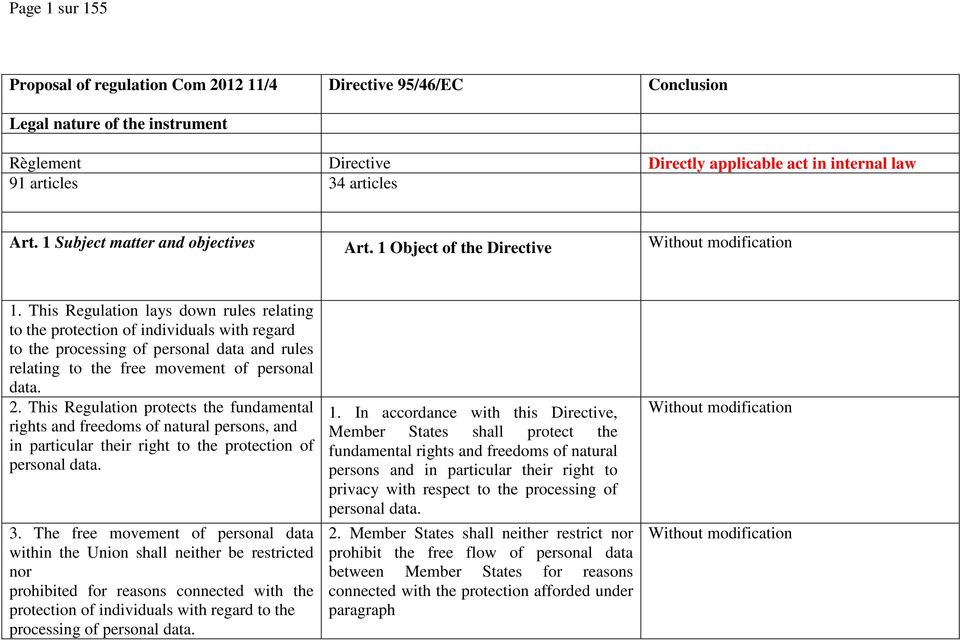
1 Page 1 sur 155 Proposal of regulation Com /4 Directive 95/46/EC Conclusion Legal nature of the instrument Règlement Directive Directly applicable act in internal law 91 articles 34 articles Art. 1 Subject matter and objectives Art. 1 Object of the Directive Without modification 1. This Regulation lays down rules relating to the protection of individuals with regard to the processing of personal data and rules relating to the free movement of personal data. 2. This Regulation protects the fundamental rights and freedoms of natural persons, and in particular their right to the protection of personal data. 3. The free movement of personal data within the Union shall neither be restricted nor prohibited for reasons connected with the protection of individuals with regard to the processing of personal data. 1. In accordance with this Directive, Member States shall protect the fundamental rights and freedoms of natural persons and in particular their right to privacy with respect to the processing of personal data. 2. Member States shall neither restrict nor prohibit the free flow of personal data between Member States for reasons connected with the protection afforded under paragraph Without modification Without modification
2 Page 2 sur 155 Proposal of regulation Directive 95/46/EC Conclusion Material Scope Art This Regulation applies to the processing of personal data wholly or partly by automated means, and to the processing other than by automated means of personal data which form part of a filing system or are intended to form part of a filing system. Art This Regulation does not apply to the processing of personal data: (a) in the course of an activity which falls outside the scope of Union law, in particular concerning national security; 1. This Directive shall apply to the processing of personal data wholly or partly by automatic means, and to the processing otherwise than by automatic means of personal data which form part of a filing system or are intended to form part of a filing system. Art. 3.2 This Directive shall not apply to the processing of personal data: - in the course of an activity which falls outside the scope of Community law, such as those provided for by Titles V and VI of the Treaty on European Union and in any case to processing operations concerning public security, defence, State security (including the economic well-being of the State when the processing operation relates to State security matters) and the activities Without modification Without modification Without modification
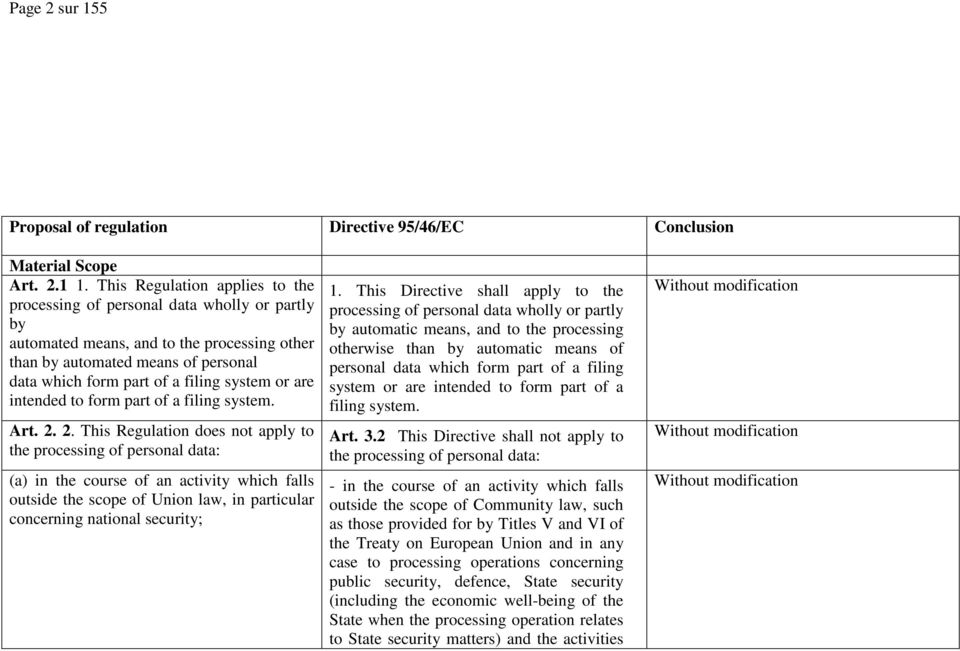
3 Page 3 sur 155 of the State in areas of criminal law, (b) by the Union institutions, bodies, offices and agencies; (c) by the Member States when carrying out activities which fall within the scope of Chapter 2 of the Treaty on European Union; (d) by a natural person without any gainful interest in the course of its own exclusively personal or household activity; (e) by competent authorities for the purposes of prevention, investigation, detection or prosecution - by a natural person in the course of a purely personal or household activity in the course of an activity which falls outside the scope of Community law, such as those provided for by Titles V and VI of the Treaty on European Union and in any case to processing operations concerning public security, defence, State security (including the economic well-being of the State when the processing operation relates to State security matters) and the activities of the State in areas of criminal law, It s different but it s because the regulation 45/2001 on the protection of individuals with regard to the processing of personal data by the Community institutions and bodies and on the free movement of such data approach this aspect Without modification Without modification Art. 2.3 This Regulation shall be without prejudice to the application of Directive 2000/31/EC, in particular of the liability

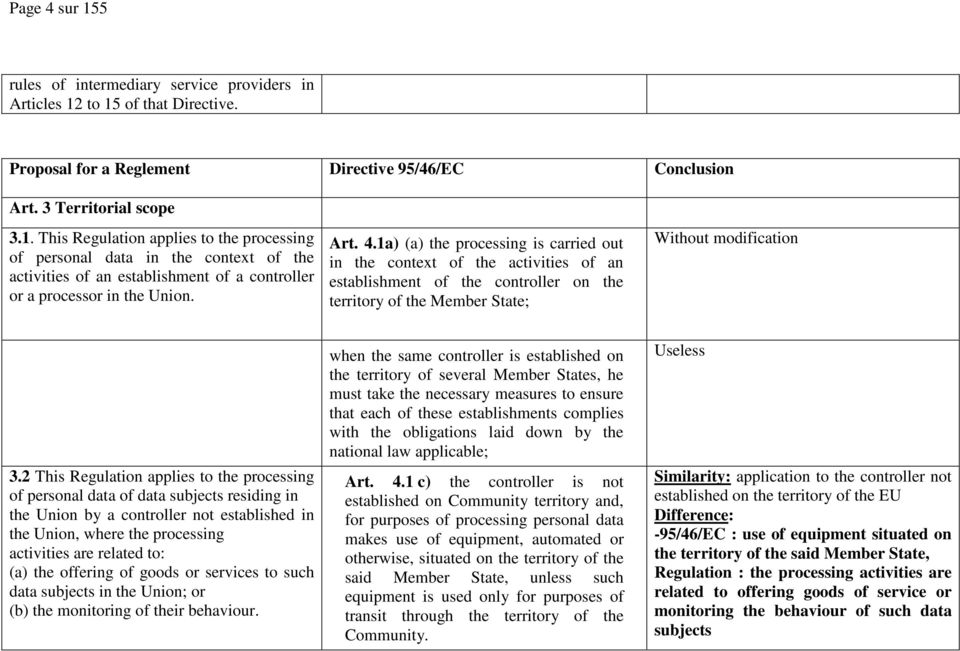
4 Page 4 sur 155 rules of intermediary service providers in Articles 12 to 15 of that Directive. Proposal for a Reglement Directive 95/46/EC Conclusion Art. 3 Territorial scope 3.1. This Regulation applies to the processing of personal data in the context of the activities of an establishment of a controller or a processor in the Union. Art. 4.1a) (a) the processing is carried out in the context of the activities of an establishment of the controller on the territory of the Member State; Without modification 3.2 This Regulation applies to the processing of personal data of data subjects residing in the Union by a controller not established in the Union, where the processing activities are related to: (a) the offering of goods or services to such data subjects in the Union; or (b) the monitoring of their behaviour. when the same controller is established on the territory of several Member States, he must take the necessary measures to ensure that each of these establishments complies with the obligations laid down by the national law applicable; Art. 4.1 c) the controller is not established on Community territory and, for purposes of processing personal data makes use of equipment, automated or otherwise, situated on the territory of the said Member State, unless such equipment is used only for purposes of transit through the territory of the Community. Useless Similarity: application to the controller not established on the territory of the EU Difference: -95/46/EC : use of equipment situated on the territory of the said Member State, Regulation : the processing activities are related to offering goods of service or monitoring the behaviour of such data subjects
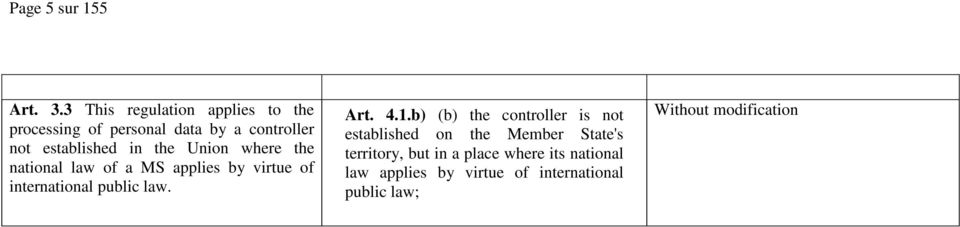
5 Page 5 sur 155 Art. 3.3 This regulation applies to the processing of personal data by a controller not established in the Union where the national law of a MS applies by virtue of international public law. Art. 4.1.b) (b) the controller is not established on the Member State's territory, but in a place where its national law applies by virtue of international public law; Without modification
6 Page 6 sur 155 Proposal of regulation Directive 95/46/EC Conclusion Art. 4 Définitions Art. 4.1 Data subject means an indentified natural personal or a natural person who can be indentified, directly or indirectly, by means reasonably likely to be used by the controller or by any other natural or legal person, in particular by reference to an identification number, location data, one-line identifier or to one or more factors specific to the physical, physiological, genetic, mental, economic, cultural, or social identity of that person. Art. 4.2 Personal data' means any information relating to a data subject; Art. 4.3 'processing' means any operation or set of operations which is performed upon personal data or sets of personal data, whether or not by automated means, such as (a) 'personal data' shall mean any information relating to an identified or identifiable natural person ('data subject'); an identifiable person is one who can be identified, directly or indirectly, in particular by reference to an identification number or to one or more factors specific to his physical, physiological, mental, economic, cultural or social identity; (b) processing of personal data (processing) means any operation or set of operations which is performed upon personal data, Differences: - Definition of data subject which dit not exist in Directive 95/46/EC. - Addition of by means reasonably likely to be used by the controller or by any other natural or legal person - Addition of location data, one-line identifier or genetic Without modification

7 Page 7 sur 155 collection, recording, organization, structuring, storage, adaptation or alteration, retrieval, consultation, use, disclosure by transmission, dissemination or otherwise making available, alignment or combination, erasure or destruction; Art. 4.4 'filing system' means any structured set of personal data which are accessible according to specific criteria, whether centralized, decentralized or dispersed on a functional or geographical basis; Art. 4.5 'controller' means the natural or legal person, public authority, agency or any other body which alone or jointly with others determines the purposes, conditions and means of the processing of personal data; where the purposes, conditions and means of processing are determined by Union law or Member State law, the controller or the specific criteria for his nomination may be designated by Union law or by Member State law; Art. 4.6 'processor' means a natural or legal person, public authority, agency or any other body which processes personal data on whether or not by automatic means, such as collection, recording, organization, storage, adaptation or alteration, retrieval consultation, use, disclosure by transmission dissemination, or other wise making available, alignment or combination blocking erasure or destruction Art. 2 c) 'personal data filing system' ('filing system') shall mean any structured set of personal data which are accessible according to specific criteria, whether centralized, decentralized or dispersed on a functional or geographical basis; Art. 2 (d) 'controller' shall mean the natural or legal person, public authority, agency or any other body which alone or jointly with others determines the purposes and means of the processing of personal data; where the purposes and means of processing are determined by national or Community laws or regulations, the controller or the specific criteria for his nomination may be designated by national or Community law; Art. 2 e) 'processor' shall mean a natural or legal person, public authority, agency or any other body which processes Without modification Ad of word «conditions» Without modification

8 Page 8 sur 155 behalf of the controller; Art.4.7 'recipient' means a natural or legal person, public authority, agency or any other body to which the personal data are disclosed; Art. 4.8 'the data subject's consent' means any freely given specific, informed and explicit indication of his or her wishes by which the data subject, either by a statement or by a clear affirmative action, signifies agreement to personal data relating to them being processed; Art. 4.9 «personal data breach» means a breach of security leading to the accidental personal data on behalf of the controller; Art. 2.g) 'recipient' shall mean a natural or legal person, public authority, agency or any other body to whom data are disclosed, whether a third party or not; however, authorities which may receive data in the framework of a particular inquiry shall not be regarded as recipients; Art. 2 (f) 'third party' shall mean any natural or legal person, public authority, agency or any other body other than the data subject, the controller, the processor and the persons who, under the direct authority of the controller or the processor, are authorized to process the data; Art. 2 h (h) 'the data subject's consent' shall mean any freely given specific and informed indication of his wishes by which the data subject signifies his agreement to personal data relating to him being processed. Difference: The new definition does not know the exception of the authorities which may receive data in the framework of a particular inquiry Disappearance of the notion third party so Art.2(f) disappear. Difference: - «explicit» exclue a tacite consent. - «either by a statement or by a clear affirmative action» definition

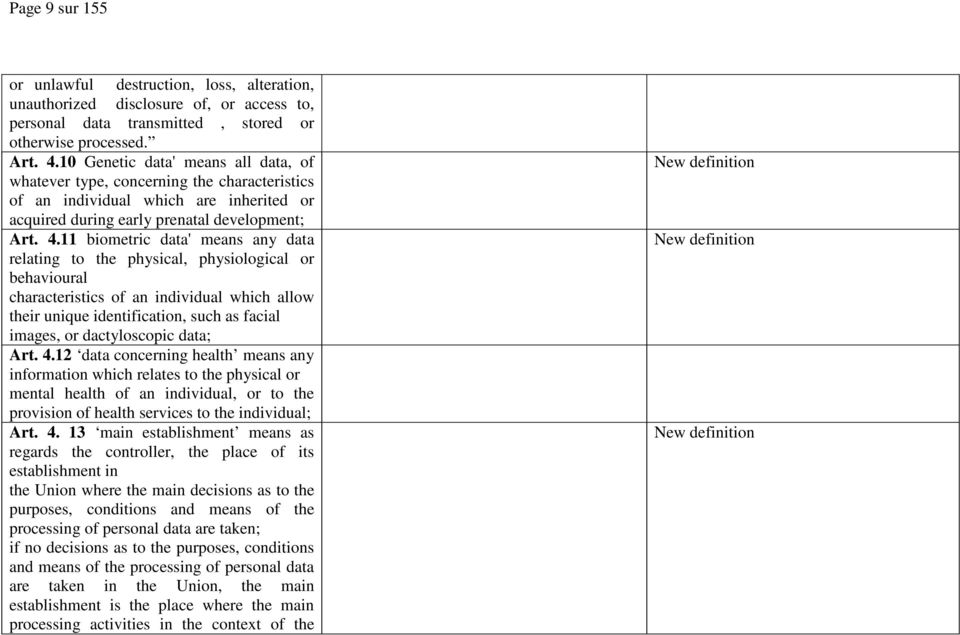
9 Page 9 sur 155 or unlawful destruction, loss, alteration, unauthorized disclosure of, or access to, personal data transmitted, stored or otherwise processed. Art Genetic data' means all data, of whatever type, concerning the characteristics of an individual which are inherited or acquired during early prenatal development; Art biometric data' means any data relating to the physical, physiological or behavioural characteristics of an individual which allow their unique identification, such as facial images, or dactyloscopic data; Art data concerning health means any information which relates to the physical or mental health of an individual, or to the provision of health services to the individual; Art main establishment means as regards the controller, the place of its establishment in the Union where the main decisions as to the purposes, conditions and means of the processing of personal data are taken; if no decisions as to the purposes, conditions and means of the processing of personal data are taken in the Union, the main establishment is the place where the main processing activities in the context of the definition definition definition
10 Page 10 sur 155 activities of an establishment of a controller in the Union take place. As regards the processor, 'main establishment' means the place of its central administration in the Union; Art representative means any natural or legal person established in the Union who, explicitly designated by the controller, acts and may be addressed by any supervisory authority and other bodies in the Union instead of the controller, with regard to the obligations of the controller under this Regulation; Art enterprise means any entity engaged in an economic activity, irrespective of its legal form, thus including, in particular, natural and legal persons, partnerships or associations regularly engaged in an economic activity; Art 'group of undertakings' means a controlling undertaking and its controlled undertakings Art binding corporate rules means personal data protection policies which are adhered to by a controller or processor established on the territory of a Member State of the Union for transfers or a set of transfers of personal data to a controller or processor in Art. 4.2 ( ) the controller must designate a representative established in the territory of that Member State, without prejudice to legal actions which could be initiated against the controller himself. Notion used by 95/46EC in the article 4.2 but without defining it
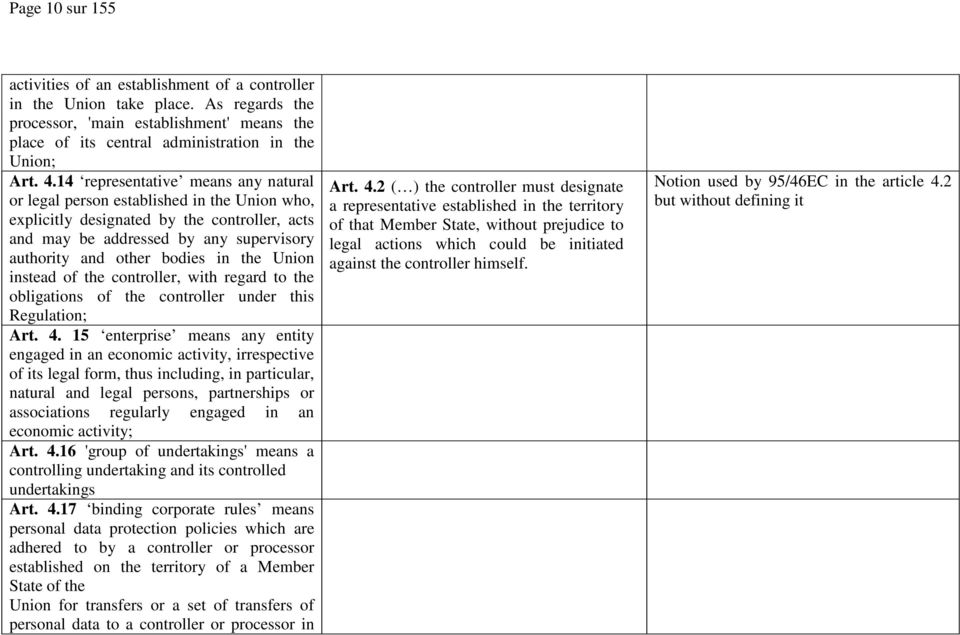
11 Page 11 sur 155 one or more third countries within a group of undertakings Art 'child' means any person below the age of 18 years Art 'supervisory authority' means a public authority which is established by a Member State in accordance with Article 46

12 Page 12 sur 155 Proposal of regulation Directive 95/46/EC Conclusion Art. 5 Principles relating to personal data processing Art.5.1 Personal data must be: (a) processed lawfully, fairly and in a transparent manner in relation to the data subject; (b) collected for specified, explicit and legitimate purposes and not further processed in a way incompatible with those purposes; (c ) adequate, relevant, and limited to the minimum necessary in relation to the purposes for which they are processed; they shall only be processed if, and as long as, the purposes could not be fulfilled by processing information that does not involve personal data; d) accurate and kept up to date; every reasonable step must be taken to ensure that personal data that are inaccurate, having regard Art. 6 Principles relating to data quality Art. 6.1 Member States shall provide that personal data must be: (a) processed fairly and lawfully (b) collected for specified, explicit and legitimate purposes and not further processed in a way incompatible with those purposes. Further processing of data for historical, statistical or scientific purposes shall not be considered as incompatible provided that Member States provide appropriate safeguards; (c) adequate, relevant and not excessive in relation to the purposes for which they are collected and/or further processed; (d) accurate and, where necessary, kept up to date; every reasonable step must be Difference: in a transparent manner in relation to the data subject Without modification Almost identical exceptions are planned in the text Difference : -«not excessive» became «the minimum necessary» - Addition of they shall only be processed if, and as long as, the purposes could not be fulfilled by processing information that does not involve personal data ; Difference: - Disappearance of incomplete ; -Addition of without delay

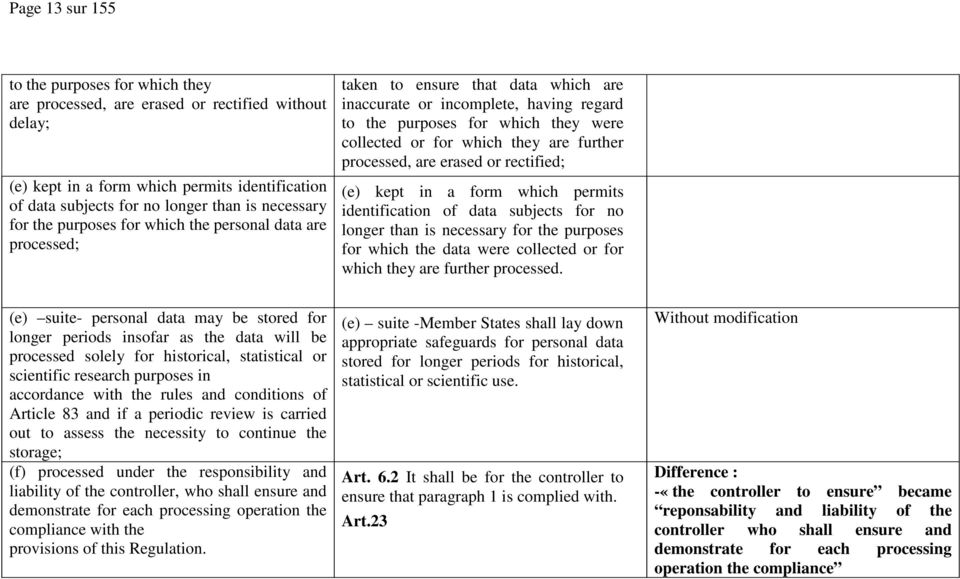
13 Page 13 sur 155 to the purposes for which they are processed, are erased or rectified without delay; (e) kept in a form which permits identification of data subjects for no longer than is necessary for the purposes for which the personal data are processed; taken to ensure that data which are inaccurate or incomplete, having regard to the purposes for which they were collected or for which they are further processed, are erased or rectified; (e) kept in a form which permits identification of data subjects for no longer than is necessary for the purposes for which the data were collected or for which they are further processed. (e) suite- personal data may be stored for longer periods insofar as the data will be processed solely for historical, statistical or scientific research purposes in accordance with the rules and conditions of Article 83 and if a periodic review is carried out to assess the necessity to continue the storage; (f) processed under the responsibility and liability of the controller, who shall ensure and demonstrate for each processing operation the compliance with the provisions of this Regulation. (e) suite -Member States shall lay down appropriate safeguards for personal data stored for longer periods for historical, statistical or scientific use. Art. 6.2 It shall be for the controller to ensure that paragraph 1 is complied with. Art.23 Without modification Difference : -«the controller to ensure became reponsability and liability of the controller who shall ensure and demonstrate for each processing operation the compliance
14 Page 14 sur 155 Proposal of regulation Directive 95/46/EC Conclusion Art. 6 Lawfulness of processing Art Processing of personal data shall be lawful only if and to the extent that at least one of the following applies: (a) the data subject has given consent to the processing of their personal data for one or more specific purposes; (b) processing is necessary for the performance of a contract to which the data subject is party or in order to take steps at the request of the data subject prior to entering into a contract; (c) processing is necessary for compliance with a legal obligation to which the controller is subject; (d) processing is necessary in order to protect the vital interests of the data subject; Art. 7 Criteria for making data processing legitimate Art 7.1 Member States shall provide that personal data may be processed only if: (a) the data subject has unambiguously given his consent; or (b) processing is necessary for the performance of a contract to which the data subject is party or in order to take steps at the request of the data subject prior to entering into a contract; or (c) processing is necessary for compliance with a legal obligation to which the controller is subject ; (d) processing is necessary in order to protect the vital interests of the data Differences: - «unambiguously consent» became «explicit consent» (like in definition of consent art. 3.8) - Consent can be given «for one or more specific purposes» Without modification Without modification Without modification
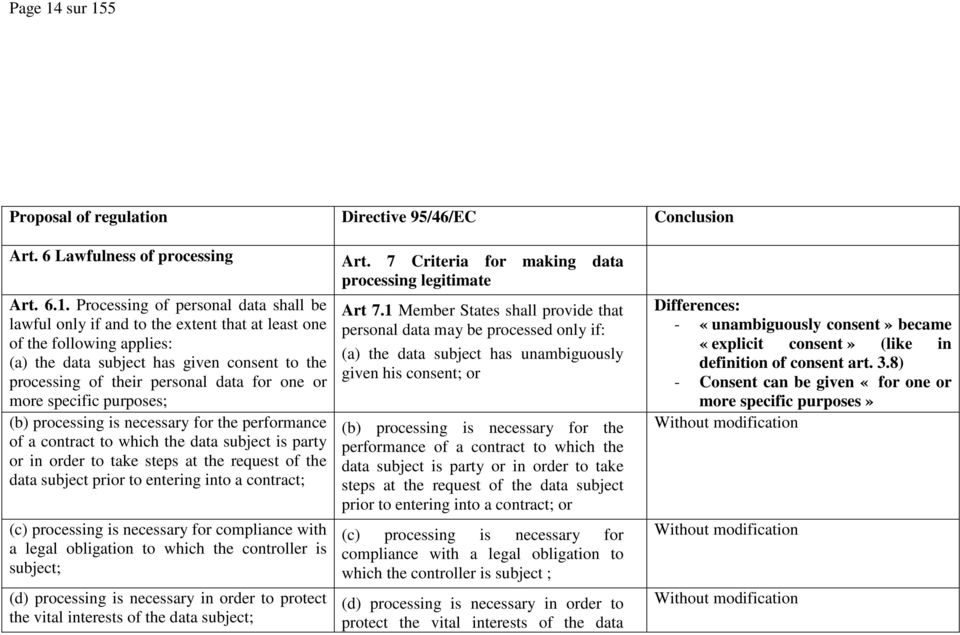
15 Page 15 sur 155 (e) processing is necessary for the performance of a task carried out in the public interest or in the exercise of official authority vested in the controller; (f) processing is necessary for the purposes of the legitimate interests pursued by a controller, except where such interests are overridden by the interests or fundamental rights and freedoms of the data subject which require protection of personal data, in particular where the data subject is a child. This shall not apply to processing carried out by public authorities in the performance of their tasks. Art. 6.2 Processing of personal data which is necessary for the purposes of historical, statistical or scientific research shall be lawful subject to the conditions and safeguards referred to in Article 83. subject; or (e) processing is necessary for the performance of a task carried out in the public interest or in the exercise of official authority vested in the controller or in a third party to whom the data are disclosed; or (f) processing is necessary for the purposes of the legitimate interests pursued by the controller or by the third party or parties to whom the data are disclosed, except where such interests are overridden by the interests for fundamental rights and freedoms of the data subject which require protection under Article 1 (1). Difference: disappearance of words: or in a third party to whom the data are disclosed Differences: - in particular where the data subject is a child. -This shall not apply to processing carried out by public authorities in the performance of their tasks.

16 Page 16 sur 155 Art. 6.3 The basis of the processing referred to in points (c) and (e) of paragraph 1 must be provided for in: (a) Union law, or (b) the law of the Member State to which the controller is subject. The law of the Member State must meet an objective of public interest or must be necessary to protect the rights and freedoms of others, respect the essence of the right to the protection of personal data and be proportionate to the legitimate aim pursued. Art. 6.4 Where the purpose of further processing is not compatible with the one for which the personal data have been collected, the processing must have a legal basis at least in one of the grounds referred to in points (a) to (e) of paragraph 1. This shall in particular apply to any change of terms and general conditions of a contract. Art. 6.4 The Commission shall be empowered to adopt delegated acts in accordance with Article 86 for the purpose of further specifying the conditions referred to in point (f) of paragraph 1 for various sectors and data processing situations, including as regards the processing of personal data related to a child. delegation

17 Page 17 sur 155 Proposal of regulation Directive 95/46/EC Conclusion Art. 7 Conditions for consent All this chapter is new Art. 7.1 The controller shall bear the burden of proof for the data subject's consent to the processing of their personal data for specified purposes. Art. 7.2 If the data subject's consent is to be given in the context of a written declaration which also concerns another matter, the requirement to give consent must be presented distinguishable in its appearance from this other matter. Art. 7.3 The data subject shall have the right to withdraw his or her consent at any time. The withdrawal of consent shall not affect the lawfulness of processing based on consent before its withdrawal. Art. 7.4 Consent shall not provide a legal basis for the processing, where there is a significant imbalance in the form of dependence between the position of the data subject and the controller. The controller shall bear the burden of proof

18 Page 18 sur 155 Proposal of regulation Directive 95/46/EC Conclusion Art. 8 processing of personal data of a child All this chapter is new 1. For the purposes of this Regulation, in relation to the offering of information society services directly to a child, the processing of personal data of a child below the age of 13 years shall only be lawful if and to the extent that consent is given or authorised by the child's parent or custodian. The controller shall make reasonable efforts to obtain verifiable consent, taking into consideration available technology. 2. Paragraph 1 shall not affect the general contract law of Member States such as the rules on the validity, formation or effect of a contract in relation to a child. 3. The Commission shall be empowered to adopt delegated acts in accordance with Article 86 for the purpose of further specifying the criteria and requirements for the methods to obtain verifiable consent referred to in paragraph 1. In doing so, the Commission shall consider specific measures for micro, small and medium-sized enterprises. 4. The Commission may lay down standard forms for specific methods to obtain verifiable

19 Page 19 sur 155 consent referred to in paragraph 1. Those implementing acts shall be adopted in accordance with the examination procedure referred to in Article 87(2). Proposal for a regulation Directive Processing of Special categories of data Special categories of processing Art. 9.1 The processing of personal data, revealing race or ethnic origin, political opinions, religion or beliefs, trade-union membership, and the processing of genetic data or data concerning health or sex life or criminal convictions or related security measures shall be prohibited Art. 8.1 Member States shall prohibit the processing of personal data revealing racial or ethnic origin, political opinions, religious or philosophical beliefs, tradeunion membership, and the processing of data concerning health or sex life. Difference - Addition of genetic and data concerning criminal convictions or related security measures. Art. 9.2 Paragraph 1 shall not apply where: 2. Paragraph 1 shall not apply where: a) the data subject has given consent to the processing of those personal data, subject to the conditions laid down in Articles 7 and 8, a) the data subject has given his explicit consent to the processing of those data, Without modification except where Union law or Member State law provide that the except where the laws of the Member State provide that the prohibition referred

20 Page 20 sur 155 prohibition referred to in paragraph 1 may not be lifted by the data subject; (b) processing is necessary for the purposes of carrying out the obligations and exercising specific rights of the controller in the field of employment law in so far as it is authorised by Union law or Member State law providing for adequate safeguards; (c) processing is necessary to protect the vital interests of the data subject or of another person where the data subject is physically or legally incapable of giving consent; to in paragraph 1 may not be lifted by the data subject's giving his consent; (b) processing is necessary for the purposes of carrying out the obligations and specific rights of the controller in the field of employment law in so far as it is authorized by national law providing for adequate safeguards; or (c) processing is necessary to protect the vital interests of the data subject or of another person where the data subject is physically or legally incapable of giving his consent; Without modification Without modification (d) processing is carried out in the course of its legitimate activities with appropriate safeguards by a foundation, association or any other non-profitseeking body with a political, philosophical, religious or trade-union aim and on condition that the processing relates solely to the members or to former members of the body or to persons who have regular contact with it in connection with its purposes and that the data are not disclosed outside that body without the consent of the data subjects; (d) processing is carried out in the course of its legitimate activities with appropriate guarantees by a foundation, association or any other non-profitseeking body with a political, philosophical, religious or trade-union aim and on condition that the processing relates solely to the members of the body or to persons who have regular contact with it in connection with its purposes and that the data are not disclosed to a third party without the consent of the data subjects; Difference: - guarantees became safeguards -Addition of in connection with its purposes - outside that body in place of to a third party

21 Page 21 sur 155 (e) the processing relates to personal data which are manifestly made public by the data subject; (e) the processing relates to data which are manifestly made public by the data subject Without modification (f) processing is necessary for the establishment, exercise or defence of legal claims; (g) processing is necessary for the performance of a task carried out in the public interest, on the basis of Union law, or Member State law which shall provide for suitable measures to safeguard the data subject's legitimate interests; (h) processing of data concerning health is necessary for health purposes and subject to the conditions and safeguards referred to in Article 81; Article 81 Processing of personal data concerning health 1. Within the limits of this Regulation and in accordance with point (h) of Article 9(2), processing of personal data concerning health must be on the basis of Union law or Member State law which shall provide for suitable and specific measures to or is necessary for the establishment, exercise or defence of legal claims Subject to the provision of suitable safeguards, Member States may, for reasons of substantial public interest, lay down exemptions in addition to those laid down in paragraph 2 either by national law or by decision of the supervisory authority. Without modification Without modification Difference : health professional or another person subject to a equivalent obligation of confidentiality in place of Health professional
22 Page 22 sur 155 safeguard the data subject's legitimate interests, and be necessary for: (a) the purposes of preventive or occupational medicine, medical diagnosis, the provision of care or treatment or the management of healthcare services, and where those data are processed by a health professional subject to the obligation of professional secrecy or another person also subject to an equivalent obligation of confidentiality under Member State law or rules established by national competent bodies; (b) reasons of public interest in the area of public health, such as protecting against serious cross-border threats to health or ensuring high standards of quality and safety, inter alia for medicinal products or medical devices; 8.3 Paragraph 1 shall not apply where processing of the data is required for the purposes of preventive medicine, medical diagnosis, the provision of care or treatment or the management of healthcare services, and where those data are processed by a health professional subject under national law or rules established by national competent bodies to the obligation of professional secrecy or by another person also subject to an equivalent obligation of secrecy. (c) other reasons of public interest in areas such as social protection, especially in order to ensure the quality and cost-effectiveness of the procedures used for settling claims for benefits and services in the health insurance system.
23 Page 23 sur Processing of personal data concerning health which is necessary for historical, statistical or scientific research purposes, such as patient registries set up for improving diagnoses and differentiating between similar types of diseases and preparing studies for therapies, is subject to the conditions and safeguards referred to in Article Member States shall provide that personal data must be: (b) ( ) Further processing of data for historical, statistical or scientific purposes shall not be considered as incompatible provided that Member States provide appropriate safeguards; Art processing is necessary for historical, statistical or scientific research purposes subject to the conditions and safeguards referred to in Article 83; Art. 9.3 Processing of data relating to criminal convictions or related security measures is carried out either under the control of official authority or when the processing is necessary for compliance with a legal or regulatory obligation to which a controller is subject, or for the performance of a task carried out for important public interest reasons, and in so far as authorised by Union law or Member State law providing for adequate safeguards Processing of data relating to offences, criminal convictions or security measures may be carried out only under the control of official authority, or if suitable specific safeguards are provided under national law, subject to derogations which may be granted by the Member State under national provisions providing suitable specific safeguards. Without modification Without modification Without modification
24 Page 24 sur 155 A complete register of criminal convictions shall be kept only under the control of official authority. Art. 9.4 The Commission shall be empowered to adopt delegated acts in accordance with Article 86 for the purpose of further specifying the criteria, conditions and appropriate safeguards for the processing of the special categories of personal data referred to in paragraph 1 and the exemptions laid down in paragraph 2. Art. 10 processing not allowing identification If the data processed by a controller do not permit the controller to identify a natural person, the controller shall not be obliged to acquire additional information in order to identify the data subject for the sole purpose of complying with any provision of this Regulation. However, a complete register of criminal convictions may be kept only under the control of official authority. Member States may provide that data relating to administrative sanctions or judgements in civil cases shall also be processed under the control of official authority. Without modification
25 Page 25 sur 155 Proposal for a Reglement Directive 95/46/EC Conclusion Chap. III Rigts of the data subject Section 1 Transparency and modalities section Art. 11 Transparent information and communication Art The controller shall have transparent and easily accessible policies with regard to the processing of personal data and for the exercise of data subjects' rights. Art The controller shall provide any information and any communication relating to the processing of personal data to the data subject in an intelligible form, using clear and plain language, adapted to the data subject, in particular for any information addressed specifically to a child. Art. 12 Member States shall guarantee every data subject the right to obtain from the controller: ( ) communication to him in an intelligible form of the data undergoing processing and of any available information as to their source, article obligation for the controller obligation of using a clear and plain language specifically to a child.
26 Page 26 sur 155 Proposal for a Reglement Directive 95/46/EC Conclusion ART. 12 Procedures and mechanisms for exercising the rights of the data subject Art The controller shall establish procedures for providing the information referred to in Article 14 and for the exercise of the rights of data subjects referred to in Article 13 and Articles 15 to 19. The controller shall provide in particular mechanisms for facilitating the request for the actions referred to in Article 13 and Articles 15 to 19. Where personal data are processed by automated means, the controller shall also provide means for requests to be made electronically. Art The controller shall inform the data subject without delay and, at the latest within one month of receipt of the request, whether or not any action has been taken pursuant to Article 13 and Articles 15 to 19 and shall provide the requested information. This period may be prolonged for a further month, if several data subjects exercise their rights and their cooperation is necessary to a reasonable extent to prevent an unnecessary and disproportionate effort on the part of the controller. Art. 12 Member States shall guarantee every data subject the right to obtain from the controller ( ) without excessive delay - without excessive delay became without delay and at latest within one month - The information shall be given in writing
27 Page 27 sur 155 The information shall be given in writing. Where the data subject makes the request in electronic form, the information shall be provided in electronic form, unless otherwise requested by the data subject. Art If the controller refuses to take action on the request of the data subject, the controller shall inform the data subject of the reasons for the refusal and on the possibilities of lodging a complaint to the supervisory authority and seeking a judicial remedy. Art The information and the actions taken on requests referred to in paragraph 1 shall be free of charge. Where requests are manifestly excessive, in particular because of their repetitive character, the controller may charge a fee for providing the information or taking the action requested, or the controller may not take the action requested. In that case, the controller shall bear the burden of proving the manifestly excessive character of the request. Art The Commission shall be empowered to adopt delegated acts in accordance with Article 86 for the purpose of further specifying the criteria and conditions for the manifestly excessive requests and the Art. 12 Member States shall guarantee every data subject the right to obtain from the controller without constraint at reasonable intervals and without excessive delay or expense - without excessive expense became free of charge
28 Page 28 sur 155 fees referred to in paragraph 4. Art The Commission may lay down standard forms and specifying standard procedures for the communication referred to in paragraph 2, including the electronic format. In doing so, the Commission shall take the appropriate measures for micro, small and medium-sized enterprises. Those implementing acts shall be adopted in accordance with the examination procedure referred to in Article 87(2). Art. 13 Rights in relation to recipients The controller shall communicate any rectification or erasure carried out in accordance with Articles 16 and 17 to each recipient to whom the data have been disclosed, unless this proves impossible or involves a disproportionate effort. 12 (c) notification to third parties to whom the data have been disclosed of any rectification, erasure or blocking carried out in compliance with (b), unless this proves impossible or involves a disproportionate effort. Without modification
29 Page 29 sur 155 Proposal for a Reglement Directive 95/46/EC Conclusion Section 2 Information and access to data Art. 14 Information to the data subject Art Where personal data relating to a data subject are collected, the controller shall provide the data subject with at least the following information: (a) the identity and the contact details of the controller and, if any, of the controller's representative and of the data protection officer; (b) the purposes of the processing for which the personal data are intended, including - the contract terms and general conditions where the processing is based on point (b) of Article 6(1) and - the legitimate interests pursued by the controller where the processing is based on point (f) of Article 6(1); (c) the period for which the personal data will be stored; Art. 10 Information to be given to the data subject Art 10 Member States shall provide that the controller or his representative must provide a data subject from whom data relating to himself are collected with at least the following information, except where he already has it: (a) the identity of the controller and of his representative, if any; (b) the purposes of the processing for which the data are intended; Information to be given to the data subject are more important Addition of the way to contacting the controller s representative and of the DPO Addition of including the contract terms and general conditions where the processing is based on Article 5(1)(b) and the legitimate interests pursued by the controller where the processing is based on Article 5(1)(f)
30 Page 30 sur 155 d) the existence of the right to request from the controller access to and rectification or erasure of the personal data concerning the data subject or to object to the processing of such personal data; (e) the right to lodge a complaint to the supervisory authority and the contact details of the supervisory authority; (f) the recipients or categories of recipients of the personal data; g) where applicable, that the controller intends to transfer to a third country or international organisation and on the level of protection afforded by that third country or international organisation by reference to an adequacy decision by the Commission; (h) any further information necessary to guarantee fair processing in respect of the data subject, having regard to the specific circumstances in which the personal data are collected. the existence of the right of access to and the right to rectify the data concerning him - the recipients or categories of recipients of the data, any further information ( ) in so far as such further information is necessary, having regard to the specific circumstances in which the data are collected, to guarantee fair processing in respect of the data subject. Without modification The regulation add the right of erasure Without modification possibility to transfer to a third country or international organisation Whithout signifiant modification Art Where the personal data are collected from the data subject, the controller shall inform the data subject, in addition to the information referred to in paragraph 1, whether the provision of personal data is obligatory or Art. 10 whether replies to the questions are obligatory or voluntary, as well as the possible consequences of failure to reply, Without modification
31 Page 31 sur 155 voluntary, as well as the possible consequences of failure to provide such data. Art 14.3 Where the personal data are not collected from the data subject, the controller shall inform the data subject, in addition to the information referred to in paragraph 1, from which source the personal data originate. Art 14.4 The controller shall provide the information referred to in paragraphs 1, 2 and 3: (a) at the time when the personal data are obtained from the data subject; or (b) where the personal data are not collected from the data subject, -at the time of the recording or within a reasonable period after the collection, having regard to the specific circumstances in which the data are collected or otherwise processed, or, if a disclosure to another recipient is envisaged, and at the latest when the data are first disclosed. Art Paragraphs 1 to 4 shall not apply, where: (a) the data subject has already the information referred to in paragraphs 1 to 3; nothing Article Where the data have not been obtained from the data subject, Member States shall provide that the controller or his representative must -at the time of undertaking the recording of personal data or if a disclosure to a third party is envisaged, no later than the time when the data are first disclosed provide the data subject with at least the following information, except where he already has it: Art the controller or his representative must provide a data subject from whom data relating to himself are collected with at least the following information, except where he already has Addition: - at the time when the personal data are obtained from the data subject; Without modification Without modification
32 Page 32 sur 155 or (b) the data are not collected from the data subject and the provision of such information proves impossible or would involve a disproportionate effort; or (c) the data are not collected from the data subject and recording or disclosure is expressly laid down by law. Art In the case referred to in point (b) of paragraph 5, the controller shall provide appropriate measures to protect the data subject's legitimate interests. Art The Commission shall be empowered to adopt delegated acts in accordance with Article 86 for the purpose of further specifying the criteria for categories of recipients referred to in point (f) of paragraph 1, the requirements for the notice of potential access referred to in point (g) of paragraph 1, the criteria for the further it Paragraph 1 shall not apply where, in particular for processing for statistical purposes or for the purposes of historical or scientific research, the provision of such information proves impossible or would involve a disproportionate effort or if recording or disclosure is expressly laid down by law. In these cases Member States shall provide appropriate safeguards. Art In these cases Member States shall provide appropriate safeguards. Without modification Without modification Without modification delegation of powers to the Commission
33 Page 33 sur 155 necessary information referred to in point (h) of paragraph 1 for specific sectors and situations, and the conditions and appropriate safeguards for the exceptions laid down in points (a) and (b) of paragraph 5. Art The Commission may lay down standard forms for providing the information referred to in paragraphs 1 to 4, taking into account the specific characteristics and needs of various sectors and data processing situations where necessary. Those implementing acts shall be adopted in accordance with the examination procedure referred to in Article 87(2).
34 Page 34 sur 155 Proposal of regulation Directive Conclusion Art. 15 Right of access for data subject Art. 12 The data subject rights of access of data 1. The data subject shall have the right to obtain from the controller at any time, on request, Member States shall guarantee every data subject the right to obtain from the controller: (a) without constraint at reasonable intervals and without excessive delay or expense: Without modification Confirmation as to whether or not personal data relating to the data subject are being processed. Where such personal data are being processed, the controller shall provide the following information: confirmation as to whether or not data relating to him are being processed and information at least as to Without modification Without modification (a) the purposes of the processing; the purposes of the processing Without modification (b) the categories of personal data concerned; the categories of data concerned, Without modification (c) the recipients or categories of recipients to whom the personal data are to be or have been disclosed, the recipients or categories of recipients to whom the data are disclosed, Without modification
35 Page 35 sur 155 in particular to recipients in third countries; (d) the period for which the personal data will be stored; (e) the existence of the right to request from the controller rectification or erasure of personal data concerning the data subject or to object to the processing of such personal data; (f) the right to lodge a complaint to the supervisory authority and the contact details of the supervisory authority; (g) communication of the personal data undergoing processing and of any available information as to their source; (h) the significance and envisaged of such processing, at least in the case of measures referred to in Article 20 (profiling) Art The data subject shall have the right to obtain from the controller communication of the personal data undergoing processing. Where the data subject makes the request in electronic form, the information shall be provided in electronic form, unless otherwise requested by the data subject. 12. a. communication to him in an intelligible form of the data undergoing processing and of any available information as to their source, knowledge of the logic involved in any automatic processing of data concerning him at least in the case of the automated decisions referred to in Article 15 (1); Without modification
36 Page 36 sur 155 Art The Commission shall be empowered to adopt delegated acts in accordance with Article 86 for the purpose of further specifying the criteria and requirements for the communication to the data subject of the content of the personal data referred to in point (g) of paragraph 1. Art The Commission may specify standard forms and procedures for requesting and granting access to the information referred to in paragraph 1, including for verification of the identity of the data subject and communicating the personal data to the data subject, taking into account the specific features and necessities of various sectors and data processing situations. Those implementing acts shall be adopted in accordance with the examination procedure referred to in Article 87(2). delegation
37 Page 37 sur 155 Art. 16 Right to rectification Art. 12 right of access The data subject shall have the right to obtain from the controller the rectification of personal data relating to them which are inaccurate. The data subject shall have the right to obtain completion of incomplete personal data, including by way of supplementing a corrective statement 12 b) as appropriate the rectification, erasure or blocking of data the processing of which does not comply with the provisions of this Directive, in particular because of the incomplete or inaccurate nature of the data; Without modification Possibility of addition of an information. We aim here at the possibility for the person concerned to correct a subjective appreciation. Art. 17 Right to be forgotten and to erasure Art The data subject shall have the right to obtain from the controller the erasure of personal data relating to them and the abstention from further dissemination of such data, especially in relation to personal data which are made available by the data subject while he or she was a child, where one of the following grounds applies: Art. 12 b. rectification, erasure or blocking of data the processing of which does not comply with the provisions of this Directive, Without modification (a) the data are no longer necessary in relation to the purposes for which they were collected or otherwise processed; (b) the data subject withdraws consent on in particular because of the incomplete or inaccurate nature of the data;
38 Page 38 sur 155 which the processing is based according to point (a) of Article 6(1), or when the storage period consented to has expired, and where there is no other legal ground for the processing of the data; (c) the data subject objects to the processing of personal data pursuant to Article 19;(d) the process Art Where the controller referred to in paragraph 1 has made the personal data public, it shall take all reasonable steps, including technical measures, in relation to data for the publication of which the controller is responsible, to inform third parties which are processing such data, that a data subject requests them to erase any links to, or copy or replication of that personal data. Where the controller has authorised a thirdparty publication of personal data, the controller shall be considered responsible for that publication. (c) notification to third parties to whom the data have been disclosed of any rectification, erasure or blocking carried out in compliance with (b), unless this proves impossible or involves a disproportionate effort. This obligation to erase is enlarged to any links to, or copy or replication of that personal data Addition also of the responsibility for a third-party authorised to publish data.
39 Page 39 sur 155 Art The controller shall carry out the erasure without delay, except to the extent that the retention of the personal data is necessary: (a) for exercising the right of freedom of expression in accordance with Article 80; 13.1;. Member States may adopt legislative measures to restrict the scope of the obligations and rights provided for in Articles 6 (1), 10, 11 (1), 12 and 21 when such a restriction constitutes a necessary measures to safeguard: (g) the protection of the data subject or of the rights and freedoms of others. (b) for reasons of public interest in the area of public health in accordance with Article 81 (c) for historical, statistical and scientific research purposes in accordance with Article 83; Subject to adequate legal safeguards, in particular that the data are not used for taking measures or decisions regarding any particular individual, Member States may, where there is clearly no risk of breaching the privacy of the data subject, restrict by a legislative measure the rights provided for in Article 12 when data are processed solely for purposes of scientific research or are kept in personal form for a period which does not exceed the period necessary for the modification Without modification
40 Page 40 sur 155 (d) for compliance with a legal obligation to retain the personal data by Union or Member State law to which the controller is subject; this Member State laws shall meet an objective of public interest, respect the essence of the right to the protection of personal data and be proportionate to the legitimate aim pursued; or (e) in the cases referred to in paragraph 4. Art Instead of erasure, the controller shall restrict processing of personal data where: (a) their accuracy is contested by the data subject, for a period enabling the controller to verify the accuracy of the data; (b) the controller no longer needs the personal data for the accomplishment of its task but they have to be maintained for purposes of proof; (c) the processing is unlawful and the data subject opposes their erasure and requests the restriction of their use instead; sole purpose of creating statistics Member States may adopt legislative measures to restrict the scope of the obligations and rights provided for in Articles 6 (1), 10, 11 (1), 12 and 21 when such a restriction constitutes a necessary measures to safeguard: (e) an important economic or financial interest of a Member State or of the European Union, including monetary, budgetary and taxation matters; (f) a monitoring, inspection or regulatory function connected, even occasionally, with the exercise of official authority in cases referred to in (c), (d) and (e); Addition of personal
41 Page 41 sur 155 (d) the data subject requests to transmit the personal data into another automated processing system in accordance with Article 16(2). Art Personal data referred to in paragraph 4 may, with the exception of storage, only be processed for purposes of proof, or with the data subject's consent, or for the protection of the rights of another natural or legal person or for an objective of public interest. Art Where processing of personal data is restricted pursuant to paragraph 4, the controller shall inform the data subject before lifting the restriction on processing. Art The controller shall implement mechanisms to ensure that the time limits established for the erasure of personal data and/or for a periodic review of the need for the storage of the data are observed. Art Where the erasure is carried out, the controller shall not otherwise process such personal data. Art The Commission shall be empowered to adopt delegated acts in accordance with Article 86 for the purpose of further specifying: obligation prohibition of processing
42 Page 42 sur 155 (a) the criteria and requirements for the application of paragraph 1 for specific sectors and in specific data processing situations; (b) the conditions for deleting public Internet links, copies or replications of personal data from publicly available communication services as referred to in paragraph 2; (c) the criteria and conditions for restricting the processing of personal data referred to in paragraph 4. Proposal for a regulation Directive 95/46/EC conclusion Art. 18 Right to data portability Art The data subject shall have the right, where personal data are processed by electronic means and in a structured and commonly used format, to obtain from the controller a copy of data undergoing processing in an electronic and structured format which is commonly used and allows for further use by the data subject. Art Where the data subject has provided the personal data and the processing is based on consent or on a contract, the data subject shall have the right to transmit those personal data and any other information provided by the data subject and retained by an automated right to data portability right to transmit personal data for the data subject
43 Page 43 sur 155 processing system, into another one, in an electronic format which is commonly used, without hindrance from the controller from whom the personal data are withdrawn. Art The Commission may specify the electronic format referred to in paragraph 1 and the technical standards, modalities and procedures for the transmission of personal data pursuant to paragraph 2. Those implementing acts shall be adopted in accordance with the examination procedure referred to in Article 87(2). Section 4 Right to object and profiling The data subjects right to object Art.19.1 The data subject shall have the right to object, on grounds relating to their particular situation at any time to the processing of personal data which is based on points d), (e) and (f) of Article 6(1), unless the controller demonstrates compelling legitimate grounds for the processing which override the interests or fundamental rights and freedoms of the data subject. Art. 14 Member States shall grant the data subject the right:(a) at least in the cases referred to in Article 7 (e) and (f), to object at any time on compelling legitimate grounds relating to his particular situation to the processing of data relating to him, save where otherwise provided by national legislation. Where there is a justified objection, the processing instigated by the controller may no longer involve those data; Without modification
44 Page 44 sur 155 Art Where personal data are processed for direct marketing for non-commercial purposes recognised as being in the public interest, the data subject shall have the right to object free of charge to the processing of their personal data for such marketing. This right shall be explicitly offered to the data subject in an intelligible manner and shall be clearly distinguishable from other information. (b) to object, on request and free of charge, to the processing of personal data relating to him which the controller anticipates being processed for the purposes of direct marketing, or to be informed before personal data are disclosed for the first time to third parties or used on their behalf for the purposes of direct marketing, and to be expressly offered the right to object free of charge to such disclosures or uses. Without modification except precisions of the way that this rights have to be guarantee : «free of charge» & «explicitly offered to the data subject in an intelligible manner and shall be clearly distinguishable from other information. Art.19.3 Where an objection is upheld pursuant to paragraphs 1 and 2, the controller shall no longer use or otherwise process the personal data concerned. Measures based on profiling Without modification
45 Page 45 sur 155 Art.20.1 Every natural person shall have the right not to be subject to a measure which produces legal effects concerning this natural person or significantly affects this natural person, and which is based solely on automated processing intended to evaluate certain personal aspects relating to this natural person or to analyse or predict in particular the natural person's performance at work, creditworthiness, economic situation, location, health, personal preferences, reliability or behaviour. Art.20.2 Subject to the other provisions of this Regulation, a person may be subjected to a measure of the kind referred to in paragraph 1 only if the processing: (a) is carried out in the course of the entering into or performance of a contract, where the request for the entering into or the performance of the contract, lodged by the data subject, has been satisfied or where suitable measures to safeguard the data subject's legitimate interests have been adduced, such as the right to obtain human intervention; or (b) is expressly authorized by a Union or Member State law which also lays down suitable measures to safeguard the data subject's legitimate interests; or Art.15.1 Member States shall grant the right to every person not to be subject to a decision which produces legal effects concerning him or significantly affects him and which is based solely on automated processing of data intended to evaluate certain personal aspects relating to him, such as his performance at work, creditworthiness, reliability, conduct, etc. Art.15.2 Subject to the other Articles of this Directive, Member States shall provide that a person may be subjected to a decision of the kind referred to in paragraph 1 if that decision: (a) is taken in the course of the entering into or performance of a contract, provided the request for the entering into or the performance of the contract, lodged by the data subject, has been satisfied or that there are suitable measures to safeguard his legitimate interests, such as arrangements allowing him to put his point of view; or The list is not exhaustive but without modification Without modification
46 Page 46 sur 155 (c) is based on the data subject's consent, subject to the conditions laid down in Article 7 and to suitable safeguards. Art.20.3 Automated processing of personal data intended to evaluate certain personal aspects relating to a natural person shall not be based solely on the special categories of personal data referred to in Article9. No equivalent Art.20.4 In the cases referred to in paragraph 2, the information to be provided by the controller under Article 14 shall include information as to the existence of processing for a measure of the kind referred to in paragraph 1 and the envisaged effects of such processing on the data subject. No equivalent
47 Page 47 sur 155 Art.20.5 The Commission shall be empowered to adopt delegated acts in accordance with Article 86 for the purpose of further specifying the criteria and conditions for suitable measures to safeguard the data subject's legitimate interests referred to in paragraph 2. No equivalent Section 5 Restrictions Restrictions Art.21.1 Union or Member State law may restrict by way of a legislative measure the scope of the obligations and rights provided for in points (a) to (e) of Article 5 and Articles 11 to 20 and Article 32, when such a restriction constitutes a necessary and proportionate measure in a democratic society to safeguard: (a) public security; (b) the prevention, investigation, detection and prosecution of criminal offences; (c) other public interests of the Union or of a Member State, in particular an important economic or financial interest of the Union or of a Member State including monetary, budgetary and taxation matters and the protection of market stability and integrity; (d) the prevention, investigation, detection and prosecution of breaches of ethics for regulated restrictions
48 Page 48 sur 155 professions; (e) a monitoring, inspection or regulatory function connected, even occasionally, with the exercise of official authority in cases referred to in (a), (b), (c) and (d); (f) the protection of the data subject or the rights and freedoms of others. Art.21.2 In particular, any legislative measure referred to in paragraph 1 shall contain specific provisions at least as to the objectives to be pursued by the processing and the determination of the controller. CHAPTER IV Controller and processor Section 1 General Obligations Responsibility of the controller
49 Page 49 sur 155 Art.22.1 The controller shall adopt policies and implement appropriate measures to ensure and be able to demonstrate that the processing of personal data is performed in compliance with this Regulation, Art.16 Any person acting under the authority of the controller or of the processor, including the processor himself, who has access to personal data must not process them except on instructions from the controller, unless he is required to do so by law. Addition of demonstrate
50 Page 50 sur 155 Art.22.2 The measures provided for in paragraph 1 shall in particular include: (a) keeping the documentation pursuant to Article 28; (b) implementing the data security requirements laid down in Article 30, (c) performing a data protection impact assessment pursuant to Article 33; (d) complying with the requirements for prior authorisation or prior consultation of the supervisory authority pursuant to Article 34(1) and (2); (e) Designating a data protection officer pursuant to Article 35 (1). Art.17.1 Member States shall provide that the controller must implement appropriate technical and organizational measures to protect personal data against accidental or unlawful destruction or accidental loss, alteration, unauthorized disclosure or access, in particular where the processing involves the transmission of data over a network, and against all other unlawful forms of processing. Having regard to the state of the art and the cost of their implementation, such measures shall ensure a level of security appropriate to the risks represented by the processing and the nature of the data to be protected.
51 Page 51 sur 155 Art.22.3 The controller shall implement mechanisms to ensure the verification of the effectiveness of the measures referred to in paragraphs 1 and 2. If proportionate, this verification shall be carried out by independent internal or external auditors. Art.17.2 The Member States shall provide that the controller must, where processing is carried out on his behalf, choose a processor providing sufficient guarantees in respect of the technical security measures and organizational measures governing the processing to be carried out, and must ensure compliance with those measures. Only if proportionate Art.22.4 The Commission shall be empowered to adopt delegated acts in accordance with Article 86 for the purpose of specifying any further criteria and requirements for appropriate measures referred to in paragraph 1 other than those already referred to in paragraph 2, the conditions for the verification and auditing mechanisms referred to in paragraph 3 and as regards the criteria for proportionality under paragraph 3, and considering specific measures for micro, small and mediumsized-enterprises. Data protection by design and by default No equivalent and considering specific measures for micro, small and medium-sized-enterprises
52 Page 52 sur 155 Art.23.1 Having regard to the state of the art and the cost of implementation, the controller shall, both at the time of the determination of the means for processing and at the time of the processing itself, implement appropriate technical and organisational measures and procedures in such a way that the processing will meet the requirements of this Regulation and ensure the protection of the rights of the data subject. Art.23.2 The controller shall implement mechanisms for ensuring that, by default, only those personal data are processed which are necessary for each specific purpose of the processing and are especially not collected or retained beyond the minimum necessary for those purposes, both in terms of the amount of the data and the time of their storage. In particular, those mechanisms shall ensure that by default personal data are not made accessible to an indefinite number of individuals. No equivalent Addition : obligation to implement technical and organisational measures and procedures No equivalent
53 Page 53 sur 155 Art.23.3 The Commission shall be empowered to adopt delegated acts in accordance with Article 86 for the purpose of specifying any further criteria and requirements for appropriate measures and mechanisms referred to in paragraph 1 and 2, in particular for data protection by design requirements applicable across sectors, products and services. Art.23.4 The Commission may lay down technical standards for the requirements laid down in paragraph 1 and 2. Those implementing acts shall be adopted in accordance with the examination procedure referred to in Article 87(2). Joint controllers Art.24 Where a controller determines the purposes, conditions and means of the processing of personal data jointly with others, the joint controllers shall determine their respective responsibilities for compliance with the obligations under this Regulation, in particular as regards the procedures and mechanisms for exercising the rights of the data subject, by means of an arrangement between them Necessary repartition of responsibilities
54 Page 54 sur 155 Representatives of controllers not established in the Union Art.25.1 In the situation referred to in Article 3(2), the controller shall designate a representative in the Union. Art.25.2 This obligation shall not apply to : (a)a controller established in a third country where the Commission has decided that the third country ensures an adequate level of protection in accordance with Article 41; or (b)an enterprise employing fewer than 250 persons; or (c) a public authority or body; or (d) a controller offering only occasionally goods or services to data subjects residing in the Union. Art.25.3 The representative shall be established in one of those Member States where the data subjects whose personal data are processed in relation to the offering goods or services to them, or whose behaviour is monitored, reside. No equivalent No equivalent Obligation to have a representative in Union Important restriction to enterprise employing fewer than 250 persons
55 Page 55 sur 155 Art.25.4 The designation of a representative by the controller shall be without prejudice to legal actions which could be initiated against the controller itself. No equivalent Processor Art.26.1 Where a processing operation is to be carried out on behalf of a controller, the controller shall choose a processor providing sufficient guarantees to implement appropriate technical and organisational measures and procedures in such a way that the processing will meet the requirements of this Regulation and ensure the protection of the rights of the data subject in particular in respect of the technical security measures and organizational measures governing the processing to be carried out and shall ensure compliance with those measures.
56 Page 56 sur 155 Art.26.2 The carrying out of processing by a processor shall be governed by a contract or other legal act binding the processor to the controller and stipulating in particular that the processor shall: (a) act only on instructions from the controller, in particular, where the transfer of the personal data used is prohibited, unless the processor is so instructed by the controller; (b) employ only staff who have committed themselves to confidentiality or are under a statutory obligation of confidentiality; (c) take all required measures pursuant to Article 30; (d) enlist another processor only with the prior permission of the controller (e) insofar as this is possible given the nature of the processing, create in agreement with the controller the necessary technical and organisational requirements for the fulfilment of the controller s obligation to respond to requests for exercising the data subject s rights laid down in Chapter III; (f) assist the controller in ensuring compliance with the obligations pursuant to Articles 30 to 34; (g) hand over all results to the controller after the end of the processing and not process the personal data otherwise;
57 Page 57 sur 155 (h) make available to the controller and the supervisory authority all information necessary to control compliance with the obligations laid down in this Article. Art.26.3 The controller and the processor shall document in writing the controller's instructions and the processor's obligations referred to in paragraph 2. Art.26.4 If a processor processes personal data other than as instructed by the controller, the processor shall be considered to be a controller in respect of that processing and shall be subject to the rules on joint controllers laid down in Article 24.
58 Page 58 sur 155 Art 26.5 The Commission shall be empowered to adopt delegated acts in accordance with Article 86 for the purpose of further specifying the criteria and requirements for the responsibilities, duties and tasks in relation to a processor in line with paragraph 1, and conditions which allow facilitating the processing of personal data within a group of undertakings, in particular for the purposes of control and reporting. Processing under the authority of the controller and processor Art.27 The processor and any person acting under the authority of the controller or of the processor who has access to personal data shall not process them except on instructions from the controller, unless required to do so by Union or Member State law. Documentation Art.28.1 Each controller and processor and, if any, the controller's representative, shall maintain documentation of all processing operations under its responsibility.
59 Page 59 sur 155 Art.28.2 The documentation shall contain at least the following information: (a) the name and contact details of the controller, or any joint controller or processor, and of the representative, if any; (b) the name and contact details of the data protection officer, if any; (c) the purposes of the processing, including the legitimate interests pursued by the controller where the processing is based on point (f) of Article 6(1); (d) a description of categories of data subjects and of the categories of personal data relating to them; (e)the recipients or categories of recipients of the personal data, including the controllers to whom personal data are disclosed for the legitimate interest pursued by them; (f)where applicable, transfers of data to a third country or an international organisation, including the identification of that third country or international organisation and, in case of transfers referred to in point (h) of Article 44(1), the documentation of appropriate safeguards; (g) a general indication of the time limits for erasure of the different categories of data; (h)the description of the mechanisms referred to in Article 22(3).
60 Page 60 sur 155 Art.28.3 The controller and the processor and, if any, the controller's representative, shall make the documentation available, on request, to the supervisory authority. Art.28.4 The obligations referred to in paragraphs 1 and 2 shall not apply to the following controllers and processors : (a) a natural person processing personal data without a commercial interest; or (b) an enterprise or an organisation employing fewer than 250 persons that is processing personal data only as an activity ancillary to its main activities. Art.28.5 The Commission shall be empowered to adopt delegated acts in accordance with Article 86 for the purpose of further specifying the criteria and requirements for the documentation referred to in paragraph 1, to take account of in particular the responsibilities of the controller and the processor and, if any, the controller s representative.
61 Page 61 sur 155 Art.28.6 The Commission may lay down standard forms for the documentation referred to in paragraph 1. Those implementing acts shall be adopted in accordance with the examination procedure referred to in Article 87(2). Co-opération with the supervisory autority Art.29.1 The controller and the processor and, if any, the representative of the controller, shall co-operate, on request, with the supervisory authority in the performance of its duties, in particular by providing the information referred to in point (a) of Article 53(2) and by granting access as provided in point (b) of that paragraph.
62 Page 62 sur 155 Art.29.2 In response to the supervisory authority's exercise of its powers under point (b) of Article 53(2), the controller and the processor shall reply to the supervisory authority within a reasonable period to be specified by the supervisory authority. The reply shall include a description of the measures taken and the results achieved, in response to the remarks of the supervisory authority. Section 2 Data security Security of processing Art.30.1 The controller and the processor shall implement appropriate technical and organisational measures to ensure a level of security appropriate to the risks represented by the processing and the nature of the personal data to be protected, having regard to the state of the art and the costs of their implementation. Art.30.2 The controller and the processor shall, following an evaluation of the risks, take the measures referred to in paragraph 1 to protect personal data against accidental or unlawful destruction or accidental loss and to
63 Page 63 sur 155 prevent any unlawful forms of processing, in particular any unauthorised disclosure, dissemination or access, or alteration of personal data. Art.30.3 The Commission shall be empowered to adopt delegated acts in accordance with Article 86 for the purpose of further specifying the criteria and conditions for the technical and organisational measures referred to in paragraphs 1 and 2, including the determinations of what constitutes the state of the art, for specific sectors and in specific data processing situations, in particular taking account of developments in technology and solutions for privacy-bydesign and data protection by default, unless paragraph 4 applies. Art.30.4 The Commission may adopt, where necessary, implementing acts for specifying the requirements laid down in paragraphs 1 and 2 to various situations, in particular to: (a) prevent any unauthorised access to personal data; (b) prevent any unauthorised disclosure, reading, copying, modification, erasure or removal of personal data; (c) ensure the verification of the lawfulness
64 Page 64 sur 155 of processing operations. Those implementing acts shall be adopted in accordance with the examination procedure referred to in Article 87(2). Notification of a personal data breach to the supervisory authority Art.31.1 In the case of a personal data breach, the controller shall without undue delay and, where feasible, not later than 24 hours after having become aware of it, the personal data breach has been established, notify the personal data breach to the supervisory authority. The notification to the supervisory authority shall be accompanied by a reasoned justification in cases where it is not made within 24 hours. Art.31.2 Pursuant to point (f) of Article 26(2), the processor shall alert and inform the controller immediately after the establishment of a personal data breach. Art.31.3 The notification referred to in paragraph 1 must at least: (a) describe the nature of the personal data breach including the categories and number of data subjects concerned and the categories and number of data records concerned;
65 Page 65 sur 155 (b) communicate the identity and contact details of the data protection officer or other contact point where more information can be obtained; (c) recommend measures to mitigate the possible adverse effects of the personal data breach; (d) describe the consequences of the personal data breach; (e) describe the measures proposed or taken by the controller to address the personal data breach. Art.31.4 The controller shall document any personal data breaches, comprising the facts surrounding the breach, its effects and the remedial action taken. This documentation must enable the supervisory authority to verify compliance with this Article. The documentation shall only include the information necessary for that purpose. Art.31.5 The Commission shall be empowered to adopt delegated acts in accordance with Article 86 for the purpose of further specifying the criteria and requirements for establishing the data breach referred to in paragraphs 1 and 2 and for the particular circumstances in which a controller and a processor is required to notify the
66 Page 66 sur 155 personal data breach. Art.31.6 The Commission may lay down the standard format of such notification to the supervisory authority, the procedures applicable to the notification requirement and the form and the modalities for the documentation referred to in paragraph 4, including the time limits for erasure of the information contained therein. Those implementing acts shall be adopted in accordance with the examination procedure referred to in Article 87(2). Communication of a personal data breach to the data subject Art.32.1 When the personal data breach is likely to adversely affect the protection of the personal data or privacy of the data subject, the controller shall, after the notification referred to in Article 31, communicate the personal data breach to the data subject without undue delay. Art.32.2 The communication to the data subject referred to in paragraph 1 shall describe the nature of the personal data breach and contain at least the information and the recommendations provided for in
67 Page 67 sur 155 points (b) and (c) of Article 31(3). Art.31.3 The communication of a personal data breach to the data subject shall not be required if the controller demonstrates to the satisfaction of the supervisory authority that it has implemented appropriate technological protection measures, and that those measures were applied to the data concerned by the personal data breach. Such technological protection measures shall render the data unintelligible to any person who is not authorised to access it. Art.31.4 Without prejudice to the controller's obligation to communicate the personal data breach to the data subject, if the controller has not already communicated the personal data breach to the data subject of the personal data breach, the supervisory authority, having considered the likely adverse effects of the breach, may require it to do so. Art.31.5 The Commission shall be empowered to adopt delegated acts in accordance with Article 86 for the purpose of further specifying the criteria and requirements as to the circumstances in which a personal data breach is likely to
68 Page 68 sur 155 adversely affect the personal data referred to in paragraph 1. Art.31.6 The Commission may lay down the format of the communication to the data subject referred to in paragraph 1 and the procedures applicable to that communication. Those implementing acts shall be adopted in accordance with the examination procedure referred to in Article 87(2). Section 3 Data protection impact assessment and prior authorisation Data protection impact assessment Art.33.1 Where processing operations on the protection of personal data where those processing operations are likely to present specific risks to the rights and freedoms of data subjects by virtue of their nature, their scope or their purposes, the controller or the processor acting on the controller s behalf shall carry out an assessment of the impact of the envisaged processing operations on the protection of personal data. Art.33.2 The following processing operations in particular present specific risks referred to in paragraph 1: (a) a systematic and extensive evaluation of
69 Page 69 sur 155 personal aspects relating to a natural person or for analysing or predicting in particular the natural person's, economic situation, location, health, personal preferences, reliability or behaviour, which is based on automated processing and on which measures are based that produce legal effects concerning the individual or significantly affect the individual; (b) information on sex life, health, race and ethnic origin or for the provision of health care, epidemiological researches, or surveys of mental or infectious diseases, where the data are processed for taking measures or decisions regarding specific individuals on a large scale; (c) monitoring publicly accessible areas, especially when using optic-electronic devices (video surveillance) on a large scale; (d) personal data in large scale filing systems on children, genetic data or biometric data; (e) other processing operations for which the consultation of the supervisory authority is required pursuant to point (b) of Article 34(2) Art.33.3 The assessment shall contain at least a general description of the envisaged processing operations, an assessment of the
70 Page 70 sur 155 risks to the rights and freedoms of data subjects, the measures envisaged to address the risks, safeguards, security measures and mechanisms to ensure the protection of personal data and to demonstrate compliance with this Regulation, taking into account the rights and legitimate interests of data subjects and other persons concerned. Art.33.4 The controller shall seek the views of data subjects or their representatives on the intended processing, without prejudice to the protection of commercial or public interests or the security of the processing operations. Art.33.5 Where the controller is a public authority or body and where the processing results from a legal obligation pursuant to point (c) of Article 6(1) providing for rules and procedures pertaining to the processing operations and regulated by Union law, paragraphs 1 to 4 shall not apply, unless Member States deem it necessary to carry out such assessment prior to the processing activities. Art.336 The Commission shall be empowered to adopt delegated acts in
71 Page 71 sur 155 accordance with Article 86 for the purpose of further specifying the criteria and conditions for the processing operations likely to present specific risks referred to in paragraphs 1 and 2 and the requirements for the assessment referred to in paragraph 3, including conditions for scalability, verification and auditability. In doing so, the Commission shall consider specific measures for micro, small and medium enterprises. Art.33.7 The Commission may specify standards and procedures for carrying out and verifying and auditing the assessment referred to in paragraph 3. Those implementing acts shall be adopted in accordance with the examination procedure referred to in Article 87(2). Prior authorisation and prior consultation Art.34.1 The controller or the processor as the case may be shall obtain an authorisation from the supervisory authority prior to the processing of personal data, in order to ensure the compliance of the intended processing with this Regulation and in particular to mitigate the risks involved for the data subjects where a controller or processor adopts contractual clauses as
72 Page 72 sur 155 provided for in point (d) of Article 42(2) or does not provide for the appropriate safeguards in a legally binding instrument as referred to in Article 42(5) for the transfer of personal data to a third country or an international organisation. Art.34.2 The controller or processor acting on the controller s behalf shall consult the supervisory authority prior to the processing of personal data in order to ensure the compliance of the intended processing with this Regulation and in particular to mitigate the risks involved for the data subjects where: (a) a data protection impact assessment as provided for in Article 33 indicates that processing operations are by virtue of their nature, their scope or their purposes, likely to present a high degree of specific risks; or (b) the supervisory authority deems it necessary to carry out a prior consultation on processing operations that are likely to present specific risks to the rights and freedoms of data subjects by virtue of their nature, their scope and/or their purposes, and specified according to paragraph 4 the precision acting on the controller s behalf seems characteristic of the regulation because we can see this words at multiple places
73 Page 73 sur 155 Art.34.3 Where the supervisory authority is of the opinion that the intended processing does not comply with this Regulation, in particular where risks are insufficiently identified or mitigated, it shall prohibit the intended processing and make appropriate proposals to remedy such incompliance. Art.34.4 The supervisory authority shall establish and make public a list of the processing operations which are subject to prior consultation pursuant to point (b) of paragraph 2. The supervisory authority shall communicate those lists to the European Data Protection Board. Art.34.5 Where the list provided for in paragraph 4 involves processing activities which are related to the offering of goods and services to data subjects in several Member States, or to the monitoring of their behaviour, or may substantially affect the free movement of personal data within the Union, the supervisory authority shall apply the consistency mechanism referred to in Article 57 prior to the adoption of the list. Art.34.6 The controller or processor shall
74 Page 74 sur 155 provide the supervisory authority with the data protection impact assessment provided for in Article 33 and, on request, with any other information to allow the supervisory authority to make an assessment of the compliance of the processing and in particular of the risks for the protection of personal data of the data subject and of the related safeguards. Art.34.7 Member States shall consult the supervisory authority in the preparation of a legislative measure to be adopted by the national parliament or of a measure based on such a legislative measure, which defines the nature of the processing, in order to ensure the compliance of the intended processing with this Regulation and in particular to mitigate the risks involved for the data subjects. Art.34.8 The Commission shall be empowered to adopt delegated acts in accordance with Article 86 for the purpose of further specifying the criteria and requirements for determining the high degree of specific risk referred to in point (a) of paragraph 2.
75 Page 75 sur 155 Art.34.9 The Commission may set out standard forms and procedures for prior authorisations and consultations referred to in paragraphs 1 and 2, and standard forms and procedures for informing the supervisory authorities pursuant to paragraph 6. Those implementing acts shall be adopted in accordance with the examination procedure referred to in Article 87(2). Section 4 Data Protection Officer Designation of the data protection officer Art.35.1The controller and the processor shall designate a data protection officer in any case where: (a) the processing is carried out by a public authority or body; or (b) the processing is carried out by an enterprise employing more than 250 persons or more; or (c) the core activities of the controller or the processor consist of processing operations which, by virtue of their nature, their scope and/or their purposes, require regular and systematic monitoring of data subjects; Art.29.1 A Working Party on the Protection of Individuals with regard to the Processing of Personal Data, hereinafter referred to as 'the Working Party', is hereby set up. It shall have advisory status and act independently. See also article 18 The role is precise, guarantees of independence are brought, we emphasize the companies / administrations which will have to resort to this DPO Art.35.2 In the case referred to in point (b) of
76 Page 76 sur 155 paragraph 1, a group of undertakings may appoint a single data protection officer. Art.35.3 Where the controller or the processor is a public authority or body, the data protection officer may be designated for several of its entities, taking account of the organisational structure of the public authority or body. Art.35.4In cases other than those referred to in paragraph 1, the controller or processor or associations and other bodies representing categories of controllers or processors may designate a data protection officer. Art.35.5 The controller or processor shall designate the data protection officer on the basis of professional qualities and, in particular, expert knowledge of data protection law and practices and ability to fulfil the tasks referred to in Article 37. The necessary level of expert knowledge shall be determined in particular according to the data processing carried out and the protection required for the personal data processed by the controller or the processor. Art.35.6 The controller or the processor shall ensure that any other professional duties of the data protection officer are compatible
77 Page 77 sur 155 with the person's tasks and duties as data protection officer and do not result in a conflict of interests. Art.35.7 The controller or the processor shall designate a data protection officer for a period of at least two years. The data protection officer may be reappointed for further terms. During their term of office, the data protection officer may only be dismissed, if the data protection officer no longer fulfils the conditions required for the performance of their duties. Art.35.8 The data protection officer may be employed by the controller or processor, or fulfil his or her tasks on the basis of a service contract. Art.35.9 The controller or the processor shall communicate the name and contact details of the data protection officer to the supervisory authority and to the public. Art Data subjects shall have the right to contact the data protection officer on all issues related to the processing of the data subject s data and to request exercising the rights under this Regulation.
78 Page 78 sur 155 Art The Commission shall be empowered to adopt delegated acts in accordance with Article 86 for the purpose of further specifying the criteria and requirements for the core activities of the controller or the processor referred to in point (c) of paragraph 1 and the criteria for the professional qualities of the data protection officer referred to in paragraph 5. Position of the data protection officer Art.36.1 The controller or the processor shall ensure that the data protection officer is properly and in a timely manner involved in all issues which relate to the protection of personal data. Art.36.2 The controller or processor shall ensure that the data protection officer performs the duties and tasks independently and does not receive any instructions as regards the exercise of the function. The data protection officer shall directly report to the management of the controller or the processor.
79 Page 79 sur 155 Art.36.3 The controller or the processor shall support the data protection officer in performing the tasks and shall provide staff, premises, equipment and any other resources necessary to carry out the duties and tasks referred to in Article 37. Tasks of the data protection officer Art.37.1 The controller or the processor shall entrust the data protection officer at least with the following tasks: (a) to inform and advise the controller or the processor of their obligations pursuant to this Regulation and to document this activity and the responses received; (b) to monitor the implementation and application of the policies of the controller or processor in relation to the protection of personal data, including the assignment of responsibilities, the training of staff involved in the processing operations, and the related audits; (c) to monitor the implementation and application of this Regulation, in particular as to the requirements related to data protection by design, data protection by default and data security and to the information of data subjects and their
80 Page 80 sur 155 requests in exercising their rights under this Regulation; (d) to ensure that the documentation referred to in Article 28 is maintained; (e) to monitor the documentation, notification and communication of personal data breaches pursuant to Articles 31 and 32; (f) to monitor the performance of the data protection impact assessment by the controller or processor and the application for prior authorisation or prior consultation, if required pursuant Articles 33 and 34; (g) to monitor the response to requests from the supervisory authority, and, within the sphere of the data protection officer's competence, co-operating with the supervisory authority at the latter's request or on the data protection officer s own initiative; (h) to act as the contact point for the supervisory authority on issues related to the processing and consult with the supervisory authority, if appropriate, on his/her own initiative. Art.37.2 The Commission shall be empowered to adopt delegated acts in accordance with Article 86 for the purpose of further specifying the criteria and requirements for tasks, certification, status,
81 Page 81 sur 155 powers and resources of the data protection officer referred to in paragraph 1. Section 5 Codes of conduct and certification Codes of conduct Art.38.1 The Member States, the supervisory authorities and the Commission shall encourage the drawing up of codes of conduct intended to contribute to the proper application of this Regulation, taking account of the specific features of the various data processing sectors, in particular in relation to: (a) fair and transparent data processing; (b) the collection of data; (c) the information of the public and of data subjects; (d) requests of data subjects in exercise of their rights (e) information and protection of children; (f) transfer of data to third countries or international organisations; (g) mechanisms for monitoring and ensuring compliance with the code by the controllers adherent to it; (h) out-of-court proceedings and other dispute resolution procedures for resolving disputes between controllers and data Art.27.1 The Member States and the Commission shall encourage the drawing up of codes of conduct intended to contribute to the proper implementation of the national provisions adopted by the Member States pursuant to this Directive, taking account of the specific features of the various sectors. Addition of codes of conduct and certification that have to contain some information.
82 Page 82 sur 155 subjects with respect to the processing of personal data, without prejudice to the rights of the data subjects pursuant to Articles 73 and 75. Art.38.2 Associations and other bodies representing categories of controllers or processors in one Member State which intend to draw up codes of conduct or to amend or extend existing codes of conduct may submit them to an opinion of the supervisory authority in that Member State. The supervisory authority may give an opinion whether the draft code of conduct or the amendment is in compliance with this Regulation. The supervisory authority shall seek the views of data subjects or their representatives on these drafts. Art.38.3 Associations and other bodies representing categories of controllers in several Member States may submit draft codes of conduct and amendments or extensions to existing codes of conduct to the Commission. Art.38.4 The Commission may adopt implementing acts for deciding that the codes Art.27.2 Member States shall make provision for trade associations and other bodies representing other categories of controllers which have drawn up draft national codes or which have the intention of amending or extending existing national codes to be able to submit them to the opinion of the national authority. Member States shall make provision for this authority to ascertain, among other things, whether the drafts submitted to it are in accordance with the national provisions adopted pursuant to this Directive. If it sees fit, the authority shall seek the views of data subjects or their representatives. Art.27.3Draft Community codes, and amendments or extensions to existing Without modification
83 Page 83 sur 155 of conduct and amendments or extensions to existing codes of conduct submitted to it pursuant to paragraph 3 have general validity within the union. Those implementing acts shall be adopted in accordance with the examination procedure set out in Article 87(2). Art.38.5 The Commission shall ensure appropriate publicity for the codes which have been decided as having general validity in accordance with paragraph 4. Certification Art.39.1 The Member States and the Commission shall encourage, in particular at European level, the establishment of data protection certification mechanisms and of data protection seals and marks, allowing data subjects to quickly assess the level of data protection provided by controllers and processors. The data protection certifications mechanisms shall contribute to the proper application of this Regulation, taking account of the specific features of the various sectors and different processing operations. Community codes, may be submitted to the Working Party referred to in Article 29. This Working Party shall determine, among other things, whether the drafts submitted to it are in accordance with the national provisions adopted pursuant to this Directive. If it sees fit, the authority shall seek the views of data subjects or their representatives. Art.27.3 The Commission may ensure appropriate publicity for the codes which have been approved by the Working Party May became shall the Commission ensures the publicity of these codes.
84 Page 84 sur 155 Art.39.2 The Commission shall be empowered to adopt delegated acts in accordance with Article 86 for the purpose of further specifying the criteria and requirements for the data protection certification mechanisms referred to in paragraph 1, including conditions for granting, and withdrawal and requirements for recognition within the Union and in third countries. Art.39.3 The Commission may lay down technical standards for certification mechanisms and data protection seals and marks and mechanisms to promote and recognize certification mechanisms and data protection seals and marks. Those implementing acts shall be adopted in accordance with the examination procedure set out in Article 87(2). Chapter V Transfer of personal data to third countries or international organisations General principles for transfers Art.40 Any transfer of personal data which are undergoing processing or are intended for processing after transfer to a third country or to an international organisation may only Art.25.1 The Member States shall provide that the transfer to a third country of personal data which are undergoing processing or are intended for processing More or less the same but precision of controller and processor missions
85 Page 85 sur 155 take place if subject to the other previsions of this Regulation the conditions laid down in this Chapter are complied with by the controller and processor, including for onward transfers of personal data from third country or an international organisation to another third country or to another international organisation. Transfers with an adequacy decision Art.41.1 A transfer may take place where the Commission has decided that the third country, or a territory or a processing sector within that third country, or the international organisation in question ensures an adequate level of protection. Such transfer shall not require any further authorisation. after transfer may take place only if, without prejudice to compliance with the national provisions adopted pursuant to the other provisions of this Directive, the third country in question ensures an adequate level of protection. Art.41.2 When assessing the adequacy of the level of protection the Commission shall give consideration to the following elements : (a) the rule of law, relevant legislation in force, both general and sectoral, including concerning public security, defence, national security and criminal law the professional rules and security measures which are complied with in that country or by that international organisation; as well as effective and enforceable rights including Art.25.2 The adequacy of the level of protection afforded by a third country shall be assessed in the light of all the circumstances surrounding a data transfer operation or set of data transfer operations; particular consideration shall be given to the nature of the data, the purpose and duration of the proposed processing operation or operations, the country of origin and country of final destination, the rules of law, both general and sectoral, in - Addition of a condition of existence of a body of protection in the third country where will be sent the data - Modification of what the Commission has to consider when it verifies the level of adequacy of data protection. - do not touch just the European but also the data subjects "residing in the Union"
86 Page 86 sur 155 effective administrative and judicial redress for data subjects, in particular for those data subjects residing in the Union whose personal data are being transferred; (b) the existence and effective functioning of one or more independent supervisory authorities in the third country or international organisation in question responsible for ensuring compliance with the data protection rules, for assisting and advising the data subjects in exercising their rights and for co-operation with the supervisory authorities of the Union and of Member States; and (c) the international commitments the third country or international organisation in question has entered into. Art.41.3 The Commission may decide that a third country, or a territory or a processing sector within that third country, or an international organisation ensures an adequate level of protection within the meaning of paragraph 2. Those implementing acts shall be adopted in accordance with the examination procedure referred to in Article 87(2). force in the third country in question and the professional rules and security measures which are complied with in that country. for (b)no equivalent Art.25.6 The Commission may find, in accordance with the procedure referred to in Article 31 (2), that a third country ensures an adequate level of protection within the meaning of paragraph 2 of this Article, by reason of its domestic law or of the international commitments it has entered into, particularly upon conclusion of the negotiations referred to in paragraph 5, for the protection of the private lives and basic freedoms and rights of individuals. Little modification by addition of a territory or a processing sector within that third country
87 Page 87 sur 155 Art.41.4 The implementing act shall specify its geographical and sectoral application, and, where applicable, identify the supervisory authority mentioned in point (b) of paragraph 2. Art.41.5 The Commission may decide that a third country, or a territory or a processing sector within that third country, or an international organisation does not ensure an adequate level of protection within the meaning of paragraph 2 of this Article, in particular in cases where the relevant legislation, both general and sectoral, in force in the third country or international organisation, does not guarantee effective and enforceable rights including effective administrative and judicial redress for data subjects, in particular for those data subjects residing in Union whose personal data are being transferred. Those implementing acts shall be adopted in accordance with the examination procedure referred to in Article 87(2), or, in cases of extreme urgency for individuals with respect to their right to personal data protection, in accordance with the procedure referred to in Article 87(3). Art.41.6 Where the Commission decides Art.25.4 Where the Commission finds, under the procedure provided for in Article 31 (2), that a third country does not ensure an adequate level of protection within the meaning of paragraph 2 of this Article, Member States shall take the measures necessary to prevent any transfer of data of the same type to the third country in question Just a part of a country: a territory or a processing sector can be seen as not ensuring an adequate level of protection. -Addition of residing in Union
88 Page 88 sur 155 pursuant to paragraph 5, any transfer of personal data to the third country, or a territory or a processing sector within that third country, or the international organisation in question shall be prohibited, without prejudice to Articles 42 to 44. At the appropriate time, the Commission shall enter into consultations with the third country or international organisation with a view to remedying the situation resulting from the Decision made pursuant to paragraph 5 of this Article. Art.41.7 The Commission shall publish in the Official Journal of the European Union a list of those third countries, territories and processing sectors within a third country and international organisations where it has decided that an adequate level of protection is or is not ensured. Art.41.8 Decisions adopted by the Commission on the basis of Article 25(6) or Article 26 (4) of directive 95/46/EC shall remain in force, until amended, replaced or repealed by the Commission. : A list of thirs countries where it has decided that an adequate level of protection is or is not ensured will be published in Official Journal of The European Union. Transfers by way of appropriate safeguards
89 Page 89 sur 155 Art.42.1 Where the Commission has taken no decision pursuant to Article 41, a controller or processor may transfer personal data to a third country or an international organisation only if the controller or processor has adduced appropriate safeguards with respect to the protection of personal data in a legally binding instrument. Art.42.2These appropriate safeguards referred to in paragraph 1 shall be provided for in particular, by: (a) binding corporate rules in accordance with Article 43; or (b) Standard data protection clauses adopted by the Commission. Those implementing acts shall be adopted in accordance with the examination procedure referred to in Article 87(2); or (c) standard data protection clauses adopted by a supervisory authority in accordance with the consistency mechanism referred to in Article 57 when declared generally valid by the Commission pursuant to point (b) of Article 62(1); or (d) contractual clauses between the controller or processor and the recipient of the data authorised by a supervisory authority in accordance with paragraph 4. «in particular» mean that you can meet others
90 Page 90 sur 155 Art.42.3 A transfer based on standard data protection clauses or binding corporate rules as referred to in points (a), (b) or (c) of paragraph 2 shall not require any further authorisation. Art.42.4 Where a transfer is based on contractual clauses as referred to in point (d) of paragraph 2 of this Article the controller or processor shall obtain prior authorisation of the contractual clauses according to point (a) of Article 34(1)from the supervisory authority. If the transfer is related to processing activities which concern data subjects in another Member State or other Member States, or substantially affect the free movement of personal data within the Union, the supervisory authority shall apply the consistency mechanism referred to in Article 57. Art.42.5 Where the appropriate safeguards with respect to the protection of personal data are not provided for in a legally binding instrument, the controller or processor shall obtain prior authorisation for the transfer, or a set of transfers, or for provisions to be inserted into administrative arrangements providing the basis for such transfer. Such Art.26.2 Without prejudice to paragraph 1, a Member State may authorize a transfer or a set of transfers of personal data to a third country which does not ensure an adequate level of protection within the meaning of Article 25 (2), where the controller adduces adequate safeguards with respect to the protection of the privacy and fundamental rights and freedoms of individuals and as regards the exercise of the corresponding rights; such safeguards may in particular result from appropriate contractual clauses. obligation to obtain prior authorisation of the contractueal clauses according to point (a) of Article 34(1) And another obligation when the transfer is related to processing activities which concern data subjects in another Member State. You can see here a reference to previous Directive 95/46/EC
91 Page 91 sur 155 authorisation by the supervisory authority shall be in accordance with point (a) of Article 34(1). If the transfer is related to processing activities which concern data subjects in another Member State or other Member States, or substantially affect the free movement of personal data within the Union, the supervisory authority shall apply the consistency mechanism referred to in Article 57. Authorisations by a supervisory authority on the basis of Article 26(2) of Directive 95/46/EC shall remain valid, until amended, replaced or repealed by that supervisory authority. Transfers by way of binding corporate rules Art.43.1 A supervisory authority shall in accordance with the consistency mechanism set out in Article 58 approve binding corporate rules, provided that they (a) are legally binding and apply to and are enforced by every member within the controller s or processor's group of undertakings, and include their employees; (b) expressly confer enforceable rights on data subjects; (c) fulfil the requirements laid down in paragraph 2. Art.43.2 The binding corporate rules shall at Precision of the minimum contents of
92 Page 92 sur 155 least specify: (a) the structure and contact details of the group of undertakings and its members; (b) the data transfers or set of transfers, including the categories of personal data, the type of processing and its purposes, the type of data subjects affected and the identification of the third country or countries in question; (c) their legally binding nature, both internally and externally; (d) the general data protection principles, in particular purpose limitation, data quality, legal basis for the processing, processing of sensitive personal data; measures to ensure data security; and the requirements for onward transfers to organisations which are not bound by the policies; (e) the rights of data subjects and the means to exercise these rights, including the right not to be subject to a measure based on profiling in accordance with Article 20, the right to lodge a complaint before the competent supervisory authority and before the competent courts of the Member States in accordance with Article 75, and to obtain redress and, where appropriate, compensation for a breach of the binding corporate rules; (f) the acceptance by the controller or binding corporate rules
93 Page 93 sur 155 processor established on the territory of a Member State of liability for any breaches of the binding corporate rules by any member of the group of undertakings not established in the Union; the controller or the processor may only be exempted from this liability, in whole or in part, if he proves that that member is not responsible for the event giving rise to the damage; (g) how the information on the binding corporate rules, in particular on the provisions referred to in points (d), (e) and (f) is provided to the data subjects in accordance with Article 11; (h) the tasks of the data protection officer designated in accordance with Article 35, including monitoring within the group of undertakings the compliance with the binding corporate rules, as well as monitoring the training and complaint handling; (i) the mechanisms within the group of undertakings aiming at ensuring the verification of compliance with the binding corporate rules (j) the mechanisms for reporting and recording changes to the policies and reporting these changes to the supervisory authority; (k) the co-operation mechanism with the
94 Page 94 sur 155 supervisory authority to ensure compliance by any member of the group of undertakings, in particular by making available to the supervisory authority the results of the verifications of the measures referred to in point (i) of this paragraph. Art.43.3 The Commission shall be empowered to adopt delegated acts in accordance with Article 86 for the purpose of further specifying the criteria and requirements for binding corporate rules within the meaning of this Article, in particular as regards the criteria for their approval, the application of points (b), (d), (e) and (f) of paragraph 2 to binding corporate rules adhered to by processors and on further necessary requirements to ensure the protection of personal data of the data subjects concerned. Art.43.4 The Commission may specify the format and procedures for the exchange of information by electronic means between controllers, processors and supervisory authorities for binding corporate rules within the meaning of this Article. Those implementing acts shall be adopted in accordance with the examination procedure
95 Page 95 sur 155 set out in Article 87(2). Derogations Art.44.1 In the absence of an adequacy decision pursuant to Article 41 or of appropriate safeguards pursuant to Article 42, a transfer or a set of transfers of personal data to a third country or an international organisation may take place only on condition that: (a) the data subject has consented to the proposed transfer, after having been informed of the risks of such transfers due to the absence of an adequacy decision and appropriate safeguards; or (b) the transfer is necessary for the performance of a contract between the data subject and the controller or the implementation of pre-contractual measures taken at the data subject's request; or (c) the transfer is necessary for the conclusion or performance of a contract concluded in the interest of the data subject between the controller and another natural or legal person; or (d) the transfer is necessary for important grounds of public interest, or (e) the transfer is necessary for the establishment, exercise or defence of legal Art.26.1 By way of derogation from Article 25 and save where otherwise provided by domestic law governing particular cases, Member States shall provide that a transfer or a set of transfers of personal data to a third country which does not ensure an adequate level of protection within the meaning of Article 25 (2) may take place on condition that: (a) the data subject has given his consent unambiguously to the proposed transfer; or (b) the transfer is necessary for the performance of a contract between the data subject and the controller or the implementation of pre-contractual measures taken in response to the data subject's request; or (c) the transfer is necessary for the conclusion or performance of a contract concluded in the interest of the data subject between the controller and a third party; or (d) the transfer is necessary or legally required on important public interest grounds, or for the establishment, exercise -(a) if the subject must be henceforth informed there is no more a precision on the consent unambiguously given -(d) withdrawal of legally required, only the important grounds of public interest are evoked -(h) added ensue from it paragraphs 2 and 3 - small precision: the grounds of public interest Article 44 (d) must be "important"
96 Page 96 sur 155 claims; or (f) the transfer is necessary in order to protect the vital interests of the data subject or of another person, where the data subject is physically or legally incapable of giving consent; or (g) the transfer is made from a register which according to Union or Member State law is intended to provide information to the public and which is open to consultation either by the public in general or by any person who can demonstrate legitimate interest, to the extent that the conditions laid down in Union or Member State law for consultation are fulfilled in the particular case; or (h) the transfer is necessary for the purposes of the legitimate interests pursued by the controller or the processor, which cannot be qualified as frequent or massive and where the controller or processor has assessed all the circumstances surrounding the data transfer operation or the set of data transfer operations and based on this assessment adduced appropriate safeguards with respect to the protection of personal data, where necessary. or defense of legal claims; or (e) the transfer is necessary in order to protect the vital interests of the data subject; or (f) the transfer is made from a register which according to laws or regulations is intended to provide information to the public and which is open to consultation either by the public in general or by any person who can demonstrate legitimate interest, to the extent that the conditions laid down in law for consultation are fulfilled in the particular case. Art.44.2 A transfer pursuant to point (g) of paragraph 1 shall not involve the entirety of
97 Page 97 sur 155 the personal data or entire categories of the personal data contained in the register. When the register is intended for consultation by persons having a legitimate interest, the transfer shall be made only at the request of those persons or if they are to be the recipients. Art.44.3 Where the processing is based on point (h) of paragraph 1, the controller or processor shall give particular consideration to the nature of the data, the purpose and duration of the proposed processing operation or operations, as well as the situation in the country of origin, the third country and the country of final destination, and adduced appropriate safeguards with respect to the protection of personal data, where necessary. Art.44.4 Points (a), (b), (c) and (h) of paragraph 1 shall not apply to activities carried out by public authorities in the exercise of their public powers. Art.44.5 The public interest referred to in point (d) of paragraph 1 must be recognised in Union law, or in the law of the Member State to which the controller is subject. Art.26.2 Without prejudice to paragraph 1, a Member State may authorize a transfer or a set of transfers of personal data to a third country which does not ensure an adequate level of protection within the meaning of Article 25 (2), where the controller adduces adequate safeguards with respect to the protection of the privacy and fundamental rights and freedoms of individuals and as regards the exercise of the corresponding rights; such safeguards may in particular result from appropriate contractual clauses. Precision of the particular consideration that the controller shall have for a processing with third country. Exception to activities carried out by public authorities in the exercise of their public powers.
98 Page 98 sur 155 Art.44.6 The controller or processor shall document the assessment as well as the appropriate safeguards adduced referred to in point (h) oh paragraph 1 of this Article in the documentation referred to in Article 28 and shall inform the supervisory authority of the transfer. Art.44.7 The Commission shall be empowered to adopt delegated acts in accordance with Article 86 for the purpose of further specifying important grounds of public interest within the meaning of point (d) of paragraph 1 as well as the criteria and requirments for appropriate safeguards referred to in point (h) of paragraph 1. International co-operation for the protection of personal data Art.45.1 In relation to third countries and international organisations, the Commission and supervisory authorities shall take appropriate steps to: (a) develop effective international cooperation mechanisms to facilitate the enforcement of legislation for the protection of personal data; (b) provide international mutual assistance in
99 Page 99 sur 155 the enforcement of legislation for the protection of personal data, including through notification, complaint referral, investigative assistance and information exchange, subject to appropriate safeguards for the protection of personal data and other fundamental rights and freedoms; (c) engage relevant stakeholders in discussion and activities aimed at furthering international co-operation in the enforcement of legislation for the protection of personal data; (d) Promote the exchange and documentation of personal data protection legislation and practice. Art.45.2 For the purposes of paragraph 1, the Commission shall take appropriate steps to advance the relationship with third countries or international organisations and in particular their supervisory authorities, where the Commission has decided that they ensure an adequate level of protection within the meaning of Article 41(3). Chapter VI Independent supervisory authorities Section 1 Independent status
100 Page 100 sur 155 Supervisory authority Art.46.1 Each Member State shall provide that one or more public authorities are responsible for monitoring the application of this Regulation and for contributing to its consistent application throughout the Union, in order to protect the fundamental rights and freedoms of natural persons in relation to the processing of their personal data and to facilitate the free flow of personal data within the Union. For these purposes, the supervisory authorities shall co-operate with each other and the Commission. Art.46.2 Where in a Member State more than one supervisory authority are established, that Member State shall designate the supervisory authority which functions as a single contact point for the effective participation of those authorities in the European Data Protection Board and shall set out the mechanism to ensure compliance by the other authorities with the rules relating to the consistency mechanism referred to in Article 57. Art.46.3 Each Member State shall notify to the Commission those provisions of its law which it adopts pursuant to this Chapter, by Art.28.1 Each Member State shall provide that one or more public authorities are responsible for monitoring the application within its territory of the provisions adopted by the Member States pursuant to this Directive.
101 Page 101 sur 155 the date specified in Article 91(2) at the latest and, without delay, any subsequent amendment affecting them. Independence Art.47.1 The supervisory authority shall act with complete independence in exercising the duties and powers entrusted to it. Art.28.1: These authorities shall act with complete independence in exercising the functions entrusted to them. Without modification Art.47.2 The members of the supervisory authority shall, in the performance of their duties, neither seek nor take instructions from anybody. Art.47.3 Members of the supervisory authority shall refrain from any action incompatible with their duties and shall not, during their term of office, engage in any incompatible occupation, whether gainful or not. Art.47.4 Members of the supervisory authority shall behave, after their term of office, with integrity and discretion as regards the acceptance of appointments and benefits. Art.47.5 Each Member State shall ensure Art.29.7 Member States shall provide that the members and staff of the supervisory authority, even after their employment has ended, are to be subject to a duty of professional secrecy with regard to confidential information to which they have access.
102 Page 102 sur 155 that the supervisory authority is provided with the adequate human, technical and financial resources, premises and infrastructure necessary for the effective performance of its duties and powers, including those to be carried out in the context of mutual assistance, co-operation and participation in the European Data Protection Board. Art.47.6 Each Member State shall ensure that the supervisory authority has its own staff which shall be appointed by and be subject to the direction of the head of the supervisory authority. Art.47.7 Member States shall ensure that the supervisory authority is subject to financial control which shall not affect its independence. Member States shall ensure that the supervisory authority has separate annual budgets. The budgets shall be made public. General conditions for the members of the supervisory authority Art.48.1 Member States shall provide that the members of the supervisory authority must be appointed either by the parliament or
103 Page 103 sur 155 the government of the Member State concerned. Art.48.2 The members shall be chosen from persons whose independence is beyond doubt and whose experience and skills required to perform their duties notably in the area of protection of personal data are demonstrated. Art.48.3 The duties of a member shall end in the event of the expiry of the term of office, resignation or compulsory retirement in accordance with paragraph 5. Art.48.4 A member may be dismissed or deprived of the right to a pension or other benefit in its stead by the competent national court, if the member no longer fulfils the conditions required for the performance of the duties or is guilty of serious misconduct. Art.48.5 Where the term of office expires or the member resigns, the member shall continue to exercise the duties until a new member is appointed. Rules on the establishment of the supervisory authority Art.49 Each Member State shall provide by law within the limits of this Regulation: How to dismiss or deprive of the right to a pension a member of the supervisory authority Continuity of the office important power for each Member State
104 Page 104 sur 155 (a) the establishment and status of the supervisory authority; (b) the qualifications, experience and skills required to perform the duties of the members of the supervisory authority; (c) the rules and procedures for the appointment of the members of the supervisory authority, as well the rules on actions or occupations incompatible with the duties of the office; (d) the duration of the term of the members of the supervisory authority which shall be no less than four years, except for the first appointment after entry into force of this Regulation, part of which may take place for a shorter period where this is necessary to protect the independence of the supervisory authority by means of a staggered appointment procedure;; (e) whether the members of the supervisory authority shall be eligible for reappointment; (f) the regulations and common conditions governing the duties of the members and staff of the supervisory authority; (g) the rules and procedures on the termination of the duties of the members of the supervisory authority, including in case that they no longer fulfil the conditions required for the performance of their duties or if they are guilty of serious misconduct.
105 Page 105 sur 155 Profesional secrecy Art.50 The members and the staff of the supervisory authority shall be subject, both during and after their term of office, to a duty of professional secrecy with regard to any confidential information which has come to their knowledge in the course of the performance of their official duties. Section 2 Duties and powers Competence Art.51.1 Each supervisory authority shall exercise, on the territory of its own Member State, the powers conferred on it in accordance with this Regulation. Art.51.2 Where the processing of personal data takes place in the context of the activities of an establishment of a controller or a processor in the Union, and the controller or processor is established in more than one Member State, the supervisory authority of the main establishment of the controller or processor shall be competent for the supervision of the processing activities of the controller or the processor in all Member Addition of new competence for the «supervisory authority of the main establishment
106 Page 106 sur 155 States, without prejudice to the provisions of Chapter VII of this Regulation. Art.51.3 The supervisory authority shall not be competent to supervise processing operations of courts acting in their judicial capacity. Without modification Duties Art.52.1 The supervisory authority shall: (a) monitor and ensure the application of this Regulation; (b) hear complaints lodged by any data subject, or by an association representing that data subject in accordance with Article 73, investigate, to the extent appropriate, the matter and inform the data subject or the association of the progress and the outcome of the complaint within a reasonable period, in particular if further investigation or coordination with another supervisory authority is necessary; (c) share information with and provide mutual assistance to other supervisory authorities and ensure the consistency of application and enforcement of this Regulation; (d) conduct investigations either on its own initiative or on the basis of a complaint or on Art.28.4 Each supervisory authority shall hear claims lodged by any person, or by an association representing that person, concerning the protection of his rights and freedoms in regard to the processing of personal data. The person concerned shall be informed of the outcome of the claim Art.28.6 The supervisory authorities shall cooperate with one another to the extent necessary for the performance of their duties, in particular by exchanging all useful information. Addition of a «reasonable period»
107 Page 107 sur 155 request of another supervisory authority, and inform the data subject concerned, if the data subject has addressed a complaint to this supervisory authority, of the outcome of the investigations within a reasonable period; (e) monitor relevant developments, insofar as they have an impact on the protection of personal data, in particular the development of information and communication technologies and commercial practices; (f) be consulted by Member State institutions and bodies on legislative and administrative measures relating to the protection of individuals' rights and freedoms with regard to the processing of personal data; (g) authorise and be consulted on the processing operations referred to in Article 34; (h) issue an opinion on the draft codes of conduct pursuant to Article 38(2); (i) approve binding corporate rules pursuant to Article 43; (j) Participate in the activities of the European Data Protection Board. Art.52.2 Each supervisory authority shall promote the awareness of the public on risks, rules, safeguards and rights in relation to the processing of personal data. Activities addressed specifically to children shall duty to promote
108 Page 108 sur 155 receive specific attention. Art.52.3 The supervisory authority shall, upon request, advise any data subject in exercising the rights under this Regulation and, if appropriate, co-operate with the supervisory authorities in other Member States to this end. Art.52.4 For complaints referred to in point (b) of paragraph 1, the supervisory authority shall provide a complaint submission form, which can be completed electronically, without excluding other means of communication. Art.52.5 The performance of the duties of the supervisory authority shall be free of charge for the data subject. Art.52.6 Where requests are manifestly excessive, in particular due to their repetitive character, the supervisory authority may charge a fee or not take the action requested by the data subject. The supervisory authority shall bear the burden of proving the manifestly excessive character of the request. Powers
109 Page 109 sur 155 Art.53.1 Each supervisory authority shall have the power: (a) to notify the controller or the processor of an alleged breach of the provisions governing the processing of personal data, and, where appropriate, order the controller or the processor to remedy that breach, in a specific manner, in order to improve the protection of the data subject; (b) to order the controller or the processor to comply with the data subject's requests to exercise the rights provided by this Regulation, including Articles 14 to 17; (c) to order the controller and the processor and where applicable, the representative to provide any information relevant for the performance of its duties; (d) to ensure the compliance with prior authorisations and prior consultations referred to in Article 34; (e) to warn or admonish the controller or the processor; (f) to order the rectification, erasure or destruction of all data when they have been processed in breach of the provisions of this Regulation and the notification of such actions to third parties to whom the data have been disclosed; (g) to impose a temporary or definitive ban on processing; Art effective powers of intervention, such as, for example, that of delivering opinions before processing operations are carried out, in accordance with Article 20, and ensuring appropriate publication of such opinions, of ordering the blocking, erasure or destruction of data, of imposing a temporary or definitive ban on processing, of warning or admonishing the controller, or that of referring the matter to national parliaments or other political institutions, - the power to engage in legal proceedings where the national provisions adopted pursuant to this Directive have been violated or to bring these violations to the attention of the judicial authorities. Decisions by the supervisory authority which give rise to complaints may be appealed against through the courts. powers
110 Page 110 sur 155 (h) to suspend data flows to a recipient in a third country or to an international organisation; (i) to issue opinions on any issue related to the protection of personal data; (j) to inform the national parliament, the government or other political institutions as well as the public on any issue related to the protection of personal data. Art.53.2 Each supervisory authority shall have the investigative power to obtain from the controller or the processor: (a) access to all personal data and to all information necessary for the performance of its duties; (b) access to any of its premises, including to any data processing equipment and means, where there are reasonable grounds for presuming that an activity in violation of this Regulation is being carried out there. The powers referred to in point (b) shall be exercised in conformity with Union law and Member State law. Art.53.3 Each supervisory authority shall have the power to bring violations of this Regulation to the attention of the judicial authorities and to engage in legal Art.28.3 Each authority shall in particular be endowed with: - investigative powers, such as powers of access to data forming the subject-matter of processing operations and powers to collect all the information necessary for the performance of its supervisory duties, Art.28.3 Is replaced by a wider but more precise list Without modification
111 Page 111 sur 155 proceedings, in particular pursuant to Article 74(4) and Article 75(2). Art.53.4 Each supervisory authority shall have the power to sanction administrative offences, in particular those referred to in Article 79(4), (5) and (6). Activity report Art.54 Each supervisory authority must draw up an annual report on its activities. The report shall be presented to the national parliament and shall be made be available to the public, the Commission and the European Data Protection Board. Chapter VII Co-operation and consistency Section 1 Co-operation Mutual assistance Art.55.1 Supervisory authorities shall provide each other relevant information and mutual assistance in order to implement and apply this Regulation in a consistent manner, and shall put in place measures for effective co-operation with one another. Mutual assistance shall cover, in particular, information requests and supervisory measures, such as requests to carry out prior Art.28.5 Each supervisory authority shall draw up a report on its activities at regular intervals. The report shall be made public. power to sanction administrative offences Without significant modification
112 Page 112 sur 155 authorisations and consultations, inspections prompt information on the opening of cases and ensuing developments where data subjects in several Member States are likely to be affected by processing operations. Art.55.2 Each supervisory authority shall take all appropriate measures required to reply to the request of another supervisory authority without delay and no later than one month after having received the request. Such measures may include, in particular, the transmission of relevant information on the course of an investigation or enforcement measures to bring about the cessation or prohibition of processing operations contrary to this Regulation. Art.55.3 The request for assistance shall contain all the necessary information, including the purpose of the request and reasons for the request. Information exchanged shall be used only in respect of the matter for which it was requested. Art.55.4 A supervisory authority to which a request for assistance is addressed may not refuse to comply with it unless: (a) it is not competent for the request; or extension of month to answer a request of another supervisory authorities
113 Page 113 sur 155 (b) compliance with the request would be incompatible with the provisions of this Regulation. Art.55.5 The requested supervisory authority shall inform the requesting supervisory authority of the results or, as the case may be, of the progress or the measures taken in order to meet the request by the requesting supervisory authority. Art.55.6 Supervisory authorities shall supply the information requested by other supervisory authorities by electronic means and within the shortest possible period of time, using a standardised format. Art.55.7 No fee shall be charged for any action taken following a request for mutual assistance. Art.55.8 Where a supervisory authority does not act within one month on request of another supervisory authority, the requesting supervisory authorities shall be competent to take a provisional measure on the territory of its Member State in accordance with Article 51(1) and shall submit the matter to the European Data Protection Board in accordance with the procedure referred to in
114 Page 114 sur 155 Article 57. Art.55.9 The supervisory authority shall specify the period of validity of such provisional measure. This period shall not exceed three months. The supervisory authority shall, without delay, communicate those measures, with full reasons, to the European Data Protection Board and to the Commission. Art The Commission may specify the format and procedures for mutual assistance referred to in this article and the arrangements for the exchange of information by electronic means between supervisory authorities, and between supervisory authorities and the European Data Protection Board, in particular the standardised format referred to in paragraph 6. Those implementing acts shall be adopted in accordance with the examination procedure referred to in Article 87(2). Joint operations of supervisory authorities Art.56.1 In order to step up co-operation and mutual assistance, the supervisory authorities shall carry out joint investigate tasks, joint enforcement measures and other joint operations in which designated members or
115 Page 115 sur 155 staff from other Member States' supervisory are involved. Art.56.2 In cases where data subjects in several Member States are likely to be affected by processing operations, a supervisory authority of each of those Member States shall have the right to participate in the joint investigative tasks or joint operations, as appropriate. The competent supervisory authority shall invite the supervisory authority of each of those Member States to take part in the respective joint investigative tasks or joint operations and respond to the request of a supervisory authority to participate in the operations without delay. Art.56.3 Each supervisory authority may, as a host supervisory authority, in compliance with its own national law, and with the seconding supervisory authority s authorisation, confer executive powers, including investigate tasks on the seconding supervisory authority s members or staff involved in joint operations or, in so far as the host supervisory authority s law permits, allow the seconding supervisory authority s members or staff to exercise their executive
116 Page 116 sur 155 powers in accordance with the seconding supervisory authority s law. Such executive powers may be exercised only under the guidance and, as a rule, in the presence of members or staff from the host supervisory authority. The seconding supervisory authority's members or staff shall be subject to the host supervisory authority's national law. The host supervisory authority shall assume responsibility for their actions. Art.56.4 Supervisory authorities shall lay down the practical aspects of specific cooperation actions. Art.56.5 Where a supervisory authority does not comply within one month with the obligation laid down in paragraph 2, the other supervisory authorities shall be competent to take a provisional measure on the territory of its Member State in accordance with Article 51(1). Art.56.6 The supervisory authority shall specify the period of validity of a provisional measure referred to in paragraph 5. This period shall not exceed three months. The supervisory authority shall, without delay,
117 Page 117 sur 155 communicate those measures, with full reasons, to the European Data Protection Board and to the Commission and shall submit the matter in the mechanism referred to in Article 57. Section 2 Consistency Consistency mechanism Art.57 For the purposes set out in Article 46(1), the supervisory authorities shall cooperate with each other and the Commission through the consistency mechanism as set out in this section. Opinion by the European Data Protection Board Art.58.1 Before a supervisory authority adopts a measure referred to in paragraph 2, this supervisory authority shall communicate the draft measure to the European Data Protection Board and the Commission. Art.58.2 The obligation set out in paragraph 1 shall apply to a measure intended to produce legal effects and which: (a) relates to processing activities which are related to the offering of goods or services to data subjects in several Member State or to the monitoring of their behaviour; or
118 Page 118 sur 155 (b) may substantially affect the free movement of personal data within the Union; or (c) aims at adopting a list of the processing operations subject to prior consultation pursuant to Article 34(5); or (d) aims to determine standard data protection clauses referred to in point (c) of article 42(2); or (e) aims to authorise contractual clauses referred to in point (d) of Article 42(2); or (f) aims to approve binding corporate rules within the meaning of Article 43. Art.58.3 Any supervisory authority or the European Data Protection Board may request that any matter shall be dealt with in the consistency mechanism, in particular where a supervisory authority does not submit a draft measure referred to in paragraph 2 or does not comply with the obligations for mutual assistance in accordance with Article 55 or for joint operations in accordance with Article 56. Art.58.4 In order to ensure correct and consistent application of this Regulation, the Commission may request that any matter shall be dealt with in consistency
119 Page 119 sur 155 mechanism. Art.58.5 Supervisory authorities and the Commission shall electronically communicate any relevant information including as the case may be a summary of the facts, the draft measure, and the grounds which make the enactment of such measure necessary, using a standardised format. Art.58.6 The chair of the European Data Protection Board shall immediately electronically inform the members of the European Data Protection Board and the Commission of any relevant information which has been communicated to it, using a standardised format. The chair of the European Data Protection Board shall provide translations of relevant information, where necessary. Art.58.7 The European Data Protection Board shall issue an opinion on the matter, if the European Data Protection Board so decides by simple majority of its members or any supervisory authority or the Commission so requests within one week after the relevant information has been
120 Page 120 sur 155 provided according to paragraph 5. The opinion shall be adopted within one month by simple majority of the members of the European Data Protection Board. The chair of the European Data Protection Board shall inform, without undue delay, the supervisory authority referred to, as the case may be, in paragraphs 1 and 3, the Commission and the supervisory authority competent under Article 51 of the opinion and make it public. Art.58.8 The supervisory authority referred to in paragraph 1 and the supervisory authority competent under Article 51 shall take account of the opinion of the European Data Protection Board and shall within two weeks after the information on the opinion by the chair of the European Data Protection Board, electronically communicate to the chair of the European Data Protection Board and to the Commission whether it maintains or amends its draft measure and, if any, the amended draft measure using a standardised format. Opinion by the Commission Art.59.1 Within ten weeks after a matter has been raised under Article 58, or at the latest within six weeks in the case of Article 61, the
121 Page 121 sur 155 Commission may adopt, in order to ensure correct and consistent application of this Regulation, an opinion in relation to matters raised pursuant to Article 58 or 61, or which should have been communicated. Art.59.2 Where the Commission has adopted an opinion in accordance with paragraph 1, the supervisory authority concerned shall take utmost account of the Commission s opinion and inform the Commission and the European Data Protection Board whether it intends to maintain or amend its draft measure. Art.59.3 During the period referred to in paragraph 1, the draft measure shall not be adopted by the supervisory authority. Art.59.4 Where the supervisory authority concerned intends not to follow the opinion of the Commission, it shall inform the Commission and the European Data Protection Board thereof within the period referred to in paragraph 1 and provide a justification. In this case the draft measure shall not be adopted for one further month. Suspension of the draft measure
122 Page 122 sur 155 Art.60.1 Within one month after the communication referred to in Article 59(4), and where the Commission has serious doubts as to whether the draft measure would ensure the correct application of this Regulation or would otherwise result in its inconsistent application, the Commission may adopt a reasoned decision requiring the supervisory authority to suspend the adoption of the draft measure, taking into account the opinion issued by the European Data Protection Board pursuant to Articles 58(7) or 61(2), where it appears necessary in order to: (a) reconcile the diverging positions of the supervisory authority and the European Data Protection Board, if this still appears to be possible; or (b) adopt a measure pursuant to point (a) of Article 62(1). Art.60.2 The Commission shall specify the duration of the suspension which shall not exceed 12 months. Art.60.3 During the periods referred to in paragraph 2, the draft measure shall not be adopted by the supervisory authority may not adopt the draft measure.
123 Page 123 sur 155 Urgency procedure Art.61.1 In exceptional circumstances, where a supervisory authority considers that there is an urgent need to act in order to protect the interests of data subjects, in particular when the danger exists that the enforcement of a right of a data subject could be considerably impeded by means of an alteration of the existing state or for averting major disadvantages or for other reasons, by way of derogation from the procedure referred to in Article 58, it may immediately adopt provisional measures with a specified period of validity. The supervisory authority shall, without delay, communicate those measures, with full reasons, to the European Data Protection Board and to the Commission. Art.61.2 Where a supervisory authority has taken a measure pursuant to paragraph 1 and considers that final measures need urgently be adopted, it may request an urgent opinion of the European Data Protection Board, giving reasons for requesting such opinion, including for the urgency of final measures. Art.61.3 Any supervisory authority may request an urgent opinion where the provisional measures
124 Page 124 sur 155 competent supervisory authority has not taken an appropriate measure in a situation where there is an urgent need to act, in order to protect the interests of data subjects, giving reasons for requesting such opinion, including for the urgent need to act. Art.61.4 By derogation from Article 58(7), an urgent opinion referred to in paragraphs 2 and 3 shall be adopted within two weeks by simple majority of the members of the European Data Protection Board. Implementing acts Art.62.1 The Commission may adopt implementing acts for: (a) deciding on the correct application of this Regulation in accordance with its objectives and requirements in relation to matters communicated by supervisory authorities pursuant to Article 58 or 61, concerning a matter in relation to which a reasoned decision has been adopted pursuant to Article 60(1), or concerning a matter in relation to which a supervisory authority does not submit a draft measure and that supervisory authority has indicated that it does not intend to follow the opinion of the Commission adopted pursuant to Article 59;;
125 Page 125 sur 155 (b) deciding, within the period referred to in Article 59(1), whether it declares draft standard data protection clauses referred to in point (d) of Article 58(2), as having general validity; (c) specifying the format and procedures for the application of the consistency mechanism referred to in this section; (d) specifying the arrangements for the exchange of information by electronic means between supervisory authorities, and between supervisory authorities and the European Data Protection Board, in particular the standardised format referred to in Article 58(5), (6) and (8). Those implementing acts shall be adopted in accordance with the examination procedure referred to in Article 87(2). Art.62.2 On duly justified imperative grounds of urgency relating to the interests of data subjects in the cases referred to in point (a) of paragraph 1, the Commission shall adopt immediately applicable implementing acts in accordance with the procedure referred to in Article 87(3). Those acts shall remain in force for a period not exceeding 12 months. acts for a period not exceeding 12 months
126 Page 126 sur 155 Art.62.3 The absence or adoption of a measure under this Section does not prejudice any other measure by the Commission under the Treaties. Enforcement Art.63.1 For the purposes of this Regulation, an enforceable measure of the supervisory authority of one Member State shall be enforced in all Member States concerned. Art.63.2 Where a supervisory authority does not submit a draft measure to the consistency mechanism in breach of Article 58(1) to (5), the measure of the supervisory authority shall not be legally valid and enforceable. Section 3 European Data protection Board European Data Protection Board Art.64.1 A European Data Protection Board is hereby set up. Art.64.2 The European Data Protection Board shall be composed of the head of one supervisory authority of each Member State and of the European Data Protection Supervisor.
127 Page 127 sur 155 Art.64.3 Where in a Member State more than one supervisory authority is responsible for monitoring the application of the provisions pursuant to this Regulation, they shall nominate the head of one of those supervisory authorities as joint representative. Art.64.4 The Commission shall have the right to participate in the activities and meetings of the European Data Protection Board and shall designate a representative. The chair of the European Data Protection Board shall, without delay, inform the Commission on all activities of the European Data Protection Board. Independence Art.65.1 The European Data Protection Board shall act independently when exercising its tasks pursuant to Articles 66 and 67. Art.65.2 Without prejudice to requests by the Commission referred to in point (b) of paragraph 1 and in paragraph 2 of Article 66, the European Data Protection Board shall, in the performance of its tasks, neither seeks
128 Page 128 sur 155 nor takes instructions from anybody. Tasks of the European Data Protection Board Art.66.1 The European Data Protection Board shall ensure the consistent application of this Regulation. To this effect, the European Data Protection Board shall, on its own initiative or at the request of the Commission, in particular: (a) advise the Commission on any issue related to the protection of personal data in the Union, including on any proposed amendment of this Regulation; (b) examine, on its own initiative or on request of one of its members or on request of the Commission, any question covering the application of this Regulation and issue guidelines, recommendations and best practices addressed to the supervisory authorities in order to encourage consistent application of this Regulation; (c) review the practical application of the guidelines, recommendations and best practices referred to in point (b) and report regularly to the Commission on these; (d) issue opinions on draft decisions of supervisory authorities pursuant to the consistency mechanism referred to in Article Duties and powers of this new EDPB
129 Page 129 sur ; (e) promote the co-operation and the effective bilateral and multilateral exchange of information and practices between the supervisory authorities ; (f) promote common training programmes and facilitate personnel exchanges between the supervisory authorities, as well as, where appropriate, with the supervisory authorities of third countries or of international organisations; (g) promote the exchange of knowledge and documentation on data protection legislation and practice with data protection supervisory authorities worldwide. Art.66.2 Where the Commission requests advice from the European Data Protection Board, it may lay out a time limit within which the European Data Protection Board shall provide such advice, taking into account the urgency of the matter. Art.66.3 The European Data Protection Board shall forward its opinions, guidelines, recommendations, and best practices to the Commission and to the committee referred to in Article 87 and make them public.
130 Page 130 sur 155 Art.66.4 The Commission shall inform the European Data Protection Board of the action it has taken following the opinions, guidelines, recommendations and best practices issued by the European Data Protection Board. Reports Art.67.1 The European Data Protection Board shall regularly and timely inform the Commission about the outcome of its activities. It shall draw up an annual report on the situation regarding the protection of natural persons with regard to the processing of personal data in the Union and in third countries. The report shall include the review of the practical application of the guidelines, recommendations and best practices referred to in point (c) of Article 66(1). Art.67.2 The report shall be made public and transmitted to the European Parliament, the Council and the Commission. Procedure Art.68.1 The European Data Protection Board shall take decisions by a simple
131 Page 131 sur 155 majority of its members. Art.68.2 The European Data Protection Board shall adopt its own rules of procedure and organise its own operational arrangements, in particular, it shall provide for the continuation of exercising duties when a member s term of office expires or a member resigns, for the establishment of subgroups for specific issues or sectors and for its procedures in relation to the consistency mechanism referred to in Article 57. Chair Art.69.1 The European Data Protection Board shall elect a chair and two deputy chairpersons from amongst its members. One deputy chairperson shall be the European Data Protection Supervisor unless he or she has been elected chair. Art.69.2 The term of office of the chair and of the deputy chairpersons shall be five years and be renewable. Tasks of the chair Art.70.1 The chair shall have the following tasks: (a) to convene the meetings of the European
132 Page 132 sur 155 Data Protection Board and prepare its agenda; (b) to ensure the timely fulfilment of the tasks of The European Data Protection Board, in particular in relation to the consistency mechanism referred to in Article 57; Art.70.2 The European Data Protection Board shall lay down the attribution of tasks between the chair and the deputy chairpersons in its rules of procedure. Secretariat Art.71.1 The European Data Protection Board shall have a secretariat. The European Data Protection Supervisor shall provide that secretariat. Art.71.2 The secretariat shall provide analytical, administrative and logistical support to the European Data Protection Board under the direction of the chair. Art.71.3 The secretariat shall be responsible in particular for: (a) the day-to-day business of the European Data Protection Board; (b) the communication between the members of the European Data Protection Board, its
133 Page 133 sur 155 chair and the Commission and for communication with other institutions and the public; (c) the use of electronic means for the internal and external communication; (d) the translation of relevant information; (e) the preparation and follow-up of the meetings of the European Data Protection Board; (f) the preparation, drafting and publication of opinions and other texts adopted by the European Data Protection Board. Confidentiality Art.72.1 The discussions of the European Data Protection Board shall be confidential. Art.72.2 Documents submitted to members of the European Data Protection Board, experts and representatives of third parties shall be confidential, unless access is granted to those documents in accordance with Regulation (EC) N 1049/2001 or the European Data Protection Board otherwise makes them public. Art.72.3 The members of the European Data Protection Board, as well as experts and representatives of third parties, shall be See Regulation (EC) N 1049/2001
134 Page 134 sur 155 required to respect the confidentiality obligations set out in this Article. The chair shall ensure that experts and representatives of third parties are made aware of the confidentiality requirements imposed upon them. Chapter VIII Remedies, Liability and sanctions Right to lodge a complaint with a supervisory authority Art.73.1 Without prejudice to any other administrative or judicial remedy, every data subject shall have the right to lodge a complaint with a supervisory authority in any Member State if they consider that the processing of personal data relating to them does not comply with this Regulation. Art.73.2Any body, organisation or association which aims to protect data subjects rights and interests concerning the protection of their personal data and has been properly constituted according to the law of a Member State shall have the right to lodge a complaint with a supervisory authority in any Member State on behalf of one or more data subjects if it considers that a data subject s rights under this Regulation have been
135 Page 135 sur 155 infringed as a result of the processing of personal data. Art.73.3 Independently of data subject s complaint, any body, organisation or association referred to in paragraph 2 shall have the right to lodge a complaint with a supervisory authority in any Member State if it considers that a personal data breach has occurred. Right to a judicial remedy against a supervisory authority Art.74.1 Each natural or legal person shall have the right to a judicial remedy against decisions of a supervisory authority concerning them. Art.74.2 Each data subject shall have the right to a judicial remedy obliging the supervisory authority to act on a complaint in the absence of a decision necessary to protect their rights, or where the supervisory authority does not inform the data subject within three months on the progress or outcome of the complaint pursuant to point (b) of Article 52(1). Art.74.3 Proceedings against a supervisory authority shall be brought before the courts of the Member State where the supervisory authority is established. Complaint in case of personal data breach
136 Page 136 sur 155 Art.74.4 A data subject who is concerned by a decision of a supervisory authority in another Member State than where the data subject has its habitual residence may request the supervisory authority of the Member State where it has its habitual residence to bring proceedings on its behalf against the competent supervisory authority in the other Member State. Art.74.5 The Member States shall enforce final decisions by the courts referred to in this Article. Right to a judicial remedy against a controller or processor Art.75.1 Without prejudice to any available administrative remedy, including the right to lodge a complaint with a supervisory authority as referred to in Article 73, every natural person shall have the right to a judicial remedy if they consider that their rights under this Regulation have been infringed as a result of the processing of their personal data in non-compliance with this Regulation. Art.75.2 Proceedings against a controller or a processor shall be brought before the courts of the Member State where the controller or processor has an establishment. Alternatively, such proceedings may be Refer to an habitual residence
137 Page 137 sur 155 brought before the courts of the Member State where the data subject has its habitual residence, unless the controller is a public authority acting in the exercise of its public powers. Art.75.3 Where proceedings are pending in the consistency mechanism referred to in Article 58, which concern the same measure, decision or practice, a court may suspend the proceedings brought before it, except where the urgency of the matter for the protection of the data subject's rights does not allow to wait for the outcome of the procedure in the consistency mechanism. Art.75.4 The Member States shall enforce final decisions by the courts referred to in this Article. Common rules for court proceedings Art.76.1 Any body, organisation or association referred to in Article 73(2) shall have the right to exercise the rights referred to in Articles 74 and 75 on behalf of one or more data subjects. Art.76.2 Each supervisory authority shall have the right to engage in legal proceedings and bring an action to court, in order to enforce the provisions of this Regulation or to ensure consistency of the protection of personal data within the Union.
138 Page 138 sur 155 Art.76.3 Where a competent court of a Member State has reasonable grounds to believe that parallel proceedings are being conducted in another Member State, it shall contact the competent court in the other Member State to confirm the existence of such parallel proceedings. Art.76.4 Where such parallel proceedings in another Member State concern the same measure, decision or practice, the court may suspend the proceedings. Art.76.5 Member States shall ensure that court actions available under national law allow for the rapid adoption of measures including interim measures, designed to terminate any alleged infringement and to prevent any further impairment of the interests involved. Right to compensation and liability Art.77.1 Any person who has suffered damage as a result of an unlawful processing operation or of an action incompatible with this Regulation shall have the right to receive compensation from the controller or the processor for the damage suffered. Art.77.2 Where more than one controller or processor is involved in the processing, each controller or processor shall be jointly and severally liable for the entire amount of the
139 Page 139 sur 155 damage. Art.77.3 The controller or the processor may be exempted from this liability, in whole or in part, if the controller or the processor proves that they are not responsible for the event giving rise to the damage. Penalties Art.78.1 Member States shall lay down the rules on penalties, applicable to infringements of the provisions of this Regulation and shall take all measures necessary to ensure that they are implemented, including where the controller did not comply with the obligation to designate a representative. The penalties provided for must be effective, proportionate and dissuasive. Art.78.2 Where the controller has established a representative, any penalties shall be applied to the representative, without prejudice to any penalties which could be initiated against the controller. Art.78.3 Each Member State shall notify to the Commission those provisions of its law which it adopts pursuant to paragraph 1, by the date specified in Article 91(2) at the latest and, without delay, any subsequent amendment affecting them.
140 Page 140 sur 155 Administrative sanctions Art.79.1 Each supervisory authority shall be empowered to impose administrative sanctions in accordance with this Article. Art.79.2 The administrative sanction shall be in each individual case effective, proportionate and dissuasive. The amount of the administrative fine shall be fixed with due regard to the nature, gravity and duration of the breach, the intentional or negligent character of the infringement, the degree of responsibility of the natural or legal person and of previous breaches by this person, the technical and organisational measures and procedures implemented pursuant to Article 23 and the degree of cooperation with the supervisory authority in order to remedy the breach. Art.79.3 In case of a first and non-intentional non-compliance with this Regulation, a warning in writing may be given and no sanction imposed, where: (a) a natural person is processing personal data without a commercial interest; or (b) an enterprise or an organisation employing fewer than 250 persons is processing personal data only as an activity ancillary to its main activities. administrative sanctions administrative sanctions administrative sanctions
141 Page 141 sur 155 Art.79.4 The supervisory authority shall impose a fine up to EUR, or in case of an enterprise up to 0,5 % of its annual worldwide turnover, to anyone who, intentionally or negligently: (a) does not provide the mechanisms for requests by data subjects or does not respond promptly or not in the required format to data subjects pursuant to Articles 12(1) and (2); (b) charges a fee for the information or for responses to the requests of data subjects in violation of Article 12(4). Art.79.5 The supervisory authority shall impose a fine up to EUR, or in case of an enterprise up to 1 % of its annual worldwide turnover, to anyone who, intentionally or negligently: (a) does not provide the information, or does provide incomplete information, or does not provide the information in a sufficiently transparent manner, to the data subject pursuant to Article 11, Article 12(3) and Article 14; (b) does not provide access for the data subject or does not rectify personal data pursuant to Articles 15 and 16 or does not communicate the relevant information to a recipient pursuant to Article 13; (c) does not comply with the right to be forgotten or to erasure, or fails to put administrative sanctions administrative sanctions
142 Page 142 sur 155 mechanisms in place to ensure that the time limits are observed or does not take all necessary steps to inform third parties that a data subjects requests to erase any links to, or copy or replication of the personal data pursuant Article 17; (d) does not provide a copy of the personal data in electronic format or hinders the data subject to transmit the personal data to another application in violation of Article 18; (e) does not or not sufficiently determine the respective responsibilities with co-controllers pursuant to Article 24; (f) does not or not sufficiently maintain the documentation pursuant to Article 28, Article 31(4), and Article 44(3); (g) does not comply, in cases where special categories of data are not involved, pursuant to Articles 80, 82 and 83 with rules in relation to freedom of expression or with rules on the processing in the employment context or with the conditions for processing for historical, statistical and scientific research purposes. Art.79.6 The supervisory authority shall impose a fine up to EUR or, in case of an enterprise up to 2 % of its annual worldwide turnover, to anyone who, intentionally or negligently: (a) processes personal data without any or administrative sanctions
143 Page 143 sur 155 sufficient legal basis for the processing or does not comply with the conditions for consent pursuant to Articles 6, 7 and 8; (b) processes special categories of data in violation of Articles 9 and 81; (c) does not comply with an objection or the requirement pursuant to Article 19; (d) does not comply with the conditions in relation to measures based on profiling pursuant to Article 20; (e) does not adopt internal policies or does not implement appropriate measures for ensuring and demonstrating compliance pursuant to Articles 22, 23 and 30; (f) does not designate a representative pursuant to Article 25; (g) processes or instructs the processing of personal data in violation of the obligations in relation to processing on behalf of a controller pursuant to Articles 26 and 27; (h) does not alert on or notify a personal data breach or does not timely or completely notify the data breach to the supervisory authority or to the data subject pursuant to Articles 31 and 32; (i) does not carry out a data protection impact assessment pursuant or processes personal data without prior authorisation or prior consultation of the supervisory authority pursuant to Articles 33 and 34;
144 Page 144 sur 155 (j) does not designate a data protection officer or does not ensure the conditions for fulfilling the tasks pursuant to Articles 35, 36 and 37; (k) misuses a data protection seal or mark in the meaning of Article 39; (l) carries out or instructs a data transfer to a third country or an international organisation that is not allowed by an adequacy decision or by appropriate safeguards or by a derogation pursuant to Articles 40 to 44; (m) does not comply with an order or a temporary or definite ban on processing or the suspension of data flows by the supervisory authority pursuant to Article 53(1); (n) does not comply with the obligations to assist or respond or provide relevant information to, or access to premises by, the supervisory authority pursuant to Article 28(3), Article 29, Article 34(6) and Article 53(2); (o) does not comply with the rules for safeguarding professional secrecy pursuant to Article 84. Art.79.7 The Commission shall be empowered to adopt delegated acts in accordance with Article 86 for the purpose of updating the amounts of the administrative fines referred to in paragraphs 4, 5 and 6, taking into account the criteria referred to in
145 Page 145 sur 155 paragraph 2. Chapter IX Provisions relating to specific data processing situations Processing of personal data and freedom of expression Art.80.1 Member States shall provide for exemptions or derogations from the provisions on the general principles in Chapter II, the rights of the data subject in Chapter III, on controller and processor in Chapter IV, on the transfer of personal data to third countries and international organisations in Chapter V the independent supervisory authorities in Chapter VI and on co-operation and consistency in Chapter VII for the processing of personal data carried out solely for journalistic purposes or the purpose of artistic or literary expression in order to reconcile the right to the protection of personal data with the rules governing freedom of expression. Art.80.2 Each Member State shall notify to the Commission those provisions of its law which it has adopted pursuant to paragraph 1 by the date specified in Article 91(2) at the latest and, without delay, any subsequent amendment law or amendment affecting them. Processing of personal data concerning More or less equal to Directive 95/46/EC
146 Page 146 sur 155 health Art.81.1 Within the limits of this Regulation and in accordance with point (h) of Article 9(2), processing of personal data concerning health must be on the basis of Union law or Member State law which shall provide for suitable and specific measures to safeguard the data subject's legitimate interests, and be necessary for: (a) the purposes of preventive or occupational medicine, medical diagnosis, the provision of care or treatment or the management of health-care services, and where those data are processed by a health professional subject to the obligation of professional secrecy or another person also subject to an equivalent obligation of confidentiality under Member State law or rules established by national competent bodies; or (b) reasons of public interest in the area of public health, such as protecting against serious cross-border threats to health or ensuring high standards of quality and safety, inter alia for medicinal products or medical devices; or (c) other reasons of public interest in areas such as social protection, especially in order to ensure the quality and cost-effectiveness 8.3 Paragraph 1 shall not apply where processing of the data is required for the purposes of preventive medicine, medical diagnosis, the provision of care or treatment or the management of health-care services, and where those data are processed by a health professional subject under national law or rules established by national competent bodies to the obligation of professional secrecy or by another person also subject to an equivalent obligation of secrecy. Addition of b) et c) ( a) is equal )
147 Page 147 sur 155 of the procedures used for settling claims for benefits and services in the health insurance system. Art.81.2 Processing of personal data concerning health which is necessary for historical, statistical or scientific research purposes, such as patient registries set up for improving diagnoses and differentiating between similar types of diseases and preparing studies for therapies, is subject to the conditions and safeguards referred to in Article 83. Art.81.3 The Commission shall be empowered to adopt delegated acts in accordance with Article 86 for the purpose of further specifying other reasons of public interest in the area of public health as referred to in point (b) of paragraph 1, as well as criteria and requirements for the safeguards for the processing of personal data for the purposes referred to in paragraph 1. Processing in the employment context Art.82.1 Within the limits of this Regulation, Member States may adopt by law specific rules regulating the processing of employees personal data in the employment context, in particular for the purposes of the recruitment, the performance of the contract of disposition in the employment context
148 Page 148 sur 155 employment, including discharge of obligations laid down by law or by collective agreements, management, planning and organisation of work, health and safety at work, and for the purposes of the exercise and enjoyment, on an individual or collective basis, of rights and benefits related to employment, and for the purpose of the termination of the employment relationship. Art.82.2 Each Member State shall notify to the Commission those provisions of its law which it adopts pursuant to paragraph 1, by the date specified in Article 91(2) at the latest and, without delay, any subsequent amendment affecting them. Art.82.3 The Commission shall be empowered to adopt delegated acts in accordance with Article 86 for the purpose of further specifying the criteria and requirements for the safeguards for the processing of personal data for the purposes referred to in paragraph 1. Processing for historical, statistical and scientific research purposes Art.83.1 Within the limits of this Regulation, personal data may be processed for historical, statistical or scientific research purposes only if: (a) these purposes cannot be otherwise Important exceptions
149 Page 149 sur 155 fulfilled by processing data which does not permit or not any longer permit the identification of the data subject; (b) data enabling the attribution of information to an identified or identifiable data subject is kept separately from the other information as long as these purposes can be fulfilled in this manner. Art.83.2 Bodies conducting historical, statistical or scientific research may publish or otherwise publicly disclose personal data only if: (a) the data subject has given consent, subject to the conditions laid down in Article 7; or (b) the publication of personal data is necessary to present research findings or to facilitate research insofar as the interests or the fundamental rights or freedoms of the data subject do not override these interests; or (c) The data subject has made the data public. Art.83.3 The Commission shall be empowered to adopt delegated acts in accordance with Article 86 for the purpose of further specifying the criteria and requirements for the processing of personal data for the purposes referred to in paragraph 1 and 2 as well as any necessary limitations on the rights of information to and access by Important exceptions
150 Page 150 sur 155 the data subject and detailing the conditions and safeguards for the rights of the data subject under these circumstances. Obligations of secrecy Art.84.1 Within the limits of this Regulation, Member States may adopt specific rules to set out the investigative powers by the supervisory authorities laid down in Article 53(2) in relation to controllers or processors that are subjects under national law or rules established by national competent bodies to an obligation of professional secrecy or other equivalent obligations of secrecy, where this is necessary and proportionate to reconcile the right of the protection of personal data with the obligation of secrecy. These rules shall only apply with regard to personal data which the controller or processor has received from or has obtained in an activity covered by this obligation of secrecy. Art.84.2 Each Member State shall notify to the Commission the rules adopted pursuant to paragraph 1, by the date specified in Article 91(2) at the latest and, without delay, any subsequent amendment affecting them. Existing data protection rules of churches and religious associations
151 Page 151 sur 155 Art.85.1 Where in a Member State, churches and religious associations or communities apply, at the time of entry into force of this Regulation, comprehensive rules relating to the protection of individuals with regard to the processing of personal data, such rules may continue to apply, provided that they are brought in line with the provisions of this Regulation. Art.85.2 Churches and religious associations which apply comprehensive rules in accordance with paragraph 1 shall provide for the establishment of an independent supervisory authority in accordance with Chapter VI of this Regulation. Chapter X Delegated acts and implementing acts Exercise of the delegation Art.86.1 The power to adopt delegated acts is conferred on the Commission subject to the conditions laid down in this Article. Art.86.2 The delegation of power referred to in Article 6(5), Article 8(3), Article 9(3), Article 12(5), Article 14(7), Article 15(3), Article 17(9), Article 20(6), Article 22(4), Article 23(3), Article 26(5), Article 28(5), Article 30(3), Article 31(5), Article 32(5), Article 336), Article 34(8), Article 35(11), Article 37(2), Article 39(2), Article 43(3),
152 Page 152 sur 155 Article 44(7), Article 79(6), Article 81(3), Article 82(3) and Article 83(3) shall be conferred on the Commission for an indeterminate period of time from the date of entry into force of this Regulation. Art.86.3 The delegation of power referred to in Article 6(5), Article 8(3), Article 9(3), Article 12(5), Article 14(7), Article 15(3), Article 17(9), Article 20(6), Article 22(4), Article 23(3), Article 26(5), Article 28(5), Article 30(3), Article 31(5), Article 32(5), Article 33(6), Article 34(8), Article 35(11), Article 37(2), Article 39(2), Article 43(3), Article 44(7), Article 79(6), Article 81(3), Article 82(3) and Article 83(3) may be revoked at any time by the European Parliament or by the Council. A decision of revocation shall put an end to the delegation of power specified in that decision. It shall take effect the day following the publication of the decision in the Official Journal of the European Union or at a later date specified therein. It shall not affect the validity of any delegated acts already in force. Art.86.4 As soon as it adopts a delegated act, the Commission shall notify it simultaneously to the European Parliament and to the Council. Art.86.5 A delegated act adopted pursuant to
153 Page 153 sur 155 Article 6(5), Article 8(3), Article 9(3), Article 12(5), Article 14(7), Article 15(3), Article 17(9), Article 20(6), Article 22(4), Article 23(3), Article 26(5), Article 28(5), Article 30(3), Article 31(5), Article 32(5), Article 33(6), Article 34(8), Article 35(11), Article 37(2), Article 39(2), Article 43(3), Article 44(7), Article 79(6), Article 81(3), Article 82(3) and Article 83(3) shall enter into force only if no objection has been expressed either by the European Parliament or the Council within a period of two months of notification of that act to the European Parliament and the Council or if, before the expiry of that period, the European Parliament and the Council have both informed the Commission that they will not object. That period shall be extended by two months at the initiative of the European Parliament or the Council. Committee procedure Art.87.1 The Commission shall be assisted by a committee. That committee shall be a committee within the meaning of Regulation (EU) No 182/2011. Art.87.2 Where reference is made to this paragraph, Article 5 of Regulation (EU) No 182/2011 shall apply.
154 Page 154 sur 155 Art.87.3 Where reference is made to this paragraph, Article 8 of Regulation (EU) No 182/2011, in conjunction with Article 5 thereof, shall apply. Final Provisions Repeal of Directive 95/46/EC Art.88.1 Directive 95/46/EC is repealed. Art.88.2 References to the repealed Directive shall be construed as references to this Regulation. References to the Working Party on the Protection of Individuals with regard to the Processing of Personal Data established by Article 29 of Directive 95/46/EC shall be construed as references to the European Data Protection Board established by this Regulation. Relationship to and amendment of directive 2002/58/EC Art.89.1 This Regulation shall not impose additional obligations on natural or legal persons in relation to the processing of personal data in connection with the provision of publicly available electronic communications services in public communication networks in the Union in relation to matters for which they are subject to specific obligations with the same objective set out in Directive 2002/58/EC.
155 Page 155 sur 155 Art.89.2 Article 1(2) of Directive 2002/58/EC shall be deleted. Evaluation Art.90 The Commission shall submit reports on the evaluation and review of this Regulation to the European Parliament and the Council at regular intervals. The first report shall be submitted no later than four years after the entry into force of this Regulation. Subsequent reports shall be submitted every four years thereafter. The Commission shall, if necessary, submit appropriate proposals with a view to amending this Regulation, and aligning other legal instruments, in particular taking account of developments in information technology and in the light of the state of progress in the information society. The reports shall be made public. Entry into force and application Art.91.1 This Regulation shall enter into force on the twentieth day following that of its publication in the Official Journal of the European Union. Art.91.2 It shall apply from two years from the date referred to in paragraph 1.
Guidelines on Data Protection. Draft. Version 3.1. Published by
 Guidelines on Data Protection Draft Version 3.1 Published by National Information Technology Development Agency (NITDA) September 2013 Table of Contents Section One... 2 1.1 Preamble... 2 1.2 Authority...
PRESIDENT S DECISION No. 40. of 27 August 2013. Regarding Data Protection at the European University Institute. (EUI Data Protection Policy)
 PRESIDENT S DECISION No. 40 of 27 August 2013 Regarding Data Protection at the European University Institute (EUI Data Protection Policy) THE PRESIDENT OF THE EUROPEAN UNIVERSITY INSTITUTE, Having regard
Data Protection. Processing and Transfer of Personal Data in Kvaerner. Binding Corporate Rules Public Document
 Data Protection Processing and Transfer of Personal Data in Kvaerner Binding Corporate Rules Public Document 1 of 19 1 / 19 Table of contents 1 Introduction... 4 1.1 Scope... 4 1.2 Definitions... 4 1.2.1
Binding Corporate Rules ( BCR ) Summary of Third Party Rights
 Binding Corporate Rules ( BCR ) Summary of Third Party Rights This document contains in its Sections 3 9 all provision of the Binding Corporate Rules (BCR) for Siemens Group Companies and Other Adopting
CHAPTER I GENERAL PROVISIONS
 Proposal for a regulation of the European Parliament and of the Council on the protection of individual with regard to the processing of personal data and on the free movement of such data (General Data
Personal Data Act (1998:204);
 Personal Data Act (1998:204); issued 29 April 1998. Be it enacted as follows. General provisions Purpose of this Act Section 1 The purpose of this Act is to protect people against the violation of their
LEGISLATION COMMITTEE OF THE CROATIAN PARLIAMENT
 LEGISLATION COMMITTEE OF THE CROATIAN PARLIAMENT 2300 Pursuant to its authority from Article 59 of the Rules of Procedure of the Croatian Parliament, the Legislation Committee determined the revised text
How To Protect Your Data In European Law
 Corporate Data Protection Code of Conduct for the Protection of the Individual s Right to Privacy in the Handling of Personal Data within the Deutsche Telekom Group 2010 / 04 We make ICT strategies work
Data Protection Standard
 Data Protection Standard Processing and Transfer of Personal Data in Aker Solutions (Binding Corporate Rules) Aker Solutions www.akersolutions.com Table of contents 1 Introduction... 3 1.1 Scope... 3 1.2
Data protection compliance checklist
 Data protection compliance checklist What is this checklist for? This checklist is drawn up on the basis of analysis of the relevant provisions of European law. Although European law aims at harmonizing
5419/16 ADD 1 VH/np 1 DGD 2C
 Council of the European Union Brussels, 17 March 2016 (OR. en) Interinstitutional File: 2012/0011 (COD) 5419/16 ADD 1 DRAFT STATEMT OF THE COUNCIL'S REASONS Subject: DATAPROTECT 2 JAI 38 MI 25 DIGIT 21
AIRBUS GROUP BINDING CORPORATE RULES
 1 AIRBUS GROUP BINDING CORPORATE RULES 2 Introduction The Binding Corporate Rules (hereinafter BCRs ) of the Airbus Group finalize the Airbus Group s provisions on the protection of Personal Data. These
Comments and proposals on the Chapter III of the General Data Protection Regulation
 Comments and proposals on the Chapter III of the General Data Protection Regulation Ahead of the trialogue negotiations in September, EDRi, Access, Panoptykon, Bits of Freedom, FIPR and Privacy International
INERTIA ETHICS MANUAL
 SEVENTH FRAMEWORK PROGRAMME Smart Energy Grids Project Title: Integrating Active, Flexible and Responsive Tertiary INERTIA Grant Agreement No: 318216 Collaborative Project INERTIA ETHICS MANUAL Responsible
CROATIAN PARLIAMENT 1364
 CROATIAN PARLIAMENT 1364 Pursuant to Article 88 of the Constitution of the Republic of Croatia, I hereby pass the DECISION PROMULGATING THE ACT ON PERSONAL DATA PROTECTION I hereby promulgate the Act on
OBJECTS AND REASONS. (a) the regulation of the collection, keeping, processing, use or dissemination of personal data;
 OBJECTS AND REASONS This Bill would provide for (a) the regulation of the collection, keeping, processing, use or dissemination of personal data; (b) the protection of the privacy of individuals in relation
COUNCIL OF THE EUROPEAN UNION. Brussels, 31 May 2013 10227/13 ADD 1. Interinstitutional File: 2012/0011 (COD)
 COUNCIL OF THE EUROPEAN UNION Brussels, 31 May 2013 Interinstitutional File: 2012/0011 (COD) 10227/13 ADD 1 DATAPROTECT 72 JAI 438 MI 469 DRS 104 DAPIX 86 FREMP 77 COMIX 339 CODEC 1257 ADDENDUM TO NOTE
Corporate Guidelines for Subsidiaries (in Third Countries ) *) for the Protection of Personal Data
 Corporate Guidelines for Subsidiaries (in Third Countries ) *) for the Protection of Personal Data *) For the purposes of these Corporate Guidelines, Third Countries are all those countries, which do not
AMENDMENTS TO THE DRAFT DATA PROTECTION REGULATION PROPOSED BY BITS OF FREEDOM
 AMENDMENTS TO THE DRAFT DATA PROTECTION REGULATION PROPOSED BY BITS OF FREEDOM On 25 January 2012, the European Commission published a proposal to reform the European data protection legal regime. One
Processor Binding Corporate Rules (BCRs), for intra-group transfers of personal data to non EEA countries
 Processor Binding Corporate Rules (BCRs), for intra-group transfers of personal data to non EEA countries Sopra HR Software as a Data Processor Sopra HR Software, 2014 / Ref. : 20141120-101114-m 1/32 1.
REGULATION (EU) No XXX/2016 OF THE EUROPEAN PARLIAMENT AND OF THE COUNCIL
 REGULATION (EU) No XXX/2016 OF THE EUROPEAN PARLIAMENT AND OF THE COUNCIL on the protection of individuals with regard to the processing of personal data and on the free movement of such data (General
The primary responsibility for the data processing lies within the Administration Department, which the FINCOP Unit is part of.
 Opinion on a Notification for Prior Checking received from the Data Protection Officer of the European Training Foundation Regarding the Processing Operations to Manage Calls for Tenders Brussels, 22 April
DIFC LAW NO. 1 OF 2007
 DATA PROTECTION LAW DIFC LAW NO. 1 OF 2007 Consolidated Version (December 2012) Amended by Data Protection Law Amendment Law DIFC Law No. 5 of 2012 CONTENTS PART 1: GENERAL... 4 1. Title... 4 2. Legislative
OVERVIEW. stakeholder engagement mechanisms and WP29 consultation mechanisms respectively.
 Joint work between experts from the Article 29 Working Party and from APEC Economies, on a referential for requirements for Binding Corporate Rules submitted to national Data Protection Authorities in
Align Technology. Data Protection Binding Corporate Rules Controller Policy. 2014 Align Technology, Inc. All rights reserved.
 Align Technology Data Protection Binding Corporate Rules Controller Policy Contents INTRODUCTION 3 PART I: BACKGROUND AND ACTIONS 4 PART II: CONTROLLER OBLIGATIONS 6 PART III: APPENDICES 13 2 P a g e INTRODUCTION
CHAPTER 1 General Provisions. Article 1
 Amendments 2004-01-01 Journal of Laws of 2002 No. 153, item 1271 Art. 52 2004-05-01 Journal of Laws of 2004 No. 33, item 285 Art. 1 2004-03-01 Journal of Laws of 2004 No. 25, item 219 Art. 181 2006-09-06
Unofficial consolidated version of
 Unofficial consolidated version of the Proposal for a Regulation of the European Parliament and of the Council on the protection of individuals with regard to the processing of personal data and on the
ON MUTUAL COOPERATION AND THE EXCHANGE OF INFORMATION RELATED TO THE OVERSIGHT OF AUDITORS
 Mr. Ryutaro Hatanaka Commissioner Financial Services Agency Government of Japan 3-2-1 Kasumigaseki Chiyoda-ku, Tokyo Japan 100-8967 Dr. Kunio Chiyoda Chairman Certified Public Accountants and Auditing
12555/15 CHS/KR/np 1 DGD 2C
 Council of the European Union Brussels, 2 October 2015 (OR. en) Interinstitutional File: 2012/0010 (COD) 12555/15 NOTE From: To: Presidency Council No. prev. doc.: 12266/15 No. Cion doc.: 5833/12 Subject:
Corporate Policy. Data Protection for Data of Customers & Partners.
 Corporate Policy. Data Protection for Data of Customers & Partners. 02 Preamble Ladies and gentlemen, Dear employees, The electronic processing of virtually all sales procedures, globalization and growing
How To Write A Report On A Recipe Card
 Opinion on a notification for Prior Checking received from the Data Protection Officer of the European Investment Bank (EIB) concerning procedures related to "360 Leadership feedback report" Brussels,
Council of the European Union Brussels, 9 March 2015 (OR. en)
 Council of the European Union Brussels, 9 March 2015 (OR. en) Interinstitutional File: 2012/0011 (COD) 6834/15 DATAPROTECT 27 JAI 157 MI 145 DRS 19 DAPIX 31 FREMP 46 COMIX 103 CODEC 296 NOTE From: To:
on the transfer of personal data from the European Union
 on the transfer of personal data from the European Union BCRsseptembre 2008.doc 1 TABLE OF CONTENTS I. PRELIMINARY REMARKS 3 II. DEFINITIONS 3 III. DELEGATED DATA PROTECTION MANAGER 4 IV. MICHELIN GROUP
Binding Corporate Rules Privacy (BCRP) personal Telekom Group rights in the handling of personal data within the Deutsche Telekom Group
 Binding Corporate Rules Privacy (BCRP) Binding Corporate corporate Rules rules Privacy for (BCRP) the protection of personal Telekom Group rights in the handling of personal data within the Deutsche Telekom
Information Governance Policy
 Information Governance Policy 1 Introduction Healthwatch Rutland (HWR) needs to collect and use certain types of information about the Data Subjects who come into contact with it in order to carry on its
POLICY. on the Protection of Personal Data of Persons of Concern to UNHCR DATA PROTECTION POLICY
 POLICY on the Protection of Personal Data of Persons of Concern to UNHCR DATA PROTECTION POLICY CONTENTS 2 DATA PROTECTION POLICY 1 GENERAL PROVISIONS... 6 1.1 Purpose... 7 1.2 Rationale... 7 1.3 Scope...
How To Regulate Data Processing In European Union
 Analysis The Proposed Data Protection Regulation: What has the Council agreed so far? Steve Peers, Professor of Law, University of Essex Twitter: @StevePeers 8 December 2014 Introduction Back in January
Office of the Data Protection Commissioner of The Bahamas. Data Protection (Privacy of Personal Information) Act, 2003. A Guide for Data Controllers
 Office of the Data Protection Commissioner of The Bahamas Data Protection (Privacy of Personal Information) Act, 2003 A Guide for Data Controllers 1 Acknowledgement Some of the information contained in
TABLE OF CONTENTS. Maintaining the Quality and Integrity of Information. Notification of an Information Security Incident
 AGREEMENT BETWEEN THE UNITED STATES OF AMERICA AND THE EUROPEAN UNION ON THE PROTECTION OF PERSONAL INFORMATION RELATING TO THE PREVENTION, INVESTIGATION, DETECTION, AND PROSECUTION OF CRIMINAL OFFENSES
FIRST DATA CORPORATION PROCESSOR DATA PROTECTION STANDARDS
 FIRST DATA CORPORATION PROCESSOR DATA PROTECTION STANDARDS As a world leader in electronic commerce and payment services, First Data Corporation and its subsidiaries ( First Data entity or entities ),
FEDERATION OF EUROPEAN DIRECT MARKETING EUROPEAN CODE OF PRACTICE FOR THE USE OF PERSONAL DATA IN DIRECT MARKETING
 EXPLANATORY MEMORANDUM FEDERATION OF EUROPEAN DIRECT MARKETING EUROPEAN CODE OF PRACTICE FOR THE USE OF PERSONAL DATA IN DIRECT MARKETING FEDMA represents the direct marketing sector at the European level.
PROTECTION OF PERSONAL INFORMATION BILL
 REPUBLIC OF SOUTH AFRICA PROTECTION OF PERSONAL INFORMATION BILL (As amended by the Portfolio Committee on Justice and Constitutional Development (National Assembly) after consideration of proposed National
Factsheet on the Right to be
 101010 100101 1010 101 Factsheet on the Right to be 100 Forgotten ruling (C-131/12) 101 101 1) What is the case about and what did 100 the Court rule? 10 In 2010 a Spanish citizen lodged a complaint against
COMMISSION STAFF WORKING DOCUMENT. on the existing EU legal framework applicable to lifestyle and wellbeing apps. Accompanying the document
 EUROPEAN COMMISSION Brussels, 10.4.2014 SWD(2014) 135 final COMMISSION STAFF WORKING DOCUMENT on the existing EU legal framework applicable to lifestyle and wellbeing apps Accompanying the document GREEN
Comparison of the Parliament and Council text on the General Data Protection Regulation
 Comparison of the Parliament and Council text on the General Data Protection Regulation General comments The Council text and the Parliament text are both based on the Commission's proposal and as such
Personal Data Act (523/1999)
 1 NB: Unofficial translation Personal Data Act (523/1999) Chapter 1 General provisions Section 1 Objectives The objectives of this Act are to implement, in the processing of personal data, the protection
9565/15 CHS/VH/np 1 DGD2C
 Council of the European Union Brussels, 11 June 2015 (OR. en) Interinstitutional File: 2012/0011 (COD) 9565/15 NOTE From: To: Presidency Council No. prev. doc.: 9398/15 Subject: DATAPROTECT 97 JAI 420
Council of the European Union Brussels, 19 December 2014 (OR. en)
 Council of the European Union Brussels, 19 December 2014 (OR. en) Interinstitutional File: 2012/0011 (COD) 15395/14 LIMITE NOTE From: To: No. prev. doc.: DATAPROTECT 165 JAI 860 MI 965 DRS 167 DAPIX 167
OSRAM BCR Binding Corporate Rules ( BCR ) for OSRAM Group Companies and Adopting Companies for the protection of personal data
 OSRAM BCR Binding Corporate Rules ( BCR ) for OSRAM Group Companies and Adopting Companies for the protection of personal data Terms Adopting company an OSRAM associated company in Germany or overseas
Data Protection Acts 1988 and 2003: Informal Consolidation
 Page 1 of 55 Data Protection Acts 1988 and 2003: Informal Consolidation IMPORTANT NOTICE This document is an informal consolidation of the Data Protection Acts 1988 and 2003, prepared by the Office of
Data Protection Act a more detailed guide
 Data Protection Act a more detailed guide What does the Act do? The Data Protection Act 1998 places considerable duties on organisations which process personal data; increases the rights of access by data
How To Understand The Data Protection Act
 DATA PROTECTION ACT 2002 The Basics Purpose of the Act Balance the rights of an individual with an organisation s legitimate need to process personal data Promote openness and transparency Establish and
Appendix 11 - Swiss Data Protection Act
 GLEIF- LOU Restricted Appendix 11 - Swiss Data Protection Act GLEIF Revision Version: 1.0 2015-09-23 Master Copy page 2 of 11 Applicable Provisions of the Swiss Data Protection Act (DPA) including the
ATMD Bird & Bird. Singapore Personal Data Protection Policy
 ATMD Bird & Bird Singapore Personal Data Protection Policy Contents 1. PURPOSE 1 2. SCOPE 1 3. COMMITMENT TO COMPLY WITH DATA PROTECTION LAWS 1 4. PERSONAL DATA PROTECTION SAFEGUARDS 3 5. ATMDBB EXCEPTIONS:
Council of the European Union Brussels, 26 June 2015 (OR. en)
 Council of the European Union Brussels, 26 June 2015 (OR. en) Interinstitutional File: 2012/0011 (COD) 9985/1/15 REV 1 LIMITE DATAPROTECT 103 JAI 465 MI 402 DIGIT 52 DAPIX 100 FREMP 138 COMIX 281 CODEC
CCBE RECOMMENDATIONS FOR THE IMPLEMENTATION OF THE DATA RETENTION DIRECTIVE
 Représentant les avocats d Europe Representing Europe s lawyers CCBE RECOMMENDATIONS FOR THE IMPLEMENTATION OF THE DATA RETENTION DIRECTIVE CCBE RECOMMENDATIONS FOR THE IMPLEMENTATION OF THE DATA RETENTION
SUPPLEMENTARY INTERNAL RULES IMPLEMENTING REGULATION (EC) N 45/2001 IN RELATION TO THE DATA PROTECTION OFFICER
 SUPPLEMENTARY INTERNAL RULES IMPLEMENTING REGULATION (EC) N 45/2001 IN RELATION TO THE DATA PROTECTION OFFICER 10 September 2009 page 1 / 8 SUPPLEMENTARY INTERNAL RULES IMPLEMENTING REGULATION (EC) N 45/2001
Table of contents: ***
 Table of contents: *** In Europe the issue of personal data protection is settled by European Parliament s and European Council s Directive 95/46/WE of October 24, 1995 (which is basis of Polish regulations)
A guide for in-house lawyers
 A guide for in-house lawyers June 2015 The Proposed EU General Data Protection Regulation Index Introduction to the Regulation - 3 Progress of the Regulation - 4 Using this Guide - 5 Conceptual Overview
FEDERATION OF EUROPEAN DIRECT MARKETING EUROPEAN CODE OF PRACTICE FOR THE USE OF PERSONAL DATA IN DIRECT MARKETING
 EXPLANATORY MEMORANDUM FEDERATION OF EUROPEAN DIRECT MARKETING EUROPEAN CODE OF PRACTICE FOR THE USE OF PERSONAL DATA IN DIRECT MARKETING FEDMA represents the direct marketing sector at the European level.
COUNCIL OF EUROPE COMMITTEE OF MINISTERS. RECOMMENDATION No. R (90) 19 OF THE COMMITTEE OF MINISTERS TO MEMBER STATES
 COUNCIL OF EUROPE COMMITTEE OF MINISTERS RECOMMENDATION No. R (90) 19 OF THE COMMITTEE OF MINISTERS TO MEMBER STATES ON THE PROTECTION OF PERSONAL DATA USED FOR PAYMENT AND OTHER RELATED OPERATIONS' (Adopted
Protection. Code of Practice. of Personal Data RPC001147_EN_WB_L_1
 Protection of Personal Data RPC001147_EN_WB_L_1 Table of Contents Data Protection Rules Foreword From the Data Protection Commissioner Introduction From the Chairman Data Protection Responsibility of Employees
Council of the European Union Brussels, 15 December 2015 (OR. en)
 Council of the European Union Brussels, 15 December 2015 (OR. en) Interinstitutional File: 2012/0011 (COD) 15039/15 LIMITE DATAPROTECT 229 JAI 976 MI 786 DIGIT 108 DAPIX 235 FREMP 295 COMIX 663 CODEC 1676
17072/3/14 REV 3 GS/tt 1 DG D 2C LIMITE EN
 Council of the European Union Brussels, 26 February 2015 (OR. en) Interinstitutional File: 2012/0011 (COD) 17072/3/14 REV 3 LIMITE DATAPROTECT 189 JAI 1029 MI 1012 DRS 178 DAPIX 190 FREMP 233 COMIX 683
DATA PROTECTION POLICY
 Reference number Approved by Information Management and Technology Board Date approved 14 th May 2012 Version 1.1 Last revised N/A Review date May 2015 Category Information Assurance Owner Data Protection
Protection. Code of Practice. of Personal Data RPC001147_EN_D_19
 Protection of Personal Data RPC001147_EN_D_19 Table of Contents Data Protection Rules Foreword From the Data Protection Commissioner Introduction From the Chairman Data Protection Rules Responsibility
DATA PROTECTION POLICY
 Title Author Approved By and Date Review Date Mike Pilling Latest Update- Corporation May 2008 1 Aug 2013 DATA PROTECTION ACT 1998 POLICY FOR ALL STAFF AND STUDENTS 1.0 Introduction 1.1 The Data Protection
GSK Public policy positions
 Safeguarding Personally Identifiable Information A Summary of GSK s Binding Corporate Rules The Issue The processing of Personally Identifiable Information (PII) 1 and Sensitive Personally Identifiable
GUIDE TO THE ISLE OF MAN DATA PROTECTION ACT. CONTENTS PREFACE 1 1. Background 2 2. Data Protections Principles 3 3. Notification Requirements 4
 GUIDE TO THE ISLE OF MAN DATA PROTECTION ACT CONTENTS PREFACE 1 1. Background 2 2. Data Protections Principles 3 3. Notification Requirements 4 PREFACE The following provides general guidance on data protection
235.1. Federal Act on Data Protection (FADP) Aim, Scope and Definitions
 English is not an official language of the Swiss Confederation. This translation is provided for information purposes only and has no legal force. Federal Act on Data Protection (FADP) 235.1 of 19 June
DATA PROTECTION ACT 1998 COUNCIL POLICY
 DATA PROTECTION ACT 1998 COUNCIL POLICY Page 1 of 5 POLICY STATEMENT Blackpool Council recognises the need to fully comply with the requirements of the Data Protection Act 1998 (DPA) and the obligations
ROEHAMPTON UNIVERSITY DATA PROTECTION POLICY
 ROEHAMPTON UNIVERSITY DATA PROTECTION POLICY Originated by: Data Protection Working Group: November 2008 Impact Assessment: (to be confirmed) Recommended by Senate: 28 January 2009 Approved by Council:
Data Protection Policy.
 Data Protection Policy. Data Protection Policy Foreword 2 Foreword Ladies and Gentlemen, In the information age, we offer customers the means to be always connected, even in their cars. This requires data
Personal Data Protection LAWS OF MALAYSIA. Act 709 PERSONAL DATA PROTECTION ACT 2010
 1 LAWS OF MALAYSIA Act 709 PERSONAL DATA PROTECTION ACT 2010 2 Laws of Malaysia ACT 709 Date of Royal Assent...... 2 June 2010 Date of publication in the Gazette......... 10 June 2010 Publisher s Copyright
CLOUD COMPUTING FOR ehealth DATA PROTECTION ISSUES
 CLOUD COMPUTING FOR ehealth DATA PROTECTION ISSUES GLOBAL FORUM 2009 ICT & The Future of the Internet - Monday, October 19 th 2009 [email protected] Introduction & Structure ENISA Working Group
Option Table - Directive on Statutory Audits of Annual and Consolidated Accounts
 Option Table - Directive on Statutory Audits of Annual and Consolidated Accounts The purpose of this document is to highlight the changes in the options available to Member States and Competent Authorities
Personal information, for purposes of this Policy, includes any information which relates to an identified or an identifiable person.
 PART I: INTRODUCTION AND BACKGROUND Purpose This Data Protection Binding Corporate Rules Policy ( Policy ) establishes the approach of Fluor to compliance with European data protection law and specifically
ORGANIC LAW 15/1999 of 13 December on the Protection of Personal Data
 THIS IS AN UNOFFICIAL TRANSLATION PLEASE NOTE THAT THE ONLY LEGALLY BINDING TEXT IS THAT PUBLISHED IN THE SPANISH OFFICIAL JOURNAL (BOE 298, 14 DECEMBER 1999) ORGANIC LAW 15/1999 of 13 December on the
PERSONAL INJURIES ASSESSMENT BOARD DATA PROTECTION CODE OF PRACTICE
 PERSONAL INJURIES ASSESSMENT BOARD DATA PROTECTION CODE OF PRACTICE ADOPTED ON 9 th January 2008 TABLE OF CONTENTS Page No. 1 Introduction...3 2 Glossary...3 3 Types of Personal Data held by Us...3 4 Obligations
Data Protection Policy
 Data Protection Policy September 2015 Contents 1. Scope 2. Purpose 3. Data protection roles 4. Staff training and guidance 5. About the Data Protection Act 1998 6. Policy 7. The Information Commissioner's
Article 29 Working Party Issues Opinion on Cloud Computing
 Client Alert Global Regulatory Enforcement If you have questions or would like additional information on the material covered in this Alert, please contact one of the authors: Cynthia O Donoghue Partner,
Electronic Commerce ELECTRONIC COMMERCE ACT 2001. Act. No. 2001-07 Commencement LN. 2001/013 22.3.2001 Assent 14.3.2001
 ELECTRONIC COMMERCE ACT 2001 Principal Act Act. No. Commencement LN. 2001/013 22.3.2001 Assent 14.3.2001 Amending enactments Relevant current provisions Commencement date 2001/018 Corrigendum 22.3.2001
Guidelines on data protection in EU financial services regulation
 Guidelines on data protection in EU financial services regulation 1 Contents Table of Contents 10-point checklist for analysing data protection and privacy...4 1. Data protection and financial services