
TABLE OF CONTENTS. An * denotes that the programme is not offered in 2015/2016
|
|
|
- Bernice Cobb
- 10 years ago
- Views:
Transcription
1

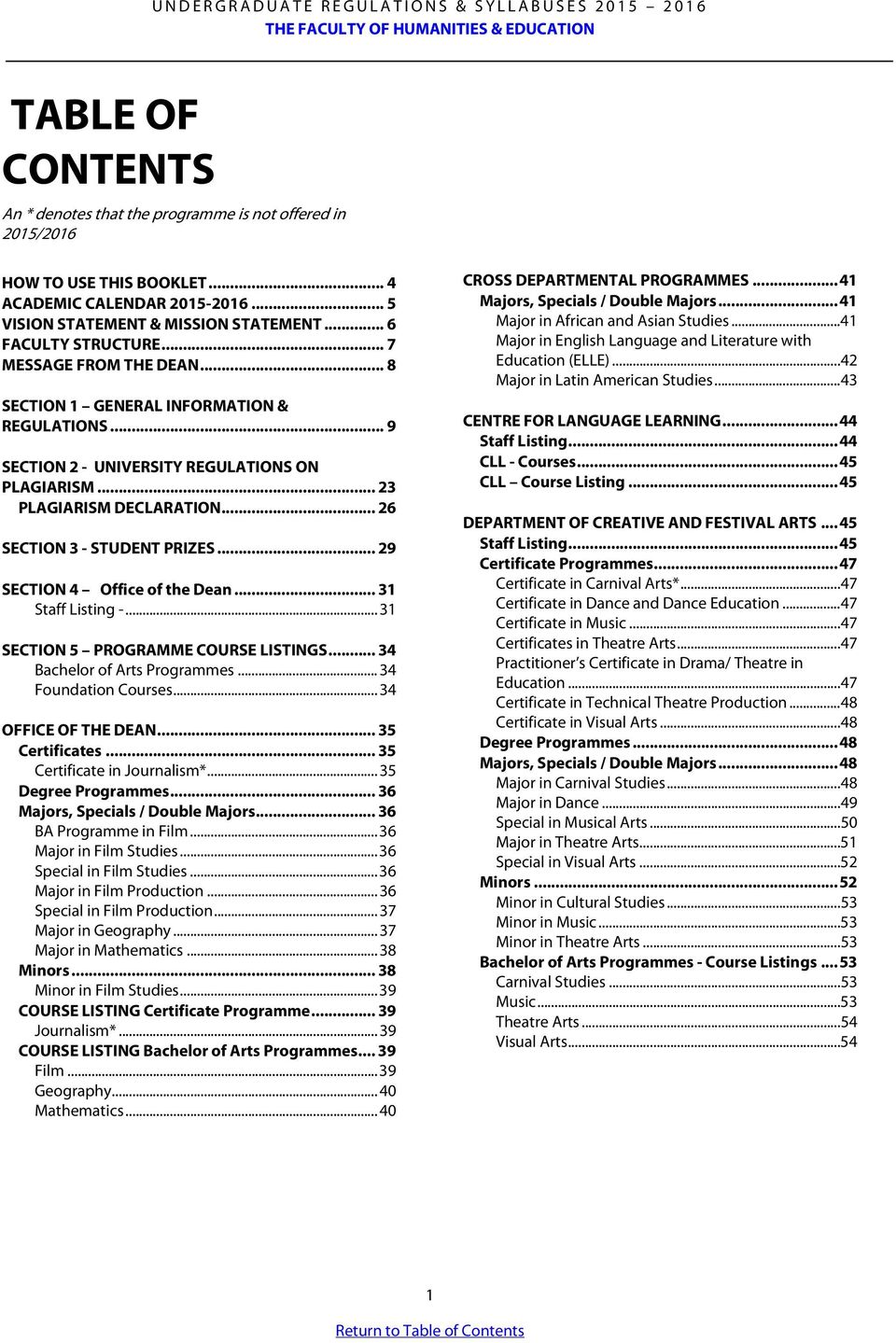
2 TABLE OF CONTENTS An * denotes that the programme is not offered in 2015/2016 HOW TO USE THIS BOOKLET... 4 ACADEMIC CALENDAR VISION STATEMENT & MISSION STATEMENT... 6 FACULTY STRUCTURE... 7 MESSAGE FROM THE DEAN... 8 SECTION 1 GENERAL INFORMATION & REGULATIONS... 9 SECTION 2 - UNIVERSITY REGULATIONS ON PLAGIARISM PLAGIARISM DECLARATION SECTION 3 - STUDENT PRIZES SECTION 4 Office of the Dean Staff Listing SECTION 5 PROGRAMME COURSE LISTINGS Bachelor of Arts Programmes Foundation Courses OFFICE OF THE DEAN Certificates Certificate in Journalism* Degree Programmes Majors, Specials / Double Majors BA Programme in Film Major in Film Studies Special in Film Studies Major in Film Production Special in Film Production Major in Geography Major in Mathematics Minors Minor in Film Studies COURSE LISTING Certificate Programme Journalism* COURSE LISTING Bachelor of Arts Programmes Film Geography Mathematics CROSS DEPARTMENTAL PROGRAMMES Majors, Specials / Double Majors Major in African and Asian Studies Major in English Language and Literature with Education (ELLE) Major in Latin American Studies CENTRE FOR LANGUAGE LEARNING Staff Listing CLL - Courses CLL Course Listing DEPARTMENT OF CREATIVE AND FESTIVAL ARTS Staff Listing Certificate Programmes Certificate in Carnival Arts* Certificate in Dance and Dance Education Certificate in Music Certificates in Theatre Arts Practitioner s Certificate in Drama/ Theatre in Education Certificate in Technical Theatre Production Certificate in Visual Arts Degree Programmes Majors, Specials / Double Majors Major in Carnival Studies Major in Dance Special in Musical Arts Major in Theatre Arts Special in Visual Arts Minors Minor in Cultural Studies Minor in Music Minor in Theatre Arts Bachelor of Arts Programmes - Course Listings Carnival Studies Music Theatre Arts Visual Arts
3 DEPARTMENT OF HISTORY Staff Listing Majors, Specials / Double Majors Course Listing 56 Major in History Special in History Minors Minor in History Bachelor of Arts Programmes Course Listing History Philosophy DEPARTMENT OF LITERARY, CULTURAL AND COMMUNICATION STUDIES Staff Listing Degree Programmes Majors, Specials/ Double Majors Course Listing 59 Major in Communication Studies Major in Literatures in English Minor in Communication Studies Minor in Literatures in English Bachelor of Arts Programmes Course Listing Communication Studies Literatures in English DEPARTMENT OF MODERN LANGUAGES AND LINGUISTICS Staff Listing Certificate Programmes Diploma in Caribbean Sign Language Interpreting 64 Professional Development in TESOL* Certificate (and Minor) in Speech and Language Pathology Degree Programmes Majors, Specials/ Double Majors Course Listing 65 Major in French Major in Linguistics Major in Spanish Major in Speech and Language Science Minors Minor in Brazilian Studies Minor in Caribbean Sign Language Minor in French Minor in French Minor in Gender Studies Minor in Linguistics Minor in Spanish Minor in Speech and Language Pathology Bachelor of Arts Programmes Course Listing French Language and Literature Hindi Language Linguistics Portuguese Language and Brazilian Studies Spanish Language and Hispanic Literature SCHOOL OF EDUCATION Staff Listing General Information School of Education Library Certificate Programmes: Regulations Certificate in Education Certificate in Education (Early Childhood Care and Development) Certificate in the Art and Science of Coaching Diploma in Health Visiting* Bachelor of Education Primary (General) Bachelor of Education Primary (Specializations) Bachelor of Education (Primary Education) Educational Administration* Bachelor of Education (Primary Education) - Language Arts* Bachelor of Education (Primary Education) Science* Bachelor of Education (Primary Education) Social Studies* Bachelor of Education Online Primary (Language Arts)* Bachelor of Education Physical Education* Outreach Programmes* Parenting and the Preschooler* Parenting and the Special Child* Health, Nutrition and Safety of the Young Child: Ages 3-6* THEOLOGY -... SEMINARY OF ST JOHN VIANNEY AND THE UGANDA MARTYRS Staff Listing Bachelor of Arts Programmes Theology SECTION 6 COURSE DESCRIPTIONS ONLINE ONLY Remedial Courses Foundation Courses Office of the Dean Film Programme Courses Geography Courses Mathematics Courses Centre for Language Learning Chinese (Mandarin) French Japanese Spanish English as a Foreign Language (EFL)

4 Department of Creative & Festival Arts Certificate Programmes Carnival Arts* Dance and Dance Education Certificate in Music Practitioner's Certificate in Drama / Theatre-in- Education Technical Theatre Production Visual Arts DCFA Degree Programmes - Course Descriptions Carnival Studies Courses Dance Courses Music Courses Theatre Arts Courses Visual Arts Courses Department of History History Course Descriptions Department of Literary, Cultural and Communication Studies Degree Programmes Communication Studies Courses Literatures in English Courses Department of Modern Languages and Linguistics Certificate Programmes Professional Development in TESOL Certificate (and Minor) in Speech and Language Pathology Degree Programmes French Language Courses French Literature Courses Gender Studies Courses Hindi Language Courses Linguistics Courses Portuguese Language Courses Brazilian Studies Courses Spanish Language Courses Hispanic Literature Courses SCHOOL of EDUCATION Certificate in Education Certificate in Education (Early Childhood Care and Development) Certificate in the Art and Science of Coaching Diploma in Health Visiting Bachelor of Education Primary (General) Bachelor of Education Primary (Specializations) THEOLOGY Theology Courses

5 HOW TO USE THIS BOOKLET Faculty Handbooks are available in both a printed format and an electronic format. The printed version of the Faculty Handbook is an abridged version which contains only the relevant Faculty regulations as well as select extracts of University regulations. It also contains full programme descriptions. The electronic version of the Faculty Handbook which is found online, also includes specific programme regulations and course prospectus showing the requirements for progression and graduation in specific programmes of study. To find out more about the contents of a specific course or programme of study, please refer to the full, online version of the Faculty Handbook, which is available for download at Students should note that their progress through a programme of study at the University is governed by Faculty regulations and University regulations. Should there be a conflict between Faculty Regulations and University regulations, University regulations shall prevail. Notwithstanding the contents of Faculty Handbooks, the University reserves the right to modify, add or altogether remove from a programme of study, certain aspects of any course offered by the University, as described in either or both the electronic and printed versions of the relevant Faculty Handbooks. PRINTED VS ONLINE FACULTY HANDBOOKS Information Printed Handbook Online Handbook Staff Listings Relevant Faculty Regulations eg. Admission Criteria, Exemptions, Progression, GPA, Leave of Absence, etc. Relevant University Regulations including Plagiarism Regulations and Declaration Forms Other Information: eg. Co-Curricular courses, Language courses and Assistance for Students with Disabilities. Programme Descriptions and Course Listings includes list of courses to be pursued in each programme (degrees, diplomas and certificates), sorted by level and semester; course credits and credits to be completed for each programme majors, minors and specials. Course Descriptions including details on prerequisites and methods of assessment 4

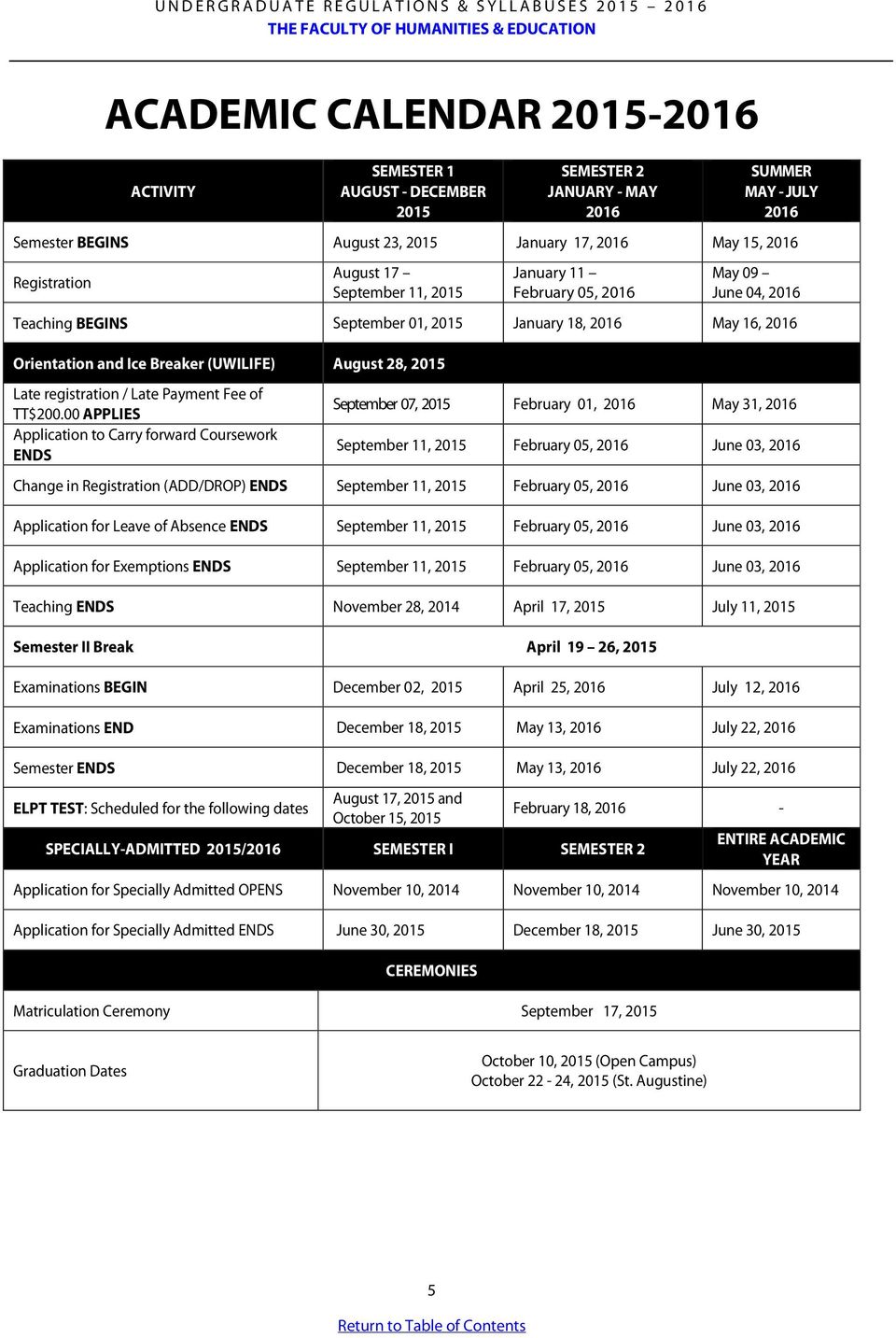
6 ACADEMIC CALENDAR ACTIVITY SEMESTER 1 AUGUST - DECEMBER 2015 SEMESTER 2 JANUARY - MAY 2016 SUMMER MAY - JULY 2016 Semester BEGINS August 23, 2015 January 17, 2016 May 15, 2016 Registration August 17 September 11, 2015 January 11 February 05, 2016 May 09 June 04, 2016 Teaching BEGINS September 01, 2015 January 18, 2016 May 16, 2016 Orientation and Ice Breaker (UWILIFE) August 28, 2015 Late registration / Late Payment Fee of TT$ APPLIES Application to Carry forward Coursework ENDS September 07, 2015 February 01, 2016 May 31, 2016 September 11, 2015 February 05, 2016 June 03, 2016 Change in Registration (ADD/DROP) ENDS September 11, 2015 February 05, 2016 June 03, 2016 Application for Leave of Absence ENDS September 11, 2015 February 05, 2016 June 03, 2016 Application for Exemptions ENDS September 11, 2015 February 05, 2016 June 03, 2016 Teaching ENDS November 28, 2014 April 17, 2015 July 11, 2015 Semester II Break April 19 26, 2015 Examinations BEGIN December 02, 2015 April 25, 2016 July 12, 2016 Examinations END December 18, 2015 May 13, 2016 July 22, 2016 Semester ENDS December 18, 2015 May 13, 2016 July 22, 2016 ELPT TEST: Scheduled for the following dates August 17, 2015 and October 15, 2015 SPECIALLY-ADMITTED 2015/2016 SEMESTER I SEMESTER 2 February 18, ENTIRE ACADEMIC YEAR Application for Specially Admitted OPENS November 10, 2014 November 10, 2014 November 10, 2014 Application for Specially Admitted ENDS June 30, 2015 December 18, 2015 June 30, 2015 CEREMONIES Matriculation Ceremony September 17, 2015 Graduation Dates October 10, 2015 (Open Campus) October 22-24, 2015 (St. Augustine) 5
7 VISION STATEMENT An internationally recognized and respected Caribbean centre for excellence in the development of the peoples of the region through academic programmes and activities in the Humanities and Education. MISSION STATEMENT The Faculty will engage in teaching, research, outreach and creative production in the Humanities and Education, in an environment in which individuals can develop the human values, linguistic competence, and professional skills and abilities that are relevant to the needs of the region. 6

8 FACULTY OF HUMANITIES AND EDUCATION Faculty Structure FACULTY of HUMANITIES & EDUCATION Office of the Dean School of Humanities School of Education Departments and Centres: Department of Creative and Festival Arts Department of History Department of Literary, Cultural and Communication Studies Department of Modern Languages and Linguistics Centre for Language Learning (CLL) Departments and Centres: Educational Foundations and Teacher Education Educational Research and Development Family Development and Children s Research Centre, (FDCRC) Continuing Professional Development and Outreach Unit 7

9 MESSAGE FROM THE DEAN Welcome to the Faculty of the Humanities and Education. This will be your home in many senses for the next three or four years. We encourage you to get to know us and we look forward to getting to know you all. Each year group will leave its own stamp on our Departments, Faculty and indeed the University. We encourage you to grow in your chosen discipline/s as well as to explore some of the many opportunities we provide to gain some insight into new areas. In our Faculty we all share a way of seeing the world which makes us a family with a gene pool with many variations but bounded together with a unique code. When you join us you become part of the creation of dynamic, people centered, and Caribbean centric perspectives. At registration you are therefore signing up for much more than specific courses, it is at this point that you begin to play your own part in making your distinctive contribution to the contemporary Caribbean. You then add to this as you grow within your fields every year. The disciplines in the Faculty of Humanities and Education will be central to dealing with the challenges confronting us in these contemporary times not only in the areas of policy formulation and research, but also for personal, community and societal development. We represent the soul of the nation. I therefore see our Faculty as critical to the future of the Caribbean. The Faculty of Humanities and Education holds the key to the understanding of our people, culture and heritage. We do this through our music, dance, literature, films, languages, education of the nation and history. These areas which have been viewed traditionally as soft are in fact hard. We often do not realize that they perform the crucial role of building our foundation. The challenge for the future is for us to take our rightful place in developmental plans. Thus, research in these areas, as well as the critical area of dissemination of findings, must be central to our future development plans. These are also the areas in which the Caribbean has in the past led the rest of the world, and must do so again in the future. We therefore welcome you and we are extremely pleased that you have decided to join us. You are now part of this legacy and vision. Dr. Heather Cateau DEAN 8

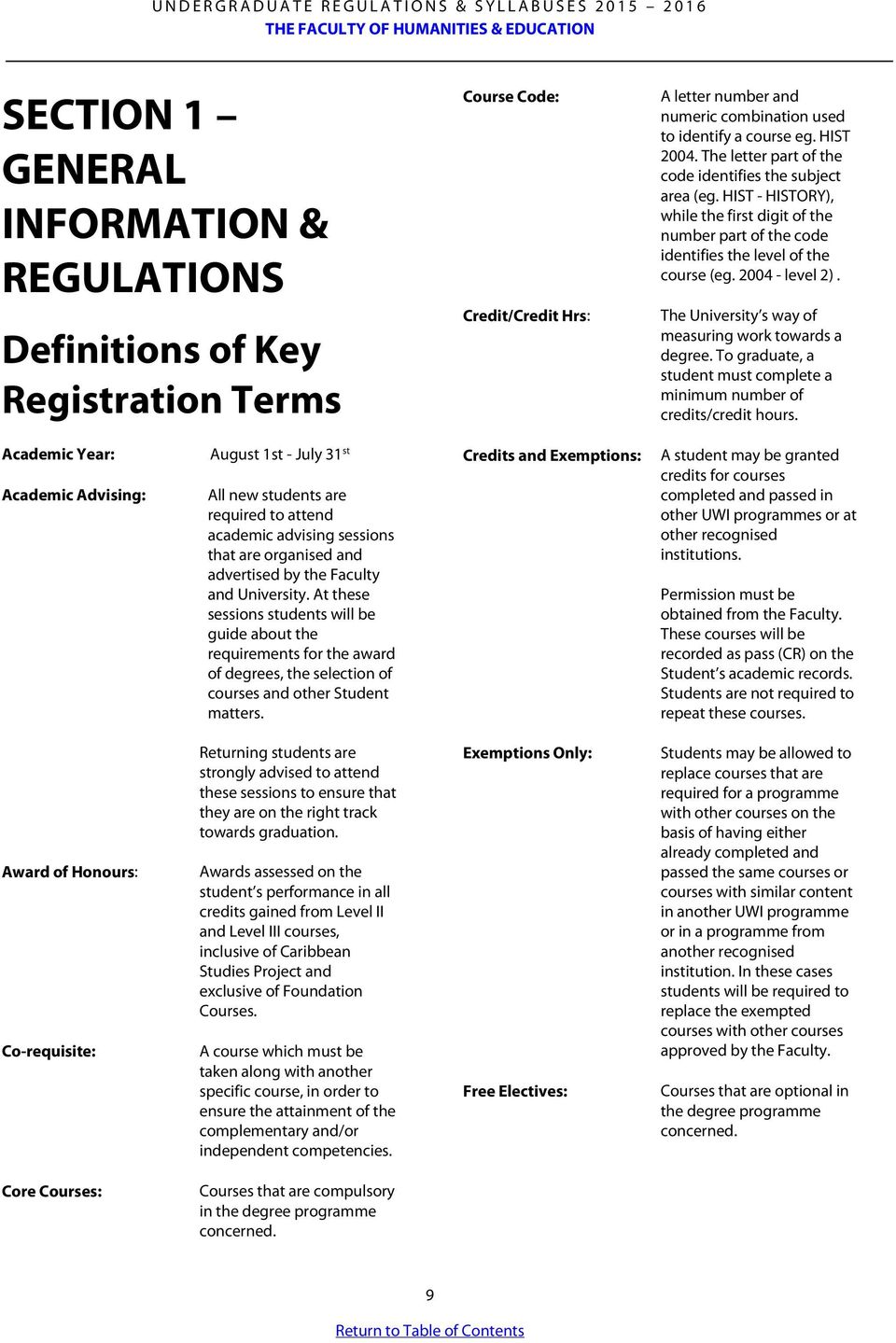
10 SECTION 1 GENERAL INFORMATION & REGULATIONS Definitions of Key Registration Terms Course Code: Credit/Credit Hrs: A letter number and numeric combination used to identify a course eg. HIST The letter part of the code identifies the subject area (eg. HIST - HISTORY), while the first digit of the number part of the code identifies the level of the course (eg level 2). The University s way of measuring work towards a degree. To graduate, a student must complete a minimum number of credits/credit hours. Academic Year: Academic Advising: August 1st - July 31 st All new students are required to attend academic advising sessions that are organised and advertised by the Faculty and University. At these sessions students will be guide about the requirements for the award of degrees, the selection of courses and other Student matters. Credits and Exemptions: A student may be granted credits for courses completed and passed in other UWI programmes or at other recognised institutions. Permission must be obtained from the Faculty. These courses will be recorded as pass (CR) on the Student s academic records. Students are not required to repeat these courses. Award of Honours: Co-requisite: Returning students are strongly advised to attend these sessions to ensure that they are on the right track towards graduation. Awards assessed on the student s performance in all credits gained from Level II and Level III courses, inclusive of Caribbean Studies Project and exclusive of Foundation Courses. A course which must be taken along with another specific course, in order to ensure the attainment of the complementary and/or independent competencies. Exemptions Only: Free Electives: Students may be allowed to replace courses that are required for a programme with other courses on the basis of having either already completed and passed the same courses or courses with similar content in another UWI programme or in a programme from another recognised institution. In these cases students will be required to replace the exempted courses with other courses approved by the Faculty. Courses that are optional in the degree programme concerned. Core Courses: Courses that are compulsory in the degree programme concerned. 9
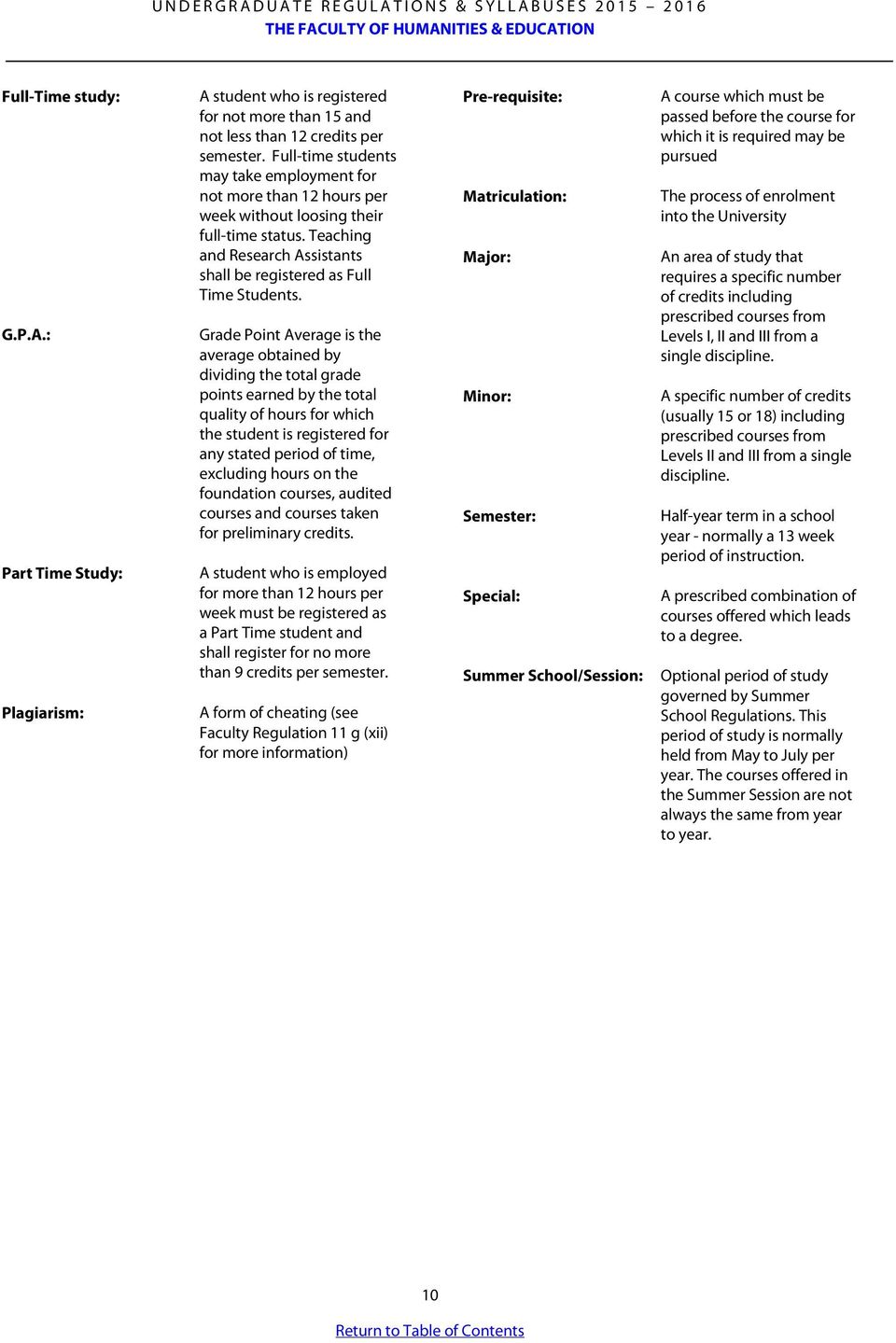
11 Full-Time study: G.P.A.: Part Time Study: Plagiarism: A student who is registered for not more than 15 and not less than 12 credits per semester. Full-time students may take employment for not more than 12 hours per week without loosing their full-time status. Teaching and Research Assistants shall be registered as Full Time Students. Grade Point Average is the average obtained by dividing the total grade points earned by the total quality of hours for which the student is registered for any stated period of time, excluding hours on the foundation courses, audited courses and courses taken for preliminary credits. A student who is employed for more than 12 hours per week must be registered as a Part Time student and shall register for no more than 9 credits per semester. A form of cheating (see Faculty Regulation 11 g (xii) for more information) Pre-requisite: Matriculation: Major: Minor: Semester: Special: Summer School/Session: A course which must be passed before the course for which it is required may be pursued The process of enrolment into the University An area of study that requires a specific number of credits including prescribed courses from Levels I, II and III from a single discipline. A specific number of credits (usually 15 or 18) including prescribed courses from Levels II and III from a single discipline. Half-year term in a school year - normally a 13 week period of instruction. A prescribed combination of courses offered which leads to a degree. Optional period of study governed by Summer School Regulations. This period of study is normally held from May to July per year. The courses offered in the Summer Session are not always the same from year to year. 10
12 General Information Financial Standing with the University Students who are not in good financial standing with the University will not be provided by the University with records or certificates of their work at the University. Such students who leave the University without making adequate arrangements to put themselves in good standing will not be given the University s diplomas or certificates for degree or other courses until they have satisfied the University in this respect. In good financial standing means that all debts owed by the student to the University are fully paid or arrangements for their payment, satisfactory to the University, have been made. Out-Of-Class Learning 1. The Co-curricular Credits programme is an integral part of the official credit system at undergraduate level at The University of the West Indies. It provides students with valuable opportunities for skill development in areas not available in their core programme. These courses are designed to help students become well-rounded graduates - prepared for their role in society and in the workplace. At the St. Augustine Campus, Co-curricular credits are currently awarded for involvement in the following courses: LEVEL 1 COCR 1001 Minding SPEC: Exploring Sports, Physical Education and Health & Wellness 3 COCR 1012 Workplace Protocol for Students 3 COCR 1013 Financial Literacy and Training 3 COCR 1030 Technology Literacy 3 COCR 1031 Managing My High (MY High): Alcohol, Drugs and Addictive Behaviours 2 COCR 1032 Living and Learning: Professional development through community service 2 COCR 1033 Mind the Gap: Towards Psychological Health & Wellness 1 COCR 1034 Public Speaking and Voice Training: Towards a More Confident You 3 COCR 1036 Ethics And Integrity: Building Moral Competencies 3 Microsoft Office 2013 COCR1025 Microsoft Word 2 COCR1026 Microsoft Excel 2 COCR1027 Microsoft PowerPoint 2 COCR1028 Microsoft Outlook 2 COCR1029 Microsoft Access 2 All co-curricular course codes begin with COCR. Visit course descriptions, availability and registration instructions. New courses are to be introduced so keep checking the website for updates during the academic year. You can also speak with your Faculty COCR coordinators for help with course selection and for answers to questions related to the COCR Programme. You will find their names and contact information at the co-curricular website at: or check your faculty office. Think you won t have time for co-curricular courses? Visit or the official timetable to see how you can work a COCR course into your schedule! WE ENCOURAGE YOU TO ENROLL IN AT LEAST ONE CO-CURRICULAR COURSE or CO-CURRICULAR ACTIVITY AS PART OF YOUR PROGRAMME AT UWI ST. AUGUSTINE CAMPUS Q. Why should I register for Co-curricular Credits? A. Co-curricular credits are awarded for activities designed to cultivate a range of skills essential to creating well-rounded students prepared for the world. Q. Who is eligible for Co-curricular credits? A. Co-curricular courses are open to all Undergraduate students. Q. What is a Co-curricular course? A. Co-curricular courses are offered for credits and can be taken alongside your traditional elective courses, or as an alternative to an elective. They cannot replace your core course requirements. Cocurricular courses are optional. Q. How are Co-curricular courses graded? A. Co-curricular courses are graded as PASS or FAIL and are reflected on your transcript as PASS (P) or NOT PASS (NP). Q. How do I register for Co-curricular activity? A. Please visit for a list of all Co-curricular Courses available and a list of steps to register for Co-curricular activities. 11

13 Co-Curricular Credits: Regulations a. For the purposes of these Regulations, co-curricular credit means credit earned by a student in pursuance of some activity or programme of activities that is not part of the academic programme of a Department or Faculty of the University or is not undertaken by a student as part of the academic programme of a Department or Faculty, but which activity or programme of activities is recognised by the University as contributing to the overall personal, cultural, social and intellectual development of students and is approved by Academic Board under Regulation v below. b. Participation in activities for co-curricular credits is optional. However, wherever students have chosen to participate in any recognised co-curricular activity or programme of activities for credit, they shall be eligible for a maximum of three (3) credits as part of the credits required for the degree. c. Students who successfully complete any cocurricular activity or programme of activities for more than three (3) credits shall have additional credits recorded on their transcripts. d. Co-curricular credits shall not be taken into account in the determination of class of degree. e. All co-curricular activities/programmes for which credits are being sought shall be approved by Academic Board on the recommendation of any Campus Committee which Academic Board may recognise as having responsibility for co-curricular programmes. f. Registration for co-curricular credits in each case must be approved in advance by the Faculty Board and by the member of the Senior Administrative staff appointed or designated as Director of Student Services or Dean of Students, as the case may be, at the Campus. g. The grading of co-curricular activities shall be pass/fail. Co-Curricular Credits - FAQ The Co-curricular Programme offered at the St. Augustine Campus allows you to choose from a range of non-academic courses that help you to acquire characteristics to excel in life in the 21st century. 2. UWI Mentorship Programme For information please visit Student Advisory Services. 3. Exchange / Study Abroad Programme Students majoring in Foreign Language programmes are encouraged to travel to countries in which these languages are spoken and to participate in approved programmes at recognised institutions. The University offers some support for such travel to Level II students who maintain a B average. Interested students must observe the deadline for application and (non-refundable) down payment. This information will be posted on the Faculty notice board in Semester I. For more information please visit the International Office or contact the Office at Ext or [email protected]. THE MID-YEAR (SUMMER) PROGRAMME The Mid-year (Summer) programme is offered every year from May to July. Course offerings are advertised every year and may vary from year to year. For more information on course offerings, dates and schedules please visit the Faculty Office, Second Floor, School of Humanities Building or contact the Faculty Office at extension Student Facilities 1. Academic Advising Programme 2. Student Representation on Faculty Board 3. Student Societies a) Asosyasyon Kwéyòl - For information please visit the Department of Modern Languages & Linguistics b) Communications Society for information please visit the Department of Literary, Cultural & Communication Studies c) History Society For information please visit the Department of History d) Linguistics Society For information please visit the Department of Modern Languages & Linguistics e) La Société Française - For information please visit the Department of Modern Languages & Linguistics f) Sociedad(e) Latinoamericana - For information please visit the Department of Modern Languages & Linguistics These courses are very practical in nature and help you to develop attributes which are critical for your success. 12

14 Academic Support / Disabilities Liaison Unit (ASDLU) The Unit is the first and most important stop for high quality academic support for the diverse populations of students throughout the University including full-time, part-time and evening students, international students, student athletes and students with special needs (disabilities). Support Services for STUDENTS WITH SPECIAL NEEDS (Temporary and Permanent)~ Provision of Aids and Devices such as laptops, USB drives, tape recorders and special software. Special Accommodations for Examinations Classroom Accommodations Academic Support Liaison with Faculties and Departments Students with special needs should make contact before or during registration. Every effort will be made to facilitate your on-campus requirements in terms of mobility, accommodation, coursework, examinations, and other areas. No student of The UWI will be discriminated against on the basis of having special needs. Sharing your needs before registration will enable us to serve you better as a part of the Campus community. How do I register at ASDLU? Visit ASDLU to make an appointment to meet the Co-ordinator. Complete the required registration form. Students with disabilities must submit a medical report from a qualified medical professional. An assessment of the student s needs will be conducted. The required assistance will be provided. All Students experiencing academic challenges should communicate with Ms. Jacqueline Huggins, Coordinator, Academic Support/Disabilities Liaison Unit, south of The Alma Jordan Library. Tel: Exts 83921, 83923, 83866, Hours: 8: 30 am- 4:30 pm Monday, Wednesday & Friday 8:30 am 6:00 pm Tuesday & Thursday to accommodate Part-time and Evening students. [email protected]. Registration forms are available at the office or from the website at ** In 2015/2016 look out for changes and improvements to the ASDLU and our entire network of student support and development services! ** Academic Support Services for ALL STUDENTS Educational Assessment LADS (dyslexia) LASSI (Study Skills) Time Management Examinations Strategies Workload Management Career Planning Study Skills Peer Tutoring 13

15 Faculty Regulations Qualifications for Admission - School of Humanities 1. Before registration, and before beginning the courses leading to the of BA degree in the Faculty, candidates must have satisfied: a. University Matriculation requirements for entry to a degree programme; b. The entry requirements of the School of Humanities and School of Education; c. Entry requirements of the particular academic departments in which they propose to take courses. 2. These three sets of requirements are as follows: a. University Matriculation See University Matriculation requirements, UWI Calendar, Vol. II b. Faculty Requirements Where the University Matriculation regulations refer to approved subjects (Regulations 4, 5, 6, 7), only one of the following subjects in the list may be counted towards entry in the School of Humanities: Health Science, Human Anatomy, Hygiene and Physiology, Rural Biology, Technical Drawing, CAPE Communication Studies and Caribbean Studies c. Departmental Requirements For entry to other Level I courses, either a Grade I or II CSEC (CXC) General or a BGCSE/ GCE O Level pass or the equivalent CAPE Pass in the subject and a departmental test, or a pass in the Beginners course. ART Departmental interview and portfolio presentation. CARNIVAL STUDIES no additional requirements. COMMUNICATION STUDIES no additional requirements. LITERATURES IN ENGLISH normally a pass at Grade I or II CSEC (CXC) General or a good BGCSE/ GCE O Level pass or the equivalent CAPE Pass in English Literature B. FILM Departmental interview and portfolio presentation. FRENCH A departmental test or a minimum Grade 3 average at CAPE GEOGRAPHY Grade I or II CSEC (CXC General or a BGCSE/ GCE O Level pass or the equivalent CAPE Pass in Geography. HINDI no requirements. HISTORY normally a good GCE O Level pass or Grade I or II CSEC (CXC) General/ BGCSE in or the equivalent CAPE Pass in History. LATIN AMERICAN STUDIES no additional requirements. LINGUISTICS no additional requirement but a strong background in English or Modern Languages preferred. MANAGEMENT STUDIES no additional requirements, but preference will be given to applicants with GCE O Level or Grade I or II CSEC (CXC) General/ BGCSE in Mathematics. MASS COMMUNICATIONS interview and/or departmental test. MATHEMATICS M080 or GCE A Level or the equivalent CAPE Pass in Mathematics or Pure Mathematics. MUSIC Grade 7 Music Theory and departmental audition. PHILOSOPHY no additional requirements. PORTUGUESE no additional requirements, but a good background in Modern Languages preferred. SPANISH as for French THEATRE no additional requirements. THEOLOGY All applicants to be interviewed by the Dean of Studies of the Seminary PRIOR to an offer of a place on the BA in Theology. 14

16 d. Specific Entry Requirements for the Majors/Specials in Creative Arts i. Two GCE A Level passes and Grade 7 in Music for Special in Musical Arts, and Audition; ii. At least a CSEC (CXC) General/ BGCSE Grade I or GCE O Level pass in Art, plus two GCE A Levels (or equivalent), and portfolio presentation, for the Special in iii. Visual Arts; Persons who obtained a B average in the Certificate in Visual Arts or the Certificate in Musical Arts can enter Year I of the BA degree programme; iv. Normal entry requirements (i.e. two GCE A Level subject passes) for the major in Theatre Arts; Carnival Studies. v. Persons who obtained a B average in the Practitioners Certificate in DIE/TIE can enter Year I of the BA degree programme in Theatre Arts, e. Entry Requirements for the Certificate in Music To be eligible for admission candidates are required to have the following qualifications: i. Theory of Music Grade III; ii. Normally possess five CSEC (CXC)/GCE/BGCSE passes including English, at CSEC (CXC) General Proficiency (Grades I or II) / BGCSE or at GCE Ordinary Level; iii. An audition and interview to be arranged by the Department of Creative and Festival Arts, UWI f. Entry requirements for the Certificate in Visual Arts; Practitioners Certificate in DIE/TIE; Certificate in Technical Theatre Production; Certificate in Dance and Dance Education. To be eligible for admission to the programme a candidate should: i. have had five years experience in any aspect of the Theatre Arts/Visual Arts/ Dance. ii. normally possess five GCE passes, including English, at O Level (or at CSEC (CXC)/ General Proficiency Grades I or II /BGCSE) and for the Certificate in Visual Arts an O Level pass in Art (or at CSEC (CXC) General Proficiency Grades I or II Grades I or II or the equivalent CAPE Pass) iii) pass an Audition / Interview Persons not satisfying the above requirements may be accepted at the discretion of the Faculty. Final selection is determined by audition and interview. Qualifications for Admission - School of Education - B.Ed. Degrees 3. To be eligible for admission to these programmes, an applicant must: a. have satisfied the matriculation requirements of The University; b. have successfully completed an approved programme of training for certification as a teacher in his/her country; c. possess a level of professional experience as a teacher that is deemed satisfactory by the School of Education; d. possess any other qualification which the School may require from time to time. Successful candidates to the BEd programme who possess a UWI School of Education Certificate in one of the following: Early Childhood Education, Educational Administration, The Teaching of Language Arts, Mathematics, Science, or Social Studies, or who hold an equivalent Certificate or Associate Degree from an approved institution will experience transitional adjustments. These may include course exemptions and/or arrangements to complete outstanding courses as the School of Education may deem necessary. Categories of Courses/Weighting 4. a. Each course is classified either as a Foundation/University Course or as a Faculty course. b. Each course is designated as appropriate to Level I, II or III, or as appropriate to more than one level. c. Beginners courses are sometimes offered in foreign languages. (See paragraph 4 below). d. Most courses will have a weighting of three (3) credits, except for some Faculty courses whose weighting varies between 1 and 6. Beginners Courses in Languages Six credits maximum 5. a. Beginners courses may be offered in French, Spanish, Hindi, Portuguese, and any other foreign language that may be added from time to time. b. A candidate is not permitted to offer more than six Beginners credits towards the credits required for the degree. c. Qualifications: Beginners courses are open to the following persons: i. Those who have no previous knowledge of ii. the language concerned; Those who have limited knowledge of the language concerned, but no academic qualifications; 15

17 iii. Those with academic qualifications, but whose knowledge of the language is deemed by the Department concerned to be inadequate for admission to normal Level I courses. d. A student who has successfully completed a Beginners course is eligible for admission to Level I courses in the language concerned, and its associated literature and culture at the discretion of the Head of the Department concerned. e. Students who have completed a Beginners Course may continue the study of the language concerned, and/or its literature and culture by taking the appropriate Level I Course. Requirements for Entry to Level II and Level III Courses 6. Students are required to gain a minimum of 18 credits inclusive of pre-requisites (where they exist) for Level II and III courses before they are permitted to register for Level II/III courses. Requirements for the Award of Degrees 7. In order to qualify for a degree a student must satisfy the following requirements: I. Have completed a minimum of 90 credits (normally 30 at each Level) of which: a. 12 credits shall be for Foundation/University Courses, unless otherwise specified in particular programmes. b. At least 78 credits shall be for Level I, II and III courses (not including Foundation/University Courses) of which i. a minimum of 24 and a maximum of 30 Level I credits (not including Foundation Courses) of which, (except in the case of BA Theology) normally at least 6 shall be from within the Humanities group of subjects outside of the declared Major/Special. ii. a minimum of 18 credits shall be for Level II courses (not including Foundation Courses). NOTE: Level II Courses for these purposes shall include courses designated Level II or III. iii. A minimum of 9 credits and a maximum of 24 credits shall be for courses exclusively Level III (but not including HUMN 3099 or its substitute). II. a. on entry declare a Major, or a Special, or Double Major. (See 7f below) b. satisfy the requirements for the declared Major(s). III. Have attained a minimum GPA of 2.0 from Level II and III courses. 8. a. A Major or Special must be declared from among the following subjects only: BA: African and Asian Studies; Carnival Studies; Communication Studies; Dance; English Language and Literature with Education; French; Film; Geography; History; Latin American Studies; Linguistics; Literatures in English; Mathematics; Musical Arts; Spanish; Speech and Language Science; Theatre Arts; Theology; Visual Arts. BEd: General, Specializations, Early Childhood Care & Education, Primary Education: Educational Administration, Primary Education: Language Arts, Primary Education: Mathematics, Primary Education: Science, Primary Education: Social Studies, Physical Education. b. A Major is made up of a minimum of 36 credits in a single subject over the three levels. c. A Special is made up of a minimum of 54 credits in the subject over the three levels. d. Component courses in a Major or Special are determined by the Faculty Board on the recommendation of the relevant Department(s). e. Throughout the entire degree programme, no more than 30 credits (distributed so as not to exceed 12 credits in any one year of the Fulltime programme) may be selected from courses other than Humanities courses, except with the special permission of the Dean. f. A student may, with the permission of the Dean, change Majors. Full-time students must do this no later than the start of their third semester of registration. Part-time students who have registered in accordance with Regulation 10 (c) below, must do so no later than the start of the fifth semester of registration, or the completion of the bulk of Level I credits, whichever is sooner. g. Extra credits gained in any Level subsequent to the original credits required for the degree at that Level cannot be substituted retroactively for the original credits. 16
18 FULL-TIME AND PART-TIME STUDENTS REQUIRED TO WITHDRAW 9. a. A student whose GPA for a given semester is less than or equal to 1.99 shall be deemed to be performing unsatisfactorily, and shall be placed on warning. A student on warning whose GPA for the succeeding semester is less than 1.99, will be required to withdraw from the Faculty/ University. b. A student on warning shall be counselled by the Dean or a designated faculty advisor. Such a student may, except where otherwise prescribed in Faculty Regulations, be permitted by the Academic Board on the recommendation of Faculty Board to carry a reduced course load. c. A Full Time student will be required to withdraw from the Faculty unless he or she has gained at least: 12 credits by the end of the second semester, 24 credits by the end of the fourth semester, 39 credits by the end of sixth semester, 57 credits by the end of the eighth semester, 75 credits by the end of the tenth semester, 90 credits by the end of the twelfth semester. d. A Part Time student will be required to withdraw from the Faculty unless he or she has gained at least: 6 credits by the end of the second semester, 12 credits by the end of the fourth semester, 21 credits by the end of the sixth semester, 30 credits by the end of the eighth semester, 42 credits by the end of the tenth semester, 54 credits by the end of the twelfth semester, 66 credits by the end of the fourteenth semester, 78 credits by the end of the sixteenth semester, 90 credits by the end of the eighteenth semester. FULL TIME AND PART TIME REGISTRATION 10. a. Students are initially registered as full-time or part-time but may change their registration. b. Full-Time students may take employment for not more than twelve hours per week without losing their full-time status. Teaching and Research Assistants shall be registered as full-time students. c. A student who is employed for more than twelve hours per week shall be registered as a part-time student. d. A student is deemed to have registered for a course when his/her financial obligations to the University have been fulfilled. e. Registration for a course constitutes registration for the examinations in that course. With specific reference to b. and c. above, please note that a person in full-time employment cannot be registered as a full-time student unless written proof of leave approval is provided prior to or at registration. REGISTRATION, EXAMINATIONS AND LEAVE 11. a. In registering in the Faculty, student must obtain the written approval of the appropriate Head of Department or his or her nominee for each course selected, and the written approval of the Dean of the Faculty for the combination of courses selected. The Relevant Approvals for registration are facilitated in the Banner Student Administration System with respect to online registration. b. A student who has registered for a course but who wishes to withdraw from that course must apply to the Dean not later than the Friday of the third teaching week of the semester for permission to do so. The Banner Student Administration System facilitates the relevant approvals for change of registration during the Registration Period with respect to online registration. c. Registration for a course constitutes registration for the examinations in that course. d. A student failing a course that is not compulsory may substitute another course in a subsequent semester or may repeat the failed course. e. A course may be examined by written examination papers, oral tests, coursework, or any other method or combination of methods approved by Senate. f. A student who does not sit the examination in a course for which he or she is registered is deemed to have failed that examination unless permission to withdraw has been granted. This regulation shall not apply in cases of properly attested illness duly reported to the Campus Registry in accordance with the University Examinations Regulations. 17

19 g. i. Examination Regulation 22 states that: Any candidate who has been absent from the University for a prolonged period during the teaching of a particular course for any reason other than illness or whose attendance at prescribed lectures, classes, practical classes, tutorials or clinical instructions has been unsatisfactory or who has failed to submit essays or other exercises set by his teachers may be debarred by the relevant Academic Board, on the recommendation of the relevant Faculty Board, from taking any University examinations. ii. iii. iv. Debarment will be recommended by the Faculty, based on information supplied by the relevant Head of Department, if the student has missed 50% or more of any of the above-mentioned requirements, subject to the following: Student attendance at tutorials and performance in Coursework will be routinely checked by the lecturer/tutor at four-weekly intervals, counting from the beginning of the semester. A student will be allowed one warning. This must be in writing and will be administered after the first four weeks of the semester. If there is no improvement at the end of the next four weeks, steps towards debarment will be initiated. In the School of Humanities attendance at tutorials is prescribed. The Board of Examiners may recommend to the department concerned that a student who has failed the last and only course required to complete the degree be offered an oral examination in that course, provided that he/she has obtained at least 45% in that course. If an Oral Supplemental is granted, the student may choose to decline the offer. The Oral Supplemental, which will be of a minimum length of one hour, will be held as soon as possible after the previous examination. The student must contact the Department concerned immediately so that arrangements may be made for the Oral. v. The Oral Examination will concern the course as a whole, and not be restricted to the questions set in the examination,which the student did. vi. If the examination is passed, the student cannot be awarded a grade higher than C, and this grade will re-place that previously gained for the entire evaluation in that course. vii. If he/she fails the Oral, the student will not have the right of appeal or review. viii. A student will be allowed only one Oral Supplemental Examination for any one course. ix. Students reading History courses are advised that even if they attain an overall pass mark (40 and above) inclusive of Coursework, they will not be awarded an overall pass unless they have passed at least one of the written examination questions. x. Students are required to pass in each component (Coursework and written examination) in order to qualify for an overall pass in Literatures in English courses. xi. xii. For the award of the BEd degree, candidates must satisfy the examiners by completing for the chosen option and area of specialisation, the requirements of: The compulsory core and The compulsory professional and content courses indicated for a major. Plagiarism: Please see Section 2 for the University s Regulations on Plagiarism and the declaration forms. Note that a declaration must be made and attached to ALL work submitted by a student for assessment. By signing this declaration, a student is declaring that the work submitted is original and that it does not contain any plagiarised material. 18
20 h. Regulation for Leave of Absence i. A candidate who for good reason wishes to be absent from an academic programme for a semester or more must apply for formal leave of absence to the Faculty Board, through the appropriate Dean, stating the reasons for the application. ii. iii. iv. The length of such leave of absence, if granted, will be subject to approval by the Academic Board of the Campus concerned, but will not exceed one academic year in the first instance terminating at the end of the academic year for which the application is approved. Leave of absence will not be granted for more than two consecutive academic years. Leave of absence may be granted for one semester or for an academic year. v. Applications for leave of absence for a semester shall normally be submitted by the end of the third week of the relevant semester. vi. Applications for leave of absence for the academic year shall normally be submitted by the end of the third week of Semester I. Notification of Results 12. a. A pass list for each programme in the BA and BEd degrees shall be published each semester. b. For those candidates who have completed the requirements for the BA and BEd degrees a Pass List shall be arranged alphabetically in the following categories: i. First Class Honours ii. iii. Second Class Honours a. Upper Division b. Lower Division Pass Award of Honours c. i. Honours shall be calculated on the basis of the Regulations existing at the year of the student s entry into a particular programme of study into the University. ii. The class of degree is calculated on the basis of ALL levels II and III credits (exclusive of Foundation Courses) required for the granting of the degree as follows: iv. G.P.A. SYSTEM First Class Weighted G.P.A 3.60 and above Second Class, Weighted G.P.A. Upper Division Second Class, Weighted G.P.A. Lower Division Pass Weighted G.PA iii. This is based on a norm of eighteen 3- credit courses. Where a course taken has a 6-credit weighting, the points gained shall be doubled, and where it has a 2-credit weighting, the points shall be pro-rated accordingly (i.e. two-thirds). The points are related to the course evaluation grades and percentages as follows: G.P.A. SYSTEM Grade Percentage Quality Point A A A B B B C C F F F Aegrotat Degree (See also University Examinations Regulations) 13. A candidate who has been absent through illness from one or more examinations held in respect of Level II or Level III courses may apply for exemption from these examinations provided that: a. no exemption shall be granted in respect of any course unless the candidate has successfully completed all the required work for the course and has achieved, in the opinion of his tutor(s) and of the Department, a satisfactory level of performance in the course; b. no exemption shall be granted unless the candidate has obtained the minimum 30 Level I credits and at least 12 Level II credits; c. no exemption shall be granted in respect of any dissertation or project; 19

21 d. the total number of credits for which exemptions may be granted shall not exceed 18, except where a student has satisfactorily completed both the Level I and Level II programmes exemption may be granted from a total of 24 credits. Such exemption shall permit the student on completion of all the other requirements for the degree of BA to apply for an aegrotat degree. Medical Certificates (See also University Examination Regulations) 14. Students who submit medical certificates as an excuse for absence from examinations are asked to note that although the student is free to visit his/her private physician he/she is required, for the purpose of securing exemption from examinations, to comply with the following: a. to be examined by a medical practitioner from the University s panel of doctors; or b. in the event of the illness being so acute that the student cannot subscribe to (a) he/she should obtain a medical certificate from his/her private physician and in addition the physician should be required to supply the University Student Medical Officer with the reasons for the student s absence from the examinations and; c. to ensure that the report is submitted to the University Student Medical Officer. Regulations with Respect to Absence from Coursework Tests 15. i. A student who is absent from Coursework examination may apply to the Dean of the Faculty for exemption from this examination no later than one (1) week following the date of this examination. He/she must at the same time submit to the Campus Registrar a valid justification for such absence (such as a medical certificate in case of illness). The Dean will consider any such request for exemption in consultation with the relevant Head of Department and course lecturers. If the exemption is granted, the percentage mark awarded for the final examination will be prorated. ii. A student may request permission to submit Coursework assignments, essays, etc. after the stipulated deadline date on the basis of a valid justification (such as illness, in which case a valid medical certificate must be submitted to the Campus Registrar). This request must be made normally within 48 hours after the stipulated deadline date and must be addressed to the Dean, who in consultation with the relevant Head of Department and Course Lecturer, may allow the extension. In very exceptional circumstances, the Dean, acting on the advice of the relevant Head of Department and Course Lecturer, may consider requests for exemption from submission of the Coursework assignment, essays, etc., and, if granted, the percentage mark awarded for the final examination will be pro-rated. University Regulations for the Re- Admission of Students Required to Withdraw 16. i. Students required to withdraw from the University for failing to complete their degree programme within the stipulated period may be re-admitted to the Faculty after at least one academic year has elapsed since their withdrawal. Students thus admitted to the Faculty may in accordance with its regulations be granted exemption from Level I courses subject to there being no change in the content of the courses and provided that no more than five years have elapsed since the date of withdrawal. Level II University Courses, for the purposes of exemption, may be treated in the same way as Level I Faculty courses. ii. iii. iv. Students whose performance in the Level I programme indicated general weakness (e.g. bare passes in all courses) may be required by the Faculty to repeat Level I of the programme. In special circumstances, exemption from courses in Level II of the degree programme may be proposed by the Faculty, provided that on re-admission the student is required to take at least a full load for one year. The maximum time allowed for completion will be two years for each year s full load. Students required to withdraw from the University for failing to complete their Level I or Level II degree programme within the stipulated period or for poor performance as provided for in the Faculty regulations, may be re-admitted to the Faculty after at least one year has elapsed since their withdrawal. Students thus re-admitted may be granted exemption from Level I courses or Level II courses subject to Regulations i, ii and iii above. v. Students from one faculty who had been required to withdraw from the University for failing to complete their degree programme within the stipulated period may be admitted to another faculty after a minimum period of one year has elapsed since their withdrawal. 20
22 vi. Such students may be granted exemption from Level I courses relevant to the new programme, subject to Regulations i and ii above. Students required to withdraw from the University for failing to complete their diploma or certificate programme may be re-admitted to the Faculty after a minimum period of one year has elapsed since their withdrawal. Such students shall not be granted exemptions from courses in the programme previously passed. Regulations for the Licentiate in Theology and Degree of BA (Theology) 1. The Licentiate in Theology and/or the degree of Bachelor of Arts (Theology) will be awarded to students of Theological Colleges affiliated with The University of the West Indies who having completed the appropriate course of study prescribed by these regulations have satisfied the examiners in the examination for the LTh and/or the BA (Theology) 2. The Theological Colleges concerned are responsible for the admission of candidates and shall submit to the University at the appropriate time a list of students and their qualifications for purposes of matriculation. Licentiate in Theology (LTh) Qualifications for Admission 3. The following are eligible for admission to the prescribed course of study for the Licentiate in Theology: i. Candidates who have satisfied University Matriculation requirements for admission to a ii. degree course; Individual candidates lacking qualifications under (i) above, who can present other evidence of satisfactory achievement may be accepted by the University on recommendation of the Principal of the affiliated college. FULL-TIME STUDENTS 4. Candidates for the LTh shall pursue a prescribed course of study extending over not less than four and not more than ten semesters before being eligible for the award of the Licentiate. 5. During this course of study they shall gain 60 credits, 36 of which must be at Level I, as follows: in Biblical Studies 9 Credits in Historical Studies 6 Credits in Theological and Ethical Studies 6 Credits in Religious and Philosophical Studies 3 Credits in Pastoral Studies 6 Credits in Foundation Courses (English) 6 Credits The remaining 24 credits must be gained at Level II or at Level III and must be taken from at least two of the areas of Theological Studies. 21
23 6. Full-time students must register for a minimum of 9 credits in each semester. Such students may, however, with the per-mission of their Theological College, register for more than 10 credits (up to a maximum of 15 credits) in each semester). Such additional credits shall be selected from those Theological courses provided for in the BA (Theology) degree programme. 7. A full-time student who, at the end of the second semester, has not completed at least 9 credits shall be required to withdraw from the Licentiate programme. A student who has completed at least 9 credits at the end of the second semester may be permitted to continue provided that student gains at least 6 additional credits in each ensuing semester, (except in cases where fewer than 6 credits remain to complete the requirements for the LTh as set out in Regulation 5 above). PART-TIME STUDENTS 8. Candidates may study for the LTh on a part-time basis. Such candidates must complete the course of study prescribed in Regulation 5 above, in a minimum of eight semesters and a maximum of twelve semesters. Part-time students shall register for a minimum of 6 credits, and not more than 9 credits in each semester. 9. A part-time student who, at the end of the second semester, has not completed at least 6 credits shall be required to withdraw from the Licentiate programme. A part-time student who has completed at least 6 credits at the end of the second semester shall be permitted to continue provided that student gains at least 3 additional credits in each ensuing semester (except in cases where fewer than 3 credits remain to complete the requirements for LTh as set out in Regulation 5 above). 10. If a candidate has, (in accordance with Regulation 6 above) successfully completed more than the 60 credits (as pre-scribed in Regulation 5 above), such additional credits shall be indicated on the certificate issued to the successful candidate. Bachelor of Arts (Theology) Qualifications for Admission 11. The normal qualifications for admission to the degree programme in the BA (Theology) are those of the Faculty of Humanities and Education and are set out in Regulations 1 and 2 of the School of Humanities. The following candidates may also be admitted to the degree programme of the BA (Theology): Candidates who successfully complete 2 preliminary semesters of study (as set out in Regulation 13 below), and who receive the recommendation of the Academic Boards of their respective Theological Colleges. 12. The following candidates may also be admitted to the degree programme of the BA (Theology): i. Candidates who qualify for admission at lower level and who receive the recommendation of the Academic Boards of their respective Theological Colleges. ii. Candidates who are holders of the Licentiate in Theology of the UWI upon the recommendation of the Academic Board of the Affiliated Theological College. 13. (i) Candidates who qualify for admission at lower level to the BA (Theology) Programme must register as part-time students. Normally a parttime student will be required to spread the Level I degree programme over four semesters. (ii) Such candidates shall be required to take 18 credits in the first year of registration, which should include 6 credits of Foundation courses and 9 credits of Theology courses. (In the second year of registration they may take up to 18 credits of theological courses). FULL TIME STUDENTS 14. (i) Candidates for the degree of BA (Theology) shall present in not less than six semesters a minimum of NINETY (90) credits including not more than THIRTY (30) from Level I and not fewer than FIFTEEN (15) from Level III. (ii) A minimum of SIXTY (60) credits shall be chosen from among the following areas according to the distribution set out below: A. Biblical Studies - 12 Credits B. Historical Studies - 6 Credits C. Theological and Ethical Studies -12 Credits D. Religious and Philosophical Studies - 6 Credits E. Pastoral Studies - 6 Credits F. Foundation Courses - 12 Credits G. HUMN 3099 or equivalents - 6 Credits This distribution shall be in accordance with the approved structure of the degree. (iii) The remaining THIRTY (30) credits shall be chosen from A, and/or B, and/or C, and/or D and/or E with the approval of the Theological College concerned. 15. Candidates for the degree of BA (Theology) may, with the approval of the Theological College concerned and the Faculty of Humanities and 22
24 Education, choose not more than a total of Twelve (12) credits of Level II and Level III courses from among those provided by the Faculty of Humanities and Education but not normally listed as available for the BA (Theology). 16. The minimal performance for a PASS degree (without honours) shall be that a student has passed 90 credits in a period of not more than twelve semesters. 17. Full time candidates will be required to withdraw unless they have gained at least: 12 credits by the end of the second semester 24 credits by the end of the fourth semester 39 credits by the end of the sixth semester 57 credits by the end of the eighth semester 75 credits by the end of the tenth semester 90 credits by the end of the twelfth semester 18. (a) Candidates entering the degree programme of the BA (Theology), having completed the LTh programme shall be permitted to complete the degree in a minimum of four semesters and a maximum of eight semesters. Such candidates shall be permitted to count towards the NINETY credits required for the degree, THIRTY credits of the courses which they have passed in LTh programme. Their remaining SIXTY credits shall be so selected that the aggregate of NINETY credits satisfies Regulation 14 above. (b) Candidates who are allowed to transfer from the LTh to the BA Theology before completing the L.Th may, on recommendation of the Faculty Board, be given exemption and credit for up to 15 Level I credits already obtained in the LTh provided they have attained a minimum B+ level in the relevant course (s), and provided that It does not include any credits which they may have had to use satisfy Normal Matriculation requirements. (c) Full time candidates transferring to the BA (Theology) Programme from the LTh under (b) above will be required to withdraw unless they have gained at least: 18 credits by the end of the second semester following 30 credits by the end of the fourth semester following 45 credits by the end of the sixth semester following 60 credits by the end of the eighth semester following 19 Candidates for the BA Theology who are holders of the LTh are not permitted to offer for the degree any course beyond Level I for which they have received accreditation in the LTh programme. Provided however, that candidates who had completed more than sixty credits required for the LTh shall be permitted to offer for the degree a maximum of twelve credits from Level II and/ or Level III. PART-TIME STUDENTS 20. Candidates may complete the requirements for the BA (Theology) degree on a part-time basis. In such cases Regulations 7-9 of the Faculty of Humanities and Education shall apply. Registration, Examinations and Leave 21. See Faculty Regulation 10 FULL TIME AND PART TIME REGULATIONS 22. See Faculty Regulation 11 GRADE POINT AVERAGE (G.P.A.) SYSTEM 23. See Faculty Regulation 10 Notification of Results, Award of Honours, Aegrotat Degree, etc. 24. See Faculty Regulations 23
25 SECTION 2 - UNIVERSITY REGULATIONS ON PLAGIARISM Application of these Regulations 1 These Regulations apply to the presentation of work by a student for evaluation, whether or not for credit, but do not apply to invigilated written examinations. Definition of plagiarism 2 In these Regulations, plagiarism means the unacknowledged and unjustified use of the words, ideas or creations of another, including unjustified unacknowledged quotation and unjustified unattributed borrowing; Level 1 plagiarism means plagiarism which does not meet the definition of Level 2 plagiarism; Level 2 plagiarism means plagiarism undertaken with the intention of passing off as original work by the plagiariser work done by another person or persons. 3 What may otherwise meet the definition of plagiarism may be justified for the purposes of Regulation 2 where the particular unacknowledged use of the words, ideas and creations of another is by the standards of the relevant academic discipline a function of part or all of the object of the work for evaluation whether or not for credit, for example: a. The unacknowledged use is required for conformity with presentation standards; b. The task set or undertaken is one of translation of the work of another into a different language or format; c. The task set or undertaken requires producing a result by teamwork for joint credit regardless of the level of individual contribution; d. The task set or undertaken requires extensive adaptation of models within a time period of such brevity as to exclude extensive attribution; e. The task set or undertaken requires the use of an artificial language, such as is the case with computer programming, where the use of unoriginal verbal formulae is essential. 4 It is not a justification under Regulations 2 and 3 for the unacknowledged use of the words, ideas and creations of another that the user enjoys the right of use of those words, ideas and creations as a matter of intellectual property. Other definitions 5 In these Regulations, Chairman means the Chairman of the relevant Campus Committee on Examinations; Examination Regulations means the Examination and other forms of Assessment Regulations for First Degrees Associate Degrees Diplomas and Certificates of the University; set of facts means a fact or combination of facts. Evidence of plagiarism 6 In order to constitute evidence of plagiarism under these Regulations, there shall be identified as a minimum the passage or passages in the student s work which are considered to have been plagiarised and the passage or passages from which the passages in the student s work are considered to have been taken. Student Statement on Plagiarism 7 When a student submits for examination work under Regulation 1, the student shall sign a statement, in such form as the Campus Registrar may prescribe, that as far as possible the work submitted is free of plagiarism including unattributed quotation or paraphrase of the work of another except where justified under Regulation 3. 8 Quotation or paraphrase is attributed for the purpose of Regulation 7 if the writer has indicated using conventions appropriate to the discipline that the work is not the writer s own. 9 The University is not prohibited from proceeding with a charge of plagiarism where there is no statement as prescribed under Regulation 7. Electronic vetting for plagiarism 10 The results of any electronic vetting although capable, where the requirements of Regulation 7 are satisfied, of constituting evidence under these Regulations, are not thereby conclusive of any question as to whether or not plagiarism exists. Level 1 plagiarism 11 In work submitted for examination where the Examiner is satisfied that Level 1 plagiarism has been committed, he/she shall penalise the student by reducing the mark which would have otherwise been awarded taking into account any relevant Faculty regulations. 24
26 Level 2 plagiarism 12 Where an examiner has evidence of Level 2 plagiarism in the material being examined, that examiner shall report it to the Head of Department or the Dean and may at any time provide the Registrar with a copy of that report. In cases where the examiner and the Dean are one and the same, the report shall be referred to the Head of the Department and also to the Campus Registrar. 13 Where any other person who in the course of duty sees material being examined which he or she believes is evidence of Level 2 plagiarism that other person may report it to the Head of Department or the Dean and may at any time report it to the Campus Registrar who shall take such action as may be appropriate. 14 Where a Dean or Head of Department receives a report either under Regulation 12 or 13, the Dean or Head of Department, as the case may be, shall a. where in concurrence with the report s identification of evidence of Level 2 plagiarism, report the matter to the Campus Registrar; or b. where not concurring in the identification of evidence of plagiarism, reply to the examiner declining to proceed further on the report; or c. where concluding that there is evidence of Level 1 plagiarism, reply to the examiner indicating that conclusion and the Examiner shall proceed as under Regulation Where a report is made to the Campus Registrar under Regulation 14a or 16, the Campus Registrar shall lay a charge and refer the matter to the Campus Committee on Examinations. 16 Where the Campus Registrar receives a report alleging Level 2 plagiarism from the Examiner or any other person except the Dean or Head of Department, the Campus Registrar shall refer the matter to a senior academic to determine whether there is sufficient evidence to ground a charge of plagiarism and where such evidence is found, the Campus Registrar shall proceed as under Regulation Where the matter has been referred to the Campus Committee on Examinations pursuant to Regulation 15, the proceedings under these Regulations prevail, over any other disciplinary proceedings within the University initiated against the student based on the same facts and, without prejudice to Regulation 21, any other such disciplinary proceedings shall be stayed, subject to being reopened. 18 If the Campus Committee on Examinations is satisfied, after holding a hearing, that the student has committed Level 2 plagiarism, it shall in making a determination on the severity of the penalty take into consideration: a. the circumstances of the particular case; b. the seniority of the student; and c. whether this is the first or a repeated incidence of Level 2 plagiarism. 19 Where the Campus Committee is of the view that the appropriate penalty for an offence of Level 2 plagiarism is for the student to be: (i) (ii) awarded a fail mark; excluded from some or all further examinations of the University for such period as it may determine; (iii) be dismissed from the University, it shall make such recommendation to the Academic Board. Clearance on a charge of Level 2 plagiarism 20 A determination of the Campus Committee on Examinations that Level 2 plagiarism has not been found will be reported to the Campus Registrar who shall refer it to the Examiner and notify the student. Where the Committee has not identified Level 2 but has identified Level 1, it shall be reported to the Campus Registrar who shall refer it to the examiner. Level 2 plagiarism: Appeal to the Senate 21 A student may appeal to the Senate from any decision against him or her on a charge of plagiarism made by Academic Board. Delegation by Dean or Head of Department 22 The Dean or Head of Department, as the case may be, may generally or in a particular instance delegate that officer s functions under these Regulations. Conflict of interest disqualification 23 Any person who has at any time been an examiner of work or been involved in procedures for laying charges in relation to which an issue of plagiarism is being considered under these Regulations shall withdraw from performing any functions under these Regulations other than those of supervisor and examiner. 25
27 PLAGIARISM DECLARATION THE UNIVERSITY OF THE WEST INDIES The Office of the Board for Undergraduate Studies INDIVIDUAL PLAGIARISM DECLARATION STUDENT ID: COURSE TITLE: COURSE CODE: TITLE OF ASSIGNMENT: This declaration is being made in accordance with the University Regulations on Plagiarism (First Degrees, Diplomas and Certificates) and must be attached to all work, submitted by a student to be assessed in partial or complete fulfilment of the course requirement(s), other than work submitted in an invigilated examination. STATEMENT 1. I have read the Plagiarism Regulations as set out in the Faculty or Open Campus Student Handbook and on University websites related to the submission of coursework for assessment. 2. I declare that I understand that plagiarism is a serious academic offence for which the University may impose severe penalties. 3. I declare that the submitted work indicated above is my own work, except where duly acknowledged and referenced and does not contain any plagiarized material. 4. I also declare that this work has not been previously submitted for credit either in its entirety or in part within the UWI or elsewhere. Where work was previously submitted, permission has been granted by my Supervisor/Lecturer/Instructor as reflected by the attached Accountability Statement. 5. I understand that I may be required to submit the work In electronic form and accept that the University may subject the work to a computer-based similarity detention service. NAME SIGNATURE DATE 26
28 GROUP PLAGIARISM DECLARATION COURSE TITLE: COURSE CODE: TITLE OF ASSIGNMENT: When submitting a group assignment for assessment each member of the group will be required to sign the following declaration of ownership which will appear on the coursework submission sheet. We the undersigned declare that: 1. We have read the Plagiarism Regulations as set out in the Faculty or Open Campus Student Handbook and on University websites related to the submission of coursework for assessment. 2. We declare that I understand that plagiarism is a serious academic offence for which the University may impose severe penalties. 3. The submitted work indicated above is our own work, except where duly acknowledged and referenced. 4. This work has not been previously submitted for credit either in its entirety or in part within the UWI or elsewhere. Where work was previously submitted, permission has been granted by our Supervisor/Lecturer/Instructor as reflected by the attached Accountability Statement. 5. We understand that we may be required to submit the work In electronic form and accept that the University may check the originality of the work using a computer-based similarity detention service. NAME SIGNATURE NAME SIGNATURE NAME SIGNATURE DATE 27
29 ADDITIONAL ACCOUNTABILITY STATEMENT WHERE WORK HAS BEEN PREVIOUSLY SUBMITTED 1. I/We have set out in an attached statement the details regarding the circumstances under which this paper or parts thereof has been previously submitted. 2. I/We have received written permission from my Supervisor/Lecturer/Instructor regarding the submission of this paper and I have attached a copy of that written permission to this statement. 3. I/We hereby declare that the submission of this paper is in keeping with the permission granted. NAME SIGNATURE DATE 28
30 SECTION 3 - STUDENT PRIZES FACULTY PRIZES These prizes are awarded to the students who acquire distinction and excellence on completion of the first, second and third levels of the degree programme and to the best performances in the University /Foundation courses. Most Outstanding full-time BA Student Level I Most Outstanding full-time BA Student - Level II Most Outstanding BA Student - Level III Most Outstanding full-time BEd Student Level I Most Outstanding full-time BEd Student - Level II Most Outstanding Bed Student - Level III Most Outstanding BEd Student - Educational Administration Most Outstanding BEd Student - Primary Education Most Outstanding BEd Student TELMAS Award English for Academic Purposes Argument and Report Writing Writing About Literature Scientific and Technical Writing Academic English for Research Purposes Writing in the Visual, Performing and Carnival Arts Caribbean Civilisation Caribbean Studies CLR James Prize for Caribbean Studies on an African Topic Tagore Prize for Caribbean Studies Paper on an Indian Topic DEPARTMENTAL PRIZES Departments award various prizes for exemplary performance in the examinations. COMMUNICATION STUDIES.Best Level I Student Best Level II Student Best Level III Student Best Thesis Group Prize (Best Written Thesis) Best Thesis Group Prize (Top Oral Thesis Presentation) Best Thesis Group Prize (Top Poster Thesis Session) CREATIVE AND FESTIVAL ARTS The Newman Alexander Prize for the Best Musical Arts Degree Student The Suraj Boodram Prize for the Best Certificate in Music Student The Sidney Hill Prize for Best Drama/Theatre-In Education Certificate Student The Pat Chu Foon Prize for Best Visual Art Certificate Student (Art & Design) The M.P, Alladin Prize for the Best Visual Arts Degree Student The Eastman-Christensen Visual Arts Award for Excellence in Year 2 The Beryl Mc Burnie Prize for Best All-round Creative and Festival Arts Student The Earl Warner Prize for the Best Theatre Arts Degree Student The Felix Harrington Prize for Best Dance and Dance Education Certificate Student The George Bailey Prize for Best Carnival Arts Degree Student The Mervyn Williams Caribbean Cultural Studies Prize for Best Caribbean Cultural Studies Student The George Williams Prize for Best Technical Theatre Production Certificate Student The Samantha Pierre Prize for Excellence in Final Project Certificate Drama/Theatre in Education ENGLISH LANGUAGE & LITERATURE WITH EDUCATION PRIZE Best Level I English Language and Literature with Education (ELLE) Best Level II English Language and Literature with Education (ELLE) Best Level III English Language and Literature with Education (ELLE) FILM (SPONSORED BY THE TRINIDAD AND TOBAGO FILM COMPANY) Best student in Film Production Level I Best Student in Film Studies Level I Horace Ové Best Overall Level I Film Student Best Student in Film Production Level II Best All Round Production Best Student in Film Studies Level II Euzhan Palcy Best Overall Level II Film Student Best Student in Film Studies Level III Tomás Gutiérrez Alez Best Overall Year III Film Student Best Student in Film Production Level III FRENCH Prize for Level I French Language Prize for Level I French Literature Prize for Level II French Language Prize for Level II French Literature Prize for Level III French Language Prize for level III French Literature HISTORY Petrotrin Prize for History of the West Indies Prize for African Civilisation Eric Williams Prize for Capitalism and Slavery Eric Williams Prize in Imperialism since 1918 The José Martí Prize for Monroe to Castro Prize for Topics in the History of Trinidad & Tobago Prize for Society and Business History in Trinidad and Tobago Gandhi Prize for South Asian History Nehru Prize for South Asian Civilisation Prize for African Diaspora Prize for History of the United States of America 29
31 Prize for Most Outstanding Year I History Student Prize for Most Outstanding Year II History Student Neville Hall Prize for History Most Outstanding Level III Student Prize for Research Methods and Techniques in Archaeology LINGUISTICS Prize for the Most Outstanding Level I Linguistics Student The John Jacob Thomas Prize for French-Lexicon Creole Department of Modern Languages & Linguistics Prize for Applied Linguistics Level II Theoretical Linguistics Prize Level III Theoretical Linguistics Prize Department of Modern Languages & Linguistics Prize for Linguistics Research The Douglas Taylor Prize for Caribbean Linguistics The John Reinecke Memorial Prize for the Most Outstanding Level III Student LITERATURES IN ENGLISH Prize for Introduction to Prose Fiction Prize for Introduction to Poetry Prize for Traditional British Poetry Prize for African Literature Prize for African American Women Writers Prize for Modern American Literary Prose Prize for Creative Writing Prize for Shakespeare Prize for Modern Literature Level III Prize for West Indian Literature Level III Prize for Indian Literature Level III PORTUGUESE The Machado de Assis Prize for the Best Level 1 Portuguese Language Student (Sponsor: Embassy of the Federative Republic of Brazil) The Clarice Lispector Prize for the Best Level 2 Portuguese Language Student (Sponsor: Embassy of the Federative Republic of Brazil) The João Guimarães Rosa Prize for the Best Level 3 Portuguese Language Student (Sponsor: Embassy of the Federative Republic of Brazil) SPANISH Venezuelan Embassy Prize for Spanish Level I Venezuelan Embassy Prize for Spanish Level II Venezuelan Embassy Prize for Spanish Level III Venezuelan Embassy Prize for Hispanic Literature (Peninsular) Culture and Society in Latin America Prize Embassy for Argentina Prize for Spanish American Literature CENTRE FOR LANGUAGE LEARNING Level 1 and 2 Chinese Levels 1, 2, and 3 French Level 1 and 2 German Level 1 Hindi Level 1, 2 and 3 Japanese Level 1 and 2 Italian Level 1 Portuguese Levels 1, 2 and 3 Spanish COLIN AND PEARL KIRTON PRIZE The student obtaining the highest mark (at least a B+) in the June examination in any course on Doctrine in the Licentiate in Theology or the BA Theology programme is the recipient of this prize. THE DOUGLAS HALL CROSS-CAMPUS PRIZE For the best mark in HIST 2005 across the three campuses. HUGH SPRINGER PRIZE This award is made to the most distinguished student in the final year of studies in the Faculty of Humanities and Education and the Faculty of Social Sciences on all three campuses. THE KEMLIN LAURENCE PRIZE The prize shall be awarded annually to the graduating student of The University of the West Indies, without restriction as to Campus, who having achieved an Honours Degree has attained the highest aggregate mark in eight of the Second and Third Year Spanish Language and Literature semester courses in the BA Programme. 30
32 SECTION 4 OFFICE OF THE DEAN Staff Listing - Faculty Office CAMPUS DEANS Dr. Heather Cateau Campus Dean St. Augustine Ext Dr. Jennifer Obidah Campus Dean - Cave Hill Dr. Swithin Wilmot Campus Dean - Mona DEPUTY DEANS Mr. Tyrone Ali Deputy Dean, Student Affairs Dr. Jo-Anne Ferreira Deputy Dean, Programming and Planning Dr. John Campbell Deputy Dean, Distance and Outreach Dr. Jerome DeLisle Deputy Dean, Graduate Studies and Research ADMINISTRATIVE ASSISTANTS DeSilva, Jennifer Administrative Assistant (Student Affairs) Tel: Ext Fonrose, Suzanne Acting Administrative Assistant (Human Resources, Facilities, Timetable and Equipment) Tel: Ext Rocke, Wenda Senior Administrative Assistant (Deputy Deans: Programming and Planning, Distance and Outreach, Graduate Studies and Research, Faculty Prizes and other Events) Tel: Ext SECRETARY TO THE DEAN Reid, Kathleen Tel: Ext FACULTY CLERKS Gomez, Dex Secretary, Tel: Ext , Lara, Sonia Faculty Clerk Tel: Ext Howard, Naomi Faculty AV Technician Tel: Ext Zara Weekes-Rhyzer Clerical Assistant - Caribbean Civilisation Office Tel: Ext ADMINISTRATIVE OFFICER Thomas-Allain, Nardia Tel: Ext FACULTY IT OFFICER Joseph, Patrick Information Technology Officer I Tel: Ext Brown, Anton PC Network Support Technician Tel: Ext Matthews, Donald PC Network Support Technician Tel: Ext OFFICE ATTENDANTS Badal, Pooran Office Attendant Tel: Ext Maharaj, Reshe Office Attendant Tel: Ext Harry, Kevon Messenger Tel: Ext FACILITIES TECHNICIANS Patron, Vincent Faculty Facilities Technician 31
33 CLEANING AND MAINTENANCE STAFF Henry-Browne, Keyana Cleaner Jones-Telemaque, Crystal Cleaner Louis-Brown, Kathleen Cleaner Moreno, Marlene Cleaner Film Programme Meir, Christopher (On Sabbatical for 2015/2016) Lecturer in Film BA (SUNY at Buffalo) MA (Concordia University) PhD (University of Warwick) Ojoade, Oyetayo PC/Mac Network Support Technician Tel: Ext Poon Chong, Dina Technical Assistant Tel: Ext Ramesar, Yao Lecture in Film / Programme Coordinator BA, MFA. (Howard University) Tel: Ext Ramsewak, Kivonne Technical Assistant Tel: Ext Seenath, Nareeba Secretary Tel: Ext Programme Coordinators in the Office of the Dean BA Film Programme Mr. Yao Ramesar Film Building #12 Carmody Street St. Augustine Tel: Ext. Moderators Caribbean Studies Project Dr. Lovell Francis Department of History Faculty Office, Ground Floor, School of Humanities Tel: Ext Course Coordinators Caribbean Civilisation Dr. John Campbell Department of History Faculty Office, Ground Floor, School of Humanities Tel: Ext. English Language Foundation Unit Mr. Tyrone Ali Department of Modern Languages & Linguistics Faculty Office, Ground Floor, School of Humanities Room 6 Tel: Ext Admissions Section (Undergraduate) Mr. Garth Jones Administrative Assistant Tel: Ext (Graduate Studies) Ms. Vanessa Duncan Administrative Assistant Tel: Ext Ms. Sherissa Khan Faculty Clerk/Humanities and Education Tel: Ext Examinations Section Mr. Andre Greaves Administrative Assistant Tel: Ext Mr. Barry Hazel Faculty Clerk/Humanities and Education Tel: Ext Office Hours During the academic year, the Faculty Office and Departmental Offices are open from 8:30 a.m. to 4:30 p.m. 32
34 UNIVERSITY / FOUNDATION COURSES ACADEMIC STAFF Ali, Tyrone Teach. Dip., Cert Ed, B.Ed., BA Eng. (UWI), PG Cert in Teaching Shakespeare, MPhil (UWI) Lecturer & Coordinator - English Language Foundation Courses Tel: Ext Campbell, John Coordinator - Caribbean Civilisation Department of History Rm. 327 Tel: Ext Dennis, Janique AA (CCLCS), BA (UWI), MA (Leicester), CUTL (UWI) Instructor, English Language Foundation Courses Tel: Ext Horsford, Jannine BA, MA (UK) Instructor, English Language Foundation Courses Tel: Ext Jessop, Claudette BA, MBA (UWI) Instructor, English Language Foundation Courses Tel: Ext King, Avalon BA (UWI) Instructor, English Language Foundation Courses Tel: Ext McTair, Dionyse BSc, DipEd (UWI) Instructor, English Language Foundation Courses Tel: Ext Sanderson Cole, Karen BA, MPhil, DipEd, MHEd. (UWI) Assistant Lecturer English Language Foundation Courses Tel: Ext Watson, Danielle BA, MHEd, (UWI) Instructor, English Language Foundation Courses Tel: Ext ADMINISTRATIVE STAFF Gomez, Dex Banner SAS, Caribbean Civilisation, Caribbean Studies Project Secretary Tel: Ext Hitlal, Reainuka Clerical Assistant (English Language Foundation Courses) Tel: Ext Raymond, Cadia Clerical Assistant (English Language Foundation Courses) Tel: Ext Shakeer, Safiyyah Clerical Assistant (English Language Foundation Courses) Tel: Ext Caribbean Civilisation and Caribbean Studies Office Faculty Office, Ground Floor, School of Humanities Tel: Ext
35 SECTION 5 PROGRAMME COURSE LISTINGS Bachelor of Arts Programmes ALL one-semester courses carry a weighting of 3 credits and entail 3 contact hours per week, except where otherwise indicated. Year-long courses (two-semester courses) carry a weighting of 6 credits. Foundation Courses FDMU 0005 Preparatory Academic Writing 0 FOUN 1001 English for Academic Purposes 3 FOUN 1101 Caribbean Civilisation 3 FOUN 1103 Argument and Report Writing 3 FOUN 1104 Writing About Literature 3 FOUN 1105 Scientific and Technical Writing 3 FOUN 1106 Academic English for Research Purposes 3 FOUN 1107 Writing in the Visual, Performing and Carnival Arts 3 HUMN 3099 Caribbean Studies Project 6 FDMU 0005 Preparatory Academic Writing (Certificate) 0 Availability: SEMESTER I SEMESTER II FOUN 1001 FOUN 1001 FOUN 1104 FOUN 1103 FOUN 1106 FOUN 1105 FDMU 0005 FOUN 1107 The courses may be offered in the Summer/Mid-Year Programme depending on the availability of resources and student interest. Foundation Courses and Final Year Projects See Faculty Regulations Attendance Regulation A student in any of the Foundation Courses in English Language who misses two out of any six class hours will be warned, and after two warnings any further absence without prior permission or an acceptable medical certificate can result in automatic exclusion from the examination. Faculty Regulation English Language Proficiency Test (ELPT) A student needs to possess fundamental written competencies in order to qualify to read any of the Faculty s Foundation Courses in English Language. Such competencies are reflected in one of the approved prerequisite qualifications in English Language. In the absence of this, a student needs to be successful in the English Language Proficiency Test (ELPT) which examines basic essay-writing skills and the mechanics of English Language (grammar, spelling and punctuation). PRE-REQUISITES: STUDENTS WITH THE FOLLOWING QUALIFICATIONS ARE EXEMPTED FROM THE ELPT: CAPE Communication Studies Grade I or II General Paper, Grade A or B CSEC General Proficiency, English Language Grade 1 GCE/BGCSE English Language, Distinction (Grade A or I or II) TOEFL (Paper Test Score 580+ OR Electronic Minimum writing score 22) An undergraduate degree from an English speaking University UWIDEC/Open Campus Language Skills and Communication (Grade B and above) FDMU 0005 Preparatory Academic Writing Remedial Courses A six-week ELPT Preparatory Workshop is held before each sitting of the ELPT. Candidates are strongly encouraged to register for the workshop, the cost of which is (TT)$ inclusive of all course materials. Level I Compulsory Courses SEMESTER 1 FOUN 1001 FOUN 1104 FOUN 1106 SEMESTER 2 FOUN 1001 FOUN 1103 FOUN 1105 FOUN 1107 Carnival Arts English for Academic Purposes Writing About Literature Academic English for Research Purposes English for Academic Purposes Argument and Report Writing Scientific and Technical Writing Writing in the Visual, Performing and Prerequisites: Students entering the University of the West Indies to pursue a Bachelor s Degree MUST have the following prerequisite in order to register for FOUN 1106 CAPE Communications Studies Grade I or II These students MUST NOT read FOUN
36 Students pursuing a Bachelor s Degree MUST have one of the following prerequisites in order to register for FOUN 1001 General Paper Grade A or B CXC English Language (General Proficiency) Grade I GCE English Language Distinction (Grade A or I or II) UWIDEC/Open Campus Language Skills and Communication Grade B or above TOEFL (minimum writing score of 22) P Pass in the English Language Proficiency Test (ELPT) A Pass in FDMU 0005 Students pursuing a Bachelor s Degree MUST have one of the following prerequisites in order to register for FOUN 1103, FOUN 1104, FOUN 1105 and FOUN 1107 CAPE Communication Studies Grade I or II General Paper Grade A or B CXC English Language (General Proficiency) Grade I GCE English Language Distinction (Grade A or I or II) UWIDEC/Open Campus Language Skills and Communication Grade B or above TOEFL (minimum writing score of 22) P Pass in the English Language Proficiency Test (ELPT) A Pass in FDMU 0005 Students pursuing a Certificate in Music MUST have the following prerequisite in order to register for FDMU 0005 A Pass in CXC English Language OFFICE OF THE DEAN Certificates Certificate in Journalism* (* NOT OFFERED 2015/2016) PROGRAMME DESCRIPTION The Certificate in Journalism programme provides students with opportunities to develop the basic knowledge and the technical and cognitive skills needed to support effective journalistic practice, and their effective, ongoing professional development. Students will also develop a clear understanding of their responsibilities within democratic societies. They will value professional practices that are ethical, and that will contribute to the credibility of practitioners in their field. PROGRAMME OBJECTIVES This programme is intended to: promote the initial and ongoing professional development of media practitioners; develop basic skills and knowledge needed for effective journalistic practice; prepare new entrants into the field of journalism to function effectively, both independently and in institutional contexts; prepare experienced journalists to function more effectively in twenty first century media environments; and improve the practice of journalism in Trinidad and Tobago, and, ultimately, across the wider Caribbean. PROGRAMME STRUCTURE Students enrolled in this programme must study ten courses, including nine compulsory courses and one elective. 35
37 Degree Programmes Majors, Specials / Double Majors School of Humanities students must, on entry, declare a Major/Special/Double Major/Programme. Double Majors are available in Humanities disciplines and across Faculties. Students must fulfil all the requirements for a Major in both disciplines (as well as the general requirements for graduation set by the Faculty). BA Programme in Film First year courses (as follows) are common to all film students. Only a limited number of places will be available in 2nd and 3rd year Film Production courses other than FILM 2299, The Making of a Documentary. FIRST YEAR COURSES COURSE LISTING LEVEL I FILM 1001 Introduction to Cinema 3 FILM 1102 Introduction to the History of Narrative Cinema and its Structural Composition 3 FILM 1299 Production Tools (year-long) 6 FOUN 1001 English for Academic Purposes 3 FOUN 1103 Argument and Report Writing 3 OR FOUN 1104 Writing About Literature 3 PLUS 12 additional Level I credits (of which a maximum of 9 credits could be from out of Faculty) Major in Film Studies The Major in Film Studies is an interdisciplinary programme designed to teach students to evaluate, critique and analyse film products and to understand how film images work. It ensures that future critics and aestheticians of film will also be grounded in the basic technical skills of filmmaking. The Major in Film Studies shall consist of a minimum of 36 credits in Film. COURSE LISTING LEVEL I See First Year Courses for Film students. FILM 2402 Documentary Cinema: History and Aesthetics 3 FILM 2002 Caribbean and Latin American Film I 3 OR FILM 2000 Caribbean Film 3 OR FILM 2403 Caribbean Cinema I: Caribbean Film History 3 FOUN 1310 Law, Governance, Economy and Society 3 FOUN 1210 Science, Medicine and Technology in Society 3 PLUS 18 additional Level II credits (of which a maximum of 9 credits could be from out of Faculty) I FILM 3101 Indian Cinema 3 OR FILM 3104 Cinemas of Africa 3 FILM 3099 Advanced Research Seminar Caribbean Research 6 OR FILM 3199 FILM 3005 The Impact of Film on Caribbean Culture and Perception (year-long) 6 Caribbean II: Contemporary Caribbean Cinema 3 FILM 3203 Cinemas of Latin America 3 PLUS 1 additional courses (3 credits each) in Film Studies PLUS 12 additional Level II/III credits (of which a maximum of 3 courses could be from out of Faculty) Special in Film Studies (54 CREDITS IN FILM STUDIES) The Special in Film Studies include the courses listed in the Film Studies Major PLUS 18 credits from the following Film courses: FILM 1002 Film, Literature and Drama 3 FILM 2001 Early and Silent Cinema and the Rise of Nation 3 FILM 2101 Cinema and Gender 3 FILM 2102 Ideas of Authorship 3 FILM 2299 The Making of a Documentary 6 FILM 3001 Sound and Visual Dynamics 3 FILM 3002 Caribbean and Latin American Cinema II 3 FILM 3102 Emergent Cinemas 3 FILM 3103 Representations and Televisions 3 36
38 Major in Film Production The Major in Film Production is offered by the Faculty of Humanities and Education as an interdisciplinary programme designed to teach potential filmmakers the technique at the very highest level and to ensure that these filmmakers understand the theoretical and aesthetic principles of film. The programme is designed to ensure that this balance between theory and practice is maintained. It is also designed to teach highlevelanalytical and critical skills so that future filmmakers may assess their own work and the work of other filmmakers. The Major in Film Production shall consist of a minimum of 45 credits in Film. Students taking the Major in Film Production are required to offer a compulsory threecredit course, VART 2324 or FILM 2401, and must also take an additional six credits from film production courses. They must also make a film (Capstone) or Video (VART Film and Video 3) at Level III as a replacement for HUMN COURSE LISTING LEVEL I See First Year Courses for Film students. FILM 2002 Caribbean and Latin American Film I 3 OR FILM 2000 Caribbean Film 3 OR FILM 2403 Caribbean Cinema I: Caribbean Film History 3 FILM 2299 Production II The Making of a Documentary (year-long) 6 FILM 2402 Documentary Cinema: History and Aesthetics 3 FILM 2201 Directing 3 FILM 2202 Production Sound for Film & Digital Media 3 FILM 2301 Cinematography 3 FILM 2302 Editing 3 VART 2324 Film and Video II 3 OR FILM 2401 Screenwriting 3 FOUN 1210 Science, Medicine and Technology in Society 3 FOUN 1310 Law, Governance, Economy and Society 3 I FILM 3299 Capstone Making a Film (year-long) OR VART 3399 Film and Video III (year-long) 6 Special in Film Production (54 CREDITS IN FILM) Students registered for the Special in Film Production must complete a minimum of 45 credits from the Film Programme to include all compulsory components of the Film Production Major plus 9 additional credits in Film courses. Major in Geography A Major in Geography would require successful completion of 12 credits at level I and a total of 30 credits at the advanced level consisting of 18 credits of core courses and 12 credits of elective courses. Elective courses are subject to pre-requisites and can be taken from Level II/III. The structure of the programme is as follows: LEVEL I GEOG 1231 Earth Environments Geomorphology & Solis 3 GEOG 1131 Human Geography 1: Population, Migration and Settlement 3 GEOG 1232 Earth Environments 2: Climate and Biosphere 3 GEOG 1132 Human Geography 2: World Economy, Agriculture and Food 3 PLUS FOUN 1001 English for Academic Purposes 3 OR FOUN 1006* Academic English for Research Purposes 3 (*for students with a Grade I or II in CAPE Communication Studies) FOUN 1103 Argument and Report Writing 3 OR FOUN 1104 Writing About Literature 3 PLUS at least 9 more credits (i.e. 3 courses) in Humanities and Education PLUS at least 3 more credits GEOG2010 Geographical Information Systems 3 GEOG2011 Geomorphology 3 GEOG2016 Introduction to Urban Geography 3 PLUS FOUN 1301 Law, Governance, Economy and Society 3 FOUN 1210 Science, Medicine and Technology in Society 3 PLUS at least 6 more credits in Humanities and Education PLUS at least 9 more credits 37
39 I GEOG3116 Caribbean Geographies 3 GEOG3111 Natural Hazards 3 GEOG3113 Remote Sensing and GIS 3 HUMN 3099 Caribbean Studies Project 6 PLUS 4 Level II/III Geography Electives* (12 credits) AND at least 3 more Level II/III credits in Humanities and Education *Geography ELECTIVES can be taken from among the following courses: GEOG3115 Geographies of Equality and Social Justice 3 GEOG 2014 Geographies of Food 3 GEOG 2105 Geographies and Discourses of Development 3 GEOG2017 Geopolitics and Political Geography 3 GEOG3010 Research Project 6 GEOG2013 Geography Research Methods 3 GEOG3117 Environmental Modelling with GIS 3 GEOG3107 Meteorology and Climatology 3 GEOG3118 Quaternary Environments 3 GEOG3114 Geographies of Migration and Settlement 3 AGSL 3010 Geophysical and Environmental Soil Sensing 4 GEOG 2018 Geography Residential Field School (Tobago) 3 GEOG 3120 Geography Residential Field School (International) 3 Major in Mathematics (93 credits) COURSE LISTING LEVEL I SEMESTER 1 MATH 1142 Calculus I 3 MATH 1152 Sets & Number Systems 3 SEMESTER 2 MATH 1141 Introductory Linear Algebra & Analytical Geometry 3 MATH 1151 Calculus II 3 MATH 1194 Mathematical Software III (Matlab) 1 /III (30 CREDITS) SEMESTER I MATH 2270 Multivariable Calculus 3 MATH 2273 Linear Algebra I 3 MATH 2274 Probability Theory I 3 MATH 2276 Discrete Mathematics 3 MATH 3277 Introduction to Real Analysis II 3 OR MATH 3272 Abstract Algebra II 3 /III SEMESTER II MATH 2277 Introduction to Real Analysis I 3 MATH 2272 Abstract Algebra I 3 MATH 2275 Statistics I 3 MATH 2271 Ordinary Differential Equations 3 PLUS Three (3) additional I credits (ie. One additional I course) NOTE: Students planning to proceed to graduate work in Statistics should do Analysis II. Those planning to do graduate work in Mathematics need to do BOTH Introduction to Real Analysis II and Abstract Algebra II. 38
40 Minors Students are required to declare any minor(s) being pursued by the first Semester of their final year. Students will at the end of the degree programme be certified as attaining a minor in a particular discipline where they have satisfied the requirements for that minor. Minor in Film Studies [15 CREDITS] FILM 1001 Introduction to Cinema and FILM 1102 An Introduction to the History of Narrative Cinema and its Structural Composition are Level I Pre-requisites for this Minor. REQUIRED COURSES FILM 2002 Caribbean and Latin American Film I 3 OR FILM 2000 Caribbean Cinema 3 OR FILM 2403 Caribbean Cinema: Caribbean FILM 2402 Film History 3 Documentary Cinema: History and Aesthetics 3 FILM 3101 Indian Cinema 3 OR FILM 3104 Cinemas of Africa 3 PLUS Two (2) other course from the following Film Studies courses: FILM 2001 Early & Silent Cinema and the Rise of Nation 3 FILM 2101 Cinema and Gender 3 FILM 2102 Ideas of Authorship 3 FILM 3001 Sound and Visual Dynamics 3 FILM 3102 Emergent Cinemas 3 FILM 3103 Representations & Televisions 3 Certificate Programme Course Listing Journalism* (*NOT OFFERED 2015/2016) JOUR 0300 Fundamentals of Journalism 3 JOUR 0301 Media in Caribbean Society 3 JOUR 0302 Reporting the News: Telling the Story 3 JOUR 0303 Interviewing as Art, Science and Culture 3 JOUR 0304 Law and Ethics for Journalists 3 JOUR 0305 Telling the Story II 4 JOUR 0306 Introduction to Investigative Reporting 3 JOUR 0307 Project in Investigative Reporting 3 JOUR 0308 Presenting the Story 2 JOUR 0309 Journalism and Business 3 JOUR 0310 Introduction to New Media Technologies 3 Bachelor of Arts Programmes Course Listing ALL one-semester courses carry a weighting of 3 credits and entail 3 contact hours per week, except where otherwise indicated. Year-Long courses (Two-semester courses) carry a weighting of 6 credits. Film FILM 1001 Introduction to Cinema 3 FILM 1002 Film Literature and Drama 3 FILM 1101 Introduction to Photography 3 FILM 1102 Introduction to the History of Narrative Cinema and its Structural Composition 3 FILM 1299 Production Tools 6 FILM 2001 Early and Silent Cinema and the FILM 2002 Rise of Nation 3 Caribbean and Latin American Film I 3 FILM 2101 Cinema and Gender 3 FILM 2102 Ideas of Authorship 3 39
41 FILM 2201 Directing 3 FILM 2202 Production Sound for Film 3 FILM 2299 The Making of a Documentary: Film Editing and Production 6 FILM 2301 Cinematography 3 FILM 2302 Editing 3 FILM 2401 Screenwriting 3 FILM 2402 Documentary Cinema: History & Aesthetics 3 FILM 2403 Caribbean Cinema I: Caribbean Film History 3 FILM 3005 Caribbean Cinema II: Contemporary Caribbean Cinema 3 FILM 3203 The Cinemas of Latin America 3 FILM 3001 Sound and Visual 3 FILM 3002 Caribbean and Latin American Cinema II 3 FILM 3099 Advanced Research Seminar 6 FILM 3101 Indian Cinema 3 FILM 3102 Emergent Cinemas 3 FILM 3103 Representation and Television 3 FILM 3104 Cinemas of Africa 3 FILM 3199 The Impact of Film on Caribbean Culture and Perception 6 FILM 3201 Film Marketing and Distribution 3 FILM 3202 The Film Producer 3 FILM 3299 Capstone Making a Film 6 Geography GEOG 1131 Human Geography 1: Population, Migration and Human Settlement 3 GEOG 1132 Human Geography 2: World Economy, Agriculture and Food 3 GEOG 1231 Earth Environments 1: Geomorphology & Soils 3 GEOG 1232 Earth Environments 2: Climate GEOG 2010 and the Biosphere 3 Geographical Information Systems 3 GEOG 2011 Geomorphology 3 GEOG 2013 Geography Research Methods 3 GEOG 2014 Geographies of Food 3 GEOG 2016 GEOG 2017 GEOG 2018 GEOG 2105 An Introduction to Urban Geography 3 Geopolitics and Political Geography 3 Geography Residential Field School (Tobago) 3 Geographies and Discourses of Development 3 GEOG 3107 Meteorology and Climatology 3 GEOG 3110 Geography Research Project 6 GEOG 3111 Natural Hazards 3 GEOG 3113 Remote Sensing and GIS 3 GEOG 3114 Geographies of Migration and Settlement 3 GEOG 3115 Geographies of Equality and Social Justice 3 GEOG 3116 Geographies of the Caribbean 3 GEOG 3117 Environmental Modelling with GIS 3 GEOG 3118 Quaternary Environments 3 GEOG 3120 Geography Residential Field School (International) 3 Mathematics MATH 0100 Pre-calculus 3 MATH 0110 Calculus and Analytical Geometry 3 MATH1142 Calculus I 3 MATH 1152 Sets and Number Systems 3 MATH 1141 Introductory Linear Algebra & Analytical Geometry 3 MATH 1151 Calculus II 3 MATH 1194 Mathematical Software III (Matlab) 1 MATH 2270 Multivariable Calculus 3 MATH 2271 Ordinary Differential Equations 3 MATH 2272 Abstract Algebra I 3 MATH 2273 Linear Algebra I 3 MATH 2274 Probability Theory I 3 MATH 2275 Statistics I 3 MATH 2276 Discrete Mathematics 3 MATH 2277 Introduction to Real Analysis I 3 MATH 3272 Abstract Algebra II 3 MATH 3277 Introduction to Real Analysis II 3 40
42 CROSS DEPARTMENTAL PROGRAMMES (INTERDISCIPLINARY PROGRAMMES) Majors, Specials / Double Majors School of Humanities students must, on entry, declare a Major/Special/Double Major/Programme. Double Majors are available in Humanities disciplines and across Faculties. Students must fulfil all the requirements for a Major in both disciplines (as well as the general requirements for graduation set by the Faculty). The Majors/Specials/Double Majors across the Departments are as follows: Major in African and Asian Studies (38 CREDITS) Course Listing LEVEL I AT LEAST 4 6 COURSES FROM AMONG THE FOLLOWING: JAPN 0101 Beginners Japanese A 3 JAPN 0102 Beginners Japanese B 3 AND/OR HIND 0101 Beginners Hindi A 3 HIND 0102 Beginners Hindi B 3 HIST 1302 African Civilisation from Earliest Times to AD HIST 1303 African Civilisation from AD 1000 HIST 1504 to Foundations of South Asian Civilisation 3 SOCI 1002 AND SOCI 1000 Introduction to Sociology I and II 6 PLUS FOUN 1001 English for Academic Purposes 3 FOUN 1103 Argument and Report Writing 3 OR FOUN 1104 Writing About Literature 3 Possible additions which may be needed as pre-requisites for Level II and Level III courses: LITS 1001, LITS 1002, FREN, 1401, FREN 1402, GOVT 1000,. GOVT 1001, LING 1005, LING New courses in Yoruba Language as they become available. 18 CREDITS FROM AMONG THE FOLLOWING: HIND 0101 AND HIND 0102 Beginners Hindi 6 HIST 2301 History of Africa AD HIST 2501 South Asian History HIST 2302 History of Africa AD 1900 to the Present 3 HIST 2502 South Asia 1860 to the Present 3 LITS 2107 African Diaspora Women s Narrative 3 LITS 2110 African Literature in English I: Prose Fiction 3 LITS 2208 African Literature in English II: Drama and Poetry 3 SOCI 2002 Social Background of the Indian Diaspora 3 SOCI 2003 Sociology of a Diasporic Community 3 FOUN 1301 Law, Governance, Economy and Society 3 FOUN 1210 Science, Medicine and Technology in Society 3 Other useful additions: GOVT 2715, GOVT 2020, LING 2304, new courses in African Literature in French, African Linguistics, and African and Asian Culture and Philosophy as they become available. I 18 CREDITS FROM THE FOLLOWING: HIST 3503 The Economic History of Modern India, HIST 3504 The Social History of Modern India, HIST 3605 The African Diaspora I: from Earliest Times to AD HIST 3606 The African Diaspora II: AD 1800 to present times 3 HIST 3613 The Modern Indian Diaspora 3 LITS 3702 African American Women Writers 3 LITS 3801 Indian Literature in English LITS 3802 (Seminar) 3 The Literature of the Indian Diaspora (Seminar) 3 HUMN 3099 Caribbean Studies 6 OR an equivalent course Other useful additions: LING 3201 and LING
43 Major in English Language and Literature with Education (ELLE) Teachers of English and prospective teachers may choose this programme, as well as from the following combinations: 1) a Double Major in Linguistics and Literatures in English 2) a Major in Linguistics with a Minor in Literatures in English 3) a Major in Literatures in English with a Minor in Linguistics Each Minor must include 15 credits of courses specifically recommended by the Ministry of Education. Other Interdisciplinary Linguistics-related programmes include the BA in Speech and Language Science. Course Listing LEVEL I FOUN 1001 English for Academic Purposes 3 OR FOUN 1106 Academic Writing for Research 3 FOUN 1101 Caribbean Civilisation 3 FOUN 1104 Writing About Literature 3 LING 1001 Introduction to Phonetics and Phonology 3 LING 1002 Introduction to Morphology and Syntax 3 LING 1005 Introduction to Language 3 LITS 1001 Introduction to Poetry 3 LITS 1002 Introduction to Prose Fiction 3 LITS 1202 Introduction to Drama 3 EDLA 1180 Developing Literacy Ability 6 LING 2101 Language Acquisition 3 LING 2302 Sociolinguistics 3 OR LING 3101 Applied Linguistics 3 LING 2402 Structure of the English LING 2404 OR LING 2702 Language 3 Structure and Meaning in Literary Discourse 3 Point-of-View and Meaning in Literary Discourse 3 LITS 2006 Donne to Byron 3 LITS 2301 Key Issues in Literary Criticism 3 OR LITS 2307 Twentieth Century Literary Theory 3 LITS 2203 Shakespeare I 3 EDME 2006 Classroom Testing and Evaluation 3 EDCU 2013 Introduction to Curriculum Studies 3 LING 2403 Change and Development in the English Language 3 In certain cases, Level II and Level III courses may be interchangeable I LING 2305 Educational Linguistics 3 LING 3099 Special Project in Linguistics 6 (substitute for Caribbean Studies) OR LITS 3501 Advanced Seminar in West Indian Literature A 3 LITS 3502 Advanced Seminar in West Indian Literature B 3 LING 3201 Caribbean Dialectology 3 LITS 2106 The Origins and Development of American Literary Prose 3 OR LITS 2110 African Literature in English 3 OR LITS 3802 The Literature of the Indian Diaspora 3 LITS 2502 Caribbean Women Writers 3 LITS 2507 Introduction to West Indian Poetry B Selected West Indian Poets 3 LITS 2510 West Indian Prose Fiction 3 LITS 3501 Advanced Seminar in West Indian Literature A 3 LITS 3502 Advanced Seminar in West Indian Literature B 3 EDLA 3111 Principles, Approaches and Methods in Teaching Standard English in the Caribbean 3 EDLA 2114 Teaching Children s Literature 3 EDTK 3202 Use of Media and Production of Educational Materials 3 42
44 Major in Latin American Studies Course Listing The Major in Latin American Studies shall consist of a minimum of 36 credits, taken as follows: LEVEL I SPAN 1001 Spanish Language I A 3 SPAN 1002 Spanish Language I B 3 SPAN 1701 Introduction to Hispanic SPAN 1702 Literature Narrative 3 Introduction to Hispanic Literature Poetry and Drama 3 GOVT 1000 Introduction to Politics I 3 OR GOVT 1001 Introduction to Politics II 3 (Pre-requisite for Level II/III Government courses) FOUN 1001 English for Academic Purposes 3 FOUN 1104 Writing About Literature 3 OR FOUN 1103 Argument and Report Writing 3 I HIST 3603 From Munroe to Castro US Relations with Latin America and the Caribbean 3 GOVT 3019 Introduction to Politics and Government in Latin America 3 GOVT 3020 Power and Politics in Latin America 3 HUMN 3099 Caribbean Studies 6 OR an equivalent course PLUS 15 additional Level II/III credits (i.e. 5 Level II/III courses of which a maximum of 3 courses could be from out of Faculty courses.) These courses are STRONGLY recommended: HIST 2008 Colonial Latin American History 3 HIST 3025 Afro-Latin American History 3 PORT 3001 Portuguese Language III A 3 PORT 3002 Portuguese Language III B 3 Students reading for this BA in Latin American Studies are strongly encouraged to consider the Minor in Brazilian Studies. PLUS 9 additional Level I credits (i.e. 3 Level I courses of which a maximum of 2 courses could be from out of Faculty) These courses are STRONGLY recommended: PORT 1001 Portuguese I A 3 PORT 1002 Portuguese I B 3 SPAN 2001 Spanish Language II A 3 SPAN 2002 Spanish Language II B 3 SPAN 2202 Culture and Society in Spanish America 3 HIST 2101 History of Latin America ( ) 3 HIST 2102 History of Latin America (1910 to present) 3 FOUN 1210 Science, Medicine, Technology in FOUN 1301 Society 3 Law, Governance, Economy in Society 3 PLUS 9 additional Level II/III credits (i.e. 3 Level II/III FHE or out of Faculty courses) These courses are STRONGLY recommended: PORT 2001 Portuguese Language IIA 3 PORT 2002 Portuguese Language IIB 3 43
45 CENTRE FOR LANGUAGE LEARNING Staff Listing ACADEMIC STAFF Carter, Beverly-Anne L ès L, M ès L (Besançon), PhD (UWI) Director Tel: Ext / Bukari, James MA, PhD, Graduate Certificate in English as a Second Language (Purdue University, West Lafayette, Indiana, USA) Lecturer in French and Coordinator (French, German, Italian & Portuguese) Tel. Ext Chirino, Ali BA Modern Languages Major in English Universidad Pedagogica Experimental Maracay, Venezuela Instructor (Spanish) Tel: Ext Daly, Avian MA, English Language Teaching (ICT & Multimedia) (Univ of Warwick) Contract Officer I Tel. Ext He, Min Master of TCSOL (Central China Normal University, China), Master, Foreign Linguistics and Applied Linguistics (Wuhan University of Technology, China) Foreign Language Instructor Tel. Ext Ibrahim Ali, Amina BA, Dip TESOL (UWI), PhD (UWI) EFL (English as a Foreign Language) Coordinator, IELTS Administrator Tel: Ext Landa Buil, María PhD (Universidad Complutense, Madrid) MPhil, (DEA) Theoretical Linguistics and its Application, (Universidad Complutense, Madrid) Lecturer and Coordinator (Spanish) Tel: Ext Sealey, Shawna MA Teaching Spanish as a Foreign Language, (Cervantes Institute, Madrid) Tel: Ext ADMINISTRATIVE STAFF Berment, Imran Audio Visual Technician Tel: Ext Butcher, Charlene Secretary to the Director Tel: Ext Eversley, Marlene Library Assistant III (Self-Access Facility) Tel: Ext Gibson, Marsha Accounting Assistant Tel: Ext Klasmeyer, Julia-Zoe Student Services Assistant Tel: Ext Khan, Rachel Clerical Assistant Tel: Ext Roberts, Carol Administrative Assistant Tel: Ext Ruiz, Evelyn Clerical Assistant Tel: Ext Thompson, Alviann Clerical Assistant Tel: Ext Williams, Vanessa Administrative Assistant (Outreach) Tel: Ext SUPPORT STAFF Cameron, Jaunita Cleaner Choon, Roopchand Office Attendant Jagmohan, Sherwin Office Attendant Marshall, Stella Cleaner 44
46 CLL - Courses The Centre for Language Learning is staffed by three fulltime lecturers and a number of part-time foreign language tutors. Courses offered: ARABIC FRENCH HINDI JAPANESE SPANISH CHINESE (MANDARIN) GERMAN ITALIAN PORTUGUESE YORUBA N.B. In order to be eligible for tests, students must attend at least 75% of classes. Additional information can be found in a separate student handbook by the Centre for Language Learning at CLL Course Listing List of courses with 2 credit weighting: SEMESTER I CHIN 1003 Level 1A Chinese (Mandarin) 2 CHIN 1005 Level 2A Chinese (Mandarin) 2 FREN 1001 Level 1A French 2 FREN 1002 Level 1B French 2 FREN 1003 Level 2A French 2 FREN 1004 Level 2B French 2 FREN 1005 Level 3A French 2 JAPA 1003 Level 1A Japanese 2 JAPA 1005 Level 2A Japanese 2 SPAN 1101 Level 1A Spanish 2 SPAN 1102 Level 1B Spanish 2 SPAN 1103 Level 2A Spanish 2 SPAN 1104 Level 2B Spanish 2 SPAN 1105 Level 3A Spanish 2 SEMESTER II CHIN 1003 Level 1A Chinese (Mandarin) 2 CHIN 1004 Level 1B Chinese (Mandarin) 2 CHIN 1006 Level 2B Chinese (Mandarin) 2 FREN 1001 Level 1A French 2 FREN 1002 Level 1B French 2 FREN 1003 Level 2A French 2 FREN 1004 Level 2B French 2 FREN 1006 Level 3B French 2 JAPA 1004 Level 1B Japanese 2 JAPA 1006 Level 2B Japanese 2 SPAN 1101 Level 1A Spanish 2 SPAN 1102 Level 1B Spanish 2 SPAN 1103 Level 2A Spanish 2 SPAN 1104 Level 2B Spanish 2 SPAN 1106 Level 3B Spanish 2 DEPARTMENT OF CREATIVE AND FESTIVAL ARTS Staff Listing ACADEMIC STAFF Cadette, Keith BFA (Parson s School of Design, New York) Lecturer and Coordinator, Visual Arts Tel: Crichlow, Kenwyn BA (Lond) Lecturer Tel: Cox-Neaves, Patrice BA (UWI) Instructor Crawford, Sally BFA (University of Missouri); MA (Laban, Lond.), PhD. (De Montfort) Lecturer and Coordinator, Dance Forbes-Erickson, Amy-Rose BA (Hons.) MA (Laban, Lond.), PhD (University of Texas at Austin) Lecturer Johnson, Celisse BSc (CUNY), MA (UCLA) Instructor Mc Williams, Louis MA (York) Lecturer and Coordinator, Theatre Arts Tel: Ext Murray, Jessel BM, MM (Temple) Senior Lecturer and Head of Department Tel: Ext Bacharelado Industrial Design (UFPR, Brazil), PG Dip (UNOPAR, Brazil); PG Dip (UWI), MBA (UWI) Lecturer and Co-ordinator, Visual Arts Tel: Ext (on leave ) 45
47 Osborne, Anne BM (London), MM (U. West. Ont.), PhD (Indiana), A RCO, ARCM, LRAM, Dip Kodaly Concept, GRSM, ARAM, Cert Ed, Lecturer Tel: Ext Ouditt, Steve BFA (School of Visual Arts, New York), MA (Goldsmiths College, U of London) Lecturer Tel: Paul, Deboleena BA MA (Bhatkhande Music Institute) Instructor Ramlal, Kelly BA (New Hampshire), BA (UWI), MMus (Boston University) Instructor Tel: Remy, Jeannine BM, MM (Northern Illinois Uni.), PhD (Arizona ) Senior Lecturer Tel: Sharma, Satanand BM (Rochester), MM (Northern Illinois) Lecturer and Coordinator, Musical Arts Tel: Tull, Jo-anne BSc, MSc, PhD (UWI) Lecturer and Coordinator Carnival Studies Tel: Wilkinson, Lester Efebo BA (CUNY) MA (NYU) PhD (UWI) Instructor ADMINISTRATIVE STAFF Barrimond, Yvette Secretary Tel: Ext Placide, Sheldon Library Assistant II Tel: Ext Quarless, Roberta Clerical Assistant ll Tel. Ext Reid, Keon Technical Assistant II Tel. Ext Springer, Nadine Administrative Assistant Tel: Ext /2510 Xavier, Yannick Clerical Assistant I Tel. Ext Wellington, Michelle Clerical Assistant II Tel. Ext SUPPORT STAFF Atwell, Ann Marie Cleaner Bernard, Shevon Cleaner Fletcher, Sharon Cleaner Freeman, Harold Messenger Holder, Sheldon General Maintenance Assistant Kamuzu-George, Shani Cleaner Paul, Jason General Maintenance Assistant Cruikshank, Maria Clerical Assistant II Tel: Ext Drayton, Joseph Administrative Assistant Productions Tel. Ext McCollin, Roger Allen Technical Assistant l Tel. Ext
48 Certificate Programmes Certificate in Carnival Arts* (*NOT OFFERED 2015/2016) Course Listing LEVEL I SEMESTER I CANV XXXX Elements of Design 2 CANV XXXX Introduction to Materials Innovation 2 CANV XXXX Mas Design Project I 2 THEA 0601 Caribbean Lab 2 LEVEL I SEMESTER II CANV XXXX Mas As Art 2 CANV XXXX Traditions of the Caribbean Masquerade 2 CANV XXXX Mas Design Project II 2 DANC 0804 Fundamentals of Choreography 2 Certificate in Dance and Dance Education Course Listing LEVEL I SEMESTER I DANC 0801 Caribbean Dance History 2 DANC 0802 Caribbean Folk Dance 2 DANC 0803 Dance Education I 2 THEA 0601 Caribbean Lab 2 LEVEL I SEMESTER II DANC 0804 Fundamentals of Choreography 2 DANC 0805 Teaching Methodology 2 DANC 0806 Dance Technique (Performance) 2 DANC 0807 Dance Education II 2 Certificate in Music Course Listing LEVEL I SEMESTER I MUSC 0001 General Musicianship I 2 MUSC 0201 Applied Music I 2 THEA 0601 Caribbean Lab 2 FDMU 0005 Preparatory Academic Writing 0 LEVEL I SEMESTER II MUSC 0002 General Musicianship II 2 MUSC 0101 Musicology I 2 MUSC 0202 Applied Music II 2 MUSC 1005 Introduction to World Music 3 SEMESTER I MUSC 0005 General Musicianship III 2 MUSC 0206 Applied Music III 2 MUSC 0602 Introduction to Music Learning 2 MUSC 0406 Practical Ear Training 2 SEMESTER II MUSC 0207 Applied Music IV 2 MUSC 0604 General Music Methods 2 MUSC 0407 Fundamentals of Pan Arranging 2 MUSC 0408 Music Literature of the Steelpan 2 Students are required to complete all the courses listed above in order to be granted the Certificate in Music. Certificates in Theatre Arts There are two certificate programmes in theatre arts: Practitioner s Certificate in Drama/Theatre-in- Education Certificate in Technical Theatre Production LEVEL I SEMESTER I (SEPTEMBER TO DECEMBER 3RD SEMESTER) DANC 0808 Final Research Project 2 DANC 0809 Teaching Practice 2 47
49 Practitioner s Certificate in Drama/ Theatre in Education Course Listing LEVEL I SEMESTER I THEA 0501 Strategies and Techniques of Drama/Theatre Teaching 2 THEA 0502 Role Playing and Improvisation for Actor-Teachers and Team Teaching 2 THEA 0509 Stagecraft 2 THEA 0601 Caribbean Lab 2 LEVEL I SEMESTER II THEA 0503 Developmental Drama and Dance 2 THEA 0504 Theatre for Children and Young People 2 THEA 0505 Theatre-in-Education (TIE) and Educative Theatre 2 THEA 0506 Final Project 2 Certificate in Technical Theatre Production Course Listing LEVEL I SEMESTER I THEA 0709 Scene and Costume Production I 2 THEA 0601 Caribbean Lab 2 THEA 0713 Lighting Design 2 THEA 0714 Sound Design 2 LEVEL I SEMESTER II THEA 0711 Production Management and Marketing 2 THEA 0712 Scene and Costume Design II 2 THEA 0708 Stage Management 2 THEA 0710 Lighting and Sound Production 2 Certificate in Visual Arts Course Listings LEVEL I SEMESTER I VART 0019 Basic Design I 2 VART 0119 Certificate Workshop I 2 VART 0219 Certificate Drawing I 2 THEA 0601 Caribbean Lab 2 LEVEL I SEMESTER II VART 0016 Basic Design II 2 VART 0116 Certificate Workshop II 2 VART 0216 Certificate Drawing II 2 VART 0602 Carnival and Cultural Spectacle 2 SEMESTER I VART 0017 Basic Design. III 2 VART 0117 Certificate Workshop III 2 VART 0217 Certificate Drawing III 2 VART 0603 Artist Studio 2 SEMESTER II VART 0018 Basic Design IV 2 VART 0118 Certificate Workshop IV 2 VART 0218 Certificate Drawing IV 2 VART 0604 Cultural Organisations 2 Degree Programmes Majors, Specials / Double Majors School of Humanities students must, on entry, declare a Major/Special/Double Major/Programme. Double Majors are available in Humanities disciplines and across Faculties. Students must fulfil all the requirements for a Major in both disciplines (as well as the general requirements for graduation set by the Faculty). The Majors / Specials/Double Majors in the Department of Creative and Festival Arts are as follows: 48
50 Major in Carnival Studies (36 CREDITS) The number of credits required to graduate with a Major Carnival Studies degree is a minimum of 36 credits (12 courses) in Carnival Studies. Part-time students may register for up to 6 courses per academic year (3 per semester) while full-time students register for courses per academic year (5 or 6 courses per semester). Courses are open to all students. Course Listing LEVEL I CANV 1701 Carnival and Society 3 THEA 1004 Introduction to Cultural Research Methods 3 FOUN 1001 English for Academic Purposes 3 CANV 1702 CANV 1005 FOUN 1107 Mas: History, Development and Meaning 3 Introduction to Business for the Arts 3 Writing in the Visual, Performing and Carnival Arts 3 PLUS 12 additional Level I credits (i.e. 4 courses of which a maximum of 3 courses could be from Out of Faculty) CANV 3058 Economics of Culture 3 THEA 2007 Festivals, Drama and Society 3 THEA 2010 Critical Readings in Caribbean Arts and Culture I 3 FOUN 1301 Law, Governance, Economy in Society 3 CANV 2702 Trinidad Calypso: History, Development and Meaning 3 CANV 2012 Enterprise Internships in the Arts 3 THEA 2011 Critical Readings in Caribbean FOUN 1210 Arts and Culture II 3 Science, Medicine, Technology in Society 3 PLUS 6 additional Level II/III credits (i.e. 2 FHE or out of Faculty courses) I CANV 3004 Economics of Copyright 3 CANV 3499 Festival Project (year-long) 6 CANV 3602 Festival Management 3 PLUS 18 additional Level II/III credits (i.e. 6 courses of which a maximum of 3 courses could be from out of Faculty) Major in Dance Course Listing LEVEL I SEMESTER I DANC 1303 Caribbean Dance 3 PYED 1003 Anatomy and Physiology 3 FOUN 1001 English for Academic Purposes 3 Elective 3 Elective 3 LEVEL I SEMESTER II DANC 1012 Ballet Technique 1 3 DANC 1013 Dance History 3 DANC 1014 Dance Composition I 3 FOUN 1107 Writing in the Visual, Performing and Carnival Arts 3 Elective 3 SEMESTER I DANC 2011 Indian Dance 1 3 DANC 2012 Dance Composition II 3 THEA 2010 Critical Readings in Arts & Culture 1 3 FOUN 1210 Science, Medicine, Technology in Society 3 Elective 3 SEMESTER II DANC 2013 Modern Dance Technique 1 3 DANC 2014 Dance Education 3 THEA 2011 Critical Readings in Arts & Culture II 3 FOUN 1301 Law, Governance, Economy in Society 3 Elective 3 I SEMESTER I DANC 3010 Modern Dance Technique II 3 THEA 3301 The Theory & Practice of Educative Theatre I 3 CANV 3499 OR HUMN 3099 Festival Project Caribbean Studies Elective 3 Elective 3 49
51 I SEMESTER II DANC 3012 Dance and Caribbean Festivals 3 DANC 3013 The Art & Fundamentals of Choreography 3 CANV 3499 Festival Project OR HUMN 3099 Caribbean Studies 6 Elective 3 Elective 3 RECOMMENDED ELECTIVES FOR DANCE MAJORS LEVEL I SEMESTER I THEA 1004 Introduction to Cultural Research Methods 3 DANC 1010 Introduction to Movement Analysis 3 LEVEL I SEMESTER II DANC 1011 Dance Injuries and Conditioning 3 SEMESTER I DANC 2010 Music for Dance 3 SEMESTER II DANC 2015 Indian Dance II 3 I SEMESTER I DANC 3011 Festival Dance Ensemble I 3 DANC 3015 Repertory (Artiste in Residence) 3 I SEMESTER II DANC 3014 Festival Dance Ensemble II 3 Special in Musical Arts (54 CREDITS) Course Listing The number of credits required to graduate with a special music degree is a minimum of 54 credits (18 courses) in music. Part-time students may register for up to six (6) courses per academic year (three (3) per semester), while full-time students register for ten (10) to twelve (12) courses per academic year, five (5) or six (6) per semester. The principal instruments offered are steelpan, piano, voice and percussion (orchestral), woodwinds and brass. However, in the first semester of study ALL music majors are required to take pan lessons. LEVEL I MUSC 1102 Aural Training I * 3 MUSC 1103 Music Theory I* 3 (For students without Grade 7 in theory) MUSC 1105 Aural Training II * 3 MUSC 1106 Music Theory II* 3 MUSC 1211 History of Western Music I* 3 MUSC 1212 History of Western Music II* 3 MUSC 1401 Performance I * 3 MUSC 1402 Performance II * 3 MUSC 1199 UWI Arts Chorale 6 FOUN 1001 English for Academic Purposes 3 FOUN 1107 Writing in the Visual, Performing and Carnival Arts 3 MUSC 2002 Pan Theory and Practice I 3 MUSC 2003 Pan Arranging I * 3 MUSC 2004 Pan Arranging II 3 MUSC 2005 Performance III * 3 MUSC 2006 Performance IV * 3 MUSC 2007 Musics of the Caribbean 3 MUSC 2008 Steelpan History and Development * 3 MUSC 2101 Composition (II/III) 3 MUSC 2202 Indian Music (Classical) * 3 MUSC 2501 Jazz Theory I (II/III) 3 MUSC 2502 Jazz Theory II (II/III) 3 THEA 2010 THEA 2011 FOUN 1210 FOUN 1301 Critical Readings in Caribbean Arts and Culture I * 3 Critical Readings in Caribbean Arts and Culture II 3 Science, Medicine and Technology in Society 3 Law, Governance, Economy and Society 3 50
52 I MUSC 3003 Arranging for Calypso Bands I 3 MUSC 3004 Arranging for Calypso Bands II 3 MUSC 3102 Choral Techniques ** 3 MUSC 3103 Steel Orchestral Techniques ** 3 MUSC 3201 Choral Arranging ** 3 MUSC 3305 Performance V * 3 MUSC 3306 Performance VI * 3 MUSC 3501 Music Education I ** 3 MUSC 3502 Music Education II ** 3 MUSC 3503 Music Therapy 3 HUMN 3099 Caribbean Studies 6 OR CANV 3499 Festival Project * 6 OR an equivalent course * Compulsory course for Music Majors ** Recommended for prospective Music Teachers to satisfy certification requirements of the Ministry of Education. Courses are worth 3 credits except MUSC 1199, which is worth 6 credits. Major in Theatre Arts (36 CREDITS) The number of credits required to graduate with a Major Theatre Arts degree is a minimum of 36 credits (12 courses) in theatre arts. Part-time students may register for up to six courses per academic year, (three (3) per semester) while full-time students register for courses per academic year (five (5) or six (6) per semester). courses are open to all students. LEVEL I LITS 1201 Elements of Drama 3 THEA 1004 Introduction to Cultural Research Methods 3 THEA 1203 Production I A * 3 THEA 1204 Production I B * 3 THEA 1205 Western Theatre History * 3 THEA 1216 Performance I * 3 FOUN 1001 English for Academic Purposes 3 FOUN 1107 Writing in the Visual, Performing and Carnival Arts 3 THEA 2007 Festivals, Drama and Society * 3 THEA 2008 Modern Theatre 3 THEA 2010 Critical Readings in Caribbean THEA 2011 Arts and Culture I * 3 Critical Readings in Caribbean Arts and Culture II * 3 THEA 2206 Directing I * 3 THEA 2207 Caribbean Drama * 3 THEA 2208 Performance II 3 THEA 2299 Production II * 6 FOUN 1210 FOUN 1301 Science, Medicine and Technology in Society 3 Law, Governance, Economy and Society 3 I THEA 3103 Asian and African Theatre 3 THEA 3203 Directing II 3 THEA 3204 Playwriting 3 THEA 3205 THEA 3301 THEA 3302 Seminars in Contemporary Theatre (compulsory) 3 Theory & Practice of Educative Theatre 1 (compulsory) 3 Theory and Practice of Educative Theatre II 3 THEA 3307 Caribbean Performance 3 HUMN 3099 Caribbean Studies 6 OR CANV 3499 Festival Project 6 OR an equivalent course PLUS 3 additional Level II/III credits (i.e. 1 course) 51
53 Special in Visual Arts (54 CREDITS) The number of credits required to graduate with a special visual arts degree is a minimum of 54 credits (18 courses) in visual arts. Part-time students may register for up to six (6) courses per academic year - three (3) per semester - while full-time students register for ten-twelve (10 12) courses per academic year - five (5) or six (6) per semester. Courses are open to all students. LEVEL I VART 1404 ICT and Design Foundations 3 VART 1405 Three-Dimensional Design 3 VART 1406 Colour and Materials 3 VART 1501 Drawing Introductory Techniques 3 VART 1803 Drawing I 3 VART 1904 History of Art, Design and Architecture with Relevance to the Caribbean I 3 VART 1905 History of Art, Design and Architecture with Relevance to the Caribbean II 3 VART 1906 Ceramics: Handbuilding and Wheel Throwing 3 VART 1907 Ceramics: Mould Making and Slip Casting 3 FOUN 1001 English for Academic Purposes 3 FOUN 1107 Writing in the Visual, Performing and Carnival Arts 3 ELECTIVE: VART 1001 Visual Arts and Communication Studies 3 VART 1103 Introduction to Art Education: Philosophy and Practice of the Art Teacher I 3 VART 1104 Introduction to Art Education: Philosophy and Practice of the Art Teacher II 3 (CONCENTRATION IN FINE ART): VART 2013 Fine Art I 3 VART 2014 Fine Art II 3 VART 2201 Fine Art Laboratory I 3 VART 2202 Fine Art Laboratory II 3 OR (CONCENTRATION IN DESIGN): VART 2027 Design I 3 VART 2028 Design II 3 VART 2029 Design Laboratory I 3 VART 2030 Design Laboratory II 3 ELECTIVE VART 2025 Surface Design and Technology I 3 VART 2026 Surface Design and Technology II 3 VART 2031 Costume Fabrication I 3 VART 2032 Costume Fabrication II 3 VART 2033 Ideas in Design Culture I 3 VART 2034 Ideas in Design Culture II VART 2035 Ceramics I 3 VART 2036 Ceramics II 3 VART 2037 Ideas in Contemporary Art I 3 VART 2043 Ideas in Contemporary Art II 3 VART 2101 Art Education: Philosophy VART 2102 and Practice (Curriculum) 3 Art Education: Philosophy and Practice (Teaching Observation) 3 VART 2323 Film and Video I 3 VART 2324 Film and Video II 3 VART 2401 Landscape Design I 3 VART 2402 Landscape Design II 3 VART 3399 Film and Video III 6 PLUS THEA 2010 THEA 2011 FOUN 1210 FOUN 1301 Critical Readings in Caribbean Arts and Culture I 3 Critical Readings in Caribbean Arts and Culture II 3 Science, Medicine and Technology in Society 3 Law, Governance, Economy and Society 3 PLUS 6 additional Level II/III FHE or out of Faculty credits (i.e. 2 courses) I VART 3050 Design III 6 VART 3051 Design Laboratory III 6 VART 3030 Design Research Seminar 6 OR VART 3011 Fine Art III 6 VART 3012 Fine Art Laboratory III 6 VART 3020 Fine Art Research Seminar 6 PLUS 6 additional FHE or out of Faculty credits (i.e. 2 courses) 52
54 Minors Students are required to declare any minor(s) being pursued by the first Semester of their final year. Students will at the end of the degree programme be certified as attaining a minor in a particular discipline where they have satisfied the requirements for that minor. Minor in Cultural Studies Level I pre-requisites are THEA 1004 Introduction to Cultural Research Methods and CANV 1005 Introduction to Business for the Arts. Level III co-requisite is CANV CANV 3058 Economics of Culture 3 THEA 2010 Critical Readings in Caribbean Arts and Culture I 3 THEA 2011 Critical Readings in Caribbean Arts and Culture II 3 CANV 2012 Enterprise Internships in the Arts 3 CANV 3499 Festival Project 6 Minor in Music At least 15 credits (5 courses) from Music courses at Levels II and III are required, four courses of which are to be chosen from the following: MUSC 2005 Performance III 3 CANV 2702 Trinidad Calypso: History, Development and Meaning 3 MUSC 2008 Steelpan History and Development 3 CANV 3058 Economics of Culture 3 MUSC 3103 Steel Orchestral Techniques 3 MUSC 3501 Music Education I 3 AND any other level II or III Music course Minor in Theatre Arts A minimum of five (5) Theatre courses (15 credits) taken from among Level II and Level III courses, including one (1) in Theatre History, one (1) in Directing or Production, and one (1) in Educative Theatre. Bachelor of Arts Programmes - Course Listings ALL one-semester courses carry a weighting of 3 credits and entail 3 contact hours per week, except where otherwise indicated. Two-semester courses carry a weighting of 6 credits. Carnival Studies CANV 1005 Introduction to Business for the Arts 3 CANV 1701 Carnival and Society 3 CANV 1702 Mas: History, Development & Meaning 3 CANV 2012 Enterprise Internship in the Arts 3 CANV 2702 Trinidad Calypso: History 3 CANV 3004 The Economics of Copyright 3 CANV 3499 Festival Project 6 CANV 3602 Festival Management 3 CANV 3058 The Economics of Culture 3 Music MUSC 1102 Aural Training I 3 MUSC 1103 Music Theory I 3 MUSC 1105 Aural Training II 3 MUSC 1106 Music Theory II 3 MUSC 1199 Choral Ensemble/Choir 6 MUSC 1211 History of Western Music I 3 MUSC 1212 History of Western Music II 3 MUSC 1401 Performance I 3 MUSC 1402 Performance II 3 MUSC 2002 Pan Theory and Practice I 3 MUSC 2003 Pan Arranging I 3 MUSC 2004 Pan Arranging II 3 MUSC 2005 Performance III 3 MUSC 2006 Performance IV 3 MUSC 2007 Musics of the Caribbean 3 MUSC 2008 Steelpan History and Development 3 MUSC 2101 Composition 3 MUSC 2202 Indian Music (Classical) 3 MUSC 2501 Jazz Theory I 3 MUSC 2502 Jazz Theory II 3 MUSC 3003 Arranging for Calypso Bands I 3 MUSC 3004 Arranging for Calypso Bands II 3 MUSC 3102 Choral Techniques 3 MUSC 3103 Steel Orchestral Techniques 3 MUSC 3201 Choral Arranging 3 MUSC 3305 Performance V 3 MUSC 3306 Performance VI 3 MUSC 3501 Music Education I 3 MUSC 3502 Music Education II 3 MUSC 3503 Music Therapy 3 53
55 Theatre Arts THEA 1004 Introduction to Cultural Research Methods 3 THEA 1203 Production I A 3 THEA 1204 Production I B 3 THEA 1205 Western Theatre History 3 THEA 1216 Performance I 3 THEA 2008 Modern Theatre 3 THEA 2007 Festival, Drama and Society 3 THEA 2010 Critical Readings in Caribbean THEA 2011 Arts and Culture I 3 Critical Readings in Caribbean Arts and Culture II 3 THEA 2206 Directing I 3 THEA 2207 Caribbean Drama 3 THEA 2208 Performance II 3 THEA 2299 Production II 6 THEA 3103 Asian and African Theatre 3 THEA 3203 Directing II 3 THEA 3204 Playwriting 3 THEA 3205 Seminars in Contemporary Theatre 3 THEA 3301 Theory and Practice of Educative Theatre I 3 THEA 3302 Theory and Practice of Educative Theatre II 3 THEA 3307 Caribbean Performance 3 Visual Arts VART 1001 Visual Arts and Communications Studies 3 VART 1103 Introduction to Art Education I 3 VART 1104 Introduction to Art Education II 3 VART 1404 Information and Communication Technology and Design Foundation 3 VART 1405 Three Dimensional Design 3 VART 1406 Colour and Materials 3 VART 1501 Drawing Introductory Techniques 3 VART 1803 Drawing I 3 VART 1904 History of Art, Design and Architecture with Relevance to the Caribbean I* 3 VART 1905 History of Art, Design and Architecture with Relevance to the Caribbean II 3 VART 1906 Ceramics: Handbuilding and Wheel Throwing 3 VART 1907 Ceramics: Mould Making and Slip Casting 3 VART 2013 Fine Art I 3 VART 2014 Fine Art II 3 VART 2025 Surface Design and Technology 3 VART 2026 Surface Design and Technology II 3 VART 2027 Design I 3 VART 2028 Design II 3 VART 2029 Design Laboratory I 3 VART 2030 Design Laboratory II 3 VART 2031 Costume Fabrication I 3 VART 2032 Costume Fabrication II 3 VART 2035 Ceramics I 3 VART 2036 Ceramics II 3 VART 2037 Ideas in Contemporary Art I 3 VART 2041 Ideas in Design Culture 3 VART 2042 Ideas in Design Culture II 3 VART 2043 Ideas in Contemporary Art II 3 VART 2044 Art Education: Philosophy and Practice 3 VART 2101 Art Education: Philosophy and VART 2102 Practice (Curriculum) I 3 Art Education: Philosophy and Practice (Teaching Observation) II 3 VART 2201 Fine Art Laboratory I 3 VART 2202 Fine Art Laboratory II 3 VART 2323 Film and Video I 3 VART 2324 Film and Video II 3 VART 2400 Landscape Design Project 6 VART 2401 Landscape Design 1 3 VART 2402 Landscape Design 2 3 VART 2037 Ideas in Contemporary Art I 3 VART 2043 Ideas in Contemporary Art II 3 VART 3020 Fine Art Research Seminar 6 VART 3399 Film and Video III 6 VART 3005 Art Education: Teaching Field Days 3 VART 3027 Design III 6 VART 3029 Design Laboratory III 6 VART 3030 Design Research Seminar 6 VART 3013 Fine Art III 6 VART 3201 Fine Art Laboratory III 6 VART 3011 Fine Art Research Seminar 6 54
56 DEPARTMENT OF HISTORY Staff Listing ACADEMIC STAFF Brereton, Bridget BA (UWI), MA (Tor), PhD (UWI) Professor Emerita Campbell, John BA, MPhil (UWI), MPhil, PhD (Cambridge) Lecturer and Coordinator: Caribbean Civilisation Tel: Ext Cateau, Heather BA, PhD (UWI) Senior Lecturer and Dean Tel: Ext Cwik, Christian Mag.Phil (University of Vienna), PG Dip. (Austria), PhD (University of Vienna) Lecturer Tel : Ext Fergus, Claudius BA, MA, PhD (UWI), Cert. SOTL (British Columbia) Senior Lecturer and Head Tel: Ext García de la Torre, Armando (On leave Semester I 2015 / 2016) BA (Boston), MA (Florida Atlantic), PhD (Washington State) Lecturer Tel: Ext Hussain, Syed BA, MA, PhD Patna Univ. Bihar India Lecturer Tel:Ext Francis, Lovell BA, PhD (UWI) Temporary Lecturer Tel: Ext Mc Collin, Debbie BA (Hood, US), PhD (UWI), CUTL Lecturer Tel: Ext Noel, Ronald BA, MFA UWI, PhD Howard Lecturer Tel: Ext Ramsay, Allison BA UWI, BA University of South Pacific, PhD UWI Lecturer Tel:Ext. Reid, Basil BA (UWI), MA (Lond), PhD (Florida) Senior Lecturer (Archaeologist) Tel: Ext Singh, Sherry-Ann BA, PhD (UWI) Lecturer Tel: Ext Teelucksingh, Jerome BA (UWI), MA (Guelph), PhD (UWI) Lecturer Tel: Ext Timothy, Peter BA UWI Assistant Lecturer Tel: Ext Toussaint, Michael BA, PhD (UWI), CUTL Lecturer Tel: Ext ADMINISTRATIVE STAFF Martin, Shinelle Clerical Assistant Tel: Ext Peter-Joseph, Maria Secretary Tel: Ext Baksh-Moti, Lystra Cleaner Matthews, Gelien BA, Dip Ed (UWI), PhD (Hull) ; CUTL (UWI) Lecturer Tel: Ext
57 Majors, Specials / Double Majors Course Listing School of Humanities students must, on entry, declare a Major/Special/Double Major/Programme. Double Majors are available in Humanities disciplines and across Faculties. Students must fulfil all the requirements for a Major in both disciplines (as well as the general requirements for graduation set by the Faculty). The Majors/Specials/Double Majors in the Department of History are as follows: Major in History At least twelve (12) three-credit History Courses - 36 credits. LEVEL I Three (3) or four (4) History courses of which two (2) MUST be: HIST 1001 Caribbean World 3 HIST 1703 Introduction to History 3 PLUS: FOUN 1001 English for Academic Purposes 3 FOUN 1106 Academic English for Research Purposes 3 PLUS 12 or 15 additional Level I credits (i.e. 4 or 5 Level I courses of which a maximum of 3 courses could be from out of Faculty) At least four (4) History courses of which two (2) MUST be: HIST 2003 History of the West Indies HIST 2004 PLUS: FOUN 1301 FOUN History of the West Indies Since the 1830s 3 Law, Governance, Economy and Society 3 Science, Medicine and Technology in Society 3 PLUS 12 additional Level II/III credits (i.e. 4 Level II/III courses of which a maximum of 3 courses could be from out of Faculty) I At least four (4) Level III History courses (all courses of three credits). PLUS HUMN 3099 (6 credits). PLUS 12 additional Level II/III credits (i.e. 4 Level II/III courses of which a maximum of 3 courses could be from out of Faculty) Special in History At least twenty (20) three-credit History courses - 60 credits. LEVEL I Five (5) or six (6) History courses of which two (2) MUST be: HIST 1001 Caribbean World 3 HIST 1703 Introduction to History 3 PLUS: FOUN 1001 English for Academic Purposes 3 FOUN 1103 Argument and Report Writing 3 OR FOUN 1104 Writing About Literature 3 PLUS 6 or 9 additional Level I credits (i.e. 2 or 3 Level I FHE or out of Faculty courses) Seven (7) or eight (8) History courses of which two (2) MUST be: HIST 2003 History of the West Indies HIST 2004 PLUS: FOUN 1301 FOUN History of the West Indies Since the 1830s 3 Law, Governance, Economy and Society 3 Science, Medicine and Technology in Society 3 I At least six (6) Level III History courses (all courses of three credits) PLUS HUMN 3099 (6 credits) PLUS 6 additional Level II/III credits (i.e. 2 Level II / III FHE or out of Faculty courses) 56
58 Minors Students are required to declare any minor(s) being pursued by the first Semester of their final year. Students will at the end of the degree programme be certified as attaining a minor in a particular discipline where they have satisfied the requirements for that minor. Minor in History Students reading for the Minor in History are strongly advised to read HIST 1703: Introduction to History and a total of five (5) additional Semester Courses (15 Credits) in History, taken from among Level II and III Courses, of which at least two (2) MUST be level III. Bachelor of Arts Programmes Course Listing ALL one-semester courses carry a weighting of 3 credits and entail 3 contact hours per week, except where otherwise indicated. Year-Long courses (Two-semester courses) carry a weighting of 6 credits. History HIST 1001 The Caribbean World to c HIST 1302 African Civilisations from Earliest Times to AD HIST 1303 African Civilisations from AD 1000 to HIST 1406 The Rise of Atlantic Europe HIST Foundations of South Asian Civilisation 3 HIST 1603 Foundations of the Americas 3 HIST 1703 Introduction to History 3 HIST 1801 Introduction to Archaeology 3 HIST 1804 A Survey of World Pre-History 3 HIST 2003 History of the West Indies c HIST 2004 History of the West Indies since the 1830s 3 HIST 2005 Caribbean Economic History 3 HIST 2008 Colonial Latin American History 3 HIST 2101 Latin American History HIST 2102 Latin American History since HIST 2201 HIST 2202 History of the United States to History of the United States since HIST 2301 History of Africa, A.D to HIST 2302 History of Africa, A.D to the Present 3 HIST 2401 Continuity and Change in 19th Century Europe 3 HIST 2402 Conflict and Integration in 20th Century Europe 3 HIST 2501 South Asian History 1500 to HIST 2502 South Asia 1860 to the Present 3 HIST 2503 The History of Modern China 3 HIST 2601 Imperialism 3 HIST 2602 Imperialism since HIST 2801 Research Methods and Techniques in Archaeology 3 HIST 2805 The Pre-Columbian History of the Caribbean 3 HIST 2806 Foundations of Modern Medicine 3 HIST 2807 Digital History 3 HIST 3001 Topics in the History of Trinidad and Tobago HIST 3002 Topics in the History of Trinidad and Tobago since HIST 3003 Women and Gender in the History of the English-speaking Caribbean 3 HIST 3005 Law and Society in Modern Trinidad and Tobago 3 HIST 3006 Law and Business History in Modern Trinidad & Tobago 3 HIST 3025 Afro Latin American History 3 HIST 3503 The Economic History of Modern India HIST 3504 The Social History of Modern India HIST 3601 Capitalism and Slavery 3 HIST 3603 From Monroe to Castro: United States Relations with Latin America and the Caribbean 3 HIST 3605 The African Diaspora I: From the Earliest Times to A.D HIST 3606 The African Diaspora II: A.D to Present Times 3 HIST 3607 Womanism, Gender and Femininity in Africa before the 20th Century 3 HIST 3613 The Modern Indian Diaspora 3 HIST 3614 The Indian Diaspora: Global Dimensions 3 HIST 3719 Historicising Desire: Human Sexuality from the Kamasutra to the Victorians 3 HIST 3720 Contextualising Desire: Human Sexuality from the Victorians to Viagra 3 HIST 3801 Historical Archaeology 3 57
59 Philosophy PHIL 1002 Ethics and Applied Ethics 3 PHIL 1003 Introduction to Philosophy 3 PHIL 1004 Introduction to Philosophy I 3 PHIL 1005 Introduction to Philosophy II 3 PHIL 1404 History of Western Philosophy I: Greek and Hellenistic Philosophy 3 PHIL 1405 History of Western Philosophy II: Philosophy from Descartes to the Present Time 3 PHIL 2004 Philosophy of History 3 PHIL 2402 Hermeneutic Philosophy 3 PHIL 2405 Structuralism and Post-Structuralism 3 PHIL 3306 General Ethics 3 PHIL 3307 Social Ethics 3 PHIL 3401 Trends in Twentieth-Century Philosophy 3 DEPARTMENT OF LITERARY, CULTURAL AND COMMUNICATION STUDIES Staff Listing ACADEMIC STAFF Burke, Suzanne BA (York Univ, Toronto, MA (Insti. of Soc. Studies, The Hague), PhD (Univ. of Essex, UK) Lecturer Tel: Ext Forde, Kati Maarit MA, PhD (Helsinki) Senior Lecturer and Head Tel: Ext Hezekiah, Gabrielle BSc, MA, PhD (Univ of Toronto) Lecturer Tel: Ext. Jackson, Elizabeth Lecturer BA (Smith College), MA, PhD (London) Tel: Ext Lilford, Grant Lecturer BA (Vassar College), MA (Sussex), PhD (Cape Town) Tel: Ext , Morgan, Paula BA, MPhil, PhD, Dip TESOL (UWI) Senior Lecturer Tel: Ext Pierre, Keston BSc (Morehouse College), MA, PhD (Pennsylvania State University) Lecturer Tel: Ext ,
60 Rampaul, Giselle Lecturer BA, MPhil (UWI), PhD (Reading) Tel. Ext Regis, Louis BA, DipEd, MPhil, PhD (UWI) Senior Lecturer Tel. Ext Skeete, Geraldine BA, PhD, CUTL (UWI) Lecturer Tel: Ext Steele, Godfrey BA, DipEd, MA, PhD (UWI), Cert TLHE (UBC) Senior Lecturer Tel: Ext ADMINISTRATIVE STAFF Bain, Adel Senior Administrative Assistant Tel: Ext Bennett, Yohann Clerical Assistant (Communication Studies) Tel : Ext Crichlow, Joan Secretary (Postgraduate) Tel: Ext Durgasingh, Ryan Technical Assistant Tel: Ext Pujadas, Mekai Secretary to the Head Tel: Ext Richards, Natasha Clerical Assistant (Cultural Studies) Tel: Ext Degree Programmes Majors, Specials/ Double Majors Course Listing School of Humanities students must, on entry, declare a Major/Special/Double Major/Programme. Double Majors are available in Humanities disciplines and across Faculties. Students must fulfil all the requirements for a Major in both disciplines (as well as the general requirements for graduation set by the Faculty). The Majors/Specials/Double Majors in the Department of Literary, Cultural & Communication Studies are as follows: Major in Communication Studies (36 CREDITS) LEVEL I COMS 1101 Introduction to Human Communication I 3 COMS 1102 Introduction to Human Communication II 3 FOUN 1001 English for Academic Purposes 3 FOUN 1106 Academic English for Research Purposes 3 PLUS 18 additional Level I credits (i.e. 6 courses of which a maximum of 3 courses could be from out of Faculty) / III COMS 2001 Communication Studies 3 COMS 2002 Communication Analysis 3 COMS 2101 Oral Communication 3 COMS 2102 Written Communication 3 COMS 3901 Communication Theory 3 COMS 3902 Communication Research Methods 3 COMS 3099 Language and Communication Seminar (year-long) 6 FOUN 1210 Science, Medicine and FOUN 1301 Technology in Society 3 Law, Governance, Economy and Society 3 PLUS two (2) other Level II/III courses from among the following: COMS 2201 Intercultural Communication 3 COMS 2202 Principles of Mass Communication 3 59
61 COMS 2301 Group and Organisational Communication 3 COMS 2302 Public Relations Communication 3 COMS 2401 Communication Education 3 COMS 2402 Communication Education Practicum 3 COMS 2505 Communication Technology 3 COMS 2502 Communication Technology Practicum 3 COMS 2601 Health Communication 3 COMS 2602 Health Promotion and Education 3 COMS 2701 Technical Communication 3 COMS 2702 Legal Communication 3 LING 2302 Sociolinguistics 3 LING 2501 Language, Gender and Sex 3 MGMT 3024 Business Communication 3 MGMT 3004 Marketing Communication 3 Major in Literatures in English (36 CREDITS ) LEVEL I LITS 1201 Elements of Drama 3 LITS 1001 Introduction to Poetry 3 LITS 1002 Introduction to Prose Fiction 3 FOUN 1001 English for Academic Purposes 3 FOUN 1104 Writing About Literature 3 PLUS 15 additional Level I credits (i.e. 5 Level I courses of which a maximum of 3 courses could be from out of Faculty) / III SEMESTER I AND SEMESTER II LITS 2203 Shakespeare I 3 LITS 2307 Twentieth Century Literary Theory 3 OR LITS 2301 LITS 2506 OR LITS 2507 Key Issues in Literary Criticism I Introduction to West Indian Poetry A 3 WI Poetry B: Selected West Indian Poets 3 FOUN 1301 Law, Governance, Economy in Society 3 FOUN 1210 Science, Medicine, Technology in Society 3 LITS 3501 Advanced Seminar in West Indian Literature (A) Comparative Study of 5 Texts 3 LITS 3704 Tradition and Change in Modern Literature (A) 3 HUMN 3099 Caribbean Studies 6 OR an equivalent course AND four (4) other Level II/III Literature in English courses Minor in Communication Studies (15 CREDITS) LEVEL COMS 2001 Communication Studies 3 COMS 2002 Communication Analysis 3 COMS 2101 Oral Communication 3 COMS 2102 Written Communication 3 AND any other Level II/III Communication Studies course EXCEPT COMS 3901 and COMS 3902 and COMS 3099 Minor in Literatures in English A minimum of five (5) English courses (15 credits) including one (1) course in Shakespeare, one (1) course in West Indian Literature, and three (3) other courses at Level II/III. Students are also required to complete the three (3) Level 1 pre-requisites. Bachelor of Arts Programmes Course Listing ALL one-semester courses carry a weighting of 3 credits and entail 3 contact hours per week, except where otherwise indicated. Year-long courses (Two-semester courses) carry a weighting of 6 credits. Communication Studies COMS 1101 Human Communication I 3 COMS 1102 Human Communication II 3 COMS 2001 Communication Studies 3 COMS 2002 Communication Analysis 3 COMS 2101 Oral Communication 3 COMS 2102 Written Communication 3 COMS 2201 Intercultural Communication 3 COMS 2202 Principles of Mass Communication 3 COMS 2301 Group and Organisational Communication 3 COMS 2302 Public Relations Communication 3 COMS 2401 Communication Education 3 COMS 2402 Communication Education Practicum 3 COMS 2501 Communication Technology 3 COMS 2502 Communication Technology Practicum 3 COMS 2601 Health Communication 3 COMS 2602 Health Promotion and Education 3 COMS 2701 Technical Communication 3 60
62 COMS 2702 Legal Communication 3 COMS 3901 Communication Theory 3 COMS 3902 Communication Research Methods 3 COMS 3099 Language and Communication Seminar 6 Literatures in English LITS 1001 Introduction to Poetry 3 LITS 1002 Introduction to Prose Fiction 3 LITS 1201 Elements of Drama 3 LITS 2006 English Poetry from Donne to Byron 3 LITS 2008 American Poetry and Drama 3 LITS 2010 Introduction to Children s Literature 3 LITS 2101 Novel I 3 LITS 2106 LITS 2107 The Origins and Development of American Literary Prose 3 African/Diaspora Women s Narrative 3 LITS 2108 Modern American Literary Prose 3 LITS 2109 Novel II 3 LITS 2110 African Literature in English I: Prose Fiction 3 LITS 2203 Shakespeare I 3 LITS 2208 African Literature in English II: Drama and Poetry 3 LITS 2301 Key Issues in Literary Criticism I 3 LITS 2307 Twentieth Century Literary Theory 3 LITS 2502 Caribbean Women Writers 3 LITS 2506 Introduction to West Indian Poetry: (A) Oral and Related Literature from the West Indies 3 LITS 2507 Introduction to West Indian Poetry: (B) Selected West Indian Poets 3 LITS 2508 West Indian Prose Fiction: The Novel 3 LITS 2510 West Indian Prose Fiction: The Short Story 3 LITS 2603 Creative Writing: Poetry 3 LITS 2604 Creative Writing: Prose Fiction I 3 LITS 2704 Post-Colonialism and Medieval Literature 3 LITS 3205 Shakespeare II 3 LITS 3501 Advanced Seminar in West Indian Literature I: Comparative Study of Five Texts 3 LITS 3502 Advanced Seminar in West Indian Literature B) Special Authors 3 LITS 3701 African American Literature 3 LITS 3702 African American Women Writers 3 LITS 3704 Tradition and Change in Modern Literature A 3 LITS 3705 Tradition and Change in Modern Literature B 3 LITS 3801 Indian Literature in English (Seminar) 3 LITS 3802 The Literature of the Indian Diaspora (Seminar) 3 61
63 DEPARTMENT OF MODERN LANGUAGES AND LINGUISTICS Staff Listing ACADEMIC STAFF Ali, Tyrone Teach. Dip., Cert Ed, BEd, BA Eng. (UWI), PG Cert In Teaching Shakespeare, MPhil (UWI) Lecturer & Coordinator - English Language Foundation Courses Faculty Office, Ground Floor Tel: Ext Arrieta, Carolina BA (U. Granada), MA (U. Salamanca), MA (UNED), MPhil (U. Salamanca) Lectora AECID (Visiting lecturer) Tel: Ext Bazán Rodriguez, Oscar BA (Univ. of Valladolid, Spain), PhD (Cincinnati, USA) Lecturer Tel: Ext Boufoy-Bastick, Béatrice BA, MA (Sorbonne), MA Fafl (Rouen), PhD (UWI) Professor & TESOL Tel: Ext Braithwaite, Benjamin BA, PhD (Newcastle) Lecturer and Coordinator (Linguistics, PG) Tel: Ext Chinien, Savrina Parevadee BA (Delhi), MA, DEA, PhD (Bordeaux III) Lecturer Tel: Ext Costaguta, Maria BA, Ma (Universidade Federal do Rio Grande do Sul), MA (Universidade de Coimbra) Instructor, Portuguese Tel: Ext Dallier, Mathilde MA, MA, Master s in EFL and FLE(Toulouse), MPhil (UAG) Foreign Language Instructor, French Tel: Ext Dennis, Janique BA(, MA( Instructor, English Language Foundation Courses Faculty Office, Ground Floor Tel: Ext Drayton, Kathy-Ann BA (UWI), MSc SLP (Northeastern), PhD (UWI) Lecturer and Coordinator (Linguistics, UG) Tel: Ext Evans, R. Sandra BA (UWI), MA (Toulouse-le-Mirail), PhD (UWI) Lecturer and Coordinator ELLE Tel: Ext Ferreira, Jo-Anne S. BA (UWI), PG Dip (UFRJ), PhD (UWI) Lecturer and Coordinator Portuguese Tel: Ext Figuera, Rene e BA, PG Diploma in TESOL (WUI), Med (Mass., USA) Assistant Lecturer Tel: Ext Guédez, Rómulo BSc Electrical Engineering (Universidad de Carabobo), MA (UWI) Instructor, Spanish Tel: Ext Jessop, Claudette BA, MBA (UWI) Instructor, English Language Foundation courses Faculty Office, Ground Floor Tel: Ext King, Avalon BA (UWI) Instructor, English Language Foundation courses Faculty Office, Ground Floor Tel: Ext Maitrejean, Eric BA, MA in Translation Eng-Fr (Lyon II), Certificate in Conference Interpreting (UWI) Lecturer Tel: Ext
64 McTair, Dionyse BSc, DipEd (UWI) Instructor, English Language Foundation courses Faculty Office, Ground Floor Tel: Ext Mideros, Diego BEd (Universidad Pedagógica Nacional de Colombia), MEd (UWI) Instructor, Spanish Tel: Ext Palma Rojas, Paola Teach Dip (U. Ibague), BA (U. Tolima), MA (U. Pabloa de Olavido) Instructor Spanish Tel: Ext Pouchet, Anne-Marie BA, MPhil (UWI), PhD (Ohio State) Lecturer Tel: Ext Roberts, Nicole BA (Queen s), MA (Florida State), PhD (Birmingham) Senior Lecturer and Head Tel: Ext Sánchez Galvis, Jairo BA (UNAL, Colombia) Postgraduate Certificate in Translation (UNAL, Colombia), CUTL (UWI), PhD (UNED) Lecturer and Coordinator (Spanish) Tel: Ext Sanderson Cole, Karen BA, MPhil, DipEd, MHEd (UWI) Assistant Lecturer Faculty Office, Ground Floor Tel: Ext: ADMINISTRATIVE STAFF Antoine, Arlette Ag.Postgraduate Secretary (Postgraduate Courses) Tel: Ext Barbour-Pierre, Gale Secretary to the Head Tel: Ext Choon, Varrsha Clerical Assistant (ELLE and Modern Languages) Tel: Ext Francois, Jenelle Administrative Assistant Tel: Ext Hitlal, Reainuka Clerical Assistant ((English Language Foundation Courses) Tel:Ext Lazarus, Bridgette Clerical Assistant (ELLE, Linguistics, SLP and Caribbean Sign Language) Tel: Ext McFarlane, Roger Technician Ext: Raymond, Cadia Clerical Assistant (English Language Foundation Courses) Tel: Ext Shakeer, Safiyyah Clerical Assistant (English Language Foundation Courses) Tel: Ext Stell, Gerald BA (Netherlands), MA (France), PhD (Belgium) Lecturer Tel: Ext, Walcott-Hackshaw, Elizabeth BA,MA, PhD (Boston University) Senior Lecturer Tel: Ext Watson, Danielle BA, MHEd (UWI) Instructor, English Language Foundation courses Faculty Office, Ground Floor Tel: Ext
65 Certificate Programmes Diploma in Caribbean Sign Language Interpreting LING 1005 Introduction to Language 3 LING 1002 Introduction to Morphology & Syntax 3 LING 2204 Deaf Language and Culture 3 LING 2819 Structure and Usage of Caribbean Sign Language I 3 LING 2820 Structure and Usage of Caribbean Sign Language II 3 LING 2920 Introduction to the Theory and Practice of Translation 3 LING 3909 The Profession of Interpreting 3 LING 3910 LING 3819 The Practice of Sign Language Interpreting 3 Advanced Caribbean Sign Language 3 EDLA 3113 Structure of Creole 3 OR A Caribbean vernacular structure and usage course, e.g.: LING 2902 LING 2903 Structure & Usage of French-Lexicon Creole I 3 Structure & Usage of French-Lexicon Creole II 3 Professional Development in TESOL* (*NOT OFFERED 2015/2016) LING 1103 Introduction to Methodology, Lesson Planning and Classroom Management 6 LING 1104 Practical and Innovative Approaches to TEFL (Professional Development Course in TESOL) 6 Certificate (and Minor) in Speech and Language Pathology LEVEL I The following three (3) Level I* Linguistics courses are compulsory for the certificate in Speech and Language Pathology. LING 1001 Introduction to Phonetics and Phonology 3 MDSC 1003 Introduction to Audiology 3 MDSC 1004 Introduction to Anatomy and Physiology 3 LEVELS II AND III LING 2006 Speech and Hearing Science 3 LING 2101 Language Acquisition 3 LING 2105 Language Development and Language Learning Disabilities 3 EDSE 6213 Introduction to Special Education 4 MDSC 2003 Clinical Management 3 Linguistics LING 1001 Introduction to Phonetics and Phonology * 3 (Pre-requisite for Minor) LING 2006 Speech and Hearing Science 3 LING 2101 Language Acquisition 3 LING 2105 Language Development and Language and Learning Disabilities 3 Education EDSE 6213 Introduction to Special Education 4 Medicine MDSC1003 Introduction to Audiology * 3 (Pre-requisite for Minor) MDSC 1004 Introduction to Anatomy and Physiology 6 (Pre-requisite for Minor) Interdisciplinary Practicum MDSC2003 Clinical Management 3 64
66 Degree Programmes Majors, Specials/ Double Majors Course Listing School of Humanities students must, on entry, declare a Major/Special/Double Major/Programme. Double Majors are available in Humanities disciplines and across Faculties. Students must fulfil all the requirements for a Major in both disciplines (as well as the general requirements for graduation set by the Faculty). The Majors/Specials/Double Majors in the Department of Modern Languages & Linguistics are as follows: Major in French The Major shall consist of 36 credits in French, 18 in Language and 18 in Literature. LEVEL I FREN 1401 French Language IA 3 FREN 1402 French Language IB 3 FREN 1600 Introduction to French Literature: From Renaissance to FREN 1601 Enlightenment 3 Introduction to French Literature: Créolité 3 FOUN 1001 English for Academic Purposes 3 FOUN 1103 Argument and Report Writing 3 OR FOUN 1104 Writing About Literature 3 PLUS 12 additional Level I credits (i.e. 4 Level I courses of which a maximum of 3 courses could be from out of Faculty) LING 2902 Structure & Usage of French Lexicon Creole I and LING 2903 Structure & Usage of French Lexicon Creole II are highly recommended for French Majors. For a Minor in Linguistics for future teachers of French, consult the Linguistics Section. FREN 2002 Introduction to Business French 3 FREN 2401 French Language IIA 3 FREN 2402 French Language IIB 3 FREN 2607 Post Romantic Poetry 3 OR FREN 2605 The French Novel in the 19th Century 3 FREN 2608 French Caribbean Women Writers 3 OR HUMN 2704 Without Borders: Caribbean Women Writers FOUN 1301 Law, Governance, Economy and Society 3 FOUN 1210 Science, Medicine and Technology in Society 3 PLUS 12 additional Level II/III credits (i.e. 4 Level II/III courses of which a maximum of 3 courses could be from out of Faculty) I FREN 3401 French Language IIIA 3 FREN 3402 French Language IIIB 3 FREN 3004 OR FREN 3502 Representing the New in Postwar French Fiction, Theatre and Film 3 French Caribbean Poetry and Drama 3 FREN 3505 French Caribbean Prose 3 OR FREN 3806 Francophone Caribbean Cinema (Re)-narrating the Nation HUMN 3099 Caribbean Studies 6 OR an equivalent course PLUS 6 additional Level II/III credits (i.e. 2 Level II/III FHE or out of Faculty courses) Major in Linguistics The major in Linguistics requires thirty-six (36) credits, and must include the following: LEVEL I The following three (3) Level I* courses are compulsory: LING 1001 Introduction to Phonetics and LING 1002 Phonology 3 Introduction to Morphology and Syntax 3 LING 1005 Introduction to Language 3 PLUS FOUN 1001 English for Academic Purposes 3 FOUN 1106 Academic English for Research Purposes 3 PLUS 15 additional Level I credits (i.e. 5 Level I courses of which a maximum of 3 courses may be from out of Faculty) A minimum of five (5) Linguistics courses, or 15 credits which MUST comprise the following: Two (2) Theory courses: LING 2001 Phonology 3 LING 2002 Syntax 3 65
67 One English Language course chosen from between the following: LING 2402 Structure of the English Language 3 OR LING 2403 Change and Development in the English Language 3 Two (2) Sociolinguistics course chosen from among the following: LING 2302 LING 2304 OR LING 2501 PLUS FOUN 1210 FOUN 1301 Sociolinguistics Language Situations in the Modern World Language, Gender and Sex Science, Medicine and Technology in Society 3 Law, Governance, Economy in Society 3 PLUS 12 additional Level II/III credits (i.e. 3 Level II/III FHE or out of Faculty courses) I A minimum of four (4) Linguistics courses or 12 credits, which MUST include the following courses: LING 3201 Caribbean Dialectology 3 LING 3202 Creole Linguistics 3 LING 3099 Special Project in Linguistics 6 OR an equivalent course to LING 3099 (for students pursuing a double major) PLUS 18 additional Level II/III credits (i.e. 4 courses of which a maximum of 3 courses may be from out of Faculty) Linguistics Majors are required to complete at least 6 credits of courses in Caribbean language structure at Level II/III. These may include: LING 2902 Structure & Usage of French Lexicon Creole I 3 LING 2903 Structure & Usage of French Lexicon Creole II 3 LING 2819 Structure and Usage of Caribbean Sign Language I 3 LING 2820 Structure and Usage of Caribbean Sign Language II 3 LING 3001 Advanced Phonology and LING 3002 Advanced Syntax are strongly recommended for Linguistics Majors. Major in Spanish The Major shall consist of 36 credits in Spanish, 18 in Language and 18 in Literature. LEVEL I SPAN 1001 Spanish Language I A 3 SPAN 1002 Spanish Language I B 3 SPAN 1701 Introduction to Hispanic Literature Narrative 3 SPAN 1702 Introduction to Hispanic Literature Poetry and Drama 3 FOUN 1001 English for Academic Purposes 3 FOUN 1106 Academic English for Research Purposes 3 FOUN 1104 Writing About Literature (Highly Recommended) The following courses are strongly recommended: LING 1001 Introduction to Phonetics and Phonology 3 LING 1002 Introduction to Morphology and Syntax 3 PLUS 12 additional Level I credits (i.e. 4 courses of which a maximum of 3 courses could be from out of Faculty; for a Minor in Linguistics for future Spanish teachers, consult the Linguistics Section) SPAN 2001 Spanish Language II A 3 SPAN 2002 Spanish Language II B 3 FOUN 1210 Science, Medicine and Technology FOUN 1301 in Society 3 Law, Governance, Economy and Society 3 PLUS 2 Level II Hispanic Literature Courses PLUS 12 additional Level II/III credits (i.e. 4 courses of which a maximum of 3 courses could be from out of Faculty. I SPAN 3001 Spanish Language III A 3 SPAN 3002 Spanish Language III B 3 PLUS 2 Level III Hispanic Literature Courses and HUMN 3099 (UC 300) Caribbean Studies (6 credits) OR an equivalent course PLUS 12 additional Level II/III credits (i.e. 4 courses of which a maximum of 3 courses could be from out of Faculty) NOTE 1: Students must successfully complete one Level II or Level III Hispanic Literature course with Peninsular content. 66
68 Optional courses offered in the Hispanic Literature programme with Peninsular content: SPAN 2212 Hispanic Literary Culture 3 SPAN 2603 Hispanic Literature: Death 3 SPAN 2604 Women in Hispanic Literature 3 SPAN 2605 Hispanic Literature: Existentialism 3 SPAN 3204 Cervantes 3 SPAN 3603 Hispanic Drama 3 NOTE: THE MINISTRY OF EDUCATION REQUIRES THREE (3) CREDITS OF HISPANIC CULTURE, AS WELL AS THREE (3) CREDITS OF LINGUISTICS, FOR THOSE STUDENTS CONSIDERING THE FIELD OF TEACHING. Other optional courses offered in the Hispanic Literature programme:- SPAN 2301 Twentieth Century Spanish American Poetry 3 HUMN 2704 Without Borders: Caribbean Women Writers 3 SPAN 2302 Twentieth Century Spanish American Narrative 3 SPAN 2601 Civilisation and Barbarism in Spanish American Literature 3 SPAN 2602 Marvellous Realism in Spanish American Writing 3 SPAN 2713 Twentieth Century Mexican Literature and Culture 3 SPAN 2817 Twentieth Century Literature of Colombia and Central America 3 SPAN 3301 Issues in Contemporary Cuban SPAN 3303 Culture 3 Twentieth Century Argentine Literature 3 SPAN 3604 Major Spanish American Writers 3 SPAN 3703 The New Spanish American Novel 3 SPAN 3705 Contemporary Venezuelan Theatre 3 SPAN 3706 Spanish Caribbean Literature 3 SPAN 3901 Social and Political Issues in Contemporary Spanish American Film and Narrative 3 Optional courses offered in the Spanish language programme:- SPAN 2202 Culture and Society in Latin America 3 SPAN 3502 Business Spanish 3 SPAN 3504 Spanish Translation I 3 SPAN 3505 Spanish Translation II 3 Major in Speech and Language Science Linguistics programmes of interest include the Minor in Caribbean Sign Language and the Diploma in Caribbean Sign Language Interpreting. Other interdisciplinary Linguistics-related programmes include the BA in English Language and Literature with Education. LEVEL I SEMESTERS I & II LING 1001 Introduction to Phonetics and Phonology 3 LING 1002 Introduction to Morphology and Syntax 3 LING 1005 Introduction to Language 3 COMS 1001 Communication Skills for Health Personnel 3 COMS 1002 Communication Skills for Health Professions 3 MDSC 1003 Introduction to Audiology 3 MDSC 1004 Anatomy and Physiology of Speech and Language I and II 6 EDEC 1501 Early Education and Educational Intervention 3 PSYC 1003 Introduction of Psychology 3 LING 2001 Phonology 3 LING 2002 Syntax 3 LING 2006 Speech and Hearing Science 3 LING 2101 Language Acquisition 3 LING 2105 Language Development and Language Learning Disabilities 3 LING 2302 Sociolinguistics 3 LING 2305 Introduction to Educational Linguistics 3 EDEC 2022 Language and Literacy in Early Childhood 3 PSYC 2012 Developmental Psychology 3 FOUN 1210 Science, Medicine and Technology in Society 3 FOUN 1301 Law, Governance, Economy and Society 3 I SEMESTERS I & II LING 3099 Special Project in Linguistics 6 LING 3201 Caribbean Dialectology 3 LING 3202 Creole Linguistics 3 MDSC 2003 Clinical Management 3 EDSE 3001 Special Education/Advanced Studies 3 PLUS 12 additional Level II/III credits 67
69 Minors Students are required to declare any minor(s) being pursued by the first Semester of their final year. Students will at the end of the degree programme be certified as attaining a minor in a particular discipline where they have satisfied a particular discipline where they have satisfied the requirements for that minor. Minor in Brazilian Studies Pre-requisites for the Minor are: PORT 1001 Portuguese Language IA 3 PORT 1002 Portuguese Language IB 3 PORT 1003 Introduction to Brazilian Culture 3 The Minor shall consist of 15 credits as follows: PORT 2001 Portuguese Language II A 3 PORT 2002 Portuguese Language II B 3 PORT 2003 Brazilian Society & Culture 3 PORT 3001 Portuguese Language III A 3 PLUS any one course from the following: PORT 3002 Portuguese Language III B PORT 3003 Modern Brazilian Literature PORT 3004 Business Portuguese Minor in Caribbean Sign Language Pre-requisites for the Minor are: LING 1001 Introduction to Phonetics and Phonology 3 LING 1002 Introduction to Morphology and Syntax 3 LING 1005 Introduction to Language 3 The Minor shall consist of fifteen (15) Level II/II credits. LING 2204 Deaf Language and Culture 3 LING 2819 Structure and Usage of Caribbean Sign Language I 3 LING 2820 Structure and Usage of Caribbean LING 3819 Sign Language II 3 Advanced Caribbean Sign Language 3 EDLA 3113 Structure of Creole 3 Students may read a Caribbean vernacular structure and usage course as an alternative to EDLA They may include: LING 2902 Structure & Usage of French-Lexicon Creole 3 LING 2903 Structure & Usage of French-Lexicon Creole II 3 LING 2402 Structure of the English Language 3 Minor in French (For Humanities Students) Pre-requisites for the Minor are: FREN 1600 Introduction to French Literature: From Renaissance to Enlightenment 3 FREN 1601 Introduction to French Literature: Créolité 3 (Pre requisite) FREN 1401 / FREN 1402 French Language I (A and B) 6 (Pre-requisite) The Minor shall consist of 15 credits as follows: FREN 2401 / FREN 2402 French Language II (A and B) 6 FREN 3401 / FREN 3402 French Language III (A and B) 6 AND any /III French Literature Course - 3 credits or FREN 2002 Minor in French (For Non-Humanities Students) Pre-requisites for the Minor are: FREN 1601 Introduction to French Literature: Créolité 3 The Minor shall consist of 15 credits as follows: FREN 2401 / FREN 2402 French Language II (A and B) 6 FREN 3401 / FREN 3402 French Language III (A and B) 6 FREN 2002 Introduction to Business French 3 (Pre-requisite: B in FREN 1402) OR any / III Literature course* * N.B. FREN 1601 is required as a pre-requisite for all Literature courses 68
70 Minor in Gender Studies Recommended pre-requisite for the Minor is: GEND 1103 Introduction to Women s Studies: Theoretical Concepts and Sources of Knowledge. The Minor shall consist of 15 credits as follows: Five Level II/III courses - 3 credits each (15 credits) comprising the following: GEND 1103 Introduction to Women s Studies 3 (Level I pre-requisite) GEND 2203 Feminist Theoretical Frameworks 3 SOCI 3031 Sex, Gender and Society: Sociological Perspectives 3 PLUS three (3) other approved gender-related courses from among the following: HIST 3003 Women and Gender in the History of the English-speaking Caribbean 3 LITS 2502 Caribbean Women Writers 3 SPAN 2604 Women in Hispanic Literature 3 LITS 2107 African Diaspora Women s Narrative 3 LITS 3702 African-American Women Writers 3 LING 2501 Language, Gender and Sex 3 THEO 3301 The Women s Movement and Theology 3 AGEX 3003 Gender Issues in Agriculture 3 FREN 2607 French Caribbean Women Writers 3 GENS 3260 Gender and Science 4 OR any other approved gender-related course. Minor in Linguistics Pre-requisites for the Minor are: LING 1001 Introduction to Phonetics and Phonology 3 LING 1002 Introduction to Morphology and Syntax 3 LING 1005 Introduction to Language 3 The Minor shall consist of 15 Level II / III Linguistics credits. Students can choose a compatible set of courses applicable to their own particular specialization and interests. Minor in Spanish Pre-requisites for the Minor are: SPAN 1001 Spanish Language IA 3 SPAN 1002 Spanish Language IB 3 If students intend to do any upper level Hispanic Literature courses, the following is a prerequisite: SPAN 1701 Introduction to Hispanic Literature Narrative 3 SPAN 1702 Introduction to Hispanic Literature Poetry and Drama 3 The Minor shall consist of 15 credits as follows: SPAN 2001 Spanish Language IIA 3 SPAN 2002 Spanish Language IIB 3 PLUS any combination of 3 additional Spanish courses of which 2 must be Level III Spanish courses Minor in Speech and Language Pathology (The full programme may also be taken as a Certificate programme.) Pre-requisites for the Minor are: LING 1001 Introduction to Phonetics and Phonology 3 LING 1002 Introduction to Morphology and Syntax 3 LING 1005 Introduction to Language 3 Students are strongly encouraged to do the following courses: MDSC 1003 Introduction to Audiology 3 MDSC 1004 Introduction to Anatomy and Physiology 6 The Minor shall consist of 16 credits as follows: LING 2006 Speech and Hearing Science 3 LING 2101 Language Acquisition 3 LING 2105 Language Development and Disabilities 3 MDSC 2003 Clinical Management 3 EDSE 6213 Introduction to Special Education 4 69
71 Bachelor of Arts Programmes Course Listing ALL one-semester courses carry a weighting of 3 credits and entail 3 contact hours per week, except where otherwise indicated. Year-Long courses (Two-semester courses) carry a weighting of 6 credits. French Language and Literature FREN 1600 Introduction to French Literature: From Renaissance to Enlightenment 3 FREN 1601 Introduction to French Literature: Créolité 3 FREN 2002 Introduction to Business French 3 FREN 2401 French Language IIA 3 FREN 2402 French Language IIB 3 FREN 2605 The French Novel in the 19th Century 3 FREN 2607 Post Romantic French Poetry 3 FREN 2608 French Caribbean Women Writers 3 HUMN *** Without Borders: Caribbean FREN 3004 Women Writers 3 Representing the New in Post-War French Fiction, Theatre and Film 3 FREN 3401 French Language IIIA 3 FREN 3402 French Language IIIB 3 FREN 3501 The French Caribbean Novel 3 FREN 3502 French Caribbean Poetry and Drama 3 FREN 3505 French Caribbean Prose 3 FREN 3806 Francophone Caribbean Cinema: (Re)-narrating the Nation 3 Hindi Language HIND 0101 Beginners Hindi A 3 HIND 0102 Beginners Hindi B 3 HIND 1001 Hindi Language 1A 3 HIND 1002 Hindi Language IB 3 HIND 2001 Hindi Language 20A 3 HIND 2002 Hindi Language 20B 3 HIND 3001 Hindi Language 30A 3 HIND 3002 Hindi Language 30B 3 Linguistics LING 1001 Introduction to Phonetics and Phonology 3 LING 1002 Introduction to Morphology and Syntax 3 LING 1005 Introduction to Language 3 LING 1006 Introduction to Linguistic Analysis 3 LING 1103 Introduction to Methodology, Lesson Planning and Classroom Management 6 LING 1104 Practical and Innovative Approaches to TEFL 6 LING 2001 Phonology 3 LING 2002 Syntax 3 LING 2004 Semantics 3 LING 2006 Speech and Hearing Science 3 LING 2301 Sociology of Language 3 LING 2101 Language Acquisition 3 LING 2105 Language Development and Language Learning Disabilities 3 LING 2204 Deaf Language and Culture 3 LING 2302 Sociolinguistics 3 LING 2305 Introduction to Educational Linguistics 3 LING 2306 Approaches to Discourse Analysis 3 LING 2402 Structure of the English Language 3 LING 2403 Change and Development in the English Language 3 LING 2404 Structure and Meaning in Literary Discourse 3 LING 2501 Language, Gender and Sex 3 LING 2702 Point-of-View and Meaning in Literary Discourse 3 LING 2902 Structure and Usage of French Lexicon Creole I 3 LING 2903 Structure and Usage of French Lexicon Creole II 3 LING 2803 Change and Development in Selected European Languages 3 LING 2819 Structure and Usage of Caribbean Sign Language I 3 LING 2820 Structure and Usage of Caribbean LING 2920 Sign Language II 3 Introduction to the Theory and Practice of Translation 3 LING 3099 Special Project in Linguistics 6 LING 3001 Advanced Phonology 3 LING 3002 Advanced Syntax 3 LING 3101 Applied Linguistics 3 LING 3201 Caribbean Dialectology 3 LING 3202 Creole Linguistics 3 LING 3701 Field Methods in Linguistics 3 LING 3819 Advanced Caribbean Sign Language 3 LING 3909 The Profession of Interpreting 3 LING 3910 The Practice of Sign Language Interpreting 3 70
72 Portuguese Language and Brazilian Studies PORT 1001 Portuguese Language IA 3 PORT 1002 Portuguese Language IB 3 PORT 1003 Introduction to Brazilian Culture 3 PORT 2001 Portuguese Language IIA 3 PORT 2002 Portuguese Language IIB 3 PORT 2003 Brazilian Society and Culture 3 PORT 3001 Portuguese Language IIIA 3 PORT 3002 Portuguese Language IIIB 3 PORT 3003 Modern Brazilian Literature 3 PORT 3004 Business Portuguese 3 Spanish Language and Hispanic Literature HUMN 2704 Without Borders Caribbean Women Writing 3 SPAN 1001 Spanish Language IA 3 SPAN 1002 Spanish Language IB 3 SPAN 1701 Introduction to Hispanic Literature - Narrative 3 SPAN 1702 Introduction to Hispanic Literature Poetry and Drama 3 SPAN 2001 Spanish Language IIA 3 SPAN 2002 Spanish Language IIB 3 SPAN 2202 Culture and Society in Spanish America 3 SPAN 2212 Hispanic Literary Culture 3 SPAN 2301 Twentieth Century Spanish American Poetry 3 SPAN 2302 Twentieth Century Spanish American Narrative 3 SPAN 2601 Civilisation and Barbarism in Spanish American Literature 3 SPAN 2602 Marvellous Realism in Spanish American Writing 3 SPAN 2603 Hispanic Literature: Death 3 SPAN 2604 Women in Hispanic Literature 3 SPAN 2605 Hispanic Literature: Existentialism 3 SPAN 2713 Twentieth Century Mexican Literature and Culture 3 SPAN 3204 Cervantes 3 SPAN 3301 Issues in Contemporary Cuban SPAN 3303 Culture 3 Twentieth Century Argentine Literature 3 SPAN 3603 Hispanic Drama 3 SPAN 3604 Major Spanish American Writers 3 SPAN 3703 The New Spanish American Novel 3 SPAN 3705 Contemporary Venezuelan Theatre 3 SPAN 3706 Spanish Caribbean Literature 3 SPAN 3901 Social and Political Issues in Contemporary Spanish American Film and Narrative 3 71
73 SCHOOL OF EDUCATION Staff Listing ADMINISTRATION DIRECTOR, SCHOOL OF EDUCATION Dr. Jeniffer Mohammed BSc, DipEd, PhD (UWI) Tel: Exts , ACADEMIC STAFF Abdul-Majied, Sabeerah (Dr.) BEd, MEd, PhD (UWI) Lecturer and B.Ed. Cordinator (ECCE) Tel: Ext Ali, Shahiba (Ms) BSc, DipEd, Adv Dip, M Sc, MPhil (UWI) Lecturer Tel: Ext Augustin, Desiree (Mrs) BA, DipEd, MA Ed, (UWI) Lecturer Tel: Ext Barras, Dyann (Ms) BA (Univ of Lincoln), DipEd, MEd, (UWI) Temporary Assistant Lecturer Tel: Ext Barrow, Dorian, (Dr) BEd (Univ of Calgary), MSc (Univ of York), PhD (Florida State Univ) Lecturer Tel: Ext Bitu, Benignus (Ms) BA, Dip. International Relations, DipEd, MEd, (UWI) Assistant Lecturer Tel: Ext Carrington-Blaides, Elna (Dr.) BSc, (UWI), MS, Ed (Univ of NY), PhD (Southern Univ) Lecturer, Programme Coordinator Med Inclusive and Special Education Tel: Ext Davis, Cipriani (Mr.) BSc (Montana Coll USA), Advanced Cert (ICON Institute Germany), MSc (Univ of Leicester) Coordinator MATVET Tel: Ext Dedovets, Zhanna (Dr) DipEd, MSc, PhD (RUSSIA) Lecturer Tel: Ext /84162 DeLisle, Jerome (Dr) BSc, DipEd, PhD (UWI) Senior Lecturer Tel: Ext Dick, Bernadine (Mrs) BEd, (UWI) CertEd, (McGill Univ.), MPhil (UWI) Instructor III, Temporary Tel: Ext Dyer-Regis, Bernice (Dr.) BSc, MPH, MSc (UWI), EdD (Univ of Sheff, UK) Lecturer, Coordinator (Health Promotion Programme) Tel: Ext Ferdinand, Debra (Dr.) BSc (Lynn Univ), Dip Spec Ed (Univ of Sheff), MEd (UWI), MSc, PhD (South Illinois Univ) Educational Technologist Tel: Ext Figaro-Henry, Sandra (Mrs) Cert Ed, BSc, (UWI), MSc (New York, Inst of Tech) Educational Technologist Tel: Ext Geofroy, Stephen (Dr.) BA, STL (Louvain), MPhil, PhD (UWI) Lecturer Tel: Ext Harry, Sharmila (Mrs.) BA, MA, DipEd, MEd (UWI) Lecturer Tel: Ext Herbert, Susan (Dr) BSc, MEd, DipEd PhD (UWI) Lecturer Tel: Ext
74 Jaggernauth, Sharon (Ms) BA, DipEd, MEd (UWI) Temporary Assistant Lecturer Tel: Ext James, Freddy (Dr.) BSc, DipEd (UWI), M A (Ed), PhD, (Univ. of Warwick) Lecturer Tel: Ext James, Winford (Dr) BA, DipEd,, PhD, (UWI) Lecturer Coordinator, Postgraduate Programmes Tel: Ext Jameson-Charles, Madgerie (Dr) BSc (UWI), MEd (Univ. of Sheffield), PhD (Univ. of Otago) Lecturer Tel: Ext Joseph, Arthur BA, DipEd, Dip Pub Admin, MA (UWI) Lecturer Tel: Ext Kamalodeen, Vimala (Dr) BSc, DipEd, (UWI), MEd (Mt. St. Vincent University), EdD (Univ. of Sheffield) Lecturer Tel: Ext Lochan, Samuel, (Dr) BSc Econ, DipEd, MEd, PhD (UWI) Lecturer Tel: Ext Logie, Carol (Dr) BA McMaster, DipEd Maria Montessori Coll, MA McGill, PhD Sheffield, Dip Child Dev ISS, The Hague Director, Family Development and Children s Research Centre (FDCRC) Senior Lecturer Tel: Tel: Maharaj-Sharma, Rawatee (Dr) BSc (UWI), MSc (York UnivCda), Dip (UTAL) (York Univ), PhD (York Univ, C da) Lecturer, Coordinator BEd programme Tel: Ext Mitchell, Beular (Dr) BA, DipEd, MEd (UWI), EdD (Univ of Sheff) Lecturer Tel: Ext Mohammed, Jeniffer, (Dr) BSc, (UWI), DipEd (UWI), MA (Ed) (UWI), PhD (UWI) Lecturer/ Director Tel: Ext /82119 Otway-Charles, Susan (Mrs) B.A. (UWI), Dip.Ed. (UWI), M.Phil. (UWI) Temporary Assistant Lecturer Tel: Ext Phillip, Sharon (Ms) BA, DipEd, MPhil (UWI) Lecturer Tel: Ext Pierre, Phaedra (Dr) BSc, (Howard), DAST (Emory), MEd, (Maryland), PhD, (Emory) Lecturer Tel: Ext Primus, Simone (Dr.) BSc (Univ of Miami), Dip Ed (Univ of London, MSc (Florida State Univ), EdD (Nova SE Univ) Librarian II Tel: Ext Quamina-Aiyejina, Lynda (Mrs) BA, Dip Mgt Stds, Dip Lib (UWI) Documentalist/Indexer Tel: Ext Ramsawak-Jodha, Nalini (Mrs) BSc, DipEd, MEd (UWI) Lecturer Tel: Ext Seunarinesingh, Krishna (Dr) BA, (UWI), DipEd MPhil (UWI) Lecturer Tel: Ext Stephen-James Lystra (Mrs) Bachelor Bus. Admin, Tech Teacher s Diploma (MOE), MBA (Stirling Univ.) Instructor III Tel: Ext Taylor, Michele (Ms) BSc., DipEd, (UWI) MBA (SAMS) Assistant Lecturer Tel: Ext
75 Yamin-Ali, Jennifer (Dr) BA, (Hons) DipEd, MEd (UWI), Adv Dip (Univ S/Carol) PhD (Univ of Sheff) Lecturer, Coordinator, Postgraduate Diploma in Education Programme Tel: Ext OFFICE STAFF Ali, Anita (Mrs) Administrative Assistant (Student Matters) Tel: Ext Bowen, Kwesi Secretary, Outreach Unit Tel: Darneaud, Marisha (Ms) Clerical Assistant, B Ed Level I and Level II Tel: Ext Fonrose, Suzanne (Ms) Secretary, BEd Level III Tel: Ext Gomez, Cheryl (Mrs) Secretary, MEd (Health Promotion Programmes) Diploma in Health Visiting Programme Tel Ext Hutchinson-Caesar, Collette (Mrs) Administrative Assistant (Human Resources), Building & Maintenance, Timetabling and Budgets Tel: Ext Khadaran, Nivedita (Mrs.) Clerical Assistant, Postgraduate Diploma in Education Programme Tel: Ext Quintal, Kelly (Ms.) Secretary Tel: Ext Ramcharan, Vitra (Mrs) Student Administration Assistant Postgraduate Unit Tel: Ext Sookdeo, Rena (Ms) Administrative Assistant (Postgraduate Matters) Tel: Ext Taylor, Taurean (Mr) Clerical Assistant, Postgraduate Diploma in Education programme Tel: Ext Thompson, Theresa (Ms) Secretary, Head of Department Tel: Ext AUDIO-VISUAL STUDIO Guitan, Khari (Mr) Chief Electronic Technician (Ag) Tel: Ext /83716/83762 McKie, Sherbert (Mr) Senior Laboratory Assistant Tel: Ext /83716/83762 Rock, Jefferson (Mr) Laboratory Technician II (Ag) Tel: Ext /83716/83762 INFORMATION TECHNOLOGY UNIT Brown, Anton (Mr) PC Network Support Technician Tel: Ext Joseph, Patrick (Mr) LAN Administrator Tel: Ext Matthews, Donald (Mr) PC Network Support Technician Tel: Ext LIBRARY STAFF Front Desk/Circulation Tel: Ext George, Ameron (Mr) Library Attendant Tel: Ext Gordon, Leah (Ms) Library Assistant (CERIS) Tel: Ext Hafeez, Nasser (Mr) Library Attendant Tel: Ext Halbal, Ronald (Mr) Temporary Library Assistant Tel: Ext Lewis, Leonard (Mr) Library Assistant Tel: Ext Rampersad, Keshwar (Mr) Library Asst II Tel: Ext
76 Siew, Ram Stephen (Mr) Library Asst II Tel: Ext Sundra, Daniel (Mr) Library AttendantTel: Ext OUTREACH UNIT Byron, Maria (Dr) Coordinator. BA, DipEd, MA(Ed) UWI, PhD (Ohio State) Tel: Ext Family Development and Children s Research Centre (Fdcrc) Centre s Nos: Tel: , Fax: Boyke, Jennifer (Ms) Auxillary Staff Mc Vorran, Mandy (Ms) Clerical Assistant, Certificate ECCD Jangeesingh-Nunes, Rena (Ms) Teacher Mahabir, Beverly (Mrs) Teacher Marcano, Roxanne (Mrs) Senior Teacher Olivier, Caroline (Mrs) Teacher Phillip, Dianne (Ms) Snr. Administrative Assistant/ Programme Coordinator, ECCD Certificate Programme Rampersad, Loretta (Ms) Senior Secretary, Tsoi-a-Fatt, Camelia (Ms) Senior Teacher SERVICE STAFF Cordice, Vercel (Mrs) Cleaner Tel: Ext Dookram, Jane (Mrs) Cleaner Tel: Exts / / Office Attendant Tel: Ext Jagmohan, Shawn (Mr) Office Attendant Tel: Ext Lovelace, Wilson (Mr) Office Attendant Tel: Ext Thomas, Steve (Mr) Messenger/Cleaner Tel: Exts / / Sport and Physical Education Centre (SPEC) Equipment Handout Room Tel: Ext Guard Booth Tel: Ext Ticket Booth Tel: Ext Alexander, Michelle (Mrs) Office Attendant Tel: Ext Ali, Macsood (Coach) Volleyball Tel: Ext /84381 Ali, Saleem (Assistant Coach) Volleyball Tel: Ext /84381 Monroe, Wayne (Mr) Labourer Tel: Ext Avril, Dean (Sensei) Karate (UWI Shotokan Karate Club) Tel: Ext /84381 (Coach) Cheerleading Tel: Ext /84381 Bartholomew, Jason (Mr) Recreation Grounds Attendant Tel: Ext Jack, Nigel (Mr) 75
77 Bedase-Roopan, Kirsten (Mrs) Clerical Assistant Tel: Ext Benjamin, David (Major) BEd (Hons.), MEd, Cert. Arts & Science of Coaching (UWI) Director Sport & Physical Education Centre Tel: Ext Blackburn, Sherry-Ann (Coach) Netball Tel: Ext /84381 Blackman, Byron (Mr) Recreation Grounds Attendant Tel: Ext Bonas, Shurlan (Mr) Massage Therapist Student/Staff Massages Tel: Ext Boyce, Rawle (Mr) Part-Time Tennis Coach Tel: Ext Cain, Sion (Physical Education Trainer) Men s Cricket Tel: Ext /84381 Cino, Jacob (Mr.) Stretch and Relaxation/Yoga Tel: Ext /84381 Clarke, Stokely (Sensei) Taekwondo Tel: Ext /84381 (Coach) Cheerleading Tel: Ext /84381 (Coach) Female Cricket Tel: Ext Coutain, Mervyn (Mr) Life Guard/ Learn to Swim Coach Tel: Ext Cromwell, David (Mr) Aerobics Tel: Ext /84381 De Roch, Leston (Mr.) Zumba Tel: Ext /84381 Edwards, Verna (Coach) Table Tennis Tel: Ext /84381 Faria, Maurice (Coach) Swimming Tel: Ext /84381 Foster, Garfield (Mr) Gym Attendant Tel: Ext Foster, Melissa (Ms) Massage Therapist Student/Staff Massages Tel: Ext /84381 Francis, Lystra (Mrs) Senior Administrative Assistant Human Resources/ Academic Programmes Tel: Ext Gallai, Ian (Mr) Recreation Grounds Attendant Tel: Ext Gaskin, Antoinette (Ms) Facility Attendant Tel: Ext Gloudon, Iva (Dr) BS(Hons), MS (Illinois), EdD (Mass), Teacher Diploma (POSTC) Director, Sports and Physical Education Tel: Ext Hackett, Sharon (Ms) Office Attendant Tel: Ext Harris, Ian (Coach) Hockey Tel: Ext /84381 Hernandez, Danielle (Mrs) Clerical Assistant Human Resources/ Academic Programmes Tel: Ext Jackson, Mervyn (Coach) Men s Basketball Tel: Ext /
78 Joseph, Candice (Ms) Gym Attendant Tel: Ext Latapy-George, Justin (Mr) Sport Coordinator Tel: Ext Maharaj, Narendra (Mr) Facility Attendant Tel: Ext Martin, Hayden (Coach) Football Tel: Ext /84381 Maynard, Brian (Coach) Track and Field- Middle and Long Distance Tel: Ext /84381 Modeste-Maynard, Natalie (Mrs) Office Attendant Tel: Ext Mohamed, Sahid (Mr.) Life Guard Tel: Ext Mohammed, Rhonda (Coach) Facility Attendant Tennis Tel: Ext Morris, Andre (Mr.) Facility Technician Tel: Ext Noel, Janelle (Coach) Women s Football Tel: Ext /84381 Pemberton, Ian (Mr.) Aqua Training/Aqua Power Training Tel: Ext /84381 Persad, Ramnath (Mr) Curator Tel: Ext Scott, Candice (Ms) Gym Attendant Aqua Aerobics Instructor Tel: Ext /83810 Siewpersad, Sheldon (Mr) Recreation Grounds Attendant Tel: Ext Sobers, Lennox (Coach) Women s Basketball Tel: Ext /84381 Sukhu, Peran (Mr) Cleaner Tel: Ext Rosales, Janiel (Ms.) Cleaner Tel. Ext Theroulde, Matthew (Mr.) Facility Attendant Tel: Ext Thomas, Joyce (Coach Track and Field- Field Events Tel: Ext /84381 Vacant Gym Attendant Tel: Ext Vacant Labourer Tel: Ext Waldron-Joseph, Annette (Ms.) Administrative Assistant Tel: Ext Wickham, Karen (Ms.) Sport Coordinator Tel: Ext Zeudi Mack ((Coach) Badminton Tel: Ext /84381 Ramphal, Keshava (Coach) Men s Cricket Tel: Ext /84381 Ryce, Philbert (Coach) Track and Field- Sprints and Hurdles Tel: Ext /
79 General Information ACTIVITIES OF THE SCHOOL OF EDUCATION A. Teaching University Programmes at various levels Certificate in Education - The Art and Science of Coaching - Early Childhood and Development Bachelor of Education - Bachelor of Education (Primary) - Bachelor of Education (Early Childhood Care and Education) - Bachelor of Education (Education Administration) - Bachelor of Education Language Arts (Online) Postgraduate Diploma in Education (Pre-service) Postgraduate Diploma in Education (In-service) Postgraduate Diploma in Educational Technology Diploma in Health Visiting Master of Education Degree, M.Ed. Master of Philosophy, M.Phil. Doctor of Philosophy, Ph.D. The School does not offer all the above programmes every year. Information on the offerings in any year can be obtained at the Office of the Head, School of Education. Effective 1999/2000, the Masters of Education (MA) will no longer be offered. B. Research on Education in the Caribbean In the past research was mainly action-based with short term potential. Today, research continues to be system supportive. New focuses within the School are now centred on a thrust towards largescale projects aimed at dealing with pressing problems in the school system. These efforts are being conducted by research projects, working groups and individual researchers within the School. C. Curriculum Development and Development of Educational Materials In this area, the School collaborates with Ministries of Education. The most recent initiative is in writing materials for delivery of university courses for online delivery. The University has embarked on an increased online education thrust and the School is being called upon to deliver courses in mixed modes. D. Outreach Activities Staff members are engaged in a variety of professional activities which include the provision of consultancies and services to institutions and organisations in the country. The main categories of public professional services are: the organisation of workshops, conferences and seminars; membership on commissions, professional associations and examining boards; collaborative ventures with associated institutions such as teachers colleges; and involvement in community-based activities. E. Links with other Universities The School of Education, St. Augustine, has since its inception established links with the wider community through its provision for the appointment of external examiners, the practice of staff exchanges and invitations to visiting scholars of international repute. These links have proved to be mutually beneficial and are intended to promote development in a number of areas related to education. SUPPORT SERVICES The Library The Library at the School was created in It contains a comprehensive collection of materials in the field of education, with growing emphasis on Caribbean publications. The collection numbers approximately 30,000 items consisting of books, monographs, reports, newspaper clippings, files, theses, dissertations and government documents, It subscribes to over 100 journals in education. Some of the services offered are: a. Information Literacy Instruction; b. Bibliographic searches; c. Photocopying; d. Lists of new acquisitions; e. User orientation; f. Book loans; g. Assistance in using materials; h. Assistance with electronic Databases searching i. Provision of audio-visual material The Library serves the staff and students of the School of Education, staff and students of the wider university community, planners and researchers of the Ministry of Education and other persons whom the School may deem eligible. The Library also plays an integral part in the teaching and research programmes undertaken by the School through the acquisition and dissemination of published material. Caribbean Educational Research Information Service (CERIS) The Caribbean Educational Research Information Service (CERIS) is an information service that provides access to information on education in the English-speaking Caribbean. The services of CERIS are available to (a) staff and students of all tertiary institutions in the Caribbean engaged in research on the education systems of the region; (b) researchers, planners, and policy makers of the ministries of education in the region; (c) private researchers in the region; (d) educational practitioners in the region; and (e) all other persons and institutions interested in the development of the education systems of the English-speaking Caribbean. 78
80 CERIS provides the following services: 1. Document supply copies of documents on education and training in the English-speaking Caribbean, including official policy documents, research reports, conference papers, journal articles, essays in collected works, monographs, and theses in dissertations in print and, increasingly, in digital formats 2. Online databases online access is provided to three databases: Caribbean Education Bibliographic Database [CEDBIB]; Virtual Library (CVTLIB); and M.Ed. Studies Database [MEDPRA] 3. Institutional archiving a School of Education Community has been established in UWISpace 4. Reference and referral services provides lists of references/bibliographies 5. Editing edits all the publications of the School of Education 6. Information Literacy Instruction provides instruction to graduate students of the School of Education and produces Research Guides to support information literacy 7. Current awareness scans the research literature to identify new articles, reports, etc. for dissemination to researchers Family Development and Children s Research Centre (FDCRC) The FDCRC was established in September 1988 with an enrolment of 50 pupils in the 3-5 year age group. The programme is based on the intrinsic worth of the individual and the obligation to provide optimal learning environments to bring about maximum all-round development. Cognisance is also taken of the critical importance of the first 5 years of the child s life for later development and the necessity to provide learning experiences, which will promote all-round growth during this crucial developmental phase. The curricular practice employed in the school is based on the learning centre concept. This approach is posited on the view that pre-schoolers learn more effectively through concrete, play-oriented activities. Consequently, the current trend to formalise instruction for this group through the study of subjects is de-emphasised. In addition to serving as the model of an enriched environment which could maximise the development of pre-schoolers, the facility functions as a centre for conducting research, and provides laboratory conditions for practical teaching. It is also used as a venue for testing prototypes of print and non-print materials and for mounting public exhibitions of these materials and equipment. From 1996/97 the School became the central activity in an Early Childhood Care and Education Project which was developed to pursue objectives outlined in the School s Strategic Plan ( ). Staff/Student Liaison Committees Students are represented on a Staff/Student Liaison Committee in the School and on the authorised Campus Body. The Staff/Student Liaison Committee is a committee comprising staff and student members drawn from the School. The purpose of the committee is to provide a clear channel of communication between staff and students and a forum for discussion of all student related issues. The authorised campus body, Faculty Board, is a body comprising all academic staff in the Faculty of Humanities and Education plus elected student members. The body deals with administrative matters pertaining to the Faculty of Humanities and Education and the University as a whole. School of Education Library Library Website: Library Facebook Page: The use of the School of Education Library is governed by the General Regulations for the use of The Alma Jordan Library at St. Augustine, except where specifically stated below. A copy of The Alma Jordan Library s rules may be viewed at Opening hours (During the Semester) Monday - Thursday 8.30 a.m p.m. Friday 8.30 a.m p.m. Saturday 9.00 a.m p.m. Sundays and Public Holidays - CLOSED Vacation hours When courses are not in session, the Library will be opened from 8.30 a.m. to 4.30 p.m. on weekdays, and 9:00 a.m. 1:00 p.m. on Saturdays. Membership All registered University staff and students, including Open Campus students will be permitted to borrow. The following categories of users will be registered as eligible to use the Library facilities for reading and reference: a. UWI Alumni b. Participants in Short Courses c. External Users 79
81 External users are required to pay a non-refundable fee of fifty ($50.00) dollars and will be allowed to use the library for a period of two weeks. Students pursuing courses offered by the School of Education who are not officially registered with the University will be granted reading and reference privileges only. Other persons requesting use of the Library for reading and reference purposes, may be admitted according to their specific needs and at the discretion of the Librarian. Loans Loans are allowed to registered Library users as indicated below: UWI Academic Staff UWI ATS Staff UWI Postgraduates UWI Undergraduates Open Campus Students (fully registered) 15 items 2 items 14 items 12 items 8 items Items are normally loaned for two (2) weeks. They may be renewed for another one (1) week period, provided they have not been requested by other readers. In any event, not more than two renewals will be allowed. Borrowers are requested to examine materials thoroughly and report all damages, discrepancies and irregularities to the Library Staff on duty. Reserve Books Special Reserve Items may be borrowed on short loan (for three (3) days) where the Library has more than one copy). Single copies are available for use in the Library only (three (3) hours). Items in the West Indian Collection are Special Reserve items. Serials Serials may not be borrowed from the School of Education Library, except by members of the School of Education s Academic Staff. This privilege may be extended to postgraduate students in extenuating circumstances. Periodicals may be on loan for one (1) week. All materials loaned will be subject to recall by the Librarian at any time. Overdues The Librarian is empowered to levy a fine upon all readers who fail to return library material within the prescribed period. The fine for late return of books will be one dollar ($1.00) per item for each day the loan is overdue. This fine will apply also to books recalled to satisfy other borrowers requests which are not returned by a specified time. The fine for late return of books in the Reserve Collection will be one dollar per hour during the Library s business hours.. The fines levied above shall not exceed Five Hundred Dollars ($500.00) dollars per item. Loss or damage of library material on loan to a reader should be reported immediately. The reader must pay the current cost of replacing a lost or seriously damaged book or other items, in addition to any fine which may have incurred prior to reporting the loss or damage of the item. After a third notice is dispatched all borrowing privileges will be automatically suspended. Books which are not returned after due notice will be presumed lost and treated accordingly. If after due notice, a fine or replacement cost of an item has not been paid, the Librarian is authorised to request the Bursar to arrange for the amount of the fine to be recovered by the University. The Librarian shall have the power to waive or reduce fines at his/her discretion. Closing A bell is rung twenty (20) minutes before closing and again at fifteen (15) minutes before closing. All transactions cease fifteen (15) minutes before closing time. General Regulations The Library is provided exclusively for the purpose of academic study and research. Any conduct inconsistent with this purpose or detrimental to its pursuit by others shall constitute a breach of the rules. All library users must be prepared to present current identification cards entitling them to use the Library and/or its special collections at any time when asked to do so by a member of the library or security staff. Silence shall be observed in the Library. No bags, briefcases, handbags, parcels or other receptacles may be brought inside the Library. They may be left in lockers provided outside the Library at a cost of two dollars ($2.00) for every four hours. Locker keys can be obtained at the Circulation desk. Chairs and tables and other library equipment, fittings and furniture may not be marked, defaced or disarranged. Readers should not at any time use chairs or tables on which to place their feet. Neither food nor drink should be brought into the Library s service areas or consumed there. 80
82 Smoking is strictly forbidden throughout the Library s service areas. Books, periodicals, etc. taken from the shelves and used for work in the Library should be left on the tables after use and NOT be replaced on the shelves. All readers leaving the Library must show all books, periodicals, papers, etc. in their possession to the security guard on duty whether these belong to the University or not. Readers may also be required to open for inspection any receptacle carried out of the Library. The use of a cellular telephone is prohibited in the Library. Children are not permitted in the Library. The Librarian shall at all times have authority to maintain good order in the Library and may exclude from it or suspend from its use any reader who breaks these rules. The Librarian may report to the appropriate University authority any person responsible for serious or persistent breach of these rules; such conduct by any member of the University community shall be considered a breach of University discipline. Theft and Mutilation The wilful mutilation or defacement of library material, the illegal removal of books or other library material, the attempt to obtain library materials or gain access to library facilities by false pretences or forgery and/or the intentional misplacement of books in the Library, will be considered a major offence against the University, and any person who commits such an offence may be reported to the appropriate University authority for disciplinary action, which may include suspension or expulsion. The Librarian may institute such operating rules and procedures in addition to the above as may be deemed necessary and appropriate for better library efficiency and service. Certificate Programmes: Regulations Certificate in Education Examination Procedures The points are related to the course evaluation grades and percentages as follows: G.P.A. SYSTEM Grade Percentage G.P.A. D D C C C B B B A A A Examinations Regulations 1. The Certificate in the Art and Science of Coaching will be awarded to candidates who: a. have achieved a satisfactory standard in the theoretical aspects of the programme; and b. i. have performed satisfactorily in the practice of coaching and/or ii. have submitted satisfactory studies where these are required 2. The Certificate may be awarded with a mark of Distinction 3. A candidate may be referred in at most two of the theoretical and practical components of the programme, but a candidate failing to reach a satisfactory standard in both components would be listed as having failed. 4. A candidate who has been referred may apply for reexamination on not more than two subsequent attempts within five years of first sitting the examination. 5. Theory A student s knowledge of the theoretical aspects of the study of sport and physical education and its implications shall be assessed on the basis of written essays, assignments 81
83 and/or examinations as specified for individual courses. To obtain a pass mark, a student must gain a grade of at least C in each of the requirements. The grade of any piece of required written work shall be arrived at in the first place by consensus between two examiners or, in cases where consensus between examiners or, in cases where consensus cannot be arrived at, by finding the median of the grades recommended by the examiners. A required written submission shall be assessed in accordance with the guidelines set out in the student handbook. Where written requirement submitted by a student is awarded a grade E it shall be returned to the student for improvement. Such a submission may be resubmitted by a set date and if it is then satisfactory the student will be credited with a grade D. A candidate who has been referred in a written requirement shall be re-examined and passes, he shall be allowed to graduate in November or December of the Semester I following his referral. If a referred candidate is re-examined after that time, he shall be deemed to have failed in the year of his/her referral. A candidate failing to submit a paper by the due date shall be deemed to have failed unless the Board of Examiners approve a late submission or resubmission after August 31 would not permit the candidate to be reexamined until normal examination date in the next academic year. Any required written submission with unsatisfactory features of presentation e.g. with respect to its title page, preface or abstract, acknowledgements, table of contents, figures and illustrations, references, bibliography, appendices, shall be returned to the student for correction, regardless of the agreed grade recommended for it, and will not be finally accepted until those features are satisfactorily amended. All recommended grades by readers or assessors shall be subject to confirmation in the first place by the Campus Board of Examiners and finally by the Faculty Moderators and Faculty Board of Examiners. Regulations on failure are contained in the Faculty Brochure. Students are instructed to consult these. 6. Practice A student s competence in the area of specialisation shall be assessed on the basis of continuous assessment. i. To obtain a pass a student must gain a grade of at least C in the overall assessment. ii. A grade shall be arrived at in the first, by consensus between two or more examiners who have observed the student either together or separately on more than one occasion. iii. Assessment shall be in accordance with the criteria set out in the guidelines of the Student Handbook. iv. In cases where no consensus between examiners can be reached and where the examiners recommended grades are contiguous, the grade shall be recommended by the tutor. v. It will be permissible for two examiners who cannot reach consensus to invite a third observer, (whether an examiner or not) to assist them in arriving at a decision of the St Augustine Campus Committee of the Board of Examiners. vi. In cases where no consensus can be reached, and where the examiners recommended grades are not contiguous a grade shall be arrived at by a decision of the St. Augustine Campus Committee of the Board of Examiners. vii. In any consideration of the award of grades the Board of Examiners shall give most weight to the tutor s special expertise, length of contact with and knowledge of the candidate, but the Board shall make the final decision of grades at its own discretion. viii. All grades are subject to the final confirmation by the Faculty Moderators and the Faculty Board of Examiners. 7. Re-examination Students who have been referred to complete the requirement for the award of the Certificate may apply for re-examination on not more than two occasions within a five-year period from the year of the first examination A person applying for re-examination will be required to re-register as a student of The University in the following Academic Year. All applicants for re-examination must be addressed and sent to: Deputy Dean (Student Affairs) Office of the Dean Faculty of Humanities & Education The University of the West Indies St. Augustine 82
84 For the award of the Certificate every component of the examination must be of sufficient quality to be graded at C, at least. 8. The recommended grade for each piece of written work shall be arrived at in the first place by consensus between two examiners; where consensus cannot be achieved, the final recommended grade shall be arrived at either: (a) by finding the median between the two grades or (b) by the intervention of a third examiner. 9. All recommended grades in written assignments are subject to confirmation by the Second Examiner and Faculty Board of Examiners. 10. The recommended grade for the Practicum shall be arrived at in the first place by consensus among two or more examiners who have observed the candidate s work. practice, who have studied the relevant documentation, and who will be guided by the experience of the tutor. 11. The recommended grade for the Practicum is subject to confirmation by the Faculty Board of Examiners. 12. All pass lists are subject to confirmation by Senate. 13. Any required written submission with unsatisfactory features of presentation (e.g. its title page, abstract or preface, acknowledgements, table of contents, figures and illustrations, references, bibliography, appendices and language) shall be returned to the candidate for correction regardless of the agreed grade recommended for it, and will not be finally accepted until those features are satisfactorily amended. 14. A written requirement which merits a grade of E may be returned for improvement. If the candidate resubmits by a given date, within the same academic year, it shall be awarded the minimum passing grade if it is deemed to be satisfactory, and the candidate will be permitted to graduate in the first graduation following. 15. A written requirement which merits a grade of F cannot be re-examined in the same academic year, and the student will be required to re-register and to under-take a new topic. 16. In the event of unusual and extenuating circumstances, a candidate may apply for extension of time for submission of an assignment, addressing the application to the Co-ordinator of the relevant programme and supplying supporting evidence; medical certificates must be validated by the University Medical Officer. 17. In no other circumstances will a late assignment be accepted. The candidate must re-register according to the University regulations and be provided with a due date in the year of re-registration. 18. A candidate referred or failed in the Practicum is required to re-register under the Regulations. 19. Subject to the above, any candidate who presents himself or herself for re-examination, and is deemed to have achieved a satisfactory standard, will be awarded the minimum passing grade on the components which have been re-examined. 20. Applications for re-registration should be made by the beginning of October, and should be addressed to the: Deputy Dean (Student Affairs) Office of the Dean Faculty of Humanities & Education The University of the West Indies St. Augustine. 21. Assessment by Coursework Except where otherwise stated, assessment in the Certificate programme is by course work and examination. The practicum consists of 60% Coursework, Examination 40%. This facilitates, not only a valid assessment of the professional development of the candidate, but also formative feed-back and individualised tuition. The programmes all have an integrative approach to teaching and learning. Emphases are on the transfer of knowledge, skills and attitudes to the complex situations in local classrooms and on an analysis of current trends in educational thinking. Accordingly, the assessment procedures require candidates to adopt critical and problem-solving approaches. Graduates of the programmes are expected to be familiar with educational literature and to be able to engage in writing of an acceptable scholarly standard, as well as to have demonstrated their ability to translate theory into the practice of their profession. Leave of Absence: See Faculty Regulations 83
85 Certificate in Education (Early Childhood Care and Development) Overall Objective While there are other routes to the Bachelor of Education programme, the ECCD course will provide unique Early Childhood training experiences which are sought after in the Caribbean by Early Childhood practitioners and administrators. It will develop a cohort within the larger group of applicants into the B Ed, who will have an edge on their peers with strong School of Education philosophies on ECCE, extensive field work and practicum experiences not available in the B.Ed., leading to increased throughput rates and higher levels of performances for this cohort within the Bachelor s level Early Childhood Programme as well as the Early Childhood profession. Specific Aims and Objectives To provide at the introductory level, professional training which will speak to best practices and provide a cadre of budding Caribbean ECCE professionals who are well prepared to enter the Bachelor of Education Programme. The programme is designed to groom potential ECCE lecturers, researchers, para-professionals, teachers and administrators by exposing them to best practices and new methodologies at the School of Education s FDCRC, an international site for best practices, through an intense internship programme. Structure of the Programme Students enrolled in the Certificate in Early Childhood Care and Development will pursue the following courses: SEMESTER I ECCD 0110 ECCD 0111 ECCD 0207 ECCD 0208 SEMESTER II ECCD 0113 ECCD 0211 Foundations of Early Childhood Care and Development (2 week/practicum) Growth and Development in Early Childhood: Development of Infants and Toddlers National Standards and Legislation for Early Childhood Management and Budgeting for Success and Human Resource Management Learning in a Social Context (2 week Practicum) Community Based Activities SEMESTER III ECCD 0209 Leadership and Management of Children s Environment ECCD 0114 Engaging Children through the Project Approach (2-week Practicum) Qualifications for Admission To be eligible for admission to the programme applicants will be required to have: (a) five (5) GCE or CXC passes, one of which must be English. (b) a police certificate of character (c) a medical certificate of good health (only upon acceptance) Duration of Programme This full-time evening programme will normally be completed either within one or two years. The programme will provide certification for principals, teachers, day care providers, and early childhood administrators who work with children under 5 years of age. It consists of 30 credits, 360 hours and 210 internship hours during a one-year period (conditions apply) Certificate in the Art and Science of Coaching Rationale There is a need both to improve the quality and increase the quantity and range of social opportunities to develop our youth through educational and other cultural activities. Faced by the threats of modern consumer type recreational pursuits and potentially harmful practices, the health and welfare of our society seem to be at risk. Sport and physical education must be explored for furthering the integration, movement and fostering human development. It is against this background, primarily, that the Certificate in the Art and Science of Coaching was developed. The certificate programme is available to those who may not possess the normal university requirements. They may also be taken by other applicants who do not wish to attempt a Degree in Education programme offered by the School of Education, but who are interested in acquiring expertise in an approved area that meets specific needs. The programme is part-time and is intended to take a generic perspective that will draw on and make the skills applicable to all coachable athletictype sporting disciplines. ECCD 0210 ECCD 0112 Technology and Administration in Early Childhood Education Attending to the Special Needs of Young Children 84
86 Target Groups The programme is geared towards the upgrading of knowledge and skills of persons, locally and regionally, who are interested or already engaged in coaching at the following levels: National Clubs and Junior Leagues Schools Sport Officers Community Recreation Personnel Entry Requirements Applicants must have At least three (3) years coaching experience at Club, School or Community level or attached to an organisation as a Sports Officer Reached a standard of literacy equivalent to Form Five or equivalent standing Certificate Requirements The entire programme consists of nine (9) modules. Each module will be three (3) credits for a total of twentyseven (27) credits. Aims of the Programme: The programme is designed to help coaches: Develop their understanding and skills generally and in specific sporting disciplines; Impart these understandings and skills to athletes in sporting disciplines; Raise the standards of performance of athletes and Share with others the philosophy of well-being through sport The Structure of the Programme: SEMESTER I September - December EDSP 4001 Human Anatomy and Physiology of Exercise 3 EDSP 4101 Diet and Performance 3 EDSP 4302 Theory and Practice of Coaching 3 SEMESTER II January - May EDSP 4102 Sports Officiating 3 EDSP 4201 Issues and Values in Sport and Physical Education 3 EDSP 4202 Sport Injuries: Prevention and Treatment 3 Diploma in Health Visiting* (NOT OFFERED 2015/2016) Health Visiting education is a planned goal-directed activity determined by the needs of clients, society and learners. It is built on the foundation of basic nursing and midwifery education. The health visiting student brings to the learning environment a range of personal and professional knowledge, skills, attitudes and experiences. The health visiting education programme builds on these attributes by preparing the student to deliver specialised health care to the client utilising principles of research, epidemiology, teaching, management, growth and development, and counselling. Learning is enhanced in an environment which facilitates critical thinking with the School of Education guiding the educational process. Evaluation is on-going in the health visiting education programme. Objectives 1. Synthesise knowledge of sciences for the development of innovative health care plans and programmes 2. Examine critically, issues which affect health and health care of individuals, families and communities 3. Strengthen interpersonal, problem-solving, interviewing, counselling, research, management and teaching skills to enhance health promotion and maintenance activities. 4. Conduct health needs assessment of individuals, families and Communities. 5. Utilise the epidemiological approach to determine and monitor the health status of the individual, family and community. 6. Utilise the research process for the development of the practice of health visiting. 7. Exercise critical thinking and professional judgment in decision-making. 8. Collaborate with members of the multidisciplinary team and the client in health promotion and health care activities. 9. Use the problem-solving approach to manage client care and health visiting practice. 10. Maintain ethical, moral and legal obligations inherent in health visiting practice. 11. Demonstrate competence in health visiting practice. 12. Demonstrate leadership capabilities in mobilising resources to advance the practice of health visiting and achieve health gains. SEMESTER III May - August EDSP 4002 Measurement and Evaluation in Sports and Physical Education 3 EDSP 4401 Observation and Analysis of Human Performance 3 EDSP 4502 Practicum: Working with Athletes 3 85
87 Course Listing Development of the Individual Number of Credits: 3 EACH Course Code Course Title EDHV 0001 Physiology (30 hrs) EDPS 0002 Psychology (30 hrs) EDHV 0003 Principles and Practice of Teaching (30 hrs) EDEA 0004 Principles and Practice of Management (30 hrs) Individual in the Group Number of Credits: 3 EACH Course Code EDSO 0101 EDRS 0102 Social Policy Number of Credits: 3 EACH Course Code EDEA 0201 EDHV 0202 Course Title Sociology (30 hrs) Research Methodology (30 hrs) Course Title Social History and Social Administration (30 hrs) Organisation of the Health Services in Trinidad & Tobago (30 hrs) Social Aspects of Health and Disease Number of Credits: 6 EACH Course Code EDHV 0010 EDHV 0020 Course Title Ecology and Environmental Health (60 hrs) Major Diseases and Conditions affecting Health (60 hrs) Principles and Practice of Health Visiting Number of Credits: 6 EACH Course Code Course Title EDHV 0030 Professional Aspects of Health Visiting (60 hrs) EDHV 0040 Scope of Health Visiting and Areas of Practice (60 hrs) Number of Credits: 3 EACH Semester Course Code Course Title EDHV 0301 Health Visiting Studies (30 hrs) Bachelor of Education Primary (General) PROGRAMME SUMMARY The School of Education has designed a new B.Ed. programme. The B.Ed. degree is a professional degree which is normally intended for practitioners in the field of education. Its main thrust is towards the holistic development of reflexive professionals who are sensitive to the need to combine caring and advocacy with school and classroom management skills, effective leadership, and information and communication technology in creating appropriate learning opportunities for their students. This B.Ed. Primary (General) programme is designed as a general programme (and not a specialist one) to meet the recent Ministry of Education requirement that ALL new primary school teachers must have a B.Ed. degree. Spanish was recently added to the primary school curriculum by the Ministry of Education and the reorganized B.Ed. degree makes provision for teacher preparation in this subject as well. 60% of the courses will be offered fully online and the remainder will be offered through a mix of face-to-face and online modes. Further, the programme offers flexible modes of entry, particularly for a previously untapped population the untrained teacher. The criteria for admission allow for the following levels of entry: 1. Practising teachers who hold a Teachers College Diploma who: Will receive exemption from all but 3 Level 1 courses Will be required to secure a total of 72 credits Can complete the programme in two years, including the third trimester in each year 2. Untrained teachers in the primary school who hold 5 CSEC and 2 CAPE (or, A Level) passes and who will pursue a full 3-year degree consisting of 93 credits. 3. Candidates who do not possess full University matriculation requirements who will be interviewed and considered on a case by case basis, taking into account (i) seniority, (ii) portfolio of work and professional courses taken, and (iii) their estimation of themselves as teachers committed to the good of children. 86
88 Professional and Content Courses Course Listing Key: *Online ** Blended A. THOSE ENTERING WITH THE TEACHERS DIPLOMA (72 CREDITS) (21 CREDIT EXEMPTION) LEVEL 1 EDRS 1402 School and Classroom Research * 3 EDTL 1720 Instructional Design * 3 EDFL 1001 OR EDFA 2401 Introduction to Foreign Language Teaching ** 3 Cultural Diversity, Citizenship and Schooling I** 3 UNIVERSITY FOUNDATIONS COURSES FOUN 1001 English for Academic Courses ** 3 FOUN 1101 Caribbean Civilization** 3 FOUN 1201 Science, Medicine & Technology in Society ** 3 (Sub Total = 18 credits) LEVEL 2 EDCU 2013 Introduction to Curriculum * 3 EDME 2006 Classroom Testing & Evaluation * 3 EDSC 2221 Mathematics for Teaching Science ** 3 EDEA 2119 Laws & Ethics I ** 3 EDSS 2219 Gender, Kinship, Ethnicity & Social Class ** 3 EDLA 2113 The Teaching of Literature * 3 EDSS 2906 Teaching Geographical Skills ** 3 EDLA 2104 Teaching Language Arts in the EDFL 2001 OR EDFA 2402 (Sub Total = 27 credits) Primary School * 3 Foreign Language Teaching Methodology ** 3 Cultural Diversity, Citizenship and Schooling II** 3 LEVEL 3 EDTK 3202 Use of Media and Production of Educational Materials * 3 EDEA 3870 Field Study * 6 EDTL 3701 Diagnosis & Remediation: Reading, Writing and Mathematics at the Primary Level * 3 EDFA 3201 Challenge of Human Development * 3 THEA 3301 Educative Theatre * 3 EDSC 3418 Science Teaching in the Primary School ** 6 EDMA 3902 Trends and Issues in Mathematics Education ** 3 (Sub Total = 27 credits) TOTAL = 72 Credits B. THOSE ENTERING AS UNTRAINED TEACHERS (93 CREDITS) LEVEL 1 EDEA 1410 School and Classroom Management * 6 EDRS 1402 School and Classroom Research * 3 EDFA 1401 Schooling, Social and Personal Development * 3 EDTL 1720 Instructional Design * 3 EDLA 1180 Developing Literacy Ability ** 6 EDMA 1901 Teaching Mathematics at the Primary Level ** 3 EDMA 1721 Mathematics Appreciation * 3 EDFL 1001 Introduction to Foreign Language Teaching ** 3 OR EDFA 2401 Cultural Diversity, Citizenship and Schooling I 3 UNIVERSITY FOUNDATIONS COURSES FOUN 1001 English for Academic Courses ** 3 FOUN 1101 Caribbean Civilization ** 3 FOUN 1210 Science, Medicine & Technology in Society ** 3 (Sub Total = 39 credits) 87
89 LEVEL 2 EDCU 2013 Introduction to Curriculum * 3 EDME 2006 Classroom Testing & Evaluation * 3 EDSC 2221 Mathematics for Teaching Science ** 3 EDEA 2119 Laws & Ethics I ** 3 EDSS 2219 Gender, Kinship, Ethnicity & Social Class ** 3 EDLA 2113 The Teaching of Literature * 3 EDSS 2906 Teaching Geographical Skills ** 3 EDLA 2104 Teaching Language Arts in the Primary School** 3 EDFL 2001 Foreign Language Teaching Methodology ** 3 OR EDFA 2402 Cultural Diversity, Citizenship and Schooling II 3 (Sub Total = 27 credits) LEVEL 3 EDTK 3202 Use of Media and Production of Educational Material * 3 EDTL 3001 Theory and Practice of Teaching ** 6 EDTL 3701 Diagnosis & Remediation: Reading, Writing and Mathematics at the Primary Level * 3 EDFA 3201 Challenge of Human Development * 3 THEA 3301 Educative Theatre** 3 EDSC 3418 Science Teaching in the Primary School ** 6 EDMA 3902 Trends and Issues in Mathematics Education ** 3 (Sub Total = 27 credits) TOTAL = 93 Credits Bachelor of Education Primary (Specializations) The Bachelor of Education Primary (Specialization) degree is a professional degree, which is normally intended for practitioners in the field of education. Its main thrust is towards the holistic development of reflexive professionals who are sensitive to the need to combine caring and advocacy with school and classroom management skills, leadership, and information communication technology. Candidates may pursue a major in either of two (2) options: Early Childhood Care and Education (ECCE) OR Primary Education. Areas of specialisation within the Primary option are: Educational Administration, Language Arts, Mathematics, Science, Social Studies. The major will be comprised of a compulsory core and professional and content courses as follows: BEd Early Childhood Care and Education 1. Compulsory Core 51 credits 2. Professional and Content Courses 39 credits BEd Primary (Educational Administration) 1. Compulsory Core 57 credits 2. Professional and Content Courses 33 credits BEd Primary (Language Arts) 1. Compulsory Core 60 credits 2. Professional and Content Courses 30 credits BEd Primary (Mathematics) 1. Compulsory Core 60 credits 2. Professional and Content Courses 31 credits BEd Primary (Science) 1. Compulsory Core 57 credits 2. Professional and Content Courses 33 credits BEd Primary (Social Studies) 1. Compulsory Core 60 credits 2. Professional and Content Courses 30 credits The Bachelor of Education degree in the selected major (and in the case of the Primary option, with the area of specialisation) will be awarded to persons who have satisfactorily completed the programme of study as prescribed above. 88
90 Cross-Faculty Courses 1. Students must choose Cross-Faculty Courses which are in line with their Professional Specialisation. Please consult your Advisor at the School of Education. 2. Final year (Level III) students cannot choose Year I Cross -Faculty Courses except in programmes where Level I courses have been approved for Level II/III credits. 3. Cross-Faculty Courses can be chosen from those offered by the Faculties of the Humanities and Education, Natural Sciences and/or Social Sciences. Bachelor of Education - Compulsory Core Courses Course Listing for Bachelor of Education ECCE LEVEL I SEMESTER I FOUN 1001 English for Academic Purposes 3 FOUN 1101 Caribbean Civilisations 3 FOUN 1210 Science, Medicine and Technology in Society 3 EDFA 1401 Schooling, Personal and Social Development 3 EDRS 1402 School and Classroom Research 3 EDEA 1410 School and Classroom Management 6 EDTL 1720 Instructional Design I 3 EDMA 1721 Mathematics Appreciation (BEd Primary option only) 3 N.B: While University compulsory foundation courses FOUN 1001, (FD10A), FOUN 1101 (FD11A) and FOUN 1210 (FD12A) may be done as student s personal timetabling allows in any year of the programme, these courses must all be successfully completed before the Bachelor of Education degree is awarded. SEMESTER EDFA 2401 Cultural Diversity, Citizenship and EDFA 2402 Schooling I 3 Cultural Diversity, Citizenship and Schooling II 3 EDCU 2013 Introduction to Curriculum Studies 3 EDME 2006 Classroom Testing and Evaluation Basic 3 I SEMESTER EDFA 3201 The Challenge of Human Development 3 EDEA 3870 Field Study 6 EDTK 3202 Use of Media and Production of Educational Materials 3 BED PRIMARY OPTION ONLY: EDTL 3701 Diagnosis and Remediation: Reading, Writing and Mathematics at the Primary Level 3 Students enrolled in the Mathematics, Language Arts and Social Studies options must do BOTH: THEA 3301 Theory and Practice of Educative Theatre AND GEND 2013 Caribbean Men and Masculinities 3 Students enrolled in the Science, Educational Administration and Early Childhood Care and Education options must do EITHER: THEA 3301 Theory and Practice of Educative Theatre OR GEND 2013 Caribbean Men and Masculinities Professional and Content Courses - Course Listing LEVEL I SEMESTER EDEC 1501 Early Education and Educational Intervention 3 EDEC 1504 Curriculum Development Classroom Organisation and EDEC 1502 EDEC 1503 Parent Education 3 Health, Safety and Nutrition of the Young Child 3 Evaluation of Effectiveness of Early Childhood Education Programmes 3 SEMESTER EDEC 2025 Appropriate Curriculum Models for Early Childhood Education 3 EDEC 2022 Language and Literacy in Early Childhood Education 3 EDEC 2021 Children in Action: Effective Curriculum Strategies for Use in Early Childhood Environments 3 EDEC 2024 Caring for Infants and Toddlers 3 EDEC 2011 Human Development: Advanced Studies 3 89
91 I SEMESTER EDSE 3001 Special Education/ Advanced Studies 3 EDEC 3326 Human Resource Management in ECCE* 3 EDEC 3002 Administration and Supervision of ECCE* 3 EDEC 3010 Fieldwork and Report 3 *ECCE: Early Childhood Care Environments Bachelor of Education (Primary Education) Educational Administration* (NOT OFFERED 2015/2016) Professional and Content Courses - Course Listing LEVEL I SEMESTER EDEA 1101 Introduction to School Administration and Supervision 3 EDEA 1102 Introduction to Organisation Development of Schools 3 SEMESTER EDEA 2118 Management of Resources in Educational Administration 3 EDEA 2119 Law and Ethics I 3 EDEA 2306 Human Resource Management 6 Bachelor of Education (Primary Education) - Language Arts* (NOT OFFERED 2015/2016) Course Listing LEVEL I SEMESTER EDLA 1180 Developing Literacy Ability 6 SEMESTER EDLA 2104 The Teaching of Language Arts in the Primary School 3 EDLA 2113 The Teaching of Literature 3 EDLA 2105 Language Structure Content of English Teaching 3 EDLA 2106 The Language Use Content of Teaching English 3 I SEMESTER A total of twelve (12) credits from the following courses LING 2305 Introduction to Educational Linguistics 3 EDLA 3112 Literature for Children 3 EDLA 3113 The Structure of Creole 3 EDLA 3111 Principles, Approaches and Methods in Teaching Standard English in the Caribbean 3 EDLA 3319 Reflection and Teacher Development in Language Arts Education 3 I SEMESTER EDEA 3560 The Principalship 6 EDEA 3102 Law and Ethics II 3 EDEA 3570 Educational Administration 6 90
92 Bachelor of Education (Primary Education) - Mathematics* (NOT OFFERED 2015/2016) Course Listing LEVEL I SEMESTER EDMA 1901 Teaching Mathematics at the Primary Level 3 EDMA 1902 Mathematics for Primary Teachers 3 SEMESTER EDMA 2901 Problem-solving in Mathematics 3 EDMA 2902 Teaching Mathematics to Children with Special Needs 3 AND a total of 6 credits from: MATH 1140 Basic Introductory Mathematics 6 MATH 1150 Functions of Real Variables 6 I SEMESTER EDMA 3901 Mathematics around us 6 EDMA 3902 Trends and Issues in Mathematics Education 3 AND one (1) of the following: MATH 2100 Abstract Algebra 4 MATH 2110 Linear Algebra 4 MATH 2120 Analysis and Mathematical MATH 2160 Methods I 4 Analysis and Mathematical Methods II 4 MATH 2140 Introduction to Probability 4 MATH 2150 Introduction to Statistics 4 Bachelor of Education (Primary Education) Science* (NOT OFFERED 2015/2016) Course Listing LEVEL I SEMESTER EDSC 1106 Basic Concepts in Science 3 EDSC 1108 Teaching Science: An integrated Approach 3 EDSC 3418 Science Teaching in the Primary School 6 EDSC 2221 Mathematics for Science Teaching 3 EDSC 2220 Environment, Industry, and Ecosystems - Key Principles and Applications 3 I SEMESTER EDSC 3307 Reflection and Teacher Development in Primary Science 3 EDSC 3404 Issues and Trends in Science Education and Science Curriculum 6 EDSC 3419 Science An Integrated Approach 6 91
93 Bachelor of Education (Primary Education) Social Studies* (NOT OFFERED 2015/2016) Course Listing LEVEL I SEMESTER EDSS 1201 The Teaching of Social Studies I 3 A total of 3 credits from any of: HIS1001 The Caribbean World to C.AD (Semester I) GOVT 1000 Introduction to Politics I 3 SOCI 1002 Introduction to Sociology I 3 PSYC 1003 Introduction to Psychology 3 SEMESTER EDSS 2219 Gender, Kinship, Ethnicity and Social Class 3 EDSS 2220 The Economy and Social Life in Trinidad & Tobago 3 EDSS 2906 Teaching Geographical Skills 3 EDSS 2502 The Historian s Sources and Classroom Teaching 3 I SEMESTER EDSS 3107 Teaching for Choices and Decisions 3 EDSS 3108 Social Explanation and the Teaching of Social Studies 3 EDSS 3120 Environmental Systems 3 A total of 3 credits from any of the following, once Prerequisite needs are met: HIST 3001 History of Trinidad & Tobago 3 (Semester I) SOCI 3002 Sociology of Education I 3 SOCI 3028 Caribbean Social Structure I 3 SOCI 3031 Sex, Gender and Society 3 Bachelor of Education Online Primary (Language Arts)* (NOT OFFERED 2015/2016) The B. Ed. Online Primary (Language Arts) programme is offered by the School of Education in partnership with the UWI Open Campus (UWIOC). The programme is offered to all UWIOC countries across the region. Currently, students are located in several countries including St. Lucia, St. Vincent, Grenada and Montserrat. Online tutoring is the main mode of delivery in all of the courses. LEVEL I SEMESTER EDLA 1180 Developing Literacy Ability 6 EDFA 1401 Schooling, Personal and Social Development 3 EDRS 1402 School and Classroom Research 3 EDEA 1410 School and Classroom Management 6 EDMA 1721 Mathematics Appreciation 3 EDTL 1720 Instructional Design 3 SEMESTER EDLA 2104 The Teaching of Language Arts in the Primary School 3 EDLA 2113 The Teaching of Literature 3 EDLA 2105 Language Structure Content of English Teaching 3 EDLA 2106 The Language Use Content of Teaching English 3 EDCU 2013 Introduction to Curriculum Studies 3 EDFA 2401 Cultural Diversity, Citizenship and Schooling I 3 EDME 2006 Classroom Testing and Evaluation 3 EDFA 2402 Cultural Diversity, Citizenship and Schooling II 3 GEND 2013 Men and Masculinities in the Caribbean 3 92
94 I SEMESTER A total of twelve (12) credits from the following courses EDLA 3112 Literature for Children 3 EDLA 3113 The Structure of Creole 3 EDLA 3111 Principles, Approaches and Methods in Teaching Standard English in the Caribbean 3 EDLA 3319 Reflection and Teacher Development in Language Arts Education 3 EDEA 3870 Field Study 6 EDTK 3202 Use of Media and Production of Educational Materials 3 THEA 3301 Theory and Practice of Educative Theatre I 3 EDFA 3201 The Challenge of Human Development 3 EDTL 3701 Diagnosis and Remediation: Reading, Writing and Mathematics 3 Bachelor of Education Physical Education* (NOT OFFERED 2015/2016) Aims: The programme is designed to provide you with opportunities for learning about teaching physical education as we understand it today. We will be presenting you with opportunities to question your own and others practice in the light of the most recent research and ideas about physical education. Students in this programme will arrive with a considerable amount of experience which needs to be shared, debated and tested and we aim to help you do this within a theoretical framework that is informed by recent research. By the end of the programme you should be able to understand why you teach as you do and be able to continually investigate more effective ways of helping your students to learn. Structure: One of the innovative approaches in this programme is the Reflective Practice module which starts at the beginning of the three years and continues until the end. It is designed to provide a continuous thread throughout the programme and to help you make sense of all your learning. All of the usual requirements of professional reflective practice reviewing, planning, acting and reviewing again occur in continuing cycles. The reviewing will include making use of feedback that you receive about your progress in the programme and you will be assessed on your ability to demonstrate how you have made use of this information. For each block of teaching there will also be an integrated assignment; seven integrated assignments in total. This will require you to think holistically about the modules that you have been studying throughout the semester. In each block of teaching there will be three modules that will contribute to your integrated assignment. The blocks will contain a theory module, a skill acquisition module and a pedagogy module. The assignment will ask you to indicate how you understand the relationships between these three areas and the marks you achieve in these assignments will be summative. If you have gained exemption from a module because you have already studied the subject to a high level, you will still be expected to use your knowledge to complete the assignment which will contribute marks to the Reflective Practice module. The modules which encompass this degree programme are as follows: EDCU 2013 Introduction to Curriculum Studies 3 EDEA 3870 Field Study 6 EDFA 1401 Schooling, Personal and Social Development 3 EDEA 1410 School and Classroom Management 6 EDFA 2401 Cultural Diversity, Citizenship and Schooling I 3 EDFA 2402 Cultural Diversity, Citizenship and Schooling II 3 EDME 2006 Classroom Testing and Evaluation Basic 3 EDRS 1402 School and Classroom Research 3 EDTK 3202 Use of Media and Production of Educational Materials 3 EDTL 1720 Instructional Design I 3 FOUN 1001 English for Academic Purposes 3 FOUN 1101 Caribbean Civilisations 3 FOUN 1210 Science, Medicine and Technology in Society 3 PYED 1003 Functional Anatomy 3 PYED 1004 Fundamentals of Physical Education 3 PYED 2001 Skill Acquisition: Target / Field Games 3 PYED 2002 Skill Acquisition: Invasion Games 3 PYED 2003 Psychology of Physical Activity 3 PYED 2004 Physical Activity and Health 3 PYED 2005 Physiology of Physical Activity 3 PYED 2006 Skill Acquisition: Gymnastics & Dance 3 PYED 2007 Skill Acquisition: Track and Field Activities 3 PYED 2008 Skill Acquisition: Aquatics 3 PYED 2009 PYED 2010 Skill Acquisition: Net/ Wall Games 3 Skill Acquisition: Adventure Education and Contemporary Activities 3 PYED 2011 Biomechanics 3 PYED 2012 Motor Control and Learning 3 PYED 3004 Reflective Practice 3 93
95 PLEASE NOTE: Final details of these modules and their timetabling will be made available to you in time to allow you to organise yourself. Broad outlines may be found in Section Three. The following courses would contribute to the degree classification: PYED 2011 Biomechanics 3 PYED 2012 Motor Control and Learning 3 PYED 2003 Psychology of Physical Activity 3 PYED 2004 Physical Activity and Health 3 PYED 2005 Physiology of Physical Activity 3 EDCU 2013 Introduction to Curriculum Studies 3 EDME 2006 Classroom Testing and Evaluation Basic 3 PYED 2001 Skill Acquisition: Target/ Field Games 3 PYED 2002 Skill Acquisition: Invasion Games 3 PYED 2006 Skill Acquisition: Gymnastics and Dance 3 PYED 2007 Skill Acquisition: Track and Field 3 PYED 2008 Skill Acquisition: Aquatics 3 PYED 2009 Skill Acquisition: Net/Wall Games 3 PYED 2010 Skill Acquisition: Adventure Education and Contemporary Activities 3 I PYED 3004 Reflective Practice 3 EDEA 3870 Field Study 6 All of the modules in Levels 2 and 3 that contribute towards the degree classification will be assigned the following weightings: Skill Acquisition courses are weighted x 1 All other Level 2 courses are weighted x 2 Reflective Practice and Field Study are weighted x 3 Timetabling of modules We will have several international experts coming to Trinidad & Tobago to teach the programme initially. Whilst this is exciting in that it will provide you with an excellent programme, it provides us with some logistical problems. Juggling your availability, as full-time teachers, with that of the expert lecturers and professors, who also have teaching commitments at home, is a challenge for us all. Modules will, therefore, be taught in various modes. A few will be taught in the evenings over five weeks. Others will use a combination of evenings and Saturdays, whilst some will be taught in full days for a week or half days over two weeks. Often you will be expected to study during vacation time. It is important that you highlight any potential problems with such scheduling in plenty of time. If you don t tell us about problems, we will not be able to help you sort them out. Other aspects of the programme Given the geographically dispersed nature of the student group in this programme, we have a number of strategies for ensuring that everyone can gain access to the resources they need. The first of these is the requirement that you will have a laptop computer that meets certain specifications. You will each have a UWI address and so communication with each other and with staff should be straightforward. You will have access to a student loan in order to purchase a laptop computer, details of which will be provided at orientation. You will also be offered the opportunity to work within a learning community that will be organised at orientation. These communities will, in the first instance, be geographically based so that you can meet physically with your group between class hours. The group will have telephone conferencing facilities and a Moodle site through which information and ideas can be shared with others in the group. Each group will also be allocated a member of staff who can provide support. The groups will be self organising and not monitored or led by any one person. Learning communities are a tool which can be used to share skills and ideas and not a means of assessing its members. A representative from your group will be invited to contribute to the regular evaluation meetings that will be organised by the University s Instructional Development Unit (IDU). This will involve meetings at the University which will, whenever possible, occur at times when you are in St. Augustine to attend classes. Other support will be provided for Information Technology. At orientation or soon after, those whose skills in Information Technology are lacking or rusty will be offered support to upgrade them. Information Technology experts will be employed to provide you with on-going advice and guidance. Our responsibilities As a teaching and administration team we are committed to providing you with a stimulating learning environment which provides support for you to progress through the three levels of the degree scheme. We have worked hard to create structures and mechanisms that should allow you to make the best use of this opportunity and we will be constantly listening to your suggestions about how these can be improved. Regular reviews of the programme will enable us to adjust processes as we go along and, with your help, we will deliver a high quality programme for you. 94
96 Your responsibilities You have many responsibilities, some of which are indicated below. We expect you to: Be fully engaged with all the opportunities for learning that are offered; Be open to new ideas especially when they challenge your existing knowledge, understanding and practice; Contribute effectively to your learning community; Ensure that you have all of the information that you need to be able to progress successfully; Organise your time effectively; Communicate with us when you need something or feel that there is a problem or have something to celebrate; Engage fully with teacher and module evaluation procedures so that we can all benefit from your opinions Section 2: Programme Requirements Registration You need to ensure that you are registered for all of the modules that you are required to follow, and know when and where these will be taught. If you have been awarded exemption from any Physical Education or Education modules, please remember that you must still complete the integrated assignment for the portfolio which will incorporate material from the exempted module. It is your responsibility to make sure that you are not detrimentally affected by not studying the module. Marks and Grades - See Faculty Regulations IMPORTANT REGULATIONS Submitting assessed work We distinguish between formative and summative assessments in this programme. All summative assessments must be completed if you are to pass the module. Some formative assessments may also be declared as mandatory for a pass mark although the grade they are given does not contribute to the overall module grade. Unless otherwise stated by the lecturer, all written work should be word processed. You will be informed of the specific criteria for each piece of work by the module lecturer at the start of the module. Work must be submitted before or at the latest by, 5 p.m. on the day of the deadline that you are given. Work which is submitted after this time will be considered to be a late submission. There may be occasions when work has to be posted. The postmark must be, at the latest that of the deadline date. If you are posting work, please obtain a certificate of postage. In some cases work may be ed. The date and time of the sending of the will be recorded in the office and you too should keep a copy of this sent mail. Wherever possible, each piece of work should be submitted with a Feedback Sheet attached. This will be used by the person marking your work to give you feedback to which you must respond in your portfolio. If you know that you are going to have problems submitting work on time, please inform us as soon as possible. There are very few exceptions made to the rule that work must be submitted on time. In the case of illness, you should note the Faculty Regulations below. Medical Certificates - See Faculty Regulations Regulations with Respect to Absence from Coursework Test - See Faculty Regulations Plagiarism - See Faculty Regulations Section 3: Programme Specifications and Module Outlines Programme Specifications Main Educational Aims: to develop the capability of students to acquire and communicate a dynamically changing theoretical perspective of physical education which is supported by a current evidence based understanding of relevant sciences, pedagogy, and physical activity, sport and exercise content; to provide students with the intellectual and practical skills that will enable them to ask relevant questions in the study and practice of teaching physical education and apply appropriate research skills to the answering of those questions; to enable students to apply their skills as teachers to work collaboratively within the school system and the wider community; to enable students to engage in lifelong learning to develop their capabilities as teaching professionals through new experiences. Intended Programme Outcomes This BEd programme is designed to produce competent, confident, professional secondary physical education teachers who will be able to: demonstrate and discuss from a human movement perspective, the major aspects of motor skill acquisition; the mechanical principles of movement, musculoskeletal functioning and injury; and the content of physical activity, sport, and exercise. identify, from a physiological perspective, the major systems within the body that affect or are affected by physical activity, sport and exercise and be able to articulate how these might vary across individuals or environments; and how changes across the lifespan affect physical health, growth, and development. from a psychological perspective, recognise reasons people take part in physical activity and sport, how participation is maintained, how participants respond, 95
97 and what strategies might be applied to enhance performance. articulate the rules, skills, strategies, and ethos of physical activity, sport, and exercise. integrate content knowledge of physical activity, sport, and exercise, the scientific bases of performance, and social and psychological influences on performance into teaching adolescents. competently perform a wide variety of physical activities, sports, and exercise forms, demonstrating sound scientific techniques and strategies. hypothesise and test relationships using current knowledge of motor skills and behaviour to inform the process of teaching. Use research methodologies and theoretical underpinnings of teaching from scientific, pedagogical, and content knowledge sources to interpret and critically evaluate new information. discuss and evaluate autonomous and reflective practice in research and teaching. communicate effectively in oral and written presentations to varied audiences. utilise information technology to gather information, handle data, and present visual material. apply knowledge and understanding to solve problems effectively. contribute appropriately to collaborative activities in classroom, school, and community contexts. creatively apply information technology skills in teaching. Module Outlines Please note that this information is subject to modification. Final module outlines will be given to you at the start of each module. Skill Acquisition Courses Rationale During each of the six (6) semesters of the Bachelor of Education Degree in Physical Education - Secondary, students will be taking at least one skill acquisition course. This degree is all about teaching prospective educators how to teach a sporting activity. These courses provide students with an introduction to the various sports, their rules and skills. Most importantly, these courses instruct tomorrow s Physical Education teachers on how to impart their knowledge of sport, physical activity, and exercise to others. As there are far too many sports played in the Caribbean to possibly teach each as an individual unit of material, sports have been grouped by their major elements of play. Sports played as games have been divided into three categories: invasion games containing sports based upon entering an opponents territory to score while still trying to protect your own goal (e.g. soccer, basketball, hockey); net/wall games with sports played over a net (e.g. tennis, volleyball) and sports played off of a wall (e.g. squash); and target/field games where hitting a target demonstrates accuracy (e.g. archery, golf) and field games that are not invasive (e.g. cricket). Aquatics contain all sports based on or in water (e.g. swimming, water polo, diving, canoeing). Track and field has all of the running, throwing and jumping events based around athletics. Gymnastics and dance covers the broad areas of educational gymnastics as well as Olympic and artistic gymnastics and dances used in Caribbean culture. Sport is a medium where people share their culture and geography such as the martial arts and scuba diving and may be the choice for life fitness for some Caribbean citizens. Therefore courses in adventure education and contemporary activities have also been included in the Skill Acquisition area. Intended Learning Outcomes Successful students will be able to: 1. state, write and apply the rules of the sport/activity 2. demonstrate, at the basic level, the foundation skills of that sport/activity. 3. describe and articulate the contributions that the sports sciences have made to the production of those skills. 4. teach the foundation skills and rules of that sport/activity to secondary school adolescents, using sound sports science knowledge and techniques. 5. competently apply pedagogical principles and approaches in their teaching. 6. identify the relevance of the selected sport/activity in the overall physical education programme. Content Each course introduces students to at least one selected sport/activity. This includes: Brief history Fit into the physical education programme Rules and the ways to enforce them Performance of the basic foundation skills with an emphasis on scientifically sound techniques of skill production When students have a basic understanding of the sport/activity they will be taught how to impart their knowledge to secondary school students by Constructing lesson plans for the sport/activity Using sound scientific and pedagogic principles in their planning Teaching a group of secondary school students the skills and rules of the selected sport/activity Playing the sport/activity Assessment 1. Apply knowledge and understanding to a demonstration of competence in designing and teaching relevant skills. (learning objectives 1,2,4,5). 2. An assignment for the portfolio which integrates material from the theoretical, skill acquisition and pedagogical courses within the teaching period (learning objectives 3, 6). 96
98 Skill Acquisition Course Codes PYED 2001 Skill Acquisition: Target/ Field Games 3 PYED 2002 Skill Acquisition: Invasion Games 3 PYED 2006 Skill Acquisition: Gymnastics and Dance 3 PYED 2007 Skill Acquisition: Track and Field 3 PYED 2008 Skill Acquisition: Aquatics 3 PYED 2009 Skill Acquisition: Net/Wall Games 3 PYED 2010 Skill Acquisition: Adventure Education and Contemporary Activities 3 Students will also be required to be certified in Red Cross First Aid and CPR. This certification class would be hosted at SPEC. Outreach Programmes* (NOT OFFERED 2015/2016) These courses are open to adults and are specifically tailored to meet the needs of parents, caregivers, teachers, nursing aides and those with a vested interest in the well-being of young children. Parenting and the Preschooler* Course Outline An overview of the course; classical development theory; developmental milestones; managing the 0-4 year old; bonding; parents under stress; parents as partners in the early childhood years; child-rearing practice; discipline; punishment vs. praise; and, home and school. Parenting and the Special Child* One of the most difficult and challenging tasks in the world is that of child-rearing. It is assumed that parenting is an automatic behaviour and that parents are natural bearers of the gifts necessary for this most important role. When these parents are confronted with the additional issue of raising a child needing special care, they are even less prepared or informed to rise to the challenge and deal with the additional issues of extra special medical, education and management needs. The course has been designed with such parents in mind. It will attempt to meet the needs of parents, caregivers, and anyone in contact with children needing special care. It will look most importantly at the person as a parent and the parent as a person. It will discuss the way children develop, normal behavioural patterns, what parents need to look for and when, and how to recognise when a behaviour and development, needs further investigation. Participants will be advised how and where to seek professional help, how to deal with the impact of such children on the family and on the community. Issues of schooling and coping with special children across the lifespan of parents and thereafter will also be covered. Course Outline On becoming a parent; Overview of the stages of child development; Group session (high risk parents/high risk children, other contributing factors, is development any different? and, intervention strategies); Types of impairments /handicapping conditions; Families with handicapped children; Group session (parents as partners); Sources of parental support; Group session (prevention to keep your child healthy); The special child in the classroom; Sociological issues related to families with special children; and, issues throughout the lifespan. Health, Nutrition and Safety of the Young Child: Ages 3-6* The course will focus on the health promotion, prevention and treatment of common childhood diseases. At the end of the course the student will be able to identify pre-birth factors which affect the health of the neonate; describe the development of a child from birth to eight years; understand the relationship between the external environment and the physical and emotional development of the child and examine strategies for prevention and intervention which can ensure the health and safety of the young child. Course Outline Impact of pre-birth factors on the health of the neonate; health appraisal of the neonate and the external environment; health appraisal of the infant; high risk children; health appraisal of the child eighteen months to three years; nutrition: birth to three years; parents as partners ; health appraisal of the child three to five years; prevention: to keep your child healthy ; diseases of infants and young children; and, hygiene in the home. 97
99 THEOLOGY - SEMINARY OF ST JOHN VIANNEY AND THE UGANDA MARTYRS Staff Listing ACADEMIC STAFF Francis, Arnold (Rev.) BA (UWI), STL (Urban), PhD (CUA) Principal, Institute of Theology Lecturer and Dean of Studies Tel: Johnston, Everard STB, PhB, MA (Rel Studs.) Lic. PH, PhD (Louvain) Senior Lecturer Tel: Librarian Tel: Brereton C.S.Sp., Dexter (Rev.) BSc Agric, BA Theology (UWI), STL/THM (Regis Toronto) Chambers, Donald (Rev.) BA (UWI), MA (Xavier) Lecturer Tel: Charles, Herbert (Fr.) MA Religion & Religious Education (Fordam Univ) Lecturer Tel: Charles, Katrina (Sr.) BA Theology (UWI), Master of Pastoral Studies (Loyola Univ, Chicago), D.Min in Pastoral Counselling (Graduate Tehological Foundation, Donaldson, Indiana), Lecturer Cuthbert, Alexander (Msgr) Dip Com, MA Com (Fordham) Lecturer Tel: D Hereaux, Matthew (Rev Dr ) Bsc Sociology & Psychology (UWI) BATheology and Anthropology (UWI) Lic Moral Theology & Dr Moral Theology (Alfonsian Acadamy, Roma) Lecturer Tel : De Verteuil, Michael (Msgr) BA Com, BEd, BA Theol, MA Theol (CTU) Lecturer Tel: Gordon, Jason (Rev.) BA (UWI), PhD MMRSc. (Louvain.), PhD (London) Lecturer Tel: Harris, Joseph (Rev.) CSSp, MA (CTU), DMin (Mc Cormick), Lic.Canon Law (St. Paul, Ottawa) Archbishop of P.O.S./Lecturer Tel: Harvey, Clyde (Rev.) BA (UWI), PhB STB, MA (Louvain), MA (Lanc) Lecturer Tel: Llanos SJ, Christopher (Rev.) M Div, PhD (Boston) Lecturer Tel: Llanos, Robert Msgr., Vicar General BA (UWI), MS (Loyola) Lecturer Tel: Michel, Francis (Rev.) Cert Ed (St. Lucia), BA Theology (UWI), STL (St. Anselmo, Roma) Lecturer Tel: Rajah, Juliet (Sr) MA in Education Religious Education Lecturer Tel : Peters, Julie (Sr.) SSM, BA (Spalding), MSc (Wiscon) Lecturer Tel:
100 Seignoret C.S.Sp., Herbert (Rev.) BA, HDipEd (Dublin), MA Lic Canon Law (St. Paul, Ottawa) Lecturer Tel: Stewart, Michael (Rev) BA Theology (UWI), STL (Leuven), STL Biblical Theology (Gregorian, Roma), STD Biblical Theology (Gregorian, Roma) Lecturer Tel: / Ventour, Allan (Rev.) BA (UWI), MA (CUA), STL (Louvain) Lecturer Tel: CLERICAL STAFF Ablack, Patricia (Mrs.) BA Health Services Administration Technician (Antioquia) Secretary to Dean of Studies Tel: Patrick, Kyler (Ms) Asst. Librarian Tel:
101 Bachelor of Arts Programmes ALL one-semester courses carry a weighting of 3 credits and entail 3 contact hours per week, except where otherwise indicated. Two-semester courses carry a weighting of 6 credits. Theology THEO 1001 Introduction to Old Testament Literature 3 THEO 1002 Introduction to New Testament Literature 3 THEO 1003 Contemporary Approaches to Bible Study 3 THEO 1004 The Geographical and Cultural World of the Bible 3 THEO 1102 Survey of the Reformation: THEO 1103 History of the Church from Pentecost to Charlemagne 3 THEO 1106 Survey of the Medieval Church: THEO 1107 Survey of the Western Church in the Modern World 3 THEO 1202 Pastoral Analysis and Creative Ministry 3 THEO 1203 Fundamentals of Christian Ministry 3 THEO 1206 Psychology for Ministry 3 THEO 1207 Sociology for Ministry 3 THEO 1208 Introduction to Christian Worship 3 THEO 1212 Theory and Practice of Christian Preaching 3 THEO 1219 Christian Preaching and the Electronic Media 3 THEO 1301 Introduction to Systemic Theology 3 THEO 1302 Introduction to Theological Ethics 3 THEO 1303 Theology, Ethics and Caribbean Literature 3 THEO 1304 Foundations of Systematic Theology 3 THEO 1401 Introduction to the Study of Religion 3 THEO 1402 Philosophy for Christian Theology I (Classical) 3 THEO 1403 Philosophy for Christian Theology II (Modern) 3 THEO 1404 History of Western Philosophy I 3 THEO 1405 History of Western Philosophy II 3 THEO 1408 Media and the Religious Imagination 3 THEO 2001 The Pentateuch 3 THEO 2002 The Latter Prophets 3 THEO 2006 The Synoptic Gospel and Acts 3 THEO 2007 The Pauline Epistles 3 THEO 2008 The Gospel and Epistles of John 3 THEO 2106 Patristic Studies 3 THEO 2107 History of the Christian Churches in the Caribbean: THEO 2108 History of the Christian Churches in the Post Emancipation Caribbean 3 THEO 2201 Rites of Christian Initiation 3 THEO 2202 Christian Sacramental Rites 3 THEO 2203 Principles of Pastoral Care / Counselling 3 THEO 2204 Skills in Pastoral Counselling 3 THEO 2205 General Principles of Christian Education 3 THEO 2206 Approaches to Christian Education 3 THEO 2207 Canon Law: History and Principles 2 THEO 2208 Canon Law: The Sacraments 2 THEO 2209 Canon Law III: Church Governance 2 THEO 2210 Canon Law IV: The Consecrated Life 2 THEO 2301 Perspectives in Christology 3 THEO 2304 The Trinity 3 THEO 2306 Perspectives in Ecclesiology 3 THEO 2310 Theology of Creation 3 THEO 2312 Liberation Theologies 3 THEO 2313 The Principles of Christian Ethics I 3 THEO 2314 Principles of Christian Ethics II 2 THEO 2316 Christian Social Ethics 3 THEO 2317 Theology and Human Sexuality 3 THEO 2319 Christian Ethical Principles 3 THEO 2401 Philosophy of Religion 3 THEO 2402 Hermeneutic Philosophy 3 THEO 2404 Comparative Religion 3 THEO 2405 Structuralism and Post- Structuralism 3 THEO 3004 Theology of Deuteronomy and the Deuteronomic History 3 THEO 3008 Israelite Wisdom 3 THEO 3101 Topics in the History of the Christian Churches in the Caribbean (19th 20th Century) Seminar 3 THEO 3207 Pedagogy for Justice 3 THEO 3208 Theory and Practice of Ecumenism 3 THEO 3301 The Women s Movement and Theology 3 THEO 3304 Special Topics in Ethics 3 THEO 3308 Ethics of Human Sexuality 3 THEO 3310 Mary in the Christian Tradition 3 THEO 3401 Trends in 20th Century Philosophy 3 THEO 3402 Popular Religiosity in the Caribbean 2 100
102 SECTION 6 COURSE DESCRIPTIONS ONLINE ONLY Students are asked to note that not all courses advertised in this booklet will be available every year, or in the Semester indicated. Please check departmental pamphlets/notices for specific information. English Language Proficiency Test (ELPT) Courses Remedial Courses A six-week ELPT Preparatory Workshop is held before each sitting of the ELPT. Candidates are strongly encouraged to register for the workshop, the cost of which is (TT)$ inclusive of all course materials. COURSE CODE: FDMU 0005 COURSE TITLE: PREPARATORY ACADEMIC WRITING PRE-REQUISITE: CSEC CXC ENGLISH LANGUAGE GRADE I, II, OR III (GENERAL PROFICIENCY) COURSE DESCRIPTION: Preparatory Academic Writing focuses on the development of essay writing skills and the mechanics of language. It is specially geared towards Certificate in Music students of the Department of Creative and Festival Arts. Students are exposed to ways of organizing information, critical thinking skills and the accurate documentation of researched information. Coursework 50% Examination 50% Students must pass the final examination and have an overall mark of 50 or more, inclusive of coursework, in order to qualify for an overall pass in the course. SEMESTER: COURSE CODE: ELPT COURSE TITLE: ENGLISH LANGUAGE PROFICIENCY TEST There is an English Language Proficiency Test (ELPT) held three times during the academic year in August, October and February for students intending to read English Language Foundation courses. COURSE FEE: A COMPULSORY FEE OF TT$ MUST BE PAID BY ALL ELPT CANDIDATES COURSE DESCRIPTION: The purpose of the ELPT is to determine whether students have attained the level of proficiency in written English required for entry into the Level I English Language courses. Students who do not demonstrate the required proficiency may do a remedial course for which a separate fee must be paid. 101
103 Foundation Courses LEVEL: I AND III COURSE CODE: FOUN 1001 COURSE TITLE: ENGLISH FOR ACADEMIC PURPOSES (Compulsory for all Faculty of Humanities and Education and all Faculty of Social Sciences students without a Grade I or II in CAPE Communication Studies) PRE-REQUISITES: General Paper, Grade A or B CSEC General Proficiency, English Language Grade I GCE/BGCSE English Language, Distinction (Grade A or I or II) TOEFL (Paper Test Score 580+or Electronic Minimum writing score 22) An undergraduate degree from an English-speaking University UWIDEC/Open Campus Language Skills and Communication (Grade B and above) FDMU 0005 Preparatory Academic Writing COURSE DESCRIPTION: English for Academic Purposes is a Year I course that examines specific strategies for expository writing necessary at the tertiary level. Students are exposed to multiple ways of organising material using selected expository techniques. A high premium is placed on utilising Standard English grammatical patterns pertinent to formal exposition. Developing research skills and the accurate documentation of sources are also emphasised. The course is specially designed to facilitate the transfer of skills to faculty courses read by undergraduate university students and paves the way for sound postgraduate academic writing. There will be 36 contact hours. Plenary and tutorial classroom activity will be supplemented by myelearning technologies and a course book which provides selfdirected instruction. Content includes the following: Language in the Caribbean The Formal Essay Exposition Methods of Organising Information Coursework 50% Examination 50% Students must pass both course work and final examination and have an overall mark of 50 or more in order to qualify for an overall pass in the course. LEVEL: I COURSE CODE: FOUN 1103 COURSE TITLE: ARGUMENT AND REPORT WRITING (Compulsory for all Faculty of Law students. May be taken by any Humanities student EXCEPT Literatures in English Majors, English Language and Literature with Education Majors or Majors in the Creative and Festival Arts) PRE-REQUISITES: CAPE Communication Studies Grade I or II General Paper, Grade A or B CSEC General Proficiency, English Language Grade I GCE/BGCSE English Language, Distinction (Grade A or I or II) TOEFL (Paper Test Score 580+or Electronic Minimum writing score 22) An undergraduate degree from an English-speaking University UWIDEC/Open Campus Language Skills and Communication (Grade B and above) FDMU 0005 Preparatory Academic Writing COURSE DESCRIPTION: This course examines two aspects of argument: argument as investigation into a given problem and selecting one of a number of possible solutions, and argument as a formal written exercise on a controversial issue, based on logical reasoning from sound evidence. In Part 1, students explore methods of conducting primary and secondary research into a problem area, identify a specific problem, evaluate solutions and prepare a problem solution report. Critical thinking is emphasized as an integral aspect of the preparation of the problem/solution report. In Part 2, students explore the structure of formal argument. Elements such as inductive and deductive reasoning, the role of the syllogism, organizing arguments, counter arguments and refutation, strategies for cultivating the appropriate formal tone are the focus here. Coursework 50% Examination 50% Students must pass BOTH coursework and final examination and have an overall mark of 50 or more, in order to qualify for an overall pass in the course. 102
104 LEVEL: I COURSE CODE: FOUN 1104 COURSE TITLE: WRITING ABOUT LITERATURE (Compulsory for Literatures in English Majors and English Language and Literature with Education Majors. Highly recommended for Majors in Spanish Literature and French Literature) PRE-REQUISITES: CAPE Communication Studies Grade I or II General Paper, Grade A or B CSEC General Proficiency, English Language Grade I GCE/BGCSE English Language, Distinction (Grade A or I or II) TOEFL (Paper Test Score 580+or Electronic Minimum writing score 22) An undergraduate degree from an English-speaking University UWIDEC/Open Campus Language Skills and Communication (Grade B and above) FDMU 0005 Preparatory Academic Writing COURSE DESCRIPTION: This course introduces students to strategies for reading and writing about literature. The emphasis will be placed on how to read literature insightfully and how to write critical analyses competently. Writing About Literature is intended to guide students to develop strategies for literary analysis and to apply frameworks for interpretation; as well as to decode essay questions and to plan, research, draft and revise critical essays. Where possible, Writing About Literature will make linkages with the introductory prose, poetry and drama courses, so as to encourage participants to master and apply tertiary level essay writing skills. Coursework 50% Examination 50% Students must pass BOTH coursework and final examination and have an overall mark of 50 or more, in order to qualify for an overall pass in the course. LEVEL: I I COURSE CODE: FOUN 1105 COURSE TITLE: SCIENTIFIC AND TECHNICAL WRITING (Compulsory for all Faculty of Science & Technology and Faculty of Food and Agriculture students) PRE-REQUISITES: CAPE Communication Studies Grade I or II General Paper, Grade A or B CSEC General Proficiency, English Language Grade I GCE/BGCSE English Language, Distinction (Grade A or I or II) TOEFL (Paper Test Score 580+or Electronic Minimum writing score 22) An undergraduate degree from an English-speaking University UWIDEC/Open Campus Language Skills and Communication (Grade B and above) FDMU 0005 Preparatory Academic Writing COURSE DESCRIPTION: This course examines specific tools that lead students of the Faculty of Science and Technology and the Faculty of Food and Agriculture to develop competencies in technical and expository writing using formal, academic English. Fundamental aspects of the course are summary writing and paraphrasing, writing reviews of related literature, converting tabular information into continuous prose, and writing a formal expository essay. Developing research skills and applying the accurate documentation of courses are also emphasized. The entire course is underpinned by critical thinking skills and is specially designed to facilitate the transfer of written competencies to faculty courses read by undergraduate university students while paving the way for sound postgraduate academic writing. Coursework 50% Examination 50% Students must pass BOTH coursework and final examination and have an overall mark of 50 or more, in order to qualify for an overall pass in the course. 103
105 LEVEL: I COURSE CODE: FOUN 1106 COURSE TITLE: ACADEMIC ENGLISH FOR RESEARCH PURPOSES (Compulsory for all Faculty of Humanities and Education and all Faculty of Social Sciences students with a Grade I or II in CAPE Communication Studies) PRE-REQUISITES: CAPE Communication Studies: Grade 1 or 2 COURSE DESCRIPTION: Academic English for Research Purposes is designed to provide first year students with the fundamental skills that undergird successful research at the undergraduate level. The areas of emphasis include the different types of reading necessary in research, the academic language necessary to write up research findings and the critical evaluation of academic research. Within this course, students will be asked to identify a problem area within their specific discipline and work through the various stages of conducting research to investigate it. Teaching will consist of lectures, discussions and web-enabled blended learning. Critical reviews of research articles, generating research questions and an individual research paper will form assessment strategies within the course. Coursework 50% Final examination 50% Students must pass the final examination and have an overall mark of 50 or more, inclusive of coursework, in order to qualify for an overall pass in the course. LEVEL: I I COURSE CODE: FOUN 1107 COURSE TITLE: WRITING IN THE VISUAL, PERFORMING AND CARNIVAL ARTS PRE-REQUISITES: (1) CAPE Communication Studies Grade I or II (2) General Paper, Grade A or B (3) CSEC General Proficiency, English Language Grade I (4) GCE/BGCSE English Language, Distinction (Grade A or I or II) (5) TOEFL (Paper Test Score 580+ or Electronic minimum Writing Score of 22) (6) An undergraduate degree from an English-speaking University (7) UWIDEC/Open Campus Language Skills and Communication: Grade B and above (8) FDMU 0005 Preparatory Academic Writing COURSE DESCRIPTION: This course introduces students to critically-needed language and analytical skills and written competencies in the disciplines associated with visual, performing and carnival arts and is highly recommended for students of film studies. The emphasis will be placed on how to read dimensions of creative and festival arts and film studies insightfully and how to write critical analyses competently. Writing in the Visual, Performing and Carnival Arts is intended to guide students in developing strategies for logical analysis, critique, reflection and interpretation as well as to produce formal writing as they plan, research, draft and revise critical essays. Coursework 50% Final examination 50% Students must pass both the coursework and final examination in order to qualify for an overall pass in the course. LEVEL: I (NOT FOR HUMANITIES STUDENTS) COURSE CODE: FOUN 1101 COURSE TITLE: CARIBBEAN CIVILISATION PRE-REQUISITES: COURSE DESCRIPTION: 1. To develop an awareness of the main process of cultural development in Caribbean societies, highlighting the factors, the problematics and the creative output that have fed the emergence of Caribbean identities. 2. To develop a perception of the Caribbean as wider than island nations or linguistic blocs. 3. To stimulate students interest in, and commitment to Caribbean civilisation and to further their selfdefinition. Coursework 40% Final Examination 60% 104
106 LEVEL: II I COURSE CODE: FOUN 1210 COURSE TITLE: SCIENCE, MEDICINE AND TECHNOLOGY IN SOCIETY PRE-REQUISITES: COURSE DESCRIPTION: This course is offered in the distance mode. There are no lectures. However, there will be scheduled tutorials and a reading manual will be provided for the course. The evaluation of the course is by final examination only, consisting of three (3) questions to be answered in two (2) hours. Two questions will be of the essay type and one will be structured. LEVEL: II AND II COURSE CODE: FOUN 1301 COURSE TITLE: LAW, GOVERNANCE, ECONOMY AND SOCIETY PRE-REQUISITES: COURSE DESCRIPTION: This course is delivered through the medium of print. The print package comprises a student manual, a study guide and a reader. In addition to the print material there are teleconferencing and/or tutorials. The course introduces students to some of the major institutions in Caribbean society. It exposes the student to both the historical and contemporary aspects of Caribbean society, including Caribbean legal, political and economic systems. In addition, Caribbean culture and Caribbean social problems are discussed. Assessment is based solely on a final examination at the end of the semester. It consists of twelve essay-type questions, of which students are required to write on three. All questions carry equal marks. The examination is divided into four sections corresponding to the four subject areas in the course. Students are not allowed to do more than one question in any one section. LEVEL: III I COURSE CODE: HUMN 3099 COURSE TITLE: CARIBBEAN STUDIES PROJECT NUMBER OF CREDITS: PRE-REQUISITES: COURSE DESCRIPTION: 1. In the final year of their degree programme, undergraduates reading for the BA are required to investigate some topic relating to the Caribbean, and to report the results in the form of a paper, except where permission has been given to substitute a Faculty Course or Courses for Caribbean Studies. 2. In order to qualify for exemption from the Caribbean Studies requirement the student must satisfy the Faculty that the alternate course will contain a significant Caribbean content and an adequate research component. In this connection the Faculty shall maintain an up-to-date list of approved courses to which the Dean shall refer in determining each application. 3. Students electing to do a course in place of HUMN 3099 must select such course(s) when registering in the Third Year. Retroactive credit will not be given for any course(s) as a replacement for HUMN Students straddling Years II and III and wishing to read a substitute course for HUMN Caribbean Studies might be permitted to do so provided that the substitute course is included in the Year III programme. 5. The topic, which must be substantially different from the Faculty Coursework undertaken by the student, must normally be chosen from one of the student s major areas of study and must be approved by the Moderator of Caribbean Studies. In all cases, approval will only be given when the topic is feasible and a Supervisor has been identified. 6. An outline plan indicating the scope and organisation of the proposed study together with a bibliography or list of source materials, should normally be submitted when seeking this approval. 7. Topics approved by the Moderator shall be registered by the last day of Semester II in the year preceding the final year but changes of the title will be permitted up to the end of the registration week of the ensuing Semester I. 8. The paper shall be between 5,000 and 8,000 words excluding bibliography, and must be of a quality appropriate to the work of an undergraduate in the final year of the degree course. 9. The paper shall be submitted to the Faculty Office, by the published deadline. 10. Candidates who do not submit a paper by the deadline in 9 above shall be deemed to have failed, and shall re-register for HUMN 3099 at the next sitting. 11. In cases where all regulations governing Final Year Supplemental Examination have been met (i.e. that the candidate has only these 6 credits left to complete the degree and has obtained at least 35% in HUMN 3099) candidates who, having duly submitted, do not pass at the first attempt and wish to graduate without losing time may re-submit not later than the last Friday before the beginning of the next academic year. 12. Candidates are allowed to repeat HUMN 3099 so long as they have not exhausted the maximum time permitted to complete the degree. Such repeat Studies must be handed in by the first Tuesday in April. Any change in topic must be approved by and 105
107 registered with the Moderator. 13. Deferral of HUMN 3099: The following students are required to register their Caribbean Study as deferred : (a) (b) (c) Full-time students who are allowed to take more than 36 but not more than 42 credits in their final year to complete the degree. Final year students who, as a result of having failed one or more courses in Semester I, need to gain 21 credits in Semester II to complete the degree or similarly, Part-time students needing more than 15 credits in Semester II. Part-time students who are given permission to register for over 24 credits in their Final Year in keeping with the provisions of Faculty Regulation 9 (d). If such students have successfully completed all other requirements for the degree by the end of the Semester II examinations, they will be permitted to submit their Study before the beginning of the next academic year. Such students must register their topic with the Moderator by May Summer School Registration: Students who need only HUMN 3099 to complete their degree or who will be registering in the Summer School for all remaining credits needed to complete their degree will be allowed to register for HUMN 3099 in the Summer School. Topics must be registered with the moderator and the study must be submitted on the appointed day by 4:30 p.m. The specific dates for registration of topic and submission will be supplied on the onset of each academic year. Approval shall be subject to identification of an available Supervisor. 15. All studies shall be marked as received. However, after marking, a study may be returned for correction of minor editorial/stylistic errors, for purposes of lodgement in the Library but not for remarking. Students are advised that they must consult with their Supervisor on a regular basis or risk failure in the course. 16. Two Faculty book prizes may be awarded on each campus each year for the best studies. 17. The following courses are substitute courses for HUMN Please note that the relevant Prerequisites must be met: (i) (ii) CANV Festival Project COMS Language and Communication Seminar (iii) LITS Advanced Seminar in West Indian Literature A and LITS Advanced Seminar in West Indian Literature B (iv) LING Special Project in Linguistics (v) FILM The Impact of Film on Caribbean Culture and Perception Note: Candidates, who, at the beginning of an academic year, need only Caribbean Studies to complete the degree, are reminded that they are required to register for the one remaining course and to submit the study at the normal time. 106
108 Office of the Dean Film Programme Courses (All Film Studies courses are open to all students with the relevant pre-requisites. Film Production courses are open only to Film Majors) Note: * History, Theory, Aesthetics courses ** Production courses LEVEL I (COMPULSORY) COURSE CODE: FILM 1001* COURSE TITLE: INTRODUCTION TO CINEMA COURSE DESCRIPTION: This course introduces students to film as an art form and in so doing provides the theoretical and philosophical basis for the study of film at undergraduate level. It is designed to provide students with an understanding of film art as a product of society and as a mechanism for change. Coursework 60% Examination 40% LEVEL I I COURSE CODE: FILM 1002* COURSE TITLE: FILM, LITERATURE AND DRAMA COURSE DESCRIPTION: Film has been influenced by literature and drama and has in turn had a profound influence and impact on the form and content of literature and world drama. Film adaptations also pose difficult problems for writers and directors. This course explores the nature of film form in the first instance. It examines the differences between literature, stage drama and film. It proceeds to an exploration of the exigencies of narrative structure and the particularities of narrative time and cinema time. Coursework 60% Final Examination 40% LEVEL I AND II COURSE CODE: FILM 1101 COURSE TITLE: INTRODUCTION TO PHOTOGRAPHY COURSE DESCRIPTION: The Introduction to Photography course explores a highly technical, multi functional artistic medium. It will help students develop a historical, conceptual, aesthetic and technical foundation to this visual communication tool. The course covers traditional 35mm and digital photography. Students will be introduced to basic production techniques and computer photo editing skills. They will learn the basic rules of photography: how to hold the camera, f-stops, shutter speeds, basic exposure, lenses, films, storage devices, resolution, depth of field, digital and optical zooms, composition, lighting and flash photography. Coursework 100% LEVEL I I (COMPULSORY) COURSE CODE: FILM 1102 COURSE TITLE: INTRODUCTION TO THE HISTORY OF NARRATIVE CINEMA AND ITS STRUCTURAL COMPOSITION* COURSE DESCRIPTION: This introduces students to the history of narrative cinema, providing basic principles of structural composition in narrative cinema and the dynamic relationship between sight and sound. This knowledge will form the basis upon which students may interrogate narrative films. Coursework 60% Examination 40% 107
109 LEVEL I AND II (YEAR-LONG) (COMPULSORY) COURSE CODE: FILM 1299** COURSE TITLE: PRODUCTION TOOLS NUMBER OF CREDITS: 6 COURSE DESCRIPTION: This course is an introduction to the roles, tools, organisation, and processes used in the production of a video. The students will be exposed to many different aesthetic and storytelling problems and solutions as an introduction to the many aspects of filmmaking. The class will move in sync through each phase of pre-production, production and postproduction by writing the script, preparing the director s, producer s and cinematographer s notebooks, shooting and editing at the same time. The course will also introduce scheduling and budgeting software and production planning forms in addition to Final Cut Pro editing software. Coursework 100% COURSE CODE: FILM 2001* COURSE TITLE: EARLY AND SILENT CINEMA AND THE RISE OF NATION PRE-REQUISITES: FILM 1001 COURSE DESCRIPTION: This course foregrounds the debates about realism and fantasy, Soviet cinema and its relationship to communist state and socialist realism. It looks specifically at the relationship between German Expressionism and German Society and Hollywood ideologies. As a point of entry into European modernism it will look at the importance of cinema in the shaping of European nationalisms. Coursework: 60% Examination 40% I (COMPULSORY) COURSE CODE: FILM 2002* COURSE TITLE: CARIBBEAN AND LATIN AMERICAN FILM I COURSE DESCRIPTION: This course is designed to ensure that students have a sound knowledge of the film products of the Caribbean and Latin America. It will engage students in debates about the context of film production within the Caribbean and Latin America and will generate discussions about the political, ideological and social implications of filmmaking in these regions. Coursework: 60% Examination 40% I COURSE CODE: FILM 2101* COURSE TITLE: CINEMA AND GENDER COURSE DESCRIPTION: The focus of the course is the development of the gendered gaze. While the films analysed in this course are drawn from international cinema, the course will pay particular attention to the portrayal of masculinity and femininity in popular international films on the Caribbean as well as screen those made in the Caribbean by Caribbean filmmakers. Cinema in this course also incorporates the media of television. This course has two main components. The first component will explore the construction of gender in cinema. The second interrelated component examines the complex and contradictory ways in which commercial films negotiate important questions contemporary feminism has raised about gender roles, sexual difference and sexual identities. Coursework 60% Examination 40% COURSE CODE: FILM 2102* COURSE TITLE: IDEAS OF AUTHORSHIP PRE-REQUISITES: FILM 1001 COURSE DESCRIPTION: This course is to provide potential filmmakers and critics with an understanding of the controversial role played by film directors. It looks at the idea of the auteur and concomitant questions arising from this such as the relationship between film, society and revolution. The course will then explore issues such as the privileging of the spectator by the director; the relationship of spectator to film; film s relationship to reality as well as the idea that film creates reality. Coursework 60% Examination 40% 108
110 I (COMPULSORY FOR FILM PRODUCTION MAJORS) COURSE CODE: FILM 2201** COURSE TITLE: DIRECTING PRE-REQUISITES: FILM 1001, FILM 1299 COURSE DESCRIPTION: This course teaches the skills necessary for directing a film. The director is the person who pulls together all the technical and creative elements of a film. The director has to translate the script to the visual medium of film and understand narrative logic. The director has to be able to work closely with the cinematographer in achieving the desired look, selecting appropriate camera positions and movements. The director will be required to block the scenes and direct cast and crew. Coursework 100% (COMPULSORY FOR FILM PRODUCTION MAJORS) COURSE CODE: FILM 2202** COURSE TITLE: PRODUCTION SOUND FOR FILM AND DIGITAL MEDIA PRE-REQUISITES: FILM 1001, FILM 1299 COURSE DESCRIPTION: Sound is a key element in the production of a film or television programme. This course details the relative and technical aspects of production sound recording. It includes an understanding of signal flow and other basic audio concepts, recording and mixing equipment. Students will also receive an introduction to field and studio recording and postproduction editing and mixing with Pro Tools. The students will be exposed to lectures and discussion and hands-on labs in all aspects of sound production. Coursework 100% AND II (YEAR LONG) (COMPULSORY FOR FILM PRODUCTION MAJORS) COURSE CODE: FILM 2299** COURSE TITLE: THE MAKING OF A DOCUMENTARY: FILM EDITING AND NUMBER OF CREDITS: 6 PRE-REQUISITES: FILM 1001, FILM 1299 COURSE DESCRIPTION: In the Caribbean the documentary format is the most popular format especially with the emergence of video as a low cost production medium. In the Caribbean documentaries play an important role in providing information about social issues and in helping to preserve one s cultural identity. The documentary exercises will cover preproduction, production and postproduction exercises to prepare the students for the production of a documentary that focuses on local issues. Students will be encouraged to produce projects for community groups, heritage organisations and non-profit agencies. Emphasis is placed on real-world problem solving and the development of creative communication skills. Students will work in teams and will plan, organise, staff, budget, produce and edit the documentary project. Work includes story development, research and casting, planning and distribution, interviewing, field research and the study of archival sources. The production teams will shoot sequences, conduct on-camera interviews and deal with continuity and post-production issues. A key component will be that of the ethics of making a documentary. Coursework 100% (COMPULSORY FOR FILM PRODUCTION MAJORS) COURSE CODE: FILM 2301** COURSE TITLE: CINEMATOGRAPHY PRE-REQUISITES: FILM 1001, FILM 1299 COURSE DESCRIPTION: Cinematography is a key element in the production of a film or television programme. The course will provide knowledge of the fundamental principles of contemporary motion picture cinematography, related and support equipment, film stocks, lab procedures and terminology. It will include lighting techniques and the use of different lenses. Coursework 100% 109
111 LEVEL: II I COURSE CODE: FILM 2403 COURSE TITLE: CARIBBEAN CINEMA I: CARIBBEAN FILM HISTORY COURSE DESCRIPTION: This course, which is part of a two course sequence, seeks to create awareness of the traditions of film-making within the Caribbean, focusing on developments from the time of decolonization up to approximately 1990, after which the landscape for cinema in the region underwent major changes. The course takes the form of a historical survey of film-making in the Hispanic, Francophone, Dutch-Speaking and Anglophone parts of the region, while also featuring works made in the context of the Caribbean diaspora. Both this course and the course on post-1990 Caribbean cinema focus on the cultural, historical and artistic contexts surrounding film-making in the region as well as the ways in which films have imagined the region and its peoples. Additional themes include the search for aesthetic strategies fit for the needs of Caribbean filmmakers as well as the myriad challenges artistic, economic and otherwise that Caribbean film-makers have faced. Coursework 100% LEVEL: II I (COMPULSORY FOR FILM PRODUCTION MAJORS) COURSE CODE: FILM 2302** COURSE TITLE: EDITING PRE-REQUISITES: FILM 1001, FILM 1299 COURSE DESCRIPTION: Through lectures, demonstrations and practical postproduction assignments this course exposes students to a full range of editing technologies and techniques. It covers film editing from traditional methods to state-of-the-art digital non-linear systems. Topics include terminology and technologies of editing; basic editing skills; and the editor s role, augmented by hands-on experience. It covers the entire editorial process, examining from the editorial perspective, successful and problematic elements in feature films and documentaries. Students will receive instruction on Final Cut Pro editing software. The course will include both offline and online methods and technology and cover the editor s choices and responsibilities. Upon completion, students should be able to use editing equipment and basic editing skills. Coursework 100% LEVEL: II I (COMPULSORY FOR FILM PRODUCTION MAJORS) COURSE CODE: VART 2324** COURSE TITLE: FILM AND VIDEO II (FILM AND TV WRITING) FOR FILM STUDENTS COURSE DESCRIPTION: This is an introduction to the basics of Film and Video production. It teaches the construction of storyboards, technical concepts and the composition of the Production handbook. Coursework 60% Examination 40% LEVEL: II I COURSE CODE: FILM 2401 COURSE TITLE: SCREENWRITING COURSE DESCRIPTION: This course focuses on the effective writing of the short original screenplay with coherent dialogue, exposition and structure, developed from an understanding of terms like back story, suspense, set ups, pay offs, dramatic through-line and "stops". Coursework 100% LEVEL: II (COMPULSORY FOR FILM MAJORS) COURSE CODE: FILM 2402 COURSE TITLE: DOCUMENTARY CINEMA: HISTORY AND AETHETICS PREREQUISITES: NONE COURSE DESCRIPTION: Documentary is one of the most pervasive forms of film and media production, yet many who produce it and who study cinema don t have a detailed understanding of the unique characteristics and aesthetic potential of this mode of production. This course provides such critical understanding as well as a survey of the history of documentary film-making, concentrating on works which show radical, innovative and influential approaches to form and content. Given the importance of documentary films and filmmaking to Caribbean film history and the Caribbean film industry, this course also performs a vital function in terms of localizing the Film Production and Film Studies BA degrees. Coursework 100% 110
112 I I COURSE CODE: FILM 3001* COURSE TITLE: SOUND AND VISUAL DYNAMICS PRE-REQUISITES: FILM 1001 COURSE DESCRIPTION: The relationship between sound and image is fundamental to our understanding of cinema, and yet how closely do we ever examine what we hear in relation to what we see? This relationship has been much discussed throughout film history. Traditionally the leaders of cinema have been both theorists and artists and have fore-grounded the importance of critical thought and post production analysis. This course is designed to work in tandem with Production Level 3 and will provide the means to more sophisticated critical thinking and analytical processes while reinforcing elements of art. Coursework: 60% Examination 40% I COURSE CODE: FILM 3002* COURSE TITLE: CARIBBEAN AND LATIN AMERICAN CINEMA II PRE-REQUISITES: FILM 2002 OR FILM 2000 COURSE DESCRIPTION: This is a follow on course from Caribbean and Latin American Film I and focuses on specific areas such as Magical Realism as an evolving genre in Latin America. It analyses the work of pioneering filmmakers as well as experimental filmmakers in the Caribbean and Latin America. Its project is to be analytical. This analysis includes new areas of study such as music and mythologies in filmmaking. Coursework 100% I AND II (YEAR LONG) COURSE CODE: FILM 3099* (SUBSTITUTE COURSE FOR HUMN 3099) COURSE TITLE: ADVANCED RESEARCH SEMINAR NUMBER OF CREDITS: 6 PRE-REQUISITES: FILM 1001, FILM 1102, FILM 1299 COURSE DESCRIPTION: Research is the basis of learning and experimentation. This course builds on the skills in analysis gained from level one and level two courses. It is intended to act as a stepping-stone to postgraduate work in film studies. The course is designed to enable students to explore the archives of Caribbean cinema in an analytical and critical way and to interact at an advanced level with Caribbean filmmaking. It will therefore guide scholars in the collation of archival material in the area of film. It will encourage students to record the working processes and the creative thinking behind filmmaking; interviewing of film directors, actors and set designers will be keyed into the content. This course should actively create resources for the future. Students will be guided in their individual research into specific aspects of Caribbean filmmaking. Coursework 100% 5000 word essay which may be lessened by the inclusion of photomontage or video documenting aspects of research. I SEMESTER II (COMPULSORY FOR FILM STUDIES MAJORS) COURSE CODE: FILM 3101* COURSE TITLE: INDIAN CINEMA COURSE DESCRIPTION: This course looks at the development of postcolonial cinemas in general and then look specifically at the evolution of filmmaking in India. It explores the themes, forms, content and art of this cinema tradition in particular in its difference from both European and Hollywood cinemas as well as its dependencies. Coursework 60% Examination 40% 111
113 I I COURSE CODE: FILM 3102* COURSE TITLE: EMERGENT CINEMAS COURSE DESCRIPTION: This course is designed to look at particular contemporary national cinemas, in particular African Cinema, and to provide a global view of the way in which world cinema is emerging. Its project is to position particular traditions within the context of their social, political and ideological contexts and to analyse key films in terms of film form and language and the relation of that form and language to philosophical ideas. Coursework 60% Examination 40% I I COURSE CODE: FILM 3103* COURSE TITLE: REPRESENTATIONS AND TELEVISION COURSE DESCRIPTION: This course seeks to ensure that filmmakers understand the ethics and the responsibilities of filmmaking. It analyses key programmes in terms of such elements as: content, ideology, and representations of race, representations of women, representations of creed, and representations of culture. It will introduce students to their rights as filmmakers. It will also be pragmatic in its approach to matters such as contracts and agreements and licenses as well as copyright. Coursework 60% Examination 40% LEVEL: III COURSE CODE: FILM 3104 (COMPULSORY FOR FILM STUDIES MAJORS) COURSE TITLE: CINEMAS OF AFRICA PREREQUISITES: SUCCESSFUL COMPLETION OF AT LEAST ONE CORE COURSE IN THE FACULTY OF HUMANITIES AND EDUCATION COURSE DESCRIPTION: Filmmaking has been going on in Africa for over one hundred years, yet many students of the medium know little about it. Given the importance of African culture to the Caribbean, this course will seek to provide students with a thorough understanding of the films that have emerged from different areas of continent, focusing especially on cinema after political independence came to the continent in the 1950s and 1960s. Critically, the course will not conceive of Africa as a monolithic entity - instead it will draw attention to regionally, nationally and ideologically specific trends and issues manifest across the continent. This course is intended to help to make both the BA in Film Production and Film Studies degrees more global, in terms of exposing students to filmic traditions beyond those of Hollywood, in particular acquainting students with aspects of African cinematic art and culture. Coursework 100% LEVEL: III AND II COURSE CODE: FILM 3199* (SUBSTITUTE COURSE FOR HUMN 3099) COURSE TITLE: THE IMPACT OF FILM ON CARIBBEAN CULTURE AND PERCEPTION NUMBER OF CREDITS: 6 PRE-REQUISITES: FILM 1001, FILM 1102, FILM 1299 COURSE DESCRIPTION: This will involve a series of lectures/seminars, which will direct students to key areas of research into Caribbean cinema and Caribbean culture. Its focus is interdisciplinary and the course will build on the skills and knowledge base acquired in Film, Literature and Drama (Level 1). One area of study will be the impact of film on Caribbean writing. In this, students will look at literary texts to explore the ways in which the film sense has shaped form and image in literary production. Parallel to this will be an examination of the interrelationships between film art and painting, architecture, music. The course will also begin the process of looking at film s contribution to philosophy in the light of Gilles Deleuze s two works on cinema. This will form the basis for postgraduate work. Coursework 100% 112
114 I I COURSE CODE: FILM 3201** COURSE TITLE: FILM MARKETING AND DISTRIBUTION COURSE DESCRIPTION: The course introduces students to the background and practices of film marketing and distribution. This is a critical issue for filmmakers from the developing world who may have the creative and technical skills but are unable to raise money for their projects or receive revenue for their films without an effective marketing and distribution strategy. It will provide an analysis of why films succeed and why they may fail regardless of their inherent quality. Students will be introduced to successful film marketing strategies that will help them to design their own film marketing campaigns. The course includes the marketing and distribution of films by the Hollywood studios, Bollywood, independent film companies and independent filmmakers. It also focuses on the role of new media, especially the Internet. Coursework: 100% I COURSE CODE: FILM 3202** COURSE TITLE: THE FILM PRODUCER PRE-REQUISITES: FILM 1001 COURSE DESCRIPTION: This course focuses on the various definitions of production and identifies and develops the skills that all producers need for completing a project successfully. Students will be put into production teams and given a short script. They will come up with the concept for the production, hire a creative team, put together a business plan, budget, and breakdown and schedule the shoot. Coursework 100% I AND II (YEAR LONG) (REQUIRED FOR FILM PRODUCTION MAJORS IF NOT TAKING VART FILM AND VIDEO 3) COURSE CODE: FILM 3299** COURSE TITLE: CAPSTONE MAKING A FILM NUMBER OF CREDITS: 6 PRE-REQUISITES: FILM 1001, FILM 1102, FILM 1299 COURSE DESCRIPTION: This yearlong course will involve the production of a strong, well-constructed, compelling film with a unique voice and style. The film can be narrative-dramatic, animation or experimental in nature. The students will work in teams and will be expected to participate in a minimum of two projects. Students will work in a variety of roles: producer, director, writer, editor, sound operator and cinematographer. One project role will be a major role and the other a minor role. Students may be asked to take on two minor roles if their major role is a short term one such as cinematography. The lecturer must approve all roles and projects. The students will work under close supervision of the lecturer and be expected to make class presentations and provide a journal of their activities. Coursework 100% I AND II (REQUIRED FOR FILM PRODUCTION MAJORS IF NOT TAKING CAPSTONE) COURSE CODE: VART 3399** COURSE TITLE: FILM AND VIDEO III NUMBER OF CREDITS: 6 COURSE DESCRIPTION: To give students practical experience in making experimental non-narrative as well as narrative films. Coursework 100% 113
115 I COURSE CODE: FILM 3005 COURSE TITLE: CARIBBEAN CINEMA II: CONTEMPORARY CINEMA PRE-REQUISITES: FILM 2002 OR FILM 2403 (Caribbean Cinema I: Caribbean Film History new course) COURSE DESCRIPTION: Over the last 25 years Caribbean cinema has seen unprecedented growth in terms of economic and artistic development as well as a groundswell of indigenous production that has accelerated rapidly since the advent of digital technology. This course surveys the major trends of this period while also spotlighting a number of the key filmmakers of the period and the challenges that they have overcome. As such, the course will be of great value to aspiring film-makers, critics and all of those interested in contemporary Caribbean cultural production. Coursework 100% LEVEL: III I COURSE CODE: FILM 3203 COURSE TITLE: CINEMAS OF LATIN AMERICA PRE-REQUISITES: COMPLETION OF AT LEAST ONE FHE COURSE COURSE DESCRIPTION: The Caribbean is surrounded by Latin America, yet Caribbean critics and film-makers know little about its rich history of cinematic production. This course seeks to address this gap, focusing especially on the relationship between the region s cinematic output and its political history. As the course will demonstrate, film-making in the region has registered the influence of political thought and traumas while also making vital interventions in national, regional and international political and artistic debates. The course is organized so as to place emphasis on the aesthetic trend towards realism in Latin American cinema since the 1950s while also highlighting some of the region s key film-makers and stars. As such it takes the form of a loose chronology of film-making from the period. In providing this historical survey, the course will acquaint students with the big three national industries of Brazil, Mexico and Argentina while also providing a window into film-making in Venezuela Trinidad and Tobago s closest neighbour and Chile, which is currently producing some of the most critically acclaimed films in the region. As such, this course is useful for students in Film as well as Spanish, Portuguese, Latin American studies and any number of other disciplines. Coursework 100% I COURSE CODE: AWAITING COURSE CODE COURSE TITLE: CARIBBEAN CINEMA II: CONTEMPORARY CINEMA PRE-REQUISITES: FILM 2002 OR FILM 2403 (Caribbean Cinema I: Caribbean Film History new course) COURSE DESCRIPTION: Over the last 25 years Caribbean cinema has seen unprecedented growth in terms of economic and artistic development as well as a groundswell of indigenous production that has accelerated rapidly since the advent of digital technology. This course surveys the major trends of this period while also spotlighting a number of the key filmmakers of the period and the challenges that they have overcome. As such, the course will be of great value to aspiring film-makers, critics and all of those interested in contemporary Caribbean cultural production. Coursework 100% LEVEL: III I COURSE CODE: AWAITING COURSE CODE COURSE TITLE: CINEMAS OF LATIN AMERICA PRE-REQUISITES: COMPLETION OF AT LEAST ONE FHE COURSE COURSE DESCRIPTION: The Caribbean is surrounded by Latin America, yet Caribbean critics and film-makers know little about its rich history of cinematic production. This course seeks to address this gap, focusing especially on the relationship between the region s cinematic output and its political history. As the course will demonstrate, film-making in the region has registered the influence of political thought and traumas while also making vital interventions in national, regional and international political and artistic debates. The course is organized so as to place emphasis on the aesthetic trend towards realism in Latin American cinema since the 1950s while also highlighting some of the region s key film-makers and stars. As such it takes the form of a loose chronology of film-making from the period. In providing this historical survey, the course will acquaint students with the big three national industries of Brazil, Mexico and Argentina while also providing a window into film-making in Venezuela Trinidad and Tobago s closest neighbour and Chile, which is currently producing some of the most critically acclaimed films in the region. As such, this course is useful for students in Film as well as Spanish, Portuguese, Latin American studies and any number of other disciplines. Coursework 100% 114
116 Geography Courses LEVEL: I SEMESTER 1 COURSE CODE: GEOG 1131 COURSE TITLE: HUMAN GEOGRAPHY 1: POPULATION, MIGRATION & SETTLEMENT PREREQUSITES: CAPE (UNITS 1 & 2) OR EQUIVALENT COURSE DESCRIPTION: This course introduces modern approaches to the study of Population Geography. It examines the human and physical factors determining population distribution and dynamics, theories of population change including Malthusian and neo-malthusian ideas and the demographic transition theory. It explains the sources of, and problems associated with population statistics, how to measure fertility, mortality and migration and population projection techniques. It also discusses family planning and population control efforts around the world, the status of women and its crucial role in population dynamics, major causes of death around the world including AIDS, the role of migration in population dynamics, culture, population and the environment. The course also introduces historical and contemporary perspectives on urbanization both in the industrialized world and the developing world and reviews theories on the geographical distribution of human settlement. Coursework 60% Examination 40% LEVEL: I SEMESTER 2 COURSE CODE: GEOG 1132 COURSE TITLE: HUMAN GEOGRAPHY 2: WORLD ECONOMY, AGRICULTURE & FOOD PREREQUSITES: CAPE (UNITS 1 & 2) OR EQUIVALENT COURSE DESCRIPTION: The course introduces modern approaches to Economic Geography. It examines economic development and globalization as key elements in understanding the economic interdependence of countries in the modern world. It introduces basic theories, concepts, methods and techniques for describing, measuring and analyzing patterns of economic and social development. It explains the factors that have contributed to uneven patterns of economic development, including natural resource endowments and the processes of industrialization, technological change and globalization. The study of the economic geography of agriculture and the food industry illustrates many issues arising from the process and outcomes of economic development and globalization. These include the role of agribusiness in food production and food consumption and the impacts of traditional and modern agricultural production systems on the environment. The course explores the geographical dimensions of world hunger and malnutrition in relation to the structure of the world economy and world agriculture, and considers prospects for future agricultural development. Coursework 60% Examination 40% 115
117 LEVEL: I SEMESTER 1 COURSE CODE: GEOG 1231 COURSE TITLE: EARTH ENVIRONMENTS 1: GEOMORPHOLOGY & SOILS PREREQUSITES: CAPE (UNITS 1 & 2) OR EQUIVALENT COURSE DESCRIPTION: The course introduces modern approaches to an introduction to geomorphology and soil science. It examines the main geomorphic processes in the context of endogenic and exogenic systems from a global perspective. The first part of the course is an examination and description of endogenic systems and processes. It examines the internal structure of the Earth and explains the geographic patterns of global relief of the solid surface in the context of plate tectonics. The relationship between global tectonics and the patterns and styles of volcanic activity is discussed. The passive control of rock type and geological structure is described in relation to landscape form and process. The second part of the course examines and describes the main exogenic systems and processes. The geographical patterns and types of weathering are discussed and the products of the physical disintegration and chemical decomposition of rocks are examined. The course introduces aspects of soil science from a geographical perspective through an examination of the main soil forming factors, and analysis of soil physical; and chemical processes. Key soil types are described and the several approaches to the classification of soils are examined. Exogenic systems in relation to the main geomorphic agents of water, wind and ice are introduced in the context of fluvial, slope, aeolian, karst, coastal, glacial and periglacial systems. The course provides a solid framework for students to advance to Level II and III courses in geomorphology and landform change. Coursework 60% Examination 40% LEVEL: I SEMESTER 2 COURSE CODE: GEOG 1232 COURSE TITLE: EARTH ENVIRONMENTS 2: CLIMATE AND THE BIOSPHERE PREREQUSITES: CAPE (Units 1 & 2) OR equivalent COURSE DESCRIPTION: This course adopts a modern holistic approach to the study of the earth system. It introduces climate science and examines the processes operating within the atmosphere and biosphere including general circulation of the atmosphere, oceanatmosphere interactions and global climate systems. It places particular emphasis on the impacts and consequences of human-environment interactions. Students will gain an understanding of the spatial and temporal variability of these processes on local, regional and global scales. The course will examine the primary causes, both natural and human, and consequences of climate change and the impact of a changing climate for communities both within and outside the Caribbean Region. Particular emphasis is placed on the impacts of climate change on the biosphere as well as their implications for agricultural systems. The course also introduces the study of biogeography, focusing on the geographical features of biodiversity at different geographical scales and reviews ideas about ecosystem processes and vegetation disturbance and succession. Coursework 60% Examination 40% LEVEL: II SEMESTER 1 COURSE CODE: GEOG 2010 COURSE TITLE: GEOGRAPHICAL INFORMATION SYSTEMS PREREQUSITES: GEOG 1131, GEOG 1132, GEOG 1231 AND GEOG 1232 OR GEOG 1900 AND GEOG 1901 OR HOD PERMISSION COURSE DESCRIPTION: The course introduces students to the theory and general principles of GIS, and to practical skills and hands-on experience in its use. It teaches the fundamental concepts and basic functions of a GIS, the properties of GIS maps, and the structure of a GIS database. It introduces coordinate systems and map projections, and methods of performing simple vector and raster spatial analysis. In the lab exercises, students will work with ESRI ArcGIS software to visualize geographic data, create maps, query a GIS database, perform spatial analysis using common analysis tools, and solve geographic problems using a systematic approach. Coursework 60% Examination 40% 116
118 LEVEL: II SEMESTER 2 COURSE CODE: GEOG 2013 COURSE TITLE: GEOGRAPHY RESEARCH METHODS PREREQUSITES: GEOG 1131, GEOG 1132, GEOG 1231 AND GEOG 1232 OR GEOG 1900 AND GEOG 1901 OR HOD PERMISSION COURSE DESCRIPTION: The course aims to provide some basic knowledge of key aspects of the history and philosophy of geographical enquiry, and to provide the theoretical and practical skills required to develop and conduct a research project in geography. These aims are achieved through providing training in the application of geographical research methods and techniques, data collection, data and statistical analysis, and the technical presentation of results. The course includes how to define a research topic, how to identify relevant literature, how to prepare a research proposal, and how to present data. Practical classes and assignments will equip students with the skills to conduct qualitative and quantitative research. By the end of the course, students should be familiar with the main conceptual and organizational issues that they will face in conducting research projects. Coursework 60% Examination 40% LEVEL: II SEMESTER 1 COURSE CODE: GEOG 2011 COURSE TITLE: GEOMORPHOLOGY PREREQUSITES: GEOG 1232 OR GEOG 1900 AND GEOG 1901 OR HOD PERMISSION COURSE DESCRIPTION: The course builds on the first year physical geography courses and examines modern approaches to the analysis and interpretation of geomorphic processes and landforms. It examines the main geomorphic processes and provides an in-depth examination of geomorphology in tropical settings. The first part of the course is an examination of sedimentary dynamics and their variation in time and space. In depth analysis of weathering, mass movement, fluvial, aeolian and coastal processes follows, with an emphasis on these processes in the tropical realm. Detailed consideration is given to the relationship between surface materials and landforms, and the measurement of features in the field and from remote sensed sources. There is a strong practical component. You are expected to be proficient at techniques studied in year 1, such as the use of Google Earth. Coursework 60% Examination 40% LEVEL: II SEMESTER 1 COURSE CODE: GEOG 2014 COURSE TITLE: GEOGRAPHIES OF FOOD PREREQUSITES: GEOG 1131 AND GEOG 1132 OR: GEOG 1901OR HOD PERMISSION COURSE DESCRIPTION: An understanding of the political economic, socio-cultural and environmental factors that influence the pathways of food is essential for economic geographers, perhaps especially for those interested in the Caribbean and other plantation-based societies. The course aims to provide a framework for the analysis of geographic factors which influence the location and distribution of agricultural activity and food marketing and consumption, with specific reference to the tropics. A key issue will be the role of historical, political economic and socio-cultural factors as geographic variables in agricultural production, marketing and consumption in the Caribbean region. The course will provide a holistic view of agricultural and rural history and development, which will complement other geography courses which offer a Caribbean focus. The course is divided into three parts. Part I covers the political economy of food in the Caribbean, as shaped by earlier patterns of plantation economies. Part II offers several case studies of food, politics, economy, history and culture in the Caribbean, including a discussion of dependencies on the International Monetary Fund (Jamaica) and agroecological shifts in Cuba. The final part of the course shifts to ideological and environmental implications of the global food regime. Coursework 60% Examination 40% 117
119 LEVEL: II SEMESTER: 1 COURSE CODE: GEOG 2105 COURSE TITLE: GEOGRAPHIES AND DISCOURSES OF DEVELOPMENT PREREQUISITES: (GEOG 1131 & GEOG 1132) OR GEOG 1901 (NOT AVAILABLE TO STUDENTS CREDITED WITH GEOG 2008) COURSE DESCRIPTION: A geographical understanding of the global political economy requires a thorough comprehension of the way policies and discourses of economic development have affected and are affecting societies and environments at various scales (local, national, regional, global) within and between rich and poor countries. Critical awareness of development processes must also incorporate localized understandings of people, environment interactions, posing 'development' as a contested, social and ecological process rather than an objective economic strategy. The course is organized in three sections, with the first section dealing with general theoretical issues, the second with more detailed theories (of rural development, for example) and the final section with case studies. It fits with the mission of the University of the West Indies in providing a forum for the development of oral and written knowledge skills and in its focus on alternative approaches to economic and sustainable development. The course also fits well with the goals of the Department of Geography as it develops perspectives on human-environment relations, particularly challenges and opportunities for Small Island Developing (SIDs) countries. Coursework 40% Examination 60% LEVEL: II SEMESTER 2 COURSE CODE: GEOG 2016 COURSE TITLE: AN INTRODUCTION TO URBAN GEOGRAPHY PREREQUSITES: GEOG 1131 AND GEOG 1132 OR: GEOG 1901 OR HOD PERMISSION COURSE DESCRIPTION: An Introduction to Urban Geography provides students with: the foundation of concepts, terms, and themes essential to the study of advanced Urban Geography; opportunities to recognize and investigate the complexity of city forms and city life; and the space to reflect critically on the seeming neutrality of the built urban form and processes. Coursework 60% Examination 40% LEVEL: II SEMESTER 2 COURSE CODE: GEOG 2017 COURSE TITLE: GEOPOLITICS AND POLITICAL GEOGRAPHY PREREQUSITES: GEOG 1131 AND GEOG 1132 OR: GEOG 1901 OR HOD PERMISSION COURSE DESCRIPTION: This course focuses on strategic and political implications of on-going trends in global political and economic arenas including conflicts over commodities and natural resources such as natural gas, crude oil, gold, bauxite, illegal drugs to quote only a few. GEOG 2107 takes a geographical approach to geopolitics, looking at regional trends. North Atlantic countries' foreign policies and BRIC's recent arrival in the global geopolitics game are discussed. (focus on world regions, etc.). While the course is globally comprehensive, special attention will be given to current sites of geo-political tension. Maps will be used extensively for both descriptive and analytical purposes. Coursework 60% Examination 40% LEVEL: II SEMESTER: Summer COURSE CODE: GEOG 2018 COURSE TITLE: GEOGRAPHY RESIDENTIAL FIELD SCHOOL (TOBAGO) PREREQUSITES: GEOG 1131, GEOG 1132, GEOG 1231 AND GEOG 1232 OR GEOG 1900, GEOG 1901 OR HOD PERMISSION COURSE DESCRIPTION: This course provides students with an opportunity to gain an in-depth knowledge of the physical and human geography of Tobago, the smaller of the two islands which make up the Republic of Trinidad and Tobago, and, through practical field-based examples, introduces students to issues in environmental management. Tobago possesses a wealth of human and physical geography field examples and is relatively selfcontained, making it ideal for a residential field course. Students will embark on an integrated programme of intensive fieldwork, testing different research techniques and undertaking small, self-contained research projects. It provides the opportunity to further enhance individual project work skills developed at Level 1 and transfers and extends those skills into a group situation. Coursework 100% 118
120 LEVEL: III AND II (YEARLONG) COURSE CODE: GEOG 3110 COURSE TITLE: GEOGRAPHY RESEARCH PROJECT NUMBER OF CREDITS: 6 PREREQUSITES: GEOG 2102 OR GEOG 1900/GEOG HOD APPROVAL OR HOD APPROVAL COURSE DESCRIPTION: GEOG 3101 Geography Research Project provides a showcase for each student s accumulated skills and knowledge. It builds on the skills developed in GEOG 2102 (Geography Research Methods) and gives students an opportunity to integrate the skills and knowledge they have developed throughout the course and to engage in independent research of the student s own choosing. The project module offers students the opportunity to demonstrate the qualities of independence and creativity by the pursuit of a topic of interest at depth. The research process begins with a project proposal, continues with research design and fieldwork, and culminates in a substantive academic presentation and dissertation based on the research findings. 100% coursework Assessment of the project module takes place in stages, for which you will be required to produce documentation. All parts of the assessment have to be attempted to pass the module. Details of each assessment mode and further guidance are posted to the course E-Learning website. The weighting of the combined module is as follows: Project Report - 60% In course assessment 40% comprising: Project proposal - 10%; Project Conduct -10%; Oral Presentation - 20% LEVEL: III SEMESTER 2 COURSE CODE: GEOG 3116 COURSE TITLE: GEOGRAPHIES OF THE CARIBBEAN PREREQUSITES: GEOG 1131 AND 1132 OR GEOG 1901 OR HOD PERMISSION COURSE DESCRIPTION: This course provides a geographically-based intellectual and analytical approach to making sense of the connections within the Caribbean and the challenges posed to the region by an increasingly globalized world. It provides a geographical evaluation of settlement, cultures, resource use, economic structure, and growth problems of selected Caribbean countries and of the region as a whole. Coursework 40% Final examination 60% LEVEL: III SEMESTER 2 COURSE CODE: GEOG 3117 COURSE TITLE: ENVIRONMENTAL MODELLING WITH GIS PREREQUSITES: GEOG 2101 OR GEOG 2000 OR HOD PERMISSION COURSE DESCRIPTION: This course introduces students to the theory and principles of environmental modelling within the context of GIS. The course builds strongly on the secondyear course GEOG 2101 Geographical Information Systems and the third-year course GEOG 3107 Remote Sensing and GIS; and introduces students to advanced data handling and spatial analysis methods such as geostatistics. Students gain practical skills and hands-on experience in the use of a variety of environmental models and advanced GIS analysis techniques, using open-source GIS software tools. A variety of applications of environmental modelling are introduced, including the modelling of landslide risk, population dynamics, soil erosion, energy balance, rainfall-runoff and flood inundation. Flood inundation modelling is used as an in-depth example to explore issues in data handling, model uncertainty and accuracy assessment, and risk analysis. Coursework 60% Examination 40% LEVEL: III SEMESTER 1 COURSE CODE: GEOG 3111 COURSE TITLE: NATURAL HAZARDS PREREQUSITES: GEOG 1231 AND GEOG 1232 OR: GEOG 1900 OR: HOD PERMISSION COURSE DESCRIPTION: The course introduces students to the concepts of risk and hazard, and reviews recent theoretical work on human response to hazard and disaster, such as Blaikie s Access and Pressure: Release models and Hewitt s Temporal Sequence model. Using this theoretical background it reviews a range of natural hazards operating of different spatial and temporal scales, including geological (volcanoes, earthquakes), hydrological (floods), climatological (drought, hurricanes) and biological (diseases, epidemics), and examines the possible changes to risk under climate and sociological change. Emphasis throughout is on the use of appropriate technology and social structures to mitigate hazard impact. Delivery of the course is primarily through a series of lectures and seminars, assessed by examination and presentation/essays. Emphasis in the coursework will be placed on the recovery, synthesis and presentation of scientific information Coursework 60% Examination 40% 119
121 LEVEL: III SEMESTER 2 COURSE CODE: GEOG 3118 COURSE TITLE: QUATERNARY ENVIRONMENTS NUMBER OF CREDITS: 3 PREREQUSITES: GEOG 1231 AND GEOG 1232 COURSE DESCRIPTION: The course aims to introduce students to the history of the earth during the past 2 million years the Quaternary era. It examines the main changes that have taken place in the terrestrial, oceanic and atmospheric environments. It introduces types of proxy evidence that allow reconstruction of Quaternary environments, and some of the dating techniques which allow them to be placed accurately within a time frame. The subject is pertinent to the study of current climatic changes by identifying the methods and processes of identifying, quantifying and understanding natural and man-made changes on a longer time scale. It builds on geomorphological and meteorological knowledge acquired at Levels 1 and 2. Coursework 60% Examination 40% LEVEL: III SEMESTER 1 COURSE CODE: GEOG 3113 COURSE TITLE: REMOTE SENSING AND GIS PREREQUSITES: GEOG 2101 and GEOG 2000 COURSE DESCRIPTION: The course introduces students to the theory and principles of environmental remote sensing, the analysis of remote sensing imagery, and its integration with Geographical Information Systems (GIS). The course builds strongly on the second-year course GEOG 2101 Geographical Information Systems, and introduces students to more advanced data handling techniques and spatial analysis methods. Students gain practical skills and hands-on experience in the analysis of remote sensing imagery using open-source GIS software tools. A variety of applications of remote sensing are introduced, including the assessment of vegetation, land degradation, deforestation, desertification and urbanisation. Remote sensing is a key source of data for the environmental sciences and proficiency in its use is regarded as a key skill for a modern geography graduate. Coursework 60% Examination 40% LEVEL: III SEMESTER 1 COURSE CODE: GEOG 3114 COURSE TITLE: GEOGRAPHIES OF MIGRATION AND SETTLEMENT PREREQUSITES: GEOG 1131 AND GEOG 1132 COURSE DESCRIPTION: This course builds on Human Geography I (GEOG 1131), Population Geography. It takes an in-depth look at migration flows, conditions and debates in source and destination countries, migration as a human right, and migration control and management as expressions of state sovereignty and national identity. The course requires students to read and respond to academic articles, gray literature and policy documents, and news media. The course also gives students an opportunity to view testimonials and films on forms of migration, and offer critical reviews based on the literature and perspectives of different stakeholders. The first part of the course is an overview of trends, patterns, and theories of migration, while the second part of the course is dedicated to analyses and interpretations of migration processes and experiences. Coursework = 60% Final examination = 40% 120
122 LEVEL: III SEMESTER 2 COURSE CODE: GEOG 3115 COURSE TITLE: GEOGRAPHIES OF EQUALITY AND SOCIAL JUSTICE PREREQUSITES: GEOG 1131 AND GEOG 1132 OR: 1901 OR: HOD PERMISSION COURSE DESCRIPTION: The course is designed to provide an advanced understanding of issues introduced in other geography courses offered by UWI, such as relations between discourse, political economy, social justice, borders, space and environment. It draws together elements of theory and practice to present debates about the justice of market-led society, egalitarian and welfare philosophies and their limitations in a world of diversity. The course begins with a discussion of the concept of justice and theories of social justice. Following these discussions, we will examine social justice issues involving such areas as the environment, poverty and hunger, race and ethnicity, gender, sexuality, and disability. The first half of the course introduces mainstream theories of social justice and equality, and considers alternative approaches to economy and society, questioning the viability of such alternatives in a globalized world. The second part questions one s responsibility according to positionality in time and space and in relation to insiders and outsiders. The third part of the course considers the prospects for social and environmental justice from both Western and non- Western perspectives with examples from global and local social movements. The final part uncovers ethical complications of qualitative data collection, particularly the difference between representational and nonrepresentational approaches. The course content and case studies reveal the central contribution that geographers can make to the understanding of equality and social justice in a complex and rapidly changing world. Coursework = 40% Final examination = 60% LEVEL: III SEMESTER 3 (SUMMER) COURSE CODE: GEOG 3120 COURSE TITLE: GEOGRAPHY RESIDENTIAL FIELD SCHOOL (INTERNATIONAL) PREREQUSITES: GEOG 1131, GEOG 1132, GEOG 1231 AND GEOG 1232 OR: GEOG 1900, GEOG 1901 OR: HOD PERMISSION COURSE DESCRIPTION: This course provides students with an opportunity to gain an in-depth knowledge of the physical and human geography of an international study site and, through practical field-based examples, introduces students to issues in environmental management. Many sites in the Caribbean region and beyond possess a wealth of human and physical geography field examples, making them ideal for a residential field course. Students will embark on an integrated programme of intensive fieldwork, testing different research techniques and undertaking small, selfcontained research projects. It provides the opportunity to further enhance individual project work skills developed at Levels 1 and 2 and transfers and extends those skills into a group situation. Coursework 100% LEVEL: III COURSE CODE: AGSL 3010 COURSE TITLE: GEOPHYSICAL AND ENVIRONMENTAL SOIL SENSING NUMBER OF CREDITS: 4 PRE-REQUISITES: AGSL1000 OR GEOG 1900 OR BIOL 1462 OR SURV 1010 COURSE DESCRIPTION: The course begins with an introduction to environmental sensing soil measurement methods, including field computing, GPS, geophysical instrumentation, and environmental sensors. As students progress through the course they will obtain hands-on experience in using and operating these systems. As they become proficient in gathering data and information they will be exposed to methods of analysis. We will begin with analyzing data from point measurements and progress to looking at how we can analyze spatial data. This includes an introduction to the use of S-Gems, Stanford University s open source geostatistical analysis software. This will allow students to become proficient in using data to make kriged spatial maps, which have many applications in all branches of the environmental sciences and engineering. Coursework 40% Final Examination 60% 121
123 Mathematics Courses LEVEL: I SEMESTER: COURSE CODE: MATH 0100 COURSE TITLE: PRE-CALCULUS NUMBER OF CREDITS: PRE-REQUISITES: CSEC (CXC) MATHEMATICS OR EQUIVALENT CO-REQUISITES: MATH 0110 COURSE DESCRIPTION: The following topics will be treated with mini-mum of rigour, but with emphasis on the under-standing of the concepts involved: Algebra Elementary logic, number sets, real numbers, functions, inequalities complex numbers, surds, logarithms, linear and quadratic equations, finite series binomial theorem, mathematical induction. Trigonometry Trigonometric functions and their inverse, addition and multiplication formulae, identities, trigonometric equations, solutions of triangles. One 3-hour paper 85% Course test 15% LEVEL: I SEMESTER: COURSE CODE: MATH 0110 COURSE TITLE: CALCULUS AND ANALYTICAL GEOMETRY NUMBER OF CREDITS: PRE-REQUISITES: CSEC (CXC) MATHEMATICS OR EQUIVALENT CO-REQUISITES MATH 0100 COURSE DESCRIPTION: The following topics will be treated with a mini-mum of rigour, but with emphasis on the under-standing of the concepts involved. Calculus Functions, limits, continuity, differentiability, higher derivatives and application, antiderivatives, Simpson s rule and the integral. Elementary method of integration and solution of simple differential equations. Analytical Geometry Equations and representations of elementary plane curves. Applications of calculus to deter-mine equations of tangents, normals and computation of areas and volumes. One 3-hour paper 85% Course test 15% LEVEL: I - UNDERGRADUATE SERVICE COURSE SEMESTERS: 1, 2 & SUMMER COURSE CODE: MATH 1115 COURSE TITLE: FUNDAMENTAL MATHEMATICS FOR THE GENERAL SCIENCES I PREREQUISITES: NONE NB: Students with any two units of CAPE level Mathematics (or equivalent), AGRI 1003 (MATHEMATICS FOR SCIENTISTS) AND/OR MATH 0100 (PRE-CALCULUS) WILL NOT RECEIVE CREDITS for this course. COURSE DESCRIPTION: Algebra: Types of numbers, scientific notation, precision and accuracy, manipulating numbers, factorials, inequalities, simultaneous equations, indices, partial fractions, quadratic equations, remainder theorem, solving polynomial equations. Functions: Logarithms, exponentials, inverse functions. Trigonometry: Trigonometric functions and their graphs, common identities, solution of trigonometric equations. Coordinate Geometry: gradients and intercepts, extrapolation techniques, linear regression. Statistics: Introduction to descriptive statistics, frequency distribution, mean, median, mode and standard deviation, measures of central tendency, normal and binomial distributions, chi-squared test. Coursework 40% Final Examination: One 2-hour written paper 60% 122
124 LEVEL: I - UNDERGRADUATE SERVICE COURSE SEMESTERS: 1, 2 & SUMMER COURSE CODE: MATH 1125 COURSE TITLE: FUNDAMENTAL MATHEMATICS FOR THE GENERAL SCIENCES II PREREQUISITES: EITHER CSEC MATHEMATICS (OR EQUIVALENT) OR MATH 1115 COURSE DESCRIPTION: Differentiation: Functions of a single real variable, polynomials, exponentials and basic trigonometric functions. Product, quotient and 'function of a function' rules. Implicit differentiation. Finding and classifying stationary points. Basic curve sketching for quadratic, polynomial, exponential and logarithmic functions. Application to velocity, acceleration, deceleration, distance travelled. Calculating rates of change. Basic rules for partial differentiation for functions of more than one real variable. Taylor series for a function of a single real variable. Limits: Concept of a limit. Evaluation of basic limits. Errors: precision of calculations, round-off errors. Integration: Definition as reverse of differentiation. Definite integrals and areas under curves. Integration by substitution (u=f(x)), integration by parts, integration by partial fractions. Calculation of work done. Differential Equations (Topic to be motivated by models of physical systems): First order separable and linear equations. Second order linear with constant coefficients - complementary functions and particular integrals Coursework 40% Final Examination: One 2-hour written paper 60% LEVEL: I SEMESTER: 1 COURSE CODE: MATH 1152 COURSE TITLE: SETS AND NUMBER SYSTEMS PREREQUISITES: TWO UNITS OF CAPE PURE MATHEMATICS, OR MATH 0100 AND MATH 0110 OR EQUIVALENT COURSE DESCRIPTION: Set Theory. Elementary mathematical logic: logical statements, logical operations AND, OR and NOT. Illustration using Venn diagrams, Algebra of Sets. Relations and Binary operation Properties of the natural numbers; basic arithmetic of complex numbers. The polar and exponential forms of a complex number. Coursework 40% Final Examination: One 2-hour written paper 60% LEVEL: I SEMESTER: 1 COURSE CODE: MATH 1152 COURSE TITLE: SETS AND NUMBER SYSTEMS PREREQUISITES: TWO UNITS OF CAPE PURE MATHEMATICS, OR MATH 0100 AND MATH 0110 OR EQUIVALENT COURSE DESCRIPTION: Set Theory. Elementary mathematical logic: logical statements, logical operations AND, OR and NOT. Illustration using Venn diagrams, Algebra of Sets. Relations and Binary operation Properties of the natural numbers; basic arithmetic of complex numbers. The polar and exponential forms of a complex number. Coursework 40% Final Examination: One 2-hour written paper 60% LEVEL: 2 I COURSE CODE: MATH 1141 COURSE TITLE: INTRODUCTORY LINEAR ALGEBRA AND ANALYTICAL GEOMETRY PREREQUISITES: TWO UNITS OF CAPE PURE MATHEMATICS, OR EQUIVALENT COURSE DESCRIPTION: Vectors in two and three dimensions, the dot product and cross product. Applications to geometry of lines and planes. Complex numbers as vectors. De Moivres Theorem; basic algebra of matrices of any order. Determinants. Solutions of systems of linear equations Coursework 40% Final Examination: One 2-hour written paper 60% LEVEL: I SEMESTER: 1 COURSE CODE: MATH 1142 COURSE TITLE: CALCULUS I PREREQUISITES: TWO UNITS (1&2) OF CAPE PURE MATHEMATICS OR MATH 0100 AND MATH 0110, OR EQUIVALENT COURSE DESCRIPTION: Functions; elementary functions; definition of derivative and rules of differentiation. Applications to maxima, minima and curve tracing; Taylor and Maclaurin Series. Evaluation of indefinite integrals using substitution, integration by parts and partial fractions. Length of curve and areas of regions. First order differential equations and second order differential equations with constant coefficients. Coursework 40% Final Examination - One 2-hour written paper 60% 123
125 LEVEL: I SEMESTER: 2 COURSE CODE: MATH 1151 COURSE TITLE: CALCULUS II PREREQUISITES: TWO UNITS (1&2) OF CAPE PURE MATHEMATICS OR MATH 0100 AND MATH OR EQUIVALENT COURSE DESCRIPTION: Neighbourhoods and bounds of a function; definition of limit; properties of limits; continuity; the Intermediate Value Theorem; The derivative; Rolle s Theorem; The Mean Value Theorem L Hospital s Rule. The Riemann Integral : Fundamental Theorem of the Calculus. Partial Derivatives. Double integrals. Coursework 40% Final Examination - One 2-hour written paper 60% LEVEL: I SEMESTER: 1 COURSE CODE: MATH 1152 COURSE TITLE: SETS AND NUMBER SYSTEMS PREREQUISITES: TWO UNITS OF CAPE PURE MATHEMATICS, OR MATH 0100 AND MATH 0110 OR EQUIVALENT COURSE DESCRIPTION: Set Theory. Elementary mathematical logic: logical statements, logical operations AND, OR and NOT. Illustration using Venn diagrams, Algebra of Sets. Relations and Binary operation. Properties of the natural numbers; basic arithmetic of complex numbers. The polar and exponential forms of a complex number. Coursework 40% Final Examination: One 2-hour written paper 60% LEVEL: SEMESTER: COURSE CODE: MATH 1170 COURSE TITLE: INTRODUCTORY APPLIED MATHEMATICS II NUMBER OF CREDITS: 6 PRE-REQUISITES: A LEVEL APPLIED MATHEMATICS. COURSE DESCRIPTION: 1. Central forces, conservation of energy. 2. Elementary Hydrostatics. 3. Definitions, Equality of pressure. 4. Transmission of pressure, density. 5. Condition of Equilibrium, Surface of equal pressure. 6. Heterogeneous liquid. 7. Resultant pressure, centre of pressure. 8. Introduction to Hydrodynamics: Kinematics, equations of motion. 9. Derivation of Bernoulli s equation and applications. 10.Mathematical modelling: Dynamics, linear and nonlinear growth and decay. One 2-hour examination 75% Coursework 25% Advanced Courses LEVEL: II SEMESTER: COURSE CODE: MATH 2100 COURSE TITLE: ABSTRACT ALGEBRA NUMBER OF CREDITS: 4 PRE-REQUISITES: M12A COURSE DESCRIPTION: 1. Fundamental concepts in Set Theory, Philosophy of sets. 2. Relations and Functions: Algebra of permutations, elementary theory of Groups and rings, group homomorphisms. 3. Development of the number systems. 4. Properties of the natural numbers, the integers, the rationals, the reals and the complex numbers. 5. Infinite sets and their cardinalities. 6. Transfinite arithmetic. Coursework examination 16% Final examination (One 2-hour paper) 84% 124
126 LEVEL: II SEMESTER: COURSE CODE: MATH 2110 COURSE TITLE: LINEAR ALGEBRA NUMBER OF CREDITS: 4 PRE-REQUISITES: M12A COURSE DESCRIPTION: 1. Abstract vector spaces. 2. Linear dependence and basis. 3. Linear transformations. 4. Matrices, row equivalence and rank. 5. Solutions of systems of linear equations. 6. Determinants, Characteristic roots and vectors. 7. Similarity, Diagonalisation. 8. Quadratic forms and their reduction. Coursework examination 16% Final examination (One 2-hour paper) 84% LEVEL: I SEMESTER: COURSE CODE: MATH 2120 COURSE TITLE: ANALYSIS AND MATHEMATICAL METHODS I NUMBER OF CREDITS: 4 PRE-REQUISITES: M12A AND M12B COURSE DESCRIPTION: Limits of sequence of real numbers. Convergence of series of real terms. Tests for Convergence of positive series. Comparison, quotient, ratio, nth Root, integral tests. Absolute convergence. The alternating series test. Power Series; Radius and interval of convergence. Functions of single real variables: Continuity, differentiability, Rolle s Theorem, Mean Value Theorem, Taylor s Theorem. Theory of the Riemann integral of a function of a single real variable. Functions of two (or more) real variables: Continuity, Differentiability. Partial differentiation, Jacobians, stationary points (including Lagrange multipliers in simple cases). Multiple Integrals: Repeated integrals, Double integrals, Fubini s Theorem, change of variable. Coursework 16% Final examination (One 2-hour paper) 84% LEVEL: II SEMESTER: COURSE CODE: MATH 2160 COURSE TITLE: ANALYSIS AND MATHEMATICAL METHODS II NUMBER OF CREDITS: 4 PRE-REQUISITES: M12A AND M12B COURSE DESCRIPTION: 1. The Laplace transform and applications to differential equations, integral and difference equations. 2. Ordinary linear differential equations, Wronskian, linear independence, Abels lemma, existence and uniqueness (no proofs). 3. Fuchian classification of singular points of 2nd order differential equations and solutions in series for second order non-singular and regular singular equations. 4. Fourier series; two dimensional separable linear partial differential equations whose solutions can be obtained by separation of variables. 5. Functions of single complex variable, continuity, differentiability, analyticity and the Cauchy-Riemann equations 6. Power series and contour integrals, Cauchy s theorem, integral formula. 7. Singularities and their classification. 8. Residue theorem and its application to the evaluation of definite integrals - principal valued integrals being excepted. Coursework 16% Final examination (One 2-hour paper) 84% LEVEL: II SEMESTER: COURSE CODE: MATH 2170 COURSE TITLE: INTRODUCTION TO COMBINATORICS NUMBER OF CREDITS: 4 PRE-REQUISITES: M12A AND M12B COURSE DESCRIPTION: 1. Permutations and Combinations 2. The Inclusion-exclusion Principle 3. Linear equations with unit co-efficients 4. Recurrence relations 5. Generating functions 6. Geometry of the plane 7. Colouring problems 8. Combinatorial probability 9. Partitions of integers 10. Random walks 11. Designs Coursework examination 25% Final examination (One 2-hour paper) 75% 125
127 LEVEL: II SEMESTER: COURSE CODE: MATH 2180 COURSE TITLE: INTRODUCTION TO OPTIMISATION NUMBER OF CREDITS: 4 PRE-REQUISITES: M12A COURSE DESCRIPTION: 1. Graphs and Digraphs 2. Ranking; Shortest Path 3. Communication Networks 4. Convex sets 5. Linear programming 6. Simplex Method 7. Theory of games Coursework examination 25% Final examination (One 2-hour paper) 75% LEVEL: II SEMESTER: COURSE CODE: MATH 2140 COURSE TITLE: INTRODUCTION TO PROBABILITY NUMBER OF CREDITS: 4 PRE-REQUISITES: M12A AND M12B OR PERMISSION OF THE HEAD OF DEPARTMENT COURSE DESCRIPTION: 1. Basic Probability rules, including Bayes rule, theorem on total probability 2. Conditional Probability 3. Random Variable 4. Mathematical Expectation 5. Means, variance of sum of n random variables 6. Chebychev s theorem 7. Standard density functions and mass functions 8. Moment generating function and Random sample 9. Some important statistics 10. Sampling distributions 11. Central limit theorem Coursework tests 40% Final examination (One 2-hour paper) 60% LEVEL: II SEMESTER: COURSE CODE: MATH 2150 COURSE TITLE: INTRODUCTION TO STATISTICS NUMBER OF CREDITS: 4 PRE-REQUISITES: M25A OR PERMISSION OF THE HEAD OF DEPARTMENT COURSE DESCRIPTION: 1. Estimation Theory: a. Point estimate b. Interval estimate c. Confidence interval estimate 2. Testing of Hypotheses: a. Type I and Type II errors b. Goodness of fit c. Analysis of variance 3. Regression Analysis: a. Simple linear regression b. Non-parametric methods Coursework 40% Final examination (One 2-hour paper) 60% LEVEL: II SEMESTER: COURSE CODE: MATH 2190 COURSE TITLE: PROBABILITY AND STATISTICS I NUMBER OF CREDITS: 4 PRE-REQUISITES: MATH 1140 AND MATH 1150 OR PERMISSION OF THE HEAD OF DEPARTMENT ANTI-REQUISITE: MATH 2140 AND MATH 2150 COURSE DESCRIPTION: Foundations of Probability, basic discrete and continuous distributions; expectation. Joint distribution of several discrete and continuous random variables. Covariance and correlation. The Central Limit Theorem. Basic ideas of point and Interval Estimation. Maximum likelihood Estimation Types I and Type II errors, significance level and power. Hypothesis of means, variances and proportions. Reregression Analysis (mainly simple linear regression). Experimental Design. One and two-way ANOVA. Basic ideas of sampling from finite populations. Comment: MATH 2190 is a four (4) credit alternative to both MATH 2140 and MATH 2150 and is primarily aimed at non-mathematics Majors. Coursework 40% Examination: One 2-hour paper 60% 126
128 LEVEL: II SEMESTER: COURSE CODE: MATH 2200 COURSE TITLE: PROBABILITY AND STATISTICS NUMBER OF CREDITS: 4 PRE-REQUISITES: MATH 1140, MATH 1150 AND MATH 2190 OR PERMISSION FROM THE HEAD OF DEPARTMENT ANTI-REQUISITE: MATH 2140 AND MATH 2150 COURSE DESCRIPTION: Probability Theory: Conditional expectation for discrete random variables, Bayes Theorem, transformations of one variable, evaluation of probabilities of events for continuous bivariate random variables transformations of two random variables, the squared distributions, moment generating functions; proof of the Central Limit Theorem, Markov and Chebychev inequalities, the weak law of large numbers. Statistical Inference: Unbiasedness, Fisher information and the Cramer-Rao inequality (without proof), suffiency, the Fisher factorisation criterion, the Neyman-Pearson lemma. Statistical Methods: Factorial designs; nonparametric rank methods, the sign test, squared rank test, rank sum test, Kruskal-Wallis test, goodness of fit tests. Sampling Theory of Surveys: Simple random samples, stratified samples, ideas underlying other sampling schemes, non-sampling sources of error including nonresponse and poor sampling design. Coursework 40% Examination (One 2-hour written paper) 60% LEVEL: II SEMESTER: COURSE CODE: MATH 2210 COURSE TITLE: MATHEMATICS OF FINANCE NUMBER OF CREDITS: 4 PRE-REQUISITES: MATH 1140 AND MATH 1150 COURSE DESCRIPTION: Introduction to actuarial science; measurement of interest; solutions of problems in interest, basic annuities; more general annuities, yield rates, ammortisation schedules and sinking funds, bonds and other securities, practical applications. Examinations (One 2-hour written paper) 70% Coursework 30% LEVEL: II SEMESTER: COURSE CODE: MATH 2220 COURSE TITLE: INTRODUCTION TO ACTURIAL MATHEMATICS NUMBER OF CREDITS: 4 PRE-REQUISITES: MATH2120, MATH 2140, & MATH 2210 COURSE DESCRIPTION: Survival distributions and life tables, utility theory, life insurance, life annuities, commutation functions, net premiums and premium reserves, introduction to multiple life functions. Examinations: One 2-hour written paper 70% Coursework 30% LEVEL: III SEMESTER: COURSE CODE: MATH 3110 COURSE TITLE: MATHEMATICAL STATISTICS - PROBABILTIY THEORY NUMBER OF CREDITS: 4 PRE-REQUISITES: MATH 2120 OR PERMISSION OF THE HEAD OF DEPARTMENT COURSE DESCRIPTION: Basic probability rules, including Bayes rule, theorem on total probability; Conditional probability; Random Variable; Mathematical Expectation; means, variance; Covariance of variables. Variance of sum of n variables Chebychev s theorem; Standard density functions and mass functions; Moment generating function. Random sample; some important statistics, sampling distributions. Central limit theorem. Transformation of several random variables; order statistics, conditional expectation; the bivariate and multivariate normal distributions. Coursework 40% Examination: One 2-hour written paper 60% 127
129 LEVEL: III SEMESTER: COURSE CODE: MATH 3120 COURSE TITLE: MATHEMATICAL STATISTICS - STATISITICAL INFERENCE NUMBER OF CREDITS: 4 PRE-REQUISITES: MATH 3110 OR MATH 2140 COURSE DESCRIPTION: Theory of Estimation: Ideas of point estimation; means-squared error, interval estimation; method of maximum likelihood; Cramer-Rao Inequality. Hypothesis Testing: Type I and Type II errors; tests concerning means, variances and proportions; Goodness of fit Tests; non-parametric tests. Ideas of Regression Analysis including simple linear Regression in detail; Experimental Design and the Analysis of Variance (Completely Randomised Design, Block Designs, Latin Squares, Factorial Designs). Efficiency and the Fisher- Factorisation Criterion, the Rao-Blackwell theorem. Estimation from multinominal populations. Simple random, stratified, cluster and systematic sampling, nonsampling errors in surveys; likelihood ratio tests. Examination (One 2-hour written paper) 60% Coursework 40% LEVEL: II SEMESTER: COURSE CODE: MATH 3240 COURSE TITLE: REAL ANALYSIS NUMBER OF CREDITS: 4 PRE-REQUISITES: MATH 3110 OR MATH 2140 COURSE DESCRIPTION: Properties of real numbers, real line topology (open sets, cluster points, compactness, connectedness). Introduction of topological spaces. Mectric space. Continuity and homoeomorphism. Point wise and uniform convergence of sequence and series of real valued functions. Examination (One 2-hour written paper) 75% Coursework 25% LEVEL: III SEMESTER: COURSE CODE: MATH 3250 COURSE TITLE: FLUID DYNAMICS I NUMBER OF CREDITS: 4 PRE-REQUISITES: MATH 2120 AND MATH 2160 COURSE DESCRIPTION: Vector Analysis. Gradient, Divergence, Curl.Orthogonal Curvilinear Co-ordinates: Cartesian, Cylindrical and Spherical. Line, Surface and Volume Integrals. Introduction to Tensors. Kinematics and Equations of motion for Inviscid fluids. Simple Inviscid Flows. Examinations: (One 2-hour written paper) 60% Coursework 40% LEVEL: III SEMESTER: COURSE CODE: MATH 3280 COURSE TITLE: INTRODUCTION TO MATHEMATICAL MODELLING I NUMBER OF CREDITS: 4 PRE-REQUISITES: MATH 2120 AND MATH 2160 COURSE DESCRIPTION: Idea of modelling real life and situations using Mathematics. Theory of ordinary differential equations (eigenvalues and eigenvectors) and the linear stability. Application to Medicine (e.g. testing of diabetics). predator-prey models (struggle for survival between two species). Epidemiology (e.g. model of spread of gonorrhoea). A theory of war. Examination (One 2-hour paper) 75% Coursework 25% LEVEL: III SEMESTER: COURSE CODE: MATH 3430 COURSE TITLE: ADVANCED ALGEBRA I (THEORY) NUMBER OF CREDITS: 4 PRE-REQUISITES: M20A AND M20B COURSE DESCRIPTION: Group Theory: 1. Fundamentals 2. Cyclic Groups 3. Cosets 4. Homomorphism Theorems 5. The Sylow Theorems 6. Theory of p-groups 7. Direct products of groups 8. Solvable groups Ring Theory: 1. Ideals 2. Quotient Rings 3. Polynomial Rings 4. Euclidean Domains 5. Unique factorisation domains 6. Irreducible criteria Field Theory: 1. Characteristics of Fields 2. Fields of Quotients, Sub-fields and Field Extensions, Splitting Fields 3. Elements of Galois Theory Coursework 15% Final examination (One 2-hour paper) 85% 128
130 LEVEL: III SEMESTER: COURSE CODE: MATH 3440 COURSE TITLE: ADVANCED ALGEBRA II (APPLICATIONS) NUMBER OF CREDITS: 4 PRE-REQUISITES: M34E COURSE DESCRIPTION: 1. Straight-edge and Compass constructions 2. Coding Theory a. Polynomial and Matrix representations 3. Applied Linear Algebra a. Linear Transformations b. Functions of Matrices c. The Jordan Canonical form of a Matrix d. Solution f Systems of Differential Equations e. Quadric Surfaces Coursework 15% Final examination (One 2-hour paper) 85% LEVEL: III SEMESTER: COURSE CODE: MATH 3250 COURSE TITLE: FLUID DYNAMICS I NUMBER OF CREDITS: 4 PRE-REQUISITES: M21A AND M21B COURSE DESCRIPTION: 1. Vector analysis 2. Kinematics and Equations of Motion 3. Two-dimensional Flows Final examination (One 2-hour paper) 100% LEVEL: III SEMESTER: COURSE CODE: MATH 3260 COURSE TITLE: FLUID DYNAMICS II NUMBER OF CREDITS: 4 PRE-REQUISITES: M33A OR PERMISSION OF THE HEAD OF DEPARTMENT COURSE DESCRIPTION: 1. Further Two-Dimensional Flows 2. Some Three-Dimensional Flows 3. Viscous Flows Final examination (One 2-hour paper) 100% LEVEL: III SEMESTER: COURSE CODE: MATH 3290 COURSE TITLE: COMBINATORICS NUMBER OF CREDITS: 4 PRE-REQUISITES: M20A COURSE DESCRIPTION: 1. Permutations and Combinations 2. Generating functions 3. Recurrence Relations 4. The Principle of Inclusion and Exclusion 5. Matching Polynomials and Rook polynomials 6. Polya s theory of counting Coursework 25% Final examination (One 2-hour paper) 75% LEVEL: III SEMESTER: COURSE CODE: MATH 3400 COURSE TITLE: GRAPH THEORY NUMBER OF CREDITS: 4 PRE-REQUISITES: M20A COURSE DESCRIPTION: 1. Graphs: a. Trees, Spanning trees b. Algorithms for spanning trees, and for treecoding c. Planarity, Colouring 2. Network Algorithms: a. Matchings b. Applications in Operations Research c. Graph Polynomials Coursework 15% Final examination (One 2-hour paper) 85% 129
131 LEVEL: III SEMESTER: COURSE CODE: MATH 3410 COURSE TITLE: COMBINATORICS AND COMPUTING NUMBER OF CREDITS: 4 PRE-REQUISITES: CS11A AND B, M24A AND M24B COURSE DESCRIPTION: 1. Analysis of Algorithms. 2. Theoretical methods for analysing algorithms. 3. Implementation of algorithms for generating permutations, combinations, compositions, subcompositions etc. 4. Computer representations of graphs; their advantages and disadvantages. 5. Developing Algorithms for finding standard sub graphs of graphs, for example spanning trees, optimal spanning trees, Hamiltonian cycles. 6. Implementation of algorithms for finding various kinds of F-polynomials. Coding of trees. A project consisting of a computer implementation together with a project report 25% Final examination (One 2-hour paper) 75% LEVEL: III SEMESTER: COURSE CODE: MATH 3420 COURSE TITLE: SPECIAL TOPICS IN GRAPH THEORY NUMBER OF CREDITS: 4 PRE-REQUISITES: M24A AND B AND M34B COURSE DESCRIPTION: The syllabus and content at any one time will depend on the research interests of the lecturer. Relevant research material will be made available. A project accounting for 25% a. project report 15% b. 1-hour seminar 10% Final examination (One 2-hour paper) 75% LEVEL: III SEMESTER: COURSE CODE: MATH 3450 COURSE TITLE: STATISTICAL THEORY I NUMBER OF CREDITS: 4 PRE-REQUISITES: M25A COURSE DESCRIPTION: 1. Joint and Conditional Distributions 2. Distribution of Function of Random variables 3. Moment Generating Function Techniques 4. Order Statistics; Poisson Process 5. Introduction to Queuing Theory 6. Finite Markov Chains Coursework 40% Final examination (One 2-hour paper) 60% LEVEL: III SEMESTER: COURSE CODE: MATH 3460 COURSE TITLE: STATISTICAL THEORY II NUMBER OF CREDITS: 4 PRE-REQUISITES: M25A AND M25B COURSE DESCRIPTION: 1. Methods of finding estimators and their properties 2. Bayesian Inference 3. Regression Analysis 4. Time Series Analysis 5. Testing of Hypotheses 6. Design of Experiments 7. Sampling Theory Coursework 40% Final examination (One 2-hour paper) 60% LEVEL: III SEMESTER: COURSE CODE: MATH 3470 COURSE TITLE: SAMPLING THEORY NUMBER OF CREDITS: 4 PRE-REQUISITES: MATH 2150 OR A GOOD GRADE I.E. B+ IN ECON 2006 COURSE DESCRIPTION: Basic ideas concerning the design and uses of sample surveys. Sampling techniques: Simple random sampling (with derivations of basic results), Stratified sampling, Cluster sampling (one and two stage). Systematic sampling, Nonresponse and missing data and survey report writing. Topics in the sampling on non-human populations. Examination: One 2-hour written paper 60% Coursework 40% LEVEL: III SEMESTER: COURSE CODE: MATH 3500 COURSE TITLE: COMPLEX ANAYLSIS NUMBER OF CREDITS: 4 PRE-REQUISITES: MATH 210 AND MATH 2160 COURSE DESCRIPTION: Analytic functions, Elementary functions, Advanced complex intergration (for many valued functions). Conformal mapping (Mobious transformation and their properties). The Schwarz Christoffel transformation. Power series (convergence, absolute cinvergence and uniform convergence), sequence and series of functions. Zeros and poles of meromorphic functions. Analutic continuation. Examination: One 2-hour written paper 75% Coursework 25% 130
132 Centre for Language Learning Courses with 2 credit weighting Chinese (Mandarin) LEVEL: I SEMESTER: ALL COURSE CODE: CHIN 1003 COURSE TITLE: LEVEL 1A CHINESE (MANDARIN) CREDITS: 2 COURSE DESCRIPTION: A four skill (listening, speaking, reading and writing) course which introduces students to Mandarin Chinese and some aspects of Chinese culture and daily life. Students will develop an ability to communicate in Chinese in basic situations relating to their personal lives via exposure to the new language and culture. 100% in course testing: Two Assignments - 20% Mid-Semester - 40% End of Semester - 40% LEVEL: I I COURSE CODE: CHIN 1004 COURSE TITLE: LEVEL 1B CHINESE (MANDARIN) CREDITS: 2 PRE-REQUISITES: CHIN 1003 OR EQUIVALENT COURSE DESCRIPTION: A four skill (listening, speaking, reading and writing) course which introduces further study of Mandarin Chinese. Students will develop a minimal level of communicative competence for socializing in everyday situations. 100% in course testing: Two Assignments - 20% Mid-Semester - 40% End of Semester - 40% LEVEL: I COURSE CODE: CHIN 1005 COURSE TITLE: LEVEL 2A CHINESE (MANDARIN) CREDITS: 2 PRE-REQUISITES: CHIN 1004 OR EQUIVALENT COURSE DESCRIPTION: A four skill (listening, speaking, reading and writing) course that builds on the work done in Level 1B Chinese (Mandarin). Students would be able to function increasingly independent in all four skills in familiar situations and topics. 100% in course testing: Two Assignments - 20% Mid-Semester - 40% End of Semester - 40% LEVEL: I I COURSE CODE: CHIN 1006 COURSE TITLE: LEVEL 2A CHINESE (MANDARIN) CREDITS: 2 PRE-REQUISITES: CHIN 1004 OR EQUIVALENT COURSE DESCRIPTION: A four skill (listening, speaking, reading and writing) course that builds on the work done in Level 2A Chinese (Mandarin). Students would be able to function more independently in variety of familiar situations and topics. 100% in course testing: Two Assignments - 20% Mid-Semester - 40% End of Semester - 40% French LEVEL: I SEMESTER: ALL COURSE CODE: FREN 1001 COURSE TITLE: LEVEL 1A FRENCH NUMBER OF CREDITS: 2 COURSE DESCRIPTION: A four skill (listening, speaking, reading and writing) course that introduces students to the French language and to some of its cultural aspects. Students will develop an initial ability to communicate in the target language in basic situations relating to their personal lives. Students will be introduced to the concept of learner autonomy in language learning. 100% in course testing Two Assignments - 20% Mid-Semester - 40% End of Semester - 40% 131
133 LEVEL: I SEMESTER: ALL COURSE CODE: FREN 1002 COURSE TITLE: LEVEL 1B FRENCH NUMBER OF CREDITS: 2 PRE-REQUISITE: FREN 1001 OR EQUIVALENT COURSE DESCRIPTION: A four skill (listening, speaking, reading and writing) course that builds on the work done in Level 1A French. Students will enhance their ability to communicate in the target language in situations relating to themselves and areas of immediate relevance. Students will continue to develop their autonomy in language learning. 100% in course testing Two Assignments - 20% Mid-Semester - 40% End of Semester - 40% LEVEL I SEMESTER: ALL COURSE CODE: FREN 1003 COURSE TITLE: LEVEL 2A FRENCH CREDITS: 2 PRE-REQUISITES: FREN 1002 OR EQUIVALENT COURSE DESCRIPTION: A four skill (listening, speaking, reading and writing) course that builds on the work done in Level 1B French. Students will be able to function increasingly independently in all four skills in familiar situations and topics. 100% in course testing Two Assignments - 20% Mid-Semester - 40% End of Semester - 40% LEVEL I COURSE CODE: FREN 1005 COURSE TITLE: LEVEL 3A FRENCH CREDITS: 2 PRE-REQUISITES: FREN 1004 OR EQUIVALENT COURSE DESCRIPTION: A four skill (listening, speaking, reading and writing) course that builds on the work done in Level 2B French. Students will start showing a degree of fluency in the four different skills. Students will demonstrate more of the behaviours and attitudes of independent learners. 100% in course testing Two Assignments - 20% Mid-Semester - 40% End of Semester - 40% LEVEL I I COURSE CODE: FREN 1006 COURSE TITLE: LEVEL 3B FRENCH CREDITS: 2 PRE-REQUISITES: FREN 1005 OR EQUIVALENT COURSE DESCRIPTION: A four skill (listening, speaking, reading and writing) course that builds on the work done in level 3A French. Students will be able to demonstrate increased ease when interacting whether orally or in writing. Students will demonstrate more of the behaviours and attitudes of independent learners. 100% in course testing Two Assignments - 20% Mid-Semester - 40% End of Semester - 40% LEVEL I SEMESTER: ALL COURSE CODE: FREN 1004 COURSE TITLE: LEVEL 2B FRENCH CREDITS: 2 PRE-REQUISITES: FREN 1003 OR EQUIVALENT COURSE DESCRIPTION: A four skill (listening, speaking, reading and writing) course that builds on the work done in Level 2A French. Students will be able to function more independently in a variety of familiar situations and topics. 100% in course testing Two Assignments - 20% Mid-Semester - 40% End of Semester - 40% 132
134 Japanese LEVEL: I SEMESTER: ALL COURSE CODE: JAPA 1003 COURSE TITLE: LEVEL 1A JAPANESE CREDITS: 2 COURSE DESCRIPTION: A four skill (listening, speaking, reading and writing) course which introduces students to the Japanese language and some aspects of Japanese culture and daily life. Classes are conducted as far as possible in the target language to give students maximum exposure to the new language and culture. During the course, students develop an ability to communicate in Japanese in basic situations relating to their personal lives. 100% in course testing: Two Assignments - 20% Mid-Semester - 40% End of Semester - 40% LEVEL: I I COURSE CODE: JAPA 1004 COURSE TITLE: LEVEL 1B JAPANESE CREDITS: 2 PRE-REQUISITES: JAPA 1003 OR EQUIVALENT COURSE DESCRIPTION: A four skill (listening, speaking, reading and writing) course which is the second part of the introductory Japanese programme continuing the work begun in JAPA Classes are conducted as far as possible in the target language to give students maximum exposure to the language and culture during class time. During the course, students develop an ability to communicate in Japanese in basic situations relating to their personal lives. 100% in course testing: Two Assignments - 20% Mid-Semester - 40% End of Semester - 40% LEVEL: I COURSE CODE: JAPA 1005 COURSE TITLE: LEVEL 2A JAPANESE CREDITS: 2 PRE-REQUISITES: JAPA 1004 OR EQUIVALENT COURSE DESCRIPTION: A four skill (listening, speaking, reading and writing) course that builds on the work done in Level 1B Japanese. Students would be able to function increasingly independent in all four skills in familiar situations and topics. 100% in course testing: Two Assignments - 20% Mid-Semester - 40% End of Semester - 40% LEVEL: I I COURSE CODE: JAPA 1006 COURSE TITLE: LEVEL 2B JAPANESE CREDITS: 2 PRE-REQUISITES: JAPA 1005 OR EQUIVALENT COURSE DESCRIPTION: A four skill (listening, speaking, reading and writing) course that builds on the work done in Level 2A Japanese. Students would be able to function more independently in variety of familiar situations and topics. 100% in course testing: Two Assignments - 20% Mid-Semester - 40% End of Semester - 40% 133
135 Spanish LEVEL: I SEMESTER: ALL COURSE CODE: SPAN 1101 COURSE TITLE: LEVEL 1A SPANISH NUMBER OF CREDITS: 2 COURSE DESCRIPTION: A four skill (listening, speaking, reading and writing) course that introduces students to the Spanish language and to some of its cultural aspects. Students will develop an initial ability to communicate in the target language in situations relating to their personal lives. Students will be introduced to the concept of learner autonomy in language learning. 100% in course testing Two Assignments - 20% Mid-Semester - 40% End of Semester - 40% LEVEL 1 SEMESTER: ALL COURSE CODE: SPAN 1102 COURSE TITLE: LEVEL 1B SPANISH NUMBER OF CREDITS: 2 PRE-REQUISITES: SPAN 1101 OR EQUIVALENT COURSE DESCRIPTION: A four skill (listening, speaking, reading and writing) course that builds on the work done in Level 1A Spanish. Students will enhance their ability to communicate in the target language in situations relating to themselves and areas of immediate relevance. Students will continue to develop their autonomy in language learning. 100% in course testing Two Assignments - 20% Mid-Semester - 40% End of Semester - 40% LEVEL: I SEMESTER: ALL COURSE CODE: SPAN 1103 COURSE TITLE: LEVEL 2A SPANISH CREDITS: 2 PRE-REQUISITES: SPAN 1102 OR EQUIVALENT COURSE DESCRIPTION: A four skill (listening, speaking, reading and writing) course that builds on the work done in Level 1B Spanish. Students will be able to function increasingly independent in all four skills in familiar situations and topics. 100% in course testing Two Assignments - 20% Mid-Semester - 40% End of Semester - 40% LEVEL: I SEMESTER: ALL COURSE CODE: SPAN 1104 COURSE TITLE: LEVEL 2B SPANISH CREDITS: 2 PRE-REQUISITES: SPAN 1103 OR EQUIVALENT COURSE DESCRIPTION: A four skill (listening, speaking, reading and writing) course that builds on the work done in Level 2A Spanish. Students will be able to function more independently in a variety of familiar situations and topics. 100% in course testing Two Assignments - 20% Mid-Semester - 40% End of Semester - 40% LEVEL: I COURSE CODE: SPAN 1105 COURSE TITLE: LEVEL 3A SPANISH CREDITS: 2 PRE-REQUISITES: SPAN 1104 OR EQUIVALENT COURSE DESCRIPTION: A four-skill (listening, speaking, reading and writing) course that builds on the work done in Level 2B Spanish. Students will start showing a degree of fluency in the four different skills. Students will demonstrate more of the behaviours and attitudes of independent learners. 100% in course testing Two Assignments - 20% Mid-Semester - 40% End of Semester - 40% LEVEL: I I COURSE CODE: SPAN 1106 COURSE TITLE: LEVEL 3B SPANISH CREDITS: 2 PRE-REQUISITES: SPAN 1105 OR EQUIVALENT COURSE DESCRIPTION: A four-skill (listening, speaking, reading and writing) course that builds on the work done in Level 3A Spanish. Students will be able to demonstrate increased ease when interacting whether orally or in writing. Students will demonstrate more of the behaviours and attitudes of independent learners. 100% in course testing Two Assignments - 20% Mid-Semester - 40% End of Semester - 40% 134
136 English as a Foreign Language (EFL) The English as a Foreign Language (EFL) Programme is offered at the Centre for Language Learning What We Offer:- GENERAL ENGLISH These courses involve fifteen (15) hours of classes per week for a period of ten weeks. A skills-based syllabus is employed, where the grammar component receives the most weighting, with remaining hours devoted to receptive and productive skills (Listening, Speaking, Reading and Writing). Students are placed in levels according to scores obtained in a placement test. BUSINESS ENGLISH (SUBJECT TO DEMAND) This course is designed for Intermediate/Advanced nonnative speakers of English. Its aim is to equip participants with English language communication skills necessary for successful interaction in an English-medium working environment. It is limited to the office or business setting, but endeavours to cover typical working situations. EFL Courses COURSE TITLE: GENERAL ENGLISH LEVEL: EFL 0101 PRE-INTERMEDIATE PRE-REQUISITE: SATISFACTORY SCORE ON PLACEMENT TEST AND SUCCESSFUL COMPLETION OF A GENERAL ENGLISH COURSE AT ELEMENTARY LEVEL. COURSE DESCRIPTION: By the end of the course, students will be able to: demonstrate usage and comprehension of basic grammar, e.g. simple use of present, past and future tenses; communicate in survival situations within a limited creative capacity; initiate conversation on familiar topics, such as weather, family, occupation and health; discuss past and future activities; make brief oral presentations; write longer personal letters and simple business letters; summarise short selections of text. COURSE TITLE: GENERAL ENGLISH LEVEL: EFL 0102 INTERMEDIATE COURSE PRE-REQUISITE: SATISFACTORY SCORE ON PLACEMENT TEST AND SUCCESSFUL COMPLETION OF A GENERAL ENGLISH COURSE AT PRE-INTERMEDIATE LEVEL. COURSE DESCRIPTION: By the end of the course, students will be able to: demonstrate accurate usage and comprehension of a range of grammar appropriate to functional competence; converse easily on everyday topics, such as politics and social issues, but within a limited range of style and statement; hold conversation and understand extended spoken discourse; write coherent paragraphs; understand and demonstrate knowledge of writing as a process; compose a variety of correspondence including cover letters, letters of complaint and personal letters; make extended oral presentations; paraphrase selections of text. COURSE TITLE: GENERAL ENGLISH LEVEL: EFL 0103 UPPER INTERMEDIATE COURSE PRE-REQUISITE: SATISFACTORY SCORE ON PLACEMENT TEST AND SUCCESSFUL COMPLETION OF A GENERAL ENGLISH COURSE AT INTERMEDIATE LEVEL. COURSE DESCRIPTION: By the end of the course, students will be able to: demonstrate a high level of grammatical competence; participate in formal discussions, such as debates and business negotiations; narrate stories; understand printed text; write essays in expository styles, using comparison and contrast, within a range appropriate to this level; take notes at lectures and seminars. COURSE TITLE: GENERAL ENGLISH LEVEL: EFL 0104 ADVANCED COURSE PRE-REQUISITE: SATISFACTORY SCORE ON PLACEMENT TEST AND SUCCESSFUL COMPLETION OF A GENERAL ENGLISH COURSE AT UPPER INTERMEDIATE LEVEL. COURSE DESCRIPTION: By the end of the course, students will be able to: demonstrate excellent command and accuracy of grammatical structures and functional language; communicate fluently and accurately with native speakers, both in professional and academic situations; deliver extended oral presentations and facilitate post-presentation question-and-answer sessions; understand the dynamics of public speaking and deliver speeches; interpret and write reports on statistics, conduct field research on a small scale and report findings in appropriate register; understand standard varieties of English (Trinbagonian and other international varieties) as well as Caribbean English Creole including Trinidadian Creole English. 135
137 Department of Creative & Festival Arts Certificate Programmes Carnival Arts* NOT OFFERED 2015/2016 LEVEL: I COURSE CODE: CANV COURSE TITLE: ELEMENTS OF DESIGN NUMBER OF CREDITS: 2 COURSE DESCRIPTION: This course looks at the generation of form and the elements used in their design. It is an introduction to the main elements of design: point, line, shape and colour. Students will be encouraged to investigate the properties and applications of these elements. The course is tailored specifically for the beginner student at the Certificate and as such is designed to give students a basic working knowledge of the foundational elements of design, which are essential tools for the further study and use in the creation of all two-dimensional/three-dimensional visual work. Coursework 100% LEVEL: I COURSE CODE: CANV COURSE TITLE: INTRODUCTION TO MATERIALS INNOVATION NUMBER OF CREDITS: 2 COURSE DESCRIPTION: This course offers a broad overview of the materials and materials techniques used in Mas Design. The course takes its point of departure from basic design principles and practice, which advocate the strategic choice and use of materials for the construction of a design. Inherent in this notion is the need to understand the nature, composition and potential uses of various types of materials in conceptualising a design and in fashioning that design idea. Coursework 100% LEVEL: I COURSE CODE: CANV COURSE TITLE: MAS DESIGN PROJECT I NUMBER OF CREDITS: 2 COURSE DESCRIPTION: This course is a practical-based course that seeks to hone the design skills of students with respect to carnival masquerade. The course is considered the first part of the certificate s capstone training in carnival arts and design. As such, the course draws on the basic principles of visual arts design as taught in the course Design Elements. Students are also expected to incorporate and be guided by the content of the course Introduction to Materials Innovation. As such the course seeks to offer a strong platform in visual art design as the point of departure for conceptualising and designing masquerade pieces. Coursework 100% LEVEL: I COURSE CODE: THEA 0601 COURSE TITLE: CARIBBEAN LAB NUMBER OF CREDITS: 2 COURSE DESCRIPTION: A shared, cross-disciplinary course for students in all certificates in creative arts. This course explores the cultural, intellectual and ecological heritage of the Caribbean. Students are challenged to: a. work in an inter-disciplinary form and experiment with other art forms; b. articulate their own position in the continuum of Caribbean creativity; c. take artistic risks. Course activity involves participation in lectures, field trips, research and presentations. Much of the work of the course is undertaken in inter-disciplinary groups. Coursework 100% 136
138 LEVEL: I I COURSE CODE: CANV COURSE TITLE: TRADITIONAL MASQUERADES OF THE CARIBBEAN NUMBER OF CREDITS: 2 COURSE DESCRIPTION: This Course is designed to introduce students to the ritual of masking and traditional masquerade within the Caribbean and to encourage discussion on their meaning, significance and impact on Caribbean cultural development and Caribbean ontology. The course encourages students to examine and assess traditional masquerades and masking of the Caribbean through a historio-sociocultural standpoint. Coursework 60% Exam 40% LEVEL: I I COURSE CODE: CANV COURSE TITLE: MAS AS ART NUMBER OF CREDITS: 2 COURSE DESCRIPTION: This course engages students in the creation and study of Mas as a visual art form, locating it within the study of Caribbean art. It focuses on the expressions and practices within the visual arts that have referenced the aesthetics of Mas and Carnival, as well as the ways in which major expressions of art have influenced Mas and Carnival and practices. Coursework 60% Exam 40% LEVEL: I I COURSE CODE: CANV COURSE TITLE: MAS DESIGN PROJECT II NUMBER OF CREDITS: 2 COURSE DESCRIPTION: The course represents the second part of the certificate s capstone training in carnival arts and design. As with Mas Design Project I, this course is practice-based. Mas Design Project II focuses on honing students skills in the management and execution of a mas design project based on the conception and design work completed under Mas Design Project I. In addition to attending class, students are expected to locate a space and operate it as a mas camp setting. Within this context, students are required to manage and execute the construction and exhibition of two individual costumes, two section designs, and one innovative iconic fashion piece based on their Semester One MDP I designs. Students will be required to plan and implement a final public group exhibition and showcase of their work. Coursework 100% Dance and Dance Education LEVEL: I COURSE CODE: DANC 0801 COURSE TITLE: CARIBBEAN DANCE HISTORY NUMBER OF CREDITS: 2 COURSE DESCRIPTION: The history and social behaviours of the Caribbean people are encapsulated in the folk dances of the region. This course will examine the process of acculturation and syncretism through the development of the works of the region s dance pioneers and practitioners, including those of the French, Spanish and Dutch Caribbean. Coursework 40% Examination 60% 137
139 LEVEL: I COURSE CODE: DANC 0802 COURSE TITLE: CARIBBEAN FOLK DANCE NUMBER OF CREDITS: 2 COURSE DESCRIPTION: This course will examine the general history of the Caribbean region while exploring movement associated with Caribbean dance forms. It will also examine the accompanying folk songs, chants and the basic drum rhythms. Study will focus on traditional and folklore, performance, ritual and drama/mime as they relate to the dance in a Caribbean context. Coursework 100% LEVEL: I COURSE CODE: DANC 0803 COURSE TITLE: DANCE EDUCATION I NUMBER OF CREDITS: 2 COURSE DESCRIPTION: This course introduces students to a theoretical basis for dance education and offers them an understanding of the practice and the theories of dance education. The course emphasis is on understanding the principles and concepts applied to dance and the historical, social and cultural importance of dance forms. Creative movement for primary school children is explored. Coursework 60% Examination 40% LEVEL: I COURSE CODE: THEA 0601 COURSE TITLE: CARIBBEAN LAB NUMBER OF CREDITS: 2 COURSE DESCRIPTION: A shared, cross-disciplinary course for students in all certificates in creative arts. This course explores the cultural, intellectual and ecological heritage of the Caribbean. Students are challenged to: a. work in an inter-disciplinary form and experiment with other art forms; b. articulate their own position in the continuum of Caribbean creativity; c. take artistic risks. Course activity involves participation in lectures, field trips, research and presentations. Much of the work of the course is undertaken in inter-disciplinary groups. Coursework 100% LEVEL: I I COURSE CODE: DANC 0804 COURSE TITLE: FUNDAMENTALS OF CHOREOGRAPHY NUMBER OF CREDITS: 2 COURSE DESCRIPTION: This course will explore the fundamentals of dance composition and the choreographic process with an emphasis on the dynamics of movement. The study and application of costume, makeup, masks, lighting, scenery, and stage management for a dance production will be investigated. Course Content: Movement exploration and organisation Dance improvisation Principles, process and structure of choreography Relationship between dance and other production elements (costume, lighting, scenery, etc.) Coursework 100% LEVEL: I I COURSE CODE: DANC 0805 COURSE TITLE: TEACHING METHODOLOGY NUMBER OF CREDITS: 2 COURSE DESCRIPTION: This course introduces students to the basic strategies in teaching Dance in Education. The course places emphasis on understanding the principles and concepts applied to the methods of teaching and prepares the student for teaching practice in Semester III. Coursework 100% LEVEL: I I COURSE CODE: DANC 0806 COURSE TITLE: DANCE TECHNIQUE (PERFORMANCE) NUMBER OF CREDITS: 2 COURSE DESCRIPTION: This course will introduce exercises that will strengthen the student s technical skills and give clarity to the movements of the various Caribbean dance forms. Emphasis will be placed on the importance of good rehearsal and performance techniques as well as the health and care of the dancer s instrument (the body). Coursework 100% 138
140 LEVEL: I I COURSE CODE: DANC 0807 COURSE TITLE: DANCE EDUCATION II NUMBER OF CREDITS: 2 COURSE DESCRIPTION: Students will be introduced to the literacy of the language of dance in order to use this natural facility as a means of communication and selfexpression. Exploration of movement that promotes a recognition and appreciation of Caribbean dance will be studied as it relates to other subject areas within the curriculum. SEMP and CSEC/CXC curricula are examined. Coursework 40% Examination 60% LEVEL: I COURSE CODE: DANC 0808 COURSE TITLE: FINAL RESEARCH PROJECT NUMBER OF CREDITS: 2 PRE-REQUISITES: PASS IN ALL COMPULSORY SEMESTER I AND II DANCE COURSES COURSE DESCRIPTION: Students will devise and present a project of their choice based on research of traditional dance styles. This may be achieved through affiliation with a Dance Company or Choreographer, or through original research in the field. Research findings will then be applied to Dance Education principles and will be documented and evaluated by the student under the supervision of the tutor. ASSESSMENT Coursework 100% LEVEL: COURSE CODE: DANC 0809 COURSE TITLE: TEACHING PRACTICE NUMBER OF CREDITS: 2 COURSE DESCRIPTION: This course will enable the student-teacher to apply the theories of Dance Education and Teaching Methodology to the curriculum at either Primary and Secondary schools over the course of one semester. Teachers will be required to develop their respective units and lesson plans for assessment and implementation. This aspect of the Dance and Dance Education programme will be individually supervised. Coursework 100% Certificate in Music LEVEL: I COURSE CODE: FDMU 0005 COURSE TITLE: PREPARATORY ACADEMIC WRITING NUMBER OF CREDITS: 0 COURSE DESCRIPTION: This course examines specific strategies and content designed for students who need to enhance their basic competence in comprehension, formal essay writing, the mechanics of Standard English and research and documentation skills applicable to beginning formal academic writing at the tertiary level and research and documentation skills in line with the current MLA format. It also serves as a holistic forerunner to foundation academic writing courses applicable to an undergraduate degree in Musical Arts. There will be one lecture and tutorial weekly. Coursework 50% Examination 50% LEVEL: I COURSE CODE: MUSC 0001 COURSE TITLE: GENERAL MUSICIANSHIP I NUMBER OF CREDITS: 2 PRE-REQUISITES: ABILITY TO READ MUSIC COURSE DESCRIPTION: This course consists of three components (i) aural skills, (ii) vocal sight reading, (iii) music theory. The main objective is true music literacy to hear with one s eyes and to see with one s ears. Developing these skills is a long process but by the end of the course, students should have some ability to sight read a melody without needing to play it on an instrument and conversely to recognise and notate brief melodic phrases, intervals, rhythm patterns and scales as they are being played. (Note: the theory component begins with a consolidation of previous knowledge) Course components include discrimination and dictation exercises in rhythm patterns up to sub-divisions in simple time, discrimination and dictation exercises in melodic patterns of limited range (pentatonic and diatonic), sight reading rhythm patterns in simple time and pitch patterns in pentatonic and major keys, new clefs and pitch registers, transposition: distance of one octave upwards or downwards, scales: new including pentatonic and whole tone, major and minor triads and intervals, duration: all notes and rests including divisions, subdivisions, beaming (groups) of notes, simple time with minim, crotchet and quaver beats, Coursework 50% Examination 50% 139
141 LEVEL: I I COURSE CODE: MUSC 0002 COURSE TITLE: GENERAL MUSICIANSHIP II NUMBER OF CREDITS: 2 PRE-REQUISITES: MUSC 0001 This is a continuation of MUSC 0001 and also consists of three components (i) aural skills, (ii) vocal sight reading, (iii) music theory. By the end of both courses, students should be competent at reading and writing rhythm patterns (up to subdivisions) in simple time and compound time as well as melodic patterns in pentatonic, diatonic, major and minor keys. COURSE DESCRIPTION: Sight reading rhythm in compound time and pitch patterns including minor keys, discrimination and dictation exercises (in rhythm, melody, intervals, scales, chords), transcriptions and transposition exercises (open and short score), augmented and diminished triads and compound intervals, chords: analysis and labelling, completing SATB, compound time Coursework 50% Examination 50% LEVEL: II COURSE CODE: MUSC 0005 COURSE TITLE: GENERAL MUSICIANSHIP III NUMBER OF CREDITS: 2 PRE-REQUISITES: MUSC 0002 COURSE DESCRIPTION: This consists of theory: diatonic, common-practice harmony, two-part counterpoint and further development of aural skills. Coursework 50% Examination 50% LEVEL: I I COURSE CODE: MUSC 0101 COURSE TITLE: MUSICOLOGY I PRE-REQUISITES: MUSC 0001 COURSE DESCRIPTION: This is a survey of western European art music literature and history from antiquity to the 20th century. Coursework 50% Examination 50% LEVEL: I AND II COURSE CODE: MUSC 0201 COURSE TITLE: APPLIED MUSIC I NUMBER OF CREDITS: 2 PRE-REQUISITES: ABILITY TO READ MUSIC COURSE DESCRIPTION: This course consists of two components: (i) vocal or instrumental lessons (ii) ensemble (vocal or instrumental). Non-Steelpan concentrations MUST register for one semester of steelpan lessons. Coursework 50% Examination 50% LEVEL: I AND II COURSE CODE: MUSC 0202 COURSE TITLE: APPLIED MUSIC II NUMBER OF CREDITS: 2 PRE-REQUISITES: MUSC 0201 COURSE DESCRIPTION: This course consists of two components: (i) vocal or instrumental lessons (ii) ensemble (vocal or instrumental). Non-Steelpan concentrations MUST register for one semester of steelpan lessons. Coursework 50% Examination 50% LEVEL: II AND II COURSE CODE: MUSC 0206 COURSE TITLE: APPLIED MUSIC III NUMBER OF CREDITS: 2 PRE-REQUISITES: MUSC 0202 COURSE DESCRIPTION: This course consists of two components: (i) vocal or instrumental lessons (ii) ensemble (vocal or instrumental). Non-Steelpan concentrations MUST register for one semester of steelpan lessons. Coursework 50% Examination 50% LEVEL: II AND II COURSE CODE: MUSC 0207 COURSE TITLE: APPLIED MUSIC IV NUMBER OF CREDITS: 2 PRE-REQUISITES: MUSC 0206 COURSE DESCRIPTION: This course consists of two components: (i) vocal or instrumental lessons (ii) ensemble (vocal or instrumental). Non-Steelpan concentrations MUST register for one semester of steelpan lessons. Coursework 50% Examination 50% 140
142 LEVEL: II COURSE CODE: MUSC 0406 COURSE TITLE: PRACTICAL EAR TRAINING NUMBER OF CREDITS: 2 PRE-REQUISITES: MUSC 0002 COURSE OBJECTIVES: By the end of this course students will be able to read at sight diatonic tonal structures and some limited chromatic structures. sight-read common rhythms with an emphasis on rhythm patterns common to the calypso, soca, and folk traditions of Trinidad & Tobago and the West Indian diaspora. write rhythmic and tonal patterns within the same music parameters. Methodology: Interactive sessions based on short explanations and demonstrations; performance of short music excerpts; guided listening and drills leading to audiation of various elements of music. COURSE DESCRIPTION: Reading rhythm in simple, compound and asymmetrical metres including syncopation, changes of metre, division and subdivision of the beat. Melodic sight-reading in diatonic keys with some chromaticism. Discrimination exercises that emphasise listening and error detection. Drills of intervals, triads and harmonic identification. Dictation of melodies which include modulation to closely related keys; rhythm dictation; two-voice dictation; and harmonic dictation. Aural differentiation of major and minor melodies Coursework 50% Examination 50% LEVEL: II I COURSE CODE: MUSC 0407 COURSE TITLE: FUNDAMENTALS OF PAN ARRANGING NUMBER OF CREDITS: 2 PRE-REQUISITES: MUSC 0002 OR MUSC 0202 COURSE DESCRIPTION: The role of the arranger Ranges of the steelpan family Roles and functions of each voice in the ensemble Arranging classical music, transposing and adapting techniques Arranging calypsos and an introduction to idiomatic writing for each instrument in the family Layering voices (frontline, midrange, bass) Strumming patterns and voicings, jazz nomenclature Use of chord progressions, techniques of reharmonisation Modulation devices Formal construction of an arrangement Coursework 50% Examination 50% LEVEL: II I COURSE CODE: MUSC 0408 COURSE TITLE: MUSIC LITERATURE OF THE STEELPAN NUMBER OF CREDITS: 2 COURSE DESCRIPTION: A variety of music scores will be examined ranging from music for solos, pan exam pieces, large and small ensembles, orchestral adaptations, test pieces, and Panorama transcriptions. Topics to be covered include: Instrumentation and scoring pan music in the 21st century Various approaches to technical studies and aspects of pan pedagogy including factors that constitute a good method book or video Teaching devices for pan: video, live performances, written and oral examples Chronological survey of music written for pan and copyright issues Coursework 50% Examination 50% LEVEL: II COURSE CODE: MUSC 0602 COURSE TITLE: INTRODUCTION TO MUSIC LEARNING NUMBER OF CREDITS: 2 PRE-REQUISITES: MUSC 0002 COURSE DESCRIPTION: This course consists of systematic approaches to music education as Orff, Kodaly and Suzuki, a survey of learning theories in music including the theory of multiple intelligences and introduction to measurement and evaluation in music. Coursework 100% LEVEL: II I COURSE CODE: MUSC 0604 COURSE TITLE: GENERAL MUSIC METHODS NUMBER OF CREDITS: 2 PRE-REQUISITES: MUSC 0602 COURSE DESCRIPTION: This consists of foundations of music education and exploration of methods and materials for teaching pan in the music classrooms of Trinidad & Tobago. Coursework 100% 141
143 LEVEL: I I COURSE CODE: MUSC 1005 COURSE TITLE: INTRODUCTION TO WORLD MUSIC COURSE DESCRIPTION: This foundation course aims to foster an understanding the music of some of the world s peoples and is intended to give a clearer appreciation of some cultural roots and music origins of ethnic groups that make up the Caribbean. Selected regions of Africa, India, China, Japan, Indonesia and Brazil will be the focus. The examination of musical characteristics that define the main folk and traditional music genres of these regions will enable students to aurally identify origins of such music in different contexts. Knowledge of the uses and functions of music in such societies, terminology used to describe the music, folk music in a context of tradition and change, and music learning from a cross-cultural perspective will prepare students for contemporary music making where fusing of the world s musical resources by composers and performers is the trend. Coursework 50% Examination 50% LEVEL: I COURSE CODE: THEA 0601 COURSE TITLE: CARIBBEAN LAB NUMBER OF CREDITS: 2 COURSE DESCRIPTION: A shared, cross-disciplinary course for students in all certificates in creative arts. This course explores the cultural, intellectual and ecological heritage of the Caribbean. Students are challenged to: a. work in an inter-disciplinary form and experiment with other art forms; b. articulate their own position in the continuum of Caribbean creativity; c. take artistic risks. Course activity involves participation in lectures, field trips, research and presentations. Much of the work of the course is undertaken in inter-disciplinary groups. Coursework 100% Practitioner's Certificate in Drama / Theatre-in-Education LEVEL: I COURSE CODE: THEA 0501 COURSE TITLE: STRATEGIES AND TECHNIQUES OF DRAMA/THEATRE-IN-EDUCATION NUMBER OF CREDITS: 2 PRE-REQUISITES: COURSE DESCRIPTION: This self-investigative course studies practically the methods and devices to realise the full potential of dramatic activity and to create significant experiences for participants and students. Coursework 60% Examination 40% LEVEL: I COURSE CODE: THEA 0502 COURSE TITLE: ROLE PLAY AND IMPOVISATION FOR ACTOR-TEACHERS AND TEAM- TEACHING NUMBER OF CREDITS: 2 PRE-REQUISITES: COURSE DESCRIPTION: This course prepares the participant for improvisation and role-play and develops creativity as well as the communications skills necessary for TIE productions. Coursework 100% LEVEL: I I COURSE CODE: THEA 0503 COURSE TITLE: DEVELOPMENTAL DRAMA AND DANCE NUMBER OF CREDITS: 2 PRE-REQUISITES: COURSE DESCRIPTION: Alternative genres of group presentation and experiential dramatic experiences are studied: performance art, museum drama, celebration theatre, story theatre, theatre sports, puppetry and masks, dance drama, interpretive movement, etc. Coursework 100% 142
144 LEVEL: I I COURSE CODE: THEA 0504 COURSE TITLE: THEATRE FOR CHILDREN AND YOUNG PEOPLE NUMBER OF CREDITS: 2 PRE-REQUISITES: COURSE DESCRIPTION: The theoretical and practical study of audience-centred theatre activity : its philosophy and method as well as the pedagogy and psychology of children s and young people s theatre and its audience. Coursework 100% LEVEL: I I COURSE CODE: THEA 0505 COURSE TITLE: THEATRE-IN-EDUCATION (TIE) AND EDUCATIVE THEATRE NUMBER OF CREDITS: 2 PRE-REQUISITES: COURSE DESCRIPTION: An introduction to Theatre-In- Education, tracing its routes to recent changes in both education and theatre, its relationship to pure theatre and its educational aims and assertions. Coursework 100% LEVEL: I I COURSE CODE: THEA 0506 COURSE TITLE: FINAL PROJECT NUMBER OF CREDITS: 2 PRE-REQUISITES: COURSE DESCRIPTION: Students will devise, justify and facilitate a Drama-In-Education or project with a group of their choosing. Coursework 100% LEVEL: I COURSE CODE: THEA 0509 COURSE TITLE: STAGECRAFT NUMBER OF CREDITS: 2 PRE-REQUISITES: COURSE DESCRIPTION: The course will provide students with the fundamentals of stage management, set and costume design and make-up. Students will be equipped to handle these basic skills in school productions. Coursework 60% Examination 40% LEVEL: I COURSE CODE: THEA 0601 COURSE TITLE: CARIBBEAN LAB NUMBER OF CREDITS: 2 PRE-REQUISITES: COURSE DESCRIPTION: A shared, cross-disciplinary course for students in all certificates in creative arts. This course explores the cultural, intellectual and ecological heritage of the Caribbean. Course activity involves participation in lectures, fieldtrips, research and presentations. Much of the work of the course is undertaken in interdisciplinary groups. Coursework 100% Technical Theatre Production LEVEL: I COURSE CODE: THEA 0601 COURSE TITLE: CARIBBEAN LAB NUMBER OF CREDITS: 2 PRE-REQUISITES: COURSE DESCRIPTION: This is a shared, crossdisciplinary course for students in all certificates in creative arts. This course explores the cultural, intellectual and ecological heritage of the Caribbean. Course activity involves participation in lectures, field trips, research and presentations. Much of the work of the course is undertaken in inter-disciplinary groups. Coursework 100% LEVEL: I I COURSE CODE: THEA 0708 COURSE TITLE: STAGE MANAGEMENT NUMBER OF CREDITS: 2 PRE-REQUISITES: COURSE DESCRIPTION: The space, equipment, personnel and duties, from concept to final strike for a production, coordinated and executed by the Stage Management Team. Coursework 60% Examination 40% 143
145 LEVEL: I COURSE CODE: THEA 0709 COURSE TITLE: SCENE AND COSTUME PRODUCTION I NUMBER OF CREDITS: 2 PRE-REQUISITES: COURSE DESCRIPTION: The fundamentals of scene design, its options, tools, construction and an introduction into the conceptualisation, design, construction and materials required for costume production. Coursework 60% Examination 40% LEVEL: I I COURSE CODE: THEA 0710 COURSE TITLE: LIGHTING AND SOUND PRODUCTION NUMBER OF CREDITS: 2 PRE-REQUISITES: COURSE DESCRIPTION: The fundamentals of the production of lighting and sound (basic requirements, equipment and concepts) for a variety of styles and performance venues (theatre, music, visual arts, carnival arts). Coursework 60% Examination 40% LEVEL: I I COURSE CODE: THEA 0711 COURSE TITLE: PRODUCTION MANAGEMENT AND MARKETING NUMBER OF CREDITS: 2 PRE-REQUISITES: COURSE DESCRIPTION: An introduction into the processes involved in the preparation into the execution of a production vis-à-vis the hiring, promotion, and management of the production, front-of-house, box office and PR personnel. Coursework 60% Examination 40% LEVEL: I I COURSE CODE: THEA 0712 COURSE TITLE: SCENE AND COSTUME DESIGN II NUMBER OF CREDITS: 2 PRE-REQUISITES: COURSE DESCRIPTION: The practical application of scene and costume design (including properties, makeup and masks). Coursework 60% Examination 40% LEVEL: I COURSE CODE: THEA 0713 COURSE TITLE: LIGHTING DESIGN NUMBER OF CREDITS: 2 PRE-REQUISITES: COURSE DESCRIPTION: To design, create and execute plans that effectively illuminate a given production, incorporating a directorial concept. Coursework 60% Examination 40% LEVEL: I COURSE CODE: THEA 0714 COURSE TITLE: SOUND DESIGN NUMBER OF CREDITS: 2 PRE-REQUISITES: COURSE DESCRIPTION: The techniques and creative approaches to sound design, vis-à-vis the current problems and issues in the field of theatre and entertainment sound technology. Coursework 60% Examination 40% Visual Arts LEVEL: I I COURSE CODE: VART 0016 COURSE TITLE: BASIC DESIGN II NUMBER OF CREDITS: 2 PRE-REQUISITES: COURSE DESCRIPTION: This is a further introduction to the elements of visual arts. This course involves work in paper forms to develop skills and creative approaches to large-scale production. Coursework Portfolio 100% LEVEL: I COURSE CODE: VART 0019 COURSE TITLE: BASIC DESIGN I NUMBER OF CREDITS: 2 PRE-REQUISITES: COURSE DESCRIPTION: This is an introduction to the elements of visual arts and involves work in various materials. It is aimed to develop skills and creative approaches to art expression and production. Coursework Portfolio 100% 144
146 LEVEL: I I COURSE CODE: VART 0116 COURSE TITLE: CERTIFICATE WORKSHOP II NUMBER OF CREDITS: 2 PRE-REQUISITES: COURSE DESCRIPTION: An introduction to the techniques and methods of studio painting with a variety of materials. Students develop practices in the processes and presentation of artwork. Coursework Portfolio 100% LEVEL: I COURSE CODE: VART 0119 COURSE TITLE: CERTIFICATE WORKSHOP I NUMBER OF CREDITS: 2 PRE-REQUISITES: COURSE DESCRIPTION: An introduction to the techniques and methods of studio production in a variety of materials. Coursework Portfolio 100% LEVEL: I COURSE CODE: VART 0219 COURSE TITLE: CERTIFICATE DRAWING I NUMBER OF CREDITS: 2 PRE-REQUISITES: COURSE DESCRIPTION: An introduction to drawing as the basis of all work in the Visual Arts. Portfolio 100% LEVEL: I COURSE CODE: THEA 0601 COURSE TITLE: CARIBBEAN LAB NUMBER OF CREDITS: 2 PRE-REQUISITES: COURSE DESCRIPTION: A shared, cross-disciplinary course for students in all certificates in creative arts. This course explores the cultural, intellectual and ecological heritage of the Caribbean. Course activity involves participation in lectures, field trips, research and presentations. Much of the work of the course is undertaken in inter-disciplinary groups. Coursework 100% LEVEL: I I COURSE CODE: VART 0216 COURSE TITLE: CERTIFICATE DRAWING II NUMBER OF CREDITS: 2 PRE-REQUISITES: COURSE DESCRIPTION: An introduction to drawing of the human figure. Coursework Portfolio 100% LEVEL: I I COURSE CODE: VART 0602 COURSE TITLE: CARNIVAL AND CONTEMPORARY SPECTACLE NUMBER OF CREDITS: 2 PRE-REQUISITES: COURSE DESCRIPTION: An introduction to the tradition of design in Carnival and a review of contemporary art and design issues. Coursework Portfolio 100% LEVEL: I COURSE CODE: VART 0017 COURSE TITLE: BASIC DESIGN III NUMBER OF CREDITS: 2 PRE-REQUISITES: COURSE DESCRIPTION: This is an introduction to the structural concepts in 3-D design. The course is done over Semester I and involves work in various materials and is aimed at developing skills and creative approaches to art expression and production. Coursework Portfolio 100% LEVEL: I COURSE CODE: VART 0117 COURSE TITLE: CERTIFICATE WORKSHOP III NUMBER OF CREDITS: 2 PRE-REQUISITES: COURSE DESCRIPTION: An introduction to the techniques and methods of studio production with: (i) Ceramic Design, (ii) Textile Design with weaving and screen-printing and (iii) Vat dyeing. Students develop practices in the processes of production and presentation of sculptural artwork. Coursework Portfolio 100% 145
147 LEVEL: I COURSE CODE: VART 0217 COURSE TITLE: CERTIFICATE DRAWING III NUMBER OF CREDITS: 2 PRE-REQUISITES: COURSE DESCRIPTION: This course offers an introduction to Technical Drawing. Coursework Portfolio 100% LEVEL: I COURSE CODE: VART 0603 COURSE TITLE: THE ARTIST STUDIO NUMBER OF CREDITS: 2 PRE-REQUISITES: COURSE DESCRIPTION: This course offers an introduction to the role and function of artists and designers in community. A survey of their studio practices with attention to creative and professional issues. Coursework Portfolio 100% LEVEL: II I COURSE CODE: VART 0218 COURSE TITLE: CERTIFICATE DRAWING IV NUMBER OF CREDITS: 2 PRE-REQUISITES: COURSE DESCRIPTION: This is a Drawing project developed in conjunction with course lecturer. Coursework Portfolio 100% LEVEL: II I COURSE CODE: VART 0604 COURSE TITLE: CULTURAL ORGANISATIONS NUMBER OF CREDITS: 2 PRE-REQUISITES: COURSE DESCRIPTION: An introduction to the role and function of cultural organisations. Research of practices, aims and objectives. Coursework Portfolio 100% LEVEL: II I COURSE CODE: VART 0018 COURSE TITLE: BASIC DESIGN IV NUMBER OF CREDITS: 2 PRE-REQUISITES: COURSE DESCRIPTION: This is a design project that is developed in conjunction with course lecturer. Coursework Portfolio 100% LEVEL: II I COURSE CODE: VART 0118 COURSE TITLE: CERTIFICATE WORKSHOP IV NUMBER OF CREDITS: 2 PRE-REQUISITES: COURSE DESCRIPTION: This is a creative project that challenges students to show initiative and develop studio practices in the production and presentation of artwork done over the previous four semesters. Coursework Portfolio 100% 146
148 DCFA Degree Programmes - Course Descriptions Students are asked to note that not all courses advertised in this booklet will be available every year, or in the Semester indicated. Please check departmental pamphlets/notices for specific information. Carnival Studies Courses OPEN TO ALL UWI STUDENTS Courses are 3 credits except CANV 3499 which is 6 credits LEVEL I (COMPULSORY FOR BA CARNIVAL) COURSE CODE: CANV 1005 COURSE TITLE: INTRODUCTION TO BUSINESS FOR THE ARTS COURSE DESCRIPTION: This course seeks to provide a solid point of entry for students wishing to develop the necessary skills for becoming managers and administrators in the arts and culture. In addition, the course provides a much-needed foundation for pursuing other courses within the Carnival Studies programme - the Economics of Culture, Enterprise Internships in the Arts and Festival Management. The course, therefore, does not assume prior knowledge. Coursework 40% Final Exam 60% LEVEL I (COMPULSORY FOR BA CARNIVAL) COURSE CODE: CANV 1701 COURSE TITLE: CARNIVAL AND SOCIETY COURSE DESCRIPTION: This course involves a study of the evolution of Carnival from its pre-christian roots, its world-wide manifestations, as well as its impact and implications in shaping new world civilisation in general and Trinidad & Tobago in particular. Coursework 50% Examination 50% LEVEL I I (COMPULSORY FOR BA CARNIVAL) COURSE CODE: CANV 1702 COURSE TITLE: MAS: HISTORY, DEVELOPMENT AND MEANING PRE-REQUISITE: NONE COURSE DESCRIPTION: This course studies the material production of masks. It is an integrated course of studio practicals, field trips, lectures and research into the production of masks in the Trinidad Carnival. It surveys the roles of the designer, and the mas camp as cultural site for production of masks. Course requires hands-on practical work in the production and decoration of masks. Coursework 60% Examination 40% LEVEL I (COMPULSORY FOR BA CARNIVAL) COURSE CODE: THEA 1004 COURSE TITLE: INTRODUCTION TO CULTURAL RESEARCH METHODS (See Theatre Arts Courses for Description) LEVEL: II I (COMPULSORY FOR BA CARNIVAL) COURSE CODE: CANV 2012 COURSE TITLE: ENTERPRISE INTERNSHIPS IN THE ARTS PRE-REQUISITE: CANV 1005 COURSE DESCRIPTION: This course takes a practical approach to providing students with a set of managerial skills that would allow them to develop arts and cultural organisations as centres of creative enterprise. The intention is to teach students the tools and techniques surrounding the three central elements of enterprise management: entrepreneurship, strategy and marketing that would allow for the development of the arts in a more holistic way, and at the same time widen the range of career options for students. Coursework: 100% 147
149 LEVEL: II I COURSE CODE: CANV 2702 (COMPULSORY FOR BA CARNIVAL) COURSE TITLE: TRINIDAD CALYPSO: HISTORY, DEVELOPMENT AND MEANING COURSE DESCRIPTION: This course will of necessity focus on issues such as race, nationalism, inter-ethnic conflict and negotiation, class stratification as seen through the eyes of calypsonians. The development of social commentary and satire in the calypso; censorship, Independence to Neo-colonialism. Coursework 40% Examination 60% LEVEL: III I (COMPULSORY FOR BA CARNIVAL) COURSE CODE: CANV 3004 COURSE TITLE: THE ECONOMICS OF COPYRIGHT PRE-REQUISITE: CANV 3058 COURSE DESCRIPTION: This course provides a comprehensive understanding of the interrelated trade, economic and political/legal issues surrounding copyright. This requires a trans-disciplinary approach to the study of copyright. As such, students would be taken beyond the legal framework of copyright and exposed to the political-economy of copyright in an effort to highlight the dynamic nature of copyright. Coursework: 40% Examination 60% LEVEL: II/III (COMPULSORY FOR BA CARNIVAL) COURSE CODE: CANV 3058 COURSE TITLE: ECONOMICS OF CULTURE COURSE DESCRIPTION: This course focuses specifically on the market and industrial structure, operations impact and role of cultural industries in Caribbean development. The commodification and copyrighting of culture is analysed from an economic perspective given the increased importance of cultural industries to national and regional economies and global trade. Attention will be given to the production as well as the consumption of cultural goods and services. Coursework 40% Examination 60% LEVEL: III AND II (COMPULSORY FOR BA CARNIVAL) COURSE CODE: CANV 3499 COURSE TITLE: FESTIVAL PROJECT NUMBER OF CREDITS: 6 (YEAR-LONG COURSE) PRE-REQUISITES: MUSC 1211 OR THEA 1004 CO-REQUISITE: CANV 3602 COURSE DESCRIPTION: Students will have the opportunity to initiate their own festival-like multidisciplinary project. Initially, classes will deal with all phases of project development from conceptualisation to realisation; documentation and presentation skills. Students will then be assigned to supervisors for their chosen projects. Coursework 100% LEVEL: III I (COMPULSORY FOR BA CARNIVAL) COURSE CODE: CANV 3602 COURSE TITLE: FESTIVAL MANAGEMENT PRE-REQUISITE: CANV 3058 OR THEA 1203 OR PERMISSION OF THE LECTURER COURSE DESCRIPTION: The main aim of the course is to examine how events and festivals have become important aspects of the arts and entertainment landscape in the Caribbean. For example, they play a critical role in the construction of identity as well as make a contribution to the economy through acting as a pull factor for tourism. This course will focus on issues like event and festival planning, marketing, market research, financial planning, audience development and impact assessment. Coursework 40% Examination 60% LEVEL: II (COMPULSORY FOR BA CARNIVAL) COURSE CODE: THEA 2007 COURSE TITLE: FESTIVALS, DRAMA AND SOCIETY PRE-REQUISITES: LITS 1201 OR THEA 1004 (See Theatre Arts Courses for Description) LEVEL: II SEMESTER: (COMPULSORY FOR BA CARNIVAL) COURSE CODE: THEA 2010 COURSE TITLE: CRITICAL READINGS IN CARIBBEAN ARTS AND CULTURE PRE-REQUISITES: LITS 1201 OR THEA 1004 COURSE DESCRIPTION: (See Theatre Arts Courses for Description) 148
150 LEVEL: II (COMPULSORY FOR BA CARNIVAL) I COURSE CODE: THEA 2011 COURSE TITLE: CRITICAL READINGS IN CARIBBEAN ARTS AND CULTURE II COURSE DESCRIPTION: (See Theatre Arts Courses for Description) Dance Courses LEVEL I SEMESTER I COURSE CODE: DANC 1010 COURSE TITLE: INTRODUCTION TO MOVEMENT ANALYSIS PRE-REQUISITE: NONE COURSE DESCRIPTION: This course is designed to introduce students to basic concepts in an effort to explore movement expression, observation and theoretical discussion. Students will analyze various frameworks for the study and description and documentation of human movement. The practices that were developed by Rudolph Laban and Irmgard Bartenieff will be the emphasis for analyzing the movements of the body as it is used in dance and everyday activity. Coursework 100% SEMESTER II COURSE CODE DANC 1011 COURSE TITLE: DANCE AND INJURIES AND CONDITIONING PRE-REQUISITE: NONE COURSE DESCRIPTION: This course will introduce students to the causes of injuries in dance and preventative measures and care of those injuries. Students will also be introduced to the fundamentals of physical conditioning for dancers. Injury prevention will be emphasized through the basic understanding of the function of the bones and muscles in movement, alignment, stretch and strength techniques and movement re-education. Nutrition as it will apply to the dancer will also be studied as an important element in maintaining a healthy body. Coursework 100% SEMESTER II (COMPUSORY FOR BA DANCE) COURSE CODE DANC 1012 COURSE TITLE: BALLET TECHNIQUE I PRE-REQUISITE: NONE COURSE DESCRIPTION: This course will introduce students to the elementary level of Ballet technique and offer intensive practice and a rigorous questioning approach to the study of Ballet, its diversity and influence. It will develop the student s understanding of the technique within a broad cultural and artistic context with a focus on refinement of technique and artistic development. Emphasis will be placed on integrated movement, alignment, classical ballet vocabulary, artistic expression, as well as the creative process. Coursework 100% SEMESTER II (COMPULSORY FOR BA DANCE) COURSE CODE: DANC 1013 COURSE TITLE: DANCE HISTORY PRE-REQUISITE: NONE COURSE DESCRIPTION: This course will introduce students to the history of early European dance forms and styles. The student will investigate selected historical periods where dance was a prominent display of artistry and power. Also the various early dances such as the Minuet, Quadrille and Gigue of the French court and English nobility will be studied in the context of their influence to the development of an evolving Caribbean dance aesthetic. Coursework 60% Examination 40% SEMESTER II (COMPULSORY FOR BA DANCE) COURSE CODE: DANC 1014 COURSE TITLE: DANCE COMPOSITION I PRE-REQUISITE: NONE COURSE DESCRIPTION: This course will deal with the definition of dance as art, and with the basic principles of dance making. Emphasis will be placed on the students being introduced to movement classifications, levels, use of space and time, creating floor patterns, group interaction, use of gestures and images. Students will have the challenge through improvisation of creating movement sequences in duets, trios and groups. Coursework 100% 149
151 (COMPUSORY FOR BA DANCE) COURSE CODE: DANC 1303 COURSE TITLE: CARIBBEAN DANCE NUMNER OF CREDITS: 3 PRE-REQUISITE: NONE COURSE DESCRIPTION: This course will introduce the student to the basic knowledge of the folk dances of Trinidad and Tobago and their parallels in the Caribbean region. It will provide insight into the movement style, history, drum rhythms/chants and costumes of the various dances. The course will examine how dance reflects the socio-cultural context of the arts as a primary language of Caribbean experience. Coursework 60% Examination 40% SEMESTER I COURSE CODE: DANC 2010 COURSE TITLE: MUSIC FOR DANCE PRE-REQUISITE: NONE COURSE DESCRIPTION: This course will provide students with a thorough knowledge of the elementary rudiments of music that will assist in the appreciation of the varying styles and the use of appropriate musical accompaniment for dance. Students will be exposed to varying rhythms, tempo, beat and phrasing as well as composition styles relevant to dance. This course will also examine the compositional works of contemporary dance by contemporary music composers (eg. John Cage). The techniques used by Emile Jacques-Dalcroze will be explored in a workshop setting. Coursework 100% SEMESTER I (COMPUSORY FOR BA DANCE) COURSE CODE: DANC 2011 COURSE TITLE: INDIAN DANCE PRE-REQUISITE: NONE COURSE DESCRIPTION: This course will introduce students to the history of the arrival of Indian Dance to the Caribbean. Students will be familiarized with the language and expressions of Indian dance. It will also provide an understanding and an appreciation of the role and contribution to the Caribbean region. Students will understand the differences between classical, folk and contemporary styles of Indian dance and will be exposed to the popular folk dances that are part of the genre of contemporary Indian dance in Trinidad and Tobago. Coursework 60% Examination 40% SEMESTER I (COMPUSORY FOR BA DANCE) COURSE CODE: DANC 2012 COURSE TITLE: DANCE COMPOSITION II PRE-REQUISITE: DANCE 1014 COURSE DESCRIPTION: This course will provide detailed and thorough knowledge and understanding of choreographic practices, principles and structures and their application to making and evaluating dance. Students will apply written critical and creative thinking skills and demonstrate their understanding of dance through developing motifs, and creating compositions. Coursework 100% SEMESTER II (COMPUSORY FOR BA DANCE) COURSE CODE: DANC 2013 COURSE TITLE: MODERN DANCE I PRE-REQUISITE: NONE COURSE DESCRIPTION: This course offers students the fundamentals of modern dance at an introductory level. Emphasis will be placed on integrated movement, alignment, body awareness, balance, artistic expression as well as the creative process. Students will discuss the modern dance traditions and study the evolution of Modern dance from the period of the early 1900 s examining works of such noted pioneers as Isadora Duncan, Mary Wigman and Hanya Holm. Coursework 100% SEMESTER II (COMPUSORY FOR BA DANCE) COURSE CODE: DANC 2014 COURSE TITLE: DANCE EDUCATION PRE-REQUISITE: NONE COURSE DESCRIPTION: This course introduces the student to the basic strategies and systems for teaching and assessing dance in education. One of the main aspects of this course is to create an awareness of principles and concept applied in the understanding of Dance Pedagogy. Exploration will include the teaching and preparation of lesson plans and units in the integration of the art form with other subject areas. Coursework 60% Examination 40% 150
152 SEMESTER II COURSE CODE: DANC 2015 COURSE TITLE: INDIAN DANCE II PRE-REQUISITE: DANC 2011 COURSE DESCRIPTION: This course will continue to introduce students to the dance styles and elements of Indian dance of the Caribbean. Students will be exposed to the exploration of the choreographic styles and techniques used. Also the history, dances and religious and social context of the major festivals celebrated will be examined. Coursework 60% Examination 40% I SEMESTER I (COMPULSORY FOR BA DANCE) COURSE CODE: DANC 3010 COURSE TITLE: MODERN DANCE II PRE-REQUISITE: DANC 2013 COURSE DESCRIPTION: This course will introduce students to the fundamentals of Modern dance with emphasis on specific techniques. One of the techniques of noted pioneers such as Martha Graham, Lester Horton, Doris Humphrey or Jose Limon will be taught. Pioneers and Music composers of the post modern period will also be examined. Coursework 100% SEMESTER II (COMPULSORY FOR BA DANCE) COURSE CODE: DANC 3012 COURSE TITLE: DANCE AND CARIBBEAN FESTIVALS PRE-REQUISITE: NONE COURSE DESCRIPTION: This course will introduce students to the Caribbean region s many festivals (Carnival, Junkanou, Masquerade, Heritage etc.) that are significant factors in the cultural development of the region and their respective societies. This course will explore the elements of dance, ritual, costume, music and the historical and social context which can be viewed as integral to these festivals that shape the Caribbean societies. Coursework 60% Examination 40% SEMESTER II COURSE CODE: DANC 3014 COURSE TITLE: FESTIVAL DANCE ENSEMBLE II CONTACT HOURS: 3 PRE-REQUISITE: Festival Dance Ensemble I (Open only to Dance majors) COURSE DESCRIPTION: The concept of the Festival Dance Ensemble is to develop a professional Dance company that will operate as the resident dance company for the Department of Creative and Festival Arts. Students will be expected to continue the development of their technical and performance skills to an advanced level. They will be engaged in the assessment of their personal range of technique and performance through the choreographic works of professional choreographers whose focus will be on building a comprehensive dance repertoire. Ensemble members will focus on one or more aspects of the following activities: performance, choreography, tour management, production support and publicity. Coursework 100% SEMESTER II (COMPULSORY FOR BA DANCE) COURSE CODE: DANC 3013 COURSE TITLE: THE ART & FUNDAMENTALS OF CHOREOGRAPHY PRE-REQUISITE: DANC 1014; DANC 2012 COURSE DESCRIPTION: This course will focus on dance as theatre. Students will be expected to create choreographic works as well as evaluate the work of their peers and other professional Choreographers. Sessions will be offered in lightning and costume and stage management. Presentations will be assessed on staging ( lighting, sound, music, stage décor) and performance techniques. Coursework 100% 151
153 SEMESTER I COURSE CODE: DANC 3014 COURSE TITLE: FESTIVAL DANCE ENSEMBLE I NUMBER CREDITS: 3 PRE-REQUISITE: OPEN ONLY TO DANCE MAJORS COURSE DESCRIPTION: The concept of the Festival Dance Ensemble is to develop a professional dance company that will operate as the resident dance company for the Department of Creative and Festival Arts. Students will be expected to continue the development of their technical and performance skills. They will engage in the assessment of their personal range of technique and performance through the choreographic works of professional Caribbean choreographers whose focus will be on building a comprehensive dance repertoire. Ensemble members will be required to engage in other aspects of performance and staging such as: house management; stagemanagement (lighting/sound), fund-raising etc. Coursework 100% SEMESTER I COURSE CODE: DANC 3015 COURSE TITLE: REPERTORY (ARTISTE IN RESIDENCE) PRE-REQUISITE: OPEN TO DANCE MAJORS ONLY COURSE DESCRIPTION: This course will allow students to experience different choreographic styles of top professional local and regional choreographers. The visiting guest lecturer will be expected to create new choreography as well as reproduce some of his/her choreographic works from their repertoire. Students will also have the opportunity to build on their previous knowledge in the area of technical and performance skills. Coursework 100% Music Courses LEVEL I (COMPULSORY FOR BA SPECIAL IN MUSIC) COURSE CODE: MUSC 1102 COURSE TITLE: AURAL TRAINING I PRE-REQUISITES: ABILITY TO READ MUSIC COURSE DESCRIPTION: This course consists of two main components (i) vocal sight-reading and (ii) aural skills development. The overall aim is to suggest strategies whereby students can become truly musically literatureto hear with their eyes and the see with their ears. By the end of this course, students will have the ability to translate symbols into sound and conversely to translate sound into symbols. Content includes discrimination and dictation exercises in rhythm patterns up to subdivisions in simple time, discrimination and dictation exercises in melodic patterns of limited range (pentatonic and diatonic), sight reading rhythm patterns in simple time and pitch patterns in pentatonic and major keys. Coursework 50% Examination 50% LEVEL I (COMPULSORY FOR BA MUSIC BELOW GRADE 7 IN THEORY) COURSE CODE: MUSC 1103 COURSE TITLE: MUSIC THEORY I PRE-REQUISITES: CERTIFICATE IN MUSIC OR GRADE 5 THEORY COURSE DESCRIPTION: This course is a review of theory: simple and compound time, scales including pentatonic and whole tone, intervals, triads, melodic analysis, setting words to rhythm and introduction to diatonic harmony. Coursework 50% Examination 50% 152
154 LEVEL I I (COMPULSORY FOR BA SPECIAL) COURSE CODE: MUSC 1105 COURSE TITLE: AURAL TRAINING II PRE-REQUISITES: MUSC 1102 COURSE DESCRIPTION: This is a continuation of Aural Training I and builds on skills developed so far. Content is extended to include discrimination and dictation exercises in rhythm patterns up to sub-divisions in simple and compound time, discrimination and dictation exercises in melodic patterns in minor keys, dictation of triads (major, minor, augmented and diminished), recognition of harmonic progressions (primary triads and V7 only), recognition of cadences, sight reading rhythm patterns in simple and compound time and pitch patterns in minor keys. Coursework 50% Examination 50% LEVEL I I (COMPULSORY FOR BA) COURSE CODE: MUSC 1106 COURSE TITLE: MUSIC THEORY II PRE-REQUISITE: MUSC 1103 OR GRADE VII IN MUSIC THEORY COURSE DESCRIPTION: This course will expand on the fundamentals of common practice music theory introduced in Music Theory I (MUSC 1103). Secondary dominants, secondary diminished seventh chords, augmented sixth chords, Neapolitan, and other nondiatonic chords will be introduced. The students will practice resolving chords and realizing four-part settings of melodies and figured bass by doing exercises which require them to employ the principles of part writing and Roman numeral analysis. Common form types will be introduced and students will learn to write paragraphs and short essays which discuss their analysis of assigned pieces. Coursework 60% Examination 40% LEVEL I AND II COURSE CODE: MUSC 1199 COURSE TITLE: CHORAL ENSEMBLE (UWI ARTS CHORALE) NUMBER OF CREDITS: 6 PRE-REQUISITES: ACCEPTANCE IS BY ANNUAL AUDITION (SEPTEMBER). COURSE DESCRIPTION: NOTE: Staff and students of The UWI are encouraged to join the chorale. One can become a member of the chorale without registering for credit. Classes /Rehearsals will incorporate training in vocal sight-reading Coursework 100% LEVEL I (COMPULSORY FOR BA SPECIAL) COURSE CODE: MUSC 1211 COURSE TITLE: HISTORY OF WESTERN MUSIC I PRE-REQUISITES: ABILITY TO READ MUSIC COURSE DESCRIPTION: This course will give to students a basic knowledge of music history from Medieval times to the Baroque Era. Such knowledge is foundational to future professionals in the field whether they eventually work as adjudicators, conductors, composers, arrangers, performers or teachers. Thus pieces of music representative of each era will be selected to demonstrate musical traits that characterize the periods of music history being studied. Both musical scores (hence the pre-requisite) and listening extracts will be examined. Coursework (listening quiz, 3 assignments) 50% Examination 50% 153
155 LEVEL I I (COMPULSORY FOR BA SPECIAL) COURSE CODE: MUSC 1212 COURSE TITLE: HISTORY OF WESTERN MUSIC II PRE-REQUISITES: MUSC 1211 COURSE DESCRIPTION: This course builds on information from Part I (History of Western Music I) and will examine works from the Classic Era to the Twentieth Century. Such knowledge is foundational to future professionals in the field whether they eventually work as adjudicators, conductors, composers, arrangers, performers or teachers. Thus pieces of music representative of each era will be selected to demonstrate musical traits that characterize those periods of music history being studied. Hence, both musical scores and listening extracts will be examined. Coursework (listening quiz, 3 assignments) 50% Examination 50% LEVEL: I (COMPULSORY FOR BA MUSIC) COURSE CODE: MUSC 1401 COURSE TITLE: PERFORMANCE I PRE-REQUISITES: ABILITY TO READ MUSIC COURSE DESCRIPTION: This course consists of three (3) components: (i) individual instruction in voice or the playing of an instrument, (ii) participation in an ensemble (vocal or Instrumental), and (iii) at least one SECONDARY option chosen from the following: individual instruction in voice or the playing of an instrument, Afro-Trinidadian drumming, guitar, participation in an ensemble (vocal or Instrumental), or Teaching Apprenticeship. NON- STEELPAN CONCENTRATIONS MUST REGISTER FOR STEELPAN LESSONS. A student may waive this requirement by taking an evaluation during the first week of Semester I. Coursework 50% Examination 50% LEVEL I AND II (COMPULSORY FOR BA SPECIAL IN MUSIC) COURSE CODE: MUSC 1402 COURSE TITLE: PERFORMANCE II PRE-REQUISITES: MUSC 1401 COURSE DESCRIPTION: This course consists of three (3) components: (i) individual instruction in voice or the playing of an instrument, (ii) participation in an ensemble (vocal or Instrumental), and (iii) at least one SECONDARY option chosen from the following: individual instruction in voice or the playing of an instrument, Afro-Trinidadian drumming, guitar, participation in an ensemble (vocal or Instrumental), or Teaching Apprenticeship. Coursework 50% Examination 50% I (NOT OFFERED 2015/2016) (NOT FOR BA SPECIAL) COURSE CODE: MUSC 2002 COURSE TITLE: PAN THEORY AND PRACTICE 1 PRE-REQUISITES: MUSC 1001 OR PERMISSION OF THE LECTURER COURSE DESCRIPTION: This course gives non-music majors the opportunity to investigate the history of the national instrument and to systematically learn how to read music and play the pan. Coursework 50% Examination 50% 154
156 (COMPULSORY FOR BA SPECIAL) COURSE CODE: MUSC 2003 COURSE TITLE: PAN ARRANGING I PRE-REQUISITES: CERTIFICATE IN MUSIC OR MUSC 1106 COURSE DESCRIPTION: This course focuses on the adaptation of classical repertoire for the steelpan. Students will learn how to analyze a piece of concert music (solo, ensemble or orchestral) and to suitably orchestrate it for the steelpan(s). Adaptation of classical works will include discussions on matching timbres of orchestral, band and solo instruments to those of the steelband. Students will learn how to condense music with large ranges into an adaptation that best represents the intent of the composer and sounds convincingly similar to the original. Coursework will include arranging a piece of classical literature for the steelpan(s) using music writing software Coursework 50% Examination 50% I COURSE CODE: MUSC 2004 COURSE TITLE: PAN ARRANGING II PRE-REQUISITES: MUSC 2003 COURSE DESCRIPTION: This course is a continuation of Pan Arranging I and encompasses those musical genres that are not classical (e.g., calypso, jazz, popular). Content will include (1) the roles, function, and idiomatic writing for each instrument of the steelpan family; (2) theoretical discussions on re-harmonisation, chord progressions, jazz nomenclature, rhythmic devices, strumming patterns, melodic nuances, scales, and modes; (3) rules and factors that affect the arrangement, and (4) the role of the arranger. Students will learn various styles of arranging by listening to famous arrangers, analysing their works and mapping out forms (how the arrangement flows from section to section). Coursework 50% Examination 50% AND II (COMPULSORY FOR BA SPECIAL) COURSE CODE: MUSC 2005 COURSE TITLE: PERFORMANCE III PRE-REQUISITES: MUSC 1402 COURSE DESCRIPTION: This course consists of three (3) components: (i) individual instruction in voice or the playing of an instrument, (ii) participation in an ensemble (vocal or Instrumental), and (iii) at least one SECONDARY option chosen from the following: individual instruction in voice or the playing of an instrument, Afro-Trinidadian drumming, guitar, participation in an ensemble (vocal or Instrumental), or Teaching Apprenticeship. Coursework 50% Examination 50% AND II (COMPULSORY FOR BA SPECIAL) COURSE CODE: MUSC 2006 COURSE TITLE: PERFORMANCE IV PRE-REQUISITES: MUSC 2005 COURSE DESCRIPTION: This course consists of three (3) components: (i) individual instruction in voice or the playing of an instrument, (ii) participation in an ensemble (vocal or Instrumental), and (iii) at least one SECONDARY option chosen from the following: individual instruction in voice or the playing of an instrument, Afro-Trinidadian drumming, guitar, participation in an ensemble (vocal or Instrumental), or Teaching Apprenticeship. Coursework 50% Examination 50% COURSE CODE: MUSC 2007 COURSE TITLE: MUSICS OF THE CARIBBEAN COURSE DESCRIPTION: Overview defining musical regions of the Caribbean: - French Caribbean French Guyana, Martinique, Guadeloupe, Haiti - Spanish Caribbean the Dominican Republic, Cuba, Puerto Rico - English Caribbean Trinidad & Tobago, Jamaica, A broad survey of the historical, social and cultural evolution of genres created in the French-, Spanish-, and English-speaking Caribbean: Zouk, Cadence, Reggae, Salsa Merging cultures and styles, assimilation and the indigenous music of Trinidad & Tobago: calypso, soca, rapso, chutney, parang. Coursework 50% Examination 50% 155
157 I COURSE CODE: MUSC 2008 COURSE TITLE: STEELPAN HISTORY AND DEVELOPMENT COURSE DESCRIPTION: An overview of the various sagas about the pan s development including tamboo bamboo and early beating metal bands. A study of pan innovators, virtuosos, and innovations. The development of pan and its music decade by decade from the 1950s focusing on changes in playing techniques and early panorama arrangements. The historical place of governing bodies for pan. The acceptance of pan from grassroots to national instrument standardisation, music literacy issues and pan in the education system. Coursework 50% Examination 50% /III COURSE CODE: MUSC 2101 COURSE TITLE: COMPOSITION PRE-REQUISITES: CERTIFICATE IN MUSIC OR MUSC 1106 COURSE DESCRIPTION: This course for music majors is meant to enhance the students musical creativity by providing exposure to compositional tools and technical devices such as melodic writing, phrase structure, motivic development, free counterpoint and harmonising melody. Coursework (portfolio of pieces) 100% I (COMPULSORY FOR BA SPECIAL) COURSE CODE: MUSC 2202 COURSE TITLE: INDIAN MUSIC (CLASSICAL) COURSE DESCRIPTION: This course is a brief survey of the rudiments of Indian Music, from ancient to modern times as well as an introduction to the main genres of Indian Music practiced in Trinidad and Tobago such as chutney, chowtaal, pichakaree, Trinidad Indian folk songs and Tassa drumming. Thus by the end of the course, students will have acquired a general knowledge of the basic elements and principles of classical Indian music as well as some of local Indo-Trinidadian folk forms mentioned above. The course includes a substantial practical component (done on an instrument of the students choice). CONTENT: A brief history of Indian Classical Music including basic knowledge of notes (swar) and their forms; a study of the taal system in Hindusani classical music; Indian instruments- their classification and description; musical terms and usage; the prevalent Bhatkhande notation system of Indian music ; an overview of the components of the tassa quartet and the rhythmic patterns performed; the development of chutney, chowtaal, pichakaree, and Indian folksongs their melodic structures and performance styles. Coursework 50% Examination 50% /III COURSE CODE: MUSC 2501 COURSE TITLE: JAZZ THEORY I PRE-REQUISITES: CERTIFICATE IN MUSIC OR GRADE 6 IN MUSIC THEORY OR MUSC 1106 COURSE DESCRIPTION: This course gives an historic overview of the evolution of jazz from Blues to Swing. It also introduces the student to the elementary principles of this modern genre. It focuses on contemporary harmony with chord identification, analysis and medication of chord progressions, secondary and extended dominants, diminished chord patterns and the construction of modal scales. These principles will be applied in the composition of simple jazz melodies Coursework 50% Examination 50% 156
158 /III I COURSE CODE: MUSC 2502 COURSE TITLE: JAZZ THEORY II PRE-REQUISITES: MUSC 2501 COURSE DESCRIPTION: This continues on from Jazz Theory I with a further study of the history of other jazz styles from Bebop to Jazz Fusion. It builds on the elementary principles of contemporary harmony and explores other components (techniques) that include modal interchange, minor key harmony, substitute dominants and secondary substitute dominants, melodic analysis, modulation (direct, pivot and transitional), nonfunctional harmony and diminished chord scales. Students will write jazz compositions to demonstrate the use of these techniques. Coursework portfolio 50% Examination 50% I COURSE CODE: MUSC 3003 COURSE TITLE: ARRANGING FOR CALYPSO BANDS I PRE-REQUISITES: MUSC 2003 or MUSC 2101 or MUSC 2501 COURSE DESCRIPTION: This course is designed to guide the student through the essential steps in composing and arranging a calypso for a small band. This will include ranges, transpositions and limitations of instruments in the saxophone and brass families, writing for the rhythm section guitar, drums, keyboard and bass guitar, principles of melodic analysis, one-part and twopart density, background writing, approach note patterns and score analysis. Coursework 100% I I (NOT OFFERED 2015/2016) COURSE CODE: MUSC 3004 COURSE TITLE: ARRANGING FOR CALYPSO BANDS II PRE-REQUISITES: MUSC 3003 COURSE DESCRIPTION: This course builds on the essential steps established in Arranging for Calypso Bands I and focuses on composing and arranging a calypso for the large band. The advanced techniques of arranging to be explored include writing interludes, modulations and extended endings, harmonic continuity, embellishment of melody, counter lines (their derivation and embellishment), three-part to six-part density, other voicing techniques and scoring for the calypso band Coursework 100% I I (RECOMMENDED FOR MUSIC TEACHERS FOR CERTIFICATION) COURSE CODE: MUSC 3102 COURSE TITLE: CHORAL TECHNIQUES PRE-REQUISITES: MUSC 3201 COURSE DESCRIPTION: Topics covered include the musical, technical and psychological elements of conducting, a survey of choral literature, interpretation, rehearsal and performance techniques. Coursework 50% Examination 50% I I (RECOMMENDED FOR MUSIC TEACHERS FOR CERTIFICATION) COURSE CODE: MUSC 3103 COURSE TITLE: STEEL ORCHESTRAL TECHNIQUES PRE-REQUISITES: MUSC 2003 OR MUSC 3305 COURSE DESCRIPTION: Content to be covered includes baton technique, conducting patterns, score reading, score analysis, general rehearsal procedures, pan adaptations of ensemble arrangements. Coursework 100% I (RECOMMENDED FOR MUSIC TEACHERS FOR CERTIFICATION) COURSE CODE: MUSC 3201 COURSE TITLE: CHORAL ARRANGING PRE-REQUISITES: MUSC 2003 COURSE DESCRIPTION: This introduces the student to voice-type ranges and intensities, arranging techniques for choirs in various combinations 2-part, 4-part, SSA, SATB, etc. Coursework 50% Examination 50% 157
159 I AND II (COMPULSORY FOR BA SPECIAL) COURSE CODE: MUSC 3305 COURSE TITLE: PERFORMANCE V PRE-REQUISITES: MUSC 2006 COURSE DESCRIPTION: This course consists of three (3) components: (i) individual instruction in voice or the playing of an instrument, (ii) participation in an ensemble (vocal or Instrumental), and (iii) at least one SECONDARY option chosen from the following: individual instruction in voice or the playing of an instrument, Afro-Trinidadian drumming, guitar, participation in an ensemble (vocal or Instrumental), Recital, or Teaching Apprenticeship. Coursework 50% Examination 50% I AND II (COMPULSORY FOR BA SPECIAL) COURSE CODE: MUSC 3306 COURSE TITLE: PERFORMANCE VI PRE-REQUISITES: MUSC 3305 COURSE DESCRIPTION: This course consists of three (3) components: (i) individual instruction in voice or the playing of an instrument, (ii) participation in an ensemble (vocal or Instrumental), and (iii) at least one SECONDARY option chosen from the following: individual instruction in voice or the playing of an instrument, Afro-Trinidadian drumming, guitar, participation in an ensemble (vocal or instrumental), or Teaching Apprenticeship. Coursework 50% Examination 50% (recital) I I (RECOMMENDED FOR MUSIC TEACHERS FOR CERTIFICATION) COURSE CODE: MUSC 3502 COURSE TITLE: MUSIC EDUCATION II PRE-REQUISITES: MUSC 3501 COURSE DESCRIPTION: This consists of foundations of music education and exploration of methods and materials for teaching pan in the music classrooms of Trinidad & Tobago. Coursework 50% Examination 50% I I COURSE CODE: MUSC 3503 COURSE TITLE: MUSIC THERAPY COURSE DESCRIPTION: This course will explore the history and rationale of Music Therapy so students can develop a personal philosophy of using music as a therapeutic tool. By the end of this course they will synthesise ways music therapy can be (a) applied to teaching music in schools through an examination of various music therapy techniques and theories; (b) used therapeutically with special populations in hospitals and in nursing homes. Observations of music therapy sessions will give students a reference point for seeking answers to unanswered questions about using music for therapeutic purposes. Course Work 60% Final Examination 40% I (RECOMMENDED FOR MUSIC TEACHERS FOR CERTIFICATION) COURSE CODE: MUSC 3501 COURSE TITLE: MUSIC EDUCATION I PRE-REQUISITES: MUSC 2006 COURSE DESCRIPTION: This course consists of systematic approaches to music education such as Orff, Kodaly and Suzuki, a survey of learning theories in music including the theory of multiple intelligences and introduction to measurement and evaluation in music. Coursework 50% Examination 50% 158
160 Theatre Arts Courses LEVEL I /II COURSE CODE: LITS 1201 COURSE TITLE: ELEMENTS OF DRAMA COURSE DESCRIPTION: (See Literatures in English Courses for Description) LEVEL I COURSE CODE: THEA 1004 COURSE TITLE: INTRODUCTION TO CULTURAL RESEARCH METHODS COURSE DESCRIPTION: This course is designed to assist students conducting research on cultural topics, including HUMN 3099 Caribbean Studies and CANV 3499 Festival Projects. The context in which these techniques are put to use is crucial to a more complete understanding of a range of concepts gained in prerequisite courses. Modules include Research Fundamentals; Understanding the Research Task; Research Methodology; Research Methods Toolbox; Writing Research; Presenting Research. Coursework: 100% LEVEL I COMPULSORY FOR BA THEATRE COURSE CODE: THEA 1203 COURSE TITLE: PRODUCTION 1A COURSE DESCRIPTION: This course introduces students to the processes involved in the preparation of drama, music, dance, and art productions. Students study practically and theoretically the elements of Stage Management, Business and House Management, Production Management and Marketing. Coursework 60% Examination 40% LEVEL I I COMPULSORY FOR BA THEATRE COURSE CODE: THEA 1204 COURSE TITLE: PRODUCTION 1B PRE-REQUISITES: THEA 1203 COURSE DESCRIPTION: (This course introduces the elements of technical performance production. Specifically it will study and provide practice in lighting, sound, scene and properties, costume and makeup design. Coursework 60% Examination 40% LEVEL I I (COMPULSORY FOR BA THEATRE) COURSE CODE: THEA 1205 COURSE TITLE: WESTERN THEATRE HISTORY COURSE DESCRIPTION: A survey of the development and history of major production styles and genres of theatre throughout the ages. Each era (Classical Greece and Rome, Medieval theatre and drama, Elizabethan England, Renaissance and Neoclassicism in Italy and France, Restoration Drama, Realism) is viewed through representative texts and examined through practical and theoretical projects. Coursework 60% Examination 40% LEVEL I I (COMPULSORY FOR BA THEATRE) COURSE CODE: THEA 1216 COURSE TITLE: PERFORMANCE I PRE-REQUISITES: LITS 1201 COURSE DESCRIPTION: A programme of selfdevelopment through the fundamental techniques of performance (expressive skills of body and voice.) A practical study of the actor s role, the relationship between the director, actors/characters, the audience and the importance of developing sound rehearsal and performance techniques. Coursework 60% Examination 40% 159
161 LEVEL: II (COMPULSORY FOR BA THEATRE) COURSE CODE: THEA 2007 COURSE TITLE: FESTIVALS, DRAMA AND SOCIETY PRE-REQUISITES: LITS 1201 OR THEA 1004 COURSE DESCRIPTION: This course explores the significance of performance to social and cultural formation, using the festival as the medium for this examination. The Festival is considered an interesting example of performance and street theatre that provides the basis for rich inquiry and analysis. It will be shown that there is much in the festival that is linked to drama. Therefore teaching is structured around three traditional festive performances found in Trinidad & Tobago. These are chosen from a traditional African feast, Ramleela, Hosay, Parang or Crèche.The course has two aims: experiential - to explore performance as a practical medium; and research-oriented - to develop anthropological and ethnographic skills so as to be able to understand the performance scale and be able to explain the underpinnings of drama and festival in a theoretical way. Coursework 60% Examination 40% LEVEL: II SEMESTER I COURSE CODE: THEA 2008 COURSE TITLE: MODERN THEATRE NUMBER OF CREDITS: PRE-REQUISITES: THEA 1205 COURSE DESCRIPTION: This course surveys the history and development of major production styles and genres of Modern theatre since the advent of Realism. It will examine each era through representative texts and major directors. Coursework 60% Examination 40% LEVEL: II (COMPULSORY FOR BA THEATRE) COURSE CODE: THEA 2010 COURSE TITLE: CRITICAL READINGS IN CARIBBEAN ARTS AND CULTURE I COURSE DESCRIPTION: This course provides an interdisciplinary foundation in Caribbean culture, thought, philosophy and the nature and sociology of arts and cultural practice in a Caribbean context. These matters will be approached through the works of intellectuals, artists and activists from language regions of the Caribbean French, Spanish, Dutch, English its littoral -Colombia, Belize, the Guianas - and the diaspora. Opportunity is provided to reflect on the arts as a common heritage in the making of Caribbean identity. This semester the focus will be on Defining the Caribbean and Cultural Formation. Coursework 100% LEVEL: II I (COMPULSORY FOR BA THEATRE) COURSE CODE: THEA 2011 COURSE TITLE: CRITICAL READINGS IN CARIBBEAN ARTS AND CULTURE II PRE-REQUISITES: THEA 2010 COURSE DESCRIPTION: This course continues from Readings in Caribbean Arts and Culture I. It continues the exploration through the works of intellectuals, artists and activists from language regions of the Caribbean French, Spanish, Dutch, English its littoral Colombia, Belize, the Guianas and the Diaspora. This semester the focus will be on Arts and the Artist in the Caribbean; Caribbean Aesthetics and Cultural Theory. Coursework 100% LEVEL: II (COMPULSORY FOR BA THEATRE) COURSE CODE: THEA 2206 COURSE TITLE: DIRECTING I PRE-REQUISITES: LITS 1201 OR PERMISSION OF THE LECTURER COURSE DESCRIPTION: (Compulsory for BA Theatre) This course introduces students to the foundation skills required to stage a play: analysis, visualisation and creating stage action. Students are required to stage short in-house presentation. Coursework 100% 160
162 LEVEL: II I COURSE CODE: THEA 2207 COURSE TITLE: CARIBBEAN DRAMA PRE-REQUISITES: LITS 1201 COURSE DESCRIPTION: This course explores the relationship between drama/theatre and the definition of Caribbean society. While the focus will be on the Englishspeaking region, material where available in translation will be included from the Dutch, French and Spanish Caribbean. (Compulsory for BA Theatre) Coursework 50% Examination 50% LEVEL: II COURSE CODE: THEA 2208 COURSE TITLE: PERFORMANCE II PRE-REQUISITES: THEA 1216 OR PERMISSION OF THE LECTURER COURSE DESCRIPTION: This course investigates through project work the major performance theorists and genres (Stanislavski s System, The Method, Brecht s Epic Theatre, Artaud s Theatre of Cruelty, Grotowski s Poor Theatre and Peter Brook) in relation to Caribbean performance styles. Coursework 60% Examination 40% LEVEL: II AND II (COMPULSORY FOR BA THEATRE) COURSE CODE: THEA 2299 COURSE TITLE: PRODUCTION II NUMBER OF CREDITS: 6 (YEAR LONG COURSE) PRE-REQUISITES: THEA 1203 AND LITS 1201 COURSE DESCRIPTION: Students are involved in the preparation and realisation of a theatrical work directed by staff or guest director public viewing. Preparation for this course begins in Semester I. Students may choose to work backstage, on-stage, or in production management. Coursework 100% COURSE CODE: THEA 3203 COURSE TITLE: DIRECTING II PRE-REQUISITES: THEA 2206 COURSE DESCRIPTION: Creating stage action and managing the rehearsal process are the main objectives of this course. Students are required to fully stage a one act or part of full length play for public viewing. Coursework 100% I I COURSE CODE: THEA 3204 COURSE TITLE: PLAYWRITING PRE-REQUISITES: INTERVIEW; SUBMISSION OF A SAMPLE OF ONE S CREATIVE WRITING COURSE DESCRIPTION: This is a practical course on the appreciation of dramatic structure and the craft of dramatic construction. The course includes writing for radio and film/television, as well as for the stage. Coursework 100% LEVEL: III I (COMPULSORY FOR BA THEATRE) COURSE CODE: THEA 3205 COURSE TITLE: SEMINARS IN CONTEMPORARY THEATRE COURSE DESCRIPTION: An exposition of key concepts and directions in current critical theory and theatre practice with particular reference to literature and performance. Coursework 100% I COURSE CODE: THEA 3103 COURSE TITLE: ASIAN AND AFRICAN THEATRE PRE-REQUISITES: LITS 1201 OR THEA 1205 COURSE DESCRIPTION: The major production styles and genres of Oriental and African theatre are studied through practical and theoretical projects. Coursework 40% Examination 60% I 161
163 I (COMPULSORY FOR BA THEATRE) COURSE CODE: THEA 3301 COURSE TITLE: THEORY AND PRACTICE OF EDUCATIVE THEATRE I PRE-REQUISITES: LITS 1201 (ALSO OFFERED IN THE SCHOOL OF EDUCATION B.ED IN SEMESTER I AND II) COURSE DESCRIPTION: Introduces students to the major theories, concepts and methodologies on the uses of theatre and drama as a teaching tool. The practical element of this course includes facilitating drama sessions with a group identified by the student. Coursework 60% Examination 40% I I COURSE CODE: THEA 3302 COURSE TITLE: THEORY AND PRACTICE OF EDUCATIVE THEATRE II PRE-REQUISITES: THEA 3301 OR PERMISSION OF THE LECTURER COURSE DESCRIPTION: A study of the development of popular theatre, Augusto Boal s Theatre of the Oppressed and theatre-in-education (TIE). This theoretical and practical course investigates the techniques for devising and performing TIE programmes in schools and the community. The practical element of this course includes creating and facilitating a TIE performance in the community. Coursework 100% I I COURSE CODE: THEA 3307 COURSE TITLE: CARIBBEAN PERFORMANCE PRE-REQUISITES: THEA 2208 AND THEA 1216 OR PERMISSION OF THE LECTURER COURSE DESCRIPTION: A study and exploration of styles and theory of traditional and contemporary Caribbean performance. Sites for this study include: Caribbean Rituals; The Oral Tradition - Storytellers, Calypsonians, Masters of Ceremony; Folk Dramas - Ramleela, Best Village; and Mas and Masqueraders, Trinidad Carnival and Jonkonnu etc. Course activity is structured around research, analysis and reconstruction of these traditional performance modes. Coursework 60% Examination 40% Visual Arts Courses OPEN TO ALL UWI STUDENTS. All Courses are worth 3 credits except in Level III where the two-semester courses are worth 6 credits each. LEVEL I I (ELECTIVE) COURSE CODE: VART 1001 COURSE TITLE: VISUAL ARTS AND COMMUNICATION STUDIES PRE-REQUISITE: NONE COURSE DESCRIPTION: This is a lecture-seminar course. It introduces the theory and manifestation of visual communication practices in the visual arts. It studies photographs, paintings, architecture and design with specific reference to motion picture production. It studies the construction of pictorial narratives and the use of structural analysis in the creation and criticism of images. ASSESSMENT Coursework 50% Examination 50% LEVEL I SEMESTER I COURSE CODE: VART 1103 COURSE TITLE: INTRODUCTION TO ART EDUCATION: PHILOSOPHY AND PRACTICE OF THE ART TEACHER 1 PRE-REQUISITE: NONE CREDITS: 3 COURSE DESCRIPTION: This course introduces visual arts practitioners to existing theories and critical readings in contemporary art education practice. It seeks to investigate and explore how existing theories inform pedagogy in the visual arts classroom or community based art project. Readings and activities will focus on the cultural context of students and participants in learning situations (classroom or community) and how their specific lived experiences influence art production and learning. This is a lecture seminar course that will eventually inform lesson planning, lesson content, methodology, and art teaching practice. The history of education in Trinidad & Tobago becomes a critical module to be studied as part of this course. ASSESSMENT Coursework 50% Examination 50% 162
164 LEVEL I SEMESTER II COURSE CODE: VART 1104 COURSE TITLE: INTRODUCTION TO ART EDUCATION: PHILOSOPHY AND PRACTICE OF THE ART TEACHER 2 PRE-REQUISITE: VART 1103 COURSE DESCRIPTION: This course introduces students to lesson plan and curriculum writing. It seeks to give to participants the ability to write lesson plans and curriculum content that effectively informs learning experiences and methodologies in art education with devises for lesson, teacher, and student evaluation. The use of existing visual arts curricula becomes important as documents to be deconstructed and evaluated as a source of knowledge. This is a lecture seminar, and workshop course that meets once per week for three (3) hour sessions. ASSESSMENT Coursework 50% Examination 50% LEVEL I COURSE CODE: VART 1404 COURSE TITLE: INFORMATION COMMUNICATION TECHNOLOGY AND DESIGN FOUNDATIONS COURSE DESCRIPTION: This is a studio course. It is a compulsory course for Visual Arts Special undergraduates. A course of practical study based on theory of art and design. The emphasis of course is to provide art and design foundation for further experimentation and creative work. It concentrates on the study of the fundamental elements and principles of art and design in the studio practices of artists and designers. This course encourages the application of cultural, scientific and critical studies in exploration of methods for creating 2 and 3-dimensional forms. Course introduces Information and Communication Technology as a tool for research and presentation of group and individual projects. ASSESSMENT Coursework 100% LEVEL I SEMESTER I COURSE CODE: VART 1405 COURSE TITLE: THREE-DIMENSIONAL DESIGN PRE-REQUISITE: NONE COURSE DESCRIPTION: This is a studio course. It is a compulsory course for Visual arts Special undergraduates. It introduces practical activities for the analysis and production of 3-dimensional forms. It teaches the use of materials research and processes for exploration and experimentation with 3-dimensional forms. Participants will manipulate materials and will be challenged to carry out a range of tasks that will formulate practices for Fine Art and Design practices. There is an extensive inventory of materials now available to artist and designers. This course uses the Experimental Learning approach to Problem solving including Concrete experience, Observation and Reflection, Formation of Concepts, and active Experimentation. Coursework 100% LEVEL I SEMESTER II COURSE CODE: VART 1406 COURSE TITLE: COLOUR AND MATERIALS PRE-REQUISITE: NONE COURSE DESCRIPTION: This is a studio course. It introduces experimentation and theoretical study of colour, art and design media and materials. ASSESSMENT Coursework 100% LEVEL: I COURSE CODE: VART 1501 COURSE TITLE: DRAWING: INTRODUCTORY TECHNIQUE COURSE DESCRIPTION: This is a studio course; it seeks to introduce a wide range of techniques, skills and approaches to the practice of drawing, use of drawing media and materials. This is a foundation course and teaches drawing as the primary skill for analysis of visual form in a variety of creative studio practices. The course includes an exploration of systems of representation, perspective and technical drawings as a basis for design presentation an d production of artwork. Coursework 100% 163
165 LEVEL I I COURSE CODE: VART 1803 COURSE TITLE: DRAWING 1 PRE-REQUISITE: NONE COURSE DESCRIPTION This is a studio course that introduces observing, looking and drawing as fundamental to drawing processes. It is a compulsory course for Visual Arts Special undergraduates. The course introduces a range of media and drawing practices for rendering the human figure in ways that are used by artists and designers. Emphasis is on gesture, structure, form and proportion. Studio practice with the figure in directed studios is expected. ASSESSMENT Coursework 100% LEVEL I COURSE CODE: VART 1904 COURSE TITLE: HISTORY OF ART, DESIGN AND ARCHITECTURE WITH RELEVANCE TO THE CARIBBEAN I PRE-REQUISITE: NONE COURSE DESCRIPTION: This is a lecture-seminar course that introduces the research and presentation of art, architecture and design from the perspective of Caribbean historical studies. It is a compulsory course for Visual Arts Special undergraduates. It studies the making and creation of objects and large scale forms as manifestations of creative energy that impact religion, government, and social mores. The study of art, architecture and design in a historical context seeks to develop a sincere appreciation for cultural achievement. Students will explore methods of research for visual analysis, for writing and multi-media presentation. ASSESSMENT Coursework 50% Examination 50% LEVEL I SEMESTER II COURSE CODE: VART 1905 COURSE TITLE: HISTORY OF ART, DESIGN AND ARCHITECTURE WITH RELEVANCE TO THE CARIBBEAN II PRE-REQUISITE: NONE COURSE DESCRIPTION: This is a lecture seminar course that is taught over two sequential semesters and introduces the research and presentation of art, architecture and design from the perspective of Caribbean historical studies. It is a compulsory course for Visual Arts Special undergraduates. It studies the making and creation of objects and large scale forms as manifestations of creative energy that impact religion, government, and social mores. The study of art, architecture and design in a historical context seeks to develop a sincere appreciation for cultural achievement. Students will explore methods of research for visual analysis, for writing and multi-media presentation. ASSESSMENT Coursework 50% Examination 50% LEVEL I SEMESTER COURSE CODE: VART 1907 COURSE TITLE: CERAMICS: MOLD MAKING AND SLIP CASTING (This course is an elective in the Visual Arts degree, and is also open to any student seeking a Level 1 elective) PRE-REQUISITE: NONE COURSE DESCRIPTION: VART 1907 Ceramics: Mold making and Slip casting is directed towards developing students creative and critical skills as well as building their fundamental practical knowledge in the field of Ceramics. This course provides the student with the opportunity to examine and explore the techniques and essential phases of forming, manipulating, firing and other stages associated with mold making, slip casting and finishing ceramic items that can then be sold commercially. Fabrication, manipulation of materials and studio practice is vital to the development of the Visual Artist, and ceramics provide a good opportunity for students to practice and enhance these skills and activities. 164
166 LEVEL I SEMESTER COURSE CODE: VART 1906 COURSE TITLE: CERAMICS: HAND-BUIKLDING AND WHEEL-THROWING (This course is an elective in the Visual Arts degree, and is also open to any student seeking a Level 1 elective) PRE-REQUISITE: NONE COURSE DESCRIPTION: VART 1906 Ceramics: Handbuilding & Wheel-throwing, is geared towards developing students creative and critical skills as well as enhancing their fundamental practical knowledge in the field of Ceramics. This course gives the student an opportunity to investigate the basics of forming, manipulating and firing ceramic handmade objects that can then be sold commercially. Fabrication, manipulation of materials and studio practice are vital to the development of Visual Artists, and ceramics provides a good opportunity for students to exercise these skills/activities. Ceramics: Hand-building and Wheel-throwing is also recommended for students who are Primary and Secondary School teachers who need to instruct their students in the various foundational ceramic methods, an integral part of the Trinidad and Tobago s Ministry of Education s Art curriculum. LEVEL I SEMESTER COURSE CODE: VART 1907 COURSE TITLE: CERAMICS: MOLD MAKING AND SLIP CASTING (This course is an elective in the Visual Arts degree, and is also open to any student seeking a Level 1 elective) PRE-REQUISITE: NONE COURSE DESCRIPTION: VART 1907 Ceramics: Mold making and Slip casting is directed towards developing students creative and critical skills as well as building their fundamental practical knowledge in the field of Ceramics. SEMESTERS I COURSE CODE: VART 2013 COURSE TITLE: FINE ART I PRE-REQUISITES: VART 1405, VART 1406, VART 1408 AND VART 1803 COURSE DESCRIPTION: This is a compulsory course for Fine Art specialisation. In this Semester students continue the study of the formal elements of Art and Design at Level 1 and explore the role of elements and principles in the development of pictorial space. Students will develop a fluency in the handling of media as they experiment and develop projects to demonstrate understanding of the art elements. Students will work independently but in close collaboration with course lecturers to determine objectives and outcomes of course content. ASSESSMENT Coursework 100% SEMESTERS II COURSE CODE: VART 2014 COURSE TITLE: FINE ART II PRE-REQUISITES: VART 2013 COURSE DESCRIPTION: This is a compulsory course for Fine Art specialisation. In this Semester students continue the study of the formal elements of Art and Design at Level 1 and explore the role of elements and principles in the development of pictorial space. Students will develop a fluency in the handling of media as they experiment and develop projects to demonstrate understanding of the art elements. Students will work independently but in close collaboration with course lecturers to determine objectives and outcomes of course content. ASSESSMENT Coursework 100% This course provides the student with the opportunity to examine and explore the techniques and essential phases of forming, manipulating, firing and other stages associated with mold making, slip casting and finishing ceramic items that can then be sold commercially. Fabrication, manipulation of materials and studio practice is vital to the development of the Visual Artist, and ceramics provide a good opportunity for students to practice and enhance these skills and activities. 165
167 SEMESTERS I COURSE CODE: VART 2025 COURSE TITLE: SURFACE DESIGN AND TECHNOLOGY I COURSE DESCRIPTION: This is a studio course of practical study. It explores a range of diverse concepts, technology and processes through which surface designs can be conceived, developed and fabricated. Students are required to apply elements and principles of design in the development of coursework portfolio. The course offers study of contemporary and indigenous materials for processing. They are critically analysed as references in the development of individual art making. Information and computer technology form an integral aspect of this course. Appropriate ICT programmes are included and combined with the development of competencies in the knowledge and use of appropriate tools, equipment, and the technical and expressive use of materials, design drawings and model making. ASSESSMENT Coursework 100% SEMESTERS II COURSE CODE: VART 2026 COURSE TITLE: SURFACE DESIGN AND TECHNOLOGY II COURSE DESCRIPTION: This is a studio course of practical study. It explores a range of diverse concepts, technology and processes through which surface designs can be conceived, developed and fabricated. Students are required to apply elements and principles of design in the development of coursework portfolio. The course offers study of contemporary and indigenous materials for processing. They are critically analysed as references in the development of individual art making. Information and computer technology form an integral aspect of this course. Appropriate ICT programmes are included and combined with the development of competencies in the knowledge and use of appropriate tools, equipment, and the technical and expressive use of materials, design drawings and model making. ASSESSMENT Coursework 100% SEMESTERS I COURSE CODE: VART 2027 COURSE TITLE: DESIGN I PRE-REQUISITE: VART 1405, VART 1406, VART 1408 AND VART 1803 COURSE DESCRIPTION: This is a compulsory core requirement in the Design Specialisation at Level 2. This course builds on the conceptual groundwork of the Level 1 course 3-Dimensional Design. It seeks to develop skills for design in two and three dimensional studio activities in Product Design, Fibre Arts and Communication. These activities for the development of skills and methods of design production will apply the elements and principles of 2- and 3-Dimensional design form, space, line, texture, light, colour and time. ASSESSMENT Coursework 100% SEMESTERS II COURSE CODE: VART 2028 COURSE TITLE: DESIGN II PRE-REQUISITE: VART 2027 COURSE DESCRIPTION: This is a compulsory core requirement in the Design Specialisation at Level 2. This course builds on the conceptual groundwork of the Level 1 course 3-Dimensional Design. It seeks to develop skills for design in two and three dimensional studio activities in Product Design, Fibre Arts and Communication. These activities for the development of skills and methods of design production will apply the elements and principles of 2- and 3-Dimensional design form, space, line, texture, light, colour and time. ASSESSMENT Coursework 100% SEMESTERS I COURSE CODE: VART 2029 COURSE TITLE: DESIGN LABORATORY I PRE-REQUISITE: VART 1405, VART 1406, VART 1408 AND VART 1803 COURSE DESCRIPTION: This is a core course requirement in the Design Specialisation at Level 2. The Design Laboratory allows for experiment and application of Design theory and practices in 2-Dimensional, 3- Dimensional and communication design studio projects. The intention of this course is to build practical reference for theory and development of creative Design practice. ASSESSMENT Coursework 100% (Class participation) 166
168 SEMESTERS II COURSE CODE: VART 2030 COURSE TITLE: DESIGN LABORATORY II PRE-REQUISITE: VART 2029 COURSE DESCRIPTION: This is a core course requirement in the Design Specialisation at Level 2. The Design Laboratory allows for experiment and application of Design theory and practices in 2-Dimensional, 3- Dimensional and communication design studio projects. The intention of this course is to build practical reference for theory and development of creative Design practice. ASSESSMENT Coursework 100% (Class participation) SEMESTERS: I COURSE CODE: VART 2031 COURSE TITLE: COSTUME FABRICATION I COURSE DESCRIPTION: Costume Fabrication involves the design and production of materials and forms to fulfil a function of performance. It focuses on the function of the costume in its performance space and the representational dialogue between a performer and the audience and the environment. The relation of the costume to the performer is the main focus of this design laboratory course. The courses are taught over two sequential semesters and examine the physical and cultural context of costumes through drawing and visual analysis of the human figure. Practical experience in sewing, cutting, wire forming, and modelling in clay, documentation and analysis will be developed modules of theory and practical study. Courses will require application of ICT for research of coursework package comprising readings in fashion, clothing and costume history, criticism and the expectations of cultural performances for fabrication and application of visual solutions to costuming problems. ASSESSMENT Coursework 100% SEMESTERS: II COURSE CODE: VART 2032 COURSE TITLE: COSTUME FABRICATION II COURSE DESCRIPTION: Costume Fabrication involves the design and production of materials and forms to fulfil a function of performance. It focuses on the function of the costume in its performance space and the representational dialogue between a performer and the audience and the environment. The relation of the costume to the performer is the main focus of this design laboratory course. The courses are taught over two sequential semesters and examine the physical and cultural context of costumes through drawing and visual analysis of the human figure. Practical experience in sewing, cutting, wire forming, and modelling in clay, documentation and analysis will be developed modules of theory and practical study. Courses will require application of ICT for research of coursework package comprising readings in fashion, clothing and costume history, criticism and the expectations of cultural performances for fabrication and application of visual solutions to costuming problems. ASSESSMENT Coursework 100% / III SEMESTERS: I COURSE CODE: VART 2037 COURSE TITLE: IDEAS IN CONTEMPORARY ART I PRE-REQUISITES: VART 1904 AND VART 1905 COURSE DESCRIPTION: This course will examine contemporary criticism of mainstream Art Historical Ideas through careful reading and analysis of the texts and productions of both orthodox and radical contemporary historians, critics, curators and art institutions. Students would become cognisant of a range of contested ideas about the history and theory art, art practice and the artist. our main focus will be coming to terms with critical art ideas in the Caribbean context. ASSESSMENT Coursework 100% 167
169 SEMESTERS: I AND II (NOT OFFERED 2015/2016) COURSE CODE: VART 2041 COURSE TITLE: IDEAS IN DESIGN CULTURE I PRE-REQUISITE: VART 1904 COURSE DESCRIPTION: This course will examine critical ideas in contemporary design areas such as branded places, design consumption, eco-design, design and innovation, and design and political narratives. Our main focus will be coming to terms with critical design cultures in the Caribbean. This course will be taught through lectures, seminars and tutorials. Student progress will be monitored through explication of readings, and in-class discussions. ASSESSMENT Coursework 100% SEMESTERS: II (NOT OFFERED 2015/2016) COURSE CODE: VART 2042 COURSE TITLE: IDEAS IN DESIGN CULTURE II PRE-REQUISITE: VART 1904 COURSE DESCRIPTION: This course will examine critical ideas in contemporary design areas such as branded places, design consumption, eco-design, design and innovation, and design and political narratives. Our main focus will be coming to terms with critical design cultures in the Caribbean. This course will be taught through lectures, seminars and tutorials. Student progress will be monitored through explication of readings, and in-class discussions. ASSESSMENT Coursework 100% / III SEMESTERS: II COURSE CODE: VART 2043 COURSE TITLE: IDEAS IN CONTEMPORARY ART II PRE-REQUISITES: VART 1904 AND VART 1905 COURSE DESCRIPTION: This course will examine contemporary criticism of mainstream Art Historical Ideas through careful reading and analysis of the texts and productions of both orthodox and radical contemporary historians, critics, curators and art institutions. Students would become cognisant of a range of contested ideas about the history and theory art, art practice and the artist our main focus will be coming to terms with critical art ideas in the Caribbean context. ASSESSMENT Coursework 100% / III SEMESTERS: I AND II (NOT OFFERED 2015/2016) COURSE CODE: VART 2101 (SEMESTER I) AND VART 2102 (SEMESTER II) COURSE TITLE: ART EDUCATION: PHILOSOPHY AND PRACTICE (CURRICULUM) I AND ART EDUCATION: PHILOSOPHY AND PRACTICE (TEACHING OBSERVATION) II COURSE DESCRIPTION: This course introduces visual arts practitioners to existing theories and critical readings in contemporary art education practice. It seeks to investigate and explore how existing theories inform pedagogy in the visual arts classroom or community based art project. Readings and activities will focus on the cultural context of students and participants in learning situations (classroom or community) and how their specific lived experiences influence art production and learning. This is a lecture seminar course that will eventually inform lesson planning, lesson content, methodology, and art teaching practice. The history of education in Trinidad and Tobago becomes a critical module to be studied as part of this course. Coursework 50% Examination 50% / III SEMESTERS: I AND II COURSE CODE: VART 2201 (SEMESTER I) AND VART 2202 (SEMESTER II) COURSE TITLE: FINE ART LABORATORY I AND FINE ART LABORATORY II PRE-REQUISITES: VART 1405, VART 1406, VART 1408 AND VART 1803 COURSE DESCRIPTION: This is a compulsory course for Fine Art specialisation. In this Semester students continue the study of the formal elements of Art and Design at Level 1 and explore the role of elements and principles in the development of pictorial space. Students will develop a fluency in the handling of media as they experiment and develop projects to demonstrate understanding of the art elements. Students will work independently but in close collaboration with course lecturers to determine objectives and outcomes of course content. ASSESSMENT Coursework 100% 168
170 / III SEMESTERS: I AND II COURSE CODE: VART 2323 COURSE TITLE: FILM AND VIDEO I PRE-REQUISITES: VART 1001 COURSE DESCRIPTION: This is an introduction to the history of World Cinema. It is an intensive survey of film and film technique with specific reference to national cinemas of Europe, Africa, India and the Caribbean. Students are required to study a range of films for critical study of narrative and technique. Coursework 60% Examination 40% I COURSE CODE: VART 2324 COURSE TITLE: FILM AND VIDEO II PRE-REQUISITES: VART 1001 COURSE DESCRIPTION: This is an introduction to the basics of Film and Video production. It teaches video techniques, digital editing, and the production of storyboards, animation techniques and the composition of the Production handbook. Students are required to study Caribbean film. Coursework 60% Examination 40% / III SEMESTERS: I COURSE CODE: VART 2401 COURSE TITLE: LANDSCAPE DESIGN I COURSE DESCRIPTION: This course offers a continuation of practical studies in the design process of problem solving as it applies to tropical landscaping. Students will learn concept visualization based on techniques of visual communication and design, exploration of sources of design Innovation, the study of materials for appropriate use and context in built and natural environments. This course Is taught over two sequential semesters and examines the context of landscape through field trips and visual analysis of its features. Practical experience in visual description, documentation and analysis will be developed in modules of theory and practical study. ASSESSMENT Coursework 100% / III SEMESTERS: II COURSE CODE: VART 2402 COURSE TITLE: LANDSCAPE DESIGN II COURSE DESCRIPTION: This course offers a continuation of practical studies in the design process of problem solving as it applies to tropical landscaping. Students will learn concept visualization based on techniques of visual communication and design, exploration of sources of design Innovation, the study of materials for appropriate use and context in built and natural environments. This course Is taught over two sequential semesters and examines the context of landscape through field trips and visual analysis of its features. Practical experience in visual description, documentation and analysis will be developed in modules of theory and practical study. ASSESSMENT Coursework 100% / III SEMESTER I AND II COURSE CODE: VART 3012 COURSE TITLE: FINE ART LABORATORY III PRE-REQUISITE: VART 2014/2202 NUMBER OF CREDITS: 6 COURSE DESCRIPTION: This is a Core requirement in the Fine Art Specialization at Level 3. This is a studio course for the critical application of theory to Fine Art studio practices. It emphasizes the development of studio practices in Fine Art theory in two-dimensional, threedimensional and communication design studio projects. The intention of this course is to research and experiment with practical experiences for development of creative Fine Art projects. The emphasis is on development of collaborations with staff to create representations and to make exhibitions of Fine art based on themes, images, concepts, issues of political, social and concerns of cultural relevance. Coursework 100% 169
171 / III SEMESTER I AND II (YEAR LONG) COURSE CODE: VART 3013 COURSE TITLE: FINE ART III PRE-REQUISITE: VART 2014/2202 NUMBER OF CREDITS: 6 COURSE DESCRIPTION: This is a Core requirement in the Fine Art Specialization at Level 3. In this Semester students continue the study of the formal elements of art and design in Semester 1 to explore their role in the development of pictorial space. Students will develop a fluency in the handling of media as they experiment and explore their understanding of the art elements, building upon the activities of Levels 1 & 2. Students will work independently and in collaboration with the course lecturer to determine the specific objectives and expected outcomes of coursework. Coursework 100% I SEMESTER I AND II COURSE CODE: VART 3027 COURSE TITLE: DESIGN 3 PRE-REQUISITE: VART 2028/2030 NUMBER OF CREDITS: 6 COURSE DESCRIPTION: In this Semester students continue the study of the formal elements of art and design building upon the activities of Levels 1 & 2into presentations of creative projects. Students will develop a fluency in the problem solving as they experiment and explore their understanding of design function, media, materials. Students will work independently and in collaboration with the course lecturer to determine the specific objectives and expected outcomes of coursework. Coursework 100% I SEMESTER I AND II COURSE CODE: VART 3029 COURSE TITLE: DESIGN LABORATORY 3 PRE-REQUISITE: VART 2028/2030 NUMBER OF CREDITS: 6 COURSE DESCRIPTION: This is a Core requirement in the design Specialization at Level 3. This is a studio course for the critical application of theory to Design practices. It emphasizes the development of studio practices in Design theory in two-dimensional, three-dimensional and communication design studio projects. The intention of this course is to research and experiment with practical experiences for development of critical design projects. The emphasis is on development of collaborations with staff to create representations and to make exhibitions of Design based on themes, images, concepts, issues of political, social and concerns of cultural relevance. Coursework 100% I SEMESTER I AND II COURSE CODE: VART 3011 COURSE TITLE: FINE ART RESEARCH SEMINAR PRE-REQUISITE: NONE NUMBER OF CREDITS: 6 COURSE DESCRIPTION: This course builds on the theoretical platform laid down by level two courses, to develop even more insightful questions and advanced conceptual/theoretical models to assist the student in focusing on integrating theory with practice, for a final project. This course will enable students to undertake thorough research for their final fine art essay. It is comprised of two modules, one module per semester. Module one in semester one will consist of a series of highly analytical and critical seminars, exhibition visits, and guest lectures. These sessions will assist in helping students to engage critical awareness from current fine art discourses to allow feedback into their studio practice. It will allow them to understand the emergence of art practice from the cultural, social and political milieu. Module two in semester two will consist of seminars driven by student research. This module will provide the final forum for feedback, development, testing and finetuning of conceptual and practical aspects of final student essay. This course will enable the student to identify appropriate critical tools and theoretical frameworks. Coursework 100% 170
172 I SEMESTER I AND II COURSE CODE: VART 3030 COURSE TITLE: DESIGN RESEARCH SEMINAR PRE-REQUISITE: NONE NUMBER OF CREDITS: 6 COURSE DESCRIPTION: This course builds on the theoretical platform laid down by level two courses, to develop even more insightful questions and advanced conceptual/theoretical models to assist the student in focusing on integrating theory with practice, for a final project. This course will enable the student to undertake thorough research for a design proposal, as a key component of their final project presentation. It is comprised of two modules, one module per semester. Module one in semester one, will consist of a series of seminars, case studies, trips and guest lectures that identify key elements in research methodology in different design disciplines - for the social, cultural, political and economic success of projects. Module 2 in Semester 2 will consist of seminars driven by student research. This will provide the final forum for feedback, development, testing and fine-tuning of conceptual and practical aspects of final student proposal. Coursework 100% I SEMESTER I AND II COURSE CODE: VART 3399 COURSE TITLE: FILM AND VIDEO III NUMBER OF CREDITS: 6 PRE-REQUISITES: VART 2324 COURSE DESCRIPTION: This is a year-long, practical and theoretical study of digital video production. Students use techniques of digital video and animation techniques as a creative medium and a practical foundation for the scripting, editing and screening of original concepts. Students will work on individual and group projects. Coursework 100% SEMESTERS I AND II COURSE CODE: VART 2035 (SEMESTER I) AND VART 2036 (SEMESTER II) COURSE TITLE: CERAMICS 1 AND CERAMICS 2 CREDITS: 3 EACH COURSE DESCRIPTION: This is a Ceramic laboratory for the study of materials and production of ceramic items. The ceramic item is fabricated to complete an intended function as an outcome of material processes, choices and skills of the ceramist. The courses are taught over two sequential semesters and examine the physical and technical basis of ceramic production, drawing and visual analysis of ceramic objects and the processes of the making. Courses will require application of ICT for research of coursework packages comprising readings of in ceramic history, cultural practices In production and function of ceramic items. Coursework 100% 171
173 Department of History Students are asked to note that not all courses advertised in this booklet will be available every year, or in the Semester indicated. Please check departmental pamphlets/notices for specific information. History Course Descriptions LEVEL I COURSE CODE: HIST 1001 COURSE TITLE: THE CARIBBEAN WORLD TO C (COMPULSORY FOR HISTORY MAJORS) COURSE DESCRIPTION: This course aims at introducing first year students to the major concepts of Caribbean History and will deal with the earliest inhabitants of the Caribbean and circum-caribbean, conditions in Europe during the fifteenth century, the discovery of the New World and the European presence (French, Spanish, British and Dutch). As envisaged, the course can be adequately covered during a single semester and although ten topics have been identified, it is understood that some of these will require longer treatment than others. Students who have completed this course should have the foundation to read second and third level courses in various aspects of Caribbean History. Coursework 40% Final examination 60% LEVEL I COURSE CODE: HIST 1302 COURSE TITLE: AFRICAN CIVILISATIONS FROM EARLIEST TIMES TO AD 1000 COURSE DESCRIPTION: The course introduces the culture-history of the African continent. Major themes include: the nature of African history; Africa the cradle of humankind ; Nile Valley, Sahara and adjoining regions as early world centres of the Agricultural-Urban transformation; science and mathematics in Ancient Egypt; the religio-philosophical system of Nile Valley civilisations and continuities into later Judeo-Christianity; the advent of Judaism and Christianity to late Classical Egypt, Kush and Axum (Ethiopia); commerce between Africa north of the Sahara, the Mediterranean, the Middle East, and the Indian sub-continent by A.D. 1000; the status of Islam in North Africa by A.D. 1000; the Early Iron Age below the Sahara. Coursework 40% Final examination 60% LEVEL I I COURSE CODE: HIST 1303 COURSE TITLE: AFRICAN CIVILISATIONS FROM AD 1000 TO 1800 COURSE DESCRIPTION: Main themes include: the culture-history of the continent from the deepening of the Iron-Age agro-metallurgical transformations in sub- Saharan Africa; traditional African religions south of the Sahara; the interactions of Islam with traditional cultures as well as Coptic Ethiopia; Berber-Islamic revolutions (the Almoravids and Almohads); the trans-saharan, commercial networks; the coming of the West Europeans to Africa; the impact of the growth of the Atlantic slave trade and the impact of this and other older networks of slave trades on the continent; Portugal-Ethiopia relations; and Christianity in the Kingdom of Kongo; European settlement and colonisation in South Africa. Coursework 40 Final examination 60% 172
174 LEVEL I COURSE CODE: HIST 1406 COURSE TITLE: THE RISE OF ATLANTIC EUROPE COURSE DESCRIPTION: This course provides explanations for the establishment (between the 16 th and 18 th centuries) of a European World-economy with the Atlantic states of Europe as its hub or core. While the focus will be on economic developments, political and social structures will be considered in so far as they help to explain this phenomenon. Coursework 40% Final examination 60% LEVEL I I COURSE CODE: HIST 1504 COURSE TITLE: FOUNDATIONS OF SOUTH ASIAN CIVILISATION COURSE DESCRIPTION: This course provides a survey of the main themes and debates in the history and civilisation of South Asia up to Topics include: the ecological setting (climate, landscape and people in South Asia); the Indus culture, the Aryan age and the spread of Brahmanical influence to South India; state and Empire in India, expansion overseas and contacts with the wider world; the development of Hinduism and heterodox systems (Buddhism and Jainism); change and development in the social system (varna, caste and jati), the changing position of women; patterns of economic activity; the Classical Age and the impact of Islam; change and continuity in South Asian History. Coursework 40% Final examination 60% LEVEL I I COURSE CODE: HIST 1603 COURSE TITLE: FOUNDATIONS OF THE AMERICAS COURSE DESCRIPTION: This course investigates the history of the Americas from the Pre-European period right up to the movement for independence in Latin and North America. It examines the culture of the first American inhabitants such as the Aztecs, Incas and Mayas and the conquest and colonization of these civilizations by Europeans who established empires in the region. Special attention is given to the colonization and enslavement systems at work in Brazil as well as in French Canada and in Britain s thirteen American colonies. The process of creolization in the Americas is also investigated. Coursework 40% Final examination 60% LEVEL: I I (COMPULSORY FOR HISTORY SPECIALS, MAJORS, MINORS AND TEACHERS OF HISTORY AND SOCIAL STUDIES) COURSE CODE: HIST 1703 COURSE TITLE: INTRODUCTION TO HISTORY COURSE DESCRIPTION: This is a foundational course that teaches students about history, the academic discipline. It is divided into three broad sections. The first examines the nature and the purpose of history, as well as the craft of the historian. The second division focuses on the nature, the authenticity and usefulness of documentary, material and oral sources that are used to write history, as well as on historical explanation and issues regarding historical objectivity and subjectivity. The third section looks at the genres or variants of history and the strengths and limitations of using certain kinds of materials such as newspapers, interviews and public and private papers to write history. The modules of the course provide an excellent exploration that will enable students to adequately engage the study of the courses offered by the Department of History both at the undergraduate and postgraduate levels Coursework 40% Final examination 60% 173
175 LEVEL I COURSE CODE: HIST 1801 COURSE TITLE: INTRODUCTION TO ARCHAEOLOGY COURSE DESCRIPTION: This course introduces the principles, methods, techniques and goals of Archaeology. The nature of archaeological evidence, their interpretation and related problems are examined. Students will be introduced to elementary surveying and excavation techniques mapping the recording systems in Archaeology as well as analysis (sorting, cataloguing, and classification) of archaeological data. Students will be given the opportunity to actively participate in handling of a variety of archaeological materials. Coursework 40% Final examination 60% LEVEL I I COURSE CODE: HIST 1804 COURSE TITLE: A SURVEY OF WORLD PRE-HISTORY COURSE DESCRIPTION: This course provides a general introduction to world prehistory. This involves a broad sweep of human evolution in all parts of the world up to what we now call the historic period, which began at different times in different places. Of necessity, this course will concentrate on certain broad themes such as: (a) The cultural and physical manifestations of our early human ancestors (b) The origins and development of food production and settled village life and (c) The emergence of the first literate complex societies, with towns, bureaucracies and rulers. Coursework 40% Final examination 60% /III COURSE CODE: HIST 2003 COURSE TITLE: HISTORY OF THE WEST INDIES C (COMPULSORY FOR HISTORY MAJORS AND TEACHERS) COURSE DESCRIPTION: This is a survey course of the major developments in West Indian History The geographical scope of the course includes the Spanish, British, French, Dutch and Danish West Indies. It begins with the establishment of colonies in the West Indies and the introduction of sugar and enslavement as central components in the development of the colonies. The course ends in the 1830s when these factors, once thought essential to the West Indian development, were questioned and challenged from both within the West Indies and Europe. The major topics which will be examined include: the Geo-politics of the Caribbean in the 17 th century, Colonial Administration, the Development of Plantations, the Sugar Revolution, Social Organisation, War and Trade, the Spanish Economic Revolution, Enslaved Resistance, the Development of the Haitian Republic, Religion, Anti-slavery movements. Coursework 40% Final examination 60% /III I (COMPULSORY FOR HISTORY MAJORS AND TEACHERS) COURSE CODE: HIST 2004 COURSE TITLE: HISTORY OF THE WEST INDIES SINCE THE 1830S COURSE DESCRIPTION: This course surveys the Caribbean in the changing environments of the 19 th and 20 th centuries, and introduces the twenty-first century. The course therefore examines the transition from the colonial West Indies to the modern West Indies. The areas examined include: British, French and Spanish Emancipation, Post-Emancipation Adjustments, Foreign Intervention, Resistance and Revolution, The First Independent States (Haiti, the Dominican Republic), the French Overseas Departments, Constitutional Reform and Independence in the British West Indies, Cuban Independence, Economic Development in the 20th Century, the Rise of Caribbean Leaders/Personalities, Caribbean Integration. The course ends with Rethinking the Caribbean in the Twenty-first Century. Particular emphasis is placed on continuities and changes which can be identified during this period. Coursework 40% Final examination 60% 174
176 /III COURSE CODE: HIST 2005 COURSE TITLE: CARIBBEAN ECONOMIC HISTORY COURSE DESCRIPTION: This course surveys the economic history of the Caribbean. It begins with the neo-indian economy and ends with analysis of the Caribbean in an increasingly globalised world. It is designed for history students wishing to take specialised courses in Economic History and for Social Sciences students wishing to use history as a tool for understanding the economic developments of the region. There is a strong focus on questions of economic theory as well as historical interpretation. The topics covered include: 1. Theorising Caribbean Economic Development 2. The First Caribbean Economies 3. The Plantation System 4. The Labour Systems and Demographic Changes 5. The Peasantry 6. Sugar in the 20th and 21st Centuries 7. The Modern Agricultural Sector 8. The Commercial Sector 9. Integration into the World Economy 10. Caribbean Economic Integration 11. Issues in Caribbean Economic Development Coursework 40% Final examination 60% /III COURSE CODE: HIST 2008 COURSE TITLE: COLONIAL LATIN AMERICA PREREQUISITES: COURSE DESCRIPTION: The course surveys the development of Latin America from ca to It investigates how Atlantic Africans, Iberians, and indigenous American and Caribbean peoples lived immediately prior to Columbus s landfall and how each group experienced the encounter and its consequences. The course traces the evolution of the first European empires in the Americas, the Spanish and the Portuguese and examines how diverse peoples and factors facilitated or resisted the expansion of European cultural, political, religious, economic, and social structures, with particular attention given to causes and effects of the collapse of Aztec and Inca empires. The course concludes with the monarchical crises and breakdown of the Spanish ruling system in the Americas, except in Cuba and Puerto Rico, and the transfer of the Portuguese royal court to Brazil, at the turn of the nineteenth century Coursework 40% Final examination 60% /III COURSE CODE: HIST 2101 COURSE TITLE: HISTORY OF LATIN AMERICA PREREQUISITES: NONE COURSE DESCRIPTION: This course surveys the major political, social, and economic events, forces, and figures in Latin America throughout the long nineteenth century. The course surveys the History of the region from the collapse of the Spanish ruling system in Spanish America and the transformation of the Portuguese one in Brazil to the causes and effects of the independence movements in Latin America, and concludes its historical survey at the dawn of the twentieth century. The course focuses on Cuba s anti-colonial and abolition struggles and expansion of the colonial sugar economy and on the challenging trajectories of newly independent states and societies in Mexico, Brazil, Venezuela, and Argentina throughout the 1800s. The course is structured by lectures and student participation and draws support from various sources, including primary documents, scholarly interpretative texts, film, and Latin American literary, political, and social voices. Coursework 40% Final examination 60% /III I COURSE CODE: HIST 2102 COURSE TITLE: LATIN AMERICAN HISTORY SINCE 1910 COURSE DESCRIPTION: This course surveys the History of Latin America throughout the twentieth century to modern times. It begins with the US intervention in the Cuban struggles for liberation, continues through the Mexican Revolution and finally delves into Brazilian, Argentine, and Chilean politics, society and economics under various strongmen rulers, military dictatorships, and ultimate democratic consolidations. The course focuses on the Latin American search for social justice, democratic practice, and defence against outside encroaching powers. The roles of indigenous and African descendants, as well as women, are highlighted in Latin American societies as they struggled to modernise and as they sought alternative routes to modern challenges. The course also focuses on the Cuban Revolution and its extension as a seminal event in the Latin American twentieth century. Coursework 40% Final examination 60% 175
177 /III COURSE CODE: HIST 2201 COURSE TITLE: HISTORY OF THE UNITED STATES TO 1865 COURSE DESCRIPTION: This course examines the political, economic and social developments taking place in the United States of America in the period from the American Revolution which began in 1776 to the Civil War ending in The early modules of the course includes the revolutionary war, the declaration of independence, the Articles of Confederation and the drafting of a permanent constitution and are largely political and constitutional in nature. These modules focus on the experiences of the young American nation taking its shape and forging its identity. The middle sections peer into the leadership styles and policies of the Presidents who succeeded George Washington such as Thomas Jeffereson and his style of democracy, John Adams and his second war of independence with Great Britain better known as the War of 1812 and James Monroe and the so called Era of Good Feelings. In the third quarter of the course students will investigate the threats that undermined the fairly new union that established the United States. Topics such as Jacksonian democracy and its treatment of the native American people, the Bank of the United States, patronage and tariffs will take center stage here. The last few modules, the American anti-slavery movement, northern and southern economy and society and the great compromises of mid nineteenth century America will all lead up to the catastrophe of the Civil War. It is an exciting course which transforms students from a pedestrian knowledge of episodes in American history popularized by television to a scholarly understanding of these topics. Coursework 40% Final examination 60% /III I COURSE CODE: HIST 2202 COURSE TITLE: HISTORY OF UNITED STATES SINCE 1865 COURSE DESCRIPTION: This coursed is the corollary to HIST Whereas in the first course the emphasis was on the building of a nation and its demise through civil war, HIST 2202 is largely dominated by the economic activity of the industrial revolution. Before students delve into the history of American industrialization, however, they are invited to analyse the political, economic and social ramifications of the reconstruction process of 1865 to Thereafter students delve into the people, machines, resources, industries that turned the wheels of America s Gilded or industrial age. They will study the immigration, urbanization and bossism or politics of the Gilded Age. How the West Was Won, is another intriguing topic covered in the course. Cattle driving, mining, farming on the western prairie land and wars, treaties and reservations for the Native American people as well as extermination of the buffalos will capture the students attention here. By the very end of the nineteenth century, the students attention will be turned to American imperialism followed by the boom and bust in the American economy in the 1920s and 1930s, the Black Civil Rights movement of the mid twentieth century and America s involvement in the Vietnam War from 1954 to Coursework 40% Final examination 60% /III COURSE CODE: HIST 2301 COURSE TITLE: HISTORY OF AFRICA, A.D TO 1900 COURSE DESCRIPTION: This course provides a survey of the historical dynamics in of the African continent in the long 19 th century. Major themes include: abolition of the Trans-Atlantic slave trade and continuities of the trans-saharan, Red Sea and East African coast slave trades; economic re-orientation to abolitionism and differential deepening of plantation and domestic slavery; Islamic fundamentalism in 19 th century North Africa and Western Sudan; the Mfecane/Difaqane of Southern Africa; European exploration, Christianity, tropical medicine and technologies of penetration and domination; the European Scramble, final partition and conquest: origins and dynamics ( ); African initiatives and resistance in the face of the Scramble, final partition and conquest (regional case examples). Coursework 40% Final examination 60% 176
178 /III I COURSE CODE: HIST 2302 COURSE TITLE: HISTORY OF AFRICA, A.D TO THE PRESENT COURSE DESCRIPTION: This course involves a survey of the African continent under the rule of different European Powers. Topics include: Africa at 1900; Scramble, Partition, Conquest and Resistance; the colonial situation: an overview; ideology, methods and institutions of comparative colonial rule systems in Africa; the colonial economy: to World War II ;Pan-Africanism, nationalism and decolonisation; independence; military intervention; the Organisation of African Unity, the African Union and its Diaspora initiative ; neocolonialism, International Monetary fund and structural adjustments in Africa. Coursework 40% Final examination 60% /III COURSE CODE: HIST 2401 COURSE TITLE: CONTINUITY AND CHANGE IN 19 TH CENTURY EUROPE COURSE DESCRIPTION: This course offers a broad survey of the key economic, social, political and ideological processes in 19 th century Europe. The course will explore aspects of continuity and change in the modernisation of European society, focusing on the nature of legacies of the political revolution in France and the Industrial revolution beginning in Britain. Coursework 40% Final examination 60% /III COURSE CODE: HIST 2501 COURSE TITLE: SOUTH ASIAN HISTORY 1500 TO 1860 COURSE DESCRIPTION: This course provides a survey of the history of the Indian sub-continent from the advent of the Mughals to the assumption by Britain of Crown Rule. Topics include: Hindu beginnings and Islamic penetration; the establishment of the Mughal Empire and its political, economic and social policies; The state and the cultivator; Akbar and the imperial idea; Islam in Indian life, Conversion and new religious currents; The Hindu South, the Sikhs and the Marathas; Mughal decline and Western intrusion; Trade, tribute and empire in the 17th and 18th centuries; British attitudes towards India, Social and cultural contacts to 1850 and the Indian response; The Bengali Renaissance; the 1857 Revolt and its aftermath. Coursework 40% Final examination 60% /III I COURSE CODE: HIST 2502 COURSE TITLE: SOUTH ASIA 1860 TO THE PRESENT COURSE DESCRIPTION: This course is the third segment of a programme of work in which South Asian civilisation has been traced from its early beginnings to the present time. This part of the programme examines the process of historical development in South Asia from mid-19 th century to post colonial India. Coursework 40% Final examination 60% /III I COURSE CODE: HIST 2402 COURSE TITLE: CONFLICT AND INTEGRATION IN 20TH CENTURY EUROPE COURSE DESCRIPTION: This course traces the origins and impact of the First World War. Central themes in this upheaval were the crisis in democratic states and the emergence of totalitarian regimes in the inter-war period. It will examine the extent to which economic, social and ideological polarisation was superseded by a new process of integration in European society after the Second World War, as Europe adjusted to its role in a New World Order. Coursework 40% Final examination 60% 177
179 /III I (NOT OFFERED 2015/2016) COURSE CODE: HIST 2503 COURSE TITLE: THE HISTORY OF MODERN CHINA PREREQUISITES: NONE COURSE DESCRIPTION: This course will provide a survey of one hundred and fifty years of Chinese history from (the first Opium War against China and the acknowledged beginning of modern Chinese history) to the present. It will highlight China s evolution from a period of strength, stability and growth as the dominant power in East Asia before the end of the 18 th century, to the modern age when its traditional foundations began to undergo erosion from domestic developments as well as international challenges, culminating in the fall of the ancient regime and the birth of the Republic in It will analyse the growth of the Republic through its various phases, from the period of initial instability to the period of Nationalist rule under the Guomindang (Kuomintang) to the birth of the Communist People s Republic in 1949, through the left-radical (Mao) and leftmoderate (Deng) phases of the post-1949 regime. Attention will be paid to the role played by Western imperial and post-imperial connections, alternative modernisation agendas, ideology and culture in the shaping of modern China. Coursework 40% Final examination 60% /III COURSE CODE: HIST 2601 COURSE TITLE: IMPERIALISM COURSE DESCRIPTION: This course examines the characteristics of imperialism over the period It discusses the reasons some nations became dominant and others dominated. The aims, methods and systems used by the imperial powers to administer their empires will be analysed to show how these varied among the imperial powers and at different time periods. In addition the nature of the relationship between the imperial powers and the subjugated peoples will be examined. In particular, the phenomenon of the new imperialism will be addressed and the overall impact and legacy of imperialism will be assessed. Coursework 40% Final examination 60% /III I COURSE CODE: HIST 2602 COURSE TITLE: IMPERIALISM SINCE 1918 COURSE DESCRIPTION: This course analyses the historical developments which contributed to the collapse of the colonial empires. The colonial policies and practices of different imperial powers are compared, changes in their methods over time are identified and their impact on the colonised world is discussed. The response to the imperial presence and the rise and progress of the movement for decolonisation are analysed with special reference to nationalism, socialism and Pan Africanism. Case studies of specific rational liberation movements from different parts of the colonised world are discussed. Coursework 40% Final examination 60% /III I COURSE CODE: HIST 2801 COURSE TITLE: RESEARCH METHODS AND TECHNIQUES IN ARCHAEOLOGY COURSE DESCRIPTION: This course covers the theoretical concepts and methodologies of practical field archaeology. Particular emphasis is placed on introducing the student to basic techniques of archaeological survey, mapping, data recovery, conservation, post-excavation, analysis, interpretation and report writing. It will also deal with cultural resource management and such issues as the ethics and politics of excavation and preservation. Opportunities will be given for students to participate in excavation and/or post-excavation work. Coursework 40% Final examination 60% 178
180 /III COURSE CODE: HIST 2805 COURSE TITLE: THE PRE-COLOMBIAN HISTORY OF THE CARIBBEAN (GRADUATE HISTORY AND SOCIAL STUDIES TEACHERS MAY ENROLL AS SPECIALLY ADMITTED STUDENTS) COURSE DESCRIPTION: Spanning from 5000 BC to 1492, this second level course provides a general survey of the migration patterns, subsistence, technology, settlement systems, sociopolitical organisation, worldview and trade networks of the major pre-columbian societies in the Caribbean. A central part of the course is the critical examination of controversial issues in Caribbean Pre- Columbian History, such as the appropriate use of the terms Arawak, Carib, Ortoiroid, Saladoid, Ciboney, and Taino as well as the alleged cannibalism of the island-caribs. The course is based on the premise that pre-columbian peoples in fact had a history before the arrival of Christopher Columbus. Archaeology, ethnography and ethnohistory will be used in tandem in order to provide students with a holistic view of the histories of these various societies. Coursework 40% Final examination 60% /III COURSE CODE: HIST 2806 COURSE TITLE: FOUNDATIONS OF MODERN MEDICINE PREREQUISITES: NONE COURSE DESCRIPTION: This second year course is designed to examine the ways in which civilisations from early antiquity to the 20th century understood, preserved and advanced human life. It explores the Egyptian, Greek and Roman civilisations, the rise of Christianity and the Medieval Age, the intellectual and cultural revolution of the Arabic world and the civilisations of Asia, specifically India and China, in order to trace the emergence of ideologies and practices concerning the body and medicine and their metamorphoses in the succeeding centuries. It also delves into the ideological revolutions of the 19th century through the Renaissance and the period of Enlightenment as well as explores the impact of imperialism and both World Wars on medicine and public health. It ultimately relates medical ideas to broader cultural movements and provides an exploration of alternative medicine in particular regions throughout time to broaden the understanding of parallel movements of medical ideas. Coursework 40% Final examination 60% /III I COURSE CODE: HIST 2807 COURSE TITLE: DIGITAL HISTORY COURSE DESCRIPTIION: This course is designed to expose students of history to the digital world (the world of online resources and communication) in an academic context. It examines the theoretical and practical elements of the expressions of history online and the potential and shortcomings of such resources. In this hands-on exploration of the digital world s continuous impact on the humanities, students are introduced to the major themes, issues and developments surrounding the research, writing, assessment and presentation of history online. Students will learn about the history of the internet and explore its evolving relationship with the humanities and history. By the end of the course they will understand how to effectively conduct research, assess and write history online, they will gain information about interactive academic tools (such as interactive history maps, timelines, games and the 3D virtual world) and possess practical knowledge about the basics of developing a Caribbean history webpage. Coursework 100% I COURSE CODE: HIST 3001 COURSE TITLE: TOPICS IN THE HISTORY OF TRINIDAD & TOBAGO PRE-REQUISITES: ANY COURSE IN CARIBBEAN HISTORY COURSE DESCRIPTION: This course examines the main features of the historical development of Trinidad and Tobago during the 18 th and 19 th centuries. Periods and events of historical significance across the two centuries are identified and discussed with the aid of primary sources. Special attention is paid to the following topics: The establishment and fortunes of plantations The experiences of enslaved Africans, free coloureds, freed Africans and immigrants Political and constitutional developments especially the union of Trinidad and Tobago Education and Culture Students are encouraged to identify the historical underpinnings of present day issues and use historical knowledge to formulate possible solutions to current national problems. Coursework 40% Final examination 60% 179
181 I I COURSE CODE: HIST 3002 COURSE TITLE: TOPICS IN THE HISTORY OF TRINIDAD & TOBAGO SINCE 1898 PRE-REQUISITES: ANY COURSE IN CARIBBEAN HISTORY COURSE DESCRIPTION: With reference to documents, this course examines some of the main themes in the history of Trinidad & Tobago in the 20 th century. It discusses political, social, economic and cultural developments out of which the fabric of present day society is woven. It looks at the nature of relationships between the various groups which comprise the society of Trinidad & Tobago as well as those existing between the composite parts of the unitary colony/state up to about The course also includes discussion on those outstanding sons/daughters of Trinidad & Tobago who have made significant contributions to life in local, regional and international circles. Coursework 40% Final examination 60% I COURSE CODE: HIST 3003 COURSE TITLE: WOMEN AND GENDER IN THE HISTORY OF THE ENGLISH-SPEAKING CARIBBEAN PRE-REQUISITES: ANY COURSE IN CARIBBEAN HISTORY COURSE DESCRIPTION: The primary objective of this course is to make students cognizant of the need to read and write the history of the English Caribbean with an eye on gender. The course stands on the premise that men and women did not experience the past in the same way and thus it is necessary to re interpret the history by paying attention to women who have been largely ignored in the original historiography. Students will trace the history of the study of women and gender in higher level educational institutes of the Caribbean. They will survey the sources available for writing women and gender and explore gender systems as a tool with which to analyse the evolution of Caribbean societies. Thereafter, the focus will be on the past experiences of Amerindian, white, mulatto, enslaved and free black, Indian and Chinese women in the British West Indies. In the final modules of the course the emphasis will be less on racial groups of women and more on the work, educational and socio-political experiences of all women inhabiting the region from the end of the nineteenth and into the twentieth century. Coursework 40% Final examination 60% I (NOT OFFERED 2015/2016) COURSE CODE: HIST 3005 COURSE TITLE: LAW AND SOCIETY IN MODERN TRINIDAD & TOBAGO PRE-REQUISITES: ANY COURSE IN CARIBBEAN HISTORY EXCEPT FOUN 1101 (FD11A) COURSE DESCRIPTION: An inter-disciplinary course which examines the role of Law in the shaping of selected aspects of life in modern Trinidad & Tobago. The major themes include: The Reception of English Law in Trinidad: the legal system, sources, reasoning, evidence and proof. Jurisprudence and Legal Concepts (including Rights, duties, Conduct, Persons) and the History of Legal Thought (including Natural Law, Positivism, Historical and Anthropological Approaches, the Economic and Marxist Approach, American Realism, Sociological Jurisprudence and the Sociology of Law). Law Making and Law Reform in modern Trinidad & Tobago with special emphasis on the following: Law and Domestic Life; Law and Women; Law and the Workplace; Law and Public Policy. Coursework 40% Final examination 60% 180
182 I I (NOT OFFERED 2015/2016) COURSE CODE: HIST 3006 COURSE TITLE: LAW AND BUSINESS HISTORY IN MODERN TRINIDAD & TOBAGO PRE-REQUISITES: ANY COURSE IN CARIBBEAN HISTORY COURSE DESCRIPTION: An inter-disciplinary course which examines the intersection between law and the history of business in Trinidad & Tobago since 1900, including the following topics: 1. Introduction: Jurisprudence Revisited; Economic interpretations of the law; law and economics, the development of Contract, the legal theory of the Firm, law and Entrepreneurship. 2. The regulatory environment: the history of Company law reform in Trinidad & Tobago. 3. Business development in Trinidad: beyond the plantation. The history of land legislation, the law and agriculture. 4. Small business and the informal sector; hucksters, shopkeepers; small family enterprises. 5. The law and industry: State business in Trinidad & Tobago. The transnational corporations. 6. Money, banking and commerce; the development of financial institutions; credit unions and conglomerates. The history of taxation. 7. Human capital: The history of the professions. 8. New disciplines: Globalisation and trade in historical perspectives; preferences, free trade, competition, and the WTO. One coursework extended essay 40% Final examination 60% I I COURSE CODE: HIST 3025 COURSE TITLE: AFRO-LATIN AMERICAN HISTORY PREREQUISITES: NONE COURSE DESCRIPTION: The course surveys the development of African-derived cultural spaces in Latin America with emphasis on Cuba, Haiti, and Brazil. Spanning the 16th to the 19th centuries, the course begins by studying western Africa on the eve of the transatlantic slave trade and continues through the rise of sugar, slavery, resistance, emancipation, and revolutions. Taking an interdisciplinary, eclectic approach to the study of African-derived Latin American history, the course delves into the transfer and resilience of African cultural, ideological, and religious traditions in Brazil and the Spanish-speaking circum-caribbean. Coursework 40% Final examination 60% I COURSE CODE: HIST 3503 COURSE TITLE: THE ECONOMIC HISTORY OF MODERN INDIA COURSE DESCRIPTION: This course also provides an understanding of the nature and development of Indian Economy during the colonial rule from 1757 to It is designed to provide explanations and insights into the transition in Indian economy during the British rule along with the development of trade, industry and banking. Coursework 40% Final examination 60% LEVEL: III I COURSE CODE: HIST 3504 COURSE TITLE: THE SOCIAL HISTORY OF MODERN INDIA COURSE DESCRIPTION: This course also provides an understanding of the nature of Indian society at the commencement of colonial rule. It includes the perceptions of the English and, the attempts of the colonial state to intervene in this society through its own systems and ideas of progress, the reactions of the indigenous society and the social changes that occurred during the colonial period under Company and Crown rule. Coursework 40% Final examination 60% I I COURSE CODE: HIST 3601 COURSE TITLE: CAPITALISM AND SLAVERY PRE-REQUISITES: ANY COURSE IN CARIBBEAN HISTORY COURSE DESCRIPTION: This course is grounded in substantive analysis of Eric Williams seminal work Capitalism and Slavery. The students are engaged in historiographical, theoretical and conceptual debates. The areas examined include the content of the book, the historiography before and after its publication, the historiographical debate generated, new areas of scholarship spawned by the book and the impact of the text on Caribbean economic thought. Coursework 40% Final examination 60% 181
183 I I COURSE CODE: HIST 3603 COURSE TITLE: FROM MONROE TO CASTRO: UNITED STATES RELATIONS WITH LATIN AMERICA AND THE CARIBBEAN PREREQUISITES: ANY COURSE IN CARIBBEAN HISTORY, U.S. OR LATIN AMERICAN HISTORY COURSE DESCRIPTION: This semester course is intended to give the student an insight into the historical evolution of U.S. relations with Latin America and the Caribbean since the enunciation of the Monroe Doctrine until the end of the Cuban missile crisis. It examines the implications of the Monroe Doctrine and Manifest Destiny ideology in the context of U.S. territorial expansionism in the 19th century and treats that expansionism against the background of West European rivalry for trade, territory and political influence in Latin America and the Caribbean. The emergence of the U.S.A. as a world power following the Cuban/Spanish/American war; the growth of gun-boat and dollar diplomacy; and the U.S. reaction to the rise of Latin American and Caribbean nationalism between the two world wars are also themes that are addressed. The course ends with an examination of the drive to-wards the creation of a U.S.- led Pan-American system, formalised in the creation of the Organisation of American States, and the implications of that system for Latin America and the Caribbean in the context of the Cold War up to the Cuban revolution. Coursework 40% Final examination 60% I COURSE CODE: HIST 3605 COURSE TITLE: THE AFRICAN DIASPORA I: FROM EARLIEST TIMES TO A.D PRE-REQUISITES: ANY 2 COURSES IN HISTORY COURSE DESCRIPTION: The rationale behind this course is to present a revisionist interpretation of the place of Africa, native Africans and African descended people in the diaspora in Europe, Asia and the New World by A.D This is to counter the received Hegelian and scientific-racist views of the 19th century North Atlantic world, which contends that Africa and African-descended people constituted a civilisational nullity until the era of contact with the North Atlantic world from the 15 th century. Special focus will be given to the history of the evolution of negative views of Africa and African-descended people from the writings of certain ancient Jewish, Talmudic thinkers, through the writings of medieval Muslim intellectuals and then through the 19 th century school of scientific racism across the North Atlantic. Coursework 40% Final examination 60% I I COURSE CODE: HIST 3606 COURSE TITLE: THE AFRICAN DIASPORA II: A.D TO PRESENT TIMES PRE-REQUISITES: ANY TWO COURSES IN HISTORY COURSE DESCRIPTION: This course covers the major developments which have shaped the history of Africa, Africans and diaspora communities worldwide, from the age of Abolitionism and Emancipation to the present time. Emphasis will be placed on the survival initiatives, cultural and otherwise, of African-descended communities in the various parts of the New World; on the comparative historical experience of African diaspora communities; and on linkages between these communities. Coursework 40% Final examination 60% 182
184 I COURSE CODE: HIST 3613 COURSE TITLE: THE MODERN INDIAN DIASPORA COURSE DESCRIPTION: This course will examine the dispersal and settlement of the modern Indian Diaspora from the early nineteenth century up to the time of Indian independence. The following themes will be covered in the course: 1. Brief overview of the dispersal of Indians in the period before the colonial encounter 2. The social and economic conditions in nineteenth century colonial India 3. Indentureship and the Kangani systems 4. The historical conditions of settlement in plantation colonies 5. Conflict and community formation 6 The attitude of colonial authority to Indian communities overseas 7. Indian diasporic communities and the struggle for independence in India 8. Resistance and accommodation 9. Indians and the anti-colonial movements in their various countries of settlement 10. Class formation, labour and political struggles 11. The cultural/religious question and the problems of identity 12. The role of women in the consolidation of communities 13. Indian diasporic communities and the sub-continent in the post-independence period Coursework 40% Final examination 60% /III SEMESTER: MID-YEAR COURSE CODE: HIST 3719 COURSE TITLE: HISTORICISING DESIRE: HUMAN SEXUALITY FROM THE KAMASUTRA TO THE VICTORIANS COURSE DESCRIPTIION: This course traces the various theological and cultural attitudes, ideas and behaviours that have, from Neo-Indian times to the Victorian period, shaped perspectives on human sexuality. Through a philosophical belief that there are virtually no universals in sexual attitudes, experiences or preferences the course intends to decode the various ways in which various societies (and the social groups within them in particular), have, over historical periods, constructed ideas of `natural behaviour. The major emphasis of the course will be on the historically varying and psychosocial bases of human sexuality. Additionally, since the biology of sex plays an important role in human sexuality, throughout the course attention will given to biological foundations of human sexual behaviour and the nature vs. nurture debate concerning human sexuality. Coursework 40% Final Examination 60% 183
185 /III SEMESTER: MID YEAR COURSE CODE: HIST 3720 COURSE TITLE: CONTEXTUALISING DESIRE: HUMAN SEXUALITY FROM THE VICTORIANS TO VIAGRA COURSE DESCRIPTION: This course will trace the various theological and cultural attitudes, ideas and behaviours that have, since Victorian times shaped perspectives on human sexuality and how these have created particular understandings of this most central human experience. By asking the questions: Do sexual attitudes and behaviours become more relaxed over time? or Do they fluctuate with the changing times, becoming more conservative or liberal as the wider culture does?, the student will realise that what is often regarded as `natural or `unnatural sexual behaviour today is relative and based on an understanding of the intersection of culture and individual experience. Therefore, the major emphasis of the course will be on the historically varying and psychosocial bases of human sexuality. Additionally, since the biology of sex plays an important role in human sexuality, throughout the course attention will be given to the biological foundations of human sexual behaviour and the issues that derive therein. In particular the nature vs. nurture debate concerning human sexuality (especially as it relates to the Caribbean region and Jamaica in particular) and the challenges posed by STDs to contemporary Caribbean societies will be examined. Coursework 40% Final examination 60% I I COURSE CODE: HIST 3801 COURSE TITLE: HISTORICAL ARCHAEOLOGY PRE-REQUISITES: HIST 1804 OR HIST 2801 COURSE DESCRIPTION: The course provides a general survey of historical archaeology its definitions, techniques and methodological approaches; sources used by historical archaeologists and their limitations; material culture of the historical period generally, as well as analytical approaches to different types of evidence. Coursework 40% Final examination 60% I I COURSE CODE: HIST 3614 COURSE TITLE: THE INDIAN DIASPORA: GLOBAL DIMENSIONS PRE-REQUISITES: COURSE DESCRIPTION: This course covers the development and experiences of Indian diaspora communities which were generated globally through various phases and stages of free migration outside of the indenture context. Indian diaspora communities in such locations as North America, Europe, Asia, Africa and the Middle East will be explored. In addition to providing country profiles of the Indian diaspora, the course also explores the many trends that have emerged, both within and across communities, in such areas as religion and culture, business and entrepreneurship, gender dynamics and popular culture (music, dance, cinema, literature). This course complements the already existing course on The Modern Indian Diaspora (HIST 3613) which focuses on the Indian diaspora that has emerged through the system of Indian indenture. Coursework 40% Final examination 60% I I COURSE CODE: HIST 3607 COURSE TITLE: WOMANISM, GENDER AND FEMININITY IN AFRICA BEFORE THE 20TH CENTURY PRE-REQUISITES: AT LEAST ONE OF THE FOLLOWING: ANY HISTORY COURSE; HIST 1302; HIST 1303; GEND 1103; GEND 2203; GEND 3031 COURSE DESCRIPTION: This seminar course combines a thematic and chronological structure. It centres the African woman in major themes in African history from the earliest hominids, some five million years ago, to the European partitioning and scramble for Africa at the close of the nineteenth century. The course examines these themes from contemporary African-gendered lenses. It begins by interrogating the episteme of a distinctive Africana womansim. It seeks to apply this episteme to an analysis of the long history of Africa from the birthing of humans, the ancient civilizations of Egypt and Ethiopia, and later Iron Age Civilizations, to the Islamising and Atlanticising of the continent. Coursework 50% Final examination 50% 184
186 Department of Literary, Cultural and Communication Studies Degree Programmes Students are asked to note that not all courses advertised in this booklet will be available every year, or in the Semester indicated. Please check departmental pamphlets/notices for specific information. Communication Studies Courses LEVEL I COURSE CODE: COMS 1101 COURSE TITLE: HUMAN COMMUNICATION I COURSE DESCRIPTION: This course introduces students to basic concepts in the study of the verbal and nonverbal aspects of human communication. The course is intended for communication majors and is designed to prepare students for further work in the study and teaching of human communication and for the pursuit of careers in the communication field. Coursework 50% Examination 50% LEVEL I I COURSE CODE: COMS 1102 COURSE TITLE: HUMAN COMMUNICATION II PRE-REQUISITES: COMS 1101 COURSE DESCRIPTION: This course introduces students to advanced concepts and models in the study and application of the verbal and nonverbal aspects of human communication in a variety of academic and professional contexts at various levels of communication. The course is intended for communication majors and is designed to prepare students for further work in the study and teaching of human communication and for the pursuit of careers in communication and other fields. Coursework 50% Examination 50% COURSE CODE: COMS 2001 COURSE TITLE: COMMUNICATION STUDIES COURSE DESCRIPTION: This Level II three-credit course introduces students to foundation concepts in the study and use of communication. It emphasises language in use and draw on multi-disciplinary knowledge and research. It is taught in modules and students work is evaluated on a continuous basis. The modules include the nature, the study and the uses of communication. Coursework 50% Examination 50% LEVEL: II I COURSE CODE: COMS 2002 COURSE TITLE: COMMUNICATION ANALYSIS COURSE DESCRIPTION: This course uses the foundation work in communication to investigate, analyse and resolve communication problems and issues. It is intended for students wishing to do further work in communication and focuses on communication problems and issues. Coursework 50% Examination 50% LEVEL: II COURSE CODE: COMS 2101 COURSE TITLE: ORAL COMMUNICATION COURSE DESCRIPTION: This course focuses on the oral aspects of communication treating the nature, use and effectiveness of speeches, debates, and interactions such as conversations, interviews, meetings and discussions. Applications of oral communication include a variety of public and private settings related to research, media, business and professional encounters. Coursework 100% 185
187 LEVEL: II I COURSE CODE: COMS 2102 COURSE TITLE: WRITTEN COMMUNICATION COURSE DESCRIPTION: This course explores the differences between speech and writing. Students analyse written characteristics, conventions and principles for a variety of writing functions in a range of personal and public situations. Coursework 50% Examination 50% COURSE CODE: COMS 2201 COURSE TITLE: INTERCULTURAL COMMUNICATION COURSE DESCRIPTION: This course explores issues related to the intercultural communication process. We will examine the important role of social, cultural, and historical contexts in intercultural interactions. More specifically, the course also examines the complex relationship between culture and communication from three conceptual perspectives: the social psychological perspective, the interpretive perspective, and the critical perspective. ASSESSMENT Coursework 50% Examination 50% LEVEL: II COURSE CODE: COMS 2202 COURSE TITLE: PRINCIPLES OF MASS COMMUNICATION COURSE DESCRIPTION: This course introduces students to the mass media and the mass communication process from historical, social-scientific, political, economic, aesthetic, and philosophical perspectives. Students will survey the major mass media (newspapers, magazines, books, radio, popular music, television, and film), new communication technologies (satellites, virtual reality, information systems), media related phenomena (advertising, public relations, popular culture), and related issues such as media ownership, law and regulation, ethics, and global media. Coursework 50% Examination 50% I COURSE CODE: COMS 2301 COURSE TITLE: GROUP AND ORGANISATIONAL COMMUNICATION COURSE DESCRIPTION: This course exposes students to the intricacies, dynamics, and challenges of communicating effectively in both groups, and in the workplace. Several aspects of the factors that help to shape group work will be explored including power relations, differing competencies, culture, and gender. Course material is taught in modules and students work will be evaluated on a continuous basis. Coursework 50% Examination 50% LEVEL: II I COURSE CODE: COMS 2302 COURSE TITLE: PUBLIC RELATIONS COMMUNICATION NUMBER OF CREDITS: COURSE DESCRIPTION: This course provides a solid understanding of communication theories and written communication. Students will be prepared to enter the work environment after taking the course as they will learn industry standard approaches to communicate with various publics, how to develop a Public Relations Plan that is customized to the needs and challenges of a selected organization, analyze and determine the effectiveness of public relations strategies and tactics, as well as how to craft a news release the basic tool of the PR practitioner on any topic for use in a public medium of communication. Coursework 50% Examination 50% LEVEL: II (NOT OFFERED 2015/2016) COURSE CODE: COMS 2401 COURSE TITLE: COMMUNICATION EDUCATION NUMBER OF CREDITS: PRE-REQUISITES: COURSE DESCRIPTION: 186
188 LEVEL: II I (NOT OFFERED 2015/2016) COURSE CODE: COMS 2402 COURSE TITLE: COMMUNICATION EDUCATION PRACTICUM NUMBER OF CREDITS: PRE-REQUISITES: COURSE DESCRIPTION: COURSE CODE: COMS 2501 COURSE TITLE: COMMUNICATION TECHNOLOGY COURSE DESCRIPTION: Communication Technology examines new media from a variety of perspectives, investigating forms and examples of new media as well as the theories that underlie and emerge from these forms. Since new media does not inhabit one particular discipline this course will be profoundly interdisciplinary, drawing from areas of study such as communication, art, political science, history, science, game theory, economics, and rhetoric. (This course does not teach the technical skills in creating websites.) Coursework 50% Examination 50% LEVEL: II I (NOT OFFERED 2015/2016) COURSE CODE: COMS 2502 COURSE TITLE: COMMUNICATION TECHNOLOGY PRACTICUM NUMBER OF CREDITS: COURSE DESCRIPTION: (NOT OFFERED 2015/2016) COURSE CODE: COMS 2601 COURSE TITLE: HEALTH COMMUNICATION NUMBER OF CREDITS: PRE-REQUISITES: COURSE DESCRIPTION: LEVEL: II I (NOT OFFERED 2015/2016) COURSE CODE: COMS 2602 COURSE TITLE: HEALTH PROMOTION AND EDUCATION NUMBER OF CREDITS: PRE-REQUISITES: COURSE DESCRIPTION: LEVEL: II (NOT OFFERED 2015/2016) COURSE CODE: COMS 2701 COURSE TITLE: TECHNICAL COMMUNICATION NUMBER OF CREDITS: PRE-REQUISITES: COURSE DESCRIPTION: LEVEL: II I COURSE CODE: COMS 2702 COURSE TITLE: LEGAL COMMUNICATION COURSE DESCRIPTION: Legal Communication is premised on issues in Media Literacy. It will therefore look at deconstructing the media around us. This course asks students to critically examine and analyze the media projects of others, especially those that are in our environment. It takes into consideration issues such as who owns the media, what are the legal boundaries of operation, how does the government use media, what are the trends in media consumption, audience impact. This course calls for a high level of analytically thinking and is therefore aimed at the advanced communication student. Coursework 50% Final examination (2 hours, 2 questions) 50% 187
189 LEVEL: III SEMESTERS I AND II COURSE CODE: COMS 3099 COURSE TITLE: LANGUAGE AND COMMUNICATION SEMINAR NUMBER OF CREDITS: 6 PRE-REQUISITES: 6 CREDITS OF COMMUNICATION OR LINGUISTICS COURSE DESCRIPTION: This course explores common areas of interest in Linguistics and Communication in a modular fashion. Students and instructors combine general Linguistics theory (syntax, semantics, lexicon and phonology), Sociolinguistics (issues such as variation, sex/gender, power, interaction, discourse), language history and change, Creole Linguistics, Applied Linguistics (language study and teaching) with communication theory and analysis. A combination of knowledge, skills and attitudes from the respective fields addresses phenomena, problems and solutions in language use and communication. Coursework 50% Thesis Examination 50% NOTE: This is a 2-Semester course and may be read as a substitute course for Caribbean Studies. LEVEL: III COURSE CODE: COMS 3901 COURSE TITLE: COMMUNICATION THEORY NUMBER OF CREDITS: PRE-REQUISITES: TWO COMMUNICATION COURSES COURSE DESCRIPTION: This course explores the range of approaches to theory building and examine classifications of communication theory at general, interpersonal, group/organisational, special, mass, intercultural levels of communication to evaluate their potential use in accounting for human communication. Coursework 60% Examination 40% LEVEL: III COURSE CODE: COMS 3902 COURSE TITLE: COMMUNICATION RESEARCH METHODS PRE-REQUISITES: COMS 3901 AND ONE (1) COMMUNICATION COURSE COURSE DESCRIPTION: This course explores the range of quantitative and qualitative methodologies used in conducting communication research and examine the advantages and limitations of various approaches to designing a research project. During the course students will produce a research proposal as the basis for conducting a research project COMS3099. Coursework 60% Examination 40% Literatures in English Courses LEVEL I (EVENING) AND II (DAY) COURSE CODE LITS 1001 COURSE TITLE: INTRODUCTION TO POETRY COURSE DESCRIPTION: This course serves to introduce the student to the genre of poetry; to discuss its origins, features, traits, forms and importance to world culture. It will look at both classic and contemporary forms of poetry as well as the techniques employed by poets in mastering their craft. Coursework 40% Final examination (2 hours, 2 questions) 60% LEVEL I (DAY) AND II (EVENING) COURSE CODE: LITS 1002 COURSE TITLE: INTRODUCTION TO PROSE FICTION COURSE DESCRIPTION: This course explores fundamental criterial attributes of prose fiction and introduces students to its basic elements such as narrative discourse, characterization, point of view and plot, so that they might learn to read intelligently and analyze critically. The literal and figurative language devices utilized in the writing of prose fiction are also identified and interpreted as they contribute to meaning and comprehension. Five texts are chosen to demonstrate a range of techniques, but also to represent a wide chronological and geographical spread so that students are introduced to elements of the regional and special interest literature courses, which are available in the second and third years of their degree programmes. This course is a prerequisite for all prose fiction courses in the second and third years of the related degree. Coursework 40% Final examination (2 hours, 2 questions) 60% 188
190 LEVEL I (DAY) AND II (EVENING) COURSE CODE: LITS 1201 COURSE TITLE: THE ELEMENTS OF DRAMA COURSE DESCRIPTION:. This course introduces students to appreciating the scripted text and to the world of drama based on these texts. Text study and practical exercises are necessary stimuli towards the creation of theatre. The course is biased towards the experience of Western theatre. It is impossible to study in one course all the styles and forms even of Western theatre because these forms are far too numerous and too complex. The texts chosen give exposure to a range of genres and periods beginning with the classic Greek and including contemporary American and Caribbean plays. Coursework 50% Final examination 50% Contact: Lectures - 1 hour per week Practical - 2 hours per week I COURSE CODE: LITS 2006 COURSE TITLE: ENGLISH POETRY FROM DONNE TO BYRON PRE-REQUISITES: LITS1001 COURSE DESCRIPTION: This course explores the changing features of, and assumptions behind, English poetry from 1593 to It will do this by concentrating on the works of Donne, Milton, Pope, Blake, Wordsworth, Coleridge, Shelley, Keats and Byron. Through close textual analysis, the course pays special attention to the contrasts between these, along with the changing philosophical and sociopolitical landscapes giving rise to them. Coursework 40% Final Examination (2 hours, 2 questions) 60% I (NOT OFFERED 2015/2016) COURSE CODE: LITS 2010 COURSE TITLE: INTRODUCTION TO CHILDREN S LITERATURE PRE-REQUISITES: LITS 1001, LITS 1002 COURSE DESCRIPTION: This course is designed to provide an understanding of how childhood is constructed in children s literature; to analyse and appreciate the use of language in literature by focusing on narrative strategies; to develop critical understanding of the concept of genre as it applies to children s texts; and to explore theoretical and critical perspectives on children s literature. The course aims to develop in course participants the ability to read sensitively and to analyse critically seemingly simple texts, and to develop critical appreciation of the work of a range of children s authors through the examination of works from different historical and cultural backgrounds and different literary genres. Tutorial presentation 10% Coursework essay 30% Final examination 60% (NOT OFFERED 2015/2016) COURSE CODE: LITS 2101 COURSE TITLE: NOVEL I PRE-REQUISITES: LITS 1001, LITS 1002 COURSE DESCRIPTION: This course is designed to introduce students to concepts of the genre (concentrating on the two informing traditions of realism and romance); to the critical tools and vocabulary necessary for novel analysis; to the historical context within which the early English novel originated and developed. This introductory module will broaden and deepen students understanding of prose fiction gained through LITS The course will also move on from a selection of Elizabethan fiction to identify some of the forms and directions taken by early novels, for example, the moral fable, the allegory, the comic-epic, the satire, the social novel, and the gothic novel. Coursework 40% Final examination (2 hours, 2 questions) 60% 189
191 COURSE CODE: LITS 2106 COURSE TITLE: THE ORIGINS AND DEVELOPMENT OF AMERICAN LITERARY PROSE PRE-REQUISITES: LITS 1001, LITS 1002 COURSE DESCRIPTION: The aim of the course is to examine and understand the development of American literary prose during the nineteenth century. We will begin by considering this literature s origins in the colonial era and then explore the various ideas, influences, pressures and challenges that helped to shape the growth of the American nation and to understand how these impacted upon the development of an American literature. Throughout the course we will return to the related questions of what an American is and what America is in this period as we examine how literature reflects and shapes contemporary discourses on individual and national identity. We will explore important genres of the period such as the Gothic, Regionalism and Realism, and we will focus in particular on themes such as freedom and independence in relation to issues such as slavery, race, gender and class. Coursework 40% Final examination (2 hours, 2 questions) 60% (NOT OFFERED 2015/2016) COURSE CODE: LITS 2107 COURSE TITLE: AFRICAN DIASPORA WOMEN S NARRATIVE PRE-REQUISITES: LITS 1001 OR LITS 1002 COURSE DESCRIPTION: This course examines a selection of female-authored narratives from the African continent and the African diaspora, relating the texts to their social, cultural and political contexts. The course explores issues informing the emergence of black women s writing in the twentieth century, such as identity formation, gender, class and ethnicity. Central to the delivery of the course are close reading and critical analysis of the literary qualities of each text. The course also employs a comparative approach to the analysis of the texts. Coursework 40% Final examination (2 hours, 2 questions) 60% I COURSE CODE: LITS 2108 COURSE TITLE: MODERN AMERICAN LITERARY PROSE PRE-REQUISITES: LITS1002 COURSE DESCRIPTION: The aim of the course is to introduce students to the development of American literary prose in the twentieth century through a holistic examination of literary texts by some of the country s key authors. The course will explore a range of American voices while facilitating the development of students literary competence. Two underlying questions inform this course: What conceptions of American experience and identity are conveyed by the selected course texts? How is the idea of America created, challenged, negated, and reimagined through these literary works? Accordingly, the study of the course texts will explore their cultural, social, historical, political, philosophical and aesthetic backgrounds, thus enabling understanding of the texts within a history of American literary criticism and American thought. Coursework 40% Final examination (2 hours, 2 questions) 60% COURSE CODE: LITS 2109 COURSE TITLE: NOVEL II PRE-REQUISITES: LITS1002 COURSE DESCRIPTION: In this course the student will study the development of the novel in the nineteenth and twentieth century through an examination of the work of five major novelists chosen to illustrate different aspects of that development. The course examines novels from mainstream English literature but also some novels of a more experimental nature. We begin with the Victorian period in which the novel was said to reach its apotheosis and progress to novels that employed more provincial dialects and landscapes, to novels that reflect a more modern period with their experimentation in form, language and the presentation of complex moral issues. Attention will also be paid to the usefulness of the terms including bildungsroman, social satire, novel of crime and detection, romance, gothic novel, psychological realism, tragedy, black comedy, dystopian literature, science fiction, cyberpunk fiction, graphic novel to the chosen novels. Coursework 40% Final examination (2 hours, 2 questions) 60% 190
192 COURSE CODE: LITS 2110 COURSE TITLE: AFRICAN LITERATURE IN ENGLISH I: PROSE FICTION COURSE DESCRIPTION: This course surveys the development of the novel from Africa and focuses attention on issues such as the language(s), the audience, the central themes and the stylistic peculiarities of African fiction in English. The course attempts to identify the distinctive character of African prose fiction in English with a view to showing the similarities and/or differences between works from West, East and Southern Africa as well as establishing the nature of the contribution of female African writers. Texts will be periodically reviewed. Tutorial presentation and one coursework essay 40% Final examination (2 hours, 2 questions) 60% COURSE CODE: LITS 2203 COURSE TITLE: SHAKESPEARE I PRE-REQUISITES: LITS 1001, LITS 1201 COURSE DESCRIPTION: This course introduces students to the dramatic work of William Shakespeare Beginning with a short survey of philosophical, socio-political and literary aspects of the Elizabethan age, the course exposes students to a selection selection of plays derived from the genres of comedy, history and tragedy. At the end of the course, students should be able to describe Shakespearean history, tragedy, comedy and romance, and to apply characteristics of these genres to the interpretation of individual plays; to debate major issues of the plays and relate these to the thought of Shakespeare s time; to explain and interrogate major critical responses to the plays; to demonstrate the relevance of performance to interpretation and to assess the contribution of film to our understanding of particular plays. Coursework 40% Final examination (2-hour, 2 questions) 60% I COURSE CODE: LITS 2208 COURSE TITLE: AFRICAN LITERATURE IN ENGLISH II: DRAMA AND POETRY PRE-REQUISITES: COURSE DESCRIPTION: While the novel form was primarily imported into Africa, drama and poetry (in performance) existed there before the contacts with Europe. Against the background of the characteristics of the indigenous forms as well as their western variants, this course examines contemporary African drama and poetry with a view to highlighting their major themes and techniques. As with the prose fiction course, attempts will be made to identify regional characteristics as well as the contribution of female African writers. Texts will be periodically reviewed. Tutorial presentation and one coursework essay 40% Final examination (2 hours, 2 questions) 60% I COURSE CODE: LITS 2301 COURSE TITLE: KEY ISSUES IN LITERARY CRITICISM PRE-REQUISITES: 6 YEAR I LITERATURE CREDITS COURSE DESCRIPTION: This course introduces students to key issues in literary criticism. It begins by defining the significance of literature, criticism and theory. It then analyses key issues of literary criticism which relate to the text, the reader and writer, and the social and historical contexts. The course will stress practical application of these key emphases to fiction. It will also train students to recognise and analyse how these issues inform critical extracts. Coursework 50% Final examination (2-hour, 2 questions) 50% 191
193 COURSE CODE: LITS 2307 COURSE TITLE: TWENTIETH CENTURY LITERARY THEORY COURSE DESCRIPTION: The twentieth century has witnessed the application of several theories arising from the social sciences, psychology and philosophy to the interpretation of the literary and cultural text. These theories have influenced contemporary reading, understanding, and criticism of literature. LITS 2307 introduces students to some of the major theoretical and critical approaches thus applied to the interpretation of culture and imaginative literature. It stresses the relations between the three domains of theory, literature and culture and hence the relevance of our studies to the quotidian details of everyday living. A broad selection of statements will be drawn from theories that represent significant changes in contemporary ideas and interpretative methods. ASSESSMENT Coursework 40% Final examination (2 hours, 2 questions) 60% I COURSE CODE: LITS 2502 COURSE TITLE: CARIBBEAN WOMEN WRITERS PRE-REQUISITES: LITS 1002 COURSE DESCRIPTION: LITS 2502 examines a selection of novels, short stories and poems written by women from a variety of Caribbean territories. It relates the texts to the historical, social, cultural realities of the region, and explores commonalities among the texts as well as the specific emphases of individual Caribbean women writers. Major thematic concerns are analyzed, especially gender, class, ethnicity, family and identity formation. The course requires close reading of the primary material, as well as a comparative approach to the texts. Group presentation 10% Tutorial presentation 10% Coursework essays 20% Final examination (2 hours, 2 questions) 60% COURSE CODE: LITS 2506 COURSE TITLE: INTRODUCTION TO WEST INDIAN POETRY A ORAL AND RELATED LITERATURE FROM THE WEST INDIES PRE-REQUISITES: LITS1001 COURSE DESCRIPTION: Course description: This course introduces students to the oral tradition of the West Indies and illustrates how that tradition both developed within itself and became the source of development for several poetic forms and structures. The course focuses more on the structure and performative element of the poems than on their content. Particular attention will be paid to the ongoing presence of discursive types such as narrative, prayer, elegy, praisesong, work song in formal West Indian poetry. Continuity of function for example, praise, blame, complaint, satire, social control, warning, doom-saying, celebration, the evocation of laughter, catharsis will be demonstrated. Tutorial presentation 10% One research paper 30% Final examination (2 hours, 2 questions) 60% I COURSE CODE: LITS 2507 COURSE TITLE: INTRODUCTION TO WEST INDIAN POETRY: B SELECTED WEST INDIAN POETS PRE-REQUISITES: LITS1001 COURSE DESCRIPTION: This course focuses on four poets. It examines closely representative samples of their work and focuses on important themes and concerns such as: history, race/ethnicity, identity, politics, landscape, time, death, desire, journey/quest, and the situation of the artist. While the central focus will be on the individual talent of each poet, LITS2507 will ultimately be concerned with the larger objective of determining what these poets have contributed to the emerging tradition of anglophone West Indian poetry. A comparative perspective will be employed. Particular attention will be paid to craft and form and to the relationship between oral and scribal modes focused on in LITS2506. Tutorial presentation 15% One research paper 25% Final examination (2 hours, 2 questions) 60% 192
194 I (NOT OFFERED 2015/2016) COURSE CODE: LITS 2508 COURSE TITLE: WEST INDIAN PROSE FICTION: THE NOVEL PRE-REQUISITES: LITS1002 COURSE DESCRIPTION: LITS 2508 examines issues shaping the development of the West Indian novel from the 1930s to the present. The course explores thematic trends and issues of form in a selection of five novels which are read against the historical and cultural realities peculiar to the region. Some areas of emphasis will be language use, and thematic concerns such as identity, ethnicity, class and gender. Central to the delivery of the course are close reading and critical analysis of the literary qualities of each text. Coursework 40% Final examination (2 hours, 2 questions) 60% COURSE CODE: LITS 2510 COURSE TITLE: WEST INDIAN PROSE FICTION: SHORT NARRATIVES PRE-REQUISITES: LITS 1002 COURSE DESCRIPTION: LITS 2510 introduces students to short narratives by writers from a range of Caribbean societies. The course engages students in the analysis of the writer s craft, as well as some of the major thematic concerns informing West Indian fiction. Coursework 40% Final examination (2 hours, 2 questions) 60% COURSE CODE: LITS 2603 COURSE TITLE: CREATIVE WRITING: POETRY PRE-REQUISITES: LITS 1001 COURSE DESCRIPTION: This course will provide participants with the basic tools to create well-crafted poems. A student-centred and interactive approach will be adopted. Participants will learn by writing original poems, studying samples of poems published by a range of poets, engaging in class discussions and constructive criticism of work produced during the semester. Eight to ten poetic forms in fixed and free verse will be explored. These are meant to inform the writing process and encourage experimentation as each student develops his or her own voice and style. Sessions are conducted in seminar and workshop style. The aim is to help develop a deeper appreciation of poetry and to stimulate artistic creation. Regular attendance and active participation 20% Presentation of portfolio of six poems 80% I COURSE CODE: LITS 2604 COURSE TITLE: CREATIVE WRITING: PROSE FICTION PRE-REQUISITES: LITS1002 OR APPROVED PORTFOLIO OF FICTION WRITING COURSE DESCRIPTION: The aim of this course is to allow students to develop skills in the writing of fiction, specifically the short story. The approach will be to engage students in continuous production, criticism and rewriting. Story 1 40% Story 2 40% In-class assignment 20% 193
195 (NOT OFFERED 2015/2016) COURSE CODE: LING 2702 COURSE TITLE: POINT-OF-VIEW AND MEANING IN LITERARY DISCOURSE PRE-REQUISITES: 6 CREDITS OF LEVEL I LINGUISTICS AND 3 CREDITS OF LEVEL I LITERATURE COURSE DESCRIPTION: This course is to help you interpret poetry and prose on the basis of language analysis and to familiarise you with issues of language that are pivotal to scribal discourse. At the end of the course you should be aware of the nature of discourse, and especially of point-of-view in fiction and poetry; and you should be able to identify, describe and evaluate strategies for presenting and deriving meaning in literary texts. In-course 100% I (NOT OFFERED 2015/2016) COURSE CODE: LITS 2704 COURSE TITLE: POST-COLONIALISM AND MEDIEVAL LITERATURE PRE-REQUISITES: 6 CREDITS LEVEL I LITERATURE COURSE DESCRIPTION: This course approaches Medieval English literature as a vernacular literature in a hybrid culture. Several themes are considered, such as exile and dispossession; struggles for freedom; journey and masquerade; identity construction. The course also includes attention to the rewriting of imperial texts (as in Sir Orfeo). Broad reference is made to texts in a variety of genres, however, detailed attention is required for prescribed texts, mainly, but not exclusively selected from Chaucer s Canterbury Tales. Coursework 40% Final examination (2 hours, 2 questions) 60% I I COURSE CODE: LITS 3205 COURSE TITLE: SHAKESPEARE II PRE-REQUISITES: LITS 2203 COURSE DESCRIPTION: This is an advanced course designed to encourage students to network meaning through comparisons across Shakespeare s work and through applications of recent theory. Students are encouraged to compare belief and value systems that confront each other within and between plays. Coursework 40% Final examination (2 hours, 2 questions) 60% I (MAY BE READ AS A SUBSTITUTE COURSE FOR CARIBBEAN STUDIES TOGETHER WITH LITS 3502) COURSE CODE: LITS 3501 COURSE TITLE: ADVANCED SEMINAR IN WEST INDIAN LITERATURE A: COMPARATIVE STUDY OF 5 TEXTS PRE-REQUISITES: YEAR II PASSES IN ANY OF THE WEST INDIAN LITERATURE COURSES. COURSE DESCRIPTION: This course explores key texts by men and women of the Anglophone Caribbean. The method will be comparative and students will be expected to emerge with a comprehensive knowledge of the shaping processes of a Caribbean literary tradition. One coursework essay 40% Final examination (2 hours, 2 questions) 60% 194
196 I I COURSE CODE: LITS 3502 COURSE TITLE: ADVANCED SEMINAR IN WEST INDIAN LITERATURE B: SPECIAL AUTHORS (MAY BE READ AS A SUBSTITUTE COURSE FOR CARIBBEAN STUDIES TOGETHER WITH LITS 3501 (E35D) PRE-REQUISITES: PART (A) OF THIS COURSE - LITS3501 COURSE DESCRIPTION: This course draws on the poetry of at least THREE significant women poets from the Caribbean and its diaspora. The advent of women s writing demonstrates that gender impacts the communication of what it means to share a geography, history, culture and humanity. Moreover, the category is shaped by background, which is often the source of its revisionist potential. The course will examine key themes that include history and ancestors, native-migrant subjects, tropes of (dis)location and hybridized identities, love and gender relations, sexuality and the female body, the land and economy, language and power, the canon, creativity and the female writer. Students will have the opportunity to compare and contrast how the poets treat with their subject matter and stylistic choices in representing the light and salt of their lives. Coursework Essay 40% Final Examination (2 hours, 2 questions) 60% I (NOT OFFERED 2015/2016) COURSE CODE: LITS 3701 COURSE TITLE: AFRICAN AMERICAN LITERATURE PRE-REQUISITES: LITS1001, LITS1002, LITS1201 COURSE DESCRIPTION: This course examines the development of writing by African-Americans from the earliest manifestations to the present time. The intention is to identify the unique characteristics of this body of literature. One coursework essay 40% Final examination (2 hours, 2 questions) 60% I COURSE CODE: LITS 3702 COURSE TITLE: AFRICAN-AMERICAN WOMEN WRITERS PRE-REQUISITES: LITS1001, LITS1002, LITS1201 COURSE DESCRIPTION: LITS 3702 is a seminar-style course which examines works of prose, poetry and drama by African-American women writers, covering a wide geographical and historical span, as well as a range of thematic issues. The course traces the emergence of this writing, and its specificities in terms of common themes and favoured literary strategies, as well as variety within the canon. It explores black feminisms and the construction of ethnic, gender and national identity over time, while the close analysis of each text takes into account its specific socio-cultural setting. Group presentation 10% Tutorial presentation 10% Coursework essay 20% Final examination (2 hours, 2 questions) 60% I COURSE CODE: LITS 3704 COURSE TITLE: TRADITION AND CHANGE IN MODERN LITERATURE A PRE-REQUISITES: LITS 1001, LITS 1002 COURSE DESCRIPTION: This course looks specifically at the period of High Modernism in Britain and Ireland and explores the transformations in form, language and thought that made the first half of the 20 th century a distinctive literary era. One coursework essay 30% One oral presentation written 10% Final examination 60% (2 hours, 2 questions) 195
197 I I COURSE CODE: LITS 3705 COURSE TITLE: TRADITION AND CHANGE IN MODERN LITERATURE B PRE-REQUISITES: LITS 1001, LITS1002 COURSE DESCRIPTION: This course looks specifically at the texts that have emerged after the period of High Modernism and the influences and changes that have shaped these works. Analyses of contemporary writing to include the impact of technology on British and Irish writing will be a key component. One coursework essay 30% One oral presentation 10% Final examination (2 hours, 2 questions) 60% I COURSE CODE: LITS 3801 COURSE TITLE: INDIAN LITERATURE IN ENGLISH PRE-REQUISITES: LITS 1001, LITS 1002, LITS 1201 COURSE DESCRIPTION: This course introduces students to some of the key authors and texts of Indian literature in English in the twentieth century. In the nineteenth century the English language was formally introduced to the Indian subcontinent through a series of educational reforms that intended to create, in the words of colonial reformer T.B. Macaulay, a class of persons, Indian in blood and colour, but English in taste, in opinions, in morals, and in intellect. It is the twentieth century that saw the rich development of Indian prose fiction in English against the cultural and political contexts of anticolonial nationalism, independence and postcoloniality. Reading a range of twentieth-century novels and short stories, students will explore the relationship between writing in English and the idea of India, focusing on particular themes such as the nationalist movement, independence and partition, and the politics of gender, class, caste, and communal identity. One coursework essay 40% Final examination (2 hours, 2 questions) 60% I I COURSE CODE: LITS 3802 COURSE TITLE: THE LITERATURE OF THE INDIAN DIASPORA PRE-REQUISITES: LITS 1001, LITS 1002, LITS 1201 COURSE DESCRIPTION: This course examines the literature of the Indian Diaspora in Europe, North America, Africa and the Caribbean, the characteristics of the Diaspora, the kinds of writing produced therein, and the differences and similarities between, for example, North America and Caribbean literary works in the tradition. The historical process of migration from the Indian subcontinent has produced an important group of writers producing some of the most exciting literature of the twentieth century. This course explores the literature of the Indian diaspora, travelling to places as far apart as Africa, Britain, the Caribbean, and North America in order to map the imaginative journeys of the individuals and communities represented in the works of literature. The figure of the migrant encountered in these works links all the far-flung places inhabited by the diaspora and also challenges and often re-imagines the cultures and identities of the places of settlement. While paying close attention to the different experiences of migration and understandings of the diaspora imagined in each of the texts, we will also seek to compare these diasporic voices by identifying common themes and literary techniques used to fashion the literature of diaspora. One coursework essay 40% Final examination (2 hours, 2 questions) 60% (NOT OFFERED 2015/2016) OFFERED IN ALTERNATE YEARS WITH LING 2702 COURSE CODE: LING 2404 COURSE TITLE: STRUCTURE AND MEANING IN LITERARY DISCOURSE PRE-REQUISITES: 6 CREDITS OF LEVEL I LINGUISTICS AND 3 CREDITS OF LEVEL I LITERATURE COURSE DESCRIPTION: This course prepares the student to interpret poetry and prose through the analysis of language. Issues associated with structure at the level of sound, sentence and discourse have implications for meaning in the text. The course leads students through description of narrative and verse form to critical interpretation. Method of Instruction: 2 lectures and 1 tutorial per week In-course assignments and final examination 196
198 Department of Modern Languages and Linguistics Certificate Programmes Professional Development in TESOL COURSE CODE: LING 1103 (NOT OFFERED 2015/2016) COURSE TITLE: INTRODUCTION TO METHODOLOGY, LESSON PLANNING AND CLASSROOM MANAGEMENT NUMBER OF CREDITS: 6 COURSE DESCRIPTION: This course and LING 1104 are designed to serve as an effective basic training for persons who wish to teach English as a Foreign Language but who do not have a prior degree in this or a related area. They include a survey of approaches and methodologies to teaching English, a brief survey of language acquisition and learning, language awareness training, significant features of English grammar, classroom procedures, observation and evaluation, as well as syllabi and material design. 100% in-course COURSE CODE: LING 1104 (NOT OFFERED 2015/2016) COURSE TITLE: PRACTICAL AND INNOVATIVE APPROACHES TO TEFL (PROFESSIONAL DEVELOPMENT COURSE IN TESOL) NUMBER OF CREDITS: 6 COURSE DESCRIPTION: LING 1104 includes a teaching internship of approximately 20 hours to be completed in an English Language school of the student s choice, at the discretion of its Director. This internship will be an integral part of the course. 100% in-course Certificate (and Minor) in Speech and Language Pathology Linguistics I COURSE CODE: LING 1001 COURSE TITLE: INTRODUCTION TO PHONETICS AND PHONOLOGY COURSE DESCRIPTION: This course is designed to introduce students to the analysis, recognition, reproduction and transcription of speech sounds, and to enable them to understand the myriad possible patterning of these sounds in a wide cross-section of the world s languages. It is especially useful for anyone interested in studying or teaching English, French, Spanish, Portuguese, Hindi, or any other language, and in speech and language pathology. In-course 40% Final Examination 60% (NOT OFFERED 2015/2016) COURSE CODE: MDSC 1003 COURSE TITLE: INTRODUCTION TO AUDIOLOGY COURSE DESCRIPTION: This course is intended to impart a basic understanding of the normal auditory system, hearing loss and its causes, diagnosis and management. It is also intended to provide basic insight into the roles of various healthcare workers in this country, and abroad, in the management of hearing loss. This will provide the student with the necessary background to deal effectively with persons who are hearing impaired and to recognise a possible hearing loss in their clients. In-course: 100% 197
199 AND II (NOT OFFERED 2015/2016) COURSE CODE: MDSC 1004 COURSE TITLE: ANATOMY AND PHYSIOLOGY OF SPEECH AND LANGUAGE I and II NUMBER OF CREDITS: 6 COURSE DESCRIPTION: It is mandatory that students of speech and language be cognisant of the structure and functioning of the parts of the human body that are responsible for the generation and comprehension of language. This course provides a description of the anatomy and physiology of the human organs involved in speech and language production and the ways in which they work together for the purpose of language production in normal situations. This includes an introduction to basic concepts of anatomy and physiology and consideration of the auditory system, the respiratory system, the phonation system, the nervous system, and the complex interactions among these systems. Such information will form the basis for determining any speech and language pathology which may exist at any time point. In addition to lecture-based knowledge, students will receive practical exposure to the gross anatomy specimens of relevant human organs and/or their models and to their functional aspects. In-course: 100% I (NOT OFFERED 2015/2016) COURSE CODE: EDSE 6213 COURSE TITLE: INTRODUCTION TO SPECIAL EDUCATION NUMBER OF CREDITS: 4 COURSE DESCRIPTION: This course provides a general introduction to the field of Special Education and the study of exceptionality. Since the trend in current educational practice is towards integration of special students into the mainstream classroom, it is not unusual for regular classroom teachers to have students with exceptionalities in their classes. Teachers therefore need to be aware of and sensitive to the characteristics and needs of these students. Coursework: 40% Final examination: 60% COURSE CODE: LING 2006 COURSE TITLE: SPEECH AND HEARING SCIENCE PRE-REQUISITES: LING 1001 COURSE DESCRIPTION: This course is designed to provide students with a knowledge of the properties of sounds with specific reference to acoustics. Students will be expected to acquire an understanding of how the various properties of a sound wave influence its character and its perception by the hearer. In addition, the ability of the articulatory apparatus to generate and modify sound waves will be considered. This course is part of the Certificate and Minor in Speech and Language Pathology. Coursework (40%) and examination (60%) COURSE CODE: LING 2101 COURSE TITLE: LANGUAGE ACQUISITION PRE-REQUISITES: LING 1001, LING 1002 AND LING 1005 COURSE DESCRIPTION: This course is designed to enable students to comprehend the natural processes of primary language acquisition in monolingual, bilingual, and multilingual situations. It examines theories of language acquisition as they have developed and measures these against experimental and naturalistic findings in this burgeoning field. It examines the contribution of neurolinguistic findings to the field. It investigates the major current issues in language acquisition research, specifically the roles of the first language(s), environmental, social-psychological, and neurological factors. Language acquisition is distinguished from language learning. The course is also part of the Certificate and Minor in Speech and Language Pathology. Coursework (40%) and examination (60%) 198
200 COURSE CODE: LING 2105 COURSE TITLE: LANGUAGE DEVELOPMENT AND LANGUAGE LEARNING DISABILITIES PRE-REQUISITES: LING 2101 COURSE DESCRIPTION: This course offers an introductory survey of the range of language and learning disabilities, and will equip participants with a basic understanding of these conditions, and their symptoms. It is part of a larger Certificate programme and a Minor in Speech and Language Pathology, which will provide the community with persons sufficiently cognisant of language disabilities and their manifestations so as to be able to take the appropriate identification measures, to make referrals and assist in intervention strategies. This course targets parents social workers, nurses, educators, and undergraduate students who are or will be teachers/researchers/consultants in language development. In-course: 50% Final examination: 50% I COURSE CODE: MDSC 2003 COURSE TITLE: CLINICAL MANAGEMENT COURSE DESCRIPTION: This will address clinical practicum issues, such as: Different treatment methods across disorders; Strategies to manage undesirable client behaviours across different contexts and age ranges; Documentation (e.g., report writing, IEP s, progress reports, lesson plans), and strategies to maintain target behaviours; Differences (e.g., linguistic and cultural) and/or unusual disorders (e.g., delays due to severe sensory deprivations) will be discussed/incorporated as needed; ASHA guidelines and Code of Ethics to be upheld by both the supervisor and students, in Speech and Language Pathology (SLP); and Professional issues in SLP and Audiology. 100% in-course Degree Programmes Students are asked to note that not all courses advertised in this booklet will be available every year, or in the Semester indicated. Please check departmental pamphlets/notices for specific information. French Language Courses French Language Courses LEVEL I COURSE CODE: FREN 1401 COURSE TITLE: FRENCH LANGUAGE IA PRE-REQUISITES: A-LEVEL FRENCH/CAPE 1 AND 2 COURSE DESCRIPTION: FRENN 1401 and FREN 1402 introduce post-a-level/cape Students to advanced French language study. During the 6 contact hours, students will focus on French grammar; reading and listening comprehension; process writing; the analysis of texts of a literary nature and oral expression. Students will gain increased proficiency in the use of French to express themselves in both written and oral modes on a variety of contemporary topics. Teaching and testing are in French. Evaluation is by means of continuous assessment. In-course assessment 100% LEVEL I I COURSE CODE: FREN 1402 COURSE TITLE: FRENCH LANGUAGE IB PRE-REQUISITES: FREN 1401 COURSE DESCRIPTION: During the six contact hours, the students will continue focusing on French grammar; reading and listening comprehension; process writing; the analysis of texts of a literary nature and oral expression. Students will gain increased proficiency in the use of French to express themselves in both written and oral modes on a variety of contemporary topics such as art in society, current affairs or youths in society for example. Teaching and testing are in French. Evaluation is by means of continuous assessment. In-course assessment 100% 199
201 COURSE CODE: FREN 2401 COURSE TITLE: FRENCH LANGUAGE IIA PRE-REQUISITES: FREN 1402 COURSE DESCRIPTION: FREN 1401 and FREN 1402 build on the skills acquired at Level I. Students will develop greater mastery in handling oral and written discourse from a variety of contexts. A new component for the Level II student will be an introduction to translation to and from the target language. Teaching and testing are in French. Evaluation is by means of continuous assessment. In-course assessment 100% I COURSE CODE: FREN 2402 COURSE TITLE: FRENCH LANGUAGE IIB PRE-REQUISITES: FREN 2401 COURSE DESCRIPTION: Students will continue developing greater mastery in handling oral and written discourse from a variety of contexts, written and oral comprehension and translation to and from the target language. While increasing their proficiency in the language, they will address environmental problems, the evolution of society and the role of the media among other topics. Teaching and testing are in French. Evaluation is by means of continuous assessment. In-course assessment 100% I COURSE CODE: FREN 3401 COURSE TITLE: FRENCH LANGUAGE IIIA PRE-REQUISITES: FREN 2402 COURSE DESCRIPTION: FREN 3401 and FREN 3402 continue the integrated approach to the development of skills emphasised at Level II. The aim of instruction at this level is to further develop in students such skills as may be necessary to function in French in their chosen careers. Teaching and testing are in French. Evaluation is by means of continuous assessment. In-course assessment 100% I I COURSE CODE: FREN 3402 COURSE TITLE: FRENCH LANGUAGE IIIB PRE-REQUISITES: FREN 3401 COURSE DESCRIPTION: The aim of instruction will continue to further develop such skills as may be necessary to function in French in their chosen careers. They will get a greater understanding of the French speaking world and the Organisation de la francophonie. They will also learn more on academic writing in French. Teaching and testing are in French. Evaluation is by means of continuous assessment. In-course assessment 100% French Literature Courses LEVEL I (COMPULSORY FOR FRENCH MAJORS AND FOR / III FRENCH LITERATURE COURSES) COURSE CODE: FREN 1600 COURSE TITLE: INTRODUCTION TO FRENCH LITERATURE: FROM RENAISSANCE TO ENLIGHTENMENT PRE-REQUISITES: COURSE DESCRIPTION: This course offers an overview of major works of literature written in French. It will look at three genres (Poetry, Theatre, and Narrative Fiction) through the study of literature from the 16th, 17th and 18th centuries. The course examines, through close readings of the works of writers such as Molière and Voltaire, literary techniques, literary movements and philosophical ideas that inform the socio- cultural fabric of France during this exciting period of its literary history. Students will also be exposed to major Renaissance poets, like Louise Labé and Pierre de Ronsard. Through close analysis of the poetry, play and novel students will become familiar with the three genres and the literary movements of the Renaissance and the Enlightenment. The course is delivered in French and all student assignments both written and oral are also in French. In-course assessment 40% Final Examination 60% 200
202 LEVEL I I (COMPULSORY FOR FRENCH MAJORS AND FOR / III FRENCH LITERATURE COURSES) COURSE CODE: FREN 1601 COURSE TITLE: INTRODUCTION TO FRENCH LITERATURE: CRÉOLITÉ PRE-REQUISITES: COURSE DESCRIPTION: This course offers an overview of major works of literature written in French. It will look at two genres (Theatre and Narrative Fiction) through the study of literature from the 19th to the 21st centuries. The course examines, through close readings of the work of Jean-Paul Sartre, literary techniques, literary movements and philosophical ideas that inform the socio-cultural fabric of France during World War II. Through the novel of Chamoiseau, students will become familiar with the genre of the novel, literary movements (such as négritude, antillanité and créolité) and key aspects of the socio-political, cultural as well as historical background of Martinique. The course is delivered in French and all student assignments both written and oral are also in French. In-course assessment 40% Final Examination 60% /III COURSE CODE: FREN 2608 COURSE TITLE: FRENCH CARIBBEAN WOMEN WRITERS PRE-REQUISITES: FREN 1601 COURSE DESCRIPTION: A critical examination of the narrative techniques and thematic concerns of women writers from the French-speaking Caribbean. The course will focus on the works of Guadeloupean, Martiniquan and Haitian writers including Danticat and Chauvet. Two (2) written coursework assignments 30% Exposés/Class participation 10% Final examination 60% I COURSE CODE: FREN 2605 (COMPULSORY FOR FRENCH MAJORS) OFFERED IN ALTERNATE YEARS WITH FREN 2607 COURSE TITLE: THE FRENCH NOVEL IN THE 19 TH CENTURY PRE-REQUISITES: FREN 1601 COURSE DESCRIPTION: A close reading of texts that reflect the Romantic, Realist and naturalist movements in a century of rapid literary change. Authors to be studied include Balzac and Flaubert with excerpts from the works of Stendhal and Zola. Two Coursework assignments 30% Exposés/Class participation 10% Final examination 60% I (COMPULSORY FOR FRENCH MAJORS) COURSE CODE: FREN 2607 OFFERED IN ALTERNATE YEARS WITH FREN 2605 COURSE TITLE: POST-ROMANTIC FRENCH POETRY PRE-REQUISITES: FREN 1601 COURSE DESCRIPTION: A study of Poetry in the postromantic period of the 19 th century, examining the movement from Romanticism through symbolism to the beginnings of Surrealism. Particular emphasis will be placed on the works of Baudelaire, Verlaine and Rimbaud. Two written coursework assignments 30% Exposé and Class participation 10% One 2 hour examination 60% 201
203 I (COMPULSORY FOR FRENCH MAJORS) COURSE CODE: FREN 3004 COURSE TITLE: REPRESENTING THE NEW IN POSTWAR FRENCH FICTION, THEATRE, AND FILM PRE-REQUISITES: FREN 1599, FREN 2605 OR FREN 2607 COURSE DESCRIPTION: The post-war period of France saw a proliferation of new forms of representation across the cultural spectrum. This course will bring together and analyse the three most important and influential manifestations of this drive for the new: the Nouveau Roman, the Nouveau Théâtre/Theatre of the Absurd, and the Nouvelle Vague in French cinema. Introductory lectures will provide students with information on the cultural, political and social contexts which gave rise to these new forms. Close analysis of one prominent example from each genre La Modification by Butor, En Attendant Godot by Beckett and Les 400 Coups by Truffaut will thereafter lead to a more profound understanding of the ways in which previous, conventional modes of representation were challenged and overturned. The emphasis is on a comparative approach: each piece is not treated discretely, but as a manifestation of a wider trend to rethink culture tradition, new conceptions of humanity in the post-war period, representations of time and place, the relationship between individual and society, the links between form and content. ASSESSMENT Two essays 40% Oral presentations 10% Final examination 50% I I (NOT OFFERED 2015/2016) COURSE CODE: FREN 3502 COURSE TITLE: FRENCH CARIBBEAN POETRY AND DRAMA PREREQUISITES: FREN 1601, FREN 2605 OR FREN 2607 COURSE DESCRIPTION: The course focuses on the development of French Caribbean poetry and drama from the 1930 s to the present day with special emphasis on the Negritude movement. Two written Coursework assignments 30% Exposés/class participation 10% Final Examination 60% I I COURSE CODE: FREN 3505 COURSE TITLE: FRENCH CARIBBEAN PROSE OFFERED IN ALTERNATE YEARS WITH FREN 3806 COURSE TITLE: FRANCOPHONE CARIBBEAN CINEMA: (RE)NARRATING THE NATION PRE-REQUISITES: FREN 1601, FREN 2605 OR FREN 2607 COURSE DESCRIPTION: The course focuses on the development of French Caribbean poetry and drama from the 1930 s to the present day with special emphasis on the Négritude movement. Two written Coursework assignments 30% Exposés/class participation 10% Final Examination 60% LEVEL SEMESTER: COURSE CODE: FREN 3806 COURSE TITLE: FRANCOPHONE CARIBBEAN CINEMA (RE-) NARRATING THE NATION NUMBER OF CREDITS: PRE-REQUISITES: COURSE DESCRIPTION: This course provides an introduction to the historical, socio-cultural and aesthetic aspects of Francophone Caribbean cinema through individual films, the conceptual framework of literary movements, politics and the dynamics of the (re- )configuration of identity. Students will analyze major film/literary movements that have contributed to the development of this cinema and their impact on the evolution of narrative (de)construction in film. This course proposes to examine the emerging ethos of Francophone Caribbean cinema by focusing mostly on the films of: Guy Deslauriers from Martinique; Raoul Peck from Haiti; Marc Barrat from French Guyana; and Sylvaine Dampierre from Guadeloupe. Is the Nation being (re- )narrated and hence (re-)constructed symbolically through their works? If so, why and how? These are some of the main aspects which will be interrogated and analysed. Two written Coursework assignments 30% Exposés/class participation 10% Final Examination 60% 202
204 Gender Studies Courses LEVEL I SEMESTER: COURSE CODE: GEND 1103 COURSE TITLE: INTRODUCTION TO WOMEN S STUDIES: THEORETICAL CONCEPTS AND SOURCES OF KNOWLEDGE COURSE DESCRIPTION: 1) To introduce feminism, which may be defined as a conscious opposition to gender hierarchies which structurally oppress some groups in society, particularly women, while privileging others 2) To untangle the complex web of oppression and privileges based on race, class, gender and sexual orientation in order to understand their connections an impact on the wider society 3) To celebrate women s struggles for autonomy and empowerment 4) To examine the ways in which women s subordination negatively affects men and men s responses to the women s movement 5) To use all the skills available to us, observation, speaking, reading and listening critically in an effort to work together in an environment of active learning. ASSESSMENT Course Work 60% Final Examination 40% I COURSE CODE: GEND 2013 COURSE TITLE: MEN AND MASCULINITIES IN THE CARIBBEAN COURSE DESCRIPTION: This course aims to develop an awareness of the main issues involved in the study of men and masculinities. Masculinity studies emerged in response to the feminist discourses on women, femininity and gender. It is now a growing and significant body of knowledge both internationally and in the Caribbean. This course will explore the approaches to the study of men and masculinities and identify key concepts and issues for in depth consideration. ASSESSMENT Course Work 60% Final Examination 40% SEMESTER: COURSE CODE: SOCI 3039 / GEND 3039 COURSE TITLE: GENDER AND DEVELOPMENT: WITH REFERENCE TO THE CARIBBEAN COURSE DESCRIPTION: This course examines the emergence of the field of women and gender and development since its emergence in the 1970s, its research agenda and theoretical and policy debates. The feminist critique of development is examined as well as the social, political and economic aspects of gender relations and their relation to the so-called development process. Some key aspects of gender and development practice will also be examined. The course also provides an introduction to tools for gender analysis which are used to influence policy decisions. This course has a strong practical component. This course is a core course in the Minor in Gender and Development, an optional course in the Minor in Gender Studies (Faculty of Humanities and Education) and an optional course in the Minor in Social Policy. ASSESSMENT Course Work 60% Final Examination 40% LEVEL: II SEMESTER: COURSE CODE: AGEX 3003 COURSE TITLE: GENDER ISSUES IN AGRICULTURE COURSE DESCRIPTION: Societies in the English-speaking Caribbean are of agrarian origin and influence. Many occupations directly or indirectly derive their activities from the agricultural sector. It is important to be aware of the gender issues, which concern agricultural development. Much scholarship, grants and employment opportunities are now available to students in the area of gender. Be prepared! ASSESSMENT Coursework 40% Final Examination 60% 203
205 I SEMESTER: SUBJECT TO REGISTRATION NUMBERS COURSE CODE: GEND 3260 COURSE TITLE: GENDER AND SCIENCE PRE-REQUISITES: SUCCESSFUL COMPLETION OF 16 LEVEL ONE CREDITS COURSE DESCRIPTION: This course aims to give breadth to the narrow range of disciplines/perspectives to which students majoring in Science are currently exposed. They would then be better able to situate their own discipline in the context of other disciplines and in society as a whole. Through a critical analysis of selected major papers on Gender and Scientific Inquiry published from the 1980s to the present, students will be exposed to the History and Philosophy of Science beginning from the 16 th Century (Bacon and Descartes) and will be able to explore the different ways in which prevailing gender ideology (one of many analytical tools) has influenced the form, content and production of Scientific knowledge in various historical periods. Attempts will be made to situate the materials in a Caribbean (colonial and post-colonial) context. ASSESSMENT Coursework 40% Research Journal 10% Research Project 20% Final Examination (2hr. Theory) 60% I COURSE CODE: GEND 3501 COURSE TITLE: THE PHILOSOPHY OF GENDER PRE-REQUISITES: GEND 2203 OR GEND 2013 COURSE DESCRIPTION: The course attempts to understand the intellectual challenges and gains of introducing gender into the academy. It takes on board how we think about gender in a selected set of discourses within mainstream philosophy and, thus, is highly recommended for undergraduate students who intend to pursue the MSc Gender and Development Studies as well as those undergraduate students who intend to use gender as a category of analysis in their graduate research. It traces the both the intersection of feminist thought with popularly received ideas of philosophy as well as its digression from these ideas. To blend the popular with the academic discourse, the course adopts a problem solving approach by locating the discussion of each topic around specific Caribbean readings which raise the general issues in the context of their relevance to the Region. Course Content: 1. Feminist critique of selected discourses within mainstream western philosophy dualism and the Derridan and Foucaultian critiques 2. Gender Epistemology: Fighting With Meaning ; knowledge production in metaphysical thought ; theology, origin stories and mythologies of gender; feminism versus empiricism and rationalism 3. Being, self and reality: the question of material being in ontology the construction of the body and the mediating influence of socio-economic class, race/ethnicity, sex and geography. 4. Feminist ethics and moral theory the other and otherness ; moral sensibility and the human experience of difference. Methodologies: This is a reading/seminar course which will make use of independent research, group and independent presentations and tutoring. Course Work 50% Final Examination 50% 204
206 I COURSE CODE: GEND 3502 COURSE TITLE: THE PHILOSOPHY OF GENDER IN CARIBBEAN THOUGHT PREQUISITES: GEND 2203; SOCI 3039 COURSE DESCRIPTION: This course attempts to look at how gender studies and feminist thought has contributed to the reconstruction of knowledge and to the societal identification and achievement of the goals of sex and gender equality and justice for all. It attempts to contextualise, in particular, how Caribbean Feminist scholarship has provided an implicit critique of past knowledge and perspectives to present alternatives for ongoing thought and action in the region. The course is highly recommended for undergraduate students who intend to pursue the PhD, MPhil or MSc in Gender and Development Studies as well as undergraduate students in other disciplines who intend to use gender as a category of analysis in their graduate research. Course Work 50% Final Examination 50% I I COURSE CODE: GEND 3001 COURSE TITLE: GENDER, VIOLENCE AND TRAUMA IN DISCOURSE COURSE DESCRIPTION: This course develops students understandings of the current theoretical perspectives on trauma and discourse, and equips them with the tools to apply these perspectives to a range of primary material associated with gender violence and its traumatic repercussions. The primary material for analysis is drawn from literary, media and institutional discourses and personal narratives. Method of Instruction: 2 lectures and 1 tutorial per week In-course assignments 40% Final examination 60% I I COURSE CODE: SOCI 3038 COURSE TITLE: GENDER, ETHNICITY AND CLASS IN THE ANGLOPHONE CARIBBEAN: ISSUES OF IDENTITY, NATION AND CITIZENSHIP PREQUISITES: ANY OF THE FOLLOWING: SOCI 1000; SOCI 1002; HIST 2003; HIST 2004; HIST 2005; HIST 3001; HIST 3002; HIST 3003; HIST 3005; HIST 3601; SOCI3028; SOCI3029; GEND2203. COURSE DESCRIPTION: This course seeks to raise the level or discourse on race and ethnic relations on our societies and establish the centrality of gender to issues of race, ethnicity and culture. At the end of this course the student should be more familiar with the historical background to contemporary relations; have a better understanding of the ways in which women and men are differently located within the discourse on race and class in the region; and an appreciation of the new ways in which scholars have sought to understand and conceptualise these complex interactions. It is hoped that this course will contribute to a more informed approach to inter-ethnic and gender relations in the region. This course is intended for senior undergraduates and should be open to students from a range of faculties. Some knowledge of sociology would be an asset. Course Work 60% Final Examination 40% I I COURSE CODE: SOCI 3031 COURSE TITLE: SEX, GENDER AND SOCIETY PRE-REQUISITES: SOCI 1002; SOCI 1000; GEND 1103 COURSE DESCRIPTION: This course critically examines the sociological tradition and feminism. We review the biological, anthropological and social psychological approaches to the origins of sex divisions and analyse the changes in the sexual division of labour in human history. The course attempts to understand the significance of sex, gender and sexuality in controlling and ordering society. COURSE Course Work 60% Final Examination 40% 205
207 Hindi Language Courses CONTACT HOURS: 6 PER WEEK LEVEL I COURSE CODE: HIND 0101 COURSE TITLE: BEGINNERS HINDI A (BEGINNER S PART I SEMESTER I) COURSE DESCRIPTION: 1. Introductory information on the Hindi language and the Devanaagari script. 2. Formulaic courtesy expressions. Vocabulary of elementary needs. 3. Simple syntactic information deriving from vocabulary (affixation). 4. Practice in reading and writing the Devanaagari script will be interspersed throughout the course. (100% in-course). A minimum of two tests per semester, consisting of reading and listening comprehension, written composition and conversation. COURSE CODE: HIND 0102 COURSE TITLE: BEGINNERS HINDI B NUMBER OF CREDITS: PRE-REQUISITES: HIND 0101 COURSE DESCRIPTION: The course is designed to develop functional language skills. It will reinforce oral and written skills that the students have begun to develop in HIND Reading material includes proverbs, stories, and simple poems from Hindi folklore and literature. Students will also be informed about: Cultural norms and practices that govern interaction with Hindi speakers in everyday situations Family relationships and kinship terms Some popular songs Course work 100% I COURSE CODE: HIND 1001 COURSE TITLE: HINDI LANGUAGE IA PRE-REQUISITES: HIND 0102 COURSE DESCRIPTION: 1. Elements of grammar and sentence construction; habitual present; number in nouns and pronouns; basic postpositions; fundamentals of agreement 2. Simple written expression and comprehension 3. Conversation Common polite expressions and Introductions Everyday language functions 4. Introduction to Indian customs and civilisation through audio-visual aids (100% in-course). A minimum of two tests per semester, consisting of reading and listening comprehension, written composition and conversation. I COURSE CODE: HIND 1002 COURSE TITLE: HINDI LANGUAGE IB PRE-REQUISITES: HIND 1001 COURSE DESCRIPTION: This course is designed to develop communicative proficiency in Hindi (speaking, listening, reading and writing). On completing the course students should be able to perform the following functions in Hindi: Narrate and describe in present, past and future Understand simple texts presenting biographical information and narratives in present, past and future. Read simple proverbs, stories and poems from Hindi literature. Understand spoken language related to the above. Course work 100% COURSE CODE: HIND 2001 COURSE TITLE: HINDI LANGUAGE 2A NUMBER OF CREDITS: PRE-REQUISITES: HIND 1002 COURSE DESCRIPTION: This course is designed to develop communicative proficiency in Hindi (speaking, listening, reading and writing). Emphasis is placed on expressing opinions, beliefs and hypothesis. Focus is specifically on the subjunctive, infinitives and auxiliary verbs. It also introduces students to: Cultural norms and practices governing interaction with native speakers. Major cultural differences in the Indian subcontinent Some popular songs Course work 100% 206
208 I COURSE CODE: HIND 2002 COURSE TITLE: HINDI LANGUAGE 2B PRE-REQUISITE: HIND 2001 COURSE DESCRIPTION: This course is designed to consolidate communicative proficiency in Hindi (speaking, listening, reading and writing). Emphasis is placed on expressing opinions, beliefs and hypothesis. Grammar content includes compound verbs, contrary to fact conditional sentences, causative verbs, perfective particles and indirect commands. The course also focuses on reading more advanced literary texts. Course work 100% I SEMESTER: COURSE CODE: HIND 3001 COURSE TITLE: HINDI LANGUAGE 3A PRE-REQUISITES: HIND 2001 COURSE DESCRIPTION: This course aims to train students to: a. Understand complex structures of Hindi spoken by native speakers of the language. b. Speak and write fairly complex structures in Hindi accurately and appropriately for general purposes and in social, cultural and survival situations requiring communication with Hindi speakers. c. Understand the content of more complex literary and functional materials. d. Understand some behavioural norms and practices associated with interacting formally and informally with Hindi speakers. Course work 100% I COURSE CODE: HIND 3002 COURSE TITLE: HINDI LANGUAGE 3B PRE-REQUISITES: HIND 3001 COURSE DESCRIPTION: This course further develops the objectives of HIND 3001 Course work 100% Linguistics Courses LEVEL I I COURSE CODE: LING 1001 COURSE TITLE: INTRODUCTION TO PHONETICS AND PHONOLOGY COURSE DESCRIPTION: This course is designed to introduce students to the analysis, recognition, reproduction and transcription of speech sounds, and to enable them to understand the myriad possible patterning of these sounds in a wide cross-section of the world s languages. It is especially useful for anyone interested in studying or teaching English, French, Spanish, Patois, Portuguese, TTSL, Hindi, or any other language, and in speech and language pathology. Method of Instruction: 2 lectures hours and 2 lab hours per week In-course assignments 40% Final examination 60% LEVEL I COURSE CODE: LING 1002 COURSE TITLE: INTRODUCTION TO MORPHOLOGY AND SYNTAX COURSE DESCRIPTION: Words are composed of smaller units of meaning and function, and this course investigates the linguistic processes by which words are derived. It also focuses on the composition of sentences and on the processes by which sentences of infinite number and complexity can be produced. Method of Instruction: 2 lecture hours and 1 tutorial hour per week In-course assignments 40% Final examination 60% 207
209 LEVEL I COURSE CODE: LING 1005 COURSE TITLE: INTRODUCTION TO LANGUAGE COURSE DESCRIPTION: The course aims at familiarising students with the range of ways in which language operates in human society, to introduce students to language as a dynamic phenomenon, varying and changing from region to region, from one historical period to another and from one culture to the next. The course also aims at sensitising students to the systematic nature of language and to possibilities for objective description. Method of Instruction: 2 lecture hours and 1 tutorial hour per week In-course assignments 40% Final examination 60% LEVEL I SEMESTER: (NOT OFFERED 2015/2016) COURSE CODE: LING 1006 COURSE TITLE: INTRODUCTION TO LINGUISTIC ANALYSIS COURSE DESCRIPTION: This course offers students a knowledge of the basic units or building blocks which make up human languages. Students will gain an understanding of the rules and the processes which speakers use to put these units or building blocks together to create utterances understandable to users of the language. The course provides an appreciation of the discussion amongst linguists about what these basic units, and about what the rules and processes might be. Students will be able to use these building blocks and rules in the analysis of language data. Method of Instruction: 2 lectures and 1 tutorial per week In-course assignments 40% Final examination 60% LEVEL I SEMESTER: (NOT OFFERED 2015/2016) COURSE CODE: LING 1103 COURSE TITLE: INTRODUCTION TO METHODOLOGY, LESSON PLANNING AND CLASSROOM MANAGEMENT (PROFESSIONAL DEVELOPMENT COURSE IN TESOL) COURSE DESCRIPTION: (6 contact hours per week). This course and LING 1104 are designed to serve as an effective basic training for persons who wish to teach English as a Foreign Language but who do not have a prior degree in this or a related area. They include a survey of approaches and methodologies to teaching English, a brief survey of language acquisition and learning, language awareness training, significant features of English grammar, classroom procedures, observation and evaluation and syllabi and material design. Method of Instruction: 6 contact hours per week Four (4) in-course assignments, including one theoretical and three practical assignments. LEVEL I SEMESTER: (NOT OFFERED 2015/2016) COURSE CODE: LING 1104 COURSE TITLE: PRACTICAL AND INNOVATIVE APPROACHES TO TEFL (PROFESSIONAL DEVELOPMENT COURSE IN TESOL 2) COURSE DESCRIPTION: LING 1104 includes a teaching internship of approximately 20 hours to be completed in an English Language school of the student s choice at the discretion of its Director. This internship will be an integral part of the course. Method of Instruction: 6 contact hours per week Four (4) in-course assignments, including one theoretical and three practical assignments. 208
210 COURSE CODE: LING 2001 COURSE TITLE: PHONOLOGY PRE-REQUISITES: LING 1001, LING 1002 AND LING 1005 COURSE DESCRIPTION: This course examines phonology in the context of some well-established theoretical orientations and provides opportunities to do practical work based on these theories. It links theory to practice and develops knowledge and skills specific to phonological study. Method of Instruction: 2 lecture hours and 2 tutorial hours per week In-course assignments 40% Final examination 60% I COURSE CODE: LING 2002 COURSE TITLE: SYNTAX PRE-REQUISITES: LING 1001, LING 1002 and LING 1005 COURSE DESCRIPTION: This course is designed to provide an introduction to some of the theoretical orientations in Linguistics, and to provide opportunities to do practical work based on these theories. It focuses especially on generative grammar. This course provides part of a broad base in Linguistics for students wanting to pursue further work in the field. Method of Instruction: 2 lecture hours and 1 tutorial hour per week In-course assignments 40% Final examination 60% I COURSE CODE: LING 2004 COURSE TITLE: SEMANTICS PRE-REQUISITES: LING 1001, LING 1002 AND LING 1005 COURSE DESCRIPTION: This course is designed to examine the field of semantics, through selected topics, such as reference, sense, sense properties and sense relations, predicates, universe of discourse, logic, semantics vs. syntax and semantics vs. pragmatics, and will include basic concepts which explore meaning as a property of expressions abstracted from situations, speakers and hearers. Method of Instruction: 2 lecture hours and 1 tutorial hour per week In-course assignments 40% Final examination 60% COURSE CODE: LING 2006 COURSE TITLE: SPEECH AND HEARING SCIENCE PRE-REQUISITE: LING 1001 COURSE DESCRIPTION: This course is designed to provide students with a knowledge of the properties of sounds with specific reference to acoustics. Students will be expected to acquire an understanding of how the various properties of a sound wave influence its character and its perception by the hearer. In addition, the ability of the articulatory apparatus to generate and modify sound waves will be considered. This course is part of the Certificate and Minor in Speech and Language Pathology. Method of Instruction: 2 lecture hours and 1 lab hour per week Coursework 40% Final examination 60% 209
211 COURSE CODE: LING 2101 COURSE TITLE: LANGUAGE ACQUISITION PRE-REQUISITES: LING 1001, LING 1002 AND LING 1005 COURSE DESCRIPTION: This course is designed to enable students to identify the natural processes of primary language acquisition in monolingual, bilingual and multilingual situations. It examines theories of language acquisition as they have developed and measures these against experimental and naturalistic findings. It also examines the contribution of neurolinguistics to the field. It investigates the major current issues in language acquisition specifically the roles of environmental, social-psychological and neurological factors. Language acquisition is distinguished from language learning. The course is also part of the Certificate and Minor in Speech and Language Pathology. Method of Instruction: 2 lecture hours and 1 tutorial hour per week Coursework 40% Final examination 60% COURSE CODE: LING 2105 COURSE TITLE: LANGUAGE DEVELOPMENT AND LANGUAGE LEARNING DISABILITIES PRE-REQUISITES: LING 2101 COURSE DESCRIPTION: This course offers an introductory survey of the range of language and learning disabilities, and will equip participants with a basic understanding of these conditions, and their symptoms. It is part of a larger Certificate programme and a Minor in Speech and Language Pathology, which will provide the community with persons sufficiently cognisant of language disabilities and their manifestations so as to be able to take the appropriate identification measures, to make referrals and assist in intervention strategies. This course targets parents, social workers, nurses, educators, and undergraduate students who are or will be teachers/researchers/consultants in language development. Coursework 40% Final examination 60% COURSE CODE: LING 2204 COURSE TITLE: DEAF LANGUAGE AND CULTURE COURSE DESCRIPTION: Many persons assume that the social norms of the Deaf are the same as those of the hearing. As this is not so, students need to be aware of and be able to appreciate the cultural differences that exist. This course explores the cultural experiences and perspectives among persons who are Deaf. In addition, the course provides an overview of issues related to members of the Deaf community. Coursework 40% Final examination 60% I COURSE CODE: LING 2302 COURSE TITLE: SOCIOLINGUISTICS PRE-REQUISITES: LING 1001, LING 1002 AND LING 1005 COURSE DESCRIPTION: Sociolinguistics is concerned with the relationship between the language we speak and the society we live in. It is concerned with describing dialects in their own right and evaluating their diverse uses. It studies language as a tool of power and identity. Within this introductory course, fundamental sociolinguistic concepts and premises are introduced; we look at the ways in which social variation can be correlated with linguistic variation, and examine issues of gender, ethnicity, class, age and education as critical variables. This is a recommended course for language teachers and students of Social Sciences. Coursework 40% Final examination 60% 210
212 COURSE CODE: LING 2304 COURSE TITLE: LANGUAGE SITUATIONS IN THE MODERN WORLD PRE-REQUISITES: LING 1001, LING 1002, LING 1005 COURSE DESCRIPTION: This course introduces students to speech situations such as monolingualism, bilingualism, and multilingualism (societal and individual) in a wide variety of settings and contexts, and to the dynamic sociolinguistic processes that give rise to these situations. These sociolinguistic processes range from language birth to death, and include contact, creolisation, maintenance, attrition, shift and also revival and reversal of language shift. By the end of this course, students will be able to define and discuss phenomena which occur when speakers of different languages come into contact with each other, and will be enabled to research, understand, and describe the complexities of language contact situations. Method of Instruction: 2 lecture hours and 1 tutorial hour per week Coursework 40% Final examination 60% I COURSE CODE: LING 2305 COURSE TITLE: INTRODUCTION TO EDUCATIONAL LINGUISTICS PRE-REQUISITES: LING 1001, LING 1002 AND LING 1005 OR LING 1005 AND LING 1006 COURSE DESCRIPTION: Linguistics, as a discipline, has the potential to make significant contributions to Education. These contributions are wide and varied. This course enhances the level of linguistic knowledge, awareness and understanding of the student as he/she examines the potential contribution of the discipline to the processes of education. It promotes an understanding of the nature and purpose of education as well as of the processes of education in formal education systems. It also addresses the obvious need for teachers in the Caribbean to be acquainted with the basic linguistic information needed for successful functioning in the classroom. Method of Instruction: 2 lecture hours and 1 tutorial hour per week Coursework 40% Final examination 60% (NOT OFFERED 2015/2016) COURSE CODE: LING 2306 COURSE TITLE: APPROACHES TO DISCOURSE ANALYSIS PRE-REQUISITES: AN ENGLISH LANGUAGE FOUNDATION COURSE AND AN INTRODUCTORY LINGUISTICS COURSE COURSE DESCRIPTION: The course is designed to enable participants to retrieve the complexities of meaning that are embedded within discourse delivered in the media and in a variety of institutional settings. Control over our lives is worked out more by our bombardment with dominant ideologies and through interactional control today than through force or law, yet many of us are entirely unaware of the insidious control which modes of discourse exert over us. This is a recommended course for Linguistics Majors and for the BA in English Language and Literature with Education as well as for students of Communication, History, Literature and Social Sciences. Method of Instruction: 2 lecture hours and 1 tutorial hour per week Coursework 40% Final examination 60% COURSE CODE: LING 2402 COURSE TITLE: STRUCTURE OF THE ENGLISH LANGUAGE PRE-REQUISITES: LING 1001, LING 1002 AND LING 1005 OR LING 1005 AND LING 1006 COURSE DESCRIPTION: This course addresses the need for classroom teachers and students of Linguistics to develop specific understandings of the structure of English and of the nature of English as a world language. Students are expected to be able to deal with issues of standard varieties of English, and Internationally accepted English. Students are also expected to demonstrate specific knowledge of the structural and usage characteristics of English. Coursework assessment will be based on knowledge of the various word classes, sentence structure patterns, phonological and syntactic requirements of the language. Method of Instruction: 2 lecture hours and 1 tutorial hour per week Coursework 40% Final examination 60% 211
213 /III I COURSE CODE: LING 2403 COURSE TITLE: CHANGE AND DEVELOPMENT IN THE ENGLISH LANGUAGE PRE-REQUISITES: LING 1001, LING 1002 AND LING 1005 COURSE DESCRIPTION: The course offers a guide through the formation of English. It demonstrates how the language has changed and developed with the experiences and needs of its speakers. It familiarises students with the language of authors like Chaucer, Shakespeare and Milton. It demonstrates the form of English at the point of contact with West African languages - the contact that gave rise to Caribbean English Creole varieties and that affected the development of Caribbean Englishes. Expansion and contact, and variety and standardisation are dimensions of this dynamic development. Method of Instruction: 2 lecture hours and 1 tutorial hour per week Coursework 40% Final examination 60% (NOT OFFERED 2015/2016) COURSE CODE: LING 2404 OFFERED IN ALTERNATE YEARS WITH LING 2702 COURSE TITLE: STRUCTURE AND MEANING IN LITERARY DISCOURSE PRE-REQUISITES: 6 CREDITS OF LEVEL I LINGUISTICS AND 3 CREDITS OF LEVEL I LITERATURE COURSE DESCRIPTION: This course prepares the student to interpret poetry and prose through the analysis of language. Issues associated with structure at the level of sound, sentence and discourse have implications for meaning in the text. The course leads students through description of narrative and verse form to critical interpretation. Method of Instruction: 2 lecture hours and 1 tutorial hour per week In-course assignments and final examination COURSE CODE: LING 2501 COURSE TITLE: LANGUAGE, GENDER AND SEX (OFFERED IN ALTERNATE YEARS WITH LING 2304) COURSE DESCRIPTION: This course focuses on the relationship between gender as a social phenomenon and language, and investigates some of the theoretical frameworks through which it has been studied, especially during the last three decades. It also examines the extent to which the stereotypes which have emerged are applicable outside the contexts in which they were originally generated, and specifically to the Caribbean. Linguistic gender in a number of unrelated languages, including Caribbean creoles, is discussed, with a view to assessing how relevant charges of sexism might be. In-course assignments 40% Final examination 60% (OFFERED IN ALTERNATE YEARS WITH LING 2404) COURSE CODE: LING 2702 COURSE TITLE: POINT-OF-VIEW AND MEANING IN LITERARY DISCOURSE PRE-REQUISITES: 6 CREDITS OF LEVEL I LINGUISTICS AND 3 CREDITS OF LEVEL I LITERATURE COURSES COURSE DESCRIPTION: The course aims at preparing students to interpret poetry and prose by analysis of perspective and semantics in the discourse. It also aims at familiarising students with theoretical linguistics issues associated with poetics, in particular those issues associated with point-of-view and with the linguistic bases of figurative language. At the end of the course, students should be prepared to describe and to explain how perspective is conveyed in fiction and poetry. In-course 100% 212
214 COURSE CODE: LING 2803 COURSE TITLE: CHANGE AND DEVELOPMENT IN SELECTED EUROPEAN LANGUAGES PRE-REQUISITES: LING 1001, LING 1002 AND LING 1005 COURSE DESCRIPTION: This course explores the common origins of Indo-European languages, with a special focus on the roots of both the Romance group and the Germanic group. Language contact in Medieval times (English, French, and Latin) will be considered, as well as the Renaissance and the influence of Classical Latin. European exploration and expansion will be examined, specifically with regard to their impact on language contact and diversity in Spanish, French, and English. Language change in Spanish and French will also be considered. 100% I COURSE CODE: LING 2819 COURSE TITLE: STRUCTURE AND USAGE OF CARIBBEAN SIGN LANGUAGE I COURSE DESCRIPTION: Every Caribbean territory has a Deaf community which has a vernacular and indigenous language. These languages represent important linguistic minorities in the Caribbean. However, their structures are not often formally taught. As a result, there is a strong demand amongst educators of the Deaf for more information on these sign languages as linguistic systems. This course is aimed at exposing students to the structure of a Caribbean Sign Language as a linguistic system and will introduce them to communication in a visual-gestural mode. As an exemplification of this mode, students will be given instruction and practice sentences in a Caribbean Sign Language to develop basic communicative skills in that language and to gain exposure to local Deaf culture. COURSE CODE: LING 2820 COURSE TITLE: STRUCTURE AND USAGE OF CARIBBEAN SIGN LANGUAGE II PRE-REQUISITES: LING 2819 COURSE DESCRIPTION: This course aims to enhance the receptive and expressive language skills of students. It will also introduce them to more advanced aspects of phonology, morphology and syntax, particularly nonmanual behaviours and classifiers of a Caribbean Sign Language. (NOT OFFERED 2015/2016) COURSE CODE: LING 2902 COURSE TITLE: STRUCTURE AND USAGE OF FRENCH- LEXICON CREOLE I COURSE DESCRIPTION: This course is part one of a programme which is a foreign language course for native and non-native speakers and as one in structure, essential to later stages of undergraduate training in Caribbean Linguistics. Knowledge of French is an advantage but it is not a pre-requisite. Students will be trained in oral and written expression and comprehension, as well as being instructed in the structure of the language. Problems of orthography, standardisation and instrumentalisation will also be discussed. This course is a prerequisite for LING In-course 100% I COURSE CODE: LING 2903 COURSE TITLE: STRUCTURE AND USAGE OF FRENCH- LEXICON CREOLE II PRE-REQUISITES: LING 2902 COURSE DESCRIPTION: This course is part two of a programme which is a foreign language course for native and non-native speakers and as one in structure, essential to later stages of undergraduate training in Caribbean Linguistics. Knowledge of French is an advantage but it is not a pre-requisite. Students will be trained in oral and written expression and comprehension, as well as being instructed in the structure of the language. Problems of orthography, standardisation and instrumentalisation will also be discussed. In-course 100% 213
215 COURSE CODE: LING 2920 COURSE TITLE: INTRODUCTION TO THE THEORY AND PRACTICE OF TRANSLATION COURSE DESCRIPTION: This course presents the fundamental theories of translation as outlined by various schools of thought on the subject. In seeking to broaden the knowledge base of the student of linguistics and foreign languages, it highlights that translation is far more than simply changing words in one language to words in another language. Students need to be aware of this in order to effectively produce a new text which conveys the meanings contained in the original text. Coursework 50% Final Exam 50% I COURSE CODE: LING 3001 COURSE TITLE: ADVANCED PHONOLOGY PRE-REQUISITES: LING 2001 COURSE DESCRIPTION: This is a course in advanced phonology in general, with a particular emphasis on the framework of generative phonology. The course examines major issues in generative phonology, namely, segmental processes, prosodic processes and phonological representations. The main concerns will be (1) to discover general procedures for data analysis which motivate appropriate phonological rules in language, and (2) to examine major theories and debates for the representations of universal and specific language features. This course will give students a deeper appreciation of how theory shapes our understanding of issues, and access to current methods in formal phonological analysis. Students wishing to pursue a postgraduate degree should read both LING 3001 and LING Method of Instruction: 2 lecture hours and 1 tutorial hour per week In-course assignments 40% Final examination 60% I I COURSE CODE: LING 3002 COURSE TITLE: ADVANCED SYNTAX PRE-REQUISITES: LING 2002 COURSE DESCRIPTION: This course investigates ways in which properties of human language are explained within a theoretical framework, and emphasises that data are meaningless in the absence of a theory. A Transformational Generative model is used to investigate how syntactic theory accounts for the generation of certain utterances which X-bar theory is not able to generate. Specifically, students are introduced to a number of transformations, including head-to-head movement and phrasal movement, and crucially, to the restrictions on that movement. This is presented as a fairly complete and simple system, laying the theoretical foundation for further explorations. Students wishing to pursue a postgraduate degree in linguistics should read both LING 3001 and LING Method of Instruction: 2 lecture hours and 1 tutorial hour per week In-course assignments 40% Final examination 60% I SEMESTERS: I AND II COURSE CODE: LING 3099 COURSE TITLE: SPECIAL PROJECT IN LINGUISTICS (6 CREDITS - 2-SEMESTER COURSE; MAY BE READ AS A SUBSTITUTE COURSE FOR HUMN CARIBBEAN STUDIES PROJECT) PRE-REQUISITES: AT LEAST TWO OR I COURSES TO BE DETERMINED ACCORDING TO THE TOPICS SELECTED COURSE DESCRIPTION: This course initiates students into research in Linguistics. It specifically enhances understanding of the nature of research in general and linguistics research in particular. Students are expected to develop skills at identifying and defining problems, selecting appropriate approaches to research, and designing and executing research programmes across the broad spectrum of possibilities in Linguistics. The primary emphasis is on practical exercises, workshop and seminar presentations. Coursework evaluation is based on exercises. Final Assessment is by one 5,000-8,000- word research paper. Method of Instruction: 2 seminar hours per week, plus regular consultation with supervisor 2 prepared oral presentations 25% 1 research paper 75% 214
216 I I COURSE CODE: LING 3101 COURSE TITLE: APPLIED LINGUISTICS PRE-REQUISITE: LING 2101 OR LING 2105 COURSE DESCRIPTION: Applied Linguistics provides the theoretical and descriptive foundations for the investigation and solution of language-related problems, especially those of language education (first-language, second-language and foreign-language teaching and learning), but also problems of translation and interpretation, lexicography, forensic linguistics and clinical linguistics. Its main distinguishing characteristic is its concern with professional activities whose aim is to solve real world language-based problems, which means that research touches on a particularly wide range of issues linguistic, psychological, pedagogical, social, political and economic Method of Instruction: 2 lecture hours and 1 tutorial hour per week In-course assignments 40% Final examination 60% I COURSE CODE: LING 3201 COURSE TITLE: CARIBBEAN DIALECTOLOGY PRE-REQUISITES: LING 1001, LING 1002, LING 1005 AND AT LEAST ONE COURSE COURSE DESCRIPTION: This course examines the sociohistorical background and development of Caribbean languages, as well as descriptions and analyses of contemporary Caribbean language structures. Theories such as the Caribbean continuum will be considered. Students will examine indigenous, creole, immigrant and other languages. Method of Instruction: 2 lectures and 1 tutorial per week Coursework (40%) and final examination (60%) I I COURSE CODE: LING 3202 COURSE TITLE: CREOLE LINGUISTICS PRE-REQUISITES: LING 1001, LING 1002, LING 1005 AND AT LEAST ONE COURSE COURSE DESCRIPTION: This course attempts to develop specific knowledge of the nature of Creole languages. Students are expected to demonstrate a clear understanding of the history and development of these languages across the world but more specifically those of the Caribbean area. Students are also expected to demonstrate a clear understanding of the processes of civilisation of language as well as of the phonological, morphological, syntactic and semantic characteristics of specific Creoles. Field exercises will be used to promote a greater appreciation of the links of this course to day-today existence in one or more selected communities. Method of Instruction: 2 lecture hours and 1 tutorial hour per week Coursework 40% Final examination 60% I II (NOT OFFERED 2015/2016) COURSE CODE: LING 3701 COURSE TITLE: FIELD METHODS IN LINGUISTICS PRE-REQUISITES: LING 2001, LING 2002 AND LING 2302 COURSE DESCRIPTION: This semester-long course introduces the student to basic research methods in linguistics. Equipped with this knowledge, students are required to design their own programme of field research and are sent into the field, under supervision, to collect language data from informants. Students are required to transcribe portions of these data and provide some preliminary analysis. Method of Instruction: 2 lecture hours and 1 tutorial hour per week Coursework 40% 2-hour examination 60% 215
217 I I COURSE CODE: LING 3909 COURSE TITLE: THE PROFESSION OF INTERPRETING PRE-REQUISITES: LING 2810 or equivalent COURSE DESCRIPTION: This course introduces students to the field of interpreting and to the role of an interpreter. It defines the communication process, client(s) and situational assessments. The profession of an interpreter, interpreter role and ethics, the process of interpreting, settings and assignments are also examined. Coursework 40% Final Exam 60% I II COURSE CODE: LING 3910 COURSE TITLE: THE PRACTICE OF SIGN LANGUAGE INTERPRETING PRE-REQUISITES: LING 3909 COURSE DESCRIPTION: There is a need for more professional sign language interpreters. In order to fulfill this need, trainee interpreters need to be able to work from a source language to a target language. Visual memory, equivalent message content, vocabulary, register choice and cultural adaptations will be essential. A practicum component of actual supervised interpreting experience will be included in this course to ensure that students meet these criteria. Coursework 40% Final examination 60% Portuguese Language Courses LEVEL I COURSE CODE: PORT 1001 COURSE TITLE: PORTUGUESE LANGUAGE IA COURSE DESCRIPTION: The course is designed to develop receptive and productive competence in Portuguese Language and to provide enough cultural information for social as well as linguistic performance. Students will be provided with a content base and language skills to advance them beyond routine situations and survival purposes and to equip them for competent interaction in the target language community. Coursework 100% LEVEL I I COURSE CODE: PORT 1002 COURSE TITLE: PORTUGUESE LANGUAGE IB PRE-REQUISITES: PORT 1001 COURSE DESCRIPTION: This course further develops the objectives of PORT 1001 and students will examine more contemporary audio and video material. Coursework 100% COURSE CODE: PORT 2001 COURSE TITLE: PORTUGUESE LANGUAGE IIA PRE-REQUISITES: PORT 1002 COURSE DESCRIPTION: This course will enable students to improve language performance by providing them with content that is relevant to situations in which they must express their points of view. Emphasis will be placed on the acquisition and use of a wider formal vocabulary and grammatical correctness. Materials used will focus on Brazilian cinema, Brazilian newspapers and Brazilian Popular Music (MPB). Coursework 100% 216
218 I COURSE CODE: PORT 2002 COURSE TITLE: PORTUGUESE LANGUAGE IIB PRE-REQUISITES: PORT 2001 COURSE DESCRIPTION: The course seeks to increase the student s knowledge of more specific vocabulary as well as sharpen their ability to express abstract thought in the language. Students will engage in analysis of Brazilian Cinema, Music and Popular Culture. Coursework 100% I COURSE CODE: PORT 3001 COURSE TITLE: PORTUGUESE LANGUAGE IIIA PRE-REQUISITES: PORT 2002 COURSE DESCRIPTION: This course will cover aspects of language, ranging from the Portuguese phonological system to complex lexical, morphological and syntactic information. The course will focus on developing participants mastery of all language skills, giving greater emphasis to listening and reading, through the use of books, magazines and newspaper articles. Through their use of these two language skills and their exposure to the music, films and texts of the country, students will also gain a continuous and deeper appreciation of the Brazilian environment and culture. Coursework 100% I COURSE CODE: PORT 3002 COURSE TITLE: PORTUGUESE LANGUAGE IIIB PRE-REQUISITES: PORT 3001 COURSE DESCRIPTION: The course will cover elements of language from the Portuguese oral and written systems, including complex lexical, morphological and syntactic information. Course content will be drawn from specific material based on the CELPE-Bras (the Brazilian Portuguese Proficiency Certificate) and other, authentic, audio-visual and audio-lingual materials, magazine and newspapers articles. The focus of this course is on mastering all the language skills, with particular emphasis on speaking and writing. Through their use, and through study of identified texts in translation, students will gain further and deeper insights into different aspects of Brazil and Brazilian culture. Coursework 100% I I (NOT OFFERED 2015/2016) COURSE CODE: PORT 3004 COURSE TITLE: BUSINESS PORTUGUESE PRE-REQUISITES: PORT 3001 COURSE DESCRIPTION: In recent years, newly adopted and developed policies have increased Brazil s participation in the world economy. Brazil is now among the ten top economies in the world and has the biggest market in Latin America. The Caribbean region is also fast growing and Trinidad and Tobago is among the countries leading this region s growth. Improved trade in the region will require more qualified people. Business Portuguese is a course designed to prepare students in developing Portuguese language skills necessary for the context of business in and with Brazil. Students discuss different issues of Brazilian economy and trade that have led Brazil to sustainable economic growth. Students also have the chance to discuss these topics, work on the appropriate language for this field and learn some important specific Brazilian cultural norms that guide negotiations when any Brazilian company is involved. Students therefore develop awareness not only of business terminology needed to work in this area, but also of basic characteristics of Brazilian business culture. To negotiate this course successfully, students need an intermediate level of Portuguese. Knowledge of economics and business in Latin America will be an advantage but is not a prerequisite. The course is organised in six thematic units. The themes are related to business areas (e.g., agro-industry, technology, life style) and specific aspects of grammar. Method of Instruction: 2 lectures and 1 tutorial per week In-course assessment 40% Final examination 60% 217
219 Brazilian Studies Courses LEVEL I COURSE CODE: PORT 1003 COURSE TITLE: INTRODUCTION TO BRAZILIAN CULTURE COURSE DESCRIPTION: The country that has come to be known as Brazil is a country of many cultures. As a result of its colonial past, the indigenous peoples co-founded, together with Europeans, Africans and Asians, a society whose main cultural wealth is expressed through its rich diversity. Brazil is, however, not a simple collection of isolated indigenous and foreign cultures, each preserving its own traditions. As a result of the contact between and among these peoples and their cultures, Brazil may be described as a huge synthetic mix, with elements of each heritage that interact to form a society that is uniquely Brazilian. The course examines a variety of themes related to Brazilian civilisation. The diversity of Brazilian culture(s) is studied beginning with a critical analysis of the languages spoken in Brazil, and ending with an exploration of the artistic expressions of the Brazilian people, at both ends of the culture spectrum, erudite and popular. This course is organised into eight units covering five main topics: i) language; ii) festivals and celebrations as popular forms of artistic expression; iii) music; iv) Brazilian visual culture and v) the football culture in Brazil. Classes are delivered in English, and textual readings are in both English and Portuguese. This course is a pre-requisite for PORT 2003 Brazilian Society and Culture. Method of Instruction: 2 lectures and 1 tutorial per week In-course assignments 40% Final examination 60% I COURSE CODE: PORT 2003 COURSE TITLE: BRAZILIAN SOCIETY AND CULTURE PRE-REQUISITES: PORT 1003 COURSE DESCRIPTION: This course is designed to enhance the perception and understanding of Brazilian society and culture. Through the use of three main texts, The Brazilian People (by Darcy Ribeiro, in translation), Brazil: Five Centuries of Change (by Thomas Skidmore) and The Brazil Reader: History, Culture and Politics (Robert M. Levine and John Crocitti, eds.), the course describes Brazil s ethnic groups (Amerindians, Europeans, Africans and Asians), who, through both mixing and segregation, became the Brazilians of today; the main aspects of Brazilian political and socio-economic history; religions, and popular culture. The course also focuses on specific Afro-Brazilian issues such as racism, federal laws, and the emergence of an Afro-Brazilian middle class, its representations, past and current repression. Classes and texts are offered in English. This course creates a channel whereby students can enhance competence in the knowledge of Brazilian society and culture. Method of Instruction: 2 lectures and 1 tutorial per week In-course assignments 40% Final examination 60% 218
220 I COURSE CODE: PORT 3003 COURSE TITLE: MODERN BRAZILIAN LITERATURE PRE-REQUISITES: PORT 2002 COURSE DESCRIPTION: This course introduces students to modern literature produced in Brazil. In this course, students analyse literary texts that relate to Brazilian culture and history. The period of study starts at the beginning of the 20th century and continues up to the present. This period is explored using the best known Brazilian authors, selections of their most important works and the historical context of each period. An intermediate level of Portuguese language is required in order to facilitate comprehension of the texts in Portuguese. The lectures are mainly expository, but films and music are also used to increase learning and to support a full experience of each context. The textbook, Literatura Brasileira by Carlos Emílio Faraco and Franciso Marto Moura, is used during the entire course. This book contains all the literary texts necessary to the course, none being greater than 900 words in length. The course offers learners an understanding of the modern Brazilian literary movements, which will provide students with a critical overview of Brazilian society in the last century. The literary texts will provide information about Brazilian society in terms of immigration, slavery, the role of women, syncretism of ethnic groups, social classes, and religious issues. Method of Instruction: 2 lectures and 1 tutorial per week In-course assignments 40% Final examination 60% Spanish Language Courses CONTACT HOURS: 6 PER WEEK (2 hours of Communicative Grammar, 2 hours of Listening and Conversation and 2 hours of Reading Comprehension and Writing). LEVEL I COURSE CODE: SPAN 1001 COURSE TITLE: SPANISH LANGUAGE IA PRE-REQUISITES: A LEVEL SPANISH/ CAPE 1 and 2 COURSE DESCRIPTION: This course is designed to strengthen students proficiency in the Spanish language aiming at reaching a level B1.1 in the CEFR. The course is divided into three components, each with two contact hours: reading composition, listening comprehensionconversation and communicative grammar. Students will be exposed to different varieties of the Spanish language and aspects of Hispanic culture. The themes dealt with at this level include, but are not limited to, people's narratives, historical places and spaces, advertisement, among others. The language of instruction and assessment is Spanish. Coursework 100% LEVEL I I COURSE CODE: SPAN 1002 COURSE TITLE: SPANISH LANGUAGE IB PRE-REQUISITES: SPAN 1001 COURSE DESCRIPTION: This course complements SPAN 1001 by placing greater emphasis on the expression of abstract and logical relations, with the aim of reaching a level B1.2 in the CEFR. This course also seeks to broaden the students range of lexical and syntactic choices. The course is divided into three components, each with two contact hours: reading-composition; listening comprehension-conversation and communicative grammar. Students are exposed to different varieties of the Spanish language and aspects of Hispanic culture through literature, scholarly articles, audio and visual materials and are expected to be able to discuss and write in Spanish The themes dealt with at this level include, but are not limited to, the influence of indigenous and African cultures in Spanish speaking countries. Other themes also include health and interpersonal relationships. Coursework 100% 219
221 COURSE CODE: SPAN 2001 COURSE TITLE: SPANISH LANGAUGE IIA PRE-REQUISITES: SPAN 1002 COURSE DESCRIPTION: This course is designed to improve students competence in Spanish in all skills. At the end of the course students are expected to reach a level B2.1 in the CEFR. The course is divided into three components, each with two contact hours: readingcomposition; listening comprehension-conversation and communicative grammar. The broad thematic areas for this course are education and learning; development and the environment; and commerce.. Coursework 100% I COURSE CODE: SPAN 2002 COURSE TITLE: SPANISH LANGUAGE IIB PRE-REQUISITES: SPAN 2001 COURSE DESCRIPTION: This course is designed to further the objectives of SPAN 2001 aiming at reaching a level B2.2 in the CEFR. Students are exposed to a variety of audio-visual and reading material on a variety of themes. Thematic areas for this course include mass media and social media; life styles; and social justice. The course is divided into three components, each with two contact hours: reading-composition; listening comprehension-conversation and communicative grammar. Coursework 100% /III I COURSE CODE: SPAN 2202 COURSE TITLE: CULTURE AND SOCIETY IN SPANISH AMERICA PRE-REQUISITES: SPAN 1001 AND SPAN 1002 COURSE DESCRIPTION: This course seeks to deepen students knowledge and understanding of and give insight into various aspects of Spanish American culture and society. The course is delivered in Spanish and a variety of teaching methods and instructional materials are used to facilitate learning. In this course, the following areas of the Spanish American reality are examined: historical aspects, political thought and processes, geography, economy and cultural varieties. Coursework 40% Final examination 60% I COURSE CODE: SPAN 3001 COURSE TITLE: SPANISH LANGUAGE IIIA PRE-REQUISITES: SPAN 2002 COURSE DESCRIPTION: This course is divided into three components, each with two contact hours: readingcomposition, listening comprehension-conversation and communicative grammar. The course is designed to provide students with a broader range of communicative strategies and vocabulary. SPAN 3001 is specifically geared towards developing advanced vocabulary, speaking and writing skills, the acquisition of important cultural knowledge; the analysis and synthesis of advanced texts as established for the level C1 of the CEFR. Thematic areas for this course include violence, immigration and politics. Coursework 100% I I COURSE CODE: SPAN 3002 COURSE TITLE: SPANISH LANGUAGE IIIB PRE-REQUISITES: SPAN 3001 COURSE DESCRIPTION: This course shares the objectives of SPAN 3001 with more emphasis being placed on abstract themes and culture. By the end of the course, students are expected to be highly proficient in the target language both orally and in written communication (C1 in the CEFR) and should have developed the ability of critical thinking in Spanish. This course is divided into three components, each with two contact hours: reading-composition, listening comprehension-conversation and communicative grammar. The thematic areas for this course include narcotrafficking, women, gender and sexuality; the arts; and work ethic. Coursework 100% 220
222 /III I COURSE CODE: SPAN 3502 COURSE TITLE: BUSINESS SPANISH PRE-REQUISITES: B AVERAGE IN SPAN 3001 COURSE DESCRIPTION: This course helps students to master basic commercial Spanish and improves their knowledge of the language in business-related situations. Students are introduced to Spanish business terminology and communication; and develop their skills in understanding and preparing a variety of business documents. Each business aspect will be reinforced by written and oral exercises, a review of technical and commercial terms and concepts,translation of business documents, composition of business letters, etc. The importance of cultural and psychological approaches in business communications are also emphasised. Coursework 40% Final examination 60% /III COURSE CODE: SPAN 3504 COURSE TITLE: SPANISH TRANSLATION I PRE-REQUISITES: B AVERAGE IN SPAN 2002 COURSE DESCRIPTION: This course will provide students with an introduction to the practice of translation in the Caribbean as well as with basic translation concepts and strategies. After a theoretical presentation of these concepts and strategies, framed in a Dynamic Translation Approach, students will be exposed to translations and their analyses in the fields of Tourism, Commerce and Journalism. They will also be presented with specific translation tasks in each one of these fields. Throughout the process students should use appropriate terminology to define translation problems and their solutions. Coursework 50% Final Examination 50% /III I COURSE CODE: SPAN 3505 COURSE TITLE: SPANISH TRANSLATION II PRE-REQUISITES: SPAN 3504 COURSE DESCRIPTION: This course will provide students with an opportunity to further develop their translation skills. After a review of the concepts and strategies covered in Spanish Translation I, students will be exposed to translations and their analyses in the fields of Literature, Film, Law and The Environment. They will also be presented with specific translation tasks in each one of these fields. Seminars on Translation Issues will present a perspective of some approaches to Translation and will enhance the understanding of the basic concepts of the field. Throughout the process students should use appropriate terminology to define translation problems and their solutions. Coursework 50% Final Examination 50% Hispanic Literature Courses LEVEL I COURSE CODE: SPAN 1701 COURSE TITLE: INTRODUCTION TO HISPANIC LITERATURE NARRATIVE PRE-REQUISITES: GRADE C OR ABOVE AT A LEVEL SPANISH COURSE DESCRIPTION: This course gives an introduction to literary analysis and criticism together with the study of leading writers of fiction, in the Hispanic world. All instruction and written work is carried out in Spanish. Coursework 50% Final examination 50% LEVEL I I COURSE CODE: SPAN 1702 COURSE TITLE: INTRODUCTION TO HISPANIC LITERATURE POETRY AND DRAMA PRE-REQUISITES: GRADE C OR ABOVE AT A LEVEL SPANISH COURSE DESCRIPTION: This course gives an introduction to literary analysis and criticism together with the study of leading writers of poetry and drama in the Hispanic world. All instruction and written work is carried out in Spanish. Coursework 50% Final examination 50% 221
223 COURSE CODE: HUMN 2704 COURSE TITLE: WITHOUT BORDERS: CARIBBEAN WOMEN WRITERS PRE-REQUISITES: ONE LEVEL 1 LITERATURE COURSE COURSE DESCRIPTION: This course offers students an in-depth comparative analysis of French and Spanish literatures from the Caribbean by female writers of Caribbean origin. The course explores the divergent modes of expression and cultures as presented in a cross selection of short stories with an aim to broaden students perspectives and deepen their personal, regional and worldly understanding. The course is delivered in English; however, student majors of French or Spanish will submit all written course work assignments in the language of the major. Coursework 40% Final examination 60% COURSE CODE: SPAN 2212 COURSE TITLE: HISPANIC LITERARY CULTURE PRE-REQUISITES: SPAN 1001 AND TWO LEVEL 1 SPANISH LITERATURE COURSES COURSE DESCRIPTION: This course examines selected aspects of Hispanic civilisation as defined in the literatures from texts and films from the works of Almodóvar, Novato, Alea, Vasconcelos, Paz, Allende, Borges, García Márquez, and/or any other writer/s considered appropriate. Coursework 40% Final examination 60% I (NOT OFFERED 2015/2016) COURSE CODE: SPAN 2301 COURSE TITLE: TWENTIETH CENTURY SPANISH AMERICAN POETRY PRE-REQUISITES: SPAN 1001 AND TWO LEVEL 1 SPANISH LITERATURE COURSES COURSE DESCRIPTION: This course examines various trends in poetry from ultraísmo though modernismo to the revolutionary resistance poetry so common in Spanish America today. Selected texts from Borges, Darío, de Burgos, Neruda, and/or any other poet/s considered appropriate. Coursework 40% Final Examination 60% I (NOT OFFERED 2015/2016) COURSE CODE: SPAN 2302 COURSE TITLE: TWENTIETH CENTURY SPANISH AMERICAN NARRATIVE PRE-REQUISITES: SPAN 1001 AND TWO LEVEL 1 SPANISH LITERATURE COURSES COURSE DESCRIPTION: This course seeks to introduce students to the study of the Spanish American narrative in the 20 th century, focusing on three main literary movements: vanguard literature, boom and post-boom. Artistic, social and political ideas surrounding Spanish writing in this period are also studied. Coursework 40% Final Examination 60% I (NOT OFFERED 2015/2016) COURSE CODE: SPAN 2601 COURSE TITLE: CIVILISATION AND BARBARISM IN SPANISH AMERICAN LITERATURE PRE-REQUISITES: SPAN 1001 AND TWO LEVEL 1 SPANISH LITERATURE COURSES COURSE DESCRIPTION: This course examines a central theme and ideological formulation in Spanish American intellectual discussion and literary production. It examines how Spanish American reality was analysed. Selected texts chosen from the works of Sarmiento, Rodó, Gallegos, Rivera, Vargas Llosa as well as extracts from selected essays and/or any other writer/s that the instructor may consider appropriate. Coursework 40% Final Examination 60% 222
224 (NOT OFFERED 2015/2016) COURSE CODE: SPAN 2602 COURSE TITLE: MARVELLOUS REALISM IN SPANISH AMERICAN WRITING PRE-REQUISITES: SPAN 1001 AND TWO LEVEL 1 SPANISH LITERATURE COURSES COURSE DESCRIPTION: This course deals with a significant element in Spanish American writing: el realismo mágico and lo real maravilloso. The course explores the extent to which Spanish American literary situations are related to the marvellous or the magical. Selected texts from the works of Carpentier, García Márquez, Allende, Rulfo, Esquivel and/or any other writer/s that the instructor may consider appropriate. Coursework 40% Final Examination 60% OR II COURSE CODE: SPAN 2603 COURSE TITLE: HISPANIC LITERATURE: DEATH PRE-REQUISITES: SPAN 1001 AND TWO LEVEL 1 SPANISH LITERATURE COURSES COURSE DESCRIPTION: This course will focus on different perspectives on death offered in the Spanish and Spanish American traditions. Selected texts are chosen from the works of Quevedo, Calderón, Unamuno, Cela, García Lorca, Paz, Rulfo and/or any other writer/s considered appropriate. Coursework 40% Final Examination 60% I (NOT OFFERED 2015/2016) COURSE CODE: SPAN 2604 COURSE TITLE: WOMEN IN HISPANIC LITERATURE PRE-REQUISITES: SPAN 1001 AND TWO LEVEL 1 SPANISH LITERATURE COURSES COURSE DESCRIPTION: This course will examine the work of female writers in the light of feminist theory and concerns. Consideration is given to traditional Spanish American patriarchal notions such as machismo and its perspectives. Selected texts from the works of Santa Teresa de Ávila, Sor Juana Inés de la Cruz, Allende, Garro, Valenzuela, Traba, Vega, Morejón and/or any other writer/s that the instructor may consider appropriate. Coursework 40% Final Examination 60% OR II (NOT OFFERED 2015/2016) COURSE CODE: SPAN 2605 COURSE TITLE: HISPANIC LITERATURE: EXISTENSIALISM PRE-REQUISITES: SPAN 1001 AND TWO LEVEL 1 SPANISH LITERATURE COURSES COURSE DESCRIPTION: In this course, students will study Existentialism and its Hispanic literary manifestations. They will examine the genesis and principal characteristics of Existentialism and analyse three Hispanic Existentialist works with a view to identifying the Existentialist features which appear therein. Finally, they will analyse the relevant literary and aesthetic qualities in these works as well as their role and function. Selected novels and texts are chosen from Unamuno, Ernesto Sabato, Cela and/or any other writer/s that the instructor may consider appropriate. Course work 40% Final Examination 60% OR II (NOT OFFERED 2015/2016) COURSE CODE: SPAN 2713 COURSE TITLE: TWENTIETH CENTURY MEXICAN LITERATURE AND CULTURE PRE-REQUISITES: SPAN 1001 AND TWO LEVEL 1 SPANISH LITERATURE COURSES COURSE DESCRIPTION: This course will examine the trajectory of literature in the 20 th century, its relation to post-revolutionary Mexico and the wider world of letters. Selected texts of prose fiction, poetry and/or drama chosen from the works of Paz, Rulfo, Fuentes, López Velarde, Saínz, Leñero, Castellanos, Esquivel, Pacheco and/or any other writer/s that the instructor may consider appropriate. Coursework 40% Final Examination 60% 223
225 (NOT OFFERED 2015/2016) COURSE CODE: SPAN 2817 COURSE TITLE: TWENTIETH CENTURY LITERATURE OF COLOMBIA ANDCENTRAL AMERICA PRE-REQUISITES: SPAN 1001 AND TWO LEVEL 1 SPANISH LITERATURE COURSES COURSE DESCRIPTION: This course examines the sociopolitical themes and language of major Colombian and Central American authors. Selected texts of prose fiction, poetry and/or drama chosen from the works of Caballero, Calderón, Duncan, García Márquez, Asturias, Dalton, Bellí, Alegría, Aguilar and/or any other writer/s that the instructor may consider appropriate. Coursework 40% Final Examination 60% LEVEL: III I COURSE CODE: SPAN 3204 COURSE TITLE: CERVANTES PRE-REQUISITES: SPAN 1001 AND ANY HISPANIC LITERATURE COURSE COURSE DESCRIPTION: The work of Cervantes initiates modern prose fiction in the Western hemisphere. This is the basis of study for this course in which the main text is El ingenioso hidalgo Don Quijote de la Mancha. Coursework 40% Final Examination 60% I COURSE CODE: SPAN 3301 COURSE TITLE: ISSUES IN CONTEMPORARY CUBAN CULTURE PRE-REQUISITES: SPAN 1001 AND ANY HISPANIC LITERATURE COURSE COURSE DESCRIPTION: The course offers an analysis of the experimentation and controversies expressed in literature and deriving from the Revolutionary contexts in Cuba since Selected novels, drama, poetry chosen from Morejón, Guillén, Cabrera Infante, Arenas, Arrufat, Otero, Padilla and/or any other writer/s that the instructor may consider appropriate. Coursework 40% Final examination 60% I OR II (NOT OFFERED 2015/2016) COURSE CODE: SPAN 3303 COURSE TITLE: TWENTIETH CENTURY ARGENTINE LITERATURE PRE-REQUISITES: SPAN 1001 AND ANY HISPANIC LITERATURE COURSE COURSE DESCRIPTION: This course will introduce students to the subtle questioning of received ideas so characteristic of major Argentine writers in the 20 th century. Coursework 40% Final examination 60% I COURSE CODE: SPAN 3603 COURSE TITLE: HISPANIC DRAMA PRE-REQUISITES: SPAN 1001 AND ANY HISPANIC LITERATURE COURSE COURSE DESCRIPTION: This course will survey and study the traditions of drama in Spain and Spanish America. Selected texts from Lope de Vega, Calderón de la Barca, Tirso de Molina, Zorrilla, García Lorca, Chocrón, Buenaventura, Marqués and/or any other writer/s that the instructor may consider appropriate. Coursework 40% Final Examination 60% I I COURSE CODE: SPAN 3604 COURSE TITLE: MAJOR SPANISH AMERICAN WRITERS PRE-REQUISITES: SPAN 1001 AND ANY HISPANIC LITERATURE COURSE COURSE DESCRIPTION: This course offers an analysis of the works of writers of international stature. In any year the writer/s and work/s will be studied in some depth taking account of their contributions in essay, novel or poetry. Selected texts from the work of Neruda, Borges, Vallejo, Paz, García Márquez, Cortázar, Allende and/or any other writer/s that the instructor may consider appropriate. Coursework 40% Final Examination 60% 224
226 I I (NOT OFFERED 2015/2016) COURSE CODE: SPAN 3703 COURSE TITLE: THE NEW SPANISH AMERICAN NOVEL NARRATIVE PRE-REQUISITES: SPAN 1001 AND ANY HISPANIC LITERATURE COURSE COURSE DESCRIPTION: This course offers an in-depth analysis of writing in Spanish America since the Boom of the 1960 s. Selected novels chosen from Vargas Llosa, Fuentes, García Márquez, Roa Bastos, Onetti, Donoso and/or any other writer/s that the instructor may consider appropriate. Coursework 40% Final Examination 60% I OR II (NOT OFFERED 2015/2016) COURSE CODE: SPAN 3705 COURSE TITLE: CONTEMPORARY VENEZUELAN THEATRE PRE-REQUISITES: SPAN 1001 AND ANY HISPANIC LITERATURE COURSE COURSE DESCRIPTION: This course will focus on three Venezuelan dramatists who have made a profound impact on Venezuelan society: Chalbaud, Cabrujas and Chocrón. They are the co-founders of the theatrical company El Nuevo Grupo and share the same aesthetic and ideological convictions. They have introduced a number of interesting stylistic and formal innovations, and continue to contribute richly to the body of drama being produced in Venezuela. The course seeks to analyse these innovations critically, in addition to providing a close examination of the thematic concerns of these three dramatists. Course work 40% Final Examination 60% I OR II (NOT OFFERED 2015/2016) COURSE CODE: SPAN 3706 COURSE TITLE: SPANISH CARIBBEAN LITERATURE PRE-REQUISITES: SPAN 1001 AND ANY HISPANIC LITERATURE COURSE COURSE DESCRIPTION: This course considers various aspects of Spanish Caribbean writing including essays and biographies. It investigates the extent to which there are common preoccupations in the writing of the Spanish speaking countries of the Greater Antilles. Selected texts chosen from Desnoes, Cabrera Infante, Laguerre, Sánchez, Vega, Palés Matos, Guillén, Soto, and/or any other writer/s that the instructor may consider appropriate. Coursework 40% Final Examination 60% I (NOT OFFERED 2015/2016) COURSE CODE: SPAN 3901 COURSE TITLE: SOCIAL AND POLITICAL ISSUES IN CONTEMPORARY SPANISH AMERICAN FILM AND NARRATIVE PRE-REQUISITES: SPAN 1001 AND ANY HISPANIC LITERATURE COURSE COURSE DESCRIPTION: This course examines some of the key political, economic and social issues, which have helped to transform and shape the destiny of Spanish- American society today. The joint use of film and literary text aims at presenting a broader view of political, social and cultural events and their impact on the populace. Coursework 40% Final Examination 60% 225
227 SCHOOL OF EDUCATION Certificate in Education Certificate in Education (Early Childhood Care and Development) COURSE CODE: ECCD 0110 COURSE TITLE: FOUNDATIONS OF EARLY CHILDHOOD CARE AND DEVELOPMENT ADDED REQUIREMENT: INTERNSHIP (2 WEEKS) Students will review the socio-historical and cultural context of early childhood development and care in order to note diversity of ideas on development, learning, and teaching, and to understand current childhood education practices. The value of play and self-discovery based learning will be emphasized. Students will also examine a variety of early childhood services provided for children and families. Current child-rearing and child-care practices and the role of non-governmental organizations (NGOs) in Trinidad and Tobago will be examined. These sessions are designed to provide an orientation toward a broad understanding of early childhood care and development, and practical fieldwork experience in different childcare settings. The student will have the opportunity to reflect and assess study skills and personality in relation to the profession of the early childhood educator. Students are encouraged to set goals for their professional growth and development in the academic year. This will be incorporated into the Practicum, which is to be completed at the FDCRC from 8:00 am 3:00 pm. knowledge of strategies and disposition necessary to interact with young children. Forty percent (40%) Two week Internship Sixty percent (60%) final paper COURSE CODE: ECCD 0111 COURSE TITLE: GROWTH AND DEVELOPMENT OF INFANTS AND TODDLERS ADDED REQUIREMENT: NONE Students will be introduced to basic knowledge on the growth and development of children under three years of age. Developmental theories, observational techniques, and interpretation of data are explored. The diverse factors (cultural, intra-familial and extra-familial) that support or impede development are considered within the context of the Caribbean. Attention is also focused on observing home and nursery/childcare settings for infants and toddlers. This course will introduce students to human growth and development from conception to age five. Topics to be covered include: definition of the related terms, social and cognitive theories of human development, heredity and the environment, prenatal development, birth and attendant experiences, growth and development in infancy and toddler-hood, social cognitive and motor development. It is hoped that students will develop a strong understanding of how experiences in integrated environments such as: the home; childcare settings; nurseries and pre-schools can impact the development of the young child. Forty percent (40%)- course work Sixty percent (60%) final paper ASSESSMENT The aim of the assessment is to evaluate student s understanding of basic child development principles. Student s knowledge of related themes such as: the role of the adult in teaching and learning; delivering culturally appropriate [practice; and professionalism in this field of study will be assessed through group activities. Two group assignments will focus its assessment on the following: basic child development principles; student s understanding of socio-historical and cultural context of early education; knowledge of self, culture and values; management of young children s behaviours and 226
228 I COURSE CODE: ECCD 0112 COURSE TITLE: ATTENDING TO THE SPECIAL NEEDS OF YOUNG CHILDREN ADDED REQUIREMENT: FIELD WORK Students will examine and focus on the characteristics and needs of children with different abilities such as: the gifted child; the physically challenged child with visual, hearing, and speech difficulties; as well as emotional and language delays. Curriculum adaptations will also be an integral part of this course. CONTENT Introduction to types of special needs and differing abilities Identifying common attitudes toward children with special needs in local society Current legislation and rationale behind educating children with special needs Definition of giftedness Description of characteristics of the gifted child Physical challenges visual impairment, hearing impairment Normal auditory behaviour Types of assistive technologies Communication problems and speech delays Key principles involved in meeting the special needs of the young child ASSESSMENT In-course assignments 20% Fieldwork 20% Final paper 60% I COURSE CODE: ECCD 0113 COURSE TITLE: LEARNING IN A SOCIAL CONTEXT PRE-REQUISITES: ECCD 0110 FOUNDATIONS OF ECCD ADDED REQUIREMENT: INTERNSHIP (2 WEEKS) CONTENT: Students will explore ways in which children learn and adults guide their learning in diverse social cultural and economic communities. Active learning and positive approaches to addressing different dimensions of cognitive and social activities will also be addressed. Additionally, the course will be applying knowledge of young children to help them learn in a manner that supports development of the whole child. Students will have the opportunity to study different aspects of the early childhood curricula and integrate activities into everyday practices. Small group demonstrations are required in the following areas: Music and movement Language and literacy Art and aesthetics Investigation and discovery (math and science) Physical development Computer-aided instruction (CAI) Social and emotional/spiritual development This course will cover the intellectual and social development of children and the ways that teachers support development in their daily interactions with young children in diverse contexts. Topics will focus on encouraging young children to explain, experiment and question; thereby advancing language use and comprehension and building positive self-concept in the young child. Students will be able to: experiment with developmentally appropriate practice define key elements of ECCE such as :play and active learning; apply theories and principles related to the social context of learning to planning for children s development; develop new skills such as clay construction; music and movement and storytelling. ASSESSMENT Forty percent (40%) Two Week Internship Sixty percent (60%) Final paper 227
229 II COURSE CODE: ECCD 0114 COURSE TITLE: ENGAGING CHILDREN THROUGH THE PROJECT APPROACH PRE-REQUISITES: ECCD 0113 LEARNING IN A SOCIAL CONTEXT ADDED REQUIREMENT: INTERNSHIP (2 WEEKS) COURSE DESCRIPTION: Students will examine the various phases of the Project Approach. Through participation in the daily activities of the Family Development and Children s Research Centre, students will be given opportunities to reflect and assess their ability to interact meaningfully with children and adults in the environment; identify and practice modes of teaching and learning, and discuss new strategies for fulfilling the learning outcomes of the programme. Opportunities will be given to assess curriculum effectiveness, implement strategies related to the Project Approach and re-examine through self assessment their personal and professional growth. CONTENT Traditional models of practice in the Caribbean Projects in Early Childhood Curriculum Definition of Project Work Theories that underpin The Project activity in Early Childhood Education Benefits of projects in the Early Years Reflections and discussions on topic of choice Getting started Project work with under fives Beginning a project Planning a project Practical exercises in Project work Opportunities and constraints of the Early Years, Selecting Project Topics, Anticipatory teacher planning ASSESSMENT Students are evaluated on their ability to discuss issues that guide The Project Approach with young children. Workshops are presented by students based on community work, field work and the practicum experience. Time is set aside for small group assignments and individual tasks. A Competency Rating Scale will be used to assess students professional growth and development. Coursework: Forty percent (40%) Two-week Internship Sixty percent (60%) Final paper COURSE CODE: ECCD 0207 COURSE TITLE: NATIONAL STANDARDS AND LEGISLATION FOR EARLY CHILDHOOD ADDED REQUIREMENT: NONE COURSE DESCRIPTION: The course provides an introduction into International legislation and Standard Setting for infants, toddlers and Preschoolers. Discussion on Early Childhood quality delivery `and standard setting in culturally specific environments will be the focus of the course. Topics will include global and cultural dimensions to assessment of young children in the Caribbean, and The National Standards Document for Early Childhood Centres in Trinidad and Tobago. Caribbean Standards and global standard setting. Students will be able to: discuss current trends in the field of Early Childhood Care and Development relate the macro-socio-economic environment to Early Childhood Development in Trinidad and Tobago articulate and explain the possible impact of regulations and standards in Early Education. ASSESMENT Forty percent (40%) Two-week Internship Sixty percent (60%) Final paper 228
230 COURSE CODE: ECCD 0208 COURSE TITLE: MANAGEMENT AND BUDGETING FOR SUCCESS AND HUMAN RESOURCE MANAGEMENT ADDED REQUIREMENT: NONE COURSE DESCRIPTION: Students will review the fundamentals of sound business practices as they relate to operating a successful early childhood business. Emphasis will be on designing business plans, budgeting, insurance, effective business policies, contracts, tuition, marketing, purchasing, accounting, and record keeping. The course will cover the following topics: guidelines for managing a successful business. Presentation of job description, contracts. Budgeting / tuition. Presentation of budgets. Establishing policies and procedures. Business plans: insurance general; national insurance. Purchasing policy group presentation. Marketing strategies video, accounting practices, record keeping in the early childhood centre. Guidelines for operating a successful business. Presentation of job description, contracts. Budgeting / tuition. Presentation of budgets. Establishing policies and procedures. Business plans: insurance general; national insurance. Purchasing policy group presentation. Marketing strategies video, accounting practices, record keeping in the early childhood centre. Students will be able to: discuss the fundamentals of sound business practices design business plans relate effective business policies and documentation to successful management of ECCE Centres Identify successful ECCE management practices ASSESSMENT In-course assignments 20% Mid term assessment 20% Final paper 60% II COURSE CODE: ECCD 0209 COURSE TITLE: LEADERSHIP AND MANAGEMENT OF CHILDREN S ENVIRONMENT ADDED REQUIREMENT: NONE CONTENT: Students will explore leadership and management of early childhood programmes with emphasis on planning, organizing, managing, evaluating programmes and facilities for children, customer relations, professional portfolios, motivating staff, staff selection, and the interview process. The function of programme development inclusive of philosophy, establishing the centre, organizing structures as it relates to boards of management and community-based programmes will also be explored. The course will cover the following topics: definition of leadership qualities of a leader characteristics of quality management at an Early Childhood Institution. early Childhood facilities management administration and effective documentation effective human resource management the curriculum leader and effective management ASSESSMENT In-course assignments 40% Final paper 60% 229
231 I COURSE CODE: ECCD 0210 COURSE TITLE: TECHNOLOGY AND ADMINISTRATION IN EARLY CHILDHOOD EDUCATION ADDED REQUIREMENT: NONE This course will assist student teachers in developing skills and competencies that are essential for integrating technology into the delivery of a quality Early Childhood Care and Development programme. They will be introduced to the use of computerized systems to effectively support the administrative operations of Early Childhood Centres (enrolment, registration, personnel files, cost of services, maintenance, etc.). CONTENT: Introduction and discussions about technology and administration in Early Childhood Care and Development programmes. Making the link between the types of technology used in Early Childhood Education and the types of technology used in Administration of Early Childhood Centres. The functions, advantages and disadvantages of both. Listing the types of forms used in the daily administration of the EC Centre Identifying types of documents forwarded to parents (letters, memos, newsletters, etc) at the ECCE Centre. The Early Childhood Budget. Presentation for Centre using Power Point. Discussion on software for Early Childhood Centres focusing on both administrative software (Childcare manager, EZ Care etc) and children software programmes for eg. Jumpstart and Edge, and assessing developmental appropriateness for young children as well as for the centre. ASSESSMENT In-course assignments 20% Mid term assessment 20% Final paper 60% LEVEL: II I COURSE CODE: ECCD 0211 COURSE TITLE: COMMUNITY BASED ACTIVITIES ADDED REQUIREMENT: FIELD WORK Students will examine the nature of families, parenting practices, and relationships among parents, teachers, caregivers, and children. Community resources and their role in the learning process will also be explored. Poor, middle- and upper-income communities will be the focus of investigation and case study assignments. CONTENT: Students will be exposed to basic knowledge of health and family as they relate to children under five years of age. Main topics covered relate to physiological development and nutrition, psychosocial biological interaction, and nutrient requirements. A case study of cultural practices on diet and eating habits of young children is required. ASSESSMENT In-course assignments 20% Mid term assessment 20% Final paper 60% 230
232 Certificate in the Art and Science of Coaching Course Descriptions SEMESTER I: COURSE CODE: EDSP 4001 COURSE TITLE: HUMAN ANATOMY AND PHYSIOLOGY OF EXERCISE RATIONALE: It is essential that coaching personnel, in any form of athletics and games needing the use of the body, should be more than merely acquainted with the human body and the relationship of its parts to the total working of the healthy person. This knowledge is critical for healthy living and even, more so, for rigorous work and play. Students, thus, must be knowledgeable about the range and types of movement that the skeletonmuscular system can make, in order to train/educate the body, without subjecting it to unnecessary distress or injury. Objectives Students will: 1. Know the parts of the human body. 2. Understand the functions of the body parts and how they are interdependent. 3. Relate the understanding of the functions of the body parts to the physical movements required in games. 4. Learn how to impart the understandings related to the care of the body. 5. Describe the different types of articulation joints in the human body. 6. Identify and demonstrate understanding of the position, function and methods of action of the major human muscles. Understand the structure and function of the nerves. Content The following topics will be covered: Structure of the human skeleton Identification of bone classification Joint articulation Position and function of major skeletal muscles Kinesiological analysis of a sporting movement to enable the student to demonstrate an ability to isolate the component phase of a movement. Procedures Lectures, group work, laboratory demonstrations, field demonstrations, etc. ASSESSMENT Assignment I 20% Assignment II 20% Final Written Examination 60% COURSE CODE: EDSP 4101 COURSE TITLE: DIET AND PERFORMANCE RATIONALE: A continuous supply of energy is vital for sports performance. Coaches need to understand the impact that diet has on performance in both training and competition. It is essential, therefore, that they understand the relationship between nutrient intake and storage, energy metabolism and exercise performance. Objectives Students will: 1. Know the major food groups. 2. Understand the contribution of each food group to the maintenance and promotion of strength, growth and stamina. 3. Understand how to balance and vary diets to achieve different purposes. 4. Know the basic principles of food choices and preparation for the purposes of physical education and sporting activities. 5. Construct nutritionally sound dietary strategies in order to optimise sports performance and modify body composition. 6. Analyse sport performers diets in order to make recommendations to meet the demands of their sport. Content The following topics will be covered: The basic principles of human nutrition with emphasis on weight control, muscle development and stamina. Dietary requirements for athletes. Fat carbohydrate and protein as fuel for muscular activity. Carbohydrate loading and race feeding as aids to endurance performance. Procedures Lectures, group work, laboratory demonstrations, field demonstrations, etc. ASSESSMENT Quiz I 25% Quiz II 25% Individual Assignment 15% Group Assignment 35% Analysis of an athlete s dietary habits making recommendations to modify their eating habits as appropriate. 231
233 COURSE CODE: EDSP4302 COURSE TITLE: THEORY AND PRACTICE OF COACHING PRE-REQUISITES: EDSP THEORY AND PRACTICE OF COACHING RATIONALE: This course will provide coaches with an introduction to the range of concepts, theories and methods employed to understand the learning and performance of psychomotor skills in sport. It will also assist coaches in recognising that coaching in all sports goes beyond the technical requirements or rudimentary skills of the game. During this course students will have the opportunity to apply this knowledge within the practical context of their choice. Options may be chosen from team sports, aquatics or individual sports. Objectives Students will: Understand skill learning and performance. Use theory and research in motor learning to identify and solve problems encountered in the learning and coaching of motor skills. Identify individual differences which affect performance Identify some of the psychological factors underlying sport performance. Apply theory to practice. Critically evaluate the use of social psychology in coaching and learning situations. Content The following topics will be covered: Factors relevant to the sporting contest, namely, sensation and perception, reaction time and anticipation, cognitive processing and decision making. Lecturers will also examine skill development and ability, pre-instructional factors, instruction, practice, feedback, learning and memory. Examination will also be made of the individual differences that affect performance (personality, age, gender, etc) Factors influencing motivation. The impact of stress and anxiety on performance. The importance of goal setting. Group processes and how they affect the performance of the individual and the team. Procedures Lecturers, laboratory practicals/experiments, seminars, field demonstrations ASSESSMENT Assignment 20% Presentation theory 30% Presentation practical 20% Workbook 30% SEMESTER II: COURSE CODE: EDSP4102 COURSE TITLE: SPORTS OFFICIATING RATIONALE: Match controllers are an essential part of any sport competition. It is they who are responsible for ensuring fair play and interpreting and applying the rules of play and controlling participants behaviour. It is important that coaches understand the demands and consequences of officiating. Objectives Students will: 1. Understand the need for well trained and physically fit officials. 2. Understand the role of the official. 3. Understand the importance of communication decisions. 4. Understand the basic laws of the major games/activities. 5. Discuss the psychological skills that aid official to reach their full potential. 6. Analyse the performance of officials. 7. Develop a code of conduct for officials. Content The following topics will be covered: The role of the official. Fitness and mental training for officials. Specific psychological skills as they pertain to officiating. Relaxation, concentration, imagery, confidence, communication and goal setting. Basic laws of the major sporting games/activities. Procedures Lectures, group work, laboratory and field observations ASSESSMENT Group presentation 30% Group written report 10% Individual presentation 40% Code of Conduct 10% Powerpoint 10% 232
234 SEMESTER II COURSE CODE: EDSP 4201 COURSE TITLE: ISSUES AND VALUES IN SPORT AND PHYSICAL EDUCATION RATIONALE: Coaches do not operate in a sporting vacuum. It is important, therefore, that they understand the social cultural, political, religious and economic contexts within which they will work. It is essential that they understand what sport is and what it means to its participants. Sports must be examined in a multidisciplinary was to illustrate the complex issues of modern day sport. Objectives Students will: 1. Critically examine the meanings of sport. 2. Understand the holistic context of sport and coaching. 3. Examine value judgments and subjective views on sport. 4. Examine the ethics and values of sport. 5. Relate ideas, values, themes to their specific sporting discipline Content The following topics will be covered: Ethical issues concerning sporting behaviour. Attitudes to winning. Equal opportunities in sport and coaching. Drugs and sport. Procedures Lectures, student led seminars, group work ASSESSMENT Class presentation 10% Written report 30% Project scope 10% Project delivery 20% Individual project participation/assessment 30% SEMESTER II COURSE CODE: EDSP4202 COURSE TITLE: SPORT INJURIES: PREVENTION AND MANAGEMENT RATIONALE: Injuries are common occurrence in sport and recreational activities. It is essential that persons involved in sport (athletes, coaches, administrators) understand the mechanism of injuries and methods of preventing, treating and managing injuries. The knowledge gained in this course can help persons to properly manage of injuries, thus protecting the lifelong health of the athlete while promoting the athletes safe return to activity. Objectives Students will: Acquire the knowledge and skills to help sustain life, prevent further injury, reduce pain, and minimize the consequences of injury or sudden illness for the injured athlete. Acquire the knowledge to recognize situations that require the intervention of emergency medical personnel or sports medicine professionals. Acquire the knowledge to recognize unsafe sport related risks or undesirable environmental conditions and how to make good decisions on how to improve the personal safety of the athlete during activity. Content The following topics will be covered: Basic anatomy and physiology Injuries/Illness common to sport. Sport first aid. Injury Prevention & Rehabilitation. Procedures Lectures, group work, laboratory and practical field demonstrations. ASSESSMENT First Aid Kit: 15% Scenarios: 10% Paper: 20% Exams: 65% 233
235 SEMESTER III COURSE CODE: EDSP 4002 COURSE TITLE: MEASUREMENT AND EVALUATION IN HUMAN PERFORMANCE RATIONALE: In sport, planning of each athlete s training is crucial in order to achieve optimum success. This planning has become much of a science over the last few decades. As a result of this planning, we have witnessed huge improvements in human performance. A major part of such planning of training is measurement and evaluation of athletic performance. This course seeks to provide the student with the tools necessary to create and implement an effective training programme to ensure success of athletes. Objectives Students will: 1. Understand the current system of measurement and evaluation of athletes in Trinidad and Tobago vs. more developed countries. 2. Identify and understand the components of physical fitness. 3. Describe the energy system used in all components of fitness. 4. Design and execute field tests to measure such components. 5. Be able to analyse an athletic position on a sport and design a battery of fitness test to measure and evaluate components specific to that position. 6. Design and implement training strategies to address deficits in each component. Content This module would be divided into (10) teaching sessions, each comprising of three (3) hours each. The sessions are intended to follow a logical progression of measurement, evaluation and execution and thus it is strongly suggested that the individual attends all sessions. Course notes will be posted but this will not be a substitute for attendance at class as there will be a significant amount of practical work. Should a student miss a class it is his/her responsibility to review the information missed. All students must be present for all exams, both theoretical and practical. There will be no makeup exams/papers. A list of references will be available should the individual require further clarification on principles Procedures Lectures, group work, laboratory and practical field demonstrations ASSESSMENT Article reviews: 20% Participation: 20% Lab: 20% Cumulative athlete assessment and programme design: 40% II COURSE CODE: EDSP 4401 COURSE TITLE: OBSERVATION AND ANALYSIS OF HUMAN PERFORMANCE RATIONALE: It is essential that coaches are able to observe and analyse performance if they are to help their athletes to improve. This also requires the ability to provide corrective feedback so that the necessary changes may be brought about Objectives Students will: 1. Understand the mechanical principles that underpin human movement. 2. Understand the need to devise simple frameworks for observation. 3. Analyse sporting skills and techniques. 4. Learn to provide feedback and improve performance. 5. Learn how to break down skills and techniques into simpler parts. Content The following activities will involve: The mechanical and anatomical analysis of human movement. Videotape analysis of skills, techniques and matches. Procedures Lectures, group work, laboratory and practical demonstrations ASSESSMENTS 2 Group presentationon: 30% 1Written report: 30% 2 Individual assignments: 40% II COURSE CODE: EDSP 4502 COURSE TITLE: PRACTICUM: WORKING WITH ATHLETES RATIONALE: This course draws upon the previous coaching experiences of the student as a basis for further work in a specific coaching environment. Students will be brought into contact with a wide range of athletes in terms of ability, personality, motivation and other relevant social and emotional factors Coaches will be given practical opportunities to apply the knowledge and skills acquired from earlier courses, and in so doing, develop an appreciation of the importance of employing a variety of coaching styles and strategies for effective learning and successful performance. Objectives Students will: 1. Understand the basic skills and principles of the activity/game. 2. Apply their understandings in coaching the skills of the activities/game. 3. Organise and manage the coaching situation safely. 4. Manage the coaching session and maintain records 234
236 of athlete s activities and performance. 5. Identify the need of performers. 6. Employ a range of coaching strategies appropriate to the age and ability of the performers. 7. Present coaching content in clear language and in a stimulating manner. 8. Produce coherent coaching plans ensuring content and progression within the activity content. 9. Reflect and evaluate the effectiveness of their planning and coaching. 10. Submit a coaching log 11. Use appropriate language and technology. 12. Participate in careful and sustained observation. 13. Maintain positive relationships with athletes and coaches. Content Within their specific coaching context, students will focus on the following: The coaching environment (how it is organised and managed). Athlete observation (student will analyse how athletes cope with tasks set, the levels of motivation and cooperation). Patterns of communication (students will focus on communication patterns both formal and informal. The range of question and answer techniques and skills will be analysed. A review of the use of availability technology in the coaching session). Micro coaching sessions. Procedures Lectures, group work, laboratory demonstrations, practical field demonstrations. Opportunities for observation, small and whole group coaching and self and peer evaluation would also be created. Students will also be created. Students will also be attached to a senior coach in the field for a portion of the semester. ASSESSMENT Coaching session plan 20% Yearly planning instrument 30% Coaching log 40% Peer review / participation in practicals 10% Diploma in Health Visiting Not Offered 2015/2016 LEVEL: COURSE CODE: EDHV0001 COURSE TITLE: PHYSIOLOGY PRE-REQUISITES: COURSE DESCRIPTION: This course focuses on aspects of the biological sciences which are specifically related to human growth and development, at every stage of the life cycle. This knowledge is necessary for the health visitor to differentiate normal from pathological changes so as to give anticipatory guidance. The objectives of the course are to help the participant to understand the factors which affect genetic inheritance and the current trends/possibilities for detection of genetic disorders; know selected genetic disorders affecting individuals and families; understand the elements of genetic counseling, his/her role and the role of specialist members of the team in genetic counseling; recognise the impact of prenatal nutrition on human growth and development and the influence of socio-economic, cultural and dietary factors; understand the dietary habits of selected groups in Trinidad & Tobago and the role of several agencies in promoting community nutrition; recognise the various nutritionally related diseases/conditions in Trinidad & Tobago; to distinguish between the various anthropometric measurements for the assessment of nutritional status of individuals at any stage of the life cycle; to understand the meaning and principles of growth, development, and maturation; understand foetal development, particularly development of the sense organs, the causes and periods of risk, in relation to foetal sense organs abnormality; understand the methods to be used by the health visitor to detect sense organ defects in the infant, toddler and school-child; recognise the characteristics of the neonate in relation to positive reflexes; recognise the result of failure to achieve normal stages of development in the child 0-5 years; recognise the importance of play in the life of children; appreciate the inter-relationship of physical, social, intellectual and environmental aspects of child development; appreciate variations in normal growth and development in some children (0-5yrs) ASSESSMENT Final examination 100% 235
237 LEVEL: COURSE CODE: EDPS 0002 COURSE TITLE: PSYCHOLOGY PRE-REQUISITES: COURSE DESCRIPTION: This course is intended to increase the participants knowledge of the nature and scope of human behaviour, in relation to personal characteristics and the constant environmental stimulation that he is continually receiving. Man s ability to adjust his behaviour to his environment will be highlighted as a major component of health. The effects of mal-adjustment will be presented to allow the participants to appreciate the difference in normal behaviour. The objectives of this course are to help the participant to know the meaning, purpose, main schools and types of psychology, and main psychological theories; understand the concepts and principles of psychological growth and development and the psychological tasks to be accomplished at every stage of development; understand the main theories of personality development, the factors that determine human personality and attitudes; appreciate the value and limitations of attitude and intelligence testing; know the basic psychological processes; understand theories of perception, motivation, learning and intelligence and the factors which motivate human behaviour; understand the various ways through which learning occurs and the complex nature of learning; appreciate the value and input of psychology for a deeper understanding of self and others; understand the meaning and principles of group dynamics, phases of the group process and the main types and characteristics of a group; and, recognise the effects of group interaction on the individual and vice versa. ASSESSMENT Final examination 100% LEVEL: COURSE CODE: EDHV0003 COURSE TITLE: PRINCIPLES AND PRACTICE OF TEACHING PRE-REQUISITES: COURSE DESCRIPTION: This course will improve the participants teaching skills by increasing their knowledge of the concepts and principles upon which teaching is based. It will provide information for practical teaching and for the implementation of evaluation procedures both of the participant and his/her class. The objectives of this course are to help the participant to understand the concept of education, learning, and teaching and the role of psychology therein; discuss the differences between education, learning and teaching and the factors which may influence learning abilities; understand the various ways in which learning may take place; know the taxonomy of educational objectives; write educational objectives; recognise the positive attributes of an effective teacher; apply the concept and, principles of education, learning and teaching to plan for a unit of education; undertake a given number of teaching assignments in selected areas and use appropriate teaching aids for any selected topic. ASSESSMENT Teaching Practice in a clinic, school, or a selected group: 60% Microteaching in the classroom: 40% 236
238 LEVEL: COURSE CODE: EDEA 0004 COURSE TITLE: PRINCIPLES AND PRACTICE OF MANAGEMENT PRE-REQUISITES: COURSE DESCRIPTION: This course emphasises the principles of management, which will facilitate the participant s understanding of administrative and supervisory functions in the area of his/her responsibility. The participant will be provided with opportunities to observe different leadership styles and the management of areas outside of the health services. The objectives of this course are to help the participant to know the main schools of management thought and the historical development of scientific management; understand basic concepts, principles, goals and systems approach to management; appreciate the complex nature of management; learn some theories and various styles of leadership; understand the functions and responsibilities of the supervisor, the purpose of the job description, and the process of recruitment and selection; know the problem-solving approach as applied to management; understand the communication process and the importance of effective communication as a management tool; understand the system for performance appraisal, staff discipline, and the grievance procedure; understand the need for staff development and the ways to achieve maximum performance from workers while maintaining a congenial atmosphere; know the role of worker organisations; recognise the value of human resources for the achievement of organisational goals; identify the various types of physical resources in a health unit and the procedures for budgeting, ordering, storing, issuing and controlling physical resources; understand the concepts and principles of managing time and work space; understand the purpose, value and methods of keeping records; write official letters, reports and proposals; and, manage a health unit for a selected period of time. ASSESSMENT An essay: 100% LEVEL: COURSE CODE: EDSO 0101 COURSE TITLE: SOCIOLOGY PRE-REQUISITES: COURSE DESCRIPTION: This course studies the society, its structure, values and beliefs and relates them to health practices of the client. Learning experiences will focus on the Caribbean society and specific issues in Trinidad & Tobago. The objectives of this course are to help the participant to appreciate the importance of the subject of sociology and its relevance to their future role; examine basic concepts, main theories, language and terms used in the study of sociology; look at the development of social institutions in the Caribbean; understand the influence of class, culture, power and status, in relation to social position and mobility; understand the main social and political events which helped to structure the Caribbean society; examine the social characteristics of a population and the effects of population changes on the resources of Trinidad & Tobago; explore the effects of migration on family life and the community; understand the effects of social institutions, social stratification and population changes, on the provision and use of health care services in Trinidad & Tobago; appreciate the need to apply the knowledge of sociological concepts when interacting with individuals and families. ASSESSMENT Final examination: 100% LEVEL: COURSE CODE: EDRS 0102 COURSE TITLE: RESEARCH METHODS PRE-REQUISITES: COURSE DESCRIPTION: The course content covers information which is basic to the understanding of research methods as a problem-solving technique used for the study of issues in the society. It introduces the concept of problem identification and solving through the techniques of sampling, data collection, analysis and presentation. The objectives of this course are to help the participant to understand basic statistical terms, concepts and formulae used in research; understand the elements of the research process, types of research design, data gathering tools and techniques; processing data; interpret research findings in selected professional literature; apply research techniques to epidemiology, neighbourhood and family studies; appreciate the need for researching health problems; and, recognise the value of initiating his/her own research project. ASSESSMENT Project: 100% 237
239 LEVEL: COURSE CODE: EDEA 0201 COURSE TITLE: SOCIAL HISTORY AND SOCIAL ADMINISTRATION PRE-REQUISITES: COURSE DESCRIPTION: The course introduces the participant to social policy, as it addresses the development of social history and the influence of nongovernmental organisations on this development in Trinidad & Tobago. The role of central and local government in this respect will also be presented. The objectives of this course are to introduce the student to the subject of social policy and social administration; provide an historical base for the study of social policy in Trinidad & Tobago; examine the development of social policy in key areas, e.g. housing, welfare, health, against the social/ historical background of research findings and the impact of technological change and changing social attitudes towards needs, expectations and attitudes; help the participant to appreciate the role and function of non-governmental organisations in the development of social policy in Trinidad & Tobago. ASSESSMENT Project: 60% Essay: 40% LEVEL: COURSE CODE: EDHV 0202 COURSE TITLE: ORGANISATION OF HEALTH SERVICES IN TRINIDAD & TOBAGO PRE-REQUISITES: COURSE DESCRIPTION: This course describes the organisation, role and function of health and social services in Trinidad & Tobago. The influence of international, regional and local health-related organisations will also be highlighted. The laws pertaining to the provision of health and social services in Trinidad & Tobago will be addressed. The objectives of this course are to help the participant to understand the organisation of the health services in Trinidad & Tobago, his/her role, and the role of other members of the health team; recognise role and function of the health visitor; appreciate the influence of international and regional organisations on the development and provision of health services in Trinidad & Tobago; and, become familiar with pertinent laws which govern the provision of health services in Trinidad & Tobago. ASSESSMENT Project: 60% Multiple Choice Questions: 40% LEVEL: I COURSE CODE: EDHV 0010 COURSE TITLE: ECOLOGY AND ENVIRONMENTAL HEALTH NUMBER OF CREDITS: 6 PRE-REQUISITES: COURSE DESCRIPTION: This course introduces the participant to the wider concept of the environment, including concepts of ecology and biosphere. It facilitates an in- depth understanding of man s ability to control his environment and the importance of maintaining a healthy environment. The major agencies and organisations which are responsible for the promotion and maintenance of health will be described. The objectives of this course are to help the participant to understanding the meaning of ecology, ecosystem, environment, and biosphere; know the ecological classification of organisms; appreciate the complexity of life forms and their role in maintaining homeostasis in the biosphere; understand the interrelationship of man with his total environment; understand the concept of health, environmental health and the major determinants for maintaining a healthy environment; understand the contribution of clean air, adequate nutrition, safe housing, pure water supply and other essential services, in promoting and maintaining human health; recognise responsibilities of individuals, families and major agencies/organisations in promoting and maintaining environmental health; know concepts related to primary health care, community mental health, occupational health and safety; and, recognise policies, laws, and strategies which are available for promoting and maintaining community mental health and occupational health and safety. ASSESSMENT Project: 60% Multiple Choice Questions: 40% 238
240 LEVEL: I COURSE CODE: EDHV 0020 COURSE TITLE: MAJOR DISEASES AND CONDITIONS AFFECTING HEALTH NUMBER OF CREDITS: 6 PRE-REQUISITES: COURSE DESCRIPTION: In Trinidad & Tobago the health visitor is required to assist the health team in the prevention and control of communicable and noncommunicable diseases and conditions, although his/her main responsibility lies in the area of health promotion and maintenance. Participants will be introduced to the study of epidemiology which forms the basis for disease surveillance. The objectives of this course are to help the participant become familiar with the various sources from which health data and information may be obtained; know the international classification of diseases; understand the disease process and outcome; recognise those diseases in Trinidad & Tobago against which immunisations are available, especially the childhood diseases; understand principles,methods/procedures of immunisation; appreciate the importance of maintaining the Cold Chain ; understand levels of prevention; understand the meaning, principles, purpose and scope of epidemiology; know epidemiological variables of importance in investigating a disease/condition; recognise the various kinds of epidemiological studies, and limitations in their uses; apply information from the research course with the principles and methods of epidemiology; know the major diseases, communicable, non-communicable, which affect the Trinidad & Tobago population; understand important anthropoid-borne and helminthic diseases in disabling and handicapping conditions in Trinidad & Tobago, their prevention and control; appreciate the effect of stress on individuals and families resulting from disease and disabling conditions; and, recognise the impact of disease and handicaps on personal and national development. ASSESSMENT Project: 60% Multiple Choice Questions: 40% LEVEL: COURSE CODE: EDHV 0030 COURSE TITLE: PROFESSIONAL ASPECTS OF HEALTH VISITING NUMBER OF CREDITS: 6 PRE-REQUISITES: COURSE DESCRIPTION: In this course the concepts, philosophy and principles upon which health visiting in Trinidad & Tobago is based, will be examined. The origin and development of health visiting at international, regional and national levels will be addressed. Issues for which ethical decisions are required will be critically examined. The objectives of this course are to help the participant to understand the concepts, philosophy and principles of health visiting; recognise the major historical development/developmental mileposts of health visiting in England and its impact on health visiting at regional and national levels; appreciate the contribution made by local pioneers and/or pioneer groups to the development of health visiting in Trinidad & Tobago; identify national and local policies/strategies which may change the direction of health visiting in Trinidad & Tobago; recognise philosophical concepts as they relate to ethical behaviour; interpret the International Council of Nurses Code of Ethics in context of the Code of Ethics for Nurses in Trinidad & Tobago; identify circumstances which have legal implications in the context of health visiting; recognise the relevance of documentation; recognise the role of Professional Nursing Organisations in Trinidad & Tobago in monitoring and maintaining ethical behaviour of its members; and, appreciate the importance of active participation in Professional Nursing Organisation(s). ASSESSMENT Final examination: 100% 239
241 LEVEL: COURSE CODE: EDHV 0040 COURSE TITLE: SCOPE OF HEALTH VISITING - AREA OF PRACTICE NUMBER OF CREDITS: 6 PRE-REQUISITES: COURSE DESCRIPTION: This course offers opportunities for the participant to apply close and conscious integration of concepts and principles which are taught in other areas of the programme to clinical situations. Utilising the four family groupings, specifically, actual/potential, family-related problems of physiological, psycho-social, environmental or lifestyle in origin, will be highlighted. Objectives: To help the participant to identify health visiting priorities taking into consideration policies of the Ministry of Health and the organisation in which he/she functions; establish and maintain appropriate interpersonal relationships with individuals, families and other community groups and members of the health team; perform accurate health assessment of individuals at any stage of the life-cycle to determine a base from which health promotion/maintenance activities may begin; refer to the appropriate health care provider any situation/condition which falls outside the realm of health visiting practice; follow-up individuals/families who have been referred to determine further health needs; plan care with individuals /families keeping in mind medical or other prescriptions; arrange for the provision of care for individuals/families and/or undertake such care as required; initiate evaluative discussions about plans, progress, or other health concerns of individuals/families keeping within the context of confidentiality; manage effectively and efficiently human resources, paperwork, time and other physical resources of a selected health centre for a specified period; conduct all clinics held in a named health centre for a specified period; perform school health assessment, give immunisation and keep related records of a specified number of school children; visit a number of at-risk families and continue prescribed care; propose a planned educational programme for a specific health problem in a district; undertake a selected number of teaching sessions in selected areas; and, select appropriate learning opportunities for the education of various categories of nursing and other students. ASSESSMENT i. Clinic Management: 50% ii. Home Visit: 25% iii. Family Study: 25% LEVEL: COURSE CODE: EDHV 0301 COURSE TITLE: HEALTH VISITING STUDIES PRE-REQUISITES: COURSE DESCRIPTION: This course is designed to develop in the learner the skills of health visiting through the application of the Nursing Process to selected studies. Various models of care will be examined in order to determine appropriate approaches which may be applied to situations in health visiting. Two types of health visiting studies will be explored in preparation for the participant s involvement in practical assignments. The objectives of this course are to help the participant understand the components of the nursing process and various models of care which may be used in health visiting practice; apply concepts and principles from the nursing process and selected models of care to assess, plan for, implement and evaluate care for individuals and families at any stage of the life cycle; apply a scientific method at every phase of health visiting practice; incorporate the principles of individual and community participation in planning care for individuals and families; distinguish between the various types of health visiting studies; analyse the purpose of, and the steps to be followed, in conducting health visiting studies; compare and contrast principles and concepts from research methods and epidemiology courses with principles for conducting health visiting studies; design suitable questionnaires for use in data collection for neighbourhood and family studies; adhere to guidelines for conducting home visits; and, discuss the value of health visiting studies; and, utilise concepts and principles to prepare a selected project. ASSESSMENT Neighbourhood Profile: 50% Case Study 50% 240
242 Bachelor of Education Primary (General) Course Descriptions LEVEL: I COURSE CODE: EDFL 1001 COURSE TITLE: INTRODUCTION TO FOREIGN LANGUAGE TEACHING PREREQUISITE: CSEC SPANISH COURSE DESCRIPTION: This course is founded on the belief that core essential understandings of Foreign Language teaching and learning issues help the teacher to plan and implement an FL curriculum that is dynamic and effective. It provides participants with an understanding of the background to FL teaching in Trinidad and Tobago, and internationally. It looks at earlier attempts at FL teaching at the primary level and the challenges faced, with a view to overcoming potential obstacles in the existing school system. The course introduces students to fundamental concepts of language acquisition, including local language issues such as the difference between 2 nd language and foreign language. Participants will be given the opportunity to reflect on both the FL teacher and learner experiences and to explore the relationship between language and culture. The course is organized according to 8 thematic units which are presented chronologically. Each unit provides foundational understanding and/or skills in a cyclical model. Autonomous learning, peer collaboration and guided research are encouraged. The assessment is research-oriented, with an emphasis on analysis and application. It consists of two written reports and a group presentation. This course utilizes a blended mode of delivery. All assessment will consist of coursework. There is no final exam. Assignments Not for credit The non-credit assignments are designed to help students prepare for constructive and meaningful sessions and to ensure that they are engaging in reflection during the course. Assignments for all 8 units are designed as preparation for each session: assignments will include pre-reading requirements for sessions; responding in writing to questions; filling out questionnaires; and journal writing; Essential pre-readings must also be completed before the designated sessions as outlined in the Course Calendar. Assignments For Credit A research report (30%) on primary school FL programmes words. (Due at the end of Week 4) A written assignment (30%) which will require the participant to critically assess models of teaching Spanish at the primary level words. (Due at the end of Week 9) A group presentation (40%) of a project to design and justify a Spanish programme approach proposal pertinent to their teaching context. (Due for Session 13). - Oral presentation - 25%. (Group mark) - Written and graphic version of presentation (not a duplicate of oral presentation) (15%). This will be a group mark. EVALUATION Formative: The course will be evaluated formatively through analysis of feedback from students on their learning experiences. Summative: In addition to the informal evaluation as the course progresses, a summative evaluation will be conducted at the end of the course using questionnaires. LEVEL: II I COURSE CODE: EDFL 2001 COURSE TITLE: FOREIGN LANGUAGE TEACHING METHODOLGOY PREREQUISITE: CSEC SPANISH OR EQUIVALENT, AND EDFL1001 (INTRODUCTION TO FOREIGN LANGUAGE TEACHING). COURSE DESCRIPTION: Apart from exposing participants to essential theories of FL curriculum planning and approaches to teaching FL, this course engages them in practical experiences with current approaches, strategies and resources in FL teaching and learning. It provides participants with simultaneous learning and hands-on experience of dealing with the teaching of Spanish as a FL in the primary school classroom. It takes into consideration the actual Spanish language skills of the participants and works hand in hand with the required Spanish Language content. The course employs a blended modality and encourages discussion, reflection and analysis, peer collaboration and guided reading. It is based on an applied approach to theory and therefore emphasizes implementation in the classroom. Some assignments are not for credit and are essential tasks for the successful completion of each session. The assignments for credit include class presentations, teaching practice, peer critique of practice and, the submission of a portfolio. ASSESSMENT (A) Assignments not for credit Pre-reading assignments for all 8 units are meant to be preparation for each session. 241
243 Included also are the following: responding in writing to questions; filling out of questionnaires; journal writing; lesson and unit planning; and, preparation for micro-teaching. Due Dates: - At least 6 Journal items (Reflective response to Issues) to be submitted online between Weeks 2 and11. - Assignment on Creating Unit and Lesson Plans (Due Week 11) (B) Assignments for credit Mini in-class presentations (on topics to be assigned e.g. description of FL approaches, components of CLT, integration of linguistic skills). 20%. (Due Week 6) Teaching Practice and Peer critique (either in class, simulated or electronically recorded). 40%. (To be completed between Weeks 10 and 11). Portfolio (Unit and Lesson Plans, teaching materials, evidence of professional team work, journal entries). 40%. (Due Week 13) LEVEL: /II COURSE CODE: EDTL 3001 COURSE TITLE: THEORY AND PRACTICE OF TEACHING NUMBER OF CREDITS: 6 PREREQUISITE: NONE COURSE RATIONALE: This course is offered by the School of Education, Faculty of Humanities and Education, St. Augustine. This course is a new practicum component in the Bachelor of Education programme designed for teachers who do not possess the Teachers College diploma. There are some teachers in the Primary school system who are functioning as classroom teachers without professional teacher certification. The course is designed to fit the needs of this group, and to draw on their experiences as practising teachers in classrooms. The course sets out over two semesters to expose the participants to a range of subject matter and competencies required of beginning teachers. Semester 1 concentrates on theoretical understandings of subject matter and competencies required for teaching and learning while Semester 2 concentrates on supervised practice in classrooms. COURSE DESCRITPTION: In the first semester the course seeks to cover all the basic teaching competencies such as unit planning, lesson planning, classroom management and questioning skills. Subject matter understanding is also covered in the first semester. Semester 2 is classroom-based. This involves supervised teaching in the classroom under the guidance of external supervisors. Assessment in this course will be done through the use of portfolios and observation of teaching practice. PRE-ENTRY REQUIREMENT: (This is an opportunity for the practicum supervisors to gather data about applicant s level of skill, knowledge and experience as a classroom teacher) Production of an entry portfolio The entry portfolio gives the students the opportunity to showcase their abilities as practising teachers. This portfolio is intended to stimulate reflection and growth, and should: - give an idea of their teaching experience - provide evidence of what they have learnt (items/pieces of work should be included) - indicate any training in which they have been involved - provide testimonials from stakeholders (for example, recommendation from principal and testimonials from peers) - include an autobiography that explains their teaching career so far - provide insight into how they hope to develop as teachers - include a self-improvement plan - give reasons for choosing teaching as a career ASSESSMENT Coursework (100%) Assessment Methods: 1. E-folio: 40% Introduction 5% Unit and lesson plans for five subject areas of the school curriculum ( Mathematics, Language Arts and any other three subjects) 15 % Five examples of teaching learning resources from different subject areas used in classroom teaching 10 % Five examples of assessment strategies used in classroom teaching ( traditional and alternative approaches) 5 % Reflective summary 5% 2. Teaching practice: 60%, which will be allocated as follows: (In the first semester there will be two formative teaching observation visits. Summative assessment will take place in the second semester as detailed below). First summative assessment 15% Second summative assessment 20% Third summative assessment 25% 242
244 Bachelor of Education Primary (Specializations) Bachelor Of Education Compulsory Core Courses LEVEL: I SEMESTER: COURSE CODE: FOUN 1001 COURSE TITLE: ENGLISH FOR ACADEMIC PURPOSES PRE-REQUISITES: CSEC (CXC)/GCE/BGCSE English Language Grade 1 (General Proficiency) GCE English Language: Distinction General Paper Grade A or B A Pass in the English Language Proficiency Test A Pass in FOUN English as a Foreign Language (Intermediate) CAPE Communication Studies Grade I or II COURSE DESCRIPTION: The aim of this course is to provide skills in comprehension, analysis and production of academic writing at tertiary level. There will be 24 contact hours. Classroom activity will be supplemented by a course book which provides self-directed instruction. Content includes the following: Language in the Caribbean The Formal Essay Exposition Methods of Organising Information Students must pass the final examination in order to qualify for an overall pass in the course. LEVEL: I SEMESTER: COURSE CODE: FOUN 1101 COURSE TITLE: CARIBBEAN CIVILISATIONS COURSE DESCRIPTION: 1. To develop an awareness of the main process of cultural development in Caribbean societies, highlighting the factors, the problematics and the creative output that have fed the emergence of Caribbean identities. 2. To develop a perception of the Caribbean as wider than island nations or linguistic blocs. 3. To stimulate students interest in, and commitment to Caribbean civilisation and to further their selfdefinition. In-course test 40% Final 2-hour examination: 60% LEVEL: I SEMESTER: COURSE CODE: FOUN 1210 COURSE TITLE: SCIENCE, MEDICINE AND TECHNOLOGY IN SOCIETY COURSE DESCRIPTION: This course is offered in the distance mode. There are no lectures. However, there will be scheduled tutorials and a reading manual will be provided for the course. The evaluation of the course is by final examination only, consisting of three (3) questions to be answered in two (2) hours. Two questions will be of the essay type and one will be structured. LEVEL: I COURSE CODE: EDFA 1401 COURSE TITLE: SCHOOLING, PERSONAL AND SOCIAL DEVELOPMENT COURSE DESCRIPTION: This course offers an introduction to the psychological, philosophical, and sociological foundations of human knowledge and the development of schooling. It focuses on the history of ideas, theories of cognition and learning, and their relation to the evolution of schooling, personal and social development. It seeks to achieve these objectives through examination and discussion of specific and related themes from the three foundation areas in education, and by focusing on current concerns with curriculum development in the area of Health and Family Life Education. CONTENT: The Philosophy of Education Schooling to sustain communication Talk and thought: thoughts and statements; evidence and reasons for belief; meaning and truth Concepts and the school s curriculum: explanations; theories, and concept acquisition Fallibilism: history and the truth of history Schooling as the organisation of disagreement The Psychology of Education Child development theories (0-11 years); pre-natal influences; physical, social, and cognitive development Gender socialisation Family and the school s role in child development Child rearing and early school practices and their relationship to cognitive development Health and Family Life Education theory and practice 243
245 The Sociology of Education Sociological theory perspectives on the social (functionalism, Marxism, interpretive, critical, and postmodernism) Historical background to schooling The economy, church, state, and family and the evolution of the education system ASSESSMENT A written assignment of no more than 2,500 words: 100% LEVEL: I SEMESTER: COURSE CODE: EDRS1402 COURSE TITLE: SCHOOL AND CLASSROOM RESEARCH COURSE DESCRIPTION: Teachers, educational administrators, and other school personnel need to develop a clear understanding of the impact of their policies and practices on classroom and school improvement. Knowledge and understanding of their efficacy as planners, implementers, and self-evaluators is the substantive core of the widely recommended reflective practice. This course is founded on the belief that the knowledge and use of action research is essential to the process of generating such sound self-knowledge and understanding. Content: Educational research: An overview Action Research in education: History, concepts, and approaches Action research, school effectiveness, and school improvement Diagnosing organisational problems The process of action research: Focus on school and classroom Developing action research plans and proposals ASSESSMENT Development of an action research plan and proposal in which the following are treated: 1. The problem/issue etc. - clearly stated 2. The action or purpose of the activity 3. The objectives/research questions/focus of the research/the background to the research 4. Appropriate action strategies 5. The intervention and members of the action group 6. Monitoring and evaluation measures 7. Time lines 8. Budgets/resources, etc. Research plan: 10% Research proposal: 80% Proposal presentation: 10% LEVEL: I SEMESTER: COURSE CODE: EDRS 1410 COURSE TITLE: SCHOOL AND CLASSROOM MANAGEMENT NUMBER OF CREDITS: 6 PRE-REQUISITES: COURSE DESCRIPTION: Contemporary efforts at educational reform are focused on the school as the centre of change. Effective school and classroom management practices are therefore critical elements of educational reform strategies nowadays. This course engages participants in the examination of school improvement and other contemporary educational reform efforts and in the analysis of the school and classroom management research and practice that these reforms have spawned. Specifically, the course addresses the need for the establishment of a positive (supportive, respectful, democratic) school culture that fosters teacher competence, student motivation, security and growth, and parental and other stakeholder participation and cooperation. How teachers establish a balance between their capacity for caring and the strong urge to establish and maintain inflexible order and control; how they think about, plan, and implement some preventive management strategies across different classroom subsettings and tasks, will be the focus of the classroom management aspect of this course. This course seeks to ensure that teachers can conceive and implement sound school and classroom management. Content Education for all: success for all and school improvement School effectiveness, school improvement, and the reformed vision of the school curriculum: the school as the centre of change Understanding the school and classrooms as learning environments: characteristics and contradictions in school and classroom management Establishing, maintaining, and improving the environment for learning The physical environment and social interaction and security The physical environment and symbolic identification The physical environment and growth Technology as an educational issue Diversity and inclusiveness Teaching rules and routines Student cooperation in teaching and learning Preventive discipline: school and classroom imperatives Implications for pedagogy Beyond preventive discipline Inappropriate behaviour (minor, major, and chronic misbehaviours) Use of sanctions, penalties, rewards, etc. Restoring and maintaining order Working with and relating to students with serious problems 244
246 Managing school and classroom time Recognizing types of time Relationship among time, learning and achievement Increasing learning time Classroom subsystems: principles and practices Individualised instruction Seat-work Course-work Discussions, conferences, symposia, colloquia etc. Relating to stakeholders (special emphasis on parents) Parental involvement School and classroom involvement with parents Hindrances, motivators, and supports. ASSESSMENT 1. Two (2) written assignments 30% each 2. A school investigation and report: 40% LEVEL: I SEMESTER: COURSE CODE: EDTL 1720 COURSE TITLE: INSTRUCTIONAL DESIGN I COURSE DESCRIPTION: The choices and decisions a teacher makes with respect to classroom activities determine to a large extent the type of experiences students have and the quality of their learning outcomes. Teachers therefore need to be apprised of the complex range of issues that accompany decision making for any act of teaching and learning in any situation. This course on instructional design aims to develop in the teacher both an awareness and habit of searching out the complexities involved in the pre-planning, planning, implementation, and evaluation phases of instruction. Teachers would then be able to use this knowledge to create a purposeful and logical set of teaching strategies that are organised to achieve intended learning outcomes suited to the learning needs identified for any group of students. Content Characteristics of students nationality, community, ethnicity, socio-economic status, intelligence, language, gender, age, religion, interests, aptitude, experience, motivation identifying the learning needs of a specific classroom group Developing and writing aims and instructional objectives Task analysing content and objectives Selecting teaching and learning strategies to match student needs and rationalising suitability of selections Steps in an act of learning viz. Expectancy, attention, apprehending, encoding, etc. Selecting and managing resources including small media and information communication technology Individualising learning Differentiating instruction Assessment and evaluation practices and techniques as teaching/learning tools. ASSESSMENT Coursework two assignments of equal weight: 100% 245
247 LEVEL: I SEMESTER: COURSE CODE: EDMA 1721 COURSE TITLE: MATHEMATICS APPRECIATION (BED PRIMARY OPTION ONLY) COURSE DESCRIPTION: Generally, public perception of mathematics is one of a subject that requires an individual to memorise facts and become proficient at algorithms. Many therefore dread mathematics and its study. At the primary level, many teachers are known to teach mathematics as they were taught, interpret teaching as telling and, generally, to keep the content of mathematics compartmentalised. It is imperative that, as generalists, all primary school teachers experience the art, power, and beauty of mathematics. It is the goal of the course to empower primary teachers to think of themselves as communicators of mathematics by enlarging their view of mathematics and allowing them to gain a sense of the structures and connections within the discipline. Participants will gain an understanding of mathematics and is role in the development of civilisation. This enriched experience of mathematics should make the subject more appealing. CONTENT The nature of mathematics The language of mathematics The fundamentals of elementary mathematics Logic and problem solving in mathematics Modern mathematics and mathematical culture Mathematical excursions Mathematical modeling ASSESSMENT A written examination 100% LEVEL: II SEMESTER: COURSE CODE: EDFA 2401 COURSE TITLE: CULTURAL DIVERSITY, CITIZENSHIP AND SCHOOLING I COURSE DESCRIPTION: The foundations of education philosophy, psychology, and sociology offer an integrated study of issues related to cultural diversity, citizenship, and schooling, in a two-part course, over the academic year. One major issue is that the provision of education in culturally diverse, democratic nation states continues to pose dilemmas for policymakers, school systems managers, and classroom teachers in every sphere of human knowledge. This course addresses the dilemmas posed by the continued necessity to promote equity, social justice, and effective citizenship. It recognises the importance of the critical link between education and health in any effort to promote greater social justice through schooling. Objectives: Participants will: 1. Add to their knowledge of how the foundation areas can contribute to a deeper understanding of educational issues; 2. Study schooling in diverse and plural societies; 3. Develop critical perspectives through which issues of diversity, citizenship and schooling can be examined; 4. Identify some of them major controversies and dilemmas in contemporary social life that impact on education; 5. Recognize Health and Family Life Education as an integral component in understanding the impact of diversity in schooling. Content: The Philosophy of Education Legitimacy of state schooling in a culturally diverse society Mutual relations of citizens; the cognitive condition and attitudes necessary for citizenship National culture and minority culture in state schooling The Psychology of Education Theories of cognitive, language and concept development (including gender differences) Learning styles and different ways of learning; theories of moral development The Sociology of Education Education in the post-independence era; the nature and purposes of partnerships in education Dilemmas posed for collaboration and cooperation church, state, economy at ECCE, primary, secondary, and tertiary levels Globalization and Education ASSESSMENT A written assignment of 2,500 words 246
248 LEVEL: II SEMESTER: COURSE CODE: EDFA 2402 COURSE TITLE: CULTURAL DIVERSITY, CITIZENSHIP AND SCHOOLING II COURSE DESCRIPTION: The foundations of education philosophy, psychology, and sociology offer an integrated study of issues related to cultural diversity, citizenship, and schooling, in a two-part course, over the academic year. One major issue is that the provision of education in culturally diverse, democratic nation states continues to pose dilemmas for policymakers, school systems managers, and classroom teachers in every sphere of human knowledge. This course addresses the dilemmas posed by the continued necessity to promote equity, social justice, and effective citizenship. It recognises the importance of the critical link between education and health in any effort to promote greater social justice through schooling. Cultural Diversity, Citizenship and Schooling I uses the theories and general understandings offered in Part 1 as a platform for the study of specific issues related to cultural diversity, citizenship, and schooling. Some of those issues include the involvement of the church in education; schooling to accommodate the diverse needs of children; gender and ethnic relations; and the nature of the relationships of family life in the Caribbean with health and education. Health and Family Life Education (HFLE) in particular is to be studied against a backdrop of cultural diversity and citizenship issues. It thus becomes an integrated approach to the study of HFLE through the three foundation areas. Objectives: Participants will: 1. Debate and make presentations on issues of diversity and citizenship in schooling; 2. Describe and explain how the principles, concepts, and theories from the philosophy, sociology, and psychology of education can be applied to an analysis of issues in education; 3. Reflect on the educational implications of health and family life with respect to issues such as diversity and citizenship; 4. Critically evaluate present practices in schooling against yardsticks of equity and inclusiveness; 5. Suggest ways in which schooling may reduce prejudice in all its forms. Content: The Philosophy of Education Problems of religious education in a multi-religious society Organisation of religious teaching exclusion from government schools; segregation within school; integrative comparison Issues of content: understanding other religions revelations Issues of appropriate attitudes to followers of other religions: condemnation, conversion, tolerance, respect The Psychology of Education Ecological systems theory Needs of special children HFLE issues The Sociology of Education The Caribbean Family a sociological study Gender as an issue in family, health, and education The family, health, and schooling Health and Family Life Education and the curriculum ASSESSMENT Group presentations 40% A written assignment of 2,500 words 60% LEVEL: II SEMESTER: COURSE CODE: EDCU 2013 COURSE TITLE: INTRODUCTION TO CURRICULUM STUDIES COURSE DESCRIPTION: This course seeks to provide a conceptual framework that can be used for curriculum analysis and decision making. It gives students opportunities to explore different perspectives on the major curriculum elements, and to appreciate the dynamic nature of the curriculum process. Students are introduced to philosophical, psychological and sociological influences on the curriculum, and learn how change occurs in and through the curriculum. COURSE CONTENT: Conceptions of curriculum Determinants of the curriculum: Philosophical Psychological Sociological Students needs and learning profiles Approaches to curriculum development and design The curriculum implementation and change Curriculum evaluation Coursework: 100% Assessment in this course is by course work only. Assessment seeks to elicit students understandings of critical concepts and processes encountered in studying the course, and their ability to apply those understandings to the process of evaluating and redesigning the curriculum. 247
249 LEVEL: II SEMESTER: COURSE CODE: EDME 2006 COURSE TITLE: CLASSROOM TESTING AND EVALUATION - BASIC COURSE DESCRIPTION: The overall aim of this course is for students to develop an awareness of the usefulness of testing to the teacher and to develop basic skills in test construction. CONTENT: Why measure and evaluate? Kinds of tests used in education. Qualities that good tests should possess; specification and classification of educational objectives; planning of an educational test setting up a table of specifications; writing achievement test items various types of objectives and essay items; choosing appropriate item types for levels of response required; putting the items together into the final test; understanding of basic statistical concepts such as the mean, standard deviation and correlation, and their application to the analysis of test scores; writing questionnaire items, designing scales for measuring affective outcomes, practical skills; norm / group referenced and criterion referenced testing; analysis and evaluation of data from nrt and crt; designing a simple classroom research study to show how the skills developed in this course can be applied. In course test and a project: 100% LEVEL: III SEMESTER: COURSE CODE: EDFA 3201 COURSE TITLE: THE CHALLENGE OF HUMAN DEVELOPMENT COURSE DESCRIPTION: The development imperatives of the Information Age require a primary focus on the changing concept of human development and its implications for schooling in postmodern societies. Human Development Theory is treated as central in this course to an understanding of the postmodern condition and education. The theory speaks to the issues of equity, productivity, empowerment and sustainability in development. This course provides some engagement with these issues through the study of the foundations of education philosophy, psychology, and sociology. Participants will examine themes related to postmodernism and schooling in the 21st century. CONTENT: The Philosophy of Education Elements of conceptions of human development 18th century liberal theory selections from Condorcet 19th century Marxist theory from alienation to liberation Early 20th century conservatism and tradition Late 20th century postmodern criticism of grand narratives The Psychology of Education Development of healthy self-concept and positive selfesteem in children Gender role development Emotional and affective development Promotion of creativity The Sociology of Education Alternative theorising about development to macroeconomic thinking Focus on contextualities and meanings in schooling and development Reform from below The sociology of the reformed curriculum ASSESSMENT A written assignment of 2,500 words: 100% 248
250 LEVEL: III SEMESTER: COURSE CODE: EDEA 3870 COURSE TITLE: FIELD STUDY NUMBER OF CREDITS: 6 COURSE DESCRIPTION: This course is designed to develop a cadre of national and regional educators who have acquired a passion for indigenous research and reporting and who believe in data driven statements and decisions. The course is built on the assumption that modern day 6 education must respond to the changing global landscape and therefore takes for granted the need for ongoing school improvement in Caribbean schools. Course Units The course units for Semester 1 will be covered in ten weeks, while Semester 2 will be conceptualized essentially in fifteen weeks between January and May. During Semester 2 participants are expected to complete a school improvement initiative with the assistance of a focus group as part of your Practicum. This initiative will be more of a gestation process than an actual pregnancy. This will be so because at the end participants are expected to produce a set of recommendations, a development plan, and an action plan for the school to start, promote, monitor, institutionalise, and evaluate the practicum proposal which participants had developed at the end of semester 1. Units for Semester 1 Unit No. Unit Name 1. The Nature and Dynamics of EDEA The Nature and Role of Action Research, Emphasizing School Context, School Climate, and Force Field and SWOT Analyses 3. The Role, Format of the Practicum Proposal, emphasizing the objectives and outcomes of the practicum 4. School Improvement: Its Nature, Dynamics, Rationale, and Procedures 5. The Role of the Literature Review and Support Documents in the Practicum 6. The Role of School Development Plans and Action Plans in the Practicum 7. Perspectives on Change and the Nature of Change Management in School Improvement 8. School Culture, School Effectiveness, and Organizational Development in the Practicum 9. Focus on Conducting a Practicum 10. The Way forward: The School after the Practicum ASSESSMENT Report on Field Study 100% LEVEL: III SEMESTER: COURSE CODE: EDTK 3202 COURSE TITLE: USE OF MEDIA AND PRODUCTION OF EDUCATIONAL MATERIALS COURSE DESCRIPTION: Rationale - The focus of this course is on the use of media in education and the production of educational materials. In this electronic age the mass media and communications technology have an important influence on the socialization of young people. The course will provide teachers with the analytical skills to deconstruct media products and explore ways in which the media can be used to deliver instruction. It will sensitize educators to the theoretical and practical issues involved in the use of computers and audio-visual equipment and provide training in the design and production of educational materials. CONTENT Media and society Media literacy and visual communication The role and use of media in instruction The use of computers in desktop publishing and the production of educational materials The internet Introduction to basic photographic skills Introduction to audio- and video-production techniques The design and production of educational materials ASSESSMENT A Teaching Portfolio 100% The portfolio is intended to illustrate the extent to which the course objectives have been achieved and to demonstrate the students skills in the production of educational materials. It will include teacher s notes and rationale as well as a journal in which students will reflect on the issues that emerged from the course as well as the processes involved in the production of the educational materials. 249
251 BEd Primary Option Only: LEVEL: II SEMESTER: COURSE CODE: EDTL 3701 COURSE TITLE: DIAGNOSIS AND REMEDIATION: READING, WRITING AND MATHEMATICS AT THE PRIMARY LEVEL COURSE DESCRIPTION: Universal access to education is a major aim for children in the schools of Trinidad & Tobago and to a large extent, this has been achieved at both the primary and secondary levels of the education system. One challenge that seems to have burgeoned with this achievement is the number of children moving through the system with deficiencies in reading, writing, and/or mathematics skills. These deficits, when left unattended, at times escalate into behavior problems, class level failure, and given time, school dropout. Teachers are therefore finding that in order to discharge their duties professionally, part of their basic repertoire of skills must be the ability to diagnose these deficits, and plan and implement interventions for remediation of these deficits. This course aims to fill this critical need at the primary level and help participating teachers to provide pupils with the learning foundation expected of primary schooling. CONTENT: Module 1 Reading Assessment and Intervention Measures of phonological and phonemic awareness, and oral fluency The error analysis process Measures of reading comprehension Selecting the intervention to match the learning need Developing and implementing interventions. Module 2 Writing Assessment and Intervention Measures of written expression Development, administration, and scoring of measures of written expression The error analysis process Development and implementation of instruction to introduce new skills and for necessary remediation The writing process Expository and narrative writing structures Handwriting: teaching/learning and corrections Qualitative scoring procedures for written expression Module 3 Mathematics Assessment and Intervention The nature of learning disability/difficulty in mathematics Diagnosing for teaching/learning in mathematics classrooms Adapting Mathematics instruction for students with perceptual and cognitive processing deficits Mathematics instruction for the gifted and talented. ASSESSMENT 100% Coursework. Bachelor of Education (Early Childhood Care and Education) - Professional and Content Courses - Course Descriptions LEVEL: I I COURSE CODE: EDEC 1501 COURSE TITLE: EARLY EDUCATION AND EDUCATIONAL INTERVENTION COURSE DESCRIPTION: Building upon the course ED452, the understanding of development will be studied in the context of schools and early education. The types of cognitive and social development that are structured into classroom and learning relationships, and the dynamics which constrain this development will be explored. Discussion will focus on the role and importance of early education. Various models of early education programmes will be discussed; especially drawing upon studies and programmes developed in the Caribbean. The structure of ideal classrooms and schools will be related to the learning objectives and proposed outcomes of early education programmes. Concepts of natural education, compensation and intervention will be discussed. Content: Role of early schooling; cognitive and social applications; practical facilities for development; role of intervention / compensation; responsibility for education; legal implications of education. ASSESSMENT One written review of the relevant literature: 100% 250
252 LEVEL: I I COURSE CODE: EDEC 1504 COURSE TITLE: CURRICULUM DEVELOPMENT: CLASSROOM ORGANISATION AND PARENT EDUCATION COURSE DESCRIPTION: Early education centres are gathering points where much information is discussed and passed on between educators and parents. This course is designed to enhance the organisational and management skills of teachers in the classroom as well as to provide teachers with skills and resources necessary to work effectively with parents and the community. The course will seek to provide opportunities for students to choose appropriate classroom activities/strategies to foster learning; examine and analyse various schemes and approaches for management of early education; organise facilities and experiment with general managerial skills for work with children, parents and aides; and, examine resources available to teachers for parental education in Trinidad & Tobago. Content: Curriculum development; the role of play in early childhood development; selecting appropriate equipment and supplies; administrative skills for early childhood administrators; school organisation/school climate; and, classroom management. ASSESSMENT One written assignment: 100% LEVEL: I COURSE CODE: EDEC 1502 COURSE TITLE: HEALTH, SAFETY AND NUTRITION OF THE YOUNG CHILD COURSE DESCRIPTION: Within every meeting place of young children special attention must be given to their safety and health care. Classrooms are noted for the transfer of childhood illnesses amongst pupils. Those in the charge of young children must know about normal physical development and abnormalities of the young school child. They should be in a position to identify childhood illnesses minimally when to recommend that parents seek medical attention for their children. Thus the course will focus on patterns of normal physical development and discuss illnesses and abnormalities. From this basis features of child care can be illuminated in relation to the school and home. Basic first aid sessions will be integrated into the course. Government criteria for school hygiene will be reviewed. Content: Accident prevention; identification of childhood illnesses; first aid (basic); care of the young child; hygiene of the young child; standards of school hygiene. ASSESSMENT One written assignment: 100% LEVEL: I I COURSE CODE: EDEC 1503 COURSE TITLE: EVALUATION OF THE EFFECTIVENESS OF EARLY CHILDHOOD EDUCATION PROGRAMMES COURSE DESCRIPTION: The course will review a number programmes past and present and question criteria by which these programmes may be judged effective. The course will be continuous for the duration of the programme. It is designed to help teachers critically analyse a number of programmes past and present; identify effective early education programmes within the present education system; and, to develop research skills and the ability to pursue evaluation studies of early education. Content : Observational methods; effectiveness and the early education programme; library and resource use; the role of effective programmes in early education in Trinidad & Tobago. ASSESSMENT One (l) written research study: 100% 251
253 LEVEL: II COURSE CODE: EDEC 2025 COURSE TITLE: APPROPRIATE CURRICULUM MODELS FOR EARLY CHILDHOOD EDUCATION PRE-REQUISITES: EDEC1504 CURRICULUM DEVELOPMENT - CLASSROOM ORGANISATION AND PARENT EDUCATION COURSE DESCRIPTION: Educational researchers in the field of Early Childhood Education are very often called to defend the use of a particular model within their cultural setting. It is therefore of critical importance that students understand the nature of appropriate and inappropriate curricula models. This course extends students knowledge in relation to curriculum theory and curricular models and practices. Objectives: To examine curriculum development principles, curriculum theory and practices. To explore developmental models which focus on integrated curricular approaches. Content: Overview of developmental milestones Quality, context and developmental appropriateness Developmentally appropriate practice in Early Childhood Programmes The High/Scope Model Reggio Emilia schools Maria Montessori schools The Comer/Zigler model The science based curriculum The anti-bias curriculum How nations serve young children Issues of curriculum development The Harmonised Curriculum A national Early Childhood Curriculum ASSESSMENT Two essays of equal weighting (2,000 words): 100% LEVEL: II I COURSE CODE: EDEC 2022 COURSE TITLE: LANGUAGE AND LITERACY IN EARLY CHILDHOOD EDUCATION COURSE DESCRIPTION: This course will focus on the development of curricula activities for young children. The theoretical and research theories and studies will form the rationale and several approaches will be utilised. This course offers students an overview of current research and professional practices which affect young children s literacy development. Content: 1 Components of whole language - possibilities and awareness of what constitutes a balanced Literacy Programme. 2. Vocabulary development in the literacy programme. 3. Assessment and evaluation in the literacy-centred classroom. 4. Modelling strategies for constructing meaning. 5. Integrating Spelling into the Reading-Writing classroom. 6. Models of Literacy Instruction. 7. Literacy development - strategies children use to become readers and writers. 8. Recording and reporting children s literacy development. 9. Factors associated with literacy learning. 10. The use of music and drama to facilitate language development. 11. The use of computers in literacy instruction. 12. Puppetry in Early Childhood classrooms. ASSESSMENT 1. Assignment 50% Assignments of equal weighting are to be given in the following five areas: a. Literacy development b. Recording and reporting c. The use of music and drama to facilitate language development d. The use of computers in literacy instruction e. Puppetry in Early Childhood classrooms. 2. Written essay 2,000 words 50% 252
254 LEVEL: II COURSE CODE: EDEC 2021 COURSE TITLE: CHILDREN IN ACTION: EFFECTIVE CURRICULUM STRATEGIES FOR USE IN EARLY CHILDHOOD ENVIRONMENTS PRE-REQUISITES: EDEC1504 CURRICULUM DEVELOPMENT CLASSROOM ORGANISATION AND PARENT EDUCATION COURSE DESCRIPTION: Few occupations demand the level and intensity of communication as teaching. Teachers interact with groups of active children for sustained periods of time. It is therefore of critical importance that they understand their role and are provided with effective strategies to promote the overall development of young children. Objectives: This course extends students knowledge on curriculum theories and practices for children ages three to eight years. Students will explore strategies for creating exciting learning environments for young children. The adult s role as facilitator will also be explored. Content: An overview of child development principles The active learning approach An examination of the ways in which children construct knowledge Creating key experiences through projects, group work and other teaching strategies Establishing a supportive climate as a basis for positive Adult/Child interactions Involving families in active learning settings Working in teams: Adult collaboration to promote active learning Arranging and equipping spaces for active learners Materials production with a focus on creating indigenous materials Key experiences in early childhood development - Creative representation, language and literacy, initiative and social relations, movement, music, cognitive development Use of computers in Early Childhood environments. ASSESSMENT 1. Portfolio 25% 2 Child study project 25% 3. A written assignment 50% LEVEL: II II COURSE CODE: EDEC 2024 COURSE TITLE: CARING FOR INFANTS AND TODDLERS PRE-REQUISITES: EDEC2021- CHILDREN IN ACTION: EFFECTIVE CURRICULUM STRATEGIES FOR USE IN EARLY CHILDHOOD ENVIRONMENTS COURSE DESCRIPTION: This course will review the historical development of group child care in the Caribbean and examine existing programmes for infants and toddlers which best serve their holistic development and their families needs. Objectives: The course will enable caregivers: to examine a number of child-care programmes past and present; to explore the effect of poverty on young children and its impact on quality care; to create and maintain safe, healthy, learning environments; to support social and emotional development and develop positive guidance strategies; to establish positive and productive relationships with and among children and their families; to plan and design workshops for parents and community groups, ECE boards and non-governmental organisations. Content: The history of group child care in the Caribbean region and the status of existing programmes. Quality Child Care. Home based programmes - Parent Outreach Programmes, Health Visiting/Role of the Ministry of Health and Ministry of Social Development Creating safe, healthy, stimulating environments Social emotional development of the young child Guiding young children s behaviour Physical development; large and fine motor skills/health and Nutrition Cognitive and Language Development Facilitating learning through Integrated Developmental Domains Effective partnerships between parents, primary caregivers and secondary caregivers. ASSESSMENT 1. An in-house examination 50% 2. An essay (2,000 words) 50% 253
255 LEVEL: II I COURSE CODE: EDEC 2011 COURSE TITLE: HUMAN DEVELOPMENT: ADVANCED STUDIES (OPTION) Objectives: a) To examine patterns of growth and development in children, and discuss theories which seek to explain specific aspects of development. (b) To gain insight into the influences of certain biological and environmental factors on the developmental patterns exhibited by children (particularly Caribbean children) between the ages birth - 8 years. Content: This course will provide an intensive study of theory and research in social, emotional and personality development as those aspects of development relate to Early Childhood Education. 1. Theories of child development 2. The inter-relatedness of different aspects of child development 3. Physical development, with special reference to motor development 4 Social and personality development, with special emphasis on self-concept formation and aggressive behaviour 5. Emotional development/art as a medium for emotional development 6. Cognitive development, with emphasis on language and concept development 7. Moral development 8 Gender role development 9. The following influences on development: biological (heredity); environmental (home and family, nutrition, socio-economic status, school culture, the media) 10. Affective development and the Creative Arts. ASSESSMENT In-house examination 40%) Research Study (60%) LEVEL: III COURSE CODE: EDSE 3001 COURSE TITLE: SPECIAL EDUCATION/ADVANCED STUDIES PRE-REQUISITES: EDEC 1501 EARLY EDUCATION AND EDUCATIONAL INTERVENTION COURSE DESCRIPTION: This course examines the changing paradigms of early intervention and special education for young children with special needs. Inclusive models of service delivery will be explored including the teacher as facilitator and resource consultant. Models currently in use in infant programmes and home visiting programmes will be explored. This course will take an in-depth look at the special needs child in the early childhood classroom. The course will look at how early intervention influences the child s functioning in the classroom. Discussion will focus on the role and importance of identification and recognition of children with special needs and appropriate referral, where necessary for further assessment. Students will be introduced to methods of observing and reporting the characteristics of children having special needs. Emphasis will be placed on the normalisation, integration, identification of children with special needs and the adaptation of the curriculum to meet the needs of special children. Various models of programmes will be examined, especially drawing upon studies and programmes developed in the Caribbean. Objectives: At the end of this course students will be able to: 1. Identify children who may have special needs 2. Report the behaviours and characteristics of children with special needs so as to enhance appropriate intervention 3 Adapt classroom environments, programmes, curriculum and attitudes to facilitate the learning of children with special needs 4. Utilise alternative, portfolio and informed assessment to measure the learning of children with special needs 5. Translate assessment information into classroom instruction 6. Facilitate parental involvement in their children s education Content: The following topics will be covered: Identification, diagnosis and assessment Alternative assessment Curriculum development and Adaptation to the Special Needs Child Observation and Reporting of the Behaviour and Characteristics of Children with Special Needs Interpreting the Assessment Report Inclusive Strategies for Early Childhood Educators for Informal and Formal Settings Effectiveness of parental involvement and special needs children ASSESSMENT A research study (3,500 words) (100%) 254
256 LEVEL: III COURSE CODE: EDEC 3326 COURSE TITLE: HUMAN RESOURCE MANAGEMENT IN ECCE Objectives: The following topics will be covered: a. Human Resource Planning (determining staff needs, differentiated staffing, staff development, etc.) based on educational mission/goals, programmes and technologies. b. Human Resource Management Processes - planning recruitment and selection, orientation/induction, development, compensation, appraisal, security, management and supervision of technical tasks. c. Survey of organisational behaviours/conditions and calculation of the necessary human resource management responses. d. Strategies/interventions related to the development of positive human responses. e. Serving the client. Text: Employment, Resourcing by Marjorie Corbridge and Stephen Pilbeam (1998) ASSESSMENT Coursework (40%) and an in-house exam (60%) LEVEL: III I COURSE CODE: EDEC 3002 COURSE TITLE: ADMINISTRATION AND SUPERVISION OF EARLY CHILDHOOD ENVIRONMENTS PRE-REQUISITES: EDEC2025 APPROPRIATE CURRICULUM MODELS FOR EARLY CHILDHOOD EDUCATION COURSE DESCRIPTION: This course will allow local and international students from a variety of professional ECCE backgrounds to explore models, methods and techniques of supervision. The focus of this course is on instructional supervision and its role in the effective management of public and private ECCE centres. The course will also allow for theory and practice and the use of experiential and participatory methods of learning through supervision and mentorship Its focus is on the development of collegial and helping behaviours, specific supervisory techniques and skills and appropriate leadership and motivation behaviours. Students will be given opportunities to design and implement peer supervision, mentor and coaching systems for the variety of early childhood settings in their country of origin. Opportunities for exchanging ideas and discussions on supervisory styles of management will also be addressed. Objectives: To enhance the skills of students in the area of clinical supervision To aid students to use helping behaviours as strategies to motivate fellow workers and improve the quality of ECCE programmes. to explore techniques of mentoring and supervision which could enhance their skill as potential teacher trainers To prepare effective ECCE environments to support young learners Content: The nature of instructional supervision The instructional process - models of effective teaching Clinical supervision - techniques and phases of supervision Leadership behaviour in the supervisory role The teacher/caregiver as facilitator Conferencing and interpersonal skills Organising developmentally appropriate Early Childhood Settings Planning and managing Early Childhood Programmes Training and mentorship of ECCE trainees Training and mentorship of ECCE practitioners. Mentoring of Trainers and Parents on home visiting ASSESSMENT 1. Case study report (2,500 words) 60% 2. Fieldwork report (1,000 words) 40% 255
257 LEVEL: III I COURSE CODE: EDEC 3010 COURSE TITLE: FIELDWORK AND REPORT PRE-REQUISITES: EDEC2021 CHILDREN IN ACTION: EFFECTIVE CURRICULUM STRATEGIES EDEC2024 CARING FOR INFANTS AND TODDLERS COURSE DESCRIPTION: This course will provide the student with an opportunity to engage in specialised scholarly fieldwork. Area of study must be related to the curriculum, the administration process or any other area which pertains to the discipline of Early Childhood Education. Objectives: Participants will be encouraged to: 1. Reflect on their past experiences in ECCE and their term of internship during their practicum. 2. Improve the environment/institutions in which these practices were undertaken. Procedure Students will select an area of fieldwork in one aspect of Early Childhood Education and will undertake a practical experience in this area. Fieldwork will focus on programme planning and implementation, independent experience, evaluation and assessment and qualitative/quantitative research. Field experience may also be completed in another country. Guidelines are available from the Faculty (ECCEP at the School of Education). Participants will be responsible for: (i) Selecting a Field Study topic (ii) Locating an institution as a base for the study (iii) Conducting and reporting the study. Content: Revision of principles and techniques of Educational Research Methods with a focus on action research. Fieldwork under the supervision of a faculty member. ASSESSMENT A report - the length of the report on Field Study is approximately three thousand five hundred (3,500) words. (100%) THEOLOGY Theology Courses Level I: I. Biblical Studies LEVEL I COURSE CODE: THEO 1001 COURSE TITLE: INTRODUCTION TO OLD TESTAMENT LITERATURE COURSE DESCRIPTION: A survey of the literature of the Old Testament in terms of faith responses to specific historical, religious and cultural crises. Some attention will also be given to the issues of canonisation. Coursework Coursework: 30% One 2-hour examination at the end of the semester- 70% LEVEL I COURSE CODE: THEO 1002 COURSE TITLE: INTRODUCTION TO NEW TESTAMENT LITERATURE COURSE DESCRIPTION: A survey of the literature of the New Testament, including a study of the New Testament context. The development and canonisation of the literature and its content. Particular attention will be given to theological and spiritual content of the New Testament. Coursework: 30% One 2-hour examination at the end of the semester- 70% LEVEL I COURSE CODE: THEO 1103 COURSE TITLE: HISTORY OF THE CHURCH FROM PENTECOST TO CHARLEMAGNE COURSE DESCRIPTION: A survey of the events and people that shaped Christianity and its response to the persecutions to acceptance and its subsequent growth in power in the Roman Empire. One mid-semester test: 20% One 2-hour examination at the end of the semester: 80% 256
258 Level I : III. Pastoral Studies LEVEL I COURSE CODE: THEO 1208 COURSE TITLE: INTRODUCTION TO CHRISTIAN WORSHIP COURSE DESCRIPTION: A study of liturgical principles and their application. The study will cover the liturgical year, liturgy of the hours, icons, music, vestments, architecture and furniture, Eucharistic Liturgies and blessing. One written assignment of ca. 1,500 words: 30% One 2-hour examination: 70% Level I : IV. Theological and Ethical Studies LEVEL I COURSE CODE: THEO 1301 COURSE TITLE: INTRODUCTION TO SYSTEMATIC THEOLOGY COURSE DESCRIPTION: An examination of the nature, sources and methods used in theology. The course will also examine certain fundamental theological themes Course Work 40% One 2-hour Examination 60% LEVEL I I COURSE CODE: THEO 1304 COURSE TITLE: FOUNDATIONS OF SYSTEMATIC THEOLOGY PRE-REQUISITES: COURSE DESCRIPTION: The course will introduce students to the development of some doctrines of the Christian Church, with emphasis on philosophical presuppositions underlying the formulation of those doctrines, this with a view to helping them understand some of the basic theological concepts in the history of doctrine and the traditional language in which such concepts are usually expressed. Course Work 40% One 2-hour examination 60% Level I: V. Religious and Philosophical Studies LEVEL I I COURSE CODE: THEO 1401 COURSE TITLE: INTRODUCTION TO THE STUDY OF RELIGION COURSE DESCRIPTION: An introduction to the major beliefs and practices of World Religions (with emphasis on their Caribbean manifestations) and to selected anthropological, sociological, psychological and philosophical issues to which religious belief gives rise. One written assignment of ca. 1,500 words 30% One 2-hour examination at the end of the semester 70% LEVEL I II COURSE CODE: THEO 1408 COURSE TITLE: MEDIA AND THE RELIGIOUS IMAGINATION COURSE DESCRIPTION: The aim of this course is to critically explore the relationship between communications media and the religious imagination in contemporary Caribbean society, this as a means toward making judicious use of these media in religious communication. One practical (media-based) assignment 40% One 2-hour examination at the end of the semester 60% Level II / III: II. Biblical Studies (NOT OFFERED 2015/2016) COURSE CODE: THEO 2002 COURSE TITLE: THE LATTER PROPHETS PRE-REQUISITES: AT LEAST 3 CREDITS AT LEVEL I IN BIBLICAL STUDIES. COURSE DESCRIPTION: A study of the Latter Prophets of the Hebrew Scriptures, in particular the text of Amos, Isaiah, Hosea, Micah and Jeremiah, with special emphasis on literary, historical and theological issues that arise in the text. The course will investigate how the prophetic action issues from a deep-rooted spirituality. Course Work 40% One 2-hour examination 60% 257
259 I (NOT OFFERED 2015/2016) COURSE CODE: THEO 2007 COURSE TITLE: THE PAULINE EPISTLES PRE-REQUISITES: AT LEAST TWO LEVEL I COURSES IN BIBLICAL STUDIES. COURSE DESCRIPTION: An examination of the theological, spiritual and pastoral concerns raised in the Pauline Epistles, with particular attention given to Romans, Galatians, Corinthians and Thessalonians. Attention will be given to literary and historical questions. One research paper ca 2,500 words to be presented in class 40% One 2-hour examination 60% I COURSE CODE: THEO 2008 COURSE TITLE: THE GOSPEL AND EPISTLES OF JOHN PRE-REQUISITES: AT LEAST TWO LEVEL I COURSES IN BIBLICAL STUDIES. COURSE DESCRIPTION: A study of the Gospel and Epistles of John, paying particular attention to their distinctive features including their relationship to a common Gospel, and their understanding of Christ, the Holy Spirit, the Church, discipleship and eschatology. Attention will also be given to the vision of spirituality operative in the texts. One research paper ca 2,500 words to be presented in class 40% One 2-hour examination 60% Level III: I. Biblical Studies I COURSE CODE: THEO 3004 COURSE TITLE: THEOLOGY OF DEUTERONOMY AND THE DEUTERONOMIC HISTORY PRE-REQUISITES: AT LEAST 3 CREDITS AT LEVEL I IN BIBLICAL STUDIES. COURSE DESCRIPTION: A study of the Book of Deuteronomy with special emphasis on theological issues related to worship, the land, the role of Moses justice and inter-personal relationships. The course will also focus attention on similar theological and spiritual emphases of the Deuteronomic History. One essay of ca. 2,500 words 25% One 2-hour examination at the end of the semester 75% I COURSE CODE: THEO 3008 COURSE TITLE: ISRAELITE WISDOM PRE-REQUISITES: AT LEAST 6 CREDITS AT LEVEL I IN BIBLICAL STUDIES. COURSE DESCRIPTION: An examination of the literature produced by the Hebrew Sages with special reference to Proverbs, Job, Ecclesiastes, Ben Sirach and Wisdom of Solomon. Particular attention will be given to the international character and cultural setting of the Wisdom Movement, Literary forms, influence, distinctive theological and existential spiritual concerns, and contemporary relevance. One essay of ca. 2,500words to be presented to the class 40% One 2-hour examination at the end of the semester 60% Level II / III : II. Historical Studies COURSE CODE: THEO 2107 COURSE TITLE: HISTORY OF THE CHRISTIAN CHURCHES IN THE CARIBBEAN: PRE-REQUISITES: AT LEAST 3 CREDITS AT LEVEL I IN HISTORICAL STUDIES. COURSE DESCRIPTION: The course will trace the historical development of the Christian Churches in the region from the arrival of the Europeans to the end of slavery in the British Caribbean. Special emphasis will be placed on the role of the Christian communities in the struggle for justice and freedom and the status and activities of the Churches in the developing colonial societies. Course work 40% One 2-hour examination 60% 258
260 Level III: III. Pastoral Studies: I COURSE CODE: THEO 2201 (NOT OFFERED 2015/2016) COURSE TITLE: RITES OF CHRISTIAN INITIATION PRE-REQUISITES: AT LEAST 3 CREDITS AT LEVEL I IN PASTORAL STUDIES. COURSE DESCRIPTION: A study of contemporary sacramental rites of Christian initiation in the light of the origins and historical development of such rites. Practical and theological issues related to present-day celebration of these rites will also be discussed. Course work 40% One 2-hour examination 60% COURSE CODE: THEO 2202 COURSE TITLE: CHRISTIAN SACRAMENTAL RITES PRE-REQUISITES: AT LEAST 3 CREDITS AT LEVEL I IN PASTORAL STUDIES. COURSE DESCRIPTION: A study of present-day Christian rites including rites of Penance, Anointing of the Sick, rites of ordination and of marriage, in the light of the origins and historical development of these rites. Theological and pastoral issues related to the actual celebration of these rites will also be discussed. One written assignment 30% One 2-hour examination 70% COURSE CODE: THEO 2203 COURSE TITLE: PRINCIPLES OF PASTORAL CARE/COUNSELLING PRE-REQUISITES: AT LEAST 3 CREDITS AT LEVEL I IN PASTORAL STUDIES. COURSE DESCRIPTION: This course seeks to promote an approach to helping/counselling inclusive of the whole person. It integrates resources from the Christian tradition and resources from psychology, psychiatry and psychotherapy to bear upon the helping/counselling situations. Mid-Term Exam 20% One written assignment (1500 words) 20% A 2-hour examination 60% I COURSE CODE: THEO 2204 COURSE TITLE: SKILLS IN PASTORAL COUNSELLING PRE-REQUISITES: THEO 2203 COURSE DESCRIPTION: This practicum presupposes that the Principles of pastoral Counselling have already been explored. It is therefore geared to allow the students to practise the skills which they were exposed to previously. Supervised field work in a counselling situation 20% Two verbatims 10% Two reports on field work 10% One 2-hour examination on skills 60% COURSE CODE: THEO 2205 COURSE TITLE: GENERAL PRINCIPLES OF CHRISTIAN EDUCATION PRE-REQUISITES: AT LEAST 3 CREDITS AT LEVEL I IN PASTORAL STUDIES. COURSE DESCRIPTION: The Purpose of this course is two-fold. Firstly, it seeks to aid the students in reflecting on the nature, aims, history and relevance of Catechesis, and secondly, to expose them to the various types of religious education programmes (and their rationale) existing in our region, so that they may understand their role in implementing the said programmes. One written assignment (2,000 words) 50% Two projects: 1. Preparing lesson Plan for Confirmation Students 25% 2. Preparation of programme for specific age group in rural area : 25% COURSE CODE: THEO 2206 COURSE TITLE: APPROACHES TO CHRISTIAN EDUCATION PRE-REQUISITES: THEO 2205 COURSE DESCRIPTION: This course will explore and compare different contemporary approaches to Christian Education with special emphasis on those put forward by Groome, Fowler and Whitehead. One paper on one of the methods of ca. 2,000 wds 25% One 2-hour examination at the end of the semester 75% 259
261 I (NOT OFFERED 2015/2016) COURSE CODE: THEO 3207 COURSE TITLE: PEDAGOGY FOR JUSTICE PRE-REQUISITES: EITHER THEO 2206-APPROACHES TO CHRISTIAN EDUCATION; OR THEO2316 -CHRISTIAN SOCIAL ETHICS; OR THEO 2312-LIBERATION THEOLOGIES COURSE DESCRIPTION: This course will explore the relationship between Christian religious education and liberation theology s concern for Justice. A study of the relationship between theology and religious education, the social dimensions of religious education, and the philosophy of Paulo Freire will guide the students towards the preparation of a project for adult religious education in a Caribbean context. Coursework (The project mentioned above) 40% Final examination 60% I I COURSE CODE: THEO 3208 COURSE TITLE: THEORY AND PRACTICE OF ECUMENISM PRE-REQUISITES: AT LEAST 30 CREDITS OF THEOLOGICAL STUDY INCLUDING THE AREAS OF BIBLICAL STUDIES, THEOLOGICAL AND ETHICAL STUDIES, HISTORICAL STUDIES AND PASTORAL STUDIES. COURSE DESCRIPTION: The aim of this course is to expose students who already have some background in Christian Theological Study to some major issues in the Contemporary Ecumenical Movement with a view to their actual involvement in ecumenical dialogue and practice. Report on attendance at Ethiopian Orthodox Liturgy (10) Essay ca 2000 words (30) 40% One 2-hour examination 60% Level II / III: IV. Theological and Ethical Studies (NOT OFFERED 2015/2016) COURSE CODE: THEO 2301 COURSE TITLE: PERSPECTIVES IN CHRISTOLOGY PRE-REQUISITES: AT LEAST 3 CREDITS AT LEVEL I IN RELIGIOUS AND PHILOSOPHICAL STUDIES OR THEOLOGICAL AND ETHICAL STUDIES. COURSE DESCRIPTION: This course aims at clarifying our belief in the humanity and divinity of Jesus the Christ and the nature of the relationship between the two. An examination will be made of methods, assumptions and cultural thought patterns that have influenced and continue to influence the shaping of this belief. One written assignment ca 2000 words and a class presentation 40% One 2-hour examination 60% COURSE CODE: THEO 2306 (NOT OFFERED 2015/2016) COURSE TITLE: PERSPECTIVES IN ECCLESIOLOGY PRE-REQUISITES: AT LEAST 3 CREDITS AT LEVEL I IN RELIGIOUS AND PHILOSOPHICAL STUDIES OR THEOLOGICAL AND ETHICAL STUDIES. COURSE DESCRIPTION: This course will aim at analysis of the sociological, philosophical and theological foundations for understanding the Church. An examination will also be made of some contemporary issues. Course Work 40% One 2-hour examination 60% 260
262 I (NOT OFFERED 2015/2016) COURSE CODE: THEO 2310 COURSE TITLE: THEOLOGY OF CREATION PRE-REQUISITES: AT LEAST 3 CREDITS AT LEVEL I IN RELIGIOUS AND PHILOSOPHICAL STUDIES OR THEOLOGICAL AND ETHICAL STUDIES. COURSE DESCRIPTION: This course aims at reassessing the theology of Creation in the light of such contemporary issues on the ecological crisis, women s concerns. An examination will be made of the Judaeo Christian tradition, the religious reasons offered for the wanton destruction of the environment and a reappraisal of the theology of creation. Coursework 40% One 2-hour written examination at the end of the semester 60% I I (NOT OFFERED 2015/2016) COURSE CODE: THEO 3304 COURSE TITLE: SPECIAL TOPICS IN ETHICS PRE-REQUISITES: THEO 2313 OR THEO 2316 OR THEO 2317 OR THEO 2319 COURSE DESCRIPTION: This course is designed specifically for students of Pastoral Care and Ministry in the Caribbean who may be called upon to provide leadership and guidance in ethical issues affecting life in the Caribbean today. Through classroom lectures and student-led discussions, the course seeks to uncover and explore the ethical issues surrounding selected topics ranging from social communication and conscientious objection to abortion, euthanasia and stem cell research. The course will assess through a research paper, individual (or group) presentations and final examination, the student s ability to combine ethical analysis with study of official Roman Catholic teaching on the selected topics. Class discussions, research paper and final examination are devised to address course outcomes, help students go beyond recall lectures and textbooks chapters, and require critical thinking. COURSE One Essay of 2500 words 30% Class Presentation on selected topic 10% One Two-Hour Examination 60% I I COURSE CODE: THEO 3308 COURSE TITLE: ETHICS OF HUMAN SEXUALITY PRE-REQUISITES: AT LEAST 3 CREDITS IN THEOLOGICAL AND ETHICAL STUDIES AT. NOTE: CANDIDATES WHO OFFER THEO 2317 TO- WARD THEIR DEGREE MAY NOT ALSO OFFER THEO 3308 TOWARD THEIR DEGREE. COURSE DESCRIPTION: 1. Sexuality as intimacy; sexuality as language; sexuality in Scripture; in theology doctrinal development today; role of woman in contemporary society. 2. Marital sexuality; the end and purposes of marriage; the finality of marriage in contemporary theology; the question of responsible partnership and parenthood; family planning by artificial and natural means; Humanae Vitae, Gaudium et spes, and relevant statements; the formation of personal conscience. 3. Direct sterilisation; indirect sterilisation for medical reasons; conflict situations and epikeia. 4. Pre-marital and extra marital sexuality; homosexuality and related problems of human intimacy. 5. The indissolubility of marriage; divorce and separation; internal and external forum solutions in pastoral contexts. One paper of ca words 25% One 2-hour examination at the end of the semester 75% I I (NOT OFFERED 2015/2016) COURSE CODE: THEO 3310 COURSE TITLE: MARY IN THE CHRISTIAN TRADITION PRE-REQUISITES: AT LEAST 6 CREDITS AT LEVEL I IN RELIGIOUS AND PHILOSOPHICAL AND/OR THEOLOGICAL AND ETHICAL STUDIES. COURSE DESCRIPTION: An examination of the theology of Mary as it is shaped in Scripture, Christian Tradition, Doctrines and Popular Belief; the relationship between Christology and Mariology; titles of Mary, popular devotions and representations in Art. Special attention to Catholic, Orthodox, Anglican and, various Protestant approaches to Mary. One written assignment (20) and a weekly reflection (10) 30% One 2-hour examination 70% 261
263 Level III : V. Religious and Philosophical Studies I SEMESTER: (NOT OFFERED 2015/2016) COURSE CODE: THEO 2401 COURSE TITLE: PHILOSOPHY OF RELIGION PRE-REQUISITES: AT LEAST 3 CREDITS AT LEVEL I IN RELIGIOUS AND PHILOSOPHICAL STUDIES. COURSE DESCRIPTION: A critical approach to the Study of Religion; Method and Philosophical Issues Course work 40% One 2-hour examination 60% SEMESTER: (NOT OFFERED 2015/2016) COURSE CODE: THEO 2402 COURSE TITLE: HERMENEUTIC PHILOSOPHY PRE-REQUISITES: AT LEAST 3 CREDITS AT LEVEL I IN PHILOSOPHY. COURSE DESCRIPTION: A study of Hermeneutic theory from Schleiermacher to the present time with special emphasis on the theories of textual interpretation of Gadamer and Ricoeur. Course work 40% One 2-hour examination 60% SEMESTER: (NOT OFFERED 2015/2016) COURSE CODE: THEO 2404 COURSE TITLE: COMPARATIVE RELIGION PRE-REQUISITES: AT LEAST 3 CREDITS AT LEVEL I IN RELIGIOUS AND PHILOSOPHICAL STUDIES. COURSE DESCRIPTION: Theory of non-christian Religions: Judaism, Hinduism, Islam and Afro-Caribbean Expressions: foundation for Inter-religious dialogue. Course work 40% One 2-hour examination 60% SEMESTER: (NOT OFFERED 2015/2016) COURSE CODE: THEO 2405 COURSE TITLE: STRUCTURALISM AND POST- STRUCTURALISM COURSE DESCRIPTION: This course will explore directions taken by contemporary Structuralist and poststructuralist thought as these pertain to Philosophy as well as to the study of language and literature. Two short essays 30% One 2-hour examination 70% I SEMESTER: (NOT OFFERED 2015/2016) COURSE CODE: THEO 3401 COURSE TITLE: TRENDS IN 20 TH CENTURY PHILOSOPHY PRE-REQUISITES: AT LEAST 6 CREDITS AT LEVEL I AND/OR II AND/OR III IN PHILOSOPHY. COURSE DESCRIPTION: A study of major trends in 20 th century philosophy, with particular emphasis on the contributions of Wittgenstein and Heidegger. One paper of ca. 2,500 words on some aspect of Heidegger s Philosophy 50% One paper of ca. 2,500 words on some aspect of Wittgenstein s Philosophy 50% I SEMESTER: (NOT OFFERED 2015/2016) COURSE CODE: THEO 3402 COURSE TITLE: POPULAR RELIGIOSITY IN THE CARIBBEAN NUMBER OF CREDITS: 2 PRE-REQUISITES: THEO 1401: INTRODUCTION TO THE STUDY OF RELIGION. COURSE DESCRIPTION: This course will consider the development, function, and influence of popular religious experiences and movements in the Caribbean as well as their relationship to the established traditions. One paper of ca. 2,500 words 50% One 2-hour examination at the end of the semester 50% 262
TABLE OF CONTENTS. 1 Return to Table of Contents Faculty of Humanities & Education Online
 TABLE OF CONTENTS Vision Statement... 4 Mission Statement... 4 Message from the Dean... 5 FACULTY OF HUMANITIES AND EDUCATION... 6 Faculty Structure... 6 Staff Listing - Office of the Dean... 7 Definitions
FREQUENTLY ASKED QUESTIONS
 FREQUENTLY ASKED QUESTIONS 1. How many courses am I allowed to register for in each semester? 2. Can I get special permission to do extra courses? 3. Where do I receive approval for over-rides for courses
MAJORS OFFERED FOR THE ACADEMIC YEAR 2012/2013 ST. AUGUSTINE CAMPUS
 MAJORS OFFERED FOR THE ACADEMIC YEAR 2012/2013 ST. AUGUSTINE CAMPUS FACULTY OF SCIENCE AND TECHNOLOGY Degree Programme offered in the following special options: The following programmes cannot be done
THE UWI SCHOOL OF NURSING, MONA
 THE UNIVERSITY OF THE WEST INDIES FACULTY OF MEDICAL SCIENCES THE UWI SCHOOL OF NURSING, MONA BACHELOR OF SCIENCE NURSING BScN Programme REGULATIONS 1 BScN degree BScN Regulations A. QUALIFICATIONS FOR
Psychology Unit Department of Behavioural Sciences Academic Advising Undergraduate Degrees
 Psychology Unit Department of Behavioural Sciences Academic Advising Undergraduate Degrees 1 To provide accurate information which guides students regarding available programme requirements and opportunities
Department of Behavioural Sciences Social Work Unit ACADEMIC ADVISING UNDERGRADUATE DEGREES
 Department of Behavioural Sciences Social Work Unit ACADEMIC ADVISING UNDERGRADUATE DEGREES Academic advising is an essential activity that provides the student with opportunities for making informed decisions
BACHELOR OF HEALTH SCIENCES PROGRAMME DESCRIPTION AND REGULATIONS, FMS, UWI, CAVE HILL
 BACHELOR OF HEALTH SCIENCES PROGRAMME DESCRIPTION AND REGULATIONS, FMS, UWI, CAVE HILL OVERVIEW The Bachelor of Health Sciences programme trains and develops professionals, excluding physicians, to establish
THE UNIVERSITY OF THE WEST INDIES. Grade Point Average Regulations EFFECTIVE AUGUST 2014
 THE UNIVERSITY OF THE WEST INDIES Grade Point Average Regulations EFFECTIVE AUGUST 2014 Please Note: These Regulations are subject to change and as such all interested parties will be given due notice
INSTRUCTION & INFORMATION GUIDE FOR APPLICATIONS TO UNDERGRADUATE PROGRAMMES
 MAJORS OFFERED FOR THE ACADEMIC YEAR 2008/2009 ST. AUGUSTINE CAMPUS THE UNIVERSITY OF THE WEST INDIES ST. AUGUSTINE CAMPUS INSTRUCTION & INFORMATION GUIDE FOR APPLICATIONS TO UNDERGRADUATE PROGRAMMES AUGUST
LAGOS STATE UNIVERSITY, OJO POSTGRADUATE SCHOOL www.lasu.edu.ng E-mail: [email protected]
 LAGOS STATE UNIVERSITY, OJO POSTGRADUATE SCHOOL www.lasu.edu.ng E-mail: [email protected] ADVERTISEMENT FOR ADMISSION INTO POSTGRADUATE PROGRAMMES FOR THE 2016/2017 ACADEMIC SESSION The Postgraduate
THE UNIVERSITY OF THE WEST INDIES ST AUGUSTINE CAMPUS FACULTY OF SOCIAL SCIENCES. Department of Economics Academic Advising Undergraduate Degrees
 1 THE UNIVERSITY OF THE WEST INDIES ST AUGUSTINE CAMPUS FACULTY OF SOCIAL SCIENCES Department of Economics Academic Advising Undergraduate Degrees PURPOSE OF ACADEMIC ADVISING 2 Academic Advising is a
FACULTY OF LAW & FINANCIAL STUDIES
 Calendar 2003-04 UNIVERSITY of GLASGOW FACULTY OF LAW & FINANCIAL STUDIES DEAN: Professor Noreen Burrows LLB PHD Senior Adviser of Studies (Accountancy): Margaret Milner BA MAcc Senior Adviser of Studies
approval of the University Court, has the power to make regulations on any matters in order to give effect to these instruments.
 Undergraduate Senate Regulations 2014-15 1. COURT RESOLUTIONS The University has the power to confer degrees under the various Court Ordinances and Resolutions detailed below. The full text of each can
FACULTY OF LAW, BUSINESS AND SOCIAL SCIENCES
 Calendar 2005-06 UNIVERSITY of GLASGOW FACULTY OF LAW, BUSINESS AND SOCIAL SCIENCES DEAN: Professor Noreen Burrows LLB PhD FRSA Chief Adviser of Studies (Social Sciences): Mr John W Lewis MSc Senior Adviser
DOCTORAL DEGREES ADMISSION REQUIREMENTS
 DOCTORAL DEGREES Ball State University offers programs leading to the doctor of philosophy degree (PhD), the doctor of education degree (EdD), the doctor of arts degree (DA), and the doctor of audiology
BOARD FOR GRADUATE STUDIES AND RESEARCH
 THE UNIVERSITY OF THE WEST INDIES BOARD FOR GRADUATE STUDIES AND RESEARCH REGULATIONS FOR GRADUATE DIPLOMAS AND DEGREES WITH EFFECT FROM August 2014 SECTION 1 GENERAL REGULATIONS SECTION 2 REGULATIONS
POLICIES, ADMINISTRATIVE PROCEDURES AND GUIDELINES ADMISSION POLICY PART ONE: ADMISSION POLICY AS FROM 2009
 POLICIES, ADMINISTRATIVE PROCEDURES AND GUIDELINES 1. INTRODUCTION ADMISSION POLICY PART ONE: ADMISSION POLICY AS FROM 2009 The University of the Western Cape has been at the forefront of South Africa
FACULTY OF EDUCATION. DEAN: Dr Hirek Kwiatkowski MA MEd PhD Chief Adviser of Studies: Kevin Clancy MA MLitt MEd DATES OF SEMESTERS
 Calendar 2004-05 UNIVERSITY of GLASGOW FACULTY OF EDUCATION DEAN: Dr Hirek Kwiatkowski MA MEd PhD Chief Adviser of Studies: Kevin Clancy MA MLitt MEd DATES OF SEMESTERS Semester 1: 28th September 2004-21st
Faculty of Education: Masters Degrees Regulations
 Made by the Academic Board of Monash University Version incorporating amendments as at 12 July 2013 Part I - General 1. Degrees 1.1 The masters degrees listed in Schedule 1 may be undertaken in the faculty
EDUCATION ACT (CAP. 327)
 Legal Notice 24 of 2006 - Malta Government Gazette No. 17,874-3 February 2006 Amended by: Legal Notice 80 of 2007 Malta Government Gazette No. 18,058 30 March 2007 Legal Notice 222 of 2008 Malta Government
Regulations for the Degree of Doctorate in Clinical Psychology (ClinPsyD)
 Regulations for the Degree of Doctorate in Clinical Psychology (ClinPsyD) 1 SCOPE OF THESE REGULATIONS 1.1 These regulations govern the award of the degree of Doctorate in Clinical Psychology. 1.2 A candidate
How To Become A Doctor Of Philosophy (Clinical Psychology)
 Doctor of Philosophy (Clinical Psychology) Working Rules THE AUSTRALIAN NATIONAL UNIVERSITY COLLEGE OF MEDICINE, BIOLOGY & ENVIRONMENT DOCTOR OF PHILOSOPHY (CLINICAL PSYCHOLOGY) Definitions WORKING RULES
THE UNIVERSITY OF THE WEST INDIES SCHOOL FOR GRADUATE STUDIES AND RESEARCH REGULATIONS FOR GRADUATE DIPLOMAS AND DEGREES WITH EFFECT FROM AUGUST 2001
 THE UNIVERSITY OF THE WEST INDIES SCHOOL FOR GRADUATE STUDIES AND RESEARCH REGULATIONS FOR GRADUATE DIPLOMAS AND DEGREES WITH EFFECT FROM AUGUST 2001 SECTION 1 GENERAL REGULATIONS SECTION 2 REGULATIONS
Official Guide. to Graduate Study in History. The University of Texas at Austin
 Official Guide to Graduate Study in History at The University of Texas at Austin ADMINISTRATION AND GOVERNANCE The Graduate Adviser has primary responsibility for administering the graduate program. She
Amended phrases / paragraphs are shown in bold
 Legal Notice 127 of 2004 Malta Government Gazette No. 17,552 16 March 2004 Amended by: Legal Notice 204 of 2005 Malta Government Gazette No. 17,779 14 June 2005 Legal Notice 275 of 2009 Malta Government
I. Master s Degree Requirements: A. Completion of appropriate course work as defined by the student s area (Behavioral Neuroscience, Clinical, or
 I. Master s Degree Requirements: A. Completion of appropriate course work as defined by the student s area (Behavioral Neuroscience, Clinical, or Cognitive). Students are to fill out the area course check-list
EDUCATION ACT (CAP. 327)
 As approved by Senate of 18 June 2015 EDUCATION ACT (CAP. 327) Bye-Laws of 2015 in terms of the General Regulations for University Postgraduate Awards, 2008 for the Degree of Master in Teaching and Learning
Academic Policies. Grading Guidelines
 Academic Policies Grading Guidelines Ashesi s grading system is modeled after University of Cape Coast as required by the National Accreditation Board. Student work is evaluated throughout the semester
FACULTY OF ARTS. DEAN: Professor John M Caughie MA Chief Adviser of Studies: Heather Lloyd BA PhD DATES OF SEMESTERS. Page.
 Calendar 2004-05 UNIVERSITY of GLASGOW FACULTY OF ARTS DEAN: Professor John M Caughie MA Chief Adviser of Studies: Heather Lloyd BA PhD DATES OF SEMESTERS Semester 1: 28th September 2004-21st January 2005
REGULATIONS FOR THE DEGREE OF BACHELOR OF HOUSING MANAGEMENT (BHousMan)
 1391 REGULATIONS FOR THE DEGREE OF BACHELOR OF HOUSING MANAGEMENT (BHousMan) (See also General Regulations and Regulations for First Degree Curricula) HM1 In these Regulations, and in the Syllabuses for
REGULATIONS FOR THE DEGREE OF MASTER OF EDUCATION (MEd)
 215 REGULATIONS FOR THE DEGREE OF MASTER OF EDUCATION (MEd) (See also General Regulations) Any publication based on work approved for a higher degree should contain a reference to the effect that the work
MASTER OF SCIENCE DEGREE IN ACCOUNTING HANDBOOK 2011-12
 MASTER OF SCIENCE DEGREE IN ACCOUNTING HANDBOOK 2011-12 TABLE OF CONTENTS Introduction 1 Admission Requirements and Application Procedures 2 Fees Tuition and Miscellaneous Fees 3 Examination Resits and
A. Bachelor of Arts Degree
 A. Bachelor of Arts Degree The University offers a Major or Honours programme within the Bachelor of Arts Degree. Both programmes have the following basic requirements: 1. Successful completion of 120
How To Write A Degree Degree
 TAUGHT DEGREE REGULATIONS These regulations apply to programmes of study leading to undergraduate awards and taught postgraduate awards at Master s Level except in cases where professional body requirements
Department of Family Studies. Graduate Student Handbook Master s Degree in Family Studies 2006-2007
 Department of Family Studies Graduate Student Handbook Master s Degree in Family Studies 2006-2007 School of Human Environmental Sciences College of Agriculture University of Kentucky MASTER S DEGREE STUDENT
Procedures of Policy No. (3) - Undergraduate Registration and Enrollment
 Undergraduate Registration and Pages of these Procedures 1 of 10 Procedures of Policy No. (3) - Undergraduate Registration and 1. Eligibility a) Students who have not been admitted to the University are
THE FACULTY OF SCIENCE & TECHNOLOGY
 TABLE OF CONTENTS HOW TO USE THIS HANDBOOK... 3 ACADEMIC CALENDAR 2015-2016... 4 MESSAGE FROM THE DEAN... 5 PRINCIPAL OFFICERS AND ADMINISTRATIVE STAFF. 6 THE UNIVERSITY OF THE WEST INDIES BOARD FOR GRADUATE
Faculty of Education: Graduate and Postgraduate Diploma Regulations
 Faculty of Education: Graduate and Postgraduate Diploma Regulations Made by the Academic Board of Monash University Version incorporating amendments as at 12 July 2013 1. Diplomas 1.1 The graduate and
Registration and Progression in Three-Year, Four-Year and Honors Programs
 Academic Handbook, Registration, Registration and Progression Page 1 Registration and Progression in Three-Year, Four-Year and Honors Programs INDEX Breadth Requirements for Bachelor Degrees Faculty of
REGULATIONS FOR THE DEGREE OF BACHELOR OF BUSINESS ADMINISTRATION IN ACCOUNTING AND FINANCE (BBA[Acc&Fin])
![REGULATIONS FOR THE DEGREE OF BACHELOR OF BUSINESS ADMINISTRATION IN ACCOUNTING AND FINANCE (BBA[Acc&Fin])](/thumbs/33/16550756.jpg "REGULATIONS FOR THE DEGREE OF BACHELOR OF BUSINESS ADMINISTRATION IN ACCOUNTING AND FINANCE (BBA[Acc&Fin])") REGULATIONS FOR THE DEGREE OF BACHELOR OF BUSINESS ADMINISTRATION IN ACCOUNTING AND FINANCE (BBA[Acc&Fin]) These regulations apply to candidates admitted to the first year of study of the 3-year curriculum
REGULATIONS FOR THE DEGREE OF BACHELOR OF BUSINESS ADMINISTRATION IN ACCOUNTING AND FINANCE (BBA[Acc&Fin]) These regulations apply to candidates admitted to the first year of study of the 3-year curriculum
GEDIZ UNIVERSITY UNDERGRADUATE EDUCATION AND EXAMINATION REGULATIONS PART ONE
 GEDIZ UNIVERSITY UNDERGRADUATE EDUCATION AND EXAMINATION REGULATIONS PART ONE Aim, Scope, Basis and Definitions Aim ARTICLE 1 (1) The aim of these regulations is to stipulate the procedure and principles
FACULTY OF ENGINEERING
 Calendar 2004-05 UNIVERSITY of GLASGOW FACULTY OF ENGINEERING DEAN: Professor John W Hancock BSc PhD DATES OF SEMESTERS Semester 1: 28th September 2004-21st January 2005 Christmas Vacation: 20th December
REGULATION 5.1 HIGHER DOCTORATES, THE DEGREE OF DOCTOR OF PHILOSOPHY, PROFESSIONAL DOCTORATES AND MASTERS DEGREES BY RESEARCH
 REGULATION 5.1 HIGHER DOCTORATES, THE DEGREE OF DOCTOR OF PHILOSOPHY, PROFESSIONAL DOCTORATES AND MASTERS DEGREES BY RESEARCH PART A GENERAL PART B HIGHER DOCTORATES PART B THE SCHEDULE PART C THE DEGREE
GENERAL REGULATIONS AND RULES
 GENERAL REGULATIONS AND RULES ISBN 978-1-77592-088-5 General regulations 2015 SECTION A GENERAL REGULATIONS This section contains the General Regulations (G Regulations) that apply to all faculties of
SCHOOL OF LANGUAGES AND COMMUNICATION STUDIES RULES
 SCHOOL OF LANGUAGES AND COMMUNICATION STUDIES RULES SLC1. DEFINITIONS AND EXPLANATIONS (TC\13 " B1 Definitions and Explanations) Discipline: Programme: Qualification: Syllabus: Compulsory ancillary module:
PROGRAMME SPECIFICATION MSc in Child Development. Awarding body: University College London. Teaching Institution: UCL Institute of Education
 PROGRAMME SPECIFICATION MSc in Child Development Awarding body: University College London Teaching Institution: UCL Institute of Education Details of accreditation by a professional/statutory body The
2015-2016 Articulation Manual
 2015-2016 Articulation Manual Ringling College of Art and Design For more information please visit: www.ringling.edu Mission Ringling College of Art and Design recognizes that artists and designers play
REGULATION 5.1 HIGHER DOCTORATES, THE DOCTORAL DEGREE (RESEARCH), THE DOCTORAL DEGREE (PROFESSIONAL) AND THE MASTERS DEGREE (RESEARCH)
 REGULATION 5.1 HIGHER DOCTORATES, THE DOCTORAL DEGREE (RESEARCH), THE DOCTORAL DEGREE (PROFESSIONAL) AND THE MASTERS DEGREE (RESEARCH) PART A GENERAL PART B HIGHER DOCTORATES PART B THE SCHEDULE PART C
Degree Regulations of the Aalto University School of Engineering
 Degree Regulations of the Aalto University School of Engineering Approved by the Academic Committee for Engineering on 6 June 2011 (Amended 20 August 2012 and 5 November 2012) Chapter 1 General provisions
Degree regulations of the School of Electrical Engineering
 Degree regulations of the School of Electrical Engineering Approved by the Academic Committee for Electrical Engineering on 7 June 2011. I General provisions Section 1 Mission As a unit defined in Section
ll. Undergraduate Progress Regulations
 ll. Undergraduate Progress Regulations These regulations apply to all undergraduate students registered in academic year 2015/16 (or in the case of C. General Entrance Requirements, are applying during
THE UNIVERSITY OF THE WEST INDIES
 THE UNIVERSITY OF THE WEST INDIES THE DEGREES OFFERED ON EACH CAMPUS OF THE UNIVERSITY MAJORS OFFERED FOR THE ACADEMIC YEAR 2006/2007 MONA CAMPUS FACULTY OF HUMANITIES AND EDUCATION Bachelor of Arts (B.A.)
MASTER OF SCIENCE DEGREE IN ACCOUNTING HANDBOOK 2014-15
 MASTER OF SCIENCE DEGREE IN ACCOUNTING HANDBOOK 2014-15 TABLE OF CONTENTS Introduction 1 Admission Requirements and Application Procedures 2 Fees Tuition and Miscellaneous Fees 3 Examination Resits and
Registration and Progression in Three-Year, Four-Year and Honors Programs
 Academic Handbook, Registration, Registration and Progression Page 1 Registration and Progression in Three-Year, Four-Year and Honors Programs INDEX Breadth Requirements for Bachelor Degrees Faculty of
DEPARTMENT OF NURSING C.W.POST CAMPUS LONG ISLAND UNIVERSITY UNDERGRADUATE STUDENT HANDBOOK
 DEPARTMENT OF NURSING C.W.POST CAMPUS LONG ISLAND UNIVERSITY UNDERGRADUATE STUDENT HANDBOOK C.W. POST CAMPUS DEPARTMENT OF NURSING UNDERGRADUATE STUDENT HANDBOOK TABLE OF CONTENTS MISSION STATEMENT FOR
Degree Regulations and Programmes of Study Undergraduate Degree Programme Regulations 2015/16
 Degree Regulations and Programmes of Study Undergraduate Degree Programme Regulations 2015/16 A General Undergraduate Degree Regulations Compliance 1 Compliance and concessions 2 Head of College authority
CHAPTER FOUR: PROGRAMS & COURSES
 CHAPTER FOUR: PROGRAMS & COURSES Chapter 4 DEGREE AND PROGRAM OFFERINGS Algoma University offers a wide variety of degree programs both three and four years, at the undergraduate level. As well, the University
Awarding Institution: Institute of Education, University of London. Teaching Institutions: Institute of Education, University of London
 PROGRAMME SPECIFICATION MA Teaching English to Speakers of Other Languages (TESOL) Awarding Institution: Institute of Education, University of London Teaching Institutions: Institute of Education, University
College of Education. Introduction. Degree Requirements. Semester Hour Requirement. Course Requirements. General Education Core
 University of Illinois at Chicago 1 College of Education Contact Information: Campus Location: 3004 Education, Theatre, Music, and Social Work (ETMSW) (312) 996-5641 www.education.uic.edu Administration:
Bachelor of Arts. Online Tutorial Academic Advising
 Bachelor of Arts Online Tutorial Academic Advising Purpose of this Session To review the specific requirements for the Bachelor of Arts program Assist students in selecting appropriate courses and creating
ACADEMIC REGULATIONS AND RULES General Rules Governing Bachelor s Degree Programmes (Approved by the Senate on 30 June 2015)
 ACADEMIC REGULATIONS AND RULES General Rules Governing Bachelor s Degree Programmes (Approved by the Senate on 30 June 2015) UM Academic Calendar A. ADMISSION 1. Admission is governed by the University
RESEARCH DEGREE REGULATIONS
 RESEARCH DEGREE REGULATIONS These regulations apply to programmes of study leading to the award of Master of Philosophy and Doctor of Philosophy, including the Doctor of Philosophy awarded on the basis
REGULATIONS GOVERNING THE DEGREE OF MASTER OF EDUCATION
 REGULATIONS GOVERNING THE DEGREE OF MASTER OF EDUCATION May 27, 2013 NOTES: 1) Students who are admitted to the Master of Education Degree programs as of Spring Semester 1994 will be governed by the following
2015 Bachelor of Education Applicant Handbook
 2015 Bachelor of Education Applicant Handbook Trent University B.Ed. Applicant Handbook 2015 1 CONTENTS Overview & Welcome... 3 Contact Information... 3 Program Information & Teaching Divisions... 4 Teacher
FACULTY OF ENGINEERING
 Calendar 2003-04 UNIVERSITY of GLASGOW FACULTY OF ENGINEERING DEAN: Professor John W Hancock BSc PHD DATES OF SEMESTERS Semester 1: 30th September 2003-23rd January 2004 Christmas Vacation: 22nd December
REGULATIONS FOR THE DEGREE OF BACHELOR OF BUSINESS ADMINISTRATION IN ACCOUNTING AND FINANCE [BBA(Acc&Fin)]
![REGULATIONS FOR THE DEGREE OF BACHELOR OF BUSINESS ADMINISTRATION IN ACCOUNTING AND FINANCE [BBA(Acc&Fin)]](/thumbs/25/5915283.jpg "REGULATIONS FOR THE DEGREE OF BACHELOR OF BUSINESS ADMINISTRATION IN ACCOUNTING AND FINANCE [BBA(Acc&Fin)]") REGULATIONS FOR THE DEGREE OF BACHELOR OF BUSINESS ADMINISTRATION IN ACCOUNTING AND FINANCE [BBA(Acc&Fin)] These regulations apply to students admitted to the first year of study in the academic year 2010-2011
REGULATIONS FOR THE DEGREE OF BACHELOR OF BUSINESS ADMINISTRATION IN ACCOUNTING AND FINANCE [BBA(Acc&Fin)] These regulations apply to students admitted to the first year of study in the academic year 2010-2011
BENUE STATE UNIVERSITY, MAKURDI-NIGERIA ADMISSION INTO POSTGRADUATE PROGRAMMES 2016/2017 ACADEMIC SESSION
 BENUE STATE UNIVERSITY, MAKURDI-NIGERIA (Postgraduate School) ADMISSION INTO POSTGRADUATE PROGRAMMES 2016/2017 ACADEMIC SESSION 1. FACULTY OF ARTS a. Department of Languages and Linguistics M.A. Linguistics
PART FOUR. Requirements for Master s Degrees Requirements for Doctoral Degrees
 PART FOUR Requirements for Master s Degrees Requirements for Doctoral Degrees Requirements for Master s Degrees To receive the master s degree at San Diego State University, the candidate must complete
Regulations for Degrees, Diplomas and Certificates Awarded Jointly by the University of Sussex and the University of Brighton
 Regulations for Degrees, Diplomas and Certificates Awarded Jointly by the University of Sussex and the University of Brighton General 1. These Regulations shall apply to every student who is taking a programme
Course Regulations for Degrees of Bachelor and Integrated Master
 Course Regulations for Degrees of Bachelor and Integrated Master Version No. Description Author Approval Effective Date 2.0 Course Regulations for Degrees of Bachelor and Integrated Master 2013-14 J Kyle
ADMISSION REQUIREMENTS BY PROGRAM
 ADMISSION REQUIREMENTS BY PROGRAM MASTER OF ARTS IN COUNSELING Candidates for admission to the Master of Arts in Counseling program must meet the following criteria: 1. Have earned an undergraduate degree
Ordinance and Regulations for Research Degrees 2012-2013
 Ordinance and Regulations for Research Degrees 2012-2013 Ordinance X Disclaimer In exceptional circumstances the University reserves the right, without notice or liability, to withdraw or alter programmes
LLED Doctoral Program Requirements
 LLED Doctoral Program Requirements Students are responsible for information on the Graduate School website. See, especially the Graduate Bulletin and the Graduate School s Academic Regulations & Procedures
BARBARA R. ALLEN, Dean
 1 THE COLLEGE OF GENERAL STUDIES BARBARA R. ALLEN, Dean THE COLLEGE of GENERAL STUDIES offers a baccalaureate and associate degree in General Studies for students who desire a plan of study not found in
Graduate Academic Policies and Procedures
 Graduate Academic Policies and Procedures Graduate Programs Sarah Lawrence offers 11 distinctive master s degree programs in the arts, humanities, and sciences: The Art of Teaching (Master of Science in
Research Degree Procedures
 Research Degree Procedures The policies and procedures of the Australian Institute of Business (AIB) relating to research higher degree study are included in this document. 1. Research at AIB AIB is a
REGULATIONS FOR THE DEGREE OF DOCTOR OF PHILOSOPHY (PhD)
 825 REGULATIONS FOR THE DEGREE OF DOCTOR OF PHILOSOPHY (PhD) (Applicable to students enrolled in or after September 2007. Regulations applicable to other students are available at the website: http://www.hku.hk/gradsch/web/regulations).
PROGRAMME SPECIFICATION MA/MSc Psychology of Education and the MA Education (Psychology)
 PROGRAMME SPECIFICATION MA/MSc Psychology of Education and the MA Education (Psychology) Awarding Institution: Institute of Education, University of London Teaching Institution: Institute of Education,
Regulations for the Degree of Doctor of Education and Master of Education
 Regulations for the Degree of Doctor of Education and Master of Education 1 SCOPE OF THESE REGULATIONS 1.1 These regulations govern the awards of degrees of Doctor of Education (EdD) and Master of Education
Graduate Studies Policies Manual
 Graduate Studies Policies Manual Policy Number GP-03 02-Mar-2014 Responsible Office: DVC Research & Grad. Studies Page of this Policy 1 of 1 3. Overview Outlines the framework that governs students pathway
PROGRAMME SPECIFICATION
 PROGRAMME SPECIFICATION 1 Awarding Institution: University of Exeter 2 School(s)/Teaching Institution: School of Psychology and School of Sport and Health Sciences 3 Programme accredited/validated British
COMMUNITY COLLEGE OF CITY UNIVERSITY OF HONG KONG (CCCU) ACADEMIC REGULATIONS FOR THE AWARD OF ASSOCIATE DEGREE (effective from Semester A 2010/11)
 COMMUNITY COLLEGE OF CITY UNIVERSITY OF HONG KONG (CCCU) ACADEMIC REGULATIONS FOR THE AWARD OF ASSOCIATE DEGREE (effective from Semester A 2010/11) Glossary Academic Board Academic Year/Semester/Term Assessment
Table of Contents. 1. Academic Calendar 2. 2. Academic Units... 2
 Table of Contents 1. Academic Calendar 2 2. Academic Units... 2 3. Curricular Requirements. 2 (1 Courses of Study. 2 (2 Pre-requisites 3 (3 Period of Candidature.. 3 (4 Classification of Students... 4
political Science Degree Requirements and Requirements
 UWM Political Science Department Graduate Program Policies A. Political Science at UWM B. M.A. C. Ph.D. D. Transfer of Credits E. Incompletes F. Scheduling Completion of M.A. and Ph.D. Degrees G. Fellowship
GRADUATE PROGRAM IN BIOTECHNOLOGY
 GRADUATE PROGRAM IN BIOTECHNOLOGY I. Governance 2 II. Admission....... 3 III. Counseling...... 3 IV. Course of Study...... 3 V. Student Seminars... 4 VI. Teaching... 4 VII. Research...... 4 VIII. Qualifying
COLLEGE OF WILLIAM AND MARY ANTHROPOLOGY GRADUATE PROGRAM PROCEDURES
 1 COLLEGE OF WILLIAM AND MARY ANTHROPOLOGY GRADUATE PROGRAM PROCEDURES TABLE OF CONTENTS PROGRAM OVERVIEW 2 ADMINISTRATIVE STRUCTURE. 2 ADMISSION TO THE PROGRAM 3 Page MASTER OF ARTS 1. Introduction. 4
MASTER OF ARTS IN TEACHING PURPOSE
 MASTER OF ARTS IN TEACHING PURPOSE The purpose of the Master of Arts in Teaching (MAT) is to offer an alternative teacher certification pathway. REQUIREMENTS FOR ADMISSIONS Students accepted for admission
Requirements for Master s Degrees
 To receive the master s degree at San Diego State University, the candidate must complete the following general requirements as well as the more specific requirements listed in the appropriate sections
What are the Program and Course Regulations
 What are the Program and Course Regulations (GWC) 2 General Program Time Limits The Offer of Admission will define the program term time limits for the Ph.D. programs. The number of terms specified in
Master in Business Administration (Specialisation: Financial Services) LM510
 Master in Business Administration (Specialisation: Financial Services) LM510 1. Objectives The strength of this MBA in Financial Services lies in the unique combination of a general MBA content with a
graduate academic policies and procedures
 graduate academic policies and procedures These pages contain information on policies, procedures, and regulations that are specific to graduate study at Columbia College Chicago. Students should check
The University of Mississippi. Doctoral Degrees
 The University of Mississippi Doctoral Degrees GENERAL REQUIREMENTS FOR ALL HIGHER DEGREES Degrees higher than the baccalaureate are granted at The University of Mississippi because of special attainments
MASTERS DEGREES. Master's Degree Programs at Missouri S&T. Master of Science Degree With Thesis. Time Limits for Earning a Master s Degree
 Missouri University of Science and Technology 1 MASTERS DEGREES Master's Programs at Missouri S&T Missouri S&T offers three programs leading to master of science degrees: the master of science with thesis
REGULATIONS FOR FIRST DEGREE CURRICULA 1
 REGULATIONS FOR FIRST DEGREE CURRICULA 1 (See also General Regulations) UG 1 Definitions: For the purpose of regulations and syllabuses for all first degree curricula unless otherwise defined An academic
CHADRON STATE COLLEGE. Department of Counseling, Psychology, and Social Work. Counseling Program. Graduate Student Handbook
 CHADRON STATE COLLEGE Department of Counseling, Psychology, and Social Work Counseling Program Graduate Student Handbook Revised 2008 1 INTRODUCTION The Chadron State College Department of Counseling,
Department of Computer Science Academic Policies
 Department of Computer Science Academic Policies January 2012 This manual describes the academic policies for the Master of Science Degree in Computer Science, Master of Science Degree in Computer Information
Bachelor of Bachelor of Education (Honours)
 Bachelor of Bachelor of Education (Honours) Detailed Course Requirements The 2016 Monash University Handbook will be available from October 2015. This document contains interim 2016 course requirements
The Department of Electrical and Computer Engineering offers three masters options:
 IOWA STATE UNIVERSITY SUPPLEMENTARY RULES FOR GRADUATE STUDENTS IN ELECTRICAL ENGINEERING OR COMPUTER ENGINEERING (In addition to the rules of the Graduate College) This document together with the Graduate
Regulations for taught Master's Degrees, M.Res and Postgraduate and Professional Diplomas and Certificates (excluding PGCE AND PgCE)
 Regulations for taught Master's Degrees, M.Res and Postgraduate and Professional Diplomas and Certificates (excluding PGCE AND PgCE) These regulations are approved by Senate. They were most recently updated