
Pellets for Power project: Sustainable Biomass import from Ukraine
|
|
|
- Victoria Hunt
- 10 years ago
- Views:
Transcription
1 Pellets for Power project: Sustainable Biomass import from Ukraine Sustainable Biomass Import Program NL Agency Netherlands Ronald Poppens - Jan Peter Lesschen - Maryna Galytska - Patrick de Jamblinne - Peter Kraisvitnii Wolter Elbersen Wageningen UR Food & Biobased Research, institute within the legal entity Stichting Dienst Landbouwkundig Onderzoek

2 Pellets for Power project: Sustainable Biomass import from Ukraine Sustainable Biomass Import Program NL Agency - Netherlands Ronald Poppens (WUR-FBR), Oleksii Rii (CBSD), Peter Kraisvitnii (Phytofuels Investments) Title: Assessing the greenhouse gas balance, economics and ILUC effects of Ukrainian biomass for domestic and Dutch energy markets Authors: Ronald Poppens - Jan Peter Lesschen - Maryna Galytska - Patrick de Jamblinne - Date of publication: October 2013 Peter Kraisvitnii Wolter Elbersen Wageningen UR Food & Biobased Research P.O. Box 17 NL-6700 AA Wageningen Tel: +31 (0) [email protected] Internet: Wageningen UR Food & Biobased Research, institute within the legal entity Stichting Dienst Landbouwkundig Onderzoek All right reserved. No part of this publication may be reproduced, stored in a retrieval system of any nature, or transmitted, in any form or by any means, electronic, mechanical, photocopying, recording or otherwise, without the prior permission of the publisher. The publisher does not accept any liability for the inaccuracies in this report. Page 2
3 Content Summary 5 Introduction 7 1 Case description Location and general supply chain description Feedstock production Multiple biomass processing Biomass markets (4 scenarios) Feedstock description 11 2 Calculation methodologies Greenhouse gas balance Introduction Renewable Energy Directive GHG calculation Soil organic carbon stock changes GHG calculation spreadsheet Quantifying ILUC Economic cost analysis 16 3 Reed supply chain Greenhouse gas balance GHG calculation steps Results Conclusion and recommendation Cost-benefit analysis ILUC analysis 24 4 Switchgrass supply chain Greenhouse gas balance GHG calculation steps Results Conclusion and recommendation Cost-benefit analysis Integral cost-iluc assessment: calculating the real cost of ILUC avoidance Introduction Description of the two switchgrass production chains Cost an GHG calculations Results Discussion and conclusion 36 5 Straw supply chain Greenhouse gas balance GHG calculation steps Results Conclusion and recommendation Maintenance of soil organic matter 41 Page 3

4 5.2.1 Introduction Simulation with Century Calculation rules for maximum straw removal Conclusion and recommendation Cost-benefit analysis ILUC analysis 48 6 Conclusions & Recommendations Conclusions Recommendations 50 References 51 Page 4

5 Summary This report describes the supply chain performance for three types of biomass feedstock (Figure 5) and for three sustainability aspects, i.e. the greenhouse gas balance, economics and Indirect Land Use change effects (ILUC). Calculations are based on a fictional supply chain set-up, as no large-scaled commercial biomass operations have been initiated yet by the project partners. The analysis was performed for use of biomass pellets both on the domestic energy market and the Dutch electricity market, in four different supply chain configurations. Scenario 1 is the use of pellets for the domestic heating market, in this case for the town of Lubny. In the other scenarios the biomass is exported to the Netherlands for electricity generation. Scenario 2 involves transporting of biomass pellets from the production site by train to the city of Kherson and subsequent transport by sea vessel to Rotterdam. Scenario 3 is pellet transport by train to Izmail and further transport by river barges to Rotterdam. Scenario 4 is transport by truck from Ukraine directly to the Netherlands. Figure 5. Reed, straw, switchgrass Results (Table 1) show overall positive Greenhouse gas balance for all three biomass types, with GHG savings well within the allowable limits set by the NTA 8080 standard (> 70% GHG savings), except for straw pellet transport by truck to the Netherlands. Not surprisingly, the domestic supply chain shows higher GHG savings than the international supply chain configurations. Switchgrass has the highest GHG savings, which is mainly because of the additional soil carbon sequestration by switchgrass. GHG performance can be further improved, through larger volumes (allowing use of larger-scaled equipment and shipment options) and use of renewable energy in the pelletizing process, possibly through combined heat-power systems running on biomass. Economy wise, the analyzed supply chain configurations only show promise on the domestic heating market. This is true particularly for reed, which is the most economical to produce of the three biomass feedstocks. Biomass costs for export markets are currently too high to compete with other fossil and renewable alternatives (Table 1). Further reductions in pelletizing costs may be expected in the future, in case larger traded volumes become reality. Economic cost advantages can be achieved by pooling local producers in Ukraine, such as through Biomass Trading Centers, which enable cost sharing and use of large-scaled pelletizing equipment and shipment options. Moreover, switchgrass establishment costs are based on US figures and it seems safe to assume its production in Ukraine would be more economical. Of all three biomass feedstocks, straw pellets seem the least attractive, due to its lower quality and competing uses on the domestic market. Page 5

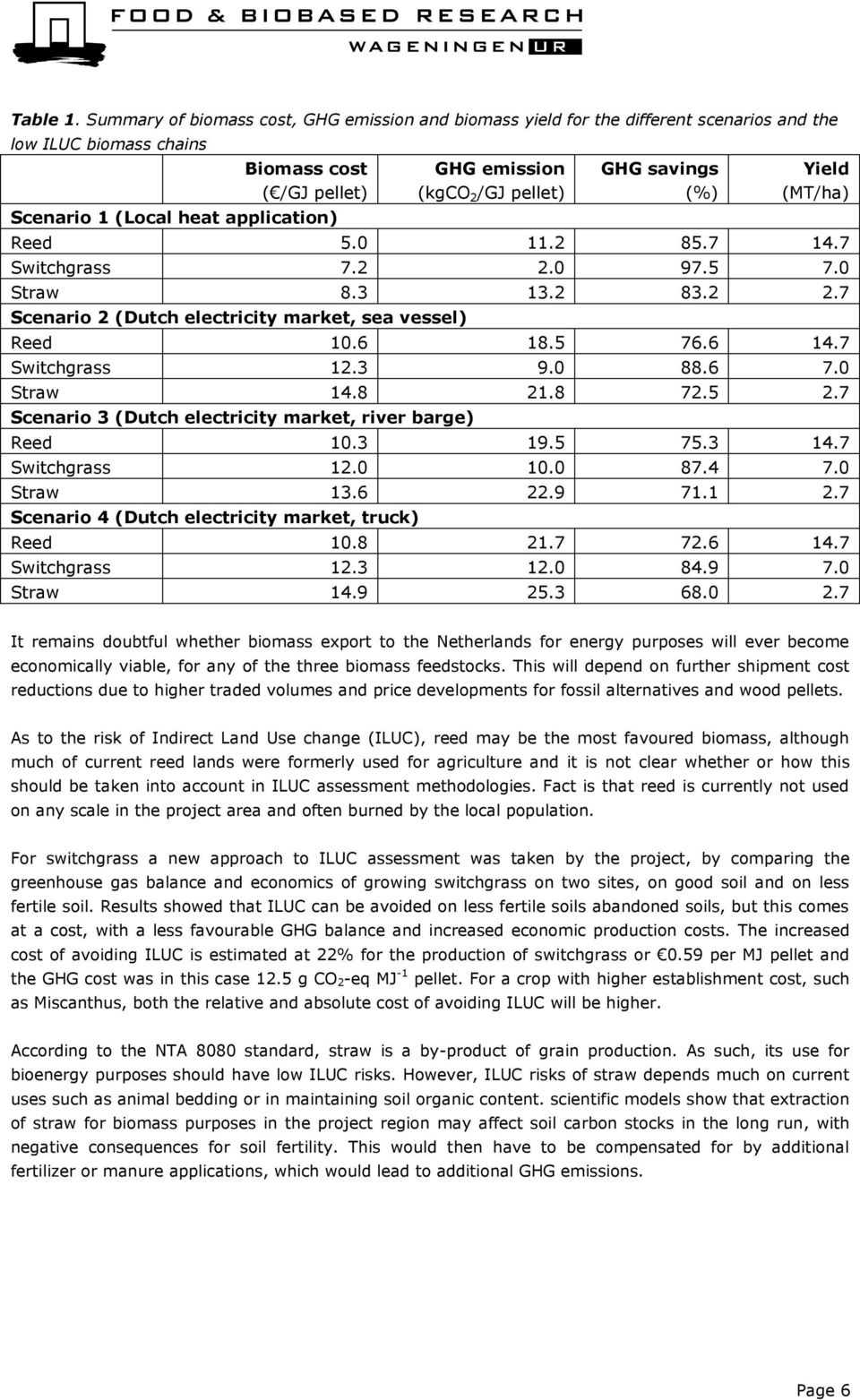
6 Table 1. Summary of biomass cost, GHG emission and biomass yield for the different scenarios and the low ILUC biomass chains Biomass cost ( /GJ pellet) Scenario 1 (Local heat application) GHG emission (kgco 2 /GJ pellet) GHG savings (%) Yield (MT/ha) Reed Switchgrass Straw Scenario 2 (Dutch electricity market, sea vessel) Reed Switchgrass Straw Scenario 3 (Dutch electricity market, river barge) Reed Switchgrass Straw Scenario 4 (Dutch electricity market, truck) Reed Switchgrass Straw It remains doubtful whether biomass export to the Netherlands for energy purposes will ever become economically viable, for any of the three biomass feedstocks. This will depend on further shipment cost reductions due to higher traded volumes and price developments for fossil alternatives and wood pellets. As to the risk of Indirect Land Use change (ILUC), reed may be the most favoured biomass, although much of current reed lands were formerly used for agriculture and it is not clear whether or how this should be taken into account in ILUC assessment methodologies. Fact is that reed is currently not used on any scale in the project area and often burned by the local population. For switchgrass a new approach to ILUC assessment was taken by the project, by comparing the greenhouse gas balance and economics of growing switchgrass on two sites, on good soil and on less fertile soil. Results showed that ILUC can be avoided on less fertile soils abandoned soils, but this comes at a cost, with a less favourable GHG balance and increased economic production costs. The increased cost of avoiding ILUC is estimated at 22% for the production of switchgrass or 0.59 per MJ pellet and the GHG cost was in this case 12.5 g CO 2-eq MJ -1 pellet. For a crop with higher establishment cost, such as Miscanthus, both the relative and absolute cost of avoiding ILUC will be higher. According to the NTA 8080 standard, straw is a by-product of grain production. As such, its use for bioenergy purposes should have low ILUC risks. However, ILUC risks of straw depends much on current uses such as animal bedding or in maintaining soil organic content. scientific models show that extraction of straw for biomass purposes in the project region may affect soil carbon stocks in the long run, with negative consequences for soil fertility. This would then have to be compensated for by additional fertilizer or manure applications, which would lead to additional GHG emissions. Page 6
7 Introduction This study was conducted in the framework of the Pellets for Power project, funded by NL Agency under the Ministry of Economic Affairs (EZ) in the Netherlands. The project objective is the development of sustainable supply chains for biomass produced in Ukraine. Three types of biomass are included: reed, switchgrass and straw. In order to guarantee sustainability, all biomass based operations had to comply with the Dutch NTA 8080 standard. This report includes a description of the supply chains for all three biomass types, based on business models developed by two project partners; Tuzetka and Phytofuels Investments. For all three biomass types, in separate chapters the supply chain characteristics and performance is assessed, for three different aspects; the Greenhouse gas balance, economics and indirect land use change effects. Only the GHG balance is included in the NTA 8080 standard and is considered a pillar in the overall assessment of sustainability. Though of no immediate concern in the NTA 8080 standard, the economic cost of biomass production, processing and commercialization is compared to the price received on domestic and Dutch energy markets. Regarding the Indirect Land Use Change (ILUC) effects, a new approach has been taken by the project based on calculating the cost of avoiding ILUC. With this sustainability aspect not yet fully developed in the NTA 8080 standard, the economic and GHG emission cost of producing biomass on abandoned and less fertile soils has been compared to the cost on good agricultural land. With no actual large scale biomass operations by the project partners at this moment, the described operations and performance is based on a fictional business set up, with an assumed biomass supply area and processing center located nearby a railway station in the city of Lubny. Chapter 1 addresses the general supply chain set up, with a description of the location, steps and operations and machinery used for production and processing of the biomass. Chapter 2 describes the used GHG calculation methodology based on the Renewable Energy Directive and also explains the importance of measuring indirect land use change effects (ILUC). Chapter 3 to 5 each describe the supply chain performance for reed, switchgrass and straw respectively with an assessment of the GHG balance, economics and ILUC effects. Finally, chapter 6 provides conclusions regarding overall sustainability and economics of biomass operations and recommendations for (future) biomass business in Ukraine. The authors trust that this report will be of value for current and future biomass businesses, as well as for others interested. We refer to Poppens & Hoekstra (2013) for an assessment of potential project compliance with NTA For further information on the reed and switchgrass chains and on pellet production we refer to Sluis et al. (2013), Elbersen et al. (2013) and De Jamblinne et al. (2013) respectively. We also refer to an article by Lesschen et al. (2012), which formed the basis for much of Chapter 4 and to Poppens et al. (2013) for legislative and stakeholder aspects of the reed supply chain. It is important to note that this report reflects primarily the knowledge and opinion of Tuzetka and Phytofuels Investments. The Pellets for Power project and its partners do not accept responsibility in case of any falsehoods or implications of information written in this document. Page 7
8 1 Case description 1.1 Location and general supply chain description The supply chain is based on an annual production of tons of biomass pellets per year, by a fictional processing center. This processing center is located in Dukhove village in the north-west of Lubny district in the Poltava region (oblast). See Figure 1. This location (Google earth coordinates: , ) is approximately 20 kilometers away from a railway station, required for further transport of the produced pellets to domestic and Dutch markets. This location was selected by project partner Phytofuels Investments, primarily for its abundance of potential biomass feedstock (Chapter 1.2). The biomass feedstock is produced in the surroundings and delivered to the processing plant and processed into pellets. For more information about pellets we refer to another report (Jamblinne, de et al., 2013). From the pellet plant, the pellets are transported to the train station and loaded onto wagons for transport to either domestic or international markets. For this report we assume there are four logistic scenarios. In scenario 1 the pellets are used on domestic heating markets. Here, pellets are effectively substituting natural gas. Scenarios 2 to 4 include three transport configurations to the Netherlands, where the pellets are used for co-firing in electricity plants and substituting fossil coal. For all four scenarios a greenhouse gas as well as an economic analysis is performed. Lubny district Poltava oblast Figure 1: Location of the pellet plant in Lubny district 1.2 Feedstock production The business model is based on use of three types of biomass available in the surrounding supply area; switchgrass, reed and straw. This enables certain flexibility, necessary to neutralize any instabilities in supply of only one type of feedstock. For example, straw can only be harvested during a few weeks per year, whereas machinery may not be available at that particular time and drought may jeopardize available volumes of straw. For reed the harvesting window may be cut Page 8

9 short in case of warm winters with subsequent lacking ice sheath required for low-impact harvesting methods. In those cases, it is hoped that a steady biomass supply can still be achieved by producing sufficient amounts of switchgrass. The area surrounding the fictional processing plant of approximately hectares is assumed to include hectares of agricultural land (predominantly cereal production), 7000 hectares of reed and 5000 hectares of abandoned land (on which switchgrass can be cultivated). The average biomass supply distance is assumed to be 20 kilometers. These figures are estimations by project partner Phytofuels Investments. This supply area should be large enough for producing tons of pellets of all three biomass sources, even if only one of three biomass sources would be available in a given year. These figures are based on an assumed average annual production of 2295, 7896 and 7000 kilograms (dry matter) of straw, reed and switchgrass per hectare respectively. The production areas are large enough to also include areas set aside for conservation particularly important for reed lands - and for two-year straw harvesting rotations aiming at preserving the Soil Organic content (5.2). The flexibility of relying on three biomass sources comes with a price however. Given that reed, switchgrass and straw each require specific harvesting equipment, the purchase of machinery may require a larger investment as compared to dependence on a single feedstock. According to project partner Tuzetka, a fully operational biomass business would require an investment of 1 to 1.2 million euros for the complete range of harvesting and processing machinery and equipment. Regarding straw, the biomass operator will need to collect the straw (wheat or barley) from the fields as soon as possible after grain harvesting. The harvest window is usually very narrow, perhaps only two weeks before farmers start ploughing their fields again. Here the purchase of a tractor and baler is recommended. See Figure 2, showing a Valtra T series tractor with round straw baler. Round balers are more economic, whereas square bales are more convenient for storage of bales and the baling process is also faster (no stop during the operation). Figure 2: Tractor with baler.... and equipped with tracks Figure 3: Tractor with cutter and baler Figure 4: Adapted Pisten bully New technology for mowing: Since the project start now it is possible to mow large areas of peatlands and to collect the biomass Page 9
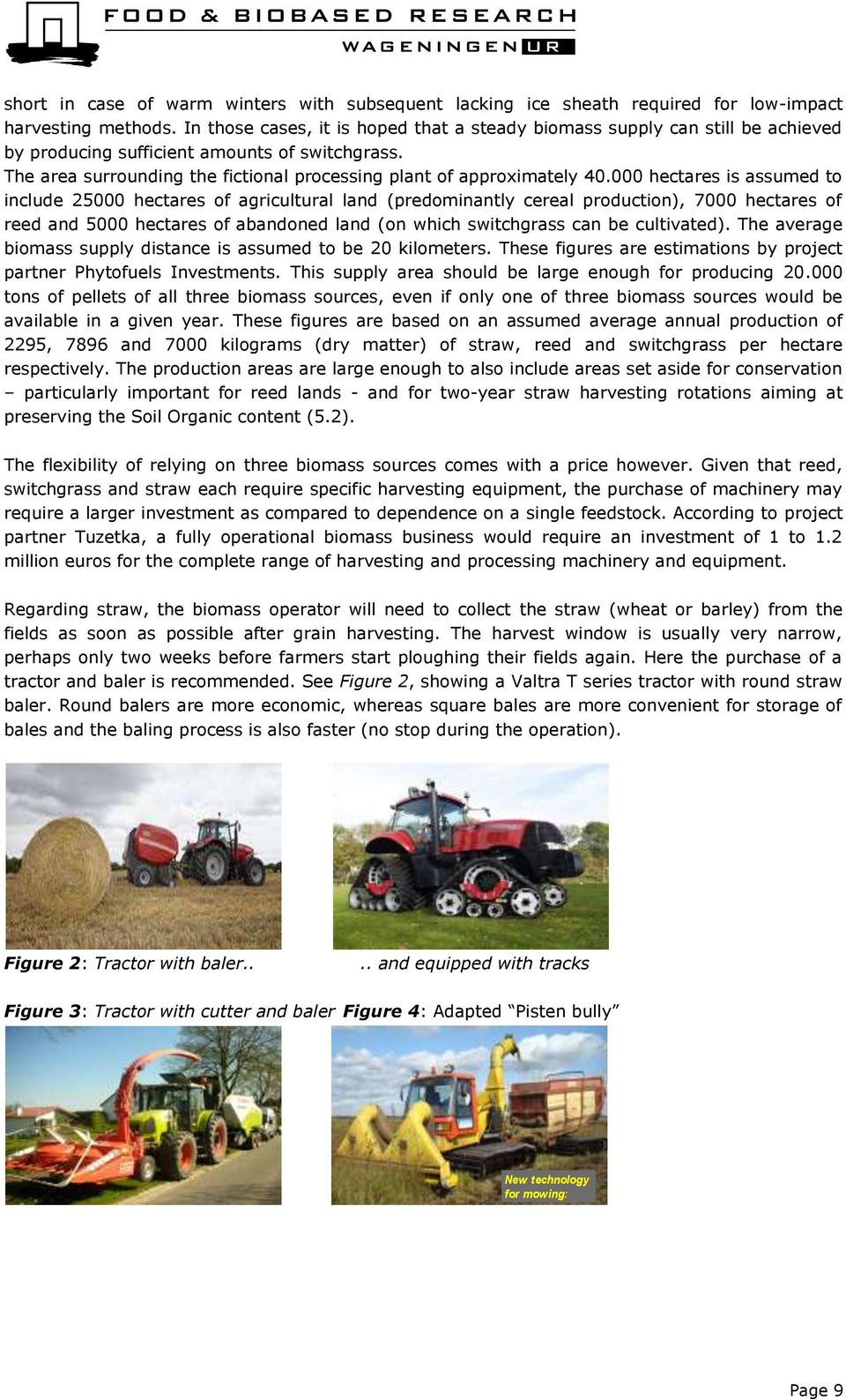
10 For reed harvesting, the same tractor could be used but equipped with tracks, to reduce pressure on the soil, see picture above. The harvesting equipment could consist of a cutting bar and a baler, see Figure 3. This combination is still under development however. For securing tons of feedstock (dry matter 15%), 4 reed harvester will need to be in operation. Other solutions may include the Seiga harvester or modifications based on the Pisten Bully, see Figure 4. The Pisten bully has the advantage of exercising low pressure on the soil in peat lands, but the equipment can only be used for reed harvesting - not for straw and switchgrass. The advantage is that the reed is mown, collected and transported in a single stage. However, the suction process for taking in biomass may cause harm to amphibians and invertebrates. 1.3 Multiple biomass processing After harvesting, the biomass is transported to the pelletizing site and processed into pellets. A pelletizing unit (minimill) will be installed, consisting of two portable pelletizers. See Figure 5. Each has an output of 1.5 tons of pellets per hour. For a whole year this comes down to approximately ton of pellets per year for both pelletizers combined. The equipment includes a cooling tower, conveyer belt and silo for storage among other. Tel./fax: , [email protected] The equipment can handle all three types of biomass, though changes between feedstocks may require adjustments. This set up Pelleting may be key to sustain year-round production and business survivability with weather conditions potentially frustrating harvesting operations. OGM-6 series pellet mills OGM-6 series pellet mills are designed to process biomass into pellets from virtually f any kind of biomass. Figure 5: Pelletizing equipment Model * : OGM-6-6n OGM-6P -6Pn Pelletizers (1,5 MT/h) Capacity: up to 1 ton of wood pellets up to 1,5 tons of wood pellets Energy consumption: 90 kw/hour 110 kw/hour 1.4 Biomass markets (4 scenarios) Doza-Gran of ers OGM-6 series of heavy-duty pellet mills for processing different kinds of biomass. Due to highly efficient double reduction gearbox, the die speed is only 140 rpm while the main drive is 110 kw. That allows the pellet mills to operate at high working loads and produce high quality pellets from virtually any kind of biomass. The OGM-6 series pellet mills feature: Heavy-duty pellet chamber sustaining heavy loads; Several market scenarios were taken New into construction consideration of conditioner and feeder for prevent the blocking; analysis: one domestic scenario and The feeder provides uniform feedstock distribution to the pellet mill thus providing three Dutch market scenarios. At this moment the domestic heating market for biomass pellets is integrity of pelletizing process at high capacity. highly attractive, given the elevated The OGM-6 price series pellet of mills natural are designed gas, for round the clock most work both common efficiently energy source for and economically. heating installations in Ukraine. At the end of the project, Phytofuels Investments had signed an agreement with the city of Lubny for grinding delivery of pelleting reed biomass cooling for heat finishing generation. * Full specifications of our pellet mills are available upon request. Scenario 2 involves transporting of biomass pellets from the production site by train to the city of Kherson near the Black Sea and subsequent transport by sea vessel to Rotterdam. Another option scenario 3 is pellet transport by train to Izmail. The pellets are then loaded onto river barges for transport to Rotterdam. Scenario 4 is also considered an option in this time of economic crisis, with freight companies offering transport by truck from Ukraine directly to the Netherlands. Page 10

11 1.5 Feedstock description Reed, switchgrass and straw all have a common denominator; they are grouped as lignocellulose feedstock, consisting mainly of cellulose, hemi-cellulose and lignin. Yet, they are very different in origin and physiology. Hereafter, a description is provided for all three feedstock types. Common Reed (Phragmites australis) is a grass species, and one of the most widely distributed vascular plant species in the world. It is native to Eurasia and Africa, but has spread all over the world now (including US, South America and Australia). It is a typical wetlands species and can cover vast areas almost in monoculture, outcompeting other plant species. Reed grows rapidly, and can reach a height of 1-4 m during the growth season, in some places it can even get as high as 7 meters (Komulainen et al. 2008). In Poltava the height is generally 4-5 meters, depending on hydrology. The straw production can be as much as 30 t/ha (Allirand and Gosse, 1995). Reed is an abundant resource in Ukraine, although there are few reliable data sources. Ukrainian wetlands cover over 1, hectare; in Poltava region there are ha of wetlands, that is around 2% of the total land area (Sluis et al., 2013). Figure 6: Reed, straw, switchgrass Switchgrass Switchgrass is a perennial C4 grass native to North America, where it occurs naturally from 55º N latitude to deep into Mexico. It is used for soil conservation, forage production, as an ornamental grass and more recently as a biomass crop for ethanol, fibre, electricity and heat production. As biomass increases in importance in Ukraine, it is expected that switchgrass can play an important role in supplying sustainably produced lignocellulosic biomass. One of the main attractive features being low establishment costs and high productivity under low input conditions. Based on extrapolations from current research we expect that switchgrass yields in Ukraine will vary between 7 ton DM matter on low quality soils and 12 tons dry matter on good soils in a delayed harvest (early) spring harvest system. Yields should increase as better varieties and production methods are developed during the next decades (Elbersen et al., 2011). Straw (predominantly wheat and barley) is a common agricultural by-product from large scaled grain production in Ukraine. Approximately 10 million hectares of land in Ukraine were dedicated to wheat and barley production in 2012 (USDA, 2012). With an average production of 2.5 tons of straw per hectare, this comes down to 25 million tons of potentially available straw per year. Using straw for biomass applications does not require extra land taken into production. However, it is important to leave sufficient amounts of straw on the land so as not to deplete the Soil Organic Content (SOC). We refer to section 5.2 for more information on this aspect. Page 11

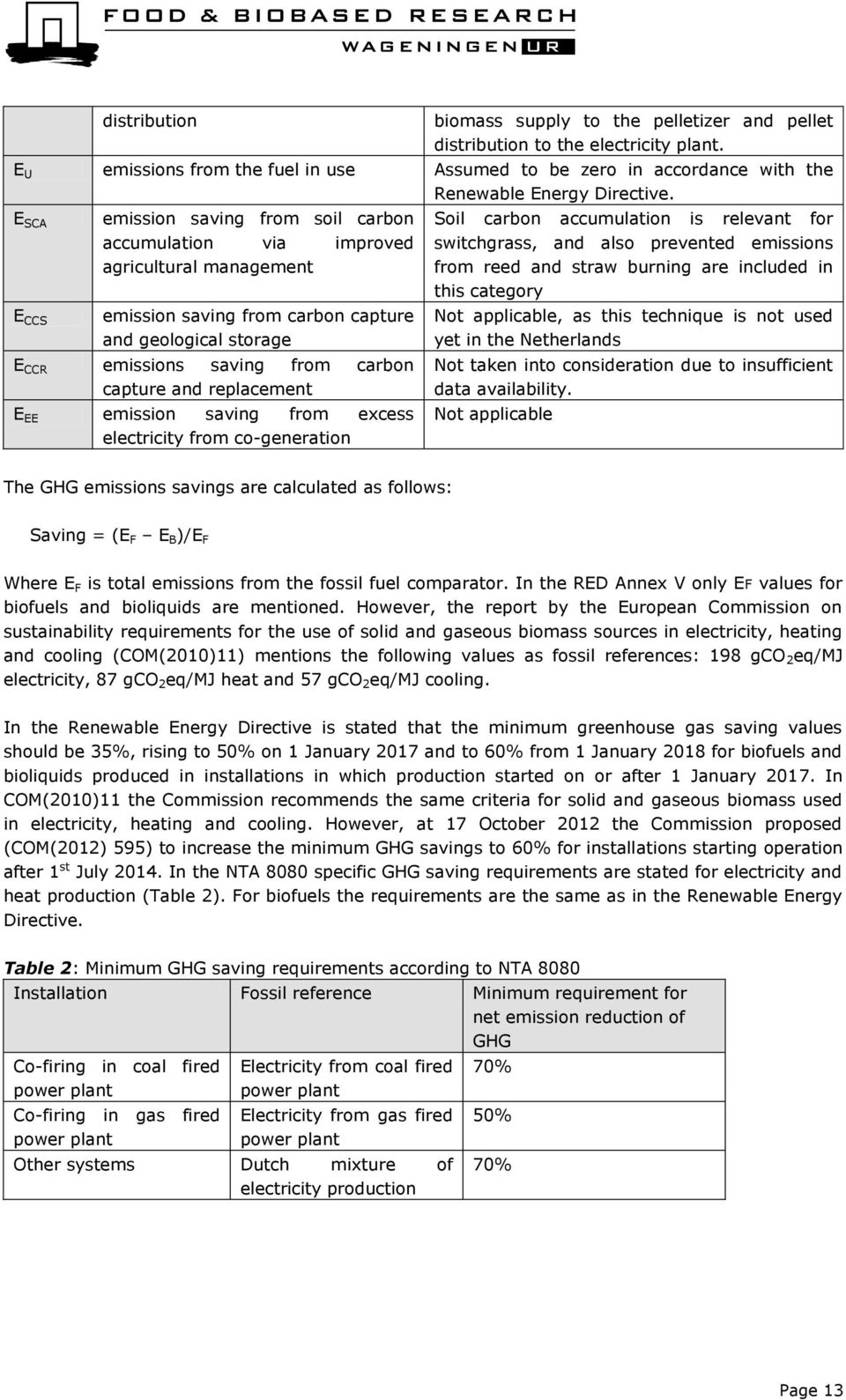
12 2 Calculation methodologies 2.1 Greenhouse gas balance Introduction One of the main foundations of European Union (EU) energy policy is the need to reduce greenhouse gas (GHG) emissions in a relatively short period of time to avoid the more extreme consequences of global climate change. The policy has emphasised the important role of renewable energy. Within this context, the extensive use of solid and gaseous biomass, particular for heating, cooling and electricity generation, is regarded as an essential component of the Renewable Energy Directive (2009/28/EC). This has been translated into EU Member State Action Plans as part of the implementation, which requires increasing the share of renewable energy at EU level to 20% of the final energy consumption by This share is country specific and is 14% for the Netherlands. Greenhouse gas savings are one of the main sustainability criteria of the Renewable Energy Directive and the NTA In principal the burning of biomass as fuel is carbon neutral as long as the same amount of CO 2 is taken up again by the plants. However, the production, processing and transport of the biomass involves many steps with inputs of energy with subsequent GHG emissions. Therefore the emissions of the entire biomass chain have to be calculated and compared with the fossil fuel reference. According to NTA 8080 biomass operations should lead to maximum reductions of GHG emissions as compared to situation with fossil fuel use, with at least 70% reduction compared to the Dutch electricity mix from coal fired power plants Renewable Energy Directive GHG calculation The GHG calculation methodology is based on the calculation rules as stated in the Annex V of the Renewable Energy Directive (2009/28/EC). Total emissions of the biomass chain are calculated according to the following formula, which is further explained in Table 1. E = E EC + E L + E P + E TD + E U E SCA E CCS E CCR E EE Table 1: Explanation of the components of the RED GHG calculation Symbol Description Relevance for Ukrainian pellet chains E E EC E L total emissions from the use of the fuel emissions from the extraction or cultivation of raw materials annualized carbon stock changes caused by land use change Expressed in grams of CO 2 equivalent per Mega Joule (MJ) of pellet-generated electricity and heat. Includes harvesting and baling of biomass for all three chains and for switchgrass also emissions from all input needed for cultivation. Relevant for switchgrass in case of conversion of grassland or abandoned land to switchgrass E P emissions from processing Includes milling, drying, pelletizing and cooling of pellets. E TD emissions from transport and Separate emission factors are calculated for Page 12

13 distribution biomass supply to the pelletizer and pellet distribution to the electricity plant. E U emissions from the fuel in use Assumed to be zero in accordance with the Renewable Energy Directive. E SCA E CCS emission saving from soil carbon accumulation via improved agricultural management emission saving from carbon capture and geological storage E CCR emissions saving from carbon capture and replacement E EE emission saving from excess electricity from co-generation Soil carbon accumulation is relevant for switchgrass, and also prevented emissions from reed and straw burning are included in this category Not applicable, as this technique is not used yet in the Netherlands Not taken into consideration due to insufficient data availability. Not applicable The GHG emissions savings are calculated as follows: Saving = (E F E B )/E F Where E F is total emissions from the fossil fuel comparator. In the RED Annex V only EF values for biofuels and bioliquids are mentioned. However, the report by the European Commission on sustainability requirements for the use of solid and gaseous biomass sources in electricity, heating and cooling (COM(2010)11) mentions the following values as fossil references: 198 gco 2 eq/mj electricity, 87 gco 2 eq/mj heat and 57 gco 2 eq/mj cooling. In the Renewable Energy Directive is stated that the minimum greenhouse gas saving values should be 35%, rising to 50% on 1 January 2017 and to 60% from 1 January 2018 for biofuels and bioliquids produced in installations in which production started on or after 1 January In COM(2010)11 the Commission recommends the same criteria for solid and gaseous biomass used in electricity, heating and cooling. However, at 17 October 2012 the Commission proposed (COM(2012) 595) to increase the minimum GHG savings to 60% for installations starting operation after 1 st July In the NTA 8080 specific GHG saving requirements are stated for electricity and heat production (Table 2). For biofuels the requirements are the same as in the Renewable Energy Directive. Table 2: Minimum GHG saving requirements according to NTA 8080 Installation Fossil reference Minimum requirement for net emission reduction of GHG Co-firing in coal fired power plant Co-firing in gas fired power plant Electricity from coal fired power plant Electricity from gas fired power plant Other systems Dutch mixture of electricity production 70% 50% 70% Page 13
14 2.1.3 Soil organic carbon stock changes For switchgrass the change in soil organic carbon stocks is an important aspect in the GHG balance, since switchgrass is a perennial crop and with its deep rooting system it can sequester significant amounts of carbon in the soil. Calculation of soil organic carbon (SOC) stock changes was performed according to IPCC 2006 guidelines. SOC values are calculated for both the previous land use and under switchgrass according to the formula below. The difference is converted to CO 2 and divided by 20 years, which is the period that IPCC assumes required to reach a new equilibrium in soil carbon stocks. SOC = SOC REF * F LU * F MG * F I SOC REF reference organic carbon stock of the soil (ton C ha -1 ) F LU stock change factor for land use F MG stock change factor for management stock change factor for input crop production F I The value of the stock change factors and the reference carbon stock depend on the climate zone. In Table 3 the representative values for Ukraine are shown for arable land, switchgrass and abandoned land. The table shows that SOC on the high quality soil can increase from 93 ton C ha -1 under arable land to 119 ton C ha -1 under switchgrass. On the lower quality soil, the increase is lower, from 80 ton C ha -1 under abandoned land to 88 ton C ha -1 under switchgrass. Table 3: Calculation of soil organic carbon stocks for arable land, switchgrass and abandoned land F LU F MG F I High quality soil Lower quality soil SOC REF SOC SOC REF SOC Arable land Switchgrass Abandoned land GHG calculation spreadsheet For the GHG calculation a specific spreadsheet was developed for each of the three biomass chains, in which the GHG emission and GHG saving of the chain are calculated. The specific steps and related GHG emissions are calculated for each of the relevant components of the GHG calculation (Table 1), based on collected activity data and emission factors. The emissions factors are based on the BioGrace standard values (Biograce, 2012) and the IPCC 2006 guidelines (IPCC, 2006). The benefit of the excel tool is that it is flexible to change certain steps in the chain or change emission factors. In addition, the GHG calculation is very transparent as all calculation steps can be checked. With comments the source of the emission factors or activity data is indicated. The tool consists of a section with the main input data, a section with basic parameters, the calculations for all components and a summary section with the main output and GHG saving. A screen shot of the excel tool is shown in Figure 7. Page 14

15 Figure 7: Screen shot of the GHG calculation excel file 2.2 Quantifying ILUC Internationally, using agricultural land for the production of bio-energy crops has been subject to criticism. Food prices may go up, as less agricultural land becomes available for food production. This results in extra demand for land to be taken into production. This effect of Indirect Land Use Changes (ILUC) has negative consequences for sustainability. Increased demand for land may lead to increased forest destruction, wetland drainage and release of greenhouse gasses worldwide and also biodiversity may be affected. In some cases the ILUC effect may even outweigh the direct effects of bioenergy production, in terms of its impact on the climate and overall sustainability (Poppens, 2011). At this moment ILUC is not yet included in international legislation, nor in international sustainability standards such as the Dutch NTA One issue is the difficulty of its quantification and measurement, as it presents itself often far beyond the borders of a given biomass project. Though difficult to quantify, there are ways of minimizing ILUC effects. One such way is using agricultural by-products such as straw. In this case, no extra land claims are made, although too much straw removal may affect soil fertility, which would be a direct effect. We refer to chapter 5 for more information. Also alternative straw uses must be taken into consideration, as straw removal for biomass purposes could potentially lead to demand for alternatives if straw would be no longer available for certain applications. Another way to address the ILUC issue is to focus on the production of natural grasses such as reed, which grows naturally in wetland areas that are not used for agricultural production. Here too, no additional agricultural land needs to be taken into production and thus ILUC effects may be considered limited. However, the current reed uses must be taken into consideration. In case biomass production competes with current reed use, extra reed demand may lead to exploitation of new land areas with potentially negative effects on people, climate and the environment. For Page 15

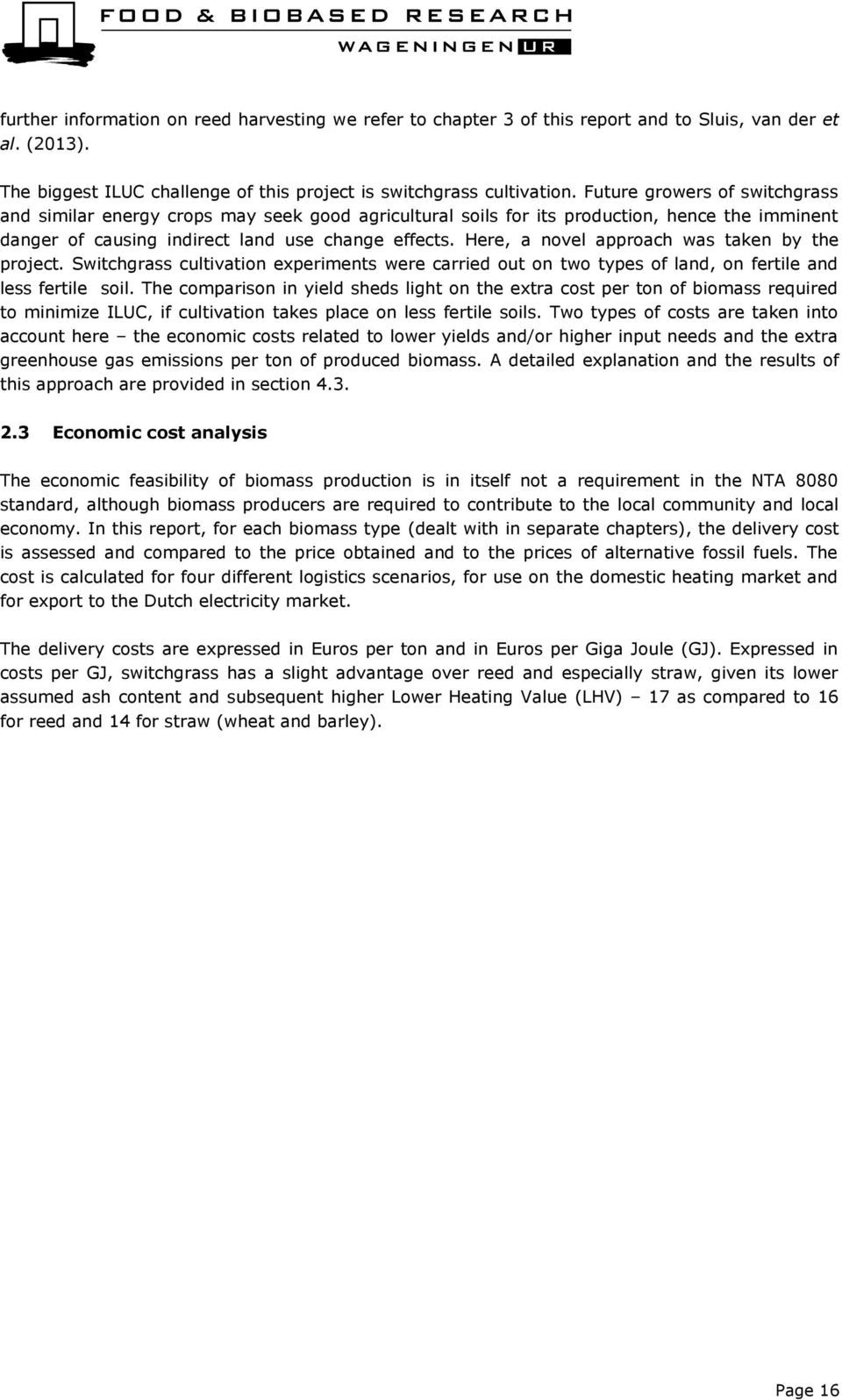
16 further information on reed harvesting we refer to chapter 3 of this report and to Sluis, van der et al. (2013). The biggest ILUC challenge of this project is switchgrass cultivation. Future growers of switchgrass and similar energy crops may seek good agricultural soils for its production, hence the imminent danger of causing indirect land use change effects. Here, a novel approach was taken by the project. Switchgrass cultivation experiments were carried out on two types of land, on fertile and less fertile soil. The comparison in yield sheds light on the extra cost per ton of biomass required to minimize ILUC, if cultivation takes place on less fertile soils. Two types of costs are taken into account here the economic costs related to lower yields and/or higher input needs and the extra greenhouse gas emissions per ton of produced biomass. A detailed explanation and the results of this approach are provided in section Economic cost analysis The economic feasibility of biomass production is in itself not a requirement in the NTA 8080 standard, although biomass producers are required to contribute to the local community and local economy. In this report, for each biomass type (dealt with in separate chapters), the delivery cost is assessed and compared to the price obtained and to the prices of alternative fossil fuels. The cost is calculated for four different logistics scenarios, for use on the domestic heating market and for export to the Dutch electricity market. The delivery costs are expressed in Euros per ton and in Euros per Giga Joule (GJ). Expressed in costs per GJ, switchgrass has a slight advantage over reed and especially straw, given its lower assumed ash content and subsequent higher Lower Heating Value (LHV) 17 as compared to 16 for reed and 14 for straw (wheat and barley). Page 16
17 3 Reed supply chain 3.1 Greenhouse gas balance GHG calculation steps Main input data In Table 4 some of the main input data and assumed parameter values for the GHG calculations are stated for the reed chain. Table 4: Main input parameters for GHG calculation of the reed chain Parameter Value Unit Average yield flooded plots kg DM/ha Average yield upland plots 7896 kg DM/ha Dry matter content reed 76 % Dry matter content pellets 92 % Lower heating value (LHV) reed pellets 16 MJ/kg Losses reed transport and processing 3 % of harvest Average annual percentage burned reed area 20 % Cultivation and harvesting (E EC ) Two different reed systems are distinguished, reed from flooded land (water level > 20 cm) and reed from upland (dry) land (water level < 20 cm). This distinction is made because the reed yield differs between these two systems and also the harvesting and collection techniques are different. Based on the case study area near Lubny, see Chapter 1, we assumed that 60% of the reedland is flooded reed and 40% of the reedland is upland reed. Based on measurements from 20 m 2 plots from the reed fields in Velyke Boloto, we calculated an average yield of 13.3 ton DM / ha for the flooded reed and 7.8 ton DM / ha for the upland reed. As these plots were not harvested or burned during previous years the yield might be overestimated compared to reed from areas that are harvested annually. For flooded reed rototiller-based harvesters are used and reed is bundled manually. The bundles are then transported to a local storage location, from where they will be transported to the pelletizer. The upland reed is harvested by a tractor with a harvesting machine that shreds the reed. Another tractor is connected to a trailer that collects the shredding and transports this to a nearby storage location, where it is stored in a pile. This pile has to be turned periodically to prevent rotting and improve drying and leaching of the minerals. Finally the shredding is baled and transported to the pelletizer. Table 5. Emission factors and calculated GHG emission per activity for E EC Activity E EC flooded reed Emission factor Unit Harvesting (Motoharvester binder BCS- gco 2 -eq/mj pellet 8 Litre/ha ) Collection of bales by rototiller 4 Litre/ha 0.04 Collection of bales (МТЗ-80 with a trailer ) 9 Litre/ha 0.09 Loading and unloading to local storage 4.5 Litre/ha 0.04 Total 0.25 E EC upland reed Page 17

18 Harvesting (Tractor MT3-80 with mower) 18.1 Litre/ha 0.12 Collection of shredding (МТЗ-80 with a trailer 18.1 Litre/ha 0.12 ) Loading and unloading to local storage 4.5 Litre/ha 0.03 Periodic turning of shreddings 10 Litre/ha 0.07 Baling 0.74 Litre/to 0.05 Total n 0.38 Improved agricultural management (E SCA ) Reed burning, although not allowed according to Ukrainian law, is still common practice in Ukraine, as can be observed during road trips. Burning is often done by local people for hunting and fishing purposes. Reed burning in the field not only leads to CO 2 emissions, which can be considered as short cycle emissions, which will be assimilated again by the plant in the subsequent year, but also to non-co 2 emissions as N 2 O and CH 4, due to incomplete combustion of the fuel. Preventing these emissions by reed harvesting can therefore lead to additional GHG savings which can be accounted for under E SCA. We calculated the emissions of reed burning according to the IPCC 2006 guidelines. Based on observations and interviews with the local people we estimated that the reed on average is burned once in five years (i.e. 20% of reed area is burned annually). Table 6 : Emission factors and calculated GHG emission per activity for E SCA Activity Emission Unit g CO 2 -eq/mj Prevented CH 4 emissions from reed factor 2.57 kg pellet 0.3 burning Prevented N 2 O emissions from reed 0.23 CH 4 /ha/year kg 0.4 burning Total N 2 O/ha/year 0.7 Pelletizing (E P ) After transport from the storage location the reed shredding or bundles might have to be dried additionally. In the GHG assessment we assumed that further active drying was not needed. Before pelletizing the moisture content of the biomass should be less than 15%. In case active drying is needed, it will be based on burning of the reed biomass itself. This can be calculated as well, based on the assumption that 1 kwh is needed to evaporate 1 litre of water. This would not lead to additional GHG emissions, but it would lower the amount of pellets that can be produced, and in that way the overall GHG balance. The reed shredding or bundles are further shredded and milled, which has an electricity usage of 60 kwh/ton. Then the shredded and milled biomass is converted to pellets in the pelletizer. This process has an electricity consumption of 90 kwh/ton (Table 7). Table 7 : Emission factors and calculated GHG emission per activity for E P Activity Emission Unit g CO 2 -eq/mj Drying factor 0 kwh/ton pellet 0 Milling 60 kwh/ton 4.2 Pelletizing 90 kwh/ton 6.3 Total 10.5 Transport (E TD ) We assumed that the average single transport distance for the reed to the pelletizer was 15 km. For domestic use of the reed pellets for heat generation in Lubny we used an average transport distance of 30 km by truck. For the export to the Netherlands we used three biomass chain scenarios, as explained in Chapter 1, i.e. transport via train and sea vessel (scenario 2), via train and inland ship (scenario 3) and via truck (scenario 4). For scenario 2 and 3 the pellets are first Page 18

19 transported by truck from the pelletizer location to the nearby railway station (distance 20 km). From there the pellets are transported by train to the port of Kherson (distance about 500 km) in case of scenario 2 or to Izmail (distance about 800 km) in case of scenario 3. For scenario 2 the pellets are further transported by sea vessel from Kherson to Rotterdam, which is a distance of about 8050 km. For scenario 3 the transport continues by inland ship from Izmail over the Danube and Rhine to Rotterdam. In Krems (Austria) the pellets are overloaded to another ship. Total distance is estimated at 3500 km (Izmail to Krems 2000 km and Krems to Rotterdam 1500 km). Table 8 shows the emission factors and calculated GHG emissions for each transport step. Table 8 : Emission factors and calculated GHG emission per activity for E TD, example for export to the Netherlands via train and inland ship Activity Emission Unit g CO 2 -eq/mj E TD Reed transport to pelletizer factor pellet Loading and unloading by stacker СНУ- 0.5 Litre/ton Bales and shredding transportation MJ/tonkm 0.14 Total 0.38 E TD Pellet transport to power plant Transport pellets by truck MJ/tonkm 0.10 Transport pellets to port by train 0.21 MJ/tonkm 3.10 Transport pellets by inland ship to NL Litre/tonk 5.16 Transport pellets by sea vessel to NL MJ/tonkm m 0 Loading and unloading of pellets 0.5 Litre/ton 0.10 Total Results Figure 8 shows the results of the GHG assessment of the four reed chain scenarios. The results are expressed in gco 2 -eq per MJ pellet, in accordance to the RED. The largest emissions are due to the processing, as the pelletizing process requires relatively large electricity inputs, in addition electricity use in Ukraine has a high CO 2 emission due to the large scale use of fossil coal. For the export reed chain the emissions from transport are also large, which is not unexpected, considering the large distance. Transport via train and sea vessel (scenario 2) is most GHG efficient, although the differences between the export scenarios are relatively small. However, one should remind that only the single distance has been included, assuming that return transport can be assigned to other products. The GHG emission from the field operations, i.e. the reed harvesting, is only 0.6 g CO 2 -eq per MJ. The emissions of harvesting are lower for flooded reed, as this is harvested with small machines and put manually in bundles, also the yield of the flooded reed is higher. For the upland reed larger machines are used and energy is also needed for the turning of the shreddings. The GHG savings from the prevention of reed field burning is limited with -0.7 g CO 2 -eq per MJ. Page 19

20 Figure 8: GHG emission per source for the four reed chain scenarios The total GHG emission and saving of the reed chain scenarios is shown in Table 9. For export to the Netherlands for electricity production the GHG emission is between 18.5 and 21.7 g CO 2 -eq per MJ pellet, which is g CO 2 -eq per MJ electricity based on an efficiency of 40%. Compared to the fossil fuel reference of 198 g CO 2 -eq per MJ electricity, the GHG savings of the entire chain is 73-77%, which is above the 70% minimum GHG saving as stated in the NTA For the domestic reed chain for heat production the total GHG emission is 11.2 g CO 2 -eq per MJ pellet, which is 12.5 g CO 2 -eq per MJ heat, based on an efficiency of 90%. Compared to the fossil fuel reference of 87 g CO 2 -eq per MJ heat, the GHG savings of the entire chain are 86%, which is higher than the other reed chain scenarios. Table 9: GHG emission and savings for the four reed chain scenarios Scenario Scenario 1 2 Scenario 3 Scenario 4 GHG emission (g CO 2 -eq/mj pellet) GHG emission (g CO 2 -eq/mj electricity/heat) Fossil fuel reference (g CO 2 -eq/mj electricity/heat) GHG savings (%) Conclusion and recommendation The overall reed biomass chain has a highly positive GHG balance with about 75% savings in case of export to the Netherlands for electricity production and 86% for domestic heat production. The GHG savings comply with the minimum requirements as stated in the NTA Although all reed chain scenarios have high GHG savings, there are still possibilities for further improvements. Especially in the pelletizing process improvements might be achieved, via technical improvements that increase the efficiency and/or via the use of renewable electricity which could be produced via a combined heating and power installation based on the reed biomass. From a global climate change point of view it would be more efficient to use biomass in Ukraine itself for energy production, instead of exporting it to the Netherlands, which would cause additional emissions. Page 20

21 3.2 Cost-benefit analysis In this section the economic viability of reed harvesting, processing, transport and commercialization is analysed for different logistic scenario s. These scenarios relate to domestic (Ukrainian) markets (scenario 1) and three logistical variants of Dutch biomass markets (scenarios 2 to 4). Each step in the supply chain is quantified for the delivery costs in Euros per ton biomass pellets and per GJ of pellet calorific value. This is done for all four supply chain configurations. The figures are based on a business case developed by project partner Tuzetka, with an assumed Lower Heating Value of 16 Giga Joule per metric ton of pellets produced and an annual production of metric tons of pellets. Domestic heating market (scenario 1) At this moment the domestic heating market for biomass pellets is highly attractive, given the high domestic price of natural gas, the most common energy source for heating installations in Ukraine. Table 10 provides a cost breakdown of all steps in the supply chain and an overview of prices of alternative fuels. It is clear that reed pellets can easily compete with natural gas over price per GJ of energy. But it is evident that the development of shale gas production could disturb the future of biomass in Ukraine. Ukraine has vast reserves of shale gas and biomass production cannot compete with shale gas over price per GJ. Table 10: supply chain costs for scenario 1 and fuel prices Scenario 1: Domestic heating market Operation /MT /GJ Reed harvesting Reed transport to pelletizer Pelletizing Pellet transport to Lubny Total costs Reference prices: Natural gas 13* Industrial wood pellets Coal 2.5 Shale gas 1 Average price domestic market 100 Source: NKRE (National Electro-energy agency). Sea transport to Dutch electricity market (scenario 2) Scenario 2 involves transporting of biomass pellets from the production site by train to the city of Kherson near the Black Sea and subsequent transport by sea vessel to Rotterdam. As Table 11 shows, this is hardly a viable business case. The supply chain costs are not compensated for by the selling price of industrial wood pellets, that are used for co-firing electricity plants in the Netherlands benefitting from subsidy schemes. Moreover, Ukrainian herbaceous biomass pellets may not possess the same quality (= energy density) as wood pellets, given higher amounts of ash. This should be reflected in an even lower price for non-wood biomass pellets per GJ of energy generated. Unfortunately, reed pellets are not acknowledged today as a commodity (unlike wood pellets) and therefore have no standardized trading price. Based on a Lower Heating Value (LHV) of Page 21
22 16 GJ per ton reed pellets and 19 GJ per ton wood pellets, for comparison sake, the price of reed pellets is assumed to be 16/19 x 130 Euro = 109 euros per metric ton. It is hoped that in the longer run much larger volumes of non-wood biomass are produced and supplied to overseas markets. This should reduce the shipment costs significantly, given the large sized ships in use today. For now, however, non-wood biomass is still to conquer a sizeable market and thus relatively small volumes are offered to shipping companies. This advantage of scale for large volumes will also apply for the other costs, particularly pelletizing, presenting the largest impact on total costs. Current pelletizing costs are based on use of minimills (1.3), processing only small volumes of biomass. There is however large-scaled pelletizing equipment on the market that should significantly reduce pelletizing costs per ton of processed biomass. Table 11: supply chain costs for scenario 2 and fuel prices Transport by train + sea vessel to Rotterdam Operation /MT /GJ Reed harvesting Reed transport to pelletizer Pelletizing Transport pellets to railway 20km Loading and transport to Kerch Unloading, sent to port, loading Storage at port Custom clearance Transport to Rotterdam Total costs Reference prices: Natural gas 10 Industrial wood pellets Coal 2.5 Shale gas 1 Average price domestic market 100 River barge transport to Dutch electricity market (scenario 3) In market scenario 3 the pellets are transported by train to Izmail and then loaded onto river barges for transport to Rotterdam. This is the most economical of international supply chains, not taking into account any margins of error in the estimations. However, as explained for scenario 1, the current figures are based on delivery of only small volumes. In case more sizeable markets can be secured (several hundreds of thousands of metric tons), it seems probable that scenario 2 is the most economical of international supply chains, given the large sea vessels in use today. For now, like scenario 1, scenario 2 hardly presents a viable business case given that the total supply chain costs are not compensated for by the selling price of pellets. See Table 12. For comments on the potential reductions in shipment and pelletizing costs, we refer to scenario 1. Page 22
23 Table 12: supply chain costs for scenario 3 and fuel prices Scenario 3: Train + River barch to Rotterdam Operation /MT /GJ Reed harvesting Reed transport to pelletizer Pelletizing Transport pellets to railway km Loading and transport to Izmail Unloading, sent to port, loading Storage at Izmail Loading and river transport to Rotterdam Custom clearance Canal cost Total costs Reference prices: Natural gas 10 Industrial wood pellets Coal 2.5 Shale gas 1 Average price domestic market 100 Truck transport to Dutch electricity market (scenario 4) Apparently, due to the economic crisis, freight companies offer their transport services at minimum prices. See Table 13. This makes pellet transport by truck from Ukraine to the Netherlands relatively economic, with total costs comparable with transport by sea and river. But, it seems unlikely that this method of transport can compete with river and sea transport once the economic crisis has passed. Moreover, as discussed in the previous sections, larger biomass volumes expected will favour large-scaled shipment options and that is going to be offered by sea vessels. For comments and conclusions about current economic feasibility of this transport configuration, we refer to both previous scenarios. Table 13: supply chain costs for scenario 4 and fuel prices Scenario 4: Truck to Rotterdam Operation /MT /GJ Reed harvesting Reed transport to pelletizer Pelletizing Customs clearing Truck transport Total costs Reference prices: Natural gas 10 Industrial wood pellets Coal 2.5 Shale gas 1 Average price domestic market 100 Page 23
24 3.3 ILUC analysis The question answered here is whether or not reed from the project area could be harvested in a ILUC neutral way. In line with Sluis et al. (2013), the answer seems affirmative. Reed in the project area is harvested on land not used currently for agricultural purposes. And even in case of reed occupying land that was formerly used for agriculture, this still refers to abandoned land which is land not used currently for food production. Also the risk of displacement seems to be low, with no current or planned alternative reed uses of any scale, as local project research has revealed. There are currently no (commercial) large-scaled reed harvesting activities in the area. And even if commercial reed harvesting for roofing purposes would take following such operations in Ukraine s Danube delta, perhaps two thirds of all reed in the project area may not meet the required quality standard and thus would still be available for biomass production. Therefore, without present methodologies in place for accurate quantification of ILUC effects of reed harvesting on wetlands, the ILUC effects are considered neutral by the project unless proven otherwise. Whether or not this conclusion complies with NTA 8080 is discussed in another report (Poppens et al., 2013). Page 24
25 4 Switchgrass supply chain 4.1 Greenhouse gas balance GHG calculation steps Main input data In Table 14 some of the main input data and assumed parameter values for the GHG calculations are stated for the switchgrass chain. The switchgrass yield is in this case a very important parameter, but also highly uncertain. As explained in the project s switchgrass report (Elbersen et al, 2013) no long-term large scale field experiments have yet been established in Ukraine, which makes it difficult to estimate yield values. However, based on current experimental yields, experience from other countries and expert knowledge we assumed an average yield of 7 ton DM per hectare per year for a fully productive switchgrass field, i.e. after four years. This leads to an average yield of 5880 kg DM/ha/year over the entire rotation cycle, assuming no yield during first year, 30% in second year, 50% in third year and 80% in fourth year. This yield is representative for low quality soils, which is the assumption for the abandoned land. On high quality soils the yield can be much higher, e.g. 12 ton DM/ha/year. Table 14: Main input parameters for GHG calculation of the switchgrass chain Parameter Value Unit Average yield over rotation 5880 kg DM/ha Rotation cycle switchgrass 15 year Reseeding percentage 20 % Dry matter content switchgrass 88 % N content switchgrass (DM) 0.53 % P content switchgrass (DM) % K content switchgrass (DM) 0.29 % Losses switchgrass transport and processing 1 % of harvest Dry matter content pellets 92 % Lower heating value (LHV) switchgrass pellets 17 MJ/kg Cultivation and harvesting (E EC ) For the calculation of the GHG emissions from cultivation and harvesting (E EC ) we distinguished between emissions from inputs, i.e. mainly related to fertilizer (Table 15) and emissions from field operations, i.e. diesel use (Table 16). Full details about switchgrass cultivation and all required field preparation steps are provided in the switchgrass manual for Ukraine (Elbersen et al, 2013). Regarding fertilization, the main assumption is that in the first year no fertilizer is applied, so as to suppress weed growth. For the following years the input of fertilizer is based on balanced fertilization, which means that the amounts of nutrients that are removed with the harvested switchgrass biomass are replenished by mineral fertilizer. Emissions from N fertilizer production and soil N 2 O emissions are most important. Page 25
26 Table 15: Emission factors and calculated GHG emission per activity for inputs (E EC ) Activity Emission factor Unit g CO 2 -eq/mj pellet First year N fertilizer production 5.88 kg CO 2 -eq / kg N 0.00 P fertilizer production 1.01 kg CO 2 -eq / kg P 2 O K fertilizer production 0.58 kg CO 2 -eq / kg K 2 O 0.00 Pesticide production kg CO 2 -eq / kg 0.20 Seeding material 8.8 kg CO 2 -eq / ha 0.08 Soil N 2 O emissions 10 g N 2 O-N / kg N 0.43 Total 0.71 Second year till end of rotation N fertilizer production 5.88 kg CO 2 -eq / kg N 2.00 P fertilizer production 1.01 kg CO 2 -eq / kg P 2 O K fertilizer production 0.58 kg CO 2 -eq / kg K 2 O 0.11 Pesticide production kg CO 2 -eq / kg 0.20 Soil N 2 O emissions 10 g N 2 O-N / kg N 2.54 Total 4.98 Table 16: Emission factors and calculated GHG emission per activity for field operations (E EC ) Activity Emission factor (litre diesel/ha) g CO 2 -eq/mj pellet Year 1 (no harvest) Preparation of spray material (Roundup 5-6 kg/ha) Herbicides application (300 l/ha) Soil disk ploughing І trace Preparation of spray material (Roundup 5-6 kg/ha) Second application of herbicides (300 l/ha) Soil breaking up by surface cultivator Cultivation, 6-8 cm depth Early spring harrowing Pre-sowing cultivation, 2,5-3 cm depth Rolling before sowing Sowing, 1,5-2 cm seed depth Rolling Water supply Preparation of spray material Roundup (2.5 kg/ha) Roundup applying before seedlings emergence Second weeding Total 2.00 Second year till end of rotation Preparation of spray material (Roundup 5-6 kg/ha) Herbicides application (300 l/ha) Fertilizer application Weeding Windrow Bundling Dry biomass pressing Total 0.63 Page 26
27 Land use change (E L ) As explained in Chapter 1, we assume that the switchgrass will be cultivated on unused abandoned land. In the area near the pelletizer about 5000 hectares of abandoned land would be available for switchgrass cultivation. According to our calculations about 3400 ha would be needed to produce 20,000 ton switchgrass pellets per year. As explained in Chapter the conversion of abandoned land to switchgrass can lead to soil carbon sequestration. Although we lack actual soil carbon data from the case study area, we assumed that the lower quality soil has a reference soil organic carbon (SOC) stock of 86 ton C/ha, based on soil data from the ISRIC WISE database. Following the methodology of the IPCC 2006 guidelines, the abandoned land would have a SOC stock of 80 ton C/ha, whereas a full grown switchgrass field would have a SOC stock of 88 ton C/ha (see Table 3). This increase of 8 ton C/ha results in an annual sequestration rate of 1.43 ton CO 2 /ha/year, based on the 20 year accounting period, which is an emission of gco 2 -eq/mj pellet. Pelletizing (E P ) After transport from the storage location the switchgrass shreddings might have to be dried additionally. In the GHG assessment we assumed that further active drying was not needed. Before pelletizing the moisture content of the biomass should be less than 15%. The switchgrass is further shredded and milled, which has an electricity usage of 60 kwh/ton. Then the shredded and milled biomass is converted to pellets in the pelletizer. This process has an electricity consumption of 90 kwh/ton (Table 17). Table 17: Emission factors and calculated GHG emission per activity for E P Activity Emission Unit g CO 2 -eq/mj Drying factor 0 kwh/ton pellet 0 Milling 60 kwh/ton 3.8 Pelletizing 90 kwh/ton 5.6 Total 9.4 Transport (E TD ) We assumed that the average single transport distance for the switchgrass to the pelletizer was 15 km. For domestic use of the switchgrass pellets for heat generation in Lubny we used an average transport distance of 30 km by truck. For the export to the Netherlands we used three biomass chain scenarios, as explained in Chapter 1, i.e. transport via train and sea vessel (scenario 2), via train and river barge (scenario 3) and via truck (scenario 4). For scenario 2 and 3 the pellets are first transported by truck from the pelletizer location to the nearby railway station (distance 20 km). From there the pellets are transported by train to the port of Kherson (distance about 500 km) in scenario 2 or to Izmail (distance about 800 km) in scenario 3. For scenario 2 the pellets are further transported by sea vessel from Kherson to Rotterdam, which is a distance of about 8050 km. For scenario 3 the transport continues by inland ship from Izmail over the Danube and Rhine to Rotterdam. In Krems (Austria) the pellets are overloaded to another ship. Total distance is estimated at 3500 km (Izmail to Krems 2000 km and Krems to Rotterdam 1500 km). Table 18 shows the emission factors and calculated GHG emissions for each transport step. Table 18: Emission factors and calculated GHG emission per activity for E TD, example for export to the Netherlands via train and inland ship Activity Emission factor Unit g CO 2 -eq/mj pellet Page 27
28 E TD Reed transport to pelletizer Basles loading and unloading 0.42 Litre/ton 0.08 Bales and shredding transportation MJ/tonkm 0.11 Total 0.19 E TD Pellet transport to power plant Transport pellets by truck MJ/tonkm 0.09 Transport pellets to port by train 0.21 MJ/tonkm 2.92 Transport pellets by inland ship to NL Litre/tonkm 4.86 Transport pellets by sea vessel to NL MJ/tonkm 0 Loading and unloading of pellets 0.5 Litre/ton 0.36 Total Results Figure 9 shows the results of the GHG assessment of the four switchgrass logistic chain scenarios. The results are expressed in gco 2 -eq per MJ pellet, in accordance to the RED. The largest emissions are due to the processing, as the pelletizing process requires relatively large electricity inputs, in addition electricity use in Ukraine has a high CO 2 emission due to the large scale use of fossil coal. For the export reed chain the emissions from transport are also large, which is not unexpected, considering the large distance. Transport via train and sea vessel (scenario 2) is most GHG efficient, although the differences between the export scenarios are relatively small. However, one should remind that only the single distance has been included, assuming that return transport can be assigned to other products. Emissions from field operations are low, although these are relatively high in the first year due to field preparation, this is averaged out over the entire switchgrass rotation. GHG emissions from inputs are higher, mainly due to N 2 O soil emissions and emissions from fertilizer production. However, compared to other agricultural energy crops the inputs are low, since switchgrass is a perennial crop with low nutrient requirements. Figure 9: GHG emission per source for the four switchgrass chain scenarios Page 28
29 The total GHG emission and saving of the switchgrass chain scenarios is shown in Table 19. For export to the Netherlands for electricity production the GHG emission is between 9.0 and 12.0 g CO 2 -eq per MJ pellet, which is g CO 2 -eq per MJ electricity based on an efficiency of 40%. Compared to the fossil fuel reference of 198 g CO 2 -eq per MJ electricity, the GHG savings of the entire chain is 85-89%, which is above the 70% minimum GHG saving as stated in the NTA For the domestic switchgrass chain for heat production (scenario 1) the total GHG emission is 2.0 g CO 2 -eq per MJ pellet, which is 2.2 g CO 2 -eq per MJ heat, based on an efficiency of 90%. Compared to the fossil fuel reference of 87 g CO 2 -eq per MJ heat, the GHG savings of the entire chain are 97.5%, which is higher than the other switchgrass chain scenarios. Table 19: GHG emission and savings for the four switchgrass chain scenarios Scenario 1 Scenario 2 Scenario 3 Scenario 4 GHG emission (g CO 2 -eq/mj pellet) GHG emission (g CO 2 -eq/mj electricity/heat) Fossil fuel reference (g CO 2 -eq/mj electricity/heat) GHG savings (%) Conclusion and recommendation The overall switchgrass biomass chain has a highly positive GHG balance with about 87% savings in case of export to the Netherlands for electricity production and 97% for domestic heat production. The GHG savings comply with the minimum requirements as stated in the NTA The main reason for the high GHG savings is the additional carbon soil sequestration by switchgrass. Without this sequestration the total GHG savings for export to the Netherlands would be about 70%, which would just comply with the NTA 8080 minimum requirements. Although all switchgrass chain scenarios have high GHG savings, there are still possibilities for further improvements. Especially in the pelletizing process improvements might be achieved, via technical improvements that increase the efficiency and/or via the use of renewable electricity which could be produced via a combined heating and power installation based on the reed biomass. From a global climate change point of view it would be more efficient to use biomass in Ukraine itself for energy production, instead of exporting it to the Netherlands, which would cause additional emissions. 4.2 Cost-benefit analysis In this section the economic viability of switchgrass cultivation, processing into pellets, pellet transport and commercialization is analysed for four scenarios. The first relating to pellet supply to the domestic heating market and the remaining three to supply of the Dutch electricity market. Each step in the supply chain is quantified for the delivery costs in Euros per ton biomass pellets and per GJ of pellet calorific value. We also refer to 4.3 for an integrated cost calculation, where supply chain economics are analysed in relation with ILUC avoidance. That section is based on a paper by Lesschen et al. (2012) presented at the European Biomass Conference in Milan in Some of the assumptions and results on the GHG emissions (Section 4.1) and costs may differ from those in section 4.3, as that study was based on different case studies and incomplete data availability. Page 29
30 As compared to the reed chain (chapter 3), the figures regarding processing and transport to domestic and Dutch energy markets are the same. The upstream economics are very different though, given that switchgrass is a biomass crop that requires more field based operations than just harvesting and collecting. Economics of switchgrass is compared for two sites in Ukraine; Veselyi Podil in Poltava Oblast and Yaltushkiv in Vinnytja Oblast. See section 4.3 for detailed information regarding both selected production sites and characteristics. Various other assumptions are underlying the upstream costs, such as a 15-year rotation cycle, application of balanced fertilization (starting in year 2), maximum yield achieved from year 4 and a Lower Heating Value of 17 MJ/kg. For more details on background, methods and results of this comparison we refer to Lesschen et al. (2013) and to section 4.3. The upstream cultivation costs are based on Elbersen et al., Domestic heating market (scenario 1) At this moment the domestic heating market for biomass pellets is highly attractive, with switchgrass pellets easily outcompeting natural gas for cost per GJ of energy. However, switchgrass pellets will be competing with wood pellets, particularly when taking into account a slightly lower calorific value (17 GJ/ton pellets) as compared to wood pellets (19 GJ/ton). Table 20 provides a cost breakdown of all steps in the supply chain and an overview of prices of alternative fuels. However, switchgrass cultivation costs are large based on US conditions. It is highly probable that particularly labour intensive operations in Ukraine would result more economic. Business viability in the longer run may depend on further rises of the domestic gas price and shale gas production developments for example. Figure 20: supply chain costs for scenario 1 and fuel prices, for 2 soil types Scenario 1: Domestic heating market Lower productivity High productivity Operation /MT /GJ /MT /GJ Switchgrass production and harvesting Switchgrass transport to pelletizer Pelletizing Pellet transport to Lubny Total costs Reference prices: Natural gas 13 13* Industrial wood pellets Coal Shale gas 1 1 Average price domestic market Source: NKRE (National Electro-energy agency). Sea transport to Dutch electricity market (scenario 2) Scenario 2 involves transporting of biomass pellets from the production site by train to the city of Kherson near the Black Sea and subsequent transport by sea vessel to Rotterdam. As Table 21 shows, this is hardly a viable business case. The supply chain costs are not compensated for by the selling price of industrial wood pellets, that are now used for co-firing electricity plants in the Netherlands under subsidy schemes. Moreover, Ukrainian herbaceous biomass pellets may not possess the same quality (= energy density) as wood pellets, given higher amounts of ash. This Page 30
31 should be reflected in an even lower price for non-wood biomass pellets per GJ of energy generated. Unfortunately, switchgrass pellets are not acknowledged today as a commodity (unlike wood pellets) and therefore have no standardized trading price. Based on a Lower Heating Value (LHV) of 17 GJ per ton reed pellets and 19 GJ per ton wood pellets, for comparison sake, the price of switchgrass pellets may be assumed 17/19 x 130 Euro = 116 euro per metric ton. As discussed in section 3.2, the future could see potentially larger traded volumes of non-wood biomass, which could significantly reduce the shipment costs as well as the pelletizing costs. Figure 21: supply chain costs for scenario 2 and fuel prices, for 2 soil types Scenario 2: Train+Sea vessel to Rotterdam Lower productivity High productivity Operation /MT /GJ /MT /GJ Switchgrass production and harvesting Switchgrass transport to pelletizer Pelletizing Transport pellets to railway 20km Loading and transport to Kerch Unloading, sent to port, loading Storage at port Custom clearance Transport to Rotterdam Total costs Reference prices: Natural gas Industrial wood pellets Coal Shale gas 1 1 Average price domestic market River barge transport to Dutch electricity market (scenario 3) In market scenario 3 the pellets are transported by train to Izmail and then loaded onto river barges for transport to Rotterdam. This is the most economical of international supply chains, not taking into account any margins of error in the estimations. But, as discussed previously, any larger volumes of biomass in the future (e.g. several hundreds of thousand tons), may require large sea vessels for transport which could make scenario 2 the most economical of international supply chains. For now, scenario 3 hardly presents a viable business case given that the total supply chain costs are not compensated for by the selling price of pellets. See Table 22. Figure 22: supply chain costs for scenario 3 and fuel prices, for 2 soil types Scenario 3: Train + River barch to Rotterdam Lower productivity High productivity Operation /MT /GJ /MT /GJ Switchgrass production and harvesting Switchgrass transport to pelletizer Pelletizing Page 31
32 Transport pellets to railway 20km Loading and transport to Izmail Unloading, sent to port, loading Storage at Izmail Loading and river transport to R dam Custom clearance Canal cost ,06 Total costs Reference prices: Natural gas Industrial wood pellets Coal Shale gas 1 1 Average price domestic market Truck transport to Dutch electricity market (scenario 4) Apparently, due to the economic crisis, freight companies offer their transport services at minimum prices. This makes pellet transport by truck from Ukraine to the Netherlands relatively economic, with total costs comparable with transport by sea and river (Table 23). But, it seems unlikely that this method of transport can compete with river and sea transport once the economic crisis has passed. Moreover, as discussed in the previous sections, larger biomass volumes expected in the future will favour large-scaled shipment options and that is going to be offered by sea vessels (scenario 2). For comments and conclusions about current economic feasibility of this transport configuration, we refer to both previous scenarios. Figure 23: supply chain costs for scenario 4 and fuel prices, for 2 soil types Scenario 4: Truck to Rotterdam Lower productivity High productivity Operation /MT /GJ /MT /GJ Switchgrass production and harvesting Reed transport to pelletizer Pelletizing Customs clearing Truck transport Total costs Reference prices: Natural gas Industrial wood pellets Coal Shale gas 1 1 Average price domestic market Integral cost-iluc assessment: calculating the real cost of ILUC avoidance In this section we discuss the financial and GHG cost of avoiding indirect land use change (ILUC) in biomass sourcing, by comparing switchgrass produced with and without ILUC in Ukraine. This chapter is a summary of the paper by Lesschen et al. (2012), which was presented on the European Biomass Conference in Milan in Some of the assumptions and results on the GHG Page 32
33 emissions and costs might be different compared to sections 4.1 and 4.2, as this study was finished last year, and not all data was yet available. In addition the case study areas are not the same as the one that is used in the other parts of this report Introduction Biomass production has both direct effects and indirect effects. Direct effects (within the production chain) such as the GHG balance and impact on e.g. soil and air, can be directly measured to make sure that impacts are within limits, or significantly better than the fossil fuel comparator in the case of GHG balance. In recent years it has been recognized that the production and use of biomass for energy can also have significant indirect effects which are caused by competition for inputs and land. The most important indirect effect is ILUC (indirect land use change) and the associated GHG emissions. Searchinger et al. (2008) showed that the GHG emissions associated with ILUC can be very significant. Since then a number of studies, mainly focusing on ethanol and biodiesel, have shown that ILUC associated GHG emissions can be very significant and can even be larger than the fossil fuel comparator (Edwards et al., 2010; Laborde, 2011). The discussion on how to avoid ILUC has barely started and few studies mentioning strategies exist (Fritsche, 2010; Wicke et al., 2012). One strategy is to use land and biomass more efficiently, i) through the use of unused and underutilised by-products, such as straw and other crop residues, or biomass from nature (e.g. reed), ii) by increasing the productivity per hectare, iii) by using multi-purpose crops or iv) through biorefinery and cascading of biomass. Another obvious strategy mentioned is to use land for biofuel feedstocks which is not competing with other uses. This will generally mean that marginal land has to be used which is currently not used for crop production (or other uses). We compared the economic cost and the GHG balance of biomass production in Ukraine for switchgrass (Panicum virgatum L.) on good quality land which was previously used for other crop production, and switchgrass production on low quality land which is currently not used for crop production. We assume that GHG emissions due to ILUC are significant in the second case and non-existent on the marginal/abandoned low quality land. This should lead to an answer for our research question: what is the financial and GHG cost of avoiding ILUC? Description of the two switchgrass production chains We compared the production of switchgrass for pellet production at two sites in Ukraine, Veselyi Podil in Poltava Oblast and Yaltushkiv in Vinnytja Oblast. In Table 24 the basic conditions and assumptions for both selected sites are described, which were used for input in a model to calculate the cost of biomass delivery to a pelletizing facility and to calculate the GHG emissions for the pellets when delivered for electricity production. We assumed that switchgrass was produced in the vicinity of a pelleting plant with a production capacity of 40,000 tons of pellets per year. At the high productive site (Veselyi Podil) we assumed a final yield of 12 tons DM per ha after 4 years and in the lower productive site (Yaltushkiv) the final yield was assumed 7 tons DM per ha after 4 years. This was based on harvesting in winter when most nutrients have been translocated belowground and K, Na and Cl have been largely leached out. This improves biomass quality for thermal conversion. Table 24: Comparison of high and low productive switchgrass sites in Ukraine Characteristic High productive Veselyi Podil Climate Cool dry Cool dry Topography Flat Rolling Lower productive Yaltushkiv Page 33
34 Land degradation Few saline soils Acid soils Soil type Chernozems Phaeozems SOC REF stock (ton C/ha) 117 ton C/ha 86 ton C/ha Unused / abandoned land ~2% ~25% Switchgrass yield 12 ton DM/ha 7 ton DM/ha Avg. distance to pelletizer 7.1 km 13.2 km We assumed the production would meet sustainability requirements such as defined in the RED and NTA8080 standards. This meant, among other, that equilibrium fertilization was applied meaning that fertilization was equal to nutrient removal. We assumed a 15 year plantation life and that final maximum yield was reached after 4 years. For the high productive site (Veselyi Podil) we assumed that all the fields were close to the pellet plant leading to an average field to pellet plant transport distance of 7.1 km. For the low productive site we assumed that 25% of the (marginal land) area surrounding the pellet plant is used for switchgrass production, leading to a longer average transportation distance of 13.2 km Cost an GHG calculations Input and yield levels were estimated based on Monti (2012) and the switchgrass manual for Ukraine (Elbersen et al., 2013). For calculation of the GHG emissions and the cost of switchgrass delivery we used local data generated in the project and data from Monti (2012). Land rents were assumed 20 and 40 per ha per year, for low and for high quality land respectively. Interest rates were not taken into account. The GHG balance was calculated according to the RED formula, see Chapter Calculation of soil organic carbon (SOC) stock changes was performed according to IPCC 2006 guidelines, see Chapter Results The cost of switchgrass delivery to the pellet plant was estimated at 52 per ton pellet under low productive conditions (without ILUC) and 42 per ton pellet under high productive (with ILUC) conditions (Figure 10). This implies that the economic cost of biomass without ILUC is 22% higher. The difference in cost was mainly due to higher cost of field operations per ton switchgrass of 6.81 for the low productive conditions versus 3.97 for the high productive conditions. Also the transport cost was 44% higher for the chain based on low productive abandoned land. The cost for pelletisation for both chains is estimated at 33 per ton pellet and 48 for transport to a co-firing power plant in The Netherlands. The overall delivery cost is 133 per ton pellets for the ILUC free pellet chain based on marginal land, versus 123 per ton pellet for the chain based on good land (with ILUC). These cost are comparable to current wood pellet prices. Overall, the cost of avoiding ILUC in this case is 10 per ton of pellet or 0.59 per MJ pellet. Page 34
35 Figure 10: Delivery cost of switchgrass under low productive conditions without ILUC and under high productive conditions (with ILUC) The GHG emission for pellet production, including cultivation, pelletising and delivery to a co-firing power plant in the Netherlands was 12.5 g CO 2 -eq MJ -1 pellet for the low productive production chain without ILUC and 0.1 g CO 2 -eq MJ -1 for the high productive condition with ILUC (Figure 11). This did not include the (unknown) GHG emission due to ILUC. The emissions of crop production, pelletisation and logistics were partially mitigated by soil C sequestration for the low productive conditions and completely mitigated under high productive conditions. The GHG emission from the fossil fuel comparator for solid biomass for electricity production is 198 g CO 2 -eq per MJ electricity. Assuming a 44% conversion efficiency for electricity generation, the switchgrass pellets have a GHG balance that is between 86% and 99% better than its fossil fuel equivalent. Page 35
36 Figure 11: GHG emissions per MJ of pellet produced in Ukraine, including pelletisation and delivery to a coal plant in the Netherlands for high and low productive (with ILUC) conditions Discussion and conclusion The increased cost of avoiding ILUC is estimated at 22% for the production of switchgrass or 0.59 per MJ pellet. In absolute terms, this cost difference is rather small, because establishment cost for switchgrass is low ( 300 per ha). For a crop with higher establishment cost, such as Miscanthus (> 2000 per ha establishment cost), both the relative and absolute cost of avoiding ILUC will be higher. The same holds for rotational crops, since the yield decline on marginal soils will be higher. The GHG cost of avoiding ILUC will be case and location specific as soil carbon stock changes have a large effect on the GHG balance. Overall, the analysis shows that switchgrass pellets have a GHG balance that is between 86% and 99% better than its fossil fuel equivalent, mainly due to soil carbon sequestration by switchgrass. The GHG cost of avoiding ILUC is in this case 12.5 g CO 2 -eq MJ -1 pellet delivered to a co-firing plant. Per MJ of electricity this would be approximately 28.4 g CO 2 -eq MJ -1 electricity. To conclude we demonstrated that avoiding ILUC increases GHG emissions, but the overall GHG balance is still very positive for switchgrass. Our results also support the view that increasing the GHG balance improvement compared to fossil fuel sec is not a good option for mitigating the GHG emissions associated with ILUC. Economic cost of avoiding ILUC is at least 20% higher, for other crops it will be higher, as establishment cost and yield depression are larger. Demanding a higher GHG balance without financial compensation will lead to not using low productive land, which reduces the totally available land for biomass production. Page 36
37 5 Straw supply chain 5.1 Greenhouse gas balance GHG calculation steps Main input data In Table 25 some of the main input data and assumed parameter values for the GHG calculations are stated for the straw chain. The average straw yield is based on the average grain yield data in Poltava, where wheat and barley are the main cereal crops. The average wheat yield is 3.3 ton/ha and for barley 2.5 ton/ha (Ostapchuk, 2009), which is low compared to Western Europe. The straw yield was subsequently calculated according to the formula of Edwards et al. (2007): straw =grain * * arctan((grain - 6.7)/1.5) This resulted in an average straw yield of 2.7 ton/ha. In the project also some farmers in the Poltava region were interviewed regarding their straw management. These farmers reported a slightly lower yield of 2.1 ton/ha. However, farmers from the Odessa region reported much higher straw yields, ranging from 2.2 to 6 ton/ha with an average of 4.2 ton/ha. This variation can be explained by differences in climate, soil and crop management and also the cereal type, as some species grow higher and have thus more straw. In the calculations we assume that all available straw is removed, although lower values can also be used, in case more straw should be left on the field in order to sustain soil organic carbon stocks. Table 25: Main input parameters for GHG calculation of the reed chain Parameter Value Unit Average yield 2700 kg FM/ha Fraction of straw removed 100 % Dry matter content straw 85 % Losses straw transport and processing 1 % of harvest Dry matter content pellets 92 % Average annual percentage burned straw 20 % area LHV straw 14 MJ/kg Cultivation and harvesting (E EC ) Residues are biomass flows which are released during the production of other (main) products and which represent an economic value of less than 10% of the value of the main product. Straw is considered as a residue in the NTA For these residues only the sustainability requirements on greenhouse gas balance (criteria 5.2.1) and preservation and improvement of the soil quality (criteria ) are applicable. Since straw is the residue only the GHG emissions specifically related to the straw chain have to be accounted. This means that the emissions of the cultivation phase (e.g. fertilizer use, ploughing etc.) are not included and only emissions related to the extraction of the straw biomass have to be accounted. However, the GHG calculation tool offers the possibility to include the cultivation emissions and allocate part of these emissions to the straw. Table 26: Emission factors and calculated GHG emission per activity for E EC Page 37
38 Activity Emission factor Unit g CO 2 -eq/mj pellet Baling 12.6 Litre/ha 1.12 Loading 0.42 Litre/ton 0.10 Transport to storage location near field 3.07 Litre/ha 0.27 Total 1.50 Improved agricultural management (E SCA ) Straw burning, although not allowed according to Ukrainian law, is still common practice in Ukraine, as can be observed during road trips. Burning is often applied by farmers to remove unused straw quickly from the field. Straw burning not only leads to CO 2 emissions, which can be considered as short cycle emissions that will be assimilated again by the plant in the subsequent year, but also to non-co 2 emissions as N 2 O and CH 4, due to incomplete combustion of the fuel. Preventing these emissions by straw harvesting can therefore lead to additional GHG savings which can be accounted for under E SCA. We calculated the emissions of straw burning according to the IPCC 2006 guidelines. Based on observations and interviews with the local farmers we estimated that on average 20% of the straw is burned annually. Table 27: Emission factors and calculated GHG emission per activity for E SCA Activity Emission Unit g CO 2 -eq/mj Prevented CH 4 emissions from straw factor 1.12 kg pellet 0.7 burning Prevented N 2 O emissions from straw 0.03 CH 4 /ha/year kg 0.2 burning Total N 2 O/ha/year 1.0 Pelletizing (E P ) After transport from the storage location the straw might have to be dried additionally. In the GHG assessment we assumed that further active drying was not needed, as in general harvested straw has already a low moisture content. The straw is shredded and milled, which has an electricity usage of 60 kwh/ton. Then the shredded and milled biomass is converted to pellets in the pelletizer. This process has an electricity consumption of 90 kwh/ton (Table 28). Table 28: Emission factors and calculated GHG emission per activity for E P Activity Emission Unit g CO 2 -eq/mj Drying factor 0 kwh/ton pellet 0 Milling 60 kwh/ton 5.0 Pelletizing 90 kwh/ton 7.4 Total 12.4 Transport (E TD ) We assumed that the average single transport distance for the straw to the pelletizer was 15 km. For domestic use of the straw pellets for heat generation in Lubny we used an average transport distance of 30 km by truck. For the export to the Netherlands we used three biomass chain scenarios, as explained in Chapter 1, i.e. transport via train and sea vessel (scenario 2), via train and inland ship (scenario 3) and via truck (scenario 4). For scenario 2 and 3 the pellets are first transported by truck from the pelletizer location to the nearby railway station (distance 20 km). From there the pellets are transported by train to the port of Kherson (distance about 500 km) in case of scenario 2 or to Izmail (distance about 800 km) in case of scenario 3. For scenario 2 the pellets are further transported by sea vessel from Kherson to Rotterdam, which is a distance of about 8050 km. For scenario 3 the transport continues by inland ship from Izmail over the Danube Page 38
39 and Rhine to Rotterdam. In Krems (Austria) the pellets are overloaded to another ship. Total distance is estimated at 3500 km (Izmail to Krems 2000 km and Krems to Rotterdam 1500 km). Table 29 shows the emission factors and calculated GHG emissions for each transport step. Table 29: Emission factors and calculated GHG emission per activity for E TD, example for export to the Netherlands via train and inland ship Activity Emission factor Unit g CO 2 -eq/mj pellet E TD Straw transport to pelletizer Bales loading and unloading 0.5 Litre/ton 0.10 Bales transportation MJ/tonkm 0.09 Total 0.19 E TD Pellet transport to power plant Transport pellets by truck MJ/tonkm 0.1 Transport pellets to port by train 0.21 MJ/tonkm 3.5 Transport pellets by inland ship to NL Litre/tonkm 5.9 Transport pellets by sea vessel to NL MJ/tonkm 0.0 Loading and unloading of pellets 0.5 Litre/ton 0.4 Total Results Figure 12 shows the results of the GHG assessment of the four straw chain scenarios. The results are expressed in gco 2 -eq per MJ pellet, in accordance to the RED. The largest emissions are due to the processing, as the pelletizing process requires relatively large electricity inputs, in addition electricity use in Ukraine has a high CO 2 emission due to the large scale use of fossil coal. For the export straw chain the emissions from transport are also large, which is not unexpected, considering the large distance. Transport via train and sea vessel (scenario 2) is most GHG efficient, although the differences between the export scenarios are relatively small. However, one should remind that only the single distance has been included, assuming that return transport can be assigned to other products. The GHG emission from the field operations, i.e. the straw harvesting, is 1.5 g CO 2 -eq per MJ. The GHG savings from the prevention of straw burning is limited with -1.0 g CO 2 -eq per MJ. Page 39
40 Figure 12: GHG emission per source for the four straw chain scenarios The total GHG emission and saving of the straw chain scenarios is shown in Table 30. For export to the Netherlands for electricity production the GHG emission is between 21.8 and 25.3 g CO 2 -eq per MJ pellet, which is g CO 2 -eq per MJ electricity based on a fuel-heat conversion efficiency of 40%. Compared to the fossil fuel reference of 198 g CO 2 -eq per MJ electricity, the GHG savings of the entire chain is 68-72%, which is for scenario 2 and 3 just above the 70% minimum GHG saving as stated in the NTA For the domestic straw chain for heat production the total GHG emission is 13.2 g CO 2 -eq per MJ pellet, which is 14.6 g CO 2 -eq per MJ heat, based on an efficiency of 90%. Compared to the fossil fuel reference of 87 g CO 2 -eq per MJ heat, the GHG savings of the entire chain are 83%, which is higher than the other straw chain scenarios. Table 30: GHG emission and savings for the four straw chain scenarios Scenario Scenario 1 2 Scenario 3 Scenario 4 GHG emission (g CO 2 -eq/mj pellet) GHG emission (g CO 2 -eq/mj electricity/heat) Fossil fuel reference (g CO 2 -eq/mj electricity/heat) GHG savings (%) Conclusion and recommendation The overall straw biomass chain has a positive GHG balance with about 70% savings in case of export to the Netherlands for electricity production and 83% for domestic heat production. Two of three export scenarios comply with the minimum GHG savings as stated in the NTA 8080, while transport per truck would result in too high emissions. Although all straw chain scenarios have relatively high GHG savings, there are still possibilities for further improvements. Especially in the pelletizing process improvements might be achieved, via technical improvements that increase the efficiency and/or via the use of renewable electricity which could be produced via a combined heating and power installation based on the reed biomass. From a global climate change point of Page 40
41 view it would be more efficient to use biomass in Ukraine itself for energy production, instead of exporting it to the Netherlands, which would cause additional emissions. 5.2 Maintenance of soil organic matter Introduction One of the main criteria for residues in the NTA 8080 is the preservation and improvement of the soil quality (criteria ). Especially the maintenance of soil organic matter is relevant for the straw chain. Also the nutrient balance should be maintained, but nutrients are often replenished by mineral fertilizer, while the input of soil organic matter is often only from the crop residues, as in Ukraine few animal manure and compost is used for cereals. When straw is removed for bioenergy there is a risk of decline in soil organic matter. In this Chapter we present some of the research findings from model simulations. We simulated the effect of different straw management option on soil organic carbon stocks with the process based model Century. In addition we applied more simple calculation rules to estimate the amount of straw that can be removed without depleting soil organic matter Simulation with Century The effect of different straw management options under Ukrainian environmental conditions on soil organic carbon have been modelled with the Century model (Parton, 1996). Several runs have been simulated with the Century 4.0 model for two different soils in the Ukraine: Haplic Chernozem (HC) and Luvic Phaeozem (LP). The Haplic Chernozem, black earth soil, is a very good soil with high organic matter content and is very common in the Poltava region. The Luvic Phaeozem can be considered as a more lower quality soil, but still very suitable for agriculture. The soil data which have been used can be found in Table 31. Only the top soil data have been used for the Century runs. These include organic carbon, texture classes and bulk density (until a depth of 0-30 cm, due to the model limitations, which do not simulate carbon at larger depths than 30 cm). Tabel 31: Soil data from Haplic Chernozem and Luvic Phaeozem (derived from ISRIC WISE database) Haplic Chernozem Top depth (cm) Bottom depth (cm) Org. C (g/kg) Sand (%) Silt (%) Clay (%) Bulk density (kg/dm 3 ) Luvic Phaeozem Page 41
42 In colder and drier climates it can take a long time before the built up or decline in soil organic matter is in equilibrium. The Century model is especially known for its long runs until equilibrium takes place. Therefore we first ran the model for 6000 years assuming natural steppe vegetation with some grazing, which results in the build-up of soil organic carbon. This run is used to stabilise all internal pools from the Century model and to make sure that the organic matter is in a state of equilibrium before making changes in management options. Next we simulated the conversion to arable land followed by a traditional management of 150 years, and another 150 years of specific management (Table 32). The traditional management consists of a rotating management with two years ploughing of straw into the soil, two years burning of straw and one year removal of straw, which represents the average management in Ukraine of cereal crops. After the 150 years of traditional management we simulated other management options to model the effect of straw removal on soil organic carbon. These management options have been summarized in Table 33. Table 32: Subdivision of the periods during the simulations with different management Period (years) Description Simulation Equilibrium Temperate grass with some grazing Transition Transition from grassland to cropland, notified by wheat (average) production, and occasional ploughing and harvest Standard management Specific management Period notified by rotating management of 5 years with ploughing, fire, organic matter additions and complete straw harvest. Management period according to the simulations as described in Table 33. Table 33: Description of the simulated management options Management option Nature standard management Description Temperate grass Wheat with average production, ploughing and harvest 100% straw removal each year Wheat with average production + every year 100% straw removal Fire each year Wheat with average production + every year 100% fire Every year ploughing 1 year harvest, 2 years ploughing Wheat with average production + every year ploughing of residue. Wheat with average production + 1 year harvest, and two years ploughing of residue Figure 13 shows the effect of the conversion of natural grassland to wheat. After 300 years the soil organic carbon under the 5 year rotation of standard management has decreased by 40% and still is not in equilibrium. The differences between the two simulations is 7600 g C/m 2 (3.2% C) for natural grassland and 4600 g C/m 2 (1.9% C) for wheat. This shows that the effect of the previous land use / land management has a very long term effect on the soil organic carbon dynamics under the Ukrainian climate conditions. Page 42
43 Figure 13: Effect of the 150 years of traditional (standard) management on soil carbon The results of the simulations for both soil types are shown in Figure 14. As it takes a long period to reach equilibrium in the soil carbon stocks under the relatively dry and cold conditions in Ukraine, the default management still shows a decline in soil carbon stock due to the conversion of natural grassland (high C stock) to cropland (lower C stock). The only management option which actually increases the amount of C in the soil is the simulation in which each year all straw is ploughed into the soil at the end of the growing season. The other options show a decrease in the soil carbon, with the highest losses for the option of 100% straw removal and ploughing. According to the simulations the effect of reduced tillage was only very minor. Figure 14: Effect of straw management options on soil organic carbon for an Haplic Chernozem (HC) and Luvic Phaeozem (LP) Page 43
44 5.2.3 Calculation rules for maximum straw removal With the Century model it is well possible to simulate the effect of straw removal on soil organic carbon. However, this model requires a lot of input data and can only be used by experts. For more applied studies, e.g. for NTA 8080 certification, a much simpler approach would be needed to assess whether the straw removal for bioenergy is sustainable for the soil, i.e. no decline of soil organic matter. Therefore we used another approach to quantify the amount of straw that can be harvested and still maintain the soil organic matter status. This approach is based on the work of Vleeshouwers and Verhagen (2002) who applied the CESAR model at European scale. They developed a concise model (CESAR: Carbon Emission and Sequestration by Agricultural land use) which calculates carbon input to the soil from plant residues and carbon output from the soil by decomposition of the accumulated organic matter in the soil. This model has much lower data requirements compared to a process based model like Century. The main parameters that are required are the grain yield, the percentage of soil organic matter and the input of other sources of organic matter (e.g. animal manure or compost). With these inputs, which a farmer should know, the simplified model can calculate the maximum amount of straw that can be harvested while maintaining the soil organic matter content of the soil. The main parameter to be specified is the mineralisation rate, which is climate dependent. Based on Vleeshouwers and Verhagen (2002) we estimate that the mineralisation rate is 1.2% per year for the Poltava region. When detailed (daily) climate data are available the mineralisation factor can be estimated more accurately. Table 34 gives an overview of the main assumptions and assigned parameters. Table 34: Parameters and values mainly based on Vleeshouwers and Verhagen (2002) Parameter Value Rooting depth 25 cm Harvest index According to formula of Edwards et al. (2007) Root biomass (% of total biomass) 15% Dry matter content grain 85% Fraction of C in biomass 0.45 Humification coefficient of root 0.30 Humification coefficient of straw 0.50 Humification coefficient of manure 0.50 Fraction of C in soil organic matter 0.50 Percentage of C in manure (FM) 7.5% (50% liquid and 50% solid manure) Mineralisation rate 1.2% Based on the parameter values of Table 35 we calculated the soil organic carbon (SOC) balance and potential straw removal for six scenarios with varying SOC content, wheat yield and manure input. For the current situation in Poltava (Scen 1) there is a negative SOC balance and no straw can be harvested without depleting the SOC stock. This is due to the low wheat yield, low inputs of organic material (manure) and soils with high SOC contents. For these soils an increase in wheat yield (Scen 2) or higher inputs of manure (Scen 3) would increase the SOC and would make it possible to harvest almost half of the available straw without depleting soil carbon. Soils with lower Page 44
45 SOC content (Scen 4-6) have more potential for straw harvesting, varying between % of the straw. Table 35: Input parameters and output for six scenarios of potential straw removal Parameter Unit Scen 1 Scen 2 Scen 3 Scen 4 Scen 5 Scen 6 Input Soil organic carbon content % Wheat yield % Manure input ton FM/ha Output SOC balance kg C/ha Potential straw harvest ton FM/ha Percentage of available % straw Conclusion and recommendation Maintenance of soil organic carbon is one of the sustainability criteria in the NTA For the straw chain this is the most critical criteria, since only soil quality and GHG balance are relevant for straw, since it is considered as a residue. The results from both the Century model and the simple model based on the CESAR model, show that under the current conditions the harvest of straw without decreasing the soil carbon is not possible in most cases for Poltava. This is due to the high SOC contents of the soils in Poltava, which are mainly Chernozems, which have been formed during thousands of years with high organic matter inputs from the natural steppe vegetation. When these soils are used for agriculture it is very difficult to maintain the SOC level. Other reasons are the low cereal yields and consequently low input of carbon through the roots and the stubbles and the low input of other organic matter like manure. To increase the potential for straw harvesting the cereal yields should be increased and more manure should be used. Increasing the cereal yield through better management, e.g. higher fertilizer input or improved seeds, will increase the input of carbon to the soil through the roots and the stubbles. 5.3 Cost-benefit analysis In this section the economic viability of straw baling, transport, processing and commercialization is analysed for different market scenario s. These scenario s relate to domestic (Ukrainian) markets (scenario 1) and three variants of Dutch biomass markets (scenarios 2 to 4). Each step in the supply chain is quantified for the delivery costs in Euros per ton biomass pellets and per GJ of pellet calorific value. This is done for all four supply chain configurations. The figures are based on business plans developed by project partner Tuzetka and on an assumed Lower Page 45
46 Heating Value (LHV) of 14 Giga Joule per metric ton pellets and an annual production of metric ton pellets. Domestic heating market (scenario 1) At this moment the domestic heating market for biomass pellets is highly attractive, given the high price of natural gas, the most common energy source for heating installations in Ukraine. Table 36 provides a cost breakdown of all steps in the straw supply chain and an overview of prices of alternative fuels. Current uses of straw have driven up its price on the domestic market, to a level comparable with switchgrass pellets (chapter 4), despite the fact that it needs only baling. The current aggregated price of straw on farm land, including baling and delivery, is only slightly more economic than switchgrass and much more expensive compared to reed. Straw pellets can still easily compete with natural gas on the domestic market, however. But tougher competition should be expected from wood pellets, particularly when taking into account a higher ash content and lower calorific value of straw pellets (14 GJ/ton pellets as compared to 19 GJ/ton for wood pellets). Table 36: supply chain costs for scenario 1 and fuel prices Scenario 1: Domestic heating market Operation /MT /GJ Straw price + baling + delivery to 55¹ 3.9 pelletizer Pelletizing Pellet transport to Lubny Total costs Reference prices: Natural gas 13² Industrial wood pellets Coal 2.5 Shale gas 1 Average price domestic market 100 ¹Source: ²Source: NKRE (National Electro-energy agency). Sea transport to Dutch electricity market (scenario 2) Scenario 2 involves transporting of biomass pellets from the production site by train to the city of Kherson near the Black Sea and subsequent transport by sea vessel to Rotterdam. As Table 37 shows, this scenario seems hardly a viable business case. The supply chain costs are not compensated for by the selling price of industrial wood pellets, which are now used for co-firing electricity plants in the Netherlands under subsidy schemes. Moreover, the quality of straw pellets is significantly lower as compared to wood pellets, given higher amounts of ash. This should be reflected in an even lower price for straw pellets per GJ of energy generated. Straw pellets are not acknowledged today as a commodity (unlike wood pellets) and therefore have no standardized trading price. Based on a Lower Heating Value (LHV) of only 14 GJ per ton reed pellets and 19 GJ per ton wood pellets, for comparison sake, the price of straw pellets may be assumed to be 14/19 x 130 Euro = 95.8 euros per metric ton. Such price seems too low for any viable biomass business. If the market for straw pellets were to grow, much larger volumes could be pelletized and shipped leading to reduced costs per ton biomass. However, the low quality (high ash content) of straw may remain a barrier to large-scaled use, at least when applied for heat and electricity production. We refer to Sluis et al. (2013) and Jamblinne et al. (2013) for more details regarding quality of straw pellets and its obstacles for combustion purposes. Page 46
47 Table 37: supply chain costs for scenario 2 and fuel prices Scenario 2: Train+Sea vessel to Rotterdam Operation /MT /GJ Straw price + baling + delivery to 55¹ 3.9 pelletizer Pelletizing Transport pellets to railway 20km Loading and transport to Kerch Unloading, sent to port, loading Storage at port Custom clearance Transport to Rotterdam Total costs Reference prices: Natural gas 10 Industrial wood pellets Coal 2.5 Shale gas 1 Average price domestic market 100 ¹Source: River barge transport to Dutch electricity market (scenario 3) In market scenario 3 the pellets are transported by train to Izmail and then loaded onto river barges for transport to Rotterdam. This is the most economical of international supply chains, although still not a viable business case, with total costs much higher than the price. Table 38: supply chain costs for scenario 3 and fuel prices Scenario 3: Train + River barge to Rotterdam Operation /MT /GJ Straw price + baling + delivery 55¹ 3.9 to pelletizer Pelletizing Transport pellets to railway km Loading and transport to Kerch Unloading, sent to port, loading Storage at Izmail Loading and river transport to R dam Custom clearance Canal cost Total costs Reference prices: Natural gas 10 Industrial wood pellets Coal 2.5 Shale gas 1 Average price domestic market 100 ¹Source: Page 47
48 Truck transport to Dutch electricity market (scenario 4) Apparently, due to the economic crisis, freight companies offer their transport services at minimum prices. This makes pellet transport by truck from Ukraine to the Netherlands relatively economic, with total costs comparable with transport by sea and river. But, as Table 39 clearly indicates, producing and transporting straw pellets to the Netherlands is not a viable business case. Table 39: supply chain costs for scenario 4 and fuel prices Scenario 4: Truck to Rotterdam Operation /MT /GJ Straw price + baling + delivery 55¹ 3.9 to pelletizer Pelletizing Customs clearing Truck transport Total costs Reference prices: Natural gas 10 Industrial wood pellets Coal 2.5 Shale gas 1 Average price domestic market 100 ¹Source: ILUC analysis According to the NTA 8080 standard, straw is a by-product of grain production. As such, its use for biofuel purposes should have low ILUC risks. We refer to section 4.3 for further explanation of ILUC reducing strategies. However, ILUC risks of straw depends much on current uses such as animal bedding or in maintaining soil organic content. If straw use for biomass were to displace current straw applications, producers were to resort to alternative products which may lead to further undesired direct effects. This is particularly true for straw use in maintaining soil carbon. As explained in section 5.2, straw harvesting may currently result in soil carbon depletion in the region of Poltava. This would then have to be compensated for by additional fertilizer or manure applications, which would lead to additional GHG emissions. Page 48
49 6 Conclusions & Recommendations 6.1 Conclusions Reed production and processing in Ukraine s Poltava region for commercialization on the domestic heating market presents a sustainable business opportunity. Overall, the reed chain complies with the GHG savings requirements in the NTA 8080, especially for use on the domestic market. Also regarding Indirect Land Use Change effects, reed performs well in comparison with straw and switchgrass. Reed is produced in wetland areas that are not under cultivation and at least in the Poltava region there are no current and expected future large-scale commercial uses of reed. From an economic point of view, reed is currently an attractive alternative fuel on the domestic market, given the high natural gas price. However, export to the Netherlands for electricity markets is not a viable option at the moment, with overall supply chain cost well above the international trading price of industrial wood pellets. If reed pellet demand would increase in the future in a substantial way, significant cost reductions in the pelletizing and transport costs may be expected. For switchgrass, the overall GHG savings are also good, especially when used on the domestic market. However, for switchgrass cultivation Indirect Land Use change effects are of concern. In order to avoid or minimize ILUC effects, switchgrass should be cultivated on less fertile and/or abandoned land. As our study indicated, this comes with a GHG emission cost, of 12.5 g CO 2 -eq MJ -1 pellet delivered (to a co-firing plant), and a 22% economic cost increase. While this extra cost may not be significant in absolute terms switchgrass establishment is economic and NTA 8080 standard compliance seems still guaranteed - the current supply chain costs are already limiting international market opportunities. Only the domestic heating market offers currently a viable business option. The results also show that further tightening of the GHG savings thresholds in international sustainability standards may not be the right strategy to help mitigate GHG emissions associated with ILUC, at least not without financial compensation. It may even have adverse effects, as the increased cost for ILUC avoidance would lead to less use of low productive land, thus reducing the totally available land for biomass production. The straw supply chain has also an overall positive GHG balance. However, straw has several important disadvantages compared to reed and switchgrass. Its quality is significantly lower, with higher ash content and lower energy density per ton biomass. In addition, straw already has uses in Poltava and scientific models used for soil carbon assessments show there is a clear risk of declining soil carbon levels when additional straw is harvested in the Poltava region. Despite straw being labelled as agricultural by-product in the NTA 8080 standard, its current uses and importance for maintaining soil fertility mean that additional harvest for biomass purposes could also increase ILUC risks. Current uses of straw have driven up its price on the domestic market, to a level comparable to switchgrass. Given its lower quality, it may be difficult to compete with switchgrass and other alternatives, e.g. reed and wood pellets. Export of straw pellets to international energy markets is not an attractive business case either. This combined with the narrow harvesting window of straw, between grain harvesting and soil preparation, will put limitations on its use as biomass feedstock. Page 49
50 6.2 Recommendations Despite overall positive figures for GHG emissions for straw, switchgrass and reed, particularly when used on the domestic heating market, there are still possibilities for further improvements. Especially the efficiency of the pelletizing process can be improved, through technical improvements and/or renewable electricity use, possibly through a combined heating and power installation using biomass as fuel. Additional GHG improvements are achieved by using pellets in the direct surroundings or domestic heating market, rather than shipping them abroad. Economic cost advantages can be achieved by pooling local producers in Ukraine, such as through Biomass Trading Centers. Larger available volumes enable cost sharing and use of large-scaled pelletizing equipment and shipment options, reducing the cost per ton biomass. Regional trading centers will also help establish consistency in volumes and quality of supply, potentially turning Ukrainian non-wood biomass into an attractive feedstock for energy (and other) domestic and international markets. Page 50
51 References Biograce (2008). Harmonized Calculations of Biofuel Greenhouse Gas Emissions in Europe. Biograce Standard Values, version 3, public, excel. Birka Wicke, P.Verweij1, H. van Meijl, D.P. van Vuuren, and A.P.C. Faaij Indirect land use change: review of existing models and strategies for mitigation. Biofuels (2012) 3(1), Elbersen et al A management guide for switchgrass as an energy crop in Ukraine. Elbersen H.W. and M. Kulyk Switchgrass Ukraine. Overview of switchgrass research and guidelines. Pellets for Power project. Wageningen UR Food & Biobased Research. Bradley, D; Diesenreiter, F; Tromborg, E (2009). World Biofuel Maritime Shipping Study. For IEA Bioenergy Task 40 Edwards, R.A.H., M. Šúri, T.A. Huld, and J.F. Dallemand GIS-based assessment of cereal straw energy resource in the European Union. EUR JRC, Ispra, Italy. Edwards, R., Mulligan, D. and Marelli, L Indirect Land Use Change from Increased Biofuels Demand: Comparison of Models and Results for Marginal Biofuels Production from Different Feedstocks. Joint Research Center - European Commission. European Commission (2009) Directive 2009/28/EC Of the European Parliament and of the Council. On the promotion of the use of energy from renewable sources and amending and subsequently repealing Directives 2001/77/EC and 2003/30/EC European Commission Report from the Commission to the Council and the European Parliament on Sustainability Requirements for the Use of Solid and Gaseous Biomass Sources in Electricity, Heating and Cooling. COM(2010)11. Fritsche, U.R Sustainability Standards for internationally traded Biomass. The iluc Factor as a Means to Hedge Risks of GHG Emissions from Indirect Land Use Change - Working Paper -. Darmstadt, July IPCC Guidelines for national greenhouse gas inventories, Prepared by the National Greenhouse Gas Inventories Programme, Eggleston H.S., Buendia L., Miwa K., Ngara T. and Tanabe K. (eds). IGES, Hayama, Japan Jamblinne de P Market potential of Ukrainian herbaceous biomass. Analyzing market obstacles and promoting business strategies. Pellets for Power project. Tuzetka S.A. Koop, K; Yildiz, I (2010). Broeikasgasemissies Nederlandse Biomassa. Kwantificering van broeikasgasemissies van Nederlandse biomassa voor elektriciteit en warmte. Ecofys. Laborde, D Assessing the Land Use Change Consequences of European Biofuel Policies. IFPRI. Washington. Lesschen, J.P.; Elbersen, H.W.; Poppens, R.P.; Galytska, M; Kylik, M; Lerminiaux, L (2012). The Financial and GHG Cost of Avoiding ILUC in Biomass Sourcing A comparison between Switchgrass produced with and without ILUC in Ukraine. Wageningen UR (Alterra, Food & Biobased Research), Poltava State Agrarian Academy, Phytofuels Investments. NEN (2009). Netherlands Technical Agreement (NTA 8080), Sustainability criteria for biomass for energy purposes. NEN (2010). Netherlands Technical Agreement (NTA 8081:2010) informative copy. Certification scheme for sustainably produced biomass for energy purposes. Ostapchuk, Y.M Agriculture of Ukraine - Statistical yearbook. State statistics committee of Ukraine, Kiev, Ukraine. Page 51
52 Parton, W.J The CENTURY model. In Powlson, D.S., Smith, P. and Smith, J.U. (eds). Evaluation of soil organic matter models. Springer-Verlag, Berlin, pp Poppens R, Hoekstra T (2013) Ukrainian biomass sustainability. Assessing the feasibility of NTA 8080 implementation and producer compliance in Ukraine. Pellets for Power project. Wageningen UR Food & Biobased Research. Poppens R, Kraisvitnii P, Rii O (2013) Taking the Law to the People mobilizing community ownership for legal reed harvesting in Ukraine. Experiences with Ukrainian legislation and stakeholder consultations for commercial reed harvesting in rural communities. Pellets for Power project. Wageningen UR Food & Biobased Research Wageningen Poppens, R (2011). NTA 8080 Analysis of the JaLo pellet chain. An integrated framework to assess spatial and related implications of biomass delivery chains. Climate Change Spatial Planning Program. Wageningen UR Food & Biobased Research. Searchinger, T., Heimlich, R., Houghton, R., Dong F., Elobeid, A., Fabiosa, J. F., Tokgoz, S., Hayes, D. J. and T. Yu Factoring Greenhouse Gas Emissions from Land Use Change into Biofuel Calculations. Science (February 29, 2008): pp Schmied, M.; Seum, S. et al (2010) EcoTransit World Ecological Transport Information Tool for Worldwide Transports. Institute for Energy and Environmental Research (ifeu), Heidelberg, Germany Sluis, T van der, Poppens R, Kraisvitnii P, Rii O, Lesschen J.P., Galytska M. Reed Harvesting from Wetlands for Bioenergy. Sustainability and economic viability of reed harvesting in Ukraine. Pellets for Power project. Wageningen UR Alterra. USDA Foreign Agricultural Service (2012). Gain Report UP 1214 for Ukraine, Grain and Feed Annual. Vleeshouwers, L.M., Verhagen, A., Carbon emission and sequestration by agricultural land use: a model study for Europe. Global Change Biology 8, Voet, E. van der; Oers, L. van; Davis, C; Nelis, B; Cok, R; Heijungs, R; Chapping, E; Guinée, J.B. (2008) Greenhouse gas calculator for electricity and heat from biomass. CML Institute of Environmental Sciences Leiden, Netherlands. (Lower Heating Value estimations for biomass sources) Page 52
Harvesting energy with fertilizers
 Harvesting energy with fertilizers Sustainable agriculture in Europe 1 Harvesting energy with fertilizers The reason for agriculture s existence is to supply energy to mankind. Agriculture converts solar
Methodology CO 2 -tool for electricity, gas and heat from biomass
 Methodology CO 2 -tool for electricity, gas and heat from biomass This document gives background information on the methodology and data sources used in the CO2 tool. Practical instructions on how to use
Global Bioenergy Partnership
 Global Bioenergy Partnership Working together to promote bioenergy for sustainable development RECENT EU AND US PROPOSALS IN THE FIELD OF BIOFUELS: THE CRITICAL ASPECTS OF SUSTAINABILITY 13 May 2009 MEDREC
Emerging BioFuel Crops and Technology Kurt Thelen Michigan State University, East Lansing, Michigan ABSTRACT
 Emerging BioFuel Crops and Technology Kurt Thelen Michigan State University, East Lansing, Michigan ABSTRACT United States energy policy requires 36 billion gallons of ethanol by the year 2022, with 21
The European Renewable Energy Directive and international Trade. Laurent Javaudin Delegation of the European Commission to the U.S.
 The European Renewable Energy Directive and international Trade Laurent Javaudin Delegation of the European Commission to the U.S. The European Union 27 Member States 490 million people 2 Outline The Present:
A TALE OF TWO BIOMASS BOILERS
 A TALE OF TWO BIOMASS BOILERS What could be better than using energy grown locally to heat your facility? Two school districts in Pennsylvania are using biomass boilers to provide thermal energy: The Benton
Nomura Conference. Biomass: the 4 th Energy Source. June 2011. 22 February 2011
 Nomura Conference Biomass: the 4 th Energy Source 22 February 2011 June 2011 Agenda Drax Introduction and Investment Case Biomass Overview Biomass Fuel and Supply Chain Biomass Sustainability Biomass at
Guidelines for stakeholders in bio-coal supply chain: Hypothesis based on market study in Finland and Latvia
 Baltic Bioenergy and Industrial Charcoal Guidelines for stakeholders in bio-coal supply chain: Hypothesis based on market study in Finland and Latvia Lei Wang, Jukka Hyytiäinen, Esko Mikkonen The Development
The Development of the 500MW Co-firing facility at Drax Power Station
 The Development of the 500MW Co-firing facility at Drax Power Station Nigel Burdett - Head Of Environment November 2010 Drax: Unique Asset in UK Generation Mix Drax Power Station is owned by Drax Group
Papapostolou 1, E. Kondili 1, J.K. Kaldellis 2
 Technological and Environmental Impacts Evaluation of Biomass and Biofuels Supply Chain Papapostolou 1, E. Kondili 1, J.K. Kaldellis 2 1 Optimisation of Production Systems Lab 2 Soft Energy Applications
Sustainability certification for biomass
 Sustainability certification for biomass Shaping the biomass market Though we produce and use biomass for energy, sometimes biomass itself can have an impact on the environment. Sustainable ways of producing
System Basics for the certification of sustainable biomass and bioenergy
 ISCC 201 System Basics System Basics for the certification of sustainable biomass and bioenergy ISCC 11-03-15 V 2.3-EU Copyright notice ISCC 2011 This ISCC document is protected by copyright. It is freely
Preliminary pellet market country report SWEDEN
 Development and promotion of a transparent European Pellets Market Creation of a European real-time Pellets Atlas Preliminary pellet market country report SWEDEN Copyright Hjortekærsvej 99 DK-2800 Kongens
Module 7 Forms of energy generation
 INTRODUCTION In rich countries like Australia, our standard of living is dependent on easily available energy. Every time you catch a bus, turn on a light or watch television energy is being used up. Over
Delivering the UK s renewable heat objectives through wood fuel
 Delivering the UK s renewable heat objectives through wood fuel Sustainability Position Paper March 2014 Executive Summary Renewable energy from wood fuel has major potential as a sustainable and efficient
Generating Current Electricity: Complete the following summary table for each way that electrical energy is generated. Pros:
 P a g e 1 Generating Current Electricity: Complete the following summary table for each way that electrical energy is generated. Generating Electrical Energy Using Moving Water: Hydro-Electric Generation
DSM Position on Sustainable Biomass
 Corporate Public Affairs Het Overloon 1, 6411 TE Heerlen, the Netherlands www.dsm.com April 2012 DSM Position on Sustainable Biomass Key messages DSM is a leading Life Sciences and Materials Sciences company
Harvesting, Handling, Transportation and Storage
 Harvesting, Handling, Transportation and Storage Stephen W. Searcy, P.E. Biological and Agricultural Engineering Texas A&M University & Texas AgriLife Research Improving Life through Science and Technology.
Using a Life Cycle Assessment Approach to Estimate the Net Greenhouse Gas Emissions of Bioenergy
 This strategic report was prepared by Mr Neil Bird, Joanneum Research, Austria; Professor Annette Cowie, The National Centre for Rural Greenhouse Gas Research, Australia; Dr Francesco Cherubini, Norwegian
Bioenergy. a carbon accounting time bomb
 Bioenergy a carbon accounting time bomb Andy Hay (rspb-images.com) 3 4 Background: a carbon accounting time bomb Carbon debt of woody biomass 7 Carbon laundering biofuels and indirect land use change 10
October 16, 2014. UNICA s Comments on Brazilian Sugarcane Ethanol Availability for the LCFS.
 October 16, 2014 VIA ELECTRONIC MAIL Mike Waug Branch Chief, Alternative Fuels Section California Air Resources Board 1001 I Street Sacramento, CA 95814 RE: UNICA s Comments on Brazilian Sugarcane Ethanol
Farming at dairy farms (produktion på mælkelandbrug)
 Farming at dairy (produktion på mælkelandbrug) Process description The present data refer to production on eight typical Danish Dairy in 2000, which combines dairy and (cash) crop production in a mixed
Fact sheet. Conversion factors. Energy and carbon conversions 2011 update
 Fact sheet Conversion factors Energy and carbon conversions 2011 update 1 Introduction This leaflet provides a number of useful conversion factors to help you calculate energy consumption in common units
Global Peatland Fund Presentation UNFCC Climate Conference
 Global Peatland Fund Presentation UNFCC Climate Conference Bali (Indonesia), December 2007 Introduction Sustainable Investment Opportunity The Global Peatland Fund has been established to help prevent
System Basics for the certification of sustainable biomass and bioenergy
 ISCC 201 System Basics System Basics for the certification of sustainable biomass and bioenergy ISCC 10-04-19 V 1.15 10-04-19 Copyright notice ISCC 2010 This ISCC document is protected by copyright. It
Liquid Biofuels for Transport
 page 1/11 Scientific Facts on Liquid Biofuels for Transport Prospects, risks and opportunities Source document: FAO (2008) Summary & Details: GreenFacts Context - Serious questions are being raised about
Agricultural Watershed Institute. Experimental Watershed Projects as a Research Platform for Co-Production of Biomass and Ecosystem Services
 Agricultural Watershed Institute Experimental Watershed Projects as a Research Platform for Co-Production of Biomass and Ecosystem Services Steve John Agricultural Watershed Institute [email protected]
Bioenergy. A sustainable energy source.
 Bioenergy. A sustainable energy source. The natural energy cycle Skellefteå Kraft strongly believes that bioenergy will play an important role in future Swedish energy production. Its raw material consists
Large square baling and bale handling efficiency A case study
 Vol.3, No.2, 178-183 (2012) http://dx.doi.org/10.4236/as.2012.32020 Agricultural Sciences Large square baling and bale handling efficiency A case study Benjamin Kemmerer, Jude Liu * Department of Agricultural
Identifying the sustainability of biomass - assuring stakeholders of the sustainability of their supplies
 Identifying the sustainability of biomass - assuring stakeholders of the sustainability of their supplies Mairi Black, Biomass Sustainability Development Manager Overview Introduction to Drax Power Ltd
Supply Chain Comparison. COEE Project 1
 Supply Chain Comparison COEE Project 1 Table of Contents Gaps in Research... 1 National Biofuels Plan... 1 Idaho National Laboratory... 1 Sandia National Laboratory... 2 Oak Ridge National Laboratory...
How to Earn the LEED Green Power Credit
 3D EG REES WH ITE PAPER How to Earn the LEED Green Power Credit Using on-site and off-site renewable energy to mitigate the impact of greenhouse gas emissions associated with a LEED project s energy use
Renewable energy in transport
 Renewable energy in transport Source: http://worldwideed.staradvertiserblogs.com/2009/11/23/fun-day-monday-free-transport-from-naia-airport World transport energy use is growing rapidly Source: IEA Energy
Green Energy in Europe - Potentials and Prospects
 Green Energy in Europe - Potentials and Prospects Gerfried Jungmeier, JOANNEUM RESEARCH, Austria Tel: +43 (0) 316 876 1313 Fax: +43 (0) 316 876 1320 e-mail: [email protected] www.joanneum.at
Alternative Energy. Terms and Concepts: Relative quantities of potential energy resources, Solar constant, Economies of scale
 Objectives Key Terms and Concepts Introduction Solar Wind Hydroelectric Power Geothermal Sources Biofuels Summary: Economies of Scale Questions for the video if time permits Alternative Energy Objectives:
Netherlands National Energy Outlook 2014
 Netherlands National Energy Outlook 2014 Summary Michiel Hekkenberg (ECN) Martijn Verdonk (PBL) (project coordinators) February 2015 ECN-E --15-005 Netherlands National Energy Outlook 2014 Summary 2 The
Biofuels on the Dutch market. Ranking oil companies in the Netherlands
 Biofuels on the Dutch market Ranking oil companies in the Netherlands Report Delft, February 2013 Author(s): Anouk van Grinsven Bettina Kampman Publication Data Bibliographical data: Anouk van Grinsven,
DELIVERING THE BIOENERGY TRIPLE BOTTOM LINE TO THE GLOBAL COMMUNITY
 DELIVERING THE BIOENERGY TRIPLE BOTTOM LINE TO THE GLOBAL COMMUNITY Ralph E. H. Sims 2 and Keith Richards 1 1 Thames Valley Energy Ltd., Newbury, England. 2 Centre for Energy Research, Massey University,
Biomass supply chain issues for power
 Biomass supply chain issues for power Richard Taylor APGTF Workshop, London 13 th March 2014 Strategic thinking in sustainable energy E4tech: Strategic thinking in sustainable energy International consulting
Use of Substitute Fuels in Large Combustion Plants (LCPs)
 Use of Substitute Fuels in Large Combustion Plants (LCPs) By Pat Swords Content of the Presentation What are substitute fuels What is the experience to date with these fuels What are the regulatory implications
Renewable Energy Research
 Renewable Energy Research Georgia Power and Southern Company have been active in renewable energy research for many years. Over the last five years we have invested six million dollars in renewable energy
Taiwan s land area is about 36,000 square kilometers. 2/3 of the lands are mountains and slope lands with cultivated land rate only 22%.
 OUTLINE 2 Taiwan s land area is about 36,000 square kilometers. 2/3 of the lands are mountains and slope lands with cultivated land rate only 22%. Taiwan, one of the primary agricultural importing countries
Country Report, SWEDEN
 Country Report, SWEDEN Bo Hektor 1 & Erik Ling 2 1. Talloil AB, Klarabergsviadukten 70, D7, SE 111 64 Stockholm, Sweden, +46 70 6570043, [email protected] 2. Sveaskog AB, 105 22 Stockholm, Sweden, +46
Dirtier than coal? Why Government plans to subsidise burning trees are bad news for the planet
 Dirtier than coal? Why Government plans to subsidise burning trees are bad news for the planet Summary The UK Bioenergy Strategy set a clear direction for future bioenergy policy, including commitments
Biomass-to-Fuel-Cell Power For Renewable Distributed Power Generation
 Biomass-to-Fuel-Cell Power For Renewable Distributed Power Generation February 2013 The information contained in this document is derived from selected public sources. Ballard does not guarantee the accuracy
Sustainable production of biogas and bioethanol from waste
 Sustainable production of biogas and bioethanol from waste Waste - Resources on the wrong way Jens Ejbye Schmidt Head of programme NRG Biomass & Bioenergy Biosystem Division Risø The Technical University
Torrefaction: technology overview and development status
 Torrefaction: technology overview and development status R.W.R. Zwart March 2012 ECN-L--12-077 Torrefaction: technology overview and development status Robin Zwart BioPower Generation Rotterdam, the Netherlands
AP ENVIRONMENTAL SCIENCE 2012 SCORING GUIDELINES
 AP ENVIRONMENTAL SCIENCE 2012 SCORING GUIDELINES Question 2 The Fremont School District uses oil to heat school buildings. Go Green! is a new project the district will implement. The superintendent has
Torrefied Bamboo: an alternative for sustainable biomass export
 Torrefied Bamboo: an alternative for sustainable biomass export C.M. Daza Montano March 2014 ECN-L--14-014 Torrefied Bamboo: an alternative for sustainable biomass export Claudia Daza Montaño Sustainable
BIOENERGY IN GERMANY: STATUS QUO AND OUTLOOK
 fnr.de BIOENERGY IN GERMANY: STATUS QUO AND OUTLOOK Berlin 24 Oct 2014 Vincent Pelikan Outline Bioenergy in Germany The Agency for Renewable Resources (FNR) A Success Story Status quo o Bioenergy as a
Overview of switchgrass research and guidelines
 Overview of switchgrass research and guidelines Project Pellets for Power: Sustainable Biomass import from Ukraine Sustainable Biomass Import Program NL Agency Netherlands Authors: Wolter Elbersen (Wageningen
LCA of biofuels: developments and constraints
 LCA of biofuels: developments and constraints Dr. Julio C. Sacramento Rivero Faculty of Chemical Engineering Universidad Autonoma de Yucatan 1 Contents Scope of this presentation Brief overview of LCA
Groupwork CCS. Bio-Energy with CCS (BECCS) Platzhalter Logo/Schriftzug (Anpassung im Folienmaster: Menü «Ansicht» «Folienmaster»)
 Groupwork CCS Bio-Energy with CCS (BECCS) group 5 02.05.2015 1 Content What is BECCS? Stakeholder Analysis Resources on Global scale SWOT analysis Climate BECCS Technology Conclusions Outlook group 5 02.05.2015
United Nations Educational, Scientific and Cultural Organization. United Nations Environment Programme
 United Nations Educational, Scientific and Cultural Organization Scientific Committee on Problems of the Environment United Nations Environment Programme Many countries and companies are investing heavily
Building a Sustainable Biofuels Business: an Overview of the Market and BP Biofuels
 Building a Sustainable Biofuels Business: an Overview of the Market and BP Biofuels BP Biofuels a growing alternative Presentation title second line if required Kristen Kurczak, BP Biofuels Johannesburg,
Unlocking Ireland s biomass potential converting Moneypoint coal fired power station to sustainable biomass.
 Unlocking Ireland s biomass potential converting Moneypoint coal fired power station to sustainable biomass. by Dr Anthony White and Malcolm Brown BW Energy March, 2016 1 Executive summary: Moneypoint
Norwegian Forests. Policy and Resources
 Norwegian Forests Policy and Resources 21 Forestry in Norway Norway has long traditions in forestry and forest management, and for using wood in construction and as a source of energy. Sawn wood and round
Agrisoma: Creating Sustainable Energy Solutions Founded in Agriculture
 www.agrisoma.com Agrisoma: Creating Sustainable Energy Solutions Founded in Agriculture Founded in 2001, we are a Canadian agricultural biotechnology company operating for the last decade in Saskatchewan
Chapter 13 Quiz. Multiple Choice Identify the choice that best completes the statement or answers the question.
 Chapter 13 Quiz Multiple Choice Identify the choice that best completes the statement or answers the question. 1. Which of the following is the correct type of energy utilized to produce tidal power? a.
BIOENERGY (FROM NORWEGIAN FORESTS) GOOD OR BAD FOR THE CLIMATE?
 Presentation at NordGen Skog conference Odense, September 13-14, 2011 BIOENERGY (FROM NORWEGIAN FORESTS) GOOD OR BAD FOR THE CLIMATE? Per Kristian Rørstad Dept. of Ecology and Natural Resource Management
RSPO-RED Requirements for compliance with the EU Renewable Energy Directive requirements. Version 4 10 February 2012 (final version)
 RSPO-RED Requirements for compliance with the EU Renewable Energy Directive requirements Version 4 10 February 2012 (final version) 1 1.Introduction The RSPO-RED Requirements for compliance with the EU
Implications of Abundant Natural Gas
 Implications of Abundant Natural Gas JAE EDMONDS AND HAEWON MCJEON APRIL 2013 May 29, 2013 1 Background May 29, 2013 2 The natural gas revolution The application of technologies for accessing unconventional
Agriculture, Food Security and Climate Change A Triple Win?
 Agriculture, Food Security and Climate Change A Triple Win? Dr. Andrew Steer Special Envoy for Climate Change The World Bank Group Your Royal Highnesses, Excellencies, Ladies and Gentlemen, Let me begin
Introduction to our Business in Valmet. Marita Niemelä VP, Strategy Pulp & Energy 20 August 2014
 Introduction to our Business in Valmet Marita Niemelä VP, Strategy Pulp & Energy 20 August 2014 Valmet in brief Metso Demerger Two independent stock listed companies Metso is a global supplier of technology
How To Track Rsw Certified Material
 Type of document: RSB Standard Status: Approved for certification Date of approval: 23 September 2014 Date of publication: 28 November 2014 Version: 3.1 RSB Standard for Traceability of RSB Certified Material
EU policy outlook on biofuels
 EU policy outlook on biofuels PLATTS Biofuels Seminar, 13 April 2016. Geneva Ruta Baltause European Commission, DG - Renewable and CCS Unit Agreed headline targets 2030 Framework for Climate and 2020-20
Sweden. Biofuels Annual. Clearance Office: All - FAS. Date: 6/24/2009 GAIN Report Number: SW9008
 Voluntary - Public Clearance Office: All - FAS Date: 6/24/2009 GAIN Report Number: SW9008 Sweden Post: Stockholm Biofuels Annual Report Categories: Bio-Fuels Approved By: Stephen Huete Prepared By: Bettina
Looking to the Future: 4 Danish scenarios for future farming
 Looking to the Future: 4 Danish scenarios for future farming Christian Ege, Danish Ecological Council Tommy Dalgaard, Aarhus University Alex Dubgaard, University of Copenhagen 1 A Danish project: Future
Animal Science Research Centre - Beef Unit Trial Results 2005 (a) Evaluation of head-cut whole crop wheat and barley for beef cattle
 Animal Science Research Centre - Beef Unit Trial Results 2005 (a) Evaluation of head-cut whole crop wheat and barley for beef cattle Introduction: A preliminary investigation at Harper Adams University
Our Energy Future ANALYSIS OF THE IMPACT OF LARGE BIOMASS ON THE ENERGY MIX IN BELGIUM
 Our Energy Future ANALYSIS OF THE IMPACT OF LARGE BIOMASS ON THE ENERGY MIX IN BELGIUM 3E 4 November 2015 [email protected] and [email protected] PR108848 www.3e.eu Context and objective of the study
How To Build A Swebo Biotherm
 SWEBO BIOTHERM - Yesterdays residues are today s fuel. Aerial photo of the plant in Boden. 30 YEARS EXPERIENCE IN HEATING THE WORLD! With 30 years experience and a particular focus on research, we are
Wood Pellets for Power and Heat. Gordon Murray, Executive Director
 Wood Pellets for Power and Heat Gordon Murray, Executive Director Bioenergy overview Carbon cycle What are wood pellets and how are they made? Pellets for power Pellets for heat The wood pellet industry
U.S. SOYBEAN SUSTAINABILITY ASSURANCE PROTOCOL
 US SOYBEAN SUSTAINABILITY ASSURANCE PROTOCOL A Sustainability System That Delivers MARCH 2013 Since 1980, US farmers increased soy production by 96% while using 8% less energy US SOYBEAN SUSTAINABILITY
DOE Office of Biological & Environmental Research: Biofuels Strategic Plan
 DOE Office of Biological & Environmental Research: Biofuels Strategic Plan I. Current Situation The vast majority of liquid transportation fuel used in the United States is derived from fossil fuels. In
CHAPTER 7 AGRICULTURAL SECTOR - ENERGY USES
 CHAPTER 7 AGRICULTURAL SECTOR - ENERGY USES 7.1 INTRODUCTION The agriculture sector has at its core the production process for foodstuff (e.g., grains, fruits and vegetables, meat, fish, poultry, and milk),
Potentials for Biomass Utilization. in Serbia
 Potentials for Biomass Utilization for German Companies in Serbia Vojislav Milijic, CEO Foragrobio CC doo, President of National Biomass Association SERBIO Content 1. Biomass potentials & realization 2.
Intended Nationally Determined Contribution
 Department of Environment Islamic Republic of Iran Intended Nationally Determined Contribution 19 November 2015 National Climate Change Committee: Iran INDC, page 1 1. Introduction The Islamic Republic
BUILDING THE BUSINESS CASE FOR LARGE-SCALE UTILIZATION OF FOREST RESIDUES AS FEEDSTOCKS FOR PRODUCTION OF ENERGY COMMODITIES:
 MOBILIZING FOREST RESIDUES BUILDING THE BUSINESS CASE FOR LARGE-SCALE UTILIZATION OF FOREST RESIDUES AS FEEDSTOCKS FOR PRODUCTION OF ENERGY COMMODITIES: Power and Combined Heat and Power (CHP) Thermal
Greenhouse gas emissions in Winchester District: Part IV Estimates and trends (2005-2012)
 Greenhouse gas emissions in Winchester District: Part IV Estimates and trends (2005-2012) A summary Bob Whitmarsh Winchester Action on Climate Change (WinACC) (September 2014) Introduction This is the
Waste to Energy. Patrick Grange. Copyright CIBSE MNW Region 1. Rural, Business and Renewable Energy Consultants
 Waste to Energy CIBSE Presentation Patrick Grange Rural, Business and Renewable Energy Consultants Copyright CIBSE MNW Region 1 Agenda CMS UK Background to Renewables Energy from Waste CHP Units How we
ACCOUNTING FOR ASIA S NATURAL CAPITAL
 ACCOUNTING FOR S NATURAL CAPITAL DRIVING THE TRANSITION TO A RESOURCE-EFFICIENT GREEN ECONOMY Asia s rapid economic growth during recent decades has been accompanied by serious depletion of the region
Biomass in Electricity Generation. Richard Lee
 Biomass in Electricity Generation Richard Lee HAWKINS WRIGHT Content Who am I? The UK electricity market The market for biomass power The economics of biomass power Biomass supply chains Torrefied fuel
February 24 2010 Biogas as a grid stabilising power source
 Biogas as a grid stabilising power source By Bruno Sander Nielsen Joint biogas plants Farm scale biogas plants Consultants Energy sector Sub-suppliers Secretariat: Chairman: N.J. Pedersen Secr.: Bruno
BIOMASS RESEARCH at ECN. Bram van der Drift
 BIOMASS RESEARCH at ECN Bram van der Drift ECN-BIOMASS ~50 persons, ~8 M /y, organized in three groups: power and heat biomass upgrading (torrefaction) waste to energy co-firing CHP (combustion, gasification)
MODERN TECHNOLOGIES FOR ENERGY AND MATERIAL RECOVERY FROM WASTE. Tomáš Rohal, Business Development CEEI 10-Oct-2013
 MODERN TECHNOLOGIES FOR ENERGY AND MATERIAL RECOVERY FROM WASTE Tomáš Rohal, Business Development CEEI 10-Oct-2013 1 Who We Are Central Europe Engineering & Investment (CEEI) offers the state-of-the-art
BIOMASS SOURCING STRATEGIES NON-TECHNICAL CHALLENGES OF A COMPANY INTENDING TO BUILD A DEMONSTRATION/FLAGSHIP PLANT
 BIOMASS SOURCING STRATEGIES NON-TECHNICAL CHALLENGES OF A COMPANY INTENDING TO BUILD A DEMONSTRATION/FLAGSHIP PLANT EUROPEAN BIOFUELS TECHNOLOGY PLATFORM 5 TH STAKEHOLDER PLENARY MEETING 6 February 2013
Category 3: Fuel- and Energy-Related Activities Not Included in Scope 1 or Scope 2
 3 Category 3: Fuel- and Energy-Related Activities Not Included in Scope 1 or Scope 2 Category description T his category includes emissions related to the production of fuels and energy purchased and consumed
The atmosphere has a number of gases, often in tiny amounts, which trap the heat given out by the Earth.
 The Earth is wrapped in a blanket of air called the atmosphere, which is made up of several layers of gases. The sun is much hotter than the Earth and it gives off rays of heat (radiation) that travel
Optimization of Biomass Harvesting and Supply Chain Logistics
 Optimization of Biomass Harvesting and Supply Chain Logistics Dr. Matt Darr Agricultural and June 14, 2012 for Lignocellulosic Biofuels Workshop Iowa State Biomass Feedstock Research partner for corn stover