
Introduction to Survey Methodology. Professor Ron Fricker Naval Postgraduate School Monterey, California
|
|
|
- Pierce Green
- 10 years ago
- Views:
Transcription
1 Introduction to Survey Methodology Professor Ron Fricker Naval Postgraduate School Monterey, California 1

2 Goals for this Lecture Introduce professor and course Define what we mean by the term survey Characteristics of typical surveys Distinction between polls and surveys Lay out the basic steps in conducting a rigorous research survey Discuss various survey modes Pros and cons Trade-offs Considerations in making mode selection 2
3 Contact Information Professor Ron Fricker Phone Commercial: DSN: Fax:
4 Professional Experience Academic credentials Ph.D. and M.A. in Statistics, Yale University M.S. in Ops Research, The George Washington University B.S. in Mathematics from the United States Naval Academy Teaching credentials Started teaching post-graduate courses in mid-80s Have taught at NPS, RAND Graduate School, and USC Real world credentials Former active duty naval officer Senior Statistician specializing in survey and military research at the RAND Corporation Can find out more at 4

5 Class is All About Collecting and Analyzing Survey Data In this class you ll learn: How to design good survey questions and craft an effective survey instrument About the trade-offs between various survey modes The rudiments of sampling for surveys Some statistical methods useful for analyzing survey data 5
6 Course Schedule 6

7 Course Materials Lecture notes: Binder with all slides Textbook: Survey Methodology Also excerpts from Mail and Internet Surveys and Sampling: Design and Analysis Software: JMP version 7.0 All on-line at Readings password protected: MCOTEA 7

8 What is a Survey? A survey is a: systematic method for gathering information from (a sample of) entities for the purposes of constructing quantitative descriptors of the attributes of the larger population of which the entities are members In many ways, a survey is just a form of data collection 8

9 A Special Type of Data Collection Typically surveys: Gather information by asking people questions Collect information by either (1) interviewers asking questions and recording responses or (2) respondents reading and recording their own answers Collect information from a subset of the population, a sample, rather than from all members 9

10 Polls vs. Surveys No clear distinction between the two terms Poll often used for private sector opinion studies Use many of the same design features as studies that would be called surveys Poll rarely used to describe government or scientific surveys To me, the term poll implies either a commercial or less-scientific study, or a quick turn-around survey whose results may be of short-term interest 10

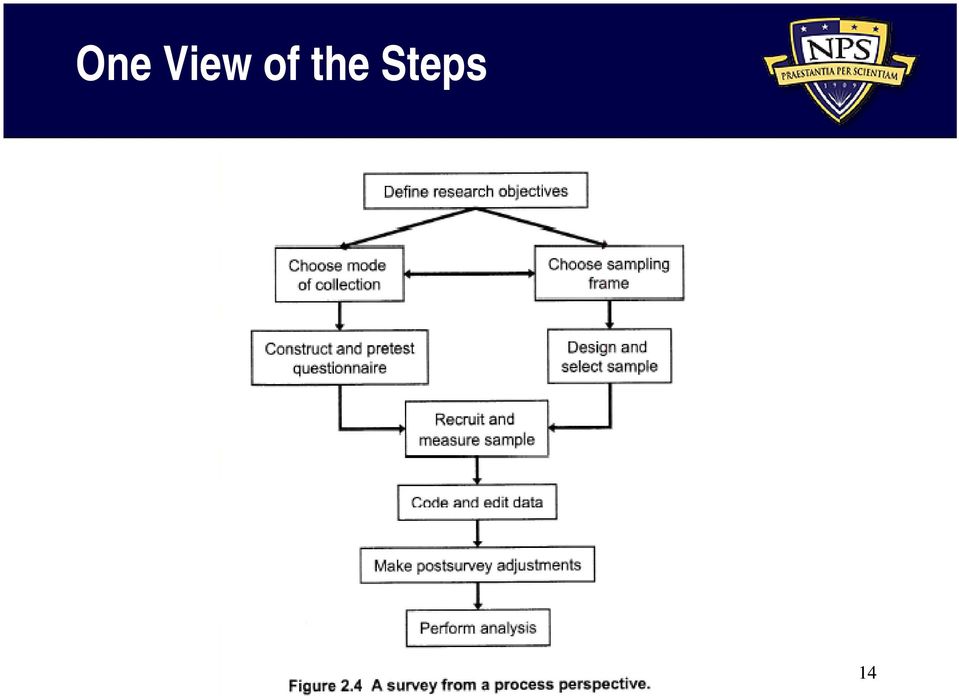
11 Steps in Conducting a Survey (1) Clearly state research objective(s) Decide on survey mode(s) How will you contact potential respondents? Contact mode web, , phone, etc. In what media will the survey be given? Survey or response mode web, , phone, etc. How will you follow up with non-respondents? Follow-up mode web, , phone, etc. Determine fielding strategy How to maximize response rates? Design the survey questions and the survey instrument 11

12 Steps in Conducting a Survey (2) Determine sample size and sampling strategy Obtain Institutional Review Board (IRB) or other approval as necessary Are respondents promised confidentiality? What is the impact if their survey responses become known? Pre-test, pre-test, pre-test Give the survey to some test subjects and get their feedback What works and what doesn t? Are you getting correct data/information? Revise and re-pre-test as necessary Draw sample and field the survey 12

13 Steps in Conducting a Survey (3) Follow up with non-respondents Assemble the survey data Clean data as necessary Analyze the data and report results Summarize the data Weight as necessary and appropriate to infer back to population Calculate and report margin of error Evidence of bias? Unit and item non-response Communicate survey results to respondents if promised 13
14 One View of the Steps 14
15 Another View of the Steps Excerpted from What is a Survey? by Fritz Scheuren 15

16 Examples of Large-scale Surveys (from your textbook) National Crime Victimization Survey National Survey on Drug Use and Health Survey of Consumers National Assessment of Educational Progress Behavioral Risk Factor Surveillance System Current Employment Statistics Program 16

17 National Crime Victimization Survey (NCVS) 17

18 National Survey on Drug Use and Health (NSDUH) 18

19 Survey of Consumers (SOC) 19

20 National Assessment of Educational Progress (NAEP) 20

21 Behavioral Risk Factor Surveillance System (BRFSS) 21
22 Current Employment Statistics (CES) Program 22
23 Examples of DoD Surveys Annual Active Duty Personnel Survey Survey of MWR Services and Family Programs Military Recruiter Quality of Life Survey Adult Influencer Poll (AIP) Youth Attitude Tracking Study (now JAMRS Youth Poll) 23
24 Which Survey Mode Should I Use? You are going to conduct a research survey Goal is to make the best inference possible from sample to population within budget constraints To important questions: What is the most appropriate method to choose for a particular research question? What is the impact of choosing a particular method on survey cost and accuracy? 24
25 Traditional Survey Modes Mail Paper questionnaire sent to respondents Self-administered and mailed back Telephone Interviewers call respondents on telephone Interviewer-assisted In-person Interviewers go to respondent s home or office Interviewer-assisted 25
26 Options Have Multiplied in the Age of Computers and Telecom CATI TDE IVR/T-ACASI CAPI Text- CASI Audio- CASI Video- CASI CAI Methods 26
27 Mode Considerations Modes differ by: Degree of interviewer involvement Degree of interaction with respondent Degree of respondent privacy Channels of communication Technology usage Considerations: Cost Timeliness Accuracy 27
28 Broadly speaking Interviewer-assisted surveys more costly than selfadministered Face-to-face most expensive, then telephone, then mail, then web Interviewer-assisted surveys less prone to various errors and item nonresponse Particularly compared to self-administered paper survey More or less compared to self-administered computerassisted surveys depending on sophistication of program Self-administered less subject to sensitivity bias Can combine some self-administered questions into a predominantly interviewer-assisted mode 28
29 However, timeliness is not just about the length of time a survey is in the field Really, it s from instrument design through analysis Much of that is not affected by survey mode Compared to a mail survey, web-based surveys save on two main things: Mailing time to send out and return surveys Time required to do data entry, coding, and cleaning for paper surveys Yet, it can also take a lot of time to code, test, and de-bug very complicated web (more generally, computer-assisted) survey programs 29
30 And, cost is not just about manhours On large mail surveys, printing and postage costs can be significant 1,500 surveys x 4 mailings at $1.50 each = $9,000! 1,500 $1 incentives = $1,500 On telephone surveys must consider fixed costs of phone and CATI equipment + variable costs On face-to-face interviews, travel costs can be significant (not to mention interviewer time) But in terms of manhours, don t forget: (1) instrument design time; (2) in non-electronic modes, data entry and coding time; (3) non-response follow-up efforts; and (4) analysis time 30
31 And accuracy is not just about response rates and missing items Total survey error: what mode or modes will most decrease all types of error? Lots of considerations Frame coverage Nonresponse rates Sensitivity bias, etc 31
32 32
33 Cost and Frame Availability Often Drive Mode Choice Survey budgets never unlimited Frequently cost will eliminate one or more modes And likely drive other survey design decisions I.e., face-to-face interviews too expensive On the other hand, surveys using area probability frames usually have to start out using face-to-face interviews Similarly, if a complete frame is available, web survey is possible option But general population surveys eliminate web 33
34 Some Modes Logically Group (1) Telephone and face-to-face surveys Telephone often considered an alternative to faceto-face Both interviewer-assisted and can have similar frame coverage issues Many longitudinal surveys start out with a face-toface interview with telephone follow-ups Mail sometimes an alternative to telephone If both telephone and addresses available 34
35 Some Modes Logically Group (2) Web surveys often considered a replacement for mail surveys Coverage is still an issue for web surveys Web superior in terms of automation and speed However, literature consistently finds that nonresponse rates are higher for web surveys 35
36 Using Multiple Modes Reasons to use multiple modes: Maximize response rates Reduce/eliminate selection & coverage bias Allow respondents to use most convenient mode Reduce costs Cross-sectional surveys: start with least costly mode and move to more expensive modes as necessary to get response Longitudinal surveys: Use less expensive modes in follow-on survey rounds 36
37 Considerations When Using Multiple Modes Focus should be on designing instruments to ensure equivalency across modes Rather than optimizing for a particular mode E.g., make the follow-on web survey resemble its counterpart paper survey Ensure operation is set up to track cases across the modes Must avoid duplications and uncoordinated respondent contact Must design and field so that mode effects can be disentangled from other sample characteristics May have to randomize survey mode over a subset 37
38 Other Data Collection Methods Surveys are not the only (nor necessarily the best) way to collect data Other methods include Administrative records Focus groups and qualitative investigations Randomized experiments Which is best depends on the research question(s) and/or the purpose for which the data will be used 38
39 What We Have Covered Defined the term survey, including the Characteristics of types of surveys this class will focus on Distinction between polls and surveys Discussed the basic steps in conducting a rigorous research survey Considerations when choosing a survey mode In various ways, choice likely to affect survey Timeliness Accuracy Cost And cost may drive mode choice possibilities 39
BACKGROUND ON THE SURVEY PROCESS
 Chapter Two BACKGROUND ON THE SURVEY PROCESS In this chapter, we present an overview of the various aspects of the research survey process. 1 We emphasize that surveying should first be thought of as a
Statistical Methods for Sample Surveys (140.640)
 This work is licensed under a Creative Commons Attribution-NonCommercial-ShareAlike License. Your use of this material constitutes acceptance of that license and the conditions of use of materials on this
Self-administered Questionnaire Survey
 Primary methods of survey data collection Self-administered questionnaire (SAQ) Mail Face-to-face interview Telephone interview Self-administered Questionnaire Survey 1 Steps are: a. Mail distribution
THE FUTURE OF INTERNET-BASED SURVEY METHODS
 Chapter Seven CONCLUSIONS In this chapter, we offer some concluding thoughts on the future of Internet-based surveys, the issues surrounding the use of e-mail and the Web for research surveys, and certain
The AmeriSpeak ADVANTAGE
 OVERVIEW Funded and operated by NORC at the University of Chicago, AmeriSpeak TM is a probabilitybased panel (in contrast to a non-probability panel). Randomly selected households are sampled with a known,
Internet Surveys. Examples
 Web material accompanying The International Handbook of Survey Methodology Chapter 14 Internet Surveys Katja Lozar Manfreda Vasja Vehovar University of Ljubljana Examples Below follow examples and more
Informing Public Policy Through Rigorous Survey Research
 Informing Public Policy Through Rigorous Survey Research Data / Insight / Impact Abt SRBI is a recognized leader in utilizing survey, opinion, and public policy research to build bridges between decision-makers
Mixed-Mode Methods for Conducting Survey Research
 Mixed-Mode Methods for Conducting Survey Research Herbert M. Baum, Ph.D.; Anna Chandonnet M.A.; Jack Fentress M.S., M.B.A.; and Colleen Rasinowich, B.A. www.datarecognitioncorp.com In November 2010 the
How To Collect Data From A Large Group
 Section 2: Ten Tools for Applying Sociology CHAPTER 2.6: DATA COLLECTION METHODS QUICK START: In this chapter, you will learn The basics of data collection methods. To know when to use quantitative and/or
Using Surveys for Data Collection in Continuous Improvement
 Innovation Insight Series Number 14 http://www.psu.edu/president/pia/innovation/ Across the University many people use data in assessment and decision-making. Data-based decision-making, an essential element
Survey Research. Classifying surveys on the basis of their scope and their focus gives four categories:
 Survey Research Types of Surveys Surveys are classified according to their focus and scope (census and sample surveys) or according to the time frame for data collection (longitudinal and cross-sectional
Use of Text Messaging to Increase Response Rates
 Use of Text Messaging to Increase Response Rates Key words: BRFSS, response rate, cell phones, smart phones, text message Prepared by: Piper DuBray, Kristie Healey ICF International 0 Introduction Survey
Lessons Learned From an NHIS Web- Followback Feasibility Study
 Lessons Learned From an NHIS Web- Followback Feasibility Study Sarah S. Joestl, DrPH Senior Service Fellow Survey Planning and Special Surveys Branch Division of Health Interview Statistics Division of
Descriptive Methods Ch. 6 and 7
 Descriptive Methods Ch. 6 and 7 Purpose of Descriptive Research Purely descriptive research describes the characteristics or behaviors of a given population in a systematic and accurate fashion. Correlational
www.doncaster.gov.uk
 Market Research It is essential that market research is undertaken to establish there is a need for childcare within a specified area and have knowledge of the local community that a business wishes to
LITERATURE REVIEW OF WEB AND E-MAIL SURVEYS
 Chapter Three LITERATURE REVIEW OF WEB AND E-MAIL SURVEYS In this chapter, we examine what has been written about Internet surveys in the literature, specifically Web and e-mail surveys. We address the
Data Collection and Sampling OPRE 6301
 Data Collection and Sampling OPRE 6301 Recall... Statistics is a tool for converting data into information: Statistics Data Information But where then does data come from? How is it gathered? How do we
Appendix I: Methodology
 Appendix I: Methodology SSRS METHODOLOGY SSRS conducted a survey of Muslims and Jews for the Institute for Social Policy and Understanding from January 18 through January 27, 2016. The study investigated
Avoiding Bias in the Research Interview
 Avoiding Bias in the Research Interview Sonja I. Ziniel, MA Ph.D. Clinical Research Program, Children s Hospital Boston Department of Medicine, Harvard Medical School [email protected]
Optimising survey costs in a mixed mode environment
 Optimising survey costs in a mixed mode environment Vasja Vehovar 1, Nejc Berzelak 2, Katja Lozar Manfreda 3, Eva Belak 4 1 University of Ljubljana, [email protected] 2 University of Ljubljana,
James E. Bartlett, II is Assistant Professor, Department of Business Education and Office Administration, Ball State University, Muncie, Indiana.
 Organizational Research: Determining Appropriate Sample Size in Survey Research James E. Bartlett, II Joe W. Kotrlik Chadwick C. Higgins The determination of sample size is a common task for many organizational
Marketing Research Core Body Knowledge (MRCBOK ) Learning Objectives
 Fulfilling the core market research educational needs of individuals and companies worldwide Presented through a unique partnership between How to Contact Us: Phone: +1-706-542-3537 or 1-800-811-6640 (USA
Questionnaire Design. Questionnaires in Clinical Research
 Questionnaire Design Theresa A Scott, MS Department of Biostatistics [email protected] D-2217 MCN; 3-1713 http://biostat.mc.vanderbilt.edu/theresascott Theresa A Scott, MS (Biostatistics) Questionnaire
How do we know what we know?
 Research Methods Family in the News Can you identify some main debates (controversies) for your topic? Do you think the authors positions in these debates (i.e., their values) affect their presentation
see Designing Surveys by Ron Czaja and Johnny Blair for more information on surveys
 SURVEYS Survey = ask the same questions of a large sample see Designing Surveys by Ron Czaja and Johnny Blair for more information on surveys Basic Survey Process: 1. Design Questionnaire 2. Design Sample
Use of Text Messaging to Increase Response Rates
 Introduction Use of Text Messaging to Increase Response Rates Piper DuBray ICF International 126 College St. Burlington, VT 05401 Proceedings of the 2013 Federal Committee on Statistical Methodology (FCSM)
How to gather and evaluate information
 09 May 2016 How to gather and evaluate information Chartered Institute of Internal Auditors Information is central to the role of an internal auditor. Gathering and evaluating information is the basic
The application of alternative modes of data collection in UK Government social surveys. A report for the Government Statistical Service
 The application of alternative modes of data collection in UK Government social surveys A report for the Government Statistical Service Peter Betts and Charles Lound Office for National Statistics May
2. Choose the location and format for focus groups or interviews
 Steps for Conducting Focus Groups or Individual In-depth Interviews 1. Plan the study Plan your study with the input of your strategy team, stakeholders, and research experts so that collaboratively you
Research design and methods Part II. Dr Brian van Wyk POST-GRADUATE ENROLMENT AND THROUGHPUT
 Research design and methods Part II Dr Brian van Wyk POST-GRADUATE ENROLMENT AND THROUGHPUT From last week Research methodology Quantitative vs. Qualitative vs. Participatory/action research Research methods
Chapter 2: Research Methodology
 Chapter 2: Research Methodology 1. Type of Research 2. Sources of Data 3. Instruments for Data Collection 4. Research Methods 5. Sampling 6. Limitations of the Study 6 Chapter 2: Research Methodology Research
Descriptive Inferential. The First Measured Century. Statistics. Statistics. We will focus on two types of statistical applications
 Introduction: Statistics, Data and Statistical Thinking The First Measured Century FREC 408 Dr. Tom Ilvento 213 Townsend Hall [email protected] http://www.udel.edu/frec/ilvento http://www.pbs.org/fmc/index.htm
Face-to-Face vs. Online Professional Development? Do Both! The Power of the Blended Model
 Face-to-Face vs. Online Professional Development? Do Both! The Power of the Blended Model Dr. Paula Hidalgo, Director of Product Development Dr. Paula Hidalgo is the Director of Product Development for
05/10/2015. Chapter 3 - Marketing Research. Marketing Project Plan
 Chapter 3 - Marketing Research Copyright 2013 Pearson Canada Inc. Marketing Project Plan How do we begin the project? Identify product What do we need? We need to gather information We also need to do
THREE BOOKLET. COLLECTING AND ANALYZING EVALUATION DATA 2nd edition. Outreach Evaluation Resource Center
 Planning and Evaluating Health Information Outreach Projects THREE BOOKLET COLLECTING AND ANALYZING EVALUATION DATA 2nd edition Outreach Evaluation Resource Center 2013 National Network of Libraries of
Electronic Mail Vs. Mail Survey Response Rates
 Electronic Mail Vs. Mail Survey Response Rates Researchers can no longer ignore the possihilities computer technology hold for the future of our profession. By Barbara A. Schuldt and Jeff W. Totten An
How are polls conducted? by Frank Newport, Lydia Saad, David Moore from Where America Stands, 1997 John Wiley & Sons, Inc.
 How are polls conducted? by Frank Newport, Lydia Saad, David Moore from Where America Stands, 1997 John Wiley & Sons, Inc. Public opinion polls would have less value in a democracy if the public -- the
OFFICE OF MANAGEMENT AND BUDGET STANDARDS AND GUIDELINES FOR STATISTICAL SURVEYS September 2006. Table of Contents
 OFFICE OF MANAGEMENT AND BUDGET STANDARDS AND GUIDELINES FOR STATISTICAL SURVEYS September 2006 Table of Contents LIST OF STANDARDS FOR STATISTICAL SURVEYS... i INTRODUCTION... 1 SECTION 1 DEVELOPMENT
Contacting respondents for survey research
 Contacting respondents for survey research Is email a useful method? Joanna d Ardenne and Margaret Blake November 2012 Background The question Is email a useful way of contacting potential respondents
A First Look at Attitudes Surrounding Telehealth:
 A First Look at Attitudes Surrounding Telehealth: Findings from a national survey taking a first look at attitudes, usage, and beliefs of family physicians in the U.S. towards telehealth. OVERVIEW Telehealth
Methods for Improving Response Rates: Findings from AAPOR 2012. Benjamin L. Messer Washington State University PAPOR Mini-Conference, June 22, 2012
 Methods for Improving Response Rates: Findings from AAPOR 2012 Benjamin L. Messer Washington State University PAPOR Mini-Conference, June 22, 2012 2 Disclaimer Papers/presentations obtained with author
Consumer s Guide to Research on STEM Education. March 2012. Iris R. Weiss
 Consumer s Guide to Research on STEM Education March 2012 Iris R. Weiss Consumer s Guide to Research on STEM Education was prepared with support from the National Science Foundation under grant number
Cash Rents Methodology and Quality Measures
 ISSN: 2167-129X Cash Rents Methodology and Quality Measures Released August 1, 2014, by the National Agricultural Statistics Service (NASS), Agricultural Statistics Board, United States Department of Agriculture
Designing & Conducting Survey Research
 Designing & Conducting Survey Research Santa Monica College Fall 2011 Presented by: Hannah Alford, Director Office of Institutional Research 1 Workshop Overview Part I: Overview of Survey Method Paper/Pencil
Concept Paper. Improving Training Evaluation in Organizations
 Concept Paper On Improving Training Evaluation in Organizations Prepared by Dr. Paul Squires President 20 Community Place Morristown, NJ 07960 973-631-1607 fax 973-631-8020 www.appliedskills.com According
ESOMAR 28 Questions. 1. What experience does your company have in providing online samples for market research?
 ESOMAR 28 Questions COMPANY PROFILE 1. What experience does your company have in providing online samples for market research? Since 1996, DoctorDirectory has specialized in deploying healthcare market
SURVEY REPORT DATA SCIENCE SOCIETY 2014
 SURVEY REPORT DATA SCIENCE SOCIETY 2014 TABLE OF CONTENTS Contents About the Initiative 1 Report Summary 2 Participants Info 3 Participants Expertise 6 Suggested Discussion Topics 7 Selected Responses
CROATIAN BUREAU OF STATISTICS REPUBLIC OF CROATIA MAIN (STATISTICAL) BUSINESS PROCESSES INSTRUCTIONS FOR FILLING OUT THE TEMPLATE
 CROATIAN BUREAU OF STATISTICS REPUBLIC OF CROATIA MAIN (STATISTICAL) BUSINESS PROCESSES INSTRUCTIONS FOR FILLING OUT THE TEMPLATE CONTENTS INTRODUCTION... 3 1. SPECIFY NEEDS... 4 1.1 Determine needs for
Clean Slate Program, San Francisco Office of the Public Defender 2007-08 Evaluation Findings. Executive Summary
 Executive Summary Introduction The Clean Slate Program extends legal advocacy beyond an arrest or disposition by the Court so that clients may avail themselves of opportunities to clean up their criminal
Labour Force Survey s Electronic Collection
 Labour Force Survey s Electronic Collection Collection strategy, test results and transition Anne-Marie Côté and Guy Laflamme, Statistics Canada September 4 th, 2014 Outline A. Canadian LFS particularities
WEB-BASED ORIGIN-DESTINATION SURVEYS: AN ANALYSIS OF RESPONDENT BEHAVIOUR
 WEB-BASED ORIGIN-DESTINATION SURVEYS: AN ANALYSIS OF RESPONDENT BEHAVIOUR Pierre-Léo Bourbonnais, Ph.D. Candidate, Department of Civil, Geological and Mining Engineering, École Polytechnique de Montréal,
Using Online Surveys to Evaluate Distance Education Programs
 1 21st Annual Conference on Distance Teaching and Learning click here -> Using Online Surveys to Evaluate Distance Education Programs Elaine Strachota, PhD Distance Learning Coordinator and Faculty Milwaukee
CUSTOMER SERVICE EXCELLENCE
 CUSTOMER SERVICE EXCELLENCE STANDARD 2 Table of Contents The starting point 4 Criterion 1 Customer Insight 5 1.1 Customer Identification 5 1.2 Engagement and Consultation 6 1.3 Customer Satisfaction 7
Flipped Learning Evaluation Institute for Effective Education (University of York) Peter Rudd, PhD
 Evaluation Summary Age range Year 5 (9-10) Number of pupils Average 60 pupils per school Number of schools 12 treatment and 12 control schools Design Randomised Controlled Trial with Delayed Treatment
DETC DEGREE PROGRAMS GRADUATES AND EMPLOYERS EVALUATE THEIR WORTH
 DETC DEGREE PROGRAMS GRADUATES AND EMPLOYERS EVALUATE THEIR WORTH Conducted by the Distance Education and Training Council 2001 Foreword In July 2001 the Distance Education and Training Council surveyed
Developing Standardized Paradata and Dashboards for Use Across Multiple Surveys
 RTI International Developing Standardized Paradata and Dashboards for Use Across Multiple Surveys Susan Mitchell, Lisa Carley-Baxter, Orin Day, Andy Peytchev, Susan Sadler-Redmond www.rti.org RTI International
A Class Project in Survey Sampling
 A Class Project in Survey Sampling Andrew Gelman and Deborah Nolan July 1, 2001 Courses in quantitative methods typically require students to analyze previously collected data. There is great value in
Whether and How to Apply to Ph.D. Programs in Political Science: FAQs
 Whether and How to Apply to Ph.D. Programs in Political Science: FAQs Matthias Staisch, The University of Chicago This Version: October 4, 2013 1 Do I need a Ph.D. to attain my professional goals? Before
DATA COLLECTION IN THE STATISTICAL OFFICE OF THE REPUBLIC OF SLOVENIA (SURS)
 Distr. GENERAL 8 October 2012 WP. 28 ENGLISH ONLY UNITED NATIONS ECONOMIC COMMISSION FOR EUROPE CONFERENCE OF EUROPEAN STATISTICIANS Seminar on New Frontiers for Statistical Data Collection (Geneva, Switzerland,
TIPSHEET IMPROVING RESPONSE SCALES
 TIPSHEET IMPROVING RESPONSE SCALES As important as it is to have good question wording in a survey, it is equally important to have well constructed and reliable question response options. Researchers
IAB Evaluation Study of Methods Used to Assess the Effectiveness of Advertising on the Internet
 IAB Evaluation Study of Methods Used to Assess the Effectiveness of Advertising on the Internet ARF Research Quality Council Paul J. Lavrakas, Ph.D. November 15, 2010 IAB Study of IAE The effectiveness
Data quality and metadata
 Chapter IX. Data quality and metadata This draft is based on the text adopted by the UN Statistical Commission for purposes of international recommendations for industrial and distributive trade statistics.
Selecting Research Participants
 C H A P T E R 6 Selecting Research Participants OBJECTIVES After studying this chapter, students should be able to Define the term sampling frame Describe the difference between random sampling and random
Question Bank FACTSHEET 5
 Question Bank FACTSHEET 5 Survey Interviewing Introduction: The Survey Interview This factsheet will describe the processes involved in the Survey interview. It will focus only on the face to face interview
December 2013. Small Business Employee Survey
 December 2013 Small Business Employee Survey INTRODUCTION Technology has changed the way we communicate, socialize and do business. Every day, millions of employees in the US use some form of technology
STRATEGIES FOR GROWTH SM
 STRATEGIES FOR GROWTH SM "CONSULTANTS TO THE SERVICES INDUSTRY" Comparative Advantages/ Disadvantages of Phone, Mail & E-Mail/Web-Based Surveys Prepared by: William K. Pollock President Strategies For
Non-Researcher s Guide to Evidence-Based Program Evaluation
 Non-Researcher s Guide to Evidence-Based Program Evaluation July 2012 Table of Contents Table of Contents... 2 Course Overview... 4 About This Course... 4 Intended Audience... 4 Course Topics... 4 Learning
List of Contents. Introduction 1
 I List of Contents Page Foreword III Introduction 1 A. General Principles 2 B. Institutional By-Laws and Regulations 2 C. Specific Guidance 3 Annexes II FOREWORD The purpose of this Code of Practice is
Analyzing Qualitative Data For Assessment October 15, 2014
 Analyzing Qualitative Data For Assessment October 15, 2014 Jeremy Penn, Ph.D. Director Resources Data Analysis, Chapter 6 in Schuh book (pages 158-168) Creswell (2002) or (1998) you can borrow from me
egranary EVALUATION PROJECT: Evaluating the Use, Usability, and Usefulness of the egranary Digital Library
 egranary EVALUATION PROJECT: Evaluating the Use, Usability, and Usefulness of the egranary Digital Library The WiderNet Project Cliff Missen, MA, Director Thomas Cook, Ph.D. 201 Communications Center The
Research Proposal Guidelines
 Department of Marketing Management MCOM & DCOM DEGREES Research Proposal Guidelines Compiled by Dr Roberts-Lombard A. RESEARCH PROPOSAL STRUCTURE 1. Introduction and Background to the research 2. Statement
SURVEY RESEARCH RESEARCH METHODOLOGY CLASS. Lecturer : RIRI SATRIA Date : November 10, 2009
 SURVEY RESEARCH RESEARCH METHODOLOGY CLASS Lecturer : RIRI SATRIA Date : November 10, 2009 DEFINITION OF SURVEY RESEARCH Survey: A method of primary data collection based on communication with a representative
Learning at a Distance
 DTA SU.S. EPARTMENTTS OF EDUCATIONINOCTOBBER 11RNICESE12F-154 Learning at a Distance Undergraduate Enrollment in Distance Education Courses and Degree Programs AUTHOR Alexandria Walton Radford MPR Associates,
 Research and Research Methods What we will cover: Formal vs. Informal Qualitative vs. Quantitative Primary vs. Secondary Focus Groups In-Depth Interviews Intercept Interviews 1 Research and Research Methods
CHAPTER 3 RESEARCH METHODOLOGY
 CHAPTER 3 RESEARCH METHODOLOGY 3.1 Introduction This study is survey research in order to study marketing strategies for sustainable cultural tourism in Nakhon Si Thammarat. In case of primary data were
PROGRAMME SPECIFICATION POSTGRADUATE PROGRAMMES
 PROGRAMME SPECIFICATION POSTGRADUATE PROGRAMMES KEY FACTS Programme name Clinical Research Award Masters in Research (MRes) School Health Sciences Department or equivalent Division of Health Services Research