
Data. beneficiaries Dually eligible For Medicare and Medicaid
|
|
|
- Donald Nelson
- 10 years ago
- Views:
Transcription
1 January 2015 Data Book beneficiaries Dually eligible For Medicare and Medicaid A data book jointly produced by the Medicare Payment Advisory Commission and the Medicaid and CHIP Payment and Access Commission
2

3 Acknowledgments We would like to thank Sharon Donovan from the Centers for Medicare & Medicaid Services, as well as Steven Merry and the team from Acumen, LLC, for their insights and assistance as we produced this data book. Data book: Beneficiaries dually eligible for Medicare and Medicaid January 2015 MedPAC MACPAC i

4 About MedPAC The Medicare Payment Advisory Commission (MedPAC) is an independent Congressional agency established by the Balanced Budget Act of 1997 (P.L ) to advise the U.S. Congress on issues affecting the Medicare program. The Commission's statutory mandate is quite broad: In addition to advising the Congress on payments to private health plans participating in Medicare and providers in Medicare's traditional fee-for-service program, MedPAC is also tasked with analyzing access to care, quality of care, and other issues affecting Medicare. MedPAC meets publicly to discuss policy issues and formulate its recommendations to the Congress. In the course of these meetings, its 17 Commissioners consider the results of staff research, presentations by policy experts, and comments from interested parties. Commission members and staff also seek input on Medicare issues through frequent meetings with individuals interested in the program, including staff from congressional committees and the Centers for Medicare & Medicaid Services, health care researchers, health care providers, and beneficiary advocates. Two reports issued in March and June each year are the primary outlet for Commission recommendations. In addition to these reports and others on subjects requested by the Congress, MedPAC advises the Congress through other avenues, including comments on reports and proposed regulations issued by the Secretary of the Department of Health and Human Services, testimony, and briefings for Congressional staff. About MACPAC The Medicaid and CHIP Payment and Access Commission (MACPAC) is a nonpartisan legislative branch agency that provides policy and data analysis and makes recommendations to the Congress, the Secretary of the U.S. Department of Health and Human Services, and the states on a wide array of issues affecting Medicaid and the State Children s Health Insurance Program (CHIP). The U.S. Comptroller General appoints MACPAC s 17 commissioners, who come from diverse regions across the United States and bring broad expertise and a wide range of perspectives on Medicaid and CHIP. MACPAC serves as an independent source of information on Medicaid and CHIP, publishing issue briefs and data reports throughout the year to support policy analysis and program accountability. MACPAC s authorizing statute, 42 U.S.C. 1396, outlines a number of areas for analysis of policies affecting access to care, including: payment, eligibility, enrollment and retention, coverage, access to care, quality of care, and the programs interaction with Medicare and the health care system generally. MACPAC s authorizing statute also requires the Commission to submit reports to the Congress by March 15 and June 15 of each year. In carrying out its work, MACPAC holds public meetings and regularly consults with state officials, congressional and executive branch staff, beneficiaries, health care providers, researchers, and policy experts. ii MedPAC MACPAC Data book: Beneficiaries dually eligible for Medicare and Medicaid January 2015

5 Table of contents Introduction... 1 Section 1: Overview of dual-eligible beneficiaries Exhibit 1: Snapshot of dual-eligible beneficiaries by type of benefit, CY Exhibit 2: Dual-eligible beneficiary enrollment in full- and partial-benefit categories, CY Exhibit 3: Medicare and Medicaid spending on dual-eligible beneficiaries by age and type of benefit, CY Exhibit 4: Dual-eligible beneficiaries as a share of Medicare and Medicaid enrollment and spending, CY Exhibit 5: Selected subgroups of dual-eligible beneficiaries as a share of Medicare and Medicaid enrollment and spending, CY Section 2: Characteristics of dual-eligible beneficiaries Exhibit 6: Demographic characteristics of dual-eligible and non-dual Medicare and Medicaid beneficiaries, CY Exhibit 7: Additional characteristics of dual-eligible beneficiaries, CY Exhibit 8: Selected conditions for dual-eligible beneficiaries under age 65 and ages 65 and older, CY Section 3: Eligibility pathways, managed care enrollment, and continuity of enrollment Exhibit 9: Medicare eligibility pathways, CY Exhibit 10: Medicaid eligibility pathways, CY Exhibit 11: Medicare fee-for-service and managed care enrollment, CY Exhibit 12: Medicaid fee-for-service and managed care enrollment, CY Exhibit 13: Continuity of enrollment status for dual-eligible beneficiaries, CY Data book: Beneficiaries dually eligible for Medicare and Medicaid January 2015 MedPAC MACPAC iii

6 Section 4: Dual-eligible beneficiaries utilization of and spending on Medicare and Medicaid services Exhibit 14: Use of Medicare services and per user spending for FFS dual-eligible beneficiaries and non-dual beneficiaries, CY Exhibit 15: Use of Medicaid services and per user spending for FFS dual-eligible beneficiaries and non-dual beneficiaries, CY Exhibit 16: Use of Medicare and Medicaid services and per user spending for FFS dual-eligible beneficiaries by age, CY Section 5: Medicare and Medicaid spending for dual-eligible beneficiaries by LTSS use Exhibit 17: Medicare and Medicaid spending on FFS full-benefit dual-eligible users of Medicaid LTSS services, CY Exhibit 18: Per user Medicare and Medicaid spending on FFS full-benefit dual-eligible Medicaid LTSS users and non-users, CY Exhibit 19: Per user Medicare and Medicaid spending on FFS full-benefit dual-eligible Medicaid LTSS users by age, CY Section 6: Trends in dual-eligible population composition, spending, and service use Exhibit 20: Number of dual-eligible and non-dual Medicare and Medicaid beneficiaries, CY Exhibit 21: Medicare and Medicaid spending per dual-eligible and non-dual beneficiary, CY Exhibit 22: Medicare and Medicaid spending for dual-eligible and non-dual beneficiaries, CY Exhibit 23: Share of dual-eligible beneficiaries by selected beneficiary characteristics, CY 2007 and CY Exhibit 24: Use of Medicare services and per user spending for FFS beneficiaries, CY 2007 and CY Exhibit 25: Use of Medicaid services and per user spending for FFS beneficiaries, CY 2007 and CY Exhibit 26: Number of and spending for FFS full-benefit dual-eligible beneficiaries by Medicaid LTSS use, CY 2007 and CY Exhibit 27: Average annual growth in dual-eligible enrollment by state, CY iv MedPAC MACPAC Data book: Beneficiaries dually eligible for Medicare and Medicaid January 2015

7 Introoducttion

8

9 This data book is a joint project of the Medicaid and CHIP Payment and Access Commission (MACPAC) and the Medicare Payment Advisory Commission (MedPAC). The data book presents information on the demographic and other personal characteristics, expenditures, and health care utilization of individuals who are dually eligible for Medicare and Medicaid coverage. Dual-eligible beneficiaries receive both Medicare and Medicaid benefits by virtue of their age or disability and low incomes. This population is diverse and includes individuals with multiple chronic conditions, physical disabilities, and cognitive impairments such as dementia, developmental disabilities, and mental illness. It also includes some individuals who are relatively healthy. For dual-eligible beneficiaries, Medicare is the primary payer for primary, acute, and post-acute care services covered by that program. Medicaid provides varying levels of assistance with Medicare premiums and cost sharing and, for many beneficiaries, also provides services not covered by Medicare, such as longterm services and supports (LTSS). Full-benefit dual-eligible beneficiaries receive the full range of Medicaid benefits offered in a given state. For partial-benefit dual-eligible beneficiaries, Medicaid pays Medicare premiums and may also pay the cost sharing for Medicare services. Policymakers have expressed particular interest in dual-eligible beneficiaries because of the relatively large expenditures by both Medicare and Medicaid for this relatively small group of individuals. Concerns have also been raised as to how the existence of separate funding streams creates barriers to coordination of care and the extent to which lack of coordination increases costs and leads to poor health outcomes. Because these issues are of concern to both commissions, we thought it prudent to combine resources and conduct a joint analysis of federal Medicare and Medicaid data. This data book, the second in a series, is an effort to create a common understanding of the characteristics of dual-eligible beneficiaries and their use of services that would be useful to the Congress, as well as inform each commission s own discussions of the policy issues associated with this population. This data book is organized into the following sections: overview of dual-eligible beneficiaries characteristics of dual-eligible beneficiaries eligibility pathways, managed care enrollment, and continuity of enrollment dual-eligible beneficiaries utilization of and spending on Medicare and Medicaid services Medicare and Medicaid spending for dual-eligible beneficiaries by LTSS use trends in dual-eligible population composition, spending, and service use In each section, we compare subgroups of dual-eligible beneficiaries, including those with full versus partial benefits and those under age 65 versus those ages 65 and older. We also compare dual-eligible beneficiaries with non-dual Medicare and Medicaid beneficiaries. In the case of Medicaid, we generally limit our comparisons to non-dual Medicaid beneficiaries under age 65 who are eligible for that program on the basis of a disability, rather than the overall Medicaid population, which includes a large number of nondisabled children and adults. In the case of Medicare, our non-dual comparison group includes all non-dual Medicare beneficiaries, who may qualify for coverage on the basis of age, disability, or end-stage renal disease. For the first time, we include information on trends in the dual-eligible population between calendar year (CY) 2007 and CY Future data book updates will build on this work to examine whether observed changes remain consistent. Data book: Beneficiaries dually eligible for Medicare and Medicaid January 2015 MedPAC MACPAC 3
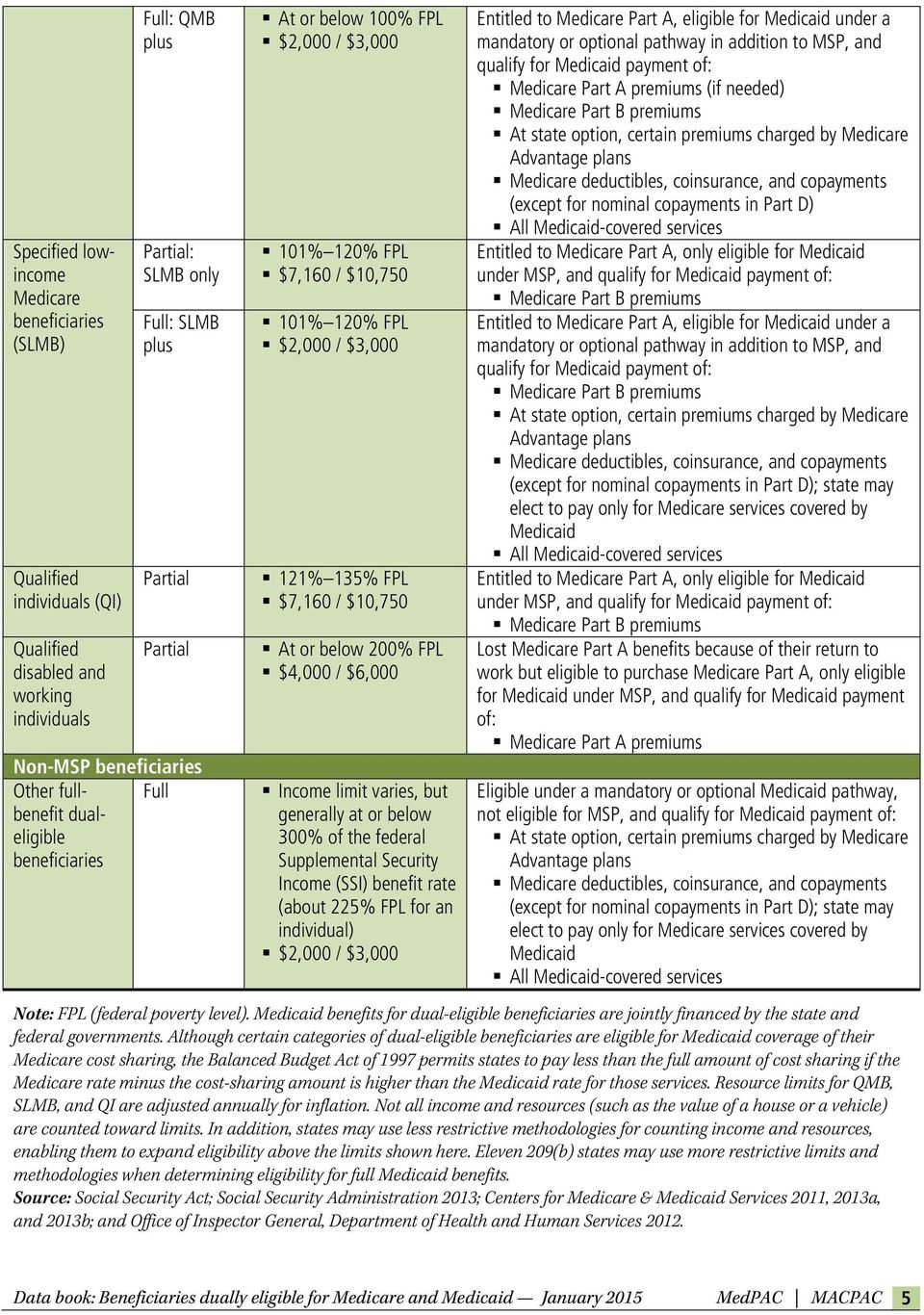
10 The role of Medicare and Medicaid for dual-eligible beneficiaries Medicare is the primary payer for dual-eligible beneficiaries and mainly covers medical services such as primary and specialty care, inpatient and outpatient acute care, and post-acute skilled-level care. Dualeligible beneficiaries are eligible for the same Medicare benefits as other Medicare beneficiaries but have low incomes that make it difficult to afford the premiums and cost sharing required by Medicare, as well as the cost of services not covered by the Medicare program. Medicaid programs wrap around Medicare s coverage by providing financial assistance to dual-eligible beneficiaries in the form of payment of Medicare premiums and cost sharing, as well as coverage of some benefits not included in the Medicare program. Not all dual-eligible beneficiaries receive the same level of Medicaid assistance, as described later in this section. Medicare is a federal program with uniform eligibility rules and a standard benefit package, whereas Medicaid is a joint federal state program with eligibility rules and benefits that vary by state. Unlike the Medicaid program, where provider payment methodologies and payments are set at the state level, most Medicare payments are governed by formulas that allow for geographic variation but are determined at the national level. The programs also differ in their financing. Medicare is funded from sources such as premiums, payroll taxes, general revenues, and state contributions toward drug coverage for dual-eligible beneficiaries. Federal and state governments share most Medicaid costs according to the federal medical assistance percentage (FMAP), which is based on a formula that provides for a larger federal share in states with lower per capita incomes relative to the national average (and vice versa). For fiscal year 2015, the FMAP ranges from 50 percent to about 74 percent (Office of the Assistant Secretary for Planning and Evaluation 2014). Categories of dual-eligible beneficiaries Different types of dual-eligible beneficiaries receive different levels of Medicaid assistance (Table 1). Under mandatory Medicaid eligibility pathways referred to as Medicare Savings Programs (MSPs), dual-eligible beneficiaries qualify for assistance with payment of Medicare premiums only or with Medicare premiums and cost sharing. Individuals who only receive assistance with premiums or cost sharing through the MSPs are referred to as partial-benefit dual-eligible beneficiaries. Among people with MSP coverage, some also qualify for the full range of services offered by state Medicaid programs. Additionally, individuals may qualify for full Medicaid benefits under separate non-msp pathways. All individuals who qualify for full Medicaid benefits are referred to as full-benefit dual-eligible beneficiaries. Table 1. Medicaid eligibility and benefits by type of dual-eligible beneficiary Type Full or partial Medicaid benefits Federal income and resource (individual / couple) limits for eligibility in 2014 Medicare Savings Program (MSP) beneficiaries Qualified Medicare beneficiaries (QMB) Partial: QMB only At or below 100% FPL $7,160 / $10,750 Benefits Entitled to Medicare Part A, only eligible for Medicaid under MSP, and qualify for Medicaid payment of: Medicare Part A premiums (if needed) Medicare Part B premiums At state option, certain premiums charged by Medicare Advantage plans Medicare deductibles, coinsurance, and copayments (except for nominal copayments in Part D, the Medicare drug program) 4 MedPAC MACPAC Data book: Beneficiaries dually eligible for Medicare and Medicaid January 2015

11 Specified lowincome Medicare beneficiaries (SLMB) Qualified individuals (QI) Qualified disabled and working individuals Full: QMB plus Partial: SLMB only Full: SLMB plus Partial Partial Non-MSP beneficiaries Other fullbenefit dual- Full eligible beneficiaries At or below 100% FPL $2,000 / $3, % 120% FPL $7,160 / $10, % 120% FPL $2,000 / $3, % 135% FPL $7,160 / $10,750 At or below 200% FPL $4,000 / $6,000 Income limit varies, but generally at or below 300% of the federal Supplemental Security Income (SSI) benefit rate (about 225% FPL for an individual) $2,000 / $3,000 Entitled to Medicare Part A, eligible for Medicaid under a mandatory or optional pathway in addition to MSP, and qualify for Medicaid payment of: Medicare Part A premiums (if needed) Medicare Part B premiums At state option, certain premiums charged by Medicare Advantage plans Medicare deductibles, coinsurance, and copayments (except for nominal copayments in Part D) All Medicaid-covered services Entitled to Medicare Part A, only eligible for Medicaid under MSP, and qualify for Medicaid payment of: Medicare Part B premiums Entitled to Medicare Part A, eligible for Medicaid under a mandatory or optional pathway in addition to MSP, and qualify for Medicaid payment of: Medicare Part B premiums At state option, certain premiums charged by Medicare Advantage plans Medicare deductibles, coinsurance, and copayments (except for nominal copayments in Part D); state may elect to pay only for Medicare services covered by Medicaid All Medicaid-covered services Entitled to Medicare Part A, only eligible for Medicaid under MSP, and qualify for Medicaid payment of: Medicare Part B premiums Lost Medicare Part A benefits because of their return to work but eligible to purchase Medicare Part A, only eligible for Medicaid under MSP, and qualify for Medicaid payment of: Medicare Part A premiums Eligible under a mandatory or optional Medicaid pathway, not eligible for MSP, and qualify for Medicaid payment of: At state option, certain premiums charged by Medicare Advantage plans Medicare deductibles, coinsurance, and copayments (except for nominal copayments in Part D); state may elect to pay only for Medicare services covered by Medicaid All Medicaid-covered services Note: FPL (federal poverty level). Medicaid benefits for dual-eligible beneficiaries are jointly financed by the state and federal governments. Although certain categories of dual-eligible beneficiaries are eligible for Medicaid coverage of their Medicare cost sharing, the Balanced Budget Act of 1997 permits states to pay less than the full amount of cost sharing if the Medicare rate minus the cost-sharing amount is higher than the Medicaid rate for those services. Resource limits for QMB, SLMB, and QI are adjusted annually for inflation. Not all income and resources (such as the value of a house or a vehicle) are counted toward limits. In addition, states may use less restrictive methodologies for counting income and resources, enabling them to expand eligibility above the limits shown here. Eleven 209(b) states may use more restrictive limits and methodologies when determining eligibility for full Medicaid benefits. Source: Social Security Act; Social Security Administration 2013; Centers for Medicare & Medicaid Services 2011, 2013a, and 2013b; and Office of Inspector General, Department of Health and Human Services Data book: Beneficiaries dually eligible for Medicare and Medicaid January 2015 MedPAC MACPAC 5
12 Medicare and Medicaid benefits for dual-eligible beneficiaries Medicare. Medicare benefits consist of two parts, Hospital Insurance (Part A) and Supplementary Medical Insurance (Part B). Part A covers inpatient hospital and skilled nursing facility care, post-acute home health care, and hospice care. Part B covers physician services and the services of other practitioners, outpatient hospital care and care in other outpatient settings, home health care not paid for under Part A, other medical services and supplies, and drugs that cannot be self-administered. Part D is the outpatient drug component of the Medicare program. The Medicare entitlement gives individuals premium-free Part A, but Part B is a voluntary program for which there are monthly premiums that a beneficiary, or a party on behalf of the beneficiary, must pay to the federal government. Part D is also voluntary, and beneficiaries may pay a monthly premium to obtain the coverage through private plans that receive the premium payment. Most Medicare beneficiaries, including dual-eligible beneficiaries, have the choice of receiving their Medicare Part A and Part B benefits through private health plans (Medicare Advantage (MA) plans) if those plans are available in the beneficiaries geographic area. MA plans are required to provide the Part A and Part B benefit following Medicare coverage rules, but the cost-sharing structure of such plans can be different from that of traditional fee-for-service (FFS) Medicare. Enrollees in MA plans who have Part D coverage must receive their Part D benefits through the MA plan (referred to as MA prescription drug, or MA PD, plans), with certain exceptions (see Table 2 (p. 7) and Table 3 (pp. 8-9) for more detailed information about the Medicare benefit). Dual-eligible special needs plans (D-SNPs) are a type of MA plan that only enroll dualeligible beneficiaries. D-SNPs are required to contract with states to cover some Medicaid benefits for dualeligible beneficiaries, such as cost-sharing assistance, wraparound services (e.g., vision and dental services), behavioral health services, or long-term care services and supports. Medicaid. The Medicaid benefit package varies depending on the type of dual-eligible beneficiary (Table 1, pp. 4 5). For many beneficiaries, Medicaid pays Medicare premiums and is the secondary payer of Medicare-covered services. For full-benefit dual-eligible beneficiaries, states must cover certain Medicaid services, such as Medicare cost sharing (discussed below), inpatient hospital and nursing facility services when Medicare coverage is exhausted (that is, when limits on covered days are reached), nursing home care not covered by Medicare, and transportation to medical appointments (Table 2, p. 7). However, with certain exceptions (e.g., for children under age 21), states may place limits on both mandatory and optional benefits by defining medical necessity and the amount, duration, and scope of covered services. States have the option to cover additional benefits, including personal care and a wide range of other home- and community-based services (HCBS), dental care, vision and hearing services, and supplies. There is considerable variation across states in the optional Medicaid services covered. This results in different benefits for dual-eligible beneficiaries depending on where they live. As with Medicare, managed care plans may provide Medicaid benefits, but the range of services and populations covered by these plans varies across and within states. Comprehensive managed care plans generally include most of the acute care services covered by a state s Medicaid program, but certain items may be carved out and provided separately under the state s FFS system or a limited-benefit managed care plan. In states with limited-benefit Medicaid managed care, the plans most often provide transportation, behavioral health, or dental services. 6 MedPAC MACPAC Data book: Beneficiaries dually eligible for Medicare and Medicaid January 2015

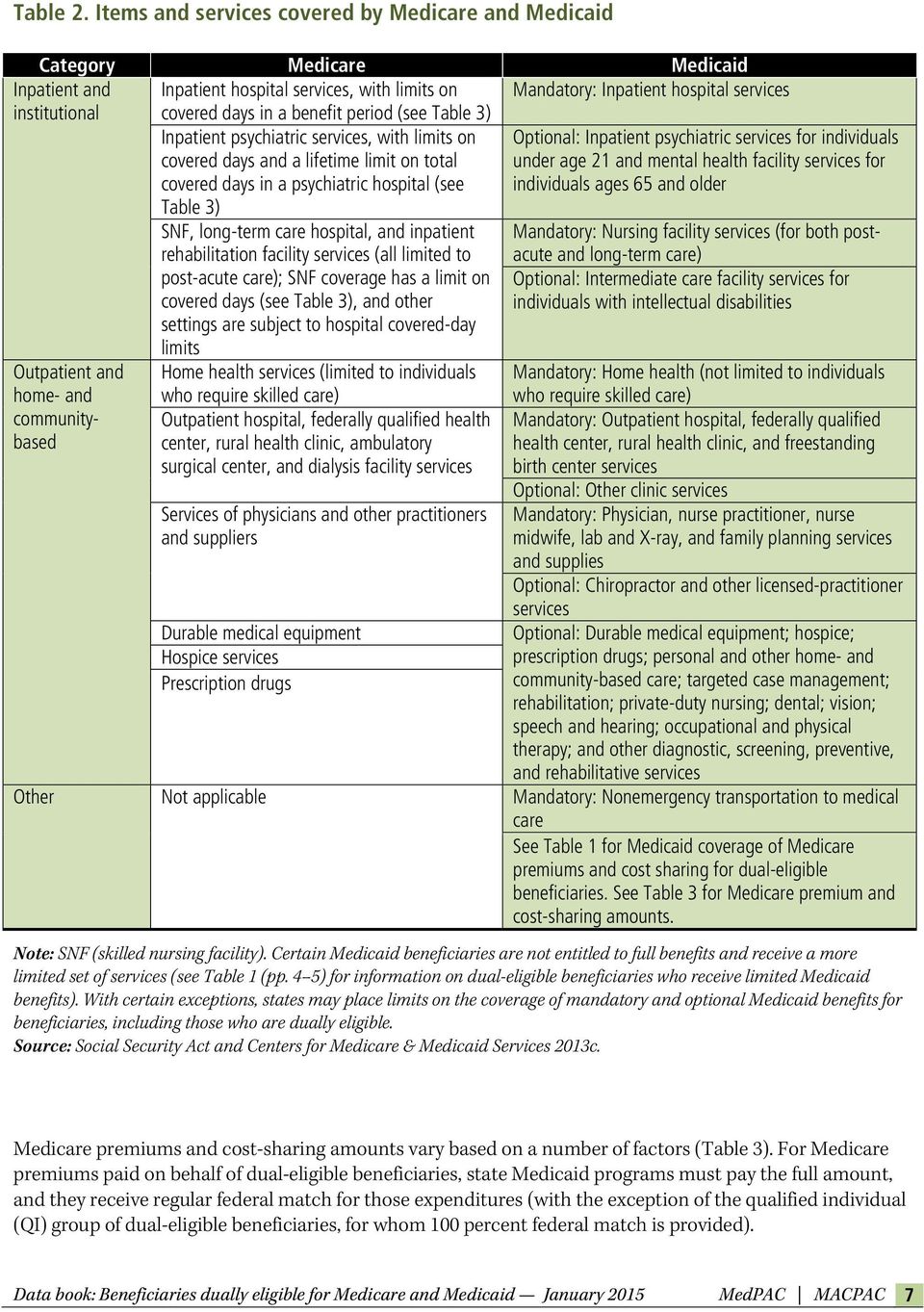
13 Table 2. Items and services covered by Medicare and Medicaid Category Medicare Medicaid Inpatient hospital services, with limits on Mandatory: Inpatient hospital services covered days in a benefit period (see Table 3) Inpatient psychiatric services, with limits on covered days and a lifetime limit on total covered days in a psychiatric hospital (see Table 3) Inpatient and institutional SNF, long-term care hospital, and inpatient rehabilitation facility services (all limited to post-acute care); SNF coverage has a limit on covered days (see Table 3), and other settings are subject to hospital covered-day limits Optional: Inpatient psychiatric services for individuals under age 21 and mental health facility services for individuals ages 65 and older Mandatory: Nursing facility services (for both postacute and long-term care) Optional: Intermediate care facility services for individuals with intellectual disabilities Outpatient and home- and Home health services (limited to individuals who require skilled care) Mandatory: Home health (not limited to individuals who require skilled care) communitybased Outpatient hospital, federally qualified health center, rural health clinic, ambulatory surgical center, and dialysis facility services Mandatory: Outpatient hospital, federally qualified health center, rural health clinic, and freestanding birth center services Optional: Other clinic services Services of physicians and other practitioners and suppliers Mandatory: Physician, nurse practitioner, nurse midwife, lab and X-ray, and family planning services and supplies Optional: Chiropractor and other licensed-practitioner services Durable medical equipment Optional: Durable medical equipment; hospice; Hospice services Prescription drugs prescription drugs; personal and other home- and community-based care; targeted case management; rehabilitation; private-duty nursing; dental; vision; speech and hearing; occupational and physical therapy; and other diagnostic, screening, preventive, and rehabilitative services Other Not applicable Mandatory: Nonemergency transportation to medical care See Table 1 for Medicaid coverage of Medicare premiums and cost sharing for dual-eligible beneficiaries. See Table 3 for Medicare premium and cost-sharing amounts. Note: SNF (skilled nursing facility). Certain Medicaid beneficiaries are not entitled to full benefits and receive a more limited set of services (see Table 1 (pp. 4 5) for information on dual-eligible beneficiaries who receive limited Medicaid benefits). With certain exceptions, states may place limits on the coverage of mandatory and optional Medicaid benefits for beneficiaries, including those who are dually eligible. Source: Social Security Act and Centers for Medicare & Medicaid Services 2013c. Medicare premiums and cost-sharing amounts vary based on a number of factors (Table 3). For Medicare premiums paid on behalf of dual-eligible beneficiaries, state Medicaid programs must pay the full amount, and they receive regular federal match for those expenditures (with the exception of the qualified individual (QI) group of dual-eligible beneficiaries, for whom 100 percent federal match is provided). Data book: Beneficiaries dually eligible for Medicare and Medicaid January 2015 MedPAC MACPAC 7
14 However, states have flexibility in how they pay providers for Medicare Part A and Part B cost-sharing amounts. Most states choose to limit their payment of Medicare cost sharing for Part A and Part B services to the lesser of (1) the full amount of Medicare cost sharing (deductibles, coinsurance, or copayments) for a given service, or (2) the amount, if any, by which the Medicaid payment rate exceeds the amount already paid by Medicare (MACPAC 2013). In cases where Medicaid payment rates are lower than Medicare, these lesser-of policies result in states paying less than the full amount of the Medicare cost-sharing liability. If a state pays less than the full amount, providers are barred from billing qualified Medicare beneficiaries (QMBs) for any remaining cost sharing. Unlike Medicare Part A and Part B services, Medicaid does not pay for cost sharing associated with drugs under Part D, which has its own subsidies for dual-eligible and other low-income beneficiaries. Table 3. Medicare premiums and cost-sharing amounts, 2014 and 2010 Part A Premium Premium-free for insured individuals and their dependents and survivors; for uninsured individuals buying in, $426 per month or $234 for individuals with at least 30 quarters of coverage ($461 and $254 in 2010), plus the Part B premium (Part A cannot be purchased by itself) Hospital stays $1,216 deductible for days 1 60 of each benefit period ($1,100 in 2010) $304 per day for days of each benefit period (1/4 of hospital deductible each year) ($275 in 2010) $608 per lifetime reserve day (1/2 of hospital deductible each year) after day 90 of each benefit period (up to 60 days over lifetime) ($550 in 2010) Skilled nursing facility stays Hospice care Blood Part B Premium $0 for the first 20 days of each benefit period; stays are covered if preceded by a 3-day hospital stay $152 per day (1/8 of hospital deductible each year) ($ in 2010) for days of each benefit period All costs for each day after day 100 of each benefit period $0 for hospice visits; up to a $5 copay for outpatient prescription drugs 5% of the Medicare-approved amount for inpatient respite care All costs for the first three pints (unless donated to replace what is used) $ per month ($ in 2010); higher for higher income individuals beginning in 2007 Deductible The first $147 of Part B covered services or items ($ in 2010) Physician and other medical 20% of the Medicare-approved amount for physician services, outpatient therapy services (subject to limits), and most preventive services Outpatient hospital services A coinsurance or copayment amount that varies by service, projected to average 20.7% in 2014 (22.6% in 2010), to be phased down to 20% over time; no copayment for a single service can be more than the Part A hospital deductible Mental health services 20% (45% in 2010) of the Medicare-approved amount for outpatient mental health care Clinical laboratory services $0 for Medicare-approved services Home health care $0 for home health care services Durable medical equipment 20% of the Medicare-approved amount Blood All costs for the first three pints, then 20% of the Medicare-approved amount of additional pints (unless donated to replace what is used) 8 MedPAC MACPAC Data book: Beneficiaries dually eligible for Medicare and Medicaid January 2015
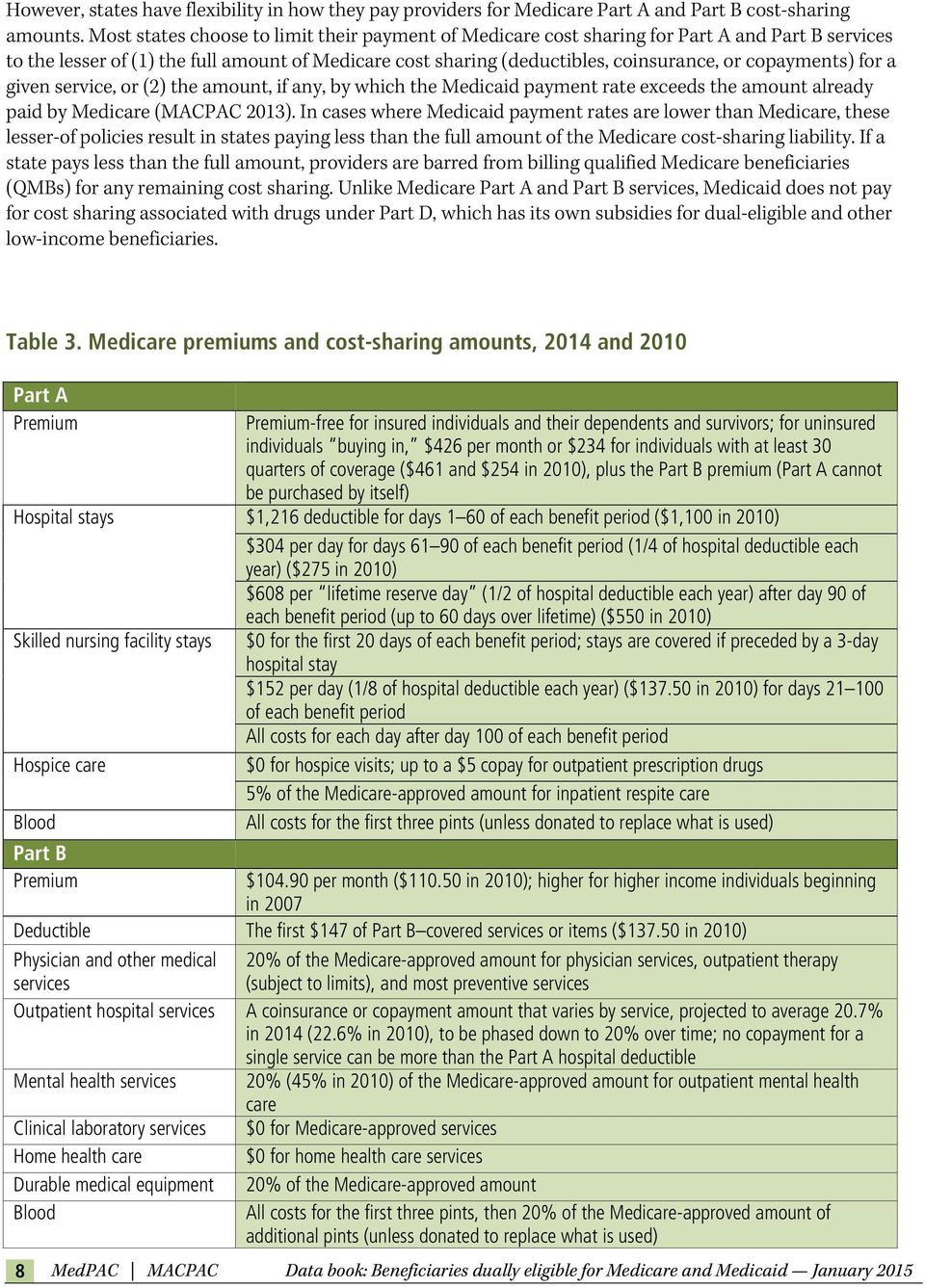
15 Part D, standard benefit Premium Deductible Initial coverage limit Varies from year to year and plan to plan in relation to national average bid of sponsoring plans. The Part D weighted basic beneficiary premium for 2014 is $32.42 ($31.94 in 2010); higher premiums for higher income individuals as of 2011; dualeligible beneficiaries have access to at least one plan in which the plan premium is fully subsidized; other low-income individuals can have partial subsidization of their premiums. $310 (same in 2010); not applied to dual-eligible beneficiaries; dual-eligible beneficiaries pay only nominal copayments $2,850 ($2,830 in 2010); dual-eligible beneficiaries pay only nominal copayments Out-of-pocket threshold $4,550 (same in 2010); after this point, dual-eligible beneficiaries have no financial (catastrophic cap) obligation for covered drugs Copayment rules Copayments vary from plan to plan, but minimum copayment amounts are required for beneficiaries who have reached the out-of-pocket threshold. For dual-eligible beneficiaries, there are no copayments for institutionalized beneficiaries at any level of utilization. For other dual-eligible beneficiaries, maximum copayment limits are set for utilization up to the out-of-pocket threshold: $1.20 for generic or preferred multisource drugs and $3.60 for other drugs. Rules for Medicare Advantage plans Part A and Part B premiums Plans can vary the services for which cost sharing is charged and the level of cost and cost sharing sharing, but for certain services the cost sharing cannot exceed Medicare levels or other limits as specified in Medicare rules. In addition, the overall cost sharing in the plan for Part A and Part B services may not exceed, on average, the actuarial value of the cost sharing of traditional FFS Medicare. In lieu of cost sharing at the point of service, plans may obtain cost-sharing revenue through a monthly premium that all enrollees would pay. MA plans are prohibited from billing QMBs and full-benefit dual-eligible beneficiaries for Medicare cost sharing if the state has financial responsibility for the cost sharing, but the plan can require beneficiaries to pay cost sharing at levels permitted under the Medicaid program of a given state. The MA plan or its providers can bill the state for any cost sharing that is payable by the state. Note: FFS (fee-for-service), MA (Medicare Advantage), QMB (qualified Medicare beneficiary). A benefit period in Part A begins the day a beneficiary is admitted to a hospital or skilled nursing facility and ends when the beneficiary has not received hospital or skilled nursing care for 60 days in a row. If the beneficiary is admitted to the hospital after one benefit period has ended, a new benefit period begins and the beneficiary must again pay the inpatient hospital deductible. There is no limit to the number of benefit periods. Part A cost sharing increases over time by the same percentage update applied to payments to inpatient hospitals and is adjusted to reflect real change in case mix. Source: Medicare Payment Advisory Commission 2012 and Centers for Medicare & Medicaid Services 2008, 2009, 2010, and Additional information on Medicare and Medicaid eligibility Medicare. Medicare is an entitlement program for workers, their dependents, and their survivors who meet certain qualifying conditions as provided for under Title XVIII of the Social Security Act; dual-eligible beneficiaries gain eligibility in the same manner as non-dual beneficiaries. There are three main pathways to Medicare eligibility: age, end-stage renal disease (ESRD), or disability. Individuals qualify for Medicare based on age if they are 65 or older, and most of these individuals are qualified to receive Social Security benefit payments (or Railroad Retirement Board benefit payments). Individuals of any age with ESRD can be entitled to Medicare after a waiting period of three months or less. Data book: Beneficiaries dually eligible for Medicare and Medicaid January 2015 MedPAC MACPAC 9
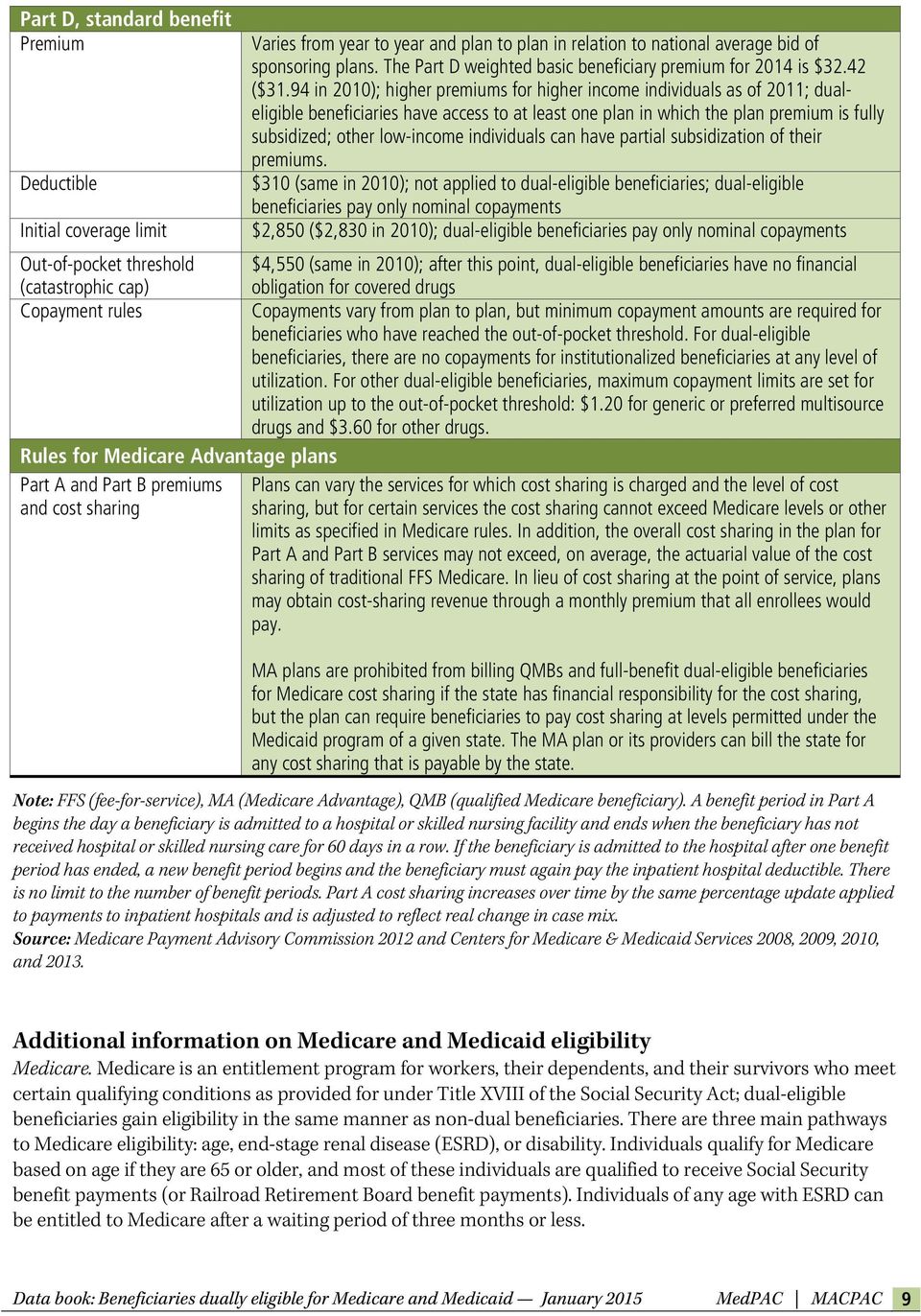
16 Individuals ages 18 to 64 can qualify for Medicare benefits on the basis of disability. When determining whether an individual qualifies on the basis of a disability, Medicare uses disability criteria that apply in both the federal Social Security Disability Insurance (SSDI) and Supplemental Security Income (SSI) programs. Individuals who qualify for Social Security (generally SSDI) benefits on the basis of a disability have a 24-month waiting period before Medicare benefits begin (the waiting period is waived for people with amyotrophic lateral sclerosis). During the waiting period, low-income individuals can qualify as disabled under the SSI program and can receive Medicaid coverage. In this data book, we distinguish between two types of disabled individuals under age 65: those who qualify for Medicare based on their own work history, and those who qualify for Medicare based on a spouse s or parent s work history. Individuals in the former group have worked enough quarters to qualify for Medicare benefits. Individuals in the latter group have not worked enough quarters to qualify for Medicare benefits. These individuals are often disabled widow(er)s and surviving divorced spouses, ages 50 and older, or adult children ages 18 and older who have a disabling condition that began before the age of 22. In most cases, these dependents and survivors of workers receive monthly dependent or survivor benefit payments from Social Security (or the Railroad Retirement Board). Medicaid. Medicaid eligibility pathways are typically defined by the populations they cover and the financial criteria that apply. As noted earlier, the MSP pathways to limited Medicaid coverage of Medicare premiums and cost sharing are by definition designed for low-income Medicare beneficiaries. In contrast, pathways to full Medicaid coverage do not specifically target Medicare beneficiaries. They instead cover groups that include low-income individuals ages 65 and older and younger persons with disabilities, many of whom happen to be Medicare beneficiaries. About half of dual-eligible beneficiaries who receive full Medicaid benefits qualify under a mandatory eligibility pathway based on their receipt of federal SSI benefits. SSI is available to individuals with limited incomes (up to about 75 percent of the federal poverty level (FPL)) and resources ($2,000 for an individual and $3,000 for a couple) who are under age 65 and disabled or who are ages 65 and older. For most eligibility pathways that apply to individuals with disabilities and those ages 65 and older, all states may opt to use less restrictive methodologies for counting income and resources to expand eligibility, and 11 states (referred to as 209(b) states) may opt to use more restrictive criteria. Additional non-ssi pathways to full Medicaid for individuals with disabilities and those ages 65 and older include but are not limited to: Poverty level. States may opt to cover individuals with disabilities and those ages 65 and older with incomes up to 100 percent of the FPL. Medically needy. Under this option, individuals with higher incomes can spend down to a statespecified medically needy income level by incurring medical expenses. Special income level. States can cover individuals with incomes up to 300 percent of the SSI benefit rate (about 225 percent of the FPL for an individual) who are receiving long-term care in an institution. States may also extend this eligibility to individuals who use home- and communitybased waiver services as an alternative to institutionalization. As a result of differences in states use of optional eligibility pathways, the extent to which eligible individuals are enrolled, and differences in demography at the state level, there is considerable variation in the share of each state s population that is covered by Medicaid (Table 7, pp ). Given that Medicare eligibility criteria do not vary by state, differences in the share of the population covered by that program are largely driven by demographics, such as the share of the population ages 65 and older. 10 MedPAC MACPAC Data book: Beneficiaries dually eligible for Medicare and Medicaid January 2015
17 Methods Sources of data The data presented are for 2007 through When the analytic work for this data book began, CY 2010 was the most recent year for which complete claims data were available for the Medicare and Medicaid programs. The sources of data include: Medicare enrollment data from Enrollment Database and Common Medicare Environment (CME) files, Medicare Part A, Part B, and Part D claims from Common Working File and Part D Prescription Drug Event data, Medicare Part C payment data from Medicare Advantage Prescription Drug files, Medicaid enrollment and claims data from Medicaid Statistical Information System (MSIS) files, and other data sources noted in specific exhibits as warranted. Acumen, LLC, created the analytic files used for this data book based on these sources. These files are similar to files created for research purposes by CMS, such as the recently released Medicare Medicaid Linked Enrollee Analytic Data Source. However, differences in the methodology for creating analytic files (such as the incorporation of revised MSIS data submitted by states that may not always be reflected in the research files from CMS) may lead to estimates of enrollment and spending slightly different from other analyses that use CMS research files. Regardless of which file versions are used, differences in how analytic populations are defined (such as counting dual-eligible beneficiaries using an ever-enrolled rather than an average monthly or point-in-time measure) may also explain differences between the estimates presented here and those published elsewhere by MedPAC, MACPAC, CMS, and others. Each Medicare and Medicaid beneficiary represented in these datasets was assigned a unique identification (ID) number using an algorithm that incorporates program-specific identifiers (such as Health Insurance Claim (HIC) numbers for Medicare and MSIS IDs for Medicaid) and beneficiary characteristics (such as date of birth and gender). This unique ID was used to link an individual s records across all data sources, including both Medicare and Medicaid files for dual-eligible beneficiaries, and to create unduplicated beneficiary counts. Although dual-eligible beneficiaries may be identified in several ways, this data book uses the dual-eligible indicators in Medicare CME data that are derived from statesubmitted Medicare Modernization Act files. Results may differ slightly from analyses that use other data sources (such as MSIS) for this purpose. In our analysis, the dual-eligible population consists of individuals with at least one month of dual-eligible enrollment during the year. Non-dual Medicare and Medicaid beneficiaries were identified as individuals with zero months of dual-eligible enrollment during the year. A variety of analytic variables were created using information from the underlying data files. Noteworthy items include: Identification of chronic conditions. To identify beneficiaries with chronic conditions, we applied algorithms that were developed by CMS for the data files in its Chronic Condition Warehouse (CCW). The CCW has traditionally used Medicare FFS claims data to identify chronic conditions but has recently begun using Medicaid FFS claims as well. In this data book, we report chronic conditions based on Medicare FFS claims only. Chronic conditions among MA enrollees and nondual Medicaid beneficiaries, therefore, were not identified. Our data describe beneficiaries who currently have a particular condition rather than the larger group of beneficiaries who ever had that condition. For a beneficiary to be identified as having a particular condition, the CCW has a condition-specific look-back or reference period that Data book: Beneficiaries dually eligible for Medicare and Medicaid January 2015 MedPAC MACPAC 11
18 requires continuous FFS enrollment during the period as well as the presence of FFS claims for the condition during the period. For example, there is a three-year reference period for Alzheimer s disease and a one-year reference period for the presence of anemia. Medicare entitlement based on disability. In this data book, primary claimant information contained in an individual s Medicare HIC number was used to separate disabled beneficiaries with entitlement to Medicare based on their own work history from those with entitlement based on another individual s work history. We separated these groups because the latter includes a large number of individuals whose disabilities began in childhood and whose characteristics may therefore differ from those of individuals who became disabled as working-age adults. As discussed previously, disabled beneficiaries entitled to Medicare based on another individual s work history include disabled adult children who receive benefits through a disabled, retired, or deceased parent as well as disabled individuals ages 50 and older who receive benefits through a deceased spouse or deceased former (divorced) spouse. Medicaid LTSS. Medicaid LTSS are defined by FFS use of the following Medicaid services: institutional (nursing facility, intermediate care facility for persons with intellectual disabilities, and mental health facility for individuals ages 65 and older or age 21 and under), HCBS under a waiver (including any type of service provided under such a waiver), or HCBS under a state plan (nonwaiver home health and personal care services). We separate these groups because HCBS waiver users are required to meet an institutional level of care and may receive a wide array of services, whereas HCBS state-plan users are not required to meet an institutional level of care and often use fewer services. Beneficiaries whose only Medicaid LTSS use was through a managed care entity are not captured in this definition. However, the number of Medicaid managed care LTSS users in (389,000 individuals, according to Saucier et al. (2012)) was relatively small compared with the total number of dually eligible and non-dual Medicaid FFS LTSS users in 2010 identified through analyses completed for this data book (4.3 million). Known issues with some of the data sources used in the analysis include: Reporting of Medicaid data by states. MSIS data are known to undercount total Medicaid spending at the national level relative to data submitted by states in a data source referred to as the CMS-64 to obtain federal matching funds, with variation by state and type of service. For example, MSIS data generally exclude lump-sum supplemental payments to hospitals that are made in addition to rate-based payments for service use by individual beneficiaries. Such supplemental payments account for nearly 40 percent of Medicaid FFS spending on inpatient and outpatient hospital services (MACPAC 2014a). The MSIS data also exclude Medicaid payments for Medicare premiums $13 billion in 2010, of which $9 billion was the federal share and $4 billion was the state share (MACPAC 2014b) that finance a portion of Medicare spending. Other known issues with state reporting of MSIS data, such as errors in coding individuals in the proper eligibility group, are documented in an anomalies report updated by CMS on an ongoing basis (Mathematica 2013). A disconnect between managed care enrollment and payment data was one example of a possible reporting error that we observed in the Medicaid data. For some individuals, enrollment data indicated that an individual was in one type of managed care plan (e.g., limited benefit) while payment data indicated another plan type (e.g., comprehensive). We did not attempt to correct for such reporting errors in our analysis. The Medicaid spending amounts presented in this data book have not been adjusted to match CMS-64 totals in part because there is no universally agreed-upon method for doing so. For example, the issue of whether and how lump-sum supplemental payments to hospitals should be 12 MedPAC MACPAC Data book: Beneficiaries dually eligible for Medicare and Medicaid January 2015

19 distributed among individual beneficiaries may depend on the purpose of a particular analysis. CMS analyses of dual-eligible beneficiaries generally do not adjust the MSIS spending reported by states. MACPAC adjusts the MSIS spending published in the MACStats section of its reports but collapses nearly 30 service types into just 7 broad categories of service that are comparable between the MSIS and CMS-64 data. Identification of Medicaid payments for Medicare cost sharing. States are instructed to report Medicaid payments for Medicare deductibles and coinsurance in MSIS. The completeness of this reporting may vary by state and type of service. Moreover, payments for Medicare-covered services (such as coinsurance for inpatient hospital or skilled nursing facility stays) cannot always be separated from payments for Medicaid-covered services (such as hospital days in excess of Medicare limits or nursing facility stays that do not meet Medicare s coverage requirements). As a result, to the extent that Medicaid payments for Medicare deductibles and coinsurance are reported, they are embedded in the spending for each Medicaid service type shown. Although the amount of Medicare cost sharing paid by Medicaid cannot be separated in MSIS data, the cost-sharing obligations incurred by dual-eligible and non-dual beneficiaries are available in Medicare claims data (Table 4). As noted earlier, most states only pay Medicare cost sharing up to the rate that Medicaid would have paid for a service. As a result, the amounts paid by Medicaid for Medicare cost sharing are likely to be lower than the amounts incurred by beneficiaries. Table 4. Fee-for-service Medicare Part A and Part B cost sharing incurred by dual-eligible and non-dual Medicare beneficiaries (dollars in billions), CY 2010 Full-benefit dual-eligible beneficiaries Limited-benefit dual-eligible beneficiaries SLMB only, Non-dual Type of cost sharing QMB plus SLMB plus Other full benefit QMB only QI, and QDWI Medicare beneficiaries Part A total $2.8 $0.3 $1.7 $0.4 $0.3 $9.4 Hospital deductible Hospital-day 0.3 < <0.1 < copayments SNF-day 1.1 $ copayments Part B total Deductible 0.6 < Coinsurance Part A and Part B total Note: QMB (qualified Medicare beneficiary), SLMB (specified low-income Medicare beneficiary), QI (qualified individual), QDWI (qualified disabled working individual), SNF (skilled nursing facility). See Table 1 (pp. 4 5) for a description of each dual-eligible group, not all of which are entitled to Medicaid payment of Medicare cost sharing. Unlike all other exhibits in this data book, which attribute a dual-eligible beneficiary s annual dollar amount to a particular category (QMB plus, SLMB plus, etc.) based on their most recent enrollment, this table reflects the sum of monthly amounts while individuals were in a particular category. Amounts shown reflect only the Medicare cost sharing incurred by beneficiaries using fee-forservice Medicare Part A and Part B services. They do not reflect the actual cost-sharing amounts paid to providers by beneficiaries, Medicaid, or other third parties such as Medigap plans. Totals may not sum due to rounding. Source: Acumen LLC analysis of Medicare and Medicaid enrollment and claims data for MedPAC and MACPAC. Data book: Beneficiaries dually eligible for Medicare and Medicaid January 2015 MedPAC MACPAC 13

20 Population definitions Because an individual s enrollment in Medicare and Medicaid may vary over the course of a year and appropriate subgroups for analyses may vary based on factors such as FFS or managed care participation, each exhibit in this data book specifies the analytic population used. Here we summarize considerations that were taken into account in developing the analytic populations. Enrollment and residence. In this data book, Medicare beneficiaries are individuals with at least one month of enrollment in Part A or Part B of that program. Medicaid beneficiaries are individuals with at least one month of regular Medicaid or Medicaid-expansion State Children s Health Insurance Program (CHIP) enrollment. Individuals residing outside of the 50 states and the District of Columbia are excluded from the analysis. Counting and categorizing dual-eligible beneficiaries. For most Medicare beneficiaries, including dual-eligible beneficiaries, Medicare entitlement status does not change from month to month. By contrast, Medicaid eligibility is less stable, with some beneficiaries losing and regaining eligibility over the course of a year or changing the nature of their eligibility. For dual-eligible beneficiaries, the status change can be from partial-benefit to full-benefit Medicaid coverage. In this data book, the dual-eligible population consists of individuals with at least one month of dual-eligible enrollment during the year. Dual-eligible beneficiaries are categorized as having full or partial Medicaid benefits based on their most recent month of dual enrollment. Non-dual Medicare and Medicaid beneficiaries are individuals with zero months of dual-eligible enrollment during the year. The total number of beneficiaries in each program reflects all individuals with at least one month of enrollment. This is referred to as an ever-enrolled count. Counting beneficiaries in this manner ensures that each Medicare and Medicaid beneficiary will be counted only once. The choice of whether to count beneficiaries using an ever-enrolled or an average monthly measure makes a much larger difference for the Medicaid population (where average monthly beneficiary counts were 83 percent of ever-enrolled counts) than the Medicare population (where average monthly counts were 95 percent of ever-enrolled counts) (Table 5, p. 15). For dual-eligible beneficiaries, average monthly counts were 88 percent of ever-enrolled counts. 14 MedPAC MACPAC Data book: Beneficiaries dually eligible for Medicare and Medicaid January 2015

21 Table 5. Comparison of dual-eligible and non-dual Medicare and Medicaid beneficiary counts using ever-enrolled and average monthly measures, CY 2010 Number of beneficiaries (millions) Average monthly Ever enrolled Average monthly as a percent of ever enrolled Dual-eligible beneficiaries % Under age Ages 65 and older Medicare beneficiaries with no dualeligible enrollment Under age Ages 65 and older Medicaid beneficiaries with no dualeligible enrollment Nondisabled under age Disabled under age Ages 65 and older All Medicare beneficiaries All Medicaid beneficiaries Note: Medicaid beneficiaries include Medicaid-expansion State Children s Health Insurance Program enrollees. Figures may not sum to subtotals due to rounding. Source: Acumen, LLC, analysis of Medicare and Medicaid enrollment files for MedPAC and MACPAC. Attributing spending and utilization. Beneficiaries spending and utilization are attributed to them after they are counted and categorized as dual-eligible beneficiaries, non-dual Medicare beneficiaries, or non-dual Medicaid beneficiaries. To avoid double-counting spending and utilization, we attribute all spending and utilization an individual incurs in a year to that individual s category. That is, for individuals identified as dual-eligible beneficiaries, their dual type (full or partial) is assigned based on their most recent month of dual-eligible enrollment, and their spending and utilization for the entire year are attributed to that individual and counted as spending for a dual-eligible beneficiary. The benefit of this methodology is that spending and utilization are not double-counted. However, some dual-eligible beneficiaries switched between non-dual and dual-eligible status during the year or between subgroups of dual-eligible beneficiaries. A limitation of this methodology is that we are at times attributing spending and utilization to a category (e.g., dual-eligible beneficiary, non-dual beneficiary) when in fact that spending and utilization were incurred while the individual was in a different category. Most dual-eligible beneficiaries did not switch between dual and non-dual or full-benefit and partial-benefit categories in 2010 (Exhibit 13). Therefore, our attribution method for counting beneficiaries, spending, and utilization likely does not have a large impact on our results. Fee-for-service and managed care enrollment status. Many of the tables in this data book provide information about expenditures and utilization for particular categories of services. Since managed care plans are paid by per member, per month capitation rates, data are not available on the expenditures associated with each service provided to individuals enrolled in managed care. MA plans did not begin submitting encounter data to CMS showing utilization among plan members until Although many states submitted Medicaid managed care encounter data to CMS in Data book: Beneficiaries dually eligible for Medicare and Medicaid January 2015 MedPAC MACPAC 15
22 2010, concerns about completeness and comparability across states prevented us from using the Medicaid encounter data for reporting national totals. Therefore, most tables in this data book are limited to the FFS population. In the exhibits, we define the FFS population as individuals for whom all Medicare enrollment months were in FFS Medicare and for whom all Medicaid enrollment months were in FFS Medicaid or limited-benefit managed care. Limited-benefit plans cover a subset of Medicaid services, such as behavioral health, transportation, or dental care, with the remainder of the services covered either through FFS Medicaid or through a comprehensive Medicaid managed care plan. Because our FFS definition includes individuals with limited-benefit Medicaid managed care enrollment, total Medicaid spending reported for this population includes both FFS payments and a small amount of capitation payments. Where data are presented on the managed care population, that population is defined as individuals for whom all Medicare enrollment months were in an MA plan or for whom all Medicaid enrollment months were in Medicaid comprehensive managed care. An additional segment of the population consists of individuals who are managed care enrollees for a portion of the year but in Medicare or Medicaid FFS status for the remaining portion of the year. About 20 percent of the dual-eligible population was enrolled in an MA plan in 2010 (Exhibit 11). Dual-eligible beneficiaries were less likely to have been MA enrollees but more likely than non-dual Medicare beneficiaries to have had a mix of MA and FFS enrollment in the year (4 percent versus 2 percent). This difference reflects the ability of dual-eligible beneficiaries to enroll in or disenroll from MA on a month-by-month basis (whereas non-dual Medicare beneficiaries generally can only make changes during a limited open enrollment period each year). Dual-eligible beneficiaries were less likely to have been in comprehensive Medicaid managed care plans than non-dual disabled Medicaid beneficiaries under age 65 (11 percent versus 38 percent, Exhibit 12). Beneficiaries with end-stage renal disease (ESRD). About 1.2 percent of all Medicare beneficiaries and 2.1 percent of dual-eligible beneficiaries have ESRD (Table 6, p. 17). Unless otherwise indicated, the tables in this data book showing utilization and expenditure statistics exclude beneficiaries with ESRD. Although 41 percent of beneficiaries with ESRD are dual-eligible beneficiaries, we excluded them from most of the exhibits in this data book because of the disproportionate share of Medicare spending they represent. In addition, because they are the only class of Medicare beneficiaries specifically prohibited from enrolling in MA plans (except in certain circumstances), they are disproportionately represented in the FFS population. This prohibition on MA enrollment further skews the utilization and expenditure statistics for the FFS population, which is the population examined in most of the exhibits. 16 MedPAC MACPAC Data book: Beneficiaries dually eligible for Medicare and Medicaid January 2015
23 Table 6. Beneficiaries with end-stage renal disease and their expenditures, CY 2010 All beneficiaries Non-ESRD ESRD ESRD as percent of total Population All Medicare beneficiaries (in millions) % Dual-eligible beneficiaries (in millions) Dual-eligible beneficiaries as percent of category 20% 19% 41% Medicare expenditures Total spending (in billions) $498.9 $465.2 $ Per person per year 10,209 9,630 59,986 Spending on dual-eligible beneficiaries (in billions) Per person per year 17,668 16,216 76,376 Spending on non-dual beneficiaries (in billions) Per person per year 8,381 8,042 48,422 Medicaid expenditures Spending on dual-eligible beneficiaries (in billions) $114.6 $110.7 $ Per person per year 11,920 11,799 16,782 Note: ESRD (end-stage renal disease). ESRD status is based on at least one month of having ESRD in the year. Figures may not sum due to rounding. Source: Acumen, LLC, analysis of Medicare and Medicaid enrollment, claims, and managed care payment data for MedPAC and MACPAC. The share of spending on beneficiaries with ESRD is disproportionate in relation to their share of the population, but the differences between the two populations are greater for Medicare expenditures than for Medicaid expenditures in the case of dual-eligible beneficiaries. In 2010, annual per capita Medicare spending for dual-eligible ESRD beneficiaries was $76,376; per capita Medicaid spending was $16,782. With the ESRD population included, annual per capita Medicare spending for dual-eligible beneficiaries averaged $17,668 in 2010; excluding ESRD beneficiaries, per capita Medicare spending on dual-eligible beneficiaries averaged $16,216 for the year. In comparison, Medicaid per capita spending on dual-eligible beneficiaries including the ESRD population was $11,920; excluding these individuals, the amount was $11,799. Data book: Beneficiaries dually eligible for Medicare and Medicaid January 2015 MedPAC MACPAC 17
24 Table 7. Dual-eligible, Medicare, and Medicaid beneficiaries as a percent of population by state, CY 2010 (continued next page) State Total population (thousands) Number (thousands) Dual-eligible beneficiaries All Medicare beneficiaries All Full Partial Percent of total population Number (thousands) Percent of dualeligible population Number (thousands) Percent of dualeligible population Number (thousands) Percent of total population All Medicaid beneficiaries Number (thousands) Percent of total population National 308,746 9,618 3% 7,178 75% 2,441 25% 48,868 16% 67,243 22% Alabama 4, Alaska < Arizona 6, Arkansas 2, California 37,254 1, , , , Colorado 5, Connecticut 3, Delaware District of Columbia Florida 18, , , Georgia 9, , , Hawaii Idaho 1, Illinois 12, , , Indiana 6, , , Iowa 3, Kansas 2, Kentucky 4, Louisiana 4, Maine 1, Maryland 5, Massachusetts 6, , , Michigan 9, , , Minnesota 5, Mississippi 2, Missouri 5, , ,209 20
25 State Total population (thousands) Number (thousands) Dual-eligible beneficiaries All Medicare beneficiaries All Full Partial Percent of total population Number (thousands) Percent of dualeligible population Number (thousands) Percent of dualeligible population Number (thousands) Percent of total population All Medicaid beneficiaries Number (thousands) Percent of total population Montana % 16 67% 8 33% % % Nebraska 1, Nevada 2, New Hampshire 1, New Jersey 8, , , New Mexico 2, New York 19, , , North Carolina 9, , , North Dakota Ohio 11, , , Oklahoma 3, , Oregon 3, Pennsylvania 12, , , Rhode Island 1, South Carolina 4, , South Dakota Tennessee 6, , , Texas 25, , , Utah 2, Vermont Virginia 8, , , Washington 6, , , West Virginia 1, Wisconsin 5, , Wyoming Note: State reflects an individual s most recent month of enrollment. For Medicaid beneficiaries, including dual-eligible Medicaid beneficiaries, the sum of the state counts exceeds the unduplicated national count because a small number (less than 1 percent) were reported in more than one state Medicaid program as of their most recent month of enrollment. Medicaid beneficiaries include Medicaid-expansion State Children s Health Insurance Program enrollees. Source: Acumen, LLC, analysis of the Census Bureau s Intercensal Estimates of the Resident Population by Single Year of Age and Sex for States and the United States: April 1, 2000 to July 1, 2010 and Medicare and Medicaid enrollment data for MedPAC and MACPAC.
26 References Centers for Medicare & Medicaid Services, Department of Health and Human Services Final 2009 policy, payment changes for hospital outpatient departments and ambulatory surgical centers. Baltimore, MD: CMS. Centers for Medicare & Medicaid Services, Department of Health and Human Services Medicare program: Changes to the hospital outpatient prospective payment system and CY 2010 payment rates; changes to the ambulatory surgical center payment system and CY 2010 payment rates. Federal Register 74, no. 223 (September 27): Centers for Medicare & Medicaid Services, Department of Health and Human Services Data compendium. Baltimore, MD: CMS. Trends-and-Reports/DataCompendium/14_2010_Data_Compendium.html Centers for Medicare & Medicaid Services, Department of Health and Human Services List and definition of dual eligibles (Medicare Medicaid enrollees). Baltimore, MD: CMS. Medicaid-Coordination-Office/Downloads/DualEligibleDefinitions.pdf Centers for Medicare & Medicaid Services, Department of Health and Human Services. 2013a. Memorandum from Cindy Mann, Director, Center for Medicaid & CHIP Services (CMCS); Melanie Bella, Director, Medicare- Medicaid Coordination Office (MMCO); and Jonathan Blum, Director, Center for Medicare (CM). Payment of Medicare cost sharing for qualified Medicare beneficiaries (QMBs). Baltimore, MD: CMS. st-sharing_crossover%2bclaims_informational%2bbulletin_final.pdf Centers for Medicare & Medicaid Services, Department of Health and Human Services. 2013b. Medicaid coverage of Medicare beneficiaries (dual eligibles) at a glance. Baltimore, MD: CMS. MLN/MLNProducts/downloads/medicare_beneficiaries_dual_eligibles_at_a_glance.pdf Centers for Medicare & Medicaid Services, Department of Health and Human Services. 2013c. Medicaid benefits. Baltimore, MD: CMS. Topics/Benefits/Medicaid-Benefits.html Mathematica Policy Research MSIS state data characteristics/anomalies report. Systems/MedicaidDataSourcesGenInfo/downloads/anomalies1.pdf Medicaid and CHIP Payment and Access Commission Report to the Congress on Medicaid and CHIP: March Washington, DC: MACPAC. 15_MACPAC_Report.pdf Medicaid and CHIP Payment and Access Commission. 2014a. Report to the Congress on Medicaid and CHIP: March Washington, DC: MACPAC MedPAC MACPAC Data book: Beneficiaries dually eligible for Medicare and Medicaid January 2015
27 Medicaid and CHIP Payment and Access Commission. 2014b. Analysis of CMS-64 Financial Management Report (FMR) net expenditure data. Washington, DC: MACPAC. Medicare Payment Advisory Commission Report to the Congress: Medicare and the health care delivery system. Washington, DC: MedPAC. Office of Inspector General, Department of Health and Human Services Report to Marilyn Tavenner, Acting Administrator, Centers for Medicare & Medicaid Services, from Gloria L. Jarmon, Deputy Inspector General for Audit Services. Arizona improperly claimed federal reimbursement for Medicare Part B premiums paid on behalf of Medicaid beneficiaries (A ). Office of the Assistant Secretary for Planning and Evaluation ASPE FMAP 2015 report. Saucier, P., J. Kasten, B. Burwell, et al The growth of managed long-term services and supports (MLTSS) programs: A 2012 update. Topics/Delivery-Systems/Downloads/MLTSSP_White_paper_combined.pdf Social Security Administration Programs Operations Manual System (POMS). HI Resource limits for subsidy eligibility. Data book: Beneficiaries dually eligible for Medicare and Medicaid January 2015 MedPAC MACPAC 21
28
29 Section n Overview w of dual-e d eligible beneficiiariess
30
31 Exhibit 1 Snapshot of dual-eligible beneficiaries by type of benefit, CY million dual-eligible beneficiaries Ages 65 and older 59% Under age 65 41% Partial benefit dual eligibles 25% Full benefit dual eligibles 75% Note: CY (calendar year). Exhibit includes all dual-eligible beneficiaries (fee-for-service, managed care, and end-stage renal disease). A total of 9.6 million individuals were dually eligible for Medicare and Medicaid benefits in at least one month of CY The majority (59 percent) of dual-eligible beneficiaries were ages 65 and older. Most dual-eligible beneficiaries (75 percent) were eligible for full Medicaid benefits. Data book: Beneficiaries dually eligible for Medicare and Medicaid January 2015 MedPAC MACPAC 25
32 Exhibit 2 Dual-eligible beneficiary enrollment in full- and partial-benefit categories, CY 2010 Dual-eligible beneficiaries Benefit categories All Under age 65 Ages 65 and older Full-benefit dual-eligible beneficiaries 75% 74% 75% QMB plus SLMB plus Other full-benefit Partial-benefit dual-eligible beneficiaries QMB only SLMB only QI QDWI <1 <1 <1 Note: CY (calendar year), QMB (qualified Medicare beneficiary), SLMB (specified low-income Medicare beneficiary), QI (qualified individual), QDWI (qualified disabled working individual). Exhibit includes all dual-eligible beneficiaries (fee-forservice, managed care, and end-stage renal disease). Percentages may not sum to 100 or to totals due to rounding. In CY 2010, three-quarters of individuals who were dually eligible for Medicare and Medicaid were eligible for full Medicaid benefits. Among the partial-benefit dual-eligible beneficiary categories, the greatest enrollment (12 percent) was in the QMB-only category. 26 MedPAC MACPAC Data book: Beneficiaries dually eligible for Medicare and Medicaid January 2015
33 Exhibit 3 $300 Medicare and Medicaid spending on dual-eligible beneficiaries by age and type of benefit, CY 2010 Medicaid spending Medicare spending $250 $114.6 Dollars (in billions) $200 $150 $100 $169.9 $44.8 $69.8 $112.6 $50 $64.6 $105.3 $134.7 $2.0 $35.2 $0 All dual eligibles: $284.5 billion Under age 65: $109.4 billion Ages 65 and older: $175.1 billion Full benefit: $247.3 billion Partial benefit: $37.2 billion Note: CY (calendar year). Exhibit includes all dual-eligible beneficiaries (fee-for-service, managed care, and end-stage renal disease). Medicaid spending amounts for dual-eligible beneficiaries exclude Medicaid payments of Medicare premiums. Totals may not sum due to rounding. Exhibit excludes administrative spending. Combined Medicare and Medicaid spending on individuals who were dually eligible for both Medicare and Medicaid was $284.5 billion in CY Medicare accounted for more than half of combined spending ($169.9 billion). By age group, most Medicare and Medicaid spending on dual-eligible beneficiaries was accounted for by beneficiaries ages 65 and older ($175.1 billion combined spending). Full-benefit dual-eligible beneficiaries represented a higher share of combined spending than partialbenefit dual-eligible beneficiaries ($247.3 billion compared with $37.2 billion, respectively). Data book: Beneficiaries dually eligible for Medicare and Medicaid January 2015 MedPAC MACPAC 27
34 Exhibit 4 100% Dual-eligible beneficiaries as a share of Medicare and Medicaid enrollment and spending, CY % 80% 80% Percent 60% 40% 80% 66% Percent 60% 40% 86% 66% 20% 0% 20% Medicare beneficiaries: 48.9 million 34% Medicare spending: $498.9 billion 20% 0% 14% Medicaid beneficiaries: 67.2 million 34% Medicaid spending: $340.5 billion Non-dual Medicare beneficiaries Dual-eligible beneficiaries Non-dual Medicaid beneficiaries Dual-eligible beneficiaries Note: CY (calendar year). Exhibit includes all dual-eligible beneficiaries (fee-for-service, managed care, and end-stage renal disease). Medicaid spending amounts for dual-eligible beneficiaries exclude Medicaid payments of Medicare premiums. Medicaid figures include enrollment and spending for Medicaid-expansion State Children s Health Insurance Program (CHIP) beneficiaries. Exhibit excludes administrative spending. Individuals dually eligible for Medicare and Medicaid benefits accounted for disproportionate shares of Medicare and Medicaid spending in CY Dual-eligible beneficiaries totaled 20 percent of the Medicare population in 2010 but accounted for 34 percent of Medicare spending. Similarly, dual-eligible beneficiaries comprised 14 percent of all Medicaid beneficiaries but accounted for 34 percent of Medicaid spending. 28 MedPAC MACPAC Data book: Beneficiaries dually eligible for Medicare and Medicaid January 2015
35 Exhibit 5 Selected subgroups of dual-eligible beneficiaries as a share of Medicare and Medicaid enrollment and spending, CY 2010 Dual-eligible beneficiary subgroup Percent of all Medicare beneficiaries Percent of all Medicare spending Percent of all Medicaid beneficiaries Percent of all Medicaid spending Age Under age 65 8% 13% 6% 13% Ages 65 and older Type of benefit Full benefit 15% 27% 11% 33% Partial benefit Note: CY (calendar year). Exhibit includes all dual-eligible beneficiaries (fee-for-service, managed care, and end-stage renal disease). The sum of the subgroups as a percent of the total Medicare and Medicaid population or spending may not sum to the values in Exhibit 4 due to rounding. Medicaid spending amounts for dual-eligible beneficiaries exclude Medicaid payments of Medicare premiums. Exhibit excludes administrative spending. Certain subgroups of individuals dually eligible for Medicare and Medicaid benefits accounted for disproportionate shares of Medicare and Medicaid spending. Dual-eligible beneficiaries ages 65 and older were 12 percent of the Medicare population in CY 2010 but accounted for 21 percent of Medicare spending. These beneficiaries also accounted for 8 percent of the Medicaid population but 21 percent of Medicaid spending. Full-benefit dual-eligible beneficiaries also incurred disproportionate spending, particularly in Medicaid. They accounted for 15 percent of all Medicare enrollment but 27 percent of all Medicare spending and 11 percent of all Medicaid enrollment but 33 percent of all Medicaid spending. Data book: Beneficiaries dually eligible for Medicare and Medicaid January 2015 MedPAC MACPAC 29
36
37 Section n Characcteristtics oof dual-e d eligible beneficiiariess
38
39 Exhibit 6 Demographic characteristics of dual-eligible and non-dual Medicare and Medicaid beneficiaries, CY 2010 Demographic characteristic All Dual-eligible beneficiaries Under age 65 Ages 65 and older Full benefit Partial benefit Non-dual Medicare beneficiaries Non-dual Medicaid beneficiaries (disabled, under age 65) Gender Male 38% 48% 32% 38% 39% 47% 52% Female Race/Ethnicity White/non- 58% 63% 55% 56% 64% 85% 52% Hispanic African American/non- Hispanic Hispanic Other Residence Urban 75% 73% 76% 77% 68% 77% 77% Rural Note: CY (calendar year). Exhibit includes all dual-eligible beneficiaries and non-dual Medicare beneficiaries (fee-forservice, managed care, and end-stage renal disease) not missing demographic characteristics (the share of beneficiaries with missing information was 2 percent or less for all statistics with the exception of race/ethnicity for non-dual disabled Medicaid beneficiaries, where the share of beneficiaries with missing information was 14.6 percent). The non-dual Medicaid beneficiary category excludes nondisabled Medicaid beneficiaries under age 65 and Medicaid beneficiaries ages 65 and older who do not have Medicare coverage. Percentages may not sum to 100 due to rounding. Overall, most individuals dually eligible for Medicare and Medicaid benefits in CY 2010 were female (62 percent), White (58 percent), and lived in an urban area (75 percent). Dual-eligible beneficiaries were proportionately more likely to be White (58 percent) than non-dual Medicaid beneficiaries who were eligible on the basis of a disability (52 percent), but less likely than non-dual Medicare beneficiaries (85 percent). There were proportionately more African American (20 percent) and Hispanic (15 percent) dual-eligible beneficiaries than African American and Hispanic non-dual Medicare beneficiaries (8 percent and 5 percent, respectively). By age, dual-eligible beneficiaries under age 65 were more likely than dual-eligible beneficiaries ages 65 and older to be male (48 percent vs. 32 percent), White (63 percent vs. 55 percent), or African American (24 percent vs. 18 percent). More of the ages 65 and older dual-eligible beneficiaries were Hispanic (18 percent vs. 11 percent). Comparing full-benefit and partial-benefit dual-eligible beneficiaries, more of the full-benefit beneficiaries were Hispanic (16 percent vs. 12 percent) or lived in an urban area (77 percent vs. 68 percent). Data book: Beneficiaries dually eligible for Medicare and Medicaid January 2015 MedPAC MACPAC 33
40 Exhibit 7 Additional characteristics of dual-eligible beneficiaries, CY 2010 Characteristic All Dual-eligible beneficiaries Under age 65 Ages 65 and older Full benefit Partial benefit Non-dual Medicare beneficiaries Limitations in ADLs None 45% 45% 45% 37% 66% 75% 1 2 ADL limitations ADL limitations Self-reported health status Excellent or very good 21% 18% 22% 18% 29% 48% Good or fair Poor Unknown Living arrangement Institution 24% 14% 29% 31% 4% 5% Alone Spouse Children, nonrelatives, others Education No high school diploma 49% 40% 54% 50% 46% 17% High school diploma only Some college Other Note: CY (calendar year), ADL (activity of daily living). Exhibit includes all dual-eligible and non-dual beneficiaries (feefor-service, managed care, and end-stage renal disease) who were linked to the Medicare Current Beneficiary Survey. Nondual disabled Medicaid beneficiaries are not included because data are not available for these beneficiaries through the Medicare Current Beneficiary Survey. Percentages may not sum to 100 due to rounding. Source: 2010 Medicare Current Beneficiary Survey. More than half (55 percent) of individuals dually eligible for Medicare and Medicaid benefits in CY 2010 had at least one ADL limitation. Close to half (49 percent) of the dual-eligible population did not graduate from high school. Compared with non-dual Medicare beneficiaries, more dual-eligible beneficiaries reported being in poor health (17 percent vs. 6 percent). Dual-eligible beneficiaries were also more likely than non-dual Medicare beneficiaries to live in an institution (24 percent vs. 5 percent). Dual-eligible beneficiaries ages 65 and older had more ADL limitations than those under age 65 (38 percent with three to six ADL limitations vs. 25 percent with three to six ADL limitations). Dual-eligible beneficiaries ages 65 and older were also more likely than the younger dual-eligible beneficiaries to live in an institution (29 percent vs. 14 percent). More of the under age 65 dual-eligible beneficiaries reported being in poor health (19 percent vs. 15 percent). Between full-benefit and partial-benefit dual-eligible beneficiaries, more of the partial-benefit beneficiaries had no ADL limitations (66 percent vs. 37 percent). Almost one-third (31 percent) of fullbenefit dual-eligible beneficiaries lived in an institution, while few (4 percent) partial-benefit dualeligible beneficiaries resided in an institution. 34 MedPAC MACPAC Data book: Beneficiaries dually eligible for Medicare and Medicaid January 2015
41 Exhibit 8 Selected conditions for dual-eligible beneficiaries under age 65 and ages 65 and older, CY 2010 FFS dual-eligible beneficiaries Condition Under age 65 Ages 65 and older Cognitive impairment Alzheimer's disease or related dementia 3% 23% Intellectual disabilities and related conditions 8 1 Medical conditions Diabetes 22% 34% Heart failure 8 23 Hypertension Ischemic heart disease Behavioral health conditions Anxiety disorders 19% 11% Bipolar disorder 13 3 Depression Schizophrenia and other psychotic disorders 14 6 Note: CY (calendar year), FFS (fee-for-service). Chronic conditions are identified using Medicare FFS claims. Exhibit excludes beneficiaries enrolled in Medicare Advantage plans because Medicare FFS claims are not available for these individuals. Beneficiaries with end-stage renal disease are also excluded. The share of individuals dually eligible for Medicare and Medicaid benefits with selected chronic conditions varied among those under age 65 versus those ages 65 and older. With respect to cognitive impairment, Alzheimer s disease or related dementia was much more common among the older dual-eligible beneficiaries (23 percent vs. 3 percent). More dual-eligible beneficiaries under age 65 had an intellectual disability (8 percent vs. 1 percent). Compared with the under age 65 population, those ages 65 and older generally had higher rates of medical conditions, including diabetes, heart failure, hypertension, and ischemic heart disease. Behavioral health conditions anxiety disorders, bipolar disorder, depression, and schizophrenia and other psychotic disorders were consistently more common among the dual-eligible population under age 65 than those ages 65 and older. Data book: Beneficiaries dually eligible for Medicare and Medicaid January 2015 MedPAC MACPAC 35
42
43 Section n Eligib E bility pathw p ways, manaaged care enrollmeent, and a coontinuuity oof enrrollmeent
44
45 Exhibit 9 Medicare eligibility pathways, CY 2010 Original reason for entitlement to Medicare Dual-eligible beneficiaries All Full benefit Partial benefit Non-dual Medicare beneficiaries Age 48% 49% 46% 83% ESRD <1 Disability Based on own record Based on another's record Note: CY (calendar year), ESRD (end-stage renal disease). Exhibit includes all dual-eligible and non-dual beneficiaries (feefor-service, managed care, and ESRD). Percentages may not sum to 100 due to rounding. Overall, individuals dually eligible for Medicare and Medicaid benefits in CY 2010 were nearly split between those who originally qualified for Medicare benefits based on age (48 percent) and those who qualified for Medicare benefits based on disability (51 percent). In contrast to dual-eligible beneficiaries, most non-dual Medicare beneficiaries (83 percent) originally qualified for Medicare benefits based on their age. Most (74 percent) full-benefit dual-eligible beneficiaries who originally qualified for Medicare due to disability were individuals with sufficient employment history to be eligible based on their own work record. A higher portion (89 percent) of partial-benefit dual-eligible beneficiaries who originally qualified for Medicare benefits due to disability did so based on their own employment record. The remaining dual-eligible beneficiaries (26 percent among those with full benefits and 11 percent among those with partial benefits) who originally qualified for Medicare due to disability were eligible based on another individual s work record. These beneficiaries include, among others, adult children ages 18 and older who have been disabled since childhood. Data book: Beneficiaries dually eligible for Medicare and Medicaid January 2015 MedPAC MACPAC 39
46 Exhibit 10 Medicaid eligibility pathways, CY 2010 Dual-eligible beneficiaries Non-dual Medicaid Medicaid eligibility group All Under age 65 Ages 65 and older beneficiaries (disabled, under age 65) SSI 37% 39% 36% 80% Poverty related Medically needy Section 1115 waiver 1 1 <1 2 Special income limit and other Note: CY (calendar year), SSI (Supplemental Security Income). Exhibit includes all dual-eligible beneficiaries (fee-forservice, managed care, and end-stage renal disease). The non-dual Medicaid beneficiary category excludes nondisabled Medicaid beneficiaries under age 65 and Medicaid beneficiaries ages 65 and older who do not have Medicare coverage. Percentages may not sum to 100 due to rounding. Overall, most individuals dually eligible for Medicare and Medicaid benefits in CY 2010 qualified for Medicaid benefits through the SSI program (37 percent) or through poverty-related eligibility pathways (35 percent). In contrast to dual-eligible beneficiaries, most non-dual Medicaid beneficiaries eligible on the basis of a disability (80 percent) qualified for Medicaid benefits through the SSI program. Compared with those under age 65, dual-eligible beneficiaries ages 65 and older were more likely to have been eligible for Medicaid through pathways that cover individuals who have high medical costs (medically needy group) or who require an institutional level of care (special income limit and other group). 40 MedPAC MACPAC Data book: Beneficiaries dually eligible for Medicare and Medicaid January 2015
47 Exhibit 11 Medicare fee-for-service and managed care enrollment, CY 2010 Type of Medicare enrollment All Under age 65 Dual-eligible beneficiaries Ages 65 and older Full benefit Partial benefit Non-dual Medicare beneficiaries FFS only 79% 85% 75% 83% 68% 74% MA only Both FFS and MA Note: CY (calendar year), FFS (fee-for-service), MA (Medicare Advantage). Exhibit includes all dual-eligible and non-dual beneficiaries (FFS, managed care, and end-stage renal disease). Percentages may not sum to 100 due to rounding. In CY 2010, most individuals dually eligible for Medicare and Medicaid services (79 percent) were enrolled only in Medicare FFS. Non-dual Medicare beneficiaries had higher enrollment in only the MA program than dual-eligible beneficiaries (24 percent vs. 17 percent). Dual-eligible beneficiaries ages 65 and older were more likely to be enrolled in only an MA plan than those under age 65 (20 percent vs. 11 percent). Partial-benefit dual-eligible beneficiaries were more likely to be enrolled in only an MA plan than fullbenefit beneficiaries (27 percent vs. 13 percent), while full-benefit beneficiaries were more likely to be in FFS only (83 percent vs. 68 percent). Data book: Beneficiaries dually eligible for Medicare and Medicaid January 2015 MedPAC MACPAC 41
48 Exhibit 12 Medicaid fee-for-service and managed care enrollment, CY 2010 Type of Medicaid enrollment All Under age 65 Dual-eligible beneficiaries Ages 65 and older Full benefit Partial benefit Non-dual Medicaid beneficiaries (disabled, under age 65) FFS only 59% 59% 60% 47% 95% 27% FFS and limited-benefit managed care only At least one month of comprehensive managed care Note: CY (calendar year), FFS (fee-for-service). Exhibit includes all dual-eligible beneficiaries (FFS, managed care, and endstage renal disease). The non-dual Medicaid beneficiary category excludes nondisabled Medicaid beneficiaries under age 65 and Medicaid beneficiaries ages 65 and older who do not have Medicare coverage. Percentages may not sum to 100 due to rounding. Most individuals dually eligible for Medicare and Medicaid services in CY 2010 were either enrolled only in Medicaid FFS (59 percent) or only in Medicaid FFS and a limited-benefit Medicaid managed care plan (30 percent). Non-dual Medicaid beneficiaries eligible on the basis of a disability were more likely than dual-eligible beneficiaries to have at least one month of enrollment in a comprehensive managed care plan (38 percent vs. 11 percent) and less likely to be enrolled in only Medicaid FFS (27 percent vs. 59 percent). Dual-eligible beneficiaries under age 65 and ages 65 and older had similar patterns of Medicaid FFS and managed care enrollment. More than half of full-benefit dual-eligible beneficiaries were enrolled in some type of Medicaid managed care plan during the year. 42 MedPAC MACPAC Data book: Beneficiaries dually eligible for Medicare and Medicaid January 2015
49 Exhibit 13 Continuity of enrollment status for dual-eligible beneficiaries, CY 2010 Enrollment status All Under age 65 Dual-eligible beneficiaries Ages 65 and older Full benefit Partial benefit Had dual-eligible status for all 12 months of the year 76% 77% 76% 78% 71% Switched between full and partial status during the year Became dually eligible during the year Of those who became dually eligible during the year, percent of: Medicare beneficiaries who gained Medicaid coverage Medicaid beneficiaries who gained Medicare coverage Individuals who gained Medicare and Medicaid coverage simultaneously Note: CY (calendar year). Exhibit includes all dual-eligible beneficiaries (fee-for-service, managed care, and end-stage renal disease). Beneficiaries who became dually eligible during the year are those with no dual-eligible enrollment in the previous two years. Percentages do not sum to 100 because the categories do not include all dual-eligible beneficiaries nor are they mutually exclusive. Overall, most individuals dually eligible for Medicare and Medicaid benefits (76 percent) were dualeligible beneficiaries during every month of CY Only 4 percent of all dual-eligible beneficiaries in 2010 switched between full-benefit and partial-benefit dual-eligible status. Twelve percent of dual-eligible beneficiaries first became dually eligible during Among these individuals, more than half (58 percent) were non-dual Medicare beneficiaries who subsequently gained Medicaid coverage. Among beneficiaries who became dually eligible during 2010, those under age 65 were more likely to have been non-dual Medicaid beneficiaries before they became dual-eligible beneficiaries (63 percent). Those ages 65 and older were more likely to have been non-dual Medicare beneficiaries before becoming dual-eligible beneficiaries (75 percent). Full-benefit beneficiaries who became dually eligible during the year were almost equally split between those who were non-dual Medicare beneficiaries first (50 percent) and those who were non-dual disabled Medicaid beneficiaries first (47 percent). Data book: Beneficiaries dually eligible for Medicare and Medicaid January 2015 MedPAC MACPAC 43
50
51 Section n Dual-eeligible benneficiaaries utilizzationn of annd speendinng on Medicare and Medica M aid seervicees
52
53 Exhibit 14 Use of Medicare services and per user spending for FFS dualeligible beneficiaries and non-dual beneficiaries, CY 2010 Selected FFS Medicare services Full-benefit FFS dual-eligible beneficiaries Percent using service Per user spending Percent of total spending Full-benefit FFS non-dual Medicare beneficiaries Percent Percent of using Per user total service spending spending Inpatient hospital 28% $18,489 28% 18% $15,293 32% Skilled nursing facility 11 17, ,526 7 Home health 14 6, ,970 5 Other outpatient 94 5, , Part D drugs 92 4, ,524 6 Note: FFS (fee-for-service), CY (calendar year). Dual-eligible beneficiaries are limited to full-benefit dual eligibles in Medicare and Medicaid FFS. End-stage renal disease is excluded. Inpatient hospital includes psychiatric hospital services. Other outpatient includes physician services, hospice, durable medical equipment, hospital outpatient, emergency room not preceding an inpatient stay, and other outpatient facilities. The percent of total spending columns do not sum to 100 because spending is shown only for selected services. Part D drugs reflects beneficiaries who filled Part D prescriptions, not the number of beneficiaries enrolled in Part D plans. Individuals dually eligible for Medicare and Medicaid services in CY 2010 had higher use of certain FFS Medicare services (inpatient hospital, skilled nursing facility, home health, other outpatient services, and Part D drugs) than non-dual Medicare beneficiaries. The greatest percentage point difference in FFS utilization was for Part D drugs. Ninety-two percent of full-benefit FFS dual-eligible beneficiaries used Part D drugs in 2010 compared with 35 percent of nondual FFS Medicare beneficiaries. Per user Medicare FFS spending for these services was higher for dual-eligible beneficiaries than for non-dual Medicare beneficiaries. Skilled nursing facility services accounted for higher portions of Medicare FFS spending on dualeligible beneficiaries than of Medicare FFS spending on non-dual Medicare beneficiaries (10 percent vs. 7 percent). Data book: Beneficiaries dually eligible for Medicare and Medicaid January 2015 MedPAC MACPAC 47
54 Exhibit 15 Use of Medicaid services and per user spending for FFS dualeligible beneficiaries and non-dual beneficiaries, CY 2010 Full-benefit FFS dual-eligible beneficiaries Full-benefit FFS non-dual Medicaid beneficiaries (disabled, under age 65) Selected Medicaid services Percent using service Per user spending Percent of total spending Percent using service Per user spending Percent of total spending Inpatient hospital 14% $2,102 2% 17% $20,590 19% Outpatient 87 2, , Institutional LTSS 21 41, , HCBS state plan 15 10, ,417 6 HCBS waiver 13 29, , Drugs , Managed care capitation 45 1, ,161 4 Note: FFS (fee-for-service), CY (calendar year), LTSS (long-term services and supports), HCBS (home- and communitybased services). Dual-eligible beneficiaries are limited to full-benefit dual eligibles in Medicare and Medicaid FFS. Endstage renal disease is excluded. Outpatient includes all Medicaid services that are not inpatient, LTSS (institutional or HCBS), drugs, or managed care capitation (for FFS beneficiaries in limited-benefit plans). The non-dual Medicaid beneficiary category excludes nondisabled Medicaid beneficiaries under age 65 and Medicaid beneficiaries ages 65 and older who did not have Medicare coverage. Medicaid spending amounts for dual-eligible beneficiaries exclude Medicaid payments of Medicare premiums. The percent of total spending columns do not sum to 100 because spending is shown only for selected services. Exhibit excludes administrative spending. Compared with non-dual Medicaid beneficiaries eligible on the basis of a disability, individuals dually eligible for Medicare and Medicaid had higher use of FFS Medicaid covered institutional LTSS (21 percent utilization among dual-eligible beneficiaries vs. 4 percent utilization among non-dual disabled Medicaid beneficiaries). Institutional LTSS also accounted for a higher portion of Medicaid spending on FFS dual-eligible beneficiaries than of Medicaid spending on non-dual disabled FFS Medicaid beneficiaries (50 percent vs. 14 percent). However, per user FFS spending on institutional LTSS was higher for non-dual disabled Medicaid beneficiaries than for dual-eligible beneficiaries ($56,123 for non-dual disabled Medicaid beneficiaries vs. $41,414 for dual-eligible beneficiaries). A higher portion of FFS dual-eligible beneficiaries used Medicaid HCBS services through a state plan than through an HCBS waiver (15 percent vs. 13 percent). However, Medicaid FFS per user spending was higher for HCBS waiver services than for state plan HCBS services ($29,228 vs. $10,054), and HCBS waiver services accounted for a higher portion of Medicaid FFS spending on dual-eligible beneficiaries than state plan HCBS services (23 percent vs. 9 percent). 48 MedPAC MACPAC Data book: Beneficiaries dually eligible for Medicare and Medicaid January 2015
55 Exhibit 16 Use of Medicare and Medicaid services and per user spending for FFS dual-eligible beneficiaries by age, CY 2010 Full-benefit FFS dual-eligible beneficiaries under age 65 Full-benefit FFS dual-eligible beneficiaries ages 65 and older Selected services Percent using service Per user spending Percent of total spending Percent using service Per user spending Percent of total spending Medicare FFS services Inpatient hospital 23% $18,980 28% 32% $18,228 29% Skilled nursing facility 4 16, , Home health 9 5, ,514 6 Other outpatient 92 4, , Part D drugs 91 5, , Medicaid services Inpatient hospital 13% $2,807 2% 15% $1,626 1% Outpatient 90 2, , Institutional LTSS 8 66, , HCBS state plan 12 7, , HCBS waiver 16 41, , Drugs Managed care capitation 46 1, ,485 4 Note: FFS (fee-for-service), CY (calendar year), LTSS (long-term services and supports), HCBS (home- and community-based services). Exhibit is limited to full-benefit dual-eligible beneficiaries in Medicare and Medicaid FFS. End-stage renal disease is excluded. Medicare inpatient hospital includes psychiatric hospital services. Medicare other outpatient includes physician services, hospice, durable medical equipment, hospital outpatient, emergency room not preceding an inpatient stay, and other outpatient facilities. Medicaid outpatient includes all Medicaid services that are not inpatient, LTSS (institutional or HCBS), drugs, or managed care capitation (for FFS beneficiaries in limited-benefit plans). Medicaid spending amounts for dualeligible beneficiaries exclude Medicaid payments of Medicare premiums. The percent of total spending columns do not sum to 100 because spending is shown only for selected services. Exhibit excludes administrative spending. Part D drugs reflects beneficiaries who filled Part D prescriptions, not the number of beneficiaries enrolled in Part D plans. Individuals dually eligible for Medicare and Medicaid services who were ages 65 and older in CY 2010 had higher use of Medicare FFS services inpatient hospital, skilled nursing facility, home health, other outpatient services, and Part D drugs than dual-eligible beneficiaries under age 65. Among the FFS services shown here, use of skilled nursing facilities differed the most between the two groups. Sixteen percent of dual-eligible beneficiaries ages 65 and older used FFS skilled nursing facility services compared with 4 percent of those under age 65. Per user FFS Medicare spending was higher for dualeligible beneficiaries ages 65 and older compared with those under age 65 for skilled nursing facility, home health, and other outpatient services. Compared with those ages 65 and older, FFS dual-eligible beneficiaries under age 65 had lower use of Medicaid-covered institutional LTSS (8 percent vs. 30 percent). Institutional LTSS also accounted for a higher portion of Medicaid spending on FFS dual-eligible beneficiaries 65 and older compared with those under age 65 (63 percent vs. 32 percent). Data book: Beneficiaries dually eligible for Medicare and Medicaid January 2015 MedPAC MACPAC 49
56
57 Section n Medic M care and a Medica M aid spendinng for dual-e d eligiblee beneficiaaries bby LTSSS usee
58
59 Exhibit 17 Medicare and Medicaid spending on FFS full-benefit dualeligible users of Medicaid LTSS services, CY % 80% 13% 12% 13% 11% 25% Percent 60% 40% 36% 21% 10% 54% 56% 20% 39% 0% Medicare spending on FFS full-benefit dual eligibles: $87.8 billion No Medicaid LTSS use Users of state plan HCBS services FFS full-benefit dual eligibles: 4.8 million 10% Medicaid spending on FFS full-benefit dual eligibles: $82.9 billion Users of institutional LTSS Users of HCBS waiver services Note: FFS (fee-for-service), CY (calendar year), LTSS (long-term services and supports), HCBS (home- and communitybased services). Exhibit is limited to full-benefit dual-eligible beneficiaries in Medicare and Medicaid FFS. End-stage renal disease is excluded. Medicaid spending amounts for dual-eligible beneficiaries exclude Medicaid payments of Medicare premiums. Exhibit excludes administrative spending. Percentages may not sum to 100 due to rounding. Use of Medicaid-covered institutional LTSS among individuals dually eligible for Medicare and Medicaid services resulted in disproportionately high Medicare and Medicaid spending. In CY 2010, the majority (56 percent) of FFS full-benefit dual-eligible beneficiaries did not use Medicaid LTSS services. However, 21 percent of FFS full-benefit dual-eligible beneficiaries used Medicaid institutional LTSS care. The 21 percent of FFS full-benefit dual-eligible beneficiaries who used Medicaid institutional LTSS services accounted for 36 percent of Medicare spending on FFS full-benefit dual-eligible beneficiaries and more than half (54 percent) of Medicaid spending on FFS full-benefit dual-eligible beneficiaries. Data book: Beneficiaries dually eligible for Medicare and Medicaid January 2015 MedPAC MACPAC 53
60 Exhibit 18 $100,000 Per user Medicare and Medicaid spending on FFS full-benefit dual-eligible Medicaid LTSS users and non-users, CY 2010 Medicaid spending per user Medicare spending per user $80,000 $60,000 Dollars $40,000 $35,275 $45,115 $35,591 $16,189 $20,000 $25,712 $31,687 $19,040 $21,736 $3,432 $13,431 $0 Any LTSS ($60,801 combined per user spending) Institutional LTSS ($76,762 combined per user spending) HCBS waiver ($54,321 combined per user spending) State plan HCBS ($37,744 combined per user spending) No LTSS use ($16,168 combined per user spending) Note: FFS (fee-for-service), LTSS (long-term services and supports), CY (calendar year), HCBS (home- and communitybased services). Exhibit is limited to full-benefit dual-eligible beneficiaries in Medicare and Medicaid FFS. End-stage renal disease is excluded. Medicaid spending amounts for dual-eligible beneficiaries exclude Medicaid payments of Medicare premiums. Exhibit excludes administrative spending. Medicare and Medicaid spending components do not sum to total because combined per user spending includes a small number of individuals who used either Medicare or Medicaid services, but not both. Users of Medicaid-covered institutional LTSS services (21 percent of full-benefit dual-eligible beneficiaries, see Exhibit 17, p. 53) had the highest Medicare and Medicaid per user spending in CY 2010 ($31,687 and $45,115, respectively) compared with users of other types of Medicaid LTSS services and non-ltss users. Medicare and Medicaid per user spending on any type of Medicaid LTSS user (institutional, HCBS waiver, or state plan HCBS) was higher than per user spending on non-ltss users. Medicaid per user spending was generally higher than Medicare per user spending for Medicaid LTSS users (with the exception of users of state plan HCBS). However, Medicare per user spending exceeded Medicaid per user spending for non-ltss users. 54 MedPAC MACPAC Data book: Beneficiaries dually eligible for Medicare and Medicaid January 2015
61 Exhibit 19 $120,000 $100,000 Per user Medicare and Medicaid spending on FFS full-benefit dual-eligible Medicaid LTSS users by age, CY 2010 Medicaid spending per user Medicare spending per user $80,000 $72,869 Dollars $60,000 $40,000 $39,595 $20,802 $16,967 $48,311 $14,604 $20,000 $0 $30,919 Ages 65 and older: institutional ($70,486 combined per user spending) $23,109 $21,195 Ages 65 and older: HCBS waiver ($43,804 combined per user spending) Ages 65 and older: state plan HCBS ($38,062 combined per user spending) $35,556 Under age 65: institutional ($108,322 combined per user spending) $15,462 Under age 65: HCBS waiver ($63,367 combined per user spending) $22,850 Under age 65: state plan HCBS ($37,096 combined per user spending) Note: FFS (fee-for-service), LTSS (long-term services and supports), CY (calendar year), HCBS (home- and communitybased services). Exhibit is limited to full-benefit dual-eligible beneficiaries in Medicare and Medicaid FFS. End-stage renal disease is excluded. Medicaid spending amounts for dual-eligible beneficiaries exclude Medicaid payments of Medicare premiums. Exhibit excludes administrative spending. Medicare and Medicaid spending components do not sum to total because combined per user spending includes a small number of individuals who used either Medicare or Medicaid services, but not both. Among Medicaid LTSS users who were ages 65 and older, Medicare and Medicaid per user spending was higher for those who received Medicaid LTSS in an institution ($30,919 and $39,595) than for those who received Medicaid LTSS in the community through HCBS waivers ($23,109 and $20,802) or through state plan HCBS ($21,195 and $16,967). Among Medicaid LTSS users under age 65, Medicare per user spending was higher for those who received Medicaid institutional LTSS compared with those receiving home- and community-based Medicaid LTSS. Medicaid per user spending on Medicaid institutional LTSS users under age 65 ($72,869) was higher than per user spending on any other subgroup of Medicaid LTSS users. It was also almost twice as high as per user spending on Medicaid institutional LTSS users who were ages 65 and older ($39,595). Data book: Beneficiaries dually eligible for Medicare and Medicaid January 2015 MedPAC MACPAC 55
62
63 Section n Trendds in dual--eligibble poopulaation com mpossition,, spenndingg, andd servvice use
64
65 Exhibit 20 Number of beneficiaries (in millions) Number of dual-eligible and non-dual Medicare and Medicaid beneficiaries, CY Dual-eligible beneficiaries Non-dual Medicare beneficiaries Non-dual Medicaid beneficiaries Category Annual percentage growth in the number of beneficiaries Cumulative growth Average annual growth rate Dual-eligible beneficiaries 3.1% 2.7% 4.2% 10.4% 3.3% Non-dual Medicare beneficiaries Non-dual Medicaid beneficiaries Note: CY (calendar year). Exhibit includes all dual-eligible and non-dual beneficiaries (fee-for-service, managed care, and end-stage renal disease). Medicaid beneficiaries include Medicaid-expansion State Children s Health Insurance Program enrollees. The number of individuals dually eligible for Medicare and Medicaid grew from 8.7 million people in 2007 to 9.6 million people in 2010 a cumulative growth of 10.4 percent over the period and an average annual growth rate of 3.3 percent. Of the three categories of beneficiaries, the fastest growth was among non-dual Medicaid beneficiaries. Increasing from 49.8 million in 2007 to 57.6 million in 2010, the number of non-dual Medicaid beneficiaries had a cumulative growth of 15.7 percent and an average annual growth rate of 5.0 percent. The slowest growth was among the non-dual Medicare beneficiaries. Although the number of non-dual Medicare beneficiaries increased from 36.9 million individuals in 2007 to 39.2 million individuals in 2010, non-dual Medicare beneficiaries had lower cumulative growth (6.2 percent) and lower average annual growth (2.0 percent) than dual-eligible beneficiaries and non-dual Medicaid beneficiaries. Although the number of Medicare and Medicaid beneficiaries increased each year from 2007 to 2010, the rate of growth of non-dual Medicare and non-dual Medicaid beneficiaries slowed between 2009 and Data book: Beneficiaries dually eligible for Medicare and Medicaid January 2015 MedPAC MACPAC 59
66 Exhibit 21 $30,000 $25,000 Medicare and Medicaid spending per dual-eligible and non-dual beneficiary, CY Dual-eligible Medicare spending per beneficiary Non-dual Medicare spending per beneficiary Dual-eligible Medicaid spending per beneficiary Non-dual Medicaid spending per beneficiary Spending per beneficiary $20,000 $15,000 $10,000 $5,000 $17,551 $17,668 $16,633 $15,553 $11,315 $11,711 $11,927 $11,920 $7,426 $7,870 $8,282 $8,381 $3,501 $3,713 $3,855 $3,919 $ Category Annual percentage growth in spending per beneficiary Cumulative growth Average annual growth rate Dual-eligible Medicare spending per beneficiary 6.9% 5.5% 0.7% 13.6% 4.3% Non-dual Medicare spending per beneficiary Dual-eligible Medicaid spending per beneficiary Non-dual Medicaid spending per beneficiary Note: CY (calendar year). Exhibit includes all dual-eligible and non-dual beneficiaries (fee-for-service, managed care, and end-stage renal disease). Medicaid spending amounts include Medicaid-expansion State Children s Health Insurance Program amounts; amounts spent on dual-eligible beneficiaries exclude Medicaid payments of Medicare premiums. Exhibit excludes administrative spending. (Continued next page) 60 MedPAC MACPAC Data book: Beneficiaries dually eligible for Medicare and Medicaid January 2015
67 Exhibit 21 Medicare and Medicaid spending per dual-eligible and non-dual beneficiary, CY (continued) Medicare and Medicaid per beneficiary spending grew between 2007 and 2010 for individuals dually eligible for Medicare and Medicaid. Medicare spending per dual-eligible beneficiary grew faster than Medicaid spending per dual-eligible beneficiary over this time period (13.6 percent cumulative growth and 4.3 percent average annual growth for Medicare spending per beneficiary compared with 5.3 percent cumulative growth and 1.7 percent average annual growth for Medicaid spending per beneficiary). Comparing Medicare per beneficiary spending on dual-eligible beneficiaries and non-dual beneficiaries, per beneficiary spending on dual-eligible beneficiaries increased faster. Cumulative growth in Medicare per beneficiary spending between 2007 and 2010 was 13.6 percent for dual-eligible beneficiaries and 12.9 percent for non-dual beneficiaries; average annual growth was 4.3 percent for dual-eligible beneficiaries compared with 4.1 percent for non-dual beneficiaries. Comparing Medicaid per beneficiary spending on dual-eligible beneficiaries and non-dual Medicaid beneficiaries, per beneficiary spending grew faster for non-dual Medicaid beneficiaries (12.0 percent cumulative growth and 3.8 percent average annual growth for non-dual beneficiaries compared with 5.3 percent cumulative and 1.7 percent average annual growth for dual-eligible beneficiaries). Although Medicare and Medicaid spending per beneficiary grew between 2007 and 2010 for dualeligible beneficiaries and non-dual beneficiaries, the rate of growth declined each year between 2007 and 2010, with growth slowing to less than 2 percent for each category in 2010, and growth declining very slightly by 0.1 percent for Medicaid spending per dual-eligible beneficiary. This slowdown in the rate of per person spending growth is consistent with health care spending patterns seen in the commercial sector. Data book: Beneficiaries dually eligible for Medicare and Medicaid January 2015 MedPAC MACPAC 61
68 Exhibit 22 Medicare and Medicaid spending for dual-eligible and non-dual beneficiaries, CY $500 $450 $400 Dual-eligible Medicare spending Non-dual Medicare spending Dual-eligible Medicaid spending Non-dual Medicaid spending Spending (in billions) $350 $300 $250 $200 $150 $274.4 $174.3 $135.5 $297.5 $191.3 $149.5 $319.3 $210.5 $162.0 $328.9 $225.9 $169.9 $100 $50 $0 $98.6 $105.3 $110.1 $ Category Annual percentage growth in spending Cumulative growth Average annual growth rate Dual-eligible Medicare spending 10.3% 8.3% 4.9% 25.4% 7.8% Non-dual Medicare spending Dual-eligible Medicaid spending Non-dual Medicaid spending Note: CY (calendar year). Exhibit includes all dual-eligible and non-dual beneficiaries (fee-for-service, managed care, and end-stage renal disease). Medicaid spending amounts include Medicaid-expansion State Children s Health Insurance Program amounts; amounts spent on dual-eligible beneficiaries exclude Medicaid payments of Medicare premiums. Exhibit excludes administrative spending. (Continued next page) 62 MedPAC MACPAC Data book: Beneficiaries dually eligible for Medicare and Medicaid January 2015
69 Exhibit 22 Medicare and Medicaid spending for dual-eligible and non-dual beneficiaries, CY (continued) Although Medicare and Medicaid spending on individuals dually eligible for Medicare and Medicaid and non-dual beneficiaries grew between 2007 and 2010, the rate of growth each year decreased for Medicare and Medicaid spending on dual-eligible beneficiaries and for Medicare spending on non-dual beneficiaries. This decreased growth is a function of the decline in the rate of growth of beneficiaries (Exhibit 20, p. 59) and per beneficiary spending (Exhibit 21, p. 60). Medicare and Medicaid spending on dual-eligible beneficiaries grew between 2007 and Medicare spending on dual-eligible beneficiaries increased from $135.5 billion in 2007 to $169.9 billion in 2010 a cumulative growth of 25.4 percent and an average annual growth of 7.8 percent. Medicaid spent less than Medicare on dual-eligible beneficiaries between 2007 and 2010 Medicaid spending on dual-eligible beneficiaries was $98.6 billion in 2007 and $114.6 billion in Compared with the growth in Medicare spending on dual-eligible beneficiaries, both the cumulative growth of Medicaid spending on this population and the average annual growth rate were lower (16.3 percent and 5.2 percent, respectively). Non-dual Medicaid spending grew faster than Medicare and Medicaid spending on dual-eligible beneficiaries and faster than Medicare spending on non-dual beneficiaries. Increasing from $174.3 billion in 2007 to $225.9 billion in 2010, Medicaid spending on non-dual beneficiaries had a cumulative growth of 29.6 percent and an average annual growth rate of 9.0 percent. Although total Medicare spending was higher for non-dual beneficiaries than for dual-eligible beneficiaries between 2007 and 2010, Medicare spending on dual-eligible beneficiaries grew faster over this period compared with Medicare spending on non-dual beneficiaries. Cumulative growth in Medicare spending on dual-eligible beneficiaries was 25.4 percent compared with 19.9 percent for nondual beneficiaries; average annual growth was 7.8 percent for dual-eligible beneficiaries compared with 6.2 percent for non-dual beneficiaries. Data book: Beneficiaries dually eligible for Medicare and Medicaid January 2015 MedPAC MACPAC 63
70 Exhibit 23 Share of dual-eligible beneficiaries by selected beneficiary characteristics, CY 2007 and CY 2010 Beneficiary characteristic percentage point change Age 65 and older 61.2% 59.4% 1.8 Under Benefit level Full benefit 77.9% 74.6% 3.3 Partial benefit Original reason for entitlement to Medicare Age 50.2% 48.4% 1.8 ESRD Disability Medicaid eligibility pathway SSI 40.6% 37.2% 3.4 Poverty related Medically needy Section 1115 waiver Special income limit and other Medicare FFS and managed care FFS only 82.2% 79.1% 3.1 MA only Both FFS and MA Medicaid FFS and managed care FFS only 62.8% 59.2% 3.6 FFS and limited-benefit managed care only At least one month of comprehensive managed care Note: CY (calendar year), ESRD (end-stage renal disease), SSI (Supplemental Security Income), FFS (fee-for-service), MA (Medicare Advantage). Exhibit includes all dual-eligible beneficiaries (FFS, managed care, and ESRD). Percentages may not sum to 100 due to rounding. Percentage point change calculated using unrounded numbers. (Continued next page) 64 MedPAC MACPAC Data book: Beneficiaries dually eligible for Medicare and Medicaid January 2015
71 Exhibit 23 Share of dual-eligible beneficiaries by selected beneficiary characteristics, CY 2007 and CY 2010 (continued) The characteristics of individuals dually eligible for Medicare and Medicaid changed between CY 2007 and CY During this period, there was an increase in the share of dual-eligible beneficiaries who were under age 65 (1.8 percentage point increase), received partial benefits (3.3 percentage point increase), and were enrolled in Medicare or Medicaid managed care (4.0 and 4.1 percentage point increase, respectively). The share of dual-eligible beneficiaries who were under age 65 increased from 38.8 percent of the population in 2007 to 40.6 percent in 2010, while the share of dual-eligible beneficiaries who received partial benefits increased from 22.1 percent of all dual-eligible beneficiaries to a quarter (25.4 percent) of the population in The share of dual-eligible beneficiaries who qualified for Medicaid through poverty-related pathways, which often provide partial benefits, increased by 3.5 percentage points, from 31.4 percent of the dualeligible population in 2007 to 34.9 percent of the population in There was a slight shift in dual-eligible beneficiaries Medicare eligibility pathways between 2007 and In 2007, slightly over half (50.2 percent) of all dual-eligible beneficiaries originally qualified for Medicare on the basis of age. However, by 2010, slightly over half (50.7 percent) of dual-eligible beneficiaries originally qualified for Medicare on the basis of disability. The share of dual-eligible beneficiaries enrolling in Medicare Advantage plans increased between 2007 and The share whose only Medicare enrollment was in Medicare Advantage increased by 4 percentage points over this period. The share with enrollment in both Medicare FFS and Medicare Advantage decreased by 1 percentage point. The share of dual-eligible beneficiaries whose only Medicaid enrollment was in Medicaid FFS and a limited-benefit Medicaid managed care plan increased by 4.1 percentage points. The share with at least one month of comprehensive Medicaid managed care enrollment decreased by less than 1 percentage point. Data book: Beneficiaries dually eligible for Medicare and Medicaid January 2015 MedPAC MACPAC 65
72 Exhibit 24 Use of Medicare services and per user spending for FFS beneficiaries, CY 2007 and CY 2010 Select Medicare services Full-benefit FFS dual-eligible beneficiaries Full-benefit FFS non-dual Medicare beneficiaries Percent using service in each year and percentage point change during period Inpatient hospital 28.9% 28.0% % 17.6% 0.8 Skilled nursing facility Home health Other outpatient Part D drugs Per user FFS spending in each year and average annual growth during period Inpatient hospital $15,942 $18, % $13,575 $15, % Skilled nursing facility 14,123 17, ,102 13, Home health 6,080 6, ,223 4, Other outpatient 4,904 5, ,622 4, Part D drugs 4,201 4, ,375 1, Note: FFS (fee-for-service), CY (calendar year). Exhibit is limited to full-benefit dual-eligible beneficiaries in Medicare and Medicaid FFS. End-stage renal disease is excluded. Medicare inpatient hospital includes psychiatric hospital services. Medicare other outpatient includes physician services, hospice, durable medical equipment, hospital outpatient, emergency room not preceding an inpatient stay, and other outpatient facilities. Part D drugs reflects beneficiaries who filled Part D prescriptions, not the number of beneficiaries enrolled in Part D plans. Percentage point change calculated using unrounded numbers. Medicare per user FFS spending on full-benefit individuals dually eligible for Medicare and Medicaid increased between 2007 and 2010 for inpatient hospital services (5.1 percent average annual growth), skilled nursing facility services (7.1 percent average annual growth), home health services (1.2 percent average annual growth), other outpatient services (5.6 percent average annual growth) and Part D drugs fills (4.1 percent average annual growth). The percentage of full-benefit dual-eligible beneficiaries using home health services, other outpatient services, and filling Part D drug prescriptions increased between 2007 and The percentage of fullbenefit dual-eligible beneficiaries using inpatient hospital and skilled nursing facility services decreased between 2007 and 2010 by less than 1 percentage point. Comparing full-benefit dual-eligible beneficiaries with non-dual Medicare beneficiaries, per user FFS spending between 2007 and 2010 was higher for dual-eligible beneficiaries for each type of service. Growth in per user spending was also faster for dual-eligible beneficiaries compared with non-dual Medicare beneficiaries for all services except for home health. Between 2007 and 2010, a greater percentage of full-benefit dual-eligible beneficiaries were users of the select Medicare services than were non-dual Medicare beneficiaries. The percent of full-benefit dualeligible beneficiaries and non-dual Medicare beneficiaries using most of the services increased between 2007 and MedPAC MACPAC Data book: Beneficiaries dually eligible for Medicare and Medicaid January 2015
73 Exhibit 25 Use of Medicaid services and per user spending for FFS beneficiaries, CY 2007 and CY 2010 Select Medicaid services Full-benefit FFS dual-eligible beneficiaries Full-benefit FFS non-dual Medicaid beneficiaries (disabled, under age 65) Percent using service in each year and percentage point change during period Inpatient hospital 14.6% 13.9% % 17.3% 0.0 Outpatient Institutional LTSS HCBS state plan HCBS waiver Drugs Managed care capitation Per user spending in each year and average annual growth during period Inpatient hospital $1,985 $2, % $19,621 $20, % Outpatient 2,178 2, ,869 5, Institutional LTSS 37,598 41, ,580 56, HCBS state plan 9,459 10, ,854 9, HCBS waiver 25,967 29, ,793 29, Drugs ,840 3, Managed care capitation 747 1, , Note: FFS (fee-for-service), CY (calendar year), LTSS (long-term services and supports), HCBS (home- and communitybased services). Dual-eligible beneficiaries are limited to full-benefit dual eligibles in Medicare and Medicaid FFS. Endstage renal disease is excluded. Medicaid outpatient includes all Medicaid services that are not inpatient, LTSS (institutional or HCBS), drugs, or managed care capitation (for FFS beneficiaries in limited-benefit plans). The non-dual Medicaid beneficiary category excludes nondisabled Medicaid beneficiaries under age 65 and Medicaid beneficiaries age 65 and older who did not have Medicare coverage. Medicaid spending amounts for dual-eligible beneficiaries exclude Medicaid payments of Medicare premiums. Exhibit excludes administrative spending. Percentage point change calculated using unrounded numbers. Medicaid per user FFS spending on full-benefit individuals dually eligible for Medicare and Medicaid increased between 2007 and 2010 for inpatient hospital services, outpatient services, institutional LTSS, HCBS state plan services, HCBS waiver services, and Medicaid managed care. With respect to users of these Medicaid services, the percentage of full-benefit dual-eligible beneficiaries using institutional LTSS declined between 2007 and 2010 by 2.1 percentage points but still remained above 20 percent. The share of dual-eligible beneficiaries using HCBS services both state plan and waiver services increased over this period. Comparing full-benefit dual-eligible beneficiaries and non-dual Medicaid beneficiaries eligible on the basis of a disability, Medicaid per user spending on managed care increased the most between 2007 and 2010 for both dual-eligible beneficiaries and non-dual disabled Medicaid beneficiaries (28.3 percent and 24.2 percent average annual growth, respectively). The percentage of beneficiaries in these groups using managed care services also increased between 2007 and 2010 by 5.5 percentage points for dualeligible beneficiaries and 3.5 percentage points for non-dual disabled beneficiaries. Data book: Beneficiaries dually eligible for Medicare and Medicaid January 2015 MedPAC MACPAC 67
74 Exhibit 26 Number of and spending for FFS full-benefit dual-eligible beneficiaries by Medicaid LTSS use, CY 2007 and CY 2010 Full-benefit FFS dual-eligible beneficiaries (in millions) Medicare spending (in billions) Medicaid spending (in billions) Type of LTSS user Users of institutional LTSS Users of HCBS waiver services Users of HCBS state plan services No Medicaid LTSS use average annual growth average annual growth average annual growth % $27.7 $ % $43.3 $ % Note: FFS (fee-for-service), CY (calendar year), LTSS (long-term services and supports), HCBS (home- and communitybased services). Exhibit is limited to full-benefit dual-eligible beneficiaries in Medicare and Medicaid FFS. End-stage renal disease is excluded. Medicaid spending amounts for dual-eligible beneficiaries exclude Medicaid payments of Medicare premiums. Exhibit excludes administrative spending. Among the categories of LTSS users, Medicaid and Medicare spending on individuals dually eligible for Medicare and Medicaid was highest in both 2007 and 2010 for dual-eligible beneficiaries who used institutional LTSS services compared with dual-eligible beneficiaries who used HCBS waiver or state plan services. In 2007 and 2010, Medicare spending was higher than Medicaid spending for users of HCBS state plan services and for dual-eligible beneficiaries who did not use LTSS services, while Medicaid spending was higher for users of institutional LTSS and users of HCBS waiver services. Medicare spending generally grew faster than Medicaid spending between 2007 and 2010 for all users of LTSS services. Medicare and Medicaid spending on institutional LTSS users grew each year by an average of 4.4 percent and 1.2 percent, respectively. Although spending increased for each category of LTSS users, the number of full-benefit dual-eligible beneficiaries in each category generally remained constant between 2007 and MedPAC MACPAC Data book: Beneficiaries dually eligible for Medicare and Medicaid January 2015
75 Exhibit 27 Average annual growth in dual-eligible enrollment by state, CY Average annual growth in number of dualeligible beneficiaries Number of dual-eligible beneficiaries (in thousands) State All CY CY 2007 CY 2010 Full benefit Partial benefit All Full benefit Partial benefit Data book: Beneficiaries dually eligible for Medicare and Medicaid January 2015 MedPAC MACPAC 69 All Full benefit Partial benefit National 3.3% 1.9% 8.3% 8,715 6,793 1,922 9,618 7,178 2,441 Alabama Alaska Arizona Arkansas California ,162 1, ,253 1, Colorado Connecticut Delaware District of Columbia Florida Georgia Hawaii Idaho Illinois Indiana Iowa Kansas Kentucky Louisiana Maine Maryland Massachusetts Michigan Minnesota Mississippi Missouri Montana Nebraska Nevada New Hampshire New Jersey New Mexico New York North Carolina North Dakota Ohio Oklahoma Oregon
76 Pennsylvania 3.7% 3.0% 7.3% Rhode Island South Carolina South Dakota Tennessee Texas Utah Vermont Virginia Washington West Virginia Wisconsin Wyoming Note: Exhibit includes all dual-eligible beneficiaries (fee-for-service, managed care, and end-stage renal disease). Beneficiaries are attributed to a state based on their most recent month of enrollment. The sum of the state counts exceeds the unduplicated national count because a small number (less than 1 percent) of beneficiaries were reported in more than one state for their most recent month of enrollment in the Medicaid program. Source: Acumen, LLC, analysis of Medicare and Medicaid enrollment data for MedPAC and MACPAC. Between CY 2007 and 2010, national average annual growth in total dual-eligible enrollment was 3.3 percent, 1.9 percent for the full-benefit population and 8.3 percent for the partial-benefit population. Average annual growth in total dual-eligible enrollment varied substantially by state. One state had a negative growth rate (Tennessee) and two states had growth rates in excess of 10 percent (Montana and Connecticut). No state had average annual growth in full-benefit dual-eligible enrollment of more than 5 percent. Four states had negative growth rates (Alabama, Mississippi, South Dakota, and Tennessee), and only two had growth rates exceeding 4 percent (Illinois and Washington). In contrast, partial-benefit enrollment growth rates exceeded 5 percent in all but 12 states, and exceeded 15 percent in 7 states. 70 MedPAC MACPAC Data book: Beneficiaries dually eligible for Medicare and Medicaid January 2015
77
78 425 I St., N.W. Suite 701 Washington, DC (Phone) (Fax) M Street, NW Suite 650 South Washington, DC (Phone) (Fax)
Financial assistance for low-income Medicare beneficiaries
 Financial assistance for low-income Medicare beneficiaries C h a p t e r4 C H A P T E R 4 Financial assistance for low-income Medicare beneficiaries Chapter summary In this chapter Medicare Savings Programs
Care needs for dual-eligible beneficiaries
 C h a p t e r6 Care needs for dual-eligible beneficiaries C H A P T E R 6 Care needs for dual-eligible beneficiaries Chapter summary In this chapter Dual-eligible beneficiaries are eligible for both Medicare
National Training Program
 National Training Program Module 12 Medicaid and the Children s Health Insurance Program Session Objectives This session will help you Describe eligibility, benefits, and administration of Medicaid Define
Cost Sharing for Medicare Advantage Plans
 Cost Sharing for Medicare Advantage Plans CMS/CMSO/DEHPG/DEEO: 5/9/07 Questions have been raised by States, providers and Medicare Advantage plans regarding the obligations of State Medicaid programs,
Medicare- Medicaid Enrollee State Profile
 Medicare- Medicaid Enrollee State Profile Montana Centers for Medicare & Medicaid Services Introduction... 1 At a Glance... 1 Eligibility... 2 Demographics... 3 Chronic Conditions... 4 Utilization... 6
GAO MEDICARE ADVANTAGE. Relationship between Benefit Package Designs and Plans Average Beneficiary Health Status. Report to Congressional Requesters
 GAO United States Government Accountability Office Report to Congressional Requesters April 2010 MEDICARE ADVANTAGE Relationship between Benefit Package Designs and Plans Average Beneficiary Health Status
and the uninsured June 2005 Medicaid: An Overview of Spending on Mandatory vs. Optional Populations and Services
 I S S U E kaiser commission on medicaid and the uninsured June 2005 P A P E R Medicaid: An Overview of Spending on vs. Optional Populations and Services Medicaid is a federal-state program that provides
Answer: A description of the Medicare parts includes the following:
 Question: Who is covered by Medicare? Answer: All people age 65 and older, regardless of their income or medical history are eligible for Medicare. In 1972 the Medicare program was expanded to include
GAO MEDICARE SAVINGS PROGRAMS. Implementation of Requirements Aimed at Increasing Enrollment. Report to Congressional Committees
 GAO United States Government Accountability Office Report to Congressional Committees September 2012 MEDICARE SAVINGS PROGRAMS Implementation of Requirements Aimed at Increasing Enrollment To access this
The Federal Employees Health Benefits Program and Medicare
 The Federal Employees Health Benefits Program and Medicare This booklet answers questions about how the Federal Employees Health Benefits (FEHB) Program and Medicare work together to provide health benefits
Gale P. Arden, Director ~ Disabled and Elderly Healt~Programs Group. Medicaid Obligations for Cost-Sharing in Medicare Part C Plans
 DEPARTMENT OF HEALTH & HUMAN SERVICES Centers for Medicare & Medicaid Services 7500 Security Boulevard, Mail Stop S2-14-26 Baltimore, Maryland 21244-1850 CENTERS formed/care & MEDICAID SERVICES Center
Welcome to: Medicare and Social Security 101. Presented by: WGA s Retiree Solutions Team and WGA s Compliance Practice
 Welcome to: Medicare and Social Security 101 Presented by: WGA s Retiree Solutions Team and WGA s Compliance Practice Introducing the webcast presenters: Alyssa Martin, Speaker Vice President Member of
Medicare and People with Disabilities: An Overview
 FACT SHEET Medicare and People with Disabilities: An Overview (I-001) p. 1 of 5 Medicare and People with Disabilities: An Overview This fact sheet provides basic information on Medicare for people with
Medicare Since early in this century, health care issues have continued to escalate in importance for our Nation. Beginning in 1915, various efforts
 Medicare Since early in this century, health care issues have continued to escalate in importance for our Nation. Beginning in 1915, various efforts to establish government health insurance programs have
Medicare Benefits. As of 2012, approximately 50 million people were Medicare beneficiaries.
 Medicare Benefits Medicare is the federal health insurance program for people age 65 and older, and those of all ages with certain disabilities, End-Stage Renal Disease (ESRD), or Lou Gehrig s disease
Medicare has four components, Part A, Part B Part C and Part D:
 Medicare What is Medicare? Medicare is a National Health Insurance Program for people 65 years of age and older Certain persons with disabilities under the age of 65 People with end stage renal disease
THE A,B,C,D S OF MEDICARE
 THE A,B,C,D S OF MEDICARE An important resource for understanding your healthcare in retirement What you need to know for 2014 How Medicare works What Medicare covers How much Medicare costs INTRODUCTION
Some individuals are dual eligible meaning they qualify for both Medicaid and Medicare. In
 Understanding Dual Eligibility The Interplay between Medicare and Medicaid Jason D. Lazarus, Esq. Introduction Some individuals are dual eligible meaning they qualify for both Medicaid and Medicare. In
Chapter 5. Medicare Parts A, B, C, and D
 INTRODUCTION In this chapter we will discuss the federal Medicare program. Enacted in 1965, the Medicare program is Title XVIII of the Social Security Act. Medicare is a federal health program that provides
How To Get A Medicaid Card
 MEDICAID care is reasonable, necessary, and provided in the most appropriate setting. The PROs are composed of groups of practicing physicians. To receive Medicare payments, a hospital must have an agreement
2016 Medicare Supplement Pre-Enrollment Kit
 2016 Medicare Supplement Pre-Enrollment Kit Coverage underwritten by HNE Coverage Insurance underwritten Company, by an HNE affiliate Insurance of Health Company, New England, affiliate Inc. of Health
Medicare- Medicaid Enrollee State Profile
 Medicare- Medicaid Enrollee State Profile Centers for Medicare & Medicaid Services Introduction... 1 At a Glance... 1 Eligibility... 2 Demographics... 3 Chronic Conditions... 4 Utilization... 6 Spending...
Office of the Actuary
 DEPARTMENT OF HEALTH & HUMAN SERVICES Centers for Medicare & Medicaid Services 7500 Security Boulevard, Mail Stop N3-01-21 Baltimore, Maryland 21244-1850 Office of the Actuary DATE: March 25, 2008 FROM:
Plan F* Plan G. Basic, including 100% Basic, including 100% Basic, including 100% Part B coinsurance. Skilled nursing facility coinsurance
 Outline of Coverage UnitedHealthcare Insurance Company Overview of Available s Benefit Chart of Medicare Supplement s Sold on or After June 1, 2010 This chart shows the benefits included in each of the
MEDICARE. Costs and Coverage Options Enrollment. Out-of-Pocket. Guidelines. Health-Care Costs. What the Future Might Hold
 UNDERSTANDING MEDICARE Costs and Coverage Options Enrollment Guidelines Out-of-Pocket Health-Care Costs What the Future Might Hold Foreword Since it was established in 1965, Medicare has provided a safety
INSIGHT on the Issues
 INSIGHT on the Issues AARP Public Policy Institute Medicare Beneficiaries Out-of-Pocket for Health Care Claire Noel-Miller, PhD AARP Public Policy Institute Medicare beneficiaries spent a median of $3,138
Medicare and Medicaid: What You Need to Know
 Medicare and Medicaid: What You Need to Know This program is sponsored by the Nevada Aging and Disability Services Division and is presented by the Access to Healthcare Network and Nevada Geriatric Education
Medicare Made Clear. Helping your employees and volunteers understand Medicare.
 Medicare Made Clear Quick Reference Guide Helping your employees and volunteers understand Medicare. Medicare helps nearly 50 million older and disabled Americans save on their health care expenses. But
An Overview of Wisconsin s Medical Assistance, BadgerCare, and SeniorCare Programs
 An Overview of Wisconsin s Medical Assistance, BadgerCare, and SeniorCare Programs Prepared by Marlia Moore and Charles Morgan Wisconsin Legislative Fiscal Bureau Medical Assistance W i sconsin s medical
A DATA BOOK. Health Care Spending and the Medicare Program
 J U N E 2 0 1 5 A DATA BOOK Health Care Spending and the Medicare Program J U N E 2 0 1 5 A DATA BOOK Health Care Spending and the Medicare Program The MedPAC Data Book provides information on national
Vermont Blue 65. Coverage for Vermonters with Medicare. 2016 Medicare Supplemental Products. Group Brochure. An independent, local Vermont company
 Vermont Blue 65 SM Coverage for Vermonters with Medicare 2016 Medicare Supplemental Products Group Brochure An independent, local Vermont company Three smart steps to quality health care after retirement:
Medicare (History and Financing)
 Medicare (History and Financing) Note: Please pay attention to dates on slides and data; CMS has discontinued the publication of some valuable figures and these are occasionally referenced for prior years.
THE MEDICAID PROGRAM AT A GLANCE. Health Insurance Coverage
 on on medicaid and and the the uninsured March 2013 THE MEDICAID PROGRAM AT A GLANCE Medicaid, the nation s main public health insurance program for low-income people, covers over 62 million Americans,
Wisconsin Guide to Health Insurance for People with Medicare
 Wisconsin Guide to Health Insurance for People with Medicare 2015 For more information on health insurance call: MEDIGAP HELPLINE 1-800-242-1060 This is a statewide toll-free number set up by the Wisconsin
Committee on Ways and Means Subcommittee on Health U.S. House of Representatives. Hearing on Examining Traditional Medicare s Benefit Design
 Committee on Ways and Means Subcommittee on Health U.S. House of Representatives Hearing on Examining Traditional Medicare s Benefit Design February 26, 2013 Statement of Cori E. Uccello, MAAA, FSA, MPP
Ten Things Your Clients Wish You Knew About Medicare A CLE presentation for the CBA Elder Law Section
 1 Ten Things Your Clients Wish You Knew About Medicare A CLE presentation for the CBA Elder Law Section Alice Ierley, Esq. Brown & Ierley, LLC [email protected] 303-835-7001 Higher income clients:
Maryland Medicaid Program: An Overview. Stacey Davis Planning Administration Department of Health and Mental Hygiene May 22, 2007
 Maryland Medicaid Program: An Overview Stacey Davis Planning Administration Department of Health and Mental Hygiene May 22, 2007 1 Maryland Medicaid In Maryland, Medicaid is also called Medical Assistance
Outline of Medicare Supplement Coverage TUFTS MEDICARE PREFERRED SUPPLEMENT PLANS 2015
 TUFTS MEDICARE PREFERRED SUPPLEMENT PLANS 2015 Outline of Medicare Supplement Coverage Tufts Medicare Preferred Supplement Core Tufts Medicare Preferred Supplement One Effective January 1, 2015 December
Medicare Basics and Medicare Advantage
 Medicare Basics and Medicare Advantage Medicare The federal health insurance program for people age 65 and over, some disabled people under 65 years of age, and people with End-Stage Renal Disease (permanent
HEALTH INSURANCE OPTIONS FOR PEOPLE ON MEDICARE DUE TO DISABILITY
 HEALTH INSURANCE OPTIONS FOR PEOPLE ON MEDICARE DUE TO DISABILITY io n a He Pro gram Seniors SHIIP lth at Ins urance Inform North Carolina Department of Insurance Seniors Health Insurance Information Program
2015 Benefit Chart of Medicare Supplement Plans Outline of Coverage 1-888-708-0123 mhinsurance.com
 2015 Benefit Chart of Medicare Supplement Plans Outline of Coverage 1-888-708-0123 mhinsurance.com MEMBERS HEALTH INSURANCE COMPANY Home Office: P.O. Box 1424, Columbia, TN 38402-1424 1-888-708-0123;
0372 SPECIAL TREATMENT COVER GROUPS
 0372 SPECIAL TREATMENT COVER GROUPS 0372.05 MEDICARE PREMIUM PAYMENT PROGRAM REV:01/2014 A. Medicare is the federal health insurance to which individuals who are insured under the Social Security system
Medicare Supplement Coverage Options
 Medicare Supplement Coverage Options Thank you for your interest in our Medicare Supplemental coverage options, also known as Traditional Blue (Medigap) policies. The Medicare Supplement Plans, when combined
2016 Evidence of Coverage for Passport Advantage
 2016 Evidence of Coverage for Passport Advantage EVIDENCE OF COVERAGE January 1, 2016 - December 31, 2016 Your Medicare Health Benefits and Services and Prescription Drug Coverage as a Member of Passport
Understanding Medicare
 Understanding Medicare When you think about income streams in retirement, Medicare may not initially come to mind. But it is an important part of most retirees "golden years." Medicare covers many health
Health Insurance Reform at a Glance Implementation Timeline
 Health Insurance Reform at a Glance Implementation Timeline 2010 Access to Insurance for Uninsured Americans with a Pre-Existing Condition. Provides uninsured Americans with pre-existing conditions access
Wisconsin Guide to Health Insurance for People with Medicare
 Wisconsin Guide to Health Insurance for People with Medicare 2015 For more information on health insurance call: MEDIGAP HELPLINE 1-800-242-1060 This is a statewide toll-free number set up by the Wisconsin
MEDICARE 101. Medicare 101. presented by Fairfax County s Virginia Insurance Counseling and Assistance Program (VICAP) 2015. Medicare 101 6/9/2015 1
 MEDICARE 101 presented by Fairfax County s Virginia Insurance Counseling and Assistance Program (VICAP) 2015 6/9/2015 1 What Is Medicare? A health insurance program for people 65 years of age and older
8.200.400.1 ISSUING AGENCY: New Mexico Human Services Department (HSD). [8.200.400.1 NMAC - Rp, 8.200.400.1 NMAC, 1-1-14]
![8.200.400.1 ISSUING AGENCY: New Mexico Human Services Department (HSD). [8.200.400.1 NMAC - Rp, 8.200.400.1 NMAC, 1-1-14]](/thumbs/30/14461020.jpg "8.200.400.1 ISSUING AGENCY: New Mexico Human Services Department (HSD). [8.200.400.1 NMAC - Rp, 8.200.400.1 NMAC, 1-1-14]") TITLE 8 SOCIAL SERVICES CHAPTER 200 MEDICAID ELIGIBILITY - GENERAL RECIPIENT RULES PART 400 GENERAL MEDICAID ELIGIBILITY 8.200.400.1 ISSUING AGENCY: New Mexico Human Services Department (HSD). [8.200.400.1
TITLE 8 SOCIAL SERVICES CHAPTER 200 MEDICAID ELIGIBILITY - GENERAL RECIPIENT RULES PART 400 GENERAL MEDICAID ELIGIBILITY 8.200.400.1 ISSUING AGENCY: New Mexico Human Services Department (HSD). [8.200.400.1
A DATA BOOK. Health Care Spending and the Medicare Program
 J U N E 2 0 1 4 A DATA BOOK Health Care Spending and the Medicare Program J U N E 2 0 1 4 A DATA BOOK Health Care Spending and the Medicare Program Introduction The MedPAC Data Book provides information
OUTLINE OF MEDICARE SUPPLEMENT COVERAGE
 OUTLINE OF MEDICARE SUPPLEMENT COVERAGE Tufts Medicare Preferred Supplement Core Tufts Medicare Preferred Supplement One Outline of Medicare Supplement Coverage Cover Page: Benefit Plans Medicare Supplement
Dual Eligibility in Pennsylvania: What Happens When I Am Newly Eligible for Medicare and Medicaid?
 Dual Eligibility in Pennsylvania: What Happens When I Am Newly Eligible for Medicare and Medicaid? Each month through our Helpline, PHLP talks to individuals (or to their family members, advocates or providers)
Outline of Coverage. Medicare Supplement
 Outline of Coverage Medicare Supplement 2015 Security Health Plan of Wisconsin, Inc. Medicare Supplement Outline of Coverage Medicare Supplement policy The Wisconsin Insurance Commissioner has set standards
Medicare Beneficiaries Out-of-Pocket Spending for Health Care
 Insight on the Issues OCTOBER 2015 Beneficiaries Out-of-Pocket Spending for Health Care Claire Noel-Miller, MPA, PhD AARP Public Policy Institute Half of all beneficiaries in the fee-for-service program
Basic, including 100% Part B coinsurance* Basic, including 100% Part B coinsurance. Skilled Nursing Facility Coinsurance Part A Deductible
 (Agency Note: Proposed new N.J.A.C. 11:4-23 Appendix Exhibit D reproduced below is not depicted in boldface, as would be the standard format for proposed new text, in order for the permanent boldfacing
Medigap Insurance 54110-0306
 Medigap Insurance Overview A summary of the insurance policies to supplement and fill gaps in Medicare coverage. How to be a smart shopper for Medigap insurance Medigap policies Medigap and Medicare prescription
MediGap Plans A, C, F, & N 2016 OUTLINE OF MEDICARE SUPPLEMENT COVERAGE
 MediGap Plans A, C, F, & N 2016 OUTLINE OF MEDICARE SUPPLEMENT COVERAGE This page was intentionally left blank. BENEFIT CHART OF MEDICARE SUPPLEMENT PLANS SOLD FOR EFFECTIVE DATES ON OR AFTER JUNE 1, 2010
What s Medicare? What are the different parts of Medicare?
 Revised June 2015 What s Medicare? Medicare is health insurance for: People 65 or older People under 65 with certain disabilities People of any age with End-Stage Renal Disease (ESRD) (permanent kidney
Outline of Coverage. Medicare Supplement
 Outline of Coverage Medicare Supplement 2016 Security Health Plan of Wisconsin, Inc. Medicare Supplement Outline of Coverage Medicare Supplement policy The Wisconsin Insurance Commissioner has set standards
Medicare Explained (For the rest of us!) A plain English version
 Produced by & Not affiliated with any Government Agency A Brief History of Medicare Medicare is a national social insurance program, administered by the U.S. federal government since 1965, that guarantees
DEPARTMENT OF HEALTH & HUMAN SERVICES MEDICAID PROGRAM OVERVIEW
 DEPARTMENT OF HEALTH & HUMAN SERVICES MEDICAID PROGRAM OVERVIEW North Carolina General Assembly Fiscal Research Division February 2005 Overview Purpose of Medicaid Impact of Medicaid - On the State Economy
Summary of the Major Provisions in the Patient Protection and Affordable Health Care Act
 Summary of the Major Provisions in the Patient Protection and Affordable Care Act Updated 10/22/10 On March 23, 2010, President Barack Obama signed into law comprehensive health care reform legislation,
Part D payment system
 Part D payment system paymentbasics Revised: October 204 This document does not reflect proposed legislation or regulatory actions. 425 I Street, NW Suite 70 Washington, DC 2000 ph: 202-220-3700 fax: 202-220-3759
Resources and Services Directory for Head Injury and Other Conditions
 Resources and Services Directory for Head Injury and Other Conditions Section 2: Accessing and Paying for TBI and Related Services 1000 NE 10 TH ST. OKC, OK 73117 TEL 405.271-3430 OR 800.522.0204 (OK only)
How to be a smart shopper for Medigap Insurance
 info sheet Medicare is the basic federal health insurance for older persons and for younger people with disabilities. Because Medicare has gaps in coverage, many people also buy a Medigap policy to supplement
100% of Medicare-eligible expenses Beyond the additional 365 $0 $0 $0 $0
 Medicare Supplement Policy Comparison Chart Effective January 1, 2015 Medicare Supplement or BlueCare Plans A, B and C Part A Hospital Insurance Covered Services SERVICE MEDICARE PAYS PLAN A PAYS PLAN
After SERIP Health Insurance Options
 After SERIP Health Insurance Options 03/2015 SERIP The SERIP contribution continues for five years through the end of the month in which you retired in 2010 Example You retired on May 7, 2010. The state
Prescription Drug Benefits Under Part D of the Medicare Modernization Act The Genie s Out of the Bottle
 ISSUE BRIEF VOL. 5, NO. 10, 2005 This ongoing series provides information on how to develop programs to educate Medicare beneficiaries and their families. Additional information about this and other projects
Summary of Federal SCHIP Reauthorization, Economic Stimulus, and Health Care Reform Bills and Proposals
 Summary of Federal SCHIP Reauthorization, Economic Stimulus, and Health Care Reform Bills and Proposals I. Children s Health Insurance Program (CHIP) Reauthorization Act of 2009 A. Funding for CHIP. The
MUTUAL OF OMAHA INSURANCE COMPANY OUTLINE OF MEDICARE SUPPLEMENT COVERAGE - COVER PAGE BENEFIT PLANS A, C AND F
 MUTUAL OF OMAHA INSURANCE COMPANY OUTLINE OF MEDICARE SUPPLEMENT COVERAGE - COVER PAGE BENEFIT PLANS A, C AND F Medicare supplement insurance can be sold in only 10 standard plans plus two high deductible
Piedmont WellStar Medicare Choice (HMO) offered by Piedmont WellStar HealthPlans, Inc.
 Piedmont WellStar Medicare Choice (HMO) offered by Piedmont WellStar HealthPlans, Inc. Annual Notice of Changes for 2015 You are currently enrolled as a member of Piedmont WellStar Medicare Choice HMO.
 Prescription drugs are a critical component of health care. Because of the role of drugs in treating conditions, it is important that Medicare ensures that its beneficiaries have access to appropriate
RULES OF TENNESSEE DEPARTMENT OF FINANCE AND ADMINISTRATION BUREAU OF TENNCARE
 RULES OF TENNESSEE DEPARTMENT OF FINANCE AND ADMINISTRATION BUREAU OF TENNCARE CHAPTER 1200-13-17 TENNCARE CROSSOVER PAYMENTS FOR MEDICARE TABLE OF CONTENTS 1200-13-17-.01 Definitions 1200-13-17-.04 Medicare
Medicare Quick Reference
 Medicare Quick Reference 2016 Income Investment Estate Retirement Social Security NOT FDIC INSURED NO BANK GUARANTEE MAY LOSE VALUE This guide provides general Medicare information. Part A Part C (Medicare
Government Health Care Program Fundamentals
 Government Health Care Program Fundamentals Guidelines for Making Well-Informed Decisions There s Wealth in Our Approach. When it comes to preparing for your financial future, it s natural to focus on
Making the most of Medicare
 Making the most of Medicare S5743_102714_K04_RE Internal Approval 10/27/2014 Today s Topics What is Medicare Who s eligible Medicare coverage Options to fill coverage gaps When you can enroll Finding the
Health Pricing Boot Camp August 10-11, 2009 Session 1b: Medicare Coverage for the Aged and Disabled
 Health Pricing Boot Camp August 10-11, 2009 Session 1b: Medicare Coverage for the Aged and Disabled Charles P. Miller, FSA, MAAA Introductions Daniel W. Bailey, FSA, MAAA Ingenix Consulting Russell D.
Skilled Nursing Facility Coinsurance. Skilled Nursing Facility Coinsurance Part A Deductible Part B. Part A Deductible Part B.
 Aetna Life Insurance Company Outline of Medicare Supplement Coverage Benefit Plans A, B, F, G and N are Offered Benefit Chart of Medicare Supplement Plans Sold for Effective Dates on or After June 1, 2010