
Popularity of A level subjects among UK university students
|
|
|
- Verity Cook
- 10 years ago
- Views:
Transcription
1 Popularity of A level subjects among UK university students Statistical Report Series no. 52 Carmen Vidal Rodeiro and Tom Sutch June 2013 Research Division Assessment Research and Development Cambridge Assessment 1 Regent Street, Cambridge, CB2 1GG

2 Contents 1. Introduction Description of the data Results Individual A level subjects A level facilitating subjects Combinations of A level subjects Appendix A: University subjects and degree subject areas Appendix B: University groups 47 Appendix C: University acceptances by degree subject area and university mission group Appendix D: Most popular A level subject combinations for degree subject areas 52 2

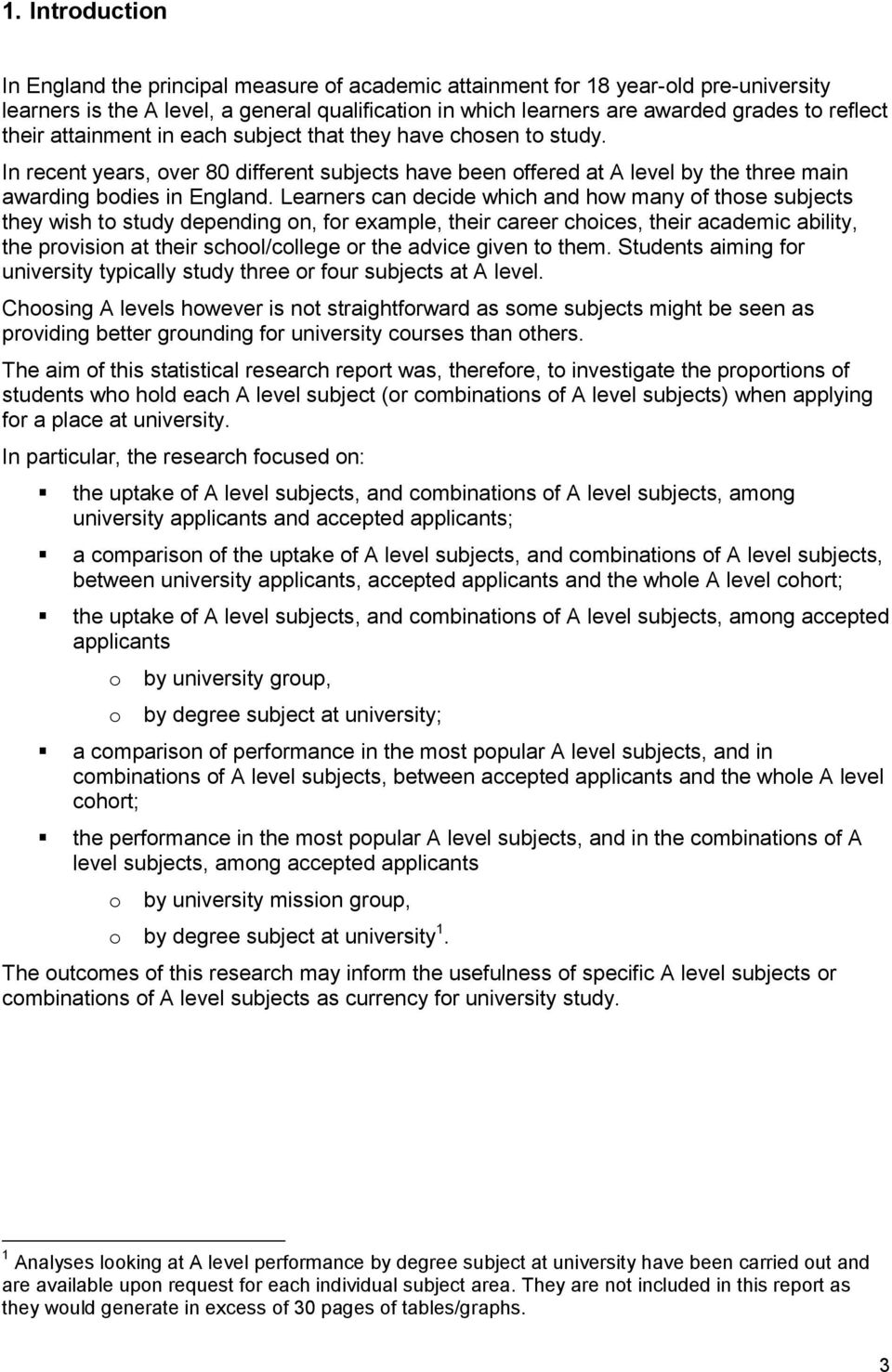
3 1. Introduction In England the principal measure of academic attainment for 18 year-old pre-university learners is the A level, a general qualification in which learners are awarded grades to reflect their attainment in each subject that they have chosen to study. In recent years, over 80 different subjects have been offered at A level by the three main awarding bodies in England. Learners can decide which and how many of those subjects they wish to study depending on, for example, their career choices, their academic ability, the provision at their school/college or the advice given to them. Students aiming for university typically study three or four subjects at A level. Choosing A levels however is not straightforward as some subjects might be seen as providing better grounding for university courses than others. The aim of this statistical research report was, therefore, to investigate the proportions of students who hold each A level subject (or combinations of A level subjects) when applying for a place at university. In particular, the research focused on: the uptake of A level subjects, and combinations of A level subjects, among university applicants and accepted applicants; a comparison of the uptake of A level subjects, and combinations of A level subjects, between university applicants, accepted applicants and the whole A level cohort; the uptake of A level subjects, and combinations of A level subjects, among accepted applicants o by university group, o by degree subject at university; a comparison of performance in the most popular A level subjects, and in combinations of A level subjects, between accepted applicants and the whole A level cohort; the performance in the most popular A level subjects, and in the combinations of A level subjects, among accepted applicants o by university mission group, o by degree subject at university 1. The outcomes of this research may inform the usefulness of specific A level subjects or combinations of A level subjects as currency for university study. 1 Analyses looking at A level performance by degree subject at university have been carried out and are available upon request for each individual subject area. They are not included in this report as they would generate in excess of 30 pages of tables/graphs. 3
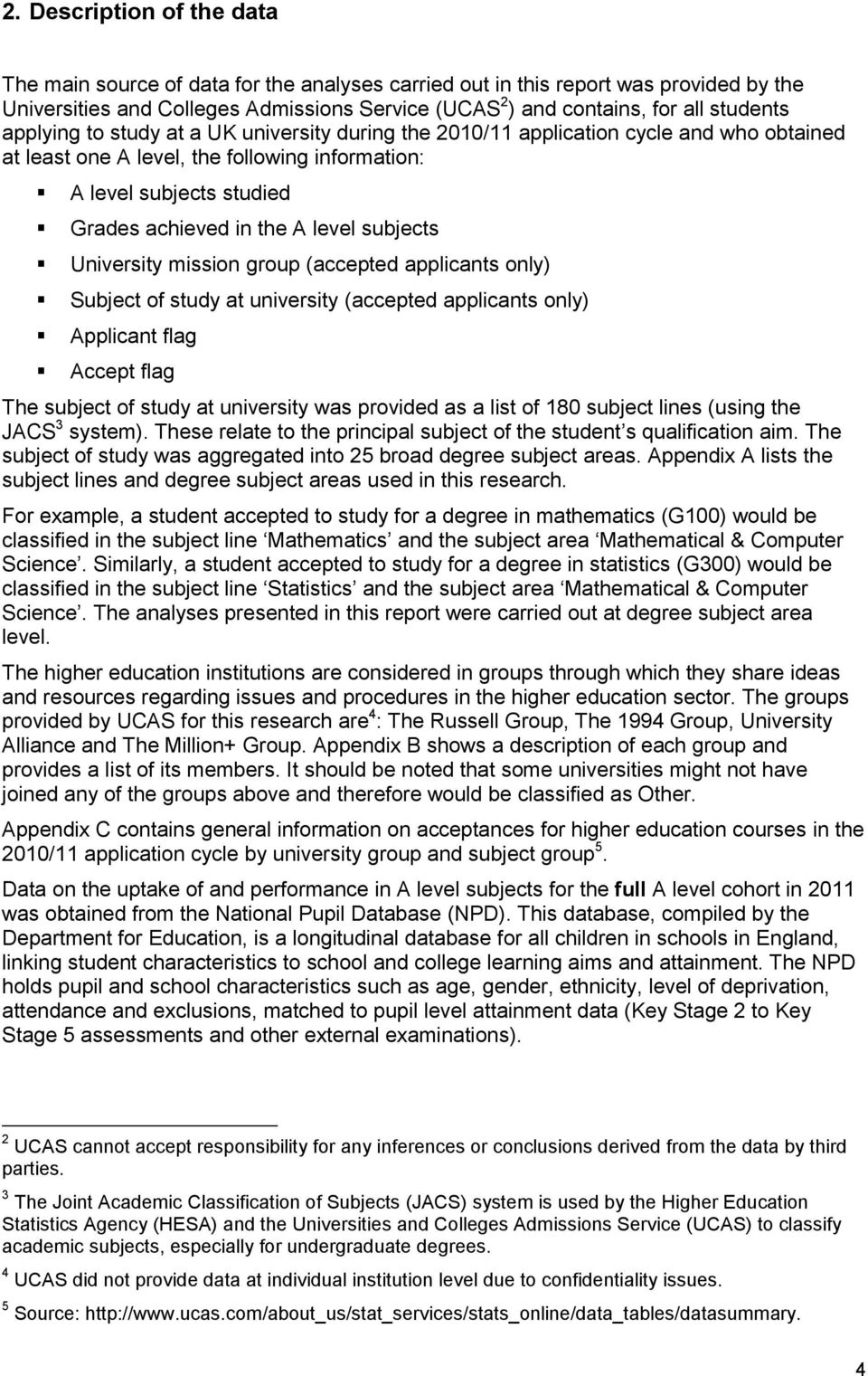
4 2. Description of the data The main source of data for the analyses carried out in this report was provided by the Universities and Colleges Admissions Service (UCAS 2 ) and contains, for all students applying to study at a UK university during the 2010/11 application cycle and who obtained at least one A level, the following information: A level subjects studied Grades achieved in the A level subjects University mission group (accepted applicants only) Subject of study at university (accepted applicants only) Applicant flag Accept flag The subject of study at university was provided as a list of 180 subject lines (using the JACS 3 system). These relate to the principal subject of the student s qualification aim. The subject of study was aggregated into 25 broad degree subject areas. Appendix A lists the subject lines and degree subject areas used in this research. For example, a student accepted to study for a degree in mathematics (G100) would be classified in the subject line Mathematics and the subject area Mathematical & Computer Science. Similarly, a student accepted to study for a degree in statistics (G300) would be classified in the subject line Statistics and the subject area Mathematical & Computer Science. The analyses presented in this report were carried out at degree subject area level. The higher education institutions are considered in groups through which they share ideas and resources regarding issues and procedures in the higher education sector. The groups provided by UCAS for this research are 4 : The Russell Group, The 1994 Group, University Alliance and The Million+ Group. Appendix B shows a description of each group and provides a list of its members. It should be noted that some universities might not have joined any of the groups above and therefore would be classified as Other. Appendix C contains general information on acceptances for higher education courses in the 2010/11 application cycle by university group and subject group 5. Data on the uptake of and performance in A level subjects for the full A level cohort in 2011 was obtained from the National Pupil Database (NPD). This database, compiled by the Department for Education, is a longitudinal database for all children in schools in England, linking student characteristics to school and college learning aims and attainment. The NPD holds pupil and school characteristics such as age, gender, ethnicity, level of deprivation, attendance and exclusions, matched to pupil level attainment data (Key Stage 2 to Key Stage 5 assessments and other external examinations). 2 UCAS cannot accept responsibility for any inferences or conclusions derived from the data by third parties. 3 The Joint Academic Classification of Subjects (JACS) system is used by the Higher Education Statistics Agency (HESA) and the Universities and Colleges Admissions Service (UCAS) to classify academic subjects, especially for undergraduate degrees. 4 UCAS did not provide data at individual institution level due to confidentiality issues. 5 Source: 4
5 In the following sections of this report, descriptive statistics provide information on the destinations (universities and degree subject areas) of students with each A level subject and with the most popular combinations of A level subjects. 5

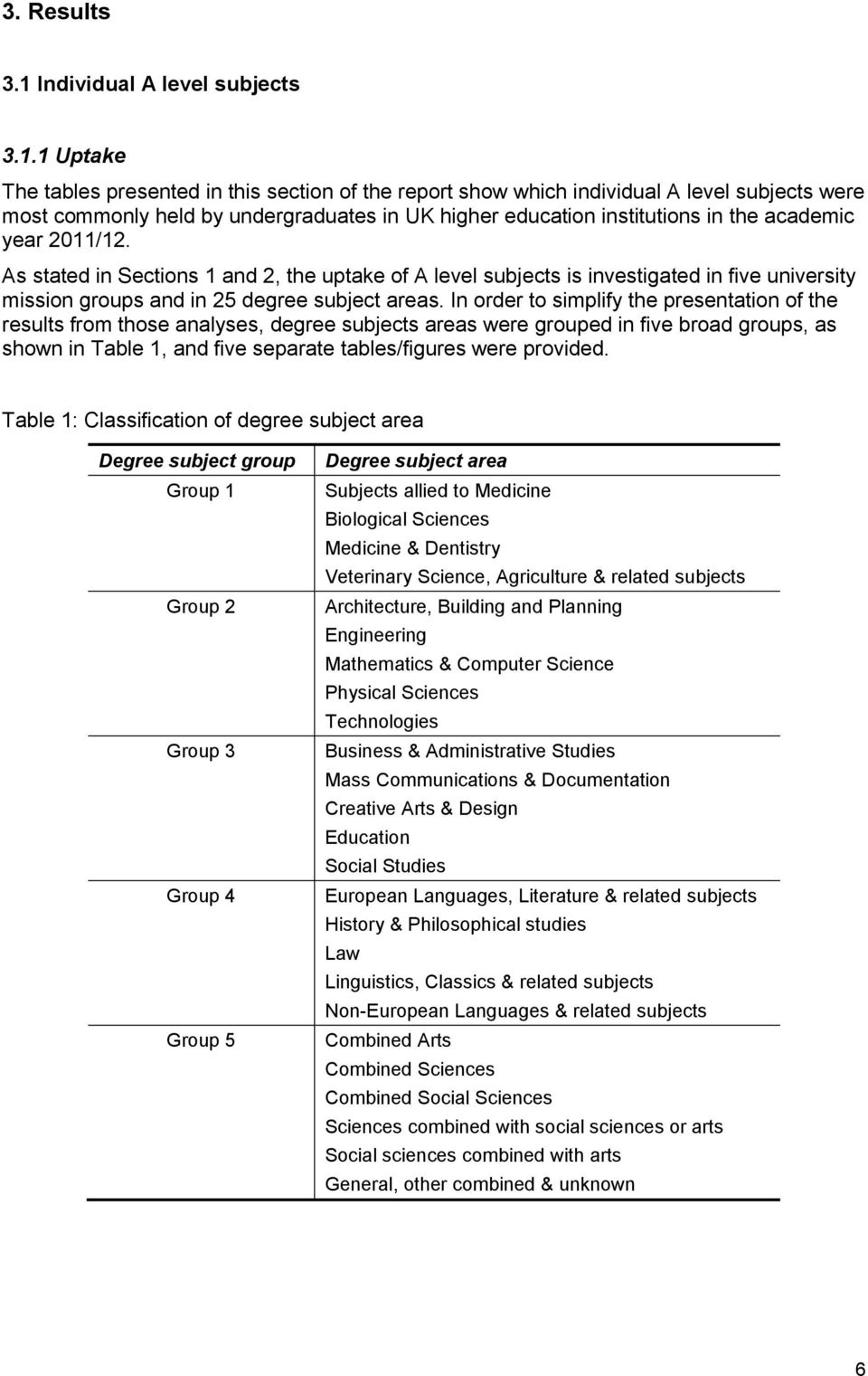
6 3. Results 3.1 Individual A level subjects Uptake The tables presented in this section of the report show which individual A level subjects were most commonly held by undergraduates in UK higher education institutions in the academic year 2011/12. As stated in Sections 1 and 2, the uptake of A level subjects is investigated in five university mission groups and in 25 degree subject areas. In order to simplify the presentation of the results from those analyses, degree subjects areas were grouped in five broad groups, as shown in Table 1, and five separate tables/figures were provided. Table 1: Classification of degree subject area Degree subject group Group 1 Group 2 Group 3 Group 4 Group 5 Degree subject area Subjects allied to Medicine Biological Sciences Medicine & Dentistry Veterinary Science, Agriculture & related subjects Architecture, Building and Planning Engineering Mathematics & Computer Science Physical Sciences Technologies Business & Administrative Studies Mass Communications & Documentation Creative Arts & Design Education Social Studies European Languages, Literature & related subjects History & Philosophical studies Law Linguistics, Classics & related subjects Non-European Languages & related subjects Combined Arts Combined Sciences Combined Social Sciences Sciences combined with social sciences or arts Social sciences combined with arts General, other combined & unknown 6
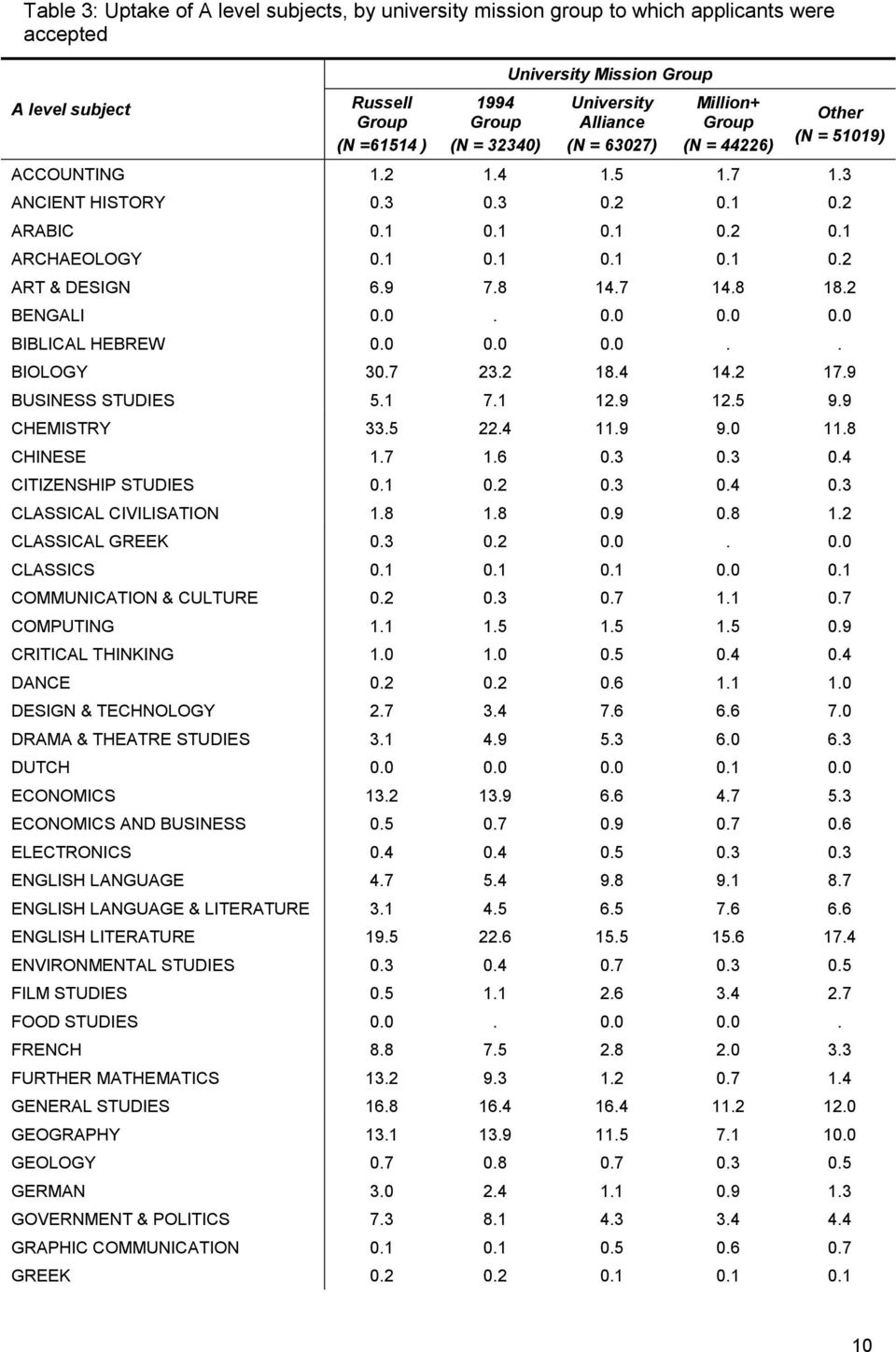
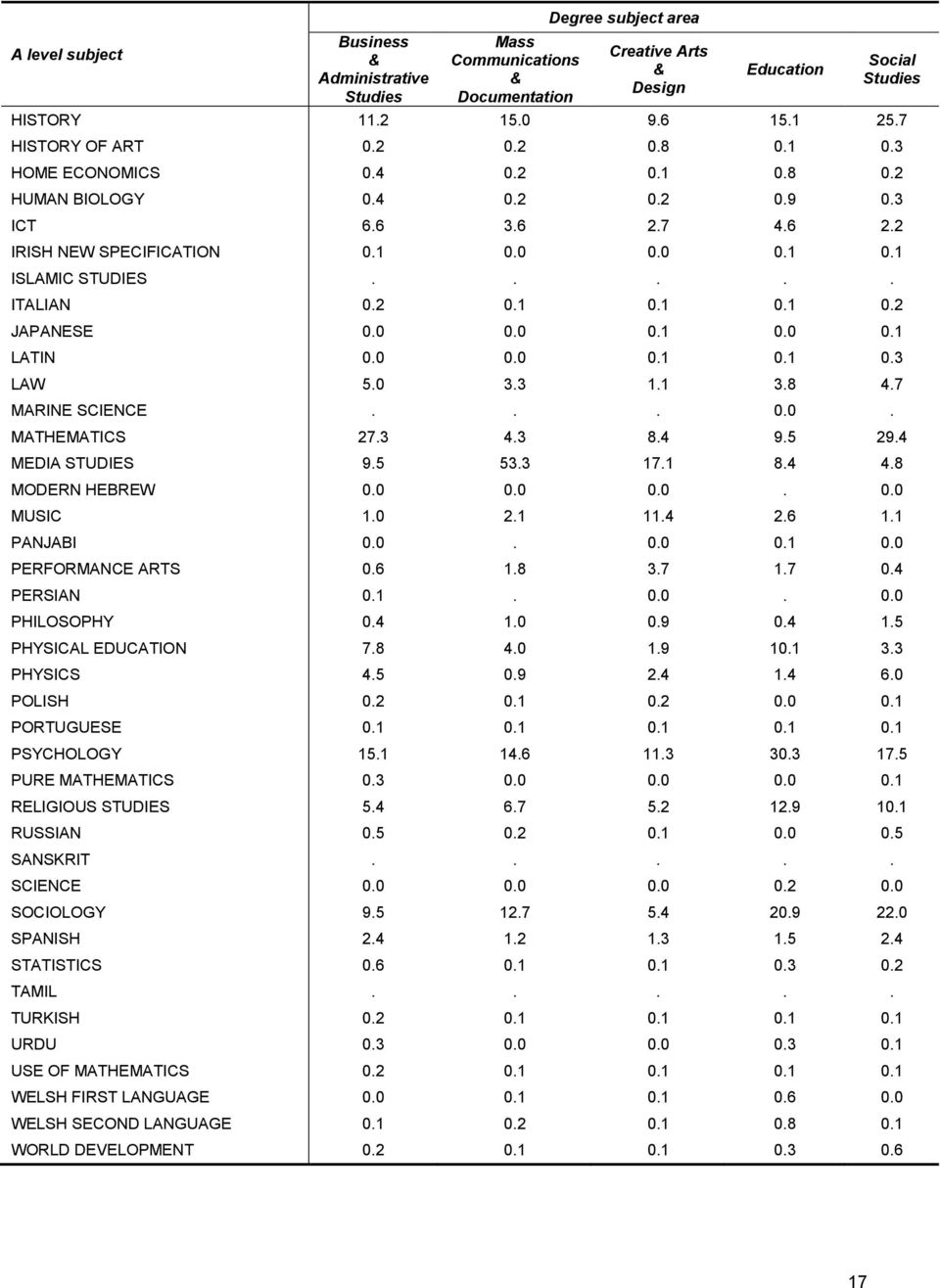
7 Some of the tables in this section display a comparison of the uptake of A level subjects between university applicants, accepted applicants and the whole A level cohort. It should be noted though that some A level subjects featured in the UCAS data and not in the June 2011 extract of the NPD. Some examples of this were Divinity, Hindi, Biblical Hebrew or Islamic Studies, which students applying to university held but did not appear in the NPD. One possible explanation for this is that the coding of the subjects was different in both datasets and, for example, Biblical Hebrew, present in the UCAS data as such, appeared in the NPD under Other Classical Languages. Table 2 shows the uptake of individual A level subjects among university applicants in the 2010/11 application cycle and it compares that to the uptake of these subjects by the whole A level cohort in All A level subjects present in the UCAS data were included in the table and were ordered alphabetically. Thus, Accounting, the subject presented first, was taken by 1.5% of the university applicants in the 2010/11 admissions cycle. This compares with Accounting being taken by 1.4% of the accepted applicants for undergraduate courses and 0.9% of the A level cohort in The most popular subject among university applicants was Mathematics (around 30% of the accepted applicants held an A level in this subject), followed by Biology, History, Chemistry and English Literature. It should be noted that the order of the subjects by their popularity was fairly similar in all three groups of students. The percentages of students holding STEM (Science, Technology, Engineering and Mathematics) subjects at A level was higher among accepted applicants and university applicants in general than among all A level students. This pattern was also similar in most humanities subjects but reversed in subjects such as Art & Design, Music, and Design & Technology. The uptake of individual A level subjects (as above) is presented, broken down by degree subject and university mission group in Table 3 and Tables 4(a) to 4(e), respectively. Table 3 shows, for example, that Mathematics was taken by 50.9% of the accepted applicants to Russell Group universities, 43.3% of the accepted applicants to universities in the 1994 Group, and 20.9% and 15.7% of the accepted applicants to universities in the University Alliance and the Million+ groups, respectively. Table 3 also shows that students accepted to Russell Group and 1994 Group universities held in higher proportions A levels in other STEM subjects (e.g. Biology, Chemistry, Physics, Further Mathematics) and in foreign languages (e.g. French, German, Spanish) than students accepted to universities in the University Alliance or the Million+ Group. There was also variation in the uptake between university groups of more applied subjects (e.g. Design & Technology, Art & Design, Business Studies, ICT, Media Studies) or humanities (e.g. Psychology, Sociology). However, higher proportions of students in the University Alliance or the Million+ Group universities held A levels in those subjects than students in universities of the Russell Group and the 1994 Group. Tables 4(a) to 4(e), presenting the uptake of individual A level subjects by degree subject, show, for example, that Mathematics was taken by 68.2% of the candidates accepted to pursue a degree in Mathematics & Computer Science, by 33.2% of the candidates accepted to Subjects allied to Medicine degrees and by only 18.2% of the candidates accepted to study European Languages, Literature & related subjects. 7

8 A level subject Table 2: Uptake of A level subjects 6 University applicants (N = ) Accepted applicants (N = ) A level students (N = ) Acceptance rate (%) ACCOUNTING ANCIENT HISTORY ARABIC ARCHAEOLOGY ART & DESIGN BENGALI BIBLICAL HEBREW BIOLOGY BUSINESS STUDIES CHEMISTRY CHINESE CITIZENSHIP STUDIES CLASSICAL CIVILISATION CLASSICAL GREEK CLASSICS COMMUNICATION & CULTURE COMPUTING CRITICAL THINKING DANCE DESIGN & TECHNOLOGY DIVINITY DRAMA & THEATRE STUDIES DUTCH ECONOMICS ECONOMICS AND BUSINESS ELECTRONICS ENGLISH LANGUAGE ENGLISH LANGUAGE & LITERATURE ENGLISH LITERATURE ENVIRONMENTAL STUDIES FILM STUDIES FOOD STUDIES FRENCH FURTHER MATHEMATICS GENERAL STUDIES GEOGRAPHY GEOLOGY GERMAN GOVERNMENT & POLITICS GRAPHIC COMMUNICATION In the following tables percentages have been rounded and, therefore, even when the uptake is 0.0 there are a very small number of candidates taking the A level subject.. indicates that no candidates took the subject. 8

9 A level subject University applicants (N = ) Accepted applicants (N = ) A level students (N = ) Acceptance rate (%) GREEK GUJARATI HINDI HISTORY HISTORY OF ART HOME ECONOMICS HUMAN BIOLOGY ICT IRISH NEW SPECIFICATION ISLAMIC STUDIES ITALIAN JAPANESE LATIN LAW MARINE SCIENCE MATHEMATICS MEDIA STUDIES MODERN HEBREW MUSIC PANJABI PERFORMANCE ARTS PERSIAN PHILOSOPHY PHYSICAL EDUCATION PHYSICS POLISH PORTUGUESE PSYCHOLOGY PURE MATHEMATICS RELIGIOUS STUDIES RUSSIAN SANSKRIT SCIENCE SOCIOLOGY SPANISH STATISTICS TAMIL TURKISH URDU USE OF MATHEMATICS WELSH FIRST LANGUAGE WELSH SECOND LANGUAGE WORLD DEVELOPMENT

10 Table 3: Uptake of A level subjects, by university mission group to which applicants were accepted A level subject Russell Group (N =61514 ) 1994 Group (N = 32340) University Mission Group University Alliance (N = 63027) Million+ Group (N = 44226) Other (N = 51019) ACCOUNTING ANCIENT HISTORY ARABIC ARCHAEOLOGY ART & DESIGN BENGALI BIBLICAL HEBREW BIOLOGY BUSINESS STUDIES CHEMISTRY CHINESE CITIZENSHIP STUDIES CLASSICAL CIVILISATION CLASSICAL GREEK CLASSICS COMMUNICATION & CULTURE COMPUTING CRITICAL THINKING DANCE DESIGN & TECHNOLOGY DRAMA & THEATRE STUDIES DUTCH ECONOMICS ECONOMICS AND BUSINESS ELECTRONICS ENGLISH LANGUAGE ENGLISH LANGUAGE & LITERATURE ENGLISH LITERATURE ENVIRONMENTAL STUDIES FILM STUDIES FOOD STUDIES FRENCH FURTHER MATHEMATICS GENERAL STUDIES GEOGRAPHY GEOLOGY GERMAN GOVERNMENT & POLITICS GRAPHIC COMMUNICATION GREEK
11 A level subject Russell Group (N =61514 ) 1994 Group (N = 32340) University Mission Group University Alliance (N = 63027) Million+ Group (N = 44226) Other (N = 51019) GUJARATI HINDI HISTORY HISTORY OF ART HOME ECONOMICS HUMAN BIOLOGY ICT IRISH NEW SPECIFICATION ISLAMIC STUDIES ITALIAN JAPANESE LATIN LAW MARINE SCIENCE MATHEMATICS MEDIA STUDIES MODERN HEBREW MUSIC PANJABI PERFORMANCE ARTS PERSIAN PHILOSOPHY PHYSICAL EDUCATION PHYSICS POLISH PORTUGUESE PSYCHOLOGY PURE MATHEMATICS RELIGIOUS STUDIES RUSSIAN SANSKRIT SCIENCE SOCIOLOGY SPANISH STATISTICS TAMIL TURKISH URDU USE OF MATHEMATICS WELSH FIRST LANGUAGE WELSH SECOND LANGUAGE WORLD DEVELOPMENT

12 Table 4(a): Uptake of A level subjects, by degree subject area to which applicants were accepted ~ Group 1 Degree subject area A level subject Subjects allied to Medicine Biological Sciences Medicine & Dentistry Veterinary Science, Agriculture & Related subjects ACCOUNTING ANCIENT HISTORY ARABIC ARCHAEOLOGY ART & DESIGN BENGALI BIBLICAL HEBREW BIOLOGY BUSINESS STUDIES CHEMISTRY CHINESE CITIZENSHIP STUDIES CLASSICAL CIVILISATION CLASSICAL GREEK CLASSICS COMMUNICATION & CULTURE COMPUTING CRITICAL THINKING DANCE DESIGN & TECHNOLOGY DRAMA & THEATRE STUDIES DUTCH ECONOMICS ECONOMICS AND BUSINESS ELECTRONICS ENGLISH LANGUAGE ENGLISH LANGUAGE & LITERATURE ENGLISH LITERATURE ENVIRONMENTAL STUDIES FILM STUDIES FOOD STUDIES FRENCH FURTHER MATHEMATICS GENERAL STUDIES GEOGRAPHY GEOLOGY GERMAN GOVERNMENT & POLITICS GRAPHIC COMMUNICATION GREEK GUJARATI HINDI

13 Degree subject area A level subject Subjects allied to Medicine Biological Sciences Medicine & Dentistry Veterinary Science, Agriculture & Related subjects HISTORY HISTORY OF ART HOME ECONOMICS HUMAN BIOLOGY ICT IRISH NEW SPECIFICATION ISLAMIC STUDIES.... ITALIAN JAPANESE LATIN LAW MARINE SCIENCE MATHEMATICS MEDIA STUDIES MODERN HEBREW MUSIC PANJABI PERFORMANCE ARTS PERSIAN PHILOSOPHY PHYSICAL EDUCATION PHYSICS POLISH PORTUGUESE PSYCHOLOGY PURE MATHEMATICS RELIGIOUS STUDIES RUSSIAN SANSKRIT.... SCIENCE SOCIOLOGY SPANISH STATISTICS TAMIL TURKISH URDU USE OF MATHEMATICS WELSH FIRST LANGUAGE WELSH SECOND LANGUAGE WORLD DEVELOPMENT

14 Table 4(b): Uptake of A level subjects, by degree subject area to which applicants were accepted ~ Group 2 Degree subject area A level subject Architecture, Building and Planning Engineering Mathematics & Computer Science Physical Sciences Technologies ACCOUNTING ANCIENT HISTORY ARABIC ARCHAEOLOGY ART & DESIGN BENGALI BIBLICAL HEBREW..... BIOLOGY BUSINESS STUDIES CHEMISTRY CHINESE CITIZENSHIP STUDIES CLASSICAL CIVILISATION CLASSICAL GREEK CLASSICS COMMUNICATION & CULTURE COMPUTING CRITICAL THINKING DANCE DESIGN & TECHNOLOGY DRAMA & THEATRE STUDIES DUTCH ECONOMICS ECONOMICS AND BUSINESS ELECTRONICS ENGLISH LANGUAGE ENGLISH LANGUAGE & LITERATURE ENGLISH LITERATURE ENVIRONMENTAL STUDIES FILM STUDIES FOOD STUDIES FRENCH FURTHER MATHEMATICS GENERAL STUDIES GEOGRAPHY GEOLOGY GERMAN GOVERNMENT & POLITICS GRAPHIC COMMUNICATION GREEK GUJARATI

15 Degree subject area A level subject Architecture, Building and Planning Engineering Mathematics & Computer Science Physical Sciences Technologies HINDI..... HISTORY HISTORY OF ART HOME ECONOMICS HUMAN BIOLOGY ICT IRISH NEW SPECIFICATION ISLAMIC STUDIES..... ITALIAN JAPANESE LATIN LAW MARINE SCIENCE..... MATHEMATICS MEDIA STUDIES MODERN HEBREW MUSIC PANJABI PERFORMANCE ARTS PERSIAN PHILOSOPHY PHYSICAL EDUCATION PHYSICS POLISH PORTUGUESE PSYCHOLOGY PURE MATHEMATICS RELIGIOUS STUDIES RUSSIAN SANSKRIT..... SCIENCE SOCIOLOGY SPANISH STATISTICS TAMIL..... TURKISH URDU USE OF MATHEMATICS WELSH FIRST LANGUAGE WELSH SECOND LANGUAGE WORLD DEVELOPMENT

16 A level subject Table 4(c): Uptake of A level subjects, by degree subject area to which applicants were accepted ~ Group 3 Business & Administrative Studies Mass Communications & Documentation Degree subject area Creative Arts & Design Education ACCOUNTING ANCIENT HISTORY ARABIC ARCHAEOLOGY ART & DESIGN BENGALI BIBLICAL HEBREW BIOLOGY BUSINESS STUDIES CHEMISTRY CHINESE CITIZENSHIP STUDIES CLASSICAL CIVILISATION CLASSICAL GREEK CLASSICS COMMUNICATION & CULTURE COMPUTING CRITICAL THINKING DANCE DESIGN & TECHNOLOGY DRAMA & THEATRE STUDIES DUTCH HINDI Social Studies ECONOMICS ECONOMICS AND BUSINESS ELECTRONICS ENGLISH LANGUAGE ENGLISH LANGUAGE & LITERATURE ENGLISH LITERATURE ENVIRONMENTAL STUDIES FILM STUDIES FOOD STUDIES FRENCH FURTHER MATHEMATICS GENERAL STUDIES GEOGRAPHY GEOLOGY GERMAN GOVERNMENT & POLITICS GRAPHIC COMMUNICATION GREEK GUJARATI

17 A level subject Business & Administrative Studies Mass Communications & Documentation Degree subject area Creative Arts & Design Education Social Studies HISTORY HISTORY OF ART HOME ECONOMICS HUMAN BIOLOGY ICT IRISH NEW SPECIFICATION ISLAMIC STUDIES..... ITALIAN JAPANESE LATIN LAW MARINE SCIENCE MATHEMATICS MEDIA STUDIES MODERN HEBREW MUSIC PANJABI PERFORMANCE ARTS PERSIAN PHILOSOPHY PHYSICAL EDUCATION PHYSICS POLISH PORTUGUESE PSYCHOLOGY PURE MATHEMATICS RELIGIOUS STUDIES RUSSIAN SANSKRIT..... SCIENCE SOCIOLOGY SPANISH STATISTICS TAMIL..... TURKISH URDU USE OF MATHEMATICS WELSH FIRST LANGUAGE WELSH SECOND LANGUAGE WORLD DEVELOPMENT
18 A level subject Table 4(d): Uptake of A level subjects, by degree subject area to which applicants were accepted ~ Group 4 European Languages, Literature & related History & Philosophical studies Degree subject area Law Linguistics, Classics & related Non-European Languages & related ACCOUNTING ANCIENT HISTORY ARABIC ARCHAEOLOGY ART & DESIGN BENGALI BIBLICAL HEBREW..... BIOLOGY BUSINESS STUDIES CHEMISTRY CHINESE CITIZENSHIP STUDIES CLASSICAL CIVILISATION CLASSICAL GREEK CLASSICS COMMUNICATION & CULTURE COMPUTING CRITICAL THINKING DANCE DESIGN & TECHNOLOGY DRAMA & THEATRE STUDIES DUTCH ECONOMICS ECONOMICS AND BUSINESS ELECTRONICS ENGLISH LANGUAGE ENGLISH LANGUAGE & LITERATURE ENGLISH LITERATURE ENVIRONMENTAL STUDIES FILM STUDIES FOOD STUDIES..... FRENCH FURTHER MATHEMATICS GENERAL STUDIES GEOGRAPHY GEOLOGY GERMAN GOVERNMENT & POLITICS GRAPHIC COMMUNICATION GREEK GUJARATI

19 A level subject European Languages, Literature & related History & Philosophical studies Degree subject area Law Linguistics, Classics & related Non-European Languages & related HINDI HISTORY HISTORY OF ART HOME ECONOMICS HUMAN BIOLOGY ICT IRISH NEW SPECIFICATION ISLAMIC STUDIES..... ITALIAN JAPANESE LATIN LAW MARINE SCIENCE..... MATHEMATICS MEDIA STUDIES MODERN HEBREW MUSIC PANJABI PERFORMANCE ARTS PERSIAN PHILOSOPHY PHYSICAL EDUCATION PHYSICS POLISH PORTUGUESE PSYCHOLOGY PURE MATHEMATICS RELIGIOUS STUDIES RUSSIAN SANSKRIT SCIENCE SOCIOLOGY SPANISH STATISTICS TAMIL..... TURKISH URDU USE OF MATHEMATICS WELSH FIRST LANGUAGE WELSH SECOND LANGUAGE WORLD DEVELOPMENT

20 A level subject Table 4(e): Uptake of A level subjects, by degree subject area to which applicants were accepted ~ Group 5 Combined Arts Combined Sciences Combined Social Sciences Degree subject area Sciences combined with social sciences or arts Social sciences combined with arts General, other combined & unknown ACCOUNTING ANCIENT HISTORY ARABIC ARCHAEOLOGY ART & DESIGN BENGALI BIBLICAL HEBREW BIOLOGY BUSINESS STUDIES CHEMISTRY CHINESE CITIZENSHIP STUDIES CLASSICAL CIVILISATION CLASSICAL GREEK CLASSICS COMMUNICATION & CULTURE COMPUTING CRITICAL THINKING DANCE DESIGN & TECHNOLOGY DRAMA & THEATRE STUDIES DUTCH ECONOMICS ECONOMICS AND BUSINESS ELECTRONICS ENGLISH LANGUAGE ENGLISH LANGUAGE & LITERATURE ENGLISH LITERATURE ENVIRONMENTAL STUDIES FILM STUDIES FOOD STUDIES FRENCH FURTHER MATHEMATICS GENERAL STUDIES GEOGRAPHY GEOLOGY GERMAN GOVERNMENT & POLITICS GRAPHIC COMMUNICATION GREEK GUJARATI HINDI
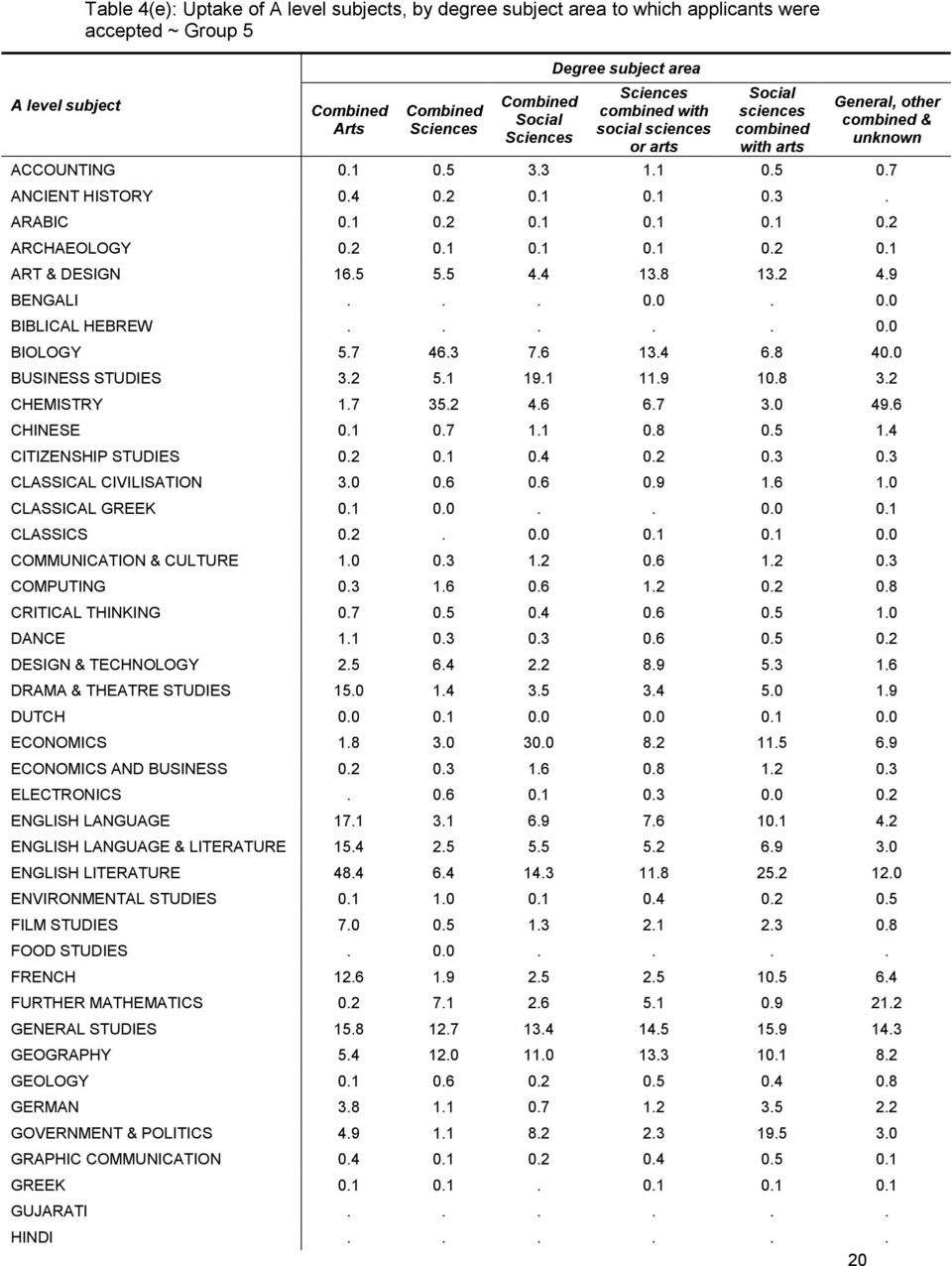
21 A level subject Combined Arts Combined Sciences Combined Social Sciences Degree subject area Sciences combined with social sciences or arts Social sciences combined with arts General, other combined & unknown HISTORY HISTORY OF ART HOME ECONOMICS HUMAN BIOLOGY ICT IRISH NEW SPECIFICATION ISLAMIC STUDIES ITALIAN JAPANESE LATIN LAW MARINE SCIENCE MATHEMATICS MEDIA STUDIES MODERN HEBREW MUSIC PANJABI PERFORMANCE ARTS PERSIAN PHILOSOPHY PHYSICAL EDUCATION PHYSICS POLISH PORTUGUESE PSYCHOLOGY PURE MATHEMATICS RELIGIOUS STUDIES RUSSIAN SANSKRIT SCIENCE SOCIOLOGY SPANISH STATISTICS TAMIL TURKISH URDU USE OF MATHEMATICS WELSH FIRST LANGUAGE WELSH SECOND LANGUAGE WORLD DEVELOPMENT
22 3.1.2 Performance This section of the report focuses on performance in the most popular A level subjects among university applicants overall and broken down by university mission group. Tables 5 and 6 show the percentages of students achieving particular grades (A* and at least grades A, B and C) in each A level subject, as a percentage of those taking the A level subject. Only A level subjects with an overall uptake level of more than 1% were included in the analyses. Subjects were ordered by overall uptake (highest first). In particular, Table 5 shows that top grades were more frequent among accepted applicants than among rejected applicants. For example, among the accepted applicants for undergraduate courses with an A level in Mathematics, 20.7% had an A* and 51.6% had at least grade A. This compares with 14.3% and 36.4% among rejected applicants. Tables 7 to 10 show, respectively, the percentages achieving grade A*, at least grade A, at least grade B, and at least grade C in each A level subject, by university mission group. As above, only A level subjects with an overall uptake level of more than 1% were included in these tables. As an example, Table 8 shows that there were more candidates with at least grade A in A level Mathematics in universities of the Russell Group and 1994 Group (79.8% and 65.9%, respectively) than in universities in any of the other mission groups (13.2% in universities of the University Alliance and 7.2% in universities of the Million+ Group). 22
23 Table 5: Percentages of students achieving grade A* and at least grade A in each A level subject A level subject Accepted candidates Grade A* Rejected candidates At least grade A Accepted candidates Rejected candidates Number of candidates with the A Level Accepted candidates Rejected candidates MATHEMATICS BIOLOGY PSYCHOLOGY HISTORY CHEMISTRY ENGLISH LITERATURE GENERAL STUDIES ART & DESIGN PHYSICS GEOGRAPHY SOCIOLOGY BUSINESS STUDIES ECONOMICS MEDIA STUDIES ENGLISH LANGUAGE RELIGIOUS STUDIES PHYSICAL EDUCATION ENGLISH LANGUAGE & LITERATURE DESIGN & TECHNOLOGY GOVERNMENT & POLITICS FURTHER MATHEMATICS DRAMA & THEATRE STUDIES FRENCH LAW ICT MUSIC SPANISH FILM STUDIES GERMAN ACCOUNTING COMPUTING CLASSICAL CIVILISATION PHILOSOPHY
24 Table 6: Percentages of students achieving at least grade B and at least grade C in each A level subject A level subject At least grade B Accepted candidates Rejected candidates At least grade C Accepted candidates Rejected candidates Number of candidates with the A Level Accepted candidates Rejected candidates MATHEMATICS BIOLOGY PSYCHOLOGY HISTORY CHEMISTRY ENGLISH LITERATURE GENERAL STUDIES ART & DESIGN PHYSICS GEOGRAPHY SOCIOLOGY BUSINESS STUDIES ECONOMICS MEDIA STUDIES ENGLISH LANGUAGE RELIGIOUS STUDIES PHYSICAL EDUCATION ENGLISH LANGUAGE & LITERATURE DESIGN & TECHNOLOGY GOVERNMENT & POLITICS FURTHER MATHEMATICS DRAMA & THEATRE STUDIES FRENCH LAW ICT MUSIC SPANISH FILM STUDIES GERMAN ACCOUNTING COMPUTING CLASSICAL CIVILISATION PHILOSOPHY
25 Table 7: Percentages achieving grade A* in each A level subject, by university mission group A level subject Russell Group 1994 Group University Mission Group University Alliance Million+ Group MATHEMATICS BIOLOGY PSYCHOLOGY HISTORY CHEMISTRY ENGLISH LITERATURE GENERAL STUDIES ART & DESIGN PHYSICS GEOGRAPHY SOCIOLOGY BUSINESS STUDIES ECONOMICS MEDIA STUDIES ENGLISH LANGUAGE RELIGIOUS STUDIES PHYSICAL EDUCATION ENGLISH LANGUAGE & LITERATURE DESIGN & TECHNOLOGY GOVERNMENT & POLITICS FURTHER MATHEMATICS DRAMA & THEATRE STUDIES FRENCH LAW ICT MUSIC SPANISH FILM STUDIES GERMAN ACCOUNTING COMPUTING CLASSICAL CIVILISATION PHILOSOPHY Other 25
26 Table 8: Percentages achieving at least a grade A in each A level subject, by university mission group A level subject Russell Group 1994 Group University Mission Group University Alliance Million+ Group MATHEMATICS BIOLOGY PSYCHOLOGY HISTORY CHEMISTRY ENGLISH LITERATURE GENERAL STUDIES ART & DESIGN PHYSICS GEOGRAPHY SOCIOLOGY BUSINESS STUDIES ECONOMICS MEDIA STUDIES ENGLISH LANGUAGE RELIGIOUS STUDIES PHYSICAL EDUCATION ENGLISH LANGUAGE & LITERATURE DESIGN & TECHNOLOGY GOVERNMENT & POLITICS FURTHER MATHEMATICS DRAMA & THEATRE STUDIES FRENCH LAW ICT MUSIC SPANISH FILM STUDIES GERMAN ACCOUNTING COMPUTING CLASSICAL CIVILISATION PHILOSOPHY Other 26
27 Table 9: Percentages achieving at least a grade B in each A level subject, by university mission group A level subject Russell Group 1994 Group University Mission Group University Alliance Million+ Group MATHEMATICS BIOLOGY PSYCHOLOGY HISTORY CHEMISTRY ENGLISH LITERATURE GENERAL STUDIES ART & DESIGN PHYSICS GEOGRAPHY SOCIOLOGY BUSINESS STUDIES ECONOMICS MEDIA STUDIES ENGLISH LANGUAGE RELIGIOUS STUDIES PHYSICAL EDUCATION ENGLISH LANGUAGE & LITERATURE DESIGN & TECHNOLOGY GOVERNMENT & POLITICS FURTHER MATHEMATICS DRAMA & THEATRE STUDIES FRENCH LAW ICT MUSIC SPANISH FILM STUDIES GERMAN ACCOUNTING COMPUTING CLASSICAL CIVILISATION PHILOSOPHY Other 27
28 Table 10: Percentages achieving at least a grade C in each A level subject, by university mission group University Mission Group A level subject Russell Group 1994 Group University Alliance Million+ Group Other MATHEMATICS BIOLOGY PSYCHOLOGY HISTORY CHEMISTRY ENGLISH LITERATURE GENERAL STUDIES ART & DESIGN PHYSICS GEOGRAPHY SOCIOLOGY BUSINESS STUDIES ECONOMICS MEDIA STUDIES ENGLISH LANGUAGE RELIGIOUS STUDIES PHYSICAL EDUCATION ENGLISH LANGUAGE & LITERATURE DESIGN & TECHNOLOGY GOVERNMENT & POLITICS FURTHER MATHEMATICS DRAMA & THEATRE STUDIES FRENCH LAW ICT MUSIC SPANISH FILM STUDIES GERMAN ACCOUNTING COMPUTING CLASSICAL CIVILISATION PHILOSOPHY
29 3.2 A level facilitating subjects A level subject choices can have an important role in determining the university courses and the universities open to students. Some university courses require a specific A level subject (or combinations of A level subjects) and others do not. However, there are some A level subjects that are required more often than others. These subjects are referred to as facilitating subjects (Russell Group, ). Subjects that can be viewed as facilitating subjects are: Biology Chemistry Physics Mathematics Further Mathematics English Literature History Geography Languages (Classical and Modern) 8 The Russell Group recommends that students take at least two facilitating subjects at A level in order to keep most options for subject choice open. Schools and colleges offer students a range of A level subjects (as listed, for example, in Table 2) but, unlike the facilitating subjects, they are unlikely to be required for any particular degree course and so choosing them does not increase students options at university. This section of the report focuses on facilitating subjects only, collating some results on this group of subjects from the previous tables. 7 Russell Group (2012). Informed choices: A Russell Group Guide to make decisions about post-16 education. The Russell Group, London. 8 Languages (classical and modern) included in this section of the report are French, German, Spanish, Latin and Classical Greek. 29
30 CLASSICAL GREEK LATIN SPANISH GERMAN FRENCH GEOGRAPHY HISTORY ENGLISH LITERATURE FURTHER MATHEMATICS MATHEMATICS PHYSICS CHEMISTRY BIOLOGY A level students Accepted applicants University applicants Figure 1: Uptake of A level facilitating subjects 30
31 CLASSICAL GREEK LATIN SPANISH GERMAN FRENCH GEOGRAPHY HISTORY ENGLISH LITERATURE FURTHER MATHEMATICS MATHEMATICS PHYSICS CHEMISTRY BIOLOGY Other Million Plus University Alliance 1994 Group Russell Group Figure 2: Uptake of A level facilitating subjects, by university mission group (accepted applicants) 31
32 BIOLOGY CHEMISTRY PHYSICS MATHEMATICS FURTHER MATHEMATICS ENGLISH LITERATURE HISTORY GEOGRAPHY FRENCH GERMAN SPANISH BIOLOGY CHEMISTRY PHYSICS MATHEMATICS FURTHER MATHEMATICS ENGLISH LITERATURE HISTORY GEOGRAPHY FRENCH GERMAN SPANISH Accepted candidates A level students Figure 3: A level facilitating subjects ~ percentages achieving at least a grade A in each subject Accepted candidates A level students Figure 4: A level facilitating subjects ~ percentages achieving at least a grade B in each subject 9 Classical Greek and Latin were not included in the performance figures, as the overall uptake was less than 1%. 32
33 BIOLOGY CHEMISTRY PHYSICS MATHEMATICS FURTHER MATHEMATICS ENGLISH LITERATURE HISTORY GEOGRAPHY FRENCH GERMAN SPANISH Accepted candidates A level students Figure 5: A level facilitating subjects ~ percentages achieving at least a grade C in each subject 33
34 3.3 Combinations of A level subjects Uptake The tables presented in this section of the report show which combinations of A level subjects were most commonly held by undergraduates in UK higher education institutions. Table 11 shows the number of A level subjects held by students. 63% of the A level cohort had three or more A levels, but this proportion was markedly higher among applicants to university (77%) and those who were accepted onto a course (80%). Note that some students may have held other qualifications in addition to A levels, such as BTEC, OCR National, or Extended Project qualifications. This was likely to be the case for students who held only one A level, for example. Table 11: Number of A level subjects taken Number of subjects A level students (N = ) Percentage of University applicants (N = ) Accepted applicants (N = ) Acceptance rate (%) Table 12 shows the number of facilitating subjects (as defined by the Russell Group and discussed in Section 3.2) held by students. The Russell Group recommends that students take at least two facilitating subjects at A level in order to keep most options for subject choice open (although they caution that some degrees, such as Music or Art, will require non-facilitating subjects to be chosen at A level). The majority of students, including those accepted at university, held A levels in fewer than two facilitating subjects. Table 12: Number of facilitating A level subjects taken Number of facilitating subjects A level students (N = ) Percentage of University applicants (N = ) Accepted applicants (N = ) Acceptance rate (%)
35 Table 13 breaks down the number of facilitating subjects held by university mission group. There is considerable variation across the groups, with students attending Russell Group universities holding the highest number of facilitating subjects (2.3 on average) and those attending Million+ Group institutions the lowest (0.9). Table 13: Number of facilitating A level subjects taken, by university mission group Number of facilitating subjects Russell Group (N = 61514) 1994 Group (N = 32340) Percentage of students at University Alliance (N = 63027) Million+ Group (N = 44226) Other (N = 51019) Table 14 shows the most popular 20 combinations of A level subjects held by applicants to university, accepted applicants, and the whole A level cohort. The data has been restricted to students who have taken at least three A levels, excluding General Studies. Notably the combinations in the list were the same for all three groups of students, although the ordering varied. The list is dominated by combinations of science subjects, with Biology, Chemistry and Mathematics being by far the most popular combination. The most common combination consisting of humanities subjects was English Literature, History and Psychology. Although as Table 2 showed, Chemistry and History were taken by approximately the same number of university applicants, Chemistry featured in nine of the top 20 combinations, whereas History was only in five. The reason is likely to be because of the variety of humanities subjects commonly taken at A level, compared to the relatively small number of science subjects. The proportion of applicants that were accepted onto a course is also shown in Table 14. There is considerable variation in this proportion between combinations, compared to the overall average for all applicants of 85.8%. Two combinations in the list have particularly low acceptance rates: Biology, Chemistry and Physics; and Biology, Chemistry, Mathematics and Physics (with rates of 76.8% and 76.7% respectively). The dataset does not contain details of intended subject of study for unsuccessful applicants, but Wilde and Hoelscher (2007) 10 found that applicants intending to follow courses in Medicine & Dentistry, and Subjects allied to Medicine were over-represented among non-placed applicants over the period Given the subject combinations involved it seems likely that the competitive nature of these courses is the reason for the relatively low acceptance rates. The acceptance rate for Chemistry, Further Mathematics, Mathematics and Physics (90.6%) was higher than the rate for the same combination without Further Mathematics (84.1%). However, this could be due to other characteristics (such as relative academic ability) of students who chose to study Further Mathematics in addition, or whose schools/colleges offered it. 10 Wilde, S. & Hoelscher, M. (2007). Missed opportunities: non-placed applicants (NPAs) in the UCAS data. Cheltenham: UCAS. 35
36 Table 14: Top 20 combinations of A level subjects Combination of A level subjects BIOLOGY + CHEMISTRY + MATHEMATICS CHEMISTRY + MATHEMATICS + PHYSICS BIOLOGY + CHEMISTRY + PSYCHOLOGY CHEMISTRY + FURTHER MATHEMATICS + MATHEMATICS + PHYSICS FURTHER MATHEMATICS + MATHEMATICS + PHYSICS A level students University applicants Accepted applicants % % % Acceptance rate (%) BIOLOGY + CHEMISTRY + PHYSICS BIOLOGY + CHEMISTRY + MATHEMATICS + PHYSICS BIOLOGY + CHEMISTRY + GEOGRAPHY ENGLISH LITERATURE + HISTORY + PSYCHOLOGY BIOLOGY + MATHEMATICS + PHYSICS ENGLISH LITERATURE + GOVERNMENT & POLITICS + HISTORY BIOLOGY + CHEMISTRY + HISTORY DESIGN & TECHNOLOGY + MATHEMATICS + PHYSICS ENGLISH LITERATURE + HISTORY + RELIGIOUS STUDIES ECONOMICS + MATHEMATICS + PHYSICS BIOLOGY + PHYSICAL EDUCATION + PSYCHOLOGY BIOLOGY + MATHEMATICS + PSYCHOLOGY GEOGRAPHY + MATHEMATICS + PHYSICS ART & DESIGN + ENGLISH LITERATURE + HISTORY BIOLOGY + CHEMISTRY + ENGLISH LITERATURE
37 Tables 15 to 19 show the most popular A level subject combinations among students attending universities in different mission groups (restricted to students who have taken at least three A levels, excluding General Studies). The ing and percentage across all accepted applicants (again restricted to students with at least three A levels, excluding General Studies) is also shown for comparison. While the top two A level subject combinations overall were strongly represented in each of the university groups, there were some more unusual combinations, particularly in the Million+ Group (Law, Psychology and Sociology) and in the Russell Group (Economics, Mathematics, Further Mathematics and Physics) universities. Table 15: Most popular A level combinations for Russell Group students % 1 BIOLOGY+CHEMISTRY+MATHEMATICS CHEMISTRY+MATHEMATICS+PHYSICS CHEMISTRY+FURTHER MATHEMATICS+MATHEMATICS+PHYSICS BIOLOGY+CHEMISTRY+MATHEMATICS+PHYSICS FURTHER MATHEMATICS+MATHEMATICS+PHYSICS BIOLOGY+CHEMISTRY+GEOGRAPHY BIOLOGY+CHEMISTRY+PHYSICS BIOLOGY+CHEMISTRY+PSYCHOLOGY ENGLISH LITERATURE+GOVERNMENT & POLITICS+HISTORY ECONOMICS+FURTHER MATHEMATICS+MATHEMATICS+PHYSICS Table 16: Most popular A level combinations for 1994 Group students % 1 BIOLOGY+CHEMISTRY+MATHEMATICS CHEMISTRY+MATHEMATICS+PHYSICS FURTHER MATHEMATICS+MATHEMATICS+PHYSICS CHEMISTRY+FURTHER MATHEMATICS+MATHEMATICS+PHYSICS BIOLOGY+CHEMISTRY+MATHEMATICS+PHYSICS ENGLISH LITERATURE+GOVERNMENT & POLITICS+HISTORY ECONOMICS+MATHEMATICS+PHYSICS BIOLOGY+CHEMISTRY+PSYCHOLOGY ENGLISH LITERATURE+HISTORY+RELIGIOUS STUDIES BIOLOGY+CHEMISTRY+GEOGRAPHY
38 Table 17: Most popular A level combinations for University Alliance students % 1 BIOLOGY+CHEMISTRY+MATHEMATICS CHEMISTRY+MATHEMATICS+PHYSICS BIOLOGY+CHEMISTRY+PSYCHOLOGY BIOLOGY+CHEMISTRY+PHYSICS BIOLOGY+CHEMISTRY+GEOGRAPHY DESIGN & TECHNOLOGY+MATHEMATICS+PHYSICS ENGLISH LITERATURE+HISTORY+PSYCHOLOGY BIOLOGY+PHYSICAL EDUCATION+PSYCHOLOGY BIOLOGY+MATHEMATICS+PHYSICS FURTHER MATHEMATICS+MATHEMATICS+PHYSICS Table 18: Most popular A level combinations for Million+ Group students % 1 BIOLOGY+CHEMISTRY+MATHEMATICS BIOLOGY+CHEMISTRY+PSYCHOLOGY CHEMISTRY+MATHEMATICS+PHYSICS ENGLISH LITERATURE+PSYCHOLOGY+SOCIOLOGY ENGLISH LITERATURE+HISTORY+PSYCHOLOGY LAW+PSYCHOLOGY+SOCIOLOGY BIOLOGY+PHYSICAL EDUCATION+PSYCHOLOGY BIOLOGY+CHEMISTRY+PHYSICS ENGLISH LANGUAGE+PSYCHOLOGY+SOCIOLOGY BIOLOGY+MATHEMATICS+PSYCHOLOGY
39 Table 19: Most popular A level combinations for students at other universities % 1 BIOLOGY+CHEMISTRY+MATHEMATICS CHEMISTRY+MATHEMATICS+PHYSICS BIOLOGY+CHEMISTRY+PSYCHOLOGY BIOLOGY+CHEMISTRY+PHYSICS BIOLOGY+CHEMISTRY+GEOGRAPHY BIOLOGY+CHEMISTRY+MATHEMATICS+PHYSICS ENGLISH LITERATURE+HISTORY+PSYCHOLOGY BIOLOGY+MATHEMATICS+PHYSICS ART & DESIGN+ENGLISH LITERATURE+HISTORY ENGLISH LITERATURE+GOVERNMENT & POLITICS+HISTORY Table 20 shows the most popular A level combinations among applicants (with at least three A levels excluding General Studies) who were not accepted onto a course at university, with the ing and percentage across accepted applicants shown for comparison. As also seen in Table 14, students with Biology, Chemistry and Physics were particularly overrepresented which may be due to the competitive nature of admissions onto courses in Medicine & Dentistry, and Subjects allied to Medicine. Table 20: Most popular A level combinations among non-accepted applicants (accepted applicants) % (accepted applicants) 1 BIOLOGY+CHEMISTRY+MATHEMATICS CHEMISTRY+MATHEMATICS+PHYSICS BIOLOGY+CHEMISTRY+MATHEMATICS+PHYSICS BIOLOGY+CHEMISTRY+PHYSICS BIOLOGY+CHEMISTRY+PSYCHOLOGY FURTHER MATHEMATICS+MATHEMATICS+PHYSICS CHEMISTRY+FURTHER MATHEMATICS+MATHEMATICS+PHYSICS BIOLOGY+CHEMISTRY+GEOGRAPHY BIOLOGY+CHEMISTRY+HISTORY ECONOMICS+MATHEMATICS+PHYSICS Appendix D shows tables of popular combinations by university subject area. 39
40 3.3.2 Performance Table 21 shows the cumulative distribution of A level grades held by applicants to university, accepted applicants, and the whole A level cohort. This analysis is restricted to students holding more than three A levels (excluding General Studies). For clarity and brevity, A* grades are represented as * in this table. The grades have been compared on an individual basis, so higher grades in one A level do not compensate for lower grades in another; for example, **C is not classed as ABB or above. Only the best three grades held by each student have been used for comparison. The distributions were similar between the three groups, but the highest grade combinations (for example *AA and above) were more frequent among accepted applicants than all applicants, and also more frequent among university applicants than among the whole A level cohort. Table 21: Cumulative distribution of A level grades Grade combination (at least) A level students (%) University applicants (%) Accepted applicants (%) *** **A *AA AAA AAB ABB BBB BBC BCC CCC CCD CDD DDD DDE DEE EEE Table 22 shows the percentage of candidates with A level grades equal to or exceeding two thresholds (ABB and AAB) broken down by university mission group. Approximately a third of applicants gained ABB or above, and a quarter gained AAB or above. However, there is wide variation in these measures across university groups, with around two thirds of Russell Group students holding AAB or above, but only 3% of Million+ Group students. 40
41 Table 22: Percentage of applicants gaining ABB, AAB or above, by university mission group University mission group % ABB+ % AAB+ Russell Group Group University Alliance Million+ Group Other All accepted applicants Non-placed applicants All applicants All A level students Figure 6 shows the distribution of the average A level grade 11 by university mission group among accepted students. There is a clear gulf between the grade distributions of students attending universities in the Russell and 1994 Groups and the other university groups. 11 The average A level grade for a student has been calculated under the assumption that the grade scale is linear, such that the average of ABC is B. This assumption also underlies the UCAS tariff system. 41
42 Figure 6: Average A level grade, by university mission group 42
43 Appendix A: University subjects and degree subject areas As mentioned in the report, the subject of study at university was provided as a full list of 180 subject lines (using the JACS system). These relate to the principal subject of the student s qualification aim. The subject of study can be aggregated into 25 broad subject areas. The table below presents the subject lines and the degree subject areas used in this research. Degree subject area Medicine & dentistry Subjects allied to medicine Biological sciences Veterinary science, agriculture & related subjects Physical sciences Subject line (A0) Broadly-based programmes within medicine & dentistry (A1) Pre-clinical medicine (A2) Pre-clinical dentistry (A3) Clinical medicine (A4) Clinical dentistry (A9) Others in medicine & dentistry (B0) Broadly-based programmes within subjects allied to medicine (B1) Anatomy, physiology & pathology (B2) Pharmacology, toxicology & pharmacy (B3) Complementary medicine (B4) Nutrition (B5) Ophthalmics (B6) Aural & oral sciences (B7) Nursing (B8) Medical technology (B9) Others in subjects allied to medicine (C0) Broadly-based programmes within biological sciences (C1) Biology (C2) Botany (C3) Zoology (C4) Genetics (C5) Microbiology (C6) Sports science (C7) Molecular biology, biophysics & biochemistry (C8) Psychology (C9) Others in biological sciences (D0) Broadly-based programmes within agriculture & related subjects (D1) Pre-clinical veterinary medicine (D2) Clinical veterinary medicine & dentistry (D3) Animal science (D4) Agriculture (D5) Forestry (D6) Food & beverage studies (D7) Agricultural sciences (D9) Others in veterinary sciences, agriculture & related subjects (F0) Broadly-based programmes within physical sciences (F1) Chemistry (F2) Materials science (F3) Physics (F4) Forensic & archaeological science (F5) Astronomy (F6) Geology (F7) Science of aquatic and terrestrial environments (F8) Physical geographical sciences (F9) Others in physical sciences 43
44 Degree subject area Mathematical & computer sciences Engineering Technologies Architecture, building & planning Social studies Law Subject line (G01) Broadly-based programmes within mathematical sciences (G02) Broadly-based programmes within computer science (G1) Mathematics (G2) Operational research (G3) Statistics (G4) Computer science (G5) Information systems (G6) Software engineering (G7) Artificial intelligence (G91) Others in mathematical sciences (G92) Others in computing science (H0) Broadly-based programmes within engineering & technology (H1) General engineering (H2) Civil engineering (H3) Mechanical engineering (H4) Aerospace engineering (H5) Naval architecture (H6) Electronic & electrical engineering (H7) Production & manufacturing engineering (H8) Chemical, process & energy engineering (H9) Others in engineering (J1) Minerals technology (J2) Metallurgy (J3) Ceramics & glasses (J4) Polymers & textiles (J5) Materials technology not otherwise specified (J6) Maritime technology (J7) Biotechnology (J9) Others in technology (includes Music Technology) (K0) Broadly-based programmes within architecture, building & planning (K1) Architecture (K2) Building (K3) Landscape design (K4) Planning (urban, rural & regional) (K9) Others in architecture, building & planning (L0) Broadly-based programmes within social studies (L1) Economics (L2) Politics (L3) Sociology (L4) Social policy (L5) Social work (L6) Anthropology (L7) Human & social geography (L9) Others in social studies (M0) Broadly-based programmes within law (M1) Law by area (M2) Law by topic (M9) Others in law 44
45 Degree subject area Business & administrative studies Mass communications & documentation Linguistics, classics & related European languages, literature & related Non-European languages & related Historical & philosophical studies Subject line (N0) Broadly-based programmes within business & administrative studies (N1) Business studies (N2) Management studies (N3) Finance (N4) Accounting (N5) Marketing (N6) Human resource management (N7) Office skills (N8) Hospitality, leisure, tourism & transport (N9) Others in business & administrative studies (P0) Broadly-based programmes within mass communications and documentation (P1) Information services (P2) Publicity studies (P3) Media studies (P4) Publishing (P5) Journalism (P9) Others in mass communications & documentation (Q0) Broadly-based programmes within languages (Q1) Linguistics (Q2) Comparative literary studies (Q3) English studies (Q4) Ancient language studies (Q5) Celtic studies (Q6) Latin studies (Q7) Classical Greek studies (Q8) Classical studies (Q9) Others in linguistics, classics & related subjects (R1) French studies (R2) German studies (R3) Italian studies (R4) Spanish studies (R5) Portuguese studies (R6) Scandinavian studies (R7) Russian & East European studies (R8) European studies (R9) Others in European languages, literature & related subjects (T1) Chinese studies (T2) Japanese studies (T3) South Asian studies (T4) Other Asian studies (T5) African studies (T6) Modern Middle Eastern studies (T7) American studies (T8) Australasian studies (T9) Others in Eastern, Asiatic, African, American & Australasian languages, literature & related subjects (V0) Broadly-based programmes within historical and philosophical studies (V1) History by period (V2) History by area (V3) History by topic (V4) Archaeology (V5) Philosophy (V6) Theology & religious studies (V9) Others in historical & philosophical studies 45
46 Degree subject area Creative arts & design Education Combined arts Combined sciences Combined social sciences Sciences combined with social sciences or arts Social sciences combined with arts General, other combined & unknown Subject line (W0) Broadly-based programmes within creative arts & design (W1) Fine art (W2) Design studies (W3) Music (W4) Drama (W5) Dance (W6) Cinematics & photography (W7) Crafts (W8) Imaginative writing (W9) Others in creative arts & design (X0) Broadly-based programmes within education (X1) Training teachers (X2) Research & study skills in education (X3) Academic studies in education (X9) Others in education Combs of arts/humanities Combs of languages Combs of languages with arts/humanities Y Combs of engineering/tech/building studies Y Combs of engineering/technology Y Combs of med/bio/agric sciences Y Combs of med/bio/agric sciences with physics/math sciences Y Combs of physics/math sciences Y Combs of sciences with engineering/technology Y Combs of social studies/law Y Combs of social studies/law with business Y Combs of physics/math science with arts/humanities/languages Y Combs of physics/math science with social studies/bus/law Y Combs of science/engineering with arts/humanities/languages Y Combs of science/engineering with social studies/bus/law Y Combs of social studies/bus/law with arts/humanities Y Combs of social studies/bus/law with languages Combs of three subjects, or other general courses Other courses not elsewhere classified 46
47 Appendix B: University mission groups Some universities formed groups through which they share ideas and resources regarding issues and procedures in the higher education sector. For this research, UCAS provided the following university groups: Russell Group, 1994 Group, University Alliance and Million+ Group. Universities that have not joined any of these groups were included in a separate group, labelled as Other. In this Appendix, a description taken from statements provided on their websites and a list of members of each group is provided 12. The Russell Group ( "The Russell Group is an association of leading UK research-intensive universities committed to maintaining the highest standards of research, education and knowledge transfer. The members of The Russell Group have the quality and strengths to compete successfully in the global market place for research, skills, expertise and training." "The aims and objectives of The Russell Group are to promote the interests of universities in which teaching and learning are undertaken within a culture of research excellence, and to identify and disseminate new thinking and ideas about the organisation and management of such institutions." List of member institutions of the Russell Group Cardiff University Imperial College of Science, Technology and Medicine King's College London London School of Economics and Political Science The Queen's University of Belfast The University of Manchester The University of Birmingham The University of Bristol The University of Cambridge The University of Edinburgh The University of Glasgow The University of Leeds The University of Liverpool The University of Newcastle-upon-Tyne The University of Nottingham The University of Oxford The University of Sheffield The University of Southampton The University of Warwick University College London 12 Membership of these groups has changed since the UCAS data used in this research was provided to us (April 2012). For example, the University of Durham, the University of Exeter, Queen Mary and Westfield College and the University of York joined the Russell Group in August However, analyses were carried out using the groups as in April
48 1994 Group ( "The 1994 Group represents nineteen of the UK's most research-intensive and internationally renowned universities. The 1994 Group's mission is to promote excellence in research and teaching. Seeking to promote excellence in the student experience is therefore at the very heart of what we do. Each member institution delivers an extremely high standard of education to its students, demonstrating excellence in teaching and academic support, and providing learning in a research-rich community." List of member institutions of the 1994 Group Birkbeck College Goldsmiths College Loughborough University Queen Mary and Westfield College Royal Holloway and Bedford New College The University of Bath The University of East Anglia The University of Essex The University of Exeter The University of Lancaster The University of Leicester The University of Reading The University of St Andrews The University of Surrey The University of Sussex The University of York University of Durham 48
49 University Alliance ( "The University Alliance, previously convened informally as the Alliance of Non-Aligned Universities, was formed in 2006 comprising a mixture of pre and post 1992 universities. The member institutions have a balanced portfolio of research, teaching, enterprise and innovation integral to their missions and represent a strong voice from the middle sector making a vital contribution to the prosperity of the country." List of member institutions of the University Alliance Group Aberystwyth University Bournemouth University De Montfort University Glasgow Caledonian University Liverpool John Moores University Oxford Brookes University Sheffield Hallam University The Manchester Metropolitan University The Nottingham Trent University The University of Bradford The University of Huddersfield The University of Lincoln The University of Northumbria at Newcastle The University of Plymouth The University of Portsmouth The University of Salford The University of Teesside The University of Wales, Newport University of Glamorgan University of Hertfordshire University of Wales Institute, Cardiff University of the West of England, Bristol 49
50 Million+ ( "We are a university think-tank. This means we work to help solve complex problems in higher education and to ensure that policy reflects the potential of the UK's world-class university system." "Our member institutions pride themselves on diversity, flexibility and opportunity: each has its own specialities, qualities and principles, but together they provide a network of institutions that truly promote aspiration, excellence and innovation." List of member institutions of Million+ Group Anglia Ruskin University Bath Spa University Birmingham City University Buckinghamshire New University Coventry University Edinburgh Napier University Kingston University Leeds Metropolitan University London Metropolitan University London South Bank University Middlesex University Roehampton University Southampton Solent University Staffordshire University The University of Bolton The University of Central Lancashire The University of East London The University of Greenwich The University of Northampton The University of Sunderland The University of Wolverhampton University of Bedfordshire University of Derby University of Gloucestershire 50
51 Appendix C: University acceptances by degree subject area and university mission group (2010/11 application cycle) Table C1: University acceptances by degree subject area Degree subject area Number of candidates Percent Architecture, Building and Planning Biological Sciences Business & Administrative Studies Combined Arts Combined Sciences Combined Social Sciences Creative Arts & Design Education Engineering European Languages, Literature & related General, other combined & unknown History & Philosophical studies Law Linguistics, Classics & related Mass Communications & Documentation Mathematics & Computer Science Medicine & Dentistry Non-European Languages & related Physical Sciences Sciences combined with social sciences or arts Social Studies Social sciences combined with arts Subjects allied to Medicine Technologies Veterinary Science, Agriculture & related All areas Table C2: University acceptances by university mission group University group Number of candidates Percent Russell Group Group University Alliance Million Other This figure includes candidates from Scotland and overseas. 51
52 Appendix D: Most popular A level subject combinations for degree subject areas These tables present the ten most popular A level combinations among students enrolled on courses in given subject areas (restricted to students who have taken at least three A levels, excluding General Studies). The ing and percentage across accepted applicants in all subjects (again restricted to students with at least three A levels, excluding General Studies) is also shown for comparison. Table D1: Architecture, Building and Planning % 1 ART & DESIGN+MATHEMATICS+PHYSICS ART & DESIGN+DESIGN & TECHNOLOGY+MATHEMATICS DESIGN & TECHNOLOGY+MATHEMATICS+PHYSICS ART & DESIGN+GEOGRAPHY+MATHEMATICS CHEMISTRY+MATHEMATICS+PHYSICS ART & DESIGN+CHEMISTRY+MATHEMATICS ART & DESIGN+HISTORY+MATHEMATICS FURTHER MATHEMATICS+MATHEMATICS+PHYSICS ART & DESIGN+ECONOMICS+MATHEMATICS ART & DESIGN+FURTHER MATHEMATICS+MATHEMATICS+PHYSICS Table D2: Biological Sciences % 1 BIOLOGY+CHEMISTRY+MATHEMATICS BIOLOGY+CHEMISTRY+PSYCHOLOGY BIOLOGY+CHEMISTRY+PHYSICS BIOLOGY+CHEMISTRY+GEOGRAPHY BIOLOGY+PHYSICAL EDUCATION+PSYCHOLOGY BIOLOGY+MATHEMATICS+PSYCHOLOGY BIOLOGY+CHEMISTRY+HISTORY BIOLOGY+ENGLISH LITERATURE+PSYCHOLOGY ENGLISH LITERATURE+HISTORY+PSYCHOLOGY BIOLOGY+CHEMISTRY+MATHEMATICS+PHYSICS
53 Table D3: Business & Administrative Studies % 1 BUSINESS STUDIES+ECONOMICS+MATHEMATICS BIOLOGY+CHEMISTRY+MATHEMATICS ACCOUNTING+ECONOMICS+MATHEMATICS ACCOUNTING+BUSINESS STUDIES+MATHEMATICS BUSINESS STUDIES+MATHEMATICS+PSYCHOLOGY ACCOUNTING+BUSINESS STUDIES+ECONOMICS ECONOMICS+GEOGRAPHY+MATHEMATICS BUSINESS STUDIES+ICT+MATHEMATICS ECONOMICS+MATHEMATICS+PHYSICS BUSINESS STUDIES+PSYCHOLOGY+SOCIOLOGY Table D4: Combined Arts % 1 DRAMA & THEATRE STUDIES+ENGLISH LITERATURE+HISTORY ENGLISH LITERATURE+HISTORY+RELIGIOUS STUDIES ENGLISH LITERATURE+FRENCH+HISTORY ART & DESIGN+ENGLISH LITERATURE+HISTORY ENGLISH LITERATURE+HISTORY+PSYCHOLOGY ENGLISH LITERATURE+GOVERNMENT & POLITICS+HISTORY ENGLISH LANGUAGE+ENGLISH LITERATURE+HISTORY DRAMA & THEATRE STUDIES+ENGLISH LITERATURE+RELIGIOUS STUDIES ENGLISH LITERATURE+HISTORY+MEDIA STUDIES BIOLOGY+ENGLISH LITERATURE+HISTORY Table D5: Combined Sciences % 1 BIOLOGY+CHEMISTRY+MATHEMATICS CHEMISTRY+MATHEMATICS+PHYSICS CHEMISTRY+FURTHER MATHEMATICS+MATHEMATICS+PHYSICS BIOLOGY+CHEMISTRY+PSYCHOLOGY BIOLOGY+CHEMISTRY+MATHEMATICS+PHYSICS BIOLOGY+PHYSICAL EDUCATION+PSYCHOLOGY BIOLOGY+CHEMISTRY+PHYSICS FURTHER MATHEMATICS+MATHEMATICS+PHYSICS BIOLOGY+MATHEMATICS+PHYSICAL EDUCATION BIOLOGY+MATHEMATICS+PHYSICS
54 Table D6: Combined Social Sciences % 1 ECONOMICS+GEOGRAPHY+MATHEMATICS ECONOMICS+HISTORY+MATHEMATICS LAW+PSYCHOLOGY+SOCIOLOGY ECONOMICS+MATHEMATICS+PHYSICS BUSINESS STUDIES+ECONOMICS+MATHEMATICS ACCOUNTING+ECONOMICS+MATHEMATICS ENGLISH LITERATURE+PSYCHOLOGY+SOCIOLOGY BIOLOGY+ECONOMICS+MATHEMATICS ENGLISH LANGUAGE+PSYCHOLOGY+SOCIOLOGY ECONOMICS+MATHEMATICS+PSYCHOLOGY Table D7: Creative Arts & Design % 1 ART & DESIGN+ART & DESIGN+MEDIA STUDIES ART & DESIGN+ENGLISH LITERATURE+HISTORY ART & DESIGN+DESIGN & TECHNOLOGY+ENGLISH LITERATURE ART & DESIGN+DESIGN & TECHNOLOGY+MEDIA STUDIES ART & DESIGN+ART & DESIGN+DESIGN & TECHNOLOGY ART & DESIGN+ART & DESIGN+ENGLISH LITERATURE ART & DESIGN+ENGLISH LITERATURE+MEDIA STUDIES ART & DESIGN+DRAMA & THEATRE STUDIES+ENGLISH LITERATURE ART & DESIGN+ENGLISH LITERATURE+PSYCHOLOGY DRAMA & THEATRE STUDIES+ENGLISH LITERATURE+HISTORY Table D8: Education % 1 ENGLISH LANGUAGE+PSYCHOLOGY+SOCIOLOGY ENGLISH LITERATURE+PSYCHOLOGY+SOCIOLOGY ENGLISH LITERATURE+HISTORY+PSYCHOLOGY ENGLISH LANGUAGE & LITERATURE+PSYCHOLOGY+SOCIOLOGY ENGLISH LITERATURE+HISTORY+RELIGIOUS STUDIES ART & DESIGN+ENGLISH LITERATURE+PSYCHOLOGY ENGLISH LITERATURE+HISTORY+SOCIOLOGY ENGLISH LANGUAGE+ENGLISH LITERATURE+PSYCHOLOGY BIOLOGY+PHYSICAL EDUCATION+PSYCHOLOGY DRAMA & THEATRE STUDIES+ENGLISH LITERATURE+HISTORY
55 Table D9: Engineering % 1 CHEMISTRY+MATHEMATICS+PHYSICS CHEMISTRY+FURTHER MATHEMATICS+MATHEMATICS+PHYSICS DESIGN & TECHNOLOGY+MATHEMATICS+PHYSICS FURTHER MATHEMATICS+MATHEMATICS+PHYSICS BIOLOGY+CHEMISTRY+MATHEMATICS BIOLOGY+MATHEMATICS+PHYSICS GEOGRAPHY+MATHEMATICS+PHYSICS ECONOMICS+MATHEMATICS+PHYSICS BIOLOGY+CHEMISTRY+MATHEMATICS+PHYSICS ELECTRONICS+MATHEMATICS+PHYSICS Table D10: European Languages, Literature & related % 1 ENGLISH LITERATURE+FRENCH+SPANISH ENGLISH LITERATURE+FRENCH+HISTORY FRENCH+MATHEMATICS+SPANISH FRENCH+HISTORY+SPANISH ENGLISH LITERATURE+FRENCH+GERMAN FRENCH+GEOGRAPHY+SPANISH ECONOMICS+FRENCH+SPANISH FRENCH+GERMAN+MATHEMATICS FRENCH+PSYCHOLOGY+SPANISH FRENCH+GERMAN+HISTORY Table D11: General, other combined & unknown 1 CHEMISTRY+FURTHER MATHEMATICS+MATHEMATICS+PHYSICS BIOLOGY+CHEMISTRY+MATHEMATICS BIOLOGY+CHEMISTRY+MATHEMATICS+PHYSICS CHEMISTRY+MATHEMATICS+PHYSICS BIOLOGY+CHEMISTRY+FURTHER MATHEMATICS+MATHEMATICS BIOLOGY+CHEMISTRY+FURTHER MATHEMATICS+MATHEMATICS+PHYSICS % BIOLOGY+CHEMISTRY+PHYSICS BIOLOGY+CHEMISTRY+PSYCHOLOGY BIOLOGY+MATHEMATICS+PHYSICS ECONOMICS+FURTHER MATHEMATICS+MATHEMATICS+PHYSICS
56 Table D12: History & Philosophical studies % 1 ENGLISH LITERATURE+HISTORY+RELIGIOUS STUDIES ENGLISH LITERATURE+GOVERNMENT & POLITICS+HISTORY ENGLISH LITERATURE+HISTORY+PSYCHOLOGY ENGLISH LITERATURE+GEOGRAPHY+HISTORY ART & DESIGN+ENGLISH LITERATURE+HISTORY ENGLISH LITERATURE+HISTORY+MATHEMATICS BIOLOGY+ENGLISH LITERATURE+HISTORY ENGLISH LITERATURE+FRENCH+HISTORY GOVERNMENT & POLITICS+HISTORY+RELIGIOUS STUDIES CLASSICAL CIVILISATION+ENGLISH LITERATURE+HISTORY Table D13: Law % 1 LAW+PSYCHOLOGY+SOCIOLOGY ENGLISH LITERATURE+HISTORY+LAW ENGLISH LITERATURE+GOVERNMENT & POLITICS+HISTORY HISTORY+LAW+PSYCHOLOGY ENGLISH LANGUAGE+LAW+PSYCHOLOGY ENGLISH LITERATURE+HISTORY+RELIGIOUS STUDIES ENGLISH LITERATURE+LAW+PSYCHOLOGY ENGLISH LITERATURE+HISTORY+PSYCHOLOGY ENGLISH LANGUAGE & LITERATURE+LAW+PSYCHOLOGY BUSINESS STUDIES+LAW+PSYCHOLOGY Table D14: Linguistics, Classics & related % 1 ENGLISH LANGUAGE+ENGLISH LITERATURE+HISTORY ENGLISH LITERATURE+HISTORY+PSYCHOLOGY ENGLISH LITERATURE+HISTORY+RELIGIOUS STUDIES ENGLISH LITERATURE+GOVERNMENT & POLITICS+HISTORY ART & DESIGN+ENGLISH LITERATURE+HISTORY ENGLISH LANGUAGE+ENGLISH LITERATURE+PSYCHOLOGY DRAMA & THEATRE STUDIES+ENGLISH LITERATURE+HISTORY ENGLISH LITERATURE+FRENCH+HISTORY ENGLISH LITERATURE+HISTORY+MATHEMATICS BIOLOGY+ENGLISH LITERATURE+HISTORY
57 Table D15: Mass Communications & Documentation % 1 ART & DESIGN+ENGLISH LANGUAGE+MEDIA STUDIES ENGLISH LITERATURE+HISTORY+MEDIA STUDIES ENGLISH LANGUAGE+MEDIA STUDIES+SOCIOLOGY ART & DESIGN+ENGLISH LITERATURE+MEDIA STUDIES DRAMA & THEATRE STUDIES+ENGLISH LITERATURE+MEDIA STUDIES ENGLISH LITERATURE+MEDIA STUDIES+PSYCHOLOGY ENGLISH LANGUAGE+MEDIA STUDIES+PSYCHOLOGY ENGLISH LANGUAGE+FILM STUDIES+MEDIA STUDIES ENGLISH LITERATURE+FILM STUDIES+MEDIA STUDIES ENGLISH LITERATURE+MEDIA STUDIES+SOCIOLOGY Table D16: Mathematics & Computer Science % 1 FURTHER MATHEMATICS+MATHEMATICS+PHYSICS CHEMISTRY+FURTHER MATHEMATICS+MATHEMATICS+PHYSICS CHEMISTRY+MATHEMATICS+PHYSICS BIOLOGY+CHEMISTRY+MATHEMATICS COMPUTING+MATHEMATICS+PHYSICS ECONOMICS+FURTHER MATHEMATICS+MATHEMATICS+PHYSICS CHEMISTRY+FURTHER MATHEMATICS+MATHEMATICS ECONOMICS+FURTHER MATHEMATICS+MATHEMATICS COMPUTING+FURTHER MATHEMATICS+MATHEMATICS+PHYSICS ICT+MATHEMATICS+PHYSICS
58 Table D17: Medicine & Dentistry % 1 BIOLOGY+CHEMISTRY+MATHEMATICS BIOLOGY+CHEMISTRY+MATHEMATICS+PHYSICS BIOLOGY+CHEMISTRY+PHYSICS BIOLOGY+CHEMISTRY+GEOGRAPHY BIOLOGY+CHEMISTRY+PSYCHOLOGY BIOLOGY+CHEMISTRY+FURTHER MATHEMATICS+MATHEMATICS BIOLOGY+CHEMISTRY+FRENCH+MATHEMATICS BIOLOGY+CHEMISTRY+HISTORY BIOLOGY+CHEMISTRY+ENGLISH LITERATURE BIOLOGY+CHEMISTRY+GEOGRAPHY+MATHEMATICS Table D18: Non European Languages & related % 1 ENGLISH LITERATURE+GOVERNMENT & POLITICS+HISTORY FRENCH+MATHEMATICS+SPANISH ENGLISH LITERATURE+FRENCH+SPANISH ENGLISH LITERATURE+HISTORY+RELIGIOUS STUDIES DRAMA & THEATRE STUDIES+ENGLISH LITERATURE+HISTORY ART & DESIGN+ENGLISH LITERATURE+HISTORY ENGLISH LITERATURE+GEOGRAPHY+HISTORY FRENCH+HISTORY+SPANISH ENGLISH LITERATURE+HISTORY+PSYCHOLOGY ENGLISH LITERATURE+FRENCH+HISTORY Table D19: Physical Sciences % 1 CHEMISTRY+MATHEMATICS+PHYSICS BIOLOGY+CHEMISTRY+MATHEMATICS CHEMISTRY+FURTHER MATHEMATICS+MATHEMATICS+PHYSICS BIOLOGY+CHEMISTRY+GEOGRAPHY FURTHER MATHEMATICS+MATHEMATICS+PHYSICS BIOLOGY+CHEMISTRY+MATHEMATICS+PHYSICS GEOGRAPHY+MATHEMATICS+PHYSICS BIOLOGY+MATHEMATICS+PHYSICS BIOLOGY+CHEMISTRY+PHYSICS BIOLOGY+CHEMISTRY+PSYCHOLOGY
59 Table D20: Sciences combined with social sciences or arts 1 BIOLOGY+CHEMISTRY+MATHEMATICS ECONOMICS+FURTHER MATHEMATICS+MATHEMATICS BIOLOGY+PHYSICAL EDUCATION+PSYCHOLOGY ENGLISH LITERATURE+PSYCHOLOGY+SOCIOLOGY BIOLOGY+CHEMISTRY+PSYCHOLOGY CHEMISTRY+MATHEMATICS+PHYSICS FURTHER MATHEMATICS+MATHEMATICS+PHYSICS BUSINESS STUDIES+PHYSICAL EDUCATION+PSYCHOLOGY ECONOMICS+FURTHER MATHEMATICS+MATHEMATICS+PHYSICS % ART & DESIGN+ENGLISH LITERATURE+PSYCHOLOGY Table D21: Social Studies % 1 ECONOMICS+GEOGRAPHY+MATHEMATICS ECONOMICS+HISTORY+MATHEMATICS ECONOMICS+MATHEMATICS+PHYSICS ENGLISH LITERATURE+GOVERNMENT & POLITICS+HISTORY ECONOMICS+GOVERNMENT & POLITICS+HISTORY ECONOMICS+GOVERNMENT & POLITICS+MATHEMATICS BIOLOGY+ECONOMICS+MATHEMATICS ECONOMICS+FURTHER MATHEMATICS+MATHEMATICS+PHYSICS CHEMISTRY+ECONOMICS+MATHEMATICS GEOGRAPHY+GOVERNMENT & POLITICS+HISTORY Table D22: Social sciences combined with arts % 1 ENGLISH LITERATURE+GOVERNMENT & POLITICS+HISTORY ECONOMICS+GOVERNMENT & POLITICS+HISTORY GOVERNMENT & POLITICS+HISTORY+RELIGIOUS STUDIES ENGLISH LITERATURE+HISTORY+RELIGIOUS STUDIES GEOGRAPHY+GOVERNMENT & POLITICS+HISTORY GOVERNMENT & POLITICS+HISTORY+SOCIOLOGY ENGLISH LITERATURE+HISTORY+SOCIOLOGY ECONOMICS+HISTORY+MATHEMATICS ENGLISH LANGUAGE+GOVERNMENT & POLITICS+HISTORY ENGLISH LITERATURE+HISTORY+PSYCHOLOGY
60 Table D23: Subjects allied to Medicine % 1 BIOLOGY+CHEMISTRY+MATHEMATICS BIOLOGY+CHEMISTRY+PSYCHOLOGY BIOLOGY+CHEMISTRY+PHYSICS BIOLOGY+CHEMISTRY+MATHEMATICS+PHYSICS BIOLOGY+CHEMISTRY+GEOGRAPHY BIOLOGY+CHEMISTRY+HISTORY BIOLOGY+CHEMISTRY+ENGLISH LITERATURE BIOLOGY+CHEMISTRY+RELIGIOUS STUDIES BIOLOGY+CHEMISTRY+PHYSICAL EDUCATION BIOLOGY+PHYSICAL EDUCATION+PSYCHOLOGY Table D24: Technologies % 1 BIOLOGY+CHEMISTRY+MATHEMATICS CHEMISTRY+MATHEMATICS+PHYSICS MATHEMATICS+MUSIC+PHYSICS BIOLOGY+CHEMISTRY+MATHEMATICS+PHYSICS BIOLOGY+CHEMISTRY+PHYSICS BIOLOGY+MATHEMATICS+PHYSICS DESIGN & TECHNOLOGY+MATHEMATICS+PHYSICS FURTHER MATHEMATICS+MATHEMATICS+PHYSICS CHEMISTRY+FURTHER MATHEMATICS+MATHEMATICS+PHYSICS MATHEMATICS+MUSIC+MUSIC+PHYSICS Table D25: Veterinary Science, Agriculture & related % 1 BIOLOGY+CHEMISTRY+MATHEMATICS BIOLOGY+CHEMISTRY+PHYSICS BIOLOGY+CHEMISTRY+GEOGRAPHY BIOLOGY+CHEMISTRY+MATHEMATICS+PHYSICS BIOLOGY+CHEMISTRY+PSYCHOLOGY BIOLOGY+CHEMISTRY+ENGLISH LITERATURE BIOLOGY+CHEMISTRY+HISTORY BIOLOGY+GEOGRAPHY+PSYCHOLOGY BIOLOGY+CHEMISTRY+FURTHER MATHEMATICS+MATHEMATICS BIOLOGY+CHEMISTRY+PHYSICAL EDUCATION
61 61
Architecture and the Built Environment; building science, civil engineering, construction
 UK universities were selected to participate in Science without Borders UK based on their excellence in the SwB priority areas; this was determined either by an exceptionally high student satisfaction
You will be studying each subject for 5 hours per week, plus at least a further 5 hours of personal study, so it needs to be a subject you enjoy.
 INTRODUCTION Choosing your subjects can be a really difficult decision for many students. In this booklet we have tried to pick out some of the most helpful information from the Admissions to Higher Education:
TIMES HIGHER EDUCATION TABLE OF EXCELLENCE SINGLE SUBJECTS
 TIMES HIGHER EDUCATION TABLE OF EXCELLENCE Quality profile of institution % 2008 2001 Number of Total number Indicative 4* 3* 2* 1* U/C Average rank rank UoAs of staff proportion of score order order entered
2010 No. 2618 EDUCATION, ENGLAND. The Education (Recognised Bodies) (England) Order 2010
 STATUTORY INSTRUMENTS 2010 No. 2618 EDUCATION, ENGLAND The Education (Recognised Bodies) (England) Order 2010 Made - - - - 26th October 2010 Coming into force - - 30th November 2010 The Secretary of State
Bursaries for Placement/Year Abroad Students Disabled Sport. a year Aston S 1,000 accommodation S 500 Progression fee waiver of B 1,000 B S 1,000 in
 400 vouchers through Book Plus scheme, plus 400 cash bursary 200 to support final year project costs 400 vouchers Anglia Ruskin through Book Plus scheme Arts University 2,000 Bournemouth a year Aston 1,000
Progression from GCSE to AS and A level, 2010
 Progression from GCSE to AS and A level, 2010 Statistics Report Series No. 69 Tom Sutch December 2013 Research Division Assessment, Research and Development Cambridge Assessment 1 Regent Street, Cambridge,
2013 No. 2992 EDUCATION, ENGLAND. The Education (Recognised Bodies) (England) Order 2013
 S T A T U T O R Y I N S T R U M E N T S 2013 No. 2992 EDUCATION, ENGLAND The Education (Recognised Bodies) (England) Order 2013 Made - - - - 27th November 2013 Coming into force - - 30th December 2013
2012-2013 Undergraduate Admissions Statistics
 2012-2013 Undergraduate Admissions Statistics Below are summaries of the numbers of undergraduate applications made through UCAS during the 2012/13 entry admissions cycle. These applications were for immediate
If you wish to visit with a partner, there is an additional fee of 24, although this may be partially covered by your institution.
 Application Fees For students at subscribing institutions, there is an application fee of 60 for each weekend visit applied for and 30 + VAT for each day visit applied for. Your university may choose to
QUEEN'S UNIVERSITY BELFAST INSTITUTE OF PROFESSIONAL LEGAL STUDIES UNIVERSITY OF ULSTER GRADUATE SCHOOL OF PROFESSIONAL LEGAL EDUCATION
 1 QUEEN'S UNIVERSITY BELFAST INSTITUTE OF PROFESSIONAL LEGAL STUDIES UNIVERSITY OF ULSTER GRADUATE SCHOOL OF PROFESSIONAL LEGAL EDUCATION Admission to the Institute of Professional Legal of Queen s Belfast
2013-2014 UW-Madison All Degrees Awarded (Source: https://registrar.wisc.edu/documents/stats_degcntsbydeglvlandgenderwndegmjrandfy.
 2013-2014 UW-Madison All Degrees Awarded (Source: https://registrar.wisc.edu/documents/stats_degcntsbydeglvlandgenderwndegmjrandfy.pdf) Program Baccalaureate Masters Doctorate Professional Total Consumer
Graduate Gateway Universities and listed degrees. Issued November 2014 (Issue 12) Graduate Gateway Universities and listed degrees 1
 Graduate Gateway Universities and listed degrees Issued November 2014 (Issue 12) Graduate Gateway Universities and listed degrees 1 Contents This document lists all universities and other learning institutions
June 2012. University of Brighton. Boston College. Colchester Institute. University of Exeter. Bournemouth University. Bridgwater College
 24 June 2012 Monday 11th June UCAS day University of Brighton Tuesday 12th June Boston College Colchester Institute London Metropolitan University University of Exeter Wednesday 13th June Bournemouth University
MAP (MULTI AWARD PATHWAY) Universities and listed degrees ISSUED SEPTEMBER 2013 (VERSION 8)
 MAP (MULTI AWARD PATHWAY) Universities and listed degrees ISSUED SEPTEMBER 2013 (VERSION 8) CONTENTS This document lists all universities and other learning institutions that are MAP accredited. It shows
DESTINATION OF CULHAM LEAVERS (2009-2014) UNITED KINGDOM UNIVERSITIES
 DESTINATION OF CULHAM LEAVERS (2009-2014) UNITED KINGDOM UNIVERSITIES ABERYSTWYTH ASTON International business and German BATH International management and modern languages (Spanish): 3 students Politics
GCE/GCSE subjects recognised for NUI matriculation purposes
 Subjects listed below are recognised for the purpose of NUI matriculation. See NUI Matriculation Regulations pp.11 and 14. Unless otherwise indicated only one subject from each group may be presented.
Programs in Scotland and Ireland
 : Griffith College Dublin : National University of : Waterford Institute of : Dublin Internships Program : Waterford Program : Dublin Internships- Culture- Semester Short Term Acting Arts and Performing
Entrepreneurship/ Venture Creation Degrees & Courses
 Entrepreneurship/ Venture Creation Degrees & Courses Below you will find a list of degree and courses offer by Santander UK partner Universities: University of Aberdeen MSc in Software Entrepreneurship
BESc/BEd. BFA BFAA BFA/BEd BFS BGBDA BGInS BHK BHP BHRM BHS BHS/BEd BHSc BHSc BHum BIB BID BID BIT BJ BJHum
 Subject Area Chart Degree Abbreviations The following legend will help you to identify the first-year entry degrees offered by Ontario's degree-granting institutions. Note: Throughout einfo, abbreviations
In support of A-level Law Universities don t like A-level Law fact or fiction?
 In support of A-level Law Universities don t like A-level Law fact or fiction? March 2014 We know there is a misconception amongst some students and teachers that universities have a negative view of A-level
EXISTING DEGREES, CERTIFICATES, AND AREAS OF STUDY
 EXISTING DEGREES, CERTIFICATES, AND AREAS OF STUDY EXISTING DEGREES Associate of Applied Science (available only at the Agricultural Technical Institute) Associate of Arts (available only at the Lima,
Destinos Universitarios 2011, 2012, 2013, 2014
 Destinos Universitarios 2011, 2012, 2013, 2014 Ordenados por Áreas de Estudio con las 20 Universidades del Reino Unido más importantes (Grupo Russell) y las Universidades más importantes del mundo (como
University Business & Start-up Support
 University Business & Start-up Support Below you will find a list of business and start-up support offer by Santander UK partner Universities: University of Aberdeen Scottish Institute for Enterprise Link:
List of approved programmes social workers in England
 Education and Training Committee 12 June 2012 List of approved programmes social workers in England Executive summary and recommendations This paper provides Committee with an update on the legislation
The University of Texas at Austin
 Academic Year Fall 2012 - Summer 2013 05/31/2013 BIOCHEMISTRY Masters 260202 05/31/2013 BIOCHEMISTRY Doctorate 260202 05/31/2013 CHEMISTRY Masters 400501 05/31/2013 CHEMISTRY Doctorate 400501 05/31/2013
School of Architecture Architecture Bachelor of Architecture Interior Design (Program) Interior Design BS in Interior Design
 Undergraduate Majors, Minors, Concentrations, and Degrees The University of Tennessee, Knoxville 2006-2007 Academic Year/Listed by College and Department DEPARTMENT (UNIT) MAJOR MINOR MINOR ONLY DEGREE
SUBJECTS REQUIRED FOR DIFFERENT DEGREE COURSES. Linking A Level subjects to your degree choice
 SUBJECTS REQUIRED FOR DIFFERENT DEGREE COURSES Linking A Level subjects to your degree choice You will see here the A level subjects, which are most commonly essential requirements for different degree
TYPICAL IB ENTRY REQUIREMENTS FOR ECONOMICS DEGREE COURSES FOR UK UNIVERSITIES 2013
 This document is entirely based from the website: www.ucas.com so you should go to the websites of universities for the full details. 1) Blue for courses would be happy only with mathematics (sometimes
Qualifying Award Mode of study Validating body (if different from
 Social work applicants must have the following to be able to Register Name of education provider of Name of programme (including different historical programme award levels e.g. MSc and Pg Dip) Anglia
International Foundation Programme
 International Foundation Programme Recognised and approved by over 50 Universities, including the Russell Group. Providing you with access to a wide choice of Undergraduate Degree Programmes: - Art and
UCLA s WASC Exhibit 7.1 Inventory of Educational Effectiveness Indicators for Graduate Programs
 Aerospace Engineering (Mechanical & Aerospace Engineering) Yes 2007-08 Engineering Yes Coursework and Oral Preliminary Exam African Studies Yes 2004-05 Afro-American Studies Yes 2001-02 American Indian
2015 INTERNATIONAL Research Higher Degree Indicative Fees
 2015 INTERNATIONAL Research Higher Degree Indicative Fees CRICOS CODE PROGRAM NAME 039721A Doctor of Philosophy (Aboriginal Health Studies) $30,240.00 045938M Doctor of Philosophy (Aboriginal Studies)
Degrees, Options, Minors, Certificates, and
 Degrees, Options, Minors, s, and Credentials Program Title Type of Program Catalog Reference 3-D Media Option, BFA in Art Art Accountancy Option, BS in Business Accountancy Acting Option, MFA in Theatre
AREA OF EXPERTISE. Aesthetics and Art Theory. Analytical Chemistry. Applied Mathematics
 Administrative Law Aerospace Engineering Aesthetics and Art Theory Agroforestry Engineering Algebra American History Analytical Chemistry Anatomy and Anatomical Pathology Anatomy and Human Embryology Ancient
Medical Schools Entry Requirements (June 2011)
 Medical Schools Entry Requirements (June 2011) Until quite recently many medical schools would not allow both Mathematics and Further Mathematics qualifications to count towards meeting their offers. Fortunately
Bachelor s and Master s Degree Programs. Switzerland s widest range of courses
 Bachelor s and Master s Degree Programs Switzerland s widest range of courses Bachelor: Fields of Study Bachelor s Degree Programs require completion of 180 ECTS. For most of the Bachelor s Degree Programs
How To Get A Bachelor Of Liberal Arts And Science
 Bachelor of Liberal Arts & Science (BLAS) Presented by Associate Dean (Science): Professor Fiona White Degree Co-Director (Arts): Dr Benjamin Miller Bachelor of Liberal Arts and Science (BLAS) Students
University. Material Culture/ Archaeology. Social Anthropology. Biological Anthropology. University of Birmingham. Bournemouth University
 University Social Anthropology Biological Anthropology Material Culture/ Archaeology University of Birmingham Bournemouth University University of Bristol Brunel University University of Cambridge Durham
2015-16 Access Agreements
 July 2014/06 Outcomes and data tables This document presents and analyses key data from 2015-16 access agreements agreements for 2015-16: key statistics and analysis Alternative formats The publication
Bachelor of Science Degree Requirements for Students Fulfilling the REVISED General Education Curriculum
 General College Requirements Bachelor of Science Degree Requirements for Students Fulfilling the REVISED General Education Curriculum Note: see the Middle Childhood Education (MCE) curriculum sheet for
Food and Agricultural Business General Option (no concentration) Agricultural Equipment Systems CONCENTRATION:
 Undergraduate Majors, s, Concentrations and Degrees Department/Unit Major Concentration Degree Available COLLEGE OF AGRICULTURAL SCIENCES AND NATURAL RESOURCES Agriculture and Natural Resources (Interdepartmental)
Degrees, Options, Minors, Certificates, and
 Degrees, Options, Minors, Certificates, and s Program Title Type of Program Catalog Reference 3-D Media Option, BFA in Art Art Accountancy Option, BS in Business /MS Accountancy Acting Option, MFA in Theatre
Prospectus 2016. www.ctc.ac.uk
 Prospectus 2016 www.ctc.ac.uk The tutors at CTC are experts in academic studies. They are always eager to help when students face challenges in their studies CTC Alumnus, China Cambridge Tutors College
UK Accredited Institutions
 UK Accredited Institutions Anglia Ruskin University Aston University Birmingham City University University of Bolton University of Brighton Cambridge Regional College (Via Anglia Ruskin University) University
2399: Miscellaneous Education 401,993 1.4% 0.3% 2400: General Engineering 735,038 3.0% 1.2% 2401: Aerospace Engineering 122,317 3.5% 0.
 Total Degree Field % Who Are One-Percenters Share of All One-Percenters 1100: General Agriculture 164,511 2.3% 0.2% 1101: Agriculture Production and Management 109,130 1.9% 0.1% 1102: Agricultural Economics
Guide to Participating Universities at London Anthropology Day 2015
 Guide to Participating Universities at Anthropology Day 2015 This guide provides an overview of undergraduate anthropology degrees, entry requirements and specialisms of the universities participating
Business Bachelor of Arts. Education. Earth Science Education Earth Science/ Teaching Master of Arts, Master of Science, Doctor of Philosophy
 Miami University 1 Undergraduate and Graduate Majors and Degrees The following charts list all majors and degrees, minors, and certificate programs offered by Miami University. Descriptions appear elsewhere
Copenhagen International School (CIS) Senior School Profile
 Copenhagen International School (CIS) Senior School Profile Director: Walter Plotkin CEEB Code: 721040 Principal: Dr. Caroline Brokvam IB Code: 00004 IB DP Coordinator: Mary Donnellan UCAS Code: 47548
Food and Agricultural Business General Option (no concentration) Agricultural Equipment Systems CONCENTRATION:
 Undergraduate Majors, s, Concentrations, and Degrees Department/Unit Major Concentration Degree Available COLLEGE OF AGRICULTURAL SCIENCES AND NATURAL RESOURCES Agriculture and Natural Resources (Interdepartmental)
Food and Agricultural Business General Option (no concentration) Agricultural Equipment Systems CONCENTRATION:
 Undergraduate Majors, s, Concentrations, and Degrees Department/Unit Major Concentration Degree Available COLLEGE OF AGRICULTURAL SCIENCES AND NATURAL RESOURCES Agriculture and Natural Resources (Interdepartmental)
13.1302 Visual Arts Education BAE MA
 2007-2012 Schedule for Program Review, based on OIRP Program Inventory University of Kansas Lawrence Campus By School College of Liberal Arts and Sciences School of the Arts CIP Program (by Reporting Unit)
PERIODIC PROGRAM REVIEW
 PERIODIC PROGRAM REVIEW Review Cycle 2013-2019 Program & Curriculum Office June 11, 2015 1 Academic Year: 2013 2014 Philosophy Bachelor of Arts in Philosophy Sociology Bachelor of Arts in Sociology History
Apparel Design and Merchandising (bulletin.sfsu.edu/colleges/health-social-sciences/consumer-family-studies-dietetics): Bachelor s Degree
 1 Academic Programs A (p. 1) B (p. 1) C (p. 2) D (p. 3) E (p. 3) F (p. 4) G (p. 4) H (p. 5) I (p. 5) J (p. 5) K (p. 5) L (p. 5) M (p. 6) N (p. 6) O (p. 6) P (p. 6) R (p. 7) S (p. 7) T (p. 8) U (p. 8) V
UK ACCREDITED INSTITUTIONS
 UK ACCREDITED INSTITUTIONS January 2016 UNIVERSITY CURRENT ACCREDITATION PERIOD ACCREDITED SINCE COURSES Anglia Ruskin University - 2017 Aston University 2015-2020 University of Bath - 2019 Management
UK ACCREDITED INSTITUTIONS
 UK ACCREDITED INSTITUTIONS July 2015 UNIVERSITY VALID UNTIL COURSES Anglia Ruskin University 2017 Management Graduate Certificate Construction Management (From 2012) MSc Project Management (until 2012)
Food and Agricultural Business General Option (no concentration) Agricultural Equipment Systems
 Undergraduate Majors, s, Concentrations and Degrees Department/Unit Major Concentration Degree Available COLLEGE OF AGRICULTURAL SCIENCES AND NATURAL RESOURCES Agriculture and Natural Resources (Interdepartmental)
Food and Agricultural Business General Option (no concentration) Agricultural Equipment Systems
 Undergraduate Majors, s, Concentrations and Degrees Department/Unit Major Concentration Degree Available COLLEGE OF AGRICULTURAL SCIENCES AND NATURAL RESOURCES Agriculture and Natural Resources (Interdepartmental)
UK ACCREDITED INSTITUTIONS
 UK ACCREDITED INSTITUTIONS May 2015 UNIVERSITY VALID UNTIL COURSES Anglia Ruskin University 2017 Management Graduate Certificate Construction Management (From 2012) MSc Project Management (until 2012)
General Education Requirements for the Bachelor of Science Degree Semester Curriculum
 General College Requirements General Education Requirements for the Bachelor of Science Degree Semester Curriculum Summer Term 2012 The following degree requirements apply if you began your career as a
Schools, Degrees, Majors, Minors, and Certificates
 Schools, Degrees, Majors, Minors, and Certificates KEY TO SCHOOL CODES BUS Kelley School of Business JOUR School of Journalism COLL College of Arts and Sciences MUS Jacobs School of Music SCS School of
GENERAL AND SPECIAL REQUIREMENTS FOR TEACHERS OF RECOGNISED SUBJECTS IN MAINSTREAM POST- PRIMARY EDUCATION
 GENERAL AND SPECIAL REQUIREMENTS FOR TEACHERS OF RECOGNISED SUBJECTS IN MAINSTREAM POST- PRIMARY EDUCATION REQUIREMENTS FOR RECOGNITION AS A SUBJECT TEACHER The following Requirements must be satisfied
The University of Vermont: Degrees Awarded by Degree Program, 2007-8
 Degree Programs: Bachelor's Degrees Degree College or School # 2007-08 Degrees AIS: Asian Studies BA College of Arts and Sciences 10 AIS: European Studies BA College of Arts and Sciences 3 AIS: Latin America
Students Statistics by Faculty/Course & Route
 L-UNIVERSITA' TA' MALTA UFFIĊĊJU TAR-REĠISTRATUR UNIVERSITY OF MALTA OFFICE OF THE REGISTRAR Students Statistics by Faculty/Course & Route Academic Year: 2012/13 Faculty / Institute Course Route Female
Access to medicine and dentistry courses
 Access to medicine and dentistry courses Introduction Access courses provide a route for learners wishing to study medicine or dentistry who do not have formal qualifications in A-level Biology and Chemistry.
Graduate Degree Granting Units and Programs at Michigan State University Accounting - Master of Science Advertising - Master of Arts African American
 Accounting - Master of Science Advertising - Master of Arts African American and African Studies - Doctor of Philosophy African American and African Studies - Master of Arts Agricultural, Food and Resource
THE GOOD TEACHER TRAINING GUIDE 2008
 THE GOOD TEACHER TRAINING GUIDE 2008 Alan Smithers and Pamela Robinson Centre for Education and Employment Research of Buckingham 1. Introduction 1.1 The Good Teacher Training Guide is produced with a
Universities at risk. the impact of cuts in higher education spending on local economies
 the impact of cuts in higher education spending on local economies December 2010 Forewords Universities are one of our great success stories, yet the government is asking them to take part in an experiment
Degrees Offered with Enrollment and Degrees Awarded - 2012-13 All plans, programs, and degrees 2012-13
 Offered with and - 2012-13 All plans, programs, and degrees 2012-13 2012-13 AAS Agribusiness Management Associate of Applied Science 20 166 64 AAS Field Crops Technology Associate of Applied Science 9
Swiss Universities Matrix
 Swiss Universities Matrix MKG, ver. 2-18.03.2015 EPFL ETHZ UNIBAS UNIBE UNIFR UNIGE UNIL Lucern UZH USI HSG UniNE Acronyms and their meanings Ecole Polytechnique Fédérale de Lausanne ETH Zurich University
Teaching Council Registration Curricular Subject Requirements (Post-Primary)
 Teaching Council Registration Curricular Subject Requirements (Post-Primary) List of Recognised Degree/Teacher Education Programmes For persons applying for registration prior to and including 31 December
Bachelor of Science Degree Requirements for Students Fulfilling the REVISED General Education Curriculum
 Goal Bachelor of Science Degree Requirements for Students Fulfilling the REVISED General Education Curriculum The following lists semester courses. For quarter courses, use the approved quarter version;
National Research Council (NRC) Assessment of Doctoral Programs
 National Research Council (NRC) Assessment of Doctoral Programs NRC Assessment What Is It? A study of the quality and characteristics of doctoral programs in the U.S. o Only programs in the Arts and Sciences
Degrees, Options, Minors, Certificates, and
 Degrees, Options, s, s, and s Program Title Type of Program Catalog Reference 3-D Media Option, BFA in Art Art Accountancy Option, BS in Business Accountancy Acting Option, MFA in Theatre Arts Theatre
Bachelor of Arts Degree Requirements for Students Fulfilling the REVISED General Education Curriculum
 Spanish Theatre Women s, Gender and Sexuality Studies World Literatures Bachelor of Arts Degree Requirements for Students Fulfilling the REVISED General Education Curriculum (also applies to Bachelor of
College of Arts and Sciences. General Education Requirements for the Bachelor of Arts Degree Semester Curriculum
 Natural and Mathematical Sciences BA Majors 2 College of Arts and Sciences General Education Requirements for the Bachelor of Arts Degree Semester Curriculum (also applies to Bachelor of Arts in Journalism)
Undergraduate Catalog
 Undergraduate Catalog Contents This is the Introduction, Degree Program/Majors Directory, General Information, and Policies sections of the 2002-2004 Undergraduate Catalog for the University of Minnesota,
Certification Information Session. Obtaining a Florida Educator s Certificate
 Certification Information Session Obtaining a Florida Educator s Certificate Session Goal To provide information on how to become a certified teacher in Florida. First Think about the subject you would
A LEVEL SUBJECT CHOICE IN ENGLAND: PATTERNS OF UPTAKE AND FACTORS AFFECTING SUBJECT PREFERENCES
 A LEVEL SUBJECT CHOICE IN ENGLAND: PATTERNS OF UPTAKE AND FACTORS AFFECTING SUBJECT PREFERENCES Carmen L. Vidal Rodeiro July 2007 1 2 Contents Page Executive summary 5 1 Introduction 9 1.1 A levels 9 1.2
Professional Programs in the Arts Degree Requirements for Students Fulfilling the REVISED General Education Curriculum
 Your Responsibility as a Student Professional Programs in the Arts Degree Requirements for Students Fulfilling the REVISED General Education Curriculum The following lists semester courses. For quarter
Departmental Salary Data 2009-2010
 Departmental Data LIST OF CONTENTS Explanatory Notes............................ i Total University........................... ii SECTION A COLLEGE SUMMARIES College of Liberal Arts & Sciences.........................
General Education Requirements for the Bachelor of Science Degree Semester Curriculum
 Goal General Education Requirements for the Bachelor of Science Degree Semester Curriculum Summer Term 2015 The following degree requirements apply if you began your career as a regularly enrolled college
What counts as a 'good' university if I want to be a solicitor?
 What counts as a 'good' university if I want to be a solicitor? One of the most common threads that comes up on internet message-boards related to law is something along the lines of: Firm X says applicants
Contact Information 1. Edexcel Information Manual 2008-2009 - Section 1
 Contact Information Edexcel Information Manual 2008-2009 - Section 2 Contact Information Contact Information Contact Information Contents Customer Service 4. What you should expect when you contact us
Known Enrollments by Graduate Field of Study
 Alumni Graduate Enrollments in Graduate Degree Programs, by Graduate Field of Study All reported enrollments, since Class of 1960, by Descending count by field of study Source: Graduate fields of study
Master's degree programme (120 ECTS) Faculty Annual tuition fees (60 ECTS) Aesthetics and Culture Arts EURO 9,100 Agrobiology (Animal Health and
 Master's degree programme (120 ECTS) Faculty Annual tuition fees (60 ECTS) Aesthetics and Culture Arts EURO 9,100 Agrobiology (Animal Health and Welfare) Science and Technology Euro 15,300 Agrobiology
University Of Malaya The Institute of Graduate Studies (IGS) and Academic Division The Institute of Graduate Studies (IGS) or in Malay, Institut
 University Of Malaya The Institute of Graduate Studies (IGS) and Academic Division The Institute of Graduate Studies (IGS) or in Malay, Institut Pengajian Siswazah (IPS) is the postgraduate centre for
UNITED ARAB EMIRATES UNIVERSITY ACADEMIC DEGREES
 UNITED ARAB EMIRATES UNIVERSITY ACADEMIC DEGREES College of Humanities & Social Sciences 1. Bachelor of Arts in Arabic Language and Literature 2. Bachelor of Arts in English Literature 3. Bachelor of Arts
Higher education: audit of providers website information provision
 Which? Investigation Higher education: audit of providers website information provision Summary With undergraduate higher education fees averaging 8,900 a year in 2015/16 and students overall average debt
University Campus (Location) College Unit Department Remarks
 Kangwon National University Chuncheon Business Administration Department of Business Administration Business Administration Kangwon National University Chuncheon Business Administration Department of Tourism
VI - Academic Degree Programs of the University
 VI - Academic Degree Programs of the University The University s academic degree programs and student enrollment within these programs generates the primary demand for facilities. The Florida Board of
UCML-AULC survey of Institution-Wide Language Provision in universities in the UK (2015-2016)
 UCML-AULC survey of Institution-Wide Language Provision in universities in the UK (2015-2016) March 2016 Contents 1. Introduction... 2 2. Method... 2 2.1Surveying the sector... 2 2.2 Questionnaire... 2
2009-2010 Changes to the American Community Survey Field of Degree Data The American Community Survey s (ACS) field of degree coding system assigned
 2009-2010 Changes to the American Community Survey Field of Degree Data The American Community Survey s (ACS) field of degree coding system assigned is based on the coding system used in the National Center
THE LIST OF TUITION-FREE STUDY PROGRAMMES IN ACADEMIC YEAR 2014/2015 (ALL PROGRAMMES ARE TAUGHT IN THE POLISH LANGUAGE) Faculty of Social Sciences
 THE LIST OF TUITION-FREE STUDY PROGRAMMES IN ACADEMIC YEAR 04/05 (ALL PROGRAMMES ARE TAUGHT IN THE POLISH LANGUAGE) / Specialisation Level of study Number of available places Philosophy History Political
Architecture & Urban Planning Architectural History. Architecture & Urban Planning, General Area Studies Area & Regional Studies, Canadian
 Specialization(s) Agriculture Agricultural Business Agricultural Development Agricultural Economics Agricultural Engineering Agricultural Resources Agricultural Technology Agriculture, General Agronomy
General Education Requirements
 General Education Requirements The Board of Trustees of the State University of New York has mandated that students in baccalaureate degrees, as a condition of graduation, complete an academically rigorous