
Department of Elementary, Early and Special Education. Graduate Program Handbook
|
|
|
- Brianne Dennis
- 10 years ago
- Views:
Transcription
1 Department of Elementary, Early and Special Education Graduate Program Handbook Master of Arts in Elementary Education Master of Arts in Exceptional Child Fall 2012
2 2 Table of Contents 1. Getting Started 3 Admission Criteria 3 Application to the Graduate School 3 Choosing an Area of Study: Programs and Teaching Certificates 5 2. Elementary, Early, and Special Education Graduate Programs and Course Requirements Overview of Graduate Programs and Certifications 6 Master of Arts in Elem. Education: Reading Emphasis 6 Special Reading Certificate 7 Master of Arts in Elem. Education: Math/Science Emphasis 9 Master of Arts in Elem. Education: Early Childhood Emphasis 11 Master of Arts in Exceptional Child: Mild/Moderate Emphasis 13 Master of Arts in Exceptional Child: Autism Emphasis 15 Master of Arts in Exceptional Child: Early Child Spec Ed Emphasis 17 Early Childhood Special Education Certificate 18 Professional Development Course Electives 20 Graduate Programs Course Rotation Schedule Capstone Research Projects 23 Graduate Papers / Written Comprehensive Exams 23 Graduate Paper Guidelines 24 Thesis Research Project / Oral Comprehensive Exam 27 Thesis Committee 28 Quantitative Research Thesis Format 29 Qualitative Research Thesis Format 31 Action Research Thesis Format 33 Human Subjects Approval 35 Completing the Thesis Research 36 Thesis Defense / Master s Oral Examination 36 Master s Oral Examination (Thesis Defense) Guidelines Finishing the Master s Degree 39 Graduate School Requirements and Deadlines Appendix 40 Graduate Program Checklist 40 Suggestions for Writing a Literature Review 43 Professional Development Graduate Credit Topics 45 Partnership School Districts 47 Helpful Resources 48 Graduate Paper Rubric 49 Written Comprehensive Exam Rubric 54 Fall 2012

3 3 Section 1: Getting Started Admissions Criteria Master of Arts in Elementary Education or Master of Arts in Exceptional Child Regular Admission To be admitted to the Education programs in the Graduate School, you must have an undergraduate cumulative GPA of no less than 2.75, a teaching certificate or a qualifying score on the Praxis II exam. If you do not have a teaching certificate or qualifying Praxis II exam score, you must take and be in the 50 th percentile of the verbal and analytic components of the Graduate Record Examination (GRE) or the Millers Analogy Test (MAT). (Note: these graduate degrees do NOT lead to initial teaching certification.) Probationary Admission If your undergraduate cumulative GPA is between , you will be denied admission to the Graduate School, but you may seek probationary admission. To be considered, you must forward a copy of a teaching certificate or qualifying Praxis II, GRE or MAT score to the Admissions Office. To receive full admission, you must complete 6 hours of course work in the Core or Emphasis area of study with a grade of B or higher. Upon completion of this requirement, full admissions will be granted. Denial of Admission If your cumulative GPA is below 2.5, you will automatically be denied admission. The program admission process must be completed within one calendar year. Failure to do so will result in reclassification as a non degree student. Reinstatement to degree seeing status will require a new application for admission. Courses taken prior to full admission may not necessarily be accepted toward meeting degree requirements. Application to the Graduate School Applications for a graduate program in the Department of Elementary, Early and Special Education may be completed online at the Graduate School website: A non refundable application fee is required with the application. Southeast Missouri State University alumni do not need to submit a transcript for documentation of the undergraduate GPA. Non Southeast Missouri State University graduates will need to submit an official transcript to the Admissions Office to document degree and GPA. A valid teaching certificate, qualifying Praxis II score,

4 4 or qualifying Millers Analogy Test score must be submitted to complete the application process. The mailing address for the Admissions office is: Southeast Missouri State University Office of Admissions, MS 3550 One University Plaza Cape Girardeau, MO International students should contact the Graduate School for application information. Application deadlines for each semester are as follows: Fall Semester August 1 Spring Semester November 21 Summer Semester May 15 Financial Aid For information about Financial Aid for your Graduate Program studies, contact the Student Financial Services office at (573) or visit their website: The University participates in both the National Direct Student Loan and Guaranteed Student Loan funds. Note that there may be special grants / scholarships available for graduate students seeking certification in high need areas such as special education, science, or math.
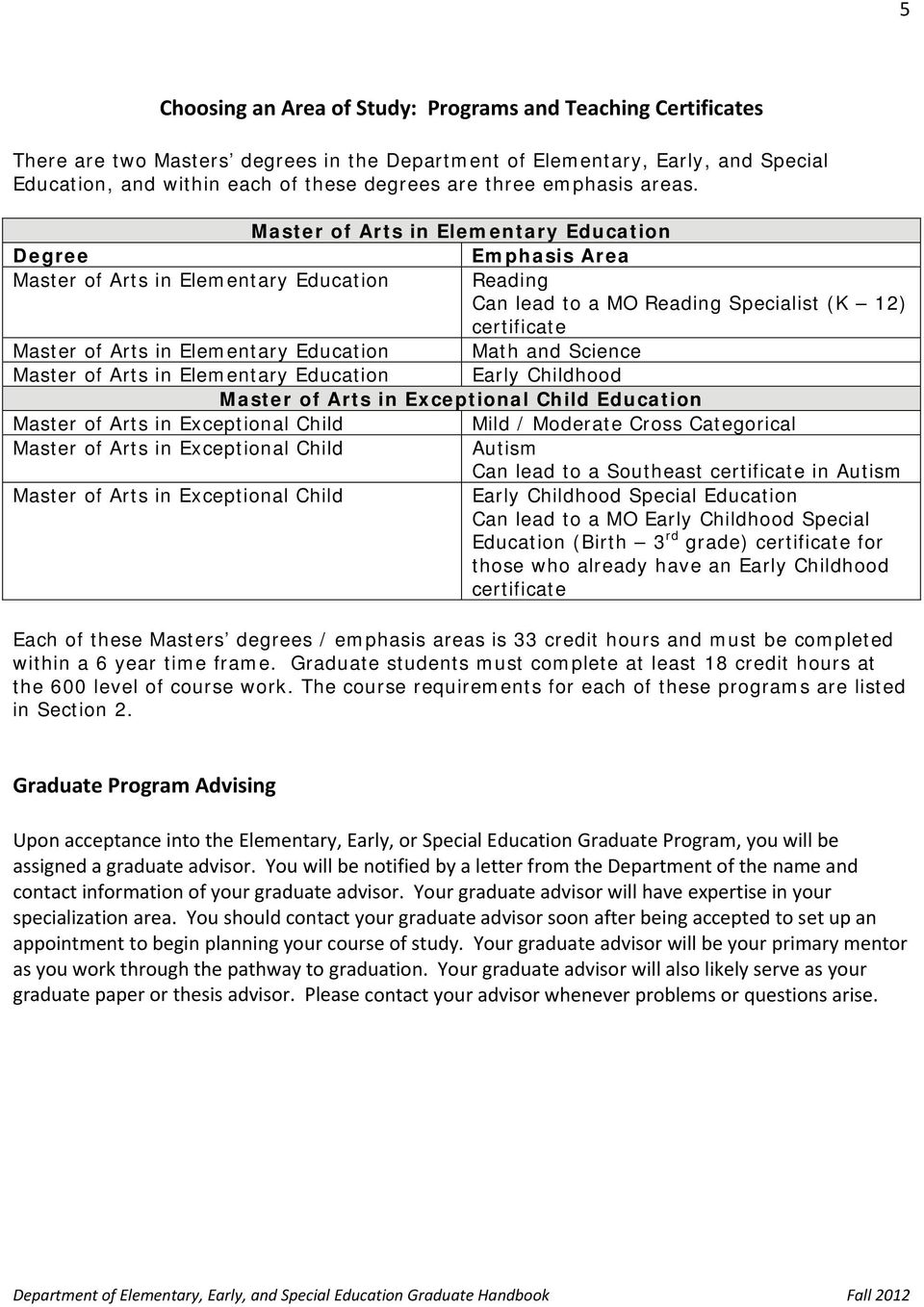
5 5 Choosing an Area of Study: Programs and Teaching Certificates There are two Masters degrees in the Department of Elementary, Early, and Special Education, and within each of these degrees are three emphasis areas. Master of Arts in Elementary Education Degree Emphasis Area Master of Arts in Elementary Education Reading Can lead to a MO Reading Specialist (K 12) certificate Master of Arts in Elementary Education Math and Science Master of Arts in Elementary Education Early Childhood Master of Arts in Exceptional Child Education Master of Arts in Exceptional Child Mild / Moderate Cross Categorical Master of Arts in Exceptional Child Autism Can lead to a Southeast certificate in Autism Master of Arts in Exceptional Child Early Childhood Special Education Can lead to a MO Early Childhood Special Education (Birth 3 rd grade) certificate for those who already have an Early Childhood certificate Each of these Masters degrees / emphasis areas is 33 credit hours and must be completed within a 6 year time frame. Graduate students must complete at least 18 credit hours at the 600 level of course work. The course requirements for each of these programs are listed in Section 2. Graduate Program Advising Upon acceptance into the Elementary, Early, or Special Education Graduate Program, you will be assigned a graduate advisor. You will be notified by a letter from the Department of the name and contact information of your graduate advisor. Your graduate advisor will have expertise in your specialization area. You should contact your graduate advisor soon after being accepted to set up an appointment to begin planning your course of study. Your graduate advisor will be your primary mentor as you work through the pathway to graduation. Your graduate advisor will also likely serve as your graduate paper or thesis advisor. Please contact your advisor whenever problems or questions arise.
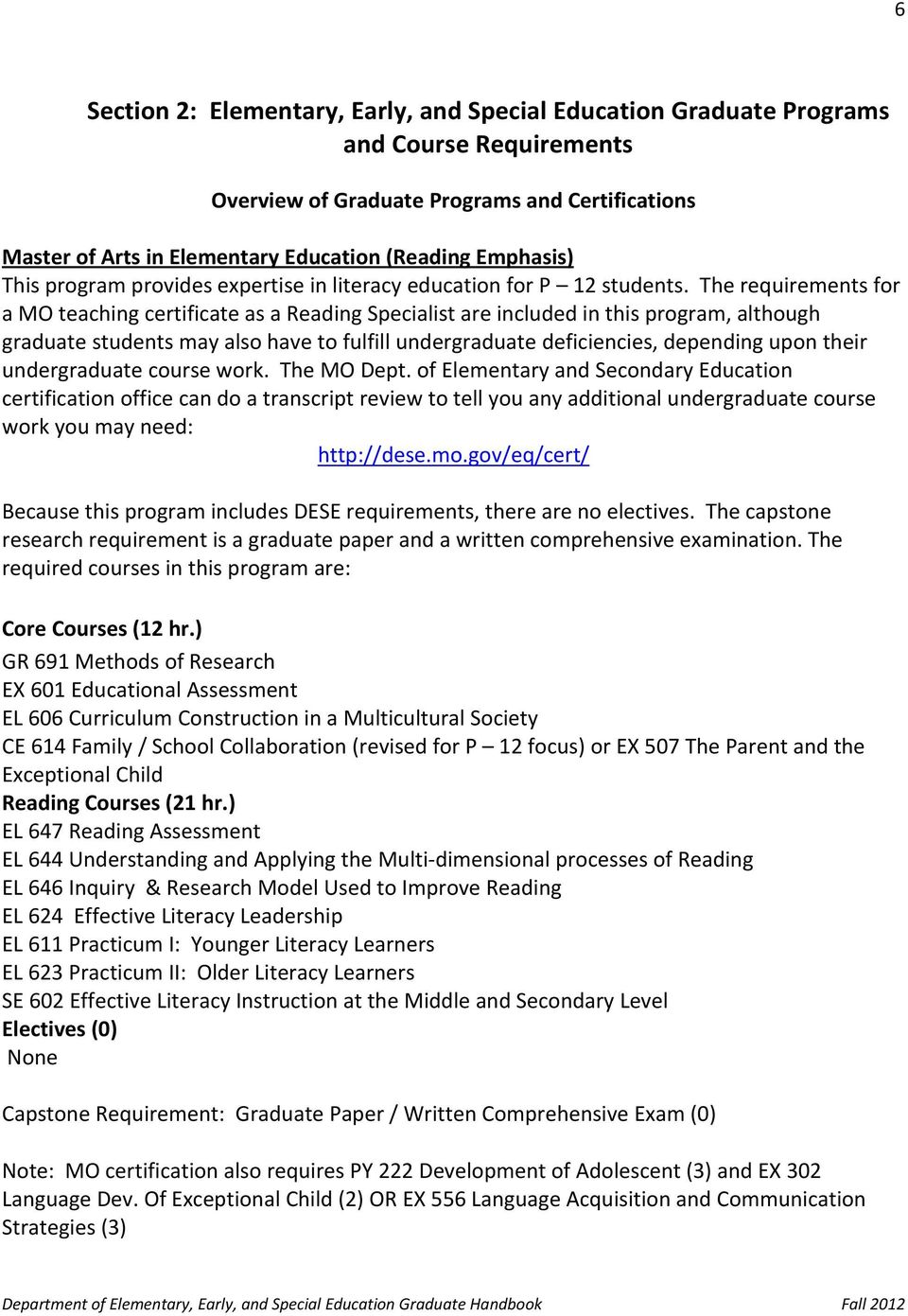
6 6 Section 2: Elementary, Early, and Special Education Graduate Programs and Course Requirements Overview of Graduate Programs and Certifications Master of Arts in Elementary Education (Reading Emphasis) This program provides expertise in literacy education for P 12 students. The requirements for a MO teaching certificate as a Reading Specialist are included in this program, although graduate students may also have to fulfill undergraduate deficiencies, depending upon their undergraduate course work. The MO Dept. of Elementary and Secondary Education certification office can do a transcript review to tell you any additional undergraduate course work you may need: Because this program includes DESE requirements, there are no electives. The capstone research requirement is a graduate paper and a written comprehensive examination. The required courses in this program are: Core Courses (12 hr.) GR 691 Methods of Research EX 601 Educational Assessment EL 606 Curriculum Construction in a Multicultural Society CE 614 Family / School Collaboration (revised for P 12 focus) or EX 507 The Parent and the Exceptional Child Reading Courses (21 hr.) EL 647 Reading Assessment EL 644 Understanding and Applying the Multi dimensional processes of Reading EL 646 Inquiry & Research Model Used to Improve Reading EL 624 Effective Literacy Leadership EL 611 Practicum I: Younger Literacy Learners EL 623 Practicum II: Older Literacy Learners SE 602 Effective Literacy Instruction at the Middle and Secondary Level Electives (0) None Capstone Requirement: Graduate Paper / Written Comprehensive Exam (0) Note: MO certification also requires PY 222 Development of Adolescent (3) and EX 302 Language Dev. Of Exceptional Child (2) OR EX 556 Language Acquisition and Communication Strategies (3)
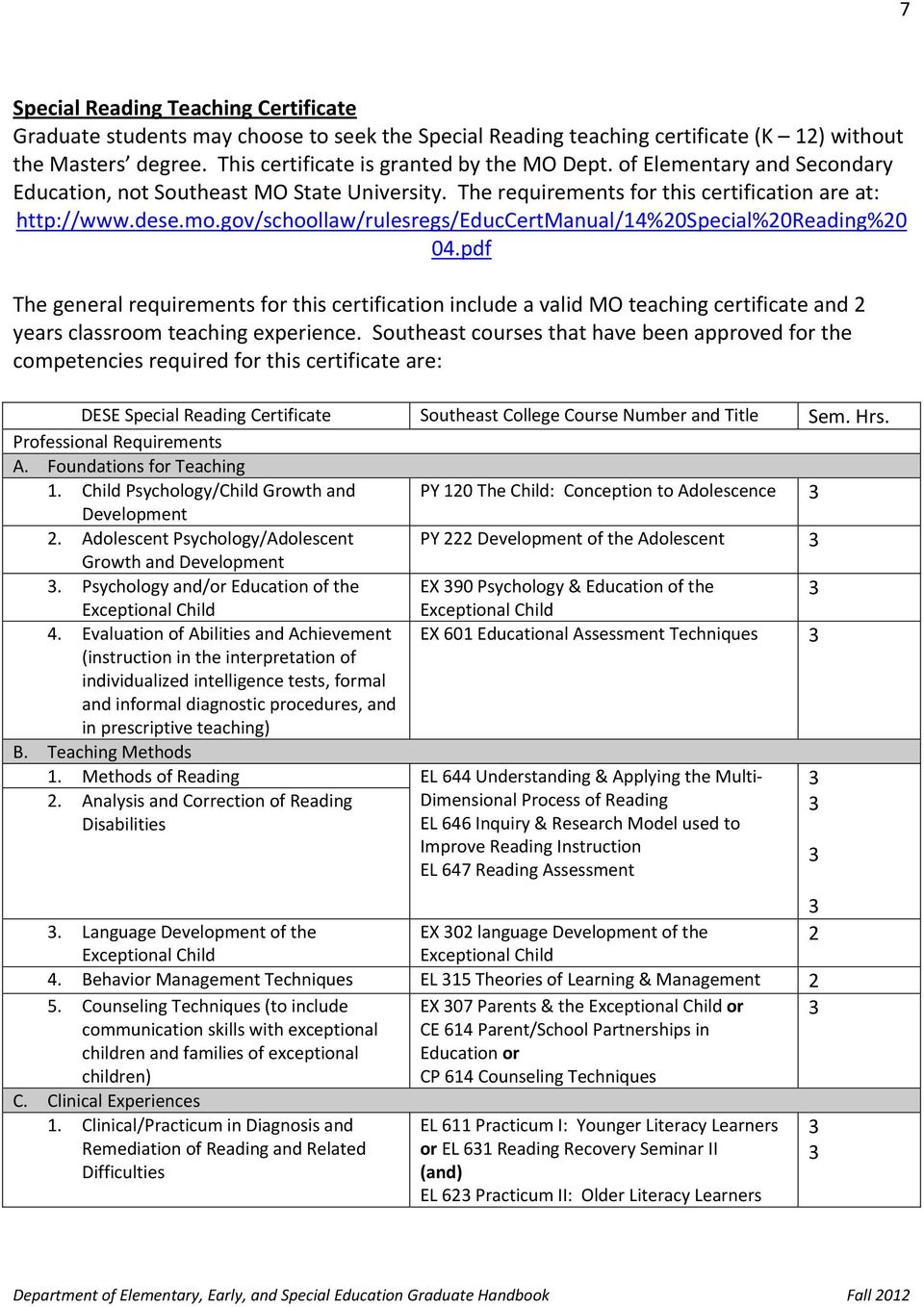
7 7 Special Reading Teaching Certificate Graduate students may choose to seek the Special Reading teaching certificate (K 12) without the Masters degree. This certificate is granted by the MO Dept. of Elementary and Secondary Education, not Southeast MO State University. The requirements for this certification are at: 04.pdf The general requirements for this certification include a valid MO teaching certificate and 2 years classroom teaching experience. Southeast courses that have been approved for the competencies required for this certificate are: DESE Special Reading Certificate Southeast College Course Number and Title Sem. Hrs. Professional Requirements A. Foundations for Teaching 1. Child Psychology/Child Growth and PY 120 The Child: Conception to Adolescence 3 Development 2. Adolescent Psychology/Adolescent PY 222 Development of the Adolescent 3 Growth and Development 3. Psychology and/or Education of the EX 390 Psychology & Education of the 3 Exceptional Child Exceptional Child 4. Evaluation of Abilities and Achievement (instruction in the interpretation of individualized intelligence tests, formal and informal diagnostic procedures, and in prescriptive teaching) EX 601 Educational Assessment Techniques 3 B. Teaching Methods Methods of Reading Analysis and Correction of Reading Disabilities EL 644 Understanding & Applying the Multi Dimensional Process of Reading EL 646 Inquiry & Research Model used to Improve Reading Instruction EL 647 Reading Assessment 3 3. Language Development of the EX 302 language Development of the 2 Exceptional Child Exceptional Child 4. Behavior Management Techniques EL 315 Theories of Learning & Management 2 5. Counseling Techniques (to include EX 307 Parents & the Exceptional Child or 3 communication skills with exceptional CE 614 Parent/School Partnerships in children and families of exceptional Education or children) CP 614 Counseling Techniques C. Clinical Experiences 1. Clinical/Practicum in Diagnosis and Remediation of Reading and Related Difficulties EL 611 Practicum I: Younger Literacy Learners or EL 631 Reading Recovery Seminar II (and) EL 623 Practicum II: Older Literacy Learners
8 8 Master of Arts in Elementary Education (Reading Emphasis) Course Offerings and Format Semester Courses Delivery Method Spring Summer Fall EL 606: Curriculum Construction in a Multicultural Society (3 hrs) EL 644 Understanding & Applying the Multidimensional Processes of Rdng (3 hrs) EL 624 Effective Literacy Leadership (3 hrs) EL 611 Practicum I: Younger Literacy Learners (3 hrs) EX 507 Families and the Exceptional Child (3 hrs.) GR 691 Methods of Research (3 hrs) EL 646 Inquiry & Research Model Used to Improve Reading (3 hrs) CE 614: Family/School Collaboration (3 hrs) EL 623 Practicum II: Older Literacy Learners (3 hrs) GR 691 Methods of Research (3 hrs) EX 601 Educational Assessment (3 hrs) EL 647 Reading Assessment (3 hrs) SE 602 Effective Literacy Instruction at the Middle & Secondary Level (3) GR 691 Methods of Research (3 hrs) Blended, Blended Blended, Blended Blended, Blended

9 9 Master of Arts in Elementary Education (Science & Math Emphasis) This graduate program is designed for the classroom teacher who seeks to improve in knowledge and skills in teaching science and math in the elementary grades. The program may be completed completely online. This program offers 12 hours of electives for graduate candidates to pursue their own scholarly interests. Students also have the option in the capstone research requirement of completing a graduate paper and written comprehensive examination or a thesis research project and an oral comprehensive examination. The courses in this program are: Core Courses (12 hr.) GR 691 Methods of Research EX 601 Educational Assessment EL 606 Curriculum Construction in a Multicultural Society CE 614 Family / School Collaboration Math/Science (9 hr.) EL 603 Teaching Elementary Mathematics EL 604 Techniques of Teaching Science in the Elementary School EL 608 Diagnosis and Remediation of Difficulties in Learning Mathematics or graduate version of EX 312 Diagnosis and Remediation of Math Difficulties Electives (12 hr.) Electives: 12 hours + grad paper / comps OR 9 hours + thesis (Suggested electives in math/science) Capstone Requirement: Graduate Paper / Written Comprehensive Exam (0) OR Thesis with advisor approval (3)
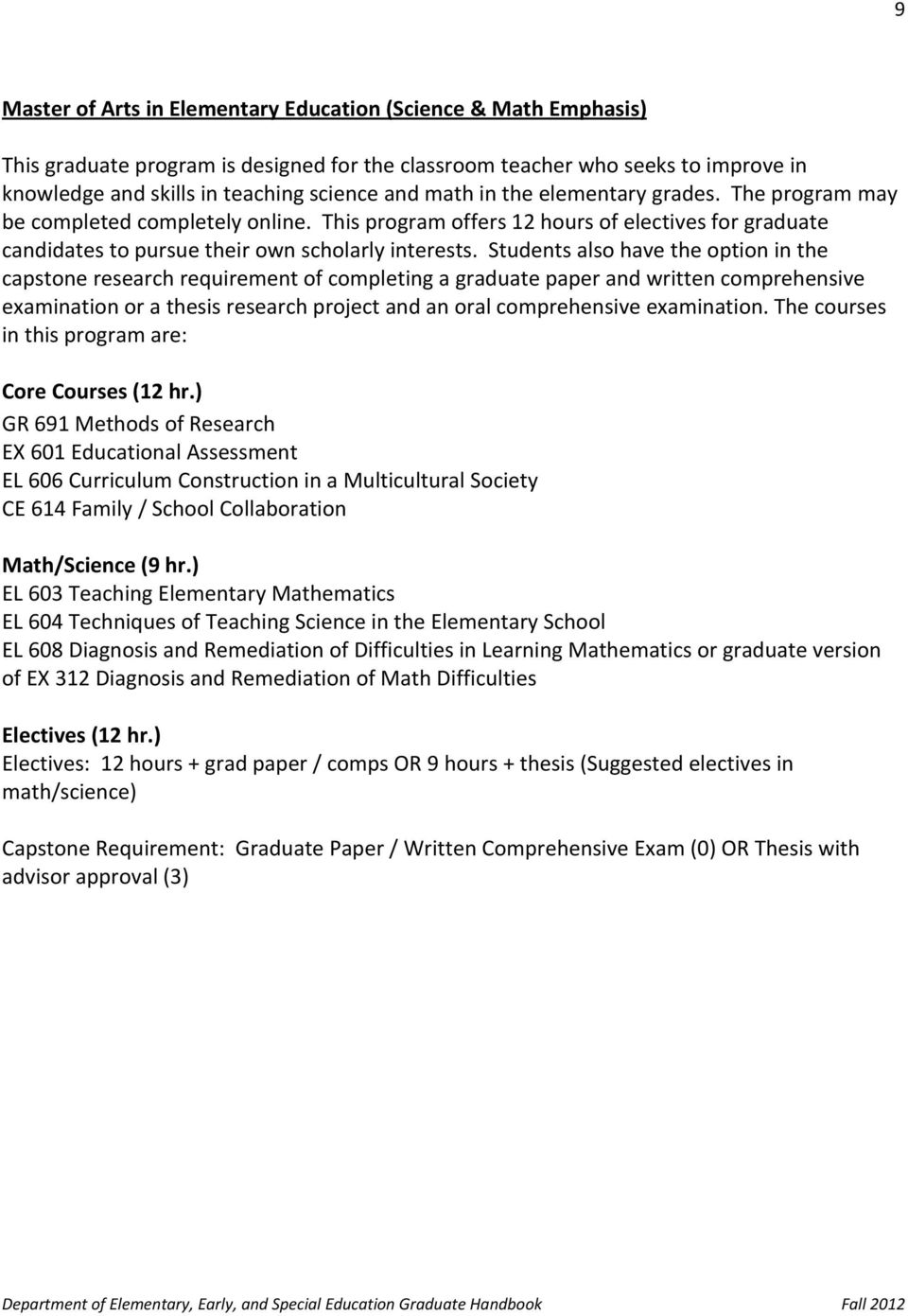
10 10 Master of Arts in Elementary Education (Science & Math Emphasis) Course Offerings and Format Semester Courses Delivery Method Spring EL 606: Curriculum Construction in a Multicultural Society (3 hrs) EL 608 Diagnosis and Remediation of Difficulties in Learning Mathematics (3 hrs) GR 691 Methods of Research (3 hrs), Blended Summer Fall Fall, Spring, Summer EL 603 Teaching Elementary Mathematics (3 hrs) EL 604 Techniques of Teaching Science in the Elementary School (3 hrs) CE 614: Family/School Collaboration (3 hrs) GR 691 Methods of Research (3 hrs) EX 601 Educational Assessment (3 hrs) EL 608 Diagnosis and Remediation of Difficulties in Learning Mathematics (3 hrs) GR 691 Methods of Research (3 hrs) Electives (12 hours allowed), Blended, Blended
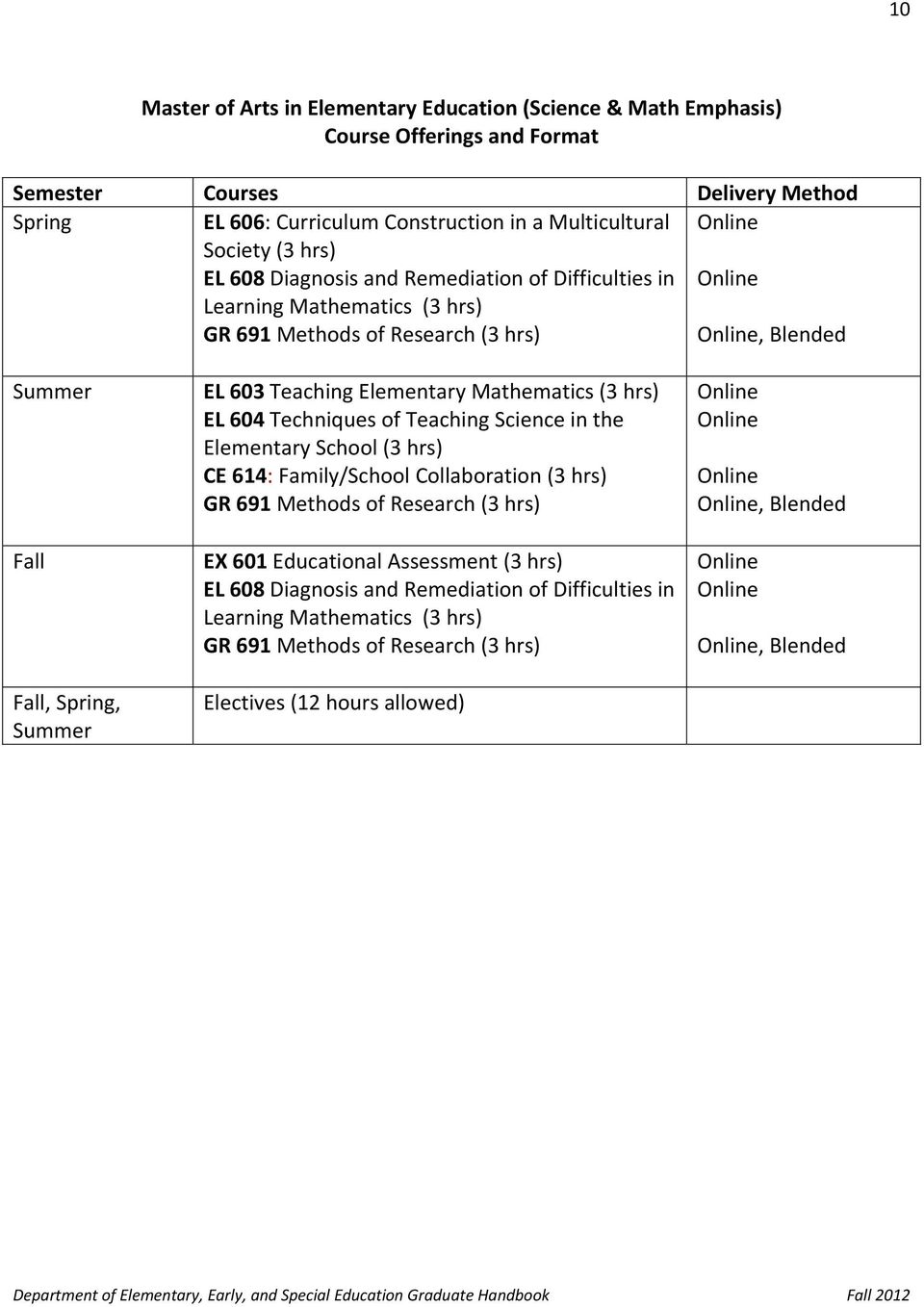
11 11 Master of Arts in Elementary Education (Early Childhood Education Emphasis) This graduate program is designed for the classroom teacher who seeks to learn or improve in knowledge and skills in teaching in the early childhood years (Birth 3 rd grade). Graduate candidates in this program do not have to have an early childhood education undergraduate degree and can be a good option for those who want to learn more about working with young children. Preparation for the Praxis II 0021 Education of the Young Child is included in this program. This program offers 12 hours of electives for graduate candidates to pursue their own scholarly interests. Students also have the option in the capstone research requirement of completing a graduate paper and written comprehensive examination or a thesis research project and an oral comprehensive examination. The courses in this program are: Core Courses (12 hr.) GR 691 Methods of Research EX 601 Educational Assessment EL 606 Curriculum Construction in a Multicultural Society EL 614 Family / School Collaboration Early Childhood (9 hr.) CE 605 Issues and Trends in Early Childhood Education CE 634 Informal Assessment EX 556 Language Acquisition and Communication Strategies or EX 602 Language Acquisition of Exceptional Children Electives (12 hr.) Electives: 12 hours + grad paper / comps OR 9 hours + thesis Capstone Requirement: Graduate Paper / Written Comprehensive Exam (0) OR Thesis with advisor approval (3)
12 12 Master of Arts in Elementary Education (Early Childhood Education Emphasis) Course Offerings and Format Semester Courses Delivery Method Spring EL 606: Curriculum Construction in a Multicultural Society (3 hrs) CE 634 Informal Assessment (3 hrs) EX 556 Language Acquisition and Communication Strategies (3 hrs) GR 691 Methods of Research (3 hrs) Blended, Blended Summer Fall Fall, Spring, Summer EX 556 Language Acquisition and Communication Strategies (3 hrs) CE 614: Family/School Collaboration (3 hrs) GR 691 Methods of Research (3 hrs) EX 601 Educational Assessment (3 hrs) CE 605 Issues and Trends in Early Childhood Education (3 hrs) EX 602 Language Acquisition of Exceptional Children (3 hrs) GR 691 Methods of Research (3 hrs) Electives (12 hours allowed), Blended Blended, Blended

13 13 Master of Arts in Exceptional Child Education: (Mild / Moderate Cross Categorical Emphasis) This graduate program is designed for the classroom teacher who seeks to learn about or improve in knowledge and skills in working with students with exceptional learning needs (K 12). Graduate candidates in this program do not have to have an exceptional child undergraduate degree, and this program can be a good option for general classroom teachers who want to learn how to better meet the needs of all learners in their classroom. Preparation for the Praxis II Exam 0543 is included in this program. This program also offers 3 hours of electives, and the course work is completely online. Students have the option in the capstone research requirement of completing a graduate paper and written comprehensive examination or a thesis research project and an oral comprehensive examination. The courses in this program are: Core Courses (12 hr.) GR 691 Methods of Research EX 601 Educational Assessment EL 606 Curriculum Construction in a Multicultural Society CE 614 Family / School Collaboration or EX 507 The Parent and the Exceptional Child Exceptional Child Generalist (18 hr.) EX 602 Language Acquisition of Exceptional Children EX 616 Behavior Management Techniques EX 691 Transition Planning for Individuals with Exceptional Learning Needs EX 628 Introduction to Mild/Moderate Cross Categorical EX 652 Techniques of Teaching the Mild/Moderate Cross Categorical EX 693 Special Ed and the Law Electives (3 hr.) Electives: 3 hours + grad paper/comps option OR Thesis (3 hours) Capstone Requirement: Graduate Paper / Written Comprehensive Exam (0) OR Thesis with advisor approval (3)

14 14 Master of Arts in Exceptional Child Education: (Mild / Moderate Cross Categorical Emphasis) Course Offerings and Format Semester Courses Delivery Method Spring EX 507: The Parent and the Exceptional Child (3 hrs) EX 616: Behavior Management Techniques (3hrs) EX 652: Techniques of Teaching the Mild/Moderate Cross Categorical (3) EL 606: Curriculum Construction in a Multicultural Society (3 hrs) GR 691 Methods of Research (3 hrs), Blended Summer Fall EX 616: Behavior Management Techniques (3hrs) EX 628: Introduction to Mild/Moderate Cross Categorical (3 hrs) CE 614 Family and School Collaboration GR 691 Methods of Research (3 hrs) Elective (3 hrs) EX 601 Educational Assessment (3 hrs) EX 602: Language Acquisition of Exceptional Children (3 hrs) EX 691: Transition Planning for Individuals with Exceptional Learning Needs (3 hrs) EX 693: Special Ed and the Law (3 hrs) GR 691 Methods of Research (3 hrs), Blended, Blended

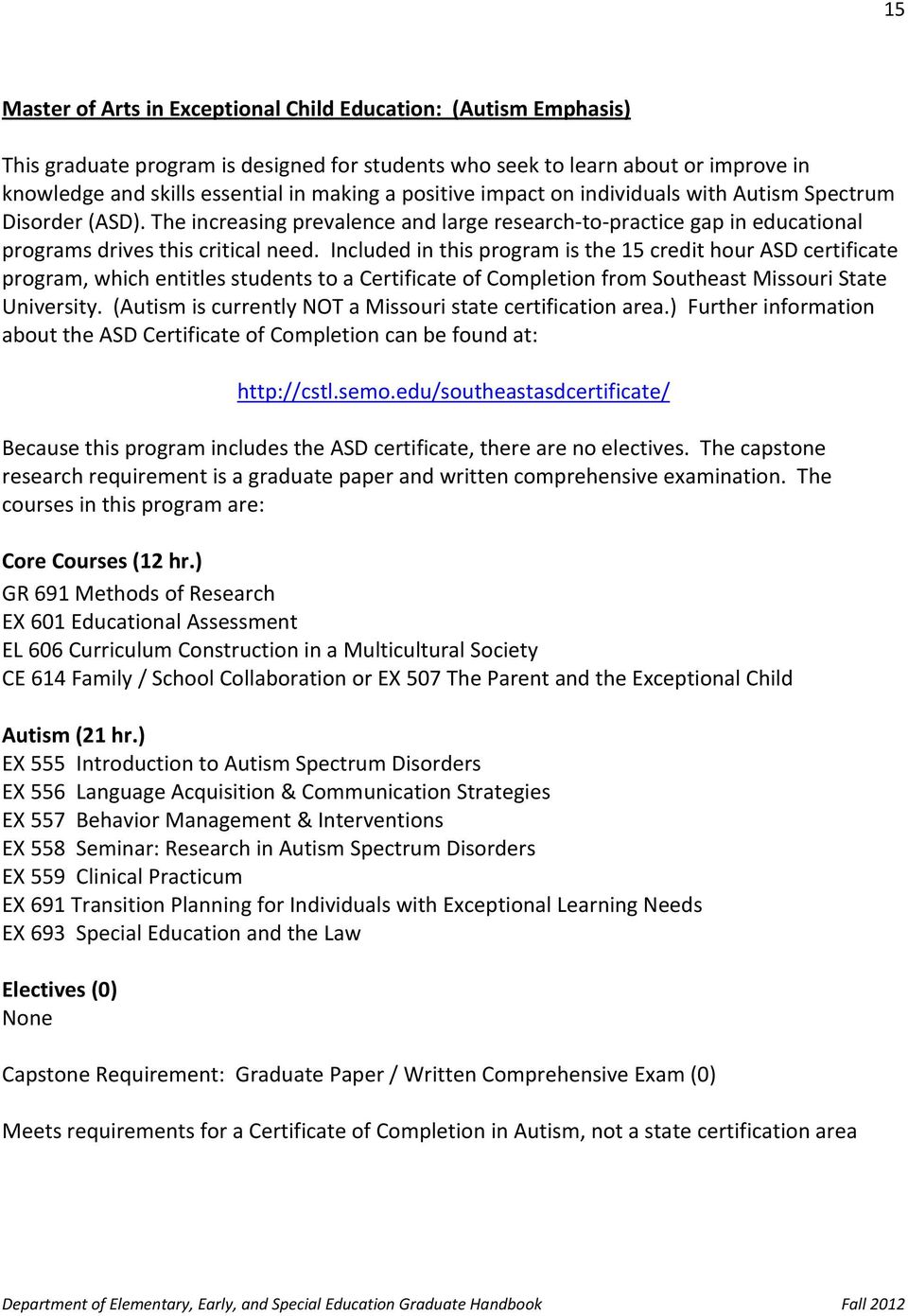
15 15 Master of Arts in Exceptional Child Education: (Autism Emphasis) This graduate program is designed for students who seek to learn about or improve in knowledge and skills essential in making a positive impact on individuals with Autism Spectrum Disorder (ASD). The increasing prevalence and large research to practice gap in educational programs drives this critical need. Included in this program is the 15 credit hour ASD certificate program, which entitles students to a Certificate of Completion from Southeast Missouri State University. (Autism is currently NOT a Missouri state certification area.) Further information about the ASD Certificate of Completion can be found at: Because this program includes the ASD certificate, there are no electives. The capstone research requirement is a graduate paper and written comprehensive examination. The courses in this program are: Core Courses (12 hr.) GR 691 Methods of Research EX 601 Educational Assessment EL 606 Curriculum Construction in a Multicultural Society CE 614 Family / School Collaboration or EX 507 The Parent and the Exceptional Child Autism (21 hr.) EX 555 Introduction to Autism Spectrum Disorders EX 556 Language Acquisition & Communication Strategies EX 557 Behavior Management & Interventions EX 558 Seminar: Research in Autism Spectrum Disorders EX 559 Clinical Practicum EX 691 Transition Planning for Individuals with Exceptional Learning Needs EX 693 Special Education and the Law Electives (0) None Capstone Requirement: Graduate Paper / Written Comprehensive Exam (0) Meets requirements for a Certificate of Completion in Autism, not a state certification area
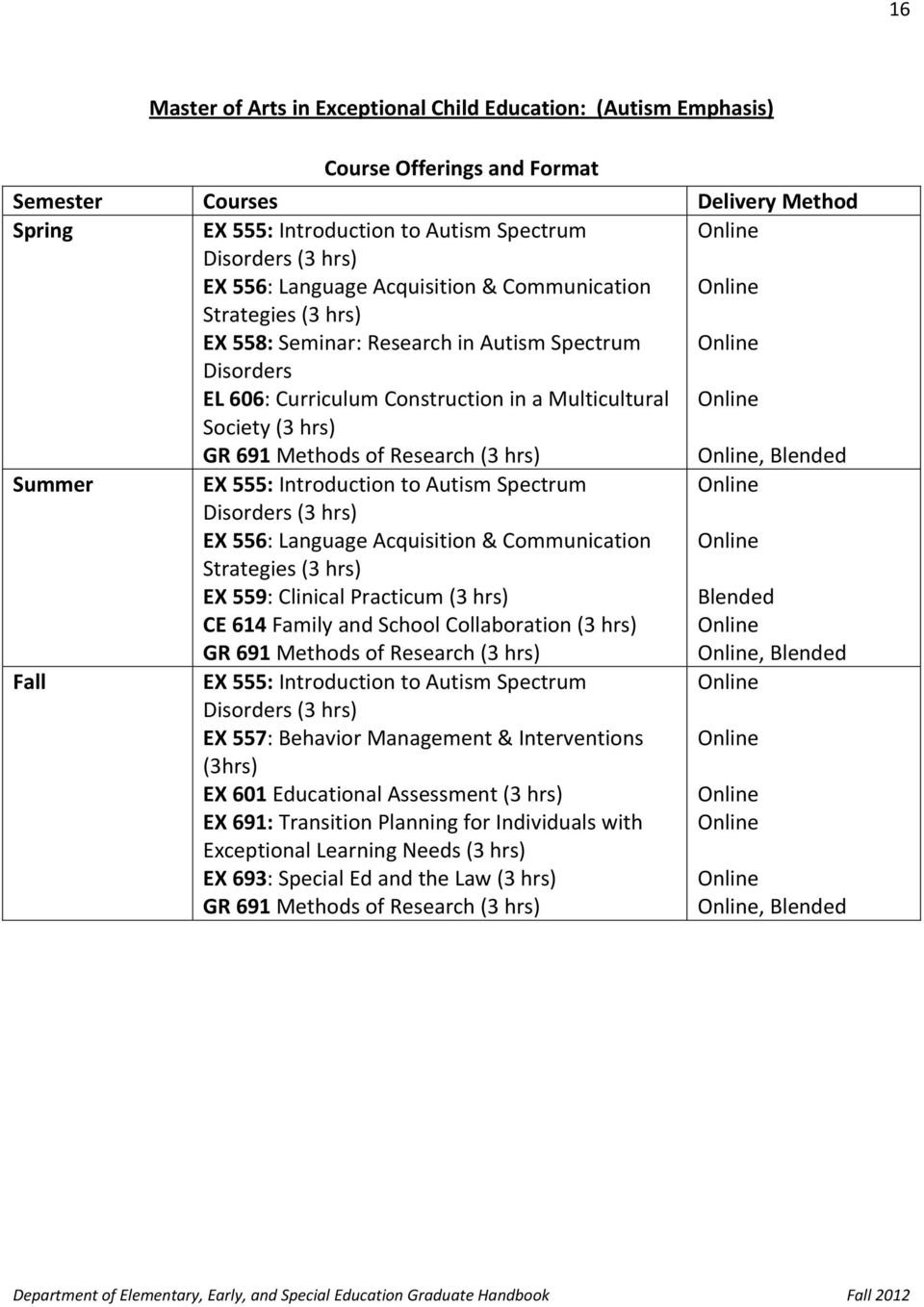
16 16 Master of Arts in Exceptional Child Education: (Autism Emphasis) Course Offerings and Format Semester Courses Delivery Method Spring EX 555: Introduction to Autism Spectrum Disorders (3 hrs) EX 556: Language Acquisition & Communication Strategies (3 hrs) EX 558: Seminar: Research in Autism Spectrum Disorders EL 606: Curriculum Construction in a Multicultural Society (3 hrs) GR 691 Methods of Research (3 hrs), Blended Summer EX 555: Introduction to Autism Spectrum Disorders (3 hrs) EX 556: Language Acquisition & Communication Strategies (3 hrs) EX 559: Clinical Practicum (3 hrs) CE 614 Family and School Collaboration (3 hrs) GR 691 Methods of Research (3 hrs) Blended, Blended Fall EX 555: Introduction to Autism Spectrum Disorders (3 hrs) EX 557: Behavior Management & Interventions (3hrs) EX 601 Educational Assessment (3 hrs) EX 691: Transition Planning for Individuals with Exceptional Learning Needs (3 hrs) EX 693: Special Ed and the Law (3 hrs) GR 691 Methods of Research (3 hrs), Blended
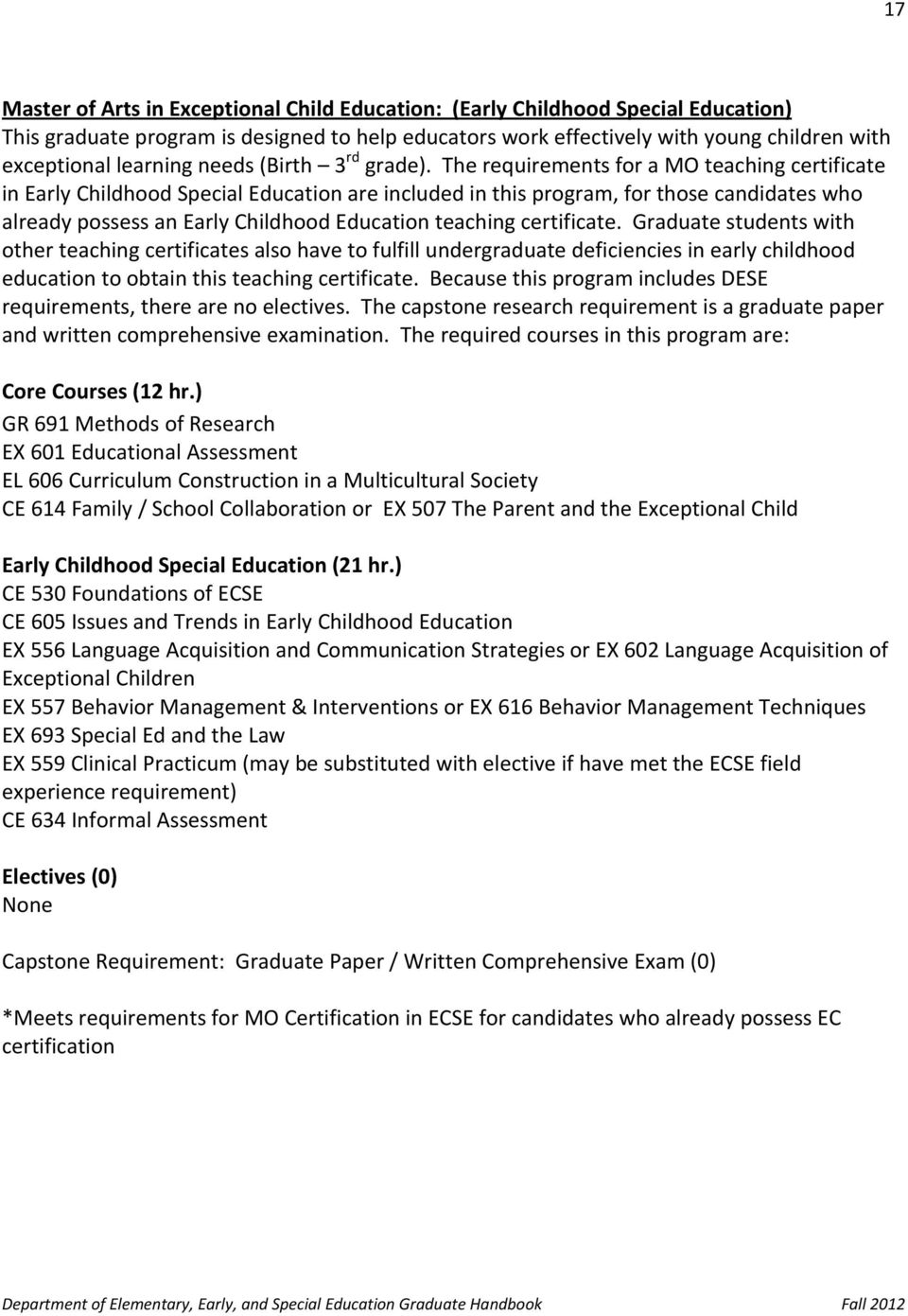
17 17 Master of Arts in Exceptional Child Education: (Early Childhood Special Education) This graduate program is designed to help educators work effectively with young children with exceptional learning needs (Birth 3 rd grade). The requirements for a MO teaching certificate in Early Childhood Special Education are included in this program, for those candidates who already possess an Early Childhood Education teaching certificate. Graduate students with other teaching certificates also have to fulfill undergraduate deficiencies in early childhood education to obtain this teaching certificate. Because this program includes DESE requirements, there are no electives. The capstone research requirement is a graduate paper and written comprehensive examination. The required courses in this program are: Core Courses (12 hr.) GR 691 Methods of Research EX 601 Educational Assessment EL 606 Curriculum Construction in a Multicultural Society CE 614 Family / School Collaboration or EX 507 The Parent and the Exceptional Child Early Childhood Special Education (21 hr.) CE 530 Foundations of ECSE CE 605 Issues and Trends in Early Childhood Education EX 556 Language Acquisition and Communication Strategies or EX 602 Language Acquisition of Exceptional Children EX 557 Behavior Management & Interventions or EX 616 Behavior Management Techniques EX 693 Special Ed and the Law EX 559 Clinical Practicum (may be substituted with elective if have met the ECSE field experience requirement) CE 634 Informal Assessment Electives (0) None Capstone Requirement: Graduate Paper / Written Comprehensive Exam (0) *Meets requirements for MO Certification in ECSE for candidates who already possess EC certification
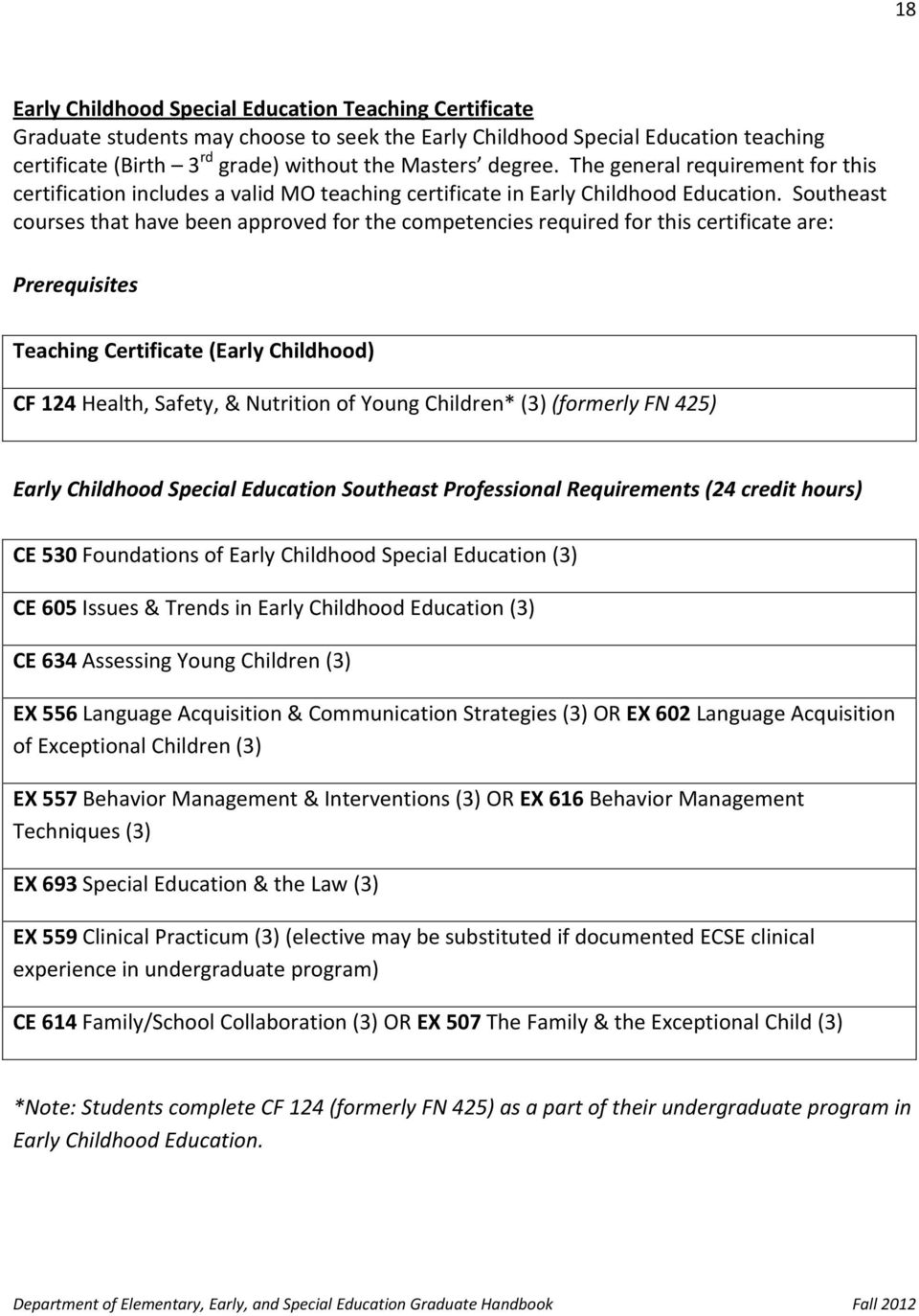
18 18 Early Childhood Special Education Teaching Certificate Graduate students may choose to seek the Early Childhood Special Education teaching certificate (Birth 3 rd grade) without the Masters degree. The general requirement for this certification includes a valid MO teaching certificate in Early Childhood Education. Southeast courses that have been approved for the competencies required for this certificate are: Prerequisites Teaching Certificate (Early Childhood) CF 124 Health, Safety, & Nutrition of Young Children* (3) (formerly FN 425) Early Childhood Special Education Southeast Professional Requirements (24 credit hours) CE 530 Foundations of Early Childhood Special Education (3) CE 605 Issues & Trends in Early Childhood Education (3) CE 634 Assessing Young Children (3) EX 556 Language Acquisition & Communication Strategies (3) OR EX 602 Language Acquisition of Exceptional Children (3) EX 557 Behavior Management & Interventions (3) OR EX 616 Behavior Management Techniques (3) EX 693 Special Education & the Law (3) EX 559 Clinical Practicum (3) (elective may be substituted if documented ECSE clinical experience in undergraduate program) CE 614 Family/School Collaboration (3) OR EX 507 The Family & the Exceptional Child (3) *Note: Students complete CF 124 (formerly FN 425) as a part of their undergraduate program in Early Childhood Education.
19 19 Master of Arts in Exceptional Child Education: (Early Childhood Special Education) Course Offerings and Format Semester Courses Delivery Method Spring CE 530: Foundations of Early Childhood Special Education (3 hrs) CE 634: Informal Assessment (Spring 13) (3 hrs) EX 507: Families and the Exceptional Child (3 hrs) EX 556: Language Acquisition & Communication Strategies (3 hrs) EX 616: Behavior Management Techniques (Spring 13, Summer 12) (3hrs) EL 606: Curriculum Construction in a Multicultural Society (3 hrs) GR 691 Methods of Research (3 hrs) Blended, Blended Summer Fall CE 614 Family School Collaboration EX 556: Language Acquisition & Communication Strategies (3 hrs) EX 559: Clinical Practicum (3 hrs) EX 616: Behavior Management Techniques (Spring 13, Summer 12) (3hrs) GR 691 Methods of Research (3 hrs) CE 605: Issues and Trends in Early Childhood Education (3 hrs) EX 557: Behavior Management & Interventions (3 hrs) EX 601 Educational Assessment (3 hrs) EX 602: Language Acquisition of Exceptional Children (3 hrs) EX 693: Special Ed and the Law (3 hrs) GR 691 Methods of Research (3 hrs) Blended, Blended Blended, Blended

20 20 Professional Development Course Electives Your graduate program may include electives, depending upon which program and certification you seek. One way you may earn elective hours is through professional development course work done in your school district. Depending upon your program, you may enroll in: EL 618 Elementary Professional Development / Graduate Credit Topics CE 631 Early Childhood Education Professional Development / Graduate Credit Topics EX 681 Exceptional Child Education Professional Development / Graduate Credit Topics These courses do require prior approval by your advisor to be accepted for your program, and your final project for the class should be submitted to your advisor. A list of accepted graduate credit topics is located in the Appendix. Partnership School Districts Southeast MO State University has a partnership agreement with approximately 75 school districts in the University s service region of Southeast Missouri. Eligible teachers in these school districts may qualify for a waiver of the application fee for graduate school and reduced tuition fees for professional development course work. A list of the current partnership schools is located in the Appendix. Transfer Courses No more than 9 hours of transfer credit may be applied to your graduate program. Your advisor must approve any courses for transfer credit, and you should obtain approval from your advising before enrolling in a course at another institution. You must earn a B or better in any courses transferred. Courses from a non NCATE accredited institution will not be accepted. DegreeWorks You can monitor your progress in course work and completion of your program through DegreeWorks, which you access through the portal using your SEKey. Contact your advisor for help with using DegreeWorks.

21 21 Dept. of Elementary, Early, and Special Education Graduate Course Rotation Schedule AREA Course: number & title Fall Spring Summer Format EX ECSE EX Autism EX M/MC C Core GR 691: Methods of Research x x x online; blended EX 601: Educational Assessment x online EL 606: Curriculum Construction in a Multicultural Society x online CE 614: Family/School Collaboration or x online EX 507: Famlies and the Exceptional Child x online EX 602: Language Acquisition of Exceptional Children x online EX 616: Behavior Management Techniques x online EX 691: Transition Planning for Individuals with Exceptional Learning x online Needs EX 628: Introduction to Mild/Moderate Cross Categorical x online EX 652: Techniques of Teaching the Mild/Moderate Cross Categorical x online EX 693: Special Ed and the Law x online EX 555: Introduction to Autism Spectrum Disorders x x x online EX 556: Language Acquisition & Communication Strategies x x online EX 557: Behavior Management & Interventions x online EX 558: Seminar: Research in Autism Spectrum Disorders x online EX 559: Clinical Practicum x blended EX 691: Transition Planning for Individuals with Exceptional Learning x online Needs EX 693: Special Education and the Law x online CE 530: Foundations of ECSE x online CE 605: Issues and Trends in Early Childhood Education x blended EX 557: Behavior Management & Interventions or x online EX 616: Behavior Management Techniques x EX 556 Language Acquisition and Communication Strategies or x x online EX 602: Language Acquisition of Exceptional Children x online EX 693: Special Ed and the Law x online EX 559: Clinical Practicum x blended CE 634: Informal Assessment x blended EL 647 Reading Assessment x blended EL 644 Understanding & Applying the Multi dimensional Processes of x online Rdng EL 646 Inquiry & Research Model Used to Improve Reading x online EL 624 Effective Literacy Leadership x online EL Reading
22 22 EL 611 Practicum I: Younger Literacy Learners x blended EL 623 Practicum II: Older Literacy Learners x blended SE 602 Effective Literacy Instruction at the Middle and Secondary Level x online EL EC EL Ma/Sc CE 605 Issues and Trends in Early Childhood Education x blended CE 634 Informal Assessment x blended EX 556 Language Acquisition and Communication Strategies or x x online EX 602 Language Acquisition of Exceptional Children x online EL 603 Teaching Elementary Mathematics x online EL 604 Techniques of Teaching Science in the Elementary School x online El 608 Diagnosis and Remediation of Difficulties in Learning Mathematics x x online EX M/MC C = EX Autism = EX ECSE = EL Reading = EL EC = EL Ma/Sc = Master of Arts: Exceptional Child with Mild/Moderate Cross Categorical emphasis Master of Arts: Exceptional Child with Autism emphasis Master of Arts: Exceptional Child with Early Childhood Special Education emphasis Master of Arts: Elementary Education with Reading emphasis Master of Arts: Elementary Education with Early Childhood emphasis Master of Arts: Elementary Education with Math/Science emphasis
23 23 Section 3: Capstone Research Projects All graduate programs at Southeast Missouri State University require a course in research methods and a capstone research project. Graduate students in the Elementary, Early and Special Education Dept. complete GR 691 Methods of Research, a course that is designed to help students understand the basics of conducting scholarly research. GR 691 should be taken prior to the last semester, as it will prepare graduate students to do the capstone research project. This project is completed during the last semester of the program, along with a comprehensive examination. The Graduate School establishes deadlines for the completion of graduate projects and comprehensive exams and graduate students should check the Graduate School website for those deadlines: Depending upon the program of study, graduate students have two options for the capstone research project: Graduate Paper / Written Comprehensive Examination / Elective course o GR 698 Masters Comprehensive Exam (0 cr.) and Elective (3 cr.) Thesis Research Project / Oral Comprehensive Examination o GR 694 Thesis (3 cr.) AND GR 699 Masters Oral Comprehensive Exam (0 cr.) The graduate paper is a good option for the classroom teacher who wants to improve practice, take additional electives, or seek an additional certification. The thesis research project is a good option for a graduate student who has a career goal of being an educational researcher or continuing graduate study after the Masters degree for a doctorate. Each of these capstone research projects will be further described in the following sections. Graduate Paper / Written Comprehensive Examination Students choosing to do the graduate paper / written comprehensive exam should enroll in GR 698 Masters Comprehensive Exam (Section 1) the last semester before graduation. During the GR 691 Methods of Research class (done in a previous semester), students complete a research paper on a topic of interest. This paper can be the foundation for the graduate paper that is done as a graduation requirement. This graduate paper has three chapters and will present research on a problem in education through a literature review, with conclusions and recommendations for improved practice. The graduate paper will be read and scored by the student s advisor and a second reader in the department. Both readers must agree that it meets the expectations of a graduate level research paper. The paper typically requires several revisions and must have final approval from both readers by the 9 th week of the last semester
24 24 of study. The Graduate Paper Acceptance Form is located on the EESE Department website at the Student Forms link: Students who choose to complete a graduate paper must also pass a written comprehensive examination about their course of study. Students will be provided with a study guide for this exam at the beginning of the last semester. Written comprehensive exams must be completed by the 10 th week of the semester. Students will have 3 hours to complete the exam on a campus computer. The rubric used to evaluate Written Comprehensive Examinations is located in the Appendix. Graduate Paper Guidelines Graduate Paper/Review of the Research Literature Select a topic related to your degree and emphasis area (through reading, observation, interview, correspondence, use of experts, research through any and all of your ways of learning and knowing) and becoming expert in that topic. Review research literature published during the past 10 years; the literature must represent a mix of traditional sources and electronic sources. The project will require the completion of a page literature review. The structure will include an introduction about a problem in education, a review of the literature relating to that topic, a discussion of the implications of the research, with recommended practices, and a description of how this information and these practices might alter your teaching, and a conclusion. The paper should be written in APA style and third person, i.e., The researcher found... A reference list in APA style ends the paper. Task Overview Chapter 1 (3 5 pages) Introduction: What is the focus of your graduate paper? Why did you select that focus? Why is this particular focus worthy of exploration? What are the research questions relating to this focus that are guiding your inquiry? What is the theoretical background of this topic? Use the following Chapter 1 HEADINGS for your graduate paper in GR 691: Problem Statement Purpose of Study Research Questions Definition of Terms Conceptual Framework Significance of Study Summary
25 25 Chapter 2 (10 15 pages) Literature review: What are the key issues to your focus? What do research journal articles, book excerpts/chapters, websites, or books say about the key issues of your focus? (Be sure to use citations within this portion of your written graduate paper using APA style.) Include multiple perspectives (different points of view reflecting different theoretical stances). Organize this section by the research questions you identified in Chapter 1, rather than writing a series of summaries of research articles. This chapter is designed to use research to address your problem statements. You may have several subsections within this section of your paper. Use the following Chapter 2 HEADINGS for your graduate paper in GR 691 : The Review of Related Literature Specific headings relating to research questions Summary Chapter 3 (3 5 pages) Discussion of Research: What conclusions do you draw from the research relating to your problem statement? Discuss each research question separately. Implications: What are the implications of your research for teachers and/or school district practices relating to the topic? Recommended practices: What instructional practices are associated with the selected topic? Provide a brief description of best practices associated with your findings. Application to your own practice: How will the information that you ve explored positively influence your practice? Now that you have new, deeper knowledge, how will that knowledge be reflected in YOUR practice? How could you apply your new knowledge to your own teaching? What contextual circumstance would best support the successful implementation of your new knowledge? (In other words, what would your classroom structures have to be to best support what you ve learned?) Summary: What were the big findings in your explorations of your focus? How does this new knowledge support or challenge your existing view of this focus? (This is a brief restating of the big ideas and why it was important for you to explore this topic.) Use the following Chapter 3 HEADINGS for your graduate paper in GR 691 : Discussion and Conclusions Implications Recommendations (including application to practice) Summary References List complete bibliographic information (be sure to include references from several sources, i.e., journals, books, on line, course material; use current resources [within the
26 26 past 10 years, plus 2 3 classics]) using proper APA style. All references cited in your paper should be listed in your reference list, and there should not be any references in your bibliography that were not cited in the paper. Document Guidelines APA style (If you are unsure about APA style, go to: 1 inch margins (if binding your paper on the left, please make left margin 1 1/2 inch); 10 or 12 point font size (running header may use 8 or 10 point; tables, figures, lists may be sized differently from your connected text) Include a running head (at least your last name, course & semester, brief title, & continuous page numbering) beginning on page 2 Example: Doe, J. Graduate Paper Conventions & mechanics Tone (please write using third person) Use professional language Polished writing (error free in spelling, punctuation, capitalization, grammar) Clearly written with sufficient supporting information (i.e., examples, explanations, & elaborations) The rubric for evaluating the Graduate Paper is located in the Appendix.
27 27 Thesis Research Projects / Oral Comprehensive Examination Students choosing to do the thesis / oral comprehensive exam should enroll in GR 694 Thesis AND GR 699 Masters Oral Comprehensive Exam the last semester before graduation. However, work on the thesis research project begins long before enrolling in the course. The thesis research project is worth 3 credit hours, but typically requires two semesters to complete, with one semester being used for the research and one semester being used for writing and defense of the research. Typically your advisor serves as the chair of your thesis committee and will guide you in completing this project. You should be prepared to do multiple rewrites, based upon your advisor and thesis committee s recommendations. Prior to completing your thesis research project, you will take GR 691, Methods of Research. This class will help prepare you to do your own research project, in particular, the first three chapters of your thesis. It is recommended that you are in touch with your advisor as you are taking this class to get guidance on choosing a research topic and your research plan. Your thesis should be written in APA format, and it is recommended that you obtain the latest edition of the APA Publications Manual and become very familiar with it. Choosing a Research Topic and Writing a Thesis Proposal Choosing a research topic is often one of the hardest tasks in the thesis project. Some guidelines for topic selection (Rudestam & Newton, 1992) include: Choose a topic that will sustain your interest over a long period of time; one in which you have a strong curiosity or interest. However, avoid choosing a topic that is too challenging or ambitious; be realistic in the time frame you have to gather information and narrow your topic to a reasonable scope. Avoid topics that are related to emotional or personal issues in your own life, or topics in which you have a strong bias; you want to be honest and objective in your research. Select a topic in which little research has been done, one that has the potential for you to make an original contribution; will your findings add new information to the field or has your topic been fully examined? Once you and your advisor have chosen your general research topic, you should begin intensive reading on the topic, gathering research that will help you narrow your topic and choose your specific research questions. With your advisor s help, choose your specific topic, research questions, type of research (quantitative, qualitative, and/or action research), and a thesis title. Develop a brief abstract of your research that will be shared with your thesis committee. This abstract should include: Title Overview of topic
28 28 Research questions General research plans, i.e. quantitative, qualitative, timeline Your abstract should not be more than 1 2 pages, double spaced. Thesis Committee Your thesis committee will be comprised of three members: Committee chair (typically your advisor) 2nd Committee member (Elementary, Early, or Special Education Department graduate faculty, typically a faculty member in the discipline of your research topic) 3rd Committee member (Faculty outside the department; The third member of the thesis committee will be appointed by the Graduate School, but you may request a specific faculty member.) To form your committee, you will need to download the Topic Approval Form (on the EESE Department website: The Graduate Paper Acceptance Form is located on the EESE Department website at the Student Forms link: Submit this form with your brief abstract to your committee chair and second committee member with your request to serve on your committee. The chair and second committee member should sign and return the Topic Approval Form to you. This form, along with your abstract is then sent to the Graduate School, with your request for a third committee member. (It is recommended that you make a copy of the Topic Approval Form for yourself.) The Graduate School will then handle the request for your third committee member. Upon the approval of the third committee member by the Graduate School and notification by letter, schedule a meeting of your thesis committee. The purpose of this committee meeting is to review your plans for the research study, to make recommendations regarding methodology and analysis, and to get approval to proceed with your research plans. At this meeting, you will need to bring your first three chapters of your planned thesis (Introduction, Literature Review, and Methodology). You should work closely with your advisor getting these three chapters ready for your committee. You will need to submit these three chapters to your committee at least one week prior to your schedule meeting date. At this committee meeting, your committee members will make suggestions on how to improve your research. Consider this as helpful information that will strengthen your research. At the conclusion of the meeting, have the third committee member sign your Topic Approval Form and submit it to the Graduate School.
29 29 Your advisor can help you determine the best research methodology to use for your research project. Thesis in the Elementary, Early and Special Education department may be quantitative, qualitative, or an action research project. Following are the formats for each of these research methodologies. Quantitative Research Thesis Guidelines Preliminary Pages Title Page (required; do not number this page) Blank page (required; becomes copyright page if manuscript is to be copyrighted. Do not number this page.) Acceptance page (required; Number this page ii.) Abstract (required) Acknowledgments (optional) Table of Contents (required; titles of each section listed must concur exactly with the body of the paper. Do not list this page among contents.) List of Tables (required when tables are used) List of Figures (required when figures are used) List of Illustrations (required when illustrations are used) Main Manuscript (5 chapters are required) Chapter I Introduction Introduction Problem Statement Clarification of Problem Statement o Definition of terms o Assumptions o Delimitations o Limitations Conceptual Framework Significance of the Study Purpose of the Study Design Components o Research Questions o Hypotheses o Population o Instrumentation o Data Collection o Statistical Design Summary
30 30 Chapter II Literature Review Introduction of the key topics to be reviewed Body (See Appendix for suggestions on writing a literature review) Summary (summarize major findings that justify this study) Chapter III Methods Introduction Problem Statement Purpose of the Study Design Components o Research Questions o Hypotheses o Population o Instrumentation o Data Collection o Statistical Design Summary Chapter IV Results Introduction Purpose of Study Population Results of Research Questions (present results for each research question) Summary Chapter V Discussion / Conclusions and Recommendations Introduction Discussion (discuss each research question) Conclusions Recommendations for Future Research References Appendices Permission Letter(s) Abstract Human Subjects Approval Form Assessment Instruments Used (if applicable)
31 31 Qualitative Research Thesis Guidelines* Preliminary Pages Title Page (required; do not number this page) Blank page (required; becomes copyright page if manuscript is to be copyrighted. Do not number this page.) Acceptance page (required; Number this page ii.) Abstract (required) Acknowledgments (optional) Table of Contents (required; titles of each section listed must concur exactly with the body of the paper. Do not list this page among contents.) List of Tables (required when tables are used) List of Figures (required when figures are used) List of Illustrations (required when illustrations are used) Main Manuscript (5 chapters are required) Chapter I Introduction Introduction / Background of the Problem or Topic Problem Statement Clarification of Problem Statement o Definition of terms o Assumptions o Delimitations o Limitations Conceptual Framework Significance of the Study Purpose of the Study Design Components o Research Questions o Participants o Data Collection / Instrumentation Summary Chapter II Literature Review Introduction of the key topics to be reviewed Body (See Appendix for suggestions on writing a literature review) Summary (summarize major findings that justify this study) Chapter III Methods Introduction Overall Research Design and Rationale for Qualitative Research
32 32 Problem Statement Purpose of the Study Design Components o Research Questions o Participants / Selection o Data Collection o Instrumentation o Data Analysis Procedures o Trustworthiness o Researcher Bias (personal beliefs experiences relating to research questions) Summary Chapter IV Results Introduction Purpose of study Participants Results of research questions (present results for each research question) Summary Chapter V Discussion / Conclusions and Recommendations Introduction Discussion (discuss each research question) Conclusions Recommendations for Future Research References Appendices Permission Letter(s) Abstract Human Subjects Approval Form Assessment Instruments Used (if applicable) *The format for the qualitative thesis requires flexibility due to the nature of the wide variety of qualitative inquiry strategies. The thesis advisor and the thesis committee will guide the student in diverging from the suggested format.
33 33 Action Research Thesis Guidelines* Preliminary Pages Title Page (required; do not number this page) Blank page (required; becomes copyright page if manuscript is to be copyrighted. Do not number this page.) Acceptance page (required; Number this page ii.) Abstract (required) Acknowledgments (optional) Table of Contents (required; titles of each section listed must concur exactly with the body of the paper. Do not list this page among contents.) List of Tables (required when tables are used) List of Figures (required when figures are used) List of Illustrations (required when illustrations are used) Main Manuscript (5 chapters are required) Chapter I Introduction Introduction / Background of the Problem or Topic Problem Statement Clarification of Problem Statement o Definition of terms o Assumptions o Delimitations o Limitations Conceptual Framework Significance of the Study Purpose of the Study Design Components o Research Questions o Participants o Data Collection / Instrumentation Summary Chapter II Literature Review Introduction of the key topics to be reviewed Body (See Appendix for suggestions on writing a literature review) Summary (summarize major findings that justify this study) Chapter III Methods Introduction Overall Research Design and Rationale for Qualitative Research
34 34 Problem Statement Purpose of the Study Design Components o Research Questions o Participants / Selection o Data Collection o Instrumentation o Data Analysis Procedures o Trustworthiness o Researcher Bias (personal beliefs experiences relating to research questions) Summary Chapter IV Results Introduction Purpose of study Participants Results of research questions (present results for each research question) Summary Chapter V Discussion / Conclusions and Recommendations Introduction Discussion Conclusions Recommendations for Future Research References Appendices Permission Letter(s) Abstract Human Subjects Approval Form Assessment Instruments Used (if applicable) * Because action research is exploring a problem of practice and is cyclical in nature (plan actobserve reflect), it does not usually follow a step by step chronological order as in the format above. Therefore, an action research thesis may require flexibility in the format. This can be worked out with the approval of the thesis advisor and the committee. The cyclical nature of action research also raises the question of when you should stop gathering data and write up your results. It is suggested that you conduct a minimum of two
35 35 cycles before producing the results in the form of a completed thesis. However, the thesis committee should decide this in collaboration with you. Another issue that must be dealt with is that action research is, by definition, exploring a problem of practice in which the researcher is directly involved or is at least close to the situation. With traditional research this would raise a researcher bias question. However, with action research one is attempting to improve practice through the planning acting observingreflecting process with continuous improvement of practice as the ultimate goal. The following book is recommended as a resource for both the action researcher and the committee with particular attention being given to the preface, chapter 1, and pages Herr, K. & Anderson, G. L. (2005). The Action Research Dissertation: A guide for Students and Faculty. Thousand Oaks, CA: Sage Publications. Human Subjects Approval You must have approval from the Human Subjects Review Committee before beginning your research. The application form for this approval is on the College of Education website: On your Human Subjects Approval form, you will need to describe your research plans, including how long the project will last, the purpose of your research, what methods you will use, location of the research, the participants/subjects of the research, risks, benefits, costs for the participants, how you will get permission (with permission letters attached), and how you will maintain confidentiality. You will also need to indicate if your research is a Category 1 or Category 2 research. Category 1: Those research activities in which the subjects involved have no more than the risks associated with their customary everyday activities or risks associated with the performance of routine physical or psychological examinations or tests by qualified individuals. Four copies of the proposal shall be submitted. Category 2: Those research activities in which the risks to subjects is greater than that encountered when performing customary activities under ordinary conditions. Five copies of the proposal shall be submitted. All copies of the proposal should be signed by the investigator, the faculty supervisor and also by the department chair. These copies should be submitted to the Chair of the College of Education Human Subject Committee.
36 36 Completing the Thesis Research Once your thesis proposal has been approved, and you have received Human Subjects approval, you are ready to begin your research. During the research phase of your thesis, you should complete your literature review (Chapter 2), revise your plan to reflect the actual research you did (Chapter 3), collect your data and write the results (Chapter 4), write an analysis and discussion of your research results (Chapter 5), along with the appendices and references. Do not proceed forward without serious proofreading and editing of the thesis. This process could require a lot of time and should be done in consultation with your advisor. When your advisor determines that your thesis is ready to be presented to your committee, you should contact your committee members to schedule a Masters Oral Examination, observing the deadlines posted in the University Course Schedule for that semester. A print copy of your thesis should be delivered to each of the committee members two weeks prior to the Masters Oral Exam meeting. To meet graduation deadlines, you should plan on finishing your thesis about six weeks prior to graduation. Thesis Defense / Master s Oral Examination You should register for GR 694 Thesis and GR 699 Masters Oral Examination during the semester you anticipate completing your thesis and presenting it to your committee. The Masters Oral Exam meeting will give you the opportunity to review the study you have designed and completed. A formal presentation of the findings and significant aspects of the research is appropriate. Questions are posed by the thesis committee regarding your research and findings. This meeting usually lasts about one hour. After your presentation, you will be asked to leave the room while your committee discusses your research and comes to a consensus on approval. Upon approval by the committee, a thesis acceptance form should be signed by all committee members. The thesis acceptance form is located on the EESE Department website at the Student Forms link: The Department Chair will also need to sign this thesis acceptance form. Your committee may request additional recommended changes to the thesis after the Master s Oral Examination meeting, and you should submit the final clean copy to each committee member, as well as an electronic copy to the Graduate School, along with a print copy of your thesis acceptance form with all signatures. Your thesis acceptance form and final copy of the thesis must be submitted to the Graduate School at least two weeks prior to graduation.
37 37 Master s Oral Examination (Thesis Defense) Guidelines The Master s Oral Examination is a formal, professional meeting designed to give the graduate student the opportunity to present the research study and finding to professionals who have expertise in the topic of research. Only students completing a thesis will participate in the Master s Oral Examination. 1. After the completion of the thesis and two weeks in advance of the scheduled Master s Oral Examination, copies of the thesis should be submitted to each of the thesis committee members. Please refer to the University semester schedule of classes for applicable deadlines. 2. Along with the thesis advisor, you should select a day, time and place for the Master s Oral Examination. Be sure to check with each of the faculty members to determine availability for the meeting. Prepare and send a memo containing all necessary information regarding the Masters Oral Exam for each committee member allowing adequate lead time for the meeting. Be sure the room has been reserved through the appropriate process. 4. Presentation format is important in the Master s Oral Exam. An appropriate format should be determined by you and the thesis advisor. The format for the meeting should formally, professionally and efficiently convey significant data. PowerPoint presentations are commonly used. 5. The thesis advisor will open the meeting and explain the agenda for the meting. Typically, the first item on the agenda will be the graduate student s presentation. The presentation should contain the following items: a. purpose of the research study b. research question(s) c. brief overview of the methodology d. findings e. recommendations and impact The order and depth of the information presented will vary with each student. Remember that your committee has read your thesis and is familiar with your work. You do not need to describe the research, as much as discuss your findings, analysis, and implications. Additional aspects of the research can be included. This part of the meeting will take approximately 30 minutes. You should be prepared to present all information with a minimum of notes. Do not read your presentation. 6. Following the presentation of the research study, typically, the thesis advisor will open the floor for questions from the thesis committee regarding the study. The graduate student is expected to provide reasonable answers to the questions posed by the committee. Also, at this time, faculty will make comments or recommendations regarding further study, editorial suggestions, and/or related research in the field.
38 38 7. At the completion of the question answer and commenting session, the thesis advisor will excuse the student for a brief period. The committee will determine if the thesis is acceptable. The student is then asked to return to the room and the results are shared with the student. The second part of the meeting, including the question answer session and the approval decision, will take approximately 30 minutes. Generally, the Masters Oral Examination will take about one hour. 8. Each of the thesis committee faculty must then sign 3 copies of the thesis acceptance form. Thesis acceptance forms are on the EESE Department website at the Student Forms link: 9. Expectations of the graduate student during the Masters Oral Exam are decidedly at a high level. The graduate student should be: a. fully knowledgeable of the research study and the background literature b. fully prepared and rehearsed, professional in appearance, communication, demeanor, attitude c. enthusiastic and impressive d. appreciative of the input and assistance of the thesis committee e. open to suggestion or recommendations 10. The Masters Oral Examination meeting is not intended to be intimidating. It is, on the other hand, a formal academic process and is not to be taken lightly by the graduate student. It should be a rich learning experience in which the graduate student realizes the significance of their time, work and advancement in the filed of knowledge. The faculty is there to guide the student through this unique process.
39 39 Section 4: Finishing the Master s Degree Graduate School Requirements and Deadlines You must complete the Graduation Intent Form during the first week of the semester in which you plan to graduate. Failure to do so will result in a one semester delay of your graduation date. This form is on the university s Commencement website at: The University recognizes students who have achieved a grade point average of 3.9 or better with the designation Graduation with Academic Distinction. The necessary GPA is computed on all coursework taken from the semester of admission to a graduate program and completed by the first day of the term in which the student intends to graduate. To graduate, all requirements for the Masters degree must be completed by Graduate School deadlines. These deadlines may be found in the semester schedule or on the Graduate School website. The Graduation Ceremony The Graduation ceremony is a chance to be recognized for your hard work in earning a graduate degree! Candidates for a Masters degree wear a gown with hood signifying the accomplishment of a graduate degree, and your cap/gown may be ordered through the graduate office. All information about graduation is on the Commencement website, so read all details carefully.
40 40 Section 5: Appendix Graduate Program Checklist The following outline is designed to assist graduate students in EESE Dept. as they manage the requirements for graduation. The Graduate Bulletin should be obtained. The University s website contains registration deadlines and course enrollment information that must be followed. It is the graduate student s responsibility to be informed and to meet deadlines. The graduate advisors in EESE are dedicated to assisting and advising you as you work through the process. 1. After being accepted into the graduate school, you should contact your graduate advisor and to begin planning your program. 2. Contact your advisor each semester prior to enrolling in courses to insure you are following your plan correctly. Get your advisor s approval for any electives you choose to take. Check your status in DegreeWorks, as well. 3. Prior to starting work on your graduate paper or thesis, (two to three semesters prior to graduation) take GR 691 Methods of Research course. Contact your advisor to discuss a general research topic. 4. Complete your research paper in GR 691 on the topic that you plan to use for your graduate paper or thesis research. Graduate Paper / Written Comprehensive Exam option 5. In the semester you plan to graduate, enroll in GR 698 Masters Comprehensive Exam (Section 01). Submit a Graduation Application, using the University s Commencement website. This application must be submitted by the end of the first week of the semester you are graduating. 6. Contact your advisor to schedule a meeting to discuss your graduate paper and written comprehensive exam. At this meeting, you should submit your GR 691 research paper (considered the first draft of your graduate paper). Your advisor will give you the study guide for your comprehensive exam and the date it is scheduled, typically during the 10 th week of the semester. 7. Work with your advisor on revisions, additions, deletions of your graduate paper and submit the final draft to your advisor no later than the 7 th week of the semester. This will allow time for two readers to approve your paper by the 9 th week of the semester.
41 41 8. Take your written comprehensive exam. Thesis / Oral Comprehensive Exam option 4. At least two semesters prior to graduation, schedule an appointment with your advisor to discuss your thesis research topic. Your GR 691 research topic can be used, or you can choose a different topic. This research topic will require a significant literature review, so choose a topic in which you have a great interest. With your advisor s help: a. Develop a brief abstract and attach to the Topic Approval Form. b. Select the second departmental thesis committee member and have them sign the Topic Approval Form. The third member of the thesis committee will be appointed by the Graduate School. You may consider requesting a specific third theses committee member from another department c. Submit the Topic Approval Form to the Graduate School 5. Upon the approval of the third committee member by the Graduate School and notification by letter, schedule a meeting of the thesis committee. The purpose of this committee is to review your plans for the research study and to make recommendations regarding methodology and analysis. The first three chapters developed in the Research Methods course can be used at this meeting. (Chapter 3 Methods will present your plans for the research project.) The Topic Approval Form must be signed by the third committee member and the Department Chair. Re submit the Topic Approval Form to the Graduate School with their third signature. 6. Submit an application for Human Subjects Approval to the College of Education (COE) Human Subjects Committee. Approval by the committee must be granted before you proceed with data collection. This form can be accessed at the College of Education website (College Information / Forms). 7. Upon Human Subjects approval from the COE, proceed with the development of the research study and the literature review under the guidance of your thesis advisor. The thesis committee or individual committee members can be consulted at any time during this phase. Preview of early drafts by your advisor is strongly suggested. 8. Complete the thesis research, data collection, analysis and thesis along with the appendices and references. Re write your Methods Chapter 3 to reflect the methodology you completed. 9. Enroll in GR 694 Thesis and GR 699 Master s Oral Examination in the semester that you expect to finish your thesis and present it to your committee. The Thesis class is 3 hours credit and the accompanying oral examination is 0 hours credit.
42 42 10.The Master s Oral Exam meeting will give you the opportunity to review the study you have designed and completed. A formal presentation of the finding and significant aspects of the research is appropriate. Refer to the Departmental Guidelines for Master s Oral Exam in Section 3. Questions are posed by the thesis committee regarding your research and findings. This meeting usually lasts about one hour. Upon approval by the committee of your thesis, have all committee members sign your Thesis Acceptance Form. 11. Complete all additional recommended changes to the thesis after the Master s Oral Exam meeting. Have the Department Chair sign your Thesis Acceptance Form, and submit the form to the Graduate School prior to the end of the semester. Also submit an electronic copy of your thesis. 12. Present a bound copy of the thesis to your thesis advisor and other committee members.
43 43 Suggestions for Writing a Literature Review A literature review is a paper that reviews pertinent scholarly articles and research relating to a topic. The purpose is to build a case for the importance of investigating a research question. Both a graduate paper and a thesis require a literature review on a topic of interest. The steps to writing a literature review include: 1. Choose a topic that intrigues you. Read broadly in that area to learn about the current research relating to your topic. 2. Once you have gotten familiar with the topic, narrow it down to a specific issue that interests you. For example, family involvement is a large topic, and a more specific area of research might be the impact of a parent s military deployment on family involvement in early childhood education. This becomes the question you want to do further research on by finding articles relating to this specific topic. Limit your topic to one idea don t give yourself too much to cover. 3. After gathering and reading articles on your specific research question, develop an outline of how to present the information in a way that will help answer your research question or justify why you are doing further research relating to the question. (In a thesis project, the literature review serves as the background information relating to your research project.) 4. In your paper, present pertinent research to your topic. Do not cite unrelated studies. 5. When organizing your paper, present the information by proceeding logically from the general to the specific. Begin with general statements about your topic and gradually move to more specific information 6. In your Introduction, tell the importance of your research and the purpose of your paper. This does not have to be a long section, as you should get to the point quickly. 7. Use headings from your outline to separate each section of your paper. Use APA style in headings. 8. Try to integrate the different research findings, as opposed to listing each one separately. Weave together the articles as they relate to the topic of your paragraph. If more than one author/article said the same thing, combine their ideas and cite both of them. For example, if an article by Smith stated that his research in 2006 found that children whose families are involved in their education have higher grades and better school attendance, and Jones found the same thing in her research in 2008, you could write: Family involvement leads to better student learning outcomes and higher attendance rates for children (Jones, 2008; Smith, 2006), as opposed to listing their research findings separately. 9. Use quotation marks for anything that is a direct quote, with the exception of quotes that are longer than 40 words (and presented in block format). Cite the page number for any direct quotation, regardless of length. Do not overuse quotes. Save quotations for those that are especially powerful words or noteworthy in some way.
44 Your closing paragraph should summarize your findings and conclusion about the topic. For example, The research has thus led me to this conclusion. A useful study would be on... or This paper has presented the current research on. Further study is needed on Cite your references in your text, using APA format. List all your references at the end of your paper, using APA format. Make sure that any citation in your paper has a matching reference in your bibliography, and that any reference in your bibliography list is also cited somewhere in your paper. 12. Choose a title for your paper that is specific to your topic: Impact of Military Deployment Upon Family Involvement in Early Childhood Education. An example of an outline of a literature review for the example given in #2 might be: I. Introduction II. Family Involvement in Early Childhood Education a. Benefits for children, schools, families b. Barriers III. Military Deployment of Parents a. Current statistics b. Impact of military deployment upon children c. Issues when parent returns home IV. Impact of Military Deployment upon Family Involvement a. Teacher / parent relationship b. Communication c. Homework V. Effective Strategies for Involving Deployed Military Parents in Their Child s Education a. Building and maintaining strong relationships b. Communication strategies c. Classroom activities d. Use of technology e. The return home VI. Conclusion VII. References (CE 605 Issues and Trends in Early Childhood Education, J. Ray, Sept. 09)
45 45 CE 631; EL 618; EX 681 (1, 2, or 3 credit hours) Professional Development Graduate Credit Topics 1. Using Technology in the class sequence # Student Assessment sequence # Balance Literacy sequence # National Board of Teacher Standards sequence # Early Childhood sequence # Public School Finance sequence # Leadership and the ISLLC process sequence # MSIP/CSIP Process sequence # DESE Leadership Academy sequence # Technology Integration sequence # Effective Schools sequence # Learning styles and the curriculum sequence # Building leadership teams sequence # Accelerated schools sequence # Leadership styles sequence # Leadership in Alternative Ed. sequence # Leadership for Curriculum Revision sequence # A+ Schools sequence # Leadership for school improvement sequence # Diversity sequence # Reading and Writing across the Curr. sequence # No Child Left Behind sequence # Professional Dev. for Student Ach. sequence # Secondary Curriculum Revision sequence # Vocational Curriculum Revision sequence # Elementary Curriculum Revision sequence # Legal Issues for Public Schools sequence # Topics: Classroom Management sequence # Improving Reading sequence # Improving Math sequence # Foundations of Advanced Placement sequence # Issues in Literacy sequence # Assisting First Year sequence # Developing Learning Community sequence # ESL & TESOL sequence # Bi/Multiling Literature sequence #9963
46 Virtual Schools sequence # Curriculum Improvement & Change sequence # Alter. Sch. Dev. Unique Curr. sequence # Educational Technology: Website Issues sequence # Understanding Safety Classroom &Sch.Yd. sequence # Diversity & Closing the Ach. Gap sequence # Beginning Tchers Assistance Programs sequence # Advanced Placement: Prof. Development sequence # Advanced Placement: Virtual Teams sequence # Collaborative Teaching sequence # Differentiated Teaching sequence # Reading Literacy sequence # Reading First sequence # Direct Reading Instruction sequence # Parent Teacher Communication sequence # Research Based Instruction sequence # Integrated Curriculum sequence # Classroom Management sequence # * Electronic Instruction (ements) sequence # Problem: Improving Teaching sequence # Problems: Elementary Education sequence # Language Development in ECE sequence # Problems in Early Childhood Ed. sequence #9940
47 47 PARTNERSHIP SCHOOL DISTRICTS AUGUST 1, 2004 JULY 31, 2012 Advance Public Schools Altenburg Public School, District # 48 Bayless/St. Louis Bell City Bernie Bismarck R V Bloomfield Cape Girardeau Public Schools Campbell Caruthersville Public Schools Central R III, Park Hills Chaffee Charleston Charleston Clarkton Clearwater Couch Crystal City Delta C 7 Delta R V De Soto Dexter Doniphan Dunklin R V East Carter CO. R ll East Prairie Farmington Festus Fredericktown Gideon Greenville Hayti Hillsboro Holcomb Jackson Jefferson R 7 Kelso Kennett Kingston R 14 Leopold Lesterville Malden Marquand Zion Meadow Heights Mehlville/St. Louis Naylor Neelyville Nell Holcomb New Madrid CO. Central North Pemiscot Wardell North S. Francis CO. R l Notre Dame Regional High School Oak Ridge Oran Pemiscot CO. R 3 Perryville Poplar Bluff Poplar Bluff Portageville Puxico Richland Public Schools, Essex Ripley CO R 3, Gatewood Ripley CO R 4, Lone Star Risco Scott City Scott County R 4, Benton Scott County Central Senath Hornersville Sikeston Ste Genevieve South Iron South Pemiscot Twin Rivers Valley of Caledonia Van Buren West County Leadwood Woodland Zalma
48 48 Helpful Resources Department of Elementary, Early, and Special Education: Dr. Julie Ray, Interim Chair, One University Plaza, MS 5575, Cape Girardeau, Missouri (573) Scully 313 College of Education: Dr. Diana Rogers Adkinson, Dean, One University Plaza, MS 5550, Cape Girardeau, Missouri (573) Scully 301 Graduate School: Dr. Bill Eddleman, Dean, One University Plaza, MS 4400, Cape Girardeau, Missouri (573) Dempster Hall Kent Library One University Plaza, Cape Girardeau, MO (573)
49 49 Graduate Paper Assessment Document & Supporting Materials: Chapter 1 Introduction Provided no explanation as to why this focus was of personal interest nor why it was important to the teaching of reading. (Problem Statement, Clarification of the Problem, Assumptions, Conceptual Framework) Provided limited explanation as to why this focus was of personal interest or why it was important to the teaching of reading. Clearly explained why the focus was of personal interest and indicated why it was important to the teaching of reading. Score Chapter 2 Research Review Provided no connection to anticipated growth in knowledge or changes in dispositions. (Significance of the Study, Purpose of the Study, Design Concepts, Summary) Provided limited connection to anticipated growth in knowledge and changes in disposition (Significance of the Study, Purpose of the Study, Design Concepts, Summary)s. Clearly indicated anticipated growth in knowledge and/or expected changes in dispositions. (Significance of the Study, Purpose of the Study, Design Concepts, Summary) Partially summarized theoretical background of the topic and how these theories impact reading processes and instruction; included citations and references of research studies and/or theoretical pieces. (Review of Related Literature) Did not summarize theories related to the topic nor able to state how these theories impact reading processes and instruction; include no or limited citations or references of research studies. (Review of Related Literature) Adequately summarized the theoretical underpinnings of the topic and indicated how they can influence processes and practices; skillfully included citations, direct quotes, and references of research studies and theoretical pieces. (Review of Related Literature)
50 50 Did not summarize reading studies related to the topic nor able to state how these studies impact reading instruction; include no or limited citations or references of research studies; did not refer to the history of the research related to the topic. (Review of Related Literature) Did not relate knowledge of language development and reading acquisition to focal topic; did not refer to cultural and/or linguistic diversity related to language development and/or reading acquisition. (Review of Related Literature) Partially summarized reading studies related to the topic and made an effort to explain how the studies impact reading processes and instruction; included citations and references of research studies and/or theoretical pieces; includes an overview of the history of the topic. (Review of Related Literature) Partially connected knowledge of language development and reading acquisition and/or partially related cultural and linguistic variations to focal topic. (Review of Related Literature) Adequately summarized reading studies related to the topic and indicated how they impact practice; skillfully included citations, direct quotes, and references of research studies and theoretical pieces; demonstrates an understanding of the history of research related to the topic. (Review of Related Literature) Adequately connected focus topic to knowledge of language development and reading acquisition and addressed variations related to cultural and linguistic diversity. (Review of Related Literature) Did not relate focal topic to any of the major components of reading, nor refer to fluent reading or implications for teachers. (Implications for Teachers) Partially connected focal topic to one or more of the major components of reading and explained the focal topic s connection to fluent reading. Few implications were cited. (Implications for Teachers) Adequately connected focal topic to several of the major components of reading and explains how the focal topic contributes to the integration of the components of reading to produce fluent reading. Implications for Teachers was well stated. (Implications for Teachers)
51 51 Chapter 3 Recommended Practices (~2 3 pages) Did not include any recommended practices or did not connect recommended practices to any of the major components of reading, (Conclusions, Discussion, Implications, and Recommendations) Partially connected recommended practices to one or more of the major components of reading and explained the practices connection to fluent reading. (Conclusions, Discussion, Implications, and Recommendations) Adequately connected recommended practices to several of the major components of reading and explained how each contributes to fluent reading. (Conclusions, Discussion, Implications, and Recommendations) Conclusions, Discussion, Implications, and Recommendations Does not identify instructional practices, approaches, and methods reflective of the research and theories of the focal topic. (Conclusions, Discussion, Implications, and Recommendations) Did not refer to shifts in dispositions related to reading and the teaching of reading. (Conclusions, Discussion, Implications, and Recommendations) Partially identified research based instructional practices, approaches, and methods related to the focal topic; partially addresses adaptations related to stages of development and/or differing cultural and/or linguistic backgrounds. (Conclusions, Discussion, Implications, and Recommendations) Adequately explained how selected instructional practices, approaches, and methods grow from the research and clearly addressed variations and/or adaptations appropriate to varying groups. (Conclusions, Discussion, Implications, and Recommendations) Partially described affirmation of or shifts in dispositions related to reading and the teaching of reading. (Conclusions, Discussion, Implications, and Recommendations) Provided no evidence of growth in professional knowledge and/or dispositions. (Discussion) Provided partial evidence of growth in professional knowledge and/or dispositions. (Discussion) Adequately related affirmation of and/or shifts in dispositions related to reading and the teaching of reading. (Conclusions, Discussion, Implications, and Recommendations) Provided adequate evidence of growth in professional knowledge and dispositions; clearly explained how the new information will alter practice. (Discussion)
52 52 Did not refer to working with other colleagues to help change personal practice. (Discussion) Did not refer to how this learning experience contributed to personal professional development. (Implications for Teachers) Provided limited explanation of a plan for supporting changes in personal practice. (Discussion) Partially explained how this learning experience contributed to personal professional development. (Implications for Teachers) Skillfully and clearly explained a plan to seek support for changes in personal practice. (Discussion) Adequately explained how this learning experience contributed to personal professional development. (Implications for Teachers) Summary References Provided a conclusion that recounted some of the big ideas presented in the paper. (Conclusions) Did not provided a conclusion or the conclusion did not recount the big ideas presented in the paper. (Conclusions) Did not provide references or the references did not reflect APA style. (References) Provided references, but some references did not reflect APA style. (References) Provided a conclusion that skillfully recounted the big ideas presented in the paper and artfully closed the written document. (Conclusions) All references were complete and adhered to APA style. (References) Subtotal for Document & Supporting Materials: /56 Conventions, Mechanics, & Document Appearance: Format Did not follow the prescribed format. Adequately followed the prescribed format. Followed the prescribed format with exceptional attention to detail. Navigation No headings and/or subheadings included. Headings and/or subheadings included. Headings and/or subheading included; format reflected APA style. Accuracy in spelling Noticeable spelling errors; errors interrupt reading. Minimal spelling errors; minimal distraction when reading text. No spelling errors or errors are so few that they do not distract when reading text. Accuracy in grammar Noticeable grammatical Minimal grammatical No grammatical or
53 53 and mechanics and mechanical errors; errors interrupt reading. and mechanical errors; minimal distraction when reading text. mechanical errors or errors are so few that they do not distract when reading text. APA style More than five errors. One to five errors. No errors. Subtotal for Conventions, Mechanics, & Document Appearance: /10 TOTAL /66 PASSING SCORE:
54 54 Elementary, Early and Special Education Masters Comprehensive Exam: Scoring Rubric Two reviewers read each question and the candidate s response. Evaluators rate each question 0-3. Passing score is 2 or 3. Cumulative scoring (from two reviewers) for each question: Passing (each reviewer), Not Passing 49 or less Record Point Scores Total exam score: Passing , Not Passing 99 or less (cumulative score from two reviewers). Criteria Unsatisfactory (0 pts.) Marginal (1 pt.) Satisfactory (2 pts) Excellent (3 pts) Point Value Complete Little or no understanding of the question. Major concepts or ideas have been omitted or greatly obscured.. Basic understanding of the question, but the response is incomplete. All major sections of the pertinent content or ideas are included, but not covered in as much depth, or as explicit, as expected. Adequate understanding of the question. All major sections of the pertinent content or ideas are included. Thorough understanding of the question. Response goes beyond factual information demonstrating nuanced understanding of the question. All major ideas and/or concepts are represented accurately Question 1: pt(s) Question 2: pt(s) Question 3: pt(s) Question 4: pt(s) Question 5: pt(s) Reviewer Comments: Relevant and Valid Presents information that contains multiple errors in factual information and/or is poorly organized or does not completely answer the question asked. Presents information that is mostly accurate, organized and at least partially answers the question asked but, may include some minor errors. Presents information that is accurate, organized and answers the question asked but, may include minor errors. Presents accurate information that Demonstrates a thorough understanding of the question and goes beyond factual information to demonstrate a nuanced understanding. Question 1: pt(s) Question 2: pt(s) Question 3: pt(s) Question 4: pt(s) Question 5: pt(s) Reviewer Comments: Integration of Theory and Practice No or very little integration of theory and practice is present. No or very little evidence of Integration of theory and practice is present, yet sometimes weak. There is some evidence of higher- Integration of theory and practice is present. At least two different higher order thinking skills such as Integration of theory and practice is strong. Use of higher-order thinking skills demonstrates depth and Question 1: pt(s)
55 55 higher-order thinking skills such as application, analysis, synthesis, or evaluation order thinking skills such as application, analysis, synthesis, or evaluation. application, analysis, synthesis, or evaluation are evident. breadth of knowledge. Question 2: pt(s) Question 3: pt(s) Question 4: pt(s) Question 5: pt(s) Reviewer Comments: Depth & Breadth of Conceptual Understanding: Cogency of Response Unclear or unreasonable claims that are generally not supported by sufficient and relevant evidence or a reasonable number of detailed examples Occasional unclear or unreasonable claims that sometimes are not supported by sufficient and relevant evidence or a reasonable number of detailed examples Addresses the exam question directly and presents clear and reasonable claims that are generally supported by sufficient and relevant evidence as well as a reasonable number of detailed examples. Addresses the exam question directly and presents clear and reasonable claims that are always well supported by sufficient and relevant evidence as well as a reasonable number of detailed examples, thoroughly and comprehensively considering all sides of the issue or problem. Question 1: pt(s) Question 2: pt(s) Question 3: pt(s) Question 4: pt(s) Question 5: pt(s) Reviewer Comments: Writing Quality An abundance of errors in grammar, usage, and mechanics so that meaning is obscured. Noticeable errors in grammar, usage, and mechanics so that the reader is distracted from the content. Free of most errors in grammar, usage, and mechanics so that the reader is minimally distracted from the content. Free of errors in grammar, usage, and mechanics that would distract the reader from the content. Question 1: pt(s) Question 2: pt(s) Question 3: pt(s) Question 4: pt(s) Question 5: pt(s) Total Question I Question 2 Question 3 Question 4 Question 5
56 56 Students who earn a failing grade on any question of their comprehensive exam, or as an overall score, will need to see their advisor immediately to determine what follow up action is required.
57
OFF-CAMPUS MASTER S PROGRAMS M.Ed. in Educational Leadership. The Head, Hand, and Heart of School Leadership. Degree Requirements:
 M.Ed. in Educational Leadership This program is for experienced classroom teachers who have an inner passion for facilitating student achievement and school improvement. These educators will find the graduate
Master of Arts in Higher Education (both concentrations)
 Higher Education Dickinson Hall, Room 419 (501) 569-3267 Master of Arts and Doctor of Education The Master of Arts in Higher Education is designed for those individuals who are interested in entering or
Graduate Programs in Education and Human Development
 Graduate Programs in Education and Human Development Department of Curriculum and Instruction Two master s degree options and a doctorate degree are offered in Curriculum and Instruction. The Master of
SIUE Mass Communications Graduate Program Guide & Handbook. Designed To Educate & Assist Our Prospective & Current Masters Candidates
 SIUE Mass Communications Graduate Program Guide & Handbook Designed To Educate & Assist Our Prospective & Current Masters Candidates Copyright SIUE Mass Communications Department 2010 Table of Contents
Advanced Program Decision Points. Table of Contents
 Advanced Program Decision Points Table of Contents Adaptive Special Education 2 Building Leader Master s Degree 4 Building Leader Nondegree 5 Curriculum & Instruction 6 District Leader 7 Instructional
This program is offered entirely ONLINE throughout the United States and in approved international locations.
 West Virginia University 1 Special Education Degrees Offered Master of Arts in Special Education Doctor of Education with a major in Special Education MASTER OF ARTS IN SPECIAL EDUCATION OVERVIEW The graduate
Master of Science: Educational Psychology with an emphasis in Information Technology in Education Online Completion
 Master of Science: Educational Psychology with an emphasis in Information Technology in Education Online Completion College of Education INFORMATION TECHNOLOGY IN EDUCATION EMPHASIS The Master of Science
Judith Herb College of Education
 Judith Herb College of Education 2014-2015 Catalog Graduate Programs The Judith Herb College of Education (JHCOE) offers flexible programs leading to a range of master s, educational specialist, and doctoral
ADMISSION TO THE COUNSELING PROGRAM DEGREES IN: M. S. CLINICAL MENTAL HEALTH COUNSELING M.S.E. SCHOOL COUNSELING K - 12
 ADMISSION TO THE COUNSELING PROGRAM DEGREES IN: M. S. CLINICAL MENTAL HEALTH COUNSELING M.S.E. SCHOOL COUNSELING K - 12 1. The first step in the admission process is to contact the Graduate office and
PROCEDURES MANUAL FOR DOCTORAL STUDENTS. Ed.D. Human Resource & Workforce Development Education
 PROCEDURES MANUAL FOR DOCTORAL STUDENTS Ed.D. Human Resource & Workforce Development Education Department of Rehabilitation, Human Resources and Communication Disorders Graduate Studies The purpose of
Texas State University. Sociology Department. Handbook. MA with a Major in Sociology. MS with a Major in Applied Sociology. 7 th Edition (2015)
 Texas State University Sociology Department Handbook MA with a Major in Sociology MS with a Major in Applied Sociology 7 th Edition (2015) Chair: Dr. Susan Day Director of Graduate Programs: Dr. Patti
Master of Education: Educational Psychology with an emphasis in Educational Psychology Online Completion
 Master of Education: Educational Psychology with an emphasis in Educational Psychology Online Completion College of Education EDUCATIONAL PSYCHOLOGY EMPHASIS The Master of Education Degree (M.Ed.) is designed
Judith Herb College of Education
 Judith Herb College of Education Graduate Programs The Judith Herb College of Education (JHCOE) offers flexible programs leading to a range of master s, educational specialist, and doctoral degrees in
Curriculum, Instruction, and Special Education
 Mississippi State University 1 Curriculum, Instruction, and Special Education Department Head: Dr. Janice Nicholson, Interim Graduate Coordinator: Dr. Dana Franz 310 Allen Hall Box 9705 Mississippi State,
GRADUATE PROGRAMS AGRICULTURAL AND APPLIED ECONOMICS TEXAS TECH UNIVERSITY. September 2013
 GRADUATE PROGRAMS IN AGRICULTURAL AND APPLIED ECONOMICS AT TEXAS TECH UNIVERSITY September 2013 This handbook contains information about graduate programs in Agricultural and Applied Economics. It supplements
MASTER S PROGRAM EDUCATION STUDENT HANDBOOK IN MATHEMATICS AN OVERVIEW OF THE PROGRAM AND THE SOUTHERN CONNECTICUT STATE UNIVERSITY
 MASTER S PROGRAM IN MATHEMATICS EDUCATION STUDENT HANDBOOK AN OVERVIEW OF THE PROGRAM AND THE CAPSTONE REQUIREMENTS SOUTHERN CONNECTICUT STATE UNIVERSITY Prepared by Dr. Alain D Amour Graduate Coordinator
COLLEGE OF VISUAL ARTS AND DESIGN Department of Art Education and Art History DOCTORAL PROGRAM IN ART EDUCATION PROCEDURES MANUAL
 COLLEGE OF VISUAL ARTS AND DESIGN Department of Art Education and Art History DOCTORAL PROGRAM IN ART EDUCATION PROCEDURES MANUAL Revised 3/2008 HEJC MANUAL FOR DOCTORAL STUDENTS IN ART EDUCATION The information
OVERVIEW AND ADMISSION REQUIREMENTS
 PH.D. PROGRAM IN SPECIAL EDUCATION EMPHASIS IN APPLIED BEHAVIOR ANALYSIS AND POSITIVE BEHAVIORAL SUPPORT (ABA/PBS; INCLUDING BCBA) (THIS IS A SPECIAL FEDERALLY FUNDED PROJECT) OVERVIEW AND ADMISSION REQUIREMENTS
Doctor of Education in Educational Practice Degree
 SENATE PROGRAM PROPOSAL FORM for: CHECK ONE: Add, Change, Combine, Drop, Archive CHECK ONE: Degree program, Minor, Certificate, Emphasis area From: N.A. Approved By: Date: Department Department Chair From:
Frequently Asked Questions: Masters and Certification Programs in Early Childhood Special Education (ECSE) Preschool Special Education Endorsement
 Frequently Asked Questions: Masters and Certification Programs in Early Childhood Special Education (ECSE) Preschool Special Education Endorsement Department of Educational Psychology, Special Education,
Department of Human Movement Sciences
 Department of Human Movement Sciences 2007 Student Center 757 683-4995 757 683-4270 Lynn L. Ridinger, Chair The Department of Human Movement Sciences offers programs leading to a Master of Science in degree
Professional Education Unit Assessment System School of Education and Child Development Drury University
 Plan 7-30-12 1 Professional Education Unit Assessment System School of Education and Child Development Drury University Overview and Goals The PEU assessment system is designed to facilitate collection
How To Become An Educational Specialist
 1 COLLEGE OF EDUCATION IDAHO STATE UNIVERSITY Education Specialist in Education Administration Policies & Procedures Handbook Revised & Approved: February 2015 2 Table of Contents PAGE Introduction 3 About
EDUCATION (M.S./M.S.ED.) SCHOOL OF ARTS, SCIENCES AND EDUCATION
 53 EDUCATION (M.S./M.S.ED.) SCHOOL OF ARTS, SCIENCES AND EDUCATION MASTER'S DEGREE IN EDUCATION All programs in the education department are accredited by the Regents Accreditation of Teacher Education.
How To Get A Ph.D. In Sport Management At Trotson University
 Addendum 2014-2015 Graduate Catalog DOCTOR OF PHILOSOPHY (PH.D.) IN SPORT MANAGEMENT NOTE: All applicants to the inaugural class of August 2015 must meet the program requirements listed in the Addendum
Department of Teaching & Learning
 Department of Teaching & Learning 757-68-28, 757 68-284 KaaVonia Hinton-Johnson, Chair The Department of Teaching and Learning offers programs leading to the Master of Science in Education Degree with
LSU SCHOOL OF EDUCATION
 LSU SCHOOL OF EDUCATION GRADUATE PROGRAMS IN GIFTED EDUCATION Thank you for your interest in LSU s graduate programs in Gifted Education. We are proud to offer mentorship and coursework that is based upon
Frequently Asked Questions
 Frequently Asked Questions How do I become a reading specialist in Virginia? The Virginia Department of Education (VDOE) requires a masters degree and 30 hours in an approved program of studies. The 30
Administration and Supervision
 Educational Administration and Supervision Dickenson Hall, Room 419 (501) 569-3267 The Educational Administration and Supervision program at UALR includes three graduate degree programs (e.g., Master s,
Wichita State University School Psychologist, Narrative Describing the Operation of the Program Assessment Plan Approved 11-15-05
 School Psychologist, Narrative Describing the Operation of the Program Assessment Plan Approved 11-15-05 Program evaluation in the Program occurs both (a) to make decisions about individual candidates
The Capstone Curriculum Development Project Master of Science in Education, Social Studies Adolescence Degree
 The Capstone Curriculum Development Project Master of Science in Education, Social Studies Adolescence Degree What is the Curriculum Development Project? The Curriculum Development Project is the professional
First-Time Licensure. SECONDARY EDUCATION Master s Degree Program M.Ed.
 SECONDARY EDUCATION Master s Degree Program M.Ed. First-Time Licensure College of Education Secondary Ed. Program University of Nevada, Reno 1664 N. Virginia St. Mailstop 280 Reno, NV 89557 The M.Ed. program
Department of Teaching, Learning, &Teacher Education
 University of Nebraska-Lincoln College of Education & Human Sciences Department of Teaching, Learning, &Teacher Education Masters Degree Programs Master of Education Master of Arts For further information:
Preschool to 3rd Grade (P-3) Early Childhood Education Teacher Preparation Program
 Preschool to 3rd Grade (P-3) Early Childhood Education Teacher Preparation Program The Preschool to Third Grade Early Childhood Education Teacher Preparation (P-3) program prepares students for a career
APPLICATION PROCESS CHECKLIST
 School of Intervention Services 451 Education Building Bowling Green, OH 43403 Phone 419.372.7259 BGSU Online Master of Education in Special Education with a specialization in Assistive Technology APPLICATION
Doctoral Degree Programs in Special Education
 Doctoral Degree Programs in Special Education University of Florida College of Education School of Special Education, School Psychology, & Early Childhood Studies P.O. Box 117050 / 1403 Norman Hall Gainesville,
PRIORITY REVIEW GIVEN TO THOSE WHO SUBMIT APPLICATIONS BY JANUARY 5, 2009. (EI AND LD ONLY.)
 SPECIAL EDUCATION Emotionally Impaired/Learning Disabled/Deaf Education Master of Arts Application Deadlines: EMOTIONALLY IMPAIRED FEBRUARY 15. LEARNING DISABLED FEBRUARY 15. DEAF EDUCATION FEBRUARY 15.
Curriculum, Instruction, and Special Education
 Curriculum, Instruction, and Special Education Dr. Susie Burroughs, Interim Department Head Dr. Kent Coffey, Graduate Coordinator 310 Allen Hall PO Box 9705 Mississippi State, MS 39762 Telephone: 662-325-3703
Specialist in Education (EdS) Degree in Middle School Education
 Academic Programs - Middle School Education Early Childhood & Elementary Education Middle School Education Social Studies Education B.S.Ed. o Preprofessional Experience M.A.T. M.Ed. Ed.S. Ph.D. Specialist
Master s Degree in Educational Psychology ADMISSIONS GUIDE 2015-2016
 Department of al Psychology and Leadership Studies Master s Degree in al Psychology ADMISSIONS GUIDE 2015-2016 MASTER S DEGREE OPTIONS Master of Arts M.A. in al Psychology Master of M.Ed. in al Psychology
Master of Science Education Capstone Experience Handbook Thesis/Project
 Master of Science Education Capstone Experience Handbook Thesis/Project Revised 11/6/2012 Contents INTRODUCTION: WHAT IS A CAPSTONE EXPERIENCE?... 3 Capstone Experience Options... 3 Which Option is Right
August 2014. Doctor of Education Educational Leadership
 August 2014 Doctor of Education Educational Leadership Doctor of Education in Educational Leadership Kansas State University College of Education Department of Educational Leadership Preparing Knowledgeable,
Special Education for Indiana Schools Today (SPEDFIST) Handbook
 Special Education for Indiana Schools Today (SPEDFIST) Handbook Indiana University Revision August 29, 2013 Do not reproduce without permission. 1 Welcome to our SPEDFIST Programs! The need for highly
Master s Degrees in SPECIAL EDUCATION
 Master s Degrees in SPECIAL EDUCATION College of Education Mailstop 0299 University of Nevada, Reno Reno 89557 (775) 784-4383 (775) 784-4384 (Fax) 12/20/13 0 12/19/2013 SPECIAL EDUCATION MASTER'S DEGREE
Leadership and Learning: The Journey to National Accreditation and Recognition
 VOLUME 31, NUMBER 4, 2013 Leadership and Learning: The Journey to National Accreditation and Recognition Lisa Bertrand, EdD Professor and Program Coordinator Department of Educational Leadership and Counseling
Undergraduate Programs. Graduate Programs 244 ANDREWS UNIVERSITY
 244 ANDREWS UNIVERSITY God calls students to live by principles of good health as stewards of His gift of life. God calls students to develop and maintain supportive personal and professional relationships
1. A completed application form to the Office of Graduate and Continuing Studies, including official undergraduate transcripts.
 1 The Master of Arts degree in Communication is designed to prepare graduate students for professional and academic careers. It also encourages thoughtful and continuing study in subjects of the student's
COLLEGE OF SCIENCES AND HUMANITIES Muncie, Indiana 47306 DEPARTMENT OF SPEECH PATHOLOGY AND AUDIOLOGY Phone: 765-285-8161
 COLLEGE OF SCIENCES AND HUMANITIES Muncie, Indiana 47306 DEPARTMENT OF SPEECH PATHOLOGY AND AUDIOLOGY Phone: 765-285-8161 Dear Prospective Graduate Student: Thank you for your interest in the Ball State
All students are admitted during the summer and begin their coursework in the fall. Students must commit to completing these courses in sequence.
 Department of Special Education Initial Licensure and Added Endorsement the Special Education Generalist Overview and Assessment Plan Purpose for Program Change In the Fall of 2013 the Department of Special
Web: http://www.emporia.edu/psych Visser Hall 327, Campus Box 4031, Phone: (620)341-5317, Fax: (620) 341-5801
 PSYCHOLOGY Web: http://www.emporia.edu/psych Visser Hall 327, Campus Box 4031, Phone: (620)341-5317, Fax: (620) 341-5801 Brian W. Schrader, Chair Graduate Faculty Professors: James D. Persinger, Brian
STUDENT HANDBOOK. Master of Education in Early Childhood Education, PreK-4 and Early Childhood Education Certification Programs
 Master of Education in Early Childhood Education, PreK-4 and Early Childhood Education Certification Programs STUDENT HANDBOOK Lincoln University Graduate Education Program 3020 Market Street Philadelphia,
GRADUATE SCHOOL OF EDUCATION AND HUMAN DEVELOPMENT
 GRADUATE SCHOOL OF EDUCATION AND HUMAN DEVELOPMENT Dean M.J. Feuer Senior Associate Dean C.A. Kochhar-Bryant Associate Dean for Research and External Relations M.B. Freund Administrative Dean and Chief
DOCTORAL DEGREES ADMISSION REQUIREMENTS
 DOCTORAL DEGREES Ball State University offers programs leading to the doctor of philosophy degree (PhD), the doctor of education degree (EdD), the doctor of arts degree (DA), and the doctor of audiology
College of Education University of Nevada, Reno Special Education Professional Degree Program ADVISEMENT & APPLICATION MANUAL
 College of Education University of Nevada, Reno Special Education Professional Degree Program ADVISEMENT & APPLICATION MANUAL Thank you for your interest in our Professional Degree Program in Special Education.
Bachelor of Science in Elementary Education
 Bachelor of Science in Elementary Education NAU degree can be completed on the Paradise Valley Community College campus! We re everywhere you want to learn! Classes are held 2 nights each week Final semester
Master of Science in Curriculum and Instruction
 GRADUATE FACULTY COMMITTEE DOC. NO. 1151 Approved November 16, 2009 RECOMMENDATION OF THE SUBCOMMITTEE ON GRADUATE COURSE AND CURRICULUM, THE SCHOOL OF EDUCATION FACULTY ASSEMBLY, THE SCHOOL OF EDUCATION
Master of Education in Educational Psychology With Elementary Licensure through the Urban Institute for Teacher Education 2015-2016
 University of Utah, College of Education Master of Education in Educational Psychology With Elementary Licensure through the Urban Institute for Teacher Education 2015-2016 Program Information is subject
Admissions Requirements
 Special Education Dickinson Hall, Rooms 300F, 304 (501) 569-3124, (501) 569-8710, (501) 569-8922 Master of Education in Special Education The Master of Education in Special Education (SPED) prepares candidates
Doctor of Philosophy in Social Work
 GRADUATE FACULTY COUNCIL DOC. NO. 1051 Approved November 20, 2006 RECOMMENDATION OF THE GRADUATE CURRICULUM COMMITTEE AND THE FACULTY OF THE DEPARTMENT OF SOCIAL WORK FOR GRADUATE SCHOOL BULLETIN COPY
PSYCHOLOGY. Master of Science in Applied Psychology
 CJ 515 Budgetary Planning in Public Agencies Examines the nature of public budgeting and financial management from the perspective of a public manager. Explores public budgeting from an analytical perspective.
Doctoral Programs in Communication Sciences and Disorders
 Website: http://www.ecu.edu/cs-acad/grcat/programcsdi.cfm#audphd Doctoral Programs in Communication Sciences and Disorders The doctoral programs are designed for advanced scholars with interest in communication
M.S. in Curriculum and Instruction 31-36 credit hours
 M.S. in Curriculum and Instruction 31-36 credit hours College of Education Kansas State University Preparing Educators to Be Knowledgeable, Ethical, Caring Decision Makers in a Diverse World The Mission
PH.D. PROGRAM IN COMPUTATIONAL SCIENCE CONCENTRATION IN COMPUTATIONAL BIOLOGY & BIOINFORMATICS (Quantitative Biology)
 PH.D. PROGRAM IN COMPUTATIONAL SCIENCE CONCENTRATION IN COMPUTATIONAL BIOLOGY & BIOINFORMATICS (Quantitative Biology) Conducted Jointly by San Diego State University Claremont Graduate University Degree
STUDENT HANDBOOK. Master of Arts Degree in Education Special Education Emphasis
 Master of Arts Degree in Education Special Education Emphasis STUDENT HANDBOOK Cal Poly Pomona College of Education & Integrative Studies (CEIS) Department of Education 1 THE UNIVERSITY MISSION STATEMENT
Master of Education in Special Education with Elementary Licensure through the Urban Institute for Teacher Education 2015-2016
 University of Utah, College of Education Master of Education in Special Education with Elementary Licensure through the Urban Institute for Teacher Education 2015-2016 Program information is subject to
Bachelor s Degrees. You may earn a maximum of 30 college credits by examination. See page 22 for further information.
 Bachelor s Degrees Maintaining Good Standing You must maintain a minimum cumulative grade-point average of 2.0 for the Bachelor of Applied Science, the Bachelor of Science in Nursing, and the Bachelor
Assessment Coordinator: Bill Freese 214 Reid Hall 994 3072
 MSU Departmental Assessment Plan 2009 2010 Department: Education Department Head: Dr. Joanne Erickson Assessment Coordinator: Bill Freese 214 Reid Hall 994 3072 Degrees/Majors/Options Offered by Department
2015-2016 BEHAVIORAL SCIENCE MANUAL
 2015-2016 BEHAVIORAL SCIENCE MANUAL BEHAVIORAL SCIENCE DOCTORAL PROGRAM University of North Texas Academic Year 2015-2016 Program Description... 1 Program Faculty... 2 Application and Admission Requirements...
TRANSITION-TO-TEACHING (NON-DEGREE LICENSURE PROGRAM)
 TRANSITION-TO-TEACHING (NON-DEGREE LICENSURE PROGRAM) Program Description The state of Indiana mandates that any university offering undergraduate teacher preparation programs in the state must also offer
Ph.D. Counselor Education and Supervision 2014 2015 Program Guidebook
 Ph.D. Counselor Education and Supervision 2014 2015 Program Guidebook NOTE: 1) This guidebook is subject to change. If it does, students will be notified via email and will be provided with the revised
Doctor of Education in Curriculum and Instruction: Specialization in Curriculum Leadership
 Doctor of Education in Curriculum and Instruction: Specialization in Curriculum Leadership Graduate Student Handbook Department of Leadership, Educational Psychology, & Foundations Northern Illinois University
GRADUATE PROGRAMS IN EDUCATIONAL PSYCHOLOGY STUDENT HANDBOOK (REVISED 02/2009)
 GRADUATE PROGRAMS IN EDUCATIONAL PSYCHOLOGY STUDENT HANDBOOK (REVISED 02/2009) Division of Educational Psychology School of Education University of Colorado Denver Campus Box 106 PO Box 173364 Denver,
Judith Herb College of Education
 Judith Herb College of Education 2015-2016 Graduate Catalog Graduate Programs The Judith Herb College of Education (JHCOE) offers flexible programs leading to a range of certificate, master s, educational
Doctorate of Education (Ed.D.) in Counselor Education and Supervision. Admission to the Program
 Minnesota State University, Mankato Department of Counseling and Student Personnel Doctorate of Education (Ed.D.) in Counselor Education and Supervision ADMISSIONS INFORMATION AND FORMS The Doctorate of
Guidelines and Proposal for the Master of Arts (MA) or Master of Science (MS) in Interdisciplinary Studies Degrees
 Guidelines and Proposal for the Master of Arts (MA) or Master of Science (MS) in Interdisciplinary Studies Degrees California State University, Fresno Division of Graduate Studies SECTION I GUIDELINES
Master of Science Special Education
 August 2014 Master of Science Special Education including Endorsement Information Master of Science in Special Education Kansas State University College of Education Preparing Educators to be Knowledgeable,
SECTION 4: MASTER OF EDUCATION DEGREE
 SECTION 4: MASTER OF EDUCATION DEGREE Beginning with the summer session in 1954, a fifthyear program of teacher education leading to the degree Master of Teaching was instituted at Northwestern Oklahoma
Graduate Studies in Physics
 Graduate Studies in Physics Application Requirements and Procedures Application for Admission to Graduate Standing 1. Complete the on-line UNR Graduate School application for admission. Information and
DEPARTMENT OF COMPUTER SCIENCE
 DEPARTMENT OF COMPUTER SCIENCE Faculty of Engineering DEPARTMENT OF COMPUTER SCIENCE MSc REGULATIONS AND PROCEDURES (Revised: September 2013) TABLE OF CONTENTS 1. MSC ADMISSION REQUIREMENTS 1.1 Application
Graduate School. Admission to Graduate School Doctoral Program. Arriving at the Admission Score. Steps for Admission
 Dr. Angela Spaulding, interim dean Killgore Research Center, Room 102 WTAMU Box 60215 (806)651-2730 Fax (806)651-2733 www.wtamu.edu/graduateschool [email protected] Admission to Graduate School
Student Manual. Ph.D. in International Business Administration. A. R. Sanchez, Jr. School of Business
 Student Manual Ph.D. in International Business Administration A. R. Sanchez, Jr. School of Business Texas A&M International University February 17, 2004 Table of contents 1. Vision 3 2. Mission.. 3 3.
Applied Behavior Analysis, M.S.Ed.
 Applied Behavior Analysis, M.S.Ed. 1 Applied Behavior Analysis, M.S.Ed. COLLEGE OF EDUCATION (http://education.temple.edu) About the Program The mission of the Master of Science in Education program in
Information Technology in Education
 Master of Science (M.S.) in Counseling and Educational Psychology with emphasis in: Information Technology in Education College of Education University of Nevada, Reno Mailstop 0280 Reno, NV 89557-0280
Department of Education School of Education & Human Services Master of Education Policy Manual
 Department of Education School of Education & Human Services Master of Education Policy Manual Prepared by: Elizabeth C. Monahan, Director MED Programs Dr. Stacey Brown Hobbs, PDS Liaison AY 2015-2016
AUSTIN PEAY STATE UNIVERSITY MASTER IN EDUCATION READING SPECIALIST (PreK-12) Advisor: Dr. Benita Bruster 931-221-6491
 PROGRAM DESCRIPTION: This program is used to satisfy Tennessee licensure for Reading Specialist upon three years or more of satisfactory classroom teaching experience or the equivalent; an official transcript
DEPARTMENT OF MATHEMATICS AND STATISTICS GRADUATE STUDENT HANDBOOK. April 2015
 DEPARTMENT OF MATHEMATICS AND STATISTICS GRADUATE STUDENT HANDBOOK April 2015 Postal address: Department of Mathematics and Statistics, Washington State University, Pullman, WA 99164-3113 Voice: 509-335-8645
Special Education. General Requirements
 Special Education Department: Graduate Studies Chairperson: Cathryn Busch Faculty: Carl Lawson Flora Luseno Degree(s)/Certification(s): M.S. Ed. in Special Education Content Designations: S ED The Special
Department of Psychology
 The University of Texas at San Antonio 1 Department of Psychology The Department of Psychology offers the Master of Science Degree in Psychology and the Doctor of Philosophy Degree in Psychology. Master
Office of Graduate Studies College of Education and Health Professions
 Office of Graduate Studies College of Education and Health Professions Jordan Hall 103 4225 University Avenue Columbus, Georgia 31907-5645 706-568-2301 We are absolutely delighted at your interest in our
MASTER OF ARTS IN TEACHING PURPOSE
 MASTER OF ARTS IN TEACHING PURPOSE The purpose of the Master of Arts in Teaching (MAT) is to offer an alternative teacher certification pathway. REQUIREMENTS FOR ADMISSIONS Students accepted for admission
Department of Art Education and Art History
 COLLEGE OF VISUAL ARTS AND DESIGN Department of Art Education and Art History Revised 4/16 1 STATEMENT OF AIMS In its graduate programs, the College of Visual Arts and Design (CVAD) at the University of
www.usc.edu/dept/ise Ph.D. Handbook 2013-2014
 www.usc.edu/dept/ise Ph.D. Handbook 2013-2014 DISCLAIMER This handbook is produced by the Daniel J. Epstein Department of Industrial and Systems Engineering as an unofficial guide to graduate studies in