
The Long Term Effect of Vocational Qualifications on Labour Market Outcomes
|
|
|
- Ralf Randall
- 10 years ago
- Views:
Transcription
1 BIS RESEARCH PAPER NUMBER 47 The Long Term Effect of Vocational Qualifications on Labour Market Outcomes JUNE

2 Authors: Pietro Patrignani and Gavan Conlon London Economics The views expressed in this report are that of the authors and not necessarily those of the Department for Business, Innovation and Skills or other Government Departments. Department for Business, Innovation and Skills 1 Victoria Street London, SW1H 0ET Research paper number 47 June

3 Contents Contents... 3 Executive Summary... 8 Determinants of learning aim completion... 9 Longer term labour market outcomes definition of counterfactuals Long term impact of education and training on earnings Long term impact of education and training on employment Long term impact of education and training on benefit dependency Apprenticeships Skills for Life Earnings Employment Benefit dependency Introduction Data Merging approach and summary methodology Datasets under consideration Stage 1 ILR coding and determinants of qualification attainment Further Education datasets Work Based Learning (WBL) datasets Stage 2 Reshaping data to generate highest qualification per learner Moving from learning aim level to learner level Stage 3 Matching information from the ILR with data from P14, P45 and NBD Pay and tax records - P Employment spells P

4 Benefit spells National Benefits Database (NBD) Merging with the ILR Stage 4 Econometric Analysis Counterfactuals Determinants of qualification attainment Summary Detailed results of the determinants of qualification attainment Age Gender Ethnic origin Mode of attainment Course funding Region of residence and socio-economic factors Time effects Impact of education and training on learner outcomes Data and timeframe for analysis Counterfactuals Summary results in the impact of qualification on long term earnings Detailed results in the impact of qualification on long term earnings Earnings completion versus non-completion aggregate analysis Earnings completion versus non-completion disaggregated analysis Summary results in the impact of qualifications on long term employment Detailed results in the impact of qualifications on long term employment Employment - completion versus non-completion Employment simultaneous attainment

5 4.7 Summary results in the impact of qualifications on long term benefit dependency Detailed results in the impact of qualifications on long term benefit dependency Benefit receipt Completion versus non-completion Benefit receipt Simultaneous attainment Apprenticeships Earnings Employment Benefits Skills for Life Earnings Employment Benefits Conclusions Annex 1: Descriptive statistics Annex 2 Determinants of qualification attainment Annex 3: Additional econometric analysis - earnings Earnings before and after...81 Before and after basic specification by gender Before and after extended specification by gender Completers versus non-completers basic earnings specification - men Completers versus non-completers basic earnings specification - wom Completers versus non-completers extended earnings specification men Completers versus non-completers extended earnings specification - women Earnings simultaneous attainment Simultaneous attainment basic earnings specification - men

6 Simultaneous attainment basic earnings specification women Simultaneous attainment extended earnings specification men Simultaneous attainment extended earnings specification women Annex 4: Additional econometric analysis employment Employment before and after analysis Before and after only specification by gender Completers versus non-completers only specification men Completers versus non-completers only specification women Simultaneous attainment only specification men Simultaneous attainment only specification women Annex 5: Additional econometric analysis benefit dependency Benefit receipt before and after analysis Before and after JSA - only specification by gender Before and after IB - only specification by gender Completers versus non-completers JSA only specification - men Completers versus non-completers JSA only specification - women Completers versus non-completers IB only specification men Completers versus non-completers IB only specification women Simultaneous attainment JSA only specification men Simultaneous attainment JSA only specification women Simultaneous attainment IB only specification men Simultaneous attainment IB only specification women Annex 6: Additional econometric analysis Apprenticeships Earnings Before and after

7 Simultaneous attainment...97 Employment Before and after Simultaneous attainment...98 Benefits - JSA Before and after Simultaneous attainment...99 Benefits - IB Before and after Simultaneous attainment...99 Annex 7: Additional econometric analysis - Skills for Life Completers versus non completers Basic earnings specification Extended earnings specification Employment JSA Benefit dependency Incapacity Benefit dependency Simultaneous attainment Basic earnings specification Extended earnings specification Employment JSA Dependency IB Dependency

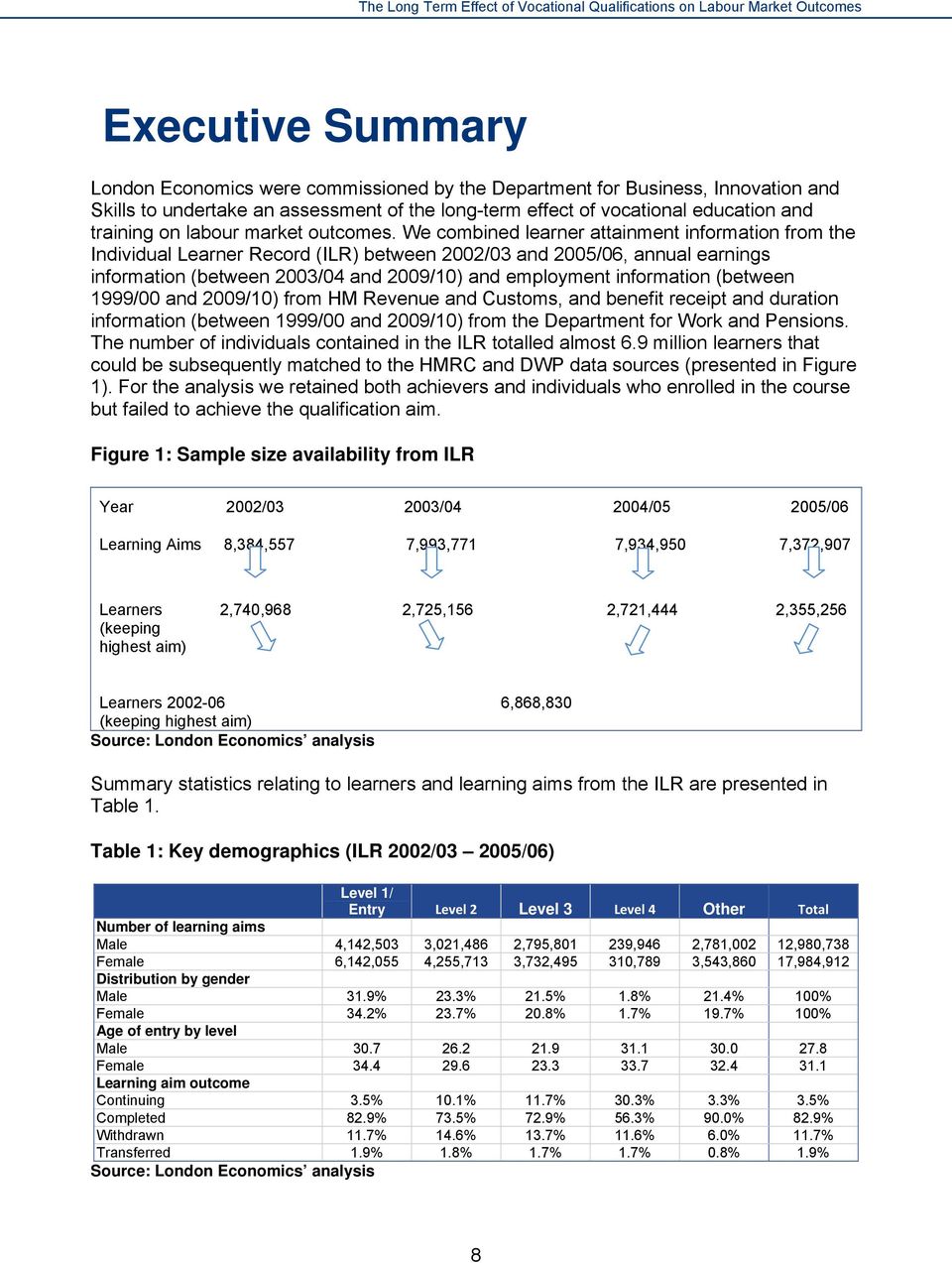
8 Executive Summary London Economics were commissioned by the Department for Business, Innovation and Skills to undertake an assessment of the long-term effect of vocational education and training on labour market outcomes. We combined learner attainment information from the Individual Learner Record (ILR) between 2002/03 and 2005/06, annual earnings information (between 2003/04 and 2009/10) and employment information (between 1999/00 and 2009/10) from HM Revenue and Customs, and benefit receipt and duration information (between 1999/00 and 2009/10) from the Department for Work and Pensions. The number of individuals contained in the ILR totalled almost 6.9 million learners that could be subsequently matched to the HMRC and DWP data sources (presented in Figure 1). For the analysis we retained both achievers and individuals who enrolled in the course but failed to achieve the qualification aim. Figure 1: Sample size availability from ILR Year 2002/ / / /06 Learning Aims 8,384,557 7,993,771 7,934,950 7,372,907 Learners 2,740,968 2,725,156 2,721,444 2,355,256 (keeping highest aim) Learners ,868,830 (keeping highest aim) Source: London Economics analysis Summary statistics relating to learners and learning aims from the ILR are presented in Table 1. Table 1: Key demographics (ILR 2002/ /06) Level 1/ Entry Level 2 Level 3 Level 4 Other Total Number of learning aims Male 4,142,503 3,021,486 2,795, ,946 2,781,002 12,980,738 Female 6,142,055 4,255,713 3,732, ,789 3,543,860 17,984,912 Distribution by gender Male 31.9% 23.3% 21.5% 1.8% 21.4% 100% Female 34.2% 23.7% 20.8% 1.7% 19.7% 100% Age of entry by level Male Female Learning aim outcome Continuing 3.5% 10.1% 11.7% 30.3% 3.3% 3.5% Completed 82.9% 73.5% 72.9% 56.3% 90.0% 82.9% Withdrawn 11.7% 14.6% 13.7% 11.6% 6.0% 11.7% Transferred 1.9% 1.8% 1.7% 1.7% 0.8% 1.9% Source: London Economics analysis 8
9 Determinants of learning aim completion Using this unique data set, we undertook a number of different elements of analysis. In the first (and preparatory) component of the analysis, we assessed the determinants of individuals completing the specific learning aims they enrolled for at different levels within the National Qualification Framework. For this element of the analysis, the counterfactual group is formed of individuals enrolling in the same qualification type (or at the same level of the National Qualification Framework) but failing to achieve. This was undertaken at an aggregate level (all learning aims); at different qualification levels (Levels 1, 2, 3 and 4); and at a disaggregated level (i.e. NVQ Level 1 or City & Guilds at Level 2). We also undertook the analysis at different Skills for Life levels, as well as for Apprenticeships. We used a range of different econometric specifications and controlled for personal characteristics using learner level information from the ILR, and local area socioeconomic information by merging information from the Index of Multiple Deprivation using learner postcode. The analysis was undertaken at learning aim level (rather than at learner level), and as such, the sample sizes in some of the more aggregated model specifications were in excess of 14 million. It is the first time that an analysis of the determinants of qualification attainment has been undertaken using this data set and the results are exceptionally robust in a statistical sense. Presented in Table 5, Table 6 and Table 7 (Section 3 of the main report), the findings of the various probit regressions are as follows: Age has a positive impact on completing most learning aims with the impact of age increasing as the level of learning aim increases (from 1.7 percentage points per year to 3.8 percentage points per year between Level 1 and 3). Women are almost always more likely to complete learning aims compared to men and this gender effect increases with qualification level. Women are 1.7 percentage points more likely to complete a level 1 learning aim but approximately 4 percentage points more likely to complete level 2 or level 3 qualifications Compared to white British learners, learners of other ethnic backgrounds are in general less likely to complete qualifications at all aggregated levels, although there are some notable exceptions for some specific qualifications and ethnic groups. Local deprivation factors are a determinant of learning aim completion. Learners that are resident in areas that suffer greater socioeconomic deprivation are less likely to complete their learning aim compared to learners in areas suffering less deprivation. Compared to the median level of deprivation, a learner in the 75th percentile of deprivation (i.e. top quarter) is approximately 1.5 percentage points less likely to complete a level 1 or level 2 learning aim, and approximately 3 percentage points less likely to complete a level 3 of level 4 learning aim. In general, acquisition of learning aims through classroom contact was most successful at level 1 and level 3; however, workplace learning was associated with the highest success rates at level 2 especially for men. 9

10 The analysis indicates that compared to 2002/03, individuals in 2005/06 were 4 percentage points more likely to complete a level 1 learning aim, while at level 3, learners were more than 10 percentage points more likely to complete. Longer term labour market outcomes definition of counterfactuals The second (and substantive) component of the analysis undertaken involved an assessment of the longer term labour market outcomes associated with attaining different qualifications. Where individuals achieved more than one learning aim over the period, we considered the impact of their highest level of achievement on subsequent outcomes. The outcome measures that we assessed include the annual earnings achieved by an individual, the proportion of the financial year the individual was in employment and the proportion of the financial year in receipt of a number of benefits (Job Seekers Allowance (JSA) and Incapacity Benefit (IB)). The key methodological issue involves how to construct an appropriate counterfactual to assess the long term impact of qualification achievement. The ILR consists of individuals who were enrolled in at least one learning aim in the period However, due to limitations with the variables contained in the ILR, we were unable to control for further learning undertaken outside of the period or prior attainment. Therefore, as with most studies of this nature, it was not possible to create a perfect counterfactual. With this in mind, for each of the outcome measures of interest, we considered three alternative counterfactuals. All are likely to have some inherent limitations, but some seem more robust than others. Below we present the case for the different counterfactuals. One scenario consisted of the assessment of outcomes before and after the learning aim was attained, comparing the same individual at different points in time, before and after qualification enrolment and attainment. These results generally display very strong positive returns; however, this in part reflect time effects and the return associated with the individual in possession of the learning aim rather than the impact of the learning aim itself. Moreover, given the fact that earnings records are only available from 2003/04, this implies that earnings information prior to course enrolment is only available for the 2005/06 ILR, reducing the robustness of the results generated in this study. We also modelled a second scenario where the difference in the long term outcomes between those individuals simultaneously attaining qualifications at adjacent levels was analysed (for instance, individuals completing a qualification aim at Level 2 compared to individuals completing a qualification aim at Level 3). This was initially considered in order to control for the possibility of differences in the unobserved personal characteristics across learners (such as motivation or effort levels). However, the simultaneous attainment counterfactual may suffer from the potential existence of ability bias, where an individual completing a level 3 learning aim may have fundamentally different innate ability characteristics compared to an individual completing a level 2 learning aim (for instance). In addition, there are also some issues in respect to the interpretation of the various coefficients, where a misleading estimate of the return to a particular qualification may occur depending on the returns associated with the adjacent level of qualification. In order to control for these potential biases and because of the ease of interpretation, we also considered the difference in the long term outcomes between completers and non- 10

11 completers. Non-completers are defined as those enrolling in a course of the same type at the same level as completers, but who failed to achieve the learning aim, either because of withdrawal from the course or because they failed in their exams. Having modelled the determinants of qualification attainment, we are able to control for (at least in part) some of those characteristics that may be relevant in determining completion, leaving a truer indication of the impact of the learning aim itself on long term outcomes. Understandably, in both the completion versus non-completion and simultaneous attainment counterfactuals, the estimates of the impact of the learning aim on long term outcomes is less than under the before and after counterfactual, illustrating the importance of controlling for both observable and unobservable characteristics that may influence both attainment and outcomes. Although we cannot rule out the presence of differences in the personal characteristics between the treatment and comparison groups, especially in relation to unobservable characteristics such as of motivation or ability, we have estimated the determinants of qualification attainment and control for a range of observable characteristics at both personal and course level accordingly. We believe that the completers versus noncompleters counterfactual offers the most robust option for identifying the long term outcomes associated with vocational education and training, as well as providing the best opportunity for assessing the relative outcomes of learners on a consistent basis into the future. Given this, the completers versus non-completers counterfactual is our preferred approach for assessing the longer term impact of education and training on labour market outcomes, and throughout the report, we focus our attention on this group of models (though all other results are presented for completeness). All estimates presented are statistically significant. Long term impact of education and training on earnings When analysing the long term earnings effect of qualification attainment, we considered the difference in reported annual earnings between those completing and not completing the particular qualification using information from HM Revenue and Customs. 11

12 Figure 2: Long term impact of education and training on earnings (completers vs. non-completers extended specification) 15% 10% 5% 0% 5% 10% Time period Level 1 Level 2 Level 3 Level 4 15% Source: London Economics' analysis. Note: The vertical axis in Figure 2 represent earnings premium following the appropriate exponential transformation under the completion versus non completion counterfactual. See section 4 for more details. The main results relating to earnings outcomes (presented in Table 8, Table 10, Figure 2 and in section 4.4) are as follows: Qualification attainment at Level 1 adds approximately 3% per annum to earnings in the seven years post completion. There is no erosion of the premium over time. At level 2, the earnings premium is approximately zero in the first three years post completion; however, increases to approximately 6% after 7 years. There is some variation depending on the particular qualification; with NVQ Level 2 qualifications associated with a return approximately 5% immediately post attainment, rising to 14% after 7 years. At level 3, there are negative earning returns in the first four years post attainment; however, this is as a result of the inclusion of GCE A Levels in the analysis. This anomaly is driven by the fact that completers are more likely to attain further or higher education qualifications and remain as relatively low earners for a number of years. There are a number of qualifications offering immediate and sustained benefits to acquisition. City & Guilds Level 3 qualifications are associated with an earnings premium of 5-7% per annum. In contrast, NVQ Level 3 qualifications are associated with a small negative earnings return in the first three years post completion; however, a positive earnings return emerges by year 4 post-acquisition and increases to more than 14% after seven years. 12

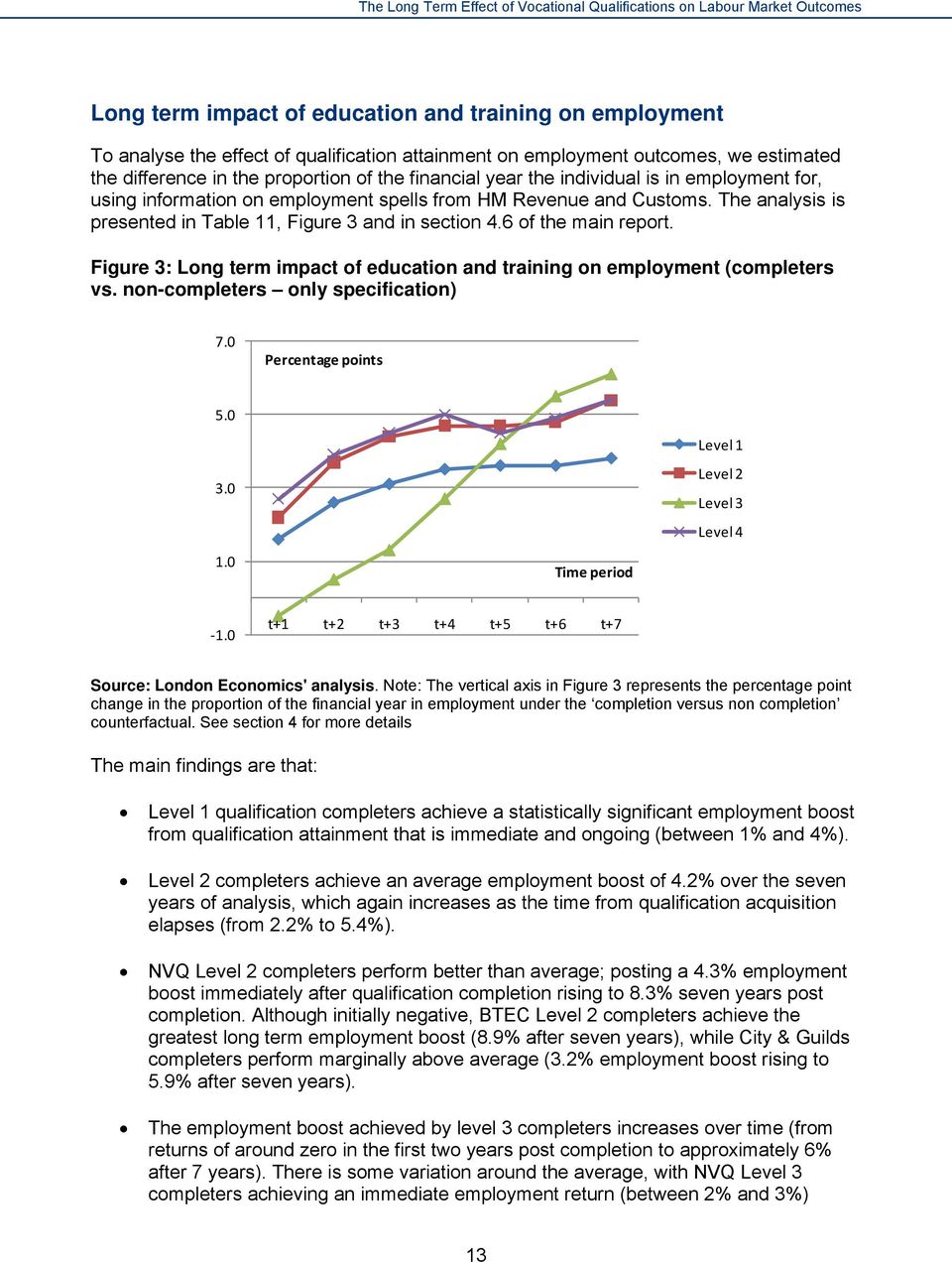
13 Long term impact of education and training on employment To analyse the effect of qualification attainment on employment outcomes, we estimated the difference in the proportion of the financial year the individual is in employment for, using information on employment spells from HM Revenue and Customs. The analysis is presented in Table 11, Figure 3 and in section 4.6 of the main report. Figure 3: Long term impact of education and training on employment (completers vs. non-completers only specification) 7.0 Percentage points Time period Level 1 Level 2 Level 3 Level Source: London Economics' analysis. Note: The vertical axis in Figure 3 represents the percentage point change in the proportion of the financial year in employment under the completion versus non completion counterfactual. See section 4 for more details The main findings are that: Level 1 qualification completers achieve a statistically significant employment boost from qualification attainment that is immediate and ongoing (between 1% and 4%). Level 2 completers achieve an average employment boost of 4.2% over the seven years of analysis, which again increases as the time from qualification acquisition elapses (from 2.2% to 5.4%). NVQ Level 2 completers perform better than average; posting a 4.3% employment boost immediately after qualification completion rising to 8.3% seven years post completion. Although initially negative, BTEC Level 2 completers achieve the greatest long term employment boost (8.9% after seven years), while City & Guilds completers perform marginally above average (3.2% employment boost rising to 5.9% after seven years). The employment boost achieved by level 3 completers increases over time (from returns of around zero in the first two years post completion to approximately 6% after 7 years). There is some variation around the average, with NVQ Level 3 completers achieving an immediate employment return (between 2% and 3%) 13
14 increasing to almost 8% after 7 years. Similar outcomes were associated with both BTEC and City & Guilds qualifications. Long term impact of education and training on benefit dependency Using benefit duration information from the Department for Work and Pensions, we also assessed the impact of qualification attainment on benefit dependency, where the outcome measure is the proportion of the calendar the individual is in receipt of particular benefits including Job Seekers Allowance (JSA) and/or Incapacity Benefit (IB). The analysis is presented in Table 13, Table 14, Figure 4 and in section 4.8 of the main report. Figure 4: Long term impact of education and training on JSA dependence (completers vs. non-completers only specification) Time period Level 1 Level 2 Level 3 Level Percentage points Source: London Economics' analysis. Note: The vertical axis in Figure 4 represents the percentage change in the financial year in receipt of JSA under the completion versus non completion counterfactual. See section 4 for more details The main findings indicate that: At level 3, learning aim completers are approximately 1-2% less likely to be dependent on JSA; however, although the initial impact of education and training is around 2% in the first three years post-completion, the effect dissipates marginally over time (1% less JSA dependent after 5 years). The analysis suggests that level 2 completers are approximately 1.5% less JSA dependent immediately post qualification attainment, though in the medium to longer term the effect is also reduced (to approximately 1%). NVQ and BTEC Level 2 qualifications have a particularly strong effect on reducing JSA dependency (2.0%-2.5% and 3.5%-4.0% respectively). Level 1 completers see a statistically significant reduction in JSA dependency. Skills for Life completers at level 1 see a reduction in JSA dependency of approximately 14

15 2% in the first two years, although the reduction in JSA dependency falls to approximately 1% thereafter. Apprenticeships We undertook an analysis of the impact of undertaking and completing Advanced or Foundation Apprenticeships on annual earnings, as well as the impact of Apprenticeship completion on the proportion of year in employment or in receipt of benefits. The main findings (presented in section 5 of the main report) are as follows: Apprenticeships have some of the largest long term impacts on learners. The earnings impact of completing a Foundation Apprenticeship in the first year post acquisition stands at approximately 24.1% compared to a non-completer. Relative earnings benefits remain in excess of 14% compared to non completers throughout the period. The relative return to men is marginally higher that the return to women post-completion. Figure 5: Earnings outcomes associated with Apprenticeship attainment 30% Advanced apprenticeships (all) Foundation Apprenticeships (all) 20% 10% 0% Time period Source: London Economics' analysis. Note: The vertical axis in Figure 5 represents earnings premium following the appropriate exponential transformation under the completion versus non completion counterfactual. See section 5 for more details. The earnings premium associated with gaining an Advanced Apprenticeship stands at 25.3% relative to non-completers, with men generating a 31.9% premium relative to non-completers compared to a 14.3% premium achieved by women. There is some erosion of the earnings premium over time, with the aggregate premium to Advanced Apprenticeships after seven years standing at 14.7% (consisting of a premium of 16.2% for men and 10.8% for women). Both Advanced and Foundation Apprenticeships are associated with an increase in the proportion of the year employed of between 4% and 6%. This employment 15

16 effect remains relatively intact over the period of analysis. The analysis illustrates that men achieve a slightly higher employment return compared to women especially for Advanced Apprenticeships. The analysis indicates again that the acquisition of qualifications reduces benefit dependency. In the case of Foundation Apprenticeships, there is a 4% reduction in the proportion of calendar days in receipt of JSA and a 1.2% reduction in IB dependency. For Advanced Apprenticeships, the equivalent estimates stand at 2.3% and 0.7% respectively. Benefit dependency is also reduced in the longer term, with individuals completing Advanced and Foundation Apprenticeships approximately 2.1% to 2.4% less JSA dependent compared to non-completers at the end of the seven year period. Skills for Life We undertook an analysis of the impact of undertaking and completing Skills for Life literacy and numeracy learning aims on annual earnings, and the proportion of the calendar year in employment or in receipt of benefits. The analysis focused on literacy and numeracy learning aims at different levels given the proportion of learners enrolled on these specific courses, and the main findings (presented in section 6) are as follows: Figure 6: Earnings outcomes associated with SFL attainment 15% 10% Level 1 Literacy and Numeracy (Level 1) Literacy only (Level 1) Numeracy only (Level 1) 15% 10% Level 2 Literacy and Numeracy (Level 2) Literacy only (Level 2) Numeracy only (Level 2) 5% 5% 0% Time period 0% Time period 5% 5% Source: London Economics' analysis. Note: The vertical axis in Figure 6 represents earnings premium following the appropriate exponential transformation under the completion versus non completion counterfactual. SFL Entry level learning aims are not incorporated within SFL Level 1 learning and as such are not presented in this element of the analysis. See section 6 for more details. Earnings At Level 1, there appears to be a sizeable earnings return associated with SFL literacy learning aims compared to numeracy learning aims (in excess of 7% in the first three years post completion compared to 3% for numeracy); however, this applies more in the short to medium term, as the returns to numeracy qualifications increase steadily over time (from 3% in year one to approximately 12% in year six). The analysis indicates that there are immediate and persistent earnings returns associated with the attainment of SFL numeracy learning aims at Level 2 (starting 16

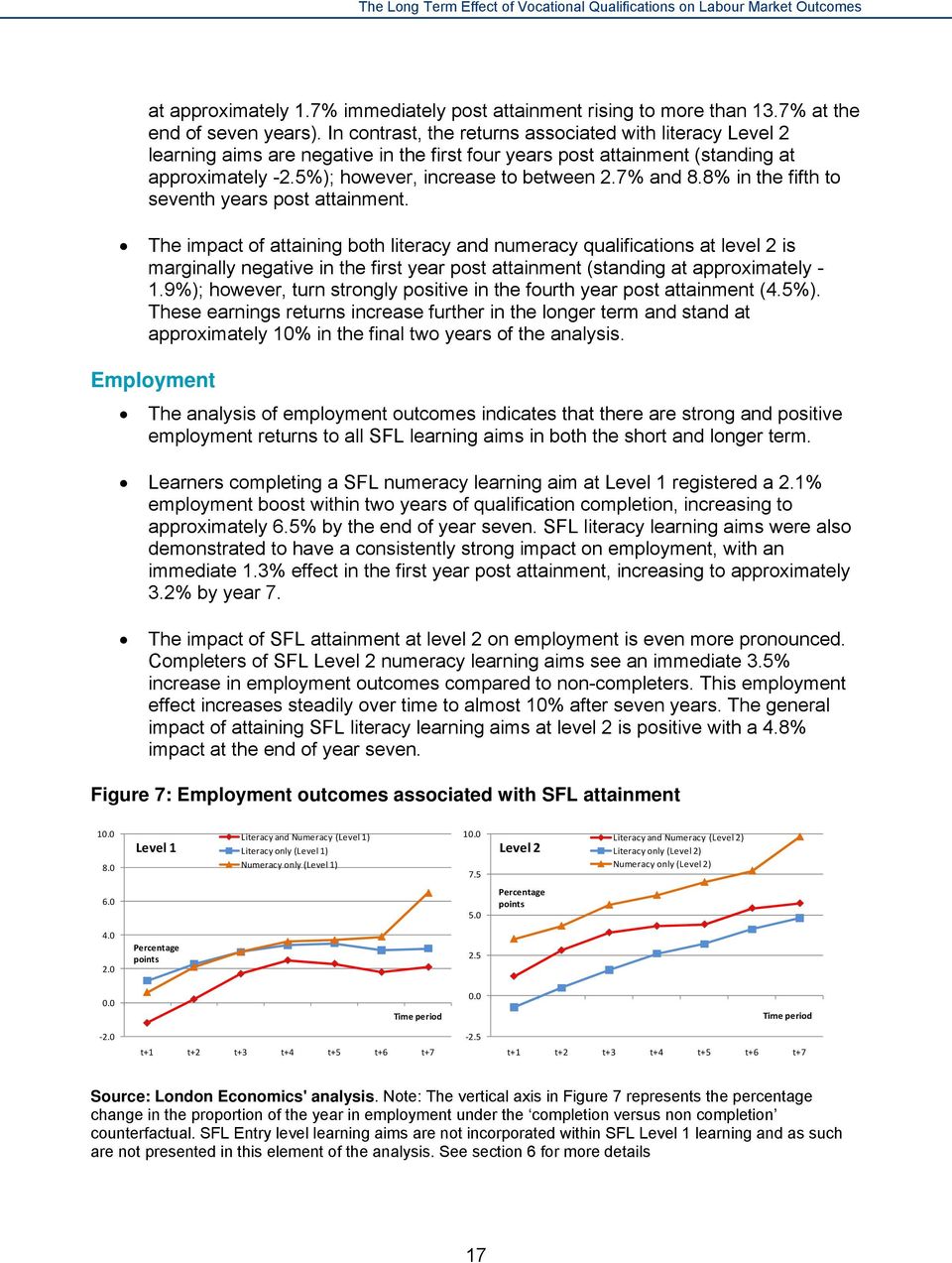
17 at approximately 1.7% immediately post attainment rising to more than 13.7% at the end of seven years). In contrast, the returns associated with literacy Level 2 learning aims are negative in the first four years post attainment (standing at approximately -2.5%); however, increase to between 2.7% and 8.8% in the fifth to seventh years post attainment. The impact of attaining both literacy and numeracy qualifications at level 2 is marginally negative in the first year post attainment (standing at approximately - 1.9%); however, turn strongly positive in the fourth year post attainment (4.5%). These earnings returns increase further in the longer term and stand at approximately 10% in the final two years of the analysis. Employment The analysis of employment outcomes indicates that there are strong and positive employment returns to all SFL learning aims in both the short and longer term. Learners completing a SFL numeracy learning aim at Level 1 registered a 2.1% employment boost within two years of qualification completion, increasing to approximately 6.5% by the end of year seven. SFL literacy learning aims were also demonstrated to have a consistently strong impact on employment, with an immediate 1.3% effect in the first year post attainment, increasing to approximately 3.2% by year 7. The impact of SFL attainment at level 2 on employment is even more pronounced. Completers of SFL Level 2 numeracy learning aims see an immediate 3.5% increase in employment outcomes compared to non-completers. This employment effect increases steadily over time to almost 10% after seven years. The general impact of attaining SFL literacy learning aims at level 2 is positive with a 4.8% impact at the end of year seven. Figure 7: Employment outcomes associated with SFL attainment Level 1 Literacy and Numeracy (Level 1) Literacy only (Level 1) Numeracy only (Level 1) Level 2 Literacy and Numeracy (Level 2) Literacy only (Level 2) Numeracy only (Level 2) Percentage points Percentage points Time period 0.0 Time period Source: London Economics' analysis. Note: The vertical axis in Figure 7 represents the percentage change in the proportion of the year in employment under the completion versus non completion counterfactual. SFL Entry level learning aims are not incorporated within SFL Level 1 learning and as such are not presented in this element of the analysis. See section 6 for more details 17
18 Benefit dependency The analysis indicates that at levels 1 and 2, for both literacy and numeracy, there is an immediate and relatively persistent impact of SFL attainment on JSA benefit dependency. At level 1, attaining a SFL numeracy learning aim reduces the proportion of the financial year in receipt of JSA by approximately 1.6%. This occurs in the first year post attainment and persists throughout the period of the analysis. The impact of attaining SFL literacy learning aims is even greater in the short term (2.5%) though does erode by the end of the seven year period. The impact of SFL learning aim attainment is even stronger at level 2 than at level 1. The difference in JSA dependency between completers and non-completes stands at 2.2% and 2.7% for literacy only and numeracy only, while the impact of attaining both literacy and numeracy SFL qualifications stands at 2.5%. Over the seven year period, only 25% of this reduction in benefit dependency is eroded. 18

19 1. Introduction London Economics were commissioned by the Department for Business Innovation and Skills to undertake an assessment of the long term effect of vocational education and training on labour market outcomes. To undertake this analysis, we combined information from the Individual Learner Record (ILR) between 2002/03 and 2005/06 on learner attainment, detailed earnings (between 2003/04 and 2009/10) and employment information (between 1999/2000 and 2009/10) from HM Revenue and Customs, and benefit receipt and duration information (between 1999/00 and 2009/10) from the Department for Work and Pensions. The report is set out as follows: In section 2 of the report, we provide a detailed analysis of the approach we adopted to merge the various data, the econometric approach underpinning the analysis, and the selection of the various counterfactuals for analysis. In section 3, we assessed the determinants of individuals completing the specific learning aims they enrolled for at different levels within the National Qualification Framework. This was undertaken at an aggregate level (all learning aims, learning aims at different aggregate qualification levels (levels 1, 2, 3 and 4)), as well as at a disaggregated level (individual qualifications within specific levels (i.e. National Vocational Qualifications or City & Guilds at level 2)). We also undertook the analysis of Skills for Life education and training, as well as for Apprenticeships. The analysis involved a range of alternative econometric specifications and controlled for personal characteristics using learner level information from the ILR and local level socioeconomic information by merging information from the Index of Multiple Deprivation using learner postcode. The substantive component of the analysis undertaken involved the assessment of the longer term labour market outcomes associated with attaining different qualifications. The outcome measures that we assessed included the annual earnings achieved by individuals (presented in sections 4.3 and 4.4), the proportion of the year the individual was in employment (presented in sections 4.5 and 4.6) and the proportion of the year in receipt of various benefits (Job Seekers Allowance and Incapacity Benefit), which is presented in sections 4.7 and 4.8. The analysis included a number of alternative model specifications, as well as a range of counterfactuals in an attempt to isolate the impact of education and training on learner outcomes. Throughout section 4, we focus on one particular counterfactual ( completers versus non-completers ), although we present the full econometric results relating to all three counterfactuals in Annex 3 (earnings), Annex 4 (employment) and Annex 5 (benefit dependency). In section 5, we assessed the impact of acquiring either a Foundation or Advanced Apprenticeship on the three outcome measures of interest using the same range of counterfactuals (with full details in Annex 6), while in Section 6 we undertook a disaggregated analysis of the role of Skills for Life on the long term outcomes of learners with full details presented in Annex 7. Section 7 concludes. 19

20 2. Data Merging approach and summary methodology 2.1 Datasets under consideration In this section we describe the different datasets used in the analysis, the variables contained, the time period covered and the approach used to clean and merge the information into one dataset. The datasets used in the analysis contain information from a number of different sources: The Individualised Learner Record (ILR) contains information on learning aims and level, as well as personal characteristics supplied by learning providers and collected through the ILR. The ILR is organised by academic year (1st August 31st July) and this research report uses information from the academic years 2002/03 to 2005/06 inclusive. The files are divided by academic year and funding stream (Further Education and Work Based Learning, with the latter containing information on Apprenticeships). HMRC Pay and tax records (P14) contain administrative data collected by HM Revenue & Customs, including information on tax year, tax code, pay and tax records for different employment spells. The information is organised by tax year and employment spell and covers the years from 2003/04 to 2009/10 inclusive. HMRC employment spell records (P45) contain administrative data collected by HM Revenue & Customs detailing information on start dates and end dates of employment spells. DWP National Benefits Database contains data on benefit spells collected by the Department for Work and Pensions. We describe in detail the different datasets and how they were cleaned, reshaped and merged into a single dataset containing information on qualification participation and attainment, earnings and employment, and benefits dependency. 2.2 Stage 1 ILR coding and determinants of qualification attainment Further Education datasets Preliminary steps A series of preliminary cleaning steps were carried out, which involved: Retaining those aged between 16 and 59; Excluding those individuals with a learning aim that is not live ; 20

21 Excluding those individuals on an employment training pilot; Removing those individuals with no information on their funding source; Defining a learning window associated to each academic year, covering a period from August before the start of the academic year to December after the end of the academic year (for example the learning window for 2005/06 would cover the period from August 2004 to December 2006) 1. Variable definitions The ILR contains, among other things, information on level of participation, course outcome (i.e. attainment or non-attainment) and also course title. The relevant variables identifying treatment and counterfactual groups were defined combining information on learning aim level, course outcome and extracting details on aim type from course title. The relevant groups for the analysis were defined both at an aggregate level, using notional aim levels as defined by the National Qualification Framework and identified through the variable a_nvqlev, and at a disaggregated level. Specific aim types at a disaggregate level were identified through the combination of aim level and aim type. Aggregated level For the aggregated classification of learning aims, participation in different aims is classified by level, using the variable a_nvqlev (including both academic and vocational/professional aims), as follows: Level 4 occurs when a_nvqlev =4 Level 3 occurs when a_nvqlev =3 Level 2 occurs when a_nvqlev =2 Level 1 or Entry level occurs when a_nvqlev =1 The category of aims indentified by a_nvqlev =9 ( other ) is of miscellaneous nature, including a large variety of aims. Some of the most common aims include: short courses 1 Learning windows as part of the before and after counterfactual analysis, we established a minimum start date and a maximum end date for the learning period to ensure comparability across individuals and also to have a reference period for the analysis. Defining and appropriate end date was particularly relevant in our case, given that we mainly compare outcomes across learners post qualification completion. In addition, the learning window was extended beyond the end of the academic year covered by the ILR to ensure that those individuals undertaking learning aims spanning multiple academic years (for instance) were neither double counted nor routinely considered non-completers as a result of an arbitrary academic year end. 21
22 such as Diagnostic Tests in Numeracy, Literacy etc (generally prior to starting a SFL course); tutorial and enrichment studies for full time students (16-18), studying GCE A levels; AS levels; GCSEs and short course GCSEs; courses for individuals with learning disabilities (e.g. Essential Skills Awards); introduction to IT etc.; health and safety courses; first aid courses; vocational study not leading to a recognised qualification; and other education/leisure type courses. The 2004/05 and 2005/06 datasets also included higher education qualifications under this miscellaneous category, which were removed from the dataset as they were not the primary focus of the analysis. Disaggregated level At a disaggregated level, we identified participation in the following learning aims using a combination of a_nvqlev and the variables a_atype (identifying aim type), and a09_titl (detailing the course title) as follows: 1) Level 4 (any qualification at level 4). 2) Level 3 NVQ/GNVQ at level 3 (identified through variable a_atype); BTEC at level 3 (identified through variable a09); City and Guilds at level 3 (identified through variable a09); Any academic aim at level 3 (identified through variable a_atype); Other qualifications at level 3 3) Level 2 NVQ/GNVQ at level 2 (identified through variable a_atype); BTEC at level 2 (identified through variable a09); City and Guilds at level 2 (identified through variable a09); Skills for Life at level 2 (using variable a_sflpar); Any academic aim at level 2 (identified through variable a_atype); Other qualifications at level 2 4) Level 1 or Entry level Skills for Life at level 1 or entry level (using variable a_sflpar); 22
23 Skills for Life at entry level (using variable a_sflpar and variable a09); Other qualifications at level 1 or entry level; In Table 2 we present the detailed combination of a_nvqlev, a_atype and a_sflpar through which we identified the different qualification aims used in the analysis. Table 2: Variable definition learning aim level Variable Name Definition NVQ3/GNVQ 3 Combination of a_nvqlev=3 & (a_atype=3 or a_atype=4 or a_atype=5 or a_atype=9) BTEC 3 Identified using the variable a09_titl: we identified those aim titles starting with the code BTEC and combined it with a_nvqlev=3 C&G 3 Identified using the variable a09_titl: we identified those aim titles starting with the code CG and combined it with a_nvqlev=3 Academic level 3 Combination of a_nvqlev=3 & (a_atype =1 a_atype =6) NVQ/GNVQ 2 Combination of a_nvqlev=2 & (a_atype =3 or a_atype =4 or a_atype =5 or a_atype =9) BTEC 2 Identified using the variable a09_titl: we identified those aim titles starting with the code BTEC and combined it with a_nvqlev=2 C&G 2 Identified using the variable a09_titl: we identified those aim titles starting with the code CG and combined it with a_nvqlev=2 Academic level 2 Combination of a_nvqlev=2 & (a_atype=2) Skills for Life Level 2 Combination of a_nvqlev =2 & a_sflpar=1 Skills for Life Level 1 Combination of a_nvqlev =1 & a_sflpar=1 Skills for Life Entry Identified using the variable a09_titl: we identified those aim titles containing the word Entry and combined it with a_nvqlev=1& a_sflpar=1 Source: London Economics analysis Work Based Learning (WBL) datasets Apprenticeships are split into Foundation and Advanced Apprenticeships (at levels 2 and 3), and similar to Further Education qualifications, are available for the academic years 2002/03 to 2005/06 inclusive. Qualification completion and attainment The ILR also includes details on course completion and aim attainment. In particular, the variable a34 identifies whether the learner has completed or not the learning activities and the reason for non-completion at the end of the academic year (withdrawal, transfer to another course, continuing learning). Variable a35 provides information on learning outcome, indicating whether the learner has achieved the learning aim, partially achieved, failed to achieve or whether, at the end of the academic year, the learner has still to take the exam (or the exam was taken but the outcome is still unknown). The combination of a34=2 and a35=1 provides information on those who successfully completed the course and achieved the learning aim. This information was combined with the information on qualification level and type to generate information on achievers and non-achievers at different levels and by different qualifications. The various treatment groups, formed by qualification achievers, correspond to learners having completed the learning activities (a34=2) and having (fully) achieved the 23
24 qualification aim (a35=1). Non-completers, which constitute the main counterfactual group for each qualification (or level), are defined as those not completing the course because of withdrawal, or completing but failing to achieve the qualification aim. All other cases (continuing or transferring learners, partial achievers and learners whose outcome is unknown) were dropped from the dataset before looking at the determinants of attainment and at the impact of qualification attainment. For each learning aim level and qualification type (as detailed above), we generated a treatment group formed of qualification achievers and a counterfactual group formed of learners enrolling in the same learning aim but failing to achieve. 2.3 Stage 2 Reshaping data to generate highest qualification per learner Moving from learning aim level to learner level The analysis on determinants of qualification attainment was carried out at learning aim level. However, in order to assign each learner to the appropriate treatment or counterfactual group, we needed to move from a dataset organised by learning aim, with multiple entries per each learner, to a dataset organised by learner, with one entry per learner. Hence, the next step consisted of aggregating information to learner level. Some learners have more than one entry, because they have enrolled in more than one qualification aim. We therefore aggregated information at learner level, keeping detailed information on the highest qualification achieved and summary information on other aims. When no qualification was achieved at any level we kept detailed information on the highest aim enrolled in. This reshaping process was carried out first by aggregating information within the same academic year, then merging across academic years (from 2002/03 to 2005/06). Table 3 provides information on the hierarchical ranking of qualifications in the first instance (e.g. a NVQ Level 3 qualification is ranked more highly than a City & Guilds Level 3 qualification), as only the qualification aim at highest level achieved (or enrolled in for non achievers) was retained. When a learner achieved more than one qualification of the same type (for instance two NVQ Level 2 qualifications), the NVQ qualification with the highest number of guided learning hours was retained as the highest qualification. In case of two aims of the same type with identical guided learning hours, we kept the more recent qualification as the highest. Table 3: Variable definition learner level Variable Definition Level 4 Any qualification at level 4 NVQ/GNVQ Level 3 NVQ or GNVQ at level 3 BTEC Level 3 BTEC at level 3 C&G Level 3 City and Guilds at level 3 Academic level 3 Any academic qualification at level 3 Other Level 3 Any other qualification at level 3 NVQ/GNVQ Level 2 NVQ or GNVQ at level 2 24
25 Variable Definition BTEC Level 2 BTEC at level 2 C&G Level 2 City and Guilds at level 2 Academic level 2 Any academic qualification at level 2 SFL Level 2 Skills for Life at level 2 Other Level 3 Any other qualification at level 2 Skills for Life Level 1 Skills for Life at level 1 Skills for Life Entry Level Skills for Life at entry level Other Level 1 Any other qualification at level 1 Other qualifications Any qualification with level undefined Source: London Economics Two identifiers are available to aggregate information across years and subsequently with information from HMRC and DWP: the ccorcid identifier from the DWP and the person instance identifier from HMRC. We used ccorcid as the main identifier and person instance when ccorcid was not available. We also removed observations where the two identifiers were both available but conflicting (for example when many ccorcid entries corresponded to the same person instance or vice versa). Also we removed cases when the same identifier was attributed to individuals with differences in characteristics such as date of birth, gender and ethnicity. Overall, we generated the following number of observations for subsequent merging: Figure 8: Cleaning FE datasets Year 2002/ / / /06 Aims 8,384,557 7,993,771 7,934,950 7,372,907 Learners 2,740,968 2,725,156 2,721,444 2,355,256 (keep highest aim) Learners ,868,830 (keep highest aim) Source: London Economics analysis The cleaning and reshaping process described so far has focused exclusively on data on learning aims and learners characteristics from the ILR. At this stage the ILR dataset has one observation per learner in the period and learners are assigned to the relevant treatment or counterfactual groups, depending on the highest qualification aim achieved or enrolled in (without achievement). In section 2.4, we describe how the relevant variables on earnings, employment and benefits were generated, using data from P14, P45 and National Benefits Database. The relevant data were then merged with ILR information to generate a dataset covering the period from the financial year 1998/99 to 2009/10 and containing information on training, earnings, the proportion of the year spent in employment and benefit dependency. 25
26 2.4 Stage 3 Matching information from the ILR with data from P14, P45 and NBD Pay and tax records - P14 This dataset contains the ccorcid and person instance identifiers (the former is not available for all observations), along with information on tax year (from 2003/04 to 2009/10), tax code, pay and tax records for the different employment spells, start date and end date when an employment spell started or finished within the tax year, and a ripeness flag to indicate if all P14 data has been received for the individual for that year. Overall there are around 76 million records in the dataset. After removing records with zero or negative earnings and removing a few duplicate observations (most were removed before the data transfer), we used information on pay and taxes to generate a variable containing total pay and total tax for each individual in each available year. This clean dataset, where we have at most one observation per individual per year contains slightly more than 10 million individuals, as identified through the ccorcid and person instance identifiers. Employment spells P45 The P45 dataset contains, apart from the identifiers, information on start date and end date of an employment spell and a flag to identify whether the record is a main or subsidiary source of income. There are a few issues associated to P45 records: The flag on source of income is missing in many cases and might not be entirely reliable when it is available; There is a high occurrence of records with uncertain start (e.g. 06 Apr YYYY) or uncertain end (e.g. 05 Apr YYYY) associated to the start/end of the financial year. The spells with an uncertain start or an uncertain end may overlap with records with certain start and end dates, signalling that the two records may be near duplicates. There are also records with the same (certain) start and different ends, as well as the same (certain) end and different start dates; Continuing spells of employment are flagged as ending on 31Dec9999. However, in many cases it is difficult to assess if the end date is coded 31Dec9999 because the employment spell is associated to an ongoing job or because the end date is missing; To take into account the presence of possible near duplicates we adopted the following strategy: o For records with an uncertain start (06 Apr) ending on the same date of records with a certain start, we kept the record with a certain start; 26
27 o For records with an uncertain end (05 Apr or 31 Dec9999) starting on the same date of records with a certain end, we kept the record with a certain end; o When two records have the same (certain) end but different starts, we kept the record with the earliest start; o When two records have the same (certain) start but different ends, we kept the record with the latest end; o When two records have different starts and both have missing ends (31 Dec9999), we kept the record with the latest start (it is more plausible that later starts are a genuine record of ongoing employment). After removing these near duplicates we generated a variable keeping track of the days spent in employment by each individual in each financial year. The variable was then further recoded and expressed as the proportion of the year spent in employment (ranging from 0 to 1). The original dataset contains around 72 million records. After cleaning the dataset and generating a dataset with one observation per year per individual we are left with almost 11 million individuals. We kept track of employment history starting from the financial year 1998/99. Benefit spells National Benefits Database (NBD) Data on benefit spells is contained in the National Benefits Database, along with the ccorcid identifier. We kept information on the following labour market benefits: Incapacity Benefits (IB, which includes passported Incapacity Benefits); Income Support (IS); Jobseekers Allowance (JSA); Disability Living Allowance (DLA). Jobseekers Allowance accounts for almost half of total records in the original dataset. When we keep only the four benefits above, we find that around two thirds of records are JSA, 17% relate to IS, 12% relate to IB and 5% relate to DLA. We removed information on other benefits and, following a process similar to that described above for employment spells, and generated four variables identifying the proportion of the year spent by each individual on each different benefit. The original dataset is formed by approximately 28 million records. After stripping out non relevant benefits we are left with a dataset of around 6.6 million observations, with data on benefits starting from the financial year 1998/99. 27
28 Merging with the ILR Information from the ILR was matched with the history of earnings employment and benefits contained in the P14, P45 and NBD. The resulting dataset covers the earnings, employment and benefit history of 6,868,830 individuals between 1998/99 and 2009/10 (all those kept after the reshaping of the ILR). Some learners were not matched to any of the datasets, while others were matched to one or more of the datasets. Also information may be missing for some learners in some years. Overall we have approximately 20 million earnings records (earnings records are not available before 2003/04), 55 million employment records and 40 million benefits records. However, it should be safe to assume that individuals with missing benefit record (unmatched in the National Benefits Database) are unknown to the DWP, having not claimed benefits in the period considered. Hence, benefit records were coded to zero for all individuals not identified in the NBD and we were left with no missing benefit records Stage 4 Econometric Analysis Counterfactuals Different counterfactuals were used to assess the long term impact of further education qualifications and Apprenticeships. The favoured comparison is between achievers (i.e. those completing and achieving a qualification aim) and the counterfactual group formed of individuals who enrolled in the same course (or a course at the same level for the aggregated analysis), but failed to achieve (either because of non-completion or because they failed in the final examinations). This counterfactual analysis is described as completers versus non-completers. We also looked at other counterfactuals, namely simultaneous attainment 3 and before and after 4 (with detailed results are presented in Annex 3 to Annex 5). Table 4 details the different counterfactuals used in the analysis. Table 4: Counterfactuals Type Composition Time periods under consideration Completers versus noncompleters Simultaneous Attainment Individuals enrolled in same learning aim but failing to achieve (excluding those continuing or transferred to another course). Individuals achieving a qualification at the level immediately below (for example individuals achieving a qualification at t+i, where i=1 to 7 t+i, where i=1 to 7 2 DWP data on benefits (and relative identifiers) are generally considered to be of better quality than HMRC records and it seems reasonable to assume that unmatched records signal that the individual has not been a DWP customer in the period examined. However, we need to acknowledge that there may be data accuracy reasons why a person may not match into either dataset. Although this does not make the approach of coding all benefits records for those not matched to NBD any less reasonable, other factors in the match may need to be recognised. 3 In this counterfactual, achievers at each level are compared to achievers at the level immediately below (for example achievers at level 2 are compared to achievers at level 1) 4 In this counterfactual, we compare the same individuals before and after attaining the learning aim 28
29 Type Composition Time periods under consideration level 2 are used as counterfactual for achievers at level 3). Difference between Before and After Same individual before and after the qualification time t+i (i=2 to 4) and t- 1 It should be noticed that at time period t+1, there might be some overlap between learning period and earnings, employment and benefits records (given the structure of the academic year and financial year). For earnings, the before and after specification is only applicable to individuals enrolled in a course in the academic year 2005/06. In general, given the learning window defined (covering 29 months), the before and after analysis is likely to capture mainly a time effect (we are forced to compare periods 3 to 5 years apart). In the analysis we estimated the following model: t=1,..,7 Where the dependent variables is, depending on the specification: (log of) real earnings; Employment (defined as the proportion of the year spent in employment); Dependence on Jobseekers Allowance and Incapacity Benefits (defined as the proportion of the year an individual spent in receipt of the benefit). The dummy variable identifies whether the individual is in the treatment or counterfactual group. For the main counterfactual group of non-completers, the variable identifies whether the learner has achieved the qualification aim ( equal to one) or has enrolled in the learning aim but failed to achieve ( equal to zero).the other explanatory variables (grouped in capture course and learner characteristics: Socio-demographic characteristics: age, age squared, gender, ethnicity, disability, region of residence, Index of Multiple Deprivation; and Course characteristics: type of funding, delivery mode, number of guided learning hours, course subject; The earnings variable was generated as income from work earned by an individual during a financial year. The variable does not control for the time spent by an individual in and out of the labour market during the financial year. The baseline specification uses this "raw" earnings variable as the dependent variable with no other labour market controls, while in the extended specification we also included additional labour market controls: the proportion of the year spent in employment and benefit reliance (using JSA, Incapacity Benefit and Income Support). These additional variables control for the fact that higher 29
30 annual earnings are normally associated with a higher proportion of the year spent in employment and are expected to attenuate the earnings effect. The specification for employment and benefit dependency uses the proportion of the year spent in employment or in receipt of a type of benefit as the dependent variable, with no additional labour market controls. 30
31 3. Determinants of qualification attainment 3.1 Summary Box 1: Determinants of qualification attainment In the first (and preparatory) component of the analysis, we assessed the determinants of individuals completing the specific learning aims they enrolled for at different levels within the National Qualification Framework. This was undertaken at an aggregate level (all learning aims); at different qualification levels (levels 1, 2, 3 and 4); and at a disaggregated level (i.e. NVQ Level 1 or City & Guilds Level 2). We also undertook the analysis at different Skills for Life levels, as well as for Apprenticeships. We used a range of different econometric specifications and controlled for personal characteristics using learner level information from the ILR, and local area socioeconomic information by merging information from the Index of Multiple Deprivation using learner postcode. The analysis was undertaken at learning aim level (rather than at learner level), and as such, the sample sizes in some of the more aggregated model specifications were in excess of 14 million. The results are exceptionally robust in a statistical sense. It is also the first time that an analysis of the determinants of qualification attainment has been undertaken using this data set. Presented in Table 5, Table 6 and Table 7, the findings are as follows: Age has a positive impact on completing most learning aims and the age effect increases as the level of learning aim increases (from 1.7 percentage points per year to 3.8 percentage points per year between level 1 and 3). Women are almost always more likely to complete learning aims compared to men and this gender effect increases with qualification level. Women are 1.7 percentage points more likely to complete a level 1 learning aim but approximately 4 percentage points more likely to complete level 2 or level 3 qualifications. Compared to white British learners, learners of all other ethnic backgrounds are in general less likely to complete qualifications at all levels, although, there are some notable exceptions for some specific qualifications and ethnic groups. Learners that are funded in their entirety by the Learning and Skills Council are significantly less likely to complete their training compared to individuals that are non-lsc funded. The difference stands at approximately 4 percentage points at level 1 and 2, but increases to approximately 7 percentage points at level 3. Local deprivation factors determine completion of learning aims. Learners that 31
32 Box 1: Determinants of qualification attainment are resident in areas suffering greater socioeconomic deprivation are less likely to complete their learning aim compared to learners in areas suffering less deprivation. Compared to the median level of deprivation, a learner in the 75th percentile of deprivation (i.e. top quartile) is approximately 1.5 percentage points less likely to complete a level 1 or level 2 learning aim, and approximately 3 percentage points less likely to complete a level 3 of level 4 learning aim. In general, acquisition of learning aims through classroom contact was most successful at level 1 and level 3; however, workplace learning was associated with the highest success rates at level 2 especially for men. The analysis indicates that compared to 2002/03, individuals in 2006/07 were 4 percentage points more likely to complete a level 1 learning aim, while at level 3, learners were more than 10 percentage points more likely to complete. 3.2 Detailed results of the determinants of qualification attainment In this section we provide detailed results associated with the determinants of qualification attainment. The analysis used information from the ILR and we modelled a number of different specifications. In particular, we considered the determinants of learners completing different learning aims at and aggregate level (level 1, level 2, level 3, and level 4), as well as considering the determinants of completing individual learning aims at a disaggregated level (for instance, National Vocational Qualifications, BTECs, City & Guilds, Apprenticeships and Skills for Life qualifications). The analysis was undertaken for all learners and for men and women separately. We also modelled the determinants of qualification attainment using standard probit analysis (Table 5 to Table 7) and using an ordered probit analysis (Annex 2) 5. In terms of independent variables, in each of the model specifications, we controlled for a number of factors including age (and age squared), gender, ethnic origin, disability, mode of learning, funding stream, number of guided learning hours, local level socioeconomic factors (using the Index of Multiple Deprivation), region of residence and year of attainment. The analysis was undertaken at learning aim level (rather than at learner level), and as such, the sample sizes in some of the more aggregated model specifications were in excess of 14 million. The results are exceptionally robust in a statistical sense. 5 The difference between the probit and ordered probit models is that the probit model estimates the determinants of qualification attainment for the sample attempting the specific level or type of qualification under consideration where the dependent variable has a binary outcome (completion versus non completion). In contrast, the ordered probit uses the entire sample of learners attempting a qualification at hierarchal levels (level, 1, level 2, level 3 and level 4) and has multiple response variables (completion at level 1, completion at level 2, completion at level 3 and completion at level 4). 32
33 Although this element of the analysis is not the primary focus of the research project, this does build on some existing work in the field of the determinants of qualification attainment (Mickelwright (1988) 6, Blundell et al (1996) 7, Conlon (2005) 8 ) and (we believe) is the first time that the ILR has been used to consider this research question. In addition, this analysis assists in the identification of the particular variables contained in the ILR that might be used as independent variables in the subsequent analysis relating to the estimation of the long term labour market outcomes to control for qualification completion when comparing completers versus non-completers. Age Turning to the results of the probit models, the estimates indicate that there is a positive and increasing relationship between age and the likelihood of completion. From Table 5, the analysis suggests that for every additional year of learner s age, the likelihood of attaining a qualification increases by approximately 1 percentage point at level 1, increasing to approximately 3.8 percentage points at level 4. The analysis also suggests that the impact of age on completion is slightly higher for men than for women (by between 0.5 and 1.0 percentage points). There is some variation depending on the specific level and type of qualification (Table 6). Looking at qualifications at a disaggregated level, age has a significant effect on completion for qualifications such as Skills for Life at level 1 (2.0%) and Skills for Life at level 2 (3.6%), with a more limited impact on City & Guilds at Level 2 (1.2%), National Vocational Qualifications at level 2 (0.4%), and BTEC Level 2 (-2.4%). At level 3, the impact of age is again relatively small for National Vocational Qualifications (0.6%), although there are strong age effects associated with BTEC Level 3 qualifications (5.5%). Age has a particularly strong impact on the probability of completing either a Foundation Apprenticeship or an Advanced Apprenticeship (49.6% and 59.4% respectively); however, this is predominantly as a result of the significant concentration of learners in the age age bracket and the fact that completers are marginally older on average than non-completers. Gender There is a generally consistent relationship between gender and the probability of completing learning aims. Women are more likely to complete qualifications in the almost entirety of cases analysed. In particular, women are, on average, 1.4% more likely to complete at level 1 and between 3.5% and 4.8% more likely to complete between levels 2 to 4. At a disaggregated level, women are approximately 2.5% more likely to complete a Skills for Life learning aim at level 1 or level 2 or a BTEC qualification at level 2. Women are also slightly more likely to complete National Vocational Qualifications at level 2 (0.6%); however, there is no substantial difference across genders in relation to City and Guilds attainment at this level. At level 3, women increase the relative probability of completing specific qualifications; posting a 4.9% relative outperformance in completing BTEC Level 3 qualifications; a 4.2% increased probability of completing a City & Guilds qualification at level 3; and a 3.1% increased probability of completing a National 6 Micklewright, J. (1988), Choice at sixteen, Economica, Volume 56 pp Blundell, R, Dearden, L. and Meghir, C. (1996) The determinants and effects of work related training in Britain Institute for Fiscal Studies, Conlon, G. (2005), The determinants of undertaking academic and vocational qualifications in the United Kingdom, Education Economics, Volume 13 No 3. 33
34 Vocational Qualification at level 3. The analysis also suggests that women are 3.1% more likely to complete a Foundation level Apprenticeship; however, despite this, women are approximately 5.7% less likely to complete an Advanced Apprenticeship. Ethnic origin We have also assessed the role of ethnic origin in determining qualification completion. Compared to individuals of white British origin, the analysis suggests that in general individuals of minority ethnic backgrounds are less likely to complete learning aims they are enrolled for; however, there are exceptions for some ethnic groups and specific qualifications. For instance, female learners of Bangladeshi origin are more likely to complete at Skills for Life qualifications at level 1 and BTEC Level 2 qualifications while learners from other ethnic minority backgrounds are also as likely (or only marginally less likely) to complete these qualifications compared to white British learners. However, black Caribbean learners or learners from other black ethnic minority groupings are significantly less likely to complete Skills for Life at level 1. There is a particularly strong negative effect between ethnic origin and completion of Skills for Life learning aims at level 2; however, the relatively poor outcomes posted by those from some ethnic minorities also occur in relation to other qualifications such as City & Guilds at level 2 (for instance, an 11.3% and 11.4% negative effect for learners of black African and black Caribbean origin respectively). The negative impact of ethnic origin on attainment is also demonstrated when considering National Vocational Qualifications at level 2, with the exception of learners from Indian background. In particular, black African and Bangladeshi learners are 2.0% less likely to complete these qualifications, while black Caribbean learners are 4.7% less likely to complete this qualification. However, the negative impact of ethnic origin on learning outcomes is not universal. In particular, being from an ethnic minority has a positive and significant role in determining whether BTEC qualifications are attained at level 2. Bangladeshi, Pakistani and Indian learners are between 2.0% and 8.7% more likely to complete these learner aims compared to their white British counterparts (with no statistical difference between black- Caribbean and white British learners). These outcomes are replicated at level 3, where ethnic origin appears to have a negative impact on completion in the more occupational orientated vocational qualification but a positive impact in the more classroom based vocational qualifications. Mode of attainment The ILR contains detailed information on the mode of learning and in particular, differentiates whether the learning aim was predominantly achieved through class contact, open learning, distance-learning, accreditation of prior learning or e-learning. For a number of qualifications (especially National Vocational Qualifications), there is also information on whether the qualification was attained through the provider only, in the workplace only or through a combination of workplace and classroom learning. At an aggregate level, the econometric analysis indicates that class contact is associated with better probabilities of attainment (compared to open or distance learning, APL or e-learning), although there is no identifiable relationship between the level of qualification and the extent to which class contact is associated with improved learner outcomes. 34
35 At a more disaggregated level, the analysis indicates that men are approximately 1.3% more likely to attain a National Vocational Qualification through a workplace only route (compared to class contact) and more than 6% more likely to achieve a NVQ Level 2 on this route than through a provider only. However, some care should be taken when considering these specific results, as there may be some ambiguity in the coding of the original information in the ILR that biases the results of the analysis. Course funding We have also estimated the impact of the source of funding on the probability of completing aggregated and disaggregated learning aims. Compared to learning aims that were non-lsc funded, the econometric analysis suggests that learning aims that were exclusively funded through the LSC were associated with lower completion rates and that the rate of non-completion broadly increased as the level of learning aim increased. Learning aims at level 1 and 2 that were LSC funded (exclusively) were associated with around 4% reduced likelihood of completion, while learning aims at level 3 were associated with a 7% reduced likelihood of completion. There was some variation by gender, though less should be inferred from this. Men undertaking learning aims at level 1 in receipt of LSC funding were less likely to fail to complete the qualification than women (- 1.9% compared to -5.9%), while men at level 2 and 3 were significantly more likely to fail to complete a LSC funded qualification (-5.1% and -10% compared to -1.7% and -1.2% respectively). At a disaggregated level, LSC funded Skills for Life qualifications were generally associated with a reduced probability of completion especially amongst women at Entry level and level 1 and amongst men at level 2, while BTEC qualifications at level 2 were also associated with relatively low completion rates (7.9% reduced probability of completion compared to non-lsc funded). However, the negative relationship between the LSC as a source of funding and completion was not universally negative. In particular, men undertaking LSC funded National Vocational Qualifications at level 2 were approximately 1.5% more likely to complete the qualification, while women were approximately 5.7% more likely to complete compared to those that did not rely on LSC funding. A similar outcome was demonstrated in relation to National Vocational Qualifications at level 3 (for women only). Region of residence and socio-economic factors In terms of region of residence, compared to individuals resident in the North East of England, the analysis is fairly consistent across qualification level and indicates that learners resident in London, the South East and Yorkshire and the Humber are less likely to complete their learning aim (by between 3% and 7% depending on the level). The dataset also covers individuals residing in the rest of the UK, but enrolled in a course provided by an English provider. These individuals are more likely to complete in most cases. Region of learner residence appears to play a particularly significant role in determining the completion rates for those enrolled in National Vocational Qualifications at level 2 and Skills for Life qualifications at both level 1 and level 2. We also merged information from the Index of Multiple Deprivation (2007) using learner postcode information. The analysis suggests that as the level of deprivation increases, the probability of completing a qualification decreases, irrespective of the level. The econometric analysis indicates that the influence of deprivation on non-completion 35
36 increases as the level of learning aim increases. In particular, compared to the median level of deprivation, a learner in the 75th percentile of deprivation (i.e. top quarter) is approximately 1.5 percentage points less likely to complete a level 1 or level 2 learning aim, and 3 percentage points less likely to complete a level 3 of level 4 learning aim. Time effects Finally in this section, we comment on the impact of time effects on qualification completion. The analysis indicates that there is a time effect, which increases when interacted with the level of qualification. In particular, compared to 2002/03, an individual undertaking a learning aim in 2005/06 at level 1 is approximately 6.6% more likely to obtain the qualification, which increases to 13.3% and 11.5% at level 2 and 3 respectively. The time effect is particularly important for Skills for Life qualifications, Foundation and Advanced Apprenticeships, and BTECs at level 3. This information is presented at an aggregate level (Table 5), disaggregated at levels 1 and 2 (Table 6) and disaggregated at levels 3 and 4 (Table 7). 36
37 Table 5: Determinants of qualification attainment - by level (probit) Age 0.017*** Age Squared *** Female 0.014*** Disability 0.017*** White - Any Other *** Bangladeshi 0.014*** Indian *** Pakistani *** Other Asian *** Black African *** Black Caribbean *** Black - Other *** Chinese *** Mixed Race *** Any Other *** Not Known/ Provided *** Open learning *** Distance learning *** APL (0.065) Level 1 Level 2 Level 3 Level 4 Other level All Male Female All Male Female All Male Female All Male Female All Male Female 0.019*** *** 0.025*** *** *** *** *** *** *** *** *** *** *** *** *** *** (0.107) 0.015*** *** 0.009*** *** 0.027*** *** *** *** *** *** *** *** *** *** *** *** *** (0.083) 0.028*** *** 0.040*** *** * ** *** *** *** *** *** *** *** *** *** *** *** 0.066*** (0.031) 0.029*** *** *** *** *** *** *** *** *** *** *** *** *** *** 0.015*** (0.047) 0.027*** *** *** *** *** *** *** *** *** *** *** *** *** *** 0.081*** * (0.041) 0.038*** *** 0.035*** *** *** *** *** *** *** *** *** *** *** *** *** *** *** *** (0.025) 0.043*** *** *** *** *** *** *** *** *** *** *** (0.008) * *** *** *** *** *** ** (0.069) 0.034*** *** *** *** *** *** *** *** *** *** *** *** *** *** (0.026) 0.004*** *** 0.048*** *** ** *** (0.015) *** *** (0.008) *** (0.011) *** *** *** (0.014) *** (0.013) *** (0.009) *** (0.009) * *** (0.012) 0.010* ** (0.037) 0.003*** ** *** *** (0.008) *** (0.021) *** (0.011) *** (0.011) *** (0.015) *** (0.010) *** (0.013) *** (0.022) *** (0.022) *** (0.014) *** (0.013) (0.009) *** (0.016) *** (0.010) (0.084) 0.005*** *** *** ** (0.023) *** (0.009) *** (0.011) *** (0.015) *** (0.010) *** (0.009) *** (0.018) ** (0.016) *** (0.011) *** (0.012) * (0.008) *** (0.017) 0.046*** ** (0.041) 0.008*** *** *** 0.004*** *** 0.021*** 0.008*** *** *** *** *** *** *** *** *** *** (0.040) 0.011*** *** *** 0.017*** 0.008*** *** *** *** *** 0.010*** *** *** 0.003** *** *** (0.086) 0.006*** *** 0.008*** *** 0.027*** 0.010*** *** *** *** 0.005** 0.005** *** *** *** *** *** *** (0.045) E learning *** *** *** *** *** *** *** *** *** *** *** *** *** *** *** 37
38 NVQ (provider only) NVQ(provider / workplace) NVQ (workplace only) LSC only LSC & ESF cofunded GLH GLH GLH GLH GLH 240+ IMD score North West Yorkshire & Humberside East Midlands West Midlands East of England London South East South West Wales Scotland Northern Ireland Level 1 Level 2 Level 3 Level 4 Other level All Male Female All Male Female All Male Female All Male Female All Male Female (0.009) (0.033) (0.046) (0.045) (0.009) 0.026*** 0.024*** 0.026*** *** *** *** *** 0.004* *** ** *** *** *** *** (0.010) 0.023*** 0.006* 0.034*** *** 0.016*** *** *** *** *** *** *** *** *** *** (0.008) (0.008) *** ** *** 0.055*** 0.100*** *** *** *** *** *** *** *** *** *** (0.010) (0.008) (0.010) (0.016) (0.013) (0.013) (0.031) (0.012) *** *** *** *** *** *** *** *** *** *** *** *** *** *** *** *** *** *** *** *** *** *** *** * ** *** *** *** 0.206*** 0.217*** 0.200*** 0.152*** 0.165*** 0.145*** 0.127*** 0.183*** 0.079*** 0.055*** 0.129*** *** 0.173*** 0.191*** (0.010) (0.014) (0.013) 0.123*** 0.116*** 0.127*** 0.075*** 0.082*** 0.069*** 0.079*** 0.145*** 0.029*** *** *** *** 0.063*** 0.071*** 0.055*** (0.008) *** *** *** *** *** *** *** *** ** * *** 0.009*** 0.003*** 0.050*** 0.043*** 0.055*** 0.033*** 0.037*** 0.031*** 0.064*** 0.108*** 0.043*** *** *** *** 0.006*** *** 0.068*** 0.064*** 0.072*** 0.104*** 0.099*** 0.111*** 0.148*** 0.194*** 0.122*** *** *** *** *** *** *** *** *** *** *** *** *** *** *** *** *** *** *** *** *** *** *** *** *** *** 0.018*** 0.019*** 0.017*** *** *** 0.007*** 0.017*** *** *** *** *** *** *** 0.006*** 0.004* 0.008*** *** *** *** *** *** *** *** *** *** *** *** *** *** ** *** 0.014*** 0.017** 0.011* 0.028*** 0.032*** 0.025*** *** *** 0.005*** *** *** *** *** *** *** *** *** *** 0.019*** 0.016*** 0.024*** *** *** *** *** *** *** *** *** * *** *** *** 0.009*** 0.005*** 0.014*** *** *** *** *** *** *** *** *** *** *** *** *** *** *** *** *** *** *** *** *** ** 0.005** 0.010** *** 0.032*** * *** 0.005*** *** *** 0.004*** *** *** *** *** ** ** ** *** 0.057*** 0.064*** 0.044*** 0.013** 0.035*** ** 0.043*** 0.033*** 0.046*** *** 0.053*** 0.022*** (0.008) (0.009) (0.010) (0.011) (0.016) (0.023) (0.023) 0.058*** 0.101*** 0.013* ** *** *** 0.107*** 0.047*** 0.032** *** 0.053*** 0.054*** 0.044*** (0.009) (0.009) (0.008) (0.011) (0.013) (0.014) (0.019) (0.022) 0.140*** 0.154*** 0.116*** 0.067*** 0.051** 0.093*** 0.109*** 0.086*** 0.143*** * *** 0.024** 0.060*** (0.015) (0.019) (0.026) (0.019) (0.026) (0.028) (0.023) (0.031) (0.033) (0.029) (0.034) (0.058) (0.008) (0.010) (0.013) 38
39 Level 1 Level 2 Level 3 Level 4 Other level All Male Female All Male Female All Male Female All Male Female All Male Female 0.031*** 0.054*** 0.066*** 0.038*** 0.065*** 0.082*** 0.026*** 0.028*** 0.047*** 0.088*** 0.056*** 0.133*** 0.034*** 0.098*** 0.153*** 0.024*** 0.080*** 0.120*** 0.029*** 0.077*** 0.115*** 0.029*** 0.079*** 0.113*** 0.029*** 0.073*** 0.115*** 0.007*** 0.056*** 0.091*** 0.010** 0.058*** 0.095*** 0.006* 0.054*** 0.086*** *** 0.035*** 0.045*** 0.001* 0.033*** 0.043*** *** 0.036*** 0.046*** Observations 7,818,759 3,118,350 4,700,409 4,514,494 1,813,134 2,701,360 2,091, ,067 1,204, , , ,709 4,922,679 2,144,244 2,778,435. Standard errors in parenthesis. Table 6: Determinants of qualification attainment by detailed qualification at level 1and 2 (probit) SFL Entry SFL 1 SFL 2 C&G 2 BTEC 2 NVQ/GNVQ 2 Age Age Squared Female Disability White - Any Other Bangladeshi Indian Pakistani Other Asian Black African Black Caribbean Black - Other Chinese Mixed Race All Male Female All Male Female All Male Female All Male Female All Male Female All Male Female *** 0.000*** 0.013*** 0.050*** *** *** *** *** *** *** *** *** *** 0.000*** 0.057*** *** *** *** *** 0.005* *** *** *** *** *** 0.000*** 0.043*** *** *** *** *** *** *** *** *** *** 0.020*** *** 0.025*** 0.039*** 0.007*** 0.031*** *** *** *** *** *** *** 0.017*** *** 0.054*** *** *** * *** *** *** 0.022*** *** 0.025*** 0.014*** 0.036*** ** *** *** *** *** *** 0.036*** *** 0.028*** *** 0.045*** *** *** *** *** *** *** *** 0.025*** *** 0.027*** *** *** 0.047*** *** (0.008) *** *** *** *** *** (0.009) 0.051*** (0.009) *** 0.041*** *** *** 0.045*** *** (0.009) *** *** *** *** *** *** (0.009) 0.016** (0.008) *** 0.012*** *** *** (0.008) *** (0.025) *** (0.012) *** (0.014) *** (0.017) *** (0.012) *** (0.011) *** (0.022) (0.024) *** (0.013) 0.016*** *** *** 0.019* (0.011) *** (0.030) *** (0.015) *** (0.016) *** (0.022) *** (0.014) *** (0.015) *** (0.030) (0.032) *** (0.017) 0.004*** * ** (0.010) (0.013) (0.045) *** (0.021) *** (0.024) (0.029) *** (0.020) *** (0.018) *** (0.032) (0.036) *** (0.021) *** 0.000*** 0.026*** 0.038*** 0.027*** (0.008) 0.025** (0.012) 0.087*** 0.028*** 0.054*** (0.012) 0.073*** (0.012) 0.056*** (0.020) *** *** 0.000*** 0.045*** (0.011) (0.016) 0.073*** (0.010) (0.009) 0.034** (0.015) 0.059*** (0.008) ** (0.009) (0.017) (0.027) *** (0.010) *** 0.000*** 0.031*** 0.042*** (0.011) 0.068*** (0.020) 0.109*** (0.011) 0.063*** (0.011) 0.097*** (0.019) 0.090*** (0.009) (0.010) (0.018) 0.084*** (0.029) *** (0.011) 0.004*** *** *** *** 0.046*** 0.009** ** *** *** *** (0.008) (0.010) *** 0.004*** *** (0.010) 0.019*** *** *** (0.010) *** *** *** (0.013) ** (0.016) *** (0.008) 0.003*** 0.000*** *** * (0.011) 0.068*** 0.045*** (0.009) *** *** (0.011) (0.012) *** 39
40 SFL Entry SFL 1 SFL 2 C&G 2 BTEC 2 NVQ/GNVQ 2 All Male Female All Male Female All Male Female All Male Female All Male Female All Male Female Any Other *** *** *** *** *** *** *** *** *** (0.012) *** (0.015) * (0.020) 0.035*** (0.009) 0.031** (0.012) 0.040*** (0.015) *** *** (0.008) *** Not Known/ Provided *** *** *** *** *** *** *** (0.008) *** (0.010) ** (0.014) *** (0.010) ** (0.013) (0.016) *** *** Open learning 0.038*** 0.029*** (0.009) 0.045*** 0.096*** 0.125*** 0.077*** 0.022* (0.012) 0.063*** (0.021) (0.014) 0.025** (0.012) 0.038** (0.016) (0.018) (0.064) (0.085) (0.100) *** (0.021) *** (0.038) *** (0.025) Distance learning 0.044*** (0.012) 0.054*** (0.017) (0.017) *** (0.008) *** (0.015) *** (0.010) 0.129*** (0.011) 0.183*** (0.022) 0.118*** (0.013) *** (0.025) *** (0.030) *** (0.051) 0.200*** 0.232*** (0.010) 0.192*** (0.009) *** *** (0.011) *** APL 0.245** (0.108) (0.222) (0.072) (0.123) (0.089) *** (0.086) (0.256) *** (0.092) E learning *** (0.027) *** (0.041) ** (0.035) *** (0.010) *** (0.017) *** (0.012) 0.221*** (0.023) 0.250*** (0.036) 0.199*** (0.029) (0.059) (0.060) (0.271) NVQ (provider only) 0.236* (0.139) ** (0.114) ** (0.100) 0.243*** (0.065) 0.263*** (0.064) (0.205) *** *** *** NVQ(provider / workplace) ** (0.094) ** (0.111) (0.179) *** (0.122) *** (0.119) *** *** *** NVQ (workplace only) *** *** LSC only *** 0.010** *** 0.007*** *** 0.033*** *** *** *** (0.020) *** (0.010) *** (0.012) * (0.021) 0.032*** 0.015*** 0.057*** LSC & ESF co-funded 0.046*** 0.055*** 0.041*** *** 0.030*** *** *** *** 0.030*** 0.034*** (0.008) (0.021) *** (0.012) *** (0.014) (0.022) 0.045*** 0.029*** 0.070*** GLH *** 0.160*** 0.123*** 0.133*** 0.125*** 0.139*** 0.175*** 0.186*** 0.164*** 0.028** (0.013) 0.053*** (0.013) *** (0.040) 0.135*** (0.018) 0.179*** (0.040) 0.111*** (0.022) 0.080*** (0.010) 0.122*** GLH *** 0.090*** 0.065*** 0.043*** 0.031*** 0.052*** 0.064*** 0.070*** 0.058*** 0.042*** 0.049*** (0.011) 0.212*** 0.267*** 0.132*** (0.012) 0.037*** 0.024*** 0.035*** GLH *** 0.042*** 0.024*** *** *** *** *** *** 0.038*** 0.052*** (0.008) 0.157*** (0.009) 0.206*** (0.013) 0.133*** (0.012) *** *** *** GLH *** *** *** 0.032*** 0.030*** 0.034*** 0.020*** 0.042*** *** *** ** (0.010) 0.045*** (0.017) (0.012) *** *** *** GLH *** *** *** 0.034*** 0.025*** 0.041*** 0.033*** 0.040*** (0.010) 0.033*** (0.008) *** *** 0.023** (0.009) 0.028*** (0.008) 0.070*** (0.016) (0.010) *** *** *** IMD score ** ** *** *** *** *** *** *** *** *** *** *** *** *** *** *** *** North West 0.007*** *** *** 0.022*** 0.015*** *** 0.034*** (0.008) 0.042*** (0.008) (0.018) (0.008) (0.009) *** *** *** Yorkshire & Humberside *** *** *** *** *** *** *** *** * (0.008) (0.009) 0.036* (0.019) * ** (0.009) (0.010) *** *** *** East Midlands *** *** *** * *** 0.020*** 0.032*** 0.018** (0.009) (0.010) (0.020) *** *** (0.010) (0.011) *** *** *** West Midlands 0.022*** 0.013*** 0.030*** ** *** 0.018*** *** *** *** * (0.008) * (0.009) (0.019) * (0.009) (0.009) *** *** *** East of England *** *** *** *** *** *** *** *** 0.023*** (0.008) (0.009) 0.035* (0.018) (0.009) (0.010) *** *** *** London *** *** *** *** *** *** *** *** *** ** (0.008) ** (0.009) (0.018) *** *** (0.009) (0.010) *** *** *** 40
41 SFL Entry SFL 1 SFL 2 C&G 2 BTEC 2 NVQ/GNVQ 2 All Male Female All Male Female All Male Female All Male Female All Male Female All Male Female South East *** *** *** *** *** *** *** *** *** 0.018** 0.015* *** *** *** (0.008) (0.009) (0.018) (0.009) (0.010) South West *** *** *** *** *** *** *** *** * *** *** *** (0.008) (0.009) (0.019) (0.009) (0.010) Wales 0.066** 0.133*** * 0.073** 0.082** * (0.030) (0.032) (0.056) (0.016) (0.019) (0.031) (0.016) (0.020) (0.026) (0.035) (0.037) (0.089) (0.037) (0.051) (0.051) (0.017) (0.023) (0.028) Scotland *** ** *** 0.060*** 0.107*** *** 0.109*** ** ** *** (0.028) (0.044) (0.035) (0.017) (0.023) (0.025) (0.020) (0.026) (0.032) (0.037) (0.039) (0.118) (0.056) (0.063) (0.098) (0.017) (0.021) (0.032) Northern Ireland 0.229*** 0.228** 0.226*** ** 0.342*** 0.326*** 0.268*** (0.066) (0.103) (0.087) (0.089) (0.098) (0.090) (0.036) (0.099) (0.144) (0.168) (0.074) (0.091) (0.133) *** 0.023*** 0.004*** 0.025*** 0.030*** 0.021*** 0.058*** 0.062*** 0.053*** 0.049*** 0.045*** 0.056*** 0.018*** 0.015** 0.020*** 0.021*** 0.027*** 0.016*** *** 0.006*** *** 0.084*** 0.106*** 0.066*** 0.153*** 0.156*** 0.146*** 0.113*** 0.111*** 0.113*** 0.056*** 0.056*** 0.054*** 0.068*** 0.071*** 0.065*** (0.008) *** *** 0.122*** 0.149*** 0.099*** 0.224*** 0.242*** 0.204*** 0.093*** 0.071*** 0.149*** 0.085*** 0.090*** 0.078*** 0.104*** 0.114*** 0.095*** (0.011) Observations 992, , ,852 1,396, , , , , , ,764 70,545 33, ,578 74,884 59, , , ,207. Standard errors in parenthesis. Table 7: Determinants of qualification attainment - by detailed qualification at level 3 and Apprenticeships (probit) Age Age Squared Female Disability White - Any Other Bangladeshi Indian Pakistani Other Asian C&G 3 BTEC 3 NVQ/GNVQ 3 FMA AMA All Male Female All Male Female All Male Female All Male Female All Male Female 0.011*** *** 0.042*** *** (0.009) (0.012) *** (0.036) *** (0.017) ** (0.019) (0.027) 0.010*** *** *** (0.013) (0.020) ** (0.050) *** (0.028) *** (0.032) (0.040) 0.013*** *** *** (0.012) (0.014) (0.050) (0.021) (0.022) (0.036) 0.055*** *** 0.049*** *** *** (0.008) (0.012) 0.048*** (0.013) 0.060*** *** *** (0.010) ** (0.015) 0.028*** (0.010) ** (0.010) (0.015) 0.051*** *** *** *** (0.011) 0.050** (0.020) 0.076*** (0.011) 0.056*** (0.012) (0.022) 0.006*** *** 0.029*** *** ** *** 0.024*** *** 0.010*** *** *** *** *** (0.009) 0.013** *** *** (0.010) 0.003*** ** *** *** (0.010) 0.031*** 0.041*** ** (0.011) 0.469*** *** 0.031*** *** *** *** (0.010) ** (0.009) *** (0.008) ** (0.016) 0.492*** (0.008) *** *** *** (0.010) *** (0.016) *** (0.014) *** (0.013) *** (0.023) 0.453*** *** *** *** (0.009) * (0.014) (0.012) (0.010) (0.023) 0.594*** *** *** *** *** (0.012) (0.023) *** (0.013) (0.014) (0.025) 0.910*** (0.010) *** *** (0.008) *** (0.017) * (0.038) *** (0.019) (0.023) (0.032) 0.150*** (0.008) *** *** *** (0.016) (0.028) (0.019) (0.017) (0.039) 41
42 Black African *** (0.020) Black Caribbean *** (0.018) Black - Other *** (0.037) Chinese (0.037) Mixed Race *** (0.023) Any Other *** (0.019) Not Known/ Provided *** (0.012) Open learning (0.036) Distance learning *** (0.021) APL E learning 0.179*** (0.038) NVQ (provider only) (0.175) NVQ(provider / workplace) (0.118) NVQ (workplace only) LSC only (0.012) LSC & ESF cofunded 0.038*** (0.013) GLH *** (0.035) GLH (0.008) GLH *** GLH *** GLH *** (0.008) IMD score *** C&G 3 BTEC 3 NVQ/GNVQ 3 FMA AMA All Male Female All Male Female All Male Female All Male Female All Male Female *** (0.027) ** (0.027) ** (0.055) (0.061) (0.033) (0.028) ** (0.019) * (0.052) *** (0.034) 0.179*** (0.047) (0.243) (0.118) (0.028) *** (0.023) * (0.049) (0.046) *** (0.031) *** (0.026) *** (0.016) (0.048) (0.025) (0.329) *** *** *** (0.013) 0.076*** (0.016) *** *** (0.010) *** (0.008) *** (0.059) (0.024) 0.345*** (0.042) (0.343) (0.087) *** (0.009) *** (0.010) *** (0.017) 0.104*** (0.021) *** (0.009) ** (0.013) *** (0.011) (0.067) *** (0.045) (0.159) 0.215** (0.086) (0.011) *** (0.010) (0.018) 0.057** (0.023) *** (0.010) (0.015) * (0.013) *** (0.113) (0.030) (0.343) (0.258) * *** *** (0.009) (0.009) *** *** *** *** (0.019) *** (0.009) *** (0.046) * (0.085) *** *** *** *** 0.131*** 0.031*** 0.008*** 0.049*** *** *** *** (0.008) *** (0.014) * (0.013) *** (0.009) *** (0.009) *** *** (0.027) *** (0.016) *** (0.105) *** (0.133) *** *** *** (0.008) *** *** 0.114*** 0.172*** 0.080*** 0.019*** 0.048*** *** *** *** (0.012) 0.029** (0.012) *** (0.008) (0.008) *** *** (0.026) *** (0.010) *** (0.052) (0. 089) *** *** *** 0.036*** 0.037*** 0.088*** 0.090*** (0. 005) 0.007** 0.058*** *** *** (0.011) 0.079*** *** (0.012) (0.026) *** *** (0.010) (0.008) *** (0.017) 0.122*** ** (0.018) (0.040) *** (0.010) *** (0.015) (0.011) *** (0.014) 0.037*** *** (0.017) (0.035) *** (0.009) *** (0.014) 0.027*** (0.010) *** (0.022) 0.050*** *** (0.020) (0.038) *** (0.013) *** (0.015) 0.017* (0.010) *** (0.032) 0.039*** (0.008) *** (0.027) ** (0.049) *** (0.019) *** (0.021) (0.012) *** (0.030) 0.060*** (0.009) (0.029) (0.058) *** (0.018) *** (0.023) (0.015) (0.015) (0.021) *** *** 0.033* (0.018) 0.047*** *** *** 0.050*** (0.017) (0.023) (0.008) (0.017) *** 0.232*** 0.197*** 0.246*** (0.051) (0.046) (0.020) (0.039) (0.023) ** 0.074** 0.172*** (0.013) (0.011) (0.034) (0.044) (0.050) 0.088*** 0.072*** 0.103*** *** (0.009) (0.023) (0.039) (0.026) ** *** *** *** *** (0.011) (0.009) (0.012) (0.018) (0.016) *** *** *** *** *** (0.012) (0.010) (0.009) (0.014) (0.011) *** *** *** *** *** *** *** *** *** *** *** North West *** *** * *** *** *** *** *** *** 0.020*** *** ***
43 Yorkshire & Humberside East Midlands West Midlands East of England London South East South West Wales Scotland Northern Ireland C&G 3 BTEC 3 NVQ/GNVQ 3 FMA AMA All Male Female All Male Female All Male Female All Male Female All Male Female (0.010) (0.016) (0.014) *** *** ** *** *** *** *** *** *** *** *** (0.010) (0.016) (0.013) (0.008) (0.008) *** *** *** *** *** *** *** *** *** *** *** *** *** *** (0.012) (0.018) (0.015) (0.008) (0.009) (0.008) *** *** *** *** *** *** *** ** *** *** 0.032*** *** (0.011) (0.017) (0.014) (0.008) (0.008) *** *** ** *** *** * *** *** *** *** *** *** *** *** *** (0.011) (0.019) (0.014) (0.008) (0.008) *** *** *** *** *** * *** *** *** *** *** *** *** *** *** (0.012) (0.018) (0.016) (0.008) (0.008) (0.009) *** *** ** *** *** ** ** *** *** *** *** *** *** *** (0.011) (0.017) (0.014) (0.008) *** *** *** *** *** * *** 0.029*** *** *** (0.011) (0.018) (0.014) (0.008) (0.008) *** ** *** *** (0.056) (0.085) (0.062) (0.026) (0.034) (0.039) (0.018) (0.026) (0.025) (0.018) (0.024) (0.027) (0.022) (0.027) (0.041) * *** *** ** * (0.066) (0.124) (0.073) (0.035) (0.046) (0.056) (0.022) (0.028) (0.036) (0.019) (0.024) (0.029) (0.026) (0.033) (0.046) * 0.221* *** 0.137** 0.199** (0.179) (0.224) (0.296) (0.100) (0.113) (0.246) (0.049) (0.062) (0.078) (0.127) (0.137) (0.217) (0.078) (0.092) (0.154) *** *** 0.295*** 0.318*** 0.268*** 0.009*** 0.013*** 0.005** 0.082*** 0.104*** 0.064*** 0.008*** 0.016*** (0.008) *** 0.373*** 0.312*** 0.063*** 0.065*** 0.057*** 0.316*** 0.340*** 0.295*** 0.233*** 0.244*** 0.217*** (0.008) (0.012) (0.011) 0.032*** 0.030** 0.041*** 0.386*** 0.420*** 0.345*** 0.127*** 0.137*** 0.118*** 0.384*** 0.415*** 0.355*** 0.329*** 0.347*** 0.303*** (0.010) (0.015) (0.014) Observations 46,655 19,201 27, , , , , , , , , , , ,260 94,525. Standard errors in parenthesis. 43
44 4. Impact of education and training on learner outcomes 4.1 Data and timeframe for analysis As part of the primary analysis undertaken for the Department for Business, Innovation and Skills, we combined information on learner attainment from the Individual Learner Record (ILR) between 2002/03 and 2005/06; detailed earnings (between 2003/04 and 2009/10) and employment information (between 1999/2000 and 2009/10) from HM Revenue and Customs; and benefit receipt and duration information (between 1999/00 and 2009/10) from the Department for Work and Pensions. The combination of the various data sets allows for the assessment of learner outcomes for a number of years pre- and post-qualification attainment, although the number of years for which information is available varies depending on the timing of qualification acquisition. For instance, for those individuals attaining a qualification in 2005/06, there are four years of post attainment earnings information available, while for those individuals attaining the qualification in 2002/03, there are seven years of earnings information. Therefore, the sample sizes associated with post attainment outcomes decline as time progresses, and for some cohorts there is no information on earnings pre-acquisition of the qualification in question. This is illustrated in Figure 9. Figure 9: Data availability and reshaping for counterfactual analysis 1999/ / / / / / / / / / /10 Individual Learner Record Learner level participation and attainment HMRC Individual Learner Record P14 (earnings) P45 (employment) Benefit receipt and duration Multiple Deprivation Index IMD 2007 * Indicates that no earnings information is available T 4* T 3* T 2* T 1* T = 0 T+1 T+2 T+3 T+4 T+5 T+6 T+7 T 3* T 2* T 1* T = 0 T+1 T+2 T+3 T+4 T+5 T+6 T 5* T 1* T 3* T 2* T 1 T = 0 T+1 T+2 T+3 T+4 T+5 T 6* T 5* T 4* T 3* T 2 T 1 T = 0 T+1 T+2 T+3 T+4 Source: London Economics. 44
45 The substantive component of the analysis undertaken involved the assessment of the longer term labour market outcomes associated with attaining different qualifications. Where individuals achieved more than one learning aim over the period, we considered the impact of their highest level of achievement on subsequent outcomes. The outcome measures that we assessed included the annual earnings achieved by individuals, the proportion of the year the individual was in employment and the proportion of the year in receipt of a number of benefits. There are some issues that should be noted in relation to the interpretation of the findings. In particular, the econometric analysis of earnings is based on a continuous variable that is log-normally distributed (annual earnings). As such, when interpreting the results presented relating to earnings, the actual coefficients from the regression are presented in the various tables in the report, while the precise percentage effect of the independent variable (the qualification in question) on the earnings outcomes is presented in the text (by transforming the coefficient using the transformation eβ -1). In general terms, for small coefficients (less than 0.10), the coefficient in the regression model will give a reasonable approximation of the actual percentage change; however, for coefficients greater than this, the correction is necessary. This transformation is required only when considering earnings returns as we are estimating the impact of qualification attainment on the logarithm of hourly earnings. No exponential transformation is necessary when considering the employment or benefit outcomes of learners, as in these regressions, the relevant coefficient provides an automatic estimate of the impact of the qualification on the probability of being in employment or being in receipt of benefits. The second point to note is that although we assess the impact of education and training on the proportion of the year the individual was in employment and the proportion of the year in receipt of a number of benefits, when considering benefits, there is a more significant clustering of responses around zero. In other words, there is a sizeable proportion of respondents who have no DWP identifier as they have never received any form of social welfare benefit (or have not been matched for some other reason), and this results in pushing the econometric results relating to benefit dependence towards zero. This implies that the estimated coefficients from the relevant tables relating to benefit dependency will in general be lower in absolute terms compared to the estimates relating to the impact of education and training on employment outcomes. 4.2 Counterfactuals For each of the outcome measures of interest, we considered three scenarios or counterfactuals. One scenario assessed the outcomes of learners before and after the learning aim was attained. These results generally display very strong and positive returns to qualification attainment; however, these outcomes simply illustrate the growth in earnings following qualification attainment compared to pre-acquisition and in part reflect simple time effects as well as the return associated with the individual in possession of the learning aim rather than the impact of the learning aim itself. In order to control for these potential biases, we also considered the difference in the long term outcomes between completers and non-completers. In modelling this scenario, we control for or strip out (at least in part) some of those characteristics that may be 45
46 relevant in determining whether the qualification was attained, leaving a better indication of the impact of the learning aim itself on long term outcomes. The completers versus non-completers is our preferred counterfactual because although we are unable to explicitly control for a number of unobservable characteristics such as motivation and effort (which may influence qualification completion), having undertaken a comprehensive analysis of the determinants of qualification attainment (Section 3), we are able to control for a number of the observable characteristics that influence qualification attainment. For completeness, we have also modelled a scenario where the difference in the long term outcomes between those individuals simultaneously attaining qualifications at adjacent levels (for instance individuals moving from level 1 to level 2 compared to individuals moving from level 2 to level 3). In these final two counterfactual scenarios, the estimates of the impact of the learning aim on long term outcomes (any measure) are substantially lower (in absolute terms) than under the before and after scenario, illustrating again the importance of controlling for both observable and unobservable characteristics that may influence both attainment and outcomes. Although there may still be some differences in the characteristics between the treatment and control group, we believe that the consideration of the simultaneous attainment counterfactual does not address potential ability bias, which has been identified as a significant source of econometric bias in the human capital literature (Harmon and Walker (1995) 9 ). Secondly, there is a difficultly in interpreting the econometric results in the simultaneous attainment counterfactual. Specifically, in this counterfactual, a small coefficient (in absolute terms) occurs when there is a low payoff to the higher level of attainment relative to the attainment of the lower level of qualification. However, in absolute terms, it is not possible to identify whether this is caused by simultaneously low or high returns to the attainment of the two qualifications at adjacent levels. In other words, a small coefficient in the simultaneous attainment counterfactual may occur when both qualifications have sizeable returns (or low returns) that essentially difference-out, which may provide a slightly misleading illustration of the returns to the particular qualifications. Throughout the presentation of results, we concentrate on the aggregate results across men and women combined (focusing on the completers versus non completers counterfactual), while in the annexes, we present information for the equivalent econometric specifications for men and women separately, as well as the detailed results relating to the other counterfactuals. 9 Harmon, Colm & Walker, Ian, "Estimates of the Economic Return to Schooling for the United Kingdom," American Economic Review, American Economic Association, vol. 85(5), pages , December
47 4.3 Summary results in the impact of qualification on long term earnings Box 2: Summary results of earnings outcomes The main results relating to earnings outcomes (presented in Table 8, Table 10, Figure 10 and in section 4.4) are as follows: Qualification attainment at Level 1 adds approximately 3% per annum to earnings in the seven years post completion. There is no erosion of the premium over time. At level 2, the earnings premium is approximately zero in the first three years post completion; however, increases to approximately 6% after 7 years. There is some variation depending on the particular qualification with NVQ Level 2 qualifications associated with a return approximately 5% immediately post attainment, rising to 14% after 7 years. At level 3, there are negative earning returns in the first four years post attainment; however, this is as a result of the inclusion of GCE A Levels in the analysis. This anomaly is driven by the fact that completers are more likely to attain further or higher education qualifications and remain as relatively low earners for a number of years. There are a number of qualifications offering immediate and sustained benefits to acquisition. City & Guilds Level 3 qualifications are associated with an earnings premium of 5-7% per annum. In contrast, NVQ Level 3 qualifications are associated with a small negative earnings return in the first three years post completion; however, a positive earnings return emerges by year 4 postacquisition and increases to more than 14% after seven years. All estimates are statistically significant. Source: London Economics 4.4 Detailed results in the impact of qualification on long term earnings Earnings completion versus non-completion aggregate analysis To place the results relating to the completion versus non-completion counterfactual in context, the before and after analysis (presented in more detail in Annex 3) suggests that there is a strong positive return associated with qualification attainment for all levels and types of qualification, and that the earnings returns achieved persist for a number of years (at least) post acquisition. In particular, the analysis indicates that following the acquisition of qualification at level 2 (in aggregate); there is a 34.6% growth in earnings two years after the acquisition of the qualification. This earnings premium post-qualification attainment sits between 30% and 40% in the three to four years post-acquisition. Once employment and benefits variables are controlled for, the analysis suggests that the marginal returns drops by between 3 and 4 percentage points compared to the baseline specification. The information is presented in Annex 3. 47
48 In Table 9, we present information on the marginal earnings return associated with completion of various qualifications (relative to non-completers) using just personal, learning aim and socioeconomic control variables (the basic specification). In Table 10 we incorporate additional controls for employment and benefits outcomes (the extended specification). In general, this reduces the marginal return associated with qualification attainment to some extent (by approximately 3 to 5 percentage points). Given the potential complexity and to illustrate the range of estimates possible, before discussing these results in detail, we have summarised the relative effect in brief for individuals completing aggregate qualification levels in Table 8 and in Figure 10. The analysis presented in Table 8 suggests that when comparing the return to completers versus non-completers, there are substantial marginal returns associated with most qualification levels and individual qualifications. For instance, the basic specification model indicates that the marginal returns to level 2 qualifications is approximately 5.1% immediately post qualification completion (β=0.050), but also that the marginal return increases as time elapses. In particular, by the end of the seven year period, the marginal return associated with a level 2 qualification in aggregate stands at approximately 11.0% (β=0.104). In terms of understanding the impact of the different model specifications, the analysis suggests that when all employment and benefit controls are incorporated into the analysis (the extended specification), the marginal return associated with a level 2 qualification is slightly negative immediately post acquisition (β=-0.008) increasing to approximately 5.6% seven years post attainment (β=0.055). All results are highly statistically significant. In our reporting of findings, we concentrate on the estimates generated using full controls for employment and benefits outcomes (the extended specification). The information contained in Table 8 (and Figure 10) indicates that there are strong positive returns associated with qualification attainment at all levels that emerge or persist well after qualification attainment. We have mentioned the results relating to level 2 aggregated qualifications, and a similar picture emerges at level 1, although if anything the earnings benefits associated with the acquisition of level 1 qualifications exceed the benefits associated with the attainment of level 2 qualifications, especially in the years immediately post acquisition. Specifically, the marginal return associated with a level 1 qualification stands at 3.1% immediately post acquisition (β=0.031) and is 2.7% seven years post attainment (β=0.027). Table 8: Completers versus non completers earnings effect (basic and extended specification) Level 4 Basic specification 0.073*** 0.077*** 0.096*** 0.110*** 0.126*** 0.143*** 0.166*** Extended specification 0.034*** 0.043*** 0.055*** 0.069*** 0.083*** 0.092*** 0.107*** Level 3 Basic specification *** *** *** *** 0.031*** 0.085*** 0.132*** Extended specification *** *** *** *** *** 0.032*** 0.073*** Level 2 Basic specification 0.050*** 0.047*** 0.057*** 0.074*** 0.073*** 0.084*** 0.104*** 48
49 Extended specification ** *** *** 0.022*** 0.032*** 0.055*** Level 1 Basic specification 0.059*** 0.050*** 0.055*** 0.064*** 0.060*** 0.062*** 0.060*** Extended specification 0.031*** 0.019*** 0.023*** 0.031*** 0.028*** 0.028*** 0.027*** Source: London Economics *** p<0.01, ** p<0.05, * p<0.1 Figure 10: Long term impact of education and training on earnings (completers vs non-completers extended specification) 15% 10% 5% 0% 5% 10% Time period Level 1 Level 2 Level 3 Level 4 15% Source: London Economics' analysis In contrast, at level 3, in the four years following qualification acquisition, there is a reduction in the marginal earnings return between those completing qualifications and those not completing the qualification; however, this earnings outcome is driven by the fact that we have included academic qualifications at level 3 in the analysis and for many of those undertaking GCE A levels, the decision to enter the active labour market (and their associated earnings) is postponed until completing an undergraduate degree. Therefore, we would fully expect a negative earnings return immediately post qualification and the analysis does illustrate that the earnings achieved by these individuals recovers strongly beyond year 4. Earnings completion versus non-completion disaggregated analysis Turning to the disaggregated analysis presented in Table 10 (where we focus on the extended model specification), there is some variation it the marginal returns under the completion versus non-completion counterfactual. At level 2, compared to an aggregate marginal return of zero in the year immediately post completion (β=-0.008), which subsequently increases by approximately 6 percentage points seven years post attainment, the marginal returns achieved by those completing National Vocational Qualifications at level 2 stand at 5.2% (β=0.051) immediately following completion of the qualification and increase by almost 9 percentage points over the period of analysis (to 14.0% (β=0.131)). In contrast, BTEC Level 2 qualifications are associated with a large negative return in the first three years post acquisition (with associated β ranging between 49
50 and ), although between years 4 and 7, these return are generally positive and statistically significant, reaching 11.4% (β=0.108) six years post qualification attainment. City & Guilds qualifications at level 2 also offer completers strong positive returns throughout the period following qualification completion. In particular, over the entire seven year period post qualification acquisition, City & Guilds Level 2 qualifications offer an earnings return of approximately 6% relative to non completers (plus or minus a couple of percentage points in individual years). Table 9: Completers versus non completers earnings effect (basic specification) Level 4 (all qualifications) 0.073*** 0.077*** 0.096*** 0.110*** 0.126*** 0.143*** 0.166*** Level 3 (all qualifications) *** *** *** *** 0.031*** 0.085*** 0.132*** Level 2 (all qualifications) 0.050*** 0.047*** 0.057*** 0.074*** 0.073*** 0.084*** 0.104*** Level 1 (all qualifications) 0.059*** 0.050*** 0.055*** 0.064*** 0.060*** 0.062*** 0.060*** NVQ Level *** 0.027*** 0.035*** 0.059*** 0.113*** 0.174*** 0.208*** BTEC Level ** *** *** 0.025** 0.132*** 0.166*** 0.192*** City & Guilds Level *** 0.108*** 0.101*** 0.085*** 0.107*** 0.111*** 0.123*** Academic level *** *** *** *** ** 0.077*** 0.157*** Other Level 3 qualifications * 0.021*** 0.044*** 0.043*** 0.052*** 0.075*** NVQ Level *** 0.161*** 0.176*** 0.189*** 0.181*** 0.169*** 0.212*** BTEC Level *** *** 0.133*** 0.217*** 0.131** City & Guilds Level *** 0.091*** 0.073*** 0.113*** 0.128*** 0.129*** 0.139*** Skills for Life Level *** 0.064*** 0.087*** 0.130*** 0.115*** Academic level *** *** Other Level 2 qualifications 0.057*** 0.050*** 0.049*** 0.059*** 0.050*** 0.064*** 0.076*** Skills for Life Level *** 0.046*** 0.056*** 0.077*** 0.050*** 0.067*** 0.065** Skills for Life Entry level Other Level 1 qualifications 0.059*** 0.050*** 0.058*** 0.066*** 0.063*** 0.067*** 0.062*** Table 10: Completers versus non completers earnings effect (extended specification) Level 4 (all qualifications) 0.034*** 0.043*** 0.055*** 0.069*** 0.083*** 0.092*** 0.107*** Level 3 (all qualifications) *** *** *** *** *** 0.032*** 0.073*** Level 2 (all qualifications) ** *** *** 0.022*** 0.032*** 0.055*** Level 1 (all qualifications) 0.031*** 0.019*** 0.023*** 0.031*** 0.028*** 0.028*** 0.027*** NVQ Level *** *** *** *** 0.105*** 0.134*** BTEC Level *** *** *** *** 0.049*** 0.071*** 0.098*** City & Guilds Level * 0.056** 0.050** 0.043* 0.044* 0.062** 0.075** Academic level *** *** *** *** *** 0.024** 0.091*** Other Level 3 qualifications *** *** ** ** 0.036*** NVQ Level *** 0.059*** 0.073*** 0.088*** 0.095*** 0.085*** 0.131*** BTEC Level *** *** *** *** City & Guilds Level *** 0.039*** *** 0.066*** 0.075*** 0.059** Skills for Life Level *** *** *** * 0.058*** 0.060*** Academic level ** *** * Other Level 2 qualifications 0.015*** *** 0.012** 0.024*** 0.038*** Skills for Life Level * 0.038*** 0.025* 0.032* Skills for Life Entry level *** Other Level 1 qualifications 0.026*** 0.018*** 0.023*** 0.031*** 0.030*** 0.032*** 0.032*** 50
51 It is interesting to note that all qualifications appear to offer long term benefits to their recipients. Individuals in possession of Skills for Life qualifications at level 2 also see a positive return in the medium to longer term. Although initially the marginal return is statistically insignificantly different from zero, by the fifth year post attainment, the marginal returns stand at 2.3% (β=0.023) rising to approximately 5.8% by year six (β=0.058). For those in possession of Skills for Life qualifications at level 1, there are also positive returns with individuals achieving a marginal return of up to 2.1% in the three years immediately post attainment, further increasing to 3.8% (β=0.038) in the medium to longer-term. In general, Skills for Life Entry level qualifications offer a statistically insignificant return over the period of analysis. 4.5 Summary results in the impact of qualifications on long term employment The second element of the assessment of learners labour market outcomes relates to identifying whether learners received any employment boost from qualification attainment. In the same way as for earnings, we considered the same three alternative counterfactuals in aggregate and for men and women separately. In assessing the impact of qualification attainment on employment, the outcome measure that was generated using HM Revenue and Customs information was the proportion of the financial year that the individual was in employment for. Therefore the results should be interpreted as the change in the proportion of the financial year that the individual was in employment for. The summary findings are presented in Box 3. Box 3: Summary results of employment outcomes To analyse the effect of qualification attainment on employment outcomes, we estimated the difference in the proportion of the calendar year the individual is in employment for using information on employment spells from HM Revenue and Customs. The analysis is presented in Table 11, Figure 11 and in section 4.6. The main results are as follows: Level 1 qualification completers also achieve a statistically significant employment boost from qualification attainment that is immediate and ongoing (between 1% and 4%). Level 2 completers achieve an average increase in employment outcomes of 4.2% over the seven years of analysis, which again increases as the time from qualification acquisition elapses (from 2.2% to 5.4%). NVQ Level 2 completers perform better than average; posting a 4.3% employment boost immediately after qualification completion rising to 8.3% seven years post completion. Although initially negative, BTEC Level 2 completers achieve the greatest long term employment boost (8.9% after seven years), while City & Guilds completers perform marginally above average (3.2% employment boost rising to 5.9% after seven years). 51
52 Box 3: Summary results of employment outcomes The employment boost achieved by level 3 completers increases over time (returns of around zero in the first two years post completion to approximately 6% after 7 years). There is some variation around average, with NVQ Level 3 completers achieving an immediate employment return (between 2% and 3%) increasing to almost 8% after 7 years. Similar outcomes were associated with both BTEC and City & Guilds qualifications 4.6 Detailed results in the impact of qualifications on long term employment Employment - completion versus non-completion In Table 11 and Figure 11, we present information on the marginal employment returns under the completion versus non-completion counterfactual. The analysis reinforces the findings in the previous section and demonstrates the fact that individuals completing qualifications at different levels achieve significantly better labour market outcomes compared to non-completers. Although it is not possible to fully determine whether the effect of qualification attainment moves individuals from non-employment to employment (as throughout the analysis we estimate the impact of qualification attainment on the proportion of the year the individual is in employment for), it is clear that there is an increase in the amount of time in active employment. Following the completion of a level 2 qualification, these individuals have a 2.2% increased probability of being in employment compared to non-completers, and this impact on the proportion of year worked increases with time (see Table 11). By year three following the attainment of the qualification, the impact has increased to approximately 4.4%, further increasing to 5.4% by year seven. A similar outcome is seen at other levels of qualification, with completers at level 3 seeing an increase in the proportion of the year in work essentially unchanged relative to non-completers in the first two years but increasing to approximately 6.1% by year seven. Even at level 1, there is a statistically significant impact of qualification attainment on employment outcomes with completers achieving a 1.6% employment boost immediately post completion rising to 3.8% after seven years. Table 11: Completers versus non completers employment effect (all only specification) Level 4 (all qualifications) 0.027*** 0.039*** 0.045*** 0.050*** 0.045*** 0.049*** 0.054*** Level 3 (all qualifications) *** 0.005*** 0.013*** 0.027*** 0.042*** 0.055*** 0.061*** Level 2 (all qualifications) 0.022*** 0.037*** 0.044*** 0.047*** 0.047*** 0.048*** 0.054*** Level 1 (all qualifications) 0.016*** 0.026*** 0.031*** 0.035*** 0.036*** 0.036*** 0.038*** NVQ Level *** 0.032*** 0.043*** 0.050*** 0.056*** 0.068*** 0.078*** BTEC Level *** 0.032*** 0.036*** 0.047*** 0.059*** 0.073*** 0.070*** City & Guilds Level *** 0.059*** 0.058*** 0.063*** 0.059*** 0.062*** 0.052*** Academic level *** *** *** *** 0.057*** 0.073*** Other Level 3 qualifications 0.010*** 0.024*** 0.028*** 0.033*** 0.038*** 0.043*** 0.039*** NVQ Level *** 0.061*** 0.068*** 0.070*** 0.070*** 0.071*** 0.083*** BTEC Level *** 0.029*** 0.055*** 0.067*** 0.091*** 0.095*** 0.089*** 52
53 City & Guilds Level *** 0.043*** 0.040*** 0.047*** 0.045*** 0.042*** 0.059*** Skills for Life Level *** 0.041*** 0.047*** 0.050*** 0.057*** 0.062*** Academic level *** 0.035*** 0.046*** 0.047*** 0.047*** 0.050*** 0.049*** Other Level 2 qualifications 0.023*** 0.034*** 0.036*** 0.040*** 0.038*** 0.040*** 0.043*** Skills for Life Level *** 0.029*** 0.039*** 0.039*** 0.038*** 0.040*** Skills for Life Entry level ** 0.015*** 0.019*** 0.023*** 0.033*** 0.034*** Other Level 1 qualifications 0.021*** 0.029*** 0.035*** 0.037*** 0.038*** 0.038*** 0.040*** Within qualification levels, there is some reasonable variation with completers of National Vocational Qualifications achieving particularly strong outcomes (although this may be in part as a result that a large number of National Vocational Qualifications are undertaken in the workplace while already in employment). Individuals acquiring level 2 and level 3 NVQs post employment gains of approximately 8% by the end of the period. Many of the other vocational qualifications undertaken at these levels also provide a significant employment boost to completers. At lower levels of attainment, Skills for Life qualifications also provide their holders with strong positive employment returns. At Entry level, a Skills for Life qualification provides a small employment boost within two years of completion, which increases to almost 3.5% by the end of the time period. Skills for Life Level 1 qualifications follow this pattern, with the employment gain being slightly higher than at entry level (by between 0.5 and 1 percentage points). Similarly, completers of Skills for Life Level 2 qualifications are estimated to be in employment for approximately 6% more of the year by the end of the period compared to individuals that did not complete the qualification. Figure 11: Long term impact of education and training on employment (completers vs. non-completers only specification) 7.0 Percentage points Time period Level 1 Level 2 Level 3 Level Source: London Economics' analysis Employment simultaneous attainment In Table 12, we illustrate the outcomes associated with the simultaneous attainment counterfactual. The results are generally similar to those presented relating to the completers versus non completers counterfactual albeit the employment effects are 53
54 between 3 and 4 percentage points lower in the later years of analysis. Despite this, the analysis suggests that there are almost immediate positive employment effects associated with qualification attainment and that these effects persist well into the medium to longer term. Table 12: Simultaneous attainment employment effect (all only specification) Level 4 (all qualifications) 0.057*** 0.055*** 0.054*** 0.045*** 0.029*** 0.022*** 0.022*** Level 3 (all qualifications) 0.007*** ** *** *** 0.016*** 0.020*** Level 2 (all qualifications) 0.011*** 0.017*** 0.018*** 0.019*** 0.019*** 0.019*** 0.020*** NVQ Level *** 0.019*** 0.013*** 0.016*** 0.021*** 0.034*** 0.040*** BTEC Level *** 0.065*** 0.053*** 0.053*** 0.061*** 0.066*** 0.050*** City & Guilds Level *** 0.045*** 0.035*** 0.031*** 0.026*** 0.025*** 0.019*** Academic level *** *** *** *** 0.006*** 0.032*** 0.046*** Other Level 3 qualifications ** *** *** ** NVQ Level *** 0.020*** 0.022*** 0.024*** 0.027*** 0.029*** 0.030*** BTEC Level *** 0.051*** 0.054*** 0.078*** 0.102*** 0.111*** City & Guilds Level *** 0.038*** 0.036*** 0.034*** 0.033*** 0.029*** 0.038*** Skills for Life Level *** 0.043*** 0.052*** 0.057*** 0.057*** 0.052*** 0.053*** Academic level *** 0.026*** 0.030*** 0.031*** 0.037*** 0.047*** 0.052*** Other Level 2 qualifications 0.008*** 0.010*** 0.010*** 0.010*** 0.010*** 0.012*** 0.013*** 4.7 Summary results in the impact of qualifications on long term benefit dependency The final element of the assessment of learner outcomes related to identifying whether learners dependency on different types of welfare benefit decreases following qualification attainment. In assessing the impact of qualification attainment on benefit dependency, the outcome measure that was generated (using Department for Work and Pensions information) was the proportion of the year in question that the individual was in receipt of a particular benefit. We considered two specific benefits as part of this analysis receipt of the Job Seekers Allowance (JSA) and Incapacity Benefit (IB); however, we did not have any information on the amount of the benefit the individual was in receipt of. The summary findings are presented in Box 4. Box 4: Summary results of benefit dependency outcomes Using benefit duration information from the Department for Work and Pensions, we assessed the impact of qualification attainment on benefit dependency, where the outcome measure is the proportion of the calendar the individual is in receipt of particular benefits including JSA and/or IB. The analysis is presented in Table 13, Table 14, Figure 4 and in section 4.8 of the report and the main findings are as follows: At level 3, learning aim completers are approximately 1-2% less likely to be dependent on JSA; however, although the initial impact of education and training is around 2% in the first three years post-completion, the effect dissipates marginally over time (completers are approximately 1% less JSA dependent after 5 years). 54
55 Box 4: Summary results of benefit dependency outcomes The analysis suggests that level 2 completers are approximately 1.5% less JSA dependent immediately post qualification attainment, though in the medium to longer term the effect is reduced (to approximately 1%). NVQ and BTEC Level 2 qualifications have a particularly strong effect on reducing JSA dependency (2.0% - 2.5% and 3.5% - 4.0% respectively). Level 1 completers see a statistically significant reduction in JSA dependency. Skills for Life completers at level 1 see a reduction in JSA dependency of approximately 2% in the first two years, although the reduction in JSA dependency falls to approximately 1% thereafter. Overall, qualification completion is associated with a reduction in IB dependence that is marginally greater than the reduction in JSA dependency. The main difference across the two benefits relates to the persistence of benefit dependency. Unlike JSA benefit dependency, completers generally see a limited erosion of their initial positive IB outcome over time. Level 3 completers achieve a 2.0% reduction in the proportion of the calendar year in receipt of IB, which remains relatively constant over the following 6 years. At a more disaggregated level, individuals completing NVQs, BTECs and City & Guilds at level 3 all see a similar reduction in IB dependency, which persists for the entire duration of the analysis. The difference in benefit dependency at level 2, both in aggregate and for the individual qualifications, are again very similar to the results relating to level 3 completers versus non-completers. NVQ attainment is associated with a % reduction in IB dependency, compared to % for BTECs and City & Guilds and 1.5% for Skills for Life at Level 2. There is a limited impact on IB dependency for those individuals completing Skills for Life Level 1 qualifications; however, individuals completing Skills for Life at Entry level do achieve a statistically significant 1.5% reduction in benefit dependency that persists seven years post completion. 4.8 Detailed results in the impact of qualifications on long term benefit dependency Benefit receipt Completion versus non-completion In Table 13 and Figure 9, we illustrate the role of qualification attainment on benefit receipt using the completer versus non completer counterfactual. The analysis illustrates that when completing qualifications at any level, individuals are statistically significantly less likely to be in receipt of JSA compared to individuals that did not complete the qualification. 55
56 At level 1, individuals attaining qualifications were approximately 0.7% less likely to be in receipt of JSA (i.e. spending approximately 0.7% fewer days on JSA compared to noncompleters) in the year post qualification. The information in Table 14 indicates that compared to a non completer, they were also approximately 1.3% less likely to be dependent on IB in the year post qualification acquisition. At level 1, there were particularly strong effects on benefit dependency for those completing Skills for Life qualifications, where in the two years immediately following completion, there was a 1.7%-2.0% reduction in JSA dependency, although this effect did erode somewhat, with these individuals being approximately 1% less JSA dependent compared to non-completers after seven years. Skills for Life at level 1 had no real impact in reducing IB dependency of completers on compared to non-completers. Table 13: Completers versus non completers JSA employment effect (all only specification) Level 4 (all qualifications) *** *** *** *** *** *** *** Level 3 (all qualifications) *** *** *** *** *** *** *** Level 2 (all qualifications) *** *** *** *** *** *** *** Level 1 (all qualifications) *** *** *** *** *** *** *** NVQ Level *** *** *** *** *** *** *** BTEC Level *** *** *** *** *** *** *** City & Guilds Level *** *** *** *** *** *** *** Academic level *** *** *** *** *** *** *** Other Level 3 qualifications *** *** *** *** *** *** *** NVQ Level *** *** *** *** *** *** *** BTEC Level *** *** *** *** *** *** *** City & Guilds Level *** *** *** *** *** *** *** Skills for Life Level *** *** *** *** *** *** *** Academic level *** *** *** *** *** *** *** Other Level 2 qualifications *** *** *** *** *** *** *** Skills for Life Level *** *** *** *** *** *** *** Skills for Life Entry level 0.007*** 0.003*** 0.003** 0.002** * Other Level 1 qualifications *** *** *** *** *** *** *** Source: London Economics, Standard errors in parentheses, *** p<0.01, ** p<0.05, * p<0.1 The analysis suggests that there is a broad relationship between the level of qualification attained and the extent to which benefit dependency is reduced. The analysis indicates that completion of level 2 qualifications reduces further the benefit dependency of completers, with an impact of approximately 1.5% on JSA dependency immediately post qualification attainment, decreasing to approximately 1% in the medium to longer term. There is a stronger effect in terms of IB, with completers at level 2 experiencing a 2.0% reduction in IB dependency, decreasing to approximately 1.5% in the medium to longer term. At level 2, there is a reduction in JSA dependency for learners attaining National Vocational Qualifications or BTEC Level 2 qualifications, with National Vocational Qualifications resulting in an above average reduction in JSA benefit dependency (by between 2.0% and 2.6%). These outcomes are replicated in relation to IB. BTEC Level 2 qualifications are associated with a 3.5%-4.0% reduction in JSA dependency, as well as a 1.3%-1.9% reduction in IB dependency. The results relating to Skills for Life qualifications also illustrate a reduction in benefit dependency. In particular, individuals completing level 2 qualifications see an immediate 1.8% reduction in JSA dependency (1.3% reduction in IB dependency), which persist across the entire period of analysis (1.5% after seven years). The reduction in IB 56
57 dependency also persists across all seven years under consideration, and dependency has decreased by 1.6% by the end of the period. For those individuals completing Skills for Life at Level 1, the analysis illustrates that there is a 1.7% reduction in JSA dependency in the first year post completion (falling to 0.8% by the end of the period). There is no impact of completing a Skills for Life Level 1 qualification on IB dependency (compared to individuals not completing). Interestingly, the impact of undertaking and completing an entry level Skills for Life qualification is to increase (marginally) JSA benefit dependency post-completion (by between 0.2% and 0.7%) but to decrease IB dependency (by between 0.6% and 1.4%). Figure 12: Long term impact of education and training on JSA dependence (completers vs. non-completers only specification) Time period Level 1 Level 2 Level 3 Level Percentage points Source: London Economics' analysis Table 14: Completers versus non completers IB employment effect (all only specification) Level 4 (all qualifications) *** *** *** *** *** *** *** Level 3 (all qualifications) *** *** *** *** *** *** *** Level 2 (all qualifications) *** *** *** *** *** *** *** Level 1 (all qualifications) *** *** *** *** *** *** *** NVQ Level *** *** *** *** *** *** *** BTEC Level *** *** *** *** *** *** *** City & Guilds Level *** *** *** *** *** *** *** Academic level *** *** *** *** *** *** *** Other Level 3 qualifications *** *** *** *** *** *** *** NVQ Level *** *** *** *** *** *** *** BTEC Level *** *** *** *** *** *** *** City & Guilds Level *** *** *** *** *** *** *** Skills for Life Level *** *** *** *** *** *** *** Academic level *** *** *** *** *** *** *** Other Level 2 qualifications *** *** *** *** *** *** *** Skills for Life Level ** Skills for Life Entry level *** *** ** ** *** *** *** Other Level 1 qualifications *** *** *** *** *** *** *** 57
58 Figure 13: Long term impact of education and training on IB dependence (completers vs. non-completers only specification) Time period Level 1 Level 2 Level 3 Level Percentage points Source: London Economics' analysis Benefit receipt Simultaneous attainment In Table 15 and Table 16, we illustrate the outcomes associated with the simultaneous attainment counterfactual. The results are generally similar to those presented relating to the completers versus non completers counterfactual albeit the estimated impact on benefit dependency are approximately marginally lower. Despite this, the analysis suggests that there are almost immediate positive benefit effects associated with qualification attainment and that these effects persist well into the medium to longer term. Table 15: Simultaneous attainment JSA welfare effect (all only specification) Level 4 (all qualifications) *** *** *** *** *** Level 3 (all qualifications) *** *** *** *** *** *** *** Level 2 (all qualifications) *** *** *** *** *** *** *** NVQ Level *** *** *** *** *** *** *** BTEC Level *** *** *** *** *** *** *** City & Guilds Level *** *** *** *** *** *** Academic level *** *** *** *** *** *** *** Other Level 3 qualifications *** *** *** *** *** *** *** NVQ Level *** *** *** *** *** *** *** BTEC Level *** *** *** *** *** *** *** City & Guilds Level *** *** *** *** *** *** *** Skills for Life Level *** *** *** *** *** *** *** Academic level *** *** *** *** *** ** Other Level 2 qualifications 0.002*** *** *** *** *** *** *** Table 16: Simultaneous attainment IB welfare effect (all only specification) Level 4 (all qualifications) *** *** *** *** *** *** *** Level 3 (all qualifications) *** *** *** *** *** *** *** 58
59 Level 2 (all qualifications) *** *** *** *** *** *** *** NVQ Level *** *** *** *** *** *** *** BTEC Level *** *** *** *** *** *** *** City & Guilds Level *** *** *** *** *** *** *** Academic level *** *** *** *** *** *** *** Other Level 3 qualifications *** *** *** *** *** *** *** NVQ Level *** *** *** *** *** *** *** BTEC Level *** *** *** *** *** *** *** City & Guilds Level *** *** *** *** *** *** *** Skills for Life Level *** *** *** *** *** *** *** Academic level *** *** *** *** *** *** *** Other Level 2 qualifications *** *** *** *** *** *** *** 59
60 5. Apprenticeships 5.1 Earnings In this chapter, we provide some additional information on the medium and longer term outcomes associated with gaining Advanced and Foundation Apprenticeships. The analysis follows the identical approach laid out in the previous sections relating to other vocational and academic qualifications; however, we do not present information on the before and after or simultaneous attainment counterfactual, given the potential for repetition. All these results are presented in Annex 6. Apprenticeships have some of the largest long term impacts on learners. The information in Table 18 indicates that even when all employment and benefits controls have been included in the model specification, the earnings impact of completing a Foundation Apprenticeship in the first year post acquisition stands at approximately 24.1% (β=0.216) compared to a non-completer. Although the relative earnings associated with completion fall after the first year, they are still in excess of 14% compared to non completers throughout the remainder of the period. The information in Table 18 also indicates that the return to men following completion is marginally higher that the return to women following completion. A similar impact is demonstrated for those in possession of Advanced Apprenticeships. In aggregate, the earnings premium associated with gaining this qualifications stands at 25.3% (β=0.226) relative to non-completers, with men generating a 31.9% premium (β=0.277) relative to non-completer compared to a 14.3% premium achieved by women (β=0.216). Table 17: Completers vs. non completers basic specification of earnings effect (Apprenticeships) Advanced apprenticeships (all) 0.340*** 0.276*** 0.247*** 0.244*** 0.242*** 0.263*** 0.205*** Foundation apprenticeships (all) 0.377*** 0.281*** 0.250*** 0.232*** 0.213*** 0.206*** 0.230*** Advanced apprenticeships (men) 0.409*** 0.318*** 0.282*** 0.265*** 0.270*** 0.282*** 0.232*** Foundation apprenticeships (men) 0.423*** 0.327*** 0.286*** 0.266*** 0.229*** 0.239*** 0.257*** Advanced apprenticeships (women) 0.227*** 0.197*** 0.179*** 0.193*** 0.179*** 0.211*** 0.151*** Foundation apprenticeships (women) 0.333*** 0.237*** 0.214*** 0.199*** 0.196*** 0.177*** 0.209*** Table 18: Completers vs. non completers extended specification of earnings effect (Apprenticeships) Advanced apprenticeships (all) 0.226*** 0.199*** 0.182*** 0.175*** 0.175*** 0.195*** 0.137*** Foundation apprenticeships (all) 0.216*** 0.156*** 0.142*** 0.132*** 0.121*** 0.113*** 0.132*** Advanced apprenticeships (men) 0.277*** 0.237*** 0.214*** 0.193*** 0.189*** 0.199*** 0.150*** Foundation apprenticeships (men) 0.254*** 0.195*** 0.173*** 0.154*** 0.123*** 0.127*** 0.137*** 60
61 Advanced apprenticeships (women) 0.134*** 0.124*** 0.115*** 0.127*** 0.132*** 0.165*** 0.103*** Foundation apprenticeships (women) 0.178*** 0.116*** 0.109*** 0.108*** 0.116*** 0.099*** 0.127*** Figure 14: Completers vs. non completers extended specification of earnings effect (Apprenticeships) 30% Advanced apprenticeships (all) Foundation Apprenticeships (all) 20% 10% 0% Time period Source: London Economics' analysis As before, there is some erosion of the earnings premium over time, with the aggregate premium to Advanced Apprenticeships after seven years standing at 24.1% (β=0.137) compared to a premium of 16.2% (β=0.150) for men and 10.8% for women (β=0.103). 5.2 Employment In terms of other labour market outcomes, the analysis illustrates that there are also significant employment effects associated with acquiring Apprenticeships. Table 19 provides information on the long term effect of Apprenticeship acquisition compared to non completion. The findings indicate that both Advanced and Foundation Apprenticeships are associated with an increase in the proportion of the year employed by between 4% and 6%. This employment effect remains relatively intact over the period of analysis. In addition, the analysis illustrates that men achieve a slightly higher employment return compared to women especially for Advanced Apprenticeships while women appear to achieve relatively strong effects from acquisition of Foundation Apprenticeships. Table 19: Completers vs. non completers only specification of employment effect (Apprenticeships) Advanced apprenticeships (all) 0.048*** 0.047*** 0.043*** 0.046*** 0.047*** 0.050*** 0.054*** Foundation apprenticeships (all) 0.055*** 0.049*** 0.042*** 0.042*** 0.045*** 0.051*** 0.056*** 61
62 Advanced apprenticeships (men) 0.069*** 0.062*** 0.051*** 0.052*** 0.058*** 0.062*** 0.069*** Foundation apprenticeships (men) 0.067*** 0.052*** 0.038*** 0.037*** 0.045*** 0.051*** 0.052*** Advanced apprenticeships (women) 0.023*** 0.030*** 0.034*** 0.038*** 0.034*** 0.035*** 0.036*** Foundation apprenticeships (women) 0.046*** 0.047*** 0.047*** 0.049*** 0.045*** 0.051*** 0.060*** Figure 15: Completers vs. non completers only specification of employment effect (Apprenticeships) 6.0 Percentage points Advanced apprenticeships (all) Foundation Apprenticeships (all) 5.0 Time period 4.0 Source: London Economics' analysis 5.3 Benefits Table 20 and Table 21 illustrate the impact of attaining an Apprenticeship on benefit dependency (JSA and IB respectively). The analysis indicates again that the acquisition of Apprenticeship qualifications reduces benefit dependency. In the case of Foundation Apprenticeships, there is a 4.0% reduction in the proportion of calendar days in receipt of JSA and a 1.2% reduction in IB dependency. For Advanced Apprenticeships, equivalent estimates stand at 2.3% and 0.7% respectively. Benefit dependency is reduced in both the short term and longer term (although somewhat eroded), with individuals in possession of Foundation Apprenticeships continuing to be approximately 2.4% less JSA dependent compared to non-completers at the end of the seven year period (1.0% less IB dependent). The equivalent estimates for the reduction in benefit dependency associated with the acquisition of Advanced Apprenticeship stands at 2.1% and 0.7% in relation to JSA and IB respectively. 62
63 Table 20: Completers vs. non completers only specification of JSA welfare effect (Apprenticeships) Advanced apprenticeships (all) *** *** *** *** *** *** *** Foundation Apprenticeships (all) *** *** *** *** *** *** *** Advanced apprenticeships (men) *** *** *** *** *** *** *** Foundation Apprenticeships (men) *** *** *** *** *** *** *** Advanced apprenticeships (women) *** *** *** *** *** *** *** Foundation Apprenticeships (women) *** *** *** *** *** *** *** Table 21: Completers vs. non completers only specification of IB welfare effect (Apprenticeships) Advanced apprenticeships (all) *** *** *** *** *** *** *** Foundation Apprenticeships (all) *** *** *** *** *** *** *** Advanced apprenticeships (men) *** *** *** *** *** *** *** Foundation Apprenticeships (men) *** *** *** *** *** *** *** Advanced apprenticeships (women) *** *** *** *** *** *** *** Foundation Apprenticeships (women) *** *** *** *** *** *** *** 63
64 6. Skills for Life In addition to the various elements of analysis presented in previous section on the aggregate impact of Skills for Life attainment on the outcomes of learners, in this section, we provide more detail at a disaggregated level. Annex 2 provides some information on the number of learners engaged in different levels and types of Skills for Life learning aim, which is important both in understanding the Skills for Life programme itself, but also has an impact on the sample sizes available for analysis and the robustness of the various results. In particular, the analysis presented in Table 38 illustrates that at Skills for Life Level 1, approximately 58% of learners undertake either literacy or numeracy courses, while approximately 14% are engaged in language learning aims and the remaining 28% engaged in other SFL learning aims that generally involve some form of pre-assessment or basic literacy or numeracy learning aim. At level 2, there is a minimal number of these other learning aims and only 7% of learning aims involve language related learning aims, while the proportion engaged in straightforward literacy or numeracy learning aims increases to approximately 88% (relatively evenly split between literacy and numeracy). For this reason, in this section, we focus on the outcomes associated with attaining either literacy or numeracy learning aims (individually or in combination) at level 1 or at level 2, while any discussion of SFL Entry level qualifications is presented in section Earnings Table 22, Table 23 and Figure 16 provide the econometric results relating to the attainment of Skills for Life learning aims according to the basic and extended model specifications. As in previous sections, the returns when the additional controls are incorporated into the model are substantially lower than when the basic specification is modelled, and again we concentrate on the extended model specification. Table 22: Completers vs. non completers basic specification of earnings effect (Skills for Life) All Literacy and Numeracy (Level 2) 0.058*** 0.067*** 0.088*** 0.123*** 0.145*** 0.201*** 0.176*** Literacy only (Level 2) ** 0.027*** 0.040*** 0.077*** 0.144*** 0.107*** Numeracy only (Level 2) 0.105*** 0.073*** 0.113*** 0.142*** 0.190*** 0.229*** 0.239*** Literacy and Numeracy (Level 1) 0.055*** 0.065*** 0.070*** 0.090*** 0.102*** 0.077** 0.118** Literacy only (Level 1) 0.167*** 0.132*** 0.128*** 0.142*** 0.095*** 0.064** 0.148*** Numeracy only (Level 1) 0.077*** 0.083*** 0.067*** 0.085*** 0.087*** 0.150*** 0.116**. SFL Entry level learning aims are not incorporated within SFL Level 1 learning and as such are not presented in this element of the analysis. Table 23: Completers vs. non completers extended specification of earnings effect (Skills for Life) All Literacy and Numeracy (Level 2) * *** 0.070*** 0.105*** 0.093* Literacy only (Level 2) *** *** *** ** 0.085*** Numeracy only (Level 2) 0.017* *** 0.055*** 0.111*** 0.136*** 0.129*** Literacy and Numeracy (Level 1) ** 0.039*** 0.052*** 0.068*** 0.054* 0.088* 64
65 All Literacy only (Level 1) 0.095*** 0.072*** 0.064*** 0.082*** 0.049*** 0.049** 0.070* Numeracy only (Level 1) 0.031** 0.037*** 0.024** 0.040*** 0.048*** 0.116*** Source: London Economics, Standard errors in parentheses, *** p<0.01, ** p<0.05, * p<0.1. SFL Entry level learning aims are not incorporated within SFL Level 1 learning and as such are not presented in this element of the analysis Figure 16: Earnings outcomes associated with SFL attainment 15% 10% Level 1 Literacy and Numeracy (Level 1) Literacy only (Level 1) Numeracy only (Level 1) 15% 10% Level 2 Literacy and Numeracy (Level 2) Literacy only (Level 2) Numeracy only (Level 2) 5% 5% 0% Time period 0% Time period 5% 5% Source: London Economics' analysis. Note: The vertical axis in Figure 16 represents earnings premium associated with completion versus non completion following the appropriate exponential transformation. SFL Entry level learning aims are not incorporated within SFL Level 1 learning and as such are not presented in this element of the analysis At level 2, the extended model indicates that there are sizeable earnings returns to Skills for Life qualifications though there are important differences depending on the nature of the Skills for Life learning aim attained (literacy, numeracy) and also depending on whether only one learning aim was achieved or more than one was completed. In particular, the analysis indicates that there are immediate and persistent earnings returns associated with the attainment of Skills for Life numeracy learning aims at level 2 (starting at approximately 1.7% (β=0.017) immediately post attainment rising to more than 13.7% (β=0.129) at the end of seven years. In contrast, the returns associated with literacy level 2 learning aims are negative in the first four years post attainment (standing at approximately -2.5% (β=-0.025)), but increase to between 2.7% and 8.8% in the fifth to seventh years post attainment (β=0.027 and β=0.085 respectively). The information in Table 23 also illustrates the fact that attaining both literacy and numeracy learning aims is approximately the sum of the returns associated with the individual returns to literacy and numeracy learning aims separately (especially in the short run post qualification attainment). As such, the impact of attaining both literacy and numeracy qualifications at level 2 is marginally negative in the first year post attainment (standing at approximately -1.9% (β=-0.019)); however, the returns are statistically insignificantly different from zero in years two and three, and turn strongly positive in the fourth year post attainment (4.5% (β=0.044)). These earnings return increase further in the longer term and reach or exceed approximately 10% in the final two years for which the analysis is undertaken ((β=0.093)). 65
66 There are some differences in the results depending on the level of learning aim attainment. In particular, the attainment of Skills for Life numeracy learning aims at level 2 appeared to drive the aggregate returns; however, at level 1, there appears to be a more sizeable return associated with Skills for Life literacy learning aims compared to numeracy learning aims; however, this only applies in the short to medium term, with the returns to numeracy qualifications increasing steadily over time (from 3.1% (β=0.031) in year one to approximately 12.3% (β=0.117) in year six). It is also interesting to note also that the combined return to Skills for Life numeracy and literacy learning aims at either level 1 or at level 2 is greater than when we simply consider the headline estimate of the return associated with Skills for Life qualifications. In particular, looking at the results presented in Table 10, the analysis indicates that the returns to Skills for Life Level 2 qualifications stands at -5.2% (β=-0.053) in the first year post attainment and increase to approximately 6.2% in the seventh year post attainment (β=0.060). The equivalent estimates relating to level 1 Skills for Life learning aims are 1.5% (β=0.015) and 2.1% (β=0.021) although both are statistically insignificant. In contrast the results presented above in Table 23 are approximately 3 percentage points higher in the first year post learning aim attainment and 3-5 percentage points higher in the seventh year post learning aim attainment. 6.2 Employment In Table 24 and Table 13, we provide information on the employment outcomes associated with Skills for Life learning aim attainment. The analysis (only specification) indicates that there are strong and positive employment returns associated with all Skills for Life qualifications in both the short term and longer term, although the combined effect of gaining both literacy and numeracy qualifications is less than the individual returns from attaining either literacy or numeracy qualifications separately. Table 24: Completers vs. non completers only specification of employment effect (Skills for Life) All Literacy and Numeracy (Level 2) 0.012*** 0.028*** 0.039*** 0.043*** 0.044*** 0.054*** 0.057*** Literacy only (Level 2) ** 0.005* 0.016*** 0.026*** 0.032*** 0.041*** 0.048*** Numeracy only (Level 2) 0.035*** 0.043*** 0.056*** 0.062*** 0.070*** 0.077*** 0.098*** Literacy and Numeracy (Level 1) *** *** 0.025*** 0.023*** 0.018** Literacy only (Level 1) 0.013*** 0.023*** 0.030*** 0.034*** 0.035*** 0.031*** 0.032** Numeracy only (Level 1) *** 0.030*** 0.036*** 0.037*** 0.039*** 0.065*** Source: London Economics, Standard errors in parentheses, *** p<0.01, ** p<0.05, * p<0.1. SFL Entry level learning aims are not incorporated within SFL Level 1 learning and as such are not presented in this element of the analysis 66
67 Figure 17: Employment outcomes associated with SFL attainment Level 1 Literacy and Numeracy (Level 1) Literacy only (Level 1) Numeracy only (Level 1) Level 2 Literacy and Numeracy (Level 2) Literacy only (Level 2) Numeracy only (Level 2) Percentage points Percentage points Time period 0.0 Time period Source: London Economics' analysis. SFL Entry level learning aims are not incorporated within SFL Level 1 learning and as such are not presented in this element of the analysis The findings in Table 24 indicate that attaining a Skills for Life numeracy learning aim at level 1 has a positive employment effect on learners almost immediately, with those completing a numeracy learning aim registering a 2.1% employment boost within two years of qualification completion, which is expected to increase to approximately 6.5% by the end of year seven. The attainment of Skills for Life literacy learning aims also has a consistently strong impact in terms of increasing the proportion of the year in employment, with an immediate 1.3% effect in the year post attainment, increasing to approximately 3.2% in the seventh year post attainment. As stated previously, the combined effect of gaining both a literacy and a numeracy learning aim does not appear to have the same impact as attaining the learning aims individually; however, the returns are still positive and statistically significant. At level 2, a similar picture emerges, though the impact of Skills for Life learning aim attainment is far greater than at level 1. In particular, individuals completing Skills for Life level 2 numeracy learning aims see an immediate 3.5% increase in the proportion of year in employment compared to those not completing the learning aim. This employment boost increases steadily over time to approximately 9.8% after seven years. Although there is a small negative return associated with the attainment of literacy only learning aims at level 2 in the first year post attainment, the general impact of attaining Skills for Life literacy learning aims is positive with a 4.8% effect demonstrated at the end of year seven. 6.3 Benefits Finally in this section, we provide some information in the impact of qualification attainment on benefit dependency. In Table 25 and Figure 18, we illustrate the impact of the different Skills for Life learning aims on JSA dependency, while in Table 26 and Figure 19, we show the results relating to IB dependency (where dependency in both cases relates to the proportion of the year where the individual is in receipt of the benefit in question). Turning to JSA dependency first, the analysis indicates that at levels 1 and 2, for both literacy and numeracy learning aims, there is an immediate and relatively persistent impact of Skills for Life attainment on JSA dependency. At level 1, attaining a Skills for Life 67
68 numeracy learning aim reduces the proportion of the year in receipt of JSA by approximately 1.6%. This is the case in the first year post attainment and benefit dependency is consistently reduced throughout the period of the analysis (by approximately 1%). A similar (though slightly smaller) effect is illustrated in relation to IB dependency. Table 25: Completers vs. non completers only specification of JSA benefit effect (Skills for Life) All Literacy and Numeracy (Level 2) *** *** *** *** *** *** *** Literacy only (Level 2) *** *** *** *** *** *** *** Numeracy only (Level 2) *** *** *** *** *** *** *** Literacy and Numeracy (Level 1) *** *** *** *** ** *** ** Literacy only (Level 1) *** *** *** *** *** *** Numeracy only (Level 1) *** *** *** *** *** ***. SFL Entry level learning aims are not incorporated within SFL Level 1 learning and as such are not presented in this element of the analysis Figure 18: JSA dependency associated with SFL attainment 0.0 Level Level 2 Literacy and Numeracy (Level 2) Literacy only (Level 2) Numeracy only (Level 2) 1.5 Percentage points 1.5 Percentage points 3.0 Literacy and Numeracy (Level 1) Literacy only (Level 1) Numeracy only (Level 1) Time period 3.0 Time period Source: London Economics' analysis. SFL Entry level learning aims are not incorporated within SFL Level 1 learning and as such are not presented in this element of the analysis The impact of completing Skills for Life literacy learning aims at level 1 is greater than the impact associated with numeracy learning aims. The completion of a literacy learning aim at level 1 reduces JSA dependency by approximately 2.5% in the first year post completion, and although some of this effect does dissipate, by the end of the seventh year post learning aims attainment, the impact of the literacy learning aim is still apparent with completers seeing a 0.6% reduction in JSA dependency compared to non-completers. Interestingly, the effect of Skills for Life literacy learning aim attainment is more pronounced in relation to IB dependency. Across the entire period of the analysis, the impact of attaining a SFL Level 1 literacy learning aim is to reduce the proportion of the calendar year the individual is in receipt of benefits by approximately 2%. The impact of SFL learning aim attainment is even stronger at level 2 than at level 1. The reduction in JSA dependency between completers and non-completers stands at 2.2% and 2.7% for literacy only attainment and numeracy only attainment, while the impact of 68
69 attaining both literacy and numeracy SFL qualifications stands at 2.5%. Over the seven year period, only 25% of this effect is eroded. In comparison, the impact of SFL learning aim attainment on IB dependency is marginally lower in the short term (1.1% for literacy only, 2.5% for numeracy only and 2.1% for literacy and numeracy); however, the impact of attaining the learning aims is more persistent, with a long term reduction in dependency on IB that is either the same or better at the end of the seven year period than at the start. Table 26: Completers vs. non completers only specification of IB benefit effect (Skills for Life) All Literacy and Numeracy (Level 2) *** *** *** *** *** *** *** Literacy only (Level 2) *** *** *** *** *** *** *** Numeracy only (Level 2) *** *** *** *** *** *** *** Literacy and Numeracy (Level 1) * 0.006*** 0.010*** 0.005* 0.010** Literacy only (Level 1) *** *** *** *** *** *** *** Numeracy only (Level 1) *** *** *** *** *** *** SFL Entry level learning aims are not incorporated within SFL Level 1 learning and as such are not presented in this element of the analysis Figure 19: IB dependency associated with SFL attainment 1.0 Level Level 2 Literacy and Numeracy (Level 2) Literacy only (Level 2) Numeracy only (Level 2) Time period 3.0 Percentage points Literacy and Numeracy (Level 1) Literacy only (Level 1) Numeracy only (Level 1) 4.0 Percentage points Source: London Economics' analysis. SFL Entry level learning aims are not incorporated within SFL Level 1 learning and as such are not presented in this element of the analysis 69
70 7. Conclusions This report presents the detailed findings following the merging and subsequent analysis a number of data sets from the Department for Business, Innovation and Skills, HM Revenue and Customs and the Department for Work and Pensions. The data matching processes were generally successful and resulted in a significant volume of data available for subsequent analysis. Despite the fact that some data limitations in the ILR limit the possibility of generating an ideal counterfactual scenario, we considered a range econometric modelling techniques and alternative counterfactuals to make the most use of the data available. The volume of data, alongside the consistency of the results generated, suggest that the analysis has provided useful and statistically robust results. The opportunity to combine and analyse these three data sets in unison creates an information resource that allows for analysis that is far more useful and enlightening than that which might be undertaken on the individual data sets in isolation. We believe that this merged data could become a very important resource for policy makers and researchers alike and we would hope that resources are made available to ensure that this data continues to be updated and upgraded over time. In terms of the specific results presented in the report, the findings indicate that there are strong positive effects of qualification attainment on both the long term earnings and employment outcomes of those completing learning aims relative to non completers. In addition, the analysis clearly illustrates that individuals attaining additional qualifications are significantly less likely to be benefit dependent. Although there is some variation on the extent of the gains depending on the level of learning aim or the specific qualification, in general the results are unambiguous: education and skills acquisition result in improved labour market outcomes that persist for many years post attainment. 70
71 Annex 1: Descriptive statistics Table 27: Learner participation by aggregated qualification level (ILR 2002/ /06) Participation 2002/ / / /06 Aggregated Male Female Total Male Female Total Male Female Total Male Female Total Level 1 or Entry level 995,272 1,524,514 2,519,786 1,101,109 1,664,632 2,765,741 1,079,033 1,629,455 2,708, ,089 1,323,454 2,290,543 Level 2 760,371 1,075,524 1,835, ,970 1,088,160 1,850, ,539 1,064,797 1,817, ,606 1,027,232 1,773,838 Level 3 726, ,924 1,676, , ,585 1,641, , ,956 1,637, , ,030 1,573,629 Level 4 66,050 80, ,059 66,277 87, ,943 55,037 73, ,258 52,582 69, ,475 Other 737, ,562 1,724, , ,655 1,495, , ,558 1,562, , ,085 1,541,891 Total 3,285,707 4,616,533 7,902,240 3,295,339 4,611,698 7,907,037 3,279,010 4,574,987 7,853,997 3,120,682 4,181,694 7,302,376 Aggregate Proportions Male Female Total Male Female Total Male Female Total Male Female Total Level 1 or Entry level 30.3% 33.0% 31.9% 33.4% 36.1% 35.0% 32.9% 35.6% 34.5% 31.0% 31.6% 31.4% Level % 23.3% 23.2% 23.1% 23.6% 23.4% 23.0% 23.3% 23.1% 23.9% 24.6% 24.3% Level % 20.6% 21.2% 21.2% 20.4% 20.8% 21.4% 20.5% 20.8% 21.5% 21.6% 21.5% Level 4 2.0% 1.7% 1.8% 2.0% 1.9% 1.9% 1.7% 1.6% 1.6% 1.7% 1.7% 1.7% Other 22.5% 21.4% 21.8% 20.2% 18.0% 18.9% 21.1% 19.0% 19.9% 21.9% 20.5% 21.1% Total 100.0% 100.0% 100.0% 100.0% 100.0% 100.0% 100.0% 100.0% 100.0% 100.0% 100.0% 100.0% Age of entry by Level Male Female Total Male Female Total Male Female Total Male Female Total Level 1 or Entry level Level Level Level Other Total London Economics analysis Table 28: Learner outcomes by aggregated qualification level (ILR 2002/ /06) Learner Outcome 2002/ / / /06 Aggregated Continuing Completed Withdrawn Transferred Continuing Completed Withdrawn Transferred Continuing Completed Withdrawn Transferred Continuing Completed Withdrawn Transferred Level 1 or Entry level 4.9% 80.1% 13.3% 1.8% 3.4% 83.4% 11.5% 1.7% 2.9% 84.3% 10.9% 1.9% 3.0% 83.5% 11.2% 2.3% Level % 71.2% 16.3% 1.7% 10.1% 72.9% 15.2% 1.7% 9.8% 74.4% 14.0% 1.8% 9.8% 75.6% 12.8% 1.9% 71
72 Learner Outcome 2002/ / / /06 Level % 71.6% 14.8% 1.7% 12.0% 72.2% 14.1% 1.6% 11.5% 73.6% 13.2% 1.7% 11.5% 74.3% 12.5% 1.7% Level % 53.2% 12.7% 1.5% 31.6% 54.6% 12.2% 1.6% 28.1% 59.0% 11.1% 1.8% 28.4% 59.5% 10.2% 1.9% Other 4.0% 88.5% 6.7% 0.8% 3.2% 90.0% 6.1% 0.7% 2.9% 91.0% 5.5% 0.7% 3.1% 90.5% 5.6% 0.8% London Economics analysis Table 29: Learner participation by disaggregated qualification level (ILR 2002/ /06) Participation 2002/ / / /06 Disaggregated Male Female Total Male Female Total Male Female Total Male Female Total Skills for Life Entry level 129, , , , , , , , , , , ,413 Skills for Life Level 1 214, , , , , , , , , , , ,463 Skills for Life Level 2 174, , , , , , , , , , , ,391 City & Guilds Level 2 50,627 25,327 75,954 35,994 13,167 49,161 17,926 5,614 23,540 8,863 2,348 11,211 BTEC Level 2 10,098 6,841 16,939 17,221 12,821 30,042 27,636 21,986 49,622 36,115 30,215 66,330 NVQ Level 2 114, , , , , ,035 94, , ,303 93, , ,988 Academic qualifications Level 2 83, , ,330 75, , ,971 70,869 99, ,109 65,888 91, ,138 City & Guilds Level 3 18,275 28,908 47,183 7,123 9,923 17,046 3,002 3,006 6,008 1,658 1,307 2,965 BTEC Level 3 37,967 29,199 67,166 72,035 56, ,673 85,843 70, , ,619 86, ,233 NVQ Level 3 112, , ,969 89, , ,016 83, , ,343 47,068 99, ,060 Academic qualifications Level 3 335, , , , , , , , , , , ,729 Foundation apprenticeship 116, , , , , , , , , , , ,817 Advanced apprenticeship 111,023 63, , ,850 54, ,065 96,996 50, ,059 95,377 49, ,035 Age of entry by qualification 2002/ / / /06 Male Female Total Male Female Total Male Female Total Male Female Total Skills for Life Entry level Skills for Life Level Skills for Life Level City & Guilds Level BTEC Level NVQ Level Academic qualifications Level City & Guilds Level BTEC Level NVQ Level Academic qualifications Level Foundation apprenticeship Advanced apprenticeship Total 100.0% 100.0% 100.0% 100.0% 100.0% 100.0% 100.0% 100.0% 100.0% 100.0% 100.0% 100.0% London Economics analysis 72
73 Table 30: Learner outcomes by disaggregated qualification (ILR 2002/ /06) Learner Outcome 2002/ / / /06 Disaggregated Continuing Completed Withdrawn Transferred Continuing Completed Withdrawn Transferred Continuing Completed Withdrawn Transferred Continuing Completed Withdrawn Transferred Skills for Life Entry level 1.7% 82.4% 13.1% 2.7% 1.0% 84.8% 11.5% 2.8% 1.1% 84.8% 10.4% 3.6% 1.8% 82.5% 11.4% 4.3% Skills for Life Level 1 4.7% 78.7% 14.3% 2.4% 3.6% 80.5% 13.4% 2.5% 3.4% 81.0% 12.8% 2.8% 3.9% 80.6% 12.5% 3.0% Skills for Life Level 2 7.6% 71.0% 19.5% 1.9% 7.4% 72.7% 18.2% 1.8% 6.6% 74.9% 16.3% 2.2% 6.4% 76.2% 14.9% 2.5% City & Guilds Level % 70.7% 15.9% 2.3% 10.4% 74.3% 13.7% 1.6% 7.7% 79.7% 11.2% 1.4% 3.5% 85.6% 9.8% 1.1% BTEC Level 2 1.7% 69.5% 26.6% 2.3% 1.5% 71.6% 24.4% 2.4% 2.4% 75.0% 20.5% 2.2% 1.1% 78.5% 18.4% 2.0% NVQ Level % 58.8% 17.5% 2.3% 22.7% 58.3% 16.9% 2.0% 22.7% 59.8% 15.3% 2.1% 23.4% 60.4% 14.3% 1.9% Academic qualifications level 2 1.3% 64.7% 31.5% 2.5% 1.1% 67.1% 29.7% 2.1% 0.8% 69.2% 28.0% 2.0% 0.7% 71.8% 25.5% 2.1% City & Guilds Level % 76.4% 11.0% 2.6% 10.0% 75.6% 12.1% 2.3% 11.5% 73.3% 13.5% 1.7% 13.2% 72.3% 12.2% 2.3% BTEC Level % 11.4% 25.9% 3.0% 42.7% 35.3% 19.7% 2.3% 41.1% 38.3% 18.3% 2.3% 40.8% 39.6% 17.0% 2.6% NVQ Level % 57.1% 14.1% 1.9% 26.5% 59.0% 12.7% 1.8% 24.0% 63.4% 11.0% 1.6% 23.9% 64.3% 10.2% 1.6% Academic qualifications level 3 1.6% 80.7% 16.0% 1.7% 1.5% 81.7% 15.2% 1.7% 1.2% 83.2% 14.0% 1.6% 1.1% 84.4% 12.9% 1.6% Foundation apprenticeship 44.6% 12.7% 41.1% 1.6% 49.3% 15.2% 34.5% 1.1% 45.3% 28.6% 24.8% 1.3% 41.6% 34.2% 22.2% 2.0% Advanced apprenticeship 54.4% 12.9% 32.0% 0.8% 59.4% 12.8% 27.2% 0.7% 57.5% 21.9% 18.2% 2.4% 55.8% 26.6% 15.1% 2.6% London Economics analysis Table 31: Learner attainment rates (ILR 2002/ /06) Attainment 2002/ / / /06 Aggregated Male Female Total Male Female Total Male Female Total Male Female Total Level 1 or Entry level 66.9% 71.0% 69.4% 71.4% 74.8% 73.5% 74.0% 76.7% 75.7% 74.2% 76.5% 75.5% Level % 60.7% 58.0% 57.0% 63.4% 60.8% 62.8% 68.7% 66.3% 67.9% 72.1% 70.4% Level % 67.3% 65.8% 66.2% 69.2% 67.9% 69.7% 72.3% 71.2% 72.0% 74.8% 73.6% Level % 61.8% 59.4% 58.3% 62.7% 60.8% 63.6% 68.6% 66.5% 67.9% 71.7% 70.1% Other 82.1% 79.4% 80.5% 83.7% 81.2% 82.3% 87.8% 87.9% 87.9% 88.2% 88.5% 88.4% Total 66.9% 69.8% 68.6% 69.8% 72.3% 71.3% 73.8% 76.3% 75.3% 75.6% 77.8% 76.8% Disaggregated Male Female Total Male Female Total Male Female Total Male Female Total Skills for Life Entry level 74.2% 76.6% 75.6% 78.2% 78.7% 78.5% 62.7% 68.6% 66.3% 67.8% 72.0% 70.3% Skills for Life Level % 68.6% 66.4% 63.8% 69.1% 66.8% 67.8% 71.5% 69.9% 69.5% 72.3% 71.1% Skills for Life Level % 44.9% 42.1% 44.9% 50.7% 48.0% 52.2% 58.9% 55.9% 58.1% 63.1% 60.9% City & Guilds Level % 58.0% 58.2% 64.4% 63.3% 64.1% 71.9% 69.5% 71.2% 68.6% 72.6% 69.6% 73
74 Attainment 2002/ / / /06 BTEC Level % 64.5% 63.0% 64.9% 67.3% 65.9% 70.9% 73.2% 71.9% 75.1% 75.6% 75.3% NVQ Level % 62.6% 61.6% 63.9% 64.8% 64.4% 69.4% 70.3% 69.9% 74.4% 73.3% 73.7% Academic qualifications Level % 73.2% 70.3% 66.3% 69.5% 68.2% 65.0% 70.1% 67.6% 66.2% 74.2% 69.7% City & Guilds Level % 29.4% 24.9% 55.5% 60.3% 57.7% 61.0% 64.7% 62.7% 65.1% 67.8% 66.4% BTEC Level % 67.9% 66.8% 68.2% 68.3% 68.3% 75.0% 73.5% 74.1% 78.4% 78.0% 78.2% NVQ Level % 25.8% 23.6% 28.7% 31.7% 30.3% 51.5% 53.3% 52.4% 60.5% 59.6% 60.1% Academic qualifications Level % 29.7% 31.1% 33.8% 29.6% 32.1% 55.9% 50.3% 53.7% 66.0% 59.0% 63.3% Foundation apprenticeship 63.4% 68.6% 66.4% 63.8% 69.1% 66.8% 67.8% 71.5% 69.9% 69.5% 72.3% 71.1% Advanced apprenticeship 38.9% 44.9% 42.1% 44.9% 50.7% 48.0% 52.2% 58.9% 55.9% 58.1% 63.1% 60.9% London Economics analysis Table 32: Learner attainment by region (ILR 2002/ /06) Attainment 2002/ / / /06 Level 1 Level 2 Level 3 Level 4 Other Level 1 Level 2 Level 3 Level 4 Other Level 1 Level 2 Level 3 Level 4 Other Level 1 Level 2 Level 3 Level 4 Other North East 72.1% 60.4% 64.5% 63.9% 80.4% 75.7% 63.8% 66.1% 64.7% 82.5% 79.1% 71.4% 68.5% 64.4% 89.4% 78.0% 74.1% 68.9% 68.8% 89.9% North West 69.3% 60.3% 68.8% 59.7% 81.0% 73.0% 61.1% 70.5% 61.8% 82.2% 75.8% 67.5% 74.0% 67.4% 86.7% 75.6% 71.2% 76.4% 69.4% 86.7% Yorkshire & Humberside 69.0% 60.1% 67.3% 54.3% 73.4% 73.3% 62.0% 68.0% 53.5% 78.4% 75.8% 67.3% 71.2% 63.3% 85.3% 75.5% 70.5% 73.3% 67.6% 87.1% East Midlands 71.7% 59.4% 62.5% 61.8% 84.3% 75.8% 64.6% 67.0% 67.2% 88.1% 77.7% 70.2% 70.1% 68.0% 93.9% 77.1% 74.7% 71.9% 73.0% 90.2% West Midlands 70.1% 57.6% 63.0% 54.5% 84.2% 74.4% 59.4% 66.2% 57.2% 85.9% 76.8% 65.7% 70.0% 65.9% 92.0% 77.9% 69.9% 72.1% 66.8% 91.4% East of England 69.8% 57.0% 64.9% 60.2% 81.6% 72.9% 60.5% 67.2% 59.4% 82.9% 74.4% 65.7% 71.6% 64.5% 90.1% 75.4% 70.5% 74.6% 66.8% 91.1% London 62.8% 51.4% 61.7% 56.2% 75.0% 67.2% 55.8% 63.9% 56.7% 80.3% 71.8% 60.6% 68.2% 63.6% 85.3% 71.7% 64.9% 71.7% 69.8% 88.0% South East 71.3% 56.3% 69.0% 64.2% 84.3% 74.1% 60.2% 70.6% 65.9% 81.6% 73.7% 64.8% 73.2% 69.5% 83.9% 72.4% 68.9% 76.0% 73.4% 85.2% South West 73.3% 60.3% 66.2% 62.4% 83.1% 78.1% 62.7% 68.3% 62.1% 82.1% 78.7% 66.8% 69.9% 68.5% 88.8% 78.5% 70.9% 72.3% 72.1% 88.0% Wales 79.6% 67.5% 70.0% 53.3% 79.9% 84.5% 69.2% 71.1% 64.3% 90.9% 84.3% 71.4% 74.0% 71.8% 94.5% 86.4% 75.0% 77.7% 68.4% 92.7% Scotland 82.2% 77.0% 71.1% 62.0% 89.1% 87.9% 69.3% 74.1% 76.1% 96.3% 83.0% 74.6% 75.5% 64.5% 95.0% 85.1% 77.9% 78.3% 71.5% 92.7% Northern Ireland 83.6% 81.3% 72.0% 57.7% 93.3% 91.5% 77.8% 77.8% 67.9% 95.4% 94.3% 77.1% 78.6% 63.3% 92.9% 91.9% 83.4% 75.7% 80.0% 87.7% SFL 2 C&G 2 BTEC2 NVQ2 FMA SFL 2 C&G 2 BTEC2 NVQ2 FMA SFL 2 C&G 2 BTEC2 NVQ2 FMA SFL 2 C&G 2 BTEC2 NVQ2 FMA North East 39.6% 61.6% 62.9% 68.1% 22.9% 49.8% 60.6% 65.4% 70.7% 30.5% 58.6% 70.6% 68.0% 75.4% 52.5% 65.1% 62.8% 74.3% 79.2% 58.6% North West 42.1% 61.7% 61.2% 62.4% 23.0% 49.8% 65.0% 66.5% 63.4% 28.8% 59.6% 74.3% 70.1% 71.6% 51.7% 63.3% 72.7% 75.1% 74.7% 59.5% Yorkshire & Humberside 44.1% 58.5% 65.3% 66.0% 24.0% 49.7% 65.9% 65.1% 66.2% 31.3% 59.3% 73.8% 72.3% 71.8% 53.0% 62.0% 63.7% 76.5% 74.2% 60.6% East Midlands 42.5% 62.2% 57.3% 60.6% 24.1% 51.6% 68.1% 63.4% 62.7% 31.0% 59.7% 68.9% 71.1% 68.2% 51.5% 64.2% 66.5% 72.8% 74.5% 60.4% West Midlands 39.5% 54.8% 60.0% 61.9% 26.1% 43.4% 63.4% 63.9% 63.9% 32.7% 52.2% 68.8% 76.7% 68.5% 52.2% 58.5% 65.8% 77.0% 72.5% 59.6% East of England 42.1% 59.5% 66.4% 62.4% 23.6% 48.2% 66.6% 67.3% 64.4% 31.4% 54.9% 75.0% 71.8% 69.2% 53.8% 62.0% 70.9% 75.2% 73.9% 60.3% London 42.5% 51.1% 60.9% 56.4% 17.5% 46.0% 56.8% 64.8% 61.8% 21.1% 50.3% 68.6% 70.0% 66.6% 43.5% 54.9% 70.1% 73.7% 71.1% 53.6% South East 38.5% 60.9% 65.5% 61.1% 21.5% 46.8% 65.6% 67.4% 65.4% 29.1% 55.2% 72.2% 71.9% 67.2% 52.4% 59.1% 75.7% 76.4% 71.7% 61.4% South West 42.0% 60.2% 66.9% 57.6% 28.2% 48.0% 66.3% 68.3% 63.4% 34.2% 55.3% 66.4% 73.0% 70.1% 57.9% 61.0% 69.3% 75.3% 72.2% 63.7% Wales 36.4% 56.7% 88.2% 65.0% 27.0% 49.9% 77.8% 65.5% 65.5% 28.7% 49.7% 69.6% 75.9% 77.3% 48.7% 62.9% 66.7% 83.3% 82.2% 57.6% Scotland 60.9% 69.4% 72.7% 77.8% 18.1% 52.6% 78.5% 76.9% 73.9% 30.7% 61.0% 70.0% 68.0% 76.2% 54.5% 64.7% 78.9% 80.0% 70.2% 61.2% 74
75 Attainment 2002/ / / /06 Northern Ireland 31.6% 92.3% 100% 50.0% 66.7% 75.0% 84.6% 100% 77.8% 40.0% 50.0% 100% 80.0% 82.4% 33.3% 100% 100% 66.7% 45.5% 100% London Economics analysis Table 33: Learner attainment by ethnic origin (ILR 2002/ /06) Attainment 2002/ / / /06 Level 1 Level 2 Level 3 Level 4 Other Level 1 Level 2 Level 3 Level 4 Other Level 1 Level 2 Level 3 Level 4 Other Level 1 Level 2 Level 3 Level 4 Other White British 71.3% 59.2% 67.1% 60.7% 80.9% 75.3% 62.0% 69.2% 62.6% 81.6% 77.6% 67.6% 72.2% 67.7% 86.8% 77.4% 71.5% 74.4% 71.2% 87.3% White - Any Other 66.3% 60.4% 63.1% 59.9% 76.9% 71.8% 63.5% 65.8% 62.6% 83.4% 73.9% 68.2% 69.8% 67.3% 91.8% 74.4% 72.2% 72.8% 72.4% 93.4% Bangladeshi 68.1% 51.1% 60.8% 53.9% 82.3% 71.7% 55.3% 63.0% 51.7% 85.8% 72.6% 61.0% 67.4% 54.1% 88.9% 72.2% 63.5% 70.4% 60.5% 91.3% Indian 69.9% 55.2% 66.5% 55.3% 81.8% 72.7% 58.9% 68.1% 58.9% 86.2% 74.3% 66.5% 72.4% 68.3% 90.6% 74.5% 70.0% 74.5% 73.5% 87.1% Pakistani 64.6% 49.7% 59.1% 43.6% 76.0% 68.1% 53.4% 61.2% 44.9% 78.7% 70.6% 59.6% 66.1% 56.0% 89.5% 70.9% 63.7% 69.3% 61.7% 88.9% Other Asian 66.0% 52.9% 60.6% 50.9% 80.0% 69.8% 58.2% 64.6% 47.7% 86.8% 72.4% 63.6% 68.0% 61.5% 91.8% 72.4% 68.3% 70.7% 64.9% 90.2% Black - African 63.1% 50.2% 58.0% 41.3% 81.6% 66.5% 53.7% 60.5% 45.9% 87.3% 69.6% 59.7% 65.7% 51.2% 91.0% 70.8% 64.6% 69.4% 54.7% 90.9% Black - Caribbean 56.8% 48.5% 52.7% 47.9% 74.8% 61.4% 51.0% 56.9% 46.7% 79.4% 65.2% 56.6% 62.0% 56.5% 84.7% 67.7% 60.1% 65.3% 59.4% 86.1% Black - Other 57.8% 44.5% 54.2% 48.3% 77.7% 62.9% 51.2% 55.5% 50.9% 81.9% 65.6% 53.1% 60.1% 57.3% 87.7% 67.0% 59.0% 63.8% 59.3% 90.5% Chinese 67.3% 57.9% 65.5% 53.7% 76.6% 72.2% 60.1% 68.1% 49.9% 81.9% 74.0% 66.6% 72.5% 61.4% 89.6% 74.2% 72.2% 78.9% 61.0% 89.4% Mixed Race 59.2% 46.7% 58.6% 51.6% 75.2% 63.5% 50.9% 62.0% 52.7% 79.2% 67.1% 55.1% 65.6% 57.7% 83.7% 67.3% 60.9% 69.3% 63.7% 84.7% Any Other 64.4% 52.4% 60.4% 52.7% 79.3% 68.5% 56.9% 61.5% 55.0% 84.4% 71.4% 61.9% 66.1% 61.5% 91.5% 72.1% 66.7% 70.3% 65.5% 92.2% Not Known/ Provided 69.9% 59.7% 64.0% 64.2% 82.5% 74.0% 62.5% 66.0% 56.3% 85.1% 75.1% 66.5% 70.0% 64.6% 91.6% 75.0% 70.6% 74.1% 69.0% 90.8% SFL 2 C&G 2 BTEC2 NVQ2 FMA SFL 2 C&G 2 BTEC2 NVQ2 FMA SFL 2 C&G 2 BTEC2 NVQ2 FMA SFL 2 C&G 2 BTEC2 NVQ2 FMA White British 39.8% 60.3% 64.1% 63.2% 23.2% 47.2% 65.9% 66.5% 65.3% 30.8% 56.4% 72.4% 72.2% 70.6% 53.0% 61.7% 70.7% 75.3% 74.3% 60.6% White - Any Other 54.8% 60.1% 57.8% 58.2% 12.2% 56.9% 65.4% 67.2% 64.5% 27.8% 62.1% 75.4% 73.7% 72.7% 47.9% 65.6% 72.7% 77.7% 76.6% 54.4% Bangladeshi 45.1% 36.9% 66.1% 53.8% 20.7% 49.3% 51.4% 65.6% 58.1% 19.3% 54.6% 63.0% 67.1% 62.9% 32.4% 59.5% 76.5% 73.4% 67.4% 50.1% Indian 44.3% 49.6% 61.3% 65.0% 18.8% 51.0% 60.8% 70.1% 67.7% 27.6% 57.8% 66.4% 81.0% 73.1% 45.7% 61.9% 62.8% 79.9% 77.5% 59.4% Pakistani 41.9% 38.2% 55.2% 60.0% 18.3% 49.7% 53.1% 64.7% 62.3% 23.4% 54.8% 57.8% 71.0% 66.4% 43.8% 57.2% 61.6% 75.0% 69.7% 53.3% Other Asian 47.9% 51.3% 63.7% 50.5% 16.2% 53.8% 54.5% 72.5% 60.2% 22.3% 57.9% 68.5% 73.8% 69.3% 48.7% 58.8% 58.8% 77.8% 78.8% 57.0% Black African 46.0% 44.4% 66.8% 55.0% 13.1% 47.8% 50.3% 67.4% 61.2% 11.8% 52.4% 55.2% 76.5% 66.8% 38.3% 56.7% 56.9% 79.5% 70.8% 51.7% Black Caribbean 35.2% 44.4% 55.1% 55.2% 30.4% 38.3% 48.0% 58.4% 57.0% 21.0% 45.2% 61.5% 67.5% 62.1% 42.8% 49.8% 49.7% 72.5% 66.1% 54.1% Black - Other 34.6% 40.2% 50.4% 52.3% 16.9% 40.3% 44.3% 61.5% 60.1% 23.9% 44.1% 57.1% 66.7% 59.3% 45.7% 49.6% 42.5% 73.2% 65.2% 51.1% Chinese 52.1% 57.4% 61.9% 44.1% 21.9% 54.6% 72.6% 74.7% 57.3% 32.9% 61.2% 74.6% 77.9% 75.5% 54.7% 68.4% 53.3% 77.5% 77.3% 57.0% Mixed Race 35.1% 46.7% 53.3% 49.4% 8.0% 40.7% 54.2% 58.6% 56.0% 20.1% 45.7% 59.4% 65.3% 59.1% 41.8% 52.7% 66.7% 69.3% 65.1% 53.0% Any Other 46.8% 54.3% 63.6% 52.7% 14.7% 52.1% 54.9% 69.2% 59.0% 27.3% 56.2% 68.0% 73.6% 66.7% 50.0% 60.0% 71.9% 77.3% 70.8% 54.1% Not Known/ Provided 46.1% 57.7% 61.4% 61.8% 28.8% 47.5% 59.5% 60.4% 63.1% 32.9% 55.3% 70.2% 65.0% 67.5% 55.6% 59.9% 69.3% 70.8% 70.5% 55.6% London Economics analysis 75
76 Table 34: Learner attainment by funding source (ILR 2002/ /06) Attainment 2002/ / / /06 Aggregated No LSC LSC only LSC & ESF LSC & ESF LSC & ESF LSC & ESF No LSC LSC only No LSC LSC only No LSC LSC only co-funded co-funded co-funded co-funded Level 1 or Entry level 68.4% 69.8% 62.5% 80.0% 73.3% 71.2% 83.8% 75.2% 75.3% 84.6% 75.7% 73.7% Level % 58.3% 51.1% 63.3% 61.0% 58.0% 69.4% 66.6% 64.8% 77.7% 70.7% 68.2% Level % 65.8% 64.7% 68.8% 68.2% 64.0% 74.1% 71.7% 68.6% 78.8% 74.2% 71.2% Level % 59.7% 63.5% 58.9% 62.1% 61.6% 66.1% 66.9% 65.9% 68.7% 71.0% 70.3% Other 85.2% 79.3% 80.7% 85.2% 79.3% 80.7% 85.2% 79.3% 80.7% 90.4% 88.2% 87.4% London Economics analysis Table 35: Learner attainment by ethnic origin (ILR 2002/ /06) Attainment 2002/ / / /06 Level 1 Level 2 Level 3 Level 4 Other Level 1 Level 2 Level 3 Level 4 Other Level 1 Level 2 Level 3 Level 4 Other Level 1 Level 2 Level 3 Level 4 Other White British 71.3% 59.2% 67.1% 60.7% 80.9% 75.3% 62.0% 69.2% 62.6% 81.6% 77.6% 67.6% 72.2% 67.7% 86.8% 77.4% 71.5% 74.4% 71.2% 87.3% White - Any Other 66.3% 60.4% 63.1% 59.9% 76.9% 71.8% 63.5% 65.8% 62.6% 83.4% 73.9% 68.2% 69.8% 67.3% 91.8% 74.4% 72.2% 72.8% 72.4% 93.4% Bangladeshi 68.1% 51.1% 60.8% 53.9% 82.3% 71.7% 55.3% 63.0% 51.7% 85.8% 72.6% 61.0% 67.4% 54.1% 88.9% 72.2% 63.5% 70.4% 60.5% 91.3% Indian 69.9% 55.2% 66.5% 55.3% 81.8% 72.7% 58.9% 68.1% 58.9% 86.2% 74.3% 66.5% 72.4% 68.3% 90.6% 74.5% 70.0% 74.5% 73.5% 87.1% Pakistani 64.6% 49.7% 59.1% 43.6% 76.0% 68.1% 53.4% 61.2% 44.9% 78.7% 70.6% 59.6% 66.1% 56.0% 89.5% 70.9% 63.7% 69.3% 61.7% 88.9% Other Asian 66.0% 52.9% 60.6% 50.9% 80.0% 69.8% 58.2% 64.6% 47.7% 86.8% 72.4% 63.6% 68.0% 61.5% 91.8% 72.4% 68.3% 70.7% 64.9% 90.2% Black - African 63.1% 50.2% 58.0% 41.3% 81.6% 66.5% 53.7% 60.5% 45.9% 87.3% 69.6% 59.7% 65.7% 51.2% 91.0% 70.8% 64.6% 69.4% 54.7% 90.9% Black - Caribbean 56.8% 48.5% 52.7% 47.9% 74.8% 61.4% 51.0% 56.9% 46.7% 79.4% 65.2% 56.6% 62.0% 56.5% 84.7% 67.7% 60.1% 65.3% 59.4% 86.1% Black - Other 57.8% 44.5% 54.2% 48.3% 77.7% 62.9% 51.2% 55.5% 50.9% 81.9% 65.6% 53.1% 60.1% 57.3% 87.7% 67.0% 59.0% 63.8% 59.3% 90.5% Chinese 67.3% 57.9% 65.5% 53.7% 76.6% 72.2% 60.1% 68.1% 49.9% 81.9% 74.0% 66.6% 72.5% 61.4% 89.6% 74.2% 72.2% 78.9% 61.0% 89.4% Mixed Race 59.2% 46.7% 58.6% 51.6% 75.2% 63.5% 50.9% 62.0% 52.7% 79.2% 67.1% 55.1% 65.6% 57.7% 83.7% 67.3% 60.9% 69.3% 63.7% 84.7% Any Other 64.4% 52.4% 60.4% 52.7% 79.3% 68.5% 56.9% 61.5% 55.0% 84.4% 71.4% 61.9% 66.1% 61.5% 91.5% 72.1% 66.7% 70.3% 65.5% 92.2% Not Known/ Provided 69.9% 59.7% 64.0% 64.2% 82.5% 74.0% 62.5% 66.0% 56.3% 85.1% 75.1% 66.5% 70.0% 64.6% 91.6% 75.0% 70.6% 74.1% 69.0% 90.8% SFL 2 C&G 2 BTEC2 NVQ2 FMA SFL 2 C&G 2 BTEC2 NVQ2 FMA SFL 2 C&G 2 BTEC2 NVQ2 FMA SFL 2 C&G 2 BTEC2 NVQ2 FMA White British 39.8% 60.3% 64.1% 63.2% 23.2% 47.2% 65.9% 66.5% 65.3% 30.8% 56.4% 72.4% 72.2% 70.6% 53.0% 61.7% 70.7% 75.3% 74.3% 60.6% White - Any Other 54.8% 60.1% 57.8% 58.2% 12.2% 56.9% 65.4% 67.2% 64.5% 27.8% 62.1% 75.4% 73.7% 72.7% 47.9% 65.6% 72.7% 77.7% 76.6% 54.4% Bangladeshi 45.1% 36.9% 66.1% 53.8% 20.7% 49.3% 51.4% 65.6% 58.1% 19.3% 54.6% 63.0% 67.1% 62.9% 32.4% 59.5% 76.5% 73.4% 67.4% 50.1% Indian 44.3% 49.6% 61.3% 65.0% 18.8% 51.0% 60.8% 70.1% 67.7% 27.6% 57.8% 66.4% 81.0% 73.1% 45.7% 61.9% 62.8% 79.9% 77.5% 59.4% Pakistani 41.9% 38.2% 55.2% 60.0% 18.3% 49.7% 53.1% 64.7% 62.3% 23.4% 54.8% 57.8% 71.0% 66.4% 43.8% 57.2% 61.6% 75.0% 69.7% 53.3% Other Asian 47.9% 51.3% 63.7% 50.5% 16.2% 53.8% 54.5% 72.5% 60.2% 22.3% 57.9% 68.5% 73.8% 69.3% 48.7% 58.8% 58.8% 77.8% 78.8% 57.0% Black African 46.0% 44.4% 66.8% 55.0% 13.1% 47.8% 50.3% 67.4% 61.2% 11.8% 52.4% 55.2% 76.5% 66.8% 38.3% 56.7% 56.9% 79.5% 70.8% 51.7% Black Caribbean 35.2% 44.4% 55.1% 55.2% 30.4% 38.3% 48.0% 58.4% 57.0% 21.0% 45.2% 61.5% 67.5% 62.1% 42.8% 49.8% 49.7% 72.5% 66.1% 54.1% 76
77 Attainment 2002/ / / /06 Black - Other 34.6% 40.2% 50.4% 52.3% 16.9% 40.3% 44.3% 61.5% 60.1% 23.9% 44.1% 57.1% 66.7% 59.3% 45.7% 49.6% 42.5% 73.2% 65.2% 51.1% Chinese 52.1% 57.4% 61.9% 44.1% 21.9% 54.6% 72.6% 74.7% 57.3% 32.9% 61.2% 74.6% 77.9% 75.5% 54.7% 68.4% 53.3% 77.5% 77.3% 57.0% Mixed Race 35.1% 46.7% 53.3% 49.4% 8.0% 40.7% 54.2% 58.6% 56.0% 20.1% 45.7% 59.4% 65.3% 59.1% 41.8% 52.7% 66.7% 69.3% 65.1% 53.0% Any Other 46.8% 54.3% 63.6% 52.7% 14.7% 52.1% 54.9% 69.2% 59.0% 27.3% 56.2% 68.0% 73.6% 66.7% 50.0% 60.0% 71.9% 77.3% 70.8% 54.1% Not Known/ Provided 46.1% 57.7% 61.4% 61.8% 28.8% 47.5% 59.5% 60.4% 63.1% 32.9% 55.3% 70.2% 65.0% 67.5% 55.6% 59.9% 69.3% 70.8% 70.5% 55.6% London Economics analysis Table 36: Learner attainment by funding source (ILR 2002/ /06) Attainment 2002/ / / /06 Aggregated No LSC LSC only LSC & ESF LSC & ESF LSC & ESF LSC & ESF No LSC LSC only No LSC LSC only No LSC LSC only co-funded co-funded co-funded co-funded Level 1 or entry level 68.4% 69.8% 62.5% 80.0% 73.3% 71.2% 83.8% 75.2% 75.3% 84.6% 75.7% 73.7% Level % 58.3% 51.1% 63.3% 61.0% 58.0% 69.4% 66.6% 64.8% 77.7% 70.7% 68.2% Level % 65.8% 64.7% 68.8% 68.2% 64.0% 74.1% 71.7% 68.6% 78.8% 74.2% 71.2% Level % 59.7% 63.5% 58.9% 62.1% 61.6% 66.1% 66.9% 65.9% 68.7% 71.0% 70.3% Other 85.2% 79.3% 80.7% 85.2% 79.3% 80.7% 85.2% 79.3% 80.7% 90.4% 88.2% 87.4% Source: London Economics analysis of the ILR Table 37: Learner attainment by mode of learning (ILR 2002/ /06) Attainment 2002/ / / /06 Level 1 Level 2 Level 3 Level 4 Other Level 1 Level 2 Level 3 Level 4 Other Level 1 Level 2 Level 3 Level 4 Other Level 1 Level 2 Level 3 Level 4 Other Class contact 70.2% 57.0% 66.1% 60.4% 80.6% 73.7% 59.2% 68.2% 61.2% 82.2% 75.8% 64.0% 71.4% 66.5% 87.7% 75.5% 68.5% 73.6% 70.0% 88.2% Open learning 58.1% 54.4% 53.9% 35.7% 84.1% 64.5% 57.7% 58.3% 55.6% 93.3% 71.2% 66.1% 62.4% 60.3% 97.5% 73.7% 72.5% 67.6% 60.3% 98.0% Distance learning 71.2% 69.7% 61.7% 55.8% 66.6% 78.5% 77.1% 62.4% 66.3% 64.0% 77.3% 84.6% 66.7% 73.1% 82.4% 80.5% 84.9% 73.2% 77.2% 89.4% APL 57.1% 63.0% 24.1% 59.7% 97.5% 66.7% 55.8% 79.6% 41.8% 75.0% 89.5% 87.4% 38.2% 75.0% 91.2% 91.7% 93.5% 90.9% 60.7% E learning 52.3% 35.0% 25.6% 39.2% 71.9% 61.0% 48.4% 26.8% 11.5% 90.0% 57.4% 80.5% 39.4% 58.1% 93.8% 66.9% 75.0% 58.2% 70.6% 61.8% NVQ (provider only) 65.2% 60.0% 65.0% 57.2% 89.6% 67.6% 62.6% 66.0% 60.0% 71.0% 67.4% 71.6% 65.7% 73.8% 70.6% 75.8% 68.9% NVQ(provider/workplace) 75.3% 63.6% 58.5% 58.7% 87.1% 78.6% 64.2% 61.2% 57.2% 81.5% 71.6% 67.4% 65.6% 84.0% 75.7% 73.5% 70.4% NVQ (workplace only) 71.0% 70.8% 63.7% 49.0% 89.3% 85.7% 76.8% 59.9% 50.3% 77.3% 79.2% 68.6% 58.4% 83.0% 81.1% 70.5% 63.6% Source: London Economics analysis of the ILR 77
78 Table 38: Skills for Life by type SFL Entry SFL 1 SFL 2 Males Females Males Females Males Females Literacy 1, % 1, % 247, % 253, % 284, % 314, % Numeracy % % 222, % 243, % 252, % 296, % Language 68, % 113, % 90, % 143, % 32, % 58, % Other 411, % 621, % 195, % 292, % 27, % 51, % Total 481, , , , , ,105 Source: London Economics analysis of the ILR 78
79 Annex 2 Determinants of qualification attainment Table 39: Determinants of qualification attainment (Ordered probit) Age Age Squared Female Disability Combined Males Females 0.055*** *** 0.065*** *** 0.048*** *** 0.060*** *** *** *** White - Any Other Bangladeshi Indian Pakistani Other Asian Black African Black Caribbean Black - Other Chinese Mixed Race Any Other Not Known/ Provided *** *** *** *** *** *** *** *** *** *** *** *** *** *** *** *** *** *** *** *** *** *** *** *** *** *** *** *** *** *** *** *** *** *** *** *** Open learning Distance learning APL E learning NVQ (provider only) NVQ(provider / workplace) NVQ (workplace only) *** 0.789*** 1.212*** (0.039) 0.533*** 0.034*** 0.729*** 1.010*** 0.071*** 0.890*** 0.915*** (0.076) 0.581*** (0.009) *** 0.653*** 0.987*** *** 0.768*** 1.359*** (0.045) 0.502*** 0.043*** 0.764*** 0.998*** LSC only LSC & ESF co-funded 0.273*** 0.236*** 0.086*** 0.074*** 0.450*** 0.397*** GLH GLH GLH *** 1.269*** 1.359*** 0.997*** 1.142*** 1.183*** 1.066*** 1.362*** 1.482*** 79
80 Combined Males Females GLH GLH *** 2.347*** 1.390*** 1.696*** 2.182*** 2.480*** IMD score *** *** *** North West Yorkshire & Humberside East Midlands West Midlands East of England London South East South West Wales Scotland Northern Ireland *** 0.009*** 0.016*** *** *** *** *** 0.004*** 0.156*** 0.115*** 0.130*** (0.022) *** *** *** *** *** *** 0.006*** 0.076*** (0.009) 0.078*** (0.010) (0.027) *** 0.018*** 0.022*** *** *** *** *** 0.007*** 0.244*** (0.011) 0.133*** (0.012) 0.314*** (0.038) *** 0.097*** 0.100*** 0.075*** 0.094*** 0.094*** 0.105*** 0.096*** 0.102*** Observations 14,350,527 5,775,710 8,574,817 London Economics analysis 80
81 Annex 3: Additional econometric analysis - earnings Earnings before and after In Table 40, we present information on the most straightforward of the analyses, where the returns of those completing specific levels and types of qualification are compared before and after the acquisition of the particular qualification. In the basic specification (Table 40), we have controlled only for the personal and socioeconomic characteristics of the learner, while in the extended specification (Table 41), we also control for employment and benefit outcomes. The coefficients presented in Table 40 and Table 41 demonstrate the change in earnings following qualification attainment and are taken directly from the various tables without any logarithmic transformation. Table 40: Before and after earnings effect (basic specification) t+2 t+3 t+4 Level 4 (all qualifications) 0.468*** 0.531*** 0.498*** Level 3 (all qualifications) 0.477*** 0.532*** 0.509*** Level 2 (all qualifications) 0.346*** 0.385*** 0.316*** Level 1 (all qualifications) 0.261*** 0.281*** 0.218*** NVQ Level *** 0.615*** 0.586*** BTEC Level *** 1.135*** 1.116*** City & Guilds Level *** 0.579*** 0.557*** Academic level *** 0.464*** 0.475*** Other Level 3 qualifications 0.331*** 0.372*** 0.331*** NVQ Level *** 0.460*** 0.362*** BTEC Level *** 0.561*** 0.442*** City & Guilds Level *** 0.420*** 0.344*** Skills for Life Level *** 0.479*** 0.416*** Academic level *** 0.377*** 0.339*** Other Level 2 qualifications 0.301*** 0.336*** 0.277*** Skills for Life Level *** 0.357*** 0.301*** Skills for Life Entry level 0.332*** 0.348*** 0.302*** Other Level 1 qualifications 0.249*** 0.267*** 0.201*** This analysis suggests that there is a strong positive return associated with qualification attainment for all levels and types of qualification, and that the earnings returns achieved persists for a number of years (at least) post acquisition. In particular, considering the acquisition of qualification at level 2 (in aggregate), the analysis suggests that there is a 34.6% growth in earnings two years after the acquisition of the qualification. This earnings premium post qualification attainment increases to approximately 38.5% three years following qualification acquisition but dips to 31.6% four years post acquisition. Once employment and benefits variables are controlled for (Table 41), the analysis suggests that the marginal returns drops by between 3 and 4 percentage points compares to the baseline specification. 81
82 Table 41: Before and after earnings effect (extended specification) t+2 t+3 t+4 Level 4 (all qualifications) 0.413*** 0.458*** 0.388*** Level 3 (all qualifications) 0.316*** 0.335*** 0.296*** Level 2 (all qualifications) 0.288*** 0.312*** 0.223*** Level 1 (all qualifications) 0.260*** 0.256*** 0.182*** NVQ Level *** 0.422*** 0.364*** BTEC Level *** 0.650*** 0.609*** City & Guilds Level ** 0.489*** 0.367*** Academic level *** 0.145*** 0.183*** Other Level 3 qualifications 0.263*** 0.289*** 0.230*** NVQ Level *** 0.348*** 0.226*** BTEC Level *** 0.470*** 0.346*** City & Guilds Level *** 0.382*** 0.262** Skills for Life Level *** 0.350*** 0.268*** Academic level *** 0.364*** 0.342*** Other Level 2 qualifications 0.258*** 0.277*** 0.201*** Skills for Life Level *** 0.343*** 0.267*** Skills for Life Entry level 0.277*** 0.249*** 0.244*** Other Level 1 qualifications 0.244*** 0.239*** 0.161*** Before and after basic specification by gender Table 42: Before and after earnings effect (men and women separately basic specification) Men Women t+2 t+3 t+4 t+2 t+3 t+4 Level 4 (all qualifications) 0.509*** 0.581*** 0.533*** 0.442*** 0.497*** 0.476*** Level 3 (all qualifications) 0.506*** 0.560*** 0.515*** 0.457*** 0.513*** 0.505*** Level 2 (all qualifications) 0.352*** 0.385*** 0.279*** 0.342*** 0.385*** 0.339*** Level 1 (all qualifications) 0.251*** 0.262*** 0.174*** 0.269*** 0.296*** 0.251*** NVQ Level *** 0.606*** 0.538*** 0.560*** 0.618*** 0.609*** BTEC Level *** 1.150*** 1.133*** 1.035*** 1.115*** 1.095*** City & Guilds Level *** 0.589*** 0.646*** 0.586*** 0.569*** 0.464*** Academic level *** 0.551*** 0.502*** 0.366*** 0.418*** 0.461*** Other Level 3 qualifications 0.338*** 0.364*** 0.306*** 0.326*** 0.378*** 0.348*** NVQ Level *** *** 0.433*** 0.486*** 0.423*** BTEC Level *** 0.173*** *** 0.468*** 0.565*** 0.487*** City & Guilds Level *** 0.668*** 0.703*** 0.512** Skills for Life Level *** 0.110*** *** 0.354*** 0.436*** 0.397*** Academic level * 0.049* * 0.304*** 0.368*** 0.326*** Other Level 2 qualifications 0.050*** 0.029*** *** 0.310*** 0.341*** 0.298*** Skills for Life Level *** 0.084*** *** 0.277*** 0.337*** 0.309*** Skills for Life Entry level 0.026** *** *** 0.331*** 0.369*** 0.338*** Other Level 1 qualifications 0.028*** 0.011*** *** 0.264*** 0.287*** 0.238*** Before and after extended specification by gender Table 43: Before and after earnings effect (men and women separately extended specification) Men Women t+2 t+3 t+4 t+2 t+3 t+4 Level 4 (all qualifications) 0.442*** 0.495*** 0.439*** 0.385*** 0.423*** 0.335*** Level 3 (all qualifications) 0.342*** 0.360*** 0.295*** 0.298*** 0.318*** 0.297*** Level 2 (all qualifications) 0.299*** 0.324*** 0.205*** 0.280*** 0.303*** 0.237*** 82
83 Men Women t+2 t+3 t+4 t+2 t+3 t+4 Level 1 (all qualifications) 0.269*** 0.266*** 0.174*** 0.253*** 0.248*** 0.190*** NVQ Level *** 0.371*** 0.298*** 0.434*** 0.451*** 0.401*** BTEC Level *** 0.667*** 0.631*** 0.670*** 0.630*** 0.582*** City & Guilds Level *** 0.518** 0.553** * Academic level *** 0.223*** 0.201*** 0.071** 0.102*** 0.176*** Other Level 3 qualifications 0.284*** 0.309*** 0.222*** 0.247*** 0.273*** 0.236*** NVQ Level *** *** *** 0.305*** 0.344*** 0.259*** BTEC Level *** 0.445*** 0.438*** 0.279*** City & Guilds Level ** 0.494** 0.726*** Skills for Life Level ** *** 0.280*** 0.326*** 0.273*** Academic level *** 0.382*** 0.348*** Other Level 2 qualifications *** *** 0.263*** 0.274*** 0.217*** Skills for Life Level *** * *** 0.272*** 0.301*** 0.241*** Skills for Life Entry level *** *** 0.290*** 0.272*** 0.285*** Other Level 1 qualifications *** *** 0.243*** 0.234*** 0.172*** Completers versus non-completers basic earnings specification - men Table 44: Completers versus non completers earnings effect (men basic specification) Level 4 (all qualifications) 0.054*** 0.051*** 0.061*** 0.080*** 0.094*** 0.106*** 0.109*** Level 3 (all qualifications) *** *** *** *** ** 0.034*** 0.075*** Level 2 (all qualifications) 0.012** 0.014*** 0.023*** 0.037*** 0.034*** 0.040*** 0.043*** Level 1 (all qualifications) 0.064*** 0.044*** 0.051*** 0.062*** 0.059*** 0.060*** 0.046*** NVQ Level ** ** *** 0.082*** 0.107*** BTEC Level *** *** *** ** 0.062*** 0.073*** 0.096* City & Guilds Level *** 0.148*** 0.094*** 0.128*** 0.132*** 0.158*** 0.199*** Academic level *** *** *** *** *** ** Other Level 3 qualifications 0.019* 0.016* 0.019** 0.043*** 0.023** 0.059*** 0.080*** NVQ Level *** 0.081*** 0.089*** 0.095*** 0.099*** 0.073*** 0.096*** BTEC Level *** *** * ** City & Guilds Level *** 0.077*** 0.063*** 0.079*** 0.102*** 0.125*** 0.093*** Skills for Life Level * Academic level Other Level 2 qualifications 0.030*** 0.027*** 0.029*** 0.038*** 0.025*** 0.038*** 0.024* Skills for Life Level *** ** 0.046*** 0.074*** 0.075*** 0.084** Skills for Life Entry level * Other Level 1 qualifications 0.062*** 0.050*** 0.059*** 0.069*** 0.065*** 0.066*** 0.053*** Completers versus non-completers basic earnings specification - women Table 45: Completers versus non completers earnings effect (women basic specification) Level 4 (all qualifications) *** 0.045*** 0.053*** 0.068*** 0.075*** 0.103*** Level 3 (all qualifications) *** *** *** *** *** 0.027*** 0.070*** Level 2 (all qualifications) *** *** ** *** 0.027*** 0.063*** Level 1 (all qualifications) NVQ Level *** *** ** *** 0.124*** 0.161*** BTEC Level *** *** *** *** * 0.091* City & Guilds Level
84 Academic level *** *** *** *** * 0.063*** 0.138*** Other Level 3 qualifications *** *** *** ** * NVQ Level *** 0.032*** 0.054*** 0.077*** 0.085*** 0.090*** 0.150*** BTEC Level *** *** *** ** City & Guilds Level * ** Skills for Life Level *** *** ** * 0.091*** 0.074** Academic level ** *** ** * Other Level 2 qualifications 0.012* * 0.043*** Skills for Life Level * Skills for Life Entry level *** Other Level 1 qualifications * Completers versus non-completers extended earnings specification men Table 46: Completers versus non completers earnings effect (men extended specification) Level 4 (all qualifications) 0.050*** 0.048*** 0.059*** 0.076*** 0.090*** 0.104*** 0.107*** Level 3 (all qualifications) *** *** *** *** *** 0.076*** Level 2 (all qualifications) 0.015*** 0.015*** 0.024*** 0.037*** 0.034*** 0.040*** 0.041*** Level 1 (all qualifications) 0.061*** 0.041*** 0.049*** 0.059*** 0.057*** 0.057*** 0.045*** NVQ Level ** ** *** 0.083*** 0.109*** BTEC Level *** *** *** ** 0.059*** 0.068*** 0.094* City & Guilds Level *** 0.135*** 0.082*** 0.115*** 0.122*** 0.148*** 0.190*** Academic level *** *** *** *** *** * Other Level 3 qualifications 0.021** 0.018** 0.021** 0.044*** 0.024** 0.060*** 0.080*** NVQ Level *** 0.083*** 0.091*** 0.097*** 0.100*** 0.075*** 0.095*** BTEC Level *** ** *** City & Guilds Level *** 0.074*** 0.057*** 0.075*** 0.098*** 0.124*** 0.095*** Skills for Life Level * Academic level Other Level 2 qualifications 0.030*** 0.025*** 0.027*** 0.036*** 0.023*** 0.035*** Skills for Life Level *** *** 0.048*** 0.072*** 0.072*** 0.084** Skills for Life Entry level * Other Level 1 qualifications 0.059*** 0.047*** 0.056*** 0.066*** 0.062*** 0.064*** 0.051*** Completers versus non-completers extended earnings specification - women Table 47: Completers versus non completers earnings effect (women extended specification) Level 4 (all qualifications) *** 0.050*** 0.058*** 0.073*** 0.080*** 0.102*** Level 3 (all qualifications) *** *** *** *** *** 0.072*** Level 2 (all qualifications) * *** ** 0.019*** 0.030*** 0.064*** Level 1 (all qualifications) NVQ Level ** *** * *** 0.124*** 0.161*** BTEC Level *** *** *** *** * City & Guilds Level Academic level *** *** *** *** *** 0.140*** Other Level 3 qualifications *** *** *** NVQ Level *** 0.038*** 0.058*** 0.079*** 0.085*** 0.087*** 0.146*** BTEC Level *** *** *** ** City & Guilds Level ** Skills for Life Level *** *** ** ** 0.091*** 0.076*** Academic level ** *** ** *
85 Other Level 2 qualifications 0.014** ** 0.045*** Skills for Life Level * Skills for Life Entry level ** Other Level 1 qualifications Earnings simultaneous attainment In section 3 of this analysis, we assessed the determinants of qualification attainment using a range of personal, regional, socio-economic and course related characteristics, and used those variables that were statistically significant as control variables in the completers versus non-completers analysis. However, this attempt to control for observable characteristics will never completely control for those innate and unobservable characteristics that may determine qualification completion (such as motivation). Therefore, for completeness, we have undertaken another analysis of the relative earnings outcomes across individuals that completed qualifications at different levels in the same period. In summary, we have assessed the relative outcomes of individuals that have simultaneously attained qualifications at adjacent levels in the same period. In other words, for two groups of individuals who were either at level 2 and level 1, we have assessed their relative earnings when those at level 2 have moved to level 3 and those at level 1 have moved to level 2. There may be a number of biases in the estimates resulting from unobservable ability biases (and the selection into different qualification levels in the first instance); however, this element of the analysis at least provides some indication of the results bearing this in mind. In general terms, the analysis results in an increase in the estimated marginal returns at level 3 and a reduction in the estimated marginal return at level 2 compared to the completion versus non-completion counterfactual; however, given the difference in the counterfactual and all the other factors mentioned previously, the results presented here should be viewed as an analysis that complements the completers versus non completers analysis rather than an alternative. In Table 48, we present information on the basic model specification (using basic personal, regional and socioeconomic controls), while in Table 49, we extend the analysis and control for employment and benefits outcomes. As with the completers versus non completers analysis, the inclusion of the additional controls reduces the size of the estimates, though only to a relatively small extent and we focus on the extended model results in the next section. Table 48: Simultaneous attainment earnings effect (all basic specification) Level 4 (all qualifications) 0.267*** 0.277*** 0.277*** 0.262*** 0.218*** 0.200*** 0.198*** Level 3 (all qualifications) 0.041*** 0.014*** *** 0.064*** 0.093*** 0.122*** Level 2 (all qualifications) *** *** *** 0.014*** 0.023*** 0.037*** NVQ Level *** 0.036*** 0.022*** 0.032*** 0.077*** 0.114*** 0.165*** BTEC Level *** 0.070*** 0.033*** 0.044*** 0.108*** 0.135*** 0.178*** City & Guilds Level *** 0.291*** 0.260*** 0.241*** 0.225*** 0.212*** 0.203*** Academic level *** *** *** *** *** 0.050*** 0.136*** Other Level 3 qualifications 0.129*** 0.116*** 0.105*** 0.103*** 0.102*** 0.096*** 0.089*** NVQ Level *** 0.057*** 0.050*** 0.049*** 0.037*** 0.036*** 0.048*** BTEC Level *** *** *** *** *** City & Guilds Level *** 0.167*** 0.154*** 0.166*** 0.159*** 0.161*** 0.180*** 85
86 Skills for Life Level *** *** 0.018*** 0.037*** 0.073*** 0.083*** 0.087*** Academic level *** 0.046*** 0.066*** 0.056*** 0.062*** Other Level 2 qualifications *** *** *** *** * 0.006* 0.021*** Source: London Economics, Standard errors in parentheses, *** p<0.01, ** p<0.05, * p<0.1 The analysis in Table 49 suggests that the marginal returns to level 3 qualifications in aggregate are immediately positive post qualification acquisition. The return in the first year post qualification attainment stands at approximately 2.0% (β=0.020) and subsequently increases steadily to approximately 9.3% (β=0.089) seven years post completion. As would be expected, there is some clear variation depending on the specific qualification. The marginal return to the acquisition of City & Guilds qualifications are very substantial immediately post completion (approximately 34.3% (β=0.293)); however, the marginal return to a City & Guilds Level 3 qualification falls to approximately 20.2% (β=0.184) after seven years compared to the simultaneous attainment of a qualification at level 2. The returns associated with National Vocational Qualifications at level 3 are also positive throughout the period of analysis. In particular, the attainment of a NVQ at level 3 results in an initial earnings premium of 2.7% (β=0.027) increasing to 11.4% (β=0.108) seven years post completion compared to simultaneous attainment at level 2. In contrast, considering the results relating to the attainment of aggregate level 2 qualifications compared to the simultaneous attainment of level 1 qualifications, the analysis indicates that there are statistically significant negative returns in the first five years post completion with earnings return only becoming statistically significantly positive seven years post completion. However, as before there is some variation around these aggregate results. For instance, individuals attaining City & Guilds qualifications at level 2 demonstrate immediate and prolonged double digit returns over the entire period, while individuals attaining National Vocational Qualifications initially demonstrate a small (statistically significant) negative return immediately post attainment, although this negative return increases in the medium term and is approximately 1.5% seven years after qualification attainment (β=0.015). At the other end of the spectrum, BTEC qualifications at level 2 are associated with large negative returns over the entire duration of the analysis. Finally, Skills for Life qualifications at level 2 are associated with strong negative returns in the first four years post attainment, followed by three years of positive return. Table 49: Simultaneous attainment earnings effect (all extended specification) Level 4 (all qualifications) 0.232*** 0.252*** 0.254*** 0.232*** 0.198*** 0.180*** 0.178*** Level 3 (all qualifications) 0.020*** *** *** ** 0.041*** 0.065*** 0.089*** Level 2 (all qualifications) *** *** *** *** *** *** NVQ Level *** *** *** 0.069*** 0.108*** BTEC Level *** *** *** *** 0.027*** 0.052*** 0.101*** City & Guilds Level *** 0.249*** 0.224*** 0.212*** 0.201*** 0.180*** 0.184*** Academic level *** *** *** *** *** 0.016** 0.086*** Other Level 3 qualifications 0.114*** 0.099*** 0.084*** 0.086*** 0.087*** 0.079*** 0.071*** NVQ Level *** BTEC Level *** *** *** *** *** City & Guilds Level *** 0.096*** 0.080*** 0.097*** 0.094*** 0.105*** 0.131*** Skills for Life Level *** *** *** *** *** 0.034** Academic level *** Other Level 2 qualifications *** *** *** *** *** **
87 This may in part be as a result of the fact that individuals simultaneously attaining level 1 Skills for Life qualifications are more heavily rewarded in the labour market following the acquisition of these particular qualifications. This final point is quite important more generally. The nature of the comparison being undertaken is such that the attainment of a particular qualification may appear to provide a low or negative return; however, this may simply be as a result of particularly strong earnings returns associated with attainment of qualifications at the adjacent level (the counterfactual group). The diminishing returns to qualification attainment is an entirely plausible hypothesis and this, combined with the difficulty in interpreting the relevant coefficients, are the primary reasons why we believe that the analysis of completers versus non completers provides a better assessment of the longer term impact of vocational qualifications on attainment. Simultaneous attainment basic earnings specification - men Table 50: Simultaneous attainment earnings effect (men basic specification) Level 4 (all qualifications) 0.175*** 0.186*** 0.189*** 0.189*** 0.159*** 0.169*** 0.167*** Level 3 (all qualifications) 0.007* *** *** *** 0.026*** 0.064*** 0.095*** Level 2 (all qualifications) *** *** *** *** ** NVQ Level *** *** *** *** 0.145*** BTEC Level *** 0.071*** 0.050*** 0.052*** 0.093*** 0.107*** 0.138*** City & Guilds Level *** 0.196*** 0.185*** 0.177*** 0.181*** 0.185*** 0.206*** Academic level *** *** *** *** *** *** 0.038** Other Level 3 qualifications 0.090*** 0.075*** 0.072*** 0.078*** 0.078*** 0.078*** 0.057*** NVQ Level *** 0.090*** 0.073*** 0.068*** 0.056*** 0.045*** 0.039* BTEC Level *** *** *** *** *** City & Guilds Level *** 0.196*** 0.187*** 0.183*** 0.179*** 0.205*** 0.215*** Skills for Life Level *** 0.016* 0.048*** 0.049*** 0.090*** 0.100*** 0.094*** Academic level *** 0.044** 0.067*** ** Other Level 2 qualifications *** *** *** *** *** *** *** Simultaneous attainment basic earnings specification women Table 51: Simultaneous attainment earnings effect (women basic specification) Level 4 (all qualifications) 0.304*** 0.312*** 0.315*** 0.291*** 0.241*** 0.207*** 0.204*** Level 3 (all qualifications) 0.045*** 0.015*** *** 0.067*** 0.091*** 0.120*** Level 2 (all qualifications) *** 0.026*** 0.035*** 0.041*** 0.045*** 0.062*** NVQ Level *** 0.086*** 0.061*** 0.071*** 0.126*** 0.153*** 0.179*** BTEC Level *** 0.069*** *** 0.121*** 0.163*** 0.208*** City & Guilds Level *** 0.306*** 0.268*** 0.252*** 0.227*** 0.206*** 0.188*** Academic level *** *** *** *** *** 0.106*** 0.187*** Other Level 3 qualifications 0.127*** 0.112*** 0.099*** 0.091*** 0.091*** 0.084*** 0.085*** NVQ Level * 0.032*** 0.034*** 0.039*** 0.026*** 0.032*** 0.055*** BTEC Level *** *** * * City & Guilds Level *** 0.033* 0.078*** 0.070*** *** Skills for Life Level *** *** *** 0.064*** 0.072*** 0.081*** Academic level *** 0.055*** 0.058*** Other Level 2 qualifications 0.018*** 0.024*** 0.028*** 0.032*** 0.035*** 0.042*** 0.058*** 87
88 Simultaneous attainment extended earnings specification men Table 52: Simultaneous attainment earnings effect (men extended specification) Level 4 (all qualifications) 0.142*** 0.160*** 0.162*** 0.153*** 0.134*** 0.136*** 0.124*** Level 3 (all qualifications) *** *** *** *** *** 0.056*** Level 2 (all qualifications) *** *** *** *** *** *** ** NVQ Level *** *** *** *** *** *** BTEC Level *** *** *** *** City & Guilds Level *** 0.134*** 0.112*** 0.121*** 0.126*** 0.122*** 0.157*** Academic level *** *** *** *** *** *** Other Level 3 qualifications 0.066*** 0.052*** 0.042*** 0.049*** 0.056*** 0.058*** 0.039*** NVQ Level * BTEC Level *** *** *** *** *** City & Guilds Level *** 0.101*** 0.092*** 0.099*** 0.101*** 0.127*** 0.136*** Skills for Life Level *** *** *** *** Academic level ** * Other Level 2 qualifications *** *** *** *** *** *** *** Simultaneous attainment extended earnings specification women Table 53: Simultaneous attainment earnings effect (women extended specification) Level 4 (all qualifications) 0.268*** 0.288*** 0.294*** 0.266*** 0.226*** 0.197*** 0.199*** Level 3 (all qualifications) 0.027*** *** *** 0.069*** 0.093*** Level 2 (all qualifications) *** *** *** 0.016*** 0.023*** 0.041*** NVQ Level *** 0.037*** 0.018*** 0.037*** 0.089*** 0.112*** 0.129*** BTEC Level *** ** *** *** 0.043*** 0.079*** 0.124*** City & Guilds Level *** 0.273*** 0.249*** 0.235*** 0.219*** 0.193*** 0.186*** Academic level *** *** *** *** *** 0.075*** 0.140*** Other Level 3 qualifications 0.114*** 0.097*** 0.083*** 0.082*** 0.082*** 0.071*** 0.071*** NVQ Level *** ** BTEC Level *** *** *** *** *** City & Guilds Level * ** 0.035* *** Skills for Life Level *** *** *** *** ** 0.045** Academic level ** 0.034** Other Level 2 qualifications 0.008** 0.009*** 0.010*** 0.015*** 0.018*** 0.023*** 0.042*** 88
89 Annex 4: Additional econometric analysis employment Employment before and after analysis Table 54: Before and after employment effect (all only specification) t+2 t+3 t+4 Level 4 (all qualifications) 0.104*** 0.122*** 0.134*** Level 3 (all qualifications) 0.241*** 0.273*** 0.303*** Level 2 (all qualifications) 0.149*** 0.172*** 0.188*** Level 1 (all qualifications) 0.106*** 0.121*** 0.135*** NVQ Level *** 0.262*** 0.288*** BTEC Level *** 0.468*** 0.507*** City & Guilds Level *** 0.144*** 0.144*** Academic level *** 0.422*** 0.470*** Other Level 3 qualifications 0.097*** 0.116*** 0.134*** NVQ Level *** 0.222*** 0.237*** BTEC Level *** 0.496*** 0.534*** City & Guilds Level *** 0.098*** 0.107*** Skills for Life Level *** 0.276*** 0.303*** Academic level *** 0.151*** 0.168*** Other Level 2 qualifications 0.108*** 0.125*** 0.138*** Skills for Life Level *** 0.241*** 0.264*** Skills for Life Entry level 0.207*** 0.227*** 0.245*** Other Level 1 qualifications 0.083*** 0.095*** 0.107*** Before and after only specification by gender Table 55: Before and after employment effect (men and women separately only specification) Men Women t+2 t+3 t+4 t+2 t+3 t+4 Level 4 (all qualifications) 0.096*** 0.115*** 0.128*** 0.111*** 0.128*** 0.138*** Level 3 (all qualifications) 0.146*** 0.264*** 0.291*** 0.109*** 0.279*** 0.311*** Level 2 (all qualifications) 0.146*** 0.168*** 0.182*** 0.152*** 0.175*** 0.192*** Level 1 (all qualifications) 0.101*** 0.115*** 0.127*** 0.109*** 0.126*** 0.142*** NVQ Level *** 0.236*** 0.263*** 0.256*** 0.281*** 0.306*** BTEC Level *** 0.445*** 0.481*** 0.445*** 0.494*** 0.535*** City & Guilds Level *** 0.111*** 0.111*** 0.163*** 0.167*** 0.168*** Academic level *** 0.445*** 0.488*** 0.359*** 0.407*** 0.458*** Other Level 3 qualifications 0.073*** 0.090*** 0.102*** 0.112*** 0.134*** 0.155*** NVQ Level *** 0.017*** 0.014*** 0.213*** 0.242*** 0.259*** BTEC Level *** 0.071*** 0.035*** 0.438*** 0.511*** 0.553*** City & Guilds Level *** 0.009*** 0.005*** 0.084*** 0.103*** 0.121*** Skills for Life Level *** 0.044*** 0.022*** 0.207*** 0.247*** 0.277*** Academic level *** 0.022*** 0.013*** 0.121*** 0.146*** 0.164*** Other Level 2 qualifications 0.012*** 0.017*** 0.012*** 0.118*** 0.135*** 0.149*** Skills for Life Level *** 0.034*** 0.019*** 0.191*** 0.228*** 0.255*** Skills for Life Entry level 0.005*** 0.011*** 0.012*** 0.200*** 0.229*** 0.251*** Other Level 1 qualifications 0.009*** 0.011*** 0.011*** 0.091*** 0.104*** 0.117*** 89
90 Completers versus non-completers only specification men Table 56: Completers versus non completers employment effect (men only specification) Level 4 (all qualifications) 0.036*** 0.048*** 0.052*** 0.055*** 0.048*** 0.049*** 0.054*** Level 3 (all qualifications) *** 0.014*** 0.023*** 0.037*** 0.051*** 0.056*** Level 2 (all qualifications) 0.025*** 0.039*** 0.042*** 0.045*** 0.045*** 0.046*** 0.054*** Level 1 (all qualifications) 0.024*** 0.032*** 0.038*** 0.041*** 0.042*** 0.041*** 0.043*** NVQ Level *** 0.023*** 0.033*** 0.037*** 0.047*** 0.056*** 0.068*** BTEC Level *** 0.033*** 0.038*** 0.044*** 0.053*** 0.070*** 0.067*** City & Guilds Level *** 0.064*** 0.067*** 0.070*** 0.062*** 0.079*** 0.068*** Academic level *** *** *** *** 0.048*** 0.061*** Other Level 3 qualifications 0.016*** 0.027*** 0.029*** 0.029*** 0.038*** 0.045*** 0.038*** NVQ Level *** 0.061*** 0.061*** 0.065*** 0.067*** 0.066*** 0.079*** BTEC Level *** 0.028*** 0.052*** 0.059*** 0.085*** 0.083*** 0.079*** City & Guilds Level *** 0.056*** 0.049*** 0.053*** 0.050*** 0.049*** 0.069*** Skills for Life Level *** 0.044*** 0.040*** 0.047*** 0.054*** 0.056*** Academic level *** 0.048*** 0.054*** 0.053*** 0.049*** 0.057*** 0.067*** Other Level 2 qualifications 0.027*** 0.033*** 0.035*** 0.037*** 0.034*** 0.036*** 0.039*** Skills for Life Level ** 0.029*** 0.039*** 0.046*** 0.044*** 0.041*** 0.033*** Skills for Life Entry level *** 0.027*** 0.041*** 0.035*** Other Level 1 qualifications 0.029*** 0.037*** 0.042*** 0.044*** 0.045*** 0.045*** 0.049*** Completers versus non-completers only specification women Table 57: Completers versus non completers employment effect (women only specification) Level 4 (all qualifications) 0.017*** 0.030*** 0.038*** 0.045*** 0.042*** 0.049*** 0.054*** Level 3 (all qualifications) *** 0.004** 0.012*** 0.031*** 0.046*** 0.057*** 0.064*** Level 2 (all qualifications) 0.019*** 0.037*** 0.045*** 0.050*** 0.049*** 0.050*** 0.054*** Level 1 (all qualifications) 0.010*** 0.020*** 0.025*** 0.029*** 0.030*** 0.032*** 0.034*** NVQ Level *** 0.041*** 0.050*** 0.062*** 0.065*** 0.078*** 0.088*** BTEC Level *** 0.030*** 0.032*** 0.051*** 0.067*** 0.075*** 0.072*** City & Guilds Level *** 0.045*** 0.039*** 0.048*** 0.051*** 0.041*** 0.033** Academic level *** *** *** 0.009*** 0.046*** 0.063*** 0.081*** Other Level 3 qualifications *** 0.025*** 0.034*** 0.037*** 0.041*** 0.038*** NVQ Level *** 0.062*** 0.074*** 0.074*** 0.074*** 0.077*** 0.088*** BTEC Level * 0.028*** 0.058*** 0.079*** 0.101*** 0.116*** 0.107*** City & Guilds Level *** 0.035*** 0.027** 0.035** Skills for Life Level *** 0.038*** 0.051*** 0.052*** 0.058*** 0.067*** Academic level *** 0.030*** 0.043*** 0.045*** 0.045*** 0.046*** 0.040*** Other Level 2 qualifications 0.019*** 0.033*** 0.036*** 0.041*** 0.039*** 0.042*** 0.044*** Skills for Life Level *** 0.011** 0.020*** 0.032*** 0.035*** 0.035*** 0.047*** Skills for Life Entry level ** 0.020*** 0.017*** 0.018** 0.025*** 0.034*** Other Level 1 qualifications 0.015*** 0.024*** 0.029*** 0.032*** 0.032*** 0.033*** 0.034*** Simultaneous attainment only specification men Table 58: Simultaneous attainment employment effect (men only specification) Level 4 (all qualifications) 0.051*** 0.054*** 0.056*** 0.053*** 0.038*** 0.030*** 0.039*** Level 3 (all qualifications) 0.009*** * 0.007*** 0.016*** 0.018*** Level 2 (all qualifications) 0.007*** 0.011*** 0.013*** 0.013*** 0.014*** 0.014*** 0.018*** NVQ Level *** ** 0.020*** 0.029*** 90
91 BTEC Level *** 0.058*** 0.048*** 0.048*** 0.053*** 0.054*** 0.033*** City & Guilds Level *** 0.055*** 0.054*** 0.047*** 0.042*** 0.043*** 0.030*** Academic level *** *** *** *** *** 0.017*** 0.031*** Other Level 3 qualifications 0.004** ** 0.004*** 0.004* NVQ Level *** 0.017*** 0.018*** 0.021*** 0.023*** 0.024*** 0.023*** BTEC Level *** 0.032*** 0.032*** 0.058*** 0.083*** 0.085*** City & Guilds Level *** 0.051*** 0.047*** 0.042*** 0.041*** 0.039*** 0.052*** Skills for Life Level *** 0.041*** 0.051*** 0.051*** 0.052*** 0.049*** 0.049*** Academic level *** 0.038*** 0.040*** 0.038*** 0.041*** 0.056*** 0.061*** Other Level 2 qualifications 0.004*** 0.004*** 0.002* 0.002* * 0.007** Simultaneous attainment only specification women Table 59: Simultaneous attainment employment effect (women only specification) Level 4 (all qualifications) 0.056*** 0.050*** 0.048*** 0.035*** 0.020*** 0.013*** 0.010** Level 3 (all qualifications) 0.006*** *** *** *** 0.015*** 0.020*** Level 2 (all qualifications) 0.016*** 0.022*** 0.024*** 0.025*** 0.025*** 0.024*** 0.024*** NVQ Level *** 0.030*** 0.023*** 0.025*** 0.032*** 0.041*** 0.047*** BTEC Level *** 0.073*** 0.059*** 0.059*** 0.071*** 0.080*** 0.067*** City & Guilds Level *** 0.040*** 0.026*** 0.024*** 0.020*** 0.014** 0.016** Academic level *** *** *** *** 0.018*** 0.044*** 0.057*** Other Level 3 qualifications *** *** *** *** *** NVQ Level *** 0.032*** 0.033*** 0.033*** 0.038*** 0.038*** 0.041*** BTEC Level ** 0.052*** 0.075*** 0.081*** 0.101*** 0.118*** 0.129*** City & Guilds Level *** 0.010* 0.012** 0.017*** 0.017*** * Skills for Life Level *** 0.045*** 0.052*** 0.059*** 0.058*** 0.053*** 0.053*** Academic level *** 0.019*** 0.025*** 0.027*** 0.034*** 0.043*** 0.045*** Other Level 2 qualifications 0.011*** 0.016*** 0.017*** 0.017*** 0.017*** 0.019*** 0.019*** 91
92 Annex 5: Additional econometric analysis benefit dependency Benefit receipt before and after analysis Table 60: Before and after JSA welfare effect (all only specification) t+2 t+3 t+4 Level 4 (all qualifications) *** *** *** Level 3 (all qualifications) 0.016*** 0.013*** 0.025*** Level 2 (all qualifications) 0.019*** 0.022*** 0.024*** Level 1 (all qualifications) 0.021*** 0.021*** 0.022*** NVQ Level *** 0.017*** 0.026*** BTEC Level *** 0.050*** 0.073*** City & Guilds Level *** *** *** Academic level *** 0.026*** 0.045*** Other Level 3 qualifications *** *** *** NVQ Level *** 0.036*** 0.036*** BTEC Level *** 0.127*** 0.132*** City & Guilds Level * *** Skills for Life Level *** 0.046*** 0.047*** Academic level *** 0.024*** 0.022*** Other Level 2 qualifications 0.005*** 0.004*** 0.006*** Skills for Life Level *** 0.067*** 0.067*** Skills for Life Entry level 0.032*** 0.026*** 0.023*** Other Level 1 qualifications 0.010*** 0.009*** 0.011*** Table 61: Before and after IB welfare effect (all only specification) t+2 t+3 t+4 Level 4 (all qualifications) ** Level 3 (all qualifications) 0.011*** 0.014*** 0.013*** Level 2 (all qualifications) 0.017*** 0.022*** 0.020*** Level 1 (all qualifications) 0.041*** 0.045*** 0.043*** NVQ Level *** 0.013*** 0.014*** BTEC Level *** 0.020*** 0.018*** City & Guilds Level ** 0.008*** Academic level *** 0.016*** 0.016*** Other Level 3 qualifications 0.009*** 0.010*** 0.008*** NVQ Level *** 0.019*** 0.020*** BTEC Level *** 0.034*** 0.032*** City & Guilds Level *** 0.017*** 0.017*** Skills for Life Level *** 0.028*** 0.024*** Academic level *** 0.021*** 0.021*** Other Level 2 qualifications 0.016*** 0.020*** 0.018*** Skills for Life Level *** 0.075*** 0.073*** Skills for Life Entry level 0.076*** 0.080*** 0.077*** Other Level 1 qualifications 0.029*** 0.032*** 0.030*** Before and after JSA - only specification by gender Table 62: Before and after JSA welfare effect (men and women separately only specification) Men Women t+2 t+3 t+4 t+2 t+3 t+4 Level 4 (all qualifications) *** *** *** *** *** *** Level 3 (all qualifications) 0.024*** 0.017*** 0.033*** 0.015*** 0.010*** 0.019*** 92
93 Men Women t+2 t+3 t+4 t+2 t+3 t+4 Level 2 (all qualifications) 0.024*** 0.031*** 0.038*** 0.016*** 0.015*** 0.013*** Level 1 (all qualifications) 0.029*** 0.031*** 0.035*** 0.015*** 0.013*** 0.011*** NVQ Level *** 0.020*** 0.035*** 0.018*** 0.014*** 0.019*** BTEC Level *** 0.059*** 0.087*** 0.048*** 0.039*** 0.056*** City & Guilds Level *** *** *** *** *** *** Academic level *** 0.038*** 0.061*** 0.020*** 0.018*** 0.033*** Other Level 3 qualifications *** *** *** *** 0.001* NVQ Level *** 0.018*** 0.008*** 0.031*** 0.030*** 0.024*** BTEC Level *** 0.040*** 0.014*** 0.091*** 0.113*** 0.105*** City & Guilds Level *** *** * 0.005** * Skills for Life Level *** 0.005*** 0.006*** 0.030*** 0.029*** 0.026*** Academic level *** 0.006** *** 0.017*** 0.016*** Other Level 2 qualifications *** *** 0.004*** 0.002*** 0.002*** Skills for Life Level *** 0.012*** 0.006*** 0.045*** 0.045*** 0.040*** Skills for Life Entry level *** *** *** 0.023*** 0.018*** 0.016*** Other Level 1 qualifications *** *** 0.007*** 0.005*** 0.004*** Before and after IB - only specification by gender Table 63: Before and after IB welfare effect (men and women separately only specification) Men Women t+2 t+3 t+4 t+2 t+3 t+4 Level 4 (all qualifications) *** ** Level 3 (all qualifications) 0.019*** 0.015*** 0.014*** 0.035*** 0.013*** 0.012*** Level 2 (all qualifications) 0.019*** 0.023*** 0.022*** 0.016*** 0.020*** 0.018*** Level 1 (all qualifications) 0.048*** 0.054*** 0.053*** 0.035*** 0.038*** 0.034*** NVQ Level *** 0.014*** 0.014*** 0.008*** 0.013*** 0.014*** BTEC Level *** 0.017*** 0.017*** 0.019*** 0.022*** 0.019*** City & Guilds Level ** 0.009*** 0.011*** Academic level *** 0.018*** 0.018*** 0.013*** 0.015*** 0.015*** Other Level 3 qualifications 0.010*** 0.012*** 0.011*** 0.009*** 0.009*** 0.006*** NVQ Level *** 0.008*** 0.002*** 0.014*** 0.022*** 0.022*** BTEC Level *** 0.009*** *** 0.039*** 0.037*** City & Guilds Level *** 0.003** *** 0.013*** 0.009** Skills for Life Level *** *** 0.022*** 0.024*** 0.020*** Academic level *** 0.017*** 0.017*** Other Level 2 qualifications 0.004*** 0.003*** *** 0.015*** 0.018*** 0.016*** Skills for Life Level *** 0.009*** *** 0.060*** 0.069*** 0.066*** Skills for Life Entry level 0.009*** 0.003*** *** 0.065*** 0.070*** 0.068*** Other Level 1 qualifications 0.006*** 0.005*** *** 0.025*** 0.022*** Completers versus non-completers JSA only specification - men Table 64: Completers versus non completers JSA effect (men only specification) Level 4 (all qualifications) *** *** *** *** *** *** *** Level 3 (all qualifications) *** *** *** *** *** *** *** Level 2 (all qualifications) *** *** *** *** *** *** *** Level 1 (all qualifications) *** *** *** *** *** *** *** NVQ Level *** *** *** *** *** *** *** BTEC Level *** *** *** *** *** *** *** City & Guilds Level *** *** *** *** *** *** *** Academic level *** *** *** *** *** *** *** Other Level 3 qualifications *** *** *** *** *** *** *** 93
94 NVQ Level *** *** *** *** *** *** *** BTEC Level *** *** *** *** *** *** *** City & Guilds Level *** *** *** *** *** *** *** Skills for Life Level *** *** *** *** *** *** *** Academic level *** *** *** *** *** *** *** Other Level 2 qualifications *** *** *** *** *** *** *** Skills for Life Level *** *** *** *** *** *** *** Skills for Life Entry level 0.009*** 0.004** *** Other Level 1 qualifications *** *** *** *** *** *** *** Completers versus non-completers JSA only specification - women Table 65: Completers versus non completers JSA employment effect (women only specification) Level 4 (all qualifications) *** *** *** *** *** *** *** Level 3 (all qualifications) *** *** *** *** *** *** *** Level 2 (all qualifications) *** *** *** *** *** *** *** Level 1 (all qualifications) *** *** *** *** *** *** *** NVQ Level *** *** *** *** *** *** *** BTEC Level *** *** *** *** *** *** ** City & Guilds Level * * Academic level *** *** *** *** *** *** *** Other Level 3 qualifications *** *** *** *** *** *** ** NVQ Level *** *** *** *** *** *** *** BTEC Level *** *** *** *** *** City & Guilds Level *** * * *** *** *** Skills for Life Level *** *** *** *** *** *** ** Academic level * Other Level 2 qualifications *** *** *** *** *** *** *** Skills for Life Level *** *** *** Skills for Life Entry level 0.005*** * 0.003** 0.003** Other Level 1 qualifications *** *** *** *** *** *** *** Completers versus non-completers IB only specification men Table 66: Completers versus non completers IB employment effect (men only specification) Level 4 (all qualifications) *** *** *** *** *** *** *** Level 3 (all qualifications) *** *** *** *** *** *** *** Level 2 (all qualifications) *** *** *** *** *** *** *** Level 1 (all qualifications) *** *** *** *** *** *** *** NVQ Level *** *** *** *** *** *** *** BTEC Level *** *** *** *** *** *** *** City & Guilds Level *** *** *** *** *** *** *** Academic level *** *** *** *** *** *** *** Other Level 3 qualifications *** *** *** *** *** *** *** NVQ Level *** *** *** *** *** *** *** BTEC Level *** *** *** *** *** *** *** City & Guilds Level *** *** *** *** *** *** *** Skills for Life Level *** *** *** *** *** *** *** Academic level *** *** *** *** *** *** *** Other Level 2 qualifications *** *** *** *** *** *** *** Skills for Life Level
95 Skills for Life Entry level * ** * * *** *** * Other Level 1 qualifications *** *** *** *** *** *** *** Completers versus non-completers IB only specification women Table 67: Completers versus non completers IB employment effect (women only specification) Level 4 (all qualifications) *** *** *** *** *** *** *** Level 3 (all qualifications) *** *** *** *** *** *** *** Level 2 (all qualifications) *** *** *** *** *** *** *** Level 1 (all qualifications) *** *** *** *** *** *** *** NVQ Level *** *** *** *** *** *** *** BTEC Level *** *** *** *** *** *** *** City & Guilds Level *** *** *** *** *** *** *** Academic level *** *** *** *** *** *** *** Other Level 3 qualifications *** *** *** *** *** *** *** NVQ Level *** *** *** *** *** *** *** BTEC Level *** *** *** *** *** City & Guilds Level *** *** *** *** *** *** *** Skills for Life Level *** *** *** *** *** *** *** Academic level *** *** *** *** *** *** *** Other Level 2 qualifications *** *** *** *** *** *** *** Skills for Life Level Skills for Life Entry level ** ** ** ** ** *** ** Other Level 1 qualifications *** *** *** *** *** *** *** Simultaneous attainment JSA only specification men Table 68: Simultaneous attainment JSA welfare effect (men only specification) Level 4 (all qualifications) *** *** *** *** *** *** *** Level 3 (all qualifications) *** *** *** *** *** *** *** Level 2 (all qualifications) *** *** *** *** *** *** *** NVQ Level *** *** *** *** *** *** *** BTEC Level *** *** *** *** *** *** *** City & Guilds Level * *** *** *** *** *** *** Academic level *** *** *** *** *** *** *** Other Level 3 qualifications *** *** *** *** *** *** *** NVQ Level *** *** *** *** *** *** *** BTEC Level *** *** *** *** *** *** *** City & Guilds Level *** *** *** *** *** *** *** Skills for Life Level *** *** *** *** *** *** *** Academic level *** ** *** *** *** ** Other Level 2 qualifications 0.003*** *** *** *** *** Simultaneous attainment JSA only specification women Table 69: Simultaneous attainment JSA welfare effect (women only specification) Level 4 (all qualifications) *** 0.002*** *** *** *** Level 3 (all qualifications) *** *** *** *** *** *** *** Level 2 (all qualifications) *** *** *** *** *** *** NVQ Level *** *** *** *** *** *** *** 95
96 BTEC Level ** *** *** *** *** *** *** City & Guilds Level ** Academic level *** *** *** *** *** *** *** Other Level 3 qualifications *** *** *** *** *** *** NVQ Level *** *** *** *** *** *** *** BTEC Level *** *** *** * 0.003* City & Guilds Level ** *** *** *** Skills for Life Level *** *** *** *** *** Academic level *** * Other Level 2 qualifications *** *** *** *** *** Simultaneous attainment IB only specification men Table 70: Simultaneous attainment IB welfare effect (men only specification) Level 4 (all qualifications) *** *** *** *** *** *** *** Level 3 (all qualifications) *** *** *** *** *** *** *** Level 2 (all qualifications) *** *** *** *** *** *** *** NVQ Level *** *** *** *** *** *** *** BTEC Level *** *** *** *** *** *** *** City & Guilds Level *** *** *** *** *** *** *** Academic level *** *** *** *** *** *** *** Other Level 3 qualifications *** *** *** *** *** *** *** NVQ Level *** *** *** *** *** *** *** BTEC Level *** *** *** *** *** *** *** City & Guilds Level *** *** *** *** *** *** *** Skills for Life Level *** *** *** *** *** *** *** Academic level *** *** *** *** *** *** *** Other Level 2 qualifications *** *** *** *** *** *** *** Simultaneous attainment IB only specification women Table 71: Simultaneous attainment IB welfare effect (women only specification) Level 4 (all qualifications) *** *** *** *** *** *** ** Level 3 (all qualifications) *** *** *** *** *** *** *** Level 2 (all qualifications) *** *** *** *** *** *** *** NVQ Level *** *** *** *** *** *** *** BTEC Level *** *** *** *** *** *** *** City & Guilds Level *** *** *** *** * ** *** Academic level *** *** *** *** *** *** *** Other Level 3 qualifications *** *** *** *** *** *** NVQ Level *** *** *** *** *** *** *** BTEC Level *** *** *** *** *** *** *** City & Guilds Level *** *** *** *** *** *** *** Skills for Life Level *** *** *** *** *** *** *** Academic level *** *** *** *** *** *** *** Other Level 2 qualifications *** *** *** *** *** *** *** 96
97 Annex 6: Additional econometric analysis Apprenticeships Earnings Before and after Table 72: Before and after basic specification of earnings effect (Apprenticeships) t+2 t+3 t+4 Advanced apprenticeship (all) 0.722*** 0.760*** 0.740*** Foundation apprenticeship (all) 0.964*** 1.000*** 0.923*** Advanced apprenticeship (men) 0.757*** 0.788*** 0.774*** Foundation apprenticeship (men) 0.976*** 1.001*** 0.904*** Advanced apprenticeship (women) 0.663*** 0.714*** 0.690*** Foundation apprenticeship (women) 0.950*** 1.000*** 0.941*** Table 73: Before and after extended specification of earnings effect (Apprenticeships) t+2 t+3 t+4 Advanced apprenticeship (all) 0.692*** 0.729*** 0.693*** Foundation apprenticeship (all) 0.831*** 0.860*** 0.762*** Advanced apprenticeship (men) 0.742*** 0.783*** 0.772*** Foundation apprenticeship (men) 0.857*** 0.887*** 0.778*** Advanced apprenticeship (women) 0.603*** 0.635*** 0.572*** Foundation apprenticeship (women) 0.806*** 0.838*** 0.753*** Simultaneous attainment Table 74: Simultaneous attainment extended specification of earnings effect (Apprenticeships) Baseline specification Advanced apprenticeship (all) 0.209*** 0.221*** 0.213*** 0.244*** 0.251*** 0.263*** 0.217*** Advanced apprenticeship (men) 0.251*** 0.253*** 0.244*** 0.278*** 0.287*** 0.284*** 0.261*** Advanced apprenticeship (women) 0.157*** 0.182*** 0.177*** 0.201*** 0.202*** 0.241*** 0.171*** Extended specification Advanced apprenticeship (all) 0.140*** 0.143*** 0.142*** 0.167*** 0.154*** 0.174*** 0.100*** Advanced apprenticeship (men) 0.175*** 0.155*** 0.168*** 0.198*** 0.187*** 0.161*** 0.140*** Advanced apprenticeship (women) 0.101*** 0.124*** 0.110*** 0.129*** 0.105*** 0.171***
98 Employment Before and after Table 75: Before and after basic specification of employment effect (Apprenticeships) t+2 t+3 t+4 Advanced apprenticeship (all) 0.072*** 0.091*** 0.110*** Foundation apprenticeship (all) 0.252*** 0.274*** 0.295*** Advanced apprenticeship (men) 0.056*** 0.071*** 0.089*** Foundation apprenticeship (men) 0.239*** 0.259*** 0.280*** Advanced apprenticeship (women) 0.099*** 0.124*** 0.142*** Foundation apprenticeship (women) 0.264*** 0.288*** 0.309*** Simultaneous attainment Table 76: Simultaneous attainment extended specification of employment effect (Apprenticeships) Advanced apprenticeship (all) 0.016*** 0.025*** 0.028*** 0.032*** 0.027*** 0.023*** 0.028*** Advanced apprenticeship (men) 0.032*** 0.039*** 0.041*** 0.042*** 0.034*** 0.028*** 0.037*** Advanced apprenticeship (women) *** 0.016*** 0.020*** 0.021*** 0.017*** 0.019** Benefits - JSA Before and after Table 77: Before and after basic specification of JSA welfare effect (Apprenticeships) t+2 t+3 t+4 Advanced apprenticeship (all) 0.003*** 0.005*** 0.008*** Foundation apprenticeship (all) 0.009*** 0.012*** 0.017*** Advanced apprenticeship (men) 0.004*** 0.008*** 0.012*** Foundation apprenticeship (men) 0.013*** 0.021*** 0.031*** Advanced apprenticeship (women) Foundation apprenticeship (women) 0.006*** 0.004*** 0.004*** 98
99 Simultaneous attainment Table 78: Simultaneous attainment extended specification of JSA welfare effect (Apprenticeships) Advanced apprenticeship (all) *** *** *** *** *** *** *** Advanced apprenticeship (men) *** *** *** *** *** *** *** Advanced apprenticeship (women) *** *** *** *** *** *** *** Benefits - IB Before and after Table 79: Before and after basic specification of IB welfare effect (Apprenticeships) t+2 t+3 t+4 Advanced apprenticeship (all) 0.003*** 0.004*** 0.004*** Foundation apprenticeship (all) 0.006*** 0.007*** 0.006*** Advanced apprenticeship (men) 0.003*** 0.004*** 0.003*** Foundation apprenticeship (men) 0.005*** 0.006*** 0.005*** Advanced apprenticeship (women) 0.003*** 0.005*** 0.004*** Foundation apprenticeship (women) 0.006*** 0.008*** 0.007*** Simultaneous attainment Table 80: Simultaneous attainment extended specification of IB welfare effect (Apprenticeships) Advanced apprenticeship (all) *** *** *** *** *** *** *** Advanced apprenticeship (men) *** *** *** *** *** *** ** Advanced apprenticeship (women) *** *** *** *** *** *** *** 99
100 Annex 7: Additional econometric analysis - Skills for Life Completers versus non completers Basic earnings specification Table 81: Completers vs. non completers basic specification of earnings effect men (SFL) Men Literacy and Numeracy (Level 2) 0.131*** 0.148*** 0.154*** 0.166*** 0.178*** 0.249*** 0.225*** Literacy only (Level 2) 0.078*** 0.072*** 0.078*** 0.099*** 0.120*** 0.172*** 0.115** Numeracy only (Level 2) 0.108*** 0.098*** 0.130*** 0.138*** 0.169*** 0.163*** 0.243*** Literacy and Numeracy (Level 1) 0.117*** 0.117*** 0.114*** 0.146*** 0.157*** 0.149*** 0.198*** Literacy only (Level 1) 0.257*** 0.199*** 0.184*** 0.185*** 0.137*** 0.098** 0.203*** Numeracy only (Level 1) 0.108*** 0.096*** 0.081*** 0.093*** 0.150*** 0.223*** 0.209*** Table 82: Completers vs. non completers basic specification of earnings effect women (SFL) Women Literacy and Numeracy (Level 2) ** 0.090*** 0.118*** 0.132*** Literacy only (Level 2) ** *** 0.123*** 0.104** Numeracy only (Level 2) 0.110*** 0.063*** 0.107*** 0.148*** 0.203*** 0.272*** 0.232*** Literacy and Numeracy (Level 1) Literacy only (Level 1) 0.078*** 0.064*** 0.069*** 0.094*** 0.051** * Numeracy only (Level 1) 0.062*** 0.089*** 0.067*** 0.090*** 0.045* 0.089** Extended earnings specification Table 83: Completers vs. non completers extended specification of earnings effect men (SFL) Men Literacy and Numeracy (Level 2) 0.048*** 0.075*** 0.067*** 0.081*** 0.110*** 0.124*** Literacy only (Level 2) ** 0.050*** 0.086*** Numeracy only (Level 2) 0.027* 0.026* 0.047*** 0.054*** 0.079*** 0.062** 0.107*** Literacy and Numeracy (Level 1) *** 0.078*** 0.090*** 0.101*** 0.102*** 0.130** Literacy only (Level 1) 0.145*** 0.118*** 0.102*** 0.099*** 0.082*** 0.070** 0.136*** Numeracy only (Level 1) 0.066*** 0.069*** 0.055*** 0.045*** 0.097*** 0.158*** 0.121* 100
101 Table 84: Completers vs. non completers extended specification of earnings effect women (SFL) Women Literacy and Numeracy (Level 2) *** *** * * 0.074** Literacy only (Level 2) *** *** *** *** *** Numeracy only (Level 2) 0.020* ** 0.060*** 0.133*** 0.187*** 0.144*** Literacy and Numeracy (Level 1) Literacy only (Level 1) 0.040** *** Numeracy only (Level 1) * *** ** Employment Table 85: Completers vs. non completers only specification of employment effect men (SFL) Men Literacy and Numeracy (Level 2) 0.014** 0.029*** 0.032*** 0.031*** 0.031*** 0.051*** 0.066*** Literacy only (Level 2) *** 0.031*** 0.035*** 0.047*** 0.053*** 0.062*** Numeracy only (Level 2) 0.023*** 0.034*** 0.043*** 0.043*** 0.056*** 0.063*** 0.083*** Literacy and Numeracy (Level 1) 0.011** 0.013** 0.020*** 0.026*** 0.025*** 0.029*** Literacy only (Level 1) 0.025*** 0.033*** 0.039*** 0.049*** 0.050*** 0.035*** Numeracy only (Level 1) ** 0.019*** 0.027*** 0.036*** 0.050*** 0.067*** Table 86: Completers vs. non completers only specification of employment effect women (SFL) Women Literacy and Numeracy (Level 2) 0.010* 0.025*** 0.043*** 0.052*** 0.052*** 0.052*** Literacy only (Level 2) *** ** 0.022*** 0.023*** 0.032*** 0.036*** Numeracy only (Level 2) 0.041*** 0.047*** 0.061*** 0.072*** 0.075*** 0.081*** 0.101*** Literacy and Numeracy (Level 1) *** ** 0.013** 0.021*** 0.018** Literacy only (Level 1) *** 0.023*** 0.021*** 0.021*** 0.024** 0.041** Numeracy only (Level 1) 0.010* 0.024*** 0.036*** 0.040*** 0.032*** 0.021* 0.060*** JSA Benefit dependency Table 87: Completers vs. non completers only specification of JSA benefit effect men (SFL) Men Literacy and Numeracy (Level 2) *** *** *** *** *** *** *** Literacy only (Level 2) *** *** *** *** *** *** *** Numeracy only (Level 2) *** *** *** *** *** *** *** 101
102 Men Literacy and Numeracy (Level 1) *** *** *** *** *** *** ** Literacy only (Level 1) *** *** *** *** *** *** Numeracy only (Level 1) *** *** *** *** *** *** *** Table 88: Completers vs. non completers only specification of JSA benefit effect women (SFL) Women Literacy and Numeracy (Level 2) *** *** *** *** *** Literacy only (Level 2) *** *** *** *** ** Numeracy only (Level 2) *** *** *** *** *** *** *** Literacy and Numeracy (Level 1) *** *** 0.009*** 0.010*** Literacy only (Level 1) *** *** Numeracy only (Level 1) *** *** ** ** Incapacity Benefit dependency Table 89: Completers vs. non completers only specification of IB benefit effect men (SFL) Men Literacy and Numeracy (Level 2) *** *** *** *** *** *** *** Literacy only (Level 2) *** *** *** *** *** *** *** Numeracy only (Level 2) *** *** *** *** *** *** *** Literacy and Numeracy (Level 1) * 0.006*** 0.009*** Literacy only (Level 1) *** *** *** *** *** *** ** Numeracy only (Level 1) ** Table 90: Completers vs. non completers only specification of IB benefit effect women (SFL) Women Literacy and Numeracy (Level 2) *** *** *** *** *** *** ** Literacy only (Level 2) *** *** *** *** *** *** ** Numeracy only (Level 2) *** *** *** *** *** *** *** Literacy and Numeracy (Level 1) ** 0.011*** 0.016*** 0.012*** 0.018*** 0.029** Literacy only (Level 1) *** *** *** *** *** *** ** Numeracy only (Level 1) *** *** *** *** ** *
103 Simultaneous attainment Basic earnings specification Table 91: Simultaneous attainment basic specification of earnings effect all (SFL) All SFL 2-Literacy *** 0.077*** 0.096*** 0.134*** 0.181*** 0.136*** SFL 2-Numeracy 0.126*** 0.136*** 0.173*** 0.156*** 0.220*** 0.194*** 0.217*** SFL 2-Language *** 0.101*** 0.119*** 0.150*** 0.109*** 0.127** SFL 2-Other 0.122*** 0.125*** 0.122*** 0.115*** 0.153*** 0.137*** 0.207*** Table 92: Simultaneous attainment basic specification of earnings effect men (SFL) Men SFL 2-Literacy *** 0.065*** 0.098*** 0.132*** 0.194*** SFL 2-Numeracy 0.127*** 0.156*** 0.172*** 0.135*** 0.215*** 0.169*** 0.178*** SFL 2-Language * 0.117** SFL 2-Other 0.127*** 0.144*** 0.147*** 0.124*** 0.185*** 0.163*** 0.240*** Table 93: Simultaneous attainment basic specification of earnings effect women (SFL) Women SFL 2-Literacy 0.044** 0.093*** 0.102*** 0.108*** 0.146*** 0.172*** 0.167*** SFL 2-Numeracy 0.138*** 0.131*** 0.183*** 0.181*** 0.227*** 0.213*** 0.232*** SFL 2-Language *** 0.112*** 0.130*** 0.154*** 0.151*** 0.205** SFL 2-Other 0.126*** 0.117*** 0.108*** 0.110*** 0.135*** 0.124*** 0.202*** Extended earnings specification Table 94: Simultaneous attainment extended specification of earnings effect all (SFL) All SFL 2-Literacy *** *** 0.094*** 0.094** SFL 2-Numeracy ** 0.060*** 0.058*** 0.108*** 0.091*** 0.149*** SFL 2-Language *** 0.067*** 0.085*** 0.112*** 0.084** 0.108* SFL 2-Other 0.077*** 0.073*** 0.065*** 0.076*** 0.110*** 0.096*** 0.168*** 103
104 Table 95: Simultaneous attainment extended specification of earnings effect men (SFL) Men SFL 2-Literacy ** ** ** 0.092*** SFL 2-Numeracy *** 0.056*** 0.039** 0.088*** 0.067* 0.115* SFL 2-Language * 0.113** SFL 2-Other 0.088*** 0.091*** 0.086*** 0.085*** 0.138*** 0.112*** 0.190*** Table 96: Simultaneous attainment extended specification of earnings effect women (SFL) Women SFL 2-Literacy * 0.039*** 0.087*** 0.097*** 0.103** SFL 2-Numeracy 0.031* 0.033* 0.077*** 0.087*** 0.131*** 0.107*** 0.159** SFL 2-Language *** 0.080*** 0.086*** 0.101** 0.121** 0.181** SFL 2-Other 0.080*** 0.067*** 0.056*** 0.075*** 0.095*** 0.089*** 0.166*** Employment Table 97: Simultaneous attainment only specification of employment effect all (SFL) All SFL 2-Literacy 0.047*** 0.055*** 0.053*** 0.053*** 0.049*** 0.055*** 0.060*** SFL 2-Numeracy 0.083*** 0.082*** 0.077*** 0.074*** 0.078*** 0.059*** 0.034** SFL 2-Language 0.024*** 0.016** 0.017** 0.016** SFL 2-Other 0.036*** 0.043*** 0.046*** 0.046*** 0.042*** 0.040*** 0.046*** Table 98: Simultaneous attainment only specification of employment effect men (SFL) Men SFL 2-Literacy 0.040*** 0.048*** 0.047*** 0.044*** 0.040*** 0.041*** 0.050*** SFL 2-Numeracy 0.060*** 0.057*** 0.059*** 0.053*** 0.047*** 0.027** SFL 2-Language SFL 2-Other 0.027*** 0.040*** 0.046*** 0.038*** 0.036*** 0.039*** 0.056*** Table 99: Simultaneous attainment only specification of employment effect women (SFL) Women SFL 2-Literacy 0.049*** 0.058*** 0.056*** 0.057*** 0.054*** 0.062*** 0.069*** SFL 2-Numeracy 0.099*** 0.098*** 0.088*** 0.086*** 0.097*** 0.087*** 0.050** SFL 2-Language 0.036*** 0.025*** 0.022** 0.019**
105 Women SFL 2-Other 0.039*** 0.042*** 0.044*** 0.047*** 0.044*** 0.039*** 0.040*** JSA Dependency Table 100: Simultaneous attainment only specification of JSA dependency effect all (SFL) All SFL 2-Literacy *** *** *** *** *** *** *** SFL 2-Numeracy *** *** *** *** *** *** *** SFL 2-Language 0.005** 0.006*** *** SFL 2-Other 0.003** ** Table 101: Simultaneous attainment only specification of JSA dependency effect men (SFL) Men SFL 2-Literacy *** *** *** *** *** *** *** SFL 2-Numeracy *** *** *** *** *** *** *** SFL 2-Language *** ** ** ** SFL 2-Other * * ** Table 102: Simultaneous attainment only specification of JSA dependency effect women (SFL) Women SFL 2-Literacy *** *** *** *** *** *** SFL 2-Numeracy *** *** *** *** *** *** SFL 2-Language * 0.003* * SFL 2-Other IB Dependency Table 103: Simultaneous attainment only specification of IB dependency effect all (SFL) All SFL 2-Literacy *** *** *** *** *** *** *** SFL 2-Numeracy *** *** *** *** *** *** *** SFL 2-Language * *** *** *** *** *** *** SFL 2-Other *** *** *** *** *** *** *** 105
106 Table 104: Simultaneous attainment only specification of IB dependency effect men (SFL) Men SFL 2-Literacy *** *** *** *** *** *** SFL 2-Numeracy *** *** *** *** *** *** *** SFL 2-Language * ** *** *** *** ** SFL 2-Other ** ** ** ** Table 105: Simultaneous attainment only specification of IB dependency effect women (SFL) Women SFL 2-Literacy *** *** *** *** *** *** *** SFL 2-Numeracy *** *** *** *** *** *** *** SFL 2-Language *** *** *** *** *** *** SFL 2-Other *** *** *** *** *** *** *** 106
107 Crown copyright 2011 You may re-use this information (not including logos) free of charge in any format or medium, under the terms of the Open Government Licence. Visit write to the Information Policy Team, The National Archives, Kew, London TW9 4DU, or This publication is also available on our website at Any enquiries regarding this publication should be sent to: Department for Business, Innovation and Skills 1 Victoria Street London SW1H 0ET Tel: If you require this publication in an alternative format, [email protected], or call URN 11/1035
A Disaggregated Analysis of the Long Run Impact of Vocational Qualifications
 BIS RESEARCH PAPER NUMBER 106 A Disaggregated Analysis of the Long Run Impact of Vocational Qualifications FEBRUARY 2013 1 Authors: Gavan Conlon and Pietro Patrignani London Economics The views expressed
The Returns to Higher Education Qualifications
 BIS RESEARCH PAPER NUMBER 45 The Returns to Higher Education Qualifications JUNE 2011 1 Report prepared by London Economics on behalf of the Department for Business, Innovation and Skills About London
An international comparison of apprentice pay: Executive Summary. Low Pay Commission
 An international comparison of apprentice pay: Low Pay Commission October 2013 About is one of Europe's leading specialist economics and policy consultancies and has its head office in London. We also
Social work education in England 2009-2014
 Social work education in England 2009-2014 A report for the Department of Health (DH) March 2015 Produced by Skills for Care for the Department of Health Contents Introduction 3 1. Enrolments 4 Interim
Comprehensive Spending Review 2007 covering the period 2008-2011
 MEASURING UP HOW GOOD ARE THE GOVERNMENT S DATA SYSTEMS FOR MONITORING PERFORMANCE AGAINST PUBLIC SERVICE AGREEMENTS? JUNE 2010 Comprehensive Spending Review 2007 covering the period 2008-2011 Review of
Public and Private Sector Earnings - March 2014
 Public and Private Sector Earnings - March 2014 Coverage: UK Date: 10 March 2014 Geographical Area: Region Theme: Labour Market Theme: Government Key Points Average pay levels vary between the public and
Investigating the Accuracy of Predicted A Level Grades as part of 2009 UCAS Admission Process
 RESEARCH PAPER NUMBER 37 Investigating the Accuracy of Predicted A Level Grades as part of 2009 UCAS Admission Process JUNE 2011 Authors: Nick Everett and Joanna Papageorgiou, UCAS The views expressed
RESEARCH. Prior Qualifications of Adult Learners in Further Education. IFF Research Ltd. Research Report RR677
 RESEARCH Prior Qualifications of Adult Learners in Further Education IFF Research Ltd Research Report RR677 Research Report No 677 Prior Qualifications of Adult Learners in Further Education IFF Research
Degree Outcomes for University of Reading Students
 Report 1 Degree Outcomes for University of Reading Students Summary report derived from Jewell, Sarah (2008) Human Capital Acquisition and Labour Market Outcomes in UK Higher Education University of Reading
Get Britain Working Measures Official Statistics
 Get Britain Working Measures Official Statistics Publication date: 9:30am Wednesday 21 August 2013 Contents Summary... 3 Introduction... 3 Get Britain Working Measures Policy Description... 3 Technical
Total 50,000 4,509,800 39,865,700 Male 25,000 2,244,900 19,851,500 Female 24,900 2,264,800 20,014,200. Blackpool South (numbers)
 Labour Market Profile - Parliamentary Constituency The profile brings together data from several sources. Details about these and related terminology are given in the definitions section. Resident Population
Equality Impact Assessment: Changes to National Insurance Contribution Conditions. For Employment and Support Allowance and Jobseeker s Allowance
 Equality Impact Assessment: Changes to National Insurance Contribution Conditions For Employment and Support Allowance and Jobseeker s Allowance Equality impact assessment for changes to National Insurance
Technical Note. Destination Measures
 Technical Note Destination Measures January 2015 1 CONTENTS TECHNICAL NOTES DESTINATION MEASURES... 5 BACKGROUND... 5 WHAT ARE KEY STAGE 4 (KS4) AND KEY STAGE 5 (KS5) DESTINATION MEASURES?. 5 WHY WE PUBLISH
Estimating differences in public and private sector pay
 Estimating differences in public and private sector pay Andrew Damant and Jamie Jenkins, July 2011 Summary It is difficult to make comparisons of the two sectors because of differences in the types of
Time limiting contributory Employment and Support Allowance to one year for those in the work-related activity group
 Time limiting contributory Employment and Support Allowance to one year for those in the work-related activity group Equality impact assessment October 2011 Equality impact assessment for time limiting
Main changes from the 2014 to 2015 academic year
 Qualification achievement rates: business rules for 2015 to 2016 Date of issue 1 September 2015 Audience Of interest to colleges and training organisations OFFICIAL Purpose 1 This document outlines the
The value of apprenticeships: Beyond wages
 The value of apprenticeships: Beyond wages NIDA BROUGHTON June 2016 There is strong political commitment to the apprenticeships programme as a part of the strategy to achieve a high quality workforce that
Evaluation of the Impact of Capital Expenditure in FE Colleges
 BIS RESEARCH PAPER NUMBER 99 Evaluation of the Impact of Capital Expenditure in FE Colleges DECEMBER 2012 1 Frontier Economics Ltd. and BMG Research Ltd. The views expressed in this report are the authors
The Training Needs of Older Workers
 The Training Needs of Older Workers Katrina Ball, Josie Misko and Andrew Smith National Centre for Vocational Education Research ABSTRACT The nature of work has been the subject of significant change in
CEP Discussion Paper No 621 March 2004 The Impact of Vocational Qualifications on the Labour Market Outcomes of Low-Achieving School-Leavers
 CEP Discussion Paper No 621 March 2004 The Impact of Vocational Qualifications on the Labour Market Outcomes of Low-Achieving School-Leavers Steven McIntosh Abstract This paper creates a pseudo cohort
Scotland s Class of 99: the early career paths of graduates who studied in Scottish higher education institutions. Summary report
 Scotland s Class of 99: the early career paths of graduates who studied in Scottish higher education institutions Summary report Scotland s Class of 99: the early career paths of graduates who studied
Knowsley Community College
 Knowsley Community College Inspection report Provider reference 130486 Published date April 2008 Audience Post-sixteen Published date April 2008 Provider reference 130486 Inspection report: Knowsley Community
Statistics on individuals in drug or alcohol treatment in receipt of working-age benefits. Figures for 2011/12, England
 Statistics on individuals in drug or alcohol treatment in receipt of working-age benefits Figures for 2011/12, England 31 st July 2015 Contents Overview... 3 Results Summary... 3 Methodology... 4 Data
Patterns of Pay: Estimates from the Annual Survey of Hours and Earnings, UK, 1997 to 2013
 Patterns of Pay: Estimates from the Annual Survey of Hours and Earnings, UK, 1997 to 2013 Author Name(s): David Bovill, Office for National Statistics Abstract Patterns of Pay describes trends in UK earnings.
Statistical Bulletin. Annual Survey of Hours and Earnings, 2014 Provisional Results. Key points
 Statistical Bulletin Annual Survey of Hours and Earnings, 2014 Provisional Results Coverage: UK Date: 19 November 2014 Geographical Areas: Country, European (NUTS), Local Authority and County, Parliamentary
The Decline in Student Applications to Computer Science and IT Degree Courses in UK Universities. Anna Round University of Newcastle
 The Decline in Student Applications to Computer Science and IT Degree Courses in UK Universities Introduction Anna Round University of Newcastle The research described in this report was undertaken for
consultation response
 consultation response Department for Education - Government proposals to reform vocational qualifications for 16-19 year olds Introduction UCAS is the UK s provider of admissions services for higher education
India. Country coverage and the methodology of the Statistical Annex of the 2015 HDR
 Human Development Report 2015 Work for human development Briefing note for countries on the 2015 Human Development Report India Introduction The 2015 Human Development Report (HDR) Work for Human Development
BIS RESEARCH PAPER NO. 112 THE IMPACT OF UNIVERSITY DEGREES ON THE LIFECYCLE OF EARNINGS: SOME FURTHER ANALYSIS
 BIS RESEARCH PAPER NO. 112 THE IMPACT OF UNIVERSITY DEGREES ON THE LIFECYCLE OF EARNINGS: SOME FURTHER ANALYSIS AUGUST 2013 1 THE IMPACT OF UNIVERSITY DEGREES ON THE LIFECYCLE OF EARNINGS: SOME FURTHER
Apprenticeship Evaluation: Learners
 BIS RESEARCH PAPER NUMBER 124 Apprenticeship Evaluation: Learners AUGUST 2013 1 The views expressed in this report are the authors and do not necessarily reflect those of the Department for Business, Innovation
Literacy and numeracy assessments of adult English language learners. An analysis of data from the Literacy and Numeracy for Adults Assessment Tool
 Literacy and numeracy assessments of adult English language learners An analysis of data from the Literacy and Numeracy for Adults Assessment Tool This series covers research on teaching and learning in
Human Development Index (HDI)
 Human Development Report 2015 Work for human development Briefing note for countries on the 2015 Human Development Report Iraq Introduction The 2015 Human Development Report (HDR) Work for Human Development
RESEARCH. A Cost-Benefit Analysis of Apprenticeships and Other Vocational Qualifications
 RESEARCH A Cost-Benefit Analysis of Apprenticeships and Other Vocational Qualifications Steven McIntosh Department of Economics University of Sheffield Research Report RR834 Research Report No 834 A Cost-Benefit
Do bursaries have an effect on retention rates? An interim report: Research. March 2014/02
 March 2014/02 Research This report analyses trends in continuation rates in English higher education, and uses statistical modelling techniques to isolate the effect of institutional bursaries on retention.
Great Britain (Numbers) All People 194,000 6,076,500 63,258,400 Males 97,000 2,993,400 31,165,300 Females 97,000 3,083,100 32,093,100
 Labour Market Profile - The profile brings together data from several sources. Details about these and related terminology are given in the definitions section. Resident Population Total population (2015)
Impact of the recession
 Regional Trends 43 21/11 Impact of the recession By Cecilia Campos, Alistair Dent, Robert Fry and Alice Reid, Office for National Statistics Abstract This report looks at the impact that the most recent
The Interaction of Workforce Development Programs and Unemployment Compensation by Individuals with Disabilities in Washington State
 Number 6 January 2011 June 2011 The Interaction of Workforce Development Programs and Unemployment Compensation by Individuals with Disabilities in Washington State by Kevin Hollenbeck Introduction The
Creative Industries: Focus on Employment. June 2014
 : Focus on Employment June 2014 27/06/2014 : Focus on Employment These estimates are Official Statistics and have been produced to the standards set out in the Code of Practice for Official Statistics
Adult Apprenticeships
 Department for Business, Innovation and Skills Skills Funding Agency National Apprenticeship Service Adult Apprenticeships Estimating economic benefits from apprenticeships Technical paper FEBRUARY 2012
CLOSE THE GAP WORKING PAPER GENDER PAY GAP STATISTICS. April 2015 INTRODUCTION WHAT IS THE GENDER PAY GAP? ANNUAL SURVEY OF HOURS AND EARNINGS
 CLOSE THE GAP 14 WORKING PAPER GENDER PAY GAP STATISTICS April 2015 This paper is an updated version of Working Paper 11 Statistics published in 2014.It provides the latest gender pay gap statistics for
New Estimates of the Private Rate of Return to University Education in Australia*
 New Estimates of the Private Rate of Return to University Education in Australia* Jeff Borland Department of Economics and Melbourne Institute of Applied Economic and Social Research The University of
Frequently asked questions
 Frequently asked questions About the My School website What is the My School website? The My School website has been developed so that parents and the community have access to information about their child
Performance Indicators Perth College UHI. Introduction
 Introduction Perth College UHI offers courses ranging from Access to Postgraduate level qualifications. The funding we receive is split, further education (FE) and higher education (HE). The Scottish Funding
Just under a fifth of full time 16-18 year olds (19.4%) were aged 18 at the beginning of the 2012/13 academic year.
 Analysis of 18 Year in FE Colleges RCU ref. Analysis of 18 Year olds in FE Colleges 1. Introduction This report has been prepared by RCU to support the AoC s response to the recent proposal by EFA to cut
Level 1/2/3 Award in Business Finance (8990)
 Level 1/2/3 Award in Business Finance (8990) Qualification handbook 500/4376/6 Level 1 500/4377/8 Level 2 500/4306/7 Level 3 www.cityandguilds.com May 2009 Version 2.0 About City & Guilds City & Guilds
Income Tax Liabilities Statistics 2012-13 to 2014-15
 Coverage: United Kingdom Theme: The Economy Released: 13 February 2015 Next Release: May 2015 Frequency of release: Twice yearly (Jan/Feb and Apr/May) Income Tax Liabilities Statistics 2012-13 to 2014-15
Age, Demographics and Employment
 Key Facts Age, Demographics and Employment This document summarises key facts about demographic change, age, employment, training, retirement, pensions and savings. 1 Demographic change The population
HELP Interest Rate Options: Equity and Costs
 HELP Interest Rate Options: Equity and Costs Bruce Chapman and Timothy Higgins July 2014 Abstract This document presents analysis and discussion of the implications of bond indexation on HELP debt. This
Progression of College Students in England to Higher Education
 BIS RESEARCH PAPER NUMBER 239 Progression of College Students in England to Higher Education SEPTEMBER 2015 1 Prepared for the Department for Business, Innovation and Skills by the Centre for Leadership
The self-employed and pensions
 BRIEFING The self-employed and pensions Conor D Arcy May 2015 resolutionfoundation.org [email protected] +44 (0)203 372 2960 The self-employed and pensions 2 The UK s self-employed populace
CENTER FOR LABOR MARKET STUDIES
 The Complete Breakdown in the High Schoolto Work Transition of Young, Non College Enrolled High School Graduates in the U.S.; The Need for an Immediate National Policy Response Prepared by: Andrew Sum
Science: A valid overview of entries in schools and colleges. Including a commentary on the Policy Exchange Report Science Fiction?
 Science: A valid overview of entries in schools and colleges Including a commentary on the Policy Exchange Report Science Fiction? Cambridge Assessment Research Division 9 th October 2009 Commentary on
Briefing note for countries on the 2015 Human Development Report. Palestine, State of
 Human Development Report 2015 Work for human development Briefing note for countries on the 2015 Human Development Report Palestine, State of Introduction The 2015 Human Development Report (HDR) Work for
Statistical First Release
 Statistical First Release Revised GCSE and equivalents results in England, 2013 to 2014 Reference SFR 02/2015 Date 29 January 2015 Coverage England Theme GCSEs (key stage 4) Issued by Department for Education,
Bishop Burton College
 Bishop Burton College Inspection report Provider reference 130584 Published date July 2009 Audience Post-sixteen Published date July 2009 Provider reference 130584 Inspection report: Bishop Burton College,
The Institute of Commercial Management The Fusee, 20A Bargates, Christchurch, Dorset, BH23 1QL, England. 02 February 2011
 The Institute of Commercial Management The Fusee, 20A Bargates, Christchurch, Dorset, BH23 1QL, England COURSE OUTLINE BUSINESS STUDIES DIPLOMA & ADVANCED DIPLOMA & ASSOCIATE DEGREE 02 February 2011 tel:
AMERICA'S YOUNG ADULTS AT 27: LABOR MARKET ACTIVITY, EDUCATION, AND HOUSEHOLD COMPOSITION: RESULTS FROM A LONGITUDINAL SURVEY
 For release 10:00 a.m. (EDT) Wednesday, March 26, 2014 USDL-14-0491 Technical information: (202) 691-7410 [email protected] www.bls.gov/nls Media contact: (202) 691-5902 [email protected] AMERICA'S YOUNG
Registered Actively Seeking Work May 2015
 Registered Actively Seeking Work May 2 Statistics Unit: www.gov.je/statistics Summary On 31 May 2: on a seasonally adjusted 1 basis, the total number of people registered as actively seeking work (ASW)
IFS Briefing Note BN175. William Elming arl Emmerson Paul ohnson avid Phillips
 An assessment of the potential compensation provided by the new National Living Wage for the personal tax and benefit measures announced for implementation in the current parliament IFS Briefing Note BN175
NATIONAL AGREEMENT FOR SKILLS AND WORKFORCE DEVELOPMENT
 NATIONAL AGREEMENT FOR SKILLS AND WORKFORCE DEVELOPMENT Council of Australian Governments An agreement between the Commonwealth of Australia and the States and Territories, being: The State of New South
The income of the self-employed FEBRUARY 2016
 FEBRUARY 2016 Contents The income of the self-employed... 3 Summary... 3 Background recent trends in self-employment... 3 Earnings from self-employment... 7 Income from all sources... 10 Following the
Display versus Email The SEAT Ibiza ST campaign illustrating how to effectively allocate your online advertising budgets
 Display versus Email The SEAT Ibiza ST campaign illustrating how to effectively allocate your online advertising budgets Munich, 2011 Authors: Volker Wiewer and Rolf Anweiler Prologue: Background and Executive
PIAAC Outline of First International Report (2013) & Proposed Thematic PIAAC Data Analysis ADVANCED OUTLINE OF THE FIRST INTERNATIONAL PIAAC REPORT 1
 ADVANCED OUTLINE OF THE FIRST INTERNATIONAL PIAAC REPORT 1 The development and implementation of PIAAC A collaborative effort Form and Style of the first international report A key objective of the first
Discouraged workers - where have they gone?
 Autumn 1992 (Vol. 4, No. 3) Article No. 5 Discouraged workers - where have they gone? Ernest B. Akyeampong One of the interesting but less publicized labour market developments over the past five years
The Financial Services Trust Index: A Pilot Study. Christine T Ennew. Financial Services Research Forum. University of Nottingham
 The Financial Services Trust Index: A Pilot Study Christine T Ennew Harjit Sekhon Financial Services Research Forum University of Nottingham The Financial Services Trust Index: A Pilot Study Executive
Student Loans and Allowances: 2010
 Student Loans and Allowances: 2010 Embargoed until 10:45am 02 December 2011 Key facts In 2010: 212,469 students borrowed from the student loan scheme, an increase of 13,746 students (6.9 percent) compared
Equality Impact Assessment Support for Mortgage Interest
 Welfare and Wellbeing Group Equality Impact Assessment Support for Mortgage Interest Planned change to the standard interest rate at which Support for Mortgage Interest is paid August 2010 Equality Impact
Bolivia (Plurinational State of)
 Human Development Report 2015 Work for human development Briefing note for countries on the 2015 Human Development Report Bolivia (Plurinational Introduction The 2015 Human Development Report (HDR) Work
Report on the Lapse and Mortality Experience of Post-Level Premium Period Term Plans
 Report on the Lapse and Mortality Experience of Post-Level Premium Period Term Plans Sponsored by The Product Development Section and The Committee on Life Insurance Research of the Society of Actuaries
Who trains? Employers commitment to workforce development
 Who trains? Employers commitment to workforce development Key points Around nine out of ten employers provided job-related training to at least some of their employees. Over half of all employers provided
MOD Core Civilian. Contents Page. A1 Average annual basic salary for all permanent employees by gender and grade 3
 Equal Pay Audit 2014 MOD Core Civilian Non-Industrial Personnel This audit presents a comparison of male to female and White to Black, Asian, Minority Ethnic annualised average salaries in the period 1
Individual Savings Account (ISA) Statistics
 Coverage: United Kingdom Theme: The Economy Latest Release: April 2015 Tables 9.7 to 9.12 August 2014 Table 9.4 and Table 9.6 Next Release: August 2015 Table 9.4 and Table 9.6 Reporting Periods: Personal
Benefit claims by EEA nationals. UK Benefit and Tax Credit claims by recently arrived EEA migrants
 Benefit claims by EEA nationals UK Benefit and Tax Credit claims by recently arrived EEA migrants November 2015 Contents Introduction... 3 Methodology... 4 Results... 7 Introduction The statistics in this