
ishares FTSE A50 China Index ETF* (* This is a synthetic ETF) (Stock Code: 2823)
|
|
|
- Ralph Floyd
- 10 years ago
- Views:
Transcription
1 IMPORTANT: Investments involve risks, including the loss of principal. Investors are advised to consider their own investment objectives and circumstances in determining the suitability of an investment in the ishares FTSE A50 China Index ETF* (*This is a synthetic ETF) ( A50 China ETF ). An investment in the A50 China ETF may not be suitable for everyone. If you are in any doubt about the contents of this Prospectus, you should consult your stockbroker, bank manager, solicitor, accountant or other financial adviser for independent financial advice. PROSPECTUS ishares FTSE A50 China Index ETF* (* This is a synthetic ETF) (Stock Code: 2823) ishares Asia Trust A Hong Kong unit trust authorised under Section 104 of the Securities and Futures Ordinance (Cap. 571) of Hong Kong Listing Agent and Manager BlackRock Asset Management North Asia Limited 貝 萊 德 資 產 管 理 北 亞 有 限 公 司 The Stock Exchange of Hong Kong Limited, Hong Kong Exchanges and Clearing Limited, Hong Kong Securities Clearing Company Limited and the Hong Kong Securities and Futures Commission take no responsibility for the contents of this Prospectus, make no representation as to its accuracy or completeness and expressly disclaim any liability whatsoever for any loss howsoever arising from or in reliance upon the whole or any part of the contents of this Prospectus. The ishares Asia Trust and the A50 China ETF have been authorised as collective investment schemes by the Hong Kong Securities and Futures Commission. Authorisation by the Securities and Futures Commission is not a recommendation or endorsement of a product nor does it guarantee the commercial merits of a product or its performance. It does not mean the product is suitable for all investors nor is it an endorsement of its suitability for any particular investor or class of investors. 17 September 2015

2 i IMPORTANT INFORMATION Investors should note that investment in the ishares FTSE A50 China Index ETF* (*This is a synthetic ETF) (the A50 China ETF ) is not the same as investment in the constituent shares of the FTSE China A50 Index (the Underlying Index ), because the A50 China ETF may invest in a combination of A Shares, Physical A Share ETFs, as well as CAAPs. The A50 China ETF s ability to invest in A Shares directly will be limited by the QFII Quota granted to the Manager for use by the A50 China ETF, the RQFII Quota granted to the Manager and allocated by the Manager for use by the A50 China ETF, and the daily and aggregate quota for the Stock Connect which is not specific to the A50 China ETF or the Manager. A Physical A Share ETF means an exchange traded fund that invests in A Shares directly which tracks an index that has a high correlation with the Underlying Index. The ability to invest in Physical A Share ETFs will be subject to cash management and contingency purposes only and will not exceed 10% of the Net Asset Value of the A50 China ETF, and will be subject to market conditions as well as whether investing in Physical A Share ETFs is, in the Manager s opinion, in the best interests of Unitholders. A CAAP is a derivative instrument linked to either (a) an A Share of a PRC company; or (b) the Underlying Index. A CAAP represents only an obligation of the CAAP Issuer to provide the A50 China ETF with the economic performance equivalent to holding the underlying A Shares. A CAAP does not provide any beneficial or equitable entitlement or interest in the relevant A Shares to which the CAAP is linked. In other words, where CAAPs are held, the A Shares represented by the CAAPs are not in any way owned by the A50 China ETF. However each CAAP synthetically replicates the economic benefit of the relevant A Share or the Underlying Index insofar as possible before any fees, costs and charges. However, due to the synthetic nature of CAAPs, there may be costs associated with their early redemption that are (potentially significantly) higher than the costs of trading the underlying A Shares, particularly during times of high market volatility. Further, because a CAAP is a payment obligation of the CAAP Issuer, rather than a direct investment in A Shares, the A50 China ETF may suffer losses potentially equal to the full value of the CAAP (net of the value of any collateral provided by the corresponding Collateral Provider) if the CAAP Issuer fails to perform its payment obligations under the CAAPs. For the reasons set out in the Risk Factors on page 39, the A50 China ETF may have a limited duration and such duration will depend on the terms of the CAAPs which may be agreed between BlackRock Asset Management North Asia Limited 貝 萊 德 資 產 管 理 北 亞 有 限 公 司 (the Manager ) and the relevant CAAP Issuers. In addition, it is possible that Units in the A50 China ETF may trade, in the secondary market at more than (i.e. at a premium to) or less than (i.e. at a discount to) the Net Asset Value of the Units, for example where a CAAP Issuer is unable or limited in its ability to issue CAAPs for reasons including limits on QFII investment quota or the ability to repatriate US dollars from the PRC is suspended. Investors attention is drawn to the Specific Risk Factors Relating to the A50 China ETF on pages 36 to 48. Further, it is possible that the A50 China ETF may experience greater tracking error than typical exchange traded index funds. There are a number of possible causes of such tracking error, including foreign ownership restrictions on certain constituent stocks, the fees payable by the A50 China ETF including CAAP Commissions, costs of investing in as well as tracking error of the Physical A Share ETFs, foreign exchange costs, any withholding on account of PRC corporate income tax, cost of collateral, the adoption by the Manager of a representative sampling strategy and the possibility of the A50 China ETF holding more cash than normal in circumstances (such as the lack of availability of CAAPs that allow the A50 China ETF to track the Underlying Index or upon receipt of cash proceeds in circumstances such as the liquidation of collateral, unwinding of CAAPs or repayment of taxes previously withheld). This Prospectus relates to the offer in Hong Kong of Units in the A50 China ETF, a sub-fund of ishares Asia Trust (the Trust ), an umbrella unit trust established under Hong Kong law by a trust deed dated 16 November 2001 between Barclays Global Investors North Asia Limited (now known as BlackRock Asset Management North Asia Limited) and HSBC Institutional Trust Services (Asia) Limited (the Trustee ) as amended from time to time. The Manager accepts full responsibility for the accuracy of the information contained in this Prospectus and for the accuracy and fairness of the opinions expressed (at the date of its publication), and confirms that this Prospectus includes particulars given in compliance with The Rules Governing the Listing of Securities on The Stock Exchange of Hong Kong Limited (the SEHK ) and the Code on Unit Trusts and Mutual Funds (the Code ) and the Overriding Principles of the SFC Handbook for Unit Trusts and Mutual Funds, Investment-Linked Assurance Schemes and Unlisted Investment Products for the purposes of giving information with regard to the Units of the A50 China ETF and that having made all reasonable enquiries, the Manager confirms that, to the best of its knowledge and belief that there are no other matters the omission of which would make any

3 ii statement in this Prospectus misleading, whether of fact or opinion; any inferences that might reasonably be drawn from any statement in the Prospectus are true and are not misleading; and all opinions and intents expressed in this Prospectus have been arrived at after due and careful consideration and are founded on bases and assumptions that are fair and reasonable. The Trustee is not responsible for the preparation of this Prospectus and shall not be held liable to any person for any information disclosed in this Prospectus, except for the information regarding the Trustee itself under Trustee and Registrar. The A50 China ETF is a fund falling within Chapter 8.6 and Appendix I of the Code. The Trust and the A50 China ETF are authorised by the Securities and Futures Commission (the SFC ) in Hong Kong pursuant to section 104 of the Securities and Futures Ordinance. The SFC takes no responsibility for the financial soundness of the A50 China ETF or for the correctness of any statements made or opinions expressed in this Prospectus. Authorisation by the SFC is not a recommendation or endorsement of the A50 China ETF nor does it guarantee the commercial merits of the A50 China ETF or its performance. It does not mean the A50 China ETF is suitable for all investors nor is it an endorsement of its suitability for any particular investor or class of investors. Applicants for Units shall undertake to the Manager and the Trustee that, to the best of their knowledge, the monies used to invest in Units in the A50 China ETF are not sourced from mainland China. Applicants for Units should consult their financial adviser, tax advisers and take legal advice as appropriate as to whether any governmental or other consents are required, or other formalities need to be observed, to enable them to acquire Units as to whether any taxation effects, foreign exchange restrictions or exchange control requirements are applicable and to determine whether any investment in the A50 China ETF is appropriate for them. Dealings in the Units in the A50 China ETF commenced on the SEHK on 18 November Units in the A50 China ETF have been accepted as eligible securities by the Hong Kong Securities Clearing Company Limited ( HKSCC ) for deposit, clearing and settlement in the Central Clearing and Settlement System ( CCASS ) with effect from 18 November Further applications may be made to list units in additional Index Funds constituted under the Trust in future on the SEHK. No action has been taken to permit an offering of Units of the A50 China ETF or the distribution of this Prospectus in any jurisdiction other than Hong Kong and, accordingly, the Prospectus does not constitute an offer or solicitation to anyone in any jurisdiction in which such offer is not authorised or to any person to whom it is unlawful to make such offer or solicitation. Furthermore, distribution of this Prospectus shall not be permitted unless it is accompanied by a copy of the latest annual report and accounts of the A50 China ETF and, if later, its most recent interim report, which form a part of this Prospectus. In particular: (a) Units in the A50 China ETF have not been registered under the United States Securities Act of 1933 (as amended) and except in a transaction which does not violate such Act, may not be directly or indirectly offered or sold in the United States of America or any of its territories or for the benefit of a US Person (as defined in Regulation S of such Act); (b) The A50 China ETF has not been and will not be registered under the United States Investment Company Act of 1940, as amended; Accordingly, Units may not, except pursuant to an exemption from, or in a transaction not subject to, the regulatory requirements of the US Investment Company Act of 1940 be acquired by a person who is deemed to be a US Person under the 1940 Act and regulations; (c) Units may not, except pursuant to a relevant exemption, be acquired or owned by, or acquired with the assets of an ERISA Plan. An ERISA Plan is defined as (i) any retirement plan subject to Title I of the United States Employee Retirement Income Securities Act of 1974, as amended; or, (ii) any individual retirement account or plan subject to Section 4975 of the United States Internal Revenue Code of 1986, as amended. Where the Manager becomes aware that the Units are directly or indirectly beneficially owned by any person in breach of the above restrictions, the Manager may give notice to such person requiring him to transfer such Units to a person who would not thereby be in contravention of such restrictions or to request in writing the redemption of such Units in accordance with the trust deed. Investors should note that any amendment, addendum or replacement to this Prospectus will only be posted on the Manager s website ( Investors should refer to Information Available on the Internet for more details. ishares and BlackRock are registered trademarks of BlackRock, Inc., or its subsidiaries in the United States and elsewhere. All other trademarks, servicemarks or registered trademarks are the property of their respective owners BlackRock, Inc. All rights reserved.
4 iii DIRECTORY MANAGER BLACKROCK ASSET MANAGEMENT NORTH ASIA LIMITED 貝 萊 德 資 產 管 理 北 亞 有 限 公 司 16TH FLOOR CHEUNG KONG CENTER 2 QUEEN S ROAD CENTRAL CENTRAL HONG KONG TRUSTEE AND REGISTRAR HSBC INSTITUTIONAL TRUST SERVICES (ASIA) LIMITED 1 QUEEN S ROAD CENTRAL HONG KONG DIRECTORS OF THE MANAGER SUSAN WAI-LAN CHAN MARC BOVELL PAUL DESMIDT MICHAEL TIMOTHY MARQUARDT RYAN DAVID STORK GRAHAM DOUGLAS TURL SERVICE AGENT HK CONVERSION AGENCY SERVICES LIMITED 2ND FLOOR, INFINITUS PLAZA 199 DES VOEUX ROAD CENTRAL HONG KONG CUSTODIAN THE HONGKONG AND SHANGHAI BANKING CORPORATION LIMITED 1 QUEEN S ROAD CENTRAL HONG KONG QFII CUSTODIAN CITIBANK (CHINA) CO., LIMITED CITIGROUP TOWER NO.33, HUA YUAN SHI QIAO ROAD LU JIA ZUI FINANCE AND TRADE AREA SHANGHAI PRC RQFII CUSTODIAN HSBC BANK (CHINA) COMPANY LIMITED 33RD FLOOR HSBC BUILDING SHANGHAI IFC 8 CENTURY AVENUE PUDONG SHANGHAI PRC AUDITORS PRICEWATERHOUSECOOPERS 22ND FLOOR PRINCE S BUILDING CENTRAL HONG KONG LEGAL ADVISER TO THE MANAGER SIMMONS & SIMMONS 13TH FLOOR, ONE PACIFIC PLACE 88 QUEENSWAY HONG KONG

5 Product Key Facts ishares FTSE A50 CHINA INDEX ETF* (*This is a synthetic ETF) BlackRock Asset Management North Asia Limited 17 September 2015 This is an exchange traded fund. This statement provides you with key information about this product. This statement is a part of the Prospectus. You should not invest in this product based on this statement alone. Quick facts Stock code: 2823 Trading lot size: 100 units Fund Manager/QFII License Holder/ RQFII License Holder: Trustee: Custodian: QFII Custodian: RQFII Custodian: BlackRock Asset Management North Asia Limited 貝 萊 德 資 產 管 理 北 亞 有 限 公 司 HSBC Institutional Trust Services (Asia) Limited The Hongkong and Shanghai Banking Corporation Limited Citibank (China) Co., Limited HSBC Bank (China) Company Limited Ongoing charges over a year # : 0.99% Underlying Index: FTSE A50 China Index Tracking difference of the last calendar year ## : Financial year end of this fund: Dividend policy: ETF website: -6.32% Base currency: Hong Kong dollars 31 December Annually, at Manager s discretion (December each year). Distributions may be made out of capital or effectively out of capital as well as income at the Manager s discretion. Please refer to the risk factor Dividends payable out of capital or effectively out of capital risk on page xiii below. (Please refer to the section Additional Information on how to access the product webpage) What is this product? This is a fund constituted in the form of a unit trust. The units of ishares FTSE A50 China Index ETF* (*This is a synthetic ETF) (the A50 China ETF ) are listed on The Stock Exchange of Hong Kong Limited ( SEHK ). These units are traded on SEHK like listed stocks. # The ongoing charges figure is based on expenses for the year ended 31 December This figure may vary from year to year. It represents the sum of the ongoing expenses chargeable to the A50 China ETF expressed as a percentage of the average Net Asset Value. ## This is the actual tracking difference of the calendar year ended 31 December Investors should refer to the website of the A50 China ETF for more up-to-date information on actual tracking difference. iv

6 ishares FTSE A50 CHINA INDEX ETF * ( * This is a synthetic ETF) What is this product? (cont d) The A50 China ETF is denominated in Hong Kong dollars not RMB. The A50 China ETF will primarily gain exposure to the PRC market through investing in a combination of China A Share Access Products ( CAAPs ), in A Shares through (i) the QFII Quota granted to the Manager for use by the A50 China ETF; (ii) the RQFII Quota granted to the Manager and allocated by the Manager for use by the A50 China ETF; and (iii) the Stock Connect, a securities trading and clearing linked programme with an aim to achieve mutual stock market access between mainland China and Hong Kong, and also in Physical A Share ETFs (for cash management and contingency purposes only). Objective and Investment Strategy Objective The A50 China ETF aims to provide investment results that, before fees and expenses, closely correspond to the performance of the FTSE China A50 Index (the Underlying Index ). Investment Strategy The A50 China ETF uses a representative sampling investment strategy which comprises a synthetic representative substrategy by which the A50 China ETF invests in CAAPs and a physical physical representative sub-strategy by which the A50 China ETF invests directly in A Shares as well as Physical A Share ETFs. As at the date of this Prospectus and this statement the primary strategy that will be adopted by the Manager continues to be the synthetic representative sub-strategy as the A50 China ETF s ability to invest directly in A Shares is limited by the QFII Quota and the RQFII Quota of the Manager available for use by the A50 China ETF, and the daily and aggregate quota for the Stock Connect which is not specific to the Manager or the A50 China ETF. The QFII Quota granted by the SAFE for use by the A50 China ETF is currently US$970 million. The RQFII Quota available for use by the A50 China ETF is subject to the Manager s allocation from time to time, out of the RQFII quota granted to it by the SAFE for use by different public fund products under the Manager s management. Further, the A50 China ETF s ability to invest in Physical A Share ETFs is also limited for cash management and contingency purposes only and will not exceed 10% of the Net Asset Value of the A50 China ETF, and will be subject to market conditions as well as whether, in the Manager s opinion, investing in Physical A Share ETFs is in the best interests of unitholders. The A50 China ETF will also not hold more than 10% of any units issued by any single Physical A Share ETF pursuant to the requirements of the Code. Synthetic Representative Sub-Strategy: A synthetic representative sub-strategy involves investing in CAAPs which are derivative instruments, linked to either an A Share or the Underlying Index. Under a synthetic representative sub-strategy the A50 China ETF will invest the net proceeds of any issue of units of the A50 China ETF in CAAPs issued by CAAP issuers ( CAAP Issuers ). Under the terms of the CAAPs, CAAP Issuers will provide the A50 China ETF with an exposure to the economic gain/loss in the performance of the A Share(s) and/or the Underlying Index net of fees, costs and charges. The Manager is required to obtain collateral that represents at least 100% of the A50 China ETF s gross total counterparty risk exposure so that there shall be no uncollateralized counterparty risk. Further, where collateral is taken in the nature of equity securities, the market value of the equity collateral should represent at least 120% of the related gross counterparty exposure. Where non-equity collateral is taken, a prudent haircut policy shall be adopted. v

7 ishares FTSE A50 CHINA INDEX ETF * ( * This is a synthetic ETF) Objective and Investment Strategy (cont d) Where the A50 China ETF is not fully collateralized due to circumstances beyond the control of the Manager, the Manager will procure such additional collateral to be delivered to the A50 China ETF as soon as practicable to comply with the above collateral requirements. The A50 China ETF will not invest in any structured products and financial derivative instruments other than in CAAPs. Except for the purpose of provision of collateral where securities borrowing and lending arrangement may be used, the Manager will not enter into any repurchase agreements or stock lending transactions or such similar OTC transactions on behalf of the A50 China ETF. Prior approval from the SFC will be sought in the event there are any changes and at least one month s prior notice will be given to unitholders. Physical Representative Sub-Strategy: A physical representative sub-strategy involves investing in A Shares and/or Physical A Share ETFs. Under the physical representative sub-strategy, the A50 China ETF will invest the net proceeds of any issue of units of the A50 China ETF in A Shares and/or Physical A Share ETFs. In adopting the physical representative strategy, the Manager will invest in a representative portfolio of securities that may consist of A Shares that are constituents of the Underlying Index and/or A Shares that are not constituents of the Underlying Index that assist the Manager to achieve the investment objective of the A50 China ETF. However, any such direct investments by the A50 China ETF in A Shares will be subject to the QFII Quota granted to the Manager for use by the A50 China ETF, the RQFII Quota granted to the Manager and allocated by the Manager for use by the A50 China ETF and the daily and aggregate quota for the Stock Connect which is not specific to the Manager or the A50 China ETF. With regard to any holdings of interests in Physical A Share ETFs by the A50 China ETF, investors should be aware that this does not mean that the A50 China ETF will own the underlying A Shares which are constituents of the relevant index tracked by the relevant Physical A Share ETFs. Instead, it will allow the A50 China ETF to gain economic exposures to the A Share indices that are tracked by such Physical A Share ETFs. The Manager will only invest in one or more Physical A Share ETFs for cash management and contingency purposes and if it considers that investing in them is in the best interests of the unitholders taking into account various factors including but not limited to returns to investors, fees, and market conditions. The A50 China ETF s holdings in CAAPs, A Shares as well as other Physical A Share ETFs will be published daily at vi

8 ishares FTSE A50 CHINA INDEX ETF * ( * This is a synthetic ETF) How does it work? The investment structure of the A50 China ETF is illustrated in the diagrams below. The first illustrates the possible use of a combination of synthetic replication and physical representative sub-strategies. The second illustrates the use of CAAPs for synthetic replication. COMBINATION OF SYNTHETIC AND REPRESENTATIVE SUB-STRATEGIES A50 China ETF REPRESENTATIVE SAMPLING INVESTMENT STRATEGY Synthetic Representative Sub-Strategy* Physical Representative Sub-Strategy # # 10% Net Asset Value CAAPs* Physical A Share ETFs A Shares^ * See diagram below. # Percentage of NAV holdings of the A50 China ETF adopting the physical and synthetic representative sub-strategy will vary. Direct holdings of A Shares will be subject to the size of the QFII Quota granted to the Manager for use by the A50 China ETF, the RQFII Quota granted to the Manager and allocated by the Manager for use by the A50 China ETF and the daily and aggregate quota for the Stock Connect which is not specific to the Manager or the A50 China ETF. ^ A Shares will be held by (i) the QFII Custodian under an open-ended fund account in the joint name of the Manager and the A50 China ETF; (ii) the RQFII Custodian under an open-ended fund account in the joint name of the Manager and the A50 China ETF; and (iii) for A Shares held via Stock Connect, brokers or custodians stock accounts with CCASS held by the Custodian for the benefit of the A50 China ETF. CAAPs A50 China ETF HSBC Institutional Trust Services (Asia) Limited (Trustee) is responsible for safekeeping of the collateral on behalf of the A50 China ETF. The Trustee may appoint sub-custodians to provide custodial services to the assets of the A50 China ETF from time to time.* Net proceeds of issue of units Provides an exposure to the economic gain/losing the performance of the A Share(s) and/or the Underlying Index net of fees, costs and charges CAAP Issuers or their affiliated Collateral Providers procure collateral to be delivered to the A50 China ETF with a view to ensuring that there is no uncollateralized counterparty risk Multiple CAAP Issuers * Where the services of the Collateral Agent is retained by the A50 China ETF, the Trustee will appoint the Collateral Agent to provide custody of the relevant collateral of the A50 China ETF. Please refer to page 54 of the Prospectus for more information on the Collateral Agent. vii

9 ishares FTSE A50 CHINA INDEX ETF * ( * This is a synthetic ETF) How does it work? (cont d) Collateral All investments in CAAPs are required to be fully collateralized. Collateral may consist of cash, and Securities (as defined in the Prospectus), as agreed between the Manager and the Collateral Provider and consistent with the collateral policy of the Manager from time to time. Collateral received will not consist of any structured products. Collateral received and held by the Trustee will be held in a segregated account opened in the name of the Trustee. Collateral acceptable to the A50 China ETF together with the haircut policy applicable to the collateral from time to time is set out in the collateral policy available on the website of the A50 China ETF. The objective of the haircut policy is to minimize the risks of the value of the collateral held by the A50 China ETF being less than that of the CAAPs in order to minimize counterparty risks. Please also refer to the website of the A50 China ETF for the composition of the collateral which will be updated on a weekly basis. CAAP Issuers The CAAP Issuer must be an institution (a) with a minimum paid up capital of the equivalent of HK$150,000,000; (b) with a credit rating in respect of senior debt of at least A- by Standard & Poor s (or equivalent rating given by Moody s or by Fitch) at the time of becoming as a CAAP Issuer to the A50 China ETF and in any event remains rated investment grade (i.e. BBB- or higher by Standard & Poor s and equivalent by Moody s and Fitch); (c) which is independent of the Manager; and (d) which is a member company of a group including a bank prudentially supervised in a jurisdiction reasonably acceptable to the Trustee and the Manager. In the event that the CAAP Issuer s obligations to the A50 China ETF are guaranteed by a guarantor, the guarantor (but not the CAAP Issuers) must fulfill these requirements. The value of the CAAPs and the collateral is marked to market on a daily basis by the Manager. The Manager will seek to ensure that there is no uncollateralized exposure to each CAAP Issuer and that the appropriate haircut is imposed on the collateral. Please refer to the website of the A50 China ETF for the gross and net exposure to each CAAP Issuer. Underlying Index The Underlying Index compiled and published by FTSE International Limited and comprises the top 50 A Share companies by market capitalisation and was launched on 13 December It is a net total return index which means that the dividends of the Securities of the Underlying Index net of withholding tax are reinvested. The Underlying Index operates under clearly defined rules published by the index provider and is a tradeable index with liquidity. In addition, the Underlying Index covers both the Shanghai and Shenzhen markets. As at 1 September 2015, the following were the top 10 Underlying Index constituents: Rank Constituent Name Weighting% 1 Ping An Insurance Group Company of China, Ltd China Merchants Bank Co., Ltd China Minsheng Banking Corp., Ltd Industrial Bank Co., Ltd Shanghai Pudong Development Bank Co., Ltd China Vanke Co., Ltd Citic Securities Co., Ltd Bank of Communications Co., Ltd Industrial and Commercial Bank of China Limited Bank of China Limited 2.76 For details (including the latest index level and other important news), please refer to the Underlying Index website at viii

10 ishares FTSE A50 CHINA INDEX ETF * ( * This is a synthetic ETF) What are the key risks? Investment involves risks. Please refer to the Prospectus for details including the risk factors. 1. Synthetic replication, counterparty and liquidity risks Currently, the QFII Quota granted to the Manager for use by the A50 China ETF, the RQFII Quota granted to the Manager and allocated by the Manager for use by the A50 China ETF are limited and investments via Stock Connect are also subject to quota limitations, and the Manager still relies predominantly on CAAPs to gain economic exposure to the constituents of the Underlying Index. The A50 China ETF invests primarily in derivative instruments which do not have an active secondary market. These derivative instruments, collectively referred to as CAAPs are issued by CAAP Issuers and are intended to provide the A50 China ETF an exposure to the economic gain/loss in the performance of the A Shares and/or the Underlying Index net of fees, costs and charges. The A50 China ETF is subject to counterparty risk associated with each CAAP Issuer. The Manager seeks to mitigate such risks by fully collateralizing all counterparty exposures. However, the A50 China ETF may still suffer losses to the extent the value of the collateral does not fully cover the value of the CAAPs and any associated costs that may be incurred to close out the collateral arrangements. Any loss would result in a reduction in the NAV of the A50 China ETF and impair the ability of the A50 China ETF to achieve its investment objective to track its Underlying Index. In the event of any default by CAAP Issuers, dealing in the units of the A50 China ETF may be suspended and the units of the A50 China ETF may not continue to trade. The A50 China ETF may also ultimately be terminated. In order to minimize the impact of default of CAAP Issuers, the Manager seeks to diversify such risks to multiple qualified CAAP Issuers. However, the CAAP Issuers are predominantly financial institutions and this, in itself, may pose a concentration risk. Any adverse event affecting the performance of a particular CAAPs Issuer may also have a negative impact on the performance of other CAAP Issuers due to the contagion effect. While the A50 China ETF holds, or has recourse to, collateral to mitigate its exposure to each CAAP Issuer, this is subject to the risk of the CAAP Issuer or Collateral Provider not fulfilling its obligations. Furthermore, the collateral may not comprise any constituents of the Underlying Index. Accordingly, if the A50 China ETF needs to exercise its rights over the collateral upon any default of the CAAP Issuers, there is a risk that the value of the collateral may be substantially lower than the amount secured and so the A50 China ETF may suffer significant losses. 2. Emerging market risk Generally, investments in or linked to emerging markets, such as the market for A Shares, are subject to a greater risk of loss than investments in developed markets due to greater political, economic, taxation and regulatory uncertainty and risks linked to volatility and market liquidity. 3. PRC tax risks On 14 November 2014, the Ministry of Finance ( MOF ), China Securities Regulatory Commission ( CSRC ) and the State Administration of Taxation ( SAT ) in the PRC, acting with State Council s approval, jointly released Caishui [2014] No. 79 ( Circular 79 ) which temporarily exempts Qualified Foreign Institutional Investors ( QFIIs ) and RMB Qualified Foreign Institutional Investors ( RQFIIs ) from capital gains derived from the trading of shares and other equity interest investments on or after 17 November However, any gains realized prior to 17 November 2014 would be subject to tax in accordance with law. As a result of Circular 79 on 14 November 2014, the Manager made the decision to in respect of the A50 China ETF (a) reverse the unrealized gain provision, (b) further withhold, based on independent advice, any CGT shortfall of provisioning on realized gains in respect of CAAPs for the period from 1 January 2008, up to and including 14 November 2014, and (c) request the CAAP Issuers to cease to withhold any CGT on gains realized in respect of CAAPs post 17 November 2014, as well as cease to return any CGT realized and retained after the agreed 5 year anniversary. ix

11 ishares FTSE A50 CHINA INDEX ETF * ( * This is a synthetic ETF) What are the key risks? (Cont d) The MOF, CSRC and SAT also released Caishui [2014] No.81 ( Circular 81 ) on 14 November Pursuant to Circular 81, PRC corporate income tax will be temporarily exempted on capital gains derived by Hong Kong and overseas investors (including the A50 China ETF) on the trading of A-Shares through the Stock Connect. Based on Circular 81, no provision for gross realised or unrealised capital gains derived from trading of A-Shares via Stock Connect is made by the Manager on behalf of the A50 China ETF. The duration of the period of temporary exemption was not stated in Circular 79 or Circular 81 and is subject to termination by the PRC tax authorities with or without notice. If the exemption in Circular 79 or Circular 81 is removed or modified, there is a risk that PRC tax authorities may seek to collect tax on capital gains realized on the A50 China ETF s PRC investments. If the temporary exemption is withdrawn, the A50 China ETF would be subject to PRC taxation in respect of gains on its investments, directly or indirectly, and the resultant tax liability would be eventually borne by investors. However, this liability may be mitigated under the terms of an applicable tax treaty, and if so, such benefits will be passed to investors. 4. Concentration risk The exposure of the A50 China ETF is concentrated in the PRC and may be more volatile than funds adopting a more diversified strategy. 5. Regulatory policies risk The government or the regulators may intervene in the financial markets, such as the previous imposition of the full collateralization requirements on locally domiciled synthetic ETFs. These changes may be introduced suddenly and in accordance with market conditions. Such changes may have a negative impact on existing funds such as the A50 China ETF including without limitation, an adverse cost impact which may materially prejudice existing investors of the A50 China ETF. Further, any such change in policies may also negatively impact the incentive of the counterparties to participate in the A50 China ETF and thereby decrease the liquidity of the A50 China ETF. In order to maintain its authorization status and to continue its listing on the SEHK, the A50 China ETF will be required to comply with such rules and policies at all times. To the extent that any such change in rules or policies adversely impact the A50 China ETF, investors may suffer accordingly. 6. Risk related to PRC regulatory polices including QFII and RQFII policy risks The QFII and RQFII policy and rules are subject to change and any such change could adversely impact the A50 China ETF. In the worst case scenario, this could lead to CAAPs not being able to be issued and the A50 China ETF having to be terminated. Where A Shares are directly held by the A50 China ETF, then any change in the QFII or RQFII rules and policy will also directly impact the Manager as a QFII or RQFII as well as the A50 China ETF s ability to hold A Shares by way of QFII Quota or RQFII Quota. There has been an increasing number of changes to PRC regulatory policies towards foreign investments, capital control and repatriation rules. There is no guarantee that any of these changes will have a positive impact on the A50 China ETF. Any change in foreign exchange controls and repatriation rules for example, may adversely impact each CAAP Issuer s ability to perform its obligations under the CAAPs, the Manager s ability to remit proceeds from the PRC to Hong Kong to meet redemption requests and to remit RMB from Hong Kong to the PRC to invest through the RQFII Quota. 7. Risk related to investments in Physical A Share ETFs risk The A50 China ETF may invest up to 10% of its NAV in Physical A Share ETFs. The A50 China ETF will be subject to the fees and charges of the relevant Physical A Share ETFs and any tracking error of the Physical A Share ETFs may also contribute to the tracking error of the A50 China ETF. x

12 ishares FTSE A50 CHINA INDEX ETF * ( * This is a synthetic ETF) What are the key risks? (Cont d) 8. Underlying Index related risks There is no guarantee that the A50 China ETF will achieve a high degree of correlation to the Underlying Index and therefore achieve its investment objective. Market disruptions and regulatory restrictions could have an adverse effect on the A50 China ETF s ability to adjust its exposure to the required levels in order to track the Underlying Index. Errors in index data may occur from time to time and may not be identified and corrected for a period of time, and may have an adverse impact on the A50 China ETF and its unitholders. The securities which comprise the Underlying Index are changed by the index provider from time to time. Where the Underlying Index is rebalanced, any transaction costs arising from the A50 China ETF s corresponding rebalancing will be borne by the A50 China ETF. 9. QFII and RQFII regime risks When utilising the QFII Quota and/or the RQFII Quota, the A50 China ETF is subject to restrictions and requirements applicable to QFII and/or RQFII investment, including the following risks: License and quota risk. The capacity of the A50 China ETF to make investments in A Shares depends on several factors including the QFII Quota granted to the Manager for use by the A50 China ETF and the RQFII Quota granted to the Manager and allocated by the Manager for use by the A50 China ETF, which is subject to the approval of the SAFE and (for the RQFII Quota) the allocation of the Manager, as well as the ability of the Manager to maintain its QFII License and/or RQFII License which may be affected if the Manager loses its QFII or RQFII status or if it is replaced or removed. The Manager has the flexibility to allocate its RQFII Quota across different public fund products under its management from time to time. As such, the A50 China ETF will not have exclusive use of a specified amount of RQFII Quota and will rely on the Manager s management and allocation of such quota between different public fund products. If the Manager has fully utilized its existing QFII Quota granted for use by the A50 China ETF and the RQFII Quota granted to it and allocated by it for the A50 China ETF, the Manager may seek to increase its reliance on the Stock Connect or other instruments such as CAAPs or Physical A Share ETFs. Repatriation risk. The capacity of the A50 China ETF to make investments in A Shares also depends on the ability of the A50 China ETF to repatriate monies. The ability to repatriate monies may be affected by rules and restrictions relating to remittance of principal, investment restrictions, minimum investment holding periods, and repatriation of principal and profits. In particular, in relation to investments by way of the QFII Quota, the invested capital once remitted may not be repatriated for a lock-up period of three months, after which funds may be repatriated weekly, subject to a monthly cumulative limit of 20% of the total onshore assets of the A50 China ETF in the PRC as at the end of the previous year. The restriction or delay in repatriation of capital and profits may have an impact on the A50 China ETF s ability to meet redemption requests; thus adversely affecting the timing or ability of the investors to receive settlement. Repatriations by RQFIIs by the A50 China ETF conducted in RMB are permitted daily and are not currently subject to any lock-up periods or prior approval. There is no assurance, however, that PRC rules and regulations will not change or that repatriation restrictions will not be imposed in the future. PRC assets risk. Cash assets held by the QFII Custodian or the RQFII Custodian will not be segregated in practice but will be a debt owing from the QFII Custodian or the RQFII Custodian (as appropriate) to the A50 China ETF as a depositor. Such cash will be co-mingled with cash belonging to other clients of the QFII Custodian or the RQFII Custodian (as the case may be). In the event of bankruptcy or liquidation of the QFII Custodian or the RQFII Custodian, the A50 China ETF will not have any proprietary rights to the cash deposited in the cash account opened with the QFII Custodian or the RQFII Custodian (as the case may be), and the A50 China ETF will become an unsecured creditor, ranking pari passu with all other unsecured creditors, of the QFII Custodian or the RQFII Custodian (as the case may be). The A50 China ETF may face difficulties and/or encounter delays in recovering such debt, or may not be able to recover it in full or at all, in which case the A50 China ETF suffer losses. xi

13 ishares FTSE A50 CHINA INDEX ETF * ( * This is a synthetic ETF) What are the key risks? (Cont d) QFII Custodian, RQFII Custodian and PRC broker risk. A Shares held directly by the A50 China ETF will be maintained by (for QFII investments) the QFII Custodian and (for RQFII investments) the RQFII Custodian. The Manager also selects PRC Broker(s) to execute transactions for the A50 China ETF in the PRC markets. There is a possibility that the Manager may only appoint one PRC Broker for each market (the Shenzhen Stock Exchange and the Shanghai Stock Exchange), which may be the same broker. Should, for any reason, the Manager be unable to use the relevant broker in the PRC, the operation of the A50 China ETF would be adversely affected and may cause Units to trade at a premium or discount to the A50 China ETF s Net Asset Value or be unable to track the Underlying Index. The A50 China ETF may also incur losses due to the acts or omissions of any of the PRC Broker(s), the QFII Custodian or the RQFII Custodian in the execution or settlement of any transaction or in the transfer of any funds or securities. 10. Risks associated with the Stock Connect The A50 China ETF may invest via the Stock Connect, a securities trading and clearing linked programme with an aim to achieve mutual stock market access between mainland China and Hong Kong. The Stock Connect is novel in nature. The relevant regulations are untested and subject to change. There is no certainty as to how they will be applied. It currently comprises the Shanghai-Hong Kong Stock Connect, and may in future be extended to allow Hong Kong or foreign investors to access A Shares listed on the SZSE or other A Shares not currently covered under the Shanghai- Hong Kong Stock Connect. The Shanghai-Hong Kong Stock Connect is subject to quota limitations which may restrict the A50 China ETF s ability to invest in A Shares through the programme on a timely basis. Where trading through the programme is suspended, the A50 China ETF s ability to access the PRC market through the Shanghai-Hong Kong Stock Connect will be adversely affected. The programme requires the development of new information technology systems on the part of the stock exchanges and exchange participants and may be subject to operational risk. The Shanghai-Hong Kong Stock Connect is only available on days when both the SEHK and the Shanghai Stock Exchange markets are open for trading, and banking services are available in both markets on the corresponding settlement days (i.e. the day after trading day for Northbound trades). Therefore, the A50 China ETF may be unable to invest in A Shares through the Stock Connect on certain trading days notwithstanding the SEHK is open for trading. In the event that the A50 China ETF s ability to invest in A Shares through the Stock Connect on a timely basis is adversely affected, the Manager will only be able to seek to rely on RQFII and QFII investments, investments in CAAPs or Physical A Share ETFs to achieve the A50 China ETF s investment objective. The A50 China ETF s investments through Northbound trading under the Stock Connect is not covered by the Hong Kong s Investor Compensation Fund. Hong Kong s Investor Compensation Fund is established to pay compensation to investors of any nationality who suffer pecuniary losses as a result of default of a licensed intermediary or authorised financial institution in relation to exchange-traded products in Hong Kong. Since default in Northbound trading via the Stock Connect do not involve products listed or traded in the SEHK or the Hong Kong Futures Exchanges Limited, they will not be covered by the Investor Compensation Fund. Furthermore, since the A50 China ETF is carrying out Northbound trading through securities brokers in Hong Kong but not PRC brokers, it is not protected by the China Securities Investor Protection Fund( 中 國 投 資 者 保 護 基 金 )in the PRC. 11. Foreign Exchange risk The A50 China ETF is denominated in Hong Kong dollars whilst the CAAPs are denominated in US dollars and the underlying A Shares represented by the CAAPs, Physical A Share ETFs and A Shares are denominated in RMB. Accordingly the ability of the A50 China ETF to track the Underlying Index is in part subject to foreign exchange fluctuations as between the Hong Kong dollar, the US dollar and the RMB. xii

14 ishares FTSE A50 CHINA INDEX ETF * ( * This is a synthetic ETF) What are the key risks? (Cont d) 12. Passive investment risk The A50 China ETF is not actively managed and will not adopt any temporary defensive position against any market downturn. Therefore when there is a decline in the Underlying Index, the A50 China ETF will also decrease in value. Investors may suffer significant losses accordingly. 13. CAAP structure, collateral and cash holding tracking error risks Changes in the NAV of the A50 China ETF may deviate from the performance of the Underlying Index due to factors such as fees, costs and expenses, liquidity of the index constituents, as well as changes to the Underlying Index. The tracking error risk is also heightened by the significant amount of collateral required to be posted to the A50 China ETF to collateralize all counterparty exposures. Such costs may depend on the cost of capital of the Collateral Providers and may vary from time to time. Any such costs may contribute to tracking error. Further, the tracking error risk will also increase in the event the A50 China ETF is holding more cash than normal. The A50 China ETF may hold a large amount of cash in circumstances including but not limited to the unwinding of CAAPs, liquidation of collateral upon default of a counterparty or repayment of taxes previously withheld. The effect of this would be potentially to increase the tracking error because a cash holding will not track the economic performance of the Underlying Index. There is also no assurance that there will be availability of new CAAPs in the market to enable the Manager to reduce the tracking error risk efficiently. 14. Early CAAP Redemption and Repurchase Risk. CAAPs are securities issued by counterparties which are designed to synthetically replicate A Share exposure. Due to their synthetic nature, these CAAPs may have costs associated with their early redemption (including for example, in circumstances where the A50 China ETF is terminated see the section Termination in the Prospectus) that are potentially significantly higher than the costs of trading the underlying A-Shares, particularly during times of high market volatility. These costs can also vary significantly through time. Factors influencing this cost differential include A Share market volatility, foreign exchange market volatility and costs associated with redeeming the CAAPs prior to maturity, such as the cost of unwinding the hedging positions associated with the CAAPs. Such costs may vary depending on market conditions and are beyond the control of the Manager. Hence, (i) in the event of cash redemption by Participating Dealers, the Redemption Proceeds payable to investors may deviate significantly from the underlying value of the A Shares due to such costs, leading to a loss to investors or (ii) in the event of termination of the A50 China ETF, the net cash proceeds (if any) derived from the realisation of the CAAPs investments comprised in the A50 China ETF paid to investors may deviate significantly from the underlying value of the A Shares, leading to a loss to investors. 15. Dividends payable out of capital or effectively out of capital risk The Manager may at its discretion pay dividends out of the capital of the A50 China ETF. The Manager may also, at its discretion, pay dividend out of gross income while all or part of the fees and expenses of the A50 China ETF are charged to/paid out of the capital of the A50 China ETF, resulting in an increase in distributable income for the payment of dividends by the A50 China ETF and therefore, the A50 China ETF may effectively pay dividend out of capital. Payment of dividends out of capital or effectively out of capital amounts to a return or withdrawal of part of an investor s original investment or from any capital gains attributable to that original investment. Any distributions involving payment of dividends out of or effectively out of the A50 China ETF s capital may result in an immediate reduction of the Net Asset Value per Unit of the A50 China ETF. 16. QFII Quota / RQFII Quota allocation conflict risk The Manager will assume dual roles as the manager of the A50 China ETF and the QFII License and/or RQFII License holder. The Manager may also act as manager for other funds that may benefit from the allocation of a QFII Quota and/or a RQFII Quota. Situation may arise where the Manager applies to the SAFE for a QFII Quota on behalf of another fund under its management, or it allocates the RQFII Quota granted to it by the SAFE to another fund under its management. xiii

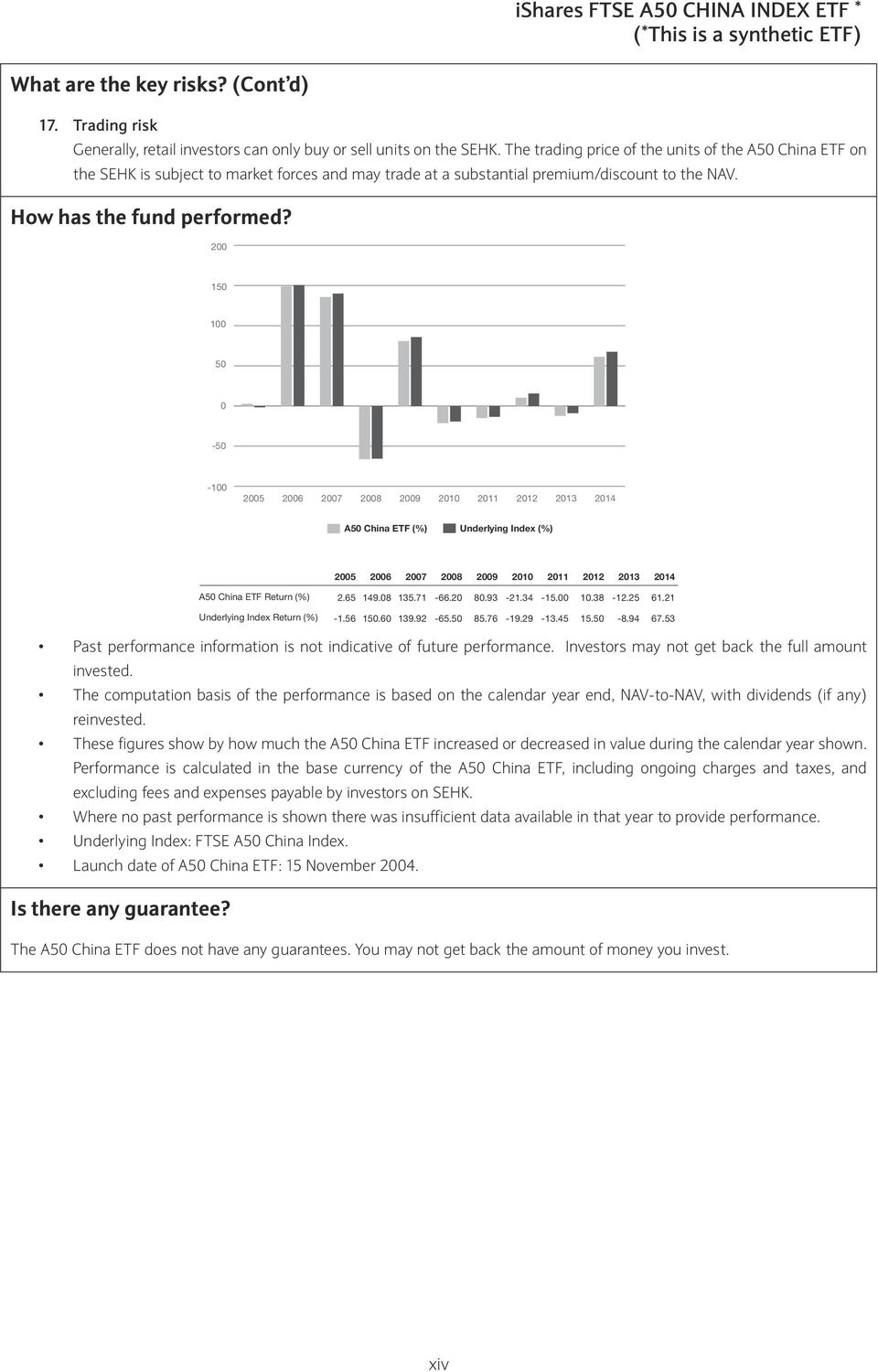
15 ishares FTSE A50 CHINA INDEX ETF * ( * This is a synthetic ETF) What are the key risks? (Cont d) 17. Trading risk Generally, retail investors can only buy or sell units on the SEHK. The trading price of the units of the A50 China ETF on the SEHK is subject to market forces and may trade at a substantial premium/discount to the NAV. How has the fund performed? A50 China ETF (%) Underlying Index (%) A50 China ETF Return (%) Underlying Index Return (%) Past performance information is not indicative of future performance. Investors may not get back the full amount invested. The computation basis of the performance is based on the calendar year end, NAV-to-NAV, with dividends (if any) reinvested. These figures show by how much the A50 China ETF increased or decreased in value during the calendar year shown. Performance is calculated in the base currency of the A50 China ETF, including ongoing charges and taxes, and excluding fees and expenses payable by investors on SEHK. Where no past performance is shown there was insufficient data available in that year to provide performance. Underlying Index: FTSE A50 China Index. Launch date of A50 China ETF: 15 November Is there any guarantee? The A50 China ETF does not have any guarantees. You may not get back the amount of money you invest. xiv
16 ishares FTSE A50 CHINA INDEX ETF * ( * This is a synthetic ETF) What are the fees and charges? Charges incurred when trading the A50 China ETF on SEHK Fee Brokerage fee What you pay Market Rate Transaction levy % 1 Trading fee 0.005% 2 Stamp duty Nil Ongoing fees payable by the A50 China ETF The following expenses will be paid out of the A50 China ETF. They affect you because they reduce the NAV of the A50 China ETF which may affect the trading price. Annual rate (as a % of the fund s value) Management fee Trustee fee Custodian fee QFII Custodian fee RQFII Custodian fee Administration fee 0.99% p.a. of NAV calculated daily Included in the management fee Included in the management fee Included in the management fee Included in the management fee Included in the management fee Other fees Please refer to the Prospectus for other fees and expenses payable by the A50 China ETF. 1 Transaction levy of % of the price of the units payable by the buyer and the seller. 2 Trading fee of 0.005% of the price of the units, payable by the buyer and the seller. xv

17 ishares FTSE A50 CHINA INDEX ETF * ( * This is a synthetic ETF) Additional information You can find the following information of the fund at the following website at The A50 China ETF s Prospectus and this statement (as revised from time to time) Latest financial reports; Latest closing NAV; Estimated NAV throughout each dealing day; Any direct holdings in A Shares updated on each dealing day; Any direct holdings in Physical A Share ETFs updated on each dealing day; Gross and net exposure to the CAAP Issuers updated on each dealing day; Identities of the CAAP Issuers and Participating Dealers; Composition of the collateral on a weekly basis; Collateral policy (as revised from time to time); Latest closing level of the Underlying Index; Notices and announcements; and Composition of any dividends paid (i.e. the relative amounts paid out of (i) net distributable income and (ii) capital) for the last 12 months. All of the information outlined above can be found on the product webpage of the A50 China ETF. The product webpage of the A50 China ETF can be located by using the search function and inserting the stock code of the A50 China ETF (i.e. 2823) at Investors should note that the website has not been reviewed by the SFC. The product webpage also provides a link to the announcements and notices section of the website where public announcements and notices can be found. Important If you are in doubt, you should seek professional advice. The SFC takes no responsibility for the contents of this statement and makes no representation as to its accuracy or completeness. xvi

18 TABLE OF CONTENTS INTRODUCTION The Trust and the A50 China ETF Investment Objective Investment Strategy Investment and Borrowing Restrictions Index Licence Agreement DESCRIPTION OF THE A50 CHINA ETF CREATIONS AND REDEMPTIONS (PRIMARY MARKET) Investment in the A50 China ETF Creation by Participating Dealers Redemption of Units Directed Cash Dealing Suspension of Creations and Redemptions Transfer of Units EXCHANGE LISTING AND TRADING (SECONDARY MARKET) DETERMINATION OF NET ASSET VALUE Suspension of Net Asset Value Issue Price and Redemption Value FEES AND EXPENSES Fees and Expenses Payable by the A50 China ETF RISK FACTORS Investment Risk Market Trading Risks Associated with the A50 China ETF Risks Associated with the Underlying Index Regulatory Risks Specific Risk Factors Relating to the A50 China ETF Risk Factors Relating to the PRC MANAGEMENT OF THE TRUST The Manager Trustee and Registrar Custodian QFII Custodian RQFII Custodian Collateral Agent Indemnities of the Trustee and Manager Service Agent Auditor Conflicts of Interest Soft Dollars STATUTORY AND GENERAL INFORMATION Reports and Accounts

19 Trust Deed Modification of Trust Deed Provision of Information Voting Rights Termination Inspection of Documents Part XV of the Securities and Futures Ordinance Anti-Money Laundering Regulations Change of Underlying Index Information Available on the Internet Notices Queries and Complaints TAXES DEFINITIONS SCHEDULE Investment Restrictions Stock Lending Borrowing Policy SCHEDULE Information about CAAPs SCHEDULE Index Provider Disclaimer SCHEDULE The FTSE China A50 Index SCHEDULE Summary of PRC Legal Opinion Regarding Assets of A50 China ETF in the PRC held by the QFII Custodian SCHEDULE Summary of PRC Legal Opinion Regarding Assets of A50 China ETF in the PRC held by the RQFII Custodian

20 1 INTRODUCTION The information contained in this Prospectus has been prepared to assist potential investors in making an informed decision in relation to investing in the A50 China ETF. It contains important facts about the Trust as a whole and the A50 China ETF. The Trust and the A50 China ETF The Trust is an umbrella unit trust created by a trust deed (the Trust Deed ) dated 16 November 2001, as amended, made under Hong Kong law between Barclays Global Investors North Asia Limited (now known as BlackRock Asset Management North Asia Limited 貝 萊 德 資 產 管 理 北 亞 有 限 公 司 ) (the Manager ) and HSBC Institutional Trust Services (Asia) Limited (the Trustee ). The Trust may issue different classes of units and the Trustee shall establish a separate pool of assets within the Trust (each such separate pool of assets an Index Fund ) for each class of units. The assets of an Index Fund will be invested and administered separately from the other assets of the Trust. The Manager reserves the right to establish other Index Funds and to issue further classes of Units in the future. This Prospectus relates to one of the Index Funds, ishares FTSE A50 China Index ETF* (* This is a synthetic ETF), which is an exchange traded fund (or ETF ) authorised by the SFC. ETFs are funds that are designed to track an index. The Units of the A50 China ETF are listed on the SEHK and trade like any other equity security listed on the SEHK. Only Participating Dealers may purchase or redeem Units directly from the A50 China ETF at Net Asset Value. All other investors may only buy and sell Units in the A50 China ETF on the SEHK. PRICES FOR THE A50 CHINA ETF ON THE SEHK ARE BASED ON SECONDARY MARKET TRADING FACTORS AND MAY DEVIATE SIGNIFICANTLY FROM THE NET ASSET VALUE OF THE A50 CHINA ETF. Investment Objective The investment objective of the A50 China ETF is to provide investment results that, before fees and expenses, closely correspond to the performance of the Underlying Index. An index is a group of Securities which an index provider selects as representative of a market, market segment or specific industry sector. The index provider is independent of the Manager and determines the relative weightings of the Securities in the index and publishes information regarding the market value of the index. There can be no assurance that the A50 China ETF will achieve its investment objective. The Underlying Index of the A50 China ETF may be changed by prior approval of the SFC and notice to Unitholders. Investment Strategy The Manager uses a passive or indexing approach to try to achieve the A50 China ETF s investment objective. The investment objective is to provide investment results that, before fees and expenses, closely correspond to the performance of the Underlying Index. The Manager does not try to beat or perform better than the Underlying Index. The A50 China ETF aims to invest at least 95% of its net assets in achieving the investment objective. The A50 China ETF may invest, either directly or indirectly, in Securities included in the Underlying Index, or in Securities that are not included in its Underlying Index, but which the Manager believes will help the A50 China ETF achieve its investment objective. The A50 China ETF may also invest in other investments including funds, futures contracts, options on futures contracts, options and swaps related to its Underlying Index, local currency and forward currency exchange contracts, and cash and cash equivalents which the Manager believes will help the A50 China ETF achieve its investment objective. The investment strategy of the A50 China ETF is subject to the investment and borrowing restrictions set out in Schedule 1.

21 2 In managing the A50 China ETF, the Manager may adopt a representative sampling investment strategy in lieu of a replication investment strategy as described below. A representative sampling investment strategy may be more appropriate in view of the comparative illiquidity and possible settlement difficulties which may be experienced with certain A Shares comprised in the Underlying Index. This means that the A50 China ETF may not hold all A Shares in all the constituent companies of the Underlying Index. However, the Manager may swap between the two investment strategies, without prior notice to Unitholders, in its absolute discretion as often as it believes appropriate in order to achieve the investment objective of the A50 China ETF. Representative Sampling Investment Strategy Representative sampling is an indexing strategy that involves investing, directly or indirectly, in a representative sample of the Securities included in the relevant index that collectively has an investment profile that reflects the profile of the relevant index. The A50 China ETF adopting a representative sampling investment strategy, may or may not hold all of the Securities that are included in the Underlying Index, and may hold Securities which are not included in the Underlying Index, provided that the sample closely reflects the overall characteristics of the Underlying Index. Replication Investment Strategy Replication is an indexing strategy that involves investing in substantially all of the Securities in the Underlying Index, either directly or indirectly, in substantially the same proportions as those Securities have in the Underlying Index. Correlation An index is a theoretical financial calculation based on the performance of particular components that make up the index, whereas the A50 China ETF is an actual investment portfolio. The performance of the A50 China ETF and its Underlying Index may be different due to transaction costs, asset valuations, corporate actions (such as mergers and spin-offs), timing variances and differences between the A50 China ETF s portfolio and the Underlying Index. These differences may result for example from legal restrictions affecting the ability of the A50 China ETF to purchase or dispose of Securities or the employment of a representative sampling strategy. The use of a representative sampling investment strategy can be expected to result in greater tracking error than a replication strategy. The consequences of tracking error are described in more detail in Risk Factors. Investment and Borrowing Restrictions The A50 China ETF must comply with the investment and borrowing restrictions as summarised in Schedule 1 of this Prospectus (which includes a summary of the investment restrictions set out in the Trust Deed). Index Licence Agreement The Manager was granted a license by FTSE to use the Underlying Index to create the A50 China ETF and to use certain trademarks and any copyright in the Underlying Index for five years commencing from 1 July 2004 under a license agreement. This index license agreement was subsequently replaced by a new license agreement which grants the Manager the license to use various rights including intellectual property rights and rights to the Underlying Index and the data in relation to the Underlying Index for 10 years starting from 1 January The parties to the license agreement will negotiate 6 months prior to the expiry of the 10 years period whether the license agreement shall be extended. Investors attention is drawn to Risks Associated with the Underlying Index on page 34.
22 3 DESCRIPTION OF THE A50 CHINA ETF Key Information The following table is a summary of key information in respect of the A50 China ETF, and should be read in conjunction with the full text of the Prospectus. Index: FTSE China A50 Index Launch Date: 13 December 2003 Underlying Index Number of constituents: 50 (1 September 2015) Total Market Capitalisation (Free Float): RMB3,369B (1 September 2015) Base Currency: Renminbi (RMB) Listing Date (SEHK) 18 November 2004 Exchange Listing SEHK Main Board Initial public offering Not applicable Stock Code 2823 Trading Board Lot Size 100 Base Currency and Trading Currency Hong Kong dollars (HK$) Annually, at the Manager s discretion (December each year) (if any). Distribution Policy Distributions may be made out of capital or effectively out of capital as well as income at the Manager s discretion. Application Unit size (only Participating Dealers) Minimum 2,000,000 Units (or multiples thereof) Management Fee 0.99% p.a. of Net Asset Value calculated daily Representative sampling investment strategy comprising a synthetic Investment strategy representative sub-strategy and a physical representative sub-strategy (please refer to the Introduction above and the Investment Strategy section below) Financial year end 31 December Website Investment Objective The investment objective of the A50 China ETF is to provide investment results that, before fees and expenses, closely correspond to the performance of the FTSE China A50 Index. There can be no assurance that the A50 China ETF will achieve its investment objective. Investment Strategy The A50 China ETF uses a representative sampling investment strategy which comprises a synthetic representative substrategy by which the A50 China ETF invests in CAAPs and, a physical physical representative sub-strategy by which the A50 China ETF invests directly in A Shares as well as Physical A Share ETFs. As at the date of this Prospectus, the primary strategy that will be adopted by the Manager continues to be the synthetic representative sub-strategy as the A50 China ETF s ability to invest directly in A Shares is limited by (i) the QFII Quota granted by the SAFE for use by the A50 China ETF which is US$970 million as at the date of this Prospectus; (ii) the RQFII Quota available for use by the A50 China ETF which is subject to the Manager s allocation from time to time, out of the RQFII quota granted to it by the SAFE for use by different public fund products under the Manager s management; and (iii) the daily and aggregate quota for the Stock Connect which is not specific to the A50 China ETF or the Manager.
23 4 Further, the A50 China ETF s ability to invest in Physical A Share ETFs is also limited to cash management and contingency purposes only and may not exceed 10% of the Net Asset Value of the A50 China ETF, and is subject to market conditions as well as whether, in the Manager s opinion, investing in Physical A Share ETFs is in the best interests of Unitholders. The two main sub-strategies that will be adopted by the Manager are detailed below. Synthetic Representative Sub-Strategy Where a synthetic representative sub-strategy is adopted, in order to meet the investment objective, the Manager on behalf of the A50 China ETF, will invest in derivative instruments. The derivative instruments invested by the A50 China ETF are called CAAPs. A CAAP is a derivative instrument linked to either (a) an A Share; or (b) the Underlying Index. The A50 China ETF may invest in CAAPs that are linked to A Shares that are not constituent A Shares of the Underlying Index but which the Manager believes will help the A50 China ETF achieve its investment objective. A CAAP represents only an obligation of the CAAP Issuer to provide the A50 China ETF with the economic performance equivalent to holding the underlying A Shares. A CAAP does not provide any beneficial or equitable entitlement or interest in the relevant A Shares to which the CAAP is linked. In other words, the A Shares are not in any way owned by the A50 China ETF. However each CAAP synthetically replicates the economic benefit of the relevant A Share or the Underlying Index insofar as possible. Because a CAAP is a payment obligation of the CAAP Issuer, rather than a direct investment in A Shares, the A50 China ETF may suffer losses potentially equal to the full value of the CAAP (net of the value of the collateral provided by the corresponding Collateral Provider) if the CAAP Issuer fails to perform its obligations under the CAAPs. The Manager seeks to mitigate the counterparty risk subject to market conditions by diversifying the number of, and the relative exposure of the A50 China ETF to, multiple qualified CAAP Issuers. Pursuant to the authorization conditions imposed on the A50 China ETF by the SFC on 29 August 2011, the Manager is required to collateralize all counterparty exposures with a view to ensuring that the collateral held by the A50 China ETF must represent at least 100% of the A50 China ETF s gross total counterparty exposure. In addition, pursuant to the SFC Collateral Conditions, where the A50 China ETF accepts collateral in the nature of equity securities, the A50 China ETF will obtain collateral that has a market value of at least 120%. Further, for non-equity collateral, the Manager is required to adopt a prudent haircut policy on any non-equity collateral held by the A50 China ETF taking into account all relevant factors, including without limitation, the credit quality, liquidity, duration and other relevant terms of the collateral held. The collateral policy applicable to the A50 China ETF is published on the website of the A50 China ETF. Information about CAAPs and CAAP Issuers including eligibility, credit rating, duration, valuation and early redemption or repurchase is set out in Schedule 2. Physical Representative Sub-Strategy Investment in A Shares The Manager applied for and was granted a QFII License on 26 October 2012 which enabled it to apply to the SAFE for a QFII Quota that allows the Manager to remit foreign currency into the PRC, convert into RMB and invest in A Shares directly. The SAFE subsequently approved the Manager s QFII Quota of which US$970 million has been allocated for investment by the A50 China ETF in A Shares directly through the QFII system. The Manager applied for and was granted a RQFII License on 11 March 2014 which enabled it to apply to the SAFE for a RQFII Quota that allows the Manager to remit RMB into the PRC and invest in A Shares directly. The SAFE has subsequently approved the Manager s RQFII Quota and the Manager may from time to time allocate the RQFII Quota to the A50 China ETF (among the public funds it manages) for the purpose of its direct investment into the PRC.
24 5 The Manager may also invest in A Shares via the Stock Connect, as further described under the section What is the Stock Connect? The Manager may as part of the representative sampling investment strategy and physical representative sub-strategy invest the A50 China ETF in A Shares through the QFII Quota, the RQFII Quota and/or the Stock Connect to achieve the investment objective of the A50 China ETF. In adopting the physical representative strategy, the Manager will invest in a representative portfolio of securities that may consist of A Shares that are constituents of the Underlying Index and/or A Shares that are not constituents of the Underlying Index that assist the Manager to achieve the investment objective of the A50 China ETF. In doing so, the Manager will seek to minimize costs associated with the direct acquisition of A Shares through a number of methods including but not limited to any or a combination of the following: Utilising cash that is held by the A50 China ETF from time to time to invest in A Shares directly; Utilising cash proceeds received by the A50 China ETF from various means (such as during re-balancing of the Underlying Index or dividends received) to invest in A Shares directly; Requesting any Creation Application by any Participating Dealers to be in cash and investing such proceeds into A Shares directly; and/or Requesting CAAP Issuers to buy back the relevant CAAPs issued by them and using such cash proceeds to invest in A Shares directly. When considering which method or combination of methods to be used to facilitate investment in A Shares, the Manager will at all times act in the best interests of Unitholders and take into account the costs and return to A50 China ETF as well as the market conditions at the time and other such factors that the Manager consider relevant at the time. A50 China ETF s assets in the PRC acquired through the QFII Quota or the RQFII Quota (including onshore PRC cash deposits and its onshore A Shares portfolio) will be held by the QFII Custodian and the RQFII Custodian respectively. The QFII Custodian will hold assets acquired using the QFII Quota, which will at the time of their acquisition be up to a value of US$970 million. The RQFII Custodian will hold assets acquired using the RQFII Quota, which will at the time of their acquisition be up to the value of the RQFII Quota allocated to the A50 China ETF by the Manager. The Manager has obtained two legal opinions from PRC legal counsel, regarding the assets of the A50 China ETF held in (i) the accounts maintained by the QFII Custodian and (ii) the accounts maintained by the RQFII Custodian respectively. The contents of the PRC legal opinions are summarized in Schedule 5 and Schedule 6 respectively. What is the Stock Connect? The Stock Connect is a securities trading and clearing linked programme developed by the HKEx, the SSE and the CSDCC, with an aim to achieve mutual stock market access between the PRC and Hong Kong. It currently comprises the Shanghai- Hong Kong Stock Connect, and may in future be extended to allow Hong Kong or foreign investors to access A Shares listed on the SZSE or other A Shares not currently covered under the Shanghai-Hong Kong Stock Connect. The Manager intends to utilise such channels to invest in A Shares when they become available. The Shanghai-Hong Kong Stock Connect comprises a Northbound Trading Link and a Southbound Trading Link. Under the Northbound Trading Link, Hong Kong and overseas investors (including the A50 China ETF), through their Hong Kong brokers and a securities trading service company as established by the SEHK and the HKSCC, may be able to trade eligible shares listed on the SSE by routing orders to the SSE. Under the Southbound Trading Link, eligible investors, through PRC securities firms and a securities trading service company as established by the SSE, may be able to trade eligible shares listed on the SEHK by routing orders to the SEHK. The programme may be extended in future so that Hong Kong and overseas investors may be able to trade eligible SZSE stocks.
25 6 Eligible securities Initially, under the Shanghai-Hong Kong Stock Connect, Hong Kong and overseas investors are able to trade certain stocks listed on the SSE market (the SSE Securities ). These include all the constituent stocks from time to time of the SSE 180 Index and SSE 380 Index, and all the SSE-listed A Shares that are not included as constituent stocks of the relevant indices but which have corresponding H Shares listed on the SEHK, except the following: (a) SSE-listed shares which are not traded in RMB; and (b) SSE-listed shares which are included in the risk alert board. It is expected that the list of eligible securities will be subject to review, and may be extended to SZSE-listed securities. Trading day Investors (including the A50 China ETF) are only allowed to trade SSE Securities via Stock Connect on days where both markets are open for trading, and banking services are available in both markets on the corresponding settlement days. Trading quota Trading under the Shanghai-Hong Kong Stock Connect is subject to a maximum cross-boundary investment quota ( Aggregate Quota ) presently set at RMB300 billion, together with a daily quota ( Daily Quota ) presently set at RMB13 billion, which is separate for Northbound and Southbound trading. The Aggregate Quota caps the absolute amount of fund inflow into the PRC under Northbound trading. The Daily Quota limits the maximum net buy value of cross-boundary trades under the Shanghai-Hong Kong Stock Connect each day. The quotas do not belong to the A50 China ETF and are utilised on a first-come-first-serve basis. The SEHK monitors the quota and publishes the remaining balance of the Northbound Aggregate Quota and Daily Quota at scheduled times on the HKEx s website. The Aggregate Quota and the Daily Quota may change in future. The Manager will not notify Unitholders in case of a change of quota. Settlement and Custody The HKSCC is responsible for the clearing, settlement and the provision of depository, nominee and other related services of the trades executed by Hong Kong market participants and investors. Accordingly investors do not hold SSE Securities directly these are held through their brokers or custodians accounts with CCASS. Corporate actions and shareholders meetings Notwithstanding the fact that HKSCC does not claim proprietary interests in the SSE Securities held in its omnibus stock account in the CSDCC, the CSDCC as the share registrar for SSE listed companies will still treat the HKSCC as one of the shareholders when it handles corporate actions in respect of such SSE Securities. The HKSCC monitors the corporate actions affecting SSE Securities and keeps participants of CCASS informed of all such corporate actions that require CCASS participants to take steps in order to participate in them. Currency Hong Kong and overseas investors (including the A50 China ETF) trade and settle SSE Securities in RMB only. Trading fees and taxes In addition to paying trading fees and stamp duties in connection with A Share trading, the A50 China ETF may be subject to other fees and taxes concerned with income arising from stock transfers which are determined by the relevant authorities. Please refer to the section Taxes PRC for information about taxes arising from investment through the Stock Connect.
26 7 Coverage of Investor Compensation Fund The A50 China ETF s investments through Northbound trading under the Stock Connect is not covered by Hong Kong s Investor Compensation Fund. Hong Kong s Investor Compensation Fund is established to pay compensation to investors of any nationality who suffer pecuniary losses as a result of default of a licensed intermediary or authorised financial institution in relation to exchange-traded products in Hong Kong. Since default in Northbound trading via the Stock Connect do not involve products listed or traded in the SEHK or the Hong Kong Futures Exchanges Limited, they will not be covered by the Investor Compensation Fund. Furthermore, since the A50 China ETF is carrying out Northbound trading through securities brokers in Hong Kong but not PRC brokers, they are not protected by the China Securities Investor Protection Fund( 中 國 投 資 者 保 護 基 金 )in the PRC. Further information about the Shanghai-Hong Kong Stock Connect is available at the website: Investment in Physical A Share ETFs Recognizing that there is an increase of Physical A Share ETFs in the market that track indices that are closely correlated to the Underlying Index, the Manager may invest up to 10% of the Net Asset Value of the A50 China ETF in one or more Physical A Share ETFs for cash management and for contingency purposes. The A50 China ETF will also not hold more than 10% of any units issued by any single Physical A Share ETF pursuant to the requirements of the Code. The Manager believes that expanding the investment universe of the A50 China ETF to include such Physical A Share ETFs will afford greater flexibility to the Manager in managing the A50 China ETF by allowing responses to market conditions to be effected more quickly, for example, in the event that there are limited CAAPs available in the market or if there is insufficient QFII Quota granted for use of the A50 China ETF and/or RQFII Quota available to the Manager and allocated to the A50 China ETF. The Manager will only invest in Physical A Share ETFs for cash management and for contingency purposes only and where it considers that investing in such ETFs is in the best interests of Unitholders taking into account the costs and benefits of investing into such Physical A Share ETFs. There are risks associated with investing in other Physical A Share ETFs. Please refer to Investment in Physical A Share ETFs Risk on page 31 for further information. Synthetic Representative Sub-Strategy vs. Physical Representative Sub-Strategy Despite the ability to invest in A Shares directly, as at the date of this Prospectus, there is currently insufficient QFII Quota granted to the Manager for use by the A50 China ETF and RQFII Quota granted to the Manager and allocated by the Manager for use by the A50 China ETF to enable the Manager to fully invest all the assets of the A50 China ETF into A Shares directly. Investment via the Stock Connect are subject to restrictions and constraints including daily and aggregate quota limitations. It is the Manager s intention to continue to apply for QFII Quota and RQFII Quota for use by the A50 China ETF, however, as at the date of this Prospectus, due to the limited QFII Quota and RQFII Quota granted and/or allocated for use by the A50 China ETF, the Manager will continue to primarily adopt the synthetic representative sub-strategy as part of its representative sampling investment strategy to achieve the investment objective of the A50 China ETF. To the extent that the Manager has, on behalf of the A50 China ETF, utilized its entire QFII Quota, the Manager may, subject to any applicable regulations, apply for an increase of the QFII Quota and will make an announcement on its website upon receiving additional quota or any reduction of quota. To the extent that the Manager has utilized its entire RQFII Quota allocated by it to the A50 China ETF (which may constitute all or part of the RQFII Quota granted to the Manager for all the public funds under its management), the Manager may, subject to any applicable regulations, apply for an increase of the RQFII Quota.
27 8 The daily holdings of the A50 China ETF will continue to be published at and the breakdown of holdings into A Shares, CAAPs and Physical A Share ETFs (if any) will be published on a daily basis. The Manager intends to pursue a representative sampling investment strategy for the A50 China ETF. As a result the A50 China ETF may overweight holdings of CAAPs or A Shares relative to the respective weightings of the constituents in the Underlying Index, or in the case of CAAPs, of the A Shares to which such CAAPs are linked, provided that the maximum extra weighting in any CAAP or A Share relative to the respective constituent will not exceed 2% under normal market conditions. The Manager shall report to the SFC on a timely basis if there is any non-compliance with this limit during such period by the A50 China ETF. The annual and semi-annual reports of the A50 China ETF shall also disclose whether or not such limit has been complied with during such period. The A50 China ETF may also invest in other investments including funds, futures contracts, options on futures contracts, options and swaps related to its Underlying Index, local currency and forward currency exchange contracts, and cash and cash equivalents which the Manager believes will help the A50 China ETF achieve its investment objective. The investment strategy of the A50 China ETF is subject to the investment and borrowing restrictions set out in Schedule 1. Risk Management Model The Manager intends to diversify risks by constantly reviewing the investment universe of the A50 China ETF and to diversify risks across different investment instruments available in the market whilst taking into account the interests of unitholders at all times. Direct Holdings in A Shares Currently, the Manager s ability to invest directly in A Shares is limited by the amount of QFII Quota granted to the Manager for use by the A50 China ETF, the RQFII Quota granted to the Manager and allocated by the Manager for use by the A50 China ETF and the daily and aggregate quota for the Stock Connect which is not specific to the A50 China ETF or the Manager. The Manager intends to apply to the SAFE for additional QFII Quota (on behalf of the A50 China ETF) and RQFII Quota (and may allocate all or part of such additional quota to the A50 China ETF) from time to time with the intention of decreasing the A50 China ETF s reliance on holding CAAPs and on CAAP Issuers to access the A Shares market. Investments in Physical A Share ETFs The Manager will only invest in Physical A Share ETFs for cash management and for contingency purposes only and where it considers that investing in such ETFs is in the best interests of Unitholders taking into account the costs and benefits of investing into such Physical A Share ETFs and may not invest more than 10% of the Net Asset Value of the A50 China ETF in Physical A Share ETFs. The ability to invest in Physical A Share ETFs will allow the Manager to better react to different market conditions including any circumstances that may limit the availability of CAAPs, the default of a CAAP Issuer which may result in the A50 China ETF holding a large amount of collateral and/or limited QFII Quota and/or RQFII Quota available to the Manager for use by the A50 China ETF. Full Collateralization of CAAPs and Diversification of Risks Where CAAPs are held by the A50 China ETF, the Manager will continue to operate a dynamic risk management model for the A50 China ETF but at the same time, will also require full collateralization of all CAAP Issuer counterparty risk exposures for the A50 China ETF. Diversification of CAAP Issuers The Manager seeks to diversify CAAP Issuer risk by using multiple, qualified counterparties. The criteria for the selection of CAAP Issuers are set out in the section CAAP Issuer in Schedule 2. There can be no assurance that the Manager will always be able to dispose of CAAPs issued by one CAAP Issuer and buy equivalent CAAPs from a different CAAP Issuer in an orderly and timely way. The A50 China ETF seeks to mitigate this risk by constantly looking to further diversify the A50 China ETF s exposure to counterparties. As at 4 September 2015, the A50 China ETF holds CAAPs issued by 7 different CAAP Issuers.
28 9 In the event that the Manager is unable to reduce its net exposure to a CAAP Issuer through disposal of the CAAPs, issued by that CAAP Issuer in an orderly and timely way, the A50 China ETF may be unable to reduce the exposure to the CAAP Issuer and be exposed to losses up to the full value of the CAAPs held from such CAAP Issuer net of the value of collateral posted by the corresponding Collateral Provider if the CAAP Issuer subsequently fails to perform its payment obligations under the CAAPs. Further, if the credit health of a CAAP Issuer deteriorates, the A50 China ETF may be subject to increased counterparty risks. Information about the contingency actions that the Manager may take in circumstances of a credit downgrade is outlined under the section Contingency Measures in Schedule 2. Full Collateralization of Counterparty Exposure In addition to diversification of risks by using multiple counterparties, the Manager also fully collateralises all counterparty exposures of the A50 China ETF. By fully collateralizing the counterparty risk exposure of the A50 China ETF, the A50 China ETF s exposure to each of the CAAP Issuer will be reduced significantly. In the event the market value of the collateral provided by a Collateral Provider is less than what is required under the SFC Collateral Conditions and what is deemed appropriate by the Manager, the relevant Collateral Provider will be required to deliver additional collateral to meet such requirements. However, there may be instances where the A50 China ETF may not be fully collateralized due to circumstances beyond the control of the Manager including market volatility and operational settlement issues. In these instances, the Manager will continue to observe the SFC Collateral Conditions and its own collateral policy and will seek to rectify any such breaches as soon as practicable, taking into account the interests of Unitholders. In addition, where the Manager believes it is in the best interests of Unitholders, the Manager may seek the provision of additional collateral in certain circumstances affecting a CAAP Issuer such as a credit downgrade described in Schedule 2. The provision of collateral will be by way of a securities lending and borrowing arrangement or in such other manner as the Manager considers appropriate in the prevailing circumstances. Where the collateral arrangement is by way of a securities lending and borrowing arrangement, the Collateral Providers will borrow all CAAPs issued by the affiliated CAAP Issuers and post collateral to the A50 China ETF of equivalent market value to the CAAPs issued by the CAAP Issuers taking into account the haircut policy on collateral adopted by the Manager at the time. The market value of the CAAPs borrowed and the collateral posted will be adjusted on a daily mark-to-market basis. In the event of an insolvency or an event of default with respect to the relevant Collateral Provider, the payment and delivery obligations of the parties under the securities and borrowing arrangement will be accelerated and netted off, and replaced by an obligation of one party to pay a single sum to the other based on the latest mark-to-market valuations. In such circumstances, the insolvent Collateral Provider will keep the CAAPs that they borrowed and the Trustee will keep the collateral for the account of the A50 China ETF. Collateral may consist of cash and Securities as agreed between the Manager and the Collateral Provider and consistent with the collateral policy of the Manager at the time. Collateral received will not consist any structured products. Collateral received and held by the Trustee will be held in a segregated account opened in the name of the Trustee. Collateral acceptable to the A50 China ETF together with the haircut policy applicable to the collateral from time to time is set out in the collateral policy available on the website of the A50 China ETF. As at 22 August 2014, collateral of the A50 China ETF consists of cash, bonds and equities that are listed on the exchanges in Australia, Copenhagen, Netherlands, Brussels, Paris, Hong Kong, London, United States, Stockholm, Singapore, Switzerland, Tokyo, Toronto, Vienna and Germany. As at 22 August 2014, the value of collateral amounts to approximately % of the Net Asset Value of the A50 China ETF and amounts to approximately % of the related gross counterparty risk exposure to CAAP Issuers. Up to date information on collateral including identity of the Collateral Provider(s) is available at Please refer to the Section Information Available on the Internet for details on how to find this information.
29 10 With regard to accepting Securities as collateral, the Manager will have regard to any relevant considerations which include, but are not limited to:- (a) Liquidity such Securities are required to be sufficiently liquid so that it can be sold quickly at a price that is close to pre-sale valuation and traded in a deep and liquid marketplace with transparent pricing; (b) Valuation All collateral are marked to market daily; (c) Issuer credit quality the issuer of such Securities to be of sufficient high credit quality; (d) Diversification Securities issued by any single issuer comprising the collateral will not account for more than 10% of the Net Asset Value of the A50 China ETF and collateral will not include any structured products; and (e) Avoidance of Correlation correlation between the CAAP Issuer and the collateral received must be avoided. In addition, pursuant to the SFC Collateral Conditions, where the A50 China ETF accepts collateral in the nature of equity securities, the A50 China ETF will obtain collateral that has a market value of at least 120%. Further, the Manager is required to adopt a prudent haircut policy for any non-equity collateral held by the A50 China ETF taking into account all relevant factors, including without limitation, the credit quality, liquidity, duration and other relevant terms of the collateral held. The collateral policy applicable to the A50 China ETF is published on the website of the A50 China ETF. The Manager and the Trustee will closely monitor the nature and the market value of the collateral received from the CAAP Issuers daily to ensure compliance with the above criteria. In addition, the Manager will satisfy itself on the validity and enforceability of the collateral arrangement put in place from time to time and ensure that the collateral can be readily enforceable without further recourse to the CAAP Issuers and that the collateral will not be applied for any purpose except for the purpose of being used as collateral. In addition, the Manager will ensure that it has appropriate systems, operational capabilities and legal expertise for proper collateral management. A description of holdings of collateral (including a description of the nature of the collateral, identity of the Collateral Provider providing the collateral, value of the A50 China ETF (by percentage) secured/covered by collateral with breakdown by asset class/nature and credit rating (if applicable)) will be disclosed in the A50 China ETF s annual and semi-annual reports for the relevant period. The A50 China ETF may incur additional fees, charges and expenses as a result of such measures and any such fees will be borne by the A50 China ETF. There can be no assurance that the Manager will always be able to obtain collateral from the CAAP Issuer. The value of the collateral held by the A50 China ETF is subject to market forces and will therefore fluctuate. There can be no assurance that the Manager will be able to obtain sufficient collateral from a CAAP Issuer to ensure that the counterparty exposure to that CAAP Issuer is always fully collateralized. This risk will be increased in extreme market conditions, where the value of the collateral may change significantly in a short space of time with little advance warning. In the event that the Manager is unable to obtain adequate collateral in a timely way, the A50 China ETF may be unable to reduce the exposure to the CAAP Issuer and be exposed to losses up to the full value of the CAAPs held from such CAAP Issuer net of the value of any collateral held by the A50 China ETF if the CAAP Issuer subsequently fails to perform its obligations under the CAAPs. Collateral may also involve risks including settlement, operational and realization risks. Please refer to the risk factor Collateral Risks for further information. In view of the risk that the value of the collateral may experience a significant and material fall in certain market conditions the A50 China ETF also seeks to manage its counterparty risk exposure by investing in CAAPs issued by multiple counterparties. The latest list of CAAP Issuers, the A50 China ETF s relative exposure to CAAP Issuer and a summary of the collateral provided by a particular CAAP Issuer are available at Please refer to the Section Information Available on the Internet for details on where this information can be found.
30 11 Fund Investment Structure The diagrams below summarize the investment structure of the A50 China ETF. The first illustrates the possible use of a combination of synthetic replication and physical representative sub-strategies. The second illustrates the use of CAAPs for synthetic replication. COMBINATION OF SYNTHETIC AND REPRESENTATIVE SUB-STRATEGIES A50 China ETF REPRESENTATIVE SAMPLING INVESTMENT STRATEGY Synthetic Representative Sub-Strategy* Physical Representative Sub-Strategy # # 10% Net Asset Value CAAPs* Physical A Share ETFs A Shares^ * See diagram below. # Percentage of NAV holdings of the A50 China ETF adopting the physical and synthetic representative sub-strategy will vary. Direct holdings of A Shares will be subject to the size of the QFII Quota granted to the Manager for use by the A50 China ETF, the RQFII Quota granted to the Manager and allocated by the Manager for use by the A50 China ETF and the daily and aggregate quota for the Stock Connect which is not specific to the Manager or the A50 China ETF. ^ A Shares will be held by (i) the QFII Custodian under an open-ended fund account in the joint name of the Manager and the A50 China ETF; (ii) the RQFII Custodian under an open-ended fund account in the joint name of the Manager and the A50 China ETF; and (iii) for A Shares held via Stock Connect, brokers or custodians stock accounts with CCASS held by the Custodian for the benefit of the A50 China ETF. CAAPs A50 China ETF HSBC Institutional Trust Services (Asia) Limited (Trustee) is responsible for safekeeping of the collateral on behalf of the A50 China ETF. The Trustee may appoint sub-custodians to provide custodial services to the assets of the A50 China ETF from time to time.* Net proceeds of issue of units Provides an exposure to the economic gain/losing the performance of the A Share(s) and/or the Underlying Index net of fees, costs and charges CAAP Issuers or their affiliated Collateral Providers procure collateral to be delivered to the A50 China ETF with a view to ensuring that there is no uncollateralized counterparty risk Multiple CAAP Issuers * Where the services of the Collateral Agent is retained by the A50 China ETF, the Trustee will appoint the Collateral Agent to provide custody of the relevant collateral of the A50 China ETF. Please refer to page 54 of the Prospectus for more information on the Collateral Agent. Underlying Index The FTSE China A50 Index is the Underlying Index and is a free float-adjusted market capitalisation-weighted index compiled and published by FTSE International Limited ( FTSE ) which is the Index Provider. The Manager is independent of the Index Provider. The Underlying Index comprises the 50 largest companies by full market capitalisation of the FTSE China A All-Share
31 12 Index and is a subset of the FTSE China A 200 Index. The FTSE China A50 Index is a net total return index denominated in RMB which takes into account the reinvestment of dividends net of withholding tax from the constituents. Description of Index Methodology and Construction All China A Share classes of equity in issue are eligible for inclusion in the FTSE China A All-Share Index. The eligibility for securities to be included in the Underlying Index is based on: (i) liquidity screens; and (ii) free float and (iii) size. (i) Liquidity screens are based on the security s median daily trading per month on the SSE and SZSE *. The median trade is calculated by ranking each daily trade total and selecting the middle ranking day. Daily totals with zero trades are included in the ranking; therefore a security that fails to trade for more than half of the days in a month will have a zero median trade. Any period of suspension will not be included in the test. The liquidity test will be applied on a prorata basis where the testing period is less than 12 months. * When calculating the median of daily trades per month of any security, a minimum of 5 trading days in each month must exist, otherwise the month will be excluded from the test. Securities eligible for inclusion must have a minimum turnover percentage of the shares in issue, based on the median daily trade per month. The security must have such turnover percentage for a certain number of months prior to the full market review in March. The minimum turnover percentage and the number of months meeting such percentage are different for non-constituent securities, existing constituents and new issues. (ii) Free float Constituents are free float adjusted in accordance with FTSE s index rules, to reflect the actual availability of stock in the market for public investment. Each FTSE constituent weighting is adjusted to reflect restricted shareholdings to ensure an accurate representation of investable market capitalisation. FTSE adopts the actual free float (rounded up to the next 1%). For equity shares of companies which have been admitted to the Index that have a free float greater than 3%, the actual free float will be rounded up to the next highest whole percentage number. Companies with a free float of 3% or below are not eligible for inclusion in the Index. Following the application of an initial free float restriction, a constituent s free float will only be changed if its rounded free float moves to more than 3 percentage points above or below the existing rounded free float. Where a company s actual free float moves to above 99%, it will not be subject to the 3 percentage points threshold and will be rounded to 100%. A constituent with a free float of 15% or below will not be subject to the 3 percentage points threshold. In addition, a constituent s investibility weight will be further adjusted when there is a limited foreign room available. Please refer to Schedule 4 for details. (iii) Size The 50 largest companies by full market capitalisation of the FTSE China A All-Share Index are selected to form the FTSE China A50 Index. Index Maintenance The FTSE China A50 Index is reviewed quarterly in March, June, September and December, with advance notification given of any changes to constituents on to ensure that the Underlying Index continues to reflect market reality. A schedule of periodic reviews is provided on Schedule 4 of the Prospectus also sets out some of the key ground rules applicable to the Underlying Index as at the date of this Prospectus. A full set of the ground rules for the management of the FTSE China A50 Index is also available on The index methodology is subject to change from time to time and investors should refer to this website for up-to-date information about index methodology. The FTSE China A50 Index is calculated and is updated continuously on an intra-second streaming basis until the market closes. FTSE publishes the real time index level (Ticker: XINA50NC) on Bloomberg, updated throughout the day.
32 13 Constituent Securities of the Underlying Index As at 1 September 2015, the 10 largest constituent stocks of the FTSE China A50 Index are as follows: Company name Exchange Weighting % 1 Ping An Insurance Group Company of China, Ltd. Shanghai China Merchants Bank Co., Ltd. Shanghai China Minsheng Banking Corp., Ltd. Shanghai Industrial Bank Co., Ltd. Shanghai Shanghai Pudong Development Bank Co., Ltd. Shanghai China Vanke Co., Ltd. Shenzhen Citic Securities Co., Ltd. Shanghai Bank of Communications Co., Ltd. Shanghai Industrial and Commercial Bank of China Limited Shanghai Bank of China Limited Shanghai 2.76 Distribution Policy Income net of withholding tax earned by the A50 China ETF will, at the discretion of the Manager, be distributed by way of annual cash distribution in December (if any) and details of the distribution declaration dates, distribution amounts and exdividend payment dates will be published on the ishares website There can be no assurance that a distribution will be paid. Distributions may be made out of capital as well as income at the Manager s discretion. The Manager may also, at its discretion, pay dividend out of gross income while all or part of the fees and expenses of the A50 China ETF are charged to/paid out of the capital of the A50 China ETF, resulting in an increase in distributable income for the payment of dividends by the A50 China ETF and therefore, the A50 China ETF may effectively pay dividend out of capital. The Manager may amend the policy with respect to distribution out of capital or effectively out of capital subject to the SFC s prior approval and by giving not less than one month s prior notice to investors. Information relating to the composition of any dividends paid (i.e. the relative amounts paid out of (i) net distributable income and (ii) capital) for the last 12 months will be available from the Manager on request. Investors should also refer to Information Available on the Internet for more details. Unitholders are encouraged to refer to the information available on the ishares website on a regular basis. Further Information Further information in relation to the A50 China ETF (including details of its Net Asset Value) and the Underlying Index is available at the ishares website ( Investors should refer to Information Available on the Internet for more details. Unitholders are encouraged to refer to the information available on the ishares website on a regular basis.
33 14 CREATIONS AND REDEMPTIONS (PRIMARY MARKET) Investment in the A50 China ETF There are two types of investor in the A50 China ETF, with two corresponding methods of investment in Units and realisation of an investment in Units. The first type of investor is a Participating Dealer, being a licensed dealer that has entered into a Participation Agreement in respect of the A50 China ETF. Only a Participating Dealer can create and redeem Units directly with the A50 China ETF. A Participating Dealer may create and redeem Units on their own account or for the account of their clients. The second type of investor is an investor, other than a Participating Dealer, who buys and sells the Units on the SEHK. This section relates to the first type of investor: Participating Dealers, and should be read in conjunction with the Operating Guidelines and the Trust Deed. The section titled Exchange Listing and Trading (Secondary Market) relates to the second type of investor. Creation by Participating Dealers Only Participating Dealers may apply for Units directly from the A50 China ETF. Units are continuously offered to Participating Dealers who may apply for them on any Dealing Day on their own account or for the account of their clients, in the minimum Application Unit size in accordance with Operating Guidelines. The Manager expects that Participating Dealers will generally accept and submit creation requests received from third parties, subject to normal market conditions and their client acceptance procedures. Participating Dealers may impose fees and charges in handling any creation request which would increase the cost of investment. Investors are advised to check with the Participating Dealers as to relevant fees and charges. You should note although the Manager has a duty to closely monitor the operations of the Trust, neither the Manager nor the Trustee is empowered to compel any Participating Dealer to disclose its fees agreed with specific clients or other proprietary or confidential information to the Manager, or to accept any such application requests received from third parties. In addition, neither the Trustee nor the Manager can ensure effective arbitrage by the Participating Dealer due to various factors including prevailing market conditions that may be reflected in the costs associated with acquiring the Securities. Units in the A50 China ETF are offered and issued at the Issue Price only in aggregations of a specified number of Units (each, an Application Unit ) which is currently 2,000,000 Units (or whole multiples thereof). Applications submitted in respect of Units other than in Application Unit size or whole multiples thereof will not be accepted. The minimum holding of the A50 China ETF is one Application Unit. Participating Dealers may make Creation Applications in-specie or in cash (either in RMB or in Hong Kong dollars). The Manager shall instruct the Trustee to effect, for the account of the Trust, the creation of Units in Application Unit size in exchange for either a transfer of Securities or cash (either in RMB or Hong Kong dollars) or a combination of Securities and cash in accordance with the Operating Guidelines and the Trust Deed. For the avoidance of doubt, A-Shares (including those held through the Stock Connect) are not accepted for in-specie Creation Applications. Whilst it is open to a Participating Dealer to choose the method of creation, in addition to its rights to reject or cancel a Creation Application under the Trust Deed, the Manager reserves the right to reject or cancel a Creation Application if it is unable to invest the cash proceeds (either in RMB or in Hong Kong dollars) of a cash creation or if proposed Securities are not acceptable to the Manager. The dealing period on any Dealing Day commences at 9:00 a.m. and ends at the Dealing Deadline. The Dealing Deadline is 12:00 p.m. (for RMB cash Creation Applications), 1:00 p.m. (for Hong Kong dollars cash Creation Applications) or 3:00 p.m. (for in-specie Creation Applications) or such other time as notified by the Manager to the Participating Dealers from time to time.
34 15 Where the aggregate value of the Securities delivered by a Participating Dealer, exceeds the Net Asset Value of an Application Unit as determined in accordance with the Operating Guidelines, the A50 China ETF will pay the Participating Dealer a cash amount equal to the difference. In the event that the A50 China ETF has insufficient cash required to pay such cash amount to the Participating Dealer, the Manager may effect sales of the assets of the A50 China ETF, or may borrow moneys to provide the cash required. Units will be issued at the Issue Price prevailing on the relevant Dealing Day, provided that the Manager may add to such Issue Price such sum (if any) as represents an appropriate provision for Duties and Charges. The Manager shall have the right to reject or suspend a Creation Application if (i) in the opinion of the Manager, acceptance of any Security in connection with the Creation Application would have certain adverse tax consequences for the A50 China ETF; (ii) the Manager reasonably believes that the acceptance of any Security would be unlawful; (iii) the acceptance of any Security would otherwise, in the opinion of the Manager, have an adverse effect on the A50 China ETF; (iv) where, as a condition of A50 China ETF s authorization under the Securities and Futures Ordinance, the SFC imposes a requirement for the A50 China ETF in question to procure the provision of collateral to reduce or to limit its counterparty exposure to the issuer of financial derivative instruments in which the A50 China ETF invests, and the issuer of financial derivative instruments has not provided or procured to provide sufficient collateral in respect of the financial derivative instruments issued by it and the subject of investment by the A50 China ETF to allow the Manager to comply with its obligation under the condition; (v) circumstances outside control of the Manager make it for all practicable purposes impossible to process the Creation Application; (vi) the Manager has suspended the rights of Participating Dealers pursuant to the Trust Deed to redeem Units; or (vii) an insolvency event occurs in respect of the Participating Dealer. Where the remaining RQFII Quota allocated to the A50 China ETF by the Manager is insufficient to fully satisfy a Creation Application, the Manager will be unable to fully invest the RMB cash proceeds via the RQFII Quota, which means that it will be for all practicable purposes impossible for the Manager to process the Creation Application. The Manager may in this case reject or suspend a Creation Application under sub-paragraph (v) above. Once the Units are created, the Manager shall effect, for the account of the Trust, the issue of Units to a Participating Dealer in accordance with the Operating Guidelines. Units are denominated in Hong Kong dollars (unless otherwise determined by the Manager) and no fractions of a Unit shall be created or issued by the Trustee. An application for the creation and issue of Units shall only be made or accepted (as the case may be) on a Dealing Day, shall only be in respect of Units constituting an Application Unit size or whole multiples thereof and shall only be accepted if made by or through a Participating Dealer in accordance with the terms of a Participation Agreement. The creation and issue of Units pursuant to a Creation Application shall be effected on the Dealing Day on which the Creation Application is received (or deemed received) and accepted in accordance with the Operating Guidelines but, for valuation purposes only, Units shall be deemed created and issued after the Valuation Point on the Dealing Day on which the relevant Creation Application was received or deemed received and the register will be updated on Settlement Day or the Dealing Day immediately following Settlement Day if the settlement period is extended. An extension fee may be payable in relation to such an extension. See the section on Fees and Expenses for further details. If a Creation Application is received on a day which is not a Dealing Day or is received after the relevant Dealing Deadline on a Dealing Day, that Creation Application shall be treated as having been received at the opening of business on the next following Dealing Day, which shall be the relevant Dealing Day for the purposes of that Creation Application. The Dealing Deadline is 12:00 p.m. (for RMB cash Creation Applications), 1:00 p.m. (for Hong Kong dollars cash Creation Applications) or 3:00 p.m. (for in-specie Creation Applications) or such other time as notified by the Manager to the Participating Dealers from time to time.
35 16 No Units shall be issued to any Participating Dealer unless the application is in a form and substance satisfactory to, and accompanied by such documents as may be required by, the Trustee and the Manager in accordance with the Operating Guidelines and that collateral satisfactory to the Manager has been posted by the Collateral Provider. The Manager may charge a Transaction Fee in respect of Creation Applications and may on any day vary the rate of the Transaction Fee it charges (but not as between different Participating Dealers). The Transaction Fee shall be paid by or on behalf of the Participating Dealer applying for such Units (and may be set off and deducted against any cash amount due to the Participating Dealer in respect of such Creation Application(s)) for the benefit of the Trustee and/or the Service Agent. See the section on Fees and Expenses for further details. Any commission, remuneration or other sum payable by the Manager to any agent or other person in respect of the issue or sale of any Unit shall not be added to the Issue Price of such Unit and shall not be paid from the assets of the A50 China ETF. The Trustee shall be entitled to refuse to enter (or allow to be entered) Units in the register if at any time the Trustee is of the opinion that the provisions, in regard to the issue of Units, are being infringed. Evidence of Unitholding Units are deposited, cleared and settled by the CCASS. Units are held in registered entry form only, which means that no Unit certificates are issued. HKSCC Nominees Limited is the registered owner (i.e. the sole holder of record) of all outstanding Units deposited with the CCASS and is holding such Units for the participants in accordance with the General Rules of CCASS. Furthermore, the Trustee and the Manager acknowledge that pursuant to the General Rules of CCASS neither HKSCC Nominees Limited nor HKSCC has any proprietary interest in the Units. Investors owning Units in CCASS are beneficial owners as shown on the records of the participating brokers or the relevant Participating Dealer(s) (as the case may be). Restrictions on Unitholders The Manager has power to impose such restrictions as it may think necessary for the purpose of ensuring that no Units are acquired or held which would result in such holding being:- a breach of the law or requirements of any country or governmental authority or any stock exchange on which the Units are listed in circumstances which, in the Manager s opinion, might result in the Trust or the A50 China ETF being adversely affected which the Trust or the A50 China ETF might not otherwise have suffered; or in the circumstances which, in the Manager s opinion, may result in the Trust or the A50 China ETF incurring any withholding or any tax liability or suffering any other pecuniary disadvantage which the Trust or the A50 China ETF might not otherwise have incurred or suffered. Upon notice that any Units are so held, the Manager may require such Unitholders to redeem or transfer such Units in accordance with the provisions of the Trust Deed. A person who becomes aware that he is holding or owning Units in breach of any of the above restrictions is required either to redeem his Units in accordance with the Trust Deed or to transfer his Units to a person whose holding would be permissible under this Prospectus and the Trust Deed in a manner that would result in such Unitholder no longer being in breach of the restrictions above. Cancellation of Creation orders The Trustee shall cancel Units created and issued in respect of a Creation Application if it has not received good title to all Securities and/or cash (including Duties and Charges) and sufficient collateral in accordance with the SFC Collateral Conditions relating to the Creation Application by the Settlement Day, provided that the Manager may at its discretion, with the approval of the Trustee, (i) extend the settlement period (either for the Creation Application as a whole or for a particular Security) such extension to be on such terms and conditions (including as to the payment of collateral and an Extension Fee to the Manager or the Trustee or their Connected Persons or otherwise) as the Manager may determine or (ii) partially settle the Creation Application to the extent to which Securities and/or cash has been vested in the Trustee, on such terms and conditions the Manager may determine including terms as to any extension of the settlement period for the outstanding Securities or cash.
36 17 In addition to the preceding circumstances, the Manager may also cancel any Units if it determines by such time as it specifies in the Operating Guidelines that it is unable to invest the cash proceeds of the relevant Creation Application. This may occur if insufficient CAAPs with terms which are acceptable to the Manager are available to the A50 China ETF to process cash Creation Application on the relevant Dealing Day. Upon the cancellation of any Units as provided for above or if a Participating Dealer otherwise withdraws a Creation Application other than in certain circumstances contemplated in the Trust Deed, any Securities or cash received by or on behalf of the Trustee in connection with a Creation Application shall be redelivered to the Participating Dealer (without interest) and the relevant Units shall be deemed for all purposes never to have been created and the applicant therefore shall have no right or claim against the Manager or the Trustee in respect of such cancellation provided that:- the Manager may charge the Participating Dealer for the account of the Trustee and/or the Registrar an Application Cancellation Fee; see the section on Fees and Expenses for further details; the Manager may at its discretion require the Participating Dealer to pay to the Trustee for the account of the A50 China ETF in respect of each Unit so cancelled Cancellation Compensation, being (i) the amount (if any) by which the Issue Price of each such Unit exceeds the Redemption Value which would have applied in relation to each such Unit if a Participating Dealer had, on the date on which such Units are cancelled, made a Redemption Application, plus (ii) such other amount as the Manager reasonably determines as representing any charges, expenses and losses incurred by the A50 China ETF as a result of any such cancellation; the Trustee and/or the Service Agent shall be entitled to the Transaction Fee payable in respect of a Redemption Application; See the section on Fees and Expenses for further details; and no previous valuations of the Trust Fund shall be re-opened or invalidated as a result of the cancellation of such Units. Redemption of Units Redemption Applications may only be made by a Participating Dealer in respect of an Application Unit size or whole multiple thereof. Participating Dealer may redeem Units on any Dealing Day in accordance with the Operating Guidelines, by submitting a Redemption Application to the Trustee. The Manager may charge a Transaction Fee in respect of Redemption Applications. The Transaction Fee shall be paid by or on behalf of the Participating Dealer submitting the Redemption Application(s) (and may be set off and deducted against any amount due to the Participating Dealer in respect of such Redemption Application(s)) for the benefit of the Trustee and/or the Service Agent. See the section on Fees and Expenses for further details. Investors cannot acquire or redeem Units directly from the A50 China ETF. Only Participating Dealers may submit redemption applications to the Manager. The Manager expects that Participating Dealers will generally accept and submit redemption requests received from third parties, subject to normal market conditions and their client acceptance procedures. Participating Dealers may impose fees and charges in handling any redemption request which would increase the cost of investment and/or reduce the redemption proceeds. Investors are advised to check with the Participating Dealers as to relevant fees and charges. You should note although the Manager has a duty to closely monitor the operations of the Trust, neither the Manager nor the Trustee is empowered to compel any Participating Dealer to disclose its fees agreed with specific clients or other proprietary or confidential information to the Manager, or to accept any such application requests received from third parties. In addition, neither the Trustee nor the Manager can ensure effective arbitrage by the Participating Dealer due to various factors including prevailing market conditions that may be reflected in the costs associated with unwinding the Securities. If a Redemption Application is received on a day which is not a Dealing Day or is received after the relevant Dealing Deadline on a Dealing Day, the Redemption Application shall be treated as having been received at the opening of business on the next following Dealing Day, which shall be the relevant Dealing Day for the purposes of that Redemption Application. For the purpose of valuation, the relevant Valuation Point shall be the Valuation Point for the Dealing Day on which the Redemption
37 18 Application is treated as having been received. The Dealing Deadline is 12:00 p.m. (for RMB cash Redemption Applications), 1:00 p.m. (for Hong Kong dollars cash Redemption Applications) or 3:00 p.m. (for in-specie Redemption Applications) or such other time as notified by the Manager to the Participating Dealers from time to time. The Manager shall, on receipt of an effective Redemption Application for the A50 China ETF from a Participating Dealer, effect the redemption of the relevant Units and shall require the Trustee to transfer to the Participating Dealer Securities or cash (either in RMB or Hong Kong dollars at the discretion of the Participating Dealer) or combination of Securities and cash in accordance with the Operating Guidelines. For the avoidance of doubt, A-Shares (including those held through the Stock Connect) will not be transferred to Participating Dealers to satisfy in-specie Redemption Applications. To be effective, a Redemption Application must:- be given by a Participating Dealer in accordance with the Operating Guidelines; specify the number of Units which is the subject of the Redemption Application; and include the certifications required in the Operating Guidelines in respect of redemptions of Units, together with such certifications and opinions of counsel as the Trustee and the Manager may consider necessary to ensure compliance with applicable Securities and other laws in relation to the redemption of Units which are the subject of the Redemption Application. A Redemption Application once given cannot be revoked or withdrawn without the consent of the Manager. The Registrar may charge a Unit Cancellation Fee in connection with each accepted Redemption Application. The Redemption Value of Units tendered for redemption and cancellation shall be the Net Asset Value per Unit of the A50 China ETF rounded to the nearest 4 decimal places. For cash redemptions (whether wholly or partly in cash) the Redemption Proceeds may, depending on market conditions, be substantially less than the Redemption Value. In the absence of an active secondary market for CAAPs, costs associated with any CAAPs tendered for early redemption or repurchase by the relevant CAAP Issuer may potentially be significantly higher than the cost of trading the underlying A shares, particularly during times of high market volatility. The Manager may deduct from and set off against any amount payable to a Participating Dealer on the Redemption Value such sum (if any) as the Manager may consider represents an appropriate provision for Duties and Charges and / or the Transaction Fee. For cash redemptions (whether wholly or partly in cash), the relevant Duties and Charges will include any deductions made by the CAAP Issuers reflecting costs associated with early redemption that may vary significantly through time and may adversely impact the Redemption Proceeds. To the extent that the cash amount is insufficient to pay such Duties and Charges and the Transaction Fee payable on such redemption the Participating Dealer shall promptly pay the shortfall in the currency of account for the A50 China ETF to or to the order of the Trustee. The Trustee shall not be obliged to deliver (and shall have a general lien over) any Security to be transferred in respect of the relevant Redemption Application until such shortfall and any cash amount, Transaction Fee and Extension Fee payable by the Participating Dealer is paid in full in cleared funds to or to the order of the Trustee.
38 19 Any accepted Redemption Application will be effected by the transfer or payment of the Securities or cash (either in RMB or Hong Kong dollars) or a combination of Securities and cash (at the discretion of the Participating Dealer) in accordance with the Operating Guidelines and the Trust Deed, on the Settlement Day provided that a Redemption Application duly signed by a Participating Dealer (to the satisfaction of the Manager and, where any amount is to be paid by telegraphic transfer to a bank account in Hong Kong or New York State, verified in such manner as may be required by, and to the satisfaction of, the Trustee) has been received and provided further that the Manager shall have received (unless otherwise provided in the Operating Guidelines) the original (and not a faxed copy) of the certificates (if any) representing the Units to be cancelled (or an indemnity in terms acceptable to the Trustee) and the full amount of any amount payable by the Participating Dealer including any Duties and Charges and the Transaction Fee have been either deducted or otherwise paid in full. the Units, which are the subject of the Redemption Application, shall be redeemed and cancelled; the Trust Fund shall be reduced by the cancellation of those Units but, for valuation purposes only, such Units shall be deemed to have been redeemed and cancelled after the Valuation Point as at the Dealing Day on which the Redemption Application was received; and the name of the holder of such Units shall be removed from the register in respect of those Units on the relevant Settlement Day, the Trustee shall transfer Securities and/or cash relevant to the Redemption Application out of the assets of the A50 China ETF to the Participating Dealer in accordance with the Operating Guidelines. Provided that on the relevant Settlement Day in relation to an effective Redemption Application:- No Security or cash shall be transferred or paid in respect of any Redemption Application unless Units, which are the subject of the Redemption Application, have been delivered to the Manager for redemption by such time on the Settlement Day as the Trustee and the Manager shall for the time being prescribe for Redemption Applications generally. In the event that Units, which are the subject of a Redemption Application, are not delivered to the Manager for redemption in accordance with the foregoing:- the Redemption Application shall be deemed never to have been made except that the Transaction Fee in respect of such application shall remain due and payable and once paid, shall be retained by the Trustee and/or the Service Agent; the Manager may charge the Participating Dealer for the account of the Trustee and/or the Registrar an Application Cancellation Fee, currently HK$10,000; the Manager may at its discretion require the Participating Dealer to pay to the Trustee, for the account of the A50 China ETF, in respect of each Unit Cancellation Compensation, being (a) the amount (if any) by which the Redemption Value of each such Unit is less than the Issue Price which would have applied in relation to each such Unit if a Participating Dealer had, on the actual date when the Manager is able to repurchase the replacement Securities, made a Creation Application, plus (b) such other amount as the Manager reasonably determines as representing any charges, expenses and losses incurred by the A50 China ETF as a result of any such cancellation; and no previous valuations of the Trust Fund shall be re-opened or invalidated as a result of an unsuccessful Redemption Application. The Manager, with the approval of the Trustee, may at its discretion extend the settlement period such extension to be on such terms and conditions (including as to the payment of an Extension Fee to the Manager or the Trustee or their Connected Persons or otherwise) as the Manager may determine but, in any event, not later than one month from the receipt of an effective Redemption Application.
39 20 The Manager may charge a Transaction Fee in respect of Redemption Applications and may on any day vary the amount of the Transaction Fee it charges (but not as between different Participating Dealers). The Transaction Fee shall be paid by or on behalf of the Participating Dealer submitting the Redemption Application(s) (and may be set off and deducted against any cash amount due to the Participating Dealer in respect of such Redemption Application(s)). The Trustee or the Manager may withhold the whole or any part of any redemption payment to any Unitholder and set it off against any unpaid amounts due from that Unitholder to the Trustee or the Manager, and may also deduct from any Redemption Proceeds (or any other payment to be made in respect of any Unit) any other amounts that the Trustee or the Manager must or may make by law for any fiscal charges, government charges, stamp and other duties for the A50 ETF or other taxes, charges or other assessments of any kind or where, the A50 ETF s income or gains are subject to any withholding in consequence of the relevant Unitholder or beneficiary of an interest in the relevant Units being redeemed. Any withholding or set off of redemption payment and any deduction of Redemption Proceeds above must be conducted by the Trustee or the Manager in good faith with reasonable grounds and in compliance with any applicable law and regulation. Directed Cash Dealing Where a Participating Dealer subscribes or redeems in cash, the Manager may at its sole discretion (but shall not be obliged to) transact for Securities with a broker nominated by the Participating Dealer. Should the nominated broker default on, or change the terms for, any part of the transaction, the Participating Dealer shall bear all associated risks and costs. In such circumstances the Manager has the right to transact with another broker and amend the terms of the Creation or Redemption Application to take into account the default and the changes to the terms. Any directed arrangement is subject to the A50 China ETF being treated fairly. Suspension of Creations and Redemptions Units may not be created during any period when the right of Unitholders to redeem is suspended by the Manager. The Manager may, at its discretion, at any time after giving notice to the Trustee (and where practicable, after consultation with Participating Dealers) suspend the right of Unitholders to redeem Units of the A50 China ETF and/or delay the payment of any moneys and transfer of any Securities in respect of any Redemption Application during:- any period when a market on which a Security (being a component of the Underlying Index) has its primary listing, or the official clearing and settlement depositary (if any) of such market, is closed; or any period when dealings on a market on which a Security (being a component of the Underlying Index) has its primary listing is restricted or suspended; or any period when, in the opinion of the Manager, settlement or clearing of Securities in the official clearing and settlement depositary (if any) of such market is disrupted; or the existence of any state of affairs as a result of which delivery or purchase of Securities or disposal of investments for the time being comprised in the A50 China ETF cannot, in the opinion of the Manager, be effected normally or without prejudicing the interests of Unitholders of the A50 China ETF; or any period when the Underlying Index for the A50 China ETF is not compiled or published; or any breakdown in the means normally employed in determining the Net Asset Value of the A50 China ETF or when for any other reason the Value of any Securities or other property for the time being comprised in the A50 China ETF cannot in the opinion of the Manager, reasonably, promptly and fairly be ascertained. The Manager will, after notice to the Trustee, suspend the right to subscribe for or redeem Units or delay the payment of any monies or the transfer of any Securities when dealings in the Units on the SEHK are restricted or suspended.
40 21 A suspension shall remain in force until the earlier of (a) declaration by the Manager that the suspension is at an end; or (b) the Business Day following the first Business Day on which (i) the condition giving rise to the suspension shall have ceased to exist and (ii) no other condition under which suspension is authorised exists. The Manager shall consider any Redemption Application or any Creation Application received during the period of suspension (that has not been otherwise withdrawn) as having been received immediately following the termination of the suspension. The period for settlement of any redemption will be extended by a period equal to the length of the period of suspension. A Unitholder may, at any time after a suspension has been declared and before termination of such suspension, withdraw any Creation or Redemption Application by notice in writing to the Manager and the Trustee shall cause the return of any Securities and/or cash received by it in respect of the Application (without interest). Transfer of Units A Unitholder may transfer Units using the standard transfer form issued by SEHK or by an instrument in writing in common form signed by (or, in the case of a body corporate, signed on behalf of or sealed by) the transferor and the transferee. The transferor will be deemed to remain the Unitholders of the Units transferred until the name of the transferee is entered in the register of Unitholders in respect of the Units being transferred. No Units may be transferred if, as a result, either the transferor or the transferee would hold Units having a value less than the minimum holding in the A50 China ETF. If and to the extent that all Units are deposited in CCASS, HKSCC Nominees Limited will be the sole Unitholder, holding such Units for the persons admitted by HKSCC as a participant of CCASS and to whose account any Units are for the time being allocated in accordance with the General Rules of CCASS.
41 22 EXCHANGE LISTING AND TRADING (SECONDARY MARKET) Dealings in the Units on the SEHK commenced on 18 November The Units are neither listed nor dealt on any other stock exchange and no application for such listing or permission to deal is being sought as at the date of this Prospectus. Application may be made in the future for a listing of Units on one or more other stock exchanges. Units trade on the SEHK in board lots of 100 Units. The purpose of the listing of the Units on the SEHK is to enable investors to buy and sell Units on the secondary market, normally via a broker/dealer in smaller quantities than would be possible if they were to subscribe and/or redeem Units in the primary market. The market price of a Unit listed or traded on the SEHK may not reflect the Net Asset Value per Unit. Any transactions in the Units on the SEHK will be subject to the customary brokerage commissions and/or transfer taxes associated with the trading and settlement through the SEHK. There can be no guarantee that the Units will remain listed on the SEHK. It is the Manager s expectation that at least one Market Maker will maintain a market for the Units of the A50 China ETF. Broadly, the obligations of a Market Maker will include quoting bid and offer prices on the SEHK with the intention of providing liquidity. Given the nature of the Market Maker s role, the Manager will make available to the Market Maker, the portfolio composition information made available to Participating Dealers. Units may be purchased from and sold through the Market Maker. However, there is no guarantee or assurance as to the price at which a market will be made. In maintaining a market for Units, the market makers may make or lose money based on the differences between the prices at which they buy and sell Units, which is to a certain extent dependent on the difference between the purchase and sale prices of the underlying Securities comprised within the Underlying Index. Market makers may retain any profits made by them for their own benefit and they are not liable to account to the A50 China ETF in respect of their profits. For the list of market makers for ETFs, please refer to Investors wishing to purchase or sell Units on the secondary market should contact their broker. Investors cannot acquire or redeem Units directly from the A50 China ETF. Only Participating Dealers may submit creation or redemption applications to the Manager. The Manager expects that Participating Dealers will generally accept and submit creation or redemption requests received from third parties, subject to normal market conditions and their client acceptance procedures. Participating Dealers may impose fees and charges in handling any creation/redemption request which would increase the cost of investment and/or reduce the redemption proceeds. Investors are advised to check with the Participating Dealers as to relevant fees and charges. You should note although the Manager has a duty to closely monitor the operations of the Trust, neither the Manager nor the Trustee is empowered to compel any Participating Dealer to disclose its fees agreed with specific clients or other proprietary or confidential information to the Manager, or to accept any such application requests received from third parties. In addition, neither the Trustee nor the Manager can ensure effective arbitrage by the Participating Dealer. The Units have been accepted as eligible securities by HKSCC for deposit, clearing and settlement in the CCASS. Settlement of transactions concluded on the SEHK between participants of the SEHK is required to take place in CCASS on the second settlement day after any trading day. All activities under CCASS are subject to the General Rules of CCASS and CCASS Operational Procedures in effect from time to time. If trading of the Units on the SEHK is suspended or trading generally on the SEHK is suspended, then there will be no secondary market dealing for those Units.
42 23 DETERMINATION OF NET ASSET VALUE The Net Asset Value of the A50 China ETF will be determined by the Trustee as at each Valuation Point by valuing the assets of the A50 China ETF and deducting the liabilities of the A50 China ETF, in accordance with the terms of the Trust Deed. Set out below is a summary of how various Securities held by the A50 China ETF are valued:- (a) Securities that are quoted, listed, traded or dealt in on any Market shall unless the Manager (with the consent of the Trustee) determines that some other method is more appropriate, be valued by reference to the price appearing to the Manager to be the official closing price, or if Net Asset Value is unavailable, the last traded price on the Market as the Manager may consider in the circumstances to provide fair criterion, provided that (i) if a Security is quoted or listed on more than one Market, the Manager shall adopt the price quoted on the Market which in its opinion provides the principal market for such Security; (ii) if prices on that Market are not available at the relevant time, the value of the Securities shall be certified by such firm or institution making a market in such investment as may be appointed for such purpose by the Manager or, if the Trustee so requires, by the Manager after consultation with the Trustee, (iii) interest accrued on any interest-bearing Securities shall be taken into account, unless such interest is included in the quoted or listed price; and (iv) the Manager and the Trustee shall be entitled to use and rely on electronic price feeds from such source or sources as they may from time to time determine, notwithstanding that the prices so used are not the official closing prices or last traded prices as the case may be; (b) the value of each interest in any unlisted mutual fund corporation or unit trust shall be the latest available Net Asset Value per share or unit in such mutual fund corporation or unit trust or if not available or appropriate, the average of the latest available bid and offer prices for the share or unit, unless the Manager considers the latest available bid price is more appropriate; (c) futures contracts will be valued based on the formulae set out in the Trust Deed; (d) except as provided for in paragraph (b), the value of any investment which is not listed, quoted or ordinarily dealt in on a Market shall be the initial value thereof equal to the amount expended on behalf of the A50 China ETF in the acquisition of such investment (including, in each case the amount of stamp duties, commissions and other acquisition expenses) provided that the Manager may with the approval of the Trustee and shall at the request of the Trustee cause a revaluation to be made by a professional person approved by the Trustee as qualified to value such investments (which may, if the Trustee agrees, be the Manager); (e) cash, deposits and similar investments shall be valued at their face value (together with accrued interest) unless, in the opinion of the Manager, any adjustment should be made to reflect the value thereof; and (f) notwithstanding the foregoing, the Manager may adjust the value of any investment if, having regard to relevant circumstances, the Manager considers that such adjustment is required to fairly reflect the value of the investment. The Trustee will perform any currency conversion at rates it determines appropriate. The above summary is, by its nature, limited and does not provide a complete description of how the various assets of the A50 China ETF are valued. Investors are encouraged to review the specific provisions of the Trust Deed in relation to valuation of assets.
43 24 Suspension of Net Asset Value The Manager may, after giving notice to the Trustee, declare a suspension of the determination of the Net Asset Value of the A50 China ETF for the whole or any part of any period during which:- (a) there exists any state of affairs prohibiting the normal disposal of the A50 China ETF s investments; or (b) there is a breakdown in any of the means normally employed in determining the Net Asset Value of the A50 China ETF or the Net Asset Value per Unit of the A50 China ETF, or when for any other reason the value of any Security or other asset in the A50 China ETF cannot, in the opinion of the Manager, reasonably, promptly and fairly be ascertained; or (c) circumstances exist as a result of which, in the opinion of the Manager, it is not reasonably practicable to realise any Securities held or contracted for the account of the A50 China ETF or it is not possible to do so without seriously prejudicing the interest of Unitholders of the A50 China ETF; or (d) the remittance or repatriation of funds which will or may be involved in the realisation of, or in the payment for, the Securities of the A50 China ETF or the subscription or realisation of Units of the A50 China ETF is delayed or cannot, in the opinion of the Manager, be carried out promptly or at normal rates of exchange; or (e) the right to redeem Units of the relevant class is suspended. Any suspension shall take effect upon the declaration thereof and thereafter there shall be no determination of the Net Asset Value of the A50 China ETF and the Manager shall be under no obligation to rebalance the A50 China ETF until the suspension is terminated on the earlier of (a) the Manager declaring the suspension at an end and (b) the first Dealing Day on which (i) the condition giving rise to the suspension shall have ceased to exist and (ii) no other condition under which suspension is authorised exists. The Manager shall notify the SFC and publish a notice of suspension following the suspension, and at least once a month during the suspension, on its website at or in such publications as it decides. No Units will be issued or redeemed during any period of suspension of the Net Asset Value. Issue Price and Redemption Value The Issue Price of Units of the A50 China ETF, created and issued pursuant to a Creation Application, will be the Net Asset Value of the A50 China ETF divided by the total number of Units in issue rounded to the nearest 4 decimal places. The Redemption Value of a Unit on a Dealing Day shall be the Net Asset Value of the A50 China ETF divided by the total number of Units in issue rounded to the nearest 4 decimal places. The Issue Price and the Redemption Value for the Units (or the latest Net Asset Value of the Units) will be available on the Manager s website at or published in such publications as the Manager may decide from time to time. Neither the Issue Price nor Redemption Value takes into account Duties and Charges or fees payable by the Participating Dealer. For cash redemptions (whether wholly or partly in cash) the Redemption Proceeds may, depending on market conditions, be substantially less than the Redemption Value where Duties and Charges are adversely impacted by the costs associated with early redemption and/or repurchase of CAAPs. Such costs may vary significantly depending on market conditions.
44 25 FEES AND EXPENSES There are 3 levels of fees and expenses applicable to investing in the A50 China ETF as set out in the following table, current as at the date of the Prospectus. Fees and expenses payable by Participating Dealers on creation and redemption of Units (primary market) Transaction Fee Amount For Hong Kong dollars cash Creation and Redemption Applications and in-specie Creation and Redemption Applications: HK$16,000 1 per Application For RMB cash Creation and Redemption Applications: RMB12,000 and HK$1,000 2 per Application Application Cancellation Fee (for all Creation and Redemption Applications) Extension Fee (for all Creation and Redemption Applications) Partial Delivery Request Fee (for all Creation Applications) Stamp duty Transaction levy and trading fee Fees and expenses payable by investors on SEHK (secondary market) Brokerage HK$10,000 3 per Application HK$10,000 4 per Application HK$10,000 5 per Application Nil Nil Amount Market rates Transaction levy % 6 Trading fee 0.005% 7 Stamp duty Nil No money should be paid to any intermediary in Hong Kong which is not licensed or recognised to carry on Type 1 regulated activity under Part V of the SFO. Fees and expenses payable by A50 China ETF (see further disclosure below) Management Fee 8 Amount 0.99% p.a. of Net Asset Value 1 HK$15,000 is payable to the Registrar and HK$1,000 is payable to the Service Agent. 2 RMB12,000 is payable to the Registrar and HK$1,000 is payable to the Service Agent. 3 An Application Cancellation fee is payable to the Trustee and / or Registrar by the Participating Dealer in respect of either a withdrawn or failed Creation Application or Redemption Application. Cancellation compensation may also be payable pursuant to the terms of the Operating Guidelines. 4 An extension fee is payable by the Participating Dealer to the Trustee on each occasion the Manager grants the Participation Dealer s request for extended settlement in respect of a Creation or Redemption Application. 5 A partial delivery request fee is payable by the Participating Dealer for the benefit of the Trustee or Registrar on each occasion the Manager grants the Participation Dealer s request for partial settlement. 6 Transaction levy of % of the price of the Units payable by the buyer and the seller. 7 Trading fee of 0.005% of the price of the Units, payable by the buyer and the seller. 8 Accrued daily and payable monthly in arrears.
45 26 Fees and Expenses Payable by the A50 China ETF The A50 China ETF employs a single management fee structure, with the A50 China ETF paying all of its fees, costs and expenses (and its due proportion of any costs and expenses of the Trust allocated to it) as a single flat fee (the Management Fee ). Fees and expenses taken into account in determining the Management Fee include, but are not limited to, the Manager s fee, Trustee s fee, the Custodian s fees, the QFII Custodian s fees, the RQFII Custodian s fees, fees and expenses of the auditor, fees of service agents, ordinary legal and out-of-pocket expenses incurred by the Trustee or Manager, and the costs and expenses of licensing indices used in connection with the A50 China ETF. The Management Fee does not include brokerage and transaction costs such as the fees and charges relating to the CAAPs, costs of collateral, fees and expenses arising from investing in A Shares and Physical A Share ETFs, fees and extraordinary items such as litigation expenses. The Management Fee is accrued daily, paid monthly in arrears. The A50 China ETF will not be charged for any promotional expenses including those incurred by any marketing agents and any fees imposed by such marketing agents on their customers investing in the A50 China ETF will not be paid (either in whole or in part) out of the A50 China ETF. Fees and Charges Relating to CAAPs Pursuant to the CAAP documentation, the A50 China ETF is generally required to bear all taxes and expenses including depositary charges, transaction or exercise charges which may be or would be (i) incurred in connection with the exercise or redemption of the CAAPs and/or any payment and/or delivery in respect thereof; (ii) incurred by the CAAP Issuer or its affiliate had such entity established, unwound or varied any underlying related hedging arrangements in respect of the CAAP; (iii) withheld by the PRC (or any political subdivision of taxing authority thereof or therein); or (iv) payable in the PRC by or on behalf of a foreign investor or its agent. Despite the above, the Manager has agreed with each CAAP Issuer to pay the CAAP Commission to compensate them for any routine costs in relation to the above transaction charges. Nevertheless, where there is an early redemption or repurchase of CAAPs, and depending on market conditions, the Duties and Charges (including such costs associated with the early redemption or repurchase of the underlying CAAPs) may significantly reduce the Redemption Proceeds payable to the Participating Dealer. CAAP Commission: Each CAAP Issuer charges a 0.30% commission (excluding stamp duty) on each purchase and sale of each CAAP acquired for the account of the A50 China ETF. The CAAP Commission is an expense borne by the A50 China ETF. The CAAP Commission will be adjusted for any stamp duty on the sale of A Shares, currently 0.10%. The CAAP Commission may be increased generally or in respect of specific CAAP Issuers or transaction. Fees and Charges Relating to Direct A Shares Holding Where the A50 China ETF buys or sells A Shares directly, the relevant PRC broker shall receive commission or spreads customary in the relevant market in the PRC. Further, the commission will be adjusted for any stamp duty on the sale of A Shares, currently 0.10% on the sale of A Shares. Fees and Charges Relating to Physical A Share ETFs Where the A50 China ETF buys or sells any Physical A Share ETFs, the A50 China ETF may incur such fees and expenses charged by the relevant Physical A Share ETFs. Further, if such units of the Physical A Share ETFs are purchased or sold in the secondary market, certain brokerage and transaction costs will also be charged to the A50 China ETF. On the other hand, where the units of the Physical A Share ETFs are created and redeemed in the primary market, certain primary market creation and redemption fees and expenses will be borne by the A50 China ETF. Establishment Costs The cost of establishing the Trust and the A50 China ETF including the preparation of this Prospectus, the costs of seeking and obtaining the listing and all initial legal and printing costs has been borne by the Manager. If subsequent Index Funds are launched and incur establishment costs which are specific to them, such expenses may either be allocated to the relevant Index Fund for whose account they were incurred or be paid by the Manager.
46 27 Costs Relating to the SFC Collateral Conditions With effect from 31 October 2011, full collateralization of gross total CAAP Issuer counterparty risks became a mandatory requirement for all locally domiciled synthetic ETFs including the A50 China ETF. As a result, significant costs reflecting the capital costs of the various Collateral Providers of the A50 China ETF are borne by the A50 China ETF. These costs vary and may increase significantly in the event the capital costs and funding costs of the CAAP Issuers or Collateral Providers increase. Increase in fees The fees payable to the Manager and the Trustee (which are included in the calculation of the Management Fee) may be increased on 3 months notice to Unitholders, subject to the maximum rates set out in the Trust Deed.
47 28 RISK FACTORS An investment in the Trust carries various risks referred to below. Each of these risks may affect the Net Asset Value, yield, total return and trading price of the Units. There can be no assurance that the investment objective of the A50 China ETF will be achieved. Prospective investors should carefully evaluate the merits and risks of an investment in the A50 China ETF in the context of their overall financial circumstances, knowledge and experience as an investor. Investment Risk Emerging Market Risk. Some overseas markets in which A50 China ETF may invest are considered emerging market countries. The economies of many emerging markets are still in the early stages of modern development and subject to abrupt and unexpected change. In many cases, governments retain a high degree of direct control over the economy and may take actions that have a sudden and widespread effect. Also, many less developed market and emerging market economies have a high degree of dependence on a small group of markets or even a single market that can render such economies more susceptible to the adverse impact of internal and external shocks. Emerging market regions are also subject to special risks including, but not limited to: generally less liquid and less efficient securities markets; generally greater price volatility; exchange rate fluctuations and foreign exchange control; higher volatility of the value of debt (particularly as impacted by interest rates); imposition of restrictions on the expatriation of funds or other assets; less publicly available information about issuers; the imposition of taxes; higher transaction and custody costs; settlement delays and risk of loss; difficulties in enforcing contracts; less liquidity and smaller market capitalisations; less well regulated markets resulting in more volatile stock prices; different accounting and disclosure standards; governmental interference; higher inflation; social, economic and political uncertainties; custodial and/or settlement systems may not be fully developed which may expose the A50 China ETF to sub-custodial risk in circumstances whereby the Trustee will have no liability; the risk of expropriation of assets and the risk of war. Economic Risk. Economic instability in an emerging market may arise when such country is heavily dependent upon commodity prices and international trade. Economies in emerging market countries have been and may continue to be adversely affected by the economics of their trading partners, foreign exchange controls, managed adjustments in relative currency values, trade barriers and other protectionist measures imposed or negotiated by the countries with which they trade. Some emerging market countries have experienced currency devaluations and some have experienced economic recession causing a negative effect on their economies and securities markets. Political and Social Risk. Some governments in emerging market countries are authoritarian or have been installed or removed as a result of military coup and some have periodically used force to suppress civil dissent. Disparities of wealth, the pace and success of democratisation and capital market development and ethnic, religious and racial disaffection, among other factors, have also led to social unrest, violence and/or labour unrest in some emerging market countries. Unanticipated political or social developments may result in sudden and significant investment losses. All of these factors can have a material impact on the Underlying Index and create a risk of higher price volatility which, in turn, can increase any tracking error. Market Risk. Past performance is not indicative of future performance. The Net Asset Value of the A50 China ETF will change with changes in the market value of the Securities it holds. The price of Units and the income from them may go down as well as up. There can be no assurance that the A50 China ETF will achieve its investment objective or that an investor will achieve profits or avoid losses, significant or otherwise. The capital return and income of the A50 China ETF is based on the capital appreciation and income on the Securities it holds, less expenses incurred. The A50 China ETF s return may fluctuate in response to changes in such capital appreciation or income. Furthermore, the A50 China ETF may experience volatility and decline in a manner that broadly corresponds with its Underlying Index. Investors in the A50 China ETF are exposed to the same risks that investors who invest directly in the Underlying Index would face. These risks include, for example, interest rate risks (risks of falling portfolio values in a rising interest rate market); income risks (risks of falling incomes from a portfolio in a falling interest rate market); and credit risk (risk of a default by the underlying issuer of a Security that forms part of the Underlying Index).
48 29 Asset Class Risk. Although the Manager is responsible for the continuous supervision of the investment portfolio of the A50 China ETF, the returns from the types of Securities in which the A50 China ETF invests may underperform or outperform returns from other Securities markets or from investment in other assets. Different types of securities tend to go through cycles of out-performance and underperformance when compared with other general Securities markets. Foreign Security Risk. The A50 China ETF invests in the equity markets of a single country, namely the PRC. These markets are subject to special risks associated with foreign investment including market fluctuations caused by factors affected by political and economic developments. Investing in the Securities of non-hong Kong entities involves special risks and considerations not typically associated with investing in Hong Kong entities. These include differences in accounting, auditing and financial reporting standards, the possibility of nationalisation of assets, expropriation or confiscatory taxation, or regulation, the imposition of withholding taxes on payments or distributions referable to underlying Securities, adverse changes in investment, tax or exchange control regulations, economic growth and indicators (such as GDP, inflation rate, self sufficiency and balance of payments position of the relevant economy), government regulation, political instability that could affect local investments in foreign countries, and potential restrictions on the flow of international capital. Each of these factors may have a large impact on the performance of the A50 China ETF. Derivatives Risk. The A50 China ETF may invest in derivatives such as CAAPs. Investing in a derivative is not the same as investing directly in an underlying asset which is part of the Underlying Index. A derivative is a form of contract. Under the terms of a derivative contract the A50 China ETF and its counterparty (i.e. the person(s) with whom the A50 China ETF has made the agreement) agree to make certain payments to the other party under particular circumstances or on the occurrence of particular events specified in the contract. The value of the derivative depends on, or is derived from, or determined by reference to, the value of an underlying asset such as a Security or an index. Derivatives may be more sensitive to factors which affects the value of investments. Accordingly derivatives have a high degree of price variability and are subject to occasional rapid and substantial price changes. As a result, a relatively small price movement in a futures contract may result in immediate and substantial loss (or gain) to the A50 China ETF. The A50 China ETF s losses may be greater if it invests in derivatives than if it invests only in conventional Securities. In addition, many derivatives are not traded on exchanges. This means that it may be difficult for the A50 China ETF to sell its investments in derivatives in order to raise cash and/or to realise a gain or loss. The sale and purchase of derivatives, which are not traded on an exchange, are privately negotiated and are generally not subject to regulation by government authorities and it may be difficult to find a willing buyer/seller because there is no regulatory requirement for a market maker to ensure that there is continuous market for such derivatives. Derivatives Counterparty Risk. As explained in the section on Derivatives Risk, a derivative is a form of contract. Payments to be made under a derivatives contract are not made through or guaranteed by a central clearing agency. Accordingly the A50 China ETF which invests in derivatives is exposed to the risk of its counterparty being unwilling or unable to perform its payment (and other) obligations under the contract. If the counterparty to the derivative is involved in any insolvency event, the value of that derivative may drop substantially or be worth nothing. This is because investing in a derivative is not the same as investing directly in an underlying asset which is part of the Underlying Index. Passive Investments Risk. The A50 China ETF is passively managed. The aim is to track the performance of the Underlying Index. The A50 China ETF does not try to beat or perform better than the Underlying Index. The A50 China ETF invests (either directly or indirectly) in the Securities included in or representative of the Underlying Index regardless of their investment merit. The Manager does not attempt to select stocks individually or to take defensive positions in declining markets. Investors should note that the lack of discretion on the part of the Manager to adapt to market changes due to the inherent investment nature of the A50 China ETF will mean that falls in the Underlying Index are expected to result in corresponding falls in the value of the A50 China ETF.
49 30 Management Risk. Because there can be no guarantee that the A50 China ETF will fully replicate its Underlying Index and may hold non-index stocks, it is subject to management risk. This is the risk that the Manager s strategy, the implementation of which is subject to a number of constraints, may not produce the intended results. In addition, the Manager has absolute discretion to exercise Unitholders rights with respect to Securities held by the A50 China ETF. There can be no guarantee that the exercise of such discretion will result in the investment objective of the A50 China ETF being achieved. Investors should also note that none of the Unitholders has any voting rights with respect to Securities held by the A50 China ETF and that CAAPs or Physical A Share ETFs will not usually allow the Manager on behalf of the A50 China ETF to exercise any voting rights in respect of the underlying A Shares. Tracking Error Risk. The Net Asset Value of the A50 China ETF may not have exactly the same Net Asset Value of the Underlying Index. Factors such as the fees and expenses of A50 China ETF, the investments of A50 China ETF not matching exactly the Securities which make up the Underlying Index (e.g. where it uses representative sampling), an inability to rebalance the A50 China ETF s holdings of Securities in response to changes to the Securities which make up the Underlying Index, rounding of Security prices, changes to the Underlying Index and regulatory policies, and lack of availability of CAAPs, QFII Quota or RQFII Quota that may permit the Manager to track the Underlying Index may affect the Manager s ability to achieve close correlation with the Underlying Index. This may cause the A50 China ETF s returns to deviate from the Underlying Index. Concentration Risk. To the extent that the Underlying Index or its portfolio is concentrated in the Securities in a particular market, industry, group of industries, sector or asset class, the A50 China ETF may be adversely affected by the performance of those Securities, may be subject to increased price volatility and may be more susceptible to adverse economic, market, political or regulatory event affecting that market, industry, group of industries, sector or asset class. Furthermore, since the CAAP Issuers are predominantly financial institutions, any adverse event or news affecting the performance of a particular CAAP Issuer may also have a negative impact on the performance of other CAAP Issuers due to the contagion effect. Operational Risk. Trading errors are an intrinsic factor in any complex investment process, and will occur, notwithstanding the execution of due care and special procedures designed to prevent such errors. Such trade errors may have adverse consequences (for example, due to an inability to correct effectively such an error when detected). Distributions may not be paid risk. Whether the A50 China ETF will pay distributions on Units is subject to the Manager s distribution policy and also depends on dividends declared and paid in respect of the Securities of the Underlying Index. Dividend payment rates in respect of such Securities will depend on factors beyond the control of the Manager or Trustee including, general economic conditions, and the financial position and dividend policies of the relevant underlying entities, A Share companies or Physical A Share ETFs. There can be no assurance that such entities will declare or pay dividends or distributions. Dividends payable out of capital or Effectively Out of Capital risk. The Manager may at its discretion pay dividends out of the capital of the A50 China ETF. The Manager may also, at its discretion, pay dividend out of gross income while all or part of the fees and expenses of the A50 China ETF are charged to/paid out of the capital of the A50 China ETF, resulting in an increase in distributable income for the payment of dividends by the A50 China ETF and therefore, the A50 China ETF may effectively pay dividend out of capital. Payment of dividends out of capital or effectively out of capital amounts to a return or withdrawal of part of an investor s original investment or from any capital gains attributable to that original investment. Any distributions involving payment of dividends out of or effectively out of the A50 China ETF s capital may result in an immediate reduction of the Net Asset Value per unit.
50 31 Counterparty to the Executing Broker Risk. Institutions, such as brokerage firms, banks, and broker-dealers, may enter into transactions with the Trustee in relation to the sale and purchase of assets or Securities. Bankruptcy, fraud, regulatory sanction or a refusal to complete a transaction at one of these institutions could significantly impair the operational capabilities or the capital position of the Trust or the A50 China ETF. The Manager intends to attempt to limit the A50 China ETF s investment transactions to well-capitalised and established banks and brokerage firms in an effort to mitigate such risks. There can be no guarantee that transactions between such counterparties will always be completed in the manner contemplated by, and favourable to, the A50 China ETF. Furthermore, the Manager is permitted to borrow for the account of the A50 China ETF in order to carry out its functions under the Trust Deed. Borrowings may be secured by the Securities or other assets of the A50 China ETF that are pledged to counterparties as collateral. Counterparty to the Custodian Risk. The A50 China ETF will be exposed to the credit risk of the QFII Custodian, the RQFII Custodian and any other custodian or any depository used by the Custodian where cash is held by the QFII Custodian, the RQFII Custodian and the other custodian or other depositaries. In the event of the insolvency of the QFII Custodian, the RQFII Custodian or any other custodian or other depositaries, the A50 China ETF will be treated as a general creditor of the QFII Custodian, the RQFII Custodian or any other custodian or other depositaries in relation to cash holdings of the A50 China ETF. The A50 China ETF s holdings of Securities are however maintained by the QFII Custodian, the RQFII Custodian or any other custodian or other depositaries in segregated accounts and should be protected in the event of insolvency of the QFII Custodian, the RQFII Custodian or any other custodian or other depositaries. QFII Custodian, RQFII Custodian and PRC Broker Risk. Onshore PRC assets (i.e. A Shares held directly by the A50 China ETF) will be maintained by the QFII Custodian and the RQFII Custodian in electronic form via securities account(s) with the CSDCC and cash account(s) with the QFII Custodian and RQFII Custodian respectively. The Manager as QFII and RQFII also selects PRC broker(s) (the PRC Broker ) to execute transactions for the A50 China ETF in the PRC markets. There is a possibility that the A50 China ETF may rely on only one PRC Broker for each market (the SZSE and the SSE) in the PRC, which may be the same broker. Should, for any reason, the Manager be unable to use the relevant broker in the PRC, the operation of the A50 China ETF would be adversely affected and may cause Units to trade at a premium or discount to the A50 China ETF s Net Asset Value or be unable to track the Underlying Index. The A50 China ETF may also incur losses due to the acts or omissions of any of the PRC Broker(s), the QFII Custodian or the RQFII Custodian in the execution or settlement of any transaction or in the transfer of any funds or securities. Subject to the applicable laws and regulations in the PRC, the Manager will make arrangements to ensure that the relevant PRC Broker, the QFII Custodian and the RQFII Custodian have appropriate procedures to properly safe-keep the A50 China ETF s assets. Investment in Physical A Share ETFs Risk. The A50 China ETF may invest up to 10% of its Net Asset Value in Physical A Share ETFs. The fees and costs charged in respect of such Physical A Share ETFs will be borne by the A50 China ETF. Although the Manager will only invest in these Physical A Share ETFs if it considers that doing so is in the best interest of the A50 China ETF and its Unitholders, there is no guarantee that these Physical A Share ETFs will achieve their respective investment objectives and any tracking error of these Physical A Share ETFs will also contribute to the tracking error of the A50 China ETF. Further, although the Manager will only invest in Physical A Share ETFs that track indices that have a high correlation with the Underlying Index of the A50 China ETF, the difference of the underlying constituents between the indices tracked by the relevant Physical A Share ETFs and the Underlying Index may also contribute to tracking error. Securities Lending Risk. The Manager may engage in a Securities lending programme on behalf of the A50 China ETF. A default by a counterparty, or fall in the value of the collateral below that of the value of the Securities lent may result in a reduction in the value of the A50 China ETF.
51 32 Securities lending involves exposure to certain risks, including operational risk (i.e., the risk of losses resulting from problems in the settlement and accounting process), gap risk (i.e., the risk of a mismatch between the return on cash collateral reinvestments and the fees) and credit, legal, counterparty and market risk. If a borrower does not return the A50 China ETF s Securities as agreed, the A50 China ETF may experience losses if the proceeds received from liquidating the collateral does not at least equal the value of the loaned Security at the time the collateral is liquidated plus the transaction costs incurred in purchasing replacement Securities and the value of any other outstanding obligations of the borrower to the A50 China ETF. Indemnity Risk. Under the Trust Deed, the Trustee and the Manager have the right to be indemnified for any liability or expense incurred by them in performing their respective duties except as a result of their own negligence, default or breach of duty or trust. Any reliance by the Trustee or the Manager on the right of indemnity would reduce the assets of the affected A50 China ETF or the Trust and the value of the Units. Operating Cost Risk. There is no assurance that the performance of the A50 China ETF will achieve its investment objective. The level of fees and expenses payable by the A50 China ETF will fluctuate in relation to the Net Asset Value. Although the amounts of certain ordinary expenses of the A50 China ETF can be estimated, the growth rate of the A50 China ETF, and hence its Net Asset Value, cannot be anticipated. Accordingly, no assurance can be given as to the performance of the A50 China ETF or the actual level of its expenses. Market Trading Risks Associated with the A50 China ETF Absence of Active Market and Liquidity Risks. Although the Units are listed for trading on the SEHK, there can be no assurance that an active trading market for the Units will develop or be maintained. In addition, if the underlying Securities which comprise the A50 China ETF themselves have limited trading markets, or if the spreads are wide, this may adversely affect the price of the Units and the ability of an investor to dispose of its Units at the desired price. If a Unitholder needs to sell its Units at a time when no active market for them exists, the price it receives for its Units assuming it is able to sell them is likely to be lower than the price received if an active market did exist. Liquidity Risk. Any investor buying Units in small numbers may not necessarily be able to find other buyers should that investor wish to sell. To address this risk, one or more market makers have been appointed. Reliance on Market Makers Risk. Investors should note that liquidity in the market for the Units may be adversely affected if there is no Market Maker for the A50 China ETF. It is the Manager s intention that there will always be at least one Market Maker for the Units. Reliance on Participating Dealers Risk. The creation and redemption of Units may only be effected through Participating Dealers. A Participating Dealer may charge a fee for providing this service. Participating Dealers will not be able to create or redeem Units during any period when, amongst other things, dealings on the SEHK are restricted or suspended, settlement or clearing of securities through the CCASS is disrupted or the Underlying Index is not compiled or published. In addition, Participating Dealers will not be able to issue or redeem Units if some other event occurs that impedes the calculation of the Net Asset Value of the A50 China ETF or disposal of the A50 China ETF s Securities cannot be effected. Where a Participating Dealer appoints an agent (who is a CCASS participant) to perform certain CCASS-related functions, if the appointment is terminated and the Participating Dealer fails to appoint an alternative agent, or if the agent ceases to be a CCASS participant, the creation or redemption of Units by such Participating Dealer may also be affected. Since the number of Participating Dealers at any given time will be limited, and there may even be only one Participating Dealer at any given time, there is a risk that investors may not always be able to create or redeem Units freely.
52 33 Units May Trade at Prices Other Than Net Asset Value Risk. As with any exchange traded fund, the secondary market price of Units may trade above or below the Net Asset Value. There is a risk, therefore, that investors may not be able to buy or sell at a price close to the Net Asset Value. The deviation of secondary market price from the Net Asset Value is dependent on a number of factors. One source of deviation is the bid/ask spread of the Units (being the difference between the prices being bid by potential purchasers and the prices being asked by potential sellers). The bid/ask spread can widen during periods of market volatility or market uncertainty, thereby increasing the deviation from the Net Asset Value. The Manager cannot predict whether the Units will trade below, at, or above their Net Asset Value per Unit. The Net Asset Value per Unit and the secondary market price of Units are expected to track each other through arbitrage. A Participating Dealer, in calculating the price at which it would be willing to sell Units on the secondary market, will take account of the price at which it could sell the requisite Securities (including CAAPs) and the relevant taxes, costs and expenses. Where the price of selling Securities corresponding to a redemption of an Application Unit size is more than the secondary market price of Units in an Application Unit size, then a Participating Dealer may choose to arbitrage the A50 China ETF by redeeming Units. Similarly, a Participating Dealer will compare the price at which it could purchase the relevant Securities against the price of Units on the secondary market, when considering whether to create Units or to purchase on the secondary market. The Manager believes such arbitrage will help to generally reduce the deviation of the trading bid and offer price per Unit from the Net Asset Value per Unit (after currency conversion), however it cannot be assured that large discounts or premiums to Net Asset Value will not occur. Investors Buying at a Premium Risk. The A50 China ETF may be terminated early under certain circumstances as set out in the section Termination. Upon the A50 China ETF being terminated, the Trustee will distribute the net cash proceeds (if any) derived from the realisation of the investments comprised in the A50 China ETF to the Unitholders in accordance with the Trust Deed. Any such amount distributed may be more or less than the capital invested by the Unitholder. A Unitholder who purchases Units at a time when the market price is at a premium to Net Asset Value may therefore be unable to recover the premium in the event the A50 China ETF is terminated. Differences Between Primary and Secondary Market Trading Hours Risk. The Units may trade on the SEHK even when the A50 China ETF does not accept orders to create or redeem Units. On such days, Units may trade in the secondary market with more significant premiums or discounts than might be experienced on days when the A50 China ETF accepts creation and redemption orders. Additionally, as foreign stock exchanges may be open when Units in the A50 China ETF are not priced, the value of the Securities in the A50 China ETF s portfolio may change on days when investors will not be able to purchase or sell the Units. The market prices of underlying Securities listed on a foreign stock exchange may not be available during part of all of the SEHK trading sessions due to time zone differences which may result in the trading price of the A50 China ETF deviating away from Net Asset Value. Cost of Trading Units Risk. Buying or selling Units involves various types of costs that apply to all Securities transactions. When trading Units through a broker investors will incur a brokerage commission or other charges imposed by the broker. In addition, investors on the secondary market, will also incur the cost of the trading spread, which is the difference between what investors are willing to pay for the Units (bid price) and the price they are willing to sell Units (ask price). Frequent trading may detract significantly from investment results and an investment in Units may not be advisable particularly for investors who anticipate regularly making small investments. Suspension of Trading Risk. Investors and potential investors will not be able to buy, nor will investors be able to sell Units on the SEHK during any period in which trading of the Units is suspended. The SEHK may suspend the trading of Units whenever the SEHK determines that it is appropriate in the interests of a fair and orderly market to protect investors. The Manager may, in accordance with The Rules Governing the Listing of Securities on The Stock Exchange of Hong Kong Limited, request for the trading of Units to be suspended. Any such suspension would depend on the SEHK s agreement to the suspension. The subscription and redemption of Units may also be suspended if the trading of Units is suspended.
53 34 Risks Associated with the Underlying Index The Underlying Index is Subject to Fluctuations Risk. The performance of the Units should, before expenses, correspond closely with the performance of the Underlying Index. If the Underlying Index experiences volatility or declines, the price of the Units will vary or decline accordingly. Composition of and Weightings in the Underlying Index May Change Risk. The companies which comprise the Underlying Index are changed by the Index Provider from time to time. The price of the Units may rise or fall as a result of such changes. The composition of the Underlying Index may also change if one of the constituent companies were to delist its shares or if a new eligible company were to list its shares and be added to the Underlying Index. If this happens, the weighting or composition of the Securities owned by the A50 China ETF would be changed as considered appropriate by the Manager to achieve the investment objective. Thus, an investment in Units will generally reflect the Underlying Index as its constituents change from time to time, and not necessarily the way it is comprised at the time of an investment in the Units. Licence to Use Underlying Index May be Terminated Risk. The Manager is granted a licence by the Index Provider to use the Underlying Index to create the A50 China ETF based on the Underlying Index and to use certain trademarks and any copyright in the Underlying Index. The A50 China ETF may not be able to fulfill its objective and may be terminated if the licence agreement is terminated. The A50 China ETF may also be terminated if the Underlying Index ceases to be compiled or published and there is no replacement Underlying Index using the same or substantially similar formula for the method of calculation as used in calculating the Underlying Index. The Index Provider and the Manager (and its Connected Persons) are independent of one another. Underlying Index Related Risk. The Securities of the Underlying Index are determined and composed by the Index Provider without regard to the performance of the A50 China ETF. The A50 China ETF is not sponsored, endorsed, sold or promoted by the Index Provider. The Index Provider does not make any representation or warranty, express or implied, to investors in the A50 China ETF or other persons regarding the advisability of investing in Securities generally or in the A50 China ETF in particular. The Index Provider has no obligation to take the needs of the Manager or investors in the A50 China ETF into consideration in determining, composing or calculating the Underlying Index. As prescribed by this Prospectus, in order to meet its investment objective, the A50 China ETF seeks to achieve a return which corresponds generally to the price and yield performance, before fees and expenses, of the Underlying Index as published by the Index Provider. There is no assurance that the Index Provider will compile the Underlying Index accurately, or that the Underlying Index will be determined, composed or calculated accurately. While the Index Provider does provide descriptions of what the Underlying Index is designed to achieve, the Index Provider does not provide any warranty or accept any liability in relation to the quality, accuracy or completeness of data in respect of their benchmark indices, nor any guarantee that the published indices will be in line with their described benchmark index methodology. Errors in respect of the quality, accuracy and completeness of the data may occur from time to time and may not be identified and corrected for a period of time, in particular where the indices are less commonly used. Therefore gains, losses or costs associated with Index Provider errors will be borne by the A50 China ETF and its Unitholders. For example, during a period where the Underlying Index contains incorrect constituents, the A50 China ETF tracking such published Underlying Index would have market exposure to such constituents. As such, errors may result in a negative or positive performance impact to the A50 China ETF and the Unitholders. Unitholders should understand that any gains from Index Provider errors will be kept by the A50 China ETF and its Unitholders and any losses resulting from Index Provider erros will be borne by the A50 China ETF and its Unitholders. Apart from scheduled rebalances, the Index Provider may carry out additional ad hoc rebalances to the Underlying Index in order, for example, to correct an error in the selection of index constituents. Where the Underlying Index is rebalanced and the A50 China ETF in turn rebalances its portfolio to bring it in line with its Underlying Index, any transaction costs and market exposure arising from such portfolio rebalancing will be borne by the A50 China ETF and, by extension, its Unitholders. Unscheduled rebalances to the Underlying Index may also expose the A50 China ETF to tracking error risk, which is the risk that its returns may not track exactly those of the Underlying Index. Therefore, errors and additional ad hoc rebalances carried out by the Index Provider to the Underlying Index may increase the costs and market exposure risk of the A50 China ETF.
54 35 In addition, the process and the basis of computing and compiling the Underlying Index and any of its related formulae, constituent companies and factors may at any time be changed or altered by the Index Provider without notice. Consequently there can be no guarantee that the actions of the Index Provider will not prejudice the interests of the A50 China ETF, the Manager or investors. The past performance of the Underlying Index is not a guide to future performance. The Manager does not guarantee the accuracy or the completeness of the Underlying Index or any data included therein and the Manager shall have no liability for any errors, omissions or interruptions therein. The Manager makes no warranty, express or implied, to the Unitholders of the A50 China ETF or to any other person or entity, as to results to be obtained by the A50 China ETF from the use of the Underlying Index or any data included therein. Without limiting any of the foregoing, in no event shall the Manager have any liability for any special, punitive, direct, indirect or consequential damages (including lost profits), even if notified of the possibility of such damages. Composition of the Underlying Index May Change Risk. The Securities constituting the Underlying Index will change as the Securities of the Underlying Index are delisted, or as the Securities mature or are redeemed or as new Securities are included in the Underlying Index. When this happens the weightings or composition of the Securities owned by the A50 China ETF will change as considered appropriate by the Manager to achieve the investment objective. Thus, an investment in Units will generally reflect the Underlying Index as its constituents change and not necessarily the way it is comprised at the time of an investment in Units. However, there can be no guarantee that the A50 China ETF will, at any given time accurately reflect the composition of the Underlying Index (refer to Tracking Error Risk ). Regulatory Risks Withdrawal of SFC Authorisation Risk. The A50 China ETF has been authorised as a collective investment scheme under the Code by the SFC pursuant to section 104 of the Securities and Futures Ordinance. Authorisation by the SFC is not a recommendation or endorsement of the A50 China ETF nor does it guarantee the commercial merits of a product or its performance. It does not mean the A50 China ETF is suitable for all investors nor is it an endorsement of its suitability for any particular investor or class of investors. The SFC reserves the right to withdraw the authorisation of the A50 China ETF or impose such conditions as it considers appropriate. Without limiting the foregoing, the SFC may withdraw authorisation where the SFC no longer considers the Underlying Index acceptable. If the Manager does not wish the A50 China ETF to continue to be authorised by the SFC, the Manager will give Unitholders at least 3 months notice of the intention to seek SFC s withdrawal of such authorisation. In addition, any authorisation granted by the SFC may be subject to certain waivers which may be withdrawn or varied by the SFC. If as a result of such withdrawal or variation of waivers it becomes illegal, impractical or inadvisable to continue the A50 China ETF, the A50 China ETF will be terminated. Risk Related to Regulatory Policies. The government or the regulators may intervene in the financial markets, such as by the imposition of the full collateralization requirements on locally domiciled synthetic ETFs, imposition of trading restrictions, ban on naked short selling and suspension of short selling for certain stocks. These changes may be introduced suddenly and in accordance with market conditions. Such changes may have a negative impact on existing funds such as the A50 China ETF including without limitation, an adverse cost impact which may materially prejudice existing investors of the A50 China ETF. Further, any such change in policies may also negatively impact the incentive of the counterparties to participate in the A50 China ETF and thereby decreasing the liquidity of the A50 China ETF. In order to maintain its authorization status and to continue to list on the SEHK, the A50 China ETF will be required to comply with such rules and policies at all times. To the extent that any such change in rules or policies adversely impact the A50 China ETF, investors may suffer accordingly. Units May be Delisted From the SEHK Risk. The SEHK imposes certain requirements for the continued listing of Securities, including the Units, on the SEHK. Investors cannot be assured that the A50 China ETF will continue to meet the requirements necessary to maintain the listing of Units on the SEHK or that the SEHK will not change the listing requirements. If the Units are delisted from the SEHK, Unitholders will have the option to redeem their Units by reference to the Net Asset Value of the A50 China ETF (subject to the relevant fees, costs and expenses as stated in this Prospectus). Where the A50 China ETF remains authorised by the SFC, such procedures required by the Code will be observed by the Manager.
55 36 Legal and Regulatory Risk. The A50 China ETF must comply with regulatory constraints or changes in the laws affecting it or its investment restrictions which might require a change in the investment policy and objectives followed by the A50 China ETF. Furthermore, such change in the laws may have an impact on the market sentiment which may in turn affect the performance of the Underlying Index and as a result the performance of the A50 China ETF. It is impossible to predict whether such an impact caused by any change of law will be positive or negative for any A50 China ETF. In the worst case scenario, a Unitholder may lose all its investments in the A50 China ETF. Taxation in Overseas Jurisdictions Risk. The A50 China ETF will make investments in a number of different jurisdictions including the PRC. Interest, dividend and other income realised by the A50 China ETF from sources in these jurisdictions, and capital gains realised on the sale of assets may be subject to withholding and other taxes (e.g. stamp duty, securities transaction tax, financial transaction tax, etc.) levied by the jurisdiction in which the income is sourced and/or in which the issuer is located and/or in which the permanent establishment is located. It is impossible to predict the rate of foreign tax that the A50 China ETF may be required to pay since the nature and amounts of assets to be invested in any particular jurisdiction, the tax treatment of the activities of the A50 China ETF in any particular jurisdiction, and the ability of the A50 China ETF to reduce such taxes in any particular jurisdiction are not known. It is not practical to provide more specific disclosure of the tax consequences that might result from an investment in the A50 China ETF. Foreign Account Tax Compliance Act ( FATCA ) Risk. Although the Manager will attempt to satisfy any obligations imposed on it and to avoid the imposition of any FATCA withholding, no assurance can be given that the A50 China ETF will be able to achieve this and/or satisfy such FATCA obligations. If the A50 China ETF becomes subject to a 30% FATCA penalty withholding on most types of income from US investments (further described under the sub-section headed FATCA in the section headed Taxes on page 65) as a result of the FATCA regime, the value of the Units held by Unitholders may suffer material loss. Specific Risk Factors Relating to the A50 China ETF In addition to the principal risk factors above, investors should also note the following additional specific risk factors associated with investing in the A50 China ETF. Investment in A50 China ETF is Not the Same as Direct Investment in A Shares Risk. Due to the limited QFII Quota granted to the Manager for use by the A50 China ETF, RQFII Quota granted to the Manager and allocated by the Manager for use by the A50 China ETF and the quota limitations for the Stock Connect, as at the date of this Prospectus, the Manager continues to primarily adopt the synthetic strategy to gain economic exposures to constituents of the Underlying Index. In order that the A50 China ETF may track the Underlying Index, the Manager will acquire, hold and dispose of CAAPs on behalf of the A50 China ETF as if these were the relevant A Shares. Although the Manager is a QFII and a RQFII and intends to use its QFII Quota and RQFII Quota for the benefit of the A50 China ETF the size of its QFII Quota and RQFII Quota as allocated by the Manager is insufficient for the A50 China ETF to be fully invested. Accordingly, in order to meet its investment objective the A50 China ETF will also purchase CAAPs from, and sell CAAPs to, a CAAP Issuer. The CAAPs do not provide any beneficial or equitable entitlement or interest in the relevant A Shares to which each CAAP is linked. Investors should therefore note that an investment in A50 China ETF is not the same as owning the constituent A Shares of the Underlying Index even where a portion of the A50 China ETF s portfolio may consist of directly held A Shares and Physical A Share ETFs. Where CAAPs are held, the Unitholders will not have any proprietary or beneficial interest in such A Shares linked to the CAAPs because a CAAP represents an obligation of the CAAP Issuer, rather than a direct investment in A Shares, the A50 China ETF may suffer losses potentially equal to the full value of the CAAP net of any value of collateral provided by the Collateral Provider if the CAAP Issuer fails to perform its obligations under the CAAPs.
56 37 Counterparty to CAAP Issuers Risk. The CAAPs constitute direct, general and unsecured contractual obligations of the issuer of the CAAPs. The CAAPs do not provide the A50 China ETF (or the Manager) with any legal or equitable interest of any type in the underlying A Shares comprising the Underlying Index. Each CAAP is designed to replicate the economic benefit of holding either an A Share or the Underlying Index. The value of the A50 China ETF s CAAP assets will, and may always, therefore depend entirely on the credit risk of the CAAP Issuers of the CAAPs held by the A50 China ETF. Any insolvency event in relation to, or other failure to perform obligations under a CAAP or related agreement of, any of the CAAP Issuers will have an adverse impact on the Net Asset Value of the A50 China ETF. The A50 China ETF is subject to counterparty risk associated with each CAAP Issuer and may suffer losses potentially up to the full value of the CAAPs issued by a CAAP Issuer net of any value of collateral provided by the Collateral Provider if such CAAP Issuer fails to perform its obligations under the CAAPs. Any loss would result in a reduction in the Net Asset Value and impair the ability of the A50 China ETF to achieve its investment objective to track the Underlying Index. In the event of any default by a CAAP Issuer, dealing may be suspended and the A50 China ETF may ultimately be terminated. The Manager seeks to mitigate much of the A50 China ETF s risk exposure to each counterparty by obtaining collateral from the affiliated Collateral Provider in a form which complies with the SFC Collateral Conditions. This collateral will be used to reduce counterparty risk exposure to the CAAP Issuers under the CAAPs. As at the date of this Prospectus, the SFC Collateral Conditions require the collateral in the form of equity securities must represent at least 120% of the related counterparty risk exposure. Accordingly, where the A50 China ETF accepts collateral in the form of equity securities, the A50 China ETF will obtain collateral that has a market value of at least 120% of the relevant counterparty exposure. Should such requirement change in the future, the collateral obtained by the A50 China ETF may be changed in order to match the SFC Collateral Conditions at the time. In addition, the risk exposure of the A50 China ETF will be monitored and marked to market daily. In the event the market value of the collateral for the A50 China ETF provided by counterparty is less than the minimum requirement specified by the SFC Collateral Conditions, the counterparty will be required to deliver additional collateral to meet the SFC Collateral Conditions. However, where a counterparty breaches its obligations to provide sufficient collateral, or, due to operational issues, for example, time gaps between calculation of the risk exposure to each counterparty and provision of additional collateral or substitutions of collateral by the relevant counterparty and market volatility that may cause a decrease in value of the collateral, there may be instances where the A50 China ETF is not fully collateralized but the Manager of the A50 China ETF will continue to observe the SFC Collateral Conditions and rectify any such situation as soon as practicable. Investors should note that such measures may involve risks of their own such as settlement, operational and realisation risks arising out of collateral. Please refer to the risk factor Collateral Risk below. Investors should note the A50 China ETF will continue to be subject to counterparty risk. The A50 China ETF may incur additional fees, charges and expenses as a result of the employment of such measures. In addition, even where the A50 China ETF is fully collateralized, the collateral may not be sufficient to cover the costs associated with closing out the collateral arrangements with a defaulting counterparty and purchasing of new CAAPs from an alternative counterparty. Further, there may not be CAAPs available in the market for the A50 China ETF to invest upon liquidating the collateral it may be holding upon default of a CAAP Issuer. Consequently, the A50 China ETF may be holding a large amount of collateral and/or cash that has no correlation with the Underlying Index and thereby causing a tracking error to the A50 China ETF.
57 38 Collateral Risk. Collateral may involve risks including settlement, operational and realisation risks. For example, collateral is subject to fluctuations in market value and the prices of subject Securities may go down as well as up. The value of the collateral Securities may be lower upon realisation of the Securities. In case of collateral Securities which are listed Securities, the listing of such Securities may be suspended or revoked or the trading of such Securities on the stock exchanges may be suspended, and during the period of suspension or upon revocation, it may not be possible to realise the relevant collateral Securities. In such circumstances the Manager may seek to obtain additional collateral. While the Manager will endeavour to use a tax efficient arrangement in respect of any collateral, there is no guarantee that such arrangement will not be challenged by the tax authorities. If such arrangement is successfully challenged, the A50 China ETF may be required to pay the requisite tax (such as stamp duties) and other penalties. Accordingly, the value of the collateral realised may not be sufficient to cover the value of the CAAPs secured by such collateral. Collateral Agent Risk. The Bank of New York Mellon has been appointed by the Trustee to act as the Collateral Agent of the A50 China ETF to provide among other services, collateral allocation between the custody account of the Collateral Providers and that of the A50 China ETF. In the event the Collateral Agent defaults on its obligations and fails to allocate the relevant collateral accurately or sufficiently, the A50 China ETF may be under or over collateralized or may be collateralized with collateral that does not meet the collateral policy of the Manager until the Manager instructs the Collateral Agent to rectify any such error and allocate suitable collateral to the custody account of the A50 China ETF. Notwithstanding the foregoing, whether before or after appointment of a Collateral Agent, the Manager will remain responsible for monitoring compliance of the collateral delivered to the A50 China ETF with the SFC Collateral Conditions. Tracking Error Due to CAAP Structure, Collateral Requirements and Cash Holding Risk. The tracking error of the A50 China ETF may be increased by the overall costs of maintaining the CAAPs. Such costs include the CAAP Commission, any cost of collateral (please see the section Fees and Expenses Payable by the A50 China ETF under the section of this Prospectus titled Fees and Expenses ) as well as any taxes and the spread and foreign exchange costs to the A50 China ETF from investing in the CAAPs. As a result of such costs the value of the CAAPs may differ from the price of the A Shares to which such CAAPs are linked, leading to an increased tracking error. In order to comply with the requirements of the SFC Collateral Conditions, significant collateral costs may be borne by the A50 China ETF to ensure that there is no uncollateralized counterparty exposure. Such costs are variable and reflect the funding and capital costs of the Collateral Providers of the A50 China ETF and may increase significantly depending on market conditions, resulting in tracking error. Tracking error may also be increased by the limitation of availability of CAAPs available to the A50 China ETF where receiving cash in circumstances including but not limited to the liquidation of collateral upon a counterparty default, unwinding of CAAPs or repayment of taxes withheld. Although the Manager may seek to invest in Physical A Share ETFs, these circumstances may contribute to tracking error as any cash holding will not track the economic performance of the Underlying Index and there can be no assurances that there are investments available in the market to allow the Manager to reduce the tracking error efficiently. No Obligation for CAAP Issuers or their Connected Persons to Hedge Risk. Although CAAP Issuers or their Connected Persons will generally hedge their exposure in respect of any CAAP issuance for risk management purposes, either by purchasing the underlying A Shares of the Underlying Index or entering into a swap agreement, neither the CAAP Issuers nor their Connected Person are under an obligation to perform hedging. In any event, the A50 China ETF will not receive any beneficial interests that may arise from any hedging exercise performed by a CAAP Issuer or its Connected Person.
58 39 Possible Limited Duration of the A50 China ETF Risk. The CAAPs are of limited duration and those CAAPs issued at the launch of the A50 China ETF may settle automatically in the fifth year following their issue. Whilst it has been agreed that the CAAPs to be bought by and sold to the A50 China ETF from time to time may be rolled over for such period as the CAAP Issuers and the Manager may agree, there is no assurance that each of the CAAP Issuers will agree to do so indefinitely. Accordingly, to the extent that the Manager has insufficient QFII Quota and/or RQFII Quota available for use by the A50 China ETF the duration of the A50 China ETF depends upon the ability of the A50 China ETF to renew CAAPs with a sufficient number of CAAP Issuers. Although the Manager believes that the CAAP Issuers will be willing to do this, such renewal cannot be guaranteed and such renewal may be uneconomical for the A50 China ETF. In the event that an insufficient number of CAAP Issuers are willing and able to provide CAAPs to the A50 China ETF, the A50 China ETF may in such circumstance redeem all Units outstanding and the Manager would terminate the A50 China ETF. Such termination may cause outstanding Units to be redeemed at a discount to Net Asset Value. Further, the Manager may terminate any A50 China ETF if (i) at any time the Net Asset Value of the A50 China ETF is less than the Hong Kong dollar equivalent of US$10,000,000; or (ii) if the Units of the A50 China ETF are no longer listed on the SEHK or any other Recognised Stock Exchange; or (iii) at any time, the Index Fund ceases to have any Participating Dealer or (iv) if, the Manager is unable to implement its investment strategy. Dependence on the CAAP Issuers Risk. Despite the ability of the A50 China ETF to hold A Shares directly, due to the limited amount of QFII Quota and RQFII Quota relative to the size of the A50 China ETF, as at the date of this Prospectus, the Manager s ability to manage the A50 China ETF continues to depend primarily upon the continuing availability of CAAPs. A CAAP Issuer may no longer be willing or able to issue CAAPs to the A50 China ETF and the A50 China ETF may no longer be willing or able to hold the relevant CAAPs, in various circumstances including (i) any limit imposed by the Manager on the issue of CAAPs, (ii) material changes to the rules relating to PRC Securities such that CAAPs may no longer be sold, (iii) where it is no longer economically viable to issue CAAPs or to sell CAAPs, (iv) where a CAAP Issuer incurs a materially increased cost to perform its duties, or (v) a CAAP Issuer or the guarantor (as the case may be) ceasing to possess a satisfactory credit rating. In the worst case scenario the A50 China ETF may be terminated. Participating Dealers May Only Deal in Certain CAAPs Risk. Although the terms of CAAPs issued by different CAAP Issuers will be similar, investors should note that the A50 China ETF may face practical limitations that effectively limit it delivering to a Participating Dealer in respect of a Redemption Application CAAPs other than those that have been either issued by an affiliate of the Participating Dealer or are otherwise acceptable to the Participating Dealer. This may from time to time limit the flexibility of the Manager in responding to Redemption Applications and prevent the Manager from maintaining the A50 China ETF s credit exposure to CAAP Issuers at desired levels. Liquidation of CAAPs Risk. Although the CAAPs to be held by the A50 China ETF may be listed, the CAAPs have no active secondary market. In addition, the Manager may have to agree with each CAAP Issuer that, in any event, the Manager will not sell any CAAP to (i) any Taiwanese person or (ii) any PRC individual, PRC corporate, PRC bank, or insider of the issuer of the A Share to which a CAAP is linked or (iii) investors whose source of funding for the CAAP is derived or originates from the PRC or (iv) any other party without the consent of the CAAP Issuers. Further, where there is a market disruption event or hedging disruption event that prevents the CAAP Issuers from liquidating the underlying hedging positions, the A50 China ETF and its investors may be adversely impacted. Early CAAP Redemption and Repurchase Risk. CAAPs are securities issued by counterparties which are designed to synthetically replicate A Share exposure. Due to their synthetic nature, these CAAPs may have costs associated with their early redemption (including for example, in circumstances where the A50 China ETF is terminated see the section Termination ) that are potentially significantly higher than the costs of trading the underlying A-Shares, particularly during times of high market volatility. These costs can also vary significantly through time. Factors influencing this cost differential include A Share market volatility, foreign exchange market volatility and costs associated with redeeming the CAAPs prior to maturity, such as the cost of unwinding the hedging positions associated with the CAAPs. Such costs may vary depending on market conditions and are beyond the control of the Manager. Hence, (i) in the event of cash redemption by Participating Dealers, the Redemption Proceeds payable to investors may deviate significantly from the underlying value of the A Shares due to such costs, leading to a loss to investors or (ii) in the event of termination of the A50 China ETF, the net cash proceeds (if any) derived from the realisation of the CAAPs investments comprised in the A50 China ETF paid to investors may deviate significantly from the underlying value of the A Shares, leading to a loss to investors.
59 40 Euroclear/Clearstream Settlement Cycle Risk. The CAAPs are cleared and settled in Euroclear and Clearstream. In order to match the HKSCC settlement cycle in Hong Kong, Participating Dealers will need to achieve fast settlement on a T+2 basis in Euroclear and Clearstream (which is normally achieved on a T+3 basis). Although small, there is a risk that the CAAP Issuers may not always be able to do this for all new issues to the A50 China ETF of the CAAPs when the Manager needs to rebalance the A50 China ETF s holding of CAAPs. QFII System General Risk. The QFII system was introduced in Although the CSRC may in due course relax QFII eligibility requirements, making investment in A Shares easier and more widespread, this cannot be guaranteed. It is not possible to predict the future development of the QFII system and the CSRC may even impose restrictions on QFII s operations. Such restrictions may adversely affect the issuance of CAAPs and/or cause Units in the A50 China ETF to trade at a discount on the SEHK. Further, since the Manager directly holds A Shares through the Manager s QFII license, any change in the QFII system generally may also affect its ability to invest in A Shares directly including the possibility of the Manager losing its QFII status or if the Manager is replaced or removed. RQFII System General Risk. The RQFII system was introduced in The regulations which regulate investments by RQFIIs in the PRC and the repatriation of capital from RQFII investments are relatively new. The application and interpretation of such investment regulations are therefore relatively untested and there is no certainty as to how they will be applied as the PRC authorities and regulators have been given wide discretion in such investment regulations and there is no precedent or certainty as to how such discretion may be exercised now or in the future. Similar to QFII, it is not possible to predict the future development of the RQFII system. Any change in the RQFII system generally, including the possibility of the Manager losing its RQFII status, may affect A50 China ETF s ability to invest in A Shares directly through RQFII. Moreover, transaction sizes for RQFIIs are relatively large, which means there is a corresponding heightened risk of exposure to decreased market liquidity and significant price volatility, leading to possible adverse effects on the timing and pricing of acquisition or disposal of securities. QFII Quota and RQFII Quota Risk. Under the QFII system and the RQFII system, a QFII or RQFII (including the Manager and CAAP Issuers) must obtain the SAFE s approval to increase its QFII Quota or RQFII Quota. In the event that any QFII or RQFII including the Manager wishes to increase its respective QFII Quota and/or RQFII Quota from time to time, such increase may take time to obtain the SAFE s approval. There can be no assurance that additional QFII Quota and/or RQFII Quota can be obtained. Moreover, the Manager has the flexibility to allocate its RQFII Quota across different public fund products under its management from time to time. As such, the A50 China ETF will not have exclusive use of a specified amount of RQFII Quota and will rely on the Manager s management and allocation of such quota between different public fund products. In relation to CAAPs, where insufficient QFII Quota is available, additional CAAPs may not be available in which case, because the A50 China ETF cannot buy more CAAPs, further Units in the A50 China ETF cannot be created. Although the continued operation of the A50 China ETF should not be affected, where further increases in QFII Quota is restricted, suspended or halted, the supply of CAAPs will be affected and this may cause Units in the A50 China ETF to trade at a premium to Net Asset Value. Further, it may result in the A50 China ETF being forced to hold more cash than normal. The effect of this would be potentially to increase the tracking error because a cash holding will not track the economic performance of the Underlying Index. Likewise, where insufficient QFII Quota and/or RQFII Quota is available for use by the A50 China ETF, it also restricts the ability of the A50 China ETF to hold A Shares directly. Once the Manager has fully utilized its existing QFII Quota granted to it for use by the A50 China ETF and RQFII Quota granted to it and allocated by it for use by the A50 China ETF, the Manager may seek to increase its reliance on the Stock Connect or other instruments available in the market, for example, CAAPs or Physical A Share ETFs. QFII Quota and RQFII Quota Allocation Risk. The Manager will assume dual roles as the manager of the A50 China ETF and the QFII License and/or RQFII License holder. The Manager may also act as manager for other funds that may benefit from the allocation of a QFII Quota and/or a RQFII Quota. Situation may arise where the Manager applies to the SAFE for a QFII Quota on behalf of another fund under its management, or it allocates the RQFII Quota granted to it by the SAFE to another fund under its management.
60 41 QFII and RQFII Investment Restrictions Risk. Although the Manager does not anticipate that QFII and RQFII investment restrictions will impact on the ability of the A50 China ETF to achieve its investment objective, investors should note that the relevant PRC laws and regulations may limit the ability of a QFII or RQFII including the Manager to acquire A Shares in certain PRC issuers from time to time. In addition, a QFII which is a CAAP Issuer may not be able to acquire A Shares to hedge the CAAPs. In such case, this may accordingly restrict the issuance, and therefore the purchase, of CAAPs linked to these A Shares by the A50 China ETF. This may occur in a number of circumstances, such as (i) where the QFII holds in aggregate 10% of the total share capital of a listed PRC issuer (regardless of the fact that the QFII may hold its interest on behalf of a number of different ultimate clients), and (ii) where the aggregated holdings in A Shares of all QFIIs (whether or not connected in any way to the A50 China ETF) already equal 30% of the total share capital of a listed PRC issuer. In the event that these limits are exceeded the relevant QFIIs will be required to dispose of the A Shares in order to comply with the relevant requirements and, in respect of (ii), each QFII will dispose of the relevant A Shares on a last in first out basis. As a consequence, the Manager adopts a representative sampling strategy in order to achieve the A50 China ETF s investment objective. This may cause increased tracking error in general. QFII and RQFII Regulation Risk. The QFII and RQFII policy and rules are subject to change and any such change could adversely impact the A50 China ETF. In the worst case scenario, this could lead to CAAPs not being able to be issued and an inability of the Manager to acquire A Shares directly leading to the A50 China ETF having to be terminated. Should it be necessary to terminate the A50 China ETF, the Manager would anticipate an orderly unwind of the A50 China ETF, with the net cash proceeds to be distributed to the existing Unitholders. Custody of PRC Assets Risk. Any A Shares acquired by the A50 China ETF through the QFII Quota of the Manager will be maintained by the QFII Custodian, in electronic form via Securities Account(s) (as defined in Schedule 5) with the CSDCC (as defined in Schedule 5) and any cash will be held in Cash Account(s) (as defined in Schedule 5) with the QFII Custodian, in accordance with the QFII Custodian Agreement. Similarly, any A Shares acquired by the A50 China ETF through the RQFII Quota of the Manager will be maintained by the RQFII Custodian, in electronic form via RQFII Securities Account(s) (as defined in Schedule 6) with the CSDCC and any cash will be held in RMB Cash Account(s) (as defined in Schedule 6) with the RQFII Custodian, in accordance with the RQFII Custodian Agreement. Further, Securities Account(s), Cash Account(s), RQFII Securities Account(s) and RMB Cash Account(s) for the A50 China ETF in the PRC are maintained in the name BlackRock Asset Management North Asia Limited ishares A50 China Index ETF. Although the Manager has obtained legal opinions (which are summarised in Schedule 5 and Schedule 6 respectively) that the assets in such Securities Account(s) and RQFII Securities Account(s) would belong to the A50 China ETF, such opinion cannot be relied on as being conclusive, as the relevant PRC regulations are subject to the interpretation of the relevant authorities in the PRC. In addition, investors should note that cash deposited in the Cash Account(s) of the A50 China ETF with the QFII Custodian and in the RMB Cash Account(s) of the A50 China ETF with the RQFII Custodian will not be segregated but will be a debt owing from the QFII Custodian and the RQFII Custodian respectively to the A50 China ETF as a depositor. Such cash will be co-mingled with cash belonging to other clients of the QFII Custodian and the RQFII Custodian respectively. In the event of bankruptcy or liquidation of the QFII Custodian and/or the RQFII Custodian, the A50 China ETF will not have any proprietary rights to the cash deposited in such Cash Account(s) or RMB Cash Account(s) (as the case may be), and the A50 China ETF will become an unsecured creditor, ranking pari-passu with all other unsecured creditors, of the QFII Custodian or the RQFII Custodian (as the case may be). The A50 China ETF may face difficulty and/or encounter delays in recovering such debt, or may not be able to recover it in full or at all, in which case the A50 China ETF will suffer losses. Stock Connect Related Risks. The A50 China ETF s investments through the Stock Connect may be subject to the following risks. In the event that the A50 China ETF s ability to invest in A Shares through the Stock Connect on a timely basis is adversely affected, the Manager will seek to rely on QFII investments, RQFII investments, investments in CAAPs or Physical A Share ETFs to achieve the A50 China ETF s investment objective. Currently the Stock Connect comprises the Shanghai-Hong Kong Stock Connect. It is expected that when the Stock Connect is extended to SZSE-listed stocks, some or all of the follow risks will also be relevant.
61 42 Quota and Order Limitation Risk: The Shanghai-Hong Kong Stock Connect is subject to quota limitations. In particular, once the remaining balance of the Northbound Daily Quota drops to zero or the Northbound Daily Quota is exceeded during the opening call session, new buy orders will be rejected (though investors will be allowed to sell their cross-boundary securities regardless of the quota balance). Furthermore, price limit orders are the only type of orders that can be placed for northbound trading via the Shanghai-Hong Kong Stock Connect. The A50 China ETF s ability to invest in A Shares through the Shanghai- Hong Kong Stock Connect can be affected by such quota limitations and price limit orders which may increase tracking error of the A50 China ETF. Legal and Beneficial Ownership Risk: The SSE Securities in respect of the A50 China ETF will be held by the Custodian in accounts in CCASS maintained by the HKSCC as central securities depositary in Hong Kong. The HKSCC in turn holds the SSE Securities, as the nominee holder, through an omnibus securities account in its name registered with the CSDCC. The precise nature and rights of the A50 China ETF as the beneficial owner of the SSE Securities through HKSCC as nominee is not well defined under PRC law. There is lack of a clear definition of, and distinction between, legal ownership and beneficial ownership under PRC law and there have been few cases involving a nominee account structure in the PRC courts. The exact nature and methods of enforcement of the rights and interests of the A50 China ETF under PRC law is also uncertain. In the unlikely event that HKSCC becomes subject to winding up proceedings in Hong Kong there is a risk that the SSE Securities may not be regarded as held for the beneficial ownership of the A50 China ETF or as part of the general assets of HKSCC available for general distribution to its creditors. For completeness, the CSRC has provided information titled FAQ on Beneficial Ownership under SH-HK Stock Connect dated 15 May 2015 in relation to beneficial ownership the relevant sections from this FAQ have been extracted and reproduced below: Do overseas investors enjoy proprietary rights in the SSE Securities acquired through the Northbound Trading Link as shareholders? Are the concepts of nominee holder and beneficial owner recognized under Mainland law? Article 18 of the Administrative Measures for Registration and Settlement of Securities (the Settlement Measures ) states that securities shall be recorded in the accounts of the securities holders, unless laws, administrative regulations or CSRC rules prescribe that the securities shall be recorded in accounts opened in the name of nominee holders. Hence, the Settlement Measures expressly provides for the concept of nominee shareholding. Article 13 of the Certain Provisions on Shanghai-Hong Kong Stock Connect Pilot Program (the CSRC Stock Connect Rules ) states that shares acquired by investors through the Northbound Trading Link shall be registered in the name of HKSCC and that investors are legally entitled to the rights and benefits of shares acquired through the Northbound Trading Link. Accordingly, the CSRC Stock Connect Rules have expressly stipulated that, in Northbound trading, overseas investors shall hold SSE Securities through HKSCC and are entitled to proprietary interests in such securities as shareholders. How do overseas investors bring legal action in the Mainland to realise their rights over the SSE Securities acquired through the Northbound Trading Link? Mainland law does not expressly provide for a beneficial owner under the nominee holding structure to bring legal proceedings, nor does it prohibit a beneficial owner from doing so. As we understand, HKSCC, as the nominee holder of the SSE Securities in Northbound Trading Link, may exercise shareholder rights and take legal actions on behalf of overseas investors. In addition, Article 119 of the Civil Procedure Law of the People s Republic of China states that the claimant in a legal action shall be an individual, legal person or any other organization that has a direct interest in the relevant case. As long as an overseas investor can provide evidential proof of direct interest as a beneficial owner, the investor may take legal actions in its own name in Mainland courts. Settlement and Corporate Actions Risks: The HKSCC is responsible for settlement in respect of trades executed for the A50 China ETF. The HKSCC will also be treated as the shareholder of the SSE Securities which it will monitor and of which it will seek to notify investors such as the A50 China ETF. The A50 China ETF will therefore depend on HKSCC for both settlement and notification and implementation of corporate actions.
62 43 Front-end Monitoring Risk: PRC regulations require that in order for an investor to sell any A Share on a certain trading day, there must be sufficient A Shares in the investor s account before market opens on that day. If there are insufficient A Shares in the investor s account, the sell order will be rejected by the SSE. The SEHK carries out pre-trade checking on SSE Securities sell orders of its participants (i.e. stock brokers) to ensure that this requirement is satisfied. This means that investors must transfer SSE Securities to the accounts of its brokers before the market opens on the day of selling (the trading day ). If an investor fails to meet this deadline, it will not be able to sell SSE Securities on the relevant trading day. Because of this requirement, investors may not be able to dispose of holdings of SSE Securities in a timely manner. This also raises concerns as to counterparty risks as securities may need to be kept by brokers overnight. To facilitate investors whose SSE Securities are maintained with custodians to sell their SSE Securities without having to predeliver the SSE Securities from their custodians to their executing brokers, the HKEx introduced an enhanced pre-trade checking model in March 2015, under which an investor may request its custodian to open a Special Segregated Account (SPSA) in CCASS to maintain its holdings in SSE Securities. Such investors only need to transfer SSE Securities from its SPSA to its designated broker s account after execution and not before placing the sell order. This enhanced model is novel and initial market reaction has been varied. If the A50 China ETF is unable to utilise this model, it would have to deliver SSE Securities to brokers before the trading day and the above risks may still apply. Difference in Trading and Settlement Days Risk: The Shanghai-Hong Kong Stock Connect is only available on days when both the SEHK and the SSE markets are open for trading, and banking services are available in both markets on the corresponding settlement days (i.e. the day after trading day for Northbound trades). Therefore, the A50 China ETF may be unable to invest in A Shares through the Stock Connect on certain trading days notwithstanding the SEHK is open for trading, for example when the settlement day for a proposed trade falls on a public holiday in the PRC. In such circumstances, the Manager may exercise its power under the Trust Deed to suspend Creation and Redemption Applications and/or delay the payment of any moneys and transfer of any Securities in respect of any Redemption Application during the relevant period. Please refer to the section Suspension of Creations and Redemptions for further details. Suspension Risk: Both the SEHK and the SSE reserve the right to suspend Northbound and/or Southbound trading if necessary for ensuring an orderly and fair market and that risks are managed prudently. Consent from the relevant regulator would be sought before a suspension is triggered. Where a suspension in the Northbound trading is effected, the A50 China ETF s ability to access the PRC market through the Shanghai-Hong Kong Stock Connect will be adversely affected. Operational Risk: The Stock Connect provides a new channel for investors from Hong Kong and overseas to access the PRC s stock market directly. Market participants are able to participate in this programme subject to meeting certain information technology capability, risk management and other requirements as may be specified by the relevant exchange and/or clearing house. Market participants may need to address issues arising from these differences (as well as the fact that the securities regime and legal systems of the PRC and Hong Kong differ significantly) on an on-going basis. Further, the connectivity in the Stock Connect requires routing of orders across the border. This requires the development of new information technology systems on the part of the SEHK and exchange participants. There is no assurance that the systems of the SEHK and market participants will function properly or will continue to be adapted to changes and developments in both markets. In the event that the relevant systems fail to function properly, trading in both markets through the programme could be disrupted. Recalling of Eligible Stocks: If a stock is recalled from the scope of eligible stocks for trading via the Stock Connect, the stock can only be sold and cannot be bought. This may affect the A50 China ETF s tracking of the Underlying Index if, for example, a constituent of the Underlying Index is recalled from the scope of eligible stocks. Broker Risk: The A50 China ETF may rely on only one broker to invest via Stock Connect. Should, for any reason, the Manager be unable to use the relevant broker, the operation of the A50 China ETF would be adversely affected and may cause Units to trade at a premium or discount to the A50 China ETF s Net Asset Value or be unable to track the Underlying Index. The A50 China ETF may also incur losses due to the acts or omissions of any of the broker(s) in the execution or settlement of any transaction via Stock Connect.
63 44 Clearing and Settlement Risk: The HKSCC and the CSDCC establish clearing links and each has become a participant of each other to facilitate clearing and settlement of cross-boundary trades. For cross-boundary trades initiated in a market, the clearing house of that market will on one hand clear and settle with its own clearing participants, and on the other hand undertake to fulfil the clearing and settlement obligations of its clearing participants with the counterparty clearing house. Should the remote event of CSDCC default occur and the CSDCC be declared as a defaulter, HKSCC s liabilities in Northbound trades under its market contracts with clearing participants will be limited to assisting clearing participants in pursuing their claims against the CSDCC. HKSCC will in good faith seek recovery of the outstanding stocks and monies from the CSDCC through available legal channels or through the CSDCC s liquidation. In that event, the A50 China ETF may suffer delay in the recovery process or may not be able to fully recover its losses from the CSDCC. Regulatory Risk: The Stock Connect is novel in nature, and will be subject to regulations promulgated by regulatory authorities and implementation rules made by the stock exchanges in the PRC and Hong Kong. Further, new regulations may be promulgated from time to time by the regulators in connection with operations and cross-border legal enforcement in connection with cross-border trades under the Stock Connect. The regulations are untested and there is no certainty as to how they will be applied, and are subject to change. There can be no assurance that the Stock Connect will not be abolished. No Protection by Investor Compensation Fund Risk: Investment through the Stock Connect is conducted through broker(s), and is subject to the risks of default by such brokers in their obligations. The A50 China ETF s investments through Northbound trading under the Stock Connect is not covered by the Hong Kong s Investor Compensation Fund. Therefore the A50 China ETF is exposed to the risks of default of the broker(s) in their obligations when it engages in its trading in A Shares through the programme. According to the Measures for the Administration of Securities Investor Protection Fund 證 券 投 資 者 保 護 基 金 管 理 辦 法, the functions of China Securities Investor Protection Fund( CSIPF, 中 國 投 資 者 保 護 基 金 )include indemnifying creditors as required by China s relevant policies in case a securities company is subjected to compulsory regulatory measures including dissolution, closure, bankruptcy and administrative takeover by the CSRC and custodian operation or other functions approved by the State Council. As far as the A50 China ETF is concerned, since it is carrying out Northbound trading through securities brokers in Hong Kong and these brokers are not PRC brokers, therefore they are not protected by CSIPF in the PRC. Dependence upon Trading Market for A Shares Risk. The existence of a liquid trading market for the A Shares may depend on whether there is supply of, and demand for, such A Shares. The price at which the CAAPs, A shares and Physical A Share ETFs (if any) may be purchased or sold by the A50 China ETF upon any rebalancing activities or otherwise and the Net Asset Value of the A50 China ETF may be adversely affected if trading markets for the A Shares are limited or absent. Investors should note that the SSE and SZSE on which A Shares are traded are undergoing development. Market volatility (including the risk of a suspension of trading of the A Shares) and settlement difficulties in the A Share markets may result in significant fluctuations in the prices of Securities traded on such markets and thereby changes in the value of the A50 China ETF. Disruption of Creation and Redemption Risk. CAAPs may only be bought from, or sold to, the A50 China ETF from time to time where the corresponding A Shares may be sold or purchased on the SSE or the SZSE, as appropriate. Given that the A Share market is considered volatile and unstable (with the risk of suspension of a particular stock or government intervention), the creation and redemption of Units may also be disrupted. A Participating Dealer is unlikely to redeem or create Units if it considers that the underlying A Shares or CAAPs may not be available. Market Pricing Risk. The market price of an ETF typically depends on the supply and demand imbalance. In the case of the A50 China ETF, since the supply and demand imbalance can only be addressed by the Participating Dealer(s) creating and redeeming additional Units, the liquidity of the underlying A Share market and the nature of the QFII regime and the RQFII regime will likely result in the A50 China ETF trading at a higher premium or discount to the Net Asset Value per Unit than may normally be the case for an ETF. Brokerage and Transaction Costs Risk: A Share rebalancing activities by the A50 China ETF will utilise the QFII Quota and/ or RQFII quota and/or the Stock Connect where available. The brokerage and transaction costs of such rebalancing activities executed between these channels can vary. Such costs will be borne by the A50 China ETF and by extension, its Unitholders.
64 45 PRC Tax Risk and Tax Provisioning Policy Risk. As mentioned in the PRC tax section, 10% PRC withholding tax has been enforced on payment of dividends and interest to foreign investors from PRC listed companies. However, in practice the PRC tax authorities have not been reported to have sought to collect such withholding tax to date on capital gains realised by non-prc tax resident enterprises on the selling of A Shares, notwithstanding that withholding tax is legally applicable to such capital gains from a technical perspective under the Corporate Income Tax Law. On 14 November 2014, the Ministry of Finance ( MOF ), the CSRC and the State Administration of Taxation ( SAT ) in the PRC, acting with State Council s approval, jointly released Caishui [2014] No. 79 ( Circular 79 ) which temporarily exempts QFIIs and RQFIIs from capital gains derived from the trading of shares and other equity interest investments on or after 17 November However, any gains realized prior to 17 November 2014 would be subject to tax in accordance with law. As a result of Circular 79, the Manager announced certain changes to its tax provisioning policy. The MOF, the CSRC and the SAT also released Caishui [2014] No.81 ( Circular 81 ) on 14 November 2014, which exempts, albeit also temporarily, PRC capital gains tax arising to all foreign investors (including the A50 China ETF) trading A shares via the Stock Connect. Based on Circular 81, no provision for gross realised or unrealised capital gains derived from trading of A-Shares via Stock Connect is made by the Manager on behalf of the A50 China ETF. Please refer to the below and the section Taxes Mainland China for details. There is a risk the PRC tax authorities would withdraw the temporary exemption pursuant to Circular 79 and Circular 81 in the future and seek to collect CGT realized on the sale of A Shares without giving any prior warning. If such exemption is withdrawn, any CGT arising from or to the A shares of the A50 China ETF may be directly borne by or indirectly passed on to the A50 China ETF and may result in a substantial impact to its Net Asset Value. More specifically, any CGT arising from or to the investments by the A50 China ETF in CAAPs, A Shares, and Physical A Share ETFs, if not already provisioned for, respectively, by CAAP Issuers, by the A50 China ETF, or by the Physical A Share ETFs, may be directly borne by and/or indirectly passed on the A50 China ETF. The following paragraphs discuss the tax risks related to different types of investments of the A50 China ETF. PRC CAAP Tax Risk. With respect to its investments in CAAPs prior to the release of Circular 79, the A50 China ETF provisioned for potential CGT at 10% on unrealised gains of the CAAPs that are linked to A Shares. This provision did not take into account any possible tax treaty benefits. As a result of the temporary exemption announced in Circular 79 on 14 November 2014, the Manager made the decision to reverse this unrealised gain provision of the A50 China ETF, with the NAV of the A50 China ETF positively impacted as of that same day as a consequence of the reversal. Since 28 November 2008, certain CAAP Issuers have been allowed to withhold and currently all CAAP Issuers are withholding, up to 10% on any gain on CAAPs realized prior to 17 November 2014, as agreed between the Manager and the CAAP Issuers. As such withholding practices for CAAPs commenced at different dates for different CAAP Issuers, there is currently an amount of realised capital gains for which tax withholding has not been made by CAAP Issuers. In light of the release of Circular 79, and based on independent advice, the Manager has further withheld any CGT shortfall of provisioning on realised gains for the period from 1 January 2008, up to and including 14 November Should the PRC authorities come back in the future to confirm that the effective date of CGT enforcement on gains by the A50 should be prior to the introduction of the CIT Law of 1 January 2008, the Manager may be required to make a further provision to reflect any CGT shortfall on gains realised prior to 1 January 2008, which may significantly impact the NAV of the A50 China ETF. To the extent that there is withholding by CAAP Issuers, such withheld amounts, representing the CGT that would be payable on an actual sale of the underlying A Shares linked to the CAAPs issued to the A50 China ETF, were retained for a period of up to five years by the CAAP Issuers. After five years, although the CGT withheld was subsequently returned to the A50 China ETF by CAAP Issuers, it continued to be provisioned for by the A50 China ETF. As a result of Circular 79, the Manager has requested that CAAP Issuers cease to withhold any CGT realized on gains post 17 November 2014, as well as cease to return any CGT realised and retained after five years.
65 46 PRC Physical A Share ETFs Tax Risk. With respect to the A50 China ETF s investments in Physical A Share ETFs, the underlying Physical A Share ETFs themselves may or may not for accounting purposes withhold an amount equal to 10% of any potential capital gain tax arising in respect of their own A Share portfolios. Any retrospective enforcement and/or changes in PRC tax law relevant to the underlying Physical A Share ETFs in which the A50 China ETF invests may result in additional and possibly substantial loss to the A50 China ETF, if or to the extent that such tax liabilities are not already accounted for by the Physical A Share ETFs. PRC Direct A Shares Holding Tax Risk. Where the Manager invests in A shares directly via its QFII Quota or RQFII Quota for the account of the A50 China ETF, the Manager, the Trustee or the Custodian is contractually entitled to instruct the QFII Custodian and the RQFII Custodian, respectively, to debit and withhold from the A50 China ETF tax pertaining to any direct holdings of the A Shares by the A50 China ETF. With respect to the A50 China ETF s policy regarding direct A-share investment prior to the announcement of Circular 79, the A50 China ETF provisioned for potential CGT at 10% on both realised and unrealised gains. The provisions did not however take into account any possible tax treaty benefits. Pursuant to Circular 79, the A50 China ETF no longer provisions for such gains, realised or unrealised, arising from transfers of its direct QFII or RQFII A-share investments from 17 November 2014 onwards. PRC Tax Provisioning Policy Risk. Investors should note that there is currently an amount of realised capital gains on CAAPs for which a tax provision has not been made since inception of the A50 China ETF. Given the many uncertainties that exist to date regarding the effective date of enforcement of CGT and the calculation methodology that may be adopted to determine the amount of CGT payable to the PRC tax authorities, the Manager believes that it is in the best interests of Unitholders not to provision retrospectively for realised gains that have not been withheld to date prior to the introduction of the CIT law effective 1 January Investors should note that any retrospective enforcement to the CAAPs in which the A50 China ETF invests may result in a further and possible substantial loss to the A50 China ETF, if or to the extent that such liabilities are not already provisioned for, or withheld upon as described above by the Manager and CAAP Issuers. Similarly, any amounts provisioned for in respect of the A50 China ETF s investment in CAAPs or A Shares but not ultimately determined to be due will revert to the A50 China ETF. Investors should refer to the latest financial report of the A50 China ETF, for details of the amounts provisioned by the Manager and CAAP Issuers with respect to CGT on capital gains prior to the announcement of Circular 79. The Manager will keep the provisioning policy for CGT liability outlined above under review, and may, in its discretion from time to time (in consultation with the Trustee), and in respect of its investments prior to 17 November 2014, make further provision for potential tax liabilities in addition to the CGT already provisioned for or reduce the provision made, if in their opinion such adjustment in provision is warranted, or as further clarified by the PRC in notifications subsequent to the announcement of Circular 79. Any further provision would have the effect of reducing the Net Asset Value per Unit by the pro rata amount of estimated tax liability. Alternatively, any reduction in provision would have the effect of increasing the Net Asset Value per Unit by the pro rata amount of estimated tax liability. In the event that the A50 China ETF is required to make payments reflecting tax liabilities for which no provision has been made, the Net Asset Value per Unit may decrease substantially, without notice, by the pro rata amount of the tax exposure not provisioned. Investors should note that any tax provision, in respect of investments prior to 17 November 2014, may be more than or less than the A50 China ETF s actual tax liabilities. In the event that the Manager in consultation with the Trustee is satisfied that all or part of the tax provisions are not required, such provisions will be released back into the A50 China ETF. By the same token, if the Manager in consultation with the Trustee deems that further provision is warranted or is appropriate, then further provision may be made at its discretion.
66 47 Any changes to the tax provision, if made, will be reflected in the Net Asset Value at the time that such change to the provision is effected and thus will only impact on Units which remain in the A50 China ETF at the time the change to the provision is effected. Units which are sold/redeemed prior to changes in the tax provision being effected will not be impacted by reason of any insufficiency of the tax provision. Likewise, such Units will not benefit from any release of excess tax provisions back to the A50 China ETF. Investors may be advantaged or disadvantaged depending upon how gains on A Shares will ultimately be taxed and when the investors purchased/subscribed and/or sold/redeemed the units of the A50 China ETF. Investors should note that no Unitholders who have sold/redeemed their units in the A50 China ETF before the release of any excess tax provision shall be entitled to claim in whatsoever form any part of the tax provision or withheld amounts released to the A50 China ETF, which amounts will be reflected in the Net Asset Value. Please refer to the section Taxes Mainland China for further information about PRC taxation. Repatriation of Funds from the PRC by CAAP Issuers and the Manager Risk. There are different rules and restrictions under the QFII and RQFII regulations including rules on remittance of principal, investment restrictions, minimum investment holding periods, and repatriation of principal and profits. Such requirements may change from time to time. Where there are changes to these rules that restrict repatriation of funds from the PRC, it may adversely affect the ability of the A50 China ETF to meet redemption requests. Repatriation by CAAP Issuers Where the A50 China ETF invests in CAAPs, the CAAPs are issued outside the PRC and restrictions on or suspension of the ability of QFIIs in general to repatriate US dollars should not affect the operation of A50 China ETF, although restrictions on the repatriation of US dollars might result in the Participating Dealers choosing not to create or redeem Units as a result. Where the CAAP Issuer is also a QFII, the inability to repatriate US dollars may give rise to liquidity problems for that CAAP Issuer, which may impact on the A50 China ETF if that CAAP Issuer is unable to perform its obligations under the CAAPs it has issued and are held by the A50 China ETF. However, any further restrictions on or suspension of the ability of QFIIs in general to repatriate US dollars from the PRC, insofar as they affect the CAAP Issuers, may cause Units in the A50 China ETF to trade at a discount on the SEHK. Repatriation by the Manager Related to QFII Investments Where the A50 China ETF invests in A Shares directly through the Manager s QFII Quota, once remitted, the invested capital may not be repatriated for a minimum of three months as it is subject to a three-month lock-up period, unless further notified. After the lock-up period, the A50 China ETF may remit into or repatriate funds from the PRC weekly according to the net difference between the subscription amount and redemption amount in that week subject to the outstanding QFII quota at the time of remittance or repatriation. Repatriation is further subject to the repatriation restrictions imposed by the SAFE from time to time. Currently, repatriation is subject to a monthly cumulative limit of 20% of the total onshore assets of the A50 China ETF in the PRC as at the end of the previous year. The A50 China ETF could be adversely affected by the restrictions on or the delays in the repatriation of funds. Accordingly, the A50 China ETF may be exposed to potential loss from any restriction or delay in the Manager s ability to convert HKD from or into RMB and/or to repatriate funds from the PRC. In such cases, payment of the redemption proceeds may be delayed. The regulations on repatriation of capital and profits will also be applied to each QFII Quota as a whole. In this regard, the capacity of the A50 China ETF to make investments in A Shares through the Manager s QFII Quota and the ability to repatriate monies from the QFII investment quota granted to the Manager may be adversely affected by the investments, performance and/or repatriation of monies invested by other funds managed by the Manager utilizing its QFII Quota. The restriction or delay in repatriation of invested capital and net profits may impact on the A50 China ETF s ability to meet redemption requests; thus adversely affecting the timing or ability of the investors to receive settlement.
67 48 Further the corresponding regulations relating to repatriation may be subject to change. The application and interpretation of such regulations may not be certain and there is no certainty as to how they will be applied now or in the future. Repatriation by the Manager Related to RQFII Investments Repatriations by RQFIIs in respect of funds such as the A50 China ETF conducted in RMB are permitted daily and are not subject to any lock-up periods or prior approval. There is no assurance, however, that PRC rules and regulations will not change or that repatriation restrictions will not be imposed in the future. Any restrictions on repatriation of the invested capital and net profits may impact on the A50 China ETF s ability to meet redemption requests. Foreign Exchange Risk. The A50 China ETF is denominated in Hong Kong dollars whilst the CAAPs are denominated in US dollars and the underlying A Shares represented by the CAAPs, Physical A Share ETF and A Shares are denominated in RMB. In particular, the Manager remits RMB from Hong Kong to the PRC to settle the purchase of A Shares through the RQFII Quota. Accordingly the ability of the A50 China ETF to track the Underlying Index is in part subject to foreign exchange fluctuations as between the Hong Kong dollar, the US dollar and the RMB. The terms of the CAAPs require the payment of the US dollar equivalent of the RMB distributions and dividends received by the QFII whilst Physical A Share ETFs and A Shares will also make distributions in RMB, meaning that the A50 China ETF is exposed to foreign exchange risk and fluctuations in value between the US dollar and RMB (and between the US dollar and the Hong Kong dollar when the Manager makes any distribution to Unitholders). Notwithstanding the foregoing, investors should note that the CAAP Issuer is not required, by virtue of the issuance of the CAAPs, to remit or repatriate US dollars out of the PRC. In addition the A50 China ETF will buy and sell the CAAPs in Hong Kong dollars. Accordingly PRC foreign exchange restrictions will not impact on the purchase and sale of the CAAPs by the A50 China ETF or the payment of distributions in US dollars by the CAAP Issuer to the A50 China ETF. For investments made through the RQFII Quota, in the event of any delay or disruption in the remittance of RMB from Hong Kong to the PRC to settle the purchase of A Shares, cash holding may increase which may increase tracking error. Offshore RMB Market Risk. The onshore RMB ( CNY ) is the only official currency of the PRC and is used in all financial transactions between individuals, state and corporations in the PRC. Hong Kong is the first jurisdiction to allow accumulation of RMB deposits outside the PRC. Since June 2010, the offshore RMB ( CNH ) is traded officially, regulated jointly by the Hong Kong Monetary Authority and the PBOC. While both CNY and CNH represent RMB, they are traded in different and separated markets. The two RMB markets operate independently where the flow between them is highly restricted. Though the CNH is a proxy of the CNY, they do not necessarily have the same exchange rate and their movement may not be in the same direction. This is because these currencies act in separate jurisdictions, which leads to separate supply and demand conditions for each, and therefore separate but related currency markets. To the extent the Manager is required to source RMB in the offshore market, there is no assurance that it will be able to source such RMB on satisfactory terms, if at all. Distributions are Contingent on Synthetic Dividends paid on CAAPs Risk. The ability of the A50 China ETF to pay distributions on the Units is subject to the Manager s distribution policy and also depends on dividends declared and paid by the relevant PRC companies (whose A Shares held by the A50 China ETF, Physical A Share ETFs held by the A50 China ETF or are replicated by the CAAPs held by the A50 China ETF) net of any PRC dividend withholding tax and the level of fees and expenses payable by the A50 China ETF. Dividend payment rates of companies which issue the underlying A Shares are based on numerous factors, including their current financial condition, general economic conditions and their dividend policies. There can be no assurance that such companies will declare dividends or make other distributions without which no distribution is payable on the CAAPs, A Shares or interests in such Physical A Share ETF. In addition, changes to the composition of the Underlying Index (for example, the substitution of one constituent stock in the Underlying Index with another paying higher or lower dividends) will affect the level of synthetic dividends received by the A50 China ETF under the CAAPs from A Share issuer PRC companies and Physical A Share ETF. To the extent possible, the A50 China ETF s fees and expenses will be paid out of the dividends it receives. To the extent such dividends received by the A50 China ETF are insufficient to meet its fees and expenses, the excess will be met out of the assets of the A50 China ETF or by borrowing, which may cause the Net Asset Value to fall, and may adversely affect the trading price of the Units. Investors may not therefore receive any distributions. Investors will not receive any dividends or other distributions directly from CAAPs or from the PRC companies to whose A Shares the CAAPs relate held by the A50 China ETF directly or held by Physical A Share ETFs invested by the A50 China ETF.
68 49 Risk Factors Relating to the PRC PRC economic, political and social conditions as well as government policies. The economy of the PRC, which has been in a state of transition from a planned economy to a more market oriented economy, differs from the economies of most developed countries in many respects, including the level of government involvement, its state of development, its growth rate, control of foreign exchange, and allocation of resources. Although the majority of productive assets in the PRC are still owned by the PRC government at various levels, in recent years, the PRC government has implemented economic reform measures emphasising utilisation of market forces in the development of the economy of the PRC and a high level of management autonomy. The economy of the PRC has experienced significant growth in the past 20 years, but growth has been uneven both geographically and among various sectors of the economy. Economic growth has also been accompanied by periods of high inflation. The PRC government has implemented various measures from time to time to control inflation and restrain the rate of economic growth. For more than 20 years, the PRC government has carried out economic reforms to achieve decentralisation and utilisation of market forces to develop the economy of the PRC. These reforms have resulted in significant economic growth and social progress. There can, however, be no assurance that the PRC government will continue to pursue such economic policies or, if it does, that those policies will continue to be successful. Any such adjustment and modification of those economic policies may have an adverse impact on the Securities market in the PRC as well as the underlying Securities of the A50 China ETF. Further, the PRC government may from time to time adopt corrective measures to control the growth of the PRC economy which may also have an adverse impact on the capital growth and performance of the A50 China ETF. Political changes, social instability and adverse diplomatic developments in the PRC could result in the imposition of additional government restrictions including expropriation of assets, confiscatory taxes or nationalisation of some or all of the property held by the underlying issuers of the A Shares in the Underlying Index. PRC Government Control of Currency Conversion and Future Movements in Exchange Rates Risk. Although the CAAPs are denominated in US dollars, the distributions made under the CAAPs will reflect the dividends and distributions received by the QFII in RMB and are converted at the prevailing foreign exchange rate (see Distribution Policy above). The A50 China ETF also invests in A Shares which are denominated in RMB, and in particular, it will be required to remit RMB from Hong Kong to the PRC to settle the purchase of A Shares through the RQFII Quota. Various PRC companies derive their revenues in RMB but have requirements for foreign currency, including for the import of materials, debt service on foreign currency denominated debt; purchases of imported equipment and payment of any cash dividends declared in respect of e.g. H shares and N shares. The existing PRC foreign exchange regulations have significantly reduced government foreign exchange controls for transactions under the current account, including trade and service related foreign exchange transactions and payment of dividends. However, the Manager cannot predict whether the PRC government will continue its existing foreign exchange policy or when the PRC government will allow free conversion of the RMB to foreign currency. Foreign exchange transactions under the capital account, including principal payments in respect of foreign currencydenominated obligations, currently continue to be subject to significant foreign exchange controls and require the approval of the SAFE. Since 1994, the conversion of RMB into Hong Kong dollars and US dollars has been based on rates set by the People s Bank of China, which are set daily based on the previous day s PRC interbank foreign exchange market rate. The Manager cannot predict nor give any assurance of any future stability of the RMB to Hong Kong dollar exchange rate. Fluctuations in exchange rates may adversely affect the A50 China ETF s Net Asset Value and any declared dividends.
69 50 PRC Laws and Regulations Risk. The PRC legal system is based on written statutes and their interpretation by the Supreme People s Court. Prior court decisions may be cited for reference but have no precedent value. Since 1979, the PRC government has been developing a comprehensive system of commercial laws, and considerable progress has been made in introducing laws and regulations dealing with economic matters such as foreign investment, corporate organisation and governance, commerce taxation and trade. Two examples are the promulgation of the Contract Law of the PRC to unify the various economic contract laws into a single code, which went into effect on 1 October 1999, and the Securities Law of the PRC, which went into effect on 1 July However, because these laws and regulations affecting securities markets are relatively new and evolving, and because of the limited volume of published cases and judicial interpretation and their non-binding nature, interpretation and enforcement of these regulations involve significant uncertainties. In addition, as the PRC legal system develops, no assurance can be given that changes in such laws and regulations, their interpretation or their enforcement will not have a material adverse effect on their business operations. Legal System of the PRC Risk. The legal system of the PRC is based on written laws and regulations. Despite the PRC government s effort in improving the commercial laws and regulations, many of these laws and regulations are still at an experimental stage and the implementation of such laws and regulations remains unclear. Potential Market Volatility Risk. Investors should note that the SSE and SZSE on which A Shares are traded are undergoing development. Market volatility may result in significant fluctuation in the prices of securities traded on such markets and thereby changes in the Net Asset Value of the A50 China ETF. Accounting and Reporting Standards Risk. Accounting, auditing and financial reporting standards and practices applicable to PRC companies may be different to those standards and practices applicable to countries that have more developed financial markets. For example, there are differences in the valuation methods of properties and assets and in the requirements for disclosure of information to investors. Taxation in the PRC Risk. The PRC Government has implemented a number of tax reform policies in recent years. The current tax laws and regulations may be revised or amended in the future. Any revision or amendment in tax laws and regulations may affect the after-taxation profit of PRC companies and foreign investors in such companies.
70 51 MANAGEMENT OF THE TRUST The Manager The Manager is BlackRock Asset Management North Asia Limited 貝 萊 德 資 產 管 理 北 亞 有 限 公 司. The Manager is part of the BlackRock group of companies, the ultimate holding company of which is Blackrock, Inc., which provides investment management services internationally for institutional, retail and private clients. The Manager was incorporated in Hong Kong with limited liability on 10 August 1998 and is licensed by the SFC to conduct type 1 (dealing in securities), type 2 (dealing in futures contracts), type 4 (advising on securities), type 6 (advising on corporate finance) and type 9 (asset management) regulated activities under the Securities and Futures Ordinance. Under the Trust Deed, the monies forming part of each Index Fund are invested, at the direction of the Manager, in accordance with the Trust Deed. The Manager is responsible for placing purchase and sale orders and providing continuous supervision of the investment portfolio of each Index Fund. The Manager is also the Listing Agent for each of the Index Funds. Without limiting the other powers mentioned in this Prospectus, the Manager may purchase and sell investments for the account of the A50 China ETF and, subject to the provisions of the Trust Deed, enter into such contracts including sale and purchase agreements, loans, stock lending arrangements and broker and trading agreements in accordance with the Trust Deed, as it deems appropriate in the performance of its role as Manager. The Manager applied for and was granted a QFII License on 26 October 2012 which enabled it to apply to the SAFE for a QFII Quota that allows the Manager to remit foreign currency into the PRC, convert into RMB and invest in A Shares directly. SAFE has subsequently approved the Manager s QFII Quota of which US$970 million has been allocated for investment by the A50 China ETF in A Shares directly through the QFII system. The Manager applied for and was granted a RQFII License on 11 March 2014 which enabled it to apply to the SAFE for a RQFII Quota that allows the Manager to remit RMB into the PRC and invest in A Shares directly. The SAFE has subsequently approved the Manager s RQFII Quota and the Manager may from time to time allocate the RQFII Quota to the A50 China ETF (among the public funds it manages) for the purpose of its direct investment into the PRC. The Directors of the Manager Susan Chan, Managing Director, is the Head of ishares Asia Pacific and is responsible for the ishares business across Asia, including both distribution and management of ishares products and offices in Japan, Australia, Hong Kong, Singapore, and Taiwan. She is a member of the BlackRock Asia-Pacific Executive Committee, and a member of the BlackRock Global ishares Executive Committee. Ms. Chan joined BlackRock in July 2013 as head of Asia Pacific ishares Capital Markets and Products. Prior to joining BlackRock, she was a Managing Director at Deutsche Bank AG, Hong Kong where she was Head of Equity Structuring, Strategic Equity Transactions and DBx Asia Pacific. Before Deutsche Bank, she was Managing Director at Barclays Capital Asia Limited where she held various positions in equity derivatives with the most recent as Head of Equity and Funds Structured, Asia Pacific. She was also a member of the Global EFS Executive Committee, the Asia Pacific Structuring Executive Committee, Founder and Executive Sponsor for the Women s Internal Network, Asia Pacific and a Board Member of Barclays Capital Hong Kong Limited. Ms Chan is a graduate of Boston University, Boston, MA. Marc Desmidt, Managing Director, Strategic Product Management for Asia Pacific. Prior to moving to his current role in 2011, Mr. Desmidt spent three years as Chief Operating Officer Asia Pacific for BlackRock s portfolio management group. Before that role, he was the CIO of BlackRock Japan s Portfolio Management Group. Mr. Desmidt s service with the firm dates back to 1991, including his years with Merrill Lynch Investment Managers ( MLIM ), which merged with BlackRock in At MLIM, Mr. Desmidt held a variety of Portfolio Management roles in Hong Kong, Singapore and Japan. Mr. Desmidt earned a BSocSc degree in economics from the University of Cape Town, South Africa in 1988, and an MPhil degree from Oxford University, United Kingdom in 1991.
71 52 Michael Timothy Marquardt, is the Chief Operating Officer, Asia Pacific for BlackRock. Mr. Marquardt joined BlackRock following the merger with BGI in Mr. Marquardt joined BGI in 2000 where he began in San Francisco working first as a Global Risk Manager and then as a Senior Project Manager on strategic initiatives. In 2005 Mr. Marquardt moved to Japan as Chief Administrative Officer, later becoming Chief Operating Officer. Mr. Marquardt was responsible for BGI Japan s Operations, IT, Finance, HR, Risk, Legal and Compliance groups. Prior to working at BGI, Mr Marquardt was employed as Relationship Manager and Private Banking analyst for American Express Bank located in London. Mr Marquardt holds an MBA with High Honors from Boston University, United States, a BA degree in Economics and History from Clark University, United Sates. Ryan David Stork is the Head of BlackRock Asia Pacific. He is responsible for all business activities in the region, which includes Greater China, Japan, Australia, Singapore, India and Korea. He is also a member of BlackRock s Global Operating and Human Capital Committees, and will be joining the Global Executive Committee. Prior to moving to Hong Kong, Mr. Stork was the global head of the Aladdin Business within BlackRock Solutions in New York. Aladdin is BlackRock s fully integrated investment management technology platform. Within the Aladdin Business, Mr. Stork was responsible for client relationships and business development as well as implementation and delivery of Aladdin services and its third-party investment-accounting business. Prior to taking over the Aladdin Business, Mr. Stork was deputy head of BlackRock s Europe, Middle East and Africa institutional business from 2005 to Based in London, he was responsible for business development and client service across the region. From 1999 to 2005, Mr. Stork worked within the institutional business leading the client service effort for BlackRock s Financial Institutions Group. Before joining BlackRock in 1999, Mr. Stork was a portfolio manager at PennCorp Financial Group, a life insurance holding company, where he had oversight over asset allocation and external asset managers. He began his career in investments at Conning Asset Management. Mr. Stork is a member of the New York Society of Financial Analysts. He earned a BA degree in finance from the University of Massachusetts, Amherst. Graham Turl, Managing Director, is the General Counsel, Asia-Pacific for BlackRock. Prior to joining BlackRock in April 2007, Mr. Turl was head of the Hong Kong investment management group at international law firm Linklaters, where he was responsible for advising clients on the corporate, regulatory and tax aspects of structuring, creating, organising and marketing investment funds of all types, onshore and offshore, domestic and international, public and private, retail and institutional. Mr. Turl is qualified to practice law in England and Hong Kong. Mr. Turl earned a BA degree in history from Nottingham University, United Kingdom in Trustee and Registrar The Trustee of the Trust is HSBC Institutional Trust Services (Asia) Limited, which is a registered trust company in Hong Kong. The Trustee is an indirect wholly owned subsidiary of HSBC Holdings plc, a public company incorporated in England. Under the Trust Deed, the Trustee is responsible for the safekeeping of the assets of the Trust. The Trustee may, however, appoint any person or persons (including a Connected Person) or have such person(s) appointed, to hold, as agent, nominee, custodian, joint custodian, co-custodian or sub-custodian, all or any investments, assets or other property comprised in a fund and may empower any such person to appoint, with the prior consent in writing of the Trustee, additional co-custodians and/or sub-custodians including the QFII Custodian and the RQFII Custodian (each such agent, nominee, custodian, joint custodian, co-custodian or sub-custodian, a Correspondent ). The Trustee is required to exercise reasonable skill, care and diligence in the selection, appointment and monitoring of such Correspondents and, during the term of their appointment, must satisfy itself as to the ongoing suitability of such persons to provide custodial services to the Trust, having regard to the market or markets for which such Correspondents are appointed to act as custodian. The Trustee will remain responsible for the acts or omissions of such Correspondents in the same manner as if such acts or omissions were those of the Trustee, except where such Correspondents are appointed in respect of a market or markets which the Trustee has determined by notice to the Manager to be emerging markets. Notwithstanding the above, the Trustee will remain responsible for the acts or omissions of any Connected Person appointed in respect of an emerging market. As at the date of this Prospectus, other than the QFII Custodian and the RQFII Custodian appointed for the A50 China ETF, the Trustee does not have any intention to appoint any person or persons to be the custodian of the assets of the Trust in an emerging market. For the avoidance of doubt, the QFII Custodian is not a Connected Person of the Trustee whereas the RQFII Custodian is a Connected Person. In the event such appointment is proposed, the Trustee will notify the Manager and the SFC will be notified by the Manager accordingly. Prior approval of the SFC has to be obtained in the event such emerging market custodian proposed to be appointed is not a Connected Person of the Trustee.
72 53 The Trustee will also act as the Registrar of the A50 China ETF. In addition to the amount paid by the Manager out of the Management Fee, the Trustee will be entitled to other fees described in the section headed Fees and Expenses. Since the A50 China ETF may invest directly into the PRC s securities markets pursuant to the QFII regime and the RQFII regime, the Trustee has put in place proper arrangements to ensure that: (a) the Trustee takes into its custody or under its control the assets of the A50 China ETF, including onshore PRC assets which will be maintained by the QFII Custodian and the RQFII Custodian in electronic form via securities account(s) with the CSDCC and any assets deposited in cash account(s) with the QFII Custodian and/or the RQFII Custodian ( Onshore PRC Assets ), and holds the same in trust for the Unitholders; (b) cash and registrable assets of the A50 China ETF, including Onshore PRC Assets, are registered in the name of or to the order of the Trustee; and (c) each of the QFII Custodian and the RQFII Custodian will look to the Trustee for instructions and solely act in accordance with the Trustee s instructions as provided under the QFII Custody Agreement and the RQFII Custody Agreement respectively. Custodian The Hongkong and Shanghai Banking Corporation has been appointed by the Trustee as the global custodian to the A50 China ETF to provide custodial services to the A50 China ETF globally. The Custodian is not responsible for the preparation of this Prospectus and accepts no responsibility for the information contained in this Prospectus other than the description in the paragraph above. QFII Custodian Citibank (China) Co., Limited has been appointed by the Custodian (with the approval of the Manager) to act as QFII Custodian responsible for the safe custody of the assets acquired through the QFII Quota and managed by the Manager within the PRC in accordance with the QFII Custody Agreement. The QFII Custodian is not responsible for the preparation of this Prospectus and accepts no responsibility for the information contained in this Prospectus other than the description in the paragraph above. RQFII Custodian HSBC Bank (China) Company Limited has been appointed jointly by the Manager and the Trustee to act as RQFII Custodian responsible for the safe custody of the assets acquired through the RQFII Quota and managed by the Manager within the PRC in accordance with the RQFII Custody Agreement. The RQFII Custodian is not responsible for the preparation of this Prospectus and accepts no responsibility for the information contained in this Prospectus other than the description in the paragraph above.
73 54 Collateral Agent The Bank of New York Mellon acts as the collateral agent (the Collateral Agent ) of the A50 China ETF. The main scope of services of the Collateral Agent includes allocation of collateral between the Collateral Provider and the A50 China ETF, provision of mark to market valuation of collateral and daily collateral holding valuation report to the Manager as well as providing custody services for the collateral in its capacity as a sub-custodian. The Trustee will remain responsible to provide on-going monitoring of the Collateral Agent and will comply with Chapter 4.5(a)(iii) of the Code and shall exercise reasonable care in the selection, appointment and on-going monitoring of the Collateral Agent and be satisfied that the Collateral Agent remains suitably qualified and competent to provide the relevant service. The Manager will remain responsible to manage and monitor the quality of the collateral as well as to comply with the SFC Collateral Conditions. The services of the Collateral Agent will only be retained if and when the Manager considers its services assist with the collateral management process of the A50 China ETF. Where the services of the Collateral Agent is not retained, the Trustee and/or other sub-custodians appointed by the Trustee will continue to provide custody services for the collateral of the A50 China ETF. The appointment of the Collateral Agent will not result in any additional fees being borne by the A50 China ETF. Indemnities of the Trustee and Manager The Trustee and the Manager benefit from various indemnities in the Trust Deed. Except as provided under the Trust Deed, the Trustee and the Manager shall be entitled to be indemnified out of, and have recourse to, the A50 China ETF or the Trust generally, in respect of any liabilities, costs, claims or demands arising directly or indirectly from the proper performance of the Trust. Nothing in any of the provisions of the Trust Deed shall exempt either the Trustee or the Manager (as the case may be) from or indemnify them against any liability for breach of trust or any liability which by virtue of any rule of law would otherwise attach to them in respect of any negligence, fraud, default, breach of duty or trust of which they may be guilty in relation to their duties. The indemnities summarised above will not be available to the Trustee or Manager in respect of any liability which by virtue of any rule of law would otherwise attach to them in respect of any negligence, default or breach of duty or trust. Service Agent HK Conversion Agency Services Limited acts as Service Agent under the terms of the Service Agreements entered into among the Manager, the Trustee (also acting in its capacity as the Registrar), the Participating Dealers, (where relevant) the Participating Dealers agents, the Service Agent and HKSCC. The Service Agent performs, through HKSCC, certain of its services in connection with the creation and redemption of Units in the A50 China ETF by Participating Dealers. Auditor The Manager has appointed PricewaterhouseCoopers to act as the auditor of the Trust and each of the Index Funds ( Auditor ). The Auditor is independent of the Manager and the Trustee. Conflicts of Interest The Manager and the Trustee may from time to time act as trustee, administrator, registrar, secretary, manager, custodian, investment manager or investment adviser or perform other functions in relation to, or be otherwise involved in or with, other funds and clients which have similar investment objectives to those of the Trust or any Index Fund. In addition:- the Manager or any of its Connected Persons may enter into investments for the Trust as agent for the Trustee and may, with the consent of the Trustee, deal with the Trust as principal; the Trustee, the Manager or the Registrar or any of their Connected Persons may have banking or other financial relationships with any company or party which is the issuer of Securities, financial instruments or investment products held by the Trust;
74 55 the Trustee, the Manager or the Registrar or any of their Connected Persons may hold and deal in Units or in investments held by the Trust either for their own account or for the account of their customers; and the monies of the Trust may be deposited with the Manager, the Trustee or any of their Connected Persons or invested in certificates of deposit or banking instruments issued by any of them. The Trustee, the Manager or the Registrar or their Connected Persons may, in the course of business, and in providing services to the Trust, have potential conflicts of interest with the Trust or any Index Fund. Each will, at all times, have regard to its obligations to the Trust and to Unitholders and will endeavour to ensure that any such conflicts are resolved fairly. Conflicts of interest may arise due to the widespread business operations of the Trustee, the Manager, the Registrar and the Service Agent and their respective holding companies, subsidiaries and affiliates. The foregoing parties may effect transactions where those conflicts arise and shall not, subject to the terms of the Trust Deed, be liable to account for any profit, commission or other remuneration arising. However, all transactions carried out by or on behalf of the Trust (or any Index Fund) will be on arm s length terms. No more than 50% in aggregate of the A50 China ETF s transactions in any one financial period shall be carried out with or through a broker or dealer connected to the Manager or any Connected Person of the Manager. Soft Dollars The Manager (as well as any of its Connected Persons) will not receive or enter into any soft dollar commissions or arrangements in respect of the management of the A50 China ETF. The Manager (as well any of its Connected Persons) will not retain any cash rebates from any broker or dealer.
75 56 STATUTORY AND GENERAL INFORMATION Reports and Accounts The financial year-end of the Trust and the A50 China ETF is 31 December every year. Audited accounts are to be prepared according to International Financial Reporting Standards and half-yearly unaudited reports are also to be prepared up to the last Dealing Day in June of each year. The reports provide details of the assets of the Trust and the Manager s statement on transactions during the period under review (including a list of any constituent Securities of an Underlying Index, if any, that each accounts for more than 10% of the weighting of the Underlying Index as at the end of the relevant period and their respective weighting showing any limits adopted by the A50 China ETF have been complied with). The reports shall also provide a comparison of the A50 China ETF s performance and the actual Underlying Index performance over the relevant period and such other information as is required under the Code. Audited accounts in English and Chinese will be available from the Manager s website at within four months of the end of each financial year-end and unaudited reports will be available from the same website within two months of the end of the semi-financial year-end. Hard copies of these financial reports may also be obtained from the Manager free of charge. Unitholders will be notified of the means of getting access to the financial reports as and when the financial reports are issued and available. Unitholders will be given at least one month s prior notice of any change to the mode of delivery of these financial reports. Trust Deed The Trust was established under Hong Kong law by a trust deed made between the Manager and the Trustee. All Unitholders are entitled to the benefit of, are bound by and are deemed to have notice of, the provisions of the Trust Deed. The Trust Deed contains provisions for the indemnification of the Trustee and the Manager out of the assets of the Trust and their relief from liability in certain circumstances (summarised above in Indemnities of the Trustee and Manager ). Unitholders and intending applicants are advised to consult the terms of the Trust Deed. Modification of Trust Deed The Trustee and the Manager may agree to modify the Trust Deed by supplemental deed provided that in the opinion of the Trustee such modification (i) does not materially prejudice to the interests of Unitholders, does not operate to release to any material extent the Trustee or the Manager from any responsibility to the Unitholders and (with the exception of the costs incurred in connection with the relevant supplemental deed) does not increase the costs and charges payable out of the assets of any Index Fund or (ii) is necessary in order to make possible compliance with any fiscal, statutory or official requirement (whether or not having the force of law) or (iii) is made to correct a manifest error. In all other cases modifications, alterations and additions require the sanction of an extraordinary resolution of the Unitholders affected. Except in respect of amendments sanctioned by extraordinary resolution or necessary for the Trust to comply with relevant legal requirements, the Manager will notify affected Unitholders of amendments as soon as practicable after they are made. No such notice will be given if the Trustee is of the opinion that the amendment is not of material significance or is made to correct a manifest error. Provision of Information The Manager or the Trustee may, if requested by a regulatory body or department of any government or administration in any jurisdiction, provide such regulatory body or department in any jurisdiction with any information regarding the Trust Fund, the Unitholders and/or beneficial owners of Units, the investments and income of the Trust Fund and/or the provisions of the Trust Deed. The Manager or the Trustee may comply with such request in compliance with all applicable laws and regulations, whether or not it was in fact enforceable. Neither the Trustee nor the Manager shall incur any liability to the Unitholders and/ or beneficial owners of Units or any of them or to any other person as a result of or in connection with such compliance.
76 57 Voting Rights Unitholders meetings may be convened by the Manager, by the Trustee or by Unitholders representing one-tenth or more of the current Units in issue. These meetings may be used to modify the terms of the Trust Deed, including increasing the maximum fees payable to the service providers, removing the Trustee or terminating the Trust at any time. Such amendments to the Trust Deed must be considered by Unitholders of at least 25% of the Units in issue and passed by a 75% majority of the votes cast. Unitholders will be given not less than 21 days notice of such meeting. Termination The Trust may be terminated by the Trustee if: (i) the Manager goes into liquidation or a receiver is appointed and not discharged within 60 days; (ii) in the opinion of the Trustee, the Manager is incapable of performing its duties satisfactorily; (iii) the Manager has failed to perform its duties satisfactorily or has, in the opinion of the Trustee, done something calculated to bring the Trust into disrepute or that is harmful to the interests of Unitholders; (iv) a law is passed that renders it illegal, or in the opinion of the Trustee, impracticable or inadvisable to continue the Trust; (v) the Trustee is unable to find an acceptable person to replace the Manager within 30 days after the removal of the Manager, or the person nominated shall fail to be approved by Extraordinary Resolution; or (vi) 30 days after the Trustee notifies the Manager of its intention to retire, no new person willing to act as trustee has been identified. The Manager may terminate the Trust (or in the case of (iii) any Index Fund) if: (i) after 3 years from the date of the Trust Deed, the aggregate Net Asset Value of all the Units in each Index Fund is less than HK$150 million; (ii) any law is passed or amended or regulatory directive or order is imposed which renders it illegal or in the opinion of the Manager, impracticable or inadvisable to continue the Trust; (iii) any law or regulation is passed or amended or any regulatory directive or order is imposed that affects an Index Fund and which renders such Index Fund illegal or in the good faith opinion of the Manager, makes it impracticable or inadvisable to continue such Index Fund; or (iv) within a reasonable time and using commercially reasonable endeavours, the Manager is unable to find a person acceptable to act as the new trustee after deciding to remove the Trustee in accordance with the Trust Deed. The Manager may, in its absolute discretion, by notice in writing to the Trustee, terminate any Index Fund if: (i) after 3 years from the date of the creation of such Index Fund, the Net Asset Value of such Index Fund is less than HK$150 million; (ii) at any time the Net Asset Value of such Index Fund is less than the Hong Kong dollar equivalent of US$10 million; (iii) its Underlying Index is no longer available for benchmarking or if the Units of the relevant Index Fund are no longer listed on the SEHK or any other Recognised Stock Exchange; (iv) at any time, the Index Fund ceases to have any Participating Dealer; or (v) if, the Manager is unable to implement its investment strategy. In such circumstances, unless the Manager and the Trustee agree that another strategy is: (a) possible, feasible as well as practicable; and (b) in the best interests of the Unitholders, the Units then in issue shall be compulsorily redeemed at the Net Asset Value of the Index Fund. The Manager shall, in such event, notify the SFC in advance in such circumstance and agree with the SFC appropriate methods of notification of Unitholders in the Index Fund prior to such redemption and termination. Further, the Unitholders may at any time authorise termination of the Trust or any Index Fund by extraordinary resolution. Unless previously terminated as described above or under another provision in the Trust Deed, the Trust shall in any event terminate at the expiry of 80 years from the date of the Trust Deed. Notice of any termination of an Index Fund will be given to the Unitholders after the SFC has approved release of the notice. The notice will contain the reasons for the termination, the consequences to Unitholders of terminating the Index Fund and the alternatives available to them, and any other information required by the Code. Unless previously terminated, the Trust will terminate on 16 November Inspection of Documents Copies of the constitutive documents are available for inspection free of charge at the offices of the Manager and copies thereof may be obtained from the Manager at a cost of HK$150 per set.
77 58 Part XV of the Securities and Futures Ordinance Part XV of the Securities and Futures Ordinance sets out the Hong Kong disclosure of interests regime applicable to Hong Kong listed companies. The regime does not apply to unit trusts that are listed on the SEHK like the A50 China ETF. Consequently, Unitholders are not obliged to disclose their interest in the A50 China ETF. Further, pursuant to section 323(1)(c)(i) of the Securities and Futures Ordinance, Unitholders are not considered to hold an interest in the underlying shares of a Hong Kong listed company held by the A50 China ETF. Anti-Money Laundering Regulations As part of the Manager s and the Trustee s responsibility for the prevention of money laundering and to comply with all applicable laws to which the Manager, the Trustee or the Trust is subject, the Manager, the Registrar or the Trustee may require a detailed verification of an investor s identity and the source of payment of any subscriptions. Depending on the circumstances of each application, a detailed verification might not be required where:- the investor makes the payment from an account held in the investor s name at a recognised financial institution; or the application is made through a recognised intermediary. These exceptions apply only if the financial institution or intermediary is within a country recognised by the Trustee and the Manager as having sufficient anti-money laundering regulations. Change of Underlying Index The Manager reserves the right with the prior approval of the SFC and provided that in its opinion the interests of the Unitholders would not be adversely affected, to replace the Underlying Index with another Underlying Index. The circumstances under which any such replacement might occur include but are not limited to the following events:- (a) the Underlying Index ceasing to exist; (b) the licence to use the Underlying Index being terminated; (c) a new index becoming available that supersedes the existing Underlying Index; (d) a new index becoming available that is regarded as the market standard for investors in the particular market and/or would be regarded as more beneficial to the Unitholders than the existing Underlying Index; (e) investing in the Securities comprised within the Underlying Index becomes difficult; (f) the Index Provider increasing its licence fees to a level considered too high by the Manager; (g) the quality (including accuracy and availability of the data) of the Underlying Index having in the opinion of the Manager, deteriorated; (h) a significant modification of the formula or calculation method of the Underlying Index rendering that index unacceptable in the opinion of the Manager; and (i) the instruments and techniques used for efficient portfolio management not being available. The Manager may change the name of the A50 China ETF if the Underlying Index changes or for any other reasons including if licence to use the Underlying Index is terminated. Any change to the Underlying Index and or the name of the A50 China ETF will be notified to investors.
78 59 Information Available on the Internet The Manager will publish important news and information with respect to the A50 China ETF, both in the English and in the Chinese languages, on the Manager s website at including:- This Prospectus and the product key facts statement (as revised from time to time); Latest financial reports; Latest closing Net Asset Value; Estimated Net Asset Value throughout each dealing day; Any direct holdings in A Shares updated on each dealing day; Any direct holdings in Physical A Share ETFs updated on each dealing day; Gross and net exposure to the CAAP Issuers updated on each dealing day; Identities of the CAAP Issuers and Participating Dealers; Composition of the collateral on a weekly basis; Collateral policy (as revised from time to time); Latest closing level of the Underlying Index; Notices and announcements; and Composition of any dividends paid (i.e. the relative amounts paid out of (i) net distributable income and (ii) capital) for the last 12 months. The Manager will also publish the near real-time estimated Net Asset Value of the A50 China ETF throughout each Dealing Day on its website, as well as the final Net Asset Value. The Manager will publish on its website the constituent securities of the A50 China ETF at such frequency as is permitted by the Index Provider. All of the information outlined above can be found on the product webpage of the A50 China ETF. The product webpage of the A50 China ETF can be located by using the search function and inserting the stock code of the A50 China ETF (i.e. 2823) at This website has not been reviewed by the SFC. The product webpage also provides a link to the announcements and notices section of the website where public announcements and notices can be found. Notices All notices and communications to the Manager and Trustee should be made in writing and sent to the following addresses: Manager Trustee BlackRock Asset Management North Asia Limited HSBC Institutional Trust Services (Asia) Limited 貝 萊 德 資 產 管 理 北 亞 有 限 公 司 1 Queen s Road 16th Floor, Cheung Kong Center Central 2 Queen s Road Central Hong Kong Hong Kong
79 60 Queries and Complaints Investors may contact the Manager at its address as set out above, or by phone at its telephone number: (852) or by to seek any clarification regarding the Trust or the A50 China ETF or to file a complaint. If a query or complaint is received by phone, the Manager will respond orally. If a query or complaint is received in writing, the Manager will respond in writing. Under normal circumstances the Manager will respond to any query or complaint as soon as practicable and in any event within 21 days.
80 61 TAXES The following summary of Hong Kong and PRC taxation and FATCA is of a general nature, for information purposes only, and is not intended to be an exhaustive list of all of the tax considerations that may be relevant to a decision to purchase, own, redeem or otherwise dispose of Units. This summary does not constitute legal or tax advice and does not purport to deal with the tax consequences applicable to all categories of investors. Prospective investors should consult their own professional advisers as to the implications of their subscribing for, purchasing, holding, redeeming or disposing of Units both under the laws and practice of Hong Kong, the PRC, the US and their respective jurisdictions. The information below is based on the law and practice in force in Hong Kong at the date of this Prospectus. The relevant laws, rules and practice relating to tax are subject to change and amendment (and such changes may be made on a retrospective basis). As such, there can be no guarantee that the summary provided below will continue to be applicable after the date of this Prospectus. Hong Kong The A50 China ETF Profits Tax: As the A50 China ETF has been authorised as a collective investment scheme by the SFC pursuant to section 104 of the Securities and Futures Ordinance, profits of the A50 China ETF arising from the sale or disposal of securities, net investment income received by or accruing to the A50 China ETF and other profits of the A50 China ETF are exempt from Hong Kong profits tax. Stamp Duty: Pursuant to a remission order issued by the Secretary for the Treasury on 20 October 1999, any Hong Kong stamp duty on the transfer of Securities to the A50 China ETF by an investor pursuant to an application in specie will be remitted or refunded. Similarly, Hong Kong stamp duty on the transfer of Securities by the A50 China ETF to an investor upon redemption of Units will also be remitted or refunded. No Hong Kong stamp duty is payable by the A50 China ETF on an issue or redemption of Units. Hong Kong stamp duty is ordinarily payable on the transfer of Hong Kong stock. The sale and purchase of Hong Kong stock by the A50 China ETF will be subject to stamp duty in Hong Kong at the current rate of 0.2% of the price of the shares being sold and purchased, split between the buyer and seller. The Unitholders Profits Tax: Hong Kong profits tax will not be payable by the Unitholder (other than Unitholders carrying on a trade, profession or business of investing in securities in Hong Kong) on any gains or profits made on the sale, redemption or other disposal of the Units and on any distributions made by the A50 China ETF. In accordance with the practice of the Inland Revenue Department of Hong Kong (as at the date of this Prospectus) tax should not be payable in Hong Kong in respect of dividends payable to Unitholders. Stamp Duty: no stamp duty will be chargeable to investors when trading via sale or purchase of Units of the A50 China ETF on the SEHK due to a stamp duty remission granted by the Secretary for Financial Services and the Treasury to the A50 China ETF. Pursuant to the Stamp Duty (Amendment) Ordinance 2015, with effect from 13 February 2015, no stamp duty is payable on the transfer (purchase or sale) of units of all exchange traded funds on the SEHK. For A50 China ETF, as a stamp duty remission order was previously granted by the Secretary for Financial Services and the Treasury, hence no stamp duty was in effect payable for the transfer of units in the A50 China ETF prior to 13 February As such, the waiver of stamp duty does not affect the A50 China ETF in practice. No Hong Kong ad valorem stamp duty is payable by an investor in relation to an issue of Units to him or her or the redemption of Units by him or her.
81 62 Mainland China The A50 China ETF Corporate Income Tax ( CIT ): To date, PRC withholding tax has been enforced on dividend and interest payments from PRC listed securities to non-prc tax resident enterprises. Prior to the PRC s announcement of Circular 79, as a matter of practice PRC withholding tax was not strictly enforced on capital gains realised from the sale of A Shares by non-prc tax resident enterprises ( CGT ); this was notwithstanding that such gains are technically subject to the 10% withholding tax under the CIT law. The Manager and the Trustee intend to manage and operate the A50 China ETF in such a manner that it should not be treated as a tax resident enterprise of the PRC or a non-tax resident enterprise with an establishment or place of business in the PRC for CIT purposes. As such, it is expected that the A50 China ETF should not be subject to CIT on an assessment basis and would only be subject to CIT on a withholding basis to the extent the A50 China ETF directly derives PRC sourced income. The investment universe of the A50 China ETF includes CAAPs, A Shares, as well as Physical A Share ETFs. Please refer to the sections CAAPs and A Shares and Physical A Share ETFs below for disclosure of the CGT treatment (and if applicable, tax provision made) for each type of the A50 China ETF s underlying investments. Any retrospective enforcement prior to the introduction of the CIT Law on 1 January 2008, and/or changes in PRC tax law may result in a substantial loss to the A50 China ETF, if or to the extent that such liability is not already provisioned for, or withheld upon as described below. The Manager will keep the provisioning policy for CGT liability under review, and may, in its discretion from time to time (in consultation with the Trustee), and in respect of its investments prior to 17 November 2014, make further provision for potential tax liabilities in addition to the CGT already provisioned for or reduce the provision made, if in their opinion such adjustment in provision is warranted, or as further clarified by the PRC in notifications subsequent to the announcement of Circular 79. Any further provision would have the effect of reducing the Net Asset Value per Unit by the pro rata amount of estimated tax liability. Alternatively, any reduction in provision would have the effect of increasing the Net Asset Value per Unit by the pro rata amount of estimated tax liability. In the event that the A50 China ETF is required to make payments reflecting tax liabilities for which no provision has been made, the Net Asset Value per Unit may decrease substantially, without notice, by the pro rata amount of the tax exposure not provisioned. CAAPs and A Shares Under the general taxing provision of the CIT Law, a QFII or a RQFII would be considered a non- PRC tax resident enterprise that is subject to 10% PRC withholding tax on interest income, dividends and capital gains from PRC listed securities. This is on the basis that the QFII or RQFII would be managed and operated such that it would not be considered a tax resident enterprise in the PRC and it would not be considered to have a permanent establishment in the PRC. A double tax agreement (if any) between the PRC and the country in which the QFII or RQFII is a tax resident may further reduce the 10% withholding tax rate depending on the QFII s or RQFII s ability to meet the relevant conditions under the relevant tax treaty. With respect to its investments in CAAPs prior to 17 November 2014, the A50 China ETF provisioned for potential CGT at 10% on unrealised gains of the CAAPs that are linked to A Shares. This provision did not take into account any possible tax treaty benefits. As a result of the temporary exemption announced in Circular 79 on 14 November 2014, the Manager made the decision to reverse this unrealised gain provision of the A50 China ETF, with the NAV of the A50 China ETF positively impacted as of that same day as a consequence of the reversal.
82 63 With respect to its holdings in CAAPs, the A50 China ETF obtains economic exposure to A Shares through the Manager acquiring or disposing the CAAPs, as if these were the relevant A Shares. The CAAP Issuers may implement hedge arrangements on the CAAPs through QFIIs, which would acquire or dispose of the underlying A Share to which the CAAPs are linked. As the QFIIs are the legal owners of the A Shares under PRC law with respect to such CAAPs, any PRC taxes arising from the QFIIs investments in such securities would be legally borne by the QFII directly. Given that any PRC tax liabilities accruing to the QFII in respect of the securities to which the CAAPs are linked arise because of the trading activities of the A50 China ETF, such tax liabilities may ultimately be recharged to and borne by the A50 China ETF and would likely have an economic effect on the value of the A50 China ETF. Realised Gains on CAAPs Since 28 November 2008, certain CAAP Issuers have been allowed to withhold, and currently all CAAP Issuers are withholding, up to 10% on any gain on CAAPs realised prior to 17 November 2014, as agreed between the Manager and the CAAP Issuers. As such withholding practices for CAAPs commenced at different dates for different CAAP Issuers, there is currently an amount of realised capital gains for which tax withholding has not been made by CAAP Issuers. In light of the release of Circular 79, and based on independent advice, the Manager has further withheld any CGT shortfall of provisioning on realised gains for the period from 1 January 2008, up to and including 14 November Should the PRC authorities come back in the future to confirm that the effective date of CGT enforcement on gains by the A50 should be prior to the introduction of the CIT Law of 1 January 2008, the Manager may be required to make a further provision to reflect any CGT shortfall on gains realised prior to 1 January 2008, which may significantly impact the NAV of the A50. To the extent that there is withholding by CAAP Issuers, such withheld amounts, representing the CGT that would, prior to Circular 79, be payable on an actual sale of the underlying A Shares linked to the CAAPs issued to the A50 China ETF. The amounts withheld are retained for a period of up to five years by the CAAP Issuers, pending further clarification of the tax rules and tax collection measures adopted by the PRC authorities. Accrued interest is payable on the amounts withheld and is payable to the A50 China ETF on a periodic basis. In the event that, at the end of the five year anniversary from the date of withholding, such CGT has not been enforced against the CAAP Issuer (or its affiliate), or the amount withheld is greater than the actual capital gains tax liability, the amount withheld (or the excess withholding) will be returned to the A50 China ETF; the A50 China ETF will nonetheless continue to remain liable for any relevant and attributable tax if so imposed against the CAAP Issuer (or its affiliate). As such, any amounts of potential CGT withheld that is subsequently returned to the A50 China ETF by all CAAP Issuers will continue to be provisioned by the A50 China ETF and will not further impact the Net Asset Value of the A50 China ETF until such a time as the Manager in consultation with the Trustee is satisfied that such tax provision (or any part thereof) is no longer required. The first amounts of potential CGT withheld were returned to the A50 China ETF in January Any amounts provisioned for in respect of the A50 China ETF s investment in CAAPs but not ultimately determined to be due will revert to the A50 China ETF. As a result of the announcement of Circular 79, the Manager has requested that CAAP Issuers cease to withhold any CGT realised on gains post 17 November 2014, as well as cease to return any CGT realised and retained after 5 years. The total amount of tax provisioned in respect of gains realised prior to 17 November 2014 in the A50 China ETF will be monitored and periodically reviewed by the Manager against relevant developments in PRC s taxation of non-resident enterprises, and more specifically, subsequent guidance provided by the PRC in association with its announcement of Circular 79, CAAP Issuers (or its affiliates), and the Manager in its capacity as QFII and RQFII. Details on amounts withheld by CAAP Issuers with respect to CGT on realised gains on CAAPs will continue to be disclosed in the financial reports of the A50 China ETF.
83 64 Unrealised gains on CAAPs With respect to its investments in CAAPs prior to 17 November 2014, the A50 China ETF provisioned for potential CGT at 10% on unrealised gains on CAAPs that are linked to A Shares. This provision did not take into account any possible tax treaty benefits. As a result of the temporary exemption announced in Circular 79 on 14 November 2014, the Manager made the decision to reverse this unrealised gain provision of the A50 China ETF, with the NAV of the A50 China ETF positively impacted as of that same day as a consequence of the reversal. A Share Direct Investments Where the Manager invests in A Shares directly via its QFII Quota and/or RQFII Quota for the account of the A50 China ETF, only the Manager s interests (as QFII or RQFII) in the A Shares are recognised under PRC laws. As such any tax liability would, if it arises, be payable by the Manager (as QFII or RQFII). However as such tax liability arises because of the trading activities of the A50 China ETF, the Manager may pass on any tax liability to the A50 China ETF. The Manager, the Trustee or the custodian is contractually entitled to and may instruct the QFII Custodian or the RQFII Custodian (as appropriate), respectively, to debit and withhold from the A50 China ETF tax pertaining to any direct holdings of the A Shares by the A50 China ETF at the discretion of the Manager in consultation with the Trustee where such deduction/ withholding is deemed warranted. Prior to 17 November 2014, the A50 China ETF provisioned for potential CGT at 10% on both realised and unrealised gains on its direct investments in A Shares. This provision does not take into account any possible tax treaty benefits. Pursuant to Circular 79, the A50 China ETF no longer provisions for such gains, realised or unrealised, arising from transfers of its direct A-share investments from 17 November onwards. Circular 81 temporarily exempts PRC capital gains tax arising to all foreign investors (including the A50 China ETF) trading A shares via the Stock Connect. Based on Circular 81, no provision for gross realised or unrealised capital gains derived from trading of A-Shares via Stock Connect is made by the Manager on behalf of the A50 China ETF. Investors should note that there is currently an amount of realised capital gains on CAAPs for which a tax provision has not been made since inception of the A50 China ETF. Given the many uncertainties that exist to date regarding the effective date of CGT enforcement and the calculation methodology that may be adopted to determine the amount of CGT payable to the PRC tax authorities, the Manager believes that it is in the best interests of Unitholders not to provision retrospectively for realised gains that have not been withheld to date prior to the introduction of the CIT law effective 1 January Investors should note that any retrospective enforcement to the CAAPs in which the A50 China ETF invests may result in a further and possible substantial loss to the A50 China ETF, if or to the extent that such liabilities are not already provisioned for, or withheld upon as described above by the Manager and CAAP Issuers. Similarly, any amounts provisioned for in respect of the A50 China ETF s investment in CAAPs or A Shares but not ultimately determined to be due will revert to the A50 China ETF. Investors should refer to the latest financial report of the A50 China ETF for details. Business Tax and stamp duty: Caishui [2005] 155 states that gains derived by QFIIs from the trading of PRC marketable securities (including A-Shares and other PRC listed securities) are exempt from PRC Business Tax ( BT ). The new PRC BT law which came into effect on 1 January 2009 has not changed this exemption treatment at the time of this Prospectus. However, it is not clear whether a similar exemption would be extended to RQFIIs. In accordance with tax advice taken by the Manager, since both RQFIIs and QFIIs are qualified foreign institutional investors which are allowed to make investments in the PRC domestic capital markets, there should be a basis to apply the exemption treatment of Caishui [2005] 155 on RQFIIs.
84 65 Dividend income or profit distributions on equity investment derived from the PRC are not included in the taxable scope of BT. From 19 September 2008 onwards, only the seller is taxable to stamp duty at the rate of 0.1% on the sale of PRC listed shares and the buyer is not liable to any stamp duty. Physical A Share ETFs The ability of the A50 China ETF to invest in Physical A Share ETFs is currently limited to 10% of the Net Asset Value of the A50 China ETF. The underlying Physical A Share ETF itself in which the A50 China ETF invests may or may not for accounting purposes withhold an amount equal to 10% of any potential capital gain tax arising in respect of its investments in A Shares, the Manager of the A50 China ETF, as noted above, does not presently propose to accrue for any potential PRC CGT at the A50 China ETF level. Any retrospective enforcement and/or changes in PRC tax law relevant to the underlying Physical A Share ETFs in which the A50 China ETF invests may result in a substantial loss to the A50 China ETF, if not already accounted for by the Physical A Share ETFs. The Unitholders Individual Income Tax ( IIT ): Non-PRC national individual Unitholders should not be subject to IIT as a result of their investment in the A50 China ETF. There should be no PRC withholding taxes applicable to investment distributions from or gains realised on disposal of Units in the A50 China ETF as such distributions and gains should not be considered to be PRC-sourced (because it is expected that the A50 China ETF will not be a tax resident enterprise of the PRC). Individual Unitholders who are domiciled in the PRC or non-prc national individual Unitholders who have resided in the PRC for 5 consecutive full years will be subject to IIT on investment distributions derived from the A50 China ETF on a receipts basis. CIT: Corporate Unitholders who are considered to be non-tax resident enterprises without an establishment or place of business in the PRC should not be subject to CIT as a result of their investment in the A50 China ETF. There should also be no PRC withholding taxes applicable to investment distributions from the A50 China ETF to such Unitholders as such distributions would not be considered to be PRC-sourced (because it is expected that the A50 China ETF will not be a tax resident enterprise of the PRC). Corporate Unitholders who are considered to be: (i) tax resident enterprises of the PRC; or (ii) non-prc tax resident enterprises who have an establishment or place of business in the PRC (and where such establishment holds the Units in the A50 China ETF as part of its business) would likely be subject to CIT on investment distributions derived from the A50 China ETF on an accrual basis. FATCA General Information The Foreign Account Tax Compliance Act ( FATCA ) is a US tax law enacted in March 2010 with the withholding requirements for new accounts scheduled to be effective on 1 July 2014 (1 January 2017 for gross proceeds). FATCA attempts to minimise tax avoidance by US persons investing in foreign assets both through their own accounts and through their investments in foreign entities. Unless an intergovernmental agreement (an IGA ) is in place, FATCA requires foreign financial institutions ( FFIs ) to provide information to the US tax authority, the Internal Revenue Service (the IRS ), regarding their US account holders including substantial US owners of certain non-financial foreign entities ( NFFEs ). FFIs who fail to commit to meeting certain due diligence, withholding and reporting requirements and certain NFFEs who fail to provide required information on their substantial US owners will be subject to 30% FATCA withholding on most types of income from US investments (as further described below).
85 66 Payments of U.S. source fixed, determinable, annual, or periodic income ( FDAP ), such as dividends and interest, are subject to withholding beginning on 1 July 2014 when paid to nonparticipating FFIs ( NPFFIs ), non-compliant NFFEs, recalcitrant account holders at participating FFIs ( PFFIs ), and electing PFFIs. Payments made in the ordinary course of business for nonfinancial services are excluded from withholding. Gross proceeds from the sale of property that would yield U.S. source dividends or interest are subject to withholding on new accounts beginning 1 January Payments of foreign source FDAP income may ultimately be subject to withholding; however, this would be no earlier than 1 January 2017 and subject to further regulation. U.S. tax law has detailed rules for determining the source of income. Different rules apply for each type of income. Interest and dividends, two of the most important types of income for investors, are generally sourced by reference to the residence of the obligor. Specifically, dividends are generally treated as U.S. source income when paid by a U.S. corporation with respect to its stock, and interest is generally treated as U.S. source income when paid by a U.S. borrower of money. If an IGA is in place between the US and the country where the FFI is domiciled, then the terms of the IGA replace FATCA, meaning that all FFIs in the IGA country will generally be able to apply simpler, less burdensome due diligence and tax information sharing requirements, with generally no FATCA tax withholding. The US and Hong Kong have signed an US-Hong Kong IGA. FATCA Registration Status The Trust and/or the A50 China ETF intend to register as Sponsored FFIs within the time prescribed by FATCA. The Manager has been registered as a Sponsoring FFI and has obtained its global intermediary identification number. The Trust and/or the A50 China ETF will register once additional guidance on the registration process is received by the IRS. Impact to the A50 China ETF and Unitholders In the event that the A50 China ETF holds US securities and is not FATCA compliant, the A50 China ETF may become subject to a 30% FATCA withholding as a result of the FATCA regime, and the value of the Units held by Unitholders may suffer material losses. The Manager does not support US tax evasion or any request to help investors avoid detection under FATCA. The Manager is not able to provide tax advice and cannot determine the impact or compliance obligations of FATCA or an applicable IGA for investors business activities. The Manager strongly encourages Unitholders to seek the advice of an experienced tax adviser to determine what actions Unitholders may need to take.
86 67 DEFINITIONS In this Prospectus, unless the context requires otherwise, the following expressions have the meanings set out below. Other capitalised terms used, but not defined, have the meaning given to those terms in the Trust Deed. A Shares means shares denominated in RMB, issued by companies incorporated in the PRC and listed on either the SSE or the SZSE in the PRC. A50 China ETF means ishares FTSE A50 China Index ETF* (*This is a synthetic ETF), an Index Fund of the Trust. Application Unit means, in relation to the A50 China ETF, such number of Units of a class or whole multiples thereof as specified in this Prospectus or such other multiple of Units of a class from time to time determined by the Manager, approved by the Trustee and notified to Participating Dealers, either generally or for a particular class or classes of Units. Business Day means a day (other than a Saturday) on which the SEHK is open for normal trading and on which the Underlying Index is compiled and published, and a day on which banks in Hong Kong are open for general business provided that, where as a result of a Number 8 Typhoon Signal, Black Rainstorm warning or other similar event, the period during which banks in Hong Kong are open on any day is reduced, such day shall not be a Business Day unless the Manager and the Trustee otherwise determine. CAAP means a US dollar denominated China A Share Access Product being a derivative instrument (such as a warrant, note or participation certificate) linked to (a) an A Share that is linked or not linked to the Underlying Index; or (b) the Underlying Index with the characteristics described in this Prospectus. CAAP Commission means the commission payable by the A50 China ETF as commission for purchasing or unwinding a CAAP. CAAP Issuer means a substantial financial institution which has agreed to issue and repurchase CAAPs to and from the A50 China ETF. CCASS means the Central Clearing and Settlement System established and operated by HKSCC or any successor system operated by HKSCC or its successors. Code means the Code on Unit Trusts and Mutual Funds dated June 2010 issued by the SFC (as amended, or replaced, from time to time). Collateral Agent means The Bank of New York Mellon. Collateral Provider means the CAAP Issuer or its affiliate that may provide collateral to the A50 China ETF in circumstances as described under the subsection Full Collateralization of Counterparty Exposures under the section Risk Management Model. Connected Person has the meaning as set out in the Code which at the date of the Prospectus means in relation to a company: (a) any person or company beneficially owning, directly or indirectly, 20% or more of the ordinary share capital of that company or able to exercise directly or indirectly, 20% or more of the total votes in that company; or (b) any person or company controlled by a person who or which meets one or both of the descriptions given in (a); or
87 68 (c) any member of the group of which that company forms part; or (d) any director or officer of that company or of any of its connected persons as defined in (a), (b) or (c). Creation Application means, in respect of the A50 China ETF, an application by a Participating Dealer for the creation and issue of Units of the A50 China ETF in an Application Unit size (or whole multiples thereof) in accordance with the Operating Guidelines and terms of the Trust Deed. CSDCC means the China Securities Depository and Clearing Co., Ltd. CSRC means the China Securities Regulatory Commission of the PRC or its successors. Custodian means The Hongkong and Shanghai Banking Corporation Limited. Custody Agreement means the custody agreement between the Trustee and the Custodian relating to the custody of the assets of the A50 China ETF. Dealing Day means each Business Day during the continuance of the Trust, and/or such other day or days as the Manager may from time to time determine with the approval of the Trustee either generally or for a particular class or classes of Units. Dealing Deadline in relation to any particular place and any particular Dealing Day, means the time on each Dealing Day specified in the Operating Guidelines. Duties and Charges means, in relation to any particular transaction or dealing, all stamp and other duties, taxes, government charges, brokerage, bank charges, transfer fees, registration fees, transaction levies and other duties and charges whether in connection with the constitution of the deposited property (as defined in the Trust Deed) the increase or decrease of the deposited property or the creation, issue, transfer, cancellation or redemption of Units or the acquisition or disposal of Securities or otherwise which may have become or may be payable in respect of, and whether prior to, upon or after the occasion of, any transaction or dealing and including but not limited to, in relation to an issue of Units or redemption of Units, a charge (if any) of such amount or at such rate as is determined by the Manager to be made for the purpose of compensating or reimbursing the Trust for the difference between (a) the prices used when valuing the Securities of the Trust for the purpose of such issue or redemption of Units; and (b) (in the case of an issue of Units) the prices which would be used when acquiring the same Securities if they were acquired by the Trust with the amount of cash received by the Trust upon such issue of Units and (in the case of a redemption of Units) the prices which would be used when selling the same Securities if they were sold by the Trust in order to realise the amount of cash required to be paid out of the Trust upon such redemption of Units. HKEx means Hong Kong Exchanges and Clearing Limited. HKSCC means the Hong Kong Securities Clearing Company Limited or its successors. Index Fund means one segregated pool of assets and liabilities into which the Trust Fund is divided in accordance with the Trust Deed and, where the context requires, means only the A50 China ETF. Index Provider means, in respect of the A50 China ETF, the person responsible for compiling the Underlying Index against which the A50 China ETF benchmarks its investments and who holds the right to licence the use of such Underlying Index to the A50 China ETF. Issue Price means, in respect of the A50 China ETF, the price at which Units may be issued, determined in accordance with the Trust Deed.
88 69 Market means the following, in any part of the world:- (a) in relation to any Security: the SEHK or a Recognised Stock Exchange; and (b) in relation to any futures contract: the Hong Kong Futures Exchange or any international futures exchange recognised by the SFC or approved by the Manager and the Trustee. Market Maker means a broker or dealer permitted by the SEHK to act as such by making a market for the Units in the secondary market on the SEHK. Net Asset Value or NAV means the Net Asset Value of the A50 China ETF or, as the context may require, of a Unit calculated pursuant to the Trust Deed. Operating Guidelines means in relation to the A50 China ETF, the guidelines for the creation and redemption of Units of the relevant class set out in the schedule to the Participation Agreement as amended from time to time by the Manager with the approval of the Trustee and following consultation, to the extent reasonably practicable, with the Participating Dealers and as notified in writing to the Participating Dealers (for the avoidance of doubt, different Operating Guidelines may be established for different Index Fund). Unless otherwise specified, references to the Operating Guidelines shall be to the Operating Guidelines for the A50 China ETF applicable at the time of the relevant Application. Participating Dealer means, in respect of the A50 China ETF, any licensed broker or dealer who is (or who has appointed an agent who is) admitted by HKSCC as either a Direct Clearing Participant or a General Clearing Participant (as defined in the General Rules of CCASS) in CCASS and who has entered into a Participation Agreement, and any reference in this Prospectus to Participating Dealer shall, where the context requires, include a reference to any agent so appointed by the Participating Dealer. Participation Agreement means an agreement entered into between the Trustee, the Manager, a Participating Dealer and (where relevant) a Participating Dealer s agent, setting out, (amongst other things), the arrangements in respect of the issue of Units and the redemption and cancellation of Units. Physical A Share ETF means an exchange traded fund that tracks on index that has a high correlation with the Underlying Index, that predominantly achieve its investment objectives through direct investment into A Shares, and is listed on the SEHK and/or a Recognised Stock Exchange open to the public. PRC means The People s Republic of China excluding the Hong Kong Special Administrative Region of the People s Republic of China and the Macau Special Administrative Region of the People s Republic of China. PRC Broker means a PRC broker selected by the Manager. QFII means a qualified foreign institutional investor approved pursuant to the relevant PRC regulations as amended from time to time. QFII Custodian means Citibank (China) Co., Limited or such other person appointed as a sub-custodian of the A50 China ETF for assets in the PRC acquired through the QFII Quota. QFII Custody Agreement means the custody agreement and PRC country schedule entered into between the Manager, the Custodian and the QFII Custodian that governs the custody of the assets of the A50 China ETF acquired through the QFII Quota in the PRC. QFII License means a license given to a QFII that allows such foreign institution to remit foreign freely convertible currencies into the PRC and convert into RMB for the purpose of investing in the PRC securities market in the PRC.
89 70 QFII Quota means the foreign exchange quota(s) granted by the SAFE to a QFII to remit foreign freely convertible currencies into the PRC and convert into RMB for the purpose of investing in the PRC s securities market. For the purposes of the A50 China ETF, this means the QFII Quota that is granted to the Manager for use by the A50 China ETF. Recognised Stock Exchange means an international stock exchange which is recognised by the SFC or which is approved by the Trustee and the Manager. Redemption Application means, in respect of the A50 China ETF, an application by a Participating Dealer for the redemption of Units of the A50 China ETF in Application Unit size (or whole multiples thereof) in accordance with the Operating Guidelines and terms of the Trust Deed. Redemption Proceeds means, in respect of the A50 China ETF, the proceeds payable to a Participating Dealer submitting a cash Redemption Application for Units, being the Redemption Value for such Units less the Transaction Fee and Duties and Charges (including such costs associated with the early redemption or repurchase of the underlying CAAPs). Redemption Value means, in respect of a Unit of the A50 China ETF, the price per Unit at which such Unit is redeemed, calculated in accordance with the Trust Deed. RMB or Renminbi means Renminbi Yuan, the lawful currency of the PRC. RQFII means a Renminbi qualified foreign institutional investor approved pursuant to the relevant PRC regulations as amended from time to time. RQFII Custodian means HSBC Bank (China) Company Limited or such other person appointed as a sub-custodian of the A50 China ETF for assets in the PRC acquired through the RQFII Quota. RQFII Custody Agreement means the custody agreement entered into between the Manager, the Trustee, the Custodian and the RQFII Custodian that governs the custody of the assets of the A50 China ETF acquired through the RQFII Quota in the PRC. RQFII License means a license given to a RQFII that allows such foreign institution to remit RMB into the PRC for the purpose of investing in the PRC securities market in the PRC. RQFII Quota means the RMB investment quota(s) granted by the SAFE to a RQFII to remit RMB into the PRC for the purpose of investing in the PRC s securities market. For the purposes of the A50 China ETF, this means the RQFII Quota that is granted to the Manager and allocated by the Manager for use by the A50 China ETF from time to time among different public fund products under its management. SAFE means the State Administration of Foreign Exchange of the PRC or its successors. Security means any share, stock, debenture, loan stock, bond, security, commercial paper, acceptance, trade bill, treasury bill, instrument or note of, or issued by or under the guarantee of, any body, whether incorporated or unincorporated, or of any government or local government authority or supranational body, whether paying interest or dividends or not and whether fully-paid, partly paid or nil paid and includes (without prejudice to the generality of the foregoing):- (a) any right, option or interest (howsoever described) in or in respect of any of the foregoing, including units in any Unit Trust (as defined in the Trust Deed); (b) any certificate of interest or participation in, or temporary or interim certificate for, receipt for or warrant to subscribe or purchase, any of the foregoing; (c) any instrument commonly known or recognised as a security;
90 71 (d) any receipt or other certificate or document evidencing the deposit of a sum of money, or any rights or interests arising under any such receipt, certificate or document; and (e) any bill of exchange and any promissory note. Securities and Futures Ordinance or SFO means the Securities and Futures Ordinance (Cap. 571) of Hong Kong. SEHK means The Stock Exchange of Hong Kong Limited or its successors. Settlement Day means the Business Day which is two Business Days after the relevant Dealing Day (or such later Business Day as is permitted in relation to such Dealing Day pursuant to the Operating Guidelines) or such other number of Business Days after the relevant Dealing Day as the Manager and the Trustee may from time to time agree and notify to the relevant Participating Dealers, either generally or for the A50 China ETF. SFC means the Securities and Futures Commission of Hong Kong or its successors. SFC Collateral Conditions means the conditions or requirements on collateral stipulated by the SFC from time to time. This includes, as at the date of this Prospectus, the requirement for collateral to represent at least 100% of the A50 China ETF s gross total counterparty risk exposure. In addition, the requirement to adopt a prudent haircut policy with due care and skill for non-equity collateral as well as the requirement for the market value of all equity collateral to represent at least 120% of the related gross counterparty risk exposure and the collateral requirements under Chapter 8.8 (e) of the Code. Lastly, the Manager as a fiduciary is also required to dynamically manage the collateral with due care and skill, and in the interest of the Unitholders, having due regard to the market circumstances from time to time. SSE means the Shanghai Stock Exchange. Stock Connect means the securities trading and clearing linked programme with an aim to achieve mutual stock market access between mainland China and Hong Kong. SZSE means the Shenzhen Stock Exchange. Trust means the umbrella unit trust constituted by the Trust Deed and called ishares Asia Trust or such other name as the Trustee and the Manager may from time to time determine. Trust Fund means all the property held by the Trust, including all Deposited Property and Income Property (both as defined in the Trust Deed), except for amounts to be distributed, in each case in accordance with the terms and provisions of the Trust Deed. Underlying Index means the FTSE China A50 Index. Unit means one undivided share in the A50 China ETF. Unitholder means a person entered on the register of holders as the holder of Units including, where the context so admits, persons jointly registered. Valuation Point means, in respect of the A50 China ETF, the official close of trading on the Market on which Securities in question are listed on each Dealing Day and, in the case of the A50 China ETF investing (directly or indirectly) in A Shares trading on more than one Market, the official close of trading on the last relevant Market to close or such other time or times as determined by the Manager and the Trustee from time to time provided that there shall always be a Valuation Point on each Dealing Day other than where there is a suspension of the creation and redemption of Units.
91 72 SCHEDULE 1 Investment Restrictions If any of the restrictions or limitations set out in this Schedule 1 is breached, the Manager will make it a priority objective to take all necessary steps within a reasonable period to remedy such breach, taking into account the interests of the Unitholders. The Trustee will take reasonable care to ensure compliance with the investment and borrowing limitations set out in the constitutive documents and the conditions under which the scheme was authorised. The investment restrictions applicable to the A50 China ETF that are included in the Trust Deed are summarised below:- (a) the A50 China ETF may not collectively hold more than 10% of any one class of Security issued by any single issuer, unless otherwise agreed by the SFC; (b) no more than 10% of the latest available Net Asset Value of the A50 China ETF may be invested in Securities issued by any single issuer, unless otherwise agreed by the SFC; (c) no more than 15% of the latest available Net Asset Value of the A50 China ETF may be invested in Securities which are not quoted, listed or dealt in on a Market, including swaps; (d) no more than 30% of the latest available Net Asset Value of the A50 China ETF may be invested in government and other public Securities of the same issue. Subject to the foregoing, any A50 China ETF may invest all of its assets in government and other public Securities in at least six different issues; (e) no A50 China ETF may hold options and warrants valued at more than 15% of its latest available Net Asset Value, except that this 15% limit will not apply to options and warrants acquired for hedging purposes; (f) no more than 20% of the latest available Net Asset Value of the A50 China ETF may be invested in (i) commodities including physical commodities, and other commodity-based investments and excluding, for this purpose, Securities of companies engaged in the production, processing or trading of commodities) and (ii) futures contracts on an unhedged basis (but without prejudice to the Manager s right to take positions in Futures Contracts in order to protect the assets of the Trust against adverse and unusual currency or market fluctuations); (g) no more than 10% of the latest available Net Asset Value of the A50 China ETF may be invested in Units or shares in other collective investment schemes unless otherwise agreed by the SFC and other requirements of the Code are met. In addition, the Trust is subject to the following additional restrictions. The Manager shall not for the account of the A50 China ETF:- (a) invest in shares or contracts which are not quoted, listed or dealt in on a Market unless the Manager reasonably believes (either generally or in any particular case) that (i) it is possible to make an investment more advantageously in some other manner and (ii) it is not possible to effect such investment on a Market; (b) invest in any type of real estate (including buildings) or interests in real estate (including options or rights, but excluding shares in real estate companies and interests in real estate investment trust (REITs) that are listed on a stock exchange); (c) make short sales unless (i) the A50 China ETF s liability to deliver Securities does not exceed 10% of its latest available Net Asset Value; and (ii) the Security which is to be sold short is actively traded on a market where short selling activity is permitted;
92 73 (d) grant or create in favour of any person any option and for the avoidance of doubt, write uncovered options; (e) effect or enter into any underwriting or sub-underwriting contracts in relation to the subscription or purchase of Securities (other than the initial issue of Units); (f) invest in any Security or other property which involves the assumption of any liability by the Trustee which is unlimited; (g) lend any monies comprising part of the Trust Fund to any person (but which shall not prohibit the holding or investment of uninvested cash in any of the ways or instruments permitted under the Trust Deed); (h) assume, guarantee, endorse or otherwise become directly or contingently liable for or in connection with any obligation or indebtedness of any person; (i) invest in any Security of any class in any company or body if any director or officer of the Manager individually owns more than 0.5%, or collectively they own more than 5%, of the total nominal amount of all the issued Securities of that class; (j) invest in any Security where a call is to be made, unless the call could be met in full out of cash or near cash from the A50 China ETF. The investment restrictions set out above apply to the A50 China ETF, subject to the following:- (a) Collateral held by the A50 China ETF must represent at least 100% of the A50 China ETF s gross total counterparty risk exposure and be maintained, marked to market on a daily basis with a view to ensuring that there is no uncollateralized counterparty risk exposure. Where collateral is taken in the nature of equity securities, such collateral shall be subject to an additional requirement such that the market value of such equity collateral represents at least 120% of the related gross counterparty risk exposure. Where collateral is taken in the form of non-equity securities, the Manager, as a fiduciary and with due care and skill, shall adopt a prudent haircut policy taking into account all relevant factors, including without limitation, the credit quality, liquidity, duration and other relevant terms of the collateral held. Further, such collateral shall comply with the requirements of Chapter 8.8 (e) of the Code as well as such other guidance of the SFC from time to time. The Manager as a fiduciary shall dynamically manage the collateral with due care and skill, and in the interest of the Unitholders, having due regard to the market circumstances from time to time. (b) The A50 China ETF may (directly or indirectly) overweight holdings of Securities relative to the respective weightings in the Underlying Index (taking into account any representative sampling strategy) on condition that the maximum extra weighting in any Security will not exceed 2%. The Manager shall report to the SFC on a timely basis if there is any noncompliance with this limit by the A50 China ETF. The annual and semi-annual reports of the A50 China ETF shall also disclose whether or not such limit has been complied with during such period. (c) By adopting a representative sampling strategy the Manager may invest (directly or indirectly) in Securities outside the Underlying Index. The Manager may do so for reasons including liquidity and cost. The Manager will only invest in Securities which are not included in the Underlying Index provided the sample closely reflects the overall characteristics of the Underlying Index.
93 74 Stock Lending Except for the purpose of provision of collateral where securities and lending arrangement may be used (please refer to the subsection Full Collateralization of Counterparty Exposures under the section Risk Management Model for further information in this regard), the Manager will not enter into any repurchase agreements or stock lending transactions or such similar OTC transactions on behalf of the A50 China ETF. Borrowing Policy Borrowing against the assets of the A50 China ETF is allowed up to a maximum of 10% of its latest available Net Asset Value. The Trustee may at the request of the Manager borrow for the account of the A50 China ETF any currency, and charge or pledge assets of the A50 China ETF, for the following purposes:- facilitating the creation or redemption of Units or defraying operating expenses; enabling the Manager to acquire Securities for the account of the A50 China ETF; or for any other proper purpose as may be agreed by the Manager and the Trustee.
94 75 SCHEDULE 2 Information about CAAPs CAAP Issuer The role of the CAAP Issuer is to issue the CAAPs to be held by the A50 China ETF. The CAAP Issuer must be (a) an institution with a minimum paid up capital of the equivalent of HK$150,000,000; (b) a credit rating in respect of senior debt of at least A- by Standard & Poor s (or equivalent rating given by Moody s or by Fitch) at the time of appointment as a CAAP Issuer to the A50 China ETF and in any event remains rated investment grade (i.e. BBB- or higher by Standard & Poors and equivalent by Moody s and Fitch); (c) independent of the Manager; and (d) a member company of a group including a bank prudentially supervised in a jurisdiction reasonably acceptable to the Trustee and the Manager. In the event that the CAAP Issuer s obligations to the A50 China ETF is guaranteed by a guarantor (the Guarantor ), then the Guarantor (but not the CAAP Issuer) must fulfill these requirements. The CAAP Issuer will inform the Manager as soon as possible if, for whatever reason, it fails to fulfill any of the above conditions. In addition, the Manager shall monitor a CAAP Issuer s ongoing compliance with the above credit rating requirement of being rated at investment grade (i.e. BBB- or higher by Standard & Poors and equivalent by Moody s and Fitch) and should the CAAP Issuer cease to comply the Manager shall immediately notify the SFC. The Manager will notify Unitholders and the SFC if the Manager considers that any downgrade has a material impact on the A50 China ETF and/or that there is a need to adopt any of the contingency measures as a result of the downgrade as set out in this Schedule 2 of the Prospectus. Contingency Measures The Manager may, acting in the best interests of Unitholders, adopt such measures as outlined below to minimize counterparty risks to the A50 China ETF. The list of measures below does not purport to be exhaustive and may change depending on market conditions and the availability of other measures to the Manager in the circumstances to minimize credit risks with less negative impact to the A50 China ETF. Further there are certain circumstances that the Manager may not take any of the actions outlined below or take a combination of these actions depending on the magnitude of the credit risk or the lack thereof reflected by the credit downgrade. However, in all circumstances, the Manager will take into account the best interest of investors in deciding the most appropriate action to take. However, there can be no assurance that any action by the Manager will avert any negative impact or loss to the A50 China ETF. (a) Suspend creation from the CAAP Issuers at risk. Where deemed appropriate, the Manager may suspend creation from Participating Dealers affiliated with the CAAP Issuers at risk until such time as it considers appropriate to allow exposure to such CAAP Issuers to increase. (b) Request the provision of additional collateral. The Manager may request the provision of collateral in addition to what is required by the SFC Collateral Conditions to minimize credit risks. (c) Request redemption by the Participating Dealer affiliated with the CAAP Issuer at risk. The Manager may request the Participating Dealer affiliated with the CAAP Issuer at risk to redeem from the A50 China ETF. By redeeming from the A50 China ETF, the Manager would liquidate the affected CAAPs to meet the redemption request. This would reduce the exposure to the affected CAAP issuers and increase exposure to the other unaffected CAAP Issuers.
95 76 (d) Liquidation of some or all affected CAAPs. Depending on the severity of the credit concern, the Manager may liquidate some or all of the CAAPs issued by the affected CAAP Issuers in an orderly fashion or where deemed appropriate, immediately, depending on the circumstances. In these circumstances, the Manager would seek to minimize market impact, taking into account the scale of affected CAAPs and market conditions. The Manager may elect not to reduce the exposure to zero, depending on the magnitude of the credit risk and relative credit quality of the other CAAP Issuers. (e) Suspend Dealing. In the event of significant credit events, the Manager could decide to suspend dealing in both primary and secondary market in order to determine appropriate action to take including steps to determine fair value. (f) Unwinding of the A50 China ETF. In the event of imminent and serious concerns of multiple issuer downgrades or defaults and extreme market conditions, and that the Manager is unable to implement its investment strategy, the Manager may, in consultation with the SFC and the HKEX, take steps to unwind the A50 China ETF. This action would only be taken in extreme circumstances and only if it is considered to be in the best interest of the Unitholders. The A50 China ETF may incur additional fees, charges and expenses as a result of any measures the Manager may take to minimize credit risks to the A50 China ETF. Such fees, charges and expenses, to the extent that they are borne by the A50 China ETF, may diminish the A50 China ETF s ability to track the Underlying Index closely. Further, some of these measures entail the liquidation of CAAPs or collateral and this may result in the A50 China ETF holding a large amount of cash and thereby contributing to an increased tracking error. Lastly, there can be no assurance that any of these measures are effective in managing the credit risks or are efficient in the circumstances. A list of CAAP Issuers together with the relative exposure to each CAAP Issuer and any collateral is available at Please refer to the section Information Available on the Internet for details on where this information can be found. As at 4 September 2015, the CAAP Issuers and their guarantors (where relevant) are:- CAAP Issuer Place of incorporation of CAAP Issuer or Guarantor (where relevant) Standard & Poors credit rating of CAAP Issuer or Guarantor (where relevant) as at 4 September 2015 Citigroup Global Markets Holdings Inc. United States of America A- UBS AG London Branch Switzerland A Credit Suisse AG, Nassau Branch Switzerland A HSBC Bank plc. United Kingdom AA- Barclays Bank PLC United Kingdom A J.P. Morgan Structured Products B.V. (guaranteed by JP Morgan Chase Bank N.A.) United States of America A+ (JP Morgan Chase Bank N.A.) Macquarie Bank Limited Australia A
96 77 No Uncollateralized Counterparty Exposure to CAAP Issuers The Manager seeks to fully collateralize the A50 China ETF s gross exposure to all CAAP Issuers with a view to ensuring that there is no uncollateralized counterparty risk exposure. Where full collateralization is not achievable, the Manager may from time to time, in consultation with the Trustee, seek to implement measures to reduce the exposure to a CAAP Issuer as the Manager considers appropriate. Investors should note that such measures may involve risks of their own. This includes risks of not being able to invest the proceeds from the unwinding of the CAAPs in other CAAPs and thereby causing a tracking error in the A50 China ETF. Notwithstanding any measures taken, the A50 China ETF will continue to be subject to counterparty risk in certain instances where the value of the collateral is less than the value of the CAAPs provided by a CAAP Issuer for reasons beyond the control of the Manager. This includes market volatility or operational issues. The A50 China ETF may incur additional fees, charges and expenses as a result of the employment of such measures. CAAP Programmes CAAPs are issued under security issuance programmes established by each of the CAAP Issuers. These programmes are established, and periodically updated and/or supplemented, independently of, and without the involvement of, the Manager or the A50 China ETF. The CAAP Issuers are able to offer CAAPs (and where relevant other products) under these issuance programmes to investors generally and are not limited to offering them exclusively to the A50 China ETF. Each issuance of CAAPs issued from a programme by a CAAP Issuer will be subject to a set of master terms and conditions that are set out in the programme and which are the same for all CAAP issuances issued under the same version of the programme regardless of the A Share, basket of A Shares or Index referenced in each CAAP and regardless of whether the CAAPs are purchased by the A50 China ETF or another investor. Issuance So long as the CAAP Issuers honour their obligations under the CAAPs held by the A50 China ETF, the commercial terms of the CAAPs should deliver substantially the same economic performance to the A50 China ETF as holding the relevant underlying A Share or Index, before deduction of costs, taxes and expenses charged by the relevant CAAP Issuer. Actual performance may vary, in practice, because the valuation of each CAAP will be determined by a calculation agent appointed by the CAAP Issuer. There can be no guarantee that one calculation agent, valuing a CAAP issued by a particular CAAP Issuer, will arrive at the same valuation as another calculation agent valuing a CAAP issued by a different CAAP Issuer notwithstanding that both CAAPs are referenced against the same underlying A Share. Although some of the CAAPs are listed on a Recognised Stock Exchange, investors should note that there may be no liquid trading market for the CAAPs. The CAAPs are cleared and settled through Euroclear and Clearstream and payable in US dollars. Each CAAP Issuer or any of its Connected Person(s) may, but is not obliged, to hedge its exposure arising from CAAPs it has issued. Where a CAAP is hedged the A50 China ETF has no control, proprietary or security interest over any assets underlying such hedge and the cost of unwinding the hedge is charged to the A50 China ETF or in the case of redemption, to the redeeming Participating Dealer. Where there is market volatility and depending on market conditions, the cost of unwinding may be substantial and therefore causing a loss to investors. Duration The duration of each of the CAAPs is agreed with the CAAP Issuer. The issuers of the CAAPs have agreed to use their best efforts to extend the duration of the CAAPs for an additional term.
97 78 Notwithstanding the above, the obligations of a CAAP Issuer to sell CAAPs or to extend the duration of the CAAPs or to issue further CAAPs from time to time are subject to certain qualifications, including (i) normal market conditions; (ii) limits imposed on QFIIs in relation to the holding of A Shares; (iii) any limit imposed by the Manager on the issue of CAAPs by the CAAP Issuer; (iv) any material changes to PRC laws and regulations relating to investment in PRC securities such that the CAAP Issuer is unable or unwilling to offer or issue further CAAPs; (v) it ceases to be economically viable for the relevant CAAP Issuer to issue CAAPs or to offer CAAPs; or (vi) the relevant CAAP Issuer will incur materially increased costs in order to perform its obligations. If as a consequence the Manager is unable to implement its investment strategy or implement any other feasible strategy, the Manager may terminate the A50 China ETF. Valuation The CAAPs will usually be valued by a Connected Person of the relevant CAAP Issuer or the CAAP Issuer itself. The calculation agent is appointed under the terms governing the CAAPs. Under the terms of each CAAP, the calculation agent determines the cash settlement amount of the CAAP. The calculation agent will determine the value of the CAAP in US dollars (no later than 5:00 p.m.) at the end of each Business Day provided normal market conditions exist. Indicative prices for the CAAPs are quoted continuously by the calculation agent during the PRC market hours on a designated Bloomberg page provided normal market conditions exist. These prices allow a holder of a CAAP to determine an indicative price in US dollars of that CAAP and the A50 China ETF to publish a near real-time estimated Net Asset Value throughout each Dealing Day. The issue and settlement price of each CAAP is calculated by reference to the RMB price of the relevant underlying A Share or basket of A Shares (converted to US dollars) plus fees. The value of each CAAP represents the US dollar equivalent of the official closing price of the relevant A Shares or Index, adjusted for taxes, transactions costs, expenses and the CAAP Commission. A US dollar amount equal to any cash dividend paid on the underlying shares will be paid to the A50 China ETF as the holder of the relevant CAAPs. In the event of a stock dividend on the underlying A Shares, either additional CAAPs will be distributed to the A50 China ETF for zero consideration or a cash value will be paid. In the event of a rights issue on the underlying A Shares, the A50 China ETF may be required to pay the equivalent of the subscription price and will receive additional CAAPs or in certain circumstances a cash payment. The A50 China ETF is generally required to bear all taxes and expenses including depositary charges, transaction or exercise charges which may be or would be (i) incurred in connection with the exercise, repurchase or redemption of the CAAPs and/ or any payment and/or delivery in respect thereof, (ii) incurred by the CAAP Issuer or its affiliate had such entity established, unwound or varied any underlying related hedging arrangements in respect of the CAAP; (iii) withheld by the PRC (or any political subdivision of taxing authority thereof or therein); or (iv) payable in the PRC by or on behalf of a foreign investor or its agent. Any such amounts are ordinarily built into the price of the CAAPs. In order to ensure that the Net Asset Value of the A50 China ETF reflects the proper value of the CAAPs, the Trustee has agreed to conduct periodic independent valuations of selected CAAPs following the methodology set out in the CAAPs. In the event of any discrepancy as between the price of the CAAP quoted by the calculation agent and the determination by the Trustee of the same, the Trustee will report such discrepancy to the Manager who will seek to reconcile the difference with the assistance of the relevant CAAP Issuer. Settlement CAAPs provide for automatic settlement upon expiry or redemption and certain CAAPs provide for their settlement at any time before their expiry or redemption date. Settlement may presently only be made in cash although certain CAAPs provide for the possibility of physical settlement (in addition to cash settlement) in the event that the PRC restrictions on foreigners owning A Shares are changed to permit this. The amount payable by the CAAP Issuer at settlement is usually determined on the valuation date or in certain circumstances during the valuation period. In relation to certain CAAPs, a notional exercise price per CAAP is payable by the holder when exercised.
98 79 In addition to redemption described above, each Participating Dealer and/or CAAP Issuer has agreed, under normal market conditions to repurchase CAAPs at the request of the Manager from time to time. Prospective investors attention is drawn to Specific Risk Factors Relating to the A50 China ETF on pages 36 to 48. Early Redemption or Repurchase There is no active secondary market for CAAPs. In circumstances where CAAPs are redeemed or repurchased prior to their maturity, (for example, in order to effect a cash Redemption Application), the Redemption Proceeds or return of the CAAPs may potentially be significantly less than the Redemption Value or the value of the underlying A Shares represented by the CAAPs due to the prevailing market conditions. Prospective investors attention is drawn to Early CAAP Redemption or Repurchase Risk on page 39.
99 80 SCHEDULE 3 Index Provider Disclaimer All rights in the FTSE China A50 Index (the Underlying Index ) vest in FTSE International Limited ( FTSE ). FTSE is a trade mark of the London Stock Exchange Group companies and is used by FTSE under licence. The A50 China ETF has been developed solely by the Manager. The Underlying Index is calculated by FTSE or its agent. FTSE and its licensors are not connected to and do not sponsor, advise, recommend, endorse or promote the Fund and do not accept any liability whatsoever to any person arising out of (a) the use of, reliance on or any error in the Underlying Index or (b) investment in or operation of the A50 China ETF. FTSE makes no claim, prediction, warranty or representation either as to the results to be obtained from the A50 China ETF or the suitability of the Underlying Index for the purpose to which it is being used by the Manager.
100 81 SCHEDULE 4 The FTSE China A50 Index General The FTSE China A Index Series (the Series ) is designed to represent the performance of the mainland Chinese market that is available to A Share investors. The Series comprises a number of A Share indices including the Underlying Index the FTSE China A50 Index. The Series is calculated and published in RMB (CNY) for real time calculation and RMB (CNY), US dollars and Hong Kong dollars for end of day. The Underlying Index is published on an intra-second streaming basis in CNY. The net total return indices are based on ex dividend adjustments, net of withholding tax. The description set out below in respect of the Series applies to the Underlying Index. The Underlying Index opens at 9.30 am and closes at 3.00 pm each day on which the SSE and the SZSE are open. Ground Rules FTSE is the benchmark administrator responsible for the daily operation of the Series. FTSE will maintain records of the market capitalisation of all constituents and reserve companies, and will make changes to the constituents and their weightings in accordance with specified rules (the Ground Rules ). The Ground Rules and news concerning the Index may be viewed on FTSE s website at FTSE will carry out a quarterly review of the Underlying Index. Changes to constituent weightings are made by FTSE in accordance with the Ground Rules. FTSE is responsible for publicising changes to constituent weightings. FTSE is also responsible for monitoring the performance of the Series throughout the day and will determine whether the status of each index should be firm, closed, indicative or held. For the purposes of the above: firm means the index uses the trade prices from the relevant local stock exchanges for all constituents during the hours of the Official Index Period; closed means that the index has ceased all calculations for the day (the message CLOSED will be displayed against the index value); indicative means that there is a system problem or a situation in the market judged to be affecting the quality of the constituent prices (the message IND will be displayed against the index value); held means, during a firm period, an index has exceeded pre-set operating parameters and calculation has been suspended pending resolution of the problem (the message HELD will be displayed against the index value). Eligible Securities All China A Share classes of equity in issue are eligible for inclusion in the Series subject to conforming to the ground rules as described below. The entire quoted equity capital of a constituent company is included in the calculation of its market capitalisation, subject to the following free float restrictions: (A) Free float restrictions include: (1) Shares directly owned by State, Regional, Municipal and Local governments (excluding shares held by independently managed pension schemes for governments). (2) Shares held by Sovereign Wealth Funds where each holding is 10% or greater. If the holding subsequently decreases below 10%, the shares will remain restricted until the holding falls below 7%.
101 82 (3) Shares held by directors, senior executives and managers of the company, and by their family and direct relations, and by companies with which they are affiliated. (4) Shares held within employee share plans. (5) Shares held by public companies or by non-listed subsidiaries of public companies. (6) Shares held by founders, promoters, former directors, founding venture capital and private equity firms, private companies and individuals (including employees) where the holding is 10% or greater. If the holding subsequently decreases below 10%, the shares will remain restricted until the holding falls below 7%. (7) All shares where the holder is subject to a lock-in clause (for the duration of that clause).* (8) Shares held for publicly announced strategic reasons, including shares held by several holders acting in concert. (9) Shares that are subject to on-going contractual agreements (such as swaps) where they would ordinarily be treated as restricted. (10) Shares that are non-negotiable which are held by companies and which have not been listed following the A Share reform. (11) Non-tradable A Shares subject to a lock-in (until the lock-in expires and the shares are freely tradable on the exchange). * Free Float changes resulting from the expiry of a lock-in will be implemented at the next quarterly review subsequent to there being a minimum of 20 business days between the lock-in expiry date and the Tuesday before the first Friday of the review month. (B) For clarity, holdings not considered as restricted free float include:- (1) Portfolio holdings (such as pension and insurance funds) ** (2) Nominee holdings (unless they represent restricted free float as defined by (A)) (3) Holdings by investment companies ** (4) ETFs ** Where any single portfolio holding is 30% or greater it will be regarded as strategic and therefore restricted. The shares will remain restricted until the holding falls below 27%. (C) Free float restrictions will be calculated using available published information. For Equity Shares of companies which have been admitted to the Index that have a free float greater than 3%, the actual free float will be rounded up to the next highest whole percentage number. Companies with a free float of 3% or below are not eligible for inclusion in the Index. (D) For companies that have a free float less than or equal to 15%:- (1) Companies that have free float greater than 3% but less than or equal to 15% will be eligible for the Underlying Index providing their full market capitalisation is greater than RMB17 billion at the time of the review.
102 83 (2) Constituent companies that have a free float greater than 3%, but less than or equal to 15% will be deleted from the Index if their full market capitalisation is less than or equal to RMB10 billion at the time of the review. (3) Constituent companies that have a free float less than or equal to 3% will be deleted from the index unless the committee decides to make an exception to the index rules. If the committee decides to make an exception to the index rules advanced notice will be provided. (E) Following the application of an initial free float restriction, a constituent s free float will only be changed if its rounded free float moves to more than 3 percentage points above or below the existing rounded free float. Where a company s actual free float moves to above 99%, it will not be subject to the 3 percentage points threshold and will be rounded to 100%. (F) A constituent with a free float of 15% or below will not be subject to the 3 percentage points threshold. (G) The Series is periodically reviewed for changes in free float. These reviews will coincide with the quarterly reviews for the Index. (H) A constituent s free float will also be reviewed and adjusted if necessary following a corporate event. If the corporate event includes a corporate action which affects the index, any change in free float will be implemented at the same time as the corporate action. If there is no corporate action, the change in free float will be applied as soon as practicable after the corporate event. (I) Where a company s shares are issued partly, or nil, paid and the call dates are already determined and known, the market price will, for the purposes of calculating its market capitalisation, be adjusted so as to include all such calls (i.e. the fully paid price). (J) FTSE defines foreign headroom as the percentage of shares available to foreign investors as a proportion of the underlying investability weight to foreign investors. Where the headroom of an existing constituent falls below 10%, its investability weight will be equal to the lesser of the foreign ownership limit and the free float. The adjustment will be carried out in four steps, i.e. the next four consecutive quarterly reviews, in equal proportion. The reduction will not be reversed in the case that the foreign headroom rises above 10% eventually. If the free float decreases to a level lower than the investability weight during the transition period, the free float change will be reflected in the next review. If the free float increases during the transition period, the investability weight will be kept at its existing level. Where the foreign headroom of the existing constituent falls below 10% at or after the fourth review, its investability weight will be reduced by 10% at the same quarterly review. The investability weight will continue to be reduced at subsequent quarterly reviews in increments of 10% until the headroom level increases above 10%. Should the investability weight fall to 15% or below under this process the company will be subject to treatment highlighted in paragraph (D) above. The investability weight of an existing constituent which has been subject to headroom adjustments will have its most recent 10% adjustment reversed at quarterly reviews subject to the condition that either the company s foreign ownership is no longer flagged by the stock exchanges or when the headroom remaining rises to above 20.00%. The adjustment will continue until its investability weight reaches the investability weight for foreign investors. Foreign headroom will be reviewed on a quarterly basis coinciding with the regular index reviews. (K) Securities designated Special Treatment (ST or *ST) are not eligible for the inclusion in the Underlying Index. If a constituent is designated as Special Treatment by the exchange, it will normally be deleted from the index in line with the next quarterly review. Liquidity criteria Securities must be sufficiently liquid to be traded. The following criteria are used to ensure that illiquid securities are excluded: (A) Price There must be an accurate and reliable price for the purposes of determining the market value of a company.
103 84 (B) Size All eligible companies will be included in the Series. FTSE will determine which companies are included on an annual basis at its meeting held in March. The largest eligible companies ranked by full market capitalisation, i.e. before the application of any investability weightings, comprising 98% of all companies will be included in the FTSE China A All-Share Index. (C) Liquidity Each security is tested for liquidity on an annual basis in March by calculation of its median daily trading per month*. The median trade is calculated by ranking each daily trade total and selecting the middle ranking day. Daily totals with zero trades are included in the ranking; therefore a security that fails to trade for more than half of the days in a month will have a zero median trade. Any period of suspension will not be included in the test. The liquidity test will be applied on a pro-rata basis where the testing period is less than 12 months. * When calculating the median of daily trades per month of any security, a minimum of 5 trading days in each month must exist, otherwise the month will be excluded from the test. i) Securities which do not turnover at least 0.05% of their free float adjusted shares based on their median daily trade per month in ten of the twelve months prior to an annual review, are not be eligible for inclusion in the Series. ii) Constituents failing to trade at least 0.04% of their free float adjusted shares based on its median daily trade per month for more than four of the twelve months prior to the annual review are removed. iii) New issues which do not have a twelve month trading record must have a minimum three month trading record when reviewed. They must turnover at least 0.05% of their free float adjusted shares based on their median daily trade per month in each month (on a pro-rata basis from September 2015 review) since their listing**. This rule will not apply to new issues added under the Fast Entry Rule. ** From September 2015 review, when testing liquidity the free float weight as at the last date in the testing period will be used for the calculation for the whole of that period. (D) At the sole discretion of the FTSE Russell Asia Pacific Regional Advisory Committee, the above percentage figures may be adjusted by up to 0.01% at the March review so that, in the Committee s opinion, the index better reflects the liquid investable market of the region. This discretion may only be exercised across the whole market and may not be applied to individual securities. (E) At the annual review, newly listed companies added to the FTSE China A All-Share Index at a quarterly review will have their liquidity assessed on a pro-rata basis. (F) New issues, which do not qualify as early entrants will become eligible for inclusion at the next quarterly review of consituents providing they have, since the commencement of Official non-conditional trading, a minimum trading record of at least 3 trading months prior to the date of the review and turnover. The inclusion of early entries will not require a minimum trading record. Review Dates The quarterly review of the Underlying Index constituents takes place in March, June, September and December. The constituents will be reviewed using data from the close of business on the Monday following the third Friday in February, May, August and November. Where there is a market holiday in either China or Hong Kong on the Monday following the third Friday, the close of business on the last trading day prior to the Monday after the third Friday, where both markets are open, will be used. Any constituent changes will be implemented after the close of business on the third Friday of March, June, September and December. Details of the outcome of the review and the dates on which any changes are to be implemented, will be published as soon as possible after the FTSE Russell Asia Pacific Regional Advisory Committee meeting has concluded.
104 85 Rules for Addition and Deletion at the Quarterly and Annual Review The rules for inserting and deleting companies at the quarterly and annual reviews are designed to provide stability in the selection of constituents of the Series while ensuring that the Underlying Index continues to be representative of the market by including or excluding those companies which have risen or fallen significantly. A security will be inserted in the Underlying Index at the periodic review if it rises to 40th or above by full market capitalization. A security will be deleted from the Underlying Index at the periodic review if it falls to 61st or below ranked by full market capitalization. A constant number of constituents will be maintained for the Index. Where a greater number of companies qualify to be inserted in an index than those qualifying to be deleted, the lowest ranking constituents presently included in the index will be deleted to ensure that an equal number of companies are inserted and deleted at the periodic review. Likewise, where a greater number of companies qualify to be deleted than those qualifying to be inserted, the securities of the highest ranking companies which are presently not included in the index will be inserted to match the number of companies being deleted at the periodic review. Where a company is deleted after the FTSE Russell Asia Pacific Regional Advisory Committee has met and approved periodic changes to the index but before the periodic changes have been implemented, the highest ranking company from the new reserve list, excluding current index constituents, will replace the deleted company. Removal and Replacement If a constituent ceases to be an eligible constituent of an index, is delisted, or ceases to have a firm quotation, or is subject to a takeover or has ceased to be a viable constituent as defined by the Ground Rules, it will be removed from the list of constituents and be replaced by the highest ranking company by full market capitalisation eligible in the appropriate reserve list as at the close of the index calculation two days prior to the deletion. The removal and replacement are effected simultaneously, before the start of the index calculation on the day following the day on which the event justifying removal was announced. Announcements made after the close of the index calculation are normally deemed to be made on the following business day. Constituents will be deleted from the index when confirmation is received that all offer conditions have been met and acceptance levels have reached a minimum of 85% and that any new shares of the bidding company (if applicable) are listed. A company deleted following a takeover, with a remaining free float of 15% or less, will not be reconsidered for index inclusion until completion of a 6 months trading record. Mergers, Restructuring and Complex Takeovers The treatment of takeovers and mergers can be found within the FTSE Corporate Actions and Events Guide. New Issues If a new issue is so large (i.e. its full market capitalisation amounts to 0.5% or more of the full capitalisation of the FTSE China A All-Share Index, before the application of individual constituent investability weightings) a fast entry will normally be included as a constituent of the Underlying Index after the close of business on the fifth day of official trading. In all cases, advance notification confirming the timing of the inclusion of the new constituent will be given accordingly. The security which is the lowest ranking constituent of the indices in the Underlying Index will be selected for removal and related indices adjusted in accordance with the Ground Rules. New issues of companies which do not qualify for early entry but which meet the criteria for eligible securities will be eligible for inclusion in the next quarterly review if large enough to become constituents of the Underlying Index. A B share company that for the first time issues A Shares onto the SSE or the SZSE will, for the Series, be considered a new issue and will be eligible for entry into the Series. If FTSE decides to include a new issue as a constituent security other than as part of the normal periodic review procedure, this decision must be publicly announced at the earliest practicable time.
105 86 Suspension of Dealing Suspension of dealing rules can be found within the FTSE Corporate Actions and Events Guide. Changes to Constituent Weighting For the purposes of computing the Series and to prevent a large number of insignificant weighting changes, the number of shares in issue for each constituent security is amended only when the total shares in issue held within the index system changes by more than 1% on a cumulative basis. If a corporate action is applied to a constituent of the Underlying Index which involves a change in the number of shares in issue, the change in shares will be applied simultaneously with the corporate action. Changes of shares in issue not arising from corporate actions, amounting to less than 10% of the number of shares in issue but more than 1% will be made quarterly after the close of business on the third Friday of March, June, September and December. The cut-off for these changes will be the close of business on the third Wednesday of the month prior to the review month. If accumulated changes in the number of shares in issue add up to 10% or more, or it represents at least US$ 2 billion (the US$ 2 billion threshold may be adjusted annually in December) of a company s total market capitalization, they are implemented between quarters. A minimum of 4 days notice will be given to users of the index. All adjustments are made before the start of the index calculations on the day concerned, unless market conditions prevent this. Statement of Principles Indices need to keep abreast of changing markets and the Ground Rules cannot anticipate every eventuality. Where the Ground Rules do not fully cover a specific event or development, FTSE will determine the appropriate treatment by reference to the Statement of Principles set out below, which summarise the ethos underlying FTSE s approach to index construction. The Statement of Principles is reviewed annually and any changes proposed by FTSE are presented to the FTSE Policy Group for discussion before approval by FTSE s internal Governance Board. Please use the following link for a copy of FTSE s Statement of Principles. Amendments and Exceptions to the Ground Rules The Ground Rules shall be subject to regular review (at least once a year) by FTSE to ensure that they continue to meet the current and future requirements of investors and other index users. The review process will include consultation on any proposed changes with the relevant FTSE Russell Regional Advisory Committees and the FTSE Policy Group. Where FTSE or the FTSE Russell Regional Advisory Committees determine that the Ground Rules are silent or do not specifically and unambiguously apply to the subject matter of any decision, any decision shall be based as far as practical on the Statement of Principles. After making any such determination, FTSE shall advise the market of its decision at the earliest opportunity. Any such treatment will not be considered as an exception or change to the Ground Rules, or to set a precedent for future action, but FTSE will consider whether the Ground Rules should subsequently be updated to provide greater clarity. Appeals against Decisions A constituent or prospective constituent company (or professional advisor acting on behalf of the company), a national organisation or a group of no fewer than ten users of the Indices from different organisations acting in their professional capacity may appeal against decisions taken by FTSE. Please use the following link for a copy of FTSE s appeals process.
106 87 SCHEDULE 5 Summary of PRC Legal Opinion Regarding Assets of A50 China ETF in the PRC held by the QFII Custodian In relation to the assets of the A50 China ETF held in the accounts maintained by the QFII Custodian, the Manager has obtained an opinion from PRC legal counsel to the effect that, as a matter of PRC law: (1) Securities account(s) ( Securities Account(s) ) opened with the CSDCC and maintained by the QFII Custodian have been opened in the joint names BlackRock Asset Management North Asia Limited ishares FTSE A50 China Index ETF and for the sole benefit and use of the A50 China ETF in accordance with all applicable PRC laws and regulations and with approvals from all competent PRC authorities; (2) a foreign exchange account and RMB special deposit account(s) ( Cash Account(s) ) have been opened and maintained with the QFII Custodian in the joint names BlackRock Asset Management North Asia Limited ishares FTSE A50 China Index ETF and for the sole benefit and use of the A50 China ETF in accordance with all the applicable PRC laws and regulations and with approvals from all competent PRC authorities; (3) the assets held/credited in the Cash Account(s) (i) became an unsecured debt owing from the QFII Custodian to the A50 China ETF and (ii) are segregated and independent from the proprietary assets of the Manager (as the QFII License holder) and the PRC Broker(s), the Custodian and from the assets of other clients of the Manager (as the QFII License holder), the Custodian and the PRC Broker. (4) the assets held/credited in the Securities Account(s) (i) belong solely to the A50 China ETF, and (ii) are segregated and independent from the proprietary assets of the Manager (as the QFII License holder), the Custodian, the QFII Custodian, the PRC Broker(s), and the assets of the other clients of the Manager (as the QFII License holder), the Custodian, the QFII Custodian and the PRC Broker(s); (5) If the Manager (as the QFII License holder) is liquidated, the assets contained in the Securities Account(s) and the Cash Account(s) will not form part of the liquidation assets of the Manager (as the QFII License holder) in liquidation under the PRC laws; (6) If the QFII Custodian is liquidated, (i) the assets contained in the Securities Account(s) of the A50 China ETF will not form part of the liquidation assets of the QFII Custodian in liquidation in the PRC (ii) the assets contained in the Cash Account(s) of the A50 China ETF will form part of the liquidation assets of the QFII Custodian in liquidation in the PRC and the A50 China ETF will become an unsecured creditor for the amount deposited in the Cash Account(s); (7) If the PRC Broker is liquidated, the assets contained in the Securities Account(s) and the Cash Account(s) will not form part of the liquidation assets of the PRC Broker in liquidation under the PRC laws; and (8) The Trustee acting for and on behalf of the A50 China ETF is the only entity which has a valid claim of ownership over the assets in the Securities Account(s) and the Cash Account(s) of the A50 China ETF.
107 88 SCHEDULE 6 Summary of PRC Legal Opinion Regarding Assets of A50 China ETF in the PRC held by the RQFII Custodian In relation to the assets of the A50 China ETF held in the accounts maintained by the RQFII Custodian, the Manager has obtained an opinion from PRC legal counsel to the effect that, as a matter of PRC law: (a) securities account(s) with the CSDCC and maintained by the RQFII Custodian and RMB cash account(s) with the RQFII Custodian (respectively, the RQFII Securities Account(s) and the RMB Cash Account(s) ) have been opened in the joint names BlackRock Asset Management North Asia Limited ishares FTSE A50 China Index ETF and for the sole benefit and use of the A50 China ETF in accordance with all applicable laws and regulations of the PRC and with approval from all competent authorities in the PRC; (b) the assets held/credited in the RQFII Securities Account(s) (i) belong solely to the A50 China ETF, and (ii) are segregated and independent from the proprietary assets of the Manager (as RQFII License holder), the Custodian or the RQFII Custodian and any PRC Broker, and from the assets of other clients of the Manager (as RQFII License holder), the Custodian, the RQFII Custodian and any PRC Broker; (c) the assets held/credited in the RMB Cash Account(s) (i) become an unsecured debt owing from the RQFII Custodian to the A50 China ETF, and (ii) are segregated and independent from the proprietary assets of the Manager (as RQFII License holder) and any PRC broker, and from the assets of other clients of the Manager (as RQFII License holder) and any PRC Broker; (d) the Trustee, for and on behalf of the A50 China ETF, is the only entity which has a valid claim of ownership over the assets in the RQFII Securities Account(s) and the debt in the amount deposited in the RMB Cash Account(s) of the A50 China ETF; (e) if the Manager or any PRC Broker is liquidated, the assets contained in the RQFII Securities Account(s) and RMB Cash Account(s) of the A50 China ETF will not form part of the liquidation assets of the Manager or such PRC Broker in liquidation in the PRC; and (f) if the RQFII Custodian is liquidated, (i) the assets contained in the RQFII Securities Account(s) of the A50 China ETF will not form part of the liquidation assets of the RQFII Custodian in liquidation in the PRC, and (ii) the assets contained in the RMB Cash Account(s) of the A50 China ETF will form part of the liquidation assets of the RQFII Custodian in liquidation in the PRC and the A50 China ETF will become an unsecured creditor for the amount deposited in the RMB Cash Account(s).
108
ishares ASIA TRUST a Hong Kong unit trust authorized under Section 104 of the Securities and Futures Ordinance (Cap. 571) of Hong Kong 1 (the Trust )
 ishares ASIA TRUST a Hong Kong unit trust authorized under Section 104 of the Securities and Futures Ordinance (Cap. 571) of Hong Kong 1 (the Trust ) ishares MSCI AC Asia ex Japan Index ETF (Stock Code:
83118 - RMB counter 03118 - HKD counter. 100 Units- RMB counter 100 Units HKD counter 3.10% MSCI China A Index. Renminbi (RMB) 31 December
 Issuer: Harvest Global Investments Limited PRODUCT KEY FACTS Harvest MSCI China A Index ETF A sub-fund established under the Harvest Funds (Hong Kong) ETF This is an exchange traded fund. This statement
PRODUCT KEY FACTS Haitong CSI300 Index ETF a sub-fund of the Haitong ETF Series
 PRODUCT KEY FACTS Hai Tong Asset Management (HK) Limited December 2015 This is an exchange traded fund. This statement provides you with key information about this product. This statement is a part of
China Universal Asset Management (Hong Kong) Company Limited 匯 添 富 資 產 管 理 ( 香 港 ) 有 限 公 司
 PRODUCT KEY FACTS C-Shares CSI 300 Index ETF a sub-fund of the China Universal International ETF Series China Universal Asset Management (Hong Kong) Company Limited 匯 添 富 資 產 管 理 ( 香 港 ) 有 限 公 司 29 April
Da Cheng CSI China Mainland Consumer Tracker* (Stock Code: 3071) (the Sub-Fund ) (*This is a synthetic ETF)
 THIS ANNOUNCEMENT AND NOTICE IS IMPORTANT AND REQUIRES YOUR IMMEDIATE ATTENTION AND DOES NOT CONSTITUTE AN INVITATION OR OFFER TO ACQUIRE, PURCHASE OR SUBSCRIBE FOR UNITS OF THE EXCHANGE TRADED FUND NAMED
Mirae Asset Global Investments (Hong Kong) Limited. Annually at the Manager s discretion (May in each year) Financial year end of
 PRODUCT KEY FACTS Horizons Exchange Traded Funds Series- 17 November 2015 This is an exchange traded fund. This statement provides you with key information about this product. This statement is a part
Industrial and Commercial Bank of China Limited Dealing frequency: Daily on each business day *
 APRIL 2016 This statement provides you with key information about Income Partners RMB Bond Fund (the Sub-Fund ). This statement is a part of the offering document and must be read in conjunction with the
Bosera ETFs. Bosera FTSE China A50 Index ETF
 Important: If you are in any doubt about the contents of this Addendum, you should consult your stockbroker, bank manager, solicitor, accountant or other financial adviser. This Addendum forms an integral
ishares ASIA TRUST a Hong Kong unit trust authorized under Section 104 of the Securities and Futures Ordinance (Cap. 571) of Hong Kong 1 (the Trust )
 ishares ASIA TRUST a Hong Kong unit trust authorized under Section 104 of the Securities and Futures Ordinance (Cap. 571) of Hong Kong 1 (the Trust ) ishares MSCI China Index ETF (Stock Code: 2801) (the
BMO Global Asset Management (Asia) Limited 11 February 2016
 Product Key Facts BMO NASDAQ 100 ETF BMO Global Asset Management (Asia) Limited 11 February 2016 Quick facts This is an exchange traded fund. This statement provides you with key information about this
HFT (HK) CHINA INVESTMENT SERIES II HFT (HK) CHINA HIGH YIELD BOND FUND (the Sub-Fund )
 PRODUCT KEY FACTS HFT (HK) CHINA INVESTMENT SERIES II HFT (HK) CHINA HIGH YIELD BOND FUND (the Sub-Fund ) Issuer: HFT Investment Management (HK) Limited April 2015 This statement provides you with key
BMO Global Asset Management (Asia) Limited 11 February 2016
 Product Key Facts BMO MSCI JAPAN HEDGED TO USD ETF BMO Global Asset Management (Asia) Limited 11 February 2016 Quick facts This is an exchange traded fund. This statement provides you with key information
PRODUCT KEY FACTS Samsung TOPIX Daily (2x) Leveraged Product
 Issuer: Samsung Asset Management (Hong Kong) Limited 三 星 資 產 運 用 ( 香 港 ) 有 限 公 司 PRODUCT KEY FACTS Samsung TOPIX Daily (2x) Leveraged Product 24 June 2016 This is a leveraged product. It is different from
XIE Shares Trust II (a Hong Kong umbrella unit trust authorised under Section 104 of the Securities and Futures Ordinance (Cap. 571) of Hong Kong)
 IMPORTANT: If you are in any doubt about the contents of this Prospectus, you should consult your stockbroker, bank manager, solicitor, accountant or other financial adviser for independent professional
1. Changes in PRC withholding income tax provisioning policy in relation to CSI RMB Income Fund and CSI RMB Short Maturity Bond Fund
 和 CSI Alpha Fund Series (the Trust ) - CSI China-Hong Kong Leaders Fund - CSI RMB Income Fund - CSI RMB Short Maturity Bond Fund (each a "Fund", collectively the Funds ) CITIC Securities International
Schroder International Opportunities Portfolio - Schroder Asian Income (the Fund )
 This Product Highlights Sheet is an important document. It highlights the key terms and risks of this investment product and complements the Prospectus¹. It is important to read the Prospectus before deciding
(the Funds and each a Fund )
 SECOND REMINDER THIS ANNOUNCEMENT AND NOTICE IS IMPORTANT AND REQUIRES YOUR IMMEDIATE ATTENTION AND DOES NOT CONSTITUTE AN INVITATION OR OFFER TO ACQUIRE, PURCHASE OR SUBSCRIBE FOR UNITS OF THE EXCHANGE
Mirae Asset Global Investments (Hong Kong) Limited
 PRODUCT KEY FACTS Horizons Exchange Traded Funds Series- 21 January 2016 This is an exchange traded fund. This statement provides you with key information about this product. This statement is a part of
APPENDIX FOR SECURITIES TRADING VIA SHANGHAI-HONG KONG STOCK CONNECT (NORTHBOUND TRADING)
 This Appendix applies in respect of securities trading services via the Shanghai-Hong Kong Stock Connect (Northbound trading) provided by ICBCIS to the Client. The Client shall read, understand and accept
PRODUCT KEY FACTS BOCHK RMB Fixed Income Fund
 PRODUCT KEY FACTS BOCHK RMB Fixed Income Fund a sub-fund of the BOCHK Investment Funds Issuer: BOCI-Prudential Asset Management Limited 29 April 2016 This statement provides you with key information about
Risk Disclosures of Exchange Traded Fund (ETF)
 Risk Disclosures of Exchange Traded Fund (ETF) Trading in the ETF(s) may not be suitable for all members of the public. You are advised to carefully consider whether trading in the ETF(s) is/are appropriate
HSBC Mutual Funds. Simplified Prospectus June 8, 2015
 HSBC Mutual Funds Simplified Prospectus June 8, 2015 Offering Investor Series, Advisor Series, Premium Series, Manager Series and Institutional Series units of the following Funds: HSBC Global Corporate
APPENDIX: RISK DISCLOSURES AND OTHER INFORMATION OF SHANGHAI-HONG KONG STOCK CONNECT
 APPENDIX: RISK DISCLOSURES AND OTHER INFORMATION OF SHANGHAI-HONG KONG STOCK CONNECT This Appendix describes some of the key risk factors concerning Stock Connect based on the Company s current understanding
HSBC Mutual Funds. Simplified Prospectus June 15, 2016
 HSBC Mutual Funds Simplified Prospectus June 15, 2016 Offering Investor Series, Advisor Series, Premium Series, Manager Series and Institutional Series units of the following Funds: Cash and Money Market
Product Booklet for Non-Principal Protected Unlisted Bull Equity Linked Investments Linked to a Single Security (Bull ELIs)
 Product Booklet dated 22 July 2011 C-45 THE HONGKONG AND SHANGHAI BANKING CORPORATION LIMITED (a company incorporated in Hong Kong with limited liability, a licensed bank regulated by the Hong Kong Monetary
Treasury Bonds directly makes the Sub-Fund riskier than traditional exchange traded funds investing in A-Shares or in markets other than the PRC.
 IMMEDIATE RELEASE IMPORTANT NOTES 1. E Fund Citi Chinese Government Bond 5-10 Years Index ETF (the Sub-Fund ) is a passively managed exchange traded fund ( ETF ) and is traded on the Stock Exchange of
Hang Seng Investment Index Funds Series. Hang Seng H-Share Index ETF (HKD Counter Stock Code: 02828 / RMB Counter Stock Code: 82828) (the Fund )
 Hang Seng Investment Index Funds Series Hang Seng H-Share Index ETF (HKD Counter Stock Code: 02828 / RMB Counter Stock Code: 82828) (the Fund ) This document is important and requires your immediate attention.
Terms and Conditions
 Terms and Conditions 1. TABLE OF CONTENTS 1. TABLE OF CONTENTS 2. SERVICES OFFERED TO THE CUSTOMER 3. EXECUTION-ONLY ARRANGEMENTS 4. YOUR INVESTMENT OBJECTIVES 5. RESTRICTIONS ON TYPES OF INVESTMENT 6.
DCI Investment Trust. Da Cheng China RMB Fixed Income Fund. Addendum to the Explanatory Memorandum dated January 2012 ( Explanatory Memorandum )
 DCI Investment Trust Da Cheng China RMB Fixed Income Fund Addendum to the Explanatory Memorandum dated January 2012 ( Explanatory Memorandum ) IMPORTANT NOTE: This Addendum is supplemental to and forms
BMO Global Asset Management (Asia) Limited 11 February 2016
 Product Key Facts BMO MSCI EUROPE QUALITY HEDGED TO USD ETF BMO Global Asset Management (Asia) Limited 11 February 2016 Quick facts This is an exchange traded fund. This statement provides you with key
Important notice of trading via Shanghai-Hong Kong Stock Connect
 Important notice of trading via Shanghai-Hong Kong Stock Connect What is Shanghai-Hong Kong Stock Connect? Shanghai-Hong Kong Stock Connect is a pilot programme developed by Hong Kong Exchanges and Clearing
Use this brochure to gain expertise about ETFs that you can communicate to your clients.
 How ETFs work Your clients may have questions about exchange-traded funds (ETFs), such as how they differ from mutual funds, how they re traded and even how they re created. Use this brochure to gain expertise
Vanguard Investments Hong Kong Limited December 2015
 PRODUCT KEY FACTS Vanguard FTSE Developed Europe Index ETF Vanguard Investments Hong Kong Limited December 2015 This is an exchange traded fund. This statement provides you with key information about this
as Issuer The Hongkong and Shanghai Banking Corporation Limited
 Product Booklet dated 22 July 2011 C-45 THE HONGKONG AND SHANGHAI BANKING CORPORATION LIMITED (a company incorporated in Hong Kong with limited liability, a licensed bank regulated by the Hong Kong Monetary
Guotai Junan Assets (Asia) Limited (the Manager ) HSBC Trustee (Cayman) Limited
 PRODUCT KEY FACTS ASSET MANAGEMENT Guotai Junan Investment Funds Guotai Junan Equity Income Fund (the Sub-Fund ) January 2015 This statement provides you with key information about this product. This statement
CHAPTER 16 INVESTMENT ENTITIES
 CHAPTER 16 INVESTMENT ENTITIES Introduction 16.1 This Chapter sets out the requirements for the listing of the securities of investment entities, which include investment companies, unit trusts, closed-end
ComStage 1. ComStage 1 DAX UCITS ETF. Issuer: Commerz Funds Solutions S.A. 29 June 2016
 PRODUCT KEY FACTS ComStage 1 ComStage 1 DAX UCITS ETF Issuer: Commerz Funds Solutions S.A. 29 June 2016 Quick facts This is an exchange traded fund. This statement provides you with key information about
Legg Mason Western Asset Asian Opportunities Fund
 PRODUCT KEY FACTS Legg Mason Global Funds Plc Legg Mason Western Asset Asian Opportunities Fund Issuer: Legg Mason Asset Management Hong Kong Limited January 2015 This statement provides you with key information
HANG SENG FTSE / XINHUA CHINA 25 INDEX ETF
 HANG SENG FTSE / XINHUA CHINA 25 INDEX ETF (SEHK STOCK CODE:2838) www.hangseng.com/etf IMPORTANT RISK WARNINGS / FUND INFORMATION FOR HONG KONG INVESTORS Hang Seng FTSE/Xinhua China 25 Index ETF (the HS
THE 2008 FINAL DIVIDEND
 THIS CIRCULAR IS IMPORTANT AND REQUIRES YOUR IMMEDIATE ATTENTION If you are in any doubt about this circular or as to the action you should take, you should consult your stockbroker or other registered
Base Listing Document relating to Non-collateralised Structured Products
 Base Listing Document relating to Non-collateralised Structured Products Issuer Goldman Sachs Structured Products (Asia) Limited (Incorporated in the Cayman Islands with limited liability) Guarantor The
Shanghai-Hong Kong Stock Connect
 Shanghai-Hong Kong Stock Connect Introduction Shanghai-Hong Kong Stock Connect is a programme jointly developed by Hong Kong Exchanges and Clearing Limited ( HKEx ), Shanghai Stock Exchange ( SSE ) and
CSOP ETF Series Prospectus. 16 October 2015
 CSOP0176_A4_Cover_01_hi.pdf 1 12/10/15 6:39 PM CSOP ETF Series Prospectus 16 October 2015 C M Y CM MY CY CMY K Important If you are in doubt about the contents of this Prospectus, you should consult your
Product Key Facts. PineBridge Global Funds PineBridge Global Emerging Markets Bond Fund. 22 December 2014
 Issuer: PineBridge Investments Ireland Limited Product Key Facts PineBridge Global Funds PineBridge Global Emerging Markets Bond Fund 22 December 2014 This statement provides you with key information about
SPDR FTSE Greater China ETF A Sub-Fund of the SPDR ETFs Stock Code: 3073 Website: www.spdrs.com.hk/etf/fund/fund_detail_3073_en.
 A Sub-Fund of the SPDR ETFs Stock Code: 3073 Website: www.spdrs.com.hk/etf/fund/fund_detail_3073_en.html Annual Report 1st October 2014 to A Sub-Fund of the SPDR ETFs Stock Code: 3073 Website: www.spdrs.com.hk/etf/fund/fund_detail_3073_en.html
db x-trackers S&P 500 UCITS ETF (DR) Supplement to the Prospectus
 db x-trackers S&P 500 UCITS ETF (DR) Supplement to the Prospectus This Supplement contains information in relation to db x-trackers S&P 500 UCITS ETF (DR) (the Fund ), a sub-fund of Concept Fund Solutions
The Scottish Investment Trust PLC
 The Scottish Investment Trust PLC INVESTOR DISCLOSURE DOCUMENT This document is issued by SIT Savings Limited (the Manager ) as alternative investment fund manager for The Scottish Investment Trust PLC
Non-collateralised Structured Products. Goldman Sachs Structured Products (Asia) Limited (incorporated in the Cayman Islands with limited liability)
 Hong Kong Exchanges and Clearing Limited, The Stock Exchange of Hong Kong Limited (the Stock Exchange) and Hong Kong Securities Clearing Company Limited take no responsibility for the contents of this
China Connect/Shanghai-Hong Kong Stock Connect Terms and Conditions (these "Terms and Conditions")
 China Connect/Shanghai-Hong Kong Stock Connect Terms and Conditions (these "Terms and Conditions") 1. INTERPRETATION 1.1 Terms and expressions used herein (including the Appendix hereto), unless the context
Risk Explanation for Exchange-Traded Derivatives
 Risk Explanation for Exchange-Traded Derivatives The below risk explanation is provided pursuant to Hong Kong regulatory requirements relating to trading in exchange-traded derivatives by those of our
SUPPLEMENT Davy Strategic Global Equity Fund
 Davy Funds p.l.c. An open-ended umbrella investment company with variable capital and segregated liability between sub-funds incorporated with limited liability in Ireland under the Companies Acts 1963
Shanghai-Hong Kong Stock Connect: Are You Ready for the Through Train to Shanghai?
 September 2014 : Are You Ready for the Through Train to Shanghai? Market participants in the Hong Kong market eagerly await what will be one of the most major developments in the equity market: the October
AIFMD investor information document Temple Bar Investment Trust PLC
 AIFMD investor information document Temple Bar Investment Trust PLC Temple Bar Investment Trust PLC (the Company ) was incorporated in 1926 with the registered number 214601. The Company carries on business
Jupiter Merlin International Equities Portfolio
 Jupiter Merlin Funds Jupiter Merlin International Equities Portfolio Jupiter Asset Management Limited Product Key Facts April 2016 Product Key Facts This statement provides you with key information about
PRODUCT HIGHLIGHTS SHEET
 This Product Highlights Sheet is an important document. Prepared on: 18 March 2016 It highlights the key terms and risks of this investment product and complements the Prospectus 1. It is important to
HSBC Collective Investment Trust HSBC China Multi-Asset Income Fund
 HSBC Collective Investment Trust HSBC China Multi-Asset Income Fund Explanatory Memorandum December 2014 This Summary has been written and authorised for distribution in the Hong Kong Special Administrative
Shanghai-Hong Kong Stock Connect 2015.01.07
 Shanghai-Hong Kong Stock Connect 2015.01.07 The launch of Stock Connect further expands the crossborder RMB investment channel Shanghai-Hong Kong Stock Connect officially launched on 17 Nov 2014, enabling
LEGG MASON GLOBAL FUNDS PLC Riverside Two Sir John Rogerson s Quay, Grand Canal Dock, Dublin 2, Ireland
 LEGG MASON GLOBAL FUNDS PLC Riverside Two Sir John Rogerson s Quay, Grand Canal Dock, Dublin 2, Ireland 5 March 2015 THIS DOCUMENT IS IMPORTANT AND REQUIRES YOUR IMMEDIATE ATTENTION. IF YOU ARE IN ANY
CITIFIRST PRODUCT PROGRAMME. Citibank International plc. Arranger
 CITIFIRST PRODUCT PROGRAMME Citibank International plc Arranger Citigroup Global Markets Limited BASE PROSPECTUS FOR THE ISSUANCE OF SECURITIES THIS DOCUMENT COMPRISES A BASE PROSPECTUS FOR THE PURPOSES
Sponsor/Manager: CREDIT SUISSE (HONG KONG) LIMITED Key Terms
 9 October 2015 Hong Kong Exchanges and Clearing Limited ( HKEx ), The Stock Exchange of Hong Kong Limited (the Stock Exchange ) and Hong Kong Securities Clearing Company Limited take no responsibility
THE TRUST DEED The Trust Deed
 The Trust Deed is a complex document and the following is a summary only. Investors should refer to the Trust Deed itself to confirm specific information or for a detailed understanding of The Link REIT.
The Hongkong and Shanghai Banking Corporation Limited (incorporated in Hong Kong with limited liability under the Companies Ordinance of Hong Kong)
 This announcement appears for information purposes only and does not constitute an invitation or offer to acquire, purchase or subscribe for the CBBCs described below. Hong Kong Exchanges and Clearing
SPDR Wells Fargo Preferred Stock ETF
 SPDR Wells Fargo Preferred Stock ETF Summary Prospectus-October 31, 2015 PSK (NYSE Ticker) Before you invest in the SPDR Wells Fargo Preferred Stock ETF (the Fund ), you may want to review the Fund's prospectus
SUPPLEMENT Davy Cautious Growth Fund
 Davy Funds p.l.c. An open-ended umbrella investment company with variable capital and segregated liability between sub-funds incorporated with limited liability in Ireland under the Companies Acts 1963
GUARDIAN CAPITAL FUNDS
 GUARDIAN CAPITAL FUNDS SIMPLIFIED PROSPECTUS DATED APRIL 20, 2015 Offering Series W and Series I units Guardian Balanced Fund Guardian Balanced Income Fund Guardian Canadian Bond Fund Guardian Canadian
Invesco Funds Series 1-5 Consolidated Prospectus
 Invesco Funds Series 1-5 Consolidated Prospectus 26 November 2010 Invesco Funds Series 1 Invesco Funds Series 2 Invesco Funds Series 3 Invesco Funds Series 4 Invesco Funds Series 5 Each an open-ended umbrella
Enviro Energy International Holdings Limited 環 能 國 際 控 股 有 限 公 司 (Incorporated in the Cayman Islands with limited liability)
 Hong Kong Exchanges and Clearing Limited and The Stock Exchange of Hong Kong Limited take no responsibility for the contents of this announcement, make no representation as to its accuracy or completeness
Client Asset Requirements. Under S.I No.60 of 2007 European Communities (Markets in Financial Instruments) Regulations 2007
 Client Asset Requirements Under S.I No.60 of 2007 European Communities (Markets in Financial Instruments) Regulations 2007 Instructions Paper November 2007 1 Contents 1 Contents 2 Introduction 1 2.1 Scope
PRODUCT KEY FACTS BOCIP HK Dollar Money Market Fund
 PRODUCT KEY FACTS BOCIP HK Dollar Money Market Fund a sub-fund of BOCIP Asset Management Investment Funds Issuer: BOCI-Prudential Asset Management Limited 29 April 2016 This statement provides you with
DIVISION 3 STRUCTURED WARRANT
 DIVISION 3 Contents STRUCTURED WARRANT C O N T E N T S Page Chapter 1 1-1 GENERAL Chapter 2 2-1 FRONT COVER Chapter 3 3-1 INSIDE COVER/FIRST PAGE Chapter 4 4-1 TIME TABLE/DEFINITIONS/TABLE OF CONTENTS/CORPORATE
Min. Investment Class A Units Initial: USD 1,000 Additional: USD 250
 Issuer: PineBridge Investments Ireland Limited Product Key Facts PineBridge Global Funds PineBridge Global Emerging Markets Bond Fund 22 February 2013 This statement provides you with key information about
Series of Shares B, B-6, E, F, F-6, O B, E, F, O O A, B
 No securities regulatory authority has expressed an opinion about these securities and it is an offence to claim otherwise. The Funds and their securities offered under this Annual Information Form are
RMB5,500,000,000 Fixed Rate Bonds due 2014. Denomination: RMB10,000
 Selling Manual RMB5,500,000,000 Fixed Rate Bonds due 2014 Denomination: RMB10,000 The Ministry of Finance of the People s Republic of China (the Ministry of Finance ) announced on 14 June 2012 that it
Important Notice of Trading Shanghai A Shares and A Shares Margin Trading via Shanghai-Hong Kong Stock Connect
 Important Notice of Trading Shanghai A Shares and A Shares Margin Trading via Shanghai-Hong Kong Stock Connect Please be informed that the followings are applicable to any transactions in relation to trading
PRINCIPAL GLOBAL INVESTORS FUNDS. Supplement dated 31 July 2013. for the Long/Short Global Opportunities Equity Fund
 PRINCIPAL GLOBAL INVESTORS FUNDS Supplement dated 31 July 2013 for the Long/Short Global Opportunities Equity Fund This Supplement contains specific information in relation to the Long/Short Global Opportunities
Schroder International Choice Portfolio - Schroder Global High Yield Fund (the Fund )
 This Product Highlights Sheet is an important document. It highlights the key terms and risks of this investment product and complements the Prospectus¹. It is important to read the Prospectus before deciding
Tracker Certificate on Solactive Cloud Computing Performance-Index
 BRANDSCHENKESTRASSE 90, CH-8002 ZÜRICH +41 58 800 1111 [email protected] WWW.EFGFP.COM Final Termsheet Participation-Products SSPA Product Type: 1300 Tracker Certificate on Solactive Cloud Computing