
On the Record. A Practical Guide to Health Information Privacy. 3 rd Edition
|
|
|
- Sharlene Kerrie Green
- 11 years ago
- Views:
Transcription

1 On the Record A Practical Guide to Information Privacy 3 rd Edition
2 On the Record 3rd edition Published by the Office of the Privacy Commissioner st Edition nd Edition 2000 PO Box Level Featherston Street Wellington The Privacy Commissioner Cartoon Chris Slane, 1999

3 Contents Page Introduction 3 Quick reference guide 4 Frequently asked questions 5 What is the Code? 5 Who does the Code regulate? 5 What does the Code cover? 5 Who are representatives? 5 What is an interference with privacy? 6 Which of the Code s rules are most important? 6 Who decides how health agencies deal with health? 6 Collecting health : rules Unsolicited is not collected 8 Necessity and purpose rule 1 9 Collecting from someone other than the individual concerned rule 2 10 Collecting from the individual concerned rule 3 12 EXCEPTION TO RULE 3 13 Manner of collection rule 4 14 Security safeguards rule 5 17 Retention of health rule 9 20 (Retention of Information) Regulations Public Records Act Using health rules 8 and Accuracy rule 8 21 Using rule Disclosing health 22 Dealing with situations where you have to disclose 22 Dealing with situations where you want to disclose 23 Privacy Code 1994, Rule 11 24
4 Contents Dealing with situations where you have been asked to disclose 28 Dealing with requests 33 Special issues relating to disclosure 34 Disclosure to family, caregivers and friends 34 Dealing with patient concerns over disclosure 34 Where disclosure is a purpose 34 Where an individual vetoes disclosure 35 Disclosure to the media 36 Disclosure to prevent a threat 38 Rule 11 and interference with privacy 39 Requests for personal by the individual concerned rule 6 40 Right of access to personal rule 6 40 Requests by parents and guardians 41 Responding to requests for personal health by the person concerned 41 Charging 42 Reasons to withhold 43 Requests for correction rule 7 47 Handling complaints 49 Contact details 49 APPENDIX 50 Extracts from the Information Privacy Code

5 Introduction The health environment has changed considerably since we first wrote On the Record. Much more of our health is now held in digital form and transmitted online. is consolidated in a wider range of centralised repositories. There are more immunisation programmes. Screening programmes for various diseases and conditions are becoming increasingly sophisticated. But some things do not change. Privacy and confidentiality are still absolutely central to our health system. The relationship between a person and their health professional is based on trust and confidentiality. A breach of that trust or confidence can have a serious impact on the person s willingness to seek treatment both now and in the future. If you work in the health sector, you handle about people on a regular basis. You know that health is highly sensitive and needs to be treated with great care. New technologies can enhance the quality of health care, but those enhancements can also create privacy risks if they are not properly designed or implemented. professionals may find it difficult to balance patient rights to privacy with the desire for greater efficiency. On the Record is a ready reference guide for managing common situations that people in the health sector face. It uses examples to illustrate how privacy law works and gives advice on developing policies. Our aim is that it will give practical advice that you can apply easily within your workplace. However, On the Record cannot answer every question and it does not stand alone. It needs to be read alongside the rules in the Information Privacy Code 1994 and other relevant legislation such as the Act. The Code does not cover ethical obligations. You also need to comply with the Code of & Disability Services Consumers Rights. You may find that training on the Information Privacy Code is useful. Ask your privacy officer for training or attend one of our workshops. See for more. For guidance on privacy laws or if you have any queries, contact us on (or Auckland ) or visit our website

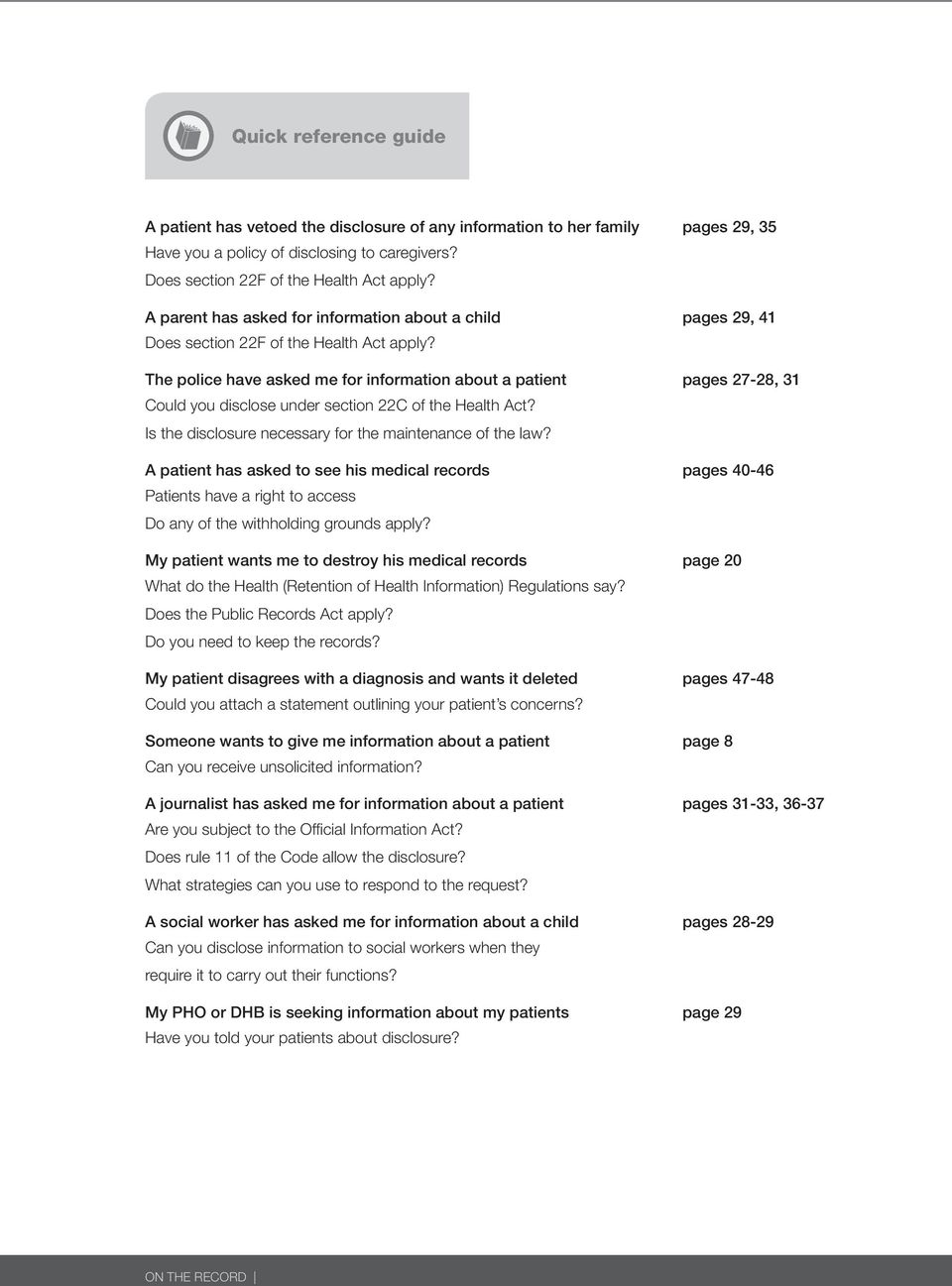
6 Quick reference guide A patient has vetoed the disclosure of any to her family pages 29, 35 Have you a policy of disclosing to caregivers? Does section 22F of the Act apply? A parent has asked for about a child pages 29, 41 Does section 22F of the Act apply? The police have asked me for about a patient pages 27-28, 31 Could you disclose under section 22C of the Act? Is the disclosure necessary for the maintenance of the law? A patient has asked to see his medical records pages Patients have a right to access Do any of the withholding grounds apply? My patient wants me to destroy his medical records page 20 What do the (Retention of Information) Regulations say? Does the Public Records Act apply? Do you need to keep the records? My patient disagrees with a diagnosis and wants it deleted pages Could you attach a statement outlining your patient s concerns? Someone wants to give me about a patient page 8 Can you receive unsolicited? A journalist has asked me for about a patient pages 31-33, Are you subject to the Official Information Act? Does rule 11 of the Code allow the disclosure? What strategies can you use to respond to the request? A social worker has asked me for about a child pages Can you disclose to social workers when they require it to carry out their functions? My PHO or DHB is seeking about my patients page 29 Have you told your patients about disclosure?
7 Frequently asked questions What is the Code? The Information Privacy Code 1994 is the main law governing privacy of health. The rules of the Code are very similar to the privacy principles in the Privacy Act, but with some changes that better suit the health environment. Who does the Code regulate? The Code applies to health agencies, which include all health and disability service providers. It makes no difference if you are in practice on your own or whether you work in a private or public hospital. agencies are responsible for what their employees and contractors do with health. Employees and contractors can be personally responsible as well. What does the Code cover? The Code covers all health about identifiable individuals, including about: their health or disabilities their medical history health or disability services provided to them collected while providing health and disability services, such as addresses for billing purposes or relevant to funding. Who are representatives? Sometimes people cannot act for themselves, but have a representative to act for them. A representative is legally defined as: the executor or administrator of a deceased person s estate the parent or guardian of a person under 16 (whether that person is alive or dead) where a person is alive and over 16, but is unable to give consent or exercise his or her rights, someone who seems to be lawfully acting on the person s behalf (such as someone with a power of attorney) or in his or her interests (such as a friend or relative who comes in with an unconscious patient). Representatives have some strong rights under the Code, but they cannot necessarily do whatever they want with a person s health. These situations are discussed on pages

8 What is an interference with privacy? In most cases, an interference with privacy means an agency has breached one of the rules of the Code and that the breach has caused (or may cause) harm to the person concerned. Harm includes financial harm (however minor), adverse effect on rights or benefits (however minor), or significant humiliation, significant loss of dignity, or significant injury to the person s feelings. However, there does not need to be any harm if the complaint is about correction or access to personal by the person concerned. If there is no proper basis for refusing a request for access or correction, including where a request has been ignored or where the response has taken too long, there is an interference with privacy even without any harm. Any breach of one of the Code s rules is a serious matter. However the Privacy Commissioner cannot refer a complaint on to the Human Rights Review Tribunal, and the Tribunal cannot award remedies such as damages, unless an interference with privacy has occurred. Which of the Code s rules are most important? The rules are equally important because they are all linked. For instance, your policies on collection of will affect what happens if you want to disclose that. Being open about why you collect will help people know if they want to make an access or correction request. And keeping records secure against unauthorised interference will help make sure they are accurate when it is time to use or disclose them. It s not difficult to be aware of each of the rules. They are largely common sense, and you will be applying many of them already. Who decides how health agencies deal with health? Agencies can set their own policies for collecting, using and disclosing health. Make sure you can explain a decision that has been made under your policy. 6

9 RULE 1-4 Rule 1-4: The first four rules all deal with collection of health. They are closely interlinked and say, in brief, that you should: know what you need to collect know why you need it know what is likely to be done with it know who else is likely to see it Collection of Information be open about all these things with the person concerned. Sometimes it is not desirable or even possible to let the person know what and why you are collecting. The rules allow non-compliance in those circumstances. 1-4: Collecting Usually, though, the person needs to understand what is going on. Then they can make choices about their treatment. Also, they will not be taken by surprise later surprise can lead to distress and complaints. If an agency has been open about what it is doing with a person s, the person will be more likely to trust it, to provide accurate and to participate in treatment in the future. EXAMPLE 1: OPENNESS IN COLLECTION PROCEDURES AVOIDS PROBLEMS LATER An alcohol and drug rehabilitation unit wants to be able to disclose the fact of discharge to its patients first contact person. If disclosing the is one of the purposes for which an agency got the in the first place, then the unit can contact these people on discharge. However, patients must be made aware of the intended disclosure. There are different ways to tell patients about the policy for instance, in direct discussion, posters, brochures or advice on forms. It is best to have clear policies around use and disclosure so that the agency and patients alike are clear about who gets to see health, and why. There are a number of exceptions (in rules 10 and 11) that allow disclosure under certain circumstances even where no policy exists, but it is always easier and quicker to have a written policy to refer to. Think about how your agency uses and discloses that should be the basis of your policy. 7

10 RULE : Collecting Be open about purpose to avoid problems with use and disclosure Unsolicited is not collected Rules 1 to 4 apply to that has been collected. Unsolicited is that an agency has not asked for or sought in any way, but that has simply been given to the agency. If an agency receives unsolicited, it has not collected that. For instance, a family member might telephone or write to a GP with about a patient. The GP did not ask for the, so has not collected it. They do not have to think about rules 1-4. But if the GP holds on to that, then they have to comply with the rules about storage, accuracy, use and disclosure. The patient may then ask to access or correct it. See pages 40 and 47 for a discussion of rules 6 and 7 that relate to access and correction. Of course, it may not always be appropriate to say where the came from, so some care may be needed. Check the rules on withholding grounds on pages to see under what circumstances you can keep the identity of the person who gave you the secret. If you receive unsolicited about a patient, it is good practice to note how it was received. You may also want to check the accuracy of the with the patient, particularly if it is likely to be used as a basis for treatment or some other action. EXAMPLE 2: RECEIVING UNSOLICITED INFORMATION During a consultation, Dr Jones patient, Henry, tells her that he believes his neighbour, Sue, beats her children. Henry says he regularly sees the children with extensive bruising to their faces. Sue and her children are also patients of Dr Jones. Does Dr Jones need to tell Sue she has obtained this? 8 Henry volunteered the without any request from Dr Jones. This means the was not collected. So technically, Dr Jones doesn t have to tell Sue. However, Dr Jones should weigh up carefully whether to tell Sue particularly if she wants to keep or use the in any way. It s usually good to be open, but there might be a good reason not to involve Sue. For instance, trying to get from Sue might create risk to the children, or she might decide to cover up evidence.

11 RULE 1-4 EXAMPLE 3: USE IS A PURPOSE OF RECEIVING INFORMATION Dr Jones is concerned for the children; she too had noticed extensive bruising. She decides to call on Sue to see how she is coping and to examine the children. Would she breach the Code by using the in this way? Henry gave the to Dr Jones because he was concerned for the children s welfare and she held onto it for that purpose too. In other words, she had the so she could monitor the situation. Rule 10 allows to be used in a particular way if that is one of the purposes for which it was obtained, or a directly related purpose. In this case the about potential risk to the children was obtained to help address concerns about their safety. Importantly, if Dr Jones believed the children were at risk, she could also report the to the Child, Youth and Family or the Police. Even if the children turned out to be fine, as long as Dr Jones reported her belief in good faith she is protected under the Children, Young Persons and their Families Act : Collecting Rule 1: NECESSITY AND PurposE Rule 1 says that a health agency can only collect health if: it has a lawful purpose for collecting it (that is, that there is no law prohibiting the collection) that purpose is connected with a function or activity of the agency the collection is necessary for that purpose. Agencies should know their purposes in collecting and be able to show that the collection is necessary for those purposes. They will then be able to tell the patient about those purposes. agencies can receive unsolicited about patients 9
12 RULE : Collecting EXAMPLE 4: NECESSITY AND PURPOSE IN COLLECTION An insurance company receives a claim from a customer relating to a particular health condition. It collects a copy of a customer s full medical records for the past five years from the customer s GP. An insurance company providing health or disability cover is a health agency. It is not a problem to ask the GP for that is relevant to the health condition for which the person is making the claim. The insurer needs to collect that so it can make a decision on the claim. However, usually, a collection of full medical records (even for a set period) will go beyond what is necessary for making a decision on the claim. This is because most of the in the records will have no relevance to the claim at all. The insurer needs to show why, in this instance, it was necessary to collect the full medical records. Rule 2: Collecting from someone other than the individual concerned Agencies should collect about patients directly from those patients, where possible. This improves the overall quality of the, helps patients know how their is to be treated and gives them an opportunity to object if they are concerned about the proposed use. However, rule 2 lists a number of exceptions to this general principle. For example, where: 10 The patient has authorised collection from someone else For example, an insurance company may seek about a claimant from their GP. The patient will probably have signed a form authorising the collection. For the authorisation to be valid, the GP should make sure the patient understands what is to be collected, who it is going to be collected from, the purposes for obtaining the, and who will receive it. The clearer the authorisation clause in a form is, the better for everyone. Some agencies have tried drafting very wide authorisation clauses to allow them to collect any at all. But clauses that are too broad may not convey enough
13 RULE 1-4 to allow a patient to give a meaningful authorisation. Also, doctors may be unwilling to make available under such a wide clause because they may not think the patient has understood what the agency wants to collect. Collecting from patients would prejudice their interests, prejudice the purpose of collection, or prejudice the safety of any person agencies need accurate about their patients health. These exceptions allow health agencies to collect from third parties if getting the directly from the person would risk someone s safety or would make further treatment difficult or impossible. 1-4: Collecting While these exceptions might allow collection from sources other than the patient, they do not give health agencies any additional ability or power to obtain. See the discussion of section 22F on page 29 for a review of ways health agencies can get access to required for treatment. Collecting the from the patient is not reasonably practicable If the patient cannot be found or does not know the sought, this exception allows a health agency to go elsewhere. Also, another person s perspective on symptoms and the effect of particular medication may be required. Alternatively the patient might not be telling the truth or (in rare circumstances) may have refused to provide the. However, where a direct request for has been refused by a patient, a health agency should think very carefully about its ethical position and its clinical relationship of trust with the patient before going elsewhere for the. EXAMPLE 5: COLLECTING INFORMATION FROM A PATIENT S FAMILY Frank is receiving treatment as a voluntary patient. The psychiatrist suspects that his condition may stem from an incident in his childhood. If so, this would affect the approach taken to Frank s treatment. Frank does not seem to know of any incident that may be relevant. Can his family be contacted for help? Frank could be asked to authorise contact with his family. The psychiatrist could ask Frank which family member should be approached. If Frank did not agree to this, the psychiatrist could approach the family for the because it was not practicable to obtain the from Frank, given that he did not seem aware of any incidents. The psychiatrist should tell Frank about any collected from his family as he may have a different perspective on it. Information does not have to be collected directly from patients 11

14 RULE : Collecting agencies should check the accuracy of collected from third parties, with the patient, where possible. Sometimes health agencies need to collect about a patient from other treating agencies. Section 22F of the Act 1956 requires health to be provided to a treating health agency on request, except in some limited circumstances (see page 29). If it is not passed on when it should be, a complaint can be made to the Privacy Commissioner, just as with a refused rule 6 request. Right 4(5) of the Code of and Disability Services Consumers Rights gives patients the right to co-operation among providers to ensure quality and continuity of services. Co-operation would include sharing with other providers, and this sort of sharing will often be one of the purposes for which clinical is collected. If is not passed on when it should be, consumers can complain to the and Disability Commissioner. agencies sometimes receive about patients from family members or employers, on the basis that the (and who provided it) will be kept secret. However, a promise of confidentiality to someone (such as a family member) who has provided about a patient will not necessarily be recognised as a withholding ground if the patient requests access to the under rule 6. Because of this, it is probably preferable not to make such promises a clinician may make every effort to keep third party to themself, but the ultimate decision about access may rest with the Courts if a complaint is pursued far enough. Rule 3: Collecting from the individual concerned Consider verifying with the patient Where agencies collect directly from patients, they need to take reasonable steps to make the patient aware of: The fact is being collected It is not always obvious that the agency is collecting, or that it is collecting the in a particular way. For instance, if a video or audio recording is being made, is the recording equipment in plain view and has the patient been told about it? Or does the patient know what s being collected on an electronic form? 12 The purpose of collection Collection for care and treatment or related administrative purposes such as billing tends to be self-explanatory. So you don t need to spell it all out. Collection for other purposes, such as training and research or chaplaincy is not always clear. Patients should be told (or have their attention drawn to) these additional purposes. You can explain the purposes in conversation, or by way of posters or brochures.

15 RULE 1-4 The intended recipients of the An agency should let people know what disclosures it is expecting to make. This does not extend to listing every possible purpose or every possible recipient. Categories of recipients can be fine. The main thing is that people should know who is going to see their and why. Clinical staff are obvious recipients; students, researchers or peer reviewers are not as obvious. Members of a care team, such as other practitioners in related fields or even family members, may also not be obvious. 1-4: Collecting The consequences of not supplying the There may be problems if the patient does not provide the. For instance, a particular treatment may not able to continue effectively without complete and accurate. If the patient has applied for a subsidy or benefit, it may not be possible to process the claim without complete and accurate. The patient s rights of access and correction given by rules 6 and 7 of the Code Give clear explanations either to the patient or their representative (or both). Rule 3 explanations can be given by any or all of: a brief oral explanation (in appropriate language) notices or posters on display explanatory letters or brochures or readable statements on forms the person is filling in. Exceptions to Rule 3 Sometimes you do not need to explain these things. For example, where: Compliance by the agency would prejudice the interests of the patient or prejudice the purposes of collection For instance, if a fully-informed patient would be likely to behave in a way that prevents their condition being effectively assessed or diagnosed, or in a way that is against their own interests. Use posters, pamphlets and explanations Compliance is not reasonably practicable in the particular circumstances For instance, where: an explanation would delay the provision of emergency treatment the patient is not able to take in an explanation when it is offered because of their mental or physical state the explanation might cause a violent reaction. If a health agency can t give a rule 3 explanation when the is collected, 13
16 RULE : Collecting it should do it as soon as possible afterwards. However, repeat explanations are not necessary, assuming the purpose for collection is unchanged. Complying with rule 3 simplifies matters when it comes to disclosing. Remember that health can always be disclosed when that disclosure is in line with the purpose for which the was originally collected. So a health agency can legally use and disclose the it collects if it decides, and is open about, its purposes. EXAMPLE 6: OPENNESS AVOIDS MISUNDERSTANDINGS Ellen had a blood test which established that she would be a suitable kidney donor for her sister. The specialist told the sister that Ellen was a suitable match. Ellen had not decided whether she wanted to donate her kidney and felt very pressured by her family following the disclosure. The specialist believed that by agreeing to have the blood test, Ellen had consented to the disclosure of the results to her sister. Had the specialist told Ellen he would give the results to her sister, Ellen could have asked him not to disclose until she had decided what to do. At the least, she would have been prepared for the disclosure. Rule 4: Manner of collection may not be collected using methods that: Are unlawful The Mental (Compulsory Assessment and Treatment) Act prohibits the use of video tape or audio tape to record patients without the prior consent of the patient or his or her representative. Because of this Act, unauthorised recordings of patients under compulsory assessment or treatment orders are unlawful Are unfair If the patient has been deliberately misled about why is being collected from him or her, that method of collection may be unfair. 1 Section 68, MH(CAT) Act
17 RULE 1-4 Threatening or coercing patients into providing could also fall into that category. Intrude to an unreasonable extent on the affairs of the individual concerned For example, patients should not be asked intimate questions that are unnecessary for treatment or diagnosis. If a patient is uncomfortable with one way of collecting, find out whether it could be collected in another way. 1-4: Collecting When collecting sensitive, make sure that the patient has physical privacy to provide that, where possible. Physical privacy is also protected by right 1(2) of the Code for and Disability Services Consumers Rights. EXAMPLE 7: VIDEOTAPING CAN BE AN UNFAIR COLLECTION Means of collection must not be unfair Hine visited a counsellor who often videotaped counselling sessions. The tapes were used in training courses. The counsellor told Hine that only small excerpts were used and the client would not normally be identifiable. Hine felt obliged to agree to the videotaping. During the session she disclosed sensitive about an abusive relationship. She later discovered that this segment of the tape was used in a training session and that she was identified. Information was disclosed that identified Hine. She consented to collection of that on the basis that she would not be identified and felt pressured to agree. This was a collection by means which were unreasonably intrusive and also unfair, mainly because she was identified after being promised that this would not occur. 15
18 RULE : Collecting EXAMPLE 8: COLLECTING INFORMATION AT RECEPTION Philip attends a medical clinic for the first time. The receptionist asks him several questions for the clinic s records, entering his answers directly into the computer. Philip is asked for contact details and about any existing medical conditions. The reception area is small, and a number of people can hear the discussion. This may be an unreasonable intrusion into Philip s affairs. The receptionist could have asked Philip to fill in a form instead. Can other people overhear conversations with patients? Example 8 is also relevant to pharmacies. People often have to discuss their prescriptions or over-the-counter medication with pharmacists so the pharmacist can explain how to use it or not to mix it with particular drugs. People may feel embarrassed if this conversation is overheard by other customers. 16
19 RULE 5 and 9 Rule 5: Security safeguards Under rule 5 of the Code, agencies have to take reasonable security safeguards with health against its: loss access, use, modification, or disclosure without the agency s authority other misuse. 1-4: 5: Collecting Security Safeguards EXAMPLE 9: ACCESS TO PATIENT FILES BY STAFF A patient with a history of mental illness has been admitted for an urgent appendectomy. Her notes contain a detailed history of past treatments going back many years. During a quiet night, a nurse not involved with the patient s care browses through the notes. Only those treating the patient should be able to access the notes. The agency should consider whether it needed all the notes for this admission, how the nurse was able to browse the file and the need for further staff training. Where an agency gives to someone else, it needs to do everything it can to prevent unauthorised use or disclosure of by that person. For instance, before storing medical records with a contractor, an agency should sign an agreement with the contractor that it will: protect the records from unauthorised access only let authorised staff access them. Agencies should consider how is stored and identify weak points about storage procedures. Practical steps can be taken to protect. Agencies can: Physical security keep white boards that show patient details away from public areas physically secure the areas in which health is stored with lock, keypad or swipe card access 17

20 RULE 5 and 9 1-4: 5: Collecting Security Safeguards Staff training enhances respect for patient lock filing cabinets and unattended rooms position computer terminals so they cannot be seen or accessed by unauthorised personnel use screen savers and security screens so computer terminals cannot be seen by visitors. System security implement document tracking systems record who has removed a document from storage, when it was removed, and when it was returned use robust, regularly changed passwords to control access to electronic health make sure that computer access leaves a footprint that is periodically audited. Staff training train staff on the need to keep patient records secure and when may be accessed, used and disclosed. Fax machines control the type of that may be sent by fax make telephone calls before transmission, to ensure is not left lying on the fax machine at the receiving end programme fax machines with frequently called numbers to reduce the risk of incorrect dialling. use abbreviated names or nicknames to save frequently used addresses and to minimise the risk of inadvertently sending to the wrong person encrypt or password-protect sensitive files (remember that is like a postcard people can get into the system and read it). Portable storage devices have a well-communicated and monitored policy on the use of Portable storage devices (PSDs) like USB memory sticks and laptops make sure that sensitive is only kept on PSDs when absolutely necessary and deleted when no longer needed. 18
21 RULE 5 and 9 EXAMPLE 10: LEAVING CONFIDENTIAL INFORMATION IN PUBLIC ACCESS AREAS The receptionist for a medical practice is responsible for sending out accounts to patients. She leaves a stack of window envelopes containing accounts letters on her desk when she goes to morning tea. The top envelope is addressed to a well-known media personality, Richard. Another patient sees Richard s full name and some of his health through the window of the envelope, and goes home to write about it on her blog. Patient should be kept away from the public counter where it could be read by others. Similarly, computer screens should not be readable from the public side of the counter. Make sure health (such as the name of a particular clinic, or about a test) is not visible on or from the outside of an envelope. 1-4: 5: Collecting Security Safeguards Practical protections for EXAMPLE 11: PROTECTING INFORMATION FROM UNAUTHORISED ACCESS BY CUSTOMERS A pharmacy keeps a register of restricted medications. People purchasing restricted items fill in their names, addresses, phone numbers and the name of the medicine. As the register is a large book and has several entries for customers to a page, these details can be read by anyone filling in their own details. Customers could be taken to one side and asked to provide the details to a staff member, who could transfer them into the register. Alternatively, other people s details could be covered when customers fill in their own details, or a separate page could be dedicated to each person. 19
22 RULE 5 and 9 1-4: 9: Collecting Retention of Information is sensitive. Not all employees need, or should be able to read, entire patient files. Staff should be given access to the they need for their jobs. For instance: administrators dealing with billing do not need to see clinical notes hospital chaplains and volunteer visitors do not need to see clinical notes or have details of treatment without patient authorisation clinical staff may not need to see the whole of the historical medical record or to have it to hand at all times. Storage and security policies should be known by all staff, so they can respond appropriately to patient concerns. Rule 9: Retention of health Rule 9 provides that health must not be kept longer than is required for the purposes for which it may lawfully be used. In other words, as long as there is a purpose for holding the, rule 9 allows it to be kept. Not all staff need to see clinical notes When all purposes for holding the have expired, it should be securely destroyed or returned to the patient. (Retention of Information) Regulations 1996 The (Retention of Information) Regulations require health records to be kept for at least ten years from the last date of treatment or care. If the Regulations apply, they override rule 9. These regulations allow to be transferred to another provider in this time, so if a patient moves to another town the records can be forwarded to a new doctor or health provider. The Regulations also allow agencies to transfer to the patient or (where the patient has died) to the executor of their estate. 20 PUBLIC RECORDS ACT 2005 Public sector agencies need to comply with the Public Records Act, which gives the Chief Archivist jurisdiction over nearly all publicly held records. In practice, this means DHB records may only be disposed of in line with the General Disposal Authority (GDA) developed by Archives NZ. The GDA sets specified retention lengths for different kinds of clinical records and says what may done with them after that time. The GDA is available on the Archives NZ website.
23 RULE 8 and 10 Rule 8: Accuracy Rule 8 of the Code says that, before using, health agencies must take reasonable steps to check that it is up-to-date, complete, relevant and not misleading. What is reasonable depends on the proposed use for the and its impact on the patient. The more important or sensitive the use which is to be made of the, the more careful an agency has to be to make sure it is accurate and make any necessary additions or changes. 1-4: 8 and10: Collecting Using For instance, if a diagnosis has changed over time, making a note on earlier records may stop another practitioner acting on the (inaccurate) first assessment. Making sure is accurate is particularly important where was obtained from a source other than the person concerned. Rule 10: Using Information obtained for a particular purpose may be used by the agency for that purpose. The patient should have had this purpose explained to him or her by a written or spoken privacy statement at the point of collection, as required by rule 3. Rule 10 also allows uses that are directly related to the purpose for obtaining the. For instance, obtained for care and treatment may also be used for administrative purposes related to that care and treatment. Rule 10 also lists a number of instances in which may be used in a way which was not anticipated when it was obtained. If one of those exceptions applies, the agency has a discretion to use the for that purpose. It is not obliged to use it in that way. Information can be used in line with the purposes for which it was collected For instance, may always be used for another purpose where necessary to prevent or lessen a serious and imminent threat to public health or public safety, or somebody s life or health. may also be used if it is necessary to avoid prejudice to the maintenance of the law by a public sector agency or for the conduct of proceedings. These exceptions are also contained in rule 11 (disclosure) and are discussed further on. 21 The person who says that the exception applies must have a reasonable basis for believing that the exception applies.
24 1-4: Disclosing Collecting Disclosing health Disclosing health can pose special problems, especially where people are already suspicious or wary of health agencies. Agencies have to balance retaining a patient s trust and fulfilling their functions as health practitioners. This may sometimes include acting in what they believe to be a patient s best interests even if the patient disagrees. The discretion to disclose (or not) will generally be the practitioner s, and should be exercised in line with his or her professional ethical framework. More specifically, disclosure can become an issue because agencies: have to disclose (see page below) want to disclose (see page 23) have been asked to disclose (see page 28). Dealing with situations where you Have to disclose Any law that authorises or requires to be made available takes precedence over the Information Privacy Code. If a law requires disclosure using words like shall or must the must be made available. However, when an agency is asked to disclose under some legal authority, the agency should ask to see the authority (eg, a warrant) or should be told what that authority is. There may be restrictions about how the be obtained or used and agencies can feel confident in holding requesters to those restrictions. For instance, the Ministry of Social Development has very wide powers to obtain, but these powers are all subject to a relatively restrictive code of conduct. practitioners must also ensure any disclosure they make complies with their codes of ethics. Codes of ethics will generally allow disclosure if it is required by law, but if in doubt, practitioners should check with their professional body. In nearly every case, the patient can (and should) be told that their has been disclosed. Though this is not a legal requirement, it will generally be in line with good faith handling practices. At the very least, the disclosure should be noted on the file so the patient will see it if they later access their own. 22 Some examples of statutory provisions that require disclosure are: Land Transport Act 1998, sections 18 and 19 Medical practitioners and optometrists must notify the Director of the NZ Transport Agency if they think public safety requires that one of their patients should not be
25 driving or should only be driving subject to some limitations. If a person who holds a driver licence is placed under an compulsory treatment order or becomes a special patient, the person in charge of the hospital must also notify the Director of the NZ Transport Agency. Cancer Registry Act 1993, sections 5-7 Where a cancer test indicates that someone has cancer, the person in charge of the laboratory where the test was carried out must report it to the Director-General of the Ministry of so the can be placed on the cancer registry. 1-4: Disclosing Collecting The Director-General can require more to be provided by a medical practitioner or the person in charge of a hospital if the initial report is incomplete. Anyone who makes available in under sections 5 and 6 of the Cancer Registry Act is protected against legal action for that disclosure. Tuberculosis Act 1948, section 3 Medical practitioners must notify the Medical Officer of if they believe a patient has tuberculosis. Disclosures may be required by law and Disability Commissioner Act 1994, section 62 The and Disability Commissioner can require health or disability service providers to make available for an investigation conducted by the Commissioner. The Privacy Act 1993, sections The Privacy Commissioner has similar powers to require for investigations conducted under the Privacy Act. Search warrant agencies must disclose in response to a court order such as a search warrant. Dealing with situations where you Want to disclose Most of the time agencies do not have to disclose. For instance, rule 11 does not force agencies to disclose. But if they want to disclose, they must find a provision that allows it, either in the Code or some other legislation. Ethical duties Ethical duties of confidentiality may differ from the provisions in the laws allowing disclosure. Where an exception in the Code (or other statutory provision) allows a disclosure, the health practitioner needs to also consider his or her code of ethics. The code of ethics may prohibit disclosure or require that certain procedures be followed. Statutory provisions permitting disclosure Some statutes authorise disclosure. They do not require agencies to disclose, but they give them a choice. 23
26 1-4: Disclosing Collecting This difference between laws that require disclosure and laws that authorise disclosure is important. Some codes of ethics may allow disclosure only if it is required by law. Where disclosure is permitted by law, in most cases there will be nothing to prevent the agency from telling the patient that the disclosure will be made. Children, Young Persons and Their Families Act 1989, sections Under these sections anyone who believes a child or young person is at risk of some harm, ill-treatment, abuse, neglect or deprivation can report the matter to a social worker or the police. These provisions permit rather than require the disclosure. They also protect disclosers from civil, criminal or disciplinary proceedings if the disclosure is made in good faith. Tell parents if disclosure has to be made Information Privacy Code 1994, rule 11 If you want to disclose but there is no law requiring or authorising it, you should first consider rule 11 of the Code. Rule 11 prohibits disclosure unless one of the various exceptions applies, or there is some other law allowing disclosure. However, disclosure under the Code is discretionary. Even where rule 11 allows a disclosure, the disclosure does not have to be made. Importantly, disclosure is always permitted where the patient has authorised the disclosure, or where disclosure was a purpose for obtaining the in the first place. These disclosures form part of regular procedures, are commonly made, or can be reasonably anticipated. For example: disclosing relevant to other members of treatment teams such as nurses or occupational therapists disclosing details to the first contact person, including medication details referring the patient to other health agencies, such as a physiotherapist. However these purposes should have been discussed with the patient in line with rule 3. If this has been done, patients will not be surprised when the is disclosed. In other words, agencies can set their own policies around disclosure. 24 In setting disclosure policies, agencies should remember right 4(5) of the Code of and Disability Services Consumers Rights. Right 4(5) gives consumers the right to co-operation among providers to ensure quality and continuity of services. Cooperation may require sharing between providers where necessary for treatment. So this sharing would be a purpose for having the. That purpose should be communicated to the patient when the is collected. Agencies might also have a policy of disclosing to family members or friends who are involved with the individual s treatment. The individual concerned should have been told (in accordance with rule 3) that may be disclosed in this way.
27 Other reasonably anticipated disclosures, for example, may be to a health funder for audit purposes, or to ACC if a patient has a claim related to his or her treatment. Again, agencies should tell the patient about this in accordance with rule 3. If an agency does not want to give out in response to a request, it should state why not just because of the Privacy Act. While it is possible that all the exceptions of rule 11 have been considered and the Code doesn t allow disclosure, much often there are other reasons for not disclosing such as the agency s policies or to protect the confidentiality of the patient. So don t use the Privacy Act as an excuse it s confusing for people. 1-4: Disclosing Collecting EXAMPLE 12: ANTICIPATED DISCLOSURES Some people seek drugs from GPs for the purposes of abuse. When a GP thinks they have encountered such a person, some practices tend to pass on a warning to other practices and pharmacists in the area. It is unlikely that such a person would agree to this being passed on. Would this disclosure breach the Code? Rule 11 allows disclosure where it is a purpose As long as the agencies are open with their policies, the Code would allow disclosure of this. However agencies should display posters in waiting rooms informing people about the network. Rule 11(1) allows disclosure under various circumstances, such as where: The disclosure is to the individual concerned or his or her representative Disclosing to the individual or their representative is always acceptable, but agencies only have to disclose when the individual or representative made a specific request for access to the (see discussion of rule 6 and section 22F). A representative is: the parent or guardian of a child under 16 (whether custodial or not) the executor or administrator of a deceased s estate someone lawfully acting on the behalf or in the best interests of someone who can t give consent or exercise their rights. The disclosed is about a patient in hospital, and describes their presence, location, condition and progress while there, on the day the disclosure was made This is a focused but limited exception that recognises general clinical practice as it existed before the passage of the Privacy Act, as well as balancing the genuine interest friends and family members have in the well-being of their loved ones. 25
28 1-4: Disclosing Collecting However, patients in hospital should be advised of the hospital s policy in relation to disclosing basic to enquirers, and given the opportunity (ideally) to object. If they do object (or the representative objects), they can veto the disclosure. The disclosure is authorised by the individual concerned or his or her representative (where the individual is dead or cannot exercise his or her rights) practitioners may be presented with an authorisation signed by their patient that is vague or very broad. If a health practitioner doubts the patient has understood what would be collected and disclosed on the basis of the authorisation, they may decide to speak to the patient before disclosing any. The is sourced from a publicly available publication Publicly available publications include the internet, public registers, newspapers or the telephone book. To ensure accuracy, the must have come from the publication. It s not enough that it is just available to the public. Rule 11(2) of the Information Privacy Code Ideally, agencies would only disclose health with authorisation from the patient or their representative. However this is not always practical. For instance the patient might: be unconscious not be competent have refused to give an authorisation. In those cases, rule 11(2) allows disclosure where: The is disclosed by a health practitioner to a person closely associated with the patient This provision gives a broad discretion to disclose to someone associated with the patient, when it s not feasible to get the patient s permission for the disclosure. The person receiving the disclosure must be a contact person, principal caregiver or a near relative. 26 The disclosure must be in line with recognised medical practice, and not be contrary to the express request (ie. veto) of the patient or their representative (where the patient can t give a decision). The disclosure is necessary to prevent or lessen a serious and imminent threat to public and safety, whether the individual s or the public s
29 The disclosure must be to someone who can do something to lessen the risk such as the Police or an at-risk associate of the individual. It might not be necessary to disclose all of the. Only the necessary to achieve that goal should be given. EXAMPLE 13: DISCLOSING INFORMATION TO LESSEN A SERIOUS AND IMMINENT THREAT A doctor has a patient who drives a passenger bus. The patient has a heart condition and the doctor is concerned about the safety of the passengers. The doctor organises a petition to have the driver barred from driving passenger service vehicles. The doctor may well have thought there was a serious and imminent threat to public safety, but the disclosure is unlikely to prevent or lessen that threat because it was not made to an appropriate authority. The disclosure would breach rule 11 of the Code. Under the Land Transport Act 1998 the doctor would be required to notify the NZ Transport Agency if he thought the patient was not safe to drive but intended to do so. Disclosing in accordance with that requirement would not breach the Code because the other law trumps the Code. 1-4: Disclosing Collecting Authorisation to disclose must be clear The disclosure is to an individual s principal care giver and relates to the individual s release, or imminent release from compulsory status under the Mental (Compulsory Assessment and Treatment) Act 1992 Principal caregiver means the friend or family member who is most concerned with oversight of the individual s care and welfare. This exception allows some disclosures, but the most useful and flexible method of ensuring caregivers have the they need is to make a clear discharge plan that addresses the issue of disclosure to family. The disclosure is necessary to avoid prejudice to the maintenance of the law by a public sector agency or for the conduct of court proceedings For instance, an agency may wish to disclose to the Police or to a public sector agency such as the Inland Revenue Department, Ministry of Social Development or Immigration New Zealand. If the disclosure is to be made in court proceedings, check whether the is subject to the Evidence Act 2006, which prohibits the disclosure of clinical about drug dependency (and other conditions manifesting in criminal conduct) by medical practitioners and clinical psychologists. 27
30 1-4: Disclosing Collecting Disclosure to prevent serious and imminent threats The is disclosed because the agency believes the individual is (or is likely to become) dependent on controlled drugs, prescription medicines or restricted medicines This disclosure has to be to the Medical Officer of under the Misuse of Drugs Act or the Medicines Act. This provision wouldn t cover disclosure of about drug seekers to other practices directly that is better handled by (say) a notice at reception indicating what the health agency s policy is about disclosing such. The disclosure is in accordance with an authorisation granted under section 54 of the Privacy Act 1993 The Privacy Commissioner can permit some one-off disclosures in the public interest that would otherwise breach rule 11. Contact the Office of the Privacy Commissioner directly for more on this topic. The is disclosed for research and statistical purposes, will not be published in a form which could identify anyone and ethical committee approval has been obtained if necessary Before disclosing for research purposes the agency should make sure proper security safeguards will protect the. The Code of and Disability Services Consumers Rights requires that consumers be told if they are participating in teaching or research programmes. Also, rule 3 requires reasonable steps to have been taken to alert a person to the collection if is being collected directly from the person or from the representative of that person. Dealing with situations where You have been asked to disclose Agencies can face difficult dilemmas when responding to unexpected requests for health. Agencies may be asked to disclose for many reasons, perhaps because: the police are investigating a crime the media are following up a story a DHB wants clinical to assess the effectiveness of a clinical programme it is funding a social worker is investigating a case of suspected abuse a family wants about a relative who is receiving treatment. 28 If agencies are asked to disclose and they are not required to do so by law or court order, they cannot normally be compelled to disclose. If agencies choose not to disclose, they should take responsibility for the decision and give the real reason, such as clinical confidentiality. Because of the Privacy Act is not a reason.
31 DHBs or PHOs seeking patient GPs can find themselves in a dilemma when faced with requests for from the local Primary Organisation (PHO) or District Board. How can ethical obligations of confidentiality be reconciled with the need to provide statistical or clinical about patients? First, where the is only statistical or anonymised, then it may be disclosed to anyone. Where it is not, then directly seeking patients permission is always an acceptable way to comply with restrictions on use and disclosure of health. Where it s impractical to go to each patient individually, then the onus is on the GP to make sure that he or she has taken reasonable steps to make sure that the patients are aware that the disclosure will be taking place (in line with rule 3 of the Code). This might take the form of a poster, a brochure, or even a face to face discussion. Another obvious channel for this kind of is the privacy statement on the form that the patients sign when enrolling for the practice or PHO. 1-4: Disclosing Collecting Disclosure for research purposes Under section 22C of the Act 1956, it is permissible (but not obligatory) to disclose general non-identifiable health to employees of a DHB who have asked for the and need it to carry out their functions. However if the is about identifiable individuals (ie, names or NHIs are attached) then the identifiable must be essential for those functions. In general, the Code stresses thinking ahead, taking reasonable steps to anticipate how is going to need to be used and disclosed, and then telling patients about those potential uses and disclosures. Act 1956, section 22F Section 22F is a complex but important part of the law about disclosure of health. practitioners can use it to obtain from other health practitioners for instance, if a patient transfers to a new clinic and his or her notes are needed from the old clinic for the patient s medical history. Caregivers and representatives can also use it to obtain. This provision requires disclosure unless an exception applies. Under section 22F health must (with some exceptions) be disclosed, on request, to the individual s representative or any person providing health or disability services to the individual. However, a section 22F request may be refused if the agency believes, on reasonable grounds, that the patient does not want the to be disclosed to the representative or service provider. Talking to the patient about the request is not legally required, but is always good practice. Where the patient s representative has made the request, the agency may also refuse the request if the disclosure would be contrary to the patient s interests or one of the withholding grounds in sections would apply if the request had been made by 29
32 1-4: Disclosing Collecting Providers can use s22f to get patient transferred the patient (discussed below at page 43-46). If the exceptions do apply, the agency may still disclose the if it wants to. If none of these exceptions apply, the must be disclosed in accordance with the request. Guardians of children under 16 may consent on their children s behalf to medical, dental and surgical procedures under the Guardianship Act The Code of and Disability Services Consumers Rights gives consumers the right to be fully informed when giving consent. This should be considered when dealing with requests by guardians for if they have been asked to consent to a child s treatment. EXAMPLE 14: SECTION 22F: REQUESTS BY CAREGIVERS Brian is a 65 year old man with severe emphysema. He has been discharged after a stay in hospital. His wife, Rose, plans to look after him in their home. She asks their GP for on Brian s day to day needs. As Brian s caregiver, Rose is a person who is providing him with health or disability services, so her request is subject to section 22F of the Act. Unless the GP is aware that Brian does not want the disclosed, he or she must provide it to Rose. EXAMPLE 15: SECTION 22F: REQUESTS BY FAMILY MEMBERS NOT INVOLVED IN CAREGIVING Jill, Brian and Rose s daughter, calls the GP. She says Rose is having difficulty with Brian s oxygen tanks and that she lets Brian s friends smoke when they visit him. Jill says Rose will not let her help care for Brian and fears Rose cannot cope alone. She would like about Brian s care so she can try to help her mother. Jill does not seem to be involved with Brian s care. Nor does she seem to be his representative. Therefore, section 22F does not apply to her request. 30 The GP could consider whether exceptions in rule 11 allowed disclosure, but would also have to consider ethical constraints on disclosure. It might be possible to resolve Jill s concerns without disclosing any. The GP could act on her concerns by giving Rose more advice and instructions, encouraging her to seek help if she needs it, and generally monitoring the situation.
33 Act 1956, section 22C Under this section, agencies providing health or disability services are allowed to disclose health to specific categories of people, on request, if that is required for those people to carry out their functions. Section 22C allows to be disclosed in response to a request. It does not allow to be volunteered without a request. Also, the disclosure is always discretionary the section doesn t force you to disclose. Some of the categories of people listed in section 22C are: police officers medical officers of penal institutions probation officers social workers care and protection co-ordinators. Information may also be disclosed to the employees of a funder (such as a District Board). But in those cases disclosure of identifiable must be essential for carrying out that funder s functions under the New Zealand Public and Disability Act. 1-4: Disclosing Collecting Official Information Act applies to public sector agencies Act 1956, section 22D The Minister of can require hospitals and health services and funders to disclose about the condition or treatment of, or health or disability services provided to, any person. The Minister can require disclosure only for the purpose of obtaining statistics for health purposes or for the purposes of advancing health knowledge, health education or health research. Information which would identify the people concerned may only be provided if the people concerned consent to the disclosure or the identifying is essential for the purposes for which the is sought. Official Information Act 1982 The Official Information Act (OIA) applies to public sector agencies. In the health sector, this includes the Ministry of, District Boards and public hospitals. An OIA request is effectively any request to a public sector body from someone who is not: the person the is about that person s representative/agent providing health services to them. OIA requests do not require the generation of new. The agency only has to provide that it already holds. 31
34 1-4: Disclosing Collecting For example, a request for a report done by an agency would be subject to the OIA, but a request for comment on that report would require the generation of new. The general principle underlying the OIA is wide availability of. However, there are withholding grounds, just as there are with rule 6 requests under the Code. Section 9(2)(a) of the OIA allows to be withheld if this is necessary to protect the privacy of a person, whether alive or dead. To decide whether withholding is permissible, agencies should: identify the privacy interest requiring protection and how strong it is given all the circumstances of the particular case list any considerations favouring disclosure of the in the public interest and the relative strength of those considerations decide whether or not the balance favours withholding some or all of the to protect someone s personal privacy. There are, in most cases, strong privacy interests attaching to health and the public interest in disclosure has to be very strong to outweigh that privacy interest. EXAMPLE 16: OFFICIAL INFORMATION ACT PUBLIC INTEREST IN DISCLOSURE Consider privacy interests under the Official Information Act A woman alleged she was assaulted and treated for particular injuries at a local hospital. The man accused of assaulting the woman was convicted. He sought to help his petition to the Governor- General against the conviction. He asked the hospital whether it had any record of a person being treated for those injuries. The hospital refused to say whether it had any such. In fact it did not. The Ombudsman decided that the public interest in disclosure of the fact that there was no record outweighed the privacy interest in withholding the. He took into account the discrepancy between the victim s statement and the hospital s record, and the fact that the victim had given contradictory evidence in a later case. The Ombudsman concluded that, in the interests of justice, the man should have access to the so the Governor-General could be given the relevant facts. 32
35 If is released in good faith under the OIA, the agency that released it is protected from civil or criminal proceedings in respect of the release. Victims of Offences Act 1987 Section 11A of the Victims of Offences Act 1987 enables victims of certain serious offences to request notification of the escape or discharge of a person compulsorily detained in a hospital because of the offence. Dealing with requests If an agency receives a request for health about someone, first determine whether the request was made by the individual concerned, their agent or by someone who falls into one of the other categories already discussed (representative, service provider). 1-4: Disclosing Collecting If not, find out whether disclosing the is required by a particular law or a request has been made under the Official Information Act (OIA). If the request is to a public sector agency under the OIA, consider whether any of the withholding grounds apply. Section 9(2)(a) would nearly always be relevant where the request is for clinical, meaning the request can generally be refused unless there is a very strong public interest in disclosure. If not required to disclose, agencies can consider whether they want to disclose. They can decline to do so. They may have an established relevant policy on such requests. When agencies give reasons for the decision, they should give real reasons. Blanket statements such as because of the Privacy Act are seldom justifiable. For instance, reasons might include the: effect disclosure would have on the patient clinical reasons for not disclosing potential damage to the therapeutic relationship agency s policies. Ethical obligations, such as clinical confidentiality, parallel these legal obligations and must also be considered. Give reasons for refusing requests 33
36 1-4: Special issues Collecting relating to disclosure Special issues relating to disclosure Disclosure to family, caregivers and friends The safest way to disclose to people who are close to your patient is always to get permission for the disclosure. However that is not always possible or practical. Rule 11 of the Code allows disclosure to family, partners or friends in a couple of specific circumstances, even without the authorisation of the patient. When a patient is in hospital, for example, then basic about his or her presence, location, condition and progress may be disclosed to anyone who asks unless the patient (or their representative) has requested confidentiality. The patient should be told about this potential disclosure on admission, so they have a chance to object. Alternatively, where a health practitioner isn t able to get someone s permission for disclosure, then about them may be disclosed to the patient s: principal caregiver near relative nominated contact person. The disclosure must be in line with recognised professional practice and, again, the patient can veto the disclosure. Dealing with patient concerns over disclosure Sometimes patients do not want their families or friends to be given about their illnesses or treatment or about their presence in a hospital. They may not want to be passed to other health practitioners who will be monitoring their treatment and recovery. Their concerns might be dealt with in a number of ways discussed under the headings which follow. Where disclosure is a purpose Agencies may consider a purpose for obtaining health is to pass on necessary about care of the patient to caregivers or other people who should be aware of certain aspects of care, such as medication requirements. The Code permits this disclosure where it is one of the purposes for which the was obtained. 34 Agencies should take responsibility for the policy on which their decisions are based. If they have a policy to make some disclosures, patients should be told about it. If agencies have a policy not to disclose certain, or they choose not to do so in the particular circumstances, those policies should be made clear. The
37 policies should form the basis of the decision to disclose or not to disclose, wherever possible. Developing a treatment plan at the outset, with the patient s involvement, enables desired disclosures to be discussed. It will reduce the need to approach the patient later for an authorisation to disclose. Where an individual vetoes disclosure If was obtained for a particular disclosure, such as to a caregiver, the disclosure may be made despite a patient s veto although ethics would need to be considered. Where the purposes do not include disclosure of certain, the agency has to consider other options including whether one of the exceptions to rule 11 applies. Discussion with the patient is often the best starting point. If an agency considers disclosure to a caregiver or family member is not in the individual s best interests, perhaps because of family dynamics or because of potential harm to the therapeutic relationship, the person requesting should be advised that the decision not to disclose has been made on clinical grounds. 1-4: Special issues Collecting relating to disclosure Disclosure to caregivers can be a policy EXAMPLE 17: DISCLOSING A CHILD S COUNSELLING NOTES TO PARENT A public hospital receives a request from a parent of a 12 year old receiving counselling for behavioural problems associated with suspected abuse. The parent has asked for about the child s progress and for statements made during the counselling sessions. The child was reluctant to enter counselling and did so only on the basis that everything said in the sessions would be confidential. The child has no contact with the parent and has said she does not wish any to be disclosed. The hospital is reluctant to disclose because it would undermine the trust built up between the child and counsellor. First, the hospital should consider the basis of the request. Is it a request on behalf of the child or by the parent on her or his own behalf? Because the child is under 16 the parent is the child s representative, so the request should be handled under section 22F of the Act. Under section 22F and rule 11(4)(b) of the Code, the hospital may refuse to disclose because the child does not want the 35
38 1-4: Special issues Collecting relating to disclosure to be disclosed. This is a judgment call for the hospital. The hospital must also consider the Official Information Act. While there is a privacy interest which needs to be protected, so section 9(2)(a) applies, there does not seem to be a public interest in disclosure which overrides the privacy interest. Because of this, the can be withheld from the requester. Granting guardians requests may depend on the circumstances Disclosure to the media Agencies, particularly hospitals, may be approached by the media for about a patient. The Code allows a limited release of personal to the media. For example, may be disclosed in general terms concerning the presence, location and condition and progress of a patient in a hospital on the day on which the is disclosed. Disclosures of this kind must not be against the patient s (or their representative s) express wish. A person s identity and a brief description of the nature of injuries sustained in an accident may also be disclosed by a hospital to an accredited reporter for the purpose of publication or broadcast. Disclosure may not be made if it would be contrary to the patient s or representative s express veto. This provision applies where it is not desirable or practicable to obtain the patient s (or the representative s) authorisation. Public sector agencies are subject to the Official Information Act (OIA) and need to consider requests by journalists for about patients under that Act. Requests must be for which is held by the agency, whether in records, reports or correspondence. Requests for a comment about an issue (rather than for ) are not subject to the OIA because the agency would have to create the before it could respond to the enquiry. Section 9(2)(a) of the OIA. allows to be withheld if it is necessary to protect the privacy of any person, whether living or dead. Agencies seeking to rely on 9(2) (a) must: Identify the privacy interest requiring protection and how strong it is given all the circumstances of the particular case. 2. List any considerations favouring disclosure of the in the public interest and the relative strength of those considerations. 3. Decide whether or not the balance favours withholding some or all of the to protect someone s personal privacy. There are, in most cases, strong privacy interests attaching to health and the public interest in disclosure has to be very strong to outweigh that privacy interest.
39 Decisions on such requests need to be made as soon as practicable and in any case within 20 working days unless the agency extends the time in accordance with the OIA. EXAMPLE 18: MEDIA REQUESTS SUBJECT TO THE OFFICIAL INFORMATION ACT A reporter is researching a story on Martin, whose application for a free wheelchair was refused by a public hospital. She asks the hospital for any reports on his case. The hospital has several reports and memoranda on this issue. The hospital is a public sector agency, so the request is subject to the OIA. The hospital needs to decide whether it should withhold part or all of the under section 9(2)(a) to protect Martin s privacy. If the is made available to the reporter in good faith, the OIA will protect the hospital against civil and criminal proceedings for making the available. If the hospital decides to refuse the request because the public interest does not outweigh Martin s privacy, it could send the to Martin and suggest the reporter seek it from him. 1-4: Special issues Collecting relating to disclosure Public sector agencies must consider requests under the Official Information Act EXAMPLE 19: MEDIA REQUESTS NOT SUBJECT TO THE OFFICIAL INFORMATION ACT The reporter asks the hospital to justify why it refused to give Martin a wheelchair when it had recently given a wheelchair to someone else. Martin has alleged that he was treated unfairly. Answering this request would require the DHB to create new. Disclosure of this would be subject to the Code rather than the OIA. The hospital could seek Martin s authorisation to disclose the. The hospital could send its response to Martin and suggest the reporter seek it from him. The hospital could give the reporter its policy on access to free wheelchairs without including any personal. 37
40 RULE : Special issues Collecting relating to disclosure New does not need to be generated for media Disclosure to prevent a threat There may be a compelling interest in disclosure, perhaps to avert a suicide or to warn that a patient in the community poses a safety risk. If a threat is both serious and imminent, the Code will permit a disclosure. First, decide if it is desirable or practicable to get the individual s authorisation. If so, talk to the person and seek their permission for the disclosure. If not, consider whether: there is a serious threat to public health or public safety or to someone s life or health the threat is imminent it is necessary to disclose health to lessen or prevent the threat. The should be disclosed only to a person or agency who can act to lessen or avert the threat. And remember that it may not be necessary to disclose all of the to avert the threat. Only necessary should be disclosed. There may also be a compelling interest in disclosure of certain to the Police or some other public sector agency with a function of maintaining a law. First, decide if it is desirable or practicable to get the individual s authorisation. If so, talk to the person and seek their permission for the disclosure. If not, consider whether it is necessary to disclose health to avoid prejudice to the maintenance of the law. The disclosure needs to be made to a public sector agency which maintains the law in question. It may not be necessary to disclose all of the to avoid the prejudice. Only as much as is necessary to do so should be disclosed. EXAMPLE 20: DISCLOSING INFORMATION FOR POLICE INVESTIGATIONS The police are investigating a series of sexual offences believed to be committed by one man. They write to every medical practitioner in the greater Auckland region asking for any which might lead to the apprehension of the offender. A GP believes that one of her patients might be the offender. 38 It may not be practicable or desirable for the GP to discuss this with the patient, as he might disappear, which means it would not be desirable to obtain his authorisation for the purposes of the Code. Section 22C of the Act 1956 allows disclosure of if it is required by the police for exercising their
41 RULE 1-4 powers, duties or functions. If there had not been an approach from the police, the GP would have to consider rule 11 of the Code. Under rule 11 she could disclose if she had reasonable grounds to believe that the disclosure was necessary for an investigation being conducted by the police. The stronger the grounds, the more likely that the disclosure is necessary. The GP must disclose only sufficient for the police to maintain the law. This will not usually require disclosure of all aspects of the patient s medical history, current condition or treatment. It may require only the release of a name and address. Rule 11 and interference with privacy A disclosure becomes an interference with privacy if it both breaches rule 11 and results in some harm for the person concerned, perhaps by costing them money, making their life more difficult or by causing humiliation, hurt feelings or loss of dignity. Not every breach of rule 11 amounts to an interference with privacy, because not every breach will result in an adverse outcome. The remedies in the Privacy Act apply only where there has been an interference with privacy. 1-4: Special issues Collecting relating to disclosure agencies can choose to disclose to the Police 39
42 RULE : 6: Collecting Right to access personal Rule 6: Requests for personal by the individual concerned Right of access to personal Rule 6 Under rule 6 of the Code, people in New Zealand have a right to access health about themselves no matter where it is held. The individual s right of access is subject only to some withholding grounds contained in the Privacy Act. A request cannot be refused on the basis that the individual does not own the records or that they belong to the agency. held by the agency may not be held solely on the patient s medical file. It might appear on other records, such as a family file or accounting records. People do not have to explain why they want. However, their reasons for requesting may sometimes become relevant when balancing different privacy interests. For instance, where there is mixed about two people, the agency will have to decide whether releasing about the other person would be an unwarranted breach of their privacy. Patients don t have to explain why they want The right to access is important both from a privacy perspective and from a treatment perspective. For instance, several of the rights in the Code of and Disability Services Consumers Rights are concerned with the communication of and with informed consent. So, when considering a patient s request for personal health, agencies should consider whether a refusal would hinder the patient s ability to give informed consent to a procedure. Information held in the mind can be subject to an access request, provided it is readily retrievable. A useful parallel is a witness in Court, who may be required to provide the Court with their recollection of past events. However, a request for this may have to be fairly specific to help the agency respond. Issues like the age of the and the amount requested will be relevant to whether the is retrievable. People cannot necessarily be expected to remember in detail events which occurred a number of years ago. But they may remember that they had a particular conversation, or that a specific issue was discussed at a meeting a few weeks or months ago, and this can be revealed. The Code gives individuals a right to access (which will often mean getting a copy of that ) but not to demand original documents. 40 The (Retention of Information) Regulations 1996 allows disposal of health by giving the notes to the individual concerned. If an individual requests old that the agency no longer wishes to keep and does not have to keep (because more than 10 years have elapsed since the last treatment episode), the agency could consider giving the individual the records.
43 RULE RULE Requests by parents and guardians Under section 22F of the Act, parents and guardians have a limited right of access to the medical records of their children under the age of 16. In the case of very young children there would seldom be reason to withhold the from a parent as a representative of the child. This sort of request under section 22F may be refused where: it would be contrary to the interests of the child or young person to disclose the child or young person does not or would not wish the to be disclosed withholding grounds in sections 27 to 29 of the Privacy Act would have applied, had the request been made by the person concerned. 1-4: 6: Collecting Right to access personal The views of one parent or guardian of the child are generally not relevant to a section 22F request by another parent or guardian. Responding to requests for personal health by the person concerned Agencies need to decide how they will deal with a particular request as quickly as possible, within at most 20 working days after receiving the request. Access can be granted by: inspection of the documents providing a copy of the documents hearing or viewing audio or video tape recordings supplying transcripts supplying a summary of the an oral explanation. Parents can usually get their children s Access should be granted in the manner preferred by the requester, unless it would impair efficient administration (in other words be very expensive or problematic) or contravene a legal duty (such as solicitor/client privilege) the agency has in respect of the document. Agencies should ensure that intended for a patient is received only by the requester. 41
44 RULE : 6: Collecting Right to access personal EXAMPLE 21: ENSURING INFORMATION IS RECEIVED BY THE RIGHT PERSON Two people asked their insurance company for printouts of their claim histories. The receptionist printed out both accounts and hand addressed two envelopes. She accidentally switched the documents, so they received each other s. If the insurance company had a policy of using window envelopes, this mistake would probably not have occurred. People may ask an agent to make a request on their behalf. agencies need to make sure that the agent has a written authorisation (preferable) or is otherwise authorised to make the request. For instance, the person may have told the health agency to deal with the agent, the health agency could call the patient to confirm, or the agent may be a professional person, such as a lawyer, who has confirmed that he or she has an authorisation. Charging Public sector agencies must not charge for making available in response to a request under rule 6. This includes: any assistance given to the person making the request the making of the request transferring the request to another agency processing the request making the available. Private sector health agencies generally cannot charge for these services either, but there are a few exceptions. Private sector health agencies may make a reasonable charge for repeat requests, in other words where they have made the same available within the last 12 months. They may also make a reasonable charge for providing a copy of an X-ray, video recording or CAT/PET/MRI scan photo. This charge recognises the expense of copying particular media, and would not apply if the copy of the photo or recording was provided in inexpensive digital form (such as a high resolution scan on a portable storage device like a DVD). 42 Otherwise, agencies cannot charge for making available in response to a request under rule 6.
45 RULE RULE Reasons to withhold The only reasons available to refuse a request from the patient for access to health about herself or himself are contained in sections 27 to 29 of the Privacy Act. Some of the more common reasons are explained below: Information may be withheld if its release would be likely to prejudice the maintenance of the law section 27(1)(c) Would be likely means there must be a distinct or significant possibility of the risk eventuating. This withholding ground can be used to protect the identity of an informant who has contacted a health agency. 1-4: 6: Collecting Right to access personal For instance, a patient is concerned that his neighbour abuses her children. He does not wish to go to Child, Youth and Family but thinks something should be done. He tells his doctor and asks her to look into the matter and contact CYF if it seems appropriate. His identity could probably be withheld from the neighbour because if informant identities were routinely disclosed, people would less likely to report suspected child abuse. Information may be withheld if its disclosure would be likely to endanger the physical safety of any individual section 27(1)(d) There must be a link between disclosure and endangering safety. Consider providing a summary which does not refer to that or use the words likely to endanger a person s safety. Public hospitals cannot charge for access Information may be withheld if disclosing it would be an unwarranted disclosure of someone else s affairs section 29(1)(a) This requires a balance to be struck between the privacy interests of the requester and the other person. Consider whether the about the other person can be separated. If it cannot, consider whether disclosure would be seriously intrusive. For instance, would its release harm or embarrass the other person? Is the sensitive? Was it given in confidence? Can you give a summary of the without intruding on the other person s privacy? For example, allegations could be released but about the other person s thoughts and feelings may be withheld. 43
46 RULE : 6: Collecting Right to access personal EXAMPLE 22: UNWARRANTED DISCLOSURE OF THE AFFAIRS OF ANOTHER INDIVIDUAL Tony asked a psychiatric hospital for access to the records about his stay there. While in the hospital, he formed a close relationship with Mele. The records noted Tony s and Mele s desire to live together, which was opposed by staff due to Mele s instability. The hospital believes Tony is not aware of the extent of Mele s instability, and does not want to tell him. Tony particularly wants to know why the hospital opposed their plans to live together. The hospital may withhold the reference to Mele s instability and the reasons for it because: Give reasons when withholding this is sensitive personal which Tony may not know it is not which Mele would reasonably expect to be given to Tony release of it would involve an unwarranted disclosure of her affairs. Information can be withheld if the agency is satisfied that its disclosure would be likely to prejudice the physical or mental health of the requester section 29(1)(c) The must relate to the requester s physical or mental health. The agency must consult the requester s medical practitioner (if possible). While the agency does not have to follow the suggestions of the medical practitioner, it must consider them and weigh them with the other evidence. 44
47 RULE EXAMPLE 23: RELEASING INFORMATION IS LIKELY TO PREJUDICE HEALTH Rita is an elderly patient with bipolar disorder and a number of physical ailments that require her to be in regular contact with the hospital and her general practitioner. She has never accepted the diagnosis of bipolar disorder and becomes very agitated and distressed when it is discussed. Her compliance with medication is not good and needs monitoring. Rita distrusts the medical profession and considers the local public hospital is trying to lock her away. 1-4: 6: Collecting Right to access personal She has asked the hospital for access to her notes. The hospital has concerns about releasing them because the diagnosis of bipolar disorder and her treatment for it is referred to throughout the notes. The hospital has consulted Rita s general practitioner, who agrees that she would become seriously distressed and agitated by the notes and believes it would discourage her from keeping regular appointments with the hospital and her general practitioner. The hospital and general practitioner are satisfied that releasing the would prejudice Rita s mental health by causing her serious distress. They also seem satisfied that it could affect her physical and mental health by dissuading her from visiting the hospital and general practitioner for treatment. This would also make it difficult to monitor her compliance with medication. The may be withheld. An agency may refuse a request if the is not readily retrievable, or if it does not exist or cannot be found section 29(2) It can be embarrassing to have to admit that is not readily retrievable. A proper search has to be made before the request may be refused, establishing: what steps have been taken to locate the whether the file been traced whether checks been made with all people who had, or are likely to have had, the file whether the likely to have been destroyed. If it appears that the has been lost because of inadequate security safeguards, the requester could complain to the Privacy Commissioner under rule 45
48 RULE : 6: Collecting Right to access personal 5 that the agency has not taken reasonable security safeguards to protect his or her health against loss. The Privacy Commissioner can review a decision to refuse access. If the agency refuses access to, it should tell the requester that he or she can make a complaint. If the agency itself can t resolve the complaint, the requester can go to the Privacy Commissioner. 46
49 RULE RULE Rule 7: Requests for correction People have a right to ask for their health to be corrected. The agency does not have to make the correction, but must, if requested, take reasonable steps to attach a statement of the correction that the requester wants. The statement must be attached so that it will always be read with the disputed. 1-4: 7: Collecting Requests for correction For example, where a patient disagrees with a diagnosis and wants it removed from the file, removing the disputed diagnosis could render the notes incomplete. The notes would not reflect the decision made at a particular time or the treatment which followed. Instead, agencies should offer to attach a statement of the correction the patient wants to the disputed record. Even if the agency acknowledges that the original diagnosis was wrong it may need to be retained as an accurate record of the diagnosis made at the time with the later, correct, diagnosis noted at that place in the record. A reference to it could also be left on the file but with the details removed or sealed in an envelope so they are not as readily accessible. Patients can ask for to be corrected The requester must provide the statement of correction in his or her own words. However, agencies must provide reasonable assistance and it might be helpful if the agency prepares a draft statement, setting out the requester s objections, for his or her approval. Agencies should take steps on their own initiative to correct where necessary. If has not been directly obtained from the individual concerned, it may be best to verify it with that person. If an agency suspects the is not accurate, it must be checked before being used. When steps are taken to correct or attach a statement, the agency must then take reasonable steps to inform everyone who has previously received the. This could be by way of an , a telephone call or a letter. The more significant the potential consequences of the going uncorrected, the more important it is for the agency to let relevant people know about the correction. 47
50 RULE 7 1-4: 7: Collecting Requests for correction Requests for by the individual concerned EXAMPLE 24: CORRECTING A DISPUTED DIAGNOSIS A patient presents with an unexplained illness at a hospital. A diagnosis of Munchausen s Syndrome is made, and a course of psychiatric counselling is recommended. The patient consults an independent psychiatrist who does not agree with the hospital s diagnosis. The patient asks the hospital to remove reference to the diagnosis from the hospital records. The hospital does not wish to do so because it represents a clinical opinion formed at the time of treatment, and explains the subsequent course of treatment. It would be appropriate to ask the patient if she would like a statement of correction attached to the file. The hospital could offer to help prepare a statement which includes the independent psychiatrist s diagnosis. 48
51 Handling complaints agencies must have an internal process for handling complaints under clause 7 of the Code. The complaint handling process will vary depending on the size and function of the agency, but the Code gives some time limits and procedures for responding to complaints. An independent or specially designated person may be assigned the role of responding to complaints within larger agencies. Often this will be the privacy officer. Smaller agencies may adopt a simpler, less formal process, but must still have a designated privacy officer. The Office of the Privacy Commissioner can investigate complaints about breaches of the rules of the Code. Contact details: Office of the Privacy Commissioner Level Featherston Street PO Box Wellington 6143 Phone: Fax: Enquiries Free phone: In Auckland: [email protected]
52 APPENDIX APPENDIX : EXTRACTS FROM ENACTMENTS Information Privacy Code 1994, rules 1-12, Schedule 2 Privacy Act 1993, sections Children, Young Persons, And Their Families Act 1989, sections Act 1956, sections 22C-D, 22F-G EXTRACTS FROM HEALTH INFORMATION PRIVACY CODE 1994 Rule 1: Purpose of Collection of Information must not be collected by any health agency unless: (a) the is collected for a lawful purpose connected with a function or activity of the health agency; and (b) the collection of the is necessary for that purpose. 50 Rule 2: Source of Information (1) Where a health agency collects health, the health agency must collect the directly from the individual concerned. (2) It is not necessary for a health agency to comply with subrule (1) if the agency believes on reasonable grounds: (a) that the individual concerned authorises collection of the from someone else having been made aware of the matters set out in subrule 3(1); (b) that the individual is unable to give his or her authority and the health agency having made the individual s representative aware of the matters set out in subrule 3(1) collects the from the representative or the representative authorises collection from someone else; (c) that compliance would: (i) prejudice the interests of the individual concerned; (ii) prejudice the purposes of collection; or (iii) prejudice the safety of any individual; (d) that compliance is not reasonably practicable in the circumstances of the particular case; (e) that the collection is for the purpose of assembling a family or genetic history of an individual and is collected directly from that individual; (f) that the is publicly available ; (g) that the : (i) will not be used in a form in which the individual concerned is identified; (ii) will be used for statistical purposes and will not be published in a form that could reasonably be expected to identify the individual concerned; or (iii) will be used for research purposes (for which approval by an ethics committee, if required, has been given) and will not be published in a form that could reasonably be expected to identify the individual concerned; (h) that non-compliance is necessary: (i) to avoid prejudice to the maintenance of the law by any public sector agency, including the prevention, detection, investigation, prosecution,
53 APPENDIX (ii) and punishment of offences; for the protection of the public revenue; or (iii) for the conduct of proceedings before any court or tribunal (being proceedings that have been commenced or are reasonably in contemplation); or (i) that the collection is in accordance with an authority granted under section 54 of the Act. Rule 3: Collection of Information from Individual (1) Where a health agency collects health directly from the individual concerned, or from the individual s representative, the health agency must take such steps as are, in the circumstances, reasonable to ensure that the individual concerned (and the representative if collection is from the representative) is aware of: (a) the fact that the is being collected; (b) the purpose for which the is being collected; (c) the intended recipients of the ; (d) the name and address of: (i) the health agency that is collecting the ; and (ii) the agency that will hold the ; (e) whether or not the supply of the is voluntary or mandatory and if mandatory the particular law under which it is required; (f) the consequences (if any) for that individual if all or any part of the requested is not provided; and (g) the rights of access to, and correction of, health provided by rules 6 and 7. (2) The steps referred to in subrule (1) must be taken before the is collected or, if that is not practicable, as soon as practicable after it is collected. (3) A health agency is not required to take the steps referred to in subrule (1) in relation to the collection of from an individual, or the individual s representative, if that agency has taken those steps in relation to the collection, from that individual or that representative, of the same or of the same kind for the same or a related purpose, on a recent previous occasion. (4) It is not necessary for a health agency to comply with subrule (1) if the agency believes on reasonable grounds: (a) [revoked] (b) that compliance would: (i) prejudice the interests of the individual concerned; or (ii) prejudice the purposes of collection; (c) that compliance is not reasonably practicable in the circumstances of the particular case; or (d) that non-compliance is necessary to avoid prejudice to the maintenance of the law by any public sector agency, including the prevention, detection, investigation, prosecution, and punishment of offences. 51
54 APPENDIX Rule 4: Manner of Collection of Information must not be collected by a health agency: (a) by unlawful means; or (b) by means that, in the circumstances of the case: (i) are unfair; or (ii) intrude to an unreasonable extent upon the personal affairs of the individual concerned. Rule 5: Storage and Security of Information (1) A health agency that holds health must ensure: (a) that the is protected, by such security safeguards as it is reasonable in the circumstances to take, against: (i) loss; (ii) access, use, modification, or disclosure, except with the authority of the agency; and (iii) other misuse; (b) that if it is necessary for the to be given to a person in connection with the provision of a service to the health agency, including any storing, processing, or destruction of the, everything reasonably within the power of the health agency is done to prevent unauthorised use or unauthorised disclosure of the ; and (c) that, where a document containing health is not to be kept, the document is disposed of in a manner that preserves the privacy of the individual. (2) This rule applies to health obtained before or after the commencement of this code. 52 Rule 6: Access to Personal Information (1) Where a health agency holds health in such a way that it can readily be retrieved, the individual concerned is entitled: (a) to obtain from the agency confirmation of whether or not the agency holds such health ; and (b) to have access to that health. (2) Where, in accordance with paragraph (1)(b), an individual is given access to health, the individual must be advised that, under rule 7, the individual may request the correction of that. (3) The application of this rule is subject to: (a) Part 4 of the Act (which sets out reasons for withholding ); (b) Part 5 of the Act (which sets out procedural provisions relating to access to ); and (c) clause 6 (which concerns charges). (4) This rule applies to health obtained before or after the commencement of this code. Rule 7: Correction of Information (1) Where a health agency holds health, the individual concerned is entitled:
55 APPENDIX (a) to request correction of the ; and (b) to request that there be attached to the a statement of the correction sought but not made. (2) A health agency that holds health must, if so requested or on its own initiative, take such steps (if any) to correct the as are, in the circumstances, reasonable to ensure that, having regard to the purposes for which the may lawfully be used, it is accurate, up to date, complete, and not misleading. (3) Where an agency that holds health is not willing to correct the in accordance with such a request, the agency must, if so requested, take such steps (if any) as are reasonable to attach to the, in such a manner that it will always be read with the, any statement provided by the individual of the correction sought. (4) Where the agency has taken steps under subrule (2) or (3), the agency must, if reasonably practicable, inform each person or body or agency to whom the health has been disclosed of those steps. (5) Where an agency receives a request made under subrule (1), the agency must inform the individual concerned of the action taken as a result of the request. (6) The application of this rule is subject to the provisions of Part 5 of the Act (which sets out procedural provisions relating to correction of ). (7) This rule applies to health obtained before or after the commencement of this code. Rule 8: Accuracy etc of Information to be Checked before Use (1) A health agency that holds health must not use that without taking such steps (if any) as are, in the circumstances, reasonable to ensure that, having regard to the purpose for which the is proposed to be used, the is accurate, up to date, complete, relevant, and not misleading. (2) This rule applies to health obtained before or after the commencement of this code. Rule 9: Retention of Information (1) A health agency that holds health must not keep that for longer than is required for the purposes for which the may lawfully be used. (2) Subrule (1) does not prohibit any agency from keeping any document that contains health the retention of which is necessary or desirable for the purposes of providing health services or disability services to the individual concerned. (3) This rule applies to health obtained before or after the commencement of this code. Rule 10: Limits on Use of Information (1) A health agency that holds health obtained in connection with one purpose must not use the for any other purpose unless the health agency believes on reasonable grounds: 53
56 APPENDIX (a) that the use of the for that other purpose is authorised by: (i) the individual concerned; or (ii) the individual s representative where the individual is unable to give his or her authority under this rule; (b) that the purpose for which the is used is directly related to the purpose in connection with which the was obtained; (c) that the source of the is a publicly available publication; (d) that the use of the for that other purpose is necessary to prevent or lessen a serious and imminent threat to: (i) public health or public safety; or (ii) the life or health of the individual concerned or another individual; (e) that the : (i) is used in a form in which the individual concerned is not identified; (ii) is used for statistical purposes and will not be published in a form that could reasonably be expected to identify the individual concerned; or (iii) is used for research purposes (for which approval by an ethics committee, if required, has been given) and will not be published in a form that could reasonably be expected to identify the individual concerned; (f) that non-compliance is necessary: (i) to avoid prejudice to the maintenance of the law by any public sector agency, including the prevention, detection, investigation, prosecution, and punishment of offences; or (ii) for the conduct of proceedings before any court or tribunal (being proceedings that have been commenced or are reasonably in contemplation); (g) that the use of the is in accordance with an authority granted under section 54 of the Act. 54 Rule 11: Limits on Disclosure of Information (1) A health agency that holds health must not disclose the unless the agency believes, on reasonable grounds: (a) that the disclosure is to: (i) the individual concerned; or (ii) the individual s representative where the individual is dead or is unable to exercise his or her rights under these rules; (b) that the disclosure is authorised by: (i) the individual concerned; or (ii) the individual s representative where the individual is dead or is unable to give his or her authority under this rule; (c) that the disclosure of the is one of the purposes in connection with which the was obtained; (d) that the source of the is a publicly available publication; (e) that the is in general terms concerning the presence, location, and condition and progress of the patient in a hospital, on the day on which the is disclosed, and the disclosure is not contrary to the express request of the individual or his or her representative;
57 APPENDIX (f) that the to be disclosed concerns only the fact of death and the disclosure is by a health practitioner or by a person authorised by a health agency, to a person nominated by the individual concerned, or the individual s representative, partner, spouse, principal caregiver, next of kin, whā nau, close relative or other person whom it is reasonable in the circumstances to inform; or (g) the to be disclosed concerns only the fact that an individual is to be, or has been, released from compulsory status under the Mental (Compulsory Assessment and Treatment) Act 1992 and the disclosure is to the individual s principal caregiver. (2) Compliance with paragraph (1)(b) is not necessary if the health agency believes on reasonable grounds that it is either not desirable or not practicable to obtain authorisation from the individual concerned and: (a) that the disclosure of the is directly related to one of the purposes in connection with which the was obtained; (b) that the is disclosed by a health practitioner to a person nominated by the individual concerned or to the principal caregiver or a near relative of the individual concerned in accordance with recognised professional practice and the disclosure is not contrary to the express request of the individual or his or her representative; (c) that the : (i) is to be used in a form in which the individual concerned is not identified; (ii) is to be used for statistical purposes and will not be published in a form that could reasonably be expected to identify the individual concerned; or (iii) is to be used for research purposes (for which approval by an ethics committee, if required, has been given) and will not be published in a form which could reasonably be expected to identify the individual concerned; (d) that the disclosure of the is necessary to prevent or lessen a serious and imminent threat to: (i) public health or public safety; or (ii) the life or health of the individual concerned or another individual; (e) that the disclosure of the is essential to facilitate the sale or other disposition of a business as a going concern; (f) that the to be disclosed briefly describes only the nature of injuries of an individual sustained in an accident and that individual s identity and the disclosure is: (i) by a person authorised by the person in charge of a hospital; (ii) to a person authorised by the person in charge of a news medium; for the purpose of publication or broadcast in connection with the news activities of that news medium and the disclosure is not contrary to the express request of the individual concerned or his or her representative; (g) that the disclosure of the : (i) is required for the purposes of identifying whether an individual is suitable to be involved in health education and so that individuals so identified may be able to be contacted to seek their authority in accordance with paragraph (1)(b); and 55
58 APPENDIX 56 (ii) is by a person authorised by the health agency to a person authorised by a health training institution; (h) that the disclosure of the : (i) is required for the purpose of a professionally recognised accreditation of a health or disability service; (ii) is required for a professionally recognised external quality assurance programme; or (iii) is required for risk management assessment and the disclosure is solely to a person engaged by the agency for the purpose of assessing the agency s risk; and the will not be published in a form which could reasonably be expected to identify any individual nor disclosed by the accreditation or quality assurance or risk management organisation to third parties except as required by law; (i) that non-compliance is necessary: (i) to avoid prejudice to the maintenance of the law by any public sector agency, including the prevention, detection, investigation, prosecution and punishment of offences; or (ii) for the conduct of proceedings before any court or tribunal (being proceedings that have been commenced or are reasonably in contemplation); (j) that the individual concerned is or is likely to become dependent upon a controlled drug, prescription medicine or restricted medicine and the disclosure is by a health practitioner to a Medical Officer of for the purposes of section 20 of the Misuse of Drugs Act 1975 or section 49A of the Medicines Act 1981; (k) that the disclosure of the is in accordance with an authority granted under section 54 of the Act. (3) Disclosure under subrule (2) is permitted only to the extent necessary for the particular purpose. (4) Where under section 22F(1) of the Act 1956, the individual concerned or a representative of that individual requests the disclosure of health to that individual or representative, a health agency: (a) must treat any request by that individual as if it were a health privacy request made under rule 6; and (b) may refuse to disclose to the representative if: (i) the disclosure of the would be contrary to the individual s interests; (ii) the agency has reasonable grounds for believing that the individual does not or would not wish the to be disclosed; or (iii) there would be good grounds for withholding the under Part 4 of the Act if the request had been made by the individual concerned. (5) This rule applies to health about living or deceased persons obtained before or after the commencement of this code. (6) Despite subrule (5), a health agency is exempted from compliance with this rule in respect of health about an identifiable deceased person who has been dead for not less than 20 years.
59 APPENDIX Rule 12: Unique Identifiers (1) A health agency must not assign a unique identifier to an individual unless the assignment of that identifier is necessary to enable the health agency to carry out any one or more of its functions efficiently. (2) A health agency must not assign to an individual a unique identifier that, to that agency s knowledge, has been assigned to that individual by another agency, unless: (a) those 2 agencies are associated persons within the meaning of section OD7 of the Income Tax Act 1994; or (b) it is permitted by subrule (3) or (4). (3) The following agencies may assign the same National Index number to an individual: (a) any agency authorised expressly by statute or regulation; (b) any agency or class of agencies listed in Schedule 2. (4) Notwithstanding subrule (2) any health agency may assign to a health practitioner, as a unique identifier, the registration number assigned to that individual by the relevant statutory registration body. (5) A health agency that assigns unique identifiers to individuals must take all reasonable steps to ensure that unique identifiers are assigned only to individuals whose identity is clearly established. (6) A health agency must not require an individual to disclose any unique identifier assigned to that individual unless the disclosure is for one of the purposes in connection with which that unique identifier was assigned or for a purpose that is directly related to one of those purposes. (7) Subrules (1) to (5) do not apply in relation to the assignment of unique identifiers before the commencement of this code. (8) Subrule (6) applies to any unique identifier, whether assigned before or after the commencement of this code. SCHEDULE 2 AGENCIES APPROVED TO ASSIGN NHI NUMBER 1. Ministry of 2. District Boards 3. Hospitals 4. Primary Organisations 5. Independent Practitioner Associations 6. Practitioners 7. New Zealand Blood Service 8. Accident Compensation Corporation 9. Department of Corrections Services 10. New Zealand Defence Force Services 11. Pharmaceutical Management Agency of New Zealand 12. Any health agency which has a contract with the Accident Compensation Corporation or a District Board or the Ministry of to provide health or disability services. 57
60 APPENDIX EXTRACTS FROM PRIVACY ACT Security, defence, international relations, etc. (1) An agency may refuse to disclose any requested pursuant to [rule 6] if the disclosure of the would be likely - (a) To prejudice the security or defence of New Zealand or the international relations of the Government of New Zealand; or (b) To prejudice the entrusting of to the Government of New Zealand on a basis of confidence by - (i) The government of any other country or any agency of such a government; (ii) Any international organisation; or (c) To prejudice the maintenance of the law, including the prevention, investigation, and detection of offences, and the right to a fair trial; or (d) To endanger the safety of any individual. (2) [omitted] 28 Trade secrets (1) Subject to subsection (2) of this section, an agency may refuse to disclose any requested pursuant to [rule 6] if the withholding of the is necessary to protect where the making available of the - (a) Would disclose a trade secret; or (b) Would be likely unreasonably to prejudice the commercial position of the person who supplied or who is the subject of the. (2) Information may not be withheld under subsection (1) of this section if, in the circumstances of the particular case, the withholding of that is outweighed by other considerations which render it desirable, in the public interest, to make the available Other reasons for refusal of requests (1) An agency may refuse to disclose any requested pursuant to [rule 6] if - (a) The disclosure of the would involve the unwarranted disclosure of the affairs of another individual or of a deceased individual; or (b) The disclosure of the or of identifying the person who supplied it, being evaluative material, would breach an express or implied promise - (i) Which was made to the person who supplied the ; and (ii) Which was to the effect that the or the identity of the person who supplied it or both would be held in confidence; or (c) After consultation undertaken (where practicable) by or on behalf of the agency with an individual s medical practitioner, the agency is satisfied that - (i) The relates to that individual; and (ii) The disclosure of the (being that relates to the physical or mental health of the individual who requested it) would be likely to prejudice the physical or mental health of that individual; or (d) In the case of an individual under the age of 16, the disclosure of that would be contrary to that individual s interests; or
61 APPENDIX (e) The disclosure of that (being in respect of an individual who has been convicted of an offence or is or has been detained in custody) would be likely to prejudice the safe custody or the rehabilitation of that individual; or (f) The disclosure of the would breach legal professional privilege; or (g) [omitted] (h) The disclosure of the, being contained in material placed in any library or museum or archive, would breach a condition subject to which that material was so placed; or (i) The disclosure of the would constitute contempt of Court or of the House of Representatives; or (j) The request is frivolous or vexatious, or the requested is trivial. (2) An agency may refuse a request made pursuant to [rule 6] if - (a) The requested is not readily retrievable; or (b) The requested does not exist or cannot be found; or (c) The requested is not held by the agency and the person dealing with the request has no grounds for believing that the is either - (i) Held by another agency; or (ii) Connected more closely with the functions or activities of another agency. (3) For the purposes of subsection (1)(b) of this section, the term evaluative material means evaluative or opinion material compiled solely - (a) For the purpose of determining the suitability, eligibility, or qualifications of the individual to whom the material relates - (i) For employment or for appointment to office; or (ii) For promotion in employment or office or for continuance in employment or office; or (iii) For removal from employment or office; or (iv) For the awarding of contracts, awards, scholarships, honours, or other benefits; or (b) For the purpose of determining whether any contract, award, scholarship, honour, or benefit should be continued, modified, or cancelled; or (c) For the purpose of deciding whether to insure any individual or property or to continue or renew the insurance of any individual or property. EXTRACTS FROM CHILDREN, YOUNG PERSONS, AND THEIR FAMILIES ACT Reporting of ill-treatment or neglect of child or young person Any person who believes that any child or young person has been, or is likely to be, harmed (whether physically, emotionally, or sexually), ill-treated, abused, neglected, or deprived may report the matter to a Social Worker or a member of the Police. 59
62 APPENDIX 16 Protection of person reporting ill-treatment or neglect of child or young person No civil, criminal, or disciplinary proceedings shall lie against any person in respect of the disclosure or supply, or the manner of the disclosure or supply, by that person pursuant to section 15 of this Act of concerning a child or young person (whether or not that also concerns any other person), unless the was disclosed or supplied in bad faith. 60 EXTRACTS FROM HEALTH ACT C Disclosure of health (1) Any person (being an agency that provides services or arranges the provision of services) may disclose health - (a) If that - (i) Is required by any person specified in subsection (2) of this section; and (ii) Is required (or, in case of the purpose set out in paragraph (j) of that subsection, is essential) for the purpose set out in that subsection in relation to the person so specified; or (b) If that disclosure is permitted- (i) By or under a code of practice issued under section 46 of the Privacy Act 1993; or (ii) If no such code of practice applies in relation to the, by any of the privacy principles set out in section 6 of that Act. (2) The persons and purposes referred to in subsection (1) (a) of this section are as follows: (a) Any medical officer of a prison within the meaning of the Corrections Act 2004, for the purposes of exercising or performing any of that person s powers, duties, or functions under that Act: (b) Any probation officer within the meaning of the Corrections Act 2004, for the purposes of exercising or performing any of that person s powers, duties, or functions under any enactment: (c) A Social Worker or a Care and Protection Co-ordinator within the meaning of the Children, Young Persons, and Their Families Act 1989, for the purposes of exercising or performing any of that person s powers, duties, or functions under that Act: (d) Any employee of the department for the time being responsible for the administration of the Social Security Act, for the purposes of administering section 75 of the Social Security Act 1964: (e) Any member of the New Zealand Defence Force, for the purposes of administering the Armed Forces Discipline Act 1971 or the Defence Act 1990: (f) Any member of the Police, for the purposes of exercising or performing any of that person s powers, duties or functions: (g) Any employee of the Ministry of, for the purposes of- (i) Administering this Act or the Hospitals Act 1957; or (ii) Compiling statistics for health purposes: (h) Any employee of the Ministry of Agriculture and Forestry authorised by the chief executive of that Ministry to receive the, for the purposes
63 APPENDIX of administering the Meat Act 1981 or the Animal Products Act 1999; (i) Any employee of the Land Transport New Zealand, for statistical or research purposes in relation to road safety or the environment: (j) Any employee of a District Board, for the purposes of exercising or performing any of that Board s powers, duties, or functions under the New Zealand Public and Disability Act (3) For the purposes of principle 11(d) of the Privacy Act 1993, the disclosure of health about an individual may be authorised- (a) By that individual personally, if he or she has attained the age of 16 years; or (b) By a representative of that individual. 22D Duty to provide health (1) The Minister may at any time, by notice in writing, require any District Board to provide, in such manner as may from time to time be required, such returns or other as is specified in the notice concerning the condition or treatment of, or the services provided to, any individuals in order to obtain statistics for health purposes or for the purposes of advancing health knowledge, health education, or health research. (2) Subject to subsection (3) of this section, it is the duty of a District Board to provide the returns or other specified in a notice given to it under subsection (1) within such time, and in such form, as is specified in the notice. (3) No that would enable the identification of an individual may be provided under this section unless - (a) The individual consents to the provision of such ; or (b) The identifying is essential for the purposes for which the is sought. (4) For the purposes of subsection (3)(a) of this section, consent to the provision of may be given - (a) By the individual personally, if he or she has attained the age of 16 years; or (b) By a representative of that individual. 22F Communication of for diagnostic and other purposes (1) Every person who holds health of any kind shall, at the request of the individual about whom the is held, or a representative of that individual, or any other person that is providing, or is to provide, services to that individual, disclose that to that individual or, as the case requires, to that representative or to that other person. (2) A person that holds health may refuse to disclose that under this section if- (a) That person has a lawful excuse for not disclosing that ; or (b) Where the is requested by someone other than the individual about whom it is held (not being a representative of that individual), the holder of the has reasonable grounds for believing that individual does not wish the to be disclosed; or (c) Refusal is authorised by a code of practice issued under section 46 of the Privacy Act (3) For the purposes of subsection (2)(a) of this section, neither- 61
64 APPENDIX (a) The fact that any payment due to the holder of any or to any other person has not been made; nor (b) The need to avoid prejudice to the commercial position of the holder of any or of any other person; nor (c) The fact that disclosure is not permitted under any of the privacy principles set out in section 6 of the Privacy Act shall constitute a lawful excuse for not disclosing under this section. (4) Where any person refuses to disclose health in response to a request made under this section, the person whose request is refused may make a complaint to the Privacy Commissioner under Part VIII of the Privacy Act 1993, and that Part of the Act, so far as applicable and with all necessary modifications, shall apply in relation to that complaint as if the refusal to which the complaint relates were a refusal to make available in response to an privacy request within the meaning of that Act. (5) Nothing in subsection (4) of this section limits any other remedy that is available to any person who is aggrieved by any refusal to disclose under this section G Inspection of records (1) In this section, provider means a person who has claimed payment for services from 1 or more of the following: (a) the Ministry of (b) a district health board: (c) the Funding Authority or a person authorised by the Funding Authority to make payments: (d) a regional health authority or a person authorised by a regional health authority to make payments: (e) a hospital and health service: (f) a Crown health enterprise: (g) an area health board: (h) a hospital board: (i) the Department of. (2) Every provider must, forthwith after a request by the Director-General or the chief executive of a district health board or of Benefits Limited, make available any records of the provider that relate to the services concerned for inspection- (a) by a person authorised in writing by the Director-General or the chief executive of the district health board or Benefits Limited (as the case may be) for this purpose, being a person who holds a professional qualification relevant to the services provided by the provider or any other person the Director-General or the chief executive considers appropriate; and (b) for the purposes of verifying the claim for payment. (3) Any person authorised in accordance with subsection (2) to inspect the records of a provider may copy or take notes of those records for the purposes of the inspection.
65 APPENDIX 63
66
The Guide to Data Protection. The Guide to Data Protection
 The Guide to Data Protection Contents Introduction 1 Key definitions of the Data Protection Act 4 The Data Protection Principles 19 1. Processing personal data fairly and lawfully (Principle 1) 20 2. Processing
Subject access code of practice
 Data protection Subject access code of practice Dealing with requests from individuals for personal information Contents 3 Contents 1. About this code of practice 4 Purpose of the code 4 Who should use
OPG602. Making decisions A guide for family, friends and other unpaid carers. The Mental Capacity Act
 OPG602 Making decisions A guide for family, friends and other unpaid carers The Mental Capacity Act Making decisions A guide for family, friends and other unpaid carers Helping people who are unable to
Privacy and Electronic Communications Regulations. Guidance on the rules on use of cookies and similar technologies
 Privacy and Electronic Communications Regulations Guidance on the rules on use of cookies and similar technologies Contents 1. Introduction 2. Background 3. Consumer awareness of cookies 4. Terminology
THE PLAIN LANGUAGE VERSION OF THE PROMOTION OF ACCESS TO INFORMATION
 THE PLAIN LANGUAGE VERSION OF THE PROMOTION OF ACCESS TO INFORMATION ACT CONTENTS Part 1: Introduction What is the Act trying to achieve? Who does the Act apply to? Part 2: Provisions in the Act relating
Standards for the Dental Team www.gdc-uk.org. Standards
 Standards for the Dental Team www.gdc-uk.org Standards This document sets out the standards of conduct, performance and ethics that govern you as a dental professional. It specifies the principles, standards
GUIDE TO PROFESSIONAL CONDUCT AND ETHICS FOR REGISTERED MEDICAL PRACTITIONERS
 7 th Edition 2009 GUIDE TO PROFESSIONAL CONDUCT AND ETHICS FOR REGISTERED MEDICAL PRACTITIONERS professional conduct responsibilities to patients medical records and confidentiality consent to medical
Table of Contents RESPONDING TO ACCIDENTS AND COMPLAINTS OR TO ALLEGED OR SUSPECTED CHILD ABUSE 19
 1 Table of Contents INTRODUCTION 2 SECTION ONE: PRINCIPLES OF GOOD PRACTICE 4 SECTION TWO: PROTECTING AND PROMOTING CHILDREN S RIGHTS 5 SECTION THREE: DEVELOPING SAFE RECRUITMENT PRACTICES 8 SECTION FOUR:
How To Use A Surveillance Camera Safely
 Data protection In the picture: A data protection code of practice for surveillance cameras and personal information Contents Introduction... 3 About this code... 4 What this code covers... 6 Deciding
Your Mind. Your Rights. Campus Mental Health Know Your Rights. A guide for students who want to seek help for mental illness or emotional distress
 Your Mind. Your Rights. Campus Mental Health Know Your Rights A guide for students who want to seek help for mental illness or emotional distress Leadership21 Committee Judge David L. Bazelon Center for
Making decisions...about your health, welfare or finance. Who decides when you can t?
 Making decisions...about your health, welfare or finance. Who decides when you can t? BOOKLET 1 IN A SERIES OF 5 1 There is a new law that can help - The Mental Capacity Act 2005 CONTENTS NEXT Who decides
Settlement Agreements: A Guide
 Settlement Agreements: A Guide Acas can help with your employment relations needs Every year Acas helps employers and employees from thousands of workplaces. That means we keep right up to date with today
Discipline and grievances at work. The Acas guide
 Discipline and grievances at work The Acas guide Acas can help with your employment relations needs Every year Acas helps employers and employees from thousands of workplaces. That means we keep right
Making decisions A guide for people who work in health and social care
 Making decisions A guide for people who work in health and social care Helping people who are unable to make some decisions for themselves BOOKLET 3 IN A SERIES OF 5 3 There is a new law that can help
How To Deal With A Complaint From An Employee
 EMPLOYMENT RELATIONS DOL 11668 NOV 12 Ministry of Business, Innovation and Employment (MBIE) Hikina Whakatutuki Lifting to make successful MBIE develops and delivers policy, services, advice and regulation
Arranging for someone to make decisions about your finance or welfare
 Factsheet 22 January 2014 Arranging for someone to make decisions about your finance or welfare About this factsheet This factsheet looks at arrangements for other people to make decisions about your welfare
Discipline and grievances at work. The Acas guide
 Discipline and grievances at work The Acas guide We inform, advise, train and work with you Every year Acas helps employers and employees from thousands of workplaces. That means we keep right up-to-date
A Guide. Personal Health Information Protection Act. to the. December 2004. Ann Cavoukian, Ph.D Commissioner
 A Guide to the Personal Health Information Protection Act December 2004 Information and Privacy Commissioner/Ontario Ann Cavoukian, Ph.D Commissioner Dr. Ann Cavoukian, the Information and Privacy Commissioner
A guide to receiving direct payments from your local council
 A guide to receiving direct payments from your local council A route to independent living September 2009 This guide contains information on direct payments updated in 2009, under the provisions contained
Your guide to. Dispute Resolution
 Your guide to Dispute Resolution Your guide to Dispute Resolution ISBN 978-1-922032-16-4 Commonwealth of Australia 2012 All material presented in this publication is provided under a Creative Commons
2010 Workers with Mental Illness: a Practical Guide for Managers
 2010 Workers with Mental Illness: a Practical Guide for Managers Endorsed by Supported by Contents Foreword 3 1. Mental health in the workplace 4 1.1 Creating a safe and healthy workplace 4 1.2 Reasons
Children First: National Guidance for the Protection and Welfare of Children
 Children First: National Guidance for the Protection and Welfare of Children DEPARTMENT OF Children and Youth Affairs Children First: National Guidance for the Protection and Welfare of Children 2011
Supporting victims and witnesses with a learning disability
 Supporting victims and witnesses with a learning disability July 2009 Contents Introduction page 2 The Crown Prosecution Service page 5 The Code for Crown Prosecutors page 8 Ability to give evidence page
Clinical Trials: What You Need to Know
 Clinical Trials: What You Need to Know Clinical trials are studies in which people volunteer to test new drugs or devices. Doctors use clinical trials to learn whether a new treatment works and is safe
Safeguarding older people from abuse and neglect
 Factsheet 78 May 2015 Safeguarding older people from abuse and neglect About this factsheet This factsheet is designed to explain the new laws on safeguarding adults and to help you decide what to do if
Freedom of information guidance Exemptions guidance Section 41 Information provided in confidence
 Freedom of information guidance Exemptions guidance Section 41 Information provided in confidence 14 May 2008 Contents Introduction 2 What information may be covered by this exemption? 3 Was the information
This document has been archived. What to do if you re worried a child is being abused
 What to do if you re worried a child is being abused Contents Preface Safeguarding Children 5 1 Introduction Working with children about whom there are child welfare concerns 7 2 What is a child in need?
bullying and harassment at work
 bullying and harassment at work A toolkit for UCU branch and LA officers Including health and safety representatives and equality officers Contents Introduction.............................................................
How to appeal against a decision made by the Department for Work and Pensions
 SSCS1A How to appeal against a decision made by the Department for Work and Pensions www.justice.gov.uk 3 Contents 1. About this guide 4 2. What to consider 5 3. Making your appeal 6 4. Completing form