
General Bank of Canada. Pillar Three Disclosures
|
|
|
- Milton Mason
- 9 years ago
- Views:
Transcription
1 General Bank of Canada Pillar Three Disclosures The Basel Committee of Banking Supervision sets out expectations for the public qualitative disclosure of a bank s risk management objectives and policies, reporting systems, and definitions to be published on an annual basis. Description of the Bank The General Bank of Canada operates primarily a single line of business of fixed rate indirect auto financing, funding its operations through the issuance of fixed rate Guaranteed Investment Certificates with terms ranging from 6 months to five years. The Bank s treasury function is kept intentionally straight forward, with asset and liability maturity bands constantly monitored and matched to within self-imposed limits. The Bank does not expose itself to any counterparty risk, derivative contracts, swaps, or hedge contracts. Nor does the Bank have any currency risk or international exposure. All financial assets and liabilities are fully disclosed on the Bank s balance sheet. The Bank has a robust and effective system of controls in place to assess and manage risk across various spectra, including credit risk, interest rate risk, liquidity risk, market risk, and operational (including regulatory) risk. The Bank is subject to the regulatory minimum Risk Based Capital Total Capital ratio of 10%, as well as an Asset to Capital Multiple imposed by OSFI from time to time. On both measures, the Bank maintains internal restrictions with a 15-20% buffer to the regulated ratios, thus giving management and the shareholder some latitude to both plan capital needs well in advance, and to react to any unexpected shocks to capital without actually contravening the stipulated regulatory limits. Capital Management Capital levels for Canadian banks are regulated pursuant to guidelines issued by OSFI, based on standards issued by the Bank for International Settlements, Basel Committee of Banking Supervisors. Regulatory capital is allocated to two tiers: Tier 1 and Tier 2. Tier 1 capital comprises the more permanent components of capital and consists primarily of common shareholders equity, noncumulative preferred shares (the majority of which do not have conversion features into common shares) and the eligible amount of innovative capital instruments. In addition, goodwill and other items prescribed by OSFI are deducted from Tier 1 capital. Tier 2 capital consists mainly of subordinated debentures, trust subordinated notes, the eligible amount of innovative capital instruments that could not be included in Tier 1 capital, and an eligible portion of the total general allowance for losses, less OSFI-prescribed deductions. Total capital is defined as the sum of Tier 1 and Tier 2 capital.

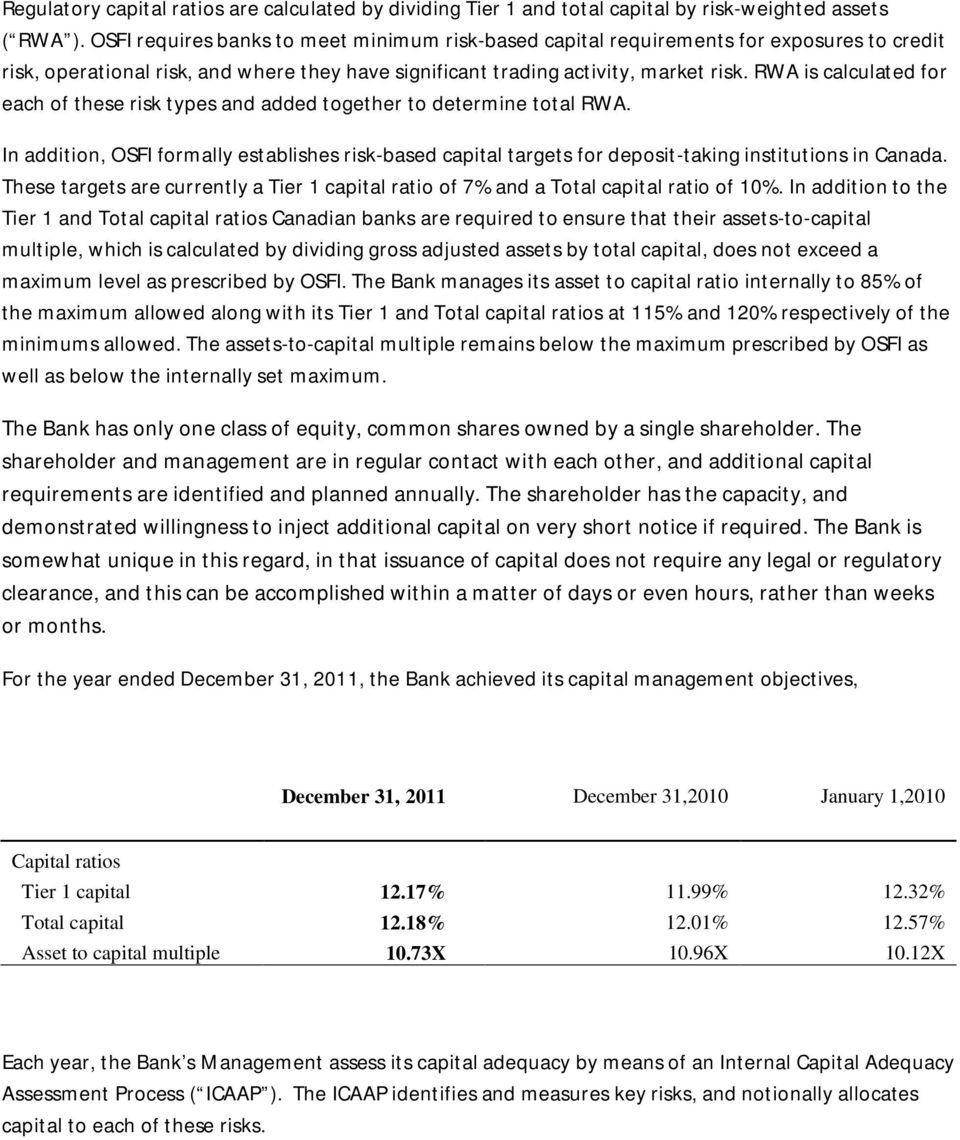
2 Regulatory capital ratios are calculated by dividing Tier 1 and total capital by risk-weighted assets ( RWA ). OSFI requires banks to meet minimum risk-based capital requirements for exposures to credit risk, operational risk, and where they have significant trading activity, market risk. RWA is calculated for each of these risk types and added together to determine total RWA. In addition, OSFI formally establishes risk-based capital targets for deposit-taking institutions in Canada. These targets are currently a Tier 1 capital ratio of 7% and a Total capital ratio of 10%. In addition to the Tier 1 and Total capital ratios Canadian banks are required to ensure that their assets-to-capital multiple, which is calculated by dividing gross adjusted assets by total capital, does not exceed a maximum level as prescribed by OSFI. The Bank manages its asset to capital ratio internally to 85% of the maximum allowed along with its Tier 1 and Total capital ratios at 115% and 120% respectively of the minimums allowed. The assets-to-capital multiple remains below the maximum prescribed by OSFI as well as below the internally set maximum. The Bank has only one class of equity, common shares owned by a single shareholder. The shareholder and management are in regular contact with each other, and additional capital requirements are identified and planned annually. The shareholder has the capacity, and demonstrated willingness to inject additional capital on very short notice if required. The Bank is somewhat unique in this regard, in that issuance of capital does not require any legal or regulatory clearance, and this can be accomplished within a matter of days or even hours, rather than weeks or months. For the year ended December 31, 2011, the Bank achieved its capital management objectives, December 31, 2011 December 31,2010 January 1,2010 Capital ratios Tier 1 capital 12.17% 11.99% 12.32% Total capital 12.18% 12.01% 12.57% Asset to capital multiple 10.73X 10.96X 10.12X Each year, the Bank s Management assess its capital adequacy by means of an Internal Capital Adequacy Assessment Process ( ICAAP ). The ICAAP identifies and measures key risks, and notionally allocates capital to each of these risks.
3 Risk Management Effective risk management plays an essential role in the Bank's ability to remain financially sound and responsible through the identification, assessment, management and monitoring of all applicable types of risk. The Bank is primarily exposed to credit, liquidity, interest rate and operational types of risk. Senior management is responsible for defining the framework for identifying risks and developing the appropriate risk management policies. The Board of Directors, both directly or through its committees, reviews and approves key policies, and implements specific reporting procedures to enable them to monitor compliance over significant areas of risk. Credit risk Credit risk is the risk that a financial loss will be incurred as a result of the failure of a customer to honour their contractual commitment or obligation to the Bank. To help mitigate this risk, the Bank has established a maximum loan amount limit of $100,000, a large exposure limit of 5% of capital, a maximum advance ratio of approximately 125% of wholesale value and lending parameters that clearly define the type, nature and qualification requirements of a prospective debtor. Any loan approvals falling outside of the Bank s established lending parameters require the post concurrence of senior management. A standardized credit risk rating classification guideline is used to monitor the ongoing quality of the loan portfolio upon initial approval, renewal, or when information becomes available indicating a material adverse change in the customers financial affairs. Loans that have fallen more than 30 days into arrears are brought to the attention of a senior credit manager to facilitate the early recognition of problem accounts and implementation of the steps necessary to secure the Bank s interest in the loan collateral. Credit losses are managed by way of both a Collective Loss Allowance, representing anticipated but as yet unidentified losses in the loan book, and by Specific Loan Loss Allowances (SLLA), wherein a specific charge is taken against a loan that has been identified by Management is being impaired. Twice each year, as assessment of the adequacy of the Collective Allowance is performed. Due to competitive concerns, the actual amount of Collective Loss Allowance and SLLA is not disclosed. However, as a general statement, Management and the Bank s external auditors are satisfied that the current Collective Allowance and the underlying process represent a very conservative approach to managing Collective Allowances. In addition, Management is very conservative in managing loan delinquency and allocating SLLAs. Every loan that is in excess of 30 days past due has either a definitive payment arrangement in place, or a SLLA. Once assigned a SLLA, the allowance remains until the loan is either assigned for repossession, or the borrower brings the loan current and keeps it current for a period of four months. Approximately 30% of the Bank s total SLLA is attributed to loans that are in fact current.
4 The credit risk related to the Bank s small preferred share portfolio is that an issuer experiences financial difficulties and is unable to pay its preferred share obligations as they come due. To help mitigate this risk the Bank has purchased high grade preferred shares from chartered banks. Liquidity risk Liquidity risk is the risk that there will be insufficient cash to meet the Bank s obligations as they come due. This risk can occur from both fluctuations in cash flows from lending, deposit taking and investment activities. Effective liquidity management ensures that an adequate amount of cash is available to honour all existing and short term cash outflow obligations. The Bank s liquidity policy includes the ongoing measurement and forecast of cash flows, the maintenance of a pool of high quality liquid assets, and the monitoring of the Bank s loan portfolio diversification as to geographic concentration. The Bank relies on a mix of independent and institutional deposit brokers to source deposit funds. The Bank complies with OSFI guidance on Liquidity management, by maintaining a Liquidity Coverage Ratio well in excess of required minimums and a Net Stable Funding ratio such that the Bank would always be able to meet its contractual liabilities, including deposit maturities over a one year period simply through contractual and anticipated cash inflows from its book of loan business. The Bank also has a robust contingency plan to respond to any Bank specific, broker specific or systemic event that disrupts the normal flow of liquidity. Market risk Market risk is the impact on earnings resulting from changes in financial market variables, such as interest rates and foreign exchange rates. Market risk arises when making loans, taking deposits, and making investments. The Bank does not undertake trading activities and therefore does not have risk related to activities such as market making, arbitrage or proprietary trading. The Bank does not hold or trade in foreign currencies, and consequently is not exposed to foreign exchange risk. The Bank s material market risk is confined to interest rates, as discussed below. Interest rate risk Interest rate risk is the impact on net interest income, both current and future, resulting from a change in market interest rates. This risk and potential variability in earnings arises primarily when cash flows stemming from interest sensitive assets and liabilities have different repricing dates. A positive gap arises when interest sensitive assets exceed interest sensitive liabilities for a specific maturity or when interest sensitive assets reprice earlier than interest sensitive liabilities. A negative gap arises when the opposite occurs. The Bank manages interest rate risk exposure by managing the size of the gap positions between interest sensitive assets and interest sensitive liabilities. The impact of a change in market interest rates on earnings will depend on the magnitude and the rate of the change, on the size and

5 maturity structure of the cumulative interest rate gap position and the management of those positions over time. The Bank does not engage in any derivative style strategies. Due to the simplicity of the business model, it is possible to effectively manage Interest Rate Risk using deposit pricing to attract funds in the desired maturity bands. Operational risk Operational risk is the potential for loss resulting from some external event, human error or inadequacy or failure of processes, procedures or controls. Operational risk can affect the Bank s financial position, reputation, competitive position, and regulatory position. The Bank is exposed to operational risk from internal business processes and activities as well as from activities that are outsourced. The financial measure of operational risk is actual losses incurred. There was no material operational risk losses incurred during the year ended December 31, The Bank mitigates operational risk by implementing policies and procedure directed at identified risks, employing knowledgeable and experienced senior managers, segregating duties among employees, training all employees with respect to effective risk management, and continually reviewing and upgrading policies and procedures. Compensation Practices Compensation of key management personnel The Bank s key management personnel include all directors, executive and non-executive and senior management. Compensation of certain key management personnel for the year may be sourced by companies other than the Bank and are summarized as follows: (unaudited) Salary and Short-term employee benefits $ 588,000 $ 563,000 Total compensation of key management personnel $ 588,000 $ 563,000

ZAG BANK BASEL II & III PILLAR 3 DISCLOSURES. December 31, 2014
 ZAG BANK BASEL II & III PILLAR 3 DISCLOSURES December 31, 2014 Zag Bank (the Bank ) is required to make certain disclosures to meet the requirements of the Office of the Superintendent of Financial Institutions
COMPUTERSHARE TRUST COMPANY OF CANADA BASEL III PILLAR 3 DISCLOSURES
 COMPUTERSHARE TRUST COMPANY OF CANADA BASEL III PILLAR 3 DISCLOSURES December 31, 2013 Table of Contents Scope of Application... 3 Capital Structure... 3 Capital Adequacy... 3 Credit Risk... 4 Market Risk...
Basel II, Pillar 3 Disclosure for Sun Life Financial Trust Inc.
 Basel II, Pillar 3 Disclosure for Sun Life Financial Trust Inc. Introduction Basel II is an international framework on capital that applies to deposit taking institutions in many countries, including Canada.
CANADIAN TIRE BANK. BASEL PILLAR 3 DISCLOSURES December 31, 2014 (unaudited)
 (unaudited) 1. SCOPE OF APPLICATION Basis of preparation This document represents the Basel Pillar 3 disclosures for Canadian Tire Bank ( the Bank ) and is unaudited. The Basel Pillar 3 disclosures included
The Northern Trust Company, Canada Basel III Pillar lll Disclosure as at December 31, 2015
 The Northern Trust Company, Canada Basel III Pillar lll Disclosure as at December 31, 2015 Subject to Board Approval Posting date: January 29, 2016 Contents NORTHERN TRUST OVERVIEW AND SCOPE OF APPPLICATION.
Rogers Bank Basel III Pillar 3 Disclosures
 Basel III Pillar 3 Disclosures As at June 30, 2014 Table of Contents 1. Scope of Application... 2 Reporting Entity... 2 Risk Management Framework... 2 2-3. Capital Structure and Adequacy... 3 Regulatory
BASEL III PILLAR 3 DISCLOSURES. March 31, 2014
 BASEL III PILLAR 3 DISCLOSURES Table of Contents 2 Table 1. Scope of application HomEquity Bank (the Bank) is a federally regulated Schedule I bank, incorporated and domiciled in Canada. The Bank s main
Basel III Pillar 3 and Leverage Ratio disclosures of ALTERNA BANK
 of ALTERNA BANK 1. Scope of Application CS Alterna Bank, a member of the Canada Deposit Insurance Corporation ( CDIC ), operates under the name Alterna Bank. It is a Schedule 1 Bank and received letters
Note 8: Derivative Instruments
 Note 8: Derivative Instruments Derivative instruments are financial contracts that derive their value from underlying changes in interest rates, foreign exchange rates or other financial or commodity prices
Dumfries Mutual Insurance Company Financial Statements For the year ended December 31, 2010
 Dumfries Mutual Insurance Company Financial Statements For the year ended December 31, 2010 Contents Independent Auditors' Report 2 Financial Statements Balance Sheet 3 Statement of Operations and Unappropriated
NOVEMBER 2010 (REVISED)
 CENTRAL BANK OF CYPRUS BANKING SUPERVISION AND REGULATION DIVISION DIRECTIVE TO BANKS ON THE COMPUTATION OF PRUDENTIAL LIQUIDITY IN ALL CURRENCIES NOVEMBER 2010 (REVISED) DIRECTIVE TO BANKS ON THE COMPUTATION
Annual Disclosures (Banks, Foreign Bank Branches, Federally Regulated Trust and Loan Companies, and Cooperative Credit Associations)
 Guideline Subject: (Banks, Foreign Bank Branches, Federally Regulated Trust and Loan Companies, and Cooperative Credit Associations) Category: Accounting No: D-1 Date: July 1997 Revised: July 2010 Introduction
Publication of financial information pursuant to the Capital Adequacy Regulation (Pillar 3)
 Publication of financial information pursuant to the Capital Adequacy Regulation (Pillar 3) The purpose of the requirements for the public disclosure of financial information is to help various market
DISCLOSURE ON CAPITAL ADEQUACY & MARKET DISCIPLINE (CAMD)
 DISCLOSURE ON CAPITAL ADEQUACY & MARKET DISCIPLINE (CAMD) A) Scope of Application : (a) This guidelines applies to Delta Brac Housing Finance Corporation Ltd. (b) (c) DBH has no subsidiary companies. Not
PILLAR 3 DISCLOSURES 2009
 PILLAR 3 DISCLOSURES 2009 Company Registration Number: C 16343 Contents Page Introduction............................................................... 3 Risk Management Objectives and Policies.................................
Note 10: Derivative Instruments
 Note 10: Derivative Instruments Derivative instruments are financial contracts that derive their value from underlying changes in interest rates, foreign exchange rates or other financial or commodity
Jupiter Asset Management Ltd Pillar 3 Disclosures as at 31 December 2014
 Jupiter Asset Management Ltd Pillar 3 Disclosures CONTENTS Overview 2 Risk management framework 3 Own funds 7 Capital requirements 8 Credit risk 9 Interest rate risk in non-trading book 11 Non-trading
First Quarter Report January 31, 2015
 First Quarter Report January 31, 2015 PWC CAPITAL INC. ANNOUNCES RESULTS FOR ITS FIRST QUARTER ENDED JANUARY 31, 2015 FIRST QUARTER SUMMARY (1) (compared to the same periods in the prior year unless otherwise
Capital adequacy ratios for banks - simplified explanation and
 Page 1 of 9 Capital adequacy ratios for banks - simplified explanation and example of calculation Summary Capital adequacy ratios are a measure of the amount of a bank's capital expressed as a percentage
FOREX Bank AB. Annual information about capital adequacy and risk management 1
 2011 Annual information about capital adequacy and risk management Annual information about capital adequacy and risk management 1 Introduction FOREX BANK AB, 516406-0104, is the parent company of the
RISK FACTORS AND RISK MANAGEMENT
 Bangkok Bank Public Company Limited 044 RISK FACTORS AND RISK MANAGEMENT Bangkok Bank recognizes that effective risk management is fundamental to good banking practice. Accordingly, the Bank has established
Capital G Bank Limited. Interim Pillar 3 Disclosures 30th June, 2012
 Capital G Bank Limited Interim Pillar 3 Disclosures 30th June, 2012 CONTENTS 1. CAUTIONARY STATEMENTS....1 2. INTRODUCTION...2 2.1 Background...2 2.2 Basis of Disclosure...3 2.3 Media and Location...3
Information on Capital Structure, Liquidity and Leverage Ratios as per Basel III Framework. as at March 31, 2015 PUBLIC
 Information on Capital Structure, Liquidity and Leverage Ratios as per Basel III Framework as at Table of Contents Capital Structure Page Statement of Financial Position - Step 1 (Table 2(b)) 3 Statement
18,343 18,308 3 Accumulated other comprehensive income (and other reserves)
 The information in this report is prepared quarterly based on the ADI financial records. The financial records are not audited for the Quarters ended 30 September, 31 December and 31 March. The report
1. Introduction... 3. 2. Process for determining the solvency need... 4. 3. Definitions of main risk types... 9
 Contents Page 1. Introduction... 3 2. Process for determining the solvency need... 4 2.1 The basis for capital management...4 2.2 Risk identification...5 2.3 Danske Bank s internal assessment of its solvency
Bank Capital Adequacy under Basel III
 Bank Capital Adequacy under Basel III Objectives The overall goal of this two-day workshop is to provide participants with an understanding of how capital is regulated under Basel II and III and appreciate
Capital Market Services UK Limited Pillar 3 Disclosure
 February 2013 Capital Market Services UK Limited Pillar 3 Disclosure Contents 1.0 Overview 2.0 Frequency and location of disclosure 3.0 Verification 4.0 Scope of application 5.1 Risk Management objectives
INTERNAL CAPITAL ADEQUACY ASSESSMENT
 INTERNAL CAPITAL ADEQUACY ASSESSMENT 30 june 2011 Contents Page 1. Introduction... 3 2. Process for determining the solvency need... 4 2.1. The basis for capital management... 4 2.2. Risk identification...
Basel II Pillar 3 Disclosures As at December 31, 2012
 Basel II Pillar 3 Disclosures As at December 31, 2012 1. Scope of Application Qualitative disclosures This document addresses the Basel II Pillar 3 disclosure requirements (including amendment to market
State Farm Bank, F.S.B.
 State Farm Bank, F.S.B. 2015 Annual Stress Test Disclosure Dodd-Frank Act Company Run Stress Test Results Supervisory Severely Adverse Scenario June 25, 2015 1 Regulatory Requirement The 2015 Annual Stress
YEARENDED31DECEMBER2013 RISKMANAGEMENTDISCLOSURES
 RISKMANAGEMENTDISCLOSURES 2015 YEARENDED31DECEMBER2013 ACCORDINGTOCHAPTER7(PAR.34-38)OFPARTCANDANNEXXIOFTHECYPRUSSECURITIES ANDEXCHANGECOMMISSIONDIRECTIVEDI144-2007-05FORTHECAPITALREQUIREMENTSOF INVESTMENTFIRMS
Risk & Capital Management under Basel III
 www.pwc.com Risk & Capital Management under Basel III London, 15 Draft Agenda Basel III changes to capital rules - Definition of capital - Minimum capital ratios - Leverage ratio - Buffer requirements
Recognised Investment Exchanges. Chapter 2. Recognition requirements
 Recognised Investment Exchanges Chapter Recognition REC : Recognition Section.3 : Financial resources.3 Financial resources.3.1 UK Schedule to the Recognition Requirements Regulations, Paragraph 1 (1)
Risk Management Programme Guidelines
 Risk Management Programme Guidelines Submissions are invited on these draft Reserve Bank risk management programme guidelines for non-bank deposit takers. Submissions should be made by 29 June 2009 and
Close Brothers Group plc
 Close Brothers Group plc Pillar 3 disclosures for the year ended 31 July 2008 Close Brothers Group plc Pillar 3 disclosures for the year ended 31 July 2008 Contents 1. Overview 2. Risk management objectives
BA-CA Finance (Cayman) Limited UNAUDITED. Financial Statements for the six month period January 1 June 30, 2014
 UNAUDITED Financial Statements for the six month period January 1 DIRECTORS REPORT The Directors submit herewith the 2014 semi-annual financial statements for BA-CA Finance (Cayman) Limited (the Company
STANDARDS OF BEST PRACTICE ON COUNTRY AND TRANSFER RISK
 STANDARDS OF SOUND BUSINESS PRACTICES COUNTRY AND TRANSFER RISK 2005 The. All rights reserved 1 STANDARDS OF BEST PRACTICE ON COUNTRY AND TRANSFER RISK A. PURPOSE/OBJECTIVE This document sets out the minimum
Oasis Capital Bank B.S.C. (c)
 Six month period ended 30 JUNE 2009 Table 1 Capital structure...2 Table 2 Capital requirement for credit, market and operational risks. 3 Table 3 Gross credit exposures before credit risk mitigation (CRM).
LIQUIDITY RISK MANAGEMENT GUIDELINE
 LIQUIDITY RISK MANAGEMENT GUIDELINE April 2009 Table of Contents Preamble... 3 Introduction... 4 Scope... 5 Coming into effect and updating... 6 1. Liquidity risk... 7 2. Sound and prudent liquidity risk
Guidance on the management of interest rate risk arising from nontrading
 Guidance on the management of interest rate risk arising from nontrading activities Introduction 1. These Guidelines refer to the application of the Supervisory Review Process under Pillar 2 to a structured
Report on Internal Control
 Annex to letter from the General Secretary of the Autorité de contrôle prudentiel to the Director General of the French Association of Credit Institutions and Investment Firms Report on Internal Control
Saxo Capital Markets CY Limited
 Saxo Capital Markets CY Limited DISCLOSURES IN ACCORDANCE WITH THE REGULATION FOR THE CAPITAL REQUIREMENTS OF INVESTMENT FIRMS FOR THE YEAR ENDED 31 DECEMBER 2014 MAY 2015 CONTENTS 1. GENERAL INFORMATION
GENWORTH MI CANADA INC.
 Condensed Consolidated Interim Financial Statements (In Canadian dollars) GENWORTH MI CANADA INC. Three and six months ended June 30, 2015 and 2014 Condensed Consolidated Interim Statements of Financial
Assurance and accounting A Guide to Financial Instruments for Private
 june 2011 www.bdo.ca Assurance and accounting A Guide to Financial Instruments for Private Enterprises and Private Sector t-for-profit Organizations For many entities adopting the Accounting Standards
Basel Committee on Banking Supervision
 Basel Committee on Banking Supervision Frequently asked questions on the Basel III leverage ratio framework April 2016 (update of FAQs published in July 2015) This publication is available on the BIS website
FINANCIAL STATEMENTS 2013
 452/green [A subsidiary of SaskPower] NorthPoint Energy Solutions Inc. FINANCIAL STATEMENTS 2013 711/red Report of Management The financial statements of NorthPoint Energy Solutions Inc. (NorthPoint)
RISK MANAGEMENT REPORT (for the Financial Year Ended 31 March 2012)
 RISK MANAGEMENT REPORT (for the Financial Year Ended 31 March 2012) Integrated Risk Management Framework The Group s Integrated Risk Management Framework (IRMF) sets the fundamental elements to manage
ASPE AT A GLANCE Section 3856 Financial Instruments
 ASPE AT A GLANCE Section 3856 Financial Instruments December 2014 Section 3856 Financial Instruments Effective Date Fiscal years beginning on or after January 1, 2011 1 SCOPE Applies to all financial instruments
SUMMARY Belfius Financing Company (LU) NOK Step Up 2 due 7 April 2020
 SUMMARY Belfius Financing Company (LU) NOK Step Up 2 due 7 April 2020 The following summary is established in accordance with Articles 24 and 28 of the Belgian Law of 16 June 2006 on the public offer of
Risk Management. Risk Management Overview. Credit Risk
 Risk Management Risk Management Overview Risk management is a cornerstone of prudent banking practice. A strong enterprise-wide risk management culture provides the foundation for the Bank s risk management
MORGAN STANLEY ASIA INTERNATIONAL LIMITED. Interim Financial Disclosure Statements
 Interim Financial Disclosure Statements INTERIM FINANCIAL DISCLOSURE STATEMENTS CONTENTS PAGE Corporate Information 1 Unaudited income statement 2 Unaudited statement of comprehensive income 3 Unaudited
China International Capital Corporation (UK) Limited Pillar 3 Disclosure
 1. Overview Pillar 3 Disclosure March 2014 China International Capital Corporation (UK) Limited Pillar 3 Disclosure The European Union s Capital Requirements Directive ( CRD ) came into effect on 1 January
Quarterly Financial Supplement - 1Q 2016
 Quarterly Financial Supplement - 1Q 2016 Page # Consolidated Financial Summary... 1 Consolidated Income Statement Information... 2 Consolidated Financial Information and Statistical Data... 3 Consolidated
The Goldman Sachs Group, Inc. and Goldman Sachs Bank USA. 2015 Annual Dodd-Frank Act Stress Test Disclosure
 The Goldman Sachs Group, Inc. and Goldman Sachs Bank USA 2015 Annual Dodd-Frank Act Stress Test Disclosure March 2015 2015 Annual Dodd-Frank Act Stress Test Disclosure for The Goldman Sachs Group, Inc.
MORGAN STANLEY Financial Supplement - 4Q 2015 Table of Contents
 Page # MORGAN STANLEY Financial Supplement - 4Q 2015 Table of Contents 1. Quarterly Consolidated Financial Summary 2. Quarterly Consolidated Income Statement Information 3. Quarterly Consolidated Financial
Basel Committee on Banking Supervision
 Basel Committee on Banking Supervision Liquidity coverage ratio disclosure standards January 2014 (rev. March 2014) This publication is available on the BIS website (www.bis.org). Bank for International
NATIONAL FINANCIAL SERVICES LLC STATEMENT OF FINANCIAL CONDITION AS OF DECEMBER 31, 2015 AND REPORT OF INDEPENDENT REGISTERED PUBLIC ACCOUNTING FIRM
 STATEMENT OF FINANCIAL CONDITION AS OF DECEMBER 31, 2015 AND REPORT OF INDEPENDENT REGISTERED PUBLIC ACCOUNTING FIRM Report of Independent Registered Public Accounting Firm To the Board of Directors of
INDUSTRIAL-ALLIANCE LIFE INSURANCE COMPANY. FIRST QUARTER 2000 Consolidated Financial Statements (Non audited)
 INDUSTRIAL-ALLIANCE LIFE INSURANCE COMPANY FIRST QUARTER 2000 Consolidated Financial Statements (Non audited) March 31,2000 TABLE OF CONTENTS CONSOLIDATED INCOME 2 CONSOLIDATED CONTINUITY OF EQUITY 3 CONSOLIDATED
FINANCIAL STATEMENTS OF THE COMPANY COMPANY STATEMENT OF FINANCIAL POSITION
 COMPANY STATEMENT OF FINANCIAL POSITION Notes Restated Assets Investments in Group subsidiaries 2 5,729 5,760 Investments and securities 3 347 153 Investments in associated undertakings and joint ventures
BASEL III PILLAR 3 CAPITAL ADEQUACY AND RISKS DISCLOSURES AS AT 30 SEPTEMBER 2015
 BASEL III PILLAR 3 CAPITAL ADEQUACY AND RISKS DISCLOSURES AS AT 30 SEPTEMBER 2015 COMMONWEALTH BANK OF AUSTRALIA ACN 123 123 124 5 NOVEMBER 2015 This page has been intentionally left blank Introduction
First half-year report 2013 2
 Financial highlights... 3 Comments from the president and CEO 4 Report from the board of directors. 4 Results 4 Balance sheet. 6 Export lending... 6 Local government lending... 6 Securities.. 6 Funding....
Disclosures Under BASEL III Capital Regulations For the quarter ended 31 st December, 2013
 Capital Adequacy Disclosures Under BASEL III Capital Regulations For the quarter ended 31 st December, 2013 In accordance with the guidelines of RBI, the Group has adopted standardised approach for credit
eqube Gaming Limited Condensed Interim Consolidated Financial Statements For the Three and Nine Months Ended November 30, 2015 (Unaudited)
 Condensed Interim Consolidated Financial Statements For the Three and Nine Months Ended November 30, 2015 Notice to Reader The following interim consolidated financial statements and notes have not been
Guidelines. ADI Authorisation Guidelines. www.apra.gov.au Australian Prudential Regulation Authority. April 2008
 Guidelines ADI Authorisation Guidelines April 2008 www.apra.gov.au Australian Prudential Regulation Authority Disclaimer and copyright These guidelines are not legal advice and users are encouraged to
Statement of Investment Policies and Goals. Saskatchewan Pension Plan Annuity Fund. As of January 1, 2015. APPROVED on this 9 th day of December, 2014
 Statement of Investment Policies and Goals Saskatchewan Pension Plan Annuity Fund As of January 1, 2015 APPROVED on this 9 th day of December, 2014 Tim Calibaba Chair on behalf of the Board of Trustees
TIAA-CREF Individual & Institutional Services, LLC (A wholly-owned subsidiary of Teachers Insurance and Annuity Association of America) Statement of
 TIAA-CREF Individual & Institutional Services, LLC (A wholly-owned subsidiary of Teachers Insurance and Annuity Association of America) Statement of Financial Condition (Unaudited) Index Page(s) Financial
The Internal Capital Adequacy Assessment Process (ICAAP) and the Supervisory Review and Evaluation Process (SREP)
 Supervisory Statement SS5/13 The Internal Capital Adequacy Assessment Process (ICAAP) and the Supervisory Review and Evaluation Process (SREP) December 2013 Prudential Regulation Authority 20 Moorgate
Liquidity Coverage Ratio: A Quick Reference. February 2015
 Liquidity Coverage Ratio: A Quick Reference February 2015 2015 Morrison & Foerster LLP All Rights Reserved mofo.com The Liquidity Coverage Ratio (the LCR or the rule ) adopted by the Office of the Comptroller
HSBC North America Holdings Inc. 2015 Comprehensive Capital Analysis and Review and Annual Company-Run Dodd-Frank Act Stress Test Results
 2015 Comprehensive Capital Analysis and Review and Annual Company-Run Dodd-Frank Act Stress Test Results Date: March 5, 2015 TABLE OF CONTENTS PAGE 1. Overview of the Comprehensive Capital Analysis and
Auditing Treasury Activities. Devina Rankin Assistant Treasurer
 Auditing Treasury Activities Devina Rankin Assistant Treasurer Overview of the Treasury Function Making sure the right amount of cash is in the right accounts on a daily basis Day-to-day cash management
Equita SIM SpA publishes this Public Disclosure on its website www.equitasim.it
 PUBLIC DISCLOSURE OF STATUS AS AT 31/12/2012 Introduction The Bank of Italy s Regulation concerning prudential supervision for securities brokerage companies [Italian legal entity acronym = SIM] (Title
BA-CA Finance (Cayman) Limited Financial Statements
 Financial Statements and Independent Auditors Report Deloitte & Touche One Capital Place P.O. Box 1787 Grand Cayman KY1-1109 CAYMAN ISLANDS INDEPENDENT AUDITORS REPORT Tel: +1 345 949 7500 Fax:+1 345 949
Controls and accounting policies
 Controls and accounting policies Controls and procedures Management s responsibility for financial information contained in this Annual Report is described on page 92. In addition, the Bank s Audit and
PART I - PRELIMINARY...1 Objective...1 Applicability...2 Legal and Regulatory Provision...2
 PART I - PRELIMINARY...1 Objective...1 Applicability...2 Legal and Regulatory Provision...2 PART II POLICY REQUIREMENTS...3 Investment and Risk Management Policy...3 Monitoring and Control...5 Roles of
Basel Committee on Banking Supervision. Consultative Document. TLAC Holdings. Issued for comment by 12 February 2016
 Basel Committee on Banking Supervision Consultative Document TLAC Holdings Issued for comment by 12 February 2016 November 2015 This publication is available on the BIS website (www.bis.org). Bank for
Bank of Queensland Limited
 APRA 30 April 2012 The Basel II Capital Accord principles took effect in Australia on 1 January 2008. The framework for the application of Basel II in Australia is comprised of three pillars: Pillar 1:
Capital Requirements Directive Pillar 3 Disclosure. Western Asset Management Company Limited December 2008
 Capital Requirements Directive Pillar 3 Disclosure Western Asset Management Company Limited December 2008 Background Under the 2006 Capital Requirements Directive ( CRD ), a revised regulatory framework
OVID CAPITAL VENTURES INC./ ENTREPRISES OVID CAPITAL INC. CONDENSED INTERIM FINANCIAL STATEMENTS (Unaudited - See Notice to Reader) March 31, 2015
 CONDENSED INTERIM FINANCIAL STATEMENTS March 31, MARCH 31, CONTENTS Page NOTICE TO READER 2 FINANCIAL STATEMENTS Unaudited Condensed Interim Statement of Financial Position 3 Unaudited Condensed Interim
Guidelines on Investment in Shares, Interest-in-Shares and Collective Investment Schemes
 Interest-in-Shares and Collective BNM/RH/GL 001-30 Prudential Financial Policy Department PART A INTRODUCTION AND OVERVIEW... 1 1. Overview of the Guidelines... 1 2. Definitions... 1 3. Legal Enforceability
ICAAP Required Capital Assessment, Quantification & Allocation. Anand Borawake, VP, Risk Management, TD Bank [email protected]
 ICAAP Required Capital Assessment, Quantification & Allocation Anand Borawake, VP, Risk Management, TD Bank [email protected] Table of Contents Key Takeaways - Value Add from the ICAAP The 3 Pillars
Financial Status, Operating Results and Risk Management
 Financial Status, Operating Results and Risk Management 87 Financial Status 88 89 90 90 90 95 95 Operating Results Cash Flow Effects of Major Capital Expenditures in the Most Recent Fiscal Year on Financial
Argus Stockbrokers Ltd
 Argus Stockbrokers Ltd DISCLOSURES IN ACCORDANCE WITH THE DIRECTIVE OF THE CYPRUS SECURITIES AND EXCHANGE COMMISSION FOR THE CAPITAL REQUIREMENTS OF INVESTMENT FIRMS AS AT 31 st DECEMBER 2013 MAY 2014
York Business Associates, L.L.C. (d/b/a TransAct Futures) and Subsidiary FINANCIAL STATEMENTS AND INDEPENDENT AUDITORS' REPORT.
 York Business Associates, L.L.C. (d/b/a TransAct Futures) and Subsidiary FINANCIAL STATEMENTS AND INDEPENDENT AUDITORS' REPORT December 31, 2014 CONSOLIDATED STATEMENT OF FINANCIAL CONDITION December
Condensed Interim Consolidated Financial Statements
 Condensed Interim Consolidated Financial Statements Unaudited (Expressed in Canadian dollars) NOTICE TO READER: These condensed interim consolidated financial statements have not been reviewed by the Company's
GE Capital Finance Australia APS 330: Public Disclosure of Prudential Information December 2013 (AUD $ million)
 December 2013 (AUD $ million) Important Notice This document has been prepared to meet the disclosure obligations under the Australian Prudential Regulation Authority (APRA) APS 330 Capital Adequacy: Public
Item 7A. Quantitative and Qualitative Disclosures about Market Risk. Risk Management
 Item 7A. Quantitative and Qualitative Disclosures about Market Risk. Risk Management Risk Management Policy and Control Structure. Risk is an inherent part of the Company s business and activities. The
GUARDIAN CANADIAN BOND FUND
 GUARDIAN CANADIAN BOND FUND FINANCIAL STATEMENTS DECEMBER 31, 2010 March 11, 2011 PricewaterhouseCoopers LLP Chartered Accountants PO Box 82 Royal Trust Tower, Suite 3000 Toronto-Dominion Centre Toronto,
QUINSAM CAPITAL CORPORATION INTERIM FINANCIAL STATEMENTS FOR THE THIRD QUARTER ENDED SEPTEMBER 30, 2015 (UNAUDITED AND EXPRESSED IN CANADIAN DOLLARS)
 INTERIM FINANCIAL STATEMENTS FOR THE THIRD QUARTER ENDED SEPTEMBER 30, (UNAUDITED AND EXPRESSED IN CANADIAN DOLLARS) NOTICE TO READER Under National Instrument 51-102, Part 4, subsection 4.3(3) (a), if
HOCH CAPITAL LTD PILLAR 3 DISCLOSURES As at 1 February 2015
 HOCH CAPITAL LTD PILLAR 3 DISCLOSURES As at 1 February 2015 TABLE OF CONTENTS 1. Overview / Background 1.1 Introduction 1.2 Frequency of disclosure 1.3 Location and verification of disclosure 1.4 Scope
The International Certificate in Banking Risk and Regulation (ICBRR)
 The International Certificate in Banking Risk and Regulation (ICBRR) The ICBRR fosters financial risk awareness through thought leadership. To develop best practices in financial Risk Management, the authors
Consolidated Financial Statements
 Consolidated Financial Statements Reports 111 Management s responsibility for financial reporting 111 Report of Independent Registered Chartered Accountants 112 Management s report on internal control
Key matters in examining Liquidity Risk Management at Large Complex Financial Groups
 Key matters in examining Liquidity Risk Management at Large Complex Financial Groups (1) Governance of liquidity risk management Senior management of a large complex financial group (hereinafter referred