
NSP Homebuyer Programs:
|
|
|
- Alan Lindsey
- 10 years ago
- Views:
Transcription
1 NSP Homebuyer Programs: Financing and Long-Term Affordability About this Tool Description: This guide provides information on how to structure financing for NSP funded homebuyer programs and strategies for long-term affordability of NSP-assisted homes purchased by LMMI households. This guidance is intended for grantees and their partners carrying out homebuyer programs and ensuring that long-term affordability periods are met as required under NSP. Source of Document: Substantial portions of this document come from a draft guidebook being developed by HUD and ICF International on combining HOME and NSP funding. Disclaimer: This document is not an official HUD document and has not been reviewed by HUD counsel. It is provided for informational purposes only. Any binding agreement should be reviewed by attorneys for the parties to the agreement and must conform to state and local laws. This resource is part of the NSP Toolkits. Additional toolkit resources may be found at U.S. Department of Housing and Urban Development Page 1 Neighborhood Stabilization Program

2 NSP Homebuyer Programs: Financing and Long Term Affordability October 2010

3 NSP HOMEBUYER PROGRAMS: FINANCING AND LONG TERM AFFORDABILITY INTRODUCTION... 1 Background...1 NSP Homebuyer Assistance Program Design Issues... 1 HOMEBUYER PROGRAM FINANCING...4 Approaches to Homebuyer Assistance... 4 Direct Homebuyer Subsidy Approach... 4 Down Payment and Closing Cost Assistance... 4 Direct and Indirect Purchase Financing... 5 Alternative Financing Models... 6 Development Approach... 7 Acquisition/Rehabilitation... 8 New Construction... 8 Neighborhood Development... 8 Homebuyer Driven Model... 9 Methods of Financing... 9 Underwriting Eligible Properties Property Acquisition Property Values and Buyer Sale Price Property Standards Eligible Buyers...15 Housing Counseling LONG-TERM AFFORDABILITY...17 Affordability Period NSP Homebuyer Programs: Financing and Long Term Affordability

4 Recapture Provision Determining the Affordability Period Ways to Structure the Recapture Provision NSP Considerations When Using HOME Recapture Option Enforcing Recapture Provisions Resale Restrictions Determining the Affordability Period Restrictions on Resale to a Subsequent Buyer NSP Considerations when Using HOME Resale Restrictions Enforcing Resale Restrictions Presumption of Affordability NSP Homebuyer Programs: Financing and Long Term Affordability

5 INTRODUCTION This guide assists grantees in planning, structuring, and implementing homebuyer assistance programs under the Neighborhood Stabilization Program ( NSP ) including: Approaches to structuring deals and providing financing directly to homebuyers and indirectly, to grantee organizations assisting homebuyers; Pricing of NSP assisted homes to comply with NSP requirements ; and Consideration of Long term affordability strategies Background NSP is intended to help stabilize struggling communities, especially those hard hit with foreclosures. Many of these communities now suffer with large volumes of empty, foreclosed homes, as well as homes that have been abandoned and blighted. Cities and towns nationwide have lost significant tax revenue in the past two years alone. Attracting new homebuyers to these homes is critical to the revitalization and stabilization of these neighborhoods; yet, this situation poses a significant challenge for the financial institutions that own these units and for the communities trying to maintain community and property value for the neighbors that remain. NSP provides funding to grantees to create or expand homebuyer assistance programs as one possible way to dispose of these homes and revitalize destabilized communities. Today s mortgage and foreclosure crisis and also offers a chance to re evaluate grantees pre existing homebuyer programs while considering new program design and market context issues in deploying NSP funds for homebuyer assistance. This guide is intended to set forth NSP eligible homebuyer assistance program uses and requirements with today s marketplace in mind. NSP Homebuyer Assistance Program Design Issues Many grantees have already designed and are carrying out their homebuyer programs. The program design considerations outlined below may be helpful for those grantees experiencing challenges with identifying properties, identifying developers, and attracting buyers under their current homeowner program design and who need or want to reevaluate their approach. For existing and yet to be funded NSP homeownership programs, the following should be considered: Market Context: NSP units must be located in the grantee s designated areas of greatest need. However, within these areas, the grantee must determine focus areas for its NSP programs. What is the market context of the neighborhoods in which foreclosed homes and eligible land are situated? In particular: What is the market demand for homeownership in the neighborhood and what are the market pricing levels? What are the existing financing options for buyers in NSP eligible neighborhoods? NSP Homebuyer Programs: Financing and Long Term Affordability 1

6 What are the projected sales prices after rehab, and will they support (or be too high given the market context) a homeownership program? Homebuyer Targets: NSP assisted homebuyer units must meet a national objective, which includes serving low, moderate and middle income (LMMI) households. What income level and population demographic is targeted for these programs, and what pre existing homeownership opportunities exist for these households already? Homebuyer targeting also depends on answering the following: What are the affordability problems for homebuyers in the community? Is it pricing, credit, down payment, or all of the above? Is it a first time homebuyer target? Is it a low or very low income target? Is the target for other vulnerable populations? What kind of financing exists for buyers with targeted income levels? How will the grantee handle credit and down payment requirements, given lenders current reluctance to lend to low income populations? What kind of marketing will be deployed? What kind of homebuyer counseling is available or proposed? Will pricing required under NSP be sufficient to attract and meet the financing needs of income eligible targets? Neighborhood Targets: The grantee may choose to administer a buyer driven model, where the prospective homebuyer finds a home for sale and comes to the grantee for a subsidy, or a propertydriven model, where specific properties or neighborhoods are targeted (and marketed) for homebuyer assistance. The grantee may also consider making allocation sizing decisions tied to specific target neighborhoods. Long Term Affordability: Grantees must consider whether to impose resale, recapture or other long term affordability restrictions on homes assisted with NSP funds. Long term affordability strategies are designed to use a one time subsidy to maintain the long term affordability of the homeownership unit. However, these affordability strategies may lengthen the marketing period (as compared with a homebuyer program with no resale or recapture restrictions). Delivery Mechanism: Given market context and target beneficiary, the grantee must consider the best delivery mechanisms. Is the grantee interested in playing a primary or supplemental financing role? Does the grantee have the capacity or interest to work with homebuyers directly or indirectly? Partner Opportunities and Capacity: The grantee should evaluate the potential to partner with organizations with existing capacity in delivering homebuyer assistance programs or in developing and rehabilitating single family or multifamily homes. Grantees should remember that developers NSP Homebuyer Programs: Financing and Long Term Affordability 2

7 may not provide direct homeownership assistance such as down payment or closing cost assistance. However, a developer may pass through a reduction in the price of a property in the form of a soft second mortgage. Program Operations: The grantee may need to build on existing, or develop new expertise in operating and administering a homebuyer assistance program, including in the areas of: Financial assistance, including underwriting and credit evaluation Marketing and wait list management Pricing and resale formula crafting Development project management, including deployment of energy efficiency protocols Unit and homeowner monitoring and outreach NSP Homebuyer Programs: Financing and Long Term Affordability 3

8 HOMEBUYER PROGRAM FINANCING Approaches to Homebuyer Assistance NSP funds may be used to help acquire, rehabilitate, demolish and dispose of foreclosed homes and related vacant, abandoned, and blighted buildings and land. Sale to a new homebuyer is an eligible activity, and may be accomplished by either of the following: Direct Homebuyer Subsidy: Including down payment and closing cost assistance, and including alternative financing structures and credit enhancement Development Subsidy: Development or acquisition and rehabilitation subsidy for grantee organizations (or their subcontractor) to undertake the demolition, rebuilding, new construction rehabilitation and/or sale of homes to homebuyers Direct Homebuyer Subsidy Approach The direct homebuyer subsidy approach involves providing funds to a household to enable it to purchase an existing home. There are many options for providing direct homebuyer assistance under NSP, including: Providing down payment and closing cost assistance; Offering direct purchase financing by providing mortgage financing; Providing loan reduction assistance, such interest rate buy downs or principal reduction; Creating loan guarantees or loan loss reserves; Establishing individual development accounts or matching funds for existing IDAs; and Using NSP funds to fund lease purchase programs. Each of these approaches is described in detail below. Down Payment and Closing Cost Assistance One of the most common methods for assisting LMMI households to purchase a home is to provide the down payment and closing cost assistance. LMMI households that are able to afford the monthly cost of homeownership (i.e., mortgage and insurance) are not always able to come up with sufficient funds for the lender s required down payment and/or the various up front fees and charges (including broker fees and commissions as well as loan points) that are collectively called closing costs. In addition, the grantee may use NSP funds to pay up front either all or a portion of the mortgage insurance premiums (such as private mortgage insurance, or PMI) premium for the first year, since PMI is typically required of all homebuyers who put less than 20 percent down. This is a way to lower the homebuyer s monthly housing costs. Note that subsequent payments of this premium beyond the first year are not permitted under NSP. Down payment and closing cost assistance can be provided in the form of a grant or loan paid at closing. If a grantee provides down payment and/or closing cost assistance as a grant then the assistance does NSP Homebuyer Programs: Financing and Long Term Affordability 4

9 not have to be repaid. Down payment and closing cost assistance in the form of a loan can be provided as a loan paid back over time as the period of affordability progresses or as forgivable loan only paid back if and when the homebuyer fails to satisfy the period of affordability. Direct Homeownership Assistance NSP down payment assistance is capped at 50 percent of the down payment required by the private lender. Closing cost assistance and other financial assistance is not capped. Under NSP, down payment and closing cost assistance can be done under: Eligible Use B Purchase and Rehabilitation of Homes and Residential Properties for abandoned or foreclosed homes Eligible Use E Redevelopment of Vacant or Demolished Properties (property does not need to be foreclosed or abandoned) Direct and Indirect Purchase Financing There is a wide range of direct and indirect forms of financing to homebuyers enabling homebuyers to purchase homes. These financing strategies including forms of down payment and closing cost assistance are described in the table below. The grantee can act as a lender directly by providing a first (or second mortgage). Homebuyer Financing Description Activities Direct Grantee Lending Grants or forgivable loans Amortizing first position (senior) loans Amortizing second or lower position (junior or subordinate) loans Deferred payment loans Principal write downs Grantee directly provides grant funds that do not need to be repaid or provides forgivable loans that are forgiven on a pro rata or other basis over time. For example, a $20,000 HOME mortgage might be forgiven at $2,000 a year over a 10 year period so long as the low income household remains in the unit. Grantee directly lends funds that are typically paid back on a monthly basis, usually with some interest payment. While uncommon, the grantee might provide the first mortgage when no private financing is provided. Grantee directly lends funds where there is also non HOME or NSP financing and that other financing has a senior lien position. This typically occurs when there is a private first mortgage and a HOME or NSP second mortgage. Grantee directly lends funds that are not repaid until a specific point in time or activity occurs, such as the subsequent sale of the home, with or without interest. Tools to Make Private Loans More Affordable Grantee uses HOME or NSP funds to write down the loan amount that a NSP Homebuyer Programs: Financing and Long Term Affordability 5

10 Interest rate writedowns Private mortgage insurance Loan loss reserves private lender provides. Example: Assume a homebuyer needs $100,000 to buy a home but can only afford the payments on a $60,000 mortgage. The grantee could provide HOME or NSP assistance to the lender to write down the difference. Grantee provides assistance to a private lender so that it is able to make a first mortgage to a homebuyer at a lower interest rate. Example: Assume the market interest rate is 7%, but the homebuyer cannot afford the monthly payment at this rate. The grantee provides an interest rate buy down to the lender so that the effective interest rate is 2% and the buyer can afford the monthly payment. Grantee pays insurance premium to a private mortgage insurance company, who makes a loan guarantee to the private lender (allowed if paid up front for first year only). PMI is required only on those loans with down payments that are less than 20 percent. An amount of funds held in a reserve as a percentage of a lender s total loans on the balance sheet. The amount held represents the amount thought to be adequate to cover estimated losses in the loan portfolio. Under NSP, these homebuyer financing methods can be used for the purchase and redevelopment of foreclosed homes for LMMI homebuyers under: Eligible Use A Financing Mechanisms for the purchase and redevelopment of foreclosed homes and residential properties for LMMI homebuyers Eligible Use B Purchase and Rehabilitation of foreclosed and abandoned Homes and Residential Properties Eligible Use E Redevelopment of Vacant or Demolished Properties (property does not need to be foreclosed or abandoned) Alternative Financing Models Individual Development Accounts Under NSP, individual development accounts (IDAs) are dedicated savings accounts that provide start up funds to assist income eligible residents to purchase a home. NSP funds can be used to assist the IDAsaver or assist an organization helping individual build and save for IDAs that are established solely for homeownership assistance purposes to assist income eligible account holders who are saving to purchase a home. IDAs can be created using NSP funds under: Eligible Use B Purchase and Rehabilitation of Homes and Residential Properties Eligible Use E Redevelopment of Vacant or Demolished Properties (property does not need to be foreclosed or abandoned) NSP Homebuyer Programs: Financing and Long Term Affordability 6

11 The activity must meet the LMMH national objective (that is, each assisted household must be low, moderate, or middle income). NSP funds may be deposited in an IDA to capitalize the account or as matching deposits over the course of the household s participation in the program. IDAs are intended to be an intermediate term approach to saving for homeownership. Given the stringent use and expenditure deadlines of NSP (18 months and four years, respectively), IDAs may not be the best match with NSP. However, it may be an effective use of NSP program income earned over time. For more guidance on using NSP funds to support an IDA, see Use of Community Development Block Grant (CDBG) Funds to Assist Individual Development Accounts, HUD Notice CPD 01 12, August 14, Lease Purchase A lease purchase program is an alternative to more traditional homebuyer assistance programs. Leasepurchase programs assist eligible households that currently rent their homes to save for the purchase of the home during the lease period. Lease purchase programs are often used in areas with weak sales markets, or where financing for mortgages is limited. The lease period and amount vary by program. Housing counseling and homebuyer education are often an integral part of the lease purchase program requirements. Lease purchase programs are also eligible under NSP under: Eligible Use A, NSP funds can be used to assist a tenant to purchase a foreclosed upon home; Eligible Use B, NSP funds can used to acquire and/or rehabilitate a foreclosed/abandoned property for use in a lease purchase program; Eligible Use C, a grantee or subrecipient can operate a land bank and use the properties that are purchased for the land bank for potential tenants purchasers; and Eligible Use E, a grantee can use NSP funds to acquire a vacant property and provide direct homeownership assistance to enable a subsequent tenant household to buy the home. A lease purchase program can be readily structured in consideration of these time frames. Grantees should consider the best ways to use NSP funds in lease purchase programs. Given the use and expenditure deadlines, it might not be expedient to invest NSP funds to assist the tenant with the housing purchase after the lease period is completed; however, NSP funds can be used to acquire and rehabilitate properties that will be leased under the program. Note that NSP funds cannot be used to provide ongoing rental assistance to the tenant purchaser during the lease period. Development Approach Under the development approach to homebuyer assistance, the grantee funds the nonprofit or forprofit developer of the housing or the eligible homebuyer him/herself. The developer purchases sites or units and develops the homes, provided that the property or unit meets NSP eligibility rules (e.g. foreclosed, abandoned, or vacant). These units are then sold, sometimes at below market prices, to NSP Homebuyer Programs: Financing and Long Term Affordability 7

12 income eligible buyers. Options for the development of housing include acquisition with rehabilitation or new construction of units. Either option can be carried out on a scattered site basis or in specific neighborhoods or subdivisions. The development approach is eligible under: Eligible Use A Financing Mechanisms for the purchase and redevelopment of foreclosed homes and residential properties for LMMI homebuyers Eligible Use B Purchase and Rehabilitation of Homes and Residential Properties Eligible Use D Demolition Eligible Use E Redevelopment of Vacant or Demolished Properties (property does not need to be foreclosed or abandoned) Acquisition/Rehabilitation NSP can be used to acquire existing units, rehabilitate them, and resell them to eligible homebuyers. In an acquisition/rehabilitation project, the grantee provides funds to a developer to acquire an existing property and renovate that property. The unit is then sold to an income eligible homebuyer, sometimes at a below market price. Under NSP, the grantee can acquire and/or rehabilitate properties that have been foreclosed upon or are abandoned under Eligible Use B, or vacant units under Eligible Use E. New Construction In a new construction project, the grantee provides funds to a developer who builds new units and then sells these units to low income homebuyers. The units may be built as scattered sites at infill or other locations or they may be built as a neighborhood (see below). New construction is not typically eligible under CDBG, except in certain limited circumstances. However, NSP allows the new construction of housing under Eligible Use E (redevelopment of demolished or vacant properties). NSP does not require that the grantee work via a community based development organization (CBDO) to undertake new construction, although it may choose to do so. For new construction, NSP can be used to pay for the following costs: Acquisition of land (NOTE: acquisition only activities must be done only by the grantee or nonprofit partners); Eligible, reasonable construction costs for units; Demolition of blighted structures under NSP Eligible Use D; Site preparation; Relocation costs; and Making utility connections including off site utility connections from the property line to the adjacent street. Neighborhood Development In a neighborhood development project, the grantee provides funds to a developer who purchases a number of properties (for infill development), or a single large parcel and uses that land to develop a number of homes within a neighborhood. The homes that are built in this neighborhood are then sold NSP Homebuyer Programs: Financing and Long Term Affordability 8

13 to eligible homebuyers. NSP can be used to undertake a wide variety of activities related to targeted neighborhood development in areas of greatest need. Under NSP Eligible Uses B (acquisition and rehabilitation of foreclosed or abandoned units), D (demolition of blighted structures) and E (redevelopment of demolished or vacant properties), the grantee can acquire, demolish, and construct new units in a targeted area or site. In addition, the grantee can use its CDBG funds for related activities such as public services or economic development. Homebuyer Driven Model NSP financial assistance may be provided directly to buyers as well. Under this approach, the homebuyer finds a foreclosed or abandoned unit and approaches the grantee for purchase assistance. This approach is known as a buyer driven model and it is being implemented by several NSP grantees. The benefits of this approach are that the household undertakes the search process itself, which may relieve some administrative burden for the grantee. This process can help to ensure that the household buys the type and location of unit that it desires. However, the buyer driven model may be difficult to manage, given the range of requirements attached to the use of NSP funds such as the location of the property in an area of greatest need, the required URA acquisition notice, the cap on the purchase price, the appraisal requirement, and the requirement that the property be foreclosed, abandoned or vacant. In order to ensure compliance with these and other program requirements, some NSP grantees are implementing direct homebuyer assistance programs via a grantee driven approach. Under this approach, the grantee identifies the property and then offers financing to the selected eligible buyer. The mortgage and foreclosure crisis underpinning NSP demands that grantees carefully balance homebuyer income targets with realistic and functioning financing guidelines. In particular, grantees should work very closely with private lenders to ensure that subsidies and mortgage assistance are structured sustainably, allowing for long term, stable occupancy that benefits families and neighborhoods. Methods of Financing As discussed above, the grantee generally uses one or more of the following forms of financing provided to grantees or directly to eligible homebuyers for homebuyer programs including grants, deferredpayment loans, below market rate loans, loan guarantees, and loan loss reserves. The pros and cons of each of these approaches are outlined in the table below. NSP grantees that use funds for rehabilitation may also draw funds from their NSP line of credit in a lump sum to establish a rehabilitation fund in one or more private financial institutions for the purpose of financing the rehabilitation of privately owned properties. The fund may be used in conjunction with various rehabilitation financing techniques, including loans, interest subsidies, loan guarantees, loan reserves, or such other uses as may be approved by HUD consistent with the objectives of NSP. The fund may also be used for making grants, but only for the purpose of leveraging non NSP funds for the rehabilitation of the same property. NSP Homebuyer Programs: Financing and Long Term Affordability 9

14 Grantees may provide construction financing to the developer rehabilitating or constructing the property. Grantees can also take out construction financing on behalf of the buyer for eventual repayment by the homebuyer. Some grantees may choose only to provide NSP assistance to acquire the land while the demolition, rehabilitation, and/or new construction are carried out using other forms of public or private funding. In some communities, grantees are able to obtain donated land on which to carry out NSP funded rehabilitation activities or donate land held by the grantee to a developer for redevelopment. Underwriting Grantees have the primary responsibility for underwriting each project and should adopt standard underwriting procedures in order to ensure that all costs are reasonable and appropriate per OMB Circular A 87 and do not unduly enrich any parties involved. However, costs and benefits vary, even in the same community and especially under NSP. One broken down house, situated in the midst of a number of nicer foreclosed houses, might justify additional spending, given its effect on the community. This would be justified under reasonableness. NSP acknowledges "development subsidies" that may not be reflected in the appraised value and this may occur in some instances. Generally speaking though, grantees should have some guidelines regarding the percentage of value or number of dollars appropriate for rehabilitation beyond which the home may be considered for demolition. While there is no absolute cap or limit on the developer fee, all costs must be reasonable. NSP grantees must assess factors such as the risk of the project and typical levels of return for similar types of projects. A developer cannot earn a fee that is higher than what is reasonable and customary for similar types of projects in their community. The analysis of the developer fee should be done in the context of a thorough underwriting of the project. Developer fees can span a range from as low as 1% to over 10%, depending on the degree of risk and the activities undertaken, so it's not a set rate. All deals should be underwritten to ensure that the homebuyer is not provided assistance in excess of what is necessary for them to purchase the home while also ensure that the terms of the mortgage ensure that the homeowner can make their payments each month. NSP Homebuyer Programs: Financing and Long Term Affordability 10

15 ADVANTAGES AND DISADVANTAGES OF VARIOUS SUBSIDY APPROACHES SUBSIDY PROS CONS Grants Simple to administer Expensive Easy to explain No repayment possible Often necessary, especially to May be hard to sell politically reach very low income May create expectations of additional free assistance in the future Deferred Payment Simple to administer No payment received on a Loans (DPL) Easy to explain monthly basis Helpful, since no monthly payment required Might never be repaid if property has low value or future Flexible, allows for repayment appreciation likely to be limited Helps prevent windfall gain to borrower if property values increase significantly Below Market Rate Loans Provides immediate repayment to government agency Time consuming and staffintensive to process loan requests Allows government agency to act Requires underwriting expertise as banker Loans must be serviced after origination Inefficient form of leverage, compared to DPLs and grants Loan Guarantees Simple to administer if no defaults, or if lender responsible Do little to subsidize the cost to the homebuyer for disposition of property if default occurs Shift some or all underwriting and default risk from the lender to the Result in high leverage PJ May induce lenders to make loans No repayments to the program by softening loan to value and income to debt ratios Can tie up funds for long periods of time Eligible Properties Grantees are able to assist a number of different housing unit types in their NSP homebuyer programs but there are certain requirements related to the type of properties that can be acquired and rehabilitated, the purchase price of acquired homes, the sales price of rehabbed homes to eligible homebuyers, and property standards. Property Acquisition All properties acquired with or rehabbed in whole or in part with NSP funding must be abandoned, foreclosed, vacant or blighted at time of acquisition. NSP Homebuyer Programs: Financing and Long Term Affordability 11

16 Property Types Eligible property types under NSP include any property that will serve as the purchaser s principal residence, including: One unit property; Two to four unit property; If NSP is used to purchase a property that is two units, then at least one unit must be designated as an NSP assisted unit; if the property has three or four units, then the number of NSP assisted units must be at least equal to the proportion of the total development cost paid by NSP to the total development cost. A condominium unit; A cooperative unit or a unit in a mutual housing project (if recognized as homeownership by State law); or A manufactured home. Property Values and Buyer Sale Price There are several different requirements related to the sales price and value of properties that can be acquired with NSP funds. NSP imposes two different caps that are related to the purchase price of an abandoned or foreclosed home or property: Purchase Price Discount Cap: This cap on foreclosed properties requires the grantee, developer, homebuyer, or other housing partner to acquire property at a discount when it buys a property from a lender who holds title to the foreclosed unit. The discount must be at least one percent (1%) below the current appraised value of the property. Sales Price Cap: The sales price cap requires that, after a foreclosed property has been rehabilitated or redeveloped, the grantee or its housing partner must sell the property to an individual homebuyer at a sales price that does not exceed the grantee (or partner s) cost to acquire and develop the unit. This sales price cap helps ensure that the price that an individual household pays for an abandoned or foreclosed unit after it has been rehabilitated or redeveloped is affordable and reasonable, given what the grantee (or housing partner) invested in the unit. It prohibits the grantee (or its partner) from making a profit on the final sale of the property to the individual household. When determining the total cost to acquire, redevelop, or rehabilitate the unit for the purposes of applying the sales price cap, the grantee counts all the costs of the project, not just those paid by NSP. These costs include: Cost of acquisition; Construction costs; Activity delivery costs (such as inspections, work write ups, architects costs); and A reasonable developer s fee (if the rehabilitation or construction is carried about by a developer on behalf of the grantee) NSP Homebuyer Programs: Financing and Long Term Affordability 12

17 The value of sweat equity and volunteer construction labor cannot be included in the calculation of total development cost. However, donated professional services (e.g. accounting, legal, etc.) and materials can be included in the calculation of total development cost. NOTE: The grantee cannot include its costs to maintain the unit (e.g. mowing the grass, cleaning the home) pending the sale of the unit to the buyer as part of the total development costs. Applying the NSP Purchase Price Discount and the NSP Sales Price Cap: Example 1 Assume that a grantee wants to acquire and rehabilitate a foreclosed home. The grantee has determined the following: Current appraised value: $ 100,000 Rehabilitation cost: 75,000 Grantee activity delivery costs 10,000 After rehabilitation appraised value: 125,000 Purchase price discount: If NSP funds are used for the acquisition, the grantee can acquire the property for no more than $99,000 ($100,000 appraised value $1,000 one percent discount). Sales price to buyer: Under NSP, the sales price to the buyer cannot exceed $184,000 (acquisition plus development plus activity delivery costs). Under typical market circumstances, however, the sales price would not exceed the after rehab value of the property, which is $125,000. In some jurisdictions looking to stabilize neighborhoods, the actual total development costs may far exceed the after rehabilitation appraised value. In these instances and prior to carrying out the rehabilitation project, the grantee should assess whether the value to the neighborhood and community of rehabilitating the property exceeds the monetary costs of rehabilitation. If the value to the neighborhood makes the rehabilitation investment worthwhile, the grantee is likely going to have to sell the home near or around the after rehabilitation appraised value. This means that the grantee will likely have to provide the development costs as a homeowner subsidy. Applying the NSP Purchase Price Discount and the NSP Sales Price Cap: Example 2 Assume that a grantee wants to acquire and rehabilitate a foreclosed home. The grantee has determined the following: Current appraised value : $ 40,000 Rehabilitation cost: 120,000 Grantee activity delivery costs 10,000 NSP Homebuyer Programs: Financing and Long Term Affordability 13

18 After rehabilitation appraised value: 200,000 Purchase price discount: If NSP funds are used for the acquisition, the grantee can acquire the property for no more than $39,600 ($40,000 appraised value $400 one percent discount). Sales price to buyer: Under NSP, the sales price to the buyer cannot exceed $170,000 (acquisition plus development plus activity delivery costs) even though the after rehabilitation appraised value is $200,000. Property Standards NSP Requirements Properties that are rehabilitated with NSP funds must meet certain property and/or rehabilitation standards. Under NSP, any NSP assisted rehabilitation must comply with applicable laws, codes, and other requirements relating to housing safety, quality, and habitability, in order to sell, rent, or redevelop such homes and properties. The NSP grantee must describe or reference what rehabilitation standards it will apply in its Action Plan amendment. The grantee should also specify if these property standards apply throughout the affordability period. The NSP property standard applies to development activities and not to acquisition only activities, such as providing down payment assistance to a buyer. Homeownership and the Energy Efficiency Opportunity NSP provides grantees have a rare opportunity to undertake residential building energy efficiency and water conservation retrofits that can reduce homeowner carrying costs and allow for greater homebuyer affordability over time. In particular, NSP strongly encourages incorporating into building rehabilitation those tactics that can reduce home energy and water consumption while significantly reducing utility costs. With a relatively low upfront investment, single family energy and water retrofits 1 can result in giving homebuyers more purchasing power by dedicating more monthly income to mortgage payments rather than home maintenance costs. In addition, these upfront costs are generally repaid in 2 10 years, depending on what is undertaken. As a result, HUD encourages grantees to consider seriously employing some of the grantee rehabilitation financing, or some homebuyer direct financing, to energy retrofit work. In lieu of using NSP funds for this work, communities may partner with agencies responsible for allocating building retrofit funds from the U.S. Department of Energy. These funds include: 1) Weatherization grants (up to $6,500 per unit, allocated by community action 1 Costs vary depending on installation and on the depth of the retrofit, and ranges from a few hundred dollars to well over $15,000. The Weatherization Assistance Program ( Weatherization ), which authorizes up to $6500 per unit, is considered to be able to achieve a 15 30% efficiency in savings. Payback also varies with installation. Water conservation and lighting retrofit payback are generally the shortest (a few years), while other large installations may take 8 15 years. Solar retrofits are much more costly with much longer amortization schedules for payback. NSP Homebuyer Programs: Financing and Long Term Affordability 14

19 programs) provided directly to very low income occupants in owned or rented housing units; 2 2) Energy Efficiency and Conservation Block Grants (allocated by CDBG entitlement grantees) for uses including residential building energy retrofits; and 3) State Energy Program funds (allocated by State Energy Offices) for many purposes, including residential building energy retrofits. Ways to incorporate energy efficiency and green building in NSP homebuyer assistance programs include: making green building and energy efficiency a competitive factor in the award of funds to subgrantees; requiring Energy Star rated appliances in all NSP rehabilitation work; ensuring that any acquisition/rehab and new development meets nationally rated green building standards, such as LEED or Enterprise Green Communities; and providing or partnering to provide innovative energy financing to homebuyers, acquisition/rehab purchasers or purchasers of whole portfolios. Eligible Buyers NSP funds must be used to assist income eligible homebuyers. Under NSP, each assisted household must have an annual gross income that does not exceed 120 percent of the area median income, as adjusted by household size. Each year, HUD determines the annual median incomes for all states, counties, and metropolitan statistical area and those income determinations are used to determine whether households are eligible for NSP assistance. In order to determine whether a household is eligible for assistance, the grantee needs to compare the verified income against the published standard. Further guidance on how to calculate a homebuyer s income eligibility can be found in the HOME Program model guide, Technical Guide for Determining Income and Allowances for the HOME Program. Copies of this model guide are available through the HOME Program online library at Model Program Guides, at Housing Counseling NSP requires that each NSP assisted homebuyer receive and complete at least eight hours of homebuyer counseling from a HUD approved housing counseling agency before purchase. If the household has recently participated in a housing counseling program, HUD may allow the grantee to count this participation. However, ALL NSP assisted homebuyers must receive and complete at least 8 hours of homebuyer counseling from a HUDapproved housing counseling agency prior to purchase. 2 Note that use of Weatherization is generally not available for unoccupied units; however, there may be exceptions in the case of NSP where homes will ultimately be occupied by low income residents. NSP Homebuyer Programs: Financing and Long Term Affordability 15

20 this prior attendance cannot be counted without written HUD approval. The grantee, State recipient, or subrecipient must obtain and file a copy of the counseling completion certificate received by the buyer. If a homebuyer is unable to meet this requirement for good cause (such as the lack of a HUD approved housing counseling agency in the grantee s jurisdiction), then the grantee may submit a request for an exception to this requirement from the HUD Field Office. Housing counseling costs for assisted buyers are eligible NSP program delivery costs outside of the ten percent administrative cap. However, if the program is funded on a broader, city wide or neighborhood basis, these costs are project delivery costs and need to be funded by CDBG as a public service. Grantees should note that NSP may pay for housing counseling costs for persons who do not finish the course and progress to a home purchase. In this situation, the counseling costs are considered a public service activity under Eligible Use E. Homebuyer counseling is an important requirement which helps ensure that prospective homebuyers are prepared for and understand the responsibilities of being a homeowner and are able to: Find a good home that fits the needs of their household; Negotiate the best price; and Find a good mortgage with a competitive interest rate and monthly payment that the household can afford NOTE: The grantee must ensure that the homebuyer obtains a mortgage loan from a lender who agrees to comply with the bank regulators guidance for non traditional mortgages (see the Statement on Subprime Mortgage Lending issued by the Office of the Comptroller of the Currency, Board of Governors of the Federal Reserve System, Federal Deposit Insurance Corporation, Department of the Treasury, and National Credit Union Administration. This statement is available at html). NSP Homebuyer Programs: Financing and Long Term Affordability 16

21 LONG TERM AFFORDABILITY NSP imposes requirements that are designed to ensure that assisted properties remain affordable to income eligible occupants for a certain period of time. NSP grantees determine how affordability will be ensured for the long term and describe their requirements in their Action Plans approved by HUD. This guide describes how HOME program resale and recapture apply to NSP. If an NSP grantee has adopted more stringent requirements in their Action Plan than those required by HOME those should be followed. NSP permits grantees to use the HOME Program standard for affordability to meet the NSP affordability requirements, and many grantees use this option. The HOME Program requires that assisted units remain affordable for some period of time known as the affordability period. Affordability can be secured in one of two ways through a resale restriction that restricts the resale of the unit (and affordable resale price) to another income eligible buyer; or through a recapture provision that enables the grantee to recapture the NSP investment in order to use it to invest in another NSP eligible affordable housing project. The recapture option and the resale restriction respond to different market conditions. The following sections describe the long term affordability requirements when the NSP grantee has chosen to follow the HOME Program rules. As noted above, NSP grantees may adopt these rules as a safe harbor or, with HUD approval the NSP grantee may impose more stringent standards. Most NSP grantees have elected to adopt the HOME rules for determining and tracking long term affordability. Affordability Period The grantee determines the affordability period for NSP assisted homebuyer housing differently for projects using a resale restriction and a recapture option: When resale restrictions are used, the affordability period is based on the per unit amount of NSP investment. When the recapture option is used, the affordability period is based on the amount of NSP assistance that enables the homebuyer to purchase the property. NSP Homebuyer Programs: Financing and Long Term Affordability 17
22 Duration of the Affordability Period for Homebuyer Projects HOME Assistance Per Unit (resale) or HOME Total Assistance to the Buyer (recapture) Under $15,000 Minimum Affordability Period 5 years $15,000 $40, years Over $40, years Note that grantees must choose either the resale or recapture option for their homebuyer programs. Recapture Provision Recapture is a mechanism for the grantee to recover all or a portion of the direct HOME assistance in the event the initial NSP assisted buyer voluntarily sells or involuntarily transfers the unit through a foreclosure during the affordability period. When a recapture option is used, the homeowner is at liberty to sell the NSP assisted property to any buyer, at any price the market will bear. Generally, net proceeds from the sale are used to repay the NSP assistance, and the grantee must use recaptured funds for other NSP eligible activities. Net proceeds are the sales price minus loan repayment owed (other than NSP funds) and any closing costs. NET PROCEEDS = Sales Price (minus) Superior Debt (minus) Closing Costs Determining the Affordability Period The affordability period under recapture is based on the total amount of NSP assistance that enables the homebuyer to purchase the unit. This amount generally includes: Any NSP down payment and closing cost assistance; Direct assistance to the homebuyer toward the purchase price of the home; and The difference between the fair Homebuyer Recapture Example Amount of NSP Rehabilitation Assistance: $75,000 Sales Price: $150,000 Amount of Closing Cost Assistance: $10,000 Amount of Down Payment Assistance: $25,000 Total NSP Assistance to Homebuyer: $35,000 Affordability Period: 10 years NSP Homebuyer Programs: Financing and Long Term Affordability 18
23 market value of the property and the sales price, when the property is sold below market value due to NSP development assistance. Funds provided to the developer for the unit s development are not included as assistance to the buyer. Ways to Structure the Recapture Provision HUD permits the grantee to adopt one of the following recapture options and these must be decided prior to purchase and in the grantee s Action Plan. Other options are subject to HUD approval: Recapture the entire amount of NSP assistance to the buyer, up to the amount of the net proceeds, before paying the homeowner s investment [24 CFR (a)(5)(ii)(1)]; Return the owner s investment first, and then recapture the NSP assistance to the buyer, up to the amount remaining in net proceeds [24 CFR (a)(5)(ii)(4)]; Reduce (or forgive) a portion of the amount of NSP funds during the affordability period, on a pro rata basis for the time the owner has owned and occupied the unit [24 CFR (a)(5)(ii)(2)]. Typically, the grantee prorates the reduction based on the amount of time that the owner occupied the unit in relation to the affordability period. For instance, one fifth of the amount of HOME assistance is forgiven for each year of occupancy in a fiveyear affordability period; one tenth is forgiven for each year of occupancy in a ten year affordability period; and one twentieth is forgiven in each year of occupancy in a twentyyear affordability period; Share net proceeds proportionally with the owner [24 CFR (a)(5)(ii)(3)] when the net proceeds are not sufficient to repay both the NSP assistance to the buyer and the homeowner s investment in the housing. The net proceeds are distributed based on the following formulas: NSP investment/nsp investment plus owner investment X net proceeds = NSP amount to be recaptured. Homeowner investment/nsp investment plus owner investment X net proceeds = Amount to homeowner. Structuring Recapture Examples Resale Price: $50,000 Mortgage Owed: $30,000 Closing Costs: $5,000 Loan Repayment: $5,000 Homeowner Investment: $10,000 NSP Direct Subsidy: $20,000 Affordability Period: 10 years Date Sold: Year 6 of 10 NSP Homebuyer Programs: Financing and Long Term Affordability 19
24 Recapture entire amount Return owner s investment first Forgiveness over affordability period Share net proceeds proportionally Loan repayment Net proceeds $0 $0 1/10 loan repaid each year. Total paid = $12,000 $50,000 $30,000 $5,000 = $15,000 $0 Grantee proceeds $15,000 $15,000 $10,000 = $5,000 $20,000 $12,000 = $20,000/$30,000 X $8,000 $15,000 = $10,000 Homeowner proceeds $0 $10,000 $15,000 $8,000 $7,000 = $10,000/$30,000 X $15,000 = $5,000 For the recapture option, if there are no net proceeds or if the proceeds are insufficient to repay the NSP investment due, the grantee must recapture an amount less than or equal to the net proceeds. This means that if there are not enough net proceeds at the resale to repay the grantee the entire amount of the NSP subsidy that is subject to recapture, the homeowner cannot be required to repay the NSP funds. In addition, grantees are not liable to HUD for the difference between the original investment and amount available at the resale (or foreclosure). NSP Considerations When Using HOME Recapture Option If the NSP grantee adopts the HOME recapture options as its recapture approach, it should consider the following: The NSP grantee must choose one of the HOME recapture options, or seek HUD approval of an alternative; The grantee must specify the option it chooses in its Action Plan and in the written agreement with the homebuyer; The grantee must limit the amount subject to recapture to no more than the net proceeds, in the event the net proceeds are insufficient to repay the NSP investment; Funds that are recaptured through this recapture option are considered program income under NSP: Recaptured NSP funds must be used for a NSP eligible use that meets a national objective; and Recaptured funds are not subject to the original income targeting requirements (that is, funds that are recaptured for a home that was targeted to a very lowincome household can be used for any NSP eligible activity and do not need to be used for another very low income household. NSP Homebuyer Programs: Financing and Long Term Affordability 20
25 Once funds have been recaptured, the long term affordability period terminates and the NSP requirements no longer apply to the property. Thereafter, the home can be sold to any homebuyer, regardless of income. For more information on HOME resale and recapture requirements see the HOME regulations at and the HOMEfires, Volume 5, Number 2. This is available online at index.cfm. NSP information on homeownership programs and program income may be found at uidance/index.cfm. Enforcing Recapture Provisions For grantees using a recapture provision, the grantee must execute a deed of trust, note, or mortgage that specifies amounts subject to recapture, at a minimum. Ideally, however, the grantee should secure the recapture provisions with a deed restriction or covenant running with the land. As with a resale restriction, the grantee must execute a written agreement that specifies the grantee s right to e provisions and it must execute a written agreement with grantee s legal right to enforce the recapture provisions homebuyer s obligations to occupy the unit as its princi amount of NSP funds that are subject to recapture, and will be recaptured. Upon foreclosure of a property with a recapture provisi accordance with the grantee s recapture provisions. Thi no net proceeds, or the net proceeds are insufficient to grantee may recapture an amount less than the net pro Once this is done, the long term affordability requireme obligation is satisfied. Recapture Enforcement Mechanisms Written agreement with the homebuyer Deed restriction or covenant running with the land (optional) Mortgage note or lien nforce the terms of the recapture each homebuyer to establish the. The agreement must clearly state the pal residence and must specify the under what circumstances those funds on, NSP funds must be recaptured in s means, at foreclosure, when there are repay the NSP investment due, the ceeds, in accordance with its provisions. nts are terminated and the grantee s Resale Restrictions The resale restriction ensures that the NSP assisted unit remains affordable over the entire period of affordability, even in the event of a subsequent sale or transfer of property (e.g., foreclosure). This option is often preferred by grantees in high cost or rapidly appreciating housing markets. Using this option, the grantee may either require the homeowner to sell the home to another eligible low income homebuyer or establish a presumption of affordability in neighborhoods where it is likely that the homes will remain affordable to low income buyers. NSP Homebuyer Programs: Financing and Long Term Affordability 21
26 The resale option must be used when: NSP assistance is provided only as a development subsidy and there is no direct NSP assistance to the homebuyer, or The assistance to the buyer is in the form of a grant only and therefore there is no amount subject to recapture. (Note the grantee can provide the assistance as a forgivable Homebuyer Resale Example Amount of NSP Rehabilitation Assistance: $75,000 Sales Price: $150,000 Amount of Closing Cost Assistance: $10,000 Amount of Down Payment Assistance: $25,000 Total NSP Assistance to Homebuyer: $110,000 Affordability Period: 15 years loan that does not require repayment. A forgivable loan functions like a grant, but enables the grantee to recapture NSP funds if the property is transferred during the affordability period.) Determining the Affordability Period The affordability period for resale is calculated very differently than under recapture. It is based on the total NSP investment in the home, regardless of the amount that directly benefits the homebuyer. The per unit NSP investment includes: The total amount of NSP funds provided directly to the homebuyer, such as: Down payment or closing cost assistance, or Direct assistance to the homebuyer toward the purchase priceplus the NSP funds provided to an owner, developer, or sponsor for the unit s development. Resale Example Developer subsidy: $150,000 Sales price: $140,000 NSP down payment assistance: $10,000 Total NSP investment: $150,000 +$10,000 = $160,000 Affordability period = 15 years Note that if the NSP grantee adopts the HOME resale restrictions to ensure long term affordability, it must follow the HOME Program requirements, at a minimum, for determining the period of affordability. NSP Homebuyer Programs: Financing and Long Term Affordability 22
27 Restrictions on Resale to a Subsequent Buyer If the original buyer sells the assisted property during the affordability period, then the following rules apply: The new subsequent purchaser must be LMMI and must occupy the property as the family s principal residence. If the property counted towards the 25% set aside requirement then the new subsequent purchaser must be at or below 50% AMI. The sales price must be affordable to a reasonable range of low income homebuyers, as defined by the grantee. Many grantees choose to establish the maximum sales price by calculating the maximum principal, interest, taxes, and insurance (PITI) that could be paid by a reasonable range of low income households without exceeding 30 percent of gross income, a widely used standard of housing affordability. The original homebuyer, now the home seller, must receive a fair return on his or her investment, as defined by the grantee. The grantee should identify its method for determining a fair return in the written resale documents that apply to the property. The homeowner s investment includes any down payment, loan principal payments, and capital improvements financed by the homeowner. At the same time, grantees must balance the tension between ensuring a fair return for the homebuyer as well as an affordable resale price to a future buyer. Once an affordable price that offers a fair return to the seller is established, a grantee may choose to require the repayment of all or a portion of the NSP loan upon resale according to the terms of the mortgage note. This is most likely to occur in housing markets where prices are appreciating. NSP Considerations when Using HOME Resale Restrictions When a NSP grantee adopts the HOME resale option, it must remember: Income targeting that applies to the initial homebuyer also applies to any subsequent homebuyers during the affordability period; For instance, if the original buyer has an annual gross income at or below 50 percent of the area median income and is counted toward the grantee s LH25 income targeting requirement, then during the period of affordability, any subsequent buyer must also be LH25. If the original owner is income eligible with an income of up to 120 percent of the area median income, then the subsequent purchaser can have an annual gross income up to 120 percent of the area median income. An affordable price must be based on affordability for the targeted income group (very lowincome or up to 120 percent of area median income); and NSP resale restrictions must be clearly described in the grantee s Action Plan and must be included in a written agreement with the homebuyer. NSP Homebuyer Programs: Financing and Long Term Affordability 23
28 Enforcing Resale Restrictions When using a resale restriction, the grantee must execute and record a deed restriction, covenant running with the land, or similar legal mechanism approved by HUD (unless affordability is secured through a presumption of affordability). Such a restriction on the land ensures that the NSP requirements are passed on to any subsequent owners, in the event the property is transferred during the affordability period. Resale Enforcement Mechanisms Written agreement with homebuyer Must record deed restriction or covenant running with the land Lien (optional) In addition, the grantee must execute a written agreement that conveys the NSP requirements and specifies the grantee s right to enforce the terms of the resale restriction and the grantee must execute a written agreement with each homebuyer to establish the grantee s legal right to enforce the restrictions. This agreement must clearly state the homebuyer s obligations to occupy the unit as its principal residence and to meet the specific terms of the resale restriction. Upon foreclosure of a property with a resale restriction, when affordability restrictions are suspended in order to clear title to a property, the grantee is still held responsible for ensuring that the property is transferred to another income eligible buyer, or the grantee must repay the NSP funds. Because the resale provision may require that the homebuyer repay their entire NSP funding award, grantees are encouraged to hold special counseling sessions to explain the resale calculation and ensure that homebuyers understand what they are signing in exchange for assistance. Presumption of Affordability Under HOME, when the grantee determines that a specific neighborhood in its entirety is affordable and that it will continue to remain affordable for the foreseeable future, HUD permits it to presume that any sale within that neighborhood will be affordable for the purposes of the resale restriction. In other words, the grantee can rely on the market forces to ensure the continued affordability of HOME assisted properties, and the grantee can presume the property will be sold at an affordable price to another low income household. The same rule applies to NSP. To use a presumption of affordability, the grantee must demonstrate that the neighborhood is, and is likely to remain, affordable by undertaking a market analysis and documenting the affordability of the neighborhood in accordance with specialized procedures established by HUD and outlined in the HOME Final Rule at 24 CFR (a)(5)(i)(b). This analysis is subject to HUD approval, and must be periodically updated by the grantee to the extent that future NSP homebuyer projects are financed in areas where there is a presumption of affordability. NSP Homebuyer Programs: Financing and Long Term Affordability 24
Guidance on NSP-Eligible Acquisition & Rehabilitation Activities
 Guidance on NSP-Eligible Acquisition & Rehabilitation Activities This NSP Policy Guidance describes how to determine whether or not a property is eligible for acquisition and or rehabilitation with NSP
- 1 - Neighborhood Stabilization Program Information Summary Sheet
 - 1 - Neighborhood Stabilization Program Information Summary Sheet Eligible Uses: Purchase and rehab abandoned or foreclosed homes and residential properties. Establishing financing mechanisms for purchase
July 1, 2010 thru September 30, 2010 Performance Report
 Grantee: Riverside, CA Grant: B-08-MN-06-0519 July 1, 2010 thru September 30, 2010 Performance Report 1 Grant Number: B-08-MN-06-0519 Grantee Name: Riverside, CA Grant Amount: $6,581,916.00 Grant Status:
HOME Investment Partnerships Program FAQs
 HOME Investment Partnerships Program FAQs Last Updated: April 25, 2016 Description: This document contains the HOME Investment Partnerships Program FAQs posted on the HUD Exchange website (https://www.hudexchange.info/home/).
Vacant Properties Rehabilitation Program
 City of Columbus Department of Development Housing Division Vacant Properties Rehabilitation Program Redevelopment for Homeownership/ Lease-Purchase Guidelines Capital Bond Funds Home Funds NSP 1, 2, 3
NEIGHBORHOOD LAND BANK
 NEIGHBORHOOD LAND BANK Purpose: Contribute to the community stabilization, revitalization and preservation of San Diego County s communities, particularly San Diego s low and moderate income communities,
CHAPTER 10: LEVERAGED LOANS SECTION 1: UNDERSTANDING LEVERAGED LOANS
 CHAPTER 10: LEVERAGED LOANS SECTION 1: UNDERSTANDING LEVERAGED LOANS 10.1 OVERVIEW A leveraged loan is an Agency loan that is supplemented by an affordable housing loan or grant from another funding source
BUYER'S DISCLOSURE STATEMENT
 BUYER'S DISCLOSURE STATEMENT CITY OF WALNUT CREEK INCLUSIONARY HOUSING PROGRAM ADMINISTRATIVE COVER SHEET (Remove Upon Completion) BLANK LINES: CHECKLIST Eligible Purchaser Income Level, p. 3, Section
City of Miami Gardens Department of Community Development
 City of Miami Gardens Department of Community Development Substantial Amendment to Third Program Year Action Plan 2008-2009 Neighborhood Stabilization Program THE NSP SUBSTANTIAL AMENDMENT Jurisdiction(s):
CHAPTER 2: GENERAL PROGRAM RULES
 The HOME program has a number of basic rules that apply to all program activities. These rules concern: The definition of a project; The form and amount of subsidy; Eligible costs; The property; The applicant
CITY OF MURFREESBORO AFFORDABLE HOUSING ASSISTANCE PROGRAM POLICIES AND PROCEDURES
 CITY OF MURFREESBORO AFFORDABLE HOUSING ASSISTANCE PROGRAM POLICIES AND PROCEDURES 100. Purpose The Murfreesboro Affordable Housing Assistance Program (the Program) encourages homeownership for low-income,
IV. HOME NARRATIVES (AP-90)
 IV. HOME NARRATIVES (AP-90) A. INTRODUCTION Los Angeles County is an Urban County-participating jurisdiction for HUD s HOME Investment Partnerships (HOME) Program. It receives an annual formula allocation
Foreword. HOME and CDBG
 Foreword One of the major priorities of the U.S. Department of Housing and Urban Development (HUD) is the creation of affordable housing. The Department administers several Federal programs that assist
CHAPTER PURPOSE & CONTENTS. 4.1 Homeowner Rehabilitation
 CHAPTER 4: HOUSING ACTIVITIES CHAPTER PURPOSE & CONTENTS This chapter provides detailed information on CDBG eligible homeownership and rental activities, guidance for grantees on documenting national objectives
HARRIS COUNTY, TEXAS NEIGHBORHOOD STABILIZATION PROGRAM
 HARRIS COUNTY, TEXAS NEIGHBORHOOD STABILIZATION PROGRAM SUBSTANTIAL AMENDMENT TO THE 2008-2012 CONSOLIDATED PLAN FY 2008 ANNUAL ACTION PLAN AMENDMENT APPLICATION Prepared by the Community Services Department
Maria Cremer, Acting Director, Community and Planning Development Division, 9AD. Joan S. Hobbs, Regional Inspector General for Audit, Region IX, 9DGA
 Issue Date August 17, 2009 Audit Report Number 2009-LA-1015 TO: Maria Cremer, Acting Director, Community and Planning Development Division, 9AD FROM: Joan S. Hobbs, Regional Inspector General for Audit,
Attachment B. FCRHA Housing Choice Voucher Section 8 Homeownership Capacity Statement
 Attachment B FCRHA Housing Choice Voucher Section 8 Homeownership Capacity Statement The Fairfax County Redevelopment and Housing Authority (FCRHA) has the capacity to administer a Section 8 (Housing Choice
TABLE OF CONTENTS THE NEIGHBORHOOD STABILIZATION PROGRAM SUBSTANTIAL AMENDMENT
 TABLE OF CONTENTS I. EXECUTIVE SUMMARY 4 II. THE NEIGHBORHOOD STABILIZATION PROGRAM SUBSTANTIAL AMENDMENT A. Areas of Greatest Need 6 Table 1: Orange County Foreclosure Activity.7 Exhibit A: Foreclosure
GREATER SYRACUSE PROPERTY DEVELOPMENT CORPORATION DISPOSITION OF REAL AND PERSONAL PROPERTY POLICY
 GREATER SYRACUSE PROPERTY DEVELOPMENT CORPORATION DISPOSITION OF REAL AND PERSONAL PROPERTY POLICY SECTION 1. PURPOSE. This policy (the "Policy") sets forth guidelines for the Land Bank's disposal of real
MICHIGAN STATE HOUSING DEVELOPMENT AUTHORITY COMMUNITY DEVELOPMENT DIVISION
 MICHIGAN STATE HOUSING DEVELOPMENT AUTHORITY COMMUNITY DEVELOPMENT DIVISION Subject: SUBSIDY LIMITS AND LIEN REQUIREMENTS Effective Date: September 1, 2015 (revised 10/15/15) This policy defines the subsidy
SHIP LOCAL HOUSING ASSISTANCE PLAN (LHAP)
 CITY OF OCALA SHIP LOCAL HOUSING ASSISTANCE PLAN (LHAP) FISCAL YEARS COVERED 2013/2014, 2014/2015 AND 2015/2016-1 - Table of Contents Title Page #. Section I. Program Description: 3 Section II. Strategies:
First Time Home Buyer Glossary
 First Time Home Buyer Glossary For first time home buyers, knowing and understanding the following terms are very important when purchasing your first home. By understanding these terms, you will make
HOMEBUYER PROGRAM MANUAL (Existing & New Construction) AMENDED DECEMBER, 2008
 HOME INVESTMENT PARTNERSHIP PROGRAM HOMEBUYER PROGRAM MANUAL (Existing & New Construction) AMENDED DECEMBER, 2008 ADMINISTERED BY: HARLINGEN COMMUNITY DEVELOPMENT CORPORATION 518 E. HARRISON Harlingen,
Brooklyn Park Economic Development Authority
 Brooklyn Park Economic Development Authority Neighborhood Stabilization Program NSP HOMEBUYER ASSISTANCE PROGRAM FOR CITY/PARTNER ACQUISITION AND REHAB Program Description & Guidelines July 2011 TABLE
Assistance for the Redevelopment of Abandoned and Foreclosed Properties City of Atlanta, Georgia
 Community Development Block Grant Neighborhood Stabilization Program Title III, Section 2301 of the Housing and Economic Recovery Act of 2008 (HR 3221) Assistance for the Redevelopment of Abandoned and
Basic HOME & CDBG: An Overview of Program Requirements. Slide 1
 Basic HOME & CDBG: An Overview of Program Requirements Slide 1 A Little About Us HUD s Community Planning and Development training initiative Course developed nationally by HUD Who are we? Slide 2 How
COEUR D ALENE TRIBAL HOUSING AUTHORITY MORTGAGE FINANCING ASSISTANCE FINAL POLICY (CDTHA MFA)
 COEUR D ALENE TRIBAL HOUSING AUTHORITY MORTGAGE FINANCING ASSISTANCE FINAL POLICY (CDTHA MFA) November 2006 TABLE OF CONTENTS I. General...3 II. Eligible Recipients...3 III. Selection Criteria...4 IV.
MACOMB COUNTY NEIGHBORHOOD STABILIZATION PROGRAM HOMEBUYER ASSISTANCE FOR VACANT FORECLOSED PROPERTIES
 MACOMB COUNTY HOMEBUYER ASSISTANCE OVERVIEW and GUIDELINES OVERVIEW Macomb County s Homebuyer Program for Vacant Foreclosed Properties is part of the Neighborhood Stabilization Program (NSP) created by
Habitat for Humanity of Southern Brazoria County (HfHSBC) This policy defines the terms and conditions that are required in a Habitat mortgage.
 Habitat for Humanity of Southern Brazoria County (HfHSBC) HfHSBC Policy No. 24 - Mortgage Policy General Principles This policy defines the terms and conditions that are required in a Habitat mortgage.
Homeownership Preservation Policy for Residential Mortgage Assets. Section 110 of the Emergency Economic Stabilization Act (EESA)
 Homeownership Preservation Policy for Residential Mortgage Assets Section 110 of the Emergency Economic Stabilization Act (EESA) requires that each Federal property manager that holds, owns, or controls
CITY OF HAZEL PARK, MI. Neighborhood Stabilization Program. OVERVIEW and GUIDELINES
 CITY OF HAZEL PARK, MI Neighborhood Stabilization Program OVERVIEW and GUIDELINES HAZEL PARK HOMEBUYER PROGRAM FOR VACANT FORECLOSED PROPERTIES OVERVIEW OVERVIEW and GUIDELINES 2009-2010 The City of Hazel
Commonwealth of Massachusetts HOUSING STABILIZATION FUND (HSF) Rental Application Guidelines
 Commonwealth of Massachusetts HOUSING STABILIZATION FUND (HSF) Rental Application Guidelines A. Overview Thousands of residential properties requiring moderate or substantial rehabilitation are located
Joplin Homebuyer s Assistance Program (J-HAP)
 Joplin Homebuyer s Assistance Program (J-HAP) Community Development Block Grant Disaster Recovery (CDBG-DR) Program City of Joplin, Missouri HOMEBUYER ASSISTANCE AGREEMENT THIS AGREEMENT, entered into
CITY OF NEWARK SECTION 108 LOAN PROGRAM. DRAFT PROGRAM GUIDELINES As approved on 7/28/13 by HUD and written on 9/15/14
 CITY OF NEWARK SECTION 108 LOAN PROGRAM DRAFT PROGRAM GUIDELINES As approved on 7/28/13 by HUD and written on 9/15/14 A Program Financed Under the U.S. Department of Housing & Urban Development Section
Elkhart County & City of Nappanee. Neighborhood Stabilization Program Policy and Procedures Manual
 Elkhart County & City of Nappanee Neighborhood Stabilization Program Policy and Procedures Manual Table of Contents Purpose and Executive Summary 1 Requirements / Restrictions 2 Administrative Set-Up 3
Commonwealth of Massachusetts HOME Investment Partnerships Program/Housing Stabilization Fund Project-Based Homeownership Program
 Commonwealth of Massachusetts HOME Investment Partnerships Program/Housing Stabilization Fund Project-Based Homeownership Program Application Guidelines A. Overview The Commonwealth of Massachusetts Department
CITY OF PASSAIC DEPARTMENT OF COMMUNITY DEVELOPMENT 330 PASSAIC STREET PASSAIC, NEW JERSEY 07055
 CASE NUMBER enter number (office use only) CITY OF PASSAIC DEPARTMENT OF COMMUNITY DEVELOPMENT 330 PASSAIC STREET PASSAIC, NEW JERSEY 07055 FIRST TIME HOMEBUYER ASSISTANCE PROGRAM AGREEMENT HUD # APPLICANT
BORROWER DISCLOSURE STATEMENT First Time Homebuyer Program (Inclusionary Housing Unit and BEGIN Loan) CITY OF CONCORD
 BORROWER DISCLOSURE STATEMENT First Time Homebuyer Program (Inclusionary Housing Unit and BEGIN Loan) CITY OF CONCORD The City of Concord (the "City") has adopted an Inclusionary Housing Ordinance, City
Duplication of Benefits DRAFT Submitted to HUD: July 3, 2013
 Duplication of Benefits DRAFT Submitted to HUD: July 3, 2013 Introduction This duplication of benefit plan explains methods and procedures to prevent the duplication of benefits, as required by the Robert
County of Volusia, FL STATE HOUSING INITIATIVES PARTNERSHIP (SHIP) LOCAL HOUSING ASSISTANCE PLAN (LHAP) FISCAL YEARS COVERED
 County of Volusia, FL STATE HOUSING INITIATIVES PARTNERSHIP (SHIP) LOCAL HOUSING ASSISTANCE PLAN (LHAP) FISCAL YEARS COVERED 2010-2011, 2011-2012 and 2012-2013 Adopted by Volusia County Council April 15,
The Following Programs are administered by: For these Broward County Municipalities:
 The Following Programs are administered by: Community Redevelopment Associates of Florida, Inc. For these Broward County Municipalities: Coconut Creek Cooper City Coral Springs Mi r a m a r Pembroke Pines
Program Specifications
 DOWNPAYMENT ASSISTANCE PROGRAM FOR HURRICANES DOLLY AND IKE DISASTER RELIEF The City of Houston (City) Housing and Community Development Department (HCDD) has designed the Downpayment Assistance Program
Homeowner s Equity Recovery Opportunity Loan Program (HERO) Expansion Program
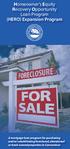 Homeowner s Equity Recovery Opportunity Loan Program (HERO) Expansion Program A mortgage loan program for purchasing and/or rehabilitating foreclosed, abandoned or bank-owned properties in Connecticut
COMMUNITY ACQUISITION REHABILITATION LOAN CARL CARL TERM SHEET AND GUIDELINES
 COMMUNITY ACQUISITION REHABILITATION LOAN I. PROGRAM OBJECTIVE CARL CARL TERM SHEET AND GUIDELINES URBAN REDEVELOPMENT AUTHORITY OF PITTSBURGH PITTSBURGH COMMUNITY REINVESTMENT GROUP The main objective
CITY OF YOUNGSTOWN HOME BUYER PROGRAM. Community Development Agency Housing Division CITY OF YOUNGSTOWN Mayor Jay Williams. Revised 3/2008 (LH)
 CITY OF YOUNGSTOWN HOME BUYER PROGRAM Community Development Agency Housing Division CITY OF YOUNGSTOWN Mayor Jay Williams Revised 3/2008 (LH) PROGRAM SUMMARY HOMEBUYER PROGRAM Purpose: To provide low and
MORTGAGE TERMS. Assignment of Mortgage A document used to transfer ownership of a mortgage from one party to another.
 MORTGAGE TERMS Acceleration Clause This is a clause used in a mortgage that can be enforced to make the entire amount of the loan and any interest due immediately. This is usually stipulated if you default
Mortgage Fundamentals
 Ohio SSO Conference November 2, 2013 Mortgage Fundamentals Presented by: Tera Doak, Associate General Counsel, HFHI What is MPAR? The Mortgage Procedures and Regulations (MPAR) initiative offers several
The Neighborhood Stabilization Program
 The Neighborhood Stabilization Program The Neighborhood Stabilization Program Timothy C. Raffa, Esquire Weissman, Nowack, Curry & Wilco, P.C. [email protected] 404-926-4667 Fax 404-926-4867 www.wncwlaw.com
Acquiring Bank Owned Foreclosures
 Acquiring Bank Owned Foreclosures The news and local conversations are full of stories about investors getting great deals on foreclosed houses. Why wouldn t affordable housing providers want to do the
Affordable Housing Partnership Housing Counseling Program
 Affordable Housing Partnership Housing Counseling Program ORGANIZATION AND STAFF INFORMATION Name of Organization: Affordable Housing Partnership of the Capital Region Inc. 255 Orange Street Albany, New
COEUR D ALENE TRIBAL HOUSING AUTHORITY HOUSING REHABILITATION POLICY (CDTHA REHAB)
 COEUR D ALENE TRIBAL HOUSING AUTHORITY HOUSING REHABILITATION POLICY (CDTHA REHAB) Adopted by the Housing Board May 25, 2005 CDTHA HOUSING REHAB POLICY Programs Available... 3 Reconstruction... 3 Relocation/Displacement...
CHAPTER 3: ESCROW, TAXES, AND INSURANCE. SECTION 1: TAX AND INSURANCE REQUIREMENTS [7 CFR 3550.60 and 3550.61]
![CHAPTER 3: ESCROW, TAXES, AND INSURANCE. SECTION 1: TAX AND INSURANCE REQUIREMENTS [7 CFR 3550.60 and 3550.61]](/thumbs/26/8168010.jpg "CHAPTER 3: ESCROW, TAXES, AND INSURANCE. SECTION 1: TAX AND INSURANCE REQUIREMENTS [7 CFR 3550.60 and 3550.61]") . HB-2-3550 CHAPTER 3: ESCROW, TAXES, AND INSURANCE 3.1 INTRODUCTION To protect the Agency s interest in the security property, the Centralized Servicing Center (CSC) must ensure that real estate taxes
. HB-2-3550 CHAPTER 3: ESCROW, TAXES, AND INSURANCE 3.1 INTRODUCTION To protect the Agency s interest in the security property, the Centralized Servicing Center (CSC) must ensure that real estate taxes
City of Wichita. Housing and Community Services Department HOME INVESTMENT PARTNERSHIPS PROGRAM HOUSING DEVELOPMENT LOAN PROGRAM
 City of Wichita Housing and Community Services Department HOME INVESTMENT PARTNERSHIPS PROGRAM HOUSING DEVELOPMENT LOAN PROGRAM 2015-2016 Program Year INFORMATION PACKET APPLICATION FORM 1 Overview and
FIRST TIME HOMEBUYERS PROGRAM GUIDELINES (for Market Rate Units) Last Revised October 3, 2013
 FIRST TIME HOMEBUYERS PROGRAM GUIDELINES (for Market Rate Units) Last Revised October 3, 2013 I. Applicant Eligibility a. The total household income can be no greater than 120% of area median, adjusted
DEPARTMENT OF HOUSING AND URBAN DEVELOPMENT. [Docket No. FR-5447-N-01]
![DEPARTMENT OF HOUSING AND URBAN DEVELOPMENT. [Docket No. FR-5447-N-01]](/thumbs/29/13613224.jpg "DEPARTMENT OF HOUSING AND URBAN DEVELOPMENT. [Docket No. FR-5447-N-01]") DEPARTMENT OF HOUSING AND URBAN DEVELOPMENT [Docket No. FR-5447-N-01] Notice of Formula Allocations and Program Requirements for Neighborhood Stabilization Program Formula Grants AGENCY: Office of the
DEPARTMENT OF HOUSING AND URBAN DEVELOPMENT [Docket No. FR-5447-N-01] Notice of Formula Allocations and Program Requirements for Neighborhood Stabilization Program Formula Grants AGENCY: Office of the
Homeowner Rehab Set Up and Completion Form HOME Program (For single and multi-address activities)
 U.S. Department of Housing and Urban Development Office of Community Planning and Development Homeowner Rehab Set Up and Completion Form HOME Program (For single and multi-address activities) Check the
ReNew Grant Guidelines
 Brooklyn Center ReNew Buyer Incentive Program Greater Metropolitan Housing Corporation Program Summary The Economic Development Authority (EDA) of Brooklyn Center, Minnesota (EDA) has partnered with the
Vacant Properties Rehabilitation Program
 City of Columbus Department of Development Housing Division Vacant Properties Rehabilitation Program Redevelopment for Homeownership/ Lease-Purchase Guidelines Old Oaks City of Columbus Department of Development
IHDA 47 ILLINOIS ADMINISTRATIVE CODE 355 TITLE 47: HOUSING AND COMMUNITY DEVELOPMENT CHAPTER II: ILLINOIS HOUSING DEVELOPMENT AUTHORITY
 IHDA 47 ILLINOIS ADMINISTRATIVE CODE 355 TITLE 47: HOUSING AND COMMUNITY DEVELOPMENT CHAPTER II: ILLINOIS HOUSING DEVELOPMENT AUTHORITY PART 355 ILLINOIS AFFORDABLE HOUSING TAX CREDIT PROGRAM SUBPART A:
REQUEST FOR PUBLIC COMMENT CITY OF EVANSTON SUBSTANTIAL AMENDMENT NEIGHBORHOOD STABILIZATION PROGRAM 2
 REQUEST FOR PUBLIC COMMENT CITY OF EVANSTON SUBSTANTIAL AMENDMENT NEIGHBORHOOD STABILIZATION PROGRAM 2 The City of Evanston plans to submit a Substantial Amendment to its Neighborhood Stabilization Program
Definitions. In some cases a survey rather than an ILC is required.
 Definitions 1. What is the closing? The closing is a formal meeting at which both the buyer and seller meet to sign all the final documentation required for the buyer's mortgage loan. Once the closing
July 1, 2012 thru September 30, 2012 Performance Report
 Grantee: Hammond, IN Grant: B-11-MN-18-0006 July 1, 2012 thru September 30, 2012 Performance Report 1 Grant Number: B-11-MN-18-0006 Grantee Name: Hammond, IN Grant Amount: $1,243,934.00 Estimated PI/RL
The City of Kenner Community Development Department
 The City of Kenner Community Development Department First Time Homebuyers Training Program Description and Objectives The homebuyer education class explains the home-buying process to prospective homeowners,
HUD Webinar. Developing Multifamily Properties June 2, 2011. U.S. Department of Housing and Urban Development
 U.S. Department of Housing and Urban Development HUD Webinar Developing Multifamily Properties June 2, 2011 Presenters HUD Staff: David Noguera, HUD NSP Enterprise Community Partners: Shola Olatoye, Deputy
Subject: Revised Information and Procedures for PHAs to Acquire and Rehabilitate HUD Real Estate Owned (REO) Properties
 U.S. DEPARTMENT OF HOUSING AND URBAN DEVELOPMENT WASHINGTON, DC 20410-5000 OFFICE OF PUBLIC AND INDIAN HOUSING Subject: Revised Information and Procedures for PHAs to Acquire and Rehabilitate HUD Real
How To Build A Home In A Neighborhood Of A Large Size
 Action Plan Grantee: Grant: Worcester, MA B-08-MN-25-0004 Grant Amount: $ 2,390,858.00 Status: Reviewed and Approved Funding Sources No Funding Sources Found Narratives Areas of Greatest Need: The City
Village of Ossining Affordable Housing Rules and Regulations (as revised 1/15/13)
 Village of Ossining Affordable Housing Rules and Regulations (as revised 1/15/13) Purpose: The Village Board of Trustees adopted an Affordable Housing Policy on April 14, 2006 and Chapter 62 of the Village
DeKalb County First-Time Homebuyers Program. For the Provision of Down Payment Assistance with the use of HOME Investment Partnerships Program funds
 DeKalb County First-Time Homebuyers Program For the Provision of Down Payment Assistance with the use of HOME Investment Partnerships Program funds First Time Homebuyer Program A. Program Overview: The
one home makes a difference
 Atlanta Neighborhood Development Partnership, Inc. 1 One Home Makes a Difference for a Veteran! one home makes a difference Affordable Housing for our Active Military and Veterans PROGRAM OVERVIEW Atlanta
Reviewed and Approved
 Action Plan Grantee: Grant: Hernando County, FL B-11-UN-12-0021 LOCCS Authorized Amount: Grant Award Amount: $ 1,953,975.00 $ 1,953,975.00 Status: Reviewed and Approved Estimated PI/RL Funds: $ 700,000.00
SPECIAL CONDITIONS. Sub-recipient: Contract Number: APPLICABLE TO ALL LONG TERM WORKFORCE HOUSING PROJECTS
 Special Conditions SPECIAL CONDITIONS Sub-recipient: Contract Number: APPLICABLE TO ALL LONG TERM WORKFORCE HOUSING PROJECTS I. CONDITIONS THAT REQUIRE WRITTEN CLEARANCE FROM THE DISASTER RECOVERY DIVISION
Summary of the Housing and Economic Recovery Act of 2008
 Summary of the Housing and Economic Recovery Act of 2008 On July 30, President Bush signed major housing legislation, HR 3221, the Housing and Economic Recovery Act of 2008. The bill restructures regulation
Workforce Homebuyer. Down Payment Loan Program. Program Orientation Packet. Housing Trust Fund of Santa Barbara County
 Housing Trust Fund of Santa Barbara County Workforce Homebuyer Down Payment Loan Program Program Orientation Packet 2013 Housing Trust Fund of Santa Barbara County P. O. Box 60909 Santa Barbara, CA 93160-0909
SINGLE FAMILY DEVELOPMENT
 SINGLE FAMILY DEVELOPMENT Agenda April 1 Introductions Background of class participants Ground rules Course outline and objectives The single family crisis Single family versus multifamily development
Government Deal Funding
 $97 00 Government Deal Funding for Real Estate Investors and Developers with Sean Carpenter -- -- Program Guide to Profits The US Government Has Set Aside Literally BILLIONS For Savvy Real Estate Investors.
City of Champaign Neighborhood Services Department Neighborhood Programs Division 102 N. Neil St. Champaign, Illinois 61820 (217) 403-7070
 City of Champaign Neighborhood Services Department Neighborhood Programs Division 102 N. Neil St. Champaign, Illinois 61820 (217) 403-7070 Acquisition-Rehabilitation Program SCOPE INCOME LIMIT The program
City of Paterson, NJ. HOME Investment Partnerships Program. Office of Audit, Region 2 New York-New Jersey
 City of Paterson, NJ HOME Investment Partnerships Program Office of Audit, Region 2 New York-New Jersey Audit Report Number: 2015-NY-1005 April 30, 2015 To: From: Subject: Anne Marie Uebbing Director Community
Section 1.16a Resale/Deed Restrictions Guidelines
 Section 1.16a Resale/Deed Restrictions Guidelines In This Section This section contains the following topics: Overview... 2 Introduction... 2 Related Bulletins... 2 General... 2 Identification and Eligibility
U.S. Department of Housing and Urban Development Office of Community Planning and Development
 Hud-40096 Homebuyer/Homeowner Rehab Completion Report HOME Program U.S. Department of Housing and Urban Development Office of Community Planning and Development OMB Approval No. 2506-0171 (Exp. 05/31/2007)
Cost Controls and Safe Harbor Standards for Homeownership Development Effective April 1, 2004
 Cost Controls and Safe Harbor Standards for Homeownership Development Effective April 1, 2004 To expedite the homeownership review process, HUD is instituting safe harbor and maximum fee ranges for a number
RE-BUILDING BETTER NEIGHBORHOODS (R-BBN) & SINGLE-FAMILY HOUSING REHABILITATION PROGRAMS PROGRAM INFORMATION AND CONTACTS
 RE-BUILDING BETTER NEIGHBORHOODS (R-BBN) & SINGLE-FAMILY HOUSING REHABILITATION PROGRAMS Mission PROGRAM INFORMATION AND CONTACTS Greater Minnesota Housing Fund invests in affordable housing and sustainable