
EMPLOYER'S GUIDE PAY AS YOU EARN IN KENYA. Revised Edition
|
|
|
- Annabella Warren
- 10 years ago
- Views:
Transcription
1 DOMESTIC TAXES DEPARTMENT EMPLOYER'S GUIDE TO PAY AS YOU EARN IN KENYA Revised Edition (NOTE:-THIS EDITION INCORPORATES (P38) MONTHLY TAX TABLES) Form P.7

2 KENYA REVENUE AUTHORITY DOMESTIC TAXES DEPARTMENT EMPLOYER'S GUIDE TO PAY AS YOU EARN IN KENYA Revised Edition IMPORTANT: The objective of this booklet is to explain the system of deducting income tax from employees' emoluments. It does NOT therefore in any way modify or replace the General Legislation (Income Tax Act Cap 470). It may be some time before a further reprint is available therefore employers should carefully preserve this edition. NOTE: I. This issue contains many important amendments affecting P.A.Y.E. operations in the year II. This Edition Incorporates (P38) Monthly Tax Tables (See Page iii) Form P.7
3 DEAR EMPLOYER I wish to appreciate your continued co-operation in the operation of the PAYE tax scheme and look forward to your continued support. The Finance Act 2005 contains few amendments to the Income Tax Act (Cap. 470) which affect PAYE tax operation with effect from 1 st January Personal Relief and Income Tax Brackets remain unchanged. Personal Relief Monthly Personal Relief was increased from Kshs. 1,056 per month to Kshs. 1,162 per month (or Kshs. 12,672 per annum to Kshs. 13,944 per annum) with effect from 1 st January This relief will still apply in Income Tax Brackets The taxable income bands have been widened which means that an employee whose earnings is less than Kshs. 11,135 per month is not eligible for PAYE. Effective Date 1 st January The same tax rates will apply in year Compensation for Loss of Office (Contract of Employment) Section 5 (2) (c) of the Income Tax has been amended as follows:- In case the contract of employment is for a specified term, the lump sum payable shall be spread forward and assessed evenly over the unexpired period of the contract. Where the contract of employment is for unspecified term with no provision for compensation, the amount of compensation shall be deemed to have accrued evenly and assessed in the three years period immediately following termination of the contract. The amendments took effect from 1 st July Tax Free Monthly Pension or Annuity Section 8 The tax free limit of monthly pension has been increased from Kshs. 12,500 per month to Kshs. 15,000 per month (Kshs. 150,000 per annum to Kshs. 180,000 per annum) with effect from 1 st July Employers Contribution to Registered or Unregistered Pension Scheme or Provident Fund Contributions paid by a non-taxable employer to unregistered pension scheme or excess contributions paid to a registered pension scheme, provident fund or individual retirement fund shall be employment benefit chargeable to tax on the employee. The amendment took effect from 1 st July Deductions in respect of registered individual retirement fund (Section 22A and 22B) The percentage rate is 30% of pensionable income of the individual to be in line with employers registered retirement schemes. The allowable deduction shall be the lesser of:- The actual contribution made by the individual, or 30% of pensionable income, or Kshs. 20,000 per month (or Kshs. 240,000 per annum) The amendment is effective from 1 st January You are further advised to kindly observe the due date for remittance of PAYE tax deductions, which is on or before the 9 th day of the month following the Pay-roll month, and to take note of the important changes incorporated in this Guide. Please preserve your copy. (WELCOME - PLEASE READ ON) A. K. OKELLO

4 P.38 TAX TABLES TAX TABLE FOR MONTHLY INCOME: YEAR 2006 MONTHLY TAXABLE INCOME (INCOME BRACKETS) For Taxable Income under Kshs. 10,165 For Taxable Income from Kshs. 10,165 but under Kshs. 19,741 For Taxable Income form Kshs. 19,741 but under Kshs. 29,317 For Taxable Income from Kshs. 29,317 but under Kshs. 38,893 For taxable Income from Kshs. 38,893 and above. TAX ON TAXABLE INCOME Kshs. 1,016 on Taxable Income of TAX RATE IN EACH SHILLING Kshs. 10,164 10% Kshs. 1,016 plus Kshs. 1,436 Tax on Taxable Income of Kshs. 9,576 15% Kshs. 2,452 plus Kshs. 1,915 Tax on Taxable Income of Kshs. 9,576 20% Kshs. 4,367 plus Kshs. 2,394 Tax on taxable Income of Kshs. 9,576 25% Kshs. 6,761 plus Tax calculated at 30% on Taxable Income over Kshs. 38,892 30%

5 EMPLOYER S GUIDE TO PAY AS YOU EARN CONTENTS PAGES PART 1 - GENERAL PAY AS YOU EARN APPLIES TO ALL EMPLOYMENTS 1 2. EMPLOYER S DUTY TO DEDUCT INCOME TAX PURPOSE OF EMPLOYER S GUIDE TO PAY AS YOU EARN REGULATIONS DEFINITIONS OF TERMS USED.. a. Employer b. Employee.. c. Paying Point. d. Monthly Pay. e. Paid EMPLOYMENT BENEFITS LOW INTEREST RATE, EMPLOYMENT BENEFIT/FRINGE BENEFIT.. I. Low Interest Rate Benefit II. Fringe Benefit Tax Payable by Employer (Sect. 12B) HOUSING SECTION 5(3)... a. Director.. b. Whole Time Service Director... c. Agricultural Employee. d. Any Other Employee.. e. Notes CAR BENEFIT SECTION 5 (2B) TAX FREE REMUNERATION PASSAGES MEDICAL DEFINED BENEFIT FUND OR DEFINED CONTRIBUTION FUND EMPLOYER S CONTRIBUTIONS ETC. HOME OWNERSHIP SAVINGS PLAN OWNER OCCUPIED INTEREST SEC. 15 (3) (b) PERSONAL RELIEFS MONTHLY TAX TO BE DEDUCTED MONTHLY PAY-SLIP TAX DEDUCTION CARD PROCEDURE ON COMPUTATION OF TAX FOR LUMP SUM PAYMENTS

6 22. HOW PAYE TAX IS WORKED PART II - WHAT THE EMPLOYER SHOULD DO BEFORE 1 ST JANUARY, EACH YEAR DOCUMENTS TO BE SENT TO EMPLOYERS CHECK DOCUMENTS RECEIVED WHO IS LIABLE FOR PAYE.. 16 PART III - TAX DEDUCTION CARDS P9A, P9A (HOSP) AND P9B EMPLOYER WISHING TO USE OWN TAX DEDUCTION CARDS LIABLE EMPLOYEE LEAVING EMPLOYERS CERTIFICATE OF PAY AND TAX NEW EMPLOYEE TAX TABLES NECESSARY ADJUSTMENTS DURING THE YEAR. 17 PART IV - REMITTANCE OF TAX HOW TO PAY-IN THE TAX DEDUCTED SPECIAL ARRANGEMENTS FOR REMOTE AREAS PAYMENT OF TAX DEDUCTED FROM LUMP SUM, PAYE AUDIT TAX, INTEREST AND PENALTY EXTENT OF PENALTIES & INTEREST APPEAL BY EMPLOYERS AGAINST PAYE PENALTIES. 19 PART V - END OF MONTH PROCEDURE LIST OF EMPLOYEES ARITHMETIC OR OTHER ERRORS ON TAX DEDUCTION CARDS OBJECTION BY EMPLOYEES.. 20 PART VI - END OF YEAR PROCEDURE COMPLETION OF TAX DEDUCTION CARDS. 20 a) Tax Deduction Cards (P9A, P9A (HOSP), P9B 20 b) Employer s Certificate (P10). 20 c) Supporting list P10A 20 d) Fringe Benefit Tax Return (P10B) RETURN OF DOCUMENTS TO INCOME TAX OFFICES ON OR BEFORE 28 TH FEBRUARY CALCULATION OF BENEFITS ON REVERSE SIDE OF THE P9A CERTIFICATE OF PAY AND TAX (P9A, P9B, P9A (HOSP) AUDIT PROCEDURE. 21 PART VII - SPECIAL CASES ARRIVAL, DEPARTURE OR DEATH DURING THE YEAR CHANGE OF PERSONAL CIRCUMSTANCE DURING THE YEAR MULTIPLE PAYE SOURCES OF INCOME 22

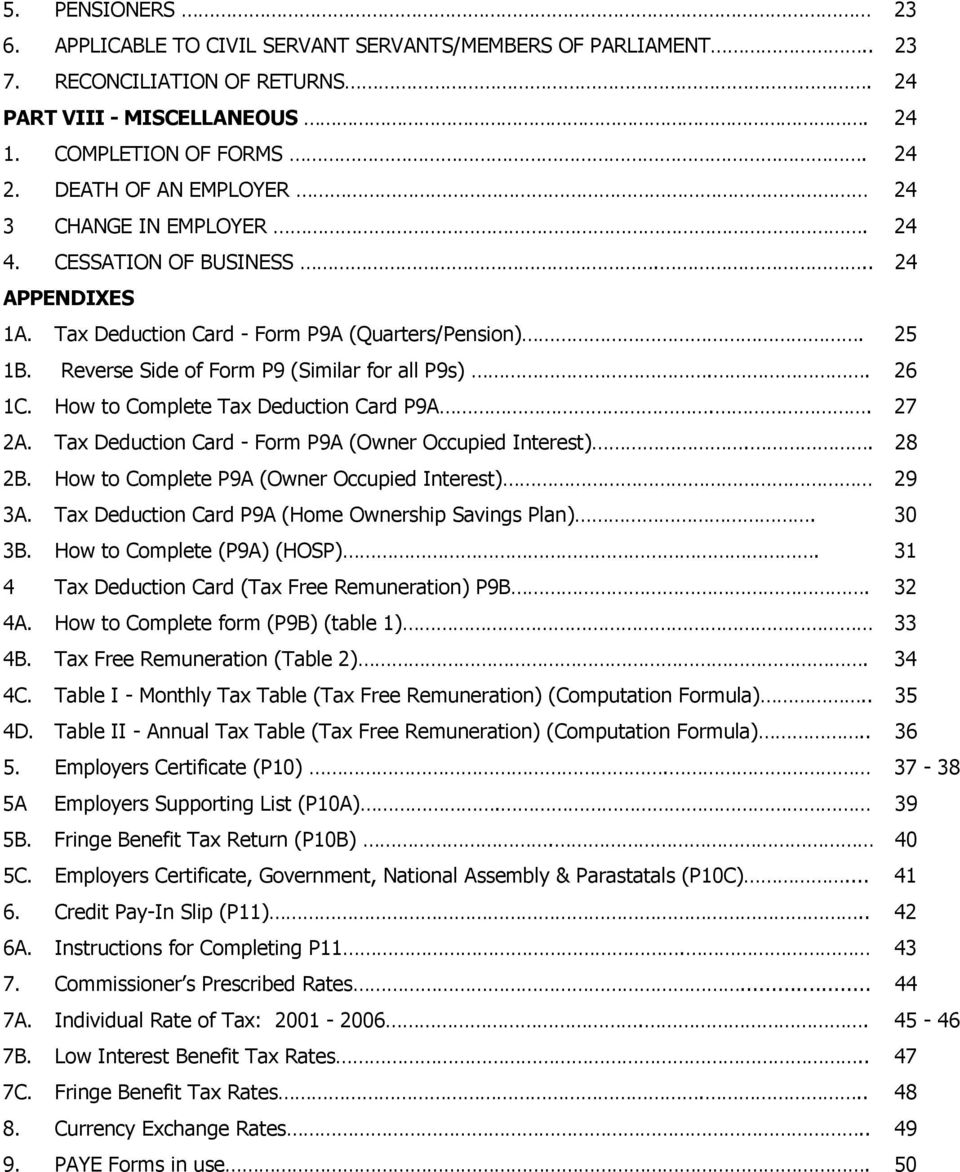
7 5. PENSIONERS APPLICABLE TO CIVIL SERVANT SERVANTS/MEMBERS OF PARLIAMENT RECONCILIATION OF RETURNS. 24 PART VIII - MISCELLANEOUS COMPLETION OF FORMS DEATH OF AN EMPLOYER 24 3 CHANGE IN EMPLOYER CESSATION OF BUSINESS APPENDIXES 1A. Tax Deduction Card - Form P9A (Quarters/Pension). 25 1B. Reverse Side of Form P9 (Similar for all P9s) C. How to Complete Tax Deduction Card P9A A. Tax Deduction Card - Form P9A (Owner Occupied Interest) B. How to Complete P9A (Owner Occupied Interest) 29 3A. Tax Deduction Card P9A (Home Ownership Savings Plan). 30 3B. How to Complete (P9A) (HOSP) Tax Deduction Card (Tax Free Remuneration) P9B. 32 4A. How to Complete form (P9B) (table 1) 33 4B. Tax Free Remuneration (Table 2). 34 4C. 4D. Table I - Monthly Tax Table (Tax Free Remuneration) (Computation Formula).. Table II - Annual Tax Table (Tax Free Remuneration) (Computation Formula) Employers Certificate (P10) A 5B. Employers Supporting List (P10A). Fringe Benefit Tax Return (P10B) C. Employers Certificate, Government, National Assembly & Parastatals (P10C) Credit Pay-In Slip (P11) A. Instructions for Completing P Commissioner s Prescribed Rates A. Individual Rate of Tax: B. Low Interest Benefit Tax Rates C. Fringe Benefit Tax Rates Currency Exchange Rates PAYE Forms in use. 50
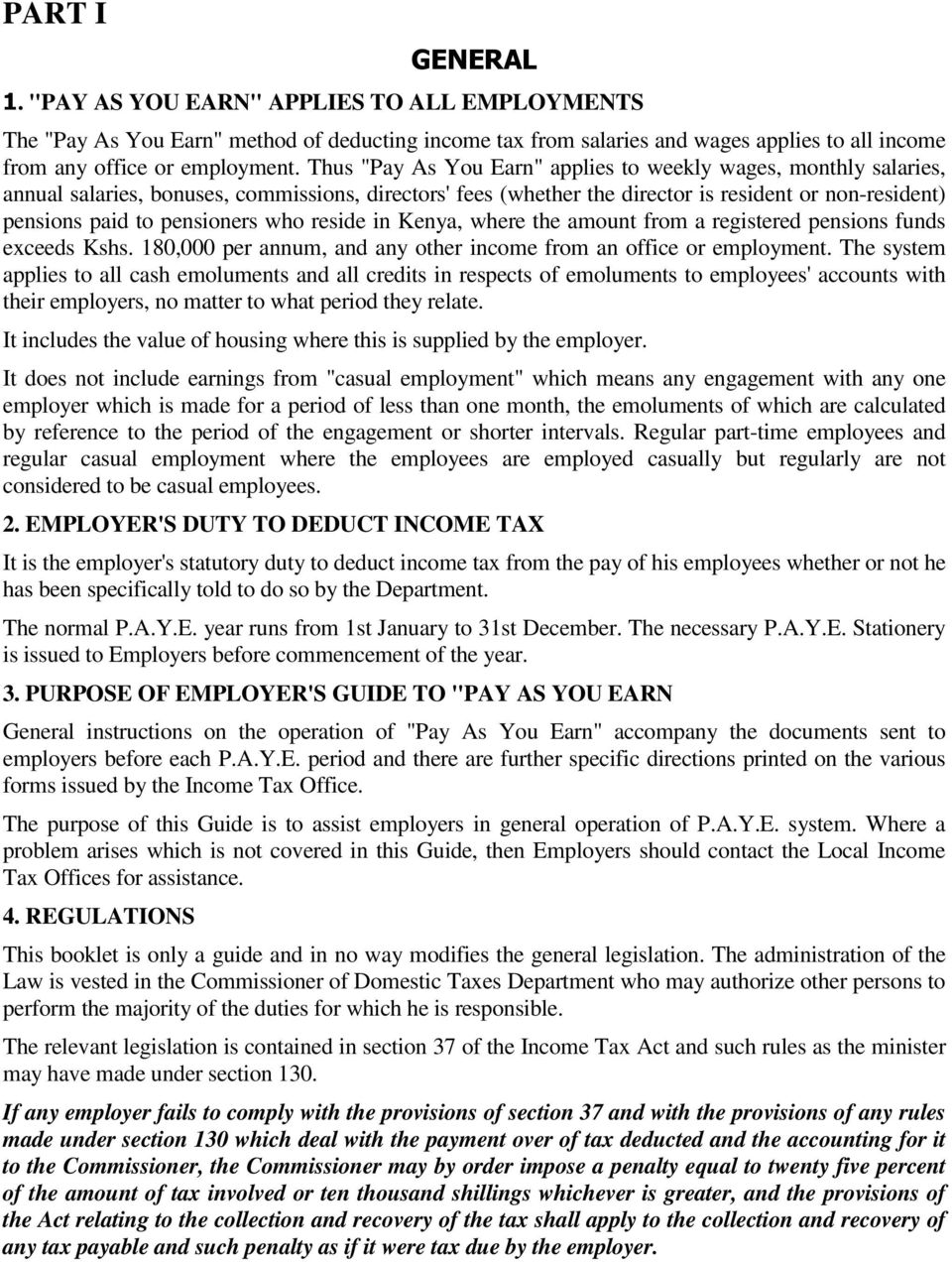
8 PART I GENERAL 1. "PAY AS YOU EARN" APPLIES TO ALL EMPLOYMENTS The "Pay As You Earn" method of deducting income tax from salaries and wages applies to all income from any office or employment. Thus "Pay As You Earn" applies to weekly wages, monthly salaries, annual salaries, bonuses, commissions, directors' fees (whether the director is resident or non-resident) pensions paid to pensioners who reside in Kenya, where the amount from a registered pensions funds exceeds Kshs. 180,000 per annum, and any other income from an office or employment. The system applies to all cash emoluments and all credits in respects of emoluments to employees' accounts with their employers, no matter to what period they relate. It includes the value of housing where this is supplied by the employer. It does not include earnings from "casual employment" which means any engagement with any one employer which is made for a period of less than one month, the emoluments of which are calculated by reference to the period of the engagement or shorter intervals. Regular part-time employees and regular casual employment where the employees are employed casually but regularly are not considered to be casual employees. 2. EMPLOYER'S DUTY TO DEDUCT INCOME TAX It is the employer's statutory duty to deduct income tax from the pay of his employees whether or not he has been specifically told to do so by the Department. The normal P.A.Y.E. year runs from 1st January to 31st December. The necessary P.A.Y.E. Stationery is issued to Employers before commencement of the year. 3. PURPOSE OF EMPLOYER'S GUIDE TO "PAY AS YOU EARN General instructions on the operation of "Pay As You Earn" accompany the documents sent to employers before each P.A.Y.E. period and there are further specific directions printed on the various forms issued by the Income Tax Office. The purpose of this Guide is to assist employers in general operation of P.A.Y.E. system. Where a problem arises which is not covered in this Guide, then Employers should contact the Local Income Tax Offices for assistance. 4. REGULATIONS This booklet is only a guide and in no way modifies the general legislation. The administration of the Law is vested in the Commissioner of Domestic Taxes Department who may authorize other persons to perform the majority of the duties for which he is responsible. The relevant legislation is contained in section 37 of the Income Tax Act and such rules as the minister may have made under section 130. If any employer fails to comply with the provisions of section 37 and with the provisions of any rules made under section 130 which deal with the payment over of tax deducted and the accounting for it to the Commissioner, the Commissioner may by order impose a penalty equal to twenty five percent of the amount of tax involved or ten thousand shillings whichever is greater, and the provisions of the Act relating to the collection and recovery of the tax shall apply to the collection and recovery of any tax payable and such penalty as if it were tax due by the employer.
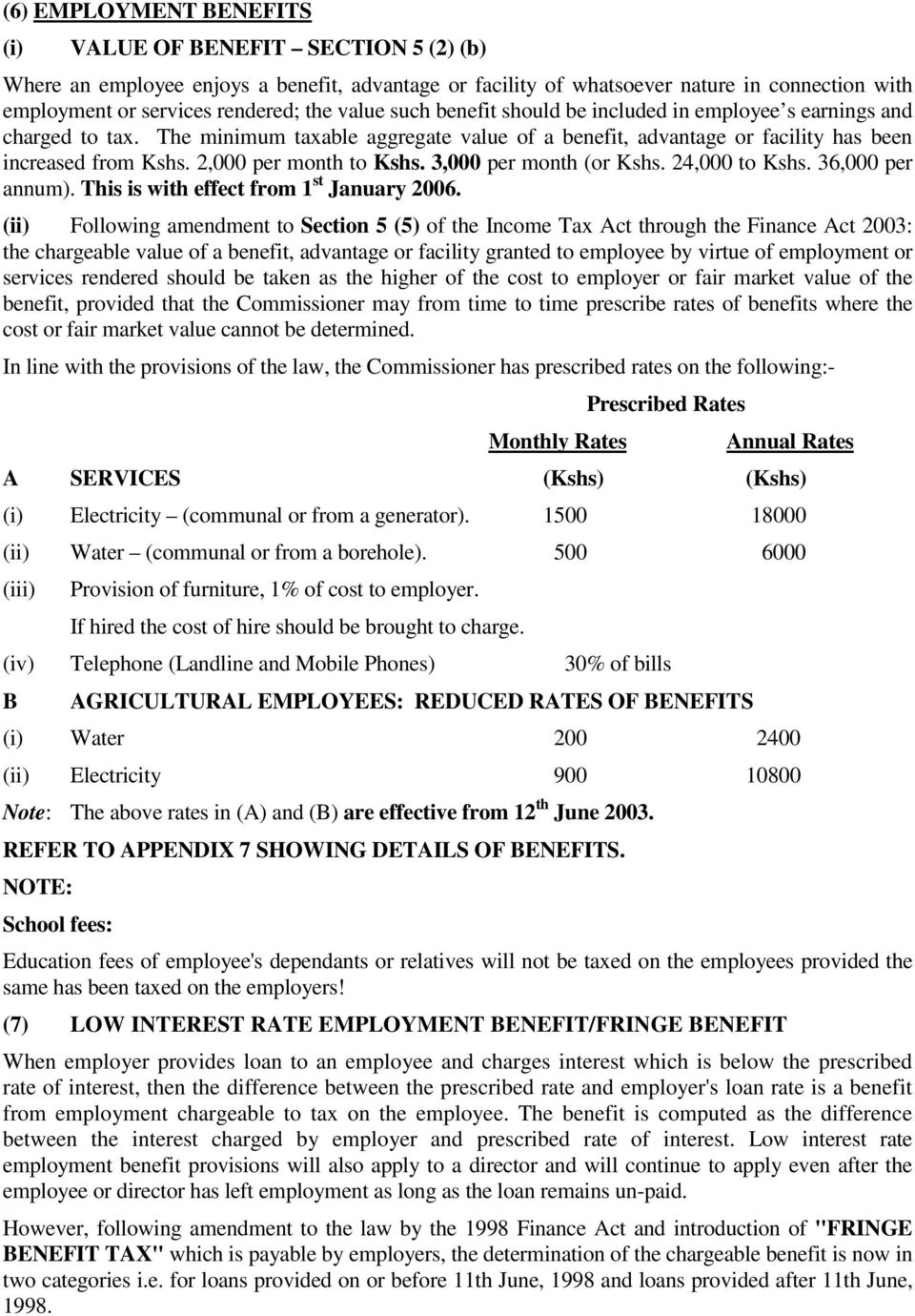
9 5. DEFINITIONS OF TERMS USED (a) Employer For "Pay As You Earn" purposes the term "employer" is to be taken, when necessary, to include: (i) (ii) (iii) (iv) Any person having control of payment of remuneration; Any agent, manager or other representative in Kenya of any employer who is outside Kenya; Any paying officer of Government or other public authority; Any trust or insurance company or other body or person paying pensions. It may accordingly include the manager of a branch or farm as well as the main employer. The main employer must decide which offices, etc., are to be "pay point" (see below) and ensure that those in charge are adequately instructed in their duties under the scheme. (b) Employee This word is defined as inclusive of any holder of an appointment of office, whether public, private or calling, for which remuneration is payable. "Employee" should be read as including, for example, minister, chief, any public servant, company director (resident or non-resident), secretary, individuals working for any Religious Organization etc., in addition to those more commonly known as employees. It includes an employee who retires on pension and stays in Kenya where pensions received from a registered pension fund exceed Kshs. 15,000 per month (Kshs. 180,000 per annum). (c) Paying Point A "paying point" is the place at which remuneration is paid. If a non-resident employer calculates remuneration abroad and remits the remuneration direct to the employee then such remuneration should be notified to the Department through the employer s local representative and P.A.Y.E. tax operated on the remuneration accordingly. Any cases of doubt should be referred to the Income Tax Office for advice. (d) Monthly Pay "Monthly pay" includes income in respect of any employment or service rendered, accrued in or derived from Kenya. This will include: (i) (ii) (iii) (iv) (v) Wages, salary, leave pay, sick pay, payment in lieu of leave, directors' fees and other fees, overtime, commission, bonus, gratuity or pension whether payable monthly or at longer or shorter intervals. Cash allowances, e.g. house or rent allowance, telephone allowance, round sum allowance etc. The amount of any private expenditure of the employee paid by the employer otherwise than as a loan, e.g. house rent, grocery bills, electricity, water, telephone bills, school fees, Non-cash benefits when the aggregate value exceeds Kshs.3000 per month. The value of housing, where provided by the employer. Any amount which is mere reimbursement of expenses of employment, e.g. subsistence allowance when on duty away from home, mileage allowance for use of employee's car or for travelling expenses incurred in the course of employment will be excluded. Such amounts must, however, be shown on any return of wages called for by the Income Tax Office. Round sum expense allowances should be treated as pay, included on the Tax Deduction Card and taxed accordingly. Expenses incurred wholly and exclusively in the production of employment income out of such Round Sum Allowances should be claimed on completion of self-assessment return of income. Any amount not paid in cash but credited to an employee's account with the employer is to be treated as paid and tax deducted accordingly.

10 (6) EMPLOYMENT BENEFITS (i) VALUE OF BENEFIT SECTION 5 (2) (b) Where an employee enjoys a benefit, advantage or facility of whatsoever nature in connection with employment or services rendered; the value such benefit should be included in employee s earnings and charged to tax. The minimum taxable aggregate value of a benefit, advantage or facility has been increased from Kshs. 2,000 per month to Kshs. 3,000 per month (or Kshs. 24,000 to Kshs. 36,000 per annum). This is with effect from 1 st January (ii) Following amendment to Section 5 (5) of the Income Tax Act through the Finance Act 2003: the chargeable value of a benefit, advantage or facility granted to employee by virtue of employment or services rendered should be taken as the higher of the cost to employer or fair market value of the benefit, provided that the Commissioner may from time to time prescribe rates of benefits where the cost or fair market value cannot be determined. In line with the provisions of the law, the Commissioner has prescribed rates on the following:- Monthly Rates Prescribed Rates Annual Rates A SERVICES (Kshs) (Kshs) (i) Electricity (communal or from a generator) (ii) Water (communal or from a borehole) (iii) Provision of furniture, 1% of cost to employer. If hired the cost of hire should be brought to charge. (iv) Telephone (Landline and Mobile Phones) 30% of bills B AGRICULTURAL EMPLOYEES: REDUCED RATES OF BENEFITS (i) Water (ii) Electricity Note: The above rates in (A) and (B) are effective from 12 th June REFER TO APPENDIX 7 SHOWING DETAILS OF BENEFITS. NOTE: School fees: Education fees of employee's dependants or relatives will not be taxed on the employees provided the same has been taxed on the employers! (7) LOW INTEREST RATE EMPLOYMENT BENEFIT/FRINGE BENEFIT When employer provides loan to an employee and charges interest which is below the prescribed rate of interest, then the difference between the prescribed rate and employer's loan rate is a benefit from employment chargeable to tax on the employee. The benefit is computed as the difference between the interest charged by employer and prescribed rate of interest. Low interest rate employment benefit provisions will also apply to a director and will continue to apply even after the employee or director has left employment as long as the loan remains un-paid. However, following amendment to the law by the 1998 Finance Act and introduction of "FRINGE BENEFIT TAX" which is payable by employers, the determination of the chargeable benefit is now in two categories i.e. for loans provided on or before 11th June, 1998 and loans provided after 11th June, 1998.
11 (i) Low Interest Rate Benefit Employees will continue to be taxed on low interest rate benefit in respect of loans provided by the employer on or before 11th June, 1998 as before. The low interest benefit chargeable on the employees is calculated as the difference between interest charged to the employee and the prescribed rate of interest of 15% per cent, or such interest rate based on the Market Lending Rates prescribed by the Commissioner; whichever is lower. Example - Loan provided by employer - KShs.1,500,000 - Employer's Loan Interest Rate - NIL (interest free) - Prescribed Rate of Interest - 2 % Calculation of Low Interest benefit: - Low Interest Benefit is (2%-NIL=2%): KShs 1,500,000 x 2% = KShs.30,000 per annum i.e. KShs.2,500 per month *The prescribed rate of interest for the year of income commencing on or after 1 st January, 1995 is 15 per cent (15%) or such interest rates based on the market lending rates as the Commissioner may prescribe from time to time. YEAR 2005: SEE APPENDIX 7B for the Rates on Low Interest Benefit. For the year 2005, the Commissioner published the following interest rates:- (a) January June % (b) July December % 1 st Half of the year 2006: January June % (ii) Fringe Benefit Tax Payable By Employer (Section 12B) Effective Date 12 th June,1998 Tax known as Fringe Benefit tax was introduced by new provisions under Section 12B of the Income Tax Act. It is payable by the employers commencing on the 12th June, 1998 in respect of loan provided to an employee, director or their relatives at an interest rate lower than the market interest rate. The taxable value of Fringe Benefit is determined as follows:- In case of loans provided after 11th June, 1998 or loan provided on or before 11th June, 1998 whose terms and conditions have changed after 11th June, 1998, the value of Fringe Benefit shall be the difference between the interest that would have been payable on the loan if calculated at the market interest rate and the actual interest paid. Example Employer's loan amount - KShs.2,100,000 - Interest charged to employee - NIL - Market Interest rate for the month - 2% Calculation of Fringe Benefit Tax:- Fringe Benefit is (2% - NIL = 2%) KShs.2,100,000 x 2% = KShs. 42,000 per annum i.e KShs. 3,500 per month. Fringe Benefit tax payable by employer is Kshs. 3,500 x 30% = KShs.1050/- (for the month). YEAR 2005: SEE APPENDIX 7C for the Rates on Fringe Benefit. For the year 2005 the Commissioner published the following prescribed rates of interest:-
12 1 st Quarter of the year 2006: January March % NOTES - Fringe benefit is taxable at corporation rate of tax of 30% of the determined value of the benefit. - Fringe benefit tax shall be charged on the total taxable value of Fringe benefit each month and the tax is payable on or before the 10 th day of the following month to the Pay-Master General in the same way as normal P.A.Y.E. remittance. Employers will therefore pool together all the Fringe benefits for the employees in each month. - The provision of loans shall include a loan from an unregistered pension or provident fund. - Fringe benefit tax charged prior to 1 ST January, 1999 is due and payable on before 10th January, Market Interest Rate means the average 91 days Treasury Bill rate of interest for the previous quarter. - The above provisions will continue to apply even after employee leaves employment as long as the loan remains un-paid. - Fringe benefit tax is payable even where corporation tax is not due by the employer in question - The provisions of the Act relating to fines, penalties, interest charged, objections and appeals shall apply to the fringe benefit tax. (8) HOUSING - SECTION 5(3) The value of housing provided by the employer is determined as follows:- a) Director In the case of a director of a company other than whole time service director, an amount equal to 15% of his total income excluding the value of those premises. Provided that;- (i) (ii) where the premises are provided under an agreement with a third party which is not at arm s length, the value of quarters determined shall be the fair market rental value of the premises in that year or the rent paid by the employer, whichever is the higher, or; Where the premises are owned by the employer, the fair market rental value of the premises in that year is to be taken. b) A Whole Time Service Director Taxable benefit shall be an amount equal to 15% of the gains or profits from his employment, excluding the value of those premises. Provided that;- (i) (ii) Where the premises are provided under an agreement with a third party which is not at arm s length, the value of quarters determined shall be the fair market rental value of the premises in that year or the rent paid by the employer whichever is the higher or; Where the premises are owned by the employer, the fair market rental value of the premises in that year is to be taken. c) Agricultural Employee (Including a whole time service director) who is required by terms of employment to reside on a plantation or farm;- 10% of his gains or profits from employment minus any rent charged to the employee. This is subject to employer obtaining prior approval from Income Tax Office. (see also reduced rates of benefits for agricultural employees Appendix 5).

13 d) Any other Employee The taxable value shall be the higher of an amount equal to 15% of the gains or profits from employment or services rendered, excluding the value of those premises, or the rent paid by the employer if paid under an agreement made at arm s length with a third party: Provided that;- (i) If employer pays rent under an agreement not made at arm s length with a third party, the value of quarters shall be; the fair market rental value of the premises in that year or rent paid by the employer; whichever is higher, or (ii) NOTES Where the premises are owned by employer; the fair market rental value of the premises in that year is to be taken. - In calculating the housing benefits employer is required to deduct rental charges recovered from the employee or director. The amount remaining is the chargeable value to be included in the total taxable pay. - If the premises are occupied for part of the year only, the value is 15% of employment income relative to the period of occupation less any rental charges paid by employee/director. (Chargeable value shall be reduced by rent paid by an employee). - Any employer who provides other than normal housing to an employee should consult his local Income Tax office for advice regarding the value of such housing. Example: A Manager who earns basic salary of Kshs. 30,000 per month plus other benefits (e.g. Motor Car, House Servants etc.) Kshs. 15,000/= is housed and the employer pays to the Landlord rent of Kshs. 20,000 per month (i.e. Kshs. 240,000 per annum) under an agreement made at arm s length with the third party. Calculation For Value of Quarters Basic Salary - Kshs. 30,000 Add: Benefits - Kshs. 15,000 Total - Kshs. 45,000 15% Value of quarters there of - Kshs. 45,000 x 15 = Kshs. 6,750 *Rent paid by the employer Kshs. 20,000/= per month is the amount to be brought to charge and not 15% value of quarters. REFER TO P9A APPENDIX 1A. (9) CAR BENEFIT SECTION 5 (2B) Where an employee is provided with a motor vehicle by employer, the chargeable benefit for private use shall be the higher of the rate determined by the Commissioner and the prescribed rate of benefit. Where such vehicle is hired or leased from third party employees shall be deemed to have received a benefit in that year of income, equal to the higher of: I. The cost of hiring or leasing and II. The prescribed rate of benefit. The prescribed rate of benefit means the following rates for each month on the initial cost of the vehicle: % per month of initial cost of the vehicle

14 Example: X employee who is employed as a Financial Controller is provided with a car Mitsubishi Pajero (cc rating 2400) which was bought in July 2001 for Kshs. 2,500,000. Car benefit is calculated as follows:- - 2% x Kshs. 2,500,000 = Kshs. 50,000 per month - Commissioner s fixed monthly rate cc. rating 2,400 = Kshs. 8,600 - The chargeable car benefit is therefore Kshs. 50,000 per month. (10) TAX FREE REMUNERATION There are certain instances when an employer wishes to pay his employees salaries negotiated net of tax. In such circumstances the employer bears the burden of tax on behalf of such employees. The tax so paid by the employer for the employee becomes a benefit chargeable to tax (P.9B Card as shown in Appendix 4A is to be used for this purpose). (11) PASSAGES When an employer himself pays for or reimburses the cost of tickets for passages, including leave passages for his employee and family, the value of the passages is a non-taxable benefit of the employee if the employee is recruited outside Kenya and is in Kenya solely for the purpose of serving his employer and he is not a citizen. Where, however, such employee receives a cash sum either periodically or in one amount which he is free to save or spend as he chooses or for any other purposes and for the expenditure of which he does not have to account to the employer, the amount received is a taxable cash allowance. Passages paid for by the employer in circumstances other than that in italic above are a taxable benefit on the employee. (12) MEDICAL Where an employer has a written plan or scheme, or by practice, provides free medical services to all his employees the value of such medical services is a non-taxable benefit of all employees and all directors. However, for the non-whole time service director the medical benefit is limited to a maximum of Kshs. 1,000, effective 1 st January Where there is no plan or scheme, payments made to employees towards medical services is a taxable cash payment and must be included in the employees pay for the month in which payment is made and taxed accordingly. (13) DEFINED BENEFIT FUND OR DEFINED CONTRIBUTION FUND An employee's contribution to any registered defined benefit fund or defined contribution fund is now an admissible deduction in arriving at the employee's taxable pay of the month. The employee's deductible contribution is the lesser of: (a) 30% of pensionable pay. (b) (c) NOTE employee's actual contribution. Ksh.20,000 per month Maximum allowable Pension/Provident Fund contribution had been increased from Kshs. 17,500 per month to Kshs. 20,000 per month (i.e Kshs. 240,000 per annum), effective 1 st January National Social Security Fund Contributions made to the National Social Security Fund (NSSF) qualify as a deduction with effect from 1st January, Where an employee is a member of a pension scheme or provident fund and at the same time the National Social Security Fund (NSSF) the maximum allowable contributions should not exceed
15 - Contributions to Individual Retirement Fund The percentage rate has been increased from 20% to 30% of pensionable income of the individual to be line with employer registered retirement schemes. The allowable deduction shall be the lesser of:- The actual contribution made by the individual. 30% of pensionable income. Kshs. 20,000 per month (or Kshs. 240,000 per annum) The amendment is effective from 1 st January (14) EMPLOYERS CONTRIBUTIONS TO REGISTERED OR UNREGISTERED PENSION SCHEME OR PROVIDENT FUND Contributions paid by a non-taxable employer to unregistered pension scheme or excess contributions paid to a registered pension scheme, provident fund or individual retirement fund; shall be employment benefit chargeable to tax on the employee. The amendment is effective from 1 st July (15) HOME OWNERSHIP SAVINGS PLAN A depositor (employee) shall in any year of income commencing on or after 1 st January, 1999 be eligible to a deduction up to a maximum of Kshs. 4,000 /- (Four thousand shillings) per month or Kshs. 48,000/- per annum in respect of funds deposited in approved Institution under "Registered Home Ownership Savings Plan", in the qualifying year and the subsequent nine years of income; provided that:- - Employer has evidence to confirm that the Home Ownership Savings Plan with which employee wants to save is registered by the Commissioner of Domestic Taxes. - Employer will be the one to deduct and remit the amount to the Institution on behalf of the employee. - Employers will attach to Form P9A (HOSP) a declaration duly signed by the eligible employee. The declaration so signed will serve as verification and confirmation by the employer that the employee does not directly or indirectly own interest in a permanent house. Form P9A (HOSP) as shown in Appendix 3A is to be used for this purpose. NOTE: Approved Institution" - Means a Bank or financial institution registered under the Banking Act, an Insurance Company licensed under the Insurance Act or a Building Society registered under the Building Societies Act". (16) OWNER OCCUPIED INTEREST - SECTION 15(3)(b) In ascertaining the total income of a person for a year of income interest paid on amount borrowed from specified financial institution shall be deductible. The amount must have been borrowed to finance either:- (i) (ii) the purchase of premises or improvement of premises - which he occupies for residential purposes. The amount of interest allowable under the law must not exceed Kshs.150,000 per year (equivalent to Kshs. 12,500 per month). If any person occupies any premises for residential purposes for part of a year of income the allowable deduction shall be limited to the period of occupation. On the other hand no person may claim a deduction in respect of more than one residence. Following amendment to Section 45 of the Income Tax Act through the 1999 Finance Act, a married woman can now file her own separate return of income and declare income from employment, professional or self-

16 In view of this, she has the option to claim for deduction of interest paid provided that the property is registered in her name. Employer must obtain a signed declaration to the effect that she is the one claiming the deduction to avoid her husband making a similar claim. The financial institutions specified under the fourth schedule of the Income Tax Act include:- - A bank or a financial institution licensed under the Banking Act. - An insurance company licensed under the Insurance Companies Act. - A building society registered under the Building Societies Act. Employers will be required to ascertain and allow interest paid on money borrowed to finance owner occupied residential premises under the PAYE system subject to the following conditions:- The employer should allow actual interest paid by eligible employee on production of certificate from the lending institution confirming interest payable on the loan for that particular year. The amount of interest to be allowed as ascertained under his condition must not exceed Kshs. 12,500 per month. For the month of December, all the monthly interest allowed should be added together and only the difference between this amount and the annual allowable deduction of KShs. 150,000 should be allowed in the month of December. Where the employee redeems such loan in the course of the year and no interest is subsequently payable such allowable deduction shall cease forthwith upon redemption of the loan. The employee shall sign a declaration indemnifying employer against any false claim in this respect Employers are expected to review their pay-rolls starting from the month of September and make necessary adjustment to ensure that by the end of year correct amount of interest have been allowed The employer shall attach to Form P9A Photostat copy of interest certificate and statement of account from the specified lending institution. NOTE: o Interest which has accrued but not paid does not rank as an allowable deduction for this purpose. o Form P9A has been designed to accommodate the changes See appendix 2A. The example given under Appendix 2A assumes that an employee paid interest amounting to Kshs. 150,000 or more during the year. (17) PERSONAL RELIEFS (a) Monthly Personal Relief Kshs. 1,162 (with effect from 1 st January 2005) A resident individual with taxable income is entitled to a personal relief of Kshs. 1,162 per month (i.e. Kshs. 13,944 per annum). This is a uniform relief and employers are advised to automatically grant personal relief to all employees irrespective of their marital status. Individuals serving several employers qualify for personal relief from only one employer (i.e., main employment). (b) Insurance Relief with effect from 1 st January 2003 A resident individual shall be entitled to insurance relief at the rate of 15% of premiums paid subject to maximum relief amount of Kshs. 3,000 per month (or Kshs. 36,000 per annum) if he proves that;- - he has paid premium for an insurance made by him on his life, or the life of his wife or of his child and that the Insurance secures a capital sum, payable in Kenya and in the lawful currency of Kenya; or - his employer paid premium for that insurance on the life and for the benefit of the employee which has been charged to tax on that employee; or

17 provided that;- - no relief shall be granted in respect of part of premium for an insurance which secures a benefit which may be withdrawn at any time at the option of the insured. - premiums paid for an education policy with a maturity period of at least 10 years shall qualify for relief. - Only premiums paid in respect of an insurance policy taken on or after 1 st January,2003 shall qualify for relief. Notes: Employees must avail to the employer a certificate from insurer showing particulars of the policy e.g. name of insured, type of policy, capital sum payable, maturity date, premiums payable and commencement date of the policy. Employers should review their pay-rolls towards the end of the year and make necessary adjustments to ensure that the correct relief had been granted. No relief is available in respect of insurance policy that elapsed in the course of the year. (i) (ii) Example: Employer shall attach a copy of the certificate furnished by insurer, confirming premiums paid and that the policy was still in force to the employee s P9A, P9B, P9A (HOSP) Tax deduction Card for that year. For the purposes of insurance relief child include a step child and an adopted child who was under the age of eighteen years on the date the premium was paid. An employee X has furnished a Life Assurance Policy Certificate showing annual premiums payable of Kshs. 48,000. The commencement date of the policy is 1 st January, The insurance relief allowable in the payroll from the month of January will be calculated Kshs. 48,000 x 15% = 7,200 per annum i.e. 600 per month which will be entered in the appropriate column of Tax Deduction Card (P9A). (18) MONTHLY TAX TO BE DEDUCTED To arrive at monthly tax to be deducted:- (i) (ii) Example: charge tax on chargeable monthly pay per monthly tax tables deduct from tax charged monthly personal reliefs. B whose monthly chargeable pay for January, 2006 is Kshs. 40,000 will have his PAYE tax calculated as follows;- Tax charged on chargeable pay Kshs. 40,000 Kshs. * First Kshs. 10,164 at 10% 1,016 * Next Kshs. 9,576 at 15% 1,436 * Next Kshs. 9,576 at 20% 1,915 * Next Kshs. 9,576 at 25% 2,394 * Balance Kshs. 1,108 at 30% 332 TOTAL KSHS. 40,000 7,093 Less Monthly Personal Relief 1,162 PAYE to be deducted 5,931
18 (19) MONTHLY PAY SLIP Every employer is required to provide each liable employee on payment of remuneration with a written statement showing: (i) (ii) Monthly pay. PAYE Tax deducted. This formal notification is known as the "Monthly Pay Slip" and may be in any form convenient to the employer provided that the above information is given. (20) TAX DEDUCTION CARDS (P.9) This form is supplied to the employer by the Income Tax Office free. A Form P.9 must be prepared for every employee liable to tax (see Part III, paragraph 1). It provides for the recording, of gross pay, housing, benefits, chargeable monthly income, monthly personal relief, and PAYE tax deducted each month throughout the calendar year and payments for past years on the reverse side. Upon final completion after the year end, it is returned to the Income Tax Office, together with P10, P10A and P11 copy as PAYE end of year return. Specimen cards can be found on Appendix No.1A, 3A and 4A. Details of the operation of the card are found on 1C, 2C, 3C and 4C. (21) PROCEDURE ON LUMP SUM PAYMENTS (Gratuities, Bonuses, etc.) A:- Notification Employers are no longer required to notify the Tax Department before making payments of terminal benefits to the employees upon leaving their employment. Every Employer has an obligation under section 37 of the Income Tax Act to recover appropriate tax from any lump sum amount before releasing the difference/balance to the employee. The following is a Guide to Employers on how to compute tax on lump sum payments:- 1. Employment Income Treatment - General Employment income is assessable on accrual basis; that is, over the period it has been earned and become due for payment. The time the Income is received is, therefore, immaterial. Income from employment or services rendered is chargeable to tax under section 3(2)(a)(iii) of the Income Tax Act. This is expounded by section 5(2) which spells out that gains or profits from employment includes: wages, salary, payment in lieu of leave, fees, commission, bonus, gratuity, subsistence, travelling, entertainment or any other allowance received in respect of employment or services rendered. Where an amount is received in respect of employment or a service rendered in a year of income different from the year of accrual, such income is deemed to be income of the year of accrual. However, there is a provision which states that where the year of accrual is earlier than 4 years prior to the year of receipt, the income is to be treated as that of year of income which expired 5 years prior to the year in which the income is received or prior to the year of income in which employment ceased. Example (Terminal Dues): Mr. Peter Bakari left employment in September 2006 after 30 years of service and was paid severance pay/service gratuity of Kshs. 660,000; three months notice pay Kshs. 90,000 and Kshs. 25,000 for his 20 leave days not taken for the year For the purposes of calculation of tax payable, the service gratuity amount is to be spread backwards and taxed together with income earned in the relevant years but notice pay is assessable in the period immediately after date of leaving employment and pay in lieu of leave should be taxed in the year to which the leave days relate (i.e. 2004, 2005 e.t.c).
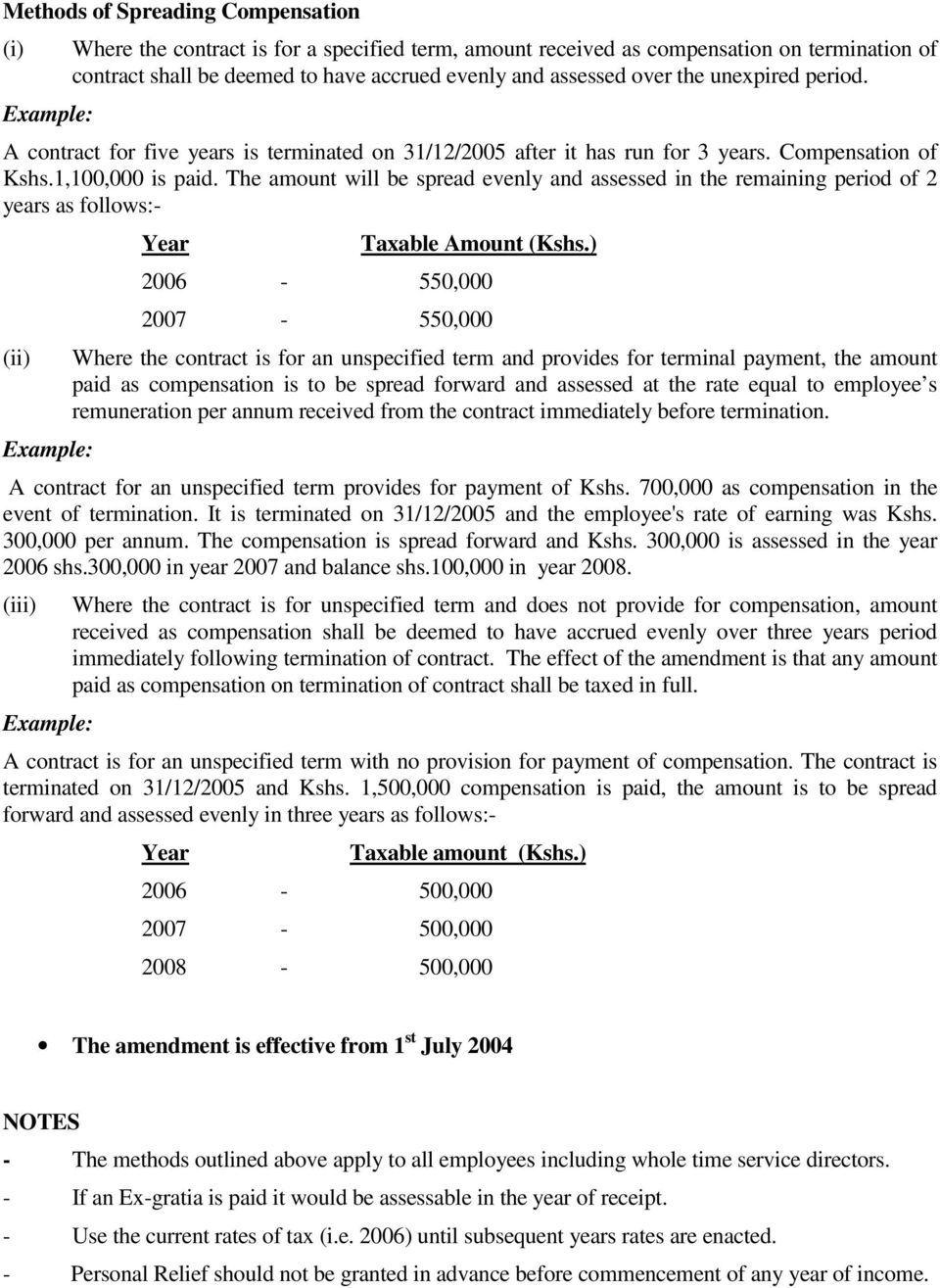
19 The procedure on how tax should be calculated is outlined below:- Year Breakdown of Lump sum payment Taxable Amount Kshs Service gratuity 22,000} - Notice pay 90,000} - Leave pay 25,000} Total Kshs. 137, Service gratuity 22, , , ,000 plus Kshs. 550,000 for * Calculation of Tax on Lump Sum (i) (ii) (iii) (iv) (v) (vi) 2000 & prior years. Take total taxable pay for the year as per the Tax Deduction Card (P9A). Add Lump Sum amount for that year Calculate tax chargeable on the revised total taxable income (i) + (ii). Use annual individual rates of tax. Deduct personal relief for the year Deduct total PAYE deducted and already paid (per P9A) The balance is tax payable on the Lump Sum. This method of calculating the tax should be followed for all the years involved so as to arrive at the total tax due and payable on the terminal dues. IMPORTANT - Pay in lieu of notice (i.e. notice pay) is assessable in the period immediately after the date of termination of employment. - Leave pay should be assessed in year to which it relates. - If termination of employment occurs in the course of the year, the portion of lump sum payment for that period is taxable in that particular year. - Calculate the tax for each year using annual rates of tax and then add up tax for all the years involved to arrive at total tax to be deducted from the lump sum payment. It should be noted that any lump sum payment relating to the year of income 2000 and prior years is assessable in 2001 being the 5th year prior to the year of receipt (2006) as per example in Table (i) above). 2. Compensation for Termination of Employment Liability extends to any payment, whether voluntary or obligatory made to a person to compensate him for the termination of his contract of employment or services, whether the contract is written or verbal and whether or not there is provision in the contract for such payment. Following the amendment to proviso (i) and (iii) to section 5 (2) (c) the determination and method of assessing compensation received on termination of contract shall be as follows:-

20 Methods of Spreading Compensation (i) Example: Where the contract is for a specified term, amount received as compensation on termination of contract shall be deemed to have accrued evenly and assessed over the unexpired period. A contract for five years is terminated on 31/12/2005 after it has run for 3 years. Compensation of Kshs.1,100,000 is paid. The amount will be spread evenly and assessed in the remaining period of 2 years as follows:- (ii) Example: Year Taxable Amount (Kshs.) , ,000 Where the contract is for an unspecified term and provides for terminal payment, the amount paid as compensation is to be spread forward and assessed at the rate equal to employee s remuneration per annum received from the contract immediately before termination. A contract for an unspecified term provides for payment of Kshs. 700,000 as compensation in the event of termination. It is terminated on 31/12/2005 and the employee's rate of earning was Kshs. 300,000 per annum. The compensation is spread forward and Kshs. 300,000 is assessed in the year 2006 shs.300,000 in year 2007 and balance shs.100,000 in year (iii) Example: Where the contract is for unspecified term and does not provide for compensation, amount received as compensation shall be deemed to have accrued evenly over three years period immediately following termination of contract. The effect of the amendment is that any amount paid as compensation on termination of contract shall be taxed in full. A contract is for an unspecified term with no provision for payment of compensation. The contract is terminated on 31/12/2005 and Kshs. 1,500,000 compensation is paid, the amount is to be spread forward and assessed evenly in three years as follows:- Year Taxable amount (Kshs.) , , ,000 The amendment is effective from 1 st July 2004 NOTES - The methods outlined above apply to all employees including whole time service directors. - If an Ex-gratia is paid it would be assessable in the year of receipt. - Use the current rates of tax (i.e. 2006) until subsequent years rates are enacted. - Personal Relief should not be granted in advance before commencement of any year of income.
21 B:- Employers are required to submit a list of names of all the employees who have received lump sum payments within 14 days after making payment indicating:- N.B.: (i) (ii) (iii) Names of employees and their PIN numbers. Gross amount paid to each employee. Nature of payment and the period to which it relates. (iv) Amount of tax deducted and paid (attach a "Lump Sum" Photostat copy of the relevant P11 see - C below). (v) (vi) (vii) Employee s last date of service. Employee s gross earnings per annum and P.A.Y.E. deducted for the period to which the lump sum payment relates (subject to a limit of 5 years in the case of gratuity). In respect of compensation for loss of office, Employer should state the employee's rate of earning per month/per annum for the period immediately prior to termination of employment. Other advances of cash, e.g. salary advances to an employee, will not normally be subject to deduction of tax when made. In the month when such advances are recovered, the tax deductions will be calculated on the full pay of the month before deduction of the amount to be recovered. C:- Payment of Tax deducted from lump sum payments Tax deducted from the lump sum payment must be paid to the Pay-Master General using Paying- In Credit slip- (P11) as the normal PAYE remittances. However, the amount of tax involved should be shown separately from the normal PAYE deductions and the nature of payment also indicated in the space provided in the P11. (22) HOW P.A.Y.E. IS WORKED The broad outline of the scheme is illustrated by the following two examples: (i) "B" is employed as an Accountant at a salary of Kshs. 20,000 per month. His personal relief is Kshs.1162 per month. The employer enters on a Tax Deduction Card chargeable monthly pay Kshs.20,000. Kshs. Tax charged on chargeable pay Kshs. 20,000. * First Kshs. 10,164 at 10% 1,016 * Next Kshs. 9,576 at 15% 1,436 * Balance Kshs. 260 at 20% 52 Total Kshs. 20,000 2,504 Less monthly personal relief 1,162 PAYE to be deducted 1,342
22 (ii) "X" is employed as a general manager at a Basic salary of Kshs 40,000 per month. In addition his employer provides him with the following benefits: (a) (b) (c) (d) (e) Night watchman House Servant Nissan Saloon car 1591 cc Free electricity Free water The employer has also provided housing (leased premises monthly rent Kshs. 20,000). The entries on a Tax Deduction Card, Form P.9A will be as follows; Kshs Monthly cash pay ,000 Add benefits ,600 55,600 Housing at 15% x 55,600 = 8,340 (charge actual rent paid Kshs. 20,000) 20,000 Taxable pay of the Month ,600 Tax charged on chargeable pay Kshs. 75,600 KShs. * First Kshs. 10,164 at 10%. 1,016 * Next Kshs. 9,576 at 15%. 1,436 * Next Kshs. 9,576 at 20%. 1,915 * Next Kshs. 9,576 at 25%. 2,394 * Balance Kshs. 36,708 at 30%. 11,012 * Total Kshs. 75,600 17,773 Less monthly personal relief. 1,162 PAYE to be deducted 16,611 Show Computation of Benefits on the reverse side of P.9A. as follows:- Kshs Watchman (Night) ,000 Car......(cost Kshs. 500,000 x 2% per month) ,000 Electricity ,500 Water House Servant ,500 Total Benefits per month ,600 The tax deducted is paid over by the employer before the 10th day of the month following the payroll month using P.A.Y.E. credit slip paying-in-book - P.11 (see Part iv). "B" and "X" are given Monthly Pay Slips showing their monthly income and amount of tax deducted.
23 PART II WHAT THE EMPLOYER SHOULD DO BEFORE 1 ST JANUARY, EACH YEAR 1. DOCUMENTS TO BE SENT TO EMPLOYERS Before commencement of each year, every known employer will be expected to collect sufficient quantity of PAYE stationery which are necessary for the operation of the PAYE scheme. 2. CHECK DOCUMENTS RECEIVED The PAYE documents received from the Income Tax Office should be checked properly to ensure that the quantity supplied is adequate and that none is missing. If any of the forms are missing or additional supplies are required, then Income Tax Office should be notified immediately. 3. WHO IS LIABLE FOR P.A.Y.E. Any individual whose gross pay plus benefits including housing provided by employer exceeds Kshs.11135/- per month is liable to PAYE. However, if employer is aware that the employee has income from main employment elsewhere, then PAYE should be deducted even though the earnings are less than Shs.11135/- per month. 1. P9A, P9A (HOSP), P9B There are three types of Tax Deduction Cards:- (i) Form P.9A PART III TAX DEDUCTION CARDS a) All employees whose earnings in cash exceed Kshs.11,135/= per month, and employees in receipt of non-cash benefits, valued at Kshs. 3,000 or more per month which together with cash pay, the monthly emoluments exceed Kshs. 11,135/=. b) All Company Directors, whether receiving benefits or not (if not receiving benefits a "NIL" certificate is required on the reverse side of the card at the end of the year) (ii) (iii) FORM P9A (HOSP) This card is used where employee is eligible for a deduction in respect of funds deposited in approved Institution, under "Registered Home Ownership Savings Plan", in addition to the conditions for P9A (No. (i) above). FORM P9B This card is used in circumstances where the employer bears the burden of tax on behalf of the employee, in addition to the conditions for P9A (No. (i) above). (Completed examples of the P9 cards, with notes are illustrated at Appendix 1A, 1B, IC, 2A,2B and 3A,3B for P9A(HOSP) and Appendix 4,4A to 4D for P9B ) 2. EMPLOYER WISHING TO USE OWN TAX DEDUCTION CARDS Where an employer wishes to use his own Tax Deduction Cards, he must apply to the Commissioner of Domestic Taxes, Head Office, P.O. Box 30742, Nairobi, for approval. A fresh application is not required every year once approval has been granted. An employer may use Tax Deduction Cards which are marketed by any Business consultant firm provided that the Commissioner's approval reference has been printed on the card. It is not therefore necessary for such employers to file separate applications to the Commissioner. 3. LIABLE EMPLOYEE LEAVING When an employee is leaving employment, his employer must complete the employee's Tax Deduction Card, up to the date of leaving and including the final payment of remuneration. The employer should pay particular attention to item No.2 of the questionnaire on the Reverse side of the Tax Deduction Card.
24 The Tax Deduction Card should be retained by the employer until the end of the year. Any late payment of emoluments, e.g. arrears of pay, bonus, commission made in a month after the employee has left employer should be taxed without any monthly personal relief. Where an employee retires on pension and continues to reside in Kenya he should not be treated as leaving the employment, if the pension is paid by the former employer. However, it should be noted that the first Kshs. 15,000 per month (or Kshs. 180,000 per annum) from a registered pension fund is free of tax and should not be entered on the Tax Deduction Card. This revised amount became effective from 1 st July EMPLOYERS CERTIFICATE OF PAY AND TAX (P9A, P9A (HOSP) & P9B) At the end of the year employer should give to the employee a certified copy of the Tax Deduction Card - P9A, P9A (HOSP), P9B which will serve as a "Certificate of Pay and Tax deducted". When a liable employee leaves employment the employer should prepare and hand over to the employee a certificate of pay and tax showing details of pay and tax deducted up to the date of cessation. NOTE: - Date of cessation is the last day up to which the employee has been paid. - Employers are reminded that Form P39 are no longer in use. 5. NEW EMPLOYEE For a new employee whose emoluments exceed the amounts stated in Paragraph 3 of Part II, the employer should grant personal relief effective from the month of commencement of employment. 6. TAX TABLES Monthly Tax Tables (Revised 2006) contained in this Edition will be used for all months during the year and will continue being used in subsequent years unless they are revised by the Minister. 7. NECESSARY ADJUSTMENTS DURING THE YEAR. The Domestic Taxes Department has continued to receive numerous refunds claims from employees against employment income. Many of these claims should not arise if the employers grant reliefs as per this Guide. The guide is clear on the requirements and procedures for granting reliefs and deductions. It is equally important to ensure that monthly PAYE tax computations are accurately done. Where errors are later detected necessary adjustments should be made within the same year and the Commissioner informed accordingly. While employers have a duty to grant the employees the correct tax reliefs and deductions and calculate the tax accurately, the employees too have an obligation to avail the necessary documents in support of the claims to their employers. The tax reliefs and deductions that the employer should incorporate in the PAYE calculations are as follows: Personal relief (Para 17(a) of Part I Insurance Relief - (Para 17(b) Owner Occupied Property Interest deduction - (Para 16) Defined Benefit/Contribution Benefit deduction - (Para 13) OF Part I In case of difficulty, please contact the nearest Domestic Taxes Department office.
25 PART IV REMITTANCE OF TAX 1. HOW TO PAY-IN THE TAX DEDUCTED The Law requires an employer to pay-in the P.A.Y.E. tax deducted from his employees' pay on or before the 9 th day of the month following pay-roll month. Failure and/or late P.A.Y.E payments will incur penalty at the rate of 20 per cent of amount paid late as per Section 72D and interest at 2% per month per section 94(1). (see item number 4 below) Each employer is supplied with a P.A.Y.E. Credit Slip Paying-in Book (Form No.P11). The method of paying-in is summarized on the front cover of each Paying-in Book to remind employers of what has to be done. If the total amount of tax deducted from all employees in any month is less than one hundred shillings or when no tax has been deducted, the employer must complete the relevant portions of the top copy of a Credit Slip and send it direct to his Income Tax Office before the tenth day of the month following. The remaining two copies in the monthly set should be left in the Paying-in Book. (Where the total amount is less than KSh.100, it should be carried forward to later months until it exceeds KSh.100 or until December, whichever is the earlier, and then paid-in). In the case where the P.A.Y.E. tax deducted exceeds shillings one hundred the employer should pay the tax deducted in respect of his staff once monthly, to the branch bank at which he maintains an account. If he has no bank account, he may pay in to any bank but such payments will only be accepted in cash. Cheques should be drawn payable to "Paymaster-General, Kenya". All three copies of the monthly set should be completed in every detail and signed by the employer. Bank tellers will stamp all three copies and remove the top two, leaving the last copy in the book as acknowledgement to the employer for his records. Employer's Personal Identification Number (PIN) must be shown on all the three copies of P11s. NOTE: a) Show the following information at the bottom right hand side of the P.11: i) Employer's Name ii) iii) Current Postal Address Telephone Number b) Show at the Top Right Hand Side of the P.11: 1. Payroll month or whatever payment is applicable. 2. P.I.N. (PERSONAL IDENTIFICATION NUMBER). 2. SPECIAL ARRANGEMENTS FOR REMOTE AREAS If an employer finds that he is unable to make his monthly payments by the due date - i.e before the tenth day of the month following the month of deduction - for reasons of remoteness or distance from a bank, he should make full representations setting out all the relevant facts to the appropriate Income Tax Office. 3 PAYMENT OF TAX DEDUCTED FROM LUMP SUM, P.A.Y.E. AUDIT TAX, INTEREST AND PENALTY Employers are required to make payments of tax recovered from Lump Sum amounts, tax established through P.A.Y.E. Audits, penalty or interest imposed for P.A.Y.E. offences to the Pay-Master General using Paying-In-Credit Slip - P11 in the usual way as normal monthly P.A.Y.E. remittances. In such cases, the amount of tax involved should be shown separately from normal P.A.Y.E. deductions
26 4. EXTENT OF PENALTIES AND INTEREST a) PAYE Offences - Section 37 (2) The Commissioner may impose a penalty under Section 37 (2) of the Income Tax Act if an employer fails;- i) to deduct tax upon payment of emoluments to an employee ii) iii) to account for tax deducted to supply the Commissioner with a certificate prescribed under PAYE Rules. The penalty is at the rate of 25% of the amount of tax involved or Kshs. 10,000, whichever is greater. b) Penalty on Unpaid Tax Section 72D A penalty of 20% will be levied on PAYE tax remaining unpaid after due date. c) Interest on Unpaid Tax Section 94 (1) A late payment interest of 2% per month or part thereof shall be charged on amount of PAYE tax, including the penalty remaining unpaid for more than one month after the due date until the full amount is paid. 5. APPEAL BY EMPLOYERS AGAINST P.A.Y.E. PENALTIES An employer may appeal to the Income Tax Local Committee against imposition of P.A.Y.E. penalty by the Commissioner within 30 days after the date of service of the notice; PROVIDED THAT:- i) Employer shall first pay all the tax due plus the penalty imposed prior to lodging the appeal. ii) The determination of the appeal shall be limited to the question of whether or not employer had complied with the provisions of Section 37 of the Income Tax Act and the P.A.Y.E. Rules relating to the deduction of tax from employees' emoluments. NOTE The Income Tax (Local Committee) Rules shall be applicable in this respect. 1. LIST OF EMPLOYEES PART V END OF THE MONTH PROCEDURE The employer should at each month-end list the names of employees from whose pay he has deducted tax together with the respective amount of tax. The total of this list should agree with amount remitted by the employer as recorded on his copy of Form P.11. This list should either be in pay-roll or alphabetical number order and should be retained in case it is required for any purpose including Income Tax Audit. 2. ARITHMETICAL OR OTHER ERRORS ON TAX DEDUCTION CARD Entries made on the Tax Deduction Card cannot be altered in any manner. Corrections can be made in the following months in the same year as follows: (a) (b) Place an asterisk (*) next to the incorrect entry and explain the error in the margin or overleaf. Place an asterisk (*) next to correcting entry in the following months and explain how the error was corrected in the margin or overleaf. If the employer discovers the error after the end of the year or if for any other reason he cannot correct the mistake, then the attention of the Income Tax Office should be specifically drawn to the error.
27 3. OBJECTION BY EMPLOYEES If an employee is not satisfied that the amount of tax deducted by his employer is correct, he should be advised to seek advice from the Domestic Taxes Department. The employer will continue to deduct tax on the basis of his calculations until the Commissioner rules on the objection. PART VI END OF THE YEAR PROCEDURE 1. COMPLETION OF P.A.Y.E. DOCUMENTS (a) TAX DEDUCTION CARDS - (P9A, P9A (HOSP), P9B At the end of each year employers should fully complete the questionnaire on every Tax Deduction Card showing:- i) Dates of commencement and leaving of employment. ii) iii) Names and address of old and/or new employer; if known. Details of benefits provided, if any, at the back of the Tax Deduction Cards. iv) The amounts and details of any pay from which tax was deducted which relate to an earlier or later period e.g. gratuities, Bonuses, Compensation for loss of office e.t.c v) Details of rent paid by employee towards housing. (b) EMPLOYERS CERTIFICATE - FORM P10 Employers should give details of normal monthly P.A.Y.E. remittances, separately from other payments made to the Pay-Master General relating to tax on lump sum payments, Audit tax, Interest and penalty. Dates on which the relevant payments were made to the bank must also be shown in the space provided (Appendix 5). (c) SUPPORTING LIST - FORM P10A In addition to giving details of tax deducted for each employee per the Tax Deduction Cards P.9A, (P9A HOSP) or P9B, employers are required to show the total tax paid in respect of :- Lump sum payments, P.A.Y.E. Audit, Interest and Penalty (Appendix 5A). (d) FORM P.10B FRINGE BENEFIT TAX RETURN Since Fringe Benefit Tax is payable by employer, the details of the fringe benefits and tax paid thereon should not be reflected on the employee s Tax Deduction Card P.9A. Employers are therefore required to submit a return to the Department at the end of the year using Form P.10B to show names of the employees involved, loan amounts, rate of interest charged by employer, taxable fringe benefit values and amount of tax paid. The fringe benefit tax return (P.10B) should be submitted by employer together with other P.A.Y.E. End of Year documents. 2. RETURN OF DOCUMENTS TO DOMESTIC TAXES OFFICES ON OR BEFORE 28TH FEBRUARY
28 The following documents which comprise P.A.Y.E. End Of Year Return should be submitted to the relevant Domestic Taxes Office on or before 28TH FEBRUARY (a) (b) (c) (d) (e) (f) NOTE: Employer's Certificate - P.10 (2 Copies) Supporting list to End of Year Certificate (P.10A in duplicate) Fringe Benefit Tax Return (P.10B). Tax Deduction Cards (9A, P9A(HOSP), P.9B) for all the employees whom tax had been deducted from their pay during the year. A list of all the employees who received lump sum payments during the year indicating their full names, gross amount received, relevant years and amount of tax deducted. Photostat copies of ALL the pay in - credit slips (P11s) for the year. All Employers are notified that only ONE set of P.A.Y.E. END OF YEAR RETURN in respect of all employees, wherever they may be, should be submitted. The Department therefore expects all branch returns to be forwarded to the company's Head Office from where one consolidated return will be made. 3. CALCULATION OF BENEFITS ON REVERSE SIDE OF P.9A The calculation of benefits on the reverse side of each P9A (Tax Deduction Card-Benefit Cases) must be completed and signed by the employer at the end of the year. The total of benefits as calculated should agree with the total at column "B" of P9A. Where it does not agree a written explanation should be attached to P.9A. It should be noted that in the case of a director who is not receiving benefits a "NIL" entry should be made by the employer against each item on the "Benefit Calculation". An example of the reverse side of P.9A is shown on Appendix 1B. 4. CERTIFICATE OF PAY AND TAX (P9A, P9A(HOSP) & P9B Immediately after 31st December each year the employer should prepare a Tax Deduction Card (P9A/P9AHOSP/P9B) for each employee from whose salary P.A.Y.E. tax was deducted at any time during the year. Certified copies of Forms P9 should be distributed to the employees representing certificate of pay and tax for the year. 5. AUDIT PROCEDURE The Domestic Taxes Department may send officers to employers paying points during the year to check that they are operating the scheme correctly and to give guidance to employers if they are in difficulties. Any such officer will produce a signed authority. Employers will be expected to make all records relating to P.A.Y.E. operation available for inspection. The audit process will include inter alia, a check that: a) The employer has brought into the payroll all the employee's emoluments, cash allowances and benefits. b) The employer has deducted correct amount of P.A.Y.E. tax. c) The tax deducted has all been paid over to the bank. d) The pay shown in employer's salary records has correctly been transferred to the Tax Deduction Cards. e) The Tax Deduction Card has been correctly completed.
29 PART VII SPECIAL CASES 1. ARRIVAL, DEPARTURE OR DEATH DURING THE YEAR (a) (b) Where a person becomes resident in Kenya during the year he is granted a proportion of the year s personal reliefs to which he is entitled commencing from the first day of the month in which he becomes resident. Thus, if an employee arrives in Kenya on 15th August, and enters employment, he will be entitled to a whole month's relief against any emoluments paid in August. A resident individual who dies, leaves Kenya permanently or proceeds on leave pending permanent departure from Kenya will, during the year of income in which death occurs or departs, be deemed to have been resident in Kenya only for the number of months up to and including the month of death, departure or expiration of leave. 2. CHANGE OF PERSONAL CIRCUMSTANCE DURING THE YEAR The amount of personal relief to which an individual is entitled for any one year will remain the same throughout the year regardless of the employee's change of marital status since the personal relief is uniform to all individuals with taxable income. 3. MULTIPLE P.A.Y.E. SOURCES OF INCOME There are employees who have two or more sources of income which fall within P.A.Y.E. provisions, e.g. a person with several directorships or a person with several part-time employments not falling within the definition "casual employment" (see Part 1, paragraph 1, etc). Such employees should be granted monthly personal relief by the employer at their main source of employment income. 4. IRREGULARLY PAID EMPLOYEES P.A.Y.E. tax basically is deductible from all payments made in any month. Thus if employees are paid weekly, fortnightly or at any other interval, the entry of pay on the Tax Deduction Card for the month will be the total of payments in the month and will be made on the occasion of the last payment. Tax due on the whole of the monthly pay will be deducted from the last payment. Where exceptionally the last payment of salary, etc., to an employee in the month is less than the whole of the tax for the month, the employer will recover the balance of tax from the next payment of salary, etc. to the employee. The employer should write a covering note on the back of the Tax Deduction Card showing how the tax deducted at the later date has been computed and accounted for. Example: Employee is a commercial traveller paid on a salary plus commission basis. He is a resident individual entitled to monthly relief of KSh.1,162/-. No housing is provided. Kshs December 2003 commission (no tax deducted) 10, Fortnightly salary (no tax deducted). 8, Fortnightly salary (tax to be deducted). 10,000 Tax Deduction Card Entries: Enter column (A) for January (monthly pay) Kshs. 28,000 Total 28,000 Kshs. Enter column (J) tax charged 4,104 Enter column (K) for January (monthly personal relief). 1,162
30 Employer will recover Kshs. 2,942 from salary payable on 31st January and account for this tax in his January payment. 5. PENSIONERS Where an employee retires on pension from his employer and continue to reside in Kenya, he should not be treated as leaving the employment. P.A.Y.E. should continue to be operated in the normal manner substituting "pension" for "pay" on the Tax Deduction Card. However, the first KSh.15,000 per month of pension is free of tax and should not be included on the Tax Deduction Card. The tax free monthly pension has been increased from Kshs. 12,500 per month to Kshs. 15,000 per month with effect from 1 st July APPLICABLE TO CIVIL SERVANTS/MEMBERS OF PARLIAMENT The Kenya Revenue Authority Act was amended to include responsibilities to Assess, Collect and Account for revenue under the Widows and Children Pension Act Cap 195 and the Parliamentary Pensions Act Cap 196. The Government Ministries and National Assembly have so far been preparing cheques and list of contributions for both payment and transmission of information to the Pensions Department of the Treasury. With effect from January, 1999 payroll month the procedure of payments and returns to account for the money contributed changed. As a first step in the direction the Kenya Revenue Authority decided to monitor the remittances and operations of the two pension funds under P.A.Y.E. system of collection of tax. Effective from 1st January, 1999 the remittances and accounting for the two funds adopted the following procedure:- (a) REMITTANCES OF CONTRIBUTION UNDER CAP.195. AND CAP.196. OF THE LAWS OF KENYA The Government Ministries and National Assembly will continue to deduct contributions towards the funds as in the past. However the Kenya Revenue Authority requires that such contributions be remitted through revised Form P.11 alongside P.A.Y.E. tax deducted. Form P.11 has been revised to accommodate the change and separate column for remittances have been provided for the purpose. (b) (i) (ii) NOTE: Quite apart from contributions towards the funds the new P.11 specifically provides for separate remittances of both penalties and interest imposed under the Income Tax Act. This column will affect all employers. The cheques for the contributions should be drawn in favour of the Paymaster General. RETURNS OF CONTRIBUTIONS FORM P10 (EMPLOYERS CERTIFICATE) Employers Certificate follows the same pattern of P.A.Y.E. monthly summary remitted. Here the total monthly remittances of the contributions should be listed to cover the return period normally for 12 months in a calendar year. Thus the twelve months total should be entered at the bottom of the relevant column on Form P10 certificate. FORM P10A (SUPPORTING LIST TO EMPLOYERS CERTIFICATE) An additional column introduced to cater for total annual contribution towards the fund by individual contributors is incorporated under the Form P10A supporting list. This means against each name in the list there should be total P.A.Y.E. tax deducted and alongside separate amounts of contributions under the funds. The respective total for the year should be shown at the end of the listing.
31 7. RECONCILIATION OF RETURNS For the purpose of accurate returns to the Department, Employers reconciliation of the End of Year Documents must be carried out to cover the two respective deductions and any shortcoming rectified well in advance of submission of the documents. 1. COMPLETION OF FORMS PART VIII MISCELLANEOUS All information, written on P.A.Y.E. documents should be in a permanent manner, i.e. pencil should not be used. 2. DEATH OF AN EMPLOYER If an employer dies, anything which he would have been liable to do under these Rules shall be done by his personal representatives, or, in the case of an employer who paid emoluments on behalf of another person, by the person succeeding him, or if no person succeeds him, the person on whose behalf he paid those emoluments. 3. CHANGE IN EMPLOYER Where there has been a change in the employer from whom an employee receives emoluments in respect of the same employment, the employer after the change shall, in relation to a matter arising after the change, be liable to do anything which the employer before the change would have been liable to do under these Rules if the change had not taken place, but the employer after the change shall not be liable for payment of tax which was deductible from emoluments paid to the employee before the change took place. 4. CESSATION OF BUSINESS Where a business ceases during the year, the employer must carry out the end of year procedure and submit all documents as instructed in Part VI within thirty (30) days from the date of cessation. APPENDIXES
32 APPENDIX 1C HOW TO FILL IN THE TAX DEDUCTION CARD P9A 1 MONTHLY PERSONAL RELIEF: (BENEFITS AND QUARTERS) Monthly personal relief to any resident individual is Kshs. 1,162/= per month with effect from 1 st January, BENEFITS: Rates of benefits are to be found in paragraph (6) and (7) of Part I and Appendix 7 of this Guide Book. 3 VALUE OF QUARTERS/HOUSING: Refer to Item (8) of Part I. COLUMN A - Enter Basic salary plus all cash allowances. COLUMN B - Enter Benefits (if applicable) calculated on the reverse side of P9A COLUMN C - If housing is provided by employer enter 15 per cent of the amount in Column A & B less the amount of monthly rent paid by employee or actual rent paid (see example in Part I item (21) ) COLUMN D - Enter total Gross pay of column A + Column B + Column C. COLUMN E - Enter defined contribution/benefits calculation per column (e 1 ), (e 2 ), (e 3 ). Column e 1 - Enter 30 per cent (30%) of pensionable monthly pay per Column (D). Column e 2 - Enter actual amount of contribution made by the employee. Column e 3 - Enter the fixed monthly limit which is Kshs. 20,000/= per month. COLUMN G - Enter the lesser of Column (e 1 ), (e 2 ), (e 3 ). COLUMN H - Enter balance pay of month after contribution/defined benefit i.e. Column D less Column G. COLUMN J - Enter tax calculated in accordance with the Rates of tax provided in this Guide Book. COLUMN K - Enter monthly Personal Relief. COLUMN L. - Enter PAYE tax less relief (Column J K). END OF YEAR Finally enter the total of column (H) and (L) into space provided.
33 APPENDIX 2B HOW TO FILL IN THE TAX DEDUCTION CARD P9A (INTEREST ON OWNER OCCUPIED RESIDENTIAL PROPERTY) 1 MONTHLY PERSONAL RELIEF: Monthly personal relief to a resident individual is Kshs. 1,162/= per month with effect from 1 st January, BENEFITS: Rates of benefits are to be found in paragraph (6) and (7) of Part I and Appendix 7 of this Guide Book. 3 ENTRIES ON P9 CARD: COLUMN A - Enter Basic salary plus all cash allowances. COLUMN B - Enter Benefits (if applicable) calculated on the reverse side of P9. COLUMN C - Enter Housing Benefit where applicable. COLUMN D - Enter total Gross pay of column A + Column B + Column C (if applicable). COLUMN E - Enter defined contribution/benefits calculation per column (e 1 ), (e 2 ), (e 3 ). Column e 1 - Enter 30 per cent (30%) of pensionable monthly pay per Column (D). Column e 2 - Enter actual amount of contribution made by the employee. Column e 3 - Enter the fixed monthly limit which is Kshs. 20,000/- per month. COLUMN F - Enter the standard amount of allowable interest of Kshs /- per month. COLUMN G - Enter the lowest amount of Retirement Contribution under Column E plus interest under Column F. COLUMN H - Enter balance pay of month after Retirement contribution and owner occupied interest i.e. Column D less Column G. COLUMN J - Enter tax charged in accordance with the Rates of tax provided in this Guide. COLUMN K - Enter monthly personal Relief COLUMN L - Enter tax charged less personal relief (Column J K). END OF YEAR Finally enter the total of columns (H) and (L) in the space provided.
34 APPENDIX 3B HOW TO FILL IN THE TAX DEDUCTION CARD P9A (HOSP) MONTHLY PERSONAL RELIEF: (HOME OWNERSHIP SAVING PLAN) Monthly personal relief is with effect from 1 st January, 2006 Kshs. 1,162/- per month due to any resident individual. BENEFITS: Rates of benefits are to be found in Paragraph (6) and (7) of Part I and Appendix 7 of the Guide Book. VALUATION OF QUARTERS: Is explained as item (g) on Page 7 of the Guide Book. ENTRIES ON P9A (HOSP) COLUMN A - Enter Basic salary plus all cash allowances. COLUMN B - Enter Benefits (if applicable) calculated on the reverse side of P9A (HOSP). COLUMN C - If housing is provided by employer enter 15% (percent) of the total amount in Column A + Column B less the amount of monthly rent paid by employee (see example in Part I ( HOW PAYE IS WORKED ). COLUMN D - Enter total Gross Pay of Column A + Column B + Column C. COLUMN E - Enter defined contribution/defined benefit calculation per columns (e 1 ), (e 2 ), (e 3 ). Column e 1 - Enter 30 per cent (30%) of pensionable monthly pay per Column (D). Column e 2 - Enter actual amount of contribution made by the employee. Column e 3 - Enter the fixed monthly limit which is Kshs. 20,000/- per month. COLUMN F - Enter the allowable monthly deposit of funds subject to a maximum of Kshs. 4000/- per month or Kshs. 48,000/- in a year. COLUMN G - Enter the lowest amount of Column E plus Column F. COLUMN H - Enter balance pay of month after deduction of contribution/defined benefit and deposit on Home Ownership Saving Plan that is Column D less Column G. COLUMN J - Enter tax charged, in accordance with the Rates of tax provided in this Guide Book. COLUMN K - Enter monthly personal Relief. COLUMN L - Enter tax charged less personal relief (Column J-K). END OF YEAR Finally enter the total of columns (H) and (L) in the spaces provided.
35 APPENDIX 4A TABLE I HOW TO FILL IN TAX DEDUCTION CARD P.9B (TAX-FREE REMUNERATION) USE TABLE 1 AND TABLE 2 EXAMPLES (APPENDIX 4C AND 4D) Where an employer pays the tax liability due on an employee's earnings such that the employee receives income free of tax; then the employer shall calculate the monthly tax liability as follows:- A. Where the employee does NOT receive housing benefits, calculate the tax liability for the month as follows:- (1) Monthly cash income before pension deduction Kshs. 15,000 (2) Deductible pension contribution Kshs. 630 (3) Monthly cash income after pension deductions (1)-(2) Kshs. l4,370 (4) Monthly benefits Kshs. 10,000 (5) Monthly taxable income (3+4) Kshs. 24,370 (6) Tax on monthly taxable income (calculated from Table 1 column (b) Kshs. 3,378 (7) Monthly personal reliefs Kshs. 1,162 (8) Tax net of relief (6)-(7) Kshs. 2,216 (9) Factor without housing (Table 1 Column (d) for taxable income in row (5) above) Kshs (10) Monthly tax payable (multiply (8) by (9) Kshs. 2,770 (11) Chargeable income (10)+(1) (Enter gross pay in column (A) of P.9B) Kshs. 17,770* *See Jan-May entries - (APPENDIX 4) Normally an employer pays an employee a gross salary out of which tax is deducted. When employer pays an employee a net-of tax salary, then tax has to be paid by the employer on top of net salary paid to the employee.
36 APPENDIX 4B TABLE 2 TAX FREE REMUNERATION B. Where the employee received housing benefits, calculate the tax liability for the month as follows:- (1) Monthly cash income before pension deductions Kshs.18,000 Kshs.50,000 (2) Deductible pension contributions Kshs. 956 Kshs. 998 (3) Monthly cash income after pension deductions (1-(2) Kshs.17,044 Kshs.49,002 (4) Monthly benefits Kshs.10,000 Kshs.15,000 (5) Income including benefits (3)+(4) Kshs.27,044 Kshs.64,002 (6) Housing benefit 15% of (5) or monthly fair market rental value, where applicable. Kshs.30,000* (7) Taxable income (5) + (6) Kshs.27,044 Kshs. 94,002 (8) Tax on monthly taxable income (calculate from Table 1, column (b)) Kshs. 3,912 Kshs.23,294 (9) Monthly tax reliefs Kshs. 1,162 Kshs. 1,162 (10) Tax net of reliefs (8)-(9) Kshs. 2,750 Kshs.22,132 (11) Factor with housing Table 1, column (e) for taxable income in row 7 above Kshs Kshs (12) Monthly tax payable (multiply 10 by 11) Kshs. 3,437 Kshs.33,795 (13) Chargeable income (12) + (1) Enter gross Pay in column (A) of P.9B) Kshs.21,437** Kshs.83,795** * Fair market value ** See month of June-September entries (APPENDIX 4) *** See months of October-December (APPENDIX 4)
37 APPENDIX 4C TABLE 1 (TAX FREE REMUNERATION) TAX TABLE FOR MONTHLY INCOME YEAR 2006 Taxable Income Range (monthly) (a) Tax on Taxable Income (b) Marginal Tax Rate (c) Factor Without Housing (d) Factor With Housing (e) For taxable income Under Kshs Kshs tax on taxable Income of Kshs % For taxable income from Kshs but under Kshs Kshs plus Kshs Tax on taxable income of Kshs % For taxable incomes from Kshs but under Kshs Kshs plus Kshs on taxable income of Kshs % For taxable incomes from Kshs but under Kshs Kshs plus Kshs on taxable income of % For taxable incomes From Kshs and above Kshs plus 30% on taxable income over Kshs %
38 APPENDIX 4D TABLE 2 (TAX FREE REMUNERATION) TAX TABLE FOR ANNUAL INCOME YEAR 2006 Taxable Income Range (Annually) Tax on Taxable Income Margina Tax Rate Factor Without Housing Factor With Housing (a) (b) (c) (d) (e) For taxable income Under Kshs For taxable income Kshs but under Kshs For taxable incomes from Kshs but under Kshs For taxable incomes from Kshs but under Kshs For taxable incomes from Kshs and above Kshs tax on Taxable income of Kshs Kshs plus Kshs tax on taxable income of Kshs Kshs plus Kshs tax on taxable income of Kshs Kshs plus Kshs tax on taxable income of Kshs Kshs plus 30% of taxable income over Kshs % % % % %
39 APPENDIX 7 COMMISSIONER S PRESCRIBED BENEFIT RATES 2006 A SERVICES Monthly Rates Annual Rates. (Kshs) (Kshs.) (i) Electricity ( communal or from a generator) (ii) Water (communal or from a borehole) (iii) Provision of furniture (1% of cost to employer). If hired the cost of hire should be brought to charge (iv) Telephone (Landline and Mobile Phones) 30% of bills B AGRICULTURAL EMPLOYEES: REDUCED RATES OF BENEFITS (i) Water (ii) Electricity Note: The above rates (A + B) are effective from 12 th June C (i) (ii) MOTOR CARS Saloon Hatch Backs and Estates Up to 1200 cc to 1500 cc to 1750 cc to 2000 cc to 3000 cc Over 3000 cc Pick-ups, Panel Van Unconverted Up to 1750cc Over 1750 cc (iii) Land Rovers/Cruisers Note: 1 Range Rovers and vehicles of similar nature are classified as saloons. 2 Car Benefit Where an employee is provided with a motor vehicle by employer, the benefit should be taken as the higher of: (a) Fixed monthly rate determined by the Commissioner as shown above and (b) The prescribed rate of benefits. In this case, the prescribed rate of benefit means:- The proportion of the initial capital cost of the vehicle for each month as follows: % p.m. 1.5% p.m et seq 2% p.m. Where such vehicle is hired or leased from a third party, the higher of the cost of hiring or leasing the vehicle and Commissioner s prescribed rates should be taken.
40 APPENDIX 7A TABLE 1 INDIVIDUAL RATES OF TAX/RELIEFS: YEARS MONTHLY TAXABLE PAY KSHS. ANNUAL TAXABLE PAY KSHS. RATES OF TAX % IN EACH KSHS.% MONTHLY TAXABLE PAY KSHS. ANNUAL TAXABLE PAY KSHS. RATES OF TAX % IN EACH KSHS.% MONTHLY TAXABLE PAY KSHS. ANNUAL TAXABLE PAY KSHS. RATES OF TAX % IN EACH KSHS.% % % % % % % % % % % % % EXCESS EXCESS 30% EXCESS EXCESS 30% EXCESS EXCESS 30% OVER OVER OVER OVER OVER OVER KSHS. 37,040 KSHS. 444,480 KSHS. 38,892 KSHS.466,704 KSHS. 38,892 KSHS.466,704 PERSONAL RELIEF: SHS PER MONTH (SHS PER ANNUM) PERSONAL RELIEF: SHS PER MONTH (SHS PER ANNUM) PERSONAL RELIEF: SHS PER MONTH (SHS PER ANNUM)
41 APPENDIX 7A TABLE 2 INDIVIDUAL RATES OF TAX/RELIEF S: YEARS MONTHLY TAXABLE PAY KSHS ANNUAL TAXABLE PAY K RATES OF TAX IN EVERY KSHS 20/= MONTHLY TAXABLE PAY KSHS ANNUAL TAXABLE PAY KSHS RATES OF TAX IN % PER KSHS. MONTHLY TAXABLE PAY KSHS. ANNUAL TAXABLE PAY KSHS. RATE OF TAX IN % PER KSHS % % % % % % % % % % % % EXCESS OVER K 1824 EXCESS OVER K % EXCESS OVER KSHS. 37,040 EXCESS OVER KSHS. 444,480 30% EXCESS OVER KSHS. 37,040 EXCESS OVER KSHS. 444,480 30% PERSONAL RELIEF: SHS. 960 PER MONTH (SHS. 11,520 PER ANNUM) PERSONAL RELIEF: SHS PER MONTH (SHS PER ANNUM) PERSONAL RELIEF: SHS PER MONTH (SHS PER ANNUM)
42 APPENDIX 7B LOW INTEREST RATES BENEFIT COMMISSIONER S PRESCRIBED RATES OF INTEREST: YEARS YEAR 2002 YEAR 2003 PERIOD RATE PERIOD RATE APPLICABLE APPLICABLE APPLICABLE APPLICABLE January June 12% January June 8% July December 8% July December 5% YEAR 2004 YEAR 2005 January June 1% January June 4% July December 2% July December 8%
43 APPENDIX 7C FRINGE BENEFIT TAX MARKET INTEREST RATES: YEARS The Commissioner of Domestic Taxes published the following Market Interest Rates to be applied for the years 2001 and YEAR 2001 YEAR 2002 YEAR 2003 YEAR 2004 YEAR 2005 MONTH RATE MONTH RATE MONTH RATE MONTH RATE MONTH RATE January 14% January 11% January 8% January 1% January 6% February 15% February 11% February 8% February 1% February 6% March 14% March 11% March 8% March 1% March 6% April 12% April 10% April 7% April 1.5% April 8% May 10% May 10% May 7% May 1.5% may 8% June 11% June 10% June 7% June 1.5% June 8% July 11% July 8% July 5% July 2% July 8% August 11% August 8% August 5% August 2% August 8% September 11% September 8% September % September 2% September 8% October 12% October 8% October 1% October 2% October 8% November 12% November 8% November 1% November 2% November 8% December 12% December 8% December 1% December 2% December 8%
44
! " # $%& " ' ( & ) * +,
 !"#$%&"'(& )*+, -"!! ""#$! %!! &!#!'"%% (!" %% )%*$ +!,-./'!!! % #%%%% %%! % #" %# %%"' ' #!%!"!$,,,, % %0..-' ' "%%+12/ +$/ )*+, I wish to appreciate your continued co-operation in the operation of the
EMPLOYER'S GUIDE PAY AS YOU EARN IN KENYA
 KENYA REVENUE AUTHORITY DOMESTIC TAXES DEPARTMENT EMPLOYER'S GUIDE TO PAY AS YOU EARN IN KENYA Revised Edition - 2009 IMPORTANT: The objective of this booklet is to explain the system of deducting income
EMPLOYER'S GUIDE PAY AS YOU EARN IN KENYA. Revised Edition - 2005
 INCOME TAX DEPARTMENT EMPLOYER'S GUIDE TO PAY AS YOU EARN IN KENYA Revised Edition - 2005 (NOTE:-THIS EDITION INCORPORATES (P38) MONTHLY TAX TABLES) Form P.7 KENYA REVENUE AUTHORITY INCOME TAX DEPARTMENT
ON FILLING YOUR INCOME TAX RETURN AND SELF ASSESSMENT - YEAR
 I.T.1. Notes NOTES ON FILLING YOUR INCOME TAX RETURN AND SELF ASSESSMENT - YEAR 2003 These notes are for your general guidance; nothing contained in the notes affects your obligation to make a full and
ICPAK Seminar 26 January 2012 Taxation
 ICPAK Seminar 26 January 2012 Taxation Julius Mwatu CFO Indigo Telecom Council Member ICPAK Page 1 Convener Practitioner s Dev. Committee, ICPAK Overview The tax year for individuals runs from 1 January
Value of non-cash benefits specified by the Commissioner General of Inland Revenue
 Circular No: Sec/ 2014 / 05 25.07.2014 INSTRUCTIONS TO EMPLOYERS ON TAX DEDUCTIONS UNDER PAYE SCHEME APPLICABLE FOR ALL PRIVATE SECTOR EMPLOYERS, BANKS, STATUTORY BOARDS, CORPORATIONS ETC. YEAR OF ASSESSMENT
TAX TAX NEWSLETTER. July 2012. General Information on the Tax Implications of Carrying On Business in Trinidad and Tobago (T&T) Issues Discussed
 TAX NEWSLETTER July 2012 Issues Discussed Tax implications of carrying on business in Trinidad and Tobago Corporation tax Business levy Green Fund Levy Withholding tax PAYE National Insurance Value Added
THE UNITED REPUBLIC OF TANZANIA THE VOCATIONAL EDUCATION AND TRAINING ACT CHAPTER 82 REVISED EDITION 2006
 THE UNITED REPUBLIC OF TANZANIA THE VOCATIONAL EDUCATION AND TRAINING ACT CHAPTER 82 REVISED EDITION 2006 This edition of The Vocational Education And Training Act, Cap. 82 incorporates all amendments
[05.05.19] Payments on Termination of an Office or Employment or a Change in its Functions
![[05.05.19] Payments on Termination of an Office or Employment or a Change in its Functions](/thumbs/26/8602141.jpg "[05.05.19] Payments on Termination of an Office or Employment or a Change in its Functions") [05.05.19] Payments on Termination of an Office or Employment or a Change in its Functions Contents Sections 123 and 201, and Schedule 3 of the Taxes Consolidation Act, 1997 Updated April 2014 1. Introduction...3
[05.05.19] Payments on Termination of an Office or Employment or a Change in its Functions Contents Sections 123 and 201, and Schedule 3 of the Taxes Consolidation Act, 1997 Updated April 2014 1. Introduction...3
An Act to re-enact and modernise the law relating to payroll tax; to harmonise payroll tax law with other States; and for other purposes.
 Version: 1.7.2013 South Australia Payroll Tax Act 2009 An Act to re-enact and modernise the law relating to payroll tax; to harmonise payroll tax law with other States; and for other purposes. Contents
CHAPTER 470 THE INCOME TAX ACT ARRANGEMENT OF SECTIONS. 1 Short title and commencement...11. 2 Interpretation...11. 3 Charge of tax...
 CHAPTER 470 THE INCOME TAX ACT ARRANGEMENT OF SECTIONS PART 1 - PRELIMINARY Section Page 1 Short title and commencement.....11 2 Interpretation....11 PART II - IMPOSITION OF INCOME TAX 3 Charge of tax....23
STATUTORY INSTRUMENTS. S.I. No. 582 of 2014 RULES FOR PRE-EXISTING PUBLIC SERVICE PENSION SCHEME MEMBERS REGULATIONS 2014
 STATUTORY INSTRUMENTS. S.I. No. 582 of 2014 RULES FOR PRE-EXISTING PUBLIC SERVICE PENSION SCHEME MEMBERS REGULATIONS 2014 2 [582] S.I. No. 582 of 2014 RULES FOR PRE-EXISTING PUBLIC SERVICE PENSION SCHEME
Guide to Profit Sharing Schemes
 Guide to Profit Sharing Schemes PROFIT SHARING SCHEMES This booklet describes the provisions of Chapter 1 of Part 17, Taxes Consolidation Act, 1997 and Schedule 11 of that Act, incorporating all amendments
1 Kenya Income Tax Act Cap. 470 CHAPTER 470 THE INCOME TAX ACT ARRANGEMENT OF SECTIONS
 1 Kenya Income Tax Act Cap. 470 PART I Section - PRELIMINARY CHAPTER 470 THE INCOME TAX ACT ARRANGEMENT OF SECTIONS Page 1. Short title and commencement. 10 2. Interpretation 10 PART II - IMPOSITION OF
TAXATION OF INCOME FROM SALARY TAX YEAR 2015 (July 01, 14 TO June 30, 15)
 CIRCULAR NO. 18 OF (INCOME TAX) TAXATION OF INCOME FROM SALARY TAX YEAR 2015 (July 01, 14 TO June 30, 15) The Circular on taxation of Income Salary is being updated as under:- The Computation of Tax of
Income Levy. Frequently Asked Questions
 Income Levy Frequently Asked Questions 24 September 2010 Changes in the FAQ document published today, 24 September 2010 New FAQ 3.8 What income levy should I include in my preliminary tax for 2010? New
IN RESPECT OF FRINGE BENEFITS
 GUIDE FOR EMPLOYERS IN RESPECT OF (2016 TAX YEAR) 1 PURPOSE 3 2 SCOPE 3 3 OBLIGATIONS OF THE EMPLOYER 3 4 TAXABLE BENEFITS 4 4.1 ACQUISITION OF AN ASSET AT LESS THAN THE ACTUAL VALUE 4 4.2 RIGHT OF USE
TAXATION OF INCOME FROM SALARY TAX YEAR 2012. (1 st July 11-30 th June 12)
 . (1 st July 11-30 th June 12) The Computation of Tax of a Salaried Person has been defined under section 12, 13 and 14 of the Income Tax Ordinance, 2001 read with rules 2 to 7 of the Income Tax Rules,
How To Pay Tax In The Uk
 Ministry of Finance TAX RETURN 2013/2014 Income Tax Office Form IT1P RETURN OF INCOME FOR THE YEAR ENDED 30 JUNE 2013 AND CLAIM FOR ALLOWANCES FOR THE YEAR COMMENCING 1 JULY 2013 Important notes You are
STATUTORY INSTRUMENTS. S.I. No. 292 of 2015 EDUCATION AND TRAINING BOARD TEACHERS SUPERANNUATION SCHEME 2015
 STATUTORY INSTRUMENTS. S.I. No. 292 of 2015 EDUCATION AND TRAINING BOARD TEACHERS SUPERANNUATION SCHEME 2015 2 [292] S.I. No. 292 of 2015 EDUCATION AND TRAINING BOARD TEACHERS SUPERANNUATION SCHEME 2015
30/12/1988 LP:- Purchase of notional service for superannuation purposes by non-established State employees
 Reference No: P18/16/88; Date: 30/12/88 30/12/1988 LP:- Purchase of notional service for superannuation purposes by non-established State employees Dear Personnel Officer I am directed by the Minister
PAYE / PRSI for Small Employers
 PAYE / PRSI for Small Employers A Revenue Guide Contents Introduction 2 THE PAYE & PRSI System 3 Tax Credit System 4 Pay, Holiday Pay and Expenses 6 Treatment of Benefits 7 Taxation of Social Welfare Payments
CHAPTER 23 APPROVED RETIREMENT FUNDS. Revised July, 2013
 CHAPTER 23 APPROVED RETIREMENT FUNDS Revised July, 2013 Introduction 23.1 Flexible options on retirement for pension arrangements were introduced by Finance Act 1999. Rather than purchase an annuity or
Staff car leasing scheme
 Staff car leasing scheme 1. General 1.1 This document details the arrangements and conditions for providing cars to employees under the Council's Car Leasing Scheme ("the Scheme"). Eligible employees are:-
REV. 2010 Income Tax Act CAP.470
 REV. 2010 Income Tax Act CAP.470 CHAPTER 470 THE INCOME TAX ACT ARRANGEMENT OF SECTIONS PART 1 - PRELIMINARY Section Page 1 Short title and commencement....11 2 Interpretation... 11-23 PART II - IMPOSITION
A GUIDE TO THE OCCUPATIONAL RETIREMENT SCHEMES ORDINANCE
 A GUIDE TO THE OCCUPATIONAL RETIREMENT SCHEMES ORDINANCE Issued by THE REGISTRAR OF OCCUPATIONAL RETIREMENT SCHEMES Level 16, International Commerce Centre, 1 Austin Road West, Kowloon, Hong Kong. ORS/C/5
Tax treatment of the reimbursement of Expenses of Travel and Subsistence to Office Holders and Employees
 Tax treatment of the reimbursement of Expenses of Travel and Subsistence to Office Holders and Employees Reviewed July 2014 Reference Material; Statement of Practice SP IT/ 2/07 Chapter 1 Introduction
(Chapter No. not allocated yet) SOCIAL SECURITY ORDINANCE
 (Chapter No. not allocated yet) SOCIAL SECURITY ORDINANCE Non-authoritative Consolidated Text This is not an authoritative revised edition for the purposes of the Revised Edition of the Laws Ordinance;
Determination 2012/14: Principal Executive Office - Classification Structure and Terms and Conditions
 REMUNERATION TRIBUNAL Determination 2012/14: Principal Executive Office - Classification Structure and Terms and Conditions The Remuneration Tribunal has determined a Principal Executive Office (PEO) classification
Human Resources. Employee Payroll FAQ
 Human Resources RESOURCE DOCUMENT - V1. 2014 PAGE 1 OF 9 FAQ Index 1. What should I do if I am commencing employment in Ireland for the first time? 2. What should I do if I am moving employment? 3. What
No. S 569 EMPLOYMENT OF FOREIGN MANPOWER ACT (CHAPTER 91A) EMPLOYMENT OF FOREIGN MANPOWER (WORK PASSES) REGULATIONS 2012
 1 S 569/2012 First published in the Government Gazette, Electronic Edition, on 8th November 2012 at 7:00 pm. No. S 569 EMPLOYMENT OF FOREIGN MANPOWER ACT (CHAPTER 91A) EMPLOYMENT OF FOREIGN MANPOWER (WORK
PART 9 LEVIES 2. Page 1 Part 9
 PART 9 LEVIES 2 OVERVIEW 2 SECTION 123 CASH CARDS 2 SECTION 123A DEBIT CARDS 2 SECTION 123B CASH, COMBINED AND DEBIT CARDS 2 SECTION 123C PRELIMINARY DUTY: CASH, COMBINED AND DEBIT CARDS 3 SECTION 124
THE HONG KONG INSTITUTE OF CHARTERED SECRETARIES. Suggested Answers
 THE HONG KONG INSTITUTE OF CHARTERED SECRETARIES Suggested Answers Level : Professional Subject : Hong Kong Taxation Diet : June 2007 The suggested answers are published for the purpose of assisting students
2013 No. 2356 PUBLIC SERVICE PENSIONS, ENGLAND AND WALES. The Local Government Pension Scheme Regulations 2013
 S T A T U T O R Y I N S T R U M E N T S 2013 No. 2356 PUBLIC SERVICE PENSIONS, ENGLAND AND WALES The Local Government Pension Scheme Regulations 2013 Made - - - - 12th September 2013 Laid before Parliament
Determination 2015/19: Principal Executive Office - Classification Structure and Terms and Conditions
 REMUNERATION TRIBUNAL Determination 2015/19: Principal Executive Office - Classification Structure and Terms and Conditions The Remuneration Tribunal has determined a Principal Executive Office (PEO) classification
Universal Social Charge. Frequently Asked Questions
 Universal Social Charge Frequently Asked Questions 10 July 2015 These FAQs have been updated on 10 July 2015. The changes from the previous version (published on 31 October 2014) are listed hereunder.
BY REQUEST OF THE REVENUE AND TRANSPORTATION INTERIM COMMITTEE A BILL FOR AN ACT ENTITLED: "AN ACT REVISING CERTAIN PROVISIONS RELATED TO THE
 SB00.0 SENATE BILL NO. INTRODUCED BY F. THOMAS BY REQUEST OF THE REVENUE AND TRANSPORTATION INTERIM COMMITTEE A BILL FOR AN ACT ENTITLED: "AN ACT REVISING CERTAIN PROVISIONS RELATED TO THE ADMINISTRATION
Lawyers and Conveyancers Act (Trust Account) Regulations 2008
 Lawyers and Conveyancers Act (Trust Account) Regulations 2008 Rt Hon Dame Sian Elias, Administrator of the Government Order in Council At Wellington this 30th day of June 2008 Present: Her Excellency the
tes for Guidance Taxes Consolidation Act 1997 Finance Act 2014 Edition - Part 30
 Part 30 Occupational Pension Schemes, Retirement Annuities, Purchased Life Annuities and Certain Pensions CHAPTER 1 Occupational pension schemes 770 Interpretation and supplemental (Chapter 1) 771 Meaning
DEPARTMENTAL INTERPRETATION AND PRACTICE NOTES NO. 14 (REVISED) PROPERTY TAX
 Inland Revenue Department Hong Kong DEPARTMENTAL INTERPRETATION AND PRACTICE NOTES NO. 14 (REVISED) PROPERTY TAX These notes are issued for the information of taxpayers and their tax representatives. They
Financial Services (Moneylending)
 FINANCIAL SERVICES (MONEYLENDING) ACT Principal Act Act. No. Commencement 1.10.1917 Assent 1.10.1917 Amending enactment Relevant current provisions Commencement date Acts. 1934-27 ss.2, 3(2) and (5), 4,
Your Pension Benefits from The City of Atlanta and The Atlanta Board of Education
 Rev. 12/05 Your Pension Benefits from The City of Atlanta and The Atlanta Board of Education Summary Plan Description for the General Employees Pension Plan Police Officer s Pension Plan Firefighter s
Trust Deed for National Provident Lump Sum Cash Accumulation Scheme
 Trust Deed for National Provident Lump Sum Cash Accumulation Scheme as amended by Deeds of Amendment dated: 30 September 1991 29 May 1992 30 March 1993 21 July 1993 18 November 1993 21 December 1995 29
Paper P6 (HKG) Advanced Taxation (Hong Kong) Friday 9 December 2011. Professional Level Options Module
 Professional Level Options Module Advanced Taxation (Hong Kong) Friday 9 December 2011 Time allowed Reading and planning: Writing: 15 minutes 3 hours This paper is divided into two sections: Section A
(1 March 2015 to date) LONG-TERM INSURANCE ACT 52 OF 1998
 (1 March 2015 to date) LONG-TERM INSURANCE ACT 52 OF 1998 (Gazette No. 19276, Notice No. 1190, dated 23 September 1998. Commencement date: 1 January 1999 [Proc. No. R127, Gazette No. 19596, dated 18 December
Universal Social Charge. Frequently Asked Questions
 Universal Social Charge Frequently Asked Questions 23 October 2015 These FAQs have been updated on 23 October 2015. The changes from the previous version (published on 10 July 2015) are listed hereunder.
DORMANT BANK ACCOUNTS (JERSEY) LAW 201-
 DORMANT BANK ACCOUNTS (JERSEY) LAW 201- REPORT Explanatory Note Draft 12A 7 July 2015 Page - 1 File No.711 Dormant Bank Accounts (Jersey) Law 201- Arrangement DORMANT BANK ACCOUNTS (JERSEY) LAW 201- Arrangement
Application for a debt relief order information to be in the application
 SCHEDULE 1 PART 5A OF THE INSOLVENCY RULES PART 5A DEBT RELIEF ORDERS CHAPTER 1 Preliminary Scope of this part: introductory and interpretation 5A.1. The Rules in this Part apply in relation to debt relief
INLAND REVENUE BOARD OF MALAYSIA
 PRIVATE RETIREMENT SCHEME PUBLIC RULING NO. 9/2014 Translation from the original Bahasa Malaysia text DATE OF PUBLICATION: 24 DECEMBER 2014 Date of Publication: 24 December 2014 Published by: Inland Revenue
Paper P6 (HKG) Advanced Taxation (Hong Kong) Friday 5 December 2014. Professional Level Options Module
 Professional Level Options Module Advanced Taxation (Hong Kong) Friday 5 December 2014 Time allowed Reading and planning: Writing: 15 minutes 3 hours This paper is divided into two sections: Section A
Number 52 of 2012 FINANCE (LOCAL PROPERTY TAX) ACT 2012 ARRANGEMENT OF SECTIONS PART 1. Preliminary and General PART 2. Residential Property
 Number 52 of 2012 FINANCE (LOCAL PROPERTY TAX) ACT 2012 ARRANGEMENT OF SECTIONS PART 1 Preliminary and General Section 1. Short title and commencement. 2. Interpretation. PART 2 Residential Property 3.
Individual Income Tax Return Year ended 31 March 2015
 Commissioner Domestic Taxes P.O. Box 1085 Maseru 100 Tel. +266 2231 3796 Fax +266 2231 2091 Individual Income Tax Return Year ended 31 March 2015 Liability to make a return If you are resident in Lesotho,
SELF-DIRECTED RETIREMENT SAVINGS PLAN APPLICATION
 SELF-DIRECTED RETIREMENT SAVINGS PLAN APPLICATION CALEDON TRUST COMPANY LIRA Locked in Retirement Account* LRSP Locked in Retirement Savings Plan* RSP - Retirement Savings Plan - Member Plan RSP - Retirement
INTERNATIONAL COLLECTIVE INVESTMENT SCHEMES LAW
 REPUBLIC OF CYPRUS INTERNATIONAL COLLECTIVE INVESTMENT SCHEMES LAW (No 47(I) of 1999) English translation prepared by The Central Bank of Cyprus ARRANGEMENT OF SECTIONS PART I PRELIMINARY AND GENERAL Section
CANADA POST CORPORATION REGISTERED PENSION PLAN EFFECTIVE OCTOBER 1, 2000
 CANADA POST CORPORATION REGISTERED PENSION PLAN EFFECTIVE OCTOBER 1, 2000 Revised and approved by the Pension Committee of the Board of Directors of on November 21, 2013 CANADA POST CORPORATION REGISTERED
tes for Guidance Taxes Consolidation Act 1997 Finance Act 2015 Edition - Part 12
 Part 12 Principal Provisions Relating to Loss Relief, Treatment of Certain Losses and Capital Allowances, and Group Relief CHAPTER 1 Income tax: loss relief 381 Right to repayment of tax by reference to
Payroll Tax Act 2011. Republication No 6 Effective: 25 November 2015. Australian Capital Territory A2011-18. Republication date: 25 November 2015
 Australian Capital Territory A2011-18 Republication No 6 Effective: 25 November 2015 Republication date: 25 November 2015 Last amendment made by A2015-49 (republication for amendments by A2015-48 and A2015-49)
Personal Service Companies. Guidance Note GN 50
 Personal Service Companies Guidance Note GN 50 Issued by the Income Tax Division 20 March 2014 PLEASE NOTE: This guidance has no binding force and does not affect your right of appeal on points concerning
CAYMAN ISLANDS. Supplement No. 2 published with Gazette No. 21 of 21st October, 2013. HEALTH INSURANCE LAW. (2013 Revision)
 CAYMAN ISLANDS Supplement No. 2 published with Gazette No. 21 of 21st October, 2013. HEALTH INSURANCE LAW (2013 Revision) Law 15 of 1997 consolidated with Laws 28 of 2001, 13 of 2003, 13 of 2004, 9 of
HIGHER EDUCATION LOANS BOARD ACT
 LAWS OF KENYA HIGHER EDUCATION LOANS BOARD ACT CHAPTER 213A Revised Edition 2012 [1995] Published by the National Council for Law Reporting with the Authority of the Attorney-General www.kenyalaw.org [Rev.
Human Resources. Employee Payroll FAQ
 Human Resources RESOURCE DOCUMENT - V1. 2014 PAGE 1 OF 10 FAQ Index 1. What should I do if I am commencing employment in Ireland for the first time? 2. What should I do if I am moving employment? 3. What
PERSONAL INCOME TAX ACT, NO. 104, 1993
 PERSONAL INCOME TAX ACT, NO. 104, 1993 Laws Subsidiary Legislation LAWS ARRANGEMENT OF SECTIONS PART I Imposition of tax and income chargeable 1. Imposition of tax. 2. Persons on whom tax is to be imposed.
VALUATION OF PERQUISITES
 VALUATION OF PERQUISITES A. NON MONETARY PERQUISITES : Non-monetary benefits are those that are not provided by way of monetary payments to the employees. a) Residential Accommodation provided by Employer:
COUNTY EMPLOYEES' ANNUITY AND BENEFIT FUND OF COOK COUNTY ACTUARIAL VALUATION AS OF DECEMBER 31,2011
 COUNTY EMPLOYEES' ANNUITY AND BENEFIT FUND OF COOK COUNTY ACTUARIAL VALUATION AS OF DECEMBER 31,2011 GOLDSTEIN & ASSOCIATES Actuaries and Consultants 29 SOUTH LaSALLE STREET CHICAGO, ILLINOIS 60603 PHONE
The Public Employees Pension Plan Act
 1 The Public Employees Pension Plan Act being Chapter P-36.2 of the Statutes of Saskatchewan, 1996 (effective July 1, 1997) as amended by the Statutes of Saskatchewan, 2000, c.4; 2001, c.50 and 51; 2002,
14:19 PREVIOUS CHAPTER
 TITLE 14 TITLE 14 Chapter 14:19 PREVIOUS CHAPTER STANDARDS DEVELOPMENT FUND ACT Acts 3/1987, 33/1989, 12/1997 (s. 11), 22/2001. ARRANGEMENT OF SECTIONS Section 1. Short title. 2. Interpretation. 3. Minister
Latest revision date: 23 July 2009. Pension-related deduction from the remuneration of public servants. Frequently Asked Questions
 Latest revision date: 23 July 2009 Pension-related deduction from the remuneration of public servants Frequently Asked Questions Updated to reflect revised rates/bands effective 1 May 2009 Frequently Asked
Thinking Beyond Borders
 INTERNATIONAL EXECUTIVE SERVICES Thinking Beyond Borders Tanzania kpmg.com Tanzania Introduction Taxation of individuals under the Income Tax Act 2004 (ITA) is on the basis of both residence and source.
FIRSTBANK PUERTO RICO INDIVIDUAL RETIREMENT ACCOUNT TRUSTS Individual Retirement Accounts Disclosure This Individual Retirement Account (IRA)
 FIRSTBANK PUERTO RICO INDIVIDUAL RETIREMENT ACCOUNT TRUSTS Individual Retirement Accounts Disclosure This Individual Retirement Account (IRA) Disclosure (hereafter Disclosure ) and the following documents:
A Guide to the Local Government Pension Scheme for Employees in England and Wales. Hampshire Pension Fund
 A Guide to the Local Government Pension Scheme for Employees in England and Wales Hampshire Pension Fund Employees in England and Wales April 2014 Index 1. About this Booklet 2. About the Local Government
tes for Guidance Taxes Consolidation Act 1997 Finance Act 2014 Edition - Part 5
 Part 5 Principal Provisions Relating to the Schedule E Charge CHAPTER 1 Basis of assessment, persons chargeable and extent of charge 112 Basis of assessment, persons chargeable and extent of charge 112A
Provinces and territories also impose income taxes on individuals in addition to federal taxes
 Worldwide personal tax guide 2013 2014 Canada Local information Tax Authority Website Tax Year Tax Return due date Is joint filing possible Are tax return extensions possible Canada Revenue Agency (CRA)
How To Get A Small Business License In Australia
 1 L.R.O. 2007 Small Business Development CAP. 318C CHAPTER 318C SMALL BUSINESS DEVELOPMENT ARRANGEMENT OF SECTIONS SECTION 1. Short title. 2. Interpretation. 3. Small business. 4. Approved small business
ACT : INCOME TAX ACT NO. 58 OF 1962 SECTION : SECTION 11(nA) SUBJECT : TAX DEDUCTION FOR AMOUNTS REFUNDED TO EMPLOYERS
 DRAFT DRAFT INTERPRETATION NOTE DATE: ACT : INCOME TAX ACT NO. 58 OF 1962 SECTION : SECTION 11(nA) SUBJECT : TAX DEDUCTION FOR AMOUNTS REFUNDED TO EMPLOYERS Preamble In this Note unless the context indicates
TAX Saving Guide. Compiled Date: 11/04/2011 www.prodigytechnologies.in
 TAX Saving Guide Compiled Date: 11/04/2011 www.prodigytechnologies.in Objective 1. This document will help salaried person to reduce tax liability. 2. Give insight of various sections under which a person
tes for Guidance Taxes Consolidation Act 1997 Finance Act 2014 Edition - Part 13
 Part 13 Close companies CHAPTER 1 Interpretation and general 430 Meaning of close company 431 Certain companies with quoted shares not to be close companies 432 Meaning of associated company and control
DEPARTMENTAL INTERPRETATION AND PRACTICE NOTES NO. 35 (REVISED) CONCESSIONARY DEDUCTIONS: SECTIONS 26E AND 26F HOME LOAN INTEREST
 Inland Revenue Department Hong Kong DEPARTMENTAL INTERPRETATION AND PRACTICE NOTES NO. 35 (REVISED) CONCESSIONARY DEDUCTIONS: SECTIONS 26E AND 26F HOME LOAN INTEREST These notes are issued for the information
Dealing with Employee Claims
 STATEMENT OF INSOLVENCY PRACTICE S15B Dealing with Employee Claims Contents Paragraphs Introduction 1 4 Statutory Entitlements 5 6 Redundancy Payments Acts 1967 to 2003 7 11 Protection of Employees (Employers
Employment Income Tax in Ethiopia
 Introduction Employment Income Tax in Ethiopia Individuals may receive various types of income such as wages or salary from employment, rent from letting houses or buildings, interest from lending/saving
Inland Revenue Department. Tax Return-Individuals (BIR60) (4/2014)
 Inland Revenue Department Guide to Tax Return-Individuals (BIR60) (4/2014) This Guide explains how to complete the Tax Return - Individuals (BIR60). Most of your questions will be answered here. Tables
DEBT MANAGEMENT OFFICE (ESTABLISHMENT, ETC.) ACT
 DEBT MANAGEMENT OFFICE (ESTABLISHMENT, ETC.) ACT ARRANGEMENT OF SECTIONS PART I Preliminary SECTION 1. Short title. 2. Commencement. 3. Interpretation. PART II Establishment of the Debt Management Office,
ST IVES PLC ST IVES LONG TERM INCENTIVE PLAN 2010. Approved by shareholders of the Company on. Adopted by the board of the Company on
 DISPLAY VERSION ST IVES PLC ST IVES LONG TERM INCENTIVE PLAN 2010 Approved by shareholders of the Company on Adopted by the board of the Company on The Plan is a discretionary benefit offered by St Ives
Small Business Grants (Employment Incentive) Act 2015 No 14
 New South Wales Small Business Grants (Employment Incentive) Act 2015 No 14 Contents Page Part 1 Part 2 Preliminary 1 Name of Act 2 2 Commencement 2 3 Object of Act 2 4 Definitions 2 Grant scheme 5 Grant
CHAPTER XIII INCOME TAX MATTERS
 CHAPTER XIII INCOME TAX MATTERS A. TAX DEDUCTION AT SOURCES (TDS) 13.A.1 GENERAL 13.A.1.1 Under section 192 to 195 of the Income tax Act, 1961, it is the responsibility of the Drawing and Disbursing Officer
INTERNAL REVENUE ACT, 2000 (ACT 592)
 INTERNAL REVENUE ACT, 2000 (ACT 592) As amended by: INTERNAL REVENUE (AMENDMENT) ACT, 2002 (ACT 622)1 REVENUE AGENCIES (RETENTION OF PART OF REVENUE) ACT, 2002 (ACT 628)2 INTERNAL REVENUE (AMENDMENT) ACT,
Northern Territory of Australia. Government Gazette. No. S60 11 June 2015
 Northern Territory of Australia Government Gazette ISSN-0157-833X No. S60 11 June 2015 Northern Territory of Australia Children's Commissioner Act Appointment of Children's Commissioner I, John Laurence
Southern State Superannuation Act 2009
 Version: 27.8.2015 South Australia Southern State Superannuation Act 2009 An Act to continue the Triple S contributory superannuation scheme for persons employed in the public sector; and for other purposes.
Pensions Act 2008 CONTENTS CHAPTER 30 PART I PENSION SCHEME MEMBERSHIP FOR JOBHOLDERS CHAPTER 1 EMPLOYERS DUTIES. PENSIONS ACT 2008 (c.
 Pensions Act 2008 CHAPTER 30 CONTENTS PART I PENSION SCHEME MEMBERSHIP FOR JOBHOLDERS CHAPTER 1 EMPLOYERS DUTIES Jobholders 1. Jobholders Employers' duties 2. Continuity of scheme membership 3. Automatic
Employees. Table of Contents
 Table of Contents 1. Introduction 2 2. Recruitment 2 3. Pay and Leave Administration 5 3.1 Pay Administration 5 3.2 Leave Administration 7 4. Benefits 10 5. Employee Assistance Program 12 6. Conflict Resolution
10 Salary and Allowances
 CONTENTS Salary and Allowances 10 Salary and Allowances 10.1 Payment of Teachers Salaries 1 10.1.1 General 1 10.1.1.1 Notification of Return to Duty 1 10.1.1.2 Pay Advice Slips 1 10.1.1.3 Income Tax and
Salary Packaging. Information Kit. Catholic Schools Office Diocese of Lismore
 Salary Packaging Information Kit Catholic Schools Office Diocese of Lismore 13 TABLE OF CONTENTS SALARY PACKAGING... 1 HOW IT WORKS... 1 SALARY PACKAGING AND THE OPERATION OF INCOME TAX LEGISLATION...
TAX ADMINISTRATION LAWS AMENDMENT ACT
 REPUBLIC OF SOUTH AFRICA TAX ADMINISTRATION LAWS AMENDMENT ACT REPUBLIEK VAN SUID-AFRIKA WYSIGINGSWET OP BELASTING- ADMINISTRASIEWETTE No 21, 12 GENERAL EXPLANATORY NOTE: [ ] Words in bold type in square
Stamp Duties Consolidation Act 1999
 Stamp Duties Consolidation Act 1999 Part 9: Levies 9.1 SECTION 123B OF THE SDCA...1 9.2 SECTION 124 OF THE SDCA...2 9.3 SECTION 124B OF THE SDCA...2 9.4 SECTION 125 OF THE SDCA...2 9.5 SECTION 125A OF
Fundamentals Level Skills Module, Paper F6 (HKG)
 Answers Fundamentals Level Skills Module, Paper F6 (HKG) Taxation (Hong Kong) December 200 Answers and Marking Scheme Cases are given in the answers for educational purposes. Unless specifically requested,
The Limited Partnership Bill, 2010 THE LIMITED LIABILITY PARTNERSHIP BILL 2010 ARRANGEMENT OF CLAUSES PART I PRELIMINARY. Clause
 THE LIMITED LIABILITY PARTNERSHIP BILL 2010 ARRANGEMENT OF CLAUSES 1 Short title and commencement. 2 Interpretation. PART I PRELIMINARY Clause PART II REGISTRAR AND REGISTRAR OF LIMITED LIABILITY PARTNERSHIPS
3.09 Injury andassault
 3.09 Injury andassault This policy is about what happens if you suffer injury while at work and the actions that your and NICS must take if this occurs. The policy also details some of the payments that
A Revenue Guide to Rental Income
 A Revenue Guide to Rental Income 1 Contents Introduction 2 What types of rental income are there? 2 What expenses can be claimed? 3 What is the position with regard to interest paid on borrowings? 4 What