
CORIO ANNUAL REPORT
|
|
|
- Jerome McLaughlin
- 10 years ago
- Views:
Transcription
1 1 ANNUAL REPORT 2012

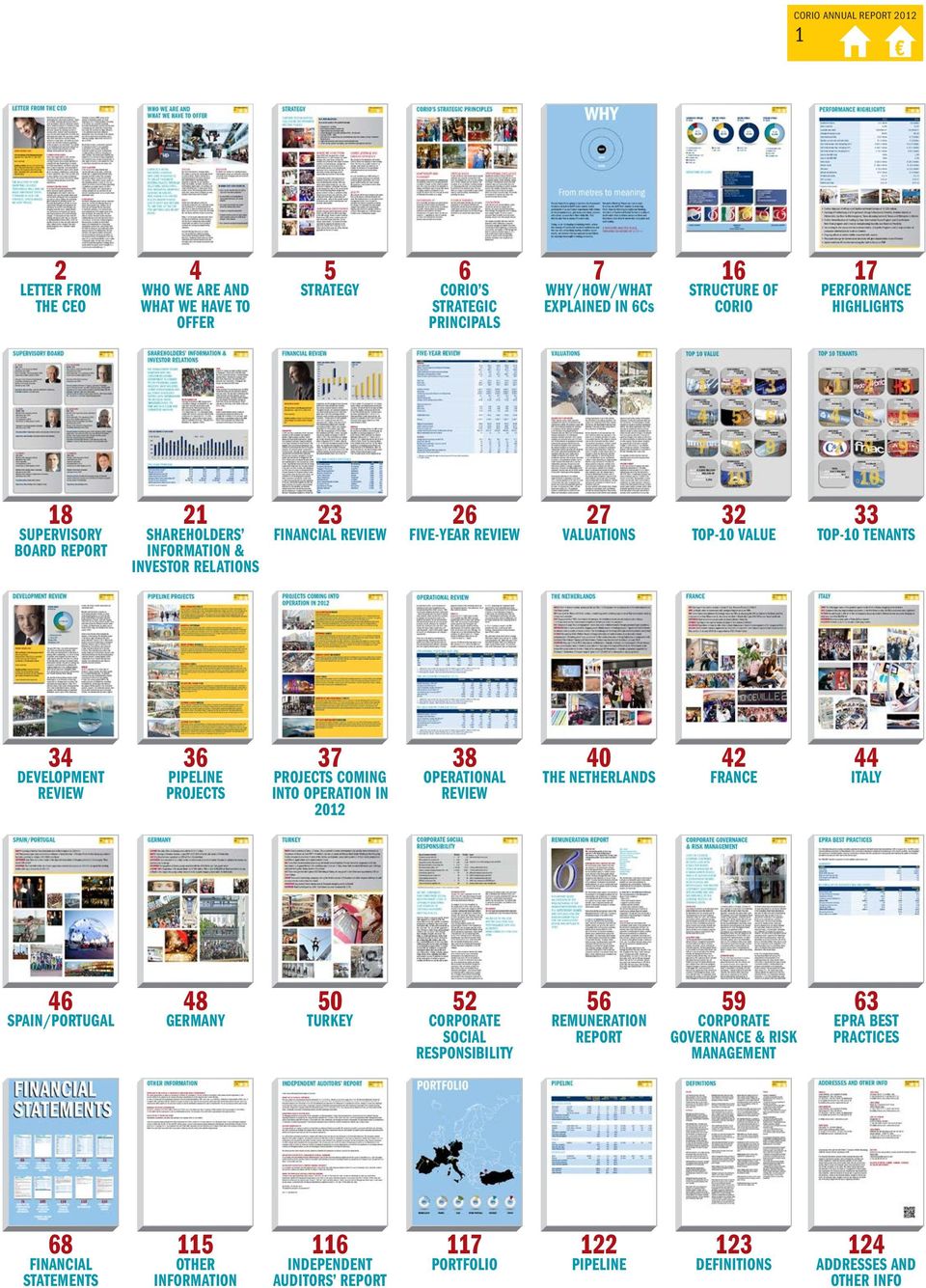
2 1 2 LETTER FROM THE CEO 4 WHO WE ARE AND WHAT WE HAVE TO OFFER 5 STRATEGY 6 CORIO S STRATEGIC PRINCIPALS 7 WHY/HOW/WHAT EXPLAINED IN 6Cs 16 STRUCTURE OF CORIO 17 PERFORMANCE HIGHLIGHTS 18 SUPERVISORY BOARD REPORT 21 SHAREHOLDERS INFORMATION & INVESTOR RELATIONS 23 FINANCIAL REVIEW 26 FIVE-YEAR REVIEW 27 VALUATIONS 32 TOP-10 VALUE 33 TOP-10 TENANTS 34 DEVELOPMENT REVIEW 36 PIPELINE PROJECTS 37 PROJECTS COMING INTO OPERATION IN OPERATIONAL REVIEW 40 THE NETHERLANDS 42 FRANCE 44 ITALY 46 SPAIN/PORTUGAL 48 GERMANY 50 TURKEY 52 CORPORATE SOCIAL RESPONSIBILITY 56 REMUNERATION REPORT 59 CORPORATE GOVERNANCE & RISK MANAGEMENT 63 EPRA BEST PRACTICES 68 FINANCIAL STATEMENTS 115 OTHER INFORMATION 116 INDEPENDENT AUDITORS REPORT 117 PORTFOLIO 122 PIPELINE 123 DEFINITIONS 124 ADDRESSES AND OTHER INFO
3 LETTER FROM THE CEO CORIO ANNUAL REPORT GERARD GROENER (1958) CEO and chairman of the Management Board Appointed from 1 May 2012 to 1 May 2016 Dutch nationality Ancillary positions Chairman of the board of the Dutch Urban Land Institute (from 1 January 2009) Member of the Supervisory Board Bouwinvest (from 7 December 2010), vice chairman EPRA Executive Board THE MAJORITY OF OUR SHOPPING CENTRES PERFORMED WELL AND WE MADE IMPORTANT STEPS FORWARD IN OUR CSR- STRATEGY, WHICH MAKES ME VERY PROUD. From the very start 2012 promised to be a challenging year, and it kept its promise. Except for Germany, consumer spending was down in all of our markets. With less disposable income due to austerity measures or a tendency to save more because of growing uncertainty about the future, people are spending less than in previous years. Germany stood out during the year, but even there towards the end of the year, retail sales were down. Still, we posted a steady total direct result and our portfolio showed resilience in tough times, with stable net rental income and new retail contracts supporting a stable occupancy rate and footfall. The majority of our shopping centres performed well and we made important steps forward in our CSRstrategy, which makes me very proud. FURTHER SPECIALISATION Since Corio began back in 2001, we have increasingly focused on developing and running European retail property operations in a sustainable way. Responding to the desire for further specialisation, we believe now is the time to take the next step, by focusing fully on Favourite Meeting Places: places where people go for any reason, whether just to meet friends or have a good time, have a bite or a drink, and to return regularly. And to shop not because they need to, but because they want to. Always finding something that goes beyond their expectations. FAVOURITE MEETING PLACES In our view Favourite Meeting Places (FMPs) deliver enhanced growth opportunities by delighting the 400 million + visitors we welcome every year. We strongly believe that our innovative offering will help us outperform and stay on track to achieve our overarching goal of growing operating income. Our Favourite Meeting Places will offer us further opportunities, through redevelopments and extensions, to adapt to and anticipate ever-changing consumer needs, adding different and new formats and services and tapping new income streams as the retail landscape changes. For that reason we have made the strategic decision to scale back our exposure to Traditional Retail Centres (TRCs), which are heavily anchored by food and daily needs and offer a stable income, but given their lower growth prospects have a somewhat higher running yield. Choosing to focus on FMP centres at the expense of traditional centres will mean disposing of a 1.4 billion portfolio consisting of 40 centres. As a result the remaining (Favourite Meeting Place) portfolio will also have an average size per centre that is much larger than today. This will allow for higher efficiency in the operations and create additional shareholder value. The proceeds of the disposal plan will be used to fund our pipeline and to lower our leverage, which at the end of 2012 was at 40.3%. We continue to take a conservative approach to financing to ensure it is as supportive as possible to our business. Within that conservative profile we further sophisticated our debt portfolio in 2012 by increasing our credit facilities. This creates more flexibility and supports a Euro Commercial Paper programme that resulted in lower average financing costs. A wide range of sources is now available to Corio to fund future commitments and reduce risk. ASSET ALLOCATION In the run-up to the larger disposal plan over the next three to four years, in 2012 we already sold 12 projects with combined sales proceeds of million. The committed pipeline was reduced as projects were taken into operation. There will be a further decline of that committed pipeline in In 2012 we opened six centres or parts of centres, generating an additional annualised income of 15.4 million. In combination with improvements on running operations we are convinced we can enhance operating income and as a result create shareholder value. SUSTAINABILITY We believe shopping centres have an important social role. Our Favourite Meeting Places are places where people relax, socialise, feel at home and get inspired. We are determined to contribute positively to the economic and social development of the regions where Corio sites are located. We create jobs. We look after our visitors. We foster social interaction. Sustainability lies at the root and at the core of our business. Our success is being recognised. We won prizes, including the Green Brick Award in the Netherlands, for outstanding sustainability performance, plus another from the VBDO for being the most sustainable listed property investor in the Netherlands. We take initiatives. We organise multiple activities for the communities our centres are located in. A full overview of these are presented in our CSR report. To us, social responsibility is not a matter of ticking the boxes. It s very much tied to our overall Favourite Meeting Places strategy, which cannot deliver the goods unless managed in a conscious and sustainable way. >>

4 3 >> MANAGEMENT A changing retail landscape calls for additional knowledge and skills. At the same time it is more important than ever to focus on today s operations, driving net operating income and rigorously managing our assets and pipeline. The organisation will be much more cash flow driven and vigorous execution will be key. Agility and efficiency will drive this culture shift. In 2012 there were a number of management changes and we invested in improving the quality of our teams. Strict performance management focused on output and execution was given a lot of attention, while at the same time allowing room for fresh ideas and innovation initiatives to bloom. Among numerous pilots and initiatives undertaken in 2012, our customer relationship management platform Britelayer stands out. After two years of piloting and testing in Le Gru, the system was rolled out into other centres like Campania and recently Alexandrium. We aim to implement it in all our FMPs. The insights we get from these customer relationship systems will enable us to customise even more our offerings and service to visitors. We see these innovations as necessary to be successful in our field over the next years. OUTLOOK 2013 Looking forward into the near future, 2013 will, without doubt, once again bring very challenging market circumstances. For Corio 2013 is a transition year in which the execution of our strategy will have our primary focus. That is why we have set ourselves some firm goals for the year Our disposal programme will be one of our prime focal points. We are strongly committed to our target of selling our TRC portfolio in the coming 3 to 4 years. Furthermore we will focus on improving the performance of our FMP portfolio. We are determined to increase the occupancy rate of our centres in Germany and France and we will continue to roll out our FMP strategy. We will make important steps towards creating a higher quality, stronger portfolio and consequently increase shareholder value. SUCCESS The retail environment is changing rapidly and radically. Demand has overtaken supply, customers shop and share their experiences with their friends in real time. New trends are born, boom and become bygone again in no time. As a host, we are being assessed, judged and rated all the time. Reputation damage or loss of customers is one tweet away. But so is success. Please follow us and let us know what you think of our Favourite Meeting Places on Gerard Groener, Chief Executive Officer Corio N.V. I WOULD LIKE TO THANK OUR CUSTOMERS FOR VISITING US, OUR TENANTS FOR DOING BUSINESS WITH US, OUR SHAREHOLDERS FOR SUPPORTING US AND OF COURSE OUR STAFF FOR GIVING THE BEST THEY HAVE IN IDEAS AND ENERGY TO CORIO IN 2012.

5 WHO WE ARE AND WHAT WE HAVE TO OFFER CORIO ANNUAL REPORT CORIO IS A RETAIL PROPERTY COMPANY. OUR CORE BUSINESS IS TO CREATE FAVOURITE MEETING PLACES THROUGH SELECTING, DEVELOPING, AND OPERATING SHOPPING CENTRES IN EUROPE. OUR VISION IS TO CREATE PLACES WHERE PEOPLE LIKE TO MEET AND RETURN TO, ANY TIME OF THE DAY, FOR ANYTHING AND IN ANY MOOD. VISION The retail environment is changing rapidly. The market is moving from being supply-driven to demand-driven. Retail is evolving from a shopping experience to a social experience. And sustainability is increasingly being integrated in daily life. We are adapting to these new realities. Our skills, combined with technological opportunities, are enabling us to create something new. To create places where people connect with shopping centres and with each other: places where individuals can relax, socialise, feel at home and be inspired. WHY People have been going to markets for thousands of years not just to fulfill basic needs, but to participate in a communal experience with others, to share experiences, get news and ideas, receive education, escape from their daily life, find friends and feel a sense of community. Today, in an increasing urbanising world, where the demise of traditional societal institutions and the rise of a networking society redefine social reality, we believe it is our purpose to contribute by creating meaningful meeting occasions. Favourite Meeting Places are our answer. It is how we shift from metres to meaning. From channel-thinking to customer-thinking. And from a Traditional Retail Centre to a vibrant destination that enriches consumer lives and that takes care of and serves the consumer and community. MISSION To improve our position as a leading European retail property investor by continuously adapting our centres to the changing needs and demands of our customers. IN DOING THAT CORIO WANTS TO: > Team up with retailers that are best in class and help them outperform > Be shortlisted by municipalities in developing large-scale, city centre projects > Be a top environmental and social performer among sector peers > Sustain a strong financial profile > Provide investors access to high quality retail property exposure in continental Europe s main markets > Be a preferred employer for professionals

6 STRATEGY FURTHER SPECIALISATION: FULL FOCUS ON FAVOURITE MEETING PLACES MID TERM OBJECTIVES Increase the quality of the portfolio through: CORIO ANNUAL REPORT > Disposal of 1.4 billion > An enhanced concept & tenant mix > Higher footfall and conversion rates > Overall NRI growth of the FMP portfolio of 4% - 6% per year > Leverage of 35% - 38% > 10% reduction in operational and administrative expenses relative to Gross Theoretical Rental Income > Higher revenues from other income streams besides rent > Culture moving towards more agility, cash flow driven and vigorous execution WHERE WE COME FROM Since 2000, Corio has grown from a Dutch mixed retail fund to a pan-european real estate company with a clear focus on retail. The company has a presence in the largest consumer markets in continental Europe, management is fully in-sourced and the business has a solid financial position. In the changing retail landscape Corio is now ready to enter the next phase and take advantage of future opportunities and dynamics in the industry. In December of 2012, Corio announced its intentions to fully focus its portfolio on the Favourite Meeting Place concept. FMPs are places where people browse, buy, eat, drink and return to regularly, not because they need to, but because they want to. We are convinced that Favourite Meeting Places will generate greater economic activity, as reflected in rising footfall and conversion rates. Over time, these centres will deliver higher capital value and cash flow growth, driven by their greater appeal for tenants as well as their redevelopment and extension opportunities. SUBSTANTIAL DIVESTMENTS Despite being good performing centres, part of Corio s portfolio will not be able to fully adapt to the FMP concept. These so-called Traditional Retail Centres (TRC) focus on daily needs, are pure convenience based and often, but not always, smaller assets. The decision to further specialise has triggered the disposal of this part of the portfolio. TRCs make up 17% of Corio s total portfolio value and will be divested gradually over the next 3-4 years. LOWER LEVERAGE AND GREATER EFFICIENCY The proceeds of the divestments will enable Corio to finance the company at lower leverage levels. The focus on a smaller number of, on average, larger assets also means we can improve the efficiency of the organisation, lowering operational and administrative expenses. All in all, the full focus on FMPs will lead to a superior quality shopping centre portfolio, enhanced growth opportunities and a more sound capital structure with lower leverage. This serves as a solid platform to drive future profitable growth. AGILITY The company will be more focused on the output than on the process, efficiency being the key word. The implementation of a new performance management system that is focused on execution and output is supportive in making this change. This translates into strict targets, stringent cost controls and benchmarking. Vigorous execution of our strategy is what it is all about. More agility and a cash flow driven mindset is key in making that happen.

7 CORIO S STRATEGIC PRINCIPLES CORIO ANNUAL REPORT ADAPTABILITY AND FLEXIBILITY We recognise the importance of understanding and adapting quickly to the changing demands and habits of people, and the trends that guide them. We create our centres to be adaptable to change. Everything is done in house with centres managed, marketed and leased by Corio people. We believe this is the only way to create the flexibility that enables us to adapt. SUSTAINABILITY To be successful, we believe our centres should be socially, environmentally and financially sustainable. We see sustainability as a catalyst for growth, which we define as contributing positively to the economic and social development of the regions where our sites are located in. In upgrading our sites for example, we create new and attractive amenities, generate jobs and build communities. CRITICAL MASS In each country we need critical mass to operate efficiently and attract the best possible team. Corio has achieved this in all of its core markets. Size is not the ultimate and sole objective, but it matters: to run an effective marketing strategy on a shopping centre level, the centre needs to be dominant in its catchment area. This then offers us a range of opportunities to gain market share by commercialising, redeveloping or extending the centre. FLEXIBLE FUNDING We have built similar flexibility into the funding programme of our company with fixed and floating debt and well balanced maturities from a wide variety of sources. Our diversified and solid capital base ensures that we have enough headroom to act quickly when opportunities arise. OPERATIONAL EXCELLENCE Operational excellence ensures that we run our business in the most profitable way. Strong cooperation between centre marketing, leasing and design & development ensures we create maximum value and opportunities when (re) developing and extending our portfolio. In-depth research and analysis of consumer needs supports these plans so that we can detect trends and needs at an early stage. This enables us to expand our business and create new sources of income for our centres. INNOVATION Corio has set up an internal platform, called LaunchLab, focused on helping Corio to innovate and execute the Favourite Meeting Place strategy. The programme aims to discover new strategic insights, as well as support innovative ideas to quickly move into action, boosting revenues from other income streams. One tangible innovation that arose from the platform in 2012 is Britelayer: a customer relationship management platform that offers a multichannel brand experience to consumers and provides new insights for FMP management teams to cater for consumer needs. In 2013 Corio is planning to implement Britelayer services in various centres throughout the portfolio, following Le Gru, Campania and Alexandrium.

8 WHY CORIO ANNUAL REPORT WHY HOW WHAT From metres to meaning People have been going to markets for thousands of years not just to fulfill basic needs, but to participate in a communal experience with others, to share experiences, get news and ideas, receive education, escape from their daily life, find friends and feel a sense of community. Today, in an increasing urbanising world, where the demise of traditional societal institutions and the rise of a networking society redefine social reality, we believe it is our purpose to contribute by creating meaningful meeting occasions. Favourite Meeting Places are our answer. It is how we shift from metres to meaning. From channel-thinking to customer-thinking. And from a Traditional Retail Centre to a vibrant destination that enriches consumer lives and that takes care of and serves the consumer and community. A FAVOURITE MEETING PLACE, EXPLAINED BY MEANS OF 6 C S >>

9 HOW CORIO ANNUAL REPORT From core to community Identify high potential locations Involve with the needs of local demand, consumers, businesses and institutions Develop partnerships and quality environment for shopping, entertainment and services As a respected authority, create a brand, channels and platform to engage with community members through all relevant (social) media Build loyal relations with consumers and business partners through relevant propositions and personalised experiences Activate social, economic and cultural dynamics as a meaningful Favourite Meeting Place: establish ownership

10 WHAT CORIO ANNUAL REPORT WHY HOW WHAT From Traditional Shopping Centres to Favourite Meeting Places

11 10 Identify high potential locations

12 11 Retail café Meet business partners Team Ocupasion Expo Real Bread & Butter Consumer survey Involve with the needs of local demand, consumers, businesses and institutions

13 12 Mums with Guts entrepreneurial contest Maremagnum Top Floor Gru Landia Kids World Centrum Galerie Dresden redevelopment De Buren click & collect service Pop Up store Arneken Galerie Markthal: food experience Meet Opportunitiy in NHC Develop partnerships and quality environment for shopping, entertainment and services

14 13 Info kiosk 365 Porta di Roma Fashion Blog Arneken Galerie Branding shopping centres Let s meet Harrie As a respected authority, create a brand, channels and platform to engage with community members through all relevant (social) media

15 14 Earn a trip to miniworld VIP members Anatolium GruKey loyalty program Le Gru Personal shoppers UP loyalty program Alexandrium Build loyal relations with consumers and business partners through relevant propositions and personalised experiences

16 15 FMP = Shared Value Community event Campania MasterPeace community L Orto slow food movement Campania Mirliton theater in Hoog Catharijne Cinema in construction area Marriage proposal in Tekira Employment at Gran Turia Activate social, economic and cultural dynamics as a meaningful Favourite Meeting Place: establish ownership

17 16 GEOGRAPHIC SPREAD BY VALUE FMP TRC SPREAD BY VALUE SECTOR SPREAD BY VALUE PIPELINE SPREAD BY VALUE 7.1 BILLION 7.1 BILLION 7.1 BILLION 1.8 BILLION NETHERLANDS 28% FRANCE 25% ITALY 18% SPAIN/PORTUGAL 10% GERMANY 10% TURKEY 8% OTHER 1% FMP 83% TRC 17% RETAIL 99% OTHER 1% NETHERLANDS 41% FRANCE 5% ITALY 20% GERMANY 34% STRUCTURE OF CORIO SUPERVISORY BOARD DERK DOIJER CHAIRMAN ROBERT VAN DER MEER VICE CHAIRMAN GOBERT BEIJER ROEL VAN DEN BERG JAAP BLOKHUIS JOHN CARRAFIELL INVESTOR RELATIONS HUMAN RESOURCES MANAGEMENT CORPORATE PR & COMMUNICATIONS INVESTMENT STRATEGY & ACQUISITIONS RESEARCH & CONCEPTS CORPORATE SOCIAL RESPONSIBILITY TRC DISPOSAL TEAM MANAGEMENT BOARD GERARD GROENER CEO BEN VAN DER KLIFT CFO FREDERIC FONTAINE COO/CDO LEGAL & COMPLIANCE RISK MANAGEMENT TREASURY FINANCE & CONTROL TAX INFORMATION MANAGEMENT OFFICE SUPPORT MARKETING LEASING CENTER MANAGEMENT BUSINESS SUPPORT

18 PERFORMANCE HIGHLIGHTS CORIO ANNUAL REPORT Number of visitors 415 million 410 million Retail contracts 6,200 6,250 Leasable area retail 1.8 million m million m 2 Average Occupancy retail 96.6% 96.2% Operational portfolio 6.6 billion 7.0 billion Pipeline (committed and deferrable) 1.8 billion 1.9 billion Net rental income retail (including EAI*) million million Net rental income FMP (including EAI*) million million Net rental income TRC (including EAI*) 79.7 million 89.6 million Like-for-like NRI retail -0.6% 1.9% Like-for-like NRI FMP 0.0% 2.1% Direct result million million Indirect result million million Net result 16.0 million million Market capitalisation 3.3 billion 3.1 billion Dividend per share NAV per share NNNAV per share * Equity Accounted Investees. > Further disposal of offices and Traditional Retail Centres of 329 million > Opening of Vredenburg and Singelborch (Hoog Catharijne in Utrecht), Arneken Galerie in Hildesheim, top floor in Maremagnum, Tarsu shopping centre in Tarsus and Metropole in Almere > Further diversification of funding by Euro Commercial Paper Program and Euro Medium Term Note program and 2 bonds strengthening liquidity and financial flexibility > Connecting to the consumer via implementation of Loyalty Programs and a large number of consumer oriented pilots in all our centres > Ongoing efforts in sustainability rewarded with awards > Proposed change for Governance structure will give shareholders more influence > Implementation 6C model enhancing the further focus on FMP

19 SUPERVISORY BOARD CORIO ANNUAL REPORT D.C. DOIJER DERK, 1949 Chairman of the Supervisory Board attendance rate 100% Dutch nationality / First appointed in 2005 Current term of office expires in 2013 Chairman of the Selection & Appointment Committee attendance rate 100% Member of the Audit Committee attendance rate 100% Supervisory directorships Lucas Bols Holding B.V. (chairman), Koninklijke Ahold N.V. and ZBG Groep R.A.H. VAN DER MEER ROBERT, 1949 Vice-chairman of the Supervisory Board attendance rate 100% Dutch nationality / First appointed in 2004 Current terms of office expires in 2015 Chairman of the Audit Committee attendance rate 100% Present positions Professor of Finance, University of Groningen, director Stichting Vrienden van UMC, Stichting Corpus, Stichting GITP International and deputy justice (raadsheer-plaatsvervanger) with the Enterprise Chamber (High Court Amsterdam). Supervisory directorships European Asset Trust N.V., BNP Paribas OBAM N.V., Kas Bank N.V. and Teslin Capital Management N.V. G.A. BEIJER GOBERT, 1950 Member of the Supervisory Board attendance rate 100% Dutch nationality First appointed in 2009 Current term of office expires in 2013 Chairman of the Remuneration Committee attendance rate 100% Present position Independent advisor and associate of Boer & Croon Supervisory directorships Staedion. R.C. VAN DEN BERG ROEL, 1957 Member of the Supervisory Board attendance rate 100% Dutch nationality / First appointed in 2011 Current term of office expires in 2015 Member of the Remuneration Committee attendance rate 100% Member of the Selection & Appointment Committee attendance rate 100% Present positions Founder/co-owner of the Access to Quality network organisation, vice-chairman of the Joop naar Moldavië Foundation, member of the creative board of the Academy for I&M, partner Business School Knowmads in Amsterdam. Supervisory directorships Member of the advisory board of My Cognition, member of the advisory board of the foundation GGTO. J.G. BLOKHUIS JAAP, 1958 Member of the Supervisory Board attendance rate 100% Dutch nationality First appointed in 2012 Current term of office expires in 2016 Member of the Remuneration Committee attendance rate 100% Member of the Selection & Appointment Committee attendance rate 100% Present position Independent advisor Supervisory directorships Rabo Vastgoed Groep. J.A. CARRAFIELL JOHN, 1965 Member of the Supervisory Board attendance rate 100% American nationality First appointed in 2012 Current term of office expires in 2016 Member of the Audit Committee attendance rate 100% Present positions Founder and managing partner of GreenOak, director of Grupo Lar (Spain) and a member of the Dean s Council of the Yale School of Architecture Supervisory directorships None.

20 SUPERVISORY BOARD REPORT CORIO ANNUAL REPORT TO THE GENERAL MEETING OF SHAREHOLDERS Herewith we present the 2012 annual report and financial statements as drawn up by the Management Board. PricewaterhouseCoopers Accountants N.V. has audited the financial statements and issued an unqualified auditors report on these statements. We recommend that you adopt the financial statements as presented and declare a dividend payable in cash and/or in shares of 2.76 per share for 2012 in accordance with the Management Board s proposal. The objective of Corio s dividend policy, to be found on Corio s website is to at least comply with the requirements for a Dutch fiscal investment institution (FBI) imposed on tax-exempt investment institutions and, except in special circumstances, to maintain the level of dividend on a per share basis and preferably increase this dividend by the average rate of inflation in the euro area. Corio will propose a new dividend policy to the AGM that is more sustainable and linked to the operational performance of the company. COMPOSITION OF THE SUPERVISORY BOARD Corio s Supervisory Board consists of six members: Mr. Derk Doijer (chairman), Mr. Robert van der Meer (vice-chairman), Mr. Gobert Beijer, Mr. Roel van den Berg, Mr. Jaap Blokhuis and Mr. John Carrafiell. Each member provides a particular talent and/or background in order to provide the Supervisory Board with a broad range of expertise in line with the Supervisory Board profile. For further information we refer you to the curriculum vitaes in this report. All members of the Supervisory Board have adequate time available to give sufficient attention to the concerns of the company. As of 1 January 2013 the Act on Management and Supervision ( Wet Bestuur en Toezicht ) came into effect. With this Act, statutory provisions were introduced to ensure a balanced representation of men and women in management boards and supervisory boards of companies governed by this Act. Balanced representation of men and women is deemed to exist if at least 30% of the seats are filled by men and at least 30% are filled by women. Corio has currently no seats taken by women. Since Corio does not comply with the law in this respect, it has looked into the reasons for non-compliance. The Supervisory Board recognises the benefits of diversity, including gender balance. However, the Supervisory Board feels that gender is only one part of diversity. Supervisory Board and Management Board members will continue to be selected on the basis of wide ranging experience, backgrounds, skills, knowledge and insights. During the search for two new Supervisory Board members in 2012 there was a preference for female candidates. Unfortunately, no such candidates were found or were available to fulfill these positions. The Supervisory Board continues to strive for more diversity in both the Supervisory Board and Management Board. For more information on the rules of the Supervisory Board please refer to the profile of the Supervisory Board on Corio s website All members of the Supervisory Board are independent according to the criteria as set out in the Dutch corporate governance code. The terms of Mr. Doijer and Mr. Beijer will lapse and therefore the Supervisory Board will nominate them for reappointment at the 2013 General Meeting (AGM 2013). MEETINGS OF THE SUPERVISORY BOARD In 2012 the Supervisory Board met with the Management Board in plenary sessions on 11 occasions (four by means of a telephone conference). The Supervisory Board also had seven private meetings (two by means of a telephone conference), of which five preceded a Supervisory Board Meeting. None of the members of the Supervisory Board was frequently absent from meetings. The attendance rate was 100% for the plenary sessions. For the individual attendance rates of the members please refer to their curriculum vitaes in this report. The financial performance of Corio was discussed extensively both in general and in preparation for the publication of the quarterly reports, half-yearly figures, the annual report and financial statements. The external auditors presented the results of their examinations at the meetings at which the half yearly figures and financial statements of the year were discussed. The Supervisory Board and the Audit Committee discussed the audit findings with the external auditors. The Supervisory Board met with the external auditor without any Management Board member present at least once. Furthermore, investment proposals were reviewed, paying attention to items such as sustainability and the possibilities to turn a shopping centre into a Favourite Meeting Place and to optimise financial performance. During a Supervisory Board meeting in Berlin in September 2012 Corio s strategy was discussed with the Management Board paying specific attention to executing the Favourite Meeting Places strategy, funding and execution thereof. The departure of the COO, strategy, risk management and control systems, sustainability of the dividend policy, compliance, financing, CSR, targets, HR organisation, monitoring sales program, development of the pipeline, the annual budget and opportunities were also discussed. Various scenarios that take into account market conditions and their impact on operations and the financing of Corio were reviewed and discussed. Another important topic was the enhancement of the corporate governance structure of the company. The necessary amendments to the Articles of Association that are required to implement the proposed changes in the corporate governance structure will be put forward to the AGM Without the Management Board present the Supervisory Board discussed its own performance, the performance of the committees, as well as its individual members. The evaluation was led by the chairman of the Supervisory Board and entailed reviewing and discussing the frequency, attendance and subjects of the meetings as well as the level of participation of the members during discussions. All members of the Supervisory Board were asked to complete a survey

21 20 regarding the Supervisory Board meetings and the meetings of the committees of which they were a member. The outcome was that the Supervisory Board as a whole and its individual members performed well. Special attention will be paid to the permanent education of the Supervisory Board members. Bearing in mind the current economic environment, the Supervisory Board took a more active role when advising the Management Board on execution and the strategic direction of Corio. The performance of the Management Board as a whole, as well as its individual members was also discussed and evaluated. During these discussions the Management Board was not present. As with the Supervisory Board, the evaluation was led by the chairman of the Supervisory Board. The chairman of the Supervisory Board and the chairman of the Management Board met regularly to discuss general matters affecting Corio. REPORT OF THE SELECTION & APPOINTMENT COMMITTEE The Selection Committee met three times in To fill the vacancy resulting from the departure of the COO, the Selection & Appointment Committee conducted a search together with a professional recruitment agency. The search placed an emphasis on operational and real estate knowledge and there was a preference for female candidates in the event of two candidates, one male, one female, with similar quality credentials. Candidates were proposed by the recruitment agency as well as members of the Supervisory Board. The search process and the candidates were discussed during the Selection & Appointment Committee meetings. The Selection & Appointment Committee also discussed the re-appointment of Mr. Doijer and Mr. Beijer. REPORT OF THE REMUNERATION COMMITTEE The Remuneration Committee met three times during Items discussed include the short-term and long-term incentives of the Management Board, the performance of the members of the Management Board, the remuneration of the second echelon, the longterm incentive plan, the remuneration policy, the remuneration of the CDO and the remuneration report. The Remuneration Committee conducted scenario analyses in order to assess whether the maximum cash value of the Phantom Performance shares is still reasonable. The Remuneration Committee advised that the outcome of the scenario analyses is in line with the spirit and principles of the Performance Phantom Share Plan. The remuneration report was adopted by the Supervisory Board. Further information on the structure and background of the remuneration policy can be found in the remuneration report in this annual report and on Corio s website The process followed in 2012, was in line with the remuneration policy approved at the Extraordinary General Meeting of Shareholders on 10 December 2004 and the proposed amendment adopted by the General Meeting of Shareholders on 29 April REPORT OF THE AUDIT COMMITTEE The Audit Committee met five times in The main topics of discussion were the quarterly reported numbers, the auditor s report, the management letters and an assessment of the performance of the external auditor. With regard to the performance of the external auditor, the Audit Committee concluded that their performance was adequate. The Audit Committee met with the external auditor without any Management Board member present at least once in Risk management, the disposal plan, valuations, accounting policies, audit fees, IT systems, treasury activities and policies and the company s financial results and position were discussed. In addition the policy on the use of external auditors for audit and non-audit services was also discussed and an amendment was proposed and approved by the Supervisory Board. The amendment concerned the approval thresholds for audit services and non-audit services by the external auditor. For more information on the approach for non audit services and the steps in place to protect statutory auditor independence please refer to the aforementioned policy which is available on Corio s website At least once every four years the Supervisory Board and the Audit Committee conduct a thorough assessment of the functioning of the external auditor. The Audit Committee discussed the management letter with the external auditor and advised to the Supervisory Board that no matters in the management letter were applicable for disclosure. The Audit Committee advised the Supervisory Board to present PricewaterhouseCoopers Accountants N.V. to the Annual General Meeting of Shareholders as external auditor for The Supervisory Board agreed. In addition the Audit Committee reviewed whether to appoint an internal auditor and came to the conclusion that this was not necessary at this time. On the basis of the conclusion of the Audit Committee, the Supervisory Board recommended not to appoint an internal auditor. During 2013 the Audit Committee will again review whether to appoint an internal auditor. PERSONNEL We would like to take this opportunity to express our appreciation and thanks to the Management Board and Corio s employees for their hard work and dedication during this eventful year. Utrecht, 13 February 2013 The Supervisory Board
22 SHAREHOLDERS INFORMATION & INVESTOR RELATIONS CORIO ANNUAL REPORT THE MANAGEMENT BOARD, TOGETHER WITH THE INVESTOR RELATIONS DEPARTMENT, IS COMMIT- TED TO PROVIDING SHARE- HOLDERS, DEBT HOLDERS, OTHER STAKE HOLDERS AND ALL OTHER INTERESTED PARTIES WITH INFORMATION ON AN EQUAL BASIS, SIMULTANEOUSLY, ON TIME AND IN A CLEAR AND CONSISTENT MANNER. MAJOR SHAREHOLDERS Stichting Pensioenfonds ABP (through direct and indirect holdings) and BlackRock Inc. own more than 5% of the issued share capital. ABP informed the Netherlands Authority for the Financial Markets (AFM) on 2 February 2010 that it owns 36.77% of the issued share capital. ABP informed Corio that it held 32.65% at year-end 2012 (year-end 2011: 32.29%). BlackRock Inc. owns 5.04% of Corio s shares since 15 November 2012 (on 7 February 2013 BlackRock Inc. registered 4.96%). SHARE Corio N.V. s shares are listed on NYSE Euronext in Amsterdam. Corio is part of the AEX index. The Corio shares are included in several relevant leading indices, including the European Public Real Estate Association, the Global Property Research, the Euronext100, FTSE4good, DJSI Europe and World and ASPI index. COST RATIO Under the Dutch Financial Supervision Act (Wft), investment institutions are required to disclose their cost ratios. The cost ratio is defined as total costs (property operating expenses, general expenses and taxes), excluding interest charges, as a percentage of the weighted average net asset value for the past five quarters. Corio s cost ratio for 2012 was 2.6% (2011: 2.3% and 2010: 2.4%). DIVIDEND Corio s current dividend policy is aimed at increasing the dividend per share by the average rate of inflation in the euro zone. Corio will propose a new dividend policy to the AGM that is more sustainable and linked to the operational performance of the company. PRICE AND TURNOVER OF CORIO SHARES 500 MILLION J F M A M J J A S O N D J F M A M J J A S O N D 20 FIVE YEAR OVERVIEW Share price period end ()* Average share price ()* Highest closing share price ()* Lowest closing share price ()* Average number of daily traded shares ()* 405, , , , ,421 Number of outstanding shares 96,186,136 92,291,961 91,002,947 76,363,025 66,253,702 Market capitalisation period end (x billion) * On NYSE Euronext Amsterdam.
23 22 NEW POLICY THAT WILL BE PRESENTED AT THE AGM OF 18 APRIL 2013 Corio distributes its dividends at least once per year. The objective of Corio s dividend policy is at least to comply with the FBI requirements and distribute 80% - 90% of its total direct result in dividend. Corio may propose to the General Meeting of Shareholders to pay this dividend, within the FBI requirements, in cash or in shares or a combination thereof. CURRENT POLICY Corio pays a dividend at least once a year. The objective of Corio s dividend policy is to at least comply with the requirements imposed on FBIs and, except in special circumstances, to increase the dividend by the average rate of inflation in the euro area, on a per share basis. In accordance with the Management Board s recommendation, Corio s Supervisory Board proposes that a dividend of 2.76 per share be distributed for 2012 (2011: 2.76 in cash or shares). This represents a pay-out ratio of approximately 101%. The dividend is payable in cash or stock, within the constraints imposed by the company s FBI status. The dividend yield is thus 7.9% on the basis of the average price in The dividend proposal will be submitted to the AGM on 18 April The dividend will become payable on 3 June FINANCIAL CALENDAR Full year 13 February 12 February First quarter update 15 May 7 May Half-year results 7 August 6 August First three quarters update 7 November 5 November General Meeting of Shareholders 18 April 17 April Ex dividend Start of period of choice End of period of choice Dividend payable Corio will no longer publish extended results press releases for the first quarter and first three quarters. Corio will publish updates which include the main company events and key performance indicators in relation to the respective reporting period. 22 April 25 April 29 May 3 June For annual and semi-annual results, Corio will continue to provide a detailed press release, presentation and webcast. In addition, Corio will continue to publish annual reports and semiannual reports containing in-depth information on its operations, financials and execution of its strategy. For further information on Corio s investor relations activities, please contact our Investor Relations department at investor.relations@ nl.corio-eu.com or by phone: Follow us on Corio aims to be in close contact with its investors through participating actively in conferences, organising road shows and meeting investors individually at our offices or at properties throughout our portfolio. Corio organised a Capital Markets Day on 4 December 2012 to inform investors analysts about our strategy going forward. The Favourite Meeting Places concept as the core of our business, the consequent disposal program, and a full demonstration of our largest redevelopment, Hoog Catharijne were shown. Presentations are available on our website:
24 FINANCIAL REVIEW CORIO ANNUAL REPORT DIRECT AND INDIRECT RESULT MILLION 400 DIRECT RESULT MILLION BEN VAN DER KLIFT (1959) CFO and member of the Management Board Appointed from 1 May 2010 to 1 May 2014 Dutch nationality Ancillary positions Member of the advisory board of the mortgage fund Syntrus Achmea Vastgoed B.V. INTRODUCTION In 2012 we saw a contraction of the Euro-zone economy as well as weaker than expected growth in large emerging countries. Global growth continued below expectations, despite unconventional monetary measures adopted in the major economies to boost demand. This suggests there are structural weaknesses that continue to create downside risks for the global economy. US economic growth accelerated in the third quarter, although the outlook remained uncertain due to potential fiscal tightening. The Euro-zone entered a recession in the same quarter and was forecast to struggle well into Private sector confidence remains fragile and unemployment in the Euro-zone as a whole is high. Countries like Spain and Italy are having a particularly tough time and the pace of growth in the core Euro-zone countries was slowing too as 2012 came to a close. In the second half of the year, however, the financial markets turned more positive about the Euro-zone s future, and confidence in the banking sector improved. Yields of periphery government bonds came in, after increasing steadily from the beginning of the year, and investor appetite for debt and equity improved. This was the result of strong words by the ECB president, an improved political environment around the euro crisis, and the introduction in August of the Outright Monetary Transactions programme. Under this programme, the ECB pledged to buy Euro-zone government bonds provided that countries take actions to restore long-term stability. Throughout the year, and especially towards the end, there was strong demand for investment grade paper Corio took advantage of these improved market conditions by issuing bonds in December. The total value of Corio s portfolio came to 7.1 billion per year-end 2012 compared to 7.4 billion at the end of This predominantly reflects asset disposals amounting to million and a negative revaluation of million, which were partly offset by acquisitions of 22.8 million and investments of million. Net rental income was virtually unchanged at million in This is the balance of negative like-for-like net rental income of 0.6% and the effect of disposals of 14.4 million, offset by 16.7 million from development projects being taken into operation and acquisitions of 1.4 million. The latter relates to Metz St Jacques acquired in Net rental income for the FMP portfolio (including net rental income for Equity Accounted Investees) rose 5.9% in 2012 to million. The increase of 19.2 million mainly reflects new developments coming into operation. The like-for-like for the retail portfolio was 0.6% negative, whereas the like-for-like for the FMP portfolio was flat. The direct result per share decreased from 2.91 to 2.77, reflecting difficult market circumstances, the disposal of properties in 2011 and 2012 and increased share capital related to our 50% stock dividend in DISPOSALS In line with our strategy to focus on FMP, to fund the pipeline and maintain a sound leverage, we intensified our disposal programme in In the course of 2012 Corio sold the offices in Böblingen, Germany ( 14.7 million) and Le Balzac ( 79.7 million) and Clair de Ville ( 39.3 million) in Paris, France. The remaining offices in the portfolio at year-end 2012 are the offices attached to our shopping centres Almere and Hoog Catharijne in the Netherlands, which are not on the sales list, and two remaining smaller offices in France that we expect to sell. From the retail centres on the disposal list we TRC AND OFFICES DISPOSALS City Project name GLA ( mln) Almelo (Netherlands) De Schelfhorst 6, Amstelveen (Netherlands) De Groenhof 6, Oegstgeest (Netherlands) Lange Voort 14, Nieuw Vennep (Netherlands) Getsewoud 7, Rotterdam (Netherlands) Nesselande 8, Utrecht (Netherlands) Parkwijk 5, Velsen (Netherlands) Velserbroek 8, Mulhouse (France) La Galerie 7, Sainte Genevieve des Bois (France) La Croix Blanche 6, Courbevoie (France) Le Balzac 15, Rueil Malmaison (France) Clair de Ville 10, Böblingen (Germany) Rondahaus 13, Other 1.0 Total 329.4
25 24 MATURITY AND INTEREST RESET DATE MILLION MATURITY INTEREST RESET DATE 943 M OF FLOATING DEBT WILL BE RESET IN 2013 contributed a positive 9.3 million to our direct result. The average interest rate fell from 4.2% in 2011 to 3.9% in Per share, the direct result fell 4.8% from 2.91 to 2.77 per share. Of this, 1.9% reflects a lower net direct result attributable to shareholders and the remainder can be attributed to the expanded share capital as a consequence of our 50% stock dividend payout in > Leverage (%) Average interest on net debt in the 4th quarter (%) Average duration of debt (year) % loans with a fixed interest rate Interest cover ratio Headroom sold La Galerie Mulhouse ( 8.9 million) and three out of four units of our retail park La Croix Blanche in Sainte-Geneviève ( 13.7 million) in France and in the Netherlands De Schelfhorst in Almelo ( 14.0 million), De Groenhof in Amstelveen ( 24.2 million), Lange Voort in Oegstgeest ( 43.7 million), Velserbroek in Velsen ( 25.9 million), and a package of three assets Nesselande in Rotterdam, Getsewoud in Nieuw Vennep and Parkwijk in Utrecht for a total of 64.3 million. These sales generated a total consideration of million and a loss compared to book value of 20.0 million. This reflects an impairment of 15.3 million on the disposal of the office of Balzac and 4.7 million on the remaining sales at an average discount on book value of 1.9%. The annualised net rental income related to these disposals is around 22.7 million. Following our strategic update in December 2012 we took a more vigorous stance on disposals. We identified a list of 1.4 billion Traditional Retail Centres across our portfolio to be disposed of in the coming three to four years to enable Corio to fully focus on its FMP centres. We have installed a dedicated team to implement this sales programme. LIKE-FOR-LIKE NET RENTAL INCOME Like-for-like net rental growth including Equity Accounted Investees in 2012 was 0.6% negative. The like-for-like for the FMP portfolio was flat. The retail portfolio displayed growth in like-for-like of 0.6 % negative and the office portfolio (1% of total portfolio at year-end 2012) registered likefor-like rental income growth of 4.1%. The adverse economic environment had a negative impact on consumer confidence in We saw, however, that prime properties are still able to generate positive like-forlike, despite pressure on overall consumer spending, while more secondary centres are facing pressure. The overall like-for-like for our FMP centres, however, was flat due to specific conditions: our properties Centrum Galerie in Dresden and Grand Littoral in Marseille are currently being refurbished, which has an impact on the ongoing operations and in Italy, where operational expenses and service charges increased as one off effect in 2012 due to higher real estate tax ( 0.9 million), together with a negative adjustment on recoverable service charges from previous years of 1.0 million. DIRECT RESULT The direct result was million, which is only slightly lower than million earned in Like-for-like net rental income was 0.6% negative. The administrative overhead was 5.3 million higher in 2012 due to growth in Germany and Italy, more investments in innovation (Britelayer), more consultancy costs and delayed cost reductions in the Netherlands and France following a decrease in the size of the portfolio through sales. We anticipate a stronger impact of cost reductions in 2013 due to the delayed effects of our disposal programme and increased focus on efficiency. The continuing decline in interest rates INDIRECT RESULT The revaluations of our operational properties across our portfolio were million negative (3.6%) including the profit and loss results of asset sales. Spain, Italy and Centrum Galerie Dresden in Germany especially faced pressure on asset values, even though Dresden and the majority of our Italian assets are FMP. The FMP properties outperformed the traditional portfolio but non-the-less suffered a negative revaluation of 2.8% versus 5.5% negative for TRC. The development portfolio (FMP) saw a positive revaluation of 24.1 million (4.2%). The other components of indirect result, totaling 29.3 million negative, concern negative revaluations of EAI s ( 7.1 million), indirect taxes and finance expenses ( 6.7 million), provisions for a VAT court case in Italy ( 12.9 million) and an impairment on our turn-key development Leidsche Rijn in Utrecht, the Netherlands ( 14.1 million). This impairment reflects a higher anticipated yield than agreed with the developer in 2007 and lagging residential development in that part of the city of Utrecht. PIPELINE In 2012 Corio took six projects in Germany, the Netherlands, Spain, and Turkey into operation. The value of the total pipeline fell accordingly from 1.9 billion to 1.8 billion. The committed pipeline went from 926 million to 887 million at the end of In 2013 around 510 million of the committed pipeline will be taken into operation, of which 97 million has already been paid. In Germany Boulevard Berlin will enter Corio s portfolio as of 15 January 2013 and the refurbishment of Centrum Galerie in Dresden will be finalised. In the Netherlands the third phase of CityPlaza Nieuwegein and Oosterheem in Zoetermeer will start operations and in France the refurbished zone Azur in Grand Littoral will open. At year-end 2012 the anticipated net initial yield of the total pipeline was 7.4% compared with 7.2% at year-end FINANCING ACTIVITIES The most notable financing transaction in 2012 was the issuance of two private placements of bonds under our newly launched EMTN programme. The total size was 235 million, with a four-and-a-half and ten year maturity.
26 25 NNNAV (EPRA) PER SHARE ( 1) 60 NAV BEFORE RESULT APPROPRIATION PER SHARE ( 1) 60 DIVIDEND PER SHARE The dealers under the EMTN program are the seven Corio relationship banks. In April we successfully launched our ECP progamme with a maximum issuance size of 500 million, having increased the committed facilities available by entering into a 3-year additional revolving credit facility of 50 million in February. At year-end 2012 a headroom of 750 million undrawn revolving credit facilities was freely available. Shareholders equity at year-end 2012 amounted to 4,082.5 million (year-end 2011: 4,206.0 million) or per share (2011: 45.57). The decrease is due primarily to the negative revaluation of the property portfolio. In May Corio increased its share capital by issuing 3.9 million shares as stock dividend. At year-end 2012, leverage was 40.3% (2011: 41.0%). The interest cover ratio was 3.4 (2011: 3.3). Our private debt stipulates thresholds of a maximum of 55% and minimum 2.2 for leverage and interest cover respectively. The average duration of net debt decreased to 4.7 years at the end of 2012 (2011: 5.1 years). INTEREST RATE EXPOSURE The average interest rate on borrowings in the fourth quarter of 2012 was 3.7% (2011: 4.1%). The average rate for the year was 3.9% (2011: 4.2%). Corio s policy is to arrange at least two thirds of its long term debt at fixed rates. Fixed rate debt with a remaining maturity of one year is considered as floating debt. At year-end 2012, long-term fixed-rate borrowings accounted for 69% of the group s interestbearing net debt. The interest expense decreased in 2012 due to lower interest rates. This was partly offset by a higher average borrowing amount. Net finance expenses fell to million from million in In 2013 about 943 million of net borrowings will face an interest rate reset. This consists of 250 million of debt reset on a monthly basis and of 606 million reset quarterly, 84 million reset semi annually and 3 million of debt repayments. CURRENCY EXPOSURE Corio s currency risk derives from its investments in Turkey and Bulgaria. Our US dollar investments in Akmerkez and Adacenter are hedged by a $ 190 million loan and an $ 81 million swap contract to avoid currency fluctuations having an impact on the group s results. The value of these investments is $ million. A 10% depreciation of the US dollar to the Euro will result in a loss on the investment of 20.4 million and in a gain on the combined hedge instruments thereon of 18.7 million (2011: 19.0 million). On 31 December 2012 these investments were covered by loans and swaps amounting to $ 271 million. Corio receives US dollardenominated rental income from the shopping centres Akmerkez and Adacenter in Turkey, which is partly offset by US dollar interest on a $ 190 million loan. TAX STATUS Corio strives to optimise its tax burden in order to achieve the highest possible return on its investment activities. Corio therefore continuously explores possibilities to improve its tax structure within the boundaries of the law. As a result Corio s current structure consists of a mix of taxable structures and tax exempt structures. Currently, Corio has activities in seven countries: France, Italy, the Netherlands, Spain, Turkey, Germany and one centre in Portugal. In the Netherlands and France Corio uses specific tax regimes (FBI and SIIC respectively) that result in an effective tax rate of 0% on the investment profit realised on virtually the entire local portfolio. Activities in Italy, Spain, Turkey, Germany and Portugal are taxed at the normal statutory tax rate, be it that the effective tax rate may be lower as a result of the combined effect of interest charges, depreciation and other operating expenses. In Germany we were able to structure Corio s local activities for those assets that have become operational in 2011 in such a way that we were able to pay a lower statutory tax rate of 15.75%, down from 32%, on income from the operational asset portfolio. The assets that became operational in 2012 and become operational in 2013 will enjoy the lower tax rate from 2013 and 2014 respectively. In Spain a law change on the limit of interest deductibility adversely impacted the company s investment structure. Corio is investigating alternative investment structures and expects to implement an improved structure during The tax-friendly regimes in the Netherlands and France are subject to certain conditions. Corio constantly monitors these conditions to ensure proper compliance. One of these conditions In France stipulates that if a shareholder with an ultimate interest in Corio of more than 10% is not liable for tax, the SIIC must pay 20% tax on both its income and any capital gains that it has realised relative to the respective number of shares of that particular shareholder on any dividends distributed by Corio to its shareholders, including dividends from the SIIC. Corio is of the opinion that this law violates relevant EU legislation and will contest any assessment to this extent. DIVIDEND The General Meeting of Shareholders will be invited to approve a dividend of 2.76 per share (2011: 2.76) in cash or stock, in line with our policy and within the constraints imposed by the company s FBI status.
27 FIVE-YEAR REVIEW CORIO ANNUAL REPORT (x million) * FINANCIAL Gross rental income Property operating expenses (including service charges) Net rental income Share of direct result of equity accounted investees Revaluations (including result on sales) Share of indirect result of equity accounted investees Total result Direct result Indirect result Invested in property 7, , , , ,038.7 Total assets 7, , , , ,408.4 Shareholders equity (excluding non-controlling interest) 4, , , , ,458.5 Leverage (%) Interest coverage ratio Average number of issued shares (million) Figures per share ( 1) Total result Direct result Indirect result Shareholders equity Dividend 2.76** 2.76** 2.69** 2.65** 2.64** Highest closing shareprice Lowest closing share price Share price at year-end Average stock exchange turnover on NYSE (shares per day) 405, , , , ,421 Market capitalisation year-end ( billion) BUSINESS Average financial occupancy rate retail (%) Like-for-like retail (%) Reletting and renewal retail, increase in rent (%) Share portfolio in retail (%) Pipeline ( billion) Average Net Theoretical Yield retail portfolio (%) Total footfall in Corio centres (million) * Numbers are restated with regard to Equity Accounted Investees where appropriate. ** In cash or shares.
28 VALUATIONS CORIO ANNUAL REPORT VALUATION POLICY AND METHODS Corio s valuation policy entails a quarterly appraisal of fair value for the operational and development portfolio. All valuations comply with IFRS and all external valuations are performed in compliance with the valuation standards in the Red Book of the Royal Institute of Chartered Surveyors (RICS) and the International Valuation Standards of the International Valuation Standard Committee (IVSC). External valuations are performed twice year at 30 June and 31 December for all operational investment properties that generate rental income and all investment properties under development. The external valuations are carried out by independent certified appraisers with recognised and relevant professional qualifications and experience within the local market and the category of properties to be valued. Corio provides the appraiser with adequate information to conduct a comprehensive valuation. Each of Corio s business units works with at least two independent appraisers. At least once every three years a rotation or change in appraisers takes place. To assure the independence of the appraisers, valuation fees are not directly related to the current market value of the properties. Following the international and centrally organised tender of appraisers at the end of 2010, external valuations at 30 June 2012 and 31 December 2012 were conducted for the second year by the three appointed appraisers for Corio: CB Richard Ellis (CBRE), DTZ and Jones Lang LaSalle (JLL). The appraisers provided a central point of contact for Corio within their international central valuation services department. A part of the portfolio was still valued by its existing appraisers. This concerns the remaining French office portfolio (JLL France), the Real Estate Investment Trust Akmerkez (EVA) and the joint venture Porta di Roma (Cushman & Wakefield). For the valuations at half year and year-end 2012 half the portfolio was appraised on the basis of a full valuation and half on the basis of an update valuation. The valuation methods used are the discounted cash flow method and the direct capitalisation method, in which market parameters concerning rents, yields and discount rates are based on comparable and current market transactions. Properties under 25 million in value may be valued on the basis of either the discounted cash flow method, applying a 10 year holding period, or the extended direct income capitalisation method, or both depending on market practice. However, properties above 25 million are always valued by using both methods. In all cases reference transactions for both market rent and yield are included in the valuation report. For development projects the residual value method is used. The residual value is derived by determining the market value of the property upon completion using one of the above methods, less all estimated remaining cost including profit and risk allowance. Internal valuations are performed at 31 March and 30 September each year. The local business units conduct these internal valuations in consultation with Corio Holding and with the external appraisers. They provide a market letter to Corio with the latest quarterly update for each home country of the property investment market and of estimated yield and rent movements. The methodology of internal valuations is based on the direct capitalisation method. This entails updating the value of the last external valuation by factoring in recent, relevant changes in market parameters such as yields and rents and/or changes in the property such as occupancy and rents. If there are no significant changes in the market as evidenced by market transactions for both rents and yields or in the property, the last external valuations are updated only on the basis of quarterly changes in rental income i.e. by indexation and re-lettings and renewals. For investment property under development an assessment of the total remaining costs is also made. The valuation numbers reported below are excluding equity accounted investees unless otherwise stated. INVESTMENT MARKET In 2012 the volume of European real estate investments amounted to 120 billion, matching the level recorded in After a relatively slow start in the first half of 2012, with 50 billion of investments, European real estate investment rose to 70 billion in the second half of Strong activity in central London was the main driver of the increase in commercial real estate investment volumes in Europe in the third quarter of the year. Europe s second largest market, Germany, was the driver behind the significant increase in investment in the last quarter of the year. Total activity in Germany for the second half of the year was
29 28 EUROPEAN RETAIL INVESTMENTS (million) Q Q Q Q Q Q Q Q Benelux France , ,445 Germany 3,869 2,542 2,253 2,210 1,307 1,903 1,584 4,423 Italy Spain/Portugal Sweden/Denmark UK 5,138 2,165 2,089 2,267 2,248 1,696 2,745 2,863 CEE 1,090 1,193 1,389 1, Other ,291 Europe Total 12,764 7,787 8,193 9,948 5,915 6,238 7,097 13,489 % of all Investments 44% 30% 29% 28% 24% 26% 25% 32% Source: CBRE, KTI, Property Data billion, an increase of 68% on the first half of 2012, reversing a dip in the third quarter. Southern Europe underperformed as activity in Italy, Spain and Portugal fell significantly. There was some activity, however, in Spain in the final weeks of 2012, with 922 million of transactions completed in that period. EUROPEAN RETAIL INVESTMENT ACTIVITY Investments in retail property accounted for 28% of the total market in Activity seen across the European region for the retail segment also showed a very slow start in the first quarter of this year, with only of 5.9 billion of investments being transacted, but showed a remarkable recovery in the following quarters, amounting to a full year volume of 32.7 billion. However the 2012 figure is still down on the 2011 and 2010 levels by respectively 15% and 11%. A lack of product supply and scarcity of new debt were the main issues facing investors. The focus of investors remains on prime property and risk avoidance within the current very uncertain economic landscape in the Euro zone. This is behind the activity in Western European Markets as shown by the renewed strength of the German market and the limited activity in Southern Europe. This is also a factor in the type of product that is changing hands, with turnover being dominated by transactions involving large, well let, very well located buildings. However the scarcity of this kind of product is broadening investor demand to good performing more secondary assets in the stronger markets. In general transactions are taking longer to complete, impacting on overall market activity. Geographically the UK, Germany and the Nordic Countries showed the largest retail investment volumes in Germany and the Nordics also saw the highest increase in activity compared to In the Benelux region yearon-year investment activity turned out weaker, despite a small recovery in the second half of the year due to the completion of a few large transactions in Belgium and the Netherlands. In the Southern and Eastern European countries retail investment activity almost came to a stand still and volumes remained at levels below 2 billion. The 2012 quarterly performance in Germany lagged previous years until the last quarter, when investments surged to more than 2.5 times the average volume of three previous quarters and more than twice the volume of the last quarters of 2011 and This mainly reflected a few large transactions such as the acquisition of the KaDeWe department store in Berlin and 16 Karstadt department stores in Germany by Signa Prime Selection from AG Highstreet-Konsortium for 1.1 billion. With little new development completions, a lack of product supply continues to be the main stumbling block to retail investment activity in this market. France also recovered well in the second half of 2012 after a strong dip in activity in Q1. The total investment volume for the year came to 3.3 billion, more than 30% higher than the 2011 volume. This shows that investor appetite for retail high street locations and prime shopping centres retail has not faded, but the limited availability of prime opportunities has kept investment volumes at a low level. In today s risk-averse market investors have been avoiding the economically underperforming Southern Europe region. This shows very clearly in the latest results as the already weak investment activity levels deteriorated further. With virtually no investment transactions in Italy and Portugal, the only activity was shown in Spain, where La Caixa completed the sale and leaseback of a large part of its branches to Inmobiliaria Grupo Carso for 428 million. In Turkey the investment market has been gaining momentum since the second half of 2011 as European investors expanded their geographic focus to take in Turkey s strong economic prospects, encouraged also by its relatively favourable yield levels. This is underlined by the acquisition of the Redevco shopping centres Gordion, Erzurum and Magnesia by private equity fund Blackstone in the second half of YIELDS FOR THE PORTFOLIO Yields for prime properties stabilised across most European markets as investors remained focussed on the very best products in the market and the scarcity of this kind of product increased further. Exceptions were the Southern European countries, where yields for prime properties are widening as a result of the persisting sovereign debt and Euro crises. In Italy, yields increased in the second half of Amid a dearth of shopping centre deals, international investor sentiment turned more risk averse towards the Italian market. The performance of Italian treasury bonds on international capital markets is also putting upwards pressure on prime net yields. In addition, taxation measures adopted in the beginning of 2012 have undermined Italian real estate attractiveness which has led to a decrease of investment volume in shopping centres and of average deal size. Prime yields consequently shifted by bps, from 6.2% to 6.6%. Yield pressure on secondary properties is higher, at bps. In Spain too, where the economic situation is negatively affecting market sentiment, yields moved out during the second half of the year, although to a lesser extent because the Spanish market already faced relative large yield shifts in 2011 and in the first half of Yields increased by around 5-10 bps for prime shopping centres and by up to 20 bps elsewhere. In Portugal prime yields rose again by 50 bps. In Turkey prime yields remained virtually stable throughout the year. In all markets there is an ongoing polarisation between prime and secondary yields. The expectation of higher supply of secondary assets to sell, especially in the least strong Southern European markets, combined with weaker
30 29 WEIGHTED AVERAGE NET THEORETICAL YIELDS* FOR THE PORTFOLIO IN OPERATION INCLUDING EQUITY ACCOUNTED INVESTEES** NTY (rounded) NTY (rounded) NTY (rounded) difference in basis points Total FMP TRC Total FMP TRC Total FMP TRC Total FMP TRC Retail Netherlands 6.5% 6.3% 7.3% 6.5% 6.3% 7.0% 6.5% 6.3% 6.8% France 6.0% 5.6% 7.0% 6.1% 5.8% 6.9% 6.1% 5.7% 7.2% Italy 6.6% 6.5% 7.1% 6.4% 6.3% 6.9% 6.2% 6.1% 6.7% Spain/Portugal 7.5% 7.0% 8.8% 7.3% 6.9% 8.2% 7.2% 7.0% 7.8% Germany 6.2% 6.2% 6.3% 6.3% 6.5% 6.5% Turkey 8.2% 8.1% 8.4% 8.5% 8.5% 8.4% 8.4% 8.4% 8.3% Total 6.6% 6.4% 7.5% 6.6% 6.4% 7.2% 6.5% 6.4% 7.1% Other 10.7% 9.6% 8.5% 224 Total Corio 6.7% 6.6% 6.6% 7 * The Net Theoretical Yield (NTY) is calculated as an output yield by dividing the Net Theoretical Rental Income by the Net Market Value. The Net Theoretical Rental Income is the sum of the annualised contractual rent (excl. discounts and rent incentives) plus turnover based rent plus other income plus market rent for vacancy minus total non-recoverable operating expenses. ** In the calculation of the yields the property values of equity accounted investees have been taken into account. investor demand for lower performing assets, is seen weighing on secondary yields into The yield movements were also reflected in the valuations of On an annual basis the yield increased for the Italian and Spanish portfolios whereas average yields remained stable or even fell slightly in the other home countries. As a result, the overall average yield for the Corio retail portfolio increased by 8 bps to 6.6% on a rounded weighted average basis. This includes the property valuations for all operational properties in the portfolio, that is also the properties in which Corio has an interest of less than 100%. When dividing the retail portfolio into Favourite Meeting Places and Traditional Retail Centres, it appears that the yield increase in 2012 was largely caused by the TRC portfolio, the yield of which increased by 34 bps to 7.5%. For the FMP portfolio the average yield increased only 5 bps to an average of 6.4%. Within the FMP portfolio in the Netherlands, yields for the prime properties Hoog Catharijne in Utrecht and Stationade in Almere contracted slightly as new projects in these centres became operational in the second half of Nonprime and lower performing properties in the FMP portfolio such as t Circus in Almere and the Centre of Spijkenisse faced a yield increase. On balance, the yield for the FMP portfolio slipped only 3 bps and was therefore stable at 6.3% on a weighted average basis. The yield for the TRC portfolio moved out with 48 bps to 7.3%, although this did not affect the country average, which stabilised at 6.5%. This reflects the fact that part of the TRC portfolio was sold during the year and therefore its effect on the total yield diminished. In France stable to slightly lower yields for the strongest properties in the FMP portfolio balanced out the yield increase for less prime properties in both the FMP and the TRC Portfolio. On average retail yields actually declined by 6 bps to 6.0%. The weighted average yield for the FMP portfolio was 5.6% compared to 7.0% for the TRC portfolio. The drop in yield for the TRC portfolio of 16 bps in 2012 was due to lower market rental levels for a number of properties, which caused the weighted average yield calculated on the potential rent to fall compared to year-end In line with yield increases in the market, the rounded weighted average yield of the predominantly prime Italian operating retail portfolio increased with 20 bps in the first half and an additional 20 bps in the second half of 2012 to 6.6%. The weighted average yield of FMP portfolio was 6.5% compared to 7.1% for the TRC portfolio. For the Spanish portfolio, including the property in Portugal, the overall weighted average yield increased 30 bps in 2012 and reached 7.5% at year-end. However, the disparity between the FMP portfolio and the TRC portfolio was larger than in the case of Italy as the FMP portfolio remained virtually stable at 7.0%, while the yield for the TRC portfolio increased by 66 bps to 7.9%. This is when excluding the property in Portugal. It increased by 107 bps to 8.8% including this property. For the four German properties in operation, the weighted average yield decreased by 10 bps to 6.2% in the second half of 2012, after falling 20 bps in the first half of This reflected the yield for the property Forum in Duisburg at a level of 5.9% and higher yields for the less established Arneken Galerie in Hildesheim (6.5%), Königsgalerie in Duisburg (6.4%) and for Centrum Galerie in Dresden (6.5%), which partly went into redevelopment. The yield for Turkey fell 20 bps in 2012 to 8.2%. This was mainly caused by the reletting and renewal of contracts at a lower level in a few centres, causing the gross potential rent, and consequently the weighted average yield, to decrease. VALUE OF THE PORTFOLIO In 2012 the value of the operational investment property portfolio fell to 6,228.0 million from 6,624.6 million. Total revaluations over this period were million negative. This amount is the balance of 42.0 million in positive revaluations and million in negative revaluations, both including results on disposals. Other effects on total value were mainly caused by new additions to the portfolio, either by acquisitions or developments coming on stream, investments in the portfolio and by disposals. ACQUISITIONS RELATED TO SHOPPING CENTRES Middenwaard in Heerhugowaard, the Netherlands and Saint Jacques in Metz, France, where additional parts of respectively 11.5 million and 4.3 million were acquired. Other additions to the portfolio were extensions and redevelopments coming on stream in different home countries. In the second half of the year this related mainly to projects in the Netherlands. These were the two New Hoog Catharijne projects De Vredenburg and Singelborch (total 64.6 million retail and 2.6 million offices) in Utrecht and the Metropole project ( 9.4 million) in Almere that houses the largest Primark in the Netherlands. The extensions of Campania in Naples, Italy ( 8.2 million) and Quais d Ivry in Ivry Sur Seine, France ( 1.5 million) were completed and added to the respective operational properties. Other significant completions all occurred in the first half of These included Arneken Galerie in Hildesheim Germany ( million); shopping centre Tarsu in Tarsus Turkey
31 30 MOVEMENTS IN VALUE: PORTFOLIO IN OPERATION* MILLION 7,000 MOVEMENTS IN VALUE: PORTFOLIO UNDER DEVELOPMENT* MILLION , , Acquisitions Investments Transfers FX Results Pos Revaluations Neg Revaluations Disposals Acquisitions Investments Pos Revaluations Neg Revaluations Disposals Transfers * Investments include capitalised interest, positive revaluations include profit on sales and negative revaluations include loss on sales ( 42.8 million); the transformed top floor of Maremagnum in Barcelona Spain ( 23.3 million) and the latest phase of CityPlaza in the centre of Nieuwegein, the Netherlands ( 10.2 million). The redevelopment of properties making up a substantial part of Centrum Galerie in Dresden, Germany were started in 2012 and transferred to the development portfolio. In the last quarter the property St Jacques in Metz, France went into redevelopment and was removed from the operational portfolio. The disposals relate to two offices in France and ten retail assets from the TRC portfolio in the Netherlands and France. The value of the property portfolio under development, including land, increased to million from million. Total positive revaluations contributed 24.1 million to this increase, of which 48.5 million were positive revaluations and 24.4 million were impairments. Further new investments in development projects contributed positively to the value. Finally, one project was acquired, namely the extension of Campania in Naples, Italy ( 7.0 million). The value was reduced, conversely, by the earlier mentioned projects which became operational and were transferred from the pipeline to the operational portfolio. REVALUATION OF THE PORTFOLIO In 2012 the total revaluation came out negative as the economic and political crisis in the European Union continued and investment market conditions did not improve. For operational properties the revaluation was 3.6% negative. This was partly offset, however, by a positive revaluation of the development portfolio of 4.2%, resulting in a revaluation of 3.0% negative for the total investment portfolio. The main exceptional devaluation relates to Centrum Galerie Dresden in Germany, where the large negative revaluation at half year was a result of a significant downward adjustment of the estimated rental value by the appraiser. In France the negative revaluation mostly relates to the office property Le Balzac, which was disposed of for a net amount of 79.7 million, lower than the book value at 30 June 2012 of 89.8 million. The property was sold to the second bidder after the first bidder in the tender unexpectedly and at the last moment decided to cancel the transaction. This loss has been included in the total negative revaluation amount. In case of Spain and Italy, the negative revaluations were caused by overall increasing yields as a result of the ongoing economic and sovereign debt crisis. In Italy in particular, yields widened in the second half of the year, reflecting the appraisers view of investment market sentiment as having taken a turn for the worse. For the Netherlands the negative revaluation for the operational portfolio was offset by the positive revaluation of the Nieuw Hoog Catharijne development project. This project was valued externally at fair value as per year-end 2012, resulting in a positive revaluation of 42.5 million. When looking at the FMP portfolio the revaluation percentages were considerably less negative in all home countries. Overall revaluation for the FMP operational portfolio was 2.8% negative as compared to 5.5% negative for the TRC portfolio. THE NETHERLANDS The largest positive revaluations in the operational retail portfolio in the Netherlands (total 18.5 million including profit on sales) were for Alexandrium in Rotterdam (up 7.0 million) and for the completed Metropole project in Almere, which attracted the new anchor Primark and contributed to the positive revaluation of Almere Centrum (total up 3.0 million). The recently renovated and extended City Plaza in Nieuwegein (up 2.7 million) and Middenwaard in Heerhugowaard (up 1.9 million) also showed positive revaluations. Positive results on the sales of Velserbroek in Velsen ( 1.5 million) and Groenhof in Amstelveen ( 1.2 million) contributed to the positive revaluation too. With regard to properties under development, total revaluations were positive (total up 37.0 million). This was mainly caused by the positive revaluation of the Nieuw Hoog Catharijne project (up 42.5 million) which was valued at Fair Value at the end of the year. Using the principles of the residual valuation method, the external appraiser determined the value of the property upon completion and deducted all estimated remaining cost including a profit and risk allowance. The valuation upon completion now includes the optimisation of rents towards the higher market rent and the increase in retail area arising from the redevelopment plan. This resulted in a positive revaluation of 42.5 million at year-end 2012, including the revaluations of the completed Nieuw Hoog Catharijne projects Singelborch and Vredenburg with anchor tenants C&A, Zara and The Sting which was 11.2 million positive. Part of the positive revaluation of Nieuw Hoog Catharijne was offset by some impairments. The most important was for the Leidsche Rijn Centre Project. For this project an external valuation was conducted and as a result the current value was impaired. The value for this turn key development is now expected to be lower than
32 31 REVALUATION OF THE PORTFOLIO YTD 2012 EXCLUDING EQUITY ACCOUNTED INVESTEES ( million) Netherlands France Italy Spain/ Germany Turkey Bulgaria Total Total % Portugal Retail % Retail (%) -1.5% -0.8% -3.8% -7.8% -10.5% -4.2% -3.4% FMP % FMP (%) -0.5% -0.5% -3.4% -5.2% -10.5% -2.1% -2.8% TRC % TRC (%) -4.2% -1.4% -14.4% -13.4% -17.8% -5.5% Other % Other (%) -18.3% -10.8% -11.9% Total operational % Total operational (%) -1.9% -1.6% -3.8% -7.8% -10.2% -4.2% -3.6% Total development % Total development (%) 26.0% -4.1% -4.9% -10.6% -0.1% 4.2% Total revaluation % Total % -0.1% -1.8% -3.7% -7.7% -7.7% -5.2% -0.1% -3.0% the expected investment amount. The main reason for this is the delay in the completion of this new residential area in Utrecht due to the economic crisis. FRANCE For France the most noticeable positive revaluations for the operational portfolio (total 19.8 million excluding equity accounted investees) were for TNL in Nice (up 7.8 million), Les Portes de Chevreuse in Coignieres (up 5.5 million), Galerie Echirolles Grand Place (up 2.7 million), Mondeville 2 (up 1.1 million) and Les Trois Moulins (up 1.1 million). These revaluations were the result of rental growth through re-lettings and renewals and/or indexations. Negative revaluations (total down 27.6 million) mainly related to the loss on the earlier mentioned sale of office Le Balzac in Courbevoie Paris (down 15.3 million). The revaluation of the equity accounted investees Le Kupka (office) in Paris and Le Mayol in Toulon, both 40% ownership, was respectively slightly negative (down 1.4 million) and positive (up 1.9 million). For the development properties the expected sale price on the property Le Newton in Clamart Paris led to a positive revaluation (up 5.1 million). The Zone Azur and Zone Emeraude of the centre of Grand Littoral in Marseille that are under redevelopment received a negative revaluation (down 9.6 million). ITALY While in the first half Italian properties received only relatively small negative revaluations and for secondary properties only, appraisers marked yields considerably higher for prime properties at year-end, causing negative revaluations for nearly all Corio s Italian properties (total down 45 million excluding equity accounted investees). The only positive revaluation was for Campania (up 0.5 million) because of the ongoing good performance of the centre which was reflected in higher rents. Revaluations were relatively lower for the more prime and better performing properties and this included Grand Reno in Bologna (down 4.3 million) and GrandEmilia in Modena (down 5.5 million). The highest negative revaluations were for Le Vele and Millennium on Sardinia (down 9.6 million) and Globo in Busnago (total down 8.4 million for Globo I-11). The property valuations of equity accounted investees Città Fiera in Udine (49%) and Porta di Roma (50%) were also negative (respectively down 4.3 and 5.1 million). For the development properties Palazzo del Lavorro and Marghera an impairment test was conducted and no revaluation was adopted. SPAIN/PORTUGAL Following a further yield increase in the second half of 2012 and decreasing income for some centres, year-end revaluations were negative for all properties in Spain/Portugal, adding an additional 32.0 million to the negative revaluations of the first half of 2012 (total down 58.0 million on a year to date basis). However, relatively smaller decreases were seen for better performing properties with a stable competitive position, including Maremagnum in Barcelona (down 2.2 million, mainly because of lower parking income) and Ruta de la Plata (down 0.1 million). GERMANY On a year to date basis total revaluations for the German portfolio were negative (total down 58.2 million). This mainly concerned Centrum Galerie Dresden (down 43.9 million) and reflects a far more negative view of the appraiser at half year valuations regarding the expected performance of the centre, particularly the estimated rental value after the initiated redevelopment to improve the centre. Increasing vacancy prior to the redevelopment and uncertainties surrounding the reletting in the new situation also affected the valuation in a negative way. TURKEY On a year to date basis revaluations for the Turkish portfolio were negative (total down 14.0 million). For the operational portfolio the year to date revaluations were positive for the recently opened Tarsu in Tarsus (up 2.7 million), reflecting successful steps towards maturity of the centre. There were also small positive revaluations for Tekira in Tekirdağ (up 0.4 million), which reflected a rental increase and Teras Park in Denizli (up 0.1 million). The negative revaluations in Turkey (total down 17.3 million) can be attributed to the shopping centres Adacenter in Adapazari (down 7.9 million), Anatolium in Bursa (down 7.0 million) and 365 in Ankara (down 2.3 million). The value of the Corio Lulin land in Sofia, Bulgaria remained stable at 11.5 million.
33 TOP 10 VALUE CORIO ANNUAL REPORT PORTA DI ROMA ROME VALUE 474 MILLION TOTAL GLA 130,000 M 2 NUMBER OF CONTRACTS SHOPVILLE LE GRU TURIN VALUE 314 MILLION TOTAL GLA 78,500 M 2 NUMBER OF CONTRACTS ALEXANDRIUM ROTTERDAM VALUE 275 MILLION TOTAL GLA 108,000 M 2 NUMBER OF CONTRACTS HOOG CATHARIJNE UTRECHT VALUE 424 MILLION TOTAL GLA 98,500 M 2 NUMBER OF CONTRACTS CAMPANIA MARCIANISE VALUE 306 MILLION TOTAL GLA 108,000 M 2 NUMBER OF CONTRACTS FORUM DUISBURG DUISBURG VALUE 241 MILLION TOTAL GLA 57,800 M 2 NUMBER OF CONTRACTS 86 8 GRAND LITTORAL MARSEILLE VALUE 341 MILLION TOTAL GLA 109,200 M 2 NUMBER OF CONTRACTS GRAND PLACE GRENOBLE VALUE 304 MILLION TOTAL GLA 94,100 M 2 NUMBER OF CONTRACTS CITYPLAZA NIEUWEGEIN VALUE 208 MILLION TOTAL GLA 53,300 M 2 NUMBER OF CONTRACTS TOTAL VALUE 3,089 MILLION TOTAL GLA 901,800 M 2 NUMBER OF CONTRACTS 1,461 CENTRUM GALERIE DRESDEN VALUE 202 MILLION TOTAL GLA 64,400 M 2 NUMBER OF CONTRACTS
34 TOP 10 TENANTS CORIO ANNUAL REPORT INDITEX ZARA, BERSCHKA, STRADIVARIUS, PULL & BEAR RENT 12.6 MILLION % OF TOTAL RENT 2.6 NUMBER OF 1CONTRACTS 77 AHOLD ALBERT HEIJN, ETOS, GALL & GALL RENT 8.0 MILLION % OF TOTAL RENT 1.7 NUMBER 4OF CONTRACTS 42 COFRA GROUP C&A RENT 4.1 MILLION % OF TOTAL RENT 0.9 NUMBER OF CONTRACTS 13 7 METRO MAKRO, METRO, MEDIAMARKET RENT 11.7 MILLION % OF TOTAL RENT 2.4 NUMBER 2OF CONTRACTS 20 CARREFOUR CARREFOUR, CHAMPION RENT 5.7 MILLION % OF TOTAL RENT 1.2 NUMBER 5OF CONTRACTS 9 PPR GROUP FNAC, PUMA, REDCATS RENT 4.0 MILLION % OF TOTAL RENT 0.8 NUMBER 8OF CONTRACTS 13 HENNES & MAURITZ H&M RENT 9.0 MILLION % OF TOTAL RENT 1.9 NUMBER OF CONTRACTS 22 3 BLOKKER BLOKKER, MARSKRAMER, BART SMIT RENT 5.3 MILLION % OF TOTAL RENT 1.1 NUMBER 6OF CONTRACTS 55 THE STING LADY STING, THE STING RENT 3.9 MILLION % OF TOTAL RENT 0.8 NUMBER OF CONTRACTS 8 9 TOTAL RENT 67.7 MILLION % OF TOTAL RENT 14.1 NUMBER OF CONTRACTS 263 KINGFISHER CASTORAMA, KOCTAS RENT 3.4 MILLION % OF TOTAL RENT 0.7 NUMBER OF CONTRACTS 4 10
35 DEVELOPMENT REVIEW CORIO ANNUAL REPORT PIPELINE SPREAD BY VALUE (%) 1.8 BILLION unique mix of fresh market, restaurants and specialised retail. Besides such innovative concepts we work closely with prime retailers to create outstanding flagships as we did in the first phase (Vredenburg) of the Hoog Catharijne redevelopment in Utrecht, where the flagship stores Zara and The Sting opened recently. Other examples include the Primark-anchored centre in Almere, the Netherlands, the Apple store in Porta di Roma, Italy, and Hollister in the German capital, Berlin. FRÉDÉRIC FONTAINE (1958) CDO and Member of the Management Board CEO of Corio France* Appointed from 1 May 2012 to 1 May 2016 As from 1 January 2013 CDO/COO and Member of the Management Board French nationality Ancillary positions Member of the board of CNCC (Conseil National des Centres Commerciaux de France) and FSIF (Fédération des Sociétés Immobilières et Foncières) * CEO of Corio France until 1 January 2013 Netherlands 41% France 5% Italy 20% Germany 34% The year 2012 was a very active development year. Corio opened six retail projects, which were either new developments or extensions of existing FMPs, representing 173,350 m² of GLA. In parallel, major progress has been made in eight projects, whereby more than 200,000 m² of GLA was either created or renovated. Corio s development activity is focused on creating new, successful retail destinations combined with ongoing investments in our existing properties, which we fine-tune to our customers wishes, thus adding value to our portfolio and executing our Favourite Meeting Places strategy. The top floor of the Barcelona harbour centre Maremagnum is an innovative concept that shows how our strategy works in practice. The renovated retail space opened in April 2012, offering visitors a high quality dining experience with a view on Barcelona s marina. Another example is the Markthal project in downtown Rotterdam, due to open in 2014, featuring a Corio is very selective when choosing the location of new projects. The Marghera project in the Venice region will become the city s prime mall when it opens in Most of the pipeline consists of investments in renovation/ extension schemes such as CityPlaza in the Netherlands, Porta di Roma and Campania in Italy, and Grand Littoral and St Jacques in France. These developments feature high quality design and re-tenanting to provide a new commercial offering that fits with contemporary customer demand, bringing together all the components of our Favourite Meeting Place strategy, from entertainment and leisure to services and social activities. PIPELINE As of 31 December 2012, there were 16 projects in Corio s pipeline. All of them qualify as a Favourite Meeting Place. The pipeline consists of our own (re)development projects, accounting for 45% of the total pipeline in value and turnkey projects (55%). The pipeline projects are divided into committed and deferrable, depending on the status of the projects. Unlike projects in the committed pipeline, projects in the deferrable pipeline have not yet been launched and are in full control of Corio, who decides when the time is right to
36 35 PAYMENT SCHEDULE COMMITTED ( M) 500 PAYMENT SCHEDULE DEFERRABLE ( M) 500 PIPELINE SPREAD COMMITTED/DEFERRABLE BY VALUE (%) BILLION Already paid > 17 Already > 17 paid Committed 49% Deferrable 51% commit. We provide precise definitions of these classifications in the definition list in the back of this report. Corio continually evaluates the risk/return profile of projects in the light of changing market circumstances and Corio s short and longterm strategy. Due to the dynamics and long lead times of retail projects of this kind, the amounts to be invested, completion dates and anticipated yields may be subject to change and are therefore closely monitored. The value of projects in the committed pipeline on 31 December 2012 decreased to million (including million already invested) from million (including million already invested) on 31 December The committed pipeline consists of nine projects, five of which are new developments and four relate to existing centres. During 2012 six projects were taken from the committed pipeline into operation: Metropole in Almere, Vredenburg and Singelborch in Utrecht (both parts of New Hoog Catharijne), the top floor of Maremagnum, Arneken Galerie in Hildesheim and Tarsu in Tarsus. The Leidsche Rijn project near Utrecht has been transferred from Deferrable to the Committed pipeline. After the balance sheet date Corio took Oosterheem in Zoetermeer into operation on 2 January and Boulevard Berlin on 15 January On 31 December 2012, the yield on the total costs (projected net rental income as a percentage of investments, including financing and management costs) of the projects in the committed pipeline was 6.3%. Projects in the deferrable pipeline on 31 December 2012 represented a total investment of million (2011: million), including million (2011: million) already invested. This pipeline category consisted of seven projects, three of which are new developments and four are extensions of existing centres. On 31 December 2012, the yield on the total costs as defined above was 8.5% for this part of the pipeline. For a complete overview of the committed pipeline, see the pipeline overview in the back of this report. ALREADY INVESTED AND SECURITIES It is Corio s policy to obtain securities such as bank guarantees for amounts that Corio has invested in projects that can be cancelled or waived. The amounts already invested in Corio s own developments are already part of Corio s development portfolio. They are therefore included in Corio s consolidated balance sheet as investment property under development.
37 PIPELINE PROJECTS CORIO ANNUAL REPORT HOOG CATHARIJNE UTRECHT Hoog Catharijne is the Netherlands most visited shopping centre, with its more than 26 million annual visitors. The vast complex is mid-way through a 10-year redevelopment scheme that foresees the creation of the most spectacular retail destination in the Netherlands, spread out over 157,000 m² of GLA. Vredenburg, the first phase completed, attracted high interest from prime retailers. This bodes well for the next phases that will progressively open until 2018, offering outstanding opportunities for international and national retailers to open amazing flagships and launch innovative concepts and services. MARKTHAL ROTTERDAM The Markthal project features a high quality, sheltered, fresh market mixed with restaurants, retail units and a supermarket. The first phase construction of the car park, owned by the municipality is now completed. Construction of the retail part started in the third quarter of 2012 and completion is forecast for the second quarter of The project s outstanding architecture and innovative commercial concepts, together with the high footfall in this part of the city will produce an exciting new destination in Rotterdam. GRAND LITTORAL MARSEILLE The renovation of the centre and reconfiguration of the two parts, Azur and Emeraude, has started. The project will allow Corio to reposition the centre by adding new flagship anchors and attractive inside and outside event areas and restaurants, together with new facades and an updated look and feel. Renovation will be completed in June 2013, with the zone Azur re-opening forecast for the third quarter of 2013 and zone Emeraude for the second quarter of MARGHERA VENICE Marghera is a 38,800 m² GLA shopping centre which opening is foreseen in the second quarter of The construction is on time and on budget. This high quality centre together with the existing Multiplex cinema and Leroy Merlin store located next door will constitute the main retail destination in the Venetian region. Leasing campaign will start in the second quarter of 2013 but already major retailers have showed their interest for this new Corio prime mall in Italy. PALAZZO DEL LAVORO TURIN Corio is on its way to transforming this iconic building into a new generation centre of 28,000 m² GLA. It will offer an exceptional opportunity for consumers to meet and socialise in a place with high quality restaurants, unique events, a fresh market and appealing brands. The licensing process is still going on and should be completed early The opening is forecast for CENTRUM GALERIE DRESDEN Since its opening in September 2009 Centrum Gallery has experienced good footfall owing to its prime location on Prager Strasse, the best retail street in Dresden. However, because of conceptual weaknesses and a poor merchandising mix it cannot capture its full potential. A reconfiguration project has therefore been launched to improve the centre. A new powerful design for flagships and high quality food court has been produced and construction started in the third quarter of The new centre is forecast to open in the first quarter of LEIDSCHE RIJN UTRECHT Leidsche Rijn Centrum will be positioned as the second city centre of Utrecht. The shopping centre is located in the biggest suburb of the Netherlands, Leidsche Rijn with 80,000 inhabitants in 2024, coming from 52,000 in Upon completion the retail GLA of the centre will be 45,000 m 2 coupled with a theatre, restaurants, cafés and a large residential area. It will become an open air centre with an outstanding commercial atmosphere which will offer good opportunities for retailers, with a impressive architecture and surprising and lively squares. Corio will become the owner of the first phase of 26,500 m 2 GLA. The opening is foreseen early 2017.
38 PROJECTS COMING INTO OPERATION IN 2012 CORIO ANNUAL REPORT BOULEVARD BERLIN BERLIN (after balance sheet date) Corio has acquired Boulevard Berlin from Multi for m at a net initial yield of 6.0%. Boulevard Berlin is one of the largest shopping centres in Berlin, with 86,000 m 2 of GLA and 850 parking spaces. It is located in the popular shopping destination Schloßstraße and will contribute to Corio s results as of 15 January With its location, tenant mix, size and potential for organising events, Boulevard Berlin definitely fits within Corio s strategy to create Favourite Meeting Places. Corio will rapidly implement a full range of marketing activities to publicise the name Boulevard Berlin through all possible social media, radio commercials, exhibitions and high quality events. METROPOLE ALMERE The redeveloped theatre Metropole in Almere was fully let when it opened on In addition to the opening of the largest Primark in the Netherlands, with a Gross Leasable Area of 6,250 m 2, the retailers Sneakers, Elégance Shop, Backwerk, Different and Sapph also signed leases for a total of 500 m 2 GLA. Since its opening, the Metrople project has been a big success and has generated a significant increase in footfall and value for the centre. In addition to the Metropole, Corio also owns the adjacent Stationsplein in Almere, a large part of the Stationsstraat and shopping centre t Circus. Currently, the Corio part of the shopping area in Almere (30,700 m 2 GLA) has a financial occupancy rate of 96%. ARNEKEN GALERIE HILDESHEIM Arneken Galerie was already the largest shopping destination in Hildesheim at its opening in March Its perfect central location together with attractive commercial offering (H&M, Saturn, Douglas, Das Depot and Esprit) create a new and valuable retail experience for local consumers. TARSU TARSUS Tarsu shopping centre opened in April. It is the first modern shopping experience in the city of Tarsus. Most of the best Turkish brands and many popular international ones created a unique and undisputed shopping destination for the 500,000 inhabitants of the region. Tenants include: Tesco hypermarket, LC Waikiki, Mango, Koton, Defacto, Teknosa, Deichmann plus a Cinema and an appealing food court. VREDENBURG AND SINGELBORCH UTRECHT The first parts of New Hoog Catharijne opened in the last half of The new Vredenburg, with 6,000 m 2 of GLA, welcomed the flagship stores of Zara (2,750 m² GLA) and The Sting (2,900 m² GLA). The former office Singelborch was transformed into 4,200 m 2 GLA of retail space and welcomed its first tenant C&A (3,200 m² GLA). This new space within Hoog Catharijne will be used in the first years to house tenants that need to move because of the successive phases of redevelopment within Hoog Catharijne before the opening of the new northern part of the New Hoog Catharijne. TOP FLOOR MAREMAGNUM BARCELONA The top floor restructuring was completed in April It consists of 4,100 m 2 GLA of former shops and bars that have been rebuilt into high quality inside-outside restaurants and a local farmers market. Some of the most famous restaurant operators in Barcelona have opened here and offer outstanding lunches and dining opportunities with a view on the sea and the marina.
39 OPERATIONAL REVIEW CORIO ANNUAL REPORT In December of 2012, Corio announced its intentions to fully focus its portfolio on the Favourite Meeting Place (FMP) concept. FMPs are attractive shopping and leisure destinations - places that people go to by choice to window shop, meander, shop, eat and drink and return to regularly, not because they need to, but because they want to. We are convinced that Favourite Meeting Places will generate greater economic activity, reflected in an increase in footfall and conversion rates. Over time, these centres will deliver higher capital value and cash flow growth, based on their greater appeal for tenants, for redevelopment and extension opportunities. From now on we report our performance in a segmented way, whereby we will show the performance of the properties that meet our Favourite Meeting Places definition separately from the Traditional Retail Centres. The other properties consist of the remaining offices and two industrial properties. They account for 1% of total assets by valuation. PORTFOLIO At year-end 2012, Corio s share of retail in the portfolio was 99%. FMPs represent approximately 80% of Corio s total portfolio value. FMPs are expected to deliver higher capital value and cash flow growth over time, driven by greater appeal for tenants, redevelopment and extension opportunities. Corio has become a real pure retail play. The average size of our Favourite Meeting Places centres is 29,740 m 2 and million, relative to Traditional Retail Centres with 13,809 m 2 and 37.7 million. Just over 40,000 m² of GLA was added to the FMP portfolio in This is the effect of a number of developments coming into operation in 2012: Vredenburg and Singelborch (both part of Corio s major redevelopment of Hoog Catharijne), the redevelopment of the Metropole in Almere, a small extension of Campania in Marcianise, the redevelopment of the top floor in Maremagnum in Barcelona, the newly constructed Arneken Galerie in Hildesheim and the newly constructed Tarsu shopping centre in Tarsus. In 2012 a number of projects in the TRC portfolio were sold, as well as two office buildings. Total proceeds for these disposals were million. The table below shows clearly that on average, FMPs have a higher annual rent per m 2, a higher overall occupancy rate, higher value per m 2 and lower Net Theoretical Yield, demonstrating the higher quality of these assets. The occupancy rates in the Netherlands, Italy and France were OPERATIONAL PORTFOLIO YEAR-END Lettable area* (x 1,000 m 2 ) Annualised rent*** ( million) Occupancy rate (%) Value** ( million) FMP 1,368 1, % 97% 5,851 5,850 TRC % 93% 1,295 1,560 Other % 92% Total 1,917 1, % 96% 7,260 7,677 FMP (BY COUNTRY YEAR-END 2012) Netherlands France Italy Spain/ Germany Turkey Total Portugal Lettable floor area (x 1,000 m 2 )* ,368 Occupancy rate (financial) (%) 97% 98% 98% 91% 94% 94% 97% Value of operational portfolio ( million)** 1,523 1,189 1, ,851 Total annualised rent ( million)*** Annualised rent per m 2 per year ()*** Value per m 2 () 4,000 5,590 5,600 4,320 3,610 2,240 4,280 NTY (%) 6.3% 5.6% 6.5% 7.0% 6.2% 8.1% 6.4% TRC (BY COUNTRY YEAR-END 2012) Netherlands France Italy Spain/ Germany Turkey Total Portugal Lettable floor area (x 1,000 m 2 )* Occupancy rate (financial) % 95% 88% 95% 83% 96% 90% Value of operational portfolio ( million)** ,295 Total annualised rent ( million)*** Annualised rent per m 2 per year ()*** Value per m 2 () 2,540 2,940 3,770 2,990 1,480 2,840 NTY (%) 7.3% 7.0% 7.1% 8.8% 8.4% 7.5% * Lettable floor area includes 100% of the lettable floor area of EAIs in the case of joint ventures. ** Value includes includes 100% of the property value of EAIs in the case of joint ventures. *** Annualised rent includes 100% of the rent of EAIs in the case of joint ventures.
40 RELETTING AND RENEWALS CORIO ANNUAL REPORT FMP TRC Total Home markets Rent increase (%) Rent increase (%) Rent increase (%) % of total rent Netherlands France Italy Spain / Portugal Germany Turkey Total strong for the FMP properties in Offices with a GLA of 47,000 m² of strategic importance for the retail portfolio in the Netherlands are still owned by Corio. Corio plans to sell properties in the French offices and industrial portfolio, with a total GLA of 44,400 m². FOOTFALL AND SALES Footfall was stable in Corio s retail portfolio, as 415 million people visited our centres in Tenant turnover fell 0.8%, with performance varying widely over the different home markets. Detailed information on footfall and sales per country is available in the review per country. EXPIRATION OF RETAIL LEASE CONTRACTS BY RENT The annualised rent of the FMP portfolio (including EAI) rose 5.5% to million at year-end 2012 from million at year-end Net rental income for the FMP portfolio (including Net rental income for EAI) rose 5.9% in 2012 to million. The increase of 19.2 million can be mainly attributed to developments coming into operation. The annualised rent of the total portfolio (including Equity Accounted Investees) fell slightly to million at year-end 2012 from million at year-end Net rental income for the total portfolio increased slightly to million from million. The total contribution of developments and acquisitions to the 2012 result was 18.1 million. At the same time, 14.4 million in net rental income was lost through disposals. The like-for-like income growth for the retail portfolio as a whole was 0.6% negative, whereas the like-for-like performance of the FMP portfolio was steady. In 2012, 6.9% (2011: 7.7%) of the annual rent, or 521 rental contracts, were re-let or renewed resulting on average in a stable (2011: 6.6%) rent. The performances varied quite widely, however, among our six home countries. The FMPs showed better re-letting and renewal results than the TRCs. The most striking number occurred in Turkey: Corio agreed with tenants to lower the Minimum Guaranteed Rents to the level of the rent after discounts granted in 2011 and Corio Italia reported very good results in the re-letting of Campania near Naples. The rental increase for these contracts was on average around 14%. OFFICE AND INDUSTRIAL PORTFOLIO The office and industrial portfolio accounted for only 1% of the total portfolio at year-end The value of the office and industrial portfolio was 89.6 million. OPERATING AND ADMINISTRATIVE EXPENSES Operating expenses rose by 14.3 million in 2012, to 78.1 million. Operating expenses also increased as a percentage of the gross theoretical rental income, from 13.0% in 2011 to 15.3% in 2012, reflecting mainly the effect of an increase in non-recoverable service charges of 7.3 million to 19.1 million and a 2.5 million increase in the bad debt allowance to 11.7 million. Administrative expenses increased by 5.3 million to 45.4 million in As a percentage of the gross theoretical rental income, administrative expenses increased 70 bps to 8.9% in 2012 due to an increase in staff levels and overhead in the run-up to properties coming into operation UNDER NEGOTIATION VACANT >16 NO END DATE The expiration of retail leases is well spread over the years and only a relatively small portion, 9%, will qualify for re-letting or renewal in 2013.
41 THE NETHERLANDS CORIO ANNUAL REPORT MARCH Start of all-year Sunday opening in Almere City > In Nieuwegein the second phase of the redevelopment of City Plaza opened MAY Launch of the Mums with Guts contest, a marketing event combining a good cause that also inspires creating of new store concepts JUNE Disposal of three TRCs: Groenhof in Amstelveen, De Schelfhorst in Almelo and Velserbroek in Velsen. > In Hoog Catharijne the redeveloped Singelborch Building is taken into operation JULY Disposal of Lange Voort in Oegstgeest > seven new units in Middenwaard in Heerghugowaard begin operations. SEPTEMBER Drive-in cinema event in shopping centre Middenwaard in Heerhugowaard > Agreement with De Buren for internet pick-up points at seven centres > De Vredenburg part the Hoog Catharijne redevelopment is completed OCTOBER Re-opening of the Mirliton Theatre in Hoog Catharijne and start of series of small-scale cultural performances > Marketing event pop-up cinema in the construction area of Hoog Catharijne, in cooperation with the Dutch Film Festival > Opening of Oosterheem in Zoetermeer, handed over to Corio in January 2013 DECEMBER Disposal of three TRCs: Nesselande in Rotterdam, Parkwijk in Utrecht and Getsewoud in Nieuw Vennep > Zara opens flagship store in Vredenburg in Utrecht > Opening of the largest Primark in the Netherlands in the former Metropole centre in Almere > Start of the campaign UP Alexandrium, a loyalty programme supported by Britelayer > Realisation of Europe s largest green roof (22,000 m 2 ) in Alexandrium shopping Centre
42 SECTOR SPREAD BY RENT (%) FMP/TRC SPREAD OPERATIONAL PORTFOLIO BY VALUE (%) CORIO ANNUAL REPORT ,032 M FOOD AND TOBACCO RESTAURANTS AND BARS FASHION VEHICLES HOUSEHOLD EQUIPMENT/DIY CULTURE, GIFTS AND LEISURE HEALTH AND BEAUTY SERVICES ENTERTAINMENT SUPERMARKETS/HYPERMARKETS DEPARTMENT STORES SPECIALTY LEASING 1 2 FMP 82% TRC/OTHER 18% KEY RETAIL PORTFOLIO INDICATORS FMP TRC Total Footfall change -1.5% -3.6% -1.8% Turnover change n/a n/a n/a Total annual rent ( m) Reletting renewal 2.8% -0.9% 2.0% Year-end occupancy rate 97% 95% 96% Revaluation -0.5% -4.2% -1.5% Value in per m 2 4,000 2,540 3,590 Like-for-like rental growth 3.3% -2.5% 1.4% KEY ECONOMIC INDICATORS GDP Unemployment Inflation Retail sales The Netherlands -0.9% 1.0% 5.3% 4.4% 2.6% 2.5% -4.1% 1.0% Euro area -0.4% 1.5% 11.3% 10.2% 2.5% 2.7% -8.0% 1.6% Sources: Eurostat, Economist intelligent unit Corio has been operating in a challenging environment in the Netherlands. Decreasing consumption has been the driver behind the renewed economic decline. Austerity measures, such as a VAT rise, public spending cuts and an increase in the retirement age, combined with decreasing house prices and rising unemployment, kept Dutch consumers from spending more. VISITOR NUMBERS, SALES AND NET RENTAL INCOME Footfall in the Dutch FMP portfolio has declined slightly over the past few years, in line with the market and in line with the falling consumer confidence during the summer. In 2012 the decline was 1.5%. Because of extensive redevelopments Hoog Catharijne in Utrecht, this centre saw a decline of 4.1% in footfall. Footfall of the FMP portfolio excluding Hoog Catharijne grew 0.2%. Corio started in December with the soft launch of the Britlayer loyalty program: UP Alexandrium The system is fully operational as from January Corio plans to implement the Loyalty Program in at least 10 additional FMPs in order to boost footfall and sales for these shopping centres. Due to the very limited number of turnoverbased leases in the Dutch market, it is not possible to determine the level and development of turnover in the Dutch portfolio. As a result of the strength of our portfolio, the overall like-for-like net rental income for retail still amounted to 1.4%, consisting of 3.3% for FMP and 2.5% negative for TRC Thanks to the introduction of Sunday openings, Alexandrium in Rotterdam and Pieter Vreedeplein in Tilburg contributed positively with respectively 4.9% and 4.7%. Jan Willem Weissink CEO Corio Nederland
43 FRANCE CORIO ANNUAL REPORT MAY Opening of new anchor tenants in Quais D Ivry: Neoness Fitness (2,200m 2 ) JUNE Le Balzac office in Courbevoie sold, strengthening the focus on FMPs JULY Corio France strengthened its strategic focus on FMPs by disposing the TRC La Galerie in Mulhouse and the main part of La Croix Blanche in St. Genevieve des Bois > Mondeville2 gets BREEAM in use Good certificate SEPTEMBER Start of redevelopment works in Grand Littoral in Marseille OCTOBER Opening of new anchor tenants in Quais D Ivry: Babou (3,500m 2 ) DECEMBER Disposition of Clair de Ville office in Rueil Malmaison > Start of redevelopment of St. Jacques in Metz JANUARY 2013 Frederic Fontaine appointed as CDO/COO of Corio N.V. > Eric Damiron joined Corio France as COO in May, as from 1 January 2013 he is appointed as CEO of Corio France
44 SECTOR SPREAD BY RENT (%) FMP/TRC SPREAD OPERATIONAL PORTFOLIO BY VALUE (%) CORIO ANNUAL REPORT ,830 M FOOD AND TOBACCO RESTAURANTS AND BARS FASHION VEHICLES HOUSEHOLD EQUIPMENT/DIY CULTURE, GIFTS AND LEISURE HEALTH AND BEAUTY SERVICES ENTERTAINMENT SUPERMARKETS/HYPERMARKETS DEPARTMENT STORES SPECIALTY LEASING 1 2 FMP 71% TRC/OTHER 29% KEY RETAIL PORTFOLIO INDICATORS FMP TRC Total Footfall change -1.7% -1.7% -1.7% Turnover change -0.9% -3.0% -1.4% Total annual rent ( m) Reletting renewal 12.7% 5.4% 9.4% Year-end occupancy rate 98% 88% 93% Revaluation -0.5% -1.4% -0.8% Value in per m 2 5,590 2,940 4,450 Like-for-like rental growth 0.1% 1.8% 0.6% KEY ECONOMIC INDICATORS GDP Unemployment Inflation Retail sales France 0.1% 1.7% 10.5% 8.4% 2.8% 2.7% -1.4% 3.3% Euro area -0.4% 1.5% 11.3% 10.2% 2.5% 2.7% -8.0% 1.6% Sources: Eurostat, Economist intelligent unit and National Council of Shopping Centres The French economy fared relatively well thanks to buoyant consumer spending. Consumer spending was supported by still growing real disposable income during the first months of Over summer, however, increasing uncertainty over the sustainability of French public finances negatively affected consumer and producer confidence and led to higher unemployment and a slowdown of economic activity in line with the European trend. French retail sales fell in 2012 and turnover in Corio s reporting centres slipped 1.4%. The FMPs performed better, down only 0.9%. The National Council of Shopping Centres (CNCC) sales index eased 1.5%. Outperforming Corio centres in 2012 were Grand Place in Grenoble and Grand Littoral in Marseille. The average occupancy to cost ratio increased slightly to a level of 10.9%, which is still very solid for French centres. 7 8 VISITOR NUMBERS, SALES AND NET RENTAL INCOME Footfall in the French FMPs fell 1.7% in 2012, reflecting the high cautiousness of consumers. Despite the falling consumer confidence over the year, Grand Place in Grenoble and Centre Deux in Saint Etienne outperformed with an increase in footfall. Underperformers were Côte de Nacre in Caen, Mondeville 2 in Caen and TNL in Nice. The retail like-for-like in Corio s French centres was 0.6%, of which 0.1% for the FMP portfolio and 1.8% for TRC. The low growth for the FMP assets was highly influenced by lower like-forlike for Grand Littoral, which was negatively impacted by ongoing construction works in the centre that depressed footfall. Without Grand Littoral, the like for like net rental income for FMP would have been 1.6% higher Eric Damiron CEO Corio France
45 ITALY CORIO ANNUAL REPORT APRIL The third Apple store of the portfolio opened in the Porta di Roma shopping centre in Rome JUNE Campania Key was implemented succesfully, in the first three months 16,000 subscribers were registered OCTOBER An additional 4,160 m 2 of GLA at Campania shopping centre in Marcianise was acquired, bringing the total area owned to 68,800 m 2 NOVEMBER Redevelopment work of Porta di Roma started DECEMBER Footfall up by 5.1% despite challenging market
46 SECTOR SPREAD BY RENT (%) FMP/TRC SPREAD OPERATIONAL PORTFOLIO BY VALUE (%) CORIO ANNUAL REPORT ,254 M FOOD AND TOBACCO RESTAURANTS AND BARS FASHION VEHICLES HOUSEHOLD EQUIPMENT/DIY CULTURE, GIFTS AND LEISURE HEALTH AND BEAUTY SERVICES ENTERTAINMENT SUPERMARKETS/HYPERMARKETS DEPARTMENT STORES SPECIALTY LEASING 1 2 FMP 93% TRC 7% KEY RETAIL PORTFOLIO INDICATORS FMP TRC Total Footfall change 5.0% 5.2% 5.1% Turnover change 1.9% -4.9% 1.3% Total annual rent ( m) Reletting renewal 8.8% -6.5% 8.8% Year-end occupancy rate 98% 95% 98% Revaluation -3.4% -14.4% -3.8% Value in per m 2 5,600 3,770 5,300 Like-for-like rental growth -0.8% -5.9% -1.3% KEY ECONOMIC INDICATORS GDP Unemployment Inflation Retail sales Italy -2.2% 0.4% 10.5% 8.4% 3.2% 3.7% -1.5% 2.0% Euro area -0.4% 1.5% 11.3% 10.2% 2.5% 2.7% -8.0% 1.6% Sources: Eurostat, Economist intelligent unit Italy entered into a new recession in The country suffered from a declining export demand as the global economic activity slowed down combined with falling domestic demand throughout the year. A weak labour market, together with policy restructuring, austerity measures and relatively high inflation depressed real disposable income. Consumer confidence fell and retail sales plummeted. Despite all the challenging economic environment, the sales within Corio s FMP portfolio were robust, rising 1.9% year-onyear. The increase was mainly due to stronger performances at Campania (+5.8%) and Grand Emilia (+3.0%). The average occupancy cost ratio of the Italian centres remained at a sustainable 11.7%, a moderate increase compared to VISITOR NUMBERS, SALES AND NET RENTAL INCOME In 2012, thanks to their high quality, the Italian FMPs have continued to deliver a good performance, outperforming the weak Italian market. The results were favourably influenced by the liberalisation of trading hours and additional openings. Footfall in the Corio Italy shopping centres, on a like-for-like basis, rose 5.1% compared to 2011, mainly due to an increase in visitors to Shopville Gran Reno in Bologna (+11.0%), Le Gru in Turin, after the full conversion and opening of the last part of the former IKEA (+5.4%) and Il Globo in Busagno (+4.0%). However, our operations in Italy showed negative like-for-like net rental income growth of 1.3%, of which 0.8% negative for FMP and 5.9% negative for TRC. Like-for-like net rental income was impacted by higher operational expenses. Operational expenses showed a oneoff increase related to a correction for previous years of 1.0 million (in FMP portfolio) and an increase of around 0.9 million in real estate tax due to austerity measures. Ermanno Niccoli CEO Corio Italia
47 SPAIN/PORTUGAL CORIO ANNUAL REPORT MARCH Opening of the top floor restaurant area in Maremagnum (4,500 m 2 ) JULY Mercadona signs lease contract commitment in Sexta Avenida > Príncipe Pío is the first shopping centre in the Corio portfolio to obtain a ISO certificate SEPTEMBER Gran Turia wins silver medal in the Spanish Association of Shopping centres in the category Best social CSR action DECEMBER The first H&M in the city of Jaen signs lease contract in La Loma (1,700 m 2 ), alongside the existing Inditex offering in the centre (2,800 m 2 )
48 SECTOR SPREAD BY RENT (%) FMP/TRC SPREAD OPERATIONAL PORTFOLIO BY VALUE (%) CORIO ANNUAL REPORT M FOOD AND TOBACCO RESTAURANTS AND BARS FASHION VEHICLES HOUSEHOLD EQUIPMENT/DIY CULTURE, GIFTS AND LEISURE HEALTH AND BEAUTY SERVICES ENTERTAINMENT SUPERMARKETS/HYPERMARKETS DEPARTMENT STORES SPECIALTY LEASING 1 2 FMP 71% TRC 29% KEY RETAIL PORTFOLIO INDICATORS FMP TRC Total Footfall change -4.5% -4.0% -4.4% Turnover change -4.5% -11.1% -9.1% Total annual rent ( m) Reletting renewal -3.1% -24.4% -9.1% Year-end occupancy rate 91% 83% 88% Revaluation -5.2% -13.4% -7.8% Value in per m 2 4,320 2,990 3,820 Like-for-like rental growth 1.6% -6.0% -0.9% KEY ECONOMIC INDICATORS GDP Unemployment Inflation Retail sales Spain -1.5% 0.4% 25.0% 21.7% 2.4% 2.4% -6.30% -2.2% Euro area -0.4% 1.5% 11.3% 10.2% 2.5% 2.7% -8.00% 1.6% Sources: Eurostat, Economist intelligent unit The beleaguered Spanish consumers cut back their spending considerably throughout the year. After the drop in 2011, retail sales fell further. Falling economic activity led to continuing increasing unemployment and decreasing consumer confidence. Renewed austerity measures and high inflation put further pressure on the real disposable income. Trade has offset the domestic recession to some extent as export rose. VISITOR NUMBERS, SALES AND NET RENTAL INCOME In 2012, footfall fell 4.4% compared to the previous year due to the economic recession in Spain. The inner city centres Príncipe Pío in Madrid maintained well above 12 million visitors, and Maremagnum in Barcelona attracted 9.4 million visitors, making them the most visited shopping centres in Corio s Spanish portfolio. However, even these two most popular centres suffered declines of respectively 4.3% and 7.7% in footfall. The other centres in the portfolio in 2012 also suffered a decrease in footfall levels and sales. Turnover, too, fell, in line with the lower visitor numbers. However, the occupancy costs ratio averaged 15% for the whole Spanish portfolio, which is high but still at an affordable level. Our FMP portfolio reported 1.6 % like-for-like growth on net rental income, coming from well positioned centres like Príncipe Pío, Maremagnum and Ruta de la Plata. Our TRC portfolio, however, reported 6.0% negative likefor-like growth on net rental income Christophe Mouton CEO Corio España
49 GERMANY CORIO ANNUAL REPORT JANUARY The sole office in Germany was sold for 14.7 million MARCH Opening of Arneken Galerie, a new FMP of 27,800 m 2 in the city centre of Hildesheim JULY Jörg Banzhaf was appointed as CEO of Corio Deutschland SEPTEMBER Corio invested 33 million in the refurbishment of Centrum Galerie Dresden to optimise its tenant mix and improve its design DECEMBER Königsgalerie in Duisburg was awarded with the BREEAM in use very good award JANUARY 2013 Acquisition of Boulevard Berlin for 366 million. With a GLA of 86,000 m 2 Boulevard Berlin is one of Berlin s the largest shopping centres located in the popular shopping destination Schloßstraße
50 SECTOR SPREAD BY RENT (%) FMP/TRC SPREAD OPERATIONAL PORTFOLIO BY VALUE (%) CORIO ANNUAL REPORT M FOOD AND TOBACCO RESTAURANTS AND BARS FASHION VEHICLES HOUSEHOLD EQUIPMENT/DIY CULTURE, GIFTS AND LEISURE HEALTH AND BEAUTY SERVICES ENTERTAINMENT SUPERMARKETS/HYPERMARKETS DEPARTMENT STORES SPECIALTY LEASING 1 2 FMP 100% KEY RETAIL PORTFOLIO INDICATORS FMP Footfall change -2.2% Turnover change -5.5% Total annual rent ( m) 37 Year-end occupancy rate 94% Revaluation -10.5% Value in per m 2 3,610 Like-for-like rental growth -5.2% KEY ECONOMIC INDICATORS GDP Unemployment Inflation Retail sales Germany 0.8% 3.0% 5.5% 5.9% 1.9% 2.3% 2.00% 2.6% Euro area -0.4% 1.5% 11.3% 10.2% 2.5% 2.7% -8.00% 1.6% Sources: Eurostat, Economist intelligent unit The German market, a relatively strong performer in recent years, experienced slowing output growth throughout the second half of Falling domestic and international industrial orders stalled production in the last months of the year. However, low unemployment and rising disposable income helped underpin relatively high consumer confidence and rising consumer spending. VISITOR NUMBERS, SALES AND NET RENTAL INCOME Footfall for the Corio Germany centres increased a robust 26.8%, from 18.4 million visitors in 2011 to 23.3 million visitors in All centres welcomed more people in 2012 compared to the year before. However, this strong growth is also due to the addition of Arneken Galerie in Hildesheim to the portfolio. Total tenant turnover decreased 5.5%. In Germany our like-for-like net rental income (for the two operational FMP centres only) of 5.2% negative was strongly influenced by our turnaround of Centrum Galerie Dresden. We are currently refurbishing the centre, which led in 2012 to an increase in vacancy and discounts to tenants who are suffering from the construction activities. Corio has acquired Boulevard Berlin from Multi Corporation for million at a net initial yield of 6.0%. Boulevard Berlin is one of the largest shopping centres in Berlin with 86,000 m 2 GLA and 850 parking spaces, located in the popular shopping destination Schloßstraße. Boulevard Berlin will add to Corio s result as of 15 January The acquisition was part of the Multi transaction that was announced on 25 March Next to the handover of Boulevard Berlin Corio and Multi have ended their cooperation in Germany and will continue their activities independently Jörg Banzhaf CEO Corio Deutschland
51 TURKEY CORIO ANNUAL REPORT MARCH Grand opening of Tarsu, in Tarsus. This successful in-house development has quickly been embraced by the people of Tarsus as their FMP > Anatolium has won an award at Arkiparc Real Estate Meeting in the Shopping Centre category by courtesy of votes of the visitors, participants, press and speakers > O-Kart loyalty programme and iphone applications were implemented in Tarsu MAY Teras Park Outlet established a library for Denizli Buldak Kadıköy Primary School in cooperation with the Association to Support Modern Life and Renovation Club on 17 May. Teras Park donated 500 books and 136 toys collected during the Library Week to the school JULY Tarsu was granted the highest BREEAM rating in Turkey of very good > Cem Alfar was appointed as CEO of Corio Türkiye AUGUST Successful marketing campaigns during the festive season of Ramadan and other religious holidays as well as major events such as back to school. SEPTEMBER Successful O-Kart introduction in Teraspark shopping centre in Denizli DECEMBER Total footfall grew by 11%. Total tenant turnover increased by 7.7%
52 SECTOR SPREAD BY RENT (%) FMP/TRC SPREAD OPERATIONAL PORTFOLIO BY VALUE (%) CORIO ANNUAL REPORT M FOOD AND TOBACCO RESTAURANTS AND BARS FASHION VEHICLES HOUSEHOLD EQUIPMENT/DIY CULTURE, GIFTS AND LEISURE HEALTH AND BEAUTY SERVICES ENTERTAINMENT SUPERMARKETS/HYPERMARKETS DEPARTMENT STORES SPECIALTY LEASING 1 2 FMP 91% TRC 9% KEY RETAIL PORTFOLIO INDICATORS FMP TRC Total Footfall change 8.0% -13.5% 2.1% Turnover change 7.6% 1.7% 6.8% Total annual rent ( m) Reletting renewal -28.9% -29.0% -29.0% Year-end occupancy rate 94% 96% 94% Revaluation -2.1% -17.8% -4.2% Value in per m 2 2,240 1,480 2,170 Like-for-like -2.4% -12.2% -3.2% KEY ECONOMIC INDICATORS GDP Unemployment Inflation Retail sales Turkey 3.2% 8.5% 8.1% 8.8% 9.1% 10.4% 8.20% 12.8% Euro area -0.4% 1.5% 11.3% 10.2% 2.5% 2.7% -8.00% 1.6% Sources: Eurostat, Economist intelligent unit In Turkey economic activity slowed and shifted away from private consumption, towards exports as the soft landing scenario played out. Growth in private consumption slowed sharply in 2012, reflecting a strong base effect of 2011 and slower employment growth. Growth in the job market slowed down but remained strong enough to create new jobs and lower the unemployment rate. Combined with declining inflation, disposable income has been rising throughout the year. Retailer turnover of the FMPs in Turkey showed a strong growth of 7.6%. In Tekira turnover growth was highest with 18.0%, in Teraspark in 365 turnover grew only by 0.2%. The expansion of Corio s loyalty programme in Turkey, the O-Kart contributed to this continued growth. After the introduction of the O-Kart in Teraspark in 2012, now already in 4 FMPs the loyalty system is in place. With the O-Kart, Corio increases customer satisfaction and uses the customer data to adapt its commercial offer. 7 8 VISITOR NUMBERS, SALES AND NET RENTAL INCOME Corio Turkey welcomed 8.0% more visitors in its FMPs. The breakdown of this number shows strong performance in 365; up by 4.4%, in Tekira s footfall rose by 3.5%, in Teraspark by 0.5%, and in Anatolium by 1.5%. Despite an increasingly challenging market with a slowdown of consumer spending growth, marketing campaigns around Turkish religious festive days and major events during the year supported the shopping centres in attracting consumers. Our Turkish operation reported negative like-forlike rental growth of 3.2%, of which a negative 2.4% for the FMP properties and 12.2% negative for the TRCs. This contrasts with very high positive like-for-like rental growth of 28.4% in 2011, indicating a relatively higher level of volatility in this emerging market Cem Alfar CEO Corio Türkiye
53 CORPORATE SOCIAL RESPONSIBILITY CORIO ANNUAL REPORT Key performance indicator YE 2012 YE 2011 Target Consumer surveys held (%) % of all centres every year NRI invested in 3E projects (%) Vacant GLA used for 3E projects (%) Implement community strategy by year-end 2012 Man hours invested in 3E projects (%) Electricity intensity (kwh / m 2 ) % by 2015 ( ) Carbon emissions intensity (tonnes CO2 / m 2 ) % by 2015 ( ) Green leases signed (%) % green leases at year-end 2012 Standard green lease in place (%) % compliant at year-end 2012 Green supplier contracts (%) % compliant at year-end 2012 BREEAM certifications (%) % new developments BREEAM good Code of conduct for suppliers (%) Increase active supply chain management Key Performance Indicators on which limited assurance is provided WE ARE CONVINCED THAT CORPORATE SOCIAL RESPONSIBILITY (CSR) IS CRUCIAL IN EXECUTING OUR STRATEGY OF CREATING FAVOURITE MEETING PLACES. Corio has chosen a company-specific shared value approach as a basis for CSR. This means that we have the ambition to optimise performance on elements that create value environmentally, socially and economically at the same time. The case for this approach is clear. It helps us build strong and meaningful relations with consumers and anticipate their changing demands and needs. This helps us sustain and increase visitor count and loyalty towards our visitors. It deepens the relationship with retailers, who often have sustainability goals of their own, while fuelling innovative partnerships and helping to sustain high occupancy levels. It enables us to provide our employees a sound work environment where they can get the best out of themselves. It helps us hedge against rising energy prices, changing legislation and resource scarcity. It embeds our centres in the communities in which we operate, securing our license to operate and to grow. PERFORMANCE REVIEW The year 2012 was a successful one for CSR within Corio. We made good progress towards implementing and executing our CSR strategy and on key performance indicators. Our progress on CSR was recognised by the outside world in 2012, when Corio was included in the Green Star category by GRESB, a relevant sustainability benchmark initiated by a large group of institutional investors that includes APG and PGGM. This award in turn led to Corio s winning the Green Brick Award for the most sustainable listed real estate fund in the Netherlands by VBDO. Corio showed progress socially and environmentally because of the integration of CSR into FMP and the proper execution of the strategy by means of actionable targets; linking CSR to operational performance. Grand Littoral in Marseille won the CSR award organised by the French National Council, lifting waste recycling rates from 45% at the end of 2010 to 53% at the end of Gran Turia centre won the Spanish shopping centre council silver medal for the Jornadas de-occupasion ( Employment days ) programme in the CSR category. There is a clear connection between the vitality of our centres and the socio-economical development in the catchment areas we operate in and serve. We do not operate in isolation. The more the catchment area thrives, the more successful our centres are. Being able to measure and therefore manage this connection make our centres stronger and more resilient, which will translate into an enhanced performance. Corio s Social Return on Investment (SROI) project aims at exactly this: to design a measurement methodology and translate it into management practices in order to enhance our economic performance by addressing the related needs of the catchment area. A milestone was reached in 2012: as a result of our on-going partnership with Erasmus University, a social impact measurement method has been delivered. This method links a company s social return on investment to its return on investment. CSR ASSURANCE The CSR report has received limited assurance on a selected set of Key Performance Indicators. WE REFER TO THE CSR REPORT 2012 FOR FULL PERFORMANCE DATA AND ACTIVITIES HTML
54 PERFORMANCE PER KEY TOPIC CORIO ANNUAL REPORT PUTTING CONSUMERS FIRST An increasing number of consumers are showing purchasing behaviour that can be summarised as conscious consuming : making responsible purchases based on their environmental and social impact. A more sustainable brand is increasingly a more desirable brand. Our centres are brands of their own. We engage in innovative partnerships with tenants and manufacturers in order to reach consumers together. Rather than just transmitting information, we create two-way communication with consumers and engage them in our CSR ambitions. By walking the talk when it comes to sustainability and communicating our efforts and results in our centres, we are adapting to this consumer demand. > Consumer satisfaction surveys were held in 66% of the portfolio (2011: 63%) > 5 out of 6 business units have implemented complaint procedures > 67% of the centres has a communication strategy in place regarding our sustainability results on centre level (2011: 67%) ROOTED IN SOCIETY Our future success depends on our ability to increase our positive social impacts. This ability defines our licence to operate and our licence to grow. We increase our social impact by investing in three areas that directly influence the economic success of our centres: Employment, Education and Entrepreneutrship (the 3E strategy): > 100% of business units have applied a local 3E communication strategy on their centres > 121 projects in 3E scope were initiated in Corio centres (2011: 90), examples are: Netherlands Mums with Guts in de Kopspijker in Spijkenisse France Forum de la Formation et de l Emploi (Education and Employment Forum) Spain Príncipe Pío has collaborated with Universities from Madrid carrying out educational sessions in the centre for students of Facility management. Also organises environmental workshops for young children Italy Education on public transportation and the consequences of CO 2 emission on health and safety in Porta di Roma Germany HY! Pop up store in Dresden provides temporary employment for students and is a platform for local brands and designers Turkey The allocation of space to members of a public training association where they can sell their home made products in Tarsu Besides the delivery of a social impact measurement methodology, 2012 produced the following results: NRI invested in 3E projects (%) 0.29% 0.24% Vacant GLA used for 3E projects (%) 0.85% 1.58% Man hours invested in 3E projects (%) 0.40% 0.35% LEADERSHIP AND OUR CULTURE The Corio organisation in The Netherlands has been included in the Great Place to Work list for medium-size companies, on the 7th place. Corio Italia was already included in this list. Great Place to Work examines the level of trust, pride and working enjoyment within organisations. In 2011, Corio started with the implementation of a group wide HR performance management scheme, ensuring regular review and appraisal of employees within the group. This implementation has been brought further in 2012, aligning the approach to employee target setting will see the full implementation of the HR performance management scheme. Corio Nederland among other business units, integrated a CSR target in the business score cards of each and every employee, linking performance on CSR to individual remuneration produced the following results: > Employee development: 56% of employees received training (2011: 53%) > 29% women in management positions (2011: 30%) > 16% turnover (2011: 12%)
55 54 SUSTAINABILITY IN OUR OPERATIONS To Corio, sustainability means finding the optimal mix in the integration of social, environmental, aesthetic and economic quality in our centres. To achieve sustainable operations it is crucial to approach environmental management in a systematic way and to collaborate with our tenants. We measure environmental sustainability in our operations by various criteria including our use of natural resources, electricity and emission of CO 2. We achieve progress through more sustainable building design, management and stakeholder engagement: the signing of green leases, green clauses and the code of conduct produced the following results: > 57% of new leases is a green lease, which is any kind of official agreement in which Corio and the tenant have made arrangements on what they expect of each other in terms of CSR and how to collaborate on this topic (2011: 20%) > 15% less electricity was consumed in , which contributed to a 39% decrease in carbon footprint (tonnes Co 2 /m 2 ) CARBON EMISSION INTENSITY 2012 LIKE-FOR-LIKE TONNES CO 2 /M ELECTRICITY INTENSITY 2009 LIKE-FOR-LIKE KWH/M Netherlands France Italy Spain Germany Turkey Total Netherlands France Italy Spain Germany Turkey Total CREATING SUSTAINABLE CENTRES Corio integrates sustainability fully in the concept, design and construction, in order to create flexible and future- proof centres. We realise this ambition through obtaining BREEAM certificates from an independent agency and gettingg suppliers to sign our code of conduct. > 20% of (re)developments received a BREEAM certificate Good or better (2011: 11%) > 80% suppliers (developers) have signed the Corio code of conduct (2011: 92%)
56 55 OUR APPROACH TO GEARING UP INTERNATIONAL PROGRAMMES In 2011 Corio began the following international CSR programmes, which are designed to facilitate result delivery within planning and scope by organising them according to project management best practice. The programmes will be evaluated and optimised on the basis of lessons learned, after which the best practices resulting from this evaluation will be applied to other centres in our portfolio. We assessed our situation in 2011 as being in the second gear of CSR maturity. Our agenda in 2012, meanwhile, focussed on consolidating this stage and we succeeded in doing so during the past year. Stakeholder engagement became more prevalent, also as a result of the programme spreading our roots as above, which could not and cannot be done without the close involvement of our stakeholders. In 2012 we made the leap to gear three with an outlook to consolidate this stage of partnership in OUTLOOK Corio made excellent progress in 2012 and now ranks amongst the top CSR performers. However, to stand still is to slide back. In 2013 we will continue to move the agenda forward, adjusted to the current circumstances in terms of pace, on a selected amount of areas already underway in execution. The focus will be on: > Stakeholder engagement, which provides opportunities to further align business practices with societal needs and expectations. This will help to drive long-term sustainability and shareholder value. It facilitates the early detection of trends and future issues and helps to prioritise them. It creates a mutual understanding of each other s interests, dilemmas, role in society and contribution to society. It creates, moreover, a basis for collective action, partnerships and alliances. Engagement with our stakeholders takes place in various forms, on various levels of our organisation and throughout the value chain. However, a strategic stakeholder dialogue has not yet been set up structurally. To this end, a process will be initiated in 2013 that brings our most important stakeholders together, creating new solutions and direction. > In 2013, the Social Return On Investment methodology will gradually be integrated into local management practices, dashboards and reporting lines. Adjacent to this process, execution of the successful SROI pilots will be scaled up and rolled out. Several pilots are in Programme 1 CSR performance management The current CSR performance management approach has been refined and translated into a roadmap towards This new model has been further adapted to the FMP proposition and the shared value approach, meaning that it integrates overall strategy and CSR strategy and also social/ environmental performance with economic performance. Implementation will take place in COMPLY Reactive Compliance Public relations Philanthropy Programme 2 Reaching for zero scope for upscaling: the Corio employment days concept in Valencia, Mums with Guts in Spijkenisse and the urban farm in Naples. These pilots will be translated into workable formats and rolled out through the FMP portfolio, starting in > Energy efficiency and cost reduction: with rising energy prices and increasing environmental regulation, energy efficiency has become a clear business case for real estate. During 2012 a concept case was built, based on environmental and financial data. This case shows substantial room for efficiency and cost reduction. In order to test the case in practice and learn from the numbers, two pilots will be initiated within the FMP portfolio in This will enable us to experiment with innovative performance contracts in a controlled way, For the existing portfolio, a concept was finalised in 2012 to calculate the economic benefits of a substantial increase in energy efficiency. The concept will be tested through two pilot projects in The outcomes of the pilots will determine the roll out through the Corio core portfolio in PARTNER, ENGAGEMENT We relate this stage to our current situation and will focus in 2013 on consolidating and entering into the next phase VOLUNTEER, RAISING AWARENESS Awareness Measuring and managing environmental impact Eco efficiency Risk management INTEGRATE, COMMITMENT We have several criteria of this stage already in place, but want to fully reach it in the medium term (next two years). Programme 3 Spreading our roots In our aim to maximise local impact by investing in 3E community programs, we have developed a format for 3E investments throughout the portfolio. This format includes a methodology to determine our social impact on society. We are able to link this Social Return on Investment to the success of our centres. SHARED VALUE This is our long term ambition (next five years). reducing risks and enhancing energy and cost efficiency. The best practice learnings will be applied to future envisaged improvements. > A Corio group version of the green lease is to be set up, not only to harmonise leasing contracts and integrate best practice, but also to create a contract that resolves the split incentive. The split incentive refers to the fact that investments in the area of energy efficiency made by the owner come back to the tenant, by means of lower service charges. An innovative green lease resolves this issue by sharing the benefits of energy efficiency. The expectation of the market is that this could impact valuations in due time.
57 REMUNERATION REPORT CORIO ANNUAL REPORT INTRODUCTION The remuneration policy of Corio was approved at the General Meeting of Shareholders on 29 April Details of the remuneration policy can be found on Corio s website. REMUNERATION POLICY OBJECTIVE AND SCOPE The remuneration policy relates to the level and structure of the remuneration package for the Management Board. The objective of the remuneration policy is to enable Corio to recruit directors for the Management Board with the necessary management skills, required background and experience in the real estate market. The policy should furthermore contribute to the company s performance and profitable growth objectives, as well as motivate and retain members of the Management Board by offering a competitive package. Beni Stabili Capital Shopping Centres (formerly Liberty International) Deutsche Euroshop Eurocommercial Properties Hammerson IVG Immobilien Klépierre Mercialys Redevco Unibail-Rodamco VastNed Retail Wereldhave The determination of pay levels is also based on more generic information about compensation practices at Dutch listed companies of comparable size and complexity, internal pay differentials and the remuneration committee s insights and experience THIS REPORT GIVES AN OVERVIEW OF THE REMUNERATION OF THE MANAGEMENT BOARD AND THE SUPERVISORY BOARD, AND EXPLAINS HOW THE REMUNERATION POLICY FOR THE MANAGEMENT BOARD WAS APPLIED IN 2012 The remuneration policy applies in all aspects to the members of the Management Board with full responsibility at the holding level. For members of the Management Board primarily responsible for a country, the annual salary, short-term incentive, level of long-term incentive and pension contributions are based on the local remuneration market. Corio will review the remuneration policy of the Management Board in 2013 and, if necessary, will propose changes in the AGM of A. LEVEL OF THE REMUNERATION PACKAGES To meet the objectives of the remuneration policy, levels of compensation (both fixed and variable income) are set in line with levels of comparable Dutch and European companies. Additionally for external reference of the size of the overall remuneration package, a specific labour market reference group has been defined. The Supervisory Board reviews this reference group periodically and updates it if and when required. The labour market reference group includes property investment companies that primarily focus on retail, operating in a number of European markets (pan-european strategy) and Dutch listed companies comparable in terms of size and complexity operating in the property sector. The labour market reference group consisted of the following companies in B. STRUCTURE OF THE REMUNERATION PACKAGES The total remuneration of the Management Board of Corio consists of: Base salary Short-term incentive scheme Long-term incentive scheme Pension and other benefits Contract with a severance clause The remuneration package is based on an equal balance between fixed and variable components. Through this Corio aims to offer a performance-oriented package in a balanced and controlled setting. BASE SALARY Salary increases are determined by the Supervisory Board, based on the principle that the individual s annual salary will reach the reference level within three years after being appointed to the Management Board, provided that personal performance is satisfactory. Annual salaries are assessed and revised on 1 May each year, taking into account factors such as annual or other general change in salaries at Corio, and, for individual directors whose salary has not yet reached the standard level, the growth rate. In 2012, the base salary levels of the Management Board have been adjusted in line with an update of the labour market reference group. The base salary of Mr. Groener was increased from 410,000 to 452,000. The base salary of Mr. Van der Klift was increased from 304,000 to 312,000. Mrs. Zijlstra s base salary was increased from 275,000 to 297,000. The base salary of Mr. Fontaine was increased from 260,000 to 275,000.
58 57 VARIABLE REMUNERATION All members of the Management Board are eligible for variable remuneration if they achieve certain pre-agreed performance criteria that support Corio s short and long-term objectives. The variable remuneration components are linked to both short-term and long-term objectives of Corio. The annual shortterm variable remuneration for on-target performance is 40% of base salary and has a maximum of 60% of base salary in case of excellent performance. The long-term variable remuneration consists of an annual award of performance phantom shares of 60% of base salary. The actual number of shares that will vest, after three years, depends on the total shareholders return, and can range from 0 to 1.5 times the number of shares initially awarded. Variable remuneration is aligned with Corio objectives of delivering both annual operational results and long-term shareholders return. By structuring the long-term incentives to track long-term performance indicators, and deriving short-term incentives from a multi-faceted mix of financial and non-financial objectives, the Supervisory Board kept in mind the risk profile attached to both performance objectives. The Supervisory Board has the discretionary authority to adjust any annual variable remuneration of the Management Board. The Supervisory Board has the right to reduce, cancel or claw back bonuses, either in full or in part, that have already been awarded if subsequently it is discovered that they had been wrongly awarded (on the basis of incorrect financial data or otherwise). A. SHORT TERM INCENTIVE SCHEME The short-term incentive scheme relates to the operational results of the company and includes financial and non-financial indicators that are relevant to the company s value creation. Twothirds of the short-term incentive performance criteria consist of the metric controlled growth in the company s Operating Result ; one-third relates to measurable individual qualitative targets. The controlled growth of Operating Result consists of targets related to direct result, managing the profitability of the pipeline in line with secured funding, administration expenses and a disposal program. Individual qualitative targets are related to HR, CSR, innovation and improving asset performance. The targets on direct result and direct result per share were not achieved. The target on profitability of the pipeline was outperformed. The target on secured funding was achieved. The results on administration expenses as a percentage of GTRI and the disposal program were below target. The individual qualitative targets were partly achieved. After assessment and discussion with the Remuneration Committee and approval of the Supervisory Board, Mr. Groener s annual bonus was set at 19.4% and Mr. Van der Klift s was set at 19.2% of the annual base salary. Mr. Fontaine s annual bonus was for 50% determined by the achieved targets as Management Board member and was set at 14.6% of the annual base salary. Mr. Fontaine will receive a separate annual bonus as CEO of Corio France, also pro rata for 50%. B. LONG TERM INCENTIVE SCHEME Under the Performance Phantom Share Plan, conditional share units are awarded annually. Three years after the award date, vested units are paid out in cash. The number of units that vest depends on the total shareholder return generated by Corio during the three-year vesting period, compared to the total shareholder returns generated by companies included in a pre-defined peer group, in that same period. The amount payable in respect of the vested units is the value of the units as at the payment date. Unvested units forfeit. The units represent the average value of Corio shares over a three month period, starting January 1st. This three-month average aims to minimize the influence of short-term share price volatility. The three-month average also applies when calculating the relative total shareholders return of Corio and of the companies included in the performance reference group. The rules of the plan contain a provision to ensure that movements in the share price related to exceptional transactions do not affect the value of the units; e.g., in case of a take-over, the unit value is frozen by limiting the value to the amount measured over the three-month period preceding the month before the notice of a change in control is made public. The annual award value of units does not exceed 60% of annual base salary as determined after 1 May of the award year. The applied percentage is determined by the Supervisory Board and is put down in the individual employment contract. The percentage amounted in 2012 to 60% for Mr. Groener, 60% for Mr. Van der Klift, 60% for Mrs. Zijlstra and 20% for Mr. Fontaine.
59 58 The following scale applies to determine the number of units that vest, depending on the relative total shareholders return generated. The percentage of the units vesting ranges from 0% for below median performance, to 150% of the awarded number of units if Corio ranks first in the performance reference group. The scale used to determine the number of units to be paid out is as follows: POSITION PERCENTAGE PAY-OUT* % % % 4. 90% 5. 70% 6. 0% 7. 0% 8. 0% 9. 0% * This percentage applies to the number of units that have been awarded (conditionally) three years before the vesting date. The performance reference group consists of Corio and eight other listed property companies that primarily focus on retail. The performance reference group used for awards in 2012 consisted of Corio and the following companies. Deutsche Euroshop Capital Shopping Centres Eurocommercial Properties Unibail-Rodamco Hammerson VastNed Retail Klépierre Wereldhave The Supervisory Board reviews the performance reference group periodically and adjusts it if necessary. In 2012, conditional units were awarded under the plan rules to Mr. Groener, Mr. Van der Klift, Mrs. Zijlstra and Mr. Fontaine for the year The awarded shares for the year 2009, based on ranking in the performance reference group, did not result in a pay-out for Mr. Groener and Mr. Fontaine. In 2012 the Supervisory Board conducted the scenario analyses in order to assess whether the maximum cash value of the Phantom Performance shares is still reasonable. The Supervisory Board concluded that the outcome of the scenario analyses is in line with the principles of the Performance Phantom Share Plan. Financial information with an overview of total cost to the company in 2012 can be found on page 98 of this annual report. Financial information on the long-term incentive awards can be found on page 99 of this report. At the end of 2012, there were no other outstanding unvested shares or share options than the rights detailed in the scheme above. PENSIONS Corio pays an annual contribution to each member of the Management Board. It is assumed that members of the Management Board retire at the age of 65 and therefore there are no agreed arrangements for the early retirement of Management Board members. The company contribution to the CEO, CFO and COO for personal pension plan financing has been set at 20% of base annual salary. This percentage is generally in line with Dutch market practice of average cost levels for pension schemes. Further information about the costs of the pension contributions by the company can be found on page 98 of this annual report. OTHER FRINGE BENEFITS Corio provides a package of fringe benefits for its Management Board, in line with those applicable to other employees. These include items such as accident insurance, disability insurance arrangements, a lease car and directors and officers liability insurance. Corio does not provide any loans to the members of the Management Board. EMPLOYMENT CONTRACT AND SEVERANCE TERMS The full terms and conditions of employment of the members of the Management Board are recorded in individual employment contracts. Members of the Management Board are appointed for periods of four years. If this is considered reasonable, the relevant director may be eligible for severance pay up to a maximum of one, or in special cases a maximum of two years annual salary. CHANGES IN COMPOSITION OF THE MANAGEMENT BOARD In 2012 Mr. Groener and Mr. Fontaine were reappointed by the Supervisory Board, after hearing the General Meeting on 19 April 2012, for another period of 4 years. In 2012 it was decided that Mr Fontaine will assume full membership of the Management Board as CDO as of 2013 and will no longer combine this with a country responsibility which he had up till then for Corio France. Mrs. Zijlstra s employment with Corio ended per 1 December In line with the Corporate Governance Code she received a severance payment of 1 year annual salary and a pro rata short term bonus for 2012 of 48,000. REMUNERATION POLICY AND IMPLEMENTATION IN FUTURE YEARS In 2012 we have reviewed the consistency and soundness of other remuneration levels within Corio against the remuneration policy of the Management Board and concluded to be fully in line and consistent with this policy. SUPERVISORY BOARD REMUNERATION On 21 April 2011 the AGM approved an adjustment in the remuneration of the Supervisory Board. This means that as of 1 May 2011, the annual remuneration comprises of 45,000 for the chairman, 40,000 for the vice-chairman and 35,000 each for other members. Supervisory Board members also receive the following annual fixed payment for the Supervisory Board committees of which they are a member: Audit Committee Chairman 10,000 Members 7,500 Remuneration Committee Chairman 7,500 Members 5,000 Selection and Appointment Committee Chairman 7,500 Members 5,000 The remuneration is not related to the results. Supervisory Board members are not eligible to receive company shares as part of their remuneration. Financial information on the remuneration level in 2012 can be found on page 100 of this annual report. Corio will review the remuneration of the Supervisory Board in On behalf of the Remuneration Committee Gobert Beijer, Chairman
60 CORPORATE GOVERNANCE & RISK MANAGEMENT CORIO ANNUAL REPORT CORIO IS A PUBLIC COMPANY GOVERNED BY DUTCH LAW WITH A TWO-TIER BOARD. CORIO IS MANAGED BY A MANAGEMENT BOARD, WHICH IS SUPERVISED BY A SUPERVISORY BOARD. BOTH BOARDS ARE RESPONSIBLE FOR PROPER CORPORATE GOVERNANCE WITHIN CORIO AND ARE ACCOUNTABLE TO THE GENERAL MEETING OF SHAREHOLDERS. INTRODUCTION Corio strives to maintain a corporate governance structure that best serves the interests of all stakeholders and that complies with the recommendations of the Dutch Corporate Governance Code (the Code ). The company has complied with the applicable principles and best practice provisions and will continue to do so in A checklist specifying the extent to which Corio currently complies with the principles and best practice provisions and an overview of the company s corporate governance structure can be found on the website MANAGEMENT BOARD The Management Board is responsible for setting the broad management parameters. It is responsible for setting the corporate strategy and policies, and for achieving the corporate objectives. The Management Board is accountable to the Supervisory Board, and both are in turn accountable to the General Meeting. The Management Board must consist of at least two members, who are appointed by the Supervisory Board provided that advice has been received from the Works Council and the General Meeting has been notified. Please refer to the paragraph Proposed Changes in Corporate Governance in this regard. The Supervisory Board is at liberty to also appoint one of the members as chairman of the Management Board, which is the case with Corio. The Supervisory Board determines the number of members. Members of the Management Board are appointed for a maximum period of four years, their term of office expiring on the day of the General Meeting four years after the year in which they were appointed, unless they step down earlier. Since 20 September 2012 Corio s Management Board consists of three members, namely Mr. Gerard Groener (CEO), Mr. Ben van der Klift (CFO) and Mr. Frédéric Fontaine (CDO). The company has a remuneration policy for its Management Board, which was adopted by the General Meeting held on 29 April 2008 at the proposal of the Supervisory Board. For further information, please refer to the remuneration report on 2012 elsewhere in this annual report. Corio strives to ensure that every type of actual or perceived conflict of interest between the company and members of the Management Board is avoided. No such conflicts arose during SUPERVISORY BOARD The role of the Supervisory Board is to oversee the Management Board s functioning and general developments within the company and its associated business, and to support the Management Board by advising. The Supervisory Board is responsible for the quality of its own performance. It should consist of at least three members. The members of the Supervisory Board are (re-) appointed by the General Meeting following their nomination by the Supervisory Board. The General Meeting and the Works Council may recommend persons to the Supervisory Board for nomination. Members of the Supervisory Board must step down no later than the date of the first General Meeting held four years after the date of their (re-) appointment. A member of the Supervisory Board can be a member for a maximum of twelve years. The level of remuneration received by members of the Supervisory Board is determined by the General Meeting. The Supervisory Board has appointed an Audit Committee, a Remuneration Committee and a Selection Committee from among its members. The task of these committees is to do preparatory work in support of the Supervisory Board s decision-making process. Rules have been drawn up for each committee and can be found on the Corio website For more information on the composition of the Supervisory Board and the committees please refer to the Report of the Supervisory Board elsewhere in this Annual Report. At the 2013 Annual General Meeting the Supervisory Board will propose the reappointment of two members of the Supervisory Board: Mr. Doijer and Mr. Beijer. Corio strives to ensure that every type of actual or perceived conflict of interest between the company and members of the Supervisory Board is avoided. One such perceived conflict arose during The Supervisory Board meeting regarded the agreement on the final completion of the 2010 transaction with Multi Corporation. In 2010 Mr. Carrafiell was partly involved as an advisor of the main shareholder of Multi Corporation in the transaction between Corio and Multi Corporation. Therefore, in accordance with article 11 of the Supervisory Board rules he took no part in the discussion
61 60 of and decisionmaking regarding this topic. Pursuant to the Dutch Financial Supervision Act and the Dutch Civil Code, transactions between the company and persons with a direct interest in it, including the members of the Management Board and Supervisory Board and major shareholders, are disclosed in the notes to the financial statements. In 2012 no transactions took place between the company and another party with a direct interest. COMPANY SECRETARY The Supervisory Board is supported by the Company Secretary. The Company Secretary ensures that the correct company law procedures are followed and that the Supervisory Board acts in accordance with its legal and statutory obligations and powers, and the applicable corporate governance rules. SHAREHOLDERS General Meetings of Shareholders are convened by either the Management Board or the Supervisory Board. They are held at least once a year to discuss the company s business over the last year, adopt the annual accounts, decide on the dividend proposal and to discharge the members of the Management Board and the members of the Supervisory Board with regard to their fulfillment of their duties. Other tasks include appointing members of the Supervisory Board and filling vacancies. Shareholder approval is required for resolutions which have a substantial impact on the company and its risk profile. In compliance with the company s Articles of Association, the Management Board and/or the Supervisory Board will also put resolutions proposed by shareholders on the agenda of General Meetings of Shareholders. Shareholders representing shares with a total nominal value of at least 10 million may ask the Management Board and/or Supervisory Board to convene a General Meeting. Shareholders are entitled to cast one vote for each ordinary share they hold, and if necessary they can vote by proxy. Resolutions of the General Meeting are carried by a simple majority of the votes cast, unless the law or Articles of Association prescribe a larger majority. To ensure that shareholders wishing to vote by proxy are given sufficient opportunity to perform a thorough analysis, the agenda and underlying documents are made available on Corio s website and at its offices not later than 42 calendar days before the General Meeting. The Management Board and the Supervisory Board provide the General Meeting with all required information unless an important interest of the company dictates otherwise. REMUNERATION In addition to the remuneration policy as laid down for the Supervisory Board and the Management Board of Corio, there is a written remuneration policy for all other positions within Corio. This remuneration policy is based on the following principles: > Employees receive a remuneration package in line with local market practice. This remuneration package is periodically checked internally by the Management Board and the human resource manager and externally benchmarked by consultants and adjusted when necessary; > The remuneration package consists of a fixed income part, a possible short term variable income part and a number of employment benefits; > Remuneration of employees is linked to a performance management system, by which compensation is made dependent upon achieving individual and organisational results; > The level of variable income related to the fixed income depends on the position level of employees, but does not exceed 50% of the fixed income. EXTERNAL AUDITORS The external auditors are appointed by the General Meeting on the recommendation of the Supervisory Board, which receives advice on this matter from both the Audit Committee and the Management Board. The remuneration of the external auditors and their terms of engagement to provide non-audit services are proposed by the Audit Committee and approved by the Supervisory Board after it has consulted the Management Board. The external auditors report the findings of their audit of the financial statements simultaneously to the Management Board and the Supervisory Board. The external auditors can be questioned by the General Meeting regarding their auditors report on the fairness of the financial statements. The external auditors, therefore, are entitled to attend and address the General Meeting. The contents of the financial statements are primarily the responsibility of the Management Board. On the recommendation of the Supervisory Board and subject to the approval of the General Meeting on 18 April 2013 PricewaterhouseCoopers Accountants N.V. will be reappointed to carry out the audit of the 2013 financial statements. REGULATORS Financial supervision in the Netherlands is carried out by the Dutch Central Bank (DNB) and the Dutch Financial Markets Authority (AFM). DNB is responsible for prudential supervision, which means that its role is to ensure that parties can meet their financial obligations in the financial markets. See The AFM is responsible for supervision regarding the correct treatment of and proper provision of information to financial market participants. The AFM issued Corio a license under the Dutch Investment Institutions (Supervision) Act (WTB) on 19 June Following the introduction of the Dutch Financial Supervision Act (WFT) on 1 January 2007, the license was automatically converted into a WFT license. RULES, REGULATIONS AND POLICIES The company strives to prevent insider trading in shares and other financial instruments within the meaning of the Dutch Financial Supervision Act. By way of safeguards, it has drawn up a Compliance Code that applies to Corio s employees and Rules on Investments that apply to the Management Board and Supervisory Board. Corporate compliance officers and local compliance officers are appointed at Corio s business units. The compliance officer reports on these matters quarterly to the chairman of the Management Board and the Supervisory Board. Corio has further policies such as a Code of Conduct which sets out the fundamental principles governing how Corio and its employees should behave. Corio also has an Internal Breach Reporting Procedure (whistleblower policy) by which employees can report their suspicions of abuses to their superiors and/or a locally appointed confidential counselor. In late 2011 Corio made it possible, in jurisdictions where it is allowed, for employees to report their suspicions anonymously. We received 7 reports under the whistleblower policy in All these reports and two outstanding reports received in previous years, have been investigated and closed. None of which will have a reputational or significant financial impact on the company. For further information regarding these policies and to review the policies themselves we refer you to Corio s website: FINANCIAL MARKETS, COMMUNICATION POLICY AND POLICY REGARDING BILATERAL CONTRACTS WITH SHAREHOLDERS Analysts reports and valuations are not assessed, commented upon or corrected by the company before publication, other than to verify their factual content. The company refrains from actions that might affect the independence of analysts in relation to the company, and vice versa. The company makes every effort to improve participation in and communication with the international investment world by disseminating all important new information immediately. It does this by using the services of a press release distribution service and by publishing such press releases along with other important information on its website. Corio adopted an outline policy regarding bilateral contracts with (potential) shareholders. The policy can be found on Corio s website
62 61 FURTHER FINANCIAL INFORMATION WITHIN THE MEANING OF ARTICLE 10 OF THE TAKEOVER DIRECTIVE Corio has an authorised capital of 1,200,000,000, which is divided into 120,000,000 shares, each with a nominal value of 10. One vote can be cast for each share. Under the legal requirements for reporting holdings in listed companies Stichting Pensioenfonds ABP (ABP) and Algemene Pensioen Groep N.V. (APG) on 3 February 2010 registered as 36.77% shareholder in Corio; ABP as indirect shareholder and APG (a subsidiary of ABP) as direct shareholder. On 7 February 2013 BlackRock Inc. was registered as 4.96% shareholder in Corio. ABP has informed Corio that its indirect interest in the company was 32.65% as at year-end Disclosure is required once a shareholder s interest amounts to 5% or more of the issued capital and again if the interest reaches, exceeds or falls below certain threshold values (5%, 10%, 15%, 20%, 25%, 30%, 40%, 50%, 60%, 75% and 95%). Corio is a two-tier board company, which means that Management Board members are appointed by the Supervisory Board after the recommendations of the Works Council have been duly considered and the General Meeting has been informed. Members of the Management Board may be dismissed by the Supervisory Board after the recommendations of the Works Council have been duly considered, but not without first having heard the views of the General Meeting concerning the proposed dismissal. Members of the Supervisory Board are appointed by the General Meeting following nomination by the Supervisory Board. The General Meeting and the Works Council may recommend persons to the Supervisory Board for nomination. The General Meeting may pass a resolution of no confidence in the Supervisory Board by a simple majority of the votes cast representing at least one third of the issued capital. Such a resolution results in the immediate dismissal of the members of the Supervisory Board. In addition, the Enterprise Division of the Amsterdam Court of Appeal may dismiss an individual member of the Supervisory Board on legal grounds at the request of the company, a representative of the General Meeting or the Works Council. Corio is an investment company with variable capital as referred to in Section 76a of Book 2 of the Dutch Civil Code. This means that the Management Board has the power to issue shares and to repurchase shares, subject to the approval of the Supervisory Board. A resolution to amend the Articles of Association, dissolve the company or a legal merger or split up of the company can only be adopted by the General Meeting following a proposal by the Supervisory Board. The long-term agreements which Corio has with its lenders include a provision that gives the lenders the option of demanding early repayment of their loans in the event of a change in control of Corio. This would be the case, for example, after a takeover. PROPOSED CHANGES IN CORPORATE GOVERNANCE In light of Corio s best in class ambitions in all areas, Corio reviewed its corporate governance structure. As a result, Corio will propose a number of changes to the shareholders during the Annual General Meeting (AGM) to be held on 18 April The first and most significant amendment concerns the proposed abolition of the large company regime that is currently incorporated within Corio in combination with granting the General Meeting the authority to approve an appointment or dismissal of a member of the Management Board and Supervisory Board as proposed by the Supervisory Board. An appointment or dismissal of a member of the Management Board and Supervisory Board which is not proposed by the Supervisory Board can be approved by the General Meeting by qualified majority of 2/3 of the votes representing more than 50% of the issued share capital. The second amendment is that investments and divestments of more than 20% (currently 33⅓%) of the total balance sheet will be put before the General Meeting for approval. The necessary amendments to the Articles of Association that are required to implement these changes in the corporate governance structure will be put forward to the AGM. The authorization of Corio to issue or buy its own shares remains unlimited. However, Corio will adopt the policy to limit, in line with market practice, its authorization to 10% of the issued shares for a period of 18 months in case of general share issuance and buybacks and an additional 10% of the issued shares in case of share issuance for M&A purposes. Corio s major shareholder APG has already indicated that it supports all proposed changes. RISK MANAGEMENT AND INTERNAL CONTROL SYSTEMS INTRODUCTION Corio manages its operations from a holding company that is managed by the Management Board and which encompasses the following functions: Investor Relations, Corporate PR & Communications, Investment Strategy & Acquisitions, Treasury, Research & Concepts, CSR, TRC Disposal team, Finance & Control, Legal & Compliance, Information Management, Tax, Risk Management and Human Resources Management. The operations are managed primarily by six business units, which are directly linked to the countries in which Corio is active, and are structured according to local conditions and insights. These business units are responsible for operational functions within their individual areas of activity. This concerns the primary processes, development, letting and centre management and support processes. The management of the business units monitors the effectiveness and efficiency of these processes. Corio is an organisation with a combination of centralized specialist functions and decentralized operations that can respond quickly and appropriately to changing market circumstances, seize opportunities and identify risks at an early stage. Monthly KPI reports and quarterly full business reports, closing the quarter and forecasting for the remainder of the year, are produced by the business units to inform the holding company. These reports are based on an approved annual budget, approved di/investment proposals and comply with the accounting manual. Consultative structures such as frequent Management Board meetings, business unit CEO meetings, separate CFO meetings and expert meetings (for example on CSR, research, valuations and accounting), provide overview and enable hands-on management by the Management Board. Group-wide policies and codes such as the investment procedure, valuation policy, screening policies, authorisation schedules, financing policy, insurance policy, compliance code and the code of conduct contain our business rules and principles and, furthermore, provide guidance for our activities. Every year, the strategy is evaluated by the Management Board in consultation with the Supervisory Board and adjusted where necessary. Decisions are taken on the basis of the strategy and are approved by the Management Board. Special cases, as laid down in the Management Board rules, require the approval of the Supervisory Board. Minutes are made of all decisions taken by the Management Board and Supervisory Board. HOW WE MANAGE RISKS Corio has a structured, pro-active risk management framework that has been developed based on the guidance of the Committee of Sponsoring Organisations of the Treadway Commission (COSO). It focuses on material strategic, operational, compliance and financial reporting risks. The corporate risk manager is responsible for maintaining and continuously improving this framework. The business units and the holding company go through a systematic process of identifying and evaluating risks and controls and, where necessary, improving the way in which risks are managed.
63 62 In the above described reports and consultative structures, business units and staff functions report on their activities, including on the effectiveness of their risk management activities. Each year, business unit management signs a letter of representation that contains financial reporting statements and also statements regarding risk management, corporate social responsibility, integrity and compliance with the code of conduct, the accounting manual, statutory provisions and compliance with other rules and regulations. The outcomes of the internal risk and control evaluation process and the letter of representation process are discussed in the Management Board and reported to the Audit Committee. The aforementioned processes make the risks and the areas requiring improvement in the internal control systems transparent. It is always possible, however, for circumstances to arise in which unidentified risks become apparent or in which the impact of identified risks is greater than originally estimated. OUR RISK PROFILE AND APPETITE Opportunities, such as entering new markets or buying existing portfolios, and important business risks, such as the economic turmoil, are identified and assessed continuously. The resulting choices Corio has made and will make in the future reflect our corporate values and risk appetite and mean that we avoid certain risks and take on other risks. Our strategic choices determine both our playing field as well as the rules of our game. On the one hand they define the side lines of the pitch, such as our choice to move towards a pure retail investment portfolio or adding in-house development projects. On the other hand they set the basic rules of the game, such as having in-house management and our focus on CSR. On the Risk Management Section of our website we describe these strategic choices, their impact on the Corio risk profile and how we manage these risks. OUR RISKS Some of the key risks we face daily are: > Competitive risks; the risk that consumers increasingly use other shopping channels, such as e- & m-commerce. In-house research teams monitor and predict developments and assess their impact on our business. We also engage other parties in discussions about developments, innovative products and/or retail concepts, consumer behaviour, etc. > Economic risks; the risk that consumer confidence will decline, leading to reduced consumer spending that in a turn leads to a fall out of tenants. Our in-house decentralised leasing management strives to optimise the tenant mix. While we can respond in a flexible manner to market trends and catchment area needs, the timing of any changes in the tenant mix might be influenced by local leasing regulations and the availability of quality tenants. > Valuation risks; An important part of Corio s valuation proces are external valuations that are performed twice a year by external international appraisers on a rotational bases. Nonetheless we are dependent on the market s view on valuation models used and the risk profile associated by the market with retail real estate centres in the different territories we are present. > Investment selection risks; the risk that the projects Corio selects as investments are not actually FMPs, either at present or in the future. Risks of declining market position in changing (local) market situations is managed by monitoring planning legislation and market pipeline, with our local management ensuring alignment with (changing) catchment area characteristics. > Asset allocation risks; we execute periodic hold/sell analyses to determine the right assets to be held, redeveloped or sold, in order to manage our risk-return profile. The market liquidity, that could adversely impact the progress of our disposal plan, is also assessed in our asset allocation process. > Construction risks; Corio in-sources (re) development activities in order to increase the sourcing of product and improve returns. With in-house experience and knowhow on successful developing quality centres we mitigate the related construction risks. > Tax risks: The retention of the tax-exempt status and compliance with (changing) local tax regimes is continuously monitored. > Funding risks; Corio s funding policy aims to assure the continuity, funding diversification and our flexibility in order to not restrict management in achieving strategic targets. It also aims to keep funding costs as low as possible. Information on the financing structure, key ratios and risk appetite is provided in this report and the notes to the financial statements. > Risk of non compliance with rules and legislation: We manage the compliance risks through our group wide and local policies and procedures and the continuous training on and effectiveness monitoring of these policies. The Risk Management Section of the website contains a more detailed description of the risks Corio faces. A description of Corio s environment and market developments, their impact on strategy and the way in which Corio is responding to them is contained in the Management Board Report sections in this annual report. The indicators for the social, environmental and economic performance are described in the CSR section of this report. DECLARATIONS CORPORATE GOVERNANCE IN CONTROL STATEMENT Corio s risk management approach has been developed in order to prevent material errors in financial reporting and to flag and mitigate failures in the management of strategic, operational and legal/regulatory risks in good time. The risk management and internal control systems reduce risks to an acceptable level but do not entirely exclude errors of judgement in the decision-making process, human error, the deliberate evasion of control processes by staff or third parties, or unforeseen circumstances. Therefore the presence and effectiveness of these systems cannot provide absolute assurance with regard to the achievement of objectives. The risk management process as executed in 2011 will be repeated each year, paying constant attention to the implementation of action plans and the process for monitoring the effectiveness of control measures. The Management Board believes that Corio s risk management and internal control systems satisfy the standards ensuing from the principles and the best practice provisions of the Dutch corporate governance code. These systems have shown themselves to be reasonably effective in the year under review and thus offer reasonable assurance that the financial reporting does not contain any material misstatements. DECLARATION PURSUANT TO ARTICLE 5:25C OF THE DUTCH FINANCIAL SUPERVISION ACT (WFT) The Management Board declares that to the best of its knowledge (i) the financial statements give a true and fair view of the assets, liabilities, financial position and the income statement of Corio and the related companies included in the consolidated financial statements, (ii) the annual report gives a true and fair view of the situation at the balance sheet date and of the events at Corio and its related companies included in the consolidated financial statements during the financial year, as well as of the principal risks run by the issuer that are described in the annual report. DECREE ON CORPORATE GOVERNANCE The statements as required by the Decree on Corporate Governance are published on the website
64 EPRA BEST PRACTICES CORIO ANNUAL REPORT The EPRA Reporting and Accounting Committee published the updated EPRA Best Practices Recommendations (BPR) in August The BPRs contain recommendations concerning the determination of key performance indicators for measuring the performance of the property portfolio. Corio recognises the importance of standardising the reporting of performance indicators from the perspective of comparability and improving the quality of information provided to investors and other users of the annual report. The EPRA BPR Checklist is available on Corio s website: SUMMARY ( million) Direct result Adjusted NAV 4, ,436.4 NNNAV (EPRA definition) 3, ,351.2 EPRA Net Initial Yield retail (%) EPRA topped up NIY retail (%) Vacancy rate (%) RECONCILIATION ADJUSTED NAV AND NNNAV Total ( million) Per share () Equity balance sheet 4, , Fair value of financial instruments Deferred tax (nominal) Goodwill as a result of deferred tax Adjusted NAV 4, , Fair value of financial instruments Change loans to market value Deferred tax (EPRA) NNNAV (EPRA definition) 3, , Share price period end Premium/Discount to NNNAV -16.7% -28.7%
65 DIRECT AND INDIRECT RESULT CORIO ANNUAL REPORT Corio recognises direct and indirect result as shown in the table below. Direct result reflects recurring income from core operational activities and certain company-specific adjustments. Unrealised changes in valuation, gains or losses on disposal of properties, and certain other items do not provide an accurate picture of the company s underlying operational performance and are therefore categorised as direct and indirect result. GROUP RESULTS ( million) Gross rental income Property operating expenses (including service charges) Net rental income Administrative expenses Operating income Share of result of equity accounted investees (direct) EBIT Net finance expenses (direct) Current tax Other direct result Direct result Non-controlling interest (direct) Direct result (excluding non-controlling interest) Net revaluation on investment properties Result on sale of investment properties Share of result of equity investees (indirect) Impairment of goodwill Net finance expenses (indirect) Deferred tax expense/current tax Other income/expenses Indirect result Non-controlling interest (indirect) Indirect result (excluding non-controlling interest) Net result (including non-controlling interest) Attributable to: Shareholders Non-controlling interest Net result Result per share () based on weighted number of shares Direct result Indirect result Net result Average weighted number of shares (million)
66 EPRA NET INITIAL YIELD AND TOPPED-UP NET INITIAL YIELD DISCLOSURE CORIO ANNUAL REPORT x million Investment property - wholly owned 6,714.6 Investment property -share of JVs/Funds (proportional property value) Trading property (including share of JVs) 7,300.1 Less Developments Completed Property Portfolio B1 6,813.5 Allowance for Estimated purchasers costs Gross up completed property portfolio valuation B2 7,165.5 Annualised cash passing rental income Property outgoings Annualised net rents A Add: notional expiration of rent free periods or other lease incentives 9.4 Topped up net annualised rent C EPRA NIY A/B2 5.8% EPRA topped-up NIY C/B2 5.9% Adjustments from EPRA NIY to Corio NTY EPRA topped-up annualised rent C Add: annualised market rent for vacancy 35.8 Letting and marketing fees and provisions for doubtfull debtors -5.9 Net Theoretical Income Corio Valuations D Net Theoretical Yield Corio valuations D/B1 6.7% WEIGHTED AVERAGE YIELDS INCLUDING EQUITY ACCOUNTED INVESTEES EPRA Net Initial Yield* EPRA topped-up Yield ** EPRA Net Initial Yield* EPRA topped-up Yield ** Retail Netherlands 5.7% 5.7% 5.6% 5.8% France 5.0% 5.2% 5.3% 5.5% Italy 6.1% 6.1% 5.6% 5.6% Spain/Portugal 6.5% 6.7% 5.9% 6.1% Germany 5.4% 5.5% 6.5% 6.5% Turkey 7.0% 7.6% 7.8% 8.4% Total 5.8% 5.9% 5.8% 6.0% * EPRA Net Initial Yield (NIY)is calculated as the annualised rental income based on cash rents at balance sheet date less non-recoverable property operating expenses divided by the Gross Market Value of the property. Annualised rental income includes any CPI indexation and estimated turnover rents, car park income or other recurring operational income but not include any provisions for doubtful debtors and letting and marketing fees. ** The EPRA topped-up Net Initial Yield (NIY) is calculated by making an adjustment to the EPRA NIY for unexpired lease incentives including the annualised cash rent that will apply at the expiry of the lease incentives.
67 INVESTMENT PROPERTY LIKE-FOR-LIKE NET RENTAL INCOME ( million) Like-forlike NRI Acquisitions Disposals Development property Total Like for like NRI Acquisitions Disposals Development property Total CORIO ANNUAL REPORT Netherlands FMP % 8.7% TRC % -16.5% Other % -26.9% Total % -0.8% France FMP % 8.7% TRC % -7.2% Other % -39.6% Total % -1.9% Italy FMP % -0.2% TRC % -5.9% Total % -0.7% Spain / Portugal FMP % 3.3% TRC % -6.0% Total % 0.2% Germany FMP % 13.8% Other % Total % 9.8% Turkey FMP % 6.0% TRC % -12.3% Total % 4.4% Total FMP % 5.9% TRC % -11.1% Other % -39.3% % 0.3% Reconciliation to income statement NRI equity accounted investees NRI income statement The table above includes Net Rental Income from Equity Accounted Investees for the Corio share. Other includes offices and industrial. Like for like % Total Δ
68 67 INVESTMENT PROPERTY INCLUDING EQUITY ACOUNTED INVESTEES - VALUATION DATA Fair Value investment property ( m) Valuation movement in the year ( m) EPRA NIY % Reversion % Retail Netherlands FMP 1, % 2.1% TRC % -1.9% Total 1, % 1.3% France FMP 1, % 3.5% TRC % -5.1% Total 1, % 0.3% Italy FMP 1, % -3.1% TRC % -5.7% Total 1, % -3.3% Spain / Portugal FMP % -0.7% TRC % -7.1% Total % -2.8% Germany FMP % -7.6% Turkey FMP % 4.2% TRC % 12.7% Total % 4.7% Total Retail FMP 5, % 0.2% TRC 1, % -4.0% Total Retail 6, % -0.7% Total Other % -0.5% Total Corio 6, % -0.6% Reconciliation: Add: Value of investment property under redevelopment Subtract: Proportional Property Value of EAI Add: Equity value of Equity Accounted Investees Investment property value per balance sheet 7,082.9
69 FINANCIAL CORIO ANNUAL REPORT STATEMENTS 69 CONSOLIDATED INCOME STATEMENT 70 CONSOLIDATED STATEMENT OF COMPREHENSIVE INCOME 71 CONSOLIDATED STATEMENT OF FINANCIAL POSITION 72 CONSOLIDATED STATEMENT OF CASH FLOWS 73 CONSOLIDATED STATEMENT OF CHANGES IN EQUITY 74 NOTES TO THE CONSOLIDATED FINANCIAL STATEMENTS 109 COMPANY STATEMENT OF FINANCIAL POSITION 110 NOTES TO THE COMPANY FINANCIAL STATEMENTS 115 OTHER INFORMATION 116 INDEPENDENT AUDITORS REPORT COMPANY INCOME STATEMENT
70 CONSOLIDATED INCOME STATEMENT CORIO ANNUAL REPORT For the year-ended 31 December ( million) Note Gross rental income Service charges recovered from tenants Service charges Net service charges Property operating expenses Net rental income Proceeds from sales of investment property Carrying amount of investment property sold Results on sales of investment property 8, Valuation gains Valuation losses Net valuation gain/loss on investment property 8, Administrative expenses Impairment of assets Other income and expenses Results before finance expenses and tax Finance costs Finance income Net finance expenses Share of result of equity accounted investees (net of income tax) Result before tax Current tax Deferred tax Tax Net result Attributable to: Shareholders Non-controlling interest Net result Weighted average number of shares 94,664,641 91,804,608 Result per share () Basic earnings per share Diluted earnings per share The notes on pages 74 to 108 are an integral part of these consolidated financial statements.
71 CONSOLIDATED STATEMENT OF COMPREHENSIVE INCOME CORIO ANNUAL REPORT For the year-ended 31 December ( million) Note Net result attributable to shareholders Net result attributable to non-controlling interest Net result Other comprehensive income: Foreign currency translation differences for foreign operations Effective portion of the changes in fair value of the cash flow hedges Other comprehensive income for the year, net of tax * Total comprehensive income Attributable to: Shareholders Non-controlling interest Total comprehensive income * Effective tax rate for comprehensive income is nil. The notes on pages 74 to 108 are an integral part of these consolidated financial statements.
72 CONSOLIDATED STATEMENT OF FINANCIAL POSITION CORIO ANNUAL REPORT ( million) Note 31 December December 2011 ASSETS Investment property 8 6, ,624.6 Investment property under development Investment in equity accounted investees Other property related investments Derivative financial instruments Intangible assets Property, plant and equipment Deferred tax assets Other non-current receivables Total non-current assets 7, ,759.1 Trade and other receivables Other property related investments Derivative financial instruments Cash and cash equivalents Total current assets Total assets 7, ,961.2 EQUITY Share capital Share premium 1, ,464.8 Reserves 1, ,600.1 Net result for the year Total shareholders equity 4, ,206.0 Non-controlling interest Total equity 19 4, ,254.3 LIABILITIES Loans and borrowings 21 2, ,746.8 Employee benefits Provisions Deferred tax liabilities Derivative financial instruments Other non-current payables Total non-current liabilities 3, ,125.8 Bank overdraft 17.3 Loans and borrowings Trade and other payables Derivative financial instruments Total current liabilities Total liabilities 3, ,706.9 Total equity and liabilities 7, ,961.2 The notes on pages 74 to 108 are an integral part of these consolidated financial statements.
73 CONSOLIDATED STATEMENT OF CASH FLOWS CORIO ANNUAL REPORT For the year-ended 31 December ( million) Note Cash flows from operating activities Result before tax Adjustments for: Share of result of equity accounted investments Net finance costs Depreciation/Amortisation/Impairment Negative goodwill -1.3 Acquisition-related costs Valuation gains and losses Gains and losses on disposals Change receivables Change payables Change in provisions and employee benefits 14.4 Cash generated from operations Finance income received Finance expense paid Tax paid Net cash from/(used in) operating activities Cash flows from investing activities Proceeds from sale of investment property Acquisition through business combinations, net of cash Acquisition of investment property Investment in investment property Investment in other property related investments Investment in investment property under development Investment in property, plant and equipment and other intangible assets Dividends received Net cash used in investing activities Cash flows from financing activities Proceeds from loans and borrowings Repayments of loans and borrowings Dividends paid Cash settlement net investment hedges Net cash from/(used in) financing activities Net increase in cash and cash equivalents Cash and cash equivalents at 1 January Cash and cash equivalents at 31 December* *Reconciliation of cash and cash equivalents at 31 December. Cash and cash equivalents Bank overdraft Net cash and cash equivalents The notes on pages 74 to 108 are an integral part of these consolidated financial statements.
74 CONSOLIDATED STATEMENT OF CHANGES IN EQUITY CORIO ANNUAL REPORT ( million) Note Share capital Share premium General reserve Revaluation reserve Associates reserve Hedge reserve Translation reserve Net result for the year Total Non-controlling interest Total equity FOR THE YEAR ENDED 31 DECEMBER 2011 Balance as at , , , ,242.1 December 2010 Profit appropriation Balance as at , , , ,242.1 January 2011 Net result Other comprehensive income Total comprehensive income Dividends to shareholders Share issue Non-controlling interest due to acquisitions Additional share premium noncontrolling interest Balance as at 31 December , , , ,254.3 FOR THE YEAR ENDED 31 DECEMBER 2012 Balance as at , , , ,254.3 December 2011 Profit appropriation Balance as at , , , ,254.3 January 2012 Net result Other comprehensive income Total comprehensive income Dividends to shareholders Share issue Non-controlling interest due to acquisitions Additional share premium noncontrolling interest Balance as at 31 December , , * 4, ,130.5 * The proposed profit appropriation is included in other information million of the result for 2012 will be deducted from (2011: 75.2 million incorporated in) the non-distributable reserves. The notes on pages 74 to 108 are an integral part of these consolidated financial statements.
75 NOTES TO THE CONSOLIDATED FINANCIAL STATEMENTS CORIO ANNUAL REPORT REPORTING ENTITY Corio N.V. (the Company) and its subsidiaries (together, the group) is a closed-end property investment fund and is licensed under the Dutch Act on Financial Supervision (Wet op het Financieel Toezicht: WFT ). The Company is domiciled in Utrecht, the Netherlands. The financial statements have been prepared by the Management Board and were authorised for publication on 13 February The financial statements will be presented to the Annual General Meeting of Shareholders for approval on 18 April For the company financial statements of Corio, use has been made of the exemption provided by Section 402, Book 2, of the Netherlands Civil Code. The financial statements have been prepared in compliance with the Financial Supervision Act TAX STATUS Corio has the tax status of an investment company in accordance with section 28 of the Dutch Wet op de vennootschapsbelasting This means that no corporation tax is due in the Netherlands, provided that certain conditions are met. The main conditions concern the requirement to distribute the taxable profit as dividend and the restrictions with respect to financing of investments with loans. The subsidiaries in France have a similar status. Subsidiaries in other countries have no specific tax status. BASIS OF PREPARATION STATEMENT OF COMPLIANCE The consolidated financial statements have been prepared in accordance with the International Financial Reporting Standards ( IFRS ) as adopted by the European Union. BASIS OF MEASUREMENT The consolidated financial statements have been prepared on the basis of historical cost except for investment property, investment property under development, financial assets at fair value through income statement and derivatives, which are recognised at fair value. Unless otherwise stated, the figures are presented in millions of euros rounded to one decimal place. FUNCTIONAL AND PRESENTATION CURRENCY Items included in the financial statements of each of the Group s entities are measured using the currency of the primary economic environment in which the entity operates ( the functional currency ). The consolidated financial statements are presented in euros, which is the Company s functional currency and the Group s presentation currency. USE OF ESTIMATES AND ASSUMPTIONS The preparation of financial statements in accordance with IFRS requires management to make judgements, estimates and assumptions that affect the application of the accounting policies and the reported amounts of assets, liabilities, income and expenses. The estimates and related assumptions are based on historical experience and various other factors considered appropriate. Actual results may differ from these estimates. The estimates and underlying assumptions are constantly reviewed. Revisions to accounting estimates are recognised in the period in which the estimate is revised if the revision affects only that period or in the period of the revision and future periods if the revision affects both current and future periods. CHANGES IN ACCOUNTING POLICIES The following new standards, amendments to standards and interpretations relevant to Corio are applied for the first time for the financial year beginning 1 January Unless otherwise mentioned, these changes had no impact on income statement and equity. (A) CHANGES IN ACCOUNTING POLICIES Corio has not changed her current accounting policies. (B) NEW AND AMENDED STANDARDS ADOPTED BY THE GROUP Amendment to IFRS 7, Financial instruments: Disclosures, on transfer of financial assets. These amendments are as part the IASBs comprehensive review of off balance sheet activities. The amendments promote transparency in the reporting of transfer transactions and improve users understanding of the risk exposures relating to transfers of financial assets and the effect of those risks on an entity s financial position, particularly those involving securitisation of financial assets. The adoption of this amendment did not have a significant impact on the disclosures of financial instruments of Corio. Amendment to IAS 12, Income taxes, on deferred tax. Currently IAS 12, Income taxes, requires an entity to measure the deferred tax relating to an asset depending on whether the entity expects to recover the carrying amount of the asset through use or sale. It can be difficult and subjective to assess whether recovery will be through use or through sale when the asset is measured using the fair value model in IAS 40 Investment Property. Hence this amendment introduces an exception to the existing principle for the measurement of deferred tax assets or liabilities arising on investment property measured at fair value. The adoption of this amendment did not have a significant impact on the balance sheet and income statement of Corio. (C) NEW STANDARDS, AMENDMENTS AND INTERPRETATIONS ISSUED BUT NOT EFFECTIVE FOR THE FINANCIAL YEAR BEGINNING 1 JANUARY 2012 AND EARLY ADOPTED Corio has not early adopted new and amended standards.
76 75 (D) NEW STANDARDS, AMENDMENTS AND INTERPRETATIONS ISSUED BUT NOT EFFECTIVE FOR THE FINANCIAL YEAR BEGINNING 1 JANUARY 2012 AND NOT EARLY ADOPTED Amendment to IAS 1, Financial statement presentation, regarding other comprehensive income. In June 2011, the IASB issued Presentation of items of other comprehensive income (amendments to IAS 1). The amendments improved the consistency and clarity of the presentation of items of other comprehensive income (OCI). The amendments also highlighted the importance that the Board places on presenting income statement and OCI together and with equal prominence. The amendments issued in June 2011 retain the requirement to present income statement and OCI together, but focus on improving how items of OCI are presented. The main change resulting from the amendments was a requirement for entities to group items presented in OCI on the basis of whether they are potentially reclassifiable to income statement subsequently (reclassification adjustments). The amendments did not address, which items are presented in OCI. Based on our assessment we expect the effect of the new standard on the balance sheet and income statement to be limited. Corio intends to adopt the amendments to IAS 1 no later than the accounting period beginning on 1 January Amendment to IAS 19, Employee benefits was amended in June The impact on the group will be as follows: to eliminate the corridor approach and recognise all actuarial gains and losses in OCI as they occur; to immediately recognise all past service costs; and to replace interest cost and expected return on plan assets with a net interest amount that is calculated by applying the discount rate to the net defined benefit liability (asset). Based on our assessment we expect that the effect of the new standard on the balance sheet and income statement is not material. Corio intends to adopt the amendments to IAS 19 no later than the accounting period beginning on 1 January IAS 27, Separate financial statements, IAS 27 (revised 2011) includes the provisions on separate financial statements that are left after the control provisions of IAS 27 have been included in the new IFRS 10. Based on our assessment we expect the effect of the new standard on the balance sheet and income statement to be limited. Corio intends to adopt IAS 27 no later than the accounting period beginning on 1 January IAS 28, Associates and joint ventures, IAS 28 (revised 2011) includes the requirements for joint ventures, as well as associates, to be equity accounted following the issue of IFRS 11. Based on our assessment we expect the effect of the new standard on the balance sheet and income statement to be limited. Corio intends to adopt IAS 28 no later than the accounting period beginning on 1 January Amendments to IAS 32, Financial instruments: Presentation, on asset and liability offsetting. These amendments are to the application guidance in IAS 32 Financial instruments: Presentation, and clarify some of the requirements for offsetting financial assets and financial liabilities on the statement of financial position. Corio intends to adopt the amendments to IAS 32 no later than the accounting period beginning on 1 January Amendment to IFRS 1, First time-adoption, on government loans. This amendment addresses how a first-time adopter would account for a government loan with a below-market rate of interest when transitioning to IFRS. It also adds an exception to the retrospective application of IFRS, which provides the same relief to first-time adopters granted to existing preparers of IFRS financial statements when the requirement was incorporated into IAS 20 in Amendment to IFRS 7, Financial instruments: Disclosures, on asset and liability offsetting. This amendment includes new disclosures to facilitate comparison between those entities that prepare IFRS financial statements to those that prepare financial statements in accordance with US GAAP. Based on our assessment we expect the effect of the new standard on the balance sheet and income statement to be limited. Corio intends to adopt the amendment to IFRS 7 no later than the accounting period beginning on 1 January IFRS 9, Financial instruments, addresses the classification, measurement and recognition of financial assets and financial liabilities. IFRS 9 was issued in November 2009 and October It replaces the parts of IAS 39 that relate to the classification and measurement of financial instruments. IFRS 9 requires financial assets to be classified into two measurement categories: those measured as at fair value and those measured at amortised cost. The determination is made at initial recognition. The classification depends on the entity s business model for managing its financial instruments and the contractual cash flow characteristics of the instrument. For financial liabilities, the standard retains most of the IAS 39 requirements. The main change is that, in cases where the fair value option is taken for financial liabilities, the part of a fair value change due to an entity s own credit risk is recorded in other comprehensive income rather than the income statement, unless this creates an accounting mismatch. The group is yet to assess IFRS 9 s full impact and intends to adopt IFRS 9 no later than the accounting period beginning on or after 1 January IFRS 10, Consolidated financial statements builds on existing principles by identifying the concept of control as the determining factor in whether an entity should be included within the consolidated financial statements of the parent company. The standard provides additional guidance to assist in the determination of control where this is difficult to assess. Based on our assessment we expect the effect of the new standard on the balance sheet and income statement to be limited. Corio intends to adopt IFRS 10 no later than the accounting period beginning on or after 1 January IFRS 11, Joint arrangements. IFRS 11 is a more realistic reflection of joint arrangements by focusing on the rights and obligations of the parties to the arrangement rather than its legal form. There are two types of joint arrangements: joint operations and joint ventures. Joint operations arise where a joint operator has rights to the assets and obligations relating to the arrangement and therefore accounts for its share of assets, liabilities, revenue and expenses. Joint ventures arise where the joint venturer has rights to the net assets of the arrangement and therefore equity accounts for its interest. Proportional consolidation of joint ventures is no longer allowed. Based on our assessment we expect the effect of the new standard on the balance sheet and income statement to be limited. Corio intends to adopt IFRS 11 no later than the accounting period beginning on or after 1 January IFRS 12, Disclosures of interests in other entities. IFRS 12 includes the disclosure requirements for all forms of interests in other entities, including joint arrangements, associates, special purpose vehicles and other off balance sheet vehicles. The group is yet to assess IFRS 12 s full impact and intends to adopt IFRS 12 no later than the accounting period beginning on or after 1 January 2014.
77 76 IFRS 13, Fair value measurement. IFRS 13 aims to improve consistency and reduce complexity by providing a precise definition of fair value and a single source of fair value measurement and disclosure requirements for use across IFRSs. The requirements, which are largely aligned between IFRSs and US GAAP, do not extend the use of fair value accounting but provide guidance on how it should be applied where its use is already required or permitted by other standards within IFRSs or US GAAP. Based on our assessment we expect the effect of the new standard on the balance sheet and income statement to be limited. Corio intends to adopt IFRS 13 no later than the accounting period beginning on or after 1 January There are no other IFRSs or IFRIC interpretations that are not yet effective that would be expected to have a material impact on the group. CHANGES IN PRESENTATION Corio has not made changes in her presentation. SIGNIFICANT ACCOUNTING POLICIES The consolidated financial statements for 2012 relate to the Company and its subsidiaries (together referred to as the Group ) and to the Group s investments in associates and interests in joint ventures. BASIS OF CONSOLIDATION SUBSIDIARIES Subsidiaries are all entities (including special purpose entities) over which the Corio has the power to govern the financial and operating policies generally accompanying a shareholding of more than one half of the voting rights. The existence and effect of potential voting rights that are currently exercisable or convertible are considered when assessing whether the group controls another entity. Corio also assesses existence of control where it does not have more than 50% of the voting power but is able to govern the financial and operating policies by virtue of de-facto control. De-facto control may arise in circumstances where the size of the Corio s voting rights relative to the size and dispersion of holdings of other shareholders give Corio the power to govern the financial and operating policies, etc. Subsidiaries are fully consolidated from the date on which control is transferred to Corio. They are deconsolidated from the date that control ceases. A list of consolidated subsidiaries has been filed with the Chamber of Commerce in Utrecht. ASSOCIATES Associates are all entities over which Corio has significant influence but not control, generally accompanying a shareholding of between 20% and 50% of the voting rights. Investments in associates are accounted for using the equity method of accounting. Under the equity method, the investment is initially recognised at cost, and the carrying amount is increased or decreased to recognise the investor s share of the income statement of the investee after the date of acquisition. Corio s investment in associates includes goodwill identified on acquisition. If the ownership interest in an associate is reduced but significant influence is retained, only a proportionate share of the amounts previously recognised in other comprehensive income is reclassified to income statement where appropriate. Corio s share of post-acquisition income statement is recognised in the income statement and its share of postacquisition movements in other comprehensive income is recognised in other comprehensive income with a corresponding adjustment to the carrying amount of the investment. When Corio s share of losses in an associate equals or exceeds its interest in the associate, including any other unsecured receivables, the group does not recognise further losses, unless it has incurred legal or constructive obligations or made payments on behalf of the associate. Corio determines at each reporting date whether there is any objective evidence that the investment in the associate is impaired. If this is the case, the group calculates the amount of impairment as the difference between the recoverable amount of the associate and its carrying value and recognises the amount adjacent to share of profit/ (loss) of an associate in the income statement. Profits and losses resulting from upstream and downstream transactions between Corio and its associate are recognised in the group s financial statements only to the extent of unrelated investor s interests in the associates. Unrealised losses are eliminated unless the transaction provides evidence of an impairment of the asset transferred. Accounting policies of associates have been changed where necessary to ensure consistency with the policies adopted by Corio. Dilution gains and losses arising in investments in associates are recognised in the income statement. JOINT VENTURES Joint ventures are those entities over whose activities the Company has joint control with other shareholders on the basis of a contractual agreement. Corio applies the equity method when accounting for joint ventures. TRANSACTIONS ELIMINATED ON CONSOLIDATION Intragroup balances and any unrealised gains and losses arising from intragroup transactions are eliminated in preparing the consolidated financial statements. FOREIGN CURRENCY FOREIGN CURRENCY TRANSACTIONS AND BALANCES Transactions in foreign currencies are translated into the functional currency at the spot exchange rate on the transaction date. Monetary assets and liabilities denominated in foreign currencies at the reporting date are translated into the functional currency at the exchange rate prevailing at that date. Exchange differences arising on translation are recognised in the income statement, except when deferred in other comprehensive income as qualifying cash flow hedges and qualifying net investment hedges.
78 77 OPERATIONS OUTSIDE THE EURO AREA The assets and liabilities of operations outside the euro area, including goodwill and fair value adjustments arising on consolidation, are translated into euros at the exchange rates prevailing at the reporting date. The income and expenses of such operations are translated into euros at average exchange rates. Exchange differences arising on translation of the net investment in operations outside the euro area and from the related hedges are recognised in other comprehensive income. They are released to income statement upon disposal. BUSINESS COMBINATIONS Corio applies the acquisition method to account for business combinations. The consideration transferred for the acquisition of a subsidiary is the fair values of the assets transferred, the liabilities incurred to the former owners of the acquiree and the equity interests issued by the group. The consideration transferred includes the fair value of any asset or liability resulting from a contingent consideration arrangement. Identifiable assets acquired and liabilities and contingent liabilities assumed in a business combination are measured initially at their fair values at the acquisition date. The group recognises any non-controlling interest in the acquiree on an acquisition-by-acquisition basis, either at fair value or at the non-controlling interest s proportionate share of the recognised amounts of acquiree s identifiable net assets. Acquisition-related costs are expensed as incurred. If the business combination is achieved in stages, the acquisition date fair value of the acquirer s previously held equity interest in the acquiree is remeasured to fair value at the acquisition date through income statement. Any contingent consideration to be transferred by the group is recognised at fair value at the acquisition date. Subsequent changes to the fair value of the contingent consideration that is deemed to be an asset or liability is recognised in accordance with IAS 39 either in income statement or as a change to other comprehensive income. Contingent consideration that is classified as equity is not remeasured, and its subsequent settlement is accounted for within equity. Goodwill is initially measured as the excess of the aggregate of the consideration transferred and the fair value of non-controlling interest over the net identifiable assets acquired and liabilities assumed. For Corio the goodwill on business combinations relates to the difference between the undiscounted deferred tax liabilities recognised in accordance with IAS 12 on purchase price allocation adjustments and the fair value of such deferred tax liabilities. If this consideration is lower than the net assets of the subsidiary acquired, the difference is recognised in the income statement. INVESTMENT PROPERTY Investment property covers investments in property held for the purpose of generating rental income, for capital appreciation or for a combination of both. Investment property is carried at fair value. When the Group undertakes redevelopment of an existing investment property for continued future use as investment property, the property continues to be treated as investment property. Only in cases of major reconstruction whereby at least 20% of the net rental income related to the redeveloped part of the centre is at risk, that part of the centre will be transferred to investment property under development. Gains and losses arising from changes in fair value are recognised in income statement. The portfolio is appraised every six months (30 June and 31 December) by independent external valuers who hold a recognised and relevant professional qualification and have experience relating to the location and category of the property being appraised. The fair value is based on fair market value, i.e. the estimated amount for which a property could exchange on the date of valuation between knowledgeable and willing parties in an arm s length transaction after proper marketing. Market values have been determined on the evidence of recent market transactions for similar properties in similar locations to the Group s investment property. Appraisals require the use of both the conventional method and the net present value method. The conventional method involves valuation based on capitalisation at net initial yields for similar transactions. The net present value method gives an amount derived from the projected cash flows for at least the next ten years. At 31 March and 30 September the properties are valued by the Group itself. Estimated costs a purchaser will necessarily incur to acquire the property are deducted from the property value. The fair value of investment property reflects, among other things, rental income from current leases and assumptions about rental income from future leases in the light of current market conditions. The fair value also reflects, on a similar basis, any cash outflows that could be expected in respect of the property. Subsequent expenditure is capitalised to the asset s carrying amount only when it is probable that future economic benefits associated with the expenditure will flow to the Group and the cost of the item can be measured reliably. All other repairs and maintenance costs are expensed when incurred. When part of an investment property is replaced, the carrying amount of the replaced part is derecognised. An investment property shall be derecognised on disposal or when the investment property is permantly withdrawn from use and no future economic benefits are expected from its disposal. Property held under finance leases and leased out under operating leases is classified as investment property and carried at fair value. Property held under operating leases may be classified as investment property on a property-by-property basis if the property meets the definition of investment property and the Group recognises it at fair value. Own use property is re-classified to, or from, investment property providing that there has been a change in use. INVESTMENT PROPERTY UNDER DEVELOPMENT Investment property under development is initially recognised at cost price. Subsequently, when the fair value of the complete investment is reliably determinable the property under development is measured at fair value. The portfolio is appraised every six months (30 June and 31 December) by independent external valuers who hold a recognised and relevant professional qualification and have experience relating to the location and category of the property being appraised. The fair value is based on residual value method. In this method, the market value upon completion is being determined using either the discounted cash flow model or the capitalisation method and subsequently the estimated remaining costs of the development at valuation date
79 78 are subtracted to arrive at the market value of the development project. A project is completed and transferred to investment property when it is ready for its intended use as an investment property, being the earlier of rental contract start date or technical completion date. At 31 March and 30 September the properties under development are valued by the Group itself. All costs directly associated with the purchase and construction of a property and all subsequent capital expenditure, connected with the development, qualify as attributable costs are capitalised. General and specific borrowing costs directly attributable to the acquisition, construction or production of qualifying assets, which are assets that necessarily take a substantial period of time to get ready for their intended use or sale, are added to the cost of those assets. Subsequent expenditure is capitalised to the asset s carrying amount only when it is probable that future economic benefits associated with the expenditure will flow to the Group and the cost of the item can be measured reliably. Capitalisation of borrowing costs starts with the commencement date of preparatory development activities giving rise to payments and interest charges. Capitalisation of borrowing costs continues until the assets are substantially ready for their intended use. OTHER INVESTMENTS, NON-CURRENT LOANS AND RECEIVABLES Loans and receivables are initially recognised at fair value and subsequently measured at amortised cost using the effective interest method, less impairment losses, if applicable. DERIVATIVE FINANCIAL INSTRUMENTS The sole purpose of the derivative financial instruments contracted by the Company is to cover exchange rate and interest rate risks arising from operating, financing and investing activities. The Group does not hold any derivatives for trading purposes. Derivatives that do not qualify for hedge accounting are, however, accounted for as trading instruments. Derivative financial instruments are carried at fair value. Transaction expenses related to derivative financial instruments are accounted for in the income statement. Changes in the fair value of derivatives that do not qualify for hedge accounting are recognised in the income statement as they arise. HEDGE ACCOUNTING Corio hedges the interest rate risk related to its loans and the currency risk related to its loans and related to its subsidiaries with a functional currency other than the euro. If possible, hedge accounting is applied to these transactions. On initial designation of the hedge, Corio formally documents the relationship between the hedging instrument(s) and hedged item(s), including the risk management strategy and objectives and strategy in undertaking the hedge transaction, together with the methods that will be used to assess the effectiveness of the hedging relationship. Corio makes an assessment, both at inception of the hedge relationship as well as on an ongoing basis, whether the hedging instruments are expected to be highly effective in offsetting the changes in the fair value or cash flows of the respective hedged items during the period for which the hedge is designated, and whether the actual results of each hedge are within a range of percent. Any ineffective portion of changes in the fair value of the derivative is recognised immediately in income statement (net finance expenses). CASH FLOW HEDGE ACCOUNTING When a derivative is designated as the hedging instrument in a hedge of the variability in cash flows attributable to a particular risk associated with a recognised asset or liability or a highly probable forecast transaction that could affect income statement, the effective portion of changes in the fair value of the derivative is recognised in other comprehensive income and presented in the hedge reserve in equity. The amount recognised in other comprehensive income is removed and included in income statement under the same line item in the statement of comprehensive income as the hedged item. Any ineffective portion of changes in the fair value of the derivative is recognised immediately in income statement (net finance expenses). If the hedging instrument no longer meets the criteria for hedge accounting, expires or is sold, terminated, exercised, or the designation is revoked, then hedge accounting is discontinued prospectively. The cumulative gain or loss previously recognised in other comprehensive income and presented in the hedge reserve in equity remains there until the forecast transaction affects income statement. If the forecast transaction is no longer expected to occur, then the balance in other comprehensive income is recognised immediately in income statement. FAIR VALUE HEDGE ACCOUNTING Changes in the fair value of a derivative hedging instrument designated as a fair value hedge are recognised in income statement, together with any changes in the fair value of the hedged asset or liability that are attributable to the hedged risk. Corio only applies fair value hedge accounting for hedging fixed interest risk on borrowings. If the hedge no longer meets the criteria for hedge accounting, the adjustment to the carrying amount of a hedged item for which the effective interest method is used, is amortised to income statement over the period to maturity. HEDGE OF NET INVESTMENT IN FOREIGN OPERATION Corio applies hedge accounting to foreign currency differences arising between the functional currency of foreign operations and the parent entity s functional currency (euro), regardless of whether the net investment is held directly or through an intermediate parent. Foreign currency differences arising on the retranslation of a financial liability or foreign exchange forward/swap contract designated as a hedge of a net investment in a foreign operation are recognised in other comprehensive income to the extent that the hedge is effective, and are presented in other comprehensive income. To the extent that the hedge is ineffective, such differences are recognised in income statement. When the hedged part of a net investment is disposed of, the relevant amount in the translation reserve is transferred to income statement as part of the income statement in disposal.
80 79 INTANGIBLE ASSETS Intangible assets mainly relate to goodwill. Goodwill only arises upon a business combination. For the initial measurement, reference is made to the accounting policy for business combinations. Goodwill is recognised in the consolidated statement of financial position as an intangible asset or, for associates, included in the carrying amount of the investments in equity accounted investees. Goodwill is carried at cost less any accumulated impairment losses. An impairment test is performed annually, or more frequently if deemed necessary. The impairment test is performed on the smallest group of assets, the cash-generating units, which are usually individual shopping centres. Goodwill impairment losses are not reversed. For goodwill, the method applied is fair value less costs to sell: the recoverable amount of the cash-generating unit comprises the fair value of the included property as determined by external valuers as well as the fair value of recognised deferred tax liabilities. The deferred tax liabilities are generally represented in the cash-generating unit at a recoverable value of zero. This reflects the fact that property transactions normally take the form of share deals, and the deduction of deferred tax liabilities on the purchase and sale of property companies is generally difficult in the Group s home markets. The recoverable amount is compared with the carrying amount of the included property and deferred tax liabilities. Other intangible assets mainly relate to software (including project costs for developing the software in line with IAS 38), which have finite useful lives and are measured at cost less accumulated amortisation and accumulated impairment losses. Software is generally amortised over a period of three years. Amortisation is recognised within the administrative expenses. PROPERTY, PLANT AND EQUIPMENT Items of property, plant and equipment are measured at historical cost less accumulated depreciation and accumulated impairment losses. Historical cost of an item of property, plant and equipment includes its purchase price and any direct attributable costs. When parts of an item of property, plant and equipment have different useful lives, they are accounted for as separate items of property, plant and equipment. The useful lives are reviewed each year. Subsequent costs are included in the asset s carrying amount or recognised as a separate asset, as appropriate, only when it is probable that future economic benefits associated with the item will flow to the group and the cost of the item can be measured reliably. The carrying amount of the replaced part is derecognised. All other repairs and maintenance are charged to the income statement during the financial period in which they are incurred. Depreciation is charged to income statement on a straight-line basis over the estimated useful lives of items of property, plant and equipment, based on a component approach, taking into account their residual lives. Buildings are depreciated over a period of 25 years and the remaining assets are depreciated over a period between three to ten years. Depreciation is recognised within the administrative expenses. Gains and losses on disposals are determined by comparing proceeds with carrying amount and are included in the income statement. DEFERRED TAX / INCOME TAX Income tax expense comprises current and deferred tax. Current tax and deferred tax is recognised in income statement except to the items recognised directly in equity or in other comprehensive income in which case, the tax is also recognised in equity or other comprehensive income. Current tax is the expected tax payable or receivable on the taxable income or loss for the year, using tax rates enacted or substantively enacted at the reporting date, and any adjustment to tax payable in respect of previous years. Current tax payable also includes any tax liability arising from the declaration of dividends. Deferred tax is recognised in respect of temporary differences between the carrying amounts of assets and liabilities for financial reporting purposes and the amounts used for taxation purposes. Deferred tax is not recognised for: temporary differences on the initial recognition of assets or liabilities in a transaction that is not a business combination and that affects neither accounting nor taxable income statement; temporary differences related to investments in subsidiaries and jointly controlled entities to the extent that it is probable that they will not reverse in the foreseeable future; taxable temporary differences arising on the initial recognition of goodwill. Deferred tax is measured at the tax rates that are expected to be applied to temporary differences when they reverse, based on the laws that have been enacted or substantively enacted by the reporting date. Deferred tax assets and liabilities are offset if there is a legally enforceable right to offset current tax liabilities and assets, and they relate to income taxes levied by the same tax authority on the same taxable entity, or on different tax entities, but they intend to settle current tax liabilities and assets on a net basis or their tax assets and liabilities will be realised simultaneously. The carrying value of the Group s investment property is assumed to be realised by sale at the end of use. A deferred tax asset is recognised for unused tax losses, tax credits and deductible temporary differences, to the extent that it is probable that future taxable profits will be available against which they can be utilised. Deferred tax assets are reviewed at each reporting date and are reduced to the extent that it is no longer probable that the related tax benefit will be realised.
81 80 TRADE AND OTHER RECEIVABLES Trade and other receivables are initially recognised at fair value and subsequently measured at amortised cost using the effective interest method, less impairment losses. CASH AND CASH EQUIVALENTS Cash and cash equivalents comprise cash balances and call deposits. Cash equivalents are short-term, highly liquid investments that are readily convertible to known amounts of cash and which are subject to an insignificant risk of changes in value. IMPAIRMENT OF NON FINANCIAL ASSETS The carrying amounts of the Group s non-financial assets, other than investment property and deferred tax assets, are reviewed at the reporting date to determine whether there is any indication of impairment. If any such indication exists, the recoverable amount of the asset is estimated. An impairment loss is recognised whenever the carrying amount of an asset or the cash-generating unit exceeds the recoverable amount. Impairment losses are recognised in the income statement as impairment of assets. The recoverable amount of an asset is the higher of its fair value less costs to sell and its value in use. An impairment loss is reversed if there is an indication that the impairment loss no longer exists or if there has been a change in the estimates used to measure the recoverable amount at the date of recognition of the impairment loss. A financial asset not carried at fair value through income statement is assessed at each reporting date to determine whether there is objective evidence that it is impaired. A financial asset is impaired if objective evidence indicates that a loss event has occurred after the initial recognition of the asset, and that the loss event had a negative effect on the estimated future cash flows of that asset that can be estimated reliably. For groups of similar assets, such as trade receivables, a collective loss allowance is determined based on historical data of payment statistics for similar financial assets. Objective evidence that financial assets are impaired can include default or delinquency by a debtor, restructuring of an amount due to the Group on terms that the Group would not consider otherwise or other indications that a debtor will enter bankruptcy. EQUITY Share capital is classified as equity. External costs directly attributable to the issue of new shares are deducted from the proceeds. When share capital recognised as equity is repurchased, the amount of the consideration paid, including directly attributable costs, is recognised as a change in the general reserve in equity. Repurchased shares are classified as treasury shares and deducted from total equity. When treasury shares are reissued the proceeds are credited to the treasury share reserve and any surplus is credited to the share premium reserve. Dividends are recognised as a liability in the period in which they are declared. The Company measures the non-controlling interest at the non-controlling interest s proportionate share of the acquiree s identifiable assets and liabilities. DIVIDEND DISTRIBUTION Corio distributes its dividends at least once per year. The objective of Corio s dividend policy is at least to comply with the fiscal investment institution (FBI) requirements and, except in special circumstances, to maintain the level of dividend and preferably increase it by the average rate of inflation in the Euro zone. Corio may propose to the General Meeting of Shareholders to pay this dividend, within the fiscal investment institution (FBI) requirements, in cash or in shares or a combination thereof. LOANS AND BORROWINGS Loans and borrowings are initially recognised at fair value, less attributable transaction costs. After initial recognition in the statement of financial position, Loans and borrowings are measured at amortised cost unless they are part of a fair value hedge relationship. Any difference between cost and redemption value is recognised in income statement over the period to maturity using the effective interest method. Fees paid on the establishment of loan facilities are recognised as transaction costs of the loan to the extent that it is probable that some or all of the facility will be drawn down. EMPLOYEE BENEFITS DEFINED CONTRIBUTION PLANS Obligations to pay contributions under defined contribution plans are charged to income statement as incurred. DEFINED BENEFIT PLANS The Group s net obligations in respect of defined benefit plans are calculated separately for each plan by estimating the amount of future benefit entitlements that employees have built up in return for their service in current and future periods. That benefit obligation is discounted to determine its present value and the fair value of plan assets is deducted together with adjustments for unrecognised past-service costs. The discount rate used is the yield at the reporting date on AA-rated bonds with maturities corresponding to the terms of the obligations under these plans. The calculation is performed by a qualified actuary using the projected unit credit method.
82 81 In calculating the Group s obligations in respect of a plan, cumulative unrealised actuarial gains or losses exceeding ten percent of the higher of the present value of the defined benefit obligation and the fair value of the plan assets are recognised in the income statement over the expected average remaining working lives of the employees participating in the plan. Other actuarial gains or losses are not recognised in the income statement. Where the calculation of the obligations results in a gain for the Group, the book profit is limited to the net total of all the unrealised actuarial losses and past service costs and the present value of future refunds from the plan or reductions in future contributions to the plan. PHANTOM SHARE PLAN Under the Performance Phantom Share Plan, conditional share units are granted annually. Three years after the grant date, the vested units are paid out in cash. The number of units that vest depends on the total shareholder return generated by Corio N.V. during the three-year period, compared to the total shareholder returns generated by companies in a pre-defined peer group. The amount payable in respect of the vested units is the value of the units as at the vesting date. Corio recognises the expenses for the services performed by the plan participants linearly spread over the vesting period, which is the period between the performance commencement date and the vesting date. At the end of the reporting period the liability is measured at the fair value of the expected cash outflow required to settle the phantom share units that have not yet vested or the units that have vested but have not yet been paid. The difference between the liability at the year-end and the liability at the comparative year-end is recognised as an income or expense (within the administrative expenses). PROVISIONS A provision is recognised if, as a result of a past event, the Group has a present legal or constructive obligation that can be estimated reliably, and it is probable that an outflow of economic benefits will be required to settle the obligation. Provisions are determined by discounting the expected future cash flows at a pre-tax rate that reflects current market assessments of the time value of money and the risks specific to the liability. The unwinding of the discounting is recognised as finance cost. TRADE AND OTHER PAYABLES Trade and other payables are initially recognised at fair value and subsequently measured at amortised cost using the effective interest method. GROSS RENTAL INCOME Gross rental income consists of theoretical rent (including contingent rental income) and rental loss. Rental income from investment property leased out under operating leases is recognised in income statement on a straight-line basis over the term of the lease. The cost of lease incentives, such as free rent and discounts, granted by the Group to its tenants are recognised as a reduction from total rental income and recognised in income statement on a straight-line basis. SERVICE CHARGES, PROPERTY OPERATING EXPENSES AND ADMINISTRATIVE EXPENSES Where there are service contracts with third parties, service charges are recovered from tenants. Service charges in respect of vacant property are expensed. They mainly relate to gas, water, electricity, cleaning and security. Property operating expenses comprise those costs that are directly attributable to the operation of properties, net of costs charged to tenants. They mainly relate to tax, insurance, lease hold, maintenance and professional fees. They are expensed as incurred. Administrative expenses are expenses that are not directly attributable to the operation of properties (including salaries of staff not directly involved with properties, office overheads, advice, valuation and audit fees, listing costs and promotion costs). FINANCE INCOME/COSTS Finance expenses relates to interest payable on borrowings (calculated using the effective interest rate method), less capitalised interest (see the accounting policy on investment property under development). Interest income is recognised in the income statement as it accrues. Gains and losses on foreign exchange and the net result on hedges (including ineffectiveness) are included in the finance expenses on a net basis. The effective interest method is a method of calculating the amortised cost of a financial asset or financial liability and of allocating the interest income or interest expense over the relevant period. The effective interest rate is the rate that exactly discounts estimated future cash payments or receipts throughout the expected life of the financial instrument, or a shorter period where appropriate, to the net carrying amount of the financial asset or financial liability. DIVIDEND INCOME Dividend income is recognised as a reduction of the carrying amount of equity accounted investees on the date on which the dividend is declared. CASH FLOW STATEMENT Cash flows from operating activities are reported using the indirect method, whereby net result before tax is adjusted for the effects of transactions of non-cash nature and for any deferrals or accruals of past or future operating cash receipts or payments. Dividends received from EAI are included in investing activities. Dividends paid is represented as financing activities. EARNINGS PER SHARE The company presents basic and diluted earnings per share (EPS). The earnings per ordinary share are calculated by dividing the income statement attributable to the Group s shareholders by the weighted average number of issued ordinary shares during the reporting period. In calculating the diluted earnings per share, the income statement attributable to the Group s shareholders and the weighted average number of issued ordinary shares during the reporting period are adjusted for all potential dilutive effects on the ordinary shares.
83 82 SEGMENT REPORTING The Management Board is the group s chief operating decision-maker. Management has determined the operating segments based on the information reviewed by the Management Board for the purposes of allocating resources and assessing performance. As of 2012 the Management Board considers the business from both a geographic and portfolio perspective. Geographically, management considers the performance in the Netherlands, France, Italy, Spain/ Portugal, Germany, Turkey and other countries and not allocated. From a portfolio perspective, management separately considers Favorite Meeting Places (FMP) and Traditional Retail Centres (TRC). The segmental format is based on Corio s management structure and on the internal reporting lines at Corio. Interest expense and liabilities are not attributed to specific segments, as they are managed centrally. CRITICAL ACCOUNTING ESTIMATES AND JUDGEMENTS Estimates and judgements are continually evaluated and are based on historical experience as adjusted for current market conditions and other factors. CRITICAL ACCOUNTING ESTIMATES AND ASSUMPTIONS Management makes estimates and assumptions concerning the future. The resulting accounting estimates will, by definition, seldom equal the related actual results. The estimates, assumptions and management judgements that have a significant risk of causing a material adjustment to the carrying amounts of assets and liabilities within the next financial year are outlined below. (a) Principal assumptions underlying management s estimation of fair value The portfolio is appraised every six months (30 June and 31 December) by independent external valuers who hold a recognised and relevant professional qualification and have experience relating to the location and category of the property being appraised. At 31 March and 30 September the properties are valued by the Group itself. Market values have been determined on the evidence of recent market transactions for similar properties in similar locations to the Group s investment property. Appraisals require the use of both the conventional method and the net present value method. The conventional method involves valuation based on capitalisation at net initial yields for similar transactions. The net present value method gives an amount derived from the projected cash flows for at least the next ten years, using discounted cash flow projections based on estimates of future cash flows, supported by the terms of any existing lease and other contracts and by external evidence such as current market rents for similar properties in the same location and condition, and using discount rates that reflect current market assessments of the uncertainty in the amount and timing of the cash flows. The future rental rates were estimated depending on the actual location, type and quality of the properties, and taking into account market data and projections at the valuation date (Note 8 to the consolidated financial statements). In addition, investment properties with a carrying value of million were not in use as of 31 December 2012, as they were in the process of construction. Some properties under construction or development require approval or permits from oversight bodies at various points in the development process, including approval or permits in respect of initial design, zoning, commissioning, compliance with environmental regulations and other matters. Based on the Group s historical experience with similar developments in similar locations, all relevant permits and approvals are expected to be obtained, but the completion date of the development may vary depending on, among other factors, the timeliness of obtaining approvals and any remedial action required by the Group (Note 9 to the consolidated financial statements). (b) Estimated impairment of goodwill The group tests annually whether goodwill has suffered any impairment, in accordance with the accounting policy. The recoverable amounts of cash-generating units (CGU) have been determined based on value-in-use calculations. These calculations require the use of estimates. An impairment charge of 1.8 million arose in Portugal (included in the Spain/Portugal operating segment) during the course of the 2012 year, resulting in the carrying amount of the CGU being written down to its recoverable amount (Note 13 to the consolidated financial statements). (c) Fair value of derivatives and other financial instruments The fair value of financial instruments that are not traded in an active market (for example, over-the-counter derivatives) is determined by using valuation techniques. The group uses its judgement to select a variety of methods and make assumptions that are mainly based on market conditions existing at the end of each reporting period (Note 27 to the consolidated financial statements). (d) Business combinations The Group determines whether acquisition of investment property or the acquisition of shares in an investment company is a business combination. The Group did not acquire any investment property that classifies as a business combination in 2012 (Note 30 to the consolidated financial statements). CRITICAL JUDGEMENTS IN APPLYING THE GROUP S ACCOUNTING POLICIES The Group did not make any critical accounting judgements in 2012 or 2011.
84 83 1 SEGMENTED INFORMATION BUSINESS SEGMENT INFORMATION 2012 The Management Board assesses the performance of the operating segments based on a measure of operating profit. The operating profit or loss of the Group s reportable segments reported to the Management Board are measured in a manner consistent with that in profit or loss. A reconciliation of operating profit to profit before tax is therefore not presented separately. ( million) Netherlands France Italy Spain/ Germany Turkey Other countr. Total Portugal + not alloc. Favourite Meeting Places (FMP) Gross rental income Net service charges Property operating expenses Net rental income FMP Traditional Retail Centres (TRC) Gross rental income Net service charges Property operating expenses Net rental income TRC Gross rental income Net service charges Property operating expenses Net rental income Total Results on sales of investment property FMP Results on sales of investment property TRC Results on sales of investment property Total Net valuation gain/loss on investment property FMP Net valuation gain/loss on investment property TRC Valuation gains Valuation losses Net valuation gain/loss on investment property Total Administrative expenses Impairment of assets Other income/expenses Results before finance expenses Finance costs Finance income Net finance expenses Share of results of equity accounted investees Result before tax Current tax Deferred tax Tax Net result Non-controlling interest Net result attributable to shareholders
85 84 The amounts provided to the Management Board in respect of total assets and total liabilities are measured in a manner consistent with that of the consolidated financial statements. ( million) Netherlands France Italy Spain/ Germany Turkey Other countr. Total Portugal + not alloc. Favourite Meeting Places (FMP) Investment property 1, , , ,100.7 Investment property under development Investment in equity accounted investees Investments FMP 1, , , ,826.8 Traditional Retail Centres (TRC) Investment property ,127.3 Investment property under development Investment in equity accounted investees Investments TRC ,256.1 Investment property 1, , , ,228.0 Investment property under development Investment in equity accounted investees Other assets Total assets 2, , , ,631.0 Additions to non-current assets
86 BUSINESS SEGMENT INFORMATION 2011 CORIO ANNUAL REPORT The Management Board assesses the performance of the operating segments based on a measure of operating profit. The operating profit or loss of the Group s reportable segments reported to the Management Board are measured in a manner consistent with that in profit or loss. A reconciliation of operating profit to profit before tax is therefore not presented separately. ( million) Netherlands France Italy Spain/ Germany Turkey Other countr. Total Portugal + not alloc. Favourite Meeting Places (FMP) Gross rental income Net service charges Property operating expenses Net rental income FMP Traditional Retail Centres (TRC) Gross rental income Net service charges Property operating expenses Net rental income TRC Gross rental income Net service charges Property operating expenses Net rental income Total Results on sales of investment property FMP Results on sales of investment property TRC Results on sales of investment property Total Net valuation gain/loss on investment property FMP Net valuation gain/loss on investment property TRC Valuation gains Valuation losses Net valuation gain/loss on investment property Total Administrative expenses Impairment of assets Other income/expenses Results before finance expenses Finance costs Finance income Net finance expenses Share of results of equity accounted investees Result before tax Current tax Deferred tax Tax Net result Non-controlling interest Net result attributable to shareholders
87 86 The amounts provided to the Management Board in respect of total assets and total liabilities are measured in a manner consistent with that of the consolidated financial statements. ( million) Netherlands France Italy Spain/ Germany Turkey Other countr. Total Portugal + not alloc. Favourite Meeting Places (FMP) Investment property 1, , , ,094.6 Investment property under development Investment in equity accounted investees Investments FMP 1, , , ,764.9 Traditional Retail Centres (TRC) Investment property ,530.1 Investment property under development Investment in equity accounted investees Investments TRC ,661.7 Investment property 2, , , ,624.6 Investment property under development Investment in equity accounted investees Other assets Total assets 2, , , ,961.2 Additions to non-current assets
88 87 2 GROSS RENTAL INCOME ( million) Theoretical rent Rental loss The Group leases investment property to third parties on the basis of operating leases. Contingent rental income (turnover rent) amounts to 1.4% of the gross rental income in 2012 (2011: 1.1%). Rental loss consists primarily of vacancy and lease incentives. The maturities of the lease contracts in existence on 31 December can be analysed as follows: ( million) First year Second to fifth year More than five years PROPERTY OPERATING EXPENSES ( million) Municipal taxes Insurance Maintenance Property managers fee Professional fees Promotion and marketing Lease hold Addition to provision for bad debts Other operating expenses ADMINISTRATIVE EXPENSES ( million) Salaries Social security charges Contributions to defined contribution plan Net benefit expense for defined benefit plan Other staff costs Office expenses Advice, valuation and audit fees Listing and promotional costs Other administrative expenses Charged to operating expenses Charges to property portfolio Charged to third parties In 2012, the Group employed an average of 549 full-time equivalent staff (2011: 517 FTEs). On average, 358 of these were employed outside the Netherlands (2011: 319 FTEs). Where administrative expenses relate directly to the operation of the property portfolio, they are charged to operating expenses. Where administrative expenses relate directly to the development of the property portfolio, they are capitalised. The administrative expenses include the remuneration of the Management Board and the Supervisory Board (see note 23).
89 88 5 OTHER INCOME AND EXPENSES ( million) Other income Other expenses In Italy Corio has been challenged by the local tax authorities in relation to the recovery by Corio of VAT paid on the acquisition of the Marcianise shopping centre in Naples. The courts have ruled against Corio s position in two instances. The second ruling was issued at the end of March Corio will appeal the decision of the courts at the Italian Supreme Court in Rome since it is of the opinion that the rulings in both instances lack sufficient grounds and are based on a narrow and formal Interpretation of the law. Notwithstanding the aforementioned appeal, Corio recorded an expense in other expenses of 12.9 million related to this court ruling. Furthermore a provision of 14.1 million related to a turnkey project has been recorded in other expenses (see note 24). 6 NET FINANCE EXPENSES ( million) Finance costs Interest expense Net result on hedges - Change in fair value of hedging instrument (fair value hedges) Change in fair value of hedged items (fair value hedges) Change in fair value of derivative financial instruments -0.1 Net foreign exchange differences Other finance expenses Less: capitalised interest Finance income Interest income The net finance expenses decreased from million to million due to decrease of the average interest rate from 4.2% (2011) to 3.9% in This decrease is partly offset by a slightly higher average borrowing amount. 7 TAX ( million) Current tax Current year Deferred tax Origination of temporary differences investment property and investment property under development Recognition of tax losses The temporary differences related to investment property and investment property under development are mainly due to the combined effect of negative revaluations and fiscal amortisation in Italy and Spain. Recognition of tax losses relates to the increase of loss positions in Turkey and the release in Spain, France, Italy, Turkey and Germany related to the absorption of losses and booking of allowances for prudency reasons. The Netherlands and France are exempt for their tax status.
90 89 EFFECTIVE TAX RATE AND TAX BURDEN ( million) Net profit before tax Tax at standard Dutch rate 25.0% % 61.6 Adjustment for tax rates in other countries 67.9% % 10.8 Exempt because of tax status % % Tax exempt income (in non tax exempt countries) 9.5% % -2.2 Non-deductible expenses 66.5% % 5.0 Allowances on tax losses carried forward 165.3% % 2.3 Reversals of allowances on tax losses carried forward -3.3% % -0.4 Tax adjustments due to prior year tax calculations -4.6% % 0.7 Other than corporation tax 60.3% % 7.1 Change in tax rate during the year 1.3% 0.1 Tax % % 27.0 The 2012 effective tax rate differs from the effective tax rate over 2011, notably due to the relation between negative revaluation of the portfolio and the movement in the lines Exempt because of tax status and Allowances on tax losses carried forward. The increase is notably due to the losses incurred in Germany and Turkey that cannot be recognised. 8 INVESTMENT PROPERTY ( million) Balance as at 1 January 6, ,300.8 Acquisitions Acquisition through business combinations 53.9 Investments Transfer from property under development Carrying value of sales Revaluations Other Balance as at 31 December 6, ,624.6 The carrying amount of the investment property includes leasehold property. The total prepaid amount in respect of lease hold for 2012 is 12.0 million (2011: 12.2 million). The investment properties include 19.9 million (2011: 22.3 million) of operating leased property. The result on sales of investment property and investment property under development amounts 20.0 million negative (2011: 5.5 million positive). Investment property on the disposal list as at 31 December 2012 amounts to 1,178.2 million (excluding EAI) (2011: million) of which 50.9 million (2011: 20.0 million) investment property under development. ESTIMATES The appraisal of the portfolio implies a net theoretical yield of 6.6% (2011: 6.6%). If the yields used for the appraisals of investment properties on 31 December 2012 had been 100 basis points higher than is currently the case, the value of the investment would decrease with 13.1% (2011: 13.2%). In this situation, the shareholders equity would be million lower (2011: million). The debt ratio in this case rises from 40.3% to 45.3% (2011: 41.0% to 47.7%). A sensitivity analysis with possible changes in yield and net theoretical rental income (NTRI) result in the following changes in portfolio value: SENSITIVITIES OF OPERATIONAL PORTFOLIO VALUE (EXCL EQUITY ACCOUNTED INVESTEES) Change in Portfolio Value (in%) Change in Yield base points 100 base points 150 base points 6.6% 7.1% 7.6% 8.1% Change in NTRI -7.0% -13.1% -18.4% -5% -5% -11.6% -17.4% -22.5% -10% -10% -16.3% -21.8% -26.6% -15% -15% -20.9% -26.1% -30.6% effect of change in yield only effect of change in NTRI only combined effect of change in yield and NTRI The appraisal of the portfolio is based on the assumption that the euro area countries are able to meet future financial obligations, the overall stability of the euro and the sustainability of the Euro as single currency.
91 90 SECURITY As at 31 December 2012, loans for notional amounts of million (2011: million) have been secured by assets and mortgaging properties with a carrying amount of 1,375.6 million (2011: 1,461.9 million). In 2012, the cover ratio (amount of mortgage loans/carrying amount of property) was 31.8% (2011: 37.1%). 9 INVESTMENT PROPERTY UNDER DEVELOPMENT ( million) Balance as at 1 January Acquisitions Investments Transfer to investment portfolio Transfer to other investments -3.4 Capitalised interest Carrying value of sales -7.1 Revaluations Balance as at 31 December The 2012 investments consist of several projects in the Netherlands and Germany. The largest objects which are valued at fair value are Nieuw Hoog Catharijne in the Netherlands, Saint Jacques and Grand Littoral in France and Centrum Galerie in Germany. Another downtown project in a prime city in Germany was valued at cost since it is not possible to make a reliable estimate of the fair value. In 2011 the acquisition of 64.5 million related to a project in Germany. The investments in 2011 consisted of several projects in the Netherlands and Germany. 10 INVESTMENTS IN EQUITY ACCOUNTED INVESTEES ( million) Investment in associates Balance as at 1 January Dividends received -7.3 Share of results Exchange differences Balance as at 31 December Interests in joint ventures Balance as at 1 January Dividends received -0.3 Share of results Balance as at 31 December Balance as at 31 December The investments in equity accounted investees consist of the associate Akmerkez and the joint ventures.
92 91 Summarised financial information for the equity accounted investees as at year-end 2012 and 2011: INVESTMENT IN ASSOCIATE: ( million) % Corio share (46.92%) 100% Corio share (46.92%) Assets Liabilities Net assets Gross rental income Expenses (including financing income) Revaluations Result On 31 December 2012, the market capitalisation of Akmerkez (46.92%) is million (2011: million). The carrying amount of Akmerkez is million (2011: million). Based on the external valuation of the property and the fact that the liquidity of the shares of Akmerkez on the local stock exchange is low, the lower market capitalisation of Akmerkez does not trigger an impairment. INTEREST IN JOINT VENTURES: International Shopping Centre Investment S.A. (Porta di Roma) 50.00% 50.00% C.C.D.F. Spa (Città Fiera) 49.00% 49.00% SNC Murier (Mayol) 40.00% 40.00% SNC Haven (Mayol) 40.00% 40.00% SCI Kupka C (Le Kupka) 40.00% 40.00% SCI Pivoines (Brie-Comte-Robert) 33.33% 33.33% SCI Crocus (Brie-Comte-Robert) 33.33% 33.33% SCI Sureaux (Brie-Comte-Robert) 33.33% 33.33% SCI Sorbiers (Brie-Comte-Robert) 33.33% 33.33% SCI Les Silenes (Brie-Comte-Robert) 33.33% 33.33% SCI Primeveres (Brie-Comte-Robert) 33.33% 33.33% CORIO S SHARE OF THESE JOINT VENTURES IS: ( million) Non-current assets Current assets Non-current liabilities Current liabilities Net rental income Revaluation Other expenses Net result for the year Corio s share in 2012 in the equity of the joint ventures amounts to million (assets million minus liabilities million). The goodwill of C.C.D.F. Spa of 10.3 million is part of the equity value of the joint ventures resulting in a total investment of million.
93 92 11 OTHER PROPERTY RELATED INVESTMENTS ( million) Other property related investments, non-current Other property related investments, current Other property related investments, comprises of loans and receivables. The loans and receivables under other investments, non-current relates to financing provided to the seller for their remaining non-controlling interest in certain acquired German subsidiaries (interest 12 months Euribor plus 200 basis points, secured by a pledge on the shares), a loan provided for prefinancing an Italian investment (interest partly 4.3% fixed, partly 6 months Euribor plus 200 basis points and partly 3 months Euribor plus 200 basis points, all secured by bank guarantees) and 50% of the financing to the joint venture International Shopping Centre Investment S.A. (Porta di Roma) (interest 5.0%, not secured). The loans and receivables under other investments, current relates to a loan provided for a turnkey project (interest 8.0%, secured by a second mortgage). 12 DERIVATIVE FINANCIAL INSTRUMENTS ( million) Derivative financial instruments, assets Derivative financial instruments, non-current assets Derivative financial instruments, current assets 1.0 Derivative financial instruments, liabilities Derivative financial instruments, non-current liabilities Derivative financial instruments, current liabilities The derivative financial instruments represent the fair value of the derivatives, mainly swaps. 13 INTANGIBLE ASSETS ( million) Goodwill Gross amount as at 31 December previous year Fully impaired goodwill cash-generating units Gross amount as at 1 January Acquisitions through business combinations Gross amount as at 31 December Accumulated impairments as at 31 December previous year Fully impaired goodwill cash-generating units 10.4 Accumulated impairments as at 1 January Impairment of goodwill Accumulated impairments as at 31 December Carrying amount goodwill Other Intangible assets Cost as at 1 January Acquired/divested software Impairment of Intangible assets -4.0 Transfer from property, plant and equipment Cost as at 31 December Accumulated amortisation as at 1 January Acquired/divested software 0.3 Transfer from depreciation property, plant and equipment -0.2 Amortisation charge for the year Accumulated amortisation 31 December Carrying amounts other intangible assets Balance as at 31 December
94 93 The goodwill on business combinations relates mainly to the difference between the undiscounted deferred tax liabilities recognised in accordance with IAS 12 on purchase price allocation adjustments and the fair value of such deferred tax liabilities (see note 15). The impairment of the intangible assets in 2011 is the result of the decision not to continue the implementation of the new real estate management system in a number of countries. The goodwill can be divided over the following cash-generating units: ( million) 1 January 2012 Movements December 2012 Cash-generating unit Gross amount Accumulated impairments Carrying amount Additions Impairments Gross amount Accumulated impairments Carrying amount Odisea (Maremagnum) Spain Comes Srl (Marcianise) Italy TIM Trakya Is Merkezi Yatirim ve Ticaret AS (Tekira) Turkey Príncipe Pío Gestion SA (Príncipe Pío Gestion) Spain Shopping centre Forum Duisburg, Germany Shopping centre Espaço Guimarães, Portugal Goodwill related to tax liabilities Other Goodwill Total Goodwill Each item of goodwill was tested for impairment. The following table provides details of the impairment tests. Cash-generating unit ( million) 2012 Goodwill before impairment Carrying value investment property Deferred tax liabilities Total carrying amounts Fair value investment property Fair value deferred tax liabilities Total fair value Impairment charge Odisea (Maremagnum) Spain Comes Srl (Marcianise) Italy TIM Trakya Is Merkezi Yatirim ve Ticaret AS (Tekira) Turkey Príncipe Pío Gestion SA (Príncipe Pío Gestion) Spain Shopping centre Forum Duisburg, Germany Shopping centre Espaço Guimarães, Portugal Goodwill related to tax liabilities The carrying values / fair values of the cash-generating units (the investment properties) are based on net initial yields varying from 5.9% to 11.0%. The carrying amounts of deferred tax liabilities are depending on the country tax rates applied to the difference between the fair value and the tax book values of these cash-generating units. If the yields used for the appraisals of investment properties on 31 December 2012 had been 100 basis points higher than is currently the case, this would have caused higher impairment amounts for the following cash-generating units: TIM Trakya Is Merkezi Yatirim ve Ticaret AS (Tekira) Turkey: impairment 0.1 million Shopping centre Forum Duisburg, Germany: impairment 1.5 million
95 94 14 PROPERTY, PLANT AND EQUIPMENT ( million) COST Balance as at 1 January Investments/divestments Transfer Balance as at 31 December DEPRECIATION AND IMPAIRMENT Balance as at 1 January Investments/divestments 3.4 Depreciation charge for the year Transfer Balance as at 31 December CARRYING AMOUNT As at 1 January As at 31 December The property, plant and equipment consists mainly of buildings and furniture. 15 DEFERRED TAX Deferred tax assets and liabilities are attributable to the following items: ( million) Assets Liabilities Total Investment property and investment property under development Tax losses Balance as at 31 December MOVEMENTS IN DEFERRED TAX ( million) Balance as at 1 January Movement arising from revaluations Movement arising from acquisitions through business combinations 1.1 Deferred tax assets credited/charged to the income statement Balance as at 31 December Movements arising from revaluations are recognised through income statement. All tax losses that are expected to be utilised within the local statutory period for loss compensation have been recognised. In 2012 deferred tax assets have not been recognised for an amount of 26.7 million (2011: 14.9 million) of which 12.4 million (2011: 10.5 million) relates to tax losses. The deferred tax assets have a long term nature and are to be recognised when future taxable profits are probable. The deferred tax liabilities are in general long term, only the deferred tax liabilities related to the investment property on the disposal list ( 29.5 million) is short to medium term. The expiry date of unused tax losses differs per country and is between 5 years up to an unlimited period of time. 16 OTHER NON-CURRENT RECEIVABLES ( million) Other non-current receivables Balance as at 31 December This item mainly relates to reclaimable VAT and an advanced payment on a turnkey project in 2012.
96 95 17 TRADE AND OTHER RECEIVABLES ( million) Trade receivables Tax and social security Advance payments on development projects 35.4 Other receivables Balance as at 31 December The tax item mainly concerns reclaimable VAT. See note 27 for more information on the Group s financial risks. 18 CASH AND CASH EQUIVALENTS ( million) Bank balances Call deposits Cash Balance as at 31 December The cash and cash equivalents are freely available to the company. 19 EQUITY SHARE CAPITAL The authorised capital comprises 120 million shares each with a nominal value of 10. As at 31 December 2012, 96,186,136 shares were issued (31 December 2011: 92,291,961). The number of shares issued increased due to stock dividend on 23 May 2012 (3,894,175). The shareholders are entitled to receive the dividends declared in the second quarter of the year and are entitled to cast one vote per share at meetings of the Company. SHARE PREMIUM Share premium consists of capital paid on shares in excess of the nominal value. For tax reasons a total of 1,045.7 million (2011: 1,084.7 million) is recognised as share premium and can in certain circumstances be distributed tax-free. ( million) Balance as at 1 January 1, ,477.8 Dividend paid Issue of shares due to stock dividend Balance as at 31 December 1, ,464.8 REVALUATION RESERVE The revaluation reserve concerns the revaluation of the property investments. The (unrealised) positive difference between the cumulative increase in the fair value of the property owned at the end of the year minus the deferred tax to which this gives rise has been included in the revaluation reserve. The revaluation reserve as at year-end has been determined at individual property level, taking into account deferred tax. ASSOCIATES RESERVE This reserve comprises the retained earnings of associates. HEDGE RESERVE The hedge reserve comprises the effective portion of the cumulative net change in the fair value of hedge instruments designated as cash flow hedges where the hedged transaction has not yet taken place. TRANSLATION RESERVE The translation reserve comprises all foreign exchange differences arising from the translation of the financial statements of operations outside the euro area, as well as from the translation of financial liabilities and foreign exchange forward/swap contracts designated as a hedge of a net investment in an operation outside the euro area.
97 96 RESULT APPROPRIATION The dividend proposal for 2012 is million (2011: million) which is 2.76 per share (2011: 2.76). This dividend proposal has not been recognised in the financial statements. The dividend for 2012 may be taken in cash or in shares. Of the dividend for million was paid out in stock and million in cash. The objective of Corio s dividend policy is to at least comply with the requirements imposed on fiscal investment institution (FBI) and, except in special circumstances, to maintain the level of dividend and preferably increase it by the average rate of inflation in the euro area. An amount of 1,489.3 million (2011: 1,414.1 million) relates to non-distributable reserves. The non-distributable reserves are the revaluation reserve, the associates reserve and translation reserve. 20 EARNINGS PER SHARE NET RESULT PER ORDINARY SHARE The calculation of earnings per share as at 31 December 2012 is based on the net result for the period which is attributable to the shareholders, amounting to 16.0 million (2011: million), and the weighted average number of shares in issue during the year-ended 31 December 2012, calculated as follows: Net result attributable to shareholders ( million) Weighted average number of ordinary shares 94,664,641 91,804,608 Earnings per share () The earnings per share are not subject to any potential dilutive effects. 21 LOANS AND BORROWINGS This note gives information on the contractual conditions of the Group s loans and borrowings. See note 27 for more information on the Group s interest rate and currency risks and note 8 for secured loans. ( million) Long-term Mortgaged bank loans Other loans 1, ,500.4 Bonds , ,746.8 Short-term Mortgaged bank loans Other loans , , EMPLOYEE BENEFITS PENSION PLAN The liability in respect of the defined benefit plans can be analysed as follows: ( million) Present value of funded obligations Fair value of plan assets Present value of net obligations Unrecognised actuarial gains and losses Recognised liability for defined benefit obligations Corio has predominantly a limited number of plans with defined benefit elements. Stichting Pensioenfonds ABP ( ABP ) is a pension provider for a number of Corio employees. This plan qualifies as a multi-employer defined benefit plan, with a fixed contribution. ABP is, however, unable to extract details of the benefits and obligations for each company. The plan is therefore not included in the employee benefit calculation and is instead accounted for as a defined contribution plan, with actual expenses recognised as such. In 2012, the contributions to ABP concerning the pension plan were 0.2 million (2011: 0.2 million). The defined benefit plan that is included in the employee benefit calculation is the Dutch plan that ended in 1995.
98 97 The existing pension scheme for Corio s employees in the Netherlands was converted into a defined contribution plan on 1 January This means that Corio is no longer required to recognise a liability for those employees who were employed by Corio and are covered by this plan. The plan assets do not include shares issued by the Company or investments in the Company s property portfolio. Movements in the present value of net obligations were as follows : ( million) Present value of funded obligations As at 1 January Interest cost Benefits paid Actuarial gains and losses As at 31 December Fair value of plan assets As at 1 January Employer contributions Benefits paid Expected return on plan assets Actuarial gains and losses As at 31 December NET BENEFIT EXPENSE ( million) Current service costs Interest cost Expected return on plan assets Actuarial gain/loss subject to amortisation Total net benefit expense included in administrative expenses PRINCIPAL ACTUARIAL ASSUMPTIONS AT THE REPORTING DATE expressed as weight averages 2012 Liabilities 2011 Liabilities Discount rate as at 31 December 2.9% 4.3% Expected return on plan assets as at 31 December 2.9% 3.3% Future salary increases per annum n/a n/a Future pension increases per annum 2.0% 2.0% Projected mortality tables are used including reduction factors that are taken from the ES-P2A tables. The discount rate used is based upon an AA corporate bond yield curve approach. This yield curve uses data from AA rate iboxx bond indices produced by the International Index Company.
99 98 23 REMUNERATION REMUNERATION OF THE MANAGEMENT BOARD IN 2012 ( thousands) Salary Severance payment/ Bonus Pension charges Social security Phantom share Total compensation Charges plan G.H.W. Groener B.A. van der Klift F.J. Zijlstra F.Y.M.M. Fontaine , ,530 Mrs. Zijlstra resigned from the Management Board as per 1 December In line with the Corporate Governance Code Mrs. Zijlstra received a severance payment of 1 year annual salary of 297,000 and a compensation covering her notice period (including pension charges) of 150,000 and a short term bonus of 48,000. The Phantom shares awarded in 2012 have a value of 638,000 (based on a pay-out ratio of 100%). The Dutch government proposed several tax law changes for 2013, among which the so-called crisis tax. The crisis tax is an addional final levy charge of 16%, payable by the employer in The total amount of the crisis tax is 217,000 of which 157,000 relates to the Management Board. This amount is included in the social security charges in the table above. REMUNERATION OF THE MANAGEMENT BOARD IN 2011 ( thousands) Salary Severance payment/ Bonus Pension charges Social security Phantom share Total compensation Charges plan G.H.W. Groener B.A. van der Klift F.J. Zijlstra F.Y.M.M. Fontaine , ,995 The Phantom shares awarded in 2011 have a value of 625,000 (based on a pay-out ratio of 100%). SHARES AND OPTIONS As per 31 December 2012, the number of Corio shares and options owned by the members of the Management Board and the Supervisory Board are as follows: G.H.W. Groener G.A. Beijer 1,084 shares 9,231 shares
100 99 PHANTOM SHARE PLAN OVERVIEW OF OUTSTANDING PHANTOM SHARES DURING THE YEAR: Awarded units (#) Liabilities ( thousands) Outstanding 1 January Granted Vested Forfeited Outstanding December December G.H.W. Groener ,784-6, ,709 4, ,943 4, ,445 7,445 16,436 7,445-6,784 17,097 B.A. van der Klift ,625 2, ,808 3, ,139 5,139 6,433 5,139 11,572 F.J. Zijlstra ,881-1, ,208-3, ,892-4,892 5,089 4,892-9,981 F.Y.M.M. Fontaine ,481-1, ,072 1, ,069 1, ,510 1,510 3,622 1,510-1,481 3,651 31,580 18,986-8,265-9,981 32,320 The liability of the outstanding phantom shares for the years 2010, 2011 and 2012, taking into account the vesting period and the expected relative total shareholders return, is included in the accruals within trade and other payables for 0.0 million (31 December 2011: 0.0 million for the years 2009, 2010 and 2011). During the year 2012, expenses, related to the phantom shares have been included in the administrative expenses for 0.0 million. For 2010 and 2011 the expense was 0.1 million and 0.0 million respectively. Based on the ranking in the performance reference group, there was no pay-out for the Phantom Shares awarded in This resulted in an amount of 0.0 million. As per the end of 2012 no remaining liability exists for the company on the granted Phantom Shares in The fair values of the outstanding Phantom Shares have been estimated using a valuation technique based on the development of the total shareholders return (share price development, if applicable corrected for rights issues, and dividend yield) of Corio and its peers. The performance period for the phantom shares awarded in 2010 ended at 31 December 2012, and the total intrinsic value of these vested awards was 0.0 million (31 December 2011: 0.0 million for the phantom shares awarded in 2009).
101 100 REMUNERATION OF THE SUPERVISORY BOARD ( thousands) Remuneration 2012 Remuneration 2011 D.C. Doijer R.A.H. van der Meer G.A. Beijer R.C. van den Berg J.G. Blokhuis 30 - J.A. Carrafiell 28 - B. Vos W. Borgdorff J.G. Blokhuis and J.A. Carrafiell were appointed as members of the Supervisory Board on 19 April B. Vos and W. Borgdorff resigned from the Supervisory Board as per 19 April The Management Board and the Supervisory Board have been identified as key management personnel. 24 PROVISIONS ( million) Balance as at 1 January Provisions made during the year Provisions utilised during the year Provisions released during the year Balance as at 31 December Long term Short term - The item includes a provision of 14.1 million related to a turnkey project in the Netherlands. The other provisions relate mainly to legal disputes and personnel indemnities. 25 OTHER NON-CURRENT PAYABLES ( million) Other non-current payables Balance as at 31 December This item relates to security deposits longer than one year. 26 TRADE AND OTHER PAYABLES ( million) Taxes and social security Rent invoiced in advance Security deposits Interest payable Accruals Other payables Balance as at 31 December Other payables relate to accounts payable and invoices yet to be received for maintenance of and investments in the portfolio. The liability of the outstanding phantom shares awarded for the years 2010, 2011 and 2012 is included in Accruals for 0.0 million (31 December 2011: 0.0 million for the years 2009, 2010 and 2011). For further information on the phantom share plan, please refer to note 23.
102 FINANCIAL INSTRUMENTS FINANCIAL RISKS The Group is exposed to a number of financial risks, i.e. credit risk, liquidity risk and market risk (mainly currency risk and interest rate risk). The overall risk management policy focuses on the unpredictable nature of the financial markets, with the emphasis on minimising any negative impacts on the financial performance of the Group. The Group makes use of derivative financial instruments and non-derivative financial instruments to hedge certain risk exposures. The derivative contracts are not used for trading purposes at all. The regular way purchases and sales of financial assets are accounted for is based on settlement date. The risk management activities are conducted according to a policy approved by the Management Board and Supervisory Board. CREDIT RISK The credit risk is defined as the unforeseen losses on assets if counterparties should default. The creditworthiness of tenants is closely monitored by checking their credit rating and keeping a close watch on the accounts receivable. Rents are in general payable in advance and part of the rent payable is secured by means of bank guarantees or guarantee deposits. There are no significant credit risk concentrations. Corio has a counterparty risk policy for treasury related transactions in place. Corio has defined credit limits for counterparty risk exposures arising from cash, deposits and derivative financial instruments. Limits have been determined per credit rating scale for individual counterparties and cumulatively for all counterparties within a credit rating scale. Financial transactions are only entered into with financial institutions having a credit rating of at least A- (Standard & Poor s and Fitch) or A3 (Moody s). If there is a deviation in the rating for a counterparty provided by the rating agencies, the most conservative credit rating prevails. Furthermore, Corio has defined credit limits for counterparties which have provided revolving credit facilities, as a counterparty default would cause Corio s liquidity risk to increase. These limits apply to the inception date, when Corio enters into a new credit facility, and they have been determined per credit rating scale for individual counterparties with the minimum credit rating set at BBB+ (Standard & Poor s and Fitch) or Baa1 (Moody s). Exposures are monitored on a regular basis. The carrying amounts of the financial assets represent the maximum credit risk. The combined carrying amount on the reporting date was made up as follows: ( million) Note Loans and receivables (excluding taxes) 11, Derivative financial instruments (assets) Cash and cash equivalents The loans and receivables line includes an amount of 15.7 million relating to financing provided to the seller for their remaining non-controlling interest in certain acquired German subsidiaries, a loan provided for prefinancing an Italian investment and 74.6 million for financing of the turnkey development projects with several developers in Germany, for which security will be provided by the borrowers in the form of a pledge of the retained shares and mortgages respectively. A loan to the joint venture International Shopping Centre Investment S.A. (Porta di Roma) is not secured as this is regarded financing of our own shopping centre. The joint venture partner provided an equal loan.
103 102 The ageing analysis of the trade receivables is as follows: ( million) Gross Provision Gross Provision Not due Overdue by 0-60 days Overdue by between 61 days and one year Overdue by more than one year Movements in the provision for bad debts during the year were as follows: ( million) Balance as at 1 January Added Use of provision Release Balance as at 31 December The bad debt provision is used to record impairment losses unless the Group is satisfied that no recovery of the amount owing is possible. At that point the amounts are considered irrecoverable and are written off against the financial asset directly. With respect to the accounts receivable, the Group holds guarantee deposits from its tenants totalling 36.2 million (2011: 36.9 million) in addition to bank guarantees. LIQUIDITY RISK Managing the liquidity risk involves ensuring the availability of adequate credit facilities. The greater part of the Group s finance is provided by US private placements, bonds, a long-term revolving credit facility and by mortgages and other loans. Corio has been assigned credit ratings by Standard & Poor s (BBB+) and Moody s (Baa1). Fluctuations in the liquidity requirement are accommodated by means of several revolving credit facilities of in total 905 million, of which 75 million expires in 2014, 50 million in 2015, 265 million in 2016 and 515 million in As at year-end 2012, borrowing under the facility stood at 0 million (2011: 315 million). The interest and repayment obligations for 2013 and 2014 are guaranteed by means of the available facilities. Existing investment commitments are partly financed with disposals. The group aims to have sufficient financing available to cover net committed cash flow at least 18 months ahead. As at year-end 2012, the average maturity of the finance arrangements was 4.7 years (2011: 5.1 years). Corio must at all times meet its obligations under the loans it has taken out, including the interest cover ratio. The interest cover ratio is calculated by dividing the net rental income plus dividends received by the net interest payable. This must not be less than 2.2. The 2012 interest cover ratio was 3.4 (2011: 3.3). Corio must also meet leverage requirements: the total amount of liabilities adjusted for accounts payable in the ordinary course of business and for deferred tax liabilities may not exceed 55% of the total assets less goodwill. At year-end 2012, the leverage was 40.3% (2011: 41.0%). During the period, the Group did not breach any of its loan covenants, nor did it default on any other of its obligations under its loan agreements. The ratios to which Corio has committed itself are monitored periodically. The consolidated cash flow plan, which is updated on the basis of investment and disposal proposals and any fluctuations in income and expenditure, is the most important basis for this analysis. It is Corio s policy to have a minimum headroom (sum of unused committed credit facilities, cash and cash equivalents less negative bank balances managed at group level, less drawing on uncommitted facilities, less commercial paper issued) enough to cover 100% of the committed net cash flows for the coming 18 months. At year-end 2012, the headroom was 750 million (2011: 549 million). Apart from these obligations and commitments, Corio s investment institution tax status imposes financing limits.
104 103 The following are the effective, contractual maturities of financial liabilities, including estimated interest payments and excluding the impact of netting agreements at year-end ( million) Carrying amount >2017 Loans and borrowings -2, ,387.2 Financial derivatives Cash inflows Cash outflows Other current liabilities Total -3, , ( million) Carrying amount >2016 Loans and borrowings -3, ,752.1 Financial derivatives Cash inflows Cash outflows Other current liabilities Total -3, ,762.5 In 2012, Corio N.V. launched an Euro Medium-Term Note (EMTN) and an Euro Commercial Paper (ECP) programme. The ECP programme gives Corio efficient and flexible access to working capital, in addition to the customary sources of capital. Under the EMTN programme, a total of 235 million of senior unsecured debt was raised in The total outstanding amount under the ECP programme per 31 December 2012 was 140 million. The maximum total financing available under these programmes is 3 billion. CURRENCY RISK With the exception of Turkey and Bulgaria, Corio operates in euro countries only. For foreign operations in Turkey, functional currencies are used that are based on the economic risk attached to the rental cash flows. These currencies are either the euro or the USD. Besides the currency risk related to foreign operations with a functional currency other than the euro, the main currency risk relates to US private placements in USD and GBP. It is Corio s policy to fully hedge the currency risk related to loans and to hedge the majority of the currency risk related to foreign operations. The US private placement is hedged with cross-currency swaps, with the exception of a loan of USD 190 million which is used to hedge part of the currency risk related to foreign operations with functional currency USD. The remaining currency risk of the foreign operations is hedged with currency swaps. The following table analyses the Group s currency exposure as at 31 December arising from financial instruments: ( million) USD GBP TRY USD GBP TRY Loans and borrowings Cash and cash equivalents Loans and receivables Balance sheet exposure, gross Cross-currency swaps Currency swaps Net position SENSITIVITY ANALYSIS Corio s currency risk derives from its investments in Akmerkez and Adacenter. The value of these investments is USD million (2011: USD million). These investments are hedged by a USD 190 million (2011: USD 190 million) loan and by currency swap contracts for an amount of USD 81 million (2011: USD 81 million). A 10% depreciation of the USD against the EUR would have resulted in a loss on the investment of 20.4 million (2011: 20.8 million) and a gain on the related hedging instruments thereon of 18.7 million (2011: 19.0 million) in other comprehensive income. A 10% appreciation of the USD against the EUR would have resulted in a gain on the investment of 22.5 million (2011: 22.8 million) and a loss on the related hedging instruments thereon of 20.5 million (2011: 20.9 million) in other comprehensive income. The balance of these amounts will affect equity.
105 104 INTEREST RATE RISK Although the automatic inflation adjustment in rental contracts provides a certain degree of protection, this is insufficient to cover an increase in interest rates in the same period. Corio s policy is to manage fixed interest rates in the longer term for around two-thirds of the loan portfolio. The interest rate risk is managed by contracting both fixed and floating loans and interest rate swaps. The actual fixed portion of the loan portfolio is stated in the table below, which includes the effects of interest rate swaps ( million) Fixed rate Floating rate Total Short-term loans Long-term loans 2, ,885.2 Total 2, ,917.6 % of total 69% 31% 100% 2011 ( million) Fixed rate Floating rate Total Short-term loans Long-term loans 1, , ,082.4 Total 1, , ,122.9 % of total 64% 36% 100% The notional amount of the loans and borrowings is stated at the hedged foreign exchange rates. The cash position available at corporate level (2012: a debit position of 15.8 million; 2011: a credit position of 8.5 million) is added or deducted from the loan portfolio. According to Corio s interest rate risk policy, fixed debt with a maturity of less than one year is considered as floating debt. Furthermore, a portion of floating debt is labelled as short term financing of Corio s yearly dividend payments in the second quarter. This results in a fixed part of the loan portfolio as at 31 December 2012 of 69% (31 December 2011: 64%). SENSITIVITY ANALYSIS An immediate increase of 100 basis points in the variable interest rate as at 31 December 2012 would increase the theoretical interest expense for 2013 by 12.2 million (31 December 2011: 9.7 million), assuming that the composition of the financing is unchanged. If the interest rate would rise by 100 basis points gradually during the year, the interest expense for 2013 would increase by 5.9 million (31 December 2011: 5.2 million). These calculations take into account interest rate swap transactions. The sensitivity to changes in the variable interest rate in 2013 is reduced by using short-term interest rate swaps and by fixing part of the variable interest rate at year-end The effect of an immediate increase of 100 basis points in the short term interest rates at the start of 2012 would have resulted in higher finance costs of 11.7 million. An immediate increase of 100 basis points in the interest rates as at 31 December 2012 would have an impact on the fair value of derivative financial instruments used in cash flow hedge relationships. As a result, the amount in the hedge reserve would have increased by 4.2 million (31 December 2011: increase 8.2 million). A decrease of 100 basis points in the interest rates have an equal but opposite effect for all scenarios mentioned above. CAPITAL MANAGEMENT The Group s objectives when managing capital are to safeguard the Group s ability to continue as a going concern in order to provide returns for shareholders and benefits for other stakeholders and to maintain an optimal capital structure to reduce the cost of capital. When doing so, the Group takes into account: the requirements imposed as a result of the financing covenants as mentioned at Liquidity risk; a capital structure required to remain an investment grade rated company; the requirements imposed on a fiscal investment institution (FBI). HEDGE ACCOUNTING Corio hedges the interest rate risk related to its loans and the currency risk related to its loans and related to its subsidiaries with a functional currency other than the euro. If possible, hedge accounting is applied to these transactions. Corio uses the following types of hedges: Cash flow hedges used to hedge the risk on future foreign currency cash flows and floating interest rate cash flows; Fair value hedges used to convert the foreign currency and euro fixed interest rate on financial liabilities into a euro floating interest rate; Net investment hedges used to hedge the investment value of our foreign operations.
106 105 Reference is made to the tables below for further details about Corio s hedges: 2012 ( million) Risks being hedged Notional amount Fair value assets Fair value liabilities Cash flow hedge accounting Cross currency interest rate swaps Currency Interest rate swaps Interest Fair value hedge accounting Cross currency interest rate swaps Currency, interest Interest rate swaps Interest Hedge of net investment in foreign operation Loans and borrowings in currency Currency Foreign exchange forwards/swaps Currency No hedge accounting Foreign exchange forwards/swaps Currency Interest rate swaps Interest 1, ( million) Risks being hedged Notional amount Fair value assets Fair value liabilities Cash flow hedge accounting Cross currency interest rate swaps Currency Interest rate swaps Interest Fair value hedge accounting Cross currency interest rate swaps Currency, interest Interest rate swaps Interest Hedge of net investment in foreign operation Loans and borrowings in currency Currency Foreign exchange forwards/swaps Currency No hedge accounting Foreign exchange forwards/swaps Currency Interest rate swaps Interest 2, The following table shows the period in which the cash flows on the derivatives, to which cash flow hedge accounting applies, are expected to occur: 2012 ( million) Sum of cash >2017 flows Interest cash inflows - Foreign currency interest Floating interest Interest cash outflows Net cash flows impact on income statement Foreign currency notional cash inflows Notional cash outflows Net foreign currency impact on hedged loans Net cash flows of hedging instruments ( million) Sum of cash >2016 flows Interest cash inflows - Foreign currency interest Floating interest Interest cash outflows Net cash flows impact on income statement Foreign currency notional cash inflows Notional cash outflows Net foreign currency impact on hedged loans Net cash flows of hedging instruments
107 106 FAIR VALUE OF FINANCIAL INSTRUMENTS The financial statements have been prepared on a historical cost basis, except for property investments and some of the financial instruments, which are carried at fair value. The carrying amounts of the financial instruments and their fair values were as follows: ( million) Note Carrying amount Fair value Carrying amount Fair value Loans and receivables (excluding taxes) 11, Derivative financial instruments (assets) Cash and cash equivalents Loans and borrowings 21-2, , , ,196.2 Derivative financial instruments (liabilities) Other payables excluding taxes 25, The fair value of the loans and borrowings, as well as the derivative financial instruments are measured on the basis of the swap yield curve at year-end plus (only for loans and borrowings) credit spreads applicable to the Group. The fair value of non-current loans and receivables are measured on the basis of the swap yield curve at year-end plus credit spreads applicable to the counterparties. All other items of the statement of financial position are short-term and therefore their fair value equals the carrying amount. FAIR VALUE HIERARCHIES The fair values of financial instruments are measured at three levels: Level 1 Financial instruments, whose fair value is based on quoted prices in active markets for identical assets or liabilities, are not applicable for Corio. Level 2 Financial instruments, whose fair value is based on a valuation technique whose inputs include only observable market data, either directly (i.e., as prices) or indirectly (i.e., derived from prices). The derivatives, with assets totalling 33.9 million (2011: 32.1 million) and liabilities of 35.5 million (2011: 33.9 million) are categorised at level 2. Level 3 Financial instruments, whose fair value is determined in whole or in part using a valuation technique based on assumptions that are not based on available observable market data, are not applicable for Corio. In 2012 there were no transfers between level 1, level 2 and level 3, nor were any transfers into or out of level 3. In 2012, Corio N.V. launched an Euro Medium-Term Note (EMTN) and an Euro Commercial Paper (ECP) programme. The ECP programme gives Corio efficient and flexible access to working capital, in addition to the customary sources of capital. Under the EMTN programme, a total of 235 million of senior unsecured debt was raised in The total outstanding amount under the ECP programme per 31 December 2012 was 140 million. The maximum total financing available under these programmes is 3 billion. 28 CONTINGENT LIABILITIES As at 31 December 2012, Corio s total future committed pipeline amounts to million (2011: million). These committed pipeline investments are made up as follows: COMMITTED PIPELINE INVESTMENTS ( million) First year Second to fourth year Fifth year and more Projects in the deferrable pipeline on 31 December 2012 represented a total investment of million (2011: million), including million (2011: million) already invested. Minimum lease commitments totalling million (2011: million), mainly related to ground leases, are made up as follows: LEASE COMMITMENTS ( million) First year Second to fourth year Fifth year and more Guarantees totalling 72.5 million (2011: 88.0 million) have been granted for other possible acquisitions.
108 107 In February 2012 Corio received a letter from the Bursa municipality requesting to return the title of the land on which our Anatolium project is located. This request follows after a lawsuit of the former landowners against the municipality, this lawsuit is not yet finalized. The loss of title could materially impact the value of the property, however Corio has an indemnification of the vendor for any damage that we may suffer. Moreover we could claim (part of) the purchase price as payment of undue amount. In addition we are legally contesting the Municipality s request in which we have strong position. We therefore consider it very unlikely that we could lose the title of the land. For 2006 the Italian tax authorities have issued an assessment for a total amount of 58.6 million (including penalties and interest) of VAT which according to the tax authorities was incorrectly claimed back by Corio because the underlying transaction is allegedly considered as void by the Tax Authorities. We are legally contesting this assessment in which we have a strong position. We therefore consider it very unlikely that this will lead to material disbursements for the company. 29 RELATED PARTIES Qualifying as related parties of the Group are its subsidiaries, joint ventures, associates, members and close family members of the Supervisory Board and Management Board) and Stichting Pensioenfonds ABP (through direct and indirect holdings). Transactions with related parties take place at arm s length. Members and close family members of the Supervisory Board and Management Board do not have any material interest in Corio s voting shares and do not have options on the shares. In 2011 one of the Management Board members (B.A. van der Klift) purchased Eurobonds with a nominal value of 30,000 which were placed by the company at an 4.625% interest rate in October The Group has not granted any loans to the members of the Supervisory Board and Management Board. The remuneration of the members of the Supervisory Board and Management Board in 2012 was respectively 0.3 million and 2.5 million (2011: respectively 0,3 million and 2.0 million). For more information on the remuneration and Corio shares owned by the members of the Management Board and the Supervisory Board we refer to note 23. Pursuant to the Dutch Authority on Financial Supervision, the members of the Supervisory Board and Management Board of Corio report that they held no personal interest in the Company s investments in To the best of Corio s knowledge, ABP is the only shareholder which can be considered a related party within the meaning of the Decree on the Supervision of the Conduct of Financial Undertakings (under the WFT) in that it holds more than 20% of the voting rights conferred by Corio shares. Per 31 December 2012, ABP holds approximately 32.65% of the Corio shares. ABP acts as pension fund provider for a number of employees. In 2010 this agreement was extended by five years. The pension contributions are determined according to the ABP retirement plans. In 2012 these contributions amounted to 1.0 million (2011: 0.9 million). In 2009 Corio contracted a floating-rate inflation linked loan of 200 million for seven years from a subsidiary of ABP. The balance of this loan as per 31 December 2012 amounts to million and the interest expense for the year then ended amounts to 10.7 million. As per 31 December 2012 Corio has a loan receivable of 86 million towards its joint venture International Shopping Centre Investment S.A. (Porta di Roma). An amount of 4.3 million is received as interest income on this loan. 30 BUSINESS COMBINATIONS SUMMARY OF THE MOST IMPORTANT ACQUISITIONS IN 2012 Corio did not acquire any business combinations during 2012.
109 108 SUMMARY OF THE MOST IMPORTANT ACQUISITIONS IN 2011 ( million) Company name Acquisition date Interest Consideration Goodwill Shopping centre Globo III, Busnago 3 January % Total This acquisition is the result of Corio s objective to expand in existing markets if a shopping centre fits in Corio s strategy. Control is obtained by acquiring the majority of the shares resulting in a majority of the voting power in this company. The acquisition of shopping centre Globo III resulted in a negative goodwill. This amount has been included in other income. The negative goodwill is caused by the fact that the net initial yield of 6.3% at which Corio acquired this shopping centre was agreed upon with the seller in a preliminary agreement dated 9 December 2008 and the current market yield is lower. SUMMARY OF THE SALES AND RESULT FOR THE FULL YEAR 2011 ( million) Company name Sales Result Shopping centre Globo III, Busnago SUMMARY OF THE SALES AND RESULT AS FROM DATE OF ACQUISITION 2011 ( million) Company name Sales Result Shopping centre Globo III, Busnago SUMMARY OF RECOGNISED AMOUNTS Pre-acquisition carrying amounts were measured on the basis of the applicable IFRS immediately prior to the actual acquisition. The amounts of the assets, liabilities and contingent liabilities recognised on the acquisition date represent the fair value on the basis of the accounting policies applied by Corio. Net assets and liabilities of business combinations on date of acquisition: 2011 ( million) Carrying amount Fair value adjustment Recognised amount Investment property Deferred tax assets Trade and other receivables Cash and cash equivalents Deferred tax liabilities Other payables (current) Net assets and liabilities (Equity) 48.2 Non-controlling interest Equity Negative goodwill (income statement) -1.3 Consideration 46.8 The trade and other receivables comprise gross contractual amounts due of 1.1 million, of which nil was expected to be uncollectible at the acquisition date. The consideration is fully paid with cash. ADDITIONAL INFORMATION PRIOR YEAR BUSINESS COMBINATIONS As disclosed in the 2011 financial statement, the previous year s business combination disclosures were based on preliminary calculations. During the measurement period, one year from acquisition date, provisional amounts may be adjusted retrospectively. Corio has not adjusted the provisional amounts. ACQUISITION-RELATED COSTS Acquisition-related costs related to the Business Combinations are included in the income statement as part of other income and expense for an amount of 1.1 million, of which 0.5 million relates to additional costs for acquisitions in EVENTS AFTER THE REPORTING PERIOD Oosterheem (Zoetermeer) was taken into operation on 2 January 2013 ( 39.5 million). Corio has acquired Boulevard Berlin from Multi Corporation for million at a net initial yield of 6.0%. Boulevard Berlin is one of the largest shopping centres in Berlin with 86,000 m 2 GLA and 850 parking spaces, located in the popular shopping destination Schloßstraße. Boulevard Berlin will add to Corio s result as of 15 January The acquisition was part of the Multi transaction that was announced on 25 March Next to the handover of Boulevard Berlin Corio and Multi have ended their cooperation in Germany and will continue their activities independently.
110 COMPANY STATEMENT OF FINANCIAL POSITION CORIO ANNUAL REPORT BEFORE PROFIT APPROPRIATION ( million) Note 31 December December 2011 Intangible assets Investments Property, plant and equipment Financial fixed assets 4 6, ,587.6 Total non-current assets 6, ,622.2 Current assets Total assets 7, ,441.5 Shareholders equity Issued capital Share premium 1, ,464.8 Legal and statutory reserves 1, ,397.1 Other reserves Net result for the year Total shareholders equity 6 4, ,206.0 Non-current liabilities 7 2, ,272.1 Bank overdraft Current liabilities Total equity and liabilities 7, ,441.5 The notes on pages 110 to 114 are an integral part of these company financial statements. COMPANY INCOME STATEMENT ( million) Note Company result Result of subsidiaries after tax Net result of the year The notes on pages 110 to 114 are an integral part of these company financial statements.
111 NOTES TO THE COMPANY FINANCIAL STATEMENTS CORIO ANNUAL REPORT The company financial statements form part of the financial statements of Corio N.V. ( Corio or the Company ) for The company financial statements presented are in accordance with Part 9, Book 2, of the Netherlands Civil Code. For the company financial statements of Corio, use has been made of the exemption provided by Section 402, Book 2, of the Netherlands Civil Code. The financial statements have been prepared in compliance with the Financial Supervision Act BASIS FOR THE RECOGNITION AND MEASUREMENT OF ASSETS AND LIABILITIES AND THE DETERMINATION OF THE RESULT In establishing the basis for the recognition and measurement of assets and liabilities and the determination of the result for its company financial statements, Corio makes use of the option provided by Section 362, subsection 8, Book 2, of the Netherlands Civil Code whereby the basis for the recognition and measurement of assets and liabilities and the determination of the result (accounting policies) used for Corio s company financial statements are the same as that for the consolidated financial statements. Subsidiaries in which Corio has a controlling interest are presented applying the equity method based on the accounting policies as applied in the consolidated accounts. The consolidated figures are prepared according to the standards laid down by the International Accounting Standards Board and adopted by the European Union (EU-IFRS). See pages 74 to 82 for a description of these accounting policies. The share of the results of subsidiaries, associates and joint ventures consists of Corio s share of the results of these entities. Results on transactions in which assets and liabilities have been transferred between Corio and other entities in the Group and between these entities themselves have not been included where they can be deemed to be unrealised. 1 INTANGIBLE ASSETS Intangible assets comprises software. ( million) Cost Balance as at 1 January Investments Impairment of assets -4.0 Balance as at 31 December Amortisation and impairment Balance as at 1 January Amortisation charge for the year Balance as at 31 December Carrying amount As at 1 January As at 31 December INVESTMENTS ( million) As at 1 January Revaluation/investments As at 31 December
112 111 3 PROPERTY PLANT AND EQUIPMENT Property, plant and equipment comprises IT hardware. ( million) Cost Balance as at 1 January Investments/divestments Balance as at 31 December Depreciation and impairment Balance as at 1 January Depreciation charge for the year Balance as at 31 December Carrying amount As at 1 January As at 31 December FINANCIAL FIXED ASSETS ( million) Investments in subsidiaries 6, ,353.1 Investments in equity accounted investees Derivative financial instruments As at 31 December 6, ,587.6 INVESTMENTS IN SUBSIDIARIES ( million) As at 1 January 6, ,014.2 Capital contributions Changes accounted for directly in equity Results of subsidiaries As at 31 December 6, ,353.1 INVESTMENTS IN EQUITY ACCOUNTED INVESTEES ( million) Investment in associates Balance as at 1 January Dividends received -7.4 Share of results Exchange differences Balance as at 31 December Interests in joint ventures Balance as at 1 January Share of results Balance as at 31 December Balance as at 31 December
113 112 The investments in equity accounted investees consist of the associate Akmerkez and the interest in the joint venture International Shopping Centre Investment S.A. (Porta di Roma). The following entities are the legal owners of shares of Akmerkez GYO A.S.: Bocan B.V. (7.7%), Corio Nederland Kantoren B.V. (7.9%), Corio N.V. (8.5%), Corio Real Estate España S.A. (<0.1%), Hoog Catharijne B.V. (7.5%), Patio Onroerend Goed B.V. (7.3%), Shopville GranReno SpA (<0.1%), SNC Les Ailes (<0.1%), VIB North America B.V. (8.0%). Corio N.V. has beneficial ownership. 5 CURRENT ASSETS ( million) Derivatives financial instruments 1.0 Trade and other receivables Receivables from entities in the Group As at 31 December SHAREHOLDERS EQUITY ( million) Share capital Share General Revaluation Associates Hedge Translation Net result for Total equity premium reserve reserve reserve reserve reserve the year Balance as at 31 December , , ,195.6 Profit appropriation Balance as at 1 January , , ,195.6 Net result Other comprehensive income Total comprehensive income Dividends to shareholders Balance as at 31 December , , ,206.0 ( million) Share capital Share General Revaluation Associates Hedge Translation Net result for Total equity premium reserve reserve reserve reserve reserve the year Balance as at 31 December , , ,206.0 Profit appropriation Balance as at 1 January , , ,206.0 Net result Other comprehensive income Total comprehensive income Dividends to shareholders Balance as at 31 December , , * 4,082.5 * The proposed profit appropriation is included in other information million of the result for 2012 will be deducted from (2011: 75.2 million incorporated in) the non-distributable reserves. Legal and statutory reserves, which are non-distributable reserves, comprise the revaluation reserve, associates reserve and translation reserve. Other reserves comprise general reserve and hedge reserve. For more information, reference is made to note 19 to the consolidated financial statements. 7 NON-CURRENT LIABILITIES ( million) Bonds Loans to entities in the Group Other loans Derivative financial instruments As at 31 December 2, ,272.1
114 113 8 CURRENT LIABILITIES ( million) Loans and borrowings Derivative financial instruments Amounts owed to entities in the Group Accruals As at 31 December REMUNERATION For information on the remuneration, please refer to note 23 of the consolidated financial statements. 10 LIST OF GROUP COMPANIES AND ASSOCIATES Most important shareholdings: Name Registered office Share in capital Consolidate NETHERLANDS Corio Nederland B.V. (previously CNR) Utrecht 100% yes NETHERLANDS CCA German Retail I B.V. Utrecht 100% yes NETHERLANDS CCA German Retail II B.V. Utrecht 100% yes FRANCE Corio SA Parijs 100% yes SPAIN Corio Real Estate España SL Madrid 100% yes ITALY Corio Italia S.r.l. Milan 100% yes ITALY CCDF S.p.a. Udine 49% no TURKEY Corio Yatirim Holding AS Istanbul 100% yes TURKEY Akmerkez Gayrımenkul Yatırım Ortaklığı Anonim Şirketi Istanbul 47% no TURKEY Tan Gayrimenkul Yatirim Insaat Turizm Pazarlama ve Ticaret S.A. Denizli 51% yes BULGARIA Corio Lulin EOOD Sofia 100% yes LUXEMBOURG Reluxco International S.A. Luxembourg 100% yes 11 INFORMATION PURSUANT TO THE FINANCIAL SUPERVISION ACT (WFT) Pursuant to the Financial Supervision Act (WFT), the members of the Supervisory Board and Management Board of Corio report that they held no personal interest in the Company s investments in To the best of Corio s knowledge, ABP (through direct and indirect holdings) is the only shareholder which can be considered a related party within the meaning of the Decree on the Supervision of the Conduct of Financial Undertakings (under the WFT) in that it holds more than 20% of the voting rights conferred by Corio shares. COST RATIO The WFT requires investment institutions to report cost ratios. This requirement was introduced to ensure the availability of clear and comparable information on cost levels. With effect from 2006 and in compliance with the Further Rules for Supervision of the Market Conduct of Investment Institutions, issued by the Dutch regulator the Netherlands Authority for the Financial Markets (AFM), the cost ratio is total costs (property operating expenses, general expenses and taxes), excluding interest charges, as a percentage of the weighted average net asset value for the past five quarters. In 2012, Corio s cost ratio worked out at 2.6% compared to 2.3% in RELATED PARTIES Qualifying as related parties of the Group are its subsidiaries, joint ventures, associates, members and close family members of the Supervisory Board and Management Board) and Stichting Pensioenfonds ABP (through direct and indirect holdings). Transactions with related parties take place at arm s length. Members and close family members of the Supervisory Board and Management Board do not have any material interest in Corio s voting shares and do not have options on the shares. In 2011 one of the Management Board members (B.A. van der Klift) purchased Eurobonds with a nominal value of 30,000 which were placed by the company at an 4.625% interest rate in October The Group has not granted any loans to the members of the Supervisory Board and Management Board. The remuneration of the members of the Supervisory Board and Management Board in 2012 was respectively 0.3 million and 2.5 million (2011: respectively 0.3 million and 2.0 million). For more information on the remuneration and Corio shares owned by the members of the Management Board and the Supervisory Board we refer to note 23 of the consolidated financial statements. Pursuant to the Dutch Authority on Financial Supervision, the members of the Supervisory Board and Management Board of Corio report that they held no personal interest in the Company s investments in 2012.
115 114 To the best of Corio s knowledge, ABP is the only shareholder which can be considered a related party within the meaning of the Decree on the Supervision of the Conduct of Financial Undertakings (under the WFT) in that it holds more than 20% of the voting rights conferred by Corio shares. Per 31 December 2012, ABP holds approximately 32.65% of the Corio shares. ABP acts as pension fund provider for a number of employees. In 2010 this agreement was extended by five years. The pension contributions are determined according to the ABP retirement plans. In 2012 these contributions amounted to 1.0 million (2011: 0.9 million). In 2009 Corio contracted a floating-rate inflation linked loan of 200 million for seven years from a subsidiary of ABP. The balance of this loan as per 31 December 2012 amounts to million and the interest expense for the year then ended amounts to 10.7 million. As per 31 December 2012 Corio has a loan receivable of 86 million towards its joint venture International Shopping Centre Investment S.A. (Porta di Roma). An amount of 4.3 million is received as interest income on this loan. 13 CONTINGENT LIABILITIES Corio has provided a guarantee pursuant to Section 403 of Part 9, Book 2, of the Netherlands Civil Code in respect of several of its subsidiaries in the Netherlands. The majority of the Dutch Corio entities are part of the Corio VAT-group and therefore legally bear joint and several liability. Corio N.V. forms a tax group for corporate income tax along with a number of Dutch subsidiaries and, under the standard conditions, each of the subsidiaries is liable for the tax payable by all the subsidiaries that are part of the tax group. 14 AUDIT FEES The table below shows the fees charged by the PwC network in respect of activities for Corio N.V. and its subsidiaries. ( thousands) Audit of the financial statements Other audit engagements Other non-audit services Total 1,226 1,066 An amount of 567,000 (2011: 494,000) relates to work performed in the Netherlands, of which (2011: 164,000) relates to the audit of the financial statements and 331,000 (2011: 38,000) relates to the other audit engagements and 46,000 (2011: 292,000) to other non-audit services. Utrecht, 13 February 2013 The Supervisory Board The Management Board
116 OTHER INFORMATION CORIO ANNUAL REPORT PROVISIONS OF THE ARTICLES OF ASSOCIATION CONCERNING RESULT APPROPRIATION The result appropriation is subject to the provision of Article 34, paragraph 2, of Corio s articles of association, which states that the result shown by the income statement as adopted by the General Meeting of Shareholders is at the disposal of the General Meeting. In order to comply with the requirements imposed on fiscal investment institution (FBI), Corio must, as a minimum, distribute its entire taxable profit in cash. If it appears after notification that the dividend to be paid in shares is such that the amount paid in cash is lower than the taxable profit for the year, then a prorata discount will be applied to the payment in shares so that the distribution requirement in cash is complied with. The pro-rata discount will be paid in cash. PROPOSAL FOR RESULT APPROPRIATION For 2012, a dividend of million, which is 2.76 (in cash or in shares) per share is proposed. Of the result for 2012 amounting to 16.0 million, 93.1 million of the result for 2012 will be deducted from (2011: 75.2 million incorporated in) the non-distributable reserves. The remainder of the result will be appropriated to the general reserve. EVENTS AFTER THE REPORTING PERIOD Oosterheem (Zoetermeer) was taken into operation on 2 January 2013 ( 39.5 million). Corio has acquired Boulevard Berlin from Multi Corporation for million at a net initial yield of 6.0%. Boulevard Berlin is one of the largest shopping centres in Berlin with 86,000 m 2 GLA and 850 parking spaces, located in the popular shopping destination Schloßstraße. Boulevard Berlin will add to Corio s result as of 15 January The acquisition was part of the Multi transaction that was announced on 25 March Next to the handover of Boulevard Berlin Corio and Multi have ended their cooperation in Germany and will continue their activities independently.
117 INDEPENDENT AUDITORS REPORT CORIO ANNUAL REPORT To the General Meeting of Shareholders of Corio N.V. REPORT ON THE FINANCIAL STATEMENTS We have audited the accompanying financial statements 2012 of Corio N.V., Utrecht, as set out on pages 68 to 115. The financial statements include the consolidated financial statements and the company financial statements. The consolidated financial statements comprise the consolidated statement of financial position as at 31 December 2012, the consolidated income statement, the consolidated statements of comprehensive income, changes in equity and cash flows for the year then ended and the notes, comprising a summary of significant accounting policies and other explanatory information. The company financial statements comprise the company statement of financial position as at 31 December 2012, the company income statement for the year then ended and the notes, comprising a summary of accounting policies and other explanatory information. MANAGEMENT BOARD S RESPONSIBILITY The Management Board is responsible for the preparation and fair presentation of these financial statements in accordance with International Financial Reporting Standards as adopted by the European Union and with Part 9 of Book 2 of the Dutch Civil Code, and for the preparation of the Management Board report in accordance with Part 9 of Book 2 of the Dutch Civil Code. Furthermore, the Management Board is responsible for such internal control as it determines is necessary to enable the preparation of the financial statements that are free from material misstatement, whether due to fraud or error. AUDITOR S RESPONSIBILITY Our responsibility is to express an opinion on these financial statements based on our audit. We conducted our audit in accordance with Dutch law, including the Dutch Standards on Auditing. This requires that we comply with ethical requirements and plan and perform the audit to obtain reasonable assurance about whether the financial statements are free from material misstatement. An audit involves performing procedures to obtain audit evidence about the amounts and disclosures in the financial statements. The procedures selected depend on the auditor s judgment, including the assessment of the risks of material misstatement of the financial statements, whether due to fraud or error. In making those risk assessments, the auditor considers internal control relevant to the company s preparation and fair presentation of the financial statements in order to design audit procedures that are appropriate in the circumstances, but not for the purpose of expressing an opinion on the effectiveness of the company s internal control. An audit also includes evaluating the appropriateness of accounting policies used and the reasonableness of accounting estimates made by the Management Board, as well as evaluating the overall presentation of the financial statements. We believe that the audit evidence we have obtained is sufficient and appropriate to provide a basis for our audit opinion. OPINION WITH RESPECT TO THE CONSOLIDATED FINANCIAL STATEMENTS In our opinion, the consolidated financial statements give a true and fair view of the financial position of Corio N.V. as at 31 December 2012, and of its result and its cash flows for the year then ended in accordance with International Financial Reporting Standards as adopted by the European Union and with Part 9 of Book 2 of the Dutch Civil Code. OPINION WITH RESPECT TO THE COMPANY FINANCIAL STATEMENTS In our opinion, the company financial statements give a true and fair view of the financial position of Corio N.V. as at 31 December 2012, and of its result for the year then ended in accordance with Part 9 of Book 2 of the Dutch Civil Code. REPORT ON OTHER LEGAL AND REGULATORY REQUIREMENTS Pursuant to the legal requirement under Section 2: 393 sub 5 at e and f of the Dutch Civil Code, we have no deficiencies to report as a result of our examination whether the Management Board report, to the extent we can assess, has been prepared in accordance with Part 9 of Book 2 of this Code, and whether the information as required under Section 2: 392 sub 1 at b-h has been annexed. Further, we report that the Management Board report, to the extent we can assess, is consistent with the financial statements as required by Section 2: 391 sub 4 of the Dutch Civil Code. Amsterdam, 13 February 2013 PricewaterhouseCoopers Accountants N.V. Original version signed by drs. P. J. van Mierlo RA
118 PORTFOLIO CORIO ANNUAL REPORT % 25% 18% 10% 10% 8% NETHERLANDS FRANCE ITALY SPAIN/PORTUGAL GERMANY TURKEY 1% relates to offices/industrials
119 PORTFOLIO CORIO ANNUAL REPORT City Project name Lease hold % Corio-Interest NETHERLANDS Address Year of Acquisition Year of Construction/ Renovation GLA Corio Part GLA Total Annualised Rent (m) Parking Income (m) Occupancy Rate RETAIL Alkmaar De Mare Europaboulevard ,500 18, % lease hold Europaplein 1 Almere Centrum Stadhuisplein/Stationsstraat c.a./ ,700 30, % Grote Markt ca. Alphen aan De Aarhof De Aarhof ,400 11, % den Rijn Amersfoort Emiclaer Emiclaerhof/De Beurs/Het Masker ,700 19, % Amsterdam Reigersbos Reigersbos ,500 12, % lease hold Amsterdam ArenA Arcade ArenA Boulevard ,100 14, % lease hold Amsterdam Villa ArenA ArenA Boulevard ,400 75, % lease hold Arnhem Presikhaaf Hanzestraat c.a ,700 33, % Dordrecht Sterrenburg P.A. de Kokplein ,100 13, % Dordrecht Slangenburg Slangenburg ,500 1, % Emmen De Weiert Baander ,700 27, % Goirle De Hovel De Hovel 19 c.a ,400 5, % Heerhugowaard Middenwaard Middenwaard 1-129/Parelhof ,400 45, % Heerlen Corio Center Corio Center ,400 18, % Leiderdorp Meubelplein Elisabethhof ,800 35, % Leiderdorp Nieuwegein Cityplaza Plein/Passage/Markt/Boogstede/ ,400 53, %* Raadstede Purmerend Weidevenne Weidevenne ,100 8, % Rijswijk In de Bogaard In de Bogaard J 5-J ,800 57, % Rotterdam Alexandrium Poolsterstraat c.a , , % Shopping Centre lease hold Spijkenisse Kopspijker lease Nieuwstraat /Stadsplein/ ,700 56, %* hold Stadsplein/ Kolkplein Kolkplein Spijkenisse Maaswijk Hadewychplaats ,100 6, % Tegelen Kerkstraat Kerkstraat ,800 2, % Tilburg Centrum P.Vreedeplein/Emmapassage 1-29/ ,800 33, % Heuvelstraat Utrecht Springweg Parkeergarage Strosteeg Parkeergarage lease hold Utrecht Hoog Catharijne Stationsstraverse c.a ,600 98, % lease hold Veldhoven City Passage Meent 1-83/Meiveld ,400 7, % Zeist Belcour Emmaplein c.a ,900 51, % Zwolle Stadshagen Wade ,500 11, % OFFICES Almere Stationade Stationsplein ,800 4, % Rotterdam Alexandrium Poolsterstraat ,400 1, %** Shopping Centre lease hold Utrecht Hoog Catharijne lease hold Hoog Catharijne ,200 42, % Total Netherlands retail 528, , % Total Netherlands offices 48,400 48, % TOTAL NETHERLANDS 577, , % * Financial occupancy (partly) covered by rental guarentee ** Strategic vacancy: in the process of transformation to retail space
120 119 City FRANCE Project name Lease hold % Corio-Interest Address Year of Acquisition Year of Construction/ Renovation GLA Corio Part GLA Total Annualised Rent (m) Parking Income (m) Occupancy Rate RETAIL Caen C.C. Mondeville 2 RN 13 Caen ,900 93, % Caen C.C. Côte de Nacre 1-5 Avenue du Maréchal Juin ,200 32, % Cherbourg C.C. Cotentin RN La Glacerie ,000 21, % Cholet Marques Avenue La Séguinière-Zone de la Mernardière ,300 8, % Cholet Rue du Bocage Coignières Les Portes de Route National ,200 36, % (Paris) Chevreuse Courbevoie C.C. Charras Rue Baudin ,300 13, % (Paris) Grenoble C.C. Grand Place Grand Place ,800 94, % C.C. Les Trois Moulins 3 Alleé Sainte Lucie ,400 15, % C.C. Quais d Ivry 30 Boulevard Paul Vaillant Couturier ,500 60, % Issy les Moulineaux (Paris) Ivry-sur- Seine (Paris) Laval C.C. La Mayenne 46 Avenue de Latre de Tassigny ZAC ,200 17, % La Grivonniere Marseille C.C. Grand Littoral 11 av St Antoine ZAC Saint-Andre , , % Montreuil C.C. La Grande 235 Rue Etienne Marcel ,200 18, % Porte Nice C.C. Nice TNL 15 bd du general Delfino ,500 29, % Orgeval C.C. Art de Vivre Route National ,600 20, % (Paris) Orgeval Capteor 2050 Route des Quarante Sous ,600 8, % (Paris) Rouen Galerie de Rue Saint-Lo ,400 11, % L Espace du Palais Sainte La Croix Blanche Rue des Petits Champs ,400 6, % Geneviève des Bois (Paris) Saint- C.C. Centre Deux 1-7 Rue des Docteurs Charcot ,200 39, % Etienne Toulon C.C. Mayol Rue du Murier ,750 42, % 40% Corio-interest Toulouse Fashion Village Moulin de Nailloux -Le Moulin ,000 22, % Nailloux 75% Corio-interest Chemin du Gril Nailloux OFFICES Echirolles Le Stratège Ave. S. Allende ,400 1, % Grenoble Puteaux Le Kupka lease hold 14 rue Hoche La Défense ,000 13, % (Paris) 40% Corio-interest INDUSTRIALS Brétigny Paris sud Brétigny Zac de la Maison Neuve Rue du Poitou ,400 19, % (Paris) Clamart (Paris) Newton TNT 3 Avenue Newton ,600 10, % Total France retail 371, , % Total France offices 14,400 14, % Total France industrials 30,000 30, % TOTAL FRANCE 415, , % EQUITY ACCOUNTED INVESTEES C.C. Mayol 40% Corio-interest, GLA of the Corio part 7,500 Le Kupka 40% Corio-interest, GLA of the Corio part 5,200 * Financial occupancy (partly) covered by rental guarentee
121 120 City ITALY Project name Lease hold % Corio-Interest Address Year of Acquisition Year of Construction/ Renovation GLA Corio Part GLA Total Annualised Rent (m) Parking Income (m) Occupancy Rate RETAIL Bufalotta Porta di Roma Via A. Lionello 201-Roma , , % (Rome) 50% Corio-interest Busnago Globo I-II-III Via Italia ,500 88, % Casalecchio di Reno (Bologna) Caserta (Naples) Grugliasco (Turin) Martignacco (Udine) Shopville Gran Reno Via M. Monroe. 2 Casalecchio di Reno ,900 38, % Campania A1 - Uscita Caserta Sud S.S , , % Loc. Aurno Shopville Le Gru Via Crea. 10 Grugliasco ,600 78, % Città Fiera Via A. Bardelli. 4 Martignacco ,400 94, % 49% Corio-interest Modena GrandEmilia Via Emilia Ovest ,800 55, % Sardinia Le Vele & Via delle Serre snc-quartucciu (CA) ,900 44, % (Cagliari) Millennium Senigallia Il Maestrale S.S. 16 Adriatica Nord ,400 19, % TOTAL ITALY 340, , % EQUITY ACCOUNTED INVESTEES Porta di Roma 50% Corio-interest, GLA of the Corio part 36,700 Città Fiera 49% Corio-interest, GLA of the Corio part 23,700 SPAIN/PORTUGAL RETAIL Barcelona Maremagnum Moll de Spanya 2ª Pta. Edif ,500 22, % lease hold Maremagnum Cáceres Ruta de la Plata C/Londres ,400 19, % El Plantio Sexta Avenida Avenida de la Victoria ,300 15, % (Madrid) Irún Txingudi Barrio de Ventas ,900 34, % Jaén La Loma Ctra. Bailén ,700 27, % Madrid Gran Via de Gran Via Hortaleza s/n ,100 20, % Hortaleza Madrid Príncipe Pío Pº de la Florida s/n ,700 28, % lease hold 95% Corio-interest Torrelodones Espacio Avenida Fontanilla s/n ,700 30, % (Madrid) Torrelodones Palencia Las Huertas Avenida de Madrid ,300 19, % Parla El Ferial C/Pinto s/n ,500 24, % (Madrid) Valencia Gran Turia Pza. de Europa s/n ,200 58, % Guimarães Espaço Guimarães Rua 25 de Abril nº ,700 48, % TOTAL SPAIN/PORTUGAL 185, , %
122 121 City Project name Lease hold % Corio-Interest GERMANY RETAIL Dresden Duisburg Duisburg Hildesheim Centrum Galerie 95% Corio-interest Königsgalerie 95% Corio-interest Forum Duisburg 95% Corio-interest Arneken Galerie 95% Corio-interest Address Year of Acquisition Year of Construction/ Renovation GLA Corio Part GLA Total Annualised Rent (m) Parking Income (m) Occupancy Rate Prager Straße ,800 64, % Kuhstraße ,300 18, %* Königstraße ,800 57, % Arnekenstraße ,700 27, %* TOTAL GERMANY 148, , % * Financial occupancy (partly) covered by rental guarentee TURKEY RETAIL Adapazari Adacenter Yeni sakarya Cad. No: ,900 24, % Erenler/Adapazari Ankara 365 lease hold Birlik Mah. 428.cad. No:41 Yildiz ,000 26, % Cankaya/Ankara Bursa Anatolium Alasar Mah.Yeni Yalova Cad. No: ,400 83, %* Osmangazi/Bursa Denizli Teras Park 55 Sok.No Yenisehir/Denizli ,600 44, % 51% Corio-interest Istanbul Akmerkez Akmerkez AVM Nispetiye Cad ,700 33, % 47% Corio-interest Etiler/Istanbul Tarsu Tarsus Tarsu ,500 27, % Tekirdağ Tekira Hukumet cad. No: Merkez/ Tekirdag ,900 30, % TOTAL TURKEY 250, , % EQUITY ACCOUNTED INVESTEES Akmerkez 47% Corio-interest, GLA of the Joint Venture 33,400 * Financial occupancy (partly) covered by rental guarentee TOTAL PORTFOLIO Total retail (including equity accounted investees) 1,824,200 3,002, % Total offices 62,800 62, % Total industrial 30,000 30, % Total (including equity accounted investees) 1,917,000 3,095, % Investment property (m) Retail Offices/industrials Total including property value of Equity Accounted Investees Total including equity value of Equity Accounted Investees Development portfolio Balance sheet total investment property % of Balance sheet Netherlands 1, , , , % France 1, , , , % Italy 1, , , , % Spain % Germany % Turkey % Other % Corio Total 6, , , , % The values of equity accounted investees are accounted for as Corio ownership part.
123 PIPELINE CORIO ANNUAL REPORT NETHERLANDS Project Additional m² developed Already Invested incl. capitalised Interest (x m) Capitalised Interest (x m) Total Investment (x m) Expected opening date Pre let m² Pre let YoC Nieuwegein City Plaza 8, Q % 100% 7.0% Rotterdam Markthal 11, Q % 100% 6.3% Zoetermeer Oosterheem 12, Q % 100% 6.4% Utrecht Leidsche Rijn Centrum 26, Q % 0% 5.8% Total Netherlands committed Total Netherlands deferrable TOTAL PIPELINE NETHERLANDS FRANCE Marseille Grand Littoral - Azur 15, Q % 47% 8.1% Marseille Grand Littoral - Emeraude 14, Q % 0% 8.1% Metz Saint Jacques 16, Q % 0% 12.7% Total France committed Total France deferrable TOTAL PIPELINE FRANCE ITALY Venice Marghera 38, Q % 0% 6.7% Total Italy committed Total Italy deferrable TOTAL PIPELINE ITALY GERMANY Berlin Schloßstraße 86, Q % 100% 6.0% Dresden Centrum Galerie 1, Q % 0% 6.4% Total Germany committed Total Germany deferrable TOTAL PIPELINE GERMANY Total committed % Total deferrable % TOTAL PIPELINE , %
124 DEFINITIONS CORIO ANNUAL REPORT EPRA BPR PIPELINE Corio will follow European Public Real Estate Association s (EPRA) Best Practices Recommendations as far as possible and where relevant. You can find the EPRA BPR checklist summary table on Corio s website ( with a reference where the relevant disclosures can be found in Corio s annual report DEFINITIONS EPRA Net Assets Value is the balance sheet NAV excluding the mark-to-market on effective cash flow hedges and related debt adjustments, deferred taxation on revaluations and goodwill. EPRA Net Initial Yield is calculated as the annualised rental income based on the cash rents passing at balance sheet date, less non-recoverable property operating expenses, divided by the gross market value of the property. Annualised rental income includes any CPI indexation and estimated turnover rents, car park income or other recurring operational income but not include any provisions for doubtful debtors and letting and marketing fees. The EPRA topped-up Net Initial Yield (NIY) is calculated by making an adjustment to the EPRA NIY for unexpired lease incentives including the annualised cash rent that will apply at the expiry of the lease incentives. EPRA Vacancy Rate is a percentage expressing the Estimated Rental Value (ERV) of vacant space divided by ERV of occupied space at a certain date. The opposite is Occupancy rate. Annualised Rent is the annualised contractual rent applying at balance sheet date with ERV being added in case of vacant space. Average financial occupancy rate is calculated as gross potential rent minus strategic and real vacancy expressed as a percentage of gross potential rent in a given period. Development property is property under development on the reporting date and to be included in the investment property portfolio upon completion. Direct result reflects the recurring income arising from core operational activities. Unrealised changes in valuation, gains or losses on disposal of properties and certain other company specific items do not provide an accurate picture of the company s underlying operational performance. The exact calculation can be found in the annual report. Estimated rental value (ERV) is the rental value estimated by external valuers at which space would be let in the market conditions prevailing at the date of valuation. Equity Accounted Investees (EAI) are entities that qualify as Joint Venture or Associate and are accounted for on an equity basis Favourite Meeting Place FMPs are places where people browse, buy, eat, drink and return to regularly, not because they need to, but because they want to. They are typically located downtown, at transport hubs or in the heart of a larger community and are able, next to convenience, to offer also a wide variety in services and events. Gross Leasable Area Corio part is any part of a property, expressed in physical m 2 and owned by Corio, available for exclusive use and occupancy by a tenant. GLA Total is GLA of the Total Shopping Centre including parts owned by third parties. In case of down town centres GLA Total does not include the whole city centre. Gross theoretical rent income is total gross rent (including received turnover rent) that Corio would have received in case of full occupancy in the reporting period. Indirect result is calculated as total result minus direct result. Interest coverage ratio (ICR) is calculated as total net rental income and dividends received from minority interests, divided by interest paid or otherwise due less interest income, in the past 12 months. Lease incentive concerns any consideration or expense borne by the property company, in order to secure a lease. Leverage is calculated as total liabilities less deferred tax and creditors, divided by the balance sheet total less goodwill. Like-for-like net rental income compares the growth of the net rental income of a portfolio that has been consistently in operation during comparable periods. It excludes rental income from properties under development in those periods. The 2012 like-for-like income growth thus compares the rental income of the stabilised portfolio with exactly the same portfolio in In case of renovation, expansion or refurbishment of an operational property, the additional NRI is excluded, unless it does not exceed 0.5 million of NRI on a case by case basis. NRI from controlling stakes are fully included, NRI from joint ventures are included on the basis of Corio s pro rata share. Market value is the estimated amount for which a property should exchange on the date of valuation between a willing buyer and a willing seller in an arm s length transaction after proper marketing wherein the parties had each acted knowledgeably, prudently, and without compulsion. Net rental income (NRI) is gross rental income for the period less ground rents payable and other non-recoverable property operating expenses such as insurance, real estate taxes, marketing and other vacant property costs. Net Theoretical Yield (NTY) is calculated as an output yield by dividing the Net Theoretical Rental Income by the Net Market Value. The Net Theoretical Rental Income is the sum of the annualised contractual rent plus turnover based rent plus other income plus market rent for vacancy minus total non-recoverable operating expenses. EPRA NNNAV is the EPRA NAV adjusted to reflect the fair value of debt and derivatives and to include the real deferred taxation on revaluations. Occupancy cost ratio is calculated as total costs of occupying space (rent, turnover rent, and service charges as invoiced by Corio) as borne by the tenant, divided by turnover (ex VAT) achieved by the tenant over a specific period. Parking Income: source of income which originated from parking tickets only. Property operating expenses are the expenses relating to operating property for a certain period of time for the account of the landlord (including service charges not recoverable because of vacancy). Service charges costs related to services provided by third parties and are usually recoverable from tenants. Sales-based rent any element of rent received or receivable that varies according to a tenant s level of turnover. Traditional Retail Centres are the Corio centres that do not qualify as FMP. A project is committed if: - The project has been approved by the Management Board and, if required, the Supervisory Board; - All authorities and relevant stakeholders in the project are committed; - The Management Board has a high degree of certainty that the project will become operational within an agreed period; - Corio can no longer withdraw from the project without a penalty and the project cannot be deferred. A project is deferrable if: - The project has been approved by the Management Board and, if required, the Supervisory Board, or the Management Board has given a mandate to negotiate; - The parties involved have signed an exclusive declaration of intent; - Corio can no longer withdraw from the project without a penalty, but the project can be deferred at Corio s sole and absolute discretion. A redevelopment, refurbishment, extension or revitalisation of existing properties in the portfolio is considered a profitable investment because Corio believes it will generate additional income for that property. The amounts already invested in all pipeline projects do not match the amounts under investment property under development in the balance sheet for the following reasons: - Investments in turnkey projects are included in other items on the balance sheet and are therefore not included in investment property under development. - The amounts already invested in pipeline projects are included at fair market value in Corio s consolidated balance sheet. - Holdings of land are included at fair market value under investment property under development. Most of these land holdings relate to potential retail projects or extensions of existing centres. Corio owns several plots of land. These projects are not included in the pipeline as these are not yet under development.
125 ADDRESSES AND OTHER INFO CORIO ANNUAL REPORT CORIO N.V. Hoog Catharijne, Van Duvenborch Building Stationsplein 97, 3511 ED Utrecht P.O. Box 8243, 3503 RE Utrecht, The Netherlands T +31 (0) F +31 (0) E [email protected], I CORIO NEDERLAND Hoog Catharijne, Van Duvenborch Building Stationsplein 97, 3511 ED Utrecht P.O. Box 8243, 3503 RE Utrecht, The Netherlands T +31 (0) F +31 (0) E [email protected], I CORIO FRANCE Tour Exaltis, 61, rue Henri Régnault Paris La Défense cedex, France T +33 (0) F +33 (0) E [email protected], I CORIO ITALIA Via Fabio Filzi 25, Milan, Italy T F E [email protected], I CORIO ESPAÑA Paseo de la Castellana 93 5º Planta Madrid, Spain T F E [email protected], I CORIO DEUTSCHLAND Königstraße Duisburg, Germany T , F E [email protected], I CORIO TÜRKIYE KANYON Ofis Blok Büyükdere Cad. No:185 Kat 18 Levent, Istanbul TR, Turkey T F E [email protected], I Euronextcode/ISIN-code NL ; Fondscode 28896; Bloomberg CORA NA; Reuters COR.AS; Datastream H:VIB This financial information contains forward-looking information with respect to the financial position, plans and objectives, activities and market conditions in which the company operates. By their nature, forward-looking statements and forecasts imply risks and uncertainties, as they relate to known and unknown events and circumstances which may or may not happen in the future. The forward-looking statements and forecasts in this report are based on management s current insights and assumptions. The actual results and developments may deviate from those expected, under the influence of factors such as: general economic circumstances, results on the financial markets, changes in interest rate levels and exchange rates, changes in the law and regulatory framework and in the policy of governments and/or regulatory authorities. QUESTIONS Should you have any questions, please contact the Investor Relations Department: [email protected] or +31 (0) FOLLOW US @CORIOCSR OR FIND OUR APPS IN ITUNES Editor: Media wise, Amsterdam Design and art direction: Member Since, Heemstede
126 125
Corio Annual report 2012 1
 1 Annual report 2012 1 2 Letter from the CEO 4 Who we are and what we have to offer 5 Strategy 6 Corio s strategic principles 7 Why/how/what explained in 6cs 16 structure of corio 17 performance highlights
Corio s first nine months 2013 update
 Corio s first nine months update Utrecht, 7 November Business update for the period 1 January 30 September Gerard Groener (CEO Corio): Since the implementation of our new strategic model at the start of
Corio s first nine months 2014 business update
 Corio s first nine months business update Utrecht, 5 November HIGHLIGHTS - Footfall increased by 1.1% and tenant sales were stable, both on a like-for-like basis - Re-letting and renewals improved from
CONTENT ACCOUNTS ANNUAL REPORT 2013
 ANNUAL REPORT 2013 1 1 1 1 3 LETTER FROM THE CEO 5 WHO WE ARE AND WHAT WE HAVE TO OFFER 7 STRATEGY 8 STRATEGIC PRINCIPLES 9 STRUCTURE OF CORIO 1 10 PERFORMANCE HIGHLIGHTS 11 SUPERVISORY BOARD REPORT 14
Press release first quarter figures 2010
 Press release first quarter figures 2010 VASTNED RETAIL REALISES DIRECT INVESTMENT RESULT OF 17.1 MILLION IN SPITE OF DIFFICULT LETTING MARKET; VALUE MOVEMENTS IN PROPERTY PORTFOLIO BACK INTO BLACK AFTER
2008 annual results. Presentation on 18 February 2009
 2008 annual results Presentation on 18 February 2009 1 2008: Continued growth Sustained business activity Lettings up by 9% in a market down 14%, including the pre-letting of two buildings under construction
Ordina does not have a one-tier board. In view of the above, a limited number of the Code s best practices do not apply.
 CORPORATE GOVERNANCE STATEMENT This is a statement regarding corporate governance as meant in article 2a of the decree on additional requirements for annual reports (Vaststellingsbesluit nadere voorschriften
Analyst meeting Full year results. Rotterdam 15 February 2013
 Analyst meeting Full year results Rotterdam 15 February 2013 Portfolio & Strategy Focus on Netherlands and Belgium Exit strategy Switzerland; 70% assets sold; sale of 2 remaining assets ongoing High Yield
Equity per share (NOK) 147 123 131 Equity ratio 39 % 38 % 36 % Non-current net asset value per share (NOK) (EPRA NNNAV) 2) 184 152 165
 REPORT FOR Q2 AND THE FIRST 6 MONTHS OF 2015 KEY FIGURES Amounts in NOK million Q2 2015 Q2 2014 30.06.15 30.06.14 2014 Net rental income 501 450 1 005 904 1 883 Fair value adjustments in investment properties
ANNUAL REPORT SYNGENTA FINANCE N.V. AMSTERDAM. on the financial statements 31 December 2013
 ANNUAL REPORT SYNGENTA FINANCE N.V. AMSTERDAM on the financial statements 31 December 2013 TABLE OF CONTENTS Directors report 3 Financial statements Balance sheet 6 Profit and loss account 8 Cash flow
Roche Finance Europe B.V. - Financial Statements 2013
 Roche Finance Europe B.V. - Financial Statements 2013 0 Financial Statements 2011 Roche Finance Europe B.V. Management Report 1. Review of the year ended 31 December 2013 General Roche Finance Europe B.V.,
24.02.2015 Press release Van de Velde: annual results 2014
 24.02.2015 Press release Van de Velde: annual results 2014 REBITDA ROSE ON A COMPARABLE BASIS BY 14.8%. RECURRING NET PROFIT INCREASED, BUT NET PROFIT WAS NEGATIVELY IMPACTED BY IMPAIRMENT ON INTIMACY
PRESS RELEASE. Ana Botín: Santander is well positioned to face the challenges. We will lead change GENERAL SHAREHOLDERS MEETING
 PRESS RELEASE GENERAL SHAREHOLDERS MEETING Ana Botín: Santander is well positioned to face the challenges. We will lead change Banco Santander has room for growth within our customer base and in our ten
Imtech publishes first quarter 2013 results
 PRESS RELEASE, 18 June 2013 Imtech publishes first quarter 2013 results Imtech had a difficult first quarter 2013 Revenue at 1,211 million euro, stable versus Q1 2012 Operational EBITDA of -13.6 million
Press Release Corporate News Vienna, 18 March 2015
 Press Release Corporate News Vienna, 18 March 2015 IMMOFINANZ with stable operating performance in the first three quarters, Net profit reduced New share buyback program resolved KEY FIGURES (in MEUR)
The first quarter was highlighted by:
 Mercantile Bank Corporation Reports Strong First Quarter 2013 Results Diluted earnings per share increased 79 percent Continued asset quality improvement and outlook remains positive GRAND RAPIDS, Mich.,
Joint Press Release 14 November 2014
 This is a press release by Klépierre S.A. and Corio N.V. pursuant to the provision of Section 4 Paragraph 3 of the Netherlands Decree on Public Takeover Bids (Besluit Openbare Biedingen Wft) in connection
ANNUAL REPORT SYNGENTA FINANCE N.V. AMSTERDAM. on the financial statements 2012
 ANNUAL REPORT SYNGENTA FINANCE N.V. AMSTERDAM on the financial statements 2012 TABLE OF CONTENTS Directors report 3 Financial statements Balance sheet 6 Profit and loss account 8 Cash flow statement 9
Financial Overview INCOME STATEMENT ANALYSIS
 In the first half of 2006, China s economy experienced steady and swift growth as evidenced by a 10.9% surge in GDP. In order to prevent the economy from getting overheated and to curb excess credit extension,
Financial Statements Airbus Group Finance B.V. (Until June 1, 2014: EADS Finance B.V.) Leiden, The Netherlands Year ended December 31, 2014
 Financial Statements Airbus Group Finance B.V. (Until June 1, 2014: EADS Finance B.V.) Leiden, The Netherlands Year ended December 31, 2014 INDEX Page Board of Directors Report Report of the Board of Managing
N Brown Group plc Interim Report 2013
 N Brown Group plc Interim Report 2013 2013 4CUSTOMER CENTRIC SEGMENTS FINANCIAL SUMMARY Financial Highlights 2013 2012 Revenue 409.6m 379.3m Operating profit 48.4m 45.7m Adjusted profit before taxation*
Understanding Fixed Income
 Understanding Fixed Income 2014 AMP Capital Investors Limited ABN 59 001 777 591 AFSL 232497 Understanding Fixed Income About fixed income at AMP Capital Our global presence helps us deliver outstanding
Unaudited financial report for the. sixt-month period ended 30 June 2015. Deutsche Bahn Finance B.V. Amsterdam
 Unaudited financial report for the sixt-month period ended 30 June 2015 Deutsche Bahn Finance B.V. Table of contents Annual report of the directors 3 Balance sheet as at 30 June 2015 4 Profit and loss
Financial report 2014. Deutsche Bahn Finance B.V. Amsterdam
 Financial report 2014 Deutsche Bahn Finance B.V. Table of contents Annual report of the directors 3 Balance sheet as at 31 December 2014 4 Profit and loss account for the year ended 31 December 2014 6
DEUTSCHE ASSET & WEALTH MANAGEMENT REAL ESTATE OUTLOOK
 Research Report DEUTSCHE ASSET & WEALTH MANAGEMENT REAL ESTATE OUTLOOK Second Quarter 2013 Economic Outlook Business and consumer spending to drive recovery Quantitative easing beginning its expected unwinding
O KEY GROUP ANNOUNCES AUDITED FINANCIAL RESULTS FOR 2014
 Press Release 19 March 2015 O KEY GROUP ANNOUNCES AUDITED FINANCIAL RESULTS FOR 2014 O KEY Group S.A (LSE: OKEY), a leading food retailer in Russia, today released audited consolidated financial results
FOURTH SUPPLEMENT TO THE BASE PROSPECTUS IN RESPECT OF THE STRUCTURED PRODUCTS PROGRAMME FOR THE ISSUANCE OF NOTES ABN AMRO BANK N.V.
 27 June FOURTH SUPPLEMENT TO THE BASE PROSPECTUS IN RESPECT OF THE STRUCTURED PRODUCTS PROGRAMME FOR THE ISSUANCE OF NOTES ABN AMRO BANK N.V. (Registered at Amsterdam, The Netherlands) ABN AMRO Structured
SAGICOR FINANCIAL CORPORATION
 Interim Financial Statements Nine-months ended September 30, 2015 FINANCIAL RESULTS FOR THE CHAIRMAN S REVIEW The Sagicor Group recorded net income from continuing operations of US $60.4 million for the
NN Group N.V. 30 June 2015 Condensed consolidated interim financial information
 Interim financial information 5 August NN Group N.V. Condensed consolidated interim financial information Condensed consolidated interim financial information contents Condensed consolidated interim
CONSOLIDATED INTERIM FINANCIAL STATEMENTS
 CONSOLIDATED INTERIM FINANCIAL STATEMENTS AND GROUP INTERIM MANAGEMENT REPORT SECOND QUARTER OF 2008 JUNE 30, 2008 FRANCONOFURT AG FRANKFURT AM MAIN FRANCONOFURT AG, FRANKFURT AM MAIN CONSOLIDATED INTERIM
for Analysing Listed Private Equity Companies
 8 Steps for Analysing Listed Private Equity Companies Important Notice This document is for information only and does not constitute a recommendation or solicitation to subscribe or purchase any products.
SCA PROPERTY GROUP ANNOUNCES FIRST HALF FY16 RESULTS
 ASX / MEDIA ANNOUNCEMENT 8 February 2016 SCA PROPERTY GROUP ANNOUNCES FIRST HALF FY16 RESULTS SCA Property Group (ASX: SCP) ( SCP or the Group ) is pleased to announce its results for the six months ended
Roche Capital Market Ltd Financial Statements 2014
 Roche Capital Market Ltd Financial Statements 2014 1 Roche Capital Market Ltd - Financial Statements 2014 Roche Capital Market Ltd, Financial Statements Roche Capital Market Ltd, statement of comprehensive
BRITISH TRANSCO INTERNATIONAL FINANCE B.V. Rotterdam, The Netherlands. Annual Report for the year ended 32 March 2015
 BRITISH TRANSCO INTERNATIONAL FINANCE B.V. Rotterdam, The Netherlands Annual Report for the year ended 32 March 215 ADDRESS: Westblaak 89 312 KG Rotterdam Chamber of Commerce Rotterdam File number: 24,262.646
Bank of America Merrill Lynch Banking & Insurance CEO Conference Bob Diamond
 4 October 2011 Bank of America Merrill Lynch Banking & Insurance CEO Conference Bob Diamond Thank you and good morning. It s a pleasure to be here and I d like to thank our hosts for the opportunity to
LSP Advisory B.V. Report on the first half of 2015
 LSP Advisory B.V. Report on the first half of 2015 LSP Advisory B.V. Financial statements for the period January until June 2015 Table of contents Financial report Directors report 2 Balance sheet as at
2013 results in line with objectives
 2013 results in line with objectives 53.2 million in operating profit; 6.1% operating margin 27.1 million in attributable net profit, Group share 22.3 million in free cash flow (Paris 12 March 2014 5:35
METRO GROUP increases sales 2012 in a challenging consumer environment
 METRO GROUP increases sales in a challenging consumer environment Sales rose by 1.2% to 66.7 billion (adjusted for portfolio measures: +2.3%); EBIT before special items reached around 2.0 billion Operating
FEDERAL RESERVE BULLETIN
 FEDERAL RESERVE BULLETIN VOLUME 38 May 1952 NUMBER 5 Business expenditures for new plant and equipment and for inventory reached a new record level in 1951 together, they exceeded the previous year's total
INDUSTRIAL-ALLIANCE LIFE INSURANCE COMPANY. FIRST QUARTER 2000 Consolidated Financial Statements (Non audited)
 INDUSTRIAL-ALLIANCE LIFE INSURANCE COMPANY FIRST QUARTER 2000 Consolidated Financial Statements (Non audited) March 31,2000 TABLE OF CONTENTS CONSOLIDATED INCOME 2 CONSOLIDATED CONTINUITY OF EQUITY 3 CONSOLIDATED
D.E MASTER BLENDERS 1753 N.V.
 UNAUDITED CONDENSED CONSOLIDATED INTERIM FINANCIAL STATEMENTS For the six months periods ended 31 December 2012 and 31 December 2011 TABLE OF CONTENTS UNAUDITED CONDENSED CONSOLIDATED INTERIM FINANCIAL
Aspen Group Records Strong 2008 Financial Result
 Aspen Group Limited ABN 50 004 160 927 Aspen Property Trust ARSN 104 807 767 Level 8, Septimus Roe Square 256 Adelaide Terrace, Perth Western Australia, 6000 Telephone: 08 9220 8400 Facsimile: 08 9220
Europe: Growth of +7.8% in Recurring Operating Income France: New half of improved profitability
 2014 FIRST HALF RESULTS: CONTINUED GROWTH Organic sales growth of 4.3% Increase in Recurring Operating Income of +13.8% Strong increase in adjusted net income, Group share of +16.7% Strong profit growth
GrandVision reports Revenue growth of 13.8% and EPS growth of 31.7%
 GrandVision reports Revenue of 13.8% and EPS of 31.7% Schiphol, the Netherlands 16 March 2015. GrandVision NV (EURONEXT: GVNV) publishes Full Year and Fourth Quarter 2015 results. 2015 Highlights Revenue
Roche Capital Market Ltd Financial Statements 2012
 R Roche Capital Market Ltd Financial Statements 2012 1 Roche Capital Market Ltd - Financial Statements 2012 Roche Capital Market Ltd, Financial Statements Reference numbers indicate corresponding Notes
NedSense enterprises n.v. Condensed consolidated Interim financial statements
 NED NEDSENSE enterprises n.v. NedSense enterprises n.v. Condensed consolidated Interim financial statements 30 June 2012 NedSense enterprises n.v. Half-year Report 2012 (unaudited) Report of the Board
Market Linked Certificates of Deposit
 Market Linked Certificates of Deposit This material was prepared by Wells Fargo Securities, LLC, a registered brokerdealer and separate non-bank affiliate of Wells Fargo & Company. This material is not
PRESS RELEASE. Loyal customers grew by 1.2 million, to 13.8 million, and digitally active customers by 2.5 million, to 16.6 million.
 2015 RESULTS Banco Santander delivers on its targets and earns EUR 5.966 million (+3%), with strong underlying performance of 13% based on increasing customer satisfaction and loyalty PRESS RELEASE In
FOR IMMEDIATE RELEASE
 FOR IMMEDIATE RELEASE O-I REPORTS FULL YEAR AND FOURTH QUARTER 2014 RESULTS O-I generates second highest free cash flow in the Company s history PERRYSBURG, Ohio (February 2, 2015) Owens-Illinois, Inc.
Strategic and Operational Overview May 11, 2016
 Strategic and Operational Overview May 11, 2016 Safe Harbor Statement This presentation contains several forward-looking statements. Forward-looking statements are those that use words such as believe,
Equity per share (NOK) 135 123 131 Equity ratio 37 % 39 % 36 % Non-current net asset value per share (NOK) (EPRA NNNAV) 2) 170 153 165
 REPORT Q1/2015 KEY FIGURES Amounts in NOK million Q1 2015 Q1 2014 31.12.14 Net rental income 503 454 1 883 Fair value adjustments in investment properties and interest rate derivatives 1 294-9 281 Profit
GrandVision reports 2.8 billion Revenue and 449 million EBITDA for 2014
 GrandVision reports 2.8 billion Revenue and 449 million EBITDA for 2014 Schiphol, the Netherlands 18 March 2015. GrandVision N.V. publishes Full Year and Quarter 2014 results. 2014 Highlights Revenue grew
MAPLEWOOD INTERNATIONAL REIT 2014 Second Quarter MD&A
 MANAGEMENT S DISCUSSION AND ANALYSIS and six June 30, 2014 August 15, 2014 TABLE OF CONTENTS CAUTION REGARDING FORWARD-LOOKING STATEMENTS... 1 BASIS OF PRESENTATION... 1 BUSINESS OVERVIEW... 2 INVESTMENT
Interim report April-June 2003
 Interim report April-June 2003 Pre-tax profit for the second quarter amounted to SEK -34m, which is a SEK 30m improvement compared to last year (SEK -64m). Software revenue grew by 5% during the second
IMPULSE MICROFINANCE INVESTMENT FUND
 IMPULSE MICROFINANCE INVESTMENT FUND INVESTMENT OBJECTIVES AND GUIDELINES Investment objective The Investment Fund is being established primarily to build a well-structured portfolio of microfinance investments,
RIT Capital Partners plc Shareholder Disclosure Document January 2015
 RIT Capital Partners plc Shareholder Disclosure Document January 2015 This document is intended to provide shareholders with specific information required by the FCA and ESMA in accordance with the Alternative
Gazit-Globe Reports Year-End and Fourth Quarter 2015 Financial Results
 Gazit-Globe Ltd. For additional information: 1 HaShalom Rd. Adi Jemini Tel Aviv, Israel 67892 CFO, Gazit-Globe +972 3 694 8000 FOR IMMEDIATE RELEASE: Gazit-Globe Reports Year-End and Fourth Quarter 2015
Our brands and our businesses outside the UK continue to perform well and we are determined to create a stronger foundation for profitable growth.
 3 August 2011 Thomas Cook Group plc Interim Management Statement Underlying operating profit was 20.1m for the three months to 30 June 2011 (2010: 25.8m). Group results impacted by weak performance in
HAL Trust Report on the first half year 2013
 HAL Trust Report on the first half year 2013 Interim report of the Executive Board HAL Holding N.V. 3 Condensed Interim Consolidated Financial Statements HAL Trust 6 First half year net income of 260 million
How To Make Money From Property In Austria
 Press Release Regulated Information 2 March 2015 Annual results 2014 Profit for the year of 49.4 million (+ 25.1 million against 2013) 117.4% increase of committed annualised rent income to 22.6 million
CONSOLIDATED FINANCIAL REPORT FIRST QUARTER FISCAL 2009
 CONSOLIDATED FINANCIAL REPORT FIRST QUARTER FISCAL 2009 (March 1, 2009 to May 31, 2009) July 9, 2009 F&A Aqua Holdings, Inc. is listed on the First Section of the Tokyo Stock Exchange under the securities
Performance Food Group Company Reports First-Quarter Fiscal 2016 Earnings
 NEWS RELEASE For Immediate Release November 4, 2015 Investors: Michael D. Neese VP, Investor Relations (804) 287-8126 [email protected] Media: Joe Vagi Manager, Corporate Communications (804) 484-7737
Financial Review +0.3 % -14 % The Group s adjusted net asset value. The Group s underlying earnings ADJUSTED NAV. HK$39,627m UNDERLYING EARNINGS
 Performance and Outlook Financial Review The financial details outlined in this chapter provide an overview of the Group s consolidated results and financial capital as categorised by the International
Today s bond market is riskier and more volatile than in several generations. As
 Fixed Income Approach 2014 Volume 1 Executive Summary Today s bond market is riskier and more volatile than in several generations. As interest rates rise so does the anxiety of fixed income investors
Investment Bond. Funds key features. This is an important document. Please keep it safe for future reference.
 Investment Bond Funds key features. This is an important document. Please keep it safe for future reference. 2 WHAT ARE THE FUNDS KEY FEATURES? This document is part of the information we provide you to
With interest rates at historically low levels, and the U.S. economy showing continued strength,
 Managing Interest Rate Risk in Your Bond Holdings THE RIGHT STRATEGY MAY HELP FIXED INCOME PORTFOLIOS DURING PERIODS OF RISING INTEREST RATES. With interest rates at historically low levels, and the U.S.
FURTHER PROFIT GROWTH IN FIRST-HALF 2015
 FURTHER PROFIT GROWTH IN FIRST-HALF 2015 Net sales of 37.7bn, up +5.2% (+2.9% on an organic basis) Growth in Recurring Operating Income: 726m, +2.6% at constant rates Strong growth in adjusted net income,
Brookfield financial Review q2 2010
 Brookfield financial Review q2 2010 Overview Operating cash flow and gains totalled $327 million in the second quarter or $0.53 per share compared to $294 million in the prior year. This brings operating
Roche Capital Market Ltd Financial Statements 2009
 R Roche Capital Market Ltd Financial Statements 2009 1 Roche Capital Market Ltd, Financial Statements Reference numbers indicate corresponding Notes to the Financial Statements. Roche Capital Market Ltd,
Public Debt and Cash Management
 Federation of European Accountants Federation of European Accountants Fédération Fédération des Experts des Experts comptables comptables Européens Européens Public Sector Public Debt and Cash Management
Real Estate Investment Newsletter July 2004
 The Case for Selling Real Estate in California This month I am writing the newsletter for those investors who currently own rental properties 1 in California. In any type of investing, be it real estate,
Prologis Announces Fourth Quarter and Full Year 2013 Earnings Results
 January 30, 2014 Prologis Announces Fourth Quarter and Full Year 2013 Earnings Results - Leased record 43.7 million square feet in Q4 and 152 million square feet in 2013 - - Occupancy increased to 95.1
Cytec Announces First Quarter 2010 Results. As-Adjusted EPS of $0.66, Significantly Above Prior Year As-Adjusted EPS of $0.06
 cytec News & Information Cytec Industries Inc. Five Garret Mountain Plaza Woodland Park, New Jersey 07424 www.cytec.com Contact: Jodi Allen (Investor Relations) (973) 357-3283 Release Date: Immediate Cytec
Report and Non-Statutory Accounts
 Report and Non-Statutory Accounts 31 December Registered No CR - 117363 Cayman Islands Registered office: PO Box 309 GT, Ugland House, South Church Street, George Town, Grand Cayman, Cayman Islands Report
Net attributable income totaled 64.7million in first-half 2015 compared with 69.0 million in firsthalf
 HALF-YEAR RESULTS 2015 H1 2015: FURTHER STRONG GROWTH FOR COMMUNICATION AND SHIPPING SOLUTIONS Sales up 10.4%, or -1.1% organically 1 CSS activities: organic growth of 16.0% Current operating margin 2
Understanding Leverage in Closed-End Funds
 Closed-End Funds Understanding Leverage in Closed-End Funds The concept of leverage seems simple: borrowing money at a low cost and using it to seek higher returns on an investment. Leverage as it applies
Fiscal Responsibilities of a Pharmaceutical Division
 Hong Kong Exchanges and Clearing Limited and The Stock Exchange of Hong Kong Limited take no responsibility for the contents of this announcement, make no representation as to its accuracy or completeness
Econ 330 Exam 1 Name ID Section Number
 Econ 330 Exam 1 Name ID Section Number MULTIPLE CHOICE. Choose the one alternative that best completes the statement or answers the question. 1) If during the past decade the average rate of monetary growth
UNDERSTANDING PARTICIPATING WHOLE LIFE INSURANCE
 UNDERSTANDING PARTICIPATING WHOLE LIFE INSURANCE equimax CLIENT GUIDE ABOUT EQUITABLE LIFE OF CANADA Equitable Life is one of Canada s largest mutual life insurance companies. For generations we ve provided
K3 BUSINESS TECHNOLOGY GROUP PLC ( K3 or the Group ) Announces. Unaudited Half Yearly Report For the six months to 30 June 2009.
 KBT 2 September K3 BUSINESS TECHNOLOGY GROUP PLC ( K3 or the Group ) Announces Half Yearly Report For the six months Key Points Encouraging results in more difficult trading environment demonstrate resilience
Investing in unlisted property schemes?
 Investing in unlisted property schemes? Independent guide for investors about unlisted property schemes This guide is for you, whether you re an experienced investor or just starting out. Key tips from
Investment insight. Fixed income the what, when, where, why and how TABLE 1: DIFFERENT TYPES OF FIXED INCOME SECURITIES. What is fixed income?
 Fixed income investments make up a large proportion of the investment universe and can form a significant part of a diversified portfolio but investors are often much less familiar with how fixed income
An Alternative Way to Diversify an Income Strategy
 Senior Secured Loans An Alternative Way to Diversify an Income Strategy Alternative Thinking Series There is no shortage of uncertainty and risk facing today s investor. From high unemployment and depressed
Ownership of Australian Equities and Corporate Bonds
 Ownership of Australian Equities and Corporate Bonds Susan Black and Joshua Kirkwood* Australian financial and non-financial companies tap capital markets particularly equity and bond markets to source
2010 Half-Year Results
 1 2010 Half-Year Results 1 1 Summary 2 1 Introduction A promising first half Sharp rise in residential take-up Tenant sales improving Two shopping centres delivered 95% let Acquisition of Cap 3000 Change