
Del Rely a la práctica clínica
|
|
|
- Peter Copeland
- 10 years ago
- Views:
Transcription
1 Del Rely a la práctica clínica J Zamorano

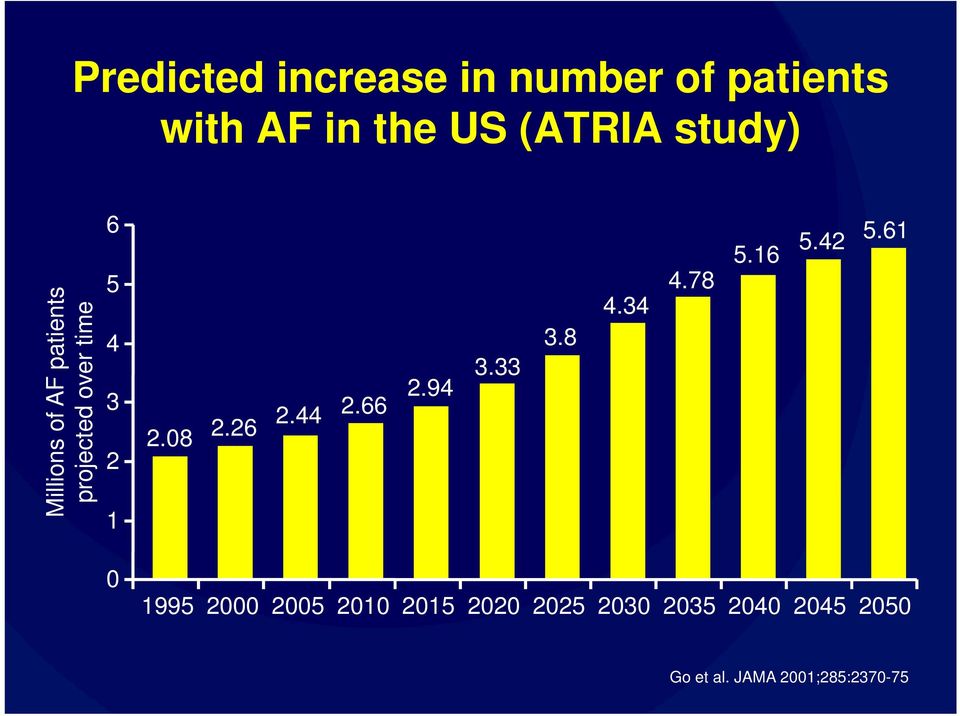
2 Predicted increase in number of patients with AF in the US (ATRIA study) Millions of AF patients projected over time Go et al. JAMA 2001;285:
3 Prevalencia en España de fibrilación auricular: desconocida e infraestimada
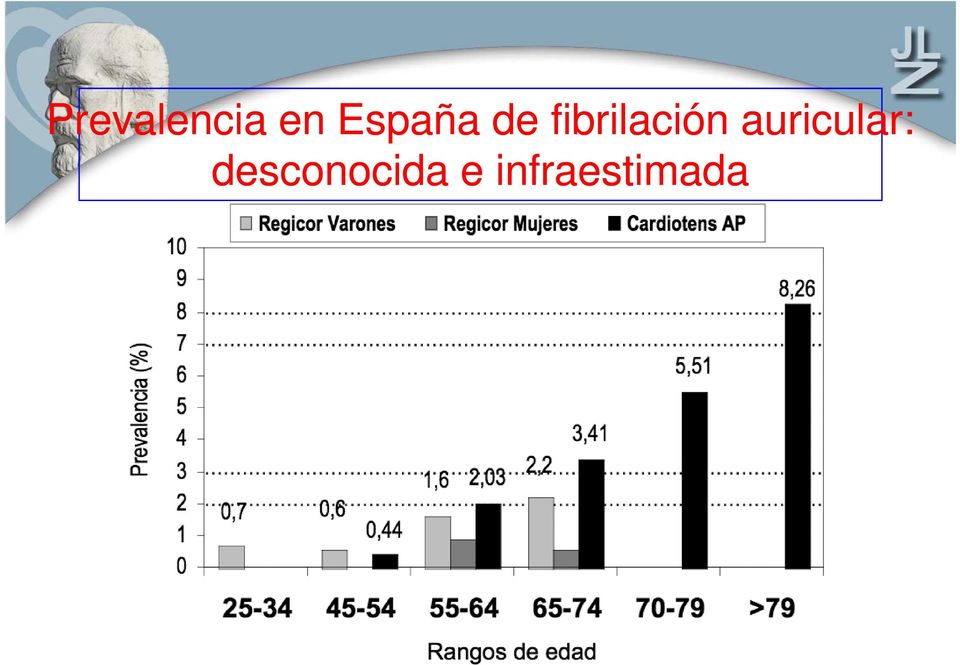
4 Prevalencia de fibrilación auricular: desconocida e infraestimada Incidencia de fibrilación auricular Las probabilidades de desarrollar fibrilación auricular a lo largo de la vida llegan a ser del 25% en varones (más que las mujeres) Lloyd-Jones DM. Circulation 2004; 110: 1042

5 60% 50% 40% 30% 20% 10% 0% Fibrilación Auricular Mortalidad sujetos años Framingham Varones con FA Mujeres con FA Varones sin FA Mujeres sin FA años de seguimiento Benjamin EJ et al, Circulation 1998; 98: 946

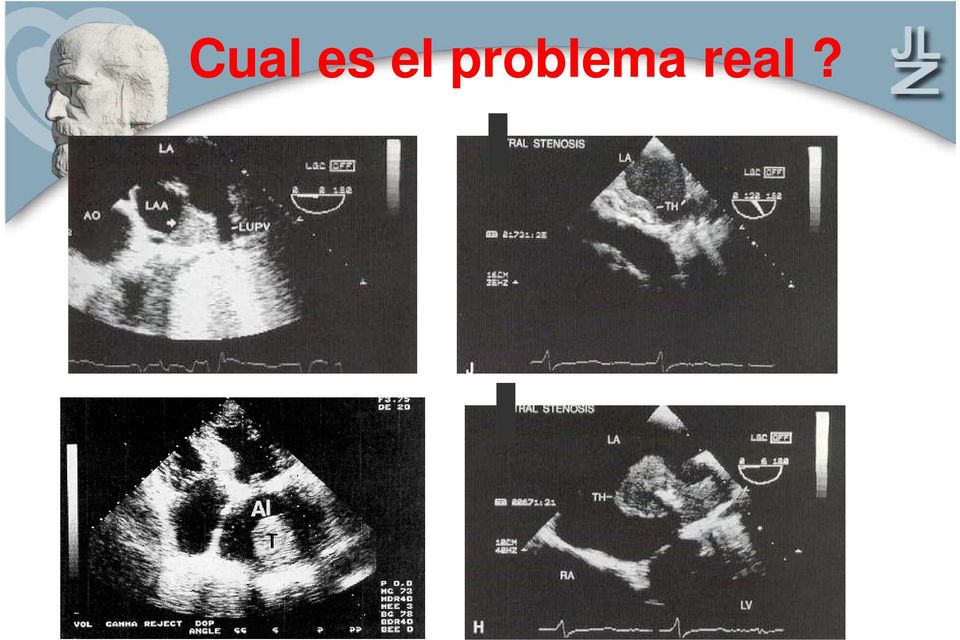
6 Cual es el problema real?
7 Atrial Fibrillation and Stroke AF responsible for 1/6 of all strokes Warfarin reduces stroke in AF by 64% significant increase in intracranial and other hemorrhage Difficult to use Only 50% of eligible patients receive warfarin An alternative treatment is needed

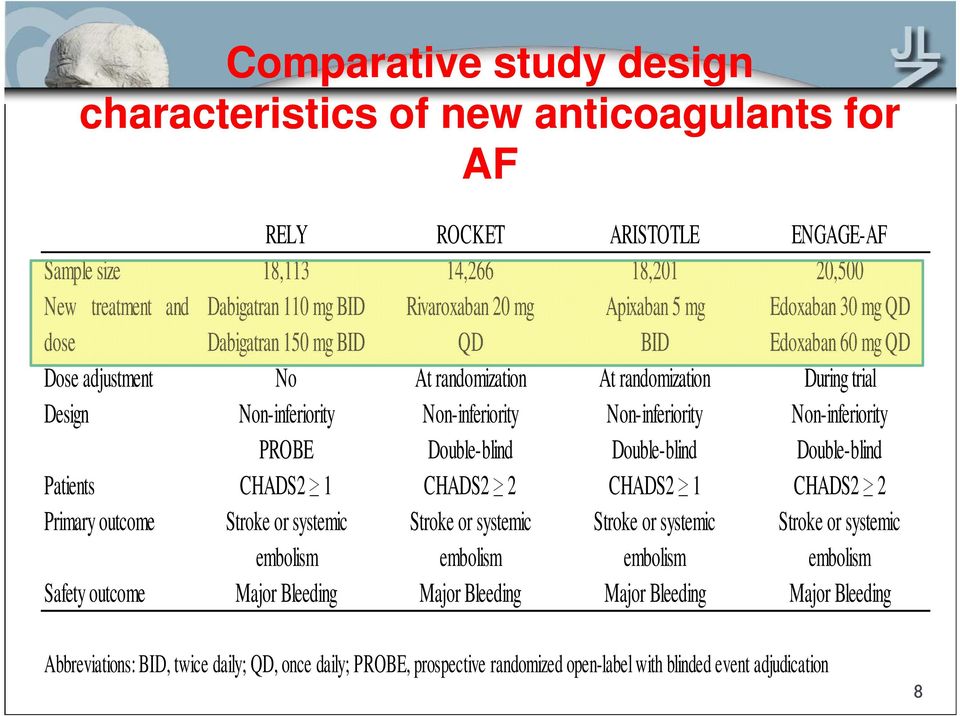
8 Comparative study design characteristics of new anticoagulants for AF RELY ROCKET ARISTOTLE ENGAGE-AF Sample size 18,113 14,266 18,201 20,500 New treatment and Dabigatran 110 mg BID Rivaroxaban 20 mg Apixaban 5 mg Edoxaban 30 mg QD dose Dabigatran 150 mg BID QD BID Edoxaban 60 mg QD Dose adjustment No At randomization At randomization During trial Design Non-inferiority Non-inferiority Non-inferiority Non-inferiority PROBE Double-blind Double-blind Double-blind Patients CHADS2 1 CHADS2 2 CHADS2 1 CHADS2 2 Primary outcome Stroke or systemic Stroke or systemic Stroke or systemic Stroke or systemic embolism embolism embolism embolism Safety outcome Major Bleeding Major Bleeding Major Bleeding Major Bleeding Abbreviations: BID, twice daily; QD, once daily; PROBE, prospective randomized open-label with blinded event adjudication 8
9 New oral anticoagulants in AF pharmacological properties Property Dabigatran Rivaroxaban Apixaban Edoxaban Route of administration Oral Oral Oral Oral Target Thrombin FXa FXa FXa Dosing Twice daily Once daily Twice daily Once daily Monitoring required No No No No Half-life (hrs) Mode of elimination Renal 80% Renal ~66% Hepatic ~ 28% Renal ~25% Hepatic ~ 75% Renal ~35% Fxa = Factor Xa Eriksson BI et al. Annu Rev Med 2011;62:41 57; Pradaxa SmPC, 2011

10 Comparison of Study Designs RELY: Primary Efficacy Evaluation: Stroke or non-cns Embolism Rocket AF: Non-Inferiority: Intention-to-treat Superiority: Intention-to-treat Primary Efficacy Evaluation: Stroke or non-cns Embolism Non-Inferiority: Superiority: Protocol Compliant on treatment On Treatment, then by Intent-to- Treat RE-LY used Intention to treat for both non-inferiority and superiority testing; Rocket AF used on treatment analysis for first tests of non-inferiority and superiority

11 RE-LY: Baseline Characteristics Characteristic Dabigatran 110 mg Dabigatran 150 mg Warfarin Randomized Mean age (years) Male (%) CHADS2 score (mean) 0-1 (%) 2 (%) 3+ (%) Prior stroke/tia (%) Prior MI (%) CHF (%) Baseline ASA (%) Warfarin Naïve (%) Rocket AF Investigators, AHA 2010; Connolly SJ, et al. N Engl J Med. 2009;361:

12 RE LY: Dabigatran (Pradaxa ) Trial design: Patients with AF were randomized to either dabigatran 110 mg, 150 mg, or open-label warfarin. Patients were followed for a mean of 2 years. %/year 10 5 *Dabigatran 150 mg vs. warfarin; Dabigatran 110 mg vs. warfarin (p <0.001*, p = 0.34 ) (p = 0.31*, p = 0.03 ) %/year Stroke/systemic embolism Dabigatran 110 mg 5 Major bleeding Dabigatran 150 mg Warfarin Results Dabigatran 150 mg superior to warfarin for stroke/systemic embolism; dabigatran 110 mg was non-inferior Stroke in dabigatran 150 mg arm (p < 0.001) Major bleeding was higher in warfarin arm compared with dabigatran 110 mg, but was similar to dabigatran 150 mg Conclusions Dabigatran 150 mg superior to warfarin in reducing stroke or systemic embolism, with a similar bleeding profile. The 110 mg dose was non-inferior for efficacy, associated with lower bleeding compared with warfarin Could prove to be alternative to warfarin for chronic anticoagulation; further data are awaited Connolly SJ, et al. N Engl J Med 2009;Aug 30:[Epub]

13 Stroke or Systemic Embolism Dabigatran 110 vs. Warfarin Non-inferiority p-value <0.001 Superiority p-value 0.34 <0.001<0.001 <0.001 Dabigatran 150 vs. Warfarin Margin = Dabigatran better HR (95% CI) Warfarin better

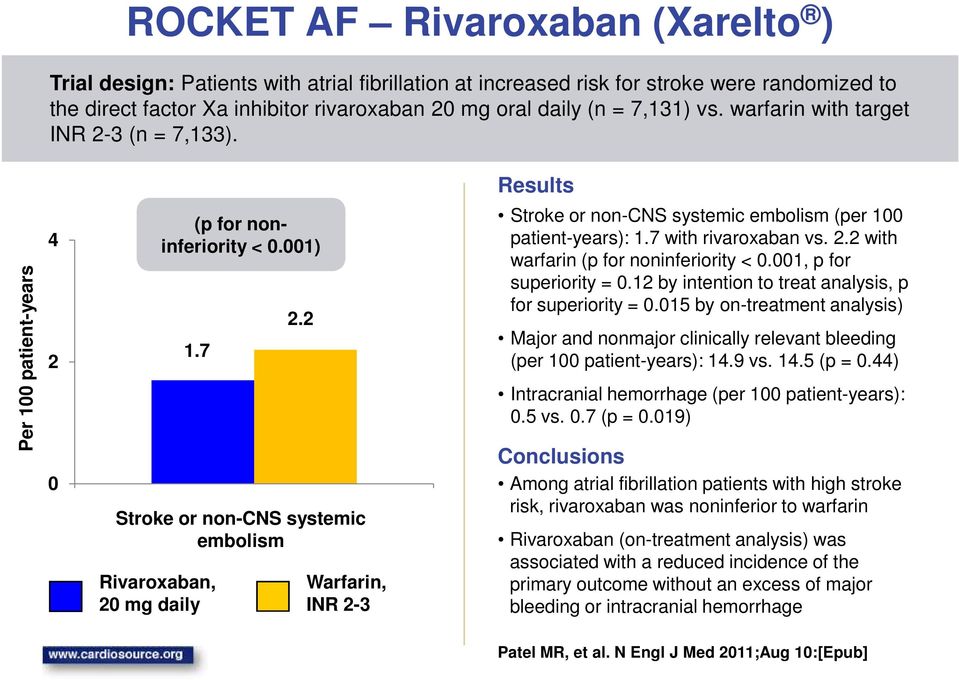
14 ROCKET AF Rivaroxaban (Xarelto ) Trial design: Patients with atrial fibrillation at increased risk for stroke were randomized to the direct factor Xa inhibitor rivaroxaban 20 mg oral daily (n = 7,131) vs. warfarin with target INR 2-3 (n = 7,133). Results Per 100 patient-years (p for noninferiority < 0.001) 1.7 primary 2.2 Stroke or non-cns systemic embolism Rivaroxaban, 20 mg daily Warfarin, INR 2-3 Stroke or non-cns systemic embolism (per 100 patient-years): 1.7 with rivaroxaban vs. 2.2 with warfarin (p for noninferiority < 0.001, p for superiority = 0.12 by intention to treat analysis, p for superiority = by on-treatment analysis) Major and nonmajor clinically relevant bleeding (per 100 patient-years): 14.9 vs (p = 0.44) Intracranial hemorrhage (per 100 patient-years): 0.5 vs. 0.7 (p = 0.019) Conclusions Among atrial fibrillation patients with high stroke risk, rivaroxaban was noninferior to warfarin Rivaroxaban (on-treatment analysis) was associated with a reduced incidence of the primary outcome without an excess of major bleeding or intracranial hemorrhage Patel MR, et al. N Engl J Med 2011;Aug 10:[Epub]
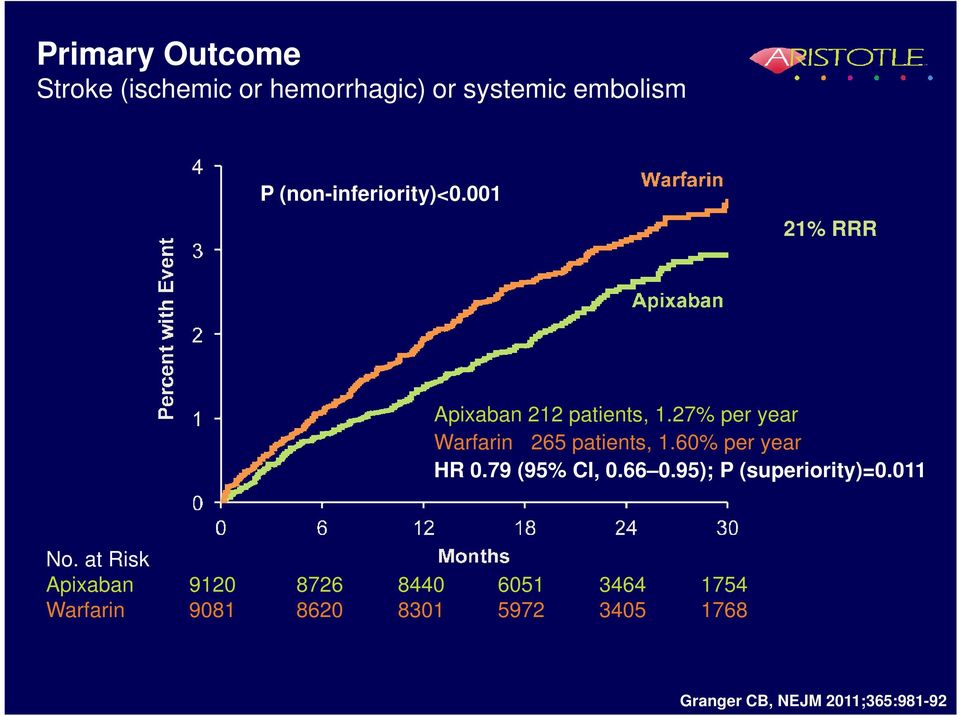
15 Primary Outcome Stroke (ischemic or hemorrhagic) or systemic embolism P (non-inferiority)< % RRR Apixaban 212 patients, 1.27% per year Warfarin 265 patients, 1.60% per year HR 0.79 (95% CI, ); P (superiority)=0.011 No. at Risk Apixaban Warfarin Granger CB, NEJM 2011;365:981-92
16 Bleeding Outcomes Outcome Primary safety outcome: ISTH major bleeding* Apixaban (N=9088) Event Rate (%/yr) Warfarin (N=9052) Event Rate (%/yr) HR (95% CI) P Value (0.60, 0.80) <0.001 Intracranial (0.30, 0.58) <0.001 Gastrointestinal (0.70, 1.15) 0.37 Major or clinically relevant non-major bleeding (0.61, 0.75) <0.001 GUSTO severe bleeding (0.35, 0.60) <0.001 TIMI major bleeding (0.46, 0.70) <0.001 Any bleeding (0.68, 0.75) <0.001 * Part of sequential testing sequence preserving the overall type I error Granger CB, NEJM 2011;365:981-92

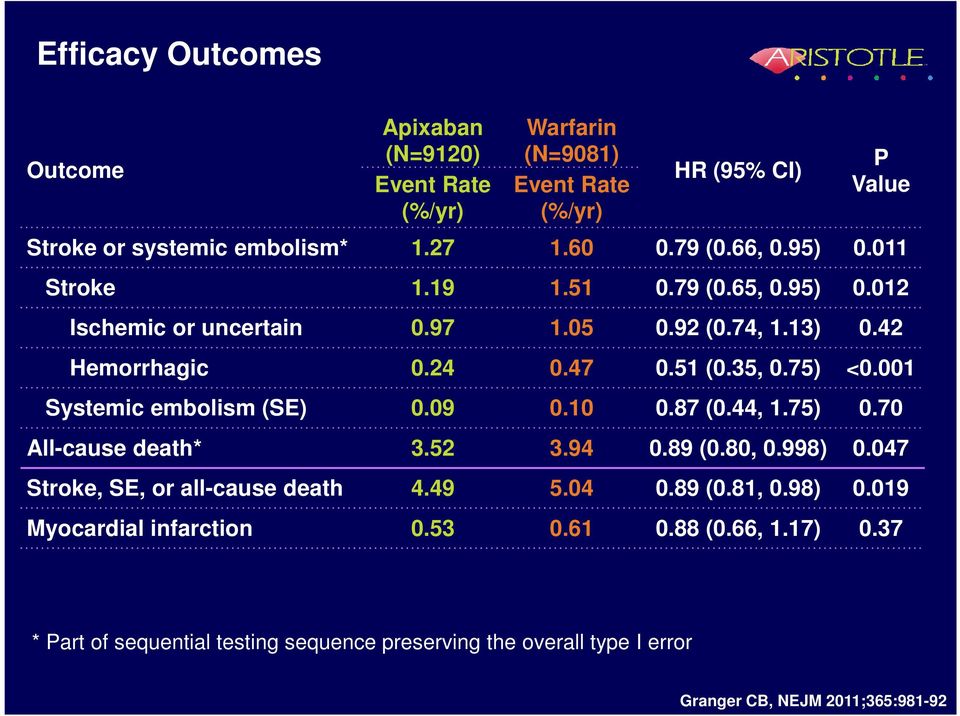
17 Efficacy Outcomes Outcome Apixaban (N=9120) Event Rate (%/yr) Warfarin (N=9081) Event Rate (%/yr) HR (95% CI) P Value Stroke or systemic embolism* (0.66, 0.95) Stroke (0.65, 0.95) Ischemic or uncertain (0.74, 1.13) 0.42 Hemorrhagic (0.35, 0.75) <0.001 Systemic embolism (SE) (0.44, 1.75) 0.70 All-cause death* (0.80, 0.998) Stroke, SE, or all-cause death (0.81, 0.98) Myocardial infarction (0.66, 1.17) 0.37 * Part of sequential testing sequence preserving the overall type I error Granger CB, NEJM 2011;365:981-92
18 Phase III AF Trials Results Scorecard Re-LY ROCKET-AF ARISTOTLE Drug Dabigatran Rivaroxaban Apixaban Stroke + SEE 150 mg superior 110 mg non-inferior ITT cohort: non-infer. On Rx cohort: superior superior Bleeding 150 mg: similar 110 mg: lower similar lower Mortality 150 mg: p = mg: similar similar Superior: p = Ischemic stroke 150 mg: lower 110 mg: similar similar similar Mean TTR 62% 55% 62% Stopped drug 21% 23% 23% WD consent 2.3% 8.7% 1.1% TTR = time in therapeutic range, a measure of the quality of warfarin titration WD consent = withdrawal of consent, no further data available

19
20 Ictus Bajo INR Sangrado Alto INR

21 ADJUSTED STROKE RATE CHADS 2 score Patients (n= 1733) Adjusted stroke rate (%/year) 95% confidence interval ( ) ( ) ( ) ( ) ( ) ( ) ( ) CHA 2 DS 2 -VASc score Patients (n= 7239) Adjusted stroke rate (%/year) 0 1 0% % % % % % % % % %
22 Risk factor CHA 2 DS 2 -VASc Risk factors for stroke and thrombo-embolism Score In non-valvular AF Congestive heart failure/lv dysfunction 1 Major Risk factors Clinically revelant non-major Hypertension Risk factors 1 AGE 75 2 Previous stroke, TIA, Heart failure or moderate to Or systematic embolism Severe LV systolic dysfunction Age 75 years (e.g. LV EF 40%) Hypertension Diabetes Mellitus Age years Vascular disease Female sex Diabetes Mellitus 1 Stroke/TIA/thrombo-embolism 2 Vascular disease 1 Age Sex category (i.e. female sex) 1 Maximum score 9
23 The HAS-BLED bleeding risk score *Hypertension is defined as systolic blood pressure > 160 mmhg. INR = international normalized ratio.
24 Fibrilación auricular. ESC 2012 Highlights 1. Presentación clínica y diagnóstico 2. Refinamiento riesgo tromboembolismo y hemorragia 3. Nuevas recomendaciones de tratamiento 4. Ablación como método de tratamiento CHA 2 DS 2 -VASc Score CHF 1 HTA 1 Age 75 2 Diabetes 1 Stroke/AIT/TE 2 Enfermedad Vascular 1 Age Sexo (i.e. femenino) < 75 1 CHA 2 DS 2 -VASc Tasa ACV Nada/AAS (% año) 0 ACO/AAS 0 1 ACO H Hypertension 1 A Abnormal renal/liver 1 ó 2 S Stroke 1 B Bleeding 1 L Labile INR 1 E Elderly (>75) 1 D Drugs/Alcohol 1 ó 2 Clase I nivel evidencia A
25 . QUÉ HA CAMBIADO RESPECTO A LOS ANTICOAGULANTES ORALES? Antagonistas Vit K Vs Dabigatrán - New OAC drugs, which may be viable alternatives to a VKA,, may be considered. - Recommendations : - CHA 2 DS 2 -VASc 2, Dabigatran may be considered, as an alternative to VKA: - HAS-BLED=0 2: dabigatran 150 mg b.i.d. [in view of the improved efficacy in the prevention of stroke and systemic embolism (but lower rates of intracranial haemorrhage and similar rates of major bleeding events, when compared with warfarin)] - HAS-BLED= 3: dabigatran 110 mg b.i.d.. [in[ view of a similar efficacy in the prevention of stroke and systemic embolism (but lower rates of intracranial haemorrhage and of major bleeding compared with VKA)] - CHA 2 DS 2 -VASc=1: dabigatran 110 mg b.i.d.. may be considered [in view of a similar efficacy with VKA in the prevention of stroke and systemic embolism but lower rates of intracranial haemorrhage and major bleeding compared with the VKA and (probably) AAS.]
26 y qué piensan los demás?
27 CCS Atrial Fibrillation Guidelines 2010: Prevention of Stroke and Systemic Thromboembolism in Atrial Fibrillation and Flutter John A Cairns, MD, FRCPC, Stuart Connolly, MD, FRCPC, Sean McMurtry, MD, PhD, FRCPC, Michael Stephenson, MD, FCFP, Mario Talajic, MD, FRCPC
28 Guías FA Canadienses 2010 Estratificación de riesgo Riesgo embólico / Riesgo hemorrágico En todos los pacientes con FA o flutter debe realizarse una estratificación del riesgo tromboembólico (CHADS 2 ) y hemorrágico (HASBLED) porque la mayoría recibirán tratamiento anticoagulante Strong Recommendati on High Quality Evidence
29 -We recommend that all patients with AF or AFL should be stratified using a predictive index for stroke(e.g. CHADS 2 ) and for the risk of bleeding(e.g. HAS-BLED), and that most patients should receive antithrombotic therapy. - CHADS 2 =0: AAS(-) patients at very low risk of stroke should receive AAS( mg/day). We suggest that some young persons with no standard risk factors for stroke may not require anyantithrombotic therapy. -CHADS 2 =1: OAC (AAS) patients at low risk of stroke should receive OAC therapy (either warfarinor dabigatran). We suggest, based on individual risk/benefit considerations, that AASis a reasonable alternative for some. -CHADS 2 2:OAC patients at moderate risk of stroke should receive OAC therapy (either warfarin or dabigatran). We suggest, that when OAC therapy is indicated, most patients should receive dabigatranin preference to warfarin (excluding CAD patients). In general, the dose of dabigatran150 mg pobid is preferable to a dose of 110 mg po (Conditional recommendation. High Quality Evidence).
30 AHA-ACC-HRS 2011
31


32
33 INDICACIONES ACO EN FA Riesgo trombótico CHADS-VASc CHADSVASc = 0 CHADSVASc = 1 CHADSVASc 2 AAS o nada ACO o AAS ACO Riesgo hemorrágico elevado (HASBLED 3) considerar la indicación o mayores controles
4/9/2015. Risk Stratify Our Patients. Stroke Risk in AF: CHADS2 Scoring system JAMA 2001; 285: 2864-71
 Anticoagulation in the 21 st Century Adam Karpman, D.O. Saint Francis Medical Center/Oklahoma State University Medical Center Disclosures: None Atrial Fibrillation Most common arrhythmia in clinical practice.
RR 0.88 (95% CI: 0.77 1.00) P=0.051 (superiority) 3.75
 ALL-CAUSE MORTALITY RR 0.88 (95% CI: 0.77 1.00) P=0.051 (superiority) Rate per year (%) 5.0 4.0 3.0 2.0 1.0 0 3.64 D150 mg BID 3.75 D110 mg BID RR 0.91 (95% CI: 0.80 1.03) P=0.13 (superiority) 4.13 Warfarin
Kevin Saunders MD CCFP Rivergrove Medical Clinic Wellness Institute @ SOGH April 17 2013
 Kevin Saunders MD CCFP Rivergrove Medical Clinic Wellness Institute @ SOGH April 17 2013 Family physician with Rivergrove Medical Clinic Practice in the north end since 1985 Medical Director of the Wellness
Goals 6/6/2014. Stroke Prevention in Atrial Fibrillation: New Oral Anti-Coagulants No More INRs. Ashkan Babaie, MD
 Stroke Prevention in Atrial Fibrillation: New Oral Anti-Coagulants No More INRs Ashkan Babaie, MD Arrhythmia Service Providence Heart Clinic June 8 th, 2014 Goals Discuss the data behind approval of NOACs
Management of atrial fibrillation. Satchana Pumprueg, MD Sirin Apiyasawat, MD Thoranis Chantrarat, MD
 Management of atrial fibrillation Satchana Pumprueg, MD Sirin Apiyasawat, MD Thoranis Chantrarat, MD Antithrombotic therapy in atrial fibrillation Satchana Pumprueg, MD AF has serious consequences Independent
Analyzing Clinical Trial Findings of the Efficacy and Safety Profiles of Novel Anticoagulants for Stroke Prevention in Atrial Fibrillation
 Analyzing Clinical Trial Findings of the Efficacy and Safety Profiles of Novel Anticoagulants for Stroke Prevention in Atrial Fibrillation Drew Baldwin, MD Virginia Mason Seattle, Washington NCVH May 29,
The author has no disclosures
 Mary Bradbury, PharmD, BCPS Clinical Pharmacy Specialist, Cardiac Surgery September 18, 2012 [email protected] This presentation will discuss unlabeled and investigational use of products The author
New Oral Anticoagulants for Stroke Prevention in Atrial Fibrillation Jafna L. Cox, MD, FRCPC, FACC
 New Oral Anticoagulants for Stroke Prevention in Atrial Fibrillation Jafna L. Cox, MD, FRCPC, FACC Heart and Stroke Foundation of Nova Scotia Endowed Chair in Cardiovascular Outcomes Research Director
New Anticoagulants: Are we Ready to Replace Warfarin? Carole Goodine, RPh Horizon Health Network Stroke Conference 2011
 New Anticoagulants: Are we Ready to Replace Warfarin? Carole Goodine, RPh Horizon Health Network Stroke Conference 2011 Warfarin Decreases stroke risk by 60-70% Superior to ASA and ASA plus clopidogrel
Atrial Fibrillation: A Different Perspective. Michael Heffernan MD PhD FRCPC FACC Staff Cardiologist Oakville Hospital
 Atrial Fibrillation: A Different Perspective Michael Heffernan MD PhD FRCPC FACC Staff Cardiologist Oakville Hospital Faculty/Presenter Disclosure Faculty: Dr. Michael Heffernan Relationships with commercial
New Treatments for Stroke Prevention in Atrial Fibrillation. John C. Andrefsky, MD, FAHA NEOMED Internal Medicine Review course May 5 th, 2013
 New Treatments for Stroke Prevention in Atrial Fibrillation John C. Andrefsky, MD, FAHA NEOMED Internal Medicine Review course May 5 th, 2013 Classification Paroxysmal atrial fibrillation (AF) Last < 7
Long term anticoagulant therapy in patients with atrial fibrillation at high risk of stroke: a new scenario after RE-LY trial
 Long term anticoagulant therapy in patients with atrial fibrillation at high risk of stroke: a new scenario after RE-LY trial Camillo Autore Università di Roma Sapienza II Facoltà di Medicina e Chirurgia
Anticoagulation For Atrial Fibrillation
 Anticoagulation For Atrial Fibrillation New Agents In A New Era Arjun V Gururaj, MD Arrhythmia and Electrophysiology Nevada Heart and Vascular Center Disclosures Biotronik Speaker Clinical investigator
New Anticoagulation Options for Stroke Prevention in Atrial Fibrillation. Joy Wahawisan, Pharm.D., BCPS April 25, 2012
 New Anticoagulation Options for Stroke Prevention in Atrial Fibrillation Joy Wahawisan, Pharm.D., BCPS April 25, 2012 Stroke in Atrial Fibrillation % Stroke 1991;22:983. Age Range (years) CHADS 2 Risk
STROKE PREVENTION IN ATRIAL FIBRILLATION
 STROKE PREVENTION IN ATRIAL FIBRILLATION OBJECTIVE: To guide clinicians in the selection of antithrombotic therapy for the secondary prevention of ischemic stroke and arterial thromboembolism in patients
NOAC S For Stroke Prevention in. Atrial Fibrillation. Peter Cohn M.D FACC Associate Physician in Chief Cardiovascular Care Center Southcoast Health
 NOAC S For Stroke Prevention in Atrial Fibrillation Peter Cohn M.D FACC Associate Physician in Chief Cardiovascular Care Center Southcoast Health New Oral Anti Coagulant Formal Definition: Atrial Fibrillation
STROKE PREVENTION IN ATRIAL FIBRILLATION. TARGET AUDIENCE: All Canadian health care professionals. OBJECTIVE: ABBREVIATIONS: BACKGROUND:
 STROKE PREVENTION IN ATRIAL FIBRILLATION TARGET AUDIENCE: All Canadian health care professionals. OBJECTIVE: To guide clinicians in the selection of antithrombotic therapy for the secondary prevention
Xarelto (Rivaroxaban)
 Xarelto (Rivaroxaban) Hightly selective, reversible, direct oral FXa inhibitor Maxium concentratiion after 2 to 4 hrs High bioavailability(66%),increase with food ( suggest with food) 1/3 from renal excretion,
AHA/ASA Scientific Statement Oral Antithrombotic Agents for the Prevention of Stroke in Atrial Fibrillation
 AHA/ASA Scientific Statement Oral Antithrombotic Agents for the Prevention of Stroke in Atrial Fibrillation A Statement for Healthcare Professionals from the American Heart Association/American Stroke
Anticoagulation Therapy Update
 Anticoagulation Therapy Update JUDY R. WALLING, FNP-BC ARRHYTHMIA MANAGEMENT MUSC CARDIOLOGY Outline Who do we anticoagulate? Review classes of Anticoagulants Review examples of Anticoagulants Review CHADS2
Antiplatelet and Antithrombotic Therapy. Dr Curry Grant Stroke Prevention Clinic Quinte Health Care
 Antiplatelet and Antithrombotic Therapy Dr Curry Grant Stroke Prevention Clinic Quinte Health Care Disclosure of Potential for Conflict of Interest Dr. F.C. Grant Atrial Fibrillation FINANCIAL DISCLOSURE:
Anticoagulants in Atrial Fibrillation
 Anticoagulants in Atrial Fibrillation Starting and Stopping Them Safely Carmine D Amico, D.O. Overview Learning objectives Introduction Basic concepts Treatment strategy & options Summary 1 Learning objectives
Elisabetta Toso, MD Dipartment of Medical Sciences University of Turin
 Security and efficacy of Rivaroxaban in real life in the prevention of the stroke in non valvular AF patients: presentation of the results of the international study Xantus Elisabetta Toso, MD Dipartment
Cardiovascular Subcommittee of PTAC Meeting held 27 February 2014. (minutes for web publishing)
 Cardiovascular Subcommittee of PTAC Meeting held 27 February 2014 (minutes for web publishing) Cardiovascular Subcommittee minutes are published in accordance with the Terms of Reference for the Pharmacology
How To Treat Aneuricaagulation
 Speaker Introduction Jessica Wilhoite, PharmD, BCACP Doctor of Pharmacy: Purdue University Postgraduate Residency Training: PGY1 Pharmacy Practice St. Vincent Hospital PGY2 Ambulatory Care St. Vincent
The 50-year Quest to Replace Warfarin: Novel Anticoagulants Define a New Era. CCRN State of the Heart 2012 June 2, 2012
 The 50-year Quest to Replace Warfarin: Novel Anticoagulants Define a New Era CCRN State of the Heart 2012 June 2, 2012 Disclosures I have I have been involved in trials of new anticoagulants and have received
1/7/2012. Objectives. Epidemiology of Atrial Fibrillation(AF) Stroke in AF. Stroke Risk Stratification in AF
 Objectives Atrial Fibrillation and Prevention of Thrombotic Complications: Therapeutic Update Andrea C. Flores Pharm.D Pharmacy Resident at the Miami VA Healthcare System Review the epidemiology, pathophysiology
Atrial Fibrillation: New Approaches to an Old Friend PETER JESSEL, MD ASSISTANT PROFESSOR
 Atrial Fibrillation: New Approaches to an Old Friend PETER JESSEL, MD ASSISTANT PROFESSOR Disclosures None relevant to this presentation Outline Introduction Natural History and Stroke Risk Stroke/Bleeding
Breadth of indications matters One drug for multiple indications
 Breadth of indications matters One drug for multiple indications Sylvia Haas, MD, PhD Formerly of the Technical University of Munich Munich, Germany Disclosures: Sylvia Haas 1 Novel oral anticoagulants:
ΠΟΙΟ ΑΝΤΙΠΗΚΤΙΚΟ ΓΙΑ ΤΟΝ ΑΣΘΕΝΗ ΜΟΥ? ΚΛΙΝΙΚΑ ΠΑΡΑΔΕΙΓΜΑΤΑ. Σωκράτης Παστρωμάς Καρδιολόγος Νοσοκομείο Ερρίκος Ντυνάν
 ΠΟΙΟ ΑΝΤΙΠΗΚΤΙΚΟ ΓΙΑ ΤΟΝ ΑΣΘΕΝΗ ΜΟΥ? ΚΛΙΝΙΚΑ ΠΑΡΑΔΕΙΓΜΑΤΑ Σωκράτης Παστρωμάς Καρδιολόγος Νοσοκομείο Ερρίκος Ντυνάν The AF epidemic Mayo Clinic data (assuming a continued increase in the AF incidence) Mayo
3/25/14. To Clot or Not What s New In Anticoagulation? Clotting Cascade. Anticoagulant drug targets. Anita Ralstin, MS CNS CNP. Heparin.
 To Clot or Not What s New In Anticoagulation? Anita Ralstin, MS CNS CNP 1 Clotting Cascade 2 Anticoagulant drug targets Heparin XI VIII IX V X VII LMWH II Warfarin Fibrin clot 1 Who Needs Anticoagulation
How To Compare Warfarin To Dabigatran
 Page 1 WOMEN AT RISK Anticoagulation Issues In Atrial Fibrillation WOMEN AT RISK Anticoagulation Issues In Atrial Fibrillation J E A N N A P P I, P H A R M. D., F C C P, B C P S Accreditation: Pharmacists:
Rivaroxaban A new oral anti-thrombotic Dr. Hisham Aboul-Enein Professor of Cardiology Benha University 12/1/2012
 Rivaroxaban A new oral anti-thrombotic Dr. Hisham Aboul-Enein Professor of Cardiology Benha University 12/1/2012 Agenda Ideal anticoagulant. Drawbacks of warfarin. Rivaroxaban in clinical trails. Present
Non- Valvular Atrial Fibrillation and Stroke Prevention: Which OAC Do I Choose. Warfarin vs the NOACs
 Non- Valvular Atrial Fibrillation and Stroke Prevention: Which OAC Do I Choose Warfarin vs the NOACs Dr. Lori McIntosh D.O. Board Certified Neurologist Objectives Be able to list the current options of
Optimizing Anticoagulation Selection for Your Patient. C. Andrew Brian MD, FACC NCVH 2015
 Optimizing Anticoagulation Selection for Your Patient C. Andrew Brian MD, FACC NCVH 2015 Who Needs to Be Anticoagulated and What is the Patient s Risk? 1. Atrial Fibrillation ( nonvalvular ) 2. What regimen
What s New in Stroke?
 5 th McMaster University Review Course in INTERNAL MEDICINE What s New in Stroke? Robert Hart, M.D. HHS / McMaster Stroke Program Department of Medicine (Neurology) McMaster University Hamilton, Ontario
rivaroxaban 15 and 20mg film-coated tablets (Xarelto ) SMC No. (756/12) Bayer PLC
 rivaroxaban 15 and 20mg film-coated tablets (Xarelto ) SMC No. (756/12) Bayer PLC 13 January 2012 The Scottish Medicines Consortium (SMC) has completed its assessment of the above product and advises NHS
Novel OACs: How should we use them?"
 Novel OACs: How should we use them?" Iqwal Mangat, MD FRCPC" Director, Arrhythmia Service, St. Michaelʼs Hospital" Assistant Professor of Medicine, University of Toronto" Presenter Disclosure Dr. Iqwal
Old Agent, New Agent or No Agent? The Decision to Anticoagulate Patients with Atrial Fibrillation. Daniel E. Singer, MD
 AHA International Stroke Conference, Pre-Con Symposium, February 5, 2013 Old Agent, New Agent or No Agent? The Decision to Anticoagulate Patients with Atrial Fibrillation Daniel E. Singer, MD Massachusetts
Review of Non-VKA Oral AntiCoagulants (NOACs) and their use in Great Britain
 Review of Non-VKA Oral AntiCoagulants (NOACs) and their use in Great Britain Dr Alexander (Ander) Cohen Guy s and St Thomas Hospitals, King s College London, UK Pavia Spring Meeting 13 June 2014 Overview
Xarelto (Rivaroxaban): Effective in a broad spectrum. Joep Hufman, MD Medical Scientific Liason
 Xarelto (Rivaroxaban): Effective in a broad spectrum Joep Hufman, MD Medical Scientific Liason Xarelto : Effective in a broad spectrum Introduction Therapeutic areas SPAF VTE Prevention VTE treatment Practical
Novel Anticoagulation Agents DISCLOSURES. Objectives ATRIAL FIBRILLATION TRIALS. NOAC Comparison 6/12/2015
 Novel Anticoagulation Agents DISCLOSURES James W. Haynes, MD Department of Family Medicine Univ of TN Health Science Center (Chattanooga) Objectives Understand mechanism of action behind the NOAC agents
PHARMACOLOGICAL Stroke Prevention in Atrial Fibrillation STROKE RISK ASSESSMENT SCORES Vs. BLEEDING RISK ASSESSMENT SCORES.
 PHARMACOLOGICAL Stroke Prevention in Atrial Fibrillation STROKE RISK ASSESSMENT SCORES Vs. BLEEDING RISK ASSESSMENT SCORES. Hossam Bahy, MD (1992 2012), 19 tools have been identified 11 stroke scores 1
Novel OAC s : How should we use them?
 Novel OAC s : How should we use them? Jean C. Grégoire MD, FRCP(c), FACC, FACP Associate Professor, Université de Montréal, IntervenJonal Cardiologist, InsJtut de cardiologie de Montréal Disclosures Speaker
CDEC FINAL RECOMMENDATION
 CDEC FINAL RECOMMENDATION RIVAROXABAN (Xarelto Bayer Inc.) Indication: Stroke Prevention in Atrial Fibrillation This recommendation supersedes the Canadian Drug Expert Committee (CDEC) recommendation for
New Oral AntiCoagulants (NOAC) in 2015
 New Oral AntiCoagulants (NOAC) in 2015 William R. Hiatt, MD Professor of Medicine and Cardiology University of Colorado School of Medicine President CPC Clinical Research Disclosures Received research
Stroke Risk Scores. CHA 2 DS 2 -VASc. CHA 2 DS 2 -VASc Scoring Table 2
 Bleeding/Clotting Risk Evaluation Tools for Atrial Fibrillation Patients Before prescribing anticoagulants, providers should weigh the risk of thrombosis against the risk of bleeding. The tools below can
The Role of the Newer Anticoagulants
 The Role of the Newer Anticoagulants WARFARIN = Coumadin DAGIBATRAN = Pradaxa RIVAROXABAN = Xarelto APIXABAN = Eliquis INDICATION DABIGATRAN (Pradaxa) RIVAROXABAN (Xarelto) APIXABAN (Eliquis) Stroke prevention
DERBYSHIRE JOINT AREA PRESCRIBING COMMITTEE (JAPC) MANAGEMENT of Atrial Fibrillation (AF)
 DERBYSHIRE JOINT AREA PRESCRIBING COMMITTEE (JAPC) MANAGEMENT of Atrial Fibrillation (AF) Key priorities Identification and diagnosis Treatment for persistent AF Treatment for permanent AF Antithrombotic
Anticoagulation before and after cardioversion; which and for how long
 Anticoagulation before and after cardioversion; which and for how long Sameh Samir, MD Cardiovascular medicine dept. Tanta faculty of medicine Atrial fibrillation goals of management Identify and treat
NIL. Dr Chuks Ajaero FMCP FRACP Cardiologist QEH, NALHN, SA Heart & Central Districts. Approach. Approach. 06-Nov-14
 Stroke Prevention in Atrial Fibrillation: Commencing Non- Oral Anticoagulants in GP setting Dr Chuks Ajaero FMCP FRACP Cardiologist QEH, NALHN, SA Heart & Central Districts Disclosures NIL Classification
Turn the Beat Around-Remix: Atrial Fibrillation Guidelines-2014 Updates
 Turn the Beat Around-Remix: Atrial Fibrillation Guidelines-2014 Updates Brittany Karns, PharmD Alaska Pharmacists Association Annual Conference - 2015 Disclosures I have no actual or potential conflicts
FDA Approved Oral Anticoagulants
 FDA Approved Oral Anticoagulants Generic (Trade Name) Warfarin (Coumadin, Jantoven ) 1 FDA approved indication Prophylaxis and treatment of venous thromboembolism (VTE) Prophylaxis and treatment of thromboembolic
Bridging the Gap: How to Transition from the NOACs to Warfarin
 Bridging the Gap: How to Transition from the NOACs to April 24 th 2015 UAN: 0048-0000-15-034-L01-P Amanda Styer, Pharm.D. Marion General Hospital, OhioHealth Objectives: 1. Review labeling regarding transition
Rivaroxaban in SPAF: Efficacy, safety and cardio-vascular profile. Hans Rickli, St.Gallen
 Rivaroxaban in SPAF: Efficacy, safety and cardio-vascular profile Hans Rickli, St.Gallen HADS 2 Distribution Across SPAF Trials % HADS 2 Score Dabigatran and apixaban: evaluated across a spectrum of stroke
Anticoagulation: How Do I Pick From All the Choices? Jeffrey H. Neuhauser, DO, FACC BHHI Primary Care Symposium February 28, 2014
 Anticoagulation: How Do I Pick From All the Choices? Jeffrey H. Neuhauser, DO, FACC BHHI Primary Care Symposium February 28, 2014 Atrial Fibrillation 2 Atrial Fibrillation The most common arrhythmia encountered
Investor News. Phase III J-ROCKET AF Study of Bayer s Xarelto (rivaroxaban) Meets Primary Endpoint. Not intended for U.S.
 Investor News Not intended for U.S. and UK Media Bayer AG Investor Relations 51368 Leverkusen Germany www.investor.bayer.com Phase III J-ROCKET AF Study of Bayer s Xarelto (rivaroxaban) Meets Primary Endpoint
A focus on atrial fibrillation
 A focus on atrial fibrillation Is being female really a risk factor for stroke? Dr Justin Mariani MBBS BMedSci PhD FRACP FCSANZ Consultant Cardiologist and Interventional Heart Failure Specialist Alfred
Dorset Cardiac Centre
 P a g e 1 Dorset Cardiac Centre Patients with Atrial Fibrillation/Flutter undergoing DC Cardioversion or Ablation procedures- Guidelines for Novel Oral Anti-coagulants (NOACS) licensed for this use February
Antiplatelet and Antithrombotics From clinical trials to guidelines
 Antiplatelet and Antithrombotics From clinical trials to guidelines Ashraf Reda, MD, FESC Prof and head of Cardiology Dep. Menofiya University Preisedent of EGYBAC Chairman of WGLVR One of the big stories
All Wales Risk/Benefit Assessment Tool for Oral Anticoagulant Treatment in People with Atrial Fibrillation
 All Wales Risk/Benefit Assessment Tool for Oral Anticoagulant Treatment in People with Atrial Fibrillation October 2013 This report has been prepared by a multiprofessional collaborative group, with support
Limitations of VKA Therapy
 Fibrillazione Atriale Non Valvolare Ischemia o Emorragia le Due Utopie Rivali nella Scelta dei NAO Gianluca Botto, MD, FESC, UO Elettrofisiologia, Dip Medicina Limitations of VKA Therapy Unpredictable
Objectives. New and Emerging Anticoagulants. Objectives (continued) 2/18/2014. Development of New Anticoagulants
 Objectives New and Emerging Anticoagulants Adraine Lyles, PharmD, BCPS Clinical Pharmacy Specialist VCU Medical Center Describe the pharmacology of the novel oral anticoagulants Discuss the clinical evidence
Bios 6648: Design & conduct of clinical research
 Bios 6648: Design & conduct of clinical research Section 1 - Specifying the study setting and objectives 1. Specifying the study setting and objectives 1.0 Background Where will we end up?: (a) The treatment
Anticoagulation for NVAF: NAOs or AVKs? Giancarlo Agnelli
 Anticoagulation for NVAF: NAOs or AVKs? Giancarlo Agnelli Medicina Interna & Cardiovascolare - Stroke Unit Scuola di Specializzazione in Medicina di Emergenza - Urgenza Università di Perugia My talk today
Stroke prevention in AF: Insights from Clinical Trials and Real Life Experience
 Stroke prevention in AF: Insights from Clinical Trials and Real Life Experience A. John Camm St. George s University of London and Imperial College London, UK Approval Number G.MA.GM.XA.10.2015.0723 Disclosure
Devang M. Desai, MD, FACC, FSCAI Chief of Interventional Cardiology Director of Cardiac Catheterization Lab St. Mary s Hospital and Regional Medical
 Devang M. Desai, MD, FACC, FSCAI Chief of Interventional Cardiology Director of Cardiac Catheterization Lab St. Mary s Hospital and Regional Medical Center A.Fib affects 2.2 million Americans. The lifetime
Committee Approval Date: September 12, 2014 Next Review Date: September 2015
 Medication Policy Manual Policy No: dru361 Topic: Pradaxa, dabigatran Date of Origin: September 12, 2014 Committee Approval Date: September 12, 2014 Next Review Date: September 2015 Effective Date: November
Prevention of thrombo - embolic complications
 Update on atrial fibrillation Prevention of thrombo - embolic complications Felicita Andreotti Dept of Cardiovascular Science Catholic University, Rome, IT Consultant or speaker in past 2 years for Amgen,
New Anticoagulants. Stroke Prevention in AF Commencing Novel Oral Anticoagulants (NOACs) in the GP Setting. 30-Oct-14
 Stroke Prevention in AF Commencing Novel Oral Anticoagulants (NOACs) in the GP Setting A/Prof Michael Nguyen Fremantle Hospital Access Cardiology General Practice Education Day Oct 2014 ORAL TTP889 Rivaroxaban
NORTH WEST LONDON GUIDANCE ANTITHROMBOTIC MANAGEMENT OF ATRIAL FIBRILLATION
 North West London CardioVascular & Stroke Network NORTH WEST LONDON GUIDANCE ON ANTITHROMBOTIC MANAGEMENT OF ATRIAL FIBRILLATION Key Messages 1. Efforts should be made to identify patients with Atrial
Failure or significant adverse effects to all of the alternatives: Eliquis and Xarelto
 This policy has been developed through review of medical literature, consideration of medical necessity, generally accepted medical practice standards, and approved by the IEHP Pharmacy and Therapeutics
Thrombosis and Hemostasis
 Thrombosis and Hemostasis Wendy Lim, MD, MSc, FRCPC Associate Professor, Department of Medicine McMaster University, Hamilton, ON Overview To review the important developments in venous thromboembolism
Anticoagulation in Atrial Fibrillation
 Anticoagulation in Atrial Fibrillation Parag P. Patel, MD FACC Disclosures Eliquis Speakers Bureau 1 Clinical Scenario Ms. L is a 76F admitted to the stroke service with a dense right sided hemiparesis
Introduction. Methods. Study population
 New Technologies, Diagnostic Tools and Drugs Schattauer 2012 1 Net clinical benefit of new oral anticoagulants (dabigatran, rivaroxaban, apixaban) versus no treatment in a real world atrial fibrillation
New Anticoagulants and GI bleeding
 New Anticoagulants and GI bleeding DR DANNY MYERS MD FRCP(C) CLINICAL ASSISTANT PROFESSOR OF MEDICINE, UBC Conflicts of Interest None I am unbiased in the use of NOAC s vs Warfarin based on risk benefit
TA 256: Rivaroxaban for the prevention of stroke and systemic embolism in people with atrial fibrillation
 Service Notification in response to DHSSPS endorsed NICE Technology Appraisals TA 256: Rivaroxaban for the prevention of stroke and systemic embolism in people with atrial fibrillation 1 Name of Commissioning
Rivaroxaban. Practical Experience in the Cardiology Setting. Bernhard Meier, Bern Bayer Satellite Symposium Cardiology Update Davos February 11, 2013
 Rivaroxaban Practical Experience in the Cardiology Setting Bernhard Meier, Bern Bayer Satellite Symposium Cardiology Update Davos February 11, 2013 Overview of phase III clinical trials of new oral anticoagulants
NOACS AND AF PEARLS AND PITFALLS DR LAURA YOUNG HAEMATOLOGIST
 NOACS AND AF PEARLS AND PITFALLS DR LAURA YOUNG HAEMATOLOGIST NGAIRE IS 70 YEARS OLD AND IN AF. SHE HAS NO MURMURS, NORMAL BLOOD PRESSURE, EGFR OF 65ML/MIN AND NO SIGNIFICANT PAST MEDICAL HISTORY. REGARDING
THE INTERNET STROKE CENTER PRESENTATIONS AND DISCUSSIONS ON STROKE MANAGEMENT
 THE INTERNET STROKE CENTER PRESENTATIONS AND DISCUSSIONS ON STROKE MANAGEMENT Stroke Prevention in Atrial Fibrillation Gregory Albers, M.D. Director Stanford Stroke Center Professor of Neurology and Neurological
Novel oral anticoagulant (NOAC) for stroke prevention in atrial fibrillation Special situations
 Novel oral anticoagulant (NOAC) for stroke prevention in atrial fibrillation Special situations Dardo E. Ferrara MD Cardiac Electrophysiology North Cascade Cardiology PeaceHealth Medical Group Which anticoagulant
New Anticoagulants- Dabigatran/Rivaroxaban
 New Anticoagulants- Dabigatran/Rivaroxaban JOHN NOVIASKY, PHARMD, BCPS, FNYSCHP CGH AT UPSTATE UNIVERSITY HOSPITAL SYRACUSE NY Objectives Describe the risks and benefits of dabigatran therapy Describe
9/8/2014. None. Identify the under-recognized risk of cardioembolic stroke in untreated and undertreated. morbidity, mortality and cost burdens
 Optimizing Anticoagulation Therapy for Older Adults with Atrial Fibrillation: The New Oral Agents" None Disclosures Brad Hein, PharmD Associate Professor of Pharmacy The University of Cincinnati Winkle