
On the winner-take-all principle in innovation races
|
|
|
- Elwin Powers
- 10 years ago
- Views:
Transcription
1 On the winne-take-all pinciple in innovation aces VincenzoDenicolòandLuigiAlbetoFanzoni Univesity of Bologna, Italy Novembe 2007 Abstact What is the optimal allocation of pizes in an innovation ace? Should the winne take all, o is it pefeable that fist inventos shae the maket with late independent duplicatos? Seveal papes have agued that the latte, moe pemissive egime is socially pefeable. We e-examine that issue, finding that the winne-take-all system can in fact be socially optimal in a boad set of cicumstances, much boade than claimed by the ealie liteatue. In ou baseline model, two fims ace fo an innovation in continuous time. In the winne-take-all system,assoonasonefiminnovatestheothestopsinvestinginr&d; in the altenative, moe pemissive system, the laggad keeps investing to duplicate the innovation and when it also succeeds the maket becomes a duopoly. The winne-take-all system is pefeable in highly innovative industies, wheeas the pemissive system is moe likely to be optimal in matue industies, whee poduct maket competition is stong and innovation is a elatively ae occuence. We analyze seveal extensions of this baseline model to bette claify why we aive at diffeent esults than the ealie liteatue. Coespondence to: Depatmentof Economics, Piazza Scaavilli2, Bologna, Italy; [email protected]; [email protected]. We ae gateful to Maco Ricolfi and semina audiences at Haifa, Hambug, Amstedam (ACLE), and Copenhagen fo helpful comments. Financial suppot fom the Univesity of Bologna(Pogetto stategico) and Micosoft is gatefully acknowledged. 1
2 1 Intoduction What is the optimal allocation of pizes in an innovation ace? Should the winne take all, o is it pefeable that fist inventos shae the maket with independent duplicatos, if and when they mateialize? Following La Manna, MacLeod and De Meza (1989), a ecent liteatue (eviewed below)hasaddessedthatissue, 1 aivingattheconclusionthata pemissive egime, in which late independent inventos ae allowed to pactice the innovation and compete with the fist, is geneally pefeable to the winne-take-allsystem. 2 Thispapecautionsthatthisconclusionisbased on estictive assumptions, and points out that the winne-take-all system caninfactbesociallyoptimalinaboadsetofcicumstances. Ou analysis sheds light on a numbe of contovesial legal ules and policy issues. Fo example, a majo diffeence between patents and othe potection mechanisms, such as copyights and tade secets, is that independent invention is a defense against copyight infingement o tade secet misappopiation, but is not a defense against patent infingement (Mau- 1 See Maue and Scotchme (2002), Cugno and Ottoz (2004), Shapio (2006), and Heny(2007). Fo a diffeent pespective, see Kultti et al. (2006, 2007). 2 In the last decade, economists have also devoted a lot of attention to the issue of the allocation of pizes in contests: see e.g. Taylo(1995), Fulleton and McAfee(1999), Moldovanu and Sela (2001) and Che and Gale (2003). Innovation aces diffe fom eseach contests in two ways. Fist, eseach contests end on a specified date, wheeas an innovation ace ends wheneve the innovation is achieved. As a consequence, in a contest the timing is fixed but the amount of innovative knowledge poduced is vaiable, wheeas in an innovation ace the R&D output is fixed but the timing of innovation is vaiable (Taylo,1995,p. 875). Second,thepizeinacontestistypicallyasumofmoney,wheeas inaninnovationaceitamountstosomedegeeofmaketpowe. Whilethesocialcostof aising a fixed sum of money is independent of its division, the deadweight losses caused by innovatos maket powe geneally depend on the degee of exclusivity they enjoy. 2

3 e and Scotchme, 2002). The patent system, that is to say, lagely woks on the winne-take-all pinciple, wheeas secets and copyights ae moe pemissive as potection mechanisms. Thus, by detemining whethe new technological fields ae eligible to patent potection o else innovatos must elyonsececyocopyights,policycanaffectthedivisionofthepize. 3 Even though the patent system is the pototypical winne-take-all egime, ecently the intoduction of an independent-invention defense into the patent lawhasitselfbecomeatopicalpolicyissue. 4 Moeove,theextenttowhich the patent system effectively exhibits the winne-take-all popety depends on the beadth of patent potection, which is detemined by vaious legal povisionsandchoicesmadebypatentofficesandthecouts. 5 3 Pominentexamplesaesoftwaepatents,businessmethodspatents,andgenepatents. All of these today exist in the US, wheeas in Euope business methods and softwae patents ae still contovesial, and gene patents ae much hade to uphold than in the US. Databases, by contast, ae potected by stong exclusive intellectual popety ights ineuope,butnotintheus. 4 Building on the economics liteatue cited in footnote 1, seveal law scholas have agued in favo of a geneal eduction of patent holdes peogatives with espect to infinging followes. To be sue, thee ae many difficulties in the pactical implementation of an independent-invention defense, as agued at length by Blai and Cotte (2002). Howeve, Vemont (2006) and Lemley (2007) counte that such difficulties may not be insumountable. A elated issue petains to patent holdes ight to exclude pio inventos who have not patented thei innovations. Bills intoducing a fist-invento defense have beenepeatedlyputonthefloointhecongessovethelastdecade,includinghr1908 which passed the House of Repesentatives on Septembe 7, It must be said, howeve, that an independent-invention defense would potect second inventos who duplicated patented innovations independently, wheeas a fist-invento defense(o pio use ight) would potect fist inventos who concealed thei innovations (pehaps because they did not believe them to be patentable) against the claims of second-invento patentees: see Denicolò and Fanzoni(2004). 5 If patents ae naow in scope, thee may be plenty of oom fo duplicating the innovation lawfully; if instead patents have a boad coveage, the monopoly they ceate is moe pesistent: see Gilbet and Shapio (1990), Klempee (1990), Gallini (1992) and Denicolò(1996). Let us conside, fo instance, the pevalence of so-called me-too dugs in phamaceuticals. Aguably, among the causes of this phenomenon is the naowness of phamaceutical patents, which usually potect innovative molecules athe than the 3
4 It is impotant to note that technological effects, such as leaning by doing o netwok extenalities, can also affect the ability of an innovating fim to captue the whole maket. Let us conside, fo instance, an industy chaacteized by netwok extenalities. Hee, a shot lead time may suffice to ceate an effective baie to enty, even in the absence of stong, exclusive intellectual popety ights: the stategy fo the fist invento is to build an installed base lage enough that late independent duplicatos can ente the maket only by designing compatible poducts. If inte-opeability infomationiskeptsecet,suchlateentymaybeveydifficult,ifnotimpossible, and the winne of the ace effectively obtains the whole pize. But eveninthiscasepolicycanplayaole: ifthefistinventoweecompelled to disclose inte-opeability infomation, followes could achieve compatibilitymuchmoeeasily,andthewinnewouldhavetoshaethemaketwith laggads. 6 Which egime is socially pefeable? Geneally, a switch fom one egime toanothewillimpactthesizeofthepizeaswellasitsdivision,andsowill change the oveall incentives to innovate. To assess the final effect on social welfae one needs some estimate of the elasticity of the supply of inventions (Denicolò, 2007). Following the ealie liteatue, hee we abstact fom this issueandfocusonthestuctueoftheewad. Tothisend,weassumethata theapeutic pocess itself. Boade patents (e.g., patents coveing theapeutic pocesses) might discouage duplicative eseach in the phamaceutical secto and, convesely, might ceate an incentive to devote moe esouces to eally innovative pojects. 6 Recent litigation between the Euopean Commission and Micosoft shows that such mandatoy disclosue of inte-opeability infomation is a vey concete isk fo fims holding dominant positions in Euope. 4

5 move fom one egime to anothe is accompanied by suitable policy changes that guaantee that the oveall incentive to innovate is unalteed. Fom this pespective, the elevant question becomes, Which egime minimizes thesocialcostpeunitofincentivetoinnovateitpovides? 7 To addess this issue, the ealie liteatue has almost invaiably equated the incentive to innovate with industy pofits. Since in a winne-take-all system the innovato obtains all of its pofits as a monopolist, wheeas in a moe pemissive egime pat of its oveall ewad will consist of oligopoly pofits, the question of which egime is moe efficient then boils down to thequestionofwhetheitislessdistotingtoaiseaneuoofpofitsunde oligopoly o unde monopoly. It tuns out that oligopoly is elatively less distoting, except when the demand function is extemely convex. Hence the conclusion that the winne-take-all system is geneally inefficient. We contend that in an innovation ace the incentive to innovate depends notonlyonindustypofits,butalsoonthedivisionofthepofitsbetween ealy and late innovatos. Typically, the equilibium R&D expenditue in an innovation ace inceases with both the pize to the winne (the pofit incentive) and the diffeence between the pize to the winne and to the loses(the competitive theat)(beath et al., 1989). One vitue of the winnetake-all system is that it maximizes the competitive theat by making the consolation pize in the innovation ace vanish. 7 ThisappoachwaspioneeedbyKaplow(1984),whoseanalysisledtothedevelopment of so-called atio tests, which compae the atio of deadweight losses to pofits unde vaious scenaios. 5
6 Anothe vitue of the winne-take-all system is that it pevents wasteful duplication of effots. In a egime in which late inventos ae allowed to shae the maket with the fist invento, thee is an incentive to invest in R&D even afte the fist invento has succeeded. If the late invention epoduces the oiginal innovation identically, these duplication effots ae completely wasteful fom the social viewpoint. Even if duplication esults in diffeentiated poducts o devices, the incentive to engage in duplicative activity may be excessively high fom a social viewpoint because of a business stealing effect, and so peventing such activity may be socially valuable (Gallini, 1992). Ou analysis accounts fo these effects and combines them with those aleady identified in the liteatue. In ou baseline model, two fims ace fo an innovation. Fims choose thei R&D expenditues, which detemine the expected date of successful completion of thei R&D pojects accoding to a Poisson discovey pocess. In the winne-take-all system, as soon as one fim innovates the othe stops investing in R&D since it will be pecluded fom exploiting the innovation anyway. In the altenative, moe pemissive system, the laggad may keep investing to duplicate the innovation. When it also succeeds, the maket becomes a duopoly. In this famewok, we develop a new atio test fo the dominance of the winne-take-all system. As it tuns out, this atio test is passed unde boad cicumstances. In paticula, the winne-take-all system is moe likely to be optimal if poduct maket competition is weak, the innovation ace is intense, and duplication costs 6

7 ae lage. Moving beyond the baseline model, we analyze seveal extensions allowing fo licensing, the possibility that duplicative activity may not be completely wasteful, fee enty, and the case in which R&D expenditues ae an up-font payment athe than flow expenditues. In some extensions the pemissive egime faes bette than in the baseline model, but the esults of the ealie liteatue ae e-obtained only in exteme cases. The emainde of the pape is oganized as follows. Section 2 develops the baseline model. Section 3 deives ou atio test and agues that the winnetake-all system is pefeable in a boad set of cicumstances. Section 4 discusses the elated liteatue and analyzes seveal extensions, showing how the atio test changes as ou assumptions ae elaxed. Section 5 concludes the pape. All poofs ae elegated to an Appendix. 2 Model outline In this section we develop ou baseline model. We fist descibe the innovation ace, and then the downsteam poduct maket. 2.1 The innovation ace Two symmetic fims, A and B, ace in continuous time to obtain an innovation. The timing of the innovation, the natue of which is exogenous, is a pobabilistic function of the amount invested in R&D. Fo each fim i, the R&D effot detemines the expected time of successful completion of 7
8 the R&D poject accoding to a Poisson discovey pocess with a hazad ateequaltox i (i=a,b). Whileexetingeffotx i,fimisustainsaflow costc(x i ).Thepojectsofthetwofimsaeindependent; thus,theaggegate instantaneous pobability of success is simply the sum of the individual pobabilities. In the winne-take-all egime, innovative activity ends as soon as the fist invento succeeds. In the pemissive egime, by contast, the innovation can be duplicated. Like innovation, duplication occus accoding to a Poisson pocess whose hazad ate y depends on the laggad s duplication effot. Let s(y) be the duplication cost function. One could imagine thats(.)=c(.),i.e., afim sinnovativecapabilitiesaenotaffectedbyits competito s success. Howeve, to keep the model moe geneal we allow thesecostfunctionstodiffe, 8 makingonlythestandadegulaityassumption that both ae twice diffeentiable, inceasing, and convex. That is, s (y)>0,c (x i )>0,s (y)>0andc (x i )>0,foi=A,B. Let us conside the innovation ace in moe details. The R&D effots x i ae detemined as the Nash equilibium of a simultaneous moves game betweenfimaandfimb. 9 Fimi sexpectedpofitis 8 Inpaticula,itmightbeaguedthattheaivaloftheinnovationmaypovideuseful infomation that facilitates the followe s eseach, educing the cost that must be bone to duplicate the innovation. 9 In pinciple, fims could choose diffeent levels of R&D effots at diffeent points in time. Note,howeve,thatthegameisstationayinthesensethatateachpointintime, givennosuccesstodate,fimsfaceexactlythesamepayofffunctiosasattime0. Subgame pefection then ensues that equilibium R&D effots will be constant ove time until one fim innovates: see Reinganum(1989) fo details. 8
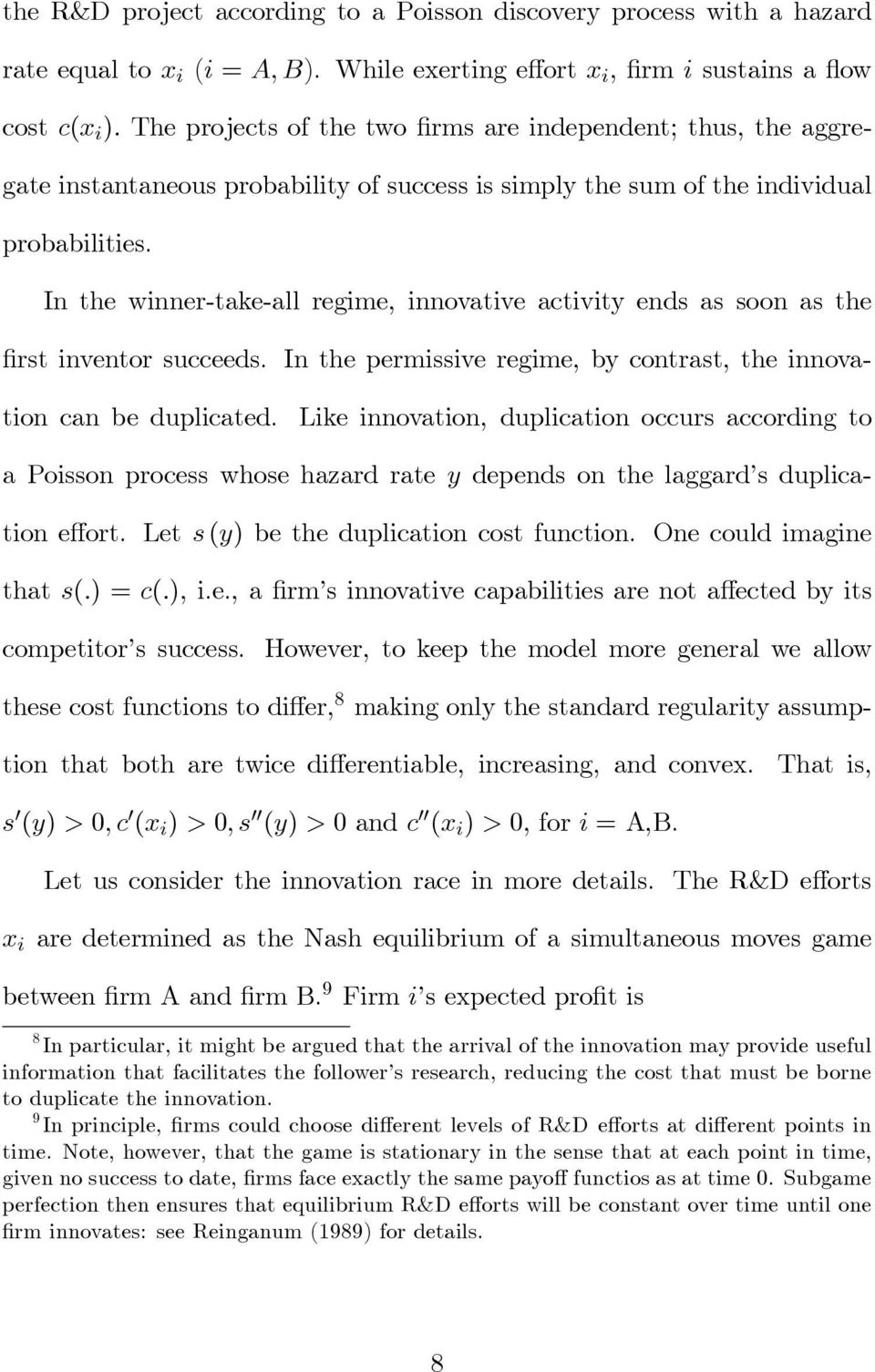
9 Π i (x i,x j )= x i P W +x j P L c(x i ), (1) x i +x j + wheeistheinteestate,x i isownr&deffot,x j isthecompetito sr&d effot,p W istheewadtowinneoftheaceandp L tothelose,bothto be detemined pesently. The best eply function of fim i is implicitly given by: P }{{} W + (P W P L ) } {{ } x j c (x i ) (x i +x j +)+c(x i )=0. (2) pofit incentive competitive theat Thefisttemin(2)ispopotionaltothepofitincentiveP W ;thiswould be the only deteminant of the incentive to innovate if fim i aced alone (x j =0). ThesecondtemispopotionaltothecompetitivetheatP W P L,which,bycontast,captuestheincentivetotakeovethecompetito and tun fom second to the fist pize. The lage is the instantaneous pobability that fim j succeeds, elegating fim i to the second position, the moe impotant is the competitive theat. Sincefimsaesymmetic,inequilibiumx A =x B =x (Nti,1999).In such a symmetic equilibium, P W +(P W P L )x c (x ) (2x +)+c(x )=0 (3) Assuming that the equilibium is stable, 10 we have (the poof of this and othe esults is in the Appendix): 10 Stabilityoftheequilibiumequiesthecondition dx i <1foi,j=A,B,i j dx j (see LeeandWilde,1980,Beathetal.,1989,andNti,1999). 9
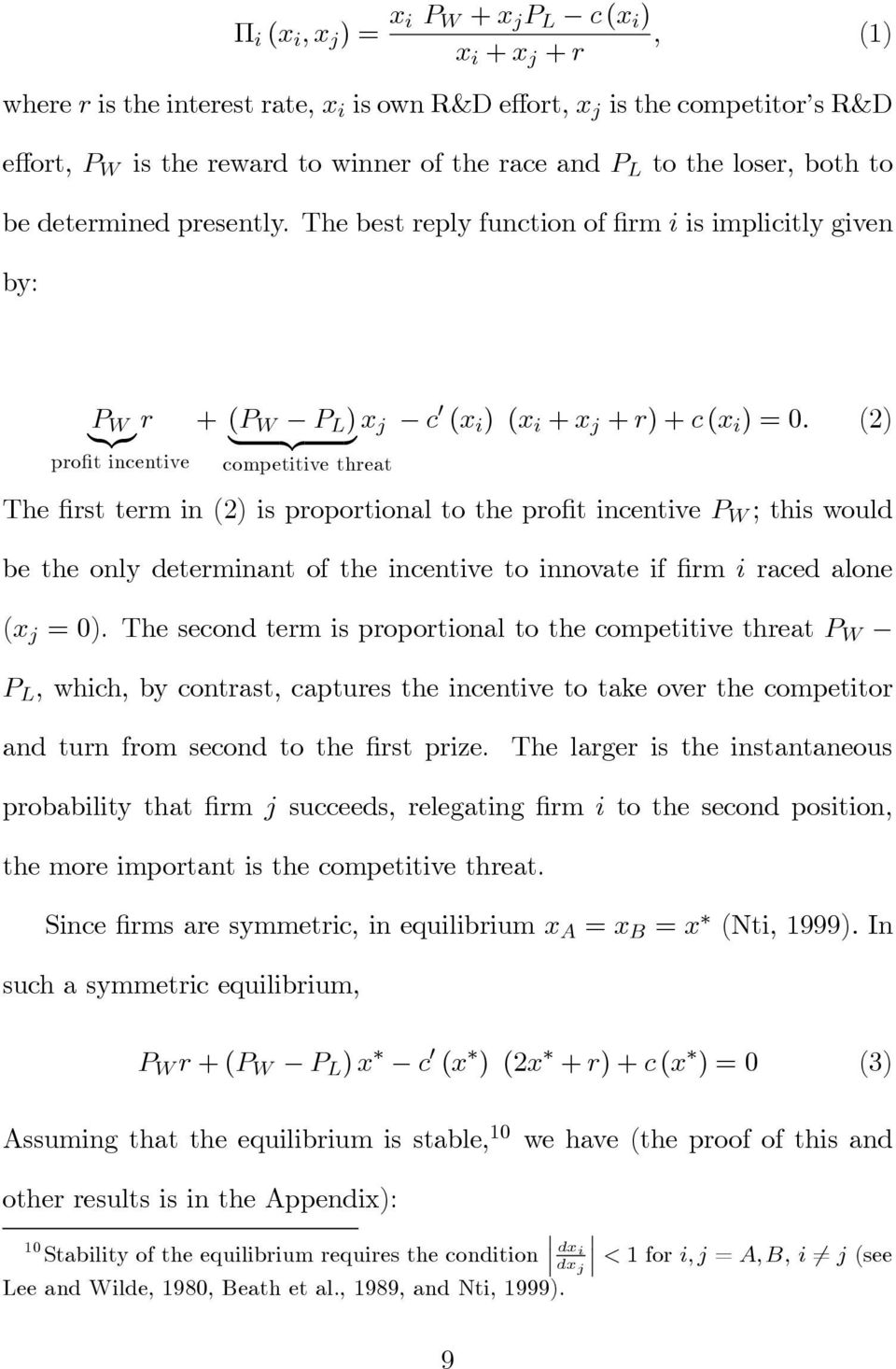
10 Lemma 1 Iftheequilibiumisstable(i.e.,if dx i <1),equilibiumR&D dx j effotsinceasewiththepizetothewinnep W anddeceasewiththepize tothelosep L : x P W >0and x P L <0. The consolation pize P L impacts negatively the incentive to innovate becauseitlowesthecompetitivetheat The poduct maket Wenowtuntothepoductmaketwheetheinnovationisused. Tokeep the analysis as geneal as possible, initially we do not make any specific assumption on the natue of the innovation, demand, and the competition in the poduct maket. We only assume that when the fist invento innovates, itstatstoeanaflowmonopolypofitπ m. Inthewinne-take-allegime, at some finite date (e.g., when patent potection expies) the innovation falls into the public domain and competition dives pofits to zeo. In the pemissive egime, by contast, when the laggad also succeeds the industy becomesaduopolyandeachfimobtainsπ d pepeiod. Fosimplicity,we assumethatinthepemissiveegimeduopolypofitslastsindefinitely TheLemmatakesthepizesP W andp Lasgiven,butvaiablesthataffecttheconsolationpizemayalsoindiectlyimpactthepizetothewinnebyspeedinguposlowing downtheduplicationpocess,asweshallseeinthenextsection. 12 One can easily extend ou esults to the case whee duopoly pofits may also end, because the innovation may be supeseded by exogenous technical pogess, o because it mayleakinthepublicdomain. Allthatmattesisthatduopolypofitsinthepemissive egime last, on aveage, moe than monopoly pofits in the winne-take-all egime: othewise, it would be impossible to compae the two egimes holding the incentive to innovate constant. 10
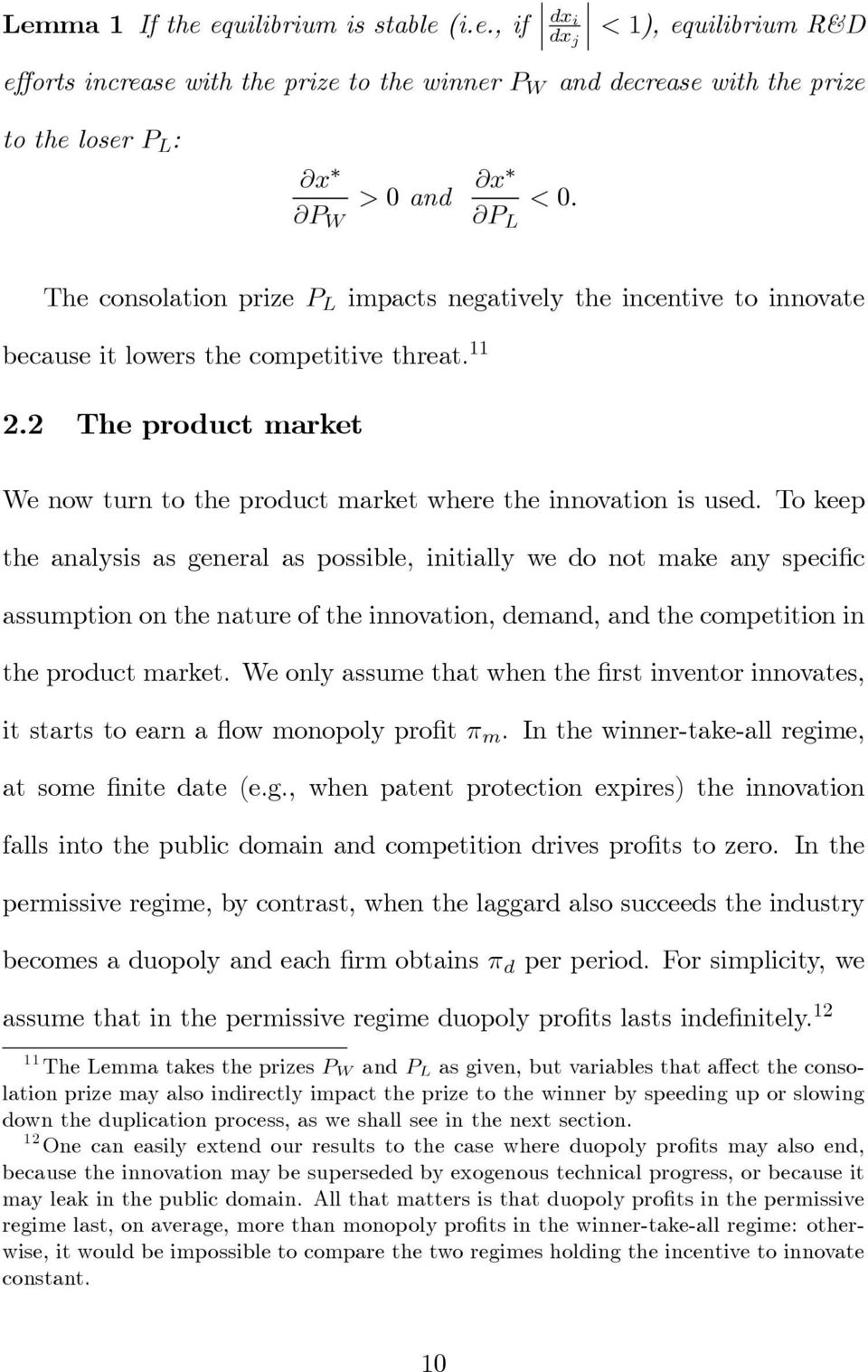
11 Letvbetheflowsocialvalueoftheinnovationonceitisinthepublic domain. If the innovation is used exclusively by one fim, society suffes a flowmonopolydeadweightloss m andsothesocialbenefitfomtheinnovationisonlyv m pepeiod. Whenbothfimspacticetheinnovation and the poduct maket is a duopoly, the deadweight loss is geneally lowe, d m. Apat fom any dynamics associated with duplication o patent expiation, the envionment is stationay, with a constant discount ate equal to. Fo the time being, we assume that the fist invento does not license the innovative knowledge to the othe fim; this assumption will be elaxed below. 3 Theatiotest We now deive the equilibium in the two policy egimes and develop the welfae compaison. We stat with the pemissive egime in which independent inventos ae allowed to pactice the innovation and compete with the fist invento. 3.1 The pemissive egime How ae the ewads P W and P L detemined? In the pemissive egime, the lose eans discounted duopoly pofits upon duplication, less duplication costs: [ y π d PL IID =max y s(y) y+ ], (4) 11

12 wheeiidstandsfoindependent-inventiondefense. Lety =agmax y [ y π d denote the optimal duplication effot, which, by implicit diffeentiation, inceaseswithπ d. Defineq= y y + <1asthe discountingadjusted pobability of duplication: with a Poisson duplication pocess, the innovation will eventually be duplicated with pobability one, but since thee is discounting, a delayed duplication counts less than instant duplication. Then, we can e-wite(4) as: PL IID =q π d ) (1 q)s(y. (5) Tuningtothewinne sewad,thisisgivenby s(y) y+ ] P IID W = π m+y π d y + = (1 q) π m +qπ d. (6) The fist line of (6) says that the winne eans monopolypofits until the loseduplicates,whichhappenswithinstantaneouspobabilityy. Afteduplication,bothfimsobtainduopolypofitsπ d. Thesecondlineshowsthat the innovato s ewad can be egaded as a weighted aveage of monopoly and duopoly discounted pofits, with weights eflecting the discounting adjusted pobability of duplication. Clealy, P IID W > PIID L ; moe pecisely, the competitive theat is: [ ] PW IID PL IID πm ) =(1 q) +s(y. (7) 12

13 3.2 The winne-take-all egime In the winne-take-all egime, by definition the pize fo the second innovato iszeo(p WTA L =0). Thepizefothefistinnovato,assumingthatitholds amonopolyfoatimepeiodoflengtht,is T PW WTA = 0 π m e t dt=τ π m, (8) wheeτ 1 e T isthenomalizedlengthofthefistinvento smonopoly. 3.3 Welfae We use the standad definition of social welfae in a patial equilibium famewok, namely the sum of consume and poduce suplus. In the winne-take-all egime, expected social welfae is [ W WTA = 2x 2x τ v m +(1 τ) v ] 2c(x ) + 2x +, (9) since monopoly ends when the innovation falls into the public domain. The tem inside squae backets is the discounted social value of the innovation, accounting fo the monopoly distotions that pevail fo a peiod of discounted length τ. The coefficient 2x 2x + is the discounting adjusted pobabilitythattheinnovationisachieved(thehazadateis2x sincetwo fims ae acing but who innovates is a matte of indiffeence fo society), and the last tem is the total discounted R&D expenditue. In the pemissive egime, things ae slightly moe complicated. Expected 13
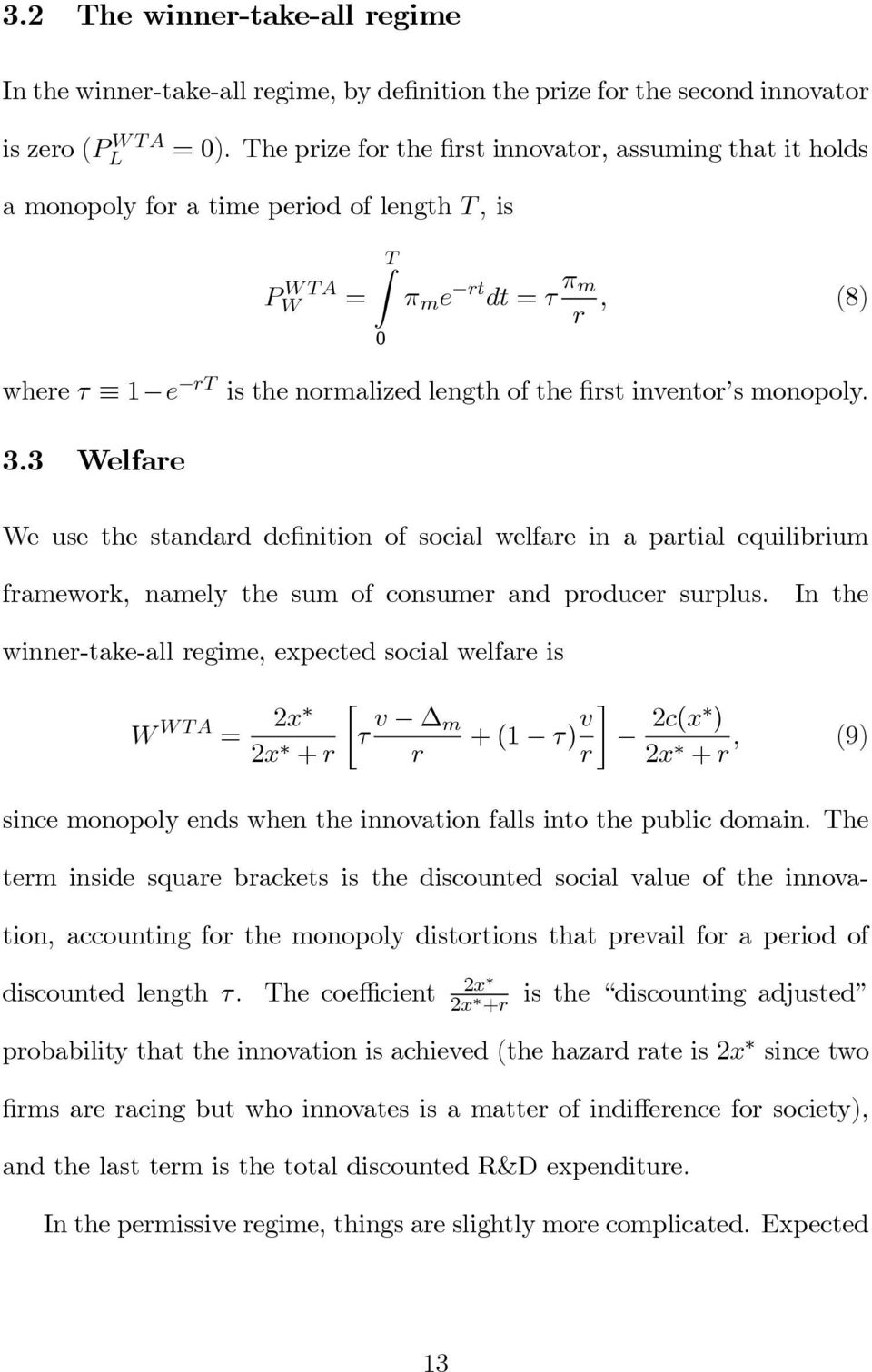
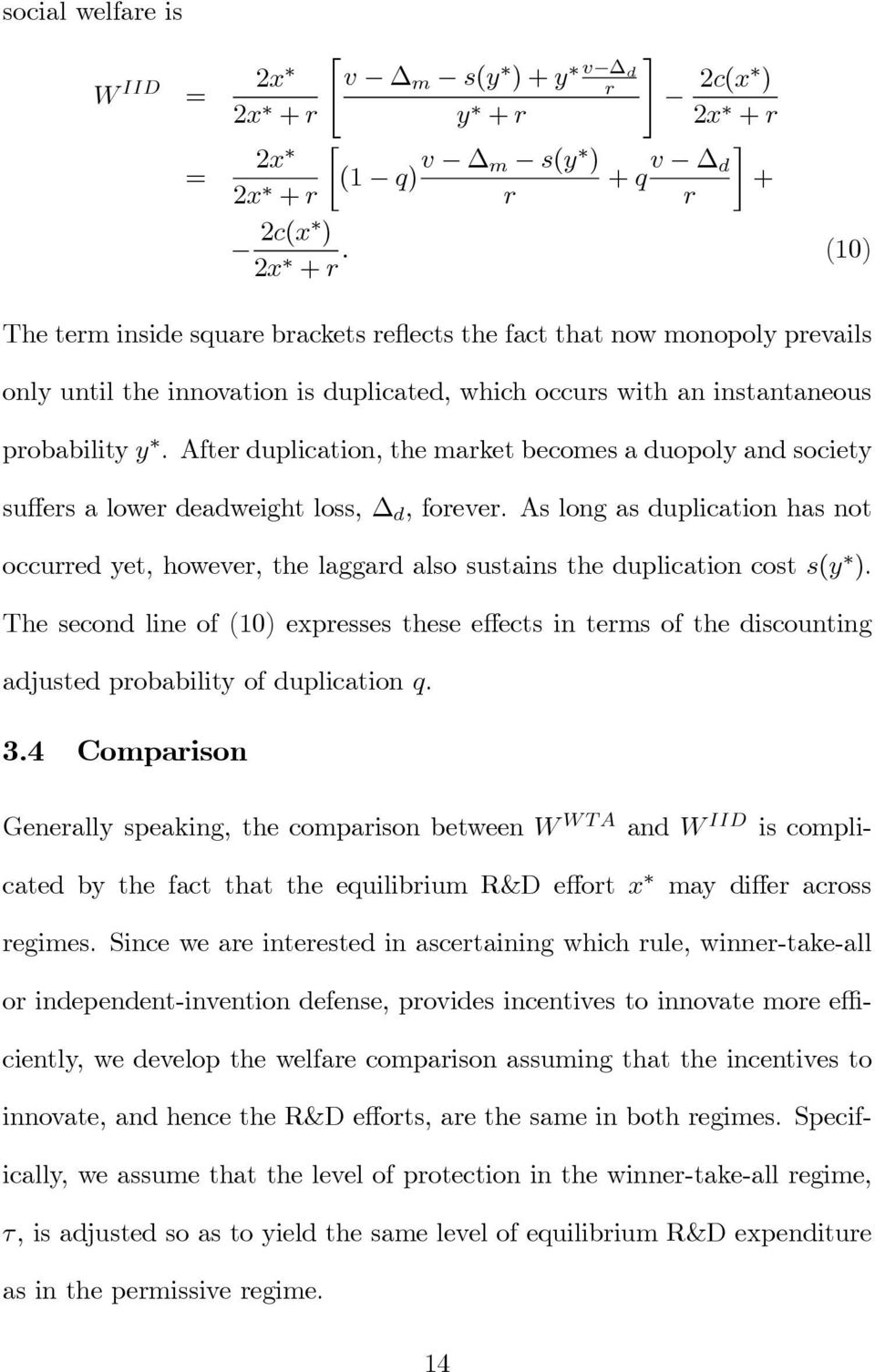
14 social welfae is W IID = = 2x 2x + 2x 2x + [ v m s(y )+y v d y + [ (1 q) v m s(y ) ] 2c(x ) 2x + ] + +q v d 2c(x ) 2x +. (10) The tem inside squae backets eflects the fact that now monopoly pevails only until the innovation is duplicated, which occus with an instantaneous pobabilityy. Afteduplication,themaketbecomesaduopolyandsociety suffesalowedeadweightloss, d,foeve. Aslongasduplicationhasnot occuedyet,howeve,thelaggadalsosustainstheduplicationcosts(y ). The second line of (10) expesses these effects in tems of the discounting adjusted pobability of duplication q. 3.4 Compaison Geneally speaking, the compaison between W WTA and W IID is complicated by the fact that the equilibium R&D effot x may diffe acoss egimes. Since we ae inteested in ascetaining which ule, winne-take-all o independent-invention defense, povides incentives to innovate moe efficiently, we develop the welfae compaison assuming that the incentives to innovate, and hence the R&D effots, ae the same in both egimes. Specifically, we assume that the level of potection in the winne-take-all egime, τ,isadjustedsoastoyieldthesamelevelofequilibiumr&dexpenditue as in the pemissive egime. 14
15 To poceed, note that the consolation pize can be ewitten as whee P IID L =q π d (1 Σ), (11) Σ= s(y ) y π d (12) can be intepeted as a elative index of the costliness of duplication. It epesents theshae of expected discounted duopoly pofits, q π d, which is absobedbyduplicationcosts. Σangesfom0(costlessduplication) 13 to1 (duplication is so costly as to absob all expected evenues). With this definition, we can state: Poposition 1 (The Ratio Test) The winne-take-all egime is pefeable tothepemissiveegimeintemsofsocialwelfaeif ( d +Σ 1 p ) m π d π m (1 p) m π m. (13) wheep= x x + isthestand-alone,discounting-adjustedpobabilityofsuccess in the innovation ace. When is the atio test moe likely to be passed? Is the optimality of the winne-take-all pinciple a mee theoetical cuiosum, as suggested by the ealie liteatue, o is it a ealistic possibility? Unfotunately, inequality (13) looks complicated. Moeove, some of the vaiables that appea in(13), 13 The case Σ=0aises, fo instance, when duplication is completely costless up to a cetain level y and is infinitely costly beyond thatlevel. Then, duplicative activity will alwaysoccuatatey andσ=0. 15

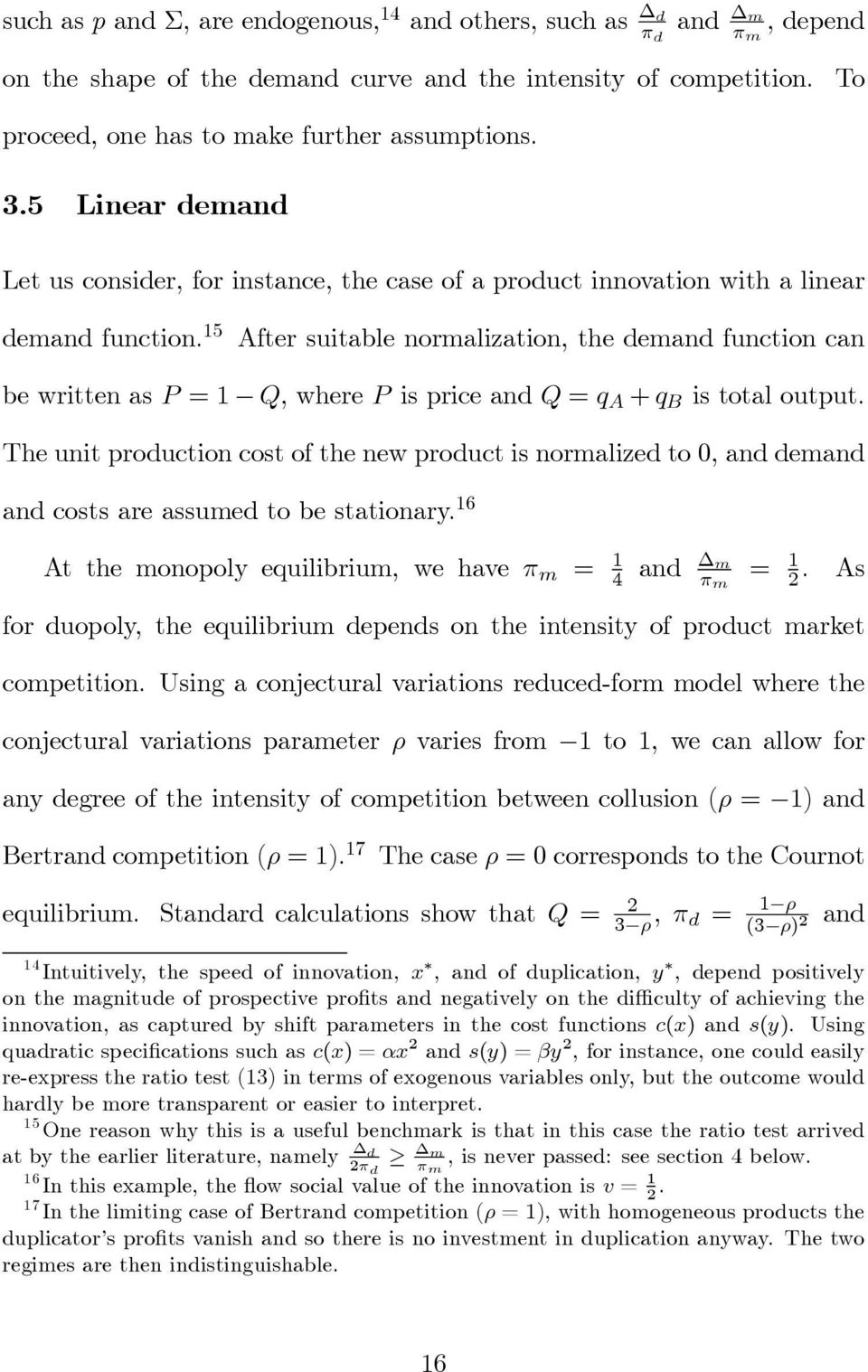
16 suchaspandσ,aeendogenous, 14 andothes,suchas d π d and m πm,depend on the shape of the demand cuve and the intensity of competition. To poceed, one has to make futhe assumptions. 3.5 Linea demand Letusconside,foinstance,thecaseofapoductinnovationwithalinea demandfunction. 15 Aftesuitablenomalization,thedemandfunctioncan bewittenasp =1 Q,wheeP ispiceandq=q A +q B istotaloutput. Theunitpoductioncostofthenewpoductisnomalizedto0,anddemand andcostsaeassumedtobestationay. 16 At the monopoly equilibium, we have π m = 1 4 and m πm = 1 2. As fo duopoly, the equilibium depends on the intensity of poduct maket competition. Using a conjectual vaiations educed-fom model whee the conjectual vaiations paamete ρ vaies fom 1 to 1, we can allow fo any degee of the intensity of competition between collusion(ρ = 1) and Betandcompetition(ρ=1). 17 Thecaseρ=0coespondstotheCounot equilibium. Standad calculations show that Q = 2 3 ρ, π d = 1 ρ (3 ρ) 2 and 14 Intuitively, the speed of innovation, x, and of duplication, y, depend positively on the magnitude of pospective pofits and negatively on the difficulty of achieving the innovation, as captued by shift paametes in the cost functions c(x) and s(y). Using quadaticspecificationssuchasc(x)=αx 2 ands(y)=βy 2,foinstance,onecouldeasily e-expess the atio test(13) in tems of exogenous vaiables only, but the outcome would hadly be moe tanspaent o easie to intepet. 15 One eason why this is a useful benchmak is that in this case the atio test aived atbytheealieliteatue,namely d 2π d m πm,isnevepassed: seesection4below. 16 Inthisexample,theflowsocialvalueoftheinnovationisv= InthelimitingcaseofBetandcompetition(ρ=1),withhomogeneouspoductsthe duplicato s pofits vanish and so thee is no investment in duplication anyway. The two egimes ae then indistinguishable. 16
17 d π d = 1 2 (1 ρ). Inseting the above fomulas into(13), the condition fo the winne-takeall system to be pefeable becomes ρ 2Σ+p(1 Σ). (14) Inspection of(14) eveals that the winne-take-all system is moe likely to be optimal: (i) the lowe the intensity of poduct maket competition, ρ; (ii) the geate the costliness of duplication, Σ; (iii) the geate the intensity of the innovation ace, p (and hence the lowe the inteestate,, and the lowe the expected waiting time to discovey, x ). 1 These compaative statics esults ae illustated in Figue 1. The winnetake-all system is pefeable below the upwad sloping paallel lines. All these lines have equation(14), taken as an equality. Two such lines, coespondingtoσ=0andσ= 1 3,aedepicted. WhenΣ 1 2,thewinne-takeall system dominates the pemissive system fo all values of the intensity of competition and of the intensity of the ace. The winne-take-all system is also pefeable when the intensity of competition is Counot o weake (ρ 0), iespective of the costliness of duplication and the speed of the innovation ace. Next,letusfocusonthecasewheeΣ< 1 2 andcompetitionistoughe thancounot(ρ>0). Figue1showsthatwhenpislage,thewinne-take- 17

18 Figue 1: The winne-take-all system is pefeable below the upwad sloping staight lines, which collapse to the noth-east vetex of the ectangle when Σ 1 2. all system can be optimal even if competition is substantially moe intense that Counot competition even with zeo duplication costs. To assess the likelihood that the winne-take-all system is still pefeable, it is theefoe impotant to get a sense of the magnitude of p. The vaiable p = x x + depends on the eal inteest ate and the instantaneous pobability of discoveyx. Taking10%asanuppeboundfotheealinteestateand 2%asaloweboundfotheinstantaneouspobabilityofsuccess, 18 onegets aloweboundfopof0.2. Inhighlyinnovativeindusties,howeve,pcan 18 1 Note that x is the expected time to discovey, and so a value of x = 2% means thatafiminnovatesevey50yeas. Althoughx isostensiblyanendogenousvaiable,it mustbesaidthatpivatefimsaelyengageineseachwhenthechancesofsuccessae so emote. 18
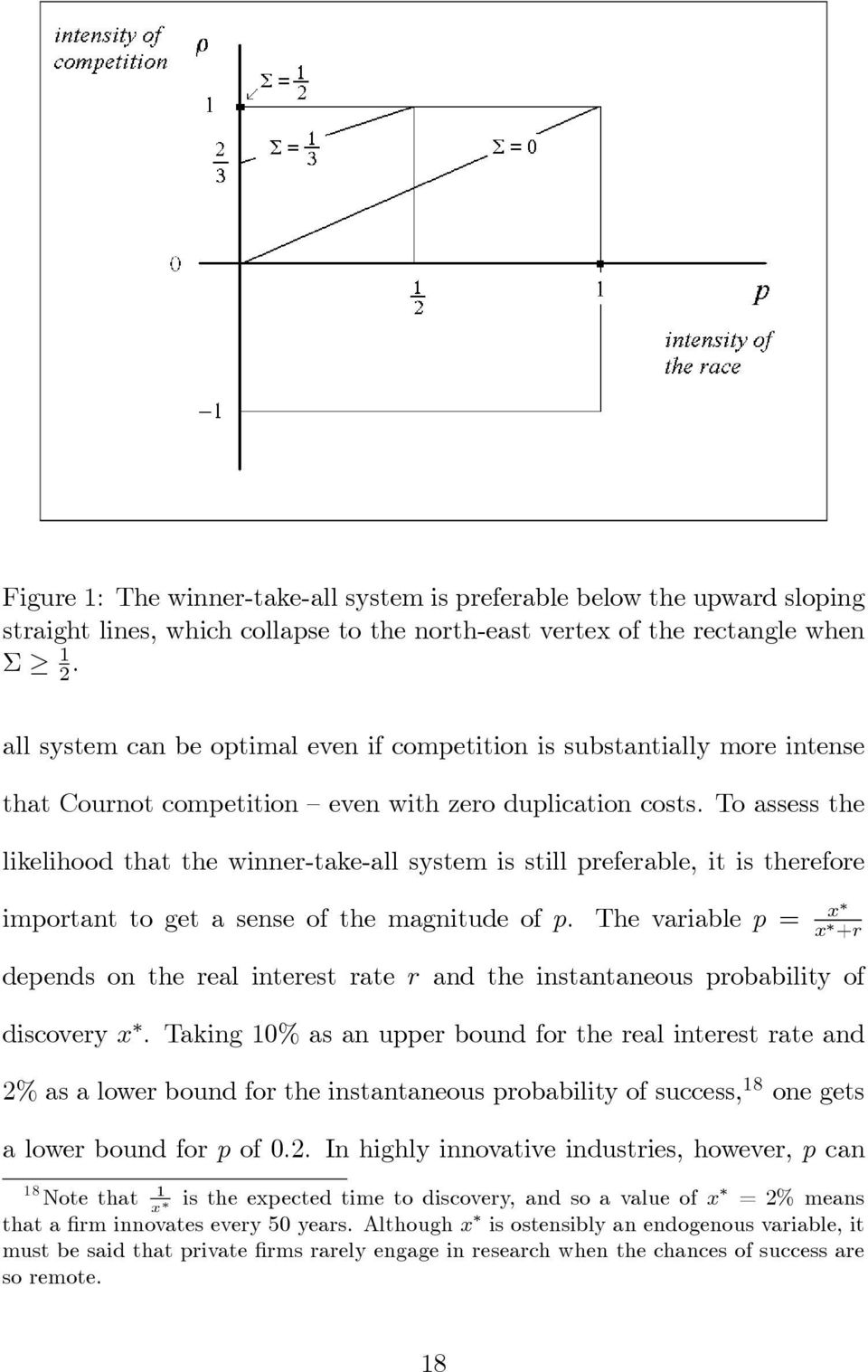
19 besignificantlylage. Withp=0.5, foinstance, theatiotestis passed when ρ 1 2, iespective of the magnitude of duplication costs, o when Σ 1 3, iespectiveoftheintensityofpoductmaketcompetition. Thus, the baseline model suggests that it is quite likely that the winne-take-all pinciple may be pefeable in highly innovative industies. Convesely, the pemissive egime is moe likely to be optimal in matue industies, whee poduct maket competition is stong and innovation is a elatively ae occuence(x low). 3.6 Ceative duplication So fa we have assumed that poducts ae homogeneous and so duplication is entiely wasteful. If the innovations tageted by the two fims ae not identical, howeve, duplication may incease poduct vaiety and hence may be socially valuable. To allow fo this possibility, we now suppose that the duplicato supplies a poduct that is diffeent fom that supplied by the innovato. Moe pecisely, we assume that the two poducts ae hoizontally diffeentiated. To addess the issue of ceative duplication in its puest fom, we assume that the fist invento cannot seek to discove the othe vaiety and is esticted to poduce only its own. This means that thee ae now two souces of monopoly deadweight losses: high pices and low vaiety Clealy,theassumptionthatthefistinventocanpoduceonlyitsownvaietybiases the compaison against the winne-take-all system: if this assumption wee elaxed, the appopiate atio test would be easie to pass. 19

20 Following the classic fomulation of Singh and Vives(1984), let the invese demand functions be: P A =1 q A θq B, and P B =1 q B θq A. (15) wheeθ [0,1]isapaametethatcaptuesthedegeeofsubstitutability betweenpoducts. Thetwogoodsaeindependentfoθ=0,andaepefect substitutes fo θ = 1(the case consideed above). Again, poduction costs ae nomalized to 0. When both poducts ae supplied and pices ae set equal to maginal costs, we have q A = q B = 1 1+θ and so social suplus is v = 1 1+θ. Pices, howeve, will geneally exceed maginal costs, educing the benefit society obtains fom the innovations. Using again a conjectual vaiations educedfom solution, we obtain d = 1 ρθ π d 1+θ, (16) whee the conjectual vaiations paamete ρ now anges fom ρ = 1(collusion)toρ=θ(Betandcompetition). 20 As fo monopoly, accounting fo both souces of deadweight losses(high 20 1 Standadcalculationsshowthatq A=q B =. Duopolyequilibiumpofitsae 2+θ ρθ 1 ρd 1+θ π d =, while consume suplus can be easily calculated as CS (2+θ ρθ) 2 d =. (2+θ ρθ) 2 Subtacting the sum of poduce and consume suplus unde duopoly fom the fist best benchmak, we get (1 ρθ) 2 d = (1+θ)(2+θ ρθ) 2, whence equation(16) immediately follows. 20

21 picesandlowvaiety),nowwehave: 21 m = 5 3θ π m 2(1+θ). (17) Fosimplicity,letusfocusonthecaseΣ=0. Inseting(16),(17)and Σ=0into (13), it tuns out that the winne-take-allsystemis pefeable when ρ< 2 (5 3θ)(1 p). (18) 2θ As in the case of homogeneous poducts, less competition in the poduct maket and a faste ace favo the winne-take-all system. What is the effect of a change in the degee of poduct diffeentiation? Geate poduct diffeentiation affects the compaison between the two egimes in two opposing ways. On the one hand, it makes duplication moe valuable duplication enlages the vaiety of poducts available to consumes. On the othe hand, fo any given level of the conjectual vaiations paamete, geate poduct diffeentiation elaxes the competition between the fist and the second invento,theebyinceasingtheatio d π d. Whicheffectpevailsdependsonthe intensity of the innovation ace, as can be easily confimed by diffeentiating the ight-hand side of(18): Poposition 2 With ceative duplication, an incease in the degee of poduct diffeentiation militates in favo of the winne-take-all system when the ace is not vey intense, i.e., p < 3 5, othewise, it militates against the winne-take-all system. 21 Moe pecisely, monopoly pofit is still π m = 1, but now the monopoly deadweight 4 lossis m = d 8 21
22 Figue 2 depicts the egion whee the winne-take-all system is pefeable as a function of p and θ fo values of the intensity of competition ρ coesponding to collusion, Counot competition, and Betand competition, espectively. Remakably, the winne-take-all system can be desiable even if poducts ae completely independent(θ = 0), povided that the innovation ace is sufficiently intense: to be pecise, the condition is p> 3 5. The intuitive eason is that with θ = 0, in a pemissive system each fim would conduct the eseach as a monopolist. The winne-take-all system intoduces competition in eseach among the two fims, speeding up the innovation ace. Although ou assumptions make the social costs of such a policy especially lage (one poduct is neve developed), the oveall effect on social welfae can still be positive. 4 Discussion and extensions In this section we compae ou atio test (13) with that developed in the ealie liteatue. To bette claify why we aive at diffeent esults, we also analyze seveal extensions of the baseline model. 4.1 Liteatue eview Thee ae two main diffeences between ou baseline model and the analysis developed in the ealie liteatue. Fist, the ealie liteatue assumes that thee is no duplicative activity in equilibium. Second, it equates the incen- 22
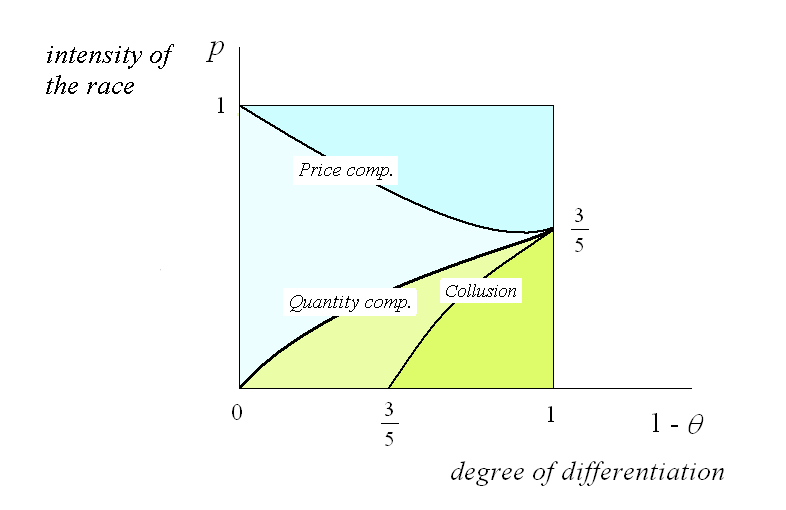
23 Figue 2: The winne-take-all system is pefeable above the cuves coesponding to vaious degees of the intensity of competition. tive to innovate to industy pofits. With these assumptions, the question ofwhichegimeismoeefficientboilsdowntothequestionofwhetheitis less distoting to aise an euo of pofits unde oligopoly o unde monopoly. Accodingly, the winne-take-all system is pefeable only if: d 2π d m π m. (19) This atio test is vey difficult, if not impossible, to pass. With homogenous poducts, fo instance, inequality(19) is always violated with linea o constantelasticitydemand,andcanbemetonlywhenthedemandfunctionis extemely convex(shapio, 2006). Tocompaeouatiotestwiththetaditionalone,letusstatfomthe 23
24 caseσ=0sincetheoleofthecostlinessofduplicationisbetteconsideed inisolation. SettingΣ=0,(13)becomes: 1 d m. (20) (1 p) π d π m Compaing(20) with(19) we note two diffeences; both make ou test easie to pass. Fist, the atio between duopoly deadweight losses and duopoly pofits involves individual, not industy pofits. That is, d is divided by π d,not2π d. Thiseffectalonedoublesthetemepesentingthesocialcostof thepemissiveegime: ifpoductmaketcompetitionisnottoointense, d π d canbegeatethan m π m evenwithalinea,omodeatelyconcave,demand cuve. Second, in the atio test(20) the left-hand side is futhe inceased, since d 1 π d is multiplied by a facto geate than one, 1 p, which inceases withthespeedoftheinnovationacep. These diffeences have natual economic explanations. With zeo duplication costs, the total ewad P W +P L equals discounted industy pofits in both egimes. The impotant point, howeve, is that in ou model the incentivestoinnovatedonotdependonlyontheaggegatepizep W +P L, but also on its division between the innovato and the duplicato. This has two consequences. Fist, only the pize to the winne P W has a positive effect on the incentive to innovate, and in the pemissive egime the pize to the winne includes only individual duopoly pofits(i.e., those accuing tothefistinvento). Thisexplainswhytheatioontheleft-handsideof 24
25 (20) is d π d athe than d 2π d. Second, those duopoly pofits that accue to the duplicato affect P L, not P W ; and do so negatively. That is, not only duopoly pofits accuing to the lose of the ace do not contibute positively to the incentive to innovate, but they actually lowe such an incentive by inceasing the consolation pize. This negative effect on the competitive 1 theatiscaptuedbythefacto 1 p ontheleft-handsideof(20). Thistem inceaseswithpbecause, aswealeadyknow,theimpotanceofthecompetitive theat depends positively on the intensity of the innovation ace. Summaizing, duopoly pofits povide low-poweed incentives to innovate as compaed to monopoly pofits because only duopoly pofits accuing to the fist invento stimulate innovation, wheeas those accuing to the duplicato actually slow it down. TuningtothegenealcasewithΣ>0,noticethatthelefthandsideof (13), which measues the social cost of stimulating innovative activity in the pemissive egime, is augmented by a tem popotional to the index of the costliness of duplication, Σ. Typically the additional tem is positive. Thus, duplication costs, which ae bone only in the pemissive egime, futhe favosthewinne-take-allsystem. 22 How ae the assumptions undelying the taditional atio test justified? 22 Howeve, inspection of (13) eveals that the additional tem on the left-hand side is actually be negative if p m > π m. Howeve, this condition can only hold in athe special cicumstances when poducts ae homogeneous (although it is not exteme with diffeentiated poducts). The intuitive explanation is that while duplication costs ae socially wasteful, they also lowe the consolation pize and so incease the incentive to innovate fo any given level of monopoly and duopoly pofits. Theefoe, duplication costs have two opposing effects on social welfae in the pemissive egime. 25
26 Thee have been vaious appoaches. Fist, La Manna, MacLeod and De Meza(1989) posit up-font R&D costs with fee enty and constant etuns to scale in eseach. 23 In thei model, fims sinkr&d investments at the beginningoftheaceanddonotbeaanyr&dcostsubsequently. Thisimmediately implies that no R&D expenditue is pe se duplicative in natue. Moeove,itimpliesthatwhendecidinghowmuchtoinvestinR&Datthe outset, eseach fims take into account that they might get any pize(fist o second) with some positive pobability. Since ex ante both positions ae open to each fim, the expected etun fom R&D investment equals expected industy pofits. Theefoe, industy pofits uniquely detemine the incentives to innovate and hence the pobability of success. Anothe appoach that aives at the taditional atio test (19) uses a timeless, educed-fom model of the innovation ace in which the two fims may succeed simultaneously(a zeo-pobability event in continuous time): see Shapio (2006). If both fims succeed, in the pemissive system the maket becomes a duopoly, wheeas in the winne-take-all system Natue chooses andomly which fim is ganted a monopoly. In this model, the incentivetoinnovateisalineacombinationofthepizefombeingthesole innovato(i.e., monopoly pofits with pobability one in both egimes) and that fom inventing ex equo (i.e., duopoly pofits in the pemissive egime and a fifty-fifty chance of getting monopoly pofits in the winne-take-all 23 LaMannaetal. assumethatthetimingoftheinnovationisstochastic,andusemoe geneal distibutional assumptions than the Poisson pocess. 26
27 egime). 24 Itfollowsthatfotheincentivetoinnovatetobethesameacoss egimes, discounted duopoly pofits must equal half discounted monopoly pofits; o, in othe wods, discounted industy pofits unde monopoly and duopoly must be equal. Still anothe appoach assumes that in the pemissive egime the fist invento licenses peemptively the innovation to potential duplicatos (Maue and Scotchme, 2002). If thee is fee enty of potential duplicatos and the innovato has all the bagaining powe, in the pemissive egime the fist inventocanappopiateindustypofitsfully. 25 Itfollowsthattheincentive to innovate is again detemined by aggegate industy pofits. Moeove, even though duplication is potentially pofitable, no duplicative activity will occu in equilibium and so duplication costs will not be actually bone. That diffeent sets of specific assumptions may lead to the taditional atio test(19) is emakable, but does not necessaily mean that the conclusionisaobustone. Intheemaindeofthissectionweextendoubaseline model to account fo some of the effects analyzed in the ealie liteatue, such as licensing, fee enty, and the case in which R&D expenditues ae an up-font payment athe than flow expenditues. In some extensions the pemissive egime faes bette than in the baseline model, but the dominance esult of the ealie liteatue is e-obtained only in exteme cases. 24 In a timeless famewok, the weights in the linea combination depend only on the ival s effot, not on own effot. In othe wods, own R&D expenditues affect the pobability of success, but not the elative chances of being the sole winne o succeeding ex equo. 25 CugnoandOttoz(2004)extendtheMaueandScotchmemodeltothecaseinwhich thee is only one potential duplicato. 27
28 4.2 Licensing As wehaveseenabove, MaueandScotchme(2002)aguethatthepemissive egime is especially attactive in the pesence of licensing. If the fist invento can immediately license the innovation to its competito, this saves duplication costs and inceases the ewad to the winne of the ace. Both effects favo the pemissive egime: the fome inceases social welfae diectly, the latte aises the incentive to innovate fo any given level of monopolyandduopolydeadweightlosses. 26 This suggests that the appopiate atio test will become moe difficult to pass when licensing is feasible. While it confims this intuition, the analysis below highlights two caveats. Fist, both additional effects ae elated to the magnitude of duplication costs, and hence both vanish when duplication costsaenegligible. WhenΣ=0,thatistosay,theappopiatetestemains (20) even with licensing. Second, the taditional test is obtained only in the exteme case in which duplication costs absob expected duopoly pofits fully and the fist invento has all the bagaining powe in the licensing negotiation. As is well known, licensing ageements can often be cafted anti-competitively. To poceed, let us theefoe conside which type of ageements should be pemitted in ou famewok. Since monopoly pofits geneally exceed aggegate duopoly pofits, the fist invento has an incentive to pay the laggad simply 26 Geneally speaking, howeve, vaious obstacles may impede technology licensing, especially when the innovative technological knowledge is a tade secet. 28
29 tostayoutofthemaket. Similaly,thefistinventohasandincentivetolet the licensee pactice the innovation only afte some distant futue date, o to set an exobitantly lage oyalty ate, compensating the potential duplicato with a side payment(i.e., a negative fixed fee). Howeve, these licensing clauses would be anti-competitive and as such could be stuck down by antitust authoities. Hee, we assume that antitust authoities pefectly enfoce the pinciple stated in the 1995 Antitust Guidelines fo the Licensing of IP, which define as potentially anti-competitive those estaints that have advese effects on competition that would have occued in the absence of the license. 27 As a esult, licensing contacts must be dafted so that the licensee can stat to compete not late than the expected time of duplication, and duopoly pices unde licensing cannot be geate than those that would pevail unde duplication. In othe wods, licensing takes place against an up-font payment (no unning oyalties), and the licensee will entethemaketatadatelsuchthat 1 e l = y + =1 q. In view of these assumptions, the potential duplicato will have to choose between paallel development and licensing, knowing that his decision will neithe affect the expected stating date of poduction which in nomalized time units equals 1 q no the magnitude of duopoly pofits π d. Theonlyeffectoflicensingistosaveduplicationcosts(1 q) s(y ),which theefoe epesent the bagaining suplus. In the negotiation between the fist invento and the potential duplicato, the fist invento will get a shae 27 See Gilbet(1995)foanexcellentdiscussionoftheguidelines. 29
30 γ of the bagaining suplus and the laggad the emaining shae (1 γ), whee γ eflects the winne s bagaining powe. Unde these assumptions, we get: Poposition 3 Unde competition-neutal licensing, the winne-take-all egime is pefeable to the pemissive egime in tems of social welfae if d π d [(1 p)+γ(1+p)σ] m π m. (21) WhenΣ=0oγ=0,theatiotestisunaffectedbylicensingand,moe geneally,theeffectoflicensingissmallifγσissmall. Themaindiffeence withespecttothebaselinemodelisthataninceaseintheindexofcostliness of duplication now unambiguously militates against the winne-take-all system. Howeve, the taditional test is obtained only unde the exteme assumptions Σ = 1(expected duopoly pofits ae entiely absobed by duplicationcosts)andγ=1(thefistinventohasallthebagainingpowein thelicensinggame). TheintuitionisthatwithγΣ=1,theconsolationpize vanishes and the fist innovato obtains aggegate duopoly pofits; theefoe, the incentives to innovate is given by industy pofits and so(19) applies. With linea demand, homogeneous poducts, and symmetic bagaining powe(γ= 1 2 ),inequality(21)educesto: ρ p 1 Σ(1+p). (22) 2 Following Maue and Scotchme(2002), let us focus on the case of Counot competition. In this case, the independent-invention defense egime is opti- 30
31 malonlyifσ> 2p (1+p). Withp=0.5,foinstance,thisinequalityismetonly ifσ> 2 3. Thismeansthateveninthepesenceoflicensing,inhighlyinnovative industies duplication costs must be elatively lage fo an independent inventiondefensetobesociallydesiable Fee enty TheeaetwomaindiffeencesbetweenoubaselinemodelandthatofLa Manna et al. (1989). Fist, so fa we have assumed that only two fims ae engaged in eseach, while they assume that thee is fee enty. Second, we have assumed that R&D expenditues ae a flow cost sustained until the innovation is achieved, wheeas they assume that R&D expenditues ae an up-font payment sunk at the beginning of the ace. In what follows we ague that the taditional atio test(19) is appopiate only when both of the assumptions made by La Manna et al. (1989) hold. With eithe assumption, but not both, the appopiate atio test is easie to pass than the taditional one, and possibly even than the atio test obtained in the baseline model, i.e., inequality(13). We fist elax the assumption that only two fims can conduct the eseach. Instead, we analyze the case whee the equilibium numbe of fims isdeteminedbyafeeentyconditionbothintheinnovationandthedu- 28 In oumodel, the innovatolicenses the technology to a unique fim. With multiple would-be licensees, an additional cost of a pemissive egime is that it may ende exclusive technology tansfes infeasible, since the licenso could secetly beach the exclusive deal andsellthetechnologytoadiffeentfim. Intun,thelattecouldclaimthatitdeveloped the innovation independently. See Bhattachaya and Guiev(2006) fo an analysis of this poblem. 31
32 plication stage. Although the assumption of fee enty may seem exteme, theanalysisofthis casemayshedlighton thelikelyeffects of anincease inthenumbeoffimspaticipatingintheace. 29 Poposition 4 With fee enty in innovation and duplication, the winnetake-all egime is pefeable to the pemissive egime in tems of social welfae if d π d +(1 q) π m π d +q m π m. (23) Theatiotest(23)canactuallybeeveneasietopassthan(13). With homogeneous poducts and a linea demand cuve, fo instance, inequality (23) is always satisfied, iespective of the magnitude of duplication costs and the intensity of the innovation ace. The intuition behind (23) is that unde fee enty expected pofits ae bought down to zeo at all stages. This implies that thee is no second pize, and so the competitive theat equals the pofit incentive not only in the winne-take-all egime but also in the pemissive egime. Howeve, duplication costs ae now lagest since they absob all expected pofits upon duplication, and the effect of these duplication costs on the welfae compaison is unambiguously advese, since they no longe have any positive effect onthecompetitivetheat Fo simplicity, we assume that thee is only one duplication stage. The analysis, howeve, can be easily extended to the case with an abitaily lage numbe of duplication stages(i.e., whee the innovation can be duplicated an abitaily lage numbe of times). 30 Seefootnote22above. 32
33 4.4 R&D costs committed up font Finally, we conside a model whee R&D expenditues ae committed up font by the acing fims. As befoe, such R&D expenditues detemine the hazad ates of the Poisson pocesses descibing the aival of the innovation. 31 Following La Manna etal. (1989), assume that R&D expenditueis a linea function of R&D effots. With up-font R&D costs the expected pofit offimi=a,bis: Π i = x ip W +x j P L x i +x j + cx i. (24) whee c is the unit R&D cost. The compaison between the winne-take-all andthepemissiveegimeisnowmodifiedintwoways. Fist,theeaeno duplication costs, since duplication occus as a esult of the up-font R&D expenditues bone by the lose. Second, the consolation pize effect loses some of its stength, since now even the second pize stimulates the up-font investmentineseach: themoeafiminvestsattheoutset,thelessitwill havetowaittobecomeduopolistuponlosingtheace. Weget: Poposition 5 When R&D costs ae committed up font, the winne-takeall egime is pefeable to the pemissive egime in tems of social welfae 31 ThismodelissimilatothatdevelopedbyHeny(2007),whoanalyzesa maginal move fom the winne-take-all egime to the independent-invention defense egime. Stating fom a pue winne-take-all egime, such a maginal move is socially desiable unde weake conditions than those unde which a dastic move, like that consideed hee, is. 33
34 if d π d (1 p)(2+p) m π m. (25) Thefunction(1 p)(2+p)deceasesmonotonicallyfom2(p=0)to 0(p = 1). This confims that the winne-take-all system is moe desiable whentheinnovationaceisintenseandsopis lage. Thetaditionaltest (19)isobtainedonlyfop=0,howeve. Assoonastheindustydoesnot stagnate indefinitely in an equilibium with no eseach, the winne-take-all system is moe desiable than inequality(19) would suggest. 5 Conclusion In this pape, we have agued that the winne-take-all system is optimal in a boad set of cicumstances. Ou conclusion challenges the claim, which is gaining populaity among economists and law scholas, that a moe pemissive system is geneally pefeable. This emeging consensus ests upon the analysisofaseiesofathespecificmodels,allofwhichhaveincommonthe popety that the incentive to innovate is popotional to industy pofits andtheeaenoduplicationcosts. Wehaveaguedthatinaninnovation ace the incentive to innovate depends cucially on the division of industy pofits among ealy and late innovatos, and duplication is socially costly. With these additional effects at wok, the winne-take-all system becomes elatively moe desiable. In paticula, ou analysis points out that the winne-take-all system is pefeable in highly innovative industies, wheeas 34
35 the pemissive system is moe likely to be optimal in matue industies, whee poduct maket competition is stong and innovation is a elatively ae occuence. 35
36 Refeences Bhattachaya, S. and S. Guiev, 2006, Patents vs. tade secets: Knowledge licensing and spillove. Jounal of the Euopean Economic Association, 4 (6), Beath J., Katsoulacos Y. and D. Ulph, 1989, Stategic R&D Policy, Economic Jounal 97, Blai R.D. and T. F. Cotte, 2002, Stict Liability and its Altenatives in Patent Law, Bekeley Technology Law Jounal, 17, Che, Y. and I. Gale, 2003, Optimal Design Altenatives in Patent Law, Bekeley Technology Law Jounal 17, of Reseach Contest, Ameican Economic Review, 93, Cugno, F. and E. Ottoz, 2004, The independent invention defence in a Counot duopoly model, Economics Bulletin, 12(5), 1-7. Denicolò, V., 1996, Patent aces and optimal patent beadth and length, Jounal of Industial Economics, 44, Denicolò, V., 2007, Do Patents Ove-compensate Innovatos?, Economic Policy, 22, Denicolò, V. and L.A. Fanzoni, 2004, Patent, Secets, and the Fist Invento Defense, Jounal of Economics and Management Stategy, 13, Fulleton, R. I. and P. McAfee, 1999, Auctioning Enty into Tounaments, Jounal of Political Economy, 7, Gallini, N., 1992, Patent Length and Beadth with Costly Imitation, Rand Jounal of Economics, 23, Gilbet, R., 1995, Defining the Intesection of Intellectual Popety and the Antitust Laws: The 1995 Antitust Guidelines fo the Licensing of Intellectual Popety, Antitust, vol. 9, issue 3. Gilbet, R. and C. Shapio, Optimal Patent Length and Beadth, Rand Jounal of Economics 21,
37 Heny, E. 2007, Runne-up patents: is monopoly inevitable?, woking pape, available at ssn.com. Kaplow, L., 1984, The Patent-Antitust Intesection: A Re-appaisal, Havad Law Review, 97, Klempee, P., 1990, How bead should the scope of patent potection be?, Rand Jounal of Economics 21, Kultti, K., J. Toikka, and T. Takalo, 2006, Simultaneous Model of Innovation, Sececy, and Patent Policy, Ameican Economic Review (Papes& Poceedings), 96, Kultti, K., J. Toikka, and T. Takalo, 2007, Sececy vs. Patenting, RAND Jounal of Economics, fothcoming. La Manna M., R. MacLeod and D. de Meza, 1989, The Case fo Pemissive Patents, Euopean Economic Review, 33, Lee, T. and L. Wilde, 1980, Maket Stuctue and Innovation: A Refomulation, Quately Jounal of Economics, 94, Lemley, M., 2007, Should Patent Infingement Requie Poof of Copying? Michigan Law Review 105, Maue, S. M., Scotchme, S., The independent invention defence in intellectual popety. Economica 69, Moldovanu, B. and A. Sela, 2001, The Optimal Allocation of Pizes in Contests, Ameican Economic Review, 91, Nti, K., 1999, Stability in the patent ace contest of Lee and Wilde, Economic Theoy 14, Reingamum, J., 1989, The Timing of Innovation: Reseach, Development, and Diffusion, in Schmalensee and Willig(eds.), Handbook of Industial Oganization, Noth Holland, New Yok. Singh, N. and X. Vives, 1984, Pice and Quantity Competition in a Diffeentiated Duopoly, Rand Jounal of Economics 15,
38 Shapio, C., 2006, Pio Use Rights, Ameican Economic Review (Papes& Poceedings), 96, 92-96, Taylo, C., 1995, Digging fo Golden Caots: An Analysis of Reseach Tounaments, Ameican Economic Review, 85, Vemont, S., 2006, Independent invention as a defense to patent infingement, Michigan Law Review, vol. 105, Decembe. 38
39 Appendix ThepoofofLemma1andPopositions2,4,5,and6follows. Poof of Lemma 1. Implicit diffeentiation of(2) gives dx i = P W P L c (x i ) dx j c (x i )(x i +x j +) and so the stability condition dx i <1becomes dx j Implicit diffeentiation of(3) gives and P W P L c (x i )<c (x i )(x i +x j +) dx x + = dp W P W P L c (x ) c (x )(2x +) dx dp L = x P W P L c (x ) c (x )(2x +) By the stability condition, the denominato of these expessions is negative, whencetheesultfollows. Poof of Poposition 2. Fom the equilibium condition (3), we immediatelyseethatfothetwoegimestoyieldthesameinnovationeffotswe must have: that is: P WTA W (+x )=P IID W + ( P IID P WTA W =P IID W ppiid L, W PL IID ) x, (A1) wheep= x x + isthestand-alone,discounting-adjustedpobabilityofsuccess. Thepizetothewinnehastobeloweinthewinne-take-allegime than in the pemissive egime because in the latte the consolation pize educes the incentives to innovate. The diffeence between the fist pizes in thetwoegimes,p WTA W andp IID W,inceaseswiththesizeoftheconsolation pizeandalsowithp. Intuitively,themoeintenseistheacetoinnovate, the stonge is the advese incentive effect of the consolation pize, and 39
40 hence the moe impotant is the competitive theat. Using(5),(6) and(8), expession(a1) can be e-witten as follows: τ π [ m =(1 q)π m +qπ d p q π ] d ) (1 q)s(y. Thus,inodetohavethesameincentivestoinnovate,wemusthave τ =(1 q)+q(1 p) π d π m +(1 q)p s(y ) π m. Notethatτ mustexceedtheleadtime(1 q)inthepemissiveegimeby an amount that inceases with duopoly pofits and duplication costs. Using(9)and (10), one immediatelysees that whenthe R&Deffotis the same acoss egimes, social welfae is geate unde the winne-take-all egime if τ v m +(1 τ) v (1 q)v m s(y ) +q v d. Inseting into this expession the value of τ that makes the incentives to innovate equal acoss egimes, one gets that the winne-take-all egime dominates in tems of social welfae if: [ v (1 q)+q(1 p) π d π m +(1 q)p s(y ) π m Simplifying and eaanging we get d + (1 q) π d q s(y ) π d m π m [ ] m (1 q)[v m s(y )]+q(v d ). (1 p)+p (1 q) q NotingthatΣ= (1 q) s(y ) q π d andeaangingweget d π d +Σ ( 1 p m π m ) (1 p) m π m. s(y ] ). π d Poof of Poposition 4. The winne-take-all egime is unaffected by the possibility of licensing, since licensing will neve take place anyway. In the pemissive egime, instead, we now have PW IID =(1 q) π m +qπ d ) +γ(1 q)s(y, (A2) 40
41 and P IID L = q π d ) γ(1 q)s(y = q π d (1 γσ). (A3) Now, a ise in duplication costs inceases both the pofit incentive and the competitive theat. As a consequence, the geate ae duplication costs, the geateisthevalueoftheduationofexclusivityτ necessaytoinducethe same incentives to innovate in the two egimes. Using(8),(A2) and(a3), expession(a1) can be e-witten as follows: τ π m =(1 q)π m +qπ d ) +γ(1 q)s(y p [ q π d ) γ(1 q)s(y Thus,inodetohavethesameincentivestoinnovate,wemusthave ]. τ =(1 q)+q(1 p) π d π m +γ(1 q)(1+p) s(y ) π m. (A4) Tuning to the welfae compaison, notice that duplication costs ae no longe bone in the pemissive egime. Social welfae theefoe becomes: [ W IID = 2x 2x (1 q) v m +q v ] d 2c(x ) + 2x +. In the winne-take-all egime, social welfae is still given by(9). Inseting (A4)into(9)andcompaingtoW IID,oneobtainsthatthewinne-take-all egime dominates in tems of social welfae if: [ v (1 q)+q(1 p) π d π m +γ(1 q)(1+p) s(y ) π m Simplifyingandeaangingtheesultfollows. ] m (1 q)[v m ]+q(v d ). Poof of Poposition 5. Suppose that thee ae n identical active fims The pofit function of a epesentative fim i is theefoe wheex i = j ix j. Π i (x i,x i )= x i P W +X i P L c(x i ), x i +X i + 41
42 With fee enty into the innovation ace, the equilibium numbe of active fimsn andtheindividualeseacheffotsx aedeteminedsimultaneously as the solution to the system compising the fist-ode condition P }{{} W +(P W P L ) } {{ } X i c (x i ) (x i +X i +)+c(x i )=0 pofit incentive competitive theat and the zeo-pofit condition x i P W +X i P L c(x i )=0. Aswehaveseenabove,theconsolationpizeP L vanishesinthewinnetake-all system. Fee enty at the duplication stage, howeve, make the consolation pize vanish in the pemissive egime as well: the fim that loses theacegetszeoewad,asattheduplicationstagefeeentybingsthe expected pofit down to zeo. As a consequence, the equilibium conditions become: and P W c (x i ) (nx i +)+c(x i )=0, x i P W c(x i )=0 (A5) (A6) Clealy, fo the two systems to yield the same incentives to innovate, they mustguaanteethesamepizetothewinneoftheace. Inthewinne-take-allsystemthepizetothewinneisagaingivenby equation(8). In the pemissive egime, howeve, things ae now slightly diffeent. The aggegate duplication effot is detemined by conditions simila to(a5)and(a6),i.e., P W s (y i ) (n d y i +)+s(y i )=0, (A7) wheen d isthenumbeoffimsthatpaticipateintheduplicationace,and y i P W s(y i )=0, (A8) whee Y = n d y denotes aggegate duplication effot, whee n d and y aethesolutiontotheabovesystem. Then,thepizetothewinneinthe pemissiveegimeisagaingivenby(6),i.e.,pw IID=(1 q)πm +qπ d,whee 42
43 now q = Y Y +. By the zeo-pofit condition (A8), aggegate duplication costs ae n d [s(y )+F d ] Y + [ =q (1 q) π ] m +qπ d. Thus, social welfae in the pemissive egime is { W IID = 2x 2x (1 q) v [ m v d +q + (1 q) π m qπ d ]} 2c(x ) 2x + (A9) wheeas in the winne-take-all egime it continues to be given by(9). ConditionPW WTA =PW IIDcannowbee-wittenasfollows: τ π m =(1 q)π m +qπ d. Thus,inodetohavethesameincentivestoinnovate,wemusthave τ =(1 q)+q π d π m. Using(9)and(A9),oneimmediatelyseesthatwhentheR&Deffotis the same acoss egimes, social welfae is geate unde the winne-take-all egime if τ v m +(1 τ) v (1 q)v m [ v d +q (1 q) π ] m qπ d. Insetingintothisexpessionthevalueofτ thatmakestheincentivestoinnovate indeed equal acoss egimes, one gets that the winne-take-all egime dominates in tems of social welfae if: v [ (1 q)+q π d π m ] m (1 q)(v m )+q[v d (1 q)π m qπ d ]. Simplifyingandeaangingwegettheesult. Poof of Poposition 6. Withup-font R&D costs, PW WTA continues to be given by (8) and PL WTA = 0 by definition. In the pemissive egime, howeve,thepizestothewinneandtotheloseaenowdiffeentthanin the baseline model, as the pobability of duplication no longe depends on imitation effot. Instead, the instantaneous pobability that the innovation 43
44 is duplicated is now the same as the instantaneous pobability that a fim innovates fo the fist time. It follows that: and Pi,W IID = π m x j + + x j π d x j + Pi,L IID = x i π d x i +. NotethatPi,W IID doesnotdependoni sowneffot,butpiid i,l does. Accodingly, the equation of fim i s eaction cuve in the pemissive egime is now P IID i,w } {{ } pofit incentive + ( Pi,W IID Pi,L IID ) } {{ } x j competitive theat +P IID i,l x i (x i +) } {{ } effect on second pize c(x i +x j +) 2 =0. (A10) Compaing(A10) to(2), the additional tem on the left-hand side eflects thefactthatbyinceasingitseseacheffot,afimnowinceasesthevalue ofthesecondpizetoit,asitgetssoonetoduopolypofitsincaseitdoes notwintheace. In a symmetic equilibium, we have: in the pemissive egime, and π m + x (2+3x ) (+x ) 2 π d =c(2x +) 2 τ x + π m =c(2x +) 2 in the winne-take-all egime. In ode to get the same incentive to innovate, itmustbe: τ x + π m =π m + x (2+3x ) (+x ) 2 π d, which gives: τ = x+ +x(2+3x) π d (x+) 3 π [ m = (1 p) 1+p(2+p) π ] d. π m 44
45 Social welfae in the pemissive egime is W IID = 2x 2x + [ v m +x v d x + wheeas unde the winne-take-all egime it is W WTA = 2x 2x + [ τ v m +(1 τ) v ] 2cx ] 2cx 2x +. Thus, social welfae will be geate in the winne-take-all egime iff o τ v m +(1 τ) v v m+x v d x + m +x d x + τ m If the two egimes povide the same incentives to innovate, this inequality educes to [ (1 p) m +p d (1 p) 1+p(2+p) π ] d m π m which simplifies to d π d (1 p)(2+p) m π m. 45
Chapter 3 Savings, Present Value and Ricardian Equivalence
 Chapte 3 Savings, Pesent Value and Ricadian Equivalence Chapte Oveview In the pevious chapte we studied the decision of households to supply hous to the labo maket. This decision was a static decision,
Patent renewals and R&D incentives
 RAND Jounal of Economics Vol. 30, No., Summe 999 pp. 97 3 Patent enewals and R&D incentives Fancesca Conelli* and Mak Schankeman** In a model with moal hazad and asymmetic infomation, we show that it can
Ilona V. Tregub, ScD., Professor
 Investment Potfolio Fomation fo the Pension Fund of Russia Ilona V. egub, ScD., Pofesso Mathematical Modeling of Economic Pocesses Depatment he Financial Univesity unde the Govenment of the Russian Fedeation
An Introduction to Omega
 An Intoduction to Omega Con Keating and William F. Shadwick These distibutions have the same mean and vaiance. Ae you indiffeent to thei isk-ewad chaacteistics? The Finance Development Cente 2002 1 Fom
ON THE (Q, R) POLICY IN PRODUCTION-INVENTORY SYSTEMS
 ON THE R POLICY IN PRODUCTION-INVENTORY SYSTEMS Saifallah Benjaafa and Joon-Seok Kim Depatment of Mechanical Engineeing Univesity of Minnesota Minneapolis MN 55455 Abstact We conside a poduction-inventoy
Channel selection in e-commerce age: A strategic analysis of co-op advertising models
 Jounal of Industial Engineeing and Management JIEM, 013 6(1):89-103 Online ISSN: 013-0953 Pint ISSN: 013-843 http://dx.doi.og/10.396/jiem.664 Channel selection in e-commece age: A stategic analysis of
9:6.4 Sample Questions/Requests for Managing Underwriter Candidates
 9:6.4 INITIAL PUBLIC OFFERINGS 9:6.4 Sample Questions/Requests fo Managing Undewite Candidates Recent IPO Expeience Please povide a list of all completed o withdawn IPOs in which you fim has paticipated
STUDENT RESPONSE TO ANNUITY FORMULA DERIVATION
 Page 1 STUDENT RESPONSE TO ANNUITY FORMULA DERIVATION C. Alan Blaylock, Hendeson State Univesity ABSTRACT This pape pesents an intuitive appoach to deiving annuity fomulas fo classoom use and attempts
The transport performance evaluation system building of logistics enterprises
 Jounal of Industial Engineeing and Management JIEM, 213 6(4): 194-114 Online ISSN: 213-953 Pint ISSN: 213-8423 http://dx.doi.og/1.3926/jiem.784 The tanspot pefomance evaluation system building of logistics
INITIAL MARGIN CALCULATION ON DERIVATIVE MARKETS OPTION VALUATION FORMULAS
 INITIAL MARGIN CALCULATION ON DERIVATIVE MARKETS OPTION VALUATION FORMULAS Vesion:.0 Date: June 0 Disclaime This document is solely intended as infomation fo cleaing membes and othes who ae inteested in
A Capacitated Commodity Trading Model with Market Power
 A Capacitated Commodity Tading Model with Maket Powe Victo Matínez-de-Albéniz Josep Maia Vendell Simón IESE Business School, Univesity of Navaa, Av. Peason 1, 08034 Bacelona, Spain [email protected] [email protected]
Chris J. Skinner The probability of identification: applying ideas from forensic statistics to disclosure risk assessment
 Chis J. Skinne The pobability of identification: applying ideas fom foensic statistics to disclosue isk assessment Aticle (Accepted vesion) (Refeeed) Oiginal citation: Skinne, Chis J. (2007) The pobability
Exam #1 Review Answers
 xam #1 Review Answes 1. Given the following pobability distibution, calculate the expected etun, vaiance and standad deviation fo Secuity J. State Pob (R) 1 0.2 10% 2 0.6 15 3 0.2 20 xpected etun = 0.2*10%
How Much Should a Firm Borrow. Effect of tax shields. Capital Structure Theory. Capital Structure & Corporate Taxes
 How Much Should a Fim Boow Chapte 19 Capital Stuctue & Copoate Taxes Financial Risk - Risk to shaeholdes esulting fom the use of debt. Financial Leveage - Incease in the vaiability of shaeholde etuns that
Questions & Answers Chapter 10 Software Reliability Prediction, Allocation and Demonstration Testing
 M13914 Questions & Answes Chapte 10 Softwae Reliability Pediction, Allocation and Demonstation Testing 1. Homewok: How to deive the fomula of failue ate estimate. λ = χ α,+ t When the failue times follow
The future challenges of Healthcare
 The futue challenges of Healthcae D. Eich Hunzike CFO F. Hoffmann La Roche Ltd. JPMogan Healthcae Confeence San Fancisco, Januay 12, 2005 This pesentation contains cetain fowad-looking statements. These
Define What Type of Trader Are you?
 Define What Type of Tade Ae you? Boke Nightmae srs Tend Ride By Vladimi Ribakov Ceato of Pips Caie 20 of June 2010 1 Disclaime and Risk Wanings Tading any financial maket involves isk. The content of this
The Predictive Power of Dividend Yields for Stock Returns: Risk Pricing or Mispricing?
 The Pedictive Powe of Dividend Yields fo Stock Retuns: Risk Picing o Mispicing? Glenn Boyle Depatment of Economics and Finance Univesity of Cantebuy Yanhui Li Depatment of Economics and Finance Univesity
How To Find The Optimal Stategy For Buying Life Insuance
 Life Insuance Puchasing to Reach a Bequest Ehan Bayakta Depatment of Mathematics, Univesity of Michigan Ann Abo, Michigan, USA, 48109 S. David Pomislow Depatment of Mathematics, Yok Univesity Toonto, Ontaio,
CHAPTER 10 Aggregate Demand I
 CHAPTR 10 Aggegate Demand I Questions fo Review 1. The Keynesian coss tells us that fiscal policy has a multiplied effect on income. The eason is that accoding to the consumption function, highe income
The impact of migration on the provision. of UK public services (SRG.10.039.4) Final Report. December 2011
 The impact of migation on the povision of UK public sevices (SRG.10.039.4) Final Repot Decembe 2011 The obustness The obustness of the analysis of the is analysis the esponsibility is the esponsibility
NBER WORKING PAPER SERIES FISCAL ZONING AND SALES TAXES: DO HIGHER SALES TAXES LEAD TO MORE RETAILING AND LESS MANUFACTURING?
 NBER WORKING PAPER SERIES FISCAL ZONING AND SALES TAXES: DO HIGHER SALES TAXES LEAD TO MORE RETAILING AND LESS MANUFACTURING? Daia Bunes David Neumak Michelle J. White Woking Pape 16932 http://www.nbe.og/papes/w16932
est using the formula I = Prt, where I is the interest earned, P is the principal, r is the interest rate, and t is the time in years.
 9.2 Inteest Objectives 1. Undestand the simple inteest fomula. 2. Use the compound inteest fomula to find futue value. 3. Solve the compound inteest fomula fo diffeent unknowns, such as the pesent value,
Improving Network Security Via Cyber-Insurance A Market Analysis
 1 Impoving Netwok Secuity Via Cybe-Insuance A Maket Analysis RANJAN PAL, LEANA GOLUBCHIK, KONSTANTINOS PSOUNIS Univesity of Southen Califonia PAN HUI Hong Kong Univesity of Science and Technology Recent
Problem Set # 9 Solutions
 Poblem Set # 9 Solutions Chapte 12 #2 a. The invention of the new high-speed chip inceases investment demand, which shifts the cuve out. That is, at evey inteest ate, fims want to invest moe. The incease
Converting knowledge Into Practice
 Conveting knowledge Into Pactice Boke Nightmae srs Tend Ride By Vladimi Ribakov Ceato of Pips Caie 20 of June 2010 2 0 1 0 C o p y i g h t s V l a d i m i R i b a k o v 1 Disclaime and Risk Wanings Tading
Trading Volume and Serial Correlation in Stock Returns in Pakistan. Abstract
 Tading Volume and Seial Coelation in Stock Retuns in Pakistan Khalid Mustafa Assistant Pofesso Depatment of Economics, Univesity of Kaachi e-mail: [email protected] and Mohammed Nishat Pofesso and Chaiman,
AN IMPLEMENTATION OF BINARY AND FLOATING POINT CHROMOSOME REPRESENTATION IN GENETIC ALGORITHM
 AN IMPLEMENTATION OF BINARY AND FLOATING POINT CHROMOSOME REPRESENTATION IN GENETIC ALGORITHM Main Golub Faculty of Electical Engineeing and Computing, Univesity of Zageb Depatment of Electonics, Micoelectonics,
Comparing Availability of Various Rack Power Redundancy Configurations
 Compaing Availability of Vaious Rack Powe Redundancy Configuations By Victo Avela White Pape #48 Executive Summay Tansfe switches and dual-path powe distibution to IT equipment ae used to enhance the availability
Software Engineering and Development
 I T H E A 67 Softwae Engineeing and Development SOFTWARE DEVELOPMENT PROCESS DYNAMICS MODELING AS STATE MACHINE Leonid Lyubchyk, Vasyl Soloshchuk Abstact: Softwae development pocess modeling is gaining
Comparing Availability of Various Rack Power Redundancy Configurations
 Compaing Availability of Vaious Rack Powe Redundancy Configuations White Pape 48 Revision by Victo Avela > Executive summay Tansfe switches and dual-path powe distibution to IT equipment ae used to enhance
A framework for the selection of enterprise resource planning (ERP) system based on fuzzy decision making methods
 A famewok fo the selection of entepise esouce planning (ERP) system based on fuzzy decision making methods Omid Golshan Tafti M.s student in Industial Management, Univesity of Yazd [email protected]
MERGER SIMULATION AS A SCREENING DEVICE: SIMULATING THE EFFECTS OF THE KRAFT/CADBURY TRANSACTION
 MERGER SIMULATION AS A SCREENING DEVICE: SIMULATING THE EFFECTS OF THE KRAFT/CADBURY TRANSACTION Enique Andeu, Kisten Edwads, Aleando Requeo 1,2 Novembe 2010 Abstact In this aticle we pesent a method that
The LCOE is defined as the energy price ($ per unit of energy output) for which the Net Present Value of the investment is zero.
 Poject Decision Metics: Levelized Cost of Enegy (LCOE) Let s etun to ou wind powe and natual gas powe plant example fom ealie in this lesson. Suppose that both powe plants wee selling electicity into the
An Analysis of Manufacturer Benefits under Vendor Managed Systems
 An Analysis of Manufactue Benefits unde Vendo Managed Systems Seçil Savaşaneil Depatment of Industial Engineeing, Middle East Technical Univesity, 06531, Ankaa, TURKEY [email protected] Nesim Ekip 1
Efficient Redundancy Techniques for Latency Reduction in Cloud Systems
 Efficient Redundancy Techniques fo Latency Reduction in Cloud Systems 1 Gaui Joshi, Emina Soljanin, and Gegoy Wonell Abstact In cloud computing systems, assigning a task to multiple seves and waiting fo
CONCEPTUAL FRAMEWORK FOR DEVELOPING AND VERIFICATION OF ATTRIBUTION MODELS. ARITHMETIC ATTRIBUTION MODELS
 CONCEPUAL FAMEOK FO DEVELOPING AND VEIFICAION OF AIBUION MODELS. AIHMEIC AIBUION MODELS Yui K. Shestopaloff, is Diecto of eseach & Deelopment at SegmentSoft Inc. He is a Docto of Sciences and has a Ph.D.
A THEORY OF NET DEBT AND TRANSFERABLE HUMAN CAPITAL
 A THEORY OF NET DEBT AND TRANSFERABLE HUMAN CAPITAL Bat M. Lambecht Lancaste Univesity Management School Gzegoz Pawlina Lancaste Univesity Management School Abstact Taditional theoies of capital stuctue
Promised Lead-Time Contracts Under Asymmetric Information
 OPERATIONS RESEARCH Vol. 56, No. 4, July August 28, pp. 898 915 issn 3-364X eissn 1526-5463 8 564 898 infoms doi 1.1287/ope.18.514 28 INFORMS Pomised Lead-Time Contacts Unde Asymmetic Infomation Holly
Loyalty Rewards and Gift Card Programs: Basic Actuarial Estimation Techniques
 Loyalty Rewads and Gift Cad Pogams: Basic Actuaial Estimation Techniques Tim A. Gault, ACAS, MAAA, Len Llaguno, FCAS, MAAA and Matin Ménad, FCAS, MAAA Abstact In this pape we establish an actuaial famewok
Controlling the Money Supply: Bond Purchases in the Open Market
 Money Supply By the Bank of Canada and Inteest Rate Detemination Open Opeations and Monetay Tansmission Mechanism The Cental Bank conducts monetay policy Bank of Canada is Canada's cental bank supevises
Saving and Investing for Early Retirement: A Theoretical Analysis
 Saving and Investing fo Ealy Retiement: A Theoetical Analysis Emmanuel Fahi MIT Stavos Panageas Whaton Fist Vesion: Mach, 23 This Vesion: Januay, 25 E. Fahi: MIT Depatment of Economics, 5 Memoial Dive,
Intertemporal Macroeconomics
 Intetempoal Macoeconomics Genot Doppelhofe* May 2009 Fothcoming in J. McCombie and N. Allington (eds.), Cambidge Essays in Applied Economics, Cambidge UP This chapte eviews models of intetempoal choice
HEALTHCARE INTEGRATION BASED ON CLOUD COMPUTING
 U.P.B. Sci. Bull., Seies C, Vol. 77, Iss. 2, 2015 ISSN 2286-3540 HEALTHCARE INTEGRATION BASED ON CLOUD COMPUTING Roxana MARCU 1, Dan POPESCU 2, Iulian DANILĂ 3 A high numbe of infomation systems ae available
Rune Stenbacka Tuomas Takalo. Switching costs and financial stability
 Rune Stenbacka Tuomas Takalo Switching costs and financial stability ank of Finland Reseach Discussion Pape 06 SWITCING COSTS ND FINNCIL STILITY* Rune Stenbacka** Tuomas Takalo*** 4 Januay 06 We establish
Financing Terms in the EOQ Model
 Financing Tems in the EOQ Model Habone W. Stuat, J. Columbia Business School New Yok, NY 1007 [email protected] August 6, 004 1 Intoduction This note discusses two tems that ae often omitted fom the standad
An Epidemic Model of Mobile Phone Virus
 An Epidemic Model of Mobile Phone Vius Hui Zheng, Dong Li, Zhuo Gao 3 Netwok Reseach Cente, Tsinghua Univesity, P. R. China [email protected] School of Compute Science and Technology, Huazhong Univesity
Things to Remember. r Complete all of the sections on the Retirement Benefit Options form that apply to your request.
 Retiement Benefit 1 Things to Remembe Complete all of the sections on the Retiement Benefit fom that apply to you equest. If this is an initial equest, and not a change in a cuent distibution, emembe to
YARN PROPERTIES MEASUREMENT: AN OPTICAL APPROACH
 nd INTERNATIONAL TEXTILE, CLOTHING & ESIGN CONFERENCE Magic Wold of Textiles Octobe 03 d to 06 th 004, UBROVNIK, CROATIA YARN PROPERTIES MEASUREMENT: AN OPTICAL APPROACH Jana VOBOROVA; Ashish GARG; Bohuslav
Episode 401: Newton s law of universal gravitation
 Episode 401: Newton s law of univesal gavitation This episode intoduces Newton s law of univesal gavitation fo point masses, and fo spheical masses, and gets students pactising calculations of the foce
Spirotechnics! September 7, 2011. Amanda Zeringue, Michael Spannuth and Amanda Zeringue Dierential Geometry Project
 Spiotechnics! Septembe 7, 2011 Amanda Zeingue, Michael Spannuth and Amanda Zeingue Dieential Geomety Poject 1 The Beginning The geneal consensus of ou goup began with one thought: Spiogaphs ae awesome.
College Enrollment, Dropouts and Option Value of Education
 College Enollment, Dopouts and Option Value of Education Ozdagli, Ali Tachte, Nicholas y Febuay 5, 2008 Abstact Psychic costs ae the most impotant component of the papes that ae tying to match empiical
Supplementary Material for EpiDiff
 Supplementay Mateial fo EpiDiff Supplementay Text S1. Pocessing of aw chomatin modification data In ode to obtain the chomatin modification levels in each of the egions submitted by the use QDCMR module
UNIT CIRCLE TRIGONOMETRY
 UNIT CIRCLE TRIGONOMETRY The Unit Cicle is the cicle centeed at the oigin with adius unit (hence, the unit cicle. The equation of this cicle is + =. A diagam of the unit cicle is shown below: + = - - -
30 H. N. CHIU 1. INTRODUCTION. Recherche opérationnelle/operations Research
 RAIRO Rech. Opé. (vol. 33, n 1, 1999, pp. 29-45) A GOOD APPROXIMATION OF THE INVENTORY LEVEL IN A(Q ) PERISHABLE INVENTORY SYSTEM (*) by Huan Neng CHIU ( 1 ) Communicated by Shunji OSAKI Abstact. This
Optimal Capital Structure with Endogenous Bankruptcy:
 Univesity of Pisa Ph.D. Pogam in Mathematics fo Economic Decisions Leonado Fibonacci School cotutelle with Institut de Mathématique de Toulouse Ph.D. Dissetation Optimal Capital Stuctue with Endogenous
SUGGESTED SOLUTIONS. 21404 Strategic Financial Management. CA Professional (Strategic Level II) Examination June 2014
 SUGGESTED SOLUTIONS 21404 Stategic Financial Management CA Pofessional (Stategic Level II) Examination June 2014 THE INSTITUTE OF CHARTERED ACCOUNTANTS OF SRI LANKA All Rights Reseved Answe No. 01 (a)
The Incidence of Social Security Taxes in Economies with Partial. Compliance: Evidence from the SS Reform in Mexico
 The Incidence of Social Secuity Taxes in Economies ith Patial Compliance: Evidence fom the SS Refom in Mexico Gecia M. Maufo Abstact Looking at impovements in social secuity benefits in Mexico, this pape
Modeling and Verifying a Price Model for Congestion Control in Computer Networks Using PROMELA/SPIN
 Modeling and Veifying a Pice Model fo Congestion Contol in Compute Netwoks Using PROMELA/SPIN Clement Yuen and Wei Tjioe Depatment of Compute Science Univesity of Toonto 1 King s College Road, Toonto,
Continuous Compounding and Annualization
 Continuous Compounding and Annualization Philip A. Viton Januay 11, 2006 Contents 1 Intoduction 1 2 Continuous Compounding 2 3 Pesent Value with Continuous Compounding 4 4 Annualization 5 5 A Special Poblem
Liquidity and Insurance for the Unemployed*
 Fedeal Reseve Bank of Minneapolis Reseach Depatment Staff Repot 366 Decembe 2005 Liquidity and Insuance fo the Unemployed* Robet Shime Univesity of Chicago and National Bueau of Economic Reseach Iván Wening
883 Brochure A5 GENE ss vernis.indd 1-2
 ess x a eu / u e a. p o.eu c e / :/ http EURAXESS Reseaches in Motion is the gateway to attactive eseach caees in Euope and to a pool of wold-class eseach talent. By suppoting the mobility of eseaches,
An Efficient Group Key Agreement Protocol for Ad hoc Networks
 An Efficient Goup Key Ageement Potocol fo Ad hoc Netwoks Daniel Augot, Raghav haska, Valéie Issany and Daniele Sacchetti INRIA Rocquencout 78153 Le Chesnay Fance {Daniel.Augot, Raghav.haska, Valéie.Issany,
DYNAMICS AND STRUCTURAL LOADING IN WIND TURBINES
 DYNAMIS AND STRUTURAL LOADING IN WIND TURBINES M. Ragheb 12/30/2008 INTRODUTION The loading egimes to which wind tubines ae subject to ae extemely complex equiing special attention in thei design, opeation
GESTÃO FINANCEIRA II PROBLEM SET 1 - SOLUTIONS
 GESTÃO FINANCEIRA II PROBLEM SET 1 - SOLUTIONS (FROM BERK AND DEMARZO S CORPORATE FINANCE ) LICENCIATURA UNDERGRADUATE COURSE 1 ST SEMESTER 2010-2011 Chapte 1 The Copoation 1-13. What is the diffeence
Ignorance is not bliss when it comes to knowing credit score
 NET GAIN Scoing points fo you financial futue AS SEEN IN USA TODAY SEPTEMBER 28, 2004 Ignoance is not bliss when it comes to knowing cedit scoe By Sanda Block USA TODAY Fom Alabama comes eassuing news
Personal Saving Rate (S Households /Y) SAVING AND INVESTMENT. Federal Surplus or Deficit (-) Total Private Saving Rate (S Private /Y) 12/18/2009
 1 Pesonal Saving Rate (S Households /Y) 2 SAVING AND INVESTMENT 16.0 14.0 12.0 10.0 80 8.0 6.0 4.0 2.0 0.0-2.0-4.0 1959 1961 1967 1969 1975 1977 1983 1985 1991 1993 1999 2001 2007 2009 Pivate Saving Rate
An Approach to Optimized Resource Allocation for Cloud Simulation Platform
 An Appoach to Optimized Resouce Allocation fo Cloud Simulation Platfom Haitao Yuan 1, Jing Bi 2, Bo Hu Li 1,3, Xudong Chai 3 1 School of Automation Science and Electical Engineeing, Beihang Univesity,
How to create RAID 1 mirroring with a hard disk that already has data or an operating system on it
 AnswesThatWok TM How to set up a RAID1 mio with a dive which aleady has Windows installed How to ceate RAID 1 mioing with a had disk that aleady has data o an opeating system on it Date Company PC / Seve
Risk Sensitive Portfolio Management With Cox-Ingersoll-Ross Interest Rates: the HJB Equation
 Risk Sensitive Potfolio Management With Cox-Ingesoll-Ross Inteest Rates: the HJB Equation Tomasz R. Bielecki Depatment of Mathematics, The Notheasten Illinois Univesity 55 Noth St. Louis Avenue, Chicago,
Skills Needed for Success in Calculus 1
 Skills Needed fo Success in Calculus Thee is much appehension fom students taking Calculus. It seems that fo man people, "Calculus" is snonmous with "difficult." Howeve, an teache of Calculus will tell
The Binomial Distribution
 The Binomial Distibution A. It would be vey tedious if, evey time we had a slightly diffeent poblem, we had to detemine the pobability distibutions fom scatch. Luckily, thee ae enough similaities between
Over-encryption: Management of Access Control Evolution on Outsourced Data
 Ove-encyption: Management of Access Contol Evolution on Outsouced Data Sabina De Capitani di Vimecati DTI - Univesità di Milano 26013 Cema - Italy [email protected] Stefano Paaboschi DIIMM - Univesità
The Role of Gravity in Orbital Motion
 ! The Role of Gavity in Obital Motion Pat of: Inquiy Science with Datmouth Developed by: Chistophe Caoll, Depatment of Physics & Astonomy, Datmouth College Adapted fom: How Gavity Affects Obits (Ohio State
VISCOSITY OF BIO-DIESEL FUELS
 VISCOSITY OF BIO-DIESEL FUELS One of the key assumptions fo ideal gases is that the motion of a given paticle is independent of any othe paticles in the system. With this assumption in place, one can use
There is considerable variation in health care utilization and spending. Geographic Variation in Health Care: The Role of Private Markets
 TOMAS J. PHILIPSON Univesity of Chicago SETH A. SEABUY AND Copoation LEE M. LOCKWOOD Univesity of Chicago DANA P. GOLDMAN Univesity of Southen Califonia DAIUS N. LAKDAWALLA Univesity of Southen Califonia
Data Center Demand Response: Avoiding the Coincident Peak via Workload Shifting and Local Generation
 (213) 1 28 Data Cente Demand Response: Avoiding the Coincident Peak via Wokload Shifting and Local Geneation Zhenhua Liu 1, Adam Wieman 1, Yuan Chen 2, Benjamin Razon 1, Niangjun Chen 1 1 Califonia Institute
Chapter 11: Aggregate Demand II, Applying the IS-LM Model Th LM t
 Equilibium in the - model The cuve epesents equilibium in the goods maket. Chapte :, Applying the - Model Th t C ( T) I( ) G The cuve epesents money maket equilibium. M L(, ) The intesection detemines
Uncertain Version Control in Open Collaborative Editing of Tree-Structured Documents
 Uncetain Vesion Contol in Open Collaboative Editing of Tee-Stuctued Documents M. Lamine Ba Institut Mines Télécom; Télécom PaisTech; LTCI Pais, Fance mouhamadou.ba@ telecom-paistech.f Talel Abdessalem
Review Graph based Online Store Review Spammer Detection
 Review Gaph based Online Stoe Review Spamme Detection Guan Wang, Sihong Xie, Bing Liu, Philip S. Yu Univesity of Illinois at Chicago Chicago, USA [email protected] [email protected] [email protected] [email protected]
MULTIPLE SOLUTIONS OF THE PRESCRIBED MEAN CURVATURE EQUATION
 MULTIPLE SOLUTIONS OF THE PRESCRIBED MEAN CURVATURE EQUATION K.C. CHANG AND TAN ZHANG In memoy of Pofesso S.S. Chen Abstact. We combine heat flow method with Mose theoy, supe- and subsolution method with
Peer-to-Peer File Sharing Game using Correlated Equilibrium
 Pee-to-Pee File Shaing Game using Coelated Equilibium Beibei Wang, Zhu Han, and K. J. Ray Liu Depatment of Electical and Compute Engineeing and Institute fo Systems Reseach, Univesity of Mayland, College
How to recover your Exchange 2003/2007 mailboxes and emails if all you have available are your PRIV1.EDB and PRIV1.STM Information Store database
 AnswesThatWok TM Recoveing Emails and Mailboxes fom a PRIV1.EDB Exchange 2003 IS database How to ecove you Exchange 2003/2007 mailboxes and emails if all you have available ae you PRIV1.EDB and PRIV1.STM