
UNDERGROUND INJECTION CONTROL... YELLOW ROYALTY STATEMENTS... SALMON STRIPPER WELL PROPERTY DETERMINATION... GRAY WORKOVER PROJECTS...
|
|
|
- Anis Cori Taylor
- 10 years ago
- Views:
Transcription
1 SECTION I NORTH DAKOTA CENTURY CODE... TAN Control of Oil and Gas Resources Geophysical Exploration Requirements Oil and Gas Production Damage Compensation Subsurface Exploration Damages Carbon Dioxide Underground Storage SECTION II GENERAL RULES... GREEN SECTION III NATURAL GAS WELL STATUS DETERMINATIONS (Repealed effective July 1, 1996)... CHERRY SECTION IV UNDERGROUND INJECTION CONTROL... YELLOW SECTION V ROYALTY STATEMENTS... SALMON SECTION VI STRIPPER WELL PROPERTY DETERMINATION... GRAY SECTION VII WORKOVER PROJECTS... PINK SECTION VIII CERTIFICATION OF SECONDARY AND TERTIARY RECOVERY PROJECTS - DETERMINATION OF INCREMENTAL PRODUCTION... BLUE SECTION IX CERTIFICATION OF NEW WELLS, HORIZONTAL WELLS, HORIZONTAL REENTRY WELLS, AND TWO-YEAR INACTIVE WELLS... LAVENDER SECTION X GEOPHYSICAL EXPLORATION REQUIREMENTS... RED SECTION XI GEOLOGIC STORAGE OF CARBON DIOXIDE... GOLD Oil and Gas Forms Geophysical Exploration Forms 04/2012

2 THIS PAGE INTENTIONALLY LEFT BLANK

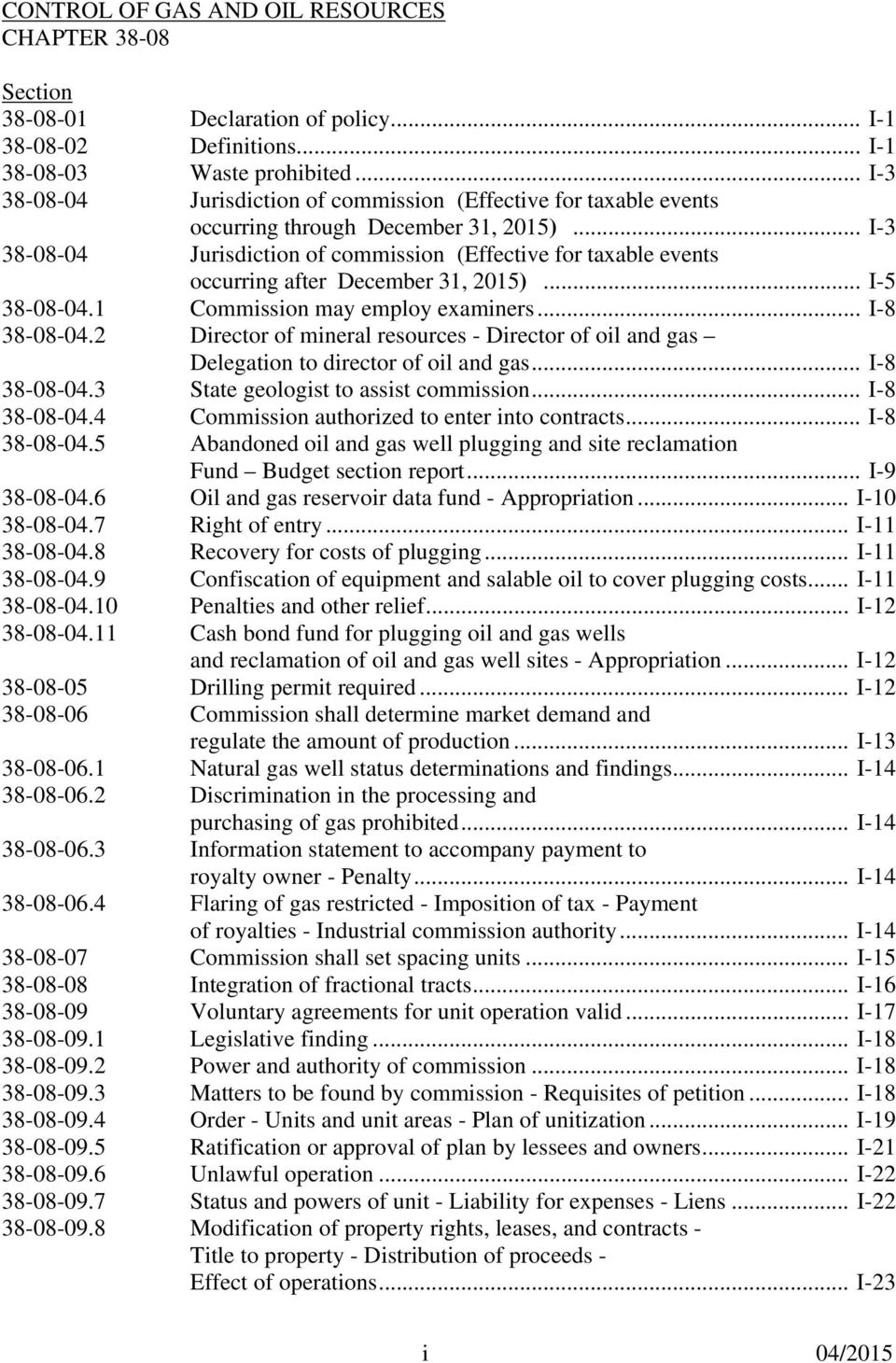
3 CONTROL OF GAS AND OIL RESOURCES CHAPTER Section Declaration of policy... I Definitions... I Waste prohibited... I Jurisdiction of commission (Effective for taxable events occurring through December 31, 2015)... I Jurisdiction of commission (Effective for taxable events occurring after December 31, 2015)... I Commission may employ examiners... I Director of mineral resources - Director of oil and gas Delegation to director of oil and gas... I State geologist to assist commission... I Commission authorized to enter into contracts... I Abandoned oil and gas well plugging and site reclamation Fund Budget section report... I Oil and gas reservoir data fund - Appropriation... I Right of entry... I Recovery for costs of plugging... I Confiscation of equipment and salable oil to cover plugging costs... I Penalties and other relief... I Cash bond fund for plugging oil and gas wells and reclamation of oil and gas well sites - Appropriation... I Drilling permit required... I Commission shall determine market demand and regulate the amount of production... I Natural gas well status determinations and findings... I Discrimination in the processing and purchasing of gas prohibited... I Information statement to accompany payment to royalty owner - Penalty... I Flaring of gas restricted - Imposition of tax - Payment of royalties - Industrial commission authority... I Commission shall set spacing units... I Integration of fractional tracts... I Voluntary agreements for unit operation valid... I Legislative finding... I Power and authority of commission... I Matters to be found by commission - Requisites of petition... I Order - Units and unit areas - Plan of unitization... I Ratification or approval of plan by lessees and owners... I Unlawful operation... I Status and powers of unit - Liability for expenses - Liens... I Modification of property rights, leases, and contracts - Title to property - Distribution of proceeds - Effect of operations... I-23 i 04/2015
4 Enlargement of area - Creation of new units - Amendment of plan... I Reasonableness of plan... I Participating by public lands... I Receipts as income... I Definitions... I Severability of provisions [Repealed]... I Agreement not violative of laws governing monopolies or restraint of trade... I Appeals... I Unit of more than one pool - Unit source of supply... I Development and operating costs of integrated fractional tracts... I Rules covering practice before commission... I Commission has power to summon witnesses, administer oaths, and to require production of records... I Party adversely affected may apply for reconsideration... I Party adversely affected may appeal to district court... I Acquisition and handling illegal oil and gas prohibited - Seizure of illegal oil and gas and sale thereof... I Civil and criminal penalties... I Action to restrain violation or threatened violation... I Existing regulations still in force [Omitted]... I Common purchasers - Discrimination in purchasing prohibited... I Commingling of production - Central production facility - Metering of production - Testing of meters... I Testing upon request of a royalty owner... I Regulation of carbon dioxide and nitrogen gas... I Regulation of welders by oil and gas division of industrial commission - Continuing appropriation [Repealed]... I Plats... I Carbon sequestration and storage projects - Priority [Repealed]... I Hydraulic fracturing - designated as acceptable recovery process... I Submission of geographic information system data on oil and gas underground gathering pipelines required... I Controls, inspections, and engineering design on crude oil and produced water underground gathering pipelines... I-36 ii 04/2015

5 GEOPHYSICAL EXPLORATION REQUIREMENTS CHAPTER Section Definitions... I Enforcement by commission - Persons required to comply with chapter... I Deemed doing business within state - Resident agent... I Surety bond - Certificate - Release... I Application for permit to engage in geophysical exploration... I Exploration permit... I Notification of issuance of permit - Revocation - Suspension... I Duty to file record showing where work performed... I Duty to plug drill holes - Penalty... I Plugging requirements - Rules - Liability for damage... I Civil and Criminal Penalties... I Commission to adopt rules... I-38 iii 08/2009

6 OIL AND GAS PRODUCTION DAMAGE COMPENSATION CHAPTER Section Legislative findings... I Purpose and interpretation... I Definitions... I Inspection of well site... I Damage and disruption payments... I Notice of operations... I Notice of drilling operations... I Protection of surface and ground water - Other responsibilities of mineral developer... I Notification of injury... I Agreement - Offer of settlement... I Loss of production payments... I Rejection - Legal action - Fees and costs... I Mediation of disputes... I Mediation Service... I Application of chapter... I-44 iv 08/2013

7 SUBSURFACE EXPLORATION DAMAGES CHAPTER Section Definitions... I Inspection of well site... I Notice of drilling operations... I Damage and disruption payments - statute of limitations... I Agreement - Offer of settlement... I Rejection - Legal action - Fees and costs... I Protection of surface and ground water - Other responsibilities of mineral developer... I Application of chapter... I-48 iv 08/2011

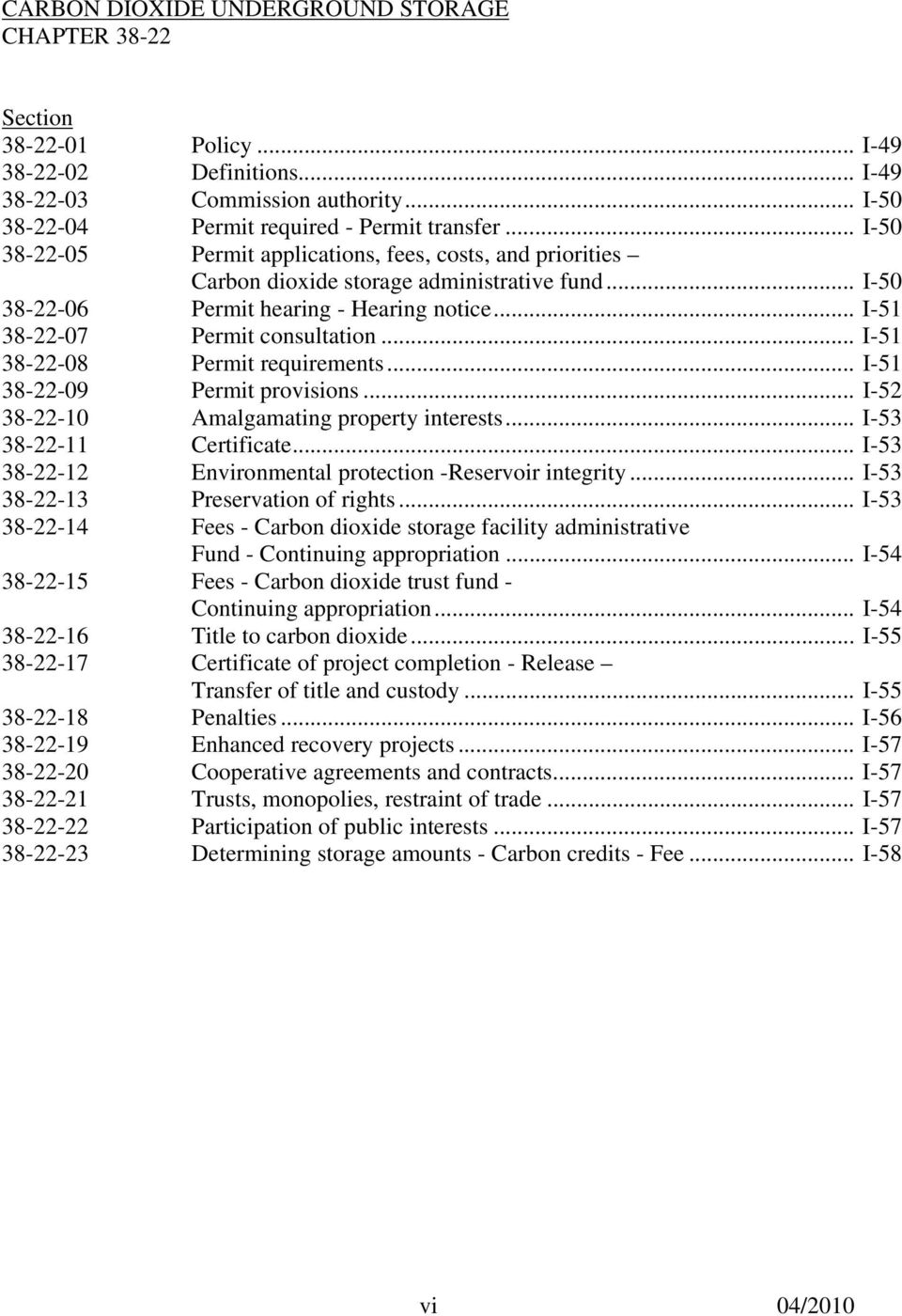
8 CARBON DIOXIDE UNDERGROUND STORAGE CHAPTER Section Policy... I Definitions... I Commission authority... I Permit required - Permit transfer... I Permit applications, fees, costs, and priorities Carbon dioxide storage administrative fund... I Permit hearing - Hearing notice... I Permit consultation... I Permit requirements... I Permit provisions... I Amalgamating property interests... I Certificate... I Environmental protection -Reservoir integrity... I Preservation of rights... I Fees - Carbon dioxide storage facility administrative Fund - Continuing appropriation... I Fees - Carbon dioxide trust fund - Continuing appropriation... I Title to carbon dioxide... I Certificate of project completion - Release Transfer of title and custody... I Penalties... I Enhanced recovery projects... I Cooperative agreements and contracts... I Trusts, monopolies, restraint of trade... I Participation of public interests... I Determining storage amounts - Carbon credits - Fee... I-58 vi 04/2010
9 CONTROL OF GAS AND OIL RESOURCES CHAPTER DECLARATION OF POLICY. It is hereby declared to be in the public interest to foster, to encourage, and to promote the development, production, and utilization of natural resources of oil and gas in the state in such a manner as will prevent waste; to authorize and to provide for the operation and development of oil and gas properties in such a manner that a greater ultimate recovery of oil and gas be had and that the correlative rights of all owners be fully protected; and to encourage and to authorize cycling, recycling, pressure maintenance, and secondary recovery operations in order that the greatest possible economic recovery of oil and gas be obtained within the state to the end that the landowners, the royalty owners, the producers, and the general public realize and enjoy the greatest possible good from these vital natural resources. Source: N.D. Century Code DEFINITIONS. As used in this chapter, unless the context otherwise requires: 1. Abandoned pipeline means an underground gathering pipeline that is no longer in service, is physically disconnected from in-service facilities, and is not intended to be reactivated for future use. 2. "Certificate of clearance" means a permit prescribed by the commission for the transportation or the delivery of oil or gas or product and issued or registered in accordance with the rule, regulation, or order requiring such permit. 3. "Commission" means the industrial commission. 4. "Field" means the general area underlaid by one or more pools. 5. "Gas" means and includes all natural gas and all other fluid hydrocarbons not hereinbelow defined as oil. 6. "Illegal gas" means gas which has been produced from any well within this state in excess of the quantity permitted by any rule, regulation, or order of the commission, or any gas produced or removed from the well premises in violation of any rule, regulation, or order of the commission, or any gas produced or removed from the well premises without the knowledge and consent of the operator. 7. "Illegal oil" means oil which has been produced from any well within the state in excess of the quantity permitted by any rule, regulation, or order of the commission, or any oil produced or removed from the well premises in violation of any rule, regulation, or order of the commission, or any oil produced or removed from the well premises without the knowledge and consent of the operator. 8. "Illegal product" means any product derived in whole or in part from illegal oil or illegal gas. 9. "Oil" means and includes crude petroleum oil and other hydrocarbons regardless of gravity which are produced at the wellhead in liquid form and the liquid hydrocarbons known as distillate or condensate recovered or extracted from gas, other than gas produced in association with oil and commonly known as casinghead gas. (I-1) 08/2015

10 10. "Owner" means the person who has the right to drill into and produce from a pool and to appropriate the oil or gas he produces therefrom either for himself or others or for himself and others. 11. "Person" means and includes any natural person, corporation, limited liability company, association, partnership, receiver, trustee, executor, administrator, guardian, fiduciary, or other representative of any kind, and includes any department, agency, or instrumentality of the state or of any governmental subdivision thereof; the masculine gender, in referring to a person, includes the feminine and the neuter genders. 12. Pipeline facility means a pipeline, pump, compressor, storage, and any other facility, structure, and property incidental and necessary or useful in the interconnection of a pipeline or for the transportation, distribution, and delivery of energy-related commodities to points of sale or consumption or to the point of distribution for consumption located within or outside of this state. 13. "Pool" means an underground reservoir containing a common accumulation of oil or gas or both; each zone of a structure which is completely separated from any other zone in the same structure is a pool, as that term is used in this chapter. 14. "Producer" means the owner of a well or wells capable of producing oil or gas or both. 15. "Product" means any commodity made from oil or gas and includes refined crude oil, crude tops, topped crude, processed crude, processed crude petroleum, residue from crude petroleum, cracking stock, uncracked fuel oil, fuel oil, treated crude oil, residuum, gas oil, casinghead gasoline, natural-gas gasoline, kerosene, benzine, wash oil, waste oil, blended gasoline, lubricating oil, blends or mixtures of oil with one or more liquid products or byproducts derived from oil or gas, and blends or mixtures of two or more liquid products or byproducts derived from oil or gas, whether hereinabove enumerated or not. 16. "Reasonable market demand" means the demand for oil or gas for reasonable current requirements for consumption and use within and without the state, together with such quantities as are reasonably necessary for building up or maintaining reasonable working stocks and reasonable reserves of oil or gas product. 17. "Reserve pit" means an excavated area used to contain drill cuttings accumulated during oil and gas drilling operations and mud-laden oil and gas drilling fluids used to confine oil, gas, or water to its native strata during the drilling of an oil and gas well. 18. "Underground gathering pipeline" means an underground gas or liquid pipeline with associated above ground equipment which is designed for or capable of transporting crude oil, natural gas, carbon dioxide, or water produced in association with oil and gas which is not subject to chapter As used in this subsection, "associated above ground equipment" means equipment and property located above ground level, which is incidental to and necessary for or useful for transporting crude oil, natural gas, carbon dioxide, or water produced in association with oil and gas from a production facility. As used in this subsection, "equipment and property" includes a pump, a compressor, storage, leak detection or monitoring equipment, and any other facility or structure. 19. "Waste" means and includes: a. Physical waste, as that term is generally understood in the oil and gas industry. (I-2) 08/2015

11 b. The inefficient, excessive, or improper use of, or the unnecessary dissipation of reservoir energy. c. The locating, spacing, drilling, equipping, operating or producing of any oil or gas well or wells in a manner which causes, or tends to cause, reduction in the quantity of oil or gas ultimately recoverable from a pool under prudent and proper operations, or which causes or tends to cause unnecessary or excessive surface loss or destruction of oil or gas. d. The inefficient storing of oil. e. The production of oil or gas in excess of transportation or marketing facilities or in excess of reasonable market demand. 20. The word "and" includes the word "or" and the use of the word "or" includes the word "and." The use of the plural includes the singular and the use of the singular includes the plural. Source: N.D. Century Code WASTE PROHIBITED. Waste of oil and gas is prohibited. Source: N.D. Century Code JURISDICTION OF COMMISSION. (EFFECTIVE FOR TAXABLE EVENTS OCCURRING THROUGH DECEMBER 31, 2015) The commission has continuing jurisdiction and authority over all persons and property, public and private, necessary to enforce effectively the provisions of this chapter. The commission has authority, and it is its duty, to make such investigations as it deems proper to determine whether waste exists or is imminent or whether other facts exist which justify action by the commission. The commission has the authority: 1. To require: a. Identification of ownership of oil or gas wells, producing leases, tanks, plants, structures, and facilities for the transportation or refining of oil and gas. b. The making and filing with the industrial commission of all resistivity, radioactivity, and mechanical well logs and the filing of directional surveys if taken, and the filing of reports on well location, drilling, and production. c. The drilling, casing, operation, and plugging of wells in such manner as to prevent the escape of oil or gas out of one stratum into another, the intrusion of water into oil or gas strata, the pollution of freshwater supplies by oil, gas, or saltwater, and to prevent blowouts, cavings, seepages, and fires. d. The furnishing of a reasonable bond with good and sufficient surety, conditioned upon the full compliance with this chapter, and the rules and orders of the industrial commission, including without limitation a bond covering the operation of any underground gathering pipeline transferring oil or produced water from a production facility for disposal, storage, or sale purposes, except that if the commission requires a bond to be furnished, the person required to furnish the bond may elect to deposit under such terms and conditions as the industrial commission may prescribe a collateral bond, self-bond, cash, or any alternative form of security approved by the (I-3) 08/2015

12 commission, or combination thereof, by which an operator assures faithful performance of all requirements of this chapter and the rules and orders of the industrial commission. e. That the production from wells be separated into gaseous and liquid hydrocarbons, and that each be accurately measured by such means and upon such standards as may be prescribed by the commission. f. The operation of wells with efficient gas-oil and water-oil ratios, and to fix these ratios. g. Certificates of clearance in connection with the transportation or delivery of oil, gas, or any product. h. Metering or other measuring of oil, gas, or product related to production in pipelines, gathering systems, storage tanks, barge terminals, loading racks, refineries, or other places, by meters or other measuring devices approved by the commission. i. Every person who produces, sells, purchases, acquires, stores, transports, refines, disposes of, or processes oil, gas, saltwater, or other related oilfield fluids in this state to keep and maintain within this state complete and accurate records of the quantities thereof, which records must be available for examination by the commission or its agents at all reasonable times, and to file with the commission reports as the commission may prescribe with respect to oil or gas or the products thereof. An oil and gas production report need not be notarized but must be signed by the person submitting the report. j. The payment of fees for services performed. The amount of the fee shall be set by the commission based on the anticipated actual cost of the service rendered. Unless otherwise provided by statute, all fees collected by the commission must be deposited in the general fund of this state, according to procedures established by the state treasurer. k. The filing free of charge of samples and core chips and of complete cores when requested in the office of the state geologist within six months after the completion or abandonment of the well. l. The placing of wells in abandoned-well status which have not produced oil or natural gas in paying quantities for one year. A well in abandoned-well status must be promptly returned to production in paying quantities, approved by the commission for temporarily abandoned status, or plugged and reclaimed within six months. If none of the three preceding conditions are met, the industrial commission may require the well to be placed immediately on a single-well bond in an amount equal to the cost of plugging the well and reclaiming the well site. In setting the bond amount, the commission shall use information from recent plugging and reclamation operations. After a well has been in abandoned-well status for one year, the well's equipment, all well-related equipment at the well site, and salable oil at the well site are subject to forfeiture by the commission. If the commission exercises this authority, section applies. After a well has been in abandoned-well status for one year, the single-well bond referred to above, or any other bond covering the well if the single-well bond has not been obtained, is subject to forfeiture by the commission. A surface owner may request a review of the temporarily abandoned status of a well that has been on temporarily abandoned (I-4) 08/2015

13 status for at least seven years. The commission shall require notice and hearing to review the temporarily abandoned status. After notice and hearing, the surface owner may request a review of the temporarily abandoned status every two years. 2. To regulate: a. The drilling, producing, and plugging of wells, the restoration of drilling and production sites, and all other operations for the production of oil or gas. b. The shooting and chemical treatment of wells. c. The spacing of wells. d. Operations to increase ultimate recovery such as cycling of gas, the maintenance of pressure, and the introduction of gas, water, or other substances into producing formations. e. Disposal of saltwater and oil field wastes. (1) The commission shall give all affected counties written notice of hearings in such matters at least fifteen days before the hearing. (2) The commission may consider, in addition to other authority granted under this section, safety of the location and road access to saltwater disposal wells, treating plants, and all associated facilities. f. The underground storage of oil or gas. 3. To limit and to allocate the production of oil and gas from any field, pool, or area and to establish and define as separate marketing districts those contiguous areas within the state which supply oil and gas to different markets, and to limit and allocate the production of oil and gas for each separate marketing district. 4. To classify wells as oil or gas wells for purposes material to the interpretation or enforcement of this chapter, to classify and determine the status and depth of wells that are stripper well property as defined in subsection 8 of section , to certify to the tax commissioner which wells are stripper wells and the depth of those wells, to recertify stripper wells that are reentered and recompleted as horizontal wells, and to certify to the tax commissioner which wells involve secondary or tertiary recovery operations under section , and the date of qualification for the reduced rate of oil extraction tax for secondary and tertiary recovery operations. 5. To adopt and to enforce rules and orders to effectuate the purposes and the intent of this chapter and the commission's responsibilities under chapter When adopting a rule, issuing an order, or creating a policy, the commission shall give due consideration to the effect of including locations within this state which may also be under the jurisdiction of the federal government or a tribal government. When reporting information resulting from adopting a rule, issuing an order, or creating a policy that affects locations within this state which may also be under the jurisdiction of the federal government or a tribal government, the commission shall provide sufficient information to indicate the effect of including locations that may also be under the regulatory jurisdiction of the federal government or a tribal government. 6. To provide for the confidentiality of well data reported to the commission if requested in writing by those reporting the data for a period not to exceed six months. However, the commission may release: a. Volumes injected into a saltwater injection well. (I-5) 08/2015

14 b. Information from the spill report on a well on a site at which more than ten barrels of fluid, not contained on the well site, was released for which an oilfield environmental incident report is required by law. Source: N.D. Century Code JURISDICTION OF COMMISSION. (EFFECTIVE FOR TAXABLE EVENTS OCCURRING AFTER DECEMBER 31, 2015) The commission has continuing jurisdiction and authority over all persons and property, public and private, necessary to enforce effectively the provisions of this chapter. The commission has authority, and it is its duty, to make such investigations as it deems proper to determine whether waste exists or is imminent or whether other facts exist which justify action by the commission. The commission has the authority: 1. To require: a. Identification of ownership of oil or gas wells, producing leases, tanks, plants, structures, and facilities for the transportation or refining of oil and gas. b. The making and filing with the industrial commission of all resistivity, radioactivity, and mechanical well logs and the filing of directional surveys, if taken, and the filing of reports on well location, drilling, and production. c. The drilling, casing, operation, and plugging of wells in such manner as to prevent the escape of oil or gas out of one stratum into another, the intrusion of water into oil or gas strata, the pollution of freshwater supplies by oil, gas, or saltwater, and to prevent blowouts, cavings, seepages, and fires. d. The furnishing of a reasonable bond with good and sufficient surety, conditioned upon the full compliance with this chapter, and the rules and orders of the industrial commission, including without limitation a bond covering the operation of any underground gathering pipeline transferring oil or produced water from a production facility for disposal, storage, or sale purposes, except that if the commission requires a bond to be furnished, the person required to furnish the bond may elect to deposit under such terms and conditions as the industrial commission may prescribe a collateral bond, self-bond, cash, or any alternative form of security approved by the commission, or combination thereof, by which an operator assures faithful performance of all requirements of this chapter and the rules and orders of the industrial commission. e. That the production from wells be separated into gaseous and liquid hydrocarbons, and that each be accurately measured by such means and upon such standards as may be prescribed by the commission. f. The operation of wells with efficient gas-oil and water-oil ratios, and to fix these ratios. g. Certificates of clearance in connection with the transportation or delivery of oil, gas, or any product. h. Metering or other measuring of oil, gas, or product related to production in pipelines, gathering systems, storage tanks, barge terminals, loading racks, refineries, or other places, by meters or other measuring devices approved by the commission. (I-6) 08/2015

15 i. Every person who produces, sells, purchases, acquires, stores, transports, refines, disposes of, or processes oil, gas, saltwater, or other related oilfield fluids in this state to keep and maintain within this state complete and accurate records of the quantities thereof, which records must be available for examination by the commission or its agents at all reasonable times, and to file with the commission reports as the commission may prescribe with respect to oil or gas or the products thereof. An oil and gas production report need not be notarized but must be signed by the person submitting the report. j. The payment of fees for services performed. The amount of the fee shall be set by the commission based on the anticipated actual cost of the service rendered. Unless otherwise provided by statute, all fees collected by the commission must be deposited in the general fund of this state, according to procedures established by the state treasurer. k. The filing free of charge of samples and core chips and of complete cores when requested in the office of the state geologist within six months after the completion or abandonment of the well. l. The placing of wells in abandoned-well status which have not produced oil or natural gas in paying quantities for one year. A well in abandoned-well status must be promptly returned to production in paying quantities, approved by the commission for temporarily abandoned status, or plugged and reclaimed within six months. If none of the three preceding conditions are met, the industrial commission may require the well to be placed immediately on a single-well bond in an amount equal to the cost of plugging the well and reclaiming the well site. In setting the bond amount, the commission shall use information from recent plugging and reclamation operations. After a well has been in abandoned-well status for one year, the well's equipment, all well-related equipment at the well site, and salable oil at the well site are subject to forfeiture by the commission. If the commission exercises this authority, section applies. After a well has been in abandoned-well status for one year, the single-well bond referred to above, or any other bond covering the well if the single-well bond has not been obtained, is subject to forfeiture by the commission. A surface owner may request a review of the temporarily abandoned status of a well that has been on temporarily abandoned status for at least seven years. The commission shall require notice and hearing to review the temporarily abandoned status. After notice and hearing, the surface owner may request a review of the temporarily abandoned status every two years. 2. To regulate: a. The drilling, producing, and plugging of wells, the restoration of drilling and production sites, and all other operations for the production of oil or gas. b. The shooting and chemical treatment of wells. c. The spacing of wells. d. Operations to increase ultimate recovery such as cycling of gas, the maintenance of pressure, and the introduction of gas, water, or other substances into producing formations. e. Disposal of saltwater and oilfield wastes. (I-7) 08/2015

16 (1) The commission shall give all affected counties written notice of hearings in such matters at least fifteen days before the hearing. (2) The commission may consider, in addition to other authority granted under this section, safety of the location and road access to saltwater disposal wells, treating plants, and all associated facilities. f. The underground storage of oil or gas. 3. To limit and to allocate the production of oil and gas from any field, pool, or area and to establish and define as separate marketing districts those contiguous areas within the state which supply oil and gas to different markets, and to limit and allocate the production of oil and gas for each separate marketing district. 4. To classify wells as oil or gas wells for purposes material to the interpretation or enforcement of this chapter, to classify and determine the status and depth of wells that are stripper well property as defined in section , to certify to the tax commissioner which wells are stripper wells as defined in section and the depth of those wells, and to certify to the tax commissioner which wells involve secondary or tertiary recovery operations as defined in section , and the date of qualification for the oil extraction tax exemption for secondary and tertiary recovery operations. 5. To adopt and to enforce rules and orders to effectuate the purposes and the intent of this chapter and the commission's responsibilities under chapter When adopting a rule, issuing an order, or creating a policy, the commission shall give due consideration to the effect of including locations within this state which may also be under the jurisdiction of the federal government or a tribal government. When reporting information resulting from adopting a rule, issuing an order, or creating a policy that affects locations within this state which may also be under the jurisdiction of the federal government or a tribal government, the commission shall provide sufficient information to indicate the effect of including locations that may also be under the regulatory jurisdiction of the federal government or a tribal government. 6. To provide for the confidentiality of well data reported to the commission if requested in writing by those reporting the data for a period not to exceed six months. However, the commission may release: a. Volumes injected into a saltwater injection well. b. Information from the spill report on a well on a site at which more than ten barrels of fluid, not contained on the well site, was released for which an oilfield environmental incident report is required by law. Source: N.D. Century Code COMMISSION MAY EMPLOY EXAMINERS. The industrial commission may use hearing examiners under such rules and regulations as the commission may prescribe. Source: N.D. Century Code. (I-8) 08/2015

17 DIRECTOR OF MINERAL RESOURCES - DIRECTOR OF OIL AND GAS - DELEGATION TO DIRECTOR OF OIL AND GAS. The industrial commission is authorized to appoint a director of mineral resources who shall serve at the pleasure of the commission. The director of mineral resources shall carry out the duties of the director of oil and gas along with the duties of director of mineral resources. The commission may set the salary of the director of mineral resources. The commission may delegate to the director of oil and gas all powers the commission has under this title and under rules enacted under this title. Source: N.D. Century Code STATE GEOLOGIST TO ASSIST COMMISSION. Repealed. Source: N.D. Century Code COMMISSION AUTHORIZED TO ENTER INTO CONTRACTS. The commission may enter public and private contractual agreements for the plugging or replugging of oil and gas or injection wells, the removal or repair of related equipment, the reclamation of abandoned oil and gas or injection well sites, and the reclamation of oil and gas-related pipelines and associated facilities, including reclamation as a result of leaks or spills from a pipeline or associated facility, if any of the following apply: 1. The person or company drilling or operating the well or equipment cannot be found, has no assets with which to properly plug or replug the well or reclaim the well site, or cannot be legally required to plug or replug the well or to reclaim the well site, pipeline, or associated pipeline facility, or damage is the result of an illegal dumping incident. 2. There is no bond covering the well to be plugged or the site to be reclaimed or there is a bond but the cost of plugging or replugging the well or reclaiming the site, pipeline, or associated pipeline facility exceeds the amount of the bond or damage is the result of an illegal dumping incident. 3. The well, equipment, pipeline, or associated pipeline facility is leaking or likely to leak oil, gas, or saltwater or is likely to cause a serious threat of pollution or injury to the public health or safety. Sealed bids for any well plugging or reclamation work under this section must be solicited by placing a notice in the official county newspaper of the county in which the work is to be done and in such other newspapers of general circulation in the area as the commission may deem appropriate. Bids must be addressed to the commission and must be opened publicly at the time and place designated in the notice. The contract must be let to the lowest responsible bidder, but the commission may reject any or all bids submitted. If a well or equipment is leaking or likely to leak oil, gas, or saltwater or is likely to cause a serious threat of pollution or injury to the public health or safety, the commission, without notice or the letting of bids, may enter into contracts necessary to mitigate the problem. The contracts for the plugging or replugging of wells or the reclamation of well sites must be on terms and conditions as prescribed by the commission, but at a minimum the contracts shall (I-9) 08/2015

18 require the plugging and reclamation to comply with all statutes and rules governing the plugging of wells and reclamation of well sites. Source: N.D. Century Code ABANDONED OIL AND GAS WELL PLUGGING AND SITE RECLAMATION FUND - BUDGET SECTION REPORT. There is hereby created an abandoned oil and gas well plugging and site reclamation fund. 1. Revenue to the fund must include: a. Fees collected by the oil and gas division of the industrial commission for permits or other services. b. Moneys received from the forfeiture of drilling and reclamation bonds. c. Moneys received from any federal agency for the purpose of this section. d. Moneys donated to the commission for the purposes of this section. e. Moneys received from the state's oil and gas impact fund. f. Moneys recovered under the provisions of section g. Moneys recovered from the sale of equipment and oil confiscated under section h. Moneys transferred from the cash bond fund under section i. Such other moneys as may be deposited in the fund for use in carrying out the purposes of plugging or replugging of wells or the restoration of well sites. j. Civil penalties assessed under section Moneys in the fund may be used for the following purposes: a. Contracting for the plugging of abandoned wells. b. Contracting for the reclamation of abandoned drilling and production sites, saltwater disposal pits, drilling fluid pits, and access roads. c. To pay mineral owners their royalty share in confiscated oil. d. Defraying costs incurred under section in reclamation of oil and gas-related pipelines and associated facilities. e. Reclamation and restoration of land and water resources impacted by oil and gas development, including related pipelines and facilities that were abandoned or were left in an inadequate reclamation status before August 1, 1983, and for which there is not any continuing reclamation responsibility under state law. Land and water degraded by any willful act of the current or any former surface owner are not eligible for reclamation or restoration. The commission may expend up to one million five hundred thousand dollars per biennium from the fund in the following priority: (1) For the restoration of eligible land and water that are degraded by the adverse effects of oil and gas development including related pipelines and facilities. (2) For the development of publicly owned land adversely affected by oil and gas development including related pipelines and facilities. (3) For administrative expenses and cost in developing an abandoned site reclamation plan and the program. (I-10) 08/2015

19 (4) Demonstration projects for the development of reclamation and water quality control program methods and techniques for oil and gas development, including related pipelines and facilities. f. For transfer by the office of management and budget, upon request of the industrial commission, to the environmental quality restoration fund for use by the state department of health for the purposes provided under chapter 23-31, if to address environmental emergencies relating to oil and natural gas development, including the disposal of oilfield waste and oil or natural gas production and transportation by rail, road, or pipeline. If a transfer requested by the industrial commission has been made under this subdivision, the state department of health shall request the office of management and budget to transfer from subsequent deposits in the environmental quality restoration fund an amount sufficient to restore the amount transferred from the abandoned oil and gas well plugging and site reclamation fund. 3. This fund must be maintained as a special fund and all moneys transferred into the fund are appropriated and must be used and disbursed solely for the purposes in this section. 4. The commission shall report to the budget section of the legislative management on the balance of the fund and expenditures from the fund each biennium. Source: N.D. Century Code OIL AND GAS RESERVOIR DATA FUND - APPROPRIATION. There is hereby established an oil and gas reservoir data fund to be used for defraying the costs of providing reservoir data compiled by the commission to state, federal, and county departments and agencies, and members of the general public. All moneys collected pursuant to section for providing reservoir data under this section must be deposited in the oil and gas reservoir data fund. This fund must be maintained as a special fund and all moneys transferred into the fund are hereby appropriated and must be used and disbursed solely for the purpose of paying the current cost of providing such information as determined by the commission, based on actual costs. Source: N.D. Century Code RIGHT OF ENTRY. The commission, its agents, employees, or contractors shall have the right to enter any land for the purpose of plugging or replugging a well or the restoration of a well site as provided in section Source: N.D. Century Code RECOVERY FOR COSTS OF PLUGGING. If the commission, its agents, employees, or contractors plugs or replugs a well or reclaims a well site under the provisions of sections , , , , , and , the state has a cause of action for all reasonable expenses incurred in the plugging, replugging, or reclamation against the operator of the well at the time the well is required to be plugged and (I-11) 08/2015

20 abandoned or any or all persons who own a working interest in the well at the time the well is required to be plugged and abandoned as a result of the ownership of a lease or mineral interest in the property on which the well is located. The term "working interest owner" does not mean a royalty owner or an overriding royalty interest owner. The commission shall seek reimbursement for all reasonable expenses incurred in plugging any well or reclaiming any well site through an action instituted by the attorney general. The liability of any working interest owner under this section shall be limited to that proportion of the reasonable expenses incurred by the commission that the interest of any such working interest owner bears to the entire working interest in the well. Any money collected in a suit under this section must be deposited in the state abandoned oil and gas well plugging and site reclamation fund. Any suit brought by the commission for reimbursement under this section may be brought in the district court for Burleigh County, the county in which the plugged well or reclaimed well site is located or the county in which any defendant resides. Source: N.D. Century Code CONFISCATION OF EQUIPMENT AND SALABLE OIL TO COVER PLUGGING COSTS. When the commission intends to exercise or has exercised its right to plug a well or reclaim a well site, the commission, as compensation for its costs, may confiscate any production-related equipment and salable oil at the well site. The equipment subject to confiscation is limited to that owned by the well's operator, former operator, or working interest owner. If the commission exercises its authority under this section and there is salable oil at the well, that oil must be confiscated. The commission shall pay the mineral owners the royalty interest in the oil confiscated. In determining the mineral owners and their royalty interests, the commission may rely upon the most recent division order it is able to obtain. If one is unavailable or the commission finds the order unreliable, the commission may rely upon any other source of information the commission deems reasonable to determine and pay mineral owners. A confiscation must be by an order of the commission after notice and hearing. A confiscation order transfers title to the commission. Source: N.D. Century Code PENALTIES AND OTHER RELIEF. The plugging or replugging of a well or reclamation of a well site by the commission, its agents, employees, or contractors, shall not prevent the commission from seeking penalties or other relief provided by law from any person who is required by statutes, rules, or order of the commission to plug or replug a well or reclaim the surface. Source: N.D. Century Code CASH BOND FUND FOR PLUGGING OIL AND GAS WELLS AND RECLAMATION OF OIL AND GAS WELL SITES - APPROPRIATION. 1. There is hereby created a cash bond fund for the plugging of abandoned oil and gas wells and the reclamation of abandoned oil and gas well sites. (I-12) 08/2015

21 2. From all moneys held or controlled by the commission under subdivision d of subsection 1 of section , there is to be deposited in the cash bond fund such amount as determined by the commission but such amount may not exceed an amount equal to an annual return of two percent of the cash bond deposit. 3. Moneys in the cash bond fund are hereby appropriated to the commission to be used for the following purposes: a. Defraying costs incurred in the plugging of abandoned oil and gas wells, and related activities. b. Defraying costs incurred in the reclamation of abandoned oil and gas drilling and production sites, saltwater disposal pits, drilling fluid pits, and access roads, and related activities. Source: N.D. Century Code DRILLING PERMIT REQUIRED. 1. A person may not commence operations for the drilling of a well for oil or gas without obtaining a permit from the industrial commission under rules as may be adopted by the commission and paying to the commission a fee for each well in an amount to be determined by the commission. The applicant shall provide notice to the owner of any permanently occupied dwelling located within one thousand three hundred twenty feet [ meters] of the proposed oil or gas well. 2. Unless waived by the owner or if the commission determines that the well location is reasonably necessary to prevent waste or to protect correlative rights, the commission may not issue a drilling permit for an oil or gas well that will be located within five hundred feet [152.4 meters] of an occupied dwelling. If the commission issues a drilling permit for a location within one thousand feet [ meters] of an occupied dwelling, the commission may impose conditions on the permit: a. For wells permitted on new pads built after July 31, 2013, the conditions imposed under this subdivision may include, upon request of the owner of the permanently occupied dwelling, requiring that the location of all flares, tanks, and treaters utilized in connection with the permitted well be located at a greater distance from the occupied dwelling than the oil and gas well bore if the location can be accommodated reasonably within the proposed pad location; or b. As the commission determines reasonably necessary to minimize impact to the owner of the occupied dwelling. Source: N.D. Century Code COMMISSION SHALL DETERMINE MARKET DEMAND AND REGULATE THE AMOUNT OF PRODUCTION. The commission shall determine market demand for each marketing district and regulate the amount of production as follows: (I-13) 08/2015
22 1. The commission shall limit the production of oil and gas within each marketing district to that amount which can be produced without waste, and which does not exceed the reasonable market demand. 2. Whenever the commission limits the total amount of oil or gas which may be produced in the state or a marketing district, the commission shall allocate or distribute the allowable production among the pools therein on a reasonable basis, giving, where reasonable under the circumstances to each pool with small wells of settled production, an allowable production which prevents the general premature abandonment of such wells in the pool. 3. Whenever the commission limits the total amount of oil or gas which may be produced in any pool in this state to an amount less than that amount which the pool could produce if no restriction was imposed, which limitation is imposed either incidental to, or without, a limitation of the total amount of oil or gas produced in the marketing district wherein the pool is located, the commission shall allocate or distribute the allowable production among the several wells or producing properties in the pool on a reasonable basis, preventing or minimizing reasonable avoidable drainage, so that each property will have the opportunity to produce or to receive its just and equitable share, subject to the reasonable necessities for the prevention of waste. 4. In allocating the market demand for gas as between pools within marketing districts, the commission shall give due regard to the fact that gas produced from oil pools is to be regulated in a manner as will protect the reasonable use of its energy for oil production. 5. The commission is not required to determine the reasonable market demand applicable to any single pool, except in relation to all other pools within the same marketing district, and in relation to the demand applicable to the marketing district. In allocating allowables to pools, the commission may consider, but is not bound by, nominations of purchasers to purchase from particular fields, pools, or portions thereof. The commission shall allocate the total allowable for the state in such manner as prevents undue discrimination between marketing districts, fields, pools, or portions thereof resulting from selective buying or nomination by purchasers. Source: N.D. Century Code NATURAL GAS WELL STATUS DETERMINATIONS AND FINDINGS. Repealed. Source: N.D. Century Code DISCRIMINATION IN THE PROCESSING AND PURCHASING OF GAS PROHIBITED. Gas produced in this state must be processed and purchased without discrimination between producers in the same reservoir, recognizing the right of the purchaser to establish reasonable quality standards for acceptance of gas, which must be applied without discrimination among producers. After notice and hearing, for good cause, the commission may (I-14) 08/2015
23 relieve any person of the duty to process and purchase gas produced in this state without discrimination. Source: N.D. Century Code INFORMATION STATEMENT TO ACCOMPANY PAYMENT TO ROYALTY OWNER - PENALTY. Any person who makes a payment to an owner of a royalty interest in land in this state for the purchase of oil or gas produced from that royalty interest shall provide with the payment to the royalty owner an information statement that will allow the royalty owner to clearly identify the amount of oil or gas sold and the amount and purpose of each deduction made from the gross amount due. The statement must be on forms approved by the industrial commission and contain the information that the commission prescribes by rule. A person who fails to comply with the requirements of this section is guilty of a class B misdemeanor. Source: N.D. Century Code FLARING OF GAS RESTRICTED - IMPOSITION OF TAX - PAYMENT OF ROYALTIES - INDUSTRIAL COMMISSION AUTHORITY. 1. As permitted under rules of the industrial commission, gas produced with crude oil from an oil well may be flared during a one-year period from the date of first production from the well. 2. After the time period in subsection 1, flaring of gas from the well must cease and the well must be: a. Capped; b. Connected to a gas gathering line; c. Equipped with an electrical generator that consumes at least seventy-five percent of the gas from the well; d. Equipped with a system that intakes at least seventy-five percent of the gas and natural gas liquids volume from the well for beneficial consumption by means of compression to liquid for use as fuel, transport to a processing facility, production of petrochemicals or fertilizer, conversion to liquid fuels, separating and collecting over fifty percent of the propane and heavier hydrocarbons; or e. Equipped with other value-added processes as approved by the industrial commission which reduce the volume or intensity of the flare by more than sixty percent. 3. An electrical generator and its attachment units to produce electricity from gas and a collection system described in subdivision d of subsection 2 must be considered to be personal property for all purposes. 4. For a well operated in violation of this section, the producer shall pay royalties to royalty owners upon the value of the flared gas and shall also pay gross production tax on the flared gas at the rate imposed under section (I-15) 08/2015
24 5. The industrial commission may enforce this section and, for each well operator found to be in violation of this section, may determine the value of flared gas for purposes of payment of royalties under this section and its determination is final. 6. A producer may obtain an exemption from this section from the industrial commission upon application that shows to the satisfaction of the industrial commission that connection of the well to a natural gas gathering line is economically infeasible at the time of the application or in the foreseeable future or that a market for the gas is not available and that equipping the well with an electrical generator to produce electricity from gas or employing a collection system described in subdivision d of subsection 2 is economically infeasible. Source: N.D. Century Code COMMISSION SHALL SET SPACING UNITS. The commission shall set spacing units as follows: 1. When necessary to prevent waste, to avoid the drilling of unnecessary wells, or to protect correlative rights, the commission shall establish spacing units for a pool. Spacing units when established must be of uniform size and shape for the entire pool, except that when found to be necessary for any of the purposes above mentioned, the commission is authorized to divide any pool into zones and establish spacing units for each zone, which units may differ in size and shape from those established in any other zone. 2. The size and shape of spacing units are to be such as will result in the efficient and economical development of the pool as a whole. 3. An order establishing spacing units for a pool must specify the size and shape of each unit and the location of the permitted well thereon in accordance with a reasonably uniform spacing plan. Upon application, if the commission finds that a well drilled at the prescribed location would not produce in paying quantities, that surface conditions would substantially add to the burden or hazard of drilling such well, or that the drilling of such well at a location other than the prescribed location is otherwise necessary either to protect correlative rights, to prevent waste, or to effect greater ultimate recovery of oil and gas, the commission is authorized to enter an order permitting the well to be drilled at a location other than that prescribed by such spacing order; however, the commission shall include in the order suitable provisions to prevent the production from the spacing unit of more than its just and equitable share of the oil and gas in the pool. 4. An order establishing units for a pool must cover all lands determined or believed to be underlaid by such pool, and may be modified by the commission from time to time to include additional areas determined to be underlaid by such pool. When found necessary for the prevention of waste, or to avoid the drilling of unnecessary wells, or to protect correlative rights, an order establishing spacing units in a pool may be modified by the commission to increase or decrease the size of spacing units in the pool or any zone thereof, or to permit the drilling of additional wells on (I-16) 08/2015
25 a reasonably uniform plan in the pool, or any zone thereof, or an additional well on any spacing unit thereof. Source: N.D. Century Code INTEGRATION OF FRACTIONAL TRACTS. 1. When two or more separately owned tracts are embraced within a spacing unit, or when there are separately owned interests in all or a part of the spacing unit, then the owners and royalty owners thereof may pool their interests for the development and operation of the spacing unit. In the absence of voluntary pooling, the commission upon the application of any interested person shall enter an order pooling all interests in the spacing unit for the development and operations thereof. Each such pooling order must be made after notice and hearing, and must be upon terms and conditions that are just and reasonable, and that afford to the owner of each tract or interest in the spacing unit the opportunity to recover or receive, without unnecessary expense, his just and equitable share. Operations incident to the drilling of a well upon any portion of a spacing unit covered by a pooling order must be deemed, for all purposes, the conduct of such operations upon each separately owned tract in the drilling unit by the several owners thereof. That portion of the production allocated to each tract included in a spacing unit covered by a pooling order must, when produced, be deemed for all purposes to have been produced from such tract by a well drilled thereon. For the purposes of this section and section , any unleased mineral interest pooled by virtue of this section before August 1, 2009, is entitled to a cost-free royalty interest equal to the acreage weighted average royalty interest of the leased tracts within the spacing unit, but in no event may the royalty interest of an unleased tract be less than a one-eighth interest. An unleased mineral interest pooled after July 31, 2009, is entitled to a cost-free royalty interest equal to the acreage weighted average royalty interest of the leased tracts within the spacing unit or, at the operator's election, a cost-free royalty interest of sixteen percent. The remainder of the unleased interest must be treated as a lessee or cost-bearing interest. 2. Each such pooling order must make provision for the drilling and operation of a well on the spacing unit, and for the payment of the reasonable actual cost thereof by the owners of interests in the spacing unit, plus a reasonable charge for supervision. In the event of any dispute as to such costs the commission shall determine the proper costs. If one or more of the owners shall drill and operate, or pay the expenses of drilling and operating the well for the benefit of others, then, the owner or owners so drilling or operating shall, upon complying with the terms of section , have a lien on the share of production from the spacing unit accruing to the interest of each of the other owners for the payment of his proportionate share of such expenses. All the oil and gas subject to the lien must be marketed and sold and the proceeds applied in payment of the expenses secured by such lien as provided for in section In addition to any costs and charges recoverable under subsections 1 and 2, if the owner of an interest in a spacing unit elects not to participate in the risk and cost of drilling a well thereon, the owner paying for the nonparticipating owner's share of the drilling and operation of a well may recover from the nonparticipating owner a risk (I-17) 08/2015
26 penalty for the risk involved in drilling the well. The recovery of a risk penalty is as follows: a. If the nonparticipating owner's interest in the spacing unit is derived from a lease or other contract for development, the risk penalty is two hundred percent of the nonparticipating owner's share of the reasonable actual costs of drilling and completing the well and may be recovered out of, and only out of, production from the pooled spacing unit, as provided by section , exclusive of any royalty or overriding royalty. b. If the nonparticipating owner's interest in the spacing unit is not subject to a lease or other contract for development, the risk penalty is fifty percent of the nonparticipating owner's share of the reasonable actual costs of drilling and completing the well and may be recovered out of production from the pooled spacing unit, as provided by section , exclusive of any royalty provided for in subsection 1. c. The owner paying for the nonparticipating owner's share of the drilling and operation of a well may recover from the nonparticipating owner a risk penalty for the risk involved in drilling and completing the well only if the paying owner has made an unsuccessful, good-faith attempt to have the unleased nonparticipating owner execute a lease or to have the leased nonparticipating owner join in and participate in the risk and cost of drilling the well. Before a risk penalty may be imposed, the paying owner must notify the nonparticipating owner with proof of service that the paying owner intends to impose a risk penalty and that the nonparticipating owner may object to the risk penalty by either responding in opposition to the petition for a risk penalty or if no such petition has been filed, by filing an application or request for hearing with the industrial commission. Source: N.D. Century Code VOLUNTARY AGREEMENTS FOR UNIT OPERATION VALID. An agreement for the unit or cooperative development and operation of a field or pool, in connection with the conduct of repressuring or pressure maintenance operations, cycling or recycling operations, including the extraction and separation of liquid hydrocarbons from natural gas in connection therewith, or any other method of operation, including water floods, is authorized and may be performed and may not be held or construed to violate any of the statutes of this state relating to trusts, monopolies, or contracts and combinations in restraint of trade, if the agreement is approved by the commission as being in the public interest, protective of correlative rights, and reasonably necessary to increase ultimate recovery or to prevent waste of oil or gas. Such agreements bind only the persons who execute them, and their heirs, successors, assigns, and legal representatives. Source: N.D. Century Code LEGISLATIVE FINDING. The legislative assembly finds and determines that it is desirable and necessary, under the circumstances and for the purposes hereinafter set out, (I-18) 08/2015
27 to authorize and provide for unitized management, operation, and further development of the oil and gas properties to which sections through are applicable, to the end that a greater ultimate recovery of oil and gas may be had therefrom, waste prevented, the drilling of unnecessary wells eliminated, and the correlative rights of the owners in a fuller and more beneficial enjoyment of the oil and gas rights be protected. Source: N.D. Century Code POWER AND AUTHORITY OF COMMISSION. The commission is hereby vested with continuing jurisdiction, power and authority, including the right to describe and set forth in its orders all those things pertaining to the plan of unitization which are fair, reasonable, and equitable and which are necessary or proper to protect, safeguard, and adjust the respective rights and obligations of the several persons affected, and it is its duty to make and enforce such orders and do such things as may be necessary or proper to carry out and effectuate the purposes of sections through Source: N.D. Century Code MATTERS TO BE FOUND BY COMMISSION - REQUISITES OF PETITION. If upon the filing of a petition therefor and after notice and hearing, all in the form and manner and in accordance with the procedure and requirements hereinafter provided, the commission shall find: 1. That the unitized management, operation, and further development of a common source of supply of oil and gas or portion thereof is reasonably necessary in order to effectively carry on pressure-maintenance or repressuring operations, cycling operations, water flooding operations, or any combination thereof, or any other form of joint effort calculated to substantially increase the ultimate recovery of oil and gas from the common source of supply; 2. That one or more of said unitized methods of operation as applied to such common source of supply or portion thereof are feasible, will prevent waste and will with reasonable probability result in the increased recovery of substantially more oil and gas from the common source of supply than would otherwise be recovered; 3. That the estimated additional cost, if any, of conducting such operations will not exceed the value of the additional oil and gas so recovered; and 4. That such unitization and adoption of one or more of such unitized methods of operation is for the common good and will result in the general advantage of the owners of the oil and gas rights within the common source of supply or portion thereof directly affected, it shall make a finding to that effect and make an order creating the unit and providing for the unitization and unitized operation of the common source of supply or portion thereof described in the order, all upon such terms and conditions, as may be shown by the evidence to be fair, reasonable, equitable, and which are necessary or proper to protect, safeguard, and adjust the respective rights and obligations of the several persons affected, including royalty owners, owners of overriding royalties, oil and gas payments, carried interests, mortgagees, lien claimants, and others, as well as the lessees. The petition must set (I-19) 08/2015
28 forth a description of the proposed unit area with a map or plat thereof attached, must allege the existence of the facts required to be found by the commission as hereinabove provided and must have attached thereto a proposed plan of unitization applicable to such proposed unit area and which the petitioner or petitioners consider to be fair, reasonable, and equitable. Source: N.D. Century Code ORDER - UNITS AND UNIT AREAS - PLAN OF UNITIZATION. The order of the commission must define the area of the common source of supply or portion thereof to be included within the unit area and prescribe with reasonable detail the plan of unitization applicable thereto. Each unit and unit area must be limited to all or a portion of a single common source of supply. A unit may be created to embrace less than the whole of a common source of supply only where it is shown by the evidence that the area to be so included within the unit area is of such size and shape as may be reasonably required for the successful and efficient conduct of the unitized method or methods of operation for which the unit is created, and that the conduct thereof will have no material adverse effect upon the remainder of such common source of supply. The plan of unitization for each such unit and unit area must be one suited to the needs and requirements of the particular unit dependent upon the facts and conditions found to exist with respect thereto. In addition to such other terms, provisions, conditions, and requirements found by the commission to be reasonably necessary or proper to effectuate or accomplish the purposes of sections through , and subject to the further requirements hereof, each such plan of unitization must contain fair, reasonable, and equitable provisions for: 1. The efficient unitized management or control of the further development and operation of the unit area for the recovery of oil and gas from the common source of supply affected. Under such a plan, the actual operations within the unit area may be carried on in whole or in part by the unit itself, or by one or more of the lessees within the unit area as unit operator subject to the supervision and direction of the unit, dependent upon what is most beneficial or expedient. The designation of the unit operator must be by a vote of the working interest owners in the unit in a manner provided by the plan of unitization and not by the commission, and the unit operating agreement must contain a provision that the owners of a simple majority of the working interest in the unit area may vote to change the unit operator. 2. The division of interest or formula for the apportionment and allocation of the unit production, among and to the several separately owned tracts within the unit area such as will reasonably permit persons otherwise entitled to share in or benefit by the production from such separately owned tracts to produce or receive, in lieu thereof, their fair, equitable, and reasonable share of the unit production or other benefits thereof. A separately owned tract's fair, equitable, and reasonable share of the unit production must be measured by the value of each such tract for oil and gas purposes and its contributing value to the unit in relation to like values of other tracts in the unit, taking into account acreage [hectarage], the quantity of oil and gas recoverable therefrom, location on structure, its probable productivity of oil and gas in the absence of unit operations, the burden of operation to which the tract will or is likely (I-20) 08/2015
29 to be subjected, or so many of said factors, or such other pertinent engineering, geological, or operating factors, as may be reasonably susceptible of determination. Unit production as that term is used in sections through means and includes all oil and gas produced from a unit area from and after the effective date of the order of the commission creating the unit regardless of the well or tract within the unit area from which the same is produced. 3. The manner in which the unit and the further development and operation of the unit area shall or may be financed and the basis, terms, and conditions on which the cost and expense thereof shall be apportioned among and assessed against the tracts and interests made chargeable therewith, including a detailed accounting procedure governing all charges and credits incident to such operations. Upon and subject to such terms and conditions as to time and legal rate of interest as may be fair to all concerned, reasonable provision must be made in the plan of unitization for carrying or otherwise financing owners who are unable to promptly meet their financial obligations in connection with the unit and, in addition to the unit expense assessed against each tract and chargeable to each owner, the recovery of a risk penalty from each owner electing not to participate in the unit expense. The recovery of the risk penalty is as follows: a. If the nonparticipating owner's interest in the unit is derived from a lease or other contract for development, the risk penalty is two hundred percent of the nonparticipating owner's share of the unit expense and may be recovered out of, and only out of, production from the unit, exclusive of any royalty or overriding royalty. b. If the nonparticipating owner's interest in the unit is not subject to a lease or other contract for development, the penalty is fifty percent of the nonparticipating owner's share of the unit expense and may be recovered out of production from the unit exclusive of any royalty provided for in section c. The owner paying for the nonparticipating owner's share of the unit expense may recover from the nonparticipating owner a risk penalty for the risk involved in the unit expense only if the paying owner has made an unsuccessful, good-faith attempt to have the unleased nonparticipating owner execute a lease or to have the leased nonparticipating owner join in and participate in the risk of the unit expense. Before a risk penalty may be imposed, the paying owner must notify the nonparticipating owner with proof of service that the paying owner intends to impose a risk penalty and that the nonparticipating owner may object to the risk penalty by either responding in opposition to the petition for a risk penalty or if no such petition has been filed, by filing an application or request for hearing with the industrial commission. 4. The procedure and basis upon which wells, equipment, and other properties of the several lessees within the unit area are to be taken over and used for unit operations, including the method of arriving at the compensation therefor, or of otherwise proportionately equalizing or adjusting the investment of the several lessees in the project as of the effective date of unit operation. 5. The creation of an operating committee to have general overall management and control of the unit and the conduct of its business and affairs and the operations (I-21) 08/2015
30 carried on by it, together with the creation or designation of such other subcommittees, boards, or officers to function under authority of the operating committee as may be necessary, proper, or convenient in the efficient management of the unit, defining the powers and duties of all such committees, boards, or officers and prescribing their tenure and time and method for their selection. 6. The time when the plan of unitization shall become and be effective. 7. The time when and conditions under which and the method by which the unit must or may be dissolved and its affairs wound up; however, the unit may be dissolved ten years after the unit agreement becomes effective upon a petition to the commission by the royalty owners who are credited with at least eighty percent of the production and proceeds thereof or for units established after August 1, 2001, upon a petition to the commission by the royalty owners who are credited with at least sixty percent of the production and proceeds thereof, and a subsequent hearing and order by the commission. The commission may not dissolve any unit if the dissolution would be likely to result in waste or the violation of the correlative rights of any owner. This provision does not limit or restrict any other authority which the commission has. Source: N.D. Century Code RATIFICATION OR APPROVAL OF PLAN BY LESSEES AND OWNERS. At the time of filing of the petition for the approval of a unit agreement and the filing of the unit agreement, the commission shall schedule a hearing. At least forty-five days prior to the hearing, the applicant shall give notice of the hearing and shall mail, postage prepaid, a copy of the application and the proposed plan of unitization to each affected person owning an interest of record in the unit outline, at such person's last known post-office address. In addition, the applicant shall file with the commission engineering, geological, and all other technical exhibits to be used at the hearing, and further, the notice must specify that such material is filed and is available for inspection. Service is complete in the mailing of the notice of hearing and unit agreement to each interest owner as described in this section and the filing of an affidavit of mailing with the commission. No order of the commission creating a unit and prescribing its plan of unitization becomes effective until the plan of unitization has been signed, or in writing ratified or approved by those persons who, under the commission's order, will be required to pay at least sixty percent of the costs of the unit operation and by the owners of at least sixty percent of the royalty interests, excluding overriding royalties, production payments, and other interests carved out of the working interest, and in addition it is required that when there is more than one person who will be obligated to pay costs of the unit operation, at least two nonaffiliated such persons and at least two royalty interest owners, are required as voluntary parties, and the commission has made a finding either in the order creating the unit or in a supplemental order that the plan of unitization has been so signed, ratified, or approved by lessees and royalty owners owning the required percentage interest. Where the plan of unitization has not been signed, ratified, or approved by lessees and royalty owners owning the required percentage interest at the time the order creating the unit is made, the commission shall, upon petition and notice, hold such additional hearings as may be requested or required to determine if and when the plan of unitization has been so signed, ratified, or approved by lessees and royalty owners owning the required percentage interest and shall, in respect to such hearings, enter a finding of its determination in such regard. In the event lessees and royalty owners, or either, owning the required percentage interest have not signed, ratified, or approved the (I-22) 08/2015
31 plan of unitization within six months from the date on which the order creating the unit is made, the order ceases to be of further force and effect and shall be revoked by the commission. Source: N.D. Century Code UNLAWFUL OPERATION. From and after the effective date of an order of the commission creating a unit and prescribing the plan of unitization applicable thereto, the operation of any well producing from the common source of supply or portion thereof within the unit area defined in the order by persons other than the unit or persons acting under its authority or except in the manner and to the extent provided in such plan of unitization is unlawful and is hereby prohibited. Source: N.D. Century Code STATUS AND POWERS OF UNIT - LIABILITY FOR EXPENSES - LIENS. Each unit created under the provisions of sections through is a body politic and corporate, capable of suing, being sued, and contracting as such in its own name. Each such unit is authorized on behalf and for the account of all the owners of the oil and gas rights within the unit area, without profit to the unit, to supervise, manage, and conduct the further development and operations for the production of oil and gas from the unit area, pursuant to the powers conferred, and subject to the limitations imposed by the provisions of sections through and by the plan of unitization. The obligation or liability of the lessee or other owners of the oil and gas rights in the several separately owned tracts for the payment of unit expense is at all times several and not joint or collective and in no event may a lessee or other owner of the oil and gas rights in the separately owned tract be chargeable with, obligated or liable, directly or indirectly, for more than the amount apportioned, assessed, or otherwise charged to his interest in such separately owned tract pursuant to the plan of unitization and then only to the extent of the lien provided for within sections through Any nonsigning working interest owner may withdraw from the unit to which his interest is committed by transferring, without warranty of title, either express or implied, to the unit operator on the behalf of the other working interest owners, all of his working interest in all unit equipment and in all wells used in unit operations. The instrument of transfer must be delivered to the unit operator. Such transfer relieves the withdrawing working interest owner from any liability for unit operations except any incurred pursuant to sections through The interest so transferred is owned by the other working interest owners in proportion to their respective participation in the unit. The unit operator, on the behalf of the other working interest owners, in proportion to their respective interests so acquired, shall pay the transferor for his interest in unit equipment and wells the net salvage value thereof as determined by agreement between the transferor and the unit operator. In the event such net salvage value is not agreed upon within sixty days after such transfer, then either party may request a hearing of the matter before the commission, and, after notice and hearing, the commission shall determine such value. Subject to such reasonable limitations as may be set out in the plan of unitization, the unit has a first and prior lien upon the leasehold production (exclusive of such interests which are free of costs, such as royalties, overriding royalties, and production payments) in and to each separately (I-23) 08/2015
32 owned tract, the interest of the owners thereof in and to the unit production in the possession of the unit, to secure the payment of the amount of the unit expense charged to and assessed against such separately owned tract. The interest of the lessee or other persons who by lease, contract, or otherwise are obligated or responsible for the cost and expense of developing and operating a separately owned tract for oil and gas in the absence of unitization, must, however, be primarily responsible for and charged with any assessment for unit expense made against such tract. Any landowner royalty or any overriding royalty, or any production payment which is a part of the unit production allocated to each separately owned tract must in all events be regarded as royalty to be distributed to and among, or the proceeds thereof paid to the royalty owners free and clear of all unit expense and free of any lien thereof. Source: N.D. Century Code MODIFICATION OF PROPERTY RIGHTS, LEASES, AND CONTRACTS - TITLE TO PROPERTY - DISTRIBUTION OF PROCEEDS - EFFECT OF OPERATIONS. Property rights, leases, contracts, and all other rights and obligations must be regarded as amended and modified to the extent necessary to conform to the provisions and requirements of sections through and to any valid and applicable plan of unitization or order of the commission made and adopted pursuant hereto, but otherwise to remain in full force and effect. Nothing contained in sections through may be construed to require a transfer to or vesting in the unit of title to the separately owned tracts or leases thereon within the unit area, other than the right to use and operate the same to the extent set out in the plan of unitization; nor may the unit be regarded as owning the unit production. The unit production and the proceeds from the sale thereof are owned by the several persons to whom the same is allocated under the plan of unitization. All property, whether real or personal, which the unit may in any way acquire, hold, or possess may not be acquired, held, or possessed by the unit for its own account but must be so acquired, held, and possessed by the unit for the account and as agent of the several lessees and is the property of such lessees as their interests may appear under the plan of unitization, subject, however, to the right of the unit to the possession, management, use, or disposal of the same in the proper conduct of its affairs. The amount of the unit production allocated to each separately owned tract within the unit, and only that amount, regardless of the well or wells in the unit area from which it may be produced, and regardless of whether it be more or less than the amount of the production from the well or wells, if any, on any such separately owned tract, must for all intents, uses, and purposes be regarded and considered as production from such separately owned tract, and, except as may be otherwise authorized in sections through , or in the plan of unitization approved by the commission, must be distributed among or the proceeds thereof paid to the several persons entitled to share in the production from such separately owned tract in the same manner, in the same proportions, and upon the same conditions that they would have participated and shared in the production or proceeds thereof from such separately owned tract had not said unit been organized, and with the same legal force and effect. If adequate provisions are made for the receipt thereof, the share of the unit production allocated to each separately owned tract must be delivered in kind to the persons entitled thereto by virtue of ownership of oil and gas rights therein or by purchase from such owners subject to the rights of the unit to withhold and sell the same in payment of unit expense pursuant to the plan of unitization, and subject further to the call of the (I-24) 08/2015
33 unit on such proportions of the gas for operating purposes as may be provided in the plan of unitization. Operations carried on under and in accordance with the plan of unitization must be regarded and considered as a fulfillment of and compliance with all of the provisions, covenants, and conditions, express or implied, of the several oil and gas mining leases upon lands included within the unit area, or other contracts pertaining to the development thereof, insofar as said leases or other contracts may relate to the common source of supply or portion thereof included in the unit area. Wells drilled or operated on any part of the unit area no matter where located must for all purposes be regarded as wells drilled on each separately owned tract within such unit area. Nothing herein or in any plan of unitization may be construed as increasing or decreasing the express or implied covenants of a lease in respect to a unit source of supply or lands not included within the unit area of a unit. However, when an oil and gas lease covers and affects lands partially within and partially without the unit area, unit operations and unit production allocated to the lease, as provided in this section, may not be deemed operations on or production from the lease as to the lands covered by the lease lying outside the unit area after two years from the effective date of the order of the commission creating and approving the unit or the expiration of the primary term of the lease, whichever is the later date. After the later date, the lease as to lands outside the unit area may be maintained in force and effect only in accordance with the terms and provisions contained in the lease. Source: N.D. Century Code ENLARGEMENT OF AREA - CREATION OF NEW UNITS - AMENDMENT OF PLAN. The unit area of a unit may be enlarged at any time by the commission, subject to the limitations hereinbefore provided to include adjoining portions of the same common source of supply, including the unit area of another unit, and a new unit created for the unitized management, operation, and further development of such enlarged unit area, or the plan of unitization may be otherwise amended, all in the same manner, upon the same conditions and subject to the same limitations as provided with respect to the creation of a unit in the first instance, except, that where an amendment to a plan of unitization relates only to the rights and obligations as between lessees, or the amendment to a plan of unitization or the enlargement of a unit area is found by the commission to be reasonably necessary in order to effectively carry on the joint effort, to prevent waste, and to protect correlative rights, and that such will result in the general advantage of the owners of the oil and gas rights within the unit area and the proposed enlarged unit area, and the persons and owners in the proposed added unit area have ratified or approved the plan of unitization as required by section , then such amendment to a plan of unitization or the enlargement of a unit area need not be ratified or approved by royalty owners of record in the existing unit area provided that written notice thereof is mailed to such royalty owners by the operator of a unit not more than forty days nor less than thirty days prior to the commission hearing. The notice must describe the plan for the unit amendment or enlargement together with the participation factor to be given each tract in the unit area and in the proposed area and must contain the time and place of the commission hearing. An affidavit of mailing verifying such notice must be filed with the commission. Said notice must further provide that in the event ten percent of the royalty interests or working interests in the existing unit area file with the commission at least ten days prior to the commission proceeding an objection to the plan of (I-25) 08/2015
34 enlargement, the commission shall require that the unit amendment or enlargement be approved by sixty percent of all royalty interests and working interests in the existing and proposed areas. Source: N.D. Century Code REASONABLENESS OF PLAN. A plan of unitization may not be considered fair and reasonable if it contains a provision for operating charges which include any part of district or central office expense other than reasonable overhead charges. Source: N.D. Century Code PARTICIPATING BY PUBLIC LANDS. The proper board or officer of the state having the control and management of state land, and the proper board or officer of any political, municipal, or other subdivision or agency of the state, are hereby authorized and have the power on behalf of the state or of such political, municipal, or other subdivision or agency thereof, with respect to land or oil and gas rights, subject to the control and management of such respective body, board, or officer, to consent to or participate in any plan or program of unitization adopted pursuant to sections through Source: N.D. Century Code RECEIPTS AS INCOME. Neither the unit production, nor proceeds from the sale thereof, nor other receipts may be treated, regarded, or taxed as income or profits of the unit; but instead, all such receipts are the income of the several persons to whom or to whose credit the same are payable under the plan of unitization. To the extent the unit may receive or disburse said receipts it shall only do so as a common administrative agent of the persons to whom the same are payable. Source: N.D. Century Code DEFINITIONS. For the purposes of sections through , unless the context otherwise requires: 1. "Lessee" refers not only to lessees under oil and gas leases but also includes owners of unleased mineral rights having the right to develop the same for oil and gas to the extent of a seven-eighths interest. 2. "Oil and gas" refers not only to oil and gas as such in combination one with the other, but shall have general reference to oil, gas, casinghead gas, casinghead gasoline, gasdistillate, or other hydrocarbons, or any combination or combinations thereof, which may be found in or produced from a common source of supply of oil, oil and gas or gas-distillate. 3. "Person" means and includes any individual, corporation, limited liability company, partnership, common-law or statutory trust, association of any kind, the state of North Dakota, or any subdivision or agency thereof acting in a proprietary capacity, (I-26) 08/2015
35 guardian, executor, administrator, fiduciary of any kind, or any other entity or being capable of owning an interest in and to a unit source of supply of oil and gas. 4. "Unit expense" includes and means any and all cost and expense in the conduct and management of its affairs or the operations carried on by it. 5. Any reference to a separately owned tract, although in general terms broad enough to include the surface and all underlying common sources of supply of oil and gas, shall have reference thereto only in relation to the unit source of supply or portion thereof embraced within the unit area of a particular unit. Source: N.D. Century Code SEVERABILITY OF PROVISIONS. Repealed by S.L. 1983, ch. 82, AGREEMENT NOT VIOLATIVE OF LAWS GOVERNING MONOPOLIES OR RESTRAINT OF TRADE. No agreement between or among lessees or other owners of oil and gas rights in oil and gas properties, entered into pursuant hereto or with a view or for the purpose of bringing about the unitized development or operation of such properties, may be held to violate any of the statutes of this state prohibiting monopolies or acts, arrangements, agreements, contracts, combinations, or conspiracies in restraint of trade or commerce. Source: N.D. Century Code APPEALS. Any person adversely affected by an order of the commission made under sections through may appeal from such order to the district court of the county in which the land or a part thereof involved in the unit lies, in the manner provided in section Source: N.D. Century Code UNIT OF MORE THAN ONE POOL - UNIT SOURCE OF SUPPLY. The commission upon its own motion may, and upon petition of any interested person shall, after notice therefor, hold a hearing to consider the need for the operation as a unit of two or more pools or parts thereof separated vertically in one field, and has the power to create such a unit and provide for the unitization and unitized operation of the unit source of supply. "Unit source of supply" means those pools or parts thereof to be produced by such unit operation as designated by order of the industrial commission. The petition, the hearing, the commission's findings and order and all other matters must be in the form and manner and in accordance with the procedure and requirements hereinabove set forth in sections through ; provided, however, whenever and wherever the words "common source of supply" appear in said sections the words (I-27) 08/2015
36 "unit source of supply" must be substituted in lieu thereof and all other provisions of the sections shall otherwise apply. Source: N.D. Century Code DEVELOPMENT AND OPERATING COSTS OF INTEGRATED FRACTIONAL TRACTS. A person to whom another is indebted for expenses incurred in drilling and operating a well on a drilling unit required to be formed as provided for in section , may, in order to secure payment of the amount due, fix a lien upon the interest of the debtor in the production from the drilling unit or the unit area, as the case may be, by filing for record, with the register of deeds of the county where the property involved, or any part thereof, is located, an affidavit setting forth the amount due and the interest of the debtor in such production. The person to whom the amount is payable may, at the expense of the debtor, store all or any part of the production upon which the lien exists until the total amount due, including reasonable storage charges, is paid or the commodity is sold at foreclosure sale and delivery is made to the purchaser. The lien may be foreclosed as provided for with respect to foreclosure of a lien on chattels. Source: N.D. Century Code RULES COVERING PRACTICE BEFORE COMMISSION. 1. The commission may adopt rules governing the practice and procedure before the commission, which rules must be adopted pursuant to the provisions of chapter When an emergency requiring immediate action is found to exist, the commission may issue an emergency order without notice or hearing, reciting the existence of the emergency and requiring that necessary action be taken to meet the emergency, which order is effective upon issuance. No emergency order may remain in effect for more than forty days. 3. Any notice required by this chapter must be given at the election of the commission either in accordance with chapter or by one publication in a newspaper of general circulation in the state capital and in a newspaper of general circulation in the county where the land affected, or some part thereof, is situated. The notice must issue in the name of the state, must be signed by the chairman or secretary of the commission, and must specify the style and number of the proceeding, the time and place of the hearing, and must briefly state the purpose of the proceeding. Should the commission elect to give notice by personal service, such service may be made by any officer authorized to serve process, or by any agent of the commission, in the same manner as is provided by law for the service of summons in civil actions in the courts of the state. Proof of the service by such agent must be by the affidavit of the person making personal service. In proceedings that do not involve a complaint and a specifically named respondent, including agency hearings on applications seeking some right or authorization from the commission, the notice of hearing must be given at least fifteen days before the hearing, except in cases of emergency. (I-28) 08/2015
37 4. The commission may act upon its own motion, or upon the petition of any interested person. On the filing of a petition concerning any matter within the jurisdiction of the commission, the commission must fix a date for a hearing and give notice. Upon the filing of a petition of any interested party, the commission must enter its order within thirty days after a hearing. A copy of any order of the commission must be mailed to all the persons filing written appearances at the hearing. Source: N.D. Century Code COMMISSION HAS POWER TO SUMMON WITNESSES, ADMINISTER OATHS, AND TO REQUIRE PRODUCTION OF RECORDS. 1. The commission has the power to summon witnesses, to administer oaths, and to require the production of records, books, and documents for examination at any hearing or investigation conducted by it. No person may be excused from attending and testifying, or from producing books, papers, and records before the commission or a court, or from obedience to the subpoena of the commission or a court, on the ground or for the reason that the testimony or evidence, documentary or otherwise, required of him may tend to incriminate him or subject him to a penalty or forfeiture; provided, that nothing herein contained may be construed as requiring any person to produce any books, papers, or records, or to testify in response to any inquiry not pertinent to some question lawfully before such commission or court for determination. No natural person may be subjected to criminal prosecution or to any penalty or forfeiture for or on account of any transaction, matter, or thing concerning which, in spite of his objection, he may be required to testify or produce evidence, documentary or otherwise, before the commission or court, or in obedience to its subpoena; provided, that no person testifying may be exempted from prosecution and punishment for perjury committed in so testifying. 2. In case of failure or refusal on the part of any person to comply with the subpoena issued by the commission, or in case of the refusal of any witness to testify as to any matter regarding which he may be interrogated, any court in the state, upon the application of the commission, may in termtime or vacation issue an attachment for such person and compel him to comply with such subpoena, and to attend before the commission and produce such records, books, and documents for examination, and to give his testimony. Such court has the power to punish for contempt as in the case of disobedience to a like subpoena issued by the court, or for refusal to testify therein. Source: N.D. Century Code PARTY ADVERSELY AFFECTED MAY APPLY FOR RECONSIDERATION. Any party adversely affected by any order of the commission may file a written petition for reconsideration in accordance with section The commission shall grant or deny any such petition in whole or in part in accordance with the provisions of section and rules adopted pursuant to it. Source: N.D. Century Code. (I-29) 08/2015
38 PARTY ADVERSELY AFFECTED MAY APPEAL TO DISTRICT COURT. 1. Any party adversely affected by an order entered by the commission may appeal, pursuant to chapter 28-32, from the order to the district court for the county in which the oil or gas well or the affected property is located. However, if the oil or gas well or the property affected by the order is located in or underlies more than one county, any appeal may be taken to the district court for any county in or under which any part of the affected property is located. 2. At the time of filing of the notice of appeal, if an application for the suspension of the order is filed, the commission may enter an order suspending the order complained of and fixing the amount of a supersedeas bond. Within ten days after the entry of an order by the commission which suspends the order complained of and fixes the amount of the bond, the appellant shall file with the commission a supersedeas bond in the required amount and with proper surety. Upon approval of the bond, the order of the commission suspending the order complained of is effective until its final disposition upon appeal. The bond must run in favor of the commission for the use and benefit of any person who may suffer damage by reason of the suspension of the order in the event the same is affirmed by the district court. If the order of the commission is not superseded, it must continue in force and effect as if no appeal was pending, unless a stay is ordered by the court to which the appeal is taken under section Orders of the commission must be sustained by the district court if the commission has regularly pursued its authority and its findings and conclusions are sustained by the law and by substantial and credible evidence. Source: N.D. Century Code ACQUISITION AND HANDLING ILLEGAL OIL AND GAS PROHIBITED - SEIZURE OF ILLEGAL OIL AND GAS AND SALE THEREOF. 1. The sale, purchase, acquisition, transportation, refining, processing, or handling of illegal oil, illegal gas, or illegal product is hereby prohibited. However, no penalty by way of fine may be imposed upon a person who sells, purchases, acquires, transports, refines, processes, or handles illegal oil, illegal gas, or illegal product unless: a. Such person knows, or is put on notice, of facts indicating that illegal oil, illegal gas, or illegal product is involved; or b. Such person fails to obtain a certificate of clearance with respect to such oil, gas, or product where prescribed by order of the commission, or fails to follow any other method prescribed by an order of the commission for the identification of such oil, gas, or product. 2. Illegal oil, illegal gas, and illegal product are declared to be contraband and are subject to seizure and sale as herein provided; seizure and sale to be in addition to any and all other remedies and penalties provided in this chapter for violations relating to illegal oil, illegal gas, or illegal product. Whenever the commission (I-30) 08/2015
39 believes that any oil, gas, or product is illegal, the commission acting by the attorney general, shall bring a civil action in rem in the district court of the county where such oil, gas, or product is found, to seize and sell the same, or the commission may include such an action in rem for the seizure and sale of illegal oil, illegal gas, or illegal product in any suit brought for an injunction or penalty involving illegal oil, illegal gas, or illegal product. Any person claiming an interest in oil, gas, or product affected by any such action in rem has the right to intervene as an interested party in such action. 3. Actions for the seizure and sale of illegal oil, illegal gas, or illegal product must be strictly in rem, and must proceed in the name of the state as plaintiff against the illegal oil, illegal gas, or illegal products as defendant. No bond or similar undertaking may be required of the plaintiff. Upon the filing of the petition for seizure and sale, the attorney general shall issue a summons, with a copy of the complaint attached thereto, which must be served in the manner provided for service in civil actions, upon any and all persons having or claiming any interest in the illegal oil, illegal gas, or illegal product described in the petition. Service must be completed by the filing of an affidavit by the person making the service, stating the time and manner of making such service. Any person who fails to appear and answer within the period of thirty days is forever barred by the judgment based on such service. The posting of copies of the summons and petition as above provided operates to place the state in constructive possession of the oil, gas, or product described in the petition. In addition, if the court, on a properly verified petition, or affidavits, or oral testimony, finds that grounds for seizure and for sale exist, the court shall issue an immediate order of seizure, describing the oil, gas, or product to be seized and directing the sheriff of the county to take such oil, gas, or product into his custody, actual or constructive, and to hold the same subject to the further order of the court. The court, in such order of seizure, may direct the sheriff to deliver the oil, gas, or product seized by him under the order to an agent appointed by the court, as the agent of the court; such agent to give bond in an amount and with such surety as the court may direct, conditioned upon his compliance with the orders of the court concerning the custody and disposition of such oil, gas, or product. 4. Any person having an interest in oil, gas, or product described in an order of seizure and contesting the right of the state to the seizure and sale thereof may, prior to the sale thereof as herein provided, obtain the release thereof, upon furnishing bond to the sheriff approved by the court, in an amount equal to one hundred fifty percent of the market value of the oil, gas, or product to be released, and conditioned as the court may direct upon redelivery to the sheriff of such product released or upon payment to the sheriff of the market value thereof as the court may direct, if and when ordered by the court, and upon full compliance with the further orders of the court. 5. If the court, after a hearing upon a petition for the seizure and sale of oil, gas, or product, finds that such oil, gas, or product is contraband, the court shall order the sale thereof by the sheriff in the same manner and upon the same notice of sale as provided by law for the sale of personal property on execution of judgment entered in a civil action, except that the court may order that the illegal oil, illegal gas, or illegal product be sold in specified lots or portions and at specified intervals. Upon such sale, title to the oil, gas, or product sold vests in the purchaser free of the claims of (I-31) 08/2015
40 any and all persons having any title thereto or interest therein at or prior to the seizure thereof, and the same is legal oil, legal gas, or legal product, as the case may be, in the hands of the purchaser. 6. All proceeds derived from the sale of illegal oil, illegal gas, or illegal product, as above provided, after payment of costs of suit and expenses incident to the sale must be paid to the state treasurer and credited to the general fund. Source: N.D. Century Code CIVIL AND CRIMINAL PENALTIES. 1. Any person who violates any provision of this chapter, or any rule, regulation, or order of the commission is subject to a civil penalty to be imposed by the commission not to exceed twelve thousand five hundred dollars for each offense, and each day's violation is a separate offense, unless the penalty for the violation is otherwise specifically provided for and made exclusive in this chapter. Any such civil penalty may be compromised by the commission. All amounts paid as civil penalties must be deposited in the abandoned oil and gas well plugging and site reclamation fund. The penalties provided in this section, if not paid, are recoverable by suit filed by the attorney general in the name and on behalf of the commission, in the district court of the county in which the defendant resides, or in which any defendant resides, if there be more than one defendant, or in the district court of any county in which the violation occurred. The payment of the penalty may not operate to legalize any illegal oil, illegal gas, or illegal product involved in the violation for which the penalty is imposed, or to relieve a person on whom the penalty is imposed from liability to any other person for damages arising out of the violation. 2. Notwithstanding any of the other provisions of this section, a person who willfully violates any provision of this chapter, or any rule or order of the commission that pertains to the prevention or control of pollution or waste is guilty of a class C felony unless the penalty for the violation is otherwise specifically provided for and made exclusive in this chapter. The criminal penalty provided for in this subsection may only be imposed by a court of competent jurisdiction. Source: N.D. Century Code ACTION TO RESTRAIN VIOLATION OR THREATENED VIOLATION. 1. Whenever it appears that any person is violating or threatening to violate any provision of this chapter, or any rule, regulation, or order of the commission, the commission shall bring suit against such person in the district court of any county where the violation occurs or is threatened, to restrain such person from continuing such violation or from carrying out the threat of violation. In any such suit, the court has jurisdiction to grant to the commission, without bond or other undertaking, such prohibitory and mandatory injunctions as the facts may warrant, including temporary restraining orders, preliminary injunctions, temporary, preliminary or final orders restraining the movement or disposition of any illegal oil, illegal gas, or illegal (I-32) 08/2015
41 product, any of which the court may order to be impounded or placed in the custody of an agent appointed by the court. 2. If the commission fails to bring suit to enjoin a violation or threatened violation of any provision of this chapter, or any rule, regulation, or order of the commission, within ten days after receipt of written request to do so by any person who is or will be adversely affected by such violation, the person making such request may bring suit in his own behalf to restrain such violation or threatened violation in any court in which the commission might have brought suit. The commission must be made a party defendant in such suit in addition to the person violating or threatening to violate a provision of this chapter, or a rule, regulation, or order of the commission, and the action must proceed and injunctive relief may be granted to the commission without bond in the same manner as if suit had been brought by the commission. Source: N.D. Century Code. Note EXISTING REGULATIONS STILL IN FORCE. Omitted. Not repealed but omitted as a statute not of a general and permanent nature COMMON PURCHASERS - DISCRIMINATION IN PURCHASING PROHIBITED. 1. Every person, association of persons, corporation, or limited liability company now engaged or hereafter engaging in the business of purchasing crude petroleum in this state shall be a common purchaser thereof. 2. Every common purchaser of crude petroleum shall, without discrimination in favor of one producer or royalty owner as against another in the same marketing district as determined by the commission, purchase all oil tendered to it at the wellhead or at its receiving terminal, which has been lawfully produced, provided that no common purchaser may be required to purchase crude petroleum of inferior quality or grade, or which is unsuitable for its operations. 3. Whenever a common purchaser is unable to purchase all of the oil tendered to it hereunder, it shall purchase ratably from each marketing district, field, pool, or well, with respect to which such tenders are made. As between wells, purchases shall be considered ratable only if such purchases are made in proportion to the allowables which are or would be assigned to such wells under existing commission rules and regulations, and, as between marketing districts or fields or pools, purchases may be considered ratable if such purchases are made in proportion to the sum of the allowables which are or would be assigned to all wells from which tenders are made in each such marketing district or field or pool. 4. Every common purchaser of crude petroleum is hereby expressly prohibited from discriminating in favor of its own production or that of an affiliate as against that of others, and the oil produced by such common purchaser or by an affiliate of such common purchaser must be treated as that of any other producer for the purposes of ratable taking. (I-33) 08/2015
42 5. It is unlawful for any common purchaser to discriminate between oil transported from the wellhead to its receiving terminal in favor of one carrier of crude oil as against another, and nothing herein may be construed to prevent any person, association of persons, corporation, or limited liability company from transporting crude oil from wellhead to receiving terminal of said common purchaser from properties in which such person, association of persons, corporation, or limited liability company may own an interest, and such person, association of persons, corporation, or limited liability company may not be deemed to be in the business of purchasing, or of purchasing and selling crude petroleum within the meaning of this section. Nothing herein may be construed to prohibit any common purchaser from requiring that proper and reasonable facilities be erected and maintained at its receiving terminal by any person, association of persons, corporation, or limited liability company transporting crude oil to such terminal, requiring that a surety bond be posted indemnifying said common purchaser from liability for transporter's failure to properly account to the owners of crude oil so transported, or posting a just and reasonable handling charge for accepting delivery at its receiving terminal. 6. The provisions of this section cover the purchase, or purchase and sale of crude petroleum, and that gathering, handling, marketing, and all other charges assessed by a common purchaser against crude oil produced within this state must be just and reasonable. The commission, after notice and hearing as provided in section , may determine the justness and reasonableness of charges on its own motion or upon motion of any interested person. Source: N.D. Century Code COMMINGLING OF PRODUCTION - CENTRAL PRODUCTION FACILITY - METERING OF PRODUCTION - TESTING OF METERS. A producer may not commingle production from two or more oil or gas wells with diverse ownership in a storage facility without prior approval of the commission after notice and opportunity for hearing. If the commingling of production is for the express purpose of separating, metering, holding, and marketing of production, the owner of the wells shall apply to the commission for approval of the proposed commingling of production at a storage facility. If wells producing into a centralized storage facility have diverse ownership, the production from each well must be measured by meters approved and tested by or under the direction of the commission or production must be measured by some other method the commission has approved after notice and opportunity for hearing. If wells producing into a centralized storage facility have common ownership, including the common ownership of the working interest, the common ownership of the royalty ownership, and the common ownership of any overriding royalty owners, the production from each well need not be measured on meters approved by the commission if the owner of the wells demonstrates to the commission that the production from each well can be accurately determined at reasonable intervals by other means. Source: N.D. Century Code. (I-34) 08/2015
43 TESTING UPON REQUEST OF A ROYALTY OWNER. Upon request by a royalty owner to test an oil and gas meter or measuring device, the commission shall test the meter or measuring device or contract for the testing by a qualified meter tester who is independent of any operator or purchaser of production from the metered well. Source: N.D. Century Code REGULATION OF CARBON DIOXIDE AND NITROGEN GAS. The commission is vested with the authority and duty to regulate the exploration, development, and production of carbon dioxide, coal bed methane gas, helium gas, and nitrogen gas within the state, in the same manner, insofar as is practicable, as it regulates oil or gas as defined in this chapter. Source: N.D. Century Code REGULATION OF WELDERS BY OIL AND GAS DIVISION OF INDUSTRIAL COMMISSION - CONTINUING APPROPRIATION. Repealed by S.L. 1995, ch. 358, PLATS. Any person reclaiming a drilling pit or reserve pit after the completion of oil and gas drilling operations shall record an accurate plat certified by a registered surveyor showing the location of the well and notice that an abandoned drilling pit or reserve pit may be on the location within six months of the completion of the reclamation with the recorder of the county in which the drilling pit or reserve pit is located. A plat filed for record in accordance with this section may be recorded without acknowledgement or further proof as required by chapter and without the auditor's certificate referred to in section Source: N.D. Century Code CARBON SEQUESTRATION AND STORAGE PROJECTS PRIORITY. Repealed by S.L. 2009, ch. 318, 2. Source: N.D. Century Code HYDRAULIC FRACTURING - DESIGNATED AS ACCEPTABLE RECOVERY PROCESS. Notwithstanding any other provision of law, the legislative assembly designates hydraulic fracturing, a mechanical method of increasing the permeability of rock to increase the amount of oil and gas produced from the rock, an acceptable recovery process in this state. Source: N.D. Century Code. (I-35) 08/2015
44 SUBMISSION OF GEOGRAPHIC INFORMATION SYSTEM DATA ON OIL AND GAS UNDERGROUND GATHERING PIPELINES REQUIRED. 1. The commission shall create a geographic information system database for collecting pipeline shape files as submitted by each underground gathering pipeline owner or operator. The shape files and the resulting geographic information system database are exempt from any disclosure to parties outside the commission and are confidential except as provided in this section. The information may be used by the commission in furtherance of the commission's duties. 2. An owner or operator of an underground gathering pipeline shall submit to the commission, in a time period no longer than one hundred eighty days of putting any underground gathering pipeline into service, a shape file showing the centerline of the pipeline. Upon abandonment of any underground gathering pipeline, the owner or operator shall submit, in a time period no longer than one hundred eighty days of abandonment, to the commission an updated shape file reflecting the pipeline or portion of a pipeline that has been abandoned. For an oil and gas underground gathering pipeline that is in service after August 1, 2011, and before August 1, 2013, the owner or operator or most recent owner or operator shall submit, within eighteen months from August 1, 2013, shape files for all existing underground gathering pipelines, including any known abandoned pipeline. 3. Upon a written request by the owner or tenant of the real property regarding underground gathering pipelines located within the bounds of the real property owned or leased by that property owner or tenant, the commission shall provide to the owner or tenant the requested information. The commission may not include information, if available, on any underground gathering pipeline that exists outside the bounds of the real property owned or leased by the requesting party. 4. Upon request by the tax commissioner, the commission may allow access to information contained in the geographic information system database to the tax commissioner to be used for the sole purpose of administering the valuation and assessment of centrally assessed underground gathering pipeline property under chapter The information obtained under this subsection is confidential and may be used only for the purposes identified in this subsection. 5. The surface owner may share information contained in the geographic information system database. Source: N.D. Century Code CONTROLS, INSPECTIONS, AND ENGINEERING DESIGN ON CRUDE OIL AND PRODUCED WATER UNDERGROUND GATHERING PIPELINES. The application of this section is limited to an underground gathering pipeline that is designed or intended to transfer crude oil or produced water from a production facility for disposal, storage, or sale purposes and which was placed into service after August 1, Upon request, the operator shall provide the commission the underground gathering pipeline engineering construction design drawings and specifications, list of independent inspectors, and a plan for leak protection and monitoring for the underground gathering pipeline. Within sixty days of an underground gathering pipeline being placed into service, the operator of that pipeline shall file with the commission an (I-36) 08/2015
45 independent inspector's certificate of hydrostatic or pneumatic testing of the underground gathering pipeline. Source: N.D. Century Code. (I-37) 08/2015
46 GEOPHYSICAL EXPLORATION REQUIREMENTS CHAPTER DEFINITIONS. As used in this chapter, unless the context requires otherwise: 1. "Commission" means the industrial commission. 2. "Geophysical exploration" means any method of obtaining petroleum-related geophysical surveys. 3. "Operator of the land" means the surface owner or the surface owner's tenant of the land upon or within one-half mile [.80 kilometer] of the land on which geophysical operations are to be conducted. 4. "Permitting agent" means a person who secures a permit from an operator of the land to conduct geophysical exploration activities. 5. "Person" means and includes any natural person, corporation, limited liability company, association, partnership, receiver, trustee, executor, administrator, guardian, fiduciary, or other representative of any kind, and includes any department, agency, or instrumentality of the state or of any governmental subdivision thereof. Source: N.D. Century Code ENFORCEMENT BY COMMISSION - PERSONS REQUIRED TO COMPLY WITH CHAPTER. Notwithstanding any other provision of this chapter, the commission is the primary enforcement agency governing geophysical exploration in this state. Any person in this state engaged in geophysical exploration or engaged as a subcontractor of a person engaged in geophysical exploration shall comply with this chapter; provided, however, that compliance with this chapter by a crew or its employer constitutes compliance herewith by that person who has engaged the service of the crew, or its employer, as an independent contractor. Source: N.D. Century Code DEEMED DOING BUSINESS WITHIN STATE - RESIDENT AGENT. A person must be deemed doing business within this state when engaged in geophysical exploration within the boundaries of this state, and shall, if not already qualified to do business within the state under chapter , 10-32, , 45-22, or prior to such exploration, file with the secretary of state an authorization provided under the governing statute of the organization. Source: N.D. Century Code. (I-33) 08/2009
47 SURETY BOND - CERTIFICATE - RELEASE. 1. A geophysical exploration contractor desiring to engage in geophysical exploration in this state shall file with the commission a good and sufficient surety bond in the amount of fifty thousand dollars if the contractor intends to conduct shot hole operations or in the amount of twenty-five thousand dollars if the contractor intends to use any other method of geophysical exploration. Each subcontractor engaged by the geophysical exploration contractor for the drilling or plugging of seismic shot holes must file with the commission a good and sufficient surety bond in the amount of ten thousand dollars. The bond must be in a form prescribed by the commission and must indemnify all owners of property within the state, including the state and its political subdivisions, against physical damages to property which may result from geophysical exploration and the plugging of drill holes. The bond must cover all geophysical exploration and plugging operations conducted within one year of the date the bond is issued and must be automatically renewed unless the commission and the person covered by the bond receive notice sixty days before any anniversary date of the surety's intent not to renew the bond. If the surety does not renew the geophysical exploration contractor's bond, the surety's liability under the bond ceases six years from the date that geophysical exploration or reclamation covered by the bond was last conducted in the state. If the surety does not renew the drilling or plugging bond, the surety's liability under the bond ceases two years from the date the drilling and plugging covered by the bond was last conducted in this state. A person required to post a bond under this subsection may post cash or a certificate of deposit in lieu of the bond under rules adopted by the commission. 2. The aggregate liability of the surety on the bond may in no event exceed the amount of the bond. 3. Upon filing the bond required by this section and presenting a certificate of authority to transact business in this state issued under section , a certificate of incorporation issued under chapter , or some other certificate issued by the secretary of state showing the name of the person designated as resident agent for service of process, the commission shall issue to the person desiring to engage in geophysical exploration or plugging operations or any subcontractor of that person a certificate showing that the bond has been filed and showing the name and address of the surety company and the name of the person designated resident agent for service of process. 4. The proceeds of a surety bond become the property of the commission or the cash or certificate of deposit posted in lieu of a surety bond may not be returned to that person if the principal or person posting the bond, cash, or certificate of deposit fails to comply with this chapter and rules adopted by the commission under this chapter. This must be determined by the commission after notice and hearing in accordance with rules adopted by the commission. Notice of the hearing must be given to the principal and surety on the bond or to the person posting the cash or certificate of deposit by mailing a copy of the notice of hearing and a copy of a complaint, stating the grounds for forfeiture to them, filed by the commission. This must be done by certified mail, return receipt requested, and addressed to their last known address listed with the commission. If the principal or surety or person posting the cash or (I-34) 08/2009
48 certificate of deposit has a defense to, or otherwise wishes to contest the complaint of the commission, that person must file a written statement or answer setting forth the defense with the commission at least three business days before the commission hearing. Any defense or reason for contesting the complaint is waived if that person fails to do so. The commission may treat the failure to file a defense or reason to contest the complaint or the failure to appear at the hearing as default by the party. If the commission determines the principal on the bond or the person posting the cash or certificate of deposit as security has complied with this chapter and rules adopted by the commission under this chapter, including the proper plugging of wells and seismic holes and reclamation of the surrounding affected area, with respect to all operations secured by the bond, the commission shall release the obligation of the bond or return the cash or certificate of deposit upon its next anniversary date. Source: N.D. Century Code APPLICATION FOR PERMIT TO ENGAGE IN GEOPHYSICAL EXPLORATION. Any person desiring to engage in geophysical exploration before actually engaging in the exploration, shall file an application for a permit to engage in geophysical exploration with the commission. The application for a permit for geophysical exploration must include the following: 1. The name, address, and telephone number of the person intending to engage in geophysical exploration or plugging operations and the name and telephone number of any local representative who may be contacted by the commission concerning geophysical exploration activities. 2. The name, address, and telephone number of any subcontractors, including drilling and plugging subcontractors, to be employed by the person intending to conduct geophysical exploration or plugging operations. 3. The name and address of the resident agent for service of process of the person intending to engage in geophysical exploration. 4. The date upon which geophysical exploration is to begin. 5. The approximate number and depth of any drill holes and the specific location of any drill holes or a description of the property on which the geophysical exploration is to be conducted described by township, range, section, and quarter section. 6. A fee of up to one hundred dollars. The person making application for a geophysical exploration permit shall file an amended application whenever there is any new information or a change in the information contained in the application on file with the commission. Source: N.D. Century Code. (I-35) 08/2009
49 EXPLORATION PERMIT. 1. Upon filing a complete application for permit to explore pursuant to section , the commission may issue to any person desiring to engage in geophysical exploration a "geophysical exploration permit". A person may not engage in geophysical exploration activities in this state without having first obtained a geophysical exploration permit from the commission. 2. The permit must show, at a minimum: a. The name of the person. b. The name and address of the resident agent for service of process. c. That an application to engage in geophysical exploration has been duly filed. d. That a good and sufficient surety bond has been filed by the person, naming the surety company and giving its address. 3. The permit must be signed by the director of the commission's oil and gas division or the director's designee. The permit is valid for one year. 4. Within seven days of initial contact between the permitting agent and the operator of the land, the permitting agent shall provide the operator of the land and each landowner owning land within one-half mile [.80 kilometer] of the land on which geophysical exploration activities are to be conducted a written copy of section and chapter The permitting agent shall notify the operator of the land at least seven days before the commencement of any geophysical exploration activity, unless waived by mutual agreement of both parties. The notice must include the approximate time schedule and the location of the planned activity. 6. The permit or a photostatic copy thereof must be carried at all times by a member of the crew during the period of geophysical exploration and must be exhibited upon demand of the landowner or tenant operator or county or state official. 7. The permitholder shall notify the county auditor or the auditor's designee at least twenty-four hours, excluding Saturdays and holidays, before the permitholder commences geophysical exploration in the county. Notice must include the approximate time schedule and location of the planned activity. Source: N.D. Century Code NOTIFICATION OF ISSUANCE OF PERMIT - REVOCATION - SUSPENSION. The commission shall immediately forward notice of the issuance of a permit to the board of county commissioners of the county in which the lands are located. The commission may revoke the permit of any person engaging in geophysical exploration upon a showing that that person has violated any applicable requirement pertaining to geophysical exploration. The commission shall notify that person, by the most effective written means, of the permit revocation. Upon notification, the person engaging in geophysical exploration may, within fifteen days, request a hearing before the commission on the matter. The commission shall either affirm, modify, or deny the permit revocation. The commission may also suspend the permit temporarily in those cases where climate and physical conditions are such as to cause harm, damage, or undue stress to roads, bridges, pastures, crops, or other physical features. For these same reasons, a board of (I-36) 08/2009
50 county commissioners, upon notice to the permitholder and the commission, also may suspend, for not longer than forty-eight hours, a permit for operations within the county. Source: N.D. Century Code DUTY TO FILE RECORD SHOWING WHERE WORK PERFORMED. Within thirty days following any calendar month in which geophysical exploration is begun by any person within this state, such person shall file with the commission and shall send to the owner or occupier of any land upon which work is begun, a record showing the township, range, section, and quarter section in the county in which such work was performed and the date upon which such work was commenced. The notice also must include the actual shot point location and the amount of explosive charge, if any, in each drill hole. Source: N.D. Century Code DUTY TO PLUG DRILL HOLES - PENALTY. 1. Drill holes must be plugged and abandoned as required by this section. 2. The seismic company responsible for the plugging and abandonment of seismic shot holes shall notify the commission in writing that it intends to plug and abandon the drill hole. The required notice must be received by the commission at least twentyfour hours before the time plugging activities are scheduled to begin. The notice must include the date and time the activities are expected to commence, the location by section, township, and range of the holes to be plugged, and the name and telephone number of the person in charge of the plugging operations. A copy of the notice must be sent to the landowner or lessee at the same time it is sent to the commission. The seismic company shall notify the commission in writing upon completion of the plugging operation. 3. All seismic shot holes must be plugged as soon after being used as reasonably is practicable; however, they may not remain unplugged for a period of more than thirty days unless, upon application, the commission grants an extension which may not exceed ninety days. All seismic shot holes must be temporarily capped during the period between drilling and final plugging. 4. The plug must have permanently affixed to it a durable nonrusting metal or plastic tag or plate imprinted with the name of the operator responsible for the plugging of the hole and the operator's permit number. 5. The surface around each seismic shot hole must be restored to its original condition insofar as restoration is practicable and all stakes, markers, cables, ropes, wires, primacord, cement or mud stacks, and any other debris or material not native to the area must be removed from the drill site and lawfully disposed of. Source: N.D. Century Code. (I-37) 08/2009
51 PLUGGING REQUIREMENTS - RULES - LIABILITY FOR DAMAGE. All seismic holes must be plugged in accordance with rules adopted by the commission. The commission shall review and revise its rules governing plugging requirements as technology in the field evolves. The seismic company is liable for all damages resulting from failure to comply with rules adopted by the commission pursuant to this section. Source: N.D. Century Code CIVIL AND CRIMINAL PENALTIES. 1. A person who violates any provision of this chapter or commission rule or order is subject to a civil penalty imposed by the commission not to exceed one thousand dollars for each offense, and each day's violation is a separate offense. A penalty imposed under this section, if not paid, may be recovered by the commission in the district court of the county in which the defendant resides, or in which any defendant resides if there is more than one defendant, or in the district court of any county in which the violation occurred. Payment of the penalty does not legalize the activity for which the penalty was imposed, or relieve the person upon whom the penalty was imposed from liability to any other person for damage caused by the violation. 2. Notwithstanding this section, a person who willfully violates any provision of this chapter or a commission rule or order is guilty of a class C felony. Source: N.D. Century Code COMMISSION TO ADOPT RULES. The commission may adopt and enforce rules to implement this chapter. Source: N.D. Century Code. (I-38) 08/2009
52 OIL AND GAS PRODUCTION DAMAGE COMPENSATION CHAPTER LEGISLATIVE FINDINGS. The legislative assembly finds the following: 1. It is necessary to exercise the police power of the state to protect the public welfare of North Dakota which is largely dependent on agriculture and to protect the economic well-being of individuals engaged in agricultural production. 2. Exploration for and development of oil and gas reserves in this state interferes with the use, agricultural or otherwise, of the surface of certain land. 3. Owners of the surface estate and other persons should be justly compensated for injury to their persons or property and interference with the use of their property occasioned by oil and gas development. Source: N.D. Century Code PURPOSE AND INTERPRETATION. It is the purpose of this chapter to provide the maximum amount of constitutionally permissible protection to surface owners and other persons from the undesirable effects of development of minerals. This chapter is to be interpreted in light of the legislative intent expressed herein. Sections and must be interpreted to benefit surface owners, regardless of whether the mineral estate was separated from the surface estate and regardless of who executed the document which gave the mineral developer the right to conduct drilling operations on the land. Sections through must be interpreted to benefit all persons. Source: N.D. Century Code DEFINITIONS. In this chapter, unless the context or subject matter otherwise requires: 1. "Agricultural production" means the production of any growing grass or crop attached to the surface of the land, whether or not the grass or crop is to be sold commercially, and the production of any farm animals, including farmed elk, whether or not the animals are to be sold commercially. 2. "Drilling operations" means the drilling of an oil and gas well and the production and completion operations ensuing from the drilling which require entry upon the surface estate and which were commenced after June 30, 1979, and oil and gas geophysical and seismograph exploration activities commenced after June 30, "Mineral developer" means the person who acquires the mineral estate or lease for the purpose of extracting or using the minerals for nonagricultural purposes. 4. "Mineral estate" means an estate in or ownership of all or part of the minerals underlying a specified tract of land. (I-39) 08/2013
53 5. "Minerals" means oil and gas. 6. "Surface estate" means an estate in or ownership of the surface of a particular tract of land. 7. "Surface owner" means any person who holds record title to the surface of the land as an owner. Source: N.D. Century Code INSPECTION OF WELL SITE. Upon request of the surface owner or adjacent landowner, the state department of health shall inspect and monitor the well site on the surface owner's land for the presence of hydrogen sulfide. If the presence of hydrogen sulfide is indicated, the state department of health shall issue appropriate orders under chapter to protect the health and safety of the surface owner's health, welfare, and property. Source: N.D. Century Code DAMAGE AND DISRUPTION PAYMENTS. The mineral developer shall pay the surface owner a sum of money equal to the amount of damages sustained by the surface owner and the surface owner's tenant, if any, for lost land value, lost use of and access to the surface owner's land, and lost value of improvements caused by drilling operations. The amount of damages may be determined by any formula mutually agreeable between the surface owner and the mineral developer. When determining damage and disruption payments, consideration must be given to the period of time during which the loss occurs and the surface owner must be compensated for harm caused by exploration only by a single sum payment. The payments contemplated by this section only cover land directly affected by drilling operations. Payments under this section are intended to compensate the surface owner for damage and disruption; any reservation or assignment of such compensation apart from the surface estate except to a tenant of the surface estate is prohibited. In the absence of an agreement between the surface owner and a tenant as to the division of compensation payable under this section, the tenant is entitled to recover from the surface owner that portion of the compensation attributable to the tenant's share of the damages sustained. Source: N.D. Century Code NOTICE OF OPERATIONS. 1. Before the initial entry upon the land for activities that do not disturb the surface, including inspections, staking, surveys, measurements, and general evaluation of proposed routes and sites for oil and gas drilling operations, the mineral developer shall provide at least seven days' notice by registered mail or hand delivery to the surface owner unless waived by mutual agreement of both parties. The notice must include: (I-40) 08/2013
54 a. The name, address, telephone number, and, if available, the electronic mail address of the mineral developer or the mineral developer's designee; b. An offer to discuss and agree to consider accommodating any proposed changes to the proposed plan of work and oil and gas operations before commencement of oil and gas operations; and c. A sketch of the approximate location of the proposed drilling site. 2. Except for exploration activities governed by chapter , the mineral developer shall give the surface owner written notice by registered mail or hand delivery of the oil and gas drilling operations contemplated at least twenty days before commencement of drilling operations unless mutually waived by agreement of both parties. If the mineral developer plans to commence drilling operations within twenty days of the termination date of the mineral lease, the required notice under this section may be given at any time before commencement of drilling operations. The notice must include: a. Sufficient disclosure of the plan of work and operations to enable the surface owner to evaluate the effect of drilling operations on the surface owner's use of the property; b. A plat map showing the location of the proposed well; and c. A form prepared by the director of the oil and gas division advising the surface owner of the surface owner's rights and options under this chapter, including the right to request the state department of health to inspect and monitor the well site for the presence of hydrogen sulfide. 3. The notice required by this section must be given to the surface owner at the address shown by the records of the county treasurer's office at the time the notice is given and is deemed to have been received seven days after mailing by registered mail or immediately upon hand delivery. 4. If a mineral developer fails to give notice as provided in this section, the surface owner may seek appropriate relief in the court of proper jurisdiction and may receive punitive as well as actual damages. Source: N.D. Century Code NOTICE OF DRILLING OPERATIONS. Repealed by S.L. 2011, ch. 265, 7. Source: N.D. Century Code PROTECTION OF SURFACE AND GROUND WATER - OTHER RESPONSIBILITIES OF MINERAL DEVELOPER. If the domestic, livestock, or irrigation water supply of any person who owns an interest in real property within one-half mile [ meters] of where geophysical or seismograph activities are or have been conducted or within one mile [1.61 kilometers] of an oil or gas well site has been disrupted, or diminished in quality or quantity by the drilling operations and a certified water quality and quantity test has been performed by the person who owns an interest in real property within one year preceding the (I-41) 08/2013
55 commencement of drilling operations, the person who owns an interest in real property is entitled to recover the cost of making such repairs, alterations, or construction that will ensure the delivery to the surface owner of that quality and quantity of water available to the surface owner prior to the commencement of drilling operations. Any person who owns an interest in real property who obtains all or a part of that person's water supply for domestic, agricultural, industrial, or other beneficial use from an underground source has a claim for relief against a mineral developer to recover damages for disruption or diminution in quality or quantity of that person's water supply proximately caused from drilling operations conducted by the mineral developer. Prima facie evidence of injury under this section may be established by a showing that the mineral developer's drilling operations penetrated or disrupted an aquifer in such a manner as to cause a diminution in water quality or quantity within the distance limits imposed by this section. An action brought under this section when not otherwise specifically provided by law must be brought within six years of the time the action has accrued. For purposes of this section, the claim for relief is deemed to have accrued at the time it is discovered or might have been discovered in the exercise of reasonable diligence. A tract of land is not bound to receive water contaminated by drilling operations on another tract of land, and the owner of a tract has a claim for relief against a mineral developer to recover the damages proximately resulting from natural drainage of waters contaminated by drilling operations. The mineral developer is also responsible for all damages to person or property resulting from the lack of ordinary care by the mineral developer or resulting from a nuisance caused by drilling operations. This section does not create a cause of action if an appropriator of water can reasonably acquire the water under the changed conditions and if the changed conditions are a result of the legal appropriation of water by the mineral developer. Source: N.D. Century Code NOTIFICATION OF INJURY STATUTE OF LIMITATIONS. Any person, to receive compensation, under sections and , shall notify the mineral developer of the damages sustained by the person within two years after the injury occurs or would become apparent to a reasonable person. Any claim for relief for compensation brought under this chapter must be commenced within the limitations period provided in section Source: N.D. Century Code AGREEMENT - OFFER OF SETTLEMENT. Unless both parties provide otherwise by written agreement, at the time the notice required by subsection 2 of section is given, the mineral developer shall make a written offer of settlement to the person seeking compensation for damages when the notice required by subsection 2 of section is given. The person seeking compensation may accept or reject any offer so made. Source: N.D. Century Code. (I-42) 08/2013
56 LOSS OF PRODUCTION PAYMENTS. The mineral developer shall pay the surface owner a sum of money equal to the amount of damages sustained by the surface owner and the surface owner's tenant, if any, for loss of agricultural production and income caused by oil and gas production and completion operations. The amount of damages may be determined by any formula mutually agreeable between the surface owner and the mineral developer. When determining damages for loss of production, consideration must be given to the period of time during which the loss occurs and the damages for loss of production must be paid annually unless the surface owner elects to receive a single lump sum payment. Payments under this section are intended to compensate the surface owner for loss of production. Any reservation or assignment of such compensation apart from the surface estate, except to a tenant of the surface estate, is prohibited. In the absence of an agreement between the surface owner and a tenant as to the division of compensation payable under this section, the tenant is entitled to recover from the surface owner that portion of the compensation attributable to the tenant's share of the damages sustained. Source: N.D. Century Code REJECTION - LEGAL ACTION - FEES AND COSTS. If the person seeking compensation rejects the offer of the mineral developer, that person may bring an action for compensation in the court of proper jurisdiction. If the amount of compensation awarded by the court is greater than that which had been offered by the mineral developer, the court shall award the person seeking compensation reasonable attorney's fees, any costs assessed by the court, and interest on the amount of the final compensation awarded by the court from the day drilling is commenced. The rate of interest awarded must be the prime rate charged by the Bank of North Dakota on the date of the judgment. Source: N.D. Century Code MEDIATION OF DISPUTES. Within one year after a compensation offer made under section is rejected, either the mineral developer or surface owner may involve the North Dakota mediation service or other civil mediator. Involvement of a mediator may comply with Rule 8.8 of the North Dakota Rules of Court for purposes of alternative dispute resolution compliance. The cost of the mediator must be mediated between the parties. If the parties are unable to reach an agreement regarding the cost of the mediator through mediation, each party shall pay an equal portion of the mediator s compensation. If the mediation is provided by the North Dakota mediation service, compensation of the mediator must be the actual cost of the mediator to the North Dakota mediation service. Source: N.D. Century Code. (I-43) 08/2013
57 MEDIATION SERVICE. The North Dakota mediation service may mediate disputes related to easements for oil and gas-related pipelines and associated facilities. Source: N.D. Century Code APPLICATION OF CHAPTER. The remedies provided by this chapter do not preclude any person from seeking other remedies allowed by law. This chapter does not apply to the operation, maintenance, or use of a motor vehicle upon the highways of this state as these terms are defined in section Source: N.D. Century Code. (I-44) 08/2013
58 SUBSURFACE EXPLORATION DAMAGES CHAPTER DEFINITIONS. In this chapter, unless the context or subject matter otherwise requires: 1. "Agricultural production" means the production of any grass or crop attached to the surface of the land, whether or not the grass or crop is to be sold commercially, and the production of any farm animals, whether or not the animals are to be sold commercially. 2. "Drilling operations" means the drilling of a subsurface mineral extraction well and the injection, production, and completion operations ensuing from the drilling which require entry upon the surface estate, and includes subsurface mineral exploration activities. 3. "Mineral developer" means the person who acquires the mineral estate or lease for the purpose of extracting or using the subsurface minerals for nonagricultural purposes. 4. "Mineral estate" means an estate in or ownership of all or part of the subsurface minerals underlying a specified tract of land. 5. "Subsurface mineral" means any naturally occurring element or compound recovered under the provisions of chapter 38-12, but for the purpose of this chapter excludes coal, oil and gas, sand and gravel, and rocks crushed for sand and gravel. 6. "Subsurface mineral exploration activities" means any method of obtaining information relative to locating and defining subsurface minerals that results in surface disturbance. 7. "Surface estate" means an estate in or ownership of the surface of a particular tract of land. 8. "Surface owner" means any person who holds record title to the surface of the land as an owner. Source: N.D. Century Code INSPECTION OF WELL SITE. Upon request of another state agency, the surface owner, or an adjacent landowner, the state department of health shall conduct a site visit and evaluate site-specific environmental data as necessary to ensure compliance with applicable environmental protection laws and regulations relating to air, water, and land management under the jurisdiction of the department. Source: N.D. Century Code. (I-45) 08/2011
59 NOTICE OF DRILLING OPERATIONS. 1. The mineral developer shall give the surface owner written notice of the drilling operations contemplated at least twenty days prior to the commencement of the operations, unless waived by agreement of both parties. 2. This notice must be given to the record surface owner at that person's address as shown by the records of the county recorder at the time the notice is given. 3. This notice must sufficiently disclose the plan of work and operations to enable the surface owner to evaluate the effect of drilling operations on the surface owner's use of the property. Included with this notice must be a copy of this chapter. 4. If a mineral developer fails to give notice as provided under this section, the surface owner may seek any appropriate relief in the court of proper jurisdiction and may receive punitive as well as actual damages. Source: N.D. Century Code DAMAGE AND DISRUPTION PAYMENTS - STATUTE OF LIMITATIONS. 1. The mineral developer shall pay the surface owner a sum of money equal to the amount of damages sustained by the surface owner and the surface owner's tenant, if any, for loss of agricultural production and income, lost land value, lost use of and access to the surface owner's land, and lost value of improvements caused by drilling operations. The amount of damages may be determined by any formula agreeable between the surface owner and the mineral developer. When determining damages, consideration must be given to the period of time during which the loss occurs. 2. The surface owner may elect to be paid damages in annual installments over a period of time. 3. The surface owner must be compensated for harm caused by subsurface mineral exploration only by a single sum payment. 4. The payments contemplated by this section only cover land directly affected by drilling operations. 5. Payments under this section are intended to compensate the surface owner for damage and disruption. Any reservation or assignment of such compensation apart from the surface estate except to a tenant of the surface estate is prohibited. In the absence of an agreement between the surface owner and a tenant as to the division of compensation payable under this section, the tenant is entitled to recover from the surface owner that portion of the compensation attributable to the tenant's share of the damages sustained. (I-46) 08/2011
60 6. To receive compensation under this section, any person shall notify the mineral developer of the damages sustained by the person within two years after the injury occurs or would become apparent to a reasonable person. Source: N.D. Century Code AGREEMENT - OFFER OF SETTLEMENT. Unless both parties provide otherwise by written agreement, the mineral developer shall make a written offer of settlement to the person seeking compensation for damages when the notice required by section is presented. The person seeking compensation may accept or reject any offer so made. Source: N.D. Century Code REJECTION - LEGAL ACTION - FEES AND COSTS. If the person seeking compensation rejects the offer of the mineral developer, that person may bring an action for compensation in the court of proper jurisdiction. The court, in its discretion, may award the person seeking compensation reasonable attorney's fees, any costs assessed by the court, and interest on the amount of the final compensation awarded by the court from the day drilling operations are commenced. The rate of interest awarded must be the prime rate charged by the Bank of North Dakota on the date of the judgment. Source: N.D. Century Code PROTECTION OF SURFACE AND GROUND WATER - OTHER RESPONSIBILITIES OF MINERAL DEVELOPER. 1. The mineral developer shall conduct or have conducted an inventory of water wells located within one-half mile [ meters] of where subsurface mineral exploration activities are conducted, if such exploration activities appear reasonably likely to encounter ground water, or within one mile [1.61 kilometers] of a subsurface mineral production site. 2. The mineral developer shall conduct or have conducted a certified water quality and quantity test within one year preceding the commencement of subsurface mineral production operations on each water well or water supply located on the involved real property and as identified by the surface owner of that real property. 3. If the domestic, livestock, or irrigation water supply of any person who owns an interest in real property within one-half mile [ meters] of where subsurface mineral exploration activities are or have been conducted or within one mile [1.61 kilometers] of a subsurface mineral production site has been disrupted, or diminished in quality or quantity by the drilling operations, the person who owns an interest in real property is entitled to recover the cost of making such repairs, (I-47) 08/2011
61 alterations, or construction that will ensure the delivery to the surface owner of that quality and quantity of water available to the surface owner prior to the commencement of drilling operations. 4. Any person who owns an interest in real property who obtains all or a part of that person's water supply for domestic, agricultural, industrial, or other beneficial use has a claim for relief against a mineral developer to recover damages for disruption or diminution in quality or quantity of that person's water supply proximately caused from drilling operations conducted by the mineral developer. 5. Prima facie evidence of injury under this section may be established by a showing that the mineral developer's drilling operations penetrated or disrupted an aquifer in such a manner as to cause a diminution in water quality or quantity within the distance limits imposed by this section. 6. An action brought under this section when not otherwise specifically provided by law must be brought within six years of the time the action has accrued. For purposes of this section, the claim for relief is deemed to have accrued at the time it is discovered or might have been discovered in the exercise of reasonable diligence. 7. A tract of land is not bound to receive water contaminated by drilling operations on another tract of land and the owner of a tract has a claim for relief against a mineral developer to recover the damages proximately resulting from natural drainage of waters contaminated by drilling operations. 8. The mineral developer is also responsible for all damages to person or property resulting from the lack of ordinary care by the mineral developer or resulting from a nuisance caused by drilling operations. 9. This section does not create a cause of action if an appropriator of water can reasonably acquire the water under the changed conditions and if the changed conditions are a result of the legal appropriation of water by the mineral developer. Source: N.D. Century Code APPLICATION OF CHAPTER. The remedies provided by this chapter do not preclude any person from seeking other remedies allowed by law. This chapter does not apply to the operation, maintenance, or use of a motor vehicle upon the highways of this state as these terms are defined in section Source: N.D. Century Code. (I-48) 08/2011
62 CARBON DIOXIDE UNDERGROUND STORAGE CHAPTER POLICY. It is in the public interest to promote the geologic storage of carbon dioxide. Doing so will benefit the state and the global environment by reducing greenhouse gas emissions. Doing so will help ensure the viability of the state's coal and power industries, to the economic benefit of North Dakota and its citizens. Further, geologic storage of carbon dioxide, a potentially valuable commodity, may allow for its ready availability if needed for commercial, industrial, or other uses, including enhanced recovery of oil, gas, and other minerals. Geologic storage, however, to be practical and effective requires cooperative use of surface and subsurface property interests and the collaboration of property owners. Obtaining consent from all owners may not be feasible, requiring procedures that promote, in a manner fair to all interests, cooperative management, thereby ensuring the maximum use of natural resources. Source: N.D. Century Code DEFINITIONS. As used in this chapter, unless the context requires otherwise: 1. "Carbon dioxide" means carbon dioxide produced by anthropogenic sources which is of such purity and quality that it will not compromise the safety of geologic storage and will not compromise those properties of a storage reservoir which allow the reservoir to effectively enclose and contain a stored gas. 2. "Commission" means the industrial commission. 3. "Geologic storage" means the permanent or short-term underground storage of carbon dioxide in a storage reservoir. 4. "Permit" means a permit issued by the commission allowing a person to operate a storage facility. 5. "Pore space" means a cavity or void, whether natural or artificially created, in a subsurface sedimentary stratum. 6. "Reservoir" means a subsurface sedimentary stratum, formation, aquifer, cavity, or void, whether natural or artificially created, including oil and gas reservoirs, saline formations, and coal seams suitable for or capable of being made suitable for injecting and storing carbon dioxide. 7. "Storage facility" means the reservoir, underground equipment, and surface facilities and equipment used or proposed to be used in a geologic storage operation. It does not include pipelines used to transport carbon dioxide to the storage facility. 8. "Storage operator" means a person holding or applying for a permit. (I-49) 04/2010
63 9. "Storage reservoir" means a reservoir proposed, authorized, or used for storing carbon dioxide. Source: N.D. Century Code COMMISSION AUTHORITY. The commission has authority: 1. Over all persons and property necessary to administer and enforce this chapter and its objectives. 2. To regulate activities relating to a storage facility, including construction, operation, and closure. 3. To enter, at a reasonable time and manner, a storage facility to inspect equipment and facilities; to observe, monitor, and investigate operations; and to inspect records required to be maintained at the facility. 4. To require that storage operators provide assurance, including bonds, that money is available to fulfill the storage operator's duties. 5. To exercise continuing jurisdiction over storage operators and storage facilities, including the authority, after notice and hearing, to amend provisions in a permit and to revoke a permit. 6. To dissolve or change the boundaries of any commission-established oil or gas field or unit that is within or near a storage reservoir's boundaries. 7. To grant, for good cause, exceptions to this chapter's requirements and implementing rules. Source: N.D. Century Code PERMIT REQUIRED - PERMIT TRANSFER. Geologic storage is allowed if permitted by the commission. A permit may be transferred if the commission consents. Source: N.D. Century Code PERMIT APPLICATIONS, FEES, COSTS, AND PRIORITIES - CARBON DIOXIDE STORAGE ADMINISTRATIVE FUND. 1. A person applying for a permit shall: a. Comply with application requirements set by the commission. b. Pay a fee in an amount set by the commission. The amount of the fee must be set by rule and must be based on the commission's anticipated cost of processing the application. The fee must be deposited in the carbon dioxide storage administrative fund. (I-50) 04/2010
64 c. Pay to the commission the costs the commission incurs in publishing notices for hearings and holding hearings on permit applications. 2. In processing permit applications the commission shall give priority to storage operators who intend to store carbon dioxide produced in North Dakota. Source: N.D. Century Code PERMIT HEARING - HEARING NOTICE. 1. The commission shall hold a public hearing before issuing a permit. 2. Notice of the hearing must be published for two consecutive weeks in the official newspaper of the county or counties where the storage reservoir is proposed to be located and in any other newspaper the commission requires. Publication deadlines must comply with commission requirements. 3. Notice of the hearing must be given to each mineral lessee, mineral owner, and pore space owner within the storage reservoir and within one-half mile of the storage reservoir's boundaries. 4. Notice of the hearing must be given to each surface owner of land overlying the storage reservoir and within one-half mile of the reservoir's boundaries. 5. Notice of the hearing must be given to any additional persons that the commission requires. 6. Service of hearing notices required by this section must conform to personal service provisions in rule 4 of the North Dakota Rules of Civil Procedure. 7. Hearing notices required by this section must comply with deadlines set by the commission. 8. Hearing notices required by this section must contain the information the commission requires. Source: N.D. Century Code PERMIT CONSULTATION. Before issuing a permit, the commission shall consult the state department of health. Source: N.D. Century Code. find: PERMIT REQUIREMENTS. Before issuing a permit, the commission shall 1. That the storage operator has complied with all requirements set by the commission. (I-51) 04/2010
65 2. That the storage facility is suitable and feasible for carbon dioxide injection and storage. 3. That the carbon dioxide to be stored is of a quality that allows it to be safely and efficiently stored in the storage reservoir. 4. That the storage operator has made a good-faith effort to get the consent of all persons who own the storage reservoir's pore space. 5. That the storage operator has obtained the consent of persons who own at least sixty percent of the storage reservoir's pore space. 6. Whether the storage facility contains commercially valuable minerals and, if it does, a permit may be issued only if the commission is satisfied that the interests of the mineral owners or mineral lessees will not be adversely affected or have been addressed in an arrangement entered into by the mineral owners or mineral lessees and the storage operator. 7. That the proposed storage facility will not adversely affect surface waters or formations containing fresh water. 8. That carbon dioxide will not escape from the storage reservoir. 9. That substances that compromise the objectives of this chapter or the integrity of a storage reservoir will not enter a storage reservoir. 10. That the storage facility will not endanger human health nor unduly endanger the environment. 11. That the storage facility is in the public interest. 12. That the horizontal and vertical boundaries of the storage reservoir are defined. These boundaries must include buffer areas to ensure that the storage facility is operated safely and as contemplated. 13. That the storage operator will establish monitoring facilities and protocols to assess the location and migration of carbon dioxide injected for storage and to ensure compliance with all permit, statutory, and administrative requirements. 14. That all nonconsenting pore space owners are or will be equitably compensated. Source: N.D. Century Code PERMIT PROVISIONS. The commission may include in a permit or order all things necessary to carry out this chapter's objectives and to protect and adjust the respective rights and obligations of persons affected by geologic storage. Source: N.D. Century Code. (I-52) 04/2010
66 AMALGAMATING PROPERTY INTERESTS. If a storage operator does not obtain the consent of all persons who own the storage reservoir's pore space, the commission may require that the pore space owned by nonconsenting owners be included in a storage facility and subject to geologic storage. Source: N.D. Century Code CERTIFICATE. When the commission issues a permit it shall also issue a certificate stating that the permit has been issued, describing the area covered, and containing other information the commission deems appropriate. The commission shall file a copy of the certificate with the county recorder in the county or counties where the storage facility is located. Source: N.D. Century Code ENVIRONMENTAL PROTECTION - RESERVOIR INTEGRITY. 1. The commission shall take action to ensure that a storage facility does not cause pollution or create a nuisance. For the purposes of this provision and in applying other laws, carbon dioxide stored, and which remains in storage under a commission permit, is not a pollutant nor does it constitute a nuisance. 2. The commission's authority in subsection 1 does not limit the jurisdiction held by the state department of health. Nothing else in this chapter limits the jurisdiction held by the state department of health. 3. The commission shall take action to ensure that substances that compromise the objectives of this chapter or the integrity of a storage reservoir do not enter a storage reservoir. 4. The commission shall take action to ensure that carbon dioxide does not escape from a storage facility. Source: N.D. Century Code PRESERVATION OF RIGHTS. Nothing in this chapter nor the issuing of a permit: 1. Prejudices the rights of property owners within a storage facility to exercise rights that have not been committed to a storage facility. (I-53) 04/2010
67 2. Prevents a mineral owner or mineral lessee from drilling through or near a storage reservoir to explore for and develop minerals, provided the drilling, production, and related activities comply with commission requirements that preserve the storage facility's integrity and protect this chapter's objectives. Source: N.D. Century Code FEES - CARBON DIOXIDE STORAGE FACILITY ADMINISTRATIVE FUND - CONTINUING APPROPRIATION. 1. Storage operators shall pay the commission a fee on each ton of carbon dioxide injected for storage. The fee must be in the amount set by commission rule. The amount must be based on the commission's anticipated expenses that it will incur in regulating storage facilities during their construction, operational, and preclosure phases. 2. The fee must be deposited in the carbon dioxide storage facility administrative fund. The fund must be maintained as a special fund and all money in the fund is appropriated and may be used only for defraying the commission's expenses in processing permit applications; regulating storage facilities during their construction, operational, and preclosure phases; and making storage amount determinations under section The commission, however, through a cooperative agreement with another state agency, may use the fund to compensate the cooperating agency for expenses the cooperating agency incurs in carrying out regulatory responsibilities that agency may have over a storage facility. Interest earned by the fund must be deposited the fund. Source: N.D. Century Code FEES - CARBON DIOXIDE TRUST FUND - CONTINUING APPROPRIATION. 1. Storage operators shall pay the commission a fee on each ton of carbon dioxide injected for storage. The fee must be in the amount set by commission rule. The amount must be based on the commission's anticipated expenses associated with the long-term monitoring and management of a closed storage facility. 2. The fee must be deposited in the carbon dioxide storage facility trust fund. The fund must be maintained as a special fund and all money in the fund is appropriated and may be used only for defraying expenses the commission incurs in long-term monitoring and management of a closed storage facility. The commission, however, through a cooperative agreement with another state agency, may use the fund to compensate the cooperating agency for expenses the cooperating agency incurs in carrying out regulatory responsibilities that agency (I-54) 04/2010
68 may have over a storage facility. Interest earned by the fund must be deposited in the fund. 3. The industrial commission shall file with the director of the legislative council a report discussing whether the amount in the carbon dioxide storage facility trust fund and fees being paid into it are sufficient to satisfy the fund's objectives. The first report is due in December of 2014 and subsequent reports are due every four years thereafter. Source: N.D. Century Code TITLE TO CARBON DIOXIDE. The storage operator has title to the carbon dioxide injected into and stored in a storage reservoir and holds title until the commission issues a certificate of project completion. While the storage operator holds title, the operator is liable for any damage the carbon dioxide may cause, including damage caused by carbon dioxide that escapes from the storage facility. Source: N.D. Century Code CERTIFICATE OF PROJECT COMPLETION - RELEASE - TRANSFER OF TITLE AND CUSTODY. 1. After carbon dioxide injections into a reservoir end and upon application by the storage operator, the commission shall consider issuing a certificate of project completion. 2. The certificate may only be issued after public notice and hearing. The commission shall establish notice requirements for this hearing. 3. The certificate may only be issued after the commission has consulted with the state department of health. 4. The certificate may not be issued until at least ten years after carbon dioxide injections end. 5. The certificate may only be issued if the storage operator: a. Is in full compliance with all laws governing the storage facility. b. Shows that it has addressed all pending claims regarding the storage facility's operation. c. Shows that the storage reservoir is reasonably expected to retain the carbon dioxide stored in it. d. Shows that the carbon dioxide in the storage reservoir has become stable. Stored carbon dioxide is stable if it is essentially stationary or, if it is migrating or may migrate, that any migration will be unlikely to cross the storage reservoir boundary. e. Shows that all wells, equipment, and facilities to be used in the postclosure period are in good condition and retain mechanical integrity. (I-55) 04/2010
69 f. Shows that it has plugged wells, removed equipment and facilities, and completed reclamation work as required by the commission. 6. Once a certificate is issued: a. Title to the storage facility and to the stored carbon dioxide transfers, without payment of any compensation, to the state. b. Title acquired by the state includes all rights and interests in, and all responsibilities associated with, the stored carbon dioxide. c. The storage operator and all persons who generated any injected carbon dioxide are released from all regulatory requirements associated with the storage facility. d. Any bonds posted by the storage operator must be released. e. Monitoring and managing the storage facility is the state's responsibility to be overseen by the commission until such time as the federal government assumes responsibility for the long-term monitoring and management of storage facilities. Source: N.D. Century Code PENALTIES. 1. A person who violates a provision of this chapter or a commission rule or order under this chapter is subject to a civil penalty imposed by the commission or a court not to exceed twelve thousand five hundred dollars for each offense, and each day's violation is a separate offense. Paying the penalty does not make legal an illegal act nor relieve a person on whom the penalty is imposed from correcting the violation or from liability for damages caused by the violation. 2. In determining the amount of the penalty, the commission shall consider: a. The nature of the violation, including its circumstances and gravity, and the hazard or potential hazard to the public's or a private person's health, safety, and economic welfare. b. The economic or environmental harm caused by the violation. c. The economic value or other advantage gained by the person committing the violation. d. The history of previous violations. e. The amount necessary to deter future violations. f. Efforts to correct the violation. g. Other matters justice requires. Source: N.D. Century Code. (I-56) 04/2010
70 ENHANCED RECOVERY PROJECTS. 1. This chapter does not apply to applications filed with the commission proposing to use carbon dioxide for an enhanced oil or gas recovery project, rather such applications will be processed under chapter The commission may allow an enhanced oil or gas recovery project to be converted to a storage facility. In considering whether to approve a conversion, and upon conversion, the provisions of this chapter and its implementing rules apply, but if during the conversion process unique circumstances arise, the commission, to better ensure that the chapter's objectives are fulfilled, may waive such provisions and may impose additional ones. Source: N.D. Century Code COOPERATIVE AGREEMENTS AND CONTRACTS. 1. The commission may enter into agreements with other governments, government entities, and state agencies for the purpose of carrying out this chapter's objectives. 2. The commission may enter into contracts with private persons to assist it in carrying out this chapter's objectives. Unless the circumstances require otherwise, the commission shall, in entering such contracts, follow the process set out in section If an emergency exists the commission may enter contracts without public notice and without competitive bidding. Source: N.D. Century Code TRUSTS, MONOPOLIES, RESTRAINT OF TRADE. Cooperative operation of a storage facility permitted by the commission does not violate North Dakota statutes relating to trusts, monopolies, or restraint of trade. Source: N.D. Century Code PARTICIPATION OF PUBLIC INTERESTS. The entity or official controlling state interests or the interests of political subdivisions is authorized to consent to and participate in a geologic storage project. Source: N.D. Century Code. (I-57) 04/2010
71 DETERMINING STORAGE AMOUNTS - CARBON CREDITS - FEE. 1. The commission, under procedures and criteria it may adopt, shall determine the amount of injected carbon dioxide stored in a reservoir that has been or is being used for an enhanced oil or gas recovery project. The commission may also make such a determination for carbon dioxide stored under this chapter. 2. The purpose for determining storage amounts is to facilitate using the stored carbon dioxide for such matters as carbon credits, allowances, trading, emissions allocations, and offsets, and for other similar purposes. 3. The commission may charge a reasonable fee to the person requesting a storage determination. The fee must be set by rule. 4. Fees the commission receives for storage determinations must be deposited into the carbon dioxide storage facility administrative fund. Source: N.D. Century Code. (I-58) 04/2010
72 RULES AND REGULATIONS NORTH DAKOTA ADMINISTRATIVE CODE CHAPTER A. DEFINITIONS Definitions... II-1 B. MISCELLANEOUS RULES Scope of Chapter... II Promulgation of Rules, Regulations, or Orders [Repealed]... II Emergency Rule, Regulation, or Order [Repealed]... II Enforcement of Laws, Rules, and Regulations Dealing with Conservation of Oil and Gas... II Waste Prohibited... II United States Government Leases... II Classifying and Defining Pools [Repealed]... II Forms Upon Request... II Authority to Cooperate with Other Agencies... II Organization Reports... II Reservoir Surveys... II Record of Wells... II Access to Records... II Verification of Certified Welders [Repealed]... II Oil and Gas Metering Systems... II-9 C. DRILLING Bond and Transfer of Wells... II Application for Permit to Drill and Recomplete... II Designation and Responsibilities of Operator... II Revocation and Limitation of Drilling Permits... II Recovery of a Risk Penalty... II Sign on Well or Facility... II Drilling Units - Well Locations... II Exception Location... II Site Construction... II Fencing, Screening and Netting of Drilling and Reserve Pits... II Disposal of Waste Material... II Earthen Pits and Open Receptacles... II-27 i 04/2014
73 Drilling Pits... II Reserve Pit for Drilling Mud and Drill Cuttings From Shallow Wells... II Sealing Off Strata... II Casing, Tubing, and Cementing Requirements... II Defective Casing or Cementing... II Blowout Prevention... II Pulling String of Casing... II Deviation Tests and Directional Surveys... II Multiple Zone Completions... II Perforating, Fracturing, and Chemically Treating Wells... II Hydraulic Fracture Stimulation... II Safety Regulation... II Well and Lease Equipment... II Notification of Fires, Leaks, Spills or Blowouts... II Leak and Spill Cleanup... II Well Log, Completion, and Workover Reports... II Stratigraphic Test and Core Holes... II-43 D. PLUGGING OF WELLS Notice of Intention to Plug Well... II Method of Plugging... II Reclamation of Surface... II Conversion of Mineral Wells to Freshwater Wells... II Liability... II Slush Pits [Repealed]... II Preservation of Cores and Samples [Repealed]... II Preservation of Cores and Samples... II-46 E. OIL PRODUCTION OPERATING PRACTICES Limiting Gas-Oil Ratio... II Oil Production Limitation... II Gas-Oil Ratio Test... II Subsurface Pressure Tests... II Commingling of Oil from Pools... II Control of Multiply Completed Wells [Repealed]... II Metered Casinghead Gas... II Vented Casinghead Gas... II Use of Vacuum Pumps [Repealed]... II-49 ii 04/2014
74 Produced Water... II Measurement of Oil... II Central Production Facility - Commingling of Production... II Oil Production Equipment, Dikes, and Seals... II Tank Cleaning Permit... II Treating Plant... II Treating Plant Permit Requirements... II Treating Plant Siting... II Treating Plant Construction and Operation Requirements... II Treating Plant Abandonment and Reclamation Requirements... II Report of Oil Production... II Report of Gas Produced in Association with Oil... II Saltwater Handling Facilities... II Investigative Powers... II Abandonment of Wells or Treating Plants - Suspension of Drilling... II Underground Disposal of Water [Repealed]... II-60 F. NATURAL GAS PRODUCTION OPERATING PRACTICE Determination of Gas Well Potential... II Method and Time of Shut-In Pressure Tests [Repealed]... II Production from Gas Wells to be Measured and Reported... II Natural Gas Utilization [Repealed]... II Valuation of Flared Gas... II Flaring Exemption... II Application to Certify Well for Temporary Gas Tax Exemption... II Storage Gas... II Carbon Dioxide, Coal Bed Methane, Helium, - and Nitrogen... II-64 G. OIL PRORATION AND ALLOCATION Regulation of Pools... II Rate of Producing Wells... II Authorization for Production, Purchase, and Transportation... II-66 iii 04/2014
75 Application for Allowable on New Oil Wells... II Oil Proration... II Gas-Oil Ratio Limitation... II-67 H. GAS PRORATION AND ALLOCATION Allocation of Gas Production... II Gas Proration Period... II Adjustment of Gas Allowables... II Gas Proration Units... II-69 I. SECONDARY RECOVERY AND PRESSURE MAINTENANCE Permit for Injection of Gas, Air, or Water [Repealed]... II Casing and Cementing of Injection Wells [Repealed]... II Notice of Commencement and Discontinuance of Injection Operations [Repealed]... II Records [Repealed]... II Application for Unitized Management Under Commission Order... II-69 J. OIL PURCHASING AND TRANSPORTING Illegal Sale Prohibited [Repealed]... II Purchase of Liquids from Gas Wells... II Reports of Purchasers and Transporters of Crude Oil... II Authorization to Transport Oil From a Well, Treating Plant or Central Production Facility... II Reports of Purchases for Resale and Transporting of Dry Gas... II-71 K. REFINING Refinery Reports... II Gas Processing Plant Reports... II-72 iv 04/2014
76 L. REPORTS Additional Information May Be Required... II Books and Records to be Kept to Substantiate Reports... II-73 M. SPECIAL RULES OF ORDER ON PROCEDURE GOVERNING THE CONSERVATION OF OIL AND GAS Public Hearing Required [Repealed]... II Institute Proceedings [Repealed]... II Application for Hearing... II Special Procedures for Increased Density Wells, Pooling, Flaring Exemption, Underground Injection, Commingling, Converting Mineral Wells to Freshwater Wells, and Central Tank Battery or Central Production Facilities Applications... II Hearing Participants by Telephone... II Upon Application Hearing is Set [Repealed]... II Hearings - Complaint Proceedings - Emergency Proceedings - Other Proceedings... II Investigatory Hearings... II Official Record... II Petitions for Review of Recommended Order and Oral Arguments Prohibited... II Notice of Order by Mail... II Service and Filing... II Rehearing [Repealed]... II Burden of Proof [Repealed]... II Designation of Examiners... II Matters to be Heard by Examiner [Repealed]... II Powers and Duties of Examiner... II Matters Heard by Commission [Repealed]... II Examiner Disinterested Umpire [Repealed]... II Report of Examiner... II Commission Order from Examiner Hearing... II Hearing De Novo Before Commission [Repealed]... II Prehearing Motion Practice... II-79 v 04/2014
77 THIS PAGE INTENTIONALLY LEFT BLANK
78 GENERAL RULES AND REGULATIONS CHAPTER A. DEFINITIONS DEFINITIONS. The terms used throughout this chapter have the same meaning as in North Dakota Century Code chapter except: 1. "Adjusted allowable" means the allowable production a proration unit receives after all adjustments are applied. 2. "Allocated pool" is one in which the total oil or natural gas production is restricted and allocated to various proration units therein in accordance with proration schedules. 3. "Allowable production" means that number of barrels of oil or cubic feet of natural gas authorized to be produced from the respective proration units in an allocated pool. 4. "Barrel" means forty-two United States gallons [ liters] measured at sixty degrees Fahrenheit [15.56 degrees Celsius] and fourteen and seventy-three hundredths pounds per square inch absolute [ grams per square centimeter]. 5. "Barrel of oil" means forty-two United States gallons [ liters] of oil after deductions for the full amount of basic sediment, water, and other impurities present, ascertained by centrifugal or other recognized and customary test. 6. "Bottom hole or subsurface pressure" means the pressure in pounds per square inch gauge under conditions existing at or near the producing horizon. 7. "Bradenhead gas well" means any well capable of producing gas through wellhead connections from a gas reservoir which has been successfully cased off from an underlying oil or gas reservoir. 8. "Casinghead gas" means any gas or vapor, or both gas and vapor, indigenous to and produced from a pool classified as an oil pool by the commission. 9. "Certified or registered mail" means any form of service by the United States postal service, federal express, Pitney Bowes, and any other commercial, nationwide delivery service that provides the mailer with a document showing the date of delivery or refusal to accept delivery. 10. "Common purchaser for natural gas" means any person now or hereafter engaged in purchasing, from one or more producers, gas produced from gas wells within each common source of supply from which it purchases, for processing or resale. (II-1) 04/2014
79 11. "Common purchaser for oil" means every person now engaged or hereafter engaging in the business of purchasing oil in this state. 12. "Common source of supply" is synonymous with pool and is a common accumulation of oil or gas, or both, as defined by commission orders. 13. "Completion" means an oil well shall be considered completed when the first oil is produced through wellhead equipment into tanks from the ultimate producing interval after casing has been run. A gas well shall be considered complete when the well is capable of producing gas through wellhead equipment from the ultimate producing zone after casing has been run. A dry hole shall be considered complete when all provisions of plugging are complied with as set out in this chapter. 14. "Condensate" means the liquid hydrocarbons recovered at the surface that result from condensation due to reduced pressure or temperature of petroleum hydrocarbons existing in a gaseous phase in the reservoir. 15. "Cubic foot of gas" means that volume of gas contained in one cubic foot [28.32 liters] of space and computed at a pressure of fourteen and seventy-three hundredths pounds per square inch absolute [ grams per square centimeter] at a base temperature of sixty degrees Fahrenheit [15.56 degrees Celsius]. 16. "Director" means the director of oil and gas of the industrial commission, the assistant director of oil and gas of the industrial commission, and their designated representatives. 17. "Enhanced recovery" means the increased recovery from a pool achieved by artificial means or by the application of energy extrinsic to the pool, which artificial means or application includes pressuring, cycling, pressure maintenance, or injection to the pool of a substance or form of energy but does not include the injection in a well of a substance or form of energy for the sole purpose of a. Aiding in the lifting of fluids in the well; or b. Stimulation of the reservoir at or near the well by mechanical, chemical, thermal, or explosive means. 18. "Exception well location" means a location which does not conform to the general spacing requirements established by the rules or orders of the commission but which has been specifically approved by the commission. 19. "Gas lift" means any method of lifting liquid to the surface by injecting gas into a well from which oil production is obtained. 20. "Gas-oil ratio" means the ratio of the gas produced in cubic feet to a barrel of oil concurrently produced during any stated period. (II-2) 04/2014
80 21. "Gas-oil ratio adjustment" means the reduction in allowable of a high gas-oil ratio proration unit to conform with the production permitted by the limiting gas-oil ratio for the particular pool during a particular proration period. 22. "Gas transportation facility" means a pipeline in operation serving one or more gas wells for the transportation of natural gas, or some other device or equipment in like operation whereby natural gas produced from gas wells connected therewith can be transported. 23. "Gas well" means a well producing gas or natural gas from a common source of gas supply as determined by the commission. 24. "High gas-oil ratio proration unit" means a proration unit with a producing oil well with a gas-oil ratio in excess of the limiting gas-oil ratio for the pool. 25. "Injection or input well" means any well used for the injection of air, gas, water, or other fluids into any underground stratum. 26. "Limiting gas-oil ratio" means the gas-oil ratio assigned by the commission to a particular oil pool to limit the volumes of casinghead gas which may be produced from the various oil-producing units within that particular pool. 27. "Log or well log" means a systematic, detailed, and correct record of formations encountered in the drilling of a well, including commercial electric logs, radioactive logs, dip meter logs, and other related logs. 28. "Multiple completion" means the completion of any well so as to permit the production from more than one common source of supply. 29. "Natural gas or gas" means and includes all natural gas and all other fluid hydrocarbons not herein defined as oil. 30. "Occupied dwelling" or "permanently occupied dwelling" means a residence which is lived in by a person at least six months throughout a calendar year. 31. "Official gas-oil ratio test" means the periodic gas-oil ratio test made by order of the commission and by such method and means and in such manner as prescribed by the commission. 32. "Offset" means a well drilled on a forty-acre [16.19-hectare] tract cornering or contiguous to a forty-acre [16.19-hectare] tract having an existing oil well, or a well drilled on a one hundred sixty-acre [64.75-hectare] tract cornering or contiguous to a one hundred sixty-acre [64.75-hectare] tract having an existing gas well; provided, however, that for wells subject to a fieldwide spacing order, "offset" means any (II-3) 04/2014
81 wells located on spacing units cornering or contiguous to the spacing unit or well which is the subject of an inquiry or a hearing. 33. "Oil well" means any well capable of producing oil or oil and casinghead gas from a common source of supply as determined by the commission. 34. "Operator" is the principal on the bond covering a well and such person shall be responsible for drilling, completion, and operation of the well, including plugging and reclamation of the well site. 35. "Overage or overproduction" means the amount of oil or the amount of natural gas produced during a proration period in excess of the amount authorized on the proration schedule. 36. "Potential" means the properly determined capacity of a well to produce oil, or gas, or both, under conditions prescribed by the commission. 37. "Pressure maintenance" means the injection of gas or other fluid into a reservoir, either to increase or maintain the existing pressure in such reservoir or to retard the natural decline in the reservoir pressure. 38. "Proration day" consists of twenty-four consecutive hours which shall begin at seven a.m. and end at seven a.m. on the following day. 39. "Proration month" means the calendar month which shall begin at seven a.m. on the first day of such month and end at seven a.m. on the first day of the next succeeding month. 40. "Proration schedule" means the periodic order of the commission authorizing the production, purchase, and transportation of oil or of natural gas from the various units of oil or of natural gas proration in allocated pools. 41. "Proration unit for gas" consists of such geographical area as may be prescribed by special pool rules issued by the commission. 42. "Recomplete" means the subsequent completion of a well in a different pool. 43. "Reservoir" means pool or common source of supply. 44. "Saltwater handling facility" means and includes any container such as a pit, tank, or pool, whether covered or uncovered, used for the handling, storage, disposal of deleterious substances obtained, or used, in connection with the drilling or operation of wells. 45. "Shut-in pressure" means the pressure noted at the wellhead when the well is completely shut in, not to be confused with bottom hole pressure. (II-4) 04/2014
82 46. "Spacing unit" is the area in each pool which is assigned to a well for drilling, producing, and proration purposes in accordance with the commission's rules or orders. 47. "Stratigraphic test well" means any well or hole, except a seismograph shot hole, drilled for the purpose of gathering information in connection with the oil and gas industry with no intent to produce oil or gas from such well. 48. "Tank bottoms" means that accumulation of hydrocarbon material and other substances which settle naturally below crude oil in tanks and receptacles that are used in handling and storing of crude oil, and which accumulation contains basic sediment and water in an amount rendering it unsaleable to an ordinary crude oil purchaser; provided, that with respect to lease production and for lease storage tanks, a tank bottom shall be limited to that volume of the tank in which it is contained that lies below the bottom of the pipeline outlet thereto. 49. "Treating plant" means any plant permanently constructed or portable used for the purpose of wholly or partially reclaiming, treating, processing, or recycling tank bottoms, waste oils, drilling mud, waste from drilling operations, produced water, and other wastes related to crude oil and natural gas exploration and production. This is not to be construed as to include saltwater handling and disposal operations which typically recover skim oil from their operations, treating mud or cuttings at a well site during drilling operations, or treating flowback water during completion operations at a well site. History: Amended effective January 1, 1983; May 1, 1992; July 1, 1996; December 1, 1996; September 1, 2000; July 1, 2002; January 1, 2008; April 1, NDCC NDCC B. MISCELLANEOUS RULES SCOPE OF CHAPTER. This chapter contains general rules of statewide application which have been adopted by the industrial commission to conserve the natural resources of North Dakota, to prevent waste, and to provide for operation in a manner as to protect correlative rights of all owners of crude oil and natural gas. Special rules, pool rules, field rules, and regulations and orders have been and will be issued when required and shall prevail as against general rules, regulations, and orders if in conflict therewith. However, wherever this chapter does not conflict with special rules heretofore or hereafter adopted, this chapter will apply in each case. The commission may grant exceptions to this chapter, after due notice and hearing, when such (II-5) 04/2014
83 exceptions will result in the prevention of waste and operate in a manner to protect correlative rights. History: Amended effective May 1, NDCC NDCC PROMULGATION OF RULES, REGULATIONS, OR ORDERS. Repealed effective January 1, EMERGENCY RULE, REGULATION, OR ORDER. Repealed effective January 1, ENFORCEMENT OF LAWS, RULES, AND REGULATIONS DEALING WITH CONSERVATION OF OIL AND GAS. The commission, its agents, representatives, and employees are charged with the duty and obligation of enforcing all rules and statutes of North Dakota relating to the conservation of oil and gas. However, it shall be the responsibility of all the owners or operators to obtain information pertaining to the regulation of oil and gas before operations have begun. History: Amended effective May 1, 2004; April 1, NDCC NDCC WASTE PROHIBITED. All operators, contractors, drillers, carriers, gas distributors, service companies, pipe pulling and salvaging contractors, or other persons shall at all times conduct their operations in the drilling, equipping, operating, producing, plugging, and site reclamation of oil and gas wells in a manner that will prevent waste. History: Amended effective January 1, 1983; May 1, NDCC NDCC UNITED STATES GOVERNMENT LEASES. The commission recognizes that all persons drilling and producing on United States government land shall comply with the United States government regulations. Such persons shall also comply with all applicable state rules and regulations. Copies of the sundry notices, reports on wells, and well data required by this chapter of the wells on United States government land shall be furnished to the commission (II-6) 04/2014
84 at no expense to the commission. Federal forms may be used when filing such notices and reports except for reporting the plugging and abandonment of a well. In such instance, the plugging record (form 7) must be filed with the commission. History: Amended effective April 30, 1981; January 1, 1983; May 1, NDCC NDCC CLASSIFYING AND DEFINING POOLS. Repealed effective January 1, FORMS UPON REQUEST. Forms for written notices, requests, and reports required by the commission will be furnished upon request. These forms shall be of such nature as prescribed by the commission to cover proposed work and to report the results of completed work. NDCC NDCC AUTHORITY TO COOPERATE WITH OTHER AGENCIES. The commission may from time to time enter into arrangements with state and federal government agencies, industry committees, and individuals with respect to special projects, services, and studies relating to conservation of oil and gas. NDCC NDCC ORGANIZATION REPORTS. Every person acting as principal or agent for another or independently engaged in the drilling of oil or gas wells, or in the production, storage, transportation, refining, reclaiming, treating, marketing, or processing of crude oil or natural gas, engaged in the disposal of produced water, or engaged in treating plant operations in North Dakota shall immediately file with the director the name under which such business is being conducted or operated; and name and post-office address of such person, the business or businesses in which the person is engaged; the plan of organization, and in case of a corporation, the law under which it is chartered; and the names and post-office addresses of any person acting as trustee, together with the names and post-office addresses of any officials thereof on an organization report (form 2). In each case where such business is conducted under an assumed name, such organization report shall show the names and post-office addresses of all owners in addition to the (II-7) 04/2014
85 other information required. A new organization report shall be filed when and if there is a change in any of the information contained in the original report. History: Amended effective April 30, 1981; January 1, 1983; May 1, 1992; September 1, 2000; April 1, NDCC NDCC RESERVOIR SURVEYS. By special order of the commission, periodic surveys may be made of the reservoirs in this state containing oil and gas. These surveys will be thorough and complete and shall be made using methods approved by the director. The condition of the reservoirs containing oil and gas and the practices and methods employed by the operators shall be investigated. The produced volume and source of crude oil and natural gas, the reservoir pressure of the reservoir as an average, the areas of regional or differential pressure, stabilized gas-oil ratios, and the producing characteristics of the field as a whole and the individual wells within the field shall be specifically included. All operators of oil wells are required to permit and assist the agents of the commission in making any and all special tests that may be required by the commission on any or all wells. History: Amended effective April 30, 1981; January 1, 1983; May 1, 1992; September 1, NDCC NDCC RECORD OF WELLS. The director shall maintain a record of official well names, to be known as the well-name register, in which shall be entered: (1) the name and location of each well; (2) the well file number; (3) the name of the operator, or the operator's agent; and (4) any subsequent name or names assigned to the well and approved by the director. The last name assigned to a well in the well-name register shall be the official name of the well, and the one by which it shall be known and referred to. The director may, at the director's discretion, grant or refuse an application to change the official name. The application shall be accompanied by a fee of twenty-five dollars, which fee is established to cover the expense of recording the change. If the application is refused, the fee shall be refunded. History: Amended effective April 30, 1981; January 1, 1983; May 1, NDCC NDCC (II-8) 04/2014
86 ACCESS TO RECORDS. The commission, director, and their representatives shall have access to all well records wherever located. All owners, operators, drilling contractors, drillers, service companies, or other persons engaged in drilling, completing, producing, operation, or servicing oil and gas wells, injection wells, or treating plants shall permit the commission, director, and their representatives to come upon any lease, property, well, or drilling rig operated or controlled by them, complying with state safety rules and to inspect the records and operation of such wells, and to have access at all times to any and all records of wells. If requested, copies of such records must be filed with the commission. The confidentiality of any data submitted which is confidential pursuant to subsection 6 of North Dakota Century Code section and section must be maintained. History: Amended effective April 30, 1981; January 1, 1983; May 1, 1992; May 1, 1994; April 1, NDCC NDCC VERIFICATION OF CERTIFIED WELDERS. Repealed effective July 1, OIL AND GAS METERING SYSTEMS. 1. Application of section. This section is applicable to all metering stations measuring production from oil and gas wells within the state of North Dakota, including private, state, and federal wells. If these rules differ from federal requirements on measurement of production from federal oil and gas wells, the federal rules take precedence. 2. Definitions. As used in this section: a. "Allocation meter" means a meter used by the producer to determine the volume from an individual well before it is commingled with production from one or more other wells prior to the custody transfer point. b. "Calibration test" means the process or procedure of adjusting an instrument, such as a gas meter, so its indication or registration is in satisfactorily close agreement with a reference standard. c. "Custody transfer meter" means a meter used to transfer oil or gas from the producer to transporter or purchaser. d. "Gas gathering meter" means a meter used in the custody transfer of gas into a gathering system. (II-9) 04/2014
87 e. "Meter factor" means a number obtained by dividing the net volume of fluid (liquid or gaseous) passed through the meter during proving by the net volume registered by the meter. f. "Metering proving" means the procedure required to determine the relationship between the true volume of a fluid (liquid or gaseous) measured by a meter and the volume indicated by the meter. 3. Inventory filing requirements. The owner of metering equipment shall file with the commission an inventory of all meters used for custody transfer and allocation of production from oil or gas wells, or both. Inventories must be updated on an annual basis, and filed with the commission on or before the first day of each year, or they may be updated as frequently as monthly, at the discretion of the operator. Inventories must include the following: a. Well name and legal description of location or meter location if different. b. North Dakota industrial commission well file number. c. Meter information: (1) Gas meters: (a) Make and model. (b) Differential, static, and temperature range. (c) Orifice tube size (diameter). (d) Meter station number. (2) Oil meters: (a) Make and model. (b) Size. (c) Meter station number. 4. Installation and removal of meters. The commission must be notified of all custody transfer meters placed in service. The owner of the custody transfer equipment shall notify the commission of the date a meter is placed in service, the make and model of the meter, and the meter or station number. The commission must also be notified of all metering installations removed from service. The notice must include the date the meter is removed from service, and the meter or station number. The required notices (II-10) 04/2014
88 must be filed with the commission within thirty days of the installation or removal of a meter. All allocation meters must be approved prior to installation and use. The application for approval must be on a sundry notice (form 4) and shall include the make and model number of the meter, the meter or station number, the well name, its location, and the date the meter will be placed in service. Meter installations for measuring production from oil or gas wells, or both, must be constructed to American petroleum institute or American gas association standards or to meter manufacturer's recommended installation. Meter installations constructed in accordance with American petroleum institute or American gas association standards in effect at the time of installation shall not automatically be required to retrofit if standards are revised. The commission will review any revised standards, and when deemed necessary will amend the requirements accordingly. 5. Registration of persons proving or testing meters. All persons engaged in meter proving or testing of oil and gas meters must be registered with the commission. Those persons involved in oil meter testing, by flowing fluid through the meter into a test tank and then gauging the tank, are exempted from the registration process. However, such persons must notify the commission prior to commencement of the test to allow a representative of the commission to witness the testing process. A report of the results of such test shall be filed with the commission within thirty days after the test is completed. Registration must include the following: a. Name and address of company. b. Name and address of measurement personnel. c. Qualifications, listing experience, or specific training. Any meter tests performed by a person not registered with the commission will not be accepted as a valid test. 6. Calibration requirements. Oil and gas metering equipment must be proved or tested to American petroleum institute or American gas association standards or to the meter manufacturer's recommended procedure to establish a meter factor or to ensure measurement accuracy. The owner of a custody transfer meter or allocation meter shall notify the commission at least ten days prior to the testing of any meter. a. Oil allocation meter factors shall be maintained within two percent of original meter factor. If the factor change between provings or tests is greater than two percent, the meter must be repaired or adjusted and tested within forty-eight hours of repair or replaced. (II-11) 04/2014
89 b. Copies of all oil allocation meter test procedures are to be filed with and reviewed by the commission to ensure measurement accuracy. c. All gas meters must be tested with a minimum of a three point test for static and differential pressure elements and a two point test for temperature elements. The test reports must include an as-found and as-left test and a detailed report of changes. d. Test reports must include the following: (1) Producer name. (2) Lease name. (3) Pipeline company or company name of test contractor. (4) Test personnel's name. (5) Station or meter number. e. Unless required more often by the director, minimum frequency of meter proving or calibration tests are as follows: (1) Oil meters used for custody transfer shall be proved monthly for all measured volumes which exceed two thousand barrels per month. For volumes two thousand barrels or less per month, meters shall be proved at each two thousand barrel interval or more frequently at the discretion of the operator. (2) Quarterly for oil meters used for allocation of production. (3) Semiannually for gas meters used for allocation of production. (4) Semiannually for gas meters in gas gathering systems. (5) For meters measuring more than one hundred thousand cubic feet [ cubic meters] per day on a monthly basis, orifice plates shall be inspected semiannually, and meter tubes shall be inspected at least every five years to ensure continued conformance with the American gas association meter tube specifications. (6) For meters measuring one hundred thousand cubic feet [ cubic meters] per day or less on a monthly basis, orifice plates shall be inspected annually. f. Meter test reports must be filed within thirty days of completion of proving or calibration tests unless otherwise approved. Test reports are to be filed on, but not (II-12) 04/2014
90 limited to, all meters used for allocation measurement of oil or gas and all meters used in crude oil custody transfer. g. Accuracy of all equipment used to test oil or gas meters must be traceable to the standards of the national institute of standards and technology. The equipment must be certified as accurate either by the manufacturer or an independent testing facility. The certificates of accuracy must be made available upon request. Certification of the equipment must be updated as follows: (1) Annually for all equipment used to test the pressure and differential pressure elements. (2) Annually for all equipment used to determine temperature. (3) Biennially for all conventional pipe provers. (4) Annually for all master meters. (5) Five years for equipment used in orifice tube inspection. 7. Variances. Variances from all or part of this section may be granted by the commission on the basis of economic necessity providing the variance does not affect measurement accuracy. All requests for variances must be on a sundry notice (form 4). A register of variances requested and approved must be maintained by the commission. History: Effective May 1, 1994; amended effective July 1, 1996; September 1, 2000; July 1, NDCC NDCC C. DRILLING BOND AND TRANSFER OF WELLS. 1. Bond requirements. Prior to commencing drilling operations, any person who proposes to drill a well for oil, gas, or injection shall submit to the commission, and obtain its approval, a surety bond or cash bond. An alternative form of security may be approved by the commission after notice and hearing, as provided by law. The operator of such well shall be the principal on the bond covering the well. Each surety bond shall be executed by a responsible surety company authorized to transact business in North Dakota. (II-13) 04/2014
91 2. Bond amounts and limitations. The bond shall be in the amount of fifty thousand dollars when applicable to one well only. Wells drilled to a total depth of less than two thousand feet [609.6 meters] may be bonded in a lesser amount if approved by the director. When the principal on the bond is drilling or operating a number of wells within the state or proposes to do so, the principal may submit a bond conditioned as provided by law. Wells utilized for commercial disposal operations must be bonded in the amount of fifty thousand dollars. A blanket bond covering more than one well shall be in the amount of one hundred thousand dollars, provided the bond shall be limited to no more than six of the following in aggregate: a. A well that is a dry hole and is not properly plugged; b. A well that is plugged and the site is not properly reclaimed; and c. A well that is abandoned pursuant to section and is not properly plugged and the site is not properly reclaimed. If this aggregate of wells is reached, all well permits, for which drilling has not commenced, held by the principal of such bond are suspended. No rights may be exercised under the permits until the aggregate of wells drops below the required limit, or the operator files the appropriate bond to cover the permits, at which time the rights given by the drilling permits are reinstated. A well with an approved temporary abandoned status shall have the same status as an oil, gas, or injection well. The commission may, after notice and hearing, require higher bond amounts than those referred to in this section. Such additional amounts for bonds must be related to the economic value of the well or wells and the expected cost of plugging and well site reclamation, as determined by the commission. The commission may refuse to accept a bond or to add wells to a blanket bond if the operator or surety company has failed in the past to comply with statutes, rules, or orders relating to the operation of wells; if a civil or administrative action brought by the commission is pending against the operator or surety company; or for other good cause. 3. Unit bond requirements. Prior to commencing unit operations, the operator of any area under unitized management shall submit to the commission, and obtain its approval, a surety bond or cash bond. An alternative form of security may be approved by the commission after notice and hearing, as provided by law. The operator of the unit shall be the principal on the bond covering the unit. The amount of the bond shall be specified by the commission in the order approving the plan of unitization. Each surety bond shall be executed by a responsible surety company authorized to transact business in North Dakota. Prior to transfer of a unit to a new operator, the commission, after notice and hearing, may revise the bond amount for a unit, or in the case when the unit was not previously bonded, the commission may require a bond and set a bond amount for the unit. (II-14) 04/2014
92 4. Bond terms. Bonds shall be conditioned upon full compliance with North Dakota Century Code chapter 38-08, and all administrative rules and orders of the commission. It shall be a plugging bond, as well as a drilling bond, and is to endure up to and including approved plugging of all oil, gas, and injection wells as well as dry holes. Approved plugging shall also include practical reclamation of the well site and appurtenances thereto. If the principal does not satisfy the bond's conditions, then the surety shall satisfy the conditions or forfeit to the commission the face value of the bond. 5. Transfer of wells under bond. Transfer of property does not release the bond. In case of transfer of property or other interest in the well and the principal desires to be released from the bond covering the well, such as producers, not ready for plugging, the principal must proceed as follows: a. The principal must notify the director, in writing, of all proposed transfers of wells at least thirty days before the closing date of the transfer. The director may, for good cause, waive this requirement. The principal shall submit to the commission a form 15 reciting that a certain well, or wells, describing each well by quarter-quarter, section, township, and range, is to be transferred to a certain transferee, naming such transferee, for the purpose of ownership or operation. The date of assignment or transfer must be stated and the form signed by a party duly authorized to sign on behalf of the principal. On said transfer form the transferee shall recite the following: "The transferee has read the foregoing statement and does accept such transfer and does accept the responsibility of such well under the transferee's one-well bond or, as the case may be, does accept the responsibility of such wells under the transferee's blanket bond, said bond being tendered to or on file with the commission." Such acceptance must likewise be signed by a party authorized to sign on behalf of the transferee and the transferee's surety. b. When the commission has passed upon the transfer and acceptance and accepted it under the transferee's bond, the transferor shall be released from the responsibility of plugging the well and site reclamation. If such wells include all the wells within the responsibility of the transferor's bond, such bond will be released by the commission upon written request. Such request must be signed by an officer of the transferor or a person authorized to sign for the transferor. The director may refuse to transfer any well from a bond if the well is in violation of a statute, rule, or order. c. The transferee (new operator) of any oil, gas, or injection well, shall be responsible for the plugging and site reclamation of any such well. For that purpose the transferee shall submit a new bond or, in the case of a surety bond, produce the written consent of the surety of the original or prior bond that the latter's responsibility shall continue and attach to such well. The original or prior bond (II-15) 04/2014
93 shall not be released as to the plugging and reclamation responsibility of any such transferor until the transferee shall submit to the commission an acceptable bond to cover such well. All liability on bonds shall continue until the plugging and site reclamation of such wells is completed and approved. 6. Treating plant bond. Prior to the commencement of operations, any person proposing to operate a treating plant must submit to the commission and obtain its approval of a surety bond or cash bond. An alternative form of security may be approved by the commission after notice and hearing, as provided by law. The person responsible for the operation of the plant shall be the principal on the bond. Each surety bond shall be executed by a responsible surety company authorized to transact business in North Dakota. The amount of the bond must be as prescribed in section It is to remain in force until the operations cease, all equipment is removed from the site, and the site and appurtenances thereto are reclaimed, or liability of the bond is transferred to another bond that provides the same degree of security. If the principal does not satisfy the bond's conditions, then the surety shall satisfy the conditions or forfeit to the commission the face value of the bond. 7. Bond termination. The commission shall, in writing, advise the principal and any sureties on any bond as to whether the plugging and reclamation is approved. If approved, liability under such bond may be formally terminated upon receipt of a written request by the principal. The request must be signed by an officer of the principal or a person authorized to sign for the principal. 8. Director's authority. The director is vested with the power to act for the commission as to all matters within this section, except requests for alternative forms of security, which may only be approved by the commission. History: Amended effective April 30, 1981; March 1, 1982; January 1, 1983; May 1, 1990; May 1, 1992; May 1, 1994; December 1, 1996; September 1, 2000; July 1, 2002; May 1, 2004; January 1, 2006; April 1, 2012; April 1, NDCC NDCC APPLICATION FOR PERMIT TO DRILL AND RECOMPLETE. Before any person shall begin any well-site preparation for the drilling of any well other than surveying and staking, such person shall file an application for permit to drill (form 1) with the director, together with a permit fee of one hundred dollars. Verbal approval may be given for site preparation by the director in extenuating circumstances. No drilling activity shall commence until such application is approved and a permit to drill is issued by the director. The application must be accompanied by the bond pursuant to section or the applicant must have previously filed such bond with the commission, otherwise the application is incomplete. An incomplete application received by the commission has no standing and will not be deemed filed until it is completed. (II-16) 04/2014
94 The application for permit to drill shall be accompanied by an accurate plat certified by a registered surveyor showing the location of the proposed well with reference to true north and the nearest lines of a governmental section, the latitude and longitude of the proposed well location to the nearest tenth of a second, the ground elevation, confirmation that a legal street address has been requested for the well site, and well facility if separate from the well site, and the proposed road access to the nearest existing public road. Information to be included in such application shall be the proposed depth to which the well will be drilled, estimated depth to the top of important markers, estimated depth to the top of objective horizons, the proposed mud program, the proposed casing program, including size and weight thereof, the depth at which each casing string is to be set, the proposed pad layout, including cut and fill diagrams, and the proposed amount of cement to be used, including the estimated top of cement. For wells permitted on new pads built after July 31, 2013, permit conditions imposed by the commission may include, upon request of the owner of a permanently occupied dwelling within one thousand feet of the proposed well, requiring the location of all flares, tanks, and treaters utilized in connection with the permitted well be located at a greater distance from the occupied dwelling than the oil and gas well head, if the location can be reasonably accommodated within the proposed pad location. If the facilities are proposed to be located farther from the dwelling than the well bore, the director can issue the permit without comment from the dwelling owner. The applicant shall give any such owners written notice of the proposed facilities personally or by certified mail, return receipt requested, and addressed to their last-known address listed with the county property tax department. The commission must receive written comments from such owner within five business days of the owner receiving said notice. An application for permit must include an affidavit from the applicant identifying each owner s name and address, and the date written notice was given to each owner. The owner s notice must include: 1. A copy of North Dakota Century Code section The name, telephone number, and if available the electronic mail address of the applicant s local representative. 3. A sketch of the area indicating the location of the owner s dwelling, the proposed well, and location of the proposed flare, tanks, and treaters. 4. A statement indicating that any such owner objecting to the location of the flare, tanks, or treaters, must notify the commission within five business days of receiving the notice. Prior to the commencement of recompletion operations or drilling horizontally in the existing pool, an application for permit shall be filed with the director. Included in such application shall be the notice of intention (form 4) to reenter a well by drilling horizontally, deepening, or plugging back to any source of supply other than the producing horizon in an existing well. Such notice shall include the name and file number and exact location of the well, the approximate date operations will begin, the proposed procedure, the estimated completed total depth, the anticipated hydrogen sulfide content in produced gas from the proposed source of (II-17) 04/2014
95 supply, the weight and grade of all casing currently installed in the well unless waived by the director, the casing program to be followed, and the original total depth with a permit fee of fifty dollars. The director may deny any application if it is determined, in accordance with the latest version of ANSI/NACE MR0175/ISO 15156, that the casing currently installed in the well would be subject to sulfide stress cracking. The applicant shall provide all information, in addition to that specifically required by this section, if requested by the director. The director may impose such terms and conditions on the permits issued under this section as the director deems necessary. The director shall deny an application for a permit under this section if the proposal would cause, or tend to cause, waste or violate correlative rights. The director of oil and gas shall state in writing to the applicant the reason for the denial of the permit. The applicant may appeal the decision of the director to the commission. A permit to drill automatically expires one year after the date it was issued, unless the well is drilling or has been drilled below surface casing. A permit to recomplete or to drill horizontally automatically expires one year after the date it was issued, unless such project has commenced. History: Amended effective April 30, 1981; January 1, 1983; May 1, 1992; May 1, 1994; September 1, 2000; July 1, 2002; April 1, 2010; April 1, 2012; April 1, NDCC NDCC DESIGNATION AND RESPONSIBILITIES OF OPERATOR. The principal on the bond covering a well or a treating plant is the operator. The operator is responsible for compliance with all applicable laws. A dispute over designation of the operator may be addressed by the commission. In doing so, the factors the commission may consider include those set forth in subsection 1 of section History: Effective December 1, 1996; amended effective April 1, NDCC NDCC REVOCATION AND LIMITATION OF DRILLING PERMITS. 1. After notice and hearing, the commission may revoke a drilling, recompletion, or reentry permit or limit its duration. The commission may act upon its own motion or upon the application of an owner in the spacing or drilling unit. In deciding whether to revoke or limit a permit, the factors that the commission may consider include: (II-18) 04/2014
96 a. The technical ability of the permitholder and other owners to drill and complete the well. b. The experience of the permitholder and other owners in drilling and completing similar wells. c. The number of wells in the area operated by the permitholder and other owners. d. Whether drainage of the spacing or drilling unit has occurred or is likely to occur in the immediate future and whether the permitholder has committed to drill a well in a timely fashion. e. Contractual obligations such as an expiring lease. f. The amount of ownership the permitholder and other owners hold in the spacing or drilling unit. If the permitholder is the majority owner in the unit or if its interest when combined with that of its supporters is a majority of the ownership, it is presumed that the permitholder should retain the permit. This presumption, even if not rebutted, does not prohibit the commission from limiting the duration of the permit. However, if the amount of the interest owned by the owner seeking revocation or limitation and its supporters are a majority of the ownership, the commission will presume that the permit should be revoked. 2. The commission may suspend a permit that is the subject of a revocation or limitation proceeding. A permit will not be suspended or revoked after operations have commenced. 3. If the commission revokes a permit upon the application of an owner and issues a permit to that owner or to another owner who supported revocation, the commission may limit the duration of such permit. The commission may also, if the parties fail to agree, order the owner acquiring the permit to pay reasonable costs incurred by the former permitholder and the conditions under which payment is to be made. The costs for which reimbursement may be ordered may include those involving survey of the well site, title search of surface and mineral title, and preparation of an opinion of mineral ownership. 4. If the commission declines to revoke a permit or limit the time within which it must be exercised, it may include a term in its order restricting the ability of the permitholder to renew the permit or to acquire another permit within the same spacing or drilling unit. History: Effective December 1, 1996; amended effective January 1, NDCC NDCC (II-19) 04/2014
97 RECOVERY OF A RISK PENALTY. The following govern the recovery of the risk penalty pursuant to subsection 3 of North Dakota Century Code section and subsection 3 of North Dakota Century Code section : 1. An owner may recover the risk penalty under the provisions of subsection 3 of North Dakota Century Code section , provided the owner gives, to the owner from whom the penalty is sought, a written invitation to participate in the risk and cost of drilling a well, including reentering a plugged and abandoned well, or the risk and cost of reentering an existing well to drill deeper or a horizontal lateral. If the nonparticipating owner s interest is not subject to a lease or other contract for development, an owner seeking to recover a risk penalty must also make a good-faith attempt to have the unleased owner execute a lease. a. The invitation to participate in drilling must contain the following: (1) The approximate surface location of the proposed or existing well, proposed completion and total depth, objective zone, and completion location if other than a vertical well. (2) An itemization of the estimated costs of drilling and completion. (3) The approximate date upon which the well was or will be spudded or reentered. (4) A statement indicating the invitation must be accepted within thirty days of receiving it. (5) Notice that the participating owners plan to impose a risk penalty and that the nonparticipating owner may object to the risk penalty by either responding in opposition to the petition for a risk penalty, or if no such petition has been filed, by filing an application or request for hearing with the commission. (6) Drilling or spacing unit description. b. An election to participate must be in writing and must be received by the owner giving the invitation within thirty days of the participating party s receipt of the invitation. c. An invitation to participate and an election to participate must be served personally, by mail requiring a signed receipt, or by overnight courier or delivery service requiring a signed receipt. Failure to accept mail requiring a signed receipt constitutes service. d. An election to participate is only binding upon an owner electing to participate if the well is spudded or reentry operations are commenced on or before ninety (II-20) 04/2014
98 days after the date the owner extending the invitation to participate sets as the date upon which a response to the invitation is to be received. It also expires if the permit to drill or reenter expires without having been exercised. If an election to participate lapses, a risk penalty can only be collected if the owner seeking it again complies with the provisions of this section. 2. An owner may recover the risk penalty under the provisions of subsection 3 of North Dakota Century Code section , provided the owner gives, to the owner from whom the penalty is sought, a written invitation to participate in the unit expense. If the nonparticipating owner s interest is not subject to a lease or other contract for development, an owner seeking to recover a risk penalty must also make a good-faith attempt to have the unleased owner execute a lease. a. The invitation to participate in the unit expense must contain the following: (1) A description of the proposed unit expense, including the location, objectives, and plan of operation. (2) An itemization of the estimated costs. (3) The approximate date upon which the proposal was or will be commenced. (4) A statement indicating the invitation must be accepted within thirty days of receiving it. (5) Notice that the participating owners plan to impose a risk penalty and that the nonparticipating owner may object to the risk penalty by either responding in opposition to the petition for a risk penalty, or if no such petition has been filed, by filing an application or request for hearing with the commission. b. An election to participate must be in writing and must be received by the owner giving the invitation within thirty days of the participating party s receipt of the invitation. c. An invitation to participate and an election to participate must be served personally, by mail requiring a signed receipt, or by overnight courier or delivery service requiring a signed receipt. Failure to accept mail requiring a signed receipt constitutes service. d. An election to participate is only binding upon an owner electing to participate if the unit expense is commenced within ninety days after the date the owner extending the invitation request to participate sets as the date upon which a response to the request invitation is to be received. If an election to participate (II-21) 04/2014
99 lapses, a risk penalty can only be collected if the owner seeking it again complies with the provisions of this section. e. An invitation to participate in a unit expense covering monthly operating expenses shall be effective for all such monthly operating expenses for a period of five years if the unit expense identified in the invitation to participate is first commenced within ninety days after the date set in the invitation to participate as the date upon which a response to the invitation to participate must be received. An election to participate in a unit expense covering monthly operating expenses is effective for five years after operations are first commenced. If an election to participate in a unit expense comprised of monthly operating expenses expires or lapses after five years, a risk penalty may only be assessed and collected if the owner seeking the penalty once again complies with this section. 3. Upon its own motion or the request of a party, the commission may include in a pooling order requirements relating to the invitation and election to participate, in which case the pooling order will control to the extent it is inconsistent with this section. History: Effective December 1, 1996; amended effective May 1, 2004; January 1, 2006; January 1, 2008; April 1, 2010; April 1, 2012; April 1, NDCC NDCC SIGN ON WELL OR FACILITY. Every well or facility associated with the production, transportation, purchasing, or processing of oil and gas except plugged wells shall be identified by a sign. The sign shall be of durable construction and the lettering thereon shall be kept in a legible condition. The wells on each lease or property shall be numbered in nonrepetitive sequence, unless some other system of numbering was adopted by the owner prior to the adoption of this chapter. Each sign must show the well name and number (which shall be different or distinctive for each well), the name of the operator, file number, and the location by quarterquarter, section, township, and range. For all wells and associated facilities, the sign shall also include the legal street address, if available. Existing well identification signs that are otherwise in accord with this section except that well locations are shown by quarter section rather than quarter-quarter section or show the permit number rather than the file number shall be allowed to remain. History: Amended effective January 1, 1983; May 1, 1992; September 1, 2000; April 1, NDCC NDCC (II-22) 04/2014
100 DRILLING UNITS - WELL LOCATIONS. In the absence of an order by the commission setting spacing units for a pool: 1. a. Vertical or directional oil wells projected to a depth not deeper than the Mission Canyon formation must be drilled upon a governmental quarter-quarter section or equivalent lot, located not less than five hundred feet [152.4 meters] to the boundary of such governmental quarter-quarter section or equivalent lot. No more than one well shall be drilled to the same pool on any such governmental quarter-quarter section or equivalent lot, except by order of the commission, nor shall any well be drilled on any such governmental quarter-quarter section or equivalent lot containing less than thirty-six acres [14.57 hectares] except by order of the commission. b. Vertical or directional oil wells projected to a depth deeper than the Mission Canyon formation must be drilled on a governmental quarter section or equivalent lots, located not less than six hundred sixty feet [ meters] to the boundary of such governmental quarter section or equivalent lots. No more than one well shall be drilled to the same pool on any such governmental quarter section or equivalent lots, except by order of the commission, nor shall any well be drilled on any such governmental quarter section or equivalent lots containing less than one hundred forty-five acres [58.68 hectares] except by order of the commission. 2. a. Horizontal wells with a horizontal displacement of the well bore drilled at an angle of at least eighty degrees within the productive formation of at least five hundred feet [152.4 meters], projected to a depth not deeper than the Mission Canyon formation, must be drilled upon a drilling unit described as a governmental section or described as two adjacent governmental quarter sections within the same section or equivalent lots, located not less than five hundred feet [152.4 meters] to the outside boundary of such tract. The horizontal well proposed to be drilled must, in the director s opinion, justify the creation of such drilling unit. No more than one well may be drilled to the same pool on any such tract, except by order of the commission. b. Horizontal wells with a horizontal displacement of the well bore drilled at an angle of at least eighty degrees within the productive formation of at least five hundred feet [152.4 meters], projected to a depth deeper than the Mission Canyon formation, must be drilled upon a drilling unit described as a governmental section, located not less than five hundred feet [152.4 meters] to the outside boundary of such tract. The horizontal well proposed to be drilled must, in the director s opinion, justify the creation of such drilling unit. No more than one well may be drilled to the same pool on any such tract, except by order of the commission. 3. a. Gas wells projected to a depth not deeper than the Mission Canyon formation shall be drilled upon a governmental quarter section or equivalent lots, located (II-23) 04/2014
101 not less than five hundred feet [152.4 meters] to the boundary of such governmental quarter section or equivalent lots. No more than one well shall be drilled to the same pool on any such governmental quarter section or equivalent lots, except by order of the commission, nor shall any well be drilled on any such governmental quarter section or equivalent lot containing less than one hundred forty-five acres [58.68 hectares] except by order of the commission. b. Gas wells projected to a depth deeper than the Mission Canyon formation shall be drilled upon a governmental quarter section or equivalent lots, located not less than six hundred sixty feet [ meters] to the boundary of such governmental quarter section or equivalent lots. No more than one well shall be drilled to the same pool on any such governmental quarter section or equivalent lots, except by order of the commission, nor shall any well be drilled on any such governmental quarter section or equivalent lot containing less than one hundred forty-five acres [58.68 hectares] except by order of the commission. 4. Within thirty days, or a reasonable time thereafter, following the discovery of oil or gas in a pool not then covered by an order of the commission, a spacing hearing shall be docketed. Following such hearing the commission shall issue an order prescribing a temporary spacing pattern for the development of the pool. This order shall continue in force for a period of not more than three years at the expiration of which time a hearing shall be held at which the commission may require the presentation of such evidence as will enable the commission to determine the proper spacing for the pool. During the interim period between the discovery and the issuance of the temporary order, no permits shall be issued for the drilling of an offset well to the discovery well, unless approved by the director. Approval shall be consistent with anticipated spacing for the orderly development of the pool. Any well drilled within one mile [1.61 kilometers] of an established field shall conform to the spacing requirements in that field except when it is apparent that the well will not produce from the same common source of supply. In order to assure uniform and orderly development, any well drilled within one mile [1.61 kilometers] of an established field boundary shall conform to the spacing and special field rules for the field, and for the purposes of spacing and pooling, the field boundary shall be extended to include the spacing unit for such well and any intervening lands. The foregoing shall not be applicable if it is apparent that the well will not produce from the same common source of supply as wells within the field. (II-24) 04/2014
102 5. If the director denies an application for permit, the director shall advise the applicant immediately of the reasons for denial. The decision of the director may be appealed to the commission. History: Amended effective April 30, 1981; January 1, 1983; May 1, 1992; May 1, 1994; July 1, 1996; July 1, 2002; January 1, 2006; April 1, 2010; April 1, NDCC NDCC EXCEPTION LOCATION. If upon application for an exception location, the commission finds that a well drilled at the location prescribed by any applicable rule or order of the commission would not produce in paying quantities, that surface conditions would substantially add to the burden or hazard of such well, or that the drilling of such well at a location other than the prescribed location is otherwise necessary either to protect correlative rights, to prevent waste, or to effect greater ultimate recovery from oil and gas, the commission may enter an order, after notice and hearing, permitting the well to be drilled at a location other than that prescribed and shall include in such order suitable provisions to prevent the production from that well of more than its just and equitable share of the oil and gas in the pool. The application for an exception well location shall set forth the names of the lessees of adjoining properties and the names of any unleased mineral owners of the adjoining properties. The application shall be accompanied by a plat or sketch accurately showing the property for which the exception well location is sought, the location of the proposed well, and all other completed and drilling wells on this property and on the adjoining properties. The applicant or its attorney shall certify that a copy of the application has been sent to all lessees and all unleased mineral owners of properties adjoining the tract which would be affected by the exception location. If the applicant is the lessee of adjoining tracts that would be affected by the exception, the applicant must give notice, as prescribed above, to its lessors of such tracts. History: Amended effective January 1, 1983; May 1, 1990; May 1, 1994; July 1, 1996; January 1, NDCC NDCC SITE CONSTRUCTION. In the construction of a site, access road, and all associated facilities, the topsoil shall be removed, stockpiled, and stabilized or otherwise reserved for use when the area is reclaimed. "Topsoil" means the suitable plant growth material on the surface; however, in no event shall this be deemed to be more than the top eight inches [20.32 centimeters] of soil. Soil stabilization additives, liners, fabrics, and other materials to be used onsite, on access roads or associated facilities, must be reported on a sundry notice (form 4) (II-25) 04/2014
103 to the director within thirty days after application. The reclamation plan for such materials shall also be included. When necessary to prevent pollution of the land surface and freshwaters, the director may require the site to be sloped and diked. Well sites and associated facilities shall not be located in, or hazardously near, bodies of water, nor shall they block natural drainages. Sites and associated facilities shall be designed to divert surface drainage from entering the site. Well sites and associated facilities or appropriate parts thereof shall be fenced if required by the director. Within six months after the completion of a well, the portion of the well site not used for well operations shall be reclaimed, unless waived by the director. Well sites and all associated facilities shall be stabilized to prevent erosion. History: Amended effective March 1, 1982; January 1, 1983; May 1, 1992; July 1, 2002; January 1, 2008; April 1, 2010; April 1, 2012; April 1, NDCC NDCC FENCING, SCREENING, AND NETTING OF DRILLING AND RESERVE PITS. All open pits and ponds which contain saltwater must be fenced. All pits and ponds which contain oil must be fenced, screened, and netted. This is not to be construed as requiring the fencing, screening, or netting of a drilling pit or reserve pit used solely for drilling, completing, recompleting, or plugging unless such pit is not reclaimed within ninety days after completion of drilling operations. History: Effective May 1, 1992; amended effective April 1, NDCC NDCC DISPOSAL OF WASTE MATERIAL. All waste material associated with exploration or production of oil and gas must be properly disposed of in an authorized facility in accord with all applicable local, state, and federal laws and regulations. All waste material recovered from spills, leaks, and other such events shall immediately be disposed of in an authorized facility, although the remediation of such material may be allowed onsite if approved by the director. (II-26) 04/2014
104 This is not to be construed as requiring the offsite disposal of drilling mud from shallow wells or drill cuttings associated with the drilling of a well. However, water remaining in a drilling or reserve pit used in the drilling and completion operations is to be removed from the pit and disposed of in an authorized disposal well or used in a manner approved by the director. The disposition or use of the water must be included on the sundry notice (form 4) reporting the plan of reclamation pursuant to sections and History: Effective May 1, 1992; amended effective May 1, 1994; September 1, 2000; April 1, NDCC NDCC EARTHEN PITS AND OPEN RECEPTACLES. Except as otherwise provided in sections and , no saltwater, drilling mud, crude oil, waste oil, or other waste shall be stored in earthen pits or open receptacles except in an emergency and upon approval by the director. A lined earthen pit or open receptacle may be temporarily used to retain oil, water, cement, solids, or fluids generated in well completion, servicing, or plugging operations. A pit or receptacle used for this purpose must be sufficiently impermeable to provide adequate temporary containment of the oil, water, or fluids. The contents of the pit or receptacle must be removed within seventytwo hours after operations have ceased and must be disposed of at an authorized facility in accordance with section Within thirty days after operations have ceased, the earthen pit shall be reclaimed and the open receptacle shall be removed. The director may grant an extension of the thirty-day time period to no more than one year for good reason. The director may permit pits or receptacles used solely for the purpose of flaring casinghead gas. A pit or receptacle used for this purpose must be sufficiently impermeable to provide adequate temporary containment of fluids. Permission for such pit or receptacle shall be conditioned on locating the pit not less than one hundred fifty feet [45.72 meters] from the vicinity of wells and tanks and keeping it free of any saltwater, crude oil, waste oil, or other waste. Saltwater, drilling mud, crude oil, waste oil, or other waste shall be removed from the pit or receptacle within twenty-four hours after being discovered and must be disposed of at an authorized facility in accordance with section The director may permit pits used solely for storage of freshwater used in completion and well servicing operations. Permits for freshwater pits shall be valid for a period of one year but may be reauthorized upon application. Freshwater pits shall be lined and no pit constructed for this purpose shall be wholly or partially constructed in fill dirt unless approved by the director. The director may approve chemical treatment to municipal drinking water standards upon application. (II-27) 04/2014
105 The freshwater pit shall have signage on all sides accessible to vehicular traffic clearly identifying the usage as freshwater only. History: Effective September 1, 2000; amended effective April 1, 2010; April 1, NDCC NDCC DRILLING PITS. A pit may be utilized to bury drill cuttings and solids generated during well drilling and completion operations, providing the pit can be constructed, used, and reclaimed in a manner that will prevent pollution of the land surface and freshwaters. In special circumstances, the director may prohibit construction of a cuttings pit or may impose more stringent pit construction and reclamation requirements. Reserve and circulation of mud system through earthen pits are prohibited unless a waiver is granted by the director. All pits shall be inspected by an authorized representative of the director prior to lining and use. Under no circumstances shall pits be used for disposal, dumping, or storage of fluids, wastes, and debris other than drill cuttings and solids recovered while drilling and completing the well. Drill cuttings and solids must be stabilized in a manner approved by the director prior to placement in a cuttings pit. Any liquid accumulating in the cuttings pit shall be promptly removed. The pit shall be diked in a manner to prevent surface water from running into the pit. A small lined pit can be authorized by the director for the temporary containment of incidental fluids such as trench water and rig wash, if emptied and covered prior to the rig leaving the site. Pits shall not be located in, or hazardously near, bodies of water, nor shall they block natural drainages. No pit shall be wholly or partially constructed in fill dirt unless approved by the director. When required by the director, the drilling pit or appropriate parts thereof shall be fenced. Within thirty days after the drilling of a well or expiration of a drilling permit, drilling pits shall be reclaimed. The director may grant an extension of the thirty-day time period to no more than one year for good reason. Prior to reclaiming the pit, the operator or the operator's agent shall obtain verbal approval from the director of a pit reclamation plan. A subsequent sundry notice (form 4) shall be filed detailing the pit reclamation and shall include: 1. The name and address of the reclamation contractor; 2. The name and address of the surface owner; and (II-28) 04/2014
106 3. A description of the work completed, including details on treatment and disposition of the drilling waste. Any water or oil accumulated on the pit must be removed prior to reclamation. Drilling waste shall be encapsulated in the pit and covered with at least four feet [1.22 meters] of backfill and topsoil and surface sloped, when practicable, to promote surface drainage away from the reclaimed pit area. History: Effective April 1, 2012; amended effective April 1, NDCC NDCC RESERVE PIT FOR DRILLING MUD AND DRILL CUTTINGS FROM SHALLOW WELLS. For wells drilled to a strata or formation, including lignite or coal strata or seam, located above the depth of five thousand feet [1524 meters] below the surface, or located more than five thousand feet [1524 meters] below the surface but above the top of the Rierdon formation, a container or reserve pit of sufficient size to contain said material or fluid, and the accumulation of drill cuttings may be utilized to contain solids and fluids used and generated during well drilling and completion operations, providing the pit can be constructed, used and reclaimed in a manner that will prevent pollution of the land surface and freshwaters. A reserve pit may be allowed by an order of the commission after notice and hearing, provided the reserve pit can be constructed, used, and reclaimed in a manner that will prevent pollution of the land surface and freshwaters, for (a) wells drilled within a specified field and pool more than five thousand feet [1524 meters] below the surface and below the top of the Rierdon formation provided the proposed well or wells utilize a low sodium content water-based mud system or (b) for wells drilled and completed, outside an established field which has defined the pool to include the Bakken or Three Forks formation, when separate reserve pits will be utilized to segregate each mud system and associated drill cuttings and any oil skim accumulated on any reserve pit utilized for a water-based mud system will be removed immediately after completion of drilling operations so as not to cause any significant delay in the reclamation of the reserve pit. In special circumstances, based on site-specific conditions, the director or authorized representative may prohibit construction of a reserve pit or may impose more stringent pit construction and reclamation requirements, including reserve pits previously authorized by a commission order within a specified field and pool. Under no circumstances shall reserve pits be used for disposal, dumping, or storage of fluids, wastes, and debris other than drill cuttings and fluids used or recovered while drilling and completing the well. Reserve pits shall not be located in, or hazardously near, bodies of water, nor shall they block natural drainages. No reserve pit shall be wholly or partially constructed in fill dirt unless approved by the director. Within a reasonable time, but not more than one year after the completion of a shallow well, or prior to drilling below the surface casing shoe on any other well, the reserve pit shall be reclaimed. Prior to reclaiming the pit, the operator or the operator's agent shall file a sundry (II-29) 04/2014
107 notice (form 4) with the director and obtain approval of a pit reclamation plan. Verbal approval to reclaim the pit may be given. The notice shall include: 1. The name and address of the reclamation contractor; 2. The name and address of the surface owner; 3. The location and name of the disposal site for the pit water; and 4. A description of the proposed work, including details on treatment and disposition of the drilling waste. All pit water must be removed prior to reclamation. Drilling waste should be encapsulated in the pit and covered with at least four feet [1.22 meters] of backfill and topsoil and surface sloped, when practicable, to promote surface drainage away from the reclaimed pit area. History: Effective April 1, 2012; amended effective April 1, NDCC NDCC SEALING OFF STRATA. During the drilling of any oil or natural gas well, all oil, gas, and water strata above the producing horizon shall be sealed or separated where necessary in order to prevent their contents from passing into other strata. All freshwaters and waters of present or probable value for domestic, commercial, or stock purposes shall be confined to their respective strata and shall be adequately protected by methods approved by the commission. Special precautions shall be taken in drilling and plugging wells to guard against any loss of artesian water from the strata in which it occurs and the contamination of artesian water by objectionable water, oil, or gas. All water shall be shut off and excluded from the various oil-bearing and gas-bearing strata which are penetrated. Water shutoffs shall ordinarily be made by cementing casing or landing casing with or without the use of mud-laden fluid. History: Amended effective May 1, NDCC NDCC CASING, TUBING, AND CEMENTING REQUIREMENTS. All wells drilled for oil, natural gas or injection shall be completed with strings of casing which shall be properly cemented at sufficient depths to adequately protect and isolate all formations containing (II-30) 04/2014
108 water, oil or gas or any combination of these; protect the pipe through salt sections encountered; and isolate the uppermost sand of the Dakota group. Drilling of the surface hole shall be with freshwater-based drilling mud or other method approved by the director which will protect all freshwater-bearing strata. The surface casing shall consist of new or reconditioned pipe that has been previously tested to one thousand pounds per square inch [6900 kilopascals]. The surface casing shall be set and cemented at a point not less than fifty feet [15.24 meters] below the base of the Fox Hills formation. Sufficient cement shall be used on surface casing to fill the annular space behind the casing to the bottom of the cellar, if any, or to the surface of the ground. If the annulus space is not adequately filled with cement, the director shall be notified immediately. The operator shall diligently perform remedial work after obtaining approval from the director. All strings of surface casing shall stand cemented under pressure for at least twelve hours before drilling the plug or initiating tests. The term "under pressure" as used herein shall be complied with if one float valve is used or if pressure is otherwise held. Cementing shall be by the pump and plug method or other methods approved by the director. The director is authorized to require an accurate gauge be maintained on the surface casing of any well, not properly plugged and abandoned, to detect any buildup of pressure caused by the migration of fluids. Surface casing strings must be allowed to stand under pressure until the tail cement has reached a compressive strength of at least five hundred pounds per square inch [3450 kilopascals]. All filler cements utilized must reach a compressive strength of at least two hundred fifty pounds per square inch [1725 kilopascals] within twenty-four hours and at least three hundred fifty pounds per square inch [2415 kilopascals] within seventy-two hours. All compressive strengths on surface casing cement shall be calculated at a temperature of eighty degrees Fahrenheit [26.67 degrees Celsius]. Production or intermediate casing strings shall consist of new or reconditioned pipe that has been previously tested to two thousand pounds per square inch [13800 kilopascals]. Such strings must be allowed to stand under pressure until the tail cement has reached a compressive strength of at least five hundred pounds per square inch [3450 kilopascals]. All filler cements utilized must reach a compressive strength of at least two hundred fifty pounds per square inch [1725 kilopascals] within twenty-four hours and at least five hundred pounds per square inch [3450 kilopascals] within seventy-two hours, although in any horizontal well performing a single stage cement job from a measured depth of greater than thirteen thousand feet [ meters], the filler cement utilized must reach a compressive strength of at least two hundred fifty pounds per square inch [1725 kilopascals] within forty-eight hours and at least five hundred pounds per square inch [3450 kilopascals] within ninety-six hours. All compressive strengths on production or intermediate casing cement shall be calculated at a temperature found in the Mowry formation using a gradient of 1.2 degrees Fahrenheit per one hundred feet [30.48 meters] of depth plus eighty degrees Fahrenheit [26.67 degrees Celsius]. After cementing, each casing string shall be tested by application of pump pressure of at least one thousand five hundred pounds per square inch [10350 kilopascals]. If, at the end of thirty minutes, this pressure has dropped one hundred fifty pounds per square inch [1035 kilopascals] or more, the casing shall be repaired after receiving approval from the director. Thereafter, the (II-31) 04/2014
109 casing shall again be tested in the same manner. Further work shall not proceed until a satisfactory test has been obtained. The casing in a horizontal well may be tested by use of a mechanical tool set near the casing shoe after the horizontal section has been drilled. All flowing wells must be equipped with tubing. A tubing packer must also be utilized unless a waiver is obtained after demonstrating the casing will not be subjected to excessive pressure or corrosion. The packer must be set as near the producing interval as practicable, but in all cases must be above the perforations. History: Amended effective April 30, 1981; January 1, 1983; May 1, 1992; July 1, 1996; January 1, 1997; September 1, 2000; July 1, 2002; May 1, 2004; January 1, 2006; April 1, 2010; April 1, NDCC NDCC DEFECTIVE CASING OR CEMENTING. In any well that appears to have defective casing or cementing, the operator shall report the defect to the director on a sundry notice (form 4). Prior to attempting remedial work on any casing, the operator must obtain approval from the director and proceed with diligence to conduct tests, as approved or required by the director, to properly evaluate the condition of the well bore and correct the defect. The director is authorized to require a pressure test to verify casing integrity if its competence is questionable. The director may allow the well bore condition to remain if correlative rights can be protected without endangering potable waters. The well shall be properly plugged if requested by the director. Any well with open perforations above a packer shall be considered to have defective casing. History: Amended effective January 1, 1983; May 1, 1992; September 1, 2000; July 1, 2002; May 1, 2004; January 1, NDCC NDCC BLOWOUT PREVENTION. In all drilling operations, proper and necessary precautions shall be taken for keeping the well under control, including the use of a blowout preventer and high pressure fittings attached to properly cemented casing strings adequate to withstand anticipated pressures. During the course of drilling, the pipe rams shall be functionally operated at least once every twenty-four-hour period. The blind rams shall be functionally operated each trip out of the well bore. The blowout preventer shall be pressure tested at installation on the wellhead, after modification of any equipment, and every thirty days (II-32) 04/2014
110 thereafter. The director may postpone such pressure test if the necessity therefor can be demonstrated to the director s satisfaction. All tests shall be noted in the driller's record. History: Amended effective January 1, 1983; September 1, 2000; July 1, NDCC NDCC PULLING STRING OF CASING. In pulling strings of casing from any oil, gas, or injection well, the space above the casing stub shall be kept and left full of fluid with adequate gel strength and specific gravity, cement, or combination thereof, to seal off all freshwater and saltwater strata and any strata bearing oil or gas not producing. No casing shall be removed without the prior approval of the director. History: Amended effective April 30, 1981; January 1, 1983; May 1, NDCC NDCC DEVIATION TESTS AND DIRECTIONAL SURVEYS. When any well is drilled or deepened, tests to determine the deviation from the vertical shall be taken at least every one thousand feet [304.8 meters]. The director is authorized to waive the deviation test for a shallow gas well if the necessity therefor can be demonstrated to the director s satisfaction. When the deviation from the vertical exceeds five degrees at any point, the director may require that the hole be straightened. Directional surveys may be required by the director, whenever, in the director's judgment, the location of the bottom of the well is in doubt. A directional survey shall be made and filed with the director on any well utilizing a whipstock or any method of deviating the well bore. The obligation to run the directional survey may be waived by the director when a well bore is deviated to sidetrack junk in the hole, straighten a crooked hole, control a blowout, or if the necessity therefor can be demonstrated to the director s satisfaction. The survey contractor shall file with the director free of charge one certified electronic copy of all surveys, in a form approved by the director, within thirty days of attaining total depth. Such survey shall be in reference to true north. The director may require the directional survey to be filed immediately after completion if the survey is needed to conduct the operation of the director's office in a timely manner. Special permits may be obtained to drill directionally in a predetermined direction as provided above, from the director. (II-33) 04/2014
111 If the director denies a request for a permit to directionally drill, the director shall advise the applicant immediately of the reasons for denial. The decision of the director may be appealed to the commission. History: Amended effective April 1, 1980; April 30, 1981; January 1, 1983; May 1, 1990; May 1, 1992; May 1, 1994; September 1, 2000; January 1, 2006; April 1, 2010; April 1, NDCC NDCC MULTIPLE ZONE COMPLETIONS. Multiple zone completions in any pool may be permitted by the director. An application for a multiple zone completion shall be accompanied by an exhibit showing the location of all wells on the applicant's lease and all offset wells on offset leases and shall set forth all material facts on the common sources of supply involved and the manner and method of completion proposed. Multiply completed wells shall at all times be operated, produced, and maintained in a manner to ensure the complete segregation of the various common sources of supply. The director may require such tests as the director deems necessary to determine the effectiveness of the segregation of the different sources of supply. History: Amended effective January 1, 1983; May 1, NDCC NDCC PERFORATING, FRACTURING, AND CHEMICALLY TREATING WELLS. The director may prescribe pretreatment casing pressure testing as well as other operational requirements designed to protect wellhead and casing strings during treatment operations. If damage results to the casing or the casing seat from perforating, fracturing, or chemically treating a well, the operator shall immediately notify the director and proceed with diligence to use the appropriate method and means for rectifying such damage, pursuant to section If perforating, fracturing, or chemical treating results in irreparable damage which threatens the mechanical integrity of the well, the commission may require the operator to plug the well. History: Amended effective January 1, 1983; May 1, 1992; April 1, NDCC NDCC (II-34) 04/2014
112 HYDRAULIC FRACTURE STIMULATION. 1. For hydraulic fracture stimulation performed through a frac string run inside the intermediate casing string: a. The frac string must be either stung into a liner or run with a packer set at a minimum depth of one hundred feet [30.48 meters] below the top of cement or one hundred feet [30.48 meters] below the top of the Inyan Kara formation, whichever is deeper. b. The intermediate casing-frac string annulus must be pressurized and monitored during frac operations. c. An adequately sized, function tested pressure relief valve must be utilized on the treating lines from the pumps to the wellhead, with suitable check valves to limit the volume of flowback fluid should the relief valve open. The relief valve must be set to limit line pressure to no more than eighty-five percent of the internal yield pressure of the frac string. d. An adequately sized, function tested pressure relief valve and an adequately sized diversion line must be utilized to divert flow from the intermediate casing to a pit or containment vessel in case of frac string failure. The relief valve must be set to limit annular pressure to no more than eighty-five percent of the lowest internal yield pressure of the intermediate casing string or no greater than the pressure test on the intermediate casing, less one hundred pounds per square inch gauge, whichever is less. e. The surface casing must be fully open and connected to a diversion line rigged to a pit or containment vessel. f. An adequately sized, function tested remote operated frac valve must be utilized at a location on the christmas tree that provides isolation of the well bore from the treating line and must be remotely operated from the edge of the location or other safe distance. g. Within sixty days after the hydraulic fracture stimulation is performed, the owner, operator, or service company shall post on the fracfocus chemical disclosure registry all elements made viewable by the fracfocus website. 2. For hydraulic fracture stimulation performed through an intermediate casing string: a. The maximum treating pressure shall be no greater than eighty-five percent of the American petroleum institute rating of the intermediate casing. b. Casing evaluation tools to verify adequate wall thickness of the intermediate casing shall be run from the wellhead to a depth as close as practicable to one (II-35) 04/2014
113 hundred feet [30.48 meters] above the completion formation and a visual inspection with photographs shall be made of the top joint of the intermediate casing and the wellhead flange. If the casing evaluation tool or visual inspection indicates wall thickness is below the American petroleum institute minimum or a lighter weight of intermediate casing than the well design called for, calculations must be made to determine the reduced pressure rating. If the reduced pressure rating is less than the anticipated treating pressure, a frac string shall be run inside the intermediate casing. c. Cement evaluation tools to verify adequate cementing of the intermediate casing shall be run from the wellhead to a depth as close as practicable to one hundred feet [30.48 meters] above the completion formation. (1) If the cement evaluation tool indicates defective casing or cementing, a frac string shall be run inside the intermediate casing. (2) If the cement evaluation tool indicates the top of cement behind the intermediate casing is below the top of the Mowry formation, a frac string shall be run inside the intermediate casing. d. The intermediate casing and wellhead must be pressure tested to a minimum depth of one hundred feet [30.48 meters] below the top of the Tyler formation for at least thirty minutes with less than five percent loss to a pressure equal to or in excess of the maximum frac design pressure. e. If the pressure rating of the wellhead does not exceed the maximum frac design pressure, a wellhead and blowout preventer protection system must be utilized during the frac. f. An adequately sized, function tested pressure relief valve must be utilized on the treating lines from the pumps to the wellhead, with suitable check valves to limit the volume of flowback fluid should the relief valve open. The relief valve must be set to limit line pressure to no greater than the test pressure of the intermediate casing, less one hundred pounds per square inch [ kilopascals]. g. The surface casing valve must be fully open and connected to a diversion line rigged to a pit or containment vessel. h. An adequately sized, function tested remote operated frac valve must be utilized between the treating line and the wellhead. (II-36) 04/2014
114 i. Within sixty days after the hydraulic fracture stimulation is performed, the owner, operator, or service company shall post on the fracfocus chemical disclosure registry all elements made viewable by the fracfocus website. 3. If during the stimulation, the pressure in the intermediate casing-surface casing annulus exceeds three hundred fifty pounds per square inch [2413 kilopascals] gauge, the owner or operator shall verbally notify the director as soon as practicable but no later than twenty-four hours following the incident. History: Effective April 1, 2012; amended effective April 1, NDCC NDCC SAFETY REGULATION. During drilling operations all oil wells shall be cleaned into a pit or tank, not less than forty feet [12.19 meters] from the derrick floor and one hundred fifty feet [45.72 meters] from any fire hazard. All flowing oil wells must be produced through an approved oil and gas separator or emulsion treater of ample capacity and in good working order. No boiler, electric generator, or treater shall be placed nearer than one hundred fifty feet [45.72 meters] to any producing well or oil tank. Placement as close as one hundred twenty-five feet [38.10 meters] may be allowed if a spark or flame arrestor is utilized on the equipment. Any rubbish or debris that might constitute a fire hazard shall be removed to a distance of at least one hundred fifty feet [45.72 meters] from the vicinity of wells and tanks. All waste shall be burned or disposed of in such manner as to avoid creating a fire hazard. All vegetation must be removed to a safe distance from any production equipment to eliminate a fire hazard. The director may require remote operated or automatic shutdown equipment to be installed on, or shut in for no more than forty days, any well that is likely to cause a serious threat of pollution or injury to the public health or safety. No well shall be drilled nor production or injection equipment installed less than five hundred feet [ meters] from an occupied dwelling unless agreed to in writing by the owner of the dwelling or authorized by order of the commission. The operator of any well approved after March 31, 2014, shall submit the legal street address of the well site, and well facility if separate from the well site, to the commission on a sundry notice (form 4) immediately upon receiving the legal street address. Subsurface pressure must be controlled during all drilling, completion, and well-servicing operations with appropriate fluid weight and pressure control equipment. The operator conducting any well stimulation shall give prior written notice, up to seven days and not less than three business days, to any operator of a well completed in the same pool, if publicly available (II-37) 04/2014
115 information indicates or if the operator is made aware, if the completion intervals are within one thousand three hundred twenty feet of one another. History: Amended effective January 1, 1983; May 1, 1990; September 1, 2000; January 1, 2006; January 1, 2008; April 1, 2012; April 1, NDCC NDCC WELL AND LEASE EQUIPMENT. Wellhead and lease equipment with a working pressure at least equivalent to the calculated or known pressure to which the equipment may be subjected shall be installed and maintained. Equipment on producing wells shall be installed to facilitate gas-oil ratio tests, and static bottom hole or other pressure tests. Valves shall be installed and maintained in good working order to permit pressure readings to be obtained on both casing and tubing. All newly constructed underground gathering pipelines must be devoid of leaks and constructed of materials resistant to external corrosion and to the effects of transported fluids. All such pipelines installed in a trench must be installed in a manner that minimizes interference with agriculture, road and utility construction, the introduction of secondary stresses, the possibility of damage to the pipe, and tracer wire shall be buried with any nonconductive pipe installed. When a trench for an oil and gas underground gathering pipeline is backfilled, it must be backfilled in a manner that provides firm support under the pipe and prevents damage to the pipe and pipe coating from equipment or from the backfill material. 1. The operator of any underground gathering pipeline placed into service on August 1, 2011, to June 30, 2013, shall file with the director, by January 1, 2015, a geographical information system layer utilizing North American datum 83 geographic coordinate system (GCS) and in an environmental systems research institute (Esri) shape file format showing the location of the pipeline centerline. The operator of any underground gathering pipeline placed into service after June 30, 2013, shall file with the director, within one hundred eighty days of placing into service, a geographical information system layer utilizing North American datum 83 geographic coordinate system (GCS) and in an environmental systems research institute (Esri) shape file format showing the location of the pipeline centerline. An affidavit of completion shall accompany each layer containing the following information: a. A statement that the pipeline was constructed and installed in compliance with section b. The outside diameter, minimum wall thickness, composition, internal yield pressure, and maximum temperature rating of the pipeline, or any other specifications deemed necessary by the director. (II-38) 04/2014
116 c. The anticipated operating pressure of the pipeline. d. The type of fluid that will be transported in the pipeline and direction of flow. e. Pressure to which the pipeline was tested prior to placing into service. f. The minimum pipeline depth of burial. g. In-service date. h. Leak detection and monitoring methods that will be utilized after in-service date. i. Pipeline name. j. Accuracy of the geographical information system layer. 2. When an oil and gas underground gathering pipeline or any part of such pipeline is abandoned, the operator shall leave such pipeline in a safe condition by conducting the following: a. Disconnect and physically isolate the pipeline from any operating facility or other pipeline. b. Cut off the pipeline or the part of the pipeline to be abandoned below surface at pipeline level. c. Purge the pipeline with fresh water, air, or inert gas in a manner that effectively removes all fluid. d. Remove cathodic protection from the pipeline. e. Permanently plug or cap all open ends by mechanical means or welded means. 3. Within one hundred eighty days of completing the abandonment of an underground gathering pipeline the operator of the pipeline shall file with the director a geographical information system layer utilizing North American datum 83 geographic coordinate system (GCS) and in an environmental systems research institute (Esri) shape file format showing the location of the pipeline centerline and an affidavit of completion containing the following information: a. A statement that the pipeline was abandoned in compliance with section b. The type of fluid used to purge the pipeline. (II-39) 04/2014
117 The requirement to submit a geographical information system layer is not to be construed to be required on buried piping utilized to connect flares, tanks, treaters, or other equipment located entirely within the boundary of a well site or production facility. History: Amended effective January 1, 1983; January 1, 2006; April 1, NDCC NDCC NOTIFICATION OF FIRES, LEAKS, SPILLS, OR BLOWOUTS. All persons controlling or operating any well, pipeline, receiving tank, storage tank, or production facility into which oil, gas, or water is produced, received, stored, processed, or through which oil, gas, or water is injected, piped, or transported, shall verbally notify the director immediately and follow up utilizing the online initial notification report within twenty-four hours after discovery of any fire, leak, spill, blowout, or release of fluid. The initial report must include the name of the reporting party, including telephone number and address, date and time of the incident, location of the incident, type and cause of the incident, estimated volume of release, containment status, waterways involved, immediate potential threat, and action taken. If any such incident occurs or travels offsite of a facility, the persons, as named above, responsible for proper notification shall within a reasonable time also notify the surface owners upon whose land the incident occurred or traveled. Notification requirements prescribed by this section shall not apply to any leak, spill, or release of fluid that is less than one barrel total volume and remains onsite of a facility. The initial notification must be followed by a written report within ten days after cleanup of the incident, unless deemed unnecessary by the director. Such report must include the following information: the operator and description of the facility, the legal description of the location of the incident, date of occurrence, date of cleanup, amount and type of each fluid involved, amount of each fluid recovered, steps taken to remedy the situation, cause of the accident, and action taken to prevent reoccurrence, and if applicable, any additional information pursuant to subdivision e of subsection 1 of North Dakota Century Code section The signature, title, and telephone number of the company representative must be included on such report. The persons, as named above, responsible for proper notification shall within a reasonable time also provide a copy of the written report to the surface owners upon whose land the incident occurred or traveled. The commission, however, may impose more stringent spill reporting requirements if warranted by proximity to sensitive areas, past spill performance, or careless operating practices as determined by the director. History: Amended effective April 30, 1981; January 1, 1983; May 1, 1992; July 1, 1996; January 1, 2008; April 1, 2010; April 1, NDCC NDCC (II-40) 04/2014
118 LEAK AND SPILL CLEANUP. At no time shall any spill or leak be allowed to flow over, pool, or rest on the surface of the land or infiltrate the soil. Discharged fluids must be properly removed and may not be allowed to remain standing within or outside of diked areas, although the remediation of such fluids may be allowed onsite if approved by the director. Operators must respond with appropriate resources to contain and clean up spills. History: Effective April 1, NDCC NDCC WELL LOG, COMPLETION, AND WORKOVER REPORTS. After the plugging of a well, a plugging record (form 7) shall be filed with the director. After the completion of a well, recompletion of a well in a different pool, or drilling horizontally in an existing pool, a completion report (form 6) shall be filed with the director. In no case shall oil or gas be transported from the lease prior to the filing of a completion report unless approved by the director. The operator shall cause to be run an open hole electrical, radioactivity, or other similar log, or combination of open hole logs, of the operator's choice, from which formation tops and porosity zones can be determined. The operator shall cause to be run a gamma ray log from total depth to ground level elevation of the well bore. Prior to completing the well, the operator shall cause to be run a log from which the presence and quality of bonding of cement can be determined in every well in which production or intermediate casing has been set. The obligation to log may be waived or postponed by the director if the necessity therefor can be demonstrated to the director's satisfaction. Waiver will be contingent upon such terms and conditions as the director deems appropriate. All logs run shall be available to the director at the well site prior to proceeding with plugging or completion operations. All logs run shall be submitted to the director free of charge. Logs shall be submitted as one digital TIFF (tagged image file format) copy and one digital LAS (log ASCII) formatted copy, or a format approved by the director. In addition, operators shall file two copies of drill stem test reports and charts, formation water analyses, core analyses, geologic reports, and noninterpretive lithologic logs or sample descriptions if compiled by the operator. All information furnished to the director on new permits, except the operator name, well name, location, spacing or drilling unit description, spud date, rig contractor, central tank battery number, and any production runs, shall be kept confidential for not more than six months if requested by the operator in writing. The six-month period shall commence on the date the well is completed or the date the written request is received, whichever is earlier. If the written request accompanies the application for permit to drill or is filed after permitting but prior to spudding, the six-month period shall commence on the date the well is spudded. The director may release such confidential completion and production data to health care professionals, emergency responders, and state, federal, or tribal environmental and public health regulators if the director deems it necessary to protect the public s health, safety, and welfare. All information furnished to the director on recompletions or reentries, except the operator name, well name, location, spacing or drilling unit description, spud date, rig contractor, (II-41) 04/2014
119 and any production runs, shall be kept confidential for not more than six months if requested by the operator in writing. The six-month period shall commence on the date the well is completed or the date the well was approved for recompletion or reentry, whichever is earlier. Any information furnished to the director prior to approval of the recompletion or reentry shall remain public. Approval must be obtained on a sundry notice (form 4) from the director prior to perforating or recompleting a well in a pool other than the pool in which the well is currently permitted. After the completion of any remedial work, or attempted remedial work such as plugging back or drilling deeper, acidizing, shooting, formation fracturing, squeezing operations, setting liner, perforating, reperforating, or other similar operations not specifically covered herein, a report on the operation shall be filed on a sundry notice (form 4) with the director. The report shall present a detailed account of all work done and the date of such work; the daily production of oil, gas, and water both prior to and after the operation; the shots per foot, size, and depth of perforations; the quantity of sand, crude, chemical, or other materials employed in the operation; and any other pertinent information or operations which affect the original status of the well and are not specifically covered herein. Upon the installation of pumping equipment on a flowing well, or change in type of pumping equipment designed to increase productivity in a well, the operator shall submit a sundry notice (form 4) of such installation. The notice shall include all pertinent information on the pump and the operation thereof including the date of such installation, and the daily production of the well prior to and after the pump has been installed. All forms, reports, logs, and other information required by this section shall be submitted within thirty days after the completion of such work, although a completion report shall be filed immediately after the completion or recompletion of a well in a pool or reservoir not then covered by an order of the commission. History: Amended effective April 30, 1981; January 1, 1983; May 1, 1990; May 1, 1992; May 1, 1994; July 1, 1996; September 1, 2000; July 1, 2002; January 1, 2006; January 1, 2008; April 1, 2010; April 1, NDCC NDCC (II-42) 04/2014
120 STRATIGRAPHIC TEST AND CORE HOLES. Stratigraphic test and core holes shall be permitted the same as oil and gas wells, although no setback from a drilling unit shall be required. History: Amended effective April 30, 1981; January 1, 1983; July 1, NDCC NDCC D. PLUGGING OF WELLS NOTICE OF INTENTION TO PLUG WELL. The operator or the operator's agent shall file a notice of intention (form 4) to plug with the director, and obtain the approval of the director, prior to the commencement of plugging or plug-back operations. The notice shall state the name and location of the well, the name of the operator, and the method of plugging, which must include a detailed statement of proposed work. In the case of a recently completed test well that has not had production casing in the hole, the operator may commence plugging by giving reasonable notice to, and securing verbal approval of, the director as to the method of plugging, and the time plugging operations are to begin. Within thirty days after the plugging of any well has been accomplished, the owner or operator thereof shall file a plugging record (form 7), and, if requested, a copy of the cementer's trip ticket or job receipt, with the director setting forth in detail the method used in plugging the well. History: Amended effective April 30, 1981; January 1, 1983; May 1, 1992; January 1, NDCC NDCC METHOD OF PLUGGING. All wells shall be plugged in a manner which will confine permanently all oil, gas, and water in the separate strata originally containing them. This operation shall be accomplished by the use of mud-laden fluid, cement, and plugs, used singly or in combination as may be approved by the director. All casing strings shall be cut off at least three feet [91.44 centimeters] below the final surface contour, and a cap shall be welded thereon. Core or stratigraphic test holes drilled to or below sands containing freshwater shall be plugged in accordance with the applicable provisions recited above. After plugging, the site must be reclaimed pursuant to section History: Amended effective April 30, 1981; January 1, 1983; May 1, 1990; May 1, 1992; July 1, 2002; April 1, NDCC NDCC (II-43) 04/2014
121 RECLAMATION OF SURFACE. 1. Within a reasonable time, but not more than one year, after a well is plugged, or if a permit expires, has been canceled or revoked, or a treating plant is decommissioned, the site, access road, and other associated facilities constructed shall be reclaimed as closely as practicable to original condition. Prior to site reclamation, the operator or the operator's agent shall file a sundry notice (form 4) with the director and obtain approval of a reclamation plan. The operator or operator s agent shall provide a copy of the proposed reclamation plan to the surface owner at least ten days prior to commencing the work unless waived by the surface owner. Verbal approval to reclaim the site may be given. The notice shall include: a. The name and address of the reclamation contractor; b. The name and address of the surface owner and the date when a copy of the proposed reclamation plan was provided to the surface owner; c. A description of the proposed work, including topsoil redistribution and reclamation plans for the access road and other associated facilities; and d. Reseeding plans, if applicable. The commission will mail a copy of the approved notice to the surface owner. All equipment, waste, and debris shall be removed from the site. Flow lines shall be purged in a manner approved by the director. Flow lines shall be removed if buried less than three feet [91.44 centimeters] below final contour. 2. Gravel or other surfacing material shall be removed, stabilized soil shall be remediated, and the well site, access road, and other associated facilities constructed for the well shall be reshaped as near as is practicable to original contour. 3. The stockpiled topsoil shall be evenly distributed over the disturbed area and, where applicable, the area revegetated with native species or according to the reasonable specifications of the appropriate government land manager or surface owner. 4. Within thirty days after completing any reclamation, the operator shall file a sundry notice with the director reporting the work performed. 5. The director, with the consent of the appropriate government land manager or surface owner, may waive the requirement of reclamation of the site and access road (II-44) 04/2014
122 after a well is plugged and shall record documentation of the waiver with the recorder of the county in which the site or road is located. History: Effective April 1, 2012; amended effective April 1, NDCC NDCC CONVERSION OF MINERAL WELLS TO FRESHWATER WELLS. Any person desiring to convert a mineral well to a freshwater well, as provided by North Dakota Century Code section , shall file an application for approval with the commission. The application must include, but is not limited to, the following: 1. If the well is to be used for other than individual domestic and livestock use, a conditional water permit issued by the state water commission. 2. An affidavit by the person desiring to obtain approval for the conversion stating that such person has the authority and assumes all liability for the use and plugging of the proposed freshwater well. 3. The procedure which will be followed in converting the mineral well to a freshwater well. 4. If the well is not currently plugged and abandoned, an affidavit must be executed by the operator of the well indicating that the parties responsible for plugging the mineral well have no objection to the conversion of the mineral well to a freshwater well. If the commission, after notice and hearing, determines that a mineral well may safely be used as a freshwater well, the commission may approve the conversion. History: Amended effective April 30, 1981; January 1, 1983; September 1, 1987; July 1, NDCC NDCC LIABILITY. The owner and operator of any well, core hole, or stratigraphic test hole, whether cased or uncased, shall be liable and responsible for the plugging and site reclamation thereof in accordance with the rules and regulations of the commission. History: Amended effective January 1, 1983; May 1, NDCC NDCC (II-45) 04/2014
123 SLUSH PITS. Repealed effective January 1, PRESERVATION OF CORES AND SAMPLES. Repealed effective January 1, PRESERVATION OF CORES AND SAMPLES. Sample cuttings of formations, taken at intervals prescribed by the state geologist, in all wells drilled for oil or gas or geologic information in North Dakota, shall be washed and packaged in standard sample envelopes which in turn shall be placed in proper order in a standard sample box; carefully identified as to operator, well name, well file number, American petroleum institute number, location, depth of sample; and shall be sent free of cost to the state core and sample library within thirty days after completion of drilling operations. The operator of any well drilled for oil or gas in North Dakota, during the drilling of or immediately following the completion of any well, shall inform the director of all intervals that are to be cored, or have been cored. Unless specifically exempted by the director, all cores taken shall be preserved, placed in a standard core box and the entire core forwarded to the state core and sample library, free of cost, within one hundred eighty days after completion of drilling operations. The director may grant an extension of the one hundred eighty-day time period for good reason. If an exemption is granted, the operator shall advise the state geologist of the final disposition of the core. This section does not prohibit the operator from taking such samples of the core as the operator may desire for identification and testing. The operator shall furnish the state geologist with the results of all identification and testing procedures within thirty days of the completion of such work. The state geologist may grant an extension of the thirty-day time period for good reason. The size of the standard sample envelopes, sample boxes, and core boxes shall be determined by the director and indicated in the cores and samples letter. History: Effective October 1, 1990; amended effective January 1, 2006; April 1, NDCC NDCC E. OIL PRODUCTION OPERATING PRACTICES LIMITING GAS-OIL RATIO. In the event the commission has not set a limiting gas-oil ratio for a particular pool, the operator of any well in such pool whose gas-oil ratio exceeds two thousand shall demonstrate to the director that production from such well should not be restricted pending a hearing before the commission to establish a limiting gas-oil ratio. The (II-46) 04/2014
124 director may restrict production of any well with a gas-oil ratio exceeding two thousand, until the commission can determine that restrictions are necessary to conserve reservoir energy. History: Amended effective April 30, 1981; January 1, 1983; May 1, 1992; January 1, NDCC NDCC OIL PRODUCTION LIMITATION. In the event the commission has not established spacing and special field rules for a particular oil pool, oil production from any well completed therein shall be a maximum of two thousand barrels per day until the commission issues a decision after hearing. The director shall have the authority to waive production limitations for good cause, and for special tests. History: Effective July 1, NDCC NDCC GAS-OIL RATIO TEST. Each operator shall take a gas-oil ratio test within thirty days following the completion or recompletion of an oil well. Each test shall be conducted using standard industry practices unless otherwise specified by the director. The initial gas-oil ratio must be reported on the well completion or recompletion report (form 6). After the discovery of a new pool, each operator shall make additional gas-oil ratio tests as directed by the director or provided for in field rules. During tests each well shall be produced at a maximum efficient rate. The director may shut in any well for failure to make such test until such time as a satisfactory test can be made, or satisfactory explanation given. The results of all gas-oil ratio tests shall be submitted to the director on form 9, which shall be accompanied by a statement that the data on form 9 is true and correct. History: Amended effective April 30, 1981; January 1, 1983; May 1, 1992; September 1, NDCC NDCC SUBSURFACE PRESSURE TESTS. The operator shall make a subsurface pressure test on the discovery well of any new pool hereafter discovered and shall report the results thereof to the director within thirty days after the completion of such discovery well. Drill stem test pressures are acceptable. After the discovery of a new pool, each operator shall make additional subsurface pressure tests as directed by the director or provided for in field rules. All tests shall be made by a person qualified by both training and experience to make such tests and with an approved subsurface pressure instrument. All wells shall remain completely shut in for at least forty-eight hours prior to the test. The subsurface determination shall be obtained as close as (II-47) 04/2014
125 possible to the midpoint of the productive interval of the reservoir. The report of the reservoir pressure test shall be filed on form 9a. The director may shut in any well for failure to make such test as herein above described until such time as a satisfactory test has been made or satisfactory explanation given. History: Amended effective April 30, 1981; January 1, 1983; May 1, 1992; September 1, NDCC NDCC COMMINGLING OF OIL FROM POOLS. Except as directed by the commission after hearing, each pool shall be produced as a single common reservoir without commingling in the well bore of fluids from different pools. After fluids from different pools have been brought to surface, such fluids may be commingled provided that the amount of production from each pool is determined by a method approved by the director. History: Amended effective April 30, 1981; January 1, 1983; May 1, NDCC NDCC CONTROL OF MULTIPLY COMPLETED WELLS. Repealed effective January 1, METERED CASINGHEAD GAS. All casinghead gas produced shall be reported monthly to the director in units of one thousand cubic feet [28.32 cubic meters] computed at a pressure of fourteen and seventy-three hundredths pounds per square inch absolute [ grams per square centimeter] at a base temperature of sixty degrees Fahrenheit [15.56 degrees Celsius]. Associated gas production may not be transported from a well premises or central production facility until its volume has been determined through the use of properly calibrated measurement equipment. All measurement equipment and volume determinations must conform to American gas association standards. The operator of a well shall notify the director of the connection date to a gas gathering system, the metering equipment, transporter, and purchaser of the gas. Any gas produced and used on lease for fuel purposes or flared must be estimated and reported on a gas production report (form 5b) in accordance with section History: Amended effective April 30, 1981; January 1, 1983; May 1, 1992; July 1, 1996; September 1, NDCC NDCC (II-48) 04/2014
126 VENTED CASINGHEAD GAS. Pending arrangements for disposition for some useful purpose, all vented casinghead gas shall be burned. Each flare shall be equipped with an automatic ignitor or a continuous burning pilot, unless waived by the director for good reason. The estimated volume of gas used and flared shall be reported to the director on a gas production report (form 5b) on or before the fifth day of the second month succeeding that in which gas is produced. History: Amended effective April 30, 1981; January 1, 1983; May 1, 1990; May 1, 1992; September 1, NDCC NDCC USE OF VACUUM PUMPS. Repealed effective January 1, PRODUCED WATER. Monthly water production from each well must be determined through the use of properly calibrated meter measurements, tank measurements, or an alternate measurement method approved by the director. This includes allocating water production back to individual wells on a monthly basis, provided the method of volume determination and allocation procedure results in reasonably accurate production volumes. Operators shall report monthly to the director the amount of water produced by each well on form 5. The reports must be filed on or before the first day of the second month following that in which production occurred. History: Amended effective January 1, 1983; May 1, 1992; May 1, 1994; September 1, NDCC NDCC MEASUREMENT OF OIL. Oil production may not be transported from a well premises or central production facility until its volume has been determined through the use of properly calibrated meter measurements or tank measurements. All meter and tank measurements, and volume determinations must conform to American petroleum institute standards and be corrected to a base temperature of sixty degrees Fahrenheit [15.56 degrees Celsius] and fourteen and seventy-three hundredths pounds per square inch absolute [ grams per square centimeter]. History: Amended effective April 30, 1981; March 1, 1982; January 1, 1983; May 1, 1992; May 1, 1994; July 1, 1996; April 1, NDCC NDCC (II-49) 04/2014
127 CENTRAL PRODUCTION FACILITY - COMMINGLING OF PRODUCTION. 1. The director shall have the authority to approve requests to consolidate production equipment at a central location. 2. Commingling of production from two or more wells in a central production facility is prohibited unless approved by the director. There are two types of central production facilities in which production from two or more wells is commingled that may be approved by the director. a. A central production facility in which all production going into the facility has common ownership (working interests, royalty interests, and overriding royalties). b. A central production facility in which production going into the facility has diverse ownership. 3. The commingling of production in a central production facility from two or more wells having common ownership may be approved by the director provided the production from each well can be accurately determined at reasonable intervals. Commingling of production in a central production facility from two or more wells having diverse ownership may be approved by the director provided the production from each well is accurately metered prior to commingling. Commingling of production in a central production facility from two or more wells having diverse ownership that is not metered prior to commingling may only be approved by the commission after notice and hearing. a. Common ownership central production facility. The application for permission to commingle oil and gas in a central production facility with common ownership must be submitted on a sundry notice (form 4) and shall include the following: (1) A plat or map showing thereon the location of the central facility and the name, well file number, and location of each well and flow lines from each well that will produce into the facility. (2) A schematic drawing of the facility which diagrams the testing, treating, routing, and transferring of production. All pertinent items such as treaters, tanks, flow lines, valves, meters, recycle pumps, etc., should be shown. (3) An affidavit executed by a person who has knowledge as to the state of title indicating ownership is common. (II-50) 04/2014
128 (4) An explanation of the procedures or method to be used to determine, accurately, individual well production at periodic intervals. Such procedures or method shall be performed at least once every three months. A copy of all tests are to be filed with the director on form 11 within thirty days after the tests are completed. b. Diverse ownership central production facility. The application for permission to commingle oil and gas in a central production facility having diverse ownership must be submitted on a sundry notice (form 4) and shall include the following: (1) A plat or map showing thereon the location of the central facility and the name, well file number, and location of each well, and flow lines from each well that will produce into the facility. (2) A schematic drawing of the facility which diagrams the testing, treating, routing, and transferring of production. All pertinent items such as treaters, tanks, flow lines, valves, meters, recycle pumps, etc., should be shown. (3) The name of the manufacturer, size, and type of meters to be used. The meters must be proved at least once every three months and the results reported to the director within thirty days following the completion of the test. (4) An explanation of the procedures or method to be used to determine, accurately, individual well production at periodic intervals. Such procedures or method shall be performed monthly. A copy of all tests are to be filed with the director on form 11 within thirty days after the tests are completed. 4. Any changes to a previously approved central production facility must be reported on a sundry notice (form 4) and approved by the director. History: Effective May 1, 1992; September 1, 2000; May 1, NDCC NDCC OIL PRODUCTION EQUIPMENT, DIKES, AND SEALS. Storage of oil in underground or partially buried tanks or containers is prohibited. Surface oil tanks and production equipment must be devoid of leaks and in good condition. Unused tanks and production equipment must be removed from the site or placed into service, within a reasonable (II-51) 04/2014
129 time period, not to exceed one year. Dikes must be erected and maintained around oil tanks at any production facility built or rebuilt on or after July 1, Dikes must be erected around oil tanks at any new production facility within thirty days after the well has been completed. Dikes must be erected and maintained around oil tanks at production facilities built prior to July 1, 2000, when deemed necessary by the director. Dikes as well as the base material under the dikes and within the diked area must be constructed of sufficiently impermeable material to provide emergency containment. Dikes must be of sufficient dimension to contain the total capacity of the largest tank plus one day s fluid production. The required capacity of the dike may be lowered by the director if the necessity therefor can be demonstrated to the director's satisfaction. Numbered metal security seals shall be properly utilized on all oil access valves and access points to secure the tank or battery of tanks. History: Amended effective April 30, 1981; January 1, 1983; May 1, 1992; September 1, 2000; July 1, 2002; May 1, 2004; April 1, 2010; April 1, NDCC NDCC TANK CLEANING PERMIT. No tank bottom waste shall be removed from any tank used for the storage or sale of crude oil without prior approval by the director. Verbal approval may be given. Prior approval to remove tank bottom waste from tanks not used for the storage or sale of crude oil is not required. Within thirty days of the removal of the tank bottom waste of any tank used for the storage or sale of crude oil, the owner or operator shall submit a report (form 23) showing an accurate gauge of the contents of the tank and the amount of merchantable oil determinable from a representative sample of the tank bottom by the standard centrifugal test as prescribed by the American petroleum institute's code for measuring, sampling, and testing crude oil. Within thirty days of the removal of the tank bottom waste of any permanent tank not used for the storage or sale of crude oil, the owner or operator shall submit a sundry notice (form 4) detailing the cleaning operation. All tank bottom waste must be disposed of in a manner authorized by the director and in accordance with all applicable local, state, and federal laws and regulations. Nothing contained in this section shall apply to reclaiming of pipeline break oil or the treating of tank bottoms at a pipeline station, crude oil storage terminal, or refinery or to the treating by a gasoline plant operator (II-52) 04/2014
130 of oil and other catchings collected in traps and drips in the gas gathering lines connected to gasoline plants and in scrubbers at such plants. History: Amended effective April 30, 1981; January 1, 1983; May 1, 1992; May 1, 1994; September 1, 2000; May 1, NDCC NDCC TREATING PLANT. No treating plant may be constructed without obtaining a permit from the commission after notice and hearing. A written application for a treating plant permit shall state in detail the location, type, capacity of the plant contemplated, method of processing proposed, and the plan of operation for all plant waste. The commission shall give the county auditor notice at least fifteen days prior to the hearing of any application in which a request for a treating plant is received. History: Amended effective January 1, 1983; May 1, 1990; May 1, 1992; September 1, 2000; April 1, 2012; April 1, NDCC NDCC TREATING PLANT PERMIT REQUIREMENTS. 1. The treating plant permit application shall be submitted on form 1tp and shall include at least the following information: a. The name and address of the operator. b. An accurate plat certified by a registered surveyor showing the location of the proposed treating plant and the center of the site with reference to true north and the nearest lines of a governmental section. The plat shall also include the latitude and longitude of the center of the proposed treating plant location to the nearest tenth of a second, the ground elevation, and the legal street address. The plat shall also depict the outside perimeter of the treating plant and verification that the site is at least five hundred feet from an occupied dwelling. c. A schematic drawing of the proposed treating plant site, drawn to scale, detailing all facilities and equipment, including the size, location, and purpose of all tanks, the height and location of all dikes, the location of all flowlines, and the location of the topsoil stockpile. It shall also include the proposed road access to the nearest existing public road and the authority to build such access. d. Cut and fill diagrams. (II-53) 04/2014
131 e. An affidavit of mailing identifying each owner of any permanently occupied dwelling within one-quarter mile of the proposed treating plant and certifying that such owner has been notified of the proposed treating plant. f. Appropriate geological data on the surface geology. g. Schematic drawings of the proposed diking and containment, including all areas underlain by a synthetic liner. h. Monitoring plans and leak detection for all buried or partially buried structures. i. The capacity and operational capacity of the treating plant. 2. Permits may contain such terms and conditions as the commission deems necessary. 3. Any permit issued under this section may be revoked by the commission after notice and hearing if the permittee fails to comply with the terms and conditions of the permit, any directive of the commission, or any applicable rule or statute. Any permit issued under this section may be suspended by the director for cause. 4. Permits are transferable only with approval of the commission. 5. Permits may be modified by the commission. 6. A permit shall automatically expire one year after the date it was issued, unless dirtwork operations have commenced to construct the site. 7. If the treating plant is abandoned and reclaimed, the permit shall expire and be of no further force and effect. History: Effective April 1, 2014 NDCC NDCC TREATING PLANT SITING. All treating plants shall be sited in such a fashion that they are not located in a geologically or hydrologically sensitive area. History: Effective April 1, NDCC NDCC (II-54) 04/2014
132 TREATING PLANT CONSTRUCTION AND OPERATION REQUIREMENTS. 1. Before construction of a treating plant begins, the operator shall file with the commission a surety bond or cash bond conditioned upon compliance with all laws, rules and regulations, and orders of the commission. The bond amount shall be specified in the commission order authorizing the treating plant and shall be based upon the location, type, and capacity of the plant, processing method, and plan of operation for all plant waste approved in the commission order and shall be payable to the industrial commission. In no case shall the bond amount be set lower than fifty thousand dollars. 2. Treating plant sites and associated facilities or appropriate parts thereof shall be fenced if required by the director. All fences installed within or around any facility must be constructed in a manner that promotes emergency ingress and egress. 3. All storage tanks shall be kept free of leaks and in good condition. Storage tanks for saltwater shall be constructed of, or lined with, materials resistant to the effects of saltwater. 4. All waste, recovered solids, and recovered fluids shall be stored and handled in such a manner to prevent runoff or migration offsite. 5. Dikes of sufficient dimension to contain the total capacity of the maximum volume stored must be erected and maintained around all storage and processing tanks. Dikes as well as the base material under the dikes and within the diked area must be constructed of sufficiently impermeable material to provide emergency containment. All processing equipment shall be underlain by a synthetic impermeable material, unless waived by the director. A perimeter dike of sufficiently impermeable material shall be erected and maintained around the treating plant site. The site shall be sloped and diked to divert surface drainage away from the site. The operations of the treating plant shall be conducted in such a manner as to prevent leaks, spills, and fires. All accidentally discharged fluids and wastes shall be promptly and properly removed and shall not be allowed to remain standing within the diked area or on the treating plant premises. All such incidents shall be properly cleaned up, subject to approval by the director. All such incidents shall be promptly reported to the director and a detailed account of any such incident must be filed with the director in accordance with section Immediately upon the commencement of treatment operations, the operator shall notify the commission in writing of such date. 7. The operator of a treating plant shall provide continuing surveillance and conduct such monitoring and sampling as the commission may require. (II-55) 04/2014
133 8. Storage pits, waste pits, or other earthen storage areas shall be prohibited unless authorized by an appropriate regulatory agency. A copy of said authorization shall be filed with the commission. 9. Burial of waste at any treating plant site shall be prohibited. All residual water and waste, fluid or solid, shall be disposed of in an authorized facility. 10. The operator shall take steps to minimize the amount of residual waste generated and the amount of residual waste temporarily stored onsite. Solid waste shall not be stockpiled onsite unless authorized by an appropriate regulatory agency. A copy of said authorization shall be filed with the commission. 11. If deemed necessary by the director, the operator shall cause to be analyzed any waste substance contained onsite. Such chemical analysis shall be performed by a certified laboratory and shall adequately determine if chemical constituents exist which would categorize the waste as hazardous by state department of health standards. 12. Treating plants shall be constructed and operated so as not to endanger surface or subsurface water supplies or cause degradation to surrounding lands and shall comply with section concerning fire hazards. 13. The beginning of month inventory, the amount of waste received and the source of such waste, the volume of oil sold, the amount and disposition of water, the amount and disposition of residue waste, fluid or solid, and the end of month inventory for each treating plant shall be reported monthly on form 5p with the director on or before the first day of the second succeeding month, regardless of the status of operations. 14. Records necessary to validate information submitted on form 5p shall be maintained in North Dakota. 15. An annual report for each treating plant shall be submitted to the commission, due on June first of each year. The report shall include at least the following: a. A schematic drawing or drawings of the treating plant site, drawn to scale, detailing all facilities and equipment, including the size, location, and purpose of all tanks, the height and location of all dikes, all areas underlain by a synthetic liner, the location of all flowlines, and the location of the topsoil stockpile. It shall also include the road access to the nearest existing public road. b. Present inventory of fluids and solids on location. c. Future plans for the next year. d. Any other information requested by the director. (II-56) 04/2014
134 16. All proposed changes to any treating plant are subject to approval by the commission. Updated schematics shall be furnished to the commission within thirty days following any changes to the treating plant. 17. The operator shall comply with all applicable rules and orders of the commission. All rules in this chapter governing oil well sites shall also apply to any treating plant site. History: Effective April 1, NDCC NDCC TREATING PLANT ABANDONMENT AND RECLAMATION REQUIREMENTS. 1. Notice of intention to abandon. The operator or the operator's agent shall file a notice of intention (form 4) to abandon and obtain the approval of the director, prior to the commencement of abandonment operations. The notice shall state the name of the operator, the name and location of the treating plant, and a detailed account of proposed work. Within thirty days after the abandonment of any treating plant has been accomplished, the owner or operator thereof shall file a detailed account of the abandonment procedures on a sundry notice (form 4), and if requested, a copy of any job receipt setting forth in detail the method and operations used in abandoning the treating plant. 2. After abandonment, the site must be reclaimed pursuant to section History: Effective April 1, NDCC NDCC REPORT OF OIL PRODUCTION. The operator of each well in every pool shall, on or before the first day of the second month succeeding the month in which production occurs, file with the director the amount of production made by each such well upon form 5 or approved computer sheets no larger than eight and one-half by eleven inches [21.59 by centimeters]. The report shall be signed by both the person responsible for the report and the person witnessing the signature. The printed name and title of both the person signing the report and the person witnessing the signature shall be included. Wells for which reports of production are not received by the close of business on said first day of the month may be shut in for a period not to exceed thirty days. The director shall notify, by certified mail, the operator and authorized transporter of the shut-in period for such wells. Any oil produced during such shut-in period shall (II-57) 04/2014
135 be deemed illegal oil and subject to the provisions of North Dakota Century Code section History: Amended effective April 30, 1981; January 1, 1983; May 1, 1992; December 1, 1997; September 1, NDCC NDCC REPORT OF GAS PRODUCED IN ASSOCIATION WITH OIL. The operator of each well in every pool shall, on or before the fifth day of the second month succeeding the month in which production occurs, file with the director the amount of gas produced by each such well upon form 5b or approved computer sheets no larger than eight and one-half by eleven inches [21.59 by centimeters]. The report shall be signed by both the person responsible for the report and the person witnessing the signature. The printed name and title of both the person signing the report and the person witnessing the signature shall be included. Wells for which reports of production are not received by the close of business on said fifth day of the month may be shut in for a period not to exceed thirty days. The director shall notify, by certified mail, the operator and authorized transporter of the shut-in period for such wells. Any gas produced during such shut-in period must be deemed illegal gas and subject to the provisions of North Dakota Century Code section History: Effective May 1, 1992; amended effective December 1, 1997; September 1, NDCC NDCC SALTWATER HANDLING FACILITIES. 1. All saltwater liquids or brines produced with oil and natural gas shall be processed, stored, and disposed of without pollution of freshwater supplies. 2. Underground injection of saltwater liquids and brines shall be in accordance with chapter Surface facilities are acceptable provided that: a. They are devoid of leaks and constructed of materials resistant to the effects of produced saltwater liquids, brines, or chemicals that may be contained therein. The above materials requirement may be waived by the director for tanks presently in service and in good condition. Unused tanks and injection equipment must be removed from the site or placed into service, within a reasonable time period, not to exceed one year. (II-58) 04/2014
136 b. Dikes must be erected and maintained around saltwater tanks at any saltwater handling facility built or rebuilt on or after July 1, Dikes must be erected around saltwater tanks at any new facility within thirty days after the well has been completed. Dikes must be erected and maintained around saltwater tanks at saltwater handling facilities built prior to July 1, 2000, when deemed necessary by the director. Dikes as well as the base material under the dikes and within the diked area must be constructed of sufficiently impermeable material to provide emergency containment. Dikes must be of sufficient dimension to contain the total capacity of the largest tank plus one day s fluid production. The required capacity of the dike may be lowered by the director if the necessity therefor can be demonstrated to the director's satisfaction. Discharged saltwater liquids or brines must be properly removed and may not be allowed to remain standing within or outside of any diked areas. 4. The operator shall take steps to minimize the amount of solids stored at the facility. 5. Any salable crude oil recovered from a saltwater handling facility shall be reported on a form 5 SWD. History: Amended effective April 30, 1981; January 1, 1983; May 1, 1992; September 1, 2000; July 1, 2002; May 1, 2004; April 1, 2010; April 1, NDCC NDCC INVESTIGATIVE POWERS. Upon receipt of a written complaint from any surface owner or lessee, royalty owner, mineral owner, local, state, or federal official, alleging a violation of the oil and gas conservation statutes or any rule, regulation, or order of the commission, the director shall within a reasonable time reply in writing to the person who submitted the complaint stating that an investigation of such complaint will be made or the reason such investigation will not be made. The person who submitted the complaint may appeal the decision of the director to the commission. The director may also conduct such investigations on the director's own initiative or at the direction of the commission. If, after such investigation, the director affirms that cause for complaint exists, the director shall report the results of the investigation to the person who submitted the complaint, if any, to the person who was the subject of the complaint and to the commission. The commission shall institute such legal proceedings as, in its discretion, it believes are necessary to enjoin further violations. History: Amended effective April 30, 1981; January 1, 1983; May 1, 1992; April 1, NDCC NDCC (II-59) 04/2014
137 ABANDONMENT OF WELLS OR TREATING PLANTS - SUSPENSION OF DRILLING. 1. The removal of production equipment or the failure to produce oil or gas, or the removal of production equipment or the failure to produce water from a source well, for one year constitutes abandonment of the well. The removal of injection equipment or the failure to use an injection well for one year constitutes abandonment of the well. The failure to plug a stratigraphic test hole within one year of reaching total depth constitutes abandonment of the well. The removal of treating plant equipment or the failure to use a treating plant for one year constitutes abandonment of the treating plant. An abandoned well must be plugged and its site must be reclaimed and an abandoned treating plant must be removed and its site must be reclaimed, pursuant to sections and The director may waive for one year the requirement to plug and reclaim an abandoned well by giving the well temporarily abandoned status. This status may only be given to wells that are to be used for purposes related to the production of oil and gas. If a well is given temporarily abandoned status, the well's perforations must be isolated, the integrity of its casing must be proven, and its casing must be sealed at the surface, all in a manner approved by the director. The director may extend a well's temporarily abandoned status and each extension may be approved for up to one year. A fee of one hundred dollars shall be submitted for each application to extend the temporary abandonment status of any well. 3. In addition to the waiver in subsection 2, the director may also waive the duty to plug and reclaim an abandoned well for any other good cause found by the director. If the director exercises this discretion, the director shall set a date or circumstance upon which the waiver expires. 4. The director may approve suspension of the drilling of a well. If suspension is approved, a plug must be placed at the top of the casing to prevent any foreign matter from getting into the well. When drilling has been suspended for thirty days, the well, unless otherwise authorized by the director, must be plugged and its site reclaimed pursuant to sections and History: Amended effective April 30, 1981; January 1, 1983; May 1, 1990; May 1, 1992; August 1, 1999; January 1, 2008; April 1, 2010; April 1, 2012; April 1, NDCC NDCC UNDERGROUND DISPOSAL OF WATER. Repealed effective November 1, (II-60) 04/2014
138 F. NATURAL GAS PRODUCTION OPERATING PRACTICE DETERMINATION OF GAS WELL POTENTIAL. After the completion or recompletion of a gas well, the operator shall conduct tests to determine the daily open flow potential of the well. The test results together with an analyses of the gas shall be reported to the director within thirty days after completion of the well. Operators shall conduct either a stabilized one-point back-pressure test or a multipoint back-pressure test in accordance with the "Manual of Back-Pressure Testing of Gas Wells" published by the interstate oil and gas compact commission unless otherwise approved by the director. History: Amended effective January 1, 1983; May 1, 1992; September 1, NDCC NDCC METHOD AND TIME OF SHUT-IN PRESSURE TESTS. Repealed effective January 1, PRODUCTION FROM GAS WELLS TO BE MEASURED AND REPORTED. Gas production may not be transported from gas well premises until its volume has been determined through the use of properly calibrated measurement equipment. All measurement equipment and volume determinations must conform to American gas association standards and corrected to a pressure of fourteen and seventy-three hundredths pounds per square inch absolute [ grams per square centimeter] at a base temperature of sixty degrees Fahrenheit [15.56 degrees Celsius]. Gas production reports (form 5b) shall be filed with the director on or before the fifth day of the second month succeeding that in which production occurs. History: Amended effective April 30, 1981; January 1, 1983; May 1, 1992; May 1, 1994; July 1, 1996; September 1, NDCC NDCC NATURAL GAS UTILIZATION. Repealed effective January 1, (II-61) 04/2014
139 VALUATION OF FLARED GAS. The value of gas flared from an oil well in violation of North Dakota Century Code section shall be determined by the commission after notice and hearing. History: Effective October 1, 1990; amended effective May 1, 1992; May 1, 1994; May 1, NDCC NDCC FLARING EXEMPTION. The connection of a well to a natural gas gathering line is "economically infeasible" under North Dakota Century Code section , if the direct costs of connecting the well to the line and the direct costs of operating the facilities connecting the well to the line during the life of the well, are greater than the amount of money the operator is likely to receive for the gas, less production taxes and royalties, should the well be connected. In making this calculation, the applicant may add ten percent to the amount of the cost of connecting the well and of operating the connection facilities used to determine whether a connection is economically infeasible. This ten percent may be added in consideration of the cost of money and other overhead costs that are not figured in the direct costs of connecting the well and operating the connecting facilities. An applicant for an exemption under North Dakota Century Code section must, at the minimum, present evidence covering the following areas: 1. Basis for the gas price used to determine whether it is economically infeasible to connect the well to a natural gas gathering line; 2. Cost of connecting the well to the line and operating the facilities connecting the well to the line; 3. Current daily rate of the amount of gas flared; 4. The amount of gas reserves and the amount of gas available for sale; 5. Documentation that it is economically infeasible to equip the well with an electrical generator to produce electricity from gas; and 6. Documentation that it is economically infeasible to equip the well with a system that intakes seventy-five percent of the gas and natural gas liquids volume from the well for beneficial consumption by means of compression to liquid for use as fuel, transport to a processing facility, production of petrochemicals or fertilizer, conversion to liquid fuels, (II-62) 04/2014
140 and separating and collecting over fifty percent of the propane and heavier hydrocarbons. History: Effective May 1, 1994; amended effective April 1, NDCC NDCC APPLICATION TO CERTIFY WELL FOR TEMPORARY GAS TAX EXEMPTION. Any operator desiring to certify a well for purposes of eligibility for the gas tax incentive provided in North Dakota Century Code chapter shall submit to the director an application for certification as an oil or gas well employing a system to avoid flaring. The operator has the burden of establishing entitlement to certification and shall submit all data necessary to enable the commission to determine whether a well is entitled to the tax exemption. An application for a temporary gas tax exemption under North Dakota Century Code chapter must, at the minimum, include the following information: 1. Name and address of the applicant and name and address of the person operating the well, if different. 2. Name and number of the well and the legal description of the location of the well for which a certification is requested. 3. If gas is collected and used at a well or facility site to power an electrical generator, the following information must be included: a. Name and manufacturer of the electrical generator. b. Date electrical generation commenced. c. Volume of gas consumed by the electrical generator during a minimum seven-day test period and the volume of gas produced by the well during such test period. 4. If gas is collected at a well or facility site by a system that compresses gas and natural gas liquids for beneficial consumption, the following information must be included: a. Name and manufacturer of the compression equipment. b. Date compression commenced. c. Destination of the compressed products (i.e., fuel use, processing facility, fertilizer plant, etc.). (II-63) 04/2014
141 d. Volume of gas compressed during a minimum seven-day test period and the amount of gas produced by the well during such test period. e. Analysis of a representative gas sample produced from the well. 5. If gas is collected at a well or facility site for a value-added process that will reduce the volume or intensity of a flare by more than sixty percent, the following information must be included: a. Name and manufacturer of the process equipment. b. Date processing commenced. c. Volume of gas processed during a minimum seven-day test period and the amount of gas produced by the well during such test period. d. Analysis of a representative gas sample produced from the well, detailing the BTU value of the unprocessed gas and volume or mass as well as BTU value of each component removed from the flared gas stream for value added use. If the application does not contain sufficient information to make a determination, the director may require the applicant to submit additional information. History: Effective April 1, NDCC NDCC STORAGE GAS. With the exception of the requirement to meter and report monthly the amount of gas injected and the amount of gas withdrawn from storage, in the absence of waste, this chapter shall not apply to gas being injected into or removed from storage. History: Amended effective January 1, NDCC NDCC CARBON DIOXIDE, COAL BED METHANE, HELIUM, AND NITROGEN. Insofar as is applicable, the provisions of this chapter relating to gas, gas wells, and gas reservoirs shall also apply to carbon dioxide, coal bed methane, helium, nitrogen, carbon (II-64) 04/2014
142 dioxide wells, coal bed methane wells, helium wells, nitrogen wells, carbon dioxide reservoirs, coal bed methane reservoirs, helium reservoirs, and nitrogen reservoirs. History: Amended effective January 1, 1983; September 1, 1987; August 1, 2001; July 1, NDCC NDCC G. OIL PRORATION AND ALLOCATION REGULATION OF POOLS. To prevent waste and to protect correlative rights, when the commission finds that total production in an area significantly exceeds the reasonable market demand and undue marketing discrimination is occurring, the commission may prorate or distribute the allowable production among proration units upon a reasonable basis through rules, regulations, or orders pertaining to any pool or area after notice and hearing. History: Amended effective January 1, 1983; January 1, NDCC NDCC RATE OF PRODUCING WELLS. In allocated oil and gas pools the owner or operator of any proration unit shall not produce from the unit during any proration period more oil or gas than the allowable production from such unit as shown by the proration schedule, provided that such owners or operators shall be permitted to maintain a uniform rate of production for each unit during the proration period. In order to maintain a uniform rate of production from the pool during any proration period, any operator may produce a total volume of oil and gas equal to that shown on the applicable proration schedule plus five days unit allowable, and any such overproduction may be deducted from the total allowable for the well in the second month following. Where the commission has established spacing rules in any pool, proration units shall consist of spacing units. History: Amended effective January 1, 1983; September 1, 2000; January 1, NDCC NDCC (II-65) 04/2014
143 AUTHORIZATION FOR PRODUCTION, PURCHASE, AND TRANSPORTATION. When necessary the commission shall hold a hearing to set proration unit allowables for the state. The commission shall consider all evidence of market demand for oil and gas, including sworn statements of individual demand as submitted by each purchaser or buyer in the state, and determine the amount to be produced from all pools. The amount so determined will be allocated among the various pools in accordance with existing regulations and in each pool in accordance with regulations governing each pool. In allocated pools, effective the first day of each proration period, the commission will issue a proration schedule which will authorize the production of oil and gas from the various units in strict accordance with the schedule, and the purchase and transportation of such production. Allowable for wells completed after the first day of the proration period will become effective from the date of well completion. A supplementary order will be issued by the commission to the operator of a newly completed or recompleted well, and to the purchaser or transporter of the production from a newly completed or recompleted well, establishing the effective date of completion, the amount of production permitted during the remainder of the proration period, and the authority to purchase and transport same from said proration unit. History: Amended effective April 30, 1981; January 1, 1983; May 1, 1992; July 1, 1996; January 1, NDCC NDCC APPLICATION FOR ALLOWABLE ON NEW OIL WELLS. No well shall be placed on the proration schedule until a completion report (form 6) has been filed with the director. The discovery well of any pool hereafter discovered shall be allowed to produce at a maximum efficient rate until such time as proper spacing is set for the pool, and shall produce thereafter, only pursuant to the general proration rules and regulations of the commission. History: Amended effective April 30, 1981; January 1, 1983; May 1, 1992; September 1, 2000; January 1, NDCC NDCC OIL PRORATION. At the beginning of each calendar month, the distribution or proration to the respective proration units shall be changed in order to take into account all new wells which have been completed and were not in the proration schedule during (II-66) 04/2014
144 the previous calendar month. Where any well is completed between the first and last day of the calendar month, its proration unit shall be assigned an allowable beginning at seven a.m., on the date of completion and for the remainder of that calendar month. History: Amended effective January 1, 1983; January 1, NDCC NDCC GAS-OIL RATIO LIMITATION. In allocated pools containing a well or wells producing from a reservoir which contains both oil and gas, each proration unit shall be permitted to produce only that volume of gas equivalent to the applicable limiting gas-oil ratio multiplied by the proration unit oil allowable currently assigned to the pool. In the event the commission has not set a gas-oil ratio limit for a particular oil pool, the limiting gas-oil ratio shall be two thousand cubic feet [56.63 cubic meters] of gas for each barrel of oil produced. A gas-oil limit shall be placed on all allocated oil pools, and all proration units having a gas-oil ratio exceeding the limit for the pool shall be adjusted unless previously exempted by the commission after hearing, in accordance with the following formula: 1. Any proration unit which, on the basis of the latest official gas-oil ratio test has a gas-oil ratio in excess of the limiting gas-oil ratio for the pool in which it is located, shall be permitted to produce that number of barrels of oil which shall be determined by multiplying the proration unit allowable by the fraction, the numerator of which shall be the limiting gas-oil ratio for the pool and the denominator of which shall be the official gas-oil ratio test of the well. 2. Any unit containing a well or wells producing from a reservoir which contains both oil and gas shall be permitted to produce only that volume of gas equivalent to the applicable limiting gas-oil ratio multiplied by the proration unit allowable currently assigned to the pool. All proration units to which gas-oil ratio adjustments are applied shall be so indicated in the proration schedule with adjusted allowables stated. The adjustment shall be made effective on the first day of the month following that in which the gas-oil ratio tests were reported for the pool, as set forth in the special field rules applicable to the pool. In cases of new pools the limiting gas-oil ratio shall be two thousand cubic feet [56.63 cubic meters] per barrel until such time as changed by the commission after a hearing. After (II-67) 04/2014
145 notice and hearing, the commission shall determine or redetermine, the specific gas-oil ratio limit which is applicable to a particular allocated oil pool. History: Amended effective January 1, 1983; January 1, NDCC NDCC H. GAS PRORATION AND ALLOCATION ALLOCATION OF GAS PRODUCTION. When the commission determines that allocation of gas production in a designated gas pool is necessary to prevent waste, and to protect correlative rights, the commission, after notice and hearing, shall consider the nominations of purchasers from that gas pool and other relevant data, and shall fix the allowable production of that pool, and shall allocate production among the proration units in the pool delivering to a gas transportation facility upon a reasonable basis. The commission shall include in the proration schedule of such pool any proration unit which it finds is being unreasonably discriminated against through denial of access to a gas transportation facility which is reasonably capable of handling the type of gas producible from such proration unit. History: Amended effective January 1, 1983; January 1, NDCC NDCC GAS PRORATION PERIOD. The gas proration period shall be set by order of the commission. History: Amended effective January 1, NDCC NDCC ADJUSTMENT OF GAS ALLOWABLES. When the actual market demand from any allocated gas pool during a proration period is more than or less than the allowable set by the commission for the pool for the period, the commission shall adjust the gas proration unit allowables for the pool for the next proration period so that each gas proration unit (II-68) 04/2014
146 shall have a reasonable opportunity to produce its fair share of the gas production from the pool in a manner that shall protect correlative rights. History: Amended effective January 1, NDCC NDCC GAS PRORATION UNITS. Before issuing a proration schedule for an allocated gas pool, the commission, after notice and hearing, shall fix the gas proration unit for that pool. NDCC NDCC I. SECONDARY RECOVERY AND PRESSURE MAINTENANCE PERMIT FOR INJECTION OF GAS, AIR, OR WATER. Repealed effective November 1, CASING AND CEMENTING OF INJECTION WELLS. Repealed effective November 1, NOTICE OF COMMENCEMENT AND DISCONTINUANCE OF INJECTION OPERATIONS. Repealed effective November 1, RECORDS. Repealed effective November 1, APPLICATION FOR UNITIZED MANAGEMENT UNDER COMMISSION ORDER. Any plan of unitized management or any injection into a reservoir for the purpose of maintaining reservoir pressure or for enhanced recovery operations shall be permitted only by order of the commission after notice and hearing. The application for an order shall include a complete statement of all matters required by North Dakota Century Code section et seq. (II-69) 04/2014
147 The application shall be submitted to the commission, in duplicate, at least forty-five days prior to the date requested for such hearings and shall be accompanied by all engineering, geological, and other technical exhibits which will be introduced at the hearing. In addition, the application shall set forth that all the provisions of North Dakota Century Code section have been complied with. History: Amended effective November 1, 1982; January 1, 1983; May 1, NDCC NDCC J. OIL PURCHASING AND TRANSPORTING ILLEGAL SALE PROHIBITED. Repealed effective January 1, PURCHASE OF LIQUIDS FROM GAS WELLS. Provided that a supplemental order is issued authorizing such production on the proration schedule, any common purchaser is authorized to purchase one hundred percent of the amount of associated crude oil or condensate produced and recovered from a gas proration unit. History: Amended effective January 1, NDCC NDCC REPORTS OF PURCHASERS AND TRANSPORTERS OF CRUDE OIL. On or before the first day of the second month succeeding that in which oil is removed, purchasers and transporters, including truckers, shall file with the director the appropriate monthly reporting forms. The purchaser shall file on form 10 and the transporter on form 10a the amount of all crude oil removed and purchased by them from each well or central production facility during the reported month. The transporter shall report the disposition of such crude oil on form 10b. All meter and tank measurements, and volume determinations of crude oil removed and purchased from a well or central production facility must conform to American petroleum institute standards and corrected to a base temperature of sixty degrees Fahrenheit [15.56 degrees Celsius] and fourteen and seventy-three hundredths pounds per square inch absolute [ grams per square centimeter]. Prior to removing any oil from a well or central production facility, purchasers and transporters shall obtain an approved copy of a producer's authorization to purchase and transport oil from a well or central production facility (form 8) from either the producer or the director. (II-70) 04/2014
148 The operator of any oil rail facility shall report the amount of oil received and shipped out of such facility on form 10rr. History: Amended effective April 30, 1981; January 1, 1983; May 1, 1990; May 1, 1992; May 1, 1994; July 1, 1996; September 1, 2000; April 1, NDCC NDCC AUTHORIZATION TO TRANSPORT OIL FROM A WELL, TREATING PLANT, OR CENTRAL PRODUCTION FACILITY. Before any crude oil is transported from a well, treating plant, or central production facility, the operator shall file with the director, and obtain the director's approval, an authorization to purchase and transport oil (form 8). Oil transported before the authorization is obtained or if such authorization has been revoked shall be considered illegal oil. The director may revoke the authorization to purchase and transport oil for failure to comply with any rule, regulation, or order of the commission. History: Amended effective April 30, 1981; January 1, 1983; May 1, 1992; July 1, 1996; September 1, 2000; April 1, NDCC NDCC REPORTS OF PURCHASES FOR RESALE AND TRANSPORTING OF DRY GAS. Transporters of and purchasers for the resale of dry gas shall file a report (form 8a) with the director showing the amount of gas taken from each plant or well during the monthly reporting period. All gas shall be reported monthly to the director in one thousand cubic feet [28.32 cubic meters] computed at a pressure of fourteen and seventy-three hundredths pounds per square inch [ grams per square centimeter] absolute at a base temperature of sixty degrees Fahrenheit [15.56 degrees Celsius]. History: Effective January 1, 1983; amended effective May 1, 1992; July 1, NDCC NDCC (II-71) 04/2014
149 K. REFINING REFINERY REPORTS. Each refiner of oil within North Dakota shall furnish for each calendar month a report (form 13) containing information and data respecting crude oil and products involved in such refiner's operations during each month. The report for each month shall be prepared and filed on or before the fifteenth of the next succeeding month with the director. History: Amended effective April 30, 1981; January 1, 1983; May 1, 1992; September 1, NDCC NDCC GAS PROCESSING PLANT REPORTS. Each operator of a gas processing plant, cycling plant, or any other plant at which gas processing, gasoline, butane, propane, condensate, kerosene, oil, or other products are extracted from gas shall furnish to the director a report containing the amount of gas received from each lease or well on form 12a. Crude oil recovered shall be reported to the director, on form 5 on or before the close of business on the first day of the second month succeeding that in which oil is removed. Other operations shall be reported to the director, on form 12 and 12a, on or before the fifth day of the second month following that in which gas is processed. History: Amended effective April 30, 1981; January 1, 1983; May 1, NDCC NDCC L. REPORTS ADDITIONAL INFORMATION MAY BE REQUIRED. This chapter shall not be taken or construed to limit or restrict the authority of the commission to require the furnishing of such additional reports, data, or other information relative to production, transportation, storing, refining, processing, or handling of crude oil, gas, or products as may appear to be necessary or desirable, either generally or specifically, for the prevention of waste, protection of correlative rights, and the conservation of natural resources. History: Amended effective January 1, NDCC NDCC (II-72) 04/2014
150 BOOKS AND RECORDS TO BE KEPT TO SUBSTANTIATE REPORTS. All producers, transporters, storers, refiners, gasoline or extraction plant operators, and initial purchasers within North Dakota shall make and keep appropriate books and records for a period not less than six years, covering their operations in North Dakota from which they may be able to make and substantiate the reports required by this chapter. History: Amended effective January 1, 1983; July 1, NDCC NDCC M. SPECIAL RULES OF ORDER ON PROCEDURE GOVERNING THE CONSERVATION OF OIL AND GAS PUBLIC HEARING REQUIRED. Repealed effective January 1, INSTITUTE PROCEEDINGS. Repealed effective January 1, APPLICATION FOR HEARING. In any proceeding instituted upon application, the application shall be signed by the applicant or by the applicant's attorney. An application shall state (1) the name and general description of the common source or sources of supply affected by the order, rule, or regulation sought if any, unless same is intended to apply to and affect the entire state, in which event the application shall so state, and such statement shall constitute sufficient description; and (2) briefly the general nature of the order, rule, or regulation sought in the proceedings. History: Amended effective January 1, NDCC NDCC SPECIAL PROCEDURES FOR INCREASED DENSITY WELLS, POOLING, FLARING EXEMPTION, UNDERGROUND INJECTION, COMMINGLING, CONVERTING MINERAL WELLS TO FRESHWATER WELLS, AND CENTRAL TANK BATTERY OR CENTRAL PRODUCTION FACILITIES APPLICATIONS. 1. Applications to amend field rules to allow additional wells on existing spacing units, for pooling under North Dakota Century Code section , for a flaring exemption under North Dakota Century Code section and section , for underground injection under chapter , for commingling in one well bore the fluids from two or more pools under section , for converting a mineral well to a freshwater well under section , and for (II-73) 04/2014
151 establishing central tank batteries or central production facilities under section , must be signed by the applicant or the applicant's representative. The application must contain or refer to attachments that contain all the information required by law as well as the information the applicant wants the commission to consider in deciding whether to grant the application. The application must designate an employee or representative of the applicant to whom the commission can direct inquiries regarding the application. 2. The commission shall give the county auditor notice at least fifteen days prior to the hearing of any application in which a request for a disposal under chapter is received. 3. The applications referred to in subsection 1 will be advertised and scheduled for hearing as are all other applications received by the commission. The applicant, however, unless required by the director, need not appear at the hearing scheduled to consider the application, although additional evidence may be submitted prior to the hearing. Any interested party may appear at the hearing to oppose or comment on the application. Any interested party may also submit written comments on or objections to the application no later than five p.m. on the last business day prior to the hearing date. Such submissions may be part of the record in the case if allowed by the hearing examiner. 4. The director is authorized, on behalf of the commission, to grant or deny the applications referred to in subsection In any proceeding under this section, the applicant, at the hearing, may supplement the record by offering testimony and exhibits in support of the application. 6. In the event the applicant is not required by the director to appear at the hearing and an interested party does appear to oppose the application or submits a written objection to the application, the hearing officer shall continue the hearing to a later date, keep the record open for the submission of additional evidence, or take any other action necessary to ensure that the applicant, who does not appear at the hearing as the result of subsection 2, is accorded due process. History: Effective May 1, 1992; amended effective May 1, 1994; May 1, 2004; April 1, 2012; April 1, NDCC NDCC HEARING PARTICIPANTS BY TELEPHONE. In any hearing, the commission may, at its option, allow telephonic communication of witnesses and interested parties. The procedure shall be as follows: (II-74) 04/2014
152 1. Telephonic communication of an applicant s witness will only be considered if a written request is made at least two business days prior to the hearing date. 2. Telephonic communication of an interested party will only be considered if said party notifies the applicant and the commission in writing at least three business days prior to the hearing date. Such notice shall include the subject hearing, the name and telephone number of the interested party, and the name and telephone number of the interested party s attorney or representative that will be present at the hearing. 3. In the event an objection to any party s telephonic communication is received, the examiner may disallow such communication by telephone and may reschedule for an in-person hearing. The commission will notify all parties whether or not the request to participate by telephone is granted or denied. 4. All parties participating by telephone shall have an attorney or representative present at the hearing who shall be responsible for actually calling said party once the case is called for hearing, for providing the commission at the time of the hearing with any documentary evidence requested to be included in the record, and for any other matters necessary for the party to participate by telephone. 5. All parties participating by telephone shall file an affidavit verifying the identity of such party. The record of such telephonic communication shall not be considered evidence in the case unless said affidavit is received by the examiner prior to an order being issued by the commission. The commission shall provide a form affidavit. The commission has the discretion to refuse to consider all or any part of the information received from any party participating by telephone. 6. For all hearings allowing communication by telephone, the commission shall provide a hearing room equipped with a speaker telephone. 7. The cost of telephonic communication shall be paid by the party requesting its use. History: Effective July 1, 2002; amended effective May 1, NDCC NDCC UPON APPLICATION HEARING IS SET. Repealed effective January 1, HEARINGS - COMPLAINT PROCEEDINGS - EMERGENCY PROCEEDINGS - OTHER PROCEEDINGS. 1. Except as more specifically provided in North Dakota Century Code section , the rules of procedure established in subsection 1 of North Dakota Century Code (II-75) 04/2014
153 section apply to proceedings involving a complaint and a specific-named respondent. 2. For proceedings that do not involve a complaint and a specific-named respondent the commission shall give at least fifteen days' notice (except in emergency) of the time and place of hearing thereon by one publication of such notice in a newspaper of general circulation in Bismarck, North Dakota, and in a newspaper of general circulation in the county where the land affected or some part thereof is situated, unless in some particular proceeding a longer period of time or a different method of publication is required by law, in which event such period of time and method of publication shall prevail. The notice shall issue in the name of the commission and shall conform to the other requirements provided by law. 3. In case an emergency is found to exist by the commission which in its judgment requires the making of a rule or order without first having a hearing, the emergency rule or order shall have the same validity as if a hearing with respect to the same had been held after notice. The emergency rule or order permitted by this section shall remain in force no longer than forty days from its effective date, and in any event, it shall expire when the rule or order made after due notice and hearing with respect to the subject matter of such emergency rule or order becomes effective. Any person moving for a continuance of a hearing, and who is granted a continuance, shall submit a twenty-five dollar fee to the commission to pay the cost of republication of notice of the hearing. History: Amended effective March 1, 1982; January 1, 1983; May 1, 1990; May 1, 1992; May 1, 1994; July 1, 1996; July 1, NDCC NDCC , INVESTIGATORY HEARINGS. The commission may hold investigatory hearings upon the institution of a proceeding by application or by motion of the commission. Notice of the hearing must be served upon all parties personally or by certified mail at least five days before the hearing. History: Effective May 1, NDCC NDCC OFFICIAL RECORD. The evidence in each case heard by the commission, unless specifically excluded by the hearing officer, includes the certified directional surveys, and all oil, water, and gas production records on file with the commission. (II-76) 04/2014
154 Any interested party may submit written comments on or objections to the application prior to the hearing date. Such submissions must be received no later than five p.m. on the last business day prior to the hearing date and may be part of the record in the case if allowed by the hearing examiner. History: Effective May 1, 1992; amended effective April 1, 2010; April 1, NDCC NDCC PETITIONS FOR REVIEW OF RECOMMENDED ORDER AND ORAL ARGUMENTS PROHIBITED. Neither petitions for review of a recommended order nor oral arguments following issuance of a recommended order and pending issuance of a final order are allowed. History: Effective May 1, NDCC NDCC NOTICE OF ORDER BY MAIL. The commission may give notice of an order by mailing the order, and findings and conclusions upon which it is based, to all parties by regular mail provided it files an affidavit of service by mail indicating upon whom the order was served. History: Effective May 1, NDCC NDCC SERVICE AND FILING. All pleadings, notices, written motions, requests, petitions, briefs, and correspondence to the commission or commission employee from a party (or vice versa) relating to a proceeding after its commencement, must be filed with the director and entered into the commission's official record of the procedure provided the record is open at the time of receipt. All parties shall receive copies upon request of any or all of the evidence in the record of the proceedings. The commission may charge for the actual cost of providing copies of evidence in the record. Unless otherwise provided by law, filing shall be complete when the material is entered into the record of the proceeding. History: Effective May 1, NDCC NDCC (II-77) 04/2014
155 REHEARING. Repealed effective May 1, BURDEN OF PROOF. Repealed effective January 1, DESIGNATION OF EXAMINERS. The commission may by motion designate and appoint qualified individuals to serve as examiners. The commission may refer any matter or proceeding to any legally designated and appointed examiner or examiners. History: Amended effective April 30, 1981; January 1, NDCC NDCC MATTERS TO BE HEARD BY EXAMINER. Repealed effective January 1, POWERS AND DUTIES OF EXAMINER. The commission may by motion limit the powers and duties of any examiner in any particular case to such issues or to the performance of such acts as the commission deems expedient; however, subject only to such limitation as may be ordered by the commission, the examiner or examiners to whom any matter or proceeding is referred under this chapter shall have full authority to hold hearings on such matter or proceeding in accordance with and pursuant to this chapter. The examiner shall have the power to regulate all proceedings before the examiner and to perform all acts and take all measures necessary or proper for the efficient and orderly conduct of such hearing, including ruling on prehearing motions, the swearing of witnesses, receiving of testimony and exhibits offered in evidence, subject to such objections as may be imposed, and shall cause a complete record of the proceeding to be made and retained. History: Amended effective January 1, 1983; May 1, NDCC NDCC MATTERS HEARD BY COMMISSION. Repealed effective January 1, EXAMINER DISINTERESTED UMPIRE. Repealed effective January 1, (II-78) 04/2014
156 REPORT OF EXAMINER. Upon the conclusion of any hearing before an examiner, the examiner shall promptly consider the proceedings in such hearing, and based upon the record of such hearing, the examiner shall prepare a report and recommendations for the disposition of the matter or proceeding by the commission. Such report and recommendations shall either be accompanied by a proposed order or shall be in the form of a proposed order, and shall be submitted to the commission. History: Amended effective January 1, NDCC NDCC COMMISSION ORDER FROM EXAMINER HEARING. After receipt of the report and recommendations of the examiner, the commission shall enter its order disposing of the matter or proceeding. NDCC NDCC HEARING DE NOVO BEFORE COMMISSION. Repealed effective January 1, PREHEARING MOTION PRACTICE. In a matter pending before the commission, all prehearing motions must be served by the moving party upon all parties affected by the motion. Service must be upon a party unless a party is represented by an attorney, in which case service must be upon the attorney. Service must be made by delivering a copy of the motion and all supporting papers in conformance with one of the means of service provided for in rule 5(b) of the North Dakota Rules of Civil Procedure. Proof of service must be made as provided in rule 4 of the North Dakota Rules of Civil Procedure or by the certificate of an attorney showing that service has been made. Proof of service must accompany the filing of a motion. Any motion filed without proof of service is not properly before the commission. History: Effective May 1, 1990; amended effective January 1, NDCC NDCC (II-79) 04/2014
157 THIS PAGE INTENTIONALLY LEFT BLANK
158 NATURAL GAS WELL STATUS DETERMINATIONS CHAPTER [Repealed effective July 1, 1996] (III-1) 01/2006
159 THIS PAGE INTENTIONALLY LEFT BLANK
160 UNDERGROUND INJECTION CONTROL CHAPTER Section Definitions... IV Application of Rules for Underground Injection Wells... IV Injection into Underground Source of Drinking Water Prohibited... IV Exempted Aquifers... IV Permit Requirements... IV Siting... IV Construction Requirements... IV Mechanical Integrity... IV Plugging of Injection Wells... IV Operating Requirements... IV Corrective Action... IV Bonding Requirements... IV Reporting and Monitoring Requirements... IV Access to Records... IV Books and Records to be Kept to Substantiate Reports... IV Area Permits... IV-10 i 04/2014
161 THIS PAGE INTENTIONALLY LEFT BLANK
162 UNDERGROUND INJECTION CONTROL CHAPTER DEFINITIONS. The terms used throughout this chapter have the same meaning as in chapter and North Dakota Century Code chapter except: 1. "Area of review" means an area encompassing a fixed radius around the injection well, field, or project of not less than one-quarter mile [ meters]. 2. "Underground injection" means the subsurface emplacement of fluids: a. Which are brought to the surface in connection with natural gas storage operations, or conventional oil or natural gas production and may be commingled with wastewaters from gas plants which are an integral part of production operations, unless those waters are classified as a hazardous waste at the time of injection. b. For enhanced recovery of oil or natural gas. c. For storage of hydrocarbons which are liquids at standard temperature and pressure. 3. "Underground source of drinking water" means an aquifer or any portion thereof which supplies drinking water for human consumption, or in which the ground water contains fewer than ten thousand milligrams per liter total dissolved solids and which is not an exempted aquifer. History: Effective November 1, 1982; amended effective May 1, NDCC (2) NDCC (2) APPLICATION OF RULES FOR UNDERGROUND INJECTION WELLS. All underground injection wells are also subject to the provisions of chapter where applicable. History: Effective July 1, NDCC NDCC (IV-1) 04/2014
163 INJECTION INTO UNDERGROUND SOURCE OF DRINKING WATER PROHIBITED. Underground injection that causes or allows movement of fluid into an underground source of drinking water is prohibited, unless the underground source of drinking water is an exempted aquifer as provided in section History: Effective November 1, NDCC (2) NDCC (2) EXEMPTED AQUIFERS. An aquifer or a portion thereof which meets the criteria for an underground source of drinking water may be determined by the commission, after notice and hearing, to be an exempted aquifer if it meets the following criteria: 1. It does not currently serve as a source of drinking water; and 2. It cannot now and will not in the future serve as a source of drinking water because: a. It is mineral, hydrocarbon, or geothermal energy producing, or can be demonstrated by a permit applicant as part of a permit application for an underground injection permit to contain minerals or hydrocarbons that considering their quantity and location are expected to be commercially producible; or b. It is situated at a depth or location which makes recovery of water for drinking water purposes economically or technologically impractical; or c. It is so contaminated that it would be economically or technologically impractical to render that water fit for human consumption; or 3. The total dissolved solids content of the ground water is more than three thousand and less than ten thousand milligrams per liter and it is not reasonably expected to supply a public water system. History: Effective November 1, 1982; amended effective January 1, NDCC (2) NDCC (2) PERMIT REQUIREMENTS. 1. No underground injection may be conducted without obtaining a permit from the commission after notice and hearing. The application shall be on a form 14 provided by the commission and shall include at least the following information: (IV-2) 04/2014
164 a. The name and address of the operator of the injection well. b. The surface and bottom hole location. c. Appropriate geological data on the injection zone and the top and bottom confining zones including geologic names, lithologic descriptions, thicknesses, and depths. d. The estimated bottom hole fracture pressure of the top confining zone. e. Average and maximum daily rate of fluids to be injected. f. Average and maximum requested surface injection pressure. g. Geologic name and depth to base of the lowermost underground source of drinking water which may be affected by the injection. h. Existing or proposed casing, tubing, and packer data. i. A plat depicting the area of review, (one-quarter-mile [ meter] radius) and detailing the location, well name, and operator of all wells in the area of review. The plat should include all injection wells, producing wells, plugged wells, abandoned wells, drilling wells, dry holes, and water wells. The plat should also depict faults, if known or suspected. j. The need for corrective action on wells penetrating the injection zone in the area of review. k. Proposed injection program. l. Quantitative analysis from a state-certified laboratory of freshwater from the two nearest freshwater wells within a one-mile [1.61-kilometer] radius. Location of the wells by quarter-quarter, section, township, and range must also be submitted. This requirement may be waived by the director in certain instances. m. Quantitative analysis from a state-certified laboratory of a representative sample of water to be injected. A compatibility analysis with the receiving formation may also be required. n. List identifying all source wells or sources of injectate. o. A legal description of the land ownership within the area of review. p. An affidavit of mailing certifying that all landowners within the area of review have been notified of the proposed injection well. If the proposed injection well (IV-3) 04/2014
165 is within an area permit authorized by a commission order, the notice shall inform the landowners within the area of review that comments or objections may be submitted to the commission within thirty days. If the proposed injection well is not within an area permit authorized by a commission order, the notice shall inform the landowners within the area of review that a hearing will be held at which comments or objections may be directed to the commission. A copy of the letter sent to each landowner must be attached to the affidavit. q. All logging and testing data on the well which has not been previously submitted. r. Schematic drawings of the injection system, including current and proposed well bore construction, surface facility construction, including the size, location, and purpose of all tanks, the height and location of all dikes and containment, including all areas underlain by a synthetic liner, and the location of all flowlines. It shall also include the proposed road access to the nearest existing public road and the authority to build such access. s. Traffic flow diagram of the site, depicting sufficient area to contain all anticipated traffic. t. A review of the surficial aquifers within one mile of the proposed injection well site or surface facilities. u. Sundry notice detailing the proposed procedure. 2. Permits may contain such terms and conditions as the commission deems necessary. 3. Any permit issued under this section may be revoked by the commission after notice and hearing if the permittee fails to comply with the terms and conditions of the permit or any applicable rule or statute. Any permit issued under this section may be suspended by the director for good cause. 4. Before a permit for underground injection will be issued, the applicant must satisfy the commission that the proposed injection well will not endanger any underground source of drinking water. 5. No person shall commence construction of an underground injection well or site without prior approval of the director. 6. Permits are transferable only with approval of the commission. 7. Permits may be modified by the commission. 8. Before injection commences in an underground injection well, the applicant must complete any needed corrective action on wells penetrating the injection zone in the area of review. (IV-4) 04/2014
166 9. All injection wells permitted before November 1, 1982, shall be deemed to have a permit for purposes of this section; however, all such prior permitted wells are subject to all other requirements of this chapter. 10. A permit shall automatically expire one year after the date it was issued, unless operations have commenced to complete the well as an injection well. 11. If the permitted injection zone is plugged and abandoned, the permit shall expire and be of no further force and effect. History: Effective November 1, 1982; amended effective May 1, 1992; May 1, 1994; July 1, 1996; May 1, 2004; January 1, 2006; April 1, NDCC (2) NDCC (2) SITING. All injection wells shall be sited in such a fashion that they inject into a formation which has confining zones that are free of known open faults or fractures within the area of review. History: Effective November 1, 1982; amended effective April 1, NDCC (2) NDCC (2) CONSTRUCTION REQUIREMENTS. 1. All injection wells shall be cased and cemented to prevent movement of fluids into or between underground sources of drinking water or into an unauthorized zone. The casing and cement used in construction of each new injection well shall be designed for the life expectancy of the well. In determining and specifying casing and cementing requirements, all of the following factors shall be considered: a. Depth to the injection zone. b. Depth to the bottom of all underground sources of drinking water. c. Estimated maximum and average injection pressures. d. Fluid pressure. e. Estimated fracture pressure. (IV-5) 04/2014
167 f. Physical and chemical characteristics of the injection zone. 2. Appropriate logs and other tests shall be conducted during the drilling and construction of injection wells. Any well drilled or converted to an injection well shall have a log run from which the quality of the cement bond can be determined. Cement bond logs shall contain at least the following elements: a gamma ray curve; a casing collar locator curve; a transit time curve; an amplitude curve; and a variable density curve. A descriptive report interpreting the results of these logs and tests shall be prepared by a qualified log analyst and submitted to the commission if deemed necessary by the director. 3. All injection wells must be equipped with tubing and packer set at a depth approved by the director. History: Effective November 1, 1982; amended effective May 1, 1992; July 1, 1996; May 1, 2004; January 1, NDCC (2) NDCC (2) MECHANICAL INTEGRITY. 1. Prior to commencing operations, the operator of a new injection well must demonstrate the mechanical integrity of the well. All existing injection wells must demonstrate continual mechanical integrity and be tested at least once every five years. An injection well has mechanical integrity if: a. There is no significant leak in the casing, tubing or packer. b. There is no significant fluid movement into an underground source of drinking water or an unauthorized zone through vertical channels adjacent to the injection bore. 2. One of the following methods must be used to evaluate the absence of significant leaks: a. Pressure test with liquid or gas. b. Monitoring of positive annulus pressure following a valid pressure test. c. Radioactive tracer survey. 3. One of the following methods must be used to establish the absence of significant fluid movement: (IV-6) 04/2014
168 a. A log from which cement can be determined or well records demonstrating the presence of adequate cement to prevent such migration. b. Radioactive tracer survey, temperature log, or noise log. History: Effective November 1, 1982; amended effective May 1, 1990; July 1, 1996; May 1, NDCC (2) NDCC (2) PLUGGING OF INJECTION WELLS. The proper plugging of an injection well requires the well be plugged with cement or other types of plugs, or both, in a manner which will not allow movement of fluids into an underground source of drinking water. The operator shall file a notice of intention to plug (form 4) with the oil and gas division of the industrial commission and shall obtain the director's approval of the plugging method prior to the commencement of plugging operations. History: Effective November 1, 1982; amended effective May 1, 1992; May 1, NDCC (2) NDCC (2) OPERATING REQUIREMENTS. Injection pressure at the wellhead shall not exceed a maximum which shall be calculated so as to assure that the pressure in the injection zone during injection does not initiate new fracture or propagate existing fractures in the confining zone adjacent to the freshwater resource. In no case shall injection pressure initiate fractures in the confining zone or cause the movement of injection or formation fluids into an underground source of drinking water. Annular injection of fluids is prohibited. History: Effective November 1, 1982; amended effective May 1, NDCC (2) NDCC (2) (IV-7) 04/2014
169 CORRECTIVE ACTION. If any monitoring indicates the movement of injection or formation fluids into underground sources of drinking water, the commission shall prescribe such additional requirements for construction, corrective action, operation, monitoring, or reporting as are necessary to prevent such movement. History: Effective November 1, NDCC (2) NDCC (2) BONDING REQUIREMENTS. All injection wells, except commercial injection wells, must be bonded as provided in section A commercial injection well is one that only receives fluids produced from wells operated by a person other than the principal on the bond. Each commercial injection well must be bonded at the single well bond rate as provided in section History: Effective November 1, 1982; amended effective May 1, 1992; July 1, NDCC (2) NDCC (2) REPORTING AND MONITORING REQUIREMENTS. 1. The operator of an injection well shall meter or use an approved method to keep records and shall report monthly to the industrial commission, oil and gas division, the volume and nature, i.e., produced water, makeup water, etc., of the fluid injected, the injection pressure, and such other information as the commission may require. The operator of each injection well shall, on or before the fifth day of the second month succeeding the month in which the well is capable of injection, file with the director a sworn statement showing the amount of injection by each well upon forms furnished therefor, or approved computer sheets. The operator shall retain all records required by the industrial commission for at least six years. 2. Immediately upon the commencement or recommencement of injection, the operator shall notify the oil and gas division of the injection date. 3. The operator shall place accurate gauges on the tubing and the tubing-casing annulus. Accurate gauges shall also be placed on any other annuluses deemed necessary by the director. 4. The operator of an injection well shall keep the well and injection system under continuing surveillance and conduct such monitoring and sampling as the commission may require. (IV-8) 04/2014
170 5. The operator of an injection well shall report any noncompliance with regulations or permit conditions to the director orally within twenty-four hours followed by a written explanation within five days. The operator shall cease injection operations if so directed by the director. 6. Within ten days after the discontinuance of injection operations, the operator shall notify the oil and gas division of the date of such discontinuance and the reason therefor. 7. Upon the completion or recompletion of an injection well or the completion of any remedial work or attempted remedial work such as plugging back, deepening, acidizing, shooting, formation fracturing, squeezing operations, setting liner, perforating, reperforating, tubing repairs, packer repairs, casing repairs, or other similar operations not specifically covered herein, a report on the operation shall be filed on a form 4 sundry notice with the director within thirty days. The report shall present a detailed account of all work done including the reason for the work, the date of such work, the shots per foot and size and depth of perforations, the quantity of sand, crude, chemical, or other materials employed in the operation, the size and type of tubing, the type and location of packer, the result of the packer pressure test, and any other pertinent information or operations which affect the status of the well and are not specifically covered herein. History: Effective November 1, 1982; amended effective May 1, 1992; May 1, 1994; July 1, 1996; May 1, NDCC (2) NDCC (2) ACCESS TO RECORDS. The industrial commission and the commission's authorized agents shall have access to all injection well records wherever located. All owners, operators, drilling contractors, drillers, service companies, or other persons engaged in drilling, completing, operating, or servicing injection wells shall permit the industrial commission, or its authorized agents, to come upon any lease, property, well, or drilling rig operated or controlled by them, complying with state safety rules and to inspect the records and operation of wells and to conduct sampling and testing. Any information so obtained shall be public information. If requested, copies of injection well records must be filed with the commission. History: Effective November 1, 1982; amended effective May 1, 1992; May 1, NDCC (2) NDCC (2) BOOKS AND RECORDS TO BE KEPT TO SUBSTANTIATE REPORTS. All owners, operators, drilling contractors, drillers, service companies, or other (IV-9) 04/2014
171 persons engaged in drilling, completing, operating, or servicing injection wells shall make and keep appropriate books and records for a period of not less than six years, covering their operations in North Dakota from which they may be able to make and substantiate the reports required by this chapter. History: Effective September 1, NDCC NDCC AREA PERMITS. 1. The commission, after notice and hearing, may issue an area permit providing for the permitting of individual injection wells if the proposed injection wells are: a. Within the same field, facility site, reservoir, project, or similar unit in the same state; b. Of similar construction; c. Of the same class; and d. Operated by a single owner or operator. 2. An area permit application shall include at least the following information: a. The name and address of the operator. b. A plat depicting the area permit and one-quarter mile [ meters] adjacent detailing the location of all anticipated injection wells and all current producing wells, plugged wells, abandoned wells, drilling wells, dry holes, and water wells. The plat should also depict faults if known or suspected. c. Appropriate geological data on the injection zone and the confining zones, including geologic names, lithologic descriptions, thicknesses, and depths. d. Estimated fracture pressure of the top confining zone. e. Estimated maximum injection pressure. f. Geologic name and depth to base of the lowermost underground source of drinking water which may be affected by the injection. g. Proposed injection program. (IV-10) 04/2014
172 h. List identifying all source wells or sources of injectate. i. Quantitative analysis from a state-certified laboratory of a representative sample of water to be injected. A compatibility analysis with the receiving formation may also be required. j. Legal description of the land ownership within and one-quarter mile [ meters] adjacent to the proposed area permit. k. Affidavit of mailing certifying that all landowners have been notified. l. Representative example of landowner letter sent. m. Schematic of the proposed injection system. n. Schematic drawing of a typical proposed injection well bore construction. 3. An area permit authorizes the director to approve individual injection well permit applications within the permitted area. The application shall be on a form 14 provided by the commission and shall include at least the following information: a. The name and address of the operator of the injection well. b. The surface and bottom hole location. c. Average and maximum daily rate of fluids to be injected. d. Existing or proposed casing, tubing, and packer data. e. A plat depicting the area of review (one-quarter-mile [ meter] radius) and detailing the location, well name, and operator of all wells in the area of review. The plat should include all injection wells, producing wells, plugged wells, abandoned wells, drilling wells, dry holes, and water wells. The plat should also depict faults if known or suspected. f. The need for corrective action on wells penetrating the injection zone in the area of review. g. Location of the two nearest freshwater wells by quarter-quarter, section, township, and range within a one-mile [1.61-kilometer] radius and the dates sampled. A quantitative analysis from a state-certified laboratory of the samples must be submitted with the application or within thirty days of sampling. This requirement may be waived by the director in certain instances. h. All logging and testing data on the well which has not been previously submitted. (IV-11) 04/2014
173 i. Schematic drawings of the current well bore construction and proposed well bore and surface facility construction. j. Sundry notice detailing the proposed procedure. 4. The director is authorized to approve individual injection well permit applications within an area permit provided: a. The additional well meets the area permit criteria. b. The cumulative effects of drilling and operating additional injection wells are acceptable to the director. 5. If the director determines that any additional well does not meet the area permit requirements, the director may modify or terminate the permit or take enforcement action. 6. If the director determines the cumulative effects are unacceptable, the permit may be modified. 7. Area and individual injection well permits may contain such terms and conditions as the commission deems necessary. 8. Any permit issued under this section may be revoked by the commission after notice and hearing if the permittee fails to comply with the terms and conditions of the permit or any applicable rule or statute. 9. Before a permit for underground injection will be issued, the applicant must satisfy the commission that the proposed injection well will not endanger any underground source of drinking water. 10. No person shall commence construction of an underground injection well until the commission has issued a permit for the well. 11. Area and individual injection well permits are transferable only with approval of the commission. 12. Individual injection well permits may be modified by the commission. 13. Before injection commences in an underground injection well, the applicant must complete any needed corrective action on wells penetrating the injection zone in the area of review. 14. Individual injection well permits shall automatically expire one year after the date issued, unless operations have commenced to complete the well as an injection well. (IV-12) 04/2014
174 15. If the permitted injection zone is plugged and abandoned, the permit shall expire and be of no further force and effect. History: Effective November 1, 1982; amended effective May 1, 1992; May 1, 2004; January 1, NDCC (2) NDCC (2) (IV-13) 04/2014
175 THIS PAGE INTENTIONALLY LEFT BLANK
176 ROYALTY STATEMENTS CHAPTER Section Royalty Owner Information Statement... V Annual Windfall Profits Tax Information Statement [Repealed]... V Annual Stored Gas Information Statement... V Books and Records to be Kept to Substantiate Reports... V-2 i 01/2006
177 THIS PAGE INTENTIONALLY LEFT BLANK
178 ROYALTY STATEMENTS CHAPTER ROYALTY OWNER INFORMATION STATEMENT. Whenever payment is made for oil or gas production to an interest owner, whether pursuant to a division order, lease, servitude, or other agreement, all of the following information must be included on the check stub or on an attachment to the form of payment, unless the information is otherwise provided on a regular monthly basis: 1. The lease, property, or well name or any lease, property, or well identification number used to identify the lease, property, or well; provided, that if a lease, property, or well identification number is used the royalty owner must initially be provided with the lease, property, or well name to which the lease, property, or well name refers. 2. The month and year during which sales occurred for which payment is being made. 3. One hundred percent of the corrected volume of oil, regardless of ownership, which is sold measured in barrels, and one hundred percent of the volume of either wet or dry gas, regardless of ownership, which is sold or removed from the premises for the purpose of sale, or sale of its contents and residue, measured in thousand cubic feet. 4. Price. a. Oil. Weighted average price per barrel received by the producer for all oil sold during the period for which payment is made. The price would be the net price received by the producer after purchaser's deductions. The purchaser's deductions are to be explained pursuant to subsection 6. b. Gas. Weighted average price per thousand cubic feet [28.32 cubic meters] received by the producer for all gas sold during the period for which payment is made. The price would be the net price received by the producer after purchaser's deductions. The purchaser's deductions are to be explained pursuant to subsection Total amount of state severance and other production taxes. 6. Any other deductions or adjustments. Those not explained on the statement or in a separate mailing must be explained to the royalty owner upon inquiry to the disburser. 7. Net value of total sales after deductions. 8. Owner's interest in sales from the lease, property, or well expressed as a decimal. 9. Owner's share of the total value of sales prior to any tax deductions. (V-1) 01/2006
179 10. Owner's share of sales value less deductions. 11. An address where additional information may be obtained and any questions answered. If information is requested by certified mail, the answer must be mailed by certified mail within thirty days of receipt of the request. History: Effective November 1, 1983; amended effective April 1, 1984; November 1, 1987; May 1, NDCC NDCC ANNUAL WINDFALL PROFITS TAX INFORMATION STATEMENT. Repealed effective May 1, ANNUAL STORED GAS INFORMATION STATEMENT. Any person required to submit information, as provided by this chapter, to a royalty owner shall, if gas either wholly or partially owned by a royalty owner is being placed into storage off the leased premises, provide the royalty owner with an annual statement containing the following information: 1. Total corrected volume of gas measured in standard thousand cubic feet (MCF) in storage at the beginning of the calendar year; 2. Total corrected volume of gas measured in thousand cubic feet added each month to storage during the calendar year; 3. Total corrected volume of gas measured in thousand cubic feet removed each month from storage during the calendar year; and 4. Total corrected volume of gas measured in thousand cubic feet in storage at the end of the calendar year. The information required by this section must be supplied for all royalty owner gas placed into storage after December 31, 1986, and must be mailed to the royalty owner annually no later than March thirty-first immediately following each calendar year covered by the statement. History: Effective November 1, 1987; amended effective May 1, NDCC NDCC BOOKS AND RECORDS TO BE KEPT TO SUBSTANTIATE REPORTS. All operators shall make and keep appropriate books and records for a period of not (V-2) 01/2006
180 less than six years, covering their operations in North Dakota from which they may be able to make and substantiate the reports required by this chapter. History: Effective September 1, NDCC NDCC (V-3) 01/2006
181 THIS PAGE INTENTIONALLY LEFT BLANK
182 STRIPPER WELL AND STRIPPER WELL PROPERTY DETERMINATION CHAPTER Section Definitions... VI Application for Stripper Well or Stripper Well Property Determination... VI Property Determination... VI Director Shall Determine Stripper Well or Stripper Well Property Status... VI Applicant Adversely Affected May Submit Amended Application - Procedure... VI Person Adversely Affected May Petition the Commission - Procedure... VI Expiration Date [Repealed]... VI Application to Certify a Qualifying Secondary Recovery Project [Repealed]... VI Commission Certification of Secondary Recovery Project [Repealed]... VI Application to Certify a Qualifying Tertiary Recovery Project [Repealed]... VI Commission Certification of Tertiary Recovery Project [Repealed]... VI Books and Records to be Kept to Substantiate Reports... VI-6 i 04/2014
183 THIS PAGE INTENTIONALLY LEFT BLANK
184 STRIPPER WELL AND STRIPPER WELL PROPERTY DETERMINATION CHAPTER DEFINITIONS. The terms used throughout this chapter have the same meaning as in chapter and North Dakota Century Code chapters and , except: 1. "Commercial quantities" means production exceeding in value current operating costs. 2. "Condensate recovered in nonassociated production" means a liquid hydrocarbon recovered from a well classified as a gas well by the commission. 3. "Maximum efficient rate" means the maximum economic rate of production of oil which can be sustained under prudent operations, using sound engineering practices, without loss of ultimate recovery. 4. "Operator" means any person who owns a fee interest or an interest in an oil and gas leasehold, and has the right to produce oil therefrom. 5. "Qualifying period" means any preceding consecutive twelve-month period beginning after December 31, 1972, that the qualified maximum total production from a well or property did not exceed the production levels as specified in subsection 2 of section "Well depth": a. For a vertical or directional well means the lowest measured depth (measured in feet from the kelly bushing) producing from the pool during the qualifying period. In the event there is more than one vertical or directional well on a property producing from the same pool during the qualifying period, "well depth" means the average of the lowest measured depths producing from the pool of all vertical and directional wells in the property. b. For a horizontal well means the measured depth of the terminus of the horizontal lateral (measured in feet from the kelly bushing) producing from the pool during the qualifying period. In the event there is more than one horizontal well on a property producing from the same pool during the qualifying period, well depth (VI-1) 04/2014
185 means the average measured depth of the termini of the horizontal laterals producing from the pool of all of the horizontal wells on the property. History: Effective August 1, 1986; amended effective September 1, 1987; May 1, 1994; May 1, 2004; April 1, NDCC (5) NDCC (4) APPLICATION FOR STRIPPER WELL OR STRIPPER WELL PROPERTY DETERMINATION. Any operator desiring to classify a well or property as a stripper well or a stripper well property for purposes of exempting production from the imposition of the oil extraction tax as provided under North Dakota Century Code chapter shall file an application for stripper well or stripper well property determination with the director and obtain a determination certifying the well or property as a stripper well property. The applicant has the burden of establishing entitlement to stripper well or stripper well property status and shall submit all data necessary for a determination by the director. The application must include the following: 1. The name and address of the applicant and the name and address of the person operating the well, if different. 2. The legal description of the well or property for which a determination is requested. 3. The well name and number and legal description of the oil-producing well or each oil-producing well on the property during the qualifying period and at the time of application. 4. The depth of all perforations (measured in feet from ground level) from the producing well or each producing well on the property during the qualifying period which produces from the same pool. 5. Designation of the well or property which the applicant requests to be certified as a stripper well or a stripper well property. Such designation must be accompanied by sufficient documentation for the director to determine (as set forth in section ) that the well or property the applicant desires to be certified as a stripper well or a stripper well property constitutes a well or property as specified in North Dakota Century Code section The monthly production of the oil-producing well or each oil-producing well on the property during the qualifying period. (VI-2) 04/2014
186 If the application does not contain sufficient information to make a determination, the director may require the applicant to submit additional information. History: Effective August 1, 1986; amended effective September 1, 1987; May 1, 1992; May 1, 1994; July 1, 1996; August 1, 1999; July 1, 2002; April 1, NDCC (5) NDCC (4) PROPERTY DETERMINATION. The director recognizes the following as properties: 1. A unit. 2. A spacing unit. 3. Contiguous tracts within a lease. 4. A single well drilled and completed prior to July 1, 2013, is considered a single well stripper well property. A single well drilled and completed after June 30, 2013, is considered a single well stripper well. Any well or portion of a property previously qualified as a stripper well property may not be redesignated to be included in another property unless approved by the commission after notice and hearing or unless such property lies within a unitized common source of supply. If a well that has previously qualified as a stripper well property is reentered and recompleted as a horizontal well, the stripper well property status on that well will terminate. All wells on the property must have been completed prior to July 1, A well completed after July 1, 2013, cannot be added to an existing property. History: Effective September 1, 1987; amended effective May 1, 1992; May 1, 2004; April 1, NDCC (5) NDCC (4) (VI-3) 04/2014
187 DIRECTOR SHALL DETERMINE STRIPPER WELL OR STRIPPER WELL PROPERTY STATUS. 1. Upon receipt of an application for stripper well or stripper well property determination, the director shall review the application, information, or comments submitted by any interested person and all relevant information contained in the books, files, and records of the commission. 2. Stripper well or stripper well property status will be determined on the basis of the qualified maximum total production of oil from the well or property. In order to qualify production from a well or property as maximum total production, the oil-producing well or each oil-producing well on the property must have been maintained at the maximum efficient rate of production throughout the twelve-month qualifying period. a. A property meets the requirements of a stripper well property if the qualified maximum total production of oil from the property excluding condensate did not exceed the following: (1) Production from a well with a well depth of six thousand feet [ meters] or less did not exceed an average of ten barrels per day; (2) Production from a well with a well depth of more than six thousand feet [ meters] but not more than ten thousand feet [ meters] did not exceed an average of fifteen barrels per day; or (3) Production from a well with a well depth of more than ten thousand feet [ meters] did not exceed an average of thirty barrels per day. b. A well meets the requirements of a stripper well if the qualified maximum total production of oil from the well, excluding condensate, did not exceed the following: (1) Production from a well with a well depth of six thousand feet [ meters] or less did not exceed an average of ten barrels per day; (2) Production from a well with a well depth of more than six thousand feet [ meters] but not more than ten thousand feet [ meters] did not exceed an average of fifteen barrels per day; (3) Production from a well outside the Bakken and Three Forks formations with a well depth of more than ten thousand feet [ meters] did not exceed an average of thirty barrels per day; or (VI-4) 04/2014
188 (4) Production from a well in the Bakken or Three Forks formations with a well depth of more than ten thousand feet [ meters] did not exceed an average of thirty-five barrels per day. 3. Within thirty days of the receipt of a complete application for stripper well or stripper well property status, or a reasonable time thereafter, the director shall either grant or deny the application. 4. If an application for stripper well or stripper well property status is denied, the director shall enter a written determination denying the application and specify the basis for the denial. If an application for stripper well or stripper well property status is granted, the director shall enter a written determination granting the application. A copy of the determination either granting or denying the application must be forwarded by the director by mail to the applicant and all other persons submitting comments. It is the obligation of the applicant to notify and advise the state tax commissioner, all other operators in the well or property, and the purchaser of the crude oil of the determination of the director. History: Effective August 1, 1986; amended effective September 1, 1987; May 1, 1992; July 1, 1996; May 1, 2004; April 1, NDCC (5) NDCC (4) APPLICANT ADVERSELY AFFECTED MAY SUBMIT AMENDED APPLICATION - PROCEDURE. Any applicant adversely affected by a determination of the director made under sections through may within thirty days after the entry of such a determination submit an amended application. If an amended application is submitted, the director shall issue a determination of stripper well or stripper well property status within thirty days of the receipt of the amended application or a reasonable time thereafter. History: Effective August 1, 1986; amended effective September 1, 1987; May 1, 1992; April 1, NDCC (5) NDCC (4) PERSON ADVERSELY AFFECTED MAY PETITION THE COMMISSION - PROCEDURE. Any person adversely affected by a determination of the director of either an application or an amended application for stripper well or stripper well property status made under sections through may within thirty days after (VI-5) 04/2014
189 the entry of such a determination petition the commission for a hearing in accordance with the provisions of North Dakota Century Code chapter and chapter History: Effective August 1, 1986; amended effective September 1, 1987; May 1, 1992; April 1, NDCC (5) NDCC (4) EXPIRATION DATE. Repealed effective September 1, APPLICATION TO CERTIFY A QUALIFYING SECONDARY RECOVERY PROJECT. Repealed effective May 1, COMMISSION CERTIFICATION OF SECONDARY RECOVERY PROJECT. Repealed effective May 1, APPLICATION TO CERTIFY A QUALIFYING TERTIARY RECOVERY PROJECT. Repealed effective May 1, COMMISSION CERTIFICATION OF TERTIARY RECOVERY PROJECT. Repealed effective May 1, BOOKS AND RECORDS TO BE KEPT TO SUBSTANTIATE REPORTS. Any operator desiring to classify a well or property as a stripper well property pursuant to this chapter shall make and keep records for a period of not less than six years, covering their operations in North Dakota from which they may be able to make and substantiate the reports required by this chapter. History: Effective September 1, 2000; amended effective April 1, NDCC NDCC (VI-6) 04/2014
190 WORKOVER PROJECTS CHAPTER Section Definitions... VII Exemption From Taxes... VII Notice of Intention to Begin a Workover Project... VII Application for Workover Project Determination... VII Workover Project Determination... VII Notice to Tax Department... VII Petition for Hearing... VII Books and Records to be Kept to Substantiate Reports... VII-6 i 01/2006
191 THIS PAGE INTENTIONALLY LEFT BLANK
192 WORKOVER PROJECTS CHAPTER DEFINITIONS. The terms used throughout this chapter have the same meaning as in chapter and North Dakota Century Code chapters and , except: 1. "Continuous employment" means the specific period of time a workover rig has been obtained to perform a workover project on a qualifying well. 2. "Continuous production" means production in the latest six consecutive calendar months prior to filing the notice of intention to perform a workover project during which the well produced an average of at least fifteen days per month. 3. "Recompletion" means the subsequent completion of a well in a different pool from the pool in which it is completed at the time of the notice given pursuant to section "Reentry" means the entering of a well that has been plugged. 5. "Workover" means the employment of a workover rig and other services for the purpose of restoring or improving producing capability of a well from the pool in which it is presently completed. 6. "Workover project" means the continuous employment of a workover rig for workovers, recompletions, or reentries. 7. "Workover rig" means any rig used to perform work on a workover project. Upon approval by the commission, an applicant may obtain an exception to the definition of "continuous production" set forth in subsection 2 if it is shown that the well was produced an average of less than fifteen days per month because such method of operation was the most efficient and allowed for approximately the same amount of production as would have resulted had the well produced an average of fifteen or more days per month. History: Effective May 1, 1990; amended effective May 1, 1992; May 1, NDCC NDCC EXEMPTION FROM TAXES. Production from a well with an average daily production of no more than fifty barrels of oil during the latest six calendar months of continuous production, upon which a workover project has been performed, is exempt from taxes (VII-1) 01/2006
193 imposed pursuant to North Dakota Century Code chapter for twelve months beginning with the first day of the third calendar month after the completion of a workover project if: 1. The commission has received a notice of intention to begin a workover project in accordance with section A workover project is performed on the well. 3. The cost of the workover project exceeds sixty-five thousand dollars, or if the average daily production is increased at least fifty percent during the first two months after completion of the workover project, based upon a comparison to the average daily production for the latest six calendar months of continuous production prior to the filing of the notice of intention to begin a workover project. For the exemption from the oil extraction tax for workover projects pursuant to North Dakota Century Code section , the reentry of a plugged and abandoned well is a workover project provided the cost of the operation exceeds sixty-five thousand dollars. History: Effective May 1, 1990; amended effective May 1, 1994; July 1, 1996; May 1, NDCC NDCC NOTICE OF INTENTION TO BEGIN A WORKOVER PROJECT. If an exemption from taxation is sought pursuant to subsection 4 of North Dakota Century Code section , a notice of intention to begin a workover project must be filed by the well operator with the commission prior to commencement of the project. The notice of intention must be sent to the following address: North Dakota State Industrial Commission Oil and Gas Division 600 East Boulevard Bismarck, ND The notice of intention must include, but is not limited to, the following: 1. A sundry notice (form 4) upon which it is indicated that it is a notice of intention to perform a workover project. 2. The sundry notice must contain a detailed description of the nature and scope of the workover project. The information provided must include a description of all replacement equipment to be installed that is known to the well operator at the time of filing, and whether such equipment is new or used. (VII-2) 01/2006
194 3. The average daily production during the latest six calendar months of continuous production. If required by the director, the operator of the well to be worked over shall make arrangements to determine the crude oil inventory stored on the well premises immediately before the commencement of the workover and submit all gauge tickets for the month. Workover projects must be completed within one year after the initial notice of intention to perform a workover is filed. Thereafter such notice is null and void. History: Effective May 1, 1990; amended effective May 1, 1994; July 1, 1996; July 1, NDCC NDCC APPLICATION FOR WORKOVER PROJECT DETERMINATION. The applicant has the burden of establishing entitlement to the exemption provided in North Dakota Century Code section and upon completion of the workover project shall submit all information necessary for a determination by the director. The cost of a workover project includes only direct costs for material, equipment, services, and labor used in the workover project. Labor and services included must be performed onsite and materials and equipment must be used onsite. The value of capital equipment removed from the site must be deducted from the cost of the project. The application must include the following: 1. The name and address of the applicant and the name and address of the person operating the well, if different. 2. The well name and number and legal description of the well. 3. The dates during which the workover rig was in service actually performing work on the workover project, and the date the workover was completed. 4. A detailed list identifying all labor, services, and materials used and equipment replaced during the workover project, the cost of each item, and whether the replacement equipment was new or used. Also, the value of all of the equipment removed from service must be listed. The list must be verified by a person knowledgeable in the costs of workover projects and the value of used equipment. At any time the director may require the applicant to submit actual invoices to verify any costs set forth in the application. 5. A sundry notice (form 4) detailing all work done. (VII-3) 01/2006
195 6. The average daily oil production from the well during the first two months after completion of the project, if the costs of the project did not exceed sixty-five thousand dollars. The project is completed and the two-month period commences the first day of production through the wellhead equipment after the workover rig is removed from over the well. 7. All gauge tickets of oil produced in incomplete months during the first two months after completion of the workover, and the volume of oil stored on the well premises immediately prior to the commencement of the workover project. If the application does not contain sufficient information to make a determination, the director will advise the applicant of the additional information that must be filed in order to make a determination. If the requested additional information is not received within fifteen working days after receipt of the request, the application will be returned to the applicant. History: Effective May 1, 1990; amended effective May 1, 1992; May 1, 1994; July 1, 1996; August 1, NDCC NDCC WORKOVER PROJECT DETERMINATION. 1. Upon receipt of an application for workover project determination, the director shall review the application, information, or comments submitted by an interested person and all relevant information contained in the books, files, and records of the commission. 2. Within thirty days of the receipt of a complete application for workover project determination, or a reasonable time thereafter, the director shall either grant or deny the application. 3. If an application for workover project determination is denied, the director shall enter a written determination denying the application and specifying the basis for denial. If an application is granted, the director shall enter a written determination granting the application. 4. A copy of the determination either granting or denying the application must be forwarded by the director by mail to the applicant and all other persons submitting written (VII-4) 01/2006
196 comments. It is the obligation of the applicant to notify and advise all other operators in the well and the purchaser of the crude oil of the determination of the director. History: Effective May 1, 1990; amended effective May 1, NDCC NDCC NOTICE TO TAX DEPARTMENT. If the director determines a well is entitled to a tax exemption under this chapter, the director shall send a notice to the state tax commissioner stating: 1. That the workover project meets the requirements set forth in North Dakota Century Code section The name and number of the well. 3. The location of the well. 4. The name of the well operator applying for the tax exemption. 5. The date the notice of intention was filed. 6. The average daily production of the well during the latest six calendar months of continuous production prior to the commencement of the workover project. 7. The cost of the workover project. 8. The average daily production of the well as determined pursuant to subsection 7 of section The dates during which the workover project was performed. The notice required under this section must be signed by a representative of the commission. History: Effective May 1, 1990; amended effective May 1, 1992; July 1, NDCC NDCC PETITION FOR HEARING. Any person adversely affected by a determination of the director pursuant to subsection 4 of North Dakota Century Code section or this chapter, within thirty days after receiving notice of such determination, may (VII-5) 01/2006
197 petition the commission for a hearing in accordance with the provisions of North Dakota Century Code chapter and chapter In the event the North Dakota tax department, pursuant to its authority, determines an exemption was granted improperly pursuant to North Dakota Century Code section , the tax department may request a hearing on the exemption any time after the exemption was granted. If after the hearing the commission determines an exemption was improperly granted, it may revoke the exemption. The exemption may be revoked effective the date the exemption was originally granted. History: Effective May 1, 1990; amended effective May 1, NDCC NDCC BOOKS AND RECORDS TO BE KEPT TO SUBSTANTIATE REPORTS. All operators shall make and keep appropriate books and records for a period of not less than six years, covering their operations in North Dakota from which they may be able to make and substantiate the reports required by this chapter. History: Effective September 1, NDCC NDCC (VII-6) 01/2006
198 CERTIFICATION OF SECONDARY AND TERTIARY RECOVERY PROJECTS - DETERMINATION OF INCREMENTAL PRODUCTION CHAPTER Section Definitions... VIII Application to Certify a Qualifying Secondary Recovery Project... VIII Commission Certification of Secondary Recovery Project... VIII Application to Certify a Qualifying Tertiary Recovery Project... VIII Commission Certification of Tertiary Recovery Project... VIII Incremental Production Determination for a Secondary Recovery Project... VIII Incremental Production Determination for a Tertiary Recovery Project... VIII Books and Records to be Kept to Substantiate Reports... VIII-7 i 01/2006
199 THIS PAGE INTENTIONALLY LEFT BLANK
200 CERTIFICATION OF SECONDARY AND TERTIARY RECOVERY PROJECTS DETERMINATION OF INCREMENTAL PRODUCTION CHAPTER DEFINITIONS. The terms used throughout this chapter have the same meaning as in chapter and North Dakota Century Code chapters and except: 1. "New secondary recovery project" means a secondary recovery project which results in incremental production. 2. "Normal production" means production from a unit obtained in the same manner and from the same wells which produce approximately the same amount of time. History: Effective May 1, 1992; amended effective May 1, NDCC NDCC APPLICATION TO CERTIFY A QUALIFYING SECONDARY RECOVERY PROJECT. Any unit operator desiring to certify a secondary recovery project as a "qualifying secondary recovery project" for purposes of eligibility for the tax incentive provided in North Dakota Century Code chapter shall submit to the director an application for certification of a qualifying secondary recovery project. The unit operator has the burden of establishing entitlement to certification and shall submit all data necessary to enable the commission to determine whether the project is a qualifying secondary recovery project, and is entitled to the tax reduction and tax exemption provided in North Dakota Century Code sections and respectively. History: Effective May 1, 1992; amended effective July 1, 1996; July 1, NDCC NDCC COMMISSION CERTIFICATION OF SECONDARY RECOVERY PROJECT. Upon the filing of an application for certification of a qualifying secondary recovery project, the commission shall promptly set a date for hearing. In determining whether a secondary recovery project shall be certified as a "qualifying secondary recovery project", the commission shall determine: 1. The amount of crude oil which would have been recovered from the unit source of supply if the secondary recovery project had not been commenced; (VIII-1) 01/2006
201 2. Whether, for the purposes of a tax reduction, the secondary recovery project has achieved for six consecutive months an average production level of at least twenty-five percent above the amount of production which would have been recovered from the unit source of supply (as determined in subsection 1) if the secondary recovery project had not been commenced; and 3. Whether, for the purposes of a tax exemption and subsequent thereto the tax reduction, there has been incremental production. History: Effective May 1, NDCC NDCC APPLICATION TO CERTIFY A QUALIFYING TERTIARY RECOVERY PROJECT. Any unit operator desiring to certify a tertiary recovery project as a qualifying tertiary recovery project for purposes o f eligibility for the tax incentive provided in North Dakota Century Code chapter shall submit to the director an application for certification of a qualifying tertiary recovery project. The unit operator has the burden of establishing entitlement to certification and shall submit all data necessary to enable the commission to determine whether the project is a qualifying tertiary recovery project, and is entitled to the tax reduction and tax exemption provided in North Dakota Century Code sections and respectively. History: Effective May 1, 1992; amended effective July 1, 1996; July 1, NDCC NDCC COMMISSION CERTIFICATION OF TERTIARY RECOVERY PROJECT. Upon the filing of an application for certification of a qualifying tertiary recovery project, the commission shall promptly set a date for hearing. In determining whether a tertiary recovery project shall be certified as a "qualifying tertiary recovery project", the commission shall determine: 1. Whether the tertiary recovery project meets the requirements of the tertiary recovery methods specified in subsection 8 of North Dakota Century Code section ; 2. The amount of crude oil which would have been recovered from the unit source of supply if the tertiary recovery project had not been commenced; (VIII-2) 01/2006
202 3. Whether the tertiary recovery project has achieved for at least one month an average production level of at least fifteen percent above the amount of production which would have been recovered from the unit source of supply (as determined in subsection 2) if the tertiary recovery project had not been commenced; and 4. Whether, for the purposes of the tax exemption and subsequent thereto the tax reduction, there has been incremental production. The commission will, upon application or its own motion, have a hearing to determine whether the project operator continues to operate the unit as a qualifying tertiary recovery project. History: Effective May 1, 1992; amended effective September 1, NDCC NDCC INCREMENTAL PRODUCTION DETERMINATION FOR A SECONDARY RECOVERY PROJECT. 1. a. In a unit where there has not been a secondary recovery project, the commission will establish a primary production decline curve. In such instance, incremental production is the production above the established primary production decline curve which production is a result of the secondary recovery project. b. The total amount of primary production from the unit will be determined by the commission through the use of a computer-generated production decline curve developed by software used by the commission at the time of certification. The decline curve will be a production versus time plot. The oil production and the time used to develop the curve will be that production occurring and period of time from the latest peak in production through the last month of oil production prior to the month in which secondary recovery project operations commence. However, the director shall have discretionary authority to select a different period of time to establish the decline curve if deemed necessary to obtain a more accurate estimate of the ultimate primary production. c. The production decline curve established in subdivision b of this subsection is projected from the end of the last month in which production was used to develop the primary decline curve to a producing rate of one barrel of oil per well per day, but no projection shall be made greater than fifty years in duration. All production above the projected decline curve is incremental production and production below the decline curve is primary production. The total projected primary production, on a monthly basis in numerical form, is derived from the projected primary production decline curve. A copy of the projected monthly (VIII-3) 01/2006
203 primary production, in numerical form, will be furnished to the unit operator and the tax commissioner. d. For purposes of determining the primary production provided for in this subsection, where practices and procedures used by the commission cannot be used because production has been restricted due to the prolific nature of the reservoir (such as a Lodgepole reservoir), where unitization is accomplished early in the life of the reservoir, and sufficient primary production history does not exist for decline curve analysis, the commission will have the authority to determine an alternate method using fundamental reservoir engineering principles. One example the commission might use is a pressure decline versus cumulative production plot to estimate the ultimate primary production. Based on available data and reservoir characteristics an initial rate and decline percent would be extrapolated to match the estimated ultimate recovery. In this case the operating company would be required to monitor the reservoir pressure and production and coordinate all activities and measurements with the commission. 2. In a unit which commences a new secondary recovery project where a secondary recovery project was in existence prior to July 1, 1991, and the commission cannot establish an accurate production decline curve, incremental production will be determined pursuant to paragraph 2 of subdivision c of subsection 5 of North Dakota Century Code section a. In a unit which commences a new secondary recovery project where a secondary recovery project was in existence before July 1, 1991, and where the commission can establish an accurate production decline curve, incremental production is the production above the established production decline curve which production is a result of the new secondary recovery project. b. The total amount of oil that would have been produced from the unit if the new secondary recovery project had not been commenced will be determined by the commission through the use of a computer-generated production decline curve developed by software used by the commission at the time of certification. The decline curve will be a production versus time plot. The oil production and the time used to develop the curve will be that production occurring and period of time from the latest peak in production through the last month of oil production prior to the month in which the new secondary recovery project operations commence. However, the director shall have discretionary authority to select a different period of time to establish the decline curve if deemed necessary to obtain a more accurate estimate of the ultimate production that would have been produced if the new secondary recovery project had not been commenced. c. The production decline curve established in subdivision b of this subsection is projected from the end of the last month in which production was used to develop the decline curve to a producing rate of one barrel of oil per well per day. All production above the projected decline curve is incremental production and (VIII-4) 01/2006
204 production below the decline curve is production which would have occurred in the absence of the new secondary recovery project. The total projected production below the curve, on a monthly basis in numerical form, is derived from the projected production decline curve. A copy of the projected monthly production below the curve, in numerical form, will be furnished to the unit operator and the tax commissioner. 4. The commission will hold a hearing to establish a decline curve and a projection of the curve from which incremental production can be determined. At the hearing the project operator of a secondary recovery project or a new secondary recovery project must introduce evidence regarding the work proposed or accomplished which will result in incremental production, and evidence showing that the project is a qualifying project. Application for the hearing may, at the discretion of the project operator, be made prior or subsequent to the commencement of a secondary recovery project or commencement of a new secondary recovery project. History: Effective May 1, 1992; amended effective February 1, 1998; July 1, NDCC NDCC INCREMENTAL PRODUCTION DETERMINATION FOR A TERTIARY RECOVERY PROJECT. 1. a. In a unit where there has not been a secondary recovery project and a tertiary project is commenced, the commission will establish a primary production decline curve. In such instance, incremental production is the production above the established primary production decline curve which production is a result of the tertiary recovery project. b. The total amount of oil that would have been produced from the unit if the tertiary recovery project had not been commenced will be determined by the commission through the use of a computer-generated production decline curve developed by software used by the commission at the time of certification. The decline curve will be a production versus time plot. The oil production and the time used to develop the curve will be that production occurring and period of time from the latest peak in production through the last month of oil production prior to the month in which the tertiary recovery project operations commence. However, the director shall have discretionary authority to select a different period of time to establish the decline curve if deemed necessary to obtain a more accurate estimate of the ultimate primary production. c. The production decline curve established in subdivision b of this subsection is projected from the end of the last month in which production was used to (VIII-5) 01/2006
205 develop the primary decline curve to a producing rate of one barrel of oil per well per day. All production above the projected decline curve is incremental production and production below the decline curve is primary production. The total projected primary production, on a monthly basis in numerical form, is derived from the projected primary production decline curve. A copy of the projected monthly primary production, in numerical form, will be furnished to the unit operator and the tax commissioner. 2. In a unit which commences a tertiary recovery project where there is or has been a secondary recovery project and the commission cannot establish an accurate production decline curve, incremental production will be determined pursuant to paragraph 5 of subdivision c of subsection 5 of North Dakota Century Code a. In a unit which commences a tertiary recovery project where there is or has been a secondary recovery project and where the commission can establish an accurate production decline curve, incremental production is the production above the established production decline curve which production is a result of the tertiary recovery project. b. The total amount of oil that would have been produced from the unit if the tertiary recovery project had not been commenced will be determined by the commission through the use of a computer-generated production decline curve developed by software used by the commission at the time of certification. The decline curve will be a production versus time plot. The oil production and the time used to develop the curve will be that production occurring and period of time from the latest peak in production through the last month of oil production prior to the month in which the tertiary recovery project operations commence. However, the director shall have discretionary authority to select a different period of time to establish the decline curve if deemed necessary to obtain a more accurate estimate of the ultimate production that would have been produced if the tertiary recovery project had not been commenced. c. The production decline curve established in subdivision b of this subsection is projected from the end of the last month in which production was used to develop the decline curve to a producing rate of one barrel of oil per well per day. All production above the projected decline curve is incremental production and production below the decline curve is production which would have occurred in the absence of the tertiary recovery project. The total projected production below the curve, on a monthly basis in numerical form, is derived from the projected production decline curve. A copy of the projected monthly production below the curve, in numerical form, will be furnished to the unit operator and the tax commissioner. 4. The commission will hold a hearing to establish a decline curve and a projection of the curve from which incremental production can be determined. At the hearing the (VIII-6) 01/2006
206 project operator of a tertiary recovery project must introduce evidence regarding the work proposed or accomplished which will result in incremental production, and evidence showing that the project is a qualifying project. Application for the hearing may, at the discretion of the project operator, be made prior or subsequent to the commencement of a tertiary recovery project. History: Effective May 1, NDCC NDCC BOOKS AND RECORDS TO BE KEPT TO SUBSTANTIATE REPORTS. Any unit operator desiring to certify a secondary recovery project shall make and keep appropriate books and records for a period of not less than six years, covering their operations in North Dakota from which they may be able to make and substantiate the reports required by this chapter. History: Effective September 1, NDCC NDCC (VIII-7) 01/2006
207 THIS PAGE INTENTIONALLY LEFT BLANK
208 CERTIFICATION OF HORIZONTAL WELLS, HORIZONTAL REENTRY WELLS, AND TWO-YEAR INACTIVE WELLS CHAPTER Section Definitions... IX Application to Certify as Qualifying a Horizontal Well, Horizontal Reentry Well, or Two-Year Inactive Well... IX Application to Certify as a Shallow Gas Well... IX Application for a Tax Exemption and Reduction for a New Well [Repealed]... IX Application for Tax Exemption and Reduction for a Horizontal Well... IX Application for Tax Exemption and Reduction for a Horizontal Reentry Well... IX Application for Tax Exemption and Reduction for a Two-Year Inactive Well... IX Books and Records to be Kept to Substantiate Reports... IX Application for Tax Exemption for a Shallow Gas Well... IX-4 i 01/2006
209 THIS PAGE INTENTIONALLY LEFT BLANK
210 CERTIFICATION OF HORIZONTAL WELLS, HORIZONTAL REENTRY WELLS, AND TWO-YEAR INACTIVE WELLS CHAPTER DEFINITIONS. The terms used throughout this chapter have the same meaning as in chapter and North Dakota Century Code chapter except horizontal reentry well, horizontal well, new well, shallow gas, shallow gas zone, and two-year inactive well shall be as defined under North Dakota Century Code chapter History: Effective July 1, 1996; amended effective July 1, 2002; May 1, NDCC NDCC , APPLICATION TO CERTIFY AS QUALIFYING A HORIZONTAL WELL, HORIZONTAL REENTRY WELL, OR TWO-YEAR INACTIVE WELL. Any operator desiring to certify a horizontal, horizontal reentry, or two-year inactive well as a "qualifying well" for purposes of eligibility for the tax incentive provided in North Dakota Century Code chapter shall submit to the director an application for certification of a qualifying well. The operator has the burden of establishing entitlement to certification and shall submit all data necessary to enable the commission to determine whether a well is a qualifying well and is entitled to the tax reduction and tax exemption provided in North Dakota Century Code sections and respectively. History: Effective July 1, 1996; amended effective September 1, 2000; July 1, NDCC NDCC APPLICATION TO CERTIFY AS A SHALLOW GAS WELL. Any operator desiring to certify a shallow gas well for purposes of eligibility for the tax incentive provided in North Dakota Century Code chapter shall submit to the director an application for certification of the well. The operator has the burden of establishing entitlement to certification and shall submit all data necessary to enable the commission to determine whether the well qualifies and is entitled to the tax exemption provided in North Dakota Century Code section History: Effective May 1, NDCC NDCC (IX-1) 01/2006
211 APPLICATION FOR A TAX EXEMPTION AND REDUCTION FOR A NEW WELL. Repealed effective July 1, APPLICATION FOR TAX EXEMPTION AND REDUCTION FOR A HORIZONTAL WELL. The application must include the following: 1. The name and address of the applicant and the name and address of the person operating the well, if different. 2. The name and number of the well, and the legal description of the surface location of the well for which a determination is requested. 3. The date the well was spudded, its completion date, and the volume of oil produced prior to completion, if any. 4. The length of the horizontal leg of the well bore within the productive formation and its inclination. 5. An affidavit stating that all working interest owners of the property and all purchasers of the crude oil produced from the well have been notified of the application by certified or registered mail. Test oil produced from a horizontal well prior to completion is exempted from the extraction tax. If the application does not contain sufficient information to make a determination, the director may require the applicant to submit additional information. History: Effective July 1, NDCC NDCC APPLICATION FOR TAX EXEMPTION AND REDUCTION FOR A HORIZONTAL REENTRY WELL. The application must include the following: 1. The name and address of the applicant and the name and address of the person operating the well, if different. 2. The name and number of the well, and the legal description of the surface location of the well for which a determination is requested. 3. The dates the well was initially spudded and completed as a vertical well, the dates the well was reentered and recompleted as a horizontal well, the total volume of test oil recovered prior to recompletion, and, if applicable, the date the well was initially plugged and abandoned as a dry hole. (IX-2) 01/2006
212 4. The length of the horizontal leg of the well bore within the productive formation, and its inclination. 5. The total volume of test oil recovered prior to completion. 6. An affidavit stating that all working interest owners of the property, and all purchasers of the crude oil produced from the well have been notified of the application by certified or registered mail. Test oil from a horizontal reentry well is exempt from the extraction tax. If the application does not contain sufficient information to make a determination, the director may require the applicant to submit additional information. History: Effective July 1, NDCC NDCC APPLICATION FOR TAX EXEMPTION AND REDUCTION FOR A TWO-YEAR INACTIVE WELL. The application must include the following: 1. The name and address of the applicant and the name and address of the person operating the well, if different. 2. The name and number of the well and the legal description of the location of the well for which a determination is requested. 3. Monthly production during the two years prior to date of application. 4. An affidavit stating that all working interest owners of the property and all purchasers of the crude oil produced from the property have been notified of the application by certified or registered mail. Test oil produced from a two-year inactive well prior to recompletion is exempted from the extraction tax. If the application does not contain sufficient information to make a determination, the director may require the applicant to submit additional information. History: Effective July 1, 1996; amended effective September 1, NDCC NDCC (IX-3) 01/2006
213 BOOKS AND RECORDS TO BE KEPT TO SUBSTANTIATE REPORTS. Any operator desiring to certify a new, horizontal, horizontal reentry, or two-year inactive well shall make and keep appropriate books and records for a period of not less than six years, covering their operations in North Dakota from which they may be able to make and substantiate the reports required by this chapter. History: Effective September 1, NDCC NDCC APPLICATION FOR TAX EXEMPTION FOR A SHALLOW GAS WELL. The application must include the following: 1. The name and address of the applicant and the name and address of the person operating the well, if different. 2. The name and number of the well and the legal description of the surface location of the well for which a determination is requested. 3. The date the well was spudded and its completion date. 4. The name and the depth to the bottom of the productive strata or formation. 5. An affidavit stating that all working interest owners of the property and all purchasers of the gas produced from the well have been notified of the application by certified or registered mail. If the application does not contain sufficient information to make a determination, the director may require the applicant to submit additional information. History: Effective May 1, NDCC NDCC (IX-4) 01/2006
214 GEOPHYSICAL EXPLORATION REQUIREMENTS CHAPTER Section Definitions... X Scope of Chapter... X Certification to do Business Within State - Resident Agent... X Bonding Requirements... X Exploration Permit Application - Expiration... X Distance Restrictions - Shot Hole Operations - Nonexplosive Methods... X Notification of Work Performed... X Drilling and Plugging Requirements... X Books and Records to be Kept to Substantiate Reports... X-6 i 04/2014
215 THIS PAGE INTENTIONALLY LEFT BLANK
216 GEOPHYSICAL EXPLORATION REQUIREMENTS CHAPTER DEFINITIONS. The terms used in this chapter have the same meaning as in North Dakota Century Code chapter except: 1. "Building" means any residence or commercial structure including a barn, stable, or other similar structure. 2. "Director" means the director of oil and gas of the industrial commission, the assistant director of oil and gas of the industrial commission, and their designated representatives. History: Effective December 1, 1997; amended effective September 1, 2000; January 1, NDCC NDCC SCOPE OF CHAPTER. This chapter contains general rules of statewide application which have been adopted by the industrial commission to govern geophysical exploration in North Dakota. Special rules, regulations, and orders have been and will be issued when required and shall prevail as against general rules, regulations, and orders if in conflict therewith. However, wherever this chapter does not conflict with special rules heretofore or hereafter adopted, this chapter will apply in each case. The commission may grant exceptions to this chapter, after due notice and hearing, when such exceptions will protect correlative rights. History: Effective April 1, NDCC NDCC CERTIFICATION TO DO BUSINESS WITHIN STATE - RESIDENT AGENT. Any person desiring to engage in geophysical exploration within this state, including a contractor and subcontractor, shall obtain from the secretary of state a certificate of authority to transact business in this state. A copy of this certificate must be filed with the commission prior to, or together with, the bond required herein and the application for permit to engage in geophysical exploration. History: Effective December 1, NDCC NDCC (X-1) 04/2014
217 BONDING REQUIREMENTS. 1. To satisfy the obligation that a geophysical exploration contractor desiring to engage in geophysical exploration shall file with the commission a good and sufficient surety bond, the contractor, in lieu of a surety bond, may post cash or a certificate of deposit with the Bank of North Dakota. Persons desiring to file a cash bond or certificate of deposit shall file with the commission an application to deposit cash or certificate of deposit. If the applicant is currently in compliance with the statutes, rules, and orders of the commission, the commission will issue to the Bank of North Dakota a compliance statement authorizing the Bank of North Dakota to accept cash or a certificate of deposit as a bond for the applicant. 2. Geophysical exploration contractors shall file with the commission a good and sufficient bond in the amount of fifty thousand dollars if the contractor intends to conduct shot hole operations or in the amount of twenty-five thousand dollars if the contractor intends to use any other method of geophysical exploration. Each subcontractor engaged by the geophysical exploration contractor for the drilling and plugging of seismic shot holes shall file with the commission a good and sufficient bond in the amount of ten thousand dollars. History: Effective December 1, NDCC NDCC EXPLORATION PERMIT APPLICATION - EXPIRATION. 1. Any person applying to the commission for an exploration permit must have a certificate to conduct geophysical exploration pursuant to subsection 3 of North Dakota Century Code section A person may not commence geophysical exploration activities in this state without first obtaining an exploration permit from the commission. An application for an exploration permit must be submitted to the commission at least three business days before commencing operations and include the following: a. The name, permanent address, and telephone number of the geophysical contractor and the geophysical contractor's local representative. b. The name, permanent address, and telephone number of the drilling and hole plugging contractor, if different from the seismic contractor. c. The name and address of the resident agent for service of process of the person intending to engage in geophysical exploration. (X-2) 04/2014
218 d. The bond number, type, and amount for the geophysical company. e. The geophysical exploration method (i.e., shot hole, nonexplosive, 2D, or 3D). f. The number, depth, and location of the seismic holes and the size of the explosive charges, if applicable. g. The anticipated starting date of seismic and plugging operations. h. The anticipated completion date of seismic and plugging operations. i. A description of hole plugging procedures. j. A preplot map displaying the proposed seismic source points and receiver lines and specifically identifying all source points that do not comply with section k. A fee of one hundred dollars. 2. The permitholder shall notify the commission at least twenty-four hours, excluding Saturdays and holidays, before commencing geophysical activity. 3. The permitholder shall immediately notify the commission of any revisions to an approved seismic permit. 4. An exploration permit expires one year after the date it was issued, unless geophysical exploration activities have commenced. History: Effective December 1, 1997; amended effective September 1, 2000; May 1, 2004; April 1, 2010; April 1, NDCC NDCC DISTANCE RESTRICTIONS - SHOT HOLE OPERATIONS - NONEXPLOSIVE METHODS. Seismic shot hole operations may not be conducted less than six hundred sixty feet [ meters] from water wells, buildings, underground cisterns, pipelines, and flowing springs. Nonexplosive exploration methods may not be conducted less than three hundred feet [91.44 meters] from water wells, buildings, underground cisterns, pipelines, and flowing springs. (X-3) 04/2014
219 Variances may be granted to this section by written agreement between the permitholder and the owner of the subject property and must be available to the director upon request. History: Effective December 1, 1997; amended effective September 1, 2000; May 1, NDCC NDCC NOTIFICATION OF WORK PERFORMED. The director may require progress reports prior to the completion of a project. Within thirty days following the completion of geophysical exploration by any person within this state, such person shall file with the commission a seismic completion report in the form of an affidavit deposing that the seismic project was completed in accordance with chapter , and incorporating a postplot map displaying the actual source point location and the location of all undetonated (loaded) holes, blowouts, and flowing holes or any other problem holes the director deems necessary. If obtained by the contractor, the latitude and longitude of each source and receiver point shall be submitted to the commission to the nearest tenth of a second. Any person plugging a seismic hole must submit a plugging report and an affidavit of plugging detailing the line number, shot point number, hole depth, drill type, hole condition (wet, dry), bentonite used (sacks, capsules), and the depth at which the surface plug was set, and all other information necessary to describe the conditions of the shot hole. The director is authorized to approve an operator s request to suspend a geophysical exploration project, although no suspension shall be granted beyond ninety days unless all charges are detonated. The director is authorized to suspend operations of the entire geophysical exploration project, or any portion thereof, if further activity will cause excessive damage to the surface of the land. The geophysical exploration activity may continue upon the director approving a plan to mitigate the damage. History: Effective December 1, 1997; amended effective September 1, 2000; May 1, 2004; January 1, 2008; April 1, 2010; April 1, NDCC NDCC , DRILLING AND PLUGGING REQUIREMENTS. 1. Prior to commencement of any drilling or plugging operations, the director may require a field meeting with the geophysical contractor and subcontractors. (X-4) 04/2014
220 2. Except in those circumstances in which the director allows otherwise, all seismic shot holes must be plugged the same day as they were drilled and loaded. Any blown out shot holes must be plugged as soon as reasonably practicable, unless, upon application, the director grants an extension which may not exceed ninety days. All seismic shot holes must be temporarily capped until final plugging. 3. If the number of drilling rigs on a proposed project exceeds the director's capacity to provide appropriate inspection, the director may limit the number of drilling rigs. 4. Bentonite materials used in seismic hole plugging must be derived from naturally occurring untreated, high swelling sodium bentonite which consists principally of the mineral montmorillonite. 5. A durable nonmetallic plug, designed to fit the hole, must be set at a depth of approximately three feet [91.44 centimeters] below the surface of every shot hole. 6. Unless the contractor can prove to the satisfaction of the commission that another method will provide better protection to ground water and long-term land stability, seismic shot hole plugging shall be conducted in the following manner: a. When water is used in conjunction with the drilling of seismic shot holes or when water is encountered in the hole, the shot holes are to be filled with coarse ground bentonite approximately three-fourths of one inch [19.05 millimeters] in diameter from the top of the charge up to a depth above the final water level. Cuttings shall be added from the top of the bentonite to the surface. Only dry cuttings shall be utilized when plugging the shot hole. All cuttings added above the nonmetallic plug shall be tamped. b. When drilling with air only, and in completely dry holes, a plugging may be accomplished by returning the cuttings to the hole. A small mound must be left over the hole for settling allowance. c. Remaining cap leads must be cut off below ground level and any drilling fluid or cuttings which are deposited on the surface around the seismic hole will be spread out in such a manner that the growth of natural grasses or foliage will not be impaired. (X-5) 04/2014
221 d. Any markings, including lath, pin flags, flagging, or any other debris left on the project area, including the powder magazine, must be removed and lawfully disposed of. History: Effective December 1, 1997; amended effective September 1, 2000; May 1, 2004; April 1, NDCC NDCC , , BOOKS AND RECORDS TO BE KEPT TO SUBSTANTIATE REPORTS. All geophysical, drilling, and plugging contractors shall make and keep appropriate books and records for a period of not less than six years, covering their operations in North Dakota from which they may be able to make and substantiate the reports required by this chapter. History: Effective September 1, NDCC NDCC (X-6) 04/2014
222 GEOLOGIC STORAGE OF CARBON DIOXIDE CHAPTER Section Definitions XI Scope of Chapter..XI Application of Rules for Geologic Storage of Carbon Dioxide XI Injection into Underground Source of Drinking Water Prohibited... XI Transitioning from Enhanced Oil or Gas Recovery to Geologic Sequestration.XI Exempted Aquifers and Expansions of Areal Extent of Existing Aquifer Exemptions... XI Prohibition Of Unauthorized Injection..XI Existing Well Conversion..XI Books and Records to be Kept to Substantiate Reports XI Access to Records.XI Storage Facility Permit..XI Area of Review and Corrective Action XI Storage Facility Permit Transfer XI Amending Storage Facility Permit XI Permitting XI Draft Permits and Fact Sheets..XI Permit Conditions...XI Establishing Permit Conditions..XI Storage Facility Permit Hearing XI Well Permit Application Requirements XI Financial Responsibility..XI Injection Well Permit..XI Injection Well Construction and Completion Standards XI Mechanical Integrity - Injection Wells XI Logging, Sampling, and Testing Prior to Injection Well Operation...XI Injection Well Operating Requirements.XI Testing and Monitoring Requirements.XI Injection Well Plugging..XI Injection Depth Waiver Requirements XI Modification, Revocation, and Reissuance or Termination of Permits XI Minor Modifications of Permits..XI Emergency and Remedial Response Plan XI Leak Detection and Reporting XI Storage Facility Corrosion Monitoring and Prevention Requirements..XI Storage Facility Identification Requirements.XI Storage Facility Fees..XI Reporting Requirements.XI Abandonment Of Wells..XI Postinjection Site Care and Facility Closure...XI Determining Storage Amounts...XI-69 i 04/2013
223 THIS PAGE INTENTIONALLY LEFT BLANK
224 CHAPTER GEOLOGIC STORAGE OF CARBON DIOXIDE DEFINITIONS. The terms used throughout this chapter have the same meaning as in chapter and North Dakota Century Code chapter except: 1. "Abandoned well" means a well whose use has been permanently discontinued or which is in a state of disrepair such that it cannot be used for its intended purpose or for observation purposes. 2. Activity means any activity related to the geologic storage of carbon dioxide subject to regulation under this chapter and North Dakota Century Code chapter "Aquifer" means a geological formation, group of formations, or part of a formation that is capable of yielding a significant amount of water to a well, spring, or other point of discharge. 4. Area of review means the region surrounding the geologic sequestration project where underground sources of drinking water may be endangered by the injection activity. 5. Bond rating means a rating assigned to any long-term senior secured indebtedness issued by or on behalf of the storage operator, including any indebtedness issued by any governmental authority with respect to which the storage operator is obligor. 6. Carbon dioxide plume means the extent underground, in three dimensions, of an injected carbon dioxide stream. 7. Carbon dioxide stream means carbon dioxide that has been captured from an emission source (e.g., a coal-burning power plant), plus incidental associated substances derived from the source materials and the capture process, and any substances added to the stream to enable or improve the injection process. This does not apply to any carbon dioxide stream that meets the definition of a hazardous waste. 8. "Casing" means a pipe or tubing of varying diameter and weight, which is installed into a well to maintain the structural integrity of that well. 9. Cementing means the operation whereby a cement slurry is pumped into a drilled hole and forced behind the casing. 10. "Closure period" means that period from permanent cessation of carbon dioxide injection until the commission issues a certificate of project completion. (XI-1) 04/2013
225 11. Confining zone means a geologic formation, group of formations, or part of a formation stratigraphically overlying the injection zone that acts as a barrier to fluid movement. For injection wells operating under an injection depth waiver, confining zone means a geologic formation, group of formations, or part of a formation stratigraphically overlying and underlying the injection zone. 12. "Contaminant" means any physical, chemical, biological, or radiological substance or matter in water. 13. Corrective action means the use of commission-approved methods to ensure that wells within the area of review do not serve as conduits for the movement of fluids into underground sources of drinking water. 14. Draft permit means a document prepared under section indicating the commission s tentative decision to issue a storage facility permit or modify, revoke and reissue, or terminate an existing storage facility permit. 15. Exempted aquifer means an aquifer or its portion that meets the criteria in the definition of underground sources of drinking water but which has been exempted according to the procedures in section Facility area means the areal extent of the storage reservoir. 17. Fault means a surface or zone of rock fracture along which there has been displacement. 18. Flow lines means pipelines transporting carbon dioxide from the carbon dioxide injection facilities to the wellhead. 19. "Fluid" means any material or substance which flows or moves, whether in a semisolid, liquid, sludge, gas, or any other form or state. 20. Formation means a body of rock characterized by a degree of lithologic homogeneity which is prevailingly, but not necessarily, tabular and is mappable on the earth s surface or traceable in the subsurface. 21. "Formation fluid" means fluid present in a formation under natural conditions as opposed to introduced fluids. 22. Formation fracture pressure means the pressure, measured in pounds per square inch, which, if applied to a subsurface formation, will cause that formation to fracture. 23. Geologic sequestration means the geologic storage of a gaseous, liquid, or supercritical carbon dioxide stream in a storage reservoir. This term does not apply to carbon dioxide capture or transport. (XI-2) 04/2013
226 24. Geologic sequestration project means an injection well or wells used to emplace a carbon dioxide stream beneath the lowermost formation containing underground sources of drinking water; or, wells used for geologic sequestration that have been granted a waiver of the injection depth requirements; or, wells used for geologic sequestration that have received an expansion to the areal extent of an existing enhanced oil or gas recovery aquifer exemption. It includes the subsurface three-dimensional extent of the carbon dioxide plume, as well as the associated pressure front. 25. "Ground water" means water occurring beneath the surface of the ground that fills available openings in rock or soil materials such that they may be considered saturated. 26. Injection well means a nonexperimental well used to inject carbon dioxide into or withdraw carbon dioxide from a reservoir. 27. Injection zone means a geologic formation, group of formations, or part of a formation that is of sufficient areal extent, thickness, porosity, and permeability to receive carbon dioxide through a well or wells associated with a geologic sequestration project. 28. Mechanical integrity means the absence of significant leakage within an injection well s tubing, casing, or packer (internal mechanical integrity), or outside of the casing (external mechanical integrity). 29. "Minerals" means coal, oil, and natural gas. 30. Model means a representation or simulation of a phenomenon or process that is difficult to observe directly or that occurs over long timeframes. Models that support geologic sequestration can predict the flow of carbon dioxide within the subsurface, accounting for the properties and fluid content of the subsurface formations and the effects of injection parameters. 31. "Operational period" means the period during which injection occurs. 32. "Packer" means a device lowered into a well, which can be expanded or compressed to produce a fluid-tight seal. 33. Person means an individual, association, partnership, corporation, municipality, state, federal, or tribal agency, or an agency or employee thereof. 34. "Plug or plugging" means the act or process of sealing the flow of fluid into or out of a formation through a borehole or "well" penetrating that formation. (XI-3) 04/2013
227 35. Postclosure period means that period after the commission has issued a certificate of project completion. 36. Postinjection site care means appropriate monitoring and other actions, including corrective action, needed following cessation of injection to ensure that underground sources of drinking water are not endangered. Postinjection site care may occur in the closure or postclosure periods. 37. "Pressure" means the total load or force per unit area acting on a surface. 38. Pressure front means the zone of elevated pressure and displaced fluids created by the injection of carbon dioxide into the subsurface. The pressure front of a carbon dioxide plume refers to a zone where there is a pressure differential sufficient to cause the movement of injected fluids or formation fluids into underground sources of drinking water. 39. Project completion means the point in time, as determined by the commission at which the certificate of project completion is issued and the storage operator is released from all regulatory requirements associated with the storage facility. 40. "Stratum" (strata plural) means a single sedimentary bed or layer, regardless of thickness, that consists of generally the same kind of rock material. 41. "Subsurface observation well" means a well used to observe subsurface phenomena, including the presence of carbon dioxide, pressure fluctuations, fluid levels and flow, temperature, and in situ water chemistry. 42. Surface casing means the first string of well casing to be installed in the well. 43. Transmissive fault or fracture means a fault or fracture that has sufficient permeability and vertical extent to allow fluids to move between formations. 44. Trapping means the physical and geochemical processes by which injected carbon dioxide is sequestered in the subsurface. Physical trapping occurs when buoyant carbon dioxide rises in the formation until it reaches impermeable strata that inhibits further upward and lateral migration or is immobilized in pore spaces due to capillary forces. Geochemical trapping occurs when chemical reactions between the injected carbon dioxide and natural occurring minerals in the formation lead to the precipitation of solid carbonate minerals or dissolution in formation fluids. 45. "Underground source of drinking water" means an aquifer or any portion of an aquifer that supplies drinking water for human consumption, or in which the ground water contains fewer than ten thousand milligrams per liter total dissolved solids and is not an exempted aquifer as determined by the commission under section (XI-4) 04/2013
228 46. Well means a bored, drilled or driven shaft, or a dug hole, whose depth is greater than the largest surface dimension; or an improved sinkhole; or a subsurface fluid distribution system. History: Effective April 1, 2010; amended effective April 1, NDCC NDCC SCOPE OF CHAPTER. This chapter governs the geologic storage of carbon dioxide. This chapter does not apply to applications filed with the commission proposing to use carbon dioxide for an enhanced oil or gas recovery project, rather such applications will be processed under chapter History: Effective April 1, 2010; amended effective April 1, NDCC NDCC APPLICATION OF RULES FOR GEOLOGIC STORAGE OF CARBON DIOXIDE. In addition to the provisions in this chapter, injection wells utilized for geologic storage are subject to the provisions of chapters and when applicable. History: Effective April 1, NDCC NDCC INJECTION INTO UNDERGROUND SOURCE OF DRINKING WATER PROHIBITED. Underground injection of carbon dioxide for geologic storage that causes or allows movement of fluid into an underground source of drinking water is prohibited, unless the underground source of drinking water is an exempted aquifer under section No storage operator shall construct, operate, maintain, convert, plug, abandon, or conduct any injection activity in a manner that allows the movement of fluid containing any contaminant into underground sources of drinking water, if the presence of that contaminant may endanger underground sources of drinking water or may adversely affect the health of persons. The applicant must show that the objectives of this section are fulfilled. Notwithstanding any other provision of this section, the commission may take emergency action upon receipt of information that a contaminant which is present in or likely to enter a (XI-5) 04/2013
229 public water system or underground source of drinking water may present an imminent and substantial endangerment to the health of persons. History: Effective April 1, NDCC NDCC TRANSITIONING FROM ENHANCED OIL OR GAS RECOVERY TO GEOLOGIC SEQUESTRATION. A storage operator injecting carbon dioxide for the primary purpose of geologic sequestration into an oil and gas reservoir shall apply for and obtain storage facility and injection well permits when there is an increased risk to underground sources of drinking water compared to enhanced oil or gas recovery operations. In determining if there is an increased risk to underground sources of drinking water, the commission shall consider the following factors: 1. Increase in reservoir pressure within the injection zone; 2. Increase in carbon dioxide injection rates; 3. Decrease in reservoir production rates; 4. Distance between the injection zone and underground sources of drinking water; 5 Suitability of the enhanced oil or gas recovery area of review delineation; 6. Quality of abandoned well plugs within the area of review; 7. The storage operator s plan for recovery of carbon dioxide at the cessation of injection; 8. The source and properties of injected carbon dioxide; and 9. Any additional site-specific factors as determined by the commission. History: Effective April 1, NDCC NDCC (XI-6) 04/2013
230 EXEMPTED AQUIFERS AND EXPANSIONS OF AREAL EXTENT OF EXISTING AQUIFER EXEMPTIONS. 1. The commission may identify by narrative description, illustrations, maps, or other means and shall implement these rules to protect as underground sources of drinking water, all aquifers and parts of aquifers that meet the definition of underground source of drinking water. Even if an aquifer has not been specifically identified by the commission, it is an underground source of drinking water if it meets the definition of underground source of drinking water. Other than United States environmental protection agency-approved aquifer exemption expansions, new aquifer exemptions shall not be issued for injection wells. 2. The commission shall identify, by narrative description, illustrations, maps, or other means, and describe in geographic and geometric terms, such as vertical and lateral limits and gradient, which are clear and definite, all aquifers or parts of aquifers that the commission proposes to designate as exempted aquifers using the criteria in section No designation of an exempted aquifer submitted as part of the underground injection control program is final until approved by the United States environmental protection agency administrator as part of the underground injection control program. 3. A storage operator of enhanced oil or gas recovery wells may apply to the commission for approval to expand the areal extent of an aquifer exemption already in place for an enhanced oil or gas recovery well for the exclusive purpose of carbon dioxide injection for geologic sequestration. Such applications are considered a revision to the applicable federal underground injection control program or a substantial program revision to an approved state underground injection control program and are not final until approved by the United States environmental protection agency. a. A storage operator s application must define by narrative description, illustrations, maps, or other means and describe in geographic or geometric terms, such as vertical and lateral limits and gradient that are clear and definite, all aquifers or parts thereof that are requested to be designated as exempted under section b. In evaluating an application, the commission shall determine that it meets the criteria for exemptions in section In making the determination, the commission shall consider: (1) Current and potential future use of the underground sources of drinking water to be exempted as drinking water resources; (2) The predicted extent of the injected carbon dioxide plume, and any mobilized fluids that may result in degradation of water quality, over the lifetime of the geologic sequestration project, as informed by (XI-7) 04/2013
231 History: Effective April 1, computational modeling performed pursuant to subdivision a of subsection 2 of section , in order to ensure that the proposed injection operation will not at any time endanger underground sources of drinking water, including nonexempted portions of the injection formation; (3) Whether the areal extent of the expanded aquifer exemption is sufficient to account for any possible revisions to the computational model during reevaluation of the area of review; and (4) Information submitted to support a waiver request made by the applicant under section , if appropriate. NDCC NDCC PROHIBITION OF UNAUTHORIZED INJECTION. Any underground injection of carbon dioxide for the purpose of geologic storage, except into a well authorized by permit issued under this chapter, is prohibited. The construction of any well required to have a permit is prohibited until the permit authorizing construction of the well has been issued. History: Effective April 1, NDCC NDCC EXISTING WELL CONVERSION. Storage operators seeking to convert an existing well to an injection well for the purpose of geologic storage of carbon dioxide must demonstrate to the commission that the well is constructed in a manner that will ensure the protection of underground sources of drinking water. History: Effective April 1, NDCC NDCC BOOKS AND RECORDS TO BE KEPT TO SUBSTANTIATE REPORTS. All owners, operators, drilling contractors, drillers, service companies, or other persons engaged in drilling, completing, operating, or servicing storage facilities shall make and keep appropriate books and records until project completion, covering their operations in North (XI-8) 04/2013
232 Dakota from which they may be able to make and substantiate the reports required by this chapter. History: Effective April 1, 2010; amended effective April 1, NDCC NDCC ACCESS TO RECORDS. The industrial commission and the commission's authorized agents shall have access to all storage facility records wherever located. All owners, operators, drilling contractors, drillers, service companies, or other persons engaged in drilling, completing, operating, or servicing storage facilities shall permit the industrial commission, or its authorized agents, to come upon any lease, property, well, or drilling rig operated or controlled by them, complying with state safety rules and to inspect the records and operation of wells and to conduct sampling and testing. Any information so obtained shall be public information. If requested, copies of storage facility records must be filed with the commission. History: Effective April 1, NDCC NDCC STORAGE FACILITY PERMIT. 1. An application for a permit must include the following: a. A site map showing the boundaries of the storage reservoir and the location of all proposed wells, proposed cathodic protection boreholes, and surface facilities within the carbon dioxide storage facility area; b. A technical evaluation of the proposed storage facility, including the following: (1) The name, description, and average depth of the storage reservoirs; (2) A geologic and hydrogeologic evaluation of the facility area, including an evaluation of all existing information on all geologic strata overlying the storage reservoir, including the immediate caprock containment characteristics and all subsurface zones to be used for monitoring. The evaluation must include any available geophysical data and assessments of any regional tectonic activity, local seismicity and regional or local fault zones, and a comprehensive description of local and regional structural or stratigraphic features. The evaluation must describe the storage reservoir s mechanisms of geologic confinement, including rock (XI-9) 04/2013
233 properties, regional pressure gradients, structural features, and adsorption characteristics with regard to the ability of that confinement to prevent migration of carbon dioxide beyond the proposed storage reservoir. The evaluation must also identify any productive existing or potential mineral zones occurring within the facility area and any underground sources of drinking water in the facility area and within one mile [1.61 kilometers] of its outside boundary. The evaluation must include exhibits and plan view maps showing the following: (a) All wells, including water, oil, and natural gas exploration and development wells, and other manmade subsurface structures and activities, including coal mines, within the facility area and within one mile [1.61 kilometers] of its outside boundary; (b) All manmade surface structures that are intended for temporary or permanent human occupancy within the facility area and within one mile [1.61 kilometers] of its outside boundary; (c) Any regional or local faulting; (d) An isopach map of the storage reservoirs; (e) An isopach map of the primary and any secondary containment barrier for the storage reservoir; (f) A structure map of the top and base of the storage reservoirs; (g) Identification of all structural spill points or stratigraphic discontinuities controlling the isolation of stored carbon dioxide and associated fluids within the storage reservoir; (h) Evaluation of the pressure front and the potential impact on underground sources of drinking water, if any; (i) Structural and stratigraphic cross sections that describe the geologic conditions at the storage reservoir; (j) The location, orientation, and properties of known or suspected faults and fractures that may transect the confining zone in the area of review, and a determination that they would not interfere with containment; (k) Data on the depth, areal extent, thickness, mineralogy, porosity, permeability, and capillary pressure of the injection and confining zone, including facies changes based on field data, which may include (XI-10) 04/2013
234 geologic cores, outcrop data, seismic surveys, well logs, and names and lithologic descriptions; (l) Geomechanical information on fractures, stress, ductility, rock strength, and in situ fluid pressures within the confining zone. The confining zone must be free of transmissive faults or fractures and of sufficient areal extent and integrity to contain the injected carbon dioxide stream; (m) Information on the seismic history, including the presence and depth of seismic sources and a determination that the seismicity would not interfere with containment; (n) Geologic and topographic maps and cross sections illustrating regional geology, hydrogeology, and the geologic structure of the facility area; and (o) Identify and characterize additional strata overlying the storage reservoir that will prevent vertical fluid movement, are free of transmissive faults or fractures, allow for pressure dissipation, and provide additional opportunities for monitoring, mitigation, and remediation. (3) A review of the data of public record, conducted by a geologist or engineer, for all wells within the facility area, which penetrate the storage reservoir or primary or secondary seals overlying the reservoir, and all wells within the facility area and within one mile [1.61 kilometers], or any other distance as deemed necessary by the commission, of the facility area boundary. The review must include the following: (a) A determination that all abandoned wells have been plugged and all operating wells have been constructed in a manner that prevents the carbon dioxide or associated fluids from escaping from the storage reservoir; (b) A description of each well s type, construction, date drilled, location, depth, record of plugging, and completion; (c) Maps and stratigraphic cross sections indicating the general vertical and lateral limits of all underground sources of drinking water, water wells, and springs within the area of review; their positions relative to the injection zone; and the direction of water movement, where known; (d) Maps and cross sections of the area of review; (XI-11) 04/2013
235 (e) A map of the area of review showing the number or name and location of all injection wells, producing wells, abandoned wells, plugged wells or dry holes, deep stratigraphic boreholes, state-approved or United States environmental protection agency-approved subsurface cleanup sites, surface bodies of water, springs, mines (surface and subsurface), quarries, water wells, other pertinent surface features, including structures intended for human occupancy, state, county, or Indian country boundary lines, and roads; (f) A list of contacts, submitted to the commission, when the area of review extends across state jurisdiction boundary lines; (g) Baseline geochemical data on subsurface formations, including all underground sources of drinking water in the area of review; and (h) Any additional information the commission may require. (4) The proposed calculated average and maximum daily injection rates, daily volume, and the total anticipated volume of the carbon dioxide stream using a method acceptable to and filed with the commission; (5) The proposed average and maximum bottom hole injection pressure to be utilized at the reservoir. The maximum allowed injection pressure, measured in pounds per square inch gauge, shall be approved by the commission and specified in the permit. In approving a maximum injection pressure limit, the commission shall consider the results of well tests and other studies that assess the risks of tensile failure and shear failure. The commission shall approve limits that, with a reasonable degree of certainty, will avoid initiating a new fracture or propagating an existing fracture in the confining zone or cause the movement of injection or formation fluids into an underground source of drinking water; (6) The proposed preoperational formation testing program to obtain an analysis of the chemical and physical characteristics of the injection zone and confining zone pursuant to section ; (7) The proposed stimulation program, a description of stimulation fluids to be used, and a determination that stimulation will not interfere with containment; and (8) The proposed procedure to outline steps necessary to conduct injection operations. c. The extent of the pore space that will be occupied by carbon dioxide as determined by utilizing all appropriate geologic and reservoir engineering information and reservoir analysis, which must include various computational (XI-12) 04/2013
236 models for reservoir characterization, and the projected response of the carbon dioxide plume and storage capacity of the storage reservoir. The computational model must be based on detailed geologic data collected to characterize the injection zones, confining zones, and any additional zones; d. An emergency and remedial response plan pursuant to section ; e. A detailed worker safety plan that addresses carbon dioxide safety training and safe working procedures at the storage facility pursuant to section ; f. A corrosion monitoring and prevention plan for all wells and surface facilities pursuant to section ; g. A leak detection and monitoring plan for all wells and surface facilities pursuant to section The plan must: (1) Identify the potential for release to the atmosphere; (2) Identify potential degradation of ground water resources with particular emphasis on underground sources of drinking water; and (3) Identify potential migration of carbon dioxide into any mineral zone in the facility area. h. A leak detection and monitoring plan to monitor any movement of the carbon dioxide outside of the storage reservoir. This may include the collection of baseline information of carbon dioxide background concentrations in ground water, surface soils, and chemical composition of in situ waters within the facility area and the storage reservoir and within one mile [1.61 kilometers] of the facility area s outside boundary. Provisions in the plan will be dictated by the site characteristics as documented by materials submitted in support of the permit application but must: (1) Identify the potential for release to the atmosphere; (2) Identify potential degradation of ground water resources with particular emphasis on underground sources of drinking water; and (3) Identify potential migration of carbon dioxide into any mineral zone in the facility area. i. The proposed well casing and cementing program detailing compliance with section ; (XI-13) 04/2013
237 j. An area of review and corrective action plan that meets the requirements pursuant to section ; k. The storage operator shall comply with the financial responsibility requirements pursuant to section ; l. A testing and monitoring plan pursuant to section ; m. A plugging plan that meets requirements pursuant to section ; n. A postinjection site care and facility closure plan pursuant to section ; and o. Any other information that the commission requires. 2. Any person filing a permit application or an application to amend an existing permit shall pay a processing fee. The fee will be based on actual processing costs, including computer data processing costs, incurred by the commission. a. A record of all application processing costs incurred must be maintained by the commission. b. Promptly after receiving an application, the commission shall prepare and submit to the applicant an estimate of the processing fee and a payment billing schedule. c. After the commission s work on the application has concluded, a final statement will be sent to the applicant. The full processing fee must be paid before the commission issues its final decision on an application. d. The applicant must pay the processing fee regardless of whether a permit is issued or denied, or the application withdrawn. 3. The commission has one year from the date an application is deemed complete to issue a final decision regarding the application. History: Effective April 1, 2010; amended effective April 1, NDCC NDCC AREA OF REVIEW AND CORRECTIVE ACTION. 1. The storage operator shall prepare, maintain, and comply with a plan to delineate the area of review for a proposed geologic sequestration project, periodically reevaluate (XI-14) 04/2013
238 the delineation, and perform corrective action that meets the requirements of this section and is acceptable to the commission. The requirement to maintain and implement a commission-approved plan is directly enforceable regardless of whether the requirement is a condition of the permit. As a part of the storage facility permit application, the storage operator shall submit an area of review and corrective action plan that includes the following: a. The method for delineating the area of review, including the model to be used, assumptions that will be made, and the site characterization data on which the model will be based; b. A description of: (1) The reevaluation date, not to exceed five years, at which time the storage operator shall reevaluate the area of review; (2) The monitoring and operational conditions that would warrant a reevaluation of the area of review prior to the next scheduled reevaluation date; (3) How monitoring and operational data (e.g., injection rate and pressure) will be used to inform an area of review reevaluation; and (4) How corrective action will be conducted to meet the requirements of this section, including what corrective action will be performed prior to injection and what, if any, portions of the area of review will have corrective action addressed on a phased basis and how the phasing will be determined; how corrective action will be adjusted if there are changes in the area of review; and how site access will be guaranteed for future corrective action. 2. The storage operator shall perform the following actions to delineate the area of review and identify all wells that require corrective action: a. Predict, using existing site characterization, monitoring and operational data, and computational modeling, the projected lateral and vertical migration of the carbon dioxide plume and its associated pressure front in the subsurface from the commencement of injection activities until the plume movement ceases, or until the end of a fixed time period as determined by the commission. The model must: (1) Be based on detailed geologic data collected to characterize the injection zone, confining zone, and any additional zones; and anticipated operating data, including injection pressures, rates, and total volumes over the proposed life of the geologic sequestration project; (XI-15) 04/2013
239 (2) Take into account any geologic heterogeneities, other discontinuities, data quality, and their possible impact on model predictions; and (3) Consider potential migration through faults, fractures, and artificial penetrations. b. Using methods approved by the commission, identify all penetrations, including active and abandoned wells and underground mines, in the area of review that may penetrate the confining zone. Provide a description of each well s type, construction, date drilled, location, depth, record of plugging and completion, and any additional information the commission may require; and c. Determine which abandoned wells have been plugged or operating wells have been constructed in the area of review in a manner that prevents the movement of the injected carbon dioxide or other fluids that may endanger underground sources of drinking water, including use of materials compatible with the carbon dioxide stream. 3. The storage operator shall perform corrective action on all wells in the area of review that are determined to need corrective action, using methods designed to prevent the movement of fluid into or between underground sources of drinking water, including use of materials compatible with the carbon dioxide stream, where appropriate. 4. At the reevaluation date, not to exceed five years, as specified in the area of review and corrective action plan, or when monitoring and operational conditions warrant, the storage operator shall: a. Reevaluate the area of review in the same manner specified in subdivision a of subsection 2; b. Identify all wells in the reevaluated area of review that require corrective action in the same manner specified in subsection 2; c. Perform corrective action on wells requiring corrective action in the reevaluated area of review in the same manner specified in subsection 3; and d. Submit an amended area of review and corrective action plan or demonstrate to the commission through monitoring data and modeling results that no amendment to the plan is needed. Any amendments to the plan are subject to the commission s approval, must be incorporated into the permit, and are subject to the permit modification requirements. 5. The emergency and remedial response plan and the demonstration of financial responsibility must account for the area of review, regardless of whether or not corrective action in the area of review is phased. (XI-16) 04/2013
240 6. All modeling inputs and data used to support area of review delineations and reevaluations must be retained until project completion. Upon project completion, the storage operator shall deliver the records to the commission. History: Effective April 1, NDCC NDCC STORAGE FACILITY PERMIT TRANSFER. 1. Notification. The storage operator and proposed transferee shall notify the commission in writing of any proposed permit transfer. The notice must contain the following: a. The name and address of the person to whom the permit is to be transferred. b. The name of the permit subject to transfer and location of the storage facility and a description of the land within the facility area. c. The date that the storage operator desires the proposed transfer to occur. d. A demonstration of financial assurance as required by section Transfers by modification. A storage facility permit may be transferred by the storage operator to a new storage operator only if the storage facility permit is modified, or revoked and reissued, or a minor modification made, to identify the new storage operator and incorporate such other requirements as may be necessary under state and federal law. 3. Commission review. The commission shall review the proposed transfer to ensure that the purposes of North Dakota Century Code chapter are not compromised but are promoted. For good cause, the commission may deny a transfer request, delay acting on it, and place conditions on its approval. 4. Commission approval required. A permit transfer can occur only upon the commission s written order. The transferor of a permit shall receive notice from the commission that the approved new storage operator has demonstrated financial responsibility for the storage facility. History: Effective April 1, 2010; amended effective April 1, NDCC NDCC (XI-17) 04/2013
241 AMENDING STORAGE FACILITY PERMIT. Repealed effective April 1, PERMITTING. 1. Application for a permit under this chapter: a. Any person who is required to have a permit shall complete, sign, and submit a permit application to the commission. b. When the owner and storage operator are different, it is the storage operator s duty to obtain a permit. c. The commission shall not begin processing a permit until the applicant has fully complied with the application requirements for that permit. d. The application must be complete before the permit is issued. An application for a permit is complete when the commission receives an application form and any supplemental information which are completed to the commission s satisfaction. 2. All permit applications, reports, or information submitted to the commission must comply with the following signature and certification requirements: a. All permit applications must be signed as follows: (1) For a corporation by a principal executive officer of at least the level of vice president; (2) For a partnership or sole proprietorship by a general partner or the proprietor, respectively; or (3) For a municipality, state, federal, or other public agency by either a principal executive officer or ranking elected official. b. All reports required by permits and other information requested by the commission must be signed by a person described in subdivision a, or by a duly authorized representative of that person. A person is a duly authorized representative only if: (1) The authorization is made in writing by a person described in subdivision a; (2) The authorization specifies either an individual or a position having responsibility for the overall operation of the regulated facility or activity, (XI-18) 04/2013
242 such as the position of plant manager, operator of a well or well field, superintendent, or position of equivalent responsibility. A duly authorized representative may thus be either a named individual or any individual occupying a named position; and (3) The written authorization is submitted to the commission. c. If an authorization under subdivision b is no longer accurate because a different individual or position has responsibility for the overall operation of the storage facility, a new authorization pursuant to subdivision b must be submitted to the commission prior to or together with any reports, information, or applications to be signed by an authorized representative. d. Any person signing a document under subdivision a or b shall make certification under penalty of law that that person has personally examined and is familiar with the information submitted in the document and all attachments and that, based on inquiry of those individuals immediately responsible for obtaining the information, the person believes that the information is true, accurate, and complete. Further, the person shall certify awareness that there are significant penalties for submitting false information, including the possibility of a fine and imprisonment. 3. Applicants shall provide the following information to the commission: a. The activities conducted by the applicant which require it to obtain a storage facility permit or other federal, state, or local permits; b. Name, mailing address, and location of the storage facility for which the application is submitted; c. Up to four standard industrial classification codes which best reflect the principal products or services provided by the facility; d. The storage operator's name, address, telephone number, ownership status, and status as federal, state, private, public, or other entity; e. Whether the storage facility is located on Indian lands, historic or archaeological sites; and f. A listing of all environmental permits, construction approvals, or any other relevant permit received or applied for from the commission or any other federal, state, or local regulatory agency. 4. Applicants shall retain records of all data used to complete permit applications and supplemental information until project completion. Upon project completion, the storage operator shall deliver any records required in this section to the commission. (XI-19) 04/2013
243 5. Storage operators applying to drill a new injection well shall submit an application within a reasonable time before construction is expected to begin. History: Effective April 1, NDCC NDCC DRAFT PERMITS AND FACT SHEETS. 1. Draft permits. a. When a storage facility permit application is complete, the commission shall either prepare a draft permit or deny the application. b. Before preparing the draft permit, the commission shall consult the state department of health. c. The draft permit must contain the permit conditions required under sections and Fact sheets. a. A fact sheet must be prepared for each draft permit. b. The fact sheet and draft permit must be sent to the applicant and, upon request, to any other person. c. The fact sheet must include: (1) A brief description of the type of facility or activity which is the subject of the draft permit; (2) The quantity and quality of the carbon dioxide which is proposed to be injected and stored; (3) A brief summary of the basis for the draft permit conditions, including references to applicable statutory or regulatory provisions; (4) The reasons why any requested variances or alternatives to required standards do or do not appear justified; (5) A description of the procedures for reaching a final decision on the draft permit, including: (XI-20) 04/2013
244 History: Effective April 1, (a) The beginning and ending dates of the comment period; (b) The address where comments will be received; (c) The date, time, and location of the storage facility permit hearing; and (d) Any other procedures by which the public may participate in the final decision. (6) The name and telephone number of a person to contact for additional information. NDCC NDCC PERMIT CONDITIONS. The following conditions apply to all storage facility permits: 1. The storage operator shall comply with all conditions of the permit. Any noncompliance with the permit constitutes a violation and is grounds for enforcement action, including permit termination, revocation, or modification pursuant to section In an administrative action, it shall not be a defense that it would have been necessary for the storage operator to halt or reduce the permitted activity in order to maintain compliance with the conditions of the permit. 3. The storage operator shall take all reasonable steps to minimize or correct any adverse impact on the environment resulting from noncompliance with the storage facility permit. 4. The storage operator shall develop and implement an emergency and remedial response plan pursuant to section The storage operator shall at all times properly operate and maintain all storage facilities which are installed or used by the storage operator to achieve compliance with the conditions of the storage facility permit. Proper operation and maintenance includes effective performance, adequate funding, adequate operator staffing and training, and adequate laboratory and process controls, including appropriate quality assurance procedures. This provision requires the operation of backup or auxiliary facilities or similar systems only when necessary to achieve compliance with the conditions of the storage facility permit. (XI-21) 04/2013
245 6. The permit may be modified, revoked and reissued, or terminated pursuant to section The filing of a request by the storage operator for a permit modification, revocation and reissuance, or termination, or a notification of planned changes or anticipated noncompliance, does not stay any permit condition. 7. The injection well permit or the permit to operate an injection well does not convey any property rights of any sort or any exclusive privilege. 8. The storage operator shall furnish to the commission, within a time specified by the commission, any information which the commission may request to determine whether cause exists for modifying, revoking and reissuing, or terminating the permit, or to determine compliance with the permit. The storage operator shall also furnish to the commission, upon request, copies of records required to be kept by the storage facility permit. 9. The storage operator shall allow the commission, or an authorized representative, upon the presentation of credentials and other documents as may be required by law, to: a. Enter upon the storage facility premises where records must be kept under the conditions of the permit; b. At reasonable times, have access to and copy any records that must be kept under the conditions of the permit; c. At reasonable times, inspect any facilities, equipment, including monitoring and control equipment, practices, or operations regulated or required under the permit; and d. At reasonable times, sample or monitor for the purposes of assuring permit compliance, any substances or parameters at any location. 10. The storage operator shall prepare, maintain, and comply with a testing and monitoring plan pursuant to section The storage operator shall comply with the reporting requirements provided in section The storage operator must obtain an injection well permit under section and injection wells must meet the construction and completion requirements in section The storage operator shall prepare, maintain, and comply with a plugging plan pursuant to section (XI-22) 04/2013
246 14. The storage operator shall establish mechanical integrity prior to commencing injection and maintain mechanical integrity pursuant to section The storage operator shall implement the worker safety plan pursuant to section The storage operator shall comply with leak detection and reporting requirements pursuant to section The storage operator shall conduct a corrosion monitoring and prevention program pursuant to section The storage operator shall prepare, maintain, and comply with the area of review and corrective action plan pursuant to section The storage operator shall maintain financial responsibility pursuant to section The storage operator shall maintain and comply with the postinjection site care and facility closure plan pursuant to section History: Effective April 1, NDCC NDCC ESTABLISHING PERMIT CONDITIONS. 1. In addition to conditions required in section , the commission shall establish conditions, as required on a case-by-case basis. Storage facility permits shall include conditions meeting the requirements of this chapter and such additional conditions as are necessary to prevent the endangerment of underground sources of drinking water. 2. The commission shall establish conditions in any permit as required on a case-by-case basis, to provide for and assure compliance with all statutory or regulatory requirements which take effect prior to final administrative disposition of the permit. 3. New or reissued permits, and to the extent allowed under section modified or revoked and reissued permits, shall incorporate each of the applicable requirements referenced in this section. (XI-23) 04/2013
247 4. All permit conditions shall be incorporated either expressly or by reference. If incorporated by reference, a specific citation to the applicable regulations or requirements must be given in the permit. History: Effective April 1, NDCC NDCC STORAGE FACILITY PERMIT HEARING. 1. The commission shall hold a public hearing before issuing a storage facility permit. At least forty-five days prior to the hearing, the applicant shall give notice of the hearing to the following: a. Each operator of mineral extraction activities within the facility area and within one-half mile [.80 kilometer] of its outside boundary; b. Each mineral lessee of record within the facility area and within one-half mile [.80 kilometer] of its outside boundary; c. Each owner of record of the surface within the facility area and one-half mile [.80 kilometer] of its outside boundary; d. Each owner of record of minerals within the facility area and within one-half mile [.80 kilometer] of its outside boundary; e. Each owner and each lessee of record of the pore space within the storage reservoir and within one-half mile [.80 kilometer] of the reservoir s boundary; and f. Any other persons as required by the commission. 2. The notice given by the applicant must contain: a. A legal description of the land within the facility area. b. The date, time, and place that the commission will hold a hearing on the permit application. c. A statement that a copy of the permit application and draft permit may be obtained from the commission. (XI-24) 04/2013
248 d. A statement that all comments regarding the storage facility permit application must be in writing and submitted to the commission prior to the hearing or presented at the hearing. e. A statement that amalgamation of the storage reservoirs pore space is required to operate the storage facility, that the commission may require that the pore space owned by nonconsenting owners be included in the storage facility and subject to geologic storage, and the amalgamation of pore space will be considered at the hearing. 3. The commission shall give at least a thirty-day public notice and comment period for a draft storage facility permit, except in an emergency, including notice of the time and place of hearing thereon by one publication of such notice in a newspaper of general circulation in Bismarck, North Dakota, and in a newspaper of general circulation in the county where the land affected or some part thereof is situated, unless in some particular proceeding a longer period of time or a different method of publication is required by law, in which event such period of time and method of publication shall prevail. The notice shall issue in the name of the commission and shall conform to the other requirements provided by law. The public notice must state that an application has been filed with the commission for permission to store carbon dioxide and describe the location of the proposed facility area and the date, time, and place of the hearing before the commission at which time the merits of the application and draft permit will be considered. 4. The public notice given by the commission must contain the following: a. Name and address of the commission; b. Name and address of the applicant; c. A brief description of the nature and purpose of the hearing, including the applicable rules and procedures; d. A brief description of the activity described in the storage facility permit application or the draft storage facility permit; e. Name, address, and telephone number of a person from whom interested persons may obtain further information, including copies of the draft storage facility permit, fact sheet, and the storage facility permit application; f. A brief description of the comment procedures and other procedures by which the public may participate in the final permit decision; g. The date of any previous public notices relating to the storage facility; and h. Any additional information that the commission requires. (XI-25) 04/2013
249 5. Public notice shall be given by the following methods: a. By mailing or ing a copy of the notice, the fact sheet, the storage facility permit application, and draft permit to the following: (1) The applicant; (2) The state department of health; (3) The state geological survey; (4) The state water commission; (5) The United States environmental protection agency; and (6) Federal and state agencies with jurisdiction over fish and wildlife resources, the advisory council on historic preservation, and state historic preservation officers, including any affected Indian tribes and the bureau of Indian affairs. b. By mailing or ing a copy of the public notice to the following: (1) To any unit of local government having jurisdiction over the area where the storage facility is proposed to be located and to each state agency having any authority under state law with respect to the construction or operation of such facility. (2) Any other person or group either upon request or on a departmental mailing list to receive geologic storage of carbon dioxide public notices: (a) Including those who request in writing to be on the list; (b) Persons on area lists from past permit proceedings in that area; and (c) Notifying the public of the opportunity to be put on the mailing list through periodic publication in the public press and in such publications as state-funded newsletters, environmental bulletins, or state law journals. The commission may update the mailing list from time to time by requesting written indication of continued interest from those listed. The commission may delete from the list the name of any person who fails to respond to such a request. 6. During the public comment period any interested person may submit written comments on the draft storage facility permit or the storage facility permit (XI-26) 04/2013
250 application. All comments shall be considered in making the final decision and shall be answered when a final storage facility permit is issued. The response to comments must include: a. Provisions, if any, of the draft permit that have been changed in the final permit decision, and the reasons for the change; and b. A brief description and response to all significant comments on the draft permit or the permit application. 7. The response to all applicable comments shall be available to the public. History: Effective April 1, 2010; amended effective April 1, NDCC NDCC WELL PERMIT APPLICATION REQUIREMENTS. 1. Following receipt of a storage facility permit, the storage operator shall obtain a permit to drill, deepen, convert, operate, or, upon demonstration of mechanical integrity, reenter a previously plugged and abandoned well for storage purposes. 2. Application for permits to drill, deepen, convert, operate, or reenter a well must be submitted on form 25 provided by the commission and must include at a minimum: a. An accurate plat certified by a registered surveyor showing the location of the proposed injection or subsurface observation well. The plat must be drawn to the scale of one inch [25.4 millimeters] equals one thousand feet [304.8 meters], unless otherwise directed by the commission, and must show distances from the proposed well to the nearest facility area boundary. The plat must show the latitude and longitude of the proposed well location to the nearest tenth of a second. The plat must also show the location and status of all other wells that have been drilled within one-fourth mile [ meters], or any other distance deemed necessary by the commission, of the proposed injection or subsurface observation well; b. The drilling, completion, or conversion procedures for the proposed injection or subsurface observation well; c. A well bore schematic showing the name, description, and depth of the storage reservoirs and the depth of the deepest underground source of drinking water; a description of the casing in the injection or subsurface observation well, or the proposed casing program, including a full description of cement already in (XI-27) 04/2013
251 place or as proposed; and the proposed method of testing casing before use of the injection well; d. A geophysical log, if available, through the storage reservoir to be penetrated by the proposed injection well or if an injection or subsurface observation well is to be drilled, a complete log through the reservoir from a nearby well is permissible. Such log must be annotated to identify the estimated location of the base of the deepest underground source of drinking water, showing the stratigraphic position and thickness of all confining strata above the reservoirs and the stratigraphic position and thickness of the reservoir; and e. The proposed pad layout, including cut and fill diagrams. 3. Within thirty days after the conclusion of well drilling and completion activities, a permit application shall be submitted to operate an injection well and must include at a minimum: a. A schematic diagram of the surface injection system and its appurtenances; b. A final well bore diagram showing the name, description, and depths of the storage reservoir and the base of the deepest underground source of drinking water and a diagram of the well depicting the casing, cementing, perforation, tubing, and plug and packer records associated with the construction of the well; c. The well s complete dual induction or equivalent log through the storage reservoir. Such a log shall be run prior to setting casing through the storage reservoir. Logs must be annotated to identify the estimated location of the base of the deepest underground source of drinking water, showing the stratigraphic position and thickness of all confining strata above the storage reservoir and the reservoir s stratigraphic position and thickness unless that information has been previously submitted. When approved in advance by the commission, this information can be demonstrated with a dual induction or equivalent log run in a nearby well or by such other method acceptable to the commission; d. An affidavit specifying the chemical constituents, their relative proportions and the physical properties of the carbon dioxide stream, and the source of the carbon dioxide stream; e. Proof that the long string of casing of the well is cemented adequately so that the carbon dioxide is confined to the storage reservoirs. Such proof must be provided in the form of a cement bond log or the results of a fluid movement study or such other method specified by the commission; f. The results of a mechanical-integrity test, if applicable to well type, of the casing in accordance with the pressure test requirements of this section if a test (XI-28) 04/2013
252 was run within one calendar year preceding the request for a conversion permit for a previously drilled well; g. The final area of review based on modeling, using data obtained during logging and testing of the well and the formation, including any relevant updates on the geologic structure and hydrogeologic properties of the proposed storage reservoir and overlying formations; h. Information on the compatibility of the carbon dioxide stream with fluids in the injection zone and minerals in both the injection and the confining zone, based on the results of the formation testing program, and with the materials used to construct the well; i. The results of the formation testing program; j. The status of corrective action on wells in the area of review; k. All available logging and testing program data on the well; l. Any updates to the proposed area of review and corrective action plan, testing and monitoring plan, injection well plugging plan, postinjection site care and facility closure plan, and the emergency and remedial response plan, which are necessary to address new information collected during logging and testing of the well; and m. Any other information that the commission requires. History: Effective April 1, 2010; amended effective April 1, NDCC NDCC FINANCIAL RESPONSIBILITY. 1. The storage operator shall demonstrate and maintain financial responsibility as determined by the commission that meets the following conditions: a. The qualifying financial responsibility instrument used must be from the following list of qualifying instruments: (1) Trust funds; (2) Surety or cash bonds; (3) Letter of credit; (XI-29) 04/2013
253 (4) Insurance; (5) Self-insurance (i.e., financial test and corporate guarantee); (6) Escrow account; or (7) Any other instrument the commission finds satisfactory. b. The qualifying financial responsibility instrument must be sufficient to cover the cost of: (1) Corrective action that meets the requirements of section ; (2) Injection well plugging that meets the requirements of section ; (3) Postinjection site care and facility closure that meets the requirements of section ; and (4) Emergency and remedial response that meets the requirements of section c. The qualifying financial responsibility instrument must be sufficient to address endangerment of underground sources of drinking water. d. The qualifying financial responsibility instrument must comprise protective conditions of coverage. (1) Protective conditions of coverage must include at a minimum cancellation, renewal, and continuation provisions; specifications on when the provider becomes liable following a notice of cancellation if there is a failure to renew with a new qualifying financial responsibility instrument; and requirements for the provider to meet a minimum rating, minimum capitalization, and ability to pass the bond rating when applicable. (2) Cancellation. The storage operator shall provide that its financial mechanism may not cancel, terminate, or fail to renew except for failure to pay such financial instrument. If there is a failure to pay the financial instrument, the financial institution may elect to cancel, terminate, or fail to renew the instrument by sending notice by certified mail to the storage operator and the commission. The cancellation must not be final for one hundred twenty days after receipt of cancellation notice. The storage operator shall provide an alternate qualifying financial responsibility demonstration within sixty days of notice of cancellation, and if it is not acceptable or possible, any funds from the instrument being canceled must (XI-30) 04/2013
254 be released to the commission within sixty days of notification by the commission. (3) Renewal. The storage operator shall renew all qualifying financial responsibility instruments, if an instrument expires, for the entire term of the geologic sequestration project. The instrument must be automatically renewed as long as the storage operator has the option of renewal at the face amount of the expiring instrument. The automatic renewal must, at a minimum, provide the storage operator with the option of renewal at the face amount of the expiring financial instrument. (4) Cancellation, termination, or failure to renew may not occur and the financial instrument will remain in full force and effect in the event that on or before the date of expiration: (a) (b) The commission deems the facility abandoned; The permit is terminated or revoked or a new permit is denied; (c) Closure is ordered by the commission or a United States district court or other court of competent jurisdiction; (d) (e) The storage operator is named as debtor in a voluntary or involuntary proceeding under title 11 (bankruptcy), United States Code; or The amount due is paid. e. The qualifying financial responsibility instrument is subject to the commission s approval. (1) The commission shall consider and approve the qualifying financial responsibility demonstration for all the phases of the geologic sequestration project prior to issuing a storage facility permit. (2) The storage operator shall provide any updated information related to its qualifying financial responsibility instrument on an annual basis and, if there are any changes, the commission must evaluate, within a reasonable time, the qualifying financial responsibility demonstration to confirm that the instrument used remains adequate. The storage operator shall maintain financial responsibility requirements regardless of the status of the commission s review of the financial responsibility demonstration. (3) The commission may disapprove the use of a financial instrument if it determines that it is not sufficient to meet the requirements of this section. (XI-31) 04/2013
255 f. Upon the commission s approval, the storage operator may demonstrate financial responsibility by using one or multiple qualifying financial responsibility instruments for specific phases of the geologic sequestration project. If the storage operator combines more than one instrument for a specific geologic sequestration phase (e.g., well plugging), such combination must be limited to instruments that are not based on financial strength or performance (i.e., self-insurance or performance bond), for example trust funds, surety bonds guaranteeing payment into a trust fund, letters of credit, escrow account, and insurance. In this case, it is the combination of mechanisms, rather than the single mechanism, which must provide financial responsibility for an amount at least equal to the current cost estimate. g. When using a third-party instrument to demonstrate financial responsibility, the storage operator shall provide proof that the third-party providers either have passed financial strength requirements based on credit ratings; or have met a minimum rating, minimum capitalization, and ability to pass the bond rating when applicable. h. The storage operator using certain types of third party instruments shall establish a standby trust to enable the commission to be party to the financial responsibility agreement without the commission being the beneficiary of any funds. The standby trust fund must be used along with other qualifying financial responsibility instruments (e.g., surety bonds, letters of credit, or escrow accounts) to provide a location to place funds if needed. i. If the storage operator uses a surety bond or cash bond to satisfy its financial responsibility requirements, the storage operator shall be the principal on the bond and each surety bond must be executed by a responsible surety company authorized to transact business in North Dakota. j. If the storage operator uses an escrow account to satisfy its financial responsibility requirements, the account must segregate funds sufficient to cover estimated costs for geologic sequestration financial responsibility from other accounts and uses. k. If the storage operator or its guarantor uses self-insurance to satisfy its financial responsibility requirements, the storage operator shall: (1) Meet a tangible net worth of an amount approved by the commission; (2) Have a net working capital and tangible net worth each at least six times the sum of the current well plugging, postinjection site care, and facility closure cost; (XI-32) 04/2013
256 (3) Have assets located in the United States amounting to at least ninety percent of total assets or at least six times the sum of the current well plugging, postinjection site care, and facility closure cost; and (4) Must submit a report of its bond rating and financial information annually. l. In addition to the requirements in subdivision k, the storage operator shall either: (1) Have a bond rating test of AAA, AA, A, or BBB as issued by Standard & Poor s, or Aaa, Aa, A, or Baa as issued by Moody s; or (2) Meet all of the following five financial ratio thresholds: (a) A ratio of total liabilities to net worth less than 2.0; (b) A ratio of current assets to current liabilities greater than 1.5; (c) A ratio of the sum of net income plus depreciation, depletion, and amortization to total liabilities greater than 0.1; (d) A ratio of current assets minus current liabilities to total assets greater than -0.1; and (e) A net profit (revenues minus expenses) greater than zero. m. The storage operator who is not able to meet corporate financial test criteria in the preceding provision, may arrange a corporate guarantee by demonstrating that its corporate parent meets the financial test requirements on its behalf. The parent s demonstration that it meets the financial test requirement is insufficient if it has not also guaranteed to fulfill the obligations for the storage operator. n. If the storage operator uses an insurance policy to satisfy its financial responsibility requirements, the insurance policy must be obtained from a third-party provider. 2. The requirement to maintain commission-approved qualifying financial responsibility and resources is directly enforceable regardless of whether the requirement is a condition of the permit. a. The storage operator shall maintain qualifying financial responsibility and resources until the commission approves project completion. b. The storage operator may be released from a financial instrument in the following circumstances: (XI-33) 04/2013
257 (1) The storage operator has completed the phase of the geologic sequestration project for which the financial instrument was required and has fulfilled all its financial obligations as determined by the commission, including obtaining financial responsibility for the next phase of the geologic sequestration project, if required; (2) The storage operator has submitted a replacement financial instrument and received written approval from the commission accepting the new financial instrument and releasing the storage operator from the previous financial instrument; or (3) The commission approves project completion. 3. The storage operator shall have a detailed written estimate, in current dollars, of the cost of performing corrective action on wells in the area of review, plugging the injection well, postinjection site care and facility closure, and emergency and remedial response. a. The cost estimate must be performed for each phase separately and must be based on the costs to the commission of hiring a third party to perform the required activities. A third party is a party who is not within the corporate structure of the storage operator; b. During the active life of the geologic sequestration project, the storage operator shall adjust the cost estimate for inflation within sixty days prior to the anniversary date of the establishment of the financial instrument used to comply with this section and provide this adjustment to the commission. The storage operator shall also provide to the commission written updates of adjustments to the cost estimate within sixty days of any amendments to the area of review and corrective action plan, the injection well plugging plan, the postinjection site care and facility closure plan, and the emergency and remedial response plan; c. Any decrease or increase to the initial cost estimate is subject to the commission s approval. During the active life of the geologic sequestration project, the storage operator shall revise the cost estimate no later than sixty days after the commission has approved the request to modify the area of review and corrective action plan, the injection well plugging plan, the postinjection site care and facility closure plan, and the emergency and remedial response plan, if the change in the plan increases the cost. If the change to the plans decreases the cost, any withdrawal of funds is subject to the commission s approval. Any decrease to the value of the financial responsibility instrument must first be approved by the commission. The revised cost estimate must be adjusted for inflation; and (XI-34) 04/2013
258 d. Whenever the current cost estimate increases to an amount greater than the face amount of a financial instrument currently in use, the storage operator, within sixty days after the increase, shall either cause the face amount to be increased to an amount at least equal to the current cost estimate and submit evidence of such increase to the commission, or obtain other qualifying financial responsibility instruments to cover the increase. Whenever the current cost estimate decreases, the face amount of the financial assurance instrument may be reduced to the amount of the current cost estimate only after the storage operator has received written approval from the commission. 4. The storage operator shall notify the commission by certified mail of adverse financial conditions that may affect the operator s ability to carry out its obligations under state and federal laws. a. If the storage operator or the third-party provider of a qualifying financial responsibility instrument is named as the debtor in a bankruptcy proceeding, the notice to the commission must be made within ten days after commencement of the proceeding; b. A guarantor of a corporate guarantee shall make the notification required in subdivision a if the guarantor is named as debtor, as required under the terms of the corporate guarantee; and c. The storage operator who fulfills its financial responsibility requirements by obtaining a trust fund, surety bond, letter of credit, escrow account, or insurance policy will be deemed to be without the required financial assurance in the event of bankruptcy of the trustee or issuing institution, or a suspension or revocation of the authority of the trustee institution to act as trustee of the institution issuing the trust fund, surety bond, letter of credit, escrow account, or insurance policy. The storage operator shall establish other financial assurance within sixty days after such an event. 5. The storage operator shall provide an adjustment of the cost estimate to the commission within sixty days of notification by the commission, if the commission determines during the annual evaluation of the qualifying financial responsibility instrument that the most recent demonstration is no longer adequate to cover the operator s obligations under state and federal laws. 6. The use and length of pay-in periods for trust funds or escrow accounts are subject to the commission s approval. The storage operator may make periodic deposits into a trust fund or escrow account throughout the operational period in order to ensure sufficient funds are available to carry out the required activities on the date on which they may occur. The commission shall take into account project-specific risk assessments, projected timing of activities (e.g., postinjection site care), and interest (XI-35) 04/2013
259 accumulation in determining whether sufficient funds are available to carry out the required activities. History: Effective April 1, NDCC NDCC INJECTION WELL PERMIT. 1. Upon review and approval of the application to drill, deepen, convert, reenter, or operate an injection well, submitted in accordance with section , the commission shall issue permits to drill and operate. 2. A permit shall expire twelve months from the date of issue if the permitted well has not been drilled, deepened, reentered, operated, or converted. 3. Injection well permits must be issued for the operating life of the storage facility and the closure period. 4. The commission shall review each issued injection well permit at least once every five years to determine whether it should be modified, revoked, or a minor modification made. 5. On a case-by-case basis when required by the commission, the storage operator shall submit a schedule of compliance leading to full compliance with all provisions of this chapter and North Dakota Century Code chapter a. Any schedules of compliance shall require compliance as soon as possible, and in no case later than three years after the effective date of the permit. b. If the schedule of compliance is for a duration of more than one year from the date of permit issuance, then interim requirements and completion dates (not to exceed one year) must be incorporated into the compliance schedule and permit. c. No later than thirty days following each interim and final date, the storage operator shall submit progress reports to the commission. 6. For the purposes of enforcement, compliance with an injection well permit during its term means compliance with this chapter and North Dakota Century Code chapter However, a permit may be modified, revoked, or terminated during its term pursuant to section (XI-36) 04/2013
260 7. The issuance of an injection well permit does not convey any property rights of any sort or any exclusive privilege. 8. The issuance of an injection well permit does not authorize any injury to persons or property or invasion of other private rights or any infringement of state or local law or regulations. 9. Injection is prohibited until construction is complete, and a. The storage operator has submitted notice of completion of construction to the commission; b. The commission has issued an approved permit to operate an injection well; and c. The commission has inspected or otherwise reviewed the injection well and finds it is in compliance with the conditions of the permit; or d. The storage operator has not received notice from the commission of its intent to inspect the injection well within fourteen days of the date of the notice in subdivision a, in which case prior inspection or review is waived and the storage operator may commence permitted injection. The commission shall include in the notice a reasonable time period in which it shall inspect the well. 10. The permit shall establish any maximum injection volumes and pressures necessary to assure that fractures are not initiated in the confining zone, that injected fluids do not migrate into any underground source of drinking water, that formation fluids are not displaced into any underground source of drinking water, and to assure compliance with section History: Effective April 1, 2010; amended effective April 1, NDCC NDCC INJECTION WELL CONSTRUCTION AND COMPLETION STANDARDS. 1. The storage operator shall ensure that all injection wells are constructed and completed to prevent movement of the carbon dioxide stream or fluids into underground sources of drinking water or outside the authorized storage reservoir. The injection wells must be constructed and completed in a way that allows the use of appropriate testing devices and workover tools. The casing and cement or other materials used in the construction of each new injection well must be designed for (XI-37) 04/2013
261 the well s life expectancy. In determining and specifying casing and cementing requirements, all of the following factors must be considered: a. Depth to the injection zone; b. Injection pressure, external pressure, internal pressure, and axial loading; c. Hole size; d. Size and grade of all casing strings (wall thickness, external diameter, nominal weight, length, joint specification, and construction material); e. Corrosiveness of the carbon dioxide stream and formation fluids; f. Down-hole temperatures; g. Lithology of injection and confining zone; h. Type or grade of cement and cement additives; and i. Quantity, chemical composition, and temperature of the carbon dioxide stream. 2. Surface casing in all newly drilled carbon dioxide injection and subsurface observation wells drilled below the underground source of drinking water must be set fifty feet [15.24 meters] below the base of the lowermost underground source of drinking water and cemented pursuant to section The long string casing in all injection and subsurface observation wells must be cemented pursuant to section Sufficient cement must be used on the long string casing to fill the annular space behind the casing to the surface of the ground and a sufficient number of centralizers shall be used to assure a good cement job. The long string casing must extend to the injection zone. 4. Any liner set in the well bore must be cemented with a sufficient volume of cement to fill the annular space. 5 All cements used in the cementing of casings in injection and subsurface observation wells must be of sufficient quality to maintain well integrity in the carbon dioxide injection environment. Circulation of cement may be accomplished by staging. The commission may approve an alternative method of cementing in cases where the cement cannot be recirculated to the surface, provided the storage operator can demonstrate by using logs that the cement does not allow fluid movement behind the well bore. 6. All casings must meet the standards specified in any of the following documents, which are hereby adopted by reference: (XI-38) 04/2013
262 a. The most recent American petroleum institute bulletin on performance properties of casing, tubing, and drill pipe; b. Specification for casing and tubing (United States customary units), American petroleum institute specification 5CT, as published by the American petroleum institute; c. North Dakota Administrative Code Section ; or d. Other equivalent casing as approved by the commission. 7. All casings used in new wells must be new casing or reconditioned casing of a quality equivalent to new casing and that has been pressure-tested in accordance with the requirements of subsection 6. For new casings, the pressure test conducted at the manufacturing mill or fabrication plant may be used to fulfill the requirements of subsection The location and amount of cement behind casings must be verified by an evaluation method approved by the commission. The evaluation method must be capable of evaluating cement quality radially and identifying the location of channels to ensure that underground sources of drinking water are not endangered. 9. All injection wells must be completed with and injection must be through tubing and packer. In order for the commission to determine and specify requirements for tubing and packer, the storage operator shall submit the following information: a. Depth of setting; b. Characteristics of the carbon dioxide stream (chemical content, corrosiveness, temperature, and density) and formation fluids; c. Maximum proposed injection pressure; d. Maximum proposed annular pressure; e. Proposed injection rate (intermittent or continuous) and volume and mass of the carbon dioxide stream; f. Size of tubing and casing; and g. Tubing tensile, burst, and collapse strengths. 10. All tubing strings must meet the standards contained in subsection 6. All tubing must be new tubing or reconditioned tubing of a quality equivalent to new tubing (XI-39) 04/2013
263 and that has been pressure-tested. For new tubing, the pressure test conducted at the manufacturing mill or fabrication plant may be used to fulfill this requirement. 11. All wellhead components, including the casinghead and tubing head, valves, and fittings, must be made of steel having operating pressure ratings sufficient to exceed the maximum injection pressures computed at the wellhead and to withstand the corrosive nature of carbon dioxide. Each flow line connected to the wellhead must be equipped with a manually operated positive shutoff valve located on or near the wellhead. 12. All packers, packer elements, or similar equipment critical to the containment of carbon dioxide must be of a quality to withstand exposure to carbon dioxide. 13. All injection wells must have at all times an accurate, operating pressure gauge or pressure recording device. Gauges must be calibrated as required by the commission and evidence of such calibration must be available to the commission upon request. 14. All newly drilled wells must establish internal and external mechanical integrity as specified by the commission and demonstrate continued mechanical integrity through periodic testing as determined by the commission. All other wells to be used as injection wells must demonstrate mechanical integrity as specified by the commission prior to use for injection and be tested on an ongoing basis as determined by the commission using these methods: a. Pressure tests. Injection wells, equipped with tubing and packer as required, must be pressure-tested as required by the commission. A testing plan must be submitted to the commission for prior approval. At a minimum, the pressure must be applied to the tubing casing annulus at the surface for a period of thirty minutes and must have no decrease in pressure greater than ten percent of the required minimum test pressure. The packer must be set at a depth at which the packer will be opposite a cemented interval of the long string casing and must be set no more than fifty feet [15.24 meters] above the uppermost perforation or open hole for the storage reservoirs; and b. The commission may require additional testing, such as a bottom hole temperature and pressure measurements, tracer survey, temperature survey, gamma ray log, neutron log, noise log, casing inspection log, or a combination of two or more of these surveys and logs, to demonstrate mechanical integrity. 15. The commission has the authority to witness all mechanical integrity tests conducted by the storage operator. 16. If an injection well fails to demonstrate mechanical integrity by an approved method, the storage operator shall immediately shut in the well, report the failure to the commission, and commence isolation and repair of the leak. The operator shall, (XI-40) 04/2013
264 within ninety days or as otherwise directed by the commission, perform one of the following: a. Repair and retest the well to demonstrate mechanical integrity; or b. Properly plug the well. 17. All injection wells must be equipped with shutoff systems designed to alert the operator and shut in wells when necessary. 18. Additional requirements may be required by the commission to address specific circumstances and types of projects. History: Effective April 1, 2010; amended effective April 1, NDCC NDCC MECHANICAL INTEGRITY - INJECTION WELLS. 1. An injection well has mechanical integrity if: a. There is no significant leak in the casing, tubing, or packer; and b. There is no significant fluid movement into an underground source of drinking water through channels adjacent to the well bore. 2. To evaluate the absence of significant leaks, the storage operator shall, following an initial annulus pressure test, continuously monitor injection pressure, rate, injected volumes, pressure on the annulus between tubing and long string casing, and annulus fluid volume. 3. On a schedule determined by the commission, but at least annually, the storage operator shall use one of the following methods to determine the absence of significant fluid movement: a. An approved tracer survey; or b. A temperature or noise log. 4. If required by the commission, at a frequency specified in the testing and monitoring plan, the storage operator shall run a casing inspection log to determine the presence or absence of corrosion in the long string casing. (XI-41) 04/2013
265 5. The commission may require alternative and additional methods to evaluate mechanical integrity. Also, the commission may allow the use of an alternative method to demonstrate mechanical integrity other than those listed above with the written approval of the United States environmental protection agency administrator. To obtain approval for a new mechanical integrity test, the commission shall submit a written request to the United States environmental protection agency administrator. 6. To conduct and evaluate mechanical integrity, the storage operator shall apply methods and standards generally accepted in the industry. When the storage operator reports the results of mechanical integrity tests to the commission, the storage operator shall include a description of the test and the method used. 7. The commission may require additional or alternative tests if the results presented by the storage operator are not satisfactory to the commission to demonstrate mechanical integrity. 8. If the commission determines that an injection well lacks mechanical integrity pursuant to this section, the commission shall give written notice of its determination to the storage operator. Unless the commission requires immediate cessation of injection, the storage operator shall cease injection into the well within forty-eight hours of receipt of the commission s determination. The commission may allow plugging of the well pursuant to the requirements of section or require the storage operator to perform such additional construction, operation, monitoring, reporting, and corrective action as is necessary to prevent the movement of fluid into or between underground sources of drinking water caused by the lack of mechanical integrity. The storage operator may resume injection upon written notification from the commission that the storage operator has demonstrated mechanical integrity pursuant to this section. 9. The commission may allow the storage operator of an injection well that lacks mechanical integrity pursuant to this section to continue or resume injection, if the storage operator has made a satisfactory demonstration that there is no movement of fluid into or between underground sources of drinking water. History: Effective April 1, NDCC NDCC LOGGING, SAMPLING, AND TESTING PRIOR TO INJECTION WELL OPERATION. 1. During the drilling and construction of an injection well, the storage operator shall run appropriate logs, surveys, and tests to determine or verify the depth, thickness, porosity, permeability, lithology, and salinity of any formation fluids in all relevant (XI-42) 04/2013
266 geologic formations to ensure conformance with the injection well construction requirements under section , and to establish accurate baseline data against which future measurements may be compared. The storage operator shall submit to the commission a descriptive report prepared by a log analyst that includes an interpretation of the results of such logs and tests. At a minimum, such logs and tests must include: a. Deviation checks during drilling on all holes constructed by drilling a pilot hole which is enlarged by reaming or another method. Such checks must be at sufficiently frequent intervals to determine the location of the borehole and to ensure that vertical avenues for fluid movement in the form of diverging holes are not created during drilling. b. Before and upon installing the surface casing: (1) Resistivity, spontaneous potential, and caliper logs before the casing is installed; and (2) A cement bond and variable density log to evaluate cement quality radially and a temperature log after the casing is set and cemented. c. Before and upon installation of the long string casing: (1) Resistivity, spontaneous potential, porosity, caliper, gamma ray, fracture finder logs, and any other logs the commission requires for the given geology before the casing is installed; and (2) A cement bond and variable density log, and a temperature log after the casing is set and cemented. d. A series of tests designed to demonstrate the internal and external mechanical integrity of injection wells, which may include: (1) A pressure test with liquid or gas; (2) A tracer survey; (3) A temperature or noise log; (4) A casing inspection log; and e. Any alternative methods that provide equivalent or better information and that the commission requires or approves. 2. The storage operator shall take whole cores or sidewall cores of the injection zone and confining zone and formation fluid samples from the injection zone, and shall (XI-43) 04/2013
267 submit to the commission a detailed report prepared by a log analyst that includes well log analyses (including well logs), core analyses, and formation fluid sample information. The commission may accept information on cores from nearby wells if the storage operator can demonstrate that core retrieval is not possible and that such cores are representative of conditions at the well. The commission may require the storage operator to core other formations in the borehole. 3. The storage operator shall record the fluid temperature, ph, conductivity, reservoir pressure, and static fluid level of the injection zone. 4. At a minimum, the storage operator shall determine or calculate the following information concerning the injection and confining zone: a. Fracture pressure; b. Other physical and chemical characteristics of the injection and confining zone; and c. Physical and chemical characteristics of the formation fluids in the injection zone. 5. Upon completion, but prior to operation, the storage operator shall conduct the following tests to verify hydrogeologic characteristics of the injection zone: a. Pressure fall-off test; and b. Pump test; or c. Injectivity test. 6. The storage operator shall provide the commission with the opportunity to witness all logging and testing carried out under this section. The storage operator shall submit a schedule of such activities to the commission thirty days prior to conducting the first test and submit any changes to the schedule thirty days prior to the next scheduled test. History: Effective April 1, NDCC NDCC (XI-44) 04/2013
268 INJECTION WELL OPERATING REQUIREMENTS. 1. Except during stimulation, the storage operator shall ensure that injection pressure does not exceed ninety percent of the fracture pressure of the injection zone so as to ensure that the injection does not initiate new fractures or propagate existing fractures in the injection zone. Injection pressure must never initiate fractures in the confining zone or cause the movement of injection or formation fluids that endanger an underground source of drinking water. All stimulation programs are subject to the commission s approval as part of the storage facility permit application and incorporated into the permit. 2. Injection between the outermost casing protecting underground sources of drinking water and the well bore is prohibited. 3. The storage operator shall fill the annulus between the tubing and the long string casing with a noncorrosive fluid approved by the commission. The storage operator shall maintain on the annulus a pressure that exceeds the operating injection pressure, unless the commission determines that such requirement might harm the integrity of the well or endanger underground sources of drinking water. 4. Other than during periods approved by the commission in which the sealed tubing-casing annulus is disassembled for maintenance or corrective procedures, the storage operator shall maintain mechanical integrity of the injection well at all times. 5. The storage operator shall install and use: a. Continuous recording devices to monitor the injection pressure; the rate, volume or mass, and temperature of the carbon dioxide stream; and the pressure on the annulus between the tubing and the long string casing and annulus fluid volume; and b. Alarms and automatic surface shutoff systems or, at the discretion of the commission, down-hole shutoff systems (e.g., automatic shutoff, check valves) or, other mechanical devices that provide equivalent protection that are designed to alert the operator and shut-in the well when operating parameters diverge beyond permitted ranges or gradients specified in the permit. 6. If a shutdown (down-hole or at the surface) is triggered or a loss of mechanical integrity is discovered, the storage operator shall immediately investigate and identify the cause as expeditiously as possible. If, upon such investigation, the well appears to be lacking mechanical integrity, or if monitoring required under subsection 5 indicates that the well may lack mechanical integrity, the storage operator shall: a. Immediately cease injection; (XI-45) 04/2013
269 b. Take all steps reasonably necessary to determine whether there may have been a release of the injected carbon dioxide stream or formation fluids into any unauthorized zone; c. Notify the commission within twenty-four hours; d. Restore and demonstrate mechanical integrity to the satisfaction of the commission prior to resuming injection; and e. Notify the commission when injection can be expected to resume. 7. If any monitoring indicates the movement of injection or formation fluids into underground sources of drinking water, the commission shall prescribe such additional requirements for construction, corrective action, operation, monitoring, or reporting as are necessary to prevent such movement. These additional requirements must be imposed by modifying or terminating the permit in accordance with section if the commission determines that cause exists, or appropriate enforcement action may be taken if the permit has been violated. History: Effective April 1, NDCC NDCC TESTING AND MONITORING REQUIREMENTS. The storage operator shall prepare, maintain, and comply with a testing and monitoring plan to verify that the geologic sequestration project is operating as permitted and is not endangering underground sources of drinking water. The requirement to maintain and implement a commission-approved plan is directly enforceable regardless of whether the requirement is a condition of the permit. The plan must be submitted with the storage facility permit application for commission approval and must include a description of how the storage operator will meet the requirements of this section, including accessing sites for all necessary monitoring and testing during the life of the project. 1. The testing and monitoring plan must include: a. Analysis of the carbon dioxide stream in compliance with applicable analytical methods and standards generally accepted by industry and with sufficient frequency to yield data representative of its chemical and physical characteristics; b. Installation and use, except during well workovers, of continuous recording devices to monitor injection pressure, rate, and volume; the pressure on the annulus between the tubing and the long string casing; and the annulus fluid volume added; (XI-46) 04/2013
270 c. Corrosion monitoring of the well materials for loss of mass, thickness, cracking, pitting, and other signs of corrosion, which must be performed on a quarterly basis to ensure that the well components meet the minimum standards for material strength and performance by: (1) Analyzing coupons of the well construction materials placed in contact with the carbon dioxide stream; (2) Routing the carbon dioxide stream through a loop constructed with the material used in the well and inspecting the materials in the loop; or (3) Using an alternative method approved by the commission; d. Periodic monitoring of the ground water quality and geochemical changes above the confining zone that may be a result of carbon dioxide movement through the confining zone or additional identified zones, including: (1) The location and number of monitoring wells based on specific information about the geologic sequestration project, including injection rate and volume, geology, the presence of artificial penetrations, and other factors; and (2) The monitoring frequency and spatial distribution of monitoring wells based on baseline geochemical data and on any modeling results in the area of review evaluation. e. A demonstration of external mechanical integrity at least once per year until the injection well is plugged; and, if required by the commission, a casing inspection log at a frequency established in the testing and monitoring plan; f. A pressure fall-off test at least once every five years unless more frequent testing is required by the commission based on site-specific information; g. Testing and monitoring to track the extent of the carbon dioxide plume and the presence or absence of elevated pressure (e.g., the pressure front) by using: (1) Direct methods in the injection zone; and (2) Indirect methods (e.g., seismic, electrical, gravity, interferometric synthetic aperture radar or electromagnetic surveys and down-hole carbon dioxide detection tools), unless the commission determines, based on sitespecific geology, that such methods are not appropriate; (XI-47) 04/2013
271 h. The commission may require surface air monitoring and soil gas monitoring to detect movement of carbon dioxide that could endanger an underground source of drinking water. Regarding these requirements: (1) Design of surface air and soil gas monitoring must be based on potential risks to underground sources of drinking water within the area of review; (2) The monitoring frequency and spatial distribution of surface air monitoring and soil gas monitoring must be based on using baseline data, and the monitoring plan must describe how the proposed monitoring will yield useful information on the area of review; and (3) Surface air monitoring and soil gas monitoring methods are subject to the commission s approval; i. Any additional monitoring, as required by the commission, necessary to support, upgrade, and improve computational modeling of the area of review evaluation; j. Periodic reviews of the testing and monitoring plan by the storage operator to incorporate monitoring data collected, operational data collected, and the most recent area of review reevaluation performed. The storage operator shall review the testing and monitoring plan at least once every five years. Based on this review, the storage operator shall submit an amended testing and monitoring plan or demonstrate to the commission that no amendment to the testing and monitoring plan is needed. Any amendments to the testing and monitoring plan are subject to the commission s approval, must be incorporated into the permit, and are subject to the permit modification requirements. Amended plans or demonstrations must be submitted to the commission as follows: (1) Within one year of an area of review reevaluation; (2) Following any significant changes to the facility, such as addition of monitoring wells or newly permitted injection wells within the area of review, on a schedule determined by the commission; or (3) When required by the commission; and k. A quality assurance and surveillance plan for all testing and monitoring requirements. 2. Samples and measurements taken for the purpose of monitoring shall be representative of the monitored activity. 3. Records of monitoring information shall include: (XI-48) 04/2013
272 a. The date, exact place, and time of sampling or measurements; b. The individual who performed the sampling or measurements; c. The date analyses were performed; d. The individual who performed the analyses; e. The analytical techniques or methods used; and f. The results of such analyses. 4. All permits shall specify: a. Requirements concerning the proper use, maintenance, and installation, when appropriate, of monitoring equipment or methods, including biological monitoring methods when appropriate; b. Required monitoring, including type, intervals, and frequency sufficient to yield data, which are representative of the monitored activity, including when appropriate, continuous monitoring; and c. Applicable reporting requirements based upon the impact of the regulated activity and as specified throughout this chapter. Reporting shall be no less frequent than specified in section History: Effective April 1, NDCC NDCC INJECTION WELL PLUGGING. 1. Prior to the well plugging, the storage operator shall flush each injection well with a buffer fluid, determine bottom hole reservoir pressure, and perform a final external mechanical integrity test. 2. The storage operator shall prepare, maintain, and comply with a plugging plan that is acceptable to the commission. The requirement to maintain and implement a commission-approved plan is directly enforceable regardless of whether the requirement is a condition of the permit. The plan must be submitted as part of the storage facility permit application and must include the following: a. Appropriate tests or measures for determining bottom hole reservoir pressure; (XI-49) 04/2013
273 b. Appropriate testing methods to ensure external mechanical integrity; c. The type and number of plugs to be used; d. The placement of each plug, including the elevation of the top and bottom of each plug; e. The type, grade, and quantity of material to be used in plugging. The material must be compatible with the carbon dioxide stream; and f. The method of placement of the plugs. 3. The storage operator shall notify the commission in writing, at least sixty days before plugging a well, although the commission may allow a shorter period. At this time, if any changes have been made to the original well plugging plan, the storage operator shall also provide the revised well plugging plan. Any amendments to the plan are subject to the commission s approval and must be incorporated into the storage facility permit and are subject to the permit modification requirements. 4. Within sixty days after plugging, the storage operator shall submit a plugging report to the commission. The report must be certified as accurate by the storage operator and by the person who performed the plugging operation if other than the storage operator. The storage operator shall retain the well plugging report until project completion. Upon project completion the storage operator shall deliver the records to the commission. History: Effective April 1, NDCC NDCC INJECTION DEPTH WAIVER REQUIREMENTS. 1. In seeking a waiver of the requirement to inject below the lowermost underground sources of drinking water, the storage operator shall submit a supplemental report concurrent with the storage facility permit application. The supplemental report must: a. Demonstrate that the injection zone is laterally continuous, is not an underground source of drinking water, and is not hydraulically connected to underground sources of drinking water; does not outcrop; has adequate injectivity, volume, and sufficient porosity to safely contain the injected carbon dioxide and formation fluids; and has appropriate geochemistry; (XI-50) 04/2013
274 b. Demonstrate that the injection zone is bounded by laterally continuous, impermeable confining units above and below the injection zone adequate to prevent fluid movement and pressure buildup outside of the injection zone; and that the confining unit is free of transmissive faults and fractures. The report shall further characterize the regional fracture properties and demonstrate that such fractures will not interfere with injection, serve as conduits, or endanger underground sources of drinking water; c. Demonstrate, using computational modeling, that underground sources of drinking water above and below the injection zone will not be endangered as a result of fluid movement. This modeling must be conducted in conjunction with the area of review determination, and is subject to requirements and periodic reevaluation; d. Demonstrate that well design and construction, in conjunction with the waiver, will ensure isolation of the injectate in lieu of requirements and will meet well construction requirements; e. Describe how the monitoring and testing and any additional plans will be tailored to the geologic sequestration project to ensure protection of underground sources of drinking water above and below the injection zone, if a waiver is granted; f. Provide information on the location of all the public water supplies affected, reasonably likely to be affected, or served by underground sources of drinking water in the area of review; and g. Provide any other information requested by the commission that the United States environmental protection agency regional administrator might find useful in making the decision whether to issue a waiver. 2. To assist the United States environmental protection agency regional administrator in making the decision whether to grant a waiver of the injection depth requirements, the commission shall submit to the regional administrator documentation of the following: a. An evaluation of the following information as it relates to siting, construction, and operation of a geologic sequestration project with a waiver: (1) The integrity of the upper and lower confining units; (2) The suitability of the injection zone (e.g., lateral continuity; lack of transmissive faults and fractures; knowledge of current or planned artificial penetrations into the injection zone or formations below the injection zone); (XI-51) 04/2013
275 (3) The potential capacity of the geologic formation to sequester carbon dioxide, accounting for the availability of alternative injection sites; (4) All other site characterization data, the proposed emergency and remedial response plan, and a demonstration of financial responsibility; (5) Community needs, demands, and supply from drinking water resources; (6) Planned needs, potential and future use of underground sources of drinking water and nonunderground sources of drinking water in the area; (7) Planned or permitted water, hydrocarbon, or mineral resource exploitation potential of the proposed injection formation and other formations both above and below the injection zone to determine if there are any plans to drill through the formation to access resources in or beneath the proposed injection zone; (8) The proposed plan for securing alternative resources or treating underground sources of drinking water in the event of contamination related to the carbon dioxide injection well activity; and (9) Any other applicable considerations or information requested by the commission. b. A review of the commission s consultation with the state department of health and federally recognized Indian tribes having jurisdiction over lands within the area of review for the injection well for which a waiver is sought. c. Any written waiver-related information submitted by the state department of health to the commission. 3. The commission shall give public notice that a waiver application has been submitted. The notice must include a map of the area of review and state: a. The depth of the proposed injection zone; b. The location of the injection well; c. The name and depth of all underground sources of drinking water within the area of review; d. The names of any public water supplies affected, reasonably likely to be affected, or served by underground sources of drinking water in the area of review; and e. The results of the consultation with the state department of health. (XI-52) 04/2013
276 4. Following public notice, the commission shall provide all information received through the waiver application process to the United States environmental protection agency regional administrator. a. If the regional administrator determines that additional information is required to support a decision, the commission shall request that the applicant for the waiver provide the information. b. The commission may not issue a waiver without written concurrence from the regional administrator. 5. Upon receipt of a waiver, the storage operator shall comply with: a. All requirements in sections , , , , , , , and b. All requirements in section with the following modifications: (1) Injection wells must be constructed and completed to prevent movement of fluids into any unauthorized zones, including underground sources of drinking water. (2) The casing and cementing program must be designed to prevent the movement of fluids into any unauthorized zones, including underground sources of drinking water in lieu of requirements in section (3) The surface casing must extend through the base of the nearest underground source of drinking water directly above the injection zone and be cemented to the surface; or, at the commission s discretion, another formation above the injection zone and below the nearest underground source of drinking water above the injection zone. c. All requirements in section with the following modifications: (1) Ground water quality, geochemical changes, and pressure in the first underground source of drinking water immediately above and below the injection zone, and in any other formations at the discretion of the commission, must be monitored. (2) Test and monitor to track the extent of the carbon dioxide plume and the presence or absence of elevated pressure (e.g., the pressure front) by using direct methods to monitor for pressure changes in the injection zone, and indirect methods (e.g., seismic, electrical, gravity, or electromagnetic surveys or down-hole carbon dioxide detection tools), unless the (XI-53) 04/2013
277 commission determines based on site-specific geology that such methods are not appropriate. d. All requirements in section with the following modifications for postinjection site care monitoring requirements: (1) Ground water quality, geochemical changes and pressure in the first underground source of drinking water immediately above and below the injection zone, and in any other formations at the discretion of the commission, must be monitored. (2) Test and monitor to track the extent of the carbon dioxide plume and the presence or absence of elevated pressure (e.g., the pressure front) by using direct methods in the injection zone, and indirect methods (e.g., seismic, electrical, gravity, or electromagnetic surveys or down-hole carbon dioxide detection tools), unless the commission determines based on sitespecific geology that such methods are not appropriate. e. Any additional requirements requested by the commission to ensure protection of underground sources of drinking water above and below the injection zone. History: Effective April 1, NDCC NDCC MODIFICATION, REVOCATION, AND REISSUANCE OR TERMINATION OF PERMITS. 1. Permits are subject to review by the commission. Any interested person (i.e., the storage operator, local governments having jurisdiction over land within the area of review, and any person who has suffered or will suffer actual injury or economic damage) may request that the commission review permits issued under this chapter for one of the reasons set forth below. All requests must be in writing and must contain facts or reasons supporting the request. If the commission determines that the request may have merit or at the commission s initiative for one or more of the reasons set forth below, the commission may review the permit. After review, the commission may modify or revoke a permit. Permits may be modified or revoked and reissued when the commission determines one of the following events has occurred: a. Changes to the facility area; b. Injecting into a reservoir not specified in the permit; (XI-54) 04/2013
278 c. Any increase greater than the permitted carbon dioxide storage volume; d. Changes in the chemical composition of the carbon dioxide stream; e. Area of review reevaluations under subdivision a of subsection 4 of section ; f. Amendment to the testing and monitoring plan under subdivision j of subsection 1 of section ; g. Amendment to the injection well plugging plan under subsection 3 of section ; h. Amendment to the postinjection site care and facility closure plan under subsection 3 of section ; i. Amendment to the emergency and remedial response plan under subsection 4 of section ; j. Review of monitoring and testing results conducted in accordance with injection well permit requirements; k. The commission receives information that was not available at the time of permit issuance. Permits may be modified during their terms for this cause only if the information was not available at the time of permit issuance (other than revised regulations, guidance, or test methods) and would have justified the application of different permit conditions at the time of issuance; l. The standards or regulations on which the storage facility permit was based have been changed by promulgation of new or amended standards or regulations or by judicial decision after the permit was issued; m. The commission determines good cause exists for modification of a compliance schedule, such as an act of God, strike, flood, or materials shortage or other events over which the storage operator has little or no control and for which there is no reasonably available remedy; or n. There are material and substantial alterations or additions to the permitted facility or activity which occurred after permit issuance which justify the application of permit conditions that are different or absent in the existing permit. 2. If the commission tentatively decides to modify or revoke and reissue a permit, the commission shall prepare a draft permit incorporating the proposed changes. The commission may request additional information and, in the case of a modified permit, may require the submission of an updated application. In the case of a (XI-55) 04/2013
279 revoked and reissued permit, the commission shall require the submission of a new permit application. 3. In a permit modification under this section, only those conditions to be modified shall be reopened when a new draft permit is prepared. All other aspects of the existing permit shall remain in effect for the duration of the unmodified permit. When a permit is revoked and reissued, the entire permit is reopened just as if the permit had expired and was being reissued. During any revocation and reissuance proceeding, the storage operator shall comply with all conditions of the existing permit until a new final permit is reissued. 4. Suitability of the storage facility location will not be considered at the time of permit modification or revocation unless new information or standards indicate that a threat to human health or the environment exists which was unknown at the time of permit issuance. 5. The commission has received notification of a proposed transfer of the storage facility permit. 6. The following are causes for terminating an injection well permit during its term: a. Noncompliance by the storage operator with any permit condition; b. Failure by the storage operator to fully disclose all relevant facts or misrepresentation of relevant facts to the commission; or c. A determination that the permitted activity endangers human health or the environment. 7. If the commission tentatively decides to terminate a permit, the commission shall issue notice of intent to terminate. A notice of intent to terminate is a type of draft permit which follows the same procedures as any draft permit prepared under section History: Effective April 1, 2010; amended effective April 1, NDCC NDCC MINOR MODIFICATIONS OF PERMITS. Upon agreement between the storage operator and the commission, the commission may modify a permit to make the corrections or allowances without the storage operator filing an application to amend a permit. Any permit modification not processed as a minor modification under this section must be filed as an application to amend an existing permit under section Minor modifications may include: (XI-56) 04/2013
280 1. Correct typographical errors; 2. Require more frequent monitoring or reporting by the storage operator; 3. Change an interim compliance date in a schedule of compliance, provided the new date is not more than one hundred twenty days after the date specified in the existing permit and does not interfere with attainment of the final compliance date requirement; 4. Allow for a change in ownership or operational control of a facility where the commission determines that no other change in the storage facility permit is necessary, provided that a written agreement containing a specific date for transfer of permit responsibility, coverage, and liability between the current and new storage operator has been submitted to the commission pursuant to section ; 5. Change quantities or types of fluids injected which are within the capacity of the facility as permitted and, in the judgment of the commission, would not interfere with the operation of the facility or its ability to meet conditions described in the permit and would not change its classification; 6. Change construction requirements approved by the commission, provided that any such alteration shall comply with the requirements of this chapter and no such changes are physically incorporated into construction of the well prior to approval of the modification by the commission; or 7. Amend the testing and monitoring plan, plugging plan, postinjection site care and facility closure plan, emergency and remedial response plan, worker safety plan, or corrosion monitoring and prevention program where the modifications merely clarify or correct the plan, as determined by the commission. History: Effective April 1, NDCC NDCC EMERGENCY AND REMEDIAL RESPONSE PLAN. The storage operator shall implement the commission-approved emergency and remedial response plan and the worker safety plan proposed in section This plan must include emergency response and security procedures. The plan, including revision of the list of contractors and equipment vendors, must be updated as necessary or as the commission requires. Copies of the plans must be available at the storage facility and at the storage operator s nearest operational office. (XI-57) 04/2013
281 1. The emergency and remedial response plan requires a description of the actions the storage operator shall take to address movement of the injection or formation fluids that may endanger an underground source of drinking water during construction, operation, and postinjection site care periods. The requirement to maintain and implement a commission-approved plan is directly enforceable regardless of whether the requirement is a condition of the permit. The plan must also detail: a. The safety procedures concerning the facility and residential, commercial, and public land use within one mile [1.61 kilometers], or any other distance set by the commission, of the outside boundary of the facility area; and b. Contingency plans for addressing carbon dioxide leaks from any well, flow lines, or other facility, and loss of containment from the storage reservoir, and identify specific contractors and equipment vendors capable of providing necessary services and equipment to respond to such leaks or loss of containment. 2. If the storage operator obtains evidence that the injected carbon dioxide stream and associated pressure front may endanger an underground source of drinking water, the storage operator shall: a. Immediately cease injection; b. Take all steps reasonably necessary to identify and characterize any release; c. Notify the commission within twenty-four hours; and d. Implement the emergency and remedial response plan approved by the commission. 3. The commission may allow the operator to resume injection prior to remediation if the storage operator demonstrates that the injection operation will not endanger underground sources of drinking water. 4. The storage operator shall review annually the emergency and remedial response plan developed under subsection 1. Based on this review, the storage operator shall submit to the commission an amended plan or demonstrate to the commission that no amendment to the plan is needed. Any amendments to the plan are subject to the commission s approval, must be incorporated into the storage facility permit, and are subject to the permit modification requirements. Amended plans or demonstrations that amendments are not needed shall be submitted to the commission as follows: a. Within one year of an area of review reevaluation; b. Following any significant changes to the facility, such as addition of injection or monitoring wells, on a schedule determined by the commission; or (XI-58) 04/2013
282 c. When required by the commission. History: Effective April 1, 2010; amended effective April 1, NDCC NDCC LEAK DETECTION AND REPORTING. 1. Leak detectors or other approved leak detection methodologies must be placed at the wellhead of all injection and subsurface observation wells. Leak detectors must be integrated, where applicable, with automated warning systems and must be inspected and tested on a semiannual basis and, if defective, shall be repaired or replaced within ten days. Each repaired or replaced detector must be retested if required by the commission. An extension of time for repair or replacement of a leak detector may be granted upon a showing of good cause by the storage operator. A record of each inspection must include the inspection results, must be maintained by the operator for at least ten years, and must be made available to the commission upon request. 2. The storage operator shall immediately report to the commission any leak detected at any well or surface facility. 3. The storage operator shall immediately report to the commission any pressure changes or other monitoring data from subsurface observation wells that indicate the presence of leaks in the storage reservoir. 4. The storage operator shall immediately report to the commission any other indication that the storage facility is not containing carbon dioxide, whether the lack of containment concerns the storage reservoir, surface equipment, or any other aspect of the storage facility. History: Effective April 1, 2010; amended effective April 1, NDCC NDCC (XI-59) 04/2013
283 STORAGE FACILITY CORROSION MONITORING AND PREVENTION REQUIREMENTS. The storage operator shall conduct a corrosion monitoring and prevention program approved by the commission. History: Effective April 1, 2010; amended effective April 1, NDCC NDCC STORAGE FACILITY IDENTIFICATION REQUIREMENTS. Identification signs must be placed at each storage facility in a centralized location and at each well site. The signs must show the name of the operator, the facility name, and the emergency response number to contact the operator. History: Effective April 1, NDCC NDCC STORAGE FACILITY FEES. 1. The storage operator shall pay the commission a fee of one cent on each ton of carbon dioxide injected for storage. The fee must be deposited in the carbon dioxide storage facility administrative fund. 2. The storage operator shall pay the commission a fee of seven cents on each ton of carbon dioxide injected for storage. The fee must be deposited in the carbon dioxide storage facility trust fund. 3. Moneys from the carbon dioxide storage facility trust fund, including accumulated interest, may be relied upon to satisfy the financial assurance requirements pursuant to section for the postclosure period. If sufficient moneys are not available in the carbon dioxide storage facility trust fund at the end of the closure period, the storage operator shall make additional payments into the trust fund to ensure that sufficient funds are available to carry out the required activities on the date at which they may occur. The commission shall take into account project-specific risk assessments, projected timing of activities (e.g., postinjection site care), and interest accumulation in determining whether sufficient funds are available to carry out the required activities. History: Effective April 1, 2010; amended effective April 1, NDCC NDCC (XI-60) 04/2013
284 REPORTING REQUIREMENTS. 1. The storage operator shall file with the commission all reports, submittals, notifications, and any other information that the commission requires. 2. The storage operator shall give notice to the commission as soon as possible of any planned physical alterations or additions to the permitted storage facility or any other planned changes in the permitted storage facility or activity which may result in noncompliance with permit requirements. 3. Reports of compliance or noncompliance with, or any progress reports on, interim and final requirements contained in any compliance schedule of this permit shall be submitted no later than thirty days following each schedule date. 4. The storage operator shall file with the commission quarterly, or more frequently if the commission requires, a report on the volume of carbon dioxide injected into or withdrawn since the last report, the average injection rate, average composition of the carbon dioxide stream, wellhead and down-hole temperature and pressure data or calculations, or other pertinent operational parameters as required by the commission. 5. The storage operator shall submit all required reports, submittals, and notifications under chapter to the United States environmental protection agency in an electronic format approved by that agency. 6. The quarterly report is due thirty days after the end of the quarter. The report must: a. Describe any changes to the physical, chemical, and other relevant characteristics of the carbon dioxide stream from the proposed operating data; b. State the monthly average, maximum, and minimum values for injection pressure, flow rate and volume, and annular pressure; c. Describe any event that exceeds operating parameters for annulus pressure or injection pressure specified in the permit; d. Describe any event which triggers a shutoff device required pursuant to subsection 5 of section and the response taken; e. State the monthly volume and mass of the carbon dioxide stream injected over the reporting period and the volume injected cumulatively over the life of the project to date; f. State the monthly annulus fluid volume added; and g. State the results of monitoring prescribed under section (XI-61) 04/2013
285 7. The storage operator shall file with the commission an annual report that summarizes the quarterly reports and that provides updated projections of the response and storage capacity of the storage reservoir. The projections must be based on actual reservoir operational experience, including all new geologic data and information. All anomalies in predicted behavior as indicated in permit conditions or in the assumptions upon which the permit was issued must be explained and, if necessary, the permit conditions amended in accordance with section The annual report is due forty-five days after the end of the year. 8. The storage operator shall report, within thirty days, the results of: a. Periodic tests of mechanical integrity; b. Any well workover; and c. Any other test of the injection well conducted by the storage operator if required by the commission. 9. The storage operator shall report the following, within twenty-four hours: a. Any evidence that the injected carbon dioxide stream or associated pressure front may cause an endangerment to an underground source of drinking water; b. Any noncompliance which may endanger health and safety of persons or cause pollution of the environment, including: (1) Any monitoring or other information which indicates that any contaminant may cause an endangerment to underground sources of drinking water; or (2) Any noncompliance with a permit condition or malfunction of the injection system which may cause fluid migration into or between underground sources of drinking water shall be provided verbally within twenty-four hours from the time the storage operator becomes aware of the circumstances. A written submission shall also be provided within five days of the time the storage operator becomes aware of the circumstances. The written submission shall contain a description of the noncompliance and its cause; the period of noncompliance, including exact dates and times; and if the noncompliance has not been corrected, the anticipated time it is expected to continue; and steps taken or planned to reduce, eliminate, and prevent reoccurrence of the noncompliance. c. Any triggering of a shutoff system (e.g., down-hole or at the surface); d. Any failure to maintain mechanical integrity; or (XI-62) 04/2013
286 e. Any release of carbon dioxide to the atmosphere or biosphere in compliance with the requirement under subdivision h of subsection 1 of section for surface air and soil gas monitoring, or other monitoring technologies required by the commission. 10. The storage operator shall notify the commission in writing thirty days in advance of: a. Any planned well workover; b. Any planned stimulation activities, other than stimulation for formation testing conducted; c. Any other planned test of the injection well conducted by the storage operator; and d. The conversion or abandonment of any well used or proposed to be used in a geologic storage operation. 11. The storage operator shall retain the following records until project completion: a. All data collected for the applications of the storage facility permit, injection well permit, and operation of injection well permit; b. Data on the nature and composition of all injected fluids collected pursuant to subdivision a of subsection 1 of section ; and c. All records from the closure period, including well plugging reports, postinjection site care data, and the final assessment. d. Upon project completion, the storage operator shall deliver any records required in this section to the commission. 12. The storage operator shall retain the following records for a period of at least ten years from the date of the sample, measurement, or report: a. Monitoring data collected pursuant to subdivisions b through i of subsection 1 of section ; and b. Calibration and maintenance records and all original strip chart recordings for continuous monitoring instrumentation, and copies of all reports required by the storage facility permit. c. This period may be extended by request of the commission at any time. (XI-63) 04/2013
287 13. The storage operator shall report all instances of noncompliance not otherwise reported under this section, at the time monitoring reports are submitted. The reports shall contain the information listed in subsection Where the storage operator becomes aware that it failed to submit any relevant facts in a permit application, or submitted incorrect information in a permit application or in any report to the commission, such facts or information shall be promptly submitted to the commission. Failure to do so may result in revocation of the permit, depending on the nature of the information withheld. History: Effective April 1, 2010; amended effective April 1, NDCC NDCC ABANDONMENT OF WELLS. 1. The removal of injection equipment or the failure to operate an injection well for one year constitutes abandonment of the well. An abandoned well must be plugged in accordance with the plugging plan and its site must be reclaimed. 2. The commission may waive for one year the requirement to plug and reclaim an abandoned well by giving the well temporarily abandoned status. This status may only be given to wells that are to be used for purposes related to the geologic storage of carbon dioxide. If a well is given temporarily abandoned status, the well's perforations must be isolated, the integrity of its casing must be proven, and its casing must be sealed at the surface, all in a manner approved by the commission. The commission may extend a well's temporarily abandoned status beyond one year. A fee of one hundred dollars shall be submitted for each application to extend the temporary abandonment status of any well. 3. In addition to the waiver in subsection 2, the commission may also waive the duty to plug and reclaim an abandoned well for any other good cause found by the commission. If the commission exercises this discretion, the commission shall set a date or circumstance upon which the waiver expires. History: Effective April 1, NDCC NDCC POSTINJECTION SITE CARE AND FACILITY CLOSURE. The storage operator shall submit and maintain the postinjection site care and facility closure plan as a part of the storage facility permit application to be approved by the commission. The (XI-64) 04/2013
288 requirement to maintain and implement a commission-approved plan is directly enforceable regardless of whether the requirement is a condition of the permit. 1. The postinjection site care and facility closure plan must include the following information: a. The pressure differential between preinjection and predicted postinjection pressures in the injection zone; b. The predicted position of the carbon dioxide plume and associated pressure front at cessation of injection as demonstrated in the area of review evaluation; c. A description of postinjection monitoring location, methods, and proposed frequency; d. A schedule for submitting postinjection site care monitoring results to the commission; and e. The duration of the postinjection site care monitoring timeframe that ensures nonendangerment of underground sources of drinking water. 2. The storage operator shall specify in the postinjection site care and facility closure plan which wells will be plugged and which will remain unplugged to be used as subsurface observation wells. Subsurface observation and ground water monitoring wells as approved in the plan must remain in place for continued monitoring during the closure and postclosure periods. 3. Upon cessation of injection, the storage operator shall either submit an amended postinjection site care and facility closure plan or demonstrate to the commission through monitoring data and modeling results that no amendment to the plan is needed. Any amendments to the postinjection site care and facility closure plan are subject to the commission s approval and must be incorporated into the storage facility permit. 4. At any time during the life of the geologic sequestration project, the storage operator may modify and resubmit the postinjection site care and facility closure plan for the commission s approval within thirty days of such change. 5. Upon cessation of injection, all wells not associated with monitoring must be properly plugged and abandoned in a manner which will not allow movement of injection or formation fluids that endanger underground sources of drinking water in accordance with section All storage facility equipment, appurtenances, and structures not associated with monitoring must be removed. Following well plugging and removal of all surface equipment, the surface must be reclaimed to the commission s specifications that will, in general, return the land as closely as practicable to original condition. (XI-65) 04/2013
289 6. The well casing must be cut off at a depth of five feet [1.52 meters] below the surface and a steel plate welded on top identifying the well name and that it was used for carbon dioxide storage. 7. The commission shall develop in conjunction with the storage operator a continuing monitoring plan for the postclosure period, including a review and final approval of wells to be plugged. 8. The storage operator shall continue to conduct monitoring during the closure period as specified in the commission-approved postinjection site care and facility closure plan. The storage operator may apply for project completion with an alternative postinjection site care monitoring timeframe pursuant to North Dakota Century Code section Once it is demonstrated that underground sources of drinking water are no longer endangered, the final assessment under subsection 9 is complete, and upon full compliance with North Dakota Century Code section , the storage operator may apply to the commission for a certificate of project completion. If the storage operator is unable to meet the requirements of North Dakota Century Code section and is unable to demonstrate that underground sources of drinking water are no longer being endangered, the storage operator shall continue monitoring the storage facility for fifty years or until full compliance is met and such demonstration can be made. 9. Before project completion, the storage operator shall provide a final assessment of the stored carbon dioxide s location, characteristics, and its future movement and location within the storage reservoir. The storage operator shall submit the final assessment to the commission within ninety days of completing all postinjection site care and facility closure requirements. a. The final assessment must include: (1) The results of computational modeling performed pursuant to delineation of the area of review under section ; (2) The predicted timeframe for pressure decline within the injection zone, and any other zones, such that formation fluids may not be forced into any underground sources of drinking water or the timeframe for pressure decline to preinjection pressures; (3) The predicted rate of carbon dioxide plume migration within the injection zone and the predicted timeframe for the cessation of migration; (4) A description of the site-specific processes that will result in carbon dioxide trapping, including immobilization by capillary trapping, dissolution, and mineralization at the site; (XI-66) 04/2013
290 (5) The predicted rate of carbon dioxide trapping in the immobile capillary phase, dissolved phase, or mineral phase; (6) The results of laboratory analyses, research studies, or field or site-specific studies to verify the information required in paragraphs 4 and 5; (7) A characterization of the confining zone, including a demonstration that it is free of transmissive faults, fractures, and microfractures, and an evaluation of thickness, permeability, and integrity to impede fluid (e.g., carbon dioxide, formation fluids) movement; (8) Any other projects in proximity to the predictive modeling of the final extent of the carbon dioxide plume and area of elevated pressures. The presence of potential conduits for fluid movement, including planned injection wells and project monitoring wells associated with the proposed geologic sequestration project; (9) A description of the well construction and an assessment of the quality of plugs of all abandoned wells within the area of review; (10) The distance between the injection zone and the nearest underground source of drinking water above and below the injection zone; (11) An assessment of the operations conducted during the operational period, including the volumes injected, volumes extracted, all chemical analyses conducted, and a summary of all monitoring efforts. The report must also document the stored carbon dioxide s location and characteristics and predict how it might move during the postclosure period; (12) An assessment of the funds in the carbon dioxide storage facility trust fund to ensure that sufficient funds are available to carry out the required activities on the date on which they may occur, taking into account project-specific risk assessments, projected timing of activities (e.g., postinjection site care), and interest accumulation in the trust fund; and (13) Any additional site-specific factors required by the commission. b. Information submitted to support the demonstration in subdivision a must meet the following criteria: (1) All analyses and tests for the final assessment must be accurate, reproducible, and performed in accordance with the established quality assurance standards. An approved quality assurance and quality control plan must address all aspects of the final assessment; (XI-67) 04/2013
291 (2) Estimation techniques must be appropriate and test protocols certified by the United States environmental protection agency must be used where available; (3) Predictive models must be appropriate and tailored to the site conditions, composition of the carbon dioxide stream, and injection and site conditions over the life of the geologic sequestration project; (4) Predictive models must be calibrated using existing information when sufficient data are available; (5) Reasonably conservative values and modeling assumptions must be used and disclosed to the commission whenever values are estimated on the basis of known, historical information instead of site-specific measurements; (6) An analysis must be performed to identify and assess aspects of the postinjection monitoring timeframe demonstration that contribute significantly to uncertainty. The storage operator shall conduct sensitivity analyses to determine the effect that significant uncertainty may contribute to the modeling demonstration; and (7) Any additional criteria required by the commission. 10. The storage operator shall provide a copy of an accurate plat certified by a registered surveyor which has been submitted to the county recorder s office designated by the commission. The plat must indicate the location of the injection well relative to permanently surveyed benchmarks. The storage operator must also submit a copy of the plat to the United States environmental protection agency regional administrator office. 11. The storage operator shall record a notation on the deed to the property on which the injection well was located, or any other document that is normally examined during title search, that will in perpetuity provide any potential purchaser of the property the following information: a. The fact that land has been used to sequester carbon dioxide; b. The name of the state agency, local authority, or tribe with which the survey plat was filed, as well as the address of the United States environmental protection agency regional office to which it was submitted; and (XI-68) 04/2013
292 c. The volume of fluid injected, the injection zone or zones into which it was injected, and the period over which injection occurred. History: Effective April 1, 2010; amended effective April 1, NDCC NDCC DETERMINING STORAGE AMOUNTS. 1. Upon application by an enhanced oil or gas recovery unit operator or a storage operator, the commission, after notice and hearing, shall issue an order determining the amount of injected carbon dioxide stored in a reservoir that has been or is being used for an enhanced oil or gas recovery project or in a storage reservoir that has been or is being used for storage under a permit issued pursuant to North Dakota Century Code chapter The applicant shall pay a processing fee for a storage amount determination. The applicant shall pay a processing fee based on the commission s actual processing costs, including computer data processing costs, as determined by the commission. The following procedures and criteria will be utilized in establishing the fee: a. A record of all application processing costs incurred must be maintained by the commission. b. Promptly after receiving an application, the commission shall prepare and submit to the applicant an estimate of the processing fee. c. After the commission s work on the application has concluded, a final statement will be sent to the applicant. The full processing fee must be paid before the commission issues its decision on the application. d. The applicant must pay the processing fee even if the application is denied or withdrawn. History: Effective April 1, 2010; amended effective April 1, NDCC NDCC (XI-69) 04/2013
293 THIS PAGE INTENTIONALLY LEFT BLANK
Oil and Gas Exploration and Production Oil and gas exploration and production... 22a-472-1
 Department of Environmental Protection Sec. 22a-472 page 1 (4-97) TABLE OF CONTENTS Oil and Gas Exploration and Production Oil and gas exploration and production... 22a-472-1 Department of Environmental
74-601. State corporation commission; creation; members, appointment, terms, vacancies; chairperson; salaries; application of K-GOAL.
 74-601. State corporation commission; creation; members, appointment, terms, vacancies; chairperson; salaries; application of K-GOAL. (a) There is hereby created the state corporation commission, which
TITLE 39 HEALTH AND SAFETY CHAPTER 71
 TITLE 39 HEALTH AND SAFETY CHAPTER 71 39-7101 SHORT TITLE. 39-7102 LEGISLATIVE FINDINGS AND PURPOSES. 39-7103 DEFINITIONS. 39-7104 MILITARY DIVISION --POWERS AND DUTIES. 39-7105 LOCAL EMERGENCY RESPONSE
Monroeville Water Works. Emergency Water Conservation Plan
 Monroeville Water Works Emergency Water Conservation Plan Section 100.00 Scope There is hereby established an Emergency Water Conservation Plan to be placed in effect fully, or any part thereof, when needed,
Regular Session, 2008. ACT No. 858. To amend and reenact R.S. 9:3573.1, 3573.2(A), 3573.3(1), (8), (9) and (10), 3573.4,
 Regular Session, 0 SENATE BILL NO. ACT No. BY SENATOR MARIONNEAUX 0 AN ACT To amend and reenact R.S. :.,.(A),.(), (), () and (0),.,.(A)(),.0(C),.(B) and (C),.(B) and (C), and., and to repeal R.S. :.(),.,
How To Audit A State Budget
 67-3-1. Functions and duties. (1) (a) The state auditor is the auditor of public accounts and is independent of any executive or administrative officers of the state. (b) The state auditor is not limited
STATE OF OKLAHOMA. 2nd Session of the 44th Legislature (1994) AS INTRODUCED An Act relating to professions and occupations;
 STATE OF OKLAHOMA 2nd Session of the 44th Legislature (1994) HOUSE BILL NO. 1984 By: Phillips AS INTRODUCED An Act relating to professions and occupations; amending 59 O.S. 1991, Sections 1002, as amended
NC General Statutes - Chapter 78C Article 3 1
 Article 3. Registration and Notice Filing Procedures of Investment Advisers and Investment Adviser Representatives. 78C-16. Registration and notice filing requirement. (a) It is unlawful for any person
CHAPTER 179. BE IT ENACTED by the Senate and General Assembly of the State of New Jersey: 1. R.S.34:15-104 is amended to read as follows:
 CHAPTER 179 AN ACT concerning the workers' compensation security funds and amending and repealing various sections of chapter 15 of Title 34 of the Revised Statutes. BE IT ENACTED by the Senate and General
Comparison of State Severance Taxes on Oil and Gas Utah and Selected Oil and Gas Producing States
 Comparison of State Severance es on Oil and Gas Utah and Selected Oil and Gas Producing States Prepared for Utah Review Commission April 22, 2005 Draft State Oil Natural Gas Conservation Fee or Alaska
BY-LAWS OF MISSOURI ONE CALL SYSTEM, INC.
 BY-LAWS OF MISSOURI ONE CALL SYSTEM, INC. Inc." Section 1. ARTICLE I Name and Purposes of the Business Name. The name of this Corporation shall be "Missouri One Call System, Section 2. Purpose. The purpose
Incident Reporting Requirements
 Incident Reporting Requirements Directive PNG014 February 2016 Revision 1.0 Governing Legislation: Acts: The Oil and Gas Conservation Act The Pipelines Act, 1998 Regulations: The Oil and Gas Conservation
CHAPTER 129. PUBLIC FUNDS. STATE GENERAL FUND DEFICIT Act 108 of 1909
 CHAPTER 129. PUBLIC FUNDS STATE GENERAL FUND DEFICIT Act 108 of 1909 129.1 Repealed. 1980, Act 180, Imd. Eff. July 2, 1980. Rendered Thursday, June 2, 2016 Page 1 Michigan Compiled Laws Complete Through
NC General Statutes - Chapter 93 1
 93-1. Definitions; practice of law. (a) Chapter 93. Certified Public Accountants. Definitions. As used in this Chapter certain terms are defined as follows: (1) An "accountant" is a person engaged in the
PUBLIC ENTITY POLICY LAW ENFORCEMENT LIABILITY COVERAGE FORM OCCURRENCE COVERAGE
 A Stock Insurance Company, herein called the Company PUBLIC ENTITY POLICY LAW ENFORCEMENT LIABILITY COVERAGE FORM OCCURRENCE COVERAGE Various provisions in this policy restrict coverage. Please read the
NEBRASKA PROPERTY AND LIABILITY INSURANCE GUARANTY ASSOCIATION ACT
 NEBRASKA PROPERTY AND LIABILITY INSURANCE GUARANTY ASSOCIATION ACT Section. 44-2401. Purpose of sections. 44-2402. Kinds of insurance covered. 44-2403. Terms, defined. 44-2404. Nebraska Property and Liability
THE BEACON MUTUAL INSURANCE COMPANY CHARTER
 THE BEACON MUTUAL INSURANCE COMPANY CHARTER Rhode Island Public Laws 2003, Chapter 410, enacted August 6, 2003; as amended by Rhode Island Public Laws 2005, Chapter 117, Article16, Section10, enacted July
CHAPTER 43-18 PLUMBERS
 CHAPTER 43-18 PLUMBERS 43-18-01. Definitions. In this chapter, unless the context or subject matter otherwise requires: 1. "Board" means the state board of plumbing. 2. "Journeyman plumber" means any person,
ON-SITE WASTEWATER TREATMENT SYSTEMS ACT
 ON-SITE WASTEWATER TREATMENT SYSTEMS ACT Revised and reproduced by the Colorado Department of Public Health and Environment June, 2012 (PLEASE NOTE: This is an unofficial copy of this statute. The official
Credit Services Organization Act 24 O.S. 131 148
 Credit Services Organization Act 24 O.S. 131 148 Chapter 8 Credit Services Organization Act Section 131 Short Title This act shall be known and may be cited as the "Credit Services Organization Act". Added
RESTATED AND AMENDED CERTIFICATE OF INCORPORATION TRECORA RESOURCES. As of May 22, 2014. ******** FIRST. The name of the corporation is
 RESTATED AND AMENDED CERTIFICATE OF INCORPORATION OF TRECORA RESOURCES As of May 22, 2014 ******** FIRST. The name of the corporation is TRECORA RESOURCES SECOND. Its principal office in the State of Delaware
15-213. Procurement practices of school districts and charter schools; definitions
 ARIZONA AUTHORITY 15-213. Procurement practices of school districts and charter schools; definitions A. The state board of education shall adopt rules prescribing procurement practices for all school districts
Effective July 1, 2010 WYOMING STATE LAW Title 37 Public Utilities Chapter 12 Article 3. DAMAGE TO UNDERGROUND PUBLIC UTILITY FACILITIES
 Effective July 1, 2010 WYOMING STATE LAW Title 37 Public Utilities Chapter 12 Article 3. DAMAGE TO UNDERGROUND PUBLIC UTILITY FACILITIES 37-12-301. Short title; definitions. (a) This act may be known and
The Surface Rights Acquisition and Compensation Act
 SURFACE RIGHTS ACQUISITION 1 The Surface Rights Acquisition and Compensation Act being Chapter S-65 of The Revised Statutes of Saskatchewan, 1978 (effective February 26, 1979) as amended by The Revised
LLC Operating Agreement With Corporate Structure (Delaware)
 LLC Operating Agreement With Corporate Structure (Delaware) Document 1080B www.leaplaw.com Access to this document and the LeapLaw web site is provided with the understanding that neither LeapLaw Inc.
NEW YORK CITY FALSE CLAIMS ACT Administrative Code 7-801 through 7-810 *
 NEW YORK CITY FALSE CLAIMS ACT Administrative Code 7-801 through 7-810 * 7-801. Short title. This chapter shall be known as the "New York city false claims act." 7-802. Definitions. For purposes of this
OIL AND GAS TAXATION COMPARISON
 OIL AND GAS TAXATION COMPARISON ANALYSIS OF SEVERANCE, PRODUCTION AND AD VALOREM TAXES IN NORTH DAKOTA AND OTHER OIL PRODUCING STATES DECEMBER, 2012 BISMARCK, NORTH DAKOTA Table of Contents Page Introduction
LEGISLATURE OF NEBRASKA ONE HUNDRED FOURTH LEGISLATURE FIRST SESSION LEGISLATIVE BILL 16
 LB LB LEGISLATURE OF NEBRASKA ONE HUNDRED FOURTH LEGISLATURE FIRST SESSION LEGISLATIVE BILL Introduced by Krist, 0. Read first time January 0, Committee: Government, Military and Veterans Affairs A BILL
Title 27A. Environment and Natural Resources Chapter 1 - Oklahoma Environmental Quality Act Article III - Jurisdiction of Environmental Agencies
 ODAFF AEMS Reference Date March 1, 2014 Title 27A. Environment and Natural Resources Chapter 1 - Oklahoma Environmental Quality Act Article III - Jurisdiction of Environmental Agencies 1-3-101. Responsibilities
STATE OIL AND GAS BOARD OF ALABAMA
 STATE OIL AND GAS BOARD OF ALABAMA Berry H. (Nick) Tew, Jr. State Geologist and Oil and Gas Supervisor STATE OIL AND GAS BOARD OF ALABAMA ADMINISTRATIVE CODE OIL AND GAS REPORT 1 RULES AND REGULATIONS
COMPLAINT PARTIES. 2. COGA promotes the expansion of oil and gas supplies, markets, and transportation infrastructure.
 DISTRICT COURT, BOULDER COUNTY, COLORADO 1777 Sixth Street Boulder, CO 80302 Plaintiff: COLORADO OIL & GAS ASSOCIATION v. Defendant: COURT USE ONLY Case No. Division/Courtroom: CITY OF LAFAYETTE, COLORADO
SENATE FILE NO. SF0013. Sponsored by: Joint Minerals, Business and Economic Development Interim Committee A BILL. for
 00 STATE OF WYOMING 0LSO-00 SENATE FILE NO. SF00 Residential Mortgage Practices Act. Sponsored by: Joint Minerals, Business and Economic Development Interim Committee A BILL for AN ACT relating to trade
AMENDED BY-LAWS OF STEELCASE INC. Amended as of: April 17, 2014
 AMENDED BY-LAWS OF STEELCASE INC. Amended as of: April 17, 2014 ARTICLE I Offices SECTION 1.01. Offices. The corporation may have offices at such places both within and without the State of Michigan as
Ordinance Number 642 AN ORDINANCE REGULATING ALARM SYSTEMS IN STEUBEN COUNTY
 Ordinance Number 642 AN ORDINANCE REGULATING ALARM SYSTEMS IN STEUBEN COUNTY WHEREAS, Indiana Code Sections 36-1-3-1 et seq. permit any County in the State of Indiana to exercise any power or preform any
said subcontractor initiates his work.
 68 1701. Definitions. As used in Sections 1701 through 1707 of this title: 1. "Contractor" includes all prime and general contractors, subcontractors, independent contractors and persons engaged in contract
THIRD AMENDED AND RESTATED CERTIFICATE OF INCORPORATION OF DYNEGY INC. Pursuant to Section 303 of the Delaware General Corporation Law
 THIRD AMENDED AND RESTATED CERTIFICATE OF INCORPORATION OF DYNEGY INC. Pursuant to Section 303 of the Delaware General Corporation Law Dynegy Inc., a corporation duly organized and validly existing under
CHAPTER 13. MARSHALL MUNICIPAL UTILITIES COMMISSION
 CHAPTER 13. MARSHALL MUNICIPAL UTILITIES COMMISSION Section 13.01. Marshall Municipal Utilities Commission. Subd. 1. Commission Generally. There is hereby created the Marshall Municipal Utilities Commission
CHAPTER 7 PUBLIC WORKS LAW
 7-1 CHAPTER 7 PUBLIC WORKS LAW GENERAL PROVISIONS The "Public Works Law" [IC 36-1-12] applies to all public work performed or contracted by political subdivisions and their agencies. Any public work performed
CHAPTER 69-05.2-12 PERFORMANCE BONDS - LIABILITY INSURANCE
 CHAPTER 69-05.2-12 PERFORMANCE BONDS - LIABILITY INSURANCE Section 69-05.2-12-01 Performance Bond - General Requirements 69-05.2-12-02 Performance Bond - Form of the Performance Bond 69-05.2-12-03 Performance
2 Be it enacted by the People of the State of Illinois, 4 Section 1. Short title. This Act may be cited as the
 SB49 Enrolled LRB9201970MWcd 1 AN ACT concerning home mortgages. 2 Be it enacted by the People of the State of Illinois, 3 represented in the General Assembly: 4 Section 1. Short title. This Act may be
LEGISLATIVE BILL 72. Approved by the Governor May 13, 2015
 LEGISLATIVE BILL 72 Approved by the Governor May 13, Introduced by Schumacher, 22. A BILL FOR AN ACT relating to decedents' estates; to amend sections 30-3880, 30-3881, 30-3882, and 77-2018.02, Reissue
West s Annotated MISSISSIPPI CODE
 West s Annotated MISSISSIPPI CODE Using the Classification and Numbering System of the Mississippi Code of 1972 Title 73 Professions and Vocations 2002 Cumulative Annual Pocket Part Chapter 60 HOME INSPECTORS
Prefiled pursuant to Article III, Section 2(A)(4)(b)(i) of the Constitution of Louisiana.
 Regular Session, 0 HOUSE BILL NO. BY REPRESENTATIVE PONTI Prefiled pursuant to Article III, Section (A)()(i) of the Constitution of Louisiana. FINANCIAL PLANNING: Provides relative to debt relief services
NC General Statutes - Chapter 58 Article 49 1
 Article 49. Determination of Jurisdiction Over Providers of Health Care Benefits; Regulation of Multiple Employer Welfare Arrangements. 58-49-1. Purposes. The purposes of this section and G.S. 58-49-5
PRIVATE EQUITY INSIGHTS
 In this Energy Investment Education Whitepaper, we discuss, Why It Is Financially Better To Own A Portfolio Of Producing Oil & Gas Working Interest Instead of Producing Royalty Interest. Paul Anthony Thomas
ENROLLED SENATE. and. Sullivan of the House
 ENROLLED SENATE BILL NO. 780 By: Aldridge of the Senate and Sullivan of the House An Act relating to insurance; creating the Oklahoma Home Service Contract Act; providing short title; stating purpose;
CHAPTER 10.80 SECURITY ALARM SYSTEMS
 CHAPTER 10.80 SECURITY ALARM SYSTEMS ORDINANCE NO. 1724 10.80.010. LEGISLATIVE PURPOSE AND INTENT. The Merced County Board of Supervisors finds and declares that: 1. Inadequately maintained security alarm
(2) "Unit" means the elements of a condominium which are not owned in common with the owners of other condominiums in the project.
 MISSISSIPPI SEC. 89-9-1. Citation of chapter. This chapter shall be known and may be cited as the "Mississippi Condominium Law." SEC. 89-9-3. Purpose of chapter. The purpose of this chapter is to give
TITLE 6. Health and Sanitation CHAPTER 1. Health and Sanitation
 TITLE 6 Chapter 1 Chapter 2 Pollution Abatement CHAPTER 1 6-1-1 Health Officer; Duties and Powers 6-1-2 Rules and Regulations 6-1-3 Health Nuisances 6-1-4 Compulsory Connection to Sewer and Water 6-1-5
13.12.3.1 ISSUING AGENCY: New Mexico Public Regulation Commission Insurance Division. [7/1/97; 13.12.3.1 NMAC - Rn & A, 13 NMAC 12.3.
 TITLE 13 CHAPTER 12 PART 3 INSURANCE MOTOR VEHICLE INSURANCE UNINSURED AND UNKNOWN MOTORISTS COVERAGE 13.12.3.1 ISSUING AGENCY: New Mexico Public Regulation Commission Insurance Division. [7/1/97; 13.12.3.1
Title 2 Tribal Government Chapter 9 Charter of Swinomish Fish Company
 Title 2 Tribal Government Chapter 9 Charter of Swinomish Fish Company Sec. 2-09.010 Title. 2-09.020 Authority. 2-09.030 Creation of Swinomish Fish Company. 2-09.040 Purpose. 2-09.050 Name; Principal Place
AIA Document A310 TM 2010
 AIA Document A310 TM 2010 Bid Bond CONTRACTOR: OWNER: «Lane County» «125 East Eighth Avenue BOND AMOUNT: $ PROJECT: (Name, location or address, and Project number, if any) «Lane County Adult Corrections
SENATE FILE NO. SF0142. Sponsored by: Senator(s) Esquibel, F. and Representative(s) Zwonitzer, Dn. A BILL. for
 0 STATE OF WYOMING LSO-00 SENATE FILE NO. SF0 Boxing commissioner. Sponsored by: Senator(s) Esquibel, F. and Representative(s) Zwonitzer, Dn. A BILL for AN ACT relating to the state boxing commissioner;
WASHINGTON INSURANCE GUARANTY ASSOCIATION ACT
 WASHINGTON INSURANCE GUARANTY ASSOCIATION ACT Section 48.32.010. Purpose 48.32.020. Scope 48.32.030. Definitions 48.32.040. Creation of the association-required accounts 48.32.050. Board of directors 48.32.060.
TITLE 81. BANKS AND FINANCIAL INSTITUTIONS CHAPTER 22. MISSISSIPPI DEBT MANAGEMENT SERVICES ACT [REPEALED EFFECTIVE JULY 1, 2013]
![TITLE 81. BANKS AND FINANCIAL INSTITUTIONS CHAPTER 22. MISSISSIPPI DEBT MANAGEMENT SERVICES ACT [REPEALED EFFECTIVE JULY 1, 2013]](/thumbs/32/15491712.jpg "TITLE 81. BANKS AND FINANCIAL INSTITUTIONS CHAPTER 22. MISSISSIPPI DEBT MANAGEMENT SERVICES ACT [REPEALED EFFECTIVE JULY 1, 2013]") TITLE 81. BANKS AND FINANCIAL INSTITUTIONS CHAPTER 22. MISSISSIPPI DEBT MANAGEMENT SERVICES ACT [REPEALED EFFECTIVE JULY 1, 2013] Section 81-22-1. Short title [Repealed effective July 1, 2013] 81-22-3.
TITLE 81. BANKS AND FINANCIAL INSTITUTIONS CHAPTER 22. MISSISSIPPI DEBT MANAGEMENT SERVICES ACT [REPEALED EFFECTIVE JULY 1, 2013] Section 81-22-1. Short title [Repealed effective July 1, 2013] 81-22-3.
BYLAWS ASSOCIATION OF TEXAS COLLEGE AND UNIVERSITY FACILITIES PROFESSIONALS ARTICLE I - OFFICES
 BYLAWS ASSOCIATION OF TEXAS COLLEGE AND UNIVERSITY FACILITIES PROFESSIONALS ARTICLE I - OFFICES 1. REGISTERED OFFICE AND REGESTERED AGENT The initial registered office and registered agent of the Corporation
Legislative Council, State of Michigan Courtesy of www.legislature.mi.gov
 THE INSURANCE CODE OF 1956 (EXCERPT) Act 218 of 1956 CHAPTER 33 AUTOMOBILE INSURANCE PLACEMENT FACILITY 500.3301 Michigan automobile insurance placement facility; purpose; participation. Sec. 3301. (1)
ARTICLE XII FISCAL ADMINISTRATION
 (l) The voters declare that the provisions of this Section are not severable, and none would have been enacted without the others. Should any portion of this Section 1111 be enjoined or declared invalid,
388 Blohm Ave. PO Box 388 Aromas CA 95004-0388 (831)726-3155 FAX (831)726-3951 email [email protected] ADDENDUM NO. 1
 388 Blohm Ave. PO Box 388 Aromas CA 95004-0388 (831)726-3155 FAX (831)726-3951 email [email protected] May 6, 2015 To: All Plan Holders From: Vicki Morris General Manager Subject: Water Serviceline Installation
BYLAWS OF SAN JOSE DOWNTOWN PROPERTY OWNERS ASSOCIATION. A California Nonprofit Mutual Benefit Corporation ARTICLE 1 NAME ARTICLE 2 OFFICES
 BYLAWS OF SAN JOSE DOWNTOWN PROPERTY OWNERS ASSOCIATION A California Nonprofit Mutual Benefit Corporation ARTICLE 1 NAME The name of this corporation shall be San Jose Downtown Property Owners Association.
CHAPTER 2014-254. Committee Substitute for Committee Substitute for House Bill No. 1445
 CHAPTER 2014-254 Committee Substitute for Committee Substitute for House Bill No. 1445 An act relating to the Citrus County Hospital Board, Citrus County; amending chapter 2011-256, Laws of Florida; authorizing
Mortgage Loan Company Act
 Mortgage Loan Company Act CHAPTER 58 ARTICLE 21 Mortgage Loan Companies and Loan Brokers Section: 58-21-1 Short title. 58-21-2 Definitions. 58-21-3 License required; qualified manager. 58-21-4 Application
Arkansas HVAC/R Law. Act 277, 1991. Amended by: Act 112 of 1993; Act 442 of 1995; Act 344, 1997; Act 465 of 1999; Act 1563 of 2001 & Act 1712 of 2003
 Arkansas HVAC/R Law Act 277, 1991 Amended by: Act 112 of 1993; Act 442 of 1995; Act 344, 1997; Act 465 of 1999; Act 1563 of 2001 & Act 1712 of 2003 Source: Arkansas Code 1987, Annotated Title 17 Chapter
NC General Statutes - Chapter 55 Article 15 1
 Article 15. Foreign Corporations. Part 1. Certificate of Authority. 55-15-01. Authority to transact business required. (a) A foreign corporation may not transact business in this State until it obtains
CHAPTER 25: EMERGENCY RESPONSE COST RECOVERY I. COST RECOVERY PROCEDURES
 CHAPTER 25: EMERGENCY RESPONSE COST RECOVERY Article I. COST RECOVERY PROCEDURES II.. PUBLIC SAFETY AND FIRE EMERGENCY RESPONSE COST RECOVERY 25-1 Clio - Emergency Response Cost Recovery 25-2 Section 25.101
DESCRIPTION OF THE PLAN
 DESCRIPTION OF THE PLAN PURPOSE 1. What is the purpose of the Plan? The purpose of the Plan is to provide eligible record owners of common stock of the Company with a simple and convenient means of investing
NC General Statutes - Chapter 28A Article 13 1
 Article 13. Representative s Powers, Duties and Liabilities. 28A-13-1. Time of accrual of duties and powers. The duties and powers of a personal representative commence upon the personal representative's
Arkansas Medicaid Fraud False Claims Act*
 Arkansas Medicaid Fraud False Claims Act* (Ark. Code Ann. 20-77-901 to 911) i * Statute provides for awards, but does not permit qui tam actions 20-77-901. Definitions. As used in this subchapter: (1)
CHAPTER 42 WATER REVENUE BONDS
 Page 1 CHAPTER 42 WATER REVENUE BONDS AN ORDINANCE TO PROVIDE FOR THE ISSUANCE AND SALE OF WATER SUPPLY SYSTEM REVENUE BONDS OF THE CITY OF LAPEER FOR THE PURPOSE OF CONSTRUCTING IMPROVEMENTS, REPAIRS,
ALARMS. Chapter 32 ALARMS
 ALARMS Chapter 32 ALARMS 32-1. Short title. 32-2. Purpose. 32-3. Definitions. 32-4. Compliance required. 32-5. Fees. 32-6. Permit required; fee exemptions. 32-7. Possession or use without permit prohibited.
Key Colorado State Laws AND Regulations Effecting Homeowners Insurance
 8/30/12 Key Colorado State Laws AND Regulations Effecting Homeowners Insurance 10-1-101. Legislative declaration TITLE 10. INSURANCE GENERAL PROVISIONS ARTICLE 1.GENERAL PROVISIONS PART 1. GENERAL PROVISIONS
APPRAISAL MANAGEMENT COMPANY
 STATE OF ARKANSAS APPRAISER LICENSING AND CERTIFICATION BOARD APPRAISAL MANAGEMENT COMPANY STATUTES 1 ARKANSAS APPRAISER LICENSING AND CERTIFICATION BOARD APPRAISAL MANAGEMENT COMPANY STATUTES SUBCHAPTER
Contract for the Sale of Motor Vehicle Owner Financed with Provisions for Note and Security Agreement
 Contract for the Sale of Motor Vehicle Owner Financed with Provisions for Note and Security Agreement Agreement made on the (date), between (Name of Buyer) of (street address, city, county, state, zip
CHAPTER 23-16 LICENSING MEDICAL HOSPITALS
 CHAPTER 23-16 LICENSING MEDICAL HOSPITALS 23-16-01. Licensure of medical hospitals and state hospitals. After July 1, 1947, no person, partnership, association, corporation, limited liability company,
16 LC 37 2118ER A BILL TO BE ENTITLED AN ACT BE IT ENACTED BY THE GENERAL ASSEMBLY OF GEORGIA:
 Senate Bill 347 By: Senator Bethel of the 54th A BILL TO BE ENTITLED AN ACT 1 2 3 4 5 6 To amend Title 33 of the Official Code of Georgia Annotated, relating to insurance, so as to provide for extensive
 20-28.3. Seizure, impoundment, forfeiture of motor vehicles for offenses involving impaired driving while license revoked or without license and insurance, and for felony speeding to elude arrest. (a)
RULES OF TENNESSEE DEPARTMENT OF COMMERCE AND INSURANCE INSURANCE DIVISION
 RULES OF TENNESSEE DEPARTMENT OF COMMERCE AND INSURANCE INSURANCE DIVISION CHAPTER 0780-1-76 SELF-INSURING ASSOCIATIONS AND NON-PROFIT TABLE OF CONTENTS 0780-1-76-.01 Purpose and Scope 0780-1-76-.11 Examinations
OCCUPATIONS CODE TITLE 8. REGULATION OF ENVIRONMENTAL AND INDUSTRIAL TRADES CHAPTER 1303. RESIDENTIAL SERVICE COMPANIES. As Revised and in Effect on
 OCCUPATIONS CODE TITLE 8. REGULATION OF ENVIRONMENTAL AND INDUSTRIAL TRADES CHAPTER 1303. RESIDENTIAL SERVICE COMPANIES As Revised and in Effect on September 1, 2009 Texas Real Estate Commission P.O. Box
06 LC 28 3090S/AP A BILL TO BE ENTITLED AN ACT
 0 LC 00S/AP House Bill (AS PASSED HOUSE AND SENATE) By: Representatives Scheid of the nd and Byrd of the 0 th A BILL TO BE ENTITLED AN ACT To create the Woodstock Area Convention and Visitors Bureau Authority
How To Use The Word \"Funeral\" In North Carolina
 Article 13D. Preneed Funeral Funds. 90-210.60. Definitions. As used in this Article, unless the context requires otherwise: (1) "Board" means the North Carolina Board of Funeral Service as created pursuant
WEATHER MODIFICATION - REGULATING RAIN MAKING Act of Jan. 19, (1968) 1967, P.L. 1024, No. 449 Cl. 03 AN ACT
 WEATHER MODIFICATION - REGULATING RAIN MAKING Act of Jan. 19, (1968) 1967, P.L. 1024, No. 449 Cl. 03 AN ACT Providing temporarily for the regulation and licensing of rainmaking activities; creating a Weather
51ST LEGISLATURE - STATE OF NEW MEXICO - FIRST SESSION, 2013
 SENATE BILL 1ST LEGISLATURE - STATE OF NEW MEXICO - FIRST SESSION, INTRODUCED BY Joseph Cervantes 1 ENDORSED BY THE COURTS, CORRECTIONS AND JUSTICE COMMITTEE AN ACT RELATING TO CIVIL ACTIONS; CLARIFYING
ARTICLE V ADMINISTRATION AND ENFORCEMENT
 SECTION 1. Administration ARTICLE V ADMINISTRATION AND ENFORCEMENT It shall be the duty of the Town Council to enforce the provisions of this Ordinance and to refuse to issue any permit for any building,
CHAPTER 5 EMERGENCY SERVICES DEPARTMENT
 5.01 POLICY AND PURPOSE CHAPTER 5 EMERGENCY SERVICES DEPARTMENT a. Emergency Services include Civil Defense and means all measures undertaken by or on behalf of Door County and its political sub-divisions
COLORADO CREDIT SERVICES ORGANIZATION ACT. Table of Contents COLORADO CREDIT SERVICES ORGANIZATION ACT... 1
 COLORADO CREDIT SERVICES ORGANIZATION ACT Table of Contents COLORADO CREDIT SERVICES ORGANIZATION ACT... 1 12-14.5-101. Short title.... 1 12-14.5-102. Legislative declaration.... 1 12-14.5-103. Definitions...
INDIANA FALSE CLAIMS AND WHISTLEBLOWER PROTECTION ACT. IC 5-11-5.5 Chapter 5.5. False Claims and Whistleblower Protection
 As amended by P.L.79-2007. INDIANA FALSE CLAIMS AND WHISTLEBLOWER PROTECTION ACT IC 5-11-5.5 Chapter 5.5. False Claims and Whistleblower Protection IC 5-11-5.5-1 Definitions Sec. 1. The following definitions
VoIP Enhanced 911 and Enhanced Wireless 911 Service
 VoIP Enhanced 911 and Enhanced Wireless 911 Service This Act deals with enhanced wireless 911 services and Voice over Internet Protocol (VoIP). The bill defines terms that are specific to enhanced wireless
LEGISLATIVE RESEARCH COMMISSION PDF VERSION
 CHAPTER 75 PDF p. 1 of 7 CHAPTER 75 (SB 246) AN ACT relating to construction of certain electric transmission lines. Be it enacted by the General Assembly of the Commonwealth of Kentucky: Section 1. KRS
SURETY. and Title: (Any additional signatures appear on the last page of this Performance Bond.)
 Performance Bond Document A312 2010 CONTRACTOR: (Name, legal status and address) SURETY: (Name, legal status and principal place of business) OWNER: (Name, legal status and address) CONSTRUCTION CONTRACT
VARIABLE ANNUITY CONTRACTS
 RULE AND REGULATION 6 Agency # 054.00 VARIABLE ANNUITY CONTRACTS *Provisions of this rule and regulation as it pertains to variable life insurance have been superseded by Rule and Regulation 33. See Article