
0008 oo~ooo. Preparing a Business Plan A Guide for Agricultural Producers 6EE K E E P E R EXAMPLE
|
|
|
- Annabelle Flowers
- 10 years ago
- Views:
Transcription
1 6EE K E E P E R EXAMPLE Preparing a Business Plan A Guide for Agricultural Producers ova oo~ooo 0 Province of British Columbia Ministry of Agriculture, Fisheries and Food

2 Preparing a Business Plan A Guide for Agricultural Producers Bee Keeper Example Province of British Columbia Ministry of Agriculture, Fisheries and Food

3 AC We would like to thank the following people for their support in the preparation of this publication: + Howard Joynt, Financial Management Specialist, B.C. Ministry of Agriculture, Fisheries and Food, + John Gates, Apiculture Specialist, B.C. Ministry of Agriculture, Fisheries and Food, * and the following members of the B.C. Honey Producers Association: Ted Hancock, Dog Creek, Colin Pullein, Kelowna, Terry Huxter, Rock Creek, Allen Paulson, Merrit. Prepared under contract with B.C. Ministry of Agriculture, Fisheries and Food by: J. A, Lloyd Management Services Kelowna, B.C.

4 Introduction What Planning Can Do For You What Goes Into Your Plan Giving Your Plan the Right Look Components of a Business Plan......: Title Page... 6 Table of Contents....8 Business Profile and Summary The Business Organization Goals The Marketing Plan The Production Plan Management & Labour Financial Plans Key Targets Appendices Business Plan Worksheets Glossary of Business Terms Comment Form

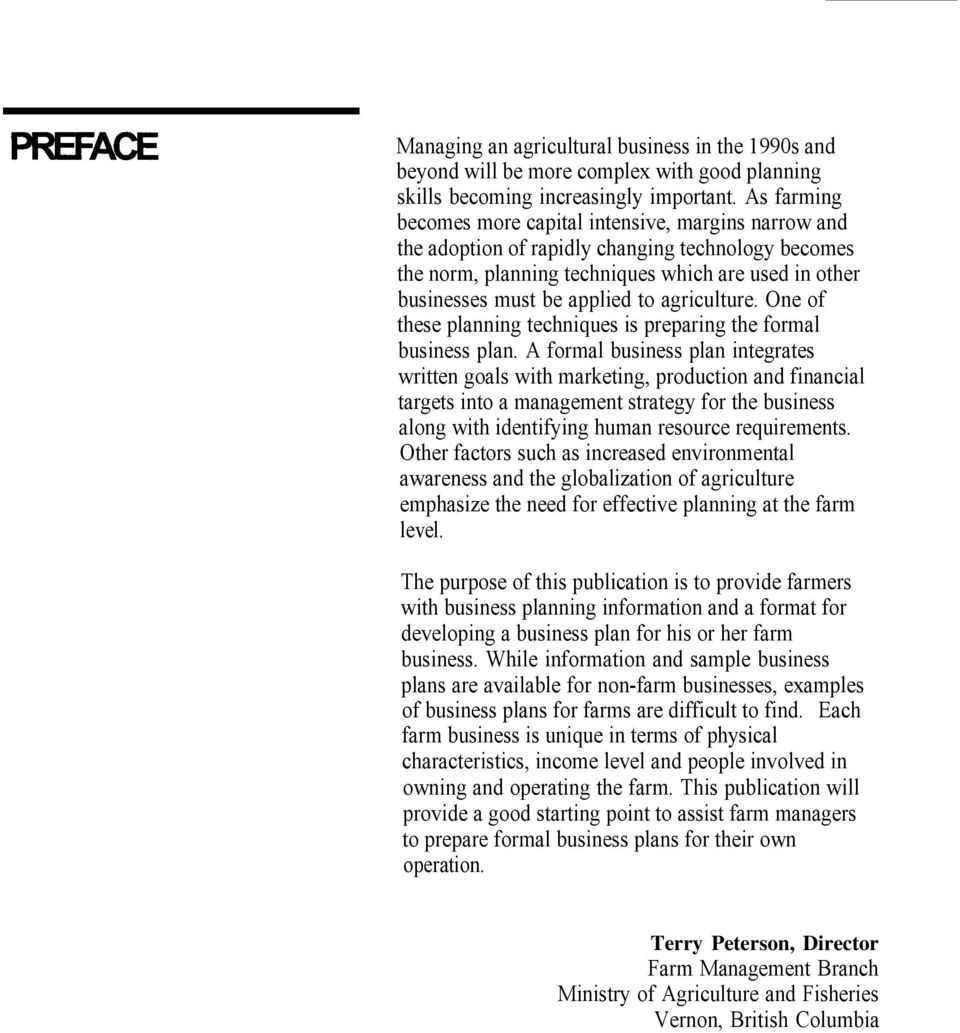
5 Managing an agricultural business in the 1990s and beyond will be more complex with good planning skills becoming increasingly important. As farming becomes more capital intensive, margins narrow and the adoption of rapidly changing technology becomes the norm, planning techniques which are used in other businesses must be applied to agriculture. One of these planning techniques is preparing the formal business plan. A formal business plan integrates written goals with marketing, production and financial targets into a management strategy for the business along with identifying human resource requirements. Other factors such as increased environmental awareness and the globalization of agriculture emphasize the need for effective planning at the farm level. The purpose of this publication is to provide farmers with business planning information and a format for developing a business plan for his or her farm business. While information and sample business plans are available for non-farm businesses, examples of business plans for farms are difficult to find. Each farm business is unique in terms of physical characteristics, income level and people involved in owning and operating the farm. This publication will provide a good starting point to assist farm managers to prepare formal business plans for their own operation. Terry Peterson, Director Farm Management Branch Ministry of Agriculture and Fisheries Vernon, British Columbia
6 You have a plan. You need to write it down. Preparing a Business Plan is a working guide to help you do just that. It will show you what a business plan looks like and be a guide to refer to as you prepare your own business plan. How to use this guide This guide is set up to use an explanation and then an example to show you the process for preparing your plan. The example follows through a business plan which has been prepared to provide direction for the management of a 500 hive beekeeping operation. The left hand page of the guide explains what should go into the section. The right hand page gives an example of how it might look. At the back of the guide, you will find blank worksheets that you may want to use to help you in structuring your plan. Remember, however, that while this guide will give you a framework, your plan will focus on your needs and your business information. If you need more information If you need more information, contact your nearest B.C. Ministry of Agriculture, Fisheries and Food district office, the Apiculture Specialist for your area, or the Farm Business Management Branch. BCMAFF provides a wide range of factsheets and worksheets such as Planning for Profit contribution margins and the Planning Package.

7 Planning is a vital part of your successful farm business. Comprehensive plans are routinely prepared by larger urban firms as a normal business practice. They improve communication, general efftciency and decision making - important advantages for all businesses, including your beekeeping business. Planning does not replace enterpreneurial skills but it can help avoid failures by: * discovering the problems and pitfalls * making the right moves to avoid them * preparing to take advantage of new opportunities Communication helps create a common purpose. You can use your written plan to explain your goals and strategies to people inside and outside the operation: + where the business is going, + what needs to be done, + the role of investors, family members and employees The business plan is your game plan within which you + set objectives and guidelines on paper. + create a standard against which to compare your actual results with your anticipated results. + identify problems quickly, before they become unmanageable. + keep on track Because planning is so crucial to your operation, it s important to examine every aspect of your business carefully and honestly. Be realistic in assessing what you are capable of and the possibilities that exist for your business. Some questions you should be asking yourself are: What exactly is the purpose of my business? How good is my concept? Will I be able to market my products? What are my personal and business goals? Do I have the necessary skills and abilities? What are my approximate cash needs? Do I have the resources? If not, where could the funds come from?

8 * Am I willing to take time to plan for my success? A business plan puts a lot of valuable information at your fingertips, ready to help you make those tough decisions. The plan will also help you monitor progress and cope with change and competition. Your business plan should be prepared by you, the owner/manager of the farm. Even if you use outside professional help, your plan must be your own. You have to be able to present it, summarize it and explain it. How to develop a plan? into your plan To many farmers, planning is synonymous with number crunching. Your business plan is much more. A look at your business should start with the foundation and build on the goals and priorities of your business and family. In this guide, the business plan works through a process v of development: + Analyzing the farm business and the industry * Determining the goals of the business and the family + Choosing the strategies to achieve the goals in terms of: * markets for the products of the business + production resources + management and labour resources * finances The number crunching builds in each step of the process. The financial planning serves as the reality check for the business plan rather than being the driver of the plan. Your business plan will answer three main questions: 1. Where are you now? 2. Where do you want to get to? 3. How are you going to get there?

9 The Right look Your business plan will likely be used to explain what you want other individuals, both inside and outside the business, to do for you. It is important to follow a recognized process and format to set up your plan. Also, as your business plan is a formal document, appearance is important. The document should * include a title page giving business name, date and time period covered have a detailed table of contents be typed, double-spaced with clean margins be simple and easy to read be geared to outsiders - avoid industry jargon be organized with essential information at the front have extra information in Appendices The background papers The formal plan will have the information needed to guide the user though the scenario you are pursuing. Meanwhile, you will likely be collecting all kinds of additional information about your business. These background papers are very helpful for further analysis and for future planning. You will want to set up an informal or working file to keep other information and ideas such as: + detailed analyses and other numbers + support and source documents * inventories and valuations * projections based on other scenarios. + other opportunities not pursued and why + confidential information + competitive edge information + details of goals and objectives * newspaper and magazine clippings + sensitive or confidential information

10 cavlponenis OFA BUSINESPIAN A complete business plan will include the components shown in the diagram below. Although each component should be considered, the amount of detail and depth in each will depend on the importance to your business plan. Your business plan may look different from the examples used in this book. You should emphasize those sections which best reflect the nature of your business. Business Profile

11 Title Page The Title Page helps your business plan look professional. Remember that first impressions are very important, especially to readers, such as bankers, who see many plans. As the example on the right shows, you should include: + your farm name * address * telphone/fax number 4 the period the plan covers + the person to contact + the date your plan was prepared 6

12 Tie Page Example. BUSINESS PLAN to Operate GOLDEN GLOW FARMS a 500 hive Beekeeping Operation Prepared by: Bill and Lila Washington Date: December 3 1,1994 Address: Box Quesnel, British Columbia, V2J 2Cl Telephone/Fax: (604)

13 Contents The Table of Contents outlines the topics covered by the plan. It allows readers to jump immediately to those sections which are of most interest. Remember that people who may read your plan, such as perspective lenders, are busy people. The table of contents is a roadmap of where they can find more detail on each topic. 8

14 Table of Contents Example Table of Contents Business Profile and Summary The Business Organization I Goals Marketing Plan Production Plan Management & LabourPlan Financial Plans Contribution Margin Analysis Projected Income Statement Cash Flow Forecast Projected Statement of Assets, Liabilities and Equity Key Targets

15 Business Profile and Summary The Business Profile and Summary should attract the reader s interest, outlining the basics of your plan and encouraging him or her to read the remainder of the plan. The reader should also know from the summary where and how he or she fits into your plan, e.g. if the plan is targetted to a lender, the summary should indicate how much money you want, what for, what your security is and how you intend to pay him or her back. Items that you might include in the Business Profile and Summary: * purpose of the plan + business goals * business activities and targets + financing needs or other input required from outsiders + financial and physical resources available This section is usually easiest to prepare after the plan is completed. 10

16 Businesss Profile and Summary Example Purpose of the plan To provide a five year operating plan for an existing 500 hive beekeeping business focussing on * maintaining honey production + diversifying into other hive products (pollen, beestock) * reducing debt and building equity in the farm and + building off-farm investments. Business Highlights hive beekeeping operation producing honey + Established markets for all honey produced + Good line of equipment in good operating condition + Good facilities for handling bees and honey * Family operated business * High debt load but all payments up to date Business Activities and Targets Marketing Plan * Diversify into pollen, comb honey, candles, and beestock sales * Increase farm gate sales of honey by developing a brand name + Improve packaging and promotional activities Production Plan + Maintain 500 hives in efficient honey production * Produce alternate products (pollen, beestock, comb honey) * Produce value-added wax products Mangement and Labour Plan + Share work load with family * Train and upgrade to handle new products * Minimize hired help Financial Plan + Pay off debt according to payment schedules * Off farm investment strategy (education and retirement funds) * Build equity 11
17 g Organization Under Business Organization, you want to present some basic information about your business and, for an existing business, how you got to this point. The business organization includes: + the basic structure + ownership + advisors * special permits or licenses you have or need or legislation you must comply with such as: + The Bee Act + Canada Agricultural Products Standards Act * B.C. Agricultural Products Trading Act * Worker s Compensation Act Business Operating History Business Operating History describes the development of the business to this point, * how long it has been operating, + the size, 4 the resources employed. + strengths and weaknesses in the current operation. Supporting detailed information describing the history of the business can be added as appendices to the business plan, for example: + Market and price history + Production records for the past five years 4 Management/labor expertise & training 4 Financial statements 12

18 Business Example Organization Business Name Telephone/Fax Type of Organization GOLDEN GLOW FARMS Box Quesnel, British Columbia, V2J 2C 1 (604) Proprietorship Licenses and Permits * No special permits or licenses are required to operate or sell products in local area. + Business is registered for GST and WCB. Management and Labor Name Position + Bill Washington Owner + Lila Washington Assistant Functions Operator/Manager Bookkeeper Business Advisors Name * Mary Smith * John Doe + Joe Black Role Accountant Lawyer Bank Manager Business Operating History + started in 1979 on 20 acre land base as small beekeeping operation * expanded slowly to 250 hives * in 1985, expanded to the current size hives * production focused on honey. * some production sold direct from farm gate (about 9,000 lbs) + shelf space in retail outlets in Williams Lake and Prince George * good line of equipment which is in good shape * honey production has been provincial average or higher + debt financing for land purchase and expansion 13

19 Your Goals will tell the reader what you are trying to achieve with this plan. This section will vary depending on who the reader is and how much you want to tell them. It will be considerably more detailed for internal use than for external use. A goal is the object or end that one strives to attain. A well-defined goal: * is a statement of action + specifies the time + is measurable * is realistic given the resources and time you have This section should contain at least: + a statement of mission or purpose that indicates the overriding philosophy of the business * the goals that you wish to achieve with this plan Additionally, you might include: * overall long term goals of the owner for the business + other goals not directly related to the business but that will have an impact on achieving business goals 14

20 Goals Example Mission, To manage the farm as an efficient and profitable family-operated beekeeping business, maintain assets in good working condition, reduce debt and build equity. Goal Strategy Tactics Time Long Term Goals Pay off debt Set aside retirement funds Maintain payment schedule No new debt Start investment portfolio Priority on high cash flow for payments Invest GST and income tax refunds Start NISA Account 11 years 15 years Goal Strategy Tactics Time Short Term Goals Diversify production pollen wax craft Learn about pollen Seminar/books 3 years Build to 15 traps Set 5 new traps per year Make candles & bar:; 2 years comb honey Build boxes 2 years nut s Take Beemaster Course Learn about Books/ Join 1 year production Bee Breeders 3 years 15

21 To prepare the Marketing Plan, you will consider issues like: + what the market looks like * potential customers * competitors + what products are selling + is there more demand than supply + is your product different in any way * price trends * your strategy to put your products into the marketplace + your competitive advantages The Market Describe the industry you operate within. Highlight the market conditions that influence your business. Define the opportunities that exist within the industry as well as the industry-wide constraints that hamper your business. Identify your potential customers and your competitors. Identity major trends affecting the industry and your business. This could include information on: * consumer preferences + per capita consumption + pricing and delivery options + new technology Where and how do you get this information? The more you know about your potential market, the easier it will be to find your niche. Important sources of information include: + produce buyers + salespeople and suppliers + industry associations, conferences, seminars + industry periodicals + other growers + government and business services + newspapers and magazines The more sources you use, the more reliable the information you gather will be. You may want to name your sources of information to increase the credibility of your plan. Additional detail would be included in the Appendices. 16
22 Marketing Plan Example Marketing Strategy * To expand product lines and advertise and promote these to build new markets. * To expand amount of honey sold at farm gate. * To add value to products. + To work with retail outlets to promote product and build customer loyalty for our products. The Market The beekeeping industry is essential to the environment for pollination services and for the pure natural hive products - honey, pollen, etc. Beekeepers are independent and individualistic. Most beekeepers come to the industry to enjoy the satisfying and interesting work with bees. Honey and bee products have experienced low prices over the past few years. There is very little generic marketing of honey and little coordinated consumer education. There is also no quota or restriction on production. Although most beekeepers focus on honey, some have expanded into alternate products and into value-added and specially packaged honey products. Other hive products (pollen, comb honey) are gaining customer recognition. Current outlets (farm gate and contracted retail shelf space) can handle all the honey we can produce. Market Trends Per capita honey use is static. Opportunity to produce nut s to fill markets in areas that are infested by virroa mites. Demand for pollination services are increasing. Market Opportunities There are no other large honey producers in the immediate trading area to compete for farm gate sales. Contracted retail outlets allow special promotions. 17
23 Marketing Plan Product The main objective of the marketing plan is to determine the products that you can sell. Your plan should discuss these products in terms of: + consumer preferences (containers, sizes,..) + legal and political controls and regulations (labelling,..) Pricing The price that you think you can get for the products provides a tool to decide whether a new product would be profitable and in what format. Your plan should indicate: + how you set your price + what you anticipate prices will be into the future + how your prices differ from competitors pricing Place Where and how you will be selling your products is the final leg of the marketing plan. What are your alternatives for getting the product to the customer - direct sales, retail outlets, bulk sales? Promotion In your plan, what is your strategy to make consumers aware of your product? Your plan should outline the methods you will use to increase acceptance of the product and create interest in it. What about creating demand for new products? If you are introducing a new product or producing a different product, who will you be selling to? How will you assess what your customers want? Your packaging and promotion will then key in on the desires the customer has expressed. 18
24 Marketing Plan Example Products, * Honey: liquid, comb * Alternate products: pollen, nut s * Value added products: wax, packaging Prices Honey-wholesale oo farm gate specialty comb Wax-bulk candles* Pollen-bulk packaged Nuts * based on $4.00 per pair * Honey, pollen, comb honey, wax products + Nut s Retail outlets Farm-gate Nut s Place - current retail outlets - existing farm-gate customers - lower mainland - local area Promotion - special promotions to feature pollen, comb honey and wax products - more colorful displays in current shelf space - new labelling and packaging - signage - display area - labelling and packaging - trade magazines - local bee clubs
25 The Production Plan is concerned with how to efficiently produce the volumes and grades of the product(s) you want to sell. You will need to research the production methods that will work with your operation. In this section, you will want to consider: * do you have the facilities? * do you need additional equipment? * how will your current production be affected? * what are common production problems and how will you tackle them? * where can you get more information? Production Strategy What do you plan to produce and how? Your strategies should describe your plans to achieve targeted yields and quality. Production Facilities Include a description of the facilities and equipment that you have in use or available. This may be easiest to show in a scale drawing of your facilities. You may also want to include a map of hive yard sites, particularly if your plans include changes to sites. Under Capital Purchase Requirements, list any new equipment and facilities you will need and what you expect them to cost. This list should include planned repair and replacement of facilities and equipment. 20
26 Production Plan Example Production Strategy * To maintain 500 hive level in full production. * To produce pollen by putting in pollen traps in spring. * To produce nut s by splitting hives in spring. * To make to wax into candles and bars. Production Facilities * Currently have equipment and facilities to operate and maintain 500 hives including extracting, storing and packing honey. * Facility easily upgraded to better control climate for overwintering colonies for nut production. Capital Purchase Requirements Pollen traps Pollen cleaner/dryer 1,000 Nut boxes 3,450 2,300 5,750 Frames 1,800 1,200 3,000 Comb boxes 700 Wax molds Fan for hot room 200 Total Capital Purchases 1,600 5,950 5,300 8,
27 Production History The production plan should include a brief description of historical production including products, strategies and volumes/grades achieved. Production Schedules In your production plan, you will want to schedule the changes in timing and use of facilities you foresee because of new strategies and new products. Production Volume What are the production targets you plan to achieve? Do you anticipate any changes in operating inputs and costs to achieve these? Other Production Information You may want to include other production information in your production plan or in the Appendix such as: * Historical Yields * Comparison to industry averages + Competitive advantages * Constraints + Capacities 22
28 Production Plan Example Production History * Emphasis has been on honey production and on hive management to produce healthy colonies. * Average production over 5 years pounds per hive Production Schedules add comb boxes to 30 hives pollen traps in spring on 30 hives prepare hives for nut production split, feed and deliver nut s comb boxes on 50 hives pollen traps on 30 hives prepare hives for nut production increase nut, pollen and comb production Production Volume # of hives Honey -1bsIhive total lbs 60,000 60,000 60,000 60,000 60,000 Comb honey - lbs Wax -1bs Nuts Pollen - lbs Changes in Inputs and Costs + Additional labor * NUC S - increased, feed, protein - queen cells 23
29 Management & Labour Plan The Management & Labour Plan describes how you expect to get the job done. Will you need additional help? Will you need additional training? How can you allocate your hours most effectively? Management and Labour Strategy What is the overall strategy for operating and managing the business? Your strategy statements will clarify the direction and priorities. Job Functions A distribution of the many jobs that have to be done will show where there are gaps and where more help is needed. Hiring can then be based on the needs defined. When making any changes in the operations, the allocation of jobs has to be defined and analyzed. This can be done in many ways. A time planner such as the one shown in the example can work very well for an operation with few people involved. Tasks are listed in the time periods they must be done. Overlaps can be quickly seen. 24
30 Management & Labour Plan Example Management and Labour Strategy * To operate as a family farm, working smarter and more efficiently. * To minimize hired labor. * To learn new technologies required to produce and market new products. Job Functions (in days) Jan Feb Mar Apr May Jun Jul Aug Sep Ott Nov DecTotal Present Operations Hive Management Maintenance/Selection Moving/Fencing Monitoring Repairs Honey Production Extracting Packing Marketing Selling-Farm Gate Selling-Stores Administration Training/Meetings Bookkeeping Planning Sub-Total Nut Production Selecting/Feeding Packing/Marketing Wax Products Production Packaging/Marketing Pollen Production Collection Cleaning/Packaging Comb Honey Packaging Total days Available days Bill Lila Children Hired _
31 Job Allocations 1 Management& 1 Labour Plan Your plan should allocate the jobs to specific individuals as is done in the chart in the example. Training Once jobs are defined, training needs can be assessed for each individual - both informal (on the job) and formal. Government Regulations Government regulations and requirements regarding work environment, safety and training should be noted.. 26
32 Management & Labour Plan Example Job Allocations Functions Training Needs Vher Bill Hive management Nut production Repair & Maintenance for info Marketing - wholesale Planning Iour/Reading Bee Breeders Assoc. :a11 BCMAFF Lila Bookkeeping Label Design Planning First Aid iomputer Accountin #eve1 I, Gov t Reg Greg Hive management (summer) Extracting & Packing Joannie Candle making Direct sales Douglas Direct Sales Packing Hired Spring cleanout Feeding Extracting Fall hive collection 3 weeks 8 weeks 27
33 The Financial Plan is the acid test of your plans and ideas. Putting the plans into dollars shows up any gaps, discrepancies and unrealistic assumptions! Because much of the information that you will need is already pulled together in your marketing, production and labour plans, the task of putting your plans into dollars is easier than you might expect. Your financial forecasting should be based on what you think is the most likely scenario for your business. It is also valuable to consider what the numbers would be should you have some poor years, and what some good luck might bring, i.e. do the forecasts on a pessimistic basis and on an optimistic basis. This will give you an indication of the risk involved. Useful tools for the financial analysis are the + Contribution Margin Analysis * Projected Income Statement, * Cash Flow Forecast and * Projected Statement of Assets, Liabilities and Equity Contribution Margin Analysis The Contribution Margin Analysis will tell you how much each product contributes to the profits of the business. The contribution margin is the amount left after the direct costs are deducted from the income produced by a given product. Direct costs are those incurred for production. They are usually separated from fixed costs which are those expenses that would occur whether or not anything was produced. The contribution is what is left after all direct costs are deducted. If you are looking at adding new products to your operation, you might want to prepare a Contribution Margin Analysis for each new product. This is also a useful tool for analyzing the profitability of existing products. 28
34 Financial Plan Example Contribution Margin Analysis Pollen Production Projected Price ($) 15 Production (lb.) Income Sales 1,125 1,125 1,500 1,500 1,500 Direct Costs Trap handling 0 Cleaning/Sorting 0 Packaging&abelling Contribution Margin ,100 1,100 1,100 Production of Nuts Projected Price ($) Production (units) 0 Income Sales 0 Direct Costs Queens 0 Feeding 0 Packaging/Freight ,775 10,000 21,250 22, ,500 1,500 1,894 3,157 6,315 6, ,052 1,084 Contribution Margin 0 3,131 5,564 12,383 13,601 29
35 Projected Income Statement The Projected Income Statement shows the anticipated profits from the business after all direct costs and fixed costs have been deducted. From the income statement, you can see if what you are planning to do will make money, how much and how soon. The Income Statement provides a better measure of profit when it is prepared using the Accrual Basis of Accounting. The accrual basis takes into account the value of the product that has been produced even if it has not yet been sold (inventory). It also accounts for amounts that have been earned but not yet received (Accounts Receivable) and for amounts that have been spent but not yet paid (Accounts Payable). 30
36 Financial Plan Example Projected Income Statement 1995 Income Honey - Wholesale 47,975 - Farm Gate 11,875 - Comb 2,700 Wax - Bulk Candles 1,750 Pollen 1,125 Nuts Total Income 66,225 Expenses Feed - Sugar 4,998 - Protein 775 Queen Purchases 2,754 Hive Treatments 1,279 Labour 6,700 Machinery Costs 6,274 Hive Repair 1,357 Yard Rent 1,200 Interest - Operating 1,370 Marketing/Promotion 6,777 Interest - Long term 6,4 13 Property Taxes 887 Utilities & Repairs 3,932 Overhead 1,566 Depreciation 10,798 Total Expenses 57,080 Net Income 9, ,000 49,500 51,450' 52,800 12,500 13,650 14,300 16,200 4,200 6,300 6,300 7, ,375 4,375 4,375 4,375 1,125 1,500 1,500 1,500 5,775 10,000 21,250 22,500 77,475 85,625 99, ,075 6,596 7,727 10,379 10,587-1,187 1,474 2,164 2,207 3,259 3,624 4,447 4,536 1,304 1,330 1,357 1,384 9,700 9,700 11,200 11,200 6,398 6,527 6,657 6,790 1,384 1,412 1,440 1,469 1,200 1,200 1,300 1, ,088 7,924 8,583 8,755 5,346 4,293 3,571 3, ,027 1,078 4,011 4,091 4,172 4,257 1,607 1,649 1,694 1,738 10,313 9,812 9,706 8,735 62,171 61,741 67,696 67,306 15,304 24,084 31,979 37,769 31
37 Cash Flow Forecast The Cash Flow Forecast measures the movement of cash in and out of the business. It differs from the income statement because it shows all of the sources of cash, not just cash from sales. Because cash is so important to a business, the cash flow forecast is a popular planning tool. It will help you to see when cash shortfalls may occur, and will help you to determine if you will need outside funding, how much and for how long. The Cash Flow Forecast does not measure profit. Often, a business will be profitable, but the cash may be tied up in inventory or in fixed assets for some time. In such circumstances, using only the cash flow information could mislead you. For your business plan, you may also want to prepare a monthly cash flow projection to anticipate fluctuations in cash during the year. 32
38 Financial Plan Example Cash Flow Forecast Cash In Honey - Wholesale 47,083 48,693 49,350 50,865 52,395 Honey - Farm Gate 11,875 12,500 13,650 14,300 16,200 Other Products 6,375 15,975 22,675 33,925 36,075 Accounts Receivable 1, Loans Asset Sales Contributions** 3,000 3,000 4,500 4,500 Off Farm Income 24,990 25,490 26,000 26,520 27,050 Total Cash In 91, , , , ,220 Cash Out Expenses* 46,282 51,857 57, , ,571 Accounts Payable 1, Asset Purchases 1,600 5,950 5,300 8,750 0 Principal Payments 12,974 11,209 7,452 2,724 3,024 Living Expenses 21,000 21,000 21,000 21,000 21,000 Education Fund* * 0 3,000 3,000 4,500 4,500 Retirement Savings Income Taxes ,200 3,200 3,800 Total Cash Out 83,012 93,416 90,741 99,162 91,946 Surplus (Deficit) 8,744 12,241 23,934 30,948 44,274 Balance Forward(22,830) (14,086) ( 1,846) 22,088 53,036 Cash Balance (14,086) ( 1,846) 22,088 53,036 97,311 * Less depreciation **These amounts saved by children from increased wages 33
39 Projected Statement of Assets, Liabilities and Equity The Projected Statement of Assets, Liabilities and Equity measures the cumulative financial progress of the business. This projection is like a series of photographs of the business taken at certain intervals. In the photographs you see what assets the business has, who the business owes money to and how much equity the owner has. By comparison, you can see how these elements have changed over time. The equity reflects your investment in the business at a stated time. Owner s equity increases because of accumulated income or because of contributions you make to the business. This calculation is useful as a target and a measurement tool. Owner s Equity is calculated based on the cost of assets for the Statement of Assets, Liabilities and Owner s Equity (also called a Balance Sheet). When changes in the value of assets occur due to economic influence, the equity of the owner will also change. When a statement is prepared reflecting these market values, the owner s equity is referred to as Net Worth and the statement is a Net Worth Statement. Historical Information In addition to the projections, you may need to include the financial history of your business. If you will require additional financing, you should also include information such as: * inventory, accounts receivable and payable + insurance + appraisals * personal net worth This information could be included in the appendices. 34
40 Example Projected Statement of Assets, Liabilities and Equity Assets Cash (14,086) ( 1,846) 22,088 53,036 97,3 11 Education Fund 3,000 6,000 10,500 15,000 Retirement Savings 858 1,855 2,906 Inventory - Honey 14,393 14,700 14,850 15,435 15,840 Inventory - Supplies 3,100 3,100 3,100 3,100 3,100 Equipment 173, , , , ,615 Total Assets 176, , , , ,771 Liabilities Loans Payable 51,009 39,800 32,347 29,623 26,599 Equity Opening Balance 112, , , , ,653 Contributions 24,990 28,490 29,000 31,020 31,550 Drawings (2 1,000) (21,400) (22,200) (24,200) (24,800) Income for Year 9,145 15,304 24,084 31,979 37,769 Closing Equity 125, , , , ,172 Total Liabilities and Equity 176, , , , ,771 35
41 The business plan gives you a standard against which to compare your actual results with your planned results. Regular review of your plan, comparing it to the results shown in your actual records, will allow you to identify problems and make adjustments quickly. Some of the targets you set in your plan may warrant a more constant vigil. For these key targets, you might want to set up a tracking method that will show your progress on a timely basis. Your key targets, which might be average price per pound, winter survival populations or pounds of honey sold per month, are those that will * show your progress + give you early warning signs of future problems * be important to achieving your goals Measuring tools that give a graphic reference point are very useful. They will make tracking progress easier. Consider using * a thermometer to draw in the progress you are making * charts and graphs to show growth * pie charts to measure changing percentages. 36
42 Key Targets Example Key Targets Farm Gate Sales Production Financial Finmc&Z lnl46rtrrr Loam & Net Incrnr Growth in Net
43 Do you want to supply more detail to explain some aspect of your plan? Is there some additional information that you feel is helpful to understanding the plan? Do you have a brochure for a new asset? Organize them into Appendices at the end of the Business Plan. The Appendices contain those extra items that you want to include in your plan to support or provide detail for sections of the main document. These might include some of the following: * Financial Statements for the past five years + Personal resumes of key people + Brochures showing new equipment * Important articles or news items * Insurance * Drawings or plans * Appraisal reports + Important contracts + Detailed forecasts 38
44 Appendix Example Historical Data Average Prices Honey-wholesale farm gate Production Volume # of hives Honey-lbdhive total lbs 65,000 47,000 63,500 60,000 66,500 Financial Indicators Assets 186, , , , ,378 Liabilities 88, , ,854 95,211 65,139 Equity 98,153 96,267 78,322 82, ,442 Total Income 77,700 70,400 49,750 68,625 68,655 Total Expenses 73,079 72,785 70,485 68,087 59,437 Net Income 4,621 ( 2,385) (20,735) 538 9,218 39
45 BUSINESS PLAN to Operate a Beekeeping Operation Prepared by: Date: Address: Telephone/Fax: 40
46 Table of Contents 41
47 Purpose of the Plan Business Highlights Business Activities and Targets Marketing Plan Production Plan Management and Labour Plan Financial Plan 42
48 Business Name & Address Telephone Type of Organization Licenses and Permits Business Management Name Position Function Business Advisors Name Role Business Operating History 43
49 Mission I Goal Strategy I Tactics Time Long Term Goals I I I Short Term Goals 44
50 Marketing Strategy The Market Market Trends Opportunities 45
51 Product Projected Prices Place Promotion 46
52 Production Strategy Production Facilities Capital Purchase Requirements 47
53 Production History Production Schedules Production Volume Changes In Inputs and Costs 48
54 Management and Labour Strategy Job Functions 49
55 Job Allocations Name Functions Training Needs Other 50
56 Contribution Margin Analysis Projected Price Projected Production Income Direct Expenses Contribution Margin Projected Price Projected Production Income r r r L Direct Expenses Contribution Margin 51
57 Projected Income Statement Income Total Income Expenses Total Expenses Net Income 52
58 Cash Flow Forecast Cash In Total Cash In Cash Out Total Cash Out Surplus (Deficit) Balance Forward Closing Balance 53
59 Projected Statement of Assets, Liabilities and Equity Assets Total Assets Liabilities Total Liabilities Equity Opening balance Contributions Drawings Closing Balance Total Liabilities and Equity 54
60 Key Targets Target Time Measurement Tools L 55
61 GLOSSARY OF BUSINESS TERMS Accrual Basis of Accounting: A method of accounting in which revenue and expenses are recorded in the period when they are earned or incurred regardless of whether or not they have been paid. Amortization: The systematic reduction of a balance in an account over a period of time. Most often this term is applied to long-term liabilities and intangible assets. Assets: Things of value under the control of the business entity. Balance Sheet: A statement summarizing the assets, liabilities and equity of a business entity at a given date. (Sometimes called Statement of Assets, Liabilities and Equity.) Capital Cost Allowance: The allocation of the cost of an asset as a deduction against the taxable income of the business at rates prescribed by Income Tax law. Capital Gain: A term used for income tax purposes to define, in most cases, the amount that proceeds from the disposition of an asset exceeds the original cost of the asset. Cash Basis of Accounting: A method of accounting by which revenues and expenses are recorded when cash is actually received or paid regardless of when the agreement to sell or purchase may have taken place. Contribution Margin: The excess of total revenues minus variable costs, indicating funds available to cover fixed costs and profits. cost: The purchase price of goods or services consumed in the business. Credits: An accounting convention requiring the recording of entries on the right hand side of an account with the effect of increasing liability and equity accounts and decreasing the asset accounts. 56
62 GLOSSARY OF BUSINESS TERMS Chart of Accounts: A systematic listing of acccounts into categories and subcategories. Cost Basis of Asset Valuation: Assets are entered into and carried in the books at their original aquisition cost. Current Assets: Assets that are used up or converted to cash within a fiscal year. Current liabilities: Obligations which will become due and payable within a short term, usually the fiscal year. Debits: An accounting convention requiring the recording of entries on the left hand side of an account with the effect of increasing asset accounts and decreasing liability and equity accounts. Debt: Obligations to entities outside of the business, usually contractual. Deferred Income Taxes: The accumulated amount by which income taxes calculated on net income is decreased because of timing differences. Differences arise mainly as a result of cash basis reporting, and from depreciation rates that differ from prescribed rates for income tax purposes. Depreciation: The allocation of the cost of an asset against the operating income of the business to reflect useage of the asset to produce income. Direct Costs: Costs that are directly related to production activity. If no production or activity takes place, direct costs are zero. Many direct costs are also variable. Dividends: Distribution of earnings to shareholders. Amounts are declared by the board of directors and are paid in proportion to shares held. Equity: Ownership in the assets of the business held by proprietors, partners or corporate shareholders. 57
63 GLOSSARY OF BUSINESS Expense: A cost incurred by a business for the purpose of producing revenue. Fiscal Period: The accounting period, usually one year, over which the effect of transactions are recorded and financial progress is measured. Fixed Assets: Assets with a long term usefulness, usually held for the production of goods or services rather than for resale. Fixed Cost: Costs that remain relatively unchanged regardless of the volume of production or activity within a range of volume. Examples include building insurance and property taxes. Liabilities: Obligations of the business to outsiders. Inventory: Items purchased or produced that are for sale or for use in the production of goods for sale. Liquidity: The ability of the business to meet its financial obligations as they fall due, measured by the comparison of current assets to current liabilities. Mortgage: A conveyance of a legal interest in property from one person to another as security for the payment of a debt or other obligation. Net Book Value: The net value on the books of a fixed asset after deducting accumulated depreciation. Net Income: The excess of revenues over expenses (variable plus fixed) for a given period of time. Net Worth: The difference between the market value of assets and the market value of liabilities at a given time. Net worth represents an estimate of what the owner would receive if assets were disposed of and liabilities were discharged. 58
64 GLOSSARY Prepaid Expense: OF BUSINESS TERMS An amount paid out which is expected to yield a benefit beyond the current accounting period. The amount is carried on the balance sheet as an asset and charged to expenses as the benefit is realized. Projected Cash Flow Statement: A statement used as a planning tool to show expected future sources of cash from operations, asset sales, owner contributions and loan proceeds less cash utilized for business expenses, capital purchases, owner withdrawals, and loan payments. Revenue: Money earned by the business as a result of business activities. Share Capital: The ownership interest in an incorporated company that is represnted by the shares of that corporation. Term Liabilities: Obligations to outsiders that will become due and payable at a time beyond the current fiscal period. Transactions: Business events engaged in by a business entity. Variable Costs: Costs that vary directly with the volume of production or activity. If no production or activity takes place, variable costs are zero. 59
65 Preparing a Business Plan Comment Form Please send us your comments and help us serve you better. We would like to know what you think of this publication... what s good and what could be improved, and how. Please take a few minutes to give us your opinions and ideas. Please return the completed evaluation form to: Extension Systems Branch, B.C. Ministry of Agriculture, Fisheries and Food 808 Douglas Street, Victoria, British Columbia, VSW You are (please check appropriate box) 2 Question. Overall, how do you rate this material? (please rate on the scale of 1 to 5, I being poor and 5 being excellent) 3. How did you find out about this publication? Response Cl Beekeeper Cl Industry 0 Government 0 Other Poor Excellent Is the information relevant to your needs? 58. Is the writing style 6L Is the amount of detail r I 1. What are your main sources of information on business management? ri$. Preparation costs are high. If future editions were priced, indicate the amount you would be willing to pay? Not Very Simple/Easy Difficult/Technical Not Enough Too much BCMAFF staff 0 Industry Cl Research Station Cl Other Farmers 0 Trade Journals/Periodicals 0 Other 0 $2 0 $5 0 $10 plus l3. What are the strong points of this publication? 10. What are the weak points that we should try to correct? 11. Other Comments? 60
PLANNING FOR SUCCESS P a g e 0
 PLANNING FOR SUCCESS P a g e 0 PLANNING FOR SUCCESS P a g e 1 Planning for Success: Your Guide to Preparing a Business and Marketing Plan This guide is designed to help you put together a comprehensive,
STATEMENT OF CASH FLOWS AND WORKING CAPITAL ANALYSIS
 C H A P T E R 1 0 STATEMENT OF CASH FLOWS AND WORKING CAPITAL ANALYSIS I N T R O D U C T I O N Historically, profit-oriented businesses have used the accrual basis of accounting in which the income statement,
BUSINESS PLAN TEMPLATE
 PARRY SOUND AREA COMMUNITY BUSINESS & DEVELOPMENT CENTRE INC. A Community Futures Development Corporation 1A Church Street, Parry Sound, ON P2A 1Y2 Telephone: (705)746-4455 Toll Free: 1-888-746-4455 Fax:
UNDERSTANDING WHERE YOU STAND. A Simple Guide to Your Company s Financial Statements
 UNDERSTANDING WHERE YOU STAND A Simple Guide to Your Company s Financial Statements Contents INTRODUCTION One statement cannot diagnose your company s financial health. Put several statements together
Business Plan Guide for a Small Business
 Business Plan Guide for a Small Business A Business Plan is a written document that describes the path of your business venture. It describes what you want to do and how you plan to do it, usually covering
Farmer-to-Consumer Marketing: The Series
 Farmer-to-Consumer Marketing #6 Financial Management Scope of Financial Management Managing the financial affairs of a direct marketing operation includes: Raising capital Identifying financial objectives
Developing Business Plans and Funding Proposals
 The best source of information and training on Aboriginal finance and management The Aboriginal Finance and Management Capacity Development Series Developing Business Plans and Funding Proposals A Practical
In this chapter, we build on the basic knowledge of how businesses
 03-Seidman.qxd 5/15/04 11:52 AM Page 41 3 An Introduction to Business Financial Statements In this chapter, we build on the basic knowledge of how businesses are financed by looking at how firms organize
Chapter 9 E-Commerce: Digital Markets, Digital Goods
 1 Chapter 9 E-Commerce: Digital Markets, Digital Goods LEARNING TRACK #: 2: BUILD BUSINESS PLAN There are lots of different ways to lay out a business plan. The sample
A guide to using the business plan template
 A guide to using the business plan template Small Business Development Corporation 13 12 49 smallbusiness.wa.gov.au The small business specialists Writing your business plan This is guide is to assist
SMALL BUSINESS OWNER S HANDBOOK
 SMALL BUSINESS OWNER S HANDBOOK PART II: FINANCIAL PLANNING FOR SMALL BUSINESSES Introduction Financial Planning Methods of Financing Your Business Other Types of Funds & Financing How to Approach Lenders
CASH FLOW STATEMENT & BALANCE SHEET GUIDE
 CASH FLOW STATEMENT & BALANCE SHEET GUIDE The Agriculture Development Council requires the submission of a cash flow statement and balance sheet that provide annual financial projections for the business
ALL NATIONS TRUST COMPANY SAMPLE BUSINESS PLAN
 ALL NATIONS TRUST COMPANY SAMPLE BUSINESS PLAN WHAT MAKES A GOOD BUSINESS PLAN? A business plan is a written document, which outlines: the business and owner s background the proposed resources to be used
Starting your Business Guide
 Starting your Business Guide Small Business Resources The material in this document is intended to provide only general information to Canadian Western Bank s clients and the public, and not for the purposes
Preparing Agricultural Financial Statements
 Preparing Agricultural Financial Statements Thoroughly understanding your business financial performance is critical for success in today s increasingly competitive agricultural environment. Accurate records
Business Plan Planning Service Financial Analyses and Projections
 Business Plan Planning Service Financial Analyses and Projections Financials Included With Every Ceo Resource Plan These are the financial analyses and projections that are included with all plans developed
Ipx!up!hfu!uif Dsfeju!zpv!Eftfswf
 Ipx!up!hfu!uif Dsfeju!zpv!Eftfswf Credit is the lifeblood of South Louisiana business, especially for the smaller firm. It helps the small business owner get started, obtain equipment, build inventory,
A PRACTICAL GUIDE TO WRITING A BUSINESS PLAN
 A PRACTICAL GUIDE TO WRITING A BUSINESS PLAN Louisiana Small Business Development Center At Southeastern Louisiana University 1514 Martens Drive Hammond, LA 70401 Phone: (985) 549-3831 Fax: (985) 549-2127
Business Plan. Your Business Name
 Business Plan Your Business Name Owners Address City, ST ZIP Code Telephone Fax E-Mail Date: Page 2 II. Executive Summary Write this section last. We suggest that you make it one page long; two pages max.
Export Business Plan Guide
 Export Business Plan Guide Table of Contents Introduction... 4 SECTION 01: CURRENT SITUATION ANALYSIS... 5 Company Overview... 5 Availability of Resources... 6 SWOT Analysis... 9 SECTION 02: MARKET ANALYSIS...
What is a business plan?
 What is a business plan? A business plan is the presentation of an idea for a new business. When a person (or group) is planning to open a business, there is a great deal of research that must be done
Guide to Financial Ratios Analysis A Step by Step Guide to Balance Sheet and Profit and Loss Statement Analysis
 Guide to Financial Ratios Analysis A Step by Step Guide to Balance Sheet and Profit and Loss Statement Analysis By BizMove Management Training Institute Other free books by BizMove that may interest you:
Smart Business Analysis, Part I: Beginning Basics
 Smart Business Analysis, Part I: Beginning Basics By: Bryan Durocher Posted: September 1, 2010, from the September 2010 issue of Merge Magazine. Abstract: Having a finger on the pulse of your practice
Topic 7: Financial Performance
 Topic 7: Financial Performance One of the most important tasks in transition planning is analyzing the financial performance of the farm operation. Too many farms move ahead making decisions regarding
IGCSE Business Studies revision notes Finance [email protected]
 IGCSE FINANCE REVISION NOTES Table of contents Table of contents... 2 SOURCES OF FINANCE... 3 CASH FLOW... 5 HOW TO CALCULATE THE CASH BALANCE... 5 HOW TO WORK OUT THE CASH AVAILABLE TO THE BUSINESS...
Report Description. Business Counts. Top 10 States (by Business Counts) Page 1 of 16
 5-Year County-Level Financial Profile Industry Report Architectural Services (SIC Code: 8712) in Prince George County, Maryland Sales Range: $500,000 - $999,999 Date: 11/07/08 Report Description This 5-Year
Business Plan Guidelines
 Business Plan Guidelines The following Business Plan Format checklist is meant as a guideline only listing the most important sections of the business plan in the order in which they will likely appear
BUSINESS PLAN TEMPLATE
 iplanner.net Small Business Plans Online BUSINESS PLAN TEMPLATE For a start-up company 18/01/2012 12:33:19(GMT) Executive Summary... 3 Business Overview... 3 Products and Services... 3 Sales Forecast...
BUSINESS PLAN GUIDE. Send completed business plans to:
 BUSINESS PLAN GUIDE Send completed business plans to: Waubetek Business Development Corporation 6 Rainbow Ridge Road P.O. Box 209 Birch Island, ON P0P 1A0 1-800-665-2248 toll-free (705) 285-4275 phone
Cash Flow Forecasting & Break-Even Analysis
 Cash Flow Forecasting & Break-Even Analysis 1. Cash Flow Cash Flow Projections What is cash flow? Cash flow is an estimate of the timing of when the cash associated with sales will be received and when
Cash budget Predict the movements of cash received and paid for over a period of time. Financial statements
 Achievement Standard 90976 Demonstrate understanding of accounting concepts for small entities ACCOUNTING. Externally assessed 3 credits Accounting 90976 (Accounting.) involves the recognition, definition
Accounts Payable are the total amounts your business owes its suppliers for goods and services purchased.
 Accounts Payable are the total amounts your business owes its suppliers for goods and services purchased. Accounts Receivable are the total amounts customers owe your business for goods or services sold
BUSINESS PLAN GUIDELINES START MY OWN BUSINESS
 BUSINESS PLAN GUIDELINES START MY OWN BUSINESS 1. Cover Page and Table of Contents The cover page of your business plan should include contact information such as your name, the name of your business,
How to Assess Your Financial Planning and Loan Proposals By BizMove Management Training Institute
 How to Assess Your Financial Planning and Loan Proposals By BizMove Management Training Institute Other free books by BizMove that may interest you: Free starting a business books Free management skills
BUILDING A BUSINESS PLAN
 BUILDING A BUSINESS PLAN Northern Savings Commercial Services Whether your business is just starting out or you re ready for a change, Northern Savings Commercial Services is an ideal partner and can provide
National Black Law Journal UCLA
 National Black Law Journal UCLA Peer Reviewed Title: An Introduction to Financial Statements for the Practicing Lawyer Journal Issue: National Black Law Journal, 4(1) Author: Edmonds, Thom Publication
Glossary of Accounting Terms Peter Baskerville
 Glossary of Accounting Terms Peter Baskerville Account for or 'bring to account': An accounting phrase used to describe the recording of a financial transaction that is required under the generally accepted
How to Prepare a Cash Flow Forecast
 The Orangeville & Area Small Business Enterprise Centre (SBEC) 87 Broadway, Orangeville ON L9W 1K1 519-941-0440 Ext. 2286 or 2291 [email protected] www.orangevillebusiness.ca Supported by its Partners:
Performance Review for Electricity Now
 Performance Review for Electricity Now For the period ending 03/31/2008 Provided By Mark Dashkewytch 780-963-5783 Report prepared for: Electricity Now Industry: 23821 - Electrical Contractors Revenue:
Agriculture & Business Management Notes...
 Agriculture & Business Management Notes... Preparing an Income Statement Quick Notes... The income statement measures the profitability of a business over a specific period of time. Cash reporting of income
Department of Agriculture and the Nova Scotia Farm Loan Board. Preparing an Agri-Business Plan
 Department of Agriculture and the Nova Scotia Farm Loan Board Preparing an Agri-Business Plan TABLE OF CONTENTS THE BUSINESS OVERVIEW 1 MARKETING PLAN 9 HUMAN RESOURCES PLAN 15 PRODUCTION PLAN 20 FINANCIAL
Creating a financial proposal
 Creating a financial proposal Business Coach series Presenting your company Targeting your strengths Making the approach BusineSS Coach series Seeking serious money The situation When your company requires
MODULE 6 Financial Statements
 Introduction. 102 Projected Outcomes 103 Facilitators Notes. 104 What is Accounting. 104 The Accounting Equation.. 105 Accounting Terminology 106 Assets 106 Liabilities. 106 Owner s Equity, Partner s Equity,
Basic Accounting. Supplement for Using Simply Accounting Version 8.0 for Windows by. M. Purbhoo and D. Purbhoo
 Basic Accounting Supplement for Using Simply Accounting Version 8.0 for Windows by M. Purbhoo and D. Purbhoo Basic Accounting Contents: Accounting Theory 3 Basic Accounting 3 Balance Sheet 3 Income Statement
Chapter 4. Completing the accounting cycle
 1 Chapter 4 Completing the accounting cycle 2 Learning objectives 1. Prepare an accounting worksheet and describe its purpose 2. Prepare a classified balance sheet and explain the major headings 3. Explain
BUSINESS PLAN QUESTIONNAIRE
 BUSINESS PLAN QUESTIONNAIRE Company Name: Business Owner Name(s): Address: Phone: E-mail: Fax: Web Site: Who is the primary audience for your business plan? Lenders Investors Internal Use MISSION/VISION/OBJECTIVES
The Work Sheet and the Closing Process
 C H A P T E R 4 The Work Sheet and the Closing Process A systematic approach is essential for efficient and accurate processing of large amounts of information. Whether work sheets are on paper or computerized,
Business Plan Guide. NYS Small Business Development Center. Small Business Development Center. Farmingdale State College
 NYS Small Business Development Center Farmingdale State College Business Plan Guide Small Business Development Center The SBDC is a program supported by the U.S. Small business administration and extended
Breakeven Analysis. Breakeven for Services.
 Dollars and Sense Introduction Your dream is to operate a profitable business and make a good living. Before you open, however, you want some indication that your business will be profitable, if not immediately
How to Write a Business Plan
 How to Write a Business Plan Small Business Development Center (SBDC) A well-written comprehensive business plan forms the basis for the success of any business venture. The business plan is a written
The Measurement of the Business Income. 1 by recording revenues when earned and expenses when incurred. 2 by adjusting accounts
 Recap from Week 3 The Measurement of the Business Income The primary objective of accounting is measuring the net income of the businesses according to the generally accepted accounting principles. Net
Developing Financial Statements
 New York StartUP! Business Plan Competition Developing Financial Statements Presented by Paisley Demby, CEO PBN Consulting, LLC www.pbnconsulting.com 1 Invitation to Tweet #2015NYStartUp PaisleyDemby Contents
DISTRICT OF NORTH VANCOUVER GUIDE TO FINANCIAL STATEMENTS
 DISTRICT OF NORTH VANCOUVER GUIDE TO FINANCIAL STATEMENTS DISTRICT OF NORTH VANCOUVER Our goal at North Vancouver District is to make information sharing and reporting convenient, accessible and relevant
PROFIT PLANNING OR: MANAGEMENT ACCOUNTING (Part I)
 PROFIT PLANNING OR: MANAGEMENT ACCOUNTING (Part I) by Murray Rumack, FCA, MIMC (The following is the first of a two-part series which represents an address given by Mr. Rumack, a principal in the Toronto
Instructions for E-PLAN Financial Planning Template
 Instructions for E-PLAN Financial Planning Template The EPLAN template will assist you in preparing financial projections for your existing business. The template uses Microsoft Excel to prepare your projected
Developing Your Business Plan
 Developing Your Business Plan Developing a Business Plan for Trade Adjustment Assistance Kevin Klair Center for Farm Financial Management University of Minnesota Developing a Business Plan A business plan
UNDERSTANDING CANADIAN PUBLIC SECTOR FINANCIAL STATEMENTS
 June 2014 UNDERSTANDING CANADIAN PUBLIC SECTOR FINANCIAL STATEMENTS www.bcauditor.com TABLE OF CONTENTS Who Will Find this Guide Helpful 3 What a Set of Public Sector Financial Statements Includes 5 The
Components Of A Business Plan
 1 Components Of A Business Plan Cover Page Table of Contents Statement of Purpose Description of the Business Competition Market Strategy Location Management Personnel Application and Expected Effect of
Understanding Financial Statements. For Your Business
 Understanding Financial Statements For Your Business Disclaimer The information provided is for informational purposes only, does not constitute legal advice or create an attorney-client relationship,
Introduction. What is a business?
 1 Introduction to accounting By the end of this chapter you should be able to: define and classify businesses define accounting as a business activity state the main purpose of accounting list the qualities
1. A set of procedures for controlling cash payments by preparing and approving vouchers before payments are made is known as a voucher system.
 Accounting II True/False Indicate whether the sentence or statement is true or false. 1. A set of procedures for controlling cash payments by preparing and approving vouchers before payments are made is
REQUEST FOR PROPOSALS (RFP) SERVICE CONTRACT TENDER DOCUMENT (Value Driven) Kluane Lake Wind-Diesel Project Business Plan ADDENDUM #1
 REQUEST FOR PROPOSALS (RFP) SERVICE CONTRACT TENDER DOCUMENT (Value Driven) Kluane Lake Wind-Diesel Project Business Plan ADDENDUM #1 KLUANE WIND-DIESEL PROJECT BUSINESS PLAN OUTLINE AND STATEMENT OF WORK
BUSINESS TOOLS. Preparing Agricultural Financial Statements. How do financial statements prove useful?
 Preparing Agricultural Financial Statements Thoroughly understanding your business financial performance is critical for success in today s increasingly competitive agricultural, forestry and fisheries
Rural Entrepreneur Assistance (REA)
 Rural Entrepreneur Assistance (REA) Eligibility Criteria A. APPLICANT 1. Must be aged 18 or over, eligible to work in Canada, and a Manitoba resident. 2. Must develop and submit a sound business plan which
Business Plan Basic Template
 Business Plan Basic Template Steven Stralser Ph.D. The Center for Professional Development Voice: 800 758 3464 email: [email protected] www.mbainaday.com The form of every good business plan, although
How To Balance Sheet
 Page 1 of 6 Balance Sheet Accounts The Chart of Accounts is normally arranged or grouped by the Major Types of Accounts. The Balance Sheet Accounts (Assets, Liabilities, & Equity) are presented first,
Planning for success Your guide to preparing a business plan
 Planning for success Your guide to preparing a business plan How to prepare a Business Plan I II III IV V VI VII INTRODUCTION COVER PAGE TABLE OF CONTENTS EXECUTIVE SUMMARY THE BUSINESS Description Management
Return on Equity has three ratio components. The three ratios that make up Return on Equity are:
 Evaluating Financial Performance Chapter 1 Return on Equity Why Use Ratios? It has been said that you must measure what you expect to manage and accomplish. Without measurement, you have no reference to
BUSINESS PLAN WORKBOOK
 BUSINESS PLAN WORKBOOK 135 Third Street Duncan, B. C. V9L 1R9 Telephone: (250) 746-1004 Fax: (250) 746-8819 Email: [email protected] www.cfcowichan.ca TABLE OF CONTENTS PAGE Forward 3 Preparing a Business
Performance Review. Sample Company
 Performance Review Sample Company For the period ended 12/31/2017 Provided By Page 1 / 18 This report is designed to assist you in your business' development. Below you will find your overall ranking,
Accounting 101 you don t have to be an accountant to run MYOB Your Daily Lives Cash vs. Accrual Accounting
 MYOB US, Inc. April 2002 Accounting 101 Like all small business owners, you went into business with a dream: to sell your unique product or services and make a living for you, your family, and your employees.
ACCOUNTING IN ACTION CHAPTER 1... OVERVIEW SUMMARY OF STUDY OBJECTIVES
 CHAPTER 1.......................... ACCOUNTING IN ACTION OVERVIEW You and every other member of society depend on information to function efficiently and effectively. For example, people who invest in
Financial Planning. Presented by Emma's Garden
 + Financial Planning Presented by Emma's Garden Financial Planning A comprehensive financial plan helps you to forecast and set your financial goals and milestones. Your financial forecasts are an essential
SMALL BUSINESS PLANNER
 SMALL BUSINESS PLANNER As a business owner, you will spend a great deal of time considering your business, how it will look in the beginning and how it will look in the future. Writing a business plan
Midterm Fall 2012 Solution
 Midterm Fall 2012 Solution Instructions: 1) Answers for the multiple-choice questions must be recorded on the UW answer card. All other questions must be answered in the space provided on the examination
Chapter Financial Forecasting
 Chapter Financial Forecasting PPT 4-2 Chapter 4 - Outline What is Financial Forecasting? 3 Financial Statements for Forecasting Constructing Pro Forma Statements Basis for Sales Projections Steps in a
What is a Business Plan? How do I use this Business Plan package?
 BUSINESS PLAN SAMPLE 1 What is a Business Plan? A business plan helps you to determine if your business is likely to be viable, and focuses your efforts to improve your chances of success. As you prepare
OPERATING FUND. PRELIMINARY & UNAUDITED FINANCIAL HIGHLIGHTS September 30, 2015 RENDELL L. JONES CHIEF FINANCIAL OFFICER
 PRELIMINARY & UNAUDITED FINANCIAL HIGHLIGHTS September 30, 2015 RENDELL L. JONES CHIEF FINANCIAL OFFICER MANAGEMENT OVERVIEW September 30, 2015 Balance Sheet Cash and cash equivalents had a month-end balance
2 Transaction Analysis
 29366_06_ch2_p053-110 12/12/07 5:50 PM Page 53 2 Transaction Analysis SPOTLIGHT A P P L E C O M P U T E R, I N C. How do you manage your music library? You may use Apple Computer s itunes, which along
SMALL BUSINESS DEVELOPMENT CENTER RM. 032
 SMALL BUSINESS DEVELOPMENT CENTER RM. 032 FINANCING THROUGH COMMERCIAL BANKS Revised January, 2013 Adapted from: National Federation of Independent Business report Steps to Small Business Financing Jeffrey
Planning your cash flow
 Planning your cash flow Business Coach series Preparing the cash flow forecast Keeping on track Business Coach series The cash flow process The situation Money goes out earlier and faster than it comes
Accounts payable Money which you owe to an individual or business for goods or services that have been received but not yet paid for.
 A Account A record of a business transaction. A contract arrangement, written or unwritten, to purchase and take delivery with payment to be made later as arranged. Accounts payable Money which you owe
The Nature of Accounting Systems
 Basic Accounting & Budgeting February 4, 2009 The Nature of Accounting Systems Accounting is the process of recording, classifying, summarizing, reporting and interpreting information about the economic
Chapter 12 Forecasting and Short- Term Financial Planning
 Chapter 12 Forecasting and Short- Term Financial Planning LEARNING OBJECTIVES 1. Understand the sources and uses of cash in building a cash budget. 2. Explain how companies use sales forecasts to predict
Workbook 2 Overheads
 Contents Highlights... 2 Quick Practice Session on Overheads... 2 Financial Quiz 2 - Overheads... 3 Learning Zone Overheads... 3 Fixed and Variable costs and Break-even analysis explained... 3 Fixed Costs...
What is a Business Plan?
 Tribal Resources Investment Corporation Planning your Business A Worksheet for Preparing Your Business Plan and Cash Flow The purpose of this worksheet is to assist you in putting your ideas on paper.
Essential Guide for Business Plan Creation Basic 12 step guide for executing a successful Business Plan
 Essential Guide for Business Plan Creation Basic 12 step guide for executing a successful Business Plan EBP Business Plan Designer Written by Matthew Parfitt EBP International Sales Executive The Essential
Personal Financial Plan. John & Mary Sample
 For Prepared by Donald F. Dempsey Jr. PO Box 1591 Williston, VT 05495 802-764-5815 This presentation provides a general overview of some aspects of your personal financial position. It is designed to provide
Estimation of Deferred Taxes
 Estimation of Deferred Taxes With this program, the user can estimate current and noncurrent deferred taxes. Deferred Taxes Deferred taxes represent the federal income, state income, and Social Security
Chapter 8 Accounting for Receivables
 Chapter 8 Accounting for Receivables Accounts Receivable Accounts Receivables are current assets. They are usually expected to be collected within 30 days. Allowance Method and Bad Debt Expense 2 methods:
CHAPTER 9: ACCOUNTING
 CHAPTER 9: ACCOUNTING A. Business Vocabulary In Chapter 9, you'll encounter some terms that relate to accounting. Before you begin working with the chapter, browse through the pages and look for the bolded
Chapter Review Problems
 Chapter Review Problems Unit 17.1 Income statements 1. When revenues exceed expenses, is the result (a) net income or (b) net loss? (a) net income 2. Do income statements reflect profits of a business
Financial Statement Guide. A Guide to Local Government Financial Statements
 Financial Statement Guide A Guide to Local Government Financial Statements January, 2012 Ministry of Community, Sport and 1 Financial Statement Guide Table of Contents Introduction Legislative Requirements
ACCOUNTING COMPETENCY EXAM SAMPLE EXAM. 2. The financial statement or statements that pertain to a stated period of time is (are) the:
 ACCOUNTING COMPETENCY EXAM SAMPLE EXAM 1. The accounting process does not include: a. interpreting d. observing b. reporting e. classifying c. purchasing 2. The financial statement or statements that pertain
How to Use the Cash Flow Template
 How to Use the Cash Flow Template When you fill in your cash flow you are trying to predict the timing of cash in and out of your bank account to show the affect and timing for each transaction when it
CORPORATE RETIREMENT STRATEGY ADVISOR GUIDE. *Advisor USE ONLY
 CORPORATE RETIREMENT STRATEGY ADVISOR GUIDE *Advisor USE ONLY TABLE OF CONTENTS Introduction to the corporate retirement strategy...2 Identify the opportunity - target markets... 3 Policy ownership: corporate
This discussion and analysis contains forward-looking statements. Please refer to the cautionary language on page 19.
 This discussion and analysis of financial condition and results of operation of Thompson Creek Metals Company Inc. ( Thompson Creek or the Corporation ) is prepared as at August 7, 2008, and should be
The Application of International Accounting Standards in the Financial Statements of Tearfund Partners
 The Application of International Accounting Standards in the Financial Statements of Tearfund Partners Context: International Accounting Standards (IAS) have been developed primarily to bring consistency