
Contents Introduction... 2 MBA Program Administration... 2 Leadership... 2 Academic Advising... 2 Student Engagement... 2 Academic Advising...
|
|
|
- Job Lyons
- 10 years ago
- Views:
Transcription
1 MBA

2 Contents Introduction... 2 MBA Program Administration... 2 Leadership... 2 Academic Advising... 2 Student Engagement... 2 Academic Advising... 3 DegreeMAP... 3 Student Responsibilities... 3 Global MBA (GMBA)... 5 Program Requirements... 5 Course Requirements... 5 Core Courses (28.5 credits)... 5 Consulting Abroad Project (3 credits)... 5 Electives (24 credits)... 5 Healthcare MBA (HCMBA)... 6 Program Requirements... 6 Course Requirements... 6 Core Courses (31.5 credits)... 6 Advanced Core Courses (12 credits)... 6 Electives (9 credits)... 6 Online MBA (OMBA)... 7 Program Requirements... 7 Course Requirements... 7 Core Courses (31.5 credits)... 7 Information Technology Selective (1.5 credits)... 7 Business & Society Residency (1.5 credits)... 7 Electives (18 credits)... 7 Professional MBA (PMBA)... 8 Course Requirements... 8 Core Courses (28.5 credits)... 8 Electives (27 credits)... 8

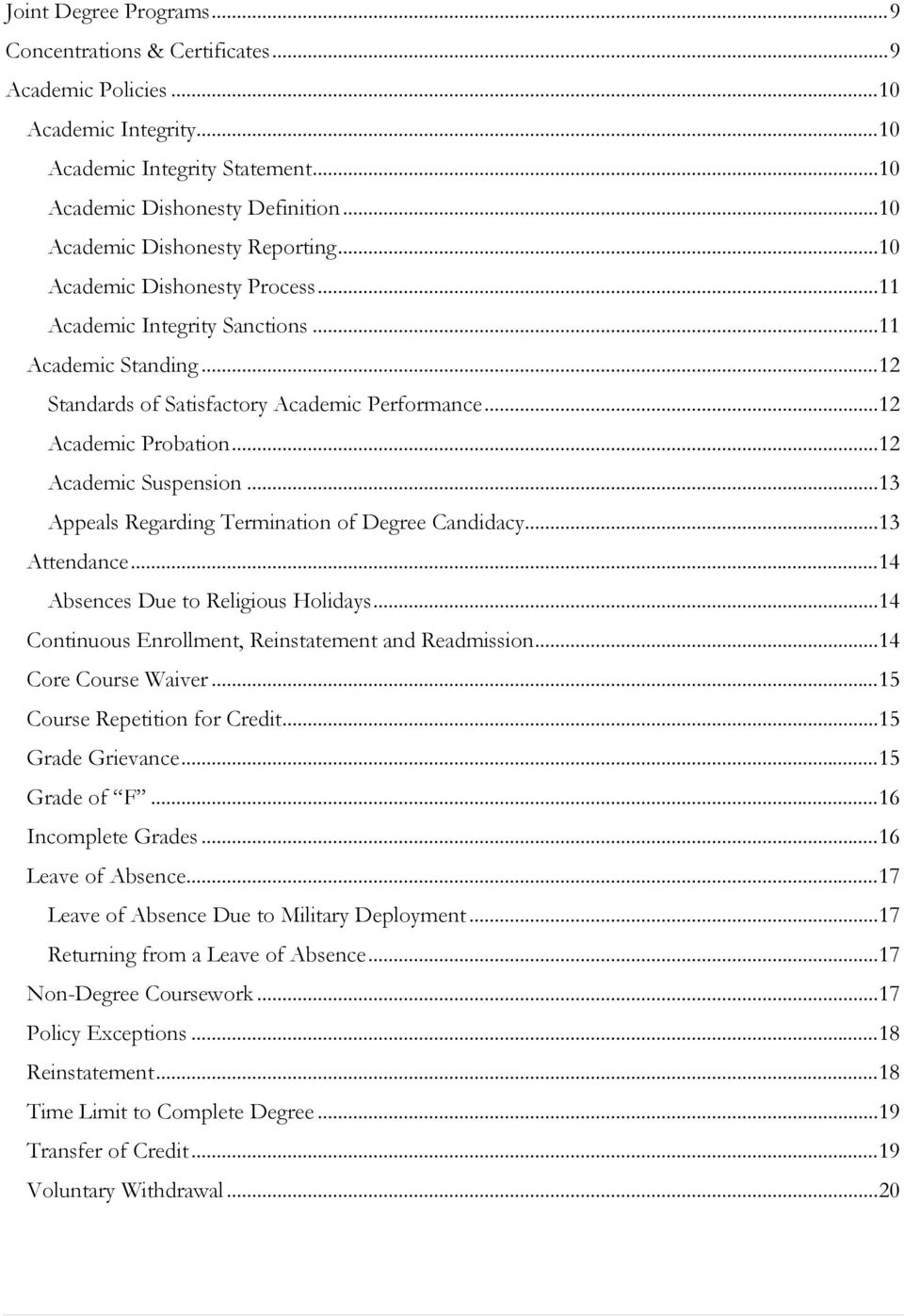
3 Joint Degree Programs... 9 Concentrations & Certificates... 9 Academic Policies Academic Integrity Academic Integrity Statement Academic Dishonesty Definition Academic Dishonesty Reporting Academic Dishonesty Process Academic Integrity Sanctions Academic Standing Standards of Satisfactory Academic Performance Academic Probation Academic Suspension Appeals Regarding Termination of Degree Candidacy Attendance Absences Due to Religious Holidays Continuous Enrollment, Reinstatement and Readmission Core Course Waiver Course Repetition for Credit Grade Grievance Grade of F Incomplete Grades Leave of Absence Leave of Absence Due to Military Deployment Returning from a Leave of Absence Non-Degree Coursework Policy Exceptions Reinstatement Time Limit to Complete Degree Transfer of Credit Voluntary Withdrawal... 20
4 Registration Consortium Independent Study Graduation Policies and Procedures Awarding of the Degree Diplomas Transcripts GWSB Celebration and University Commencement Ceremony GW School of Business Celebration The George Washington University Commencement Beta Gamma Sigma Honor Society Other University Policies University Policy on Equal Opportunity Student Conduct Ethical Principles Right to Dismiss Students Right to Change Rules and Programs University Policy on the Release of Student Information... 27

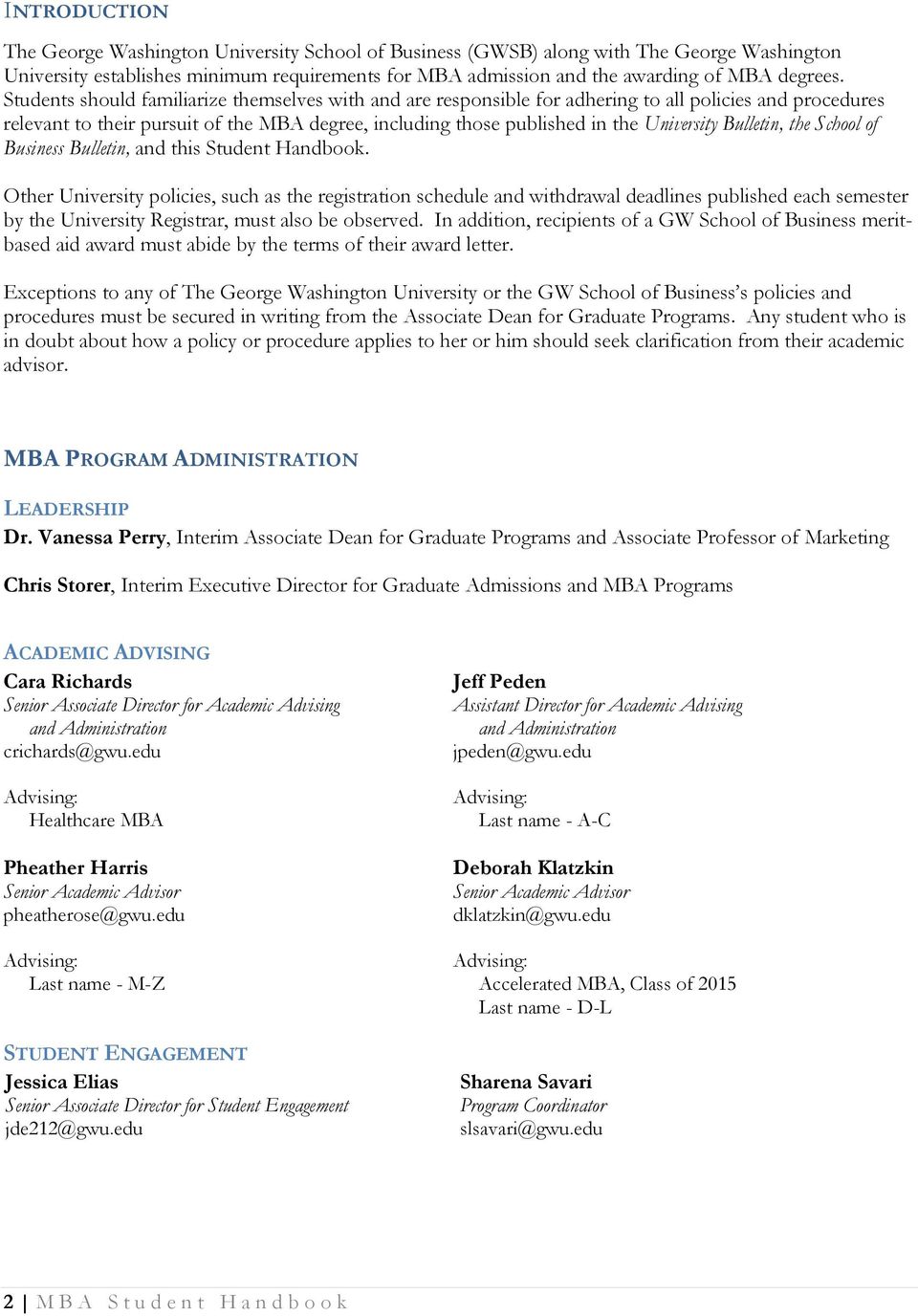
5 INTRODUCTION The George Washington University School of Business (GWSB) along with The George Washington University establishes minimum requirements for MBA admission and the awarding of MBA degrees. Students should familiarize themselves with and are responsible for adhering to all policies and procedures relevant to their pursuit of the MBA degree, including those published in the University Bulletin, the School of Business Bulletin, and this Student Handbook. Other University policies, such as the registration schedule and withdrawal deadlines published each semester by the University Registrar, must also be observed. In addition, recipients of a GW School of Business meritbased aid award must abide by the terms of their award letter. Exceptions to any of The George Washington University or the GW School of Business s policies and procedures must be secured in writing from the Associate Dean for Graduate Programs. Any student who is in doubt about how a policy or procedure applies to her or him should seek clarification from their academic advisor. MBA PROGRAM ADMINISTRATION LEADERSHIP Dr. Vanessa Perry, Interim Associate Dean for Graduate Programs and Associate Professor of Marketing Chris Storer, Interim Executive Director for Graduate Admissions and MBA Programs ACADEMIC ADVISING Cara Richards Senior Associate Director for Academic Advising and Administration [email protected] Advising: Healthcare MBA Pheather Harris Senior Academic Advisor [email protected] Jeff Peden Assistant Director for Academic Advising and Administration [email protected] Advising: Last name - A-C Deborah Klatzkin Senior Academic Advisor [email protected] Advising: Advising: Last name - M-Z Accelerated MBA, Class of 2015 Last name - D-L STUDENT ENGAGEMENT Jessica Elias Senior Associate Director for Student Engagement [email protected] Sharena Savari Program Coordinator [email protected] 2 MBA Student Handbook
6 ACADEMIC ADVISING Our office serves as the academic resource for MBA students in the GW School of Business. Each student is assigned an academic advisor based on the student s program of study. Students are strongly encouraged to meet with their academic advisor for questions concerning, but not limited to: Academic policies Administrative procedures Concentration information Course planning Curriculum requirements DegreeMAP questions International Services Office requests Personal concerns DEGREEMAP DegreeMAP is an online planning tool located through GWeb that allows students to independently track their academic progress. Once inside DegreeMAP, students will find an outline of their MBA degree requirements, including courses completed and those that are outstanding. Students should plan to review their academic progress through DegreeMAP prior to registration for the next semester to ensure that they are enrolling in the correct degree requirements and making adequate academic progress towards the MBA degree. STUDENT RESPONSIBILITIES While your academic advisor and professors have specific and significant roles in your education at GW, you the student have an equally significant role with specific responsibilities. Academic advising is a two-way street and you must be proactive in your relationship with your academic advisor. In the advising relationship, you are responsible for: Knowing your MBA degree requirements. The MBA degree requirements are available online at the MBA Degree Requirements webpage. It is your responsibility to familiarize yourself with this information and discuss questions and options with your academic advisor. Tracking your degree progress. You are expected to utilize the tools available to you in order to plan each semester to make continued academic progress towards graduation and to remain in good standing with the University. These tools include: Academic advisor DegreeMAP GWSB Bulletin MBA Student Handbook Registrar s website University Bulletin 3 MBA Student Handbook

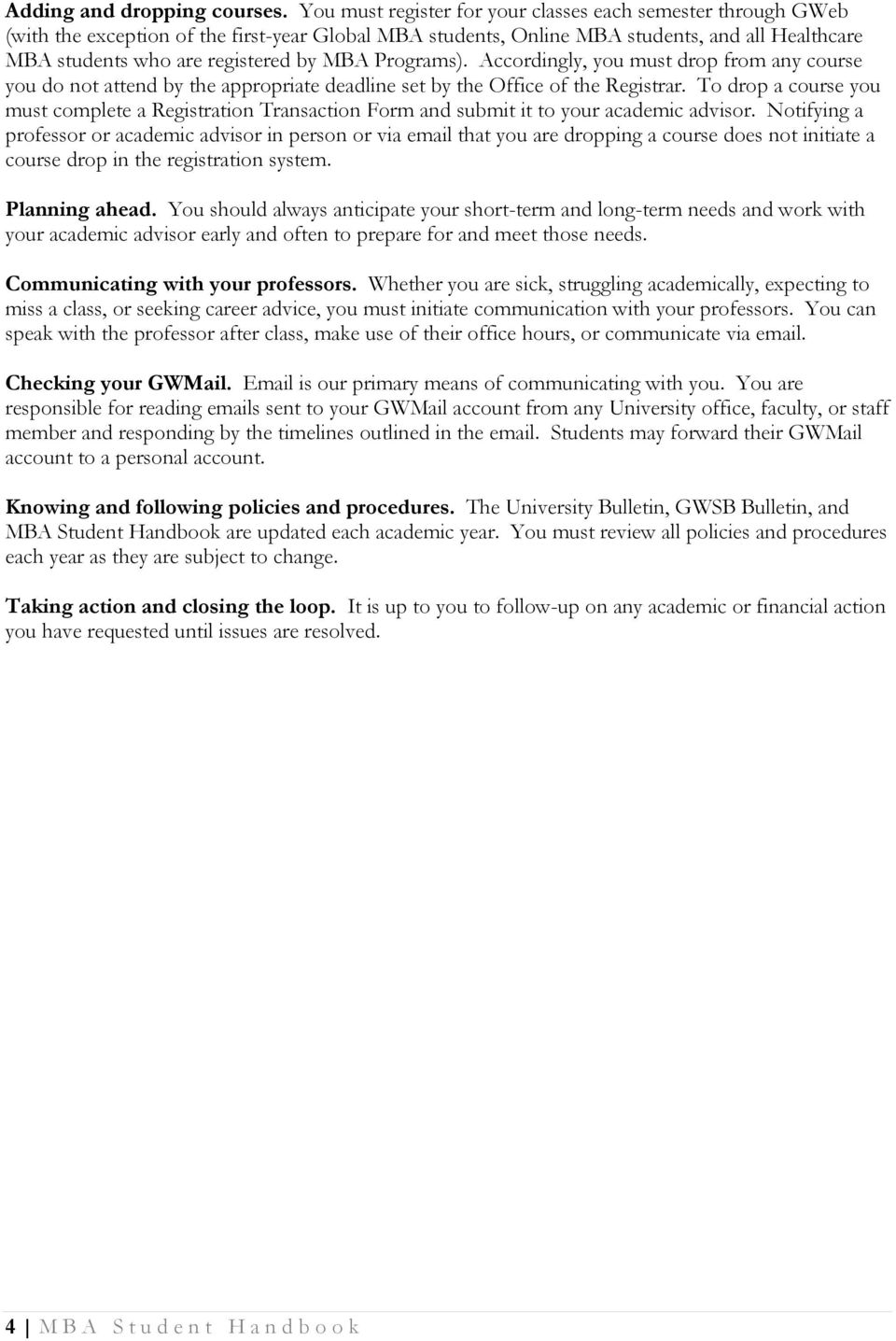
7 Adding and dropping courses. You must register for your classes each semester through GWeb (with the exception of the first-year Global MBA students, Online MBA students, and all Healthcare MBA students who are registered by MBA Programs). Accordingly, you must drop from any course you do not attend by the appropriate deadline set by the Office of the Registrar. To drop a course you must complete a Registration Transaction Form and submit it to your academic advisor. Notifying a professor or academic advisor in person or via that you are dropping a course does not initiate a course drop in the registration system. Planning ahead. You should always anticipate your short-term and long-term needs and work with your academic advisor early and often to prepare for and meet those needs. Communicating with your professors. Whether you are sick, struggling academically, expecting to miss a class, or seeking career advice, you must initiate communication with your professors. You can speak with the professor after class, make use of their office hours, or communicate via . Checking your GWMail. is our primary means of communicating with you. You are responsible for reading s sent to your GWMail account from any University office, faculty, or staff member and responding by the timelines outlined in the . Students may forward their GWMail account to a personal account. Knowing and following policies and procedures. The University Bulletin, GWSB Bulletin, and MBA Student Handbook are updated each academic year. You must review all policies and procedures each year as they are subject to change. Taking action and closing the loop. It is up to you to follow-up on any academic or financial action you have requested until issues are resolved. 4 MBA Student Handbook
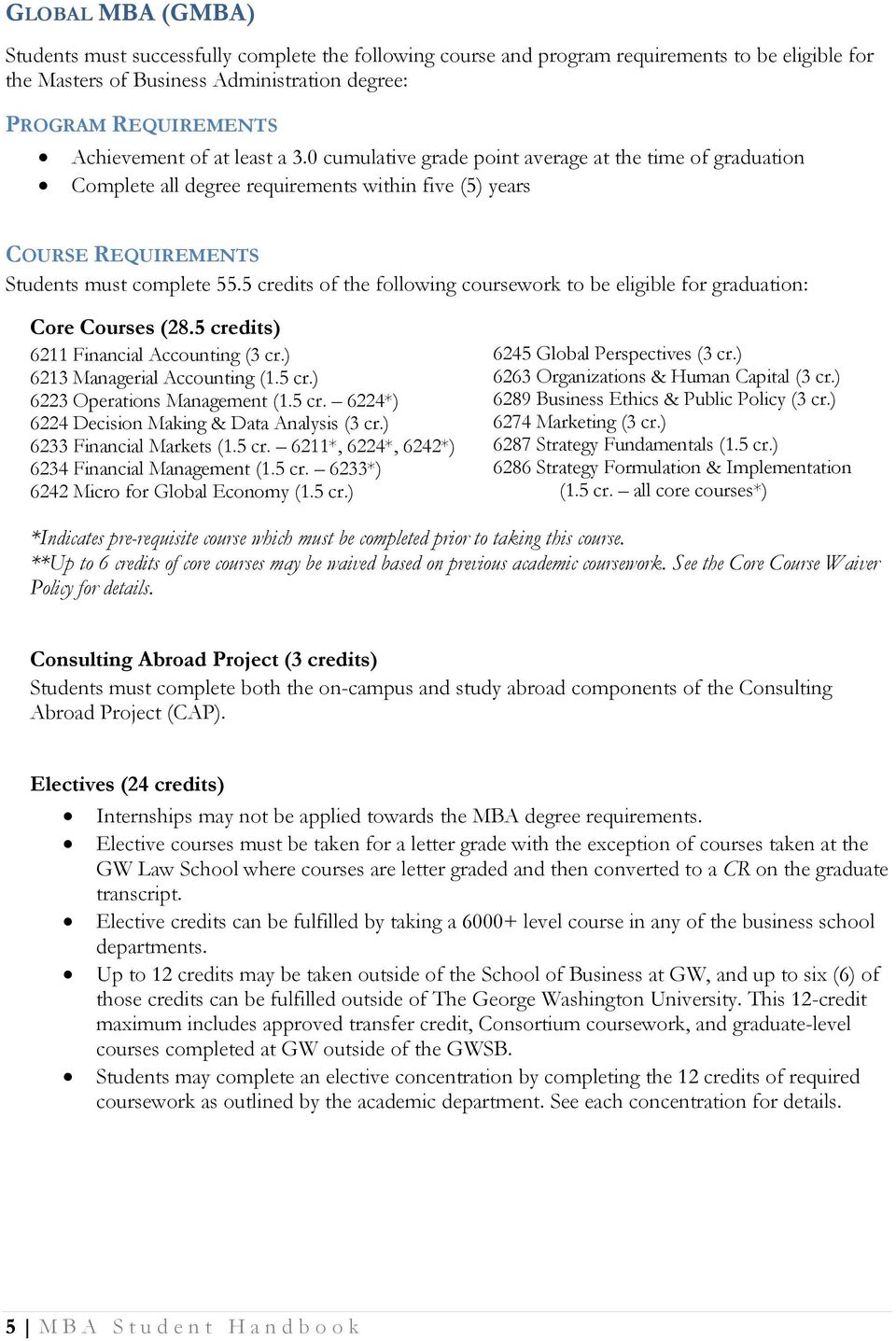
8 GLOBAL MBA (GMBA) Students must successfully complete the following course and program requirements to be eligible for the Masters of Business Administration degree: PROGRAM REQUIREMENTS Achievement of at least a 3.0 cumulative grade point average at the time of graduation Complete all degree requirements within five (5) years COURSE REQUIREMENTS Students must complete 55.5 credits of the following coursework to be eligible for graduation: Core Courses (28.5 credits) 6211 Financial Accounting (3 cr.) 6213 Managerial Accounting (1.5 cr.) 6223 Operations Management (1.5 cr. 6224*) 6224 Decision Making & Data Analysis (3 cr.) 6233 Financial Markets (1.5 cr. 6211*, 6224*, 6242*) 6234 Financial Management (1.5 cr. 6233*) 6242 Micro for Global Economy (1.5 cr.) 6245 Global Perspectives (3 cr.) 6263 Organizations & Human Capital (3 cr.) 6289 Business Ethics & Public Policy (3 cr.) 6274 Marketing (3 cr.) 6287 Strategy Fundamentals (1.5 cr.) 6286 Strategy Formulation & Implementation (1.5 cr. all core courses*) *Indicates pre-requisite course which must be completed prior to taking this course. **Up to 6 credits of core courses may be waived based on previous academic coursework. See the Core Course Waiver Policy for details. Consulting Abroad Project (3 credits) Students must complete both the on-campus and study abroad components of the Consulting Abroad Project (CAP). Electives (24 credits) Internships may not be applied towards the MBA degree requirements. Elective courses must be taken for a letter grade with the exception of courses taken at the GW Law School where courses are letter graded and then converted to a CR on the graduate transcript. Elective credits can be fulfilled by taking a level course in any of the business school departments. Up to 12 credits may be taken outside of the School of Business at GW, and up to six (6) of those credits can be fulfilled outside of The George Washington University. This 12-credit maximum includes approved transfer credit, Consortium coursework, and graduate-level courses completed at GW outside of the GWSB. Students may complete an elective concentration by completing the 12 credits of required coursework as outlined by the academic department. See each concentration for details. 5 MBA Student Handbook
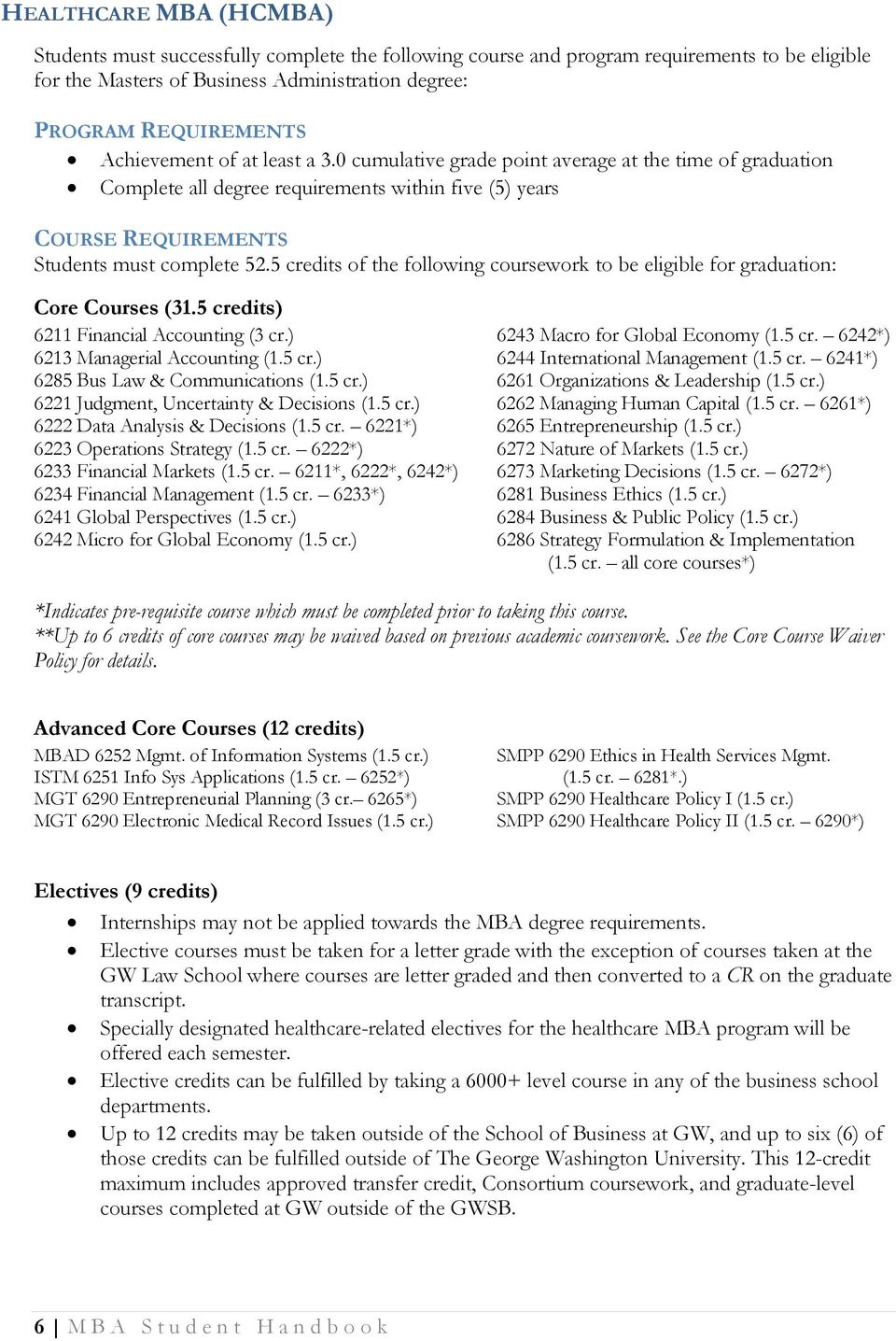
9 HEALTHCARE MBA (HCMBA) Students must successfully complete the following course and program requirements to be eligible for the Masters of Business Administration degree: PROGRAM REQUIREMENTS Achievement of at least a 3.0 cumulative grade point average at the time of graduation Complete all degree requirements within five (5) years COURSE REQUIREMENTS Students must complete 52.5 credits of the following coursework to be eligible for graduation: Core Courses (31.5 credits) 6211 Financial Accounting (3 cr.) 6213 Managerial Accounting (1.5 cr.) 6285 Bus Law & Communications (1.5 cr.) 6221 Judgment, Uncertainty & Decisions (1.5 cr.) 6222 Data Analysis & Decisions (1.5 cr. 6221*) 6223 Operations Strategy (1.5 cr. 6222*) 6233 Financial Markets (1.5 cr. 6211*, 6222*, 6242*) 6234 Financial Management (1.5 cr. 6233*) 6241 Global Perspectives (1.5 cr.) 6242 Micro for Global Economy (1.5 cr.) 6243 Macro for Global Economy (1.5 cr. 6242*) 6244 International Management (1.5 cr. 6241*) 6261 Organizations & Leadership (1.5 cr.) 6262 Managing Human Capital (1.5 cr. 6261*) 6265 Entrepreneurship (1.5 cr.) 6272 Nature of Markets (1.5 cr.) 6273 Marketing Decisions (1.5 cr. 6272*) 6281 Business Ethics (1.5 cr.) 6284 Business & Public Policy (1.5 cr.) 6286 Strategy Formulation & Implementation (1.5 cr. all core courses*) *Indicates pre-requisite course which must be completed prior to taking this course. **Up to 6 credits of core courses may be waived based on previous academic coursework. See the Core Course Waiver Policy for details. Advanced Core Courses (12 credits) MBAD 6252 Mgmt. of Information Systems (1.5 cr.) ISTM 6251 Info Sys Applications (1.5 cr. 6252*) MGT 6290 Entrepreneurial Planning (3 cr. 6265*) MGT 6290 Electronic Medical Record Issues (1.5 cr.) SMPP 6290 Ethics in Health Services Mgmt. (1.5 cr. 6281*.) SMPP 6290 Healthcare Policy I (1.5 cr.) SMPP 6290 Healthcare Policy II (1.5 cr. 6290*) Electives (9 credits) Internships may not be applied towards the MBA degree requirements. Elective courses must be taken for a letter grade with the exception of courses taken at the GW Law School where courses are letter graded and then converted to a CR on the graduate transcript. Specially designated healthcare-related electives for the healthcare MBA program will be offered each semester. Elective credits can be fulfilled by taking a level course in any of the business school departments. Up to 12 credits may be taken outside of the School of Business at GW, and up to six (6) of those credits can be fulfilled outside of The George Washington University. This 12-credit maximum includes approved transfer credit, Consortium coursework, and graduate-level courses completed at GW outside of the GWSB. 6 MBA Student Handbook
10 ONLINE MBA (OMBA) Students must successfully complete the following course and program requirements to be eligible for the Masters of Business Administration degree: PROGRAM REQUIREMENTS Achievement of at least a 3.0 cumulative grade point average at the time of graduation Complete all degree requirements within five (5) years COURSE REQUIREMENTS Students must complete 52.5 credits of the following coursework to be eligible for graduation: Core Courses (31.5 credits) 6211 Financial Accounting (3 cr.) 6213 Managerial Accounting (1.5 cr.) 6285 Bus Law & Communications (1.5 cr.) 6221 Judgment, Uncertainty & Decisions (1.5 cr.) 6222 Data Analysis & Decisions (1.5 cr. 6221*) 6223 Operations Strategy (1.5 cr. 6222*) 6233 Financial Markets (1.5 cr. 6211*, 6222*, 6242*) 6234 Financial Management (1.5 cr. 6233*) 6241 Global Perspectives (1.5 cr.) 6242 Micro for Global Economy (1.5 cr.) 6243 Macro for Global Economy (1.5 cr. 6242*) 6244 International Management (1.5 cr. 6241*) 6261 Organizations & Leadership (1.5 cr.) 6262 Managing Human Capital (1.5 cr. 6261*) 6265 Entrepreneurship (1.5 cr.) 6272 Nature of Markets (1.5 cr.) 6273 Marketing Decisions (1.5 cr. 6272*) 6281 Business Ethics (1.5 cr.) 6284 Business & Public Policy (1.5 cr.) 6286 Strategy Formulation & Implementation (1.5 cr. all core courses*) *Indicates pre-requisite course which must be completed prior to taking this course. **Up to 6 credits of core courses may be waived based on previous academic coursework. See the Core Course Waiver Policy for details. Information Technology Selective (1.5 credits) Choose from one of the following: MBAD 6252 Management of Information Systems MBAD 6253 Management of Tech and Innovation MBAD 6254 Database & Data Warehousing MBAD 6290 Systems Analysis and Design Business & Society Residency (1.5 credits) Students must complete the four-day on-campus Business & Society Residency prior to graduation. The residency will be held three times a year in January, March, and May. Electives (18 credits) At least 3 of the 18 elective credits must be in a globally focused course. A list of approved courses is posted on the Elective Options website each semester. All International Business (IBUS) courses and any of our study abroad programs fulfill this requirement. Internships may not be applied towards the MBA degree requirements. Elective courses must be taken for a letter grade with the exception of courses taken at the GW Law School where courses are letter graded and then converted to a CR on the graduate transcript. Elective credits can be fulfilled by taking a level course in any of the business school departments. Up to 12 credits may be taken outside of the School of Business at GW, and up to six (6) of those credits can be fulfilled outside of The George Washington University. This 12-credit maximum includes approved transfer credit, Consortium coursework, and graduate-level courses completed at GW outside of the GWSB. 7 MBA Student Handbook

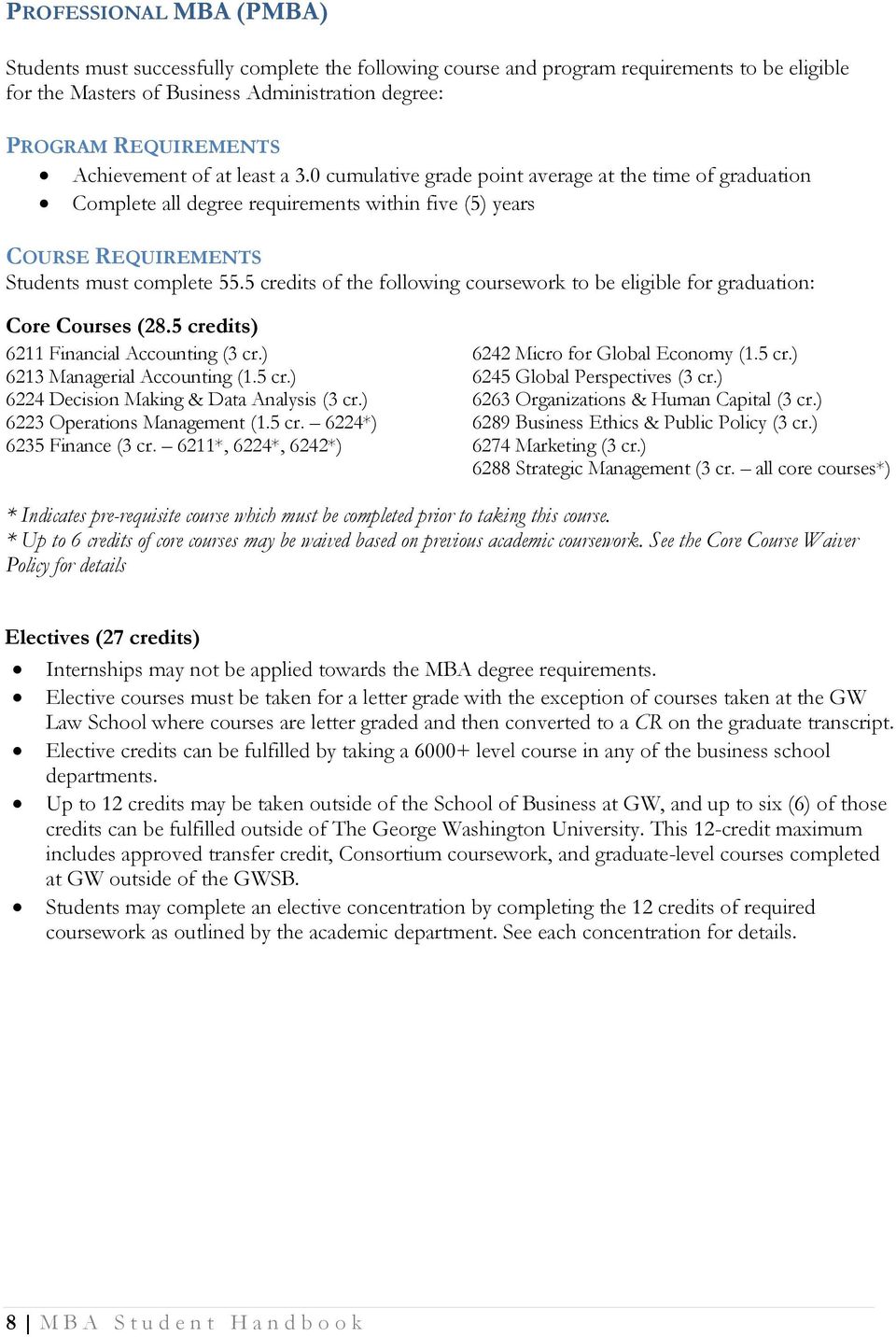
11 PROFESSIONAL MBA (PMBA) Students must successfully complete the following course and program requirements to be eligible for the Masters of Business Administration degree: PROGRAM REQUIREMENTS Achievement of at least a 3.0 cumulative grade point average at the time of graduation Complete all degree requirements within five (5) years COURSE REQUIREMENTS Students must complete 55.5 credits of the following coursework to be eligible for graduation: Core Courses (28.5 credits) 6211 Financial Accounting (3 cr.) 6213 Managerial Accounting (1.5 cr.) 6224 Decision Making & Data Analysis (3 cr.) 6223 Operations Management (1.5 cr. 6224*) 6235 Finance (3 cr. 6211*, 6224*, 6242*) 6242 Micro for Global Economy (1.5 cr.) 6245 Global Perspectives (3 cr.) 6263 Organizations & Human Capital (3 cr.) 6289 Business Ethics & Public Policy (3 cr.) 6274 Marketing (3 cr.) 6288 Strategic Management (3 cr. all core courses*) * Indicates pre-requisite course which must be completed prior to taking this course. * Up to 6 credits of core courses may be waived based on previous academic coursework. See the Core Course Waiver Policy for details Electives (27 credits) Internships may not be applied towards the MBA degree requirements. Elective courses must be taken for a letter grade with the exception of courses taken at the GW Law School where courses are letter graded and then converted to a CR on the graduate transcript. Elective credits can be fulfilled by taking a level course in any of the business school departments. Up to 12 credits may be taken outside of the School of Business at GW, and up to six (6) of those credits can be fulfilled outside of The George Washington University. This 12-credit maximum includes approved transfer credit, Consortium coursework, and graduate-level courses completed at GW outside of the GWSB. Students may complete an elective concentration by completing the 12 credits of required coursework as outlined by the academic department. See each concentration for details. 8 MBA Student Handbook
12 JOINT DEGREE PROGRAMS The GWSB co-sponsors a total of six joint degree programs. Students enrolled in joint degree programs pursue studies leading to the awarding of two degrees from George Washington University. Students should consult both their GWSB academic advisor and the advisor in the corresponding school for specific information about requirements for their specific joint degree program. Joint degree programs within the School of Business: MBA/MS in Finance MBA/MS in Government Contracts MBA/MS in Project Management MBA/MS in Information Systems Technology Joint degree programs outside of the School of Business: MBA/Juris Doctor - Law School MBA/Master of Arts - Elliott School for International Affairs CONCENTRATIONS & CERTIFICATES Global MBA and Professional MBA students may complete a certificate or an elective concentration by completing coursework as outlined by the academic department. Please see the student website for a list of current certificate and concentration offerings and their respective requirements. Regarding concentrations, please note the following: All concentrations require the successful completion of 12 unique credits. Each includes both required coursework (3-6 credits) that must be taken and a list of optional courses to complete the remaining credits (6-9 credits). Courses cannot be shared between concentrations. If a course has been taken to fulfill one concentration then it cannot be used toward the requirements of another. A course may not be double-counted between a concentration and a core requirement. If all of the requirements have been met then the concentration will appear on the transcript. It will not appear on the diploma. Note, only the primary concentration will be noted (i.e. Finance, not Corporate Finance). Once a concentration is declared, students must meet all concentration requirements in order to be eligible for graduation. Should a student have adequate credits for graduation but not meet the concentration requirements, s/he will not be cleared for graduation until either the requirements are met or concentration deleted via the Concentration Declaration Form. Students who wish to satisfy a MBA concentration elective requirement with a GW course that has not been pre-approved must submit a Petition for Elective Credit form. 9 MBA Student Handbook

13 ACADEMIC POLICIES ACADEMIC INTEGRITY Academic Integrity Statement We, the Students, Faculty, Librarians and Administration of the George Washington University, believing academic honesty to be central to the mission of the University, commit ourselves to its high standards and to the promotion of academic integrity. Commitment to academic honesty upholds the mutual respect and moral integrity that our community values and nurtures. To this end, we have established the George Washington University Code of Academic Integrity. Academic Dishonesty Definition Academic dishonesty is defined as cheating of any kind, including misrepresenting one's own work, taking credit for the work of others without crediting them and without appropriate authorization, and the fabrication of information. Common examples of academically dishonest behavior include, but are not limited to, the following: Cheating - intentionally using or attempting to use unauthorized materials, information, or study aids in any academic exercise; copying from another student's examination; submitting work for an in-class examination that has been prepared in advance; representing material prepared by another as one's own work; submitting the same work in more than one course without prior permission of both instructors; violating rules governing administration of examinations; violating any rules relating to academic conduct of a course or program. Fabrication - intentional and unauthorized falsification or invention of any data, information, or citation in an academic exercise. Plagiarism - intentionally representing the words, ideas, or sequence of ideas of another as one's own in any academic exercise; failure to attribute any of the following: quotations, paraphrases, or borrowed information. Falsification and forgery of University academic documents - knowingly making a false statement, concealing material information, or forging a University official's signature on any University academic document or record. Such academic documents or records may include transcripts, adddrop forms, requests for advanced standing, requests to register for graduate-level courses, etc. (Falsification or forgery of non-academic University documents, such as financial aid forms, shall be considered a violation of the non-academic student disciplinary code.) Facilitating academic dishonesty - intentionally or knowingly helping or attempting to help another to commit an act of academic dishonesty. Academic Dishonesty Reporting It is the moral responsibility each member of the George Washington University community to respond to suspected acts of academic dishonesty by: Consulting the individual(s) thought to be involved and encouraging them to report it themselves, and/or Reporting it to the instructor involved, and/or Reporting it to the Academic Integrity Council. Any charges should be made as expeditiously as is reasonably possible (normally within twelve working days except in the summer or during academic breaks and holidays) from the discovery of the infraction. 10 MBA Student Handbook
14 Charges may be initiated as follows: (1) Student Initiated Charge - A student may initiate a charge of academic dishonesty against another student, by referring the case to the faculty member involved and/or to the Academic Integrity Council. If the case is brought directly to the Academic Integrity Council, for action by a Hearing Panel, then the Office of Academic Operations or a designee shall promptly notify the instructor of the involved course. (2) Faculty Initiated Charge - When a faculty member initiates a charge or is made aware of a violation which the faculty member determines to be substantive, the faculty member shall contact the Academic Integrity Office in order to discover whether the student has ever been found guilty of a charge of academic dishonesty. a. In first offense cases, the instructor shall either act directly, in consultation with the Department Chair, or refer the case to the Academic Integrity Council for action by a Hearing Panel. An instructor who acts directly must present the student with specific charges and a proposed sanction. Sanctions will be determined in accordance with this Code. b. If the faculty member acts directly then the accused student shall have the right to appeal directly to the Academic Integrity Council, for action by a Hearing Panel, should he or she disagree with the validity of the charge or the appropriateness of the sanction. c. Second offenses shall go directly to the Academic Integrity Council, for action by a Hearing Panel. d. If a faculty member is made aware of a violation which the faculty member determines not to be substantive, the faculty member shall notify the complaining student promptly. (3) Administration Initiated Charge All charges initiated by members of the administration or librarians shall go directly to the Academic Integrity Council, for action by a Hearing Panel. Academic Dishonesty Process All actions, on any level, shall be recorded with the Office of Academic Operations. This includes cases handled directly by instructors. Deliberation of the hearing shall occur in two stages: the establishment of guilt and the recommendation of sanction. To find a respondent guilty, three-quarter of the voting panel members must agree. If the panel finds a respondent guilty, they shall also make a recommendation of sanction. A sanction other than expulsion can be recommended by threequarters of the voting panel members. A sanction of expulsion can only be recommended by a unanimous vote of the voting panel members. Reports of the Hearing Panel shall include a finding of fact and a determination of the guilt or innocence of the respondent. If the respondent is found guilty, then the report will also include a recommendation of sanction in accordance with this Code (see full policy for further explanation). These proceedings should be concluded as expeditiously as possible. The Hearing Panels should strive to have proceedings concluded within seven weeks of the report of the violation. However, failure to do so shall not constitute improper procedure under the Code. Academic Integrity Sanctions The following academic sanctions could be issued: The recommended minimum sanction in first offense cases shall be failure of the assignment in question. The recommended minimum sanction in repeat violation cases shall be failure of the course. For more serious offenses sanction may be suspension from the University for a specified, minimum time or expulsion from the University. Other sanctions may be appropriate for particular cases. Sanctions of suspension or expulsion, as a result of academic dishonesty, may only be determined by a Hearing Panel. 11 MBA Student Handbook
15 Attempts to commit acts prohibited by this Code may be punished to the same extent as completed violations. Respondents found in violation of this Code may also be removed from certain University programs, in accordance with the regulations and bylaws of that program. All sanctions except failure of the assignment in question shall be marked on the respondent's permanent record (i.e., transcript) with the phrase "Academic Dishonesty". In the case of failure of the course, the notation shall remain on the transcript of the respondent for a minimum of two years. In the case of suspension or expulsion, the notation shall remain on the transcript of the respondent for a minimum of three years. After the minimum time has elapsed, the respondent may petition the Provost and Executive Vice President for Academic Affairs for the removal of the sanction notation from the transcript. This provision shall not, however, prohibit any program, department, college or school of the University from retaining records of violations and reporting violations as required by their professional standards; the University may retain, for appropriate administrative purposes, records of all proceedings regarding violations of the Code of Academic Integrity. The text above was taken from the official University s Code of Academic Integrity which can be found at ACADEMIC STANDING A minimum grade point average (GPA) of no less than 3.0 must be maintained to remain in good academic standing and is required for award of a MBA degree. All graduate courses taken for graduate credit after matriculation as a degree candidate (except those audited, taken for the grade of CR, or transferred from an outside institution) will be used in the calculation of the GPA. Students cannot take additional coursework beyond the credits required for the MBA degree to raise their GPA to the 3.0 GPA minimum requirement to graduate. Standards of Satisfactory Academic Performance All GWSB students must maintain satisfactory academic progress to be eligible to continue enrollment in their MBA program and to receive federal financial aid. To maintain eligibility students must: Maintain a cumulative GPA of 3.0; and Complete all degree requirements within five calendar years of matriculation. The initial responsibility for recognizing academic difficulty and for taking steps to resolve it rests with the student. Those encountering academic difficulty in courses or other degree requirements are expected to consult with the appropriate faculty member immediately and, if necessary, to seek additional assistance. Academic Probation A student whose GPA falls below 3.0 at any point after completing nine (9) credit hours of academic coursework will be placed on academic probation. This probation extends through the period in which the student next attempts 12 credit hours of coursework, including prescribed courses. Students placed on academic probation are restricted in the number of credit hours they may take during their probation period. The following limitations apply to students placed on academic probation: Global MBA (first year only) 13.5 credit hours their first semester of academic probation Global MBA (second year and after) - 12 credit hours per semester until the end of the probationary period Professional Cohorted MBA (first year only) - core cohorted courses only until the end of the first year or probationary period, whichever comes first 12 MBA Student Handbook

16 Professional Cohorted MBA (second year and after) - six credit hours per semester until the end of the probationary period All other programs six credit hours per semester until the end of the probationary period During this period, the student s performance will be monitored to determine suitability for continued study. A student who fails to raise the cumulative GPA to 3.0 or better during the period of probation will be suspended. Please note: Incomplete grades are not allowed during the probation period and are grounds for automatic suspension. A student who is subject to probation for a second time at any point during the program is automatically suspended. Academic probation will be permanently noted on the student s transcript. Academic Suspension A student who does not meet the conditions of probation will be suspended. A student who is suspended may request reinstatement to the MBA program after the lapse of one semester. To be reinstated the student must submit a Petition for Reinstatement to their academic advisor no later than 30 days prior to the start of the academic semester. To be eligible for reinstatement the student must submit documentation that indicates academic success if reinstated. Students who request reinstatement, but are unable to attain the minimum cumulative GPA of 3.0 over the next 12 credit hours will be denied reinstatement. If a student is approved for reinstatement, the student will continue on academic probation and must achieve a minimum GPA average of 3.5 over the next 12 credit hours of coursework and attain a cumulative GPA of 3.0. Reinstated students are restricted in the number of credit hours they may take upon their return. The following limitations apply to students reinstated after academic suspension: Global MBA - 12 credit hours per semester until the end of the probationary period All other programs six credit hours per semester until the end of the probationary period To be eligible for reinstatement the student must submit documentation that indicates academic success if reinstated. A student reinstated will continue on academic probation and must achieve a minimum GPA average of 3.5 over the next 12 credit hours of coursework and attain a cumulative GPA of 3.0. Should the student fail to achieve the minimum GPA of 3.5 over the 12 credit hours or attain the cumulative GPA of 3.0, the student will be terminated from the MBA program and subsequent readmission will be denied (suspension without the option of readmission). Please note: Any outstanding Incomplete (I) courses at the time of suspension will automatically earn a grade of F. Academic suspension will be permanently noted on the student s transcript. Appeals Regarding Termination of Degree Candidacy A student s candidacy for a MBA degree may be terminated (suspension without the option of readmission) by the Associate Dean of Graduate Programs for reasons that include, but are not limited to, failure to make satisfactory academic progress toward the completion of the MBA degree requirements or findings of academic misconduct. 13 MBA Student Handbook
17 A student whose degree candidacy has been terminated for any reason will be notified in writing by the Associate Dean of Graduate Programs for the GW School of Business. The student shall have the right of appeal. The student must present the grounds of appeal to the Associate Dean for MBA Programs for the GW School of Business in writing within 30 days of the date of the Dean s letter terminating the degree candidacy. ATTENDANCE Please note the following regarding attendance in classes: Students may attend only those classes for which they are officially registered. Regular attendance is expected. A student suspended for any cause may not attend classes during the period of suspension. Students are held responsible for all required coursework for the courses in which they are registered, and all absences must be excused by the instructor before provision is made to make up the work missed. Absences Due to Religious Holidays The GW Faculty Senate has set guidelines pertaining to the observation of religious holidays. These have become University policy and are as follows: Students must notify faculty during the first week of the semester of their intention to be absent from class on their day(s) of religious observance; Faculty extend to these students the courtesy of absence without penalty on such occasions, including permission to make up examinations; and Faculty who intend to observe a religious holiday arrange at the beginning of the semester to reschedule missed classes. CONTINUOUS ENROLLMENT, REINSTATEMENT AND READMISSION Once entered in a degree program, a student is expected to be continuously enrolled and actively engaged in fulfilling the requirements for the degree each semester of the academic year until such time as the degree is conferred. A student is considered to be continuously enrolled when registered for courses through GW or when registered for an approved leave of absence. Students who fail to register, fail to return from a leave of absence as scheduled, fail to return from a suspension as scheduled, voluntarily withdraw, or are otherwise absent without authorization from the University for one or more semesters must make a formal application for reinstatement. Students will only be approved for reinstatement if they are able to meet the University s policy of continuous enrollment by retroactively registering for up to two leaves of absence. If reinstatement is denied, the student must apply for readmission. If readmitted, the student is subject to the rules and regulations in force at the time of return. Students who fail to register for three or more semesters are required to reapply to the MBA program. Students who are readmitted can only apply coursework completed within five years from the semester of re-matriculation into the MBA program towards the MBA degree requirements. Core courses completed prior to the five year date must be retaken. Elective courses completed prior to the five year date will not be applied towards the MBA degree requirements. This policy is not eligible for appeal. 14 MBA Student Handbook

18 CORE COURSE WAIVER Students may apply for up to six (6) credit hours of course waivers for designated core courses by meeting one of the following criteria: 1. Provide evidence of successfully completing equivalent graduate-level coursework A copy of the course syllabus and an official transcript showing the grade earned are required. 2. Provide evidence of applicable license or degree A copy of the official license or an official transcript showing the conferral of the degree is required. Students must complete the MBA Course Waiver Request form, attach the required documentation, and submit the form and documentation to their academic advisor. If approved, the student does not need to complete the waived course at GWSB. However, the total number of credits required to complete the program will not be reduced and the student must replace the waived course with elective credits to fulfill graduation requirements. Equivalent coursework must meet the following criteria: Completed at an AACSB accredited institution Graduate-level and credit-bearing Completed within five years from the date of matriculation Earned a grade of B or better Please note: A listing of core courses outlining eligibility to waive the course and the requirements is located on the Current MBA Student website. Undergraduate coursework and/or degrees are not eligible for core course waiver consideration. COURSE REPETITION FOR CREDIT Except for courses that specifically state that repetition for credit is permitted, such as experimental courses numbered 6290, a candidate for a degree at this University may not repeat a course in which a grade of C for graduate students or better was received, unless required to do so by the MBA Program. GRADE GRIEVANCE In the event that a student feels that a grade is the result of arbitrary and capricious academic evaluation, a student may pursue resolution through the Grade Grievance Process. Students must follow the grade grievance procedures and meet all of the posted deadlines. A copy of the full policy can be found at and a brief overview is below: Student should seek an acceptable resolution through a discussion with the instructor of the course. This discussion must be initiated within one month of the posting of the course grade. If a satisfactory resolution is not reached, student should seek an acceptable resolution through a discussion with the Department Chair in which the course is held. If a satisfactory resolution is not reached, the student should file and submit an official Notification of Grade Grievance Form to the Associate Dean for Graduate Programs within four months after the student s final course grade has been posted. The notification must include all relevant documentation. 15 MBA Student Handbook

19 The Associate Dean, the matter will be forwarded to the Chair of the GWSB Dean s Council who will appoint a Grade Grievance Hearing Committee within three (3) weeks of receiving the Notification of Grade Grievance Form. The Grade Grievance Hearing Committee will make a final determination regarding the allegation of arbitrary and capricious grading. The Committee is the final appellate body for grade grievances in GWSB. If the student believes that in some identifiable manner the procedures detailed above have not been followed by this Committee, the student may request in writing (detailing procedural violations) that the GWSB Dean s Council review the procedural aspects of the case. Note: Students are responsible for providing adequate written documentation as outlined in the full policy. Only grade disagreements of two levels or more may be submitted to the Dean s Council. For example, a request to have a grade changed from a B+ to an A- (one level) is not material and will not be reviewed while a request to change a B+ to an A (two levels) is material and will be reviewed by the committee. GRADE OF F When a student receives a grade of F in a core, required, or elective course completed at George Washington University or through Consortium, it becomes a part of the student s permanent record and is calculated into the student s grade point average (GPA). The grade of F remains on the student s transcript and will not be replaced and/or removed once the course is retaken. Students given the grade of F in a core or other required course must repeat the course in the next semester in which the course is offered and achieve at least the grade of B. If the grade earned in the second attempt is below a B, the student will be terminated from the MBA program (suspended without the option for readmission). INCOMPLETE GRADES Students are expected to complete all coursework by the end of the module or semester in which a course is taken. In special circumstances, an instructor may grant a student permission to delay submission of work up to one calendar year after the course ends by recording an Incomplete (I). Granting a grade of I is fully at the discretion of the faculty member teaching the course. To be considered for a grade of I, the student must provide a satisfactory explanation to their instructor for their inability to complete the required coursework for reasons beyond their control and an outline as to how they will complete the remaining coursework in a timely manner. The student may request a grade of I only if their prior performance and class attendance in the course have been satisfactory. If the student fails to request an Incomplete by the date when grades must be turned in, the student s work will be graded based on work completed up to this date. Coursework must be completed by the date agreed on by the instructor and the student, but no later than one calendar year from the end of the course. When work for the course is completed, the instructor will submit a grade change and the new grade will replace the grade of I on the transcript. The grade of I cannot be changed by reregistering for the course at GW or by taking its equivalent elsewhere. If the coursework is not completed by the deadline, or within one calendar year, whichever comes first, the grade converts to the grade of F and will be reflected as IF on the student s transcript and subject to the Grade of F policy. In cases of well-documented extenuating circumstances, an instructor and a student may jointly petition the Associate Dean for Graduate Programs for additional time in which to complete the remaining coursework. 16 MBA Student Handbook
20 This policy will apply whether or not the student has continued to enroll in the Graduate School. The sole exception is that students who receive an Incomplete in their final semester of enrollment, but who are able to graduate without those credits, will retain an Incomplete indefinitely. Upon graduation the transcript will be closed and no further grade changes will be made LEAVE OF ABSENCE Students who find it necessary to interrupt their studies may request a personal leave of absence by completing the Leave of Absence Request Form. If a personal leave of absence is requested after the start of the semester, students will be subject to the refund schedule set by the Office of the Registrar. Students should be aware of the following when requesting a personal leave of absence: No more than two semesters of leave are allowed during a student s tenure in the MBA program. Students who do not return after taking personal leave must apply for reinstatement. If reinstatement is denied, students must reapply to the program and, if approved, will be subject to the requirements and regulations at the time of readmission. The five-year limit to complete the MBA program is extended by the number of semesters of official personal leave taken. A personal leave of absence will not confer registration or residency status needed to qualify for financial aid or visa requirements. The right to use of University facilities is suspended while the leave is in effect. Leave of Absence Due to Military Deployment Students who are serving in the military, military reserves, or the National Guard and who receive orders to deploy may request a military leave of absence by completing the Leave of Absence for Active Duty Military Request Form. Military leave allows active duty military who have received orders to deploy to interrupt their studies for the length of time that they are deployed. Military leave does not count towards the two semester limit of personal leave outlined above. Students who receive orders to deploy prior to or early in a semester are automatically entitled to a full refund of all tuition and fees that he or she has paid toward the expenses of that academic term. If called to active duty after the mid-term examinations or after other substantial graded work has been completed, the student will have the option of either taking a full refund of tuition of fees or taking an Incomplete in his or her courses. Students who opt to take an Incomplete must follow the policies and procedures in place for students requesting a grade of Incomplete. Returning from a Leave of Absence Students returning on schedule from an approved personal or military leave of absence will be eligible for early registration for the semester in which they are scheduled to return. If a student needs to request a second leave of absence, or have received orders that their deployment is being extended, the student must submit a new Leave of Absence Request Form or Leave of Absence for Active Duty Military Request Form. Students returning from leave must be registered no later than the add/drop deadline set by the Office of the Register for the semester in which they are scheduled to return. NON-DEGREE COURSEWORK Students may apply up to 6 credit hours of GW non-degree coursework taken prior to official admission to the MBA program toward their MBA degree requirements. Students who have completed coursework as a non-degree student must submit a Non-Degree Course Request form to their academic advisor for review. 17 MBA Student Handbook
21 Non-degree coursework must be: Business related Graduate-level and credit-bearing Not applied to a previous degree Taken within five years at the point of matriculation Completed with a B or better Please note: Assignment of non-degree credit is subject to evaluation by the School of Business MBA Programs Office. The number of credit hours transferred will be equal to the number of credits actually taken. POLICY EXCEPTIONS A student seeking an exception to a University or School of Business policy due to extenuating circumstances must submit a Policy Exception Request. A policy exception request must be accompanied by documentation of extenuating circumstances. Students should not assume that policy exception requests will be approved. Until a student receives written confirmation that an exception has been approved, the student should operate under the assumption that it will be denied (i.e., the student should continue to attend class, submit assignments, consider alternatives, etc.). Requests involving medical issues: Requests involving physical health must be accompanied by documentation from a medical professional. Such documentation will be considered, but it does not solely determine the outcome of the request. Requests involving mental health must have the support of the University Counseling Center (UCC). Support of the UCC will be considered, but it does not solely determine the outcome of the request. The following requests will not be considered: Requests for exceptions to University and School policy on the basis of not knowing the policy. Students can access important policy information through the GW Bulletin, the School of Business web site, the MBA Student Handbook, or by contacting their academic advisors. Requests to withdraw from a course after the MBA Program deadlines on the basis of poor academic performance. REINSTATEMENT A student seeking reinstatement to the MBA program due to academic suspension or failure to be continuously enrolled must submit a Request for Reinstatement. The reinstatement request must be accompanied by documentation that indicates academic success if reinstated. Documentation that will be considered includes, but not limited to: a letter outlining any extenuating circumstances and a plan of study; military deployment orders; medical documentation; and official transcripts of coursework completed at another institution while away from GW. Documentation will be considered, but it does not solely determine the outcome of the request. Reinstatement requests must be submitted no later than 30 days prior to the semester in which you would like to return. Students who have failed to be continuously enrolled may only apply for reinstatement if they have been away from the University for no more than one calendar year. In addition, students who have failed to be continuously enrolled must register for a leave of absence each semester they have been 18 MBA Student Handbook
22 away from the University. Students who do not have enough leave (students have a maximum of two semesters of leave available to them) to cover their absences will be denied reinstatement. Instead, students in this situation will be required to apply for readmission and will be subject to the rules and regulations in force at the time of return. Requests involving medical issues: Requests involving physical health must be accompanied by documentation from a medical professional. Such documentation will be considered, but it does not solely determine the outcome of the request. Requests involving mental health must have the support of the University Counseling Center (UCC). Support of the UCC will be considered, but it does not solely determine the outcome of the request. TIME LIMIT TO COMPLETE DEGREE Students admitted to a MBA program are allowed no more than five years from the point of matriculation to complete all degree requirements and graduate. If it becomes apparent that a student will not complete all MBA degree requirements and graduate within the time allowed, the student may petition MBA Programs for an extension of time to complete the MBA degree. To request an extension of time, students must complete an Exception to Policy Form and submit the form to their academic advisor for review. If approved, the student must maintain registration during the authorized period of extension. Please be aware, personal leaves of absence are not allowed during the approved extension period. TRANSFER OF CREDIT Students may apply for up to a total of six (6) credit hours of coursework taken outside of The George Washington University to be applied toward elective requirements. If approved, the credits will apply toward the MBA degree requirements and the total number of credits needed to complete the MBA degree will be reduced commensurate with the number of transfer credits approved. To request the transfer of credit, students must complete the MBA Transfer Credit Approval Form and submit it to their academic advisor. The form along with the course syllabus and an official transcript showing the grade earned are required for review. The requested course must meet the following criteria: Be business related Graduate-level and credit-bearing Not applied to a previous degree Completed within five years from the date of matriculation Earned a grade of B or better Please note: Grades earned at another institution will not be factored into the GW GPA. Assignment of transfer credit is subject to evaluation by the School of Business MBA Programs Office. If the grade earned is below the minimum required for transferring credit, B or its equivalent, or the course is repetitious, no credit will be assigned. The number of credit hours transferred will be equal to the number of credits actually taken. 19 MBA Student Handbook
23 Up to 12 credits may be taken outside of the School of Business at GW, and up to six (6) of those credits can be fulfilled outside of The George Washington University. This 12-credit maximum includes approved transfer credit, Consortium coursework, and graduate level courses completed at GW outside of the GWSB. VOLUNTARY WITHDRAWAL A student who wishes to withdraw from the MBA program must make the request in writing to their academic advisor. In addition, if the student is enrolled in courses during the semester in which they are requesting withdrawal, the student must complete a Registration Transaction Form. All charges for courses from which the student withdraws are subject to the refund policy found at the Office of the Registrar s website. Failure to submit the request to withdrawal in writing to their academic advisor along with the required Registration Transaction Form can result in an extended financial obligation and the permanent recording of grades of F (Failure) on the student s transcript. Fall/Spring Module Courses: Students can request to drop a module course with no academic penalty through the end of the fourth week of module classes. The dropped course will not appear on the student s transcript. Students wishing to withdraw from the MBA program after the end of the fourth week but before the end of the sixth week of module classes will have a notation of W (Authorized Withdrawal) assigned to any module course in which they are enrolled. Students wishing to withdraw from the MBA program after the end of the sixth week of module classes will receive a letter grade for any module course in which they are enrolled. Fall/Spring Full Semester Courses: Students can request to drop a semester course with no academic penalty through the end of the fourth week of semester classes. The dropped course will not appear on the student s transcript. Students wishing to withdraw from the MBA program after the end of the fourth week but before the end of the thirteenth week of semester classes will have a notation of W (Authorized Withdrawal) assigned to any semester course in which they are enrolled. Students wishing to withdraw from the MBA program after the end of the thirteenth week of semester classes will receive a letter grade for any semester course in which they are enrolled. Summer Session/Module Courses: Students can request to drop a module course with no academic penalty through the end of the first week of summer session/module classes. The dropped course will not appear on the student s transcript. Students wishing to withdraw from the MBA program after the end of the first week but before the end of the fifth week of summer session/module classes will have a notation of W (Authorized Withdrawal) assigned to any module course in which they are enrolled. Students wishing to withdraw from the MBA program after the end of the fifth week of module classes will receive a letter grade for any summer session/module course in which they are enrolled. REGISTRATION Students are expected to be continuously enrolled and actively engaged in fulfilling the requirements for the MBA degree each semester of the academic year until graduation. A student is considered to be continuously enrolled when registered for courses through GWeb Information System. The Schedule of Classes and registration procedures are posted on the Office of the Registrar website, which is available in advance of each semester. Students are personally responsible for ensuring that their registration is 20 MBA Student Handbook
24 accurate and complete. Students should review their schedules each semester via GWeb to verify their accuracy. CONSORTIUM GW participates in the Consortium of Universities of the Washington Metropolitan Area which provides students the opportunity to take courses not offered at GW. The George Washington University offers its students the opportunity to enroll in courses at American University, The Catholic University of America, Corcoran College of Art & Design, Gallaudet University, George Mason University, Georgetown University, Howard University, Marymount University, Trinity University, University of the District of Columbia and the University of Maryland-College Park. Please note the following in regards to Consortium courses: Students may complete a maximum of 12 credits outside of the School of Business to be used towards their MBA elective requirements. This maximum includes approved transfer credit, Consortium coursework, and graduate-level courses completed at GW outside of the GWSB. Courses must be graduate-level, credit-bearing, and letter graded. Students may not enroll through the Consortium for courses that are available at GW. Courses are subject to the GWSB Transfer Policy. Students participating in Consortium must be in good academic standing. Students may not audit Consortium courses. Tuition for courses registered through the Consortium will be billed at GW MBA tuition rates and paid to GW. Course records and grades for Consortium registrations will appear on the GW transcript. Students are subject to the withdrawal fees set by the GW Office of the Registrar. Students who wish to satisfy a MBA concentration elective or general elective requirement with a course that has not been pre-approved must submit a Petition for Elective Credit form. More information on Consortium registration can be found on the Consortium page at the Office of the Registrar website. INDEPENDENT STUDY MBA students who have a special interest in a specific topic may be permitted to undertake an independent study under the personal direction of a GW faculty member, in accordance with the rules of the appropriate department. Credit for the independent study is limited to either 1.5 credits or 3 credits dependent on the coursework completed. To request an independent study, students and their faculty advisor must complete the Independent Study Form and submit the form and course outline to their academic advisor within the first two weeks of the selected semester. Students may petition to complete a maximum of two independent studies in two separate semesters during their tenure in the MBA program. Independent Study coursework must not duplicate courses that are traditionally offered at the University. The final work product must be developed with the Independent Study faculty advisor. The faculty advisor may be any full-time GW professor; however, he/she must have knowledge of the issue or topic the student will explore in the independent study. 21 MBA Student Handbook
25 The responsibilities for the faculty advisor include: Sign the student's Independent Study application Meet with the student regularly during the semester Assign appropriate readings, review/revise the final product periodically Submit a grade at the end of the semester* * The Independent Study course will be assigned to the department chair. The faculty advisor will contact the chair to submit a grade. Academic Requirements: Research Paper/Project - Students must complete a business-related paper/project. The paper/project is to be developed over the course of the semester in conjunction with the faculty advisor. The faculty advisor has final approval on all aspects of the paper/project. Readings - Decisions regarding what books and articles must be read are to be negotiated by the student and the faculty advisor. Faculty advisors may assign readings or they may approve readings that students suggest if they feel the content is appropriate and relevant. In addition, faculty advisors have the authority to set deadlines and assign any related work. Faculty/Student Meetings - The faculty advisor and student will meet regularly throughout the semester. GRADUATION POLICIES AND PROCEDURES AWARDING OF THE DEGREE The GW School of Business awards MBA degrees in January, May, and August. Students are required to file an electronic Application for Graduation via GWeb by the published deadline to be considered for degree clearance and to graduate. Students whose grades are not posted or grades are missing from a previous semester will be ineligible for the awarding of the degree until all grades are posted by the appropriate instructor. Students missing grades must contact the instructor of the course directly to have the grades posted. Students who require confirmation of their MBA degree requirements prior to the final posting should contact their academic advisor for the options available. To be eligible for the awarding of the MBA degree a student must: Meet the admission requirements of the MBA program in which they are registered Complete satisfactorily the scholarship, curriculum, residence, and other requirements for the degree as stated in the University Bulletin Be free from all indebtedness to the University Be enrolled in the semester of which the degree is to be conferred Complete all degree requirements by the last day of final examinations for that semester Students applying for graduation must apply by: Fall graduation: October 1 Spring graduation: February 1 Students graduating in the summer with nine (9) or fewer credit hours remaining may opt to participate in the Commencement Ceremony prior to finishing their remaining requirements. Students who choose to do this must apply to graduate no later than February 1. Summer graduation: July 1 22 MBA Student Handbook
26 DIPLOMAS MBA Programs is responsible for ensuring all MBA students have met the University and MBA degree requirements for graduation. Degree clearance is typically completed eight weeks after the end of the semester in which the student applied to graduate. Once the MBA degree is awarded, Graduation Services will order your diploma. The delivery of the diploma takes an additional eight weeks following the awarding of the degree, and sixteen weeks in total. If your diploma address will change after graduation, you must update your address via GWeb or by submitting a Change of Address Form. Students who have not received their diploma 16 weeks after their graduation date should review their unofficial transcript on GWeb to verify that the MBA degree was awarded. If awarded, students must contact Graduation Services. Students whose MBA degrees were not awarded should contact their academic advisor for assistance. TRANSCRIPTS Official student transcripts are issued upon written request by the student who has paid all charges, including any student loan installments, due the University at the time of the request. A nominal fee is charged for each official transcript. Unofficial copies of transcripts are available to students, by written request, at a nominal fee. In addition, students have access to their unofficial student record through GWeb. GWSB CELEBRATION AND UNIVERSITY COMMENCEMENT CEREMONY The GW School of Business Celebration and the University Commencement are held in May and are open to students who have: Graduated the preceding summer semester Graduated the preceding fall semester Applied to graduate in the current spring semester Applied to graduate in the upcoming summer semester and who need no more than nine (9) credit hours to complete their MBA degree requirements Summer graduates who elect to attend the preceding May celebration and ceremony must apply for graduation via GWeb no later than February 1. GW School of Business Celebration The GW School of Business Celebration brings students from the BBA program and the MBA program together to recognize their achievements. Students wear their cap and gown and each name will be read as the students cross the stage. In addition, there will be a photographer on hand to capture the moment. Detailed information concerning the GW School of Business Celebration can be found by visiting the GWSB Celebration website. The George Washington University Commencement The George Washington University Commencement brings students of all schools together for the awarding of their degrees. Individual names are not called. Instead, graduates rise as their degrees are called out by the deans and President Knapp confers the degrees. 23 MBA Student Handbook
27 Detailed information concerning the Commencement Ceremony can be found by visiting the GW Commencement website. BETA GAMMA SIGMA HONOR SOCIETY Beta Gamma Sigma is an honor society for collegiate schools of business and is the only honor society for MBA students. Individuals who have distinguished themselves through outstanding performance in the study of business and management by ranking in the top 15% of the MBA program in each academic graduating year. Students are selected solely based on their GPA as of the fall semester of the graduating academic year. Students who were eligible for May 2014 induction were: The graduating class of summer 2013 The graduating class of fall 2013 The graduating class of spring 2014 Students who are eligible for membership are invited individually. Award letters are sent from the GWSB Dean s Office in the spring inviting those selected to become a member of Beta Gamma Sigma and to attend an induction ceremony and banquet. Only students who have graduated the previous August or January, or are graduating in May, are considered. More information on the organization can be found on the Beta Gamma Sigma website. OTHER UNIVERSITY POLICIES UNIVERSITY POLICY ON EQUAL OPPORTUNITY The George Washington University does not unlawfully discriminate against any person on any basis prohibited by federal law, the District of Columbia Human Rights Act, or other applicable law, including without limitation, race, color, religion, sex, national origin, age, disability, veteran status, sexual orientation, or gender identity or expression. This policy covers all programs, services, policies, and procedures of the University, including admission to education programs and employment. For more information on the University Policy on Equal Opportunity please see the University Bulletin located at bulletin.gwu.edu STUDENT CONDUCT All students, upon enrolling and attending The George Washington University, are subject to the provisions of the Guide of Student Rights and Responsibilities, which outlines student freedoms and responsibilities of conduct, including the Code of Student Conduct, and other policies and regulations as adopted and promulgated by appropriate University authorities. Copies of these documents may be obtained from the Office of the Dean of Students or from the offices of the academic deans. Sanctions for violation of these regulations may include permanent expulsion from the University. Regulations or requirements applicable only to a particular program, facility, or class of students, may not be published generally, but such regulations or requirements shall be published in a manner reasonably calculated to inform affected students. 24 MBA Student Handbook
28 ETHICAL PRINCIPLES The George Washington University dedicates itself to furthering human well-being. To do this, the University must maintain the confidence of the local, national, and worldwide communities. For the University to maintain this confidence, trustees, senior officials, faculty, principal investigators, staff, student employees, and others acting on behalf of the University should strive to maintain the highest level of ethics in all of their actions on behalf of the University, and must comply with University policies as well as external laws and regulations. This Statement of Ethical Principles sets forth standards of ethical conduct to which all persons acting on the University s behalf should aspire. The Statement should be used as a general guide in making ethical decisions in all situations, especially those where the right answer is not always clear. 25 MBA Student Handbook
29 These standards are intended to provide a summary of ethical principles of conduct and to encourage each of us to maintain heightened awareness of their existence. These Principles are also stated, clarified and implemented in several separate policies and procedures of the University. Violations of University policies will be subject to disciplinary action as provided in those policies. Please see for the latest full listing of University policies. Integrity and Respect: The University community is diverse -- in race, background, age, religion, and in many other ways. The personal actions of each community member establish and maintain the culture of tolerance and respect for which we strive. The University is committed to free inquiry, free expression, and the vigorous discussion and debate on which the advancement of its educational mission depends. At the same time, trustees, senior officials, faculty, principal investigators, staff, student employees, and others acting on behalf of the University should respect the rights and dignity of others regardless of their differences, and must conscientiously comply with nondiscrimination policies adopted by the University. Responsibility and Accountability: University trustees, senior officials, faculty, principal investigators, staff, student employees, and others acting on behalf of the University should assume and exercise responsibility appropriate to their positions and roles. We are accountable to each other, to the University, and to ourselves for our actions and our decisions not to act. When roles or responsibilities are unclear, we should take it upon ourselves to obtain clarity. We should exercise sound professional judgment in the performance of our responsibilities, to the best of our ability. Conflicts of Interest and Commitment: All trustees, senior officials, faculty, principal investigators, staff, student employees, and others acting on behalf of the University hold positions of trust, and should conduct their activities accordingly. Activities that impair or appear to impair the ability to perform our duties or affect independence and objectivity of judgment in the discharge of our responsibilities to the University should be avoided. We should demonstrate sensitivity in identifying potential conflicts of interest, whether of a financial, personal, or professional nature. Conflicts of interest must be disclosed, reviewed, and appropriately managed or eliminated in accordance with the reporting and other provisions of applicable University policies. Harassment and Abuse of Power: The University supports an environment in which harassment of others is not tolerated. Trustees, senior officials, faculty, principal investigators, staff, student employees, and others acting on behalf of the University may not use positions of authority to violate or to influence others to violate laws, regulations or University policies. Stewardship: As stewards of University resources, all trustees, senior officials, faculty, principal investigators, staff, student employees, and others acting on behalf of the University have a responsibility to ensure that all University resources are used prudently, ethically, and for their designated purposes. We have a responsibility to contributors to the University, including federal, state, and local governments, to treat University property with care, and to expend funds prudently. We should avoid waste and improper use, and should not use tangible or intangible University assets, funds, property, or facilities for our personal benefit or for the benefit of a non-university organization without proper approval. Our acts should reflect the recognition of a special obligation to use University property responsibly and consistent with the tax-exempt status conferred on the University in light of its educational, research, and service missions. It is imperative that those with access to confidential, proprietary, or private information not make unauthorized disclosures or use of this information. Reporting: All trustees, senior officials, faculty, principal investigators, staff, student employees, and others acting on behalf of the University are expected to report violations of laws, regulations or University policies to appropriate University officials, e.g., the employee's dean, department chair or other supervisor, senior University administrator, University Compliance & Privacy Office, or Office of General Counsel. Confidentiality of individuals reporting violations of these standards will be maintained to the extent possible. 26 MBA Student Handbook
30 RIGHT TO DISMISS STUDENTS The right is reserved by the University to dismiss or exclude any student from the University, or from any class or classes, whenever, in the interest of the student or the University, the University Administration deems it advisable. RIGHT TO CHANGE RULES AND PROGRAMS The University reserves the right to modify or change requirements, rules, and fees. Such regulations shall go into force whenever the proper authorities may determine. The right is reserved by the University to make changes in programs without notice whenever circumstances warrant such changes. UNIVERSITY POLICY ON THE RELEASE OF STUDENT INFORMATION The Family Educational Rights and Privacy Act (FERPA) applies to institutional policies governing access to and release of student education records. The University may release the following directory information upon request: name, local address including , and telephone number; name and address of emergency contact; dates of attendance; school of enrollment; field of study; enrollment status; credit hours earned; degrees earned; honors received; participation in University-recognized organizations and activities. A student who does not wish such directory information released must file written notice to this effect in the Office of the Registrar. The University s full policy statement on the release of student information is published in the Guide to Student Rights and Responsibilities, available in the Office of the Dean of Students or the offices of the academic deans. The full statement also appears on the Office of the Registrar website. 27 MBA Student Handbook
Graduate Programs - Withdrawal and Penalties
 GRADUATE STUDENT POLICIES Graduate Student Policies CONTENTS ACADEMIC INTEGRITY, SUMMARY... 3 ACADEMIC PROBATION... 3 ADDING AND/OR DROPPING COURSES... 4 CHANGE OF ADDRESS... 5 CHANGE OF ADVISER... 5 CHILDREN...
Masters Program Handbook
 Masters Program Handbook Last Edited: November, 2014 Table of Contents I. Overview and VCU Graduate Bulletin 1 II. Mandatory Orientation 2 III. Registration 2 A. VCU e-services 2 B. Advising Requirements
SCHOOL OF BUSINESS REGULATIONS. Undergraduate Programs. Mission Statement. Vision. Advising. Strategic Goals
 SCHOOL OF BUSINESS Dean L.A. Livingstone Vice Dean J. Spencer Associate Deans R. Achrol (Interim), G. Jabbour, V. Perry (Interim), L. Moersen (Interim) First organized as the School of Government in 1928,
How To Get A Grade At A College
 Page 1 of 21 (1) GRADING SYSTEM: ACHIEVEMENT AT COLUMBUS STATE COMMUNITY COLLEGE (CSCC) Letter grades based on student achievement will be assigned to students enrolled in individual degree-credit courses
graduate academic policies and procedures
 graduate academic policies and procedures These pages contain information on policies, procedures, and regulations that are specific to graduate study at Columbia College Chicago. Students should check
Graduate Studies Program. Student Handbook
 Graduate Studies Program Student Handbook Effective January 2016 This publication may not be duplicated in any way without the express written consent of the publisher. The information contained herein
Master of Arts in Psychology
 Master of Arts in Psychology Introduction This handbook describes the major milestones, program regulations and requirements that students will encounter as they complete the Master s program in Psychology
The Masters of Arts Program in Politics The Wilf Family Department of Politics Graduate School of Arts & Science New York University.
 The Masters of Arts Program in Politics The Wilf Family Department of Politics Graduate School of Arts & Science New York University Student Handbook Last Revised August 2014 Welcome to the Wilf Family
Academic Policies and Procedures
 Academic Policies and Procedures Academic policies can be changed at any time by the University of North Texas Health Science Center School of Public Health (UNTHSC-SPH). Students should review the Student
North Dakota State University Policy Manual
 North Dakota State University Policy Manual SECTION 335 CODE OF ACADEMIC RESPONSIBILITY AND CONDUCT SOURCE: NDSU Faculty Senate Policy The academic community is operated on the basis of honesty, integrity,
COLLEGE OF LIBERAL ARTS AND SCIENCES STUDENT ACADEMIC MISCONDUCT POLICY Effective April 29, 2009
 COLLEGE OF LIBERAL ARTS AND SCIENCES STUDENT ACADEMIC MISCONDUCT POLICY Effective April 29, 2009 The following policy defines a uniform approach to acts of academic misconduct involving students in courses
Course registration Students may register for courses of study and drop or add courses only with the approval of the MLS director.
 Master of Liberal Studies (MLS) graduate students must meet the following minimums, deadlines and course or grade requirements to graduate in good standing from the university. These policies are based
How To Get A Degree At Famu
 Florida A&M University Graduate Policies and Procedures Each graduate program has a different mission, and some programs may have requirements additional to or different from those in the Graduate School.
the polytechnic school
 the polytechnic school graduate student handbook make your ideas happen at the polytechnic school table of contents introduction about the polytechnic school graduate programs purpose of this handbook
Graduate Student. Handbook
 Graduate Student Handbook Contents 3 Your main CCAS Contacts Your faculty advisor Your CCAS program coordinator 4 Registration 7 Academic Standing Continuing Research and Continuous Enrollment Leave of
3359-20-05.1 Grading system, discipline, academic probation and dismissal.
 3359-20-05.1 Grading system, discipline, academic probation and dismissal. (A) Faculty grade records. (1) The faculty member is expected to maintain a careful and orderly record of each student's academic
GRADUATE STUDENT HANDBOOK 2013-2014
 Herbert H. Lehman, CUNY THE OFFICE OF GRADUATE STUDIES GRADUATE STUDENT HANDBOOK 2013-2014 The Office of Graduate Studies: Shuster Hall, Room 279 (2 nd floor) Graduate Studies Office Assistant: Patrice
Global Outreach and Extended Education Ira A. Fulton Schools of Engineering Arizona State University
 Graduate Student Handbook for the following programs: Master of Engineering MSE ES Software Engineering MSE ES Enterprise Systems Innovation and Management Global Outreach and Extended Education Ira A.
Graduate Academic Policies and Procedures
 Graduate Academic Policies and Procedures Graduate Programs Sarah Lawrence offers 11 distinctive master s degree programs in the arts, humanities, and sciences: The Art of Teaching (Master of Science in
Code of Academic Integrity
 Policy V. 2.7.7 Responsible Official: Vice Provost for Student Affairs Effective Date: August 18, 2015 Code of Academic Integrity Policy Statement The University should provide an environment that encourages
COLLEGE OF BUSINESS GRADUATE PROGRAMS MBA STUDENT HANDBOOK
 COLLEGE OF BUSINESS GRADUATE PROGRAMS MBA STUDENT HANDBOOK Hattiesburg Campus College of Business The University of Southern Mississippi 118 College Drive, # 5021 Hattiesburg, MS 39406 P: 601.266.4659
Florida Gulf Coast University General Graduate Academic Policies
 I. Graduate Admission Policies Florida Gulf Coast University General Graduate Academic Policies A. Graduate Admission Requirements Applicants to graduate degree programs or post-baccalaureate professional
AFFIRMATION OF COMMUNITY RESPONSIBILITY
 AFFIRMATION OF COMMUNITY RESPONSIBILITY Illinois College is committed to the development and welfare of every member of our community: students, faculty, staff, and administration. To achieve the working
ADMISSION REQUIREMENTS BY PROGRAM
 ADMISSION REQUIREMENTS BY PROGRAM MASTER OF ARTS IN COUNSELING Candidates for admission to the Master of Arts in Counseling program must meet the following criteria: 1. Have earned an undergraduate degree
Academic Policies. Grading Guidelines
 Academic Policies Grading Guidelines Ashesi s grading system is modeled after University of Cape Coast as required by the National Accreditation Board. Student work is evaluated throughout the semester
QUEENS COLLEGE GRADUATE STUDIES HANDBOOK
 QUEENS COLLEGE GRADUATE STUDIES HANDBOOK Welcome to graduate study at Queens College! We hope your experience with us will be one that is educationally enriching and, while involving hard work, enjoyable.
AUBURN UNIVERSITY TITLE XII STUDENT ACADEMIC HONESTY CODE
 AUBURN UNIVERSITY TITLE XII STUDENT ACADEMIC HONESTY CODE CHAPTER 1200 Definition 1200 This act shall be known as the Student Academic Honesty Code. The Student Academic Honesty Code applies to all students
Henry B. Tippie School of Management Student Policies and Procedures Handbook Hong Kong MBA Program (HK MBA) The University of Iowa February 2015
 Henry B. Tippie School of Management Student Policies and Procedures Handbook Hong Kong MBA Program (HK MBA) The University of Iowa February 2015 108 John Pappajohn Business Building, Suite C300 Iowa City,
GRADUATE ACADEMIC POLICIES
 GRADUATE ACADEMIC POLICIES GRADUATION REQUIREMENTS Students must complete their graduate degree program with a minimum GPA of 3.0, a B, on work attempted at Pfeiffer University. Not more than two (2) grades
American University. Academic Rules and Regulations for Graduate Students
 American University Academic Rules and Regulations for Graduate Students Ratified May 13, 2015 by American University Faculty Senate Effective August 31, 2015 for all American University students enrolled
Graduate Programs. Bunce School of Education Emerson E. Evans School of Business College of Professional and Applied Studies
 Anniversary Hall 740.245.7167 office; 740.245.7175 fax Bob Evans Farms Hall 740.245.7167 office; 740.245.7175 fax 740.245.7352 office; 740.245.7123 fax Graduate Programs Bunce School of Education Emerson
General Information Academic Regulations 49
 General Information Academic Regulations 49 Academic Regulations Students are responsible for informing themselves of the academic regulations, requirements and policies set forth in this Bulletin and
DEGREE REQUIREMENTS & ACADEMIC GUIDELINES
 Sam Houston State University 1 DEGREE REQUIREMENTS & ACADEMIC GUIDELINES Graduate Degree Requirements (p. 1) Academic Expectations and Guidelines (p. 3) Graduate programs are typically regarded as either
Academic Policies Graduate School of Public Health and Health Policy (GSPHHP)
 Approved by Faculty-Student Council March 4, 2016 Academic Policies Graduate School of Public Health and Health Policy (GSPHHP) Definition of a Credit Hour In compliance with policy set by the New York
ACADEMIC POLICIES AND PROCEDURES. College of Business Administration California State University, Sacramento
 ACADEMIC POLICIES AND PROCEDURES College of Business Administration California State University, Sacramento Contents 1. Introduction... 1 2. Reviewing Body... 1 2.1. The College of Business Administration
Master of Public Affairs Graduate Policy Manual
 Master of Public Affairs Graduate Policy Manual Established August 27, 2012 Page 1 Mission Statement The mission of the School of Public & Environmental Affairs Program is to sustain a diverse, collaborative
Honor Code Owen Graduate School of Management
 Honor Code Owen Graduate School of Management Preamble Owen Students are honorable. They stand for that which is right: they do not lie, cheat, steal, or plagiarize, nor tolerate those who do. Owen Students
Michael G. Foster School of Business Continuation Policy
 1 Michael G. Foster School of Business Continuation Policy The Michael G. Foster School of Business wants every student admitted to be successful in the program. At the same time, the Foster School is
OFFICE OF THE REGISTRAR
 ACADEMIC POLICIES AND PROCEDURES 2015-2016 OFFICE OF THE REGISTRAR Donna Shelton, Interim University Registrar Julianna Wait, Interim Associate Registrar Christopher Newport Hall, First Floor (757) 594-7155
PROCEDURES FOR HANDLING ALLEGATIONS OF MISCONDUCT BY FULL-TIME & PART-TIME GRADUATE STUDENTS
 The Johns Hopkins University Krieger School of Arts & Sciences/Whiting School of Engineering PROCEDURES FOR HANDLING ALLEGATIONS OF MISCONDUCT BY FULL-TIME & PART-TIME GRADUATE STUDENTS Established March
Academic Honor Code 1
 Academic Honor Code 1 1. Applicability. This code applies to all student-related academic aspects of the Ross School of Business (RSB) Statement of Community Values. It covers all student academic activities
MBA Program Policies and Procedures Revised September 2011
 MBA Program Policies and Procedures Revised September 2011 Page left intentionally blank GRADUATE SCHOOL OF MANAGEMENT POLICIES & PROCEDURES Updated September 2011 Table of Contents 1. MASTER'S OF BUSINESS
MS in Business Analytics Student Policy Manual
 MS in Business Analytics Student Policy Manual Table of Contents Overview 3 Program Calendar 4 Attendance 5 Academics 6 Conduct 9 Honor Code 10 Financial Responsibilities 12 This information contained
Graduate Student Handbook for the following programs:
 Graduate Student Handbook for the following programs: Master of Engineering Master of Science Engineering/Engineering Science concentration in Software Engineering Global Outreach and Extended Education
Binghamton University Thomas J. Watson School of Engineering and Applied Science Student Academic Honesty Code
 Binghamton University Thomas J. Watson School of Engineering and Applied Science Student Academic Honesty Code Preamble Like all universities, Binghamton University depends on the honesty and integrity
the doctor of jurisprudence degree
 bar review courses There are various bar review courses that are available to graduates to help them prepare for the Texas Bar Exam. Two major companies offer these courses: BAR/BRI and Kaplan PMBR. A
DEPARTMENT OF CHEMISTRY AND BIOCHEMISTRY
 UNIVERSITY OF NOTRE DAME DEPARTMENT OF CHEMISTRY AND BIOCHEMISTRY GUIDE TO GRADUATE STUDIES 2014 2015 CONTENTS Chapter Page 1. INTRODUCTION 3 2. DEGREE REQUIREMENTS FOR THE DOCTOR OF PHILOSOPHY 3 3. ACADEMIC
ELA Master s Programs
 ELA Master s Programs General Student Policies Revised Summer 2015 Revised Summer 2015 Page 1 ELA Master s Programs Student Policies The Department utilizes a cohort model in which students in each admitted
General Academic Information
 General Academic Information Academic Honors Academic Load Transcript Evaluation Academic Standards of Progress Cancellation of Previous Academic Record Class Attendance Policy Final Grades and Records
The University of Akron Policies Governing Graduate Students. College of Business Administration Graduate Programs
 The University of Akron Policies Governing Graduate Students College of Business Administration Graduate Programs February 17, 2015 Table of Contents College of Business Administration Policies Governing
Department of Computer Science Academic Policies
 Department of Computer Science Academic Policies January 2012 This manual describes the academic policies for the Master of Science Degree in Computer Science, Master of Science Degree in Computer Information
Graduate Programs Manual Shawnee State University
 Graduate Programs Manual Shawnee State University INTRODUCTION The following is a guide to graduate programs at Shawnee State University (SSU). SSU retains the right to change its course offerings, academic
Tuition and Fees 2014-2015. Academic and Registration Info
 Tuition and Fees 2014-2015 Academic and Registration Info North Idaho College 31 2014-2015 REGISTRATION Registration is the official process of enrolling in classes. NIC is on a 16-week Fall/Spring Semester,
GRADUATE PROGRAMS PURPOSE STATEMENT AMERICAN COUNCIL ON EDUCATION DEGREE PROGRAMS DISTANCE LEARNING TRANSFER COURSES GRADING SYSTEM
 GRADUATE PROGRAMS PURPOSE STATEMENT Graduate education in the School of Adult and Continuing Education (ACE) is grounded in the mission of Barry University. Students educational experiences contribute
COMPUTER SCIENCE & COMPUTER ENGINEERING GRADUATE STUDENT HANDBOOK Fall 2015
 COMPUTER SCIENCE & COMPUTER ENGINEERING GRADUATE STUDENT HANDBOOK Fall 2015 University of Arkansas JBHT 504 Fayetteville, Arkansas 72701 www.csce.uark.edu telephone 479-575-6197 fax 479-575-5339 Graduate
Policies and Procedures
 1 Policies and Procedures Observance of Bulletin Requirements A student, except a classified graduate student, who remains in continuous attendance in regular sessions and continuing in the same curriculum
Table of Contents. Department and University Contacts 1
 Table of Contents Department and University Contacts 1 The M.A. Program in Advertising 2 Introduction to the M.A. Program in Advertising 2 Admission Status 2 Program Prerequisites 2 Basic Program Requirements
MBA Program Policies and Procedures. Revised March 2015
 MBA Program Policies and Procedures Revised March 2015 GRADUATE SCHOOL OF MANAGEMENT POLICIES & PROCEDURES Updated March 2015 1. MASTER'S OF BUSINESS ADMINISTRATION DEGREE... 5 1.1 Requirements for the
Allowable Grades The following grades are used in computing the grade point average:
 Academic Policies Office of the University Registrar Tel: 410.837.4825 Fax: 410.837.4820 Email: [email protected] Web: www.ubalt.edu/records PROGRAM ADVISING AND REQUIREMENTS FOR GRADUATION Students are
Honor Code Cox School of Business Graduate Programs
 Honor Code Cox School of Business Graduate Programs Section 1: Preamble Academic integrity is the foundation of the educational process at the Cox School of Business and the source of value associated
THE UNIVERSITY OF MEMPHIS CECIL C. HUMPHREYS SCHOOL OF LAW
 THE UNIVERSITY OF MEMPHIS CECIL C. HUMPHREYS SCHOOL OF LAW ACADEMIC REGULATIONS (Updated through April 27, 2015) TABLE OF CONTENTS ACADEMIC REGULATIONS (As Updated on April 27, 2015) 1. DEGREES CONFERRED
Utica College. Academic Standards Committee. Policies and Procedures
 Utica College Academic Standards Committee Policies and Procedures Revised May 2014 Table of Contents Description of the Committee... 1 New Members... 2 Recusal... 2 Authority Delegated to the Director
Grades Grade Key: I:
 Academic Standards and Policies For the Predoctoral Program in Dentistry at NYU College of Dentistry Guidelines for Academic Progress, Promotion and Graduation The educational goal of New York University
College of Engineering, Architecture, and Computer Sciences POLICIES AND PROCEDURES
 College of Engineering, Architecture, and Computer Sciences POLICIES AND PROCEDURES Academic Progress Students should track their academic progress each semester using Degree Works. Students who have completed
ACADEMIC CODE OF THE GRADUATE SCHOOL
 ACADEMIC CODE OF THE GRADUATE SCHOOL ii Contents 1. Introduction... 1 2. Admission to the Graduate School... 1 2.1 Degree Applicants... 1 2.2 Admission to Multiple Degrees... 2 2.3 Non-Degree Applicants...
DOCTORAL PROGRAM HANDBOOK DELTA STATE UNIVERSITY CLEVELAND, MISSISSIPPI 38733
 DSU Doctoral Program Handbook 1 DOCTORAL PROGRAM HANDBOOK DELTA STATE UNIVERSITY CLEVELAND, MISSISSIPPI 38733 NONDISCRIMINATION Delta State University is committed to a policy of equal employment and educational
DSU DOCTORAL PROGRAM HANDBOOK
 DSU DOCTORAL PROGRAM HANDBOOK DELTA STATE UNIVERSITY CLEVELAND, MISSISSIPPI 38733 NONDISCRIMINATION Delta State University is committed to a policy of equal employment and educational opportunity for all
2014-2015 Saint Louis University Undergraduate Academic Catalog Policies and Procedures
 Table of Contents Academic Integrity... 2 Audit of Course... 2 Change of Grade... 2 Classification... 2 Correspondence Courses... 2 Course Withdrawals... 3 Credit by Assessment through American Council
Procedures for Addressing Cases of Academic Dishonesty
 Procedures for Addressing Cases of Academic Dishonesty A Manual for Academic Deans, Chairs, and Program Administrators 2011-2012 Office of the Provost Miami University RESOURCE INFORMATION Procedures for
Policies for Bachelor Studies Contents
 Contents 1. About these Policies... 3 1.1 Scope of these Policies... 3 1.2 Changing these Policies... 3 2. Definitions... 3 2.1 Bachelor Studies... 3 2.2 Bachelor Study Programs... 3 2.3 Bachelor Modules...
I. Master s Degree Requirements: A. Completion of appropriate course work as defined by the student s area (Behavioral Neuroscience, Clinical, or
 I. Master s Degree Requirements: A. Completion of appropriate course work as defined by the student s area (Behavioral Neuroscience, Clinical, or Cognitive). Students are to fill out the area course check-list
ACADEMIC REGULATIONS FOR MASTER'S DEGREE PROGRAMS
 Additional Requirements 1. At least six hours of electives must be completed to present a minimum total of 120 semester hours. 2. A cumulative grade point average of 2.0, including a minimum of 2.0 in
GENERAL UNIVERSITY ACADEMIC INFORMATION
 GENERAL UNIVERSITY ACADEMIC INFORMATION STUDENT RESPONSIBILITIES UNIVERSITY DEGREE REQUIREMENTS ACADEMIC ADVISING ACADEMIC POLICIES Matriculation to the Undergraduate Degree Program Class Attendance Grading
The Mendoza College of Business Graduate Academic Code of Honor 2014-15
 The Mendoza College of Business Graduate Academic Code of Honor 2014-15 Table of Contents 1. Introduction 2. Pledge to Abide by the Honor Code 3. The Mendoza College of Business Graduate Committee on the
Department of Computer Science Academic Policies
 Department of Computer Science Academic Policies Version 4 August 2008 This manual describes the academic policies for the Master of Science Degree in Computer Science, Master of Science Degree in Computer
KU School of Education Graduate Student Handbook
 KU School of Education Graduate Student Handbook 2011-2012 Graduate Student Responsibility All graduate students are responsible for informing themselves of requirements of the Graduate School as stated
MILKEN INSTITUTE SCHOOL OF PUBLIC HEALTH
 MILKEN INSTITUTE SCHOOL OF PUBLIC HEALTH Dean L.R. Goldman Senior Associate Dean J.J. Reum Associate Dean J. DeLoia, K. Horn, P. Vigilance Established in July 1997 as the School of Public Health and Health
Master of Public Affairs Student Handbook
 Master of Public Affairs Student Handbook Updated April 2015 Table of Contents General Information... 2 Program Mission... 3 Program Requirements... 4 Admission... 4 General Requirements... 5 Concentrations...
Graduate Handbook. Master of Science in Criminal Justice Degree Requirements: Policies and Procedures. Department of Criminal Justice
 Department of Criminal Justice Graduate Handbook Master of Science in Criminal Justice Degree Requirements: Policies and Procedures Department of Criminal Justice Wayne State University 3293 Faculty/Administration
Stanford University Department of Communication Degree Requirements & Department Procedures for Ph.D. Students and Ph.D. Advisors (October 10, 2015)
 Stanford University Department of Communication Degree Requirements & Department Procedures for Ph.D. Students and Ph.D. Advisors (October 10, 2015) Table of Contents 1. Introduction 2. Departmental Graduate
1332 Revision of Class Schedules (Add/Drop/Withdraw)
 1332 Revision of Class Schedules (Add/Drop/Withdraw) Students who wish to revise their class schedules must follow the procedure appropriate for the period of time in the semester (see section 1332.10
Southeastern Oklahoma State University. Graduate Studies Handbook. for. Master of Education Degree in Reading Specialist
 Southeastern Oklahoma State University Graduate Studies Handbook for Master of Education Degree in Reading Specialist Revised: April, 2009 Reading Specialist Program Handbook Department of Educational
Student Policy Handbook
 Master of Arts in Educational Leadership and Administration (Focus on Community College & University Administration) Student Policy Handbook Department of Educational Leadership and Administration New
Satisfactory Academic Progress (SAP) Handbook
 Satisfactory Academic Progress (SAP) Handbook Washington State University Student Financial Services Lighty Services 380 PO Box 641068 Pullman, WA 99164-1068 509-335-9711 (telephone) 509-335-1385 (fax)
THE MASTER OF ARTS IN POLITICAL SCIENCE:
 Department of Political Science THE MASTER OF ARTS IN POLITICAL SCIENCE: POLICIES AND PROCEDURES HANDBOOK 2015-2016 Department of Political Science 347 SSB University of Missouri-St. Louis One University
Department of Family Studies. Graduate Student Handbook Master s Degree in Family Studies 2006-2007
 Department of Family Studies Graduate Student Handbook Master s Degree in Family Studies 2006-2007 School of Human Environmental Sciences College of Agriculture University of Kentucky MASTER S DEGREE STUDENT
University of the People Enrollment Agreement
 University of the People Enrollment Agreement 07/2015 225 S. Lake Ave. Suite 300, Pasadena, CA 91101, USA +1.626.264.8880 www.uopeople.edu [email protected] Our State Approval University of
Interdisciplinary Studies Doctorate. Graduate Student Handbook
 Interdisciplinary Studies Doctorate Graduate Student Handbook Graduate College April 2015 Introduction The Interdisciplinary Studies Doctorate at Western Michigan University is a unique degree that offers
Engineering Management
 Graduate Studies in Engineering Management David L. Davidson P.E., Program Director Graduate Studies in Master of Science David L. Davidson, P.E., Program Director The mission of the engineering management