
NIEUWE STEEN INVESTMENTS N.V. ANNUAL REPORT 2005
|
|
|
- Reginald Copeland
- 10 years ago
- Views:
Transcription
1 NIEUWE Nieuwe STEEN Steen INVESTMENTS Investments N.V. n.v. ANNUAL REPORT 2005 Jaarverslag 2003

2 NIEUWE STEEN INVESTMENTS N.V. ANNUAL REPORT 2005

3

4 NIEUWE STEEN INVESTMENTS N.V. ANNUAL REPORT 2005 Entrance to Nieuwe Steen Investments office at the Nieuwe Steen in Hoorn

5 CONTENTS General data 5 Financial key figures 7 Profile 8 The Supervisory Board 10 Report of the Supervisory Board 11 Report of the Investment Advisory Board 15 Report of the Management Board Review of Strategy and objectives 19 Management and organisation 21 Corporate Governance 22 Investor relations 25 Nieuwe Steen Investments shares 26 Dividend 29 Risk management 30 Valuation policy 34 Results 36 Financing 38 Portfolio information 40 Letting, exploitation and other developments in each investment category 50 Expectations and prospects 60 Annual financial statements Consolidated balance sheet as of 31 December Consolidated profit and loss account for the 2005 financial year 65 Consolidated cash flow statement for the 2005 financial year 66 Principles for the consolidation, the valuation of assets and liabilities and the determination of the result 67 Notes to the consolidated balance sheet as of 31 December Notes to the consolidated profit and loss account for the 2005 financial year 74 Corporate balance sheet as of 31 December Corporate profit and loss account for the 2005 financial year 79 Notes to the corporate balance sheet as of 31 December Financial reporting on the basis of actual values Financial key figures 83 Consolidated balance as of 31 December 2005 based on actual values 84 Consolidated profit and loss account for 2005 based on actual values 85 Summary of the main principles for financial reporting based on actual values 86 Notes to the consolidated balance sheet as of 31 December Notes to the consolidated profit and loss account for the 2005 financial year 88 Other data Rules in the Articles of Association concerning profit appropriation 92 Proposed profit appropriation 92 Additional information 92 List of group companies 94 Auditor s report 95 Advisers 96 Checklist Corporate Governance 98 List of property investments as of 1 January

6 GENERAL DATA Supervisory Board J.R. Zeeman, chairman M.J.C. van Galen C. Hakstege A.J. Tuiten Management Board J.J.M. Reijnen, managing director J.Th. Schipper R.J.J.M. Storms Investment Advisory Board J.R. Zeeman, chairman G. Deen M.J.C. van Galen General Meeting of Shareholders The General Meeting of Shareholders will be held on Thursday, 23 March 2006 at 10:30 hours at Schouwburg Het Park, Westerdijk 4, Hoorn. The meeting s agenda is available from the company. Financial schedule General Meeting of Shareholders 23 March 2006 Publication of result for 2006Q1 14 April 2006 Publication of result for 2006H1 14 July 2006 General Meeting of Shareholders 28 September 2006 Publication of result for Q1, 2 and 3 13 October 2006 Dividend payments Establishment of final dividend for 2005Q4 23 March 2006 Listing ex-dividend 27 March 2006 Final dividend for 2005Q4 made payable 04 April 2006 Establishment of interim dividend 2006Q1 17 May 2006 Listing ex-dividend 18 May 2006 Interim dividend 2006Q1 made payable 24 May 2006 Establishment of interim dividend 2006Q2 17 August 2006 Listing ex-dividend 18 August 2006 Interim dividend 2006Q2 made payable 25 August 2006 Establishment of interim dividend 2006Q3 16 November 2006 Listing ex-dividend 17 November 2006 Interim dividend 2006Q3 made payable 24 November

7 6 De Driehoek in Oldenzaal

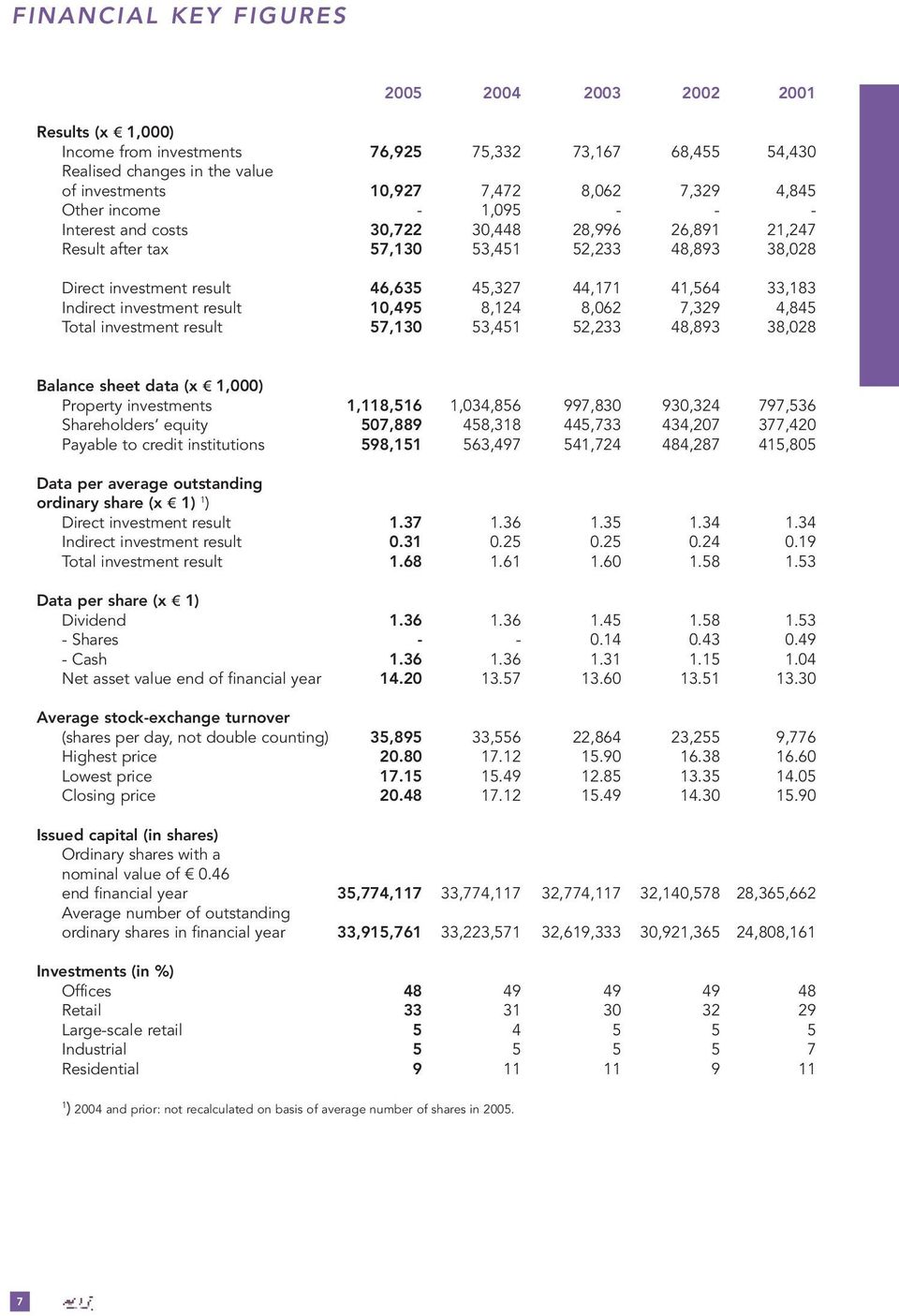
8 FINANCIAL KEY FIGURES Results (x 3 1,000) Income from investments 76,925 75,332 73,167 68,455 54,430 Realised changes in the value of investments 10,927 7,472 8,062 7,329 4,845 Other income - 1, Interest and costs 30,722 30,448 28,996 26,891 21,247 Result after tax 57,130 53,451 52,233 48,893 38,028 Direct investment result 46,635 45,327 44,171 41,564 33,183 Indirect investment result 10,495 8,124 8,062 7,329 4,845 Total investment result 57,130 53,451 52,233 48,893 38,028 Balance sheet data (x 3 1,000) Property investments 1,118,516 1,034, , , ,536 Shareholders equity 507, , , , ,420 Payable to credit institutions 598, , , , ,805 Data per average outstanding ordinary share (x 3 1) 1 ) Direct investment result Indirect investment result Total investment result Data per share (x 3 1) Dividend Shares Cash Net asset value end of financial year Average stock-exchange turnover (shares per day, not double counting) 35,895 33,556 22,864 23,255 9,776 Highest price Lowest price Closing price Issued capital (in shares) Ordinary shares with a nominal value of end financial year 35,774,117 33,774,117 32,774,117 32,140,578 28,365,662 Average number of outstanding ordinary shares in financial year 33,915,761 33,223,571 32,619,333 30,921,365 24,808,161 Investments (in %) Offices Retail Large-scale retail Industrial Residential ) 2004 and prior: not recalculated on basis of average number of shares in
9 PROFILE General Nieuwe Steen Investments N.V. is a Dutch property investment company with variable capital. Nieuwe Steen Investments has its (registered) office in Hoorn; the company is registered in the Trade Register there under number Nieuwe Steen Investments invests in high-quality Dutch property with a high (initial) yield. When making investment decisions, thorough consideration is given to the balance of risk and return. Nieuwe Steen Investments invests in offices, retail, large-scale retail, industrial and residential property. Nieuwe Steen Investments strives to achieve good diversification, both geographically and across the various property categories. History At the end of 1992, a group of successful businessmen led by Mr. J.R. Zeeman formed a plan to invest collectively in property. This led to the formation of Nieuwe Steen Investments on 1 March Nieuwe Steen Investments was granted a licence from De Nederlandsche Bank N.V. within the meaning of article 5 paragraph 1 of the Dutch Investment Institutions Supervision Act [Wet toezicht beleggingsinstellingen] on 8 August Since 3 April 1998, Nieuwe Steen Investments has been listed on the Official Market of the stock exchange maintained by Euronext Amsterdam N.V. Strategy and objectives The property investments are designed to generate a consistent and increasing total result per share, consisting of a direct result (rental income less costs and interest) and an indirect result (value appreciation of the property). The policy focuses on achieving a direct investment result per year of at least per share. This is achieved by means of a high return on property over the long term and by making use of the beneficial difference between the (interest) costs of outside capital and the return on the property. In its property investments, Nieuwe Steen Investments gives prominent consideration to the users. Nieuwe Steen Investments' strategic policy is designed to optimally meet the changing needs of its tenants through portfolio renewal. Nieuwe Steen Investments prefers to invest in modern, adaptable and small-scale buildings in accessible locations with adequate parking facilities. In the coming years, Nieuwe Steen Investments will focus on the active management of its property portfolio. The principal aims in this process will be quality and optimisation of the objects. Since its foundation, Nieuwe Steen Investments has largely outsourced the daily management, or property management, to Zeeman Vastgoed Beheer B.V., in order to: optimise rental income; manage exploitation costs; realise the best possible value of the property through adequate maintenance and the revitalisation of the existing objects; to provide the greatest possible added value. Nieuwe Steen Investments is not a property developer. The company limits itself to the purchase of turn-key projects and the optimisation of projects already in portfolio through revitalisation. 8
10 Risk management Investment in property involves risk. Nieuwe Steen Investments strives to limit risk in the following ways: Purchase and sale policy Nieuwe Steen Investments invests exclusively in the Netherlands, and strives to achieve good diversification, both geographically and across the various property categories. Nieuwe Steen Investments has an active investment policy which also includes the renewal of the property portfolio and adjustment to changing market conditions. Nieuwe Steen Investments prefers to acquire only property that is let and that has a low risk of becoming vacant. Financing policy The property portfolio is in principle financed with a maximum of 50% outside capital. NSI strives to conclude long-term loans at variable interest rates, and hedges its longer-term interest-rate risk using derivative instruments. Investor relations Nieuwe Steen Investments strives to realise transparency and communication with its shareholders and potential shareholders. The company attaches value to the provision of information through road shows, presentations, press releases, semiannual and annual reports, as well as providing information on its website. The annual reports are available in both Dutch and English at the offices of the company. Fiscal status Nieuwe Steen Investments is zero-rated for corporation tax on its investments results, since Nieuwe Steen Investments has the status of fiscal investment institution (withing the meaning of Article 28 of the Dutch Corporation Tax Act [Wet op Vennootschapsbelasting]. The Act stipulates certain conditions thereto. Dividend policy Nieuwe Steen Investments' dividend policy is designed to make more or less the whole direct investment result available to its shareholders. To comply with the conditions attached to the status of fiscal investment institution, dividend distributed in cash should be not less than the fiscal profit. Nieuwe Steen Investments dividend policy is designed to distribute the direct result in cash in the form of interim dividends in May, August and November over Q1, Q2, and Q3 respectively, followed by a final dividend in March/April. Closed-end investment fund Nieuwe Steen Investments is a closed-end investment fund. This means that Nieuwe Steen Investments has no obligation to issue or repurchase its shares. Issuance and repurchase of shares are made on the decision of the Management Board, subject to the approval of the Supervisory Board. Stock exchange listing Nieuwe Steen Investments gives everyone the chance to invest in a nation wide high-quality property portfolio by purchasing its shares. The shares of Nieuwe Steen Investments are listed on the Euronext stock exchange in Amsterdam and registered under code ISIN-code: NL

11 THE SUPERVISORY BOARD J.R. Zeeman (1934) chairman Nationality: Dutch Present function: managing director of Stichting Prioriteit NSI, member of the Investment Advisory Board Previous function: Director of Nieuwe Steen Investments N.V., director/founder of Zeeman Vastgoed B.V. First appointed: 2005 Current term: to 2008 M.J.C. van Galen (1943) Nationality: Dutch Present function: member of the Investment Advisory Board Previous function: director of Breevast N.V. Additional functions: chairman of the Management Board of Stichting Continuïteit ASM International N.V Supervisory directorships: B.V. Vereffenaar VBB, Blauwhoed Holding B.V., Valuas Services B.V., Valuas Vastgoed BV, Utrechtse Mij tot Stadsherstel N.V., Leydsche-Oranje Nassau Beheer B.V., De Hypothekers Associatie B.V., Quion Groep B.V., Stichting Sociale Huisvesting SSH. in Utrecht First appointed: 2005 Current term: to 2009 ir. C. Hakstege (1939) Nationality: Dutch Previous function: Chairman of the Management Board of Bouwfonds Supervisory directorships: Variant Groep B.V., PRC/Bouwcentrum B.V., De Meeuw Bouwsystemen B.V., Van Hoogevest Groep B.V., Maeyveld B.V., Berlage Winkelfonds N.V. First appointed: 2001 Current term: to 2007 A.J. Tuiten (1946) Nationality: Dutch Present function: member of the Management Board of Stichting Prioriteit NSI Previous function: Director of a construction company Supervisory directorships: Topdak B.V. First appointed: 1993 Current term: to

12 REPORT OF THE SUPERVISORY BOARD To the General Meeting of Shareholders We have pleasure in presenting the annual report of Nieuwe Steen Investments N.V. for the 2005 financial year, as prepared by the Management Board. The annual financial statements have been audited by BDO CampsObers Accountants of Hoorn and an auditor's report of approval is attached (page 95). We recommend adoption of the annual financial statements. The discharge of the Management Board for the policy pursued in 2005 and of the Supervisory Board for the supervision it provided in 2005, without prejudice to statutory provisions, will be dealt with at the General Meeting of Shareholders on 23 March 2006 as a separate agenda item. Composition of the Supervisory Board At the General Meeting of Shareholders of 17 March 2005, Mr. G. Deen retired as a supervisory director, having served the maximum of three terms in this capacity. Mr. Deen is succeeded on the Supervisory Board by Mr. M.J.C. van Galen. Mr. Van Galen s previously was managing director of the property company Breevast N.V. and is highly experienced with regard to the management of a Dutch property portfolio and the implications of a public listing. Mr. Van Galen is also a member of the Investment Advisory Board. According to the rota, Mr. A.J. Tuiten will retire as a supervisory director at the General Meeting of Shareholders of 23 March 2006, after completing the maximum three terms. During this period, Mr. Tuiten was also the chairman of the Board and was able to provide important direction to the development of our company in this capacity. His most valuable contribution however was his ability to maintain a balanced course between the various interests and personalities within Nieuwe Steen Investments. Mr. Tuiten has been involved with Nieuwe Steen Investments since the very beginning and his contribution has also been highly appreciated by both the Supervisory and the Management Boards. In view of the composition of the board, and partly prompted by recommendations in the area of Corporate Governance, the Supervisory Board has given preference to filling the vacancy left by Mr. Tuiten s departure with a financial expert. Both Stichting Prioriteit NSI and the Supervisory Board consider they have found a suitable successor in Mr. H.J. van den Bosch. Mr. Van den Bosch is a chartered accountant and has held various financial management positions. He currently has his own management consultancy company and is a supervisory director of various (not publicly listed) organisations. To become more acquainted with the company, Mr. Van den Bosch attended the meetings of the Supervisory Board last year as a listener. More information on Mr. Van den Bosch is given in the agenda for the General Meeting of Shareholders of 23 March It will therefore be proposed at the General Meeting of Shareholders that Mr. Van den Bosch be appointed as a supervisory director. In our opinion, with the appointment of Mr. Van den Bosch to the Supervisory Board, the fields of expertise necessary for proper supervision are more than adequately represented on the board. In view of the size of the Supervisory Board, it has been decided not to appoint separate key committees as mentioned in the Tabaksblat code. Regarding the Corporate Governance code, only Mr. Zeeman, as an ex-managing director of the company, is not an independent member of the Supervisory Board. Besides that, the Supervisory Board meets the best practice provisions regarding matters such as independence and expertise. Functioning of the Supervisory Board The Supervisory Board met on nine occasions for its regular meetings during the reporting year. All the meetings were attended by all members of the Supervisory Board and the Management Board, on one occasion for part of the meeting. Besides the regular meetings, the Supervisory Directors were in regular contact as a body, with each other individually, and with the members of the Management Board. Regularly recurring issues discussed at board meetings were the company s strategy, the risks, the company s objectives and policy, the development and future of Nieuwe Steen Investments, the financial reports and the development of the results. Developments in the property markets and the effects thereof on the composition and growth potential of the property portfolio and the occupancy rate were fully discussed and evaluated. Particular attention was devoted to IFRS and specifically the effects of this on the valuation system used by the company. Matters such as the financing policy, the system of internal controls and risk control procedures and corporate governance policy were also continuously given the necessary attention. 11

13 The Supervisory Board has - without the presence of the Management Board - evaluated the performance of itself, the individual supervisory directors, the Management Board and the individual directors. During the reporting year, there was one transaction, the purchase of the building in which the company has its offices, which involved conflicts of interest with Supervisory or Managing Directors. There were no transactions between the company and a shareholder owning 10% or more of the company s shares. In its assessment of investment decisions regarding the portfolio, the Supervisory Board is assisted by the Investment Advisory Board. Matters relating to the composition and remuneration of the Management Board are discussed with the Management Board of Stichting Prioriteit Nieuwe Steen Investments. Corporate Governance The Supervisory Board attaches value to a transparent structure, a clear policy and reporting to its shareholders. The further development and implementation of the company s Corporate Governance structure therefore is a permanent focus of attention. The policy and the deviations from the Dutch Corporate Governance Code were put to the vote at the General Meeting of Shareholders in September 2004, and were adopted by the shareholders. Changes to the company s corporate governance policy will also be submitted to the General Meeting of Shareholders. The Supervisory Board is of the opinion that the company hereby is in compliance with the requirements of the Dutch Corporate Governance Code; further details are given in the separate section on Corporate Governance on page 22. Remuneration report The remuneration of the Management Board is established by the Supervisory Board. The company in principle pays a fixed remuneration to the directors, and does not grant options, loans or guarantees to directors or supervisory directors. The level of remuneration is set as far as possible in line with the market for the position in question, and is also naturally related to the knowledge, experience and qualities of the individuals concerned. With regard to the fixed remuneration of the Managing Director, the board is of the view that in light of the above, the level is appropriate. This means that this fixed salary will not increase by more than the rate of inflation. If the board considers it appropriate, exceptional performance may be compensated by a variable payment. The bonus paid to the Managing Director in 2005 is 1 41,100. Regarding the fixed remuneration of the other directors, a system has been chosen whereby this will increase to a higher level in the coming years, subject to conditions. The remuneration of the Management Board was in line with the remuneration policy. The fixed salary of Mrs. Reijnen was 1 287,000 in Messrs. Storms and Schipper each received annual salary of 1 151,000. The contracts with the directors do not contain any term of appointment or maximum remuneration in the event of involuntary dismissal (see notes on page 75). Details of the remuneration of the Management and Supervisory Boards are given on pages 75 and 76 of this report. 12

14 The company s remuneration policy is stated on its website. The Supervisory Board does not foresee any significant changes to this policy in the coming years. Stichting Prioriteit NSI establishes the remuneration of the supervisory directors. The remuneration of a supervisory director is not related to the results of the company. In 2006 the remuneration of supervisory directors will increase compared to 2005 to 1 20,000 per year, and for the chairman 1 25,000 per year. Proposed final dividend 2005 The company s dividend policy is to distribute the entire direct result as cash dividend quarterly. In line with its dividend policy, the company has distributed a total of per share in cash dividend quarterly over the first three quarters of The Supervisory Board approves the Management Board s proposal to distribute the remaining direct investment result in the form of a sum of per share as final dividend for The total dividend for 2005 therefore amounts to per share. Conclusion Nieuwe Steen Investments has had a good year in which the Management Board has been able to realize the requirements set in advance and expectations with regard to the portfolio, the occupancy rate and the direct investment result. In view of the market conditions, in which this was achieved, this is a good performance. The Supervisory Board wishes to express its appreciation for the efforts made by the directors and employees of the company during the reporting year. Hoorn, 16 February 2006 The Supervisory Board, J.R. Zeeman, chairman M.J.C. van Galen C. Hakstege A.J. Tuiten 13

15 14 Meerheide in Eersel

16 REPORT OF THE INVESTMENT ADVISORY BOARD The Investment Advisory Board represents the Supervisory Board in the assessment and approval of the purchase and sale of investments, investment and developments in the property portfolio and monitors the implementation of the company's investment policy. Composition The Investment Advisory Board consists of three natural persons, with at least one member serving as a supervisory director of the company. The members of the Investment Advisory Board are appointed and dismissed by the Supervisory Board. During 2005, Mr. Deen indicated that he wished to cease his activities on the Investment Advisory Board in due course. Mr. Deen has been closely involved in the company s development since its incorporation as a supervisory director, and, since it was created, a member of the Investment Advisory Board. The company has been fortunate to be able to benefit from his huge knowledge of and expertise in property over these years. On the Investment Advisory Board, Mr. Deen will be succeeded by Mr. P.G.M. Boekweit. Mr. Boekweit (1943) has been an estate agent and an appraiser, and before he retired had his own estate agency in Hoorn, specializing in appraisals and commercial property. The company is of the opinion that the appointment of Mr. Boekweit to the Investment Advisory Board satisfactorily fills the vacancy left by Mr. Deen s departure. To acquaint himself with the company and its procedures, Mr. Boekweit attended meetings during the second half of Activities The Investment Advisory Board met with the Management Board on nine occasions during the reporting year. Proposed investments and divestments were discussed at length and tested against the strategic and financial principles set by the Management and Supervisory Boards. Members of the Investment Advisory Board visited the objects proposed for purchase in most cases. There was regular discussion with the Management Board regarding developments in the Dutch property market and the effects of this for the composition and diversification of the portfolio. The Investment Advisory Board therefore gave significant consideration, in addition to investment decisions, to the progress of business regarding the exploitation of the portfolio, such as rentability and the development of the vacancy figures, compliance with rent guarantees and the preparation of plans to maintain and increase the attractiveness of our objects. The Investment Advisory Board regularly reported to the Supervisory Board on its functioning. The Investment Advisory Board is grateful to the Management Board and all employees for the professional way in which proposals were prepared and the constructive way in which deliberations could be conducted. Hoorn, 16 February 2006 The Investment Advisory Board J.R. Zeeman, chairman G. Deen M.J.C. van Galen 15
17 REPORT OF THE MANAGEMENT BOARD 2005 IN REVIEW A look back at an excellent year 2005 was an excellent year for the company. Not only because the year closed with an increase in both the direct and the indirect result per share, but also because other more qualitative objectives and stated expectations could be achieved. In its business, Nieuwe Steen Investments has to deal with three important markets: the market for property investment, the capital market and the rental market. These markets have increasingly diverged, presenting us with the associated challenges. The market for high-quality, good first-class investment objects that have been let is thin, and due to low interest rates and the still continuing search for yield such objects have become increasingly expensive. Initial yields continue to fall, making it difficult to add new objects to the portfolio without negatively affecting the company s earnings per share. Growth, and even more importantly portfolio renewal, are however essential in order to remain assured of a high-quality portfolio with a sustainable income stream over time. The company was therefore satisfied that its previously set objectives for 2005 could be realized by acquiring new objects worth million and selling objects worth 1 54 million that no longer met the set requirements. An additional effect of falling initial yields for new objects is that the value of the existing portfolio in the current market is rising. Nieuwe Steen Investments can see this in the higher appraisal values for the objects it owns. One of the ways shareholders can see this is in the higher share price. The market that has the most effect on the investment result is the rental market. Rental income forms the basis of the result and ultimately the dividend. The first priority therefore is to maintain the occupancy rate at as high a level as possible. The company is therefore pleased that it succeeded in limiting the financial vacancy in the portfolio in 2005 in a market, particularly the market for offices, which regularly presented us with serious local challenges. The office market is still rather sluggish. However, our impression is that the office market has finally turned a corner, and that a slow recovery has begun. The capital market has the most influence on the price formation of the company s shares. Developments in interest rates are the central factor here. Interest rates remained low during 2005, which encouraged interest in alternative investments. For Nieuwe Steen Investments, this meant higher property prices and an increased share price. A high price allows the company to raise new capital to finance expansion on attractive conditions. In 2005 the company, after being able to acquire the shopping centre De Driehoek in Oldenzaal from a subscription, was able to place two million new shares privately at an issue price of Low interest rates also affect the result, although for Nieuwe Steen Investments, whose policy is always focused on financing with long-term fixed-interest periods, this effect is delayed but positive. The shareholders could see the interest in high dividend generating investments reflected in the interest shown in the share. The share price rose from to in This took the price and dividend yield of Nieuwe Steen Investments shares to over 28%. This is the third successive year that the stock has achieved a total return of over 20%. The quality of the portfolio is and remains the foundation The property portfolio is the foundation of good results, both today and in the future. For Nieuwe Steen Investments this is a well-let portfolio containing exclusively Dutch property objects with adequate diversification across the investment categories. The mix is such that the effects of movements in the different markets offset each other, with developments in the mediocre office market compensated for by positive retail and residential markets. 16

18 In addition to the mix, good maintenance is a pre-condition for maximising rentability and thereby the value of the objects themselves. The high prices offered for property investments made it difficult to substantially expand the investment portfolio in The possibility of acquiring new investments is however necessary for the process of portfolio optimisation. Objects which in the opinion of the Management Board will no longer sufficiently contribute to the result now or in the future are sold. The extent to which Nieuwe Steen Investments succeeds in acquiring new objects also affects the potential for sales. Indeed, the sale of objects without the possibility to appropriately reinvest the proceeds leads to reduced cash flow. In view of the market conditions, priority is given to the profitability of the existing objects in the portfolio. Successful investing in property: property management or cash flow management The investment value of property is largely determined by total rental income. The company s strategy focuses heavily on good portfolio management: the basis for the continuity of our income and results. Keeping the occupancy rate up to standard and active letting are therefore more important than ever. The strong rise in property investment fund shares may give the impression that they are valued more on cash flow than on the underlying objects, the actual bricks and mortar. However, succesful property investing requires good portfolio management, active property management and good implementation of the finance strategy, which then generates cash flow. As long as this cash flow is sustainable, it is a good basis for valuation. Cash flow management however cannot be the central priority, as it is the property that has to generate the income in the long term. Dividend still rules The motto Dividend rules was adopted in 2004, whereby the dividend policy was changed to quarterly distribution in cash. The quarterly dividend was particularly welcomed by our private investors and emphasises the pension and bond features of the shares. Shares with high dividend yield generally were in favour. NSI s dividend yield fluctuated between 6.6% and 7.9% in 2005, based on dividend distributed of per share. Still, there is a change: as of 2006 the company will report on the basis of actual value According to Dutch and European law, listed companies must comply with IFRS in their financial reporting from 2005 onwards. These guidelines offer a choice between valuation at current value or at historical cost price. Nieuwe Steen Investments continued to determine its results based on the historical cost price of its investments during The company has also reported the actual value of the portfolio in its published quarterly figures. Nieuwe Steen Investments, by valuing at historical cost price remains an odd man out. Although in the company s view the distinguishing features remain, it has ultimately decided for practical reasons to publish its financial reporting on the basis of actual value, with these values having been determined from the beginning of this financial year. The change will take place with effect from 2006, so that notes to the changes in valuation from 2005 can be included. It was also a factor in the decision that the key figures based on historical cost become less significant as the difference with the portfolio s real value increases. The change in valuation does not affect the determination of the direct result, which forms the basis of the dividend. The changes will affect the determination of the indirect result. Until this reporting year we only reported the realised book profit, namely the profit on sales. From 2006 the indirect result will also contain the unrealised changes in value of the property investments and the interest-rate hedging instruments. 17

19 And in conclusion After taking over responsibility in 2004 the new Management Board, now accustomed to the new division of duties, went to work enthusiastically in 2005, meeting a challenging property market with Nieuwe Steen Investments familiar committed, no nonsense and pragmatic approach. However the company s market-listed status also required the necessary developments that had their effect on its daily business. The market authorities are trying to prevent disasters in the financial world by tight regulation. Reporting must meet the provisions of IFRS, compliance with the recommendations of the Tabaksblat Committee s Corporate Governance Code is currently being evaluated, and during 2005 the regulation of investment institutions issuing securities passed from De Nederlandsche Bank to the Authority for the Financial Markets [Autoriteit Financiële Markten, or AFM]. This also continues to require the necessary changes in legislation and regulation. 18

20 STRATEGY AND OBJECTIVES Nieuwe Steen Investments strives to construct and exploit a high-quality property investment portfolio diversified over several categories with objects located exclusively in the Netherlands. An investment portfolio that forms the basis for a high, but above all sustainable direct investment result that then is entirely distributed as dividend to the shareholders. In the current market, the implementation of the targeted result for 2006 is based on the following themes, which are the same as those which applied in Optimisation of the occupancy rate Our first priority is to maxmimise the portfolio s occupancy rate. Certain rental agreements will expire in 2006 and 2007, particularly in the offices market. Nieuwe Steen Investments must deploy its strengths to retain tenants after expiration and find a balance in conditions acceptable to both parties. The highest possible occupancy rate is the best guarantee of optimal rental income and thus the continuity of the result. Moreover, the income stream is the best guarantee of the value of the object and lastly it is also important - for the physical maintenance conditions of the objects themselves - that they are in use. 2. Portfolio policy Nieuwe Steen Investments strives to achieve further growth of the portfolio, as long as the objects acquired meet our quality and return requirements. Growth is not an objective in itself, and high growth is not actually necessary. New investments are welcome if they can contribute to the quality and quantity of the income stream over the short and the long term. Acquisitions may be of individual objects, but the company also looks at portfolios. In today s competitive market, Nieuwe Steen Investments must be able to capitalize on opportunities that arise from moment to moment. We remain alert to be able to utilize investment opportunities on acceptable conditions. The optimisation of the portfolio is also part of the active portfolio policy, and receives continuous attention. Active portfolio management is a combination of purchases, sales and investment in the current portfolio. If the company only has a limited opportunity to acquire new objects, this also means that in order to maintain the income flow there will be a certain reluctance to divest. Instead of sales, other ways of optimising quality are sought, such as expanding, changing or revitalising the objects concerned. 3. Cost control The property portfolio is the basis for the income, so its quality must always be the highest priority. This does not mean that cost efficiency does not contribute to the result. Cost management for the property portfolio is not an end in itself; to keep the property let and in good condition, one-off costs have to be incurred now, some of which can be predicted but others not - certainly in the current rental market where every effort is required. However these costs are necessary to generate future income. The situation is different for the costs of property and fund management, and in particular for interest costs. These costs can be controlled and significant savings have been achieved, especially in interest costs with the expiration of fixed-interest periods, while maintaining a defensive strategy. 19

21 20 Nieuwe Staete in Hoorn
22 MANAGEMENT AND ORGANISATION Management Board Nieuwe Steen Investments has a Management Board of three persons. Mrs. J.J.M. Reijnen is Managing Director, and is responsible for general policy, finance and Investor Relations. Mr. J.Th. Schipper is Director of Asset Management, with responsibility for acquisitions and divestments policy. Mr. R.J.J.M. Storms is Director of Property Management and is responsible for the optimal exploitation of the portfolio. NSI Management B.V. NSI Management B.V. is the management company dealing with the organisational and financial aspects of the fund management. NSI Management B.V. is a small highly-focused organisation which at the end of 2005 has 11 employees (including directors). Besides carrying out duties and responsibilities for Nieuwe Steen Investments as a listed company and providing the best possible financing, NSI Management B.V. is also responsible for the management of the investment portfolio regarding: purchase and sale of objects; guaranteeing the quality of the objects; monitoring and directing day-to-day management. The intention is to carry out tasks professionally as far as possible in-house, without losing the compactness of the organisation. This is done by means of a practical, direct approach. Daily management by external managers To keep our own organisation compact, decisive and focused on portfolio management, the day-to-day management of the property investments is outsourced to professional managers, and indeed this has been the case since the company's incorporation. The company works with several parties in this regard; by far its most important partner is Zeeman Vastgoed Beheer B.V. Services are also provided by WPM Winkelcentrummanagement B.V. and RVM Vastgoedmanagement B.V. For the best possible collaboration, reporting lines are short and decisions can therefore be made quickly. Both Nieuwe Steen Investments and the managers have an interest in satisfied tenants and a high occupancy rate, as the property management fee is based on realised income. Great effort is required in the current market, and the principle of "know your property, know your client" remains the basis of good management. 21
23 CORPORATE GOVERNANCE The Supervisory and Management Boards of Nieuwe Steen Investments attach a high priority to a transparent organisation with regard to the confidence of its shareholders and other stakeholders in the company. The company endorses the Dutch Corporate Governance Code and is in full compliance therewith. One important instrument of the company s Corporate Governance policy is contact with its shareholders. The company organises a shareholders meeting at least twice a year, at which developments are explained and reports are made on the policy pursued. These meetings are attended by large numbers of shareholders and are highly appreciated. Actions In previous years the Corporate Governance policy has been formulated by implementation of certain formal requirements, including amendment to the Articles of Association, the setting up of regulations and changes and additions to the company s website, and extensive communication has taken place on the company s Corporate Governance policy with shareholders and other stakeholders. The company s Corporate Governance policy was the main agenda item at the General Meeting of Shareholders of 2 September 2004, and was submitted to and approved by the meeting. At this meeting, a commitment was made in line with the Code to submit major changes to the company's corporate governance policy or its implementation to a shareholders meeting. We have included a checklist of best practice provisions on pages 98 to 101 as an attachment to this report. Deviations We have indicated below the recommendations we have not adopted and our reasons for doing so. The deviations are: Managing directors are not appointed for a period of four years (II.1.1), no regulations have been set for managing or supervisory directors regarding ownership of and transactions in securities other than those issued by the company (II.2.6 and III.7.3), no maximum remuneration has been set in the event of involuntary dismissal of directors (II.2.7) the chairman of the Supervisory Board is a previous director of the company (III.4.2). Since March 2004, the Management Board of Nieuwe Steen Investments has consisted of three directors. At the time of their appointment, all three directors had been employed by the company for many years, and their employment contracts do not provide for an appointment term of four years or a maximum amount in the event of involuntary dismissal. Nieuwe Steen Investments has decided not to change the employment contracts in this case. The company is also of the opinion that it is not appropriate to agree a termination or dismissal payment in advance. This can only occur once the circumstances of the situation are known (deviation from II.1.1 and II.2.7). In deviation from best practice provisions II.2.6 and III.7.3, Nieuwe Steen Investments has decided not to implement a separate regulation for managing or supervisory directors regarding ownership of or transactions in securities other than those issued by the company. Regulations already are in place for ownership of and transactions in securities issued by the company under the Dutch Securities Transactions Supervision Act [Wet toezicht effectenverkeer 1995], with a reporting requirement for managing and supervisory directors. This regulation has a wide scope and is not limited to transactions in securities issued by the company. The regulation prohibits any transaction that could appear to be based on the use of price-sensitive information. A separate regulation is therefore seen by the company as excessive (deviation from II.2.6 and III.7.3). 22
24 At the General Meeting of Shareholders of 25 March 2004, Mr. J.R. Zeeman was appointed a supervisory director and thereafter appointed by the Supervisory Board as its chairman. This appointment deviates from best practice provision III.4.2 of the Code, since Mr. Zeeman has been a managing director of the company. It was however decided to propose the appointment of Mr. Zeeman, since as founder of and shareholder he is intimately connected with the fate of Nieuwe Steen Investments. Mr. Zeeman also has an extensive network of contacts which, besides his huge experience and expertise, remains at the disposal of Nieuwe Steen Investments. Berchvliet in Amsterdam 23
25 24 Shareholders meeting in september 2005
26 INVESTOR RELATIONS Nieuwe Steen Investments celebrated its 12 1 /2-year anniversary on 1 September During this time, the company has formed a special bond with a large number of private shareholders. The shareholders meeting in September 2005, part of which celebrated this milestone, was attended by around 700 shareholders. The General Meeting of Shareholders was well attended, with private shareholders in particular gaining access to the company for questions and comments, also outside the meeting. During a period in which attention has increasingly been devoted to institutional investors, the company wishes to maintain the unique relationship it has with its private shareholders. In this reporting year, information to private and institutional investors has played an important role, and the Management Board has also organised presentations for foreign investors, in view of the strong interest in property shares. There are two objectives in these presentations: to inform existing shareholders and to introduce Nieuwe Steen Investments to potential shareholders who can be quickly approached in times when capital is needed. The company strives for open, timely and clear communication with private and institutional shareholders, the media, analysts and other interested parties, and tries to implement its public and investor relations policy accordingly. 25
27 NIEUWE STEEN INVESTMENTS SHARES For the third consecutive year, 2005 was an exceptionally good year for Nieuwe Steen Investments shares. The share price closed at at the end of This is an increase of almost 20% compared to the price at the end of 2004 ( ). In combination with the total dividend distributed during the financial year of , the share achieved a price and dividend yield of 28% (2004: 23%). With this return, Nieuwe Steen Investments was the best-performing listed Dutch property investment company. Interest in property as an investment was high in 2005, in both the direct and the indirect markets. While this was the result of high interest in the direct market, net asset values also rose, and almost all listed property investment institutions were trading at a premium at the end of The conclusion to be drawn from this is that in the current market the share price is driven more by the underlying cash flow (the dividend) than by the underlying value. Nieuwe Steen Investments also can look back on a longer period of high price and dividend yield since its market listing in Price and % dividend % yield % (x 1 1) % % % % % Total return performance with an investment of 3 1,000,- as of 1 January 2005 (x 1 1) Nieuwe Steen Investments AEX GPR 250 (source: Global Property Research) Total return performance with an investment of 3 1,000,- as of 1 March 1993 (x 1 1) Nieuwe Steen Investments AEX GPR 250 (source: Global Property Research) 26
28 Issues Nieuwe Steen Investments issued a total of two million shares in 2005 by means of a private placement (in November) to institutional and large private investors, which increased the shareholders equity by million. The total number of outstanding shares increased thereby to 35,774,117. The bookbuilding system was chosen for this private placement.. The result was that the shares were placed within one day with a number of institutional and large private investors. The placement price of at the time represented a discount of 3% compared to the previous closing price. The direct reason for the issue was the acquisition of the shopping centre De Driehoek in Oldenzaal. Since the issue proceeds could be directly applied to this acquisition, the placement had no negative effect on the direct investment result. Price development and market turnover of Nieuwe Steen Investments shares during 2005 closing price market turnover Nieuwe Steen Investments since 2005 in the Small Cap Index Over 9 million Nieuwe Steen Investments shares were traded on the stock exchange in 2005, which corresponds to an average daily turnover of 35,895 shares (2004: 33,556). With its total turnover figures in 2005, Nieuwe Steen Investments was the 66th most traded stock (2004: 62nd) on Euronext Amsterdam. Based on these market turnover figures, since 2 March 2005 Nieuwe Steen Investments has been included in the new Small Cap index (AScX) which has been initiated alongside the AEX and the Midkap index. Nieuwe Steen Investments is the third-largest stock in this index with a weight of 7.4%. Besides the Small Cap Index, Nieuwe Steen Investments shares are also included in other indices such as the EPRA index. EPRA (European Real Estate Association) is the umbrella organisation for listed property funds, and has as its primary objective to raise interest in and improve the opportunities for property investment. Nieuwe Steen Investments uses various liquidity providers, which guarantee the continuous tradability of the shares. In 2005, the Amsterdams Effectenkantoor and Kempen & Co acted as paid liquidity providers. Price price/earnings (x 1 1) ratio High Low Close
29 Balkendwarsweg in Assen Boermarkeweg te Emmen 28
30 DIVIDEND Dividend policy in 2005 The dividend policy of Nieuwe Steen Investments is designed to distribute the entire direct result as cash dividend, paid quarterly. The company distributed a total of cash dividend in 2005, comprised of the following payments: in March final dividend for 2004; in May dividend for 2005Q1; in August dividend for 2005Q2; in November dividend for 2005Q3. Dividend proposal for the financial year 2005 The Management Board proposes to the General Meeting of Shareholders that the final dividend for 2005 be set at in cash per ordinary share. This will bring the total dividend distributed in the 2005 financial year to Assuming that the General Meeting approves this proposal, the final dividend will become payable as of 4 April
31 RISK MANAGEMENT Investment in property involves risk, as does any business. The exploitation of property investments (subsequent to the investment decisions) however is predictable to a certain extent, in view of the long-term nature of the rental agreements. A property investment is certainly not free of risk, also with regard to its exploitation, it is affected by internal and external factors such as general economic developments with effects on factors like the development of rents, interest rates, the occupancy rate and debtor risk. Good management involves both acknowledging these risks and keeping them subject to the best possible control and monitoring. The main risks for Nieuwe Steen Investments can be specified as strategic, operational, reporting and compliance-related risks. These risks and the control mechanisms in place are described below. A. Strategic risks Portfolio risk The control of strategic risks is primarily implemented in our decision-making process regarding the following: where we invest (location risk), what we invest in (category risk), when we invest (with reference to economic and property market cycles) and how much do we want to invest (risk/return ratio). Our strategic choice for diversification both geographically and across categories makes us less vulnerable in uncertain economic conditions. Our strategic decision to invest only in Dutch property does entail limited diversification, but is due to the fact that we would have to deal with a multitude of markets/ economies, with the associated currency risks. The total portfolio risk is controlled by diversification across investment categories, geographical locations, the size of the objects and the quality of the tenants. Nieuwe Steen Investments applies a thorough investment selection and decision-making procedure. Nieuwe Steen Investments uses an internal calculation model to determine the expected future return from an object under consideration for acquisition. This expected return is then compared to the return we require on the basis of the estimated risk profile. The stable and predictable cash flows generated by our exploitation show how the company deals with strategic risks. Financing risk Interest-rate management requires understanding of the nature and size of the risk and its possible effects. Interest-rate risk management makes it possible to control the costs of finance. As the company has chosen to enter into long-term fixed-rate mortgage loans or to use derivatives to hedge the interest-rate risk of variable rate loans for a longer-term period, the loan portfolio is only subject to changes in interest rates to a limited extent. This means that the opportunity to profit from falling interest rates is very limited. The intention is to manage interest-rate risk in such a way that Nieuwe Steen Investments can offer consistent earnings to its shareholders. 30
32 B. Operational risks Nieuwe Steen Investments continually evaluates developments in the property market, both at the time of acquisition as well as during the period of investment in the property object. Operational risks are controlled by means of an adequate and effective Property Management system. In practice, this means the maintenance and application of procedures for: screening tenants when entering into rental agreements; monitoring rental arrears; timely anticipation of future rental terminations and agreement reviews; monitoring the occupancy rate; controlling exploitation costs; reviewing the quality of an object; timely maintenance; concluding adequate insurance; ensuring objects meet prevailing statutory and regulatory requirements. For many objects, maintaining a high standard of management is essential for maintaining returns over the long term. The company cannot control all the stated risks itself. Nieuwe Steen Investments in part depends on the co-operation and behaviour of its tenants. With regard to insurance, not all risks are covered: certain disasters are entirely or partially excluded (for instance natural disasters and terrorism). The valuation of property Nieuwe Steen Investments identifies a number of risks associated with valuation. The value of a property can decline and the cash flow return can be less than optimal. Acquisition and divestment of property may take place in less favourable economic times and on less favourable conditions. Movements in returns may turn out to be structural and not a one-off event. From 2006, the property revaluation result is an integral part of the profit and loss account and this can have a significant effect on the total investment result. The valuation of property is not an exact science, it is a combination of thorough regional and local knowledge of the market, professional experience and the correct use of good valuation models. Movements in value of plus or minus 10% are considered acceptable in the property world in some cases. The volatility of the total investment result will thus increase; a 1% revaluation of the property portfolio will have an effect of around 1 12m, which based on the number of shares outstanding at end 2005 would amount to approximately per share. C. risks from legislation and regulation Legal risks The ownership and exploitation of property is subject to statutory provisions, including legislation on rents which varies per category (residential, retail, offices). Changes in legislation can mean changes in the relationship between owner and tenant, buyer and seller which may involve financial consequences. In addition to legislation attached to the exploitation of property, the company is, in particular in its capacity as a listed investment institution, subject to strict legislation and regulation. Tax risks Taxes play an important part in investing in property, and include: corporation tax, property transfer tax, value-added tax and local taxes. Corporation tax Nieuwe Steen Investments is a fiscal investment institution, whereby, subject to certain conditions, it is not liable for corporation tax on the investment result. These conditions mainly concern compliance with the fiscal distribution requirement, the composition of the shareholder files and the (fiscal) financing ratios. Nieuwe Steen Investments limits this risk by a regular and thorough internal review and monitoring of continuing compliance with the above conditions, supported by external tax experts. 31
33 The composition of the shareholders file, in particular, is not under Nieuwe Steen Investments control. Risks thus arising are limited to an extent since shareholders with a holding of a certain size are subject to a statutory reporting requirement. VAT For property companies, the risk associated with VAT is that in certain cases there are doubts as to whether the rent is subject to tax or not, and that therefore the VAT may be entirely or partially not deductible. This leads to a lower net rent. In most rent agreements, this risk is covered by a VAT clause which comes into effect in cases where the rent is not subject to tax. It cannot however be ruled out that differences may occur in isolated cases. Nieuwe Steen Investments limits this risk by thorough analysis in advance, supported by external tax experts. In cases of doubt, the seller of the property is asked to provide guarantees. Risks associated with licenses for use and purpose In many cases, tenants have to meet licensing requirements. Compliance with these requirements is primarily their responsibility. Nieuwe Steen Investments has contractually ruled out any liability as the owner in this respect. The company, as the owner of the property, can in principle be held liable for damages by third parties. Nieuwe Steen Investments uses set procedures to identify actual risks. These procedures however cannot rule out every type of risk. D. Reporting risks Reports Strict procedures are followed for the regular preparation of quarterly, semiannual and annual figures based on the company s accounting principles. The internal management reporting system is designed to follow developments in the result per share. Nieuwe Steen Investments strives to provide carefully formulated information so that stakeholders can make an accurate interpretation. Despite the care taken, there is always the possibility of misunderstanding. Nieuwe Steen Investments will take corrective measures as soon as it is notified of any misunderstanding. Management Board responsibility for risk management Taking risks is an essential part of business and investment. Attempting to take advantage of opportunities often involves taking certain risks. The above list and description gives an account of the company s main risks and its controls. Part of good management is the design and application of an internal management and control system that demonstrates, identifies, evaluates and controls the main risks arising in the conduct of the business. The Management Board is of the view that it has an appropriate internal management and control system in place, subject to the provision that this system can never provide absolute certainty against the failure to achieve the company's objectives, nor can it entirely prevent all significant errors, losses, fraud or breaches of legislation or regulation. The design and operation of this system is regularly discussed with the Supervisory Board. 32
34 Exposure of the direct result to external influences The main factors influencing the direct investment result are the occupancy rate, developments in the rental market, indexation and interest rates. Occupancy rate The degree of vacancy is important because it leads to loss of rent, because on the one hand the fixed costs, insurance and non-recoverable service costs continue to apply, while on the other hand, reletting involves costs which in some cases can be significant. An increase or decrease in the vacancy in the current portfolio of 1% can amount to an annual decrease or increase of 1 1 million in rental income, which on the basis of the outstanding shares at end 2005 amounts to approximately per share. Developments in the rental market The company s strategy is designed to prevent tenants wishing to terminate their rental agreement when it expires. This means that negotiations are necessary regarding the conditions of an extension. If at the time of expiration there is a difference between the market rent and the rent in the contract, the vacancy rate will not increase, while the rental income will nevertheless decline. Regarding the contracts in the retail, residential and industrial categories due to expire in 2006/2007, the company takes the opinion that at the moment there are no significant differences between the market rent and the contractual rent. While the situation varies widely between individual objects, in the current market there is to a limited extent a significant difference in the offices portfolio. Assuming the average difference between the market rent and the contractual rent to be 10% at the time of expiration, the effect of this on the basis of the rents expiring in 2006 and 2007 in the offices category would be million, which based on the shares outstanding at end 2005 amounts to around per share. Indexation Almost all rent agreements contain a clause whereby rents are adjusted annually for inflation. If inflation were to rise or fall by 1%, rental income could rise or fall by 1 1 million, which based on the shares outstanding at end 2005 amounts to around per share. Interest rates Interest rates are a factor because this is the largest cost item in the profit and loss account (in 2005 this was 30.8% of rental income). If the variable interest rate were to rise 1% (100 basis points) as of 1 January 2006, with no changes to the loans and derivatives portfolios, interest costs for 2006 would increase by 1 1 million, which based on the shares outstanding at end 2005 amounts to around per share. As the company has chosen to enter into long-term fixed-rate mortgage loans or to use derivatives to hedge the interest-rate risk of variable rate loans for a longer-term period, the loan portfolio is only subject to changes in interest rates to a limited extent. The intention is to manage interest-rate risk in such a way that Nieuwe Steen Investments can offer consistent earnings to its shareholders. Exposure analysis for the direct investment result increase/ estimated effect effect on profit decrease on investment result per share Occupancy rate 1% million Deviation from market rent 10% million Indexation 1% million Interest expenses 1% million
35 VALUATION POLICY The choice of valuation based on historical cost Since its foundation, Nieuwe Steen Investments has valued all its investments at acquisition value (or market value if lower). This method was also followed in The main consideration in this choice was that in our view a balance-sheet valuation based on market value (i.e. appraisal reports) would not contribute to a clearer understanding of the realised results. Nieuwe Steen Investments invests in property for the long term and focuses primarily on the direct return (rental income less costs). As long as the objects are not sold, the reporting of changes in valuations based on interim appraisals does not contribute to a better understanding of the realised results. This is a conservative approach which is highly appreciated by many investors. The movements in the valuation of property and debts held by the company were reported in the result as soon as the change had actually occurred. The emphasis in the reporting was on providing clear and relevant information on the portfolio and its characteristics so that everyone could form their opinion based thereon regarding the portfolio, ultimately resulting in an evaluation of the value per share. Nevertheless, we are changing to valuation based on actual value According to Dutch and European law, listed companies must comply with IFRS (International Financial Reporting Standards) in their financial reporting from These guidelines offer a choice between valuation at current value or at historical cost price. Nieuwe Steen Investments continued to determine its results based on the historical cost price of its investments during The company has also reported the actual value of the portfolio in its published quarterly figures. According to IFRS, choosing historical cost would mean that annual depreciation would have to be applied, and declines in the value of investment objects to below acquisition value would not be offset by increases in the value of other objects. Nieuwe Steen Investments considers both of these side-effects of historical cost valuation to be highly undesirable. Partly for this reason, 2005 will go down as an important year as regards financial reporting for Nieuwe Steen Investments. In view of the explicit regulation of IFRS, the company has decided to move to financial reporting based on actual value in The company has also taken into consideration the fact that the net asset value based on historical cost ( ) in the current market situation of a share price of around 1 20 no longer makes a meaningful contribution to the information provided. Historical costs will however continue to be included in the financial reports. Why from 2006 onwards? The company has decided the change will take place with effect from 2006, so that notes to the changes in valuation from 2005 can be included. One consequence of the change would be that the published earnings figure for 2004 should be recalculated based on the new valuation principles. If the balance sheet for 2005 were to be drawn up based on actual value, this would mean the actual value of all individual objects would have to be determined as 1 January 2004 as well, in other words, with retroactive effect. Apart from the costs involved in this, the company does not consider that such an exercise would add any value to the financial reports. 34
36 Explaining the effects of the new valuation principles in this 2005 annual report Pages 83 to 88 of this annual report show the balance sheet and profit and loss account for 2005 based on the new valuation principles, as will be applied in the annual financial statements for To prepare the 2005 profit and loss account, we have used the market value at end 2004 (as published in the 2004 annual report) as the starting point for the determination of the 2005 indirect result. Effects on the balance sheet Three balance sheet items are affected: the value of the investments, the value of the loans and, as a result of both of these, the value of the shareholders equity. The actual value of the property portfolio was 1 1,196 million as of 31 December This means a one-off revaluation compared to historical cost of 1 77 million, or 6.9%. The difference between the actual value as of 31 December 2005 and the market value as of 31 December 2004, which actually was calculated differently, is 1 38 million. The market value as of 31 December 2004 was determined by external appraisers and the weighted average age of these appraisals was 1.6 years. The actual value is determined at balance sheet date based on internal appraisals and regularly tested against appraisal values made by independent authorised experts. The difference in the value of debts to credit institutions is due to the negative value of the interest-rate hedging instruments of million. As a result of the above, shareholders equity will be reported differently. The difference is 1 75 million. No effects for direct result and dividend The change in valuation does not affect the determination of the direct result, which forms the basis of the dividend. The changes will affect the determination of the indirect result. Until this reporting year we only reported the realised book profit, namely the profit on sales. Under the new valuation principles, the indirect result will also include the unrealised changes in value of property investments and interest-rate hedging instruments, which will in turn affect the sales results. Determination of actual value To determine the actual value of its investments, Nieuwe Steen Investments uses an appraisal management system, whereby all objects are valued internally each quarter. The company will not publish valuations of individual objects for commercial reasons. 35
37 RESULTS Nieuwe Steen Investments booked good financial results in Per average outstanding ordinary share, the direct investment result came to (2004: ) and the indirect investment result was (2004: ), so that the total investment result amounted to (2004: ). The fund management costs of NSI Management of 1 2 million (2004: 1 2 million) have been fully charged to the investment result. Of these costs, million (2004: million) was allocated to the indirect investment result (in the key figures on page 7). Investment result per share (x 1 1) indirect direct Investment results (x 1 1 million) indirect direct Direct investmentresult The direct investment result rose in 2005 by million or 2.9% from million to million. The increase was mainly due to property acquisitions. Rental income increased by million or 1.6% from million to million. The increase was mainly due to the result on purchases and sales and rent adjustments, offset by a slightly higher vacancy rate. Exploitation costs came to 10.0% of rental income (2004: 10.5%). The average net yield on the property portfolio (at book value) was 7.1% (2004: 7.4%). 36
38 Low interest rates on new loans and on loans on which the fixed interest period had expired meant that despite an increase in debts to credit institutions of 6.1%, from million to million, interest costs remained more or less unchanged. Despite a slight fall in the financial occupancy rate from 96.1% to 95.5%, net rental income rose. Higher net income from exploitation with unchanged interest costs means that the direct result per average outstanding share rose from to Development of direct investment result per average outstanding share (x 1 1) Rental income Exploitation costs Management costs Net income from exploitation General costs Interest Direct investment result Indirect investment result The indirect investment result came to million (2004: million) and consisted exclusively of realised sales profits. In residential objects (2004: 146) and 10 commercial property complexes (2004: 7) were sold, whereby the indirect result made a stable contribution to the result per share. Effects of new valuation principles on future results From the 2006 financial year, the company will move from using historical cost price to actual value in the valuation of its investments. From 2006 therefore, the change in the actual value of the property and the interest-rate hedging instruments during the reporting period will be reported in the profit and loss account. Indirect result will no longer be the realised results on investment sales The above means that the indirect result will no longer exclusively consist of the realised revaluation profit (sales profit); it will also include unrealised changes in value. This will involve changes in the value of interest-rate hedging instruments as well as changes in value in the property portfolio. Pages 83 to 88 show what the effects of the new valuation principles would have been for the figures published for Compared to the figures based on the current valuation system, we see a difference in the indirect result as a result of the revaluation of the property portfolio and the inclusion of the interest-rate hedging instruments in the balance sheet. This theoretically leads to a large difference in the indirect result between the two valuation systems, however in this year the difference was largely influenced by the one-off revaluation difference due to the change of system. Since all assets will be valued at actual value as of 1 January 2006, the realised indirect result is expected to be lower in future than previously has been the case. Regarding the realised sales profits, the difference between the sale value and the last published actual value will, correctly applied, be small. The unrealised changes in value will be entirely due to market movements, and will therefore be volatile and difficult to predict. New system will not affect the amount of the direct result or the dividend The new valuation system will not affect the determination of the direct result. Rental income, exploitation costs and interest costs will be presented as previously. Since the company s dividend is linked to the amount of the direct result, the change of system will not affect the way the dividend is calculated. 37
39 FINANCING Development of balance sheet total/shareholder equity (x 1 1 million) balance-sheet total shareholders' equity As a long-term objective, Nieuwe Steen Investments strives to keep the percentage of loan finance in the portfolio at not more than 50%. The leverage effect resulting from the use of outside capital represents an important part of the total investment result. Debts to credit institutions amounted to million (2004: million). The ratio between shareholders' equity and debts to credit institutions was 46%-54% at end 2005 (2004: 45%-55%). Based on the balance sheet using actual value, the ratio between shareholders equity and debts to credit institutions was 49%-51% at end Financing policy When financing property investments, which by nature are for the long term, the company's view is that equally long-dated loans should be used so that the interest is fixed for the longer term. The company s policy is to take out loans free of redemption requirements for an indefinite maturity at variable interest rates. The underlying consideration here is flexibility. This flexibility consists mainly of the ability to sell objects without interest penalty or a replacement security under the conditions of the loan. Moreover, the company wishes to work with several finance providers so that it does not depend on any one party. These parties should be three to five large financiers with which a framework contract would be concluded, on the basis of which the interest surcharge payable would be linked to the degree to which property has been mortgaged to the finance provider in question. This will give the company flexibility in its options to raise capital, and allow it to demand the best possible rate in relation to the security provided. To hedge the interest-rate risk on the variable interest loans, the company uses interest-rate hedging instruments, namely interest-rate swaps and interest caps. The interest-rate swaps fix the interest for the longer term, thus maintaining the company s traditional policy of long fixed-interest periods. The nominal value of the loans increased in 2005 from million to million, mainly as a result of additions to the portfolio. New loans and finance for which the fixed-interest period was expiring were extended at variable interest, in line with the new financing policy. We reached agreement with two finance providers in 2005 to split the existing loans with longer fixed-interest periods into one variable interest loan and an interest-rate swap with the same features as the original fixed-interest period with no financial effect. 38
40 As a result of these changes, the company s loan portfolio is made up of 32% fixed-interest and 68% variable interest loans. The interest payable on variable-interest loans fluctuated between 2.7% and 3.3% in The weighted average interest rate for loans outstanding at end 2005, including interest-rate hedging instruments, was 4.9% (2004: 5.2%). Weighted average interest rate on long-term loans at year end, in % Besides mortgages, the group has current-account credit facilities of 1 18 million at Rabobank Hoorn- Medemblik, 1 62 million at Banque Artesia Nederland N.V. and million at Friesland Bank N.V. These credit facilities offer the company a large degree of flexibility in its financing and are also used as bridging loans until such time as shareholders' equity or long-term outside capital is raised. As at 31 December 2005, million of the credit facilities was taken up (2004: million). Due to its strong balance sheet, the company is increasingly approached with offers to take out cash loans, usually from companies looking to lend their cash surpluses for short periods. For Nieuwe Steen Investments, it is attractive to raise part of the cash required in this way, since the interest payments are lower than those of the credit facilities, and no extra security has to be provided. At end 2005, the company had taken out 1 13 million in cash loans. Remaining fixed-interest period loans and weighted average interest rate per maturity year (x 1 1 million) 5.4% 5.5% 3.9% 5.2% 4.4% 4.1% 5.6% 3.9% 4.0% 39
41 PORTFOLIO INFORMATION Quality optimisation and portfolio growth In 2005 the main feature of the portfolio policy was, as in previous years, the optimisation of the existing property portfolio. This was achieved through purchases of good quality property, revitalisation and expansion of complexes with potential in the existing portfolio and sales of objects that in the company s view were no longer suitable portfolio holdings. Despite the still difficult condition of the investment market, Nieuwe Steen Investments was able to improve its portfolio in both size and quality in 2005 by means of the acquisition of high-quality property and strategic sales. New purchases added around million to the portfolio in new property investments. Realised sales amounted to approximately 1 54 million. As a result of realised purchases and sales, the size of the property portfolio increased from billion to billion. Offices Supply of good office buildings let for long periods is still very limited, as a result of the decline in new development projects. Initial yields in this type of building have fallen to historically low levels. While there are some signs of recovery, the Dutch offices market is still not attractive. Quality is an essential factor for office buildings in the competition to attract tenants. The company is now reaping the benefits of its acquisition policy of purchasing new or nearly new office buildings let for long periods at prime locations. Nieuwe Steen Investments added four office buildings let for the long term to its portfolio in These were offices in Meppel and Assen, both built in 2002 with 12-year lets remaining, and offices in Emmen and Hoogeveen built in 2000 with remaining lets of 10 years. The four buildings are all let to the regional health care institution Icare. Furthermore, the company purchased the office building Nieuwe Staete, in which it has its own offices, located on Nieuwe Steen in Hoorn. With regard to a balanced investment allocation, we do not in principle wish to expand the proportion of offices in the portfolio. Also, the proportion of rent guarantees in the rental income should be reduced before new objects with rent guarantees are acquired. We will still however consider the acquisition of office buildings. If there are opportunities to acquire singly or in portfolio form offices that in terms of both quality (location, appearance, construction and facilities) and return can add value to the Nieuwe Steen Investments portfolio, we will certainly take them up. Retail After offices, retail is the most important category in the Nieuwe Steen Investments investment portfolio. In 2005 we actively investigated potential acquisitions in retail. Clearly, the faltering economy, the level of consumer confidence and the still raging supermarket war have affected the wholesale sector and thus the retail sector as well. Despite these factors, retail investments are highly popular and transactions are being concluded at very low initial yields. Nieuwe Steen Investments acquired two excellent quality shopping centres in These purchases contributed to both improving the quality of the portfolio and the investment allocation across the various categories. We are proud to have been able to add the following shopping centres to the portfolio in Boulevard Zuid Shopping Centre, Rotterdam We announced the acquisition of this shopping centre in Rotterdam in the previous annual report. The Boulevard Zuid shopping centre was added to the portfolio in The centre was built in 1998 and its size is 4,379 m 2. Notable tenants in the complex include the supermarkets C1000 and Aldi. In addition to several smaller units let to local businesses, other tenants include a Wibra textile supermarket, a Savers and a Blokker. The municipal public parking garage in the basement can take around 150 cars, giving the shopping centre sufficient parking space. 40
42 De Driehoek Shopping Centre, Oldenzaal In mid-december 2005, Nieuwe Steen Investments added another very nice shopping centre to its portfolio. This is De Driehoek in the centre of Oldenzaal, a covered shopping centre completed in In addition to the retail space of approximately 12,300 m 2 there are two floors of parking which are now also owned by the company, allowing space for 440 cars. Many of the retail units are let to local businesses; nation-wide tenants include Hema, Xenos, Bart Smit, Kruidvat and Edah. In both cases, Nieuwe Steen Investments has acquired a high-quality complex at an acceptable initial yield which is suitable for the company s long-term strategy. We continue to look for purchases of both individual outlets and shopping centres. Accordingly, Nieuwe Steen Investments has already undertaken to buy the Beverwaard shopping centre in Rotterdam. The centre is currently being entirely renovated and extended, and will be included in the portfolio in mid- September 2006, after the work is completed. The investment involved amounts to around 1 15 million. Industrial Nieuwe Steen Investments sold a large industrial premises portfolio in the first quarter of To replace this and to maintain the investment allocation, the company added three industrial premises to its portfolio. The first object is a small-scale newly built industrial building in Amsterdam that is let for 10 years. Two distribution centres were also acquired, located on distribution hubs in Zeewolde and Eersel. In terms of both quality and return, these acquisitions have improved both the investment allocation and the quality of the portfolio as a whole. Large-scale retail For Nieuwe Steen Investments, this category relates to furniture strips and home improvement centres. The company also managed to make some acquisitions in this category in We do not believe that this category should be included in retail, since such buildings are not established as retail outlets and their character and location is different from that of traditional retail space. With a proportion of 5% of the portfolio, this is a serious investment category. In 2005, the company purchased one large retail unit and five smaller units which make up the nationally known furniture strip Meubelplein Leiderdorp. Nieuwe Steen Investments has also undertaken to acquire 20,090 m 2 large-scale retail on the furniture strip Mortiere in Middelburg. This purchase will be made in phases and delivered to the company fully let. The first phase, 5,232 m 2, was added to the portfolio in mid The remaining phases will be delivered during 2006 and Residential Since its incorporation, Nieuwe Steen Investments has invested a significant proportion of its assets in both apartment complexes and detached homes. The principal reasons are that housing holds its value extremely well and also makes an excellent contribution to the portfolio mix. Nieuwe Steen Investments was not able to make any acquisitions in Residential accommodation is now offered in the market mostly by public subscription. The company is regularly invited to join the subscription process and always makes an offer once its investment analysis is completed. The quality on offer was excellent, however our offers have so far not been successful. In some cases, wealthy individuals or professional property splitters offered up to 100% of the vacant value. It is therefore difficult for us to acquire residential property through subscriptions. If we were to accept such low initial yields (around 3%) we would put unnecessary pressure on the direct result and the dividend. The existing residential portfolio is exploited in two ways, with some homes being sold individually after they become vacant. The homes that become eligible for sale are only put up for sale after the tenants have departed. This type of exploitation has made a significant contribution to the total return of Nieuwe Steen Investments over the years. 41
43 The complexes in which Nieuwe Steen Investments sells residential units concern homes at the lower end of the market in terms of price, which can be sold with excellent results. They are ideal for first-time buyers. Nieuwe Steen Investments has until now seen little sign of any stagnation in the housing market. The part of the residential portfolio that is not eligible for sale is operated by the company as rented accommodation. Nieuwe Steen Investments had no vacancy in 2005 in this segment due to the tightness of the rental market. Due to ability of residential property to hold its value, we want to maintain the share of the portfolio invested in this category, in terms of both quantity and percentage. Ongoing sales mean that both quantity and percentage are gradually declining. We are constantly looking for new residential acquisitions to expand and maintain the residential portfolio, but the possibility of acquiring properties at yields acceptable to us is very limited. Partly as a result of strong price increases and the fact that these properties hold their value, this segment was in great demand with both large and small (private) investors in Nieuwe Steen Investments will however strive to expand the portfolio with suitable acquisitions. Proposed legislation for an affordable housing charge for rented accommodation As already mentioned on page 31 under tax risks in the section on risk management, our results can be affected by legislation. The company now faces the possible introduction of new legislation, which will entail substantial costs and does not deliver a single benefit. At the end of December 2005 the Dutch Ministry of Housing, Spatial Planning and the Environment [VROM] submitted its proposed Act on the levy for the affordability of rental housing [Wet betaalbaarheidsheffing huurwoningen] to the Lower House of Parliament. Briefly, the bill seeks to impose a structural levy on landlords to guarantee that housing remains affordable for people with low incomes. If the bill becomes law, we assume that it will immediately generate a cost item of around 2% of residential rental income. Rijperwaard and Winkelwaard in Alkmaar 42
44 Purchases in 2005 The company invested a total of million in property in 2005, distributed across sectors as follows: 1 35 million in offices (27%) 1 55 million in retail (43%) 1 21 million in industrial (17%) 1 16 million in large-scale retail (13%) Growth of the property portfolio (x 1 1 million) purchase value actual value Rijperwaard and Winkelwaard in Alkmaar 43
45 The following objects were acquired, shown below by sector: Offices Balkendwarsweg in Assen Boermarkeweg in Emmen Dr. G.H. Amshoffweg in Hoogeveen Nieuwe Staete in Hoorn Blankenstein in Meppel Retail and shopping centres De Driehoek in Oldenzaal Boulevard-Zuid in Rotterdam Industrial Berchvliet in Amsterdam Meerheide in Eersel Edisonweg in Zeewolde Large-scale retail Meubelplein in Leiderdorp Mortiere in Middelburg Diversification and category allocation Nieuwe Steen Investments wishes to diversify its investments as far as possible, both geographically and across the various categories and types of tenants. We are particularly satisfied with the change in the investment allocation in 2005 as a result of our retail acquisitions. The property portfolio is now well diversified regionally within the Netherlands and is not limited to certain areas. In combination with the diversification across the various property categories, the company can avoid a situation in which rental income depends too heavily on one category in the rental market in the event of an economic downturn. For this one-off publication of a dual annual report, the category allocation is shown below based on both purchase value and actual value. It can clearly be seen that the effect of the system change on the category allocation is that the percentage of offices in the portfolio has declined substantially. The category allocation based on purchase values and actual values of the property investments was as follows (in %): Category specification based on purchase value offices retail large-scale retail industrial residential 44
46 Category specification based on actual value offices retail large-scale retail industrial residential The sector and geographical spread of the property investments were as follows at the end of 2005 (in %): Geographical spread based on purchase value Noord-Holland Noord-Brabant Utrecht Zuid-Holland Gelderland Overijssel Friesland, Groningen, Flevoland Drente Limburg Geographical spread based on actual value Noord-Holland Noord-Brabant Utrecht Zuid-Holland Gelderland Overijssel Friesland, Groningen, Flevoland Drente Limburg 45
47 Expansion of the portfolio Growth of the portfolio can be achieved in various ways. Besides growth through acquisitions, growth of the portfolio through extending existing objects that are already owned is part of the active portfolio management we mentioned above. Small-scale extensions and the rejuvenation of objects can be carried out by the company. Nieuwe Steen Investments cannot carry out large-scale expansions and redevelopment of complexes itself due to organisational reasons and because of its status as a fiscal investment institution. There are several complexes in the portfolio that could be renovated and expanded, mostly retail locations. For the redevelopment of these complexes, the company carefully selects risk-bearing parties such as well-known professional project developers. As part of this process, Nieuwe Steen Investments entered into a collaboration agreement with project development company Multi Vastgoed in 2004 regarding the renovation and expansion of the Keizerslanden shopping centre the company owns in Deventer. Multi Vastgoed will act as the contracting and risk-bearing party. The reason for this is that after the expansion and rejuvenation of the existing object, the company gains what amounts to a new building in its portfolio that will add value over the long term. Besides renovation and expansion of objects, investment is made where necessary in facilities to make objects easier to let and keep them up to date, both in terms of construction and technically. In addition to the regular maintenance, this also includes improving and modernising access, public areas and technical installations. If in our opinion the above work will not lead to the desired result, we will consider the option of putting the object up for sale. Sales Through the acquisition of high-quality property, carrying out timely maintenance, devoting maximum effort to letting and the sale of objects we no longer consider suitable for the portfolio, the company strives to achieve the optimal condition and value of the investment portfolio. Selling property that is no longer suitable for the portfolio is an important element in the portfolio optimisation process mentioned earlier. The criteria used in cases where a sale is under consideration are mainly: the vacancy to be expected, the potential for reletting, the condition of the building and its technical facilities, the potential for renovation and the expectations for the location in the future. Sales are not primarily an instrument used for portfolio optimisation. The sales realised in 2005 had a positive effect on the indirect result. The sales programme for 2006 will be prepared based on the above selection criteria. If complexes which are let are sold, whereby the portfolio s cash flow will decline, a replacement cash flow should be in place through acquisitions sales of cash flow negatively affect the dividend. Sales therefore have to be part of thorough cash flow planning. Besides the sale of commercial projects, sales of individual homes which have become vacant are also part of the company s policy. A certain part of the residential complexes is sold in this way. Housing prices have risen significantly in recent years, and homes can be sold with excellent book profits. The sale of residential as well as commercial objects made a substantial contribution to the indirect result. Nieuwe Steen Investments' indirect result consists of realised book profit on sales. In 2005 the indirect result made a good contribution to the total return. Sales proceeds came to a total of 1 54 million (2004: 1 27 million), on which book profit was realised of 1 11 million (2004: 1 7 million). 46
48 The following objects were divested in 2005: Offices Business Center Rivium in Capelle aan den IJssel Poldermolen in Houten Retail Groenstraat in Prinsenbeek Nieuwe Binnenweg in Rotterdam Parkeergarage in Almelo Industrial Amstel Gateway in Amsterdam Waarderpoort in Haarlem Batenburgweg in Soesterberg Star Alpha in Zoetermeer Wilton Trade Parc in Zoetermeer Residential 146 houses and apartments. The property portfolio consisted of 1,363 residential properties (including apartments) and 165 objects with a lettable area of around 686,000 m 2. 47
49 Amsterdam, Berchvliet Address Berchvliet 17 Location Amsterdam Type (use) industrial Area 1,400 m 2 Parking spaces 24 Plot size 2,100 m 2 Balkendwarsweg, Assen Address Balkendwarsweg 3 Location Assen Type (use) office Area 2,003 m 2 Parking spaces 116 Plot size 5,100 m 2 Eersel, Meerheide Address Meerheide 29-35, Location Eersel Type (use) distribution centre Area 26,422 m 2 Parking spaces 106 Plot size 35,769 m 2 Emmen, Boermarkeweg Address Boermarkeweg 58a Location Emmen Type (use) large-scale retail Area 5,807 m 2 Parking spaces public land Plot size 5,080 m 2 Hoogeveen, Dr. G.H. Amshoffweg Address Dr. G.H. Amshoffweg 1 Location Hoogeveen Type (use) office Area 2,222 m 2 Parking spaces 55 Plot size 4,659 m 2 Hoorn, Nieuwe Staete Address Nieuwe Steen 27 Location Hoorn Type (use) office Area 2,003 m 2 Parking spaces 27 Plot size 2,260 m 2 48
50 Meppel, Blankenstein Address Blankenstein 560 Location Meppel Type (use) office Area 6,500 m 2 Parking spaces 100 Plot size 6,003 m 2 Middelburg, Mortiere Address Mortiere Boulevard phase 1 Location Middelburg Type (use) large-scale retail Area 5,232 m 2 Parking spaces 980 Plot size - Leiderdorp, Meubelplein Address Meubelplein 7, Location Leiderdorp Type (use) large-scale retail Area 5,807 m 2 Parking spaces public land Plot size - Oldenzaal, De Driehoek Address Boterstraat, Kloosterstraat Nagelstraat, Grotestraat Location Oldenzaal Type (use) shopping centre Area 12,134 m 2 Parking spaces 440 Plot size - Rotterdam, Boulevard-Zuid Address Beijerlandstraat 81, 89, 91 and 97 Strijensestraat Location Rotterdam Type (use) shopping centre Area 4,379 m 2 Parking spaces 189 Plot size - Zeewolde, Edisonweg Address Edisonweg 24 Location Zeewolde Type (use) distribution centre Area 5,790 m 2 Parking spaces 65 Plot size 13,214 m 2 49
51 LETTING, EXPLOITATION AND OTHER DEVELOPMENTS IN EACH INVESTMENT CATEGORY General Nieuwe Steen Investments can look back on a positive year, also as regards the letting market. Last year saw the stabilisation of supply in the offices market, partly due to the still cautious economic recovery. Although the market is still in transition, we see increasing activity in the letting market. The over-supply of offices regularly poses us challenges as landlords. Nieuwe Steen Investments was nonetheless able to limit its (financial) vacancy at the end of The total - financial - vacancy in the commercial property portfolio represented rent of million at end 2005, which is around 4.5% (2004: 3.9%) of the total rent that can be realised. Per sector, the vacancy level was: 7% (2004: 5.3%) in offices, 1.1% (2004: 4.5%) in industrial, 4.8% (2004: 15.1%) in large-scale retail and 2.4% (2004: 1.1%) in retail. During the reporting year, the overall vacancy percentage moved between 4.3% and 5%: these fluctuations were due to terminations and bankruptcies, and also new lets and purchases of property. Besides the above vacancy, 24,459 m 2 (2004: 31,153 m 2 ) was not yet let, but rent guarantees have been provided for this space by the sellers at a rental income of million (2004: million), representing 4.4% of theoretical rental income at end Of the rent guarantees, million relates to offices million of the rent guarantees is provided by the project developer Eurocommerce Robex Groep B.V. At end 2005, the weighted average life to maturity of the rent agreements was 2.8 years. Developments in lets In order to achieve a good competitive position we act very much as a service provider, not simply as a landlord. We can offer extra added value to our current and potential tenants by reacting to their wishes through flexible conditions or offering certain facilities as a service package. With an increasing number of tenants, negotiations over extending or entering into a rent contract are purely financial in nature. Transactions for lets or extending rent agreements are also concluded by Nieuwe Steen Investments at levels generally lower than those of a few years ago. In some cases the rent remains in force but the tenant is looking to be compensated in other ways for concluding a transaction: the amount of such incentives is determined by the local market. The most important point for Nieuwe Steen is that the rent reflects the current market conditions; artificially raising the rent in exchange for rent-free periods does not benefit the company: after the rent period expires the same problem remains. By means of active management, the company was able to retain many tenants in 2005 after their contracts expired and a number of new rent contracts were also concluded. New rent contracts Quantity Rent (x 3 1,000) In % M 2 In % Industrial % 2,340 4% Offices 54 5,330 69% 40,785 61% Large-scale retail % 13,406 20% Retail 42 1,364 18% 9,811 15% Total 105 7, % 66, % New rent contracts M 2 Rent (x 3 1,000) In % Existing tenants 25,798 3,199 41% New tenants 40,544 4,516 59% Total 66,342 7, % 50
52 The offices market The office market is still rather sluggish. Our impression however is that the worst is over and a slow recovery is beginning. The indicators for this are the readiness of tenants to enter into obligations for the longer term and increased interest in premises on the market. The rents agreed in actual transactions are generally lower than they were some years ago. We therefore see that the market is absorbing volume, but that rents and other rental conditions are generally not improving. The office market is however extremely varied, and success is to a large extent determined by local conditions. In areas with a lot of new supply and strong competition, particularly around Amsterdam and Schiphol, developers in particular are prepared to make far-reaching concessions; because of the financial resources that are freed up because when a premises is let under a long-term rent agreement, it can be sold at an increasingly higher price. Moreover, some of the vacancies on offer in the office market are becoming structural, particularly office buildings on older business estates. These days, tenants want their offices located at a visible location in an office park with advanced communications facilities, sufficient parking and good access routes for both public and private transportation. Reorientation of older offices? Recent publications in the media suggest that older office buildings could be transformed into accommodation for students or young people. Special housing for care institutions (for the elderly or nursing homes) could also be created in these buildings. Our view is that increasingly strict regulations for building and fire prevention etc. will prevent such initiatives in most cases. Moreover, the investment required for such transformations is so high that it is seldom commercially viable. Our opinion is: retain the current function of such buildings and ensure that they meet today s aesthetic and technical requirements. Then there is a chance for a successful let. The offices portfolio The offices market has two main aspects. On one hand, we see increasing demand for high-quality office space. This is raising the dynamics of the market. On the other hand, some regions are showing increasing or unchanging levels of vacancy. This is because many tenants rent less space than they are currently using. The new space that is being added to the market is mainly due to relocations, and less due to the starting of new construction developments. In the offices portfolio we were also able to continue large rent contracts with sitting tenants this year, even though they had given notice of termination. These tenants were looking for alternatives in the market. Since the objects in portfolio are generally of good quality, they can compete with the supply, and on the level of rent and other conditions negotiations can always be entered into when the contract is extended. Tenants in the offices market attach a lot of value to flexible contracts, in terms of both maturity and space. We are happy to take the tenant s point of view if this helps to make the object easier to let. This benefits the relationship with the tenant, and probably will influence their final decision regarding relocation. 51
53 The offices are x 3 1 million % of let to around 360 total rent tenants; the largest income of which are: offices Getronics Nederland B.V % Stichting de Thuiszorg Icare % Friesland Coberco Dairy Foods B.V % Gemeente Heerlen % KPN Telecom B.V % De Maatschap Ernst & Young Accountants % Essent Kabelcom B.V % Atos Origin Financial IT Services B.V % Heijmans Vastgoed Exploitatie B.V % IDEA Centers B.V % Top % Expiration and extension dates of rent contracts offices (x 1 1 million) Spread of rent income offices ICT commercial services industry and trade government and semi-government 52
54 development of rent offices (x 1 1,000) rent as of and resp. 45,862 44,047 indexation and other changes in rent purchased in 2005 and 2004 resp. 2,443 2,195 sold in 2005 and 2004 resp rent as of and 2005 resp. 46,990 45,862 As a landlord, we must ensure that our buildings remain up-to-date, both aesthetically and technically. The installations attached to the building must meet the wishes of its users. Once again in 2005 investments were made in rejuvenation and long-term planning maintenance, in addition to our regular maintenance operations. In Gouda, we have completely transformed our object Molenwieck. By giving the building a completely new exterior facade which is totally maintenance-free, we can now say that this is one of the most beautiful buildings in this office and industrial estate. The building is 100% let for the long term. Molenwieck in Gouda before revitalisation Molenwieck in Gouda after revitalisation 53
55 The retail market According to the figures, consumer confidence picked up again slightly last year. This has increased people s readiness to purchase durable consumer goods. Within the Nieuwe Steen Investments retail portfolio, we had very low vacancy, namely 2.4% against 1.1% in This shows that the locations of these type of retail investments, mainly supermarkets and neighbourhood shopping centres, are generally appropriate. It however remains difficult for many private, local businesses to make money and thus to pay their rent. We still see a far-reaching spread of branches by the large chains, which are no longer located only in urban centres as they are increasingly moving into the larger neighbourhood shopping centres. This reduces the variety of retail offered. The supermarket price war, now in its third year, has not yet led to any major disasters. Suppliers of foodstuffs were heavily pressured. The company is also a supplier of retail space to the supermarkets. We are of the view that the supermarket locations in our portfolio are let at market rates and that our locations give us an excellent competitive position. Up till now, the consumer has been the main beneficiary. The supermarket war will led to reduced supply, and the variety of supermarkets available will decline. Last year there were no or very few concessions made in our portfolio as a result of rent contract negotiations. Supermarket premises Ahold Aldi 6 5 Bas van der Heijden 2 2 C Deen 2 2 Jumbo 2 2 Laurus (Super De Boer and Edah) Lidl 7 7 Plus 5 5 Other Expiration and extension dates of rent contracts retail (x 1 1 million)
56 development of rent retail (x 1 1,000) rent as of and resp. 28,721 27,432 indexation and other changes in rent purchased in 2005 and 2004 resp. 3,815 1,193 sold in 2005 and 2004 resp rent as of and 2005 resp. 32,239 28,721 Spread of rental income retail supermarkts national chains independents catering and hospitality other The retail outlets are x 3 1m % of let to around 650 total different tenants; rent from the largest of which are: retail Ahold % Laurus % Blokker % Vendex KBB % Lidl % Kruidvat, Trekpleister % Plus % Aldi % It s, Modern Electronics, Prijstopper % C % Top % 55
57 56 Edisonweg in Zeewolde
58 The industrial premises market After the sale of a number of industrial buildings in early 2005, there were not many changes to the buildings remaining in portfolio. Three distribution centres were added to the portfolio, all of which are let for the long term. The industrial buildings in our portfolio have always performed well in terms of return and we have always been able to let them on decent terms. Supply in the market is however high, and after a decade or so this type of property often requires additional maintenance. For us, this is the reason we prefer to divest such buildings and replace them by acquiring new objects. development of rent industrial (x 1 1,000) rent as of and resp. 5,501 5,026 indexation and other changes in rent 3 72 purchased in 2005 and 2004 resp. 1, sold in 2005 and 2004 resp. - 2,008 - rent as of and 2005 resp. 5,378 5,501 Expiration and extension dates of rent contracts industrial (x 1 1 million)
59 Large-scale retail The company added a number of retail outlets on the Meubelplein Leiderdorp furniture strip and in Middelburg to its large-scale retail portfolio in the year under review. The Mortiere furniture strip in Middelburg involves two newly constructed units with long-term lets. The market is still able to absorb this type of large-scale retail. The category has had a number of (very) poor years, but looks to be improving. Nieuwe Steen Investments is pleased to announce that the home-improvement strip in Apeldoorn is more or less fully let. The official re-opening of the restyled objects took place in December At the beginning of 2005 more than half of the outlets on this strip were still vacant and the remaining operators/tenants had little hope for the future. The arrival of a home improvement formula of Eijerkamp, which realised a very impressive outlet of almost 9,000 m 2, has made other businesses in the category keen to establish themselves at this location. At the end of the reporting year therefore the available space (apart from a strategic position) had been let. The last phase of the renovation will be the realisation of a Praxis megastore (almost 6,000 m 2 ). After the change of use procedure has been completed, we expect that construction can begin in The final realisation of the building materials store will achieve a good mix in the category, which will make the location more attractive to visitors, who have shown great interest since the re-opening. The operators are very satisfied, sales are good and there has been high praise in the trade press. Spread of rent income large-scale retail building materials interior design other development of rent large-scale retail (x 1 1,000) rent as of and resp. 4,382 4,708 indexation and other changes in rent purchased in 2005 and 2004 resp sold in 2005 and 2004 resp. - - rent as of and 2005 resp. 5,308 4,382 58
60 Expiration and extension dates of rent contracts large-scale retail (x 1 1 million) Het Rietveld in Apeldoorn 59
61 EXPECTATIONS AND PROSPECTS The property portfolio Nieuwe Steen Investments continually strives to optimise its investment portfolio by means of an active purchase and sale policy, while maintaining our quality and profitability requirements when acquiring new objects. Objects that no longer meet our requirements will be divested. Low interest rates and the lack of alternative investments have kept the prices of high-quality property high. This means that the possibility to expand the portfolio through the addition of new objects is limited. The extent to which Nieuwe Steen Investments succeeds in acquiring new objects also affects the potential for sales. Indeed, the sale of objects without the possibility to appropriately reinvest the proceeds leads to a loss of cash flow. In view of the market conditions, priority is given to the profitability of the portfolio. In 2006 Nieuwe Steen Investments will strive to achieve similar growth as in 2005, which means increasing the value of the portfolio by at least million in new investments and selling objects that no longer are of appropriate quality as part of active portfolio management. The Beverwaard shopping centre in Rotterdam will be included in the portfolio in the autumn of The centre is currently under renovation by the seller and will be transferred as soon as the work is complete. At the same time of the acquisition of Beverwaard, the small Klarendal shopping centre in Arnhem will be sold. The next phases of the Mortiere furniture strip in Middelburg will be delivered to us during 2006 and The new investments undertaken amount to 1 29 million. Balance-sheet ratios A high share price allows the company, in principle, to raise new capital to finance portfolio growth under attractive conditions. If Nieuwe Steen Investments is able to acquire sufficient good quality and profitable new property investments, an approach will be made to the capital market, taking into consideration the basic principle of financing 50% of the portfolio with outside capital. From the start, Nieuwe Steen Investments has chosen to fix the interest on its mortgage loans for the longer term in order to create a stable match between rental income and interest costs. The fixed-interest period for mortgages in an amount of million will expire in New fixed-interest periods have been purchased using interest-rate hedging instruments which match these expirations. In 2006 this will produce a savings of around million in interest costs compared to Letting In 2006 a fair amount of rent agreements in the Nieuwe Steen Investments offices portfolio will expire. Some tenants have indicated that they wish to terminate the rent agreement. Agreements have already been made with a large number of tenants to extend the rental agreement, while negotiations are continuing with a number of tenants whose rental agreements will expire in Under the least favourable scenario, the current level of vacancy could double during 2006; however the company is confident that its active letting policy will limit the level of vacancy in the whole portfolio (in financial terms) to 7%. Result and dividend For 2006 the company expects that the savings in interest costs and a limited increase in vacancy will compensate for the effect of downward rent adjustments. Based on the current situation regarding terminations, changes and new rental agreements for 2006, Nieuwe Steen Investments expects the direct investment result for the whole of 2006 will amount to not less than per share. 60
62 Since the indirect investment result in 2006 will consist of changes in the actual value of the portfolio and results on sales, no concrete forecast will be given. Finally the Management Board wishes to thank all those who have contributed to the results achieved by Nieuwe Steen Investments for their commitment and confidence. Hoorn, 16 February 2006 J.J.M. Reijnen, managing director J.Th. Schipper R.J.J.M. Storms Management Board 61
63
64 NIEUWE STEEN INVESTMENTS N.V. ANNUAL FINANCIAL STATEMENTS 2005 Part of interior of Nieuwe Steen Investments on Nieuwe Steen in Hoorn
65 CONSOLIDATED BALANCE SHEET AS OF 31 DECEMBER 2005 before proposed profit appropriation for 2005Q4 (x 1 1,000) Assets Notes Investments 1 1,118,516 1,034,856 Accounts receivable Debtors Other receivables 2 5,113 4,699 5,628 5,099 Other assets Tangible fixed assets Cash Total assets 1,124,583 1,040,326 Liabilities Shareholders equity 4 507, ,318 Long-term debt Mortgage loans 5 518, ,742 Accounts payable Redemption requirement long-term debt 5 1,068 1,035 Banks 6 78,824 79,720 Sundry creditors 7 7,637 7,123 Prepaid rent 10,906 11,388 98,435 99,266 Total liabilities and shareholders equity 1,124,583 1,040,326 64
66 CONSOLIDATED PROFIT AND LOSS ACCOUNT FOR THE 2005 FINANCIAL YEAR (x 1 1,000) Notes Income from investments Rental income 8 88,432 87,073 Exploitation costs 9 8,856 9,101 Management costs 10 2,651 2,640 11,507 11,741 Net income from exploitation 76,925 75,332 Realised changes in the value of investments Realised result on sales of investments 11 10,927 7,472 Other income - 1,095 Total operating income 87,852 83,899 Expenses General costs 12 3,445 3,265 Interest 13 27,277 27,183 Total operating expenses 30,722 30,448 Profit before tax 57,130 53,451 Tax - - Profit after tax 57,130 53,451 Data per share (x 51) Profit after tax Diluted profit after tax
67 CONSOLIDATED CASH FLOW STATEMENT FOR THE 2005 FINANCIAL YEAR (x 1 1,000) Cash flow from investment activities result after tax 57,130 53,451 Property purchases - 126,978-56,591 Property sales 43,318 19,565-83,660-37,026 Movements in tangible fixed assets increase/decrease in receivables ,415 increase in accounts payable*) ,668-27,095 19,093 Net financing cash flow share issue(s) 38,381 15,539 dividend paid - 45,940-56,405-7,559-40,866 drawdown of long-term debt 75,700 3,928 redemption of long-term debt - 40,150-8,959 27,991-45,897 Net cash flow ,804 increase/decrease in accounts payable to banks , *) excluding debts to banks and cash loans 66
68 PRINCIPLES FOR THE CONSOLIDATION, THE VALUATION OF ASSETS AND LIABILITIES AND THE DETERMINATION OF THE RESULT Introduction From its foundation, Nieuwe Steen Investments N.V. has prepared its financial reports in line with generally accepted principles for financial reporting in the Netherlands. In line with Dutch and European law, Nieuwe Steen Investments N.V. from now on will prepare its reports in line with the International Financial Reporting Standards (IFRS). The first financial report to be published on the basis of IFRS is on the 2005 financial year. IFRS I first application of IFRS gives a guide for the transition to IFRS. In general, IFRS I requires that when preparing and presenting the first financial report on the basis of IFRS, IFRS is applied with retroactive effect to comparative figures. The application of IFRS has not led to changes in the figures in the valuation and determination of the result. The annual financial statements of Nieuwe Steen Investments N.V. will be prepared on the basis of actual values for the first time in the report for the 2006 financial year. Principles for consolidation The consolidated annual financial statements, in which all major mutual receivables, payable and transactions have been eliminated, contains the annual financial statements of Nieuwe Steen Investments N.V. and its group companies. Accounting principles for valuation and determination of the result General Assets and liabilities are included at nominal value, unless stated otherwise below. All amounts are shown in thousands of euros, unless stated otherwise. Property investments The valuation or property investments is made at purchase value or market value if lower. The purchase value is the price paid for the property plus external transaction costs directly related to the acquisition. The property portfolio is valued as a whole, differences in value for individual objects are not corrected if the market value of the portfolio as a whole is higher than the purchase value. Impairment One aspect of the valuation policy of Nieuwe Steen Investments N.V. (also a statutory requirement) is the test for impairment (reduction in value). This test is carried out by means of appraisals of each investment object. According to the International Financial Reporting Standards (IFRS), the impairment test and any resulting reduction in value must be actively applied for each separate asset. From its foundation, Nieuwe Steen Investments N.V. has chosen to report a reduction in value only if the value of the investment portfolio has declined below the acquisition value. The company takes the view that this is not in conflict with IFRS, since the guidelines concerned were not primarily intended to structure reports by an investment company with a diversified risk investment portfolio such as that held by Nieuwe Steen Investments N.V. No depreciation Another aspect of the Nieuwe Steen Investments N.V. valuation policy relates to the requirement contained in IFRS to include depreciation in the profit and loss account (and the balance sheet) in the application of historical cost prices. Depreciation is meant to represent the reduction in value (technical and economic) due to regular use in the provision of products and services. It is useful in this context as it forms part of the sales costs. 67
69 Property in most cases has a minor role in the operating result. For a property investment, the focus is not on an operating result but on an investment result and the development of value (of the assets). The value development is the result of many different factors. Depreciation according to a chosen fixed pattern does not adequately represent the movement in value of the investment objects. Furthermore, the application of depreciation would result in an undesirable movement of part of the direct investment result to the indirect investment result. For these reasons, Nieuwe Steen Investments N.V. does not apply depreciation. No provision is made for major maintenance. Maintenance is charged to the result. Major renovations are capitalised. Accounts receivable Debtors are valued at nominal value after deduction for an individually set provision for uncollectability. Tangible fixed assets These include office inventories and the transport fleet. Valuation is made at acquisition values less straight-line depreciation based on economic life. Long-term debt The total long-term debt includes both fixed and variable interest loans. These are valued at nominal value. The actual values of the loans are shown in the notes. The actual value is calculated according to the net cash value method at the market interest rate prevailing on 31 December 2005 (+ surcharge). Derivative instruments The company uses derivative instruments to hedge its interest-rate risk. These include interest caps and interest-rate swaps. Premiums paid for interest caps are capitalized and amortised evenly over time. The actual values of the derivative instruments are shown in the notes to the item other receivables and long-term debt. Determination of the result Income and expenses are allocated to the period to which they relate. Rental income The rental income from property investments let to commercial tenants on the basis of contractually agreed rental periods is reported evenly over time over the duration of the rental agreement. Rent-free periods, rental discounts and comparable arrangements are processed evenly over time during the life of the rental agreement and deducted from the rental income. The effect of this in 2005 was so slight that it has not been included in the result. The rent received from residential tenants is reported as rental income. Service costs The service costs relate to costs in the event of vacant premises and/or other uncollectible service costs as a result of contractual limitations or uncollectability from tenants. Exploitation costs The exploitation costs consist of costs directly related to the exploitation of the property, such as property tax, insurance premiums, maintenance costs, letting costs and other operating costs. Moving costs for tenants and other costs relating to the conclusion of a rental agreement are reported over the life of the rental agreement on a straight-line basis as exploitation costs. The effect of this in 2005 was so slight that it has not been included in the result. 68
70 Management costs Management costs concern the costs paid to third parties for day-to-day property management. Fund management costs The costs of the fund management are reported in the consolidated profit and loss account and charged to general costs. Realised changes in the value of investments Realised results on the sale of investments are reported under realised changes in the value of investments. The realized result on sales of investments is the difference between the purchase price and the book value at the time of the sale. Tax The company has the fiscal status of an investment company within the meaning of Article 28 of the 1969 Dutch Corporate Income Tax Act (Wet op de Vennootschapsbelasting 1969). One important effect of the status of fiscal investment institution is that the company is zero-rated for corporate income tax and that the profit available for distribution should be distributed to shareholders within eight months after the relevant financial year. Due to the mandatory distribution of profits, the whole profit available for distribution in any year is paid to shareholders before 1 September of the following year. The main conditions - generally formulated - that have to met to maintain the status of fiscal investment institution are: the objective and actual business of the companies are the investment of assets; no more than 60% of the fiscal book value of the property investments should be financed by outside capital; the shares of the company are traded on the Official Market of the Stock Exchange operated by Euronext Amsterdam N.V. and neither 45% of the total number of shares (or the associated voting rights) nor 45% or more of the ordinary shares (or the associated voting rights) which share in the company s reserves if the company is dissolved is held by an entity or group of affiliated entities subject to tax on profits; no more than 25% of the shares is held by a foreign entity or one natural person or through the intermediation of foreign entities held by persons or entities living or registered in the Netherlands. As far as we are aware, the company meets the statutory requirements. As long as the company continues to meet the conditions and therefore maintains the status of fiscal investment institution, corporate income tax will not be taken into account in the determination of either the profit or the reserves. The participating interest NSI Management B.V. is not part of the fiscal investment institution Nieuwe Steen Investments N.V. for tax purposes, and has the normal liability for corporate income tax. For this reason, tax expenses may be included in the consolidated annual financial statements. No tax expense is reported due to loss compensation. 69
71 NOTES TO THE BALANCE SHEET AS OF 31 DECEMBER 2005 (x 1 1,000) 1. Investments Book value at opening date 1,034, ,830 Purchases/investments 126,978 56,591 Sales at book value - 43,318-19,565 Book value at closing date 1,118,516 1,034,856 Development of the investments by category: offices retail large-scale industrial residential 2005 retail premises Book value at opening date 508, ,646 46,076 54, ,807 1,034,856 Purchases/investments 34,528 55,307 16,058 21, ,978 Sales (book value) - 6,347-6, ,884-13,502-43,318 Book value at closing date 536, ,368 62,134 55,959 96,305 1,118,516 offices retail large-scale industrial residential 2004 retail premises Book value at opening date Purchases/investments Sales (book value) Book value at closing date The composition of the property portfolio is as follows: Offices 48% 49% Retail (some with residential accommodation) 33% 31% Large-scale retail 5% 4% Industrial 5% 5% Homes and apartments 9% 11% 100% 100% In the case of four objects with a total book value of million, the group holds only economic ownership. Parts of the property portfolio serve as collateral for mortgage loans received and current account credit facilities at the banks. 2. Other receivables Claim on manager of investments 3,083 3,186 VAT 1, Tenant loans Premiums paid for derivative instruments Other accounts receivable and accrued income and prepaid expenses Total 5,113 4,699 Under receivables, the total items included with a maturity longer than one year is million (2004: million). The market value of the derivative instruments (interest cap) as of 31 December 2005 was million (2004: million). 70
72 3. Tangible fixed assets Besides the transport fleet, tangible fixed assets concern the office equipment and inventory of the company s offices at Nieuwe Steen 27 in Hoorn. These premises were acquired in 2005 and have been capitalized as an investment, since approximately half the building is let to Zeeman Vastgoed Beheer B.V Book value at opening date Purchases Divestments Depreciation Book value at closing date Cost price at closing date Accumulated depreciation Book value at closing date Shareholders equity Situation at opening date 458, ,733 Result financial year 57,130 53,451 Issue(s) 39,000 15,800 Capital tax, issue costs Final dividend 2004 and ,485-22,290 Interim dividend 2005 and ,455-34,115 Situation at closing date 507, ,318 Further details on shareholders equity are given in the notes to the corporate balance sheet. If the proposed dividend distribution is adopted (see page 92) a final dividend of million will be distributed in cash in March Long-term debt The total long-term debt consists of mortgages taken at interest rates varying from 2.942% to 6.75% with remaining maturities from 1 to 25 years, while for some loans no redemption date has been set. The weighted average interest on outstanding mortgages and interest-rate swaps at the end of 2005 was 4.9% per annum (end 2004: 5.2%). The development of long-term debt in the reporting year was as follows: Situation at opening date 483, ,808 Drawdowns 75,700 3,928 Redemptions - 40,150-8,959 Situation at closing date 519, ,777 Redemption obligation on long-term debt 1,068 1,035 Balance at closing date 518, ,742 The remaining debt on the mortgage loans after 5 years is million (2004: million) Loans with fixed-interest period > 2 years 28% 73% 143, ,126 Loans with variable interest where interest has been fixed by interest-rate swaps 30% 10% 158,056 50,000 Loans < 2 years interest fixed where interest has been fixed from 2007 by interest-rate swaps 2% - 10,000 - Loans < 1 year interest fixed where interest has been fixed from 2006 by interest-rate swaps 16% - 85,000 - Loans < 1 year interest fixed 4% 10% 20,921 50,270 Variable interest loans 20% 7% 101,712 31, % 100% 519, ,777 71
73 Variable interest loans expose Nieuwe Steen Investments N.V. to uncertainty regarding interest costs, fixed interest costs reduce this uncertainty, but can lead to changes in the market value of the loans. Nieuwe Steen Investments N.V. uses interest-rate swaps and interest caps to control its exposure to interest expenses. The actual value of the loans as at 31 December 2005 was million. As at 31 December 2005, the interest-rate risk on 61% of the variable interest loans was hedged through swap contracts for an average term of 4.2 years. The negative market value of the interest-rate swaps as at 31 December 2005 was million (2004: million). For variable rate loans, an interest cap with a principal of 1 25 million has been concluded (2004: 1 25 million). As collateral for the mortgage loans and the current account facilities at the banks, mortgages are registered on 89% of the commercial property and 50% of the residential property, together with a possessory lien on the rental income in some cases. Due to the structure of the financing, it is not possible to give further details by investment category. 6. Banks Concerns cash loans and debits on current accounts at banks. With the main banks, Rabobank Hoorn- Medemblik, Banque Artesia Nederland N.V. and Friesland Bank N.V., Nieuwe Steen Investments N.V. together with its subsidiary companies has concluded credit agreements with a total current account credit facility of million (2004: million). As at 31 December million (2004: million) of this facility had been taken up. 7. Sundry creditors Creditors Tax and social insurance: Interest Exploitation costs payable 2,106 2,430 Guarantees Outstanding payments for purchased investments 2,359 2,856 Other accounts payable 1, Total 7,637 7,123 The guarantees are generally long term in nature. 72
74 RIGHTS AND LIABILITIES NOT APPEARING IN THE BALANCE SHEET Contract with Zeeman Vastgoed Beheer B.V. The contract with Zeeman Vastgoed Beheer B.V., the company which manages the investments, was renewed in Nieuwe Steen Investments N.V. has the right to acquire all the shares in Zeeman Vastgoed Beheer B.V. in the event that these shares are offered for sale. Also, if the management contract is terminated in certain circumstances, Nieuwe Steen Investments N.V. has the right to buy the shares of Zeeman Vastgoed Beheer B.V. If Nieuwe Steen Investments N.V. does not buy the shares in the circumstances mentioned above, Nieuwe Steen Investments N.V. is obliged to pay damages. Nieuwe Steen Investments N.V. is not obliged to have the investments managed by Zeeman Vastgoed Beheer B.V. Nieuwe Steen Investments N.V. is obliged to purchase the shares of Zeeman Vastgoed Beheer B.V. if the value of the total of the investments managed by Zeeman Vastgoed Beheer B.V. for Nieuwe Steen Investments N.V. falls by 15% or more compared to the value of the investments managed by Zeeman Vastgoed Beheer B.V. on behalf of Nieuwe Steen Investments N.V. on the first day of the preceding calendar year. In all stated cases, the price for the shares or damage will be: the net asset value of Zeeman Vastgoed Beheer B.V. plus 10 times the profit before tax of Zeeman Vastgoed Beheer B.V.; this addition will also amount to not less than % of the average book value (based on purchase value) of the investments managed by Zeeman Vastgoed Beheer B.V. for Nieuwe Steen Investments N.V. in the last two years. Investment obligations The company has entered into obligations amounting to 1 29 million. These concern the acquisition of 6,889 m 2 retail space in the shopping centre Beverwaard in Rotterdam, phase 2 (9,208 m 2 ) and phase 3 (5,650 m 2 ) in furniture strip Mortiere in Middelburg. These obligations are expected to become payable in 2006 (1 24 million) and in 2007 (1 5 million). A statement of intent has been concluded with Multi Vastgoed B.V. for the possibility of expanding and (re)development of the shopping centre Keizerslanden in Deventer. This agreement runs until Divestments Agreements were entered into In 2005 for the sale of a petrol station and catering premises in Purmerend for million, the sale of the shopping centre Klarendal in Arnhem for million and the sale of the industrial premises on Steenweg in Tegelen for million. The legal settlement of these transactions will take place in Interest-rate hedging instruments To control the interest-rate risk on the loans, derivative instrument agreements have been concluded for a total principal of million (see also the notes to the item long-term debt). Legal dispute As a result of a sales transaction, a receiver has submitted a claim against a former subsidiary company. The company has challenged the claim on grounds of content. The claim was rejected by the court. The receiver has recently appealed this ruling. The company has not made a provision for this matter since the claim s rejection by the court is based on strong arguments (including time limitation). Furthermore, it is not certain that even in the event of a valid ruling by the higher court a claim against the company can still be made. 73
75 NOTES TO THE CONSOLIDATED PROFIT AND LOSS ACCOUNT FOR THE 2005 FINANCIAL YEAR (x 1 1,000) 8. Rental income Offices 43,134 42,900 Retail 28,600 27,603 Large-scale retail 4,159 3,701 Industrial 4,573 4,892 Residential 7,966 7,977 Total 88,432 87,073 9, Exploitation costs Municipal and property taxes 2,313 2,392 Insurance premiums Maintenance costs 3,582 3,982 Contributions to owner associations 1,248 1,264 Letting agents fees Other costs Total 8,856 9, Management costs Zeeman Vastgoed Beheer B.V. 2,536 2,554 Other property managers Total 2,651 2,640 A contract for indeterminate time has been concluded with the manager Zeeman Vastgoed Beheer B.V. (with a notice period of 60 months) whereby the manager carries out the complete financial and technical management of the property. The remuneration to the manager (excluding VAT) is for: offices 2,5-3% of the contractual rent retail retail 2,5-3,25% industrial 2,5-3% residential 3,5% of the rent received EXPLOITATION RESULT PER CATEGORY (x 1 1,000) large-scale industrial offices retail retail premises residential Rents 43,134 42,900 28,600 27,603 4,159 3,701 4,573 4,892 7,966 7,977 Exploitation costs - municipal and 1,023 1, property taxes - insurance premiums maintenance costs 1,467 1, , contributions to owner associations ,016 - letting agents fees other costs Management costs 1,184 1, Net income from exploitation 38,516 38,319 25,525 23,967 3,369 2,905 3,939 4,385 5,576 5,756 74
76 12. General costs Fund management costs 1,964 2,037 Auditor s costs Consultancy costs Remuneration of supervisory directors and members of the Investment Board Appraisal costs Other costs Total 3,445 3,265 Notes to the management costs The costs of the fund management payable by NSI Management B,V, concern: - management; - purchase and sale of investments; - administration; - secretariat. The composition of the management costs was as follows: Wages and salaries, management fee 1,144 1,196 Social insurance costs Pension costs Other personnel costs Depreciation of tangible fixed assets Other operating costs Interest income and expenses Net result on management costs, cost 1,964 2, employees worked for NSI Management B.V. during the reporting year (including the Management Board) (2004: 12). A defined contribution pension scheme is provided for the employees. Remuneration of the Management Board salary bonus social pension total total employed appointed insurance J.J.M. Reijnen J.Th. Schipper R.J.J.M. Storms J.R. Zeeman (to 1 april 2004) The salary includes holiday allowance and a 13 th month. The company in principle pays a fixed remuneration; a bonus is paid in exceptional cases. The Directors receive remuneration in accordance with the general conditions of employment. These also include the use of a company car, health care insurance, disability insurance, reimbursement of expenses and a telephone. Since the directors had been employed for years by Nieuwe Steen Investments N.V. at the time of their appointment, the employment contracts have been concluded for indefinite time and no termination or redundancy payment has been agreed. 75
77 Remuneration of the Supervisory Board: pay in pay in J.R. Zeeman A.J. Tuiten C. Hakstege M.J.C. van Galen 12 - G. Deen (to 1 april 2005) 4 16 J.W. Verloop (to 1 april 2004) Mr. J.R. Zeeman received pay of 1 156,000 as an adviser to the company in 2005 in addition to his remuneration as a supervisory director. The members of the Management and Supervisory Boards do not hold any option rights on Nieuwe Steen Investments N.V. shares. No loans, advances or guarantees have been extended to the members of the Management and Supervisory Boards by Nieuwe Steen Investments N.V. 13. Interest Interest paid 27,386 27,238 Interest received Total 27,277 27,183 The interest concerns interest to be allocated to the reporting year on loans, other accounts payable, accounts receivable and cash. 11. Realised result on sales of investments The realized proceeds of sales of property after deduction of the book value and the costs of the sale by category were as follows: Offices 1, Retail 444 1,317 Industrial 2,015 - Residential 6,571 5,308 Total 10,927 7,472 Indirect investment result Realised result on sales of investments 10,927 7,472 Other income - 1,095 Management costs allocated Total 10,495 8,124 Allocation of management costs to the indirect investment result is made outside the profit and loss account for the purpose of the direct result available before distribution (see page 7). 76
78 77 Mortiere in Middelburg
79 CORPORATE BALANCE SHEET AS OF 31 DECEMBER 2005 before proposed profit appropriation for 2005Q4 (x 1 1,000) Assets Notes Fixed assets Financial fixed assets 14 1,146,317 1,025,019 Current assets Accounts receivable Tax Other receivables , Cash - - Total assets 1,147,424 1,025,845 Liabilities Shareholders equity Issued and paid-up capital 15 16,458 15,538 Share premium reserve , ,010 General reserve , ,434 Result financial year after distribution of interimdividend 18 22,675 19, , ,318 Long-term debt Mortgage loans 518, ,742 Accounts payable Redemption requirement long-term debt 1,068 1,035 Banks 112,281 75,461 Other accounts payable 7,927 8, ,276 84,785 Total liabilities and shareholders equity 1,147,424 1,025,845 78
80 CORPORATE PROFIT AND LOSS ACCOUNT FOR THE 2005 FINANCIAL YEAR (x 1 1,000) Corporate result after tax 13,007 14,645 Result from participating interests 44,123 38,806 Result after tax 57,130 53,451 79
81 NOTES TO THE CORPORATE BALANCE SHEET AS OF 31 DECEMBER 2005 (x 1 1,000) Principles for valuation and determination of the result The valuation of assets and liabilities and the determination of the result are made according to the principles stated in the notes to the consolidated annual financial statements. For notes on the individual items in the corporate balance sheet and profit and loss account, in general please refer to the notes to the consolidated annual financial statements. Further details are given here where necessary. 14. Financial fixed assets Book value of participating interests 2,060 - Net asset value of participating interests - 138,862 Loans to participating interests 1,144, ,157 Total 1,146,317 1,025,019 The participating interests are valued at cost. Until end 2004 the participating interests were valued at net asset value. At the end of 2005, the profit in the reporting year and the general reserves were distributed as dividend. Movements in the balance sheet value during the reporting year: Net asset value Loans Situation at opening date 138, ,157 1,025, ,761 Share in result of participating interests 44,123-44,123 38,806 Dividend payments - 180, ,925 - Movements in loans - 258, , Situation at closing date 2,060 1,144,257 1,146,317 1,025,019 A possessory lien has been placed on the shares of the subsidiary companies in some cases. SHAREHOLDERS EQUITY 15. Issued and paid-up capital The authorised share capital amounts to million divided into 74,995,000 ordinary shares of and 5,000 priority shares of For details of the rights held by priority shareholders, please refer to the Other data section in this report Situation at opening date 15,538 15,078 Issue(s) Situation at closing date 16,458 15,538 As at 31 December 2005 there were 35,774,117 ordinary shares and 5,000 priority shares outstanding. 80
82 16. Share premium reserve Situation at opening date 322, ,670 Share premium reserve on placement of new shares 38,080 15,340 Situation at closing date 360, ,010 The entire amount of the share premium reserve as at 31 December 2005 has been fiscally recognised, 17. General reserve Situation at opening date 120, ,985 Capital tax, issue costs Final cash dividend distributed for 2004 and ,485-22,290 Situation at closing date 108, , Result Financial year 57,130 53,451 Interim dividend distributed 2005 and ,455-34,115 To be appropriated 22,675 19,336 Of the amount to be appropriated of million, it is proposed that million be distributed as final dividend and million be added to the general reserve. The required sum to be distributed for the 2005 financial year is 1 46 million (2004: 1 45 million). LIABILITIES NOT APPEARING IN THE CORPORATE BALANCE SHEET Liability Nieuwe Steen Investments N.V. has issued guarantees for its 100%-owned subsidiary companies in accordance with article 403, title 9, book 2 BW [Dutch Civil Code]. 81
83 82 Meubelplein in Leiderdorp
84 FINANCIAL REPORTING ON THE BASIS OF ACTUAL VALUES FINANCIAL KEY FIGURES based on based on actual value historical cost price Results (x 5 1,000) Direct investment result 46,635 46,635 Indirect investment result 42,737 10,495 Total investment result 89,372 57,130 Net rental income 76,925 76,925 Revaluation of investments 37,609 - Net result on sales of investments 7,432 10,927 General costs 3,445 3,445 Financing result 29,149 27,277 Result after tax 89,372 57,130 Balance sheet data (x 5 1,000) Property investments 1,195,788 1,118,516 Shareholders equity 583, ,889 Payable to credit institutions 599, ,151 Ratio between shareholders equity and debts to credit institutions 49-51% 46-54% Data per average outstanding ordinary share (x 5 1) Direct investment result Indirect investment result Total investment result Data per share (x 5 1) Dividend Net asset value end of financial year Average stock-exchange turnover 35,895 35,895 (shares per day, without double counting) Highest price Lowest price Closing price Issued capital (in shares) Ordinary shares with a nominal value of end financial year 35,774,117 35,774,117 Average number of outstanding ordinary shares in financial year 33,915,761 33,915,761 Investments (in %) Offices Retail Large-scale retail 6 5 Industrial 5 5 Residential
85 CONSOLIDATED BALANCE SHEET AS OF 31 DECEMBER 2005 BASED ON ACTUAL VALUES before proposed profit appropriation for 2005Q4 (x 1 1,000) Assets Notes Investments 19 1,195,788 Tangible fixed assets Total fixed assets 1,196,227 Accounts receivable 2 5,448 Cash - Total current assets 5,448 Total assets 1,201,675 Liabilities Shareholders equity 20 Issued and paid-up capital 15 16,458 Share premium reserve ,090 Revaluation reserve 43,158 General reserve 108,666 Result financial year after distribution of interimdividend 17 54,917 Long-term debt Mortgage loans 5 518,259 Derivative instruments 1,692 Short-term debt Redemption requirement Long-term debt 5 1,068 Banks 6 78,824 Sundry creditors 7 7,637 Prepaid rent 10, , ,951 98,435 Total liabilities and shareholders equity 1,201,675 84
86 CONSOLIDATED PROFIT AND LOSS ACCOUNT FOR 2005 BASED ON ACTUAL VALUES (x 1 1,000) Notes Gross rental income 8 88,432 Exploitation costs 9 8,856 Management costs 10 2,651 11,507 Net rental income 76,925 Revaluation of investments 19 37,609 Realised result on sales of investments 7,432 General costs 12-3,445 Net operating result 118,521 Interest 27,208 Movements in actual value of derivative instruments 1,941 Financing result 29,149 Profit before tax 89,372 Tax - Profit after tax 89,372 INVESTMENT RESULT SPLIT DIRECT/INDIRECT (x 1 1,000) Net rental income 76,925 General costs - 3,013 Interest - 27,277 Direct investment result 46,635 Revaluation of investments 37,609 Net result on sales of investments 7,000 Movements in actual value of derivative instruments - 1,872 Indirect investment result 42,737 Profit after tax 89,372 Data per share (x 5 1) Profit after tax 2.63 Diluted profit after tax
87 SUMMARY OF THE MAIN PRINCIPLES FOR FINANCIAL REPORTING BASED ON ACTUAL VALUES Property investments The property investments are included at actual value as at balance sheet date. The actual value is determined quarterly based on internal appraisals and regularly tested against appraisal values made by independent authorised experts. The actual value is the market value in private sale with maintenance of the current rental agreement(s) in line with the appraisal directive in the ROZ/IPD Vastgoedindex (Property Index). This directive entails the following: the amount that the property could reasonably generate in private sale, after the seller has placed the object in the market with the best preparation and in the most suitable way and whereby the purchaser acquires the object while maintaining the current rental agreement(s) with all associated rights and responsibilities. Changes in the actual value of the property investments are included in the profit and loss account in the period in which they occurred. Realised profits or losses on the sale of a property investment are reported in the period in which the sale took place as the balance of the net sales proceeds and the most recently published actual value. No depreciation is applied to the property investments as they are included at actual value. Property investments are included at the time of acquisition at the integral cost (purchase price including external transaction costs) until the first reporting date, from when on the actual value is applied. The value of the property investment is increased with investments made. Appraisal management To determine the actual value of its investments, Nieuwe Steen Investments uses an appraisal management system whereby all objects are valued internally each quarter. Furthermore, all objects are included in a 3-year external appraisal cycle. The main features of the appraisal management system are: The company has developed a model for valuing all objects internally. This internal valuation is updated quarterly based on data such as contract rent, market rent, vacancy forecasts and interest rates. The valuation produced is published by the company. Once every three years, therefore one twelfth of the portfolio per quarter, a full appraisal is made by an external appraiser. This appraisal is primarily for comparison with and as a check of the internal appraisals. The internal valuation of objects which are not externally appraised in any one year (8/12, or two third of the portfolio) is submitted to external appraisers for their assessment once a year. Long-term debt The total long-term debt includes both fixed and variable interest mortgage loans. In principle the actual value of the variable interest loans is equal to the nominal value. Part of the interest-rate risk on the variable interest loans is hedged through interest-rate swaps and interest caps. Since the actual value of the derivatives is included in the balance sheet, in combination with the nominal value of the relevant proportion of the variable interest loans, the net actual value can be shown. In principle the actual value of the fixedinterest loans is not equal to the nominal value. The actual value of the fixed-interest loans is reported in the notes to the item long-term debt. The actual value of the fixed-interest loans is calculated according to the net cash value method, at the market interest rate prevailing on 31 December 2005 (+ surcharge). Derivative instruments Nieuwe Steen Investments N.V. uses derivative instruments to (partially) hedge the interest-rate risks associated with its operations, finance and investment activities. These instruments are not held or granted for trading purposes. They are included in the balance sheet at their actual value, with changes in value reported in the profit and loss account. 86
88 NOTES TO THE CONSOLIDATED BALANCE SHEET AS OF 31 DECEMBER 2005 (x 1 1,000) 19. Investments Market value as at 31 December ,078,014 Purchases at purchase value 126,978 Sales at market value as at 31 December ,813 Revaluations 37,609 Actual value as of 31 December ,195,788 Development of the investments by category: offices retail large-scale industrial residential retail premises Market value at opening date 505, ,858 49,136 56, ,264 Purchases 34,528 55,307 16,058 21,085 - Investments - 7,934-3, ,181-14,728 Revaluations - 13,404 28,833 1,453 2,884 17,843 Actual Value at closing date 518, ,028 66,647 60, ,379 The composition of the property portfolio is as follows: Offices 43% Retail 35% Large-scale retail 6% Industrial 5% Homes and apartments 11% 100% The market value of the investments as of 1 January 2005 is determined by external appraisals. The market value of each object was determined by independent external appraisers every 5 years until 1 January 2005, for first time 3 years after purchase. The weighted average age of these appraisals as of 1 January 2005 was 1.6 years. From 31 December 2005 investments will be valued at actual value on balance sheet date. 20. Shareholders equity, relation between based on historical cost and based on actual value Shareholders equity 31 December 2005 based on historical cost 507,889 Revaluation of investments 77,272 Movements in actual value of derivative instruments - 1,872 Shareholders equity 31 December 2005 based on actual value 583,289 Development of shareholders equity: Shareholders equity as of 31 December 2004 based on market value of the investments 501,476 Result from 2005 financial year based on actual value 89,372 Issue 39,000 Capital tax, issue costs Final dividend 2004 and ,485 Interim dividend 2005 and ,455 Shareholders equity as of 31 December 2005 based on actual value 583,289 The net asset value per share based on actual value is
89 NOTES TO THE CONSOLIDATED PROFIT AND LOSS ACCOUNT FOR THE 2005 FINANCIAL YEAR Results, relation between based on historical cost and based on actual value Result in 2005 in profit and loss account based on historical cost 57,130 Realised result based on historical cost of the investments sold in ,927 Revaluation of investments 37,609 Realised result on sales of investments based on actual values 7,432 Movements in actual value of derivative instruments - 1,872 Result from 2005 based on actual value 89,372 Hoorn, 16 February 2006 Supervisory Board Management Board J.R. Zeeman, chairman J.J.M. Reijnen, managing director M.J.C. van Galen J.Th. Schipper, director of asset management C. Hakstege R.J.J.M. Storms, director of exploitation A.J. Tuiten 88
90 89 Dr. G.H. Amshoffweg in Hoogeveen
91
92 NIEUWE STEEN INVESTMENTS N.V. OTHER DATA Lobby of Nieuwe Steen Investments on Nieuwe Steen in Hoorn
93 OTHER DATA RULES IN THE ARTICLES OF ASSOCIATION CONCERNING PROFIT APPROPRIATION The profit appropriation is subject to article 21 of the company s articles of association. The profit is at the disposal of the General Meeting of Shareholders. The company may only make distributions to shareholders to the extent that the shareholders equity exceeds the amount of the company s paid-up and called-up capital, plus the reserves that must be held in accordance with either statute or the articles of association. As far as possible and as permitted, the company may distribute interim dividend on the proposal of the Management Board subject to approval by the Supervisory Board. PROPOSED PROFIT APPROPRIATION The Management Board proposes, taking account of the interim dividend distributed previously, a total of per share, to distribute a final dividend as follows: per share in cash on the priority shares from profit; per share in cash on the ordinary shares from profit; so that a net will be distributed. The part of the profit that will not be distributed in cash, the indirect result of million, will be added to the general reserve. This proposed profit appropriation has not been included in the annual financial statements. ADDITIONAL INFORMATION Special controlling rights According to the articles of association, special controlling rights are allocated to the priority shares. The priority shares are placed with Stichting Prioriteit NSI at par. This trust has, according to article 2 paragraph 1 of its articles of association, the objective of encouraging a responsible and balanced policy by the Management Board of Nieuwe Steen Investments N.V. and the continuity of the business conducted by the company. The following special rights are among others attached to the priority shares: determination of the number and remuneration of the members of the Supervisory Board and the making of a binding proposal for the appointment of members of the Management and Supervisory Boards. The Management Board of the trust was composed as follows as of 31 December 2005: A.J. Tuiten, chairman J. Timmer J.R. Zeeman The company and the Management Board of the trust hereby declare that in the collective opinion of the company and the directors of the trust, the trust is independent of the company in the sense of Attachment X of the General Listing Rules (Fondsenreglement) of Euronext Amsterdam Stock Market. License under the Dutch Investment Institutions Supervision Act Nieuwe Steen Investments N.V. holds a license under the Dutch Investment Institutions Supervision Act [Wet toezicht beleggingsinstellingen]. The new application for license under the Act for 2005 will shortly be submitted. Changes to the conditions of the company whereby rights or securities of shareholders are reduced or costs are imposed on shareholders only come into effect after approval of the General Meeting of Shareholders and three months after the changes are announced and reported to the regulator (the Autoriteit Financiële Markten, or AFM) in line with article 39 of the Dutch Investment Institutions Supervision Decree [Besluit toezicht beleggingsinstellingen]. 92
94 Transactions with directly interested parties The members of the Supervisory Board and of the Management Board of Nieuwe Steen Investments N.V. had no personal holdings in the company s investments during the 2005 financial year. As far as the company is aware, one property transaction took place during the reporting year with persons or institutions considered to be directly interested in the company. Since 2001, the registered office of Nieuwe Steen Investments N.V. has been at its offices on Nieuwe Steen 27 in Hoorn. On 1 June 2005 this office building was purchased from Mrs. J.J.M. Reijnen and Mr. E.P. Zeeman for a sum of million with costs to the buyer, equal to the original founding costs. Holdings of the Management and Supervisory Boards and staff of NSI Management B.V. As of 31 December 2005 the Management Board had a direct and/or indirect holding of 380,650 ordinary shares of Nieuwe Steen Investments N.V., which in total amount to 1.1% of the company s issued share capital. The members of the Supervisory Board own directly and/or indirectly 1,974,452 ordinary shares of Nieuwe Steen Investments N.V., which amount to 5.5% of the company s issued share capital. Employees of NSI Management B.V. own 9,673 ordinary shares of Nieuwe Steen Investments N.V., which in total amount to 0.03% of the company s issued share capital. Dutch Major Holdings in Listed Companies Disclosure Act 1996 (Wet melding zeggenschap in ter beurze genoteerde vennootschappen 1996, or WMZ 1996 ) In general one of the obligations under this Act is to report if the capital holding or votes in the company falls into certain percentage bandwidths of the capital or the total number of votes in the company. WMZ 1996 limits the reporting obligation for investment companies with variable capital, which applies to the company, by stating only four bandwidths for such companies. For investment companies with variable capital, the bandwidths are 0 to 25, 25 to 50, 50 to 66 2/3 and 66 2/3 percent or higher. WMZ 1996 also applies to investment companies which repurchase their own shares. Based on the WMZ 1996 anyone who directly or indirectly acquires or loses possession of ordinary shares or votes that can be exercised on ordinary shares and whose capital holding or voting rights thus fall into a different bandwidth than previously was the case should immediately inform the company and the AFM in writing. The Management Board and the Supervisory Board of a listed company should immediately inform both the company and the AFM of all movements in the number of shares and voting rights they hold in their own company. All reports are published by the AFM in a public register that can be consulted on its website. Nieuwe Steen Investments N.V. has until now received only reports from Managing and Supervisory Directors relating to WMZ Major investors Nieuwe Steen Investments N.V. has one major investor in the meaning of the Dutch Investment Institutions Supervision Decree [Besluit toezicht beleggingsinstellingen], Stichting Prioriteit NSI, holder of all 5,000 priority shares. No transactions took place between Nieuwe Steen Investments N.V. and the major investor in
95 Total Expense Ratio The total expense ratio amounts to 0.03 or 3.19% (2004: 3.36%). This ratio is the quotient of the total of the exploitation costs, management costs and the general costs and the average net asset value based on historical cost prices during the reporting period. Transparency regarding close relations Family relation Mrs. J.J.M. Reijnen is married to Mr. E.P. Zeeman and as a result of this marriage is the daughter-in-law of Mr. J.R. Zeeman. Zeeman Vastgoed Beheer B.V. A management contract has been concluded at market rates with Zeeman Vastgoed Beheer B.V. (owned by Mr. E.P. Zeeman, see pages 73 and 74). Office building One property transaction has taken place between the company, Mr. E.P. Zeeman and Mrs. J.J.M. Reijnen and the affiliated company. Since 2001 Nieuwe Steen Investments N.V. has had its registered office at Nieuwe Steen 27 in Hoorn. On 1 June 2005 this building was purchased from Mrs. J.J.M. Reijnen and Mr. E.P. Zeeman for a sum of million with costs to the buyer, equal to the original trust costs. Mr. J.R. Zeeman has been granted a long-term right to use the office space and meeting room of this building for no consideration. Along with the sale, it was agreed with Mr. J.R. Zeeman that if Nieuwe Steen Investments N.V. proposes to leave the office building or sell it, Mr. Zeeman will be given the first opportunity to acquire the building on conditions in line with the market to be set at the time. LIST OF GROUP COMPANIES The following group companies are included in the consolidated annual financial statements: Company name: office direct and/or indirect capital holding NSI Bedrijfsgebouwen B.V. Hoorn 100% NSI Beheer B.V. Hoorn 100% NSI Hoorn B.V. Hoorn 100% NSI Kantoren B.V. Hoorn 100% NSI Management B.V. Hoorn 100% NSI Monument B.V. Hoorn 100% NSI Overig B.V. Hoorn 100% NSI Volumineuze Detailhandel B.V. Hoorn 100% NSI Winkels B.V. Hoorn 100% NSI Woningen B.V. Hoorn 100% 94
96 AUDITOR S REPORT Assignment We have audited the annual financial statements for 2005 of Nieuwe Steen Investments N.V. included on pages 64 to 88 in this report. These annual financial statements are the responsibility of the company s management board. Our responsibility is to express an opinion on these financial statements based on our audit. Scope We conducted our audit in accordance with auditing standards generally accepted in the Netherlands. Those standards require that we plan and perform the audit to obtain reasonable assurance about whether the financial statements are free of material misstatement. An audit includes examining, on a test basis, evidence supporting the amounts and disclosures in the financial statements. An audit also includes assessing the accounting principles used and the significant estimates made by the management board, as well as evaluation of the overall financial statement presentation. We believe that our audit provides a reasonable basis for our opinion. Opinion In our opinion the annual financial statements give a true and fair view of the financial position at 31 December 2005 and of the result and cash flows for the year then ended in accordance with the International Financial Reporting Standards explained in this report as accepted within the European Union, and meet the statutory provisions regarding annual financial statements as included in Title 9 Book 2 BW [Dutch Civil Code] and the Dutch Investment Institutions Supervision Act [Wet toezicht beleggingsinstellingen]. We have also, to the extent we were able to do so, established that the annual report is consistent with the annual financial statements. Hoorn, 16 February 2006 BDO CampsObers Accountants, prof. drs. J.C.E. van Kollenburg RA drs. E. van der Ploeg RA 95
97 ADVISORS Legal adviser and civil-law notary Kloeck & Einarson Notarissen Leidsevaartweg AS Heemstede Tax consultant Rechtstaete vastgoedadvocaten & belastingadviseurs B.V. Oranje Nassaulaan AN Amsterdam Tax consultant Spigthoff Advocaten & Belastingadviseurs Dijsselhofplantsoen AM Amsterdam Appraisers The following independent external appraisers are used for the valuation of the investments: Cushman & Wakefield Healey & Baker, Amsterdam DTZ Zadelhoff, Utrecht Troostwijk Taxaties B.V., Amsterdam Paying agent Banque Artesia Nederland N.V. Herengracht BV Amsterdam Liquidity providers Amsterdams Effectenkantoor Herengracht BS Amsterdam Kempen & Co N.V. Beethovenstraat WZ Amsterdam The shares listed on Euronext Amsterdam are registered at the Centrum voor Fondsenadministratie B.V. under code ISIN-code: NL Financial information leaflet A financial information leaflet with information on the product and its associated costs and risks is available. This leaflet is available from the company on request. 96
98 97 Blankenstein in Meppel
99 CHECKLIST CORPORATE GOVERNANCE The following table lists the best practice provisions of the Dutch Corporate Governance Code. Reference to the section relevant to each provision in the 2005 annual report or other documents is given. The documents referred to are available on the website of Nieuwe Steen Investments ( The last column shows the extent to which Nieuwe Steen Investments endorses the provision (comply), whether the provision does not apply (n.a.) or that Nieuwe Steen Investments deviates from the provision (explain). Best practice Short description page comply/explain Provision Compliance with and maintenance of the code I.1 The main principles of the company s corporate governance structure are described in a separate section of the annual report. 22, 23 comply I.2 Substantial changes in corporate governance policy are submitted to the General Meeting of Shareholders. 22 comply The Management Board Duties and working methods II.1.1 A managing director is appointed for a maximum period of four years 22 explain II.1.2 The Management Board submits its objectives, strategy and limiting conditions to the Supervisory Board for approval. The most important matters are stated in the annual report. 19/regulation man. board comply II.1.3 Internal risk control and monitoring systems 30 comply II.1.4 Statement regarding internal risk control and monitoring systems 32 comply II.1.5 Report on the sensitivity of the results 33 comply II.1.6 Regulations governing whistle-blowing website comply II.1.7 Supervisory Directors website comply Amount and composition of remuneration II.2.1 Options and deferred conditions 12 n.a. II.2.2 Performance criteria for options n.a. n.a. II.2.3 Shares allocation n.a. n.a. II.2.4 Exercise price of options n.a. n.a. II.2.5 Amending conditions for options n.a. n.a. II.2.6 Regulation for Supervisory Board transactions in securities other than those of their own company 22 explain II.2.7 Maximum redundancy payment in event of involuntary dismissal 22 explain II.2.8 Provision of personal loans or guarantees to directors 12 comply Setting and publication of remuneration II.2.9 The remuneration report 12 comply II.2.10 Contents of remuneration report 12 comply II.2.11 Main elements of the management contract website comply II.2.12 Payment of special remuneration 12 comply II.2.13 The remuneration report on the website website comply II.2.14 Reporting of value of allocated options n.a. n.a. Conflicts of interests II.3.1 Requirements for directors regulation man. board comply II.3.2 Reporting of (potential) conflict of interest regulation man. board comply II.3.3 Director not present at discussion and decision-making regarding conflict of interest regulation man. board comply II.3.4 Publication transactions with conflicting interests 12 comply 98
100 Supervisory Board Duties and working methods III.1.1 Supervisory Board regulation website comply III.1.2 Report of the Supervisory Board 11 comply III.1.3 Statement by each supervisory director 10 comply III.1.4 Interim resignation by supervisory director regulation sup. board comply III.1.5 Report of frequently absent supervisory directors 11 comply III.1.6 Scope of supervision of Supervisory Board 11 comply III.1.7 Discussion of own functioning, the functioning of the Management Board and profile of the Supervisory Board 12 comply III.1.8 Discussion of strategy and risks by the Supervisory Board 11 comply III.1.9 Information and resources of the Supervisory Board regulation sup. board comply Independence III.2.1 Independence of supervisory directors with not more than one exception regulation sup. board comply III.2.2. Criteria for independence regulation sup. board comply III.2.3 Report of meeting best practice provision III comply Expertise and composition III.3.1 Profile website comply III.3.2 At least one supervisory director is a financial expert 11 comply III.3.3 Introduction programme for new supervisory directors 11 comply III.3.4 Number of supervisory directorships held by one supervisory director 10 comply III.3.5 Maximum of three reappointments for supervisory directors articles of association comply III.3.6 Roster of supervisory directors who have resigned website comply Role of the chairman of the Supervisory Board and the company secretary III.4.1 Supervision of chairman of Supervisory Board regulation sup. board comply III.4.2 The chairman of the Supervisory Board is not a former director of the company 23 explain III.4.3 Notes and support by the company secretary regulation sup. board comply Composition and role of three key committees of the Supervisory Board III.5.1 Regulations for each committee n.a. n.a. III.5.2 Report on committees n.a. n.a. III.5.3 Receipt of committee reports n.a. n.a. Audit committee III.5.4 Supervision of audit committee n.a. n.a. III.5.5 Audit committee as first contact point for external auditor n.a. n.a. III.5.6 Chairman of audit committee is not chairman of Supervisory Board or a former director of the company n.a. n.a. III.5.7 Membership of a financial expert n.a. n.a. III.5.8 The audit committee determines presence of directors or auditor n.a. n.a. III.5.9 Frequency of meetings of audit committee n.a. n.a. Remuneration committee III.5.10 Duties of remuneration committee n.a. n.a. III.5.11 Chairman of remuneration committee is not chairman of Supervisory Board, a former director of the company or a director of another listed company n.a. n.a. III.5.12 Remuneration committee contains not more than one supervisory director who is a director of another Dutch listed company n.a. n.a. Selection and appointments committee III.5.13 Duties of selection and appointments committee n.a. n.a. 99
101 Conflicts of interests III.6.1 Reporting of significant conflict of interest to the chairman of the Supervisory Board regulation sup. board comply III.6.2 No participation in discussion and decision-making regarding own conflict of interest regulation sup. board comply III.6.3 Publication of transactions in which there is a conflict of interest 12 comply III.6.4 Publication of transactions with at least 10% shareholders 12 comply III.6.5 Rules regarding (potential) conflicts of interests in regulations of Supervisory Board regulation sup. board comply III.6.6 Rights of delegated supervisory director same as supervisory director regulation sup. board comply III.6.7 A supervisory director temporarily serving on the Management Board in the absence or unavailability of managing directors resigns from the Supervisory Board to take up Management Board duties regulation sup. board comply Remuneration III.7.1 III.7.2 No shares and/or rights to shares are allocated to a supervisory director as a means of remuneration 12 comply Any shareholding of a supervisory director in the company of which he is a supervisory director is a long-term investment regulation sup. board comply III.7.3 Regulation on ownership and transactions in securities 22 explain III.7.4 No personal loans, guarantees etc. to supervisory directors 12 comply One-tier board structure III.8.1 The chairman is and has not been involved in day-to-day business n.a. n.a. III.8.2 The chairman ensures a good composition and functioning of the entire board n.a. n.a. III.8.3 The board applies section III.5 of this code n.a. n.a. III.8.4 A majority of the board is not involved in day-to-day business n.a. n.a. To the (General Meeting of) Shareholders Authorities IV.1.1 Rejection of binding proposal for appointment or dismissal of managing or supervisory director articles of association comply IV.1.2 Voting right for financing preference shares on actual capital contribution n.a. n.a. IV.1.3 Stance of board towards serious private offer - comply IV.1.4 Reserve and dividend policy and amounts as separate agenda item agenda comply IV.1.5 Proposed distribution of dividend as separate agenda item agenda comply IV.1.6 Discharge of managing and supervisory directors put to separate vote agenda comply IV.1.7 The company sets the registration date agenda comply Certification of shares IV.2.1 The Management Board and the Administration Office enjoys the confidence of share certificate holders and operates independently of the company n.a. n.a. IV.2.2 Appointment of managing directors of the Administration Office n.a. n.a. IV.2.3 Maximum length of appointment of managing director of Administration Office n.a. n.a. IV.2.4 Attendance of the Management Board of the Administration office at the General Meeting of Shareholders n.a. n.a. IV.2.5 Votes of Administration office in interests of certificate holders n.a. n.a. IV.2.6 Report of activities n.a. n.a. IV.2.7 Contents of report n.a. n.a. IV.2.8 Granting of voting proxies or giving binding voting instructions n.a. n.a. 100
102 Provision of Information/logistics General Meeting of Shareholders IV.3.1 Announcement of meetings/presentations to analysts/investors and press conferences - comply IV.3.2 Analyst reports and appraisals all assessed for accuracy in advance - comply IV.3.3 No remuneration for production or publication of analyst reports - comply IV.3.4 No meetings/presentations to analysts/investors before publication - comply IV.3.5 Provision of information to General Meeting of Shareholders regulation sup. board comply IV.3.6 Publication of statutory information on website, possibly with hyperlink website comply IV.3.7 Information to General Meeting of Shareholders shareholders circular website comply IV.3.8 Report available to General Meeting of Shareholders within three months and shareholders reaction website comply IV.3.9 List of protective measures against an acquisition 92 comply Responsibility of institutional investors IV.4.1 Policy of publishing voting behaviour annually n.a. n.a. IV.4.2 Annual report of implementation of voting behaviour policy n.a. n.a. IV.4.3 At least quarterly reports of whether and how votes were cast n.a. n.a. The audit of the financial statements and the position of the internal audit function and of the external auditor Financial reporting V.1.1 Supervision by Supervisory Board of internal procedures for financial reports regulation sup. board comply V.1.2 The audit committee assesses the involvement of the external auditor n.a. n.a. V.1.3 Setting up of internal procedures by the Management Board so that all important financial information is available to the board, to guarantee the timeliness, completeness and accuracy of the external financial reporting 32 comply Role, appointment, remuneration and assessment of the functioning of the external auditor V.2.1 Role of external auditor in General Meeting of Shareholders - comply V.2.2 Annual report to Supervisory Board regarding relation with the external auditor regulation sup. board comply V.2.3 Assessment of functioning of external auditor every 4 years regulation sup. board comply Internal audit function V.3.1 Prepare working schedule for internal auditor n.a. n.a. Relation and communication of the external auditor with the organs of the company V.4.1 Attendance by external auditor at supervisory board meeting over regulation the external auditor s report sup. board comply V.4.2 Request to external auditor to attend meeting of the audit committee n.a. n.a. V.4.3 Contents of external auditor s report - comply 101
103 LIST OF PROPERTY INVESTMENTS AS OF 1 JANUARY 2006 (amounts in x 1 1,000) location streetname name no. of rent no. PP capacity annual year of contracts utilisation rent constr. (%) or renov. Residential Alkmaar Honthorstlaan J. Leijsterstraat Van Ostadelaan A. Jacobstraat J. Smitstraat H. Schaftstraat Rijperwaard Winkelwaard Almelo Hagenborgh Amsterdam Lou Jansenplein* Assen Beilerstraat Grift Langedijk Bergen op Zoom Burg. Wittelaan Meilust Overakker Bovenkarspel De Akker Breezand C.J. Colijnstraat De Meern Mereveldplein Den Haag Gedempte Sloot Sirtemastraat Den Bosch Orthen Dordrecht Brittenburg Mildenburg Eerbeek Loenenseweg Eindhoven Genneperweg Strijpsestraat Grootebroek Schouwwagen Stetse Haaksbergen Beatrixstraat Goorsestraat Sterkerstraat Zieneschestraat Haarlem Aelbertbergstraat Grote Houtstraat Hoogkarspel Raadhuisplein Hoorn Bertus Aafjeshof Boogschutter 224 1, Poolster Waterman Cypres Leeuwarden Europaplein Middenmeer Wilgenlaan Prinsenbeek Markt
104 location streetname name no. of rent no. PP capacity annual year of contracts utilisation rent constr. (%) or renov. Purmerend Maasstraat Scheldestraat Rotterdam Aar* Ambachtsplein* Griendwerkerstraat* Rietdekkerweg* Zevenkampsering* Schiedam Burg. Geijsenlaan Burg. Stulemeijerlaan* Arnoldipad* Woudhoek Laseurpad* Faassenplein* Heijermansplein* Hermuspad* Van Rijkpad* Celsiusstraat* Reamurstraat* Stationstraat* Herautpad* Schuttersveld Vendelhof* Burg. Honnerlage Gretelaan* Vlaardingerdijk* Wilhelminaflat/ Vijfsluizenflat Schoorl Esdoornplantsoen Meidoornplantsoen Meidoornweg Sleedoornplantsoen Sint Pancras Moerverweg Boeterslaan Tiel Achterveld Buitenlust Drumptselaan Gallenkamp Tienhond Kogge Pleyt Praam Schouw Uden Velmolenweg Ulvenhout Chaamseweg Venray Vingerhoedskruid Wolfkers Warmenhuizen Beuninge Wonge Wognum Kapberg Zaandam G. Molstraat* J. Kruyverstraat* Zoetermeer Croesinckplein De Witte Brug ,363 7,
105 location streetname name no. of rent m 2 PP capacity annual year of contracts utilisation rent constr. (%) or renov. Offices Amersfoort Printerweg Hoefse Wing 19 8, Spacelab Spacelab 1 1, Stationsplein 1 1, Uraniumweg Fläkt-gebouw 5 10, Amsterdam Arlandaweg* Solaris Eclips 1 4, De Lairessestraat* Delflandlaan* Point West 1 7, , Donauweg* 1 6, Donauweg* 1 4, Van Diemenstraat* Y-tech 38 8, , Apeldoorn Boogschutterstraat La Tour 8 14, , De Linie Le Beaufort 2 3, Arnhem Delta L Aimant 2 5, , Assen Balkendwarsweg 1 2, Industrieweg Spectrium 5 4, Bladel Raambrug Breda Teteringsedijk Trinity 3 1, Capelle a/d IJssel Rivium Boulevard 1 1, Delft Delftechpark Delftechpark 1 2, De Meern Rynzathe Rynzathe 6 4, Den Bosch Ertveldweg 1 2, Ertveldweg 1 2, Orthen De Maalstroom 7 3, Pettelaarpark 2 2, Den Haag Bezuidenhoutseweg 1 4, Deventer Gotlandstraat Hanze Staede D 1 3, Keulenstraat IJsselveer 5 3, Verlengde Le Coin Kazernestraat 1 1, Doetinchem Terborgseweg 1 2, Ede Horapark Pallazo Cathedrale 6 15, , Pallazo Alfa Copernicuslaan De Vallei 8 4, Elst Aamsestraat 1 1, Emmen Boermarkeweg 2 2, Gouda Groningerweg Molenwieck 4 5, Hanzeweg 5 3, Hanzeweg Hanzepoort 6 5, Stavorenweg Groningen Zernikelaan IDEA Center 1 1, Zernikepark TTR Gebouw 3 5, Heerhugowaard Gildestraat Waarderpoort 4 3, Heerlen Geleenstraat 1 10, , Hoofddorp Kruisweg 1 1, Kruisweg 1 1, Hoogeveen Dr. G.H. Amshoffweg 2 2,
106 location streetname name no. of rent m 2 PP capacity annual year of contracts utilisation rent constr. (%) or renov. Hoorn Nieuwe Steen Nieuwe Staete 2 2, Houten De Molen De Molen 1 1, Lelystad Meentweg Veerstaete 3 1, Maarssen Industrieweg High Flex Center 6 3, Maastricht Avenue Ceramique Arco Iris 5 1, Meppel Blankenstein Hermes 1 5, Blankenstein 1 6, , Naarden Gooimeer De Aalscholver 6 4, Nieuwegein Villawal Palazzo d Ufficio 10 5, Weverstede La Residence 6 6, , Nieuwerkerk a/d IJssel Kleinpolderlaan De Saffier 5 3, Ridderkerk Nikkelstraat 1 2, Rijswijk Burg. Elsenlaan Elsencenter 1 2, Roermond Westhoven Roosendaal Bovendonk 1 3, Rotterdam F. Elsingastraat* 8 1, Haringvliet 4 3, Hoofdweg* Hoofdveste 4 2, Hoofdweg* Port Alexander 1 2, Max Euwelaan* 1 1, Vareseweg* 1 6, Veerkade 30 5, Westblaak* 7 8, , Schiedam Nieuwpoortweg* 1 3, Son Science park 1 2, Utrecht Beneluxlaan 2 1, Kanaalweg 3 3, Kobaltweg 7 9, , Reactorweg Veenendaal Landjuweel Vianen Lange Dreef Le Marronnier 1 2, Vlaardingen Churchillsingel* Holystaete 18 2, Woerden Korenmolenlaan 1 3, Pelmolenlaan 3 2, Zoetermeer Europaweg Il Classico 4 2, Zutphen Piet Heinstraat Vijverstaete 2 3, Zwaagdijk-Oost Graanmarkt Agri-gebouw 8 2, Zwolle Dr. Klinkertweg Leickert 3 3, Dr. Spanjaardweg Monet 3 2, Dr. van Deenweg Frans Hals 3 2, Dr. van Deenweg Le Verseau 4 7, , ,315 5,938 46,990
107 location streetname name no. of rent m 2 PP capacity annual year of contracts utilisation rent constr. (%) or renov. Industrial Almere Televisieweg 1 2, Amsterdam Berchvliet* 1 1, Den Bosch De Steenbok 1 4, Ertveldweg 2 5, Deurne Dukaat 1 2, Diemen Stammerhove 1 6, Stammerkamp Duiven Impact TSC Duiven 9 6, Eersel Meerheide 1 26, , Gorinchem Techniekweg 1 2, Hengelo Binnenhavenstraat 1 1, Houten Hoofdveste De Hoofdveste 9 5, Leiden Le Pooleweg* 2 1, Tegelen Steenweg 1 5, Wormerveer Vrijheidweg Premium Point 4 2, Zeewolde Edisonweg 1 5, , ,378 Large-scale Retail m 2 Alphen a/d Rijn Euromarkt Novicenter 11 9, Apeldoorn Het Rietveld Het Rietveld 11 23, , Den Bosch Lugteren 1 2, Emmen Nijbracht t Vlaggenschip 6 15, Hoofddorp Stationsweg 1 1, Leiderdorp Meubelplein 6 5, Middelburg Torenweg 2 5, Roosendaal Oostplein Oostplein 9 10, ,378 5,308 Retail m 2 Almelo Hagenborgh Hagenborgh 14 9, Amsterdam Annie Romeinplein Ganzenpoort 34 5, , Bijlmerdreef Harriet Freezerstraat Apeldoorn Brinklaan 2 1, Arnhem Klarendalseweg Klarendal 9 2,
108 location streetname name no. of rent m 2 PP capacity annual year of contracts utilisation rent constr. (%) or renov. Beverwijk Breestraat 10 2, Meerstraat Raadhuisstraat Capelle a/d IJssel Schermerhoek Oostgaarde 7 2, De Meern Mereveldplein Mereveldplein 26 4, Den Haag Hildo Kroplaan Houtwijk 8 2, Kerkplein Hof ter Haghe 10 3, Nobelstraat Torenstraat Deventer K. de Groteplein Keizerslanden 21 6, , T.G. Gibsonstraat Hardonk 2 3, Eerbeek Loenenseweg 1 1, Eindhoven Sint Trudostraat t Schoot 12 3, Strijpsestraat F. Leharplein 4 2, Genneperweg Geertruidenberg Schonckplein 3 1, Goor Da Costastraat De Whee 2 1, Groningen S.O.J. Palmestraat Corpus den Hoorn 6 1, B.S.F. von Suttnerstraat Haarlem Grote Houtstraat Heerlen Geleenstraat 1 1, Apollolaan t Loon 47 25, , Homerusplein Homeruspassage Hoogkarspel Raadhuisplein Reigerpassage 21 4, Hoorn Aagje Dekenplein* Kersenboogerd 33 6, , Betje Wolffplein* Laren De Brink Hamdorff 11 1, Nieuweweg Zomertuin Lelystad Ringdijk Lelystad Haven 3 1, Stadhuisplein* De Kroon Passage 9 2, Leusden De Brouwerij De Hamershof Maastricht Roserije De Heeg 18 3, Oldenzaal De Driehoek De Driehoek 40 12, , Markt Nagelstraat Oosterhout Arkendonk 2 1, Oss De Wal 6 1, De Walstraat Prinsenbeek Markt 1 1, Purmerend Leeuwerikplein Overwhere 18 5, Beatrixplein De Gorsselaar 7 1, Poelstraat 107
109 location streetname name no. of rent m 2 PP capacity annual year of contracts utilisation rent constr. (%) or renov. Raalte Kwartel t Raan 6 1, Grote Markt De Wal en 5 2, Marktstraat Het Schip De Waag Ridderkerk St. Jorisplein Jorishof 28 8, , Rijswijk Gen. Eisenhowerplein Oriënt Express 6 1, Rotterdam Ambachtsplein* Zevenkamp 47 10, , Griendwerkerstraat* Imkerstraat* Spinet* Rietdekkerweg* Zevenkampsering* Beijerlandselaan Boulevard-Zuid 9 4, Strijpsestraat Kreeftstraat* 12 1, Voermanweg* Mariniersweg* Rijnwaterstraat* De Esch 6 1, S. Esmeyerplein Het Lage Land 16 2, Zevenkampsering* 4 1, Zuidplein* Zuidplein 16 8, , Schagen Nieuwstraat Schiedam Mgr. Nolenslaan Nieuwland 23 5, Spijkenisse t Plateau t Plateau 29 4, Rozemarijndonk* Rozemarijndonk 3 1, Teteringen Scheperij De Scheperij 3 1, Tilburg Bart van Peltplein 6 2, Uden Velmolenweg 1 1, Ulft Kerkstraat De Issel 16 4, Middelgraaf Ulvenhout Chaamseweg 2 1, Utrecht Amsterdamse- De Plantage 23 6, straatweg Mimosastraat Ondiep Zuidzijde Plantage Columbuslaan Vasco da Gama 13 2, Marco Pololaan Vasco da Gamalaan Winterswijk Kloetenseweg 3 1, ,807 32,239 97,021 The financial capacity utilisation is expressed as a percentage, i.e. 100% minus the financial vacancy, being the vacancy valued at market rent divided by theoretical rental income. The (theoretical) annual rent is the total of contractual rents at 1 january 2006, plus the market rent for unlet premises available for rent. *) Leasehold, not owned in perpetuity The photographs are made by Job Hendriks. 108
Ordina does not have a one-tier board. In view of the above, a limited number of the Code s best practices do not apply.
 CORPORATE GOVERNANCE STATEMENT This is a statement regarding corporate governance as meant in article 2a of the decree on additional requirements for annual reports (Vaststellingsbesluit nadere voorschriften
Press release first quarter figures 2010
 Press release first quarter figures 2010 VASTNED RETAIL REALISES DIRECT INVESTMENT RESULT OF 17.1 MILLION IN SPITE OF DIFFICULT LETTING MARKET; VALUE MOVEMENTS IN PROPERTY PORTFOLIO BACK INTO BLACK AFTER
Nieuwe Steen Investments N.V.
 Agenda and shareholders circular March 2010 Nieuwe Steen Investments N.V. 2010 2010 2010 2010 General Meeting of Shareholders of Nieuwe Steen Investments NV (Investment company with variable capital) to
Insurer Governance Principles 1
 Insurer Governance Principles 1 PREAMBLE The Governance Principles, referred to below as the Code, were drafted by the Dutch Association of Insurers (Verbond van Verzekeraars, also referred to as the Association
Declaration to the Annual General Shareholder Meeting 23 April 2012
 Declaration to the Annual General Shareholder Meeting 23 April 2012 This document is a translation of the Dutch original and is provided as a courtesy only. In the event of any disparity, the Dutch version
mr. M.G.F.M.V. Janssen Secretary to the Managing Board T: +31 20 557 52 30 I: www.kasbank.com
 Date: 27 August 2015 For information: mr. M.G.F.M.V. Janssen Secretary to the Managing Board T: +31 20 557 52 30 I: www.kasbank.com Growth of 20% in net result, excluding non-recurring items, to EUR 8.3
Analyst meeting Full year results. Rotterdam 15 February 2013
 Analyst meeting Full year results Rotterdam 15 February 2013 Portfolio & Strategy Focus on Netherlands and Belgium Exit strategy Switzerland; 70% assets sold; sale of 2 remaining assets ongoing High Yield
Code Banken. 9 september 2010
 Code Banken 9 september 2010 The original Dutch text will be binding and shall prevail in case of any variance between the Dutch text and the English translation. 1/17 PREAMBLE The Banking Code (Code Banken)
AIFMD investor information document Temple Bar Investment Trust PLC
 AIFMD investor information document Temple Bar Investment Trust PLC Temple Bar Investment Trust PLC (the Company ) was incorporated in 1926 with the registered number 214601. The Company carries on business
SSAP 24 STATEMENT OF STANDARD ACCOUNTING PRACTICE 24 ACCOUNTING FOR INVESTMENTS IN SECURITIES
 SSAP 24 STATEMENT OF STANDARD ACCOUNTING PRACTICE 24 ACCOUNTING FOR INVESTMENTS IN SECURITIES (Issued April 1999) The standards, which have been set in bold italic type, should be read in the context of
Self Managed Super Funds Take charge
 Self Managed Super Funds Take charge Gain control of your financial future with a Self-Managed Super Fund (SMSF) About Markiewicz & Co. Markiewicz & Co. is one of Australia s leading full service investment
TUXIS CORPORATION TUX. SEMI-ANNUAL REPORT June 30, 2004. American Stock Exchange Symbol: www.tuxis.com
 TUXIS CORPORATION SEMI-ANNUAL REPORT June 30, 2004 American Stock Exchange Symbol: TUX www.tuxis.com American Stock TUXIS CORPORATION Exchange Symbol: TUX 11 Hanover Square, New York, NY 10005 www.tuxis.com
General Investment Conditions
 General Investment Conditions This is a translation of the original Dutch text. This translation is furnished for the customer s convenience only. The original Dutch text will be binding and shall prevail
ROMA GROUP LIMITED. (Incorporated in the Cayman Islands with limited liability) (Stock code: 8072)
 Hong Kong Exchanges and Clearing Limited and The Stock Exchange of Hong Kong Limited take no responsibility for the contents of this announcement, make no representation as to its accuracy or completeness
Corporate Governance Guidelines
 Corporate Governance Guidelines 1. Introduction Entra ASA ( Entra ), and together with its subsidiaries, ( the group ) will be subject to the reporting requirements on corporate governance set out in 3
Controls and accounting policies
 Controls and accounting policies Controls and procedures Management s responsibility for financial information contained in this Annual Report is described on page 92. In addition, the Bank s Audit and
The items 3, 4, 5, 7, 8, a, b, c, 9, 11, 12 a, b, c, d, 13, 14, 15 and 16 on the agenda are items which will be put to the vote of the AGM.
 EXPLANATORY NOTES TO THE AGENDA for the Annual General Meeting of Shareholders ( AGM ) of ASML Holding N.V. (the Company or ASML ) to be held on Wednesday March 28, 2007 The items 3, 4, 5, 7, 8, a, b,
Remuneration Policy BinckBank N.V.
 Remuneration Policy BinckBank N.V. This document is a translation of the Dutch original and is provided as a courtesy only. In the event of any disparity, the Dutch version shall prevail. No rights may
INVESTMENT POLICY April 2013
 Policy approved at 22 April 2013 meeting of the Board of Governors (Minute 133:4:13) INVESTMENT POLICY April 2013 Contents SECTION 1. OVERVIEW SECTION 2. INVESTMENT PHILOSOPHY- MAXIMISING RETURN SECTION
QUINSAM CAPITAL CORPORATION INTERIM FINANCIAL STATEMENTS FOR THE THIRD QUARTER ENDED SEPTEMBER 30, 2015 (UNAUDITED AND EXPRESSED IN CANADIAN DOLLARS)
 INTERIM FINANCIAL STATEMENTS FOR THE THIRD QUARTER ENDED SEPTEMBER 30, (UNAUDITED AND EXPRESSED IN CANADIAN DOLLARS) NOTICE TO READER Under National Instrument 51-102, Part 4, subsection 4.3(3) (a), if
Corporate Governance Code for Shareholding Companies Listed on the Amman Stock Exchange
 Corporate Governance Code for Shareholding Companies Listed on the Amman Stock Exchange CONTENTS Topic Page Preamble 3 Chapter One: Definitions 5 Chapter Two: The Board of Directors of the Shareholding
The Dutch corporate governance code. Principles of good corporate governance and best practice provisions
 The Dutch corporate governance code Principles of good corporate governance and best practice provisions Corporate Governance Committee 9 December 2003 1 CONTENTS THE DUTCH CORPORATE GOVERNANCE CODE Preamble
CORPORATE GOVERNANCE. I. Enforcement and application of the Code. The Board of Management
 CORPORATE GOVERNANCE Rood Testhouse International N.V. (hereinafter referred to as RoodMicrotec) considers the application of the Dutch Code of Corporate governance (hereinafter referred to as the Code)
Admission to trading of 75,000,000 new ordinary shares with a nominal value of 0.46 each in the capital of NSI N.V.
 NSI N.V. (a closed-end investment company with variable capital (beleggingsmaatschappij met veranderlijk kapitaal) under Dutch law, with its corporate seat in Amsterdam, the Netherlands) Admission to trading
Intertrust N.V. announces the indicative price range, offer size, start of offer period and publication of prospectus of its planned IPO
 This press release and the information contained herein are not for distribution in or into the United States of America (including its territories and possessions, any state of the United States of America
THE GROUP S CODE OF CORPORATE GOVERNANCE
 THE GROUP S CODE OF CORPORATE GOVERNANCE REVISED SEPTEMBER 2012 CONTENTS INTRODUCTION..... p. 4 A) RULES OF OPERATION OF UNIPOL GRUPPO FINANZIARIO S.p.A. s MANAGEMENT BODIES....... p. 6 A.1 BOARD OF DIRECTORS....
West Japan Railway Company
 (Translation) Matters to be disclosed on the Internet in accordance with laws and ordinances and the Articles of Incorporation NOTES TO CONSOLIDATED FINANCIAL STATEMENTS NOTES TO NON-CONSOLIDATED FINANCIAL
An Overview of the US Closed-End Fund Market. By Paul Mazzilli
 An Overview of the US Closed-End Fund Market By Paul Mazzilli Introduction Closed-end funds (CEFs) are professionally managed investment companies that offer investors various unique benefits. They offer
A GUIDE TO MUTUAL FUND INVESTING
 Many investors turn to mutual funds to meet their long-term financial goals. They offer the benefits of diversification and professional management and are seen as an easy and efficient way to invest.
The Scottish Investment Trust PLC
 The Scottish Investment Trust PLC INVESTOR DISCLOSURE DOCUMENT This document is issued by SIT Savings Limited (the Manager ) as alternative investment fund manager for The Scottish Investment Trust PLC
INDUSTRIAL-ALLIANCE LIFE INSURANCE COMPANY. FIRST QUARTER 2000 Consolidated Financial Statements (Non audited)
 INDUSTRIAL-ALLIANCE LIFE INSURANCE COMPANY FIRST QUARTER 2000 Consolidated Financial Statements (Non audited) March 31,2000 TABLE OF CONTENTS CONSOLIDATED INCOME 2 CONSOLIDATED CONTINUITY OF EQUITY 3 CONSOLIDATED
RULES FOR THE BOARD OF DIRECTORS WRIGHT MEDICAL GROUP N.V. ST\ASD\13635703.1
 RULES FOR THE BOARD OF DIRECTORS OF WRIGHT MEDICAL GROUP N.V. These Rules were adopted by the Board of Directors on 26 August 2010 and have been amended on 30 April 2013, 29 October 2013 and 1 October
German Corporate Governance Code
 (as amended on May 26, 2010) Government Commission German Corporate Governance Code 1. Foreword 1 This German Corporate Governance Code (the "Code") presents essential statutory regulations for the management
QIAGEN N.V. Corporate Governance
 118 QIAGEN N.V. Corporate Governance Corporate Governance 119 Corporate Governance Decl ar ation of Com pliance of Q IAGEN N.V. regarding the Ger m an Corpor ate Governance Code In QIAGEN s 2001 Annual
Articles of Association of Triodos Bank N.V.
 TlB Articles of Association of Triodos Bank N.V. CONTINUOUS TEXT of the articles of association of Triodos Bank N.V., with corporate seat in Zeist, after partial amendment to the articles of association,
The Master Statement of Investment Policies and Objectives of The Lower Colorado River Authority Retirement Plan and Trust. Amended June 16, 2015
 The Master Statement of Investment Policies and Objectives of The Lower Colorado River Authority Retirement Plan and Trust Amended June 16, 2015 Introduction The Lower Colorado River Authority ( LCRA )
STATEMENT OF COMPLIANCE WITH CORPORATE GOVERNANCE PRINCIPLES
 STATEMENT OF COMPLIANCE WITH CORPORATE GOVERNANCE PRINCIPLES The Board of Impexmetal S.A., pursuant to Article 91 Section 5 and 4 of the 19 February 2009 Regulation of the Minister of Finance Regarding
Paper F9. Financial Management. Fundamentals Pilot Paper Skills module. The Association of Chartered Certified Accountants
 Fundamentals Pilot Paper Skills module Financial Management Time allowed Reading and planning: Writing: 15 minutes 3 hours ALL FOUR questions are compulsory and MUST be attempted. Do NOT open this paper
Dumfries Mutual Insurance Company Financial Statements For the year ended December 31, 2010
 Dumfries Mutual Insurance Company Financial Statements For the year ended December 31, 2010 Contents Independent Auditors' Report 2 Financial Statements Balance Sheet 3 Statement of Operations and Unappropriated
SPDR S&P 400 Mid Cap Value ETF
 SPDR S&P 400 Mid Cap Value ETF Summary Prospectus-October 31, 2015 Before you invest in the SPDR S&P 400 Mid Cap Value ETF (the Fund ), you may want to review the Fund's prospectus and statement of additional
Brookfield financial Review q2 2010
 Brookfield financial Review q2 2010 Overview Operating cash flow and gains totalled $327 million in the second quarter or $0.53 per share compared to $294 million in the prior year. This brings operating
Financial Status, Operating Results and Risk Management
 Financial Status, Operating Results and Risk Management 87 Financial Status 88 89 90 90 90 95 95 Operating Results Cash Flow Effects of Major Capital Expenditures in the Most Recent Fiscal Year on Financial
Corporate Governance Charter
 BHF Kleinwort Benson Group SA Public limited liability company Avenue Louise 326 1050 Brussels RLE n 0866.015.010 Corporate Governance Charter Last amended as of 24 March 2015 Contents 1 Board of Directors...
Financial Statements Airbus Group Finance B.V. (Until June 1, 2014: EADS Finance B.V.) Leiden, The Netherlands Year ended December 31, 2014
 Financial Statements Airbus Group Finance B.V. (Until June 1, 2014: EADS Finance B.V.) Leiden, The Netherlands Year ended December 31, 2014 INDEX Page Board of Directors Report Report of the Board of Managing
CORPORATE GOVERNANCE PRINCIPLES ZEAL NETWORK SE. (as adopted by the Supervisory Board and Executive Board on 19 November 2014)
 CORPORATE GOVERNANCE PRINCIPLES OF ZEAL NETWORK SE (as adopted by the Supervisory Board and Executive Board on 19 November 2014) FOREWORD ZEAL Network SE ("Company") transferred its registered office from
Corporate governance. 1. Implementation and reporting on corporate governance. 2. IDEX s business. 3. Equity and dividends
 Corporate governance Update resolved by the board of directors of IDEX ASA on 16 April 2015. This statement outlines the position of IDEX ASA ( IDEX or the Company ) in relation to the recommendations
CONSOLIDATED INTERIM FINANCIAL STATEMENTS
 CONSOLIDATED INTERIM FINANCIAL STATEMENTS AND GROUP INTERIM MANAGEMENT REPORT SECOND QUARTER OF 2008 JUNE 30, 2008 FRANCONOFURT AG FRANKFURT AM MAIN FRANCONOFURT AG, FRANKFURT AM MAIN CONSOLIDATED INTERIM
Agenda. 1 Opening and notifications
 The Annual General Meeting of Fugro N.V. will be held on Thursday 30 April 2015 at 2pm (CET) at the Crowne Plaza Den Haag Promenade hotel in The Hague, The Netherlands Agenda 1 Opening and notifications
ASN Beleggingsinstellingen Beheer B.V. Annual Report 2011. to contents to appendix
 ASN Beleggingsinstellingen Beheer B.V. Annual Report 2011 to contents to appendix Contents Report of the Management Board 3 Balance sheet as at 31 December 2011 5 Income statement for 2011 5 Notes to the
Report on compliance with the Corporate Governance Rules of the Warsaw Stock Exchange for the year 2008 in Cinema City International N.V.
 Report on compliance with the Corporate Governance Rules of the Warsaw Stock Exchange for the year 2008 in Cinema City International N.V. Introduction In compliance with 29 sec. 5 of the Warsaw Stock Exchange
PRINCIPLES FOR PRODUCING AND SUBMITTING REPORTS
 December 2014 PRINCIPLES FOR PRODUCING AND SUBMITTING REPORTS (1) The balance sheet and income statement are in euros, rounded up to integers. Amounts recorded in foreign currencies must be converted into
LSP Advisory B.V. Report on the first half of 2015
 LSP Advisory B.V. Report on the first half of 2015 LSP Advisory B.V. Financial statements for the period January until June 2015 Table of contents Financial report Directors report 2 Balance sheet as at
ADVISORSHARES TRUST. AdvisorShares Pacific Asset Enhanced Floating Rate ETF NYSE Arca Ticker: FLRT
 ADVISORSHARES TRUST AdvisorShares Pacific Asset Enhanced Floating Rate ETF NYSE Arca Ticker: FLRT Supplement dated February 26, 2016 to the Summary Prospectus, Prospectus, and Statement of Additional Information
UNAUDITED CONDENSED INTERIM CONSOLIDATED FINANCIAL STATEMENTS FOR THE SIX MONTHS ENDED JUNE 30, 2015
 BE SEMICONDUCTOR INDUSTRIES N.V. DUIVEN, THE NETHERLANDS UNAUDITED CONDENSED INTERIM CONSOLIDATED FINANCIAL STATEMENTS FOR THE SIX MONTHS ENDED JUNE 30, 2015 Contents Unaudited Condensed Interim Consolidated
How To Make Money From Property In Austria
 Press Release Regulated Information 2 March 2015 Annual results 2014 Profit for the year of 49.4 million (+ 25.1 million against 2013) 117.4% increase of committed annualised rent income to 22.6 million
information Informatie Beleggen investment ABN AMRO General Investment Conditions Investor Giro Conditions Investment Appendix
 Informatie Beleggen information november 2011 ABN AMRO investment September 2014 I. ABN AMRO Investment Conditions General Investment Conditions Investor Giro Conditions Investment Appendix ABN AMRO Order
Part II Corporate Governance System and the Duties of the Board of Directors, etc
 Note: This is a translation of the Japanese language original for convenience purposes only, and in the event of any discrepancy, the Japanese language original shall prevail. Corporate Governance Policy
CHARACTERISTICS OF THE GROWTH ENTERPRISE MARKET ( GEM ) OF THE STOCK EXCHANGE OF HONG KONG LIMITED (THE STOCK EXCHANGE )
 CHARACTERISTICS OF THE GROWTH ENTERPRISE MARKET ( GEM ) OF THE STOCK EXCHANGE OF HONG KONG LIMITED (THE STOCK EXCHANGE ) GEM has been positioned as a market designed to accommodate companies to which a
INSURANCE (LINKED LONG TERM INSURANCE BUSINESS) RULES 2014 ARRANGEMENT OF RULES
 INSURANCE (LINKED LONG TERM INSURANCE BUSINESS) RULES 2014 ARRANGEMENT OF RULES PART I PRELIMINARY 1. Citation 2. Interpretation 3. Application of the Rules PART II GENERAL REQUIREMENTS 4. Establishment
Danisco A/S. Corporate Governance Policy
 Danisco A/S Corporate Governance Policy Introduction and conclusion Below is a detailed review of Danisco s compliance with the Committee on Corporate Governance s recommendations for corporate governance
Statutory Financial Statements
 Statutory Financial Statements for the year ended December 31, 2007 by Kardan NV, Amsterdam, the Netherlands Consolidated IFRS Financial Statements Consolidated IFRS Balance Sheet 54 Consolidated IFRS
NOTES TO THE COMPANY FINANCIAL STATEMENTS
 FINANCIAL S 78 79 80 81 82 CONSOLIDATED INCOME CONSOLIDATED OF COMPREHENSIVE INCOME CONSOLIDATED OF FINANCIAL POSITION CONSOLIDATED OF CONSOLIDATED OF CHANGES IN EQUITY 83 NOTES TO THE CONSOLIDATED FINANCIAL
Consolidated Financial Statements 2014. Rabobank Group
 Consolidated Financial Statements 2014 Rabobank Group Contents General information 3 Consolidated statement of financial position 4 Consolidated statement of income 6 Consolidated statement of comprehensive
Commercial Real Estate Investment: Opportunities for Income Generation in Today s Environment
 Commercial Real Estate Investment: Opportunities for Income Generation in Today s Environment Prepared by Keith H. Reep, CCIM Real Estate Investment Consultant In this white paper 1 Advantages of investing
STANDARD LIFE INVESTMENTS PROPERTY INCOME TRUST LIMITED
 This document is issued by Standard Life Investments Property Income Trust Limited (the "Company") and is made available by Standard Life Investments (Corporate Funds) Limited (the AIFM ) solely in order
German Corporate Governance Code. (as amended on June 24, 2014 with decisions from the plenary meeting of June 24, 2014)
 (as amended on June 24, 2014 with decisions from the plenary meeting of June 24, 2014) 1 Foreword 1 The German Corporate Governance Code (the "Code") presents essential statutory regulations for the management
Sumitomo Forestry Basic Policy on Corporate Governance
 (Translation) Sumitomo Forestry Basic Policy on Corporate Governance Chapter 1. Article 1. General Provisions (Basic Philosophy on Corporate Governance) Sumitomo Forestry Co., Ltd. (the Company ) seeks
J.P. MORGAN SPECIALTY FUNDS. JPMorgan U.S. Real Estate Fund (All Share Classes) (a series of JPMorgan Trust II)
 J.P. MORGAN SPECIALTY FUNDS JPMorgan U.S. Real Estate Fund (All Share Classes) (a series of JPMorgan Trust II) Supplement dated November 12, 2013 to the Prospectus and Summary Prospectus dated May 1, 2013,
NN Group N.V. 30 June 2015 Condensed consolidated interim financial information
 Interim financial information 5 August NN Group N.V. Condensed consolidated interim financial information Condensed consolidated interim financial information contents Condensed consolidated interim
D.E MASTER BLENDERS 1753 N.V.
 UNAUDITED CONDENSED CONSOLIDATED INTERIM FINANCIAL STATEMENTS For the six months periods ended 31 December 2012 and 31 December 2011 TABLE OF CONTENTS UNAUDITED CONDENSED CONSOLIDATED INTERIM FINANCIAL
HAL Trust Report on the first half year 2013
 HAL Trust Report on the first half year 2013 Interim report of the Executive Board HAL Holding N.V. 3 Condensed Interim Consolidated Financial Statements HAL Trust 6 First half year net income of 260 million
Condensed Consolidated Interim Financial Statements Q4 2014. aegon.com
 Condensed Consolidated Interim Financial Statements Q4 2014 aegon.com The Hague, February 19, 2015 Table of contents Condensed consolidated income statement 2 Condensed consolidated statement of comprehensive
City National Rochdale High Yield Bond Fund a series of City National Rochdale Funds
 City National Rochdale High Yield Bond Fund a series of City National Rochdale Funds SUMMARY PROSPECTUS DATED JANUARY 31, 2015, AS SUPPLEMENTED MAY 1, 2015 Class: Institutional Class Servicing Class Class
Series of Shares B, B-6, E, F, F-6, O B, E, F, O O A, B
 No securities regulatory authority has expressed an opinion about these securities and it is an offence to claim otherwise. The Funds and their securities offered under this Annual Information Form are
Financial report 2014. Deutsche Bahn Finance B.V. Amsterdam
 Financial report 2014 Deutsche Bahn Finance B.V. Table of contents Annual report of the directors 3 Balance sheet as at 31 December 2014 4 Profit and loss account for the year ended 31 December 2014 6
KAZAKHSTAN LAW ON JOINT STOCK COMPANIES
 KAZAKHSTAN LAW ON JOINT STOCK COMPANIES Important Disclaimer This does not constitute an official translation and the translator and the EBRD cannot be held responsible for any inaccuracy or omission in
Unaudited financial report for the. sixt-month period ended 30 June 2015. Deutsche Bahn Finance B.V. Amsterdam
 Unaudited financial report for the sixt-month period ended 30 June 2015 Deutsche Bahn Finance B.V. Table of contents Annual report of the directors 3 Balance sheet as at 30 June 2015 4 Profit and loss
Fund guide. Prudence Bond Prudence Managed Investment Bond
 Fund guide Prudence Bond Prudence Managed Investment Bond Introduction to this guide We know that choosing which fund may be best for you isn t easy there are many options and everyone is different so
Insinger de Beaufort Equity Income Fund ("Fund D") (Share series Fund D) Supplementary prospectus June 2011
 Insinger de Beaufort Equity Income Fund ("Fund D") (Share series Fund D) Supplementary prospectus June 2011 This is an English translation of the official Dutch prospectus. Should there be any inconsistencies
ACCEPTED MAREKT PRACTICE ON LIQUIDITY AGREEMENTS
 ACCEPTED MAREKT PRACTICE ON LIQUIDITY AGREEMENTS Acceptance by the Dutch Ministry of Finance on 4 may 2011 Description of the practice: Transactions and trade orders in shares and participation rights
F. van Lanschot Bankiers N.V. (incorporated in the Netherlands with its statutory seat in 's-hertogenbosch)
 20 December 2012 FIFTH SUPPLEMENT TO THE BASE PROSPECTUS IN RESPECT OF THE EURO 5,000,000,000 DEBT ISSUANCE PROGRAMME F. van Lanschot Bankiers N.V. (incorporated in the Netherlands with its statutory seat
Summary of significant accounting policies
 1 (14) Summary of significant accounting policies The principal accounting policies applied in the preparation of Neste's consolidated financial statements are set out below. These policies have been consistently
How To Make Money From A Bank Loan
 NEWS RELEASE FOR FURTHER INFORMATION: WEBSITE: www.bnccorp.com TIMOTHY J. FRANZ, CEO TELEPHONE: (612) 305-2213 DANIEL COLLINS, CFO TELEPHONE: (612) 305-2210 BNCCORP, INC. REPORTS THIRD QUARTER NET INCOME
The Bank of Nova Scotia Shareholder Dividend and Share Purchase Plan
 The Bank of Nova Scotia Shareholder Dividend and Share Purchase Plan Offering Circular Effective November 6, 2013 The description contained in this Offering Circular of the Canadian and U.S. income tax
Important Information about Real Estate Investment Trusts (REITs)
 Robert W. Baird & Co. Incorporated Important Information about Real Estate Investment Trusts (REITs) Baird has prepared this document to help you understand the characteristics and risks associated with