
Investing in Social Europe
|
|
|
- Marybeth Byrd
- 10 years ago
- Views:
Transcription
1 Investing in Social Europe Social Europe

2 Neither the European Commission nor any person acting on behalf of the Commission may be held responsible for the use that may be made of the information contained in this publication. Cover photo: European Union For any use or reproduction of photos which are not under European Union copyright, permission must be sought directly from the copyright holder(s). Europe Direct is a service to help you find answers to your questions about the European Union Freephone number (*): (*) Certain mobile telephone operators do not allow access to numbers or these calls may be billed. More information on the European Union is available on the Internet ( Cataloguing data as well as an abstract can be found at the end of this publication. Luxembourg: Publications Office of the European Union, 2013 ISBN doi: /46699 European Union, 2013 Reproduction is authorised provided the source is acknowledged. Printed in Belgium Printed on elemental chlorine-free bleached paper (ECF)

3 Investing in Social Europe European Commission Directorate-General for Employment, Social Affairs and Inclusion Directorate D Europe 2020: Social Policies Manuscript completed in April 2013

4 Contents Foreword by Commissioner Andor 3 Executive summary 4 Chapter 1: The case for social investment 5 Chapter 2: Avenues of social investment reforms Increase the sustainability and adequacy of social systems through simplification and better targeting Pursue activating and enabling policies through targeted and more effective support Social investment throughout the individual s life Chapter 3: Making social investment a reality across Europe The European Semester Examples of the Commission s actions to support Member States The social Open Method of Coordination Chapter 4: EU funds supporting social investment The role of the ESF in supporting the implementation of the SIP Social innovation and social policy experimentation Accessing European Structural and Investment (ESI) funds Chapter 5: Stakeholders: debate, partnership and shared commitment The European Platform against Poverty and Social Exclusion Key stakeholders Stakeholders and the European Social Fund (ESF) Further information 32

5 3 Foreword by Commissioner Andor Millions of Europeans are still on the side-lines, both of the labour market and of society. Not only their numbers are increasing, but also the gravity of their situation is extending as a result of the on-going economic crisis. During times of social emergency and economic polarisation across Europe, leadership is needed that restores faith in core values such as social cohesion, solidarity, fairness and equality of opportunity, and shows a clear way towards achieving full employment, social progress and a high level of protection as enshrined in the Treaty on European Union. For that, the European Union s ten-year growth strategy for smart, sustainable and inclusive growth set targets to lift at least 20 million people out of poverty and social exclusion and increase employment of the population aged To achieve these László Andor, Commissioner for Employment, Social Affairs and Inclusion targets, we need to reform our economies and modernise our social protection systems, hand in hand. An effective social protection system is not an obstacle to prosperity; on the contrary it is an indispensable element of a competitive economy. European Union Challenges must be turned into opportunities. Europe s workforce is ageing and shrinking and we are certain to see labour market shortages in the future. We can restore and maintain prosperity in Europe if we invest in our human capital, from cradle to old age. Building up people s professional and social skills, and ensuring they have an opportunity to apply them in the labour market, is an investment we need to make. It is what social investment is about. Europe needs as many people as possible to participate in the economy, as productively as possible. Governments have an irreplaceable role and a great responsibility in delivering necessary social investment and in encouraging others to invest too. Social investment can bring high returns, and its absence can result in large economic and social damage. There is no better example to demonstrate this, than the situation/conditions of Roma in Central Europe and the Balkans. This is why the Commission adopted the Social Investment Package in February It sets out an integrated framework for social policy reform, helping Member States to use their social budgets more efficiently and more effectively and to tackle the social consequences of the crisis by identifying best practices and providing guidance on the use of EU funds for social investment. This brochure explains the social investment approach and shows many illustrative examples. We know that good social policies can help individuals, families and society adapt to risks like changing career patterns, new working conditions and ageing, and that prevention is better than repair. It is our responsibility to act on this knowledge, and to step up social investment in the months and years ahead.
6 4 Getty Images Executive summary The worsening social situation as a result of the economic crisis, problems with the sustainability of social protection given Europe s ageing societies and insufficient progress in reaching the Europe 2020 targets all these mean that inaction is not an option. The Social Investment Package (SIP) is the Commission s guidance to Member States to modernise their welfare systems in response to Europe s common challenges, outlined in Chapter 1. The SIP presents an integrated policy approach, summarised in Chapter 2, underlining the need for more effective and efficient social spending, for instance through simplified administration and better targeting. It calls for ensuring adequate standards of living, supported by adequate benefits and quality services. The SIP stresses the importance of activating and enabling policies to improve social inclusion and access to the labour market. Preparing people to confront risks throughout their lives, rather than simply repairing the consequences, is key to the social investment approach. In this context, removing barriers to women s labour market participation is not only crucial to our objectives of fairness and equity, but also necessary to ensure continued economic growth in the future by counteracting the decline in labour supply due to ageing populations. On the basis of this policy framework, and on strengthened input from relevant stakeholders, the SIP informs Member States policy reforms in the framework of the European Semester. As detailed in Chapter 3, Member States performance is assessed through indicators underpinning the employment and poverty targets of the Europe 2020 strategy and those included in the Social Protection Performance Monitor. Further policy expertise is provided by the Social Protection Committee in the framework of the Social Open Method of Coordination. Chapter 4 shows how EU financial support - notably from the European Social Fund - helps Member States to implement the reforms set out in the Social Investment Package. Chapter 5 illustrates the important role of stakeholders in ensuring full implementation of the SIP, and discusses how their involvement will continue to be strengthened in the framework of the Europe 2020 Strategy.
7 5 Imageglobe Chapter 1: The case for social investment Though their individual economic, employment and social situations vary widely, EU Member States all face common challenges that threaten the sustainability and adequacy of their social models: Because of the economic and financial crisis, poverty, social exclusion, inequality and unemployment are all on the increase across the EU, making the Europe 2020 targets more difficult to achieve (see Box and Figure 1). The challenge of an ageing population and a decreasing working age population threatens the sustainability and adequacy of our social models and calls into question how we can continue to finance our social protection systems. Inaction is not an option. Member States have to rise to these challenges and modernise their social policies at exactly the time that budgets are under pressure. They therefore need to improve the effectiveness and efficiency of social spending, and to adapt the way social policies are financed. Countries that have made the most sustained commitment to social investment benefits and services that strengthen people s skills and capabilities have weathered these challenges better. Less of their people are at risk of poverty or social exclusion, they have higher levels of education, higher employment, lower deficits, and higher GDP per capita. The Europe 2020 Strategy The Europe 2020 Strategy for smart, sustainable and inclusive growth sets five targets to reach by the year These include: Lifting at least 20 million people out of poverty and social exclusion; Increasing employment of the population aged to 75 %; Reducing the rates of early school leaving below 10 %, and achieving at least 40 % of year-olds completing third level education. Its flagship initiatives, including the European Platform against Poverty and Social Exclusion and the Agenda for New Skills and Jobs, support efforts to reach these targets.

8 6 INVESTING IN SOCIAL EUROPE Figure 1: Progress on EU 2020 employment target is stalling Share of people employed in the age group No progress as from 2011 If national targets are met If 75% overall target is met, assuming gradual shift from % Source: DG Employment calculation based on EU-LFS and EUROPOP2010 population projection, convergence scenario. Demographic change and the economic crisis threaten the sustainability and adequacy of our social protection systems. The ageing of the population means that more money is needed to finance more pensions and long-term care at the same time that there may be less people at work and thus providing the finance. The economic crisis has raised unemployment, decreased tax revenues and increased the number of people who need benefits. In response to these challenges, Member States should enable more people to get or stay in work. When more people work, there are more taxes to finance social protection systems, and less in need to call on them. When people are able to look after themselves and those around them, this contributes to social cohesion and enables them to realise their individual goals and reach their full economic potential. The importance of investing in better health is evident from the large differences in healthy life years and life expectancies across the EU (see Figure 2), also because this will improve the productivity of the work force. Getty Images
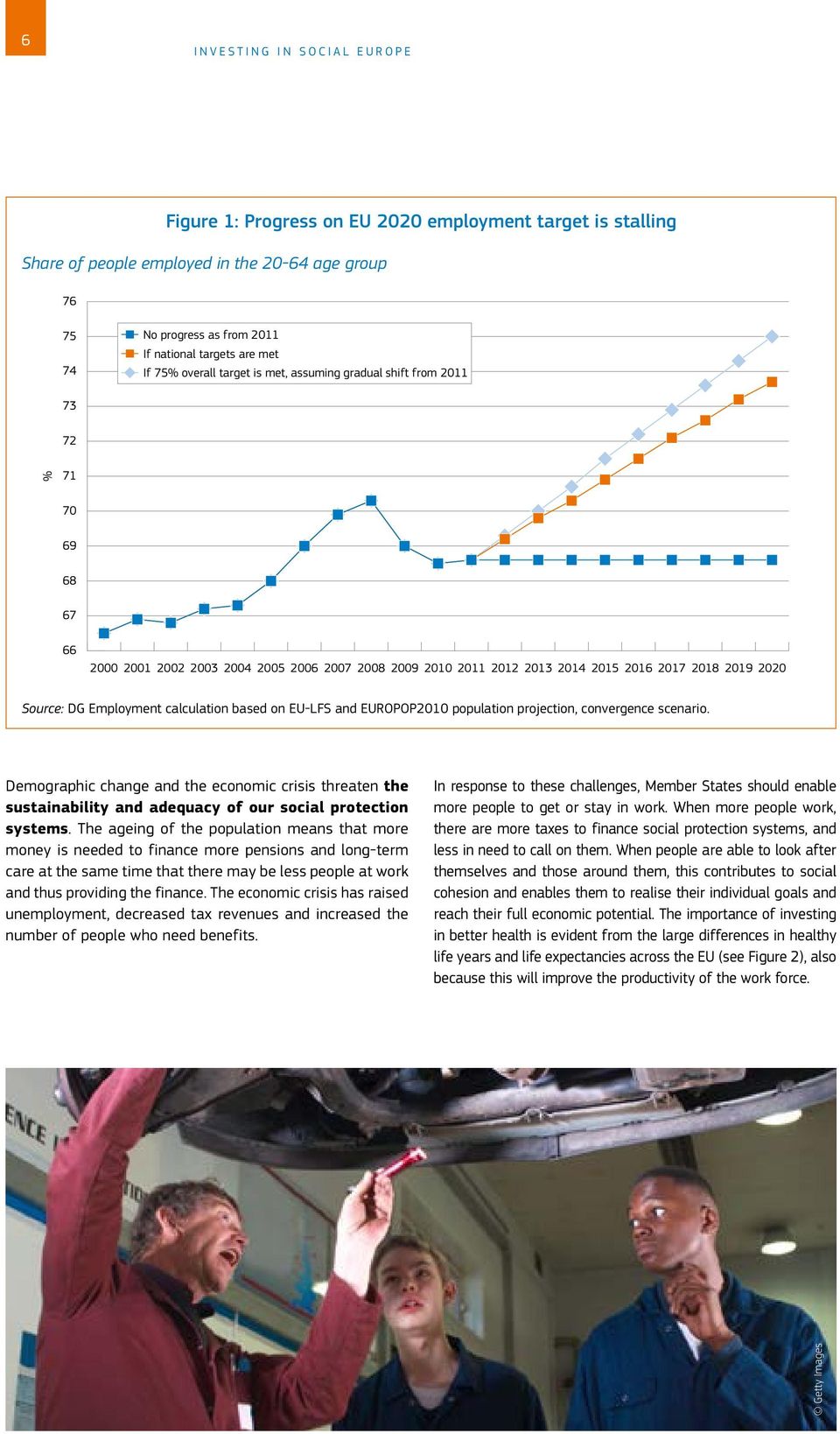
9 CHAPTER 1: THE CASE FOR SOCIAL INVESTMENT 7 Figure 2: Remaining life expectancy varies across Member States Remaining life expectancy at 65 across Europe (2010) LE N/A Source: Eurostat. The efficiency and effectiveness of social spending must improve to ensure that it is sustainable and can deliver what is required. The size, structure and design of social policies all matter for the performance of welfare systems. Member States with similar levels of social spending achieve different results (see Figure 3). This indicates that there is room for efficiency gains in social policies. This is possible, by addressing the following issues: Insufficient monitoring results in unnecessary spending; Poorly targeted cash benefits and social services do not reach the people in need of assistance; There is insufficient use of opportunities for mutually reinforcing synergies between different social and employment policies. A multiplicity of benefits, agencies, and conditions for entitlement leads to extra administrative costs and low take-up by those most in need;

10 8 INVESTING IN SOCIAL EUROPE Figure 3: Similar budgets lead to very different results Social protection spending (relative to GDP) and relative reduction in share of population (aged 0-64) at risk of poverty (2010) 70 AROP reduction (in %) low spending, high poverty reduction PL MT LV RO BG EE LT CZ SK IT CY HU PT SI LU ES AT UK EU27 BE SE FI FR DE NL high spending, high poverty reduction DK 10 Low spending, low poverty reduction EL high spending, low poverty reduction Social protection spending excluding pensions relative to GDP (in %) Source: ESSPROS and EU-SILC. Note: Shows relationship between social protection spending (excluding pensions, relative to GDP, as a percentage) and relative reduction in the share of population (aged 0-64) at risk of poverty (as a percentage) (2010). AROP = at-risk-of-poverty, below 60 % of the median income. European Union

11 CHAPTER 1: THE CASE FOR SOCIAL INVESTMENT 9 Figure 4: Higher social investment budgets have a stronger association with higher employment rates Social spending and employment rates (2010) Employent Rate y = 1,6912x + 56,03 SE NL NO R² = 0,3821 DK 75 CY DE AT LU UK FI CZ SI 70 PT FR EE EU BG LV IE BE 65 LT SK EL PL RO IT ES MT HU Social investment budgets (% of GDP) Employent Rate y = 0,5113x + 52,594 R² = 0,3457 BG LV CZ SK LT RO EE LU PL MT HU CY SI ES PT EL EU UK DE AT BE IE IT Total social budgets as % of GDP SE NL FI FR DK Source: Eurostat, DG Employment calculations. Note: Social investment budgets are estimated by combining childcare, active labour market policies, education, research and rehabilitation. Figure 4 shows that while higher overall social spending is associated with higher employment rates, higher social investment budgets within that total have an even stronger association with higher employment rates. Countries also vary significantly in their ability to translate a similar level of resources into health outcomes. International comparisons show that the same amount of per capita healthcare expenditure can be associated with very different health outcomes even after taking into account the differences in lifestyle and socio-economic realities among countries. The need to invest in people s skills and capacities and to ensure for them an adequate standard of living starts at a very early age and continues throughout life. Children who grow up in poverty often stay in poverty for their entire lives. Disadvantages children face in health, living environment and education such as limited access to high quality childcare and education, to additional learning support, or to learning opportunities often result in people facing difficulties throughout their whole life. This is why a focus on prevention, developing people s skills and capabilities and ensuring they have enough to live on can result in considerable savings later on and is a better use of public resources (see Figure 5). Equipping people with the tools they need to have a long and healthy working life helps them earn enough to look after themselves and their families, in their working life through to retirement. Affordable childcare for example, along with appropriate tax and benefit incentives, is very important in enabling parents, and especially mothers, to get a job (see Figure 6). Quality early childhood education and care and other services are essential to children s well-being and to help them develop the social, cognitive and emotional skills they need. Preventing early school-leaving, obtaining a higher qualification which matches labour-market needs will result in better chances for young people to secure a job, because they are in a more flexible situation.

12 10 INVESTING IN SOCIAL EUROPE Figure 5: Influence of pre-primary education policies on PISA results Impact of different pre-primary policies on score point difference of PISA result (2009) Increase by 10 percentage points the proportion of students who attend pre-primary school Increase the duration of pre-primary school by 1 year Reduce pupils-to-teacher ratio in primary schools by 1 student Spend extra 1000 dollars (PPP) on pre-primary education Source: OECD (2012). Europe will not achieve progress without addressing the issue of gender inequality. Overall 12 million more women than men in the EU are living in poverty. As well as earning lower wages, fewer women have jobs while those that do work shorter hours, partly because of unpaid household, childcare and long-term care tasks. Taken together, these three factors mean that in Europe women s gross annual labour market earnings are 42 % below those of men. Women, including many single parents are becoming increasingly vulnerable to homelessness and more exposed to domestic and street violence. As gender inequality runs through an individual s entire life and its negative effects build up over time, this results in lower overall GDP, lower wages and social security contributions and higher poverty among older women. Supporting women in work with measures such as accessible childcare and flexible working arrangements promotes not only gender equality but maximises investment in the next generation. Getty Images

13 CHAPTER 1: THE CASE FOR SOCIAL INVESTMENT 11 Figure 6: Higher access to childcare leads to more women in employment Employment rate of women with young children and share of children 0-3 years old in formal childcare (2010) y = 0,5234x + 47,326 R² = 0,504 Employment rate of females aged with youngest child below 6 years old PL RO CZ MT LT AT EL BG LV FI DE CY IE* IT EE LU BE SI UK PT ES FR NL SE DK 30 SK HU Share of children aged 0-3 in formal childcare Source: EU-SILC and Labour Force Survey, DG Employment calculations. Note: For a child to be considered as being in formal childcare, at least one hour per week of formal childcare is required. The growing divergence between Member States and increasing polarization within societies are undermining growth and threatening the social cohesion and the sustainability of public finances. Severe social imbalances can threaten the European Monetary Union as much as fiscal or external imbalances. Implementing the right social policies means investing in people and thus creating a catalyst for competiveness and economic growth in a globalized world. Key messages Challenges posed by demographic changes and the economic crisis call for a European-wide comprehensive approach to increase the sustainability of our social protection systems. In many Member States there is room to improve the efficiency and effectiveness of social spending. Unintegrated social protection systems, with multiple benefits, agencies, and conditions for entitlement often lead to extra administrative costs and low take-up by those most in need. A focus on prevention, developing people s skills and capabilities, and ensuring adequate livelihoods result in considerable savings later on and is a good use of public resources. Supporting women in work with measures such as accessible quality childcare not only promotes gender equality but also maximises children s opportunities.

14 12 European Union Chapter 2: Avenues of social investment reforms Responding to current challenges requires efficient and effective social investment. Measures should focus on individual needs arising throughout life and should be taken as early as needed to prevent hardship from compounding over time. The examples presented in this chapter are a small selection of many social investment initiatives across Europe. Drawing on such good practice, the Social Investment Package provides comprehensive policy guidance for Member States social policy modernisation. 1. Increase the sustainability and adequacy of social systems through simplification and better targeting Available resources need to be used more efficiently and effectively. This can be done through simplifying, better targeting and considering conditionality when designing certain policies. Universal and selective measures need to be combined in an intelligent way. For example, ensuring that pre-school is widely accessible to children, especially those whose parents have difficulty affording it, has a sizeable and persistent positive effect on a child s ability to succeed in school and, in the long term, obtain higher wages in the labour market. Social policies should provide appropriate support to those most in need. This helps address both sustainability and adequacy issues, which are two sides of the same coin. Administration of both benefits and services should be simplified to make it easier for people to access them and to reduce the administrative burden. This also increases the take up of benefits, ensuring that people make use of the benefits and services available to them. Simplifying benefit systems, for example through one-stop-shops that offer people a single entry point to access benefits and services, improves efficiency and clarity of information while making it less time-consuming to obtain support. Member States also need to step up their efforts to reduce fraud and error. The financing structure can be strengthened in several ways: by improving tax collection, broadening tax bases, reviewing tax expenditure items and making the tax structure more growth-friendly, e.g. through environmental taxes. The Commission supports Member States through the analysis of good practices which demonstrate how better efficiency of social spending can be achieved. In addition, this is a priority for social policy reforms which the Commission monitors in the framework of the European Semester. In health systems there is likewise significant room for efficiency gains. Europe can improve the population s health without increasing health spending through:

15 CHAPTER 2: AVENUES OF SOCIAL INVESTMENT REFORMS 13 Better health promotion and disease prevention; Reducing unnecessary use of specialist and hospital care by relying more on general practitioners; Ensuring cost-effective use of medicines, including by relying on less expensive generic drugs and assessing the cost-efficiency of health technology more systematically before putting it to use; Using IT solutions to make processes more cost-efficient. Efficient prescription service in Sweden The delivery of eprescriptions in Sweden is a joint effort between each county council in Sweden and Swedish pharmacies. 42 % of all prescriptions are transferred from the doctor to the pharmacy electronically via Sjunet, the Swedish Information and Communication Technologies (ICT) network for healthcare, or by using web-based prescribing. eprescriptions increased security and quality of prescriptions, and reduced medication errors by 15 %. They led to considerable saving of time for healthcare providers. Patients benefitted from a dedicated drug information hotline which improved their knowledge and safety, and also their ability to choose in which pharmacy to obtain their drugs. The economic evaluation of the case study of eprescriptions in the Stockholm County demonstrated that this electronic service generated an estimated net economic benefit of over 95m over the eight years. Five years after, there was already a net benefit of approximately 27m, due in part to the relatively low spending on ICT of less than 4m for the whole period of eight years. Healthcare provider organisations obtain 80 % of the benefits. The remaining 20 % benefit citizens, chiefly through increased safety thanks to correctly issued prescriptions and better adherence to treatment. 2. Pursue activating and enabling policies through targeted and more effective support It is essential to remove those remaining obstacles which stop people working and participating in society. Key to this is investing in social policies, services and cash benefits which activate and enable people to develop their skills and obtain an adequate standard of living. Support must offer a way out from unemployment and inactivity and be granted only for as long as needed. Minimum income schemes should ensure that people have enough to live on in dignity whether they are fit or unfit to work. Using reference budgets will help Member States achieve this by ensuring that minimum income schemes reflect the real costs of living. Reference budgets are based on evaluating the cost of a basket of basic goods and services that a family of a specific size and composition needs to be able to live at a designated level of wellbeing. Assistance should combine monetary support (cash benefits), in-kind support (housing, healthcare), and enabling services (transport, bank accounts, etc.). It is very important that measures are tailored to match individual needs. This can improve the take-up of benefits by those who are entitled to them. Benefit systems should also make work pay, through targeted in-work fiscal incentives or tapered benefit thresholds. These are both ways to ensure that the loss of benefits and increase in social contributions when entering work is gradual. Adequate minimum income support combined with activation in Austria Austria has recently reformed its minimum income scheme so that it better prevents social exclusion and poverty, strengthens support for people entering the labour market and unifies various social assistance programmes existing at Länder (state) level. In 2010 the Bedarfsorientierte Mindestsicherung (BMS), a nation-wide means-tested minimum income scheme, replaced the former programmes. The BMS functions as a social protection scheme of last resort and follows the principle of help for self-help. It focuses on the re-integration of the unemployed into the labour market by granting a minimum income, social services and job training. The city of Vienna s Step2Job project is a good example of the integrated activating approach. Designed as a case management project, BMS recipients receive personalised qualification measures or in-job training along with psychological, social and indebtedness advisory services. Moreover, there are internship possibilities especially set up for BMS recipients with a view to take-over by employers and NGOs. During the internship period, job coaching is available. Additionally, German language courses are offered to BMS recipients with migrant status. There is strict means-testing, and recipients are regularly checked for their willingness and ability to work. Sanctioning mechanisms should prevent long-term dependence on social welfare which negatively affects earnings over the life course and later pensions.

16 14 INVESTING IN SOCIAL EUROPE It is also essential to remove obstacles to the labour market that prevent people from achieving economic independence and fulfilling individual aspirations, including by closing the gender pay gap. This also involves labour market regulations to address workplace discrimination, measures to reconcile work and family responsibilities, and quality, accessible childcare services. Addressing homelessness through integrated, long-term strategies with a focus on prevention and early intervention leads to significant savings on emergency housing provision, healthcare and preventing crime, while also better meeting the needs of homeless people. Examples of such solutions include strong safeguard measures against evictions or aiming at the permanent re-housing of those who fall into homelessness as early as possible. An integrated, housing-led homelessness strategy in Finland The Finnish housing-led homelessness strategy was adopted in February It aimed at halving longterm homelessness by 2011 and ending it completely by The programme includes an ambitious goal to convert all traditional short-term shelters into supported housing units that facilitate independent living additional homes supported housing units or places in care are expected to be made available for the long-term homeless people. This includes supported housing provisions for recently released prisoners, programmes to reduce youth homelessness and prevent evictions, e.g. by through expanding housing advisory services. In Tampere, the evaluation of the housing-led strategy showed substantial cost savings in service use after rehousing. The average cost savings for one tenant were per year when compared to the situation and service use while homeless. The greatest saving came from the reduction in the number of hospital visits and the use of intoxicant rehabilitation services. To this figure one could add the extra taxes paid by persons who have been successfully reintegrated into working life. 3. Social investment throughout the individual s life Support should target specific needs that arise at different stages of people s lives. This means adapting integrated services, cash benefits and assistance to people s needs at critical moments to prevent hardship from materialising later. Policies with a focus on prevention and investing in people s skills and capacities give considerable savings later on. Investing in children is vital for a sustainable, efficient and competitive knowledge economy and fair society. The adequacy of future pensions depends on our children. Combined with child income support ensuring adequate living standards, good quality and accessible early childhood education and care (ECEC) is an efficient means of preventing early school leaving and improving academic performance, health and employment outcomes later in life. Making sure people achieve their best also requires ensuring equal access to quality education, further measures to reduce early school leaving, eliminating school segregation and the misuse of special needs education. Early childhood education and care for Roma children A Good Start: Scaling-Up Access to Quality Services for Young Roma Children (AGS) was a project run by the Roma Education Fund providing quality early childhood education and care (ECEC) activities to disadvantaged communities and strengthening parental skills and practices of parents through well-designed, community based services. Starting in June 2010 and ending in June 2012, the programme provided support for Roma children across a range of their developmental needs, a key element to breaking the cycle of poverty. The two school year long project was financed from a 2 million EUR budget by the European Commission, DG Regional and Urban Policy, and co-financed by the Roma Education Fund and operated in 16 localities in four countries Hungary, FYR of Macedonia, Romania, and Slovakia. The project targeted almost disadvantaged Roma and non- Roma children from birth to six-seven years old and their parents or care givers by offering pre-school, community, and home-based services. The wide range of activities was tailored to the local situation and needs of the Roma communities. The different types of activities included community motivation events on education and health issues for parents, parenting education, home visits, and assistance to families in enrolling their children to preschools. These also included various forms of support for preschool attendance of children: material support such as clothes, shoes, school supplies and hygiene packages; the facilitation of transport to and from preschool; accompaniment of children to and from schools; and tutoring for pupils attending the first grade of primary schools. As such, AGS activities were targeted at a wide range of actors, with local partner NGOs having considerable flexibility in its local approach. Comprehensive measures promoting youth employment are essential to ensure a good start in life. However, support to people s skills and employability must not end there. Lifelong

17 CHAPTER 2: AVENUES OF SOCIAL INVESTMENT REFORMS 15 Imageglobe learning opportunities and upskilling schemes are important for employability throughout people s entire working lives. Health investment, health promotion and preventive health care measures are also crucial to allow people to remain active and independent for longer. Later in life, health, long-term care and active ageing policies enable people to make the most of their potential. Active ageing strategies include inclusive workplace measures, such as adapted workplaces and reskilling opportunities. The contributions of older people to society as carers for others or volunteers should be actively encouraged. Accessible and affordable transport, and adapted housing opportunities allow older and disabled people to remain in charge of their own lives for as long as possible, and reduce the need for long term care. It is also important to take measures to reduce the need for long term care, raise the self-sufficiency of people with lighter care needs and increase the productivity of care services - while providing financially sustainable, high-quality community-based care rather than institutionalisation. This can empower older people with functional limitations to manage their lives, so that they retain autonomy with choice and dignity despite the physical and mental effects of ageing. This way one can also reduce pressures on family members who may not be able to afford care services or dedicate enough time for caring responsibilities. Increased productivity of long term care delivery bring possibilities for providing more and better care with less manpower, thus reducing pressure on public budgets. Integrated long-term care services in Italy In Italy, E-care is a pro-active case management service in operation since 2005, aimed at maintaining independent living for the elderly in their own homes through customised care plans designed according to individual needs. E-care is a service organised as a 24 hours / 7 days week call centre that offers a wide range of services targeting physically frail or socially-isolated elderly people aged 75+ living at home. The service provides older people with information on health, social care and social alarm services. A call centre functions as an intermediary between the frail elderly and social and health care providers. On a regular basis, an operator contacts the elderly to check their wellbeing, health conditions and needs. If a problem arises, the operator and the patient decide together upon the action to take: intervention of a doctor or a volunteer organisation for social support. A unique electronic file saves the basic individual history and a software platform allows for information-sharing and data transfer between care services. The E-Care platform has also been used to integrate services such as: (i) Uffa che Afa, an initiative set up to support vulnerable people during severe heat-waves; (ii) a tele-geriatrics service to support people who need care after hospital discharge; (iii) a dementia-specific telecare service, (iv) the Giuseppina service that provides free home delivery of food and medication as well as transport services to hospitals or social events. E-care has reduced the number of hospital admissions and led to a decrease of 50 % in users accessing hospital services.

18 16 INVESTING IN SOCIAL EUROPE The Social Investment Package The Social Investment Package consists of a Communication setting out a policy framework, concrete actions to be taken by Member States and the Commission, and guidance on the use of EU funds to support reforms. It is accompanied by: A Recommendation on Investing in Children: breaking the cycle of disadvantage, containing an integrated policy framework to improve children s opportunities; A Staff Working Document (SWD) containing evidence on demographic and social trends and the role of social policies in responding to the social, economic and macro-economic challenges the EU is facing; A SWD following up on the 2008 Commission Recommendation on Active Inclusion of People Excluded from the Labour Market and providing further guidance on active inclusion; The 3 rd Biennial Report on Social Services of General Interest to help public authorities and stakeholders understand and implement the revised EU rules on social services and thus to invest in the sector in a safer way; A SWD on long term care, presenting challenges and policy options; A SWD on confronting homelessness, explaining the situation of homelessness in the European Union and possible strategies to consider; A SWD on investing in health, containing strategies to improve the efficiency and effectiveness of health systems and discussing how health can contribute to social inclusion; and A SWD outlining how the European Social Fund will contribute to implementing the Social Investment Package. Key messages Social investment is about investing in people. It means policies which strengthen people s skills and capacities and support them to take part fully in working and social life. Increasing the sustainability and adequacy of social systems can be done in part through simplifying benefit administration and better targeted support. Integrating policies that activate and enable people to participate in working life and society should be coupled with benefits to ensure people have an adequate standard of living. Providing support to people when they need it during the critical moments of their lives, as early as needed, prevents problems from compounding. Investing in children and youth is therefore essential. There are numerous examples of social investment across Member States. The Social Investment Package draws on this good practice and expertise to provide concrete policy guidance to modernise national welfare systems.
19 17 European Union Chapter 3: Making social investment a reality across Europe The Social Investment Package provides guidance to the Member States on using their social budgets more efficiently and more effectively, ensuring appropriate living standards, raising people s opportunities for development, and helping them to take part fully in society and in employment. To this end, the Commission monitors national reforms in the framework of the European Semester and works together with the Member States through the Social Protection Committee using the open method of co-ordination. In addition, the Commission provides policy expertise, capacity building and financial support, in particular through the European Social Fund. 1. The European Semester All Member States committed to achieving the Europe 2020 targets and translated them into national targets and growthenhancing policies. But only if the individual efforts of all the countries are coordinated and focused, can they result in the desired impact on growth and better cohesion. Therefore the European Union has set up a yearly cycle of economic policy coordination called the European Semester. Each year the European Commission undertakes a detailed analysis of EU Member States programmes of economic and structural reforms and together with the Council provides them with recommendations (called Country-Specific Recommendations, or CSRs) for the next months. The European Semester starts at the beginning of the year when the Commission adopts its Annual Growth Survey (AGS) which sets out EU priorities for the coming year to boost growth and job creation. In March the European Council endorses the policy priorities for the European Semester. The guidance provided through the Social Investment Package should be reflected in the National Reform Programmes (in which the Member States spell out how they translate the targets and policy priorities established at European level into their own policies), and which are monitored by the Commission. The specific challenges and necessary steps towards social investment are reflected in the CSRs and supported by EU financial instruments, in particular the European Social Fund (see Chapter 4). The 2013 AGS outlines priorities to prepare for a job-rich recovery, improve employability levels and promote social inclusion by tackling the social consequences of the crisis. It calls for further efforts to improve the resilience of the labour market and invest in human capital to spur job creation and enable people to remain active for longer. It recommends specific measures to improve employability particularly among young people, such as apprenticeship schemes, maintaining or reinforcing the coverage and effectiveness of employment services and active labour market policies. Active inclusion through efficient and adequate income support, as well as access to affordable high quality services,

20 18 INVESTING IN SOCIAL EUROPE are emphasised as the best ways to promoting social inclusion and tackle poverty, together with strengthening the link between social assistance and activation measures. The AGS also recommends enabling longer working lives, as well as reforms of healthcare systems to ensure cost-effectiveness and sustainability. It encourages Member States to assess the performance of their health systems against the twin aims of more efficient use of public resources and access to high quality healthcare. Two examples from 2012 demonstrate the importance of modernising social policies in line with a social investment approach. France received the following CSR among others: Adopt labour market measures to ensure that older workers stay in employment longer; improve youth employability especially for those most at risk of unemployment, by providing for example more and better apprenticeship schemes which effectively address their needs; step up active labour market policies and ensure that public employment services are more effective in delivering individualised support. The following is an excerpt from a Bulgarian CSR: Accelerate the implementation of the national Youth Employment Initiative. Ensure that the minimum thresholds for social security contributions do not discourage declared work. Step up efforts to improve the Public Employment Service s performance. To alleviate poverty, improve the effectiveness of social transfers and the access to quality social services for children and the elderly and implement the National Roma Integration Strategy. The Social Investment Package will strengthen the social dimension in the European Semester, as, for instance, Member States are urged to: Better reflect social investment in the allocation of resources and the general architecture of social policy; Improve targeting of social policies to ensure that those most in need receive adequate support while reducing the burden on public finances; Fully implement the Commission Recommendation on Active Inclusion and the Commission Recommendation for Investing in Children; Simplify benefit systems and their administration for users and providers, reduce administrative burdens as well as fraud and increase take up; Establish reference budgets to help designing efficient and adequate income support; Put in place legal frameworks that ensure access to efficient, high quality and affordable social services that respect the EU rules; Improve the sustainability of the health systems; Address childhood inequalities through improving the accessibility of ECEC, eliminating school segregation and the misuse of special needs education; Develop strategies for social innovation, such as publicprivate-third sector partnerships, and ensure adequate and predictable financial support, including innovative ways of securing additional private financing for social investment; Confront homelessness through comprehensive strategies based on prevention, housing-led approaches and reviewing regulations and practices on eviction; Improve the financing structures through efficient revenue collection, broadening of tax bases and making the tax structure more growth-friendly, avoiding negative impacts on labour demand. The Social Investment Package will continue to be reflected in future European Semester exercises, through informing the AGS and the CSRs. For its part, the Commission will undertake a wide range of actions to support the Member States implementation of the SIP. 2. Examples of the Commission s actions to support Member States 2.1. Methodologies The Commission is developing methodologies to guide and support Member States reforms in the European Semester. For example, it is developing a methodology to measure the efficiency, effectiveness and the investment dimension of public budgets for social policies. To support the Member States in implementing the Active Inclusion Recommendation, a methodology for reference budgets is also being developed. This will enable monitoring of the adequacy of income support, for instance through the European Semester. Both of these methodologies will be developed together with experts and Member States, through the Social Protection Committee (SPC) and its indicators sub-group.
21 CHAPTER 3: MAKING SOCIAL INVESTMENT A REALITY ACROSS EUROPE 19 Michel Loriaux European Union 2.2. Exchange and dissemination of good practice The Commission will be building up a knowledge bank to promote and facilitate the exchange and dissemination of good practice. Good practice examples will be identified and promoted in a number of areas. Firstly, countries which have streamlined benefit systems and have set up one-stop-shops will exchange experiences on how this has increased the take-up of services and benefits, thereby improving the effectiveness and efficiency of social spending. Another area for mutual learning is developing innovative ways to secure additional private financing for social investment to improve the fiscal base for social protection systems. The exchange of good practice examples, based on clear quality criteria, is particularly useful when comprehensive strategies to complex social challenges are required, such as accessible and quality early childhood education and care (ECEC). The Commission is facilitating the inclusion of Roma also by supporting transnational cooperation, through the Network of National Roma Contact Points Studies and pilot projects The Commission-led studies and pilot projects will inform the development of future social investment policy. One such research project financed by Progress is testing the effectiveness of conditional cash transfers (financial incentives to invest in children s development through for instance health checks or ECEC attendance) in improving children s outcomes. The use of conditional cash transfers has proved effective in Romania where preschool attendance improved by 40 % through a programme offering food coupons alongside doorto-door recruitment, parental engagement and teacher training. Member States are urged to step up efforts to confront homelessness through comprehensive strategies based on prevention, housing-led approaches and reviewing regulations and practices on eviction. To support this, a pilot project will be carried out to investigate new approaches for addressing repossessions, evictions and homelessness. Social innovation is an essential element because social policies need constant adaptation to new challenges. This means developing and implementing new products, services and models, testing them, and favouring the most efficient and effective. Member States can encourage this by providing an enabling framework for social policy innovators. Social innovation needs to be embedded in policy making and connected to social priorities. To support Member States efforts, the Commission will for example evaluate and disseminate results of the Housing First Europe project which presents a promising avenue to tackle especially long-term homelessness. The Commission will also provide guidance in 2013 to Member States on how to use social policy innovation in implementing the CSRs, including through using the EU funds Policy analysis and expertise To ensure that policy guidance remains relevant and effective, the Commission is continuing to build up policy analysis and expertise, such as through its annual Employment and Social Developments in Europe Review. The 2014 Review will include an in-depth analysis of the efficiency and effectiveness of social spending, the gender dimension and the prevention of poverty and social exclusion. A policy makers manual is being developed to assist Member States in designing long-term care strategies, based upon work to be carried out in in co-operation with the Institute for Prospective Technological Studies of the European Commission s Joint Research Centre. The SPC and the Commission will present a report this year on long-term care policies to support active and healthy ageing and raise the capacity for independent living of people of all ages. Over the course of 2013 the Commission will also set up an expert panel to provide independent advice on effective ways of investing in health.
22 20 INVESTING IN SOCIAL EUROPE In turn, the Member States are urged to use the Guiding Principles for Active Ageing and Solidarity between Generations developed during the European Year of Active Ageing. They are also encouraged to use the active ageing index (see box) which monitors older people in employment, their social participation, and independent living, and make the most of the opportunities offered by the European Innovation Partnership on Active and Healthy Ageing. The Active Ageing Index The Active Ageing Index is a monitoring tool which was developed by the European Centre Vienna, in collaboration with the United Nations Economic Committee for Europe and the European Commission s DG Employment, Social Affairs and Inclusion. The index measures the performance of countries in four domains that together determine their active ageing potential: (1) employment of older workers; (2) social activity and participation of older people; (3) independent and autonomous living of older persons; and (4) an environment that enables active ageing. The index aims to help shape future research and policy agendas and influence how existing large-scale data-sets are developed to address the impact of population ageing by following the policy discourse on active ageing and solidarity between generations Capacity building The EU funds are one of the key channels through which the Commission will support the Member States in implementing the Social Investment Package (see Chapter 4). To this end, in 2013 the Commission is developing operational guidance on how Member States can best use the Funds to support social investment in all four of the ESF s investment priority areas: promoting employment, investing in education, combatting poverty and enhancing institutional capacity. Under Progress tailor-made advisory services will be set up for Member States engaging in social policy experimentation as a tool to test social policy innovations and reforms before their implementation. Social policy experiments are a rigorous method of collecting evidence about the real impacts of measures on people, which in turn enables the fine-tuning of services and benefits more effectively. Commission support also includes awareness-raising, capacity-building and training. From 2014, the new Programme for Social Change and Innovation (PSCI) will provide a new impetus to social innovation activities. Specific assistance will also be provided to national administrations in several other areas. For example, financial support will be offered to develop active and healthy ageing strategies, and to design reforms for more cost-effective social protection systems. In addition, support for capacity building will be offered through the ESF to national and regional authorities to implement effective policies to promote social entrepreneurship. The Commission has recently clarified to public authorities and service providers how EU rules on State aid, internal market and public procurement apply to social services, through an updated Guide Initiatives for timeliness and development of data Guiding social policy modernisation towards achieving the Europe 2020 targets must be based on timely data. Due to lengthy data collection and transfer processes, there can be as much as two or three years time lag in the data that analysis is based on. To address this, the Commission and the Social Protection Committee have developed a methodology for a Social Protection Performance Monitor (SPPM). The methodology includes annual identification of social trends to watch in the EU, using commonly agreed EU social indicators. The SPPM will also be used to assess trends and reforms towards the Europe 2020 targets and provide visually accessible data to policy-makers. The tool aims at strengthening the monitoring of the social situation in Europe. The Commission is also improving its methods for producing longitudinal data, i.e. data that follows individuals or households over time. Longitudinal data coverage at the individual level provides for a much more robust analysis of social dynamics than purely cross-sectional data. It can for example provide information on the differing lengths of time people experience poverty in different countries. In 2014 the European statistics instrument for collecting data on income and living conditions (EU-SILC) will undertake an ad-hoc module on material deprivation with a special focus on children. Poverty maps The Commission will support through the ESF the development of poverty maps, identifying local areas of multiple and severe disadvantage to ensure that actions impact on the target population.
23 CHAPTER 3: MAKING SOCIAL INVESTMENT A REALITY ACROSS EUROPE 21 Michel Loriaux European Union 3. The social Open Method of Coordination The social Open Method of Coordination (OMC) provides a framework for national strategy development, as well as for coordinating policies between EU countries on issues relating to three areas: Poverty and social exclusion Health care and long-term care Pensions It is a voluntary process for political cooperation based on agreeing common objectives and common indicators, which show how progress towards these goals can be measured. National governments translate the common objectives into national plans which are then assessed at EU level. The OMC aims also to develop a mutual learning process involving the scrutiny of specific policies, programmes or institutional arrangements presented as good practices in the national strategic reports. One of the main tools in this respect is the Peer review seminars which encourage the dissemination of good practices across Member States by assessing the effectiveness of key policies or institutions. Much of the work is carried out through the Social Protection Committee (SPC) - a vehicle for cooperative exchange between Member States and the Commission - and its indicators sub-group. The 2013 work programme of the SPC fully supports the social investment agenda. For example, the SPC will be working on monitoring the efficiency and effectiveness of social protection, as well as its investment dimension. Equally, it will contribute to a methodology for designing reference budgets and will produce a report on long-term care policies to support healthy and active ageing and raise the capacity for independent living of people of all ages.
24 22 INVESTING IN SOCIAL EUROPE Complementary EU initiatives Aside from the direct actions outlined in this chapter, several initiatives are being taken at EU-level that will support the Social Investment Package, for example: An EU Framework for National Roma integration strategies ensures that such strategies are designed or, where they already exist, are adapted to address the specific needs of Roma people regarding equal access to employment, education, housing and healthcare and meet EU Roma integration goals. The Social Business Initiative is a package of measures to support social entrepreneurship and responsible business. The Directive on energy efficiency aims to ensure that vulnerable customers have access to the benefits of higher energy efficiency. The European Social Entrepreneurship Fund stimulates social investment funding. The Youth Employment Initiative supports young people not in education, employment or training and help integrate them in the labour market. The European Council agreement on the Youth Guarantee scheme will be implemented from The forthcoming Bank account legislative package will contain, among others, provisions which translate the principles of the 2011 Recommendation for citizen s access to a basic bank account into a binding legal instrument. The aim is to allow consumers to have access to basic payment account services irrespective of their financial situation or Country of residence. The proposed Erasmus for All programme aims to support inclusive education initiatives, help young people get training and skills that can increase their personal development, gain new skills and language abilities and improve their overall job prospects. The proposal for a Directive on the accessibility of public sector bodies websites will improve citizens awareness of their social rights. The Directive on credit agreements for residential property ensures that all consumers purchasing a property or taking out a loan secured by their home are adequately protected against the risks. This helps avoid difficulties in paying bills, debt defaults or the loss of homes through foreclosure. Key messages The Commission supports Member States to reform their social policies through its funds, monitoring progress through the European semester and working together with the Member States through the social Open Method of Coordination. The Commission also provides support through policy expertise, capacity-building, research, accurate and timely data, methodologies and guidelines, as well as platforms for exchange and dissemination of good practice.
25 23 Michel Loriaux European Union Chapter 4: EU funds supporting social investment Between 2014 and 2020, the European Social Fund (ESF) will be the EU s main financial instrument to catalyse the implementation of employment and social policy reforms by Member States, in line with the Europe 2020 Strategy. The four objectives of the ESF are promoting employment and labour mobility; investing in education, skills and lifelong learning; promoting social inclusion and combating poverty; and enhancing institutional capacity and efficient public administration. Member States implementation of social investment will receive substantial financial support through the ESF. In the programming period, the European Social Fund has so far reached over 50 million people, mostly impacting the lives of unemployed and inactive people. It did so by providing 75 billion to help people fulfil their potential by giving them better skills and better job prospects. Multi-annual Financial Framework For the next Multi-annual Financial Framework ( ), the Commission has proposed that at least 25 % of cohesion policy funding should be allocated to the ESF, in other words, investment in people. The ESF s budget is expected to increase by 10 %, to at least 84 billion. It has also been proposed that at least 20 % of total ESF resources in each Member State should be used for promoting social inclusion and combating poverty.
26 24 INVESTING IN SOCIAL EUROPE ESF funding will continue to be complemented by financing from other European funds. In particular: The European Regional Development Fund (ERDF) supports investments in health, social, early childhood education and care, housing and education infrastructure, as well as physical and economic regeneration of deprived urban and rural communities. The new Programme for Social Change and Innovation (PSCI) ( ) will integrate and extend the coverage of the Progress (in part), EURES and European Progress Microfinance Facility programmes. PSCI will support the development and coordination of social investment policies, sharing of best practices, capacity-building, and testing of social innovations, with the aim to up-scale the most successful measures. It will also help develop and expand capacity-building and micro-finance support for micro-entrepreneurs and social enterprises. The new Fund for European Aid to the Most Deprived (FEAD) will provide food, clothing and other essential goods to, among others, homeless people and materiallydeprived children. The European Global Adjustment Fund (EGF) helps workers made redundant as a result of changing global trade patterns to find another job as quickly as possible. The European Agricultural Fund for Rural Development (EAFRD) promotes investment into infrastructures in rural areas, to support the competitiveness of agriculture and forestry, the environment and the countryside, the quality of life and the management of economic activity in rural areas. The Cohesion Fund supports the less wealthy Member States by financing trans-european transport networks and environmental projects including those related to energy or transport. The European Maritime and Fisheries Fund (EMFF) helps the fishing industry and coastal communities become economically resilient and ecologically sustainable. EU funds are vital instruments to promote social investment in the Member States. Their role is to catalyse funding for social investment at national and regional levels, but they are not a substitute for that funding. While total expenditure on social protection in the EU stands at billion annually, the proposed annual funding for European Structural and Investment Funds is 45 billion and that for the Programme for Social Change and Innovation is 0.14 billion. The structure of the funds as well as the amount allo cated to them in the Commission s proposals can be seen in Figure 7. Although these proposed allocations for the period may yet change somewhat, this gives an idea of their relative sizes. To integrate the three previous programmes detailed above the PSCI fund will be structured in three axes (see Figure 8). Michel Loriaux European Union
27 CHAPTER 4: EU FUNDS SUPPORTING SOCIAL INVESTMENT 25 Figure 7: EU Fund structure and Commission proposed allocations for European Structural and Investment Funds (ESI Funds) billion Structural Funds ESF ERDF Cohesion Fund EGF EMFF PSCI 84 bn ( 2.5 bn of which to be allocated to FEAD) 183 bn 68.7 bn 3 bn 7.5 bn 958 mn Figure 8: PSCI fund structure and allocations PSCI Progress 60 % (of which 17 % allocated to promoting social experimentation) mn EURES Micro-finance and Social Entrepreneurship Flexibility reserve 15 % 20 % 5 % 1. The role of the ESF in supporting the implementation of the SIP The SIP will feed into the European Semester and the development of the appropriate Country-Specific Recommendations (CSRs) (see Chapter 3). Member States are expected to use the ESF in line with the relevant CSRs. In this way, the ESF will support the implementation of social investment in line with the countries specific needs. Examples of current ESF programmes demonstrate how the Commission s financial proposal for the ESF from 2014 to 2020 will strengthen support for the implementation of the SIP. In 2012 the European Council provided CSRs to a number of Member States related to strengthening activation tools for supporting people into work, modernising their social protection systems, greater accessibility to social services, in particular child care and health care, addressing bottlenecks on the housing markets, as well as improving Roma inclusion. The SIP s influence on future CSRs and the forthcoming publication of integrated operational guidance for the ESF will help ensure that in the future more ESF investments will reflect the social investment approach already seen in the examples given below.
28 26 INVESTING IN SOCIAL EUROPE ESF addressing the CSR for Belgium on active inclusion With ESF support, Job&Co targets people facing particular difficulties in getting work, such as the long-term unemployed, people with disabilities and recent immigrants. The project focuses on the all-important obstacles to getting a job in the first place such as low qualifications, or a lack of confidence and language skills. Guided work experience is at the core. After establishing the job-seeker s wishes and skills, a first job contract is arranged, either in Job&Co s own workshops or with a potential employer. During this phase, participants receive intensive personal coaching and any other training they need. In particular, they are helped to acquire the attitudes and cultural know-how to get on in their new environment, such as language skills if required. And, of course, they also receive job-specific technical training the job needs for example, in the food and catering sector, as a qualified driver for goods vehicles, or in the metal-working sector. Finally, by the end of their time with Job&Co, the new employees can go forward on their own as individuals, with better control over their working lives. Total budget: ESF contribution: Number of participants: 220 ESF helping Lithuanian mothers improve family welfare In the Lithuanian countryside there are limited options for working parents to balance childcare and family responsibilities. The Working for the welfare of the family project aimed to change this in Tauragė county by offering rural women the chance to break with traditional home-centred roles as carers, and enjoy both family and work responsibilities. For the women, the project provided encouragement, careers advice and training, e.g. in languages and computer literacy. For the families, social workers offered support for childcare and looking after elderly family members while the women were away. And for local employers there were consulting and seminar sessions on promoting family-friendly working practices. In its implementation, the project drew on ESF experiences from other countries and on expertise from Norway on supporting families at risk of social exclusion. The project outcomes were significant as it helped the municipal authorities to upgrade their whole approach to people at risk of hardship. In all, 25 individuals were helped in their jobs through homecare support, and several families with disabled children who are now cared for in a new rehabilitation centre during the day. A major local company set up crèche facilities for its workers a first in the region. And the local authority workers now have the tools to take a positive attitude to helping families balance their responsibilities. ESF contribution: (covered total budget) Number of participants:
29 CHAPTER 4: EU FUNDS SUPPORTING SOCIAL INVESTMENT Social innovation and social policy experimentation Innovation and experimentation plays a key role in social investment. It has the potential to be an effective means of delivering on the SIP agenda across its full range of policy areas. The new Programme for Social Change and Innovation (PSCI) will start up in 2014, continuing the work already done by the Progress programme to promote sharing of best practices, capacity-building and testing of innovative policies, with the aim that the most successful measures be up-scaled with support from the European Social Fund. Over the past decade, the European Social Fund has made significant investments in social innovation. ESF funding allocated to social innovation in different Member States generally varies between 1 % and 5 % of the ESF total. The main ESF funding for social innovation in has been estimated as: more than 2 billion in institutional capacitybuilding, most of which contributes to developing and strengthening the innovative capabilities of the public sector; more than 1 billion for innovative activities (e.g. new forms of work organisation and better use of employees skills, including in an ageing workforce; new skills for climate change; and new ways of combating unemployment). Social innovation in the ESF has contributed to reforming social policies by improving their targeting and efficiency. Since 2011, to encourage scaling up of social policy experimentation into public policies, the calls for proposals have been restricted to public authorities. Social innovation in Portuguese migration policy In Portugal, efforts have been made to streamline and integrate benefits and services available to migrants. One-stop-shops, the National Immigrant Support Centres, have been set up with the support of the ESF, changing the public administration of immigration policies. The centres have helped immigrants to find their way through complex procedures and bureaucracy. Moreover, with a view to ensuring that administrative procedures of immigration and social inclusion go hand in hand, the centres provide a number of government and support services under one roof, involving various governmental and non-governmental organisations. Intercultural mediators with immigrant backgrounds were also recruited and trained, playing a fundamental role in this service provision, complementing the service provided by the public servants. This integrated service provision has been made possible by partnership with other providers, including NGOs. The draft ESF regulation for the period also contains new provisions to strengthen support for social innovation (article 9). It is expected that social innovation will be part of ESF programmes in all Member States and will contribute to increase the efficiency of specific social policy fields. The social economy and social enterprises are key sources of social innovation. The new cohesion policy regulations provide for priority consideration for innovation and the promotion of the social economy and social entrepreneurship.
30 28 INVESTING IN SOCIAL EUROPE 3. Accessing European Structural and Investment (ESI) funds Member States are urged to make full use of the ESI funds to support structural changes recommended in the CSRs and to ensure that they reflect a social investment approach. For example, reducing early school leaving is amongst the investment priorities of the European Social Fund, which Member States can use to develop policies in line with the integrated strategy set out in the Council Recommendation of 2011, including through prevention measures, intervention measures and measures aimed at re-engaging people who have dropped out of education. For the other funds, Member States are encouraged to use the EU resources available and allocate them to human capital development, including employment, social inclusion, reducing territorial inequalities, active and healthy ageing, accessibility of social, education and health services, and lifelong learning. Beneficiaries of funds range from public authorities, research institutions, private organisations, to employers associations and NGOs. The SIP framework laid out in Chapter 3 helps guide potential beneficiaries regarding the priorities of the ESF s cofunded programmes for the financial allocations. By mid-2013 the Commission will develop operational guidance on how Member States can best use the ESI funds to support the social investment. Measures will also be taken to increase the efficiency and impact of funding of the ESF, including through: Greater results-orientation: programming of the funds will be more strategic and geared towards results; Simplification of administrative processes: including making it easier to combine support from several funds to meet complex social investment needs. Simplifications will ease the administrative burden on the beneficiaries of the funds. This will facilitate the involvement of all stakeholders, and especially of small entities; Ex-ante conditionality (where the beneficiary is required to meet certain conditions before receiving the funds): the Commission proposes to bring this in for initiatives related to active inclusion and early school leaving, among others. This will ensure that the right conditions for effective support and the necessary policy, regulatory and institutional frameworks are in place in time for funded activities to start. How to apply for funding European Social Fund (ESF): Public and private organisations can contact the ESF managing authorities in their country. The European Commission sets funding priorities but is not directly involved in selecting projects. Detailed information on the ESF, including contact information for ESF national managing authorities, can be found here European Globalisation Adjustment Fund (EGF): Individuals or companies affected by redundancies and wishing to apply for funding should contact their national authorities. To encourage eligible applications, the Commission offers assistance to help with application process. For contact information for the national authorities and the Commission, visit social/main.jsp?catid=581&langid=en; Fund for European Aid to the Most Deprived (FEAD): The partner organisations would be public bodies or nongovernmental organisations selected by Member States on the basis of objective and transparent criteria; Progress and Programme for Social Change and Innovation (PSCI): the Progress Programme is still committing funds in 2013, through calls for proposals and calls for tender, open variously to public authorities, NGOs and private companies. Information on its calls for proposals and calls for tender is available here main.jsp?catid=987&langid=en The successor Programme for Social Change and Innovation ( ) is not yet adopted; information will be made available here jsp?catid=581&langid=en; European Regional Development Fund (ERDF) and Cohesion Fund: Managing authorities (at national, regional or another level) provide information to potential beneficiaries, select the projects and generally monitor implementation. Contact information for managing authorities in your country or region can be found here authority_en.cfm. Key messages The European Social Fund and other EU funds have a vital catalytic role to play in mainstreaming the social investment approach. The priorities of ESI funds for the are supportive of social investment initiatives. Social innovation and social policy experimentation are key for the modernisation of social policies, and are supported by the EU through its Progress and PSCI programmes.
31 29 European Union Chapter 5: Stakeholders: debate, partnership and shared commitment The Social Investment Package underlines the crucial role played by stakeholders. It builds on the dynamic partnership between European institutions, Member States, and all European, national, regional and local stakeholders established to support the Europe 2020 strategy. The current decade is likely to be marked by reduced public budgets, and so actions are needed to increase efficiency and trust by finding new participative and cooperative ways to address the social situation, while continuing to develop prevention policies and target needs where they arise. 1. The European Platform against Poverty and Social Exclusion The European Platform against Poverty and Social Exclusion, one of the flagship initiatives of the Europe 2020 Strategy, is at the basis of a joint commitment among the Member States, EU Institutions and the key stakeholders to fight poverty and social exclusion. It aims to both improve current partnership structures and widen them to include new actors. The Platform will be a crucial partner for the implementation of social investment to address poverty and social exclusion. The Annual Convention of the European Platform against Poverty and Social Exclusion is a key occasion for dialogue between policy makers, key stakeholders and people who have experienced poverty. In addition to this, the Commission organises regular EU Stakeholder Dialogue meetings to ensure collective ownership of the policy initiatives taken to combat poverty and social exclusion. 2. Key stakeholders As stakeholders, including NGOs, social partners, businesses and social economy actors, academics, foundations, think tanks and international organisations, are key players in society and the economy, consulting them and mobilising their support is crucial for social investment to be successful.
32 30 INVESTING IN SOCIAL EUROPE The involvement of civil society organisations in the modernisation of social policies is essential. They are often closer to people and are thus able to reach them better than public authorities. They also contribute to improving the knowledge and understanding of EU policies and initiatives on poverty and social exclusion, by reaching out to national stakeholders such as other NGOs, regional or local authorities. Civil society organisations also support the development, implementation, monitoring and evaluation of initiatives undertaken in the framework of the Europe 2020 Strategy such as the Platform against Poverty and Social Exclusion and the Social Investment Package. This is why SIP urges Member States to improve the involvement of these stakeholders in the modernisation of social policy as part of the Europe 2020 Strategy and European Semester. The timing and impact of engagement is very uneven across Europe, and effective participation is at risk as budgets tighten. It is therefore important to promote sustainable and consistent involvement at national level. At the EU level, the Commission will strengthen existing partnerships and continue the dialogue with all relevant stakeholders via collective and coordinated input throughout the European Semester. 3. Stakeholders and the European Social Fund (ESF) To ensure the effective use of the ESF, it is crucial to mobilise all potential resources and fully involve all concerned stakeholders at each level. The involvement of all partners is especially important for effective social inclusion measures focusing on people facing specific challenges. It will lead to better outreach and targeting of the programmes. For this reason, the Partnership Principle will be strengthened, bringing together all parties interested in the success of social investments in the preparation, design, implementation and monitoring of the programmes. A Code of Conduct, covering principles and best practices, will set out the framework within which the Member States will pursue the implementation of the Partnership Principle. Better monitoring of agreed targets will also help to increase the focus on what the measures being financed are intended to achieve. At Member State level, the ESF can also be used to support the capacity building of national or regional NGOs and social partners, helping them mobilise their resources and know-how in favour of social investments. European Union
33 CHAPTER 5: STAKEHOLDERS: DEBATE, PARTNERSHIP AND SHARED COMMITMENT 31 The Second Annual Convention against Poverty and Social Exclusion The 2012 Convention gathered more than 650 participants from around 40 countries, representing Member States, civil society and social partners. Together, they discussed how social policies need to be modernised with a view to the demographic challenges and the current economic and social crisis. The Convention provided an opportunity for an exchange of views on the main ideas of the Social Investment Package, in particular a series of workshops were organised to act as a forum for exchange of views and discussion on specific parts of the SIP. The workshops covered health investment, the gender dimension of poverty, active inclusion and the case for e-inclusion. Building on the outcomes of the debates in the workshops, EU Ministers and Secretaries of State discussed their Member States priorities in social policy reforms. Ministers agreed that when social policies are carefully designed they are an investment in society that leads to inclusive growth and cohesion. Representatives of EU institutions, Member States and civil society highlighted that shared ownership and collective commitment with the Member States, social partners and civil society is needed to ensure the successful implementation of the Social Investment Package. It was also underlined that sound and constructive dialogue as well as joint monitoring and governance of national social reforms are essential for a holistic approach to tackling the challenges we face. Key messages Stakeholders shared ownership and collective commitment is crucial for the implementation of the Social Investment Package. Stakeholders involvement will continue to be strengthened in the framework of the Europe 2020 Strategy and particularly through the European Platform against Poverty and Social Exclusion.
34 32 INVESTING IN SOCIAL EUROPE Further information Dedicated SIP page on EUROPA website Press release and video message of Commissioner Andor Documents forming the Social Investment Package, Citizens summary, Key facts and figures Frequently asked questions B-roll (raw video material for the AV media) Presentation of the Social Investment Package Latest Employment and Social Situation Quarterly Review Commissioner László Andor s website Commissioner László Andor on Twitter European Commission s newsletter on employment, social affairs and inclusion Social Europe on Facebook
35 European Commission Investing in Social Europe Luxembourg: Publications Office of the European Union pp cm ISBN doi: /46699 The worsening social situation and problems of sustainability of social protection requires action across Europe. The Commission s Social Investment Package guides Member States to modernise their welfare systems by preparing people to confront life s risks, thus reducing the need to repair the consequences. Harnessing policy expertise, the reform process, shared ownership with stakeholders and EU funds towards social investment will ensure full implementation. This publication is available in printed format in English, French and German. HOW TO OBTAIN EU PUBLICATIONS Free publications: yvia EU Bookshop ( y at the European Union s representations or delegations. You can obtain their contact details on the Internet ( or by sending a fax to Priced publications: yvia EU Bookshop ( Priced subscriptions (e.g. annual series of the Official Journal of the European Union and reports of cases before the Court of Justice of the European Union): y via one of the sales agents of the Publications Office of the European Union (
36 KE EN-C Are you interested in the publications of the Directorate-General for Employment, Social Affairs and Inclusion? If so, you can download them or take out a free subscription at You are also welcome to sign up to receive the European Commission s free Social Europe e-newsletter at doi: /46699
The social dimension of Europe 2020 Kornelia Kozovska DG Employment, Social Affairs and Inclusion
 The social dimension of Europe 2020 Kornelia Kozovska DG Employment, Social Affairs and Inclusion Europe 2020: the EU s growth strategy The Europe 2020 strategy is about delivering growth that is: smart,
COHESION POLICY: STRATEGIC REPORT 2013
 COHESION POLICY: STRATEGIC REPORT 2013 Factsheet: Social inclusion and social infrastructure Cohesion Policy EN Strategic Report 2013 Programme implementation 2007-2013 Factsheet: Social Inclusion and
EUROPE 2020 TARGET: EARLY LEAVERS FROM EDUCATION AND TRAINING
 EUROPE 2020 TARGET: EARLY LEAVERS FROM EDUCATION AND TRAINING By 2020, the share of early leavers from education and training (aged 18-24) should be less than 10% Early school leaving 1 is an obstacle
Council of the European Union Brussels, 21 September 2015 (OR. en)
 Council of the European Union Brussels, 21 September 2015 (OR. en) Interinstitutional File: 2015/0051 (NLE) 11360/15 LEGISLATIVE ACTS AND OTHER INSTRUMTS Subject: SOC 479 EMPL 316 ECOFIN 642 EDUC 236 JEUN
Quality in and Equality of Access to Healthcare Services
 Quality in and Equality of Access to Healthcare Services Executive Summary European Commission Directorate-General for Employment, Social Affairs and Equal Opportunities Manuscript completed in March 2008
Progress The EU programme for employment and social solidarity 2007-2013
 Progress The EU programme for employment and social solidarity 2007-2013 Ensuring the Community can play its part to support Member States commitments to create more and better jobs and offer equal opportunities
ISSN 2443-8308. EaSI performance in 2014. Executive summary of EaSI Performance Monitoring Report 2014. Social Europe
 ISSN 2443-8308 EaSI performance in 2014 Executive summary of EaSI Performance Monitoring Report 2014 Social Europe The European Union Programme for Employment and Social Innovation (EaSI) aims to contribute
Monitoring the social impact of the crisis: public perceptions in the European Union (wave 6) REPORT
 Eurobarometer Monitoring the social impact of the crisis: public perceptions in the European Union (wave 6) REPORT Fieldwork: December 2011 Publication: April 2012 This survey has been requested by Directorate-General
Common social values in the European Union: stocktaking, with a focus on social inclusion and social protection. By Fran Bennett and Sandy Ruxton
 Common social values in the European Union: stocktaking, with a focus on social inclusion and social protection By Fran Bennett and Sandy Ruxton For Luxembourg Presidency of the Council of the European
EUROPEAN CITIZENS DIGITAL HEALTH LITERACY
 Flash Eurobarometer EUROPEAN CITIZENS DIGITAL HEALTH LITERACY REPORT Fieldwork: September 2014 Publication: November 2014 This survey has been requested by the European Commission, Directorate-General
should be conceived as an entitlement for all children (
 POLICY POSITION Eurochild s recommendations for EU action on early childhood education & care SUMMARY OF EUROCHILD S KEY MESSAGES February 2011 Eurochild welcomes the recent Commission Communication on
European judicial training 2014. Justice
 European judicial training 2014 Justice Europe Direct is a service to help you find answers to your questions about the European Union. Freephone number (*): 00 800 6 7 8 9 10 11 (*) Certain mobile telephone
INNOBAROMETER 2015 - THE INNOVATION TRENDS AT EU ENTERPRISES
 Eurobarometer INNOBAROMETER 2015 - THE INNOVATION TRENDS AT EU ENTERPRISES REPORT Fieldwork: February 2015 Publication: September 2015 This survey has been requested by the European Commission, Directorate-General
Recommendation for a COUNCIL RECOMMENDATION. on Poland s 2014 national reform programme
 EUROPEAN COMMISSION Brussels, 2.6.2014 COM(2014) 422 final Recommendation for a COUNCIL RECOMMENDATION on Poland s 2014 national reform programme and delivering a Council opinion on Poland s 2014 convergence
European Commission's agenda on long-term care and healthy ageing
 European Commission's agenda on long-term care and healthy ageing AIM seminar on LTC and healthy ageing 24 June 2015, Liège Sven Matzke Team Leader: Health and long-term care DG Employment, Social Affairs
The coverage rate of social benefits. Research note 9/2013
 Research note 9/2013 SOCIAL SITUATION OBSERVATORY INCOME DISTRIBUTION AND LIVING CONDITIONS APPLICA (BE), EUROPEAN CENTRE FOR THE EUROPEAN CENTRE FOR SOCIAL WELFARE POLICY AND RESEARCH (AT), ISER UNIVERSITY
the EU framework programme for research and innovation
 the EU framework programme for research and innovation The Multiannual Financial Framework 2014-2020: Commission s proposals of 29 June 2011 1. Smart & inclusive growth ( 491bn) Education, Youth, Sport
EUROPEAN AREA OF SKILLS AND QUALIFICATIONS
 EUROPEAN AREA OF SKILLS AND QUALIFICATIONS REPORT Fieldwork: April - May 2014 Publication: June 2014 This survey has been requested by the European Commission, Directorate-General for Education and Culture
G20 Labour and Employment Ministers Declaration Moscow, 18-19 July 2013
 G20 Labour and Employment Ministers Declaration Moscow, 18-19 July 2013 1. We, the Ministers of Labour and Employment from G20 countries met in Moscow on July 18-19, 2013 to discuss the global labour market
Recommendation for a COUNCIL RECOMMENDATION. on the 2015 National Reform Programme of Bulgaria
 EUROPEAN COMMISSION Brussels, 13.5.2015 COM(2015) 253 final Recommendation for a COUNCIL RECOMMENDATION on the 2015 National Reform Programme of Bulgaria and delivering a Council opinion on the 2015 Convergence
Europeans and mobility: first results of an EU-wide survey
 Europeans and mobility: first results of an EU-wide survey Are Europeans ready to seize the opportunities that mobility offers in today's labour markets? Are EU citizens aware of their rights and opportunities?
ANALYSIS OF THE STAKEHOLDER CONSULTATION ON
 ANALYSIS OF THE STAKEHOLDER CONSULTATION ON Science and Technology, the key to Europe s future: guidelines for future European policy to support research COM(353)2004 DG Research, European Commission,
Joint conclusions of the Spanish Presidency EU Youth Conference youth employment and social inclusion, Jerez, Spain 13-15 April 2010
 Joint conclusions of the Spanish Presidency EU Youth Conference youth employment and social inclusion, Jerez, Spain 13-15 April 2010 Youth Employment is the common theme of the three EU Youth Conferences
The Evidence Base on Lifelong Guidance
 TRISTRAM HOOLEY The Evidence Base on Lifelong Guidance A GUIDE TO KEY FINDINGS FOR EFFECTIVE POLICY AND PRACTICE EXTENDED SUMMARY ELGPN Tools No. 3 The Evidence Base on Lifelong Guidance: a Guide to Key
Literacy Action Plan. An Action Plan to Improve Literacy in Scotland
 Literacy Action Plan An Action Plan to Improve Literacy in Scotland Literacy Action Plan An Action Plan to Improve Literacy in Scotland The Scottish Government, Edinburgh, 2010 Crown copyright 2010 ISBN:
UNITED NATIONS INDEPENDENT EXPERT ON THE QUESTION OF HUMAN RIGHTS AND EXTREME POVERTY
 UNITED NATIONS INDEPENDENT EXPERT ON THE QUESTION OF HUMAN RIGHTS AND EXTREME POVERTY Questionnaire JAN/2011 Post-crisis adjustment and fiscal consolidation processes (2010 onwards) 1. Has your country
Poverty and Social Exclusion in Central, Eastern and South-Eastern European Member States. Michael Knogler
 Department of Economics Policy Issues No. May 1 Institut für Ost- und Südosteuropaforschung Landshuter Straße, D-937 Regensburg Telefon: ++9 (9 1) 93 5-1 E-Mail: [email protected] Internet: www.ios-regensburg.de
Funding priorities for 2013 Annual Work Plan European Union Programme for Employment and Social Solidarity PROGRESS
 Funding priorities for 2013 Annual Work Plan European Union Programme for Employment and Social Solidarity PROGRESS Committee for the implementation of Progress 2007-13 Table of Contents Table of Contents...
EUROPE 2020 TARGET: TERTIARY EDUCATION ATTAINMENT
 EUROPE 2020 TARGET: TERTIARY EDUCATION ATTAINMENT Low tertiary or equivalent education attainment levels create skills bottlenecks in knowledgeintensive economic sectors and hamper productivity, innovation
THE ROLE OF PUBLIC SUPPORT IN THE COMMERCIALISATION OF INNOVATIONS
 Flash Eurobarometer THE ROLE OF PUBLIC SUPPORT IN THE COMMERCIALISATION OF INNOVATIONS REPORT Fieldwork: January February 2014 Publication: May 2014 This survey has been requested by the European Commission,
ehealth in support of safety, quality and continuity of care within and across borders
 ehealth in support of safety, quality and continuity of care within and across borders Gerard Comyn Acting Director Information Society & Media DG European Commission http://europa.eu.int/information_society/activities/health/index_en.htm
Proposal for a COUNCIL RECOMMENDATION. On the integration of the long-term unemployed into the labour market. {SWD(2015) 176 final}
 EUROPEAN COMMISSION Brussels, 17.9.2015 COM(2015) 462 final 2015/0219 (NLE) Proposal for a COUNCIL RECOMMENDATION On the integration of the long-term unemployed into the labour market {SWD(2015) 176 final}
EU roadmap towards progressive realization of adequate and accessible Minimum Income Schemes
 EU roadmap towards progressive realization of adequate and accessible Minimum Income Schemes Fintan Farrell EAPN and EMIN project coordinator Recommendations for discussion at national conferences Content
Education and Training Monitor 2015. Malta. Education and Training
 Education and Training Monitor 2015 Malta Education and Training This publication is based on document SWD(2015)199. The Education and Training Monitor 2015 was prepared by the Directorate-General of Education
Funding priorities for 2012 Annual Work Plan European Union Programme for Employment and Social Solidarity PROGRESS
 Funding priorities for 2012 Annual Work Plan European Union Programme for Employment and Social Solidarity PROGRESS Committee for the implementation of Progress 2007-13 Table of Contents Introduction...
Monitoring and analysis of Flexicurity policies
 ISSUE 2 July 29 Monitoring and analysis of Flexicurity policies REPORT ENDORSED BY EMCO ON 24 JUNE 29 CONTENTS 1. BACKGROUND... 2 2. THE CONCEPT OF FLEXICURITY AND THE EU POLICY CONTEXT... 2 3. ASSESSING
SURVEY ON THE TRAINING OF GENERAL CARE NURSES IN THE EUROPEAN UNION. The current minimum training requirements for general care nurses
 SURVEY ON THE TRAINING OF GENERAL CARE NURSES IN THE EUROPEAN UNION This survey serves as a background document for the discussion of the Commission's legislative proposal to modernize the minimum requirements
EUROPEAN YOUTH: PARTICIPATION IN DEMOCRATIC LIFE
 Flash Eurobarometer EUROPEAN YOUTH: PARTICIPATION IN DEMOCRATIC LIFE REPORT Fieldwork: April 2013 Publication: May 2013 This survey has been requested by the European Commission, Directorate-General for
COMMISSION STAFF WORKING DOCUMENT. Progress towards the common European objectives in education and training (2010/2011) Indicators and benchmarks
 EUROPEAN COMMISSION Brussels, xxx SEC(2011) xxx COMMISSION STAFF WORKING DOCUMENT Progress towards the common European objectives in education and training (2010/2011) Indicators and benchmarks EN EN Preface
RETAIL FINANCIAL SERVICES
 Special Eurobarometer 373 RETAIL FINANCIAL SERVICES REPORT Fieldwork: September 211 Publication: March 212 This survey has been requested by Directorate-General Internal Market and Services and co-ordinated
Mental Health Declaration for Europe
 WHO European Ministerial Conference on Mental Health Facing the Challenges, Building Solutions Helsinki, Finland, 12 15 January 2005 EUR/04/5047810/6 14 January 2005 52667 ORIGINAL: ENGLISH Mental Health
European Reconciliation Package
 European Reconciliation Package On the occasion of the public consultation of the European Commission on possible action addressing the challenges of work-life balance faced by working parents and caregivers,
Report on equality between women and men
 ISSN 1680-2381 Report on equality between women and men 2008 European Commission Report on equality between women and men 2008 European Commission Directorate-General for Employment, Social Affairs and
How To Make A Pension Age Lower
 EUROPEAN COMMISSION Brussels, 16.2.2012 COM(2012) 55 final WHITE PAPER An Agenda for Adequate, Safe and Sustainable s (Text with EEA relevance) {SWD(2012) 7 final} {SWD(2012) 8 final} WHITE PAPER An Agenda
Your first EURES job. Progress Summary 2014Q4. March 2015
 Progress Summary 04Q4 March 05 This summary presents an overview of the implementation of Your first Eures job since the start date of activities in June 0 until the end of 04. It highlights in particular
Strategic Guidance for Community Planning Partnerships: Community Learning and Development
 Strategic Guidance for Community Planning Partnerships: Community Learning and Development COMMUNITY LEARNING AND DEVELOPMENT: STRATEGIC GUIDANCE FOR COMMUNITY PLANNING PARTNERSHIPS EXECUTIVE SUMMARY This
UNEMPLOYMENT BENEFITS WITH A FOCUS ON MAKING WORK PAY
 EUROPEAN SEMESTER THEMATIC FICHE UNEMPLOYMENT BENEFITS WITH A FOCUS ON MAKING WORK PAY Thematic fiches are supporting background documents prepared by the services of the Commission in the context of the
RETAIL FINANCIAL SERVICES
 Special Eurobarometer 373 RETAIL FINANCIAL SERVICES REPORT Fieldwork: September 211 Publication: April 212 This survey has been requested by the European Commission, Directorate-General Internal Market
How To Write A Stability Programme For The Netherlands
 EUROPEAN COMMISSION Brussels, XXX COM(2012) 322 PROVISIONAL VERSION Recommendation for a COUNCIL RECOMMENDATION on the Netherlands 2012 national reform programme and delivering a Council opinion on the
G20 LABOUR AND EMPLOYMENT MINISTERIAL DECLARATION MELBOURNE, 10-11 SEPTEMBER 2014
 Introduction G20 LABOUR AND EMPLOYMENT MINISTERIAL DECLARATION MELBOURNE, 10-11 SEPTEMBER 2014 Preventing structural unemployment, creating better jobs and boosting participation 1. We, the Ministers of
Digital Inclusion and Skills. Digital Agenda Scoreboard 2014
 Digital Inclusion and Skills Digital Agenda Scoreboard 2014 1 72% of EU population uses the internet weekly and 57% of disadvantaged do so. Most of EU population (62%) uses the internet every day. The
Family Law. Analytical Report
 Flash Eurobarometer European Commission Family Law Analytical Report Fieldwork: June 2006 Report: October 2006 Flash Eurobarometer 188 The Gallup Organization This survey was requested by Directorate-General
I. CONTEXT II. POLITICAL PRIORITIES IDENTIFIED
 SHAPING THE FUTURE OF EQUALITY POLICIES IN THE EU JOINT HIGH LEVEL EVENT ON NON-DISCRIMINATION AND EQUALITY, ROME, 6-7 NOVEMBER 2014 SUMMARY AND MAIN CONCLUSIONS I. CONTEXT The Italian Presidency of the
STATEMENT FROM THE NATIONAL REFORM SUMMIT
 STATEMENT FROM THE NATIONAL REFORM SUMMIT Australia is a wealthy country that can have an even more prosperous future shared by everyone. We believe in sustainable economic growth and the creation of high-quality
YOUNG PEOPLE AND DRUGS
 Eurobarometer YOUNG PEOPLE AND DRUGS REPORT Fieldwork: June 2014 Publication: August 2014 This survey has been requested by the European Commission, Directorate-General for Justice and co-ordinated by
egovernment Digital Agenda Scoreboard 2014
 egovernment Digital Agenda Scoreboard 2014 1 egovernment use in EU28 has been flat In 2013 egovernment services have been used by 41% of the EU28 population, down from 44% in 2012 and almost at the same
I have asked for asylum in the EU which country will handle my claim?
 EN I have asked for asylum in the EU which country will handle my claim? A Information about the Dublin Regulation for applicants for international protection pursuant to article 4 of Regulation (EU) No
KNOWLEDGE ECONOMY CHALLENGES FOR LIFEONG LEARNING
 KNOWLEDGE ECONOMY CHALLENGES FOR LIFEONG LEARNING Anna Kaderabkova, Centre for Economic Studies, Prague www.cesvsem.cz 10. 11. 2006, Prague 1 Structure: 1. Innovation-driven demand for skills in enterprises
Khalil ROUHANA Director. Directorate-General for Information Society European Commission [email protected]
 Khalil ROUHANA Director Directorate-General for Information Society European Commission [email protected] What is the Digital Agenda? Every European Digital N. Kroes Importance of Information
Recommendation for a COUNCIL RECOMMENDATION. on the 2016 national reform programme of France
 EUROPEAN COMMISSION Brussels, 18.5.2016 COM(2016) 330 final Recommendation for a COUNCIL RECOMMENDATION on the 2016 national reform programme of France and delivering a Council opinion on the 2016 stability
List of the 19 EU countries and regions in TALIS 2013
 List of the 19 EU countries and regions in TALIS 2013 BE (Fl.) BG CZ CY DK EE ES FI FR HR IT LV NL PL PT RO SE SK UK-ENG Belgium (Flanders) Bulgaria Czech Republic Cyprus Denmark Estonia Spain Finland
The case for a European Social Union. From muddling through to a sense of common purpose. Frank Vandenbroucke EIB Institute Luxembourg, 5 March 2015
 The case for a European Social Union. From muddling through to a sense of common purpose. Frank Vandenbroucke EIB Institute Luxembourg, 5 March 2015 A European Social Union A Social Union would support
A GENDER EDIT of A STRONGER SCOTLAND: THE GOVERNMENT S PROGRAMME FOR SCOTLAND 2015-16
 A GENDER EDIT of A STRONGER SCOTLAND: THE GOVERNMENT S PROGRAMME FOR SCOTLAND 2015-16 This document is a gender edit guide to the Scottish Government s Programme for Government 2015-16. It includes all
COMMUNICATION FROM THE COMMISSION TO THE EUROPEAN PARLIAMENT, THE COUNCIL, THE EUROPEAN ECONOMIC AND SOCIAL COMMITTEE AND THE COMMITTEE OF THE REGIONS
 EN EN EN EUROPEAN COMMISSION Brussels, 15.11.2010 COM(2010) 636 final COMMUNICATION FROM THE COMMISSION TO THE EUROPEAN PARLIAMENT, THE COUNCIL, THE EUROPEAN ECONOMIC AND SOCIAL COMMITTEE AND THE COMMITTEE
HOW COMPANIES INFLUENCE OUR SOCIETY: CITIZENS VIEW
 Flash Eurobarometer HOW COMPANIES INFLUENCE OUR SOCIETY: CITIZENS VIEW REPORT Fieldwork: October-November 2012 Publication: April 2013 This survey has been requested by the European Commission, Directorate-General
CALL FOR PROPOSALS VP/2014/008 EASI 2014 PROGRESS AXIS
 CALL FOR PROPOSALS FOR SOCIAL POLICY INNOVATIONS SUPPORTING REFORMS IN SOCIAL SERVICES EASI 2014 PROGRESS AXIS BUDGET HEADING 04.03.02.01 In view of the large number of enquiries, please do not telephone.
RESOLUTION TIME TO ACT: MORE QUALITY EMPLOYMENT! COUNCIL OF MEMBERS/ EXTRAORDINARY GENERAL ASSEMBLY BRUSSELS, BELGIUM, 17-18 APRIL 2015
 RESOLUTION TIME TO ACT: MORE QUALITY EMPLOYMENT! COUNCIL OF MEMBERS/ EXTRAORDINARY GENERAL ASSEMBLY BRUSSELS, BELGIUM, 17-18 APRIL 2015 1 The economic and financial crisis has had a significant negative
European developments in VET Quality Assurance
 Sophie Weisswange DGVT meeting European developments in VET Quality Assurance Dublin 22-23 May 2013 EQAVET EQAVET list of indicators Underlying objectives: Better employability Better match between training
ROADMAP. Initial IA screening & planning of further work
 ROADMAP Title of the initiative: Youth programme post 2013 Type of initiative (CWP/Catalogue/Comitology): CWP Lead DG: DG EAC/E-2, Youth in Action Unit Expected date of adoption of the initiative (month/year):
EUROPEAN COMMISSION. Healthy ageing: keystone for a sustainable Europe
 EUROPEAN COMMISSION Healthy ageing: keystone for a sustainable Europe Healthy ageing: keystone for a sustainable Europe - EU health policy in the context of demographic change Discussion paper of the Services
EUROPEAN PARLIAMENT 2014-2019. Committee on Employment and Social Affairs
 EUROPEAN PARLIAMT 2014-2019 Committee on Employment and Social Affairs 22.4.2015 2014/2237(INI) DRAFT REPORT on reducing inequalities with a special focus on child poverty (2014/2237(INI)) Committee on
The Committee is invited to forward the draft Conclusions to the Council (EPSCO) for adoption at its session on 7 December 2015.
 Council of the European Union Brussels, 12 November 2015 13766/15 SOC 643 EMPL 423 NOTE from: General Secretariat of the Council to: Permanent Representatives Committee (Part I) / Council No prev.doc:
Homelessness and housing exclusion across EU Member States
 www.peer-review-social-inclusion.eu Homelessness and housing exclusion across EU Member States Analysis and suggestions on the way forward by the EU Network of independent experts on social inclusion Hugh
Opportunities for All. Supporting all young people to participate in post-16 learning, training or work
 Opportunities for All Supporting all young people to participate in post-16 learning, training or work SUPPORTING IMPLEMENTATION Context The Scottish Government recognises the disproportionate impact that
THE 2015-2017 WORK PROGRAMME OF THE EUROPEAN SOCIAL PARTNERS. Partnership for inclusive growth and employment
 THE 2015-2017 WORK PROGRAMME OF THE EUROPEAN SOCIAL PARTNERS Partnership for inclusive growth and employment Table of contents Introduction.... 3 1. Fostering active ageing and an inter-generational approach...
LEARNING AND COMPETENCE 2020. Strategy of the Finnish National Board of Education (FNBE)
 LEARNING AND COMPETENCE 2020 Strategy of the Finnish National Board of Education (FNBE) Enhancing studies and provision of education and training Strengthening teaching personnel s competence Leading and
Attitudes towards vocational education and training
 Special Eurobarometer 369 European Commission Attitudes towards vocational education and training REPORT Special Eurobarometer 369 / Wave TNS opinion & social Fieldwork: June Publication: September This
INNOVATION IN THE PUBLIC SECTOR: ITS PERCEPTION IN AND IMPACT ON BUSINESS
 Flash Eurobarometer INNOVATION IN THE PUBLIC SECTOR: ITS PERCEPTION IN AND IMPACT ON BUSINESS REPORT Fieldwork: February-March 22 Publication: June 22 This survey has been requested by the European Commission,
Recommendation for a COUNCIL RECOMMENDATION. on the 2015 National Reform Programme of Portugal
 EUROPEAN COMMISSION Brussels, 13.5.2015 COM(2015) 271 final Recommendation for a COUNCIL RECOMMENDATION on the 2015 National Reform Programme of Portugal and delivering a Council opinion on the 2015 Stability
User language preferences online. Analytical report
 Flash Eurobarometer 313 The Gallup Organization Flash Eurobarometer European Commission User language preferences online Analytical report Fieldwork: January 2011 Publication: May 2011 This survey was
South Australian Women s Health Policy
 South Australian Women s Health Policy 1 2 South Australian Women s Health Policy To order copies of this publication, please contact: Department of Health PO Box 287 Rundle Mall Adelaide SA 5000 Telephone: