
Private Housing (Tenancies) (Scotland) Bill [AS PASSED]
|
|
|
- Gwenda Warren
- 9 years ago
- Views:
Transcription
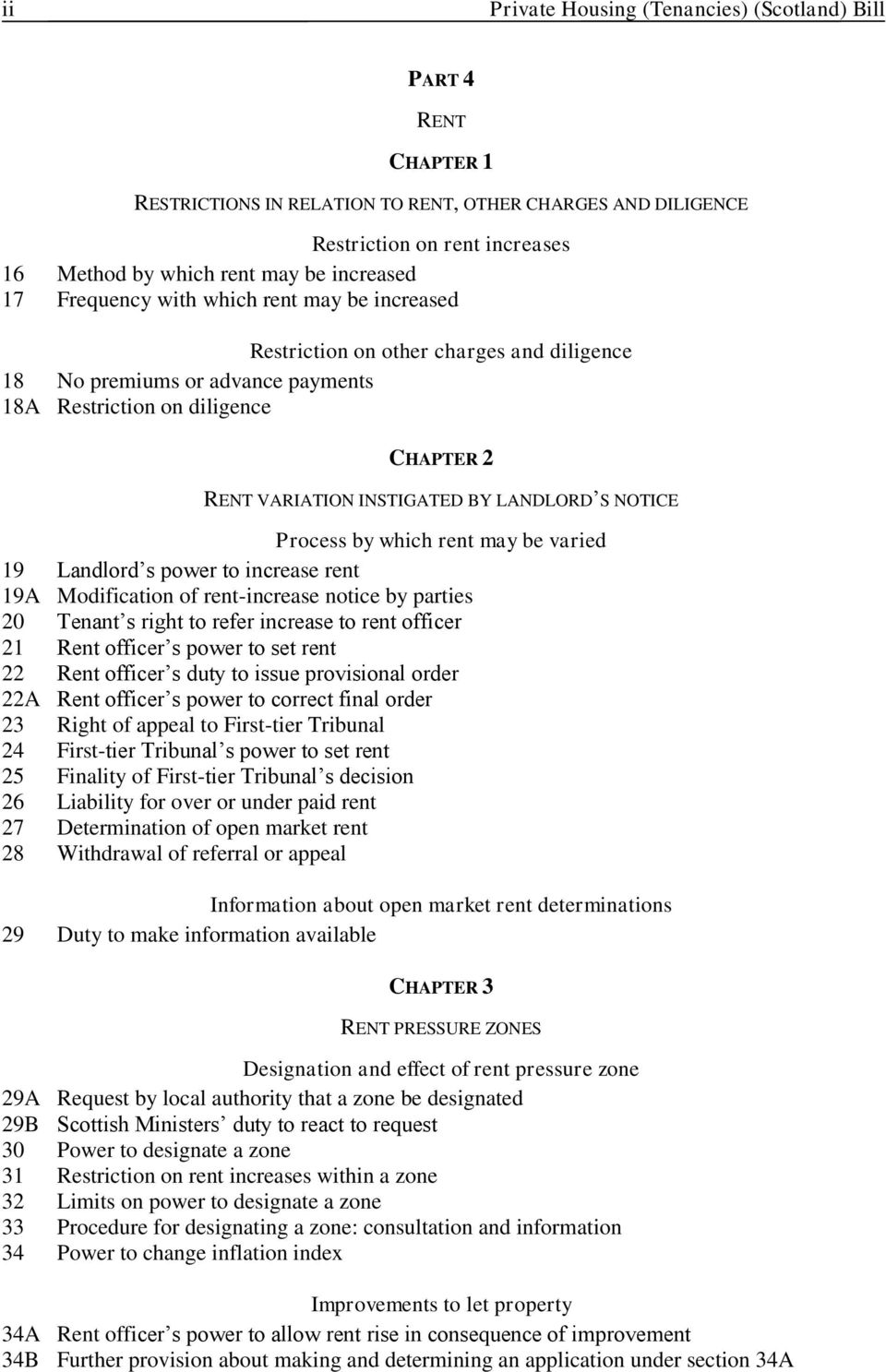
1 Private Housing (Tenancies) (Scotland) Bill [AS PASSED] CONTENTS Section PART 1 PRIVATE RESIDENTIAL TENANCY 1 Meaning of private residential tenancy 2 Interpretation of section 1 2A Writing not required to constitute private residential tenancy 4 Extended meaning of tenancy 4A Extended meaning of tenancy and related expressions in other enactments 3 Power to modify schedule 1 PART 2 TENANCY TERMS Statutory terms of tenancy 6 Regulations under section 7 Protection of terms allowing use of shared living accommodation PART 3 TENANCY INFORMATION Landlord s duties to provide information 8 Duty to provide written terms of tenancy 9 Duty to provide specified information Regulations about providing information 11 Prohibition on charging for information First-tier Tribunal s powers 12 Application to First-tier Tribunal to draw up terms 13 First-tier Tribunal s power to draw up terms 14 First-tier Tribunal s power to sanction failure to provide information 1 Meaning of notice period in sections 12 and 14 SP Bill 79B Session 4 (16)

2 ii Private Housing (Tenancies) (Scotland) Bill PART 4 RENT CHAPTER 1 RESTRICTIONS IN RELATION TO RENT, OTHER CHARGES AND DILIGENCE Restriction on rent increases 16 Method by which rent may be increased 17 Frequency with which rent may be increased Restriction on other charges and diligence 18 No premiums or advance payments 18A Restriction on diligence CHAPTER 2 RENT VARIATION INSTIGATED BY LANDLORD S NOTICE Process by which rent may be varied 19 Landlord s power to increase rent 19A Modification of rent-increase notice by parties Tenant s right to refer increase to rent officer 21 Rent officer s power to set rent 22 Rent officer s duty to issue provisional order 22A Rent officer s power to correct final order 23 Right of appeal to First-tier Tribunal 24 First-tier Tribunal s power to set rent 2 Finality of First-tier Tribunal s decision 26 Liability for over or under paid rent 27 Determination of open market rent 28 Withdrawal of referral or appeal Information about open market rent determinations 29 Duty to make information available CHAPTER 3 RENT PRESSURE ZONES Designation and effect of rent pressure zone 29A Request by local authority that a zone be designated 29B Scottish Ministers duty to react to request Power to designate a zone 31 Restriction on rent increases within a zone 32 Limits on power to designate a zone 33 Procedure for designating a zone: consultation and information 34 Power to change inflation index Improvements to let property 34A Rent officer s power to allow rent rise in consequence of improvement 34B Further provision about making and determining an application under section 34A
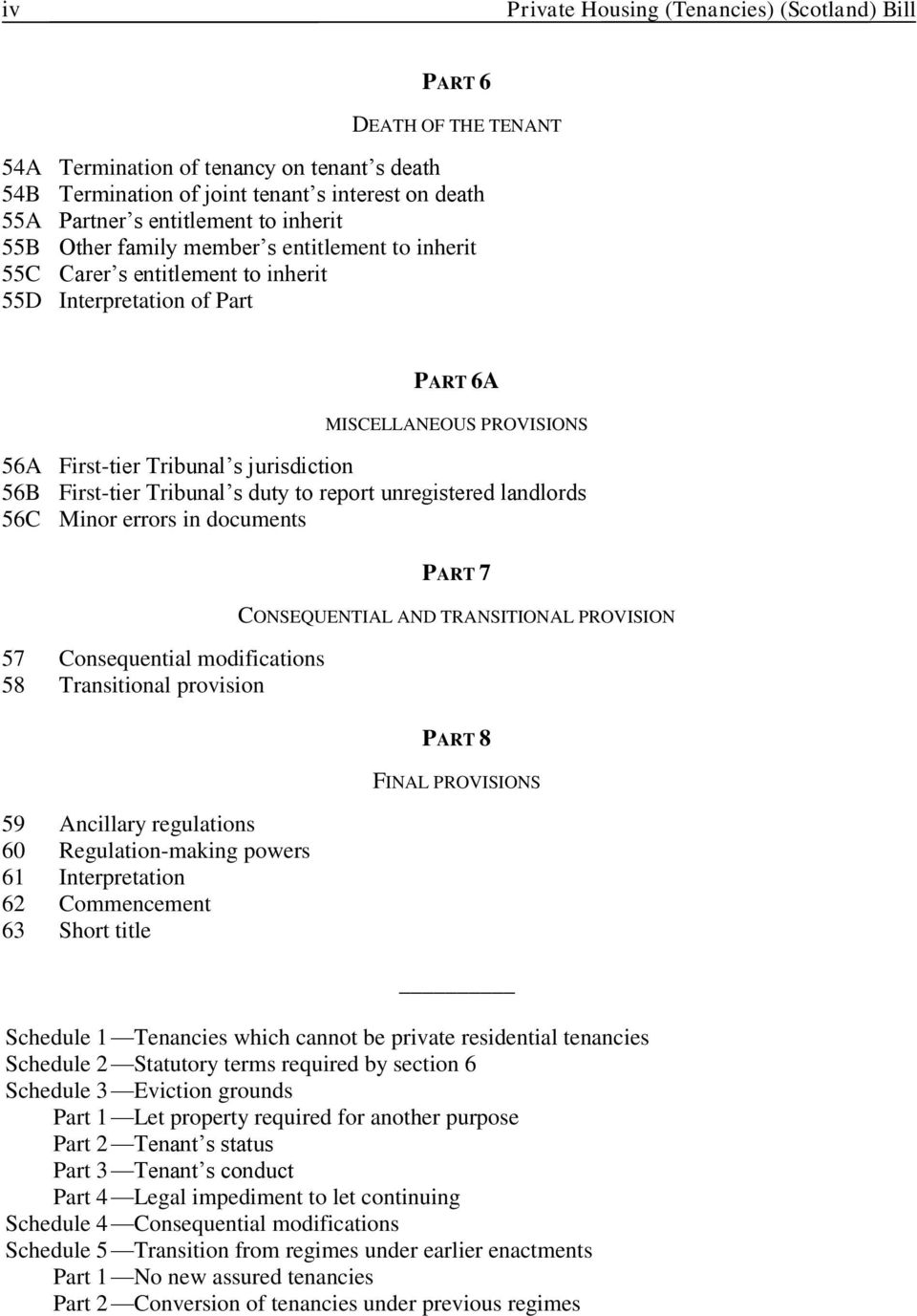
3 Private Housing (Tenancies) (Scotland) Bill iii PART TERMINATION CHAPTER 1 SECURITY OF TENURE 3 No termination by parties except in accordance with this Part 3A Landlord s interest transfers with ownership of property 36 Protection for sub-tenants 37 Qualification of sub-tenant protection CHAPTER 2 TERMINATION BY TENANT 38 Tenant s ability to bring tenancy to an end 39 Requirements for notice to be given by tenant CHAPTER 3 TERMINATION AT LANDLORD S INSTIGATION Consensual termination 40 Termination by notice to leave and tenant leaving Eviction order 41A First-tier Tribunal s power to issue an eviction order 41B Applications for eviction orders and consideration of them 42 First-tier Tribunal s power to disapply protection for sub-tenants Restrictions on applying for eviction order 44 Restriction on applying during the notice period 4 Restriction on applying 6 months after the notice period expires 46 Restriction on applying without notifying local authority Wrongful termination 47 Wrongful termination by eviction order 48 Wrongful termination without eviction order 49 Wrongful-termination order 49A Notice to local authority of wrongful-termination order 0 Sub-tenancy notice to leave Sub-tenancies CHAPTER 4 INTERPRETATION OF PART 2 Meaning of notice to leave and stated eviction ground 2A Landlord includes lender in some cases 3 Six month periods

4 iv Private Housing (Tenancies) (Scotland) Bill PART 6 DEATH OF THE TENANT 4A Termination of tenancy on tenant s death 4B Termination of joint tenant s interest on death A Partner s entitlement to inherit B Other family member s entitlement to inherit C Carer s entitlement to inherit D Interpretation of Part PART 6A MISCELLANEOUS PROVISIONS 6A First-tier Tribunal s jurisdiction 6B First-tier Tribunal s duty to report unregistered landlords 6C Minor errors in documents 7 Consequential modifications 8 Transitional provision 9 Ancillary regulations 60 Regulation-making powers 61 Interpretation 62 Commencement 63 Short title PART 7 CONSEQUENTIAL AND TRANSITIONAL PROVISION PART 8 FINAL PROVISIONS Schedule 1 Tenancies which cannot be private residential tenancies Schedule 2 Statutory terms required by section 6 Schedule 3 Eviction grounds Part 1 Let property required for another purpose Part 2 Tenant s status Part 3 Tenant s conduct Part 4 Legal impediment to let continuing Schedule 4 Consequential modifications Schedule Transition from regimes under earlier enactments Part 1 No new assured tenancies Part 2 Conversion of tenancies under previous regimes
5 Private Housing (Tenancies) (Scotland) Bill 1 Part 1 Private residential tenancy Amendments to the Bill since the previous version are indicated by sidelining in the right margin. Wherever possible, provisions that were in the Bill as introduced retain the original numbering. Private Housing (Tenancies) (Scotland) Bill [AS PASSED] An Act of the Scottish Parliament to make provision about private rented housing; in particular to establish a new type of tenancy to be known as a private residential tenancy. PART 1 PRIVATE RESIDENTIAL TENANCY Meaning of private residential tenancy (1) A tenancy is a private residential tenancy where (a) the tenancy is one under which a property is let to an individual ( the tenant ) as a separate dwelling, (b) the tenant occupies the property (or any part of it) as the tenant s only or principal home, and (c) the tenancy is not one which schedule 1 states cannot be a private residential tenancy. (2) A tenancy which is a private residential tenancy does not cease to be one by reason only of the fact that subsection (1)(b) is no longer satisfied. 2 Interpretation of section 1 (1) This section makes provision about the interpretation of section 1. (2) A tenancy is to be regarded as one under which a property is let to an individual notwithstanding that it is let jointly to an individual, or individuals, and another person. (3) A tenancy is to be regarded as one under which a property is let as a separate dwelling, despite the let property including other land, where the main purpose for letting the property is to provide the tenant with a home. (4) A tenancy is to be regarded as one under which a property is let as a separate dwelling if, despite the let property lacking certain features or facilities (a) the terms of the tenancy entitle the tenant to use property in common with another person ( shared accommodation ), and SP Bill 79B Session 4 (16)
![Private Housing (Tenancies) (Scotland) Bill [AS PASSED] An Act of the Scottish Parliament to make provision about private rented housing; in particular to establish a new type of tenancy to be known](/docs-images/46/21801923/images/page_5.jpg "as a private residential tenancy.")
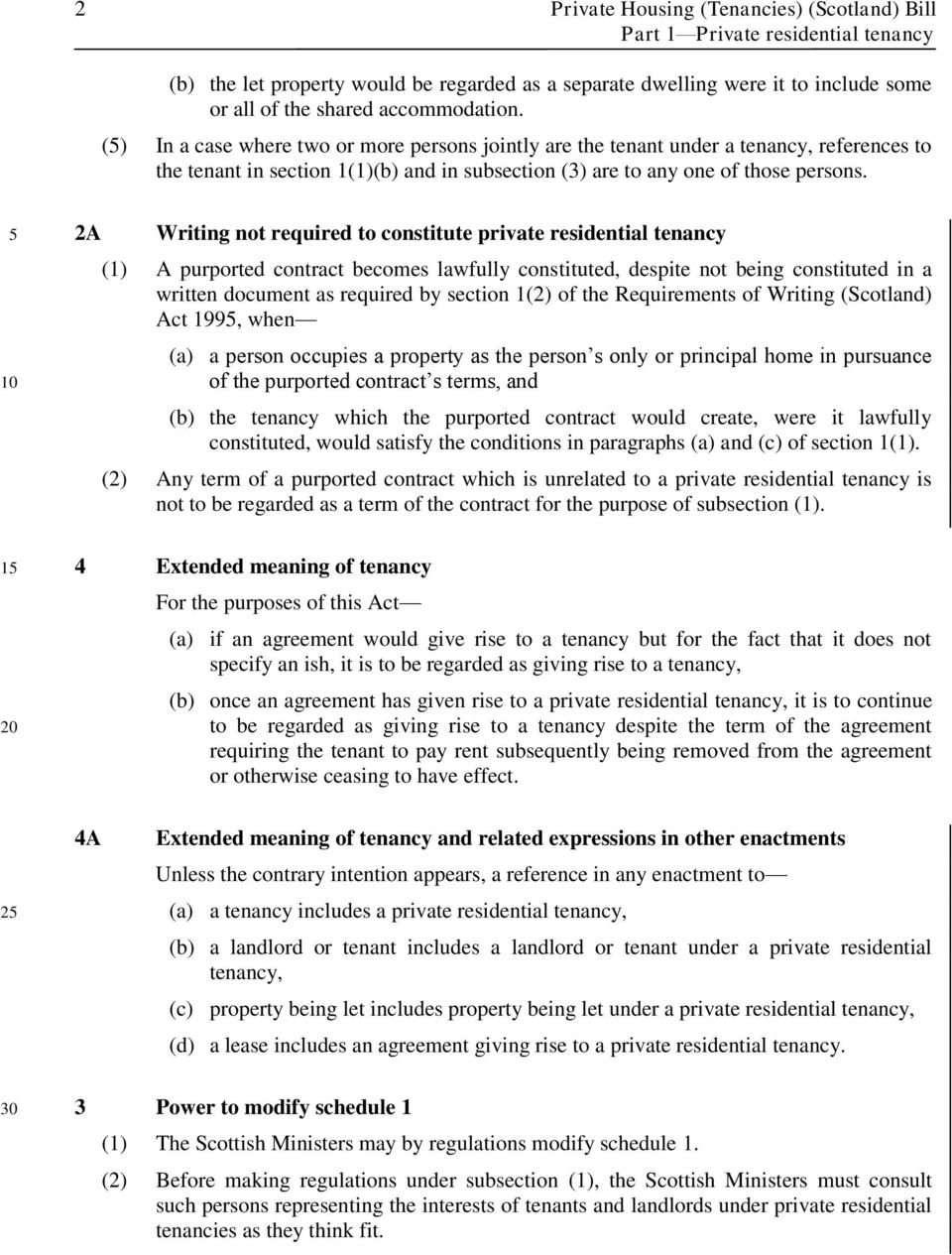
6 2 Private Housing (Tenancies) (Scotland) Bill Part 1 Private residential tenancy (b) the let property would be regarded as a separate dwelling were it to include some or all of the shared accommodation. () In a case where two or more persons jointly are the tenant under a tenancy, references to the tenant in section 1(1)(b) and in subsection (3) are to any one of those persons. 1 2A Writing not required to constitute private residential tenancy (1) A purported contract becomes lawfully constituted, despite not being constituted in a written document as required by section 1(2) of the Requirements of Writing (Scotland) Act 199, when (a) a person occupies a property as the person s only or principal home in pursuance of the purported contract s terms, and (b) the tenancy which the purported contract would create, were it lawfully constituted, would satisfy the conditions in paragraphs (a) and (c) of section 1(1). (2) Any term of a purported contract which is unrelated to a private residential tenancy is not to be regarded as a term of the contract for the purpose of subsection (1). 4 Extended meaning of tenancy For the purposes of this Act (a) if an agreement would give rise to a tenancy but for the fact that it does not specify an ish, it is to be regarded as giving rise to a tenancy, (b) once an agreement has given rise to a private residential tenancy, it is to continue to be regarded as giving rise to a tenancy despite the term of the agreement requiring the tenant to pay rent subsequently being removed from the agreement or otherwise ceasing to have effect. 2 4A Extended meaning of tenancy and related expressions in other enactments Unless the contrary intention appears, a reference in any enactment to (a) a tenancy includes a private residential tenancy, (b) a landlord or tenant includes a landlord or tenant under a private residential tenancy, (c) property being let includes property being let under a private residential tenancy, (d) a lease includes an agreement giving rise to a private residential tenancy. 3 Power to modify schedule 1 (1) The Scottish Ministers may by regulations modify schedule 1. (2) Before making regulations under subsection (1), the Scottish Ministers must consult such persons representing the interests of tenants and landlords under private residential tenancies as they think fit.
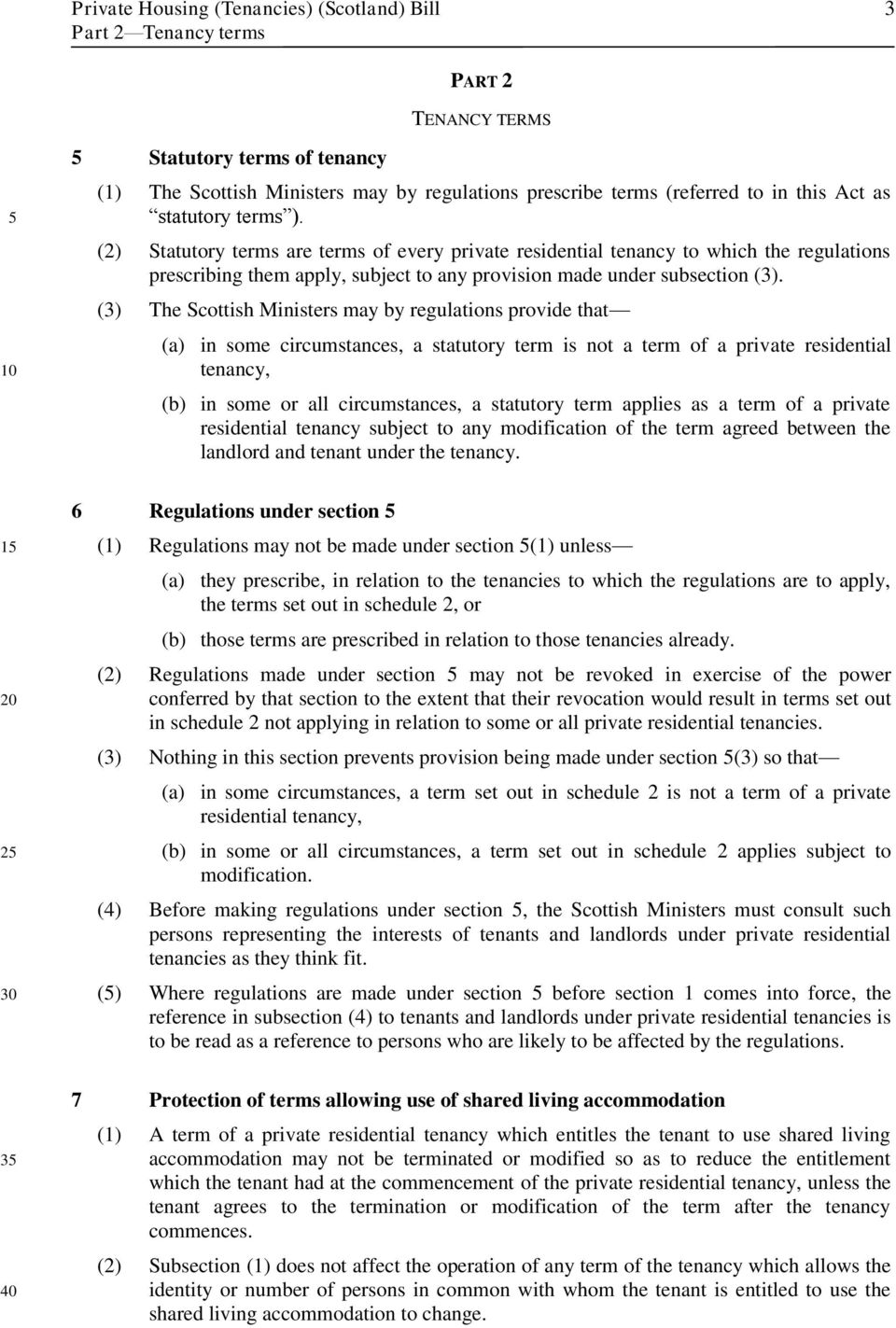
7 Private Housing (Tenancies) (Scotland) Bill 3 Part 2 Tenancy terms PART 2 TENANCY TERMS Statutory terms of tenancy (1) The Scottish Ministers may by regulations prescribe terms (referred to in this Act as statutory terms ). (2) Statutory terms are terms of every private residential tenancy to which the regulations prescribing them apply, subject to any provision made under subsection (3). (3) The Scottish Ministers may by regulations provide that (a) in some circumstances, a statutory term is not a term of a private residential tenancy, (b) in some or all circumstances, a statutory term applies as a term of a private residential tenancy subject to any modification of the term agreed between the landlord and tenant under the tenancy Regulations under section (1) Regulations may not be made under section (1) unless (a) they prescribe, in relation to the tenancies to which the regulations are to apply, the terms set out in schedule 2, or (b) those terms are prescribed in relation to those tenancies already. (2) Regulations made under section may not be revoked in exercise of the power conferred by that section to the extent that their revocation would result in terms set out in schedule 2 not applying in relation to some or all private residential tenancies. (3) Nothing in this section prevents provision being made under section (3) so that (a) in some circumstances, a term set out in schedule 2 is not a term of a private residential tenancy, (b) in some or all circumstances, a term set out in schedule 2 applies subject to modification. (4) Before making regulations under section, the Scottish Ministers must consult such persons representing the interests of tenants and landlords under private residential tenancies as they think fit. () Where regulations are made under section before section 1 comes into force, the reference in subsection (4) to tenants and landlords under private residential tenancies is to be read as a reference to persons who are likely to be affected by the regulations Protection of terms allowing use of shared living accommodation (1) A term of a private residential tenancy which entitles the tenant to use shared living accommodation may not be terminated or modified so as to reduce the entitlement which the tenant had at the commencement of the private residential tenancy, unless the tenant agrees to the termination or modification of the term after the tenancy commences. (2) Subsection (1) does not affect the operation of any term of the tenancy which allows the identity or number of persons in common with whom the tenant is entitled to use the shared living accommodation to change.
8 4 Private Housing (Tenancies) (Scotland) Bill Part 3 Tenancy information (3) In this section, shared living accommodation means property (a) which the terms of the tenancy entitle the tenant to use in common with another person, and (b) which is of such a nature that any let property must include it, or be treated as including it, in order to be regarded as a separate dwelling. PART 3 TENANCY INFORMATION Landlord s duties to provide information Duty to provide written terms of tenancy (1) Where the terms of a private residential tenancy are not set out in writing between the parties, the landlord must, before the end of the day specified in subsection (2) or (as the case may be) (3), provide the tenant with a document which sets out all of the terms of the tenancy. (2) The day referred to in subsection (1) is (a) the day on which the tenancy commences, if the tenancy is a private residential tenancy on that day, or (b) the day falling 28 days after the day on which the tenancy became a private residential tenancy, if it became one after the day on which the tenancy commenced. (3) If, as a result of a subsequent change to its terms, all of the terms of a private residential tenancy are no longer set out in writing (a) subsection (2) does not apply, and (b) the day referred to in subsection (1) is the day falling 28 days after the change to the tenancy s terms takes effect. 9 Duty to provide specified information (1) The Scottish Ministers may by regulations impose a duty on any person who is, or is to be, the landlord under a private residential tenancy to provide the person who is, or is to be, the tenant (a) with information specified in the regulations, (b) by a deadline specified in the regulations. (2) The power to specify information under subsection (1)(a) includes the power to specify the form in which the information is to be provided. (3) Before making regulations under subsection (1), the Scottish Ministers must consult such persons representing the interests of tenants and landlords under private residential tenancies as they think fit. (4) But subsection (3) does not apply in any case in which consultation has been carried out by the Scottish Ministers more generally, without specific reference to such tenants and landlords.

9 Private Housing (Tenancies) (Scotland) Bill Part 3 Tenancy information Regulations about providing information The Scottish Ministers may by regulations make provision about how a duty arising by virtue of section 8 or 9 is to be performed (including when the duty is to be deemed to have been performed) Prohibition on charging for information The person who is, or is to be, the tenant under a private residential tenancy may not be charged for being provided by the landlord with (a) a document which sets out the terms, or any term, of the tenancy, or (b) information in performance of a duty arising by virtue of section 9. First-tier Tribunal s powers 12 Application to First-tier Tribunal to draw up terms (1) The tenant under a private residential tenancy may (subject to subsection (3)) apply to the First-tier Tribunal asking it to draw up the terms of the tenancy under section 13 if the landlord (a) has a duty under section 8 to provide the tenant with a document which sets out all of the terms of the tenancy, and (b) the landlord has not provided that document to the tenant. (2) Either the tenant or the landlord under a private residential tenancy may apply to the First-tier Tribunal asking it to draw up the terms of the tenancy under section 13 if the tenant or landlord thinks that the written terms of the tenancy purport to displace a statutory term in an unlawful manner. (3) The tenant may not make an application under subsection (1) unless the tenant has given the landlord notice of the tenant s intention to make the application and the notice period described in section 1 has expired. (4) For the purpose of subsection (2), written terms of a tenancy purport to displace a statutory term in an unlawful manner if (a) the statutory term is not included in the written terms of the tenancy but is a term of the tenancy because regulations under section (3)(a) do not provide otherwise, or (b) the statutory term, as expressed in the written terms of the tenancy, bears to be subject to a modification which is not permitted by regulations under section (3)(b). () In a case where two or more persons jointly are the tenant under a tenancy, references to the tenant in this section are to any one of those persons. (6) In a case where two or more persons jointly are the landlord under a tenancy, references to the landlord in this section are to any one of those persons. 13 First-tier Tribunal s power to draw up terms (1) On an application under section 12, the First-tier Tribunal may (a) draw up a document which accurately reflects all of the terms of the tenancy, or

10 6 Private Housing (Tenancies) (Scotland) Bill Part 3 Tenancy information (b) if there are already written terms of the tenancy and the Tribunal is satisfied that they accurately reflect all of the terms of the tenancy, make a declaration to that effect. (2) A document that is drawn up by the Tribunal under subsection (1)(a) or is the subject of a declaration under subsection (1)(b) is to be regarded as setting out all of the terms of the tenancy at that time First-tier Tribunal s power to sanction failure to provide information (1) On an application by the tenant under a private residential tenancy, the First-tier Tribunal may make an order under subsection (2) where (a) the landlord has failed to perform a duty arising by virtue of section 8 or 9 to provide the tenant with information, (b) at the time the First-tier Tribunal considers the application, the landlord has still not provided the tenant with the information, and (c) the landlord does not have a reasonable excuse for failing to perform the duty. (2) An order under this subsection is one requiring the landlord to pay the person who made the application an amount not exceeding (a) three months rent, if the order is in respect of a failure by the landlord to perform a duty arising by virtue of section 8, or (ii) one or more duties arising by virtue of section 9, (b) six months rent, if the order is in respect of a failure by the landlord to perform a duty arising by virtue of section 8, and (ii) one or more duties arising by virtue of section 9. (3) An application under subsection (1) (3A) If (a) may be made only during the course of the tenancy in question, (aa) where the application relates to a failure to perform a duty arising by virtue of section 8, may be made only as part of an application under section 12(1), and (b) may not be made unless the tenant has given the landlord notice of the tenant s intention to make the application and the notice period described in section 1 has expired. (a) an application has been made under subsection (1) in respect of a failure to perform a duty arising by virtue of section 9, and (b) at the time the application was made, an application could have been made in respect of a failure to perform another duty arising by virtue of section 9, no application may be made in respect of that other duty. (4) Where two or more persons jointly are the landlord under the tenancy in question, an order by the First-tier Tribunal under subsection (2) may (a) be made against all, some or only one of the joint landlords,
11 Private Housing (Tenancies) (Scotland) Bill 7 Part 4 Rent Chapter 1 Restrictions in relation to rent, other charges and diligence (b) state that each person against whom the order is made is liable to pay a specified amount, but the cumulative total of each of the specified amounts must not exceed the maximum set by subsection (2), (c) state that each person against whom the order is made is jointly and severally liable for the whole amount to be paid. () In a case where two or more persons jointly are the tenant under a tenancy, references to the tenant in this section are to any one of those persons. (6) In subsection (2), rent means (a) the amount that was payable in rent under the tenancy at the time that notice of the application was given to the landlord, and (b) in a case where two or more persons jointly are the tenant under the tenancy, the amount mentioned in paragraph (a) divided by the number of those persons Meaning of notice period in sections 12 and 14 (1) For the purposes of sections 12(3) and 14(3)(b), a notice period (a) begins on the later of the day that the landlord receives notice from the tenant of the tenant s intention to make the application in question, or (ii) the day after the deadline by which the landlord should have performed the duty to which the application in question relates, and (b) expires on the day falling 28 days after it begins. (2) Where the application in question relates to a failure by the landlord to perform more than one duty, the reference to the duty in subsection (1)(a)(ii) is to be read as a reference to the duty with the latest deadline for performance. (3) A notice of a tenant s intention to make an application under section 12(1) or 14(1) must fulfil any requirements prescribed by the Scottish Ministers in regulations. PART 4 RENT CHAPTER 1 RESTRICTIONS IN RELATION TO RENT, OTHER CHARGES AND DILIGENCE Restrictions on rent increases 16 Method by which rent may be increased The rent payable under a private residential tenancy may be increased only in accordance with Chapter Frequency with which rent may be increased (1) The rent payable under a private residential tenancy may not be increased more than once in a 12 month period.

12 8 Private Housing (Tenancies) (Scotland) Bill Part 4 Rent Chapter 2 Rent variation instigated by landlord s notice (2) For the purpose of subsection (1), in a case where the last rent increase resulted from an order of the rent officer or the First-tier Tribunal, the 12 month period is to be regarded as commencing on the date on which the rent would have been increased in accordance with section 19(3A) had a referral to a rent officer not been made. 18 No premiums or advance payments Restrictions on other charges and diligence (1) Sections 82, 83 and 86 to 90 of the Rent (Scotland) Act 1984 apply in relation to a private residential tenancy as they apply in relation to a tenancy of the kind to which those sections refer. (2) But (a) section 83() of that Act is to be ignored, (b) the date mentioned in section 88(1) of that Act is to be read as if it were the date on which this section comes into force. 1 18A Restriction on diligence Except with the leave of the First-tier Tribunal, no diligence is to be done in respect of (a) the rent due by a tenant or former tenant under a private residential tenancy, (b) any liability of a tenant or former tenant arising under section 26. CHAPTER 2 RENT VARIATION INSTIGATED BY LANDLORD S NOTICE Process by which rent may be varied Landlord s power to increase rent (1) The landlord under a private residential tenancy may increase the rent payable under the tenancy by giving the tenant a notice in accordance with this section ( a rent-increase notice ). (2) The notice must (a) specify the rent that will be payable once the increase takes effect, (ii) the day on which the increase is to take effect, and (b) fulfil any other requirements prescribed by the Scottish Ministers in regulations. (3) The rent increase takes effect on the effective date, unless before that date (a) the landlord intimates to the tenant that the notice is rescinded, or (b) the tenant makes a referral to a rent officer under section. (3A) For the purpose of subsection (3), the effective date is the date of the later of (a) the day specified in the notice in accordance with subsection (2)(a)(ii), or (b) the day after the day on which the minimum notice period ends.

13 Private Housing (Tenancies) (Scotland) Bill 9 Part 4 Rent Chapter 2 Rent variation instigated by landlord s notice 1 (4) In subsection (3A)(b), the minimum notice period means a period which (4A) 19A (a) begins on the day the notice is received by the tenant, and (b) ends on the day falling three months after it began, or (ii) whatever longer period after it began as the landlord and tenant have agreed between them. In subsection (4), the reference to a period of three months is to a period which ends in the month which falls three months after the month in which it began, either (a) on the same day of the month as it began, or (b) if the month in which the period ends has no such day, on the final day of that month. Modification of rent-increase notice by parties (1) Anything specified in a rent-increase notice in accordance with section 19(2)(a) may be modified by agreement between the landlord and tenant concerned. (2) A modification made to a rent-increase notice by virtue of subsection (1) ceases to have effect if the notice subsequently prompts a referral to a rent officer under section (1). 2 Tenant s right to refer increase to rent officer (1) Having received a rent-increase notice, a tenant may make a referral to a rent officer for the area in which the let property is situated seeking an order under section 21. (2) But, a tenant may not make a referral under subsection (1) if the let property is in a rent pressure zone. (4) A referral to a rent officer under subsection (1) must be (a) in the prescribed form, (b) accompanied by the prescribed fee (if any), (c) intimated by the tenant to the landlord in the prescribed manner, and (d) made before the end of the day falling 21 days after the tenant receives the notice. () In subsection (4), prescribed means prescribed by the Scottish Ministers by regulations Rent officer s power to set rent (1) Where a rent officer receives a referral under section (1), the rent officer must make an order stating that from the effective date the rent payable under the tenancy is the rent determined by the rent officer in accordance with section 27. (2) For the purpose of subsection (1), the effective date is (a) where the rent officer makes the order 14 days or more before the original effective date, the original effective date, (b) otherwise, the first payment date falling at least 14 days after the day on which the rent officer makes the order.
14 Private Housing (Tenancies) (Scotland) Bill Part 4 Rent Chapter 2 Rent variation instigated by landlord s notice (3) In an order made under subsection (1), the rent officer must record the amount of the rent that is fairly attributable to the provision of services, unless the amount is negligible or no amount is so attributable. (4) In subsection (2) original effective date means the date on which the rent would have been increased in accordance with section 19(3A) had the referral to the rent officer not been made, and payment date means a date on which a rent payment falls to be made in accordance with the terms of the tenancy. 22 Rent officer s duty to issue provisional order 22A (1) Before making an order under subsection (1) of section 21, a rent officer must issue a provisional order stating (a) the rent which the rent officer proposes to specify under that section, and (b) the amount which the rent officer proposes to record for the purpose of subsection (3) of that section. (2) Where a rent officer has issued a provisional order under subsection (1), the landlord or the tenant may ask the rent officer to reconsider the proposed amounts. (3) A request under subsection (2) may not be made more than 14 days after the provisional order is issued. (4) If a request is made under subsection (2), the rent officer must reconsider the proposed amounts prior to making an order under section 21(1). Rent officer s power to correct final order (1) A rent officer may, within 14 days of making an order under section 21(1), re-make the order for the purpose of curing an error in the original order. (2) The effective date of the re-made order is to be specified in accordance with subsection (2) of section 21 as though it were an order made under that section. (3) Where an order has been re-made under this section (a) the original order is of no effect, (b) references in this Chapter to an order made under section 21(1) are to be read as references to the re-made order, (c) if the original order has been appealed against under section 23(1), the appeal is to be regarded as having been made against the re-made order. (4) Subsection (3)(b) does not apply in relation to (a) subsection (1), (b) section 22.

15 Private Housing (Tenancies) (Scotland) Bill 11 Part 4 Rent Chapter 2 Rent variation instigated by landlord s notice Right of appeal to First-tier Tribunal (1) Where a rent officer has made an order under section 21(1) in relation to the rent payable under a private residential tenancy, the landlord or the tenant may appeal against the order to the First-tier Tribunal. (2) An order under section 21(1) may not be appealed against (a) more than 14 days after the order is made, or (b) where the order is made by virtue of section 28(2). (3) Making an appeal under subsection (1) renders the order being appealed against of no effect. 24 First-tier Tribunal s power to set rent (1) Where an appeal is made to the First-tier Tribunal under section 23(1), the First-tier Tribunal must make an order stating that from the effective date the rent payable under the tenancy is the rent determined by the First-tier Tribunal in accordance with section 27. (2) For the purpose of subsection (1), the effective date is (a) where the First-tier Tribunal makes its order on or before the original effective date, the original effective date, (b) otherwise, the first payment date falling on or after the day on which the First-tier Tribunal makes its order. (3) In an order made under subsection (1), the First-tier Tribunal must record the amount of the rent that is fairly attributable to the provision of services, unless the amount is negligible or no amount is so attributable. (4) In subsection (2) original effective date means the date on which the rent would have been increased in accordance with section 19(3A) had a referral to the rent officer not been made, and payment date means a date on which a rent payment falls to be made in accordance with the terms of the tenancy. 3 2 Finality of First-tier Tribunal s decision (1) An order under section 24(1) may be reviewed in accordance with this section only. (2) Accordingly (and without prejudice to the generality of subsection (1)), a decision of the First-tier Tribunal to make an order under section 24(1) may be neither (a) reviewed under section 43 of the Tribunals (Scotland) Act 14, nor (b) appealed against under section 46 of that Act. (3) The First-tier Tribunal may review an order under section 24(1) (a) at its own instance, or (b) at the request of the landlord or the tenant under the tenancy to which the order relates. (4) In a review under subsection (3), the First-tier Tribunal may
16 12 Private Housing (Tenancies) (Scotland) Bill Part 4 Rent Chapter 2 Rent variation instigated by landlord s notice (a) take no action, or (b) correct a minor error contained in the order Liability for over or under paid rent (1) This section applies where (a) the rent payable under a private residential tenancy has been changed by an order made under section 21(1) or 24(1), (b) the effective date stated in the order ( the actual effective date ) falls later than the date on which the rent would have been increased in accordance with section 19(3A) had a referral to a rent officer not been made ( the originally proposed effective date ), and (c) the rent payable from the actual effective date ( the new rent ) differs from the rent payable immediately before that date ( the old rent ). (2) If the new rent is less than the old rent, on the date the order is made the landlord becomes liable under this subsection to pay the tenant the difference between (a) the amount actually paid in rent between the originally proposed effective date and the actual effective date, and (b) the amount that would have been payable in rent during the same period had the new rent been the rent payable from the originally proposed effective date. (3) If the new rent is more than the old rent, on the date the order is made the tenant becomes liable under this subsection to pay the landlord the difference between (a) the amount that would have been payable in rent between the originally proposed effective date and the actual effective date had the new rent been the rent payable from the originally proposed effective date, and (b) the amount that should have been paid in rent during the same period (whether or not it was actually paid). (4) Subsection () applies if, at the end of the day falling 28 days after a tenant s liability under subsection (3) arose, that liability is (in whole or in part) still outstanding. () For the purposes of paragraph 11 of schedule 3, the liability mentioned in subsection (4) is to be regarded as a sum that fell to be paid by way of rent on the day the liability arose. (6) In this section, a reference to a period between two dates includes both of those dates Determination of open market rent (1) Where an order maker is to determine the rent under section 21(1) or (as the case may be) 24(1), the determination is to be made on the basis that the property in question would be let by a willing landlord to a hypothetical willing tenant under a new tenancy which would (a) be a private residential tenancy, (b) begin on the date on which the rent would have been increased in accordance with section 19(3A) had a referral to a rent officer not been made,

17 Private Housing (Tenancies) (Scotland) Bill 13 Part 4 Rent Chapter 2 Rent variation instigated by landlord s notice (c) have the same terms as the tenancy to which the referral or (as the case may be) appeal relates. (3) In determining the open market rent of the property under subsection (1), the order maker is to disregard (a) any positive effect on the rental value of the property that is attributable to work paid for or carried out by the tenant or a previous tenant under the same tenancy, unless the work was paid for or carried out pursuant to a requirement under the terms of the tenancy, (b) any negative effect on the rental value that is attributable to a failure by the tenant or a previous tenant under the same tenancy to comply with the terms of the tenancy. (4) In a case where two or more persons jointly are the tenant under a tenancy, a reference to the tenant in subsection (3) includes any one of them Withdrawal of referral or appeal (1) This section applies (a) where a referral made under section (1) is withdrawn by the tenant, or (b) where an appeal made under section 23(1) is withdrawn by one party, and (ii) the other party has not made an appeal in respect of the tenancy in question, or any appeal made by the other party has been withdrawn. (2) The order maker must make an order under section 21(1) or (as the case may be) 24(1) stating that from the effective date the rent payable under the tenancy is (a) the rent specified in the rent-increase notice, or (b) an amount which the parties have asked the order maker to state in the order. (3) Where the order maker is the First-tier Tribunal, an order may not be made by virtue of subsection (2) until the earlier of (a) the expiry of the period within which an appeal under section 23(1) may be made, or (b) the date on which both parties become ineligible to make an appeal (whether by withdrawing an appeal or by waiving the right to appeal). (3A) The following do not apply in relation to an order made by virtue of subsection (2) (a) the requirement to record in the order an amount in accordance with section 21(3) or (as the case may be) 24(3), (b) the duty to issue a provisional order under section 22. () In subsection (2), the rent-increase notice means the rent-increase notice which prompted the referral or (as the case may be) led to the appeal.
18 14 Private Housing (Tenancies) (Scotland) Bill Part 4 Rent Chapter 3 Rent pressure zones Information about open market rent determinations 29 Duty to make information available (1) Rent officers and the First-tier Tribunal collectively must make publicly available information about (a) the rents they have taken into account in determining the open market rents for let properties under section 27, and (b) what rents they have determined to be payable in accordance with that section. (2) The Scottish Ministers may by regulations (a) specify the information that is to be made available under subsection (1), (ii) the manner in which it is to be made available, (b) prescribe the fees (if any) which may be charged for supplying the information. CHAPTER 3 RENT PRESSURE ZONES 1 29A Designation and effect of rent pressure zone Request by local authority that a zone be designated (1) A local authority may make an application to the Scottish Ministers asking that all or part of the authority s area be designated as a rent pressure zone. (2) An application under subsection (1) is valid only if it fulfils any requirements which, prior to the application being made, the Scottish Ministers told the local authorities in Scotland an application must fulfil in order for it to be valid. 2 29B Scottish Ministers duty to react to request Within 18 weeks of receiving a valid application under section 29A, the Scottish Ministers must lay before the Scottish Parliament either (a) a draft of a Scottish statutory instrument containing regulations under section designating the area specified in the application as a rent pressure zone, or (b) a document explaining why the Ministers have not laid before the Parliament the draft instrument described in paragraph (a). 3 Power to designate a zone (2) After receiving an application under section 29A, the Scottish Ministers may by regulations (a) designate an area as a rent pressure zone, and (b) prescribe in relation to that zone a number of percentage points as the value of X for the purposes of section 31(1). (3) In subsection (2)(b), a number (a) includes zero and fractional parts of a whole number, but

19 Private Housing (Tenancies) (Scotland) Bill 1 Part 4 Rent Chapter 3 Rent pressure zones (b) does not include negative numbers. 31 Restriction on rent increases within a zone (1) A rent-increase notice may not increase the rent payable under a private residential tenancy where the let property is in a rent pressure zone to an amount greater than 1 where R is the rent payable under the tenancy immediately before the rent-increase notice in question takes effect, CPI is the percentage increase in the consumer prices index over the period (a) from the day of the last increase in the rent payable under the tenancy, or (ii) if the rent payable under the tenancy has not previously been increased, the day on which the tenancy was granted, (b) to the day that the rent-increase notice in question is given to the tenant, X is the number of percentage points prescribed in relation to the rent pressure zone under section (2)(b), Y is the amount (if any) by which the rent may be increased by virtue of a rent officer s determination under section 34A. (3) In subsection (1), the consumer prices index means the all consumer prices index published by the Office of National Statistics Limits on power to designate a zone (1) An area may not be designated as a rent pressure zone unless it is an area which the Scottish Ministers have been asked to designate as a rent pressure zone in an application under section 29A. (2) An area may not be designated as a rent pressure zone more than once on the basis of the same application under section 29A. (3) Regulations designating a rent pressure zone cease to have effect years after they come into force, unless (a) they provide, or another enactment provides, that they cease to have effect sooner, or (b) they are revoked Procedure for designating a zone: consultation and information (A1) This section applies in relation to the making of regulations under section which designate an area as a rent pressure zone. (1) Before laying a draft of a Scottish statutory instrument containing the regulations before the Scottish Parliament, the Scottish Ministers must consult

20 16 Private Housing (Tenancies) (Scotland) Bill Part 4 Rent Chapter 3 Rent pressure zones 1 (a) persons appearing to the Ministers to represent the interests of persons who offer residential property for let within the area mentioned in subsection (3), and (b) persons appearing to the Ministers to represent the interests of persons who are tenants of residential property within the area mentioned in subsection (3). (2) Along with a draft of a Scottish statutory instrument containing the regulations, the Scottish Ministers must also lay before the Scottish Parliament a document which (a) sets out the evidence which leads them to believe that rents payable within the proposed rent pressure zone are rising by too much, (ii) the rent rises within the proposed zone are causing undue hardship to tenants, and (iii) the local authority within whose area the proposed zone lies is coming under increasing pressure to provide housing or subsidise the cost of housing as a consequence of the rent rises within the proposed zone, (b) summarises the responses they received to the consultation carried out in accordance with subsection (1). (3) The area referred to in subsection (1) is that of the local authority within whose area the proposed rent pressure zone lies Power to change inflation index 34A The Scottish Ministers may by regulations amend section 31 to replace references in that section to one prices index with references to another. Improvements to let property Rent officer s power to allow rent rise in consequence of improvement (1) On an application by the landlord under a private residential tenancy, a rent officer is to determine the amount (if any) by which the rent payable under the tenancy may be increased in consequence of an improvement made to the let property. (2) The rent payable under a tenancy may not be increased by virtue of a determination made in respect of an improvement which was completed before (a) the tenancy was granted, or (b) if the rent payable under the tenancy has changed previously, the day on which it last changed. (3) The rent payable under a tenancy may not be increased more than once by virtue of a single determination. (4) In subsection (1), improvement does not include anything done to the let property (a) which is paid for in whole or in part by the tenant, or (b) by way of repair, maintenance or decoration. () In a case where two or more persons jointly are the tenant under a tenancy, the reference to the tenant in subsection (4)(a) includes any one of them.
21 Private Housing (Tenancies) (Scotland) Bill 17 Part 4 Rent Chapter 3 Rent pressure zones B Further provision about making and determining an application under section 34A (1) An application under section 34A(1) must be made (a) in such form as may be prescribed by the Scottish Ministers in regulations, (b) to a rent officer for the area in which the let property in question is situated. (2) On receiving an application under section 34A(1), a rent officer must send a copy of it to the tenant concerned. (3) Before making a final determination under section 34A, a rent officer must send (a) to both the landlord and tenant concerned a draft of the determination which the rent officer proposes to make, (b) to the tenant a copy of any timeous representations received from the landlord in relation to the draft determination. (4) In making a determination under section 34A, a rent officer must (a) follow any guidance published by the Scottish Ministers which sets out for the purposes of that section what does, and does not, constitute an improvement made to a let property, and (ii) the amount by which the rent payable under a tenancy may be increased in consequence of a particular improvement, or the methodology by which the assessment of that amount is to be made, and (b) have regard to any timeous representations received from the landlord or tenant concerned. () For the purposes of subsections (3)(b) and (4)(b), representations are timeous if they are sent to the rent officer by (a) the landlord within 14 days of the landlord receiving the draft determination sent in accordance with subsection (3)(a), (b) the tenant within 14 days of the tenant receiving the copy of the application for a determination in accordance with subsection (2), or (ii) if the rent officer sends to the tenant a copy of representations received from the landlord in accordance with subsection (3)(b), not more than 14 days after the tenant received the copy of the landlord s representations. (6) In a case where two or more persons jointly are the landlord under the tenancy, references to the landlord in section 34A and this section are to any one of those persons.
22 18 Private Housing (Tenancies) (Scotland) Bill Part Termination Chapter 1 Security of tenure PART TERMINATION CHAPTER 1 SECURITY OF TENURE 3 No termination by parties except in accordance with this Part A tenancy which is a private residential tenancy may not be brought to an end by the landlord, the tenant, nor by any agreement between them, except in accordance with this Part. 3A Landlord s interest transfers with ownership of property When ownership of a property let under a private residential tenancy is transferred, the landlord s interest under the tenancy transfers with it Protection for sub-tenants (1) Subsection (2) applies (subject to section 37) where (a) a lawfully granted sub-tenancy is terminated by the termination of the tenancy of the person who was the landlord under the sub-tenancy, and (b) immediately before it terminated, the sub-tenancy was a private residential tenancy. (2) On the termination of the sub-tenancy, the person who was the tenant under the subtenancy becomes the tenant under a new tenancy which (a) has the same terms as the sub-tenancy had immediately before it was terminated, and (b) is deemed to have been granted at the time that the sub-tenancy terminated by whoever was entitled to grant a tenancy in those terms at that time. (3) A sub-tenancy is not lawfully granted for the purpose of subsection (1) if (a) sub-letting the let property is precluded by a term of the tenancy of the person who granted the sub-tenancy ( the midlandlord ), or (ii) the tenancy of a tenant from whom the mid-landlord s tenancy is held (directly or indirectly), and (b) the person entitled to enforce the term mentioned in paragraph (a) has not expressly or impliedly consented to the sub-tenancy being granted or continuing Qualification of sub-tenant protection (1) Section 36(2) does not apply where the tenancy of the person who was the landlord under the sub-tenancy was brought to an end by an eviction order and either (a) the order was issued (exclusively or not) on the basis of an eviction ground mentioned in subsection (2), or (b) the order states that section 36(2) does not apply.
23 Private Housing (Tenancies) (Scotland) Bill 19 Part Termination Chapter 2 Termination by tenant 1 (2) The eviction grounds referred to in subsection (1)(a) are (a) that the landlord intends to sell the let property, (b) that a lender intends to sell the let property, (c) that the landlord intends to carry out significantly disruptive works to, or in relation to, the let property, (d) that the landlord intends to live in the let property, (da) that a member of the landlord s family intends to live in the let property, (e) that the landlord intends to use the let property for a purpose other than housing, (f) that the let property is required for use in connection with the purposes of a religion, (g) that the tenancy was entered into to provide an employee with a home and the tenant is not a qualifying employee, (ha) that the tenancy was entered into on account of the tenant having an assessed need for community care and the tenant has since been assessed as no longer having that need, that the landlord is not registered by the relevant local authority under the Antisocial Behaviour etc. (Scotland) Act 04, (j) that the let property or associated living accommodation is in multiple occupation and not licensed under Part of the Housing (Scotland) Act 06, (k) that an overcrowding statutory notice has been served on the landlord. CHAPTER 2 TERMINATION BY TENANT 2 38 Tenant s ability to bring tenancy to an end (1) A tenant may bring to an end a tenancy which is a private residential tenancy by giving the landlord a notice which fulfils the requirements described in section 39. (2) A tenancy comes to an end in accordance with subsection (1) on the day on which the notice states (in whatever terms) that it is to come to an end. (3) But a tenancy does not come to an end in accordance with subsection (1) if (a) before the day mentioned in subsection (2), the tenant makes a request to the landlord to continue the tenancy after that day, and (b) the landlord agrees to the request. (4) In subsections (1) and (3), in a case where two or more persons jointly are the landlord under the tenancy, references to the landlord are to any of those persons Requirements for notice to be given by tenant (1) A notice fulfils the requirements referred to in section 38(1) if (za) it is given freely and without coercion of any kind,
24 Private Housing (Tenancies) (Scotland) Bill Part Termination Chapter 3 Termination at landlord s instigation 1 (ii) after the tenant begins occupying the let property, (a) it is in writing, and (b) it states as the day on which the tenancy is to end a day that is after the last day of the minimum notice period. (2) A notice is to be regarded as fulfilling the requirements referred to in section 38(1), despite its not complying with the requirement described by subsection (1)(b), if the landlord agrees in writing to the tenancy ending on the day stated in the notice. (3) In subsection (1)(b)(ii), the minimum notice period means a period which (a) begins on the day the notice is received by the landlord, and (b) ends on the day falling such number of days after it begins as the landlord and tenant have validly agreed between them, or (ii) if there is no such valid agreement, 28 days after it begins. () An agreement as to the number of days after which a minimum notice period ends is invalid for the purpose of subsection (3)(b) if the agreement (a) is not in writing, or (b) was entered into before the tenancy became a private residential tenancy. (6) In a case where two or more persons jointly are the landlord under the tenancy, references in this section to the landlord are to any one of those persons. CHAPTER 3 TERMINATION AT LANDLORD S INSTIGATION Consensual termination 2 40 Termination by notice to leave and tenant leaving (1) A tenancy which is a private residential tenancy comes to an end if (a) the tenant has received a notice to leave from the landlord, and (b) the tenant has ceased to occupy the let property. (2) A tenancy comes to an end under subsection (1) on the later of (a) the day specified in the notice to leave in accordance with section 2(1)(b), or (b) the day on which the tenant ceases to occupy the let property. (3) For the avoidance of doubt, a tenancy which is to come to an end under subsection (1) may be brought to an end earlier in accordance with section 38. Eviction order 3 41A First-tier Tribunal s power to issue an eviction order (1) The First-tier Tribunal is to issue an eviction order against the tenant under a private residential tenancy if, on an application by the landlord, it finds that one of the eviction grounds named in schedule 3 applies.
25 Private Housing (Tenancies) (Scotland) Bill 21 Part Termination Chapter 3 Termination at landlord s instigation B (7) The provisions of schedule 3 stating the circumstances in which the Tribunal may or must find that an eviction ground applies are exhaustive of the circumstances in which the Tribunal is entitled to find that the ground in question applies. (8) The Tribunal must state in an eviction order the eviction ground, or grounds, on the basis of which it is issuing the order. (9) An eviction order brings a tenancy which is a private residential tenancy to an end on the day specified by the Tribunal in the order. Applications for eviction orders and consideration of them (2) In a case where two or more persons jointly are the landlord under a tenancy, an application for an eviction order may be made by any one of those persons. (3) The Tribunal is not to entertain an application for an eviction order if it is made in breach of (a) subsection (4), or (b) any of sections 44 to 46 (but see subsection ()). (4) An application for an eviction order against a tenant must be accompanied by a copy of a notice to leave which has been given to the tenant. () Despite subsection (3)(b), the Tribunal may entertain an application made in breach of section 44 if the Tribunal considers that it is reasonable to do so. (6) The Tribunal may not consider whether an eviction ground applies unless it is a ground which (a) is stated in the notice to leave accompanying the landlord s application in accordance with subsection (4), or (b) has been included with the Tribunal s permission in the landlord s application as a stated basis on which an eviction order is sought. 42 First-tier Tribunal s power to disapply protection for sub-tenants (1) This section applies in a case where a sub-tenant would become a tenant by virtue of section 36(2) were the First-tier Tribunal to issue an eviction order against the subtenant s landlord. (2) If the First-tier Tribunal considers it is reasonable to do so, it may state in an eviction order that section 36(2) is not to apply when the tenancy of the sub-tenant s landlord is brought to an end by the order. (3) The First-tier Tribunal may not include in an eviction order the statement mentioned in subsection (2) unless it has afforded the sub-tenant an opportunity to make representations. Restrictions on applying for eviction order 44 Restriction on applying during the notice period (1) A landlord may not make an application to the First-tier Tribunal for an eviction order against a tenant using a copy of a notice to leave until the expiry of the relevant period in relation to that notice.
26 22 Private Housing (Tenancies) (Scotland) Bill Part Termination Chapter 3 Termination at landlord s instigation 1 (2) The relevant period in relation to a notice to leave (a) begins on the day the tenant receives the notice to leave from the landlord, and (b) expires on the day falling 28 days after it begins if subsection (3) applies, (ii) 84 days after it begins if subsection (3) does not apply. (3) This subsection applies if (a) on the day the tenant receives the notice to leave, the tenant has been entitled to occupy the let property for not more than six months, or (b) the only eviction ground, or grounds, stated in the notice to leave is, or are, one or more of the following that the tenant is not occupying the let property as the tenant s home, (ii) that the tenant has failed to comply with an obligation under the tenancy, (iii) that the tenant has been in rent arrears for three or more consecutive months, (iv) that the tenant has a relevant conviction, (v) that the tenant has engaged in relevant anti-social behaviour, (vi) that the tenant associates in the let property with a person who has a relevant conviction or has engaged in relevant anti-social behaviour. (4) The reference in subsection (1) to using a copy of a notice to leave in making an application means using it to satisfy the requirement under section 41B(4). 2 4 Restriction on applying 6 months after the notice period expires (1) A landlord may not make an application to the First-tier Tribunal for an eviction order against a tenant using a copy of a notice to leave more than six months after the day on which the relevant period in relation to that notice expired. (2) In subsection (1), the relevant period has the meaning given in section 44(2). (3) The reference in subsection (1) to using a copy of a notice to leave in making an application means using it to satisfy the requirement under section 41B(4) Restriction on applying without notifying local authority (1) A landlord may not make an application to the First-tier Tribunal for an eviction order against a tenant unless the landlord has given notice of the landlord s intention to do so to the local authority in whose area the let property is situated. (2) Notice under subsection (1) is to be given in the manner and form prescribed under section 11(3) of the Homelessness etc. (Scotland) Act 03. (3) In a case where two or more persons jointly are the landlord under a tenancy, references in subsection (1) to the landlord are to any one of those persons.
27 Private Housing (Tenancies) (Scotland) Bill 23 Part Termination Chapter 3 Termination at landlord s instigation Wrongful termination 47 Wrongful termination by eviction order (1) This section applies where a private residential tenancy has been brought to an end by an eviction order. (2) An application for a wrongful-termination order may be made to the First-tier Tribunal by a person who was, immediately before the tenancy ended, either the tenant or a joint tenant under the tenancy. (3) The Tribunal may make a wrongful-termination order if it finds that it was misled into issuing the eviction order by the person who was, immediately before the tenancy ended, the landlord under the tenancy. (4) In a case where two or more persons jointly were the landlord under the tenancy immediately before it ended, the reference to the landlord in subsection (3) is to any one of those persons Wrongful termination without eviction order (1) This section applies where a private residential tenancy has been brought to an end in accordance with section 40. (2) An application for a wrongful-termination order may be made to the First-tier Tribunal by a person who was immediately before the tenancy ended either the tenant or a joint tenant under the tenancy ( the former tenant ). (3) The Tribunal may make a wrongful-termination order if it finds that the former tenant was misled into ceasing to occupy the let property by the person who was the landlord under the tenancy immediately before it was brought to an end. (4) In a case where two or more persons jointly were the landlord under the tenancy immediately before it ended, the reference to the landlord in subsection (3) is to any one of those persons Wrongful-termination order (1) In this section and in sections 47, 48 and 49A, a wrongful-termination order means an order requiring the person who was the landlord under the tenancy immediately before it ended to pay the person who made the application for the wrongful-termination order an amount not exceeding six months rent. (2) Subsection (3) applies where (a) the First-tier Tribunal intends to make a wrongful-termination order under section 47 or 48, and (b) two or more persons jointly were the landlord under the tenancy in question immediately before it was brought to an end. (3) The Tribunal may make a wrongful-termination order (a) against all, some, or only one of the former joint landlords, (b) stating that each person against whom the order is made is liable to pay a specified amount, but the cumulative total of each of the specified amounts must not exceed six months rent,
28 24 Private Housing (Tenancies) (Scotland) Bill Part Termination Chapter 4 Interpretation of Part 1 49A (c) stating that each person against whom the order is made is jointly and severally liable for the whole amount to be paid. (4) In subsections (1) and (3)(b), rent means (a) the amount that was payable in rent under the tenancy immediately before it ended, or (b) in a case where two or more persons jointly were the tenant under the tenancy immediately before it ended, the amount mentioned in paragraph (a) divided by the number of persons who were at that time joint tenants under the tenancy. Notice to local authority of wrongful-termination order (1) When the First-tier Tribunal makes a wrongful-termination order against a person, the Tribunal must send a copy of it to any local authority with which the person is registered as a landlord. (2) For the purposes of subsection (1) (a) the reference to a person against whom a wrongful-termination order is made is a reference to the person who is liable to make a payment under the order, (b) a person is registered as a landlord with a local authority if the person is entered in the register prepared and maintained by the local authority for the purposes of Part 8 of the Antisocial Behaviour etc. (Scotland) Act 04. Sub-tenancies 2 0 Sub-tenancy notice to leave (1) In addition to giving a tenant a notice to leave, a landlord ( the superior landlord ) may give to anyone who holds a tenancy directly or indirectly from the superior landlord s tenant a sub-tenancy notice to leave. (2) In the event that a person to whom a sub-tenancy notice to leave has been given becomes a tenant of the superior landlord by virtue of section 36(2), references in this Part to a notice to leave are to be read as references to the copy of the notice to leave which, in accordance with subsection (3), forms part of the sub-tenancy notice to leave. (3) A sub-tenancy notice to leave is a notice which (a) incorporates the notice to leave given to the superior landlord s tenant, and (b) fulfils any other requirements prescribed by the Scottish Ministers in regulations. (4) In a case where two or more persons jointly are the landlord under a tenancy, a subtenancy notice to leave may be given by any one of those persons. CHAPTER 4 INTERPRETATION OF PART 3 2 Meaning of notice to leave and stated eviction ground (1) References in this Part to a notice to leave are to a notice which (a) is in writing,
29 Private Housing (Tenancies) (Scotland) Bill 2 Part 6 Death of the tenant 1 (b) specifies the day on which the landlord under the tenancy in question expects to become entitled to make an application for an eviction order to the First-tier Tribunal, (c) states the eviction ground, or grounds, on the basis of which the landlord proposes to seek an eviction order in the event that the tenant does not vacate the let property before the end of the day specified in accordance with paragraph (b), and (d) fulfils any other requirements prescribed by the Scottish Ministers in regulations. (2) In a case where two or more persons jointly are the landlord under a tenancy, references in this Part to the tenant receiving a notice to leave from the landlord are to the tenant receiving one from any of those persons. (3) References in this Part to the eviction ground, or grounds, stated in a notice to leave are to the ground, or grounds, stated in it in accordance with subsection (1)(c). (4) The day to be specified in accordance with subsection (1)(b) is the day falling after the day on which the notice period defined in section 44(2) will expire. () For the purpose of subsection (4)(b), it is to be assumed that the tenant will receive the notice to leave 48 hours after it is sent. 2A Landlord includes lender in some cases In (a) sections 40 to 46, and (b) sections 0 and 2, references to the landlord under a private residential tenancy include a creditor in a heritable security over the let property who is entitled to sell the property. 2 3 Six month periods (1) A reference in this Part to a period of six months (however expressed) is to a period which ends in the month which falls six months after the month in which it began, either (a) on the same day of the month as it began, or (b) if the month in which the period ends has no such day, on the final day of that month. (2) Subsection (1) does not apply in relation to the references to six months in section A PART 6 DEATH OF THE TENANT Termination of tenancy on tenant s death A tenancy which is a private residential tenancy comes to an end if (a) the sole tenant under the tenancy dies, and (b) nobody inherits the tenancy under section A, B or C.
30 26 Private Housing (Tenancies) (Scotland) Bill Part 6 Death of the tenant B A B Termination of joint tenant s interest on death (1) If, immediately before a person s death, the person was a joint tenant under a private residential tenancy, the person s interest as a tenant under the tenancy is extinguished on the person s death. (2) A person is a joint tenant under a tenancy for the purposes of subsection (1) if the person is the tenant under the tenancy jointly with one or more other persons. Partner s entitlement to inherit (1) When the sole tenant under a private residential tenancy dies, the tenant s bereaved partner becomes the tenant under the tenancy if (a) the conditions set out in subsection (2) are met, and (b) in a case where the tenant and bereaved partner were neither married to, nor in a civil partnership with, one another immediately before the tenant s death, the condition set out in subsection (3) is also met. (2) The conditions are (a) that the tenant s interest under the tenancy was not inherited by the tenant, (b) that the tenant told the landlord, in writing, that the let property was being occupied by the bereaved partner as the bereaved partner s only or principal home, (c) that the bereaved partner was in a qualifying relationship with the tenant immediately before the tenant s death, and (d) that the let property is occupied as the bereaved partner s only or principal home at the time of the tenant s death. (3) The condition is that for a continuous period of at least 12 months, ending with the tenant s death, the let property was occupied as the bereaved partner s only or principal home. (4) In determining whether the condition set out in subsection (3) is met, no account is to be taken of any time during which the bereaved partner was occupying the let property if and so far as it pre-dates the tenant telling the landlord, in writing, that the let property was being occupied as the bereaved partner s only or principal home. Other family member s entitlement to inherit (1) When (a) the sole tenant under a private residential tenancy dies, (b) the tenant s interest under the tenancy was not inherited by the tenant, and (c) nobody inherits the tenancy under section A, any member of the tenant s family who meets the conditions set out in subsection (2) becomes the tenant under the tenancy. (2) The conditions are (a) that the family member is at least 16 years of age at the time of the tenant s death, and (b) that the family member
31 Private Housing (Tenancies) (Scotland) Bill 27 Part 6 Death of the tenant C is occupying the let property as the family member s only or principal home at the time of the tenant s death, and (ii) has done so for a continuous period of at least 12 months ending with the tenant s death. (3) In determining whether the condition set out in subsection (2)(b)(ii) is met, no account is to be taken of any time during which the family member was occupying the let property if and so far as it pre-dates the tenant telling the landlord, in writing, that the let property was being occupied as the family member s only or principal home. (4) If more than one person is eligible to become the tenant by virtue of subsection (1), each becomes the tenant under the tenancy jointly with the others. Carer s entitlement to inherit (1) When (a) the sole tenant under a private residential tenancy dies, (b) the tenant s interest under the tenancy was not inherited by the tenant, and (c) nobody inherits the tenancy under section A or B, a resident carer who meets the conditions set out in subsection (2) becomes the tenant under the tenancy. (2) The conditions are (a) that the resident carer is at least 16 years of age at the time of the tenant s death, (b) that the resident carer is occupying the let property as the resident carer s only or principal home at the time of the tenant s death, and (ii) has done so for a continuous period of at least 12 months ending with the tenant s death, and (c) that the resident carer had a previous only or principal home which was given up. (3) In determining whether the condition set out in subsection (2)(b)(ii) is met, no account is to be taken of any time during which the resident carer was occupying the let property if and so far as it pre-dates the tenant telling the landlord, in writing, that the let property was being occupied as the resident carer s only or principal home. (4) If more than one person is eligible to become the tenant by virtue of subsection (1), each becomes the tenant under the tenancy jointly with the others. () In this section, a resident carer means a person who provides, or has provided, care for (a) the tenant, or (b) a member of the tenant s family. D Interpretation of Part (1) For the purposes of this Part (a) two people are in a qualifying relationship with one another if they are married to each other,
32 28 Private Housing (Tenancies) (Scotland) Bill Part 6A Miscellaneous provisions 1 (ii) in a civil partnership with each other, or (iii) living together as though they were married, (b) a person is a member of a tenant s family if the person is a qualifying relative of the tenant, (ii) a qualifying relative of a person who was in a qualifying relationship with the tenant immediately before the tenant s death, or (iii) in a qualifying relationship with a qualifying relative of the tenant. (2) In subsection (1)(b), a qualifying relative means a parent, grandparent, child, grandchild, brother or sister. (3) For the purposes of this section (a) a relationship of the half blood is to be regarded as a relationship of the whole blood, (b) a person s stepchild is to be regarded as the person s child, (c) a person ( A ) is to be regarded as the child of another person ( B ), if A is being or has been treated by B as B s child. PART 6A MISCELLANEOUS PROVISIONS 2 3 6A 6B First-tier Tribunal s jurisdiction (1) In relation to civil proceedings arising from a private residential tenancy (a) the First-tier Tribunal has whatever competence and jurisdiction a sheriff would have but for paragraph (b), (b) a sheriff does not have competence or jurisdiction. (2) For the purposes of subsection (1), civil proceedings are any proceedings other than (a) the prosecution of a criminal offence, (b) any proceedings related to such a prosecution. First-tier Tribunal s duty to report unregistered landlords (1) The First-tier Tribunal must notify the local authority in whose area a property is being let if, in the course of relevant proceedings before it, the Tribunal learns or is given cause to suspect that the landlord under the tenancy is not registered as a landlord with the local authority. (2) In notifying a local authority under subsection (1), the Tribunal must tell the local authority (a) the landlord s name and address, and (b) the address of the property mentioned in that subsection. (3) For the purposes of subsection (1) (a) proceedings are relevant proceedings if
33 Private Housing (Tenancies) (Scotland) Bill 29 Part 7 Consequential and transitional provision 1 6C they arise from a private residential tenancy under which the property mentioned in that subsection is or was let, and (ii) the landlord is a party to them, (b) a person is not registered as a landlord with a local authority if the person is not entered in the register prepared and maintained by the local authority for the purposes of Part 8 of the Antisocial Behaviour etc. (Scotland) Act 04. Minor errors in documents (1) An error in the completion of a document to which this section applies does not make the document invalid unless the error materially affects the effect of the document. (2) This section applies to (a) a notice under section 12(3), 14(3)(b), 19(1) or 0(1), (b) the document by which a referral is made to a rent officer under section (1), (c) the document by which an application is made to a rent officer under section 34A(1), and (d) a notice to leave (as defined by section 2(1)). PART 7 CONSEQUENTIAL AND TRANSITIONAL PROVISION 7 Consequential modifications Schedule 4 modifies other enactments in consequence of this Act. 8 Transitional provision Schedule makes provision about tenancies which are assured tenancies within the meaning of the Housing (Scotland) Act 1988 on the day that section 1 comes into force. PART 8 FINAL PROVISIONS 2 9 Ancillary regulations (1) The Scottish Ministers may by regulations make any incidental, supplementary, consequential, transitional, transitory or saving provision they consider appropriate for the purposes of, in connection with, or for giving full effect to this Act or any provision made under it. (2) Regulations under this section (a) are subject to the affirmative procedure if they add to, replace or omit any part of the text of an Act (including this Act), (b) otherwise, are subject to the negative procedure.
34 Private Housing (Tenancies) (Scotland) Bill Part 8 Final provisions 60 Regulation-making powers (1) A power to make regulations conferred by this Act includes the power to make different provision for different purposes. (2) Regulations under section 1(3), 19(2)(b), 0(3)(b) or 2(1)(d) prescribing requirements which must be fulfilled by a notice may in particular require that a notice (a) contain information specified in the regulations, (b) be in a form specified in the regulations, (c) be given in a manner specified in the regulations. (3) Regulations under sections 3,, 9,, and 34 are subject to the affirmative procedure. (4) Regulations under sections 1, 19,, 29, 34B, 0 and 2 are subject to the negative procedure Interpretation (1) In this Act eviction ground means a ground named in schedule 3 on the basis of which an eviction order may be issued, eviction order means an order issued under section 41A, First-tier Tribunal means the First-tier Tribunal for Scotland, private residential tenancy means a tenancy which is a private residential tenancy by virtue of section 1, rent means any sums payable periodically by the tenant to the landlord in connection with the tenancy (and includes, for the avoidance of doubt, any sums payable in respect of services, repairs, maintenance or insurance), rent-increase notice has the meaning given by section 19(1), rent officer has the meaning given by section 43 of the Rent (Scotland) Act 1984, statutory term has the meaning given by section (1), tenancy (the meaning of which is extended by section 4) includes sub-tenancy, tenant includes sub-tenant. (2) In a case where two or more persons jointly are the landlord under a tenancy, references in this Act to the landlord are to all of those persons unless stated otherwise. (3) In a case where two or more persons jointly are the tenant under a tenancy, references in this Act to the tenant are to all of those persons unless stated otherwise Commencement (1) This Part comes into force on the day after Royal Assent. (2) The other provisions of this Act come into force on such day as the Scottish Ministers may by regulations appoint. (3) Regulations under subsection (2) may include transitional, transitory or saving provision.
35 Private Housing (Tenancies) (Scotland) Bill 31 Part 8 Final provisions (4) Regulations under subsection (2) appointing the day that section 1 is to come into force may 63 Short title (a) amend the following enactments so that, instead of referring to the day on which section 1 comes into force, they specify the date that section 1 actually comes into force section 12(1A) of the Housing (Scotland) Act 1988, (ii) section 31A(1)(a) of that Act, (iii) section 3B(1)(a) of the Rent (Scotland) Act 1984, and (b) repeal section 6() on the day that section 1 comes into force. The short title of this Act is the Private Housing (Tenancies) (Scotland) Act 16.
36 32 Private Housing (Tenancies) (Scotland) Bill Schedule 1 Tenancies which cannot be private residential tenancies Low rent SCHEDULE 1 (introduced by section 1) TENANCIES WHICH CANNOT BE PRIVATE RESIDENTIAL TENANCIES 1 (1) A tenancy cannot be a private residential tenancy if (a) it is a tenancy under which rent of, or equivalent to, less than 6 a week is payable, and (b) it has not previously acquired the status of a private residential tenancy or been an assured tenancy (including a statutory assured tenancy) within the meaning of the Housing (Scotland) Act (2) In determining the rent payable for the purpose of sub-paragraph (1), no account is to be taken of any amount paid by the tenant in respect of services, repairs, maintenance or insurance. Shop 1 2 A tenancy cannot be a private residential tenancy if it is one to which the Tenancy of Shops (Scotland) Act 1949 is capable of applying. Licensed premises 3 A tenancy cannot be a private residential tenancy if it is one under which the let property consists of or comprises premises licensed for the sale of alcohol for consumption on the premises. Agricultural land (1) A tenancy cannot be a private residential tenancy if sub-paragraph (2) or (3) applies to it. (2) This sub-paragraph applies to a tenancy if the let property includes two acres or more of agricultural land. (3) This sub-paragraph applies to a tenancy if (a) the tenancy is a relevant agricultural tenancy, and (b) the let property is occupied by the person responsible for the control (whether as tenant or as the tenant s agent or employee) of the farming of the let property. (4) For the purposes of this paragraph (a) agricultural land has the meaning given in section 11(1) of the Rent (Scotland) Act 1984, (b) relevant agricultural tenancy means a tenancy which falls within the definition given in the Agricultural Holdings (Scotland) Act 03 of a 1991 Act tenancy, (ii) a short limited duration tenancy, (iii) a limited duration tenancy,
37 Private Housing (Tenancies) (Scotland) Bill 33 Schedule 1 Tenancies which cannot be private residential tenancies Student let (iv) a modern limited duration tenancy, or (v) a repairing tenancy (1) A tenancy cannot be a private residential tenancy if (a) the purpose of it is to confer on the tenant the right to occupy the let property while the tenant is a student, and (b) sub-paragraph (2) or (3) applies to the tenancy. (2) This sub-paragraph applies to a tenancy if the landlord is (a) a university or constituent college, school or hall of a university, (b) a central institution within the meaning of section 13(1) of the Education (Scotland) Act 1980, (c) a designated institution within the meaning of section 44(2) of the Further and Higher Education (Scotland) Act 1992, (d) an institution for the provision of further education within the meaning of section 13(1) of the 1980 Act which is administered by an education authority, (e) a college of further education which is managed by a board of management in terms of Part 1 of the Further and Higher Education (Scotland) Act 1992, (f) an association approved under regulation 8 of the Further Education (Scotland) Regulations 199 (S.I. 199/477), (g) the Royal College of Surgeons of Edinburgh. (3) This sub-paragraph applies to a tenancy if (a) planning permission for the construction, conversion or change of use of the building (or part of the building) of which the let property forms part was given on the basis that the let property would be used predominantly for housing students, and (b) the landlord is an institutional provider of student accommodation. (3A) For the purposes of sub-paragraph (3), a landlord is an institutional provider of student accommodation if (a) the landlord lets, or is entitled to let, other properties in the same building or complex as the let property, (b) the let property and the other properties together include at least bedrooms, and (c) the landlord uses, or intends to use, the other properties predominantly for the purpose of housing students. (4) In this paragraph, student means a person who is pursuing a course of study provided by a body referred to in sub-paragraph (2) Holiday let 6 A tenancy cannot be a private residential tenancy if the purpose of it is to confer on the tenant the right to occupy the let property for a holiday.
38 34 Private Housing (Tenancies) (Scotland) Bill Schedule 1 Tenancies which cannot be private residential tenancies Resident landlord A tenancy cannot be a private residential tenancy if paragraph 7A or 7B applies to it. 7A 7B (1) This paragraph applies to a tenancy if (a) the let property would not be regarded as a separate dwelling were it not for the terms of the tenancy entitling the tenant to use property in common with another person ( shared accommodation ), and (b) from the time the tenancy was granted, the person (or one of the persons) in common with whom the tenant has a right to use the shared accommodation is a person who has the interest of the landlord under the tenancy, and (ii) has a right to use the shared accommodation in the course of occupying that person s home. This paragraph applies to a tenancy if sub-paragraphs (2) and (3) apply to it. (2) This sub-paragraph applies to a tenancy if, from the time it was granted, a dwelling within the same building as the let property has been occupied as the only or principal home of a person who, at the time of occupying it, has the interest of the landlord under the tenancy. (3) This sub-paragraph applies to a tenancy if, at the time it was granted, there was an ordinary means of access (a) through the let property to the dwelling occupied by the person who is, or is to be, the landlord, or (b) through the dwelling occupied by the person who is, or is to be, the landlord to the let property (whether or not that access was available to the tenant as of right). (4) For the purpose of this paragraph, in determining whether a dwelling is occupied as the only or principal home of the person having the interest of the landlord, no account is to be taken of (a) any period beginning with the date on which the interest of the landlord is transferred (other than on death) and ending 28 days later, or (ii) 6 months later if, within 28 days of the period beginning, the person to whom the interest is transferred notifies the tenant of the person s intention to occupy a dwelling within the same building as the let property, (b) any period of up to 24 months beginning with the date of the person s death and ending with the person s interest in the tenancy being vested in another person (otherwise than as the person s executor). 8 If, at any time, the landlord holds the landlord s interest as a trustee under a trust, a reference in paragraph 7A or 7B to a landlord or the person having the interest of the landlord includes a person who is a beneficiary under the trust. In a case where two or more persons jointly are the landlord under a tenancy, references to the landlord in paragraphs 7A to 8 are to any one of those persons.
39 Private Housing (Tenancies) (Scotland) Bill 3 Schedule 1 Tenancies which cannot be private residential tenancies Police housing A A tenancy cannot be a private residential tenancy if the landlord is the Scottish Police Authority. Military housing B A tenancy cannot be a private residential tenancy if the landlord is the Secretary of State for Defence. Social housing 1 11 A tenancy cannot be a private residential tenancy if the landlord is (a) a local authority landlord within the definition given in section 11 of the Housing (Scotland) Act 01, (b) a registered social landlord within the definition given in section 16 of the Housing (Scotland) Act, (c) a co-operative housing association within the definition given in section 1 of the Housing Associations Act 198, or (d) Scottish Water. Sublet, assigned, etc. social housing 11A A tenancy cannot be a private residential tenancy if it arises as a result of a Scottish secure tenancy or a short Scottish secure tenancy (within the meaning of the Housing (Scotland) Act 01) being assigned, sublet or otherwise given up (see section 32(7) of the 01 Act). Homeless persons 12 A tenancy cannot be a private residential tenancy if it is granted on a temporary basis and the purpose of it is the fulfilment of a duty imposed on a local authority by Part II of the Housing (Scotland) Act Persons on probation or released from prison etc. 13 A tenancy cannot be a private residential tenancy if it is granted for a term of less than 6 months to a tenant who (a) is under the supervision provided by a local authority under paragraph (b), (ii) or (vi) of section 27(1) of the Social Work (Scotland) Act 1968, or (b) has requested advice, guidance or assistance from a local authority in fulfilment of its functions under paragraph (c) of that section. Asylum seekers 3 14 A tenancy cannot be a private residential tenancy if the purpose of it is to provide accommodation for asylum-seekers or their dependants in accordance with section 4 or Part VI of the Immigration and Asylum Act 1999.
40 36 Private Housing (Tenancies) (Scotland) Bill Schedule 2 Statutory terms required by section 6 Displaced persons 1 A tenancy cannot be a private residential tenancy if the purpose of it is to provide accommodation under the Displaced Persons (Temporary Protection) Regulations 0 (S.I. 0/1379). Shared ownership 16 A tenancy cannot be a private residential tenancy if it is a tenancy under a shared ownership agreement within the meaning of section 83(3) of the Housing (Scotland) Act 01. Tenancies under previous legislation 1 17 A tenancy cannot be a private residential tenancy if it is (a) a protected tenancy within the meaning of the Rent (Scotland) Act 1984, (b) a tenancy to which Part VI of that Act applies, (c) a Part VII contract under that Act, or (d) an assured tenancy (including a statutory assured tenancy) within the meaning of the Housing (Scotland) Act SCHEDULE 2 (introduced by section 6) STATUTORY TERMS REQUIRED BY SECTION 6 Rent receipts 2 1 Where any payment of rent is made in cash, the landlord must provide the tenant with a written receipt for the payment stating (a) the amount paid, and (b) either (as the case may be) the amount which remains outstanding, or (ii) confirmation that no further amount remains outstanding. Rent increases 2 The rent may be increased in accordance with Chapter 2 of Part 4. Notification about other residents 3 If a person aged 16 or over (who is not a joint tenant) occupies the let property with the tenant as that person s only or principal home, the tenant must tell the landlord in writing (a) that person s name, and (b) the person s relationship to the tenant.
41 Private Housing (Tenancies) (Scotland) Bill 37 Schedule 2 Statutory terms required by section 6 3A If (a) in accordance with the term specified in paragraph 3, the landlord has been told about a person occupying the let property, and (b) that person has ceased to occupy the let property as that person s only or principal home, the tenant must tell the landlord that. Subletting etc. 4 The tenant may not, without the written agreement of the landlord (a) sublet the let property (or any part of it), (b) take in a lodger, (c) assign the tenant s interest in the let property (or any part of it), or (d) otherwise part with, or give up to another person, possession of the let property (or any part of it). Access for repairs etc The tenant is to allow reasonable access to the let property for an authorised purpose where A(1) (a) the tenant has been given at least 48 hours notice, or (b) access is required urgently for the purpose of carrying out work on the let property, or (ii) inspecting the let property in order to determine what work of a type mentioned in paragraph A(1)(a) (if any) to carry out. The following are authorised purposes (a) carrying out any work on the let property which the landlord has an entitlement or obligation to carry out, (b) inspecting the let property in order to determine what work of a type mentioned in paragraph (a) (if any) to carry out, (ii) in pursuance of any entitlement or obligation which the landlord has to carry out an inspection, (c) valuing the let property (or any part of it). (2) References in sub-paragraph (1) to the landlord having an entitlement or obligation to do something are to the landlord having an entitlement or obligation to do the thing by virtue of (a) an enactment, or (b) the terms of any agreement between the landlord and the tenant. 7 The tenant is to allow reasonable use of facilities within the let property in connection with anything done or to be done under the term specified in paragraph.
42 38 Private Housing (Tenancies) (Scotland) Bill Schedule 3 Eviction grounds Part 1 Let property required for another purpose SCHEDULE 3 (introduced by section 41A) EVICTION GROUNDS PART 1 LET PROPERTY REQUIRED FOR ANOTHER PURPOSE Landlord intends to sell (1) It is an eviction ground that the landlord intends to sell the let property. (2) The First-tier Tribunal must find that the ground named by sub-paragraph (1) applies if the landlord (a) is entitled to sell the let property, and (b) intends to sell it for market value, or at least put it up for sale, within 3 months of the tenant ceasing to occupy it. (3) Evidence tending to show that the landlord has the intention mentioned in sub-paragraph (2)(b) includes (for example) (a) a letter of engagement from a solicitor or estate agent concerning the sale of the let property, (b) a recently prepared document that anyone responsible for marketing the let property would be required to possess under section 98 of the Housing (Scotland) Act 06 were the property already on the market. Property to be sold by lender 2 (1) It is an eviction ground that a lender intends to sell the let property. (2) The First-tier Tribunal must find that the ground named by sub-paragraph (1) applies if (a) the let property is subject to a heritable security, (b) the creditor under that security is entitled to sell the property, and (c) the creditor requires the tenant to leave the property for the purpose of disposing of it with vacant possession. Landlord intends to refurbish 3 3 (1) It is an eviction ground that the landlord intends to carry out significantly disruptive works to, or in relation to, the let property. (2) The First-tier Tribunal must find that the eviction ground named by sub-paragraph (1) applies if (a) the landlord intends to refurbish the let property (or any premises of which the let property forms part), (b) the landlord is entitled to do so, and (c) it would be impracticable for the tenant to continue to occupy the property given the nature of the refurbishment intended by the landlord.
43 Private Housing (Tenancies) (Scotland) Bill 39 Schedule 3 Eviction grounds Part 1 Let property required for another purpose (3) Evidence tending to show that the landlord has the intention mentioned in sub-paragraph (2)(a) includes (for example) (a) any planning permission which the intended refurbishment would require, (b) a contract between the landlord and an architect or a builder which concerns the intended refurbishment. Landlord intends to live in property (1) It is an eviction ground that the landlord intends to live in the let property. (2) The First-tier Tribunal must find that the ground named by sub-paragraph (1) applies if the landlord intends to occupy the let property as the landlord s only or principal home for at least 3 months. (6) References to the landlord in this paragraph (a) in a case where two or more persons jointly are the landlord under a tenancy, are to be read as referring to any one of them, (b) in a case where the landlord holds the landlord s interest as a trustee under a trust, are to be read as referring to a person who is a beneficiary under the trust. (8) Evidence tending to show that the landlord has the intention mentioned in sub-paragraph (2) includes (for example) an affidavit stating that the landlord has that intention. Family member intends to live in property 4A (1) It is an eviction ground that a member of the landlord s family intends to live in the let property. (2) The First-tier Tribunal may find that the ground named by sub-paragraph (1) applies if (a) a member of the landlord s family intends to occupy the let property as that person s only or principal home for at least 3 months, and (b) the Tribunal is satisfied that it is reasonable to issue an eviction order on account of that fact. (3) A member of the landlord s family is to be regarded as having the intention mentioned in sub-paragraph (2) if (a) the family member is incapable of having, or expressing, that intention, and (b) the landlord and (if different) a person entitled to make decisions about where the family member lives, intend that the family member will occupy the let property as the family member s only or principal home for at least 3 months. (4) For the purposes of this paragraph, a person is a member of the landlord s family if the person is (a) in a qualifying relationship with the landlord, (b) a qualifying relative of the landlord, (c) a qualifying relative of a person who is in a qualifying relationship with the landlord, or (d) in a qualifying relationship with a qualifying relative of the landlord.
44 40 Private Housing (Tenancies) (Scotland) Bill Schedule 3 Eviction grounds Part 1 Let property required for another purpose 1 () For the purposes of sub-paragraph (4) (a) two people are in a qualifying relationship with one another if they are married to each other, (ii) in a civil partnership with each other, or (iii) living together as though they were married, (b) a qualifying relative means a parent, grandparent, child, grandchild, brother or sister, (c) a relationship of the half blood is to be regarded as a relationship of the whole blood, (d) a person s stepchild is to be regarded as the person s child, (e) a person ( A ) is to be regarded as the child of another person ( B ), if A is being or has been treated by B as B s child. (6) In a case where two or more persons jointly are the landlord under a tenancy, references to the landlord in this paragraph are to any one of them. (7) Evidence tending to show that a member of the landlord s family has the intention mentioned in sub-paragraph (2) includes (for example) an affidavit stating that the person has that intention. Landlord intends to use for non-residential purpose 2 (1) It is an eviction ground that the landlord intends to use the let property for a purpose other than housing. (2) The First-tier Tribunal must find that the ground named by sub-paragraph (1) applies if the landlord intends to use the let property for a purpose other than providing a person with a home. (3) Evidence tending to show that the landlord has the intention mentioned in sub-paragraph (2) includes (for example) any planning permission which would be required if the let property is to be used for the intended purpose. Property required for religious purpose 3 6 (1) It is an eviction ground that the let property is required for use in connection with the purposes of a religion. (2) The First-tier Tribunal must find that the ground named by sub-paragraph (1) applies if (a) the let property is held for the purpose of being available for occupation by a person engaged in the work of a religious denomination as a residence from which the duties of such a person are to be performed, (aa) the property has previously been occupied by a person engaged in the work of a religious denomination as a residence from which that person s duties were performed, and (b) the property is required for the purpose mentioned in paragraph (a).
45 Private Housing (Tenancies) (Scotland) Bill 41 Schedule 3 Eviction grounds Part 2 Tenant s status (3) In sub-paragraph (2), reference to a person engaged in the work of a religious denomination includes an imam, a lay missionary, minister, monk, nun, priest and rabbi. PART 2 TENANT S STATUS Not an employee 7 (1) It is an eviction ground that the tenancy was entered into to provide an employee with a home and the tenant is not a qualifying employee. (2) The First-tier Tribunal must find that the ground named by sub-paragraph (1) applies if (a) the tenancy was granted to the tenant in consequence of the tenant being an employee of the landlord, or (ii) in the expectation that the tenant would become an employee of the landlord, (b) the tenant is not employed by the landlord, and (c) either the application for an eviction order that is before the Tribunal was made within 12 months of the tenant ceasing to be an employee of the landlord, or (ii) if the tenant never became an employee of the landlord, the application for an eviction order that is before the Tribunal was made within 12 months of the tenancy being granted to the tenant. (2A) The First-tier Tribunal may find that the ground named by sub-paragraph (1) applies if (a) the conditions set out in sub-paragraph (2)(a) and (b) are met, and (b) the Tribunal is satisfied that it is reasonable to issue an eviction order, despite the landlord not applying for one within the period of 12 months mentioned in subparagraph (2)(c). (3) In sub-paragraphs (2) and (2A), landlord includes any person who has been a landlord under the tenancy. No longer in need of supported accommodation 8A (1) It is an eviction ground that the tenancy was entered into on account of the tenant having an assessed need for community care and the tenant has since been assessed as no longer having that need. (2) The First-tier Tribunal may find that the ground named by sub-paragraph (1) applies if (a) the tenancy was granted in consequence of the tenant being assessed under section 12A of the Social Work (Scotland) Act 1968 to have needs calling for the provision of community care services,
46 42 Private Housing (Tenancies) (Scotland) Bill Schedule 3 Eviction grounds Part 3 Tenant s conduct (b) the tenancy would not have been granted to the tenant on the basis of the latest assessment of the tenant s needs under that section, and (c) the Tribunal considers it reasonable to issue an eviction order on account of that fact. (3) The condition in sub-paragraph (2)(a) is to be deemed to be met if the tenancy was granted as a result of a local authority taking urgent action by virtue of section 12A() of the Social Work (Scotland) Act PART 3 TENANT S CONDUCT 1 Not occupying let property 9 (1) It is an eviction ground that the tenant is not occupying the let property as the tenant s home. (2) The First-tier Tribunal must find that the ground named by sub-paragraph (1) applies if (a) the let property is not being occupied as the only or principal home of the tenant, or (ii) a person to whom a sub-tenancy of the let property has been lawfully granted, and (b) the property s not being so occupied is not attributable to a breach of the landlord s duties under Chapter 4 of Part 1 of the Housing (Scotland) Act 06. (3) In sub-paragraph (2), the reference to a sub-tenancy being lawfully granted is to be construed in accordance with section 36(3). Breach of tenancy agreement 2 (1) It is an eviction ground that the tenant has failed to comply with an obligation under the tenancy. (2) The First-tier Tribunal may find that the ground named by sub-paragraph (1) applies if (a) the tenant has failed to comply with a term of the tenancy, and (b) the Tribunal considers it to be reasonable to issue an eviction order on account of that fact. (3) The reference in sub-paragraph (2) to a term of the tenancy does not include the term under which the tenant is required to pay rent. Rent arrears 3 11 (1) It is an eviction ground that the tenant has been in rent arrears for three or more consecutive months. (2) The First-tier Tribunal must find that the ground named by sub-paragraph (1) applies if
47 Private Housing (Tenancies) (Scotland) Bill 43 Schedule 3 Eviction grounds Part 3 Tenant s conduct (aa) at the beginning of the day on which the Tribunal first considers the application for an eviction order on its merits, the tenant is in arrears of rent by an amount equal to or greater than the amount which would be payable as one month s rent under the tenancy on that day, and (ii) has been in arrears of rent (by any amount) for a continuous period, up to and including that day, of three or more consecutive months, and (c) the Tribunal is satisfied that the tenant s being in arrears of rent over that period is not wholly or partly a consequence of a delay or failure in the payment of a relevant benefit. (3) The First-tier Tribunal may find that the ground named by sub-paragraph (1) applies if (a) for three or more consecutive months the tenant has been in arrears of rent, and (b) the Tribunal is satisfied that it is reasonable on account of that fact to issue an eviction order. (4) In deciding under sub-paragraph (3) whether it is reasonable to issue an eviction order, the Tribunal is to consider whether the tenant s being in arrears of rent over the period in question is wholly or partly a consequence of a delay or failure in the payment of a relevant benefit. () For the purposes of this paragraph (a) references to a relevant benefit are to Criminal behaviour a rent allowance or rent rebate under the Housing Benefit (General) Regulations 1987 (S.I. 1987/1971), (ii) a payment on account awarded under regulation 91 of those Regulations, (iii) universal credit, where the payment in question included (or ought to have included) an amount under section 11 of the Welfare Reform Act 12 in respect of rent, (iv) sums payable by virtue of section 73 of the Education (Scotland) Act 1980, (b) references to delay or failure in the payment of a relevant benefit do not include any delay or failure so far as it is referable to an act or omission of the tenant. 12 (1) It is an eviction ground that the tenant has a relevant conviction. (2) The First-tier Tribunal must find that the ground named by sub-paragraph (1) applies if (a) after the tenancy is granted, the tenant receives a relevant conviction, and (b) either the application for an eviction order that is before the Tribunal was made within 12 months of the tenant s conviction, or (ii) the Tribunal is satisfied that the landlord has a reasonable excuse for not making the application within that period. (2A) In sub-paragraph (2), a relevant conviction means a conviction for an offence
48 44 Private Housing (Tenancies) (Scotland) Bill Schedule 3 Eviction grounds Part 3 Tenant s conduct (a) which was committed by using, or allowing the use of, the let property for an immoral or illegal purpose, or (b) which was committed within or in the locality of the let property, and (ii) is punishable by imprisonment. (3) In a case where two or more persons jointly are the tenant under a tenancy, the reference in sub-paragraph (2) to the tenant is to any one of those persons. Anti-social behaviour (1) It is an eviction ground that the tenant has engaged in relevant anti-social behaviour. (2) The First-tier Tribunal may find that the ground named by sub-paragraph (1) applies if (c) the tenant has behaved in an anti-social manner in relation to another person, (d) the anti-social behaviour is relevant anti-social behaviour, and (e) either the application for an eviction order that is before the Tribunal was made within 12 months of the anti-social behaviour occurring, or (ii) the Tribunal is satisfied that the landlord has a reasonable excuse for not making the application within that period. (4) For the purposes of this paragraph, a person is to be regarded as behaving in an antisocial manner in relation to another person by (a) doing something which causes or is likely to cause the other person alarm, distress, nuisance or annoyance, (b) pursuing in relation to the other person a course of conduct which causes or is likely to cause the other person alarm, distress, nuisance or annoyance, or (ii) amounts to harassment of the other person. () In sub-paragraph (4) conduct includes speech, course of conduct means conduct on two or more occasions, harassment is to be construed in accordance with section 8 of the Protection from Harassment Act (6) Anti-social behaviour is relevant anti-social behaviour for the purpose of sub-paragraph (2)(d) if the Tribunal is satisfied that it is reasonable to issue an eviction order as a consequence of it, given the nature of the anti-social behaviour and (a) who it was in relation to, or (b) where it occurred. (7) In a case where two or more persons jointly are the tenant under a tenancy, the reference in sub-paragraph (2) to the tenant is to any one of those persons.
49 Private Housing (Tenancies) (Scotland) Bill 4 Schedule 3 Eviction grounds Part 4 Legal impediment to let continuing 1 2 Association with person who has relevant conviction or engaged in relevant anti-social behaviour 13A(1) It is an eviction ground that the tenant associates in the let property with a person who has a relevant conviction or has engaged in relevant anti-social behaviour. (2) The First-tier Tribunal may find that the ground named by sub-paragraph (1) applies if (a) a person who falls within sub-paragraph (4) has received a relevant conviction as defined by paragraph 12(2A), or (ii) has engaged in relevant anti-social behaviour, (b) the Tribunal is satisfied that it is reasonable to issue an eviction order on account of that fact, and (c) either the application for an eviction order that is before the Tribunal was made within 12 months of the conviction or (as the case may be) the occurrence of the anti-social behaviour, or (ii) the Tribunal is satisfied that the landlord has a reasonable excuse for not making the application within that period. (3) In sub-paragraph (2)(a)(ii), relevant anti-social behaviour means behaviour which, if engaged in by the tenant, would entitle the Tribunal to issue an eviction order on the basis that the tenant has engaged in relevant anti-social behaviour. (4) A person falls within this sub-paragraph if the person (a) resides or lodges in the let property, (b) has sub-let the let property (or part of it) from the tenant, or (c) has been admitted to the let property by the tenant on more than one occasion. () In a case where two or more persons jointly are the tenant under a tenancy, the references in sub-paragraphs (3) and (4) to the tenant are to any one of those persons. Landlord has ceased to be registered PART 4 LEGAL IMPEDIMENT TO LET CONTINUING 3 14 (1) It is an eviction ground that the landlord is not registered by the relevant local authority under the Antisocial Behaviour etc. (Scotland) Act 04 ( the 04 Act ). (2) The First-tier Tribunal may find that the ground named by sub-paragraph (1) applies if (a) the landlord is not entered in the register prepared and maintained for the purposes of Part 8 of the 04 Act by the local authority within whose area the let property is situated because either the local authority has refused to enter the landlord in the register, or (ii) the local authority has removed the landlord from the register in accordance with section 88(8) or 89 of the 04 Act,
50 46 Private Housing (Tenancies) (Scotland) Bill Schedule 4 Consequential modifications (b) by continuing to let the property to the tenant the landlord is committing an offence under subsection (1) of section 93 of the 04 Act, or (ii) would be doing so but for subsection (6) of that section, and (c) the Tribunal is satisfied that it is reasonable to issue an eviction order on account of those facts. HMO licence has been revoked 1 1 (1) It is an eviction ground that the let property or associated living accommodation is in multiple occupation and not licensed under Part of the Housing (Scotland) Act 06 ( the 06 Act ). (2) The First-tier Tribunal may find that the ground named by sub-paragraph (1) applies if (a) under section 139(1) or 17(2) of the 06 Act, the HMO licence for the let property has been revoked, and (b) the Tribunal is satisfied that it is reasonable to issue an eviction order on account of that fact. Overcrowding statutory notice 2 16 (1) It is an eviction ground that an overcrowding statutory notice has been served on the landlord. (2) The First-tier Tribunal may find that the ground named by sub-paragraph (1) applies if (a) an overcrowding statutory notice in respect of the let property has been served on the landlord under section 17(3) of the Private Rented Housing (Scotland) Act 11, and (b) the Tribunal is satisfied that it is reasonable to issue an eviction order on account of that fact. SCHEDULE 4 (introduced by section 7) CONSEQUENTIAL MODIFICATIONS 3 Land Tenure Reform (Scotland) Act A After section 8(3) of the Land Tenure Reform (Scotland) Act 1974, there is inserted (3ZA)The condition contained in subsection (1) above does not apply in relation to a private residential tenancy as defined in the Private Housing (Tenancies) (Scotland) Act 16.. Rent (Scotland) Act (1) The Rent (Scotland) Act 1984 is amended as follows.
51 Private Housing (Tenancies) (Scotland) Bill 47 Schedule 4 Consequential modifications (2) In section 43A(2) and (7), for the words section 70 of the Housing (Scotland) Act 1988 there is substituted Chapter 2 of Part 4 of the Private Housing (Tenancies) (Scotland) Act 16. (3) In section 3(1)(b), for the words or the Housing (Scotland) Act 1988 there is substituted, the Housing (Scotland) Act 1988 or Chapter 2 of Part 4 of the Private Housing (Tenancies) (Scotland) Act 16. Bankruptcy (Scotland) Act 198 2A In section 31(9) of the Bankruptcy (Scotland) Act 198, after paragraph (c) there is inserted, or Housing (Scotland) Act B(1) (d) a private residential tenancy as defined in the Private Housing (Tenancies) (Scotland) Act 16.. The Housing (Scotland) Act 1987 is amended as follows. (2) In section B(6), after paragraph (c) there is inserted (ca) an eviction order within the meaning of the Private Housing (Tenancies) (Scotland) Act 16 has been issued against the person,. (3) In section 24(), after paragraph (d) there is inserted (4) In section 31() (e) secured by a private residential tenancy.. (a) paragraph (b) is repealed, (b) after paragraph (c) there is inserted (d) secured by a private residential tenancy.. () In section 43, after the definition of private accommodation offer there is inserted (6) In section 128 private residential tenancy has the meaning given by the Private Housing (Tenancies) (Scotland) Act 16;. (a) for the words the Rent (Scotland) Act 1984 or in Part II of the Housing (Scotland) Act 1988 there is substituted an enactment mentioned in subsection (2), (b) the existing text becomes subsection (1), (c) after that subsection, there is inserted (2) The enactments referred to in subsection (1) are (a) the Rent (Scotland) Act 1984; (b) Part II of the Housing (Scotland) Act 1988; (c) the Private Housing (Tenancies) (Scotland) Act 16., (d) the title of the section becomes Recovery of possession of house subject to statutorily regulated tenancy.
52 48 Private Housing (Tenancies) (Scotland) Bill Schedule 4 Consequential modifications (7) In section 14 (a) in paragraph (a), for the words the Rent (Scotland) Act 1984 or in Part II of the Housing (Scotland) Act 1988 there is substituted an enactment mentioned in subsection (2), (b) the existing text becomes subsection (1), (c) after that subsection, there is inserted (2) The enactments referred to in subsection (1) are (a) the Rent (Scotland) Act 1984; (b) Part II of the Housing (Scotland) Act 1988; (c) the Private Housing (Tenancies) (Scotland) Act 16., (8) In section 311(2), in the definition of interest, for the words from a tenant for a year or any less period to the end there is substituted a tenant for a year or any shorter period; (ii) a statutory tenant within the meaning of the Rent (Scotland) Act 1984; (iii) a statutory assured tenant within the meaning of the Housing (Scotland) Act 1988; (iv) a tenant under a private residential tenancy as defined in the Private Housing (Tenancies) (Scotland) Act 16;. Social Security Contributions and Benefits Act C In section 1C(2) of the Social Security Contributions and Benefits Act 1992, before paragraph (a) there is inserted (za) an eviction order issued under section 41A of the Private Housing (Tenancies) (Scotland) Act 16 on the ground Requirements of Writing (Scotland) Act 199 that the tenant has a relevant conviction, (ii) that the tenant has engaged in relevant anti-social behaviour, or (iii) that the tenant associates in the let property with a person who has a relevant conviction or has engaged in relevant anti-social behaviour;. 3 After section 1(7) of the Requirements of Writing (Scotland) Act 199, there is inserted (7A) A private residential tenancy as defined in the Private Housing (Tenancies) (Scotland) Act 16 is not a real right in land for the purposes of this section.. Housing (Scotland) Act 01 3A(1) The Housing (Scotland) Act 01 is amended as follows. (2) In section 7(2)(b) after sub-paragraph (iv) there is inserted
53 Private Housing (Tenancies) (Scotland) Bill 49 Schedule 4 Consequential modifications 1 (v) a private residential tenancy or what would be a private residential tenancy but for paragraph 6 of schedule 1 of the 16 Act.. (3) In section 32(7), after paragraph (b) there is inserted, or (4) In section 111 (c) a private residential tenancy,. (a) after the definition of the 1988 Act, insert the 16 Act means the Private Housing (Tenancies) (Scotland) Act 16,, (b) after the definition of local authority landlord, insert private residential tenancy has the meaning given by the 16 Act,. () In schedule 2, in paragraph 16(a), for the words an assured tenancy there is substituted a private residential tenancy. (6) In paragraph 1 of schedule 6 (a) after the word possession there is inserted or an eviction order, (b) after the word made there is inserted or issued, (c) after paragraph (f) there is inserted (g) under the 16 Act on the ground that the tenant has a relevant conviction, (ii) that the tenant has engaged in relevant anti-social behaviour, or (iii) that the tenant associates in the let property with a person who has a relevant conviction or has engaged in relevant anti-social behaviour.. Homelessness etc. (Scotland) Act In section 11() of the Homelessness etc. (Scotland) Act 03, after paragraph (g) there is inserted (h) section 46 of the Private Housing (Tenancies) (Scotland) Act Housing (Scotland) Act 06 4A (1) The Housing (Scotland) Act 06 is amended as follows. (2) In section 38 (a) in subsection (), for the words from the Rent to (c. 43) there is substituted an enactment mentioned in subsection (11), (b) after subsection (), there is inserted (11) The enactments referred to in subsection () are (a) the Rent (Scotland) Act 1984, (b) Part 2 of the Housing (Scotland) Act 1988, (c) the Private Housing (Tenancies) (Scotland) Act 16..
54 0 Private Housing (Tenancies) (Scotland) Bill Schedule 4 Consequential modifications 1 2 (3) In paragraph 3 of schedule (a) in sub-paragraph (), for the words from the Rent to (c. 43) there is substituted an enactment mentioned in sub-paragraph (11), (b) after sub-paragraph (), there is inserted (11) The enactments referred to in sub-paragraph () are (a) the Rent (Scotland) Act 1984, (b) Part 2 of the Housing (Scotland) Act 1988, (c) the Private Housing (Tenancies) (Scotland) Act 16.. Bankruptcy and Diligence etc. (Scotland) Act 07 6 (1) The Bankruptcy and Diligence etc. (Scotland) Act 07 is amended as follows. (2) In section 214(2) (a) the word and after paragraph is repealed, (b) at the end of paragraph (j) there is inserted ; and (3) In section 216 (k) an eviction order issued under section 41A of the Private Housing (Tenancies) (Scotland) Act 16,. (a) in subsection (2A) after the word tenancy there is inserted or private residential tenancy, (ii) the words (within the meaning of Part II of the Housing (Scotland) Act 1988 (c.43)) are repealed, (b) after subsection (2A), there is inserted (2B) In subsection (2A) Housing (Scotland) Act 14 assured tenancy has the same meaning as in Part 2 of the Housing (Scotland) Act 1988, private residential tenancy has the same meaning as in the Private Housing (Tenancies) (Scotland) Act In section 94(1) of the Housing (Scotland) Act 14, after paragraph (c) there is inserted (d) a function conferred on, or transferred to, the Tribunal by virtue of the Private Housing (Tenancies) (Scotland) Act 16..
55 Private Housing (Tenancies) (Scotland) Bill 1 Schedule Transition from regimes under earlier enactments Part 1 No new assured tenancies SCHEDULE (introduced by section 8) TRANSITION FROM REGIMES UNDER EARLIER ENACTMENTS PART 1 NO NEW ASSURED TENANCIES No new assured tenancies 1 1 (1) Section 12 of the Housing (Scotland) Act 1988 is amended as follows. (2) In subsection (1), after the word subsection there is inserted (1A) or. (3) After subsection (1) there is inserted (1A) A tenancy cannot be an assured tenancy if it is granted on or after the day that section 1 of the Private Housing (Tenancies) (Scotland) Act 16 comes into force.. (4) In schedule 4, after paragraph 13(3) there is inserted (4) A tenancy which is a private residential tenancy as defined in the Private Housing (Tenancies) (Scotland) Act 16.. No new short assured tenancies 2 2 (1) The Housing (Scotland) Act 1988 is amended as follows. (2) In section 32 (a) in subsection (3) paragraph (b) and the word or immediately preceding it are repealed, (ii) the words or, as the case may be, the new contractual tenancy are repealed, (b) in subsection (4) (3) In section 33(1) the words or, as the case may be, before the beginning of the new tenancy are repealed, (ii) the words or new are repealed. (a) the word and is inserted at the end of paragraph (b), (b) paragraph (c), including the word and at the end of it, is repealed. PART 2 CONVERSION OF TENANCIES UNDER PREVIOUS REGIMES Change of tenancy status by agreement 3 (1) The Housing (Scotland) Act 1988 is amended as follows. (2) After section 12(2) there is inserted
56 2 Private Housing (Tenancies) (Scotland) Bill Schedule Transition from regimes under earlier enactments Part 2 Conversion of tenancies under previous regimes 1 2 (3) Subsection (1) is subject to section 46A.. (3) After section 46 there is inserted 46A Phasing out of assured tenancies Change to private residential tenancy by agreement (1) The landlord and the tenant under an assured tenancy may agree that on a day specified by them, the tenancy will cease to be an assured tenancy. (2) On the day specified by the landlord and the tenant under subsection (1), the tenancy (a) ceases to be an assured tenancy, and (b) becomes a private residential tenancy as defined in the Private Housing (Tenancies) (Scotland) Act 16 ( the 16 Act ). (3) But an agreement under subsection (1) is of no effect if, for a reason other than the tenancy being an assured tenancy, it is one which schedule 1 of the 16 Act states cannot be a private residential tenancy.. Change of tenancy status on succession 4 After section 3A of the Rent (Scotland) Act 1984 there is inserted 3B Succession after the Private Housing (Tenancies) (Scotland) Act 16 comes into force (1) Subsection (2) applies where (a) the sole tenant of a dwelling-house under a protected tenancy or a statutory tenancy dies on or after the day that section 1 of the Private Housing (Tenancies) (Scotland) Act 16 comes into force, and (b) as a result of that death, an individual becomes the tenant of the dwelling-house by virtue of section 3(1)(b) or 3A above. (2) As soon as the individual becomes the tenant, the individual s tenancy of the dwelling-house (a) ceases to be a statutory tenancy or a statutory assured tenancy (as the case may be), and (b) becomes a private residential tenancy as defined in the Private Housing (Tenancies) (Scotland) Act After section 31 of the Housing (Scotland) Act 1988 there is inserted 31A Succession after the Private Housing (Tenancies) (Scotland) Act 16 comes into force (1) Subsection (2) applies where (a) a sole tenant under an assured tenancy dies on or after the day that section 1 of the Private Housing (Tenancies) (Scotland) Act 16 comes into force, and (b) an individual succeeds to the tenancy.
57 Private Housing (Tenancies) (Scotland) Bill 3 Schedule Transition from regimes under earlier enactments Part 2 Conversion of tenancies under previous regimes (2) As soon as the individual becomes the tenant, the tenancy (a) ceases to be an assured tenancy (if, but for this section, it would have been one), and (b) becomes a private residential tenancy as defined in the Private Housing (Tenancies) (Scotland) Act 16..
58 Private Housing (Tenancies) (Scotland) Bill [AS PASSED] An Act of the Scottish Parliament to make provision about private rented housing; in particular to establish a new type of tenancy to be known as a private residential tenancy. Introduced by: Alex Neil On: 7 October 1 Bill type: Government Bill Parliamentary copyright. Scottish Parliamentary Corporate Body Information on the Scottish Parliament s copyright policy can be found on the website - Produced and published in Scotland by the Scottish Parliamentary Corporate Body. All documents are available on the Scottish Parliament website at: SP Bill 79B Session 4 (16)
COMMUNITY EMPOWERMENT (SCOTLAND) BILL [AS AMENDED AT STAGE 2]
![COMMUNITY EMPOWERMENT (SCOTLAND) BILL [AS AMENDED AT STAGE 2]](/thumbs/39/19142280.jpg "COMMUNITY EMPOWERMENT (SCOTLAND) BILL [AS AMENDED AT STAGE 2]") COMMUNITY EMPOWERMENT (SCOTLAND) BILL [AS AMENDED AT STAGE 2] REVISED EXPLANATORY NOTES INTRODUCTION 1. As required under Rule 9.7.8A of the Parliament s Standing Orders, these Revised Explanatory Notes
COMMUNITY EMPOWERMENT (SCOTLAND) BILL [AS AMENDED AT STAGE 2] REVISED EXPLANATORY NOTES INTRODUCTION 1. As required under Rule 9.7.8A of the Parliament s Standing Orders, these Revised Explanatory Notes
Landlord and Tenant Act 1954
 Landlord and Tenant Act 1954 PART I SECURITY OF TENURE FOR RESIDENTIAL TENANTS Provisions as to possession on termination of a long tenancy Compensation for possession obtained by misrepresentation 14A.
Community Housing Providers (Adoption of National Law) Bill 2012
 Passed by both Houses [] New South Wales Community Housing Providers (Adoption of National Law) Bill 2012 Contents Part 1 Part 2 Preliminary Page 1 Name of Act 2 2 Commencement 2 3 Objects of Act 2 4 Definitions
Landlord and Tenant Act, 1954
 Landlord and Tenant 2 & 3 Et.IZ. 2 CH. 56 ARRANGEMENT OF SECTIONS PART I SECURITY OF TENURE FOR RESIDENTIAL TENANTS Security of tenure for tenants under ground leases, etc. Section 1. Protection of residential
Housing and Planning Bill
 EXPLANATORY NOTES Explanatory notes to the Bill, prepared by the Department for Communities and Local Government, are published separately as Bill 7 EN. EUROPEAN CONVENTION ON HUMAN RIGHTS Secretary Greg
Children s Hearings (Scotland) Act 2011 2011 asp 1
 Children s Hearings (Scotland) Act 2011 (asp 1) Section Children s Hearings (Scotland) Act 2011 2011 asp 1 CONTENTS PART 1 THE NATIONAL CONVENER AND CHILDREN S HEARINGS SCOTLAND The National Convener and
Residential Tenancies Act 2004. A Quick Guide
 Residential Tenancies Act 2004 A Quick Guide Index Subject Page Further Information 1 Scope of Act 2 Tenancy Obligations 2 Rents 3 Security of Tenure 3 Tenancy Terminations 5 Dispute Resolution 6 Registration
Land Reform (Scotland) Bill [AS AMENDED AT STAGE 2]
![Land Reform (Scotland) Bill [AS AMENDED AT STAGE 2]](/thumbs/40/21029303.jpg "Land Reform (Scotland) Bill [AS AMENDED AT STAGE 2]") Land Reform (Scotland) Bill [AS AMENDED AT STAGE 2] CONTENTS Section 1 Land rights and responsibilities statement PART 1 LAND RIGHTS AND RESPONSIBILITIES STATEMENT PART 2 THE SCOTTISH LAND COMMISSION CHAPTER
Land Reform (Scotland) Bill [AS AMENDED AT STAGE 2] CONTENTS Section 1 Land rights and responsibilities statement PART 1 LAND RIGHTS AND RESPONSIBILITIES STATEMENT PART 2 THE SCOTTISH LAND COMMISSION CHAPTER
Click here for Explanatory Memorandum
 Click here for Explanatory Memorandum AN BILLE UM THIONÓNTACHTAÍ CÓNAITHE (LEASÚ) (UIMH. 2), 2012 RESIDENTIAL TENANCIES (AMENDMENT) (NO. 2) BILL 2012 Mar a tionscnaíodh As initiated ARRANGEMENT OF SECTIONS
Residential Tenancies Act 1995
 Version: 9.5.2015 South Australia Residential Tenancies Act 1995 An Act to regulate the relationship of landlord and tenant under residential tenancy agreements; and for other purposes. Contents Part 1
Housing and Planning Bill
 [AS AMENDED IN PUBLIC BILL COMMITTEE] CONTENTS PART 1 NEW HOMES IN ENGLAND CHAPTER 1 STARTER HOMES 1 Purpose of this Chapter 2 What is a starter home? 3 General duty to promote supply of starter homes
Local Government in Scotland Act 2003
 Local Government in Scotland Act 2003 (asp 1) i Local Government in Scotland Act 2003 2003 asp 1 CONTENTS Section PART 1 BEST VALUE AND ACCOUNTABILITY Duty to secure best value 1 Local authorities duty
Third Parties (Rights against Insurers) Act 2010
 Third Parties (Rights against Insurers) Act 2010 CHAPTER 10 CONTENTS Transfer of rights to third parties 1 Rights against insurer of insolvent person etc 2 Establishing liability in England and Wales and
2015 No. XXXX ENERGY, ENGLAND HOUSING, ENGLAND. The Smoke and Carbon Monoxide Alarm (England) Regulations 2015
 Draft Regulations laid before Parliament under section 150(9) of the Energy Act 2013 and section 250(6)(f) of the Housing Act 2004, for approval by resolution of each House of Parliament. D R A F T S T
2014 No. 2604 (L. 31) TRIBUNALS AND INQUIRIES. The Tribunal Procedure (First-tier Tribunal) (Immigration and Asylum Chamber) Rules 2014
 S T A T U T O R Y I N S T R U M E N T S 2014 No. 2604 (L. 31) TRIBUNALS AND INQUIRIES The Tribunal Procedure (First-tier Tribunal) (Immigration and Asylum Chamber) Rules 2014 Made - - - - 24th September
REPUBLIC OF ZAMBIA THE LANDLORD AND TENANT (BUSINESS PREMISES) ACT CHAPTER 193 OF THE LAWS OF ZAMBIA
 REPUBLIC OF ZAMBIA THE LANDLORD AND TENANT (BUSINESS PREMISES) ACT CHAPTER 193 OF THE LAWS OF ZAMBIA CHAPTER 193 THE LANDLORD AND TENANT (BUSINESS PREMISES) ACT THE LANDLORD AND TENANT (BUSINESS PREMISES)
Adoption and Children (Scotland) Bill [AS AMENDED AT STAGE 2]
![Adoption and Children (Scotland) Bill [AS AMENDED AT STAGE 2]](/thumbs/27/11007416.jpg "Adoption and Children (Scotland) Bill [AS AMENDED AT STAGE 2]") Adoption and Children (Scotland) Bill [AS AMENDED AT STAGE 2] CONTENTS Section PART 1 ADOPTION CHAPTER 1 ADOPTION SUPPORT SERVICES Adoption support services 1 Duty of local authority to provide adoption
Adoption and Children (Scotland) Bill [AS AMENDED AT STAGE 2] CONTENTS Section PART 1 ADOPTION CHAPTER 1 ADOPTION SUPPORT SERVICES Adoption support services 1 Duty of local authority to provide adoption
Freedom of Information Act 2000
 ch3600a00a 02-12-00 01:13:30 ACTA Unit: PAGA Rev RA Proof, 29.11.2000 Freedom of Information Act 2000 CHAPTER 36 ARRANGEMENT OF SECTIONS Part I Access to information held by public authorities Right to
Abusive Behaviour and Sexual Harm (Scotland) Bill [AS AMENDED AT STAGE 2]
![Abusive Behaviour and Sexual Harm (Scotland) Bill [AS AMENDED AT STAGE 2]](/thumbs/40/20809684.jpg "Abusive Behaviour and Sexual Harm (Scotland) Bill [AS AMENDED AT STAGE 2]") Abusive Behaviour and Sexual Harm (Scotland) Bill [AS AMENDED AT STAGE 2] Section CONTENTS PART 1 ABUSIVE BEHAVIOUR Abusive behaviour towards partner or ex-partner 1 Aggravation of offence where abuse
Abusive Behaviour and Sexual Harm (Scotland) Bill [AS AMENDED AT STAGE 2] Section CONTENTS PART 1 ABUSIVE BEHAVIOUR Abusive behaviour towards partner or ex-partner 1 Aggravation of offence where abuse
Energy Act 2011 CHAPTER 1 CONTENTS PART 1 ENERGY EFFICIENCY GREEN DEAL
 Energy Act 2011 CHAPTER 16 CONTENTS PART 1 ENERGY EFFICIENCY CHAPTER 1 GREEN DEAL Introductory 1 Green deal plans 2 Green deal plans: supplementary 3 Framework regulations Green deal plan 4 Assessment
STATUTORY RULES OF NORTHERN IRELAND. 1986 No. 193 MENTAL HEALTH. The Mental Health Review Tribunal (Northern Ireland) Rules 1986
 STATUTORY RULES OF NORTHERN IRELAND 1986 No. 193 MENTAL HEALTH The Mental Health Review Tribunal (Northern Ireland) Rules 1986 Made... 25 th June 1986 Coming into operation... 31 st July 1986 To be laid
Insurance Contracts Bill
 Insurance Contracts Bill CONTENTS PART 1 1 Main definitions MAIN DEFINITIONS PART 2 2 Application and interpretation 3 The duty of fair presentation 4 Knowledge of insured Knowledge of insurer 6 Knowledge:
Immigration Act 2014 CHAPTER 22. Explanatory Notes have been produced to assist in the understanding of this Act and are available separately
 Immigration Act 2014 CHAPTER 22 Explanatory Notes have been produced to assist in the understanding of this Act and are available separately 20. 75 Immigration Act 2014 CHAPTER 22 CONTENTS PART 1 REMOVAL
Residential Tenancies Amendment Bill 2009
 Digest No. 1687 Residential Tenancies Amendment Bill 2009 Date of Introduction: 13 May 2009 Portfolio: Select Committee: Published: 26 May 2009 Prepared by John McSoriley BA LL.B, Barrister Legislative
CLEARING AND SETTLEMENT SYSTEMS BILL
 C1881 CLEARING AND SETTLEMENT SYSTEMS BILL CONTENTS Clause Page PART 1 PRELIMINARY 1. Short title and commencement... C1887 2. Interpretation... C1887 PART 2 DESIGNATION AND OVERSIGHT Division 1 Designation
Consolidated implied terms in park home pitch agreements
 Park homes factsheet Consolidated implied terms in park home pitch agreements Implied terms are contractual terms which are implied by statute into the pitch agreement between a resident and a park owner
Bankruptcy and Debt Advice (Scotland) Bill [AS PASSED]
![Bankruptcy and Debt Advice (Scotland) Bill [AS PASSED]](/thumbs/39/18857691.jpg "Bankruptcy and Debt Advice (Scotland) Bill [AS PASSED]") Bankruptcy and Debt Advice (Scotland) Bill [AS PASSED] CONTENTS Section Advice and education 1 Sequestration of estate of living debtor: money advice 2 Financial education for debtor Payments by debtor
Bankruptcy and Debt Advice (Scotland) Bill [AS PASSED] CONTENTS Section Advice and education 1 Sequestration of estate of living debtor: money advice 2 Financial education for debtor Payments by debtor
Number 34 of 2013 CONSTRUCTION CONTRACTS ACT 2013 ARRANGEMENT OF SECTIONS. 6. Right to refer payment disputes to adjudication.
 Number 34 of 2013 CONSTRUCTION CONTRACTS ACT 2013 Section 1. Interpretation. ARRANGEMENT OF SECTIONS 2. Construction contracts: exceptions, etc. 3. Payments under construction contracts. 4. Payment claim
Carers (Scotland) Bill [AS INTRODUCED]
![Carers (Scotland) Bill [AS INTRODUCED]](/thumbs/40/21456233.jpg "Carers (Scotland) Bill [AS INTRODUCED]") Carers (Scotland) Bill [AS INTRODUCED] CONTENTS Section PART 1 KEY DEFINITIONS Carer, young carer and adult carer 1 Meaning of carer 2 Meaning of young carer 3 Meaning of adult carer Personal outcomes
Carers (Scotland) Bill [AS INTRODUCED] CONTENTS Section PART 1 KEY DEFINITIONS Carer, young carer and adult carer 1 Meaning of carer 2 Meaning of young carer 3 Meaning of adult carer Personal outcomes
Immigration, Asylum and Nationality Act 2006
 Immigration, Asylum and Nationality Act 2006 CHAPTER 13 Explanatory Notes have been produced to assist in the understanding of this Act and are available separately 6 50 Immigration, Asylum and Nationality
Psychoactive Substances Act 2016
 Psychoactive Substances Act 2016 CHAPTER 2 Explanatory Notes have been produced to assist in the understanding of this Act and are available separately Psychoactive Substances Act 2016 CHAPTER 2 CONTENTS
Land Acquisition (Just Terms Compensation) Act 1991 No 22
 New South Wales Land Acquisition (Just Terms Compensation) Act 1991 No 22 Status information Currency of version Current version for 31 January 2011 to date (generated 21 February 2011 at 10:02). Legislation
Landlord and Tenant LANDLORD AND TENANT ACT. Relevant current provisions
 Landlord and Tenant 1983-49 LANDLORD AND TENANT ACT Principal Act Act. No. 1983-49 Commencement date of the Act other than the provisions listed below 1.7.1985 Part IV, ss.75 and 76, Sch. 3, para 5 of
Charities and Trustee Investment (Scotland) Act 2005
 Charities and Trustee Investment (Scotland) Act 2005 (asp 10) Section Charities and Trustee Investment (Scotland) Act 2005 2005 asp 10 1 Office of the Scottish Charity Regulator 2 Annual reports CONTENTS
Disability Discrimination Act 2005
 Disability Discrimination Act 2005 CHAPTER 13 Explanatory Notes have been produced to assist in the understanding of this Act and are available separately 7 50 Disability Discrimination Act 2005 CHAPTER
CONTENTS. Basic provisions. 1 Apprenticeship levy 2 Charge to apprenticeship levy 3 A person s pay bill for a tax year
 CONTENTS 1 Apprenticeship levy 2 Charge to apprenticeship levy 3 A person s pay bill for a tax year 4 Connected companies 5 Connected charities Basic provisions Connected companies and charities Anti-avoidance
Unofficial Consolidation
 CENTRAL BANK (SUPERVISION AND ENFORCEMENT) ACT 2013 (SECTION 48) (LENDING TO SMALL AND MEDIUM-SIZED ENTERPRISES) REGULATIONS 2015 (S.I. No. 585 of 2015) Unofficial Consolidation This document is an unofficial
Part 10. Directors and Company Secretaries
 Part 10 Division 1 Subdivision 1 Section 453 A4183 Part 10 Directors and Company Secretaries Division 1 Appointment, Removal and Resignation of Directors Subdivision 1 Requirement to have Directors 453.
Identity Cards Act 2006
 Identity Cards Act 2006 CHAPTER 15 Explanatory Notes have been produced to assist in the understanding of this Act and are available separately 6 50 Identity Cards Act 2006 CHAPTER 15 CONTENTS Registration
1.2 The main types of tenancies that the Council can grant are secure tenancies, flexible (secure) tenancies and introductory tenancies.
 Tenancy policy 1.0 Purpose of the policy 1.1 The purpose of the policy, which is effective from 1st March 2013, is to ensure that the most appropriate tenancies are granted to enable the best use to be
NEW YORK STATE BAR ASSOCIATION. Rights of Residential Owners and Tenants
 NEW YORK STATE BAR ASSOCIATION Rights of Residential Owners and Tenants Caution: The information in this pamphlet is intended as a general guide for informational purposes only, not as legal advice. Special,
2006 No. 246 TERMS AND CONDITIONS OF EMPLOYMENT. The Transfer of Undertakings (Protection of Employment) Regulations 2006
 STATUTORY INSTRUMENTS 2006 No. 246 TERMS AND CONDITIONS OF EMPLOYMENT The Transfer of Undertakings (Protection of Employment) Regulations 2006 Made - - - - 6th February 2006 Laid before Parliament 7th
2008 No. 3229 COMPANIES. The Companies (Model Articles) Regulations 2008
 STATUTORY INSTRUMENTS 2008 No. 3229 COMPANIES The Companies (Model Articles) Regulations 2008 Made - - - - 16th December 2008 Laid before Parliament 17th December 2008 Coming into force - - 1st October
Local Government Act 2000
 ch2200a00a 01-08-00 12:27:45 ACTA Unit: PAGa RA Proof, 26.07.2000 Local Government Act 2000 CHAPTER 22 ARRANGEMENT OF SECTIONS Part I Promotion of economic, social or environmental well-being etc Interpretation
MODEL CONTRACTS FOR SMALL FIRMS LEGAL GUIDANCE FOR DOING INTERNATIONAL BUSINESS
 MODEL CONTRACTS FOR SMALL FIRMS LEGAL GUIDANCE FOR DOING INTERNATIONAL BUSINESS International Trade Centre, August 2010 Contents Foreword Acknowledgements Chapter 1 International Contractual Alliance ITC
Number 38 of 2014. Companies Act 2014 VOLUME 2 SECTIONS 963 TO 1448 AND SCHEDULES 1 TO 17
 Number 38 of 2014 Companies Act 2014 VOLUME 2 SECTIONS 963 TO 1448 AND SCHEDULES 1 TO 17 [2014.] Companies Act 2014. [No. 38.] PART 16 DESIGNATED ACTIVITY COMPANIES CHAPTER 1 Preliminary and definitions
Penalty Fares Rules. 55 VICTORIA STREET, LONDON SW1H 0EU TEL 020 7654 6000 www.sra.gov.uk. May 2002
 Penalty Fares Rules 55 VICTORIA STREET, LONDON SW1H 0EU TEL 020 7654 6000 www.sra.gov.uk May 2002 1 Contents Page 1 The rules 2 2 Definitions 2 3 Setting up a penalty fares scheme 4 4 Displaying warning
AN BILLE UM CHIONTÓIRÍ A ATHSHLÁNÚ 2007 REHABILITATION OF OFFENDERS BILL 2007. Mar a tionscnaíodh As initiated ARRANGEMENT OF SECTIONS
 AN BILLE UM CHIONTÓIRÍ A ATHSHLÁNÚ 2007 REHABILITATION OF OFFENDERS BILL 2007 Section 1. Interpretation. Mar a tionscnaíodh As initiated ARRANGEMENT OF SECTIONS 2. Application to have sentence spent. 3.
The Tribunal Procedure (First-tier Tribunal) (Tax Chamber) Rules 2009 (S.I. 2009/273 (L.1)) As in force on 1 st April 2013
 The Tribunal Procedure (First-tier Tribunal) (Tax Chamber) Rules 2009 (S.I. 2009/273 (L.1)) As in force on 1 st April 2013 This document shows the Rules as amended by S.I. 2010/43, S.I. 2010/2653, S.I.
THE LANDLORD AND TENANT BILL, 2007 ARRANGEMENT OF CLAUSES PART I PRELIMINARY. 4. Establishment and composition of Tribunal
 THE LANDLORD AND TENANT BILL, 2007 ARRANGEMENT OF CLAUSES PART I PRELIMINARY 1. Short title and commencement date 2. Interpretation. 3. Application PART II ESTABLISHMENT, COMPOSITION AND JURISDICTION OF
INVESTMENT FUNDS ACT 2006 BERMUDA 2006 : 37 INVESTMENT FUNDS ACT 2006
 BERMUDA 2006 : 37 INVESTMENT FUNDS ACT 2006 Date of Assent: 28 December 2006 Operative Date: 7 March 2007 ARRANGEMENT OF PARAGRAPHS PART I PRELIMINARY 1 Short title and commencement Interpretation 2 Interpretation
Mental Health (Care and Treatment) (Scotland) Bill
 Mental Health (Care and Treatment) (Scotland) Bill [AS AMENDED AT STAGE 2] Section CONTENTS PART 1 INTRODUCTORY A1 Principles for discharging certain functions B1 Welfare of the child 1 Equal opportunities
Criminal Justice (Scotland) Bill [AS INTRODUCED]
![Criminal Justice (Scotland) Bill [AS INTRODUCED]](/thumbs/26/8940436.jpg "Criminal Justice (Scotland) Bill [AS INTRODUCED]") Criminal Justice (Scotland) Bill [AS INTRODUCED] CONTENTS Section PART 1 ARREST AND CUSTODY CHAPTER 1 ARREST BY POLICE 1 Power of a constable 2 Exercise of the power Arrest without warrant Procedure following
Criminal Justice (Scotland) Bill [AS INTRODUCED] CONTENTS Section PART 1 ARREST AND CUSTODY CHAPTER 1 ARREST BY POLICE 1 Power of a constable 2 Exercise of the power Arrest without warrant Procedure following
TABLE OF CONTENTS 2 WHAT CAN A PLANNING OBLIGATION DO? 2 3 FORMALITIES 3 4 GOVERNMENT POLICY 3 5 PLANNING OBLIGATIONS AND CIL 5 6 COMMON PROVISIONS 5
 TABLE OF CONTENTS 1 INTRODUCTION 2 2 WHAT CAN A PLANNING OBLIGATION DO? 2 3 FORMALITIES 3 4 GOVERNMENT POLICY 3 5 PLANNING OBLIGATIONS AND CIL 5 6 COMMON PROVISIONS 5 7 EXAMPLES OF SOME UNUSUAL PROVISIONS
Home Building Amendment Act 2011 No 52
 New South Wales Home Building Amendment Act 2011 No 52 Contents Page 1 Name of Act 2 2 Commencement 2 Schedule 1 Amendment of Home Building Act 1989 No 147 3 Schedule 2 Amendment of Civil Liability Act
Public Audit (Wales) Act 2004
 Public Audit (Wales) Act 2004 CHAPTER 23 CONTENTS PART 1 AUDITOR GENERAL FOR WALES New functions of the Auditor General for Wales 1 Transfer of functions of Assembly 2 Additional functions of Auditor General
Accounting Law and Regulations in Singapore - A Guide
 Bill No. 4/06. Accountants (Amendment) Bill Read the first time on 17th January 06. A BILL i n t i t u l e d An Act to amend the Accountants Act (Chapter 2 of the 05 Revised Edition). Be it enacted by
DEPARTMENTAL INTERPRETATION AND PRACTICE NOTES NO. 14 (REVISED) PROPERTY TAX
 Inland Revenue Department Hong Kong DEPARTMENTAL INTERPRETATION AND PRACTICE NOTES NO. 14 (REVISED) PROPERTY TAX These notes are issued for the information of taxpayers and their tax representatives. They
2011 No. 1824 TOWN AND COUNTRY PLANNING. The Town and Country Planning (Environmental Impact Assessment) Regulations 2011
 STATUTORY INSTRUMENTS 2011 No. 1824 TOWN AND COUNTRY PLANNING The Town and Country Planning (Environmental Impact Assessment) Regulations 2011 Made - - - - 19th July 2011 Laid before Parliament 26th July
CRIMINAL JUSTICE (SCOTLAND) BILL
 CRIMINAL JUSTICE (SCOTLAND) BILL EXPLANATORY NOTES (AND OTHER ACCOMPANYING DOCUMENTS) CONTENTS As required under Rule 9.3 of the Parliament s Standing Orders, the following documents are published to accompany
Electronic Commerce ELECTRONIC COMMERCE ACT 2001. Act. No. 2001-07 Commencement LN. 2001/013 22.3.2001 Assent 14.3.2001
 ELECTRONIC COMMERCE ACT 2001 Principal Act Act. No. Commencement LN. 2001/013 22.3.2001 Assent 14.3.2001 Amending enactments Relevant current provisions Commencement date 2001/018 Corrigendum 22.3.2001
PART 16. Designated Activity Companies. Chapter 1. Preliminary and definitions. 965. In this Part
 PART 16 Designated Activity Companies Chapter 1 Preliminary and definitions 5 10 15 965. In this Part constitution shall be read in accordance with section 969(1); DAC limited by guarantee means a DAC
2015 No. 548 (L. 6) MENTAL CAPACITY, ENGLAND AND WALES. The Court of Protection (Amendment) Rules 2015
 S T A T U T O R Y I N S T R U M E N T S 2015 No. 548 (L. 6) MENTAL CAPACITY, ENGLAND AND WALES The Court of Protection (Amendment) Rules 2015 Made - - - - 4th March 2015 Laid before Parliament 9th March
ELECTRICITY DISTRIBUTION LICENCE: STANDARD CONDITIONS
 ELECTRICITY DISTRIBUTION LICENCE: STANDARD CONDITIONS Deleted: 7 Deleted: 5 Deleted: 7 Deleted: 5 TABLE OF CONTENTS Page PART II. THE STANDARD CONDITIONS 7 SECTION A. INTERPRETATION, APPLICATION AND PAYMENTS
The Debt Arrangement Scheme (Scotland) Regulations 2004 SSI 2004/468
 The Debt Arrangement Scheme (Scotland) Regulations 2004 SSI 2004/468 As amended at 30 June 2007 Amendments The Debt Arrangement Scheme (Scotland) Amendment Regulations 2004 (SSI 2004/470) The Debt Arrangement
Dated 29 February 2016. Flood Re Limited. Payments Dispute Process. Version 1.0
 Dated 29 February 2016 Flood Re Limited Payments Dispute Process Version 1.0 1. General 1.1 The following provisions will apply to all disputes referred to and conducted under this Payments Dispute Resolution
Family Law Act CHAPTER 27. Reprinted 1999
 Family Law Act 1996 CHAPTER 27 First Published 1996 Reprinted 1999 Family Law Act 1996 CHAPTER 27 ARRANGEMENT OF SECTIONS PART I PRINCIPLES OF PARTS II AND III Section 1. The general principles underlying
STANDARD SUBLEASE AGREEMENT
 STANDARD SUBLEASE AGREEMENT 1. Parties. This Sublease, dated, for reference purposes only, 20 is made by and between (herein called Sublessor ) and (herein called Sublessee ). 2. Premises. Sublessor hereby
Articles of Association
 Articles of Association June 2015 Institute of Financial Accountants The Podium, 1 Eversholt Street, Euston, London, NW1 2DN T: +44 (0)207 554 0730 F: +44(0) 207 554 0731 E: [email protected] www.ifa.org.uk
PROPERTY MANAGEMENT AGREEMENT
 PROPERTY MANAGEMENT AGREEMENT OWNER: AGENT: PROPERTY: APN: Owner and Property Manager, as hereinafter identified, agree as follows: 1. APPOINTMENT OF AGENT: Owner hereby appoints and grants Property Manager
PRIVATE HOUSING (TENANCIES) (SCOTLAND) BILL
 PRIVATE HOUSING (TENANCIES) (SCOTLAND) BILL POLICY MEMORANDUM INTRODUCTION 1. This document relates to the Private Housing (Tenancies) (Scotland) Bill introduced in the Scottish Parliament on 7 October
NSW Self Insurance Corporation Amendment (Home Warranty Insurance) Act 2010 No 30
 New South Wales NSW Self Insurance Corporation Amendment (Home Warranty Insurance) Contents Page 1 Name of Act 2 2 Commencement 2 Schedule 1 Amendment of NSW Self Insurance Corporation Act 2004 No 106
LANDLORD AND TENANT (SHOPS, HOTELS AND CATERING ESTABLISHMENTS) ACT
 LAWS OF KENYA LANDLORD AND TENANT (SHOPS, HOTELS AND CATERING ESTABLISHMENTS) ACT CHAPTER 301 Revised Edition 2012 [2010] Published by the National Council for Law Reporting with the Authority of the Attorney-General
2014 No. PENSIONS. The Occupational Pension Schemes (Schemes that were Contracted-out) Regulations 2014
 Consultation draft STATUTORY INSTRUMENTS 2014 No. PENSIONS The Occupational Pension Schemes (Schemes that were Contracted-out) Regulations 2014 Made - - - - *** Laid before Parliament *** Coming into force
2012 No. 637 TOWN AND COUNTRY PLANNING, ENGLAND. The Neighbourhood Planning (General) Regulations 2012
 STATUTORY INSTRUMENTS 2012 No. 637 TOWN AND COUNTRY PLANNING, ENGLAND The Neighbourhood Planning (General) Regulations 2012 Made - - - - 1st March 2012 Laid before Parliament 6th March 2012 Coming into
Implementing Regulations under the Benelux Convention on Intellectual Property (Trademarks and Designs) *
 Implementing Regulations under the Benelux Convention on Intellectual Property (Trademarks and Designs) * The Executive Board of the Benelux Trademark Office and the Executive Board of the Benelux Designs
2015 No. 0000 FINANCIAL SERVICES AND MARKETS. The Small and Medium Sized Business (Finance Platforms) Regulations 2015
 Draft Regulations to illustrate the Treasury s current intention as to the exercise of powers under clause 5 of the Small Business, Enterprise and Employment Bill. D R A F T S T A T U T O R Y I N S T R
HOUSING SYSTEMS: BRIEFING
 HOUSING SYSTEMS: BRIEFING 01/2016 Homes affected by floods- impact on Housing Benefit / Universal Credit The recent flooding has left many tenants having to live in temporary accommodation. This is a guide
Number 45 of 2013. Credit Reporting Act 2013
 Number 45 of 2013 Credit Reporting Act 2013 Number 45 of 2013 CREDIT REPORTING ACT 2013 CONTENTS PART 1 PRELIMINARY AND GENERAL Section 1. Short title and commencement 2. Interpretation 3. Regulations
LESS FORMAL TOWNSHIP ESTABLISHMENT ACT 113 OF 1991
 LESS FORMAL TOWNSHIP ESTABLISHMENT ACT 113 OF 1991 [ASSENTED TO 27 JUNE 1991] [DATE OF COMMENCEMENT: 1 SEPTEMBER 1991] (English text signed by the State President) as amended by Proclamation R159 of 1994
PRACTICE DIRECTIONS IMMIGRATION AND ASYLUM CHAMBERS OF THE FIRST- TIER TRIBUNAL AND THE UPPER TRIBUNAL
 Tribunals b Judiciary PRACTICE DIRECTIONS IMMIGRATION AND ASYLUM CHAMBERS OF THE FIRST- TIER TRIBUNAL AND THE UPPER TRIBUNAL Contents PART 1 PRELIMINARY 1 Interpretation, etc. PART 2 PRACTICE DIRECTIONS
AGENCY AGREEMENT. Between 3Keys Limited company registration number 06841492 6 of Town End Doncaster DN5 9AG ... ... ... ... ... Postcode..
 AGENCY AGREEMENT Between 3Keys Limited company registration number 06841492 6 of Town End Doncaster DN5 9AG and Landlord s name/s (all joint landlords):... Landlord s address: (current address and new
State of Illinois Vendor Payment Program. Program Terms December 13, 2012
 State of Illinois Vendor Payment Program Program Terms December 13, 2012 Background: As a result of the current cash flow deficit, the State of Illinois (the State ) has been forced to delay payment to
DÁIL ÉIREANN. [No. 78a of 2014] [27 January, 2015]
![DÁIL ÉIREANN. [No. 78a of 2014] [27 January, 2015]](/thumbs/23/1968677.jpg "DÁIL ÉIREANN. [No. 78a of 2014] [27 January, 2015]") DÁIL ÉIREANN AN BILLE FÁ GHLÉASANNA ÉIREANNACHA UM CHOMHBHAINISTIÚ SÓCMHAINNÍ, 2014 IRISH COLLECTIVE ASSET-MANAGEMENT VEHICLES BILL 2014 LEASUITHE TUARASCÁLA REPORT AMENDMENTS [No. 78a of 2014] [27 January,
DÁIL ÉIREANN AN BILLE FÁ GHLÉASANNA ÉIREANNACHA UM CHOMHBHAINISTIÚ SÓCMHAINNÍ, 2014 IRISH COLLECTIVE ASSET-MANAGEMENT VEHICLES BILL 2014 LEASUITHE TUARASCÁLA REPORT AMENDMENTS [No. 78a of 2014] [27 January,
Cyprus International Trusts
 Cyprus International Trusts Cyprus International Trusts qualification criteria The International Trusts Law of 1992 complements the Trustee Law which is based on the English Trustee Act 1925. Under section
Insurance (Amendment) Bill
 Bill No. 28/08. Insurance (Amendment) Bill Read the first time on th October 08. A BILL i n t i t u l e d An Act to amend the Insurance Act (Chapter 142 of the 02 Revised Edition) and to make related amendments