
Future funding outlook for councils 2019/20
|
|
|
- Nathaniel Stokes
- 9 years ago
- Views:
Transcription
1 Future funding outlook for councils 2019/20 Interim 2015 update June Future funding outlook for councils 2019/20 1

2

3 Contents Executive summary 4 Introduction 6 The path of council spending 8 The path of council funding 10 Mapping funding against expenditure 13 Future funding outlook for councils 2019/20 3

4 Executive summary The purpose of this paper is to set out the impact in the local government sector in England of future funding cuts and unavoidable growth pressures on the resources it will have available for services between now and the end of this decade. Councils are continuing to balance their budgets and fulfil their statutory obligations as well as delivering a range of services to promote growth and community cohesion. Each year they close the funding gap in the face of funding cuts and expenditure pressures. This is an interim update of our 2014 analysis. It sets out the financial challenge faced by councils that the government needs to consider when making decisions in the July Budget and the autumn Spending Review. This analysis will be updated and finalised following the Spending Review announcements. Based on applying the projections for departmental spending implied by the March 2015 edition of the OBR s economic and fiscal outlook 1, the funding gap will grow to 10.3 billion by 2018/19, before an increase in funding in 2019/20 reduces the gap to 9.5 billion. To maintain the same level of service councils provided in 2014/15, a funding gap of 6 billion opens up by 2016/17 alone. The current Government has not yet made its intentions for departmental spending clear which means that the assumptions of the OBR are subject to change too. For example, based on the same trajectory of cuts that was experienced during the previous Parliament, the funding gap for councils would grow to 10.8 billion by 2019/20. Assuming authorities can continue making efficiencies at between 1 per cent and 2 per cent per year, the model predicts an increase in expenditure in cash terms of 1.6 per cent per year to maintain the existing level of service. With social care and waste spending absorbing a rising proportion of the resources available to councils, funding for other council services drops by 35 per cent in cash terms by the end of the decade, from 26.6 billion in 2010/11 to 17.2 billion in 2019/20. To put this in context, this 9.3 billion drop is greater than the 7.7 billion total expenditure (in 2014/15) on central services, other services and capital financing combined. The challenge cannot be solved by back-office efficiencies alone Future funding outlook for councils 2019/20
5 The Better Care Fund does not fully fund the adult social care funding gap for the period. Authorities will have different strategies in relation to the use of reserves, but using up reserves more quickly increases risks to services and does not reduce the gap to be closed. Under our assumptions, authorities use 3.0 billion of their reserves in the five years to 2019/20. A sustainable future for local services in the face of funding cuts and spending pressures is dependent upon changes in the way we think about funding local services, and how we manage the system. The Local Government Association will set out the ways in which the system can be changed to make local services sustainable in its forthcoming publication A shared commitment. As stated above, this is an interim update of our 2014 analysis. Should the in year cuts of 3 per cent that HM Treasury is reportedly asking departments to make affect the local government baseline in either 2015/16 or 2016/17, this would add about 600 million to the funding gap in that year and the total gap in 2019/20 would rise to 10.1 billion. We will be in a better position to understand this and the overall trajectory of public spending following the Budget on 8 July and the autumn Spending Review, after which we will produce a final document. Future funding outlook for councils 2019/20 5
6 Introduction Each year since 2012 the LGA published reports on its future funding model for councils. The aim of these papers has always been to present a credible analysis of the challenges facing local councils over the course of the decade. They highlighted the large and growing funding gap for English local government caused by spending pressures and funding reductions. This current fourth iteration of the model is a further refinement on previous modelling and again shows a growing funding gap, although with each year that passes local government continues to close the gap and deliver a balanced budget as per its legal duty to do so. The Government is set to make significant public spending decisions in the July Budget and the autumn Spending Review. Due to the resulting uncertainty, the interim update assumes that reductions will be in line with the public spending forecasts of the independent Office of Budget Responsibility, contained within the March 2015 edition of the Economic and Fiscal Outlook report. The use of OBR projections means that, for the first time, our headline funding gap will not continue to grow ad infinitum, but from 2019/20 will slowly start to close. Our analysis is built from: projections of total annual net revenue spending in ten principal service blocks within council budgets over the period to 2019/20 projections of council tax, business rates, grant and other income streams over the period to 2019/20. We have projected likely expenditure pressures in all service areas, while recognising that councils are actively taking steps to mitigate cost pressures by reforming the way they deliver services. LGA research suggests that this has been achieved to date partly through innovative methods of service delivery, but partly by a reduction in the level of services councils can offer 2. Expenditure is split into ten service blocks as follows (in approximate order of size): social care education (excluding schools funding via the Dedicated Schools Grant) environment including waste highways, roads and transport housing (not including housing revenue account (HRA) or housing benefit) public health 3 culture, recreation and sport planning and development regulatory other services. 2 Under Pressure, LGA Public health expenditure starts in 2013/14 although this is assumed to be funded in full by ringfenced Public Health Grant. 6 Future funding outlook for councils 2019/20
7 Since 2012, the future funding outlook modelling has interpreted the impact of funding cuts on local authority budgets. The model now contains four years of outturn expenditure data, one year of budgeted expenditure data, and five years of LGA projections. This report separates expenditure into two distinct periods what has happened to date, and what might happen in the remaining years. Grant figures in six of the 10 years covered by the model are from published data and only the last four are derived from our projections. We have modelled all future sources of council funding to the end of this decade. We have used councils estimates of their local rates collection in the first two years of the rates retention system, and projected forward from this data. We see that as a whole, England is performing slightly better under rates retention than the baseline funding level, and as we would expect, there are disparities in the impact of rates retention on individual authorities. There are inevitably areas that cannot be predicted by the model; in particular the additional pressures created by welfare reform, by local government pension revaluations, and the unknown costs to uppertier authorities of implementing the proposals in the Care Act. There is also the introduction of the single state pension in 2016, which will increase employers national insurance contributions for councils with no compensating new burdens payment. Different local areas will have their own local pressures and priorities, such as policies on the introduction of the Living Wage for council staff. Because the impacts of these high-risk areas are inherently uncertain, and very dependent on local circumstances, they have been excluded from the model. We believe this model presents the most comprehensive picture available of the likely path of funding cuts and spending pressures across the sector. Future funding outlook for councils 2019/20 7

8 The path of council spending Future expenditure trends have been modelled by identifying factors that influence costs, known as cost drivers. It also builds in efficiency assumptions. The assumption for most services is that councils start by achieving 1.5 per cent annual efficiency savings which tapers to 1 per cent by the end of the period. The model assumes that the same level of service will continue to be provided in each spending area; it takes 2014/15 budget data and applies cost drivers and efficiencies to these figures for each future year, but makes no attempt to model any future savings achieved through reductions in service. Figure 1: Total council expenditure to 2019/20 Projected Net Expenditure (billion) / / / / / / / / / /20 8 Future funding outlook for councils 2019/20

9 The projected path of future expenditure is shown in figure 1. This shows that, at current service levels, total expenditure will rise from 50.3 billion in 2014/15 to 54.3 billion in 2019/20, the annual rate of increase stabilising at 1.6 per cent per annum in cash terms by 2019/20. We have again modelled no real increase in local government salaries, although this becomes a less and less realistic assumption: councils will find it harder to fill vacancies by offering wage rates lower than those in private sector employers for similar jobs. In order to attract staff councils might be forced to regrade posts upwards, putting further pressure on expenditure. We can see the effect that different assumptions have on the overall level of expenditure in Figure 2. If we assumed no increase in fees and charges for example this would increase expenditure in 2019/20 by 0.6 billion. Assuming no efficiency savings would increase expenditure by 3.9 billion. Altogether, assumptions on sales, fees and charges and efficiencies have reduced overall forecast expenditure in 2019/20 by 4.5 billion, or 9 per cent. This makes it clear that the scenario shown in the model is not an overly pessimistic one, and any variance that emerges as a result of real world factors is likely to widen the gap rather than help close it. Figure 2: Total council service expenditure 2010/11 to 2019/20 with different assumptions about efficiencies, fees and charges Central assumptions No increases in fees and charges No efficiencies No efficiencies or fees and charge increases / / / / / / / / / /20 Future funding outlook for councils 2019/20 9
10 The path of council funding Core funding was reduced by 40 per cent over the course of the previous Parliament, and further reductions are anticipated over the course of the current Parliament. Our model projects the likely path of all council funding, based on a number of assumptions: Council tax: We have used actual council tax rates until 2015/16. Average increases have been below 1 per cent for each of the last four years but have risen each year. We have assumed that councils will increase their council tax by 1.0 per cent in 2016/17 and 2017/18, and 1.5 per cent for each of the following two years. It is not clear whether the one per cent freeze grant will continue. We have assumed a modest growth in the tax base. Business Rates: We have used councils individual estimates of their retained business rates in 2015/16. We have assumed future business rates will grow by retail price index (RPI) plus a local area growth estimate. Grant funding: The position to 2015/16 is based on final grant allocations. From 2016/17 we have applied a change in Local Government Departmental Expenditure Limit based on the March 2015 analysis of the Office of Budget Responsibility. This equates to reductions from 2016/17 to 2018/19 of 12.1 per cent, 11.6 per cent and 4.7 per cent respectively, and an increase of 7.1 per cent in 2019/20. Better Care Fund: Shared funding with the NHS for Adult Social Care is assumed to fund social care spending by 615 million each year from 2015/16. This is based on an analysis of locally agreed 2015/16 Better Care Fund plans. Public health: We have used public health funding allocations for 2013/14, 2014/15 and 2015/16, and for subsequent years have assumed that the overall level of funding rises to cover costs. This funding is ring-fenced and thus its impact on the overall funding gap is neutral. We have used the half-year Public Health 0-5 allocations for 2015/16, and doubled these allocations for 2016/17, the first full year in which councils have this responsibility. For subsequent years we have again assumed this service is cost-neutral. Investment income: We assume that yield will rise with inflation. Most analysts predict that interest rates will increase but the effect of this on councils finances is immaterial. Transfers to and from reserves: The model assumes that each authority will draw up to 5 per cent of its total reserves each year to plug any funding gap, with the reserve level never going below 5 per cent of total annual expenditure. If the funding level in an authority is above projected expenditure then all surplus will be added to reserves for that year. In practice individual authorities will have different strategies based on local analysis of risk and their local financial strategy. 10 Future funding outlook for councils 2019/20
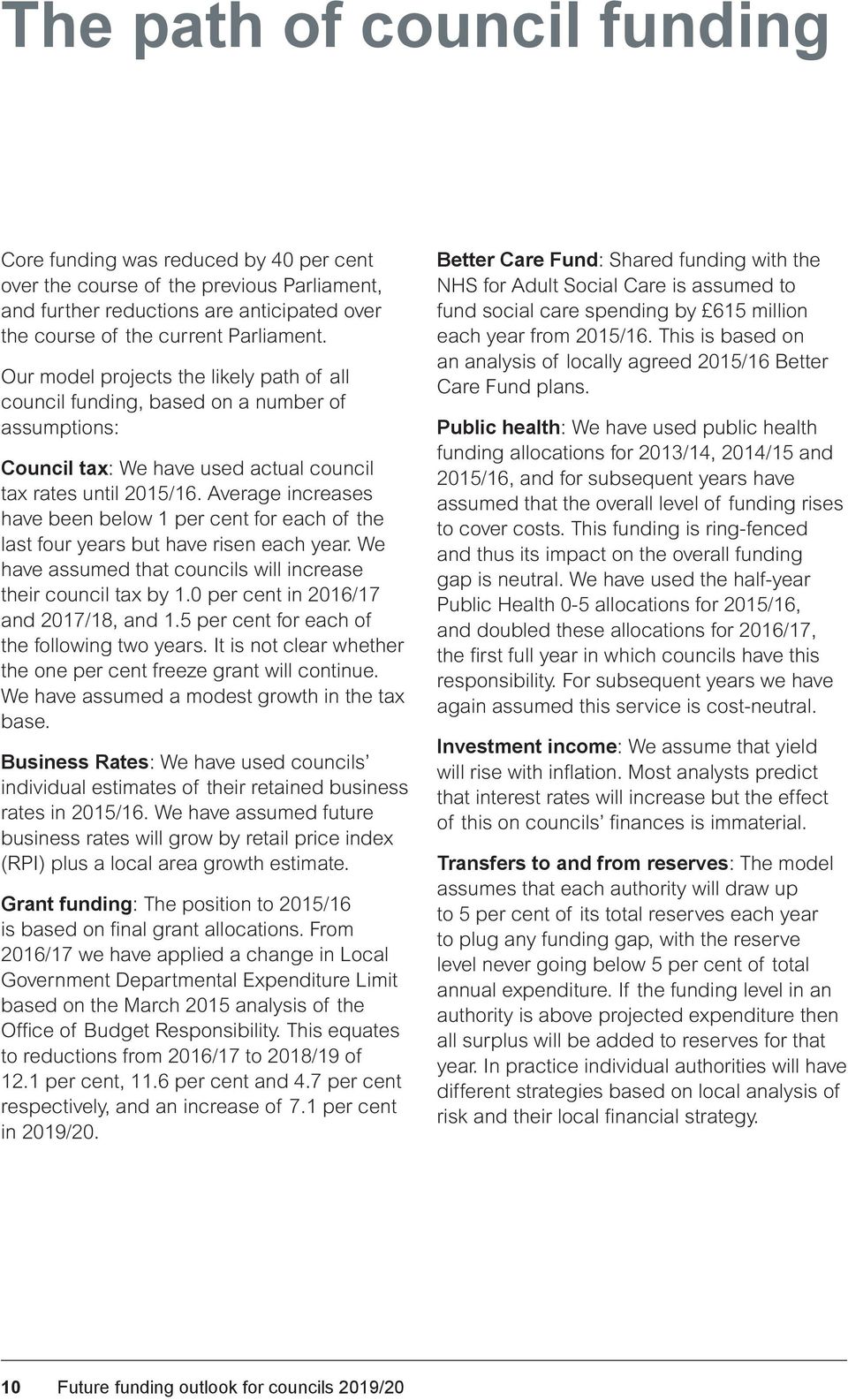
11 Figure 3: Total council funding 2010/11 to 2019/20 Projected Funding (billion) / / / / / / / / / /20 Figure 3 shows that total council funding falls by 7.6 billion between 2010/11 and 2018/19, and then rises by 1.6 billion in 2019/20. However, this total includes the introduction of ring-fenced funding for transferred public health responsibilities in 2013/14 and beyond, and when this is excluded the overall fall in funding amounts to 11.6 billion by 2018/19 or 10.0 billion by 2019/20. The changes in the way local government is funded can clearly be seen by comparing sources of funding in 2010/11 and 2019/20. Council Tax provides over half of all funding by the end of the decade, with the proportion of income coming from centralised grants falling over the decade as illustrated in Figure 4. Over the period, funding falls by 12 per cent in cash terms, or 29 per cent in real terms 4. When we account for the introduction of public health funding income falls by 20 per cent in cash terms and 37 per cent in real terms.5 4 Real terms is calculated using the GDP deflator series available here: htm 5 These percentage reduction figures are lower than the percentage reductions in core local government funding (40 per cent over five years) because they are the reduction in total funding, the main difference being that they include council tax and therefore start from a much higher base. Future funding outlook for councils 2019/20 11
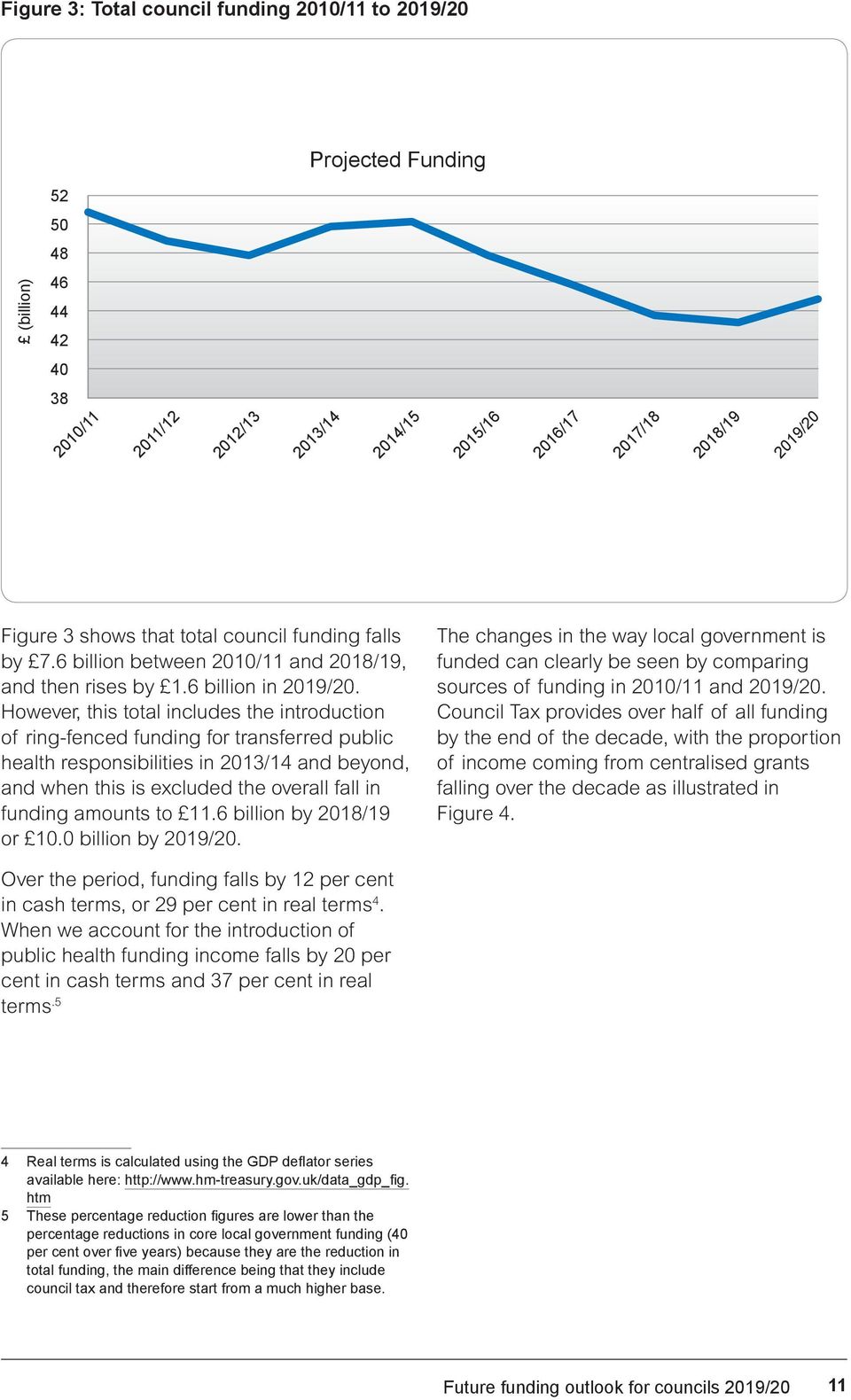
12 Figure 4: Composition of total local government funding 2010/11 and 2019/20 (excluding Public Health) 2010/11 18% 1% Council tax Formula grant Other grants Investment income 42% 39% 2019/20 3% 2% 2% 3% 9% 53% Council tax Retained business rates baseline New homes bonus Revenue Support Grant Other grants Investment income and change in reserves Additional social care funding 28% 12 Future funding outlook for councils 2019/20

13 Mapping funding against expenditure We can now bring together the analysis of projected income and expenditure trends to form a picture of local authority funding overall. This shows that the overall funding gap starts at just over 3 billion in 2015/16 and reaches over 10 billion by 2018/19, before shrinking to 9.5 billion by 2019/20. Figure 5: Income against expenditure 2010/11 to 2019/20 Funding Net Expenditure (billion) / / / / / / / / / /20 In practice authorities have already closed the gap for 2015/16 in order to comply with their duty to set balanced budgets, and they have done this either through cuts, further efficiencies or use of reserves. Once full data sets are available it will be possible to say more about how they have done this, but our research indicates that in many authorities the well of efficiencies is starting to run dry, with savings starting to come from service reductions. Many authorities already have in place savings plans to close their budget gap still further in 2016/17 and beyond, but our research shows that 2015/16 is the year in which service reductions will start to account for a higher proportion of savings than efficiencies. The model provides an opportunity to test councils ability to deliver their statutory obligations within the available resource envelope. Future funding outlook for councils 2019/20 13
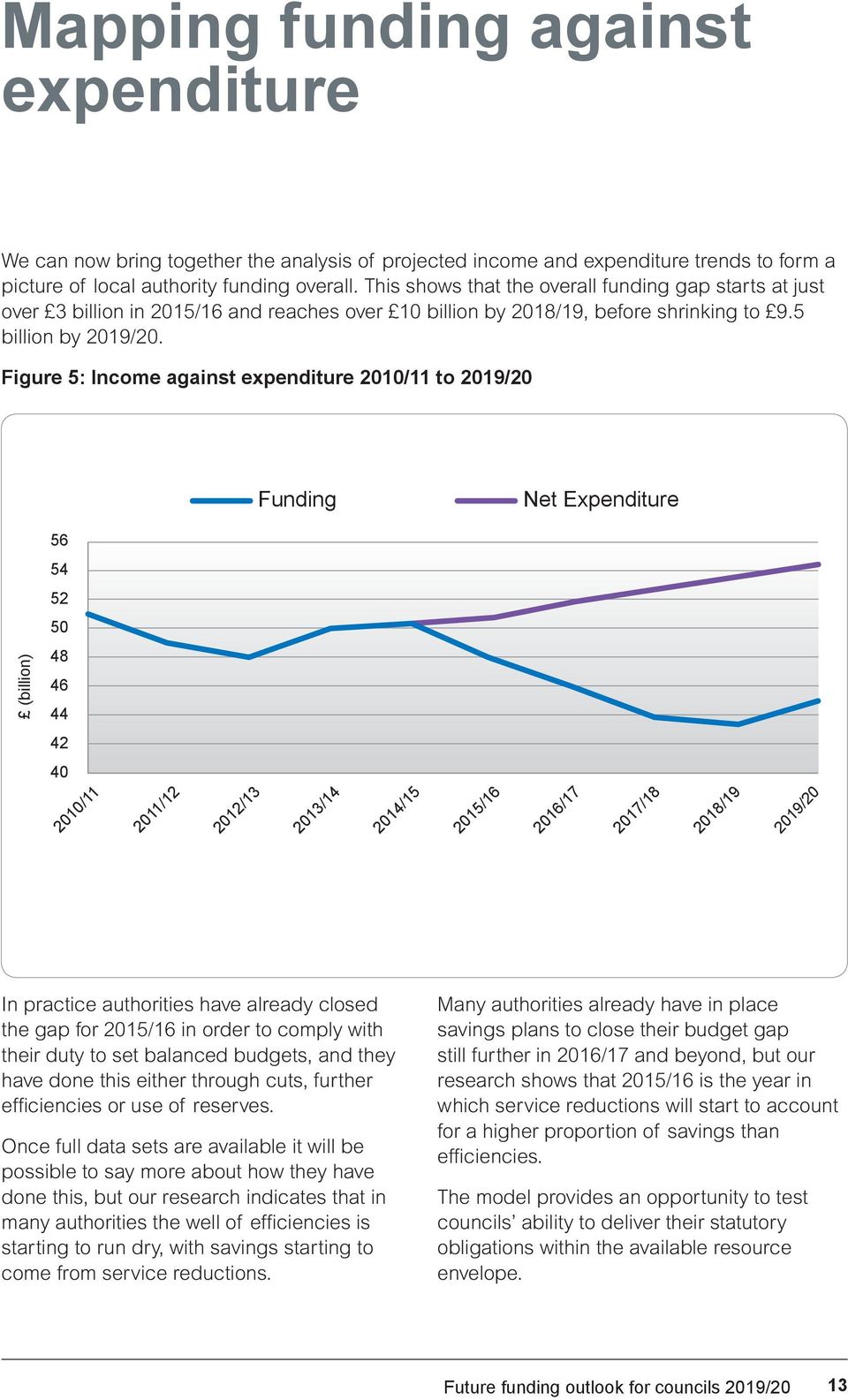
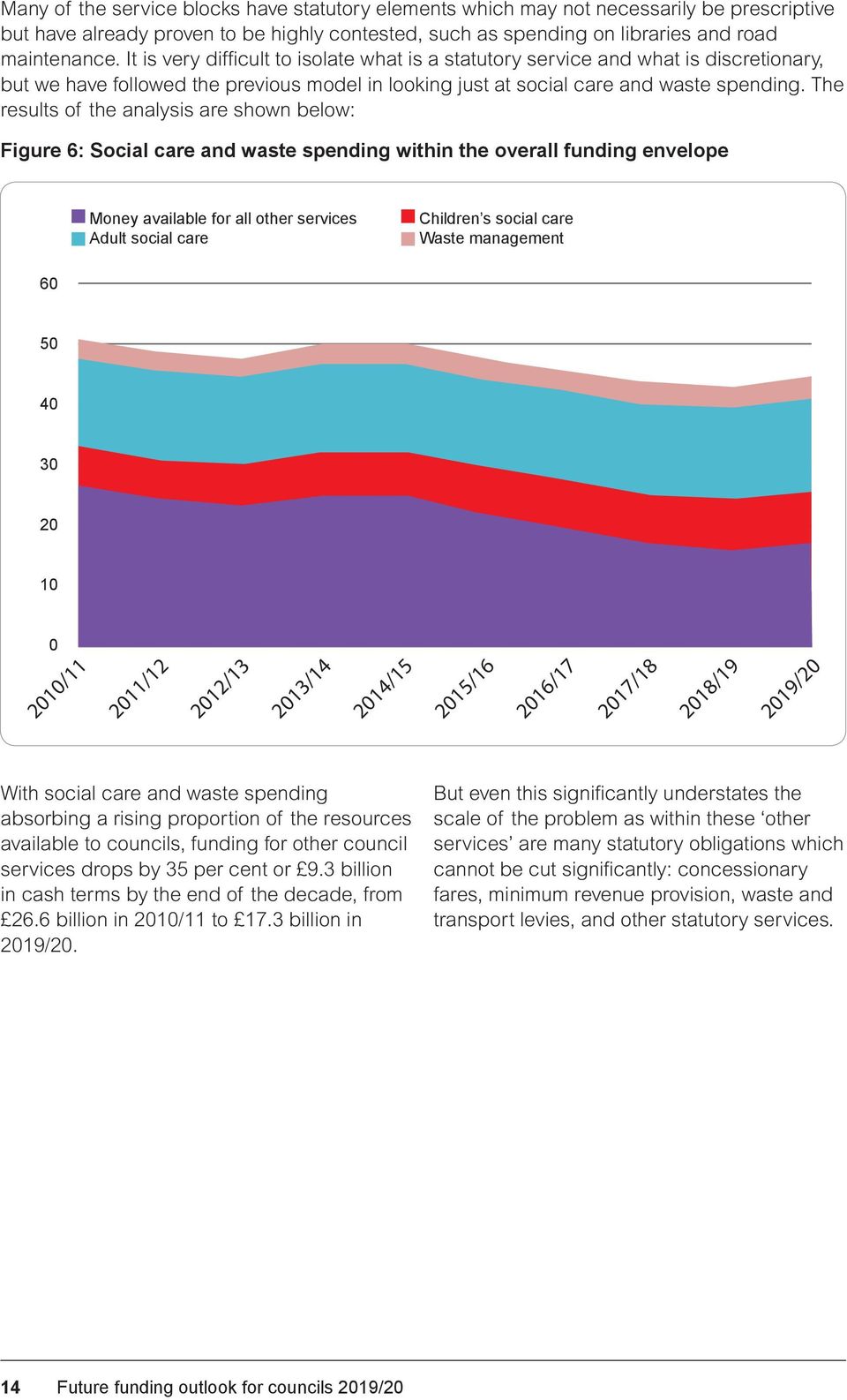
14 Many of the service blocks have statutory elements which may not necessarily be prescriptive but have already proven to be highly contested, such as spending on libraries and road maintenance. It is very difficult to isolate what is a statutory service and what is discretionary, but we have followed the previous model in looking just at social care and waste spending. The results of the analysis are shown below: Figure 6: Social care and waste spending within the overall funding envelope Money available for all other services Adult social care Children s social care Waste management / / / / / / / / / /20 With social care and waste spending absorbing a rising proportion of the resources available to councils, funding for other council services drops by 35 per cent or 9.3 billion in cash terms by the end of the decade, from 26.6 billion in 2010/11 to 17.3 billion in 2019/20. But even this significantly understates the scale of the problem as within these other services are many statutory obligations which cannot be cut significantly: concessionary fares, minimum revenue provision, waste and transport levies, and other statutory services. 14 Future funding outlook for councils 2019/20
15

16 For more information please contact: Bevis Ingram Senior Adviser Local Government Finance Local Government Association Local Government House Smith Square London SW1P 3HZ Local Government Association Local Government House Smith Square London SW1P 3HZ Telephone Fax Local Government Association, July 2015 For a copy in Braille, larger print or audio, please contact us on We consider requests on an individual basis. L15-260

Council tax support: the story continues. January 2015 www.local.gov.uk
 Council tax support: the story continues January 2015 www.local.gov.uk Contents Introduction 3 Funding and scheme sesign 4 The transitional grant 6 Collection rates 8 Hardship funds 11 Incentives to reduce
council tax support The story so far
 council tax support The story so far Background Background 1 Funding 3 Collection rates and collection costs 7 Wider impacts and the future 9 Conclusions and recommendations 12 This report draws on emerging
Charter for Budget Responsibility: Autumn Statement 2014 update
 Charter for Budget Responsibility: Autumn Statement 2014 update December 2014 Charter for Budget Responsibility: Autumn Statement 2014 update Presented to Parliament pursuant to Section 1 of the Budget
Value of student maintenance support
 Value of student maintenance support Standard Note: SN/SG/916 Last updated: 24 March 2014 Author: Paul Bolton Section Social & General Statistics Recent changes in maintenance support Maintenance grants,
GOVERNMENT EXPENDITURE & REVENUE SCOTLAND 2013-14 MARCH 2015
 GOVERNMENT EXPENDITURE & REVENUE SCOTLAND 2013-14 MARCH 2015 GOVERNMENT EXPENDITURE & REVENUE SCOTLAND 2013-14 MARCH 2015 The Scottish Government, Edinburgh 2015 Crown copyright 2015 This publication is
PROJECTION OF THE FISCAL BALANCE AND PUBLIC DEBT (2012 2027) - SUMMARY
 PROJECTION OF THE FISCAL BALANCE AND PUBLIC DEBT (2012 2027) - SUMMARY PUBLIC FINANCE REVIEW February 2013 SUMMARY Key messages The purpose of our analysis is to highlight the risks that fiscal policy
Greece. 1. Economic situation
 2. COUNTRY NOTES: GREECE 119 1. Economic situation The Greek economy is in a recession in the wake of the economic and sovereign debt crisis, exacerbated by the impact that austerity measures are having
The current economic situation in Germany. Deutsche Bundesbank Monthly Report February 2015 5
 The current economic situation in Germany Deutsche Bundesbank 5 6 Overview Global economy German economy emerging from sluggish phase faster than expected The global economy looks to have expanded in the
ANALYSIS OF SCOTLAND S PAST AND FUTURE FISCAL POSITION
 CPPR Briefing Note ANALYSIS OF SCOTLAND S PAST AND FUTURE FISCAL POSITION Incorporating: GERS 2014 and the 2014 UK Budget Main authors: John McLaren & Jo Armstrong Editorial role: Ken Gibb March 2014 Executive
Effects on pensioners from leaving the EU
 Effects on pensioners from leaving the EU Summary 1.1 HM Treasury s short-term document presented two scenarios for the immediate impact of leaving the EU on the UK economy: the shock scenario and severe
FINANCIAL ANALYSIS GUIDE
 MAN 4720 POLICY ANALYSIS AND FORMULATION FINANCIAL ANALYSIS GUIDE Revised -August 22, 2010 FINANCIAL ANALYSIS USING STRATEGIC PROFIT MODEL RATIOS Introduction Your policy course integrates information
a) raises the funds required by the Council to meet approved service levels in the most effective manner;
 ITEM FINANCIAL STRATEGY 2016/17 2020/21 Report By Chief Financial Officer SCOTTISH BORDERS COUNCIL 11 February 2016 1 PURPOSE AND SUMMARY 1.1 This report seeks approval for the financial strategy for the
Medium Term Financial Strategy 2016/17 to 2020/21
 Report to Council Medium Term Financial Strategy 2016/17 to 2020/21 Portfolio Holder: Councillor Jabbar, Cabinet Member for Finance and HR Officer Contact: Anne Ryans, Director of Finance Report Author:
COMMISSION STAFF WORKING DOCUMENT. Analysis of the draft budgetary plan of ITALY. Accompanying the document COMMISSION OPINION
 EUROPEAN COMMISSION Brussels, 15.11.2013 SWD(2013) 606 final COMMISSION STAFF WORKING DOCUMENT Analysis of the draft budgetary plan of ITALY Accompanying the document COMMISSION OPINION on the draft budgetary
A guide to the local government finance settlement in England
 A guide to the local government finance settlement in England December 2013 Department for Communities and Local Government Crown copyright, 2013 Copyright in the typographical arrangement rests with the
NHS and social care funding: the outlook to 2021/22
 NHS and social care funding: the outlook to 2021/22 Research report Rowena Crawford and Carl Emmerson July 2012 About this work programme This work, undertaken by the Institute for Fiscal Studies (IFS),
Impact on households: distributional analysis to accompany Spending Review and Autumn Statement 2015
 Impact on households: distributional analysis to accompany Spending Review and Autumn Statement 2015 November 2015 Impact on households: distributional analysis to accompany Spending Review and Autumn
The centre of government: an update
 Report by the Comptroller and Auditor General Cabinet Office and HM Treasury The centre of government: an update HC 1031 SESSION 2014-15 12 MARCH 2015 4 Overview The centre of government: an update Overview
Basis for setting the discount rate for calculating cash equivalent transfer values payable by public service pension schemes
 Basis for setting the discount rate for calculating cash equivalent transfer values payable by public service pension schemes updated guidance issued by HM Treasury March 2011 Official versions of this
Page 7. London Borough of Sutton
 Page 7 Agenda Item 3 London Borough of Sutton The Executive - 5 July 2011 Joint Report of the Strategic Director Resources and Executive Head of Policy and Customer Services BUSINESS AND FINANCIAL PLANNING
National Insurance Fund - Long-term Financial Estimates
 Social Security Administration Act 1992 National Insurance Fund - Long-term Financial Estimates Report by the Government Actuary on the Quinquennial Review for the period ending 5 April 1995 under Section
Debt, consolidation and growth
 Debt, consolidation and growth Robert Chote Annual meeting of OECD PBO and IFI officials Paris, 23 February 2012 Outline Very interesting paper. Will focus on UK approach to these issues rather than detailed
EAST AYRSHIRE COUNCIL CABINET 21 OCTOBER 2009 TREASURY MANAGEMENT ANNUAL REPORT FOR 2008/2009 AND UPDATE ON 2009/10 STRATEGY
 EAST AYRSHIRE COUNCIL CABINET 21 OCTOBER 2009 TREASURY MANAGEMENT ANNUAL REPORT FOR 2008/2009 AND UPDATE ON 2009/10 STRATEGY Report by Executive Head of Finance and Asset Management 1 PURPOSE OF REPORT
Electricity Market Reform:
 Electricity Market Reform: Consultation on Low Carbon Contracts Company s and Electricity Settlements Company s operational costs 2015/16 Government Response January 2015 Crown copyright 2015 URN 15D/001
The Levy Control Framework
 Report by the Comptroller and Auditor General Department of Energy & Climate Change The Levy Control Framework HC 815 SESSION 2013-14 27 NOVEMBER 2013 4 Key facts The Levy Control Framework Key facts 2bn
UK Government s Public Finance Plans and Fiscal Targets
 UK Government s Public Finance Plans and Fiscal Targets Scottish Government June 2015 Overview This paper analyses the scope to make different choices about the UK s public finances, within the fiscal
Income Tax Liabilities Statistics 2012-13 to 2014-15
 Coverage: United Kingdom Theme: The Economy Released: 13 February 2015 Next Release: May 2015 Frequency of release: Twice yearly (Jan/Feb and Apr/May) Income Tax Liabilities Statistics 2012-13 to 2014-15
Corporate Governance Report
 Corporate Governance Report Chairman s introduction From 1 January 2015 until 31 December 2015, the company applied the 2014 edition of the UK Corporate Governance Code (the Code ). 1. BOARD COMPOSITION
Confirm our understanding of the position on water business rates.
 Response to Draft Determination Wholesale operating costs Issue Having carefully reviewed the Draft Determination, there are two wholesale cost cases which impact both our water and wastewater total expenditure
Lars Nyberg: The Riksbank's monetary policy strategy
 Lars Nyberg: The Riksbank's monetary policy strategy Speech by Mr Lars Nyberg, Deputy Governor of the Sveriges Riksbank, at the Foreign Banker s Association, Stockholm, 14 September 2006. Introduction
Financial Scrutiny Unit Briefing Tax revenue estimates: a comparison of GERS and HMRC
 The Scottish Parliament and Scottish Parliament Infor mation C entre l ogos. Financial Scrutiny Unit Briefing Tax revenue estimates: a comparison of GERS and HMRC Richard Marsh and Scherie Nicol This briefing
Pre-Test Chapter 11 ed17
 Pre-Test Chapter 11 ed17 Multiple Choice Questions 1. Built-in stability means that: A. an annually balanced budget will offset the procyclical tendencies created by state and local finance and thereby
COMMISSION OPINION. of XXX. on the Draft Budgetary Plan of ITALY
 EUROPEAN COMMISSION Brussels, XXX [ ](2013) XXX draft COMMISSION OPINION of XXX on the Draft Budgetary Plan of ITALY EN EN COMMISSION OPINION of XXX on the Draft Budgetary Plan of ITALY GENERAL CONSIDERATIONS
UK Income Tax Liabilities Statistics
 Coverage: United Kingdom Theme: The Economy Released: 22 May 2015 Next Release: Jan/Feb 2016 Frequency of release: Twice yearly (Jan/Feb and Apr/May) Media contact: HMRC Press Office (Individuals) Tel:
Equality Impact Assessment Support for Mortgage Interest
 Welfare and Wellbeing Group Equality Impact Assessment Support for Mortgage Interest Planned change to the standard interest rate at which Support for Mortgage Interest is paid August 2010 Equality Impact
Glasgow Kelvin College. Financial Control Committee. UK Government Spending Review. Report by Vice Principal Finance & Corporate Services
 Glasgow Kelvin College Item 15 For Information Financial Control Committee UK Government Spending Review Report by Vice Principal Finance & Corporate Services 1. Introduction The purpose of this report
Fiscal Responsibility in the UK
 Fiscal Responsibility in the UK Stephen Nickell Nuffield College, Oxford Member of the UK Budget Responsibility Committee Credibility If the credibility of a government s fiscal plans is weak, interest
Current and Proposed Higher Education Student Finance Arrangements in the UK Regions
 Research and Information Service 13 th May 2011 Eoin Murphy Current and Proposed Higher Education Student Finance Arrangements in the UK Regions NIAR 435-2010 This paper examines the existing Higher Education
Defence Expenditure: Trends and International Comparisons
 2005/01 2 March 2005 Defence Expenditure: Trends and International Comparisons Executive Summary The use of accrual accounting methods makes New Zealand unique internationally with regard to defence accounting.
Hungary. 1. Economic situation
 2. COUNTRY NOTES: HUNGARY 125 1. Economic situation has faced considerable challenges to regain fiscal credibility. After almost a decade of persistent, high fiscal deficits and the building up of external
CHESHIRE FIRE AUTHORITY SUBJECT : 2014-15 DRAFT BUDGET, COUNCIL TAX AND MEDIUM TERM FINANCIAL PLAN
 CHESHIRE FIRE AUTHORITY Item 2 ITEM: 2 MEETING OF : FIRE AUTHORITY DATE : 12 FEBRUARY 2014 REPORT OF : CHIEF FIRE OFFICER AUTHOR : HEAD OF FINANCE SUBJECT : 2014-15 DRAFT BUDGET, COUNCIL TAX AND MEDIUM
Towards Excellence in Adult Social Care. Statement of purpose. Sector-led improvement
 Towards Excellence in Adult Social Care Statement of purpose Sector-led improvement The Towards Excellence in Adult Social Care (TEASC) programme brings together partners at a local, regional and national
ANNEX 1 - MACROECONOMIC IMPLICATIONS FOR ITALY OF ACHIEVING COMPLIANCE WITH THE DEBT RULE UNDER TWO DIFFERENT SCENARIOS
 ANNEX 1 - MACROECONOMIC IMPLICATIONS FOR ITALY OF ACHIEVING COMPLIANCE WITH THE DEBT RULE UNDER TWO DIFFERENT SCENARIOS The aim of this note is first to illustrate the impact of a fiscal adjustment aimed
Submitted to: NHS West Norfolk CCG Governing Body, 29 January 2015
 Agenda Item: 11.2 Subject: Draft Financial Plan 2015/16 Presented by: John Ingham, Chief Financial Officer Submitted to: NHS West Norfolk CCG Governing Body, 29 January 2015 Purpose of Paper: For information
Thames Tideway Tunnel Cost of capital
 Thames Tideway Tunnel Cost of capital CEPA briefing note 25 th August 2015 Introduction Thames Water over the past nine months has run a competitive licence application to appoint the Infrastructure Provider
A clean and green environment - Ensuring that for visitors and residents alike, the borough provides a clean, tidy and green environment for all.
 Section Two Policy Context and Government Funding Corporate Plan 2011-15 Connecting with the Community 1. The council adopted a five-year Corporate Plan in October 2011. During 2013 the council carried
Methods of financing health care
 International Social Security Association Fifteenth International Conference of Social Security Actuaries and Statisticians Helsinki, Finland, 23-25 May 2007 Methods of financing health care Finnish national
WEST MERCIA BUDGET 2013/14 MEDIUM TERM FINANCIAL PLAN 2013/14 TO 2017/18. Report of the Treasurer, Director of Finance, Chief Executive and
 WEST MERCIA BUDGET 2013/14 MEDIUM TERM FINANCIAL PLAN 2013/14 TO 2017/18 Report of the Treasurer, Director of Finance, Chief Executive and Chief Constable 1. Recommendation The Commissioner is recommended
Scotland s Balance Sheet. April 2013
 Scotland s Balance Sheet April 2013 Contents Executive Summary... 1 Introduction and Overview... 2 Public Spending... 5 Scottish Tax Revenue... 12 Overall Fiscal Position and Public Sector Debt... 18 Conclusion...
EUROSYSTEM STAFF MACROECONOMIC PROJECTIONS FOR THE EURO AREA
 EUROSYSTEM STAFF MACROECONOMIC PROJECTIONS FOR THE EURO AREA On the basis of the information available up to 22 May 2009, Eurosystem staff have prepared projections for macroeconomic developments in the
THE PETROL TAX DEBATE
 THE PETROL TAX DEBATE Zoë Smith THE INSTITUTE FOR FISCAL STUDIES Briefing Note No. 8 Published by The Institute for Fiscal Studies 7 Ridgmount Street London WC1E 7AE Tel 2 7291 48 Fax 2 7323 478 [email protected]
Fiscal Sustainability of an Independent Scotland
 Fiscal Sustainability of an Independent Scotland Michael Amior Rowena Crawford Gemma Tetlow Copy-edited by Judith Payne Institute for Fiscal Studies 7 Ridgmount Street London WC1E 7AE Published by The
Policy Brief June 2010
 Policy Brief June 2010 Pension Tension: Understanding Arizona s Public Employee Retirement Plans The Arizona Chamber Foundation (501(c)3) is a non-partisan, objective educational and research foundation.
Impact of VAT reduction on the consumer price indices
 ARTICLE Rob Pike, Mark Lewis and Daniel Turner Impact of VAT reduction on the consumer price indices SUMMARY This article explains how ONS successfully measured prices for the consumer price indices following
South African Reserve Bank. Statement of the Monetary Policy Committee. Issued by Lesetja Kganyago, Governor of the South African Reserve Bank
 South African Reserve Bank PRESS STATEMENT EMBARGO DELIVERY 17 March 2016 Statement of the Monetary Policy Committee Issued by Lesetja Kganyago, Governor of the South African Reserve Bank Since the previous
Making work pay in London under Universal Credit. A report for London Councils
 Making work pay in London under Universal Credit A report for London Councils June 2011 Contents Executive Summary...3 1 The context for this report...10 2 The Universal Credit...12 3 Making work pay in
York Aviation BRISTOL AIRPORT LIMITED THE IMPACT OF DEVOLVING AIR PASSENGER DUTY TO WALES
 York Aviation BRISTOL AIRPORT LIMITED THE IMPACT OF DEVOLVING AIR PASSENGER DUTY TO WALES BRISTOL AIRPORT LIMITED THE IMPACT OF DEVOLVING AIR PASSENGER DUTY TO WALES Contents Page 0 KEY POINTS... I 1
Business rate retention. The story so far
 Business rate retention The story so far introduction Introduction 1 How does business rate retention work 2 Forecasting and planning 4 Financial risk 7 Looking into the future 12 Conclusions and recommendations