
Rocka, hipt og snacksy. Om engelsk i norsk språk og samfunn.
|
|
|
- Silvester Riley
- 9 years ago
- Views:
Transcription
1 Johansson, Stig, and Anne-Line Graedler. Rocka, hipt og snacksy. Om engelsk i norsk språk og samfunn. Kristiansand: Høyskoleforlaget, 2002 GUNNEL MELCHERS A review of this engaging and informative book is long overdue and was, in fact, originally meant to be included in the recent special issue of NJES (Vbl.3:2, 2004), devoted to the influence of English on the languages in the Nordic countries. The obvious advantage, however, of waiting to produce this review is that it should benefit from last year's NJES thematic issue, which provided a great deal of interesting comparative material and a variety of perspectives on the topic. Johansson & Graedler's pioneering work, in fact, includes aspects of virtually all the issues represented in the NJES volume, published two years later and dealing with a larger area comprising several different polities and speech communities. Thus both publications discuss types of borrowing, the effect of English on LI word formation and sentence structure, changing practices in naming, sociolinguistic differences, domain loss, and attitudes to the impact of English. Johansson 1995, an article which can be viewed as a preliminary or forerunner to the book under review, is introduced as follows: The influence of the English language and of Anglo-American culture has been strongly felt in Scandinavia in this century. Yet it is a topic which - until recently - has not been given much attention in linguistic research, alrhough it has been frequently commented on in articles and letters to the editor in the press. Oohansson 1995:269) Indeed, with the exception of some ambitious, data-based descriptions of loanwords, such as Stene 1945 (on Norwegian), Sørensen 1973 (Danish), Seltén 1993 (Swedish), a corpus-based study of English as used in the Swedish press (Chrystal 1988) and a large-scale informant study on attitudes and usage (Ljung 1985, 1988), the topic does not seem to have caught the attention of many linguists based in the Nordic countries. Yet the first years in the new millennium have seen an upsurge in research. 157

2 Rocka, hipt og snacksy Speculating on reasons for this change of affairs, one might suggest the increased awareness of language contact as an important factor in change and variation, the growing interest in 'World Englishes', the rapidly increasing availability of written as well as spoken language corpora, the interest in youth culture, and the fear of domain loss and endangerment. As last year's NJES thematic issue also clearly demonstrates, in its very existence as well as its contents, important steps have been taken in the Nordic countries towards joint efforts in the field, linguistically as well as politically. The most important linguistic manifestation of such cooperation so far is probably the large-scale project Modern Loanwords in the Nordic Countries, presented in Anne-Line Graedler's contribution to the journal. The aims of the project are not only to produce a detailed comparative survey of the treatment of modern loanwords in the languages in the Nordic countries but also to study 'the linguistic climate', i.e. attitudes, and to provide a background for discussion and decisionmaking on the part of language councils. The useful list of references concluding the presentation clearly reflects the weight and wealth of empirical research carried out during the last decade. In Norway, the most substantial contribution no doubt derives from the work done and inspired by the writers of the volume under review. As seen from its title, Johansson & Graedler's monumental monograph is written in Norwegian, which is understandable, although its contents should be of interest to anyone concerned with the globalisation of English. Its target readership is not explicitly specified, but seems to be a fairly general Norwegian audience. The presentation is admirably straightforward and free of linguistic jargon. In part, it is definitely of a didactic character and the book will indeed make an excellent textbook. Each chapter is concluded by a list of suggestions for further reading and the book is accompanied by a website providing tasks relating to topics discussed. The bulk of the book's ten chapters and 318 pages deals with lexical borrowings: their history, users, domains, integration, etc. In view of this, the book's all-embracing subtitle would appear to be somewhat misleading; yet the first two chapters and the concluding one address other levels of language as well. Clearly, it could be argued and is also well documented that the impact of a donor language tends to be strongest and most easily perceived with regard to the lexicon. The introductory chapter, Engelsk - bro eller barriere? ('English - bridge or barrier?') immediately whets the reader's appetite by quoting a 158

3 Gunnel Melchers prediction voiced in 1960 by a Norwegian publisher to the effect that English would be the dominant language in Norway before the new millennium. As we all know, this has not happened, in spite of an everincreasing 'pressure' from English, the character and extent of which the authors illustrate by some striking examples found in newspapers appearing on a randomly selected day in the year Still, the authors' general impression after this search was that - with the exception of advertisements - there were relatively few English words and expressions in most of the articles, which corresponds with the overall results of Chrystal's large-scale 1988 study of Swedish newspapers. A particularly interesting section in the chapter discusses its main theme, as suggested in the title. Although the mastery of English is obviously a 'bridge' in that it enriches our existence by the possibility to communicate with people and to gain access to cultures all over the world, its global spread and especially its impact on the mother tongue can also have an excluding effect. The youngest and oldest age groups in a population, for example, often have no knowledge of English, and a sizeable number of school learners never acquire the skills required to benefit from or even understand all the information supplied in English only. By means of illuminating examples, taken from various genres, the authors demonstrate the problems of this information gap, which has largely been neglected but is clearly of vital importance and should be subjected to sociolinguistic research. In Norway as well as the other Nordic countries there is, unfortunately and mistakenly, something of a myth claiming that we are all virtually bilingual. This rich and stimulating chapter, which encapsulates a great deal of the authors' message, continues by clarifying that anglonorsk, i.e. 'English as used in Norwegian' does not necessarily bear complete resemblance to the language as used in an English-speaking country. For one thing, words may be inflected according to the grammar of the receiving language, but they may also have acquired a new meaning. The three words that make up the main title of the book are used to illustrate this phenomenon, but - curiously - their exact significance and use is not described. The social aspect of the use of English is further highlighted by a plea for language awareness and consideration of audience in writing and speaking. It is argued that many English borrowings could easily be replaced by Norwegian words. This, again, is an interesting topic, highlighted by the language councils in the Nordic countries, among which the Norwegian council no doubt is the most militant (cf. In the 159

4 Rocka, hipt og snacksy opinion of the present reviewer, the advice given tends to be too categorical, since the borrowings often stand for a special aspect or may express a particular involvement. Replacement can also be problematic for formal reasons: e-post instead of as exemplified by the authors is not equivalent/synonymous in that it cannot be used as a countable. The chapter further contains a brief section exemplifying Englishbased changes in Norwegian sentence structure. These often subtle, unobtrusive changes are plentiful in the Scandinavian languages but are still waiting to be researched at length. As recently shown by Ljung (2004), the existence of large text corpora makes syntactic studies in this field feasible and worthwhile. Finally, the crucial problem of domain loss is briefly touched upon and an account is given of the aims and data collection of the project on which the present volume is based. Chapter 2 provides a succinct, but in part unnecessarily detailed, overview of the history of the English language, including its global spread. Whereas it is not quite clear why descriptions of varieties such as pidgins and Creoles should be included in this work unless it is shown that a learner language may display certain pidgin-like features, other topics are well placed, e.g. Kachru's model of World Englishes. Admittedly, in part the presentation does link up well with certain recommendations for the teaching of English in Norwegian schools given in Chapter 10. Beginning with the next chapter, the focus is on borrowings, or rather 'loanwords', which is the term used by the authors throughout the presentation. This chapter, again, is largely a lesson in the history of the English language, describing the complicated shaping of its vocabulary through language contact. Although the presentation is very readable as such, it could be questioned whether it really deserves its place in this volume. The chapter also includes a historical account of loanwords in Norwegian, which is definitely more justified and includes important information on early borrowing from English. It also reviews some early studies on English loanwords in Norway, notably Stene 1945, who found that the number of English loanwords in data from the 1930s hardly exceeded loanwords from some other languages. The detailed account of Haugen's work on the Norwegian language in America deserves its place here, since interesting similarities as well as differences are to be found in the character and use of the English borrowings as compared to the situation in Norway today. A comparison of these two rather different scenarios would constitute a worthwhile project in its own right. 160

5 Gunnel Melchers The following chapter, Hvem bruker lånord og hvorfor? ('Who uses loanwords and why?'), can be characterised as highly informative as well as innovative. In some 50 pages the authors succeed in producing subtle descriptions of the particular settings and attitudes determining the scope and character of the borrowings as well as detailed data-based examples and figures. The chapter opens with an interesting discussion of problems in determining what to include in the category 'loanword'; hence it is difficult to establish just how many loanwords there are at a given time. Should, for example, a word that has been totally integrated, such as jobbe ('work'), be included? Incidentally, an informant study as to what is considered a loanword or not, should be interesting. In a course on language change at Stockholm University a 20-year-old student recently gave the word container as an example of a completely integrated loanword, claiming that 'it had been around for so long'. As for myself, about 50 years her senior, I view the same word as a very recent addition to the Swedish language and clearly marked as a borrowing. The chapter abounds with interesting ideas and discussions. Among other things, the authors ask themselves why there seems to be a general impression that English loanwords are extremely frequent in running texts, such as newspaper articles, when this is not really the case. In the interesting section called Synlighet ('Visibility') it is put forward that not only do the English words mostly represent 'content-bearing' nouns, but they are also highlighted through deviant spelling conventions and - if spoken - pronunciations. In addition, they often occur in prominent positions, such as headlines, and are often new and topical (reality TV, web design), sometimes even 'loaded'. As is well known, the frequency of English loanwords is very dependent on text type, subculture and domain. The following settings are presented: popular music (where Norwegian is seriously endangered), fashion, sport (concluded by an interesting account of a number of sports-related borrowings which have acquired more generalised meanings), film and TV (including an interesting study of the increasing use of all-english titles, some of which have even been changed in Norway, e.g. Miss Congeniality, called Miss Undercover in Norway; in Sweden, by contrast, its title is Miss Secret Agenrf), advertising (where a great deal of punning presupposing a knowledge of Norwegian is found), economics, names of various kinds (cf. Pahta & Taavitsainen 2004 studying Finnish telephone directories), the computer world, and spoken language (still very much under-researched). An informant study as to the acceptability of English loanwords in Norway showed clear differences 161

6 Rocka, hipt og snacksy with regard to region (lower acceptability in the North), occupation (low acceptability on the part of teacher trainees as compared to a group doing their military service) and gender (somewhat lower acceptability among women). The chapter is concluded by speculations on some underlying reasons for preferring English words, such as expressing modernity, seeking attention, punning, expressing emotion, involvement and identity. Chapters 5 to 8 carefully account for the treatment of the loanwords: their integration viewed from different perspectives (formal, social, psychological and lexical), their varying pronunciation and spelling, including the role of the Norwegian language council in this respect), their morphological integration (including an interesting study of grammatical gender assignment to English loanwords), semantic change, and the category labelled 'indirect' loans, especially 'substitution' loans, whereby a word already existing in the receiving language extends its meaning due to influence from the donor language. The last-mentioned topic is richly illustrated by results from a pioneering study. Chapter 9, which is devoted to code-switching, is more general and impressionistic. The authors deplore the fact that very little work has been done on spoken language; in fact, Sharp 2001 seems to be the only largescale study in the Nordic countries so far. The title of the final chapter is Engelsk eller ikke engelsk - is that the question? ('English or no English -...'). This wording, which does not lend itself to a completely adequate translation into English, is meant as a response to a Danish publication with a similar-sounding title but ending in a statement, viz. that is the question. Graedler & Johansson wish to emphasise that both languages are needed; the question is rather when to use one and when the other. In considering what might constitute the greatest threat to the Norwegian language the authors briefly advocate some restriction in the use of English loanwords, e.g. in talking or writing to/for an audience to whom language might be a barrier. Quite rightly, however, the bulk of the discussion of endangerment has to do with domain loss. This is, incidentally, also the main concern of the language council in Sweden, which is referred to in the chapter (cf. Furthermore, the authors recommend changes in the teaching of the mother tongue as well as English with a view to raising language awareness, e.g. by considering varieties of English other than standard varieties found in Britain or the U.S. The interesting and important topic 'English as a lingua franca' is briefly discussed towards the end of the chapter. 162

7 Gunnel Melchers In all, this is a solid as well as stimulating book to simply enjoy reading and to keep for continuous reference. I cannot claim to have done justice to its richness but I hope at least to have demonstrated one of its many merits, viz. the wealth of information and ideas that suggest and inspire further research. This, if anything, is the hallmark of good educational and scholarly writing. Stockholm University Department of English 163

8 Rocka, hipt og snacksy References Chrystal, Judith-Ann Engelskan i svensk dagspress. Skrifter urgivna av Svenska språknämnden 74. Göteborg: Esselte Studium. Johansson, Stig "Rocka, Hipt, and Snacksy: Some Aspects of English Influence on Presenr-Day Norwegian." In Melchers, G. and B. Warren (eds.), Studies in Anglistics. Stockholm Studies in English LXXXV, Ljung, Magnus Lam anka - ett måste? En undersökning av engelskan i svenskan, dess mottagande och spridning. EIS Report No. 8. Stockholm: Stockholms universiret. Ljung, Magnus Skinheads, hackers &Lima ankor. Engelskan i 80-talets svenska. Stockholm: Trevi. Ljung, Magnus "Is 'den försre att gå' den förste som gick?" NJES, Vol. 3, No.2, Nordic Journal of English Studies (NJES), Vol. 3, No Special issue: "The Nordic influence of English on the languages in the Nordic countries." Karin Aijmer and Gunnel Melchers (eds.). Pahta, Päivi and Irma Taavitsainen "Creating images through English on Yellow Pages: Mulrilingual practices in advertising in the Helsinki region." NJES, Vol. 3, No.2, Seltén, Bo Ny svengelsk ordbok. Lund: Studentlitteratur. Sharp, Harrier English in Spoken Swedish: A Corpus Study of Two Discourse Domains. Stockholm Studies in English 95. Stockholm: Almqvist & Wiksell International. Stene, Aasta English Loan-words in Modern Norwegian: A Study of Linguistic Borrowing in the Process. London & Oslo: Oxford University Press, Johan Grundt Tanum Forlag. Sørensen, Knud Engelske lån i dansk. Dansk Sprognævns skrifter 8. København: Gyldendals Boghandel Nordisk Forlag. 164

Attitudes towards English in Norwegian newspaper discourse. Anne-Line Graedler
 Attitudes towards English in Norwegian newspaper discourse Anne-Line Graedler Outline 1. Background 2. Aim 3. Data 4. Analysis Context What are the texts about? How is English referred to in the texts?
BILINGUALISM AND LANGUAGE ATTITUDES IN NORTHERN SAMI SPEECH COMMUNITIES IN FINLAND PhD thesis Summary
 Duray Zsuzsa BILINGUALISM AND LANGUAGE ATTITUDES IN NORTHERN SAMI SPEECH COMMUNITIES IN FINLAND PhD thesis Summary Thesis supervisor: Dr Bakró-Nagy Marianne, University Professor PhD School of Linguistics,
Literacy across learning Principles and practice
 Literacy across learning Principles and practice Language and literacy are of personal, social and economic importance. Our ability to use language lies at the centre of the development and expression
Financial Literacy and ESOL
 Financial Literacy and ESOL Financial Literacy and ESOL There are more and more resources available for delivering LLN in the context of finance but most of them are focused on working with learners whose
An Overview of Applied Linguistics
 An Overview of Applied Linguistics Edited by: Norbert Schmitt Abeer Alharbi What is Linguistics? It is a scientific study of a language It s goal is To describe the varieties of languages and explain the
Comparative Analysis on the Armenian and Korean Languages
 Comparative Analysis on the Armenian and Korean Languages Syuzanna Mejlumyan Yerevan State Linguistic University Abstract It has been five years since the Korean language has been taught at Yerevan State
Business School Writing an Essay
 Business School Writing an Essay What is an essay? An essay is usually written in response to a question or series of questions. The writer's purpose is to convince the reader that his or her way of analysing,
The course is included in the CPD programme for teachers II.
 Faculties of Humanities and Theology LLYU72, Swedish as a Second Language for Upper Secondary School Teachers, 60 credits Svenska som andraspråk för lärare i gymnasieskolan, 60 högskolepoäng First Cycle
The Oxford Learner s Dictionary of Academic English
 ISEJ Advertorial The Oxford Learner s Dictionary of Academic English Oxford University Press The Oxford Learner s Dictionary of Academic English (OLDAE) is a brand new learner s dictionary aimed at students
209 THE STRUCTURE AND USE OF ENGLISH.
 209 THE STRUCTURE AND USE OF ENGLISH. (3) A general survey of the history, structure, and use of the English language. Topics investigated include: the history of the English language; elements of the
National assessment of foreign languages in Sweden
 National assessment of foreign languages in Sweden Gudrun Erickson University of Gothenburg, Sweden [email protected] The text is based on a summary of a presentation given at the FIPLV Nordic
Latin Syllabus S2 - S7
 European Schools Office of the Secretary-General Pedagogical Development Unit Ref.: 2014-01-D-35-en-2 Orig.: FR Latin Syllabus S2 - S7 APPROVED BY THE JOINT TEACHING COMMITTEE ON 13 AND 14 FEBRUARY 2014
READING THE NEWSPAPER
 READING THE NEWSPAPER Outcome (lesson objective) Students will comprehend and critically evaluate text as they read to find the main idea. They will construct meaning as they analyze news articles and
Discourse Markers in English Writing
 Discourse Markers in English Writing Li FENG Abstract Many devices, such as reference, substitution, ellipsis, and discourse marker, contribute to a discourse s cohesion and coherence. This paper focuses
A Pilot Study of Some ROCMA Cadets Difficulties in English Speaking
 WHAMPOA - An Interdisciplinary Journal 57(2009) 119-126 119 A Pilot Study of Some ROCMA Cadets Difficulties in English Speaking Wain-Chin Dana Chen 1 1 Department of Foreign Languages, ROC Military Academy
psychology and its role in comprehension of the text has been explored and employed
 2 The role of background knowledge in language comprehension has been formalized as schema theory, any text, either spoken or written, does not by itself carry meaning. Rather, according to schema theory,
ICAME Journal No. 24. Reviews
 ICAME Journal No. 24 Reviews Collins COBUILD Grammar Patterns 2: Nouns and Adjectives, edited by Gill Francis, Susan Hunston, andelizabeth Manning, withjohn Sinclair as the founding editor-in-chief of
Teaching English as a Foreign Language (TEFL) Certificate Programs
 Teaching English as a Foreign Language (TEFL) Certificate Programs Our TEFL offerings include one 27-unit professional certificate program and four shorter 12-unit certificates: TEFL Professional Certificate
English Year Course / Engelsk årsenhet
 Study plan Name Achieved grade Credit points Learning benefits Admission requirements Target group Content and instruction Program structure English Year Course / Engelsk årsenhet Year course 60 ECTS At
COMPUTER TECHNOLOGY IN TEACHING READING
 Лю Пэн COMPUTER TECHNOLOGY IN TEACHING READING Effective Elementary Reading Program Effective approach must contain the following five components: 1. Phonemic awareness instruction to help children learn
The. Languages Ladder. Steps to Success. The
 The Languages Ladder Steps to Success The What is it? The development of a national recognition scheme for languages the Languages Ladder is one of three overarching aims of the National Languages Strategy.
Why are there so few women in the tech industry in Oslo, Norway?
 Why are there so few women in the tech industry in Oslo, Norway? I believe that these kinds of networks, such as Oda- Nettverk and others, give a united strength and community feeling, and there is obviously
Keywords academic writing phraseology dissertations online support international students
 Phrasebank: a University-wide Online Writing Resource John Morley, Director of Academic Support Programmes, School of Languages, Linguistics and Cultures, The University of Manchester Summary A salient
Visit of UN Special Rapporteur on the right to the highest attainable standard of health, to Sweden from 10-18 th January 2006.
 Visit of UN Special Rapporteur on the right to the highest attainable standard of health, to Sweden from 10-18 th January 2006. Professor Paul Hunt, UN Special Rapporteur on the right to the highest attainable
USING LANGUAGES TO LEARN AND LEARNING TO USE LANGUAGES
 1 USING LANGUAGES TO LEARN AND LEARNING TO USE LANGUAGES David Marsh The future doesn t just happen, it is shaped and modelled by our actions. 2 An Introduction to CLIL for Parents and Young People This
Historical Linguistics. Diachronic Analysis. Two Approaches to the Study of Language. Kinds of Language Change. What is Historical Linguistics?
 Historical Linguistics Diachronic Analysis What is Historical Linguistics? Historical linguistics is the study of how languages change over time and of their relationships with other languages. All languages
158. Library Services to Multicultural Populations
 Date submitted: 29/05/2009 Join us for a journey through Islamic Art Kirsten Leth Nielsen Head of The Multilingual Library Oslo, Norway [email protected] Meeting: 158. Library Services
Norwegian subject curriculum
 Norwegian subject curriculum Dette er en oversettelse av den fastsatte læreplanteksten. Læreplanen er fastsatt på Bokmål Established as a Regulation by the Ministry of Education and Research on 24 June
Descriptive and Normative Aspects of Lexicographic Decision-Making: The Borderline Cases
 THE DICTIONARY-MAKING PROCESS Descriptive and Normative Aspects of Lexicographic Decision-Making: The Borderline Cases Lars Trap-Jensen The Danish Dictionary Danish Society for Language and Literature
A Guide to Cambridge English: Preliminary
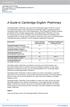 Cambridge English: Preliminary, also known as the Preliminary English Test (PET), is part of a comprehensive range of exams developed by Cambridge English Language Assessment. Cambridge English exams have
Planning and Writing Essays
 Planning and Writing Essays Many of your coursework assignments will take the form of an essay. This leaflet will give you an overview of the basic stages of planning and writing an academic essay but
How to become a successful language learner
 How to become a successful language learner By Alison Fenner English and German Co-ordinator, Institution Wide Language Programme Introduction Your success in learning a language depends on you! You may
English Syllabus for Grades 1-4. Desktop/ Files Returned by Experts August 2008 / English cover, content & introduction Grades 1-4 cv2
 Desktop/ Files Returned by Experts August 2008 / English cover, content & introduction Grades 1-4 cv2 Table of Contents Rationale... Topic flow charts for Grades 1-4... Minimum Learning Competencies for
Highlights of the Program
 Welcome to the first edition of Ponto de Encontro: Portuguese as a World Language! This program provides an ample, flexible, communication-oriented framework for use in the beginning and intermediate Portuguese
Purposes and Processes of Reading Comprehension
 2 PIRLS Reading Purposes and Processes of Reading Comprehension PIRLS examines the processes of comprehension and the purposes for reading, however, they do not function in isolation from each other or
New syllabus for Swedish for Immigrants (sfi)
 New syllabus for Swedish for Immigrants (sfi) The purpose of the education Language opens windows on the world. Language reflects differences and similarities between people, their personalities, their
IQ Testing: A critique for parents of children with developmental disabilities
 IQ Testing: A critique for parents of children with developmental disabilities by Bruce Uditsky Part one of a three-part critique One of the most common assessments parents are told they need in order
EXAMS Leaving Certificate English
 EXAMS Leaving Certificate English Theme Language focus Learning focus Learning Support Language Support Exams: English Key vocabulary for exam questions, type and structure of questions. Understanding
ENGLISH FILE Intermediate
 Karen Ludlow New ENGLISH FILE Intermediate and the Common European Framework of Reference 2 INTRODUCTION What is this booklet for? The aim of this booklet is to give a clear and simple introduction to
Reflections on Probability vs Nonprobability Sampling
 Official Statistics in Honour of Daniel Thorburn, pp. 29 35 Reflections on Probability vs Nonprobability Sampling Jan Wretman 1 A few fundamental things are briefly discussed. First: What is called probability
AudienceProject Device Study 2016. TV vs Streaming and Online Video
 AudienceProject Device Study 2016 TV vs Streaming and Online Video In the Nordics, online video watching is now as widespread as watching traditional TV and 2 out of 3 are streaming. Among the young part
I VE GOT A GREAT IDEA!
 I VE GOT A GREAT IDEA! pre-visit activity - 90-minutes OBJECTIVES Students will work in a small group to view and evaluate a news story. Students will write a critique. As a class, students will compile
Language Arts Literacy Areas of Focus: Grade 6
 Language Arts Literacy : Grade 6 Mission: Learning to read, write, speak, listen, and view critically, strategically and creatively enables students to discover personal and shared meaning throughout their
Collaborative Learning & Peer Reviews in Special Education Action Research
 Collaborative Learning & Peer Reviews in Special Education Action Research Rachael Hanson EDUC 480 December 12, 2006 Area of Focus Special education classrooms often do not resemble typical classrooms.
THE BACHELOR S DEGREE IN SPANISH
 Academic regulations for THE BACHELOR S DEGREE IN SPANISH THE FACULTY OF HUMANITIES THE UNIVERSITY OF AARHUS 2007 1 Framework conditions Heading Title Prepared by Effective date Prescribed points Text
Reassessing the ESP Courses Offered to Engineering Students in Iran (A Case Study)
 Reassessing the ESP Courses Offered to Engineering Students in Iran (A Case Study) By: Zahra Amirian, PhD in TEFL And Mansoor Tavakoli, PhD in TEFL Zahra Amirian holds a PhD in TEFL from the University
Media, Communication and Cultural Studies Association. Studying Media, Film and Communications at University. Choosing the right course for you
 Studying Media, Film and Communications at University Choosing the right course for you Introducing our field Welcome to this brief introduction to a growing and dynamic field of university study. We hope
TeachingEnglish Lesson plans. Conversation Lesson News. Topic: News
 Conversation Lesson News Topic: News Aims: - To develop fluency through a range of speaking activities - To introduce related vocabulary Level: Intermediate (can be adapted in either direction) Introduction
Modern Foreign Languages (MFL)
 Modern Foreign Languages (MFL) Fordcombe C.E. Primary School Reviewed & Approved by the Full Governing Body: Jan 2013 Next Review due Jan 2016 Signed:. Name (print) Mrs Sarah Finch Position: Chair of Governors
Language, Learning, and Content Instruction
 CHAPTER 2 Language, Learning, and Content Instruction WHAT DO YOU KNOW WHEN YOU KNOW A LANGUAGE? Have you ever thought about what you know when you know a language? Most people s first reaction is to say,
Focus on Essay Writing
 Focus on Essay Writing Essay writing is a process and a product. You need to focus on the process in order to achieve a high quality product. What is an essay? The word essay originally meant to test or
French Language and Culture. Curriculum Framework 2011 2012
 AP French Language and Culture Curriculum Framework 2011 2012 Contents (click on a topic to jump to that page) Introduction... 3 Structure of the Curriculum Framework...4 Learning Objectives and Achievement
Modern Foreign Languages (MFL) Policy 2013
 Modern Foreign Languages (MFL) Policy 2013 Revised by: Head, staff & governors: Date: Dec 2013 Next Review: December 2016 or sooner if regulations / circumstances change 1 Rationale for Teaching Languages
Bilingual Education Assessment Urdu (034) NY-SG-FLD034-01
 Bilingual Education Assessment Urdu (034) NY-SG-FLD034-01 The State Education Department does not discriminate on the basis of age, color, religion, creed, disability, marital status, veteran status, national
Thai Language Self Assessment
 The following are can do statements in four skills: Listening, Speaking, Reading and Writing. Put a in front of each description that applies to your current Thai proficiency (.i.e. what you can do with
stress, intonation and pauses and pronounce English sounds correctly. (b) To speak accurately to the listener(s) about one s thoughts and feelings,
 Section 9 Foreign Languages I. OVERALL OBJECTIVE To develop students basic communication abilities such as listening, speaking, reading and writing, deepening their understanding of language and culture
Scandinavian Dialect Syntax Transnational collaboration, data collection, and resource development
 Scandinavian Dialect Syntax Transnational collaboration, data collection, and resource development Janne Bondi Johannessen, Signe Laake, Kristin Hagen, Øystein Alexander Vangsnes, Tor Anders Åfarli, Arne
Rubrics for Assessing Student Writing, Listening, and Speaking High School
 Rubrics for Assessing Student Writing, Listening, and Speaking High School Copyright by the McGraw-Hill Companies, Inc. All rights reserved. Permission is granted to reproduce the material contained herein
CELC Benchmark Essays Set 3 Prompt:
 CELC Benchmark Essays Set 3 Prompt: Recently, one of your friends fell behind in several of his/her homework assignments and asked you for help. You agreed, but then you found out that your friend was
Language Skills in a Multilingual Society Syed Mohamed Singapore Examinations and Assessment Board
 Language Skills in a Multilingual Society Syed Mohamed Singapore Examinations and Assessment Board Abstract Singapore is a multilingual and multicultural society where English Language is predominantly
Lesson: Editing Guidelines and Response Writing: Essay Exam (Part 1)
 Put That In Writing - Level Two 113 UNIT 9 Lesson: Editing Guidelines and Response Writing: Essay Exam (Part 1) 9.1 Learning Objectives A. To know the guidelines for editing an essay. B. To edit and improve
DynEd International, Inc.
 General Description: Proficiency Level: Course Description: Computer-based Tools: Teacher Tools: Assessment: Teacher Materials: is a multimedia course for beginning through advanced-level students of spoken
Astrid Roe. What has Norway done to improve students reading skills and reading engagement?
 Astrid Roe What has Norway done to improve students reading skills and reading engagement? A short presentation of the Norwegian school system Publicly funded comprehensive school system No selecting,
Culture and Language. What We Say Influences What We Think, What We Feel and What We Believe
 Culture and Language What We Say Influences What We Think, What We Feel and What We Believe Unique Human Ability Ability to create and use language is the most distinctive feature of humans Humans learn
Look at the adjectives below. Which words describe young people? Which ones describe older people?
 Look at the adjectives below. Which words describe young people? Which ones describe older people? wise adolescent serious rebellious dynamic knowledgeable sceptical innovative shallow In your opinion,
Has globalisation made us more catastrophe-prone?
 1 South Evaluation Africa sheet The 5 Rainbow Nation 1 After you have tested your skills in the mock exam on pages 110 111 in your textbook, fill in the self-assessment evaluation sheet below. If you think
What is your name? Do you think it reveals something about your identity and where you come from? If so, what does it reveal?
 Red Dog Identity Regardless of who we are, or where we come from, we all have our own identity. Your name, the school you go to, the suburb you live in, the country in which you were raised in are just
Aspects of Legal Translation in Europe: The Need for Comparable Standards
 Aspects of Legal Translation in Europe: The Need for Comparable Standards Edda Ostarhild Legal translation is at the heart of multilingual communication as it enables individuals, companies, legal and
GUIDELINES FOR PROPOSALS: QUALITATIVE RESEARCH Human Development and Family Studies
 Drafted by Lynet Uttal using the Quantitative Research Proposal Guidelines and in consultation with GPC (5/99) GUIDELINES FOR PROPOSALS: QUALITATIVE RESEARCH Human Development and Family Studies Overview:
HOW TO WRITE A CRITICAL ARGUMENTATIVE ESSAY. John Hubert School of Health Sciences Dalhousie University
 HOW TO WRITE A CRITICAL ARGUMENTATIVE ESSAY John Hubert School of Health Sciences Dalhousie University This handout is a compilation of material from a wide variety of sources on the topic of writing a
Supporting Young Individuals with Ideas: a Case Study of a Swedish Entrepreneurship Programme
 Multi-Year Expert Meeting on Enterprise Development Policies and Capacity-building in Science, Technology and Innovation (STI) (Fourth session) Geneva, 16-18 January 2012 Supporting Young Individuals with
Finding Inspiration in the Funny Pages
 Finding Inspiration in the Funny Pages Using comic strips to inspire young writers makes sense for many reasons. First, comics can ease one of the toughest parts of the writing process: finding ideas and
Lexico-Semantic Relations Errors in Senior Secondary School Students Writing ROTIMI TAIWO Obafemi Awolowo University, Ile-Ife, Nigeria
 Nordic Journal of African Studies 10(3): 366-373 (2001) Lexico-Semantic Relations Errors in Senior Secondary School Students Writing ROTIMI TAIWO Obafemi Awolowo University, Ile-Ife, Nigeria ABSTRACT The
Dictionary workshop 1. Introduction 2. Dictionaries monolingual dictionaries bilingual dictionaries source language equivalents target language
 Dictionary workshop 1. Introduction A dictionary is any translator's best friend. It is very useful if you know how to use it properly, but unfortunately a lot of people do not seem to know how to use
Italian Language & Culture Courses for Foreigners. ITALY Language Training
 Italian Language & Culture Courses for Foreigners ITALY 1 Good Practice Executive Summary Founded in the early 1920's with the aim of teaching Italian civilisation and artistic heritage to foreigners,
PRACTICAL ASPECTS OF TRANSLATION: BRIDGING THE GAP BETWEEN THEORY AND PRACTICE. Andrea LIBEG, Petru Maior University, Tg Mureş, Romania.
 PRACTICAL ASPECTS OF TRANSLATION: BRIDGING THE GAP BETWEEN THEORY AND PRACTICE Andrea LIBEG, Petru Maior University, Tg Mureş, Romania Abstract In the context of globalization the question of translation
The Learning And Teaching Of Second Foreign Languages For Language Majors: The Case Of Chinese And English In Ho Chi Minh City University Of Education
 The Learning And Teaching Of Second Foreign Languages For Language Majors: The Case Of Chinese And English In Ho Chi Minh City University Of Education Tran Khai Xuan, MA, Chinese Department, HCMC University
MFL Policy 2014. Policy confirmed by the Governing Body of Our Lady Immaculate Roman Catholic Primary School on: Date: 23.9.14
 MFL Policy 2014 Policy confirmed by the Governing Body of Our Lady Immaculate Roman Catholic Primary School on: Date: 23.9.14 Signature: (Chair of Governors) To be reviewed on: Rationale for Teaching Languages
SPEECH. Norges Bank 200 years
 SPEECH DATE: 16/6/2016 SPEAKER: Governor Stefan Ingves LOCALITY: Norges Bank, Oslo SVERIGES RIKSBANK SE-103 37 Stockholm (Brunkebergstorg 11) Tel +46 8 787 00 00 Fax +46 8 21 05 31 [email protected]
1 Basic concepts. 1.1 What is morphology?
 EXTRACT 1 Basic concepts It has become a tradition to begin monographs and textbooks on morphology with a tribute to the German poet Johann Wolfgang von Goethe, who invented the term Morphologie in 1790
S ECTION 5 SAMPLE TEST ITEMS FOR THE READING SUBTEST: READING COMPREHENSION AND ANALYSIS
 S ECTION 5 SAMPLE TEST ITEMS FOR THE READING SUBTEST: READING COMPREHENSION AND ANALYSIS This section of the Virginia Communication and Literacy Assessment (VCLA) Study Guide provides sample multiple-choice
LOTE TEACHER COMPETENCIES FOR PROFESSIONAL DEVELOPMENT
 LOTE TEACHER COMPETENCIES FOR PROFESSIONAL DEVELOPMENT Background In April of 1997, the Texas State Board of Education adopted content and performance standards that describe what students should know
Writing and Presenting a Persuasive Paper Grade Nine
 Ohio Standards Connection Writing Applications Benchmark E Write a persuasive piece that states a clear position, includes relevant information and offers compelling in the form of facts and details. Indicator
Tags and Negative Polarity Items
 Nordic Atlas of Language Structures (NALS) Journal, Vol. 1, 415-422 Copyright Piotr Garbacz & Christine Bjerkan Østbø 2014 Licensed under a Creative Commons Attribution 3.0 License Tags and Negative Polarity
Glencoe/McGraw-Hill. Bon voyage! 2002 Level 3 ISBN# 0-07-821258-8. correlated to
 Glencoe/McGraw-Hill Bon voyage! 2002 Level 3 ISBN# 0-07-821258-8 Tennessee Foreign Language Goals and Objectives for Expanding Modern Languages Glencoe/McGraw-Hill Bon voyage! Level 3 2002 Tennessee Standards
Syntactic Theory on Swedish
 Syntactic Theory on Swedish Mats Uddenfeldt Pernilla Näsfors June 13, 2003 Report for Introductory course in NLP Department of Linguistics Uppsala University Sweden Abstract Using the grammar presented
English for Success. Ages. Levels. Features
 English for Success English For Success is an award-winning, research-based, English language learning course for students who need to use English in school, including content areas like math, science,
How To Teach English To Other People
 TESOL / NCATE Program Standards STANDARDS FOR THE ACCREDIATION OF INITIAL PROGRAMS IN P 12 ESL TEACHER EDUCATION Prepared and Developed by the TESOL Task Force on ESL Standards for P 12 Teacher Education
The Historical Significance of the Common Eighteenth Century: The Swedish and Danish Realms
 Call for Papers The Finnish Society for Eighteenth-Century Studies organizes, in cooperation with the Departments of History at the Universities of Turku, Åbo Akademi and Jyväskylä, a Nordic Conference