
Secondary Transition IEPs
|
|
|
- Mercy Cain
- 9 years ago
- Views:
Transcription

1 Secondary Transition IEPs
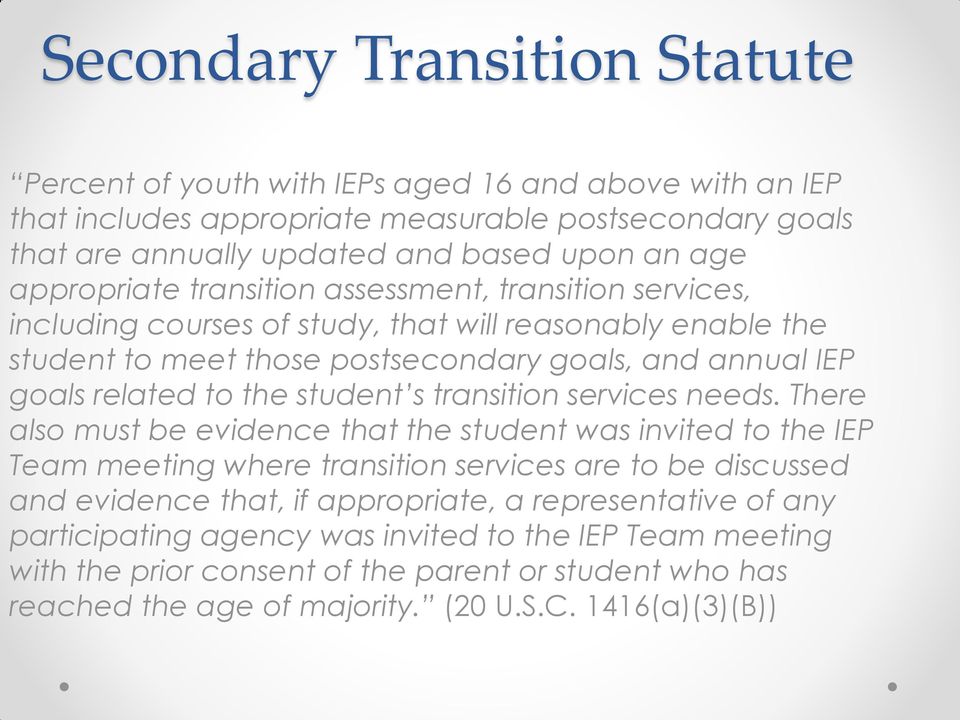
2 Secondary Transition Statute Percent of youth with IEPs aged 16 and above with an IEP that includes appropriate measurable postsecondary goals that are annually updated and based upon an age appropriate transition assessment, transition services, including courses of study, that will reasonably enable the student to meet those postsecondary goals, and annual IEP goals related to the student s transition services needs. There also must be evidence that the student was invited to the IEP Team meeting where transition services are to be discussed and evidence that, if appropriate, a representative of any participating agency was invited to the IEP Team meeting with the prior consent of the parent or student who has reached the age of majority. (20 U.S.C. 1416(a)(3)(B))

3 IEP Transition to Adulthood Planning Successful movement from school to post-school o education, o work o adult living. Results-oriented process focused on improving the academic and functional achievement of the student.

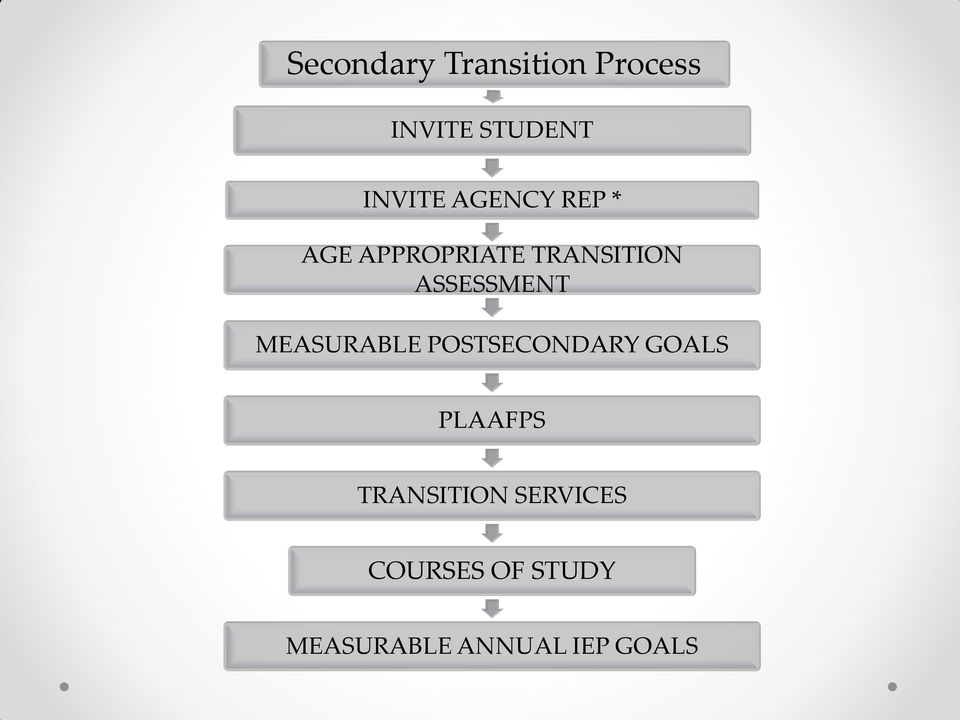
4 Secondary Transition Process INVITE STUDENT INVITE AGENCY REP * AGE APPROPRIATE TRANSITION ASSESSMENT MEASURABLE POSTSECONDARY GOALS PLAAFPS TRANSITION SERVICES COURSES OF STUDY MEASURABLE ANNUAL IEP GOALS
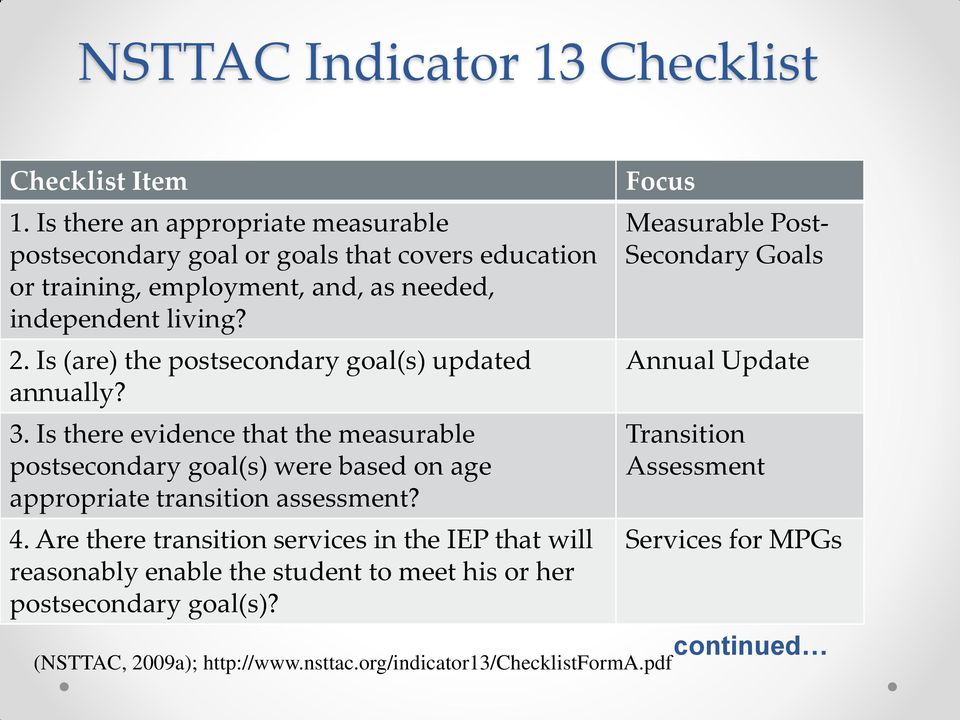
5 NSTTAC Indicator 13 Checklist Checklist Item 1. Is there an appropriate measurable postsecondary goal or goals that covers education or training, employment, and, as needed, independent living? 2. Is (are) the postsecondary goal(s) updated annually? 3. Is there evidence that the measurable postsecondary goal(s) were based on age appropriate transition assessment? 4. Are there transition services in the IEP that will reasonably enable the student to meet his or her postsecondary goal(s)? Focus Measurable Post- Secondary Goals Annual Update Transition Assessment Services for MPGs continued (NSTTAC, 2009a);
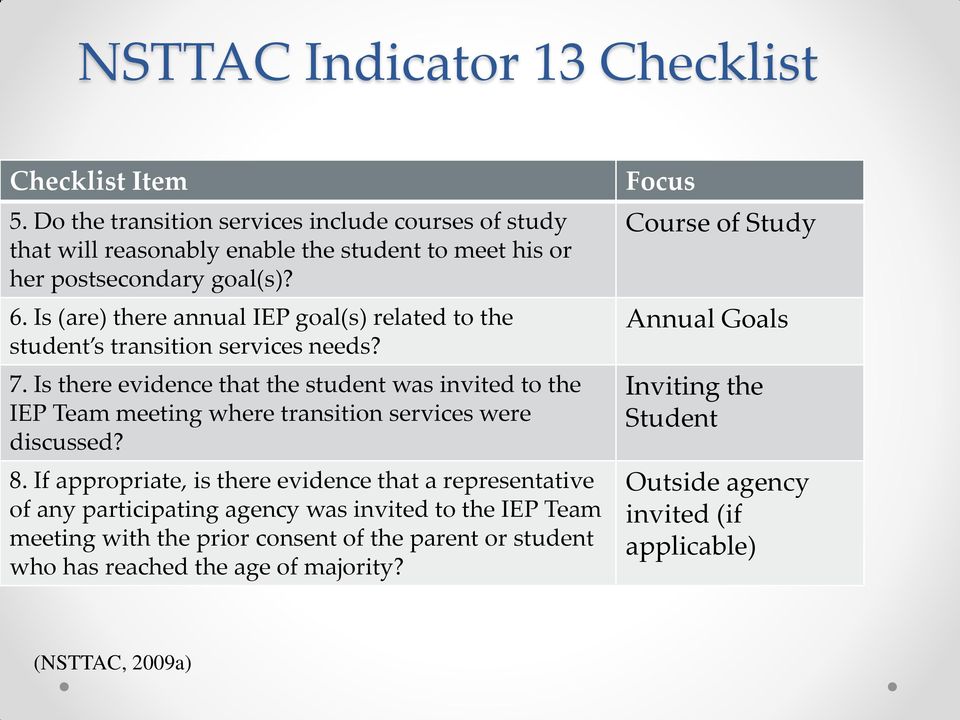
6 NSTTAC Indicator 13 Checklist Checklist Item 5. Do the transition services include courses of study that will reasonably enable the student to meet his or her postsecondary goal(s)? 6. Is (are) there annual IEP goal(s) related to the student s transition services needs? 7. Is there evidence that the student was invited to the IEP Team meeting where transition services were discussed? 8. If appropriate, is there evidence that a representative of any participating agency was invited to the IEP Team meeting with the prior consent of the parent or student who has reached the age of majority? Focus Course of Study Annual Goals Inviting the Student Outside agency invited (if applicable) (NSTTAC, 2009a)
7 Formally Invite the Student to the IEP Prepare the student for participating in the IEP meeting. Support development of selfdetermination skills. Why???? There must be documentation that the student was invited even if it is known he/she cannot attend.

8 Student Invitation Documentation Various Ways o In Student s File Meets Requirements Note in file stating teacher invited student prior to IEP Or if student is 18 receipt of 10 day notice prior to IEP o In Student s File Meets and Exceeds Requirements Signed, written student invitation dated prior to IEP KSDE (2011). Changes to Instructions for Reporting on State Performance Plan, Indicator 13: Secondary Transition, Retrieved on June 27, 2011 from

9 Moving smoothly from requirements to effective strategies Student involvement in the IEP process o Student s strengths, interests, preferences and needs drive the plan o Involving the student and his/her family in the planning drives his/her future!

10 Invite Representative of Outside Agency When outside agencies may provide or pay for services Obtain parental consent to invite Formally invite a representative Document the invitation 10 day notice form Note in file stating invitation. If an agency fails to provide transition services planned in the IEP, reconvene the IEP team to identify alternative strategies. Districts are ultimately responsible for ensuring that needs are met. (KSDE, 2009);

11 Who should participate in transition planning & IEPS? WHY? Family Members Student Education personnel School support staff Administrators Peers and friends Community members Postsecondary Ed. staff Community Service Agency Providers Who else might be included?

12 Age-Appropriate Transition Assessments Prior to IEP meeting, conduct an age-appropriate transition assessment related to training/ education, employment, and, where appropriate, independent living skills. The assessment will assist in : Developing the measurable postsecondary goals Informing the PLAAFPs Identifying transition services Transition assessment should be on-going.

13 Defining Transition Assessment Assist the student and family to determine needs, strengths, preferences & interests related to life after high school. Conduct career awareness and exploration activities Conduct a variety of formal and informal assessments (KSDE, 2009)

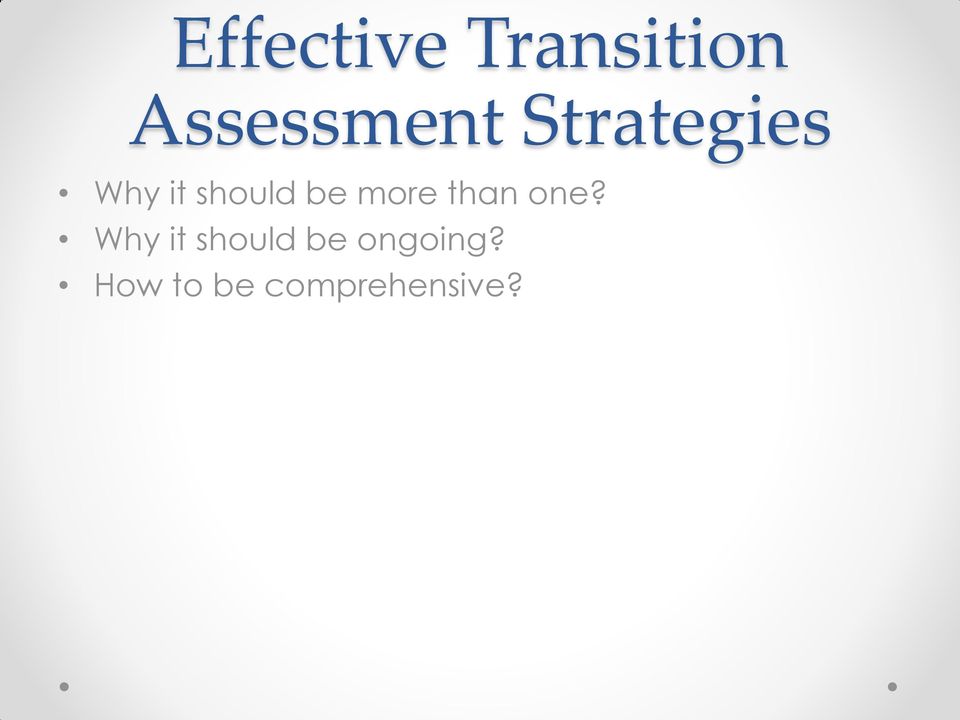
14 Effective Transition Assessment Strategies Why it should be more than one? Why it should be ongoing? How to be comprehensive?
15 Defining Transition Assessment Explore general education assessment opportunities o Personal Plans of Study o Kansas Career Pipeline Integrate ongoing processes into the transition planning for the student Transition Assessments inform the IEP s PLAAFPs (KSDE, 2009)

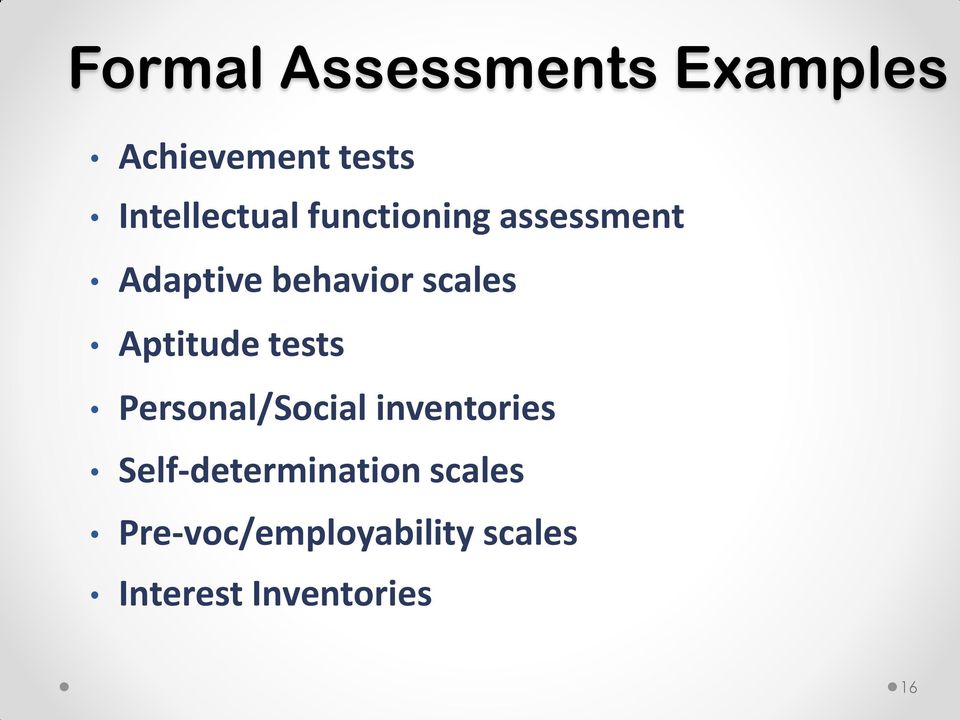
16 Formal Assessments Examples Achievement tests Intellectual functioning assessment Adaptive behavior scales Aptitude tests Personal/Social inventories Self-determination scales Pre-voc/employability scales Interest Inventories 16
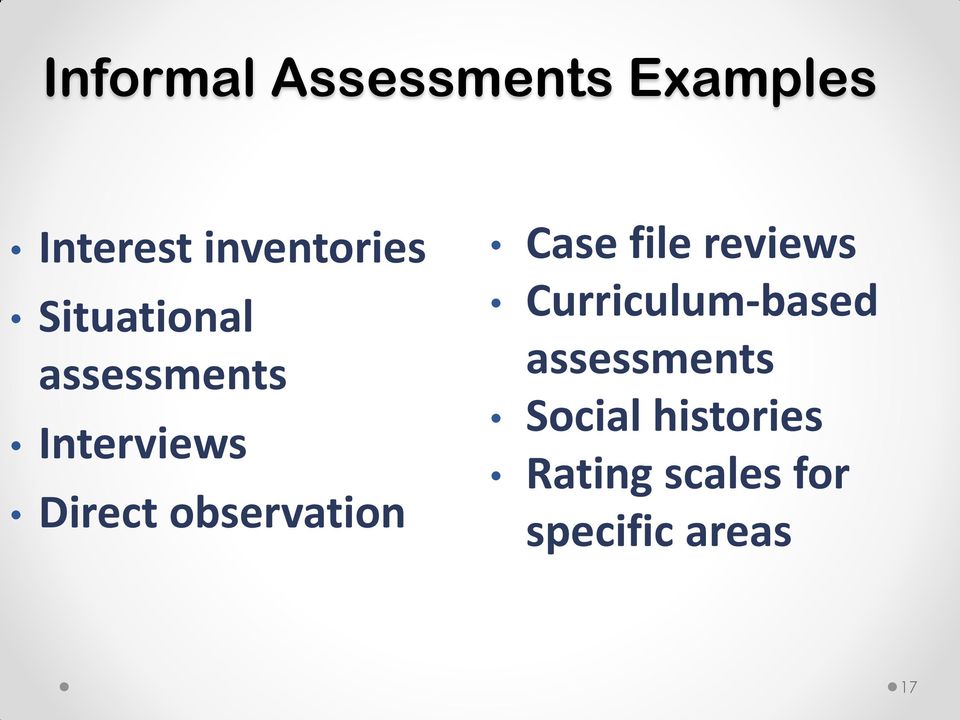
17 Informal Assessments Examples Interest inventories Situational assessments Interviews Direct observation Case file reviews Curriculum-based assessments Social histories Rating scales for specific areas 17
18 Appropriate Measurable Postsecondary Goals Must be: Based on age-appropriate transition assessments. Must have a goal for: education/training employment Independent living goal is only if appropriate How does this lead to positive postschool outcomes?


19 Measurable Postsecondary Goals Measurable postsecondary goals are outcomes that occur after the student has left high school. They identify what a student will do.
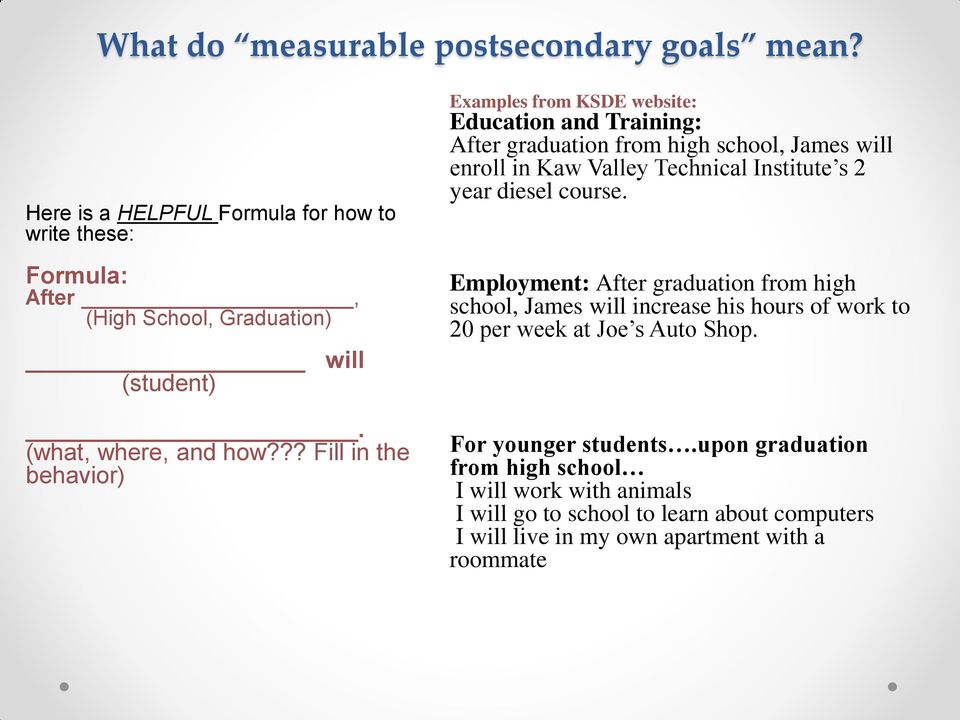
20 What do measurable postsecondary goals mean? Here is a HELPFUL Formula for how to write these: Formula: After, (High School, Graduation) will (student). (what, where, and how??? Fill in the behavior) Examples from KSDE website: Education and Training: After graduation from high school, James will enroll in Kaw Valley Technical Institute s 2 year diesel course. Employment: After graduation from high school, James will increase his hours of work to 20 per week at Joe s Auto Shop. For younger students.upon graduation from high school I will work with animals I will go to school to learn about computers I will live in my own apartment with a roommate

21 Transition Services Coordinated set of activities based on the individual student s needs, taking into account the student s strengths, preferences and interests, addressing: Instruction Related Services Community experiences Employment How do we make these effective strategies? Adult living objectives If appropriate, daily living skills and functional vocational evaluation
22 Possible Transition Services Instruction Practice self-advocacy skills Tour postsecondary training programs Discuss accommodations and modifications with postsecondary training support centers Community Experiences Learn about the ADA Register to vote Join a community recreation center or program Register for selective service Related Services Apply for books on tape Explore transportation options Employment Interview adult worker in a career field of interest Complete online application for vocational rehabilitation services Obtain paid job in area of interest (O Leary & Collison, 2007) Other Post-School Adult Living Objectives Obtain a driver s license Contact center For Independent Living for information on self-advocacy Daily Living Skills (if appropriate) Learn about time and money management skills File taxes Functional Vocational Evaluation (if appropriate) Complete/review career interest inventories and/or aptitude assessments Review career interests to insure alignment with graduation plan

23 Courses of Study What would be the best options for students so they can reach their postsecondary goals? Courses of study are a multi-year description of coursework to achieve the student s desired postsecondary goals.
24 Course of Study Questions Is a course of study already identified for this student? Is this course of study aligned with the student s post-secondary goals? (Test, D Secondary Transition, Indicator B-13, What is it and Where can I find the resources? Presentation at KSSC Summit, Lawrence, KS.)
25 NSTTAC Course of Study Example 1 Courses Jamarreo will take his final year of high school include: English IV (1 Credit) Mathematics, III (1 credit) Science (1 Credits) Demonstration of proficiency in state testing of computer skills Career/Technical (1 Credits) Electives (1 Credits) (Test, D Secondary Transition, Indicator B-13, What is it and Where can I find the resources? Presentation at KSSC Summit, Lawrence, KS.) 25
26 NSTTAC Course of Study Example 2 Courses Lissette will take each year of high school include: Functional Math I, II, III, IV (4 Credits) Functional Reading I, II, III, IV (4 Credits) Introduction to Cooking I, II, III, IV (4 Credits) Safety in the Community I, II, III, IV (4 Credits) Recreation Leisure I, II, III (3 Credits) Work Study Skills I, II, III, IV (4 Credits) (Test, D Secondary Transition, Indicator B-13, What is it and Where can I find the resources? Presentation at KSSC Summit, Lawrence, KS.)
27 NSTTAC Course of Study Example 3 Lilly will receive specially designed instruction with an alternate curriculum, including instruction focused on selfcare and communication skills and linked to the state standard course of study (SCS) in Language Arts, Math, and Science) Course include: Algebra using extended content standards Life Science using extended content standards English/Language Arts using extended content standards (Test, D Secondary Transition, Indicator B-13, What is it and Where can I find the resources? Presentation at KSSC Summit, Lawrence, KS.)
28 Kansas Course of Study Compliant courses of study are aligned with MPGs: After graduation from high school, James will enroll in Kaw Valley Technical Institute s 2 year diesel course. 9 th grade 10 th grade th grade th grade Math Math Math English 4 English 1 English 2 English 3 Government Geography American Hist. World Hist. Kaw Valley Earth Science Biology 1 P.E./Sports Technical Institute Diesel 2 Health/Sports P.E./Sports Kaw Valley Computers 1 Technical Auto Technology Institute Diesel 1 Industrial Career Cluster Learning Strategies Learning Strategies
29 Annual IEP Goals Academic & functional goals Progress towards graduation Must support the student s transition services needs and promote successful movement from school to postschool environments. (KSDE, 2009);
30 Annual IEP Goals MPG: After graduating, Stu will continue in the masonry program at Our Town Tech. Annual Goals address MPGs Who What When Where How
31 Annual IEP Goals Who What When Where Who: Stu What: will increase his organizational skills by completing assignments 4 out of 5 days When: by January 31, 2012 Where: in all core content area classes HOW: by checking in with his case manager daily to monitor progress..
32 Annual IEP Goals Behavior Condition Criteria Timeframe Does it relate back to the MPG?
33 NSTTAC Indicator 13 Checklist: Abbreviated Form A Appropriate measurable postsecondary goal Y, N Updated annually? Y, N Present Levels informed by Age appropriate transition assessment? Y, N Transition services in the IEP Y, N Courses of study Y, N Annual IEP goal(s) related to the student s transition services needs? Y, N Evidence the student was invited to the IEP Team meeting? Y, N Evidence that agency representative was invited? Y, N,NA Does the IEP meet the requirements of Indicator 13? (circle one) - Yes (all Ys and Nas are circled) - No (one or more Ns are circled)
34 Secondary Transition Resources NSTTAC website o Transition Coalition website o Secondary Connections website o
PART 2: DEVELOPING COURSES OF STUDY AND TRANSITION SERVICES
 PART 2: DEVELOPING COURSES OF STUDY AND TRANSITION SERVICES SPONSORED BY THE NH TRANSITION COMMUNITY OF PRACTICE; NH RESPONDS, A RESPONSE TO INTERVENTION (RTI) PROJECT OF THE NH DEPARTMENT OF EDUCATION;
Presented by: Teresa Grossi Center on Community Living and Careers Indiana Institute On Disability and Community Indiana University
 Presented by: Teresa Grossi Center on Community Living and Careers Indiana Institute On Disability and Community Indiana University Sponsored by: Center for Exceptional Learners Indiana Department of Education
Training Manual Michigan Department of Education Office of Special Education and Early Intervention Services
 State Performance Plan Indicator 13: Secondary Transition Michigan Department of Education Office of Special Education and Early Intervention Services Purpose of this The intent of this document is to
Chapter 8: Secondary Transition
 61 Chapter 8: Secondary Transition In this chapter you will: learn what is included in a transition plan get information about questions to ask the student to help in planning for his/her future find out
Importance of Health in Transition Planning for Special Education Students: The Role of the School Nurse
 Importance of Health in Transition Planning for Special Education Students: The Role of the School Nurse Transition to adulthood is a process all youth face as they reach the end of their high school years.
Preparing for Post Secondary Outcomes December 2014
 Preparing for Post Secondary Outcomes December 2014 Webinar Logistics All participant microphones are muted Questions may be entered in the comment box throughout the presentation and will be answered
TRANSITION PLANNING WHICH STUDENTS NEED TRANSITION PLANNING AND WHEN? TRANSITION PLANNING BEGINS
 TRANSITION PLANNING WHICH STUDENTS NEED TRANSITION PLANNING AND WHEN? A process designed to plan for life after graduation, through identifying dreams, goals, instructional needs and supports is beneficial
Sample Individualized Education Plan (IEP)
 Sample Individualized Education Program Appendix A Sample Individualized Education Plan (IEP) The following IEP sample reflects but one way to present an IEP and contains components that have worked well
Guide. To Writing. Connected. IEPs
 Guide To Writing Connected IEPs February 2007 Writing Connected IEPs The heart of IDEA is the written document called the Individualized Education Program. IDEA 2004 s emphasis is on the requirement that
Texas Continuous Improvement Process Public Input and Information Meetings
 Texas Continuous Improvement Process Public Input and Information Meetings 2008-09 Statewide Summary of Regional Feedback Texas Continuous Improvement Process Texas Education Agency Division of IDEA Coordination
Development of IEPs for Students with Emotional or Behavioral Disorders: Coordination with Transition Plans
 Development of IEPs for Students with Emotional or Behavioral Disorders: Coordination with Transition Plans James G. Shriner University of Illinois at Urbana-Champaign CEC 2011 Convention National Harbor,
Individual Learning Plans
 Individual Learning Plans College and Career Readiness Webinar Series May 12, 2015 Lisa Harney College and Career Readiness Individual Learning Plans AGENDA College and Career Readiness Planning for success
IEP PR-07 Form. Annotations for the new. Contents. Using the IEP Form document
 Annotations for the new IEP PR-07 Form The Ohio Department of Education, Office for Exceptional Children (ODE/ OEC) revised the individualized education program (IEP) form to align the elements of the
Developing Standards-Based IEP Goals and Objectives A DISCUSSION GUIDE
 Developing Standards-Based IEP Goals and Objectives A DISCUSSION GUIDE SPECIAL EDUCATION POLICY DIVISION APRIL 2013 Preface In 2007, the U.S. Department of Education issued regulations to the Elementary
IEPS FOR SECONDARY STUDENTS
 United Cerebral Palsy Association of Greater Indiana, Inc. 1915 West 18th Street, Suite C Indianapolis IN 46202 800-723-7620 Fax 317-632-3338 http://www.ucp.org RESOURCE MEMO #ED1 Date: June 11, 2003 RE:
Transition Planning Ideas for Parents
 Transition Planning Ideas for Parents Where Will I Work? Where will I Live? I hope I can.. I prefer to.. to... I want to.. Should I continue my Education and / or complete vocational training? What resources
Transition Planning From High School to Adult Life: A Student Handbook
 Transition Planning From High School to Adult Life: A Student Handbook OREGON DEPARTMENT OF EDUCATION OFFICE OF STUDENT LEARNING & PARTNERSHIPS July 2008 It is the policy of the State Board of Education
WRITING S.M.A.R.T. GOALS AND EVALUATING YOUR PLAN
 1 1 WRITING S.M.A.R.T. GOALS AND EVALUATING YOUR PLAN Session Purposes In this session you will learn strategies to : become an informed stakeholder examine Indicator Data develop SMART goals based on
Individual Education Program (IEP) Form Guidance
 The purpose of the IEP document is to provide a written record of the decisions made at an IEP meeting where parent(s) and school personnel jointly make decisions about the educational program for a student
Turning Point Program
 Turning Point Program Student Application Packet Year: APPLICATIONS WILL BE ACCEPTED ONLY BY MAIL All applications will be reviewed by the Turning Point Application Committee Bergen Community College Turning
Independent Living. Presented by Lindsey Anderson. OSSE Division of Specialized Education Secondary Transition Webinar Series
 Independent Living Presented by Lindsey Anderson OSSE Division of Specialized Education Secondary Transition Webinar Series Independent Living Webinar Overview Objectives: Define independent living and
REQUEST FOR PERSONAL CURRICULUM
 Page 1 REQUEST FOR PERSONAL CURRICULUM In April 2006, Public Acts 123 & 124 were passed and beginning with the class of 2011, they specified 16 credits which are a minimum required to graduate from a Michigan
Individualized Education Program (IEP)
 Page 1 of 14 Individualized Education Program (IEP) This file is a PDF of the model form for the Individualized Education Program (IEP). This document is not designed to be completed electronically or
Questions and Answers On Secondary Transition
 Questions and Answers On Secondary Transition Revised September 2011 (New Section B) Regulations for Part B of the Individuals with Disabilities Education Act (IDEA) were published in the Federal Register
AZ-TAS INDIVIDUALIZED EDUCATION PROGRAMS. Processes and Procedures for Developing IEPs for Students with Disabilities
 AZ-TAS INDIVIDUALIZED EDUCATION PROGRAMS Processes and Procedures for Developing IEPs for Students with Disabilities Exceptional Student Services July 2012 TABLE OF CONTENTS General Information... 3 Federal
IEP PR-07 Form. Revised Annotations for the. Contents. Using the IEP Form document
 Revised Annotations for the IEP PR-07 Form The Ohio Department of Education, Office for Exceptional Children (ODE/ OEC) revised the individualized education program (IEP) form to align the elements of
PREPARING FOR LIFE TRANSITION PLANNING GUIDE
 PREPARING FOR LIFE TRANSITION PLANNING GUIDE A Student/Parent/School Planning Guide For The Transition Process Including Determining Diploma Pathways Options For Secondary Students with Disabilities Dr.
The powerpoint and handouts for today s webinar can be downloaded from the www.secondarytransition.org website: Under hot topics
 The powerpoint and handouts for today s webinar can be downloaded from the www.secondarytransition.org website: Under hot topics PaTTAN s Mission The mission of the Pennsylvania Training and Technical
PEATC Parent Educational Advocacy
 PEATC Parent Educational Advocacy Training Center Virginia s NEXT STEPS Transition Program for Families, Youths, and Professionals: Building Effective Partnerships and Accessing Resources Webcast Two:
Transition Service Plan
 Name: Jack RR.-Case Study #10 Transition Service Plan Projected Date of Graduation: May 2010 Date of Initial Transition Program: Development Update Preferences, Strengths, Interests and Course of Study
How To Plan For A Disability Transition
 FEDC Issue Brief: August 2011 Evidence-Based Practices to Support Effective Transition for Young Adults with Disabilities Leaving High School OVERVIEW/INTRODUCTION In 1992, Halpern described secondary
Minnesota Secondary Transition Toolkit for Families. A Guide to Preparing Your Child with a Disability for Life Beyond High School
 Minnesota Secondary Transition Toolkit for Families A Guide to Preparing Your Child with a Disability for Life Beyond High School This project was made possible by a grant from the Minnesota Department
Updated December 2010- DRAFT. A Guide for Writing IEPs
 Updated December 2010- DRAFT A Guide for Writing IEPs Comments We are interested in improving this guide and welcome your suggestions. You can email your comments to the Special Education Team at [email protected].
The Least Restrictive Environment (LRE): Question & Answer Document
 The Least Restrictive Environment (LRE): Question & Answer Document A collaborative project of the Texas Education Agency and the Statewide Access to the General Curriculum Network Copyright Notice These
Individualized Education Program
 School District Name: School District Address: School District Contact Person/Phone #: Individualized Education Program IEP Dates: from Grade/Level: to Parent and/or Student Concerns What concern(s) does
A Family Guide to Transition Services in Massachusetts
 A Family Guide to Transition Services in Massachusetts Published by the Massachusetts Rehabilitation Commission in collaboration with the Federation for Children with Special Needs A Family Guide to Transition
FCI Academy Community School District IRN 000585. Ohio Department of Education, Office for Exceptional Children 2011-2012 Onsite Review Summary Report
 FCI Academy Community School District IRN 000585 7/10/2012 Ohio Department of Education, Office for Exceptional Children 2011-2012 Onsite Summary Report Introduction The Ohio Department of Education s
Michigan Merit Curriculum High School Graduation Requirements
 Michigan Merit Curriculum High School Graduation Requirements 45 Understanding Michigan s graduation requirements will enable you to help your child obtain a high school diploma and ultimately succeed
School to Work Transition Guidelines and Best Practices
 School to Work Transition Guidelines and Best Practices June 2014 Florida Department of Education The Division of Vocational Rehabilitation Table of Contents The Role of the Division of Vocational Rehabilitation
Updated Frequently Asked Questions for Oregon Diploma Options, 2014
 Updated Frequently Asked Questions for Oregon Diploma Options, 2014 This document is organized into topic areas: General: Definition and general implementation information Eligibility: Eligibility criteria
Transition Topics A Guide to Secondary Transition for Students with Disabilities in Nebraska
 Transition Topics A Guide to Secondary Transition for Students with Disabilities in Nebraska Nebraska Department of Education Office of Special Education, January 2012 Updated: April 2014 TRANSITION TOPICS:
Louisiana Special Education Guidance
 Louisiana Special Education Guidance This document outlines how special education policies impact students with disabilities and serves as a reference guide for LEA administrators and high school staff
CAREER CLUSTER GUIDANCE HANDBOOK
 CAREER CLUSTER GUIDANCE HANDBOOK Kansas Career & Technical Education Kansas Career Cluster Pathway Design Models Effective School Year 2016-2017 KANSAS CAREER & TECHNICAL EDUCATION Kansas secondary Career
Massachusetts Department of Elementary and Secondary Education
 Guidelines for the Transition Specialist Endorsement October 2013 Massachusetts Department of Elementary and Secondary Education 75 Pleasant Street, Malden, MA 02148-4906 Phone 781-338-3000 TTY: N.E.T.
CHAPTER 4 THE INDIVIDUALIZED EDUCATION PROGRAM (IEP) INTRODUCTION A. IEP TEAM
 C H A P T E R 4 : T H E I N D I V I D U A L I Z E D E D U C A T I O N P R O G R A M ( I E P ) INTRODUCTION The Individualized Education Program is defined as a written statement for each student with an
MCD OUTCOME COMPONENT SCHOOL PLAN
 Federal Requirement, District publications and forms are available Search and Serve Response to Intervention (RtI) approach shall be one of several components of the process of determining a Specific Learning
HOPKINTON PUBLIC SCHOOLS CONTINUUM OF ALTERNATIVE SERVICES AND PLACEMENTS
 HOPKINTON PUBLIC SCHOOLS CONTINUUM OF ALTERNATIVE SERVICES AND PLACEMENTS Hopkinton Public Schools provides programs for students in need of special education from the ages of three through twenty-one,
Oregon Administrative Rules Talented and Gifted
 Oregon Administrative Rules Talented and Gifted 581-022-1310 Identification of Academically Talented and Intellectually Gifted Students (1) Each school district shall have local district policies and procedures
SCHOOL TRANSITION SERVICES
 3710 LANDMARK DRIVE, SUITE 208, COLUMBIA, SC 29204 (803) 782 0639; FAX (803) 790-1946 TOLL FREE IN SC: 1-866-275-7273 (VOICE) AND 1-866-232-4525 (TTY) E-mail: [email protected] Website: www.pandasc.org
SB 149 - Individual Graduation Committees Frequently Asked Questions
 SB 149 - Individual Graduation Committees Frequently Asked Questions 1. Are all students eligible to receive an Individual Graduation Committee review? Only students who are classified in grade 11 or 12
The Ohio Longitudinal Transition Study Annual State Report
 The Ohio Longitudinal Transition Study Annual State Report SPRING 2013 In this Report Employment Outcomes Post-school Education Outcomes Trends and Engagement Rates Student Satisfaction with Services Predictors
CLARK COUNTY SCHOOL DISTRICT REGULATION HIGH SCHOOL GRADUATION REQUIREMENTS R-5127
 CLARK COUNTY SCHOOL DISTRICT REGULATION HIGH SCHOOL GRADUATION REQUIREMENTS R-5127 I. Graduation Requirements To receive a diploma signifying graduation from a Clark County School District high school,
Taxonomy for Transition Programming
 Taxonomy for Transition Programming A Model for Planning, Organizing, and Evaluating Transition Education, Services, and Programs Paula D. Kohler, Ph.D. WESTERN MICHIGAN UNIVERSITY and TRANSITION RESEARCH
20 U.S.C. 1401 DEFINITIONS
 20 U.S.C. 1401 DEFINITIONS Introduction On November 17, 2004, a House-Senate Conference Committee agreed on changes to reauthorize the Individuals with Disabilities Education Act (IDEA). On Friday, November
High School to College Transition for Students with Specific Learning Disabilities. Best Practice Documentation Guidelines for Secondary Educators
 High School to College Transition for Students with Specific Learning Disabilities Best Practice Documentation Guidelines for Secondary Educators The following document was developed by a group of secondary
FAIRFIELD HIGH SCHOOL ACADEMIC HANDBOOK
 FAIRFIELD HIGH SCHOOL ACADEMIC HANDBOOK It is the policy of Fairfield High School not to discriminate on the basis of race, color, national origin, sex, age, or handicap in all courses and programs as
Advocating for Services: How a Parent Can Access a Special Education Program, Special Education Teacher Support Services and/or Related Services
 Advocating for Services: How a Parent Can Access a Special Education Program, Special Education Teacher Support Services and/or Related Services Applied Behavioral Counseling Applied ABC Presented by Joan
South Carolina Department of Education Office of Special Education Services Monitoring Overview and Rubric (MOR) for IEP Development
 South Carolina Department of Education Office of Special Education Services Monitoring Overview and Rubric (MOR) for IEP Development Item Inquiry Components and Corresponding IDEA Sections and Regulations
Individual Learning Plan Robert Scott Anderson. Career Matchmaker Results (Top 10 careers) : Matchmaker1
 Individual Learning Plan Robert Scott Anderson Personal Profile for Robert Scott Anderson Address 151 North Ave, Riverview 40000 Email [email protected] Phone Number 502-412-2011
IEP Development: Present Level of Performance, Measurable Post-Secondary & Annual Goals
 IEP Development: Present Level of Performance, Measurable Post-Secondary & Annual Goals Thanks to: Kathy Gomes, Regional Coordinator Capital Region/North Country Regional Special Education Technical Assistance
Planning Guide for Minnesota Students Entering Postsecondary Education Programs
 Planning Guide for Minnesota Students Entering Postsecondary Education Programs This pamphlet contains information for you and your family on postsecondary education. Postsecondary education includes many
Michigan Merit Curriculum
 Michigan Merit Curriculum East Grand Rapids Public Schools Educating and inspiring each student to navigate successfully in a global community East Grand Rapids Public Schools 2915 Hall Street SE Grand
EXTENDED SCHOOL YEAR PROGRAMS AND SERVICES QUESTIONS AND ANSWERS
 EXTENDED SCHOOL YEAR PROGRAMS AND SERVICES QUESTIONS AND ANSWERS 1. Who is eligible for extended school year programs and services? 2. Must the IEP for the extended school year program be identical to
Rhode Island Department of Education Office of Student, Community and Academic Supports School Support System Report and Support Plan
 Rhode Island Department of Education Office of Student, Community and Academic Supports School Support System Report and Support Plan Blackstone Academy Public Charter School February 2016 1 SCHOOL SUPPORT
INDIVIDUALIZED EDUCATION PROGRAM & SPECIAL EDUCATION PROGRAMS & RELATED SERVICES
 INDEX INDIVIDUALIZED EDUCATION PROGRAM & SPECIAL EDUCATION PROGRAMS & RELATED SERVICES 7.1 PURPOSE AND SCOPE..7 1 7.2 INDIVIDUALIZED EDUCATION PROGRAM REQUIREMENTS..7 1 7.2. A. DEVELOPMENT OF IEP......7
S Review Indicator 13 Requirements. S Practice Each Critical Element
 Quality Secondary Education Services: A Review of the Secondary IEP Stephanie Maury Keystone Area Education Agency Iowa Department of Education, 2012 Agenda Review Indicator 13 Requirements Practice Each
Transition. to Adult Living. An Information and Resource Guide
 Transition to Adult Living An Information and Resource Guide Transition to Adult Living An Information and Resource Guide Transition to Adult Living Acknowledgements The 2007 Transition to Adult Living:
FLORIDA DEPARTMENT OF EDUCATION
 FLORIDA DEPARTMENT OF EDUCATION DPS: 2013-65 Date: August 21, 2013 Pam Stewart Commissioner of Education Technical Assistance Paper Assistive Technology for Students with Disabilities Summary: The purpose