
Efficient Load Balancing Algorithm in Cloud Environment
|
|
|
- Leslie Atkinson
- 10 years ago
- Views:
Transcription
1 Efficient Balancing Algorithm in Cloud Environment Akshay Daryapurkar #, Mrs. V.M. Deshmukh * # PRMIT&R Anjangoan Bari Road Badnera, Amravat i a [email protected] 3 [email protected] Abstract balancing is the process of distributing the load among various nodes of a distributed system to improve both resource utilization and job response time while also avoiding a situation where some of the nodes are heavily loaded while other nodes are idle or doing very little work. This paper presents an approach for scheduling algorithms that can maintain the load balancing and provides better improved strategies through efficient job scheduling and modified resource allocation techniques. We present benchmarks for the algorithms to show their capabilities. The metric used is throughput and response time. Benchmark workload is synthetic to highlight many aspects of balancing load correctly. From the benchmarks and by analysing the different algorithms we will show a simple algorithm that is platform independent, easy to implement and has the best performance of any of the algorithms implemented. Keywords Cloud Computing, Balancing, Round Robin, Virtualization. A. Balancing I. INTRODUCTION balancing is a relatively new technique that facilitates networks and resources by providing a maximum throughput with minimum response time [2]. Dividing the traffic between servers, data can be sent and received without major delay. Different kinds of algorithms are available that helps traffic loaded between available servers [1]. A basic example of load balancing in our daily life can be related to websites. Without load balancing, users could experience delays, timeouts and possible long system responses. balancing solutions usually apply redundant servers which help a better distribution of the communication traffic so that the website availability is conclusively settled.there are many different kinds of load balancing algorithms available, which can be categorized mainly into two groups. The following section will discuss these two main categories of load balancing algorithms [1], [2]. B. Static Algorithms Static algorithms divide the traffic equivalently between servers. By this approach the traffic on the servers will be disdained easily and consequently it will make the situation more imperfectly. This algorithm, which divides the traffic equally, is announced as round robin algorithm. However, there were lots of problems appeared in this algorithm. Therefore, weighted round robin was defined to improve the critical challenges associated with round robin. In this algorithm each servers have been assigned a weight and according to the highest weight they received more connections. In the situation that all the weights are equal, servers will receive balanced traffic [2]. C. Dynamic Algorithms Dynamic algorithms designated proper weights on servers and by searching in whole network a lightest server preferred to balance the traffic. However, selecting an appropriate server needed real time communication with the networks, which will lead to extra traffic added on system [2]. In comparison between these two algorithms, although round robin algorithms based on simple rule, more loads conceived on servers and thus imbalanced traffic discovered as a result. However; dynamic algorithm predicated on query that can be made frequently on servers, but sometimes prevailed traffic will prevent these queries to be answered, and correspondingly more added overhead can be distinguished on network [1]. D. Balancing in Cloud Computing Cloud vendors are based on automatic load balancing services, which allowed entities to increase the number of CPUs or memories for their resources to scale with the increased demands. This service is optional and depends on the entity's business needs. Therefore load balancers served two important needs, primarily to promote availability of cloud resources and secondarily to promote performance. According to the previous section Cloud computing will use the dynamic algorithm, which allows cloud entities to 308
2 advertise their existence to presence servers and also provides a means of communication between interested parties [1]. E. Balancing in Distributed Systems Today more modern software development methodologies are being used to enhance the usability of software embedded on compatible hardware in distributed networks [1] [2]. Attaining this objective and improve software infrastructure, middleware have been applied to foster portability and distributed application component interpretability. Middleware characterized as network services and software components that permit scaling of application and networks. Providing the simple and integrated distributed programming environment, middleware eased the task of designing and programming and managing the distributed applications. II. CLOUD COMPUTING & VIRTUALIZATION A Cloud system consists of 3 major components such as clients, data center, and distributed servers. Each element has a definite purpose and plays a specific role. 2) Datacenter: Datacenter is nothing but a collection of servers hosting different applications. A end user connects to the datacenter to subscribe different applications. A datacenter may exist at a large distance from the clients [5]. Now-a-days a concept called virtualisation is used to install software that allows multiple instances of virtual server applications. 3) Distributed Servers: Distributed servers are the parts of a cloud which are present throughout the Internet hosting different applications. But while using the application from the cloud, the user will feel that he is using this application from its own machine [4]. B. Type of Clouds Based on the domain or environment in which clouds are used, clouds can be divided into 3 catagories: _ Public Clouds _ Private Clouds _ Hybrid Clouds (combination of both private and public clouds) C. Virtualization It is a very useful concept in context of cloud systems. Virtualization means something which isn t real, but gives all the facilities of a real. It is the software implementation of a computer which will execute different programs like a real machine. Virtualization is related to cloud, because using virtualization an end user can use different services of a cloud. The remote datacenter will provide different services in a full or partial virtualized manner. Fig 1: Three components make up a cloud computing solution [3] A. Type of Clouds 1) Clients: End users interact with the clients to manage information related to the cloud. Clients generally fall into three categories as given in [3]-[5]: Mobile: Windows Mobile Smartphone, smart phones, like a Blackberry, or an iphone. Thin: They don t do any computation work. They only display the information. Servers do all the works for them. Thin clients don t have any internal memory. Thick: These use different browsers like IE or Mozilla Firefox or Google Chrome to connect to the Internet cloud. Two types of virtualization are found in case of clouds as given in [5]: _ Full virtualization _ Para virtualization 1) Full Virtualization: In case of full virtualization a complete installation of one machine is done on another machine. It will result in a virtual machine which will have all the software s that are present in the actual server. 309
![[2]. Attaining this objective and improve software infrastructure, middleware have been applied to foster portability and distributed application component interpretability.](/docs-images/42/2167783/images/page_2.jpg "Middleware characterized as network services and software components that permit scaling of application and networks.")
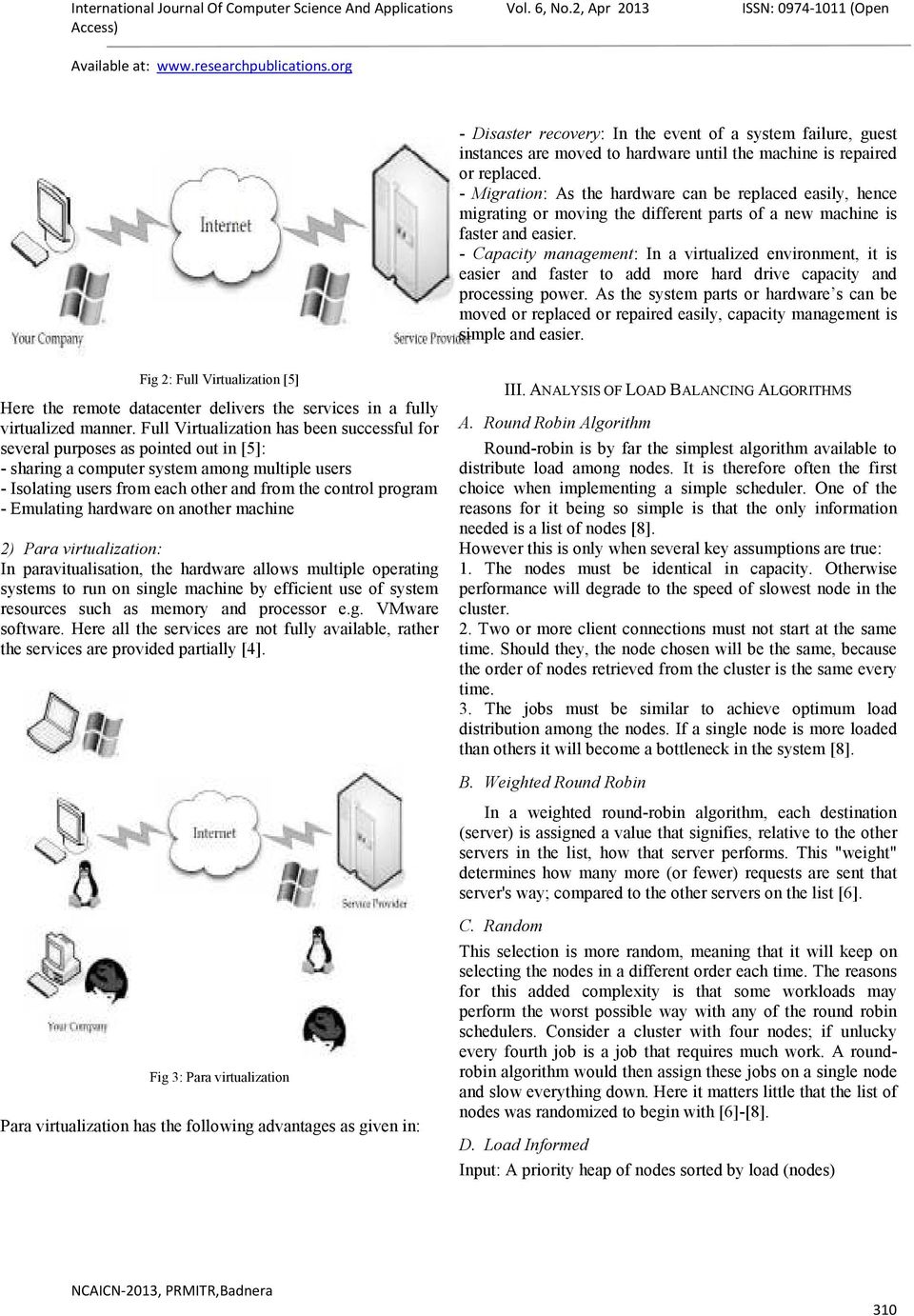
3 - Disaster recovery: In the event of a system failure, guest instances are moved to hardware until the machine is repaired or replaced. - Migration: As the hardware can be replaced easily, hence migrating or moving the different parts of a new machine is faster and easier. - Capacity management: In a virtualized environment, it is easier and faster to add more hard drive capacity and processing power. As the system parts or hardware s can be moved or replaced or repaired easily, capacity management is simple and easier. Fig 2: Full Virtualization [5] Here the remote datacenter delivers the services in a fully virtualized manner. Full Virtualization has been successful for several purposes as pointed out in [5]: - sharing a computer system among multiple users - Isolating users from each other and from the control program - Emulating hardware on another machine 2) Para virtualization: In paravitualisation, the hardware allows multiple operating systems to run on single machine by efficient use of system resources such as memory and processor e.g. VMware software. Here all the services are not fully available, rather the services are provided partially [4]. III. ANALYSIS OF LOAD BALANCING ALGORITHMS A. Round Robin Algorithm Round-robin is by far the simplest algorithm available to distribute load among nodes. It is therefore often the first choice when implementing a simple scheduler. One of the reasons for it being so simple is that the only information needed is a list of nodes [8]. However this is only when several key assumptions are true: 1. The nodes must be identical in capacity. Otherwise performance will degrade to the speed of slowest node in the cluster. 2. Two or more client connections must not start at the same time. Should they, the node chosen will be the same, because the order of nodes retrieved from the cluster is the same every time. 3. The jobs must be similar to achieve optimum load distribution among the nodes. If a single node is more loaded than others it will become a bottleneck in the system [8]. B. Weighted Round Robin In a weighted round-robin algorithm, each destination (server) is assigned a value that signifies, relative to the other servers in the list, how that server performs. This "weight" determines how many more (or fewer) requests are sent that server's way; compared to the other servers on the list [6]. Fig 3: Para virtualization Para virtualization has the following advantages as given in: C. Random This selection is more random, meaning that it will keep on selecting the nodes in a different order each time. The reasons for this added complexity is that some workloads may perform the worst possible way with any of the round robin schedulers. Consider a cluster with four nodes; if unlucky every fourth job is a job that requires much work. A roundrobin algorithm would then assign these jobs on a single node and slow everything down. Here it matters little that the list of nodes was randomized to begin with [6]-[8]. D. Informed Input: A priority heap of nodes sorted by load (nodes) 310
4 2: Input: A list of nodes in the system (orig_nodes) 3: ONLOADUPDATE () 4: for (iterator it = orig_nodes.begin(); it!= orig_nodes.end() ; ++it) { 5: nodes.delete (it); 6: nodes.insert (it.load, node); } 7: GETNEXTNODE () 8: Return nodes.first (); E. Concluding Remarks 1) Round-robin: + Fast. + Requires only information about the names of the nodes. + Does not require any global decisions. + Easy to implement. + Superb balancing, when the workload is not skewed, nor are the nodes. Breaks down completely when the above item does not hold [8]. 2) Weighted Round-robin: + Requires only information about the names of the nodes and their weights. + Does not require any global decisions, but when the number of jobs are low it greatly improves when available. + Superb balancing, when the workload is not skewed. Breaks down completely when the above item does not hold. Requires more work than the Round-Robin scheduler. 3) Weighted Random: + Requires only information about the names of the nodes and their weights. + Does not require any global decisions. Unpredictable balancing [8]. 4) informed: + Can prevent worst-case scenarios. The information required is not platform independent. Require global decisions to work properly. Requires information about the names of the nodes, their weights and a constantly updated specification of the load of each node. The optimal load adjustment when choosing a node is not clear. Very complex to implement and even more complex to get right. Requires a large machinery to calculate the load. F. Spread Current Execution The random arrival of load in such an environment can cause some server to be heavily loaded while other server is idle or only lightly loaded. load distributing improves performance by transferring load from heavily loaded server. Efficient scheduling and resource allocation is a critical characteristic of cloud computing based on which the performance of the system is estimated. The considered characteristics have an impact on cost optimization, which can be obtained by improved response time and processing time. A scheduling algorithm is compared with the existing round robin scheduling to estimate response time, processing time, which is having an impact on cost.a Comparison of Dynamic Balancing Algorithms [6]. Here the jobs are submitted by the clients to the computing system. As the submitted jobs arrive to the cloud they are queued in the stack. The cloud manager estimates the job size and checks for the availability of the virtual machine and also the capacity of the virtual machine. Once the job size and the available resource (virtual machine) size match, the job scheduler immediately allocates the identified resource to the job in queue. Unlike the round robin scheduling algorithm, there is no overhead of fixing the time slots to schedule the jobs in a periodic way [6]. The impact of the ESCE algorithm is that there is an improvement in response time and the processing time. The jobs are equally spread, the complete computing system is load balanced and no virtual machines are underutilized. Due to this advantage, there is a reduce in the virtual machine cost and the data transfer cost. ESAE LOAD ALGORITHM ACTIVE VM LOAD BALANCER [6] [START] Step1:- find the next available VM Step2:-check for all current allocation count is less than max length of VM list allocate the VM Step3:- if available VM is not allocated create a new one in Step 4:- count the active load on each VM Step5:- return the id of those VM which is having least load [END] 311
![+ Does not require any global decisions. + Easy to implement. + Superb balancing, when the workload is not skewed, nor are the nodes. Breaks down completely when the above item does not hold [8].](/docs-images/42/2167783/images/page_4.jpg "2) Weighted Round-robin: + Requires only information about the names of the nodes and their weights.")
5 Queue scheduling and resource allocation techniques for overcoming the above-stated issues [6]. Here, Equal Spread Current Execution algorithm dynamically allocates the resources to the job in queue leading reduced cost in data transfer and virtual machine formation. Comparisons of various load balancing algorithms are made with respect to overall time and cost [6]. VM1 ESAE Scheduling VM2 Figure 4: spread Active execution load to the cloud system IV. CONCLUSIONS VM3 Cost and time are the key challenge of every IT engineer to develop products that can enhance the business performance in the cloud based IT sectors. Current strategies lack efficient scheduling and resource allocation techniques leading to increased operational cost and time. This paper aims towards the development of enhanced strategies through improved job REFERENCES [1] Zenon Chaczko, Venkatesh Mahadevan, Shahrzad Aslanzadeh Availability and Balancing in Cloud Computing University of Technology Sydney, Australia [2] R. Shimonski. Windows 2000 & Windows Server 2003 Clustering and Balancing. Emeryville. McGraw-Hill [3] Anthony T.Velte, Toby J.Velte, Robert Elsenpeter, Cloud Computing A Practical Approach, Tata McGraw-HILL Edition [4] Martin Randles, David Lamb, A. Taleb-Bendiab, A Comparative Study into Distributed Balancing Algorithms for Cloud Computing, 2010 IEEE 24th International Conference on Advanced Information Networking and Applications Workshops. [5] Ram Prasad Padhy, P Goutam Prasad Rao Balancing In Cloud Computing system Rourkela , Orissa, India May, [6] Jaspreet kaur Comparison of load balancing algorithms in a Cloud International Journal of Engineering Research and Applications (IJERA) May-Jun 2012 [7] Jiyin Li, Meikang Qiu, Jain-Wei Niu, YuChen, Zhong Ming Adaptive Resource Allocation for Preeemptable Jobs in Cloud Systems. IEEEInternational Conference on Intelligent Systems Design and Applications, pp , [8] Dennis Haney & Klaus S. Madsen -balancing for MySQL Datalogisk Institut, Københavns Universitet Fall 2003 [9] David Karger and Matthias Ruhl, New Algorithms for Balancing in Peer-to-Peer Systems, Tech. Rep. MIT-LCS-TR-911, MIT LCS, July [10] Vinod Pisharody, Michael Wu, Tanya Zhiltsova Active-active operation for a cluster of SSL virtual private network (VPN) devices with load distribution. 312
![Comparisons of various load balancing algorithms are made with respect to overall time and cost [6]. VM1 ESAE Scheduling VM2 Figure 4: spread Active execution load to the cloud system IV.](/docs-images/42/2167783/images/page_5.jpg "CONCLUSIONS VM3 Cost and time are the key challenge of every IT engineer to develop products that can enhance the business performance in the cloud based IT sectors.")
Load Balancing Algorithm for Azure Virtualization with Specialized VM s
 Load Balancing Algorithm for Azure Virtualization with Specialized VM s Anand Chaudhari Department of Computer Science and Engineering PRMIT&R, Badnera (Amravati), Maharashtra, India Anushka Kapadia Department
CSE LOVELY PROFESSIONAL UNIVERSITY
 Comparison of load balancing algorithms in a Cloud Jaspreet kaur M.TECH CSE LOVELY PROFESSIONAL UNIVERSITY Jalandhar, punjab ABSTRACT This paper presents an approach for scheduling algorithms that can
Models of Load Balancing Algorithm in Cloud Computing
 Models of Load Balancing Algorithm in Cloud Computing L. Aruna 1, Dr. M. Aramudhan 2 1 Research Scholar, Department of Comp.Sci., Periyar University, Salem. 2 Associate Professor & Head, Department of
Availability and Load Balancing in Cloud Computing
 2011 International Conference on Computer and Software Modeling IPCSIT vol.14 (2011) (2011) IACSIT Press, Singapore Availability and Load Balancing in Cloud Computing Zenon Chaczko 1, Venkatesh Mahadevan
The International Journal Of Science & Technoledge (ISSN 2321 919X) www.theijst.com
 THE INTERNATIONAL JOURNAL OF SCIENCE & TECHNOLEDGE Efficient Parallel Processing on Public Cloud Servers using Load Balancing Manjunath K. C. M.Tech IV Sem, Department of CSE, SEA College of Engineering
Multilevel Communication Aware Approach for Load Balancing
 Multilevel Communication Aware Approach for Load Balancing 1 Dipti Patel, 2 Ashil Patel Department of Information Technology, L.D. College of Engineering, Gujarat Technological University, Ahmedabad 1
Comparative Analysis of Load Balancing Algorithms in Cloud Computing
 Comparative Analysis of Load Balancing Algorithms in Cloud Computing Ms.NITIKA Computer Science & Engineering, LPU, Phagwara Punjab, India Abstract- Issues with the performance of business applications
Cost Effective Selection of Data Center in Cloud Environment
 Cost Effective Selection of Data Center in Cloud Environment Manoranjan Dash 1, Amitav Mahapatra 2 & Narayan Ranjan Chakraborty 3 1 Institute of Business & Computer Studies, Siksha O Anusandhan University,
Efficient Parallel Processing on Public Cloud Servers Using Load Balancing
 Efficient Parallel Processing on Public Cloud Servers Using Load Balancing Valluripalli Srinath 1, Sudheer Shetty 2 1 M.Tech IV Sem CSE, Sahyadri College of Engineering & Management, Mangalore. 2 Asso.
A Comparison of Four Popular Heuristics for Load Balancing of Virtual Machines in Cloud Computing
 A Comparison of Four Popular Heuristics for Load Balancing of Virtual Machines in Cloud Computing Subasish Mohapatra Department Of CSE NIT, ROURKELA K.Smruti Rekha Department Of CSE ITER, SOA UNIVERSITY
International Journal of Computer & Organization Trends Volume21 Number1 June 2015 A Study on Load Balancing in Cloud Computing
 A Study on Load Balancing in Cloud Computing * Parveen Kumar * Er.Mandeep Kaur Guru kashi University,Talwandi Sabo Guru kashi University,Talwandi Sabo Abstract: Load Balancing is a computer networking
ABC - LOAD BALANCING TECHNIQUE - IN CLOUD COMPUTING
 ABC - LOAD BALANCING TECHNIQUE - IN CLOUD COMPUTING Miss. Neeta S. Nipane Department of Computer Science and Engg ACE,Nagthana Rd, Wardha(MH),INDIA [email protected] Prof. Nutan M. Dhande Department
Sla Aware Load Balancing Algorithm Using Join-Idle Queue for Virtual Machines in Cloud Computing
 Sla Aware Load Balancing Using Join-Idle Queue for Virtual Machines in Cloud Computing Mehak Choudhary M.Tech Student [CSE], Dept. of CSE, SKIET, Kurukshetra University, Haryana, India ABSTRACT: Cloud
Load Balancing Scheduling with Shortest Load First
 , pp. 171-178 http://dx.doi.org/10.14257/ijgdc.2015.8.4.17 Load Balancing Scheduling with Shortest Load First Ranjan Kumar Mondal 1, Enakshmi Nandi 2 and Debabrata Sarddar 3 1 Department of Computer Science
International Journal of Scientific & Engineering Research, Volume 6, Issue 4, April-2015 36 ISSN 2229-5518
 International Journal of Scientific & Engineering Research, Volume 6, Issue 4, April-2015 36 An Efficient Approach for Load Balancing in Cloud Environment Balasundaram Ananthakrishnan Abstract Cloud computing
A Survey on Load Balancing and Scheduling in Cloud Computing
 IJIRST International Journal for Innovative Research in Science & Technology Volume 1 Issue 7 December 2014 ISSN (online): 2349-6010 A Survey on Load Balancing and Scheduling in Cloud Computing Niraj Patel
AN EFFICIENT LOAD BALANCING APPROACH IN CLOUD SERVER USING ANT COLONY OPTIMIZATION
 AN EFFICIENT LOAD BALANCING APPROACH IN CLOUD SERVER USING ANT COLONY OPTIMIZATION Shanmuga Priya.J 1, Sridevi.A 2 1 PG Scholar, Department of Information Technology, J.J College of Engineering and Technology
A Comparative Study of Load Balancing Algorithms in Cloud Computing
 A Comparative Study of Load Balancing Algorithms in Cloud Computing Reena Panwar M.Tech CSE Scholar Department of CSE, Galgotias College of Engineering and Technology, Greater Noida, India Bhawna Mallick,
A Survey Of Various Load Balancing Algorithms In Cloud Computing
 A Survey Of Various Load Balancing Algorithms In Cloud Computing Dharmesh Kashyap, Jaydeep Viradiya Abstract: Cloud computing is emerging as a new paradigm for manipulating, configuring, and accessing
A Survey on Load Balancing Algorithms in Cloud Environment
 A Survey on Load s in Cloud Environment M.Aruna Assistant Professor (Sr.G)/CSE Erode Sengunthar Engineering College, Thudupathi, Erode, India D.Bhanu, Ph.D Associate Professor Sri Krishna College of Engineering
Load-balancing for MySQL. by Dennis Haney & Klaus S. Madsen
 Load-balancing for MySQL by Dennis Haney & Klaus S. Madsen Datalogisk Institut, Københavns Universitet Fall 2003 Abstract The databases of today have to handle high load while providing high availability.
A Game Theory Modal Based On Cloud Computing For Public Cloud
 IOSR Journal of Computer Engineering (IOSR-JCE) e-issn: 2278-0661, p- ISSN: 2278-8727Volume 16, Issue 2, Ver. XII (Mar-Apr. 2014), PP 48-53 A Game Theory Modal Based On Cloud Computing For Public Cloud
Load Balancing Algorithms in Cloud Environment
 International Conference on Systems, Science, Control, Communication, Engineering and Technology 50 International Conference on Systems, Science, Control, Communication, Engineering and Technology 2015
Load Balancing using DWARR Algorithm in Cloud Computing
 IJIRST International Journal for Innovative Research in Science & Technology Volume 1 Issue 12 May 2015 ISSN (online): 2349-6010 Load Balancing using DWARR Algorithm in Cloud Computing Niraj Patel PG Student
QOS Differentiation of Various Cloud Computing Load Balancing Techniques
 QOS Differentiation of Various Cloud Computing Load Balancing Techniques Abhinav Hans Navdeep Singh Kapil Kumar Mohit Birdi ABSTRACT With an increase in the demands the Cloud computing has become one of
LOAD BALANCING ALGORITHM REVIEW s IN CLOUD ENVIRONMENT
 LOAD BALANCING ALGORITHM REVIEW s IN CLOUD ENVIRONMENT K.Karthika, K.Kanakambal, R.Balasubramaniam PG Scholar,Dept of Computer Science and Engineering, Kathir College Of Engineering/ Anna University, India
A Comparative Study of Different Static and Dynamic Load Balancing Algorithm in Cloud Computing with Special Emphasis on Time Factor
 International Journal of Current Engineering and Technology E-ISSN 2277 4106, P-ISSN 2347 5161 2015 INPRESSCO, All Rights Reserved Available at http://inpressco.com/category/ijcet Research Article A Comparative
Load Balancing in Cloud Computing using Observer's Algorithm with Dynamic Weight Table
 Load Balancing in Cloud Computing using Observer's Algorithm with Dynamic Weight Table Anjali Singh M. Tech Scholar (CSE) SKIT Jaipur, [email protected] Mahender Kumar Beniwal Reader (CSE & IT), SKIT
An Approach to Load Balancing In Cloud Computing
 An Approach to Load Balancing In Cloud Computing Radha Ramani Malladi Visiting Faculty, Martins Academy, Bangalore, India ABSTRACT: Cloud computing is a structured model that defines computing services,
Load Balancing in cloud computing
 Load Balancing in cloud computing 1 Foram F Kherani, 2 Prof.Jignesh Vania Department of computer engineering, Lok Jagruti Kendra Institute of Technology, India 1 [email protected], 2 [email protected]
Webpage: www.ijaret.org Volume 3, Issue XI, Nov. 2015 ISSN 2320-6802
 An Effective VM scheduling using Hybrid Throttled algorithm for handling resource starvation in Heterogeneous Cloud Environment Er. Navdeep Kaur 1 Er. Pooja Nagpal 2 Dr.Vinay Guatum 3 1 M.Tech Student,
@IJMTER-2015, All rights Reserved 355
 e-issn: 2349-9745 p-issn: 2393-8161 Scientific Journal Impact Factor (SJIF): 1.711 International Journal of Modern Trends in Engineering and Research www.ijmter.com A Model for load balancing for the Public
A Review of Load Balancing Algorithms for Cloud Computing
 www.ijecs.in International Journal Of Engineering And Computer Science ISSN:2319-7242 Volume - 3 Issue -9 September, 2014 Page No. 8297-8302 A Review of Load Balancing Algorithms for Cloud Computing Dr.G.N.K.Sureshbabu
Enhanced Load Balancing Approach to Avoid Deadlocks in Cloud
 Enhanced Load Balancing Approach to Avoid Deadlocks in Cloud Rashmi K S Post Graduate Programme, Computer Science and Engineering, Department of Information Science and Engineering, Dayananda Sagar College
LOAD BALANCING STRATEGY BASED ON CLOUD PARTITIONING CONCEPT
 Journal homepage: www.mjret.in ISSN:2348-6953 LOAD BALANCING STRATEGY BASED ON CLOUD PARTITIONING CONCEPT Ms. Shilpa D.More 1, Prof. Arti Mohanpurkar 2 1,2 Department of computer Engineering DYPSOET, Pune,India
International Journal of Scientific & Engineering Research, Volume 6, Issue 3, March-2015 575 ISSN 2229-5518
 International Journal of Scientific & Engineering Research, Volume 6, Issue 3, March-2015 575 Simulation-Based Approaches For Evaluating Load Balancing In Cloud Computing With Most Significant Broker Policy
IMPROVEMENT OF RESPONSE TIME OF LOAD BALANCING ALGORITHM IN CLOUD ENVIROMENT
 IMPROVEMENT OF RESPONSE TIME OF LOAD BALANCING ALGORITHM IN CLOUD ENVIROMENT Muhammad Muhammad Bala 1, Miss Preety Kaushik 2, Mr Vivec Demri 3 1, 2, 3 Department of Engineering and Computer Science, Sharda
Load Balancing Algoritms in Cloud Computing Environment: A Review
 Load Balancing Algoritms in Cloud Computing Environment: A Review Swati Katoch Department of Computer Science Himachal Pradesh University Shimla, India e-mail: [email protected] Jawahar Thakur Department
Importance of Load Balancing in Cloud Computing Environment: A Review
 Importance of Load Balancing in Cloud Computing Environment: A Review Yadaiah Balagoni 1, Dr.R.Rajeswara Rao 2 1 Assistant Professor, CSE Dept, MGIT Gandipet, Hyderabad. [email protected] 2 Associate
Energy Constrained Resource Scheduling for Cloud Environment
 Energy Constrained Resource Scheduling for Cloud Environment 1 R.Selvi, 2 S.Russia, 3 V.K.Anitha 1 2 nd Year M.E.(Software Engineering), 2 Assistant Professor Department of IT KSR Institute for Engineering
Ant colony Optimization: A Solution of Load balancing in Cloud
 Ant colony Optimization: A Solution of Load balancing in Cloud Ratan Mishra 1 and Anant Jaiswal 2 1 Amity school of engineering & Technology, Noida,India [email protected] 2 Amity school of computer
LOAD BALANCING IN CLOUD COMPUTING SYSTEMS. Bachelor of Technology. Computer Science and Engineering
 LOAD BALANCING IN CLOUD COMPUTING SYSTEMS Thesis submitted in partial fulfillment of the requirements for the degree of Bachelor of Technology in Computer Science and Engineering by Ram Prasad Padhy (107CS046)
Load Balancing In Cloud Computing:A Review
 IOSR Journal of Computer Engineering (IOSR-JCE) e-issn: 2278-0661, p- ISSN: 2278-8727Volume 15, Issue 2 (Nov. - Dec. 2013), PP 22-29 Load Balancing In Cloud Computing:A Review Shiny 1 (M.Tech, Central
Keywords Distributed Computing, On Demand Resources, Cloud Computing, Virtualization, Server Consolidation, Load Balancing
 Volume 5, Issue 1, January 2015 ISSN: 2277 128X International Journal of Advanced Research in Computer Science and Software Engineering Research Paper Available online at: www.ijarcsse.com Survey on Load
Cloud Partitioning of Load Balancing Using Round Robin Model
 Cloud Partitioning of Load Balancing Using Round Robin Model 1 M.V.L.SOWJANYA, 2 D.RAVIKIRAN 1 M.Tech Research Scholar, Priyadarshini Institute of Technology and Science for Women 2 Professor, Priyadarshini
A Game Theoretic Approach for Cloud Computing Infrastructure to Improve the Performance
 P.Bhanuchand and N. Kesava Rao 1 A Game Theoretic Approach for Cloud Computing Infrastructure to Improve the Performance P.Bhanuchand, PG Student [M.Tech, CS], Dep. of CSE, Narayana Engineering College,
AN ADAPTIVE DISTRIBUTED LOAD BALANCING TECHNIQUE FOR CLOUD COMPUTING
 AN ADAPTIVE DISTRIBUTED LOAD BALANCING TECHNIQUE FOR CLOUD COMPUTING Gurpreet Singh M.Phil Research Scholar, Computer Science Dept. Punjabi University, Patiala [email protected] Abstract: Cloud Computing
Public Cloud Partition Balancing and the Game Theory
 Statistics Analysis for Cloud Partitioning using Load Balancing Model in Public Cloud V. DIVYASRI 1, M.THANIGAVEL 2, T. SUJILATHA 3 1, 2 M. Tech (CSE) GKCE, SULLURPETA, INDIA [email protected] [email protected]
CDBMS Physical Layer issue: Load Balancing
 CDBMS Physical Layer issue: Load Balancing Shweta Mongia CSE, School of Engineering G D Goenka University, Sohna [email protected] Shipra Kataria CSE, School of Engineering G D Goenka University,
Simulation of Dynamic Load Balancing Algorithms
 Bonfring International Journal of Software Engineering and Soft Computing, Vol. 5, No.1, July 2015 1 Simulation of Dynamic Load Balancing Algorithms Dr.S. Suguna and R. Barani Abstract--- Cloud computing
A Comparative Performance Analysis of Load Balancing Algorithms in Distributed System using Qualitative Parameters
 A Comparative Performance Analysis of Load Balancing Algorithms in Distributed System using Qualitative Parameters Abhijit A. Rajguru, S.S. Apte Abstract - A distributed system can be viewed as a collection
A REVIEW PAPER ON LOAD BALANCING AMONG VIRTUAL SERVERS IN CLOUD COMPUTING USING CAT SWARM OPTIMIZATION
 A REVIEW PAPER ON LOAD BALANCING AMONG VIRTUAL SERVERS IN CLOUD COMPUTING USING CAT SWARM OPTIMIZATION Upasana Mittal 1, Yogesh Kumar 2 1 C.S.E Student,Department of Computer Science, SUSCET, Mohali, (India)
High Performance Cluster Support for NLB on Window
 High Performance Cluster Support for NLB on Window [1]Arvind Rathi, [2] Kirti, [3] Neelam [1]M.Tech Student, Department of CSE, GITM, Gurgaon Haryana (India) [email protected] [2]Asst. Professor,
A Load Balancing Model Based on Cloud Partitioning for the Public Cloud
 IEEE TRANSACTIONS ON CLOUD COMPUTING YEAR 2013 A Load Balancing Model Based on Cloud Partitioning for the Public Cloud Gaochao Xu, Junjie Pang, and Xiaodong Fu Abstract: Load balancing in the cloud computing
Throtelled: An Efficient Load Balancing Policy across Virtual Machines within a Single Data Center
 Throtelled: An Efficient Load across Virtual Machines within a Single ata Center Mayanka Gaur, Manmohan Sharma epartment of Computer Science and Engineering, Mody University of Science and Technology,
International Journal Of Engineering Research & Management Technology
 International Journal Of Engineering Research & Management Technology March- 2014 Volume-1, Issue-2 PRIORITY BASED ENHANCED HTV DYNAMIC LOAD BALANCING ALGORITHM IN CLOUD COMPUTING Srishti Agarwal, Research
Windows Server 2008 R2 Hyper-V Live Migration
 Windows Server 2008 R2 Hyper-V Live Migration White Paper Published: August 09 This is a preliminary document and may be changed substantially prior to final commercial release of the software described
IMPROVED LOAD BALANCING MODEL BASED ON PARTITIONING IN CLOUD COMPUTING
 Available Online at www.ijcsmc.com International Journal of Computer Science and Mobile Computing A Monthly Journal of Computer Science and Information Technology ISSN 2320 088X IJCSMC, Vol. 3, Issue.
Load Balancing Model in Cloud Computing
 International Journal of Emerging Engineering Research and Technology Volume 3, Issue 2, February 2015, PP 1-6 ISSN 2349-4395 (Print) & ISSN 2349-4409 (Online) Load Balancing Model in Cloud Computing Akshada
International Journal of Engineering Research & Management Technology
 International Journal of Engineering Research & Management Technology March- 2015 Volume 2, Issue-2 Survey paper on cloud computing with load balancing policy Anant Gaur, Kush Garg Department of CSE SRM
Distributed and Dynamic Load Balancing in Cloud Data Center
 Available Online at www.ijcsmc.com International Journal of Computer Science and Mobile Computing A Monthly Journal of Computer Science and Information Technology IJCSMC, Vol. 4, Issue. 5, May 2015, pg.233
Various Schemes of Load Balancing in Distributed Systems- A Review
 741 Various Schemes of Load Balancing in Distributed Systems- A Review Monika Kushwaha Pranveer Singh Institute of Technology Kanpur, U.P. (208020) U.P.T.U., Lucknow Saurabh Gupta Pranveer Singh Institute
A Novel Switch Mechanism for Load Balancing in Public Cloud
 International OPEN ACCESS Journal Of Modern Engineering Research (IJMER) A Novel Switch Mechanism for Load Balancing in Public Cloud Kalathoti Rambabu 1, M. Chandra Sekhar 2 1 M. Tech (CSE), MVR College
Comparison of PBRR Scheduling Algorithm with Round Robin and Heuristic Priority Scheduling Algorithm in Virtual Cloud Environment
 www.ijcsi.org 99 Comparison of PBRR Scheduling Algorithm with Round Robin and Heuristic Priority Scheduling Algorithm in Cloud Environment Er. Navreet Singh 1 1 Asst. Professor, Computer Science Department
Load Balancing for Improved Quality of Service in the Cloud
 Load Balancing for Improved Quality of Service in the Cloud AMAL ZAOUCH Mathématique informatique et traitement de l information Faculté des Sciences Ben M SIK CASABLANCA, MORROCO FAOUZIA BENABBOU Mathématique
A Survey Paper: Cloud Computing and Virtual Machine Migration
 577 A Survey Paper: Cloud Computing and Virtual Machine Migration 1 Yatendra Sahu, 2 Neha Agrawal 1 UIT, RGPV, Bhopal MP 462036, INDIA 2 MANIT, Bhopal MP 462051, INDIA Abstract - Cloud computing is one
Solution Brief Availability and Recovery Options: Microsoft Exchange Solutions on VMware
 Introduction By leveraging the inherent benefits of a virtualization based platform, a Microsoft Exchange Server 2007 deployment on VMware Infrastructure 3 offers a variety of availability and recovery
The Load Balancing Strategy to Improve the Efficiency in the Public Cloud Environment
 The Load Balancing Strategy to Improve the Efficiency in the Public Cloud Environment Majjaru Chandra Babu Assistant Professor, Priyadarsini College of Engineering, Nellore. Abstract: Load balancing in
Semi-Distributed Cloud Computing System with Load Balancing Algorithm
 Semi-Distributed Cloud Computing System with Load Balancing Algorithm Payal A.Pawade #, Prof. V. T. Gaikwad * # CSE Department, SGBAU Amravati University SIPNA COET Amravati MH # Associate Professor, CSE
A Load Balancing Model Based on Cloud Partitioning for the Public Cloud
 International Journal of Information & Computation Technology. ISSN 0974-2239 Volume 4, Number 16 (2014), pp. 1605-1610 International Research Publications House http://www. irphouse.com A Load Balancing
Windows Server 2008 R2 Hyper-V Live Migration
 Windows Server 2008 R2 Hyper-V Live Migration Table of Contents Overview of Windows Server 2008 R2 Hyper-V Features... 3 Dynamic VM storage... 3 Enhanced Processor Support... 3 Enhanced Networking Support...
Email: [email protected]. 2 Prof, Dept of CSE, Institute of Aeronautical Engineering, Hyderabad, Andhrapradesh, India,
 www.semargroup.org, www.ijsetr.com ISSN 2319-8885 Vol.03,Issue.06, May-2014, Pages:0963-0968 Improving Efficiency of Public Cloud Using Load Balancing Model SHRAVAN KUMAR 1, DR. N. CHANDRA SEKHAR REDDY
International Journal of Computer Science Trends and Technology (IJCST) Volume 3 Issue 3, May-June 2015
 RESEARCH ARTICLE OPEN ACCESS Ensuring Reliability and High Availability in Cloud by Employing a Fault Tolerance Enabled Load Balancing Algorithm G.Gayathri [1], N.Prabakaran [2] Department of Computer
SCHEDULING IN CLOUD COMPUTING
 SCHEDULING IN CLOUD COMPUTING Lipsa Tripathy, Rasmi Ranjan Patra CSA,CPGS,OUAT,Bhubaneswar,Odisha Abstract Cloud computing is an emerging technology. It process huge amount of data so scheduling mechanism
EXECUTION ANALYSIS OF LOAD BALANCING ALGORITHMS IN CLOUD COMPUTING ENVIRONMENT
 EXECUTION ANALYSIS OF LOAD BALANCING ALGORITHMS IN CLOUD COMPUTING ENVIRONMENT Soumya Ray and Ajanta De Sarkar Department of Computer Science and Engineering, Birla Institute of Technology, Mesra, Kolkata
Efficient and Enhanced Load Balancing Algorithms in Cloud Computing
 , pp.9-14 http://dx.doi.org/10.14257/ijgdc.2015.8.2.02 Efficient and Enhanced Load Balancing Algorithms in Cloud Computing Prabhjot Kaur and Dr. Pankaj Deep Kaur M. Tech, CSE P.H.D [email protected],
WINDOWS AZURE NETWORKING
 WINDOWS AZURE NETWORKING The easiest way to connect to Windows Azure applications and data is through an ordinary Internet connection. But this simple solution isn t always the best approach. Windows Azure
Load Testing on Web Application using Automated Testing Tool: Load Complete
 Load Testing on Web Application using Automated Testing Tool: Load Complete Neha Thakur, Dr. K.L. Bansal Research Scholar, Department of Computer Science, Himachal Pradesh University, Shimla, India Professor,
A SURVEY ON LOAD BALANCING ALGORITHMS FOR CLOUD COMPUTING
 A SURVEY ON LOAD BALANCING ALGORITHMS FOR CLOUD COMPUTING Avtar Singh #1,Kamlesh Dutta #2, Himanshu Gupta #3 #1 Department of Computer Science and Engineering, Shoolini University, [email protected] #2
PERFORMANCE ANALYSIS OF KERNEL-BASED VIRTUAL MACHINE
 PERFORMANCE ANALYSIS OF KERNEL-BASED VIRTUAL MACHINE Sudha M 1, Harish G M 2, Nandan A 3, Usha J 4 1 Department of MCA, R V College of Engineering, Bangalore : 560059, India [email protected] 2 Department
Best Practices for Managing Virtualized Environments
 WHITE PAPER Introduction... 2 Reduce Tool and Process Sprawl... 2 Control Virtual Server Sprawl... 3 Effectively Manage Network Stress... 4 Reliably Deliver Application Services... 5 Comprehensively Manage
Fax Server Cluster Configuration
 Fax Server Cluster Configuration Low Complexity, Out of the Box Server Clustering for Reliable and Scalable Enterprise Fax Deployment www.softlinx.com Table of Contents INTRODUCTION... 3 REPLIXFAX SYSTEM
Analysis on Virtualization Technologies in Cloud
 Analysis on Virtualization Technologies in Cloud 1 V RaviTeja Kanakala, V.Krishna Reddy, K.Thirupathi Rao 1 Research Scholar, Department of CSE, KL University, Vaddeswaram, India I. Abstract Virtualization
Comparative Analysis of Load Balancing Algorithms in Cloud Computing
 Comparative Analysis of Load Balancing Algorithms in Cloud Computing Anoop Yadav Department of Computer Science and Engineering, JIIT, Noida Sec-62, Uttar Pradesh, India ABSTRACT Cloud computing, now a
SCALABILITY AND AVAILABILITY
 SCALABILITY AND AVAILABILITY Real Systems must be Scalable fast enough to handle the expected load and grow easily when the load grows Available available enough of the time Scalable Scale-up increase
Statistics Analysis for Cloud Partitioning using Load Balancing Model in Public Cloud
 Statistics Analysis for Cloud Partitioning using Load Balancing Model in Public Cloud 1 V.DIVYASRI, M.Tech (CSE) GKCE, SULLURPETA, [email protected] 2 T.SUJILATHA, M.Tech CSE, ASSOCIATE PROFESSOR
Auto-Scaling, Load Balancing and Monitoring As service in public cloud
 IOSR Journal of Computer Engineering (IOSR-JCE) e-issn: 2278-0661, p- ISSN: 2278-8727Volume 16, Issue 4, Ver. I (Jul-Aug. 2014), PP 39-46 Auto-Scaling, Load Balancing and Monitoring As service in public
1. Simulation of load balancing in a cloud computing environment using OMNET
 Cloud Computing Cloud computing is a rapidly growing technology that allows users to share computer resources according to their need. It is expected that cloud computing will generate close to 13.8 million
An Experimental Study of Load Balancing of OpenNebula Open-Source Cloud Computing Platform
 An Experimental Study of Load Balancing of OpenNebula Open-Source Cloud Computing Platform A B M Moniruzzaman 1, Kawser Wazed Nafi 2, Prof. Syed Akhter Hossain 1 and Prof. M. M. A. Hashem 1 Department
Payment minimization and Error-tolerant Resource Allocation for Cloud System Using equally spread current execution load
 Payment minimization and Error-tolerant Resource Allocation for Cloud System Using equally spread current execution load Pooja.B. Jewargi Prof. Jyoti.Patil Department of computer science and engineering,
Roulette Wheel Selection Model based on Virtual Machine Weight for Load Balancing in Cloud Computing
 IOSR Journal of Computer Engineering (IOSR-JCE) e-issn: 2278-0661,p-ISSN: 2278-8727, Volume 16, Issue 5, Ver. VII (Sep Oct. 2014), PP 65-70 Roulette Wheel Selection Model based on Virtual Machine Weight
Rackspace Cloud Databases and Container-based Virtualization
 Rackspace Cloud Databases and Container-based Virtualization August 2012 J.R. Arredondo @jrarredondo Page 1 of 6 INTRODUCTION When Rackspace set out to build the Cloud Databases product, we asked many