
M21-1MR Part I Manual for Disability Compensation Veterans Rights
|
|
|
- Alicia Green
- 9 years ago
- Views:
Transcription
1 M21-1MR Part I Manual for Disability Compensation Veterans Rights Pages downloaded from VA.gov and assembled with normal pagination vs. weird VA pagination (that is impossible to track) by Benjamin Krause on August 12, This full 395-page manual in this format was downloaded from: DisabledVeterans.org NOTE: Always check for new updates here: VA does occasionally update its manuals and will do so after the publication of this paginated version. Be sure what you are using is current!! We make no guarantees that this one is the most current version.

2 M21-1MR Downloaded 08/12/2014 Table of Contents - Updated 8/1/02 Chapter 1 - Duty to Assist Table of Contents- Updated 5/3/12 Section A - Description and General Information - Updated 4/25/07 Section B - Handling Claims Under 38 U.S.C Updated 6/18/13 Section C - Requesting Records - Updated 02/03/14 Chapter 2 - Due Process Table of Contents- Updated 9/27/11 Section A - General Information on Due Process - Updated 8/4/09 Section B - Notice of Proposed Adverse Action - Updated 4/3/14 Section C - Adverse Action Proposal Period - Updated 9/27/11 Section D - Contemporaneous Notice - Updated 8/4/09 Section E - Exhibits - Updated 8/4/09 Chapter 3 - Power of Attorney Table of Contents- Updated 3/28/11 Section A - General Information on Power of Attorney (POA) - Updated 11/15/12 Section B - Handling Power of Attorney (POA) Appointments - Updated 7/10/14 Section C - Payment of Attorney or Agent Fees - Updated 2/14/13 Chapter 4 - Hearings Chapter 4 - Hearings - Updated 6/18/13 Chapter 5 - Appeals Table of Contents- Updated 9/27/11 Section A - General Information on Appeals - Updated 6/18/13 Section B - Notice of Disagreement (NOD) - Updated 6/18/13

3 M21-1MR Downloaded 08/12/2014 Section C - Decision Review Office (DRO) Review Process - Updated 3/28/11 Section D - Statement of the Case (SOC) and Supplement Statement of the Case (SSOC) - Updated 2/6/12 Section E - Filing a Substantive Appeal - Updated 3/28/11 Section F - Docketing, Certification, and Claims Folder Transfer - Updated 6/18/13 Section G - Board of Veterans Appeals (BVA) Decisions and Remands -Updated 9/27/11 Section H - Board of Veterans Appeals (BVA) Hearings - Updated 6/18/13 Section I - Court of Appeals for Veterans Claims (CAVC) - Updated 8/19/05 Section J - Special Appeal Issues and Cases - Updated 9/27/11 Section K - Veterans Appeals Control and Locator System (VACOLS) -Updated 3/28/11 Changes 7/10/144/3/14 2/3/14 3/26/13 6/18/13 3/28/11 8/29/11 9/27/11 2/6/12 2/13/12 2/29/12 3/ 30/12 5/3/12 11/15/12 2/14/13 12/20/13

4 August 1, 2002 I M21-1MR, Part Table of Contents Part I Chapter 1: Duty to Assist Chapter 1: Duty to Assist Overview Section A: Description and General Information Overview... 1-A-1 1. Description of the Veterans Claims Assistance Act of 2000, PL A-2 2. Description of the Duty to Assist Criteria... 1-A-3 Section B: Handling Claims Under the Veterans Claims Assistance Act (VCAA) Overview... 1-B-1 3. Handling Original and New Claims and Claims for Increased Evaluation... 1-B-2 4. Handling Claims to Reopen... 1-B-6 Section C: Requesting Records Overview... 1-C-1 5. Requesting Federal Records... 1-C-2 6. Requesting Non-Federal or Private Records... 1-C-7 7. Requesting a Medical Opinion or Examination... 1-C-12 1-i 0004

5 May 3, 2012 M21-1MR, Part I, Chapter 1, Table of Contents Chapter 1. Duty to Assist Table of Contents Section A: Description and General Information 1. Description of the Veterans Claims Assistance Act of A-2 2. Description of the Duty to Assist Criteria... 1-A-3 Section B: Handling Claims Under 38 U.S.C Handling Claims Not Previously Denied... 1-B-2 4. Handling Claims to Reopen a Previously Denied Claim... 1-B-14 Section C: Requesting Records 5. Requesting Federal Records... 1-C-2 6. Requesting Non-Federal or Private Records... 1-C-8 7. Requesting a Medical Opinion or Examination... 1-C i

6 M21-1MR, Part I, Chapter 1, Section A Overview Section A. Description and General Information In this Section This section contains the following topics: Topic Topic Name See Page 1 Description of the Veterans Claims Assistance Act 1-A-2 of 2000, PL Description of the Duty to Assist Criteria 1-A A-1

7 M21-1MR, Part I, Chapter 1, Section A 1. Description of the Veterans Claims Assistance Act of 2000, PL Introduction This section describes the Veterans Claims Assistance Act of 2000 (VCAA), PL , and contains information about the responsibilities of the Department of Veterans Affairs (VA) background of PL , and description of PL Change Date August 1, 2002; Initial Release a. Responsibilities of VA Decisions on Department of Veterans Affairs (VA) benefit eligibility and entitlement are based on the evidence of record. Evidence consists of documents, records, testimonials and information in other forms provided by, or obtained for, a claimant. VA has a duty to assist a claimant who files a substantially complete application in obtaining evidence to substantiate his or her claim before making a decision on the claim. We are charged with granting every benefit supported by the law. b. Background of PL On November 9, 2000, PL was enacted, superceding the decision of the Court of Appeals for Veterans Claims (CAVC) in Morton vs. West, which held that VA cannot assist in the development of a claim that is not well grounded. c. Description of PL The new law, PL eliminates the concept of a well grounded claim redefines VA s duty to assist, and mandates specific notice requirements. 1-A

8 M21-1MR, Part I, Chapter 1, Section A 2. Description of the Duty to Assist Criteria Introduction This section contains information about duty to assist, including issues pertaining to claimants relevant Federal records, and non-federal records requests for VA examinations or medical opinions, circumstances where VA will refrain from or discontinue providing assistance, and contact information for questions. Change Date April 25, 2007 a. Duty to Assist Claimants The Veterans Claims Assistance Act of 2000, PL , defines the scope of Veterans Benefits Administration s (VBA s) duty to assist claimants who file substantially complete applications for VA benefits. Reference: For more information on what constitutes a substantially complete application, see M21-1MR, Part I, 1.B.3.a and 38 CFR b. Duty to Obtain Relevant Federal Records VA s duty to assist includes developing for all relevant records in the custody of a Federal department or agency, including VA medical records service medical records Social Security Administration records, or evidence from other Federal agencies. Note: Relevancy is determined by what is being claimed. For example, in claims for service connection, relevant documents are those that may substantiate one of the elements of service connection (incurrence, current condition, or links). However, in most cases, it may be impossible to determine relevancy before obtaining the records A-3

9 M21-1MR, Part I, Chapter 1, Section A 2. Description of the Duty to Assist Criteria, Continued c. Duty to Obtain Relevant Non- Federal Records Our duty to assist also includes developing for private medical records, and lay or other non-federal governmental evidence, such as current or former employer records, or state and local government records. Important: VA should obtain the veteran s authorization before including identifying data such as the veteran s name and claim number in a development letter for lay evidence from a third-party. Authorization may be obtained on VA Form 3288, Request for and Consent to Release of Information from Claimant s Records. This should not be used to obtain authorization and consent for release of medical evidence which is covered by VA Form , Authorization and Consent to Release Information to the Department of Veterans Affairs, or release of employer information, which is covered by VA Form , Request for Employment Information in Connection With Claim for Disability Benefits. Reference: For information on the limitation of use of business reply envelopes for third-party development, see M21-1 MR, Part II, 5.B.5.c (TBD) or M21-1, Part III, 11.05, and VBA Letter d. Duty to Obtain Examination or Medical Opinion If an examination or a medical opinion is necessary to make a decision on a claim for compensation, then our duty to assist includes examining claimants, and/or obtaining a medical opinion from the Veterans Health Administration (VHA) or designated contracted provider. 1-A

10 M21-1MR, Part I, Chapter 1, Section A 2. Description of the Duty to Assist Criteria, Continued e. Circumstances Where VA Will Refrain From or Discontinue Providing Assistance VA will not provide assistance in obtaining evidence if a substantially complete application for benefits indicates that there is no reasonable possibility that any assistance VA would provide to the claimant would substantiate the claim. Discontinue providing assistance if the evidence obtained indicates that there is no reasonable possibility that further assistance would substantiate the claim. Circumstances in which to refrain from or discontinue providing assistance in obtaining evidence include, but are not limited to: the claimant's ineligibility for the benefit sought because of lack of qualifying service, lack of veteran status, or other lack of legal eligibility claims that are inherently incredible or clearly lack merit, and an application requesting a benefit to which the claimant is not entitled as a matter of law. Example Situation: A veteran s surviving spouse files a claim for accrued benefits. At the time of the veteran s death, there was no claim pending and no rating decision of record granting benefits that had not been paid. Result: VA may deny the surviving spouse s claim for accrued benefits without providing assistance. The claim clearly lacks merit, because no accrued benefits are available for payment. Important: VA employees have the broad authority to determine whether or not a claim is inherently incredible or clearly lacks merit. However, before deciding such a claim, VA may request that the claimant submit evidence to render the claim plausible or credible. References: For more information on the criteria for a substantially complete application, see, M21-1MR, Part I, 1.B.3.a circumstances where VA will refrain from or discontinue providing assistance, see 38 CFR 3.159(d), and VAOPGCPREC , and handling compensation claims that are inherently incredible or clearly lack merit, see M21-1MR, Part III, Subpart iv, 2.A.3.b A-5

11 M21-1MR, Part I, Chapter 1, Section A 2. Description of the Duty to Assist Criteria, Continued f. Contact Information for Questions Questions regarding duty to assist should be submitted to the Q&A mailbox at VAVBAWAS/CO/21Q&A by the Q&A station coordinator. 1-A

12 Overview M21-1MR, Part I, Chapter 1, Section B Section B. Handling Claims Under 38 U.S.C In this Section This section contains the following topics: Topic Topic Name See Page 3 Handling Claims Not Previously Denied 1-B-2 4 Handling Claims to Reopen a Previously Denied Claim 1-B B-1

13 M21-1MR, Part I, Chapter 1, Section B 3. Handling Claims Not Previously Denied Introduction This topic contains information on handling original and new claims and claims for increased evaluation, including criteria for substantially complete applications notification requirements for complete and incomplete applications claims for specific evaluations or effective dates considering freestanding claims for an earlier effective date responding to freestanding claims for an earlier effective date developing substantially complete applications claimant s duty to identify and locate records definition of relevant records handling VA Form , Authorization for Release of Information, or equivalent form claimant s duty to authorize the release of existing records, and exception to the notification requirement. Change Date June 18, 2013 a. Criteria for Substantially Complete Applications Upon receipt of an application for benefits, determine if it is substantially complete. A substantially complete application must include the following: claimant s name and relationship to the Veteran, if applicable sufficient service information for the Department of Veterans Affairs (VA) to verify the Veteran s service, if applicable benefit claimed disability(ies) on which the claim for benefits is based (Exposure to certain agents such as Agent Orange or anthrax, with no corresponding disability or symptomatology, is not a disability for VA purposes.) signature of the claimant or another legally authorized individual, and statement of income for nonservice-connected (NSC) disability pension, death pension or Parents' Dependency and Indemnity Compensation (DIC), if claimed. Notes: A faxed or photocopied signature is acceptable for VA claims purposes. The successful submission of an electronic application satisfies the signature requirement. Reference: For more information on other individuals authorized to sign claims for incompetent, underage or physically incapacitated claimants see M21-1MR Part III, Subpart ii, 1.A.3.b. 1-B

14 M21-1MR, Part I, Chapter 1, Section B 3. Handling Claims Not Previously Denied, Continued b. Notification Requirements for Complete and Incomplete Applications Use the table below to determine the notification requirements for complete and incomplete applications. Note: The Section 5103 notice referred to in this block and throughout M21-1MR refers to that section of Title 38 of the United States Code that directs VA to notify claimants of the information or evidence required to substantiate their individual claims. References: For more information about VA s notification requirements, see 38 U.S.C. 5103, and 38 CFR 3.159(b)(1). If the application is substantially complete Then send Section 5103 notice to the claimant (and the claimant s representative, if any). This notice must inform the claimant of the information or medical or lay evidence the claimant is responsible for submitting to VA, and VA will attempt to obtain on the claimant s behalf, and include a VCAA Notice Response form, which the claimant may use to notify VA that he/she has no further information or evidence to submit, and request a decision on his/her claim without further delay. Note: These requirements apply to all substantially complete applications, including those received prior to a service member s discharge from active duty B-3

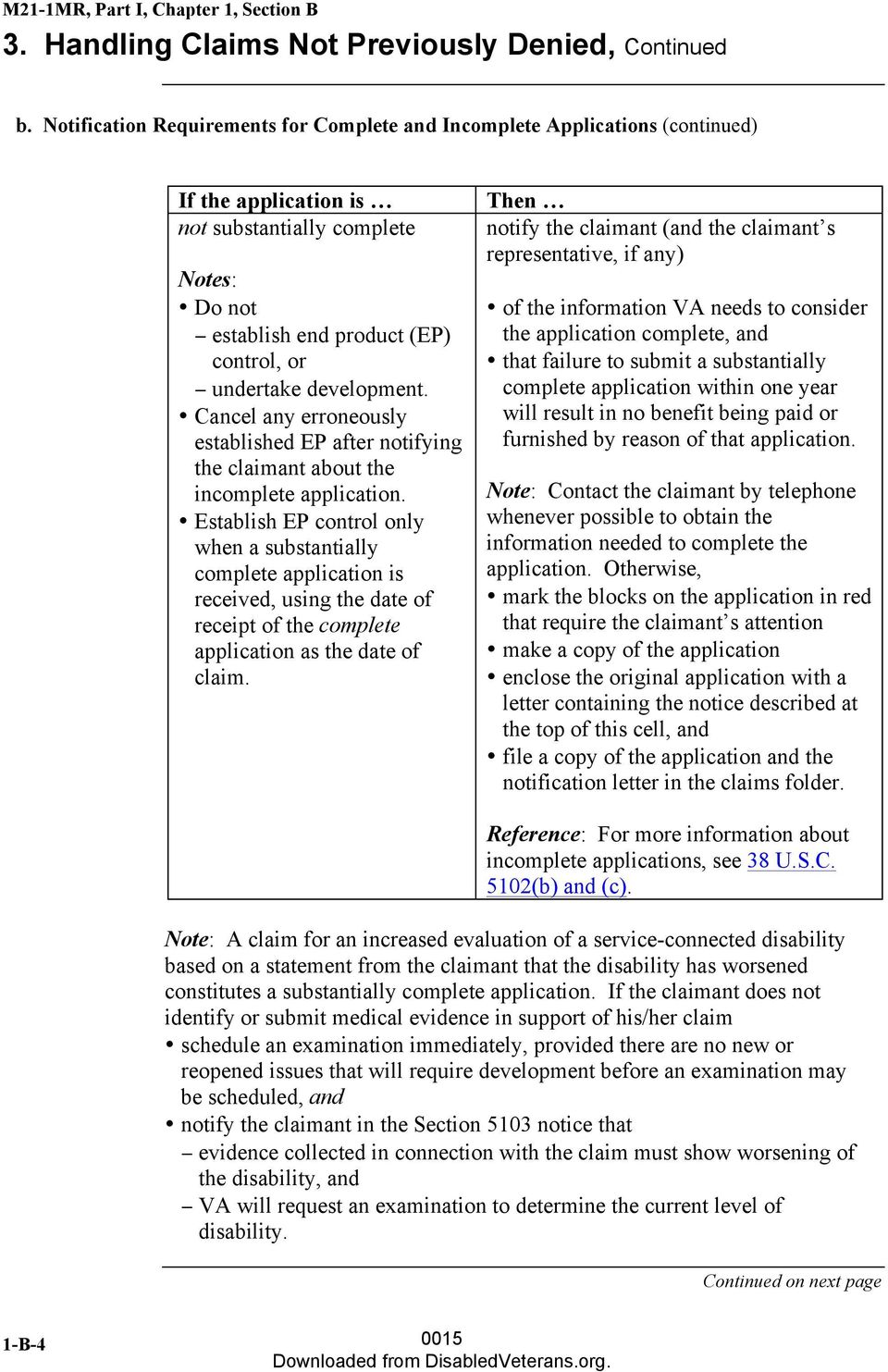
15 M21-1MR, Part I, Chapter 1, Section B 3. Handling Claims Not Previously Denied, Continued b. Notification Requirements for Complete and Incomplete Applications (continued) If the application is not substantially complete Notes: Do not establish end product (EP) control, or undertake development. Cancel any erroneously established EP after notifying the claimant about the incomplete application. Establish EP control only when a substantially complete application is received, using the date of receipt of the complete application as the date of claim. Then notify the claimant (and the claimant s representative, if any) of the information VA needs to consider the application complete, and that failure to submit a substantially complete application within one year will result in no benefit being paid or furnished by reason of that application. Note: Contact the claimant by telephone whenever possible to obtain the information needed to complete the application. Otherwise, mark the blocks on the application in red that require the claimant s attention make a copy of the application enclose the original application with a letter containing the notice described at the top of this cell, and file a copy of the application and the notification letter in the claims folder. Reference: For more information about incomplete applications, see 38 U.S.C. 5102(b) and (c). Note: A claim for an increased evaluation of a service-connected disability based on a statement from the claimant that the disability has worsened constitutes a substantially complete application. If the claimant does not identify or submit medical evidence in support of his/her claim schedule an examination immediately, provided there are no new or reopened issues that will require development before an examination may be scheduled, and notify the claimant in the Section 5103 notice that evidence collected in connection with the claim must show worsening of the disability, and VA will request an examination to determine the current level of disability. 1-B
16 M21-1MR, Part I, Chapter 1, Section B 3. Handling Claims Not Previously Denied, Continued c. Claims for Specific Evaluations or Effective Dates In Dingess/Hartman v. Nicholson (2006), the U.S. Court of Appeals for Veterans Claims (CAVC) established notification requirements with regard to compensation claims for specific evaluations or effective dates. Whenever a Veteran requests or asserts entitlement to a specific evaluation, including a total evaluation based on individual unemployability (IU), or a specific effective date, the Section 5103 notice must provide the criteria that must be met to substantiate that claim. Example: The following statements constitute claims for a specific evaluation: I believe my knee should be rated 40 percent, and My PTSD makes me totally disabled. If a Veteran requests a specific evaluation for a specific disability, copy the criteria for assigning that evaluation from the Schedule for Rating Disabilities, and paste it at the end of that portion of the Section 5103 notice that discusses what the evidence must show. For other types of specific claims, such as a claim for a total evaluation based on IU, use the appropriate letters and attachments that are specific to the claim. d. Considering Freestanding Claims for an Earlier Effective Date Per Rudd v. Nicholson, 20 Vet.App. 296 (2006), VA has no authority to adjudicate a freestanding claim for an earlier effective date in an attempt to overcome the finality of an unappealed regional office (RO) decision. However, the claimant may request revision based on clear and unmistakable error (CUE) with respect to the assignment of the effective date in that prior final RO decision. Example: A decision to grant service connection for an inguinal hernia became final on August 18, On September 25, 2010, VA receives a claim for an earlier effective date for service connection of the hernia. Analysis: Because the claim relates to the effective date in a decision that is now final, it is considered freestanding and, as such, cannot be adjudicated, except as a request to revise based on CUE B-5

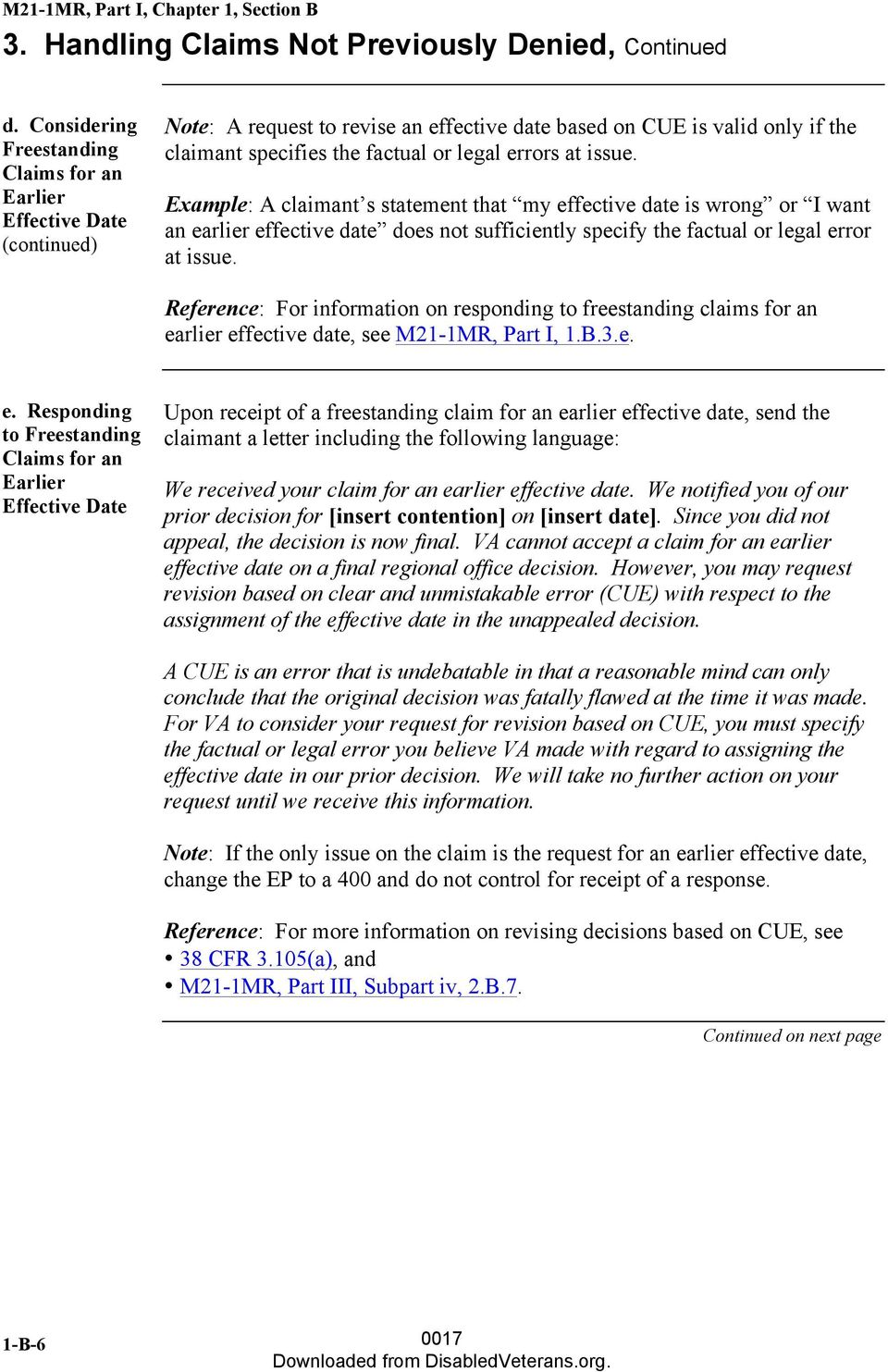
17 M21-1MR, Part I, Chapter 1, Section B 3. Handling Claims Not Previously Denied, Continued d. Considering Freestanding Claims for an Earlier Effective Date (continued) Note: A request to revise an effective date based on CUE is valid only if the claimant specifies the factual or legal errors at issue. Example: A claimant s statement that my effective date is wrong or I want an earlier effective date does not sufficiently specify the factual or legal error at issue. Reference: For information on responding to freestanding claims for an earlier effective date, see M21-1MR, Part I, 1.B.3.e. e. Responding to Freestanding Claims for an Earlier Effective Date Upon receipt of a freestanding claim for an earlier effective date, send the claimant a letter including the following language: We received your claim for an earlier effective date. We notified you of our prior decision for [insert contention] on [insert date]. Since you did not appeal, the decision is now final. VA cannot accept a claim for an earlier effective date on a final regional office decision. However, you may request revision based on clear and unmistakable error (CUE) with respect to the assignment of the effective date in the unappealed decision. A CUE is an error that is undebatable in that a reasonable mind can only conclude that the original decision was fatally flawed at the time it was made. For VA to consider your request for revision based on CUE, you must specify the factual or legal error you believe VA made with regard to assigning the effective date in our prior decision. We will take no further action on your request until we receive this information. Note: If the only issue on the claim is the request for an earlier effective date, change the EP to a 400 and do not control for receipt of a response. Reference: For more information on revising decisions based on CUE, see 38 CFR 3.105(a), and M21-1MR, Part III, Subpart iv, 2.B.7. 1-B
18 M21-1MR, Part I, Chapter 1, Section B 3. Handling Claims Not Previously Denied, Continued f. Developing Substantially Complete Applications In addition to the notification requirements outlined in M21-1MR, Part I, 1.B.3.b and M21-1MR, Part I, 1.B.3.c, VA must also, in writing, ask the claimant to identify any records he/she believes are relevant to the claim, and complete VA Form , Authorization for Release of Information, where appropriate, which will enable VA to request private medical records on the claimant s behalf, and inform the claimant if he/she does not respond to the request for information within 30 days of the date of the request, VA may decide the claim based on all the information and evidence of record, and he/she has one year from the date of the request to submit any evidence or information to substantiate the claim. Notes: Adequate identification of records by the claimant would normally include the address of the custodian of the records medical condition to which the records relate, and approximate time frame covered by these records. If the claimant identifies record sources at the same time he/she files the claim but furnishes no VA Forms or equivalent form identifying those sources (or submits incomplete VA Forms ), notify the claimant of the information and/or forms VA needs to request the records, and that VA cannot assist the claimant in obtaining the records until it receives the missing information and/or forms. The Section 5103 notice with all its enclosures (which are also called attachments and templates) must be of record in the claims folder to document VA s compliance with its statutory 38 U.S.C. 5103(a) notice responsibility. ROs are not required to include in the claims folder copies of any blank VA forms (such as, VA Form , Statement in Support of Claim, or VA Form ) issued with the notification letter. References: For more information on VA s duty to notify claimants of necessary evidence, see 38 CFR 3.159(b)(1), and handling VA Form or equivalent form, see M21-1MR, Part I, 1.B.3.i B-7

19 M21-1MR, Part I, Chapter 1, Section B 3. Handling Claims Not Previously Denied, Continued g. Claimant s Duty to Identify and Locate Records The claimant must cooperate fully with VA s reasonable efforts to obtain relevant records by providing enough information to identify and locate the existing records, including the person, company, agency, or other custodian holding the records the approximate time frame covered by the records, and the condition(s) for which treatment was provided, in the case of medical treatment records. Note: Full cooperation includes completing and returning the appropriate authorization form, such as a VA Form Reference: For more information on handling VA Form or equivalent form, see M21-1MR, Part I, 1.B.3.i. h. Definition: Relevant Records Relevant records, for the purpose of VA s statutory duty to assist, are those records that relate to the disability or injury for which the claimant is seeking benefits, and have a reasonable possibility of helping to substantiate the claim. Note: Not all medical records have a reasonable possibility of helping to substantiate a disability claim. Example: Situation: A Veteran files a claim for an increased evaluation for residuals of a service-connected left ankle fracture. On the VA Form he submits with his claim, he indicates he was treated for headaches. Analysis: Records referring to treatment for headaches are not relevant. It is unnecessary to obtain them unless there is an indication they also contain information about the left ankle, and present a reasonable possibility of helping to substantiate the Veteran s claim. Reference: For more information on relevant records, see Black s Law Dictionary, 1316 (8th Ed. 2004), and Golz v. Shinseki, 590 F.3d 1317 (Fed. Cir. 2010). 1-B

20 M21-1MR, Part I, Chapter 1, Section B 3. Handling Claims Not Previously Denied, Continued i. Handling VA Form or Equivalent Form The table below contains instructions for handling VA Form or equivalent form under a variety of different circumstances: If the VA Form or equivalent form identifies a disability that is not service connected, or the subject of a pending claim, and there is no indication the claimant intends to seek benefits based on that disability, or reasonable possibility the records identified on the form could help substantiate the pending claim the claimant identified multiple record sources on the same VA Form or equivalent form the VA Form or equivalent form is unsigned (and/or unwitnessed, if the records custodian requires a witnessed signature) Then do not consider the VA Form or equivalent form a claim for benefits, or request the records identified on the form. Example: The Veteran claims service connection for hypertension, but the records she identifies on VA Form refer to treatment for NSC ankle pain. Notes: Per Criswell v. Nicholson, 20 Vet.App. 501, (2006), where no intent can be found to apply for VA benefits, a claim for entitlement to such benefits has not been reasonably raised. Request the records in the example above if the cause of the ankle pain is service-related, and the Veteran reports the pain either caused or aggravated her hypertension. make copies of the form for each record source file the original copy of the form in the claims folder/efolder, and furnish each record source a redacted copy of the form that identifies only that record source. return the form to the claimant, and allow him/her 10 days to return the form with the appropriate signature. Note: If the records identified on the form do not appear to be relevant to the pending claim, it is not necessary to obtain a signature, or the records B-9

21 M21-1MR, Part I, Chapter 1, Section B 3. Handling Claims Not Previously Denied, Continued i. Handling VA Form or Equivalent Form (continued) If the VA Form or equivalent form identifies records that may possibly help substantiate the claim, but does not contain enough information to obtain the records Example: A Veteran claims an increase for a service-connected back disorder submits VA Form , indicating treatment for foot drop, and does not provide the name and address of the doctor who provided the treatment. Then make one attempt to call the claimant and ask for the missing information. Note: Do not alter the VA Form by adding information obtained by telephone. Instead, prepare a VA Form , Report of General Information, to document the substance of the telephone conversation. If the claimant provides the missing information does not provide the missing information, or cannot be reached by telephone Then send a letter to the records custodian that includes the VA Forms and , and a request for records in accordance with M21-1MR, Part III, Subpart iii. 1.C.14. document an unsuccessful attempt to contact the claimaint as a MAP-D note send a letter to the claimant that requests the missing information, and reminds the claimant of his/her responsibility to identify and provide authorization for records he/she wants VA to obtain, and allow the claimant 10 days to respond. Note: If VA does not receive the information within 10 days, forward the claim to the rating activity (if all other development is complete). 1-B
22 M21-1MR, Part I, Chapter 1, Section B 3. Handling Claims Not Previously Denied, Continued i. Handling VA Form or Equivalent Form (continued) If the claimant does not indicate whether the records identified on the VA Form or equivalent form are relevant to the pending claim, and it is unclear whether the records could help substantiate the claim Then consult a Rating Veterans Service Representative (RVSR) to determine which medical records are relevant to a pending claim. Example: The Veteran claims service connection for anxiety, and the records identified are from a chiropractor. j. Claimant s Duty to Authorize the Release of Existing Records If necessary, a claimant must authorize the release of existing records in a form acceptable to the person, company, agency, or other custodian holding the records. If the claimant does not provide the necessary authorization, inform him/her that VA will be unable to consider the records when deciding his/her claim unless the claimant obtains and submits the records to VA him/herself. Note: Follow the instructions in M21-1MR, Part III, Subpart iii, 1.C.14.g if a private medical care provider refuses to give VA a copy of a claimant s medical records because the medical care provider requires completion of a special, signed consent form, or the VA Form included in VA s initial request to the medical care provider did not have an original signature. Reference: For more information about authorizing the release of records, see 38 CFR 3.159(c)(1)(ii) B-11
23 M21-1MR, Part I, Chapter 1, Section B 3. Handling Claims Not Previously Denied, Continued k. Exception to the Notification Requirement In cases where the evidence of record is sufficient to substantiate a claim and grant the benefit sought, it is unnecessary to provide Section 5103 notice to the claimant. This exception only applies in cases where the evidence of record (to include VA medical center (VAMC) records available through the Compensation and Pension Records Interchange (CAPRI)) justifies granting the specific benefit the claimant is seeking without undertaking development for additional evidence. Example: A Veteran files a claim for an increase in his service-connected knee disorder specifically requests a 40-percent disability rating for the knee, and reports recent treatment of the knee at a local VAMC. Review of the VAMC records reveals range of motion of the serviceconnected knee is limited to an extent that warrants the assignment of a 40- percent disability rating. Analysis: Because VA may grant the benefit the Veteran specifically requested based solely on the evidence of record, there is no need to provide Section 5103 notice. Important: Provide Section 5103 notice if any development is necessary (including a request for an examination). 1-B
24 M21-1MR, Part I, Chapter 1, Section B 4. Handling Claims to Reopen a Previously Denied Claim Introduction This topic contains information on handling claims to reopen a previously denied claim, including definition of a reopened claim, and VA responsibilities for claim development. Change Date May 3, 2012 a. Definition: Reopened Claim The term reopened claim pertains to any application for a benefit received after the disallowance of an earlier claim for that benefit has become final. This includes a claim in which service connection for the same disability is reclaimed under a different theory of entitlement. Example: A Veteran whose claim for direct service connection for hypertension was denied five years ago has now claimed service connection for hypertension on a secondary basis. Consider the claim for secondary service connection to be a reopened claim, because the same disability, hypertension, was reclaimed under a different theory of entitlement. Notes: Final means the claim is no longer active, and appeal period has expired. Reopened claims do not include claims for increased evaluations, or ancillary benefits. Reference: For more information on claims reopened under a different theory of entitlement, see Robinson v. Mansfield, 21 Vet.App. 545 (2008), aff d sub nom, Robinson v. Shinseki, 557 F.3d 1355 (Fed.Cir. 2009) B-13
25 M21-1MR, Part I, Chapter 1, Section B 4. Handling Claims to Reopen a Previously Denied Claim a Previously Denied Claim, Continued b. VA Responsibilities for Claim Development Upon receipt of a claim to reopen a previously denied claim, follow the instructions in M21-1MR, Part I, 1.B.3.a to determine whether the claim is substantially complete, and M21-1MR, Part I, 1.B.3.b to provide proper notice to the claimant. In order to successfully reopen a previously denied claim, a claimant must submit new and material evidence. Although VA will not schedule an examination or request a medical opinion until it receives such evidence, VA is responsible for attempting to obtain any relevant Federal or non-federal evidence the claimant identifies, and VA has never reviewed. References: For more information about processing claims to reopen a previously denied claim, see M21-1MR, Part III, Subpart iv, 2.B.6, and new and material evidence, see M21-1MR, Part III, Subpart iv, 2.B.5, and M21-1MR, Part III, Subpart iii, 1.B.7. 1-B
26 Section C. Requesting Records M21-1MR, Part I, Chapter 1, Section C Overview In this Section This section contains the following topics: Topic Topic Name See Page 5 Requesting Federal Records 1-C-2 6 Requesting Non-Federal or Private Records 1-C-8 7 Requesting a Medical Opinion or Examination 1-C C-1
27 M21-1MR, Part I, Chapter 1, Section C 5. Requesting Federal Records Introduction This topic contains information about requesting Federal records, including types of Federal records that may be requested continuing attempts to obtain Federal records framing the requests for Federal records waiting period after making the requests for Federal records concluding efforts to obtain Federal records, and notifying the claimant that Federal records are unavailable. Change Date February 3, C-2
28 5. Requesting Federal Records, Continued M21-1MR, Part I, Chapter 1, Section C a. Types of Federal Records That May Be Requested VA may request a variety of Federal records including: service treatment records other relevant service department records identified by the claimant records of relevant VA medical treatment or examination that the claimant identifies adequately authorized VA medical treatment or examination at a non-va facility if adequately identified, and any other relevant records held by any Federal department or agency (such as those held by the Social Security Administration (SSA) or Public Health Service) that the claimant authorizes VA to obtain and adequately identifies. Note: For disability compensation claims, obtain all the records if relevant and identified. References: For more information on requesting records held by the SSA, see M21-1MR, Part III, Subpart iii, 3.A, and other Federal departments or agencies, see M21-1MR, Part III, Subpart iii, 2.I.57.b, and M21-1MR, Part III, Subpart iii, C-3
29 5. Requesting Federal Records, Continued M21-1MR, Part I, Chapter 1, Section C b. Continuing Attempts to Obtain Federal Records When records are in the custody of a Federal department or agency, the law obligates VA to continue attempts to obtain records until records are obtained, or it is reasonably certain that the records do not exist, or further efforts by VA to obtain the records would be futile. References: For more information on requesting Federal records as part of the duty to assist, see 38 CFR 3.159(c)(2) and (3) M21-1MR, Part III, Subpart iii, 2.I. c. Framing the Requests for Federal Records Frame the initial and any follow-up requests for Federal records in a complete and specific way so as to obtain the following: necessary information necessary evidence, and/or a negative reply. Reference: For more information on how to create a request for service records, see the Personnel Information Exchange System (PIES) Defense Personnel Records Information Retrieval System (DPRIS) page located on the VBA Compensation Service's Intranet site C-4
30 5. Requesting Federal Records, Continued M21-1MR, Part I, Chapter 1, Section C d. Waiting Period After Making Requests for Federal Records Allow 30 days for a response to the initial request, and 15 days for follow-up requests. Inform the claimant of the status of his/her claim, including VA efforts to obtain identified records. Note: If neither Federal nor non-federal records have been received within their respective response periods, notice about the status of both requests may be included in a single letter, but the letter must clearly differentiate between the actions we will take concerning these two categories of records. References: For more information on the standard procedure for requesting records from a Federal entity, see M21-1MR, Part III, Subpart iii, 2.I.57.b, and requesting non-federal records, see M21-1MR, Part I, 1.C.6. e. Concluding Efforts to Obtain Federal Records Determine on a case-by-case basis whether further attempts to obtain records would be futile, based on completion of at least the minimum efforts specified in M21-1MR, Part III, Subpart iii, 2.I.57.b and/or any response received from the records custodian C-5
31 5. Requesting Federal Records, Continued M21-1MR, Part I, Chapter 1, Section C f. Notifying the Claimant That Federal Records Are Unavailable Use the table below to determine what action to take when notifying the claimant that the requested records do not exist or that further attempts to request them would be futile. Step Action 1 Prepare a final-attempt letter that contains the information described in M21-1MR, Part III, Subpart iii, 2.I.59.c send the letter to the claimant, and allow the claimant 10 days to respond. References: For more information on final attempt letter content see M21-1MR, Part III, Subpart iii, 2.I.59.c unsuccessful attempts to obtain Federal records, see M21-1MR, Part III, Subpart iii, 2.I.59 the duty to notify claimants of the inability to obtain records, see 38 CFR 3.159(e), and alternative sources for service records, see M21-1MR, Part III, Subpart iii, 2.E C-6
32 5. Requesting Federal Records, Continued M21-1MR, Part I, Chapter 1, Section C f. Notifying the Claimant That Federal Records Are Unavailable (continued) Step Action 2 Has the claimant furnished evidence or identified alternative source(s) of evidence within the 10-day time limit? If yes, take action on the claim or develop for the records, as appropriate. If no, continue processing the claim on the evidence of record, including scheduling an examination or requesting a medical opinion, if needed to decide the claim. Important: If Federal records cannot be obtained, both the rating decision and the letter of notification must clearly indicate that the custodian of the records stated that the records could not be provided C-7
33 6. Requesting Non-Federal or Private Records M21-1MR, Part I, Chapter 1, Section C Introduction This topic contains information on requesting non-federal or private records, including making reasonable efforts to obtain relevant evidence definition of reasonable efforts requirement to follow up on requests for non-federal records by telephone waiting period after making requests from non-federal sources using the telephone, fax or to obtain evidence from the claimant notifying the claimant at the time of the follow-up request for non-federal records notifying the claimant when VA s reasonable efforts to obtain non-federal records are unsuccessful VA s responsibility for requesting medical records, identifying medical records, and identifying non-medical and non-federal records. Change Date June 18, 2013 a. Making Reasonable Efforts to Obtain Relevant Evidence The Veterans Claims Assistance Act (VCAA), as codified in 38 U.S.C. 5103A and 38 CFR 3.159, states that VA must make reasonable efforts to assist a claimant in obtaining the evidence necessary to substantiate a claim. The determination of what constitutes reasonable efforts is based on the circumstances of the case C-8
34 M21-1MR, Part I, Chapter 1, Section C 6. Requesting Non-Federal or Private Records, Continued b. Definition: Reasonable Efforts Reasonable efforts to obtain relevant records that are not in the custody of a Federal department or agency ordinarily require an initial request for such evidence, and at least one follow-up request if no response is received from the custodian of the records unless a response to the initial request indicates that the records do not exist, or a follow-up request would be futile. If VA receives information showing that subsequent requests to this or another custodian could result in obtaining the records sought then reasonable efforts would include an initial request, and at least one follow-up request to the new source if the records are not received or an additional request to the original source if the records are not received. c. Requirement to Follow Up on Requests for Non-Federal Records by Telephone When following up on requests for non-federal records, you must make one attempt to contact the records custodian by telephone. Document any successful telephone contact on a signed VA Form , Report of General Information, for the claims folder. If the records custodian cannot be reached by telephone on the first attempt make no further attempts to contact the custodian by telephone document the action in Modern Award Processing-Development (MAP-D) notes, and send the custodian a follow-up letter to request the records. Note: Whenever appropriate, ask the custodian of the records to fax the records to the designated RO fax number. (Note: The fax machine must be located in a secure, nonpublic location because the faxed records may contain personally identifiable information.) References: for more information on MAP-D, see the MAP-D User Guide. for more information on documenting unsuccessful telephone contacts in MAP-D, see M21-1MR Part I, 1.C.6.e C-9
35 M21-1MR, Part I, Chapter 1, Section C 6. Requesting Non-Federal or Private Records, Continued d. Waiting Period After Making Requests From Non-Federal Sources When requesting records from non-federal sources, allow 15 days for a response to the initial request, and 15 days for a response to a follow-up request. Make additional attempts to obtain the requested evidence when there is reason to believe that subsequent requests will result in obtaining the documents. Continue processing the claim after the initial 15 days, ordering an examination or medical opinion, or taking any further needed action, which may include preparing and propagating a rating decision addressing any issues for which benefits may be granted based on the evidence of record. Ordinarily, you should wait to schedule a VA examination until requested Federal and non-federal records indicate there was an event, injury or disease in service that may be associated with the current condition. e. Using the Telephone, Fax, or to Obtain Evidence From the Claimant Use the telephone, fax, or to seek the claimant s assistance in getting evidence or clarifying information, and gather information from the claimant. When undertaking telephone development, you may leave a message for a claimant as voic or with a third party when contact is unsuccessful. However, the message must not include any information protected by the Privacy Act including: income claim numbers Social Security numbers a beneficiary s address the type or amount of monetary benefits received, including any benefits received in the past names, types, and percentages of disabilities, and treatment for drug and/or alcohol abuse, human immunodeficiency virus (HIV) infections, acquired immune deficiency syndrome (AIDS), or sickle cell anemia C-10
36 M21-1MR, Part I, Chapter 1, Section C 6. Requesting Non-Federal or Private Records, Continued e. Using the Telephone, Fax, or to Obtain Evidence From the Claimant (continued) The phone message should simply leave VA s toll-free number ( ) and ask for a return call. After leaving the message, enter a MAP-D note regarding the information sought. The MAP-D note should include, at a minimum, the name of the individual/facility contacted, and the specific evidence requested. Notes: Document all successful telephone contacts, including the name of the individual contacted, time, subject, and substance of the discussion on a signed VA Form for the claims folder. Note: You may communicate that notification by telephone and send simultaneous written notification for confirmation. Make hard copies of any correspondence for the claims folder. Be sure to protect personally identifiable information, such as the claimant s name, date of birth, and VA claim number, in accordance with the Freedom of Information Act (FOIA) and Privacy Act (PA) User Guide and M C-11
37 M21-1MR, Part I, Chapter 1, Section C 6. Requesting Non-Federal or Private Records, Continued f. Notifying the Claimant at the Time of the Follow-Up Request for Non-Federal Records At the time of the follow-up request, notify the claimant that he/she is ultimately responsible for providing the evidence, but that a follow-up attempt is being made he/she must submit these requested records within one year of when VA first notified the claimant of the information and evidence necessary to substantiate the claim, and if the requested evidence is unobtainable, VA will process the claim based on the evidence of record. g. Notifying the Claimant When VA s Reasonable Efforts to Obtain Non- Federal Records Are Unsuccessful Notify the claimant that VA has not received requested records if reasonable efforts have been made to obtain relevant non-federal records, but some or all of them have not been received, and a follow-up request for them is being made. Notify the claimant at the time of the follow-up request for the records, and identify the records that were not obtained briefly explain the efforts made to obtain the records, and describe any further action that will be taken with respect to the claim including processing the claim based on the evidence of record. Note: If neither Federal nor non-federal records have been received within their respective response periods, notice about the status of both requests may be included in a single letter, but the letter must clearly differentiate between the actions we will take concerning these two categories of records. h. VA s Responsibility for Requesting Medical Records VA must request relevant medical records from all sources that the claimant adequately identifies for the development of claims C-12
38 M21-1MR, Part I, Chapter 1, Section C 6. Requesting Non-Federal or Private Records, Continued i. Identifying Medical Records Request that the claimant identify the type of record being obtained custodian of the record and his/her address medical condition to which these records relate approximate time frame covered by these records, and complete a medical release, if necessary. Note: These requirements apply to all types of non-federal records. j. Identifying Non-Medical Non-Federal Records Request that the claimant identify the type of record being obtained custodian of the record and his/her address, and approximate time frame covered by these records. Examples: These records include the following: state workers compensation records, and employment records, including on-the-job injury reports, and accident reports C-13
39 7. Requesting a Medical Opinion or Examination M21-1MR, Part I, Chapter 1, Section C Introduction This topic contains information on requesting a medical opinion or examination to develop claims, including VA s responsibility to provide medical examinations or obtain medical opinions when to request a medical opinion or examination when to request a medical opinion versus an examination stating medical opinion requests clearly what the medical opinion request must contain, and the importance of identifying evidence relevant to the medical opinion request. Change Date March 28, 2011 a. VA s Responsibility to Provide Medical Examinations or Obtain Medical Opinion In claims for disability compensation, assist the claimant by providing a medical opinion or examination when the opinion or examination is necessary to make a decision on the claim. Reference: For more information on requesting a medical opinion or examination, see M21-1MR, Part III, Subpart iv, 3.A C-14
40 M21-1MR, Part I, Chapter 1, Section C 7. Requesting a Medical Opinion or Examination, Continued b. When to Request a Medical Opinion or Examination A medical opinion or examination may be necessary when, after the development of all other relevant evidence, including the statement of the claimant, the file does not contain sufficient medical evidence to make a decision on the claim, but contains competent lay or medical evidence of a current diagnosed disability or persistent or recurrent symptoms of disability (Note: A claimant is competent to describe symptoms of disability that he/she is experiencing, such as pain in the knee. However, because a claimant ordinarily lacks medical training and experience he/she may not be competent to diagnose his/her own medical condition or offer a medical opinion.) establishes that the Veteran suffered an event, injury, or disease in service, or has a disease or symptoms of a disease listed in 38 CFR 3.309, 38 CFR 3.313, 38 CFR 3.316, or 38 CFR manifesting during an applicable presumptive period, and indicates that the claimed disability or symptoms may be associated with the established event, injury, or disease in service or with another SC disability. Example: Request an examination if the available medical evidence is too old to adequately evaluate the current state of the claimant s disability. Important: Per 38 CFR 3.159(c)(4)(ii), post-service treatment alone may serve as a link to an injury or event in service. The threshold for determining whether a claimed disability may be associated with service is low and may be met by such evidence as medical evidence that suggests a nexus but is too equivocal or nonspecific to support a decision on the merits of the case, or credible evidence of continuity of symtomatology, such as pain or other symptoms capable of lay observation. (See McLendon v. Nicholson, 20 Vet.App. 79, 81 (2006).) References: For more information on when to request a medical examination, see Proscelle v. Derwinski, 2 Vet.App. 629 (1992) Olson v. Principi, 3 Vet.App. 480, 482 (1992), and VA O.G.C. Prec. Op (April 7, 1995), and the competency of lay evidence to establish a diagnosis, see Jandreau v. Nicholson, 492 F.3d 1372, 1377 (Fed. Cir. 2007) C-15
41 M21-1MR, Part I, Chapter 1, Section C 7. Requesting a Medical Opinion or Examination, Continued c. When to Request a Medical Opinion Versus an Examination A medical opinion versus an examination should be requested when only the following is necessary to decide the claim: reconciliation of different diagnoses opinion concerning the relationship between two conditions etiology and nexus opinions Allen v. Brown cases (that is, when the issue is whether a service-connected condition has aggravated a non-service connected condition) independent medical opinions, and opinion regarding the extent to which service-connected disabilities affect the Veteran s ability to perform physical and non-physical tasks in order for VA to determine whether the Veteran is unemployable. Notes: Many opinion requests require information that would be gleaned as part of the normal examination process, which the physician should not be precluded from conducting, if necessary. A medical opinion is not generally required when service connection may be granted under 38 CFR 3.303(b) because the disability is chronic, or symptoms that began in service have continued after the Veteran s discharge. Generally, do not request a medical opinion to determine whether a disability causes a specific functional impairment, such as loss of use of an extremity; in such cases, an examination and description of the impairment and remaining function should suffice. References: For more information on requesting examinations, see M21-1MR, Part III, Subpart iv, 3.A, and medical opinions, see M21-1MR, Part III, Subpart iv, 3.A C-16
42 M21-1MR, Part I, Chapter 1, Section C 7. Requesting a Medical Opinion or Examination, Continued d. Stating Medical Opinion Requests Clearly When seeking a medical opinion follow the instructions in M21-1MR, Part III, Subpart iv, 3.A.9 be very clear about what information or opinion is being requested send the following to the medical examiner: the claims folder, and the opinion request, and direct the medical examiner to review the claims folder, and provide a rationale for any opinion. e. What the Medical Opinion Request Must Contain When requesting a medical opinion clearly state the nature of the opinion required explain why the opinion is needed, if this would clarify the request, and use a neutral and unbiased tone that gives no indication VA prefers one outcome over another or one specific answer over another. When requesting an opinion in compliance with BVA remand instructions, do not simply refer the examiner to the claims folder containing the remand instructions; explain what you are requesting or quote the instructions from BVA on the medical opinion request. Reference: For more information on obtaining evidence in an impartial manner, see Douglas v. Shinseki, 23 Vet.App. 19, 24, (2009) C-17
43 M21-1MR, Part I, Chapter 1, Section C 7. Requesting a Medical Opinion or Examination, Continued f. Importance of Identifying Evidence Relevant to the Medical Opinion Request The requester should identify the available evidence to assist the physician in focusing his/her review. The evidence should be tagged in the claims folder, but the examiner must be advised that he/she is not limited to reviewing only this evidence. Note: Avoid the potential problem of steering the examiner to review only the evidence pre-selected as relevant since a medical professional may have a differing opinion as to what evidence is relevant and must not be limited in the record review. The identification of the evidence must include a general description of it, indicating the source approximate dates, and subject matter C-18
44 September 27, 2011 M21-1MR, Part I, Chapter 2, Table of Contents Chapter 2. Due Process Table of Contents Section A: General Information on Due Process Overview... 2-A-1 1. Due Process and VA Benefits... 2-A-2 2. Types of Notification... 2-A-3 3. Situations Not Requiring Notification... 2-A-5 Section B: Notice of Proposed Adverse Action Overview... 2-B-1 4. General Information on the Notice of Proposed Adverse Action... 2-B-2 5. Elements of a Notice... 2-B-6 6. Process for Proposing an Adverse Action... 2-B-8 7. Establishing and Monitoring Controls... 2-B Where to Find Other Topic-Specific Information Regarding Due Process... 2-B-13 Section C: Adverse Action Proposal Period Overview... 2-C-1 9. General Information on the Adverse Action Proposal Period... 2-C Responding to the Beneficiary... 2-C Hearings During the Adverse Action Proposal Period... 2-C Sending Final Notice... 2-C-14 Section D: Contemporaneous Notice Overview... 2-D General Information on Contemporaneous Notice... 2-D Information Received by Telephone... 2-D Requirements for Contemporaneous Notice... 2-D Hearings and Contemporaneous Notice... 2-D-8 Section E: Exhibits Overview... 2-E Exhibit 1: Notice of Proposed Adverse Action Basic Procedural Rights Paragraphs... 2-E Exhibit 2: Contemporaneous or Final Notice Basic Procedural Rights Paragraphs... 2-E Exhibit 3: Right to Appeal Paragraph... 2-E Exhibit 4: Overpayment Paragraphs... 2-E Exhibit 5: Contemporaneous Notice on Reported Death of a Beneficiary... 2-E i
45 M21-1MR, Part I, Chapter 2, Section A Overview Section A. General Information on Due Process In this Section This section contains the following general topics on due process: Topic Topic Name See Page 1 Due Process and VA Benefits 2-A-2 2 Types of Notification 2-A-3 3 Situations Not Requiring Notification 2-A A-1
46 M21-1MR, Part I, Chapter 2, Section A 1. Due Process and VA Benefits Introduction This topic contains information about how due process, as stated in the U.S. Constitution, affects VA benefits, including due process and the U.S. Constitution due process and VA, and entitlement to notification. Change Date June 19, 2006 a. Due Process and the U.S. Constitution The Fifth Amendment to the U.S. Constitution ensures that citizens have the right of due process. No person shall be deprived of life, liberty or property without due process of law. b. Due Process and VA Due process in the administration of VA benefits informs the beneficiary of a proposed adverse action that could reduce or terminate benefits, and provides the beneficiary with the opportunity to provide additional evidence to contest the action, and/or hold a hearing before VA decision-makers. In most instances, due process applies when VA proposes to reduce or terminate a benefit. In a few situations, such as a character of discharge determination, due process applies before VA determines eligibility for benefits. Reference: For more information on due process, see 38 CFR c. Entitlement to Notification The following parties are entitled to notification of any decision made by VA that affects the payment of benefits or the granting of relief: beneficiaries fiduciaries of minor or incompetent beneficiaries, and beneficiaries designated representatives. 2-A
47 M21-1MR, Part I, Chapter 2, Section A 2. Types of Notification Change Date August 4, 2009 a. Types of Notification Concerning Change in Benefits Two types of notification are used to inform a beneficiary of a change in benefits. They are a notice of proposed adverse action, which informs a beneficiary of a proposed reduction or termination of benefits, and a contemporaneous notice, which informs a beneficiary of a change in benefits that was implemented at the time the notice was sent. Use the table below to determine the type of notice that should be used. If the source of information is a third party Reference: For more information on third party information, see M21-1MR, Part I, 2.B.4.c. Then use a notice of proposed adverse action to tell the beneficiary of a proposed change. Rationale To explain to the beneficiary of the information received, and the effect it may have on his/her benefit. References: For more information on notices of proposed adverse action, see M21-1MR, Part I, 2.B, and information on sending a notice of proposed adverse action to a hospitalized veteran, see M21-1MR, Part I, 2.B.6.c A-3
48 M21-1MR, Part I, Chapter 2, Section A 2. Types of Notification, Continued a. Types of Notification Concerning Change in Benefits (continued) If the source of information is the beneficiary Then use a contemporaneous notice to tell the beneficiary about the change. Exception: Per 38 CFR 3.103(3)i, a notice of proposed adverse action is required, instead of a contemporaneous notice, if the information furnished does not involve a change in income net worth marital status, or dependency. In these cases, send a notice of proposed adverse action to the beneficiary even if he/she requests immediate reduction of benefits upon furnishing information. Rationale To explain to the beneficiary that the information he/she submitted has affected entitlement, and to what extent. Reference: For more information on contemporaneous notices, see M21-1MR, Part I, 2.D. 2-A
49 M21-1MR, Part I, Chapter 2, Section A 3. Situations Not Requiring Notification Introduction This topic contains information on situations not requiring notification, including notice of the beneficiary s death, and procedure for terminating an award upon notice of death. Change Date June 19, 2006 a. No Notification Required Upon Notice of Death No notice of termination (contemporaneous or otherwise) is required when VA receives a death certificate (including telegraphic notice of death from a foreign service post official) a terminal hospital report verifying the death of a beneficiary, or a claim for VA burial benefits (including, but not limited to, VA Form , Application for United States Flag for Burial Purposes) b. Procedure for Terminating an Award Upon Notification of Death Once a notice of death is received as stated above immediately terminate the award, and send the appropriate applications to any surviving dependent(s) when there is an accrued amount payable, or a potential beneficiary for death benefits A-5
50 M21-1MR, Part I, Chapter 2, Section B Overview Section B. Notice of Proposed Adverse Action In this Section This section contains the following topics on the notice of proposed adverse action: Topic Topic Name See Page 4 General Information on the Notice of Proposed 2-B-2 Adverse Action 5 Elements of the Notice of Proposed Adverse 2-B-6 Action 6 Process for Proposing an Adverse Action 2-B-8 7 Establishing and Monitoring Controls 2-B-11 8 Where to Find Other Topics Specific to Due Process 2-B B-1
51 M21-1MR, Part I, Chapter 2, Section B 4. General Information on the Notice of Proposed Adverse Action Introduction This topic contains general information on the notice of proposed adverse action, including benefit changes requiring a notice of proposed adverse action requirement of notice third party information proposed rating or administrative action exemptions for temporary and delimited ratings, and requests for apportionment. Change Date October 13, 2004 a. Benefit Changes Requiring a Notice of Proposed Adverse Action Generally, VA must send the beneficiary and his/her representative (if any) a notice of proposed adverse action prior to taking any unfavorable action affecting his/her benefits, including reductions suspensions, or terminations. b. Requirement of Notice A notice of proposed adverse action is required when VA proposes an action based upon third party information that could adversely affect the payment of benefits. References: For more information on sending a notice of proposed adverse action, see M21-1MR, Part I, 2.B.6, and M21-1MR, Part I, 2.B.7. 2-B
52 M21-1MR, Part I, Chapter 2, Section B 4. General Information on the Notice of Proposed Adverse Action, Continued c. Third Party Information Third party information is any information that is not received from the beneficiary or from the beneficiary s fiduciary. Written correspondence is considered third party when received without the beneficiary s signature, or the signature of his/her fiduciary. The table below lists the three types of third party informants and provides examples of the types of information they provide. Third Party Informant VA medical facilities Examples Admission notices and reports that may result in hospital rate adjustments. Exception: A formal written notice of death. Field examiners Estate analysts, and Beneficiary s survivors References: For more information on hospitalization adjustments, see 38 CFR 3.551, and adjustment of allowance for aid and attendance, see 38 CFR Notices and reports. Exceptions: Notices and reports may be considered first party sources when accompanied by documents provided by the beneficiary, such as copies of award letters or marital or dependency status certificates, or a signed, written statement from the beneficiary. A notice of proposed adverse action is not required when an estate analyst requests that a beneficiary s award be suspended because of the fiduciary s failure to furnish accounting activities. Note: The information on a VA Form 119, Report of Contact, documents, or signed statement must, in and of itself, justify the adverse action B-3
53 M21-1MR, Part I, Chapter 2, Section B 4. General Information on the Notice of Proposed Adverse Action, Continued c. Third Party Information (continued) Third Party Informant Other possible sources Examples VA computer matches letters from friends and relatives reports from employers reports from other government and private agencies, or Social Security s third party query system. Share computer application d. Proposed Rating or Administrative Action A notice of proposed adverse action is also required when benefits are being reduced or terminated based on a rating or administrative action. The table below lists examples of cases where benefits may possibly be reduced based on a rating activity or an administrative decision. Example Case Reduction in evaluation of a serviceconnected disability Discontinuance of unemployability Severance of service connection Benefits erroneously awarded because of Reference M21-1MR, Part IV, Subpart ii, 3.A.3 M21-1MR, Part IV, Subpart ii, 3.A.3.b M21-1MR, Part IV, Subpart ii,3.a.2 M21-1MR, Part III, Subpart v, 1.I.36. an administrative error, or error in judgment 2-B
54 M21-1MR, Part I, Chapter 2, Section B 4. General Information on the Notice of Proposed Adverse Action, Continued e. Exception for Temporary Ratings Sometimes a veteran is granted an increased payment for a disability following an event, such as a joint replacement or heart attack, for which the rating schedule provides a temporary evaluation for a specified period of time. In such a circumstance, ensure that the award letter specifies the date or conditions under which the increased payment will be reduced. In this situation, because the veteran is fully informed of the date and reasons for the prospective adjustment, no notice of proposed adverse action is needed before the evaluation is reduced. f. Requests for Apportionment A notice of proposed adverse action is also required when an apportionment of benefits is requested by or on behalf of a beneficiary s dependent. Reference: For more information on requests for apportionment, see M21-1MR, Part III, Subpart v, B-5
55 M21-1MR, Part I, Chapter 2, Section B 5. Elements of the Notice of Proposed Adverse Action Introduction This topic contains information on the elements of a notice, including the required elements for a notice of proposed adverse action, and description of elements in a notice of proposed adverse action. Change Date October 13, 2004 a. Required Elements for Notice of Proposed Adverse Action Every notice of proposed adverse action must include the following elements: a statement of the proposed decision, including new rates of payment the proposed effective date of the decision information on the possible creation of an overpayment detailed reasons for the proposed decision, and the right to present evidence request a personal hearing, and have representation. b. Description of Elements in Notice of Proposed Adverse Action The table below describes each of the elements in a notice of proposed adverse action. Element Statement of proposed decision Description Fully and clearly states the proposed decision to reduce suspend, or terminate benefits. Provides new rate information for each rate change. 2-B
56 M21-1MR, Part I, Chapter 2, Section B 5. Elements of the Notice of Proposed Adverse Action of Proposed Adverse Action, Continued b. Description of Elements in Notice of Proposed Adverse Action of Proposed Adverse Action (continued) Element Statement of proposed effective date Description states the proposed effective date, and informs the beneficiary that he/she has 60 days to respond to the proposed decision, and the payment of benefits will continue through the 60-day period. Note: The requirement that payments be continued through the 60-day period does not alter the effective date of the proposed reduction or termination. Statement advising beneficiary of potential overpayment Basis for proposed decision Rights of beneficiary Reference: For more information on effective dates for reduced benefits, see 38 CFR to advises the beneficiary that if the proposed adverse action is implemented, he/she must repay any overpayment resulting from the continuation of payments during the proposed adverse action period, and informs the beneficiary that he/she may minimize any potential overpayment by requesting that the award be adjusted immediately. States the facts and reasons for the proposed action (38 CFR 3.103) the evidence under consideration, and the proposed rates and any calculations used to arrive at the proposed rates. Informs the beneficiary of the right to present evidence request a personal hearing, and have representation B-7
57 M21-1MR, Part I, Chapter 2, Section B 6. Process for Proposing an Adverse Action Introduction This topic contains information on the process of the proposed adverse action, including the notification process for the proposed adverse action, determining where to send the notice of proposed adverse action, and special procedures for hospitalized veterans. Change Date October 13, 2004 a. Process for Notices of Proposed Adverse Action The table below describes the process for notices of proposed adverse action. Stage Description Reference 1 VA sends beneficiary a notice of M21-1MR, Part I, 2.B.5 proposed adverse action. 2 VA establishes the proposed M21-1MR, Part I, 2.C.9 adverse action period specifying the amount of time the beneficiary has to respond before any proposed adverse action is executed. 3 VA responds to the evidence and M21-1MR, Part I, 2.C.10 arguments submitted by the beneficiary, if any, during the proposed adverse action period. 4 VA sends final notification of its decision, advising the beneficiary of M21-1MR, Part I, 2.C.12 the decision (including new rates) the effective date(s) the detailed reasons for the decision overpayment information, and appeal rights 2-B
58 M21-1MR, Part I, Chapter 2, Section B 6. Process for Proposing an Adverse Action, Continued b. Determining Where to Send Notice Use the table below to determine where to send the notice. Reference: For more information on sending the notice to the Agent Cashier for a homeless beneficiary, see 38 CFR 1.710(d). If a valid current address exists the beneficiary fails or refuses to provide a current address mail is returned as undeliverable Then send the notice to the current address of record. send the notice to the Agent Cashier to whom the award checks are being sent. determine whether an error occurred in addressing. If so, correct the address and re-send the letter. a more recent address is of record (such as the yellow forwarding-sticker from the U.S. Postal Service or recent communication from the claimant), or a valid address is available from non- VA records, such as the Internet, telephone directory assistance, or the beneficiary s financial institution, if VA benefits via Direct Deposit/Electronic Funds Transfer (DD/EFT). Note: If a better address is found and the notice is r ed re-date the notice cancel the pending EP 600, and create an EP 601 with the date of r ing as the new date of claim, or is not found annotate the returned notice, and file it in the claims folder B-9
59 M21-1MR, Part I, Chapter 2, Section B 6. Process for Proposing an Adverse Action, Continued c. Special Procedure for Hospitalized Veterans Follow the steps in the table below to send a notice of proposed adverse action to a hospitalized veteran to ensure that he/she receives proper notification before the reduction or termination of benefits. Note: If the veteran has a fiduciary, send the notice of proposed adverse action to the fiduciary only. A separate notice to the hospitalized veteran is not required. Step Action 1 Prepare two notices of proposed adverse action and address one to the veteran s address of record, and another to the veteran at the hospital or nursing home. 2 The following statement should be included: I was admitted to the [type hospital s name] on [type admission date]. Please take immediate action to reduce my payments to the proper rate authorized by law. Place it either at the bottom of the notice of proposed adverse action, or on an attached VA Form , Statement in Support of Claim: 3 Request the veteran to sign and return the notice or form. Exception: When a veteran fails to return the form, no reduction in benefits can be made until the proposed adverse action period expires. 2-B
60 M21-1MR, Part I, Chapter 2, Section B 7. Establishing and Monitoring Controls Introduction This topic contains information on setting up and monitoring the notice of proposed adverse action, including who is responsible for establishing and monitoring controls, and establishing controls. Change Date April 3, 2014 a. Who Is Responsible for Establishing and Monitoring Controls The table below describes the responsibilities for establishing and monitoring controls. Who is Responsible Actions Establishing Control VSR Ensures that end products (EPs) are established and cleared or cancelled. Monitoring Controls Veterans Service Center Manager Ensures that the division workflow (VSCM) management plan is followed. Supervisors and VSRs Reference: For more information on workflow management, see M21-4, Chapter 2. Ensure that maturing EP 600s are identified and routed for action B-11
61 M21-1MR, Part I, Chapter 2, Section B 7. Establishing and Monitoring Controls, Continued b. Establishing Controls Follow the steps in the table below for establishing controls at the time a notice of adverse action is sent. Important: The notice of proposed adverse action period will not begin until notice has been provided to all appropriate parties at the last address of record. Step Action 1 Clear any pending end product that would have been finalized except for the application of due process procedure. 2 Establish a 600 end product (EP 600), indicating notice of proposed adverse action, with a suspense date 65 days following the anticipated release date of the notice of proposed adverse action. 2-B
62 M21-1MR, Part I, Chapter 2, Section B 8. Where To Find Other Topics Specific to Due Process Change Date August 19, 2005 a. Topics Specific to Due Process The table below lists the location of other topics specific to due process. Topic Due Process in Incompetency Determinations Reduction Due to Administrative Error Reduction in Compensation Due to Error in Determination Not Permanent and Total (PT) and No Longer Entitled to Special Monthly Pension (SMP) Cases Review of A&A Entitlement Following Discharge from Nursing Home Notice of Hospitalization/Nursing Home Status Received after Discharge From Facility Notice of Proposed Adverse Action Procedures in Apportionment Cases: Initial Claim Reference M21-1MR, Part III, Subpart iv, 8.B.6 M21-1MR,Part III, Subpart v, 1.I.36.a M21-1MR, Part IV, Subpart ii, 3.A.2 M21-1MR, Part V, Subpart iii, 4.1 M21-1MR, Part III, Subpart iv, 8.D.15.f M21-1MR, Part III, Subpart v, 6.C.15 M21-1MR, Part III, Subpart v, 3.A.2.d B-13
63 M21-1MR, Part I, Chapter 2, Section B 8. Where To Find Other Topics Specific to Due Process, Continued a. Topics Specific to Due Process (continued) Topic Reference Notice of Adverse Action Procedures in M21-1MR, Part III, Apportionment Cases: Adjustment or Subpart v, 3.B.5 Discontinuance Procedures for Incarcerated Payees and Dependents M21-1MR, Part III, Subpart v, 8.B, and M21-1MR, Part III, Subpart v, 8.C Multiple Co-Equal Payees M21-1MR, Part V, Subpart iii, 4.2, and M21-1MR, Part V, Subpart iii, 4.3 (TBD) or M21-1, Part IV, 9.25b Failure to Return VA Form , Certification of M21-1MR, Part III, School Attendance or Termination Failure to Return VA Forms , Marital Status Questionnaire, and , Status of Dependents Questionnaire Subpart iii,6.b.10.e. M21-1MR, Part III, Subpart iii, 5.K B
64 Overview M21-1MR, Part I, Chapter 2, Section C Section C. Adverse Action Proposal Period In this Section This section contains the following topics on the adverse action proposal period: Topic Topic Name See Page 9 General Information on the Adverse Action 2-C-2 Proposal Period 10 Responding to the Beneficiary 2-C-5 11 Hearings During the Adverse Action Proposal 2-C-10 Period 12 Sending Final Notice 2-C C-1
65 M21-1MR, Part I, Chapter 2, Section C 9. General Information on the Adverse Action Proposal Period Introduction This topic contains general information on the adverse action proposal period, including definition of adverse action proposal period basic rule: 65-day limit computing the adverse action proposal period, and extending the adverse action proposal period. Change Date October 13, 2004 a. Definition: Adverse Action Proposal Period The adverse action proposal period is the control period between the date the notice of proposed adverse action is mailed to the beneficiary and the date that the final notice is sent. The minimum period for the proposed adverse action is 60 days. Important: Legally, the beneficiary has 60 days to respond. However, adverse action should not be taken until the 65 th day to allow time for evidence to reach the Veteran Service Representative s (VSR) desk. b. Basic Rule: 65-Day Limit Take no adverse action until the 65 th day following the date of the notice of proposed adverse action, unless the beneficiary specifically asks that the award be reduced or suspended to minimize any possible overpayment, or submits documentary evidence confirming earlier oral information, which is sufficient to justify the proposed adverse action. 2-C
66 M21-1MR, Part I, Chapter 2, Section C 9. General Information on the Adverse Action Proposal Period, Continued c. Computing the Adverse Action Proposal Period The first day of the adverse action proposal period is the date that the notice of proposed adverse action is mailed to the beneficiary. The date of the letter is the date of the mailing for purposes of computing the time limits for the adverse action proposal period. Use the table below to compute the adverse action proposal period. If the adverse action proposal period time limit expires on a... workday Saturday Sunday, or holiday Then... exclude the first day of the adverse action proposal period, and include the last day. include the next workday following the weekend or holiday. Reference: For more information on computing the time limit, see 38 CFR d. Extending the Adverse Action Proposal Period The adverse action proposal period may be extended for the development of evidence, or a hearing, if the hearing is requested within 30 days following the release of a notice of proposed adverse action. In addition, the base period may be extended to allow time for an administrative action or a rating decision. The table below gives examples of different scenarios and time extensions. Basis for Change in Award Third party, or Apportionmen t request Base Adverse Action Proposal Period 65 days (60-day period + 5 days) Possible Extensions days for development of evidence, and/or days for hearing Total days or more if extensions are warranted C-3
67 M21-1MR, Part I, Chapter 2, Section C 9. General Information on the Adverse Action Proposal Period, Continued d. Extending the Adverse Action Proposal Period (continued) Basis for Change in Award Administrative action, or rating decision Base Adverse Action Proposal Period 65 days (60-day period + 5 days) time for preparation of the actual decision, and 65 days following decision (60 day period + 5 days) Possible Extensions days for development of evidence, and/or days for hearing Total 130 days + time for administrative or rating decision + any extension time needed 2-C
68 10. Responding to the Beneficiary M21-1MR, Part I, Chapter 2, Section C Introduction This topic contains information on responding to the beneficiary, including receipt of insufficient evidence or no response within 60 days premature receipt of a notice of disagreement (NOD) evidence received in 60 days requiring further development request for VA to obtain evidence evidence received supporting third party information evidence received that is favorable to the claimant evidence received in 60 days that was not reviewed, and request for immediate implementation of adverse action. Change Date August 4, 2009 a. Receipt of Insufficient Evidence or No Response Within 60 Days Follow the steps in the table below if the beneficiary either fails to respond within the 60-day period, or if he/she submits insufficient evidence to justify a change in the proposed action. Step Action 1 Is a rating decision needed because the proposed adverse action was initiated with a rating decision? If yes, route the claims folder to the rating activity at the end of the due process period. (Note: The rating activity will make an immediate decision and then route the folder to authorization for processing.) If no, route the claims folder to authorization. (Note: Authorization will reduce, suspend, or terminate benefits using the appropriate effective date provisions.) Reference: For more information on reductions and discontinuances, see 38 CFR Notify the beneficiary of the final decision C-5
69 M21-1MR, Part I, Chapter 2, Section C 10. Responding to the Beneficiary, Continued b. Premature Receipt of NOD Follow the steps in the table below to determine how to treat a NOD received in response to an adverse proposal before a final decision is made. If VA receives a premature NOD... Then... without supporting evidence advise the beneficiary that the NOD is premature, and explain that the appellate process can only be initiated after a final decision has been made. with supporting evidence Note: Incorporate this explanation into the final notice only if the NOD is received near the end of the 60- day period. assume that the statements made in the premature NOD refer to the supporting evidence, rather than a request to appeal. c. Evidence Received in 60 Days Requiring Further Development If a beneficiary submits evidence that requires further development continue payments immediately begin to develop and evaluate additional evidence advance the pending issue suspense date for the proposed adverse action period for development of the evidence (60 days for evidence from all sources), and hold all the material obtained until reasonable efforts to obtain additional evidence have been exhausted, or a final decision can be made. Reference: For more information on reasonable efforts to obtain evidence, see 38 CFR 3.159(c)(1), and M21-1MR, Part I, 1.C.6.b. Exception: If the results of this development clearly indicate continuing entitlement to current benefits or new entitlement to greater benefits, notify the beneficiary immediately and take appropriate award action. 2-C
70 10. Responding to the Beneficiary, Continued M21-1MR, Part I, Chapter 2, Section C d. Request for VA to Obtain Evidence Follow the steps in the table below to determine the action to take when a beneficiary requests that VA obtain evidence. If the beneficiary requests that VA obtain evidence from... a non-federal source Federal government sources that may have an impact on the proposed decision Examples: Records from military hospitals, and VA outpatient records. Federal sources that will not have an impact on the proposed decision Then... request evidence, allowing 60 days for all other sources to respond delay proposed action specified in the notice of proposed adverse action until the evidence is received or reasonable efforts to obtain it have been exhausted. do not take the action specified in the notice of proposed adverse action until evidence is received or until further efforts to obtain it are found to be futile. Reference: For more information on reasonable efforts to obtain evidence, see 38 CFR 3.159(c)(1), and M21-1MR, Part I, 1.C.6.b. request evidence, but do not delay the action specified in the notice of proposed adverse action if the information is not received during adverse action proposal period. e. Evidence Received Supporting Third Party Information If the beneficiary sends documentary evidence that supports third party information used in determining the change make immediate adjustment, and send the beneficiary a notice of the implemented adverse action C-7
71 M21-1MR, Part I, Chapter 2, Section C 10. Responding to the Beneficiary, Continued f. Evidence Received That Is Favorable to the Claimant Once a notice of proposed adverse action is sent, if new evidence establishes that the adverse action should not be taken, then take appropriate action to amend or reverse the proposed action, and immediately inform the beneficiary of the decision. g. Evidence Received in 60 Days That Was Not Reviewed If you discover that evidence received on or before the 60 th day was not reviewed before the adverse action was taken, promptly review the adverse action as described in the table below. If... Then... the additional evidence confirm and continue the decision, and does not change the fully advise the beneficiary of this decision and adverse decision his/her appellate and procedural rights. further development is needed Note: Under 38 CFR , this confirmed and continued decision, if made before the original decision became final, does not extend the claimant s appeal period for that decision, and refer him/her to the appellate and procedural rights issued with the earlier decision. restore the beneficiary s payments until development is completed and a final decision made send a letter explaining the basis for resumed payments, and include a warning that adverse action may be appropriate if the evidence does not support continued payments. 2-C
72 10. Responding to the Beneficiary, Continued M21-1MR, Part I, Chapter 2, Section C h. Requests for Immediate Implementation of Adverse Action If the beneficiary submits a written statement or other evidence or contacts VA by telephone in response to a notice of proposed adverse action confirming the validity of the evidence already of record and specifically asking that the proposed adverse action be implemented immediately take adverse rating and/or award action, and send the post-adverse action notice. Important: Be extremely careful to ensure that the beneficiary is asking for final implementation of the adverse decision and not merely trying to minimize any overpayment during the 60-day period. If there is any uncertainty as to the beneficiary s intentions, ask for clarification (use the telephone when appropriate). If clarification is not received, wait until the expiration of the adverse action proposal period before acting. Example: The Veteran responds to a notice of proposed adverse action by sending a statement that says, Yes, my wife Ann died on March 9, 2000, but I didn t know I had to report it. Please tell me how much I have to pay back, and don t pay me more than I should be getting. Since the Veteran is specifically requesting immediate adverse action, adjust the award and send a final notice. References: For more information on sending contemporaneous notice, see M21-1MR, Part I, 2.D.13 sending final notification of adverse action, see M21-1MR, Part I, 2.C.12, and receiving information by telephone, see M21-1MR, Part I, 2.D C-9
73 M21-1MR, Part I, Chapter 2, Section C 11. Hearings During Adverse Action Proposal Period Introduction This topic contains information about hearings during the adverse action proposal period, including determining the 30-day time limit applicable to hearing requests handling hearings requested within 30 days handling hearings requested after 30 days failure to appear for a hearing rescheduling hearings missed for good cause. Change Date September 27, 2011 a. Determining the 30-Day Time Limit Payments continue at their current rate if a beneficiary requests a hearing within 30 days of the date the notice of proposed adverse action is sent. If the 30-day time limit expires on a Saturday, Sunday, or holiday, include the next succeeding workday in the computation. b. Handling Hearings Requested Within 30 days Follow the steps in the table below to schedule a hearing when VA receives the request for a hearing within 30 days following the date of a notice of proposed adverse action. Step Action 1 Clear (PCLR) the pending end product (EP) 600 and establish EP 173 for control. 2 Schedule the hearing for the earliest possible date (if possible, for no later than 30 days after receipt of the request). Reference: For more information on scheduling hearings, see M21-1MR, Part I, Send a letter advising the beneficiary of the time and place of the hearing at least ten calendar days before the scheduled date to allow him/her time to prepare. 2-C
74 M21-1MR, Part I, Chapter 2, Section C 11. Hearings During Adverse Action Proposal Period, Continued b. Handling Hearings Requested Within 30 days (continued) Step 4 Continue payments until Action a regional office (RO) employee who has decision-making authority over the issue(s), such as a VSR or Rating VSR (RVSR) holds the hearing receives the evidence developed as a result of it, and makes a final decision, or the beneficiary fails, without good cause, to appear for the hearing, and a final decision is then made. Notes: In their official capacity, Decision Review Officers (DROs) have jurisdiction over post-decisional hearings. However, DROs may conduct pre-decisional hearings while acting as RVSRs. A waiver of the ten-day advance notice is permissible by mutual agreement between VA and the beneficiary, and/or his/her representative (if any). Reference: For more information on hearings, see 38 CFR 3.103(c) 38 CFR 3.105(i), and M21-1MR, Part I, 4. c. Handling Hearings Requested After 30 Days Follow the steps in the table below to schedule a hearing when VA receives the request for a hearing after 30 days following the date of mailing of a notice of proposed adverse action. Step Action 1 Establish EP 173 for the hearing, and place the case on the regular hearing docket C-11
75 M21-1MR, Part I, Chapter 2, Section C 11. Hearings During Adverse Action Proposal Period, Continued c. Handling Hearings Requested After 30 Days (continued) Step Action 2 Keep EP 600 pending for 65 days, and complete the proposed action under the EP 600 at the end of the adverse action proposal period based on the evidence of record. Note: If development is underway based on evidence submitted by the beneficiary, complete the development before making the final decision. 3 Hold the hearing, and take any action under the EP 173 if the EP 600 is already cleared. d. Failure to Appear for a Hearing Due process requires only that a beneficiary be afforded a reasonable opportunity for a personal hearing. If the beneficiary fails to appear for a scheduled hearing without good cause, and the 60-day adverse action proposal period has expired make a decision based on the evidence of record advise the beneficiary of the decision, and advise the beneficiary that if a new hearing is still desired he/she should contact VA to schedule a hearing, and the action just completed will be reconsidered in light of any evidence presented at that hearing. Reference: For more information on handling rescheduled hearings, see 38 CFR 3.105(i). 2-C
76 M21-1MR, Part I, Chapter 2, Section C 11. Hearings During Adverse Action Proposal Period, Continued e. Rescheduling Hearings Missed for Good Cause If the beneficiary failed to appear for a hearing for good cause schedule a new hearing on a priority basis, and continue payments, if the request for hearing was received within 30 days of the mailing of the notice of proposed adverse action. Examples of good causes for failing to appear for a hearing are: illness or hospitalization of the beneficiary, or death of an immediate family member. Note: If the beneficiary reports that he/she is unable to appear for the rescheduled hearing, refer the case to the Veterans Service Center Manager (VSCM) or his/her designee to review the reason why the beneficiary is unable to appear C-13
77 M21-1MR, Part I, Chapter 2, Section C 12. Sending Final Notice Introduction This topic contains information on sending final notice, including requirement for sending a final notice required elements of post-adverse action notice, and procedure for sending the final notice. Change Date March 28, 2011 a. Requirement for Sending a Final Notice The final notice of the decision must be sent to the last address of record for the beneficiary, and beneficiary s designated representative (if any). Reference: For more information on determining where to send a notice, see M21-1MR, Part I, 2.B.6.b. b. Required Elements of Post-Adverse Action Notice Every post-adverse action notice, like a contemporaneous notice, must include the following elements: statement of decision (including new rate(s), if applicable) statement of applicable effective date(s) detailed reasons for decision overpayment information, and appeal rights. However, in a post-adverse action notice, the elements describe a completed rather than a proposed award action 2-C
78 12. Sending Final Notice, Continued M21-1MR, Part I, Chapter 2, Section C c. Procedure for Sending the Final Notice Follow the steps in the table below to send the final notice. Step Action 1 Compose the final notice using all of the required elements and language. References: For more information on the required elements of the final notice, see M21-1MR, Part I, 2.C.12.b. 2 Two options exist for notification: Was a Benefits Delivery Network (BDN)/Share 498 screen used to generate the notice of proposed adverse action? If yes use the 499 Screen to generate the final notice, or prepare a Personal Computer Generated Letter (PCGL) when circumstances of the case are such that it would be more appropriate, and go to Step 5. If no, use the PCGL post-determination letter. Reference: For more information on award support data, see M21-1, Part V, Chapter 5. 3 Determine who will receive a notice, and the appropriate address to send the notice. References: For more information on determining who receives a notice, see M21-1MR, Part I, 2.A.1.c., and the appropriate address to send the notice, see M21-1MR, Part I, 2.B.6.b C-15
79 M21-1MR, Part I, Chapter 2, Section C 12. Sending Final Notice, Continued c. Procedure for Sending the Final Notice (continued) Step Action 4 Send a PCGL letter informing the beneficiary of an unfavorable decision. 5 Place a copy of the notice in the claims folder. 2-C
80 M21-1MR, Part I, Chapter 2, Section D Section D. Contemporaneous Notice Overview In this Section This section contains the following topics on the contemporaneous notice: Topic Topic Name See Page 13 General Information on Contemporaneous Notice 2-D-2 14 Information Received by Telephone 2-D-6 15 Requirements for Contemporaneous Notice 2-D-7 16 Hearings and Contemporaneous Notice 2-D D-1
81 M21-1MR, Part I, Chapter 2, Section D 13. General Information on Contemporaneous Notice Introduction This topic contains general information on contemporaneous notice, including situations warranting a contemporaneous notice information received while the master record is in suspense undeliverable checks garnishment order report of death, and the type of information a beneficiary must provide to justify sending a contemporaneous notice Change Date August 4, 2009 a. Situations Warranting a Contemporane ous Notice A contemporaneous notice is a letter sent to a beneficiary at the time benefits are reduced, suspended, or discontinued. A contemporaneous notice, rather than a notice of proposed adverse action, is warranted when the beneficiary s master record is in suspense and information is received that would result in reduction of the rate when the award is resumed one or more benefit checks have been returned as undeliverable the adverse action is based upon a garnishment order when disability compensation is paid instead of military retired pay evidence is received that reasonably indicates that the beneficiary is deceased the beneficiary fails to return a required Eligibility Verification Report (EVR), or the beneficiary or his/her fiduciary provides oral or written information adequate to form the basis of the adverse action.. References: For more information on contemporaneous notice, see 38 CFR 3.103(b)(3) sending contemporaneous notice, see M21-1MR, Part I, 2.C.12.b, and actions taken when a beneficiary fails to return an EVR, see M21-1MR, Part V, Subpart iii, 7.D. 2-D
82 M21-1MR, Part I, Chapter 2, Section D 13. General Information on Contemporaneous Notice, Continued b. Information Received While Master Record in Suspense Contemporaneous notice is appropriate when a master record is in suspense and information is received resulting in a reduction of the rate when the award is resumed. Examples: The master record of a veteran is in suspense because he/she failed to report for a scheduled review examination. He/she then reports for the rescheduled examination, and the resulting rating reduces the combined evaluation, or pensioner in a nursing home is in EVR suspense, and the received EVR shows that reduction to $90 is proper. Reference: For more information on the actions taken when a veteran fails to report for a scheduled review examination, see M21-1MR, Part IV, Subpart ii, 3.B. c. Undeliverable Checks A contemporaneous notice is appropriate if one or more benefit checks are returned as undeliverable and benefits are subsequently stopped. Use the table below to determine appropriate action in event of an undeliverable check. If VA Form shows a suspended account the beneficiary is homeless, or refuses or fails to provide a current address Then send a letter to the best available address which informs the beneficiary of the action taken, and terminate the account. send the contemporaneous notice to the Agent Cashier to whom the award checks were sent. 38 CFR 1.710(d) D-3
83 M21-1MR, Part I, Chapter 2, Section D 13. General Information on Contemporaneous Notice, Continued d. Garnishment Order Contemporaneous notice is appropriate when an adverse action is based upon a garnishment order for child support or alimony, where disability compensation is paid instead of military retired pay. References: For more information on income withholding, garnishment, and similar proceedings for enforcement of child support and alimony obligations, see 42 U.S.C. 659(a), and apportionments, see M21-1MR, Part III, Subpart v, 3.A. e. Report of Death A contemporaneous notice is required when evidence is received that reasonably indicates that the beneficiary is deceased. Notices and reports from third party sources (VSRs, field examiners, estate analysts, or other sources such as the Social Security Death Match) that reasonably demonstrate that a beneficiary is deceased may be used to discontinue benefits. For instances where no notice at all is required, see M21-1MR, Part I, 2.A.3.a. Important: Do not enclose VA Form 4107, Your Rights to Appeal Our Decision, when sending a contemporaneous notice that benefits have been discontinued based on the reported death of the beneficiary. References: For more information on third-party reports of death, see 38 CFR 3.103(b)(3)(iii) sending a contemporaneous notice of first-notice-of-death (FNOD) processing, see M21-1MR, Part III, Subpart ii, 8.A.6.d, and sample of a contemporaneous notice sent on reported death of a beneficiary, see M21-1MR, Part I, 2.E D
84 M21-1MR, Part I, Chapter 2, Section D 13. General Information on Contemporaneous Notice, Continued f. The Type of Information a Beneficiary Must Provide to Justify Sending a Contemporane ous Notice A contemporaneous notice is given when the beneficiary or his/her fiduciary provides factual, unambiguous information or statements regarding income net worth marital status, or dependency and that information is used by VA to reduce, suspend, or discontinue the beneficiary s award. The person furnishing the information or statement must know, or be on notice, that such information will be used to calculate benefits. The information can be oral or written, and may be provided by signed statement, phone, , or fax. Reference: For more information on contemporaneous notice, see 38 CFR 3.103(b)(3), and oral and written information provided by phone, or fax, see 38 CFR 3.217(b), and M21-1MR, Part III, Subpart iii, 1.B.2.c D-5
85 M21-1MR, Part I, Chapter 2, Section D 14. Information Received by Telephone Introduction This topic pertains to the receipt of information by telephone, including when a contemporaneous notice is appropriate, and restoration of benefits following an adverse action taken. Change Date August 4, 2009 a. When a Contemporane ous Notice is Appropriate When information that would reduce or discontinue benefits is received by telephone, a contemporaneous notice is appropriate only if the verification and documentation procedures shown in M21-1MR, Part III, Subpart iii, 1.B.2, have been followed. Reference: For more information on documenting information received by telephone, see 38 CFR 3.217(b), and M21-1MR, Part III, Subpart iii, 1.B.2. b. Restoration of Benefits Following an Adverse Action Taken Retroactively restore benefits that were adversely affected based on information received by telephone if, within 30 days of the date that the contemporaneous notice is issued, the beneficiary or his/her fiduciary asserts that the adverse action was based upon information that was inaccurate, or not provided by the beneficiary or his/her fiduciary. Reference: For more information on restoration of benefits following an adverse action, see 38 CFR 3.103(b)(4). 2-D
86 M21-1MR, Part I, Chapter 2, Section D 15. Requirements for Contemporaneous Notice Introduction This topic contains information on the contemporaneous notification and hearings, including requirement for sending the contemporaneous notice, and required elements of the contemporaneous notice. Change Date August 4, 2009 a. Requirement for Sending Contemporane ous Notices Any notice of change or proposed change in benefits, including the contemporaneous notice, must be sent to the current address of record, or the most recent address, such as that in the Benefits Delivery Network (BDN), of the beneficiary, and beneficiary s designated representative (if any). b. Required Elements for Contemporane ous Notice Every contemporaneous notice, like the notice of proposed adverse action, must include the following elements: statement of decision (including new rates) statement of effective date(s) detailed reasons for decision overpayment information, and appeal rights. However, in a contemporaneous notice, the elements describe a completed rather than a proposed award action. Exception: Do not enclose VA Form 4107 when sending a contemporaneous notice that benefits have been discontinued based on the reported death of the beneficiary D-7
87 M21-1MR, Part I, Chapter 2, Section D 16. Hearings and Contemporaneous Notice Change Date October 13, 2004 a. Hearings in Contemporane ous Notice Cases When a hearing is requested in a contemporaneous notice case place the case on the regular hearing docket, and send a letter advising the beneficiary of the time and place of the hearing at least ten calendar days before the scheduled hearing date to allow the beneficiary reasonable preparation time. The Decision Review Officer (DRO) or other VA personnel who did not participate in the original determination on the issue(s) under review must conduct the hearing. 2-D
88 M21-1MR, Part I, Chapter 2, Section E Section E. Exhibits Overview In this Section This section contains exhibits of the language that must appear in due process notices to beneficiaries: Topic Topic Name See Page 17 Exhibit 1: Notice of Proposed Adverse Action 2-E-2 Basic Procedural Rights Paragraphs 18 Exhibit 2: Contemporaneous or Final Notice 2-E-4 Basic Procedural Rights Paragraphs 19 Exhibit 3: Right to Appeal Paragraph 2-E-5 20 Exhibit 4: Overpayment Paragraphs 2-E-6 21 Exhibit 5: Contemporaneous Notice on Reported Death of a Beneficiary 2-E E-1
89 M21-1MR, Part I, Chapter 2, Section E 17. Exhibit 1: Notice of Proposed Adverse Action Basic Procedural Rights Paragraphs Introduction This topic contains information on the basic procedural rights portion of the notice of proposed adverse action, including the purpose of Exhibit 1, and paragraphs about submission of evidence minimizing potential overpayment the right to a personal hearing, and the right to representation. Change Date August 4, 2009 a. Purpose of Exhibit 1 This exhibit provides sample paragraphs about a claimant s basic procedural rights that must appear in a notice of proposed adverse action. b. Submission of Evidence Your payments will continue at the present rate for 60 days following the date of this notice so that you may, if you wish, submit evidence to show that the proposed action should not be taken. You may submit evidence in person, through the mail or through your accredited representative. If you wait more than 60 days to submit evidence, we will carefully consider whatever you submit, but the adjustment of benefits described above will already have gone into effect and your adjusted benefits will continue while we review the additional evidence. Be sure to submit your evidence, with your full name and VA file number, to the address at the top of this letter. 2-E
90 M21-1MR, Part I, Chapter 2, Section E 17. Exhibit 1: Notice of Proposed Adverse Action Basic Procedural Rights Paragraphs, Continued c. Minimizing Potential Overpayment You should be aware that if you continue to accept payments at the present rate for the next 60 days, and we then make the proposed adjustment, you will have to repay all or a part of the benefits you have received during the 60 days. You may minimize this potential overpayment by sending us a written statement asking that, beginning with your next check, we reduce your payments while we review your case. If you make this request and, at the end of 60 days, our review shows that you should have received the higher rate, we will restore the full rate from the date on which it was reduced. d. Right to a Personal Hearing If you desire a personal hearing to present evidence or argument on any point in your claim, notify this office and we will arrange a time and place for the hearing. If you want, you may bring witnesses and their testimony will be entered in the record. VA will furnish the hearing room and provide hearing officials. VA cannot pay any other expense of the hearing since a personal hearing is held only on your request. If, within 30 days from the date of this notice, VA receives your hearing request, we will continue payments at the present rate until we have held the hearing and reviewed the testimony. Continuing to receive the current rate of payment until a hearing is conducted could result in the creation of an overpayment, which you must repay. If you request a hearing but wish to minimize any overpayment which could result, you should submit a statement asking that we reduce or suspend your benefits beginning with your next check. After 30 days, you may request a hearing, but we will have already adjusted your benefits as explained earlier in this notice. e. Right to Representation An accredited representative of a veterans organization or other service organization recognized by the Secretary of Veterans Affairs may represent you, without charge. An accredited attorney or agent may also represent you. However, under 38 U.S.C. 5904(c), an accredited agent or attorney may only charge you for services performed after the date you file a notice of disagreement. If you desire representation, let us know and we will send you the necessary forms. If you have already designated a representative, no further action is required on your part E-3
91 M21-1MR, Part I, Chapter 2, Section E 18. Exhibit 2: Contemporaneous or Final Notice Basic Procedural Rights Paragraphs Introduction This topic contains information on the basic procedural rights portion of a contemporary or final notice, including the purpose of Exhibit 2, and paragraphs about the submission of evidence for final notice right to a personal hearing, and right to representation. Change Date August 4, 2009 a. Purpose of Exhibit 2 This exhibit provides sample paragraphs about a claimant s basic procedural rights that must appear in a contemporaneous or final notice. b. Submission of Evidence for Final Notice You may submit the evidence outlined in our letter of [date of notice of proposed adverse action] at any time and we will reevaluate your claim. c. Right to a Personal Hearing If you desire a personal hearing to present evidence or argument on any point in your claim, notify this office and we will arrange a time and place for the hearing. If you want, you may bring witnesses and their testimony will be entered in the record. VA will furnish the hearing room and provide hearing officials. VA cannot pay any other expense of the hearing since a personal hearing is held only on your request. d. Right to Representation An accredited representative of a veterans organization or other service organization recognized by the Secretary of Veterans Affairs may represent you, without charge. An accredited attorney or agent may also represent you. However, under 38 U.S.C. 5904(c), an accredited agent or attorney may only charge you for services performed after the date you file a notice of disagreement. If you desire representation, let us know and we will send you the necessary forms. If you have already designated a representative, no further action is required on your part. 2-E
92 M21-1MR, Part I, Chapter 2, Section E 19. Exhibit 3: Right to Appeal Paragraph Change Date August 4, 2009 a. Right to Appeal Paragraph The following right to appeal paragraph must appear in every final notice: If you do not agree with our decision, you should write and tell us why. You have one year from the date of this letter to appeal the decision. The enclosed VA Form 4107, Your Rights to Appeal Our Decision, explains your right to appeal E-5
93 M21-1MR, Part I, Chapter 2, Section E 20. Exhibit 4: Overpayment Paragraphs Introduction This topic contains information on overpayment paragraphs, including the purpose of Exhibit 4, and the overpayment paragraphs for a notice of proposed adverse action, and contemporaneous or final notice. Change Date August 4, 2009 a. Purpose of Exhibit 4 This exhibit provides suggested paragraphs about overpayments that must be included in a notice of proposed adverse action, and contemporaneous or final notice. b. Notice of Proposed Adverse Action This adjustment may result in an overpayment of benefits that we have paid you. If the proposed action is implemented and results in an overpayment, we will notify you of the exact amount of the overpayment and give repayment information. c. Contemporane ous or Final Notice We have created an overpayment in your account because the information we received showed that we paid you too much. You will receive a separate letter, which will explain how much we overpaid you, and how you can repay this debt. 2-E
94 M21-1MR, Part I, Chapter 2, Section E 21. Exhibit 5: Contemporaneous Notice on Reported Death of a Beneficiary Introduction This topic contains information on the contemporary notice sent on the reported death of a beneficiary, including the Standard Paragraph Optional Paragraph: Death Benefits for Dependents Optional Paragraph: Accrued Amount Payable, and Optional Paragraph: Potential Entitlement to a Burial Benefit. Change Date August 4, 2009 a. Standard Paragraph We have been notified of the death of [Name of Beneficiary]. Based on this notification we have terminated the payment of VA benefits. If the notice of death was erroneous and the beneficiary is not deceased, he or she should call or write this office immediately so that payments may be resumed. b. Optional Paragraph: Death Benefits for Dependents We realize that the period following a relative s death is difficult for the family and wish to offer assistance to the [surviving spouse] [children] [and parents] in applying for benefits to which [they] may be entitled. The benefits are explained in the enclosed application form(s) which, when completed and returned to us, will be given prompt and careful consideration. IMPORTANT. A completed application should be returned to us as soon as possible for the following reasons. Unless a claim for death benefits is filed within one year from the date of the beneficiary s death, that benefit, if awarded, is not payable from a date earlier than the date the claim is received in the Department of Veterans Affairs. c. Optional Paragraph: Accrued Amount Payable An accrued benefit may be payable based on the veteran s award or pending claim at date of death. Completion of the enclosed form will be considered as a claim for this benefit. It must, however, be filed within one year from the date of death E-7
95 M21-1MR, Part I, Chapter 2, Section E 21. Exhibit 5: Contemporaneous Notice on Reported Death of a Beneficiary, Continued d. Optional Paragraph: Potential Entitlement to Burial Benefit An amount not to exceed $300 may be paid toward the veteran s burial. An amount not to exceed $300 may be paid for expenses actually incurred for a plot or interment, if the veteran is not buried in a national cemetery or other cemetery under the jurisdiction of the United States (if date of death occurred after December 1, 2001). If death resulted from a service-connected disability, an amount not to exceed $2,000 (effective September 11, 2001) may be allowed. An additional amount to cover transportation of the body to place of burial may be allowed if the veteran died while hospitalized as a Department of Veterans Affairs patient, without regard to place of burial, or is buried in a national cemetery, and either died as a result of a service-connected condition or had a compensable serviceconnected condition at the time of death. Each charge for transportation of the body, including removal from the common carrier and to the cemetery, should be listed separately in the bill, showing the points between which transportation was furnished. 2-E
96 March 28, 2011 M21-1MR, Part I, Chapter 3, Table of Contents Table of Contents Chapter 3: Power of Attorney Section A: General Information on Power of Attorney (POA) Overview... 3-A-1 1. VA Power of Attorney (POA) versus General POA under State Law... 3-A-2 2. Appointing a Power of Attorney (POA) Representative... 3-A-3 3. Power of Attorney (POA) Representation for Incompetent Claimants... 3-A-7 4. Extent of Authority... 3-A-8 5. Authority to Review a Claims Folder... 3-A Honoring Requests for Exclusive Contact... 3-A Revoking and Terminating Representation... 3-A Representation after the Claimant s Death... 3-A-19 Section B: Handling Power of Attorney (POA) Appointments Overview... 3-B-1 9. Acknowledging Representation... 3-B Handling Appointment Forms/Letters for Special Cases... 3-B Updating the Benefits Delivery Network (BDN)/Share... 3-B Service Organization Review of Completed Rating Actions... 3-B Exhibit 1: POA Codes... 3-B-16 Section C: Payment of Attorney Fees Overview... 3-C General Information on Fees... 3-C Paying Attorney Fees... 3-C Withholding a Portion of Past-Due Benefits and Authorizing an Award... 3-C Making an Attorney Fee Eligibility Decision and Sending Notification... 3-C Releasing the Money and Responding to Disagreements... 3-C Failure to Withhold Past-Due Benefits When a Fee Agreement Exists 3-C Exhibit 1: Attorney Fee Eligibility Decision Format... 3-C Exhibit 2: Attorney Fee Eligibility Notice Letter Claimant... 3-C Exhibit 3: Attorney Fee Eligibility Notice Letter Attorney... 3-C Exhibit 4: Attorney Fee Eligibility Notice Letter Attorney, Failure to Withhold Past-Due Benefits... 3-C Exhibit 5: Attorney Fee Eligibility Decision Format, Failure to Withhold Past-Due Benefits... 3-C Exhibit 6: Attorney Fee Eligibility Notice Letter Att., EAJA Payment Exceeds 20%... 3-C i
97 M21-1MR, Part I, Chapter 3, Section A Section A. General Information on Power of Attorney (POA) Overview In this Section This section contains the following topics: Topic Topic Name See Page 1 VA Power of Attorney (POA) Versus General 3-A-2 POA Under State Law 2 Appointing a Power of Attorney (POA) 3-A-3 Representative 3 Power of Attorney (POA) Representation for 3-A-7 Incompetent Claimants 4 Extent of Authority 3-A-8 5 Authority to Review a Claims Folder 3-A-10 6 Requests for Exclusive Contact 3-A-14 7 Revoking and Terminating Representation 3-A-16 8 Representation after the Claimant s Death 3-A A-1
98 M21-1MR, Part I, Chapter 3, Section A 1. VA Power of Attorney (POA) Versus General POA Under State Law Change Date August 17, 2004 a. Effect of POA Under State Law on VA Claims Representation for VA Claims The execution by a claimant of a power of attorney (POA) under State law has no effect for the purposes of prosecuting a VA claim. In order to be recognized by Department of Veterans Affairs (VA), a claimant s representative must be appointed according to the procedures in this chapter. Reference: For information on appointing an accredited representative of a service organization, agent, non-licensed individual, or attorney representative, see M21-1MR, Part I, 3.A.2. 3-A
99 M21-1MR, Part I, Chapter 3, Section A 2. Appointing a Power of Attorney (POA) Representative Introduction This topic contains information on appointing a POA representative, including the requirements to represent claimants a definition of declaration of representation limited versus unlimited representation, and limited attorney representation. Change Date August 4, A-3
100 M21-1MR, Part I, Chapter 3, Section A 2. Appointing a Power of Attorney (POA) Representative, Continued a. Requirements to Represent Claimants The table below describes the requirements for POA representatives to represent claimants. Type of Representation Accredited representative of a service organization, agent, or attorney Non-licensed individual Requirements Must obtain recognition from VA s Office of General Counsel in order to represent claimants. Refer any person or group to the Office of General Counsel for accreditation. References: For more information on requirements for accredited representatives of a service organization, agents, and attorneys to obtain recognition, see 38 CFR , and a list of accredited representatives of service organizations, agents, and attorneys maintained by the Office of General Counsel, see the Office of the General Counsel s accreditation search page. May represent a claimant on a one-time, one claim basis per the provisions of 38 CFR The individual may only represent one VA claimant unless a request is made to the VA s Office of General Counsel. Note: If a person purporting to be a representative does not fit into one of the categories above, write to the individual (and provide a copy to the claimant) explaining that he/she does not appear to fit into one of the categories of permitted representatives per 38 CFR and 38 CFR , and VA will not recognize the representation unless he/she shows VA that he/she does fit into one of the categories of permitted representatives. 3-A
101 M21-1MR, Part I, Chapter 3, Section A 2. Appointing a Power of Attorney (POA) Representative, Continued b. Definition: Declaration of Representation A declaration of representation is the form a claimant uses to designate a person or organization as his or her representative for VA purposes. A/An May represent a claimant if VA receives accredited VA Form 21-22, Appointment of Veterans Service representative of Organization as Claimant s Representative, signed by the a service claimant and the representative that shows the service organization organization as representative. accredited agent VA Form 21-22a, Appointment of Individual as Claimant s Representative, signed by the claimant. non-licensed a declaration of representation that complies with the individual provisions outlined in 38 CFR accredited attorney Note: The representation is for a one-time, one-claim basis only. VA Form 21-22a signed by the claimant and the attorney. Note: If the claimant s attorney is not listed on the Office of the General Counsel s accreditation search page, the regional office s (RO s) Agent and Attorney Fee Coordinator will advise the attorney that VA will not recognize him/her until accredited, and the claimant that he/she may seek other representation, or proceed without representation until the attorney is accredited. References: For information on consent to release information, see M21-1MR, Part I, 3.A.5.a, how to acknowledge a POA representative, see M21-1MR, Part I, 3.B.9, and updating the Benefits Delivery Network (BDN)/Share, see M21-1MR, Part I, 3.B A-5
102 M21-1MR, Part I, Chapter 3, Section A 2. Appointing a Power of Attorney (POA) Representative, Continued c. Unlimited Versus Limited Representation Assume that representation by an accredited representative of a service organization, agent, or attorney is unlimited, meaning the representative represents the claimant for all VA claims, unless VA Form 21-22, VA Form 21-22a, or the declaration of representation shows otherwise. A declaration of representation by a non-licensed individual per the provisions of 38 CFR is limited to one claim by its very nature. d. Limited Attorney Representation Review an attorney s declaration of representation to determine if the representation is limited or unlimited. If it is limited to a specific claim or claims, any unlimited representation that was in effect at the time of the limited representation was received by VA continues in effect for all other claims. If the representation is unlimited, see M21-1MR, Part I, 3.A.7.c. References: For more information on acknowledging limited attorney representation, see M21-1MR, Part I, 3.B.9, and updating BDN/Share and MAP-D when a limited declaration of representation is received, see M21-1MR, Part I, 3.B.11 3-A
103 M21-1MR, Part I, Chapter 3, Section A 3. Power of Attorney (POA) Representation of Incompetent Claimants Introduction This topic contains information on POA representation of incompetent claimants, including representation for claimants in the process of being declared incompetent, and VA appointment of a fiduciary for incompetent claimants appointing POA representation to establish competency. Change Date August 17, 2004 a. Fiduciary Appointment If the claimant is unable to handle his/her own VA benefit payments, VA appoints a fiduciary to handle the payment of VA funds. b. Representation for Claimants in the Process of Being Declared Incompetent Until a fiduciary is appointed for a claimant in the process of being declared incompetent, accept the appointment of a POA representative from any of the following people in the following order: claimant spouse mother or father, or next of kin. Once VA appoints a fiduciary, he/she may appoint a new POA representative. The prior POA is not automatically revoked. c. Appointing POA Representation to Establish Competency An incompetent claimant may appoint a POA representative for the purpose of attempting to establish his/her competency A-7
104 M21-1MR, Part I, Chapter 3, Section A 4. Extent of Authority Introduction This topic contains information on the extent of a representative s authority, including the general duties of a representative the authority of assistants to attorney representatives authority over IRS records, and where to refer questions or disputes about representatives. Change Date April 25, 2007 a. General Duties of a Representative A representative is authorized to prepare, present, and prosecute a claimant s claim and has the authority to review the claimant s records present evidence on behalf of the claimant, and sign an informal claim, a notice of disagreement (NOD), or a substantive appeal on behalf of the claimant. withdraw an appeal Notes: A POA may not sign formal (or original) applications for Veterans benefits or other forms requiring claimant certification, such as eligibility verification reports. However, a POA may sign informal claims on behalf of the claimant, because, under 38 CFR 3.155, an informal claim may be accepted without the claimant s signature. Informal claims, which are often filed on VA Form , Statement in Support of Claim, include, but are not limited to, claims for increase or to reopen. The representative is furnished copies of all correspondence (including electronic correspondence) sent to the claimant regarding a pending claim or appeal, or in response to an informal claim. References: For more information on reviewing the claimant s records, see M21-1MR, Part I, 3.A.5, signing an informal claim, see 38 CFR 3.155, signing an NOD or substantive appeal, see 38 CFR , and withdrawing an appeal, see 38 CFR A
105 4. Extent of Authority, Continued M21-1MR, Part I, Chapter 3, Section A b. Assistants to Attorney Representatives If a claimant has an attorney representative, law students, legal interns, and paralegals may participate in the prosecution of a VA claim and be present at any hearing if they are operating under the direct supervision of an attorney representative, and the attorney representative, or any associate of the attorney representative, is present at any hearing. Reference: For more information on the role of assistants to attorney representatives, see 38 CFR (c)(3). c. IRS Records Special procedures govern a representative s access to Internal Revenue Service (IRS) tax return information in the possession of VA. Refer to these special procedures governing the income match with IRS for information about a representative s right of access to these materials. Reference: For more information on a representative s right to IRS tax return information, see M21-1MR, Part X, 10.8 Note: When a Veteran is subject to an Income Verification Match, the assignment of the service organization as the Veteran s representative is only valid for five years from the date the form is signed for purposes restricted to the verification match. d. Questions or Disputes About Representatives Refer any legal questions or disputes about the extent of person s authority to serve as a representative to the Regional Counsel. Reference: For more information about referring questions and disputes to the Regional Counsel, see 38 CFR , and 38 CFR (b) A-9
106 M21-1MR, Part I, Chapter 3, Section A 5. Authority to Review a Claims Folder Introduction This topic contains information on representatives authority to review a claims folder, including the authority to review a claims folder authority for contractors to review a claims folder assistance in reviewing the claims folder the records protected by 38 U.S.C handling claims folder reviews by representatives representing non-veteran claimants in cases where the Veteran is living, and the location of the claims folder review. Change Date August 4, A
107 5. Authority to Review a Claims Folder, Continued M21-1MR, Part I, Chapter 3, Section A a. Authority to Review Claims Folder Representatives have the authority to review information in the claimant s claims folder provided there is proper authorization from the claimant to do so. If the representative holds POA for only one claim, the representative is permitted to review the information in the claims folder pertaining only to that claim, unless the claimant specifically consents or authorizes the release of other information. Notes regarding attorney representation: A declaration of representation written on an attorney s letterhead is not sufficient to release information. A VA Form 21-22a signed by the claimant is required. For more information, see 5 U.S.C. 552a(b), 38 U.S.C. 5701, and 38 U.S.C Without a VA Form 21-22a signed by the claimant, an attorney does not have the authority to review the claims folder or receive any correspondence from VA including development letters, decision letters, or copies thereof. If a VA Form 21-22a is not signed by the claimant, back-file the form to show a signature is not of record and update MAP-D by noting there is no authority to disclose information to the attorney. Exception: An RO may release a claimant s records to his/her attorney without a signed VA Form 21-22a being of record when the RO receives a request from the Office of General Counsel Professional Group VII regarding representation of claimants in litigation before the U.S. Court of Appeals for Veterans Claims (CAVC), and signed statement from the claimant authorizing VA to provide a copy of his/her claims folder to the attorney representing the claimant. References: For information on a POA s review of completed rating decisions, see M21-1MR, Part III, Subpart iv, 7.B.5.b, and CAVC remanded appeals, see M21-1MR, Part I, 5.I A-11
108 M21-1MR, Part I, Chapter 3, Section A 5. Authority to Review a Claims Folder, Continued b. Authority for Contractors to Review Claims Folder Allow contractors (individual or entity) hired by the representative holding POA to review information in the claims folder only if the claimant gives specific written consent to release his/her records to the representative s contractors. Example: If Disabled American Veterans (DAV) holds POA for a claimant, do not allow a private physician hired by DAV to review the claims folder unless the claims folder contains specific written consent from the claimant on VA Form 21-22, or in a separate signed statement, to release information to contractors of DAV. If the claims folder does not contain the claimant s written consent, limit review of the claims folder to DAV and its employees. c. Assistance in Reviewing Claims Folder Obtain specific written consent from the claimant before allowing a law student, legal intern, or paralegal to access the claimant s claims folder. Reference: For more information on law students, legal interns, or paralegals accessing a claimant s claims folder, see 38 CFR (c)(3). d. Records Protected by 38 U.S.C The claimant must give specific consent in order to release information in the claims folder that is protected under the provisions of 38 U.S.C This information relates to drug abuse alcoholism or alcohol abuse infection with HIV, or sickle cell anemia. If there is no consent to release records protected by 38 U.S.C. 7332, send the claimant a VA Form or 21-22a, or VA Form , Request and Authorization to Release Medical Records or Health Information. 3-A
109 5. Authority to Review a Claims Folder, Continued M21-1MR, Part I, Chapter 3, Section A e. Handling Representation of Non-Veteran Claimants in the Case of a Living Veteran In the case of a living Veteran, if a representative is acting under a POA from any person not acting on behalf of the Veteran, do not permit the representative to review the records of the Veteran, or furnish any information to which the person is not entitled or information not relating to such person alone. Reference: For more information about representation of a claimant not acting on behalf of the Veteran, see 38 CFR 1.525(a)(2). f. Location of Claims Folder Review A representative who holds a written authorization or consent to review a claims folder may review the claims folder within a regional office (RO) in a space designated for such reviews. If the authorization or consent is limited, then the representative may review only the information in the claims folder that the Veteran has authorized or consented for the representative to review. The regional office director may permit accredited representatives of service organizations to review a claims folder at the desk of the accredited representative. References: For more information on the review of the claims folder, see 38 CFR 1.525, and limited representation, see M21-1MR, Part I, 3.A.2.c A-13
110 M21-1MR, Part I, Chapter 3, Section A 6. Requests for Exclusive Contact Introduction VA does not honor requests by an attorney for exclusive contact to restrict the communication between VA and the claimant. This topic contains a definition of exclusive contact and information on handling requests for exclusive contact. Change Date November 15, 2012 a. Definition: Exclusive Contact The term exclusive contact refers to sending communications with the claimant directly to a representative and generally not communicating directly with the claimant. 3-A
111 6. Requests for Exclusive Contact, Continued M21-1MR, Part I, Chapter 3, Section A b. Handling Requests for Exclusive Contact In any case where an attorney requests exclusive contact in writing, send the attorney a letter incorporating the following notice: We are unable to comply with your request that we correspond exclusively with you and not with the VA claimant you represent. While VA has attempted in the past to accommodate exclusive contact requests the agency has found that our attempts to comply with these requests adversely impacted the timely completion of essential ministerial functions, such as responding to phone inquiries from claimants and the issuance of standard benefit information letters. Rather, as required by regulatory and statutory provisions, we have determined that corresponding directly with the VA claimant with a copy of each and every communication to the representative is the best means for keeping all interested persons up-to-date about VA s actions regarding a particular claimant. This course of action is consistent with the non-adversarial nature of the VA benefits adjudication system and with VA statutes and regulations. To this end, section 5104(a) of title 38, United States Code, and its implementing regulation, 38 C.F.R , provide that VA must send notice of any decision to the claimant with a copy to the claimant's representative. VA statutes and regulations do not require a process whereby VA maintains "exclusive contact" with a representative in lieu of the VA claimant. At the same time, despite any request for exclusive contact with a representative, VA has always sent automatically generated correspondence to VA claimants and has responded to claimants who seek information directly from VA. As a result of our careful review of relevant VA statutes, regulations and procedures, we have determined that prohibiting veterans from receiving information, any information, about their claims, or limiting it in some fashion, is not a process that is beneficial to veterans, their dependents or survivors. We can assure you, however, that as long as you represent a VA claimant, you will be sent copies of any and all notices, decisions or other written communications at the same time as the claimant is sent such notice, decision or communication. Note: In the case of a verbal request for exclusive contact or inquiry about exclusive contact you may use the above to structure your response. Remember to document any contacts on a VA Form , Report of General Information A-15
112 M21-1MR, Part I, Chapter 3, Section A 7. Revoking and Terminating Representation Introduction This topic contains information on revoking and terminating representation, including when claimants may revoke or terminate representation when representatives may revoke or terminate representation when representation is automatically revoked, and how to handle revoked or terminated representation. Change Date August 4, 2009 a. When Claimants May Revoke or Terminate Representation A claimant, claimant s guardian, or VA fiduciary may revoke or terminate his/her relationship with a representative at any time by informing VA. Note: In some instances, attorney fees may still be payable. Reference: For more information on attorney fees when the attorney no longer represents the claimant, see M21-1MR, Part I, 3.C.17.c. b. When Representatives May Revoke or Terminate Representation A representative may revoke or terminate his/her representation of a VA claimant in the presence of an RO employee. Note: If the Board of Veterans Appeals (BVA) has jurisdiction over the claims folder, the representative must obtain permission from BVA to revoke or terminate his/her representation. Reference: For more information on withdrawing representation before the BVA, see 38 CFR A
113 M21-1MR, Part I, Chapter 3, Section A 7. Revoking and Terminating Representation, Continued c. When Representation Is Automatically Revoked If an unlimited declaration of representation is received, the new declaration revokes the old declaration of representation. If a limited declaration is received, any prior unlimited declaration of representation remains in effect for all other claims or issues not named in the limited declaration of representation. Note: When in doubt of the scope or authenticity of the declaration, request clarification from the claimant. Back-file any such clarification in the claims file. d. Handling Revoked or Terminated Representation Annotate the revoked or terminated declaration of representation and return it to the prior representative. Keep a copy of the revoked declaration of representation on the right hand side of the claims folder A-17
114 M21-1MR, Part I, Chapter 3, Section A 8. Representation After the Claimant s Death Introduction This topic contains information on representation after the claimant s death, including the general policy on representation after the claimant s death, and termination of representation after death. Change Date March 28, 2011 a. General Policy on Representation After the Claimant s death Representation based on a POA signed by the claimant during his/her lifetime ends with the death of the claimant. In order for the same representative to represent a survivor, the survivor must execute a separate POA. Reference: For more information on this general policy, see Smith (Irma) v. Brown, 10 Vet.App. 330 (1997). b. Termination of Representation After Death A claimant pursuing an accrued claim can terminate a relationship with a representative who was representing the deceased claimant on the underlying issue prior to the claimant s death by appointing a new representative, or specifically terminating the representational relationship. Reference: For information on a claimant terminating representation, see M21-1MR, Part I, 3.A.7.a. 3-A
115 M21-1MR, Part I, Chapter 3, Section B Section B. Handling Power of Attorney (POA) Appointments Overview In this Section This section contains the following topics: Topic Topic Name See Page 9 Handling Representative Appointment Forms 3-B-2 10 Handling Appointment Forms/Letters for Special 3-B-9 Cases 11 Updating the Benefits Delivery Network 3-B-13 (BDN)/Share 12 Veterans Service Organization (VSO) Review of 3-B-19 New Rating Decisions 13 Exhibit 1: POA Codes 3-B B-1
116 M21-1MR, Part I, Chapter 3, Section B 9. Handling Representative Appointment Forms Introduction This topic contains information on handling representative appointment forms including when to process appointment forms endorsing an appointment form as limited reviewing a submitted VA Form 21-22, Appointment of Veterans Service Organization as Claimant s Representative policies pertaining to VA Form handling an outdated VA Form handling an incomplete VA Form processing copies of VA Form processing VA Form 21-22a, Appointment of Individual as Claimant's Representative, and appointment letters filing or sending additional copies of appointment forms or letters, and unclear declaration Change Date March 26, 2013 a. When to Process Appointment Forms Process representative appointment forms as soon as they are received from the claimant. 3-B
117 M21-1MR, Part I, Chapter 3, Section B 9. Handling Representative Appointment Forms, Continued b. Endorsing an Appointment Form as Limited If a claimant other than the Veteran appoints a representative, clearly endorse the appointment form as Limited to avoid erroneous referral of the Veteran s claims folder to the claimant s representative. c. Reviewing a Submitted VA Form When reviewing a VA Form 21-22, Appointment of Veterans Service Organization as Claimant s Representative: check that the version of the form is current check that the form is complete process each copy of the properly completed and current form, and update electronic systems to reflect the appointment References: For more information on policies pertaining to VA Form 21-22, see M21-1MR, Part I, 3.B.9.d handling an outdated VA Form 21-22, see M21-1MR, Part I, 3.B.9.e handling an incomplete VA Form 21-22, seem21-1mr, Part I, 3.B.9.f processing each copy of the VA Form 21-22, seem21-1mr, Part I, 3.B.9.g, and updating the Benefits Delivery Network (BDN)/Share, see M21-1MR, Part I, 3.B B-3
118 M21-1MR, Part I, Chapter 3, Section B 9. Handling Representative Appointment Forms, Continued d. Policies pertaining to VA Form The following policies, specific to the VA Form 21-22, apply: Do not update any VA electronic system to show appointment of a veterans service organization (VSO) unless/until you receive a complete and current VA Form Accept only the current version of VA Form Prior versions of the form are considered outdated and are not acceptable for new or changed appointments. Accept only a complete VA Form For the form to be considered complete, each applicable item of information requested by the VA Form must be provided and both the representative and the claimant must sign and date the form. Where an item on the form states that information such as an address for the claimant is optional, absence of that information does not render the form incomplete. Where an item on the form requests information only conditionally, the information is only required where the condition is met. For example, the claimant s name is required only if the claimant is not the Veteran named in item 1. Failure to complete optional authorizations or limitations does not render the VA Form incomplete e. Handling an Outdated VA Form Refer to the table below for the procedure to follow when a claimant submits an outdated version of VA Form If... Then... a claimant submits an send a development letter requesting outdated version of the VA completion of the current version of the VA Form Form provide the current version of the form for completion, and return the outdated version of the form. 3-B
119 M21-1MR, Part I, Chapter 3, Section B 9. Handling Representative Appointment Forms, Continued f. Handling an Incomplete VA Form Use the procedure below if the VA Form is incomplete. If the VSO is... Then... located in the same forward the form to the VSO for completion building as the regional and office (RO) check all necessary incomplete items on the form. not located in the same building as the RO, and there is an end product (EP) pending not located in the same building as the RO, and there is no EP pending. return the form to the claimant with a letter using the Modern Awards Processing and Development (MAP-D) paragraph Form incomplete - Items checked in red needed, and check all necessary incomplete items on the form in red ink. establish an EP 400 return the form to the claimant with a letter using the MAP-D paragraph Form incomplete - Items checked in red needed, and check all necessary incomplete items on the form in red ink. clear the EP 400 Note: The MAP-D paragraph Form incomplete - Items checked in red needed, can be found under the category General Development Type. Reference: For more information about MAP-D, see the MAP-D User s Guide B-5
120 M21-1MR, Part I, Chapter 3, Section B 9. Handling Representative Appointment Forms, Continued g. Processing Copies of VA Form Follow the instructions contained in the table below to process the three copies of VA Form Copy/Name 1 Claims Folder Action In the Acknowledged block enter the current date, and your initials As applicable, complete the block Copy of VA Form Sent to, and reverse file on the right flap of the claims folder. Send to the VSO. 2 Service Organization 3 Other First, use the Beneficiary Identification and Records Locator System (BIRLS) Folder Location screen to determine if any other folders exist. Then either file copy in any other relevant folders, such as Vocational Rehabilitation and Employment (VR&E), Education, Insurance, or Loan Guaranty, or dispose of copy, in accordance with the Records Control Schedule VBA, Part I, Reference: For more information on the relevant folders and third parties that should receive copy 3 of VA Form 21-22, see M21-1MR, Part I, 3.B.9.i. 3-B
121 M21-1MR, Part I, Chapter 3, Section B 9. Handling Representative Appointment Forms, Continued h. Processing VA Form 21-22a and Appointment Letters Use the table below to process VA Form 21-22a, Appointment of Individual as Claimant's Representative, in order to acknowledge the appointment of an agent, attorney, or a non-licensed individual. Notes: An accredited agent or attorney may only establish representation by using a VA Form 21-22a. Non-licensed individuals may establish representation by using the VA Form 21-22a or appointment letter. Copy of Form/Letter Original Photocopy 1 Additional Photocopies Action to Process Annotate with the current date, and Acknowledged, and reverse file on the right flap of the claims folder. Send to the agent or non-licensed individual representative to acknowledge VA s receipt of VA Form 21-22a or appointment letter. File in any relevant folders or send to any relevant third parties to note the existence of the agent or non-licensed individual as a representative. Reference: For more information on the relevant folders and third parties that should receive a copy of VA Form 21-22a, see M21-1MR, Part I, 3.B.9.i B-7
122 M21-1MR, Part I, Chapter 3, Section B 9. Handling Representative Appointment Forms, Continued i. Filing or Sending Additional Copies of Appointment Forms or Letters Use the table below to determine circumstances that require additional filing or sending of copy 3 of VA Form 21-22, or additional photocopies of VA Form 21-22a or the appointment letter. If there is a Counseling, Evaluation and Rehabilitation (CER) folder Exception: CER folders retired to a Federal Records Center (FRC). the appointment was filed for loan guaranty purposes and the loan guaranty records involve waiver of indebtedness or denial of basic eligibility the claim involves disability insurance benefits a Chapter 30 file exists on the BIRLS LOC screen Then file copy 3 or an additional photocopy in the CER folder. file copy 3 or an additional photocopy in the loan guaranty folder. send copy 3 or an additional photocopy to the insurance office of jurisdiction. annotate the copy 3 or an additional photocopy with the phrase for CH 30 purposes, and send copy 3 or the additional photocopy to the RO with jurisdiction over the Chapter 30 file. j. Unclear Declaration If a private attorney s declaration of representation is unclear whether it is limited or unlimited, write to the attorney and ask for clarification. Back-file any such clarification in the claims file. 3-B
123 M21-1MR, Part I, Chapter 3, Section B 10. Handling Appointment Forms/Letters for Special Cases Introduction This topic contains information on handling appointment forms or letters for special cases, including handling VA Form when the claims folder is permanently transferred VA Form 21-22a or appointment letter when the claims folder is permanently transferred appointment forms/letters when the claims folder is temporarily transferred, and appointment forms/letters when there is no record of the claims folder, and validating informal claims without appointment forms/letters. Change Date August 4, 2009 a. Handling VA Form When Claims Folder Is Permanently Transferred The table below describes the process for handling VA Form when the claims folder is permanently transferred. Stage Who is Responsible 1 Office that receives VA Form Office of jurisdiction Description Spells out the VSO name (Example: Spell out ALA-DVA as ALA State Department of Veterans Affairs) on VA Form 21-22, and uses Optional Form (OF) 41, Routing and Transmittal Slip, to forward the VA Form to the office having jurisdiction over the claims folder. Note: For State or local VSOs, use authorized State abbreviations. Updates the BDN/Share, and files VA Form in the claims folder. Reference: For more information on updating the BDN/Share, see M21-1MR, Part I, 3.B B-9
124 M21-1MR, Part I, Chapter 3, Section B 10. Handling Appointment Forms/Letters for Special Cases, Continued b. Handling VA Form 21-22a or Appointment Letter When Claims Folder Is Permanently Transferred If VA Form 21-22a or an appointment letter is received after the claims folder has been permanently transferred, the office that receives VA Form 21-22a or the appointment letter forwards the form or letter to the office of jurisdiction, and uses a locally generated letter to advise the agent, non-licensed individual, or attorney of this referral. c. Handling Appointment Forms/Letters When Claims Folder Is Temporarily Transferred The table below describes the process for handling VA Form 21-22, VA Form 21-22a, or an appointment letter when the claims folder is temporarily transferred to another RO. Stage Who is Responsible 1 Office of permanent jurisdiction Description Reviews the form/letter for completeness annotates VA Form , Transfer of Veteran s Miscellaneous Records, to show the date and reason for the transfer of the folder attaches the original VA Form to VA Form 21-22, VA Form 21-22a, or the appointment letter sends the form/letter to the office having temporary custody of the claims folder, and maintains a copy of VA Form with VA Form a in the suspense file. Exception: If the claims folder is temporarily transferred to a medical center, outpatient clinic, or Central Office (CO), the office of permanent jurisdiction holds VA Form 21-22, VA Form 21-22a, or the appointment letter for processing pending the return of the folder. 3-B
125 M21-1MR, Part I, Chapter 3, Section B 10. Handling Appointment Forms/Letters for Special Cases, Continued c. Handling Appointment Forms/Letters When Claims Folder Is Temporarily Transferred (continued) Stage Who is Responsible 2 RO having temporary jurisdiction of claims folder 3 RO having temporary jurisdiction of claims folder Description Acknowledges receipt of VA Form 21-22, VA Form 21-22a, or the appointment letter, and updates BDN/Share. References: For more information on handling VA Form 21-22, VA Form 21-22a, or the appointment letter, see M21-1MR, Part I, 3.B.9, and updating BDN/Share, see M21-1MR, Part I, 3.B.11. Furnishes copy of VA Form 21-22a to the office of permanent jurisdiction for distribution to the newly designated VSO, agent, non-licensed individual, or attorney, and filing copies in related records B-11
126 M21-1MR, Part I, Chapter 3, Section B 10. Handling Appointment Forms/Letters for Special Cases, Continued d. Handling Appointment Forms/Letters When There Is No Record of Claims Folder Use the table below to handle the receipt of VA Form 21-22, VA Form 21-22a, or the appointment letter when there is no record of a claims folder or a pending claim. If the form/letter indicates a claim for disability insurance only there is no record of a claim for disability insurance Then forward the form/letter to the appropriate insurance center. return the form/letter to the VSO, agent, non-licensed individual, or attorney with an explanation for the return. Important: Before returning the document, check the BIRLS LOC screen for the existence of a Chapter 30 or Notice of Death (NOD) folder since the appointment could relate to a Chapter 30 claim or NOD claim. e. Validating Informal Claims Without Appointment Forms/Letters Some cases require validation of an informal claim filed by an accredited representative of a VSO, agent, non-licensed individual, or attorney before the necessary VA Form 21-22, VA Form 21-22a, or appointment letter is received. In the absence of evidence to the contrary, presume the existence of a valid appointment in favor of the accredited representative of a VSO, agent, nonlicensed individual, or attorney filing an informal claim as of the date the claim was received. 3-B
127 M21-1MR, Part I, Chapter 3, Section B 11. Updating the Benefits Delivery Network (BDN)/Share Introduction This topic contains information on updating the appointments of accredited representatives of VSOs, and agents, individuals, or attorney representatives handling letters for agents, non-licensed individuals or attorney representatives handling preexisting representative relationships, and updating SHARE to reflect POA authorized access to sensitive information Change Date July 10, 2014 a. Updating Appointments of Accredited Representatives of VSOs Follow the steps in the table below to update the BDN/Share for the appointment of an accredited representative of a VSO. Note: Applications other than BDN that may require input of agent/attorney representation include MAP-D and, if there is an active appeal, VACOLS. Step Action 1 Is the person appointing the VSO the Veteran or the primary beneficiary in a death case? If yes, go to Step 2 If no, do not enter a power of attorney (POA) code into the BDN/Share record. 2 Is there a pending EP? If yes, enter the VSO s two-digit code in the pending issue file by using the pending issue change (PCHG) command. This ends the procedure. See the Note below. If no, go to Step 3. Note: A change to the pending issue under the PCHG or claims establishment (CEST) commands also updates the master record and the BIRLS record. Reference: For a list of VSO codes, see M21-1MR, Part 1, 3.B B-13
128 M21-1MR, Part I, Chapter 3, Section B 11. Updating the Benefits Delivery Network (BDN)/Share, Continued a. Updating Appointments of Accredited Representatives of VSOs (continued) Step Action 3 Is there a compensation, pension, or education master record? If yes, enter the VSO s code in the master record by using the master record correction (CORR) command. This ends the procedure. See the Note below. If no, go to Step 4. Note: A change to the master record under the CORR command also updates the BIRLS record with the next processing cycle, but does not update any pending issues that exist. Reference: For a list of VSO codes, see M21-1MR, Part 1, 3.B Enter the appropriate numerical POA code in the BIRLS record by using the BIRLS update (BUPD) command on the VID screen. Result: This will give the VSO s representative access to all BIRLS inquiry screens. If a POA code is not entered, the representative s access to BIRLS is limited to the NAM Screen, LOC Screen, and an abbreviated VID Screen. Note: A change to the BIRLS record under the BUPD command updates only the BIRLS records and not the master record or any pending issues that exist. Reference: For a list of POA codes, see M21-1MR, Part I, 3.B B
129 M21-1MR, Part I, Chapter 3, Section B 11. Updating the Benefits Delivery Network (BDN)/Share, Continued b. Updating Appointments of Agents, Non- Licensed Individuals, or Attorney Representatives Follow the steps in the table below to update the BDN/Share for the appointment of agents, non-licensed individuals, or attorney representatives. Note: Applications other than BDN that may require input of agent/attorney representation include CAPS/MAP-D and (if there is an active appeal) VACOLS. Step Action 1 Is the person appointing the agent, non-licensed individual, or attorney the Veteran or the primary beneficiary in a death case? If yes, go to step 2 If no, do not enter a POA code into the BDN/Share record. 2 Is there a pending EP? If yes, enter the attorney s specific code in the POA field of the pending issue file by using the PCHG command. If the attorney has no specific code, use code 099. This ends the entire procedure. See Note below. If no, proceed to Step 3. Note: A change to the pending issue under the PCHG or claims CEST commands also updates the master record and the BIRLS/corporate record. Reference: For a list of attorney POA codes, see M21-1MR, Part I, 3.B B-15
130 M21-1MR, Part I, Chapter 3, Section B 11. Updating the Benefits Delivery Network (BDN)/Share, Continued b. Updating Appointments of Agents, Non-Licensed Individuals, or Attorney Representatives (continued) Step Action 3 Is there a compensation, pension, or education master record? If yes, enter the attorney s specific code in the master record by using the CORR command. If the attorney has no specific code, use code 099. This ends the entire procedure. See the Note below. Result: An extra copy of all BDN letters is generated and code 99 is displayed at the top of the first page of the letters. Reference: For procedures regarding these letters, see M21-1MR, Part I, 3.B.11.c. If no, go to Step 4. Note: A change to the master record under the CORR command also updates the BIRLS record, but does not update any pending issues that exist. Reference: For a list of POA codes, see M21-1MR, Part I, 3.B Enter the attorney s specific code in the BIRLS record by using a BUPD command on the VID screen. If the attorney has no specific code, use code 099. See Note below. Note: A change to the BIRLS record under the BUPD command updates only the BIRLS record and not the master record or any pending issues that exist. Reference: For a list of attorney POA codes, see M21-1MR, Part I, 3.B B
131 M21-1MR, Part I, Chapter 3, Section B 11. Updating the Benefits Delivery Network (BDN)/Share, Continued c. Handling Letters for Agents, Non- Licensed Individuals or Attorney Representatives For any BDN-generated letter displaying code 099 pull the claims folder obtain the name and address of the agent, non-licensed individual, or attorney, and mail the copy of the BDN-generated letter to that person. Note: If, when working a claim without the claims folder, a locally-generated letter is required, and code 099 is in the master record, then pull the folder in order to obtain the name and address of the agent, non-licensed individual, or attorney. Mail a copy of the locally-generated letter to that person. d. Handling Preexisting Representative Relationships If an attorney files a limited declaration of representation with respect to a particular claim or claims it is possible that a preexisting representative relationship with a VSO, agent, or other licensed attorney remains in effect with respect to all other claims. However, even if the attorney s limited declaration of representation does not completely revoke all preexisting representative relationships, change the POA code to 99. Notes: If the claimant was previously represented by a VSO, changing POA code to 99 blocks the VSO s access to BDN records concerning the claimant. Therefore, access to the claimant s record under the preexisting representative relationship will be limited to a review of the claims folder. Update MAP-D to reflect the limited representation by noting the particular claim or claims that the attorney indicates in his or her declaration of representation B-17
132 M21-1MR, Part I, Chapter 3, Section B 11. Updating the Benefits Delivery Network (BDN)/Share, Continued e. Updating SHARE to Reflect POA Authorized Access to Sensitive Information Update Share as indicated in the table below to reflect whether the claimant has authorized disclosure to an appointed representative of records protected by 38 U.S.C (relating to drug abuse, alcoholism or alcohol abuse, infection with Human Immunodeficiency Virus (HIV) or sickle cell anemia. If... Then... a claimant authorizes a representative s access with no limitations to records protected by Section 7332 a claimant indicates any limitation to or does not authorize a representative s access to records protected by Section 7332 claims personnel establishing a claim in Share must select the name of the representative and select Y in the Auth d POA Access box. claims personnel establishing a claim in Share must select the name of the representative and select N in the Auth d POA Access box. Important: When there is a pending claim and claims personnel must change an existing representative to another via BIRLS, they must remember to execute a PCHG to update Share to reflect whether or not the claimant authorized disclosure of records. Note: Details regarding POA access are viewable on the All Relationships tab of Corporate Inquiry and also on the General Information screen under Awards/Ratings. 3-B
133 M21-1MR, Part I, Chapter 3, Section B 12. Veterans Service Organization (VSO) Review of New Rating Decisions Introduction This topic contains information about VSO review of new rating decisions, including the purpose of VSO review of new rating decisions establishing time limits for VSO review VSO review at brokered-work sites, and the process for VSO rating decision review. Change Date June 19, 2006 a. Purpose of VSO Review of New Rating Decisions The purpose of a VSO review of new rating decisions is to provide VSOs an opportunity to review the decision and discuss the case with VA personnel prior to promulgation. This review may result in the correction of errors in rating decisions, discussion of differing points of view, and more favorable decisions for VA claimants. Note: Local policy determines whether to make deferred ratings and examination requests available for VSO review. b. Establishing Time Limits for VSO Review ROs will provide VSOs a minimum of two business (see Important below) days to review a rating decision before promulgation. The two business days will begin on the date the claims folder is placed on the VSO review table. Cases not reviewed after two business days will be released to the authorization activity for promulgation. Important: Station management and VSOs may negotiate a longer prepromulgation review time period, but it will not be less than two business days. Consideration of special circumstances will be allowed when negotiating an extended review period. The VSO must comply with these controls to ensure that the review does not cause unnecessary delays in processing the rating decision. Note: This policy applies to rating decisions completed in the RO of jurisdiction and at brokered-work sites B-19
134 M21-1MR, Part I, Chapter 3, Section B 12. Veterans Service Organization (VSO) Review of New Rating Decisions, Continued c. VSO Review at Brokered- Work Sites If no authorized VSO is available at the brokered-work site promulgate the completed rating decision without VSO review, and return the case to the RO of jurisdiction. Note: Resource Centers may return completed rating decisions to the RO of jurisdiction without promulgating the decision. d. Process for VSO Rating Decision Review The table below describes the process for VSO representatives to review new rating decisions. Stage Description 1 The new rating decision is placed in an area designated for VSO review by the Veterans Service Center (VSC) management. 2 The VSO reviews the new rating decision. 3 If the VSO notes a mistake or wants clarification of the rating decision prior to promulgation, the VSO will bring the rating decision to the person designated by local management to resolve the issue. If the designated person agrees with the VSO, or a different decision resolution is decided, a new decision will be prepared. 4 If changes are made after the review, the Rating Veterans Service Representative (RVSR) calls the changes to the representative s attention, and goes to Stage 5. a new rating is required, the RVSR makes a new rating, and repeats Stages 1, 2, and 3. 5 The RVSR refers the case to authorization. 3-B
135 13. Exhibit 1: POA Codes M21-1MR, Part I, Chapter 3, Section B Introduction This topic contains information on the POA codes, including Notes on POA codes National Organization POA codes listed alphabetically National Organization POA codes listed numerically State Organization POA codes listed alphabetically State Organization POA Codes listed numerically Attorney POA codes listed alphabetically, and Attorney POA codes listed numerically. Change Date July 10, 2014 a. Notes on POA Codes Notes: POA codes are shown by the corporate record as 2-digit codes. However, BIRLS shows them prefixed by a zero. State VSO codes are based on the last two digits of the RO number. Only one number is used when there is more than one RO to a state. States not listed have no recognized VSO. The entry code for the corporate record is the numerical entry. Legends under the corporate record codes may also be used. b. National Organization POA Codes Listed Alphabetically The table below lists the POA codes for National VSOs alphabetically. National Organization Name Code African American PTSD Association 091 American Ex-Prisoners of War, Inc. 065 American GI Forum, National Veterans Outreach Program 068 American Legion 074 American Red Cross 075 American Veterans /AMVETS 077 Armed Forces Services Corporation 078 Army and Navy Union, USA 079 Associates of Vietnam Veterans of America 011 Blinded Veterans Association B-21
136 M21-1MR, Part I, Chapter 3, Section B 13. Exhibit 1: POA Codes, Continued b. National Organization POA Codes Listed Alphabetically (continued) National Organization Name Code Catholic War Veterans of the U.S.A. 081 Disabled American Veterans 083 Fleet Reserve Association 085 Gold Star Wives of America, Inc. 012 Italian American War Veterans of the United States, Inc. 095 Jewish War Veterans of the United States 086 Legion of Valor of the United States of America, Inc. 087 Marine Corps League 088 Military Officers Association of America A21 Military Order of the Purple Heart 089 National Amputation Foundation, Inc. 024 National Association for Black Veterans, Inc. 084 National Association of County Veterans Service Officers 064 National Veterans Legal Services Program 082 National Veterans Organization of America 094 Navy Mutual Aid Association 093 Non Commissioned Officers Association of the U.S.A. 062 Paralyzed Veterans of America, Inc. 071 Polish Legion of American Veterans, U.S.A. 003 Swords to Plowshares, Veterans Rights Organization, Inc. 043 The Retired Enlisted Association 007 The Veterans Assistance Foundation, Inc. 063 The Veterans of the Vietnam War, Inc. & The Veterans 092 Coalition United Spanish War Veterans of the United States 096 United Spinal Association, Inc. 090 Veterans of Foreign Wars of the United States 097 Veterans of World War I of the U.S.A., Inc. 098 Vietnam Era Veterans Association 029 Vietnam Veterans of America 070 The Wounded Warrior Project 00V 3-B
137 13. Exhibit 1: POA Codes, Continued M21-1MR, Part I, Chapter 3, Section B c. National Organization POA Codes Listed Numerically The table below lists the POA codes for National organizations numerically. Code National Organization Name 003 Polish Legion of American Veterans, U.S.A. 007 The Retired Enlisted Association 011 Associates of Vietnam Veterans of America 012 Gold Star Wives of America, Inc. 024 National Amputation Foundation, Inc. 029 Vietnam Era Veterans Association 043 Swords to Plowshares, Veterans Rights Organization, Inc. 062 Non-commissioned Officers Association of the U.S.A. 064 National Association of County Veterans Service Officers 065 American Ex-Prisoners of War, Inc. 068 American GI Forum, National Veterans Outreach Program 070 Vietnam Veterans of America 071 Paralyzed Veterans of America, Inc. 074 American Legion 075 American Red Cross 077 American Veterans /AMVETS 078 Armed Forces Services Corporation 079 Army and Navy Union, USA 080 Blinded Veterans Association 081 Catholic War Veterans of the U.S.A. 082 National Veterans Legal Services Program 083 Disabled American Veterans 084 National Association for Black Veterans, Inc. 085 Fleet Reserve Association 086 Jewish War Veterans of the United States 087 Legion of Valor of the United States of America, Inc. 088 Marine Corps League 089 Military Order of the Purple Heart 090 United Spinal Association, Inc. 091 African American PTSD Association 092 The Veterans of the Vietnam War, Inc. & The Veterans Coalition A21 Military Officers Association of America B-23
138 M21-1MR, Part I, Chapter 3, Section B 13. Exhibit 1: POA Codes, Continued c. National Organization POA Codes Listed Numerically (continued) Code National Organization Name 093 Navy Mutual Aid Association 094 National Veterans Organization of America 095 Italian American War Veterans of the United States, Inc. 096 United Spanish War Veterans of the United States 097 Veterans of Foreign Wars of the United States 098 Veterans of World War I of the U.S.A., Inc. 00V The Wounded Warrior Project d. State Organization POA Codes Listed Alphabetically The table below lists the POA codes for State organizations alphabetically by State. State State Organization Name Code Alabama Department of Veterans Affairs 022 American Veterans Affairs Office 067 Samoa Arizona Veterans Service Commission 045 Arkansas Department of Veterans Affairs 050 California Department of Veterans Affairs 044 Colorado Division of Veterans Affairs 039 Connecticut Department of Veterans' Affairs 008 Delaware Commission of Veterans Affairs 060 Florida Department of Veterans Affairs 017 Georgia Department of Veterans Service 016 Guam Office of Veterans Affairs 056 Hawaii Office of Veterans Services 059 Idaho Division of Veterans Services 047 Illinois Department of Veterans Affairs 028 Iowa Department of Veterans Affairs 033 Kansas Commission on Veterans Affairs 052 Kentucky Center for Veterans Affairs 027 Louisiana Department of Veterans' Affairs 021 Maine Department of Veterans Services 002 Maryland Veterans' Service Commission B
139 13. Exhibit 1: POA Codes, Continued M21-1MR, Part I, Chapter 3, Section B d. State Organization POA Codes Listed Alphabetically (continued) State State Organization Name Code Massachusetts Department of Veterans Service 001 Michigan Michigan Veterans Affairs Agency 8FE Minnesota Department of Veterans Affairs 035 Mississippi Veterans Affairs Board 023 Missouri Veterans Commission 031 Montana Veterans Affairs Division 036 Nebraska Department of Veterans' Affairs 034 Nevada Commission for Veterans Affairs 054 New Hampshire State Veterans Council 073 New Jersey Department of Military and Veterans' 009 Affairs New Mexico Veterans' Service Commission 040 New York Division of Veterans' Affairs 006 Northern Veterans Affairs Office 053 Mariana Islands North Carolina Division of Veterans Affairs 018 North Dakota Department of Veterans Affairs 037 Ohio Department of Veterans Services 025 Oklahoma Department of Veterans Affairs 051 Oregon Department of Veterans' Affairs 048 Pennsylvania Department of Military Affairs Bureau for 010 Veterans Affairs Puerto Rico Public Advocate for Veterans Affairs 055 Rhode Island Division of Veterans Affairs 004 South Carolina Division of Veterans Affairs 019 South Dakota Division of Veterans Affairs 038 Tennessee Department of Veterans' Affairs 020 Texas Veterans Commission 049 Utah Office of Veterans Affairs 041 Vermont Veterans Affairs Section, Military 005 Department Virgin Islands Office of Veterans Affairs 032 Virginia Department of Veterans Affairs 014 Washington Department of Veterans Affairs 046 West Virginia Department of Veterans Assistance 015 Wisconsin Department of Veterans Affairs 030 Wyoming Wyoming Veterans Affairs Commission B-25
140 M21-1MR, Part I, Chapter 3, Section B 13. Exhibit 1: POA Codes, Continued e. State Organization POA Codes Listed Numerically The table below lists the POA codes for State organizations numerically. Code State State Organization Name 001 Massachusetts Department of Veterans Service 002 Maine Department of Veterans Services 004 Rhode Island Division of Veterans Affairs 005 Vermont Veterans Affairs Section, Military Department 006 New York Division of Veterans' Affairs 008 Connecticut Department of Veterans' Affairs 009 New Jersey Department of Military and Veterans' Affairs 010 Pennsylvania Department of Military Affairs Bureau for Veterans Affairs 013 Maryland Veterans' Service Commission 014 Virginia Department of Veterans Affairs 015 West Virginia Department of Veterans Assistance 016 Georgia Department of Veterans Service 017 Florida Department of Veterans Affairs 018 North Carolina Division of Veterans Affairs 019 South Carolina Division of Veterans Affairs 020 Tennessee Department of Veterans' Affairs 021 Louisiana Department of Veterans' Affairs 022 Alabama Department of Veterans Affairs 023 Mississippi Veterans Affairs Board 025 Ohio Department of Veterans Services 027 Kentucky Center for Veterans Affairs 028 Illinois Department of Veterans Affairs 030 Wisconsin Department of Veterans Affairs 031 Missouri Veterans Commission 032 Virgin Islands Office of Veterans Affairs 033 Iowa Department of Veterans Affairs 034 Nebraska Department of Veterans' Affairs 035 Minnesota Department of Veterans Affairs 036 Montana Veterans Affairs Division 037 North Dakota Department of Veterans Affairs 038 South Dakota Division of Veterans Affairs 3-B
141 13. Exhibit 1: POA Codes, Continued M21-1MR, Part I, Chapter 3, Section B e. State Organization POA Codes Listed Numerically (continued) Code State State Organization Name 039 Colorado Division of Veterans Affairs 040 New Mexico Veterans' Service Commission 041 Utah Office of Veterans Affairs 044 California Department of Veterans Affairs 045 Arizona Veterans Service Commission 046 Washington Department of Veterans Affairs 047 Idaho Division of Veterans Services 048 Oregon Department of Veterans' Affairs 049 Texas Veterans Commission 050 Arkansas Department of Veterans Affairs 051 Oklahoma Department of Veterans Affairs 052 Kansas Commission on Veterans Affairs 053 Northern Veterans Affairs Office Mariana Islands 054 Nevada Commission for Veterans Affairs 055 Puerto Rico Public Advocate for Veterans Affairs 056 Guam Office of Veterans Affairs 059 Hawaii Office of Veterans Services 060 Delaware Commission of Veterans Affairs 067 American Veterans Affairs Office Samoa 073 New Hampshire State Veterans Council 869 Wyoming Wyoming Veterans Commission 8FE Michigan Michigan Veterans Affairs Agency f. Attorney POA Codes Listed Alphabetically The table below lists the POA codes for attorneys alphabetically. Attorney Name Code Agent or Private Attorney Exclusive Contact Not Requested 099 Attorney Exclusive Contact Requested 066 Caldwell, Mark R. 00A Carpenter, Kenneth 00B Chisholm, Chisholm & Kilpatrick LLD 00R Cook, Barbara J. 00P B-27
142 M21-1MR, Part I, Chapter 3, Section B 13. Exhibit 1: POA Codes, Continued f. Attorney POA Codes Listed Alphabetically (continued) Attorney Name DeVita, Stephen El Malik, Rashid Jones, Betty L.G. Kileen, Nancy Kileen and Associates Law Firm of Berry Kelly Hanson and Reiman Law Office of Theodore Jarvi Lee, Lisa Ann Legal Aid Society of Cincinnati Ponton, Carol Hill and Ponton Professional Associates Solotoff, Irving St. John, Leroy Code 00C 00H 00N 00J 00I 00Q 00M 00E 00K 00F 00G g. Attorney POA Codes Listed Numerically The table below lists the POA codes for attorneys numerically. Code Attorney Name 066 Attorney Exclusive Contact Requested 099 Agent or Private Attorney Exclusive Contact Not Requested 00A Caldwell, Mark R. 00B Carpenter, Kenneth 00C DeVita, Stephen 00D Smith, William 00E Legal Aid Society of Cincinnati 00F Solotoff, Irving 00G St. John, Leroy 00H El Malik, Rashid 00I Law Firm of Berry Kelly Hanson and Reiman 00J Kileen, Nancy Kileen and Associates 00K Ponton, Carol Hill and Ponton Professional Associates 00M Lee, Lisa Ann 00N Jones, Betty L.G. 00P Cook, Barbara J. 00Q Law Offices of Theodore Jarvi 00R Chisholm, Chisholm & Kilpatrick, LLD 3-B
143 Overview M21-1MR, Part I, Chapter 3, Section C Section C. Payment of Attorney or Agent Fees In this Section This section contains the following topics: Topic Topic Name See Page 14 General Information on Fees 3-C-2 15 Withholding a Portion of Past-Due Benefits and 3-C-8 Authorizing an Award 16 Making an Attorney or Agent Fee Eligibility 3-C-15 Decision and Sending Notification 17 Releasing Funds and Responding to 3-C-22 Disagreements 18 Failure to Withhold Past-Due Benefits 3-C Exhibit 1: Notice to Claimant Representative 3-C-29 Not Accredited 20 Exhibit 2: Notice to Representative 3-C-31 Representative Not Accredited 21 Exhibit 3: Attorney/Agent Fee Decision Notice 3-C Exhibit 4: Direct-Pay Fee Decision Notice 3-C-37 Direct-Pay Fee Agreement Filed by More Than One Attorney/Agent 23 Exhibit 5: Fee Recoupment Procedures 3-C-40 Proposal to Recoup the Overpayment 24 Exhibit 6: Fee Recoupment Procedures Final Notice 3-C C-1
144 M21-1MR, Part I, Chapter 3, Section C 14. General Information on Fees Introduction This topic contains general information on fees, including the regulatory authority for payment of fees the appointment of the Agent and Attorney Fee Coordinator (AAFC) the primary duties of the AAFC the additional duties of the AAFC, and the process for paying fees from past-due benefits Change Date February 14, 2013 a. Regulatory Authority for Payment of Fees 38 CFR (c) authorizes the Department of Veterans Affairs (VA) to make direct payment of fees to accredited agents and accredited attorneys. Under this regulation, agents and attorneys may charge claimants for representation provided in a case only after an agency of original jurisdiction (AOJ) has decided a claim, and a notice of disagreement (NOD) has been filed the agent or attorney has complied with the power of attorney requirements in 38 CFR , and the fee requirements in 38 CFR have been satisfied. Note: The Office of General Counsel (OGC) is responsible for accrediting agents and attorneys. questions regarding accreditation to the OGC at [email protected]. References: For more information on eligibility for attorney or agent fees, see M21-1MR, Part I, 3.C.16. To search the OGC s list of accredited attorneys and agents, see 3-C
145 14. General Information on Fees, Continued M21-1MR, Part I, Chapter 3, Section C b. Appointment of the AAFC Each Veterans Service Center Manager (VSCM) and Pension Management Center Manager (PMCM) must appoint at least one Agent and Attorney fee Coordinator (AAFC). Notes: A list of AAFCs can be found on the Compensation Service web site at Offices should changes in AAFCs to the webmaster shown at the top of the AAFC webpage. c. Primary Duties of the AAFC The primary duties of the AAFC are to serve as the liaison point between accredited attorneys and agents and the Veterans Service Center (VSC), Pension Management Center (PMC), or other VA entities review each case in which an agent or attorney has filed a VA Form 21-22a, Appointment of Individual as Claimant s Representative, to determine whether the individual is accredited* enter the applicable power of attorney (POA) code for the accredited agent or attorney, if he/she is accredited, and code the case as sensitive level 7 per Office of Field Operations (OFO) Letter 20F ** Notes: *If the agent or attorney is not accredited, the AAFC will return the VA Form 21-22a to him/her with a letter of explanation, and notify the claimant of this action in a separate letter. **The sensitive level 7 code (or other local flashes indicating that a directpay fee agreement has been filed) should remain in place until the fee agreement is withdrawn by the representative or otherwise no longer requires withholding a portion of past-due benefits for possible payment of fees. Fees may be payable even if the agent or attorney who signed the fee agreement is no longer the current representative C-3
146 M21-1MR, Part I, Chapter 3, Section C 14. General Information on Fees, Continued d. Additional Duties of the AAFC In addition to the primary duties shown above, the AAFC will review claims folders in which there is or may be an accredited attorney or agent who has filed a direct-pay fee agreement prior to authorizing any award to determine if potential fees should be withheld review the direct-pay fee agreement when it is received at the regional office (RO) to determine whether only one individual accredited agent or attorney has signed the direct-pay fee agreement the accredited agent or attorney who signed the fee agreement also signed the VA Form 21-22a*, and the fee agreement complies with the provisions in 38 CFR (g), and was filed within 30 days of its execution** as required by 38 CFR (g)(4)(h) (Note: VA applies the postmark rule of 38 CFR to determine when the fee agreement is received.) enter an Attorney fee and Potential attorney fee flash in Share back flash the fee agreement on the right side of the claims folder along with VA Form 21-22a, and if benefits are awarded in a case in which a valid direct-pay fee agreement has been received determine whether to withhold up to 20 percent of past-due benefits from an award in accordance with a direct-pay fee agreement, and make a fee eligibility decision. Notes: *As long as the VA Form 21-22a is signed by one individual accredited agent or attorney, it is valid and should be accepted by the RO. If the fee agreement is signed by more than one accredited agent or attorney, signed by an individual who did not sign the VA Form 21-22a, or is otherwise not in compliance with 38 CFR , return it to the agent or attorney, with a letter advising him/her the fee agreement is not acceptable because it does not comply with 38 CFR , and explaining how it does not comply. ** Execution means the date the fee agreement was signed. If the directpay fee agreement is filed at the RO beyond 30 days of its execution (compute the time period per 38 CFR 3.110), return it to the representative, with a letter explaining that it does not comply with the direct-pay fee agreement filing requirements of 38 CFR (g)(4)(h). Neither policy nor statue allows VA to communicate solely with the attorney or agent and not the claimant. 3-C
147 14. General Information on Fees, Continued M21-1MR, Part I, Chapter 3, Section C d. Additional Duties of the AAFC (continued) References: For a sample notice to the claimant when the representative is not accredited, see M21-1MR, Part I, 3.C.19, and representative when the representative is not accredited, see M21-1MR, Part I, 3.C.20. For more information on withholding past-due benefits, see M21-1MR, Part I, 3.C.15, and making a fee eligibility decision, see M21-1MR, Part I, 3.C.16. e. Process for Paying Fees From Past-Due Benefits The table below describes the process for paying attorney/agent fees from past-due benefits. Note: The following actions should take place at approximately the same time: withholding past-due benefits to be paid as fees authorizing the award and providing notice of the rating decision, and making and providing notice of the direct pay fee eligibility decision. Stage Who Is Responsible Description 1 AAFC Reviews the direct-pay fee agreement to ensure it is valid under 38 CFR (g). 2 Veterans Service Under review of the Representative AAFC, prepares an (VSR) award, leaving it in a pending status. Reference See M21-1MR, Part I, 3.C.14.d. See M21-1MR, Part I, 3.C.15.a through e. Note: If the award is prepared in the Benefits Delivery Network (BDN), the VSR puts the entire amount in a total type 1 withholding C-5
148 M21-1MR, Part I, Chapter 3, Section C 14. General Information on Fees, Continued e. Process for Paying Fees From Past-Due Benefits (continued) Stage Who Is Responsible Description 3 AAFC Determines whether the attorney/agent is eligible to receive fees, and if so, computes the amount of past-due benefits payable as fees. 4 AAFC Requests the finance activity to establish a withholding of the amount payable. 5 Finance activity Establishes the withholding. 6 AAFC/Senior Veterans Service Representative (SVSR) Authorizes the award when the withholding appears in the master record, and Notifies the claimant and his/her attorney/agent of the rating decision and award. 7 AAFC Notifies the claimant and his/her attorney/agent of the fee eligibility decision. Reference See M21-1MR, Part I, 3.C.15.a through e. See M21-1MR, Part I, 3.C.15.a through e. See M21-1MR, Part I, 3.C.15.a through e. See M21-1MR, Part I, 3.C.15.f. See M21-1MR, Part 1, 3.C C
149 14. General Information on Fees, Continued M21-1MR, Part I, Chapter 3, Section C e. Process for Paying Fees From Past-Due Benefits (continued) Stage Who Is Responsible Description 8 AAFC When the appeal period expires, asks the finance activity to release funds to the claimant or attorney/agent, according to the fee eligibility decision. Reference See M21-1MR, Part I, 3.C.17. Note: If the NOD was received on or after June 20, 2007, the finance activity must withhold an assessment from the attorney/agent s payment. For more information on withholding assessments from payments, see M21-1MR, Part I, 3.C.17.d. 9 Finance activity Releases funds. See M21-1MR, Part I, 3.C C-7
150 M21-1MR, Part I, Chapter 3, Section C 15. Withholding a Portion of Past-Due Benefits and Authorizing an Award Introduction This topic contains information on withholding a portion of past-due benefits and authorizing an award, including when to withhold for possible payment of fees when not to withhold for possible payment of fees withholding via BDN when a running award does not exist withholding via BDN when a running award exists withholding via VETSNET Awards authorizing the award, and handling cases involving Equal Access to Justice Act (EAJA) fees. Change Date February 29, 2012 a. When to Withhold for Possible Payment of Fees The AAFC must withhold 20 percent (or less, in accordance with the fee agreement) of the past-due benefits through and including the date of the rating decision before authorizing the award if there is a valid fee agreement filed with the agency of jurisdiction (AOJ) (VSC or PMC), and VA awards past-due benefits. Important: This policy relates to when to withhold a portion of past-due benefits, not whether to award or deny direct payment of fees, and will apply even if the attorney or agent is no longer the POA, unless the attorney or agent has withdrawn his/her claim for fees in writing, by fax, or by . References: For information on what constitutes a valid fee agreement, see 38 CFR (g)(1) and (2), and M21-1MR, Part I, 3.C.16.a, and a definition of past-due benefits, see 38 CFR (h)(3). 3-C
151 M21-1MR, Part I, Chapter 3, Section C 15. Withholding a Portion of Past-Due Benefits and Authorizing an Award, Continued b. When Not to Withhold for Possible Payment of Fees The AAFC is not to withhold 20 percent or less of past-due benefits if there is no direct-pay fee agreement filed at the AOJ a direct-pay fee agreement was filed at the AOJ, but no NOD has ever been filed in the case because the claim is an original claim, or the agent or attorney has withdrawn the direct-pay fee agreement. Note: If the AOJ does not withhold a portion of the claimant s past due benefits for fees, but the attorney or agent asserts that withholding was required, a decision is necessary. Use the decision format specified in M21-1MR, Part I, 3.C.21, Exhibit 3. c. Withholding via BDN When Running Award Does Not Exist Note: As of date of publication of this manual change, the conversion from BDN to the Veterans Service Network (VETSNET) is not complete. For information on withholding via VETSNET when awarding benefits to a living Veteran, see M21-1MR, Part I, 3.C.15.e. Follow the steps in the table below to withhold a portion of the past-due benefits via BDN when a running award does not exist. Step Action 1 Prepare the award, including any retroactive amounts put the entire amount in a total type 1 withholding continue the pending end product (EP) suppress the BDN letter, and authorize the award. Result: The initial total withholding award creates a master record that allows the finance activity to establish a 31J deduction and withhold past-due benefits in accordance with the fee agreement C-9
152 M21-1MR, Part I, Chapter 3, Section C 15. Withholding a Portion of Past-Due Benefits and Authorizing an Award, Continued c. Withholding via BDN When Running Award Does Not Exist (continued) Step Action 2 Hold the folder until master record inquiry (MINQ) shows that the award has been processed. 3 Prepare an amended award to zero out the withholding, using reason code 57 on the first award line. 4 Generate and display (GAD) the award, and print a copy of the award (403 screen). 5 Send the entire folder to the finance activity with a copy of the 403 screen and a memorandum signed by the AAFC containing the following statement: Please withhold [amount] from the retroactive amount that will be generated by award of [enter date of GAD award] and establish a 31J deduction for this amount. When complete, please return the file to the AAFC [name of AAFC]. 6 Authorize the award per M21-1MR, Part I, 3.C.15.f, after the finance activity has established the 31J deduction in the master record. 3-C
153 M21-1MR, Part I, Chapter 3, Section C 15. Withholding a Portion of Past-Due Benefits and Authorizing an Award, Continued d. Withholding via BDN When a Running Award Exists Follow the steps in the table below to withhold a portion of the past-due benefits via BDN when a running award does exist. Stage Description 1 Print copies of the M11 and M12 BDN screens, and file the copies on the left side of the claims folder. 2 GAD the award, including any retroactive award lines use reason code 57 on the first award line, and print a copy of the 403 screen. 3 Send the entire folder to the finance activity with a copy of the 403 and M12 screens and a memorandum signed by the AAFC containing the following statement: Please withhold [amount] from the retroactive amount that will be generated by award of [enter date of GAD award] and establish a 31J deduction for this amount. When complete, please return the file to the AAFC [name of AAFC]. 4 Authorize the award per M21-1MR, Part I, 3.C.15.f, after the finance activity has established the 31J deduction in the master record C-11
154 M21-1MR, Part I, Chapter 3, Section C 15. Withholding a Portion of Past-Due Benefits and Authorizing an Award, Continued e. Withholding via VETSNET Awards Follow the steps in the table below to withhold a portion of the past-due benefits via VETSNET Awards regardless of whether a running award exists. Step Action 1 Generate the award and leave in pending status. 2 Print a copy of the award. 3 Send the entire folder to the finance activity with a copy of the award and a memorandum signed by the AAFC containing the following statement: Please withhold [amount] from the retroactive amount that will be generated by award of [enter date of GAD award] and establish an 18 transaction for this amount. When complete, please return the file to the AAFC [name of AAFC]. 4 Authorize the award per M21-1MR, Part I, 3.C.15.f, after the finance activity has established the 18 transaction in the master record. f. Authorizing the Award Follow the steps in the table below to authorize the award once a portion of the past-due benefits has been withheld for possible payment of attorney or agent fees. Step Action 1 When the 31J deduction or 18 transaction appears in the master record, compare the amount in the master record with the amount specified in the AAFC s memorandum. 2 Is the amount in the master record the same as on the memorandum? If yes, go to Step 3. If no, contact the finance activity to learn why the discrepancy exists. 3-C
155 M21-1MR, Part I, Chapter 3, Section C 15. Withholding a Portion of Past-Due Benefits and Authorizing an Award, Continued f. Authorizing the Award (continued) Step 3 If the award was processed in BDN Action Then generate and print (GAP) the award input the finance action to collect amounts receivable (FISA) code authorize the award, and file the GAD award print side down on the left side of the claims folder. VETSNET Reference: For more information on inputting the FISA code, see M21-1MR, Part III, Subpart vi, 2.B.9. authorize the award. Note: No FISA action is necessary C-13
156 M21-1MR, Part I, Chapter 3, Section C 15. Withholding a Portion of Past-Due Benefits and Authorizing an Award, Continued g. Handling Cases Involving EAJA Fees VA is not authorized to offset Equal Access to Justice Act (EAJA) fees from the 20 percent withheld for attorney fees. EAJA fees are payments that a court has ordered VA to pay to an attorney. They may appear on the Veteran s electronic record as a payment made jointly to the claimant and the attorney but should never be offset from a direct payment of fees, even when VA fails to withhold fees. Reference: For more information failure to withhold past-due benefits, see M21-1MR, Part I, 3.C.18, and VAOPGCPREC C
157 M21-1MR, Part I, Chapter 3, Section C 16. Making an Attorney or Agent Fee Eligibility Decision and Sending Notification Introduction This topic contains information on making an attorney or agent fee eligibility decision and sending notification, including eligibility criteria for direct payment of fees regardless of the NOD date calculating past due benefits when the award requires a reduction or offset eligibility criteria when the NOD was received on or before June 19, 2007 deciding fee eligibility when the NOD was received on or before June 19, 2007 examples of final BVA decisions for the purpose of eligibility for direct payment of fees when the NOD was received on or before June 19, 2007 eligibility criteria when the NOD was received on or after June 20, 2007, and deciding fee eligibility when the NOD was received on or after June 20, Change Date February 29, C-15
158 M21-1MR, Part I, Chapter 3, Section C 16. Making an Attorney or Agent Fee Eligibility Decision and Sending Notification, Continued a. Eligibility Criteria for Direct Payment of Fees Regardless of NOD Date Regardless of the date of the NOD, all the following conditions must exist for the attorney or agent to be eligible for direct payment of fees (see 38 CFR (h)(1)): The total fee payable (excluding expenses) cannot exceed 20 percent of the total amount of past-due benefits awarded the fee must be contingent on a favorable outcome, and the award of past-due benefits must result in a cash payment to the claimant.* If all three eligibility conditions are met determine whether the NOD was received on or before June 19, 2007, or on or after June 20, 2007, and follow the instructions in M21-1MR, Part I, 3.C.16.b and M21-1MR, Part I, 3.C.16.c for NODs received on or before June 19, 2007, or M21-1MR, Part I, 3.C.16.d and M21-1MR, Part I, 3.C.16.e for NODs received on or after June 20, If any of the eligibility conditions is not met deny direct payment of fees, and send the decision notice letter in M21-1MR, Part I, 3.C.21 (Exhibit 3). *Reference: For information on how to calculate past-due benefits when the award requires a reduction or offset, see M21-1MR, Part I, 3.C.16.b. 3-C
159 M21-1MR, Part I, Chapter 3, Section C 16. Making an Attorney or Agent Fee Eligibility Decision and Sending Notification, Continued b. Calculating Past- Due Benefits When the Award Requires a Reduction or Offset The table below shows how to calculate past due-benefits for payment of fees when the award requires a reduction or offset. When the award requires a reduction or offset due to incarceration an overpayment, or Survivor Benefit Plan payments Reference: For more information on calculating past-due benefits in cases involving incarceration, see Snyder v. Nicholson, 489 F.3d 1213 (Fed Cir. 2007), which overruled some provisions of VAOPGCPREC military retired pay severance or separation pay, or a judicial award, such as the required offset of benefits payable under 38 U.S.C after settlement of a tort claim. Then calculate past-due benefits based on the pre-reduction amount. post-reduction amount. Note: 38 CFR (h)(1)(iii) specifically excludes military pay previously paid from the definition of cash payment C-17
160 M21-1MR, Part I, Chapter 3, Section C 16. Making an Attorney or Agent Fee Eligibility Decision and Sending Notification, Continued c. Eligibility Criteria When the NOD Was Received on or Before June 19, 2007 Per 38 CFR (c)(2), an accredited* attorney or agent is eligible to receive fees from past-due benefits when the NOD was received on or before June 19, 2007, if the following two eligibility conditions are met: There was a final BVA decision on the issue involved, and the attorney or agent was retained no later than one year after the date BVA promulgated its decision. The attorney or agent may be hired before the first BVA decision, but no later than one year after the final BVA decision. The one-year limitation will also be considered to have been met with respect to all successor attorneys acting in the continuous prosecution of the same matter if a predecessor was retained within the required time period, but does not apply if the attorney was hired when the case was before a court. Notes: *The attorney or agent need not be accredited if representation was initiated, and the claim received, before June 23, 2008, the effective date of the amendments to 38 CFR BVA remands are generally not considered final decisions. If, however, pursuant to a request to reopen a claim, BVA reopens the claim and remands it to the AOJ for a decision on the merits, the BVA remand would meet the regulatory criteria for the purpose of direct payment of fees if service connection is awarded pursuant to the remand, and the attorney/agent has performed services in connection with the remanded claim. (See VAOPGCPREC ) 3-C
161 M21-1MR, Part I, Chapter 3, Section C 16. Making an Attorney or Agent Fee Eligibility Decision and Sending Notification, Continued d. Deciding Fee Eligibility When the NOD Was Received on or Before June 19, 2007 Apply the procedures in M21-1MR, Part I, 3.C.16.c, only after the RO has withheld 20 percent of past-due benefits for possible payment of fees per M21-1MR, Part I, 3.C.15. If both 38 CFR (c)(2) eligibility conditions are met award direct payment of fees send the decision notice in M21-1MR, Part I, 3.C.21, Exhibit 3, to both the claimant and the attorney, separately addressed to each, and take a 290 EP credit. If either eligibility condition is not met deny direct payment of fees send the decision notice in M21-1MR, Part I, 3.C.21, Exhibit 3, to both the claimant and the attorney, separately addressed to each, and take a 290 EP credit. Note: The ROJ is entitled to an additional EP, for example, an EP 172, for a decision or full resolution of the claim. e. Examples of Final BVA Decisions for Purpose of Eligibility for Direct Payment of Fees When the NOD Was Received on or Before June, 19, 2007 The following are examples of final BVA decisions for the purpose of determining eligibility to direct payment of fees under 38 CFR (c)(2) when the NOD was received on or before June 19, Note: In each example, assume the attorney or agent was hired no later than one year after the final BVA decision. Example 1 Facts BVA denies a claim for service connection for posttraumatic stress disorder (PTSD). The claim is reopened and the attorney or agent performs services in connection with the reopened claim. Service connection is awarded as a result of the reopened claim. Result The final BVA decision denying service connection would meet the regulatory criteria in 38 CFR (c)(2) for the purpose of direct payment of fees C-19
162 M21-1MR, Part I, Chapter 3, Section C 16. Making an Attorney or Agent Fee Eligibility Decision and Sending Notification, Continued e. Examples of Final BVA Decisions for Purpose of Eligibility for Direct Payment of Fees When the NOD Was Received on or Before June, 19, 2007 (continued) Example 2 Facts A final BVA decision increases a Veteran s evaluation for serviceconnected PTSD from 30 percent to 50 percent Following its implementation of this decision, the AOJ receives a claim for increase of the PTSD evaluation. The attorney or agent performs services in connection with this claim for increase, and the AOJ increases the evaluation to 70 percent. Result The final BVA decision would meet the regulatory criteria in 38 CFR (c)(2) for the purpose of direct payment of fees. Example 3 Facts A final BVA decision awards service connection for PTSD. In the rating decision implementing the BVA decision, the AOJ assigns an effective date of November 18, 2005 (two years prior to the date of the final BVA decision), and an evaluation of 50 percent. The Veteran files a claim for increase and a total rating based upon individual unemployability (IU) at the AOJ. The AOJ awards IU based on PTSD (and an increase to 70 percent) effective November 18, Result If the claim for IU was reasonably raised by evidence in the Veteran s file at the time of BVA s decision, the final BVA decision would meet the regulatory criteria in 38 CFR (c)(2) for the purpose of direct payment of fees. 3-C
163 M21-1MR, Part I, Chapter 3, Section C 16. Making an Attorney or Agent Fee Eligibility Decision and Sending Notification, Continued f. Eligibility Criteria When the NOD Was Received on or After June 20, 2007 Per 38 CFR (c)(1), an accredited attorney or agent is eligible to receive fees from past-due benefits when the NOD was received on or after June 20, 2007, if the attorney or agent provided services after the date the NOD was received. Note: This eligibility for payment includes situations in which the accredited attorney or agent provided services with respect to a request for revision (based upon clear and unmistakable error (CUE)) of an AOJ or BVA decision in which an NOD was received on or after June 20, 2007, with respect to the challenged decision. g. Deciding Fee Eligibility for NODs Received on or After June Apply the procedures in M21-1MR, Part I, 3.C.16.d, only after the RO has withheld 20 percent of past-due benefits for possible payment of fees per M21-1MR, Part I, 3.C.15. If eligibility exists award direct payment of fees send the decision notice in M21-1MR, Part I, 3.C.21, Exhibit 3, to both the claimant and the attorney or agent, separately addressed to each, and take a 290 EP credit. If eligibility does not exist deny direct payment of fees send the decision notice in M21-1MR, Part I, 3.C.21, Exhibit 3, to both the claimant and the attorney or agent, separately addressed to each, and take a 290 EP credit. Note: The ROJ is entitled to an additional EP, for example, an EP 172, for a decision or full resolution of the claim C-21
164 M21-1MR, Part I, Chapter 3, Section C 17. Releasing Funds and Responding to Disagreements Introduction This topic contains information on releasing funds and responding to disagreements, including considering the appeal period releasing funds withheld when the fee decision is appealed or not appealed, and when an assessment is required and is not required taking action if the claimant dies before the decision is promulgated situations considered requests for reasonableness review requesting reasonableness review in cases involving multiple attorneys or agents handling specific requests for reasonableness review. Change Date February 29, 2012 a. Considering the Appeal Period Regardless of whether the decision is an award or denial of fees, do not release funds withheld for attorney or agent fees until the appeal period has expired (or the appeal is finally decided) unless you have received a waiver of appellate rights from the adversely affected party. Because fee eligibility decisions are considered contested claims, as two parties are involved, the attorney or agent and the claimant have 60 days to file an NOD after the date of the decision notice, and 30 days to file a substantive appeal after the date of the statement of the case. References: For more information on the appeal period, see M21-1MR, Part I, 3.C.17.b NODs, see M21-1MR, Part I, 5.B substantive appeals, see M21-1MR, Part I, 5.E contested claims, see M21-1MR, Part III, Subpart vi, 6, and 38 U.S.C. 7105A, and distinguishing between an NOD and a request for reasonableness review, see M21-1MR, Part I, 3.C.17.g. 3-C
165 M21-1MR, Part I, Chapter 3, Section C 17. Releasing Funds and Responding to Disagreements, Continued b. Releasing Funds Withheld in Appealed Fee Decisions If the fee eligibility decision is appealed wait until the appeal is completed at the highest level, and release funds withheld to the claimant or attorney or agent in accordance with the final fee appellate decision, whether made by the BVA United States Court of Appeals for Veterans Claims (CAVC), or Federal Circuit. Notes: Appeals of direct-pay fee decisions will be handled as traditional appeals by AAFCs or VSRs with expertise in direct-pay fee matters and will not be subject to Decision Review Officer (DRO) or de novo review. The intent of 38 CFR is not to make the DRO procedure applicable to appeals from AOJ decisions regarding eligibility for fees in direct-pay fee situations. If BVA or CAVC made the final appellate decision, check with BVA and the OGC, Professional Staff Group (PSG) VII, which litigates claims before the CAVC, to make sure the claim is not still on appeal. If the Federal Circuit decided the case, or the appeal was in connection with a reasonableness determination, check with OGC PSG II to find out whether the case has been finally adjudicated. c. Releasing Funds Withheld When the Fee Decision Is Not Appealed If the NOD for which services were provided was received on or before June 19, 2007, release funds to the claimant or the accredited attorney according to the fee eligibility decision, or on or after June 20, 2007, compute the amount of the assessment to be withheld from the payment in accordance with M21-1MR, Part I, 3.C.17.d C-23
166 M21-1MR, Part I, Chapter 3, Section C 17. Releasing Funds and Responding to Disagreements, Continued d. Releasing Funds Withheld When an Assessment Is Required Finance will withhold an assessment from payment to the attorney or agent prior to releasing the fees when the NOD was received on or after June 20, 2007, and fees are awarded to an accredited attorney or agent. The table below describes the process for releasing funds withheld for attorney or agent fees when an assessment is required. Stage Who is Responsible Description 1 AAFC Computes the assessment up to 5 percent of the fee amount, not to exceed $ AAFC Writes a memorandum or sends an e- mail to the finance activity that asks the finance activity to withhold the assessment (sets out the amount of the assessment), and release attorney or agent fees, and contains the amount of the assessment name and address of the person to whom the fees should go. 3 Finance activity Ensures that all amounts due equal the amount in the RO suspense accounts. 4 Finance activity Verifies the AAFC s computations, and transfers the assessment amount into the General Fund Receipt account Finance activity Pays the balance due the agent or attorney based on current procedures. Note: An assessment is required each time an award action is taken on an issue under fee agreement, including on a downstream issue. (Example: If the original issue was entitlement to service connection, downstream issues would include the effective date of the grant and/or evaluation of the disability.) 3-C
167 M21-1MR, Part I, Chapter 3, Section C 17. Releasing Funds and Responding to Disagreements, Continued e. Releasing Funds Withheld When an Assessment Is Not Required The table below describes the process for releasing funds withheld for attorney fees when an assessment is not required for cases in which the NOD was received on or before June 19, Stage Who Is Responsible Description 1 AAFC Writes and signs a memorandum or sends an to the finance activity that asks Finance to release the attorney fees, and provides the name and address of the person to whom the fees should go. 2 Finance activity Releases funds. Note: Finance should not release funds unless the RO AAFC has signed the memorandum. f. If the Claimant Dies Before the Rating Decision Is Promulgated If the claimant dies after the rating decision is signed and dated by the decision-maker, but before the decision is promulgated (in other words, before the 20 percent or less has been withheld) compute the amount of fees withhold the fees, and make a fee eligibility decision. Note: If there is no accrued claimant, then the balance of the past-due benefits (80 percent) is not released, but is kept in VA s entitlement fund. Reference: For more information on accrued benefits, see M21-1MR, Part VIII C-25
168 M21-1MR, Part I, Chapter 3, Section C 17. Releasing Funds and Responding to Disagreements, Continued g. Situations Considered Requests for Reasonableness Review Consider the following situations as requests for reasonableness review: when the claimant complains that the fee is excessive contends that the attorney or agent should be paid for fees only until the date the POA was revoked, or requests the fee be reviewed for reasonableness, or if, for any other reason, the RO considers the NOD with the fee payment decision to be a request for reasonableness review under 38 CFR (i). Examples: Veterans who do not want to pay the attorney or agent in spite of eligibility for direct payment of fees, or cases involving multiple attorneys or agents, each of whom is entitled to the entire fee. References: For more information on requesting reasonableness review in cases involving multiple attorneys or agents, see M21-1MR, Part I, 3.C.17.h, and handling other requests for reasonableness review, see M21-1MR, Part I, 3.C.17.i. h. Requesting Reasonableness Review in Cases Involving Multiple Attorneys or Agents If more than one attorney or agent is entitled to the fee, the AOJ makes the direct-pay fee eligibility decision as shown in M21-1MR, Part I, 3.C.22, Exhibit 4 sends the decision notice to each attorney or agent and claimant, along with appeal rights, and immediately refers the case to PSG II in OGC via at [email protected] attaching an electronic copy of the decision, and explaining that because there are two attorneys/agents who are entitled to the fee, OGC must complete a reasonableness review to determine payment. Notes: The decision format in Exhibit 4 advises claimants that the case is being referred to OGC. If an NOD is filed at the same time as the request for reasonableness review, wait until OGC has completed its reasonableness review before processing the appeal. 3-C
169 M21-1MR, Part I, Chapter 3, Section C 17. Releasing Funds and Responding to Disagreements, Continued i. Handling Specific Requests for Reasonableness Review The table below shows the steps to take when there is a specific request from the claimant for reasonableness review. Step Action 1 The AOJ writes the claimant and advise him/her that the AOJ is considering the complaint (or NOD) to be a request for OGC to review the fee agreement for reasonableness, and forwarding the request to OGC for evaluation. 2 The AOJ contacts PSG II in OGC by at [email protected] to ask whether it wishes to receive the documents and other information in the case electronically, by fax, or by overnight mail. 3 The AOJ provides OGC with copies of the following in the manner identified in Stage 2: the AOJ s letter to the claimant regarding the complaint (or NOD) the fee agreement all VA power of attorney forms (VA Form 21-22a and VA Form 21-22, Appointment of Veterans Service Organization as Claimant s Representative) for individuals and organizations that provided representation during the course of the claim the attorney or agent fee eligibility decision the benefits decision that resulted in the award of fees the contact information for the claimant claimant s former agent or attorney, and claimant s current representative, agent, or attorney, and a brief summary of the case. Note: The AOJ retains the claims folder at this stage of the process C-27
170 M21-1MR, Part I, Chapter 3, Section C 17. Releasing Funds and Responding to Disagreements, Continued i. Handling Specific Requests for Reasonableness Review (continued) Step Description 4 Upon receipt of the claimant s information from the AOJ, OGC reviews the information provided, and if necessary, informs the claimant in writing of the requirements in 38 CFR (i) for requesting OGC review of the fee agreement for reasonableness. 5 OGC will request the claims folder from the AOJ after OGC has received the claimant s request for review (or NOD that the AOJ has interpreted as a request for review) the attorney or agent s response, and the claimant s reply, or the time for filing such items has expired. Note: Do not send the claims folder unless OGC requests it. 6 OGC issues a decision in the matter, and retains the claims folder until the time for filing an NOD under 38 U.S.C. 7105A (contested claims) has expired. 7 If an NOD is not received before the expiration of the time for filing an NOD, OGC will return the claims folder to the AOJ. 3-C
171 18. Failure to Withhold Past-Due Benefits M21-1MR, Part I, Chapter 3, Section C Introduction This topic contains information on failure to withhold past-due benefits, including initial action when failure to withhold past-due benefits is discovered action to take if the claimant does not return the funds, and when the attorney or agent is not entitled to direct payment of fees. Change Date February 29, 2012 a. Initial Action When Failure to Withhold Past- Due Benefits Is Discovered When all past-due benefits have been erroneously released to the claimant without regard to the filing of a direct-pay fee agreement, immediately contact the claimant and attempt to recover the amount requested as direct payment of fees (20 percent or less). Compute the direct-pay fee amount (20 percent or less) based upon the amount of past due benefits through the date of the rating decision. If the claimant returns the funds, follow the normal procedures for making a direct-pay fee eligibility determination per M21-1MR, Part I, 3.C.16, and releasing the funds per M21-1MR, Part I, 3.C C-29
172 M21-1MR, Part I, Chapter 3, Section C 18. Failure to Withhold Past-Due Benefits, Continued b. Action to Take if Claimant Does Not Return Funds If the claimant does not return the funds, prepare a direct-pay fee eligibility determination according to the normal procedures in M21-1MR, Part I, 3.C.16. If you find the attorney or agent to be entitled to direct payment of fees use the decision format shown in M21-1MR, Part I, 3.C.21, Exhibit 3 send the due process notice shown in M21-1MR, Part I, 3.C.23, Exhibit 5, only to the claimant and representative, if any, at the same time as the fee eligibility is sent to the claimant and the attorney or agent, and after the due process period expires, send the claimant the final notice shown in M21-1MR, Part I, 3.C.24, Exhibit 6. Note: The due process notice advises the claimant that VA has found the attorney or agent entitled to fees, and will be creating a debt against the claimant s account at the same time that VA pays the attorney or agent. c. When the Attorney or Agent Is Not Entitled to Direct Payment of Fees When the attorney or agent is not entitled to direct payment of fees, send the attorney or agent and the claimant the decision notice as shown in M21-1MR, Part I, 3.C.21, Exhibit 3. 3-C
173 M21-1MR, Part I, Chapter 3, Section C 19. Exhibit 1: Notice to Claimant Representative Not Accredited Introduction This topic contains a sample notice to send the claimant when the representative is not accredited. Change Date September 30, 2010 a. Notice to Claimant Representative Not Accredited, Page 1 Below is page 1 of a sample notice to send the claimant when the representative is not accredited. In Reply Refer to: XXX [Claim number] [Name of Veteran] Dear [claimant s name]: Why We Are Sending This Letter We are not accepting the appointment of [name] as your representative because Department of Veterans Affairs (VA) records do not show that [name] is accredited to represent claimants in claims before VA. As stated in 38 CFR (b), no individual may act as an agent or attorney assisting claimants in the preparation, presentation, or prosecution of claims for VA benefits as an agent or attorney unless VA has first accredited him/her for such purposes. We are, therefore, returning the VA Form 21-22a, Appointment of Individual as Claimant s Representative, to your representative. We will continue to process your [claim OR notice of disagreement], unless you tell us otherwise. What You May Do You may either seek other representation or proceed without representation until [name] is accredited. If you had a representative before you tried to appoint [name], that organization or person will continue to represent you, unless you notify VA otherwise C-31
174 M21-1MR, Part I, Chapter 3, Section C 19. Exhibit 1: Notice to Claimant Representative Not Accredited, Continued b. Notice to Claimant Representative Not Accredited, Page 2 Below is page 2 of a sample notice to send the claimant when the representative is not accredited. How to Find an Accredited Representative To find an accredited attorney or agent, or an accredited representative of a recognized veterans service organization, you may wish to visit the Office of General Counsel s (OGC s) accreditation website at the following address: Tips for Using OGC s Website Here are some tips for using OGC s website: On the top portion where it says Search Accredited Attorneys, Claims Agents or Representatives, you can simply search by city or State. You do not need to fill in all the boxes to search. On the lower portion, under Search Recognized Veterans Service Organizations, you can obtain a list of all recognized veterans service organizations by clicking the search button without entering anything in the search fields. If you double click on each organization, it will show you the name of all representatives with that organization. Sincerely, Veterans Service Center Manager OR Pension Management Center Manager 3-C
175 M21-1MR, Part I, Chapter 3, Section C 20. Exhibit 2: Notice to Representative Representative Not Accredited Change Date September 30, 2010 a. Notice to Representative Representative Not Accredited Below is the sample notice to send the representative when the representative is not accredited. [Name of representative] [Name of firm, if applicable] [Address] In Reply Refer to: XXX [Claim number] [Name of Veteran] [Name of claimant, if different] Dear [name of representative]: Why We Are Sending This Letter Department of Veterans Affairs (VA) records do not show that you are accredited to represent claimants before VA. As noted in 38 CFR (b), no individual may act as an attorney or agent assisting claimants in the preparation, presentation, or prosecution of claims for VA benefits unless VA has first accredited him/her for such purposes. Until you are accredited, we cannot accept your VA Form 21-22a, Appointment of Individual as Claimant s Representative. Although you are not accredited to represent claimants, we are accepting the [claim OR notice of disagreement] you filed on behalf of the claimant as a pro se submission. What You May Do You may resubmit your VA Form 21-22a after you become accredited. To obtain information on the accreditation of individuals, please consult the website of VA s Office of General Counsel (OGC) at the following address: Sincerely, Veterans Service Center Manager OR Pension Management Center Manager Enclosure: VA Form 21-22a cc: [claimant s name] C-33
176 M21-1MR, Part I, Chapter 3, Section C 21. Exhibit 3: Attorney or Agent Fee Decision Notice Introduction This topic contains a sample fee decision notice to send the attorney or agent and the claimant. Change Date February 29, 2012 a. Fee Decision Notice Page 1 Below is page 1 of the fee decision notice to send claimant and the attorney or agent. Important: Use the same format below to send separately addressed notices to both the attorney or agent and the claimant. [Attorney/Agent s OR Claimant s Name] [Attorney/Agent s OR Claimant s Address] Re: [Veteran s claim number and claimant s name] Dear [attorney/agent s OR claimant s name]: Summary of the Case An accredited* attorney or agent properly filed a valid direct-pay fee agreement per the provisions of 38 CFR (g) in the above-cited case. (See generally 38 CFR for regulatory provisions relating to the payment of fees.) The fee agreement shows that the claimant and attorney/agent request that the Department of Veterans Affairs (VA) pay [percentage] of the claimant s award of past-due benefits directly to the attorney/agent if all legal criteria for the payment of fees are met. In a rating [or Court or Board of Veterans Appeals] decision dated [date], the following claims were awarded to the claimant: [list claims]. The amount of past-due benefits, which is computed from the effective date of the award through the date of the decision, is [amount]. The amount withheld for fees is [amount], which is [percentage of retroactive amount] of past-due benefits. [Substitute these two sentences for the last sentence above if fees were mistakenly not withheld.] VA failed to withhold fees in the amount of [amount], which is [percentage of retroactive amount] of past due benefits. The entire amount of past-due benefits was mistakenly sent to the claimant. *Note: Attorneys need not have been accredited if representation was initiated, and the claim was filed, before June 23, 2008, the effective date of the amendments to 38 CFR C
177 M21-1MR, Part I, Chapter 3, Section C 21. Exhibit 3: Attorney or Agent Fee Decision Notice, Continued b. Fee Decision Notice Page 2 Below is page 2 of the notice to send the attorney or agent and the claimant. Requirements for Direct Payment of Fees Per 38 U.S.C. 5904, fees may not be charged, allowed, or paid with respect to services of agents and attorneys before the date on which a notice of disagreement (NOD) is filed with respect to the case. In addition to the requirement that services must be performed after the filing of a NOD, VA s regulation, 38 CFR (h), provides that if a fee agreement specifies that fees are to be paid directly by VA to an agent or attorney from past due benefits, the following requirements must be met for direct payment of fees: The total fee payable cannot exceed 20 percent of past-due benefits. The fee must be contingent on a favorable outcome, and The award of past-due benefits must result in a cash payment to the claimant. For NODs filed on or after June 20, 2007, if the above conditions are met, fees may be paid directly to the agent or attorney. In addition to the above requirements, section (c)(2) provides that for NODs filed on or before June 19, 2007, agents and attorneys may charge only for services provided after both of the following additional conditions have been met: A final decision was promulgated by the Board of Veterans Appeals (BVA) with respect to the issue, or issues, involved in the appeal, and The attorney or agent was retained not later than one year following the date that the BVA decision was promulgated. This condition will be met with respect to all successor attorneys or agents acting in the continuous prosecution of the same matter if the predecessor was hired within the required timeframe. This limitation does not apply if the agent or attorney was retained while the case was pending before a court C-35
178 M21-1MR, Part I, Chapter 3, Section C 21. Exhibit 3: Attorney or Agent Fee Decision Notice, Continued c. Fee Decision Notice Page 3 Below is page 3 of the notice to send the attorney or agent and the claimant. What We Decided and Why [Use one of the following two paragraphs for a grant of direct payment of fees:] In this case, the NOD was filed on [date] and all of the requirements for direct payment of fees have been met. As a result, we will pay the attorney or agent a fee in the amount of [amount of assessment deducted]. Per the provisions of 38 U.S.C. 5904(a)(6), an assessment in the amount of [amount] has been deducted from the fees. [Use this paragraph for a grant of fees in the case where VA fails to withhold.] In this case, the NOD was filed on [date] and all of the requirements for direct payment of fees have been met. Since fees were not withheld by VA, VA will pay fees to the attorney/agent in the amount of [amount] at the end of the 60-day appeal period. If VA pays fees out of VA funds, this action may result in an overpayment to the claimant. Per the provisions of 38 U.S.C. 5904(a)(6), an assessment in the amount of [amount] has been deducted from the fees. [Use one of the following three paragraphs for a denial of the direct payment of fees:] There was no NOD filed at any time in connection with the award in this case. As a result, direct payment of fees is denied. [OR] The NOD in this case was filed on [date]. Based upon the law in effect at the time the NOD was filed, direct payment of fees is denied. Direct payment of fees is denied because the following requirement or requirements have not been met: [List requirements that have not been met.] [OR] No direct pay fee agreement was filed with the agency of original jurisdiction within 30 days of its execution as required by 38 CFR (h)(4). If You Think We Are Wrong If you disagree with this determination, you may file a notice of disagreement with this decision. For more information on filing an appeal, see the enclosed VA Form 4107c, Your Rights to Appeal Our Decision Contested Claims. Sincerely, Veterans Service Center Manager OR Pension Management Center Manager Enclosure: VA Form 4107c 3-C
179 M21-1MR, Part I, Chapter 3, Section C C-37
180 M21-1MR, Part I, Chapter 3, Section C 22. Exhibit 4: Direct-Pay Fee Decision Notice Direct-Pay Fee Agreement Filed by More Than One Attorney/Agent Introduction This topic contains a sample notice to send the attorney or agent and claimant when more than one attorney/agent has filed a direct-pay fee agreement. Change Date February 29, 2012 a. Fee Decision Notice More Than One Attorney/Agent Filed a Direct- Pay Fee Agreement Below is page 1 of the sample notice to send the attorney or agent and claimant when more than one attorney/agent has filed a direct-pay fee agreement. Note: Send a copy of the direct-pay fee decision shown below to each attorney or agent and to the claimant. [Attorney/Agent s OR Claimant s Name] [Attorney/Agent s OR Claimant s Address] Re: [Veteran s claim number and claimant s name] Dear [attorney/agent s OR claimant s name]: Summary of the Case A valid direct-pay fee agreement signed by the Veteran on [date], with Attorney/Agent 1, was filed with the regional office on [date], and a valid direct-pay fee agreement signed by the Veteran on [date], with Attorney/Agent 2, was filed at the regional office on [date] in connection with the above-cited case. Twenty percent [or less depending on terms of fee agreements] of past due benefits through the date of the [date], rating decision has been withheld for possible payment of fees. The amount withheld for possible payment of fees is [amount]. Note that an assessment of $ will be withheld from this amount, resulting in a net amount of [amount]. There was a [date of NOD here] notice of disagreement (NOD) filed in this case. Requirements for Direct Payment of Fees Per 38 U.S.C. 5904, fees may not be charged, allowed or paid with respect to services of agents and attorneys before the date on which a notice of disagreement (NOD) is filed with respect to the case. In addition to the requirement that services must be performed after the filing of a NOD, VA s regulation, 38 CFR (h), provides that if a fee agreement specifies that fees are to be paid directly by VA to an agent or attorney from past due benefits, the following requirements must be met for direct payment of fees: The total fee payable cannot exceed 20 percent of past-due benefits The fee must be contingent on a favorable outcome, and The award of past due benefits must result in a cash payment to the claimant. 3-C
181 M21-1MR, Part I, Chapter 3, Section C 22. Exhibit 4: Direct-Pay Fee Decision Notice Direct-Pay Fee Agreement Filed by More Than One Attorney/Agent, Continued b. Fee Decision Notice More Than One Attorney/Agent Filed a Direct- Pay Fee Agreement Page 2 Below is page 2 of the sample notice to send the attorney or agent and claimant when more than one attorney/agent has filed a direct-pay fee agreement. For NODs filed on or after June 20, 2007, if the above conditions are met, fees may be paid directly to the agent or attorney. In addition to the above requirements, section (c)(2) provides that for NODs filed on or before June 19, 2007, agents and attorneys may charge only for services provided after both of the following additional conditions have been met: A final decision was promulgated by the Board of Veterans Appeals (BVA) with respect to the issue, or issues, involved in the appeal, and The attorney or agent was retained not later than one year following the date that the BVA decision was promulgated. This condition will be met with respect to all successor attorneys or agents acting in the continuous prosecution of the same matter if the predecessor was hired within the required timeframe. This limitation does not apply if the agent or attorney was retained while the case was pending before a court. What We Decided and Why [Use the following paragraph if each attorney/agent is entitled to the entire 20% (or less) fee:] In this case, the NOD was filed on [date] and all of the requirements for direct payment of fees have been met by both [attorney/agent 1] and by [attorney/agent 2]. Since each attorney/agent meets the legal criteria for payment of the entire 20 percent of past due benefits, the case will be immediately referred to the Office of General Counsel for a reasonableness determination (prior to expiration of the appeal period) and fees will not be distributed until OGC determines the amount, if any, that is reasonably payable to each attorney from the 20 percent. [Use the following paragraph if only one attorney/agent is legally entitled to fees, but not the other.] In this case, the NOD was filed on [date] and all of the requirements for direct payment of fees have been met by [attorney/agent 1] but not by [attorney/agent 2]. The following criteria have not been met by [attorney/agent 2]: [List criteria that were not met] As a result, if no appeal is received in accordance with the attached notice, VA will pay [attorney or agent 1] a fee in the amount of [amount after assessment deducted]. Per the provisions of 38 U.S.C. 5904(a)(6), an assessment in the amount of [amount] has been deducted from the fees C-39
182 M21-1MR, Part I, Chapter 3, Section C 22. Exhibit 4: Direct-Pay Fee Decision Notice Direct-Pay Fee Agreement Filed by More Than One Attorney/Agent, Continued c. Fee Decision Notice More Than One Attorney/Agent Filed a Direct- Pay Fee Agreement Page 3 Below is page 3 of the sample notice to send the attorney or agent and claimant when more than one attorney/agent has filed a direct-pay fee agreement. [Use one of the following three paragraphs for a denial of the direct payment of fees:] There was no NOD filed at any time in connection with the award in this case. As a result, direct payment of fees is denied. [OR] The NOD in this case was filed on [date]. Based upon the law in effect at the time the NOD was filed, direct payment of fees is denied. Direct payment of fees is denied because neither representative has met the following requirement or requirements: [List requirements that have not been met by each attorney/agent.] [OR] No direct pay fee agreement was filed with the agency of original jurisdiction within 30 days of its execution as required by 38 CFR (h)(4). If You Think We Are Wrong If you disagree with this determination, you may file a notice of disagreement with this decision. For more information on filing an appeal, see the enclosed VA Form 4107c, Your Rights to Appeal Our Decision Contested Claims. Sincerely, Veterans Service Center Manager OR Pension Management Center Manager Enclosure: VA Form 4107c 3-C
183 M21-1MR, Part I, Chapter 3, Section C 23. Exhibit 5: Fee Recoupment Procedures Proposal to Recoup the Overpayment Introduction This topic contains a sample notice of VA s proposal to recoup the overpayment caused by VA s failure to withhold fees. Change Date February 29, 2012 a. Notice to Claimant Proposal to Recoup Overpayment Page 1 Below is page 1 of the sample notice to the claimant to advise him/her of VA s proposal to recoup the overpayment caused by VA s failure to withhold fees. Claimant s Name] Claimant s Address] Re: [Veteran s claim number and claimant s name] Dear [claimant s name]: A valid fee agreement between you and your attorney/agent was properly filed in the above-cited case by your accredited attorney/agent. VA mistakenly overlooked the filing of the direct-pay fee agreement and did not withhold any amount from your past-due benefits for attorney/agent fees from the [date of rating decision] award. The amount that should have been withheld for fees is [amount]. This letter is to advise you that your attorney/agent is entitled to a fee in the amount of [amount]; see the enclosed direct-pay fee eligibility letter for information about the fee decision and your appellate rights. What We Propose to Do Since the release of the entire amount of past due benefits to you, including the amount that should have been withheld for attorney/agent fees, resulted in an overpayment to you, we propose to recoup the amount of the overpayment from your benefit payments. We won t do anything to reduce your benefits until 60 days from date of this letter. We are giving you this time so that you can explain why you do not owe this amount, or why we shouldn t offset the amount of the overpayment. If, however, you feel you do owe the amount, you may either refund the amount to us or ask us to begin offsetting your benefit payments now. Please see the paragraph below regarding how to contact us C-41
184 M21-1MR, Part I, Chapter 3, Section C 23. Exhibit 5: Fee Recoupment Procedures Proposal to Recoup the Overpayment, Continued b. Notice to Claimant Proposal to Recoup Overpayment Page 2 Below is page 2 of the sample notice to the claimant to advise him/her of VA s proposal to recoup the overpayment caused by VA s failure to withhold fees. When and Where to Send the Information or Evidence If you wish to contact VA for one of the above reasons, you can communicate or send information or evidence to the attention of the Agent and Attorney Fee Coordinator at your VA regional office at the address shown at the top of this letter. Please put your full name and VA file number on any communication you send to us. For more information on how to contact us, please see the paragraph below entitled If You Have Questions or Need Assistance. How Submitting Evidence May Affect Payments You may submit evidence to show that the proposed action should be not taken. Evidence may be submitted in person, through the mail, or through your accredited representative. If you wait more than 60 days to submit evidence, we may begin to recoup the overpayment. You can be assured, however, that we will carefully consider whatever you submit even if it is after the 60 days. Be sure to send any evidence or information, with your full name and VA file number on each document or communication, to the address at the top of this letter. How to Expedite Repayment of an Overpayment You may expedite repayment of the overpayment by sending us a written statement asking that, beginning with your next benefit payment, we begin recoupment by reducing your payments while we review your case. If you make this request, you may specify the amount you would like us to deduct from your payment each month until the entire amount of the overpayment is recouped. How to Obtain a Personal Hearing If you desire a personal hearing to present evidence or argument in this matter, notify this office, and we will arrange a time and place for the hearing. If you want, you may bring witnesses, and their testimony will be entered in the record. VA will furnish the hearing room and provide hearing officials. VA cannot pay for any other expenses of the hearing since a personal hearing is held only upon your request. If, within 30 days from the date of this notice, VA receives your hearing request, we will not begin recoupment of the overpayment until we have held the hearing and reviewed the testimony. You may request a hearing after 30 days; however, we may continue with our proposed action prior to holding the hearing. 3-C
185 M21-1MR, Part I, Chapter 3, Section C 23. Exhibit 5: Fee Recoupment Procedures Proposal to Recoup the Overpayment, Continued c. Notice to Claimant Proposal to Recoup Overpayment Page 3 Below is page 3 of the sample notice to the claimant to advise him/her of VA s proposal to recoup the overpayment caused by VA s failure to withhold fees. Representation A copy of this letter will be provided to your representative [name of individual or organization]. [If the claimant has no current representative, insert the paragraph regarding How to obtain representation. ] If You Have Questions or Need Assistance If you have any questions, you may contact us by telephone, , or letter. If you telephone, call us at (Note: If you use a Telecommunications Device for the Deaf (TDD), the number is ) use the Internet, send electronic inquiries through the Internet at or write put your full name and VA file number on the letter, and send all correspondence to the address at the top of this letter. In all cases, be sure to refer to your VA file number [claim number]. If you are looking for general information about benefits and eligibility, you should visit our website at or search the Frequently Asked Questions (FAQs) at Sincerely, Veterans Service Center Manager OR Pension Management Center Manager C-43
186 M21-1MR, Part I, Chapter 3, Section C 24. Exhibit 6: Fee Recoupment Procedures Final Notice Introduction This topic contains a sample of the final notice to the claimant advising him/her an overpayment was created for recoupment of fees. Change Date February 29, 2012 a. Final Notice to Claimant Overpayment Created Page 1 Below is page 1 of the final notice to the claimant advising him/her of the overpayment created to recoup fees that VA failed to withhold. Claimant s Name] Claimant s Address] Re: [Veteran s claim number and claimant s name] Dear [claimant s name]: In our letter of [date of proposal letter], we explained that VA mistakenly overlooked the filing of the direct-pay fee agreement and did not withhold any amount for fees from the [date of rating decision] award. This action by VA resulted in an overpayment to you. After our failure to withhold, your attorney/agent was found to be entitled to a fee in the amount of [amount], and VA has paid this amount to your attorney/agent. In our [date of letter] letter, we explained that we would recoup this amount if we did not hear back from you within 60 days. [Select one of the following, either A or B, as appropriate and place at the end of this paragraph.] [A] We did not receive a response to our letter. We have determined that you owe a debt to VA and have created an overpayment in the amount of [amount]. [B] We received the following information from you. [List information.] After reviewing this information, we have determined that you owe a debt to VA and have created an overpayment in the amount of [amount]. What You Owe Because VA did not withhold the attorney s fee from your [date of rating decision] award, you have been paid too much. The amount of the overpayment is [amount]. In a letter from VA s Debt Management Center, we will tell you how you can repay this debt. You may submit the evidence outlined in our letter of [date of proposal letter] at any time, and we will reevaluate the amount of your overpayment. 3-C
187 M21-1MR, Part I, Chapter 3, Section C 24. Exhibit 6: Fee Recoupment Procedures Final Notice, Continued b. Final Notice to Claimant Overpayment Created Page 2 Below is page 2 of the final notice to the claimant advising him/her of the overpayment created to recoup fees that VA failed to withhold. What You Should Do If You Disagree With Our Decision If you do not agree with our decision, you should write and tell us why. You have one year from the date of this letter to appeal the decision. The enclosed VA Form 4107, Your Rights to Appeal Our Decision, explains the appeals process. If You Have Questions or Need Assistance If you have any questions, you may contact us by telephone, , or letter. If you telephone, call us at (Note: If you use a Telecommunications Device for the Deaf (TDD), the number is ) use the Internet, send electronic inquiries through the Internet at or write put your full name and VA file number on the letter, and send all correspondence to the address at the top of this letter. In all cases, be sure to refer to your VA file number [claim number]. If you are looking for general information about benefits and eligibility, you should visit our website at or search the Frequently Asked Questions (FAQs) at Sincerely, Veterans Service Center Manager OR Pension Management Center Manager C-45
188 M21-1MR, Part I, Chapter 4 Chapter 4. Hearings 1. General Information on Hearings Introduction This topic contains general information on hearings, including the purpose of a hearing regional office (RO) responsibility for hearings requesting, canceling or rescheduling hearings who conducts pre-decisional hearings post-decisional hearings, and hearings for employee-claimants the end product (EP) code for formal hearings where to hold a hearing attendance at hearings, and presenting evidence and testimony. Change Date September 27, 2011 a. Purpose of a Hearing A hearing is a formal procedure that VA must provide at the request of the claimant or his/her representative. Its purpose is to allow the claimant to present testimony. A claimant or his/her representative can request a hearing at any time and on any issue. A hearing can be conducted by video conference, or in person. Reference: For more information on the purpose of a hearing, see 38 CFR 3.103(c)
189 M21-1MR, Part I, Chapter 4 1. General Information on Hearings, Continued b. RO Responsibility for Hearings Each regional office (RO) designates a person responsible for scheduling the hearing contacting the claimant and his/her representative maintaining records on the hearing, and coordinating the hearing schedule with the Decision Review Officer (DRO) or Veterans Service Center Manager (VSCM) designee. Note: Maintain all scheduling records under RCS VB-1, Part I, Item c. Requesting, Canceling, or Rescheduling Hearings A claimant may request, cancel or reschedule a hearing in writing, by , by fax, by telephone, or in person. If this is done by telephone or in person, the DRO or VA employee receiving the request should promptly complete a VA Form , Report of General Information, to document the request. d. Who Conducts Pre- Decisional Hearings Pre-decisional hearings are conducted before one or more Veterans Service Center (VSC) employees who have decision-making authority over the issue(s) involved. e. Who Conducts Post- Decisional Hearings The DRO is empowered to hold post-decisional hearings on VBA benefit issues. The duties and authorities of the DRO may also be exercised by the VSCM. The DRO serves as an integral member of the Appeals Team, reporting to its Coach. Note: If the DRO participated in the original decision, another DRO or acting DRO must hold the hearing
190 M21-1MR, Part I, Chapter 4 1. General Information on Hearings, Continued f. Who Conducts Hearings for Employee- Claimants In some situations, an employee of VA or a Veterans Service Organization (VSO) is also the claimant in the hearing. Use the table below to determine who conducts hearings for employeeclaimants and service officer-claimants. If the hearing is requested by a RO employee-claimant VSO representative (service officer)-claimant Then the DRO or other VSC employee at that RO conducts the hearing, and sends the transcript and any evidence to the RO of jurisdiction, and DRO or other VSC employee at the RO of jurisdiction makes the decision. Note: Employee-claimants may request a video conference hearing or travel to the RO of jurisdiction for their hearing. Travel is conducted at their own expense. DRO or other VSC employee at the VSO representative s RO conducts the hearing, and transfers the claims folder to the RO of jurisdiction, and DRO or other VSC employee at the RO of jurisdiction makes the decision. Note: Service officer-claimants may request a video conference hearing or travel to the RO of jurisdiction for their hearing. Travel is conducted at their own expense. Reference: For more information on jurisdiction and transfer, see M21-1MR, Part III, Subpart ii,
191 M21-1MR, Part I, Chapter 4 1. General Information on Hearings, Continued g. EP Code for Formal Hearings For formal pre-decisional hearings, use end product (EP) 173, and post-decisional hearings, use EP 174. Do not clear the EP 173 or 174 until a decision is issued the appeal is withdrawn, or the appellant dies fails to appear, or cancels the hearing request. h. Where to Hold a Hearing Hold hearings at the RO of jurisdiction, or RO nearest to the claimant s residence. Do not conduct hearings in the VSC work area. The hearing is part of VA s duty to assist and, as such, it is non-adversarial in nature. Avoid the appearance and atmosphere of a formal trial or any similar proceeding. Note: Subject to available resources, and at the option of VA, a formal hearing may be held at any other VA facility or Federal building where suitable hearing facilities are available. Display the United States flag appropriately. i. Attendance at Hearings The person requesting the hearing and witnesses are expected to appear in person at the hearing. An exception may be made for extenuating circumstances that prevent him/her from attending, such as incarceration or a serious medical condition. When there are extenuating circumstances, an individual holding power of attorney may represent this person
192 M21-1MR, Part I, Chapter 4 1. General Information on Hearings, Continued j. Presenting Evidence and Testimony The claimant or his/her representative can present documentary evidence as well as oral testimony at the hearing, and bring witnesses to the hearing to provide testimony, or make arguments and contentions with respect to the facts and applicable law
193 M21-1MR, Part I, Chapter 4 2. General Conduct for Hearings Introduction This topic contains information on general conduct for hearings, including the non-adversarial nature of hearings the obligation to assist in developing facts the decorum and appearance of VA personnel the prohibition against conveying an expected decision during a hearing. Change Date August 24, 2004 a. Non- Adversarial Nature of Hearings Proceedings before VA are non-adversarial in nature. Questions by VA employees in the nature of cross-examination are inappropriate. Structure all questions to fully explore the basis for claimed entitlement rather than with intent to refute evidence or discredit the claimant s statements. b. Obligation to Assist in Developing Facts VA is obligated to assist the claimant in developing facts pertinent to the claim. Make suggestions to the claimant as to the submission of evidence that the claimant may have overlooked, and that would be advantageous to his/her position. c. Decorum of and Appearance of VA Personnel The VA hearing may be the only personal contact a claimant may have with VA. The claimant s opinion of VA is influenced by proper hearing facilities, and the appearance and conduct of VA personnel, including courteous treatment of the claimant and his/her witnesses paying close attention to the proceedings, and expressing an openly positive interest in assisting the claimant
194 M21-1MR, Part I, Chapter 4 2. General Conduct for Hearings, Continued d. Prohibition Against Conveying an Expected Decision during a Hearing Under no circumstances may the DRO or other authorized personnel convey the expected decision to the claimant or his/her representative during a hearing until the formal decision has been signed and, if necessary, approved
195 M21-1MR, Part I, Chapter 4 3. Scheduling and Preparing for the Hearing Introduction This topic contains information on scheduling a hearing scheduling a hearing when a request is received without a notice of disagreement (NOD), and preparing for the hearing. Change Date May 6, 2005 a. Scheduling a Hearing Schedule hearings within a reasonable amount of time from the date the request is received. b. Scheduling a Hearing When Request Is Received Without an NOD Schedule a post-decisional hearing when a hearing request is received but an NOD has not been filed. c. Preparing for the Hearing To prepare for the hearing, review all of the issues and evidence. Use the table below to determine how to conduct the review. If the review disclosed a need for additional evidence from a third-party or another issue that should be considered Then request the additional evidence address the other issue, and refer the issue to the appropriate activity for development. Note: Do not postpone a hearing for receipt of evidence
196 3. Scheduling and Preparing for the Hearing, Continued M21-1MR, Part I, Chapter 4 c. Preparing for the Hearing (continued) If you did not receive the thirdparty evidence you requested Then provide the claimant with the standard notification that the evidence was not received. Reference: For more information on providing standard notification to the claimant, see M21-1MR, Part I, 1.B
197 M21-1MR, Part I, Chapter 4 4. Conducting the Hearing Introduction This topic contains information on explaining the proceedings the presence of an attorney advising the claimant of his/her right to a representative the statement of the issues administering the oath or affirmation starting the hearing gathering testimony and asking questions an alternate order of testimony and questioning conduct during the testimony, and ending the hearing. Change Date August 24, 2004 a. Explaining the Proceedings Follow the steps in the table below to greet the appellant and explain the proceedings. Step Action 1 Escort the claimant, witnesses, and his/her representative to the hearing room or appropriate waiting area introduce yourself and other VA personnel present, and begin the hearing without delay. Note: Listen carefully to the correct pronunciation of names. 2 Explain the nature and purpose of the hearing, and necessity for and use of recording equipment. 3 Tell the claimant that a copy of the transcript is placed in the claims folder, and sent to the claimant, if requested
198 M21-1MR, Part I, Chapter 4 4. Conducting the Hearing, Continued a. Explaining the Proceedings (continued) Step Action 4 Tell the claimant and witnesses that they may go off the record to collect their thoughts, or clarify any matter. 5 Explain the necessity of an oath or affirmation. b. Presence of an Attorney When the claimant s representative is an attorney, emphasize the informality of the hearing that the rules of evidence do not apply, and that leading questions are permissible. c. Advising the Claimant of His/Her Right to a Representative Follow the steps in the table below when the claimant is not represented by an attorney, VSO, agent, or other third party. Reference: For more information on requesting representation by a power of attorney, see M21-1MR, Part I, 3.A. Step 1 Explain the availability of Action a representative, or assistance by a member of the VSC. 2 Inform the claimant that there is no obligation to join a VSO no charge for representation, and advise the claimant that representation is not mandatory
199 M21-1MR, Part I, Chapter 4 4. Conducting the Hearing, Continued c. Advising the Claimant of His/Her Right to a Representative (continued) Step Action 3 Did the claimant request a representative? If yes take the claimant and his/her witnesses to the chosen representative explain the situation to the representative, and go to Step 4. If no, proceed with the hearing. 4 Set a new time for the hearing to begin, and allow adequate time for the representative to review the evidence. d. Statement of the Issue(s) State the issue(s) in detail before testimony begins. This will not be used to limit the scope of the relevant issue(s) or indicate to the claimant that testimony is to be curtailed. Ask the claimant and his/her representative if this is their understanding of the issue(s) and clarify any misunderstandings at this time. e. Administering the Oath or Affirmation All hearing testimony is to be given under oath or affirmation. Administer the oath or affirmation before recording begins. Note: The DRO or presiding member of the hearing panel has the authority to administer oaths and certify documents as evidenced by VA Form 4505 series. Follow the steps in the table below to administer the oath or affirmation. Step Action 1 Ask the claimant and his/her witnesses to stand and raise their right hand
200 M21-1MR, Part I, Chapter 4 4. Conducting the Hearing, Continued e. Administering the Oath or Affirmation (continued) Step Action 2 Administer the oath substantially as follows: Do you swear (or affirm) the testimony you are about to give will be the truth and nothing but the truth? Note: If the claimant or any witnesses refuse to take the oath or affirmation, request a solemn declaration using words the person considers binding on his/her conscience. f. Starting the Hearing The DRO or VSCM designee starts recording the hearing with the opening statement which includes the fact that a hearing is being held date and time of commencement of the hearing name of the authorized individual before which the hearing is being held the name of either the Veteran or claimant (if not the Veteran) file number fact that the claimant and any witnesses have been duly sworn, and brief statement of issue(s). g. Gathering Testimony and Asking Questions The table below describes how to gather testimony and ask questions. Stage Who is Responsible 1 DRO, or VSCM designee Action Asks the representative, if present, if he/she desires to make an opening statement, and gives the claimant this same opportunity. Note: A representative is allowed to introduce the claimant s testimony and ask questions about it
201 M21-1MR, Part I, Chapter 4 4. Conducting the Hearing, Continued g. Gathering Testimony and Asking Questions (continued) Stage Who is Action Responsible 2 Claimant Provides testimony. 3 DRO, or VSCM designee Asks questions that are consistent with the non-adversarial nature of the hearing, and elicit all relevant testimony. 4 Witness(es) Provides testimony. Note: Repeat stages three and four for any additional witnesses. h. Alternate Order of Testimony and Questioning Some representatives may ask that the witness testify immediately after the claimant and before questioning. In this circumstance, question the claimant and witness after completion of all testimony. Before questioning the claimant ask if he/she objects to any of the witnesses being present, and if so, excuse the witness(es)
202 M21-1MR, Part I, Chapter 4 4. Conducting the Hearing, Continued i. Conduct During Testimony Interrupting the Claimant The appropriateness of interrupting the claimant or the witness(es), or suggesting areas that should be further developed during the course of testimony, depends on the individual hearing. Limiting the Witness(es) Exercise care and tact in limiting the witness(es) and guard against any suggestion that the testimony is not important. Cross-examination While cross-examination should be avoided, it is important that the claimant be questioned sufficiently to elicit all relevant testimony. j. Ending the Hearing Follow the steps in the table below to end the hearing. Step Action 1 Give the claimant and his/her representative an opportunity to make a final statement when testimony is complete discussion of any area raised by questioning has been concluded ask if anyone wishes to add anything, and identify any evidence referenced in the hearing testimony that the claimant has agreed to furnish, and/or VA will attempt to acquire. 2 Explain VA s procedures regarding notification, and that the claimant will not be provided with oral or written notification of the formal decision until it has been signed and, if necessary, approved. 3 Note the time the hearing concludes for the record have the claimant complete any medical release forms needed to obtain private treatment records, and escort the claimant and/or witness(es) from the hearing area
203 M21-1MR, Part I, Chapter 4 5. Additional Issues Raised During the Hearing Introduction This topic contains information on handling additional issues raised during the hearing, and the action taken when the claimant requests to file an NOD or substantive appeal during the hearing, or disagrees with the previous decision. Change Date August 24, 2004 a. Handling Additional Issues Raised During Hearing Properly consider additional issues raised by the claimant or his/her representative during or after the hearing. b. Action Taken When Claimant Requests to File NOD or Appeal During hearing If an NOD or substantive appeal was not filed, but the claimant or his/her representative indicates during the hearing that he/she wishes to file one, provide the claimant with either VA Form to prepare a written NOD, or VA Form 9 to file a substantive appeal. Note: Encourage the claimant to complete the appropriate form prior to leaving the hearing. c. Action Taken When Claimant Disagrees with the Previous Decision If the claimant expresses disagreement with a previously rendered decision during the course of the hearing, the DRO is responsible for preparing his/her decision on the issue specifically under consideration at the hearing, and a statement of the case concerning the other issue newly raised at the hearing, if the benefit sought is not fully granted
204 M21-1MR, Part I, Chapter 4 6. Transcribing the Hearing Introduction This topic contains information on transcribing the hearing, including preparing the hearing transcript soliciting the claimant s permission to not transcribe the hearing handling the claimant s waiver of a hearing transcript, and preparing the transcript for Board of Veterans Appeals (BVA) transfer. Change Date August 24, 2004 a. Preparing the Hearing Transcript If the case will be forwarded to the Board of Veterans Appeals (BVA), transcribe the hearing, clearly labeling each tape with the date and issue and store the tapes until the transcript is verified. b. Soliciting Claimant s Permission Not to Transcribe Hearing In some situations, the DRO, or other appointed VA employee who conducted the hearing, determines with reasonable certainty that particular cases will not be referred to BVA. Examples: Cases involving a complete grant of benefits. Instances in which the claimant is considered likely to withdraw the appeal. In this situation, solicit the claimant s permission not to prepare a typed transcript of the hearing
205 M21-1MR, Part I, Chapter 4 6. Transcribing the Hearing, Continued c. Handling the Claimant s Waiver of a Hearing Transcript If the claimant gives his/her permission not to prepare a typed transcript of the hearing, ask the claimant to sign the following statement at the hearing: I hereby waive any requirement that the record of my hearing will be transcribed. A hearing transcript will be prepared if my records are eventually referred to BVA for a decision on this issue, and secure the tape recording or other electronic record in the claims folder for a period of at least two years after the hearing, at which time it will be recycled or destroyed. d. Preparing the Transcript for BVA Transfer If the case is transferred to BVA for consideration of the issue(s) that was the subject of the hearing, place a transcription of the recording in the claims folder
206 M21-1MR, Part I, Chapter 4 7. Reviewing the Evidence of Record Introduction This topic contains information on reviewing the evidence of record, including types of testimony a definition of argument analyzing the testimony for credibility and value competency of witnesses requesting corroborative evidence handling new issues, and when to request VA examinations. Change Date August 24, 2004 a. Types of Testimony Testimony is evidence presented as either written testimony in the form of affidavits, or certified statements, or oral testimony which consists of evidence sworn under oath. Example: Testimony, as evidence, may include statements relating to history symptoms etiology employment, and treatment. b. Definition: Argument Argument is an effort to establish a point by a course of reasoning. Example: Contentions, inferences, or explanations offered by the claimant or representative as to why the evidence supports granting the benefit sought
207 M21-1MR, Part I, Chapter 4 7. Reviewing the Evidence of Record, Continued c. Analyzing the Testimony for Credibility and Value Analyze the credibility and value of testimony presented by the claimant and others who testify on the claimant s behalf. Note: Take care to distinguish between testimony and argument. d. Competency of Witnesses Only a witness qualified as a medical expert can provide medical determinations. A medical expert must have education, training, and knowledge in medicine. Lay testimony concerning etiology or diagnosis of a medical condition is generally of no probative value. However, lay evidence is competent if it is provided by a person who has knowledge of facts or circumstances and conveys matters that can be observed and described by a lay person. (38 CFR 3.159(a)(2)) e. Requesting Corroborative Evidence Under the Veterans Claims Assistance Act of 2000, the hearing official has a duty to assist the claimant in obtaining evidence to support his/her claim. If the claimant identified sources of information or evidence while testifying that corroborates the claim attempt to obtain the additional evidence, and do not make a final decision on the claim until development has been completed. Example: The claimant states that he was treated by Dr. John Smith, and Dr. Smith s report is not in the file. Reasonable efforts must be made to obtain that report before making a decision
208 7. Reviewing the Evidence of Record, Continued M21-1MR, Part I, Chapter 4 f. Handling New Issues If the claimant raises a new issue(s) separate from the decision being appealed resolve the new issue(s) at the same time as the decision on appeal, if possible, or refer the issue(s) to the appropriate VSC activity for development and decision. Note: Do not delay making a decision on the issue(s) that was the subject of the hearing pending a decision on the new issue(s). g. When to Request VA Examinations If, during the course of a hearing or review of the claims folder, it is determined that an examination should have been or should now be ordered based on new evidence, request a VA examination if the claimant agrees to report for the exam
209 September 27, 2011 M21-1MR, Part I, Chapter 5, Table of Contents Chapter 5. Appeals Table of Contents Section A: General Information on Appeals Overview... 5-A-1 1. Appeal Process... 5-A-2 2. Withdrawing and/or Reinstating a Notice of Disagreement (NOD) or Appeal... 5-A-11 Section B: Notice of Disagreement (NOD) Overview... 5-B-1 3. NOD Definition... 5-B-2 4. Time Limits for Filing an NOD... 5-B-4 5. Receipt of an NOD... 5-B-6 6. Multiple NOD Issues... 5-B Reviewing an NOD for Further Development... 5-B Exhibit 1: Appeal Process Request Letter... 5-B Exhibit 2: Decision Review Officer (DRO) Process Explanation Letter... 5-B-18 Section C: Decision Review Officer (DRO) Review Process Overview... 5-C Overview of the DRO Review Process... 5-C DRO Duties and Responsibilities... 5-C DRO Jurisdiction and Authority... 5-C De Novo Review... 5-C Informal Conferences... 5-C Making the Decision... 5-C Exhibit 1: Informal Conference Report... 5-C Exhibit 2: Appeal Response Form... 5-C-24 Section D: Statement of the Case (SOC) and Supplemental Statement of the Case (SSOC) Overview... 5-D Jurisdiction and Cause for Issuing an SOC... 5-D Preparing an SOC... 5-D Issuing an SOC... 5-D Preparing and Issuing an SSOC... 5-D i
210 M21-1MR, Part I, Chapter 5, Table of Contents Date Table of Contents, Continued Section E: Filing a Substantive Appeal Overview... 5-E Substantive Appeal... 5-E Processing a Substantive Appeal... 5-E Handling New Issues Raised on a Substantive Appeal... 5-E-10 Section F: Docketing, Certification, and Claims Folder Transfer Overview... 5-F Docketing Substantive Appeals... 5-F Certifying Substantive Appeals... 5-F VA Form 646, Statement of Accredited Representative in Appealed Cases... 5-F Transferring the Claims Folder... 5-F Receiving Evidence and Changes after Certification and Transfer... 5-F Advancing a Case on the Board of Veterans Appeals (BVA) Docket... 5-F Exhibit 1: Certification Worksheet... 5-F Exhibit 2: BVA Points of Contact... 5-F-28 Section G: Board of Veterans Appeals (BVA) Decisions and Remands Overview... 5-G Reviewing and Processing Decisions... 5-G Remanded Appeals... 5-G Developing, Reviewing, and Transferring Remanded Appeals... 5-G Exhibit 1: Notification Letter Remanded Appeal Returned to BVA... 5-G-15 Section H: Board of Veterans Appeals (BVA) Hearings Overview... 5-H Travel Board Hearing Docket... 5-H Scheduling and Notification of BVA Travel Board Hearings... 5-H Preparing for Travel Board and Videoconference Hearings... 5-H Exhibit 1: Acknowledging a BVA Travel Board Hearing Request... 5-H Exhibit 2: Advising Appellant that Hearing Cannot Be Included on Travel Board Hearing Docket... 5-H Exhibit 3: Notifying Appellant of Travel Board Hearing... 5-H Exhibit 4: Reminding Appellant of Travel Board Hearing... 5-H-20 5-ii 0210
211 September 27, 2011 M21-1MR, Part I, Chapter 5, Table of Contents Table of Contents, Continued Section I: Court of Appeals for Veterans Claims (CAVC) Overview... 5-I General Information on CAVC... 5-I CAVC Remanded Appeals... 5-I Determining Effective Dates Based on New CAVC Precedents... 5-I Examples of Determining Effective Dates... 5-I-12 Section J: Special Appeal Issues and Cases Overview... 5-J Claims Received While Folder Awaits Court of Appeals for Veterans Claims (CAVC) Processing... 5-J Administrative Appeals... 5-J Appeals After Death... 5-J-11 Section K: Veterans Appeals Control and Locator System (VACOLS) Overview... 5-K General Information on VACOLS... 5-K Reports... 5-K End Products and Appeal Establishment... 5-K iii
212 M21-1MR, Part I, Chapter 5, Section A Overview Section A. General Information on Appeals In this Section This section contains the following topics: Topic Topic Name See Page 1 Appeal Process 5-A-2 2 Withdrawing and/or Reinstating a Notice of Disagreement (NOD) or Appeal 5-A A-1
213 M21-1MR, Part I, Chapter 5, Section A 1. Appeal Process Introduction This topic contains information on the appeal process, including formal hearings, and an overview of the appeal process. Change Date June 18, 2013 a. Formal Hearings The appellant may elect to have a formal hearing at any time during the appeal process. Reference: For more information on hearings, see M21-1MR, Part I, 4. b. Overview of the Appeal Process The table below describes an overview of the stages in the appeal process. Stage Who Is Responsible Action 1 Appellant files a notice of disagreement (NOD) in response to a Department of Veterans Affairs (VA) decision regarding his/her benefit claim. Reference See M21-1 MR, Part I, 5.B. 5-A
214 M21-1MR, Part I, Chapter 5, Section A 1. Appeal Process, Continued b. Overview of the Appeal Process (continued) Stage Who Is Responsible 2 Claims Assistant, or Veterans Service Representative (VSR) Action accepts the NOD if it does not need further clarification, such as clarifying which issues are being appealed when a decision contains multiple issues establishes a Veterans Appeal Control and Locator System (VACOLS) record, and gives the appellant the option to elect (if the election is not received with the NOD) the Post Decision Review Process, or appellate review process without DRO review. References: For more information on clarifying NOD issues, see M21-1MR, Part I, 5.B.6.b, and establishing a VACOLS record, see the VACOLS User's Guide. Reference See M21-1 MR, Part I, 5.B A-3
215 M21-1MR, Part I, Chapter 5, Section A 1. Appeal Process, Continued b. Overview of the Appeal Process (continued) Stage Who Is Action Responsible 3 Appellant elects either the DRO review process, or traditional appellate review process without DRO review. Reference See M21-1 MR, Part I, 5.B.5. 4 VSR Rating Veterans Service Representative (RVSR), or DRO Notes: It is acceptable for an appellant to elect the DRO review process by telephone. Any election received by telephone must be documented in writing on VA Form , Report of General Information. If the appellant does not elect the DRO review process on the NOD or within 60 days of VA notification of the right to this process, the appeal proceeds in accordance with the traditional appellate review process. conducts one of the following review processes based on the appellant s choice: DRO review process, or traditional appellate review process without DRO review. See M21-1 MR, Part I, 5.C. 5-A
216 M21-1MR, Part I, Chapter 5, Section A 1. Appeal Process, Continued b. Overview of the Appeal Process (continued) Stage Who Is Responsible 5 VSR RVSR, or DRO Action Does the review warrant a change to the decision on appeal? If yes on all issues, includes a complete statement of facts in the new decision with any discussion needed to clearly show the basis for the allowance. If yes on only some issues, issues a Statement of the Case (SOC) confirming the decision on appeal and explaining the reasons for the VA decision, and sends VA Form 9, Appeal to Board of Veterans Appeals, to the appellant. If no issues an SOC confirming the decision on appeal and explaining the reasons for the VA decision, and sends VA Form 9, Appeal to Board of Veterans Appeals, to the appellant. Reference See M21-1 MR, Part I, 5.C.15, and M21-1 MR, Part I, 5.D A-5
217 M21-1MR, Part I, Chapter 5, Section A 1. Appeal Process, Continued b. Overview of the Appeal Process (continued) Stage Who Is Responsible Action 6 Appellant returns VA Form 9 or a substantive appeal in lieu of VA Form 9 within applicable time frames, and may elect one of the following types of Board of Veterans Appeals (BVA) hearings: Travel board Videoconference, or In person in Washington, DC, or may elect a local hearing before regional office (RO) personnel. Reference See M21-1 MR, Part I, 5.E. 5-A
218 M21-1MR, Part I, Chapter 5, Section A 1. Appeal Process, Continued b. Overview of the Appeal Process (continued) Stage Who Is Responsible 7 VSR RVSR, or DRO Action sends a Supplemental Statement of the Case (SSOC) to the appellant if VA receives additional evidence, and the appellant does not receive a complete grant of benefits on appeal, and gives the appellant 30 days to reply before the appeal is sent to BVA. Notes: If none of the above applies, proceed to Step 8. No reply is necessary from the appellant once VA receives a substantive appeal. Reference See M21-1MR, Part I, 5.D A-7
219 M21-1MR, Part I, Chapter 5, Section A 1. Appeal Process, Continued b. Overview of the Appeal Process (continued) Stage Who Is Responsible Action 8 DRO RVSR, or Veterans Service Center Manager (VSCM) designee 9 Claims Assistant Transfers the claims folder to BVA. 10 BVA Either Reference Certifies the case to BVA. See M21-1 MR, Part I, 5.F. issues a decision granting or denying the benefit, or remands the case to the RO for additional action. See M21-1MR, Part III, Subpart i, 1.6. See M21-1, MR, Part I, 5.G. 5-A
220 M21-1MR, Part I, Chapter 5, Section A 1. Appeal Process, Continued b. Overview of the Appeal Process (continued) Stage Who Is Responsible 11 VSR RVSR, or DRO If BVA Action issues a decision, then the RVSR issues a rating decision, if necessary, implementing BVA s decision VSR processes the RVSR decision, and VSR closes out any pending VACOLS records. If all issues are decided, go to Step #13. remands the case to the RO, then the VSR, RVSR or DRO performs additional development, and issues a new decision. Reference See M21-1 MR, Part I, 5.G. If the new decision does not fully grant the benefit on appeal, the DRO, VSR, or RVSR prepares an SSOC, and returns the case to BVA. 12 BVA Issues a final decision in a remanded case. Case is returned to the RO for review/processing. See M21-1 MR, Part I, 5.G A-9
221 M21-1MR, Part I, Chapter 5, Section A 1. Appeal Process, Continued b. Overview of the Appeal Process (continued) Stage Who Is Responsible Action 13 Appellant May appeal the final BVA decision to the U.S. of Appeals for Veterans Claims (CAVC) within 120 days of the date of the decision if he/she is not satisfied with the decision. Reference See M21-1 MR, Part I, 5.I. 5-A
222 M21-1MR, Part I, Chapter 5, Section A 2. Withdrawing and/or Reinstating a Notice of Disagreement (NOD) or Appeal Introduction An NOD or substantive appeal that has been withdrawn may be reinstated if notice that the appellant wants to reinstate the NOD or appeal is received during the remaining appeal period. This topic contains information on the withdrawal of an NOD or appeal by the appellant, or representative the time limit for reinstating an NOD or appeal, and reinstating an NOD or appeal. Change Date December 9, 2004 a. Withdrawal of NOD or Appeal by the Appellant The appellant must submit a written request in order to withdraw an NOD or appeal, except for appeals withdrawn on the record at a hearing. Note: Failure of the appellant to report for an examination or furnish evidence requested by VA does not constitute withdrawal of an appeal. b. Withdrawal of NOD or Appeal by the Representative A representative, including an attorney, can withdraw an NOD or substantive appeal without the written consent of the appellant. Reference: For more information on withdrawal of an appeal by a representative, see 38 CFR (c). c. Time Limit for Reinstating an NOD or Appeal The appellant or authorized representative can reinstate an NOD or appeal after it has been withdrawn if VA receives a request for reinstatement in writing within the remaining appeal period. Reference: For more information on receiving a substantive appeal within the appeal period, see 38 CFR A-11
223 M21-1MR, Part I, Chapter 5, Section A 2. Withdrawing and/or Reinstating a Notice of Disagreement (NOD) or Appeal, Continued d. Reinstating an NOD or Appeal If the appellant or authorized representative requests reinstatement of the NOD or appeal, refer the folder for activation of the VACOLS record. In the case of an appeal, this action alerts BVA to an appeal s reactivation. If the appellant or authorized representative does not reinstate the NOD or substantive appeal, the previously disputed RO decision(s) will be regarded as final. Reference: For more information on closing an NOD or appeal, see 38 CFR A
224 M21-1MR, Part I, Chapter 5, Section B Section B. Notice of Disagreement (NOD) Overview In this Section This section contains the following topics: Topic Topic Name See Page 3 NOD Definition 5-B-2 4 Time Limits for Filing an NOD 5-B-4 5 Receipt of an NOD 5-B-6 6 Multiple NOD Issues 5-B-10 7 Reviewing an NOD for Further Development 5-B-12 8 Exhibit 1: Appeal Process Request Letter 5-B-16 9 Exhibit 2: Decision Review Officer (DRO) Process Explanation Letter 5-B B-1
225 M21-1MR, Part I, Chapter 5, Section B 3. NOD Definition Introduction This topic contains information about an NOD, including definition of an NOD requesting clarification from claimants, and a response to a notice of proposed adverse action. Change Date December 10, 2009 a. Definition: NOD A notice of disagreement (NOD) is a written communication from a claimant or his/her representative expressing dissatisfaction or disagreement with a decision, and a desire to contest the result. Although no specific wording is required in the NOD, it must be in terms that can be reasonably interpreted as a disagreement with a decision and a desire for appellate review. Note: A transcript of either a formal hearing or informal conference containing an expression of disagreement fulfills the requirement that the statement be in writing. Reference: For more information on what constitutes an NOD, see 38 CFR b. Requesting Clarification from Claimants If you are uncertain as to whether or not a letter from the claimant is an NOD, follow the procedure in M21-1MR, Part I, 5.B.6.b to request clarification from the claimant. 5-B
226 M21-1MR, Part I, Chapter 5, Section B 3. NOD Definition, Continued c. Response to Notice of Proposed Adverse Action Do not accept an NOD in response to a notice of proposed adverse action as a valid NOD. Advise the beneficiary that a proposed adverse action is merely a preliminary action that is not appealable and that a notice of appellate rights will be furnished when a final decision is made. Delete any Veterans Appeals Control and Locator System (VACOLS) record that was erroneously established B-3
227 M21-1MR, Part I, Chapter 5, Section B 4. Time Limits for Filing an NOD Introduction An appellant must file an NOD within a specified time limit. This topic provides information on filing an NOD, including NOD time limits computing the NOD time limit informing the appellant of an NOD that was not timely filed, and handling a time limit extension request. Change Date December 10, 2009 a. NOD Time Limits The table below describes the time limits for an appellant to file an NOD. An NOD for a contested claim, including an apportionment claim all other claims Must be filed 60 days from the date the Department of Veterans Affairs (VA) mailed the notification of the decision to the unsuccessful claimant. References: For more information on contested claims, see M21-1MR, Part III, Subpart vi, 6, and apportionment claims, see M21-1MR, Part III, Subpart v, 3. one year from the date VA mailed the notification of the decision to the claimant. 5-B
228 4. Time Limits for Filing an NOD, Continued M21-1MR, Part I, Chapter 5, Section B b. Computing the NOD Time Limit When computing the NOD time limit exclude the first day of the specified period include the last day of the specified period, and if the time limit expires on a Saturday, Sunday, or legal holiday, include the next workday in the computation. If the postmark date is prior to the expiration of the NOD period consider the NOD timely filed, and retain the postmarked envelope, or not of record, presume the postmark date to be five days prior to the date VA received the NOD, excluding Saturday, Sundays, and legal holidays. c. Informing the Appellant of an NOD That Was Not Timely Filed If an appellant files an NOD past the time limit inform the appellant via letter, and send VA Form 4107, Your Rights to Appeal Our Decision, with the letter. The issue that an NOD was not timely filed is, itself, appealable to the Board of Veterans Appeals (BVA). See M21-1MR, Part I, 5.B.5.d. d. Handling a Time Limit Extension Request An appellant may request an extension of the time limit for filing an NOD. In this situation, the time limit may be extended if the appellant shows good cause. 38 CFR provides that a request to extend the time limit may be made either before or after the expiration of the NOD period, although this regulation does not define good cause. An appellant may appeal a denial of a request for a time limit extension to BVA B-5
229 M21-1MR, Part I, Chapter 5, Section B 5. Receipt of an NOD Introduction When an NOD is received, VA must review it to clarify any issues. This topic contains information on accepting an NOD receiving an NOD with a request for a hearing handling an NOD not timely filed handling disagreements regarding inadequate or not timely filed NODs, and new issues raised on an NOD. Change Date December 10, 2009 a. Accepting an NOD Follow the steps in the table below to accept an NOD when it is received. Step 1 Review the NOD. Action Note: The correspondence accepted as the notice of disagreement will be stamped in the lower right corner on the top page as follows: NOTICE OF DISAGREEMENT RECORDED [DATE] 5-B
230 M21-1MR, Part I, Chapter 5, Section B 5. Receipt of an NOD, Continued a. Accepting an NOD (continued) Step Action 2 Establish a VACOLS record and diary within 7 days. Notes: If it is unclear as to whether or not a letter from the claimant is an NOD, follow the procedures for clarification of issues in M21-1MR, Part I, 5.B.6.b. The NOD need not be associated with the claimant s records prior to establishing the appeal record in VACOLS, or referral to the proper operating element. Reference: For more information on VACOLS, see M21-1MR, Part I, 5.K, and the VACOLS User s Guide. 3 Did the appellant request the Decision Review Officer (DRO) review process on his/her NOD? If yes, send the appellant the DRO Process Explanation Letter. If no send the appellant the Appeal Process Request Letter give the appellant 60 days from the date the letter is sent to elect the DRO review process. This time limit cannot be extended. (Note: Failure to reply to the letter is considered an election of the traditional appellate processing method and an indication that a DRO review process is not desired.) References: For a sample of the DRO Process Explanation Letter, see M21-1MR, Part I, 5.B.9, and Appeal Process Request Letter, see M21-1MR, Part I, 5.B B-7
231 M21-1MR, Part I, Chapter 5, Section B 5. Receipt of an NOD, Continued b. Receiving an NOD with Request for a Hearing If a hearing request is received with an NOD schedule and hold the hearing, and then send the statement of the case (SOC). Note: This policy applies to both the DRO and the traditional appellate review process. References: For more information on the filing of NODs and appeals, see 38 U.S.C the DRO review process, see M21-1MR, Part I, 5.C hearings, see M21-1MR, Part I, 4, and sending an SOC, see M21-1MR, Part I, 5.D. c. Handling an NOD Not Timely Filed If an NOD is received that is not timely filed, inform the appellant, in writing, that the decision became final at the expiration of the applicable time limit, and decision as to whether an appeal is timely filed is appealable. Note: Send VA Form 4107 with the letter. d. Handling Disagreements About Inadequate or Not Timely Filed NODs If the appellant disagrees with a determination that an NOD was not adequate or timely filed, send him/her an SOC because that determination may be appealed. References: For more information on disputes of NODs, see 38 CFR 19.28, and 38 CFR 19.34, and sending an SOC, see M21-1MR, Part I, 5.D. 5-B
232 M21-1MR, Part I, Chapter 5, Section B 5. Receipt of an NOD, Continued e. New Issues Raised on an NOD If the appellant raises issues on the NOD that have not yet been adjudicated do not delay sending an SOC covering those issues that were previously decided provided there is no outstanding evidence identified by the appellant or the Veterans Service Representative (VSR), Rating Veterans Service Representative (RVSR), or DRO, and treat the new issues as a new claim, establish the appropriate end product (EP) control, and undertake the development needed to decide the new issue. References: For more information on handling new issues, see M21-1MR, Part I, 5.E.24. including appeal rights with the decision of the new issue, see M21-1MR, Part III, Subpart v, 2.B B-9
233 M21-1MR, Part I, Chapter 5, Section B 6. Multiple NOD Issues Introduction An NOD may be received that pertains to a decision with multiple issues. This topic contains information on multiple issue NODs, and clarifying multiple issue NODs. Change Date December 10, 2009 a. Multiple Issue NODs An NOD may express disagreement with a decision that contains multiple issues, but may not be clear as to which issue is being appealed. Note: A single-issue NOD does not require clarification. b. Clarifying Multiple Issue NODs Follow the steps in the table below when an NOD contains multiple issues, and at least one of the issues requires clarification. Step Action 1 Can you identify one or more issues that are being appealed? If yes but other issues require clarification inform the appellant of the appealed issues track the issue(s) identified as being appealed as an NOD in VACOLS go to M21-1MR, Part I, 5.B.7, for action on the issues identified as being appealed, and go to Step 2 for action on the issue(s) requiring clarification. If no, go to Step 2. Note: If the NOD contained issues that do not require clarification, explain in the letter that these issues are considered to be under appeal. 5-B
234 M21-1MR, Part I, Chapter 5, Section B 6. Multiple NOD Issues, Continued b. Clarifying Multiple Issue NODs (continued) Step Action 2 Contact the appellant by telephone or in writing to request clarification of which issue(s) is being appealed, and notify the appellant that if he/she fails to respond within the remainder of the appeal period, the earlier, unclear communication will not be considered an NOD. Note: If the appeal period is over, or has less than 60 days remaining, give the appellant 60 days to respond to the request for clarification in order to keep the appeal viable. Explain this 60-day time limit in your oral or written contact with the appellant. Document any telephone conversation with the appellant on VA Form , Report of General Information. 3 Did the appellant send clarification within the given time limit? If yes inform the appellant of the appealed issues track the issue(s) as an NOD in VACOLS, and go to M21-1MR, Part I, 5.B.7. If no, delete any VACOLS record that was erroneously established. Notes: If the issue(s) requiring clarification is determined to be an NOD, the date of the NOD is the date of receipt of the initial written communication, not the date of clarification. If the appellant files a response past the time limit, follow the procedures in M21-1MR, Part I, 5.B.5.e. Note: If, after following the procedures in the above table, it is still not clear whether the issue(s) can be considered an NOD, follow the procedures for an administrative appeal in M21-1MR, Part I, 5.J.49. Reference: For more information on clarification of issues under appeal, see 38 CFR and 38 CFR B-11
235 M21-1MR, Part I, Chapter 5, Section B 7. Reviewing an NOD for Further Development Introduction Once an NOD has been received, further development of evidence may be required. This topic contains information on who reviews the claim VA s duty to assist the appellant in obtaining any necessary evidence reviewing an NOD, and developing an NOD. Change Date December 10, 2009 a. Who Reviews the Claim When an NOD is timely received, the VSR, RVSR, or DRO, as appropriate, reviews the claim to determine if the prior decision was correct, and any development or other action is needed. 5-B
236 M21-1MR, Part I, Chapter 5, Section B 7. Reviewing an NOD for Further Development, Continued b. Duty to Assist Appellant in Obtaining Necessary Evidence VA has a duty to assist the appellant in obtaining the necessary evidence to substantiate his/her claim. This may include the following evidence: evidence from leads supplied by the appellant and his/her representatives service department and VA records, including records pertaining to injury or disease and treatment hospital reports reports of private medical examinations complete medical, surgical, and hospital clinical records the Counseling, Evaluation and Rehabilitation (CER) folder and training subfolder, if based on injury resulting from pursuit of a course of vocational rehabilitation, or in service-connection claims office records of physicians evidence relating to work history in a claim for permanent and total disability or a total rating based upon individual unemployability dental treatment folders, including the application for and denial of treatment in cases in which a dental condition is at issue medical reports from the Social Security Administration (SSA), and records related to eligibility for regular aid and attendance (A&A) or housebound status. Reference: For more information on requesting non-federal or private records, see M21-1MR, Part I, 1.C.6. c. Reviewing an NOD Follow the steps in the table below to review an NOD. Step Action 1 Review the entire record, including the appellant s statement on the NOD, to determine if additional development is needed. 2 Is additional evidence required? If yes, go to M21-1MR, Part I, 5.B.7.d. If no, go to Step B-13
237 M21-1MR, Part I, Chapter 5, Section B 7. Reviewing an NOD for Further Development, Continued c. Reviewing an NOD (continued) Step Action 3 Was the decision a clear and unmistakable error (CUE)? If yes, take corrective action. If no, go to Step 4. Reference: For more information on the duty to assist the appellant in obtaining necessary evidence, see M21-1MR, Part I, 5.B.7.b. 4 Correct any previous oversights that are discovered. Do not forward the case to BVA until all reasonable assistance has been given to the appellant and all necessary evidence that can be obtained by VA is on file, and Complete all development as quickly as possible to avoid undue delay. Reference: For more information on the duty to assist the appellant in obtaining necessary evidence, see M21-1MR, Part I, 5.B.7.b. 5 Determine whether some other action is needed, such as a submission to the Veterans Service Center Manager (VSCM) or DRO with a request for the DRO appellate review process, or request for an advisory opinion. Important: Ensure that the decision notice sent to the appellant clearly indicates that after such action, the decision was not made by BVA, and appellant still has the right to appeal. 5-B
238 M21-1MR, Part I, Chapter 5, Section B 7. Reviewing an NOD for Further Development, Continued d. Developing an NOD Follow the steps in the table below to develop an NOD for further evidence. Step Action 1 Request evidence. 2 Was the evidence received within the given time limit? If yes, go to Step 3. If no take no further development action send an SOC to the appellant and his/her representative on the basis of the evidence of record, explaining which requested evidence was not received take end product (EP) 172 or 174, and allow the claimant to perfect the appeal. Reference: For more information on sending an SOC, see M21-1MR, Part I, 5.D. 3 Did the evidence result in a complete grant of the benefits sought or did the appellant or his/her representative withdraw the NOD? If yes, close out any VACOLS controls. If no issue an SOC update VACOLS, and take end product (EP) 172 or 174. Note: Do not prepare an SOC until development is completed or the time limit for submission of evidence has expired. Reference: For more information on sending an SOC, see M21-1MR, Part I, 5.D, and what EP credit to take, see M21-4, Appendix C B-15
239 M21-1MR, Part I, Chapter 5, Section B 8. Exhibit 1: Appeal Process Request Letter Change Date December 10, 2009 a. Appeal Process Request Letter Page 1 Page 1 of an example of the Appeal Process Request Letter is below. Appeal Process Request Letter [date] [appellant s name] [appellant s address] DEPARTMENT OF VETERANS AFFAIRS Regional Office In Reply Refer To: [salutation] We received your written notice of disagreement with the Department of Veterans Affairs (VA) decision of [date]. This letter describes what happens next. Will VA try to resolve my disagreement? This local VA office will try to resolve your disagreement through the Post-Decision Review Process. As part of this process, you must decide how you would like us to handle your appeal. You may choose to have a Decision Review Officer (DRO) assigned to your case or to follow the traditional appeal process. How does the Decision Review Officer Process work? Complete review: The DRO will review the materials in your VA claims folder, including evidence and arguments, and statements from your representative. This may lead the DRO to request additional evidence from you, your doctor or some other source. You may be asked to participate in an informal conference with DRO to discuss your case. New decision: The DRO will then make a new decision. The DRO has the authority to grant benefits based on clear and unmistakable error, de novo review, or the receipt of new and material evidence. You will be notified of the decision and your appeal rights. If you are not satisfied with the DRO s decision, you may then appeal, using the traditional appeal process. How does the Traditional Appeal Process work? Complete review: A VA staff member will check your file for completeness. Then a review will be made of your evidence and arguments, statements from your representative and any other information available in your claims folder. This may lead to a request for additional evidence from you, your doctor or other sources. You may be asked to clarify questions about your disagreement. 5-B
240 M21-1MR, Part I, Chapter 5, Section B 8. Exhibit 1: Appeal Process Request Letter, Continued b. Appeal Process Request Letter Page 2 Page 2 of an example of the Appeal Process Request Letter is below. Statement of the Case: If we cannot grant your appeal based on the review and an examination of any additional evidence, we will then prepare a Statement of the Case (SOC) and send you a copy. The SOC will include a summary of the evidence, a citation to pertinent laws, a discussion of how those laws affect the decision, and a summary of the reasons for the decision. If you still do not agree with that decision and wish to continue your appeal, you need to submit a substantive appeal so that your case can be sent to the Board of Veterans Appeals. Instructions on how to file a substantive appeal will be provided in our letter notifying you of the decision. May I be represented? [Use this paragraph if appellant has a representative.] You designated [name] from [organization] to represent you in presenting your claim to VA. The DRO will work with this representative while trying to resolve your disagreement. If you have not already done so, you should contact your representative directly to discuss your case. [Use this paragraph if appellant does not have a representative.] If you do not have a representative, it is not too late to choose one. An accredited representative of a recognized service organization may represent you in your claim for VA benefits without charge. An accredited attorney or an accredited agent may also represent you before VA, and may charge you a fee for services performed after the filing of a notice of disagreement. In certain cases, VA will pay your accredited agent or attorney directly from your past due benefits. For more information on the accreditation process and fee agreements (including filing requirements), you and/or your representative should review 38 U.S.C and 38 C.F.R and VA's website at You can find the necessary power of attorney forms on this website, or if you ask us, we can send you the forms. You can also find the names of accredited attorneys, agents and service organization representatives on this website. How do I select the Decision Review Officer process or traditional appeal process? You must notify us within 60 days from the date of this letter whether you want to have your case reviewed by the Decision Review Officer process or by the traditional appeal process. If we do not hear from you within 60 days, your case will be reviewed under the traditional appeal process. We hope we will be able to resolve your disagreement to your satisfaction. If you have questions about the information in this letter please call us at B-17
241 M21-1MR, Part I, Chapter 5, Section B 9. Exhibit 2: Decision Review Officer (DRO) Process Explanation Letter Change Date December 10, 2009 a. DRO Process Explanation Letter Page 1 Page 1 of an example of the DRO Process Explanation Letter is below. DRO Process Explanation Letter DEPARTMENT OF VETERANS AFFAIRS Regional Office [date] [appellant s name] [appellant s address] In Reply Refer To: [salutation] We received your election of the Decision Review Officer (DRO) process to handle your appeal. Our records show that you filed a notice of disagreement with the Department of Veterans Affairs (VA) decision of [date]. This letter describes what happens next. Will VA try to resolve my disagreement? This local office of VA will try to resolve your disagreement through the Post-Decision Review process. As part of this process, you have elected to have a DRO assigned to your case. How does the Post-Decision Review Process Work? Complete review: The DRO will check your file for completeness. Then a review will be made of your evidence and arguments, statements from your representative, and any other information available in your claims folder. This may lead to a request for additional evidence. You may be asked to participate in an informal conference by the DRO to clarify questions about your disagreement. New decision: The DRO will then make a new decision. You will be notified of the decision and your appeal rights Note: You are still entitled to a formal hearing to present evidence or testimony at any time during this process. 5-B
242 M21-1MR, Part I, Chapter 5, Section B 9. Exhibit 2: Decision Review Officer (DRO) Process Explanation Letter, Continued b. DRO Process Explanation Letter Page 2 Page 2 of an example of the DRO Process Explanation Letter is below. May I be represented? [Use this paragraph if appellant has a representative.] You designated [name] from [organization] to represent you in presenting your claim to VA. The DRO will work with this representative while trying to resolve your disagreement. If you have not already done so, you should contact your representative directly to discuss your case. [Use this paragraph if appellant does not have a representative.] If you do not have a representative, it is not too late to choose one. An accredited representative of a recognized service organization may represent you in your claim for VA benefits without charge. An accredited attorney or an accredited agent may also represent you before VA, and may charge you a fee for services performed after the filing of a notice of disagreement. In certain cases, VA will pay your accredited agent or attorney directly from your past due benefits. For more information on the accreditation process and fee agreements (including filing requirements), you and/or your representative should review 38 U.S.C and 38 C.F.R and VA's website at You can find the necessary power of attorney forms on this website, or if you ask us, we can send you the forms. You can also find the names of accredited attorneys, agents and service organization representatives on this website. We hope we will be able to resolve your disagreement to your satisfaction. If you have questions about the information in this letter please call us at B-19
243 M21-1MR, Part I, Chapter 5, Section C Section C. Decision Review Officer (DRO) Review Process Overview In this Section This section contains the following topics: Topic Topic Name See Page 10 Overview of the DRO Review Process 5-C-2 11 DRO Duties and Responsibilities 5-C-3 12 DRO Jurisdiction and Authority 5-C-7 13 De Novo Review 5-C Informal Conferences 5-C Making the Decision 5-C Exhibit 1: Informal Conference Report 5-C Exhibit 2: Appeal Response Form 5-C C-1
244 M21-1MR, Part I, Chapter 5, Section C 10. Overview of the DRO Review Process Change Date December 9, 2004 a. DRO Review Process The table below describes the stages of the Decision Review Officer (DRO) review process. Stage Description 1 The appellant elects the DRO review process. 2 The DRO conducts a de novo review of the prior decision. Reference: For more information on de novo review, see M21-1MR, Part I, 5.C Based on a review of the evidence of record, is there enough evidence to make a new decision? If yes, the DRO makes a new decision. If no, the DRO pursues additional evidence considered necessary to resolve the claim, and/or conducts an informal conference to obtain additional evidence from the appellant and his/her representative. 4 Based on evidence gathered, the DRO upholds or overturns the original decision works with the appellant and his/her representative to focus the issue, and fully explain the decision in an effort to resolve the appellant s disagreement, and begins to prepare the appeal for BVA review by sending an SOC, unless there is a full grant of benefits. Reference: For more information on sending an SOC, see M21-1MR, Part I, 5.D. 5-C
245 11. DRO Duties and Responsibilities M21-1MR, Part I, Chapter 5, Section C Introduction This topic contains information on DRO duties and responsibilities, including a definition of Decision Review Officer the DRO duties the Veterans Service Center Manager (VSCM) duties the DRO work measurement responsibilities which work measurement codes to take, and the acting DRO. Change Date August 19, 2005 a. Definition: Decision Review Officer The Decision Review Officer (DRO) is a senior technical expert who is responsible for holding post-decisional hearings and processing appeals. The DRO may have jurisdiction of any appeal. b. DRO Duties The table below lists the duties of a DRO. Notes: The DRO is a member of the Appeals Team but is under the direct supervision of the Veterans Service Center Manager (VSCM) or assistant VSCM. The Appeals Team Coach may assign work to the DRO. The composition of the local appeals team may vary. At some ROs, the team may consist of only DROs, while at others, it may include DROs RVSRs VSRs, and Claims Assistants. Duty Description 1 Hold informal conferences and formal hearings. 2 Evaluate the evidence of record including the need for additional evidence as a result of information obtained during the hearing. 3 Make a decision. 4 Make direct contact with appellants and their representatives C-3
246 M21-1MR, Part I, Chapter 5, Section C 11. DRO Duties and Responsibilities, Continued b. DRO Duties (continued) Duty Description 5 Provide feedback to each Rating Veterans Service Representative (RVSR) as to the cases handled and appealed without regard to whether the decision was upheld reversed, or modified. 6 Provide feedback to local management about trends general quality, and areas in need of training. 7 Work together with station and service center management and staff to develop consistency and accuracy in first-line decision making. 8 Perform Master Rating Specialist duties, including acting as a resource for other employees, and directing management of the appellate workload. 9 Play a central role in employee development, including mentoring new rating specialists participating in the training of RVSRs coordinating training opportunities with BVA and local medical centers, and providing feedback to Compensation and Pension (C&P) managers at all levels. 10 Certify appeals prior to transfer to BVA, and coordinate the transfer of appeals to BVA. 5-C
247 11. DRO Duties and Responsibilities, Continued M21-1MR, Part I, Chapter 5, Section C c. VSCM Duties The VSCM (or assistant VSCM) supervises the DRO may exercise all duties and authorities of the DRO assigns duties that are appropriate to the DRO s grade level and position, as time allows, provided such duties do not conflict with the DRO s status as an impartial and independent decision-maker appoints acting DROs during the temporary absence or disqualification of the DRO, and assigns a rating or authorization panel, whose members did not participate in the decision, to hold a personal hearing in cases where the traditional appellate review process has been elected by the appellant, and unusual or emergency circumstances. d. DRO Work Measurement Responsibilities The DRO maintains an accurate record of the actual hours spent performing DRO duties at different regional offices (ROs), should the need arise, and prepares a report for the VSCM or Appeals Team coach at the RO where the service was performed. Note: ROs borrow or loan the corresponding amount of time. Charge the DRO s time against the cost center for the rating activity C-5
248 M21-1MR, Part I, Chapter 5, Section C 11. DRO Duties and Responsibilities, Continued e. Which Work Measurement Codes to Take Use the table below to determine which work measurement codes to take. Note: Complete EP credit continues to be recorded by the RO having jurisdiction of the claim. Maintain these reports under RCS VB-1, Part 1, Item Reference: For more information on which EP credit to take, see M21-4, Appendix C. If the DRO or VSR Then he/she takes EP code prepares an SOC only 172. holds an informal conference which 173. results in the withdrawal of the appeal Note: Annotate the informal conference report when taking the EP. conducts a de novo review and 174. issues a decision prepares a clear and unmistakable error (CUE) decision, and/or holds a traditional hearing f. Acting DRO When the DRO is temporarily absent or disqualified because he/she participated in the decision under review, the VSCM of the RO where the hearing is scheduled appoints an acting DRO. The acting DRO shall have considerable understanding of the issue that is the subject of the hearing shall not be less than a GS-12, except in extraordinary circumstances, and cannot have participated in the decision being reviewed. 5-C
249 12. DRO Jurisdiction and Authority M21-1MR, Part I, Chapter 5, Section C Introduction This topic contains information on DRO jurisdiction and authority, including the DRO s jurisdiction over appellant issues, and subordinate issues issues not under the jurisdiction of the DRO the jurisdiction of the visiting DRO the DRO s decisional authority the DRO s lack of authority in subsequent hearing requests how the DRO is bound by a BVA decision, and how DRO bargaining is prohibited. Change Date June 19, 2006 a. DRO Jurisdiction Over Appellant Issues Once the DRO assumes jurisdiction of a case, he/she works in partnership with the appellant and representative to resolve all issues covered by the NOD in accordance with the laws and facts in that particular case. The appeal remains with the DRO until it is forwarded to BVA. The DRO has jurisdiction over a rating issue that the appellant raises during the hearing provided the issue was part of the rating decision being appealed that is the subject of the formal hearing or informal conference. Notes: The DRO has de novo review jurisdiction only over appeals for benefits governed by 38 CFR Part 3, and 38 CFR Part 4 limited jurisdiction over a rating issue raised during an informal conference or formal hearing, provided the issue was part of the rating decision that is the subject of the hearing, and no jurisdiction over an appeal on a rating decision made by the DRO him/herself C-7
250 M21-1MR, Part I, Chapter 5, Section C 12. DRO Jurisdiction and Authority, Continued b. DRO Jurisdiction Over Subordinate Issues When an issue is favorably decided, the DRO assumes jurisdiction over any subordinate issues, including evaluation and effective date, and any inferred or ancillary issues that are encompassed by that favorable decision. Reference: For more information on inferred or ancillary issues, see M21-1MR, Part III, Subpart iv, 6.B.3, and M21-1MR, Part IX, Subpart i. c. Issues Not Under the Jurisdiction of the DRO The DRO does not have jurisdiction over Committee on Waivers and Compromises (COWC) issues loan guaranty insurance, and hearing requests concerning a denial of benefits from a medical determination rendered by a Department of Veterans Affairs (VA) medical activity for clothing allowance automobile and adaptive equipment, and specially adapted housing. d. Jurisdiction of the Visiting DRO If the DRO at the host office participated in the decision being reviewed, a visiting DRO may be requested to hold hearings or conduct de novo review. The visiting DRO will render a decision in such claims, but not maintain jurisdiction of the appeal. However, the VSCM at each RO has the authority to grant the issue on appeal based on a de novo review or CUE without referral to the visiting DRO. The VSCM is not permitted to delegate this authority to anyone else. Note: Submit a written request to C&P Service when a specific delegation of this authority is necessary. 5-C
251 12. DRO Jurisdiction and Authority, Continued M21-1MR, Part I, Chapter 5, Section C e. DRO Decisional Authority The DRO may amend, reverse, or modify a decision based on de novo review amend, reverse, or modify a decision based upon new evidence, or exercise single signature CUE authority. Exceptions: Unless a CUE exists, the DRO cannot revise the decision in a manner that is less advantageous to the appellant than the decision under review. A decision in which CUE is cited requires the signature of the VSCM if the decision would reduce a service-connected evaluation(s), or sever service connection for a disability(ies). Note: The VSCM s signature is required on the rating even if the reduction or severance based on a CUE would not cause a reduction or termination of total benefits paid. Reference: For more information on DRO decisional authority, see 38 CFR f. No DRO Authority in Subsequent Hearing Request The DRO has no authority to participate in a formal hearing if he/she participated in the decision under appeal. Example: If the DRO makes a new decision based on de novo review and the appellant subsequently requests a formal hearing, the DRO does not have authority to conduct the formal hearing. Reference: For more information on the DRO not having authority in subsequent hearing requests, see 38 CFR 3.103(c)(1). g. DRO Bound by BVA Decision In the absence of new and material evidence, the DRO is bound to follow a decision of BVA in an individual claim and cannot recommend a change based on de novo review authority C-9
252 M21-1MR, Part I, Chapter 5, Section C 12. DRO Jurisdiction and Authority, Continued h. DRO Bargaining Prohibited A DRO cannot make a bargain with an appellant or his/her representative by requesting or requiring him/her to withdraw a claim or take any action in exchange for the granting of any benefit. Example: A DRO tells an appellant s representative that she will grant a 50- percent evaluation for PTSD if the appellant withdraws the claim for secondary service connection for hypertension. A DRO is not prohibited, however, from discussing the lack of merit in any particular case or from encouraging the claimant or his/her representative to withdraw a meritless appeal. 5-C
253 13. De Novo Review M21-1MR, Part I, Chapter 5, Section C Introduction This topic contains information on a de novo review, including definition of a de novo review who may receive a de novo review who conducts a de novo review what may be reviewed de novo review of contested claims, and responding to a CUE. Change Date March 28, 2011 a. Definition: De Novo Review A de novo review is a new and complete review of the appealed issue with no deference given to the decision being appealed. This review leads to a new decision, which may be a full grant, partial grant, CUE, or no change. Reference: For more information on de novo review, see 38 CFR b. Who May Receive a De Novo Review An appellant has a right to de novo review of his/her claim if he/she files a timely notice of disagreement (NOD) with the decision of an agency of original jurisdiction on a benefit claim, and requests the DRO review process/de novo review no later than 60 days after the date of the notice sent informing the appellant of his/her right to de novo review. Notes: The 60-day time limit cannot be extended. An appellant cannot have more than one de novo review of his/her claim C-11
254 M21-1MR, Part I, Chapter 5, Section C 13. De Novo Review, Continued c. Who Conducts a De Novo Review At VA discretion, the de novo review is conducted by the VSCM, or DRO. The DRO has de novo review authority over post-decisional claims. Note: Only an individual who did not participate in the original decision being appealed may conduct this review. References: For more information on who conducts a de novo review, see 38 CFR DRO jurisdiction, see M21-1MR, Part I, 5.C.12 acting DROs, see M21-1MR, Part I, 5.C.11.f, and visiting DROs, see M21-1MR, Part I, 5.C.12.d d. What May Be Reviewed Review only those decisions that have not become final by appellate decision, or failure to timely appeal. The review will encompass only the decision with which the appellant has expressed disagreement in the NOD. 5-C
255 13. De Novo Review, Continued M21-1MR, Part I, Chapter 5, Section C e. De Novo Review of Contested Claims The DRO or VSCM designee conducts one hearing or de novo review for each of the different appellants in contested claims. In some cases, the appellant requests a hearing or de novo review but does not live in the same jurisdiction as the office having custody of the claims folder. The table below describes the process for reviewing contested claims when the appellant does not live in the same jurisdiction as the office having custody of the claims folder. Stage Who Is Responsible Description 1 DRO/VSCM at RO closest to the appellant s residence Holds a hearing prepares a transcript, and sends a transcript to the DRO/VSCM at the RO with jurisdiction over the 2 DRO/VSCM with jurisdiction over the claims folder claims folder. Reviews the transcript, and makes a decision C-13
256 M21-1MR, Part I, Chapter 5, Section C 13. De Novo Review, Continued f. Responding to a CUE Use the table below to respond to a CUE. If a DRO finds a CUE on a prior decision prepares a decision that proposes to reduce a service-connected evaluation, or sever service connection for a disability, and the VSCM agrees a DRO finds a CUE on a prior decision prepares a decision that would reduce a service-connected evaluation, or sever service connection for a disability, and the VSCM does not agree a DRO finds a CUE on a prior decision, and prepares a decision that would not reduce a service-connected evaluation, or sever service connection for a disability an RVSR believes there is a CUE, and prepares a decision, and the VSCM agrees Then the DRO and VSCM (or Assistant VSCM) sign the decision, and the person who prepared the original decision gets a copy of the decision. the VSCM states his/her disagreement on the decision the DRO prepares another decision affirming the issue in question, and both documents are filed in the claims folder. the DRO signs the decision, and the person who prepared the original decision gets a copy of the decision. the RVSR and VSCM sign the decision, and the person who prepared the original decision gets a copy of the revised decision. 5-C
257 13. De Novo Review, Continued M21-1MR, Part I, Chapter 5, Section C f. Responding to a CUE (continued) If an RVSR believes there is a CUE, and prepares a decision, and the VSCM disagrees Then the VSCM states his/her disagreement on the decision the RVSR prepares another decision affirming the issue in questions, and both documents are filed in the claims folder. Important: If the CUE involves a rating issue, the DRO or RVSR must annotate the rating decision with a certificate of error. The final decision reducing the evaluation or severing service connection does not require the signature and approval of the VSCM or Assistant VSCM unless new evidence has been received since the proposed decision was approved. Reference: For more information on CUE, see M21-1MR, Part III, Subpart iv. 2.B C-15
258 M21-1MR, Part I, Chapter 5, Section C 14. Informal Conferences Introduction This topic contains information on an informal conference, including definition of an informal conference the purpose of an informal conference when to schedule and conduct an informal conference requesting, canceling, or rescheduling an informal conference where and how to conduct an informal conference who may attend an informal conference presenting evidence during an informal conference the Informal Conference Report, and handling new issues raised during an informal conference. Change Date March 28, 2011 a. Definition: Informal Conference An informal conference is a tool available to the DRO and other Veterans Service Center (VSC) personnel during the DRO review process to ensure that all parties understand the issue(s) pending review the issues are focused and clarified, and the record is fully developed. An oath or affirmation is not used for an informal conference. Note: While informal conferences are not part the traditional appellate review process, direct communication with the Veteran and his/her representative is not precluded in these cases and should be initiated in order to facilitate resolution or clarification about matters on appeal. 5-C
259 14. Informal Conferences, Continued M21-1MR, Part I, Chapter 5, Section C b. Purpose of an Informal Conference The purpose of an informal conference is to clarify the issues the appellant wishes to appeal provide explanations, and identify additional sources of pertinent information. c. When to Schedule and Conduct an Informal Conference Informal conferences are scheduled and conducted at the discretion of the DRO. d. Requesting, Canceling or Rescheduling an Informal Conference A claimant may request, cancel or reschedule an informal conference in writing, by , by fax, by telephone, or in person. If this is done by telephone or in person, the DRO or employee receiving the request should promptly complete a VA Form , Report of General Information, to document the request. e. Where and How to Conduct an Informal Conference Conduct an informal conference in person at the RO of jurisdiction, or nearest to the appellant s residence by telephone, or by videoconference. Informal conferences may be conducted in work areas as long as all participants agree on the location C-17
260 M21-1MR, Part I, Chapter 5, Section C 14. Informal Conferences, Continued f. Who May Attend an Informal Conference The appellant and his/her representative may attend an informal conference at their discretion. Note: If the appellant s representative is an attorney, emphasize the informality of the conference that rules of evidence do not apply, and that leading questions are permissible. g. Presenting Evidence During an Informal Conference During an informal conference, the appellant or his/her representative may introduce evidence into the record, and make arguments and contentions with respect to the facts and applicable law. h. Informal Conference Report Use the Informal Conference Report to document the informal conference, and describe all the issues in detail (Example: The Veteran seeks a rating increase from 50 percent to 70 percent for post-traumatic stress disorder.) specific additional evidence required a summary of the discussion during the informal conference, and the course of action agreed upon by the parties. Note: The Informal Conference Report should be placed in the claims folder. Reference: For a sample of the Informal Conference Report, see M21-1MR, Part I, 5.C.16. i. Handling New Issues Raised During an Informal Conference If a new issue is raised during the informal conference and a decision on that issue has not been made, refer it to the appropriate activity for development and a decision. 5-C
261 15. Making the Decision M21-1MR, Part I, Chapter 5, Section C Introduction This topic contains information on making the decision, including the decision format requirements the VSCM s responsibility for the quality of the DRO s decision the decision to award full benefits award partial benefits, and uphold the previous decision implementing the decision, and the appellant withdrawing the NOD. Change Date March 28, 2011 a. Decision Format Requirements Consider the Informal Conference Report when making a new decision. DRO decisions, which are either a new rating decision, SOC, or supplemental statement of the case (SSOC), must identify all the issues and include a summary of the evidence citation of pertinent laws discussion of how those laws affect the decision, and summary of the reasons for the decision. Reference: For a sample of the Informal Conference Report, see M21-1MR, Part I, 5.C C-19
262 M21-1MR, Part I, Chapter 5, Section C 15. Making the Decision, Continued b. VSCM s Responsibility for the Quality of the DRO s Decision The VSCM is responsible for the quality of decisions in the VSC. This responsibility extends to ensuring that DROs properly apply all laws, regulations, and instructions to decisions rendered. In some cases, where the VSCM disagrees with the substantive decision of a DRO, the VSCM may request reconsideration but not direct a change in the decision, or seek an advisory opinion, administrative review, or administrative appeal. Exception: The VSCM has the authority to direct a change in the decision of a DRO when CUE is cited and the decision would reduce a service-connected evaluation(s), or sever service connection for a disability(ies). References: For more information on advisory opinions, see M21-1MR, Part III, Subpart vi, 1.A.2 administrative reviews, see M21-1, Part III, Subpart vi, 1.A.3 administrative appeals, see M21-1MR, Part I, 5.J.50, and responding to a CUE, see M21-1MR, Part I, 5.C.13.f. c. Decision to Award Full Benefits If all benefits sought are awarded for the entire period covered by the appeal consider the appeal resolved advise the appellant, and update Veterans Appeals Control and Locator System (VACOLS). Because the DRO has jurisdiction over all aspects of the issue, the Reasons for Decision section of the new rating decision must be comprehensive and include a discussion of evaluations and effective dates as necessary. The decision must include a statement that this is an award of all benefits sought on appeal and that the appeal is therefore considered satisfied in full. Note: When service connection is the issue under appeal, a grant of service connection, regardless of the evaluation, satisfies the appeal in full. Reference: For more information on appeals, see 38 CFR , Review of Benefit Claims Decisions. 5-C
263 15. Making the Decision, Continued M21-1MR, Part I, Chapter 5, Section C d. Decision to Award Partial Benefits The DRO may make a decision that awards the benefit in part but which may still require an SOC/SSOC. In this case, the DRO sends the appellant the new rating decision an SOC/SSOC, and the Appeal Response form, and makes every attempt to contact the appellant and the representative directly to explain his/her decision and the options available. Note: If the appellant withdraws the appeal, for example during an informal conference, the DRO does not have to send the appellant an SOC. In cases where the conference is conducted by telephone, written confirmation of the withdrawal must be made. Example 1: A Veteran files an NOD with a decision denying increased rating for a knee condition. After a review of the record, the DRO decides to award a partial rating increase. The DRO prepares a decision that will implement the rating increase, and SOC. Note: The SOC is required unless the appellant has withdrawn the appeal. Example 2: A Veteran files NODs with two decisions. The DRO decides to grant one of the claims, but deny the other. The DRO prepares a decision that will implement the award, and SOC for the claim that was denied. References: For a sample of the Appeal Response form, see M21-1MR, Part I, 5.C.17, and For more information on sending an SOC, see M21-1MR, Part I, 5.D C-21
264 M21-1MR, Part I, Chapter 5, Section C 15. Making the Decision, Continued e. Decision to Uphold Previous Decision If the DRO confirms the previous decision, he/she sends an SOC confirming the decision on appeal and explaining the reasons and bases for the VA decision, and VA Form 9, Appeal to Board of Veterans Appeals, to the appellant. Reference: For more information on sending an SOC, see M21-1MR, Part I, 5.D.20. f. Implementing the Decision The DRO routes the decision to the appropriate activity. A DRO s decision is final and binding on all ROs and is not subject to revision on the same factual basis, except by BVA or as provided under 38 CFR 3.105(a). g. Appellant Withdrawing NOD When an appellant calls the DRO to indicate satisfaction with the decision and a desire to withdraw his/her NOD, the DRO explains VA s need to obtain written confirmation of the withdrawal, and informs the appellant that an SOC/SSOC will be sent if written confirmation is not received in ten business days. If the DRO does not receive written confirmation within a reasonable period of time, such as ten business days, he/she issues an SOC, if he/she has not already done so. Note: An appellant and/or his/her representative may withdraw an appeal at any time, subject to the restrictions of 38 CFR Reference: For more information on withdrawing an NOD, see M21-1MR, Part I, 5.A.2. 5-C
265 16. Exhibit 1: Informal Conference Report M21-1MR, Part I, Chapter 5, Section C Change Date August 4, 2009 a. Informal Conference Report An example of an Informal Conference Report is below C-23
266 M21-1MR, Part I, Chapter 5, Section C 17. Exhibit 2: Appeal Response Form Change Date August 4, 2009 a. Appeal Response Form A sample of the Appeal Response form is below. 5-C
267 M21-1MR, Part I, Chapter 5, Section D Section D. Statement of the Case (SOC) and Supplemental Statement of the Case (SSOC) Overview In this Section This section contains the following topics: Topic Topic Name See Page 18 Jurisdiction and Cause for Issuing an SOC 5-D-2 19 Preparing an SOC 5-D-6 20 Issuing an SOC 5-D Preparing and Issuing an SSOC 5-D D-1
268 M21-1MR, Part I, Chapter 5, Section D 18. Jurisdiction and Cause for Issuing an SOC Introduction This topic contains a definition of a statement of the case (SOC) and information on when to issue an SOC who may issue an SOC the jurisdiction for issuing an SOC, and joint issuance of an SOC. Change Date August 4, 2009 a. Definition: Statement of the Case (SOC) A statement of the case (SOC) is an explanation of the decision made on the appellant s case. An SOC provides the appellant with a complete understanding of the decision so the appellant can prepare an effective substantive appeal with specific allegations of errors of fact or law. b. When to Issue an SOC Issue an SOC if the appeal cannot be satisfied after review of the claims folder and all necessary development when the notice of disagreement (NOD) has not been withdrawn, or when the appropriate response time has passed. If an appellant s request for a hearing is received before the SOC is issued, schedule and conduct the hearing (or informal conference) before sending the SOC to the appellant. This policy applies to both the traditional appellate review process and Decision Review Officer (DRO) review process. c. Who May Issue an SOC The activity responsible for the decision with which disagreement is expressed issues the SOC to the appellant. The Veterans Service Center Manager (VSCM) designates the individuals who may issue an SOC. 5-D
269 M21-1MR, Part I, Chapter 5, Section D 18. Jurisdiction and Cause for Issuing an SOC, Continued d. Jurisdiction for Issuing an SOC Use the table below to determine jurisdiction for issuing an SOC when the appealable issue results from a determination done for a special purpose. When the appeal concerns a Veterans Service Center (VSC) rating or authorization determination denying eligibility for Veterans Health Administration (VHA) benefits a VHA medical activity determination denying any of the following benefits: clothing allowance automobile adaptive equipment, and/or specially adapted housing Department of Veterans Affairs Medical Center (VAMC) issues Then jurisdiction falls under VHA. VHA. Reference See M21-1MR, Part III, Subpart v, 7.A.5. See M21-1MR, Part III, Subpart v, 7.A.5.k M21-1MR, Part IX, Subpart i, 2, and M21-1MR, Part IX, Subpart i, 3. VHA D-3
270 M21-1MR, Part I, Chapter 5, Section D 18. Jurisdiction and Cause for Issuing an SOC, Continued d. Jurisdiction for Issuing an SOC (continued) When the appeal concerns an authorization determination denying basic eligibility for any of the following benefits: compensation or pension issues automobile adaptive equipment specially adapted housing dependency apportionment, and/or income the Civilian Health and Medical Program of Veterans Affairs (CHAMPVA) a forfeiture decision potential payment of attorney fees Then jurisdiction falls under VSC. VSC. Central Office (CO), Compensation and Pension (C&P) Service. Attorney Fee Coordinator, or VSC. See Reference M21-1MR, Part III, Subpart v, 7.A.5.k M21-1MR, Part IX, Subpart i, 2, and M21-1MR, Part IX, Subpart i, 3. See M21-1MR, Part IX, Subpart i, 4. See M21-1MR, Part III, Subpart v, 4.B.5.f. See M21-1MR, Part I, 3.C.18.h. 5-D
271 M21-1MR, Part I, Chapter 5, Section D 18. Jurisdiction and Cause for Issuing an SOC, Continued d. Jurisdiction for Issuing an SOC (continued) When the appeal concerns a special allowance under 38 U.S.C. 1312(a) Then jurisdiction falls under VSC for appealed Department of Veterans Affairs (VA) determinations, or Social Security Administration (SSA) for appealed SSA determinations. Reference See M21-1MR, Part IX, Subpart ii, 1.D.15. e. Joint Issuance of an SOC In some situations, two jurisdictions may have contributed to the decision being appealed. Use the table below to determine joint issuance of an SOC when two or more jurisdictions contributed to a decision. If the decision being appealed is an unfavorable character of discharge decision the validity of a debt And the rating activity determined that the veteran was not insane, and authorization and rating activities contributed to the decision denial of waiver of the debt is appealed simultaneously Then both the authorization and rating activities should jointly issue the SOC. authorization activity and the Committee on Waivers and Compromises (COWC) should jointly issue the SOC D-5
272 M21-1MR, Part I, Chapter 5, Section D 19. Preparing an SOC Introduction This topic contains information on preparing an SOC, including the SOC format limiting SOC content the guidelines for disclosing evidence in an SOC the matters not to be disclosed in an SOC disclosing information to the appellant s representative the submission of new and material evidence evidence that is not considered new and material, and the SOC printing and filing requirements. Change Date February 6, 2012 a. SOC Format The table below describes the sections of an SOC and the actions required when completing each section. Section Description Action Indicates the appellant s name, address, claim number and representative. word None. Cover Letter to Applicant Issue Evidence Identifies the issue(s) covered by the SOC. Summarizes all evidence relative to the issues being considered. If there is no representative, enter the If there are multiple issues, state and number each issue. Use short sentences, when appropriate, for clarity and accuracy. Adjudicative Actions Example: Medical records, places and circumstances of service, service medical records. Cites only those rating and authorization actions relevant to the issues raised. Note: Specify any VA treatment records contained in the electronic folder (efolder) in Virtual VA. List entries in chronological order. 5-D
273 19. Preparing an SOC, Continued M21-1MR, Part I, Chapter 5, Section D a. SOC Format (continued) Section Description Action Summarize the provisions in the statute(s) or regulation(s) that govern the decision(s) rendered. Pertinent Laws and Regulations Quote verbatim only those relevant portions of all regulations and U.S.C. sections that are pertinent to the issues. Decision States the decision. If there are multiple issues, number each to correspond to the number shown in the issue section of the SOC. Reasons for Decision Includes the reasons for the decision explains how the evidence supports the underlying decision states the analysis of the evidence of record under the applicable legal principles governing the decision, and indicates why most of the evidence is against the claim. Discuss the laws and regulations cited and explain how they relate to the adverse decision address all the appellant s contentions attempt to clarify and reduce the reasoning to simple terms so the reader will understand the precise basis for the decision, and number the Reasons for Decision to correspond with the issues and decisions D-7
274 M21-1MR, Part I, Chapter 5, Section D 19. Preparing an SOC, Continued a. SOC Format (continued) Section Description Action The person who prepared the original SOC must sign it. Signature and Review Note: At the discretion of the VSCM, a second person may review and approve the SOC. Review and sign the SOC. This applies to any SOC, whether prepared by a Veterans Service Representative (VSR) Rating Veterans Service Representative (RVSR), or DRO. b. Limiting SOC Content Limit an SOC to content relevant to the issue(s) with which the appellant expressly disagrees. If a decision is considered a full or partial grant of an issue under appeal, prepare a separate rating decision that addresses the issue(s) granted and enclose it with the SOC. Limit the content of the SOC to only the issue(s) continued on appeal because they remain denied or only partially granted. Notes: On a claim for an increased evaluation, prepare an SOC on the issue if a rating decision awards less than the schedular maximum evaluation, or evaluation requested by the Veteran on appeal. An SOC is not required on an issue if the appellant provides a statement that he/she is satisfied with the grant, or withdrawing the issue. c. Guidelines for Disclosing Evidence in an SOC Due process requires that an SOC cite the evidence pertinent to the issues raised by the disagreement; however, an SOC cannot disclose matters contrary to 38 U.S.C or to the public interest per 38 U.S.C. 7105(d)(2). Reference: For more information on matters not to be disclosed in an SOC, see M21-1MR, Part I, 5.D.19.d. 5-D
275 M21-1MR, Part I, Chapter 5, Section D 19. Preparing an SOC, Continued d. Matters Not to Be Disclosed in an SOC Do not include matters in an SOC of a sensitive nature that would be injurious to the physical or mental health of the appellant, including matters considered by responsible medical authority to be injurious to the appellant s health references to a prognosis of poor or terminal, or conditions of misconduct, unless the specific misconduct is relevant to the issue, or discussions of evidence in a way that might provoke feelings of hostility, resentment, or rejection on the part of the appellant or his/her family. e. Disclosing Information to the Appellant s Representative All matters can be disclosed to the appellant s designated representative unless disclosure to the representative would be as harmful as if made to the appellant. Therefore, in some cases, two different versions of the SOC may be prepared when it is permissible to furnish full information to the representative. Use the table below when disclosing information to the appellant s representative. If the appellant And the has a representative matters omitted from the appellant s SOC may be released to his/her representative Then prepare a separate SOC for the appellant and omit matters not to be disclosed furnish copies of the edited SOC to both the representative and the appellant, and annotate the representative s copy and the original SOC (full statement) to show what portions were deleted from the copy sent to the appellant. Note: Annotate the statements to the effect that the material omitted from the appellant s SOC is not to be revealed to him/her D-9
276 M21-1MR, Part I, Chapter 5, Section D 19. Preparing an SOC, Continued e. Disclosing Information to the Appellant s Representative (continued) If the appellant And the has a representative matters omitted from the appellant s SOC may not be released to his/her representative, because the information might provoke feelings of hostility, resentment, or rejection on the part of the representative does not have a SOC contains representative matters not to be disclosed to the appellant Then prepare a modified statement omitting these matters furnish copies of the edited SOC to the appellant and his/her representative, and annotate the original SOC to show that matters not to be disclosed to the appellant or his/her representative were omitted from their copies. eliminate those specific references from the SOC that will be furnished to the appellant, and annotate the original SOC (full statement) to show what portions were deleted from the copy sent to the appellant. 5-D
277 19. Preparing an SOC, Continued M21-1MR, Part I, Chapter 5, Section D f. Submission of New and Material Evidence If the evidence is considered both new and material, then the claim is successfully reopened and must be adjudicated on its merits. However, if the evidence on the reopened claim does not change the prior decision based on that evidence, the issue in any SOC resulting from that decision is the continued denial of the benefit claimed. The evidence, pertinent laws, and regulations cited in the SOC must support the decision. In this situation, the SOC includes the date of the original denial date of notification of that denial date that denial became final regulations covering new and material evidence and finality of decisions summary of the evidence pertinent to the merits and adjudication decision on the merits, and reasons for the decision. This obviates the necessity of a remand if the Board of Veterans Appeals (BVA) determines the evidence was not new and material and bases its appellate decision on that determination. Reference: For more information on the submission of new and material evidence, see 38 CFR 3.156, and 38 CFR D-11
278 M21-1MR, Part I, Chapter 5, Section D 19. Preparing an SOC, Continued g. Evidence Not New and Material If an appellant disagrees with the decision that the evidence submitted to reopen a claim is not new and material, the rating should explain why the evidence considered does not meet the new and material standard as defined in 38 CFR 3.156(a). In this situation limit the SOC, based on that decision, to the issue of whether or not new and material evidence was submitted cite in the Adjudicative Actions section the date of the original denial date of notification of that denial identification and date of receipt of the evidence submitted to reopen the claim date of the finding that the evidence was not considered to be new and material, and date of notification of that decision, and cite the regulations covering new and material evidence, and pertaining to finality of decisions. References: For more information on new and material evidence, see 38 CFR finality of decisions, see 38 CFR 3.104, and rating new and material evidence, see M21-1MR, Part III, Subpart iv, 2.B.5. h. SOC Printing and Filing Requirements When preparing an SOC use plain bond paper to print an original, and make any copies, as necessary, and maintain the original as a file copy. Note: The SOC may be printed on both sides of the paper, provided that the reverse side is printed head to foot. 5-D
279 20. Issuing an SOC M21-1MR, Part I, Chapter 5, Section D Introduction This topic contains information on issuing an SOC the transmittal letter requirements, and issuing an SOC to appellants in the Philippines. Change Date August 19, 2005 a. Issuing an SOC Use the table below to issue an SOC to the appellant, his/her representative, or fiduciary at the last address of record. If you are issuing an SOC to the Then appellant or his/her fiduciary issue the appropriate transmittal letter an unsigned copy of the SOC, and VA Form 9, Appeal to Board of Veterans Appeals, and update the Veterans Appeals Control and Locator System (VACOLS). appellant s representative issue a copy of the SOC, which may or may not be identical to the Example: An agent, attorney, or one sent to the appellant, and accredited representative. update VACOLS. References: For more information on preparing the SOC transmittal letter, see M21-1MR, Part I, 5.D.20.b VA Form 9, see M21-1MR, Part I, 5.E.22, and VACOLS, see the VACOLS User Guide D-13
280 M21-1MR, Part I, Chapter 5, Section D 20. Issuing an SOC, Continued b. Transmittal Letter Requirements The transmittal letter must contain a notice of the right to file a substantive appeal the time within which the appeal must be filed information regarding the right to a hearing and the right to representation, and advise that, if the appellant still desires appellate review by BVA after reading the SOC, he/she should state on VA Form 9 which specific fact or law cited he/she believes to be in error and for what issue. Reference: For more information on substantive appeal time limits, see M21-1MR, Part I, 5.E.22.c. c. Issuing an SOC to Appellants in the Philippines When issuing an SOC to an appellant residing in the Philippines, attach the following statement to the letter of transmittal: HEARING ON APPEAL A hearing on appeal should not be requested unless the appellant actually intends to make a personal appearance before a hearing agency at Manila. Any expense involved in connection with a hearing, including expenditures for transportation to and from Manila, lodging, food, etc., may not be borne by the Government. Hearings are not required. All the evidence of record, including any statements or affidavits submitted by the appellant or in his/her behalf, receives the same thorough consideration whether or not a hearing is held. 5-D
281 21. Preparing and Issuing an SSOC M21-1MR, Part I, Chapter 5, Section D Introduction This topic contains a definition of supplemental statement of the case (SSOC) and information on when to issue an SSOC when not to issue an SSOC how to prepare an SSOC the additions to an SSOC if a substantive appeal is not filed the items not included in an SSOC using an SSOC to replace a decisional document, and when not to use an SSOC to replace a decisional document. Change Date September 27, 2011 a. Definition: Supplemental Statement of the Case (SSOC) A supplemental statement of the case (SSOC) presents the appellant with changes or additions to the SOC. These changes and additions are usually based on additional evidence received after the issuance of the SOC, before or after receipt of a substantive appeal, or after a remand. Note: If an appellant has not yet filed a substantive appeal, he/she still needs to respond to an SSOC by filing a substantive appeal, usually on VA Form 9, in order to perfect the appeal. b. When to Issue an SSOC Issue an SSOC to the appellant and his/her representative when the SOC or SSOC was prepared before receipt of additional evidence unless the evidence is duplicate or unrelated to the issue under appeal the new evidence does not result in a total grant of the issue under appeal the appellant appeared for a personal hearing an amended decision has been made, or a material error is discovered in the SOC. Note: This also applies if BVA remands the appeal based on instructions from the Court of Appeals for Veterans Claims (CAVC). Reference: For more information on CAVC remanded appeals, see M21-1MR, Part I, 5.I D-15
282 M21-1MR, Part I, Chapter 5, Section D 21. Preparing and Issuing an SSOC, Continued c. When Not to Issue an SSOC Do not issue an SSOC if the evidence duplicates evidence already of record, or is not relevant to the issue(s) on appeal, or a new issue is introduced into the appellate process. Notes: Non-duplicative evidence not accepted as part of the appeal will be treated as a reopened claim. If new issues are introduced to the appellate process, use an SOC and include VA Form 9. d. How to Prepare an SSOC Prepare an SSOC in the same format as an SOC and use the appropriate transmittal letter. Limit the SSOC to those changes or additions to the SOC needed to give complete information to the appellant. For those issues that have undergone a change, repeat in full the issue decision, and reasons and bases. Reference: For more information on preparing an SOC, see M21-1MR, Part I, 5.D D
283 21. Preparing and Issuing an SSOC, Continued M21-1MR, Part I, Chapter 5, Section D e. Additions to an SSOC if a Substantive Appeal is Not Filed If the appellant has not filed a substantive appeal at the time the SSOC is released provide another VA Form 9 with the appropriate transmittal letter include information about the time limit for submitting a substantive appeal, and refer the case for updating in VACOLS. Notes: If an SSOC is sent before the receipt of the substantive appeal, then the claimant has until the later of either 60 days from the mailing of the SSOC, or the remainder of the one year period from the date of the original notification to perfect the appeal with a VA Form 9 or substantive appeal. If an SSOC is sent after the receipt of the substantive appeal, then the claimant has 30 days from the mailing of the SSOC to respond before VA certifies the appeal to BVA. References: For more information on VA Form 9, see M21-1MR, Part I, 5.E.22 VACOLS, see the VACOLS User Guide, and certifying substantive appeals, see M21-1MR, Part I, 5.F.26. f. Items Not Included in an SSOC Do not repeat evidence cited in the SOC include the Pertinent Laws and Regulations section unless an additional statute or regulation is relied upon, or use the phrase as previously stated in any of the sections D-17
284 M21-1MR, Part I, Chapter 5, Section D 21. Preparing and Issuing an SSOC, Continued g. Using an SSOC to Replace a Decisional Document In some cases, an SSOC constitutes a decisional document when the rating activity or the DRO confirms a decision at issue in the appellate process. In this situation a separate confirmed rating or DRO decision will not be required, and the SSOC will be subject to the same review procedures by local service organizations as other rating decision documents. Reference: For more information on review by local service organizations, see M21-1MR, Part I, 3.B.12. h. When Not to Use an SSOC to Replace a Decisional Document If a decision is considered a full or partial grant of an issue under appeal, prepare a separate rating decision addressing the issues granted, and enclose it with the SSOC. Do not incorporate the decision into the SSOC itself. Notes: The SSOC will address only the issues still continued on appeal because they remain denied or only partially granted. Any issue outside the ongoing appellate process will be addressed separately in a rating decision and does not go into the SSOC. 5-D
285 Section E. Filing a Substantive Appeal M21-1MR, Part I, Chapter 5, Section E Overview In this Section This section contains the following topics: Topic Topic Name See Page 22 Substantive Appeal 5-E-2 23 Processing a Substantive Appeal 5-E-7 24 Handling New Issues Raised on a Substantive Appeal 5-E E-1
286 M21-1MR, Part I, Chapter 5, Section E 22. Substantive Appeal Introduction This topic contains a information on substantive appeals, including the purpose of a substantive appeal what constitutes a substantive appeal handling an incomplete substantive appeal involving multiple issues the substantive appeal time limit computing the substantive appeal time limit, and handling a time limit extension request. Change Date March 28, 2011 a. Purpose of a Substantive Appeal An appellant and/or his/her representative must file a substantive appeal in response to a statement of the case (SOC) in order to perfect or complete the appeal. Once an appellant and/or his/her representative files a substantive appeal, the appeal is certified and sent to the Board of Veterans Appeals (BVA) if no other development is necessary. 5-E
287 22. Substantive Appeal, Continued M21-1MR, Part I, Chapter 5, Section E b. What Constitutes a Substantive Appeal A substantive appeal is one of the following documents containing the necessary information as provided in 38 CFR : VA Form 9, Appeal to Board of Veterans Appeals written correspondence containing the elements listed below, or a statement at a formal hearing or informal conference reduced to writing. Necessary Information: The information below must be included in a substantive appeal. If the SOC and any subsequent supplemental statements of the case (SSOCs) addressed several issues, the substantive appeal must either indicate that the appeal is being perfected as to all of those issues, or must specifically identify the issues appealed. The substantive appeal should set out specific arguments relating to errors of fact or law made by the agency of original jurisdiction in reaching the decision(s) being appealed. To the extent feasible, the argument should relate to specific items in the SOC and any subsequent SSOCs. Note: BVA will construe such arguments in a liberal manner for the purpose of determining whether they raise issues on appeal not presume that an appellant agrees with any statement of fact contained in an SOC or SSOC which is not specifically contested, and determine the adequacy of a substantive appeal E-3
288 M21-1MR, Part I, Chapter 5, Section E 22. Substantive Appeal, Continued c. Handling an Incomplete Substantive Appeal Involving Multiple Issues The table below shows how to handle VA Form 9 and/or a substantive appeal when the SOC/SSOC contained multiple issues, and claimant does not indicate which issues are being appealed. Step Action 1 To clarify which issues are being appealed, a Veterans Service Representative (VSR) contacts the claimant by telephone to obtain clarification, and/or sends the claimant a letter requesting that he/she clarify the issues under appeal within 30 days from the date of the letter. Note: Extend the time limit to file an appeal through the end of the 30-day response period if the time limit has already expired, or will expire during that 30-day period. 2 Did VA receive clarification by telephone or within 30 days from the date of the letter? If yes, process the substantive appeal as usual. If no, go to Step 3. 3 The VSR sends the claimant a notification letter that explains VA is dismissing the appeal under 38 CFR for failure to file a properly completed substantive appeal, and includes a VA Form 4107, Your Rights to Appeal Our Decision. Note: If the time limit to file a substantive appeal has not expired, the letter should state the time limit for filing the appeal, and explain that if VA receives clarification of the issues under appeal within this time limit, VA will continue the appeal. 5-E
289 22. Substantive Appeal, Continued M21-1MR, Part I, Chapter 5, Section E d. Substantive Appeal Time Limit The table below describes the time limits for an appellant to file a substantive appeal. A substantive appeal of a contested claim all other claims Must be filed 30 days from the date the Department of Veterans Affairs (VA) mailed the SOC or SSOC. Reference: For more information on contested claims, see M21-1MR, Part III, Subpart vi, 6.A. before the later of the following dates: 60 days from the date the VA mailed the SOC or SSOC, or the last day of the one-year period from the date VA mailed the notification of the decision being appealed. Note: After issuing an SSOC, VA must provide a claimant a 60-day period in which to file a substantive appeal, even if the one-year appeal period will expire before the 60-day period ends. Therefore, when a claimant submits additional evidence within the oneyear appeal period, and that evidence requires preparation of an SSOC, the time limit to file a substantive appeal shall end no sooner than 60 days after the SSOC is mailed E-5
290 M21-1MR, Part I, Chapter 5, Section E 22. Substantive Appeal, Continued e. Computing the Substantive Appeal Time Limit When computing the substantive appeal time limit exclude the first day of the specified period include the last day of the specified period, and if the time limit expires on a Saturday, Sunday, or legal holiday, include the next workday in the computation. If the postmark date is prior to the expiration of the substantive appeal period consider the substantive appeal timely, and retain the postmarked envelope, or not of record, presume the postmark date to be five days prior to the date VA received the substantive appeal, excluding Saturday, Sundays, and legal holidays. f. Handling a Time Limit Extension Request An appellant may request an extension of the time limit for filing a substantive appeal. In this situation, the time limit may be extended if an appellant shows good cause. 38 CFR provides that a request to extend the 60-day time limit file a substantive appeal, or to respond to an SOC/SSOC when such a request is required, must be made in writing before the time limit has elapsed. 38 CFR 3.109(b) provides that a request to extend the one-year time limit to file a substantive appeal may be submitted after the time limit has elapsed, but only if the appellant has completed, or is in the process of completing, the action for which the extension is requested. An appellant may appeal a denial of a request for a time limit extension to BVA. Notes: 38 CFR and 38 CFR 3.109(b) do not define good cause. When determining whether or not to extend the time limit for filing a substantive appeal in the case of a contested claim, take the interests of the other parties involved into consideration. Reference: For more information on requesting an extension of the time limit to file a substantive appeal, see Morgan v. Principi, 16 Vet. App. 20 (2002). 5-E
291 23. Processing a Substantive Appeal M21-1MR, Part I, Chapter 5, Section E Introduction This topic contains information on processing a substantive appeal, including handling a timely filed substantive appeal handling a substantive appeal not timely filed an appellant s right to a hearing, and the request for RO hearings, and medical examinations. Change Date March 28, 2011 a. Handling a Timely Filed Substantive Appeal Follow the steps in the table below when a substantive appeal is timely filed. Step Action 1 Update Veterans Appeals Control and Locator System (VACOLS). Result: VACOLS assigns a BVA docket number to the substantive appeal. Notes: Do not update VACOLS upon receipt of a duplicate substantive appeal unless a separate or new issue is raised. As provided in 38 CFR , BVA addresses any inadequacies in the substantive appeal E-7
292 M21-1MR, Part I, Chapter 5, Section E 23. Processing a Substantive Appeal, Continued a. Handling a Timely Filed Substantive Appeal (continued) Step Action 2 Can the benefit sought be awarded? If yes award the benefit, if new evidence is of record or DRO review is elected, and close out the VACOLS record. If no confirm that all development is complete certify the appeal, and send the appeal to BVA. Reference: For more information about certifying appeals, see M21-1MR, Part I, 5.F.26. b. Handling a Substantive Appeal Not Timely Filed When a substantive appeal is not timely filed close out the VACOLS record, if erroneously established inform the appellant and his/her representative in writing that the time limit has expired, and decision is final enclose VA Form 4107, Your Rights to Appeal Our Decision, and take no further action on the appeal. Reference: For more information on handling a substantive appeal that is not timely filed, see 38 CFR 19.33, and 38 CFR E
293 23. Processing a Substantive Appeal, Continued M21-1MR, Part I, Chapter 5, Section E c. Appellant s Right to a Hearing An appellant may request that a hearing be held locally, before a Decision Review Officer (DRO) at the RO of jurisdiction before the traveling section of BVA at BVA in Washington, DC, or via a videoconference between the RO and BVA in Washington, DC. Note: VA cannot reimburse an appellant for any expenses of such hearings. References: For more information on informal conferences, see M21-1MR, Part I, 5.C.14. formal hearings, see M21-1MR, Part I, 4. d. Requests for RO Hearings If it appears VA Form 9 has been altered in an attempt to request a RO hearing, write or call the appellant to clarify whether the RO hearing is requested in addition to the BVA hearing, or in place of the BVA hearing. Note: Document the results of any telephone conversation on a VA Form , Report of General Information. e. Requests for Medical Examinations Do not request medical examinations solely because an appeal is pending, or defer action on an appeal pending the completion of any scheduled medical examination unless the examination is related to the issue under appeal, or necessary to properly decide the claim E-9
294 M21-1MR, Part I, Chapter 5, Section E 24. Handling New Issues Raised on a Substantive Appeal Introduction This topic contains information about handling new issues raised on a substantive appeal, including handling new issues handling related new NODs, and handling unrelated new NODs. Change Date August 19, 2005 a. Handling New Issues An appellant may raise a new issue on a substantive appeal that the appellant indicates is related or appears related to the issue on appeal, or is not related to the appeal. In either situation, if all of the necessary evidence is of record make a decision, and send the appellant the decision and VA Form 4107, or not of record develop for evidence make a decision once all evidence is gathered, and send the appellant the decision and VA Form b. Handling Related New NODs If the new issue is related to the appeal and the appellant files a notice of disagreement (NOD) delay sending the file to BVA until work on the new issue is complete send the appellant an SOC on the new issue, and do not send the case to the BVA until the new issue is perfected or completed, or the appellant fails to respond to the SOC/SSOC on the new issue within 60 days. Note: If the appellant does not perfect the appeal relating to the new issue, send the case to the BVA once the appellate time limits have elapsed. 5-E
295 M21-1MR, Part I, Chapter 5, Section E 24. Handling New Issues Raised on a Substantive Appeal, Continued c. Handling Unrelated New NODs If the new issue is not related to the appeal, forward the case to BVA regardless of whether or not the appellant files a substantive appeal regarding the new issue. If the appellant does file a substantive appeal regarding the new issue, flash the temporary folder to show that there is a new issue on appeal. Note: The temporary folder should contain all the evidence and documentation that is related to the new issue, and/or needed to process the claim E-11
296 M21-1MR, Part I, Chapter 5, Section F Section F. Docketing, Certification, and Claims Folder Transfer Overview In this Section This section contains the following topics: Topic Topic Name See Page 25 Docketing Substantive Appeals 5-F-2 26 Certifying Substantive Appeals 5-F-3 27 VA Form 646, Statement of Accredited 5-F-7 Representative in Appealed Cases 28 Transferring the Claims Folder 5-F Receiving Evidence and Changes after 5-F-13 Certification and Transfer 30 Advancing a Case on the Board of Veterans 5-F-18 Appeals (BVA) Docket 31 Exhibit 1: Certification Worksheet 5-F Exhibit 2: BVA Points of Contact 5-F F-1
297 25. Docketing Substantive Appeals M21-1MR, Part I, Chapter 5, Section F Introduction This topic contains information on docketing substantive appeals, including adding appeals to BVA s docket, and notification by BVA. Change Date August 4, 2009 a. Adding Appeals to BVA s Docket Add appeals to the Board of Veterans Appeals (BVA) docket by updating the Veterans Appeal Control and Locator System (VACOLS) immediately following the receipt of VA Form 9, Substantive Appeal, at the regional office (RO), and without requiring BVA to physically take possession of the related claims folder. Notes: When the RO enters the date of receipt of the VA Form 9 into VACOLS, VACOLS will reserve a slot on the docket based on the date entered, and assign the Docket Number when BVA receives the appeal. The related claims folder will remain at the RO until it is certified as ready for BVA review. Once the claims folder is certified, it will be transferred to BVA immediately, unless the folder must remain at the RO because a BVA Travel Board or videoconference hearing has been scheduled. Reference: For more information on tracking appeals in VACOLS, see the VACOLS User Guide. b. Notification by BVA BVA sends a docket notification letter that notifies the appellant that his/her appeal has been added to BVA s docket that all appeals will be considered in docket number order what docket number has been assigned to the appeal, and what telephone number to use to obtain general information, and includes two pamphlets providing information about the appeal F-2
298 26. Certifying Substantive Appeals M21-1MR, Part I, Chapter 5, Section F Introduction This topic contains information on certifying substantive appeals, including the certification process when to certify an appeal when not to certify an appeal when appeals are certified in error the Veteran Service Representative s (VSR s) review of the claims folder the Decision Review Officer s (DRO s) or Veterans Service Center Manager s (VSCM s) review of the claims folder, and completing VA Form 8, Certification of Appeal. Change Date June 18, 2013 a. Certification Process The Decision Review Officer (DRO), Veterans Service Center Manager (VSCM), or his/her designee is responsible for reviewing all appeals, and certifying that the appeal is ready for review by BVA. Proper review of the case includes verification that all issues on appeal have been decided and discussed, and appropriate development has been initiated and properly disposed of F-3
299 26. Certifying Substantive Appeals, Continued M21-1MR, Part I, Chapter 5, Section F b. When to Certify an Appeal Certify the appeal after obtaining (or exhausting all efforts to obtain) all available and relevant evidence. If the appeal is based on a rating or authorization decision, the appropriate activity should review the appeal to determine if all issues raised on appeal have been identified, and contentions and allegations made by the appellant or his/her representative have been properly and adequately addressed, and confirm that all evidence is of record, including service records, if appropriate. Note: VA medical records obtained from the Compensation and Pension Record Interchange (CAPRI) and uploaded to the appellant s electronic claims folder (efolder) in Virtual VA, already considered in a prior Statement of the Case (SOC) or Supplemental Statements of the Case (SSOC), are considered of record for certification purposes. Do not print the VA treatment records for inclusion in a paper claims folder. BVA will review the records in the efolder. References: For more information on using CAPRI for selecting and storing electronic medical records, see M21-1MR, Part III, Subpart v, 6.G.30 the CAPRI User Manual, efolders, see M21-1MR, Part III, Subpart ii, 3.C.8.g, and uploading CAPRI records into Virtual VA, see Saving CAPRI Reports to Virtual VA in Lieu of Printing User Guide F-4
300 26. Certifying Substantive Appeals, Continued M21-1MR, Part I, Chapter 5, Section F c. When Not to Certify an Appeal In any case in which final action is delayed to permit the submission of additional evidence, do not certify an appeal until the period for submission of the evidence has expired. Reference: For more information on time limits, see M21-1MR, Part I, 5.B.4. d. When Appeals Are Certified in Error If an appeal is certified in error submit a request to decertify the appeal in VACOLS to the BVA File Transfer mailbox (identified in Outlook as BVA File Transfer or [email protected]). Notes: Include the appellant s name and claim number in the request to BVA. When an appeal is electronically certified in VACOLS, the RO must physically send the file to BVA or request that the appeal be decertified because it was certified in error. e. VSR Review of Claims Folder The Veterans Service Representative (VSR) or other Veterans Service Center (VSC) employee updates VACOLS for receipt of a substantive appeal, and refers the claims folder to the DRO, VSCM, or his/her designee. Note: The VSCM designee is an employee, such as a senior Rating VSR or Appeals Team Coach, who is well versed in the appellate process and the issue under appeal F-5
301 26. Certifying Substantive Appeals, Continued M21-1MR, Part I, Chapter 5, Section F f. DRO or VSCM Review of Claims Folder The DRO, VSCM, or his/her designee reviews the claims folder verifies that all issues on appeal have been decided appropriate development has been initiated and properly disposed of, and completes the certification worksheet ensures that all necessary development was accomplished the SOC was adequate, and all issues raised have been considered remedies any deficiencies through additional development or a SSOC, and gives the representative of a service organization an opportunity to execute and return VA Form 646, Statement of Accredited Representative in Appealed Case, prior to certification. References: For a sample of the certification worksheet, see M21-1MR, Part I, 5.F.31. more information on the review and statement by an accredited service organization representative, see M21-1MR, Part I, 5.F.27. g. Completing VA Form 8 Complete VA Form 8, Certification of Appeal, to certify the appeal when it is ready for review by BVA. Cite only those issues on appeal. If the appeal is enlarged to include addition issues, certify all related issues on appeal to BVA F-6
302 M21-1MR, Part I, Chapter 5, Section F 27. VA Form 646, Statement of Accredited Representative in Appealed Cases Introduction This topic contains information on VA Form 646, Statement of Accredited Representative in Appealed Cases, including the purpose of VA Form 646 executing VA Form 646 prior to certification for remanded appeals preparing and sending VA Form 646 reviewing the representative s arguments, and completing VA Form 646. Change Date August 4, 2009 a. Purpose of VA Form 646 VA Form 646 gives an appellant s representative an opportunity to review the appeal and submit a statement regarding the appeal prior to certification, and/or after receiving new evidence requiring additional action, or completing an action on a BVA-remanded appeal. b. Executing VA Form 646 Prior to Certification VA Form 646 can be executed prior to certification of an appeal when a hearing was not conducted a hearing was conducted but the representative did not participate additional evidence was submitted during or subsequent to the hearing, or execution of VA Form 646, or exceptional circumstances indicate that an opportunity should be extended to the representative to execute VA Form F-7
303 M21-1MR, Part I, Chapter 5, Section F 27. VA Form 646, Statement of Accredited Representative in Appealed Cases, Continued c. Executing VA Form 646 for Remanded Appeals VA Form 646 can be executed in remanded cases when further consideration is required by BVA. Note: VA Form 646 is not required when new evidence is not submitted and additional actions were not required, or an appeal is remanded by BVA solely for assembly of records, such as X-ray films or outpatient treatment folders, and forwarded without further consideration by the agency of original jurisdiction. d. Preparing and Sending VA Form 646 Prepare a memo for the representative that requests completion of VA Form 646 and states the time limits for submission. Send the memo to the representative and place a copy of it in the claims folder for record purposes. Note: Determine the entry for Reply Requested by [date] in accordance with locally-established rules designed to prevent unwarranted delay. The recommended range is five to eight days. If the representative does not return VA Form 646 within the time limit for submission follow up the request for completion after five working days have passed since submission, and annotate the file with the date of the follow-up. does not return VA Form 646 within a reasonable amount of time, such as the second workday after the date of Reply Requested annotate the control copy of VA Form 646 as 646 not executed date and initial the copy, and file it in the claims folder. requests an extension, refer the request to the VSCM or his/her designee to decide if the request should be granted. Reference: For more information on certification and transfer of the appeal to BVA, see M21-1MR, Part I, 5.F.26, and M21-1MR, Part I, 5.F F-8
304 M21-1MR, Part I, Chapter 5, Section F 27. VA Form 646, Statement of Accredited Representative in Appealed Cases, Continued e. Reviewing the Representative s Arguments Carefully review VA Form 646, and the representative s arguments. Use the table below to respond to the representative s arguments on VA Form 646. If the representative indicates that there may be additional evidence in support of the claim raises new issues asserts that statutes or regulations other than those sited in the SOC apply to the appeal cites Court of Appeals for Veterans Claims (CAVC) decisions to support the claim, and explains how any CAVC decisions cited apply to the particular appeal offers only argument Then undertake the necessary development. go to M21-1MR, Part I, 5.E.24. consider if issuance of an SSOC is appropriate, and issue an SSOC only if the SOC was erroneous in not including those citations. carefully review the appeal for errors or deficiencies that may exist based on the CAVC decision cited correct any errors or deficiencies found, and issue an SSOC. Note: Do not issue an SSOC if no errors or deficiencies are found. do not issue an SSOC. BVA will consider the representative s argument. f. Completing VA Form 646 Complete the entries in the heading of VA Form 646 prior to certification, and/or upon request by BVA for the temporary transfer of the claims folder F-9
305 28. Transferring the Claims Folder M21-1MR, Part I, Chapter 5, Section F Introduction This topic contains information on transferring the claims folder, including receiving evidence prior to transferring the claims folder to BVA when to transfer the claims folder to BVA procedure for transferring the claims folder, and permanently transferring the claims folder to another RO. Change Date August 4, 2009 a. Receiving Evidence Prior to Transferring Claims Folder to BVA Use the table below to process evidence received prior to transfer of the claims folder to BVA. If the evidence Then was requested by refer the evidence to the appropriate the RO DRO rating activity, or authorization activity, and permit the personal appearance of the appellant or his/her representative in connection with the is received after an appeal has been certified to BVA, but before the claims folder is transferred consideration of such additional evidence. retain the claims folder refer the evidence to the appropriate DRO rating activity, or authorization activity notify BVA of the delay, and estimated date when the folder will be forwarded, and forward the claims folder and all other records relating to the issue on appeal to BVA, upon request F-10
306 28. Transferring the Claims Folder, Continued M21-1MR, Part I, Chapter 5, Section F b. When to Transfer Claims Folder to BVA Route the claims folder for transfer to BVA after VA Form 8 is signed by the DRO, VSCM, or his/her designee all correspondence is released VACOLS is updated, and The VSC creates a temporary claims folder containing copies of VA Form 8 the latest rating decision the latest award letter, and any other pertinent documents that may be needed to adjudicate any new or supplemental claims while the claims folder is temporarily transferred to BVA. Important: Do not create an additional volume of a claims folder in the Control of Veterans Records System (COVERS) while the original claims folder is temporarily located at BVA. Instead, create a temporary folder to house copies of the documents listed above. Reference: For information on evidence received after transfer of the claims folder to BVA, see M21-1MR, Part I, 5.F.29.a, and COVERS folder operations, see the COVERS User Guide. c. Procedure for Transferring Claims Folder Follow the steps in the table below to transfer the claims folder to BVA when the case is ready for BVA review. Step Action 1 Update VACOLS by entering the date the appeal was certified to BVA. Result: The claims folder and all associated evidence will be immediately transferred to BVA F-11
307 28. Transferring the Claims Folder, Continued M21-1MR, Part I, Chapter 5, Section F c. Procedure for Transferring Claims Folder (continued) Step Action 2 Prepare a locally-generated letter to notify the appellant that the appeal has been certified and transferred to BVA. If a hearing was requested before BVA in Washington, DC, add the following statement to the letter: You will be advised by the Board concerning your request for a hearing. Note: Do not use the letter generated by the Benefits Delivery Network (BDN). 3 Send copies of the locally-generated letter to the appellant representative, and other interested persons, if any, and ensure that a copy of the letter is in the claims folder when it is forwarded to BVA. Notes: If the appellant s address is not known continue to forward the appeal to BVA, and send notice to the appellant at the last known address. Receipt of VA Form 9 places it under BVA jurisdiction. d. Permanently Transferring Claims Folder to Another RO To permanently transfer the claims folder to another RO indicate the new RO location on the claims folder update the address, and VACOLS to reflect the transfer of the claims folder to the receiving RO, and transfer the claims folder and all evidence relating to the appeal to the other RO F-12
308 M21-1MR, Part I, Chapter 5, Section F 29. Receiving Evidence and Changes after Certification and Transfer Introduction This topic contains information on receiving evidence and changes after certification and transfer, including receiving evidence after certification and transfer receiving unrelated claims after certification and transfer requesting temporary return of the claims folder receiving a change of address after certification and transfer guidelines for changing representation after certification and transfer receiving a change in representation after certification and transfer guidelines for requesting a hearing after certification and transfer, and receiving a request for a hearing after certification and transfer. Change Date June 18, 2013 a. Receiving Evidence After Certification and Transfer Consideration of appeals involves studying all evidence available relating to the issue presented. Follow the steps in the table below when evidence is received after an appeal has been certified and the claims folder has been transferred. Step Action 1 Review the copy of VA Form 8 that has been retained in the temporary claims folder. 2 Determine the relationship of the evidence to the issue under BVA review F-13
309 M21-1MR, Part I, Chapter 5, Section F 29. Receiving Evidence and Changes after Certification and Transfer, Continued a. Receiving Evidence After Certification and Transfer (continued) Step Action 3 Is the evidence related to the issue under BVA review? If yes, forward the new evidence to BVA, together with a copy of the associated VACOLS screen, and/or a copy of VA Form 8. Notes: If BVA determines that the evidence was received timely, BVA will seek a waiver of initial RO consideration from the appellant and consider whether a remand to the RO is merited. Upon receipt of supplemental service treatment records (STRs) that are pertinent to an issue under appeal make copies of the STRs and place them in the temporary folder forward the original STRs to BVA as stated above, and maintain end product (EP) 699 control until the claims folder is returned. If no, obtain the information needed to process the unrelated claim from the claims folder by calling or faxing the appropriate BVA team, or requesting temporary return of the claims folder. References: For a list of BVA points of contact, see M21-1MR, Part I, 5.F.32. For more information on requesting return of the folder, see M21-1MR, Part I, 5.F.29.b handling claims received while the folder is at General Counsel awaiting CAVC processing, see M21-1MR, Part I, 5.J.48 obtaining a waiver of initial consideration of evidence, see Disabled American Veterans et al. v. Secretary, Case Nos , -7305, (Fed. Cir. May 1, 2003) and VAOPGCPREC , and the time limit for submission of additional evidence, see 38 CFR F-14
310 M21-1MR, Part I, Chapter 5, Section F 29. Receiving Evidence and Changes after Certification and Transfer, Continued b. Receiving Unrelated Claims After Certification and Transfer If an unrelated claim is received while the appellant s claims folder is before BVA place the claim under control, and act on it as soon as possible. Note: CAVC has stated that undue delay on new claims will not be tolerated. Reference: For more information on handling unrelated claims, see Ebert v. Brown, 4 Vet.App. 434 (1993). c. Requesting Temporary Return of Claims Folder When you receive unrelated evidence, and the claims folder is essential to adjudication of a claim unrelated to the appeal issue submit a request for temporary transfer of the claims folder to the BVA File Transfer mailbox (identified in Outlook as BVA File Transfer or [email protected], and furnish the appellant s name the appellant s claim number the reason for requesting the claims folder, and a point of contact where the claims folder should be sent. Result: BVA determines whether the claims folder can be returned to the RO. If BVA cannot return the claims folder immediately, BVA will indicate the anticipated date of return. Note: BVA may temporarily transfer a claims folder to the RO for 21 days to process a pending claim unrelated to the issue(s) on appeal. If mitigating circumstances prevent a folder from being returned to BVA within this time frame, submit an extension request to the BVA File Transfer Mailbox F-15
311 M21-1MR, Part I, Chapter 5, Section F 29. Receiving Evidence and Changes after Certification and Transfer, Continued d. Receiving a Change of Address After Certification and Transfer If a change of address is received after certification or transfer, refer the claim for VACOLS input. e. Guidelines for Changing Representation After Certification and Transfer An appellant may submit a request for a change in representation within 90 days from the mailing of notice that an appeal has been certified to BVA, or until the date the appellate decision is made by BVA, whichever comes first. After this time period, BVA may permit a change in representation for good cause. BVA will determine if the request to change representatives can be accepted. f. Receiving a Change in Representation After Certification and Transfer If notice is received of the appointment by the appellant of a new representative after certification and transfer of the appeal to BVA send the request for a change in representation directly to BVA, not the RO update the following systems to reflect the new power of attorney code: VACOLS the Beneficiary Identification Records Locator Subsystem (BIRLS)/SHARE, and BDN/SHARE, including the pending issue file (PIF), if necessary. forward the document appointing the new representative to BVA, and keep a photocopy for the drop file pending return of the claims folder. Reference: For more information on receiving a change in representation after certification and transfer, see 38 CFR F-16
312 M21-1MR, Part I, Chapter 5, Section F 29. Receiving Evidence and Changes after Certification and Transfer, Continued g. Guidelines for Requesting a Hearing After Certification and Transfer An appellant may submit a request for a hearing on an appeal within 90 days from the mailing of notice that an appeal has been certified and transferred to BVA, or until the date the appellate decision is established by BVA, whichever comes first. Note: BVA will determine if a hearing can be scheduled. Reference: For more information on guidelines for requesting a hearing after certification and transfer, see 38 CFR h. Receiving a Request for a Hearing After Certification and Transfer Send requests for a hearing directly to BVA, not the RO. If a request is received at the RO, forward it to BVA. Reference: For more information on receiving a request for a hearing after certification and transfer, see 38 CFR F-17
313 M21-1MR, Part I, Chapter 5, Section F 30. Advancing a Case on the Board of Veterans Appeals (BVA) Docket Introduction This topic contains information on advancing a case on the Board of Veterans Appeals (BVA) docket, including the reasons for advancing a case on the BVA docket the process for advancing a case on the BVA docket handling an advanced motion from an appellant or his/her representative forwarding the advanced motion from the appellant or his/her representative, and BVA s acknowledgement of an appellant s advanced motion. Change Date August 4, 2009 a. Reasons for Advancing a Case on the BVA Docket Generally, BVA considers cases in the order of their placement on the docket. However, 38 U.S.C allows a case to advance on the docket for good cause. In this situation, good cause includes, but is not limited to an appellant s terminal illness advanced age, and/or extreme financial hardship, and/or matters concerning an interpretation of a law that when generally applied, may affect the claims of other Veterans and/or their dependents. Note: Status as a former prisoner of war (FPOW), in itself, is not a sufficient cause for requesting an advance on the docket F-18
314 M21-1MR, Part I, Chapter 5, Section F 30. Advancing a Case on the Board of Veterans Appeals (BVA) Docket, Continued b. Process for Advancing a Case on the BVA Docket The table below describes the process for advancing a case on the BVA docket, if advancement is warranted at the pre-certification step. Stage Description 1 The VSR prepares a memorandum to send to the VSCM. This memorandum documents all factors that he/she believes to warrant an advance on the BVA docket. 2 If the VSCM approves the request, go to Stage 3, or does not approve the request the VSCM prepares a note to that effect over his/her signature, and the VSR places the note in the claims folder. Important: The VSCM may not delegate authority to approve a request for an advance on the docket. However, in the absence of the VSCM, the Assistant or Acting VSCM may assume the authority. 3 The VSR prepares a letter to the Chairman of BVA requesting an advance on the docket, including the detailed reasons that warrant the advance obtains the signature of the RO Director on the letter attaches the letter to the claims folder, and sends the claims folder to BVA. 4 If BVA approves the request, BVA includes a statement in their decision regarding the approved request for an advance on the docket, or denies the request, BVA immediately notifies the appellant and/or his/her representative F-19
315 M21-1MR, Part I, Chapter 5, Section F 30. Advancing a Case on the Board of Veterans Appeals (BVA) Docket, Continued c. Handling an Advanced Motion From an Appellant or His/Her Representative If the appellant or his/her representative requests an advance on the BVA docket, the VSCM does not rule on the merits of the motion. Instead, attach the motion to the letter prepared for the Chairman of BVA. Use appropriate language in the letter to refer to the motion in lieu of a detailed explanation of the reasons for the advance on the docket. d. Forwarding an Advanced Motion from an Appellant or His/Her Representative Use the table below to forward the motion to BVA when the appellant or his/her representative requests earlier consideration by BVA. If the appeal is in BVA custody not in BVA custody, regardless of jurisdictional authority Then forward the motion to BVA via transmittal stating See attached motion to advance on BVA docket. photocopy the motion annotate the motion document as Copy to BVA initial and date the annotation return the claims folder to the next activity, and forward a copy of the motion to BVA via transmittal stating See attached motion to advance on BVA docket. e. BVA s Acknowledgem ent of Appellant s Advanced Motion BVA acknowledges the receipt of the motion to the appellant, and enters a ruling with respect to the disposition of the motion to advance. Take the actions in the table below if BVA grants a motion for earlier consideration. Reference: For more information on requests for transfer of the claims folder, see 38 U.S.C F-20
316 M21-1MR, Part I, Chapter 5, Section F 30. Advancing a Case on the Board of Veterans Appeals (BVA) Docket, Continued e. BVA s Acknowledgem ent of Appellant s Advanced Motion (continued) Step Action 1 BVA notifies Compensation Service of the grant. 2 Compensation Service notifies the VSCM at the RO where the claims folder is located 3 The RO must forward the folder to BVA within 10 workdays from the day they were notified of the grant for earlier consideration. If the RO cannot forward the folder within 10 workdays the VSCM or VSCM designee must the advance docket mailbox at VAVBAWAS/CO/21/BVA Advance Motion. Include in the an explanation on why the folder cannot be sent, and the approximate date the folder will be available for transfer F-21
317 31. Exhibit 1: Certification Worksheet M21-1MR, Part I, Chapter 5, Section F Change Date August 19, 2005 a. Certification Worksheet Page 1 Page 1 of a sample of the certification worksheet is below F-22
318 31. Exhibit 1: Certification Worksheet, Continued M21-1MR, Part I, Chapter 5, Section F b. Certification Worksheet Page 2 Page 2 of a sample of the certification worksheet is below F-23
319 31. Exhibit 1: Certification Worksheet, Continued M21-1MR, Part I, Chapter 5, Section F c. Certification Worksheet Page 3 Page 3 of a sample of the certification worksheet is below F-24
320 31. Exhibit 1: Certification Worksheet, Continued M21-1MR, Part I, Chapter 5, Section F d. Certification Worksheet Page 4 Page 4 of a sample of the certification worksheet is below F-25
321 31. Exhibit 1: Certification Worksheet, Continued M21-1MR, Part I, Chapter 5, Section F e. Certification Worksheet Page 5 Page 5 of a sample of the certification worksheet is below F-26
322 31. Exhibit 1: Certification Worksheet, Continued M21-1MR, Part I, Chapter 5, Section F f. Certification Worksheet Page 6 Page 6 of a sample of the certification worksheet is below F-27
323 32. Exhibit 2: BVA Points of Contact M21-1MR, Part I, Chapter 5, Section F Introduction This exhibit contains information on BVA points of contact. Change Date June 18, 2013 a. Team I ROs: Central Region Point of Contact: John Kenner Telephone Number: (202) Status Calls: (800) Fax Number: (202) Chicago, Illinois Cleveland, Ohio Des Moines, Iowa Detroit, Michigan Fargo, North Dakota Indianapolis, Indiana Lincoln, Nebraska Louisville, Kentucky Milwaukee, Wisconsin Muskogee, Oklahoma Sioux Falls, South Dakota St. Louis, Missouri St. Paul, Minnesota Wichita, Kansas F-28
324 32. Exhibit 2: BVA Points of Contact, Continued M21-1MR, Part I, Chapter 5, Section F b. Team II ROs: Southern Region Point of Contact: Timothy Owens Telephone Number: (202) Status Calls: (800) Fax Number: (202) Atlanta, Georgia Jackson, Mississippi Little Rock, Arkansas Montgomery, Alabama Nashville, Tennessee New Orleans, Louisiana San Juan, Puerto Rico St. Petersburg, Florida c. Team III ROs: Eastern Region Point of Contact: Tami Turner Telephone Number: (202) Status Calls: (800) Fax Number: (202) Baltimore, Maryland Boston, Massachusetts Buffalo, New York Columbia, South Carolina Hartford, Connecticut Huntington, West Virginia Manchester, New Hampshire New York, New York Newark, New Jersey Philadelphia, Pennsylvania Pittsburgh, Pennsylvania Providence, Rhode Island Roanoke, Virginia Togus, Maine Washington, DC White River Junction, Vermont Wilmington, Delaware Winston-Salem, North Carolina F-29
325 32. Exhibit 2: BVA Points of Contact, Continued M21-1MR, Part I, Chapter 5, Section F d. Team IV ROs: Western Region Point of Contact: Lazette Clanton Telephone Number: (202) Status Calls: (800) Fax Number: (202) Albuquerque, New Mexico Anchorage, Alaska Boise, Idaho Cheyenne, Wyoming Denver, Colorado Fort Harrison, Montana Honolulu, Hawaii Houston, Texas Los Angeles, California Manila, Philippine Islands Oakland, California Phoenix, Arizona Portland, Oregon Reno, Nevada Salt Lake City, Utah San Diego, California Seattle, Washington Waco, Texas F-30
326 M21-1MR, Part I, Chapter 5, Section G Section G. Board of Veterans Appeals (BVA) Decisions and Remands Overview In this Section This section contains the following topics: Topic Topic Name See Page 33 Reviewing and Processing Decisions 5-G-2 34 Remanded Appeals 5-G-8 35 Developing, Reviewing, and Transferring 5-G-10 Remanded Appeals 36 Exhibit 1: Notification Letter Remanded Appeal Returned to BVA 5-G G-1
327 M21-1MR, Part I, Chapter 5, Section G 33. Reviewing and Processing Decisions Introduction This topic contains information on reviewing and processing decisions, including the finality of BVA decisions appealing BVA decisions filing a motion for reconsideration (MFR) with BVA handling documents disagreeing with BVA decisions sample letter to use to acknowledge receipt of a disagreement with a BVA decision reviewing the claims folder and/or implementing BVA decisions ensuring the appellant received the decision determining the effective date for a grant of benefits, and subsequent claim received after decision. Change Date September 27, 2011 a. Finality of BVA Decisions Unless overruled by the U.S. Court of Appeals for Veterans Claims (CAVC), the Board of Veterans Appeals (BVA) decisions are final in claims for benefits other than insurance, except when, in the opinion of BVA, a contrary conclusion is justified on the basis of official information furnished by the service department. Note: Regional offices (ROs) do not have the authority to overturn BVA decisions in the absence of new and material evidence. For more information on determining jurisdiction for BVA decisions, see M21-1MR, Part III, Subpart iv, 2.B.8. b. Appealing BVA Decisions Under 38 U.S.C. 7266, an individual is allowed 120 days to appeal a final decision made by BVA to CAVC. An appellant must file a notice of appeal (NOA) in writing with the Clerk of the Court prior to expiration of the 120-day time limit unless he/she furnishes good cause as to why the NOA cannot be filed timely, or files a motion for reconsideration (MFR) with BVA. Reference: For more information on filing an MFR with BVA, see M21-1MR, Part I, 5.G.33.c. 5-G
328 M21-1MR, Part I, Chapter 5, Section G 33. Reviewing and Processing Decisions, Continued c. Filing an MFR With BVA Appellants may suspend the NOA filing period by filing an MFR with BVA within 120 days of the date of its final decision. A new 120-day time limit for filing an NOA would begin effective the date of BVA s decision on the MFR. It is imperative that ROs, pension management centers, the Appeals Management Center, and appeals resource centers, quickly identify possible MFRs, and promptly forward them to BVA. Only BVA can act on an MFR, and CAVC will not consider an appeal while an MFR remains pending. Notes: Upon receipt of the documents, BVA will determine whether they are true MFRs or misfiled NOAs. When handling NOAs and MFRs, ROs must follow the special claims folder handling procedures in M21-1MR, Part III, Subpart ii, 4.I.28. d. Handling Documents Disagreeing With BVA Decisions VA claims processors must treat any written communication expressing disagreement with a BVA decision as a possible MFR. The table below shows the steps involved in handling documents that disagree with BVA decisions. Step 1 A claims processor Action reviews the possible MFR to ensure it is date stamped, and hand carries the document with its corresponding claims and/or temporary folders (if available) to the local Appeals coach or designee. 2 The Appeals coach or designee reviews the Veterans Appeals Control and Locator System (VACOLS) to determine the action needed. If BVA has rendered a final decision on any appeal, go to Step 3, or never rendered a decision on any appeal, but there is an appeal pending, go to Step 4. Note: If neither of the above applies, the Appeals coach will route the document and claims folder to the authorization activity for any necessary action G-3
329 M21-1MR, Part I, Chapter 5, Section G 33. Reviewing and Processing Decisions, Continued d. Handling Documents Disagreeing With BVA Decisions (continued) Step Action 3 If BVA has rendered a final decision on any appeal, the claims processor photocopies the date-stamped document prepares the acknowledgement letter shown in M21-1MR, Part I, 5.G.33.e, with copies for the claims folder, appellant, and representative, if applicable files the photocopy and acknowledgement letter in the claims folder or temporary folder, as appropriate mails the acknowledgement letters to the appellant and representative, and mails the original, date-stamped document to BVA at: Director, Office of Management, Planning and Analysis (01E) Board of Veterans Appeals 810 Vermont Avenue, N.W. Washington, DC If BVA has never rendered a decision on any appeal, but there is an appeal pending, the claims processor reviews the submitted document for necessary action telephones or otherwise contacts the appellant and/or the appellant s representative and asks for any necessary clarification reviews and evaluates evidence and argument pertaining to an appeal pending before the RO, including BVA remands forwards to BVA evidence and argument pertaining to an appeal pending before it, and routes claims, evidence, or argument concerning issues not currently on appeal to the authorization activity for any necessary action. Note: The RO should bundle and mail original documents pending transmission to BVA at least once weekly. 5-G
330 M21-1MR, Part I, Chapter 5, Section G 33. Reviewing and Processing Decisions, Continued e. Sample Letter to Use to Acknowledge Receipt of Disagreement With BVA Decision Below is a sample of the letter to use to acknowledge receipt of a disagreement with a BVA decision. Department of Veterans Affairs [Date] [File Number] [Designation of VA office and location] [Appellant s Name] Dear [Appellant s Name]: We received your correspondence dated [MM/DD/YYYY] regarding a decision by the Board of Veterans Appeals (BVA). We have forwarded your correspondence to BVA for its review. Please allow BVA 60 days to respond. If You Have Questions or Need Assistance Please contact BVA by telephone, fax, , or letter as shown in the table below: If you... Here is what to do. Telephone Call BVA at 1 (800) 923-VETS (8387) or (202) Phone inquiries may be made Monday-Friday from 9:00 a.m. to 4:30 p.m. (Eastern time zone). Fax Fax BVA at 1 (202) Please include your name and file number. Use the Internet Contact BVA by at [email protected]. Please include your name and file number. Write Send all correspondence to: [Signature Block] Board of Veterans Appeals 810 Vermont Avenue, N.W. Washington, DC Please include your name and file number G-5
331 M21-1MR, Part I, Chapter 5, Section G 33. Reviewing and Processing Decisions, Continued f. Reviewing the Claims Folder and/or Implementing the BVA Decision When a decision, other than a remand decision, has been made by BVA, BVA returns the folder to the RO of jurisdiction for review of the claims folder and implementation of the decision, if necessary. Use the table below when reviewing the claims folder and/or implementing the decision. If BVA s decision Then reverses the RO s follow the special handling procedures in M21- decision on all issues 1MR, Part III, Subpart ii, 4.I, for claims folders under appeal containing BVA decisions review the decision develop, if necessary, including scheduling an examination issue a rating, if necessary implement the grant of benefits, and take any other action that may be required by affirms the RO s denial on any issue under appeal BVA, such as development of additional claims. follow the special handling procedures in M21-1MR, Part III, Subpart ii, 4.I, for claims folders containing BVA decisions implement BVA s grant or partial grant of benefits in any favorable decision(s), and then take any other action that may be required by BVA, such as development of additional claims. Note: When BVA affirms a rating decision, the RO determination is incorporated into BVA s decision. Reference: For more information on BVA s decision affirming the disallowance, see 38 CFR G
332 M21-1MR, Part I, Chapter 5, Section G 33. Reviewing and Processing Decisions, Continued g. Ensuring Appellant Received Decision When reviewing folders returned by BVA, ensure that BVA s decision was mailed to the appellant s current address. If the decision was not mailed to the appellant s current address mail a photocopy to the most recent address of record update VACOLS with the new address annotate the decision with the new address and the date it was r ed, however do not, under any circumstances, change the date stamped on the first page of the decision. h. Determining Effective Date for Grant of Benefits To determine the effective date for a grant of benefits, see 38 CFR To determine the effective date for a grant of benefits involving service records that were not previously considered, see 38 CFR 3.400(q)(2). i. Subsequent Claim Received After Decision When a claim has been finally disallowed by BVA, consider a subsequent claim on the same factual basis to be a new claim. Note: To reopen a denied claim that has become final, a claimant must submit (or VA must obtain) new and material evidence G-7
333 M21-1MR, Part I, Chapter 5, Section G 34. Remanded Appeals Introduction This topic contains information on remanded appeals, including the definition of a remanded appeal the expeditious processing of remanded appeals who is responsible for timely processing, and processing the remanded appeal. Change Date March 28, 2011 a. Definition: Remanded Appeal A remanded appeal is an appeal that has been returned by BVA to the RO for development of additional evidence due process, or reconsideration of issues. Remanded appeals are among the oldest cases and must be worked on a priority basis. b. Expeditious Processing of Remanded Appeals Public Law (PL) , Veterans Benefits Improvement Act of 1994, mandates that remanded appeals be given special attention and expeditious processing. c. Who is Responsible for Timely Processing The VACOLS coordinator and Veterans Service Center (VSC) management are responsible for close control and timely processing of BVA remanded appeals. 5-G
334 34. Remanded Appeals, Continued M21-1MR, Part I, Chapter 5, Section G d. Processing the Remanded Appeal Upon receipt of a BVA remanded appeal the mailroom stamps the top of the document to show the date received claims folder is delivered to the Decision Review Officer (DRO), Veterans Service Center Manager (VSCM), or his/her designee on the same day, and DRO, VSCM, or his/her designee ensures that the top document shows the date received review and development of the remand are initiated within 15 days from the date of receipt, and VACOLS is updated within seven days. (Note: Use of end product (EP)170 to control the remand is optional.) Important: The VSC should implement BVA s grant or partial grant of benefits in any favorable decision before initiating development of the remanded appeal. Upon receipt of the requested evidence or after a reasonable effort to obtain evidence, the DRO or designee prepares a new decision or supplemental statement of the case (SSOC), and returns the case to BVA after expiration of the 30-day response period G-9
335 M21-1MR, Part I, Chapter 5, Section G 35. Developing, Reviewing, and Transferring Remanded Appeals Introduction This topic contains information on developing, reviewing, and transferring remanded appeals, including developing evidence in remanded appeals requesting examinations for remanded appeals transferring the claims folder for an independent medical opinion reviewing additional evidence the resolution of remanded appeals referring the remanded appeal for rating and authorization activity the review of the remanded appeal by an authorized representative, and transferring the claims folder to BVA. Change Date August 4, 2009 a. Developing Evidence in Remanded Appeals Follow BVA s detailed development instructions when developing evidence for a remanded appeal. b. Requesting Examinations for Remanded Appeals In some situations, the remanded appeal requires some type of examination or other effort from the Veterans Health Administration (VHA) or a contract examiner. Follow the steps in the table below to request an examination for a remanded appeal. Step Action 1 Request the examination through the Automated Medical Information Exchange (AMIE)/Compensation and Pension Record Interchange (CAPRI) (VHA examinations) or Veteran Exam Information System (VERIS) (contract examinations) in the normal manner, identifying the case as a BVA remanded appeal. Note: The examination request should be stated in neutral, objective terms, without implying the expected result of the examination. 5-G
336 M21-1MR, Part I, Chapter 5, Section G 35. Developing, Reviewing, and Transferring Remanded Appeals, Continued b. Requesting Examinations for Remanded Appeals (continued) Step Action 2 Fax a copy of the BVA remand to the examining facility if special examination instructions exist. Note: If BVA requires that the examiner review the claims folder in conjunction with a VHA examination, transfer the claims folder by messenger to the examining facility for review. If there is no messenger service available, or if the examination is scheduled with a contract examiner, send the claims folder to the examining facility or contractor by express mail. Relevant evidence in the claims folder must be tabbed for the examiner s attention. 3 Use AMIE/CAPRI (VHA examinations) or ExamTrak (contract examinations) to monitor the scheduling of the examination. Result: Upon completion of the exam, the examiner or contractor returns the claims folder to the VSCM using either messenger service or express mail. Reference: For more information on AMIE/CAPRI, see M21-1MR, Part III, Subpart v, 6.G, and the AMIE and/or CAPRI User Guide. c. Transferring Claims Folder for an Independent Medical Opinion In some situations, a specialist at a medical school will need to review the claims folder received from BVA to conduct an independent medical examination. In this situation, a representative from a VA facility will personally deliver and pick up the claims folder from the medical school G-11
337 M21-1MR, Part I, Chapter 5, Section G 35. Developing, Reviewing, and Transferring Remanded Appeals, Continued d. Reviewing Additional Evidence Follow the steps in the table below when reviewing additional evidence requested for the remanded appeal. Step Action 1 After waiting 30 days, did VA receive the requested evidence? If yes carefully review the entire record, and go to Step 2. If no, go to Step 4. 2 Can the benefit can be granted? If yes, issue a rating decision. If no issue an SSOC to the appellant and his/her representative allow 30 days for response before resubmission, and go to Step 3. 3 After waiting 30 days, did VA receive a response? If yes, but the benefit still cannot be granted send an SSOC to the appellant and his/her representative, and note the following in the Remarks block of VA Form 8, Certification of Appeal filed in the claims folder: Determination of [date shown in the Date block] confirmed. [Signature and Title of DRO or VSCM designee with authority to certify appeals] [Date]. If no, go to Step 4. 5-G
338 M21-1MR, Part I, Chapter 5, Section G 35. Developing, Reviewing, and Transferring Remanded Appeals, Continued d. Reviewing Additional Evidence (continued) Step Action 4 Send an SSOC to the appellant and his/her representative, and note the following in the Remarks block of VA Form 8, filed in the claims folder: The appellant, and his/her representative, has failed to submit evidence requested in BVA remand within the prescribed period, and the attached claims folder is returned for appellate consideration on the basis of the evidence of record. [Signature and Title] [Date]. e. Resolution of Remanded Appeals If a remanded appeal is resolved because VA granted all the benefits sought, update VACOLS. f. Referring the Remanded Appeal for Rating and Authorization Activity Refer the remanded appeal for rating and authorization action when all evidence is received, or the suspense date has matured. Accomplish any necessary rating activity, authorization activity, or SSOC within 30 calendar days. Measure the 30 calendar days from either the date the last piece of evidence was received, or suspense date established when development was initiated, if the requested evidence was not received from the appellant G-13
339 M21-1MR, Part I, Chapter 5, Section G 35. Developing, Reviewing, and Transferring Remanded Appeals, Continued g. Review of the Remanded Appeal by an Authorized Representative The appellant s representative may review the remanded appeal prior to resubmission to BVA. Reference: For procedural information on review of the appeal by an accredited service organization representative, see M21-1MR, Part I, 5.F.27. Note: When following this procedure, show readiness for appellate review by annotating the previously executed VA Form 646, Statement of Accredited Representative in Appealed Cases, or including a memorandum or letter for the file in lieu of executing a new form. h. Transferring the Claims Folder to BVA Follow the steps in the table below to transfer the claims folder to BVA to resubmit a remanded appeal. Note: Remands have already been assigned a docket number and receive active consideration upon receipt by BVA. Step Action 1 Reposition VA Form 8 so that it is the top document in the center section of the claims folder. 2 Update VACOLS to show Remand Returned to BVA. 3 Route the claims folder for immediate transfer to BVA. 4 Send a letter to the appellant and his/her representative notifying them that their remanded case has been returned to BVA. Reference: For a sample of the notification letter sent to appellants, see M21-1MR, Part I, 5.G G
340 M21-1MR, Part I, Chapter 5, Section G 36. Exhibit 1: Notification Letter Remanded Appeal Returned to BVA Change Date August 19, 2005 a. Notification Letter Remanded Appeal Returned to BVA A sample of the letter used to notify appellants that their remanded appeal was returned to BVA is below. Department of Veterans Affairs [Date] [File Number] [Designation of VA office and location] [Appellant s Name] Dear Appellant: Your appeal is being returned to the Board of Veterans Appeals for disposition. This means that your records are being transferred to Washington, DC, so that the Board can reach a decision on your appeal. Appeals are considered by the Board as promptly as possible, in docket order. Your appeal retains the docket number that it received when it was certified to the Board. Once an appeal has reached the Board, it usually takes several months to review it. The time it takes to complete the appellate review process will vary depending upon the current backlog at the Board. You should submit any further correspondence on your case directly to the Board. As soon as the decision is made, the Board will notify you. Sincerely Yours G-15
341 M21-1MR, Part I, Chapter 5, Section H Section H. Board of Veterans Appeals (BVA) Hearings Overview In this Section This section contains the following topics: Topic Topic Name See Page 37 Travel Board Hearing Docket 5-H-2 38 Scheduling and Notification of BVA Travel 5-H-6 Board Hearings 39 Preparing for Travel Board and Videoconference 5-H-11 Hearings 40 Exhibit 1: Acknowledging a BVA Travel Board 5-H-14 Hearing Request 41 Exhibit 2: Advising Appellant that Hearing 5-H-16 Cannot Be Included on Travel Board Hearing Docket 42 Exhibit 3: Notifying Appellant of Travel Board 5-H-18 Hearing 43 Exhibit 4: Reminding Appellant of Travel Board Hearing 5-H H-1
342 M21-1MR, Part I, Chapter 5, Section H 37. Travel Board Hearing Docket Introduction Regional offices (ROs) must maintain their Veterans Appeals Control and Locator System (VACOLS) Travel Board list showing all requests for Travel Board and videoconference hearings. This topic contains information on the VA Form 9, Appeal to Board of Veterans Appeals, requirement for Travel Board hearings receiving and responding to a hearing request maintaining the VACOLS Travel Board list what to do in the case of a temporary transfer of the claims folder, and what to do when the appellant withdrawals his/her hearing request. Change Date June 18, 2013 a. VA Form 9 Required for Travel Board Hearings A substantive appeal, VA Form 9, Appeal to Board of Veterans Appeals, must be filed before a Travel Board hearing is scheduled. If the appellant requests a Travel Board hearing before VA Form 9 is received return the request explain the requirement of a perfected appeal to the appellant, and do not update Veterans Appeals Control and Locator System (VACOLS). 5-H
343 37. Travel Board Hearing Docket, Continued M21-1MR, Part I, Chapter 5, Section H b. Receiving and Responding to a Hearing Request When a Travel Board/videoconference hearing request is received date stamp each written request to show the date of receipt at the regional office (RO) update the VACOLS Travel Board list by clicking on the Travel Board button and perform the following actions: entering the travel board request date, that is, the date of receipt indicating if the case is ready for hearing indicating if a videoconference Travel Board was requested, and checking the representative and updating the representative information, if necessary, and respond to the appellant by acknowledging his/her request by sending the letter shown in M21-1 MR, Part I, 5.H.40 advising him/her if the hearing cannot be included on the current Travel Board hearing docket by sending the letter shown in M21-1MR, Part I, 5.H.41, and advising him/her of the availability of videoconference hearing. Notes: If the document containing the hearing request was not properly stamped with a date when it was received, use the next best evidence, such as a postmark date. The Board of Veterans Appeals (BVA) forwards any hearing requests it receives to the RO. The date of receipt is the date that the request was received in the Department of Veterans Affairs (VA). Reference: For more information on maintaining the Travel Board hearing docket, see 38 CFR H-3
344 M21-1MR, Part I, Chapter 5, Section H 37. Travel Board Hearing Docket, Continued c. Maintaining the VACOLS Travel Board List All ROs must maintain their VACOLS Travel Board list showing all requests for Travel Board hearings and videoconference hearings. Reference: For more information on maintaining the VACOLS Travel Board list, see 38 U.S.C Use the table below to update VACOLS for the type of hearing request and date requested. When the appeal is ready for BVA request is for a videoconference hearing hearing is held request is withdrawn Then check the appropriate block. check the appropriate block, and ensure that a waiver of the in-person Travel Board hearing is signed by the appellant, and in the claims folder. select Type of Hearing Held. Note: If the appellant failed to appear for the hearing, select None. enter the date the request was withdrawn in the appropriate block. Notes: ROs must ensure that the VACOLS Travel Board list is updated and reviewed monthly for accuracy. BVA reviews the VACOLS Travel Board list on a monthly basis to schedule both Travel Board visits and videoconferences. 5-H
345 37. Travel Board Hearing Docket, Continued M21-1MR, Part I, Chapter 5, Section H d. Temporary Transfer of the Claims Folder In some situations, the claims folder has been temporarily transferred and the completed VA Form 9 cannot be associated with the claims folder. In this case, if the VA Form 9 was received timely, update VACOLS by entering the date of receipt of VA Form 9, and establish a diary for the return of the claims folder. Note: Entering the date of receipt of VA Form 9 in VACOLS automatically generates a BVA docket number. e. Withdrawal of Hearing Request In some cases, the appellant or his/her representative withdraws the hearing request. In this situation update VACOLS place the withdrawal request in the claims folder. The document may include a written request for withdrawal from the appellant or his/her representative, or properly completed VA Form , Report of General Information, showing that the appellant or his/her representative verbally withdrew the hearing request. Reference: For more information on what to do when the appellant withdraws a hearing request, see 38 CFR (e) H-5
346 M21-1MR, Part I, Chapter 5, Section H 38. Scheduling and Notification of BVA Travel Board Hearings Introduction After receiving and responding to a hearing request, schedule the Travel Board hearing. This topic contains information on notification of the RO of a Travel Board visit definition of a trailing docket establishing a trailing docket what requests to schedule example of a Travel Board hearing schedule scheduling complex cases notifying appellants of Travel Board hearings reminding appellants of Travel Board hearings filling schedule vacancies taking action when an appellant fails to appear for a Travel Board hearing, and a sample of a Failure to Appear for Board Hearing claims folder flash. Change Date June 18, 2013 a. Notification of RO of Travel Board Visit The RO receives 90-day notice of the Travel Board visit, and number of designated cases. b. Definition: Trailing Docket A trailing docket is a docket in which hearings are scheduled in immediate succession rather than at specific, individual times. 5-H
347 M21-1MR, Part I, Chapter 5, Section H 38. Scheduling and Notification of BVA Travel Board Hearings, Continued c. Establishing a Trailing Docket Establish a trailing docket to ensure that members of BVA see the maximum number of appellants at each RO. There should be five hearings on the arrival day five hearings on the departure day, and eleven hearings on the other days. Note: In a typical Travel Board visit, the arrival day is Monday and the departure day is Friday. Reference: For more information on Travel Board hearing schedules, see M21-1MR, Part I, 5.H.38.e. d. What Requests to Schedule Schedule all requests on the trailing docket that are marked Ready/Regular in BVA docket number order and any requests received from a VA medical facility. e. Example: Travel Board Hearing Schedule The table below is an example of a five-day visit. Note: Each RO adjusts the schedule to reflect the number of days in the Travel Board s visit. Time 1 st day 2 nd day 3 rd day 4 th day Last day 8:30 a.m :30 a.m :30 p.m :45 p.m H-7
348 M21-1MR, Part I, Chapter 5, Section H 38. Scheduling and Notification of BVA Travel Board Hearings, Continued f. Scheduling Complex Cases In some situations, the RO has reason to believe the hearing in a particular case will be extraordinarily long be complex, or have many witnesses. In these situations, the RO compensates by scheduling the hearing early in the day, and fewer hearings for that block of time. g. Notifying Appellants of Travel Board Hearing Notify all appellants that they have been scheduled for a hearing and advise them to be present themselves one hour prior to the starting time of the first scheduled hearing for his/her session, and that they will have their hearing in the order in which they sign in at the RO. Note: The notification letter must be sent to the appellant at least 30 days before the date of the Travel Board visit. References: For more information on notifying appellants of Travel Board hearings, see 38 CFR For a sample of the language used to schedule Travel Board hearings, see M21-1MR, Part I, 5.H.42. h. Reminding Appellant of Travel Board Hearing Mail a reminder to the appellant two weeks before the scheduled hearing date. Reference: For sample language used in the text of the two-week notification letter, see M21-1MR, Part I, 5.H H
349 M21-1MR, Part I, Chapter 5, Section H 38. Scheduling and Notification of BVA Travel Board Hearings, Continued i. Filling Schedule Vacancies Attempt to fill vacancies in the schedule when an appellant cancels or postpones his/her hearing with another appellant taken in docket number order from the VACOLS Travel Board hearing docket. Use any means to attempt to fill the schedule, including calling appellants. Note: The hearing must be certified ready for BVA. Obtain a waiver of the 30-day notice requirement of the place and time of the hearing when an appellant takes advantage of this opportunity for an earlier scheduled hearing. j. Taking Action When Appellant Fails to Appear for Travel Board Hearing When an appellant fails to appear for a scheduled Travel Board hearing attach a Failure to Appear for Board Hearing flash to the outside of the claims folder, if the BVA Veterans Law Judge has not already done so, and forward the appeal to BVA. Important: Do not reschedule the hearing unless BVA grants a motion for a new hearing because the appellant showed good cause for failing to appear. Reference: For a sample of a Failure to Report for Board Hearing claims folder flash, see M21-1MR, Part I, 5.H.38.k H-9
350 M21-1MR, Part I, Chapter 5, Section H 38. Scheduling and Notification of BVA Travel Board Hearings, Continued k. Failure to Appear for Board Hearing A sample Failure to Appear for Board Hearing claims folder flash is below. FAILURE TO APPEAR FOR BOARD HEARING Please Forward this appeal to the Board of Veterans Appeals. Do not reschedule this hearing unless a motion for a new hearing is granted by the undersigned Veterans Law Judge. The appellant failed to appear for the scheduled Board hearing. No further request for a hearing will be granted in this appeal unless such failure to appear was with good cause. A motion for a new hearing following a failure to appear must be in writing, filed within 15 days of the originally scheduled hearing date, and must explain why the appellant failed to appear for the hearing and why a timely request for a new hearing date (a postponement) could not have been submitted. See 38 CFR (d). Any new hearing motion must be filed with: Director Office of Management, Planning and Analysis (014) Board of Veterans Appeals 810 Vermont Avenue, NW Washington, DC Veterans Law Judge Date 5-H
351 M21-1MR, Part I, Chapter 5, Section H 39. Preparing for Travel Board and Videoconference Hearings Introduction This topic contains information on preparing for the Travel Board hearing transferring the claims folder after BVA hearings the process for preparing for a videoconference hearing the BVA administrative responsibilities for videoconference hearings, and the backup phone and videoconference equipment. Change Date June 18, 2013 a. Preparing for the Travel Board Hearing Follow the steps in the table below to prepare for a Travel Board hearing. Step Action 1 Mail a reminder to the appellant two weeks before the scheduled hearing date. 2 Send BVA copies of documents relative to the appeals scheduled for hearings for the first two days of BVA s visit. These include the statement of the case (SOC) the supplemental statement of the case (SSOC), and VA Form 8, Certification of Appeal. 3 Send the copies via priority mail or United Parcel Service (UPS) to Director, Office of Management, Planning and Analysis (014) Board of Veterans Appeals 810 Vermont Ave, NW Washington, DC Important: BVA should receive this information at least one week before the Travel Board member(s) departs Washington for the scheduled Travel Board hearing H-11
352 M21-1MR, Part I, Chapter 5, Section H 39. Preparing for Travel Board and Videoconference Hearings, Continued b. Transferring the Claims Folder After BVA Hearings Transfer the claims folder to BVA immediately after the Travel Board hearing is held. Note: If the Travel Board member directs the RO to hold the case for additional development action(s), follow the current procedures for temporary transfer of the claims folder. Reference: For more information on transferring the claims folder, see M21-1MR, Part I, 5.F.28. c. Process for Preparing for a Video- Conference Hearing RO personnel are responsible for the following when preparing for a videoconference hearing: completing development of claims prior to certification to BVA for appellate review, and VA Form 8 for certification to BVA shipping the claims folder(s) via UPS overnight to Board of Veterans Appeals Hearing Branch 425 I St., NW Washington, DC notifying the appellant and his/her representative, if applicable, of the date, time, and place of the hearing making the claims folder available to the appellant and his/her representative, if applicable, at least three weeks prior to the date of the hearing printing and distributing the daily hearing docket greeting the appellant and his/her representative, if applicable, on the day of the hearing, and ensuring that the appellant and his/her representative are in the videoconference room at the proper time. 5-H
353 M21-1MR, Part I, Chapter 5, Section H 39. Preparing for Travel Board and Videoconference Hearings, Continued d. BVA Administrative Responsibilities for Video- Conference Hearings BVA is responsible for the initiation of all videoconference calls to ROs transcription of the audio hearing tape, and association of the claims folder with the transcript, and additional evidence with waiver and witness forms. e. Backup Phone and Video- Conference Equipment A backup phone system consisting of a normal speakerphone must be available in the videoconference room to complete the hearing via regular phone service in case the special telephone line that links the video sites together is terminated. The videoconference equipment must be left on at all times. The system will shut itself down after five minutes of non-use when disconnected from a videoconference call H-13
354 M21-1MR, Part I, Chapter 5, Section H 40. Exhibit 1: Acknowledging a BVA Travel Board Hearing Request Introduction This topic contains pages 1 and 2 of a sample of the letter sent to the appellant to acknowledge his/her request for a hearing before the BVA Travel Board. Change Date August 29, 2011 a. Acknowledging a BVA Travel Board Hearing Request Page 1 A sample of page 1 the letter sent to the appellant to acknowledge his/her request for a hearing before the BVA Travel Board is below. Based upon your request, we have placed you on the list of persons wanting to appear at our office for an inperson hearing before the Board of Veterans' Appeals (BVA), for what is commonly called a Travel Board hearing. Many individuals request such hearings, which BVA provides on a "first come, first served" basis. Travel Board hearings are also limited by the availability of BVA personnel and resources. We cannot estimate how long you may have to wait before BVA can conduct your hearing. We will notify you of the time and place of your Travel Board hearing when a date becomes available. Unless you tell us otherwise, we will keep your name on the list of persons wanting a Travel Board hearing. Please note that BVA cannot decide your appeal until it completes the hearing you requested. Other Options If you do not want to wait for a Travel Board hearing, you can: request a live videoconference hearing before BVA, request a hearing before BVA in Washington, D.C., or withdraw your hearing request. Each option has potential advantages. BVA can often schedule videoconference hearings more quickly than Travel Board hearings. You appear at the local VA office while the Veterans Law Judge hearing your case is at BVA s offices in Washington, D.C. Live videoconference hearings allow you to see and hear the Veterans Law Judge holding the hearing, and the Veterans Law Judge to see and hear you, your representative (if you have one), and any witnesses. BVA can also schedule an in-person hearing in Washington, D.C., more quickly than a Travel Board hearing. A hearing in Washington, D.C., allows you to present evidence in front of a BVA Veterans Law Judge. Withdrawing your hearing request can result in a quicker decision by BVA. If you decide to withdraw your hearing request, BVA will consider arguments you have already made in its decision. VA cannot pay any expenses that you, your representative, and/or any witnesses incur in connection with attending a BVA hearing. 5-H
355 M21-1MR, Part I, Chapter 5, Section H 40. Exhibit 1: Acknowledging a BVA Travel Board Hearing Request, Continued b. Acknowledging a BVA Travel Board Hearing Request Page 2 A sample of page 2 the letter sent to the appellant to acknowledge his/her request for a hearing before the BVA Travel Board is below. If you would prefer one of the other options described on page 1, please check the appropriate block below and return this letter to us. Instead of a Travel Board Hearing: I WANT A BOARD OF VETERANS APPEALS HEARING BY LIVE VIDEOCONFERENCE. I WANT A BOARD OF VETERANS APPEALS HEARING IN WASHINGTON, D.C. I WANT TO WITHDRAW MY REQUEST FOR A BOARD OF VETERANS APPEALS HEARING. PLEASE FORWARD MY CASE TO THE BOARD OF VETERANS APPEALS WITHOUT FURTHER DELAY. As a final option, you may request a local hearing before regional office decision makers. We can hold this hearing instead of a Travel Board hearing, or we can hold it in addition to a BVA hearing. However, requesting both a local and a BVA hearing may result in additional time needed to process your appeal. If we continue to deny your appeal after our hearing, we will include a transcript of that hearing with the records we send to BVA. If you want a hearing before regional office personnel, please contact us as soon as possible. How to Contact Us If you are looking for general information about benefits and eligibility, you should visit our web site at Otherwise, you can contact us in several ways. Please give us your VA file number when you contact us. Call us at If you use a Telecommunications Device for the Deaf (TDD), the number is Send us an inquiry using the Internet at Write to us at the address at the top of this letter. We look forward to resolving your appeal in a fair and timely manner. Sincerely, Veterans Service Center Manager H-15
356 M21-1MR, Part I, Chapter 5, Section H 41. Exhibit 2: Advising Appellant that Hearing Cannot Be Included on Travel Board Hearing Docket Introduction This topic contains pages 1 and 2 of a sample of the letter sent to the appellant to advise him/her that the hearing cannot be included on the current Travel Board hearing docket. Change Date August 29, 2011 a. Advising Appellant That Hearing Cannot be Included on Hearing Docket Page 1 A sample of page 1 of the letter sent to the appellant to advise him/her that the hearing cannot be included on the current Travel Board hearing docket is below. We are sorry that the Board of Veterans' Appeals (BVA) cannot schedule your Travel Board hearing on its next visit to our office. BVA provides Travel Board hearings on a "first come, first served" basis, and all the available times are filled. Unless we hear otherwise from you, your name will remain on the list of those who want a Travel Board hearing. We will contact you when a hearing date becomes available. BVA will not decide your appeal until after your requested hearing is completed. Other Options If you do not want to wait for a Travel Board hearing, you can: request a live videoconference hearing before BVA, request a hearing before BVA in Washington, D.C., or withdraw your hearing request. Each option has potential advantages. BVA can often schedule videoconference hearings more quickly than Travel Board hearings. You appear at the local VA office while the Veterans Law Judge hearing your case is at BVA s offices in Washington, D.C. Live videoconference hearings allow you to see and hear the Veterans Law Judge holding the hearing, and the Veterans Law Judge to see and hear you, your representative (if you have one), and any witnesses. BVA can also schedule an in-person hearing in Washington, D.C., more quickly than a Travel Board hearing. Such a hearing in Washington, D.C., allows you to present evidence in front of a BVA Veterans Law Judge. Withdrawing your hearing request can result in a quicker decision by BVA. If you decide to withdraw your hearing request, BVA will consider arguments you have already made in its decision. VA cannot pay any expenses that you, your representative, and any witnesses incur in connection with attending a BVA hearing. 41. Exhibit 2: Advising Appellant that Hearing Cannot Be Included on Travel Board Hearing Docket, Continued 5-H
357 M21-1MR, Part I, Chapter 5, Section H b. Advising Appellant That Hearing Cannot be Included on Hearing Docket Page 2 A sample of page 2 of the letter sent to the appellant to advise him/her that the hearing cannot be included on the current Travel Board hearing docket is below. If you would prefer one of the other options described on page 1, please check the appropriate block below and return this letter to us. Instead of a Travel Board Hearing: I WANT A BOARD OF VETERANS APPEALS HEARING BY LIVE VIDEOCONFERENCE. I WANT A BOARD OF VETERANS APPEALS HEARING IN WASHINGTON, D.C. I WANT TO WITHDRAW MY REQUEST FOR A BOARD OF VETERANS APPEALS HEARING. PLEASE FORWARD MY CASE TO THE BOARD OF VETERANS APPEALS WITHOUT FURTHER DELAY. As a final option, you may request a local hearing before regional office decision makers. We can hold this hearing instead of a Travel Board hearing, or we can hold it in addition to a BVA hearing. However, requesting both a local and a BVA hearing may result in additional time needed to process your appeal. If we continue to deny your appeal after our hearing, we will include a transcript of that hearing with the records we send to BVA. If you want a hearing before regional office personnel, please contact us as soon as possible. How to Contact Us If you are looking for general information about benefits and eligibility, you should visit our web site at Otherwise, you can contact us in several ways. Please give us your VA file number when you do contact us. Call us at If you use a Telecommunications Device for the Deaf (TDD), the number is Send us an inquiry using the Internet at Write to us at the address at the top of this letter. We look forward to resolving your appeal in a fair and timely manner. Sincerely, Veterans Service Center Manager H-17
358 M21-1MR, Part I, Chapter 5, Section H 42. Exhibit 3: Notifying Appellant of Travel Board Hearing Introduction This topic contains a sample of the letter sent to notify the appellant of the scheduled Travel Board hearing. Change Date June 18, 2013 a. Notifying Appellant of a Scheduled Travel Board Hearing -- Page 1 A sample of page 1 of the letter sent to notify the appellant of the scheduled Travel Board hearing is below. The Board of Veterans Appeals (BVA) has scheduled your hearing before a Veterans Law Judge for [date, time, and place]. As many people do not report for their BVA Travel Board hearings, BVA has asked us to schedule more than one hearing for the same time slot. This method of scheduling ensures that more people are able to attend hearings during each BVA visit. BVA will attempt to hold your hearing as close to your scheduled time as possible, but you should be prepared to wait for up to several hours, if necessary, for your hearing to begin. Rescheduling of Hearings Please notify this office immediately if you will be unable to attend your scheduled hearing. You may ask to reschedule up to two weeks before your scheduled hearing date. You must submit your request to this office in writing and explain why you need a new date. If you show good cause for rescheduling the hearing, we will reschedule your hearing for the next available date. If you do not show good cause for rescheduling, we will promptly let you know that you still have the opportunity to appear at your scheduled hearing. Failure to Report If you do not report for your scheduled hearing, BVA will consider your hearing request withdrawn. BVA will not grant another request for a hearing for the same appeal unless your failure to report arose under circumstances that did not allow you to submit a timely request to reschedule the hearing. Following your failure to report, you may file a motion for a new hearing date. This motion must: be in writing, explain why you did not report, and explain why you could not submit a timely request to reschedule. You must file the motion at the following address within 15 days after the date of your scheduled hearing: Director, Office of Management, Planning and Analysis (014) Board of Veterans Appeals 810 Vermont Avenue, NW Washington, DC H
359 M21-1MR, Part I, Chapter 5, Section H 42. Exhibit 3: Notifying Appellant of Travel Board Hearing, Continued b. Notifying Appellant of a Scheduled Travel Board Hearing Page 2 A sample of page 2 of the letter sent to notify the appellant of the scheduled Travel Board hearing is below. Withdrawal of Hearing Request You may withdraw your BVA hearing request at any time without penalty before the scheduled date of the hearing. If you wish to withdraw your request, please write to us immediately and BVA will consider arguments you have already made in its decision. How to Contact Us If you are looking for general information about benefits and eligibility, you should visit our web site at Otherwise, you can contact us in several ways. Please give us your VA file number when you do contact us. Call us at If you use a Telecommunications Device for the Deaf (TDD), the number is Send us an inquiry using the Internet at Write to us at the address at the top of this letter. We look forward to resolving your appeal in a fair and timely manner. Sincerely, Veterans Service Center Manager H-19
360 M21-1MR, Part I, Chapter 5, Section H 43. Exhibit 4: Reminding Appellant of Travel Board Hearing Introduction This topic contains pages 1 and 2 of a sample of the letter sent to the appellant to remind him/her of the scheduled Travel Board hearing. Change Date June 18, 2013 a. Reminding Appellant of Travel Board Hearing Page 1 A sample of page 1 of the reminder letter sent two weeks prior to the appellant s Travel Board hearing is below. This letter is to remind you of your hearing before a Veterans Law Judge of the Board of Veterans Appeals (BVA) scheduled for [date, time, and place]. As many people do not report for their BVA Travel Board hearings, BVA has asked us to schedule more than one hearing for the same time slot. This method of scheduling ensures that more people are able to attend hearings during each BVA visit. BVA will attempt to hold your hearing as close to your scheduled time as possible, but you should be prepared to wait for up to several hours, if necessary, for your hearing to begin. Failure to Report If you do not report for your scheduled hearing, BVA will consider your hearing request withdrawn. It will grant no further request for a hearing for the same appeal unless your failure to report arose under circumstances that did not allow you to submit a timely request to reschedule the hearing. Following your failure to report, you may file a motion for a new hearing date. This motion must: be in writing, explain why you did not report, and explain why you could not submit a timely request to reschedule. You must file the motion at the following address within 15 days after the date of your scheduled hearing: Director, Office of Management, Planning and Analysis (014) Board of Veterans Appeals 810 Vermont Avenue, NW Washington, DC H
361 M21-1MR, Part I, Chapter 5, Section H 43. Exhibit 4: Reminding Appellant of Travel Board Hearing, Continued b. Reminding Appellant of Travel Board Hearing Page 2 A sample of page 2 of the reminder letter sent two weeks prior to the appellant s Travel Board hearing is below. Withdrawal of Hearing Request You may withdraw your BVA hearing request at any time without penalty before the scheduled date of the hearing. If you wish to withdraw your request, please write to us immediately and BVA will consider arguments you have already made in its decision. How to Contact Us If you are looking for general information about benefits and eligibility, you should visit our web site at Otherwise, you can contact us in several ways. Please give us your VA file number when you do contact us. Call us at If you use a Telecommunications Device for the Deaf (TDD), the number is Send us an inquiry using the Internet at Write to us at the address at the top of this letter. We look forward to resolving your appeal in a fair and timely manner. Sincerely, Veterans Service Center Manager H-21
362 M21-1MR, Part I, Chapter 5, Section I Section I. Court of Appeals for Veterans Claims (CAVC) Overview In this Section This section contains the following topics: Topic Topic Name See Page 44 General Information on CAVC 5-I-2 45 CAVC Remanded Appeals 5-I-4 46 Determining Effective Dates Based on New 5-I-8 CAVC Precedents 47 Examples of Determining Effective Dates 5-I I-1
363 M21-1MR, Part I, Chapter 5, Section I 44. General Information on CAVC Introduction CAVC was established to review the Board of Veterans Appeals decisions on claims. This topic contains information on the creation of CAVC the jurisdiction of CAVC the remanded appeals returned by CAVC, and expeditious handling of remanded CAVC appeals. Change Date August 19, 2005 a. Creation of CAVC Effective November 18, 1988, Congress established judicial review of final decisions of the Department of Veterans Affairs (VA) by creating the United States Court of Veterans Appeals (COVA or the Court). Effective March 1, 1999, the Court became known as the U.S. Court of Appeals for Veterans Claims (CAVC or the Court). b. Jurisdiction of CAVC CAVC has jurisdiction over all appeals of Veterans Benefits Administration (VBA) benefits but may not usually review the schedule of ratings for disabilities adopted under 38 U.S.C. 1155, or any action of the Secretary adopting or revising that schedule, and can affirm, reverse, or remand a final decision of the Board of Veterans Appeals (BVA). Note: Decisions of a three-member panel of CAVC are binding precedent for VA unless reversed by the United States Court of Appeals for the Federal Circuit or the United States Supreme Court. 5-I
364 44. General Information on CAVC, Continued M21-1MR, Part I, Chapter 5, Section I c. Remanded Appeals Returned by CAVC CAVC returns a number of remanded appeals to BVA for further action, and in turn BVA will remand the appeal to VBA. All such appeals remanded to VBA require careful attention and expeditious handling. In some cases CAVC may issue orders that require VBA to make a decision complete some other action by a certain date, or provide status reports at certain intervals, which must show that adjudicative procedures are being followed without excessive delay. d. Expeditious Handling of Remanded CAVC Appeals All remanded appeals to VBA from either CAVC or BVA must, by law, be handled expeditiously by regional offices (ROs). Section 302 of Public Law (PL) , Veterans Benefits Improvement Act of 1994, states: The Secretary of Veterans Affairs shall take such actions as may be necessary to provide for the expeditious treatment, by Board of Veterans Appeals and by the regional office of the Veterans Benefits Administration, of any claim that has been remanded by the Board of Veterans Appeals or by the Court of Appeals for Veterans Claims for additional development or other appropriate action. Reference: For more information on the expeditious handling of remanded CAVC appeals, see 38 U.S.C. 5101(notes) I-3
365 M21-1MR, Part I, Chapter 5, Section I 45. CAVC Remanded Appeals Introduction CAVC remanded appeals are returned to the RO by BVA.. This topic contains information on the Veterans Service Center Manager (VSCM) responsibilities for CAVC remands the initial review process the tracking system process requesting an examination transferring CAVC remanded appeals to BVA, and withdrawing a CAVC remanded appeal. Change Date August 19, 2005 a. VSCM Responsibility for CAVC Remands The Veterans Service Center Manager (VSCM) or his/her designee is responsible for initially reviewing all CAVC remands to ensure that they are handled properly and in a timely fashion upon receipt in the RO controlling CAVC remanded claims folders by designing and implementing local procedures to keep these claims folders in a secure area separate from regular files storage, and ensuring that any claims folder removed from the secured area is returned by the close of business each day unless the folder is sent to a medical facility in conjunction with a physical examination request requesting examinations for CAVC remanded cases, and transferring CAVC remanded appeals to BVA. Note: A charge card indicating that the claims folder is being maintained in the secured area must be placed in the proper sequence in regular files storage. References: For more information on initial reviewing CAVC remands, see M21-1MR, Part I, 5.I.45.b establishing a tracking system, see M21-1MR, Part I, 5.I.45.c requesting an examination, see M21-1MR, Part I, 5.I.45.d, and transferring CAVC remands to BVA, see M21-1MR, Part I, 5.I.45.e. 5-I
366 45. CAVC Remanded Appeals, Continued M21-1MR, Part I, Chapter 5, Section I b. Initial Review Process The table below describes the process for initially reviewing CAVC remands. Stage Description 1 Upon receipt in the RO of a case remanded by CAVC, the mailroom stamps the top document to show the date it was received, and delivers the claims folder to the VSCM or his/her designee on the same day. 2 The VSCM or his/her designee reviews the remanded case to ensure that a VACOLS diary is established within seven calendar days from date of receipt in the RO. 3 The VSCM or his/her designee ensures completion of all initial development actions within 15 calendar days from date of receipt in the RO. Reference: For more information on the proper handling of CAVC remanded cases, refer to M21-1MR, Part III, Subpart ii, 4.I. c. Tracking System Process The table below describes the process for establishing a tracking system for an active case. Stage Description 1 Upon receipt of a remand decision from CAVC, BVA establishes a Veteran Appeals Control Locator System (VACOLS) record for an active case. Note: Court remands are differentiated and listed separately in VACOLS. 2 If action is necessary at the RO, BVA updates the record to remand (REM) status, and mails the claims folder to the Veterans Service Center (VSC) I-5
367 M21-1MR, Part I, Chapter 5, Section I 45. CAVC Remanded Appeals, Continued c. Tracking System Process (continued) Stage 3 The RO Description tracks the case in VACOLS, and maintains diary control. Note: VACOLS enables the user to identify the exact status of the case if an inquiry is received. d. Requesting an Examination In some situations, a CAVC remanded appeal requires some type of examination or other effort from the Veterans Health Administration (VHA). Follow the steps in the table below to request an examination for CAVC remanded appeals. Step Action 1 Determine that the remanded appeal requires some type of examination or other effort from VHA. 2 Telephone the Chief Medical Administration Service, or Medical Administrative Officer, and inform him/her of the VHA requirement generated by the CAVC order or BVA remand, and that a remanded appeal requires either an examination or other effort from the VHA. 3 If special examination instructions exist, fax a copy of the CAVC/BVA remand to VHA to save time. Important: Prompt notification of the need for scheduling examinations, particularly specialist examinations, is vital to ensure that the required medical specialists are available, and sufficient time is available to process the laboratory tests. 5-I
368 45. CAVC Remanded Appeals, Continued M21-1MR, Part I, Chapter 5, Section I d. Requesting an Examination (continued) Step Action 4 Identify the case as having a deadline imposed by CAVC, and use Automated Medical Information Exchange (AMIE)/ Compensation and Pension Record Interchange (CAPRI) to request any necessary examinations, and monitor the scheduling of the examination. Reference: For more information on using AMIE/CAPRI, refer to the User's Guide. 5 Send any claims folder that must be reviewed by the VHA medical facility in conjunction with the examination via express mail or courier. Note: Upon completion of the examination, VHA returns the claims folder to the VSCM via express mail or courier. e. Transferring CAVC Remands to BVA Use the table below when transferring CAVC remanded appeals to BVA. If the remanded appeal is Then ready to return to BVA by the send the remanded appeal via express mail suspense date indicated on the to the personal attention of the Chief flash Counsel for Operations, Litigation Support not ready to return to BVA by the suspense date indicated on the flash and an extension will be sought Division (01C2). continue to process the remanded appeal for forwarding to BVA at the earliest possible date. Result: If there is a CAVC-imposed deadline for action to be completed, the RO will notify Professional Staff Group VII in the Office of General Counsel that the case is not ready to return, and seek an extension of the suspense date I-7
369 M21-1MR, Part I, Chapter 5, Section I 46. Determining Effective Dates Based on New CAVC Precedents Introduction In some situations, CAVC decisions result in an amendment to a regulation or statute that affects claimant eligibility for awards. This topic contains information on the origin of a liberalizing issue, and VA issue the eligibility for awards and retroactive awards the non-eligibility for awards or retroactive awards determining the effective date for awards awarding benefits, and awarding retroactive benefits. Change Date August 19, 2005 a. Origin of Liberalizing Issue A liberalizing issue originates from regulation by VA, or statutes (38 U.S.C.) by Congress. b. Origin of VA Issue A VA issue originates from an existing regulation or a new regulation issued by VA. 5-I
370 M21-1MR, Part I, Chapter 5, Section I 46. Determining Effective Dates Based on New CAVC Precedents, Continued c. Entitlement to Awards and Retroactive Awards Use the table below to determine claimant/appellant entitlement to awards and retroactive awards. If the CAVC s decision results in an amendment to a regulation or statute CAVC s decision results in a change to VA procedure award is based upon a liberalizing statute or regulation Then the claimant/appellant may be entitled to retroactive disability or death benefits under the provision of 38 CFR 3.114(a). The claimant may receive retroactive benefits for a period of up to one year prior to the date of receipt of the claim, but no earlier than the effective date of the amended regulation or statue. retroactive disability or death benefits from the date of claim if the claim is not finally decided on the date that the precedent decision is issued. Reference: For more information on effective dates based on CAVC precedent decisions, see VAOPGCPREC retroactive payments of compensation or pension awards. See 38 CFR 3.114(a). Note: To receive retroactive benefits under 38 CFR 3.114(a), the claimant must have met all the eligibility requirements for the liberalized benefit continuously from the effective date of the liberalizing law or VA issue to the date of claim. d. Non- Entitlement to Awards or Retroactive Award The claimant is not entitled to receive an award or retroactive payment if CAVC s decision invalidates VA s interpretation of a regulation I-9
371 M21-1MR, Part I, Chapter 5, Section I 46. Determining Effective Dates Based on New CAVC Precedents, Continued e. Determining the Effective Date for Awards Determine an effective date for compensation or pension awards in accordance with the facts found. The effective date is, generally, no earlier than the date of receipt of the claim. Important: Decisions of CAVC invalidating VA regulations or regulatory interpretations have retroactive effect on claims not finally decided at the time of the CAVC decision. References: For more information on determining effective dates for awards, see 38 CFR 3.114(a), and M21-1MR, Part I, 5.I.47, and authorizing awards in cases involving a liberalizing law or liberalizing legislation, see M21-1MR, Part I, 5.I.46.f. f. Awarding Benefits Use the table below when awarding benefits according to 38 CFR 3.114(a). Note: To receive retroactive benefits under 38 CFR 3.114(a), the claimant must have met all the eligibility requirements for the liberalized benefit continuously from the effective date of the liberalizing law or VA issue to the date of claim. If the claim is reviewed on the initiative of VA at the request of the claimant And within one year from the effective date of the law or VA issue more than one year after the effective date of the law or VA issue received within one year from the effective date of the law or VA issue Then benefits may be awarded from the effective date of the law or VA issue. for a period of one year prior to the date of administrative determination of entitlement. from the effective date of the law or VA issue. 5-I
372 M21-1MR, Part I, Chapter 5, Section I 46. Determining Effective Dates Based on New CAVC Precedents, Continued f. Awarding Benefits (continued) If the claim is reviewed And received more than one year after the effective date of the law or VA issue Then benefits may be awarded for a period of one year prior to the date of receipt of the request. g. Awarding Retroactive Benefits Award retroactive benefits as much as one year prior to the date of the claim, but not earlier than the effective date of the liberalizing VA issue. In this case, the effective date is the effective date of the amended regulation. Note: CAVC decisions are not liberalizing issues for purposes of the retroactive effective date. References: For more information on retroactive awards and effective dates, see VAOPGCPREC 9-94, and VAOPGCPREC I-11
373 M21-1MR, Part I, Chapter 5, Section I 47. Examples of Determining Effective Dates Introduction Effective dates for compensation or pension awards are determined in accordance with the facts found. This topic contains examples of a pending claim a liberalizing regulation, and no regulatory change. Change Date August 19, 2005 a. Example: Pending Claim In Esteban v. Brown, issued February 25, 1994, CAVC liberally interpreted VA s rule against pyramiding in a manner favorable to the claimant. On September 1, 1993, a veteran submitted a claim for an increased evaluation for his service-connected facial injury. The claim was still pending on the date of CAVC s decision for Esteban v. Brown and an increased evaluation was granted based solely upon the Esteban decision, for the residuals of the facial injury, because the veteran s condition met the criteria for the increased evaluation. The effective date in this case is September 1, 1993, the date of claim. References: For more information on Esteban v. Brown, see 6 Vet. App. 259 (1994), and effective dates, see VAOPGCPREC 9-94, and VAOPGCPREC I
374 M21-1MR, Part I, Chapter 5, Section I 47. Examples of Determining Effective Dates, Continued b. Example: Liberalizing Regulation In Gregory v. Brown, issued May 13, 1993, CAVC invalidated portions of 38 CFR 3.53(a). VA subsequently published an amendment to that regulation that implemented CAVC s holding with an effective date of the regulation retroactive to May 13, 1993, the date of CAVC s decision. On June 1, 1994, the surviving spouse, who had a final decision denying benefits in 1985 due to reliance on the now invalidated regulation, filed a claim. Because VA issued liberalizing regulations to implement the decision, the provisions of 38 CFR 3.114(a) must be applied, and appropriate effective date is June 1, 1993, one year prior to date of claim. Reference: For more information on Gregory v. Brown, see 5 Vet. App. 108 (1995), and effective dates, see VAOPGCPREC 9-94, and VAOPGCPREC c. Example: No Regulatory Change Although CAVC s decision in Esteban v. Brown liberally interpreted VA s rule against pyramiding in a manner favorable to the claimant, VA determined that no regulatory changes were required as a result of that decision. On June 10, 1994, a veteran submitted a claim for an increased evaluation for residuals of his service-connected facial injury. The claim was received after the date of the Esteban decision. Based solely on CAVC s decision, the evaluation of the facial injury was increased effective from June 10, 1994, the date of receipt of claim. The provisions of 38 CFR 3.114(a) do not apply. No retroactive award is merited because CAVC decisions are not liberalizing issues for purposes of a retroactive effective date. Reference: For more information on Esteban v. Brown, see 6 Vet. App. 259 (1994), and effective dates, see VAOPGCPREC 9-94, and VAOPGCPREC I-13
375 Overview M21-1MR, Part I, Chapter 5, Section J Section J. Special Appeal Issues and Cases In this Section This section contains the following topics: Topic Topic Name See Page 48 Claims Received While Folder Awaits U.S. Court 5-J-2 of Appeals for Veterans Claims (CAVC) Processing 49 Administrative Appeals 5-J-6 50 Appeals After Death 5-J J-1
376 M21-1MR, Part I, Chapter 5, Section J 48. Claims Received While Folder Awaits U.S. Court of Appeals for Veterans Claims (CAVC) Processing Introduction This topic contains information on claims received while folder awaits U.S. Court of Appeals for Veterans Claims (CAVC) processing, including the avoidance of undue delay determining issues under appeal the Professional Staff Group (PSG) VII process for obtaining and returning a claims folder from the regional office (RO) of jurisdiction handling claims related to an issue before CAVC, and unrelated to an issue before CAVC, and handling supplemental service treatment records (STRs) pertinent to an appeal before CAVC. Change Date September 27, 2011 a. Avoidance of Undue Delay Despite the fact that the appellant s appeal is before the Court of Appeals for Veterans Claims (CAVC), any newly received, unrelated claim must be placed under control and acted on as quickly as possible. References: For more information on handling claims unrelated to an issue before CAVC, see M21-1MR, Part I, 5.J.48.e, and CAVC s holdings on expeditious handling of claims, see Ebert v. Brown, 4 Vet.App. 434 (1993) Pousson v. Shinseki, 22 Vet.App. 432 (2009), and Harvey (Cleveland D.) v. Shinseki, 24 Vet.App. (Jan. 25, 2011). b. Determining Issues Under Appeal If there is uncertainty about whether or not the claim relates to the issue under appeal, call the Office of the General Counsel (OGC), Professional Staff Group (PSG) VII, at (202) J
377 M21-1MR, Part I, Chapter 5, Section J 48. Claims Received While Folder Awaits U.S. Court of Appeals for Veterans Claims (CAVC) Processing, Continued c. PSG VII Process for Obtaining and Returning a Claims Folder From the RO of Jurisdiction The table below describes the process that PSG VII follows to obtain and return the claims folder from the regional office (RO) of jurisdiction when an appellant files an appeal to CAVC. Stage Description 1 CAVC issues an Order directing PSG VII to provide a copy of the claims folder to the appellant within 60 days. 2 PSG VII sends an request for the claims folder to the Appeals Management Center (AMC). 3 AMC coordinates with the RO, Board of Veterans Appeals (BVA), or Veterans Health Administration facility, as appropriate, to promptly transfer the claims folder to PSG VII. 4 After obtaining the claims folder, PSG VII ships it to a vendor, who scans the entire folder, and provides an electronic copy of it to PSG VII. Note: In most cases, PSG VII receives the claims folder back from the vendor within 30 days after scanning is complete. 5 PSG VII promptly returns the claims folder to the RO of jurisdication, unless AMC or BVA needs it to process a remand. Note: PSG VII does not wait for CAVC to issue its decision before transferring the claims folder back to the RO, BVA, or AMC J-3
378 M21-1MR, Part I, Chapter 5, Section J 48. Claims Received While Folder Awaits U.S. Court of Appeals for Veterans Claims (CAVC) Processing, Continued d. Handling Claims Related to an Issue Before CAVC Upon receipt of a claim related to an issue before CAVC after the claims folder has been forwarded to PSG VII do not process the claim acknowledge receipt of the material file it in the temporary claims folder, and notify PSG VII that material related to the appeal before CAVC has been received, and is being maintained at the RO. e. Handling Claims Unrelated to an Issue Before CAVC Upon receipt of a claim unrelated to an issue before CAVC after the claims folder has been forwarded to PSG VII, process the claim as expeditiously as possible. The table below describes the process for obtaining the claims folder from PSG VII if the claims folder is needed to process the claim. Stage Description 1 The Veterans Service Representative (VSR) determines if the claim can be processed based on the information in the temporary claims folder. If yes, the VSR processes the claim. If no, go to Stage 2. 2 The VSR requests the return of the claims folder by faxing a request to PSG VII at (202) or (202) The faxed request should include the claimant s name claim number, and reason for requesting the claims folder. 5-J
379 M21-1MR, Part I, Chapter 5, Section J 48. Claims Received While Folder Awaits U.S. Court of Appeals for Veterans Claims (CAVC) Processing, Continued e. Handling Claims Unrelated to an Issue Before CAVC (continued) Stage Description 3 The attorney to whom the case is assigned determines whether the claims folder may be returned to the RO immediately. If yes, the attorney determines whether the claims folder must subsequently be returned to PSG VII, and returns the claims folder to the RO. If no, go to Stage 4. 4 The attorney either advises the VSR of the reason for delay, and date the claims folder will be available, or contacts the VSR to discuss the matter and determine the best course of action to take, such as faxing copies of necessary documents to the VSR. Note: If the attorney advises the VSR that the return of the claims folder is delayed, the VSR may request the specific information from the claims folder needed to process the claim. f. Handling Supplemental STRs Pertinent to an Appeal Before CAVC Upon receipt of supplemental service treatment records (STRs) that are pertinent to an appeal pending before CAVC, the VSCM-designee or assistant VSCM at the RO will contact Randy Campbell, Assistant GC, PSG VII, by e- mail or telephone ((202) ) for instructions J-5
380 M21-1MR, Part I, Chapter 5, Section J 49. Administrative Appeals Introduction This topic contains information on administrative appeals, including a definition of an administrative appeal the time limit for making an administrative appeal preparing an administrative appeal Board of Veterans Appeals (BVA) decisions do not preclude separate appeals, and the time limit for filing a separate appeal. Change Date August 4, 2009 a. Definition: Administrative Appeal An administrative appeal is an appeal filed as the result of an adjudicated action, and initiated and filed VSCM or Director of an RO because he/she disagrees with the decision. Reference: For more information on administrative appeals, see M21-1MR, Part III, Subpart vi, 1.A.1.b, and 38 CFR b. Time Limit for Making an Administrative Appeal An administrative appeal must be made within 60 days for a VSCM, or six months for a Director. Reference: For more information on time limits for making an administrative appeal, see 38 CFR 19.51(b). 5-J
381 49. Administrative Appeals, Continued M21-1MR, Part I, Chapter 5, Section J c. Preparing an Administrative Appeal The table below shows the steps to be followed when preparing an administrative appeal. Step Action 1 Create an administrative appeal memorandum for the claims folder, entitled Administrative Appeal, setting forth the issues and basis for the appeal. 2 Notify the claimant and his/her representative of the question at issue their right to join in the administrative appeal, be represented, and appear at a formal hearing, and advises the claimant and local service organization representative that VA allows 60 days for him/her to join the appeal. Reference: For more information on notifying the claimant and his/her representative, see 38 CFR Send a copy of the administrative appeal memorandum to the claimant so he/she can better determine whether or not to join the appeal, and inform the claimant that submission of additional evidence or argument will be considered an election to join the administrative appeal J-7
382 M21-1MR, Part I, Chapter 5, Section J 49. Administrative Appeals, Continued c. Preparing an Administrative Appeal (continued) Step Action 4 Does the claimant wish to join the administrative appeal? If yes prepare a statement of the case (SOC), and send a copy to the claimant and his/her representative with notice of the time in which a substantive appeal should be perfected. (Note: If the claimant joins the administrative appeal and subsequently requests a formal hearing, the Decision Review Officer (DRO) assumes jurisdiction over the issue.) If no, inform the claimant that no evidence or argument should be submitted until after the administrative appeal is decided, and failure to join the administrative appeal does not adversely affect his/her right to a separate appeal. Reference: For more information on claimants joining the administrative appeal, see 38 CFR J
383 49. Administrative Appeals, Continued M21-1MR, Part I, Chapter 5, Section J c. Preparing an Administrative Appeal (continued) Step 5 If the claimant submits a Action substantive appeal merge the administrative appeal with the claimant s appeal handle the case in accordance with procedures governing appeals by claimants and their representatives, and establish a Veterans Appeal Control and Locator System (VACOLS) record. separate appeal, explain that any appellate decision made on a separate appeal will be made by members who did not participate in the decision made on the administrative appeal, and the time limit for filing a separate appeal will be extended by the amount of time that passed from the date of notification to the claimant of the administrative appeal to the date of Board of Veterans Appeals (BVA) decision. References: For more information on VACOLS, see the VACOLS User Guide, and claimants filing a separate appeal, see 38 CFR , and 38 CFR d. BVA Decisions Do Not Preclude Separate Appeals When BVA makes a decision on an administrative appeal, the decision does not preclude a claimant or his/her representative who has not merged his/her appeal from submitting a notice of disagreement (NOD) and a substantive appeal on the same issue J-9
384 M21-1MR, Part I, Chapter 5, Section J 49. Administrative Appeals, Continued e. Time Limit for Filing a Separate Appeal To determine the claimant s time limit for perfecting a separate appeal use the date BVA decides the administrative appeal, not the date the claimant was notified of the administrative appeal. 5-J
385 50. Appeals After Death M21-1MR, Part I, Chapter 5, Section J Introduction This topic contains information on appeals after death, including handling appeals pending with BVA providing accrued benefits application form, and death occurring during the one year appeal period. Change Date September 27, 2011 a. Handling Appeals Pending With BVA Appeals pending before BVA at the time of the appellant s death do not survive the appellant s death. If a BVA decision is issued after the death of an appellant, that decision is null and void. Use the table below to handle the appeal when the Department of Veterans Affairs (VA) receives notice of the appellant s death. If the claims folder is under the jurisdiction of the RO Then update VACOLS to show Withdrawn Death of Veteran. And provide an application for accrued benefits to any potentially eligible survivors if VA was notified within one year following the death of the Veteran. Reference: For more information on providing an application for accrued benefits, see M21-1MR, Part I, 5.J.50.b. BVA --- fax evidence of death to BVA s Field Representative at (202) J-11
386 M21-1MR, Part I, Chapter 5, Section J 50. Appeals After Death, Continued a. Handling Appeals Pending With BVA (continued) If the claims folder is Then And under jurisdiction of the General Counsel --- notify the appropriate General Counsel Professional Staff Group. Result: The General Counsel will notify the appropriate court, if necessary. Reference: For more information on VACOLS coding, see the VACOLS User Guide. b. Providing Accrued Benefits Application Form A claim for accrued benefits is necessary to act on a claim pending before VA at the time of the appellant s death. If VA is notified within one year following the death of the Veteran review the claims folder for names and addresses of potential claimants, and furnish them with one of the following accrued benefits application forms: VA Form , Application for Accrued Amounts Due a Deceased Beneficiary, or VA Form , Application for Dependency and Indemnity Compensation, Death Pension and Accrued Benefits by a Surviving Spouse or Child. Reference: For more information on appeals pending at the time of death, see M21-1MR, Part VIII, 1.1.d Cates v. Brown, 5 Vet.App. 399 (1993) Oseo v. Brown and Landicho v. Brown, 7 Vet.App. 42 (1994), and Edmonds v. Brown, 9 Vet.App. 159 (1996). 5-J
387 50. Appeals After Death, Continued M21-1MR, Part I, Chapter 5, Section J c. Death Occurring During the One Year Appeal Period If the Veteran s death occurs within the one-year period in which an NOD may be filed, the RO s decision subject to that potential appeal becomes final. If a claim for accrued benefits is filed, an accrued benefit decision will be made based on the evidence of record J-13
388 M21-1MR, Part I, Chapter 5, Section K Section K. Veterans Appeals Control and Locator System (VACOLS) Overview In this Section This section contains the following topics: Topic Topic Name See Page 51 General Information on VACOLS 5-K-2 52 Reports 5-K-5 53 End Products and Appeals Establishment 5-K K-1
389 M21-1MR, Part I, Chapter 5, Section K 51. General Information on VACOLS Introduction This topic contains general information on VACOLS, including tracking of appeals VACOLS access menus and case status in VACOLS updating and reviewing VACOLS, and the VACOLS coordinator. Change Date March 28, 2011 a Tracking of Appeals VACOLS allows on-line tracking of appeals. Effective tracking of appeals requires accurate updating of VACOLS each time action is taken on pending appeal cases. b. VACOLS Access VACOLS is accessed through the Regional Office Access program which is found on VBA workstations. Note: The VACOLS User Guide is located on the Compensation and Pension publications page. The VACOLS screen for appeals pending or temporarily transferred to BVA can be accessed using the appropriate Query or Suspense Report from the menu, or by entering the specific claim number in the Appellant ID field. 5-K
390 51. General Information on VACOLS, Continued M21-1MR, Part I, Chapter 5, Section K c. Menus and Case Status in VACOLS The VACOLS menu contains Queries and Suspense Reports which list pending appeal cases according to their status (NOD, SOC, SSOC, REMAND, etc.). Appeals cases will require further action at the regional office level when they are in status NOD Form 9 SSOC after Form 9 REMAND, or COVA REMAND. Cases in SOC status will require further action only if the Form 9 or additional evidence is timely received. Completed appeal cases in status ACT (active at BVA) or HIS (granted/denied/withdrawal/death) are those cases for which the regional office has completed all its actions. d. Updating and Reviewing VACOLS Accurate and timely updating of VACOLS is required at every step of appeal processing so that the appeal is moved though the appellate process expeditiously. The Queries menu can be sorted by terminal digit/claim number/last name/ docket number/form 9 date. The Suspense Reports menu can be sorted by terminal digit/status date/last name. Diary/Suspense entries can also be created for VACOLS records to facilitate the review process K-3
391 M21-1MR, Part I, Chapter 5, Section K 51. General Information on VACOLS, Continued e. VACOLS Coordinator Each field station will designate, in writing, a VACOLS coordinator. The VACOLS coordinator must ensure that that appeal cases are being controlled and reviewed as necessary. The coordinator will be responsible for ensuring that VACOLS data are current obtaining and distributing the Queries and Suspense Reports lists, and maintaining the diary lists and diary reports. Veterans Service Center management will maintain VACOLS screen monthly listings. Reviews must ensure accuracy, timeliness, and overall appeal responsiveness. Annotate VACOLS listings to confirm that the monthly review was done. The coordinator must ensure that appeal cases are being controlled and reviewed as necessary. 5-K
392 52. Reports M21-1MR, Part I, Chapter 5, Section K Introduction This topic contains information on appeal related reports. It includes information on COIN DOOR reports, and VACOLS reports. Change Date August 19, 2005 a. COIN DOOR Reports The COIN DOOR reports 1001, 1002, and 1003 show the number of completed appeals under EPs 070 and 172. b. VACOLS Reports VACOLS reports show the pending appeal workload, and the age of the pending appeal workload. The Appeal Resolution Time Report shows average time to resolve an appeal (failure to respond, grant, withdrawal, death, or BVA final decision). VACOLS reports show pending and disposed workload counts as well as processing days for pending and disposed appeals. Statistical information is available for multiple review levels (i.e., regional offices and national). c. Assessment of Appeals Workload Regional offices must assess their appeals workload and appeals processing timeliness using the Query and Suspense Reports lists as well as the COIN DOOR and VACOLS reports. C&P Service will monitor appeals workload and timeliness of the various appeal stages using the monthly COIN DOOR and VACOLS reports K-5
393 M21-1MR, Part I, Chapter 5, Section K 53. End Products and Appeals Establishment Introduction This topic contains information on end products and appeals establishment. It includes information about jurisdiction for control of appeal record optional controls and incremented end products clearing end product (EP) 070, 172, 173, 174 and 272 the use of EP 070 as a one-time credit clearing of appropriate education EPs use of EPs for award actions, and deleting incorrectly established VACOLS records. Change Date March 28, 2011 a. Jurisdiction for Control of Appeal Record The following divisions will establish the appeal record for their respective NODs: Veterans Service Center (VSC) Education Division Philadelphia Insurance Center Vocational Rehabilitation and Employment (VR&E) Division, and Veterans Health Administration (VHA) Operating elements other than those listed above will refer the NOD to the VSC to establish the appeal record in VACOLS and maintain the appeal record. The VSC is entitled to end product credit for those appeals tracked for other operating elements. Note: Effective April 1, 2002, the Veterans Health Administration s (VHA s) Administration Service assumed responsibility for establishing appeal records in VACOLS and managing the VHA appellate workload. 5-K
394 M21-1MR, Part I, Chapter 5, Section K 53. End Products and Appeals Establishment, Continued b. Optional Controls and Incremental End Products The use of CEST, CADJ, CDEV, or CDAT commands to establish EP 170, 270 (education issues), or 768 (VR&E issues) is optional. The system allows for the following incremented end products to be used: 171, 175, 271, and 275. Note: Do not use EP 070, 172, 173, 174, 272, 273, or 274 to control appeals. c. Clearing EP 070, 172, 173, 174 and 272 EPs 070, 172, 173, 174, and 272 will be cleared (PCLR d). Annotate in the claims folder that the end product was cleared. d. Use of EP 070 as a One- Time Credit The use of EP 070 as a one-time credit includes SSOCs issued after developing a BVA remand. In such a situation, annotate in the claims folder that EP 070 was PCLR d. Assign a one-day control-and-processing time for all PCLR d EPs 070 and 172, 173, and 174. Timeliness of appeals processing will be tracked and reported via VACOLS K-7
395 M21-1MR, Part I, Chapter 5, Section K 53. End Products and Appeals Establishment, Continued e. Clearing Appropriate Education EPs The appropriate education EPs will be PCLR d based on the Program Area entered if the appeal record has been established under Education. An example is below. Note: EP 272 will be PCLR d upon entry of SOC date if the appeal record has been established under the Education Program area. Program Area PCLR d EP Ch Ch Ch / Ch Ch. 36 (L&C) 850 f. Use of EPs for Award Action EP 172 or 174 (or increment), if applicable, will be used for award actions resulting from an RO's total grant of benefits sought on appeal. EP 172 will be used for partial or full grants by BVA decision. Note: Do not use appeal control 170 (or incremented controls) or EP 070 for award actions. g. Deleting Incorrectly Established VACOLS Records Delete an incorrectly established VACOLS record by using the Delete Appeal option under the Utilities menu. This option may be used to delete appeals that are in the NOD stage of processing. For appeals beyond the NOD stage, contact your BVA Administrative Team to request deletion of the erroneous appeal. Annotate a permanent document in the claims folder to show that the NOD was canceled. Important: Appeal control EP 170 is not to be PCLR d under any circumstance. This end product has no work credit assigned to it. 5-K
COMMON VA EFFECTIVE DATE ERRORS
 COMMON VA EFFECTIVE DATE ERRORS Know the Rules that Will Give the Earliest Effective Date NVLSP 2011 1 (1) Evidence Received Prior to Expiration of Appeal Period The Effective Date Rule when New & Material
TRAINING VSO LESSON SIX DEVELOPING NON-ORIGINAL CLAIMS
 TRAINING VSO LESSON SIX DEVELOPING NON-ORIGINAL CLAIMS PREREQUISITE TRAINING PURPOSE OF LESSON Prior to this training you should have completed the course of Introduction to Development and Developing
VA Pension Programs & FDC Processing. St. Paul St. Paul Pension Management Center
 VA Pension Programs & FDC Processing St. Paul St. Paul Pension Management PMC Representatives Chris Nolan - Coach, Appeals Team Elizabeth Gliske - Coach, Maintenance Team 1 What We Will Cover Overview
UNITED STATES COURT OF APPEALS FOR VETERANS CLAIMS NO. 01-1536. On Appeal from the Board of Veterans' Appeals. (Decided October 3, 2002 )
 UNITED STATES COURT OF APPEALS FOR VETERANS CLAIMS NO. 01-1536 JOHN H. CHARLES, APPELLANT, V. ANTHONY J. PRINCIPI, SECRETARY OF VETERANS AFFAIRS, APPELLEE. On Appeal from the Board of Veterans' Appeals
UNITED STATES COURT OF APPEALS FOR VETERANS CLAIMS. No. 00-1889. On Appeal from the Board of Veterans' Appeals. (Decided January 28, 2002 )
 UNITED STATES COURT OF APPEALS FOR VETERANS CLAIMS No. 00-1889 DAVID PARKER, APPELLANT, V. A NTHONY J. PRINCIPI, SECRETARY OF VETERANS AFFAIRS, APPELLEE. On Appeal from the Board of Veterans' Appeals (Decided
VA BENEFITS FOR SERVICEMEMBERS, VETERANS, AND FAMILIES. Veterans and the Fully Developed Claims (FDC) Program VETERANS BENEFITS ADMINISTRATION
 VA BENEFITS FOR SERVICEMEMBERS, VETERANS, AND FAMILIES Veterans and the Fully Developed Claims (FDC) Program SUMMER 2013 Asking Questions Audience polls, questions and answers, and chat broadcasts will
UNITED STATES COURT OF APPEALS FOR VETERANS CLAIMS N O. 05-0080. On Appeal from the Board of Veterans' Appeals
 UNITED STATES COURT OF APPEALS FOR VETERANS CLAIMS N O. 05-0080 SANTIAGO M. JUAREZ, APPELLANT, V. JAMES B. PEAKE, M.D., SECRETARY OF VETERANS AFFAIRS, APPELLEE. On Appeal from the Board of Veterans' Appeals
Service Officer Training. Structure. Benefits Appeals Hearings Resources
 Service Officer Training 1 VA Structure VA Law Benefits Appeals Hearings Resources 2 Veterans Benefits Administration (VBA) Veterans Health Administration (VHA) Board of Veterans Appeals (BVA) Court of
UNITED STATES COURT OF APPEALS FOR VETERANS CLAIMS NO. 07-0790. On Appeal from the Board of Veterans' Appeals
 UNITED STATES COURT OF APPEALS FOR VETERANS CLAIMS NO. 07-0790 DENISE LORETH, APPELLANT, V. ERIC K. SHINSEKI, SECRETARY OF VETERANS AFFAIRS, APPELLEE. On Appeal from the Board of Veterans' Appeals (Argued
LAY STATEMENTS. Celeste Krikorian. MOPH NSO Annual Training Spring 2014 Orlando, FL 1
 Celeste Krikorian MOPH NSO Annual Training Spring 2014 Orlando, FL 1 OBJECTIVES What are lay statements? Impact of lay statements! How lay statements can support claims! MOPH NSO Annual Training Spring
VETERANS CLAIMS ASSISTANCE ACT OF 2000
 PUBLIC LAW 106 475 NOV. 9, 2000 VETERANS CLAIMS ASSISTANCE ACT OF 2000 VerDate 11-MAY-2000 06:07 Dec 06, 2000 Jkt 089139 PO 00475 Frm 00001 Fmt 6579 Sfmt 6579 E:\PUBLAW\PUBL475.106 APPS27 PsN: PUBL475
Veterans Benefits Administration
 Veterans Benefits Administration Compensation Service Training Staff July 2012 FULLY DEVELOPED CLAIM Lesson Objectives Distinguish the criteria for the Veteran s participation in or exclusion from the
Common VA Errors in Claims for Increase
 Common VA Errors in Claims for Increase Introduction The following rules are often not applied, or misapplied These propositions discuss statutes and regulations that try to fill in gaps in VA rating schedule
Pension Management Center
 Pension Management Center Heidi Schweitzer-Taavao, Assistant Pension Center Manager September 2014 Excellent Year! End of FY13 September 19, 2014 36,266 claims pending 113 ADP (all end products) 20,503
Claims Agent / Attorney Accreditation
 Claims Agent / Attorney Accreditation VA Form VA21a After an affirmative determination of character and fitness for practice before the VA, claims agent applicants must achieve a score of 75 percent or
BOARD OF VETERANS' APPEALS DEPARTMENT OF VETERANS AFFAIRS WASHINGTON, DC 20420
 BOARD OF VETERANS' APPEALS DEPARTMENT OF VETERANS AFFAIRS WASHINGTON, DC 20420 IN THE APPEAL OF DOCKET NO. 11-31 051 ) DATE ) ) On appeal from the Department of Veterans Affairs Regional Office in Houston,
Veterans Benefits: An Overview of Compensation and Pension By Valerie L. Peterson, J.D. Executive Director, ElderCounsel, LLC
 Veterans Benefits: An Overview of Compensation and Pension By Valerie L. Peterson, J.D. Executive Director, ElderCounsel, LLC Veterans Compensation Overview. Compensation is the benefit paid to veterans
DEPARTMENT OF VETERANS AFFAIRS Veterans Benefits Administration Washington, D.C. 20420
 DEPARTMENT OF VETERANS AFFAIRS Veterans Benefits Administration Washington, D.C. 20420 January 11, 2011 All VBA Regional Offices and Centers In Reply Refer To: 211A Fast Letter 11-02, Revised SUBJ: Revised
VETERANS DISABILITY BENEFITS
 GAO United States Government Accountability Office Report to Congressional Requesters December 2012 VETERANS DISABILITY BENEFITS Timely Processing Remains a Daunting Challenge GAO-13-89 December2012 VETERANS
Game Changers: Recent Cases that Make a Difference
 Game Changers: Recent Cases that Make a Difference Game Changing Case re: Diagnosis Vet claims SC for PTSD but when examined is diagnosed with another mental disorder and not PTSD. Does vet have to start
3 r-t. ~l> ro - ro r-t. OJ ~ ro. r-tcro. OJ V) n l> -< OJ n. ' tl. r-t. r-t :J. r-t C --; --; C --; 0. '--""" ro. r:; ) C') V) --;...-.. ro. r..
 J./ fd r..) ' tl => ) ill ~ ~?"j J r:; ) C')..,..J - 0 :J ro r-t --; ""C 0 OJ --; C r-t C -- n 3 r-t ro - 0 :J r-t :J r-t 0 ---n 0 ~l> r-tcro < --; 0 OJ n :J OJ V) n l> -< OJ ~ ro OJ 0' --; V) --;...-..
UNITED STATES COURT OF APPEALS FOR VETERANS CLAIMS NO. 09-2065. On Appeal from the Board of Veterans' Appeals
 UNITED STATES COURT OF APPEALS FOR VETERANS CLAIMS NO. 09-2065 TYRONE A. ANDREWS, APPELLANT, v. ERIC K. SHINSEKI, SECRETARY OF VETERANS AFFAIRS, APPELLEE. On Appeal from the Board of Veterans' Appeals
 5.4 TOTAL DISABILITY RATINGS BASED ON INDIVIDUAL UNEMPLOYABILITY As discussed earlier, the Schedule for Rating Disabilities is comprised of ten grades of disability which are based on the average impairment
Mental Disorders (Except initial PTSD and Eating Disorders) Examination
 Mental Disorders (Except initial PTSD and Eating Disorders) Examination Name: Date of Exam: SSN: C-number: Place of Exam: The following health care providers can perform initial examinations for Mental
AGENT ORANGE IN Thailand ASSOCIATED TO malignant lymphoma. On appeal from the Department of Veterans Affairs Regional Office in Newark, New Jersey
 AGENT ORANGE IN Thailand ASSOCIATED TO malignant lymphoma Citation Nr: 0418252 Decision Date: 07/09/04 Archive Date: 07/21/04 DOCKET NO. 99-08 894A ) DATE ) ) On appeal from the Department of Veterans
PART 21 VOCATIONAL REHABILITATION AND EDUCATION
 Pt. 21 VOCATIONAL REHABILITATION PANEL PART 21 VOCATIONAL REHABILITATION AND EDUCATION 21.60 Vocational Rehabilitation Panel. 21.62 Duties of the Vocational Rehabilitation Panel. Subpart A Vocational Rehabilitation
United States Court of Appeals for the Federal Circuit
 NOTE: This disposition is nonprecedential. United States Court of Appeals for the Federal Circuit BURDELL VAUGHN, Claimant-Appellant v. ROBERT A. MCDONALD, SECRETARY OF VETERANS AFFAIRS, Respondent-Appellee
UNITED STATES COURT OF APPEALS FOR VETERANS CLAIMS NO. 99-200. On Appeal from the Board of Veterans' Appeals. (Decided July 23, 2001 )
 UNITED STATES COURT OF APPEALS FOR VETERANS CLAIMS NO. 99-200 MAMIE GORDON, APPELLANT, V. ANTHONY J. PRINCIPI, SECRETARY OF VETERANS AFFAIRS, APPELLEE. On Appeal from the Board of Veterans' Appeals (Decided
United States Court of Appeals for the Federal Circuit
 NOTE: This disposition is nonprecedential United States Court of Appeals for the Federal Circuit RONNIE LAWSON, Claimant-Appellant, v. ERIC K. SHINSEKI, SECRETARY OF VETERANS AFFAIRS, Respondent-Appellee.
Department of Veterans Affairs VHA DIRECTIVE 2007-012 Veterans Health Administration Washington, DC 20420 April 13, 2007
 Department of Veterans Affairs VHA DIRECTIVE 2007-012 Veterans Health Administration Washington, DC 20420 ELIGIBILITY VERIFICATION PROCESS FOR VA HEALTH CARE BENEFITS 1. PURPOSE: This Veterans Health Administration
INTRODUCTION I. DUTIES TO NOTIFY AND ASSIST. Sarah B. Richmond joined the Board in 2004 and is a Counsel on Decision Team 4. 3
 Expedited Claims Adjudication Initiative (ECA): A Balancing Act Between Efficiency and Protecting Due Process Rights of Claimants By Marcy W. Kreindler 1 and Sarah B. Richmond 2 INTRODUCTION The processing
NEHMER UPDATE AND SOME RETRO BENEFITS YOU MIGHT NOT KNOW ABOUT: DEA, HEALTHCARE REFUNDS, & CHAMPVA
 NEHMER UPDATE AND SOME RETRO BENEFITS YOU MIGHT NOT KNOW ABOUT: DEA, HEALTHCARE REFUNDS, & CHAMPVA Presented by: NVLSP NVLSP 2012 1 Requirements for Comp Based on AO Exposure (38 U.S.C. 1116(a), 38 C.F.R
TRAINING FOR VSO LESSON TEN DEPENDENCY WHO AND HOW?
 TRAINING FOR VSO LESSON TEN DEPENDENCY WHO AND HOW? PREREQUISITE TRAINING TOPIC OBJECTIVES Prior to this lesson, students should have completed the lessons on Introduction to Development, and Developing
Objective: Provide information regarding 4 Department of Veterans Affairs programs.
 Veterans Benefits Objective: Provide information regarding 4 Department of Veterans Affairs programs. OEF/OIF/OND Case Management Peer Support VA Claims and Benefits Vocational Rehabilitation Structure
On appeal from the Department of Veterans Affairs Regional Office in Pittsburgh, Pennsylvania
 Occupation 1: Inventory management specialist Citation Nr: 1113898 Decision Date: 04/08/11 Archive Date: 04/15/11 DOCKET NO. 09-28 468 ) ) ) DATE On appeal from the Department of Veterans Affairs Regional
TABLE OF CONTENTS. 2042.1 General. 1 2042.2 Authority and responsibility. 1. (a) Authority. 1 (b) Responsibility. 1
 PART 2042 - TORT CLAIMS SUBPART A - Claims Under Federal Tort Claims Act TABLE OF CONTENTS Sec. Page 2042.1 General. 1 2042.2 Authority and responsibility. 1 (a) Authority. 1 (b) Responsibility. 1 2042.3
Initial Evaluation for Post-Traumatic Stress Disorder Examination
 Initial Evaluation for Post-Traumatic Stress Disorder Examination Name: Date of Exam: SSN: C-number: Place of Exam: The following health care providers can perform initial examinations for PTSD. a board-certified
VA Office of Inspector General
 VA Office of Inspector General OFFICE OF AUDITS AND EVALUATIONS Inspection of VA Regional Office Denver, Colorado April 24, 2013 12-04525-170 ACRONYMS AND ABBREVIATIONS OIG RVSR SAO TBI VARO VBA VSC Office
UNITED STATES COURT OF APPEALS FOR VETERANS CLAIMS. No. 12-2017. On Appeal from the Board of Veterans' Appeals
 UNITED STATES COURT OF APPEALS FOR VETERANS CLAIMS No. 12-2017 JIMMY H. FLOORE, APPELLANT, V. ERIC K. SHINSEKI, SECRETARY OF VETERANS AFFAIRS, APPELLEE. On Appeal from the Board of Veterans' Appeals (Argued
Parsonage Vandenack Williams LLC Attorneys at Law
 MEDICAL RECORDS ACCESS GUIDE NEBRASKA Parsonage Vandenack Williams LLC Attorneys at Law Parsonage Vandenack Williams LLC 2008 For more information, contact [email protected] TABLE OF CONTENTS RESPONDING
Single Married Divorced Widowed Student Minor African American Asian Caucasian Hispanic Other:
 At both New Tampa Foot & Ankle AND South Tampa Foot & Ankle, we are committed to getting you back on your feet free of pain and injury so that you can get back to your activities and back into life! We
Webinar. Veterans Aid & Attendance Benefit: A Provider s s Perspective
 Webinar Veterans Aid & Attendance Benefit: A Provider s s Perspective 1 Benefits of Helping Residents Apply for VA Benefit Provide an additional customer service. Application may result in financial assistance
CENTENNIAL MEDICAL GROUP & CENTENNIAL SURGERY CENTER New Patient Paperwork
 New Patient Paperwork NAME OF PATIENT ( ) MALE ( ) FEMALE ADDRESS APT CITY STATE ZIP HOME PHONE # CELL PHONE # DATE OF BIRTH AGE SOCIAL SECURITY # MARITAL STATUS E-MAIL ADDERSS OCCUPATION EMPLOYER EMPLOYER
Compensation Disability
 Transition Tools for a Brighter Future Compensation Disability April 2013 Zachary Johnson Compensation Service This document contains U.S. Department of Veterans Affairs proprietary business information
LIFE INSURANCE CLAIM APPLICATION FORMS
 LIFE INSURANCE CLAIM APPLICATION FORMS INSTRUCTIONS ALL OF THE FOLLOWING PROPERLY COMPLETED FORMS ARE ESSENTIAL TO THE PROMPT PROCESSING OF YOUR CLAIM: INFORMATION RELEASE FORMS (Please complete both Information
MUST-DO STRATEGIES TO WIN AN UNEMPLOYMENT COMPENSATION CLAIM By Anton J Moch
 MUST-DO STRATEGIES TO WIN AN UNEMPLOYMENT COMPENSATION CLAIM By Anton J Moch 1. Apply The Law Of Unemployment Compensation A. Presumptions: (1) Purpose. Unemployment compensation is intended for individuals
Patient Any person who consults or is seen by a physician to receive medical care
 POLICY & PROCEDURE TITLE: Release of Medical Records Scope/Purpose: To ensure proper disclosure and release of Protected Health Information (PHI) Division/Department: All HealthPoint Clinics Policy/Procedure
Management and Retention of Pension Plan Records by the Administrator - PBA ss. 19, 22 and 23 - Regulation 909 s. 45
 Financial Services Commission of Ontario Commission des services financiers de l=ontario SECTION: Administrator INDEX NO.: A300-200 TITLE: APPROVED BY: Management and Retention of Pension Plan Records
Beach Cities Medical Weight Loss
 Beach Cities Medical Weight Loss PATIENT HEALTH HISTORY Name: Address: City/State: Zip: Phone: (home) Cell: Date of Birth: Occupation: Driver s License # Expiration: Emergency Contact Name: Relationship:
HYPOTHETICAL--ANSWER SERVICE CONNECTION FOR HEARING LOSS AND TINNITUS
 HYPOTHETICAL--ANSWER SERVICE CONNECTION FOR HEARING LOSS AND TINNITUS ANSWER ENTITLEMENT TO SERVICE CONNECTION FOR BILATERAL HEARING LOSS AND TINNITUS. I. Background A. The facts presented are from a real
lsh!urology ASSOCIATES OF HOUSTON, P.A.
 , Gary lsh!urology ASSOCIATES OF HOUSTON, P.A. S. Hurwitz, M.D., F.A.C.S. Douglas S. Dow, M.D., F.A.C.S. Nathaniel L. Barnes, M.D., F.A.C.S. Thanh A. Nguyen, M.D., F.A.C.S. Matthew D. Hoggatt, M.D. Notice
NEGOTIATING WITH MEDICARE AND MEDICAID
 NEGOTIATING WITH MEDICARE AND MEDICAID I. MEDICARE PROVIDES HEALTHCARE COVERAGE A. Persons 65 Years Old and Older B. Certain Disabled Persons under 65 C. Persons with End-Stage Renal Disease II. MEDICARE
UNITED STATES COURT OF APPEALS FOR VETERANS CLAIMS NO. 10-3605. On Appeal from the Board of Veterans' Appeals
 UNITED STATES COURT OF APPEALS FOR VETERANS CLAIMS NO. 10-3605 ROBERT L. TRAFTER, APPELLANT, V. ERIC K. SHINSEKI, SECRETARY OF VETERANS AFFAIRS, APPELLEE. On Appeal from the Board of Veterans' Appeals
OSHR Workers Compensation Settlement Reserve Funds Allocations Beginning July 1, 2016. Administration Process Pages 2-5
 OSHR Workers Compensation Settlement Reserve Funds Allocations Beginning July 1, 2016 Administration Process Pages 2-5 Agency Application Form Page 6 Instructions for Completion of Agency Application Form
STATE OF MICHIGAN MICHIGAN ADMINISTRATIVE HEARING SYSTEM ADMINISTRATIVE HEARINGS FOR THE DEPARTMENT OF HUMAN SERVICES
 STATE OF MICHIGAN MICHIGAN ADMINISTRATIVE HEARING SYSTEM ADMINISTRATIVE HEARINGS FOR THE DEPARTMENT OF HUMAN SERVICES IN THE MATTER OF: Reg. No: 201114446 Issue No: 2009/4031 ADMINISTRATIVE LAW JUDGE:
New Jersey State Disability Claim. Your New Jersey State Disability Benefit Claim. How To Apply For Benefits
 Your New Jersey State Disability Benefit Claim This packet contains the forms that will help us to process your claim for New Jersey State Disability Benefits. Please save a copy of this material for your
CALIFORNIA DEPARTMENT OF VETERANS AFFAIRS DEPENDENTS FEE WAIVER PROGRAM POLICY MANUAL
 CALIFORNIA DEPARTMENT OF VETERANS AFFAIRS DEPENDENTS FEE WAIVER PROGRAM POLICY MANUAL July 1, 2014 CALIFORNIA DEPARTMENT OF VETERANS AFFAIRS DEPENDENTS FEE WAIVER PROGRAM CONTENTS Introduction... 1 Plan
ACKNOWLEDGEMENT OF RECEIPT OF WESTERN DENTAL S NOTICE OF PRIVACY PRACTICE
 ACKNOWLEDGEMENT OF RECEIPT OF WESTERN DENTAL S NOTICE OF PRIVACY PRACTICE By signing this document, I acknowledge that I have received a copy of Western Dental s Joint Notice of Privacy Practices. Name
City of Los Angeles Disability Insurance Claim Packet Instructions
 Claim Packet Instructions Your Disability Benefit Claim This packet contains the forms necessary to apply for disability benefits. It also addresses common questions about Disability claims. Please save
Evaluation and Assessment and Eligibility Regulations 2011
 303.10 Developmental delay. As used in this part, developmental delay, when used with respect to an individual residing in a State, has the meaning given to that term under 303.300. 303.10 Developmental
United States Court of Appeals for the Federal Circuit
 NOTE: This disposition is nonprecedential. United States Court of Appeals for the Federal Circuit LOUIS CLAY, Claimant-Appellant v. ROBERT A. MCDONALD, SECRETARY OF VETERANS AFFAIRS, Respondent-Appellee
CITY OF NEWPORT NEWS PERSONNEL ADMINISTRATIVE MANUAL Effective: 4/01/08
 This section establishes policies and procedures pertaining to work-related injuries and diseases. I. PROCEDURES A. Any employee who sustains or witnesses a work-related injury or any employee who is diagnosed
GEORGIA DIVISION OF FAMILY AND CHILDREN SERVICES CHILD WELFARE POLICY MANUAL
 GEORGIA DIVISION OF FAMILY AND CHILDREN SERVICES CHILD WELFARE POLICY MANUAL Chapter: Policy Title: Policy Number: (10) Foster Care Comprehensive Child and Family Assessment (CCFA) 10.10 Effective Date:
Rule 26. General Provisions Governing Discovery.
 Published on Arkansas Judiciary (https://courts.arkansas.gov) Rule 26. General Provisions Governing Discovery. (a) Discovery Methods. Parties may obtain discovery by one or more of the following methods:
DoD Financial Management Regulation Volume 7B, Chapter 16 May 2005
 SUMMARY OF MAJOR CHANGES TO DOD 7000.14-R, VOLUME 7B, CHAPTER 16 PHYSICAL OR MENTAL INCAPACITATION Substantive revisions are denoted by a preceding the section, paragraph, table or figure that includes
Department of Veterans Affairs
 Vol. 78 Thursday, No. 211 October 31, 2013 Part III Department of Veterans Affairs 38 CFR Parts 3, 19, and 20 Standard Claims and Appeals Forms; Proposed Rule VerDate Mar2010 19:57 Oct 30, 2013 Jkt
MARCH 5, 2015. Referred to Committee on Commerce and Labor. SUMMARY Revises provisions governing workers compensation.
 A.B. ASSEMBLY BILL NO. COMMITTEE ON COMMERCE AND LABOR MARCH, 0 Referred to Committee on Commerce and Labor SUMMARY Revises provisions governing workers compensation. (BDR -) FISCAL NOTE: Effect on Local
Individual Personal Accident Claim Form
 Once completed, please return your claim form to: ONE Claims Ltd 1-4 Limes Court Conduit Lane Hoddesdon Hertfordshire EN11 8EP Thank you for notifying us of your claim. Please complete this claim form
PENSION APPLICATION. Complete this Application for all Types of Pension Benefits ALL APPLICATIONS FOR PENSION BENEFITS SHOULD BE SENT TO:
 PENSION APPLICATION Complete this Application for all Types of Pension Benefits ALL APPLICATIONS FOR PENSION BENEFITS SHOULD BE SENT TO: UMWA Health and Retirement Funds 2121 K Street NW Suite 350 Washington
1386 - CLAIMS. Table of Contents
 1386 - CLAIMS TC-1 Table of Contents.01 Purpose.02 Objectives.03 Authority.04 Responsibility.05 Definitions.1 Claims Which Must Be Submitted to the General Accounting Office.11 Filing Requirements.12 Statutory
What to Expect Whe n Yo u Ha v e A Cl a i m
 10. Can I fax my claim form? Yes, we can accept faxes at 508-853-2867; we also ask that the original be sent via mail. Our fax number appears in the upper left-hand corner of our Claim Forms for your convenience.
Medical History Questionnaire
 Medical History Questionnaire Name: Date: Allergies (including latex): List all medications that you are currently taking, either prescription or non- prescription. Please specify dosage and length of
Update: Recent CAVC Cases. Recent Cases Help Advocates Detect VA Error
 Update: Recent CAVC Cases Recent Cases Help Advocates Detect VA Error Summary of Cases Kahana Don t let VA/BVA give own med. opinion Savage Clarify unclear med. reports, don t just deny Clemons Don t let
FLORIDA ATLANTIC UNIVERSITY WORKERS COMPENSATION RETURN TO WORK PROGRAM
 FLORIDA ATLANTIC UNIVERSITY WORKERS COMPENSATION RETURN TO WORK PROGRAM APPLICABILITY/ACCOUNTABILITY: In compliance with statutory requirement, this program provides general guidelines for employees who
South Dakota Parental Rights and Procedural Safeguards
 South Dakota Parental Rights and Procedural Safeguards Special Education Programs Revised July 2011 Prior Written Notice... 1 Definition of Parental Consent... 3 Definition of a Parent... 3 Parental Consent...
SUMMARY: The Defense Health Agency proposes to alter an. existing system of records, EDTMA 02, entitled "Medical/Dental
 This document is scheduled to be published in the Federal Register on 10/27/2015 and available online at http://federalregister.gov/a/2015-27229, and on FDsys.gov Billing Code: 5001-06 DEPARTMENT OF DEFENSE
Chapter 10: Dispute Resolution
 Chapter 10: Dispute Resolution... 1 Procedures for Mediation... 3 Procedures for a Due Process Hearing... 3 Procedures for an Administrative Complaint... 4 Process for Requesting and Using Mediation to
IN THE UNITED STATES DISTRICT COURT FOR THE EASTERN DISTRICT OF PENNSYLVANIA M E M O R A N D U M A N D O R D E R
 IN THE UNITED STATES DISTRICT COURT FOR THE EASTERN DISTRICT OF PENNSYLVANIA CLEOPATRA MCDOUGAL-SADDLER : CIVIL ACTION : vs. : : ALEXIS M. HERMAN, SECRETARY, : NO. 97-1908 U.S. DEPARTMENT OF LABOR : M
BILLING INFORMATION AND ASSIGNMENT OF BENEFITS
 BILLING INFORMATION AND ASSIGNMENT OF BENEFITS Facility: Northpoint Radiation Center Pro Physicians Clinic PA Physician: Timothy D. Nichols, M.D. PA, Board Certified Radiation Oncology Wilhelm J. Lubbe,
New Jersey State Disability Claim. Your New Jersey State Disability Benefit Claim. The Standard Benefit Administrators. How To Apply For Benefits
 Your New Jersey State Disability Benefit Claim This packet contains the forms that will help us to process your claim for New Jersey State Disability Benefits. Please save a copy of this material for your
Disability Insurance Claim Packet Instructions. Your Disability Benefit Claim. The Standard Benefit Administrators. How To Apply For Benefits
 Claim Packet Instructions Your Disability Benefit Claim This packet contains the forms necessary to apply for disability benefits. It also addresses common questions about Disability claims. Please save
WorkCover Guidelines for Claiming Compensation Benefits
 4340 SPECIAL SUPPLEMENT 8 October 2013 WorkCover Guidelines for Claiming Compensation Benefits Workers Compensation Act 1987 Workplace Injury Management and Workers Compensation Act 1998 I, Julie Newman,
1. What do I do if I am injured at work or when I am on a Temporary Duty Assignment (TDY)?
 Federal Employees Compensation Act FAQS for Employees 1. What do I do if I am injured at work or when I am on a Temporary Duty Assignment (TDY)? If you are injured at work, you may be entitled to injury
~ Department of Veterans
 ~ Department of Veterans What Are VA Burial Allowances? VA burial allowances are partial reimbursements of an eligible veteran's burial and funeral costs. When the cause of death is not service related,
Notice of Privacy Practices for Protected Health Information (PHI)
 Notice of Privacy Practices for Protected Health Information (PHI) Arapahoe Sports Medicine and Rehabilitation THIS NOTICE DESCRIBES HOW MEDICAL INFORMATION ABOUT YOU MAY BE USED AND DISCLOSED AND HOW
002 Applicant - Applicant shall mean any victim or other eligible party who has properly applied for compensation under the Act.
 - CRIME VICTIM'S REPARATIONS COMMITTEE CHAPTER 1 - DEFINITIONS 001 Act - Act shall mean the Nebraska Crime Victim's Reparation Act, Sections 81-1801 to 81-1842, R.R.S. 1996, as amended. 002 Applicant -
ATTORNEY-CLIENT WORKERS COMPENSTATION FEE CONTRACT AND AUTHORIZATION TO REPRESENT
 STATE OF GEORGIA ATTORNEY-CLIENT WORKERS COMPENSTATION FEE CONTRACT AND AUTHORIZATION TO REPRESENT I,, with a Social Security Number of the undersigned, do hereby retain the Ramos Law Firm, LLC, located
Personal Accident Claim Form
 Personal Accident Claim Form Claimant Details Title Full Name Date of Birth Occupation Usual Country of Domicile Claimant Address: Contact Details Postcode: Daytime Telephone: Email Address: Wherever possible