
Homelessness Partnering Strategy Community Plan Community: Ottawa Aboriginal Region: Ontario
|
|
|
- Thomasina Skinner
- 9 years ago
- Views:
Transcription
1 Homelessness Partnering Strategy Community Plan Community: Ottawa Aboriginal Region: Ontario The plan has been approved by Canada for implementation. As this Aboriginal Homelessness allocation is over $200,000, the community is required to commit at least 40% of its HPS allocation towards a Housing First approach starting April 1, 2016.

2 Current Situation: Establishing your Baseline Data... 3 Data... 3 Readiness for Implementing Housing First... 4 Community Advisory Board Membership... 6 Planning and Reporting... 8 Your Planning Process... 8 Reporting Your Priorities Description of your Priorities P a g e

3 Current Situation: Establishing your Baseline Data Data Please report on your current situation based on the following indicators. All CABs should review their progress annually against these indicators. This review will form part of the annual update. Note: Although this data is not required at this time, data for 2013 will be required as part of the first annual update. 1. Number of unique Aboriginal individuals who used an emergency homeless shelter in the twelve month period between January 1, 2012 and December 31, Number of Aboriginal shelter users who were chronically homeless in Number of Aboriginal shelter users who were episodically homelessness in Number of Aboriginal homeless individuals identified during the latest point in time count (if available) 5. Date count was undertaken 3 P a g e

4 Readiness for Implementing Housing First Please rate your community s readiness to implement Housing First based on the following questions. Each component of the scale has a rating of one to four with four demonstrating full implementation of the HPS HF model. Use this information to decide where to focus your efforts in implementing your HF program. Because implementing Housing First may take some adjustments, communities will have the opportunity to rate progress annually and use the information to update priorities. Note: Responses will only be used by ESDC to understand the selection of the HF priorities and activities. Criterion CORE PRINCIPLES Rapid Housing with Supports. Program directly helps participants locate and secure permanent housing as rapidly as possible and assists them with movingin or rehousing if needed. Housing Choice. Program participants choose the location and other features of their housing. Separating housing provision from other services. Extent to which program participants are not required to demonstrate housing readiness. Integrated Housing. Extent to which housing tenure is assumed to be permanent housing with no actual or expected time limits, other than those defined under a standard lease or occupancy agreement. Tenancy Rights and Responsibilities. Extent to which program participants have legal rights to the unit. Community s Rating 1: Program expects participants to find their own housing and does not offer participants who have lost their housing a new housing unit. 3: Participants have some choice in location and other features of their housing, including decorating and furnishing their unit. 3: Participants have access to housing with minimal readiness requirements. 4: Participants live in housing with landlordtenant agreements and there are no time limits on housing tenure other than those defined under a standard lease or occupancy agreement. 3: Participants have a written agreement but it contains special provisions regarding adherence to program rules (e.g., requirements for being in housing at certain times). 4 P a g e
5 Criterion Reasonable Cost for Housing. Extent to which participants pay a reasonable amount of their income for housing costs and/or program has access to rent supplements or subsidized housing units. Housing Support. Extent to which program offers services to help participants maintain housing, such as offering assistance with landlord relations and neighborhood orientation. SERVICE PHILOSOPHY Service choice. Extent to which program participants choose the type, sequence, and intensity of services such as recovery, medical and other services. ParticipantDriven Program & Services. Extent to which the program and services are participantdriven. Contact with Participants. Extent to which program maintains regular contact with participants. Continuous Services. Extent to which program participants are not discharged from services even if they lose housing. Directly Offers or Brokers Services. Program directly offers or brokers support services to participants, such as recovery, medical and other services. Selection of Vulnerable Populations. Extent to which program focuses on chronic and/or episodically homeless individuals. TEAM STRUCTURE/HUMAN RESOURCES Low Participant/Staff Ratio. Extent to which program consistently maintains a low participant/staff ratio. Community s Rating 2: Participants pay 4660% or less of their income for housing costs and/or program helps participants obtain rent supplements or subsidized housing units. 3: Program offers some ongoing housing support services but does not offer any property management services, assistance with rent payment, and cosigning of leases. 4: Participants have the right to choose, modify, or refuse services and supports at any time, except regular facetoface visit with staff. 3: Program offers some opportunities for input on their individual services, but no opportunities to input more generally on program services. 1: Program has no contact with participants. 4: Participants continue to receive program services even if they lose housing. 2: Program directly offers or brokers some services. 1: Program has no method to identify and select participants who are chronic and/or episodically homeless. 2: 3650 participants per 1 FTE staff. 5 P a g e

6 Community Advisory Board Membership 1. Name of the Community Advisory Board: Aboriginal Community Advisory Board 2. Number of members in your CAB: 5 Last Name First Name Community Advisory Board Membership TITLE SECTOR(S) ORGANIZATION Slauenwhite Tina Executive Director Other: Youth Transitional Housing Chair Yes Fisher Allison Executive Director Healthcare, including mental health and Member Yes addictions treatment Leblanc Jason Executive Director Other: Inuit Member Yes Daoust Mary Executive Director Other: Aboriginal Women's Support Member Yes Centre Hare Morgan Executive Director Other: Friendship Centre Member Yes Role on CAB Include on Distribution List? 3. Given the requirement to allocate funding to the Housing First approach, which involves both housing and individual supports, are there any sectors or organizations the CAB needs to include and/or engage in the future to more fully represent your community? (for example, Provincial or Territorial representatives responsible for housing and/or mental health, landlord organizations, people with lived experience, police, corrections, health and health promotions (including the Health Authority), income supports, other funders, addictions treatment) Yes Please identify the sectors or organizations and describe how they will be engaged. The Ottawa Aboriginal CAB includes representation from Aboriginal organizations providing services to Aboriginal individuals who are experiencing homelessness or are at risk of homelessness. The ACAB is currently looking at 6 P a g e

7 7 P a g e expanding its representation to include members from the following sectors: Aboriginal Housing providers, Aboriginal Employment Services and Corrections Service Canada,and people with lived experience. The ACAB will continue to review its CAB composition and invite sectors as the needs arise.

8 Planning and Reporting Your Planning Process 1. Stakeholder Engagement a. Who and how did the CAB consult in your community as you prepared this Community Plan? Please include information about the approach you took and the extent of your consultations. ACAB conducted a survey with 137 community members and service providers dealing with the Aboriginal homeless population. Two separate surveys, posing 3 questions each, were completed and compiled. The surveys highlighted supportive needs that would be required for Aboriginal homeless clients to transition from street life to permanent housing, and what would be required to maintain that housing. Wabano Centre for Aboriginal Health had also conducted a survey with a focus on youth, identifying 70% of participants between the ages of 1529 years. Thirty percent of clients did not have a stable housing arrangement. They either reported living in a shelter, couchsurfing, being in transitional housing or homeless. Unstable housing was higher among younger participants surveyed (34%) in comparison to older ones (20%). Among younger participants who did not have housing, 20% reported couchsurfing and 7.5% living in shelters. b. How is your CAB working with the Designated Community to get access to data and implement Aboriginal homeless priorities? The ACAB met with the City of Ottawa, Homeless Program Unit in January, 2014 at which time the City facilitated a needs assessment and provided the ACAB with a base number for long term shelter users. The ACAB will look at accessing data from the City of Ottawa s HIFIS data collection system for shelter population. The ACAB will continue to work with the City of Ottawa and OFIFC to access data and conduct a pointintime count in 2015/16. The ACAB has identified data collection as a priority. 2. Other Related Strategies and Programs a. In this section, you will identify and describe the federal, provincial, territorial, or local strategies, programs (other than HPS) which fund activities in your community that you will access to support your Housing First and other homelessness effort. How many have you identified? 3 8 P a g e

9 Name of federal, provincial or territorial or local strategies and programs National Association of Friendship Centres (UAS) Community Homelessness Prevention Initiative (CHIPI) City of Ottawa Focus of strategy or program Employment Social integration Social integration b. Does your Province or Territory have a plan or strategic direction to address homelessness, poverty, housing, or another related issue? Yes How does your HPS Community Plan complement Provincial or Territorial direction in this area? Fills in gaps Please explain. The Province of Ontario s Housing Services Act, 2011 which guides the City s homelessness and housing work along with the 10 Year Plan was designed to modernize the system of housing and homelessness services to ensure it is flexible and responsive to local identified needs. The Act resulted in the consolidation of housing and homelessness related programs in an effort to transform the housing system and put people first. The priorities identified by the ACAB will complement the plan to provide culturally relevant services and supports with a focus on individuals who are chronically or episodically homeless. The ACAB will follow the provincial direction in developing local plans which includes: Provide measures to prevent homelessness by supporting people to stay in their homes including eviction prevention measures and the provision of supports appropriate to clients needs; Base the plan on a Housing First philosophy and develop it in consultation with a broad range of local stakeholders including those who have experienced homelessness; Support innovative strategies to address homelessness; 9 P a g e

10 Include the provision of supports prior to and after obtaining housing to facilitate transitioning people from the street and shelters to safe, adequate and stable housing. c. The Housing First approach requires access to a range of client supports. How will you engage (or how are you engaging) provincial or territorial programs to facilitate access to provincial/territorial services for Housing First clients? The ACAB members are representatives of community based organizations that have established long standing partnerships independently and within the Ottawa Aboriginal Coalition; with mainstream agencies at municipal, provincial and federal levels, such as City of Ottawa s Aboriginal Working Committee. In addition to the services/supports provided within mainstream agencies, the ACAB will utilize culturally relevant programs and services to meet the needs and wellbeing of Aboriginal clients seeking homes. Reporting The Community Advisory Board is expected to report to its funder (Employment and Social Development Canada), its stakeholders and the broader community on what it is doing and the progress the community is making in reducing homelessness. The HPS was renewed with a commitment to using a Housing First approach and demonstrate reductions in homelessness. The collection of data and results will be critical to this change. As part of your community planning process, you will set priorities and select activities. Projects should lead to results that contribute to reductions in homelessness. The HPS has identified specific results that it will be collecting through Results Reporting, but the CAB and CE should also be working together to identify other results they would like to gather. 10 P a g e

11 Your Priorities Priorities To reduce homelessness through a Housing First (HF) approach * To improve the selfsufficiency of homeless individuals and families and those at imminent risk of homelessness through individualized services The percentage of your HPS Aboriginal Homelessness () allocation that will be invested in this priority in: % 94% % 80% % 50% % 50% % 50% Activities Selected Targets for Where a target is set at 0 it could be because: (1) The community will not be implementing the activities in (2) The activities will lead to outcomes different from the ones identified in the targets. Housing Placement (outside of Housing First) Connecting clients to income supports Preemployment suport and bridging to the labour market The HPS has not asked for targets related to this activity. 150 people will increase their income or income stability. 40 people will increase their employment stability or will start parttime or fulltime employment. 5 people will start a job training program. 11 P a g e

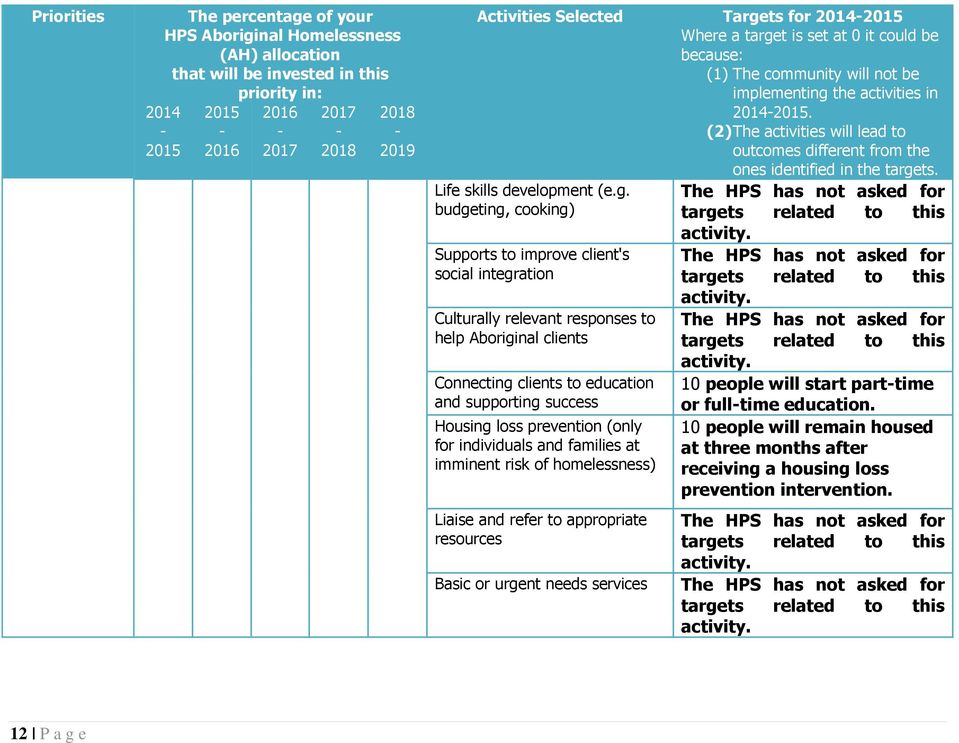
12 Priorities The percentage of your HPS Aboriginal Homelessness () allocation that will be invested in this priority in: Activities Selected Targets for Where a target is set at 0 it could be because: (1) The community will not be implementing the activities in (2) The activities will lead to outcomes different from the ones identified in the targets. Life skills development (e.g. budgeting, cooking) Supports to improve client's social integration Culturally relevant responses to help Aboriginal clients Connecting clients to education and supporting success Housing loss prevention (only for individuals and families at imminent risk of homelessness) Liaise and refer to appropriate resources Basic or urgent needs services The HPS has not asked for targets related to this activity. The HPS has not asked for targets related to this activity. The HPS has not asked for targets related to this activity. 10 people will start parttime or fulltime education. 10 people will remain housed at three months after receiving a housing loss prevention intervention. The HPS has not asked for targets related to this activity. The HPS has not asked for targets related to this activity. 12 P a g e
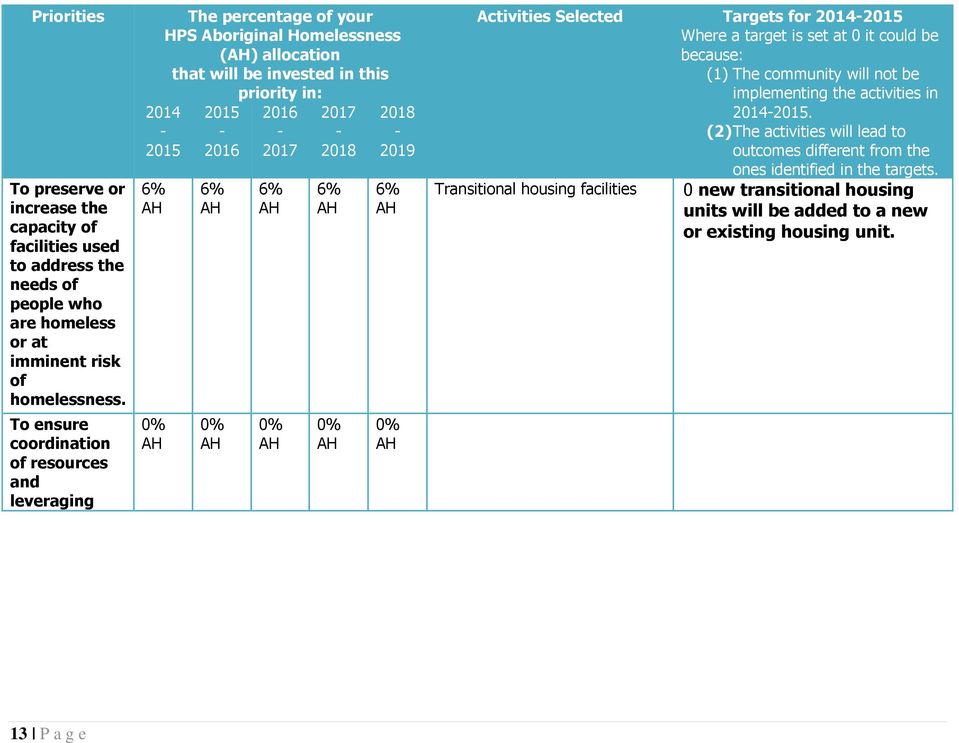
13 Priorities To preserve or increase the capacity of facilities used to address the needs of people who are homeless or at imminent risk of homelessness. To ensure coordination of resources and leveraging The percentage of your HPS Aboriginal Homelessness () allocation that will be invested in this priority in: % 0% % 0% % 0% % 0% % 0% Activities Selected Targets for Where a target is set at 0 it could be because: (1) The community will not be implementing the activities in (2) The activities will lead to outcomes different from the ones identified in the targets. Transitional housing facilities 0 new transitional housing units will be added to a new or existing housing unit. 13 P a g e
14 Priorities To improve data collection and use The percentage of your HPS Aboriginal Homelessness () allocation that will be invested in this priority in: % % % % % Activities Selected Targets for Where a target is set at 0 it could be because: (1) The community will not be implementing the activities in (2) The activities will lead to outcomes different from the ones identified in the targets. Identifying the size and makeup of the entire homeless population Tracking nonhousing First clients Pointintime counts Community indicators (beyond the requirements for HPS) Information collection and sharing (including implementing and using HIFIS) The HPS has not asked for targets related to these activities. Notes: * The Housing First model includes both housing and access to supports primarily for chronically and episodically homeless individuals. The services provided are offered through an integrated approach and are interdependent. Generally, the approach will be to ensure that Housing First clients have access to all the existing services required. These services are offered primarily to individuals who are homeless or imminently at risk that are not part of the Housing First program. 14 P a g e

15 Results With renewal, the HPS is increasing the focus on achieving results. All projects are expected to contribute to reducing or preventing homelessness and CABs and CEs should be working together to determine how they will measure project success. The HPS has identified a number of indicators it will be using to measure the success of the HPS at reducing and preventing homelessness. 15 P a g e

16 Description of your Priorities Housing First (HF) Priority Rationale Why is this a priority for your community? If the priority was identified in another related plan or planning process, please identify it. To effectively make changes we must first identify the makeup of the community that you plan to serve. In Ottawa this information is nonexistent for the Aboriginal community. Funds will be allocated for data tracking and point in time counts in 2015/16 which will result in a streamlined process for all agencies, with consistent methodology and interpretation of data, whereby Aboriginal agencies will be able to collect and obtain accurate data to aid them in improving services for all Aboriginal clients in Ottawa. With accurate data the Aboriginal community will be able to monitor the progress of housing first model, track the impact and restructure the community plan as the focus in the community change. The activities identified in this priority will also enhance coordination between service providers and housing agencies, focusing on support services to improve selfsufficiency of Housing First clients. Funds allocated to this activity area will begin 2016/17 focusing on Client Intake and Assessment focusing on the chronically and episodically homeless population; connecting to and maintaining permanent housing with furnishing; Coordination of case management teams to work with clients to set goals, connect to services, monitor progress and connect clients to income supports, life skills, support clients social integration and cultural supports. All priorities were identified by both the ACAB members and through the community/service provider surveys. What other resources can you leverage to contribute to your HF efforts? HF Readiness The ACAB is not in a position to implement HF at this point (2014/15) as we are currently working with the CE to establish which tool will be used to assess those who are chronically or episodically homeless. This is still under discussion. Client Intake & Assessment The ACAB is currently in the planning stages of developing a coordinated intake and assessment system for HF client and will be implementing it beginning in 2016/17. This is still under discussion. 16 P a g e

17 Connecting to and Maintaining Permanent Housing Agencies selected to provide HF programming will already have existing track record with providing housing loss and prevention services, landlord negotiation and have existing relationships with some landlords. These relationships will be utilized to access housing for HF clients and implemented in 2016/17. We are also in the process of extending our membership to the First Nations and Inuit housing providers to participate on the ACAB and will work with these agencies in trying to secure housing as well. Accessing Services Agencies selected to provide HF programming will be selected on the basis of their proven track record with providing case management related to maintaining client's housing. This is still under discussion. Data, Tracking & Monitoring The ACAB will work with the CE to implement a centralized data collection system and hire a fulltime analysis person. The ACAB will work in partnership with the CE to discuss what data will be collected and what data system will be used to collect this data. The City of Ottawa already uses HIFIS software to track emergency shelter users which the ACAB will consult with the Ottawa CE to see what supports can be offered to ACAB. Description of the Housing First (HF) Approach Please describe your Housing First approach, identify what percentage of your allocation will be used towards furnishing and repairing housing for HF purposes and provide a timeline for HF implementation. The Ottawa Aboriginal Housing First approach will use a coordinated, clientcentered approach, in which services are focused on the unique needs of each client, and are informed by cultural teachings and paradigms. The ACAB will set aside $ annually for startup costs for HF clients which agencies will be able to apply for. This amount will be adjusted to any increase in the number of clients under Housing First is amended in the community plan. These funds will only be accessed if all other sources of funding have been exhausted. Data collection and interpretation will be streamlined into one consistent approach and instrumental in ensuring the ACAB is able to continue effective community planning, setting and reaching targets, and creating longer term adjustments according to data results. TIMELINE Year 1 (2015/16): Getting Organized. Determine the exact size of the chronic and episodically Aboriginal homeless populations. Identify a method to collect the 17 P a g e

18 needed data at the community level. Begin the process of collecting data. Develop network and create workplans. Year 2 (2016/17): Shifting existing resources to Housing First and beginning implement. Implement data collection. Hire case manager(s). Work with services to get priority placement for HF clients. Begin to contact HF clients as rent supplements become available and place them in housing with case management supports. Year 3 (2017/18): Housing First fully implemented, and the first clients begin to move on to access regular supports. This will focus on the chronic/episodic population through a coordinated approach in partnership with the City of Ottawa and other housing first teams. Individuals will be assessed for their acuity by using standardized tools. Those individuals with the highest acuity will receive priority and housed first. Case management will be fully integrated in 2016/2017 among the housing agencies who will be receiving funds to implement the Housing First approach. Case management supports will be provided on the acuity of the individual and Individualized case management will provide coaching on life skills such as money management, tenant responsibilities, social/recreational opportunities, cultural supports, referrals to support services for (addiction, mental health etc) and assist with community integration. Progress will be tracked with a standardized tool periodically to determine the level of supports required. In essence, the Housing First approach will ensure: Full integration of all agencies to ensure no one is working in silos; Client centred care focussed on meeting the needs of the client where they are and working to obtaining housing, understanding that for some extra supports will be needed to make this transition; Support youth transitional housing as a preventative method to long term chronic homelessness; Accurate and consistent data and a community approach to amending targets and action items; and Commitment to communication and community development and to increase the partnerships of the ACAB to leverage community resources. Target Group(s) Please describe in more detail the group(s) this priority will address. Chronically homeless individuals Episodically homeless individuals 18 P a g e

19 Individualized Services Priority Rationale Why is this a priority for your community? If the priority was identified in another related plan or planning process, please identify it. Due to the historical cycle of poverty that has existed in Aboriginal communities since colonization this community suffers lower determinants of health, and are overrepresented in the criminal justice system. This puts this population at a higher risk of becoming homeless; while at the present time, do not fall under the Housing First criteria. As prevention measure for this population, funds will be allocated to support individuals outside the housing first parameters. Funds will be used for connecting individuals to the following activities: housing placements, income supports, supports to improves clients social integration, liaise and refer to appropriate resources, housing loss prevention employment and education supports, life skill development, cultural supports and referrals to appropriate supports and housing loss prevention. Through our community consultation process, it was identified that there are a number of supports and services needed to support individuals with finding housing, maintaining housing, life skill development and community referrals. Target Group(s)within the homeless and at imminent risk of homelessness populations Please describe in more detail the group(s) this priority will address. Aboriginal people Facilities Priority Rationale Why is this a priority for your community? If the priority was identified in another related plan or planning process, please identify it. Housing First focuses on giving people choice in where they want to live. In order to provide this type of model of housing you need to have a housing stock that gives people the option of choosing where they want to live, which is lacking in Ottawa. Transitional housing is another choice when it comes to housing for 19 P a g e
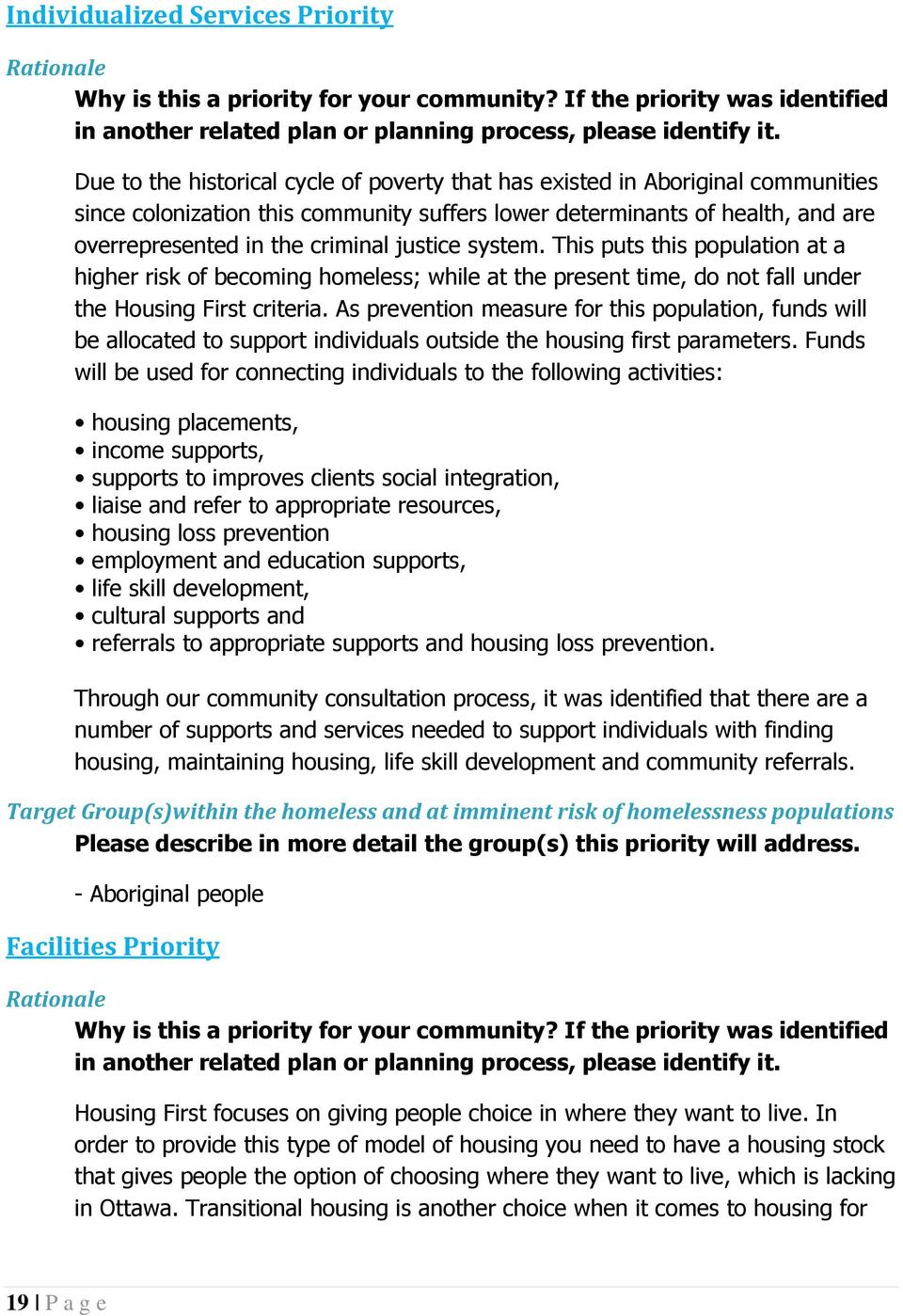
20 youth. In Ottawa there is only one transitional house for Aboriginal people which focuses on young women. There is no evidence to date that suggest that Housing First approach works with youth. It was identified by ACAB members that there needs to be a continued support for transitional housing that addresses the housing needs of youth. This is also a prevention measure as the youth transition to adulthood and to provide immediate services to help maximize the youths' opportunity to gain the skills necessary to beat the risk factors associated with homelessness. Early interventions such as youth transitional housing will help to reduce the number of youth who later become chronically homeless. Funds allocated to this priority will be used to preserve this housing option. Target Group(s) within the homeless and at imminent risk of homelessness populations Please describe in more detail the group(s) this priority will address. Youth Aboriginal people Data Collection and Use Priority Rationale Why is this a priority for your community? If the priority was identified in another related plan or planning process, please identify it. To effectively make changes we must first identify the makeup of the community that you plan to serve. In Ottawa this information is nonexistent for the Aboriginal community. Funds will be allocated for data tracking and point in time counts in 2015/2016 which will result in a streamlined process for all agencies, with consistent methodology and interpretation of data. By making this a priority, Aboriginal agencies will be able to collect and obtain accurate data to aid them in improving services for all Aboriginal clients in Ottawa. With accurate data the Aboriginal community will be able to monitor the progress of housing first model, track the impact and restructure the community plan as the focus in the community change. 20 P a g e

A Homeless Prevention System for London Ontario
 A Homeless Prevention System for London Ontario A Three Year Implementation Plan A coordinated and integrated individual and family centred housing stability approach that is outcome focussed and designed
Senate Bill (SB) 855: Housing Support Program Orange County Application
 Submitted by: Orange County Contact: Sumit Sapra, 714-541-7782, [email protected] Topic: Senate Bill (SB) 855: Housing Support Program 1. Describe the problem of homelessness and housing instability
Windsor Essex Housing and Homelessness Plan FINAL PLAN APRIL 2014
 Windsor Essex Housing and Homelessness Plan FINAL PLAN APRIL 2014 TABLE OF CONTENTS Introduction...1 The Plan...3 Vision...3 Desired Housing and Homelessness System for Windsor Essex..4 Principles...5
What is Housing First? Revised November 9, 2006
 What is Housing First? Revised November 9, 2006 Housing First is an approach that centers on providing homeless people with housing quickly and then providing services as needed. What differentiates a
MEMORANDUM NOTE DE SERVICE
 REGIONAL MUNICIPALITY OF OTTAWA-CARLETON MUNICIPALITÉ RÉGIONALE D OTTAWA-CARLETON MEMORANDUM NOTE DE SERVICE Our File/N/Réf. Your File/V/Réf. DATE 19 March 1997 Information Previously Distributed To Be
Ending Family Homelessness through Housing First (Rapid Rehousing)
 Ending Family Homelessness through Housing First (Rapid Rehousing) Presented by Beyond Shelter 1200 Wilshire Blvd, Suite 600 Los Angeles, CA 90017 Emergency shelters and transitional housing are simply
Homelessness Prevention & Rapid Re-housing: Community Perspectives
 American Recovery and Reinvestment Act Homelessness Prevention and Rapid Re-housing Program Homelessness Prevention & Rapid Re-housing: Community Perspectives 2009 REGIONAL HPRP TRAINING Sponsored by:
Homeward Trust Edmonton Edmonton, Alberta
 Homeward Trust Edmonton Edmonton, Alberta PROGRAM TYPE: Housing First As the first province in Canada to develop a ten year plan to end homelessness, Alberta is beginning to see a decline in the number
1.2 The main types of tenancies that the Council can grant are secure tenancies, flexible (secure) tenancies and introductory tenancies.
 Tenancy policy 1.0 Purpose of the policy 1.1 The purpose of the policy, which is effective from 1st March 2013, is to ensure that the most appropriate tenancies are granted to enable the best use to be
How To Help The Homeless In Anottawa
 The Alliance to End Homelessness Homeless in Ottawa Policies and Funding to House and Help Ontario s Homeless Citizens Submission to the Ontario Legislature's Standing Committee on Finance Pre-Budget Consultations
Vancouver s Housing and Homelessness Strategy 2012-2021 A home for everyone
 Vancouver s Housing and Homelessness Strategy 2012-2021 A home for everyone A home for everyone Vancouver s Housing and Homelessness Strategy 2012-2021 Prepared by Context Ltd. June 2011 ACKNOWLEDGEMENTS:
Calgary Singles Acuity Scale Toolkit
 Calgary Singles Acuity Scale Toolkit Prepared by the Calgary Homeless Foundation in partnership with The Alex Community Health Center Background and Introduction Efforts to sustainably end homelessness
Statement of Mandate 2013-2014
 Statement of Mandate 2013-2014 Table of Contents Message from the Minister and Deputy Minister 1.0 Our Mandate... 4 1.1 Our Mission... 4 2.0 Our Priorities... 5 2.1 Make Life More Affordable and Breaking
Calgary s. 10 Year Plan. to End Homelessness. Calgary Homeless Foundation January 2011 Update
 Calgary s 10 Year Plan to End Homelessness 2008 2018 Calgary Homeless Foundation January 2011 Update Contents 2 Strategic shifts 3 Milestones The journey to end homelessness in Calgary 4 A quick catch
EMERGENCY SOLUTIONS GRANTS PROGRAM (ESG) ELIGIBLE EXPENSE GUIDE
 EMERGENCY SOLUTIONS GRANTS PROGRAM (ESG) ELIGIBLE EXPENSE GUIDE DECEMBER 2012 STATE OF CALIFORNIA EMERGENCY SOLUTIONS GRANT ELIGIBLE EXPENSES DEPARTMENT OF HOUSING AND COMMUNITY DEVELOPMENT DIVISION OF
Changes in the HUD Definition of Homeless
 Changes in the HUD Definition of Homeless On January 4, 2012, final regulations went into effect to implement changes to the U.S. Department of Housing and Urban Development s (HUD s) definition of homelessness
Emergency Solutions Grants Program. Eligible Expense Guide
 Emergency Solutions Grants Program Eligible Expense Guide State of West Virginia Office of Economic Opportunity 2015 Table of Contents 1. Street Outreach 1.1 Engagement.2 1.2 Case Management.2 1.3 Emergency
London Community Housing Strategy (LCHS) Questions and Answers
 London Community Housing Strategy (LCHS) Questions and Answers What is London s Community Housing Strategy? London s Community Housing Strategy provides direction about how the City can meet the range
APPROVED Consolidated Community Funding Pool (CCFP) Priority Areas for Fiscal Years 2007-2008 Approved by the Fairfax County Board of Supervisors
 APPROVED Consolidated Community Funding Pool (CCFP) Priority Areas for Fiscal Years 2007-2008 Approved by the Fairfax County Board of Supervisors July 25, 2005 Approved CCFP Priority Areas for FY 2007-2008
Investing in Communities programme. Peter Devlin and Kathleen Little
 Guidance notes Investing in Communities programme Stock code Print Photography BIG-IIC2010 C&R Printing Peter Devlin and Kathleen Little Further copies available from: Email [email protected]
RIGHTSNORTH HOUSING AND HUMAN RIGHTS IN NORTHERN ONTARIO PREPARED BY THE CENTRE FOR EQUALITY RIGHTS IN ACCOMMODATION
 RIGHTSNORTH HOUSING AND HUMAN RIGHTS IN NORTHERN ONTARIO PREPARED BY THE CENTRE FOR EQUALITY RIGHTS IN ACCOMMODATION MAY 2009 INTRODUCTION Over the past year and a half, the Centre for Equality Rights
Canada Population: Fertility rate: GDP per capita: Children under 6 years: Female labour force participation:
 Canada Population: 32.2 m. Fertility rate: 1.53. GDP per capita: USD 30 700. Children under 6years: 2 074 860 (2005). Female labour force participation: 73.5% of women (15-64) participate in the formal
Case Management Homelessness Prevention and Rapid Re-housing
 Case Management Homelessness Prevention and Rapid Re-housing About this Document This document explores the role of case management in preventing homelessness and in rapidly returning homeless individuals
ATTACHMENT D CAMPERDOWN PROJECT CONCEPT FOR THE DEVELOPMENT OF THE SUPPORT SERVICES DELIVERY MODEL
 ATTACHMENT D CAMPERDOWN PROJECT CONCEPT FOR THE DEVELOPMENT OF THE SUPPORT SERVICES DELIVERY MODEL Camperdown Project - Common Ground Model and concept for development of the Support Services Delivery
NOVA SCOTIA S. Nursing Strategy 2015
 NOVA SCOTIA S Nursing Strategy 2015 NOVA SCOTIA S Nursing Strategy 2015 Contents Background...1 Support at Every Stage...2 Evidence & Experience...3 A Multi-Faceted Approach...4 Nursing Education...5 Maintain
PROVINCIAL ABORIGINAL LHIN REPORT 2013/2014
 1 P a g e PROVINCIAL ABORIGINAL LHIN REPORT 2013/2014 HIGHLIGHTS 1 Place Photo Here, 2 P a g e MOVING FORWARD: A COLLABORATIVE APPROACH INTRODUCTION Over the past year, the Local Health Integration Networks
Closing the Front Door: Creating a Successful Diversion Program for Homeless Families
 Closing the Front Door: Creating a Successful Diversion Program for Homeless Families TABLE OF CONTENTS I. Introduction.Page 1 II. Table 1: Prevention, Diversion, and Rapid Re-housing Page 2 III. Assessing
INVEST IN THE HOUSING TRUST FUND CREATE JOBS REDUCE BLIGHT PREVENT HOMELESSNESS
 INVEST IN THE HOUSING TRUST FUND CREATE JOBS REDUCE BLIGHT PREVENT HOMELESSNESS CREATE JOBS THROUGH HOUSING INCENTIVES If it was not clear before 2008, it is clear now: The housing market and our economy
Supplemental Application Form
 Supplemental Application Form 101 4555 Kingsway, Burnaby, B.C. V5H 4V8 Phone: 604-433-2218 Toll Free: 1-800-257-7756 Fax: 604-439-4729 Purpose of this Form The purpose of the Supplemental Application Form
SEX WORK ENFORCEMENT GUIDELINES ADOPTED JANUARY 2013
 VANCOUVER POLICE DEPARTMENT SEX WORK ENFORCEMENT GUIDELINES ADOPTED JANUARY 2013 PREPARED BY: Kristie McCann Planning and Policy Advisor Sergeant Richard Akin Counter Exploitation Unit Inspector Cita Airth
Homelessness in Greater New Orleans: A Report on Progress toward Ending Homelessness May 2012
 Homelessness in Greater New Orleans: A Report on Progress toward Ending Homelessness May 2012 Introduction The 2012 Homeless Point in Time (PIT) Count for New Orleans and Jefferson Parish took place on
RECOVERY HOUSING POLICY BRIEF
 I. Introduction and Intent As communities implement strategies to end homelessness, they need to be able to provide effective housing and services options for people experiencing homelessness who have
Action Plan Template. [Community Name] Climate Change Action Plan. Province of Manitoba Climate Change Planning Resources.
![Action Plan Template. [Community Name] Climate Change Action Plan. Province of Manitoba Climate Change Planning Resources.](/thumbs/40/20877443.jpg "Action Plan Template. [Community Name] Climate Change Action Plan. Province of Manitoba Climate Change Planning Resources.") [Community Name] Climate Change Action Plan Prepared By: Acknowledgements: Ex. council/board, staff, committee Date: When submitted to council/board Executive Summary A short summary outlining the main
[Community Name] Climate Change Action Plan Prepared By: Acknowledgements: Ex. council/board, staff, committee Date: When submitted to council/board Executive Summary A short summary outlining the main
Saskatchewan Poverty Progress Profile
 Saskatchewan Poverty Progress Profile OVERVIEW Currently, Saskatchewan does not have a provincial poverty strategy in place. Employment is booming, but poverty remains a sore point in the social fabric
SAMPLE SUPPORTIVE HOUSING INTAKE/ASSESSMENT FORM
 SAMPLE SUPPORTIVE HOUSING INTAKE/ASSESSMENT FORM (This form must be completed within 30 days of program entry) IDENTIFYING INFORMATION Date Information is Gathered: 1. Applicant Last Name: First Name:
His Worship Jim Watson Mayor of the City of Ottawa 110 Laurier Avenue West Ottawa, Ontario K1P 1J1 Dear Mr. Mayor,
 His Worship Jim Watson Mayor of the City of Ottawa 110 Laurier Avenue West Ottawa, Ontario K1P 1J1 Dear Mr. Mayor, Thank you for writing regarding the Green Party s position on issues of interest to the
2015 HUD CoC Competition Evaluation Instrument
 2015 HUD CoC Competition Evaluation Instrument For all HUD CoC-funded projects in the Chicago Continuum of Care [PROJECT COMPONENT] General Instructions Each year, on behalf of the CoC Board, the Chicago
Application for Subsidized Housing in Toronto
 Application for Subsidized Housing in Toronto Large print applications are available upon request. Disponible en français 176 Elm Street If you do not speak English or French, choose someone you trust
St Johns County CoC Governance Charter St Johns County Continuum of Care St Johns County Continuum of Care Board Purpose of the CoC and CoC Board
 St Johns County CoC Governance Charter The name of this Continuum of Care (CoC) shall be the St Johns County Continuum of Care and the name of the CoC board shall be the St Johns County Continuum of Care
Human Resources Department 203.6 FTE s
 27 Human Resources Human Resources Department 203.6 FTE s General Manager Human Resources 4 FTE's Director Labour Relations 2 FTE's Director Organizational Effectiveness 2 FTE's Director Compensation,
EXTERNAL POSTING (November 2015) EMPLOYMENT CASE MANAGER (Permanent)
 EXTERNAL POSTING (November 2015) The Canadian Mental Health Association, Ottawa Branch (CMHA) is a private, nonprofit charitable organization dedicated to promoting good mental health and improving the
INCOME MANAGEMENT POLICY
 INCOME MANAGEMENT POLICY 1. Principles 2. Aims 3. Methods * Arrears Prevention * Debt Recovery * Rent Accounting 4. Statutory and Regulatory Requirements 5. Performance Monitoring 6. Review 7. Date of
Hope is a Home New Brunswick s Housing Strategy
 Hope is a Home New Brunswick s Housing Strategy New Brunswick Housing Corporation Department of Social Development CNB7140 Hope is a Home New Brunswick s Housing Strategy New Brunswick Housing Corporation
Homes for Women H4W. A Housing First Approach adapted for women London, Ontario
 Homes for Women H4W A Housing First Approach adapted for women London, Ontario Who we are An inter agency collaborative committed to developing a women s housing first program in London 3 key partners
December 2009 HOMELESS? This leaflet explains what happens if you make a homeless application and the rules we use.
 December 2009 HOMELESS? This leaflet explains what happens if you make a homeless application and the rules we use. This leaflet can be supplied in community languages, large print, audio tape/cd or Braille.
Program of Assertive Community Services (PACT)
 Program of Assertive Community Services (PACT) Service/Program Definition Program of Assertive Community Services (PACT) entails the provision of an array of services delivered by a community-based, mobile,
2016 HOME REQUEST FOR PROPOSALS AFFORDABLE HOUSING ACQUISITION AND/OR REHABILITATION or NEW CONSTRUCTION
 2016 HOME REQUEST FOR PROPOSALS AFFORDABLE HOUSING ACQUISITION AND/OR REHABILITATION or NEW CONSTRUCTION The Eugene-Springfield HOME Consortium invites proposals from for-profit developers, non-profit
Other Important Information. Apply On-Line!
 Application Form 101 4555 Kingsway, Burnaby, B.C. V5H 4V8 Phone: 604 433-2218 Toll-Free: 1-800 257-7756 Fax: 604 439-4729 Purpose of this Form This form collects personal information in accordance with
ALBERTA S HEALTH SYSTEM PERFORMANCE MEASURES
 ALBERTA S HEALTH SYSTEM PERFORMANCE MEASURES 1.0 Quality of Health Services: Access to Surgery Priorities for Action Acute Care Access to Surgery Reduce the wait time for surgical procedures. 1.1 Wait
Rental Assistance Guidebook
 OFFICE OF HIV/AIDS HOUSING JANUARY 2013 HOUSING OPPORTUNITIES FOR PERSONS WITH AIDS (HOPWA) Rental Assistance Guidebook HOPWA Housing Opportunities for Persons With AIDS Acknowledgements This guidance
System Performance Measures An introductory guide to understanding system-level performance measurement
 May 2015 System Performance Measures An introductory guide to understanding system-level performance measurement Version 2 0 TABLE of Contents I. Introduction... 0 Key Terms... 2 II. The McKinney-Vento
GOVERNMENT RESPONSE TO THE CHILD INTERVENTION SYSTEM REVIEW
 GOVERNMENT RESPONSE TO THE CHILD INTERVENTION SYSTEM REVIEW October 2010 Closing the Gap Between Vision and Reality: Strengthening Accountability, Adaptability and Continuous Improvement in Alberta s Child
How To Write A Listing Policy For A Species At Risk Act
 Fisheries and Oceans Canada Species at Risk Act Listing Policy and Directive for Do Not List Advice DFO SARA Listing Policy Preamble The Fisheries and Oceans Canada (DFO) Species at Risk Act (SARA) Listing
Municipal Tools and Partnerships for Ending Homelessness: The City of Vancouver
 Municipal Tools and Partnerships for Ending Homelessness: The City of Vancouver Brenda Prosken General Manager Community Services Department City of Vancouver 1 November 5, 2014 1 City of Vancouver Community
Competencies for Canada s Substance Abuse Workforce SECTION VI PERFORMANCE MANAGEMENT TOOLS FOR COMMON JOB CLUSTERS FOR THE BEHAVIOURAL COMPETENCIES
 Competencies for Canada s Substance Abuse Workforce SECTION VI PERFORMANCE MANAGEMENT TOOLS FOR COMMON JOB CLUSTERS FOR THE BEHAVIOURAL COMPETENCIES This package was published by the Canadian Centre on
customer debt recovery
 policy customer debt recovery Responsible Officer: Assistant Chief Executive Neighbourhoods Approved: March 2017 Review Date: August 2015 Version: 2 Date Ratified: March 2011 Scope: Incommunities Incommunities
Housing Matters BC HOUSING STRATEGY FOR BRITISH COLUMBIA: A FOUNDATION FOR STRONG COMMUNITIES JANUARY 2014
 Housing Matters BC HOUSING STRATEGY FOR BRITISH COLUMBIA: A FOUNDATION FOR STRONG COMMUNITIES JANUARY 2014 Table of Contents MESSAGE FROM THE MINISTER... 3 OUR IMPACT... 4 TODAY S OPPORTUNITIES... 6 SUCCESS
County of San Diego Health and Human Services Agency. Final Behavioral Health Services Three Year Strategic Plan 2005-2008.
 County of San Diego Health and Human Services Agency Final Behavioral Health Services Three Year Strategic Plan 2005-2008 November 1, 2005 By Connie Moreno-Peraza, LCSW, Executive Lead Deputy Director
BCNPHA Resources for Non-Profit Housing Providers
 BCNPHA Resources for Non-Profit Housing Providers April 12, 2011 Expression of Interest, Partnering and Housing Needs Workshop Presentation by Margaret Eberle, BCNPHA Acting Research Director Jim Woodward,
Mental Health Facilities and De-Institutionalization
 Mental Health Facilities and De-Institutionalization Mental health facilities and de-institutionalization were among the issues raised by many participants during the Conversation on Health. Patient care,
Human Services BUSINESS PLAN 2015 18 ACCOUNTABILITY STATEMENT THE MINISTRY LINK TO GOVERNMENT OF ALBERTA STRATEGIC DIRECTION STRATEGIC CONTEXT
 Human Services BUSINESS PLAN 2015 18 ACCOUNTABILITY STATEMENT This business plan was prepared under my direction, taking into consideration the government s policy decisions as of October 15, 2015. original
LEGAL AID TODAY July 2015
 LEGAL AID TODAY July 2015 Who we are Our mandate Our governance Our funding Created by the Legal Services Society Act in 1979, LSS is a non-profit organization that is independent of government. Our mandate
ONTARIO S LONG-TERM AFFORDABLE HOUSING STRATEGY UPDATE
 ONTARIO S LONG-TERM AFFORDABLE HOUSING STRATEGY UPDATE MARCH 2016 Ontario.ca/housingstrategy ONTARIO S LONG-TERM AFFORDABLE HOUSING STRATEGY UPDATE TABLE OF CONTENTS MESSAGE FROM THE MINISTER OF MUNICIPAL
The Plan to End Community Homelessness In Austin - Travis County ECHO. Ending Community Homelessness Coalition
 The Plan to End Community Homelessness In Austin - Travis County 2010 ECHO Ending Community Homelessness Coalition Table of Contents Table of Contents PAGE 1 2 6 10 11 12 22 23 25 31 32 35 37 38 39 40
Manulife Financial s Workplace Solutions for Mental Health
 Manulife Financial s Workplace Solutions for Mental Health GROUP BENEFITS Mental Health in the Workplace Mental illness affects the lives of millions of Canadians each year and is emerging as a dominant
REQUEST FOR PROPOSALS (RFP) APPLICATION GUIDEBOOK HOMELESSNESS PREVENTION AND RAPID RE-HOUSING PROGRAM (HPRP)
 REQUEST FOR PROPOSALS (RFP) APPLICATION GUIDEBOOK FOR: HOMELESSNESS PREVENTION AND RAPID RE-HOUSING PROGRAM (HPRP) HARRIS COUNTY COMMUNITY SERVICES DEPARTMENT OFFICE OF HOUSING AND COMMUNITY DEVELOPMENT
Nurse Practitioner Project
 Nurse Practitioner Project (City Council on April 11, 12 and 13, 2000, adopted this Clause, without amendment.) The Community Services Committee recommends the adoption of the following report (March 9,
Quality Data Assures Quality Decisions. Acknowledgements: Symmetric Solutions, Inc. prepared this document under the direction of
 Arizona Balance of State Continuum of Care Data Quality Plan Quality Data Assures Quality Decisions Acknowledgements: Symmetric Solutions, Inc. prepared this document under the direction of the Arizona
Housing Action Plan for the Community of Squamish
 TERMS OF REFERENCE Housing Action Plan for the Community of Squamish INTRODUCTION This Request for Proposals (RFP) invites proposals from eligible consultants to develop a Housing Action Plan for the Community
Tim Lenartowych, RN, BScN, LLM Director of Nursing & Health Policy RNAO
 Tim Lenartowych, RN, BScN, LLM Director of Nursing & Health Policy RNAO Outline This presentation provides a high-level overview of: Why the task force was initiated Membership Mandate Work Plan Next steps
OUT OF CARE AND HOMELESS IN MANITOBA. Kelly Holmes, Executive Director Resource Assistance for Youth, Inc.
 OUT OF CARE AND HOMELESS IN MANITOBA Kelly Holmes, Executive Director Resource Assistance for Youth, Inc. Outline 1. Background: CFS in Manitoba 2. CFS Youth at RaY 3. RaY s Responses and Outcomes Background:
CS MELROSE SITE B LLC LA TERRAZA. RE: La Terraza - 3100 Third Avenue, Bronx, New York 10451
 CS MELROSE SITE B LLC LA TERRAZA RE: La Terraza - 3100 Third Avenue, Bronx, New York 10451 Thank you for contacting us. As per your request, enclosed is an application for the above-referenced apartment