
Ensuring Clinical Documentation Reflects Care and
|
|
|
- Lindsey Evans
- 9 years ago
- Views:
Transcription
1 Ensuring Clinical Documentation Reflects Care and Meets Requirements 1 Presenters Joan Harrold, MD, MPH, FACP, FAAHPM Medical Director/VP, Medical Services Hospice of Lancaster County [email protected] Annette Kiser, MSN, RN, NE-BC Director of Quality & Compliance Carolinas Center for Hospice & End of Life Care [email protected] 2

2 Goals for Today s Program Discuss documentation to meet the Medicare CoPs for comprehensive assessment and care planning Describe tips to enhance documentation to meet the Local Coverage Determinations (LCDs) and illustrate eligibility Explain eligibility and documentation requirements for the different levels of care under the Medicare Hospice Benefit 3 Assessment & Care Planning: Compliance with CoPs 4

3 Admission, Assessments, and Care Planning Election & consent Conduct & document initial assessment Conduct & document first comprehensive assessment Establish plan of care Update comprehensive assessment Update care plan Conduct IDG meetings & coordinate care 5 Initial Assessment Condition of participation: Initial and comprehensive assessment of the patient. IA must address immediate needs of the patient and family IA forms the foundation of documentation to guide care Determines involvement of other disciplines in completing the Comprehensive Assessment 6

4 Comprehensive Assessment Must assess the following: Physical, psychosocial, emotional & spiritual needs Nature & condition causing admission Functional status Imminence of death Medications Bereavement needs Assessment is a continuous process that drives updates to the plan of care 7 Updates to the Comprehensive Assessment Update CA every 15 days and as needed with significant changes in condition or level of care Address interventions in plan of care Disciplines must visit during the 15-day timeframe based on need Policies must describe what form(s) make up the CA and how updates are completed and documented 8

5 From Comprehensive Assessment to Plan of Care Condition of Participation: Interdisciplinary group, care planning, coordination of services. CMS considers the plan of care the most important document in hospice care Using data from assessments, develop & update the plan of care. Must be interdisciplinary 9 Plan of Care Plan of care must address: Interventions to address symptoms Scope and frequency of services Measurable outcomes Drugs, treatments, supplies and DME Patient or representative ss level of understanding, involvement, and agreement with the plan of care 10

6 Plan of Care IDG should use the plan of care as a tool RN begins documentation of plan of care based on findings from the Initial Assessment & consults with others IDG members add to and update as the Comprehensive Assessment is completed Base plan of care on patient-specific needs No cookie cutter documentation. If using electronic records, free text on each note to individualize documentation 11 Updates to the Plan of Care IDG must review and revise the plan of care at least every 15 days Updates are necessary as conditions and needs change Must address progress toward goals Should guide interventions at each visit 12

7 Documentation: Important Points Documentation should be: Authentic Concise (more is not always better) Objective Comprehensive, but pertinent Consistent Timely 13 Strategies for Success Ensure that there are no blanks in pertinent areas of forms Ensure problems are addressed timely Document communication among IDG and with attending physician Show ongoing coordination of care with outside agencies 14

8 Strategies for Success Using ggoals from plan of care, document outcomes in assessments Ensure physician orders are updated timely Consistently update medication profile Show patient and family involvement in planning care Ensure that adequate discharge planning has occurred and is documented Referrals, communication, transfer of information 15 Documentation of Prognosis 16

9 Paint the Picture Admitted for end stage cardiac disease 17 Paint the Picture Admitted for end stage cardiac disease. Poor response to standard treatment. Desires palliative care. 18

10 Paint the Picture Admitted for end stage cardiac disease. Poor response to standard treatment. Desires palliative care. Is NYHA Class IV with significant symptoms of angina at rest & inability to carry on any physical activity w/o discomfort. Ejection fraction of 20%, significant ventricular arrhythmias, & unexplained syncope episodes. 19 Documentation Using LCDs Documentation needs to address: Impairments in function & structure Activity limitations Participation restrictions Secondary diagnoses Co morbid conditions 20

11 Documentation Using LCDs Address the patient s activity level, self care, communication, and mobility Give a historical perspective of what the patient s ability was in the previous time period and then document current status BUT REMEMBER Decline eligibility Decline necessary or sufficient 21 Documentation Using LCDs Use specifics to show the extent of the symptoms and limitations Use the term as evidenced by to link prognosis to specific findings Include symptoms such as wt loss, decubitus ulcers, and edema Explain unusual or potentially misleading findings Co morbid conditions such as CHF, COPD and diabetes affect prognosis 22

12 Functional Assessment Tools PPS Validated in palliative care Be sure to use correctly ECOG Cancer Karnofsky Cancer FAST Dementia 23 Functional Assessment Tools Mortality Risk Index Score and the Flacker- Kiely Mortality Assessment NH residents with advanced dementia Retrospective cohort studies Minimum Data Set (MDS) information Critical: Must use tools correctly! h /ELNEC/ df/p ti C df 24

13 Focused Quality Documentation Examples of focused quality documentation: Documenting limits to daily activities of living for a patient with end-stage heart disease. Describing the extent of oxygen for a patient COPD and shortness of breath. Stating facts with objective information: Clothing no longer fits due to weight loss Sleeping XX number of hours of day Pain is severely limiting activities of daily living 25 Comparative Documentation Comparative documentation: Contrasts the patient s present condition to his/her prior condition Individualizes patients by focusing on their trajectory of decline Presents specific information, not generalizations One week ago, pt was eating ½ - ¾ of 2 meals per day. Now eating only ¼ of 1 meal each day. 26

14 Weak Documentation Syndrome Does not paint a picture of the patient. Weak documentation ti uses words/ phrases like: Stable No change Doing well Slow, progressive decline Appears to be losing weight It is all in the detail! 27 Documentation to Paint the Picture Functional Decline Inability to ambulate independently d could mean: Needs help of one caregiver (supervision, guidance, support) Needs assistance of two caregivers Needs assistance of two caregivers and assistive devises Ambulates 30 steps Ambulates 2 steps to get over to the chair 28

15 Documentation to Paint the Picture Example - Functional Decline Weak Impaired gait and mobility documentation example Strong Requires a walker to documentation ambulate due to leg weakness example and unsteadiness. Maximum distance is feet. 29 Documentation to Paint the Picture Functional Status Changes Inability to dress self is vague and could mean: Patient is physically unable to dress self Patient may be able to assist dressing self Patient is physically capable, but is behaviorally unable to comply with dressing activity Patient is bedbound and cannot dress self Patient refuses to dress self 30

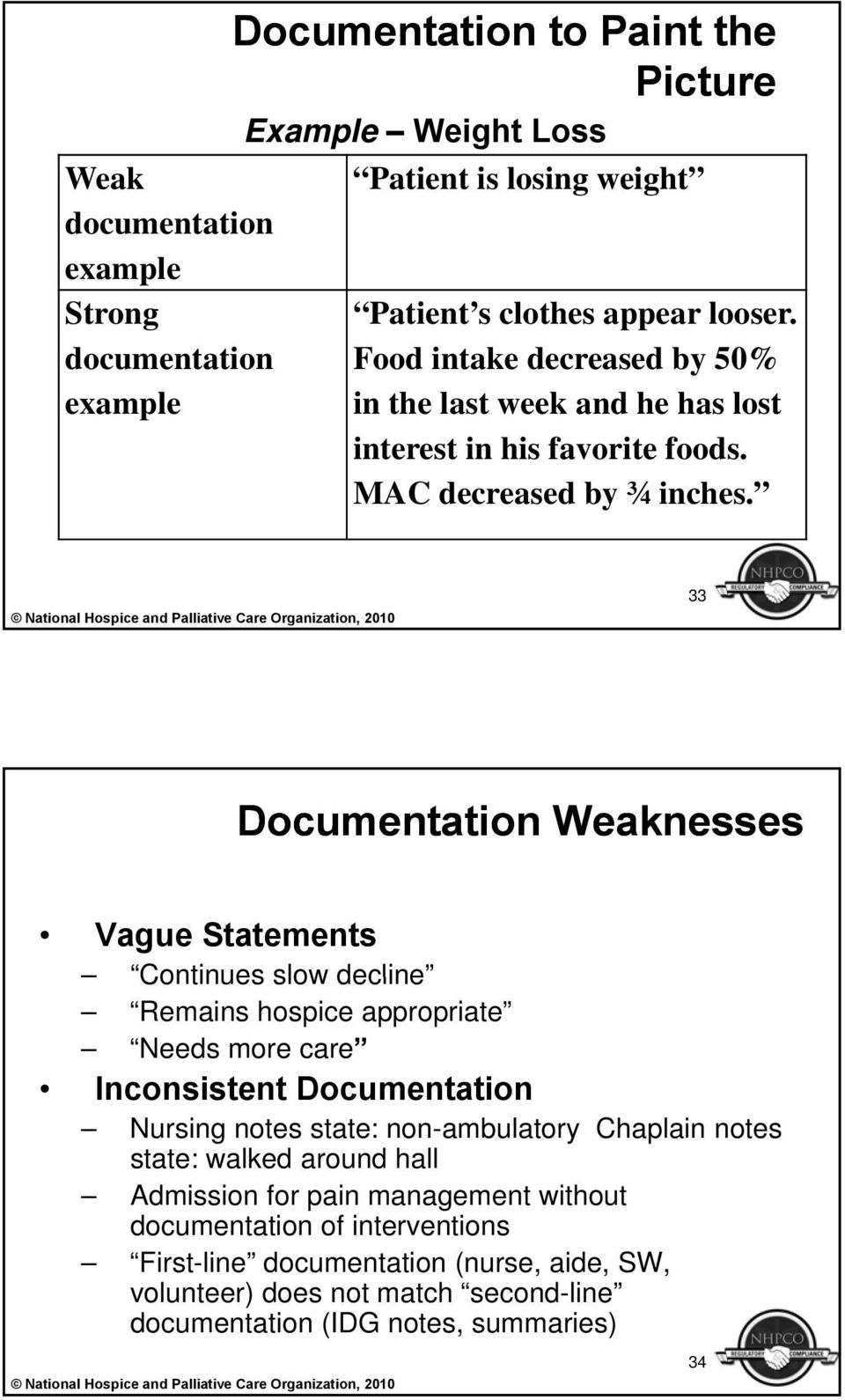
16 Documentation to Paint the Picture Example - Functional Status Changes Weak documentation example Strong documentation example Patient unable to dress self Patient agitated today and refused to assist with dressing self. Patient usually able to assist with shirt when provided verbal cues. 31 Weight Loss Documentation to Paint the Picture Patient t losing weight could mean: Patient is eating less than before. Patient is not eating at all. Patient has lost two pounds. Patient has lost twenty pounds. Patient appears cachectic 32

17 Weak documentation example Strong documentation example Documentation to Paint the Picture Example Weight Loss Patient is losing weight Patient s clothes appear looser. Food intake decreased by 50% in the last week and he has lost interest in his favorite foods. MAC decreased by ¾ inches. 33 Documentation Weaknesses Vague Statements Continues slow decline Remains hospice appropriate Needs more care Inconsistent Documentation Nursing notes state: non-ambulatory Chaplain notes state: walked around hall Admission i for pain management without t documentation of interventions First-line documentation (nurse, aide, SW, volunteer) does not match second-line documentation (IDG notes, summaries) 34
18 Documentation of Levels of Care 35 Documentation Levels of Care Documentation must support level of care billed or payment can be reduced to Routine Home Care Reason for higher level of care must be noted what prompted the change? All levels require ongoing documentation to show the patient is appropriate for hospice care. 36

19 Documentation: Routine Home Care Must document continued eligibility to support recertification Need to explain symptom management versus resolution of symptoms give credit Document all interventions required to maintain comfort medications, spiritual support, other non-pharmacologic measures 37 Levels of Care Inpatient Respite Special coverage requirements. (b) Respite care. (1) Respite care is short-term inpatient care provided to the individual only when necessary to relieve the family members or other persons caring for the individual. (2) Respite care may be provided only on an occasional basis and may not be reimbursed for more than five consecutive days at a time. 38

20 Levels of Care Inpatient Respite No regulation on frequency of use Be sure reason for respite care is noted Frequent use may send red flags to RHHI/MAC Scheduled (same time every month) can also raise concern 39 Levels of Care Continuous Care Special coverage requirements. Nursing care may be covered on a continuous basis up to 24 hours a day during periods of crisis as necessary to maintain an individual at home. May use homemaker and/or hospice aide services to supplement, but nursing care must be provided for more than half of the period of care A period of crisis is a period in which the individual requires continuous care to achieve palliation or management of acute medical symptoms. 40

21 Levels of Care Continuous Care Documentation for Continuous Care: Describe the crisis in detail and the patient/family s desire to remain at home All staff should document their time on a 24-hour log to show a minimum of 8 hours of care in a 24 hour period in order to bill for CHC. Hourly staff notes are preferred to best document crisis. Establish a new POC detailing the problems, interventions and expected outcomes. Staff visit notes should include the issues identified in the POC. 41 Levels of Care Continuous Care Provide details in documentation Document all previous attempts to relieve symptoms Example: Pain unrelieved despite increase in scheduled dose and multiple breakthrough doses of pain medication Describe frequency, severity, intensity and associated symptoms Example: Grimacing with frequent chest pain; shortness of breath more pronounced with coughing Document all interventions utilized to relieve patient s discomfort Example: Medications, oxygen, positioning, massage, bathing, music, lighting, verbal support, nebulizers, fans, suctioning, etc. 42
22 Levels of Care Continuous Care Record all teaching to the patient, family or caregiver Document coordination with attending physician Physician order for CHC must be in place Show collaboration among team members 43 Levels of Care General Inpatient General Inpatient (GIP) may be appropriate p for pain control and symptom management Not to be used for caregiver breakdown Must require an intensity of care directed towards pain control and symptom management that cannot be managed in any other setting Imminent death does not require GIP if the patient is comfortable & needs are met 44
23 Levels of Care General Inpatient Documentation for GIP: Describe the patient s t condition and the patient/family t/f il problems in detail. Explain clearly why the issues cannot be managed in the home setting, or at routine level of care if in a facility. Daily staff visits are appropriate in all settings so the hospice can maintain i professional management of the patient Document the coordination of care between the hospice and the facility providing GIP. 45 Levels of Care General Inpatient Documentation for GIP: POC should be revised detailing the problems, interventions and expected outcomes. The staff progress notes should include the issues identified in the POC A physician order for GIP must be in place 46
24 Strategies for Success Continuous home care and GIP Ensure that documentation addresses the symptoms that led to the crisis and the need for a higher level of care. Provide & document discharge planning from the beginning of the level of care change. When the patient stabilizes, move the patient to routine home care level. Conduct medical record review at specified times to ensure criteria are met. Remember: Caregiver breakdown is not a reason for GIP (Final Rule of the 2008 Hospice Wage Index) 47 CASE STUDIES 48
25 Case Study #1 84 year old male Diagnosis: Alzheimer s Dementia Co morbidities: Renal insufficiency, Irritable bowel syndrome, Delirium Difficulty swallowing Wife reports 30 lb loss in the last 6 months Pant size changed from an XL to Medium Holds food and medications in his mouth 6/24/09 Wife reports change in diet to softer foods because of his dysphagia 7/2/09 MD note states Mr. Doe is high risk for aspiration 49 Case Study #1 (Cont.) Incontinent bowel and bladder Requires max assistance with dressing, bathing, toileting, and grooming Requires up to three showers/day to manage incontinence and diarrhea Having hallucinations and restlessness Getting meaner per wife Yelling out during the night Safety risk MD discontinued Coumadin because of given life expectancy and safety concerns with potential falls DNR, Does not want a feeding tube 50
26 Case Study #2 83 year old female Diagnosis: Cerebrovascular Accident (CVA) Co morbidities: COPD, Chronic bronchitis, Depression, Anemia Dependent on facility staff for all ADLs Increased agitation and pain meds titrated Increased difficulty taking liquids and food Lethargic at times, refusing medications, and combative 6/6/09 Congested, aspiration suspected, more wheezing, mouth droop, right hand weakness 51 Case Study #2 (Cont.) 6/08/09 O2 Sat 82% on 2.5 lpm, rate increased 6/24/09 Hospice medical director consulted due to unmanaged pain Roxanol increased to 15 mg q 2 hours prn 6/30/09 periods of apnea and gurgling Lethargic, increased congestion, rales bilaterally Fever of degrees Changed to GIP level of care Ativan and Atropine drops ordered Oxygen increased due to decreased sats Died 7/06/09 52
27 Documentation Examples Summary Note in Medical Record Alert w/confusion. Fair appetite with recent wt loss. Recent falls. Dyspnea at rest. Changes in activities. Stronger Note Alert. Confused, oriented to person only. Fair appetite. Recent wt. loss. Current wt. 104, previous wt. 107 one month ago. Recent falls due to unsteady gait and OOB w/o assist. Dyspnea at rest, 02 prn. Withdrawing from activities, refuses to go to dining room. 53 More Documentation Examples Note on Physician s Plan of Care: Patient doing well at this time. Vital signs stable. Able to ambulate in home. Appetite good. Maintaining weight. Complaints of nausea relieved with antiemetics and diet. Pain controlled to patient s satisfaction. Important Data Omitted: PRN pain med increased recently. Had increased N/V necessitating change in diet and increased use of antiemetic. Decreased intake to less than 2 meals/day 54
28 Please, Sir, I want some more. More cases More examples More questions 55 Documentation Pearls Gather a comprehensive, useful history Assess the patient Overall and based on the diagnoses Describe the patient Overall and based on the diagnoses Use prognostic tools accurately Population, diagnosis, within limitations 56
29 Documentation Pearls Ensure the Plan of Care is more than report In IDT and in documentation Train SWs, chaplains, and aides to document pt appearance on every visit Especially differences and changes Ensure that information in summaries and worksheets is supported by visit documentation. 57 Hospice Documentation Mantra Documentation to support the terminal illness is an every day, every note practice. 58
30 NHPCO s Regulatory Team Judi Lund Person Vice President, Compliance and Regulatory Leadership Jennifer Kennedy Regulatory & Compliance Director NHPCO Regulatory Committee Members are from all over the country with a wide variety of experience 59 Regulatory Assistance Contact NHPCO s Regulatory Department: Regulatory Assistance Line: [email protected] Web: Click on the NHPCO Regulatory & Compliance Center. Click the BLUE BOX to send an . 60
31 Resources Conditions of Participation Interim Interpretive Guidelines SCLetter09-19.pdf Local Coverage Determinations asp Cahaba GBA Hospice Resources pice.htm 61 Bibliography CMS. (1983, DEC 16) Covered services. Retrieved May 2009, from Centers for Medicare & Medicaid Services: 2.pdf CMS. (2009, APR 24). CMS 1420-P. Retrieved May 2009, from Centers for Medicare & Medicaid Services: CMS. (2004, DEC 3). Medicare Benefit Policy Manual-Chap 9. Retrieved May 2009, from Centers for Medicare & Medicaid Services: CMS. (2005, NOV 22). Subpart B. Retrieved May 2009, from NHPCO: _0106.pdf 62
32 Bibliography Marrelli, T. A. (2005). Hospice and Palliative Care Handbook: Quality, Compliance, and Reimbursement, Second edition. Philadelphia: Elsevier/Mosby. MedPAC. (2007, NOV 8). Retrieved May 2009, from _pres.pdf OIG. (2008, March 31). Hospice Beneficiaries' Use of Respite Care. Retrieved May 2009, from Health and Human Services: OIG. (2009, September). Medicare Hospice Care for Beneficiaries in Nursing Facilities: Compliance with Medicare Coverage Requirements. Retrieved March 2010 from Health & Human Services: pdf 63
Hospice Certification, Care Planning and Documentation:
 Hospice Certification, Care Planning and Documentation: Created by: Created by: Brenda Lovelady, Liberty Hospital Hospice Presented by: Robin Carnett, Heartland Hospice Hospice Certification Written certification
Hospice Manual for Facility
 Hospice Manual for Facility Home Health & Hospice Hospice in the Facility Objectives 1. Identify the mechanism for providing government regulated care in the facility. 2. Identify the Hospice policy and
NURSING DOCUMENTATION PAINT THE PICTURE COSMOS HOSPICE, LLC
 NURSING DOCUMENTATION PAINT THE PICTURE COSMOS HOSPICE, LLC 2. OBJECTIVES By the end of this session you will have learned to: Apply general documentation guidelines Discuss general and disease specific
James F. Kravec, M.D., F.A.C.P
 James F. Kravec, M.D., F.A.C.P Chairman, Department of Internal Medicine, St. Elizabeth Health Center Chair, General Internal Medicine, Northeast Ohio Medical University Associate Medical Director, Hospice
HOSPICE SERVICES. This document is subject to change. Please check our web site for updates.
 HOSPICE SERVICES This document is subject to change. Please check our web site for updates. This provider manual outlines policy and claims submission guidelines for claims submitted to the North Dakota
Determining Hospice Eligibility and Relatedness
 Determining Hospice Eligibility and Relatedness Jennifer Kennedy, MA, BSN, RN, CHC National Hospice and Palliative Care Organization September 2015 Learning objectives Review of federal hospice regulations
Introduction to Hospice
 Introduction to Hospice Objectives The learner will be able to: Understand general hospice services Discuss ways that hospice services can be accessed Discuss Medicare regulations for hospice services
Pain and symptom management. For persons. Alzheimer s Disease and Hospice Care. What is Hospice Care? Hospice Can Help. Hospice
 Caregivers Guidance Pain management Hospice Can Help Assistance Compassion Support Hospice What is Hospice Care? Alzheimer s Disease and Hospice Care Presented by Hospice Foundation of America, in Partnership
Level of Care Tip Sheet MANAGING CONTINUOUS HOME CARE FOR SYMPTOM MANAGEMENT TIPS FOR PROVIDERS WHAT IS CONTINUOUS HOME CARE?
 Level of Care Tip Sheet National Hospice and Palliative Care Organization www.nhpco.org/regulatory MANAGING CONTINUOUS HOME CARE FOR SYMPTOM MANAGEMENT WHAT IS CONTINUOUS HOME CARE? TIPS FOR PROVIDERS
Compliance Tip Sheet CMS FY 2010 TOP TEN HOSPICE SURVEY DEFICIENCIES COMPLIANCE RECOMMENDATIONS CMS TOP TEN HOSPICE SURVEY DEFICIENCIES
 Compliance Tip Sheet National Hospice and Palliative Care Organization www.nhpco.org/regulatory CMS FY 2010 TOP TEN HOSPICE SURVEY DEFICIENCIES COMPLIANCE RECOMMENDATIONS INTRODUCTION The Centers for Medicare
Hospice care services
 Hospice care services Summary of change: Effective February 1, 2015, hospice services will be a covered benefit covered by Amerigroup Louisiana, Inc. Amerigroup Louisiana, Inc. recognizes the importance
*The Medicare Hospice Conditions of Participation (2008) (CoPs) contain the federal regulations that govern all Medicare-certified hospice programs.
 Compliance Tip Sheet National Hospice and Palliative Care Organization www.nhpco.org/regulatory CMS TOP TEN HOSPICE SURVEY DEFICIENCIES COMPLIANCE RECOMMENDATIONS INTRODUCTION The Centers for Medicare
CLINICAL DOCUMENTATION SYSTEM FOR HOSPICE
 CLINICAL DOCUMENTATION SYSTEM FOR HOSPICE Table of Contents HOSPICE CLINICAL DOCUMENTION SYSTEM FOR HOSPICE INSTRUCTION MANUAL Document Title Form# Page # Attending Physician Initial Certification of Terminal
Partnering for Success. The Nursing Facility and Hospice Partnership to Provide End-of-Life Care To Nursing Facility Residents
 Partnering for Success The Nursing Facility and Hospice Partnership to Provide End-of-Life Care To Nursing Facility Residents 1 What will I learn today? Attitudes towards death & dying Overview of hospice
Hospice Care. To Make a No Obligation No Cost Referral Contact our Admissions office at: Phone: 541-512-5049 Fax: 888-611-8233
 To Make a No Obligation No Cost Referral Contact our Admissions office at: Compliments of: Phone: 541-512-5049 Fax: 888-611-8233 Office Locations 29984 Ellensburg Ave. Gold Beach, OR 97444 541-247-7084
Hospice Care in the Nursing Home
 Lesson 7 Hospice Care in the Nursing Home Basic Hospice 7-1 Learning Objectives Explain Hospice Professional Management responsibilities for nursing home (NH) residents Discuss the requirements for the
HOSPICE ORIENTATION FOR SKILLED NURSING FACILITIES
 HOSPICE ORIENTATION FOR SKILLED NURSING FACILITIES (2008 Medicare Conditions of Participation for Hospice Care 418.122 (f)) Hospice Philosophy Hospice is a unique concept of care designed to provide comfort
Hospice Case Management
 Defining Quality Hospice Case Management Cindy Henderson, BSN, RN, CHPN Director of Operations Acclaim Hospice and Palliative Care Kindred Healthcare, Inc. Objectives At the end of the session, participants
HOSPICE CARE. and the Medicare Hospice Benefit
 For more information, or to locate a hospice in your area, contact Caring Connections: www.caringinfo.org [email protected] HelpLine 800.658.8898 Multilingual Line 877.658.8896 Item #: 810002 Hospice
Department of Veterans Affairs VHA HANDBOOK 1140.5. Washington, DC 20420 March 1, 2005 COMMUNITY HOSPICE CARE: REFERRAL AND PURCHASE PROCEDURES
 Department of Veterans Affairs VHA HANDBOOK 1140.5 Veterans Health Administration Transmittal Sheet Washington, DC 20420 March 1, 2005 COMMUNITY HOSPICE CARE: REFERRAL AND PURCHASE PROCEDURES 1. REASON
The Carolinas Center for Hospice and End of Life Care General Inpatient (GIP) Documentation Tool PREAMBLE
 General Inpatient (GIP) Documentation Tool PREAMBLE Facility-Based Work Group raised questions, faced challenges, discussed, and researched the issue of documentation for the General Inpatient (GIP) level
Palliative Medicine and The Nurse Practitioner
 Palliative Medicine and The Nurse Practitioner ANNE MOORE, FNP-C CONTACT INFO: JEWISH HOME CENTER FOR PALLIATIVE MEDICINE A PROGRAM OF SKIRBALL HOSPICE AND THE LOS ANGELES JEWISH HOME 6345 BALBOA BLVD.
Family Caregiver s Guide to Hospice and Palliative Care
 Family Caregiver Guide Family Caregiver s Guide to Hospice and Palliative Care Even though you have been through transitions before, this one may be harder. If you have been a family caregiver for a while,
EndLink: An Internet-based End of Life Care Education Program www.endlink.rhlurie.northwestern.edu ABOUT HOSPICE CARE
 EndLink: An Internet-based End of Life Care Education Program www.endlink.rhlurie.northwestern.edu ABOUT HOSPICE CARE What is hospice? Hospice care focuses on improving the quality of life for persons
Rehabilitation Integrated Transition Tracking System (RITTS)
 Rehab Criteria The patient must have a physical impairment requiring rehabilitation OR have a known cognitive impairment requiring ongoing rehabilitation support or services. The patient is medically stable:
Adult Foster Home Screening and Assessment and General Information
 Office of Licensing and Regulatory Oversight Resident information Resident s name: Resident s current address: Resident s current living situation: Resident s current primary caregiver: Adult Foster Home
Frequently Asked Questions about Pediatric Hospice and Pediatric Palliative Care
 Frequently Asked Questions about Pediatric Hospice and Pediatric Palliative Care Developed by the New Jersey Hospice and Palliative Care Organization Pediatric Council Items marked with an (H) discuss
Making Choices. About Hospice. 1.800.233.1708 www.hospice.org
 Making Choices About Hospice 1.800.233.1708 www.hospice.org Belleville Location 618-235-1703 Marion Location 618-997-3030 Edwardsville Location Hospice Home 618-659-7900 Hospice of Southern Illinois is
Finding Meaning and Purpose in Palliative Care
 Finding Meaning and Purpose in PALLIATIVE CARE WHAT IS IT? Jeffrey Rubins, MD Director, Palliative Medicine Hennepin Health Services deriv. from pallium, to cloak How do you pronounce palliative? medical
Hospice Update. Annette T. Carron, D.O., CMD, FAAHPM, FACOI Director Geriatrics and Palliative Care Botsford Hospital Farmington Hills, MI
 Hospice Update Annette T. Carron, D.O., CMD, FAAHPM, FACOI Director Geriatrics and Palliative Care Botsford Hospital Farmington Hills, MI Sudden death, unexpected cause < 10%, MI, accident, etc Health
Compliance Audit Tool
 CMS FY 2011 Top 10 Hospice Survey Deficiencies Compliance Audit Tool National Hospice and Palliative Care Organization www.nhpco.org/regulatory This audit tool is based on CMS s national aggregated analysis
Hospice Care It s About How You Live
 Hospice Care It s About How You Live Beth Mahar, Director of Member Services Hospice & Palliative Care Association of NYS Thank you to: Elizabeth Peters RN The Community Hospice of Columbia/Greene Mission
Oncology Competency- Pain, Palliative Care, and Hospice Care
 Pain, Palliative Care, and Hospice Care Palliative medicine relieves suffering and improves the quality of life for patients with advanced illness. The goal is achievement of the best quality of life for
HOSPICE INFORMED CONSENT
 HOSPICE INFORMED CONSENT PATIENT NAME: INSTRUCTIONS: This form is used to acknowledge receipt of our Orientation Booklet and confirm your understanding and agreement with its contents. Your signature below
Ch. 1130 HOSPICE SERVICES 55 CHAPTER 1130. HOSPICE SERVICES GENERAL PROVISIONS RECIPIENT ELIGIBILITY AND DURATION OF COVERAGE
 Ch. 1130 HOSPICE SERVICES 55 CHAPTER 1130. HOSPICE SERVICES Sec. 1130.1. Statutory basis. 1130.2. Policy. 1130.3. Definitions. GENERAL PROVISIONS RECIPIENT ELIGIBILITY AND DURATION OF COVERAGE 1130.21.
www.seniorclix.com www.elderweb.com National Eldercare Locator 1-800-677-1116 Administration on Aging www.aoa.gov Medicare 1-800-MEDICARE
 Introduction This Patient and Family Guide to Hospice Care is designed to be a practical source of information about hospice care. It introduces you to the history and philosophy of the hospice movement.
Collaborative Care Plan for PAIN
 1. Pain Assessment *Patient s own description of pain is the most reliable indicator for pain assessment. Pain intensity to be assessed using the ESAS (Edmonton Symptom Assessment Scale) Use 5 th Vital
Hospice and Palliative Care: Help Throughout Life s Journey. John P. Langlois MD CarePartners Hospice and Palliative Care
 Hospice and Palliative Care: Help Throughout Life s Journey John P. Langlois MD CarePartners Hospice and Palliative Care Goals Define Palliative Care and Hospice. Describe and clarify the differences and
Understanding Hospice Care. A Guide for Patients and Families
 Understanding Hospice Care A Guide for Patients and Families CONTACT AND REFERRALS 24-hour phone 630.665.7000 Physician referrals 630.665.7006 Fax 630.665.7371 TTY for the hearing impaired 630.933.4833
VIEW FROM WASHINGTON. Judi Lund Person, MPH Vice President, Compliance and Regulatory Leadership, NHPCO
 1 VIEW FROM WASHINGTON Judi Lund Person, MPH Vice President, Compliance and Regulatory Leadership, NHPCO Today we will discuss 2 Sequestration what s the latest New research on hospice cost savings Basic
Heartland Hospice Care
 Heartland Hospice Care Enriching life. We enrich lives right at home. At Heartland, we proudly provide hospice care wherever you call home: the house you ve lived in for decades, a skilled nursing center,
HOSPICE AND PALLIATIVE CARE
 HOSPICE AND PALLIATIVE CARE What, Why, When, and How Debra Luczkiewicz MD Attending Physician Hospice Inpatient Unit Center for Hospice and Palliative Care, Buffalo, NY OBJECTIVES Define hospice and palliative
Hospice Services Provided in a Long Term Care Facility. Companion Regulations for Hospices and Long Term Care Facilities
 Hospice Services Provided in a Long Term Care Facility Companion Regulations for Hospices and Long Term Changes to the Medicare Hospice Conditions of Participation were published as a final rule on June
Frequently Asked Questions Regarding At Home and Inpatient Hospice Care
 Frequently Asked Questions Regarding At Home and Inpatient Hospice Care Contents Page: Topic Overview Assistance in Consideration Process Locations in Which VNA Provides Hospice Care Determination of Type
Collaboration Between Adult Day Services and Community Agencies
 Collaboration Between Adult Day Services and Community Agencies IDOA Supervisor Conference May 5, 2015 Written by: Tom Shoemaker, MSW, LCSW, OSF Hospice Social Worker & Community Education Coordinator
Certified Nurse Aide. 1. What type of programs are State Approved?
 Certified Nurse Aide 1.What type of programs are State Approved? 2.What is meant by "successfully completing" a program? 3. How long will my name remain on the Nurse Aide Registry? 4.What if I have not
4. Program Regulations
 Table of Contents iv 437.401: Introduction... 4-1 437.402: Definitions... 4-1 437.403: Eligible Members... 4-2 437.404: Provider Eligibility... 4-3 437.405: Out-of-State Hospice Services... 4-3 437.406:
T- 09 Up Up and Away with Mediocre Therapy Documentation
 T- 09 Up Up and Away with Mediocre Therapy Documentation Carol Ashdown M. A. CCC-SLP RAC-CT CHC Carol Ashdown is a Regional Vice President of Consulting for Exponential Consulting Services specializing
Palliative Care Certification Requirements
 Palliative Care Certification Requirements Provision of Care, Treatment, and Services PCPC.1 1 Patients know how to access and use the program s care, treatment, and services. 2 3 Patients and families
Frequently Asked Questions about Fee-for-Service Medicare For People with Alzheimer s Disease
 Frequently Asked Questions about Fee-for-Service Medicare For People with Alzheimer s Disease This brochure answers questions Medicare beneficiaries with Alzheimer s disease, and their families, may have
Hospice Widespread edits
 Hospice Widespread edits Befriend this foe to prevent claim denials Beth Noyce, RN, BSJMC, HCS-D D, COS-C C Clinical Educator & QA Specialist and Dana Walling, RN, COS-C Director of Nursing, Branch Manager
Guideline for Estimating Length of Survival in Palliative Patients
 Guideline for Estimating Length of Survival in Palliative Patients Cornelius Woelk MD, CCFP Medical Director of Palliative Care Regional Health Authority - Central Manitoba 385 Main Street Winkler, Manitoba,
ArlingtonHaus Assisted Living. Assisted Living Application
 ArlingtonHaus Assisted Living Assisted Living Application NAME: APPLICATION DATE:, 20 INTERVIEW DATE:, 20 DATE OF BIRTH: PHIN: PART A: GENERAL DATA INFORMANT FOR INTERVIEW: Self Spouse Child Home Care
Date: Referring Facility: Phone#: Anticipated Patient Needs (Please check appropriate boxes and include details within referral paperwork)
 Barbara McInnis House Initial Referral Form Please fill form out completely. Include additional forms if prompted. Fax to Admissions Department. Follow up with a phone call. Patient Name: DOB: Gender:
End of Life Care - It Takes a Team
 End of Life Care - It Takes a Team ROME New England August 16, 2015 Christina E. Fitch, DO, MPH, DTM&H Objectives "At the conclusion of the presentation, the learner will be able to:..." *Explain the difference
Administrative Code. Title 23: Medicaid Part 205 Hospice Services
 Title 23: Medicaid Administrative Code Title 23: Medicaid Part 205 Hospice Services Table of Contents Table of Contents Title 23: Division of Medicaid... 1 Part 205: Hospice Services... 1 Part 205 Chapter
08/04/2014. Tim Hogan, RRT, PhD Primary Care Home Health Director. University of Missouri Health Care Department of Family and Community Medicine
 Tim Hogan, RRT, PhD, Primary Care Home Health Director Joan Asbee, RN, BSN, CWOCN, Nurse Care Manager Karli Urban, MD, Assistant Professor of Clinical Family and Community Medicine University of Missouri
RESIDENT ASSESSMENT TOOL
 RESIDENT ASSESSMENT TOOL To be completed by a physician, certified nurse practitioner, registered nurse, or physician assistant within 30 days prior to admission, at least annually, & within 48 hours after
Why and how to have end-of-life discussions with your patients:
 Why and how to have end-of-life discussions with your patients: A guide with a suggested script and some basic questions to use The medical literature consistently shows that physicians can enhance end-of-life
Reimbursement of Hospice and Palliative Care in the VA. Caroline Schauer, VISN 23 Hospice and Palliative Care Program Manager
 Reimbursement of Hospice and Palliative Care in the VA Caroline Schauer, VISN 23 Hospice and Palliative Care Program Manager 1 What s the Vision of the Veterans Health Administration? Reliable access to
Medication Coordination and Coverage in Hospice
 Medication Coordination and Coverage in Hospice Alen Voskanian, MD, FAAHPM, AAHIVS Regional Medical Director, VITAS Innovative Hospice Care Assistant Clinical Professor of Medicine, David Geffen School
HOSPICE - RCAC INTERFACE
 HOSPICE - RCAC INTERFACE Care Coordination Guidelines for Hospice Patients who Reside in Residential Care Apartment Complexes STATE OF WISCONSIN DEPARTMENT OF HEALTH SERVICES DIVISION OF QUALITY ASSURANCE
IN-HOME QUALITY IMPROVEMENT BEST PRACTICE: PHYSICIAN RELATIONSHIPS NURSE TRACK
 IN-HOME QUALITY IMPROVEMENT BEST PRACTICE: PHYSICIAN RELATIONSHIPS NURSE TRACK Best Practice Intervention Packages were designed for use by any In-Home Provider Agency to support reducing avoidable hospitalizations
Residential Care Facility Agreement
 The owner and Chaplain of Treasure Valley Hospice, Clark E. Limb, has graciously agreed to make the contract his team developed for working with RALFs available to the RALF industry to use as a reference
MEMO. Questions and Answers Related to the New Hospice Conditions of Participation {Effective 12/2/08}
 MEMO Questions and Answers Related to the New Hospice Conditions of Participation {Effective 12/2/08} PATIENT RIGHTS 1) Is there any problem with agencies incorporating their agency grievance procedures
COMPLIANCE WITH LAWS AND REGULATIONS (CLR)
 Principle: Ensuring compliance with applicable laws, regulations and professional standards of practice implementing systems and processes that prevent fraud and abuse. 91 Compliance with Laws and Regulations
What is Palliative Care
 What is Palliative Care Maine Quality Counts Portland Regional Forum Isabella N. Stumpf, DO Division Director, Palliative Medicine, Maine Medical Center Medical Director, Palliative Care, MaineHealth Disclosure
High Desert Medical Group Connections for Life Program Description
 High Desert Medical Group Connections for Life Program Description POLICY: High Desert Medical Group ("HDMG") promotes patient health and wellbeing by actively coordinating services for members with multiple
Emergency Room (ER) Visits: A Family Caregiver s Guide
 Family Caregiver Guide Emergency Room (ER) Visits: A Family Caregiver s Guide Your family member may someday have a medical emergency and need to go to a hospital Emergency Room (ER), which is also called
Holy Cross Palliative Care Program. Barb Supanich,RSM,MD Medical Director June 19,2007
 Holy Cross Palliative Care Program Barb Supanich,RSM,MD Medical Director June 19,2007 Goals Define Palliative Care Scope of Palliative Care Palliative Care Services at Holy Cross Hospital Definition of
LINDA HERRLY, LCSW PHOENIX VA HEALTHCARE SYSTEM
 LINDA HERRLY, LCSW CAREGIVER SUPPORT COORDINATOR PHOENIX VA HEALTHCARE SYSTEM Who are Caregivers? Family Member Significant Other Friend Neighbor Acquaintance Caregivers Statistics Approximately 23 million
Report a number that is zero filled and right justified. For example, 11 visits should be reported as 011.
 OASIS ITEM (M2200) Therapy Need: In the home health plan of care for the Medicare payment episode for which this assessment will define a case mix group, what is the indicated need for therapy visits (total
How To Care For A Patient With A Heart Condition
 Acute Care to Rehab & Complex Identify Referral Destination: Referral to Rehab Referral to Complex Continuing Care (CCC) If Faxed Include Number of Pages (Including Cover): Pages Estimated Date of Rehab/CCC
HOSPICE NURSING HOME INTERFACE
 HOSPICE NURSING HOME INTERFACE Guidelines for Care Coordination for Hospice Patients who Reside in Nursing Homes STATE OF WISCONSIN DEPARTMENT OF HEALTH SERVICES DIVISION OF QUALITY ASSURANCE P- 00252
Rehabilitation Nurses: Champions for Optimizing Stroke Rehabilitation Across the Continuum of Care
 Rehabilitation Nurses: Champions for Optimizing Stroke Rehabilitation Across the Continuum of Care Presenters Sandra Melchiorre RN, MN, ACNP, CNN (c) Regional Stroke Acute Care Advanced Practice Nurse,
Medicare Risk Adjustment and You. Health Plan of San Mateo Spring 2009
 Medicare Risk Adjustment and You Health Plan of San Mateo Spring 2009 Background CMS reimburses health plans on a risk-adjusted basis: The sicker a member is expected to be, the more CMS pays a plan, which
Dehydration in Long Term Care: The Nurse s Role in Guiding the Interdisciplinary Team
 Dehydration in Long Term Care: The Nurse s Role in Guiding the Interdisciplinary Team Welcome to the Elizabeth McGown Training Institute Cell Phones and Pagers Please turn your cell phones off or turn
Corporate Medical Policy
 Corporate Medical Policy File Name: Origination: Last CAP Review: Next CAP Review: Last Review: skilled_nursing_facility_care 02/2008 2/2015 2/2016 2/2015 Description of Procedure or Service A skilled
What services are provided by JSSA Hospice? Our personalized services for patients and family members include:
 FAQ S ABOUT HOSPICE What is Hospice? Hospice is a specialized type of healthcare for patients and families who are faced with a terminal illness. A team of physicians, nurses, social workers, bereavement
CONSUMER INFORMATION GUIDE: ASSISTED LIVING RESIDENCE
 CONSUMER INFORMATION GUIDE: ASSISTED LIVING RESIDENCE 1 TABLE OF CONTENTS Introduction 3 What is an Assisted Living Residence? 3 Who Operates ALRs? 4 Paying for an ALR 4 Types of ALRs and Resident Qualifications
Engaging Spirituality in Social Work for Palliative Care and Hospice
 Engaging Spirituality in Social Work for Palliative Care and Hospice Conversations about Comfort, Support, and Quality of Life written by Palliative Care Consulting Team and Hwi-Ja Canda Lawrence Memorial
Nurse Aide Training Program
 Nurse Aide Training Program 1. What types of training programs are approved in the State of Georgia? 2. What general guidelines are required for Approved Nurse Aide Training Programs? 3. Are there any
Article 1. Definitions
 Article 1. Definitions Administrator. Administrator means a person who is appointed in writing by the governing body of the program to organize and direct the services and functions of the hospice. Attending
Service delivery interventions
 Service delivery interventions S A S H A S H E P P E R D D E P A R T M E N T O F P U B L I C H E A L T H, U N I V E R S I T Y O F O X F O R D CO- C O O R D I N A T I N G E D I T O R C O C H R A N E E P
PALLIATIVE CARE AGS. THE AMERICAN GERIATRICS SOCIETY Geriatrics Health Professionals. Leading change. Improving care for older adults.
 PALLIATIVE CARE AGS THE AMERICAN GERIATRICS SOCIETY Geriatrics Health Professionals. Leading change. Improving care for older adults. Why do we need palliative care? 1900 HOW AMERICANS DIED IN THE PAST
How To Know If A Patient Is Happy With Palliative Care
 Quality Metrics in Palliative Care R. Sean Morrison, MD Director, National Palliative Care Research Center Director, Hertzberg Palliative Care Institute Hermann Merkin Professor of Palliative Care Professor,
Joan Carroll RN, CDMS, CCM Director of Care Transitions Lee Memorial Health System
 Joan Carroll RN, CDMS, CCM Director of Care Transitions Lee Memorial Health System 1 Explain how patients experience transitions of care Identify variables that affect transitions due to lack of patient
FY2015 Hospice Wage Index Proposed Rule
 FY2015 Hospice Wage Index Proposed Rule To: NHPCO Members From: NHPCO Health Policy Team Date: May 6, 2014 Summary of FY2015 Hospice Wage Index Proposed Rule On Friday, May 2 2014, CMS released the FY2015
Community health care services Alternatives to acute admission & Facilitated discharge options. Directory
 Community health care services Alternatives to acute admission & Facilitated discharge options Directory Introduction The purpose of this directory is to provide primary and secondary health and social