
What to do after a death in England or Wales
|
|
|
- Benedict Dixon
- 9 years ago
- Views:
Transcription
1 What to do after a death in England or Wales October 2014
2 2 Contents 5 What to do first 5 If someone dies in hospital 5 If a person dies somewhere else 6 If the cause of death is not clear 11 How to register a death 11 What happens at the Register Office 13 Tell Us Once service 13 The death certificate 14 Registering a stillborn baby 16 Arranging the funeral 16 Arranging the funeral without a funeral director 17 Choosing a funeral director 18 Deciding about cremation or burial 20 If the person died outside England or Wales 20 Registering someone s death 21 Funerals abroad 21 Bringing a body back to England or Wales 22 Paying for the funeral 22 If someone has arranged to pay for their own funeral 23 Employer s pension schemes or personal pensions 24 Other pensions and payments 25 Funeral Payments 27 When a war pensioner dies 28 Other help 28 Dealing with someone s estate and belongings 28 The will 29 Jointly owned property 30 Getting permission to deal with the estate 31 What does the executor or administrator need to do? 36 Sharing out the estate and dealing with claims on the estate 36 Summary of the intestacy rules 38 Who can make a claim on an estate?
3 3 39 Bereavement and tax 44 Help and support for you 44 Bereavement benefits 47 Your benefit entitlements may have changed 52 Help to bring up a baby or child 52 Maternity benefits 52 Child Benefit 53 Guardian s Allowance 53 Help if you do not have enough to live on or are on a low income 54 Child Tax Credit 55 Income Support 55 Jobseeker s Allowance 56 Pension Credit 57 Housing Benefit 58 Universal Credit 58 Help with health costs
4 4 What to do after a death in England or Wales When someone close to you dies, you ll have to make decisions and arrangements at a time when you are very upset. This leaflet gives you help and information about what to do when someone dies. For example, it tells you how to: get a medical certificate which shows the cause of death register the death arrange the funeral, and decide what to do with the person s property and belongings. It also tells you about the financial help you may be able to get and the organisations who can give you support and comfort. This leaflet tells you about what to do after a death in England or Wales. Some of the information is different for deaths in Scotland. Go to the website or visit a Jobcentre in Scotland to get a leaflet produced by the Scottish Government.

5 5 What to do first If someone dies in hospital If someone dies in hospital, the hospital staff will contact a family member (or perhaps a friend) that the deceased person named before they died. The hospital will keep the body in the mortuary until someone, such as the executor or a family member, arranges for it to be taken away. An executor is the person named in a will who should take charge of doing everything the will asks. Most funerals take place with the support of a funeral director, who will collect the body from the hospital. Most funeral directors have a chapel of rest where the body will stay until the funeral. If a person dies somewhere else If you expected the person s death If you expected the person s death you should contact the doctor who cared for them during their illness. If the doctor can confirm the cause of death they will give you: a medical certificate that shows the cause of death (this is free and will be in an envelope addressed to the registrar), and a formal notice that says that the doctor has signed the medical certificate (this also tells you how to get the death registered). If you did not expect the person s death If the person s death is sudden or unexpected or you discover a body, you should contact the person s: family doctor (if you know who it is), or nearest relative. You must also tell the police. They can help you find the family doctor or nearest relative, if you need help with this.
6 6 What to do after a death in England or Wales If the cause of death is not clear If the cause of death is not clear, the doctor or other people who helped to look after the person must report it to the coroner. The coroner looks into deaths that might be violent or unnatural, or that happened in custody, or where the cause of death is not known. The coroner may decide that they need to investigate the death, which may include a post-mortem and an inquest. If the coroner investigates the death In these cases, the coroner may be the only person who can confirm the cause of death. The doctor will write on the formal notice that they have reported the death to the coroner. If you want advice or information about a death that you have reported to the coroner, contact the coroner s office. You can get the contact details online, from a police station, your local library or the hospital where the person died. Post-mortems A post-mortem examination is a medical examination of the body after a death meant to find out more about the cause of death. It should not normally delay the funeral. The coroner may arrange for a post-mortem. If you re a relative of the person who has died, they do not need your permission to do this. But you are entitled to have a doctor represent you at the post-mortem. If you ask for this, the coroner will tell you when and where the post-mortem will be. If the person dies in hospital, you may ask the coroner to arrange for the post-mortem to be carried out by a pathologist not employed at or connected to that hospital.
7 7 The coroner will usually pay to have the person s body taken from where they died to the mortuary for the postmortem. They will choose a funeral director to do this. The coroner must tell you (if you are the person s next of kin) if any organs or tissue need to be kept after the post-mortem has been done. The coroner will ask you what to do about the organs or tissue when the tests are finished. When the coroner has finished the post-mortem you can choose a funeral director to carry out the funeral. If the post-mortem shows that a person has died from natural causes, the coroner may issue a notice known as pink form B (form 100B). This form shows the cause of death so that the death can be registered. Burial or cremation may also be authorised at this stage (if a burial has not already been authorised). For cremations the coroner will give you the certificate for cremation which will allow you to arrange for the body to be cremated (see page 18). If the investigation will take some time, you may ask the coroner to give you a certificate of the fact of death or a letter confirming the person s death. You can use this certificate or letter for benefits and National Insurance purposes. You can use the certificate of the fact of death to use the Tell Us Once service. Banks and other financial organisations should usually accept this certificate as evidence of the death. When the body does not need to be examined any more the coroner may give you an order for burial or a certificate for cremation. This means that you can arrange the funeral. Investigations and inquests The purpose of an investigation is to find out who the deceased person was and how, when and where they died.
8 8 What to do after a death in England or Wales An inquest is the formal part of the process carried out towards the end of an investigation. Here, evidence about the circumstances of a death are considered. The inquest hearing is held in public, sometimes with a jury. It is up to the coroner to decide how to organise the inquest in a way which is best for everyone, including the relatives of the person who died. The coroner will hold an investigation if they believe: the person died a violent or unnatural death the cause of death is unknown, or the person died in custody or in state detention. Coroners hold investigations in these circumstances even if the person died outside England or Wales, if the body is brought back here. If an inquest is held, the coroner must tell these people (if the coroner knows their name and address): the husband, wife, civil partner or partner of the person who died, or a near relative, and the person s personal representative or executor, and other people who the coroner thinks are closely involved. You can go to an inquest and ask the witnesses questions, but only about the medical cause and circumstances of the person s death, if you are: a parent, child, husband, wife, partner, or personal representative of the person who died someone who will be paid under the insurance of the person who died the insurer who issued the policy a person whose act or failure to act may have caused or contributed to the death a person appointed by the trade union of the person who died, if they may have died from an industrial injury or disease

9 9 a person appointed by an enforcing authority or government department, or the chief police officer. The coroner may decide to allow other people not listed here to ask questions. Normally you don t need to be legally represented at an inquest. The inquest is not a trial so there is no prosecution or defence. Witnesses are not expected to present legal arguments and an inquest cannot blame anyone for the death. The coroner makes sure that the inquest is impartial and thorough. He or she is expected to help families and make sure that their questions are answered. If there is an inquest, when it finishes the coroner will send a certificate to the Registrar of Births and Deaths, giving the cause of death. This means that the Registrar can register the death. Go to to see the Guide to coroner services. This booklet has lots of information about a coroner s investigation and inquest and the standards of service you can expect. You can get a copy from your local coroner s office.
10 10 What to do after a death in England or Wales Summary of forms and certificates Here are some of the forms and certificates you may be given by doctors and coroners. The list explains when and where you get each form. Situation You will You will get usually get this from the In all cases formal notice doctor The death is not medical certificate doctor referred to a coroner A baby is stillborn medical certificate doctor or of stillbirth midwife The death is referred to notification by the coroner (the coroner a coroner, but there is coroner (pink form usually sends this no inquest 100A or 100B) direct to the registrar, but you may be asked to take it to the registrar yourself) There is an inquest and order for burial coroner the body is to be buried (form 101) There is a post-mortem or an inquest and the body is to be cremated coroner s certificate coroner for cremation The body is to be moved removal notice out of England and (form 104) Wales You need to administer the deceased s estate and the coroner s investigation (and therefore registration of the death) will take some time. coroner Coroner s certificate coroner of the fact of death
11 11 How to register a death The death must be registered with the registrar of births and deaths. You can find the address in the phone book. If the death has not been referred to the coroner, you should tell the registrar about it as soon as possible. The death must be registered within five days (unless the registrar says you can take longer than this). If the death has been reported to the coroner, it can t be registered until the registrar has the coroner s permission (see page 7). You can give any registrar in England and Wales the information to register a death, but you will need to go to the registrar s office to tell them formally about the person s death. Check when the registrar will be there and whether you need to take anyone else with you. It may be that someone else needs to give the registrar some information to register the death. The registrar will also be able to advise on what documentation is needed to register a death. If the death happened in a different area from the registrar you choose, they will send the details to the registrar who covers that area to register the death. This may cause a delay in arranging the funeral. If the person died on a ship or plane, check which country you need to register their death in. Usually, this is the country that the ship or plane is registered in. What happens at the Register Office When you go to the Register Office you should take: the medical certificate which shows the cause of death the person s passport and proof of address, if you have them the person s medical card, if possible, and the person s birth and marriage or civil partnership certificates, if you have them.

12 12 What to do after a death in England or Wales You should tell the registrar: the date and place the person died the person s usual address (their only or main home) the person s first names and surname (and any other names they were known by) the person s date and place of birth (the town and county if they were born in the UK, and the country if they were born abroad) the person s occupation and the name and occupation of their husband, wife or civil partner (if the person was married or in a civil partnership) if the person was getting a pension or benefit from the government, and the date of birth of their surviving husband, wife or civil partner. The registrar who registers the death will give you: a certificate for burial or cremation (known as the green form ), unless the coroner has given you an order for burial (form 101), or a certificate for cremation. These give permission for the body to be buried or for you to apply for the body to be cremated. You should take this to the funeral director so that the funeral can be held. a certificate of registration of death (form BD8). You should read the information on the certificate about the DWP Bereavement Service and call them to tell them about the death. They can do a benefits check of what you may be able to get, take your claim for certain benefits over the phone and tell you who to contact to claim other benefits. If you call the DWP Bereavement Service to report the death you do not have to send in the BD8 form. Phone or (if you speak Welsh and live in Wales) then: select the option if you are calling to tell us about someone who has died, or check what help may be available following a bereavement.
13 13 If you register the death away from the area where the death took place, the registrar will post this information to you. Tell Us Once The Tell Us Once service lets you tell some central and local government services that need to know about the death by having just one contact. The Tell Us Once service is offered by most local councils on behalf of the Department for Work and Pensions. The registrar will tell you which government services are taking part. If your local council offers the service, the registrar will either offer you a Tell Us Once interview after you have registered the death or told them about it, or you will get a unique service reference number and contact details so you can take care of this over the phone or online at You can use the Tell Us Once service if you have received a certificate of the fact of death from the coroner. Take the certificate to your local council if they are offering the Tell Us Once service. You will not be able to make a new claim for a bereavement benefit or a funeral payment through the Tell Us Once service. If you want to make a claim to bereavement benefits or a funeral payment, contact the DWP Bereavement Service. Phone ( if you speak Welsh and live in Wales). The death certificate The death certificate is a certified copy of what is written in the death register. The registrar can let you have a death certificate if you want one, but you will have to pay a fee. You will need a death certificate if you need to apply for Probate (see page 30), and for any pension claims, insurance policies, savings certificates and premium bonds.
14 14 What to do after a death in England or Wales You may want to ask for more than one copy of the death certificate straight away, as the price goes up if you need one later on. The registrar may not be able to give you all the copies straight away. They may ask you to call back or ask you to pay an amount towards postage so that they can send them to you. Registering a stillborn baby If a baby is stillborn (born dead after the 24th week of pregnancy) you will be given a medical certificate of stillbirth signed by the midwife or doctor. You should give this to the registrar. If there wasn t a doctor or midwife there, and no doctor or midwife has examined the body, you must sign a form (form 35) which the registrar will give you. The registrar will give you a certificate for burial or cremation and a certificate of registration of stillbirth. You can ask to have a first name and surname for a stillborn baby registered. The registrar will write the baby s name in the register and on the certificate. You can give any registrar in England or Wales the information to register a stillbirth. The procedure to register a stillbirth is similar to the procedure for registering a death (see page 11). To find out more about arranging a funeral for a stillborn baby, see page 17. If your baby dies soon after being born If your baby is born alive and then dies, you can still get Statutory Maternity Pay and Maternity Allowance if you meet the qualifying conditions. You will be given a medical certificate signed by the midwife or doctor and you should give this to the registrar. If there wasn t a doctor or midwife there, and no doctor or midwife has examined the body, you must sign a form which the registrar will give you. The registrar will give you a certificate for burial or cremation.

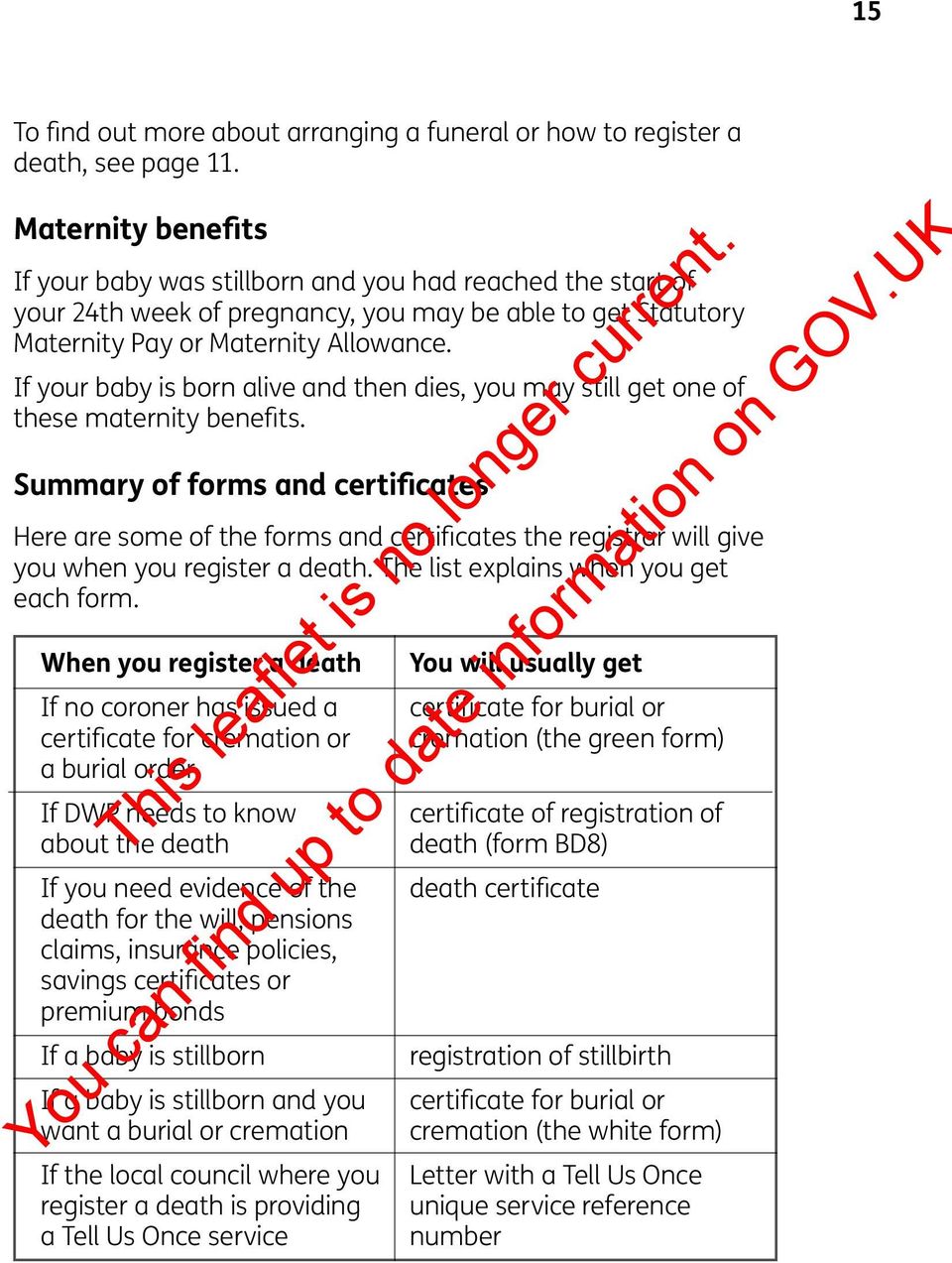
15 15 To find out more about arranging a funeral or how to register a death, see page 11. Maternity benefits If your baby was stillborn and you had reached the start of your 24th week of pregnancy, you may be able to get Statutory Maternity Pay or Maternity Allowance. If your baby is born alive and then dies, you may still get one of these maternity benefits. Summary of forms and certificates Here are some of the forms and certificates the registrar will give you when you register a death. The list explains when you get each form. When you register a death If no coroner has issued a certificate for cremation or a burial order If DWP needs to know about the death If you need evidence of the death for the will, pensions claims, insurance policies, savings certificates or premium bonds If a baby is stillborn If a baby is stillborn and you want a burial or cremation If the local council where you register a death is providing a Tell Us Once service You will usually get certificate for burial or cremation (the green form) certificate of registration of death (form BD8) death certificate registration of stillbirth certificate for burial or cremation (the white form) Letter with a Tell Us Once unique service reference number
16 16 What to do after a death in England or Wales Arranging the funeral Do not make final funeral arrangements until you are sure that you do not have to report the death to the coroner. This may affect the date when the funeral can be held. Find out if there is a will, as this may give details of what the person wanted for their funeral arrangements. If you arrange for a funeral, you are responsible for paying the bill. So check first where the money will come from and if there will be enough to cover all the costs. There are some laws about what to do after someone has died. Their death needs to be registered and the body needs to be properly taken care of by either burial or cremation. See page 25 about Funeral Payments. If you need to arrange a burial or funeral service in line with a particular religion, you can get advice from a minister of that religion or from the religious organisation that the person who died belonged to. Arranging the funeral without a funeral director Many people choose to use a professional funeral director to organise a funeral. They do this partly because it is easier, at what is usually a stressful time. You can organise a funeral without the help of a funeral director, but you should ask the cemeteries and crematorium department of your local council for advice.

17 17 Choosing a funeral director Friends, family, clergy or your doctor may be able to suggest a local company with a good reputation. If not, most local firms are listed in the Yellow Pages. Remember, charges can vary considerably from firm to firm. You may want to contact or visit more than one firm. Most funeral directors choose to join one of the two trade associations below, so you may want to check this before choosing one. However, funeral directors do not have to be in a trade association. National Association of Funeral Directors Phone: Website: National Society of Allied & Independent Funeral Directors Phone: Website: Both organisations have codes of practice. Funeral directors who are members have to give you a price list when you ask, and they will not increase any costs they give you without your permission. The funeral director will need: the certificate for burial or cremation (the green form), or an order for burial or a certificate for cremation from the coroner. Funeral for a stillborn baby The hospital may offer to arrange a burial or cremation, free of charge, for a stillborn baby, whether they were born in hospital or at home. You should discuss the funeral arrangements with the hospital staff or midwife.

18 18 What to do after a death in England or Wales If you accept the offer, the baby will be cremated or buried after a simple ceremony. Or you can arrange the funeral yourself if you prefer. Deciding about cremation or burial Check the will to see if the person who has died has given any instructions for their funeral. It is generally up to the executor or next of kin to decide whether to have a cremation or burial. The executor does not have to follow the instructions left in the will about the funeral. The funeral director will help you to decide where the body should stay until the funeral, and when and where the funeral should take place. If there is going to be a service or ceremony, you should contact a minister for the religion or belief of the person who has died. If you are not sure, the funeral director should be able to help you. Cremation No one can be cremated until the cause of death is definitely known. The crematorium usually needs: an application form signed by the next of kin or executor, and either two cremation certificates (the first signed by the treating doctor and another signed by a doctor not involved with the treatment of the person who has died), or a cremation form signed by the coroner (if the death has been investigated by the coroner). You have to pay for the cremation certificates signed by the two doctors. If the coroner investigates the death and orders a post-mortem or opens an inquest, you do not need these two certificates. Instead, the coroner will give you a free certificate for cremation.

19 19 You or someone you choose can make an appointment to see the two doctors certificates before the cremation, if you tell the crematorium and give them your contact details. If the crematorium is satisfied that the cause of death is confirmed, and that all the forms are filled in correctly, the medical referee will sign the form to authorise cremation. If there is a problem the medical referee can refuse the cremation and make further enquiries, but must give a reason for doing so. A medical referee is appointed by the Secretary of State to authorise all cremations in a crematorium. If the person died outside England and Wales, see page 20. It is important to make it clear to the funeral director or crematorium staff what you want to be done with the ashes. If this is not clear, they will need to contact you to discuss what they should do. You can scatter someone s ashes in a garden of remembrance or their favourite place, bury them in a churchyard or cemetery, or bury or scatter them on private land if you have the landowner s permission, or you can keep them. In the case of babies and very young children, there may be no ashes after a cremation. At some crematoriums you can arrange to have a memorial plaque which you may have to pay for. Burial Before someone can be buried, you must have a death certificate signed by a doctor and a certificate for burial from the registrar of births and deaths. You should find out if the person has already arranged a grave space in a churchyard or cemetery, by checking their will and looking through their papers. There will be a deed
20 20 What to do after a death in England or Wales of grant which shows that a grave space has been paid for in a cemetery. Most cemeteries are open to all faiths, so you can have most types of service or ceremony. These cemeteries are owned by local councils or private companies, and their fees vary. Some cemeteries and churchyards no longer have any space for new graves. If you want the burial to be in a churchyard, you can find out from the priest or minister if there is space and who has the right to be buried there. If the person died outside England and Wales Registering someone s death If the person died in Scotland or Northern Ireland, you should register their death in that country. If the person died abroad, or on a foreign ship or plane, you should register their death in line with the laws of that country, and get a death certificate. If the person who died was a British national, you may also register the death with the British Consul in certain countries. If the death took place on a British-registered ship or plane, the death will be registered with the relevant authority in the UK (Registrar General for Shipping and Seamen, or the Civil Aviation Authority). You will be able to get the death certificate from the British Consul who registered the death or, for deaths on ships and planes, from the Register Office. Phone: Website:
21 21 If the person died outside England and Wales in the circumstances listed on pages 5 and 6, or there is not full information about their death and their body is brought to England or Wales, you must report their death to the coroner where the funeral will be held, in the same way as if they had died in England or Wales. Funerals abroad You can arrange a burial or cremation abroad. The British Consul in that country can register the death. This avoids the costs of bringing the body back to England or Wales. Bringing a body back to England or Wales You may be able to bring the body back to England or Wales. Most funeral directors should be able to give you advice on how to go about this and what it is likely to cost. To bring a body back to England or Wales, you ll need the death certificate from the place the person died, or formal permission from the relevant authority in the country where the person died. Arranging a burial in England or Wales To arrange a burial in England or Wales for someone who died abroad, you ll need: an approved translation of a foreign death certificate, or a death certificate issued in Scotland or Northern Ireland (these must show the cause of death), and a certificate of no liability to register from the registrar in the area in England or Wales where the burial is going to take place. You do not need this certificate if a coroner has issued an order for burial.
22 22 What to do after a death in England or Wales Arranging a cremation If a person died abroad and you have brought their body back to England or Wales to arrange a cremation, you will need a cremation order from the local coroner. You can get their details from any local funeral director. In England or Wales, if you have either of the above forms you will not need the 2 forms signed by doctors. For deaths in Scotland, Northern Ireland, the Channel Islands and the Isle of Man, there are forms which you can use for a cremation. If the person did not die from natural causes, the coroner will start an investigation into their death. In these cases the coroner will issue a form for cremation or burial when the body is no longer needed for the investigation. Paying for the funeral Funerals can be expensive. So remember to check where the money for the funeral will come from before making any arrangements. Otherwise, you may have to pay the bill yourself. Check first whether the person who has died had made any plans to pay for the funeral. The sections below give you some examples of what they might have arranged. If no one is able or willing to arrange and pay for the funeral, the local council, or in some cases the health authority, may pay for the funeral. They will only do this if the funeral has not already been arranged. Also see page 25 about Funeral Payments. If someone has arranged to pay for their own funeral There may be money to pay for the funeral from money the person has left behind (their assets ) or through schemes and pensions that they paid into during their life.
23 23 After someone dies, their bank account is frozen, unless it is a joint account. You may be able to use part of their savings to pay for the funeral. The bank will ask you to provide certain documents, which usually include the death certificate. You should check the person s papers for a membership certificate of the Cremation Society, their life insurance policy or a funeral plan which has already been paid for. You should also look for letters from their past employers with details about any workplace pension scheme or personal pension. These might cover the cost of the funeral, and also provide other financial support for their surviving husband, wife or civil partner. If the person was living in hospital or a residential care home, the hospital or home will hand over the person s belongings to the nearest relative, or to the person who has written permission from whoever is dealing with the will. There may be a limit on the value of the belongings the hospital or home can hand over. This is set by the local council for the area. Employer s pension schemes or personal pensions Many employers provide workplace pension schemes through work that pay a lump sum to help with funeral costs and sometimes pension benefits for a person s surviving husband, wife, civil partner or even children. You should check to see if the person who died has ever belonged to this sort of scheme. Look at their bank statements for payments from a pension scheme, or check with their employer. They may have made their own arrangements if they were selfemployed, or if their employer did not have an employer s scheme. If the person was getting a pension, or more than one, from a previous job or jobs, you should find out who is paying them. It might be an employer s pension scheme or an insurance company. You should tell the representative from
24 24 What to do after a death in England or Wales that scheme about the person s death. Tell them if the person has a surviving husband, wife or civil partner or a dependent child or another dependent because they may be able to get a pension. If they already get a pension they may be able to get more money. You should find out if there was any pension due to be paid when the person retired from their previous employers. If you have problems, you can get help from the Pension Tracing Service. Phone: Textphone: (for people who find it hard to speak or hear clearly) These lines are open Monday to Friday from 9am to 5pm. Website: Other pensions and payments There may be pensions or lump sums payable from a trade union, professional body or other association, or from a provident club which pays benefit when a member dies. If the person was getting a benefit before they died, there may be some of that benefit still due. When you tell the Department for Work and Pensions about the person s death, ask them to send you a form which you can use to claim any money owed.
25 25 If you are the executor, you will be paid this money. If there is no executor but you are paying for the funeral, you can claim up to the amount of the funeral costs. Life insurance policies The person who died may have taken out a life insurance policy which pays a lump sum if they die before a certain age. The lump sum is usually paid after the will has been dealt with but the insurance company may pay out some money when they have proof that the person has died. The Cremation Society If the person who died was a member of the Cremation Society you may be able to pay lower cremation fees. Or the Cremation Society may pay something towards the cost of the cremation. Funeral Payments If you or your partner are on a low income and have to arrange a funeral, you may get some help with the costs. A Funeral Payment is a one-off, tax-free payment to help cover the necessary costs of a funeral. This includes: the necessary costs of a cremation, or the cost of reopening a grave and burial costs, or the cost of opening a new grave and burial costs, including any exclusive right of burial fee (this includes a reclaimed grave), and certain other expenses such as the cost of the death certificate and certain transport costs, and up to 700 for any other funeral expenses like funeral director s fees, a coffin and flowers. You must claim within 3 months of the date of the funeral.
26 26 What to do after a death in England or Wales You or your partner must get at least one of the following benefits: Income Support Income-based Jobseeker s Allowance Income-related Employment and Support Allowance Pension Credit Working Tax Credit which includes a disability or severe disability element Child Tax Credit at a rate higher than the family rate Housing Benefit Universal Credit. It must also be reasonable for you or your partner to pay for the funeral. We may need to consider the circumstances of other relatives of the person who has died. For us to give financial help, the person needs to have been living in the UK when they died, and the funeral usually needs to be held in the UK. If you get a Funeral Payment, you ll have to repay this from the estate of the person who died. Their estate includes money, property and other things that they owned. (Any home that is still lived in by a surviving partner or personal things left to relatives do not form part of the estate.) How do I claim? You will need to fill in a claim form. Go to and download the claim form SF200. Then print it out, fill it in by hand and post it to us. For more information, please contact Jobcentre Plus.
27 27 Also, you should contact the DWP Bereavement Service. They can do a benefits check of what you may be able to get, take your claim for certain benefits over the phone and tell you who to contact to claim other benefits. Phone ( if you speak Welsh and live in Wales) then: select the option if you are calling to tell us about someone who has died, or check what help may be available following a bereavement. The phone line is run by The Pension Service, but deals with calls from people of all ages. When a war pensioner dies We may pay expenses of 2,200 towards the cost of a funeral where a veteran dies and: death was due to service War Pensions Constant Attendance Allowance was being paid or would have been paid had the pensioner not been in hospital when they died Unemployability Supplement was in payment at the time of death and the War Pension was being paid at the 80% rate or higher. You will not have to pay any of the money back from the estate of the person who died. A claim for funeral expenses should be made within 3 months of the date of the funeral. To claim you need to contact Veterans UK. Phone: Textphone: Monday to Thursday 7.30am to 6.30pm, Friday 7.30am to 5.00pm. Website:
28 28 What to do after a death in England or Wales Other help The hospital may arrange the funeral of someone who dies in hospital if they cannot trace the person s relatives, or if their relatives can t afford to pay for the funeral. The hospital may make a claim on the person s estate to pay for the funeral. If the person has not died in hospital and there is no one who can take responsibility for the funeral, the local council has a duty to bury or cremate someone if no other arrangements have been made. If they have a reason to think that the person who died did not want to be cremated, they will not arrange a cremation. They may make a claim on the person s estate to pay for the funeral. Ask your council for more information. Dealing with someone s estate and belongings The will Before you start dealing with someone s property, you need to find out whether or not they left a will. If you can t find a will, or can find only a copy, someone else may have it. This may be a bank, a solicitor, or the executor, and you should talk to them about it. A will does not necessarily look like a legal document. Do not destroy any written instructions left by the person who has died, because these may be their will. A will says what should happen to someone s estate when they die. A will has to be drawn up in line with strict rules. You may need to get legal advice to check whether the document you have is valid that is, it meets the requirements of those rules. If the person died leaving a valid will, their estate must be dealt with as set out in the will.
29 29 If there is no will (or no valid will), the person is said to have died intestate. As a result, the estate must be dealt with in line with rules on intestacy, which set out who will inherit the estate, and how the estate will be shared if more than one person inherits. A summary of the intestacy rules is on page 36. Estate A person s estate is their money, property and belongings when they died. It may include jointly owned property. Jointly owned property Two or more people may own the house or property together as beneficial joint tenants or as tenants in common. Beneficial joint tenants own the house or property jointly, so that on the death of the first to die the house or property passes to the survivor (or survivors) under the right of survivorship. The house or property does not form part of the estate of the first person to die. Tenants in common each own a share in the house or property, and when one of them dies their share is included in their estate. It passes either according to their will, or (if there is no will) follows the intestacy rules. The nature of the joint ownership should have been settled and recorded when the house or property was acquired usually when it was bought. If you are not sure how the house or property is owned, you should get legal advice.
30 30 What to do after a death in England or Wales Getting permission to deal with the estate If the person who died left a will, they will usually have asked an executor to deal with their estate. If the person did not name an executor or did not leave a will, an administrator will need to be appointed to deal with the estate. The administrator will usually be the person entitled to inherit under the intestacy rules. There can be more than one administrator. Executors and administrators are also called personal representatives. If you are entitled to deal with someone s estate, you may have to apply for permission from the Probate Service to manage it. This permission is called a grant of representation (or probate for short). You can apply for a grant of representation yourself or through a solicitor. There are three types of grant issued by the Probate Service. The grant issued will depend on the circumstances of the case. Type of grant Grant of probate Grant of letters of administration (with will annexed) Grant of letters of administration Given to One or more of the executors named in the will An administrator, who is appointed by a court when the executors named in the will are not available, not willing or not suitable to manage the estate, or if the will does not name executors Administrators when there is no valid will
31 31 You may be able to deal with someone s estate without having to apply for a grant of representation. You should contact the organisations holding the property, money and belongings of the person who died, to find out if they need to see a grant before they release any assets to you. For more information on how to get a grant of representation and about inheritance tax, contact the Probate and Inheritance Tax helpline. Phone: (Monday to Friday 9am to 5pm) Website: You can also get information from the Probate Service. Go to and search for Probate Service. What does the executor or administrator need to do? As an executor or administrator, you will have certain duties and responsibilities when dealing with the person s estate. You must: find out how much their estate is worth do everything you reasonably can to collect any money the person is owed pay any inheritance tax that might be due deal with any other outstanding tax matters up to the date of the person s death pay for the funeral pay any liabilities (debts the person owed) from the assets in their estate, and pass on what is left of the estate to the people who are entitled to it.
32 32 What to do after a death in England or Wales Gathering details of someone s assets and liabilities You should look carefully through the person s personal papers to find details of: all their assets (such as bank accounts, building society accounts, insurance policies, share certificates, savings certificates, premium bonds and so on), and all their liabilities (such as money they owe for electricity, gas, water, phone bills and so on, and personal debts such as credit agreements and credit card accounts). You may be able to get back part of any money the person paid in advance for items such as a TV licence, road tax, household insurance, council tax and so on. A tax refund might be due or some tax might still be owed up to the date of death. You should also find out which credit organisations the person owed money to. Make sure you pay any debts You should pay any debts, including funeral expenses, out of the person s estate. If there is no estate to pay for the funeral, see page 22. You, as the executor or administrator, are responsible for paying the debts of the deceased out of their estate. You must make all efforts to trace any creditors of the estate. You should tell the creditors that you are the executor or administrator. This may also mean telling organisations such as water, gas, electricity and telephone suppliers, and hire-purchase and rental companies.
33 33 One claim you may get is if DWP find they have paid too much benefit to someone who has died and ask for the overpayment back. If the person who died owes any National Insurance at the date of their death, this must also be paid out of the estate. If this is not paid, it may affect the benefit the surviving husband, wife or civil partner gets. You may have to sell some or all of the assets in the estate to pay off the debts of the person who died. However, do not rush into either selling assets or sharing out the estate. Get professional legal advice if you re not sure what to do. Claiming any benefit someone is owed The executor or administrator can claim any state benefits someone is owed, even after they have died. There may be money due if the person was getting or had recently claimed a benefit. To claim any benefit owed, first contact the DWP Bereavement Service (see page 12 for details). Sometimes, benefit can be paid without having to claim if: the person who died was waiting for the result of an appeal against a decision about their benefit, or you think they may have been entitled to a benefit but did not claim it. You may be able to act on their behalf, and any benefit they are owed may be paid to the estate.
34 34 What to do after a death in England or Wales Things you will need to send back You should send back the following items, with a note to explain what has happened and the date the person died: Any forms or cheques issued as part of a benefit claim. You should send these to the Jobcentre which issued them. This also applies to Child Benefit payments (including payments for a child who has died). DWP should not make payments after someone has died. It may be useful to keep a record of any benefits before you send anything back. The person s passport. You should send this to the Identity and Passport Service for them to cancel. Before posting it, please cut off the top right-hand corner of the passport. The Passport Office will give you advice on where to send the passport. Phone: Website: The person s driving licence. You should send this to: The Driver and Vehicle Licensing Agency Swansea SA99 1AB. The registration documents for the person s car, to record who now owns the car. Membership cards of any clubs, associations or trade unions. Library books and tickets. Any NHS equipment such as wheelchairs, hearing aids or artificial limbs.
35 35 Disabled parking permit. You should send the disc back to your local council. Any certificates issued by the NHS Business Services Authority, for example a medical exemption certificate for free prescriptions. Phone Website: You may want to contact the Bereavement Register to remove the person s name from mailing lists. Go to their website at You should also cancel things like the person s home-help services, meals-on-wheels, gas, water, electricity and telephone accounts. People to tell You should tell: any hospital the person was going to for their medical appointments their doctor HM Revenue & Customs Department for Work and Pensions Bereavement Service on ( if you speak Welsh and live in Wales) the person s employer and trade union the person s school or college the Student Loans Company, if they had a student loan the person s car insurance company (if you were insured to drive the car under the person s name, you may not now be legally insured to drive the car) gas, water, electricity and telephone suppliers
36 36 What to do after a death in England or Wales their local council (you may need to tell more than one department in the council, such as the housing, social services and council tax departments) the person s bank or building society the person s insurance company, and the Post Office so that they can redirect the person s post, if necessary. Sharing out the estate and dealing with claims on the estate As executor or administrator, your role is to administer the estate. Sharing out someone s property When all the assets have been gathered in and the taxes and debts have been paid, you, as the executor or administrator, must pass on what is left in the estate to the beneficiaries (the persons entitled to get it). If there is a will, you must follow the instructions set out in the will. If there is no will, you must distribute the estate in line with the laws of intestacy. The summary below explains the intestacy rules. Summary of the intestacy rules If a person dies leaving a husband, wife or civil partner, and children The husband, wife or civil partner will take: the personal chattels such as household articles a statutory legacy of the first 250,000 of the estate free of tax, and
37 37 a life interest in half of the remaining estate (this may be turned into a capital sum, that is, money). The other half of the remaining estate goes to the children. If any child is under 18, this share is held in trust until either the child reaches 18 or gets married (whichever comes first). When the husband, wife or civil partner dies the children get the rest. If a person dies leaving a husband, wife or civil partner, but no children The husband, wife or civil partner will take: the personal chattels such as household articles a statutory legacy of the first 450,000 of the estate free of tax, and full ownership of half of the remaining estate. The other half of the estate goes to the parents of the person who has died (shared equally if both are alive). Or if no parent is alive, then it is divided between the whole blood brothers or sisters, or their children if they died before the deceased. If a person dies with no surviving husband, wife or civil partner The estate goes to the person s blood or legally adopted relatives, in the following order: to their children, or children of a child of the deceased who died before the deceased, but if there are none to their parents, but if there are none to whole blood brothers or sisters, or children of a brother or sister of the deceased who died before the deceased, but if there are none to their half blood brothers or sisters, or children of a brother or sister of the half blood who died before the deceased, but if there are none to their grandparents, but if there are none to their whole blood aunts or uncles, or children of aunts or uncles of the whole blood who died before the deceased, but if there are none
38 38 What to do after a death in England or Wales to their half blood aunts or uncles, or children of aunts and uncles of the half blood who died before the deceased, but if there are none to the Crown. If any person who is entitled to the estate is under 18 years old, their share is held in trust until they reach the age of 18 or marry. Two administrators are required to deal with the estate. Other than parents and grandparents, if any relative listed above has already died but leaves children of their own, their share is divided equally among these children. Personal Chattels These are personal belongings, including jewellery, furniture, pictures, books and cars (but not money, investments, property or business assets). Whole blood relatives share the same mother and father. Half blood relatives have only one parent in common. Who can make a claim on an estate? You do not have to be related to the person who died. You can apply to the court for a share of their estate if they were supporting you financially in any way just before their death. This will apply to unmarried partners (or partners where there is no civil partnership) in a case where there is no will. If you qualify, you must apply within six months of the date when the grant of representation was issued. The court may let you apply later in special circumstances. If you want to apply, you should get legal advice as soon as possible after the person dies. Do not leave it until after the six months.
39 39 What happens if the person who dies has no relatives? If there is no will and the person who died leaves no surviving husband, wife or civil partner, or blood or legally adopted relatives, the estate will go to the Crown. For more information, contact the Treasury Solicitor s Department. The Treasury Solicitor s Department (BV) One Kemble Street London WC2B 4TS The effect of marriage, divorce and civil partnerships on a will If someone makes a will and then gets married or forms a civil partnership, their will is no longer valid unless the will is made in contemplation of the marriage or civil partnership. Generally, if someone makes a will and then gets divorced or ends (dissolves) a civil partnership: any gift left to their former husband, wife or civil partner, and any appointment of their former husband, wife or civil partner as executor does not take effect unless the will says otherwise. Bereavement and tax Telling HM Revenue & Customs (HMRC) that someone has died HMRC usually get information from Tell Us Once and DWP when someone dies. Tell Us Once is available at most local councils in England, Scotland and Wales. To use the service, your first step is to register the death with your local Register Office. They will then tell you what to do next.
40 40 What to do after a death in England or Wales If you do not use Tell Us Once, you should tell HMRC that the person has died, using the contact details below. HMRC need to know the name and address of the person who is dealing with the tax affairs of the person who has died. It will also help if you can give their date of birth and National Insurance number. Sorting out the tax and benefits of the person who died Income Tax Once HMRC has made contact with the Personal Representative, they will let them know if there is a refund due or any tax is owed. If the person who died had complex tax affairs, the Personal Representative may need to fill in a Self Assessment tax return. HMRC have tax advisors who can help you with any questions on Income Tax when someone dies. They can be contacted using the details below. Phone: Textphone: am to 8pm Monday to Friday, Saturday 8am to 4pm.
41 41 National Insurance contributions If necessary, HMRC will check to see if the correct National Insurance contributions have been paid. For more information: Phone: Textphone: am to 5pm Monday to Friday. Tax Credits If the person who died was getting Tax Credits, or if you are getting them as a couple with the person who died, the payments will need to be stopped. HMRC should stop payments when they are told about the death. It s important that payments are stopped, otherwise you may be paid too much money and you will have to pay it back. Child Tax Credits will usually be paid for eight weeks from the date that a child died. If you had a joint claim with the person who died, you may be able to make a new claim. For more information: Phone: Textphone: am to 8pm Monday to Friday, Saturday 8am to 4pm. Inheritance Tax If you need to apply for probate to get the legal right to administer and distribute an estate you will need to fill in Inheritance Tax forms, even if the estate doesn t need to pay Inheritance Tax. Inheritance Tax usually only needs to be paid if the estate including any assets held in trust, and gifts made by the person who has died within seven years of their death is valued over the Inheritance Tax threshold (set at 325,000 until 5 April 2015). Sometimes
42 42 What to do after a death in England or Wales this threshold can be increased: for example, if the person who died was a widow, widower or surviving civil partner and their husband, wife or civil partner left their estate to them when they died. Phone: am to 5pm Monday to Friday. In business If the person who died ran their own business, either as a sole trader, partner or company director, you may need to contact HMRC to sort out employer or VAT matters as well as their personal tax, National Insurance and benefits paid by HMRC. Go to Sorting out tax: the effect on the surviving husband, wife or civil partner The death of your husband, wife or civil partner may affect the amount of tax that you pay. Make sure you fill in the section About a surviving spouse or civil partner of form R27 if any of the following apply: the death changes the amount of pensions, annuities or benefits that you get for example, if you now get a new pension, an existing pension goes up or down, or you get Bereavement Allowance your husband, wife or civil partner was getting Blind Person s Allowance or Married Person s Allowance, or you had previously registered to get bank or building society interest without tax taken off and your income has now gone up.
43 43 If you need to write to HMRC about Income Tax and bereavement, the address is: HMRC Pay As You Earn and Self Assessment PO Box 4000 Cardiff CF14 8HR HMRC also has an online guide to bereavement. There is a short questionnaire which can provide a tailored guide to the steps needed when dealing with HMRC when someone has died. HMRC online bereavement tool: There are also tax charities that may be able to help you: Tax Help for Older People for people over 60 and with an income under 17,000 a year Website: Phone: or [email protected] Tax Aid for people with an income under 17,000 a year Website: Phone:
44 44 What to do after a death in England or Wales Help and support for you If someone in your family dies it can cause money problems. This may only be for a short time, while you wait for their estate to be shared out, or you may need long-term help. This section is about benefits and other help you might be able to get after someone dies. If you are widowed or your civil partner dies, there are different kinds of benefits you can get. The benefit you get may depend on your age or the number of children you have living with you. The type and amount of bereavement benefit you can get is based on your husband s, wife s or civil partner s National Insurance contributions. If you marry someone else, form a civil partnership, or live with someone as if they are your husband, wife or civil partner, you can t carry on getting bereavement benefits. Bereavement benefits The Bereavement Benefit Scheme was introduced on 9 April 2001, and applies to people widowed on or after this date. It also applies to people who became surviving civil partners on or after 5 December You may be able to get a Bereavement Payment and either: Widowed Parent s Allowance, or Bereavement Allowance. For you to qualify for these bereavement benefits, your husband, wife or civil partner must have paid National Insurance contributions. The contributions you ve paid do not count for these benefits. If they died because of an accident at work or an industrial disease, we will treat your case as if your husband, wife or civil partner had paid full National Insurance contributions.
45 45 Bereavement Payment A Bereavement Payment is a tax-free lump-sum payment of 2,000 to help you at the time your husband, wife or civil partner dies. You can get a Bereavement Payment if your husband, wife or civil partner paid enough National Insurance contributions, or if their death was caused by their job, and: you were under State Pension age when they died, or they were not entitled to Category A State Pension when they died. You can t get a Bereavement Payment if, at the time your husband, wife or civil partner died: you were divorced from them, or your civil partnership had been legally ended you were living with someone else as if you were married or in a civil partnership with them, or you were in prison or legal custody. You can claim a Bereavement Payment up to 12 months after your husband, wife or civil partner died. Widowed Parent s Allowance Widowed Parent s Allowance is a regular payment you can get if: you re under State Pension age your husband, wife or civil partner had paid enough National Insurance contributions, and either you have at least one child you re either getting Child Benefit for, or you re expecting the child of your late husband or civil partner (including as a result of IVF) and you were living with them just before they died.
46 46 What to do after a death in England or Wales If you are affected by the High Income Child Benefit charge and have not made a claim to Child Benefit, you will need to make one if you want to receive Widowed Parent s Allowance. Find out more about the High Income Child Benefit charge at You must claim within three months of your husband, wife or civil partner dying, or you may lose benefit. Widowed Parent s Allowance stops when you no longer have a dependent child. If this is within 52 weeks of your husband, wife or civil partner dying, you may be able to get Bereavement Allowance. You have to pay tax on Widowed Parent s Allowance. You may also get Child Tax Credit (see page 54). This replaced the child dependency increase payment from 6 April Bereavement Allowance Bereavement Allowance is a regular payment which you can get if: you were 45 or over but below State Pension age when your husband, wife or civil partner died, and either they had paid enough National Insurance contributions, or their death was caused by their job. You can t get Bereavement Allowance if, at the time your husband, wife or civil partner died: you were divorced from them or your civil partnership had been legally ended you were living with someone else as if you were married or in a civil partnership with them, or you were in prison or legal custody. You must claim within three months of your husband s, wife s or civil partner s death, or you may lose benefit.
47 47 How to claim bereavement benefits You don t claim for each benefit separately. To start your claim you can: 1 Contact the DWP Bereavement Service. They will do a quick check of what benefits you may be able to get, and take your claim over the phone. Phone ( if you speak Welsh and live in Wales) then: select the option if you are calling to tell us about someone who has died, or check what help may be available following a bereavement. 2 Download claim form BB1 yourself at Your benefit entitlements may have changed You may find that you can use your late husband s, wife s or civil partner s National Insurance contributions to claim new or increased benefits. If you think this may affect other benefits that you already get, you must contact the DWP Bereavement Service (see page 12). State Pension The government is changing the State Pension from 6 April The new State Pension will be for people who reach State Pension age on or after that date. This means: men born on or after 6 April 1951 women born on or after 6 April 1953.
48 48 What to do after a death in England or Wales If you reach State Pension age before 6 April 2016 The State Pension can be made up of basic State Pension and additional State Pension. Additional State Pension is known as SERPS or State Second Pension. If you don t qualify for a full basic State Pension on your own National Insurance record, your late spouse s or civil partner s National Insurance contributions may be used to increase your basic State Pension to up to a maximum of the full rate. If they died because of an accident at work or an industrial disease, we will treat them as if they had paid full National Insurance contributions. You may also get some of their additional State Pension. If you were widowed or your civil partner died while you were under State Pension age, you may get some of their additional State Pension paid as part of Widowed Parent s Allowance. Otherwise, it will be paid when you claim your own State Pension or straight away if you are already getting a State Pension. If you were under State Pension age when your husband, wife or civil partner died, you will not be able to get any State Pension based on their National Insurance contributions if you get married again or form a new civil partnership before you reach State Pension age. If you reach State Pension age on or after 6 April 2016 Your State Pension will be worked out under new rules and will be based on your own National Insurance contributions. You will not normally be able to use your late spouse s or civil partner s contributions to increase your State Pension, but if you re a woman who paid married women s and widow s reduced-rate National Insurance contributions, you may be able to qualify under special rules. You may still be able to inherit some of your late spouse s or civil partner s additional State Pension. This will be worked out in the same way as under the existing State Pension system.
49 49 As now, if you remarry or form a new civil partnership before you reach State Pension age, you will not be able to inherit any of your late spouse s or civil partner s State Pension. You can find out more about the new State Pension by going to Please remember that the State Pension counts as taxable income. To find out more about State Pension, contact DWP. Phone: ( if you speak Welsh and live in Wales) Textphone: ( if you speak Welsh and live in Wales) Website: Employment and Support Allowance If you are sick you could get Employment and Support Allowance. There are two types of Employment and Support Allowance: contribution-based, if you have paid (or been credited with) enough National Insurance contributions, and income-related, if you don t have enough money coming in or savings, or you haven t paid (or been credited with) enough National Insurance contributions. Contribution-based Employment and Support Allowance counts as taxable income and you might need to check your tax position. Any bereavement benefit you get may affect the amount of Employment and Support Allowance you get, so ask Jobcentre Plus to explain this to you.
50 50 What to do after a death in England or Wales If you have not paid enough National Insurance contributions to get contribution-based Employment and Support Allowance and your husband, wife or civil partner has died, you could get special credits to get contributionbased Employment and Support Allowance. To get special credits, you must be sick and must have stopped getting certain bereavement benefits. You can t get special credits if your bereavement benefit stops because you: get married again form a new civil partnership, or start living with a new partner. Industrial injuries benefits Payments can be made under the Industrial Injuries scheme for industrial accidents and diseases which happened or were caused through work, or while unemployed and taking part in a work-based training scheme. Payments are made based on the level of disablement as a result of the industrial accident or disease. If your husband, wife or civil partner (or if you don t have one of these, one of your parents) has died and had an injury from an accident or a disease that happened through work, you may be able to claim Industrial Injuries Disablement Benefit now. The claim can be backdated for up to 3 months before their death. To get it, you have to: claim within 12 months of the issue of the death certificate apply to become an appointee within 6 months of the issue of the death certificate, and claim within 6 months of becoming an appointee. You may get less benefit if any of these conditions are not met.
51 51 Industrial injuries benefits can be paid with other benefits. However, it can count as income if you are getting incomerelated benefits. If you are already getting, or thinking about claiming, income-related benefits you should ask an adviser from a jobcentre or pension centre. Lump-sum payments for industrial diseases If you decide to make a claim for Industrial Injuries Disablement Benefit because your husband, wife or civil partner would have been getting it if they were still alive, you may also be able to get an extra lump-sum payment if your husband, wife or civil partner was disabled as a result of one of five dust-related diseases caused through work. If your husband, wife or civil partner died from mesothelioma, you may be able to get a lump-sum payment whether or not they were getting Industrial Injuries Disablement Benefit. Claims for lump-sum payments must be made within 12 months of the date of death. Funeral grants when a veteran dies If the person who died served in HM Armed Forces before 6 April 2005, you may be able to get a funeral grant if: death was due to their service War Pensions Constant Attendance Allowance was being paid or would have been paid had they not been in hospital when they died, or Unemployability Supplement was being paid when they died and War Pension was being paid at the 80% rate or higher. You will not have to pay any of the funeral grant back from the estate of the person who died. You need to make a claim for a funeral grant within 3 months of the date of the funeral.
52 52 What to do after a death in England or Wales To claim you need to contact Veterans UK. Phone: Textphone: Monday to Thursday 7.30am to 6.30pm, Friday 7.30am to 5.00pm. Website: Help to bring up a baby or child Child Benefit If you are a parent you should already be getting Child Benefit. If, after someone dies, you become responsible for bringing up their child you should also claim Child Benefit for that child as soon as possible. If you have a child that dies you may be entitled to Child Benefit for them for up to eight weeks after their death. For more information contact HM Revenue & Customs. Phone: Textphone: am to 8pm Monday to Friday, Saturday 8am to 4pm Website:
53 53 Guardian s Allowance You may also be able to get Guardian s Allowance if, after someone dies, you become responsible for bringing up their child. To get Guardian s Allowance, you must be entitled to Child Benefit for the child. Also, one of the child s parents must have been born in the UK, or on the date the parent (or parents) died, one of them must have been in the UK for at least 52 weeks in any twoyear period since the age of 16. Usually, both the child s parents must be dead, but in some circumstances Guardian s Allowance can be paid when only one parent has died. If only one parent has died, you may still be able to get it, if at the date of that parent s death: the surviving parent can t be traced and their whereabouts are not known the surviving parent is in prison with at least two years left to serve or is in hospital detained by a court order the parents were divorced or their civil partnership legally ended, and the surviving partner was not awarded custody of the child and isn t maintaining them or ordered by a court to maintain them, or the parents weren t married, the mother has died and the child s father is not known. You can claim Child Benefit and Guardian s Allowance at the same time. If you have already made a claim for Child Benefit, make your claim for Guardian s Allowance as soon after this as possible. Help if you do not have enough to live on or are on a low income If your husband, wife or civil partner dies, you may find that your income goes down, and you may have problems making ends meet. You may qualify for one or more types of support for people on a low income.
54 54 What to do after a death in England or Wales Working Tax Credit is designed to help people who work but are on a low income. The amount you get depends on a number of things, such as your income, whether you are responsible for children, and the number of hours you work. Not responsible for children To qualify for Working Tax Credit you need to do paid for work for at least: 16 hours a week if you are aged 60 or over or have a disability 30 hours a week if you are aged 25 or over. Responsible for children To qualify for Working Tax Credit you need to do paid for work for at least 16 hours a week. You may also get help with some of your childcare costs. You do not have to pay tax on Working Tax Credit. Child Tax Credit Child Tax Credit is an allowance you may get if you re responsible for a child who normally lives with you. Whether you qualify and the amount you may get depends on a number of things, such as your household income and the number of children you have and how old they are. You claim tax credits from HM Revenue & Customs. Phone: Textphone: am to 8pm Monday to Friday, Saturday 8am to 4pm. Website:
55 55 Income Support If you cannot work more than 16 hours a week and do not have enough money to live on, you may get Income Support. You must: be under 60 have less than 16,000 in savings, and work less than 16 hours a week. You may have to talk to a job adviser to see if work is an option for you, before you can get Income Support. For more information go to our website at Jobseeker s Allowance Jobseeker s Allowance is the main benefit you can get if you re out of work, or you work for less than 16 hours a week on average, and are available for and actively looking for work. This benefit counts as taxable income. There are two types of Jobseeker s Allowance. The first is contribution-based Jobseeker s Allowance. You may get this if you ve paid enough National Insurance contributions in the last two tax years. We can pay this for up to 182 days. Generally, self-employed contributions will not help you qualify for contributionsbased Jobseeker s Allowance. The second type is income-based Jobseeker s Allowance. It s based on your income and savings. If you have savings over 16,000, you can t usually get income-based Jobseeker s Allowance. For more information contact Jobcentre Plus or go to
56 56 What to do after a death in England or Wales Pension Credit If you have reached the qualifying age, you may be able to get Pension Credit to top up your income. There are two parts to Pension Credit: the Guarantee Credit and the Savings Credit. The Guarantee Credit tops up your income to a minimum level. The Savings Credit is for people aged 65 or over who have saved towards their retirement. To find out if you have reached the Pension Credit qualifying age you can use the State Pension age calculator: Important changes to Savings Credit As part of the Pensions Act 2014, the Saving Credit part of Pension Credit will close for people reaching State Pension age on or after 6 April Following changes in the law, this will include those with a partner who reached State Pension age before 6 April However, some protection will be given to these couples who were already getting Savings Credit on 6 April You can apply for Pension Credit by contacting DWP. Phone: Textphone: am to 6pm Monday to Friday Website:
57 57 Housing Benefit Housing Benefit helps towards your rent and service charges. You may be able to get it if you are on a low income and do not have a lot of savings. Whether you pay rent to a private landlord, a housing association, your local council or a hostel or guest house, you may still be able to get some Housing Benefit. Housing Benefit does not pay for interest on your mortgage, fuel costs (gas and electricity) and some service charges (depending on your circumstances). Find out more at For owner occupiers, help with mortgage interest payments may be available for those who get Income Support, income-based Jobseeker s Allowance, incomerelated Employment and Support Allowance or Pension Credit. This help is paid as part of your benefit and is called Support for Mortgage Interest (SMI). SMI is normally paid direct to your lender. You can t get help towards the amount you borrowed only the interest.
58 58 What to do after a death in England or Wales Universal Credit From 29 April 2013, Universal Credit was introduced in some areas of the country. Universal Credit is a new single payment if you are under State Pension age and looking for work or on a low income. Universal Credit will eventually replace: income-based Jobseeker s Allowance income-related Employment and Support Allowance Income Support Child Tax Credits Working Tax Credits Housing Benefit. You can find more information online, including where Universal Credit will be introduced and what it might mean for you. Go to Help with health costs If your income is below a certain level or you are getting certain benefits (for example, Income Support, income-based Jobseeker s Allowance, income-related Employment and Support Allowance or tax credits), you may be able to get help with health costs. To find out more about help with health costs from the NHS, ask at your doctor s surgery or health clinic. Phone: Website:
59 59 Call charges You can use the 0845 code to call any of our 0345 numbers. Check with your phone company which code is cheaper for you. Charges were correct as of the date on the back of this leaflet. Calls to 0800 numbers are free from BT land lines but you may have to pay if you use another phone company, a mobile phone, or if you are calling from abroad. Calls to 0845 numbers from BT land lines should cost no more than 4p a minute with a 15p call set-up charge. You may have to pay more if you use another phone company or a mobile phone, or if you are calling from abroad. Calls from mobile phones can cost up to 40p a minute, so check the cost of calls with your service provider. You can ask us to call you back if you re concerned about the cost of the call. current. longer no is Textphones leaflet Our textphone numbers are for people who cannot speak or hear This clearly. If you don t have a textphone, you could check if your local library or Citizens Advice has one. Textphones don t receive text messages from mobile phones.
60 Important information about this leaflet This leaflet is only a guide and does not cover every circumstance. We have done our best to make sure that the information in this leaflet is correct as of October It is possible that some of the information is oversimplified, or may become inaccurate over time, for example because of changes to the law. You can find more information about benefits and pensions online. For benefits information, go to For pensions information, go to Crown copyright ISBN DWP011 v1.0 (October 2014)
What to do after a death
 What to do after a death in England or Wales Part of the Department for Work and Pensions Introduction When someone close to you dies, there are many decisions and arrangements you ll have to make, often
What to do after a death in England and Wales
 D49 April 2004 What to do after a death in England and Wales A guide to what you must do and the help you can get Contents Introduction 5 What to do first 6 If the death occurs in hospital 6 If the death
Goldsmith Williams Guide to Probate
 Goldsmith Williams Guide to Probate Contents 1/ An Introduction 2/ Your First Steps 3/ Your First Steps Cont. 4/Obtaining the Grant of Representaion 5/ Obtaining the Grant of Representation Cont 6/ Administering
What is the purpose of the Grant of Representation?
 PA2 How to obtain probate - A guide for people acting without a solicitor What is the Probate Service? The Probate Service is part of HM Courts & Tribunals Service. It administers the system of probate,
Bereaved customers. Helping you deal with a deceased person s account
 Bereaved customers Helping you deal with a deceased person s account How this leaflet will help This guide will help if you need to settle the banking affairs of someone who has died. When you are bereaved,
What to do after a death at home
 What to do after a death at home This booklet has been produced to help you to understand what you need to do when someone you have been caring for dies at home Acknowledgements Thank you to everyone who
The Social Fund. Part of the Department for Work and Pensions
 The Social Fund Part of the Department for Work and Pensions What is the Social Fund? If you are on a low income and faced with costs that are difficult to pay for out of your normal income, the Social
Help using this PDF claim form
 Help using this PDF claim form You can save data typed into this PDF form if you use Adobe Reader XI or a newer version. This means that you do not have to fill in the form in one session. This form will
Maternity Allowance. Notes sheet. Please keep these notes for your information, do not return them with your MA1 claim form.
 Maternity Allowance Please keep these notes for your information, do not return them with your MA1 claim form. Notes sheet l Help if you are expecting a baby and you are or have been employed but cannot
How to obtain probate - A guide for the applicant acting without a solicitor
 PA2 How to obtain probate - A guide for the applicant acting without a solicitor If you make a personal application for a Grant of Probate you will be required to attend an appointment at one of our interview
making life less complicated A step by step guide to completing probate
 making life less complicated A step by step guide to completing probate Disclaimer This information has been produced by Simplify to act as general guidance for people administering small, straightforward
What is the purpose of the grant of representation?
 PA2 How to obtain probate - A guide for people acting without a solicitor What is the Probate Service? The Probate Service is part of HM Courts & Tribunals Service. It administers the system of probate
Understanding tax. A guide to putting your tax matters in order 2015-16
 A guide to putting your tax matters in order 2015-16 Introduction If you re ill or caring for someone who is, you may need to put your financial matters in order. This booklet explains how to handle your
A brief guide to Trusts and our Trustbuilder tool
 guide to guide to trusts trusts A brief guide to Trusts and our Trustbuilder tool A Brief guide to Trusts and our Trustbuilder tool Introduction This brief guide explains some of the main features and
Make and register your lasting power of attorney a guide
 LP12 Make and register your lasting power of attorney a guide Financial decisions including: running your bank and savings accounts making or selling investments paying your bills buying or selling your
Notes to help you fill in form IHT205(2011)
 Notes to help you fill in form IHT205(2011) These notes only apply when the deceased died on or after 6 April 2011 and you are filling in form IHT205(2011) Return of estate information. If the deceased
A client s guide on what to do when someone dies
 A client s guide on what to do when someone dies This short guide aims to give some practical information on what to do when someone passes away. This is a difficult and often stressful time for family
Sorting out your estate before you die
 Sorting out your estate before you die This information is an extract from the booklet Sorting out your affairs, which is part of the financial guidance series. You may find the full booklet helpful. We
A guide to. Coroners and Inquests
 A guide to Coroners and Inquests A guide to Coroners and Inquests Contents 1. What is a coroner? 3 2. What do coroners do? 4 3. What is the role of a coroner s officer? 4 4. Are all deaths reported to
You can find up to date information on GOV.UK. This leaflet is no longer current. Having a baby. April 2014
 Having a baby April 2014 Introduction This leaflet is for parents who are expecting or have recently had a baby, or who are adopting a baby or young child. You should find it useful if this is your first
We hope you will find this guide useful, but if there is anything you do not understand, or if you need help with your claim, please contact us
 LYNCH WOOD PARK LYNCH WOOD PETERBOROUGH PE2 6FY WWW.PHOENIXLIFE.CO.UK CLAIM GUIDE When somebody close to you has died and you need to deal with an insurance company, the last thing you need is to be faced
Helping you through. Administration of Estates & Grants of Probate
 Helping you through Administration of Estates & Grants of Probate Purdys Solicitors 26 Pepperslade Near Duxford Cambridge CB22 4XT Telephone: 01223 834655 www.purdys-solicitors.co.uk What to do when someone
State Pension. Your notes booklet. Remember The easy way to claim your State Pension is online or by phone. Important.
 State Pension Your notes booklet These notes tell you more about the State Pension, and help you fill in your claim form. Remember The easy way to claim your State Pension is online or by phone Visit www.gov.uk/state-pension
Share ownership: A bereavement guide
 Share ownership: A bereavement guide Contents Introduction 2 Things to know 3 Small Estates Declaration and Indemnity 6 Selling the Shares 7 Capita Share Dealing Services 7 Transferring the Shares 8 Lost
NHS. North Tees and Hartlepool. Practical help and advice after a death What do we do next? Information for relatives, carers and friends
 North Tees and Hartlepool NHS Foundation Trust NHS Practical help and advice after a death What do we do next? Information for relatives, carers and friends We are sorry to hear that you have just learned
Helping you. to work through finances during bereavement
 Helping you to work through finances during bereavement Contents Helping you work it through We re here to help you 2 What you ll need to provide 3 If you have questions 4 Useful contacts 7 Some legal
Work-Related Death ASBESTOS AND THE HOME RENOVATOR. Information for people following a fatality. A basic guide on what you need to know about asbestos
 ASBESTOS AND THE HOME RENOVATOR A basic guide on what you need to know about asbestos Work-Related Death Information for people following a fatality safe, fair, productive working lives This publication
Helping you. to work through finances during bereavement
 Helping you to work through finances during bereavement Contents Helping you work it through We re here to help you 2 What you ll need to provide 3 If you have questions 4 Useful contacts 7 Some legal
Funeral Benefit from the DSS
 Funeral Benefit from the DSS The state offers a specific benefit towards the cost of a funeral, for those people that it deems most need it. The qualification is strict but a successful application can
Approaching retirement
 A guide to tax and National Insurance contributions IR121 Contents Introduction Retiring early National Insurance contributions 1 Get a state pension forecast 2 Income tax 2 Claiming your State Pension
STEp-BY-stEP. GUIdE to MAKING A. WIlL
 YOUR STEp-BY-stEP GUIdE to MAKING A WIlL This is part of a series of leaflets about making a will, leaving a legacy and inheritance planning. The other leaflets in the series are: Charitable legacies and
Last Will & Testament
 Last Will & Testament Important facts This Lawpack Kit contains the information, instructions and forms necessary to make your own Will in England, Wales, Northern Ireland or Scotland. It is important
Contents. Introduction - Page 5. Who can register a stillbirth? - Page 14. What documents are required? - Page 15. How to register a death - Page 6
 Contents Introduction - Page 5 How to register a death - Page 6 Who can register a death - Page 6 What information will you need to provide about the deceased? - Page 7 What documents are required? - Page
Referring cases to the Treasury Solicitor (BV)
 (BV) A guide for local authorities and hospitals. The Estates Group of TSol s Bona Vacantia Division administers the estates of people who die intestate and without known kin. The Treasury Solicitor (TSol)
Share ownership: A bereavement guide
 Share ownership: A bereavement guide 1 Contents Introduction 2 Things to know 3 Small Estates Declaration and Indemnity 6 Selling the Shares 7 Capita Share Dealing Services 7 Transferring the Shares 8
Claim form for Housing Benefit and Council Tax Reduction
 Claim form for Housing Benefit and Council Tax Reduction If you are just claiming Second Adult Rebate, only fill in Parts 1, 3 and 15 of this form and tick this box. Part 1 About you and your partner Do
Deferring your State Pension
 Deferring your State Pension October 2014 2 Contents 4 Introduction 5 When can I get my State Pension? 6 Putting off claiming your State Pension 8 What are my choices? 9 How much more money could I get?
10817 Carers Allowance 24/2/06 19:50 Page 2 Carer s Allowance
 Carer s Allowance Are you a carer? Do you look after someone who has an illness or severe disability that makes their daily life difficult? This person could have a physical or mental illness or disability.
Using trusts can help to make sure your financial plans take care of the future
 Using trusts can help to make sure your financial plans take care of the future 2 Trusts and what they do If you ve already taken the time to make financial plans for the future, using trusts can help
Your bereavement: dealing with the financial affairs of someone who has died
 Your bereavement: dealing with the financial affairs of someone who has died This is a very brief summary of some of the issues involved with dealing with the financial affairs of someone who has died.
Death claims. A guide to claiming under a life assurance plan
 Death claims A guide to claiming under a life assurance plan Contents 1 INTRODUCTION 4 2 3 Sending us a claim 5 THE documents we may need 7 4 Who can claim 11 5 How we process a claim 14 6 Paying a claim
County of Ocean, New Jersey. Jeffrey W. Moran, Surrogate 118 Washington Street, P. O. Box 2191 Toms River, NJ 08754-2191 - Phone: 732-929-2011
 County of Ocean, New Jersey Jeffrey W. Moran, Surrogate 118 Washington Street, P. O. Box 2191 Toms River, NJ 08754-2191 - Phone: 732-929-2011 A PLANNING GUIDE TO THE PROBATE PROCESS The Probate Process
EXECUTOR S CHECKLIST. Estate Name: Executor Mailing Address: Executor Name: Executors Responsibilities
 Member JUDITH A. PICCOLO Notary Corporation 20416 Douglas Crescent Langley, B.C. V3A 4B4 Tel. (604) 534-0144 Fax. (604) 534-7985 Email: [email protected] EXECUTOR S CHECKLIST Estate administration
What to do after someone has died a guide
 DEPARTMENT OF THE ATTORNEY-GENERAL AND JUSTICE www.nt.gov.au What to do after someone has died a guide The death of a loved one can be a particularly difficult time for friends and family. This guide is
Letters of administration (usually when there is no valid will).
 The Probate Service What is probate? When a person dies somebody has to deal with their estate (money property and possessions left) by collecting in all the money, paying any debts and distributing what
MAKING A WILL A guide to help you
 MAKING A WILL A guide to help you Death is not something we like to think about or plan for and of course no amount of planning can prevent the pain your loved ones will experience when you die. However,
What you have to do after someone has passed away
 What you have to do after someone has passed away A guide to the organizations and affairs that should be dealt with following a death Contents Foreword...2 First Things...3 Collecting the Documents You
How to Claim the Personal Property of Someone Who Has Died: Do-It-Yourself Affidavit Procedure for Small Estates
 How to Claim the Personal Property of Someone Who Has Died: Do-It-Yourself Affidavit Procedure for Small Estates How do I use this packet? This packet has four parts. Section 1 answers questions so you
Planning for a funeral
 Factsheet 27 January 2015 About this factsheet This factsheet discusses making arrangements in advance for your own funeral. It also identifies issues to consider when taking responsibility for arranging
A guide for executors
 A guide for executors MARCH 2013 who? why? what? why? what? 18 frequently asked questions about being an executor. This booklet provides a guide, in question and answer format, for executors about their
Notes to help you fill in form IHT205(2006)
 Notes to help you fill in form IHT205(2006) These notes only apply when the deceased died on or after 1 September 2006 and you are filling in form IHT205(2006) with a version date of 01/11 or later. (You
FUNERAL ORGANISER. Ultimate care for you, your wishes and your family. Proud Member of InvoCare
 FUNERAL ORGANISER Ultimate care for you, your wishes and your family Proud Member of InvoCare TO MY FAMILY I have completed this guide as a way of relieving you of the sole responsibility and decision
November 2014 Edition
 Administration of Estates November 2014 Edition Firm details: Logo THE AFTERMATH OF A DEATH Making a Will helps to plan what is to happen in the aftermath of a death, but nothing can adequately prepare
Executors Checklist for Estate Administration
 FAMILY WEALTH PLANNERS PERSONAL TAX ADVISORS www.finplans.net 519-884-7087 Executors Checklist for Estate Administration March 2011 (Prepared for clients and business colleagues of Personal Wealth Strategies)
We re here to help. Support during a bereavement. Print-friendly brochure
 Support during a bereavement Print-friendly brochure We re here to help A step-by-step guide to help you handle a deceased person s savings and investments with NS&I This document has been downloaded from,
Employment and Support Allowance
 Employment and Support Allowance Help if you are ill or disabled Contents 3 About Employment and Support Allowance 4 Who can get Employment and Support Allowance 6 What happens when I claim? 7 Helping
FINAL DETAILS Practical Considerations and A Guide for Survivors When Death Occurs
 FINAL DETAILS Practical Considerations and A Guide for Survivors When Death Occurs The death of a spouse or loved one is a very difficult time. Yet even during this period of grief and emotional readjustments,
INFORMATION AND ADVICE FOR BEREAVED FAMILIES AND FRIENDS
 INFORMATION AND ADVICE FOR BEREAVED FAMILIES AND FRIENDS Bereavement Officer Patient Experience Team Warwick Hospital Lakin Road Warwick CV34 5BW Telephone 01926 495321 x 8131 What this booklet is for?
What happens when someone denies they are the parent of a child? Parentage disputes
 What happens when someone denies they are the parent of a child? Parentage disputes About this leaflet This leaflet explains what happens when someone named as the parent of a child in a child maintenance
Housing Benefit and Council Tax Reduction claim form
 Revenues & Benefits Service Community Contact Centre Town Hall, Queens Square Hastings TN34 1TL Tel: 01424 451080 Fax: 01424 451541 [email protected] www.hastings.gov.uk FOR OFFICE USE ONLY Date
YOUR PLAN DETAILS AND APPLICATION FORM.
 THE DIGNITY PREPAID FUNERAL PLAN YOUR PLAN DETAILS AND APPLICATION FORM. CHOICE OF 3 PLANS Legal & General working in association with: 2 YOUR APPLICATION FORM THREE LEVELS OF COVER AVAILABLE. There are
How we work out child maintenance. A step-by-step guide
 How we work out child maintenance A step-by-step guide About this leaflet This leaflet explains how the Child Maintenance Service works out child maintenance. It tells you the information we use and the
Understanding trusts. Your easy to follow guide
 Understanding trusts Your easy to follow guide Understanding trusts: Your easy to follow guide Important note The information in this guide is based on our understanding of current legislation and HM Revenue
Lawpack Publishing Limited 76 89 Alscot Road London SE1 3AW www.lawpack.co.uk All rights reserved. ebook ISBN 9781907765506
 Lawpack Publishing Limited 76 89 Alscot Road London SE1 3AW www.lawpack.co.uk All rights reserved ebook ISBN 9781907765506 2011 Lawpack Publishing Limited This Lawpack Guide may not be reproduced in whole
CASH ISA SAVINGS CONDITIONS. For use from 2nd September 2016.
 CASH ISA SAVINGS CONDITIONS. For use from 2nd September 2016. WELCOME TO HALIFAX This booklet explains how your Halifax savings account works, and includes its main conditions. This booklet contains: information
application to invest in an Investment Account for trustees
 application to invest in an Investment Account for trustees Subject to the application being accepted, the account will start earning interest from the day we receive your application and payment. Please
Remembering those left behind
 Remembering those left behind A brief guide to making wills, considering funeral arrangements and nding other sources of help Remembering those left behind This booklet is intended for: those who are making
Carer s Allowance Claim form
 Carer s Allowance Claim form i Only use this form to claim Carer s Allowance if you are getting State Pension l Use this form to claim Carer s Allowance. l Please read the tes that came with the claim
Guide to completing your Inheritance Tax account
 Guide to completing your Inheritance Tax account This guide will help you to: fill in the forms you need to complete your Inheritance Tax account follow the correct procedure to apply for a grant of probate
WILLS AND ESTATES MAKING A WILL, OBTAINING GRANTS OF REPRESENTATION, DISPUTES & CLAIMS AGAINST A DECEASED ESTATE & ESTATE PLANNING
 WILLS AND ESTATES MAKING A WILL, OBTAINING GRANTS OF REPRESENTATION, DISPUTES & CLAIMS AGAINST A DECEASED ESTATE & ESTATE PLANNING The most difficult time in any person s life is when a loved one is ill
A Seasons Guide to pre-planning your administrative affairs and funeral.
 A Seasons Guide to pre-planning your administrative affairs and funeral. Stop! I wanted to be cremated Be Prepared! Cremation or burial isn t the only question your family will face when you pass away.
H o u s i n g B e n e f i t a n d C o uncil Ta x R e d u c t i o n a p p l i c a t i o n form
 HB&CTB-20ppForm-11Dec09-PM:Layout 1 11/12/2009 16:49 Page 1 H o u s i n g B e n e f i t a n d C o uncil Ta x R e d u c t i o n a p p l i c a t i o n form Section 1 Please use a black pen to fill in this
A Guide to Leaving an Amazing Gift Guide to Leaving an Amazing Gift January 2013
 Reg. Charity No: 266071 A Guide to Leaving an Amazing Gift A Guide to Making a Will Introduction This booklet is a general publication giving information about the issues you should consider before making
WILLS, POWERS OF ATTORNEY, AND HEALTH CARE DIRECTIVES
 WILLS, POWERS OF ATTORNEY, AND HEALTH CARE DIRECTIVES Glossary Administrator Alternate Bequest Capable Codicil Consent Devise Estate Executor A person appointed by the courts to distribute the property
A claim form for Housing Benefit and Council Tax Benefit
 Town Hall Darlington DL1 5QT Phone: 01325 388514 Fax: 01325 388374 E-mail: [email protected] For office use only Housing Benefit reference number Date form requested Return by Issued by UPRN
Law Office of. 8664 E. Chama Road Telephone: (480) 348-1470 Scottsdale, Arizona 85255 Facsimile: (480) 348-1471 e-mail: soman@omanlaw.
 Law Office of STEVEN P. OMAN, P.C. 8664 E. Chama Road Telephone: (480) 348-1470 Scottsdale, Arizona 85255 Facsimile: (480) 348-1471 e-mail: [email protected] AFTER A DEATH OCCURS A Checklist What follows
Contents 1 The purpose of a trust 2 The key people involved in a trust 3 Choosing which trust form to use 5 Deciding how to set up the trust 8 Your
 Our guide to trusts Contents 1 The purpose of a trust 2 The key people involved in a trust 3 Choosing which trust form to use 5 Deciding how to set up the trust 8 Your questions answered 13 Appendix 1
Your Registration Certificate ( V5C) and you
 INS160 Your Registration Certificate ( V5C) and you For more information go to www.direct.gov.uk/vehiclereg The V5C has changed For more information go to www.direct.gov.uk/buyerbeware Old New Both certificates
Wills information and Frequently Asked Questions
 Wills information and Frequently Asked Questions probate : fact sheet What is a Will? A Will is a legal document in which you state what you would like to happen to your estate. Your estate consists of
Dementia Money and Legal Matters: a Guide. Community Care Long Term Care Welfare Benefits Council Tax Discounts Attendance Allowance Further Reading
 Dementia Money and Legal Matters: a Guide Community Care Long Term Care Welfare Benefits Council Tax Discounts Attendance Allowance Further Reading Volume 2 January 2010 To the best of our knowledge and
Wills & Inheritance in Greece. Wills & Probate. Other Legal Services. Property Law. Business Law
 Wills & Inheritance in Greece Property Law Wills & Probate Business Law Other Legal Services If you have or are about to acquire assets in Greece you should consider how they will be dealt with after you
Checklist to Use When A Person Dies
 Checklist to Use When A Person Dies Coping with the loss of a loved one is difficult. We hope the following information will help you focus on what needs to be done. You may wish to delegate some of these
When Someone Dies. Practical help for family and friends. What do we do now?
 When Someone Dies Practical help for family and friends What do we do now? Introduction Nearly everyone will experience the death of a loved one or friend. It is a time of decision making, often in the
Basic Will Questionnaire
 Basic Will Questionnaire This single form can be used by couples who want to make identical (mirror) Wills Basic Wills Questionnaire / August 2014 / Page 1 of 12 Guidance notes for completing the questionnaire
Equal marriage What the government says
 Equal marriage What the government says Easy Read Document Important This is a big booklet, but you may not want to read all of it. Look at the list of contents on pages 3, 4 and 5. It shows what is in
LUMP-SUM DEATH PAYMENT, RESIDUAL LUMP-SUM, AND ANNUITIES UNPAID AT DEATH
 For Use With Form AA-21 LUMP-SUM DEATH PAYMENT, RESIDUAL LUMP-SUM, AND ANNUITIES UNPAID AT DEATH Railroad Retirement Board Visit our Web site at http://www.rrb.gov FORM RB-21 (12-02) Paperwork Reduction
A death in the workplace
 Office of Fair and Safe Work Queensland A death in the workplace A guide for family and friends A death in the workplace a guide for families and friends Page 1 of 13 The State of Queensland Department
2013 No. 1629 CORONERS, ENGLAND AND WALES. The Coroners (Investigations) Regulations 2013
 S T A T U T O R Y I N S T R U M E N T S 2013 No. 1629 CORONERS, ENGLAND AND WALES The Coroners (Investigations) Regulations 2013 Made - - - - 2nd July 2013 Laid before Parliament 4th July 2013 Coming into
harris law Succession Planning Explanatory Notes lawyers + consultants solutions
 harris law solutions Succession Planning Explanatory Notes lawyers + consultants Level 7 320 Adelaide Street Brisbane QLD 4000 GPO Box 2918 Brisbane QLD 4001 Ph: (07) 3211 8144 A Succession Plan (or Estate
WHAT YOU NEED TO KNOW ABOUT SETTLING AN ESTATE. A handy guide to the steps necessary to settle an estate in Maryland.
 WHAT YOU NEED TO KNOW ABOUT SETTLING AN ESTATE A handy guide to the steps necessary to settle an estate in Maryland. WHAT YOU NEED TO KNOW ABOUT SETTLING AN ESTATE This publication provides general information
Dealing with an estate
 Factsheet 14 September 2014 About this factsheet When a person dies, somebody has to deal with their estate, collecting in the money, property and possessions, paying any debts and then distributing the
BUSINESS PROTECTION ASSURANCE KEY FEATURES
 seeing retirement differently seeing retirement differently BUSINESS PROTECTION ASSURANCE CELEBRATING CELEBRATING YEARS sin ce 1 9 9 5 YEARS sin ce 1 9 9 5 The Financial Conduct Authority is a financial