
Religious Studies. Specification. GCSE 2012 Religious Studies A (World Religion(s)) J620 Full Course J120 Short Course Version 1 April 2012
|
|
|
- Franklin Simmons
- 9 years ago
- Views:
Transcription
1 Religious Studies GCSE 2012 Religious Studies A (World Religion(s)) Specification J620 Full Course J120 Short Course Version 1 April
2 A FEW GOOD REASONS TO WORK WITH OCR l You can enjoy the freedom and excitement of teaching qualifications which have been developed to help you inspire students of all abilities. l We ve built specifications with you in mind, using a clear and easy-to-understand format, making them straightforward for you to deliver. l Our clear and sensible assessment approach means that exam papers and requirements are clearly presented and sensibly structured for you and your students. l Pathways for choice we have the broadest range of qualifications and our GCSEs provide an ideal foundation for students to progress to more-advanced studies and into the workplace. HERE S HOW TO CONTACT US FOR SPECIALIST ADVICE: By phone: By [email protected] By online: By fax: By post: Customer Contact Centre, OCR, Progress House, Westwood Business Park, Coventry CV4 8JQ DON T FORGET you can download a copy of this specification and all our support materials at l Working in partnership to support you together with teachers we ve developed a range of practical help and support to save you time. We provide everything you need to teach our specifications with confidence and ensure your students get as much as possible from our qualifications. l A personal service as well as providing you with lots of support resources, we re also here to help you with specialist advice, guidance and support for those times when you simply need a more individual service.

3 This specification has been updated. Changes can be found to Section Sunnah and Hadith on page 47. QN 500/4630/5 QN 500/4629/9 1

4 Contents 1. Introduction to GCSE Religious Studies A Overview of GCSE Religious Studies A Full and Short Course Guided learning hours Aims and learning outcomes Prior learning 5 2. Content of GCSE Religious Studies A Restrictions Unit B569: Buddhism 1 (Beliefs, Special Days, Divisions and Interpretations) Unit B570: Buddhism 2 (Worship, Community and Family, Sacred Writings) Unit B571: Christianity 1 (Beliefs, Special Days, Divisions and Interpretations) Unit B572: Christianity 2 (Worship, Community and Family, Sacred Writings) Unit B573: Christianity 1 (Roman Catholic) (Beliefs, Special Days, Divisions and Interpretations) Unit B574: Christianity 2 (Roman Catholic) (Worship, Community and Family, Sacred Writings) Unit B575: Hinduism 1 (Beliefs, Special Days, Divisions and Interpretations) Unit B576: Hinduism 2 (Beliefs, Special Days, Divisions and Interpretations) Unit B577: Islam 1 (Beliefs, Special Days, Divisions and Interpretations) Unit B578: Islam 2 (Beliefs, Special Days, Divisions and Interpretations) Unit B579: Judaism 1 (Beliefs, Special Days, Divisions and Interpretations) Unit B580: Judaism 2 (Beliefs, Special Days, Divisions and Interpretations) Unit B581: Sikhism 1 (Beliefs, Special Days, Divisions and Interpretations) Unit B582: Sikhism 2 (Worship, Community and Family, Sacred Writings) Unit B583: Christian Scriptures 1 (Mark) Unit B584: Christian Scriptures 2 (Luke) Unit B585: Jewish Scriptures 1 (Tenakh) Unit B586: Jewish Scriptures 2 (Talmud) Unit B587: Muslim Texts 1 (Qur'an) Unit B588: Muslim Texts 2 (Sunnah and Hadith) Unit B589: Perspectives on World Religions Unit B603: Ethics (Relationships, Medical Ethics, Poverty and Wealth) 55 2

5 3. Assessment of GCSE Religious Studies A Overview of the assessment in GCSE Religious Studies A Full Course and Short Course Assessment objectives (AOs) Grading and awarding grades Grade descriptions Quality of written communication and the assessment of spelling, punctuation and grammar Support for GCSE Religious Studies A Free resources available from the OCR website Other resources Training OCR support services Equality and Inclusion in GCSE Religious Studies A Equality Act information relating to GCSE Religious Studies A Arrangements for candidates with particular requirements (including Special Consideration) Administration of GCSE Religious Studies A Availability of assessment from Certification rules Rules for re-taking a qualification Making entries Enquiries about results Prohibited qualifications and classification code Other information about GCSE Religious Studies A Overlap with other qualifications Progression from this qualification Avoidance of bias Regulatory requirements Language Spiritual, moral, ethical, social, legislative, economic and cultural issues Sustainable development, health and safety considerations and European developments, consistent with international agreements Key Skills ICT Citizenship 79 3

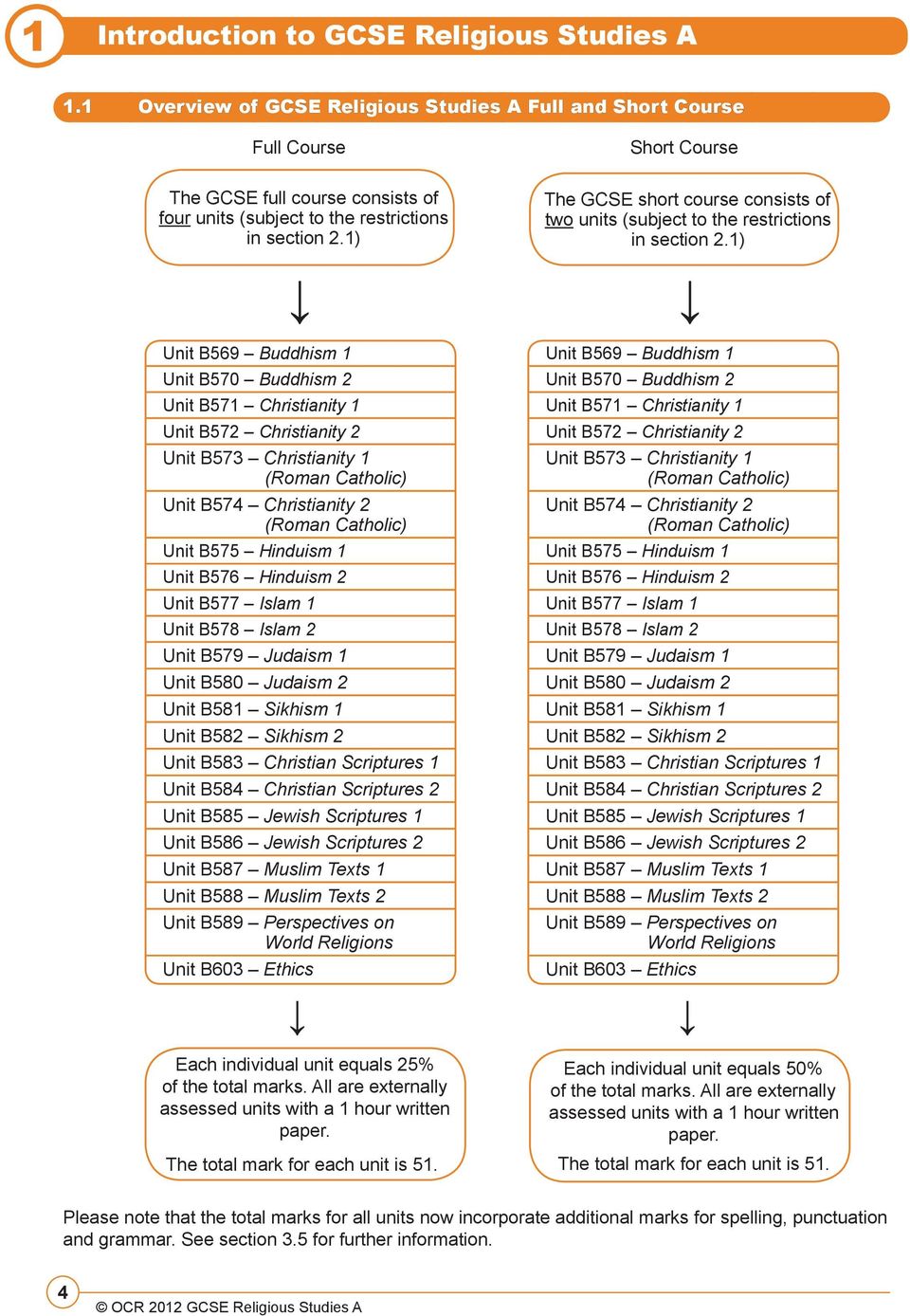
6 1 1. Introduction to GCSE Religious Studies A 1.1 Overview of GCSE Religious Studies A Full and Short Course Full Course The GCSE full course consists of four units (subject to the restrictions in section 2.1) Unit B569 Buddhism 1 Unit B570 Buddhism 2 Unit B571 Christianity 1 1 Unit B572 Christianity 2 Unit B573 Christianity 1 (Roman Catholic) Unit B574 Christianity 2 (Roman Catholic) Unit B575 Hinduism 1 Unit B576 Hinduism 2 Unit B577 Islam 1 Unit B578 Islam 2 Unit B579 Judaism 1 Unit B580 Judaism 2 Unit B581 Sikhism 1 Unit B582 Sikhism 2 Unit B583 Christian Scriptures 1 Unit B584 Christian Scriptures 2 Unit B585 Jewish Scriptures 1 Unit B586 Jewish Scriptures 2 Unit B587 Muslim Texts 1 Unit B588 Muslim Texts 2 Unit B589 Perspectives on World Religions Unit B603 Ethics Each individual unit equals 25% of the total marks. All are externally assessed units with a 1 hour written paper. The total mark for each unit is 51. Short Course The GCSE short course consists of two units (subject to the restrictions in section 2.1) Unit B569 Buddhism 1 Unit B570 Buddhism 2 Unit B571 Christianity 1 1 Unit B572 Christianity 2 Unit B573 Christianity 1 (Roman Catholic) Unit B574 Christianity 2 (Roman Catholic) Unit B575 Hinduism 1 Unit B576 Hinduism 2 Unit B577 Islam 1 Unit B578 Islam 2 Unit B579 Judaism 1 Unit B580 Judaism 2 Unit B581 Sikhism 1 Unit B582 Sikhism 2 Unit B583 Christian Scriptures 1 Unit B584 Christian Scriptures 2 Unit B585 Jewish Scriptures 1 Unit B586 Jewish Scriptures 2 Unit B587 Muslim Texts 1 Unit B588 Muslim Texts 2 Unit B589 Perspectives on World Religions Unit B603 Ethics Each individual unit equals 50% of the total marks. All are externally assessed units with a 1 hour written paper. The total mark for each unit is 51. Please note that the total marks for all units now incorporate additional marks for spelling, punctuation and grammar. See section 3.5 for further information. 4
7 1 1.2 Guided learning hours GCSE Religious Studies A (World Religion(s)) requires guided learning hours in total. GCSE (Short Course) Religious Studies A (World Religion(s)) requires guided learning hours in total. 1.3 Aims and learning outcomes The aims of these specifications are to: encourage candidates to be inspired, moved and changed by following a broad, satisfying and worthwhile course of study challenge and equip candidates to lead constructive lives in the modern world encourage candidates to adopt an enquiring, critical and reflective approach to the study of religion help candidates to explore religions and beliefs, reflect on fundamental questions, engage with them intellectually and respond personally enhance candidates spiritual and moral development, and contribute to their health and well being enhance candidates personal, social and cultural development, their understanding of different cultures locally, nationally and in the wider world and to contribute to social and community cohesion help candidates develop their interest in and enthusiasm for the study of religion, and relate it to the wider world encourage candidates to reflect on and develop their own values, opinions and attitudes in light of their learning. 1.4 Prior learning Candidates entering this course should have achieved a general educational level equivalent to National Curriculum Level 3, or an Entry 3 at Entry Level within the National Qualifications Framework. 5

8 2. Content of GCSE Religious Studies A 2.1 Restrictions If candidates study Christianity they can study one or two other principal religions also, but they are not required to do so. If candidates study Buddhism, Hinduism, Islam, Judaism or Sikhism they can study one other principal religion also but are not required to do so. Candidates entering for unit B571: Christianity 1 may not also enter for unit B573: Christianity 1 (Roman Catholic). Candidates entering for unit B572: Christianity 2 may not also enter for unit B574: Christianity 2 (Roman Catholic). Candidates entering for J120 GCSE (Short Course) Religious Studies A (World Religion(s)) may not enter for both B589 and B603. 6

9 2.2 Unit B569: Buddhism 1 (Beliefs, Special Days, Divisions and Interpretations) Candidates are required to demonstrate knowledge and understanding of and an ability to analyse the topics as aspects of a living faith as it is currently practised. Candidates should be aware of the importance of the content of these topics in supporting and influencing the beliefs and spiritual development of Buddhists. Candidates are expected to be able to consider and evaluate issues related to the topics and the effect of belief and practice on the lives of Buddhists. In this unit candidates should reflect on the idea that religions have different approaches and attitudes and that there is diversity within each faith, its understanding of texts and its philosophy. They should consider these issues in relation to the particular religion itself and to its impact on individuals, communities and societies, locally, nationally and globally whilst realising that these particular aspects may vary in significance between religions and communities. They should also consider the extent to which the particular religion and belief being studied contributes to community cohesion. In the examination, with the exception of the Major Divisions and Interpretations section, candidates may approach the questions from the perspective of one or more groups within Buddhism Core beliefs Candidates should have considered the beliefs of Buddhists in relation to the following: The life of the Buddha The Three Universal Truths (Marks of Existence): Anicca Anatta Dukkha The Four Noble Truths, including tanha and the Noble Eightfold Path The Law of kamma, samsara and rebirth in the six realms The three poisons: Lobha Dosa Moha The goals of enlightenment and nibbana The Three Refuges: Buddha Dhamma Sangha The Five Precepts There should be consideration of the ways in which these beliefs might affect the lifestyles and outlooks of Buddhists in the modern world. 7

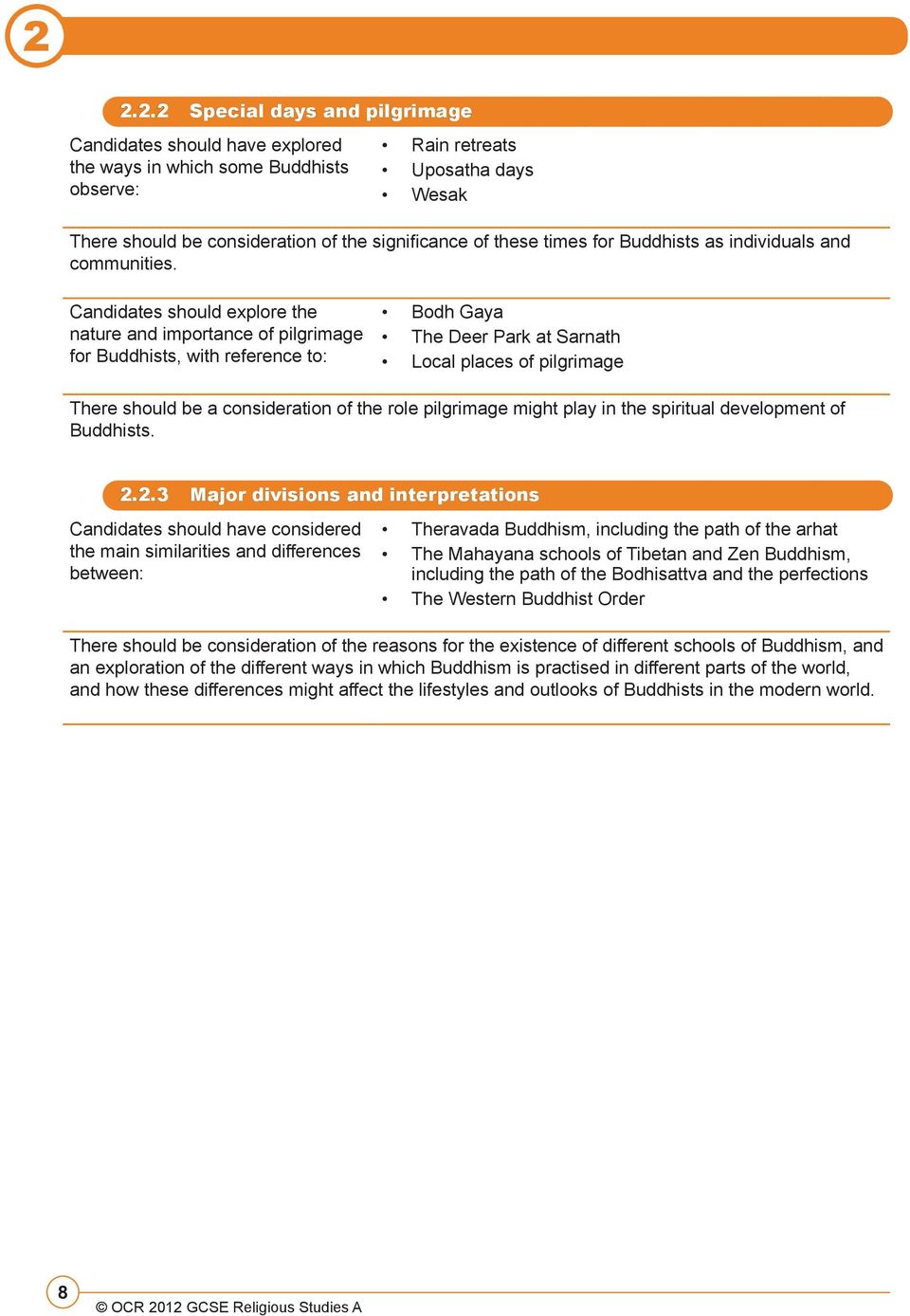
10 2.2.2 Special days and pilgrimage Candidates should have explored the ways in which some Buddhists observe: Rain retreats Uposatha days Wesak There should be consideration of the significance of these times for Buddhists as individuals and communities. Candidates should explore the nature and importance of pilgrimage for Buddhists, with reference to: Bodh Gaya The Deer Park at Sarnath Local places of pilgrimage There should be a consideration of the role pilgrimage might play in the spiritual development of Buddhists Major divisions and interpretations Candidates should have considered the main similarities and differences between: Theravada Buddhism, including the path of the arhat The Mahayana schools of Tibetan and Zen Buddhism, including the path of the Bodhisattva and the perfections The Western Buddhist Order There should be consideration of the reasons for the existence of different schools of Buddhism, and an exploration of the different ways in which Buddhism is practised in different parts of the world, and how these differences might affect the lifestyles and outlooks of Buddhists in the modern world. 8
11 2.3 Unit B570: Buddhism 2 (Worship, Community and Family, Sacred Writings) Candidates are required to demonstrate knowledge and understanding of and an ability to analyse the topics as aspects of a living faith as it is currently practised. Candidates should be aware of the importance of the content of these topics in supporting and influencing the beliefs and spiritual development of Buddhists. Candidates are expected to be able to consider and evaluate issues related to the topics and the effect of belief and practice on the lives of Buddhists. In this unit candidates should reflect on the idea that religions have different approaches and attitudes and that there is diversity within each faith, its understanding of texts and its philosophy. They should consider these issues in relation to the particular religion itself and to its impact on individuals, communities and societies, locally, nationally and globally whilst realising that these particular aspects may vary in significance between religions and communities. They should also consider the extent to which the particular religion and belief being studied contributes to community cohesion. In the examination, candidates may approach the questions from the perspective of one or more groups within Buddhism Places and forms of worship Candidates should have considered the significance for Buddhist places of worship of: Design Symbols Artefacts Rupas Offerings Candidates should have explored the ways in which Buddhists use symbols and artefacts in their worship. There should be a consideration of the ways in which these symbols and artefacts might support and influence the beliefs and attitudes of the worshippers. Candidates should have considered the following: The different ways in which temples, viharas and stupas might be used by the community Public acts of worship Candidates should have considered: The practice of puja in the home Buddhist meditation: Samatha Vipassana Metta bhavana There should be a consideration of the ways in which these practices support and influence the beliefs of Buddhists. 9

12 2.3.2 Religion in the faith community and the family Candidates should have considered the following aspects of Buddhism: The application of Buddhist principles to issues concerning: The family Wealth Employment Work in the community The role of the monastic Sangha and its relationship with the laity Ordination into the monastic Sangha The lifestyle of a bhikkhu and bhikkhuni Beliefs about death and dying and life after death Candidates should have explored the preparation for and ceremony of initiation into the Sangha. There should be consideration of the rites surrounding initiation, the significance of this event for Buddhists, and the ways in which this ceremony reflects Buddhist belief Sacred writings Candidates should have considered: The nature of: The Pali Canon Vinaya Pitaka The Metta Sutta Mahayan sutras The ways in which these texts are used by some Buddhists The importance of these texts for Buddhists The respect shown to the texts by some Buddhists 10

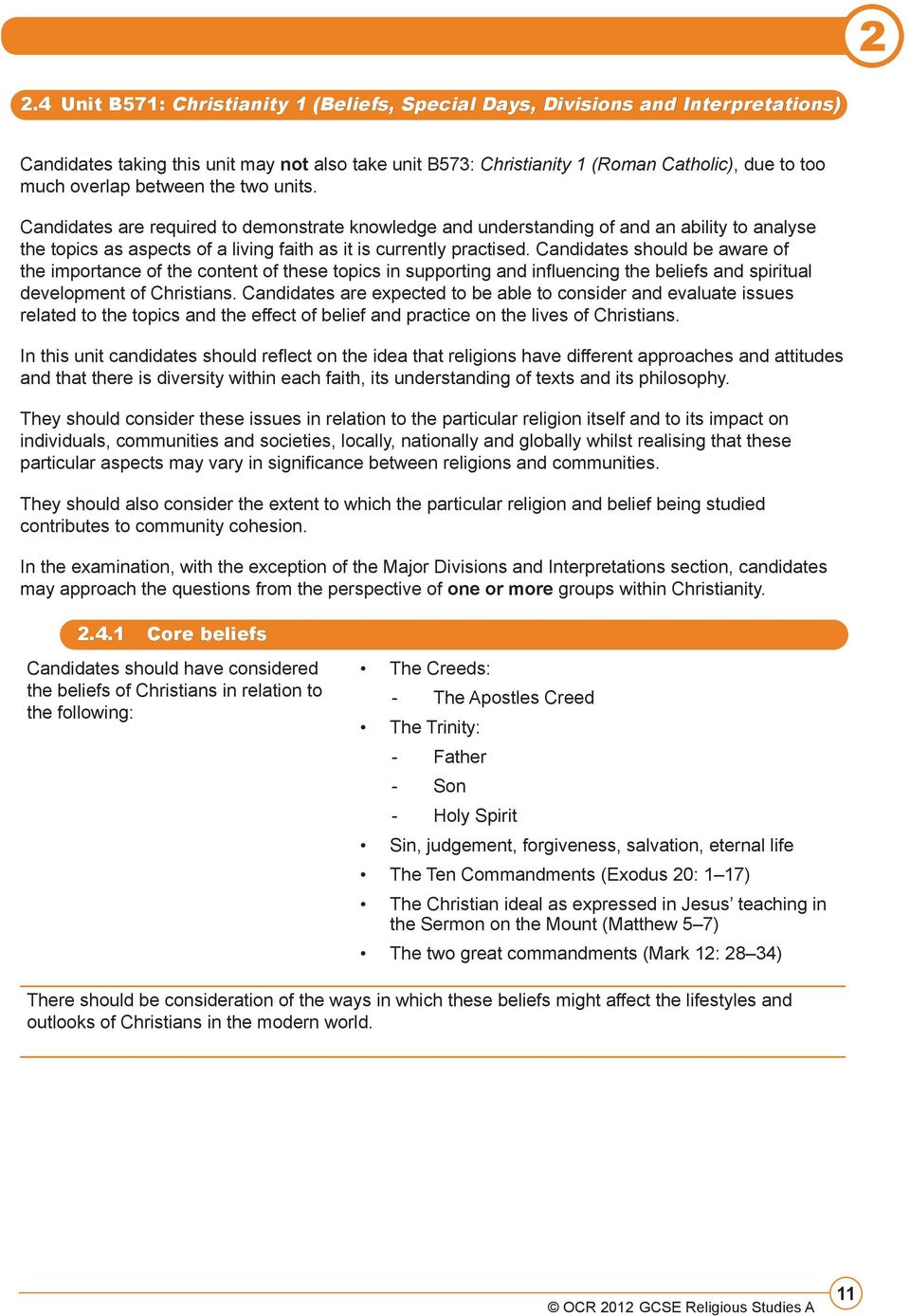
13 2.4 Unit B571: Christianity 1 (Beliefs, Special Days, Divisions and Interpretations) Candidates taking this unit may not also take unit B573: Christianity 1 (Roman Catholic), due to too much overlap between the two units. Candidates are required to demonstrate knowledge and understanding of and an ability to analyse the topics as aspects of a living faith as it is currently practised. Candidates should be aware of the importance of the content of these topics in supporting and influencing the beliefs and spiritual development of Christians. Candidates are expected to be able to consider and evaluate issues related to the topics and the effect of belief and practice on the lives of Christians. In this unit candidates should reflect on the idea that religions have different approaches and attitudes and that there is diversity within each faith, its understanding of texts and its philosophy. They should consider these issues in relation to the particular religion itself and to its impact on individuals, communities and societies, locally, nationally and globally whilst realising that these particular aspects may vary in significance between religions and communities. They should also consider the extent to which the particular religion and belief being studied contributes to community cohesion. In the examination, with the exception of the Major Divisions and Interpretations section, candidates may approach the questions from the perspective of one or more groups within Christianity Core beliefs Candidates should have considered the beliefs of Christians in relation to the following: The Creeds: The Apostles Creed The Trinity: Father Son Holy Spirit Sin, judgement, forgiveness, salvation, eternal life The Ten Commandments (Exodus 20: 1 17) The Christian ideal as expressed in Jesus teaching in the Sermon on the Mount (Matthew 5 7) The two great commandments (Mark 12: 28 34) There should be consideration of the ways in which these beliefs might affect the lifestyles and outlooks of Christians in the modern world. 11
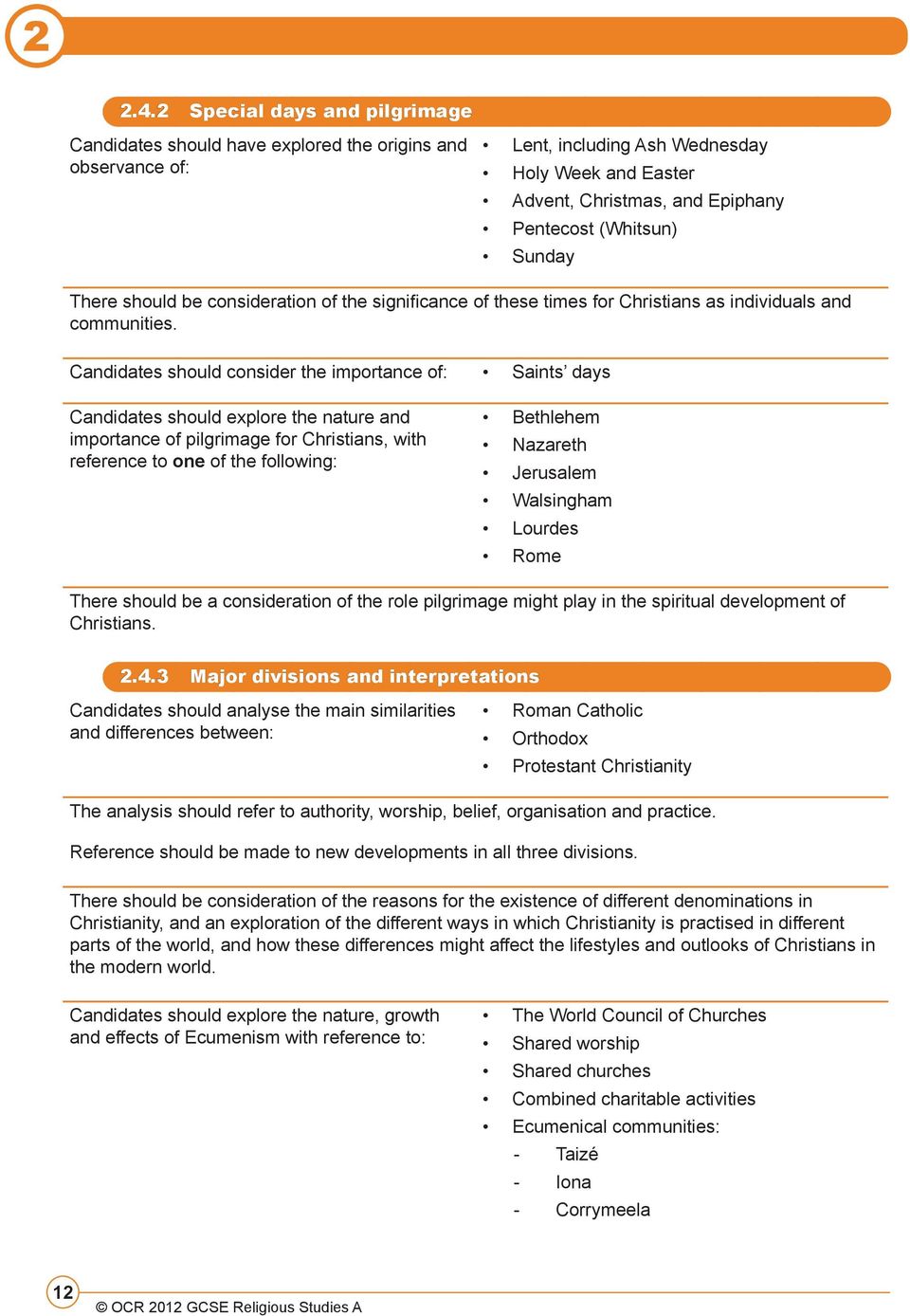
14 2.4.2 Special days and pilgrimage Candidates should have explored the origins and observance of: Lent, including Ash Wednesday Holy Week and Easter Advent, Christmas, and Epiphany Pentecost (Whitsun) Sunday There should be consideration of the significance of these times for Christians as individuals and communities. Candidates should consider the importance of: Saints days Candidates should explore the nature and importance of pilgrimage for Christians, with reference to one of the following: Bethlehem Nazareth Jerusalem Walsingham Lourdes Rome There should be a consideration of the role pilgrimage might play in the spiritual development of Christians Major divisions and interpretations Candidates should analyse the main similarities and differences between: Roman Catholic Orthodox Protestant Christianity The analysis should refer to authority, worship, belief, organisation and practice. Reference should be made to new developments in all three divisions. There should be consideration of the reasons for the existence of different denominations in Christianity, and an exploration of the different ways in which Christianity is practised in different parts of the world, and how these differences might affect the lifestyles and outlooks of Christians in the modern world. Candidates should explore the nature, growth and effects of Ecumenism with reference to: The World Council of Churches Shared worship Shared churches Combined charitable activities Ecumenical communities: Taizé Iona Corrymeela 12
15 2.5 Unit B572: Christianity 2 (Worship, Community and Family, Sacred Writings) Candidates taking this unit may not also take unit B574: Christianity 2 (Roman Catholic), due to too much overlap between the two units. Candidates are required to demonstrate knowledge and understanding of and an ability to analyse the topics as aspects of a living faith as it is currently practised. Candidates should be aware of the importance of the content of these topics in supporting and influencing the beliefs and spiritual development of Christians. Candidates are expected to be able to consider and evaluate the effect of belief and practice on the lives of Christians. In this unit candidates should reflect on the idea that religions have different approaches and attitudes and that there is diversity within each faith, its understanding of texts and its philosophy. They should consider these issues in relation to the particular religion itself and to its impact on individuals, communities and societies, locally, nationally and globally whilst realising that these particular aspects may vary in significance between religions and communities. They should also consider the extent to which the particular religion and belief being studied contributes to community cohesion. In the examination, candidates may approach the questions from the perspective of one or more groups within Christianity Places and forms of worship Candidates should have considered the significance for Christian places of worship of: Design Symbols Artefacts and features including: Altar or Communion Table Font Baptistery Pulpit Lectern Stations of the Cross Iconostasis Candidates should have explored the ways in which Christians use symbols and artefacts in their worship. There should be a consideration of the ways in which these symbols and artefacts might support and influence the beliefs and attitudes of the worshippers. Candidates should have considered the following: The different ways in which the place of worship might be used by the community Public acts of worship: Eucharist/Holy Communion Sunday services Prayer Private acts of worship: Worship at home Prayer The role and significance of religious leaders in worship 13

16 2.5.2 Religion in the faith community and the family Candidates should have considered the following aspects of Christianity: Rituals and how they reflect Christian belief: Baptism/dedication of an infant Believer s baptism/confirmation The marriage ceremony Funeral rites Nurture of the young and the role of the family Christian teaching about charity and concern for others. Candidates should study one of: Christian Aid CAFOD TEAR Fund The role and significance of religious communities to their members and the wider community Sacred writings Candidates should have considered: The nature of the Bible: Old and New Testaments The variety of literature within the Bible The Bible as a collection of 66 or more books compiled over a period of time Reasons for inclusion/exclusion of the Apocrypha The importance of the Bible for Christians Use of the Bible in public and private worship 14

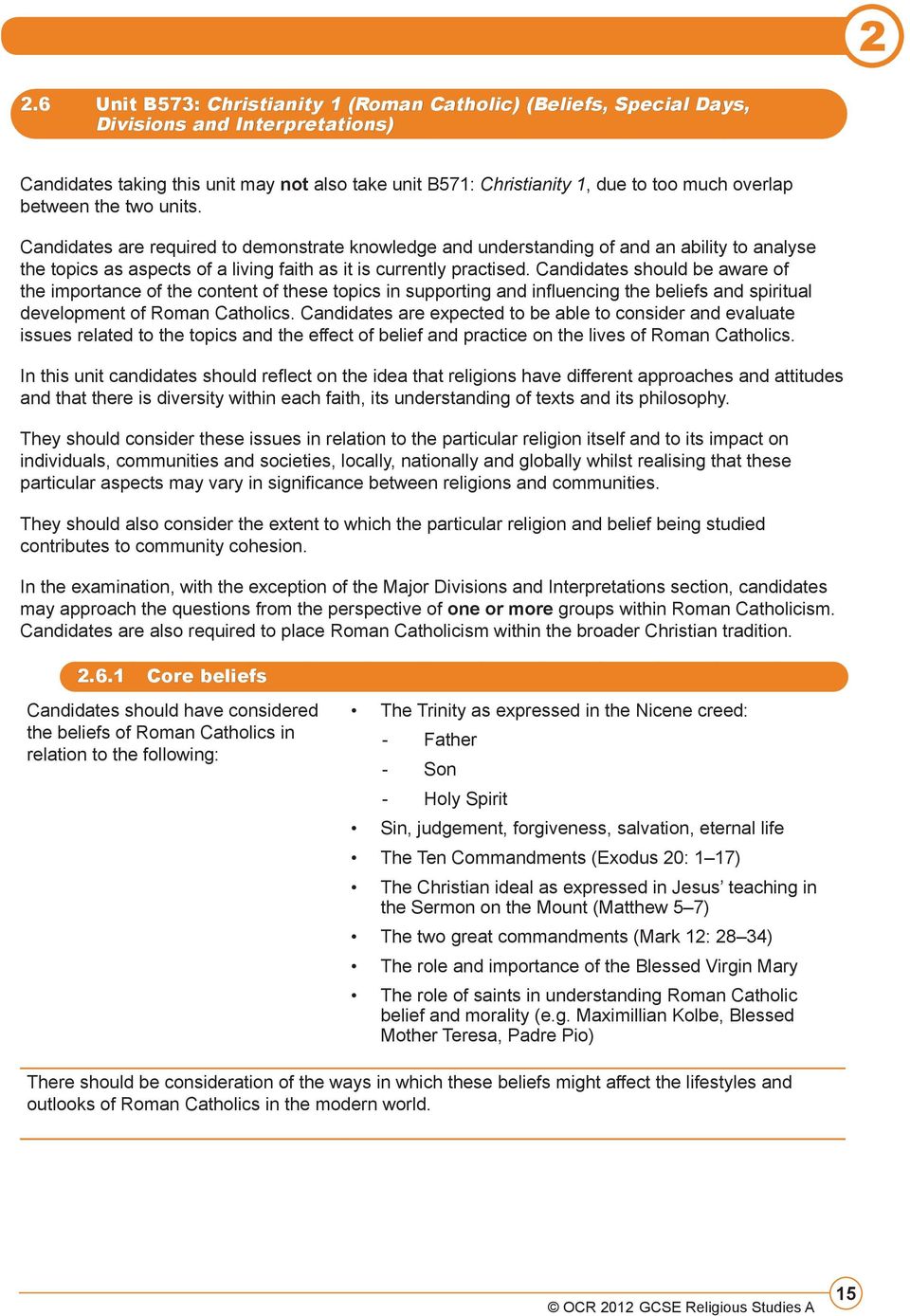
17 2.6 Unit B573: Christianity 1 (Roman Catholic) (Beliefs, Special Days, Divisions and Interpretations) Candidates taking this unit may not also take unit B571: Christianity 1, due to too much overlap between the two units. Candidates are required to demonstrate knowledge and understanding of and an ability to analyse the topics as aspects of a living faith as it is currently practised. Candidates should be aware of the importance of the content of these topics in supporting and influencing the beliefs and spiritual development of Roman Catholics. Candidates are expected to be able to consider and evaluate issues related to the topics and the effect of belief and practice on the lives of Roman Catholics. In this unit candidates should reflect on the idea that religions have different approaches and attitudes and that there is diversity within each faith, its understanding of texts and its philosophy. They should consider these issues in relation to the particular religion itself and to its impact on individuals, communities and societies, locally, nationally and globally whilst realising that these particular aspects may vary in significance between religions and communities. They should also consider the extent to which the particular religion and belief being studied contributes to community cohesion. In the examination, with the exception of the Major Divisions and Interpretations section, candidates may approach the questions from the perspective of one or more groups within Roman Catholicism. Candidates are also required to place Roman Catholicism within the broader Christian tradition Core beliefs Candidates should have considered the beliefs of Roman Catholics in relation to the following: The Trinity as expressed in the Nicene creed: Father Son Holy Spirit Sin, judgement, forgiveness, salvation, eternal life The Ten Commandments (Exodus 20: 1 17) The Christian ideal as expressed in Jesus teaching in the Sermon on the Mount (Matthew 5 7) The two great commandments (Mark 12: 28 34) The role and importance of the Blessed Virgin Mary The role of saints in understanding Roman Catholic belief and morality (e.g. Maximillian Kolbe, Blessed Mother Teresa, Padre Pio) There should be consideration of the ways in which these beliefs might affect the lifestyles and outlooks of Roman Catholics in the modern world. 15
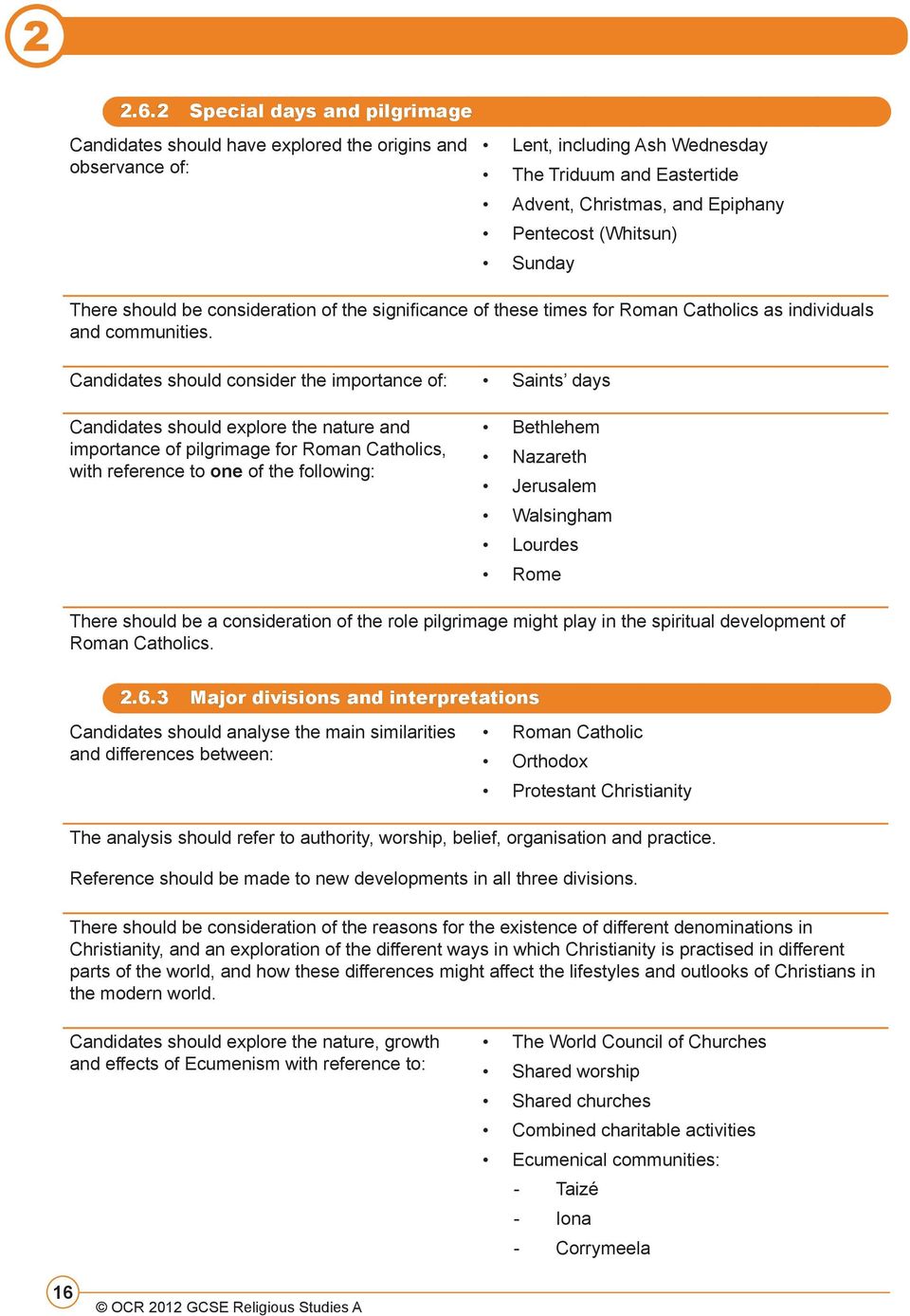
18 2.6.2 Special days and pilgrimage Candidates should have explored the origins and observance of: Lent, including Ash Wednesday The Triduum and Eastertide Advent, Christmas, and Epiphany Pentecost (Whitsun) Sunday There should be consideration of the significance of these times for Roman Catholics as individuals and communities. Candidates should consider the importance of: Saints days Candidates should explore the nature and importance of pilgrimage for Roman Catholics, with reference to one of the following: Bethlehem Nazareth Jerusalem Walsingham Lourdes Rome There should be a consideration of the role pilgrimage might play in the spiritual development of Roman Catholics Major divisions and interpretations Candidates should analyse the main similarities and differences between: Roman Catholic Orthodox Protestant Christianity The analysis should refer to authority, worship, belief, organisation and practice. Reference should be made to new developments in all three divisions. There should be consideration of the reasons for the existence of different denominations in Christianity, and an exploration of the different ways in which Christianity is practised in different parts of the world, and how these differences might affect the lifestyles and outlooks of Christians in the modern world. Candidates should explore the nature, growth and effects of Ecumenism with reference to: The World Council of Churches Shared worship Shared churches Combined charitable activities Ecumenical communities: Taizé Iona Corrymeela 16
19 2.7 Unit B574: Christianity 2 (Roman Catholic) (Worship, Community and Family, Sacred Writings) Candidates taking this unit may not also take unit B572: Christianity 2, due to too much overlap between the two units. Candidates are required to demonstrate knowledge and understanding of and an ability to analyse the topics as aspects of a living faith as it is currently practised. Candidates should be aware of the importance of the content of these topics in supporting and influencing the beliefs and spiritual development of Roman Catholics. Candidates are expected to be able to consider and evaluate issues related to the topics and the effect of belief and practice on the lives of Roman Catholics. In this unit candidates should reflect on the idea that religions have different approaches and attitudes and that there is diversity within each faith, its understanding of texts and its philosophy. They should consider these issues in relation to the particular religion itself and to its impact on individuals, communities and societies, locally, nationally and globally whilst realising that these particular aspects may vary in significance between religions and communities. They should also consider the extent to which the particular religion and belief being studied contributes to community cohesion. In the examination, candidates may approach the questions from the perspective of one or more groups within Roman Catholicism. Candidates are also required to place Roman Catholicism within the broader Christian tradition Places and forms of worship Candidates should have considered the significance for Roman Catholic places of worship of: Design Symbols Artefacts and features including: Altar Baptismal font Pulpit Lectern/pulpit Sanctuary Tabernacle Confessional Crucifix Stations of the Cross Candidates should have explored the ways in which Roman Catholics use symbols and artefacts in their worship. There should be a consideration of the ways in which these symbols and artefacts might support and influence the beliefs and attitudes of the worshippers. 17

20 Candidates should have considered the following: The different ways in which the church building may be used by the community Public acts of worship: The Mass Benediction Prayer The rosary Private acts of worship: Family prayers Individual prayers Bible reading Meditation The rosary Sacramental worship: Holy Communion Baptism Confirmation Marriage Reconciliation Ordination Anointing of the sick The role and significance of the clergy and laity in worship Religion in the faith community and the family Candidates should have considered the following aspects of Roman Catholicism: Rituals and how they reflect Roman Catholic belief: Baptism and confirmation Rite of Christian initiation for adults The marriage ceremony Funeral rites Nurture of the young and the role of the family Roman Catholic teaching about charity and concern for others (Luke 3: 11, James 2: 14 17, Encyclicals) The role, significance and charisms of religious communities to their members and the wider community, e.g. Franciscans, Dominicans, Jesuits 18

21 2.7.3 Sacred writings Candidates should have considered: The nature of the Bible: Old and New Testament The variety of literature within the Bible - - The Bible as a collection of 72 books compiled over a period of time - - Reasons for inclusion of the Apocrypha The importance of the Bible for Roman Catholics Use of the Bible in public and private worship 19
22 2.8 Unit B575: Hinduism 1 (Beliefs, Special Days, Divisions and Interpretations) Candidates are required to demonstrate knowledge and understanding of and an ability to analyse the topics as aspects of a living faith as it is currently practised. Candidates should be aware of the importance of the content of these topics in supporting and influencing the beliefs and spiritual development of Hindus. Candidates are expected to be able to consider and evaluate issues related to the topics and the effect of belief and practice on the lives of Hindus. In this unit candidates should reflect on the idea that religions have different approaches and attitudes and that there is diversity within each faith, its understanding of texts and its philosophy. They should consider these issues in relation to the particular religion itself and to its impact on individuals, communities and societies, locally, nationally and globally whilst realising that these particular aspects may vary in significance between religions and communities. They should also consider the extent to which the particular religion and belief being studied contributes to community cohesion. In the examination, with the exception of the Major Divisions and Interpretations section, candidates may approach the questions from the perspective of one or more groups within Hinduism Core beliefs Candidates should have considered the beliefs of Hindus in relation to the following: Religions pluralism: God as the ultimate reality manifesting as the universe (Brahman) and as mankind (Atman) God as a super personality Individual deities (gods and goddesses): Brahma Vishnu Shiva Shakti (Parvati, Saraswati, Lakshmi and Durga) Ganesha (Ganesh) Hanuman Avatar (Rama and Krishna) Beliefs: Samsara Karma Maya Moksha Dharma, including varnashrama Ahimsa Atman There should be consideration of the ways in which these beliefs might affect the lifestyles and outlooks of Hindus in the modern world. 20
23 2.8.2 Special days and pilgrimage Candidates should have explored the origins and observance of: Durgapuja (Navaratri) and Dassehra Divali Holi There should be consideration of the significance of these times for Hindus as individuals and communities. Candidates should explore the nature and importance of pilgrimage for Hindus, with reference to: Varanasi The river Ganges Other well-known holy places or rivers There should be a consideration of the role pilgrimage might play in the spiritual development of Hindus Major divisions and interpretations Candidates should have considered the main similarities and differences between: Shaivism (devotion to Shiva) Vaishnavism (devotion to Vishnu) Shaktism (devotion to the Goddess) There should be consideration of the reasons for the existence of different groups in Hinduism, and an exploration of the different ways in which Hinduism is practised in different parts of the world, and how these differences might affect the lifestyles and outlooks of Hindus in the modern world. 21
24 2.9 Unit B576: Hinduism 2 (Beliefs, Special Days, Divisions and Interpretations) Candidates are required to demonstrate knowledge and understanding of and an ability to analyse the topics as aspects of a living faith as it is currently practised. Candidates should be aware of the importance of the content of these topics in supporting and influencing the beliefs and spiritual development of Hindus. Candidates are expected to be able to consider and evaluate issues related to the topics and the effect of belief and practice on the lives of Hindus. In this unit candidates should reflect on the idea that religions have different approaches and attitudes and that there is diversity within each faith, its understanding of texts and its philosophy. They should consider these issues in relation to the particular religion itself and to its impact on individuals, communities and societies, locally, nationally and globally whilst realising that these particular aspects may vary in significance between religions and communities. They should also consider the extent to which the particular religion and belief being studied contributes to community cohesion. In the examination, candidates may approach the questions from the perspective of one or more groups within Hinduism Places and forms of worship Candidates should have considered the significance for Hindu places of worship of: Design Symbols Artefacts and features including: Hall Dome Ritual objects Murti Candidates should have explored the ways in which Hindus use symbols and artefacts in their worship. There should be a consideration of the ways in which these symbols and artefacts might support and influence the beliefs and attitudes of the worshippers. Candidates should have considered the following: The different ways in which a mandir might be used by the community Public acts of worship: Puja Arti Prayer Meditation Private acts of worship: Worship in the home Puja Arti Prayer Meditation The roles of the priest in the mandir and in the Hindu community 22
25 2.9.2 Religion in the faith community and the family Candidates should have considered the following aspects of Hinduism: The meaning and application of: Dharma Karma Varnashrama Samskaras and how they reflect Hindu belief: Birth rites Mundan Upanayana The marriage ceremony Funeral rites Nurture of the young and the role of the family Hindu teaching about charity and concern for others The role and significance of religious communities to their members and the wider community Sacred writings Candidates should have considered: The nature of the Vedas (Samhitas) and Upanishads The nature of the Mahabharata (including the Bhagavad Gita) The nature of the Ramayana The ways in which sacred writings might be used by Hindus The special status of the Vedas as sruti The status of the Mahabharata and Ramayana as smriti 23
26 2.10 Unit B577: Islam 1 (Beliefs, Special Days, Divisions and Interpretations) Candidates are required to demonstrate knowledge and understanding of and an ability to analyse the topics as aspects of a living faith as it is currently practised. Candidates should be aware of the importance of the content of these topics in supporting and influencing the beliefs and spiritual development of Muslims. Candidates are expected to be able to consider and evaluate issues related to the topics and the effect of belief and practice on the lives of Muslims. In this unit candidates should reflect on the idea that religions have different approaches and attitudes and that there is diversity within each faith, its understanding of texts and its philosophy. They should consider these issues in relation to the particular religion itself and to its impact on individuals, communities and societies, locally, nationally and globally whilst realising that these particular aspects may vary in significance between religions and communities. They should also consider the extent to which the particular religion and belief being studied contributes to community cohesion. In the examination, with the exception of the Major Divisions and Interpretations section, candidates may approach the questions from the perspective of one or more groups within Islam Core beliefs Candidates should have considered the beliefs of Muslims in relation to the following: Allah, One compassionate creator God The Day of Judgement and life after death The life and teaching of Muhammad Birth and early life Revelation at the age of 40 The Hijrah Return to Makkah and the establishment of Islam The practice of the Five Pillars: Shahadah Salah Sawm Hajj Zakah Greater and lesser Jihad There should be consideration of the ways in which these beliefs might affect the lifestyles and outlooks of Muslims in the modern world. 24
27 Special days and pilgrimage Candidates should have explored the origins and observance of: Ramadan Id-ul-Fitr Id-ul-Adha Salat-ul-Jumu ah Mawlid an-nabi There should be consideration of the significance of theses times for Muslims as individuals and communities. Candidates should explore the nature and importance of pilgrimage for Muslims, with reference to: The customs and significance of Hajj There should be a consideration of the role pilgrimage might play in the spiritual development of Muslims Major divisions and interpretations Candidates should analyse the main similarities and differences between: Sunni Shi a Sufi The analysis should refer to authority, worship, belief, organisation and practice. There should be consideration of the reasons for the existence of different groups in Islam, and an exploration of the different ways in which Islam is practised in different parts of the world (the UK, Muslim states and secular Muslim states), and how these differences might affect the lifestyles and outlooks of Muslims in the modern world. 25
28 2.11 Unit B578: Islam 2 (Beliefs, Special Days, Divisions and Interpretations) Candidates are required to demonstrate knowledge and understanding of and an ability to analyse the topics as aspects of a living faith as it is currently practised. Candidates should be aware of the importance of the content of these topics in supporting and influencing the beliefs and spiritual development of Muslims. Candidates are expected to be able to consider and evaluate issues related to the topics and the effect of belief and practice on the lives of Muslims. In this unit candidates should reflect on the idea that religions have different approaches and attitudes and that there is diversity within each faith, its understanding of texts and its philosophy. They should consider these issues in relation to the particular religion itself and to its impact on individuals, communities and societies, locally, nationally and globally whilst realising that these particular aspects may vary in significance between religions and communities. They should also consider the extent to which the particular religion and belief being studied contribute to community cohesion. In the examination, candidates may approach the questions from the perspective of one or more groups within Islam Places and forms of worship Candidates should have considered the significance for Muslim places of worship of: Design The absence of representations of Allah or Muhammad Artefacts and features including: Minaret Dome Mihrab Qiblah Minbar Calligraphy Candidates should have explored the ways in which Muslims use features and artefacts in their worship. There should be a consideration of the ways in which these features and artefacts might support and influence the beliefs and attitudes of the worshippers. Candidates should have considered the following: The different ways in which the mosque is used by the community Public acts of worship: Salah Jumu ah Private acts of worship: Salah Du a The role and significance of religious leaders in worship 26
29 Religion in the faith community and the family Candidates should have considered the following aspects of Islam: Rituals and how they reflect Muslim belief: Birth rites The marriage ceremony Funeral rites Nurture of the young and the role of the family Zakah The role and significance of religious communities to their members and the wider community Sacred writings Candidates should have considered: The nature of the Qur an and Sunnah (Ahadith) The origins of the Qur an An outline of the contents of the Qur an and Sunnah The importance of sacred writings for Muslims Use of sacred writings in public and private worship The respect shown towards sacred writings 27
30 2.12 Unit B579: Judaism 1 (Beliefs, Special Days, Divisions and Interpretations) Candidates are required to demonstrate knowledge and understanding of and an ability to analyse the topics as aspects of a living faith as it is currently practised. Candidates should be aware of the importance of the content of these topics in supporting and influencing the beliefs and spiritual development of Jews. Candidates are expected to be able to consider and evaluate the issues related to the topics and the effect of belief and practice on the lives of Jews. In this unit candidates should reflect on the idea that religions have different approaches and attitudes and that there is diversity within each faith, its understanding of texts and its philosophy. They should consider these issues in relation to the particular religion itself and to its impact on individuals, communities and societies, locally, nationally and globally whilst realising that these particular aspects may vary in significance between religions and communities. They should also consider the extent to which the particular religion and belief being studied contributes to community cohesion. In the examination, with the exception of the Major Divisions and Interpretations section, candidates may approach the questions from the perspective of one or more groups within Judaism Core beliefs Candidates should have considered the beliefs of Jews in relation to the following: The nature of G-d Messiah and the Messianic Age The meaning and understanding of covenant Covenants with Abraham Covenant with Moses The Law and the mitzvot Beliefs about life after death There should be consideration of the ways in which these beliefs might affect the lifestyles and outlooks of Jews in the modern world Special days and pilgrimage Candidates should have explored the origins and observance of: Shabbat Rosh Hashanah Yom Kippur The pilgrim festivals: Pesach Shavuot Sukkot There should be consideration of the significance of these times for Jews as individuals and communities. Candidates should explore the nature and importance of pilgrimage for Jews. There should be a consideration of the role pilgrimage might play in the spiritual development of Jews. 28
31 Major divisions and interpretations Candidates should have a knowledge and understanding of the following: Hasidic Orthodox Reform Liberal/progressive Candidates should refer to the similarities and differences in authority, worship, belief, organisation and practice. There should be consideration of the reasons for the existence of different groups in Judaism, and an exploration of the different ways in which Judaism is practised in different parts of the world, and how these differences might affect the lifestyles and outlooks of Jews in the modern world. Candidates should have a knowledge and understanding of the following: Zionism The land and State of Israel Twentieth century Holocaust/Shoah 29
32 2.13 Unit B580: Judaism 2 (Beliefs, Special Days, Divisions and Interpretations) Candidates are required to demonstrate knowledge and understanding of and an ability to analyse the topics as aspects of a living faith as it is currently practised. Candidates should be aware of the importance of the content of these topics in supporting and influencing the beliefs and spiritual development of Jews. Candidates are expected to be able to consider and evaluate issues related to the topics and the effect of belief and practice on the lives of Jews. In this unit candidates should reflect on the idea that religions have different approaches and attitudes and that there is diversity within each faith, its understanding of texts and its philosophy. They should consider these issues in relation to the particular religion itself and to its impact on individuals, communities and societies, locally, nationally and globally whilst realising that these particular aspects may vary in significance between religions and communities. They should also consider the extent to which the particular religion and belief being studied contributes to community cohesion. In the examination, candidates may approach the questions from the perspective of one or more groups within Judaism Places and forms of worship Candidates should have considered the significance for Jewish places of worship of: Design Symbols Artefacts and features including: Ner Tamid Aron Hakodesh Bimah Sefer Torah and their ornaments The absence of any representations of G-d Mikveh Candidates should have explored the ways in which Jews use symbols and artefacts in their worship. There should be a consideration of the ways in which these symbols and artefacts might support and influence the beliefs and attitudes of the worshippers. Candidates should have considered the following: The different ways in which the synagogue is used by the community Public acts of worship: Synagogue services Private acts of worship: Worship at home Prayer Ritual dress: Kippah Tallit Tefillin Kittel Clothing customs relevant to certain groups or festivals The role and significance of the rabbi, chazan and congregation in worship 30
33 Religion in the faith community and the family Candidates should have considered the following aspects of Judaism: Rituals and how they reflect Jewish belief: Brit Milah Bar Mitzvah Bat Mitzvah Kiddushin Funeral rites Kashrut: Food Objects Clothing Jewish teaching about charity and concern for others The role and significance of religious communities to their members and the wider community Sacred writings Candidates should have considered: The nature of the Tenakh: Torah Nevi im Ketuvim The nature of the Talmud The importance of the Tenakh for Jews The importance of the Talmud for Jews Use of the Tenakh in public and private worship Use of the Talmud in public and private worship The respect shown towards the Tenakh The respect shown towards the Talmud 31
34 2.14 Unit B581: Sikhism 1 (Beliefs, Special Days, Divisions and Interpretations) Candidates are required to demonstrate knowledge and understanding of and an ability to analyse the topics as aspects of a living faith as it is currently practised. Candidates should be aware of the importance of the content of these topics in supporting and influencing the beliefs and spiritual development of Sikhs. Candidates are expected to be able to consider and evaluate issues related to the topics and the effect of belief and practice on the lives of Sikhs. In this unit candidates should reflect on the idea that religions have different approaches and attitudes and that there is diversity within each faith, its understanding of texts and its philosophy. They should consider these issues in relation to the particular religion itself and to its impact on individuals, communities and societies, locally, nationally and globally whilst realising that these particular aspects may vary in significance between religions and communities. They should also consider the extent to which the particular religion and belief being studied contributes to community cohesion. In the examination, with the exception of the Major Divisions and Interpretations section, candidates may approach the questions from the perspective of one or more groups within Sikhism Core beliefs Candidates should have considered the beliefs of Sikhs in relation to the following: Ik Onkar, one God (Waheguru, Wonderful Guru ) Human life as the opportunity to unite with God The practice of qualities/virtues: Daya Nimarta Prem The balance of Nam with Sewa The concept of Nam japo, kirat karna, vand chhakna The lives of the Ten Gurus, especially: Guru Nanak Dev Ji Guru Arjan Dev Ji Guru Tegh Bahadur Ji Guru Gobind Singh Ji The Five Ks: Kara Kesh Kangha Kirpan Kachera Khalsa There should be consideration of the ways in which these beliefs might affect the lifestyles and outlooks of Sikhs in the modern world. 32
35 Special days and pilgrimage Candidates should have explored the ways in which some Sikhs observe: Gurpurbs, especially the birthdays of: Guru Nanak Dev Ji Guru Gobind Singh Ji The martyrdoms of: Guru Arjan Guru Tegh Bahadur Ji Baisakhi/Vaisakhi Hola Mohalla Divali There should be consideration of the significance of these times for Sikhs as individuals and communities. Candidates should explore the place of yatra in Sikh tradition with reference to: Harmandir Sahib in Amritsar (Golden Temple) There should be a consideration of the idea of yatra in Sikh teachings about spiritual development and the role it plays in helping to educate Sikhs about their tradition Major divisions and interpretations Candidates should have considered: The ways in which the Sikh Rahit Maryada is generally accepted to lay the basic foundations for Sikh belief and practice for all Sikh individuals and groups The ways in which Sikhs social and cultural practice might be affected by jat/zat The divergent views on whether or not there is a continuing line of Gurus 33
36 2.15 Unit B582: Sikhism 2 (Worship, Community and Family, Sacred Writings) Candidates are required to demonstrate knowledge and understanding of and an ability to analyse the topics as aspects of a living faith as it is currently practised. Candidates should be aware of the importance of the content of these topics in supporting and influencing the beliefs and spiritual development of Sikhs. Candidates are expected to be able to consider and evaluate issues related to the topics and the effect of belief and practice on the lives of Sikhs. In this unit candidates should reflect on the idea that religions have different approaches and attitudes and that there is diversity within each faith, its understanding of texts and its philosophy. They should consider these issues in relation to the particular religion itself and to its impact on individuals, communities and societies, locally, nationally and globally whilst realising that these particular aspects may vary in significance between religions and communities. They should also consider the extent to which the particular religion and belief being studied contributes to community cohesion. In the examination, candidates may approach the questions from the perspective of one or more groups within Sikhism Places and forms of worship Candidates should have considered the significance for Sikh places of worship of: Design and layout (prayer hall and langar hall) Centrality of Guru Granth Sahib Ji and features reflecting its status (palki, chanani, chanri) Key symbols (Ik Onkar, the khanda which appears on the nishan sahib) The preparation and serving of karah parshad and langar The roles of the granthi and ragis Candidates should have explored how the main features of the gurdwara might support and influence the beliefs and attitudes of the worshippers. Candidates must also explore langar as an act of ethical commitment. Candidates should have considered the role of the gurdwara in the spiritual development of Sikhs through offering an opportunity to: Candidates should also consider the significance of personal devotion through: Contemplate on the teachings of Guru Granth Sahib Ji through: Nam simran Paath Kirtan Worship collectively as part of the Sangat Practise sewa Nam simran Daily prayers Kirat and sewa as a form of worship 34
37 Religion in the faith community and the family Candidates should have considered the significance of key religious ceremonies in the life of a Sikh family: Consideration should also be given to the Sikh outlook and practices regarding: Birth and the naming ceremony Amrit Sanchar Anand karaj Funeral rites The nurture of the young The role of the family life in spiritual development The link of family customs to Sikh spiritual teachings and wider cultural and social practices amongst Sikhs, including similarities and differences Sacred writings Candidates should have considered: The nature and the importance of the Guru Granth Sahib Ji The Guru Granth Sahib Ji as a living guru The content of the Guru Granth Sahib Ji including: Compositions of the Gurus Compositions of the Bhagats The basic meaning of the opening prayer of the Guru Granth Sahib Ji, Mul Mantra A basic interpretation of the logo, Ik Onkar The role of the Dasam Granth in public and private worship 35
38 2.16 Unit B583: Christian Scriptures 1 (Mark) Candidates should be aware of the significance of the events in the life of Jesus for the development of Christianity and beliefs about the nature of God. Candidates should be aware of the particular emphasis and interpretation which Mark brings to his writings and the influence this might have on Christian thought and belief. Questions may be based on any of the themes or combination of the themes set out below. Candidates should have an understanding of the triune God of Christianity. They should be aware of Christian teaching about God the Father and the work of the Holy Spirit, both in the life of Jesus as depicted in Mark s Gospel and in the church today. In this unit candidates should reflect on the idea that religions have different approaches and attitudes and that there is diversity within each faith, its understanding of texts and its philosophy. They should consider these issues in relation to the particular religion itself and its impact on individuals, communities and societies, locally, nationally and globally whilst realising that these particular aspects may vary in significance between religions and communities. They should also consider the extent to which the particular religion and belief being studied contributes to community cohesion Life of Jesus through a study of Mark Jesus as Messiah John the Baptist prepares the way (Mark 1: 1 8) The baptism and temptation of Jesus (Mark 1: 9 11) The transfiguration of Jesus (Mark 9: 2 8) The triumphal entry into Jerusalem (Mark 11: 1 11) Jesus anointed at Bethany (Mark 14: 1 10) Death and resurrection Jesus arrested (Mark 14: 43 51) The Jewish trial before the Sanhedrin (Mark 14: 53 65) The Roman trial before Pilate (Mark 15: 1 15) The Crucifixion (Mark 15: 21 41) The burial of Jesus (Mark 15: 42 47) The Resurrection (Mark 16: 1 8) Candidates should be aware of the way in which the events of the life of Jesus are celebrated by Christians in festivals and the significance of the rite of baptism. Candidates should be aware that belief in Jesus as the Messiah is a central Christian belief and be able to understand the significance of events such as the Transfiguration, Crucifixion and Resurrection in influencing that belief. The Lord s Supper/Eucharist Institution of the Lord s Supper/Eucharist and centrality to Christian worship (Mark 14: 12 26) 36
39 Candidates should be aware of the religious significance of The Lord s Supper/Eucharist and of its centrality to Christian worship. Jesus as miracle worker: Nature miracles Jesus calms the storm (Mark 4: 35 41) Jesus feeds the five thousand (5000) (Mark 6: 30 44) Jesus walks on the water (Mark 6: 45 52) Healings and exorcisms Jesus drives out an evil spirit (Mark 1: 21 28) Jesus heals a paralytic (paralysed man) (Mark 2: 1 12) A dead girl and a sick woman (Mark 5: 21 43) The healing of a demon-possessed man (Legion) (Mark 5: 1 20) The faith of a Syrophoenecian woman (Mark 7: 24 30) The healing of a boy with an evil spirit (Mark 9: 14 29) Candidates should demonstrate understanding of the importance of the miracles of Jesus during his ministry and for Christians today. Jesus in conflict with authority Lord of the Sabbath (Mark 2: 23 28) The man with the withered (shrivelled) hand (Mark 3: 1 6) Clean and unclean (Jesus answers criticism by the Pharisees) (Mark 7: 1 23) Candidates should be aware of how Mark, in his writing of the gospel, shows the growing tension between Jesus and his opponents, mainly the religious authorities. Jesus was also disappointing the hopes of some who expected him to be a nationalist, rebellious leader. Candidates should understand how Mark s account shows the growing tensions in Jesus ministry as he deals with weakness in faith from his followers, as shown in events from other sections of the study (e.g. Calming the storm (Mark 4: 35 41), the Transfiguration (Mark 9: 2 8), the healing of a boy with an evil spirit (Mark 9: 14 29), the arrest of Jesus (Mark 14: 43 51)). Candidates should be able to recognise the significance of the different types of tensions or conflicts which might arise in the lives of religious believers today and how Christians might reflect on the teachings and actions of Jesus in their own attitudes and actions. 37
40 2.17 Unit B584: Christian Scriptures 2 (Luke) Candidates should be aware of the significance of the teachings and actions of Jesus for the development of Christianity and beliefs about the nature of God. Candidates should be aware of the influence of the particular emphasis and interpretation that Luke brings to his writings. Questions may be based on any of the themes or combination of the themes set out below. The following themes, as presented and interpreted in Luke s Gospel, and their modern day application for Christians, should be explored. In this unit candidates should reflect on the idea that religions have different approaches and attitudes and that there is diversity within each faith, its understanding of texts and its philosophy. They should consider these issues in relation to the particular religion itself and its impact on individuals, communities and societies, locally, nationally and globally whilst realising that these particular aspects may vary in significance between religions and communities. They should also consider the extent to which the particular religion and belief being studied contributes to community cohesion Teachings of Jesus through a study of Luke Jesus as Messiah: Lord The birth of Jesus and the visit of the shepherds (Luke 2: 1 20) Presentation in the Temple: Simeon s declaration in the Temple (Luke 2: 21 35) The boy Jesus at the Temple (Luke 2: 41 52) Candidates should have an understanding of the triune God of Christianity. They should be aware of Jesus teaching about God the Father and the work of the Holy Spirit, both in the life of Jesus and in the Church today. The nature of God Jesus teaching on prayer (Luke 11: 1 13) The parables of the lost sheep and the lost coin (Luke 15: 1 10) The parable of the lost son (Luke 15: 11 32) The Kingdom of God The parable of the sower (Luke 8: 1 15) The parable of the great banquet (Luke 14: 15 24) The lamp of the body (Luke 11: 33 36) The narrow door (Luke 13: 22 30) Christian discipleship The faith of the centurion (Luke 7: 1 10) The cost of being a disciple (Luke 14: 25 33) Peter disowns Jesus (Luke 22: 54 62) 38
41 Christian life Wealth: The parable of the rich fool (Luke 12: 13 21) The rich ruler (young man) (Luke 18: 18 30) The widow s offering (Luke 21: 1 4) Women: At the home of Martha and Mary (Luke 10: 38 42) Jesus anointed by a sinful woman (Luke 7: 36 50) The Resurrection (Luke 24: 1 12) Outcasts: The man with leprosy (Luke 5: 12 16) The parable of the good Samaritan (Luke 10: 25 37) Zacchaeus the tax collector (Luke 19: 1 10) A crippled woman healed on the Sabbath (Luke 13: 10 17) Suffering: The rich man and Lazarus (Luke 16: 19 31) Candidates should understand the distinctive emphasis on the oppressed and the poor in Luke s writing. He was concerned about the plight of outcasts and sinners and the status of women. Jesus is shown teaching about equality and universalism and condemning discrimination. Candidates should be able to recognise the significance of some of the issues raised and their implications for Christian life today. The Holy Spirit The events of Pentecost (Acts 2: 1 15, 37 41) Candidates should have some understanding of the significance of the Holy Spirit both at the time of the early church and also today. 39
42 2.18 Unit B585: Jewish Scriptures 1 (Tenakh) Candidates are required to be able to describe, explain and analyse the teachings found in these passages and be aware of their significance and importance for Jewish belief and practice. They should be able to use the texts and the teaching found in them to support reasoned argument, to express and evaluate personal responses, informed insights and differing viewpoints. In this unit candidates should reflect on the idea that religions have different approaches and attitudes and that there is diversity within each faith, its understanding of texts and its philosophy. They should consider these issues in relation to the particular religion itself and its impact on individuals, communities and societies, locally, nationally and globally whilst realising that these particular aspects may vary in significance between religions and communities. They should also consider the extent to which the particular religion and belief being studied contributes to community cohesion Tenakh Introduction The nature of the Tenakh The Covenant relationship between G-d and the Israelites The role and uses of the Tenakh and the Covenant relationship in daily life and worship Genesis 1: 1 2:9, Beliefs and teachings The nature of G-d Creation The nature of humanity Contemporary issues Male/female relationships Sanctity of human life: Contraception Abortion Euthanasia Shabbat The global environment, animal welfare, vegetarianism, kashrut 40
43 Exodus 20: 1 16 Beliefs and teachings Covenant: the nature of Torah Mitzvot Oral and written Torah, revelation Giving of the Torah The Exodus Contemporary issues Parent/child relationships Sanctity of life Medical ethics Marriage, fidelity, divorce Truthfulness Business ethics Book of Jonah Beliefs and teachings Divine providence The seven Noachide Laws Prayer The role of the individual Contemporary issues Responsibility for the world Wrongdoing, repentance and forgiveness Jewish/non-Jewish relations 41
44 2.19 Unit B586: Jewish Scriptures 2 (Talmud) Candidates are required to be able to describe, explain and analyse the teachings found in these passages and be aware of their significance and importance for Jewish belief and practice. They should be able to use the texts and the teaching found in them to support reasoned argument, to express and evaluate personal responses, informed insights and differing viewpoints. In this unit candidates should reflect on the idea that religions have different approaches and attitudes and that there is diversity within each faith, its understanding of texts and its philosophy. They should consider these issues in relation to the particular religion itself and its impact on individuals, communities and societies, locally, nationally and globally whilst realising that these particular aspects may vary in significance between religions and communities. They should also consider the extent to which the particular religion and belief being studied contributes to community cohesion Talmud Introduction The nature of the Talmud The Covenant relationship between G-d and the Israelites The role and uses of the Talmud and the Covenant relationship in daily life and worship The Shema (Deuteronomy 6: 4 9; 11: 13 21; Numbers 15: 37 41) Beliefs and teachings Unity of G-d Covenant Tefillin, tzizit, mezuzah Torah study The Land of Israel The Exodus Contemporary issues Individual relationships with G-d Sacrifice for religious commitment Use of material wealth: tzedaka Education of children Reward and punishment 42
45 The Amidah paras: 1 (Patriarchs), 6 (Forgiveness), 8 (Healing) and 19 (Peace) Beliefs and teachings Patriarchs: origins of Judaism Forgiveness and repentance: Rosh Hashanah and Yom Kippur Prayer Contemporary issues Dependence on G-d (health, prosperity, welfare, etc) Gratitude Peace and war The synagogue Grace after meals first three blessings only Beliefs and teachings The Land of Israel and Jerusalem Purim and Hanukkah Festivals and Shabbat Contemporary issues The role of the individual Responsibility for the world Ethics of the Fathers 1: 1, 1: 14, 1: 18 Beliefs and teachings Ethical monotheism: The need for legal and absolute expression of ethics Chain of tradition from the Sinai Covenant Contemporary issues Responsibility for others Justice, peace and a just society 43
46 2.20 Unit B587: Muslim Texts 1 (Qur'an) Candidates are required to be able to describe, explain and analyse the teachings found in these passages and be aware of their significance and importance for Muslim belief and practice. They should be able to use the texts and the teaching found in them to support reasoned argument, to express and evaluate personal responses, informed insights and differing viewpoints. In this unit candidates should reflect on the idea that religions have different approaches and attitudes and that there is diversity within each faith, its understanding of texts and its philosophy. They should consider these issues in relation to the particular religion itself and its impact on individuals, communities and societies, locally, nationally and globally whilst realising that these particular aspects may vary in significance between religions and communities. They should also consider the extent to which the particular religion and belief being studied contributes to community cohesion Qur an Introduction The nature of the Qur anic material The revelation of the Qur an The importance of the Qur an for Muslims Surah 1 The Opening Beliefs and teachings Teachings about the nature of Allah Teachings about the nature of submission to the will of Allah Surah 2: 177 The Cow Beliefs and teachings Beliefs about Allah Treatment of the oppressed Charity Business ethics Surah 30: The Romans Beliefs and teachings The signs of Allah Creation from dust Creation of men and women Different skin colours and languages Creation of the weather Obedience to the will of Allah 44
47 Surah 33: 35 The Clans Beliefs and teachings Devotion Patience Constancy Charity Fasting Praising Allah Surah 88 The Overwhelming Beliefs and teachings Life after death Surah 96 The Clot Beliefs and teachings The revelation of the Qur an Surah 98 The Clear Proof Beliefs and teachings Believers and non-believers Surah 112 Sincerity Beliefs and teachings The attributes of Allah 45
48 2.21 Unit B588: Muslim Texts 2 (Sunnah and Hadith) Candidates are required to be able to describe, explain and analyse the teachings found in these passages and be aware of their significance and importance for Muslim belief and practice. They should be able to use the texts and the teaching found in them to support reasoned argument, to express and evaluate personal responses, informed insights and differing viewpoints. In this unit candidates should reflect on the idea that religions have different approaches and attitudes and that there is diversity within each faith, its understanding of texts and its philosophy. They should consider these issues in relation to the particular religion itself and its impact on individuals, communities and societies, locally, nationally and globally whilst realising that these particular aspects may vary in significance between religions and communities. They should also consider the extent to which the particular religion and belief being studied contributes to community cohesion Sunnah and Hadith Introduction The nature of the Sunnah and Hadith The importance of the Sunnah and Hadith for Muslims Hadith of the pond of Khumm Beliefs and teachings Sunni Muslims believe it to be Muhammad s defence of Ali in the face of unjust criticism, while Shi a Muslims believe it to be an indication of Ali as Muhammad s successor Hadith of the two weighty things Beliefs and teachings The Hadith al-thaqalayn refers to a saying about al- Thaqalayn, translates as the two weighty things. In this narration, Muhammad referred to the Qur an and Ahl al- Bayt (his family) as the two weighty things. Although the Hadith is accepted by both Sunnis and Shi as, the two groups differ on the exact wording of what Muhammad said, as well as how to interpret these words Hadith of the event of the cloak Beliefs and teachings The Hadith of the cloak is an account of an occasion where Muhammad gathered Hassan ibn Ali, Husayn ibn Ali, Ali and Fatimah (members of his immediate family) under his cloak This is a central Hadith in terms of the differences between Shi a and Sunni Muslims as it is the basis of the Shi a claim that the Governorship of Muslims should reside only with the direct line of Muhammad through Fatimah and Ali, as well as being the basis for claims that certain of the descendants of Muhammad are infallible 46
49 an-nawawi s Forty Hadith: 1 Beliefs and teachings The importance of intention in judgement an-nawawi s Forty Hadith: 2 Beliefs and teachings The Prophet and Jibril an-nawawi s Forty Hadith: 3 Beliefs and teachings The Five Pillars an-nawawi s Forty Hadith: 5 Beliefs and teachings The dangers of innovation an-nawawi s Forty Hadith: 6 Beliefs and teachings That which is lawful is evident, and what is unlawful is evident an-nawawi s Forty Hadith: 9 Beliefs and teachings The Prophets an-nawawi s Forty Hadith: 11 Beliefs and teachings Leave that which makes you doubt for that which does not make you doubt an-nawawi s Forty Hadith: 38 Beliefs and teachings The immanence of Allah The Prophet s Last Sermon Beliefs and teachings The Last Sermon contains many important teachings and summarises much of the Prophet s message 47
50 2.22 Unit B589: Perspectives on World Religions Each of the faiths studied will be examined according to the issues specified below. Candidates should be able to support their answers with reference to the teachings, sacred texts, beliefs and attitudes of the faiths where appropriate. Candidates should be aware that the importance attached to particular issues will vary from faith to faith. In this unit candidates should reflect on the idea that religions have different approaches and attitudes and that there is diversity within each faith, its understanding of texts and its philosophy. They should consider these issues in relation to the particular religion itself and to its impact on individuals, communities and societies, locally, nationally and globally whilst realising that these particular aspects may vary in significance between religions and communities. They should also consider the extent to which the particular religion and belief being studied contributes to community cohesion. Although the large variety of different philosophical and ethical views are not specified for each unit and whereas it would be too demanding for candidates to study a wide range of different views at this level, nevertheless they should be aware that there is diversity of belief and opinion within each faith Buddhism Responsibility for the planet Origins of the world and life Religious understandings of the origins of the world and humanity and their relation to scientific theories The universe as cyclical The refusal to answer questions on causation The cycle of dependent origination People and animals The place of humanity in relation to animals Attitudes to animals and their treatment Environmental issues Responses to environmental issues Religious teachings relating to environmental issues War, peace and human rights War Attitudes towards war The concept of ahimsa Violence and pacifism Attitudes towards the use of violence Attitudes towards pacifism Reasons for these attitudes 48
51 Human Rights Awareness of the main features of the Universal Declaration of Human Rights Attitudes towards human rights Prejudice and equality Principle of Equality Buddhist teachings about equality, including the rejection of the caste system Racism Different views about prejudice and equality in relation to race Practices in relation to racism Gender Different views about prejudice and equality in relation to gender The role of women in Buddhist society Religion Attitudes towards other religions with reference to: Conversion to Buddhism The attitude of Asoka to non-buddhists The status of non-buddhist religions Christianity Responsibility for the planet Origins of the world and life Christian teachings about the origins of the world and humanity Religious understandings of the origins of the world and humanity and their relation to scientific theories People and animals The place of humanity in relation to animals Attitudes to animals and their treatment Environmental issues Responses to environmental issues Concept of stewardship Religious teachings relating to environmental issues 49
52 War, peace and human rights War Attitudes towards war The Just War Theory Violence and pacifism Attitudes towards the use of violence Attitudes towards pacifism Reasons for these attitudes Human Rights Awareness of the main features of the Universal Declaration of Human Rights Attitudes towards human rights Prejudice and equality Principle of equality Biblical teaching about equality Racism Different views about prejudice and equality in relation to race Practices in relation to racism Gender Different views about prejudice and equality in relation to gender The role of women in Christian society Religion Attitudes towards other religions with reference to: Missionary work Evangelism Ecumenism Hinduism Responsibility for the planet Origins of the world and life Hindu teachings about the origins of the world and humanity Religious understandings of the origins of the world and humanity and their relation to scientific theories Creation stories The universe as cyclical An understanding of Purusha Shukta People and animals The place of humanity in relation to animals Attitudes to animals and their treatment 50
53 Environmental issues Responses to environmental issues Ahimsa as it relates to environmental issues The teachings of M.K. Gandhi and Krishna Religious teachings relating to environmental issues War, peace and human rights War Attitudes towards war The concept of ahimsa Ahimsa and Satyagraha as developed and used by M.K. Gandhi Violence and pacifism Attitudes towards the use of violence Attitudes towards pacifism and ahimsa The traditional roles of the different varnas, particularly kshatriyas Reasons for these attitudes Human Rights Awareness of the main features of the Universal Declaration of Human Rights Attitudes towards human rights Prejudice and equality Principle of Equality Attitudes towards varnashrama as they relate to caste and discrimination Approaches towards caste and equality Racism Different views about prejudice and equality in relation to race and the status of foreigners Practices in relation to racism Gender Different views about prejudice and equality in relation to gender The role of women in Hindu society Religion Attitudes towards other religions to promote tolerance and equality 51
54 Islam Responsibility for the planet Origins of the world and life Muslim teachings about the origins of the world and humanity People and animals The place of humanity in relation to animals Attitudes to animals and their treatment Environmental issues Responses to environmental issues Concept of khalifah Religious teachings relating to environmental issues War, peace and human rights War Attitudes towards war Concept of jihad Violence and pacifism Attitudes towards the use of violence Attitudes towards pacifism Reasons for these attitudes Human Rights Awareness of the main features of the Universal Declaration of Human Rights Attitudes towards human rights Prejudice and equality Principle of Equality Teaching about equality from the Qur an Racism Different views about prejudice and equality in relation to race Practices in relation to racism Gender Different views about prejudice and equality in relation to gender The role of women in Muslim society Religion Attitudes towards other religions with reference to: Conversion to Islam The status of non-muslim religions 52
55 Judaism Responsibility for the planet Origins of the world and life Jewish teachings about the origins of the world and humanity People and animals The place of humanity in relation to animals Attitudes to animals and their treatment Environmental issues Responses to environmental issues Concept of stewardship The ideals of Tikkun Olam Religious teachings relating to environmental issues War, peace and human rights War Attitudes towards war The concept of being victims of war Violence and pacifism Attitudes towards the use of violence Attitudes towards pacifism Reasons for these attitudes Human Rights Awareness of the main features of the Universal Declaration of Human Rights Attitudes towards human rights Prejudice and equality Principle of Equality Teaching about equality from the Torah Racism Different views about prejudice and equality in relation to race Practices in relation to racism Gender Different views about prejudice and equality in relation to gender The role of women in Jewish society Religion Attitudes towards other religions with reference to: Conversion to Judaism The status of non-jewish religions 53
56 Sikhism Responsibility for the planet Origins of the world and life Sikh teachings about the origins of the world and humanity People and animals The place of humanity in relation to animals Attitudes to animals and their treatment Environmental issues Responses to environmental issues The importance of Sewa as it relates to environmental issues Religious teachings relating to environmental issues War, peace and human rights War Attitudes towards war Concept of dharma yudh Violence and pacifism Attitudes towards the use of violence Attitudes towards pacifism Reasons for these attitudes Human Rights Awareness of the main features of the Universal Declaration of Human Rights Attitudes towards human rights Prejudice and equality Principle of Equality Teaching about equality from the Guru Granth Sahib Ji Racism Different views about prejudice and equality in relation to race Practices in relation to racism Gender Different views about prejudice and equality in relation to gender The role of women in Sikh society Religion Attitudes towards other religions with reference to: Composition of the Guru Granth Sahib Ji Tolerance and the Singh Sabha movement The status of non-sikh religions 54
57 2.23 Unit B603: Ethics (Relationships, Medical Ethics, Poverty and Wealth) Each of the faiths studied will be examined according to the issues specified below. Candidates should be able to support their answers with reference to the teachings, sacred texts, beliefs and attitudes of the faiths where appropriate. Candidates should be aware that the importance attached to particular issues will vary from faith to faith. In this unit candidates should reflect on the idea that religions have different approaches and attitudes and that there is diversity within each faith, its understanding of texts and its philosophy. They should consider these issues in relation to the particular religion itself and to its impact on individuals, communities and societies, locally, nationally and globally whilst realising that these particular aspects may vary in significance between religions and communities. They should also consider the extent to which the particular religion and belief being studied contributes to community cohesion. Although the large variety of different philosophical and ethical views are not specified for each unit and whereas it would be too demanding for candidates to study a wide range of different views at this level, nevertheless they should be aware that there is diversity of belief and opinion within each faith Buddhism Religion and human relationships Roles of men and women in the family Roles of men and women in a Buddhist family Roles of men and women in the vihara Marriage The ways in which the beliefs about marriage reflect and emphasise Buddhist beliefs within the local community Responses to civil partnerships Divorce Beliefs about the ethics of divorce The variety of attitudes to divorce within Buddhist communities Beliefs about the ethics of re-marriage Sexual relationships and contraception Beliefs about sexual relationships Beliefs about contraception Celibacy and the monastic sangha Attitudes to abortion Different attitudes towards abortion Reasons for different attitudes Attitudes to fertility treatment Responses to issues raised by fertility treatment and cloning 55
58 Attitudes to euthanasia and suicide Different attitudes towards euthanasia Different attitudes towards suicide Reasons for different attitudes Using animals in medical research Beliefs about the use of animals in medical research Religion, poverty and wealth Religious views of wealth and of the causes of hunger, poverty and disease Wealth Causes of hunger, poverty and disease Responses to the needs of the starving, the poor and the sick Concern for others Buddhist teaching about caring for others Understandings of charity Different ways charity is put into practice The uses of money Teachings about the use of money (e.g. gambling, lending) Giving to charity Moral and immoral occupations Concept of moral and immoral Teachings about moral and immoral occupations Impact of teachings on believers Christianity Religion and human relationships Roles of men and women in the family Roles of men and women in a Christian family Marriage and marriage ceremonies Marriage ceremonies Roles of men and women in the Church family The ways in which the ceremonies reflect and emphasise Christian teaching about marriage Responses to civil partnerships Divorce Beliefs about the ethics of divorce Beliefs about the ethics of re-marriage Sexual relationships and contraception Beliefs about sexual relationships Beliefs about contraception 56
59 Religion and medical ethics Attitudes to abortion Different attitudes towards abortion Reasons for different attitudes Attitudes to fertility treatment Responses to issues raised by fertility treatment and cloning Attitudes to euthanasia and suicide Different attitudes towards euthanasia Different attitudes towards suicide Reasons for different attitudes Using animals in medical research Beliefs about the use of animals in medical research Religion, poverty and wealth Religious views of wealth and of the causes of hunger, poverty and disease Wealth Causes of hunger, poverty and disease Responses to the needs of the starving, the poor and the sick Concern for others Biblical teaching about caring for others Understandings of charity Different ways charity is put into practice The uses of money Teachings about the use of money (e.g. gambling, lending) Giving to charity Moral and immoral occupations Concept of moral and immoral Teachings about moral and immoral occupations Impact of teachings on believers Hinduism Religion and human relationships Roles of men and women in the family Roles of men and women in a Hindu family Roles of other family members according to the demands of varnashrama and the scriptures Marriage and marriage ceremonies Marriage ceremonies in India and the UK The symbolism and the meaning of the various features of the ceremonies The ways in which the ceremonies reflect and emphasise Hindu teaching about marriage Responses to civil partnership 57
60 Divorce Beliefs about the ethics of divorce in India and the UK Beliefs about the ethics of re-marriage in India and the UK Sexual relationships and contraception Attitudes towards sexual relationships as they relate to varnashrama and kama as a valid life goal during the grihastha ashrama Teachings about celibacy and renunciation including the tapas and the teachings of M.K. Gandhi: Beliefs about contraception, including the idea of ahimsa Social concerns about contraception Religion and medical ethics Attitudes to abortion Different attitudes towards abortion, including the ideas of the atman and karma Reasons for different attitudes Attitudes to fertility treatment Responses to issues raised by fertility treatment and cloning, including the ideas of the atman and karma Attitudes to euthanasia and suicide Different attitudes towards euthanasia Different attitudes towards suicide Reasons for different attitudes The idea of ahimsa and teachings about samsara in relation to euthanasia and suicide Using animals in medical research Beliefs about the use of animals in medical research Religion, poverty and wealth The idea of ahimsa and teachings about samsara in relation to research Religious views of wealth and of the causes of hunger, poverty and disease Wealth Causes of hunger, poverty and disease Poverty and disease related to pollution and environmental conditions Responses to the needs of the starving, the poor and the sick Concern for others Teachings about dana and samsara in relation to caring for others Understandings of charity, including atathi Prashad Different ways charity is put into practice 58
61 The uses of money Teachings about the use of money (e.g. gambling, lending) Giving to charity Moral and immoral occupations Concept of moral and immoral Teachings about moral and immoral occupations, including dharma and varnashrama and the concept of ahimsa Impact of teachings on believers Islam Religion and human relationships Roles of men and women in the family Roles of men and women in a Muslim family Roles of men and women in the Mosque Marriage and marriage ceremonies Marriage ceremonies The ways in which the ceremonies reflect and emphasise Muslim teaching about marriage Responses to civil partnerships Divorce Beliefs about the ethics of divorce Beliefs about the ethics of re-marriage Sexual relationships and contraception Beliefs about sexual relationships Beliefs about contraception Religion and medical ethics Attitudes to abortion Different attitudes towards abortion Reasons for different attitudes Attitudes to fertility treatment Responses to issues raised by fertility treatment and cloning Attitudes to euthanasia and suicide Different attitudes towards euthanasia Different attitudes towards suicide Reasons for different attitudes Using animals in medical research Beliefs about the use of animals in medical research 59
62 Religion, poverty and wealth Religious views of wealth and of the causes of hunger, poverty and disease Wealth Causes of hunger, poverty and disease Responses to the needs of the starving, the poor and the sick Concern for others Qur anic teaching about caring for others Different ways charity is put into practice The uses of money Teachings about the use of money (e.g. gambling, lending) Giving to charity Moral and immoral occupations Teachings about moral and immoral occupations Impact of teachings on believers Judaism Religion and human relationships Roles of men and women in the family Roles of men and women in a Jewish family Roles of men and women in the synagogue Marriage and marriage ceremonies Marriage ceremonies The ways in which the ceremonies reflect and emphasise Jewish teaching about marriage Responses to civil partnerships Divorce Beliefs about the ethics of divorce Beliefs about the ethics of re-marriage Sexual relationships and contraception Beliefs about sexual relationships Beliefs about contraception Religion and medical ethics Attitudes to abortion Different attitudes towards abortion Reasons for different attitudes Attitudes to fertility treatment Responses to issues raised by fertility treatment and cloning Attitudes to euthanasia and suicide Different attitudes towards euthanasia Different attitudes towards suicide Reasons for different attitudes Using animals in medical research Beliefs about the use of animals in medical research 60
63 Religion, poverty and wealth Religious views of wealth and of the causes of hunger, poverty and disease Wealth Causes of hunger, poverty and disease Responses to the needs of the starving, the poor and the sick Concern for others Torah and Talmudic teaching about caring for others Different ways charity is put into practice The uses of money Teachings about the use of money (e.g. gambling, lending) Giving to charity Moral and immoral occupations Teachings about moral and immoral occupations Impact of teachings on believers Sikhism Religion and human relationships Roles of men and women in the family Roles of men and women in a Sikh family Roles of men and women in the gurdwara Marriage and marriage ceremonies Marriage ceremonies The ways in which the ceremonies reflect and emphasise Sikh teaching about marriage Responses to civil partnerships Divorce Beliefs about the ethics of divorce Beliefs about the ethics of re-marriage Sexual relationships and contraception Beliefs about sexual relationships Beliefs about contraception Religion and medical ethics Attitudes to abortion Different attitudes towards abortion Reasons for different attitudes Attitudes to fertility treatment Responses to issues raised by fertility treatment and cloning Attitudes to euthanasia and suicide Different attitudes towards euthanasia Different attitudes towards suicide Reasons for different attitudes Using animals in medical research Beliefs about the use of animals in medical research 61
64 Religion, poverty and wealth Religious views of wealth and of the causes of hunger, poverty and disease Wealth Causes of hunger, poverty and disease Responses to the needs of the starving, the poor and the sick Concern for others Teaching from the Guru Granth Sahib Ji about caring for others Different ways charity is put into practice The uses of money Teachings about the use of money (e.g. gambling, lending) Giving to charity Moral and immoral occupations Teachings about moral and immoral occupations Impact of teachings on believers 62
65 3. Assessment of GCSE Religious Studies A Overview of the assessment in GCSE Religious Studies A Full Course and Short Course GCSE Religious Studies (World Religion(s)) J620/J120 The GCSE Short Course consists of two units, subject to the restrictions in section 2.1 The GCSE Full Course consists of four units, subject to the restrictions in section 2.1 B569: Buddhism 1 (Beliefs, Special Days, Divisions and Interpretations) B571: Christianity 1 (Beliefs, Special Days, Divisions and Interpretations) B573: Christianity 1 (Roman Catholic) (Beliefs, Special Days, Divisions and Interpretations) B575: Hinduism 1 (Beliefs, Special Days, Divisions and Interpretations) B577: Islam 1 (Beliefs, Special Days, Divisions and Interpretations) B579: Judaism 1 (Beliefs, Special Days, Divisions and Interpretations) B581: Sikhism 1 (Beliefs, Special Days, Divisions and Interpretations) B570: Buddhism 2 (Worship, Community and Family, Sacred Writings) B572: Christianity 2 (Worship, Community and Family, Sacred Writings) B574: Christianity 2 (Roman Catholic) (Worship, Community and Family, Sacred Writings) B576: Hinduism 2 (Worship, Community and Family, Sacred Writings) B578: Islam 2 (Worship, Community and Family, Sacred Writings) B580: Judaism 2 (Worship, Community and Family, Sacred Writings) B582: Sikhism 2 (Worship, Community and Family, Sacred Writings) B583: Christian Scriptures 1 (Mark) B584: Christian Scriptures 2 (Luke) B585: Jewish Scriptures 1 (Tenakh) B586: Jewish Scriptures 2 (Talmud) B587: Muslim Texts 1 (Qur an) B588: Muslim Texts 2 (Sunnah and Hadith) B589: Perspectives on World Religions B603: Ethics (Relationships, Medical Ethics, Poverty and Wealth) Each individual unit equals 25% of the total GCSE marks (50% of the GCSE Short Course). All examinations will be 1 hour. The total mark for each unit is 51. Each question paper (B569 B588) has three questions each containing five parts. Candidates are required to answer two out of the three questions. The question papers for B589 and B603 have six questions on each of the three topics and each question contains five parts. Candidates answer two questions from any two topic areas. Candidates should answer all parts of both the questions chosen. Parts a, b and c of all questions are point marked. Part d of all questions asks candidates to describe, explain and analyse in their answers. Part e of all questions requires the use of evidence and reasoned argument in the candidates answers. All units are externally assessed. 63
66 3 3.2 Assessment objectives (AOs) Candidates are expected to demonstrate their ability to: AO1 AO2 Describe, explain and analyse, using knowledge and understanding. Use evidence and reasoned argument to express and evaluate personal responses, informed insights, and differing viewpoints AO weightings GCSE Religious Studies A (Full Course) Unit % of GCSE Total Unit B569: Buddhism 1 (Beliefs, Special Days, Divisions and Interpretations) Unit B570: Buddhism 2 (Worship, Community and Family, Sacred Writings) Unit B571: Christianity 1 (Beliefs, Special Days, Divisions and Interpretations) Unit B572: Christianity 2 (Worship, Community and Family, Sacred Writings) Unit B573: Christianity 1 (Roman Catholic) (Beliefs, Special Days, Divisions and Interpretations) Unit B574: Christianity 2 (Roman Catholic) (Worship, Community and Family, Sacred Writings) Unit B575: Hinduism 1 (Beliefs, Special Days, Divisions and Interpretations) Unit B576: Hinduism 2 (Worship, Community and Family, Sacred Writings) Unit B577: Islam 1 (Beliefs, Special Days, Divisions and Interpretations) Unit B578: Islam 2 (Worship, Community and Family, Sacred Writings) Unit B579: Judaism 1 (Beliefs, Special Days, Divisions and Interpretations) Unit B580: Judaism 2 (Worship, Community and Family, Sacred Writings) Unit B581: Sikhism 1 (Beliefs, Special Days, Divisions and Interpretations) Unit B582: Sikhism 2 (Worship, Community and Family, Sacred Writings) AO1 AO % % % % % % % % % % % % % % Unit B583: Christian Scriptures 1 (Mark) % Unit B584: Christian Scriptures 2 (Luke) % Unit B585: Jewish Scriptures 1 (Tenakh) % Unit B586: Jewish Scriptures 2 (Talmud) % Unit B587: Muslim Texts 1 (Qur an) % Unit B588: Muslim Texts 2 (Sunnah and Hadith) % Unit B589: Perspectives on World Religions % Unit B603: Ethics (Relationships, Medical Ethics, Poverty and Wealth) % Total 50% 50% 100% 64
67 AO weightings GCSE (Short Course) Religious Studies A Unit % of GCSE Total Unit B569: Buddhism 1 (Beliefs, Special Days, Divisions and Interpretations) Unit B570: Buddhism 2 (Worship, Community and Family, Sacred Writings) Unit B571: Christianity 1 (Beliefs, Special Days, Divisions and Interpretations) Unit B572: Christianity 2 (Worship, Community and Family, Sacred Writings) Unit B573: Christianity 1 (Roman Catholic) (Beliefs, Special Days, Divisions and Interpretations) Unit B574: Christianity 2 (Roman Catholic) (Worship, Community and Family, Sacred Writings) Unit B575: Hinduism 1 (Beliefs, Special Days, Divisions and Interpretations) Unit B576: Hinduism 2 (Worship, Community and Family, Sacred Writings) Unit B577: Islam 1 (Beliefs, Special Days, Divisions and Interpretations) Unit B578: Islam 2 (Worship, Community and Family, Sacred Writings) Unit B579: Judaism 1 (Beliefs, Special Days, Divisions and Interpretations) Unit B580: Judaism 2 (Worship, Community and Family, Sacred Writings) Unit B581: Sikhism 1 (Beliefs, Special Days, Divisions and Interpretations) Unit B582: Sikhism 2 (Worship, Community and Family, Sacred Writings) AO1 AO % % % % % % % % % % % % % % Unit B583: Christian Scriptures 1 (Mark) % Unit B584: Christian Scriptures 2 (Luke) % Unit B585: Jewish Scriptures 1 (Tenakh) % Unit B586: Jewish Scriptures 2 (Talmud) % Unit B587: Muslim Texts 1 (Qur an) % Unit B588: Muslim Texts 2 (Sunnah and Hadith) % Unit B589: Perspectives on World Religions % Unit B603: Ethics (Relationships, Medical Ethics, Poverty and Wealth) % Total 50% 50% 100% 65
68 3 3.3 Grading and awarding grades GCSE results are awarded on the scale A* to G. Units are awarded a* to g. Grades are indicated on certificates. However, results for candidates who fail to achieve the minimum grade (G or g) will be recorded as unclassified (U or u) and this is not certificated. Most GCSE are unitised schemes. When working out candidates overall grades OCR needs to be able to compare performance on the same unit in different series when different grade boundaries have been set, and between different units. OCR uses a Uniform Mark Scale to enable this to be done. A candidate s uniform mark for each unit is calculated from the candidate s raw marks on that unit. The raw mark boundary marks are converted to the equivalent uniform mark boundary. Marks between grade boundaries are converted on a pro rata basis. When unit results are issued, the candidate s unit grade and uniform mark are given. The uniform mark is shown out of the maximum uniform mark for the unit, e.g. 40/50. The specification is graded on a Uniform Mark Scale. The uniform mark thresholds for each of the assessments are shown below: (GCSE) Unit Weighting Maximum Unit Uniform Mark Unit Grade a* a b c d e f g u 25% (GCSE Short Course) Unit Weighting Maximum Unit Uniform Mark Unit Grade a* a b c d e f g u 50% A candidate s uniform marks for each unit are aggregated and grades for the specification are generated on the following scale: Qualification Maximum Uniform Mark Qualification Grade A* A B C D E F G U GCSE GCSE (Short Course) The written papers will have a total weighting of 100%. A candidate s uniform mark for each paper will be combined to give a total uniform mark for the specification. The candidate s grade will be determined by the total uniform mark. 66
69 3 3.4 Grade descriptions Grade descriptions are provided to give a general indication of the standards of achievement likely to have been shown by candidates awarded particular grades. The descriptions must be interpreted in relation to the content in the specification; they are not designed to define that content. The grade awarded will depend in practice upon the extent to which the candidate has met the assessment objectives overall. Shortcomings in some aspects of the assessment may be balanced by better performance in others. The grade descriptors have been produced by the regulatory authorities in collaboration with the awarding bodies Grade F Candidates demonstrate basic knowledge and understanding of religion to describe, with some reasons, the significance and impact of beliefs, teachings, sources, practices, ways of life and forms of expressing meaning. They show some awareness of the meaning and importance of the religion(s) and/or beliefs studied, sometimes recognising and making simple connections between religion and people s lives. They communicate their ideas using everyday language. They present reasons in support of an opinion about the issues studied, and show some understanding of the complexity of the issues by describing different points of view Grade C Candidates demonstrate sound knowledge and understanding of religion to describe and explain the significance and impact of beliefs, teachings, sources, practices, ways of life and forms of expressing meaning. They show awareness of the meaning and importance of the beliefs and practices of the religion(s) and/or beliefs studied, and can describe the impact of these on the lives of believers. They recognise how differences in belief lead to differences of religious response. They communicate their ideas using specialist vocabulary appropriately. They use argument supported by relevant evidence to express and evaluate different responses to the issues studied. They refer to different points of view in making judgements about these issues Grade A Candidates demonstrate detailed knowledge and thorough understanding of religion to describe, explain and analyse the significance and impact of beliefs, teachings, sources, practices, ways of life and forms of expressing meaning. They interpret, draw out and explain the meaning and importance of the beliefs and practices of the religion(s) and/or beliefs studied, and assess the impact of these on the lives of believers. They explain, where appropriate, how differences in belief lead to differences of religious response. They understand and use accurately and appropriately a range of specialist vocabulary. They use reasoned argument supported by a range of evidence to respond to religious beliefs, moral issues and ultimate questions, recognising the complexity of issues. They demonstrate informed insight in evaluating different points of view to reach evidenced judgements about these beliefs, issues and questions. 67
70 3 3.5 Quality of written communication and the assessment of spelling, punctuation and grammar Quality of written communication is assessed in all units and is integrated in the marking criteria for parts d and e of all questions. Candidates are expected to: ensure that text is legible and that spelling, punctuation and grammar are accurate so that meaning is clear present information in a form that suits its purpose use an appropriate style of writing and, where applicable, specialist terminology. From January 2013, all of the external assessment units will carry additional marks for spelling, punctuation and grammar. The questions will be marked with a pencil ( ). 68
71 4. Support for GCSE Religious Studies A Free resources available from the OCR website The following materials will be available on the OCR website: GCSE Religious Studies A Specification specimen assessment materials for each unit teachers handbook sample schemes of work and lesson plans past papers and mark schemes from more than 1 exam session ago OCR Interchange contains past papers and mark schemes from the most recent exam session report on the examination. 4.2 Other resources OCR offers centres a wealth of high quality published support with a choice of Official Publisher Partner and Approved Publication resources, all endorsed by OCR for use with OCR specifications Publisher partners OCR works in close collaboration with publisher partners to ensure you have access to: published support materials available when you need them, tailored to OCR specifications high quality resources produced in consultation with OCR subject teams, which are linked to OCR s teacher support materials. Heinemann is the publisher partner for OCR GCSE Religious Studies A. Heineman produces the following resources for OCR GCSE Religious Studies A for first teaching from September 2012: OCR GCSE Religious Studies A: World Religions Christianity Student Book ISBN: Published: April 2009 OCR GCSE Religious Studies A: World Religions Christianity from a Roman Catholic Perspective Student Book ISBN: Published: July 2009 OCR GCSE Religious Studies A: World Religions Islam Student Book ISBN: Published: June 2009 OCR GCSE Religious Studies A: World Religions Judaism Student Book ISBN: Published: July 2009 OCR GCSE Religious Studies A: World Religions Teacher Guide (Christianity, Judaism, Islam) with editable CD-ROM ISBN: Available: September

72 4 OCR GCSE Religious Studies A: World Religions Buddhism Teacher Guide ISBN: Published: August 2009 OCR GCSE Religious Studies A: World Religions Hinduism Teacher Guide ISBN: Published: August 2009 OCR GCSE Religious Studies A: World Religions Sikhism Teacher Guide ISBN: Published: August 2009 OCR GCSE Religious Studies A: World Religions Perspectives on Christian Ethics Student Book ISBN: Published: July Endorsed publications OCR endorses a range of publisher materials to provide quality support for centres delivering its qualifications. You can be confident that materials branded with OCR s Official Publishing Partner or Approved publication logos have undergone a thorough quality assurance process to achieve endorsement. All responsibility for the content of the publisher s materials rests with the publisher. These endorsements do not mean that the materials are the only suitable resources available or necessary to achieve an OCR qualification. 4.3 Training OCR will offer a range of support activities for all practitioners throughout the lifetime of the qualification to ensure they have the relevant knowledge and skills to deliver the qualification. Please see Event Booker for further information. 70
73 4 4.4 OCR support services Active Results Active Results is available to all centres offering OCR s GCSE Religious Studies A specifications. Active Results is a free results analysis service to help teachers review the performance of individual candidates or whole schools. Data can be analysed using filters on several categories such as gender and other demographic information, as well as providing breakdowns of results by question and topic. Active Results allows you to look in greater detail at your results: richer and more granular data will be made available to centres including question level data available from e-marking you can identify the strengths and weaknesses of individual candidates and your centre's cohort as a whole our systems have been developed in close consultation with teachers so that the technology delivers what you need. Further information on Active Results can be found on the OCR website OCR Interchange OCR Interchange has been developed to help you to carry out day-to-day administration functions online, quickly and easily. The site allows you to register and enter candidates online. In addition, you can gain immediate and free access to candidate information at your convenience. Sign up on the OCR website. 71
74 5 5. Equality and Inclusion in GCSE Religious Studies A 5.1 Equality Act information relating to GCSE Religious Studies A GCSEs often require assessment of a broad range of competences. This is because they are general qualifications and, as such, prepare candidates for a wide range of occupations and higher level courses. The revised GCSE qualifications and subject criteria were reviewed by the regulators in order to identify whether any of the competences required by the subject presented a potential barrier to any disabled candidates. If this was the case, the situation was reviewed again to ensure that such competences were included only where essential to the subject. The findings of this process were discussed with disability groups and with disabled people. Reasonable adjustments are made for disabled candidates in order to enable them to access the assessments and to demonstrate what they know and can do. For this reason, very few candidates will have a complete barrier to the assessment. Information on reasonable adjustments is found in Access Arrangements, Reasonable Adjustments and Special Consideration by the Joint Council Candidates who are unable to access part of the assessment, even after exploring all possibilities through reasonable adjustments, may still be able to receive an award based on the parts of the assessment they have taken. The access arrangements permissible for use in this specification are in line with Ofqual's GCSE subject criteria equalities review and are as follows: Yes/No Type of Assessment Readers Y All written examinations Scribes Y All written examinations Practical assistants Y All written examinations Word processors Y All written examinations Transcripts Y All written examinations BSL signers Y All written examinations Modified question papers Y All written examinations Live speaker Y All written examinations Extra time Y All written examinations 5.2 Arrangements for candidates with particular requirements (including Special Consideration) All candidates with a demonstrable need may be eligible for access arrangements to enable them to show what they know and can do. The criteria for eligibility for access arrangements can be found in the JCQ document Access Arrangements, Reasonable Adjustments and Special Consideration. Candidates who have been fully prepared for the assessment but who have been affected by adverse circumstances beyond their control at the time of the examination may be eligible for special consideration. As above, centres should consult the JCQ document Access Arrangements, Reasonable Adjustments and Special Consideration. 72
75 6. Administration of GCSE Religious Studies A 6 In December 2011 the GCSE qualification criteria were changed by Ofqual. As a result, all GCSE qualifications have been updated to comply with the new regulations. The most significant change for all GCSE qualifications is that, from 2014, unitised specifications must require that 100% of the assessment is terminal. Please note that there are no changes to the terminal rule and re-sit rules for the January 2013 and June 2013 examination series: at least 40% of the assessment must be taken in the examination series in which the qualification is certificated candidates may re-sit each unit once before certification, i.e. each candidate can have two attempts at a unit before certification. Please note that from January 2013, candidates will be assessed on the quality of their spelling, punctuation and grammar, see Section 3.5 for more information. For full information on the assessment availability and rules that apply in the January 2013 and June 2013 examination series, please refer to the previous version of this specification GCSE Religious Studies A and GCSE (Short Course) Religious Studies A (April 2009) available on the website. The sections below explain in more detail the rules that apply from the June 2014 examination series onwards. 6.1 Availability of assessment from 2014 There is one examination series available each year in June (all units are available each year in June). GCSE Religious Studies A certification is available in June 2014 and each June thereafter. GCSE (Short Course) Religious Studies A certification is available in June 2014 and each June thereafter. 6.2 Certification rules Units B569-B589 and B603 Certification availability June 2014 June 2015 For GCSE Religious Studies A and GCSE (Short Course) Religious Studies A, from June 2014 onwards, a 100% terminal rule applies. Candidates must enter for all their units in the series in which the qualification is certificated. GCSE Religious Studies A and GCSE (Short Course) Religious Studies A can be certificated concurrently if all units are taken in the same series. Candidates who have claimed GCSE (Short Course) Religious Studies A and decide to move on to GCSE Religious Studies A will need to re-take all of the GCSE (Short Course) Religious Studies A units alongside the additional units required for GCSE Religious Studies A. The new results for the units that have been re-taken will then be used to calculate the GCSE Religious Studies A grade. Any results previously achieved cannot be re-used. 73
76 6 6.3 Rules for re-taking a qualification Candidates may enter for the qualification an unlimited number of times. Where a candidate re-takes a qualification, all units must be re-entered and all units must be re-taken in the same series as the qualification is re-certificated. The new results for these units will be used to calculate the new qualification grade. Any results previously achieved cannot be re-used. 6.4 Making entries Unit entries Centres must be approved to offer OCR qualifications before they can make any entries, including estimated entries. It is recommended that centres apply to OCR to become an approved centre well in advance of making their first entries. Centres must have made an entry for a unit in order for OCR to supply the appropriate forms and administrative materials. It is essential that correct unit entry codes are used when making unit entries. Unit entry code Component code Assessment method Units B Written Paper Buddhism 1 B Written Paper Buddhism 2 B Written Paper Christianity 1 B Written Paper Christianity 2 B Written Paper Christianity (Roman Catholic) 1 B Written Paper Christianity (Roman Catholic) 2 B Written Paper Hinduism 1 B Written Paper Hinduism 2 B Written Paper Islam 1 B Written Paper Islam 2 B Written Paper Judaism 1 B Written Paper Judaism 2 B Written Paper Sikhism 1 B Written Paper Sikhism 2 B Written Paper Christian Scriptures 1 B Written Paper Christian Scriptures 2 B Written Paper Jewish Scriptures 1 B Written Paper Jewish Scriptures 2 B Written Paper Muslim Texts 1 B Written Paper Muslim Texts 2 B Written Paper B Written Paper Ethics Perspectives on World Religions 74
77 Certification entries Candidates must be entered for qualification certification separately from unit assessment(s). If a certification entry is not made, no overall grade can be awarded. Candidates may be entered for one or both of the following: GCSE in Religious Studies A certification code J620 GCSE (Short Course) in Religious Studies A certification code J Enquiries about results Under certain circumstances, a centre may wish to query the result issued to one or more candidates. Enquiries about results for GCSE units must be made immediately following the series in which the relevant unit was taken and by the relevant enquiries about results deadline for that series. Please refer to the JCQ Post-Results Services booklet and the OCR Admin Guide: Qualifications for further guidance on enquiries about results and deadlines. Copies of the latest versions of these documents can be obtained from the OCR website at Prohibited qualifications and classification code Every specification is assigned a national classification code indicating the subject area to which it belongs. The classification code for this specification is Centres should be aware that candidates who enter for more than one GCSE qualification with the same classification code will have only one grade (the highest) counted for the purpose of the School and College Performance Tables. Centres may wish to advise candidates that, if they take two specifications with the same classification code, colleges are very likely to take the view that they have achieved only one of the two GCSEs. The same view may be taken if candidates take two GCSE specifications that have different classification codes but have significant overlap of content. Candidates who have any doubts about their subject combinations should seek advice, either from their centre or from the institution to which they wish to progress. 75
78 7 7. Other information about GCSE Religious Studies A 7.1 Overlap with other qualifications There is a degree of overlap between the content of these specifications and that for GCSE Religious Studies B (Philosophy and Ethics). There is one common unit B603: Ethics. Candidates wishing to complete a short course on one specification and a full course on the other specification should ensure they take six separate units. It is not possible to double count B603 towards both certificates. 7.2 Progression from this qualification GCSE qualifications are general qualifications which enable candidates to progress either directly to employment, or to proceed to further qualifications. Progression to further study from GCSE will depend upon the number and nature of the grades achieved. Broadly, candidates who are awarded mainly Grades D to G at GCSE could either strengthen their base through further study of qualifications at Level 1 within the National Qualifications Framework or could proceed to Level 2. Candidates who are awarded mainly Grades A* to C at GCSE would be well prepared for study at Level 3 within the National Qualifications Framework. 7.3 Avoidance of bias OCR has taken great care in preparation of these specifications and assessment materials to avoid bias of any kind. Special focus is given to the 9 strands of the Equality Act with the aim of ensuring both direct and indirect discrimination is avoided. 7.4 Regulatory requirements These specifications comply in all respects with the current: General Conditions of Recognition; GCSE, GCE, Principal Learning and Project Code of Practice; GCSE Controlled Assessment regulations and the GCSE subject criteria for Religious Studies. All documents are available on the Ofqual website. 7.5 Language This specification and associated assessment materials are in English only. Only answers written in English will be assessed. 76
79 7 7.6 Spiritual, moral, ethical, social, legislative, economic and cultural issues Religious Studies enables candidates to develop their understanding of spiritual, moral, social and cultural issues in considerable depth. All modules address at least one of these areas directly. Candidates learn about the nature of the spiritual issues and have the opportunity to consider some responses to spiritual questions. For example, candidates studying papers Buddhism 1, Christianity 1, Hinduism 1, Judaism 1, Islam 1 or Sikhism 1 will study the basics of the religious teachings, which may guide the modern Buddhist/Christian/Hindu/Jew/Muslim/Sikh in making decisions about contemporary moral issues such as abortion and divorce. Candidates studying any of the units B569 through B582 and unit B603 will gain an understanding of the beliefs of the faith concerned and of the way these have an impact on cultural and social issues in the community and in the family. 7.7 Sustainable development, health and safety considerations and European developments, consistent with international agreements OCR has taken account of the 1988 Resolution of the Council of the European Community and the Report Environmental Responsibility: An Agenda for Further and Higher Education, 1993 in preparing these specifications and associated specimen assessments. European examples should be used where appropriate in the delivery of the subject content. 77
80 7 7.8 Key Skills This specification provides opportunities for the development of the Key Skills of Communication, Application of Number, Information and Communication Technology, Working with Others, Improving Own Learning and Performance and Problem Solving at Levels 1 and/or 2. However, the extent to which this evidence fulfils the Key Skills criteria at these levels will be totally dependent on the style of teaching and learning adopted for each unit. The following table indicates where opportunities may exist for at least some coverage of the various Key Skills criteria at Levels 1 and/or 2 for each unit. Unit C AoN ICT WwO IoLP PS B569 B570 B571 B572 B573 B574 B575 B576 B577 B578 B579 B580 B581 B582 B583 B584 B585 B586 B587 B588 B589 B603 78
81 7 7.9 ICT In order to play a full part in modern society, candidates need to be confident and effective users of ICT. Where appropriate, candidates should be given opportunities to use ICT in order to further their study of Religious Studies (World Religion(s)). This section offers guidance on opportunities for using ICT during the course. Such opportunities may or may not contribute to the provision of evidence for IT Key Skills. ICT Application / Development Search for and select information. Present information. Opportunities for Using ICT During the Course CD-ROM or Web-based research for any aspect of the course, to be used in preparation for class assignments. Information, derived from a variety of electronic or bookbased sources, presented for a short class assignment or a longer revision task. There are many opportunities for the use of images in addition to text Citizenship Since September 2002, the National Curriculum for England at Key Stage 4 has included a mandatory programme of study for Citizenship. Parts of this Programme of Study may be delivered through an appropriate treatment of other subjects. This section offers guidance on opportunities for developing knowledge, skills and understanding of citizenship issues during the course. 79
82 7 Citizenship Programme of Study Students need to understand these concepts in order to deepen and broaden their knowledge, skills and understanding. 1.1 c Consider how democracy, justice, diversity, toleration, respect and freedom are valued by people with different beliefs, backgrounds and traditions within a changing democratic society. 1.3 b Explore the diverse national, regional, ethnic and religious cultures, groups and communities in the UK and the connections between them. Opportunities for Teaching Citizenship Issues during the Course Candidates undertaking study of any of the principal religions will learn about their origins; every paper includes opportunities to learn about the need for mutual respect and understanding of different religious identities. These are (some of) the essential skills and processes in citizenship that students need to learn to make progress. Students should be able to: 2.1 a Question and reflect on different ideas, opinions, assumptions, beliefs and values when exploring topical and controversial issues and problems. 2.1 b Research, plan and undertake enquiries into issues and problems, using a range of information, sources and methods. 2.1 d Evaluate different viewpoints, exploring connections and relationships between viewpoints and actions in different contexts (from local to global). 2.2 a Evaluate critically different ideas and viewpoints including those with which they do not necessarily agree. 2.2 b Explain their viewpoint, drawing conclusions from what they have learnt through research, discussion and actions. 2.2 c Present a convincing argument that takes account of, and represents, different viewpoints, to try to persuade others to think again, change or support them. All units include this skill. All units include this skill. All units include this skill. All units include this skill. All units include this skill. All units include this skill. 80
83 YOUR CHECKLIST Our aim is to provide you with all the information and support you need to deliver our specifications Bookmark Be among the first to hear about support materials and resources as they become available. Register for updates at Book your inset training place online at Learn more about active results at Join our Religious Studies social network community for teachers at NEED MORE HELP? Here s how to contact us for specialist advice: Phone: [email protected] Online: Fax: Post: Customer Contact Centre, OCR, Progress House, Westwood Business Park, Coventry CV4 8JQ WHAT TO DO NEXT Become an approved OCR centre if your centre is completely new to OCR and has not previously used us for any examinations, visit to become an approved OCR centre.
84 Contact us Keep up to date with the latest news by registering to receive e-alerts at Telephone Facsimile For staff training purposes and as part of our quality assurance programme your call may be recorded or monitored. OCR 2012 Oxford Cambridge and RSA Examinations is a Company Limited by Guarantee. Registered in England. Registered office 1 Hills Road, Cambridge CB1 2EU. Registered company number OCR is an exempt charity.
Religious Studies A (World Religion(s))
 GCSE Religious Studies A (World Religion(s)) OCR GCSE in Religious Studies A (World Religion(s)) OCR GCSE (Short Course) in Religious Studies A (World Religion(s)) J620 J120 Version 3 April 2009 OCR 2009
GCSE RELIGIOUS STUDIES A
 SPECIMEN MATERIAL GCSE RELIGIOUS STUDIES A Paper 1B Specimen 2018 Morning Time allowed: 1 hour 45 minutes Materials For this paper you must have: an AQA answer booklet. Instructions Use black ink or black
Wednesday 11 June 2014 Afternoon
 Wednesday 11 June 2014 Afternoon GCSE RELIGIOUS STUDIES B (PHILOSOPHY AND/OR APPLIED ETHICS) B601/01 Philosophy 1 (Deity, Religious and Spiritual Experience, End of Life) *1244417157* Candidates answer
Religious Studies. Specification. GCSE 2012 Religious Studies B (Philosophy and/or Applied Ethics)
 Religious Studies GCSE 2012 Religious Studies B (Philosophy and/or Applied Ethics) Specification J621 Full Course J121 Short Course Version 1 April 2012 www.ocr.org.uk/gcse2012 A FEW GOOD REASONS TO WORK
RELIGIOUS STUDIES B (PHILOSOPHY AND/OR APPLIED ETHICS) Philosophy 1 (Deity, Religious and Spiritual Experience, End of Life)
 GENERAL CERTIFICATE OF SECONDARY EDUCATION RELIGIOUS STUDIES B (PHILOSOPHY AND/OR APPLIED ETHICS) Philosophy 1 (Deity, Religious and Spiritual Experience, End of Life) B601 *OCE/27375* Candidates answer
Places of Faith. Contents KEY STAGE 1. Special Places. The Local Church KEY STAGE 2. Introductory Activities. Christianity. Judaism.
 Places of Faith Contents KEY STAGE 1 Special Places The Local Church KEY STAGE 2 Introductory Activities Christianity Judaism Buddhism Other ideas - levels Resources List Photocopiable worksheets Programmes
Higher Religious, Moral and Philosophical Studies Course Assessment Specification (C764 76)
 Higher Religious, Moral and Philosophical Studies Course Assessment Specification (C764 76) Valid from August 2014 This edition: August 2015, version 1.2 This specification may be reproduced in whole or
GCSE BITESIZE Examinations. General Certificate of Secondary Education RELIGIOUS STUDIES. Marking Scheme. Total: 80 marks
 GCSE BITESIZE Examinations General Certificate of Secondary Education RELIGIOUS STUDIES Marking Scheme Total: 80 marks For each question, you should mark your answer according to levels of response. Below
2015 Religious, Moral and Philosophical Studies. New Higher. Finalised Marking Instructions
 National Qualifications 2015 2015 Religious, Moral and Philosophical Studies New Higher Finalised Marking Instructions Scottish Qualifications Authority 2015 The information in this publication may be
GCSE. Religious Studies B. Mark Scheme for June 2010. General Certificate of Secondary Education B601 Philosophy of Religion 1
 GCSE Religious Studies B General Certificate of Secondary Education B601 Philosophy of Religion 1 Mark Scheme for June 2010 Oxford Cambridge and RSA Examinations OCR (Oxford Cambridge and RSA) is a leading
Monday 11 June 2012 Morning
 Monday 11 June 2012 Morning GCSE RELIGIOUS STUDIES B (PHILOSOPHY AND/OR APPLIED ETHICS) B602 Philosophy 2 (Good and Evil, Revelation, Science) *B620050611* Candidates answer on the Answer Booklet. OCR
www.discoveryschemeofwork.com
 The Pan Berkshire Agreed Syllabus for Religious Education and Discovery RE www.discoveryschemeofwork.com Copyright of this document is the property of Jan Lever Education Consultancy and Training Ltd.
GCSE. Religious Studies B (Philosophy and Applied Ethics) Mark Scheme for June 2013. General Certificate of Secondary Education
 GCSE Religious Studies B (Philosophy and Applied Ethics) General Certificate of Secondary Education Unit B601: Philosophy of Religion 1 Mark Scheme for June 2013 Oxford Cambridge and RSA Examinations OCR
Meaning and purpose making sense of life through: Values and commitments making sense of right and wrong through: own experiences.
 making sense of life 1 recognise and begin to ask questions about personal experience and feelings recognise things that are interesting or puzzling in life and begin to ask questions about them recognise
GCSE. Religious Studies B (Philosophy and Applied Ethics) Mark Scheme for June 2011
 GCSE Religious Studies B (Philosophy and Applied Ethics) General Certificate of Secondary Education Unit B604: Ethics 2 (Peace and Justice, Equality, Media) Mark Scheme for June 2011 Oxford Cambridge and
THE FOOTBALL ASSOCIATION CALENDAR OF RELIGIOUS FESTIVALS 2015-16
 THE FOOTBALL ASSOCIATION CALENDAR OF RELIGIOUS FESTIVALS 2015-16 KEY RELIGIOUS DATES FOR THE 2015-16 SEASON AUGUST SEPTEMBER OCTOBER NOVEMBER DECEMBER JANUARY FEBUARY MARCH APRIL MAY JUNE JULY BUDDHISM
GCSE. Religious Studies. Mark Scheme for June 2011
 GCSE Religious Studies General Certificate of Secondary Education Unit B579: Judaism 1 (Beliefs, Special Days, Divisions and Interpretations) Mark Scheme for June 2011 Oxford Cambridge and RSA Examinations
National Quali cations 2014
 N X76/7/01 MONDAY, 26 MAY 9:00 AM 10:0 AM National Quali cations 201 Religious, Moral and Philosophical Studies Total marks 60 SECTION 1 WORLD RELIGION 20 marks Attempt ONE Part SECTION 2 MORALITY AND
GCSE Religious Studies B (Philosophy and Applied Ethics) Mark Scheme for June 2014. Unit B601: Philosophy of Religion 1
 GCSE Religious Studies B (Philosophy and Applied Ethics) Unit B601: Philosophy of Religion 1 General Certificate of Secondary Education Mark Scheme for June 2014 Oxford Cambridge and RSA Examinations OCR
2013 Religious, Moral and Philosophical Studies. Higher Paper 2. Finalised Marking Instructions
 2013 Religious, Moral and Philosophical Studies Higher Paper 2 Finalised Marking Instructions Scottish ualifications Authority 2013 The information in this publication may be reproduced to support SA qualifications
Revelation. Life in Jesus. (The Way, The Truth and The Life, Teacher Book, CTS Religious Education)
 Religion Policy Committee Name: Curriculum Date of Approval: Validity Date: 2012-2015 Person responsible: RE Leader / Worship Leader Purpose Our primary focus... should be revelation. God is always the
0490 RELIGIOUS STUDIES
 CAMBRIDGE INTERNATIONAL EXAMINATIONS International General Certificate of Secondary Education MARK SCHEME for the October/November 2012 series 0490 RELIGIOUS STUDIES 0490/23 Paper 2, maximum raw mark 75
Unit 5: KS2 Key Theme: Religion and the Individual Year 4 Spring Term
 Unit 5: KS2 Key Theme: Religion and the Individual Year 4 Spring Term ABOUT THIS UNIT: Work in this unit will enable children to explore aspects of, Christianity and Islam and to discover what is expected
KS 1 Template Examples
 KS 1 Template Examples Key Stage: 2 Panoramic Q2 Is happiness the purpose of life? Example of content to be (Please give three or four areas which could be explored within this unit) Pupils consider a
Monday 12 May 2014 Morning
 Monday 12 May 2014 Morning GCSE RELIGIOUS STUDIES B (PHILOSOPHY AND/OR APPLIED ETHICS) B603/01 Ethics 1 (Relationships, Medical Ethics, Poverty and Wealth) *1245022516* Candidates answer on the Answer
MAP SHOWING Religious Education Curriculum Directory links to The Way, the Truth & the Life Series Key Stage Two: 7 11 Year Olds
 MAP SHOWING Religious Education Curriculum Directory links to The Way, the Truth & the Life Series Key Stage Two: 7 11 Year Olds RECD BOOK MODULE EXAMPLE REVELATION How Jesus spoke of God his Father and
ESSENTIALS OF HINDUISM
 HINDU ESSENTIALS OF HINDUISM ESSENTIALS OF HINDUISM Hinduism, one of the world s oldest living religions, has approximately 800 million followers, most of them in India. Hinduism is an amalgamation of
Click to read caption
 2. Judaism, Christianity, and Islam The world religions that arose in the Middle East Judaism, Christianity, and Islam share some common traits. The most important is monotheism, the belief in a single,
GCSE. Religious Studies B (Philosophy and Applied Ethics) Mark Scheme for January 2011
 GCSE Religious Studies B (Philosophy and Applied Ethics) General Certificate of Secondary Education Unit B603: Ethics 1, (Relationships, Medical Ethics, Poverty and Wealth) Mark Scheme for January 2011
Section 1: You should only answer all the questions on the topic you have studied.
 X265/12/01 NATIONAL QUALIFICATIONS 2015 FRIDAY, 8 MAY 1.00 PM 2.45 PM RELIGIOUS, MORAL AND PHILOSOPHICAL STUDIES HIGHER Paper 1 There are two Sections in this paper: Section 1 Morality in the Modern World
Friday 18 January 2013 Afternoon
 Friday 18 January 2013 Afternoon GCSE RELIGIOUS STUDIES B (PHILOSOPHY AND/OR APPLIED ETHICS) B603/01 Ethics 1 (Relationships, Medical Ethics, Poverty and Wealth) *B620060113* Candidates answer on the Answer
The Sacraments. The two great sacraments given by Christ to his Church are Holy Baptism and the Holy Eucharist. Holy Baptism
 The Sacraments What are the sacraments? The sacraments are outward and visible signs of inward and spiritual grace, given by Christ as sure and certain means by which we receive that grace. What is grace?
GUIDELINES FOR HEALTH CARE PROVIDERS INTERACTING WITH PATIENTS AND THEIR FAMILIES WHO ARE MEMBERS OF PROTESTANT RELIGIOUS GROUPS
 PROTESTANT MCHC 222 South Riverside Plaza CPWR 70 East Lake Street, Suite 205 Metropolitan Chicago Chicago, Illinois 60606-6010 Council for a Parliament of the Chicago, Illinois 60601 Healthcare Council
Unit: What does it mean to belong to a religion?
 Unit: What does it mean to belong to a religion? About this unit This unit is intended to allow pupils to explore commitment, belonging and identity within religion. It also gives them the opportunity
Getting to know you. Intro. Chapter pg 1a. Presentation of Mary Advent Anticipation. to God, and accepted his call.
 Intro. Chapter pg 1a Seasonal Getting to know you Call To Faith 6th Grade Activities will be in your boxes with supply needed to develop the activities. Title Overview Scripture Chapter Words Activities
RELIGIOUS HOLIDAYS CALENDAR FOR SCHOOLS 2011-2012 Source: Interfaith Calendar, BBC, Religion & Ethics Newsweekly
 RELIGIOUS HOLIDAYS CALENDAR FOR SCHOOLS 2011-2012 Source: Interfaith Calendar, BBC, Religion & Ethics Newsweekly For information about how the holidays are observed and how this might impact schools, see
As a Catholic believer I see that they are so close to our own belief in terms of "The Holy Trinity", but maybe the only difference is in the way it i
 World Religion In this paper I would like to let the reader know what I think of and estimate in other religions and their beliefs. It is not easy since I am not part of any among them neither are they
Studies of Religion. Stage 6 Syllabus
 Studies of Religion Stage 6 Syllabus April 2005 Original published version updated: June 2009 Assessment and Reporting information updated 2009 Copyright Board of Studies NSW for and on behalf of the Crown
Religious education. Programme of study (non-statutory) for key stage 3. (This is an extract from The National Curriculum 2007)
 Religious education Programme of study (non-statutory) for key stage 3 and attainment targets (This is an extract from The National Curriculum 2007) Crown copyright 2007 Qualifications and Curriculum Authority
Religious education. Programme of study (non-statutory) for key stage 4. (This is an extract from The National Curriculum 2007)
 Religious education Programme of study (non-statutory) for key stage 4 and years 12 and 13 (This is an extract from The National Curriculum 2007) Crown copyright 2007 Qualifications and Curriculum Authority
Section B. Lincolnshire Agreed
 ection B Lincolnshire Agreed yllabus for R 2006 CONTNT Lincolnshire Agreed yllabus for R Contents and tructure Non statutory support and guidance for R in Lincolnshire is provided on the disc that accompanies
Baptism, Confirmation and Holy Communion in the Church of Ireland
 Baptism, Confirmation and Holy Communion in the Church of Ireland A Guide for Primary School Teachers Introduction Recognition of diversity and respecting each other s differences is accorded increasing
KS2 RE Quiz Buddhism. See how much you know about Buddhism by trying this quiz. 1. Whose teachings are the foundation of Buddhism?
 KS2 RE Quiz Buddhism Buddhism focuses on spiritual development in order to reach Enlightenment. Buddhism is an ancient religion - over 2,500 years old! Buddhists believe that wisdom can be learned by observation,
Lectionary Correlation to Call to Faith Year B
 Lectionary Correlation to Call to Faith Year B If your parish aligns its curriculum to the liturgical year, use these chapters for the following Sundays and feasts. First Sunday of Advent Doctrinal Themes
Unit 3 KS2 Key Theme: Teachings and Authority Year 3 Summer Term
 Unit 3 KS2 Key Theme: Teachings and Authority Year 3 Summer Term ABOUT THIS UNIT: Work in this unit will enable children to explore Teachings and Authority within Christianity and Hinduism. It will introduce
GCSE. Religious Studies B (Philosophy and Applied Ethics) Mark Scheme for January 2013
 GCSE Religious Studies B (Philosophy and Applied Ethics) General Certificate of Secondary Education Unit B60: Ethics 1: (Relationships, Medical Ethics, Poverty and Wealth) Mark Scheme for January 201 Oxford
Key Words Immortality: endless life or existence; life after death
 Key Words Immortality: endless life or existence; life after death Legacy: something handed down from an ancestor; a way of being remembered after death Resurrection: rising from the dead or returning
What do you hope for your child to gain from attending CCD?
 What do you hope for your child to gain from attending CCD? Learn all about God s love for us To grow closer to God To become aware of others that are less fortunate To enhance prayer time with God, rosary,
Sign of the Cross. 5 - Seven Sacraments. Thank you prayer Angel of God Grace before Meals. 6 - Nicene Creed. 7 - Beatitudes 1 - Hail Mary Glory Be
 (Lettrhd) Prayers and Major Concepts of the Catholic Religion Below is a list of prayers students need to learn at the appropriate grade level. Although people can and should pray in whatever way they
2013 HSC Studies of Religion Marking Guidelines
 2013 HSC Studies of Religion Marking Guidelines Studies of Religion I and Studies of Religion II Section I Religion and Belief Systems in Australia post-1945 Multiple-choice Answer Key Question Answer
Unit 12 KS2 Key theme: The Journey of Life and Death Year 6 Summer Term
 Unit 12 KS2 Key theme: The Journey of Life and Death Year 6 Summer Term ABOUT THIS UNIT: This unit enables to children to reflect on emotions and feelings linked to celebration and loss and investigate
Nottingham City and County City SACRE RE Syllabus: Non-statutory exemplification
 TITLE: Religions in our community: What can we find out by comparing two places of worship in our community? YEAR GROUP: Y 3 and 4 Nottingham City and County City SACRE RE Syllabus: Non-statutory exemplification
Unit 11 KS2 Key Theme: Beliefs in Action in the World (2) Year 6 Spring Term
 Unit 11 KS2 Key Theme: Beliefs in Action in the World (2) Year 6 Spring Term ABOUT THIS UNIT: In this unit pupils gain a knowledge and understanding about christian teaching on behaviour and action. They
WHAT DOES IT MEAN FOR THE CHURCH TO BE ONE?
 My the words of my mouth and the meditations of all our hearts always be acceptable in your sight, O Lord our strength and our Redeemer. Every Sunday on which we celebrate the Eucharist, we confess our
A Curriculum Framework for Religious Education in England. The Religious Education Council of England and Wales
 A Curriculum Framework for Religious Education in England The Religious Education Council of England and Wales October 2013 Review of Religious Education in England Member bodies of the RE Council October
OVERVIEW OF 1ST GRADE CURRICULUM
 OVERVIEW OF 1 ST GRADE CURRICULUM * Identify God's role as Father *Identify Jesus as God the Son * Recognize Jesus and His teachings as the foundation of the Church (anti-bullying) * Peter as the first
The Islamic World. Mecca Medina Sunnis Shiite. Supplementary Reading Materials
 The Islamic World World History Unit: 4 Lesson: 1 Duration: 4 days Lesson Synopsis: This lesson introduces the students to the beginnings and traditions of Islam. It strives to present an objective study
GCE. Religious Studies. Mark Scheme for June 2011. Advanced GCE Unit G588: Islam. Oxford Cambridge and RSA Examinations
 GCE Religious Studies Advanced GCE Unit G588: Islam Mark Scheme for June 2011 Oxford Cambridge and RSA Examinations OCR (Oxford Cambridge and RSA) is a leading UK awarding body, providing a wide range
How To Understand And Understand The Teachings Of Bhuddhist Theory
 High School Lesson Plans Buddhist Beliefs Teacher s Guide by Robert Van der Waag, Ph.D. Research Fellow, The Berkley Center for Religion, Peace, and World Affairs The Berkley Center for Religion, Peace,
To explore the teaching of Jesus as presented in different ways by the Gospel writers.
 Local Preachers s and Learning Outcomes of the Faith & Worship programme Section A Unit 4 The Teaching of Jesus To explore the teaching of Jesus as presented in different ways by the Gospel writers. be
W H E R E T H E U N I T F I T S I N The unit builds upon previous work in Year 2 and Year 3 when children learnt about different forms of prayer.
 UNIT B YEAR 4 JESUS TEACHES US HOW TO PRAY JESUS TEACHES US HOW TO PRAY A B O U T T H E U N I T In this unit the children will learn about the prayer life of Jesus as he grew up in the Jewish faith. The
Hinduism. kings and heroes like the Mahabharata and. that became the first scriptures of. Hinduism was born from the beliefs of the Indus Valley
 Hinduism The first known civilization in India developed in the Valley region. This civilization left behind two major collections of literature. Epic told exciting stories of wars, kings and heroes like
National Quali cations 2015
 N X76/7/11 FRIDAY, 8 MAY 9:00 AM 10:0 AM National Quali cations 201 Religious, Moral and Philosophical Studies Total marks 60 Section 1 World Religion 20 marks Attempt ONE Part Section 2 Morality and Belief
Year 5 Unit 6: ISLAM Week 1 Title: Mosques
 Year 5 Unit 6: ISLAM Week 1 Title: Mosques Learning Intentions: AT1: To know and understand the purpose of the key features of a mosque. To compare and contrast this with your parish church. AT2: From
Unit 6 KS1 Key Theme: Symbols and Religious Expression Year 2 Summer Term
 Unit 6 KS1 Key Theme: Symbols and Religious Expression Year 2 Summer Term ABOUT THIS UNIT: In this unit children will investigate some of the possible or intended meanings of a range of signs and symbols.
Edexcel GCSE Religious Studies 2016
 GCSE (9-1) Religious Studies Exploring different religions and beliefs Discover our new qualifications for 2016 Look out for Pearson s published resources too! Edexcel GCSE Religious Studies 2016 This
Year 11 Revision. Complete the range of questions set within class and revise using the revision guides, working around a range of techniques.
 Year 11 Revision Complete the range of questions set within class and revise using the revision guides, working around a range of techniques. http://www.aqa.org.uk/exams-administration/exams-guidance/find-pastpapers-and-mark-schemes
Living Water Church Ministry Training Center
 Living Water Church Ministry Training Center He that believeth on me, as the scripture hath said, out of his belly shall flow rivers of living water. John 7:38 1000 Hall Valley Drive Bridgeport, WV 26301
KEY QUESTIONS Lesson 1 - Creation and the Environment
 KEY QUESTIONS Lesson 1 - Creation and the Environment What do you like/dislike about your environment? How would you care for... e.g. a friend, a pet? What makes a person/thing special? What does the Bible
The Book of Common Prayer, Formatted as the original
 The Book of Common Prayer, Formatted as the original This document was created from a text file through a number of interations into InDesign and then to Adobe Acrobat (PDF) format. This document is intended
8: Historical Background: The Abrahamic Faiths
 8: Historical Background: The Abrahamic Faiths Author: Susan Douglass Overview: This lesson provides background on three Abrahamic faiths, or the world religions called Judaism, Christianity, and Islam.
Studies of Religion I
 2001 HIGHER SCHOOL CERTIFICATE EXAMINATION Studies of Religion I Total marks 0 General Instructions Reading time minutes Working time 1 1 2 hours Write using black or blue pen Write your Centre Number
Days of Special Interest YEAR OF GRACE 2016
 Days of Special Interest YEAR OF GRACE 2016 Supplement to the Liturgical Year Calendar 2016 Diocese of Grand Rapids The latest version of this document is at http://www.dioceseofgrandrapids.org/documents/lit_year_supplement_2016.pdf
The Rise and Spread of Islam Study Guide
 The Rise and Spread of Islam Study Guide Terms: Bedouins: Nomadic people of Arabia who eventually became Islamic. Ka aba: Place believed where Abraham had worshipped. When Mohammed prayed there with the
PASTORAL PLAN FOR HOLY TRINITY CATHOLIC HIGH SCHOOL 2015-2016. Ut Omnes Unum Sint That All May Be One
 PASTORAL PLAN FOR HOLY TRINITY CATHOLIC HIGH SCHOOL 2015-2016 Ut Omnes Unum Sint That All May Be One Principal: Humberto Cacilhas BHNCDSB Theme: Act Justly, Love Tenderly, Walk Humbly With Our God. - 1
essentials of Buddhism
 BUDDHISM essentials of Buddhism ESSENTIALS OF BUDDHISM There are 350 million Buddhists worldwide. Buddhists do not worship gods or deities. Buddhists believe that the pathway to enlightenment is found
THIS IS A NEW SPECIFICATION MODIFIED LANGUAGE
 THIS IS A NEW SPECIFICATION GENERAL CERTIFICATE OF SECONDARY EDUCATION RELIGIOUS STUDIES B (PHILOSOPHY AND/OR APPLIED ETHICS) Ethics 1 (Relationships, Medical Ethics, Poverty and Wealth) B603 * OCE / 2
essentials of christianity
 CHRISTIAN essentials of christianity ESSENTIALS OF CHRISTIANITY There are over 1 billion Christians in the world today, making it the world s largest religion. Christians believe that a man born about
Religions Hinduism Quiz The Basics of Hinduism
 Religions Hinduism Quiz The Basics of Hinduism Hinduism is so diverse that the basics are spread over thousands of texts and these depict a vast series of events that unfolded over a long course of time.
The Holy Spirit works in the world, convincing persons of sin and bringing them to repentance and faith, guiding them to fullness of life in Christ.
 The Holy Spirit and the Church The Holy Spirit is a divine person who eternally co-exists with the Father and the Son. The Spirit was present and active in creation, is seen throughout the Old Testament,
Nottingham City and County City SACRE RE Syllabus: Non-statutory exemplification
 TITLE: Religion here and now YEAR GROUP: 5 or 6 Nottingham City and County City SACRE RE Syllabus: Non-statutory exemplification 29/05/2009 Lat Blaylock / Nottingham City and County SACRE / Units of Work
Learning from Islam How and why does Pilgrimage change lives? YEAR GROUP 5 or 6 Tower Hamlets Religious Education: Support for Schools from SACRE
 Learning from Islam How and why does Pilgrimage change lives? YEAR GROUP 5 or 6 Tower Hamlets Religious Education: Support for Schools from SACRE 1 Title: How and why does pilgrimage change lives? YEAR
2012 HSC Studies of Religion Sample Answers
 2012 HSC Studies of Religion Sample Answers When examination committees develop questions for the examination, they may write sample answers or, in the case of some questions, answers could include. The
RELIGION Communities of Faith
 RELIGION Communities of Faith It is not necessary to carry out all the activities contained in this unit. Please see Teachers notes for explanations, additional activities, and tips and suggestions. Theme
Course I. The Revelation of Jesus Christ in Scripture
 Course I. The Revelation of Jesus Christ in Scripture I. How Do We Know About God? A. The thirst and desire for God (CCC, nos. 27-30, 44-45, 1718). 1. Within all people there is a longing for God. 2. That