
Cellular/Mobile Phone Use and Intracranial Tumours
|
|
|
- Lee Page
- 9 years ago
- Views:
Transcription
1 Cellular/Mobile Phone Use and Intracranial Tumours September 2008

2 This document was produced by the National Collaborating Centre for Environmental Health at the BC Centre for Disease Control with funding from the Public Health Agency of Canada, September Permission is granted to reproduce this document in whole, but not in part. Photo credits: Aquacolor; licensed through istockphoto National Collaborating Centre for Environmental Health 400 East Tower 555 W 12 th Avenue Vancouver, BC V5Z 3X7 Tel: Fax: [email protected] Production of this report has been made possible through a financial contribution from the Public Health Agency of Canada. The views expressed herein do not necessarily represent the views of the Public Health Agency of Canada. ISBN: National Collaborating Centre for Environmental Health 2008 September 2008 Cellular/Mobile Phone Use and Intracranial Tumours 2

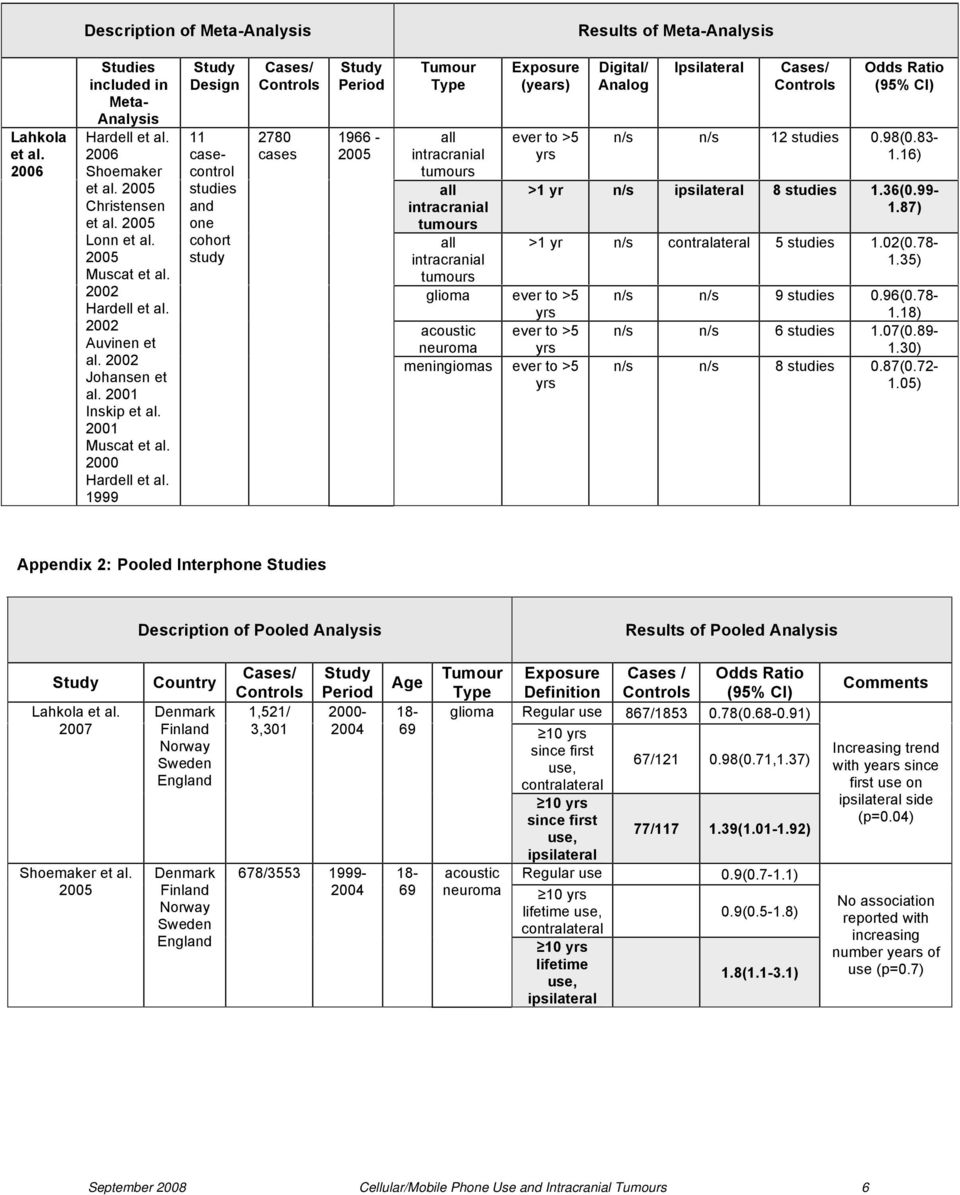
3 Background Cell phone use is increasingly prevalent in Canada. Public concerns of a potential associated risk with have been raised. Further, recent media attention has focused on disparate precautionary policies implemented across jurisdictions in Canada and world-wide. In light of this and emerging epidemiological evidence, we review what is known about cell phone use and. Intracranial In 2008, the Canadian standardized incidence rate for brain cancer is estimated to be 8 per 100,000 for males and 6 per 100,000 for females. These rates have not increased compared to 1980 levels; in fact among females a decline in incidence of 3.6% per year since 2000 has been observed 1. Three types of are discussed in this review. Glioma is a malignant tumour with a high case fatality rate; acoustic and meningioma are benign and can usuy be treated with early diagnosis. Meta-analyses Three meta-analyses published since and two pooled INTERPHONE studies were reviewed (Tables 1 and 2). These studies pertain to in adults only. All three meta-analyses used a random effects model, which does not assume homogeneity of effects across the studies being pooled; however, Lahkola et al () also used a fixed effect model (assumes homogeneity) for selected analyses 2. Hardell et al (2008) provided little information on the methods used while Kan et al (2008) and Lahkola et al () examined heterogeneity between studies, conducted sensitivity analyses and tested for publication bias; none was identified 3,4,2. The two most recent meta-analyses (Hardell et al 2008, Kan et al 2008) were restricted to case-control studies and are based on the same set of articles with more recent publications added to Hardell et al 3,4. The sole exception is the exclusion of Muscat et al (2000) by Hardell et al (2008) with the rationale that results were not presented separately for glioma, acoustic and meningioma 3. Lahkola et al () included several additional older studies; Johansen et al (2001), a Danish cohort study, and three studies by Hardell et al 2. The latter were presumably not included in the other meta-analyses due to methodological considerations; these studies have been criticized for biases in participant recruiting, exposure assessment and unclear reporting. Summary of meta-analysis results Meta-analyses based on 10 years duration of use have detected a slightly increased risk (OR: 1.25, 95%CI: ) for (Kan et al 2008) 4. Pooled analyses using shorter duration did not indicate an association (Lahkola et al ) 2. Restricting the analyses to 10 years and ipsilateral use (cell phone use on the same side as the tumour), the risk increased and was significantly associated for glioma (OR: 2.0, 95%CI: ) and acoustic (OR: 2.4, 95%CI: , but not for meningioma (OR: 1.7, 95%CI: ) (Hardell et al 2008) 3. Interpretation of results There is insufficient evidence to indicate a causal association. The evidence is most suggestive for ipsilateral occurring with ten or more years of use. Associations were only observed for regular cell phone use of 10 years. This exposure duration/latency is appropriate for cancer studies. Previous negative studies may have failed to detect an effect due to an insufficient duration of exposure or latency period. The number of study subjects for which these exposure metrics are available is relatively sm. September 2008 Cellular/Mobile Phone Use and Intracranial Tumours 3

4 Type of phone (analogue/digital) may influence this association. Earlier models (analogue phones) were likely used by long-term cell phone users. These phones emit greater radiation and may be associated with an increased risk of tumour development than the newer digital phones. Individual studies have examined the odds of using analogue phones but collectively no increased risk has been observed (Kan et al 2008, Lahkola et al ) 4,2. Years of exposure is just one exposure metric; the two most recent meta-analyses did not explore other indices of exposure, e.g., hours of cumulative use and cumulative number of cs, although this information has been reported in individual studies. The observed strengthening of the odds with 10 years and ipsilateral use increases the biological plausibility of the association; this suggests that the greatest risk is on the most exposed side of the brain. Results may indicate a true increase in risk with cell phone use; however, they may also indicate rec bias. Cases may have disproportionately reced ipsilateral cell phone use if they believed it to be related to the development of the tumour; this is plausible given media attention to the issue. If true, this would inflate the calculated risk. This appears to have occurred in some individual studies where ipsilateral use significantly increases the risk whereas contralateral use provides a protective effect suggesting information bias (Hepworth et al ) 5. Other methodological constraints involving individual studies included in the meta-analysis may have influenced the over results. For example, the use of proxy respondents, for deceased or very ill cases, may have introduced misclassification or bias in exposure assessment. This is of particular concern for glioma where there is a high case fatality proportion. Given the low and stable/declining Canadian brain cancer incidence rates, any increased risk attributable to cell phone use is very sm. Existing research is limited to adults; little is known about potential risks to children. A large cohort study is underway to examine potential risks in this population group (Feyching ) 6. Summary There is insufficient evidence to indicate a causal association between cell phone use and. There is weak evidence supporting an increase in odds of glioma, acoustic, and meningioma in adults with regular, ipsilateral use for 10 years or longer. Existing findings are suggestive but preliminary because they are based on few studies with sm numbers and potential biases. References 1. Canadian Cancer Society. Canadian Cancer Statistics [cited 2008]; Available from: URL: er_punjabi.pdf 2. Lahkola A, Tokola K, Auvinen A. Meta-analysis of long-term mobile phone use and. Scand J Work Environ Health ;32(3): Hardell L, Carlberg M, Söderqvist F, Mild KH. Meta-analysis of long-term mobile phone use and the association with brain. Int J Oncol 2008;32: Kan P, Simonsen SE, Lyon JL, Kestle JRW. Cellular phone use and brain tumour: a meta-anaylsis. J Neurooncol. 2008;86: Hepworth SJ, Schoemaker MJ, Muir KR, Swerdlow AJ, van Tongerren MJA, McKinney PA. Mobile phone use and risk of glioma in adults: case-control study. BMJ ;doi: /bmj Feychting M. CEFALO-A case-control study of brain in children and adolescents and mobile phone use. Epi ;17(6)S Lahkola A, Auvinen A, Raitanen J, Schoemaker MJ, HC, Feychting M et al. Mobile phone use and risk of glioma in five North European countries. Int J Cancer 2007;120: Schoemaker MJ, Swerdlow AJ, Ahlbom A, Auvinen A, Blaasaas KG, Cardis E et al. Mobile phone use and risk of acoustic : results of the interphone case-control study in five North European countries. Br J Cancer ;93: September 2008 Cellular/Mobile Phone Use and Intracranial Tumours 4

5 Appendix 1: Summary of Meta-Analyses of Cellular Phone Use and Intracranial Tumours Description of Meta-Analysis Results of Meta-Analysis Hardell et al Kan et al Studies included in Meta- Analysis Schlehofer et al Klaeboe et al Hours et al Lahkola et al Takebayashi et al Schuz et al. Hepworth et al. Schoemaker et al. Auvinen et al Inskip et al Schuz et al. * Hepworth et al. * * * Schoemaker Auvinen et al Inskip et al Muscat et al Design All case - control studies All casecontrol studies 5259/ Period n/s Tumour Type Exposure (years) Digital/ Analog Ipsilateral Odds Ratio (95% CI) glioma All n/s n/s 0.9( ) glioma 10 n/s n/s 338 / ( ) glioma 10 n/s ipsilateral >133/> ( ) glioma 10 n/s contralateral >104/> ( ) acoustic All n/s n/s 824/ ( ) acoustic 10 n/s n/s 83/ ( ) acoustic 10 n/s ipsilateral 53/ ( ) acoustic 10 n/s contralateral 30/ ( ) meningioma All n/s n/s 870/2, ( ) meningioma 10 n/s n/s 61/ ( ) meningioma 10 n/s ipsilateral 20/46 1.7( ) meningioma 10 n/s contralateral 15/52 1.0( ) high-grade glioma low-grade glioma acoustic n/s n/s n/s 10 studies 0.90( ) 10 n/s n/s 5 studies 1.25( ) n/s digital n/s 0.86( ) n/s analog n/s 1.13( ) n/s n/s n/s 5 studies 0.86( ) n/s n/s n/s 1.14( ) n/s n/s n/s 3 studies 0.96( ) meningioma n/s n/s n/s 5 studies 0.64( September 2008 Cellular/Mobile Phone Use and Intracranial Tumours 5

6 Description of Meta-Analysis Results of Meta-Analysis Lahkola et al. Studies included in Meta- Analysis Shoemaker Muscat et al Auvinen et al Johansen et al Inskip et al Muscat et al Design 11 casecontrol studies and one cohort study 2780 cases Period Tumour Type Exposure (years) ever to >5 yrs glioma ever to >5 yrs acoustic ever to >5 yrs meningiomas ever to >5 yrs Digital/ Analog Ipsilateral Odds Ratio (95% CI) n/s n/s 12 studies 0.98( ) >1 yr n/s ipsilateral 8 studies 1.36( ) >1 yr n/s contralateral 5 studies 1.02( ) n/s n/s 9 studies 0.96( ) n/s n/s 6 studies 1.07( ) n/s n/s 8 studies 0.87( ) Appendix 2: Pooled Interphone Studies Description of Pooled Analysis Results of Pooled Analysis Lahkola et al Shoemaker et al. Country Denmark Finland Norway Sweden England Denmark Finland Norway Sweden England 1,521/ 3,301 Period / Age Tumour Type glioma acoustic Exposure Definition Cases / Odds Ratio (95% CI) Regular use 867/ ( ) since first use, 67/ (0.71,1.37) contralateral since first use, 77/ ( ) ipsilateral Regular use 0.9( ) lifetime use, 0.9( ) contralateral lifetime use, 1.8( ) ipsilateral Comments Increasing trend with years since first use on ipsilateral side (p=0.04) No association reported with increasing number years of use (p=0.7) September 2008 Cellular/Mobile Phone Use and Intracranial Tumours 6
7 Feedback Form Please provide your comments below. Document Name: Cellular/Mobile Phone Use and Intracranial Tumours from Indoor Radon Exposure Is this document useful for your work? Why or why not? How could this document be improved? What is your occupation? Your name: How did you obtain this document? Please mail or fax this form to: National Collaborating Centre for Environmental Health 400 East Tower 555 W 12 th Avenue Vancouver, BC V5Z 3X7 Fax: September 2008 Cellular/Mobile Phone Use and Intracranial Tumours 7

Evidence For Brain Tumors And Acoustic Neuromas
 SECTION 11- part 1 Evidence For Brain Tumors And Acoustic Neuromas Lennart Hardell, MD, PhD, Professor Department of Oncology, Örebro University Hospital, Sweden Kjell Hansson Mild, PhD, Professor Department
The International EMF Collaborative s Counter-View of the Interphone Study
 The International EMF Collaborative s Counter-View of the Interphone Study 17 May 2010 Results Summary Doubled to quadrupled brain tumor risk reported in the heaviest cellphone users. Average use was 2
Statement for the Record for the September 25, 2008, hearing entitled, Cell Phone Use and Tumors: What the Science Says
 Statement for the Record for the Subcommittee on Domestic Policy Committee on Oversight and Government Reform United States House of Representatives Statement for the Record for the September 25, 2008,
Case-control studies. Alfredo Morabia
 Case-control studies Alfredo Morabia Division d épidémiologie Clinique, Département de médecine communautaire, HUG [email protected] www.epidemiologie.ch Outline Case-control study Relation to cohort
Cell phones and brain tumors: A review including the long-term epidemiologic data. Surgical Neurology September 2009; 72; pp.
 Cell phones and brain tumors: A review including the long-term epidemiologic data 1 Surgical Neurology September 2009; 72; pp. 205 215 Vini G. Khurana, PhD, FRACS, Charles Teo, MBBS, FRACS, Michael Kundi,
Childhood leukemia and EMF
 Workshop on Sensitivity of Children to EMF Istanbul, Turkey June 2004 Childhood leukemia and EMF Leeka Kheifets Professor Incidence rate per 100,000 per year 9 8 7 6 5 4 3 2 1 0 Age-specific childhood
BLM Emerging Risks Team - Report on Mobile Phones/EMFs
 BLM Emerging Risks Team - Report on Mobile Phones/EMFs November 2014 Malcolm Keen Solicitor, BLM London T 020 7865 3381 E [email protected] 1 Introduction Use of mobile phones has of course increased
Enclosure 1 SCENIHR 2015. a biased assessment of EMF health risks the example of head tumours
 Enclosure 1 SCENIHR 2015 a biased assessment of EMF health risks the example of head tumours Swedish radiation protection foundation Priartem, collectif des électrosensibles de France Mars 9, 2015 INDEX
Skin Cancer: The Facts. Slide content provided by Loraine Marrett, Senior Epidemiologist, Division of Preventive Oncology, Cancer Care Ontario.
 Skin Cancer: The Facts Slide content provided by Loraine Marrett, Senior Epidemiologist, Division of Preventive Oncology, Cancer Care Ontario. Types of skin Cancer Basal cell carcinoma (BCC) most common
SR Communications Tower Task Force Dr. Jeff Liva, Allen Cohen, Rebecca Rogers
 SR Communications Tower Task Force Dr. Jeff Liva, Allen Cohen, Rebecca Rogers 1 Table of Contents 2 Chemical hazards. These develop from excessive exposure to concentrations of chemicals in environment.
Recent Research on Mobile Phones Effects
 Recent Research on Mobile Phones Effects Dr. Abdullah AlOrainy Inst. of Electronics Research, KACST P. O. Box: 230471, Riyadh 11321, Saudi Arabia E-mail: [email protected] ABSTRACT The use of mobile
Cell phones and brain tumors: A review including the long-term epidemiologic data
 Khurana et al. Cell phone-brain tumor review (Surgical Neurology, in press, 2009) Page 1 of 14 Cell phones and brain tumors: A review including the long-term epidemiologic data Vini G. Khurana PhD FRACS
MOBILE PHONE USE AND CANCER
 MOBILE PHONE USE AND CANCER MKundi 560 c EXPOSURE Correspondence to: Prof. Dr M Kundi, Institute of Environmental Health, Medical Faculty, University of Vienna, Kinderspitalgasse 15, 1095 Vienna, Austria;
March 28 2011 ABSTRACT
 March 28 2011 A registry based comparative cohort study in four Swedish counties of the risk for narcolepsy after vaccination with Pandemrix - A first and preliminary report, by the Medical Products Agency.
Komorbide brystkræftpatienter kan de tåle behandling? Et registerstudie baseret på Danish Breast Cancer Cooperative Group
 Komorbide brystkræftpatienter kan de tåle behandling? Et registerstudie baseret på Danish Breast Cancer Cooperative Group Lotte Holm Land MD, ph.d. Onkologisk Afd. R. OUH Kræft og komorbiditet - alle skal
Statement of the Chief Medical Health Officer
 Statement of the Chief Medical Health Officer June, 2011 Health Concerns About Cellular Phone Transmission Antennae and Base Stations In 2005, in response to community concerns and after reviewing the
Basic Study Designs in Analytical Epidemiology For Observational Studies
 Basic Study Designs in Analytical Epidemiology For Observational Studies Cohort Case Control Hybrid design (case-cohort, nested case control) Cross-Sectional Ecologic OBSERVATIONAL STUDIES (Non-Experimental)
Update of the scientific evidence on asbestos and cancer. Kurt Straif, MD MPH PhD. The IARC Monographs
 Update of the scientific evidence on asbestos and cancer Kurt Straif, MD MPH PhD International Agency for Research on Cancer Lyon, France World Health Organisation Asturias, 17 March 2011 The IARC Monographs
Risk of Brain Tumors From Wireless Phone Use. Journal of Computer Assisted Tomography November/December 2010; Vol. 34, No. 6; pp.
 Risk of Brain Tumors From Wireless Phone Use 1 Journal of Computer Assisted Tomography November/December 2010; Vol. 34, No. 6; pp. 799-807 Rash Bihari Dubey, Madasu Hanmandlu, PhD, and Suresh Kumar Gupta,
Laboratory 3 Type I, II Error, Sample Size, Statistical Power
 Laboratory 3 Type I, II Error, Sample Size, Statistical Power Calculating the Probability of a Type I Error Get two samples (n1=10, and n2=10) from a normal distribution population, N (5,1), with population
What the experts say: The consensus of scientific opinion
 What the experts say: The consensus of scientific opinion AMTA relies on the expert judgment of independent public health authorities, such as the World Health Organization, for assessments of safety and
Radiation Protection Dosimetry Advance Access published November 14, 2008. Radiation Protection Dosimetry (2008), pp. 1 7
 Radiation Protection Dosimetry Advance Access published November 14, 2008 Radiation Protection Dosimetry (2008), pp. 1 7 doi:10.1093/rpd/ncn288 Ole Raaschou-Nielsen* Institute of Cancer Epidemiology, Danish
Leukemia and Exposure to Ionizing Radiation
 Leukemia and Exposure to Ionizing Radiation Summary: Strong evidence has been recorded of a possible connection between forms of leukemia and exposure to ionizing radiation. This evidence is based upon
GAO. Exposure and Testing Requirements for Mobile Phones Should Be Reassessed TELECOMMUNICATIONS. Report to Congressional Requesters
 GAO United States Government Accountability Office Report to Congressional Requesters July 2012 TELECOMMUNICATIONS Exposure and Testing Requirements for Mobile Phones Should Be Reassessed GAO-12-771 July
Clinical Commissioning Policy: Proton Beam Radiotherapy (High Energy) for Paediatric Cancer Treatment
 Clinical Commissioning Policy: Proton Beam Radiotherapy (High Energy) for Paediatric Cancer Treatment Reference: NHS England xxx/x/x 1 Clinical Commissioning Policy: Proton Beam Radiotherapy (High Energy)
2007 WHO Research Agenda for Extremely Low Frequency Fields
 2007 WHO Research Agenda for Extremely Low Frequency Fields Introduction In 1997, the WHO International EMF Project developed a Research Agenda in order to facilitate and coordinate research worldwide
Systematic Reviews and Meta-analyses
 Systematic Reviews and Meta-analyses Introduction A systematic review (also called an overview) attempts to summarize the scientific evidence related to treatment, causation, diagnosis, or prognosis of
Estimation of the Number of Lung Cancer Cases Attributable to Asbestos Exposure
 Estimation of the Number of Lung Cancer Cases Attributable to Asbestos Exposure BC Asbestos Statistics Approximately 55,000 BC men and women exposed in 1971 in high exposed industries Significant exposure
REVIEW OF EXPOSURE LIMITS AND HEALTH CONCERNS SANTA ANA. Base Station Telecommunication Transmitters UNIFIED SCHOOL DISTRICT
 SANTA ANA UNIFIED SCHOOL DISTRICT REVIEW OF EXPOSURE LIMITS AND HEALTH CONCERNS Base Station Telecommunication Transmitters Dr. Karl Rodenbaugh, Senior Scientist SCOPE OF SERVICES Review, Describe, Discuss,
evaluation of cancer hazards Robert A Baan PhD The IARC MONOGRAPHS International Agency for Research on Cancer Lyon, France
 Consumption of alcoholic beverages; evaluation of cancer hazards Robert A Baan PhD The IARC MONOGRAPHS International Agency for Research on Cancer Lyon, France The IARC Monographs The IARC Monographs are
Review of Eliminating occupational cancer in Europe and globally by J. Takala
 Review of Eliminating occupational cancer in Europe and globally by J. Takala There primary concerns of this manuscript are outlined below. More detail discussion of these points is presented on the following
Caregiving Impact on Depressive Symptoms for Family Caregivers of Terminally Ill Cancer Patients in Taiwan
 Caregiving Impact on Depressive Symptoms for Family Caregivers of Terminally Ill Cancer Patients in Taiwan Siew Tzuh Tang, RN, DNSc Associate Professor, School of Nursing Chang Gung University, Taiwan
Appendix G STATISTICAL METHODS INFECTIOUS METHODS STATISTICAL ROADMAP. Prepared in Support of: CDC/NCEH Cross Sectional Assessment Study.
 Appendix G STATISTICAL METHODS INFECTIOUS METHODS STATISTICAL ROADMAP Prepared in Support of: CDC/NCEH Cross Sectional Assessment Study Prepared by: Centers for Disease Control and Prevention National
RR833. The joint effect of asbestos exposure and smoking on the risk of lung cancer mortality for asbestos workers (1971-2005)
 Health and Safety Executive The joint effect of asbestos exposure and smoking on the risk of lung cancer mortality for asbestos workers (1971-2005) Prepared by the Health and Safety Laboratory for the
Confounding in health research
 Confounding in health research Part 1: Definition and conceptual issues Madhukar Pai, MD, PhD Assistant Professor of Epidemiology McGill University [email protected] 1 Why is confounding so important
Canadian Individual Critical Illness Insurance Morbidity Experience
 Morbidity Study Canadian Individual Critical Illness Insurance Morbidity Experience Between Policy Anniversaries in 2002 and 2007 Using Expected CIA Incidence Tables from July 2012 Individual Living Benefits
Keywords Mobile Tower Radiations, Electromagnetic Radiations, Signal Strength, Mobile Phone
 Volume 5, Issue 1, January 2015 ISSN: 2277 128X International Journal of Advanced Research in Computer Science and Software Engineering Research Paper Available online at: www.ijarcsse.com Analysis of
Lesson 14 14 Outline Outline
 Lesson 14 Confidence Intervals of Odds Ratio and Relative Risk Lesson 14 Outline Lesson 14 covers Confidence Interval of an Odds Ratio Review of Odds Ratio Sampling distribution of OR on natural log scale
Trends in Australian children traveling to school 1971-2003: burning petrol or carbohydrates?
 1 Trends in Australian children traveling to school 1971-2003: burning petrol or carbohydrates? Hidde P. van der Ploeg 1, Dafna Merom 1, Grace Corpuz 2, Adrian E. Bauman 1 1 Centre for Physical Activity
Critical Illness Insurance. What is Critical Illness Insurance
 Critical Illness Insurance What is Critical Illness Insurance Whereas life insurance has been readily available for literally hundreds of years, critical illness insurance is a relatively recent development.
Nurse Practitioner (Pediatric)
 Nurse Practitioner (Pediatric) OSCE Blueprint College of Registered Nurses of British Columbia 2855 Arbutus Street Vancouver, BC Canada V6J 3Y8 T: 604.736.7331 F: 604.738.2272 Toll-free: 1.800.565.6505
Measures of Prognosis. Sukon Kanchanaraksa, PhD Johns Hopkins University
 This work is licensed under a Creative Commons Attribution-NonCommercial-ShareAlike License. Your use of this material constitutes acceptance of that license and the conditions of use of materials on this
Mobile Phones Radiation Hazards
 Safety in modern Telecommunications Technologies Mobile Phones Radiation Hazards Mohammed el Hassan Abdul Karim This paper is an attempt to describe the present international debate on the subject of human
EBA REPORT ON ASSET ENCUMBRANCE JUNE 2016
 EBA REPORT ON ASSET ENCUMBRANCE JUNE 2016 1 Contents List of figures 3 Executive summary 4 Analysis of the asset encumbrance of European banks 6 Sample 6 Scope of the report 6 Total encumbrance 7 Encumbrance
Summary Measures (Ratio, Proportion, Rate) Marie Diener-West, PhD Johns Hopkins University
 This work is licensed under a Creative Commons Attribution-NonCommercial-ShareAlike License. Your use of this material constitutes acceptance of that license and the conditions of use of materials on this
Lung Cancer and Exposure to Ionizing Radiation
 Lung Cancer and Exposure to Ionizing Radiation Summary: Studies conducted at the Los Alamos National Laboratory and other nuclear facilities suggest an increased likelihood of developing lung cancer for
Introduction to Observational studies Dr. Javaria Gulzar Clinical Research Associate SCRC.
 Introduction to Observational studies Dr. Javaria Gulzar Clinical Research Associate SCRC. Observational Study A study in which a researcher simply observes behavior in a systemic manner with out any active
NHS Barking and Dagenham Briefing on disease linked to Asbestos in Barking & Dagenham
 APPENDIX 1 NHS Barking and Dagenham Briefing on disease linked to Asbestos in Barking & Dagenham 1. Background 1.1. Asbestos Asbestos is a general name given to several naturally occurring fibrous minerals
Case-Control Studies. Sukon Kanchanaraksa, PhD Johns Hopkins University
 This work is licensed under a Creative Commons Attribution-NonCommercial-ShareAlike License. Your use of this material constitutes acceptance of that license and the conditions of use of materials on this
Cancer in Ireland 2013: Annual report of the National Cancer Registry
 Cancer in 2013: Annual report of the National Cancer Registry ABBREVIATIONS Acronyms 95% CI 95% confidence interval APC Annual percentage change ASR Age standardised rate (European standard population)
RATIOS, PROPORTIONS, PERCENTAGES, AND RATES
 RATIOS, PROPORTIOS, PERCETAGES, AD RATES 1. Ratios: ratios are one number expressed in relation to another by dividing the one number by the other. For example, the sex ratio of Delaware in 1990 was: 343,200
CHILDHOOD CANCER SURVIVOR STUDY Analysis Concept Proposal
 CHILDHOOD CANCER SURVIVOR STUDY Analysis Concept Proposal 1. STUDY TITLE: Longitudinal Assessment of Chronic Health Conditions: The Aging of Childhood Cancer Survivors 2. WORKING GROUP AND INVESTIGATORS:
Research into Issues Surrounding Human Bones in Museums Prepared for
 Research into Issues Surrounding Human Bones in Museums Prepared for 1 CONTENTS 1. OBJECTIVES & RESEARCH APPROACH 2. FINDINGS a. Visits to Museums and Archaeological Sites b. Interest in Archaeology c.
HEALTH SYSTEM PERFORMANCE INTERACTIVE INDICATORS WEBSITE PUBLIC ENGAGEMENT SUMMARY REPORT
 HEALTH SYSTEM PERFORMANCE INTERACTIVE INDICATORS WEBSITE PUBLIC ENGAGEMENT SUMMARY REPORT PAGES TABLE OF CONTENTS INTRODUCTION 1 KEY FINDINGS: ONLINE AND IN-PERSON ENGAGEMENT 2 FINDINGS: ONLINE ENGAGEMENT
Assertive outreach enhances hepatitis B vaccination for people who inject drugs in Melbourne, Australia
 Assertive outreach enhances hepatitis B vaccination for people who inject drugs in Melbourne, Australia Peter Higgs, Nyree Chung, Shelley Cogger, Rebecca Winter, Margaret Hellard & Paul Dietze Acknowledgements