
Additional Blood Tests
|
|
|
- Scot Chase
- 9 years ago
- Views:
Transcription
1 Additional Blood Tests CBC W/Auto Diff The CBC is used as a broad screening test to check for such disorders as anemia, infection, and many other diseases. It is actually panel of tests that examines different parts of the blood and includes the following: WBC White blood cell (WBC) count is a count of the actual number of white blood cells per volume of blood. WBC assesses the ability of the body to respond to and eliminate infection. Eating, physical activity, and stress may alter white blood cell differential values. There are five types of white blood cells, each with different functions: neutrophils, lymphocytes, monocytes, eosinophils and basophils. Low: 3.9 or less Normal: High: 12.1 or Higher LYM or LY Absolute count and Percentage LYM or LY means lymphocyte absolute count. Lymphocytes occur in two forms: B cells, which produce antibodies, and T cells, which recognize foreign substances and process them for removal. High lymphocyte counts could be an indication of Infection (bacterial, viral, other), Cancer of the blood or lymphatic system, An autoimmune disorder causing ongoing (chronic) inflammation. Viral infections can cause low lymphocyte counts. Lymphocyte percent. Leukocyte that normally makes up about 25% of the total white blood cell count. Absolute Count Low: 0.7 or less Normal: High: 5.7 or Higher Percentage Low: 16.9 or less Normal: High: 51.1 or Higher MID Absolute count and Percentage MID means mid-range absolute count. This count generally includes monocytes, eosinophils and basophils. Monocytes functions in the ingestion of bacteria and other foreign particles. Eosinophils are believed to function in allergic responses and in resisting some infections. Basophils may increase or decrease in certain diseases. Mid-range percent. Basophils normally constitute 1% or less of the total white blood cell count. Eosinophils, normally about 1-3% of the total white blood cell count. Monocytes make up 5-10% of the total white blood cell count. Absolute Count Normal: High: 1.2 or Higher not tested Percentage Normal: High: 11.1 or Higher not tested

2 GRAN Absolute Count and Percentage GRAN means Granulocyte absolute count. Neutrophils (also known as segs, PMNs, granulocytes, grans) normally the most abundant type of white blood cell in healthy adults. An elevated level of granulocytes is indicative of an underlying bacterial infection. Granulocyte percent. Granulocytes normally up to 60% of the total white blood cell count. Absolute Count Low: 1.4 or less Normal: High: 1.9 or Higher not tested Percentage Low: 32.9 or less Normal: High: 70.1 or Higher not tested NEU Absolute Count and Percentage % Neu means Neutrophil granulocytes are the most abundant type of white blood cells in mammals and form an essential part of the innate immune system. They are generally referred to as either neutrophils or polymorphonuclear neutrophils (or PMNs), and are subdivided into segmented neutrophils (or segs) and banded neutrophils (or bands). They form part of the polymorphonuclear cell family (PMNs) together with basophils and eosinophils. Neutrophils are normally found in the blood stream. During the beginning (acute) phase of inflammation, particularly as a result of bacterial infection, environmental exposure, and some cancers. Neutrophils are one of the first-responders of inflammatory cells to migrate towards the site of inflammation. They are the predominant cells in pus, accounting for its whitish/yellowish appearance. Neutrophils are recruited to the site of injury within minutes following trauma and are the hallmark of acute inflammation. Absolute Count Low: 1.4 or less Normal: High: 8.1 or Higher Percentage Low: 42.9 or less Normal: High: 76.1 or Higher MON Absolute Count and Percentage Monocyte is a type of white blood cell and is part of the human body's immune system. Monocytes play multiple roles in immune function. Such roles include: (1) replenish resident macrophages and dendritic cells under normal states, and (2) in response to inflammation signals, monocytes can move quickly (approx hours) to sites of infection in the tissues and divide/differentiate into macrophages and dendritic cells to elicit an immune response. Absolute Count Normal: High: 1.0 or Higher Percentage Low: 1.0 or less Normal: High: 13.1 or Higher

3 EOS Absolute Count and Percentage Eosinophil granulocytes, usually called eosinophils or eosinophiles (or, less commonly, acidophils), are white blood cells that are one of the immune system components responsible for combating multicellular parasites and certain infections in vertebrates. Along with mast cells, they also control mechanisms associated with allergy and asthma. They are granulocytes that develop during haematopoiesis in the bone marrow before migrating into blood. In normal individuals, eosinophils make up about 1-6% of white blood cells. They are found in the medulla and the junction between the cortex and medulla of the thymus, and, in the lower gastrointestinal tract, ovary, uterus, spleen, and lymph nodes, but not in the lung, skin, esophagus, or some other internal organs under normal conditions. The presence of eosinophils in these latter organs is associated with disease. Absolute Count Normal: High: 0.6 or Higher Percentage Normal: High: 6.1 or Higher BAS Absolute Count and Percentage Basophil granulocytes, sometimes referred to as basophils, are the least common of the granulocytes, representing about 0.01% to 0.3% of circulating white blood cells. Basophils appear in many specific kinds of inflammatory reactions, particularly those that cause allergic symptoms. Basophils contain anticoagulant heparin, which prevents blood from clotting too quickly. They also contain the vasodilator histamine, which promotes blood flow to tissues. They can be found in unusually high numbers at sites of ectoparasite infection, e.g., ticks. Like eosinophils play a role in both parasitic infections and allergies. They are found in tissues where allergic reactions are occurring and probably contribute to the severity of these reactions. Absolute Count Normal: High: 0.7 or Higher Percentage Normal: High: 3.1 or Higher RBC Red blood cell (RBC) count is a count of the actual number of red blood cells per volume of blood. Both increases and decreases can point to abnormal conditions. Low: 3.7 or less Normal: High: 5.91 or Higher

4 Hemoglobin and Hematocrit Hemoglobin measures the amount of oxygen-carrying protein in the blood. Hematocrit measures the percentage of red blood cells in a given volume of whole blood. Lower-than-normal hemoglobin and hematocrit may be due to: Anemia, Bleeding, Destruction of red blood cells, Leukemia, Malnutrition, Nutritional deficiencies of iron, folate, vitamin B12, and vitamin B6, Overhydration. Higher-than-normal hemoglobin and hemotocrit may be due to: Congenital heart disease, Cor pulmonale, Dehydration, Erythrocytosis, Low blood oxygen levels (hypoxia), Pulmonary fibrosis, Polycythemia vera Hemoglobin Low: 11.6 or less Normal: High: 18.1 or Higher Hematocrit Low: 34.8 or less Normal: High: 54.1 or Higher MCV The mean cell volume (MCV) is elevated when your RBCs are larger than normal (macrocytic). When the MCV is decreased, your RBCs are smaller than normal (microcytic). When the MCV is higher or lower than the normal range, the red blood cells are larger or smaller than the normal size and are referred to as macrocytic and microcytic red blood cells respectively. Presence of such macrocytic or microcytic red blood cells indicates that the patient might be suffering from a medical condition. An elevated MCV is usually seen in people suffering from hemolytic anemia or pernicious anemia. Nutritional deficiencies and alcohol abuse are some of the common causes of an elevated MCV. A vitamin B12 deficiency or a folic acid deficiency could also manifest in the form of a higher MCV. Low MCV may be observed in people suffering from iron deficiency anemia, thalassemia or gastrointestinal blood loss. Low: 79.9 or less Normal: High: 99.1 or Higher MCH Mean corpuscular hemoglobin (MCH) is a calculation of the average amount of oxygen-carrying hemoglobin inside a red blood cell. Macrocytic RBCs are large so tend to have a higher MCH, while microcytic red cells would have a lower value. Generally, if the MCH level is over 34, this is considered to be too high. The main reason that the MCH level would be too high is because of macrocytic anemia. Macrocytic anemia is a blood disorder in which not enough red blood cells are produced, but the ones that are present are large (thus fitting more hemoglobin). Generally, if the MCH level is below 26, this is considered too low. The MCH level can be too low because of blood loss over time, too little iron in the body, or microcytic anemia. Microcytic anemia is a condition in which abnormally small red blood cells are present. Smaller red blood cells means that less hemoglobin fits in each cell. Hemoglobinopathy, which is a group of disorders characterized by changes in the structure of hemoglobin, can also cause a low MCH level. Low: 26.4 or less Normal: High: 34.1 or Higher

5 MCHC Mean corpuscular hemoglobin concentration (MCHC) is a calculation of the average concentration of hemoglobin inside a red cell. Low: 31.4 or less Normal: High: 36.1 or Higher 36.4 RDW RDW is the abbreviation for "red blood cell distribution width." RDW calculates the varying sizes of red blood cell (RBC) volume in a blood sample. Low: 9.9 or less Normal: High: 15.1 or Higher Platelet The platelet count is the number of platelets in a given volume of blood. Both increases and decreases can point to abnormal conditions of excess bleeding or clotting. High values can occur with bleeding, cigarette smoking or excess production by the bone marrow. Low values can occur from premature destruction states such as Immune Thrombocytopenia (ITP), acute blood loss, drug effects (such as heparin), infections with sepsis, entrapment of platelets in an enlarged spleen, or bone marrow failure from diseases such as myelofibrosis or leukemia. Low: 149 or less Normal: High: 451 or Higher MPV Mean Platelet Volume. MPV is a count of how large your platelets actually are. The purpose of measuring the size of the platelets is also to determine whether or not there is an issue with the platelet production in the bone marrow. The MPV is an accurate test that can easily help doctors determine what's wrong with your platelets. Low: 6.4 or less Normal: High: 11.1 or Higher 12.3

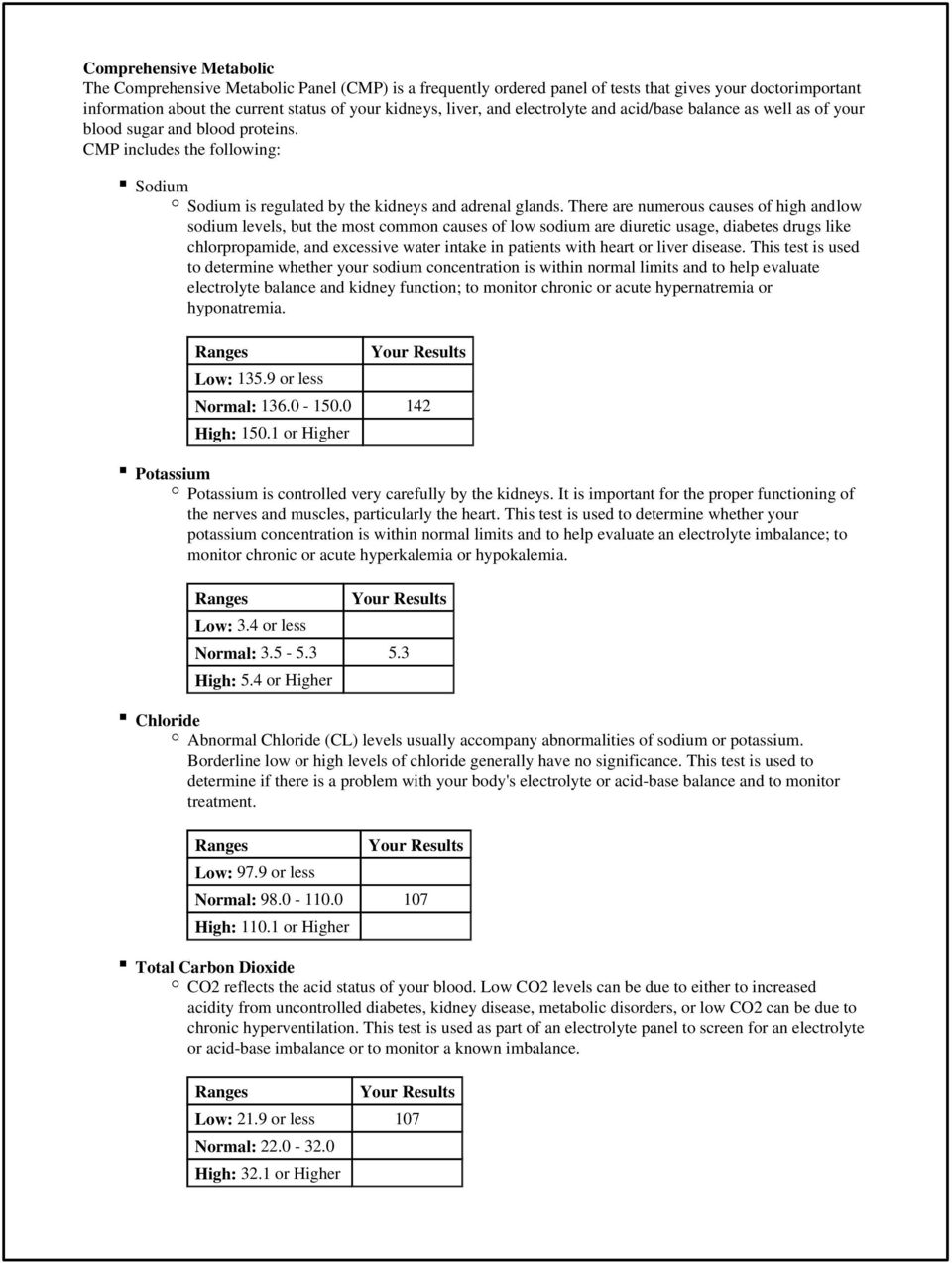
6 Comprehensive Metabolic The Comprehensive Metabolic Panel (CMP) is a frequently ordered panel of tests that gives your doctor important information about the current status of your kidneys, liver, and electrolyte and acid/base balance as well as of your blood sugar and blood proteins. CMP includes the following: Sodium Sodium is regulated by the kidneys and adrenal glands. There are numerous causes of high and low sodium levels, but the most common causes of low sodium are diuretic usage, diabetes drugs like chlorpropamide, and excessive water intake in patients with heart or liver disease. This test is used to determine whether your sodium concentration is within normal limits and to help evaluate electrolyte balance and kidney function; to monitor chronic or acute hypernatremia or hyponatremia. Low: or less Normal: High: or Higher Potassium Potassium is controlled very carefully by the kidneys. It is important for the proper functioning of the nerves and muscles, particularly the heart. This test is used to determine whether your potassium concentration is within normal limits and to help evaluate an electrolyte imbalance; to monitor chronic or acute hyperkalemia or hypokalemia. Low: 3.4 or less Normal: High: 5.4 or Higher Chloride Abnormal Chloride (CL) levels usually accompany abnormalities of sodium or potassium. Borderline low or high levels of chloride generally have no significance. This test is used to determine if there is a problem with your body's electrolyte or acid-base balance and to monitor treatment. Low: 97.9 or less Normal: High: or Higher Total Carbon Dioxide CO2 reflects the acid status of your blood. Low CO2 levels can be due to either to increased acidity from uncontrolled diabetes, kidney disease, metabolic disorders, or low CO2 can be due to chronic hyperventilation. This test is used as part of an electrolyte panel to screen for an electrolyte or acid-base imbalance or to monitor a known imbalance. Low: 21.9 or less 107 Normal: High: 32.1 or Higher
7 Calcium Calcium is controlled in the blood by the parathyroid glands and the kidneys. Calcium is found mostly in bone and is important for proper blood clotting, nerve, and cell activity. An elevated calcium can be due to medications such as thiazide type diuretics, inherited disorders of calcium handling in the kidneys, or excess parathyroid gland activity or vitamin D. Low calcium can be due to certain metabolic disorders such as insufficient parathyroid hormone This test is used as part of a routine metabolic panel, when you have kidney, bone, or nerve disease, or when symptoms of significantly increased or decreased calcium concentrations are present. Low: 8.3 or less Normal: High: 10.6 or Higher BUN Blood Urea Nitrogen (BUN) is a waste product produced in the liver and excreted by the kidneys. High values may mean that the kidneys are not working as well as they should. BUN is also affected by high protein diets and/or strenuous exercise which raise levels, and by pregnancy which lowers it. This test is used to evaluate kidney function or monitor the effectiveness of dialysis and other treatments related to kidney disease or damage. Low: 5.9 or less Normal: High: 22.1 or Higher Creatinine Creatinine is a waste product largely from muscle breakdown. High values, especially with high BUN levels, may indicate problems with the kidneys. This test is used to determine if your kidneys are functioning normally and to monitor treatment for kidney disease. Low: 0.5 or less Normal: High: 1.6 or Higher Bilirubin, Total Bilirubin is a brownish yellow substance found in bile. It is produced when the liver breaks down old red blood cells. Bilirubin is then removed from the body through the stool (feces) and gives stool its normal brown color. When bilirubin levels are high, a condition called jaundice occurs, and further testing is needed to determine the cause. Too much bilirubin may mean that too much is being produced (usually due to increased hemolysis) or that the liver is incapable of adequately removing bilirubin in a timely manner due to blockage of bile ducts, liver diseases such as cirrhosis, acute hepatitis, or inherited problems with bilirubin processing. This test is used to screen for or monitor liver disorders. Normal: High: 1.4 or Higher

8 ALT and AST AST (SGOT) and ALT (SGPT) are sensitive indicators of liver damage or injury from different types of diseases. It must be emphasized that higher-than-normal levels of these liver enzymes should not be automatically equated with liver disease. They may mean liver problems or they may not. For example, elevations of these enzymes can occur with muscle damage. The interpretation of elevated AST and ALT levels depends upon the entire clinical evaluation of an individual, and so it is best done by physicians experienced in evaluating liver disease and muscle disease. These tests are used to screen for liver damage and/or to help diagnose liver disease. Absolute Count Normal: High: 72.1 or Higher 100 Percentage Low: 4.9 or less Normal: High: 58.1 or Higher Albumin Albumin is made mainly in the liver. It helps keep the blood from leaking out of blood vessels. Albumin also helps carry some medicines and other substances through the blood and is important for tissue growth and healing. This test measures the amount and type of protein in your blood. It is a general index of overall health and nutrition. It is also used to screen for a liver disorder or kidney disease or to evaluate nutritional status. Low: 3.4 or less Normal: High: 5.1 or Higher Total Protein The total protein test is a rough measure of all the proteins found in the fluid portion of your blood. This test is used as part of a general health checkup, to determine your nutritional status or to screen for certain liver and kidney disorders as well as other diseases. Low: 6.2 or less Normal: High: 8.4 or Higher ALK Phos Alkaline phosphatase is an enzyme found primarily in bones and the liver but can also be found in other tissues of the body as well such as the intestine, kidney, placenta and in white blood cells. This test is used to screen for or monitor treatment for a liver or bone disorder. Low: 39.9 or less Normal: High: or Higher

9 Globulin Globulin is one of the three types of serum proteins, the others being albumin and fibrinogen. Some globulins are produced in the liver, while others are made by the immune system. The globulin level may be elevated in: Chronic infections (parasites, some cases of viral and bacterial infection), Liver disease (biliary cirrhosis, obstructive jaundice), Carcinoid syndrome, Rheumatoid arthritis, Ulcerative colitis, Multiple myelomas, leukemias, Waldenstrom's macroglobulinemia, Autoimmunity (Systemic lupus, collagen diseases, Kidney dysfunction (Nephrosis) The serum globulin level may be decreased in: Nephrosis (A Condition in which the kidney does not filter the protein from the blood and it leaks into the urine), Alpha-1 Antitrypsin Deficiency (Emphysema), Acute hemolytic anemia, Liver dysfunction, Hypogammaglobulinemia/Agammaglobulinemia Low: 1.9 or less Normal: High: 4.9 or Higher A/G Ratio Albumin to Globulin ratio. The AG ratio may be elevated in: Hypothyroidism, High protein/high carbohydrate diet with poor nitrogen retention, Hypogammaglobulinemia (low globulin), Glucocorticoid excess (can be from taking medications with cortisone effect, the adrenal gland overproducing cortisol, or a tumor that produces extra cortisol like compounds, low globulin) The AG ratio may be decreased in: Liver dysfunction Low: 0.5 or less Normal: High: 2.3 or Higher B/C Ratio BUN to Creatinine Ratio. The ratio may be used to determine the cause of acute kidney injury. Low: 8.5 or less Normal: High: 36.1 or Higher GFR (IDMS) or egfr Calculated IDMS Glomerular filtration rate (GFR) is a test used to check how well the kidneys are working. Specifically, it estimates how much blood passes through the tiny filters in the kidneys. This test is used to assess kidney function. GFR IDMS Low: <= 60 Normal: > 60 >60 egfr Calculated IDMS Percentage Low: <= 60 Normal: >

10 TSH The TSH test is often the test of choice for evaluating thyroid function and/or symptoms of hyper- or hypothyroidism. TSH testing is used to diagnose a thyroid disorder in a person with symptoms, screen newborns for an underactive thyroid, monitor thyroid replacement therapy in people with hypothyroidism diagnose, monitor female infertility problems, help evaluate the function of the pituitary gland (occasionally), and screen adults for thyroid disorders. Low: 0.29 or less Normal: High: 4.82 or Higher 15.8 PSA PSA test is used as a screening tool; increased levels may indicate an increased risk of prostate cancer, while lower levels indicate a decreased risk. American Cancer Society (ACS), recommend that doctors offer total PSA tests annually to all men, beginning at age 50 and to those at an increased risk of prostate cancer, such as American men of African descent and men with a family history of the disease, beginning at age 40 or 45. The ACS recommends that doctors discuss the testing options, benefits, and potential side effects with their male patients so that they can make informed choices. PSA Normal: High: 4.1 or Higher ***Reference may vary depending upon where your lab work was processed. The reference ranges used in this report are general guidelines. We encourage you to always review your lab report with a qualified medical provider.***

Adams Memorial Hospital Decatur, Indiana EXPLANATION OF LABORATORY TESTS
 Adams Memorial Hospital Decatur, Indiana EXPLANATION OF LABORATORY TESTS Your health is important to us! The test descriptions listed below are for educational purposes only. Laboratory test interpretation
Collect and label sample according to standard protocols. Gently invert tube 8-10 times immediately after draw. DO NOT SHAKE. Do not centrifuge.
 Complete Blood Count CPT Code: CBC with Differential: 85025 CBC without Differential: 85027 Order Code: CBC with Differential: C915 Includes: White blood cell, Red blood cell, Hematocrit, Hemoglobin, MCV,
Protein electrophoresis is used to categorize globulins into the following four categories:
 Globulin Globulin is one of the two types of serum proteins, the other being albumin. This generic term encompasses a heterogeneous series of families of proteins, with larger molecules and less soluble
Albumin. Prothrombin time. Total protein
 Hepatitis C Fact Sheet February 2016 www.hepatitis.va.gov Laboratory Tests and Hepatitis If you have hepatitis C, your doctor will use laboratory tests to about learn more about your individual hepatitis
Hepatitis C. Laboratory Tests and Hepatitis C
 Hepatitis C Laboratory Tests and Hepatitis C If you have hepatitis C, your doctor will use laboratory tests to check your health. This handout will help you understand what the major tests are and what
EXECUTIVE BLOOD WORK PANEL
 EXECUTIVE BLOOD WORK PANEL Below is a list of all blood and urine testing done on the day of your Executive Medical. MALE Serum Glucose Random Serum Glucose Fasting Creatinine Uric Acid Sodium Potassium
KEY CHAPTER 14: BLOOD OBJECTIVES. 1. Describe blood according to its tissue type and major functions.
 KEY CHAPTER 14: BLOOD OBJECTIVES 1. Describe blood according to its tissue type and major functions. TISSUE TYPE? MAJOR FUNCTIONS connective Transport Maintenance of body temperature 2. Define the term
Interpretation of Laboratory Values
 Interpretation of Laboratory Values Konrad J. Dias PT, DPT, CCS Overview Electrolyte imbalances Renal Function Tests Complete Blood Count Coagulation Profile Fluid imbalance Sodium Electrolyte Imbalances
MALE AND FEMALE PANEL CHARTS
 MALE AND FEMALE PANEL CHARTS Complete Blood Count (CBC) Test What this test measures What test results may indicate Red blood cell count Total number of red blood cells Blood loss High altitude per volume
37 2 Blood and the Lymphatic System Slide 1 of 34
 1 of 34 Blood is a connective tissue that contains both dissolved substances and specialized cells. 2 of 34 The functions of blood include: collecting oxygen from the lungs, nutrients from the digestive
UNDERSTANDING YOUR LAB TESTS
 UNDERSTANDING YOUR LAB TESTS CHEMISTRY GLUCOSE Glucose is a simple sugar that serves as the main energy source for the body. Under normal circumstances, insulin transports glucose into the body s cells,
GENERAL HEALTH SCREEN LAB REPORT. Date of Blood Draw: Time of Blood Draw: Fasting: Yes: X No:
 Dr. Ingrid Pincott Naturopathic Physician 300-1170 Shoppers Row Campbell River, BC V9W 2C8 www.drpincott.com 250-286-3655 or 1-800-898-6699 GENERAL HEALTH SCREEN LAB REPORT Name: Date of Blood Draw: Time
Visual Acuity. Hearing. Height and Weight. Blood Pressure MEASURED VALUE
 TEST ITEM DESCRIPTION STANDARD LEVEL Standard level varies among different examination methods. Please check with your medical facility about normal level. MEASURED VALUE Visual Acuity You look at rings
Young fetus: site of hematopoiesis together with the liver and bone marrow. Hgb WBC >----------< Plt Hct. Retic =
 Learning Objectives At the completion of this program, the participants will be able to: 1. Identify the components of the CBC and Differential and their clinical implications. 2. Identify normal pediatric
Thibodeau: Anatomy and Physiology, 5/e. Chapter 17: Blood
 Thibodeau: Anatomy and Physiology, 5/e Chapter 17: Blood This chapter begins a new unit. In this unit, the first four chapters deal with transportation one of the body's vital functions. It is important
BLOOD-Chp. Chp.. 6 What are the functions of blood? What is the composition of blood? 3 major types of plasma proteins
 6.1 Blood: An overview BLOOD-Chp Chp.. 6 What are the functions of blood? Transportation: oxygen, nutrients, wastes, carbon dioxide and hormones Defense: against invasion by pathogens Regulatory functions:
COMPREHENSIVE DICTIONARY TO STANDARD BLOOD TESTS
 COMPREHENSIVE DICTIONARY TO STANDARD BLOOD TESTS Components of the most commonly ordered complete metabolic profile, any or all of these may be included depending on the doctor s instructions to the laboratory.
CHEMISTRY. Updated Monday June 25, 2007. CHEMISTRY - BASIC PANEL * may be asked to fast for this test. Range M 23-29 F 23-29
 The Center for Family Medicine - Minot laboratory provides many laboratory tests for our patients. A list of the laboratory tests performed, expected ranges and a brief explanation of the tests are listed
3. The Circulatory System
 3. The Circulatory System A. Introduction B. Blood 1. Circulatory system transports water, electrolytes, hormones, enzymes, antibodies, cell, gases and nutrients to all cells and carries away metabolic
Blood. Functions of Blood. Components of Blood. Transporting. Distributing body heat. A type of connective tissue. Formed elements.
 Blood Functions of Blood Transporting nutrients respiratory gases waste products Distributing body heat Components of Blood A type of connective tissue Formed elements Living blood cells Plasma Nonliving
If your doctor has ordered laboratory tests, it s natural
 A Patient s Guide to Clinical oratory Testing at Kingman Regional Medical Center If your doctor has ordered laboratory tests, it s natural to have questions about why and how the tests are performed. This
CHAPTER 14: CARDIOVASCULAR SYSTEM: BLOOD. 1. Describe blood according to its tissue type and major functions.
 OBJECTIVES: 1. Describe blood according to its tissue type and major functions. 2. Define the term hematology. 3. Name the average volume of blood in a human. 4. Name the two major components of blood
Functions of Blood. Collects O 2 from lungs, nutrients from digestive tract, and waste products from tissues Helps maintain homeostasis
 Blood Objectives Describe the functions of blood Describe blood plasma Explain the functions of red blood cells, white blood cells, and platelets Summarize the process of blood clotting What is Blood?
Long Term Use of Antacid Medications Can Cause an Increased Risk for Osteoporosis and Much More
 Long Term Use of Antacid Medications Can Cause an Increased Risk for Osteoporosis and Much More By: Jeremie Pederson D.C., C.S.C.S. Many people are concerned about the FDA news release dated May 25, 2010
Blood Testing Protocols. Disclaimer
 Blood Testing Protocols / Page 2 Blood Testing Protocols Here are the specific test protocols recommend by Dr. J.E. Williams. You may request these from your doctor or visit www.readyourbloodtest.com to
Making Sense of Blood Work in Greyhounds. By William E. Feeman III, DVM, C. Guillermo Couto, DVM, diplomate ACVIM, M. Cristina Iazbik, DVM
 Making Sense of Blood Work in Greyhounds By William E. Feeman III, DVM, C. Guillermo Couto, DVM, diplomate ACVIM, M. Cristina Iazbik, DVM ABSTRACT: The purpose of this article is to provide a brief overview
How to Quickly and Easily Understand Your Blood Tests Without A Medical Degree. The Simplified Patient Reference Guide By Ronald J. Grisanti D.C.
 How to Quickly and Easily Understand Your Blood Tests Without A Medical Degree The Simplified Patient Reference Guide By Ronald J. Grisanti D.C. Limits of Liability/Disclaimer of Warranty The author, Ronald
Liver Function Tests. Dr Stephen Butler Paediatric Advance Trainee TDHB
 Liver Function Tests Dr Stephen Butler Paediatric Advance Trainee TDHB Introduction Case presentation What is the liver? Overview of tests used to measure liver function RJ 10 month old European girl
Yvette Marie Miller, M.D. Executive Medical Officer American Red Cross October 20, 2012 45 th Annual Great Lakes Cancer Nursing Conference Troy, MI
 Yvette Marie Miller, M.D. Executive Medical Officer American Red Cross October 20, 2012 45 th Annual Great Lakes Cancer Nursing Conference Troy, MI Overview of Hematology, http://www.nu.edu.sa/userfiles/mhmorsy/h
GFR (Glomerular Filtration Rate) A Key to Understanding How Well Your Kidneys Are Working
 GFR (Glomerular Filtration Rate) A Key to Understanding How Well Your Kidneys Are Working www.kidney.org National Kidney Foundation's Kidney Disease Outcomes Quality Initiative Did you know that the National
MEDICAL NUTRITION THERAPY (MNT) CLINICAL NUTRITION THERAPY Service Time CPT Code
 MEDICAL NUTRITION THERAPY (MNT) CLINICAL NUTRITION THERAPY Service Time CPT Code Initial Assessment And Intervention This Code Can Be Used Only Once A Year For First Appointment Medical Nutrition Therapy
MANAGING ANEMIA. When You Have Kidney Disease or Kidney Failure. www.kidney.org
 MANAGING ANEMIA When You Have Kidney Disease or Kidney Failure www.kidney.org About the Information in this Booklet Did you know that the National Kidney Foundation (NKF) offers guidelines and commentaries
Blood & Marrow Transplant Glossary. Pediatric Blood and Marrow Transplant Program Patient Guide
 Blood & Marrow Transplant Glossary Pediatric Blood and Marrow Transplant Program Patient Guide Glossary Absolute Neutrophil Count (ANC) -- Also called "absolute granulocyte count" amount of white blood
Case 2:10-md-02179-CJB-SS Document 6427-14 Filed 05/03/12 Page 1 of 5 EXHIBIT 12
 Case 2:10-md-02179-CJB-SS Document 6427-14 Filed 05/03/12 Page 1 of 5 EXHIBIT 12 Case 2:10-md-02179-CJB-SS Document 6427-14 Filed 05/03/12 Page 2 of 5 Components of the PERIODIC MEDICAL CONSULTATION PROGRAM
2161-1 - Page 1. Name: 1) Choose the disease that is most closely related to the given phrase. Questions 10 and 11 refer to the following:
 Name: 2161-1 - Page 1 1) Choose the disease that is most closely related to the given phrase. a disease of the bone marrow characterized by uncontrolled production of white blood cells A) meningitis B)
Why is a Comprehensive Metabolic Blood Chemistry panel included in the FNHP?
 Why is a Comprehensive Metabolic Blood Chemistry panel included in the FNHP? (A cornerstone of my approach is test, don t guess. Identifying the underlying patterns contributing to poor health is the key
Georgia Northwestern Technical College Practical Nursing Program CLINICAL DAILY ASSESSMENT WORKSHEET FOR MODULES I-IV STUDENT: CLINICAL INSTRUCTOR:
 Georgia Northwestern Technical College Practical Nursing Program CLINICAL DAILY ASSESSMENT WORKSHEET FOR MODULES I-IV STUDENT: CLINICAL INSTRUCTOR: CLINICAL UNIT: ASSIGNMENT DATES: PATIENT (last initial):
What Does My Bone Marrow Do?
 What Does My Bone Marrow Do? the myelodysplastic syndromes foundation, inc. Illustrations by Kirk Moldoff Published by The Myelodysplastic Syndromes Foundation, Inc. First Edition, 2009. 2012. Table of
Bile Duct Diseases and Problems
 Bile Duct Diseases and Problems Introduction A bile duct is a tube that carries bile between the liver and gallbladder and the intestine. Bile is a substance made by the liver that helps with digestion.
Approach to Abnormal Liver Tests
 Approach to Abnormal Liver Tests Naga P. Chalasani, MD, FACG Professor of Medicine and Cellular & Integrative Physiology Director, Division of Gastroenterology and Hepatology Indiana University School
ABO-Rh Blood Typing Using Neo/BLOOD
 ABO-Rh Blood Typing Using Neo/BLOOD Objectives Determine the ABO and Rh blood type of unknown simulated blood samples. Prepare a simulated blood smear. Examine a prepared blood smear under the microscope
Laboratory 12 Blood Cells
 Laboratory 12 Blood Cells Objectives: Identify microscopically each of the following: erythrocytes (red blood cells or RBCs), the five types of leukocytes (white blood cells or WBCs), and thrombocytes
Cardiovascular System. Blood Components
 Cardiovascular System Blood Components 1 Components of Blood Formed elements: erythrocytes, leukocytes, platelets Plasma: water, proteins, other solutes The components of blood can be divided into two
OMG my LFT s! How to Interpret and Use Them. OMG my LFT s! OMG my LFT s!
 How to Interpret and Use Them René Romero, M.D. Clinical Director, Pediatric Hepatology CPG Gastroenterology, Hepatology and Nutrition Emory University School of Medicine Objectives Understand the anatomy
Immune System Memory Game
 Immune System Memory Game Recommended Age: 12 years old Time: 45 minutes Everyday our bodies come in contact with millions of tiny organisms and particles that could potentially make us sick. Despite this,
Chapter 19 Ci C r i cula l t a i t o i n
 Chapter 19 Circulation A closed system Circulatory System Consisting of Heart, Arteries, Veins, Capillaries, Blood & the Lymphatic system Blood Make up The blood is made up of Plasma and three main types
Presents: Insider tips for the life insurance medical exam. Know what they are testing for--and how to get the best results.
 Presents: Insider tips for the life insurance medical exam. Know what they are testing for--and how to get the best results. Copyright 2012 TheLifeInsuranceInsider.com The material Information presented
Leukemias and Lymphomas: A primer
 Leukemias and Lymphomas: A primer Normal blood contains circulating white blood cells, red blood cells and platelets 700 red cells (oxygen) 1 white cell Neutrophils (60%) bacterial infection Lymphocytes
Blood, Lymphatic and Immune Systems
 Component 3-Terminology in Healthcare and Public Health Settings Unit 4-Blood, Lymphatic and Immune Systems This material was developed by The University of Alabama at Birmingham, funded by the Department
Essentials of Anatomy and Physiology, 9e (Marieb) Chapter 10 Blood. Short Answer. Figure 10.1
 Essentials of Anatomy and Physiology, 9e (Marieb) Chapter 10 Blood Short Answer Figure 10.1 Using Figure 10.1, identify the following: 1) The neutrophil is indicated by letter. Answer: A Diff: 1 Page Ref:
IRON METABOLISM DISORDERS
 IRON METABOLISM DISORDERS ANEMIA Definition Decrease in the number of circulating red blood cells Most common hematologic disorder by Most common hematologic disorder by far 1 Blood loss ANEMIA Causes
LIVER FUNCTION TESTS
 LIVER FUNCTION TESTS University of PNG School of Medicine and Health Sciences, Division of Basic Medical Sciences, Discipline of Biochemistry & Molecular Biology VJ Temple 1 What are some of the functions
Figure 14.2 Overview of Innate and Adaptive Immunity
 I M M U N I T Y Innate (inborn) Immunity does not distinguish one pathogen from another Figure 14.2 Overview of Innate and Adaptive Immunity Our first line of defense includes physical and chemical barriers
BIOCHEMISTRY DEPARTMENT
 ALBUMIN 33 46 g/l ALK PHOSPHATASE Up to 11 months Male 133 426 U/L Female 196 553 U/L 11+ months 2 years Male 133 287 U/L Female 196 510 U/L 2+ 8 years Male 133 287 U/L Female 196 426 U/L 8+ 11 years Male
DIABETES. Eyes, Heart, Nerves, Feet, and Kidneys. www.kidney.org
 DIABETES Eyes, Heart, Nerves, Feet, and Kidneys www.kidney.org About the Information in this Booklet Did you know that the National Kidney Foundation (NKF) offers guidelines and commentaries that help
Laboratory Studies in the Diagnosis of Iron Deficiency, Latent Iron Deficiency and Iron Deficient Erythropoiesis
 Laboratory Studies in the Diagnosis of Iron Deficiency, Latent Iron Deficiency and Iron Deficient Erythropoiesis General Comments The laboratory studies listed below are helpful in the diagnosis and management
Exercise 9: Blood. Readings: Silverthorn 5 th ed, 547 558, 804 805; 6 th ed, 545 557, 825 826.
 Exercise 9: Blood Readings: Silverthorn 5 th ed, 547 558, 804 805; 6 th ed, 545 557, 825 826. Blood Typing The membranes of human red blood cells (RBCs) contain a variety of cell surface proteins called
Chapter 23. Composition and Properties of Urine
 Chapter 23 Composition and Properties of Urine Composition and Properties of Urine urinalysis the examination of the physical and chemical properties of urine appearance - clear, almost colorless to deep
ORGAN SYSTEMS OF THE BODY
 ORGAN SYSTEMS OF THE BODY DEFINITIONS AND CONCEPTS A. Organ a structure made up of two or more kinds of tissues organized in such a way that they can together perform a more complex function that can any
Your blood profiles explained
 Your blood profiles explained Because we know that many patients like to be given more information about the individual blood tests undertaken as part of their health assessment, and because patients are
Male New Patient Package
 Male New Patient Package The contents of this package are your first step to restore your vitality. Please take time to read this carefully and answer all the questions as completely as possible. Thank
LIVER FUNCTION TESTS
 MODULE Liver Function Tests 17 LIVER FUNCTION TESTS 17.1 INTRODUCTION Liver function tests are a group of tests done to assess the functional capacity of the liver as well as any cellular damage to the
INTRODUCTION Thrombophilia deep vein thrombosis DVT pulmonary embolism PE inherited thrombophilia
 INTRODUCTION Thrombophilia (Hypercoagulability) is a condition in which a person forms blood clots more than normal. Blood clots may occur in the arms or legs (e.g., deep vein thrombosis DVT), the lungs
Routine Investigations for Liver Disease a guide
 fighting childhood liver disease Routine Investigations for Liver Disease a guide Medical Information Series Welcome This leaflet has been written specifically for: Parents/carers of a child with a liver
Evaluation of a Child with Elevated Transaminases. Linda V. Muir, M.D. April 11, 2008 Northwest Pediatric Liver Disease Symposium
 Evaluation of a Child with Elevated Transaminases Linda V. Muir, M.D. April 11, 2008 Northwest Pediatric Liver Disease Symposium Disclosures I do not have a financial interest, arrangement or affiliation
12.1: The Function of Circulation page 478
 12.1: The Function of Circulation page 478 Key Terms: Circulatory system, heart, blood vessel, blood, open circulatory system, closed circulatory system, pulmonary artery, pulmonary vein, aorta, atrioventricular
ANIMALS FORM & FUNCTION BODY DEFENSES NONSPECIFIC DEFENSES PHYSICAL BARRIERS PHAGOCYTES. Animals Form & Function Activity #4 page 1
 AP BIOLOGY ANIMALS FORM & FUNCTION ACTIVITY #4 NAME DATE HOUR BODY DEFENSES NONSPECIFIC DEFENSES PHYSICAL BARRIERS PHAGOCYTES Animals Form & Function Activity #4 page 1 INFLAMMATORY RESPONSE ANTIMICROBIAL
Liver Function Essay
 Liver Function Essay Name: Quindoline Ntui Date: April 20, 2009 Professor: Dr. Danil Hammoudi Class: Anatomy and Physiology 2 Liver function The human body consist of many highly organize part working
Identifying and treating long-term kidney problems (chronic kidney disease)
 Understanding NICE guidance Information for people who use NHS services Identifying and treating long-term kidney problems (chronic kidney disease) NICE clinical guidelines advise the NHS on caring for
Chronic Kidney Disease and Diabetes
 Anyone with diabetes can get kidney disease. Diabetes and high blood pressure are the most common causes of kidney disease, and people often have both. Chronic (long term) kidney disease (CKD) caused by
High Blood Pressure and Chronic Kidney Disease. For People With CKD Stages 1 4
 High Blood Pressure and Chronic Kidney Disease For People With CKD Stages 1 4 National Kidney Foundation s Kidney Disease Outcomes Quality Initiative (NKF-KDOQI ) The National Kidney Foundation s Kidney
Please list four delivery functions of blood, two regulatory functions, and two protection functions. Delivery (distribution) functions
 Chapter 17 Blood Please list four delivery functions of blood, two regulatory functions, and two protection functions. Delivery (distribution) functions Names Period 1-3 - 2-4 - Regulatory functions 1-2
Acute Pancreatitis. Questionnaire. if yes: amount (cigarettes/day): since when (year): Drug consumption: yes / no if yes: type of drug:. amount:.
 The physical examination has to be done AT ADMISSION! The blood for laboratory parameters has to be drawn AT ADMISSION! This form has to be filled AT ADMISSION! Questionnaire Country: 1. Patient personal
Chapter 14 Urinalysis, Body Fluids and Other Specimens. Objectives:
 EXERCISE 15: CHEMICAL EXAMINATION OF URINE Textbook: Skill: Chapter 14 Urinalysis, Body Fluids and Other Specimens 15 points Objectives: 1. Name 10 routine chemical tests performed on urine and list a
White Blood Cells (WBCs) or Leukocytes
 Lec.5 Z.H.Al-Zubaydi Medical Physiology White Blood Cells (WBCs) or Leukocytes Although leukocytes are far less numerous than red blood cells, they are important to body defense against disease. On average,
The digestive system eliminated waste from the digestive tract. But we also need a way to eliminate waste from the rest of the body.
 Outline Urinary System Urinary System and Excretion Bio105 Lecture 20 Chapter 16 I. Function II. Organs of the urinary system A. Kidneys 1. Function 2. Structure III. Disorders of the urinary system 1
LABORATORY and PATHOLOGY SERVICES
 LABORATORY and PATHOLOGY SERVICES Policy Neighborhood Health Plan reimburses participating clinical laboratory and pathology providers for tests medically necessary for the diagnosis, treatment and prevention
Bio 20 Chapter 11 Workbook Blood and the Immune System Ms. Nyboer
 Bio 20 Chapter 11 Workbook Blood and the Immune System Ms. Nyboer Name: Part A: Components of Blood 1. List the 3 plasma proteins and describe the function of each Albumins osmotic balance Globulins antibodies,
Amylase and Lipase Tests
 Amylase and Lipase Tests Also known as: Amy Formal name: Amylase Related tests: Lipase The Test The blood amylase test is ordered, often along with a lipase test, to help diagnose and monitor acute or
Blood Questions. 8. A reduced ability to produce thrombin would cause the time required for blood clot formation to:
 Answer the first 40 items with: a. Increase b. Decrease c. Stay the same 1. An increase in plasma levels of erythropoietin will cause blood viscosity to: 2. The activation of plasminogen will cause the
INTRODUCTION Thrombophilia deep vein thrombosis DVT pulmonary embolism PE inherited thrombophilia
 INTRODUCTION Thrombophilia (Hypercoagulability) is a condition in which a person forms blood clots more than normal. Blood clots may occur in the arms or legs (e.g., deep vein thrombosis DVT), the lungs
The Immune System: A Tutorial
 The Immune System: A Tutorial Modeling and Simulation of Biological Systems 21-366B Shlomo Ta asan Images taken from http://rex.nci.nih.gov/behindthenews/uis/uisframe.htm http://copewithcytokines.de/ The
Human Clinical Study for Free Testosterone & Muscle Mass Boosting
 Human Clinical Study for Free Testosterone & Muscle Mass Boosting GE Nutrients, Inc. 920 E. Orangethorpe Avenue, Suite B Anaheim, California 92801, USA Phone: +1-714-870-8723 Fax: +1-732-875-0306 Contact
Early Access to Medicines Scheme Treatment protocol Information for patients
 Early Access to Medicines Scheme Treatment protocol Information for patients Introduction The aim of the Early Access to Medicines Scheme (EAMS) is to provide earlier availability of promising new unlicensed
Patterns of abnormal LFTs and their differential diagnosis
 Patterns of abnormal LFTs and their differential diagnosis Professor Matthew Cramp South West Liver Unit and Peninsula Schools of Medicine and Dentistry, Plymouth Summary liver function / liver function
SARCOIDOSIS. Signs and symptoms associated with specific organ involvement can include the following:
 SARCOIDOSIS Sarcoidosis is a disease that occurs when areas of inflammation develop in different organs of the body. Very small clusters of inflammation, called granulomas, are seen with sarcoidosis. They
Clinical Aspects of Hyponatremia & Hypernatremia
 Clinical Aspects of Hyponatremia & Hypernatremia Case Presentation: History 62 y/o male is admitted to the hospital with a 3 month history of excessive urination (polyuria) and excess water intake up to
Managing Anemia When You Are on Dialysis. Stage 5
 Managing Anemia When You Are on Dialysis Stage 5 What is anemia? Anemia happens when your red blood cells are in short supply. Red blood cells carry oxygen from your lungs to all parts of your body, giving
UNDERSTANDING MULTIPLE MYELOMA AND LABORATORY VALUES Benjamin Parsons, DO [email protected] Gundersen Health System Center for Cancer and
 UNDERSTANDING MULTIPLE MYELOMA AND LABORATORY VALUES Benjamin Parsons, DO [email protected] Gundersen Health System Center for Cancer and Blood Disorders La Crosse, WI UNDERSTANDING MULTIPLE
BCCA Protocol Summary for Palliative Treatment of Advanced Pancreatic Neuroendocrine Tumours using SUNItinib (SUTENT )
 BCCA Protocol Summary for Palliative Treatment of Advanced Pancreatic Neuroendocrine Tumours using SUNItinib (SUTENT ) Protocol Code Tumour Group Contact Physician UGIPNSUNI Gastrointestinal Dr. Hagen
Hematology Morphology Critique
 Survey Slide: History: 60-year-old female presenting with pneumonia Further Laboratory Data: Hgb : 90 g/l RBC : 2.92 10 12 /L Hct : 0.25 L/L MCV : 87 fl MCH : 30.8 pg MCHC : 355 g/l RDW : 17.7 % WBC :
MHDO CompareMaine Updated: 9/17/2015
 Office Visits -- Adult Preventative Care Office Visit (or Wellness Office Visit) 99385 New patient preventive care visit for adult, ages 18 to 39 99386 New patient preventive care visit for adult, ages
TSH. TSH is an integral part of a thyroid panel useful for the determination and potential differentiation of hypothyroidism.
 TSH Background Thyroid hormone synthesis and secretion is regulated via a negative feed-back control system, which involves the hypothalamus, anterior pituitary, and the thyroid gland. Thyrotrophin-releasing
Acute Myeloid Leukemia
 Acute Myeloid Leukemia Introduction Leukemia is cancer of the white blood cells. The increased number of these cells leads to overcrowding of healthy blood cells. As a result, the healthy cells are not
And Now, Presenting...
 Presentation and Handling of Clinical Laboratory Data From Test Tube to Table Randall K. Carlson, Wilmington, DE and Nate Freimark, Lakewood, NJ Omnicare Clinical Research. Inc. INTRODUCTION In human clinical
1.5 Function of analyte For albumin, see separate entry. The immunoglobulins are components of the humoral arm of the immune system.
 Total protein (serum, plasma) 1 Name and description of analyte 1.1 Name of analyte Total protein 1.2 Alternative names None 1.3 NMLC code 1.4 Description of analyte This is a quantitative measurement
Liver, Gallbladder, Exocrine Pancreas KNH 406
 Liver, Gallbladder, Exocrine Pancreas KNH 406 2007 Thomson - Wadsworth LIVER Anatomy - functions With disease blood flow becomes obstructed Bile All bile drains into common hepatic duct Liver Bile complex
Learning about Hepatitis C and Chronic Kidney Disease
 Learning about Hepatitis C and Chronic Kidney Disease Hepatitis C and Chronic Kidney Disease If you have chronic kidney disease (CKD), you want to learn all you can about your disease and what you can
High Blood pressure and chronic kidney disease
 High Blood pressure and chronic kidney disease For People with CKD Stages 1 4 www.kidney.org National Kidney Foundation's Kidney Disease Outcomes Quality Initiative Did you know that the National Kidney