
Copyright protected. Use is for Single Users only via a VHP Approved License. For information and printed versions please see
|
|
|
- Julian Chase
- 9 years ago
- Views:
Transcription
1

2 Global Standards and Publications EDITION 2016/2017

3 Colophon Title: Global Standards and Publications Edition 2016/2017 Publication of: Van Haren Publishing, ISBN Hard copy: ISBN ebook: Print: First edition, first impression, March 2016 Layout and design: CO2 Premedia, Amersfoort NL Copyright: Van Haren Publishing 2016 TRADEMARK NOTICES ArchiMate, IT4IT and TOGAF are registered trademarks of The Open Group. ASL and BiSL are registered trademarks of ASL BiSL Foundation. COBIT is a registered trademark of the Information Systems Audit and Control Association (ISACA) / IT Governance Institute (ITGI). ITIL is a registered trademark of AXELOS. M_o_R is a registered trademark of AXELOS. MoP is a registered trademark of AXELOS. MSP is a registered trademark of AXELOS. P3O is a registered trademark of AXELOS. PRINCE2 is a registered trademark of AXELOS. PMBOK Guide is a registered trademark of the Project Management Institute (PMI). SqEME is a registered trademark of Stichting SqEME. For any further enquiries about Van Haren Publishing, please send an to: [email protected] Although this publication has been composed with most care, author nor editor can accept any liability for damage caused by possible errors and/or incompleteness in this publication. No part of this publication may be reproduced in any form by print, photo print, microfilm or any other means without written permission by the publisher.
4 Dear readers, There is more need for standards and best practices in this rapidly changing environment than ever. In this current environment, with constant changes and almost infinite ways of accessing information and communicating, it is essential to make communication as clear as possible and ensure the quality of information. Van Haren Publishing makes general Best Practices available to provide quality, practically validated information worldwide. The use of standards and frameworks gives everyone the same language this minimalizing the chance of errors due to unclear communication. Best Practices regarding these standards and frameworks provide you with information summarizing years of experience by the best in the industry. It is an honor to collaborate with knowledge partners like The Open Group, ITWNET, PMI, IPMA, IACCM, ASLBISL Foundation, IVI and ITSMF to support their standards and Best Practices. Not only do we publish books on Best Practices, we also actively and independently promote the standards and frameworks via our freely accessible Best Practice Library. To make communication on standards everywhere a little easier, we provide you with a basic summary of relevant standards in our catalog. It is an illusion that these standards will lead to better results. More important is the people factor, since without people all these things don t evolve at all. But that is beyond the scope of the service we provide. All we can do is to give you a start in sharing Best Practice and generic solutions. The rest should come from you. Kind regards, Ivo van Haren, CEO Van Haren Publishing 3

5

6 Contents IT & IT Management Agile 8 Amsterdam Infor ma tion management Model (AIM) 12 ASL 16 BRM 19 CMMI 24 COBIT 27 Devops 32 e-cf 38 ISO/IEC ISO/IEC ISO IT-CMF 53 IT4IT TM 57 ITIL 62 Lean IT 66 Scrum 69 SFIA 73 Project Management ICB4 82 ISO ISO MoP 92 M_o_R 95 MoV 98 MSP 102 5
7 Contents P3M3 105 P3O 109 PMBOK Guide 112 PRINCE2 115 Enterprise Architecture ArchiMate 120 TOGAF 123 Business Management Balanced Scorecard 130 BiSL 133 escm-cl 136 escm-sp 139 OPBOK 142 Six Sigma 145 SqEME 148 6

8

9 Agile 1 Title/current version Agile 2 The basics Originating from the world of IT where the concept of Agile refers to a set of software development methods based on iterative and incremental development, where requirements and solutions evolve through collaboration between self-organizing, cross-functional teams. Nowadays, the principles of the Agile approach are also used in other domains, for example design & engineering, product development, manufacturing, etc. 3 Summary Incremental software development methods have been traced back to Lightweight software development methods evolved in the mid-1990s as a reaction against heavyweight methods, which were characterized by their critics as a heavily regulated, regimented, micromanaged, waterfall model of development. Supporters of lightweight methods (and now Agile methods) contend that they are a return to earlier practices in software development. Early implementations of lightweight methods include Scrum (1993), Crystal Clear, Extreme Programming (XP, 1996), Adaptive Software Development, Feature Driven Development, DSDM (1995, called DSDM-Atern since 2008), and the Rational Unified Process (RUP, 1998). These are now typically referred to as Agile methods, after the Agile Manifesto. 8

10 Agile The Agile Manifesto was written in February 2001, at a summit of independent-minded practitioners of several programming methods. Manifesto for Agile Software Development We are uncovering better ways of developing software by doing it and helping others do it. Through this work we have come to value: Individuals and interactions over processes and tools Working software over comprehensive documentation Customer collaboration over contract negotiation Responding to change over following a plan That is, while there is value in the items on the right, we value the items on the left more. Source: agilemanifesto.org/ The Agile Manifesto has twelve underlying principles: 1. Customer satisfaction by rapid delivery of useful software 2. Welcome changing requirements, even late in development 3. Working software is delivered frequently (weeks rather than months) 4. Working software is the principal measure of progress 5. Sustainable development, able to maintain a constant pace 6. Close, daily co-operation between business people and developers 7. Face-to-face conversation is the best form of communication (co-location) 8. Projects are built around motivated individuals, who should be trusted 9. Continuous attention to technical excellence and good design 9
11 Agile 10. Simplicity 11. Self-organizing teams 12. Regular adaptation to changing circumstances Agile methods break tasks into small increments with minimal planning and do not directly involve long-term planning. Iterations are short time frames. Team composition in an Agile project is usually cross-functional and self-organizing and team size is usually small (5-9 people). The Agile method encourages stakeholders to prioritize their requirements on the basis of business value. The Agile approach is supported by the Agile Alliance, a not-forprofit organization that wants to see Agile projects start and help Agile teams perform. It is funded by individual memberships, corporate memberships, and by the proceeds from the Agile conferences. It is not a certification body and does not endorse any certification programmes. 4 Target audience Anyone involved in an Agile development project team; including analysts, architects, developers, engineers, testers and business customer/users; anyone supporting or managing an Agile project team who requires a detailed understanding of the practices and benefits of Agile development. 5 Scope and constraints Applicable to development environments. Improved quality; higher productivity; positive effect on business satisfaction. 10
12 Agile Constraints: Works less well in distributed development efforts where teams are not located together Acceptance: forcing an Agile process on a development team that is unfamiliar with the approach Exceptions: mission-critical systems where failure is not an option at any cost (e.g. software for surgical procedures) 6 Relevant website 11

13 Amsterdam Infor ma tion management Model (AIM) 1 Title/current version The Amsterdam model for Information Management: A Generic Framework for Information Management 2 The basics The Amsterdam Information management Model (AIM) provides a mapping of the relationships between organization and information. 3 Summary AIM was developed at the University of Amsterdam (paper: Abcouwer, A.W., Maes, R. Truijens, J. (1997), Contouren voor een generiek model voor informatie-management, Tijdschrift Informatie en Management). It can be used as a tool for positioning and interrelating information management functions. It can be applied to the areas of business-it alignment and sourcing, and can be of use when considering IT governance. It offers a high level view of the entire scope of information management; its main application is in the analysis of organization and responsibilities. AIM can be used to support strategic discussions in three different ways, as shown in the Figure: Descriptive, orientation the framework offers a map of the entire information management domain, and can be used for positioning specific information management processes in the organization 12

14 AIM Specification, design the framework can be used to reorganize the information management organization, e.g. to specify the role of the Chief Information Officer (CIO) or determine the responsibilities of the retained organization in the case of outsourcing Prescriptive, normative the framework can be used as a diagnostic instrument to find gaps in an organization s information management, and is specifically aimed at identifying missing interrelationships between the various components of the framework On the horizontal axis, the framework distinguishes three domains of governance: 1. Business this domain comprises all standard business functions such as management, HR, resources and processes. 2. Information and Communication (information domain) this domain describes how information and communication supports the business. In this domain, business requirements are translated into the IT (technology) capabilities that are needed to support the business. 3. Technology (IT domain) this domain specifically describes the development and management of IT solutions. The vertical axis describes the three levels of governance: Strategy (scope, core competences and governance) Structure (architecture and competences) Operations (processes and skills) 13
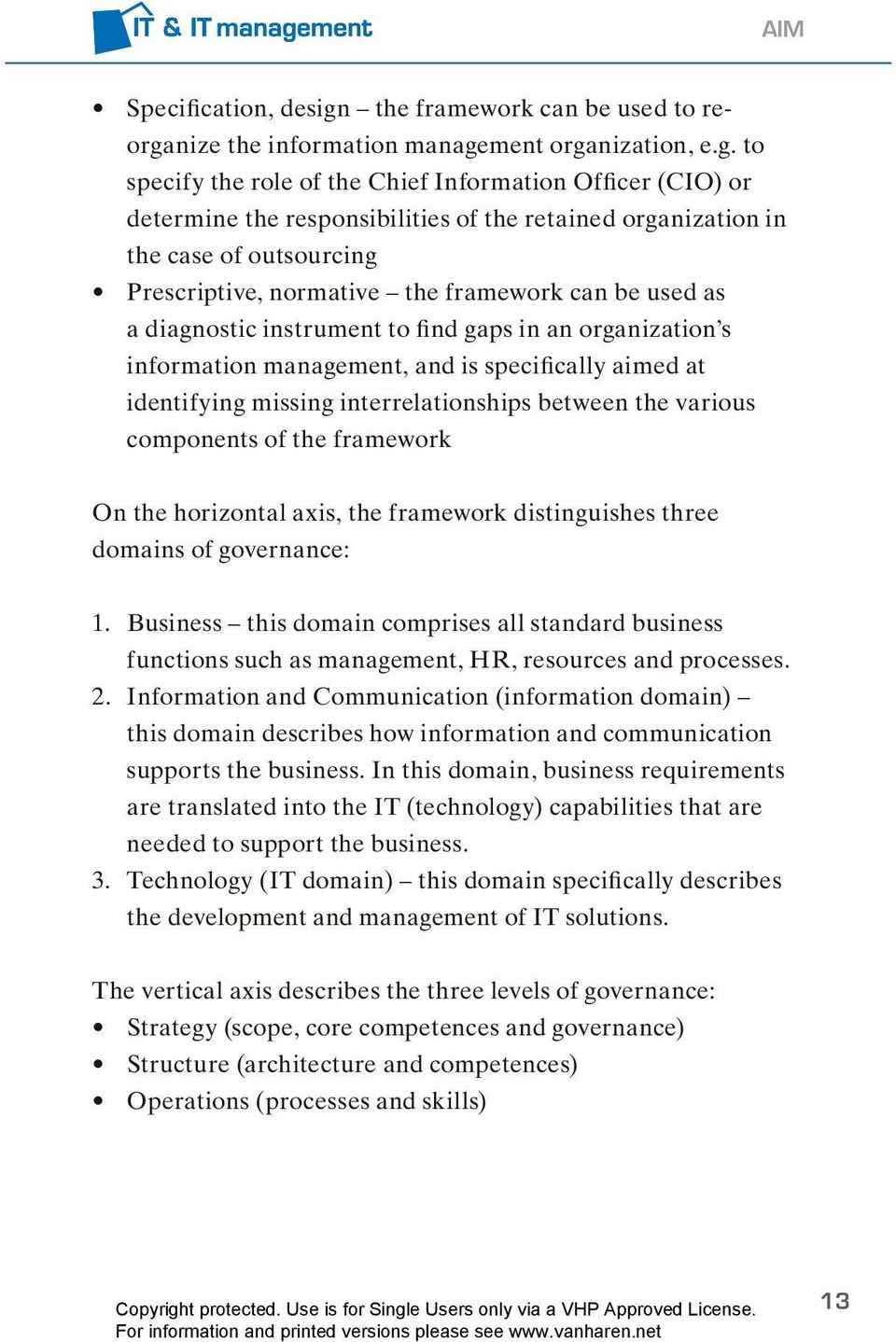
15 AIM Business Information/ Communication Technology Strategy (direction) Structure (implementation) Operations Abcouwer, Maes and Truijens (1997) Figure: The AIM or Nine Square framework AIM (originally known as the nine square framework) connects the two dimensions of management and information as the central components for Information Management. The dotted line demarks the scope of Business-IT alignment. 4 Target audience The framework was developed for information managers, enterprise architects and IT architects. 5 Scope and constraints The scope of the framework is the information management domain. 14

16 AIM This framework enables discussions on the topic of business and IT alignment, but it does not provide information on how organizations can actually achieve better communications between business and IT. The framework is not a method, and cannot be used in a descriptive way; however, it can be a useful addition to enterprise architecture frameworks such as TOGAF. 6 Relevant website (Dutch only) 15

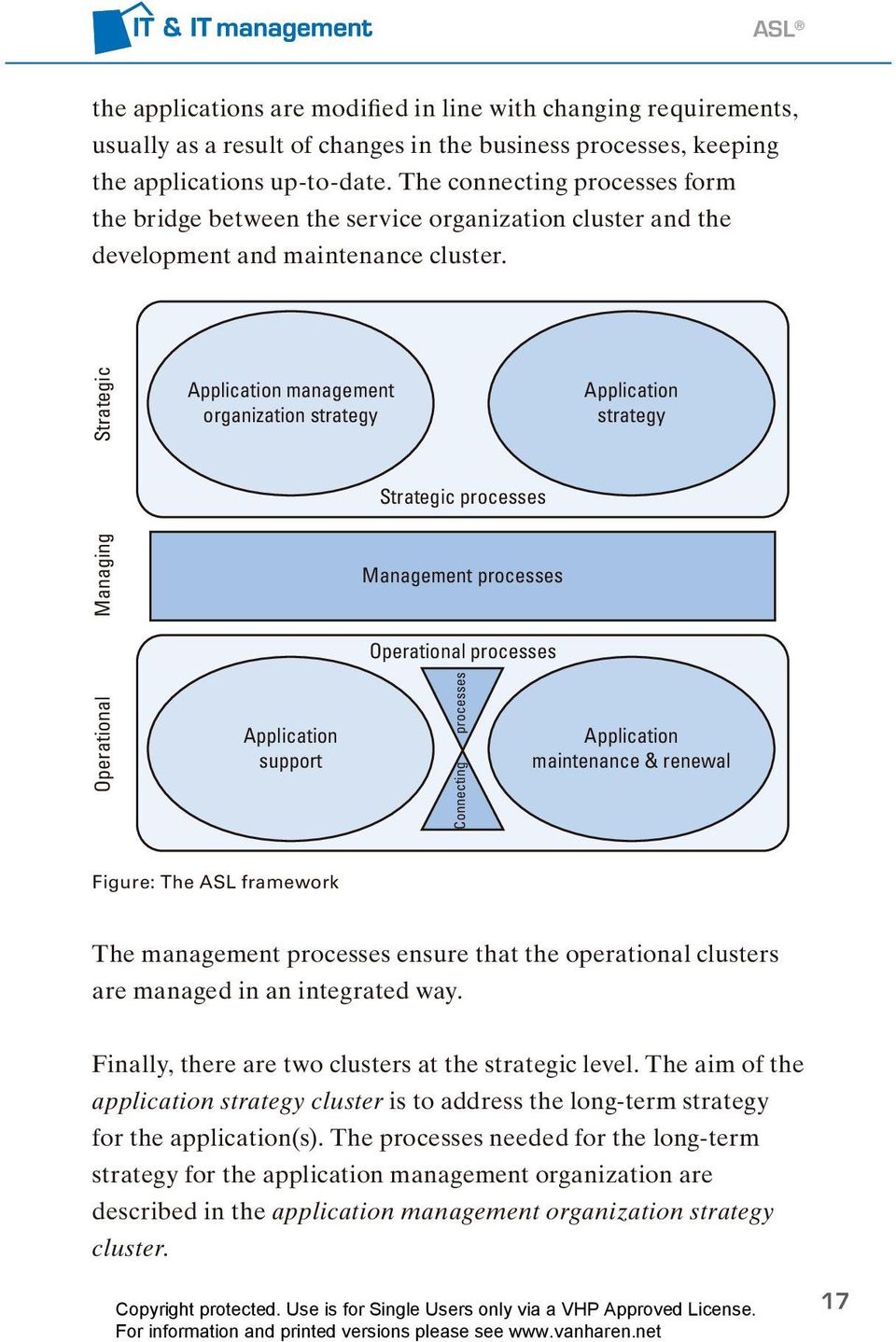
17 ASL 1 Title/current version ASL 2 (Application Services Library) 2 The basics ASL (Application Services Library) is a framework and collection of best practices for application management. 3 Summary ASL (Application Services Library) was developed by a Dutch IT service provider, PinkRoccade, in the 1990s and was made public in Since 2002 the framework and the accompanying best practices have been maintained by the ASL BiSL Foundation. The current version is ASL2, published in the Netherlands in ASL is concerned with managing the support, maintenance, renewal and strategy of applications in an economically sound manner. The library consists of a framework, best practices, standard templates and a self-assessment. The ASL framework provides descriptions of all the processes that are needed for application management. The framework distinguishes six process clusters, which are viewed at operational, managing and strategic levels see Figure. The application support cluster at the operational level aims to ensure that the current applications are used in the most effective way to support the business processes, using a minimum of resources and leading to a minimum of operational disruptions. The application maintenance and renewal cluster ensures that 16

18 ASL the applications are modified in line with changing requirements, usually as a result of changes in the business processes, keeping the applications up-to-date. The connecting processes form the bridge between the service organization cluster and the development and maintenance cluster. Strategic Application management organization strategy Application strategy Strategic processes Managing Management processes Operational processes Operational Application support Connecting processes Application maintenance & renewal Figure: The ASL framework The management processes ensure that the operational clusters are managed in an integrated way. Finally, there are two clusters at the strategic level. The aim of the application strategy cluster is to address the long-term strategy for the application(s). The processes needed for the long-term strategy for the application management organization are described in the application management organization strategy cluster. 17
19 ASL 4 Target audience The target audience for ASL consists of everyone who is involved in the development and management of applications: application support personnel, application architects and designers, programmers, testers, and managers with responsibility for application development or application management. 5 Scope and constraints The scope of ASL is the support, maintenance, renewal, and strategy of applications, and the management of all related activities. Strengths It offers a common language and conceptual framework for application management (maintenance and support) It provides an overview of all the activities (from operational to strategic) that are needed to keep applications up-to-date with the changing needs of the organization It is usable in various organizations It is owned and supported by a not-for-profit, vendorindependent foundation with participation by a wide range of organizations Constraints ASL overlaps partially with other IT Service Management frameworks 6 Relevant website 18
20 Business Relationship Management (BRM) 1 Title/definition Business Relationship Management (BRM) 2 The basics Business Relationship Management stimulates, surfaces and shapes business demand for a provider s products and services and ensures that the potential business value from those products and services is captured, optimized and recognized. The concept of Business Relationship Management (BRM) is related to and employs the techniques and disciplines of Customer Relationship Management (CRM). However, while CRM most often refers to a company s external customers, the BRM typically deals with a company s internal business partners or an internal provider s products and/or services. While BRM has its roots in CRM, it has come to mean different things to different people often depending upon the specific industry context. For example, in banking and finance, the Business Relationship Manager manages and maintains current business relationships and seeks new accounts. Banking BRMs are typically responsible for a portfolio of small to mid-sized businesses. In other industries, the label BRM has come to be a euphemism for account executive or even salesperson. 19
21 BRM 3 Summary The BRM Disciplinerests on solid research-based foundations verified and enhanced over a decade of successful implementations in leading organizations across the world. Proven to be equally effective for a wide range of internal providers including Human Resources, Finance, Legal, external service providers and others, BRM practices have enjoyed widespread adaption in IT. BRM implementations rate in IT services has quickened significantly, since 2011, when the BRM role and corresponding processes have been formalized as an Information Technology Infrastructure Library (ITIL ) best practice and an ISO/IEC IT Service Management international standard requirement. The Practice of Business Relationship Management embodies a set of competencies (e.g. knowledge, skills, and behaviors) to foster an effective business value-producing relationship between a service provider and its business partners. These competencies can be leveraged through organizational roles (e.g. in an IT organization, the CIO typically has a role of BRM for the enterprise), a discipline (e.g. all business partner facing service provider roles should be skilled in Business Relationship Management), and an organizational capability (e.g. a service provider organization should be effective in shaping and channeling demand to the highest business value opportunities). The BRM Role is a crucial link between a service provider and the business acting as a connector, orchestrator, and navigator between the service provider and one or more business units. 20
22 BRM Clarity of the BRM Role in the context of the provider Strategy and Operating Model Demand Shaping Exploring Servicing Value Harvesting BRM Competencies Strategic Partnering Business IQ Portfolio Management Provider Domain Powerful Communications Business Transition Management The House of BRM illustrates three key aspects of Business Relationship Management: 1. The foundation supports the BRM role and ensures it has the competencies to be effective and deliver value to both the provider organization and its business partners. 2. The pillars define the BRM space in terms of Core BRM Disciplines: Demand Shaping, Exploring, Servicing and Value Harvesting. 3. The roof of the House of BRM protects Business Relationship Management as a key aspect of provider capability. It does this by ensuring clarity around how the role, discipline and organizational capability of Business Relationship Management in the context of the Provider Strategy and Operating Model. Four Core BRM Disciplines Demand Shaping stimulates, surfaces and shapes business demand for provider services, capabilities and products. It ensures that business strategies fully leverage provider 21
23 BRM capabilities, and that the provider service portfolio and capabilities enable business strategies. Most importantly, Demand Shaping is focused on optimizing the business value realized through provider services, capabilities and products that low value demand is suppressed while higher value demand is stimulated. Exploring identifies and rationalizes demand. Business Relationship Management helps sense business and technology trends to facilitate discovery and demand identification. Exploring is an iterative and ongoing process that facilitates the review of new business, industry and technology insights with potential to create value for the business environment. The key benefit of this discipline is the identification of business value initiatives that will become part of the provider portfolio of services, capabilities and products. Servicing coordinates resources, manages Business Partner expectations, and integrates activities in accordance with the business partner-provider partnership. It ensures that business partner-provider engagement translates demand into effective supply requirements. Servicing facilitates business strategy, Business Capability Roadmapping, portfolio and program management. Value Harvesting ensures success of business change initiatives that result from the exploring and servicing engagements. Value harvesting includes activities to track and review performance, identify ways to increase the business value from business-provider initiatives and services, and initiates feedback that triggers continuous improvement cycles. This process provides stakeholders with insights into the results of business change and initiatives. 22
24 BRM 4 Target audience Any business professional or organization wishing to better stimulate, surface and shape business demand for a provider s products and services and ensure that the potential business value from those products and services is fully captured, optimized, and recognized. 5 Scope and constraints With its focus on improving relationships among business partners and maximizing business value, the principles of the art and practice of Business Relationship Management are equally relevant to anyone engaged in business anyone from rank-andfile employees to C-level executives. If maximizing business value realization of resources spent is of any concern to you, BRM is a discipline, which will help you to achieve your objectives. Constraints Although 2011 editions of ISO/IEC standard and ITIL best practices rekindled the public interest in Business Relationship Management, their scope is limited to IT and the guidance they provide is most effective in the initial stages of BRM capability implementations and at the lower levels of its maturity. To be truly successful in rolling out and maximizing the potential of BRM capability, organizations should follow a much more holistic approach, one developed, promoted, and constantly refined by Business Relationship Management Institute. Relevant links website Official Business Relationship Management Institute s website: APMG is responsible for facilitating the delivery of Business Relationship Management Professional (BRMP ) training and certification. 23
25 CMMI 1 Title/current version CMMI (Capability Maturity Model Integration) Version The basics CMMI is an internationally recognized process improvement approach that helps organizations to identify where to focus their improvement efforts along an evolutionary maturity path from ad hoc and chaotic to mature disciplined processes. 3 Summary CMMI is owned and supported by the Carnegie Mellon Software Engineering Institute (SEI). Version 1.0 of the CMM for Software (SW-CMM) was published in 1991; it was upgraded to CMM Integration (CMMI) in 2000 and the current version is Version 1.3, released in November An important change in Version 1.3 is the addition of Agile. CMMI integrates traditionally separate organizational functions, sets process improvement goals and priorities, provides guidance for quality processes, and provides a point of reference for appraising current processes. The CMMI models are collections of best practices that help organizations to improve their processes: The CMMI for Acquisition (CMMI-ACQ) model provides guidance on managing the supply chain to meet the needs of the customer The CMMI for Development (CMMI-DEV) model supports improvements in the effectiveness, efficiency, and quality of product and service development The CMMI for Services (CMMI-SVC) model provides 24
26 CMMI guidance on establishing, managing, and delivering services that meet the needs of customers and end users The People CMM provides guidance on managing and developing the workforce An organization appraises its processes against the CMMI best practices: To determine how well its processes compare to CMMI best practices, and to identify areas where improvement can be made And/or to inform external customers and suppliers of how well its processes compare to CMMI best practices And/or to meet the contractual requirements of one or more customers 5 4 Focus on continuous process improvement Process measured and controlled Quantitatively Managed Optimizing 3 Process characterized for for the organization and is proactive Defined 2 1 Process characterized for projects and is often reactive Process unpredictable, poorly controlled, and reactive Initial Managed Figure: CMMI maturity levels Source: SCI Organizations can use a staged approach to appraisal to identify process maturity levels from 1 to 5 (see Figure). They can also take a more flexible continuous approach to appraisal, measuring 25
27 CMMI capability maturity in individual process areas. The appraisal results can then be used to plan process improvements for the organization. 4 Target audience Managers responsible for process improvement programmes, project managers, process improvement specialists, project team members, appraisals teams. 5 Scope and constraints CMMI applies to teams, work groups, projects, divisions, and entire organizations CMMI works best in combination with Agile, Scrum, ITIL, Six Sigma, COBIT, ISO 9001, RUP, or Lean Provides a common, integrated vision of improvement or can focus on a specific process area Generic descriptions based on industry best practice Supporting guidance such as roadmaps help to interpret generic models for specific circumstances Constraints: Aiming for higher maturity levels that will not achieve increased business benefits Rigid adherence to a staged approach trying to move every project in the organization to the next level of maturity can be costly and time-consuming Failing to interpret the generic descriptions appropriately for the specific needs of the or ganization 6 Relevant websites 26
28 COBIT 1 Title/current version COBIT 5 2 The basics Originally designed for auditors to audit the IT organization, COBIT 5 (Control Objectives for Information and Related Technology) is about linking business goals to IT objectives (note the linkage here from vision to mission to goals to objectives). COBIT 5 (launched April 2012) provides metrics and maturity models to measure whether or not the IT organization has achieved its objectives. Additionally, COBIT identifies the associated responsibilities of the business process owners as well as those of the IT process owners. 3 Summary COBIT is owned and supported by ISACA. It was released in 1996; the current Version 5.0 (April 2012) brings together COBIT 4.1, Val IT 2.0 and Risk IT frameworks. The COBIT 5 principles and enablers are generic and useful for enterprises of all sizes, whether commercial, not-for -profit or in the public sector (Figures 1 and 2). 27
29 COBIT 1. Meeting Stakeholder Needs 5. Separating Governance From Management COBIT 5 Principles 2. Covering the Enterprise End-to-end 4. Enabling a Holistic Approach 3. Applying a Single Integrated Framework Figure 1: The COBIT 5 Principles COBIT 5 ENTERPRISE ENABLERS Processes Organisational Structures Culture, Ethics and Behaviour Principles, Policies and Frameworks Information Services Infrastructure Applications People, Skills and Competencies RESOURCES Figure 2: The COBIT 5 Enablers 28
30 COBIT The process reference model defi nes and describes in detail a number of governance, and management processes. It represents all the processes normally found in an organization relating to IT activities, thus providing a common reference model understandable to operational IT, and business managers, and their auditors/advisors. The process reference model divides the processes of organization IT into two domains: governance and management. COBIT 5 provides a set of 36 governance and management processes within the framework. The governance domain contains fi ve governance processes; within each process, evaluate, direct, and monitor practices are defi ned. EDM1: set and maintain the governance framework EDM2: ensure value optimisation EDM3: ensure risk optimisation EDM4: ensure resource optimisation EDM5: ensure stakeholder transparency The four management domains, in line with the responsibility areas of plan, build, run, and monitor (PBRM) provide end-to-end coverage of IT. Align, plan, and organize Build, acquire, and implement Deliver, service, and support Monitor, evaluate, and assess A casual look at the four management domains of COBIT 5 rapidly illustrates its direct relationship with ITIL. The align, plan, and organize domain relates to the service strategy and design phases The build, acquire, and implement domain relates to the service transition phase The deliver, service, and support domain relates to the service operation phase And fi nally, the monitor, evaluate, and assess domain relates to the continual service improvement phase All aspects of COBIT 5 are in line with the responsibility areas of plan, build, run and monitor. In other words, COBIT 5 follows the PDCA cycle of Plan, Do, Check, and Act. COBIT has been positioned at a high level, and has 29
31 COBIT been aligned and harmonized with other, more detailed, IT standards and proven practices such as COSO, ITIL, ISO 27000, CMMI, TOGAF and PMBOK Guide. COBIT 5 acts as an integrator of these different guidance materials, summarising key objectives under one umbrella framework that links the proven practice models with governance and business requirements. 4 Target audience Senior business management, senior IT management and auditors. 5 Scope and constraints COBIT provides an umbrella framework for IT governance across the whole of an organization. It is mapped to other frameworks and standards to ensure its completeness of coverage of the IT management lifecycle and support its use in enterprises using multiple IT-related frameworks and standards. Some strong points are: Value creation through effective governance, management enterprise information and technology (IT) assets Business user satisfaction with IT engagement and services by enabling business objectives Compliance with relevant laws, regulations and policies Constraints: Treating COBIT as a prescriptive standard when it should be interpreted as a generic framework to manage IT processes and internal controls. Key themes from COBIT must be tailored to the specific governance needs of the organization 30
32 COBIT Lack of commitment from top management without their leadership and support, the IT control framework will suffer and business alignment of IT risks will not happen Underestimating the cultural change COBIT is not just about the technical aspects of IT. The organization needs to have a good understanding of the governance controls for the IT risks 6 Relevant website 31
33 DevOps 1 Title / definition DevOps 2 The Basics Literally speaking, DevOps is a joining of development and operations. However, to understand what it truly is, some background is required on its origins. Ignited by Patrick Debois and Andrew Clay Shafer, discussing agile infrastructure at the Agile 2008 conference, it really caught fire after the first DevOps Days in Ghent one year later. Since then, tens of DevOps Days have been organized by a rapidly growing, hands-on community of IT professionals from both development and operations. It has led to a worldwide, bottom-up movement to enable a fast and resilient delivery of IT services. Along with this relevant movement automatically comes the inevitable desire to define and scope DevOps. Leading to semantic, even religious discussions, which in fact do not contribute to its goal (agility, collaboration and empathy across the IT value chain). So, without trying to ringfence it, DevOps aims at an organizational mindset for continuously improving value from the digital value chain by enabling crossfunctional collaboration on process, technology and behavior level. 3 Summary Organizations worldwide have adopted Lean and Agile ways of working to cope with their current disruptive markets. Lean Startup principles are adopted by large multinational corporations, and Agile methodologies have outgrown the IT department, towards primary processes in lawyer firms, schools and construction agencies. This, however, does not 32
34 DevOps say that these organizations actually bring new or adapted software to production with the required speed and frequency. Predominantly during this final step (often referred to as the last mile ) the delivery hampers. The root cause? The organization has too many silos, which are not (enough) connected. The problem Who hasn t seen them: IT departments where designers, developers, testers, support and operations live in splendid isolation from each other, with a minimal level of collaboration. The designers cherish their own requirements and methodologies, developers work on their code (possibly in Scrum teams), after which the results are pulled through the test factory, in order to be thrown over the operations wall at the end. Products, as delivered by the development teams (Scrum has named these potentially shippable products, or PSP), pile up in front of operations doorstep. By the way, using the PSP term consistently in Scrum implementation worldwide, has contributed greatly to the divergence of responsibility in the value chain. After all, from the (Scrum) developer point of view, their job was done once it was potentially shippable, hence on a pallet, waiting to be shipped. At that time, it still does not delivery any value at all! But the developer considered it done, as their work was done. No relation to value whatsoever. And when these product increments are eventually implemented in a large release, it takes unacceptably long before errors can be related to their source. Integration problems don t come to the surface before the tester is running the acceptance tests. And what about the customer satisfaction, if users are constantly faced with delays and unavailabilities? In short, DevOps addresses the need for higher user satisfaction, a dynamic balance between 33
35 DevOps value and risks, shorter time to market, and more efficiency in the end-to-end chain through cross-functional collaboration. The Three Ways As beautifully illustrated in the DevOps bible The Phoenix Project, the value IT can deliver to an organization is completely dependent on its ability to make the organization collaborate as a whole. Although the name suggests only Development (Dev) and Operations (Ops) will more closely collaborate, the essence is much broader than just that. Bringing together Dev and Ops is referred to as DevOps Lite (after Patrick Debois), whereas true DevOps also entails the integration of crucial roles such as the business, testing/qa and security. This holistic thinking is the first principle (The First Way) of DevOps. Besides that, it is considered fundamental to DevOps to not only have (mostly Agile) development teams deliver potentially shippable products, but to have the target deployment environments available as well (provisioning). Clearly this is where DevOps takes Agile implementations one step further, thereby providing the IT organization more valuable feedback (The Second Way) on the quality of the delivered products. Surely automation plays an essential role here. Without a high degree of automation, it is virtually impossible to provision and synchronize (DTAP) environments in a fast and standardized way. Probably the most fundamental shift which is part of the DevOps way of working, is the way errors and risks are dealt with. Traditional organizations tend to have a cultural heritage where errors are being punished, hence covered up. DevOps organizations assume that errors and experiments are excellent, as they improve the organization s resilience (The Third Way). 34
36 DevOps It enhances the organizational capability to learn, moving these types of organizations towards a state of antifragility (Nicholas Taleb). They are known for their ability to absorb disturbances, even grow from them, and continuously adapt to changing circumstances. Relations The revolutionary aspect of DevOps is not about the individual components it touches. It is the contextual combination and application of these frameworks, methods and movements. The following essential relations are identified in relation to DevOps: Agile Lean ALM DevOps ToC Cloud ITIL Agile: Many of the principles applied in organizations that have adopted DevOps, concur with the Agile principles. Think of short feedback loops, minimizing unit size and fast flow of planned work. Lean: The Lean way of thinking is not only applicable to the factory floor. Lean elements such as Voice of the Customer, Flow, Pull and Kaizen are used more and more in IT organizations. Waste is reduced and errors are identified and solved at the source ( no defects downstream ). 35
37 DevOps Theory of Constraints: This methodology, related to Lean, is characterized by the elimination of bottlenecks. By consistently searching for essential limitations in your organization s product and service flows, these constraints (or bottlenecks) can be taken away adequately. ITIL: Without a doubt, ITIL also plays a significant role in DevOps organizations. If well applied, the introduction of Agile and Lean principles and instruments in the entire IT delivery chain (so including operations and support) account for faster and more flexible service management processes. Take Configuration Management, which is crucial in DevOps in sharing information between several roles and domains. Cloud: Many organizations have started their transformation to the cloud, either partly or full blown. Cloud technology enables fast provisioning, adjustment (scaling up/down) and synchronization of (DTAP) environments and in automating several build, integration, test or deployment tasks. Themes Typical patterns we encounter in DevOps environments include: Continuous Delivery Delivery pipelines are automated, resulting in practices like continuous integration, continuous deployment, automated testing. Software Defined Anything Servers, even entire networks are software defined nowadays. Physical, on-premise hardware is replaced by virtual machines and containers. 36
38 DevOps Agile architecture Huge monolythic applications are replaced by microservices, enabling fast feedback, low regression testing and maximizing the use of market standardization. Service flow By using Lean processes, a value-driven approach challenging the end-to-end performance of the value stream, continuously optimizing batch size and queues. Functional vs non-functional requirements A sound balance between functional and non-functional system behavior requires professional product ownership, but also built-in quality, security and monitoring. Learning culture Failure is regarded as valuable learning points instead of opportunities for punishment, resulting in blameless postmortems and rewards for positive experimental behavior. 4 Target audience DevOps as a theme is relevant for everyone involved in the digital value chain. Whether you are from HR, selling mortgages, develop software, write testscripts or operate infrastructure in the cloud. 5 Recommended website Whitepaper Gene Kim: HDICorp/Files/White-Papers/whtppr-1112-devops-kim.pdf Blog Rob England: 37
39 e-cf 1 Title/current version e-cf ( European e-competence Framework) - Version The Basics The European e-competence Framework, e-cf, is a reference framework for competences applied within the IT sector and a common language for IT-related knowledge, skills and attitudes. 3 Summary The e-cf has been developed by the Workshop on IT Skills of the European Committee for Standardization (CEN), with contributions from a large number of IT and HR experts. The development of the e-cf started in 2005 after recommendations from the European e-skills Forum that national IT framework stakeholders and IT experts should consider developing a European e-competence framework. With the introduction of Version 3.0 in 2014 the CEN started the process to make the e-cf a European standard. A competence is defined in the e-cf as a demonstrated ability to apply knowledge, skills and attitudes to achieving observable results. Each of the 40 competences in e-cf 3.0 is described in four so called dimensions : 1. The e-competence Area taken from a simple IT process model: Plan Build Run Enable Manage 2. A Generic Description in terms of the behavior showing the competence and the expected contribution at the workplace 3. Proficiency Levels based on a mix of: autonomy (from being instructed to making choices ) 38
40 e-cf context complexity (from structured/predictable to unstructured/unpredictable ) behavior (from able to apply to able to conceive ) 4. Knowledge and Skills examples that may be relevant for competence performance as described in dimensions 2 and 3 The e-cf proficiency levels, 1 to 5, are very similar to the levels 3 to 8 of the European Qualification Framework (EQF) used in formal education. For most competences in the e-cf only two or three levels are defined. The e-cf is published by the CEN IT Skills Workshop as a CEN Workshop Agreement (CWA) and consists of four parts: Part 1 is the standard itself Part 2 contains guidance on the use of the standard Part 3 documents how the e-cf was developed Part 4 illustrates the application of e-cf in practice by providing 15 case studies 4 Target audience The framework provides an international tool for: IT practitioners and managers, with clear guidelines for their competence development Human resources managers, enabling the anticipation and planning of competence requirements Education, training and certification, enabling effective planning and design of IT curricula and assessment of professionals Policy makers, professional organizations and market researchers, providing a clear and Europe-wide agreed reference for IT professionalism, IT skills and competences in a long-term perspective 39
41 e-cf (A E) e-1 to e-5, related to EQF levels 3 8 e-1 e-2 e-3 e-4 e-5 A. PLAN A.1. IS and Business Strategy Alignment A.2. Service Level Management A.3. Business Plan Development A.4. Product/Service Planning A.5. Architecture Design A.6. Application Design A.7. Technology Trend Monitoring A.8. Sustainable Development A.9. Innovating B. BUILD B.1. Application Development B.2. Component Integration C. RUN D. ENABLE E. MANAGE B.3. Testing B.4. Solution Deployment B.5. Documentation Production B.6. Systems Engineering C.1. User Support C.2. Change Support C.3. Service Delivery C.4. Problem Management D.1. Information Security Strategy Development D.2. IT Quality Strategy Development D.3. Education and Training Provision D.4. Purchasing D.5. Sales Proposal Development D.6. Channel Management D.7. Sales Management D.8. Contract Management D.9. Personnel Development D.10. Information and Knowledge Management D.11. Needs Identification D.12. Digital Marketing E.1. Forecast Development E.2. Project and Portfolio Management E.3. Risk Management E.4. Relationship Management E.5. Process Improvement E.6. IT Quality Management E.7. Business Change Management E.8. Information Security Management E.9. IS Governance Fi gure: Overview of the e-cf competences and proficiency levels Procurement managers, providing a common language for effective technical terms of reference in national and international bids 5 Scope and Constraints The e-cf supports the definition of job roles, career paths, professional development plans, learning paths and qualifications 40
42 e-cf based on a shared common language and competence structure. It allows detailed profiling by defining profiles combining various competences. Measurement and assessment of competence using the e-cf as a reference framework enables the identification of competence gaps at an individual, team or organizational level, and effective targeted training or recruitment. Strengths Where job titles and job descriptions rapidly become obsolete in the dynamic and complex environment of modern organizations, competence is recognized as a more stable basis expressing capabilities required in the workplace. As a reference framework, the e-cf can be aligned with HR instruments already existing in an organization, including other competence frameworks. Constraints The e-cf descriptions of competences, describing behavior in the workplace, are easily misunderstood as describing roles in an organization. Using the e-cf, e.g. for role profiles, one has to keep in mind that the framework is just that: a framework. Guidance on how to use the framework can be found in Part 2, the User Guide. 6 Relevant websites 41
43 ISO/IEC Title/current version ISO/IEC :2011 Standard for IT Service management 2 The basics ISO/IEC :2011 is a service management system (SMS) standard, which specifies requirements for the service provider to plan, establish, implement, operate, monitor, review, maintain and improve an SMS. This standard consists of several parts. 3 Summary ISO/IEC is owned by the International Standards Organization (ISO) and the International Electrotechnical Commission (IEC). It is the international IT Service Management standard that enables IT organizations (whether in-house, outsourced or external) to ensure that their IT service management processes are aligned both with the needs of the business and with international best practice. It is based on, and replaces, BS15000, which has now been withdrawn. ISO/IEC helps organizations benchmark how they deliver managed services, measure service levels and assess their performance. It is broadly aligned with, and draws strongly on, ITIL. The standard has two main parts, both with the general title Information technology - Service management, which enable IT service providers to identify how to enhance the quality of service they deliver to their customers, both internal and external: Part 1: Specification (ISO/IEC :2011) provides requirements for IT service management and is relevant to 42
44 ISO/IEC those responsible for initiating, implementing or maintaining IT service management in their organization Part 2: Code of practice (ISO/IEC :2005) represents an industry consensus on guidance to auditors and assistance to service providers planning service improvements or to be audited against ISO/IEC :2011 The other parts provide additional guidance on a more detailed level for specific areas like: scope definition and applicability of ISO/IEC (part 3), Process reference model (part 4), Exemplar implementation plan for ISO/IEC (part 5). ISO uses the process-based approach of other management system standards such ISO 27001:2005, ISO 9001:2008 and ISO 14001:2004, including the Plan-Do-Check-Act (PDCA) cycle and requirements for continual improvement. Organizations can have their IT service management systems independently certified as conforming to the requirements of ISO/IEC :2011. ISO provides essential information on writing a scope for a service management system (SMS) as well as providing information on implementing an ISO/IEC SMS. 4 Target audience IT service providers; internal IT units; auditors. 5 Scope and constraints ISO/IEC is appropriate for IT service provider organizations. It is suitable for all industry sectors and all sizes of 43
45 ISO/IEC organization except the very smallest (where a wide ranging ISO 9000 certification is more appropriate). The traditional use of a formal standard is to achieve formal certification; it is also helpful as a benchmark and guide to implementing best practice processes. The inherent nature of its unambiguously expressed requirements allows meaningful period-by-period comparisons, which can deliver a measure of improvement in a service provider s processes. ISO can assist an organization in benchmarking its IT service management, improving its services, demonstrating an ability to meet customer requirements and create a framework for an independent assessment. Constraints To achieve wide and comprehensive coverage, the standard addresses only the generically valid core elements of the service management processes; it can never describe the full set of processes/procedures that an individual service provider will require to deliver effective and efficient, customer-focused services. 6 Relevant website 44
46 ISO/IEC Title/current version ISO/IEC 27000:2014 Standard for Information Security Management 2 The basics ISO/IEC is a series of information security standards developed and published by ISO and IEC. These standards provide a globally recognized framework for best practices in Information Security Management. 3 Summary The ISO/IEC series is owned by the International Standards Organization (ISO) and the International Electrotechnical Commission (IEC). ISO is a specification that sets out specific requirements, all of which must be followed, and against which an organization s Information Security Management System (ISMS) can be audited and certified. All the other Standards in the ISO family are Codes of Practice; these provide non-mandatory best practice guidelines which organizations may follow, in whole or in part, at their own discretion. Key concepts that govern the standards are: Organizations are encouraged to assess their own information security risks Organizations should implement appropriate information security controls according to their needs Guidance should be taken from the relevant standards Implement continuous feedback and use of the Plan, Do, Check, Act model 45
47 ISO/IEC Continually assess changes in the threats and risks to information security issues The ISO standards family ISO/IEC provides an overview of information security management systems, which form the subject of the information security management system (ISMS) family of standards, and defines related terms ISO/IEC 27001:2013 Information technology Security Techniques Information security management systems (ISMS) Requirements, does not rely Plan-Do-Check-Act cycle, but has been updated in other ways to reflect changes in technologies and in how organizations manage information ISO/IEC 27002:2013 Code of practice for information security controls, this contains the good practice information security control objectives and controls ISO/IEC Information security management system implementation guidance for the ISO/IEC ISO/IEC Information security management Measurement ISO/IEC Information security risk management, aligned to ISO/IEC ISO/IEC The accreditation Standard with guidance for bodies providing audit and certification of information security management systems ISO/IEC Guidelines for information security management systems auditing (focused on the management system) ISO/IEC TR Technical Report on guidance for auditors on ISMS controls (focused on the (technical) information security controls) 46
48 ISO/IEC ISO/IEC Information security management for intersector and inter-organizational communications ISO/IEC Information security management guidelines for telecommunications organizations based on ISO/IEC ISO/IEC Guideline on the integrated implementation of ISO/IEC and ISO/IEC (IT service management/itil) ISO/IEC Information security governance,offers guidance on the governance of information security ISO/IEC TR Technical Reference, Information security management guidelines for financial services ISO/IEC TR covers the economics of information security management ISO/IEC covers the information security controls for cloud computing, based on the ISO/IEC ISO/IEC Code of practice for protection of personally identifiable information (PII) in public clouds acting as PII processors ISO/IEC TR provides guiding principles based on ISO/ IEC for information security management applied to process control systems as used in the energy utility industry ISO/IEC TR Information technology Security techniques -- Mapping the revised editions of ISO/IEC and ISO/IEC ISO/IEC Guidelines for information and communication technology readiness for business continuity ISO/IEC Guideline for cybersecurity ISO/IEC Network security Part 1: Overview and concepts ISO/IEC Network security Part 2: Guidelines for the design and implementation of network security 47
49 ISO/IEC ISO/IEC Network security Part 3: Reference networking scenarios - Threats, design techniques and control issues ISO/IEC Network security Part 5: Securing communications across networks using Virtual Private Networks (VPNs) ISO/IEC Application security Part 1: Guideline for application security ISO/IEC Information security incident management ISO/IEC Information security for supplier relationships - Part 1: Overview and concepts ISO/IEC Information security for supplier relationships - Part 2: Requirements ISO/IEC Information security for supplier relationships - Part 3: Guidelines for information and communication technology supply chain security ISO/IEC Guidelines for identification, collection, acquisition and preservation of digital evidence ISO/IEC Information technology Security techniques -- Specification for digital redaction ISO/IEC Information technology Security techniques -- Selection, deployment and operations of intrusion detection systems (IDPS) ISO/IEC Information technology Security techniques -- Storage security ISO/IEC guidance on assurance for digital evidence investigation methods ISO/IEC guidance on analysis and interpretation of digital evidence ISO/IEC guidance on incident investigation. ISO Risk management Principles and guidelines 48
50 ISO/IEC Target audience All roles responsible for IT security management in an organization, IT security management professionals and auditors. 5 Scope and constraints The family of ISO/IEC standards is broad in scope: they are applicable to any organization, in any sector, of any size. Strengths By aligning itself with an ISO/IEC standard, an organization can: Secure its own critical assets Manage levels of risks Improve and ensure customer confidence Avoid loss of brand damage, loss of earnings or potential fines Evolve its information security alongside technological developments Constraints / Pitfalls Few organizations formally state the scope of their ISMS or document their risk assessment method and risk acceptance criteria in accordance with the standard Many organizations lack formal procedures for reporting security events, and mechanisms to quantify and monitor incidents Business continuity plans are often either absent or outdated, while continuity exercises are irregular and unrealistic Few organizations identify all the information securityrelevant laws and regulations, and established mechanisms to stay up-to-date on changes 6 Relevant website 49
51 ISO Title/current version ISO/IEC 38500:2008 Corporate governance of information technology 2 The basics ISO/IEC 38500:2008 provides guiding principles for directors of organizations (including owners, board members, directors, partners, senior executives, or similar) on the effective, efficient, and acceptable use of IT within their organizations. 3 Summary ISO/IEC 38500:2008 is owned by the International Standards Organization (ISO) and the International Electrotechnical Commission (IEC). The standard helps to clarify IT governance from the top down by describing it as the means through which directors can demonstrate to all stakeholders and compliance bodies their effective stewardship over IT resources by ensuring that an appropriate governance and security framework exists for all IT activities as a result of covering the following principles. The principles are: Responsibility employees know their responsibilities both in terms of demand and supply of IT and have the authority to meet them Strategy business strategies should be aligned with IT possibilities, and all IT within an organization should support the business strategies Acquisition all IT investments must be made on the basis of a business case with regular monitoring in place to assess whether the assumptions still hold 50
52 ISO Performance the performance of IT systems should lead to business benefits and therefore it is necessary that IT supports the business effectively Conformance IT systems should help to ensure that business processes comply with legislation and regulations; IT itself must also comply with legal requirements and agreed internal rules Human behavior IT policies, practices and decisions respect human behavior and acknowledge the needs of all the people in the process The standard consists of three parts: Scope, Framework and Guidance. 4 Target audience Senior managers; members of groups monitoring the resources within the organization; external business or technical specialists, such as legal or accounting specialists, retail associations, or professional bodies; vendors of hardware, software, communications and other IT products; internal and external service providers (including consultants); IT auditors. 5 Scope and constraints ISO/IEC 38500:2008 applies to the governance of management processes (and decisions) relating to the information and communication services used by an organization. These processes could be controlled by IT specialists within the organization, or external service providers, or by business units within the organization. The standard is applicable in all types of private and public and not-for-profit organizations independent of their size and form and regardless of the extent of their use of IT. 51
53 ISO Strengths The primary advantage of the ISO/IEC 38500:2008 IT governance framework is to ensure that accountability is clearly assigned for all IT risks and activities. This specifically includes assigning and monitoring IT security responsibilities, strategies and behaviors so that appropriate measures and mechanisms are established for reporting on and responding to the current and planned use of IT for example, meeting the latest data protection requirements for encryption of all portable devices such as laptops and memory sticks used to store and transmit personal data. Constraints Outsourcing: some requirements are so specific to the managers of IT that they cannot be imposed on the managers of the company if their IT is outsourced. In cases such as these, requirements will need to be secured in the contract with the supplier of IT services Applying the standard in isolation: ISO is not one size fits all. It does not replace COBIT, ITIL, or other standards or frameworks, but, rather, it complements them by providing a demand-side-of-it-use focus 6 Relevant website 52
54 IT-CMF 1 Title / definition IT-CMF TM (Information Technology Capability Maturity Framework TM ) 2 The basics Organizations, both public and private, are constantly challenged to be increasingly more agile, innovative and value-adding. CIOs are uniquely well-positioned to seize this opportunity and adopt the role of business transformation partner, helping their organizations to grow and prosper with innovative, IT-enabled products, services and processes. To succeed in this, however, the IT function needs to manage an array of inter-dependent but distinct disciplines. In response to this need, the Innovation Value Institute, a crossindustry international consortium, developed the IT Capability Maturity Framework (IT-CMF ). 3 Summary The IT Capability Maturity Framework (IT-CMF ) represents a suite of capabilities Figure 1 that help improve the management of IT to deliver higher levels of agility, innovation and value creation. 53
55 IT-CMF Managing IT like a Business Managing the IT Budget Managing the IT Capability Managing IT for Business Value AA Accounting and Allocation BGM Budget Management CAM Capability Assessment and Management BAR Benefits Assessment and Realization BP Business Planning BOP Budget Oversight and EAM Enterprise Architecture Management PM Portfolio Management BPM Business Process Management Performance Analysis ISM Information Security Management * TCO Total Cost of Ownership CFP Capacity Forecasting and Planning FF Funding and Financing KAM Knowledge Asset Management DSM Demand and Supply Management PPP Portfolio Planning and Prioritization PAM People Asset Management EIM Enterprise Information Management * PPM Programme and Project Management IM Innovation Management RAM Relationship Asset Management ITG IT Leadership and Governance RDE Research, Development, and Engineering ODP Organization Design and Planning SRP Service Provisioning RM Risk Management SD Solutions Delivery SAI Service Analytics and Intelligence SUM Supplier Management SRC Sourcing TIM Technical Infrastructure Management SP Strategic Planning TED User Experience Design SICT Sustainable Information UTM User Training Management and Communication Technology Figure 1: IT-CMF s Critical Capabilities Each critical capability of IT-CMF consists of capability building blocks (CBBs), which are characterized by maturity levels, are evaluated by maturity questions and are improved by practicesoutcomes-metrics (POMs). Contains Critical Capabilities (CCs) Drive Agility, Innovation & Value Consist of Maturity Questions Evaluated by Capability Building Blocks (CBBs) Improved by Practices- Outcomes- Metrics (POMs) Characterized by Maturity Levels Figure 2: IT-CMF s Principal Components 4 Target Audience Business and IT professionals seeking to harness the full potential of information technology in their organizations, including CxOs, transformation change managers, IT strategy 54
56 IT-CMF planners, general managers, and IT professionals aspiring to demonstrate leadership in adopting better approaches to managing technology for agility, innovation and value impact. 5 Scope and constraints Framework Strengths IT-CMF is: An integrated management toolkit covering more than 30 management disciples, with organizational maturity profiles, assessment methods, and improvement roadmaps for each. A coherent set of concepts and principles, expressed in business management terms, that can be used to guide discussions on setting goals and evaluating performance. A unifying (or umbrella) framework that complements other, domain-specific frameworks already in use in the organization, helping to resolve conflicts between them, and filling gaps in their coverage. Industry/sector and vendor independent. IT-CMF can be used in any organizational context to guide performance improvement. A rigorously developed approach, underpinned by the principles of Open Innovation and guided by the Design Science Research methodology, synthesizing leading academic research with industry practitioner expertise. 6 Considerations when using IT-CMF in your organization IT-CMF should be adopted at a senior management level, not just at the front-line staff/practitioner level, to realize the framework s full advantages. 55
57 IT-CMF The framework delivers value through change. Committing to the required organizational change will help ensure expected outcomes are achievable. Appropriate capability selection and setting of maturity targets benefits from an appreciation of IT-CMF s critical capabilities, as well as a blended view across an organization s business strategy, IT posture and industry context. 6 Relevant Website 56
58 IT4IT 1 Title/Current Version IT4IT Reference Architecture Version 2.0, an Open Group Standard. 2 The Basics The Open Group IT4IT Reference Architecture standard comprises a reference architecture and a value chain-based operating model for managing the business of IT. The IT Value Chain The IT Value Chain has four value streams supported by a reference architecture to drive efficiency and agility. The four value streams are: Strategy to Portfolio Request to Fulfill Requirement to Deploy Detect to Correct Each IT Value Stream is centered on a key aspect of the service model, the essential data objects (information model), and functional components (functional model) that support it. Together, the four value streams play a vital role in helping IT control the service model as it advances through its lifecycle. The IT4IT Reference Architecture Provides prescriptive guidance on the specification of and interaction with a consistent service model backbone (common data model/context) Supports real-world use-cases driven by the Digital Economy (e.g., Cloud-sourcing, Agile, DevOps, and service brokering) 57
59 IT4IT Embraces and complements existing process frameworks and methodologies (e.g., ITIL, CoBIT, SAFe, and TOGAF ) by taking a data-focused implementation model perspective, essentially specifying an information model across the entire value chain 3 Summary Enterprise Architecture Component Service Architecture Defect Defect Component IT4IT Reference Architecture L1 V.2.0 Policy Component Requirement Component Test Component Offer Consumption Component Problem Component Incident Component Policy Requirement Test Case Shopping Cart Problem/ Known Error Incident Scope Agreement Proposal Component Source Control Component Source Build Build Component Offer Mgmt. Component Offer Request Rationalization Request Component Subscription Chargeback/ Showback Component Chargeback Contract Service Level Component Service Contract Event Event Component Portfolio Demand Component Portfolio Backlog Item Project Component IT Initiative Build Package Component Build Package Catalog Composition Component Service Catalog Entry Usage Record Usage Component Diagnostics & Remediation Component Run Book Service Monitoring Component Service Monitor Service Portfolio Component Service Design Component Release Composition Component Fulfillment Request RFC Change Control Component Configuration Management Component Conceptual Service Conceptual Service Blueprint Logical Service Blueprint Service Release Service Release Blueprint Fulfillment Execution Component Desired Service Model Actual Service CIs Strategy to Portfolio Requirement to Deploy Request to Fulfill Detect to Correct The IT4IT Reference Architecture standard consists of the value chain and a three-layer reference architecture. Level 1 is shown below. The IT4IT Reference Architecture provides prescriptive, holistic guidance for the implementation of IT management capabilities for today s digital enterprise. It is positioned as a peer to comparable reference architectures such as NRF/ARTS, TMF Framework (aka etom), ACORD, BIAN, and other such guidance. Together, the four value streams play a vital role in helping IT control the service model as it advances through its lifecycle: 58
60 IT4IT Strategy to Portfolio Requirement to Deploy Value Streams Request to Fulfill Detect to Correct Supporting Activities Plan Build Deliver Run Reference Architecture Governance Risk & Compliance Sourcing & Vendor Intelligence & Reporting Finance & Assets Resource & Project IT Value Chain Strategy to Portfolio Requirement to Deploy Request to Fulfill Detect to Correct Drive IT portfolio to business innovation Build what the business needs, when it needs it Catalog, fulfill, & manage service usage Anticipate & resolve production issues The Strategy to Portfolio (S2P) Value Stream: Provides the strategy to balance and broker your portfolio Provides a unified viewpoint across PMO, enterprise architecture, and service portfolio Improves data quality for decision-making Provides KPIs and roadmaps to improve business communication The Requirement to Deploy (R2D) Value Stream: Provides a framework for creating, modifying, or sourcing a service Supports agile and traditional development methodologies Enables visibility of the quality, utility, schedule, and cost of the services you deliver Defines continuous integration and deployment control points 59
61 IT4IT The Request to Fulfill (R2F) Value Stream: Helps your IT organization transition to a service broker model Presents a single catalog with items from multiple supplier catalogs Efficiently manages subscriptions and total cost of service Manages and measures fulfillments across multiple suppliers The Detect to Correct (D2C) Value Stream: Brings together IT service operations to enhance results and efficiency Enables end-to-end visibility using a shared configuration model Identifies issues before they affect users Reduces the mean time to repair 4 Target Audience The target audience for the standard consists of: IT executives IT process analysts Architects tasked with business of IT questions Development and operations managers Consultants and trainers active in the IT industry 5 Scope The Open Group IT4IT standard is focused on defining, sourcing, consuming, and managing IT services by looking holistically at the entire IT Value Chain. While existing frameworks and standards have placed their main emphasis on process, this standard is process-agnostic, focused instead on the data needed to manage a service through its lifecycle. It then 60
62 IT4IT describes the functional components (software) that are required to produce and consume the data. Once integrated together, a system of record fabric for IT management is created that ensures full visibility and traceability of the service from cradle to grave. IT4IT is neutral with respect to development and delivery models. It is intended to support Agile as well as waterfall approaches, and lean Kanban process approaches as well as fully elaborated IT service management process models. The IT4IT Reference Architecture relates to TOGAF, ArchiMate, and ITIL as shown below: 6 Relevant Website For further details on the IT4IT Reference Architecture standard, visit Reference Architecture for managing the business of IT Best practice framework for IT Service Management IT4IT ITIL Enterprise Architecture Modeling Language ArchiMate TOGAF Industry Standard Architecture Framework 61
63 ITIL 1 Title/current version ITIL (Information Technology Infrastructure Library) 2011 Edition 2 The basics ITIL is the most widely accepted approach to IT service management in the world; it focuses on aligning IT services with the needs of the business. 3 Summary ITIL was created in the 1980s by the UK government s CCTA (Central Computer and Telecommunications Agency) with the objective of ensuring better use of IT services and resources. ITIL is now owned by AXELOS: the current version is ITIL 2011 Edition (published July 2011), which updates ITIL v3. ITIL advocates that IT services must be aligned with the needs of the business and underpin the core business processes. It provides guidance to organizations on how to use IT as a tool to facilitate business change, transformation and growth. The ITIL best practices are described in five core guides that map the entire ITIL Service Lifecycle (see Figure). Service Strategy understanding who the IT customers are, the service offerings to meet their needs, and the IT capabilities and resource to deliver the services Service Design assures that new and changed services are designed effectively to meet customer expectations, including the technology, architecture and processes that will be required 62
64 ITIL Knowledge & Skills Governance Methods Continual Service Improvement Standards Alignment Speciality Topics Service Design Service Strategies Case Studies Executive Introduction Continual Service Improvement Service Operation ITIL Service Transition Continual Service Improvement Templates Study Aids Scalability Qualifications Quick Wins Figure: The ITIL service lifecycle Source: AXELOS Service Transition the service design is built, tested and moved into production to assure that the business customer can achieve the desired value Service Operation delivers the service on an ongoing basis, including managing disruptions to service and supporting end-users Continual Service Improvement measures and improves the service levels, the technology and the efficiency and 63
65 ITIL effectiveness or processes. It incorporates many of the same concepts articulated in the Deming Cycle of Plan-Do- Check-Act 4 Target audience IT service providers and IT professionals in a wide range of roles. 5 Scope and constraints The IT Service Management lifecycle is from service strategy through design, transition live operation and continuous improvement. Used in organizations large and small, across many different sectors worldwide. Supported by quality services from a wide range of providers including examination institutes, accredited training providers and consultancies, software and tool vendors. The updated guidance reflects the latest international standards relating to service management, including the 2011 edition of ISO/IEC Strengths Universally accepted as the good practice guidance for IT Service Management, with process and service focus Supported by a vast community of ITIL practitioners, gathered around itsmf (IT Service Management Forum) Constraints When implementing ITIL-based IT Service Management processes in an IT provider organization, the most common pitfalls are: 64
66 ITIL Narrow focus on the IT Unit s technology and process perspectives to gain incremental improvements (the organization should be embarking on a radical transformation journey to run IT as a business) Failing to do an assessment before implementing ITIL practices (identifying how the current organization structure compares to the ITIL framework and the changes that will be needed to the organization and its culture) Short term expectations (it is not a quick fix, achieved with just a handful of personnel trained and the purchase of some ITIL tools) 6 Relevant website 65
67 Lean IT 1 Title/current version Lean IT 2 The basics Lean IT is an extension of the Lean manufacturing and Lean services principles, applied in an IT environment. The approach is a way of thinking and acting, focusing heavily on organizational culture. Lean IT is associated with the development and management of Information Technology products and services. The central concern, applied in the context of IT, is the elimination of waste, where waste is work that adds no value to a product or service. 3 Summary Lean IT focuses on maximizing customer value by minimizing waste, where waste is work that adds no value to a product or service. The mean focus is to achieve operational excellence through improved agility, service quality and process efficiency. It means building a customer and value-oriented culture in which employees engage in Lean IT processes. It also means involving all employees to continually improve services and preserve value with less effort and optimising IT operations and processes supporting the most business critical applications and services. Lean IT has a great impact on the culture of an organization with behavioral aspects such as empowering employees to involve them in the optimization of processes. The goal is to implement a rigorous problem solving process to achieve greater strategic and financial value. There are many aspects of Lean IT within two primary dimensions: Outward-facing Lean IT: Engaging information, information systems, and the IT organization in partnership with the business 66
68 Lean IT to continuously improve and innovate business processes and management systems Inward-facing Lean IT: Helping the IT organization achieve operational excellence, applying the principles and tools of continuous improvement to IT operations, services, software development, and projects These two dimensions are not separate but complementary. They serve the ultimate objective of Lean transformation: creating value for the enterprise and its customers. Lean IT is based on enterprise Lean principles, laying a solid foundation at the base. The three foundation elements support a strong social structure; constancy of purpose, respect for people and pursuit of perfection. The second layer is proactive behavior which means taking the initiative, assuming personal responsibility for the quality of the work and work environment. The third layer addresses awareness, with three essential perspectives embraced by the Lean enterprise: the voice of the customer, quality at the source, and systems thinking. The fourth layer focuses on flow, the uninterrupted progression of materials, services, and information. The fifth layer, the capstone of the principles, is culture, which represents an organization s shared beliefs and values, manifested as attitude and behavior. Culture is an outcome of behavioral change. The principal focus of Lean IT is problem solving for the primary purpose of delivering value to the customer, achieved by the systematic elimination of waste throughout the value stream. A fivestep thought process for implementing Lean thinking refers to: Specify value from the standpoint of the end customer Identify all the steps in the value stream, eliminating whenever possible those steps that do not create value 67
69 Lean IT Make the value-creating steps occur in tight sequence As flow is introduced, let customers pull value from the next upstream activity As value is specified, value streams are identified, wasted steps are removed, and flow and pull are introduced, begin the process again and continue it until a state of perfection is reached in which perfect value is created with no waste 4 Target audience Any manager, specialist or team of any organization involved in IT process improvement of IT operations. 5 Scope and constraints The scope of Lean IT is to establish a culture of continuous improvement to deliver IT operational excellence and business value to an organization. The IT organization is expected to align with the business. That is, IT is supposed to enable business performance and innovation, improve service levels, manage change, take advantage of emerging technologies, and maintain quality and stability, all while steadily reducing operating costs. The scope of Lean IT must exceed a single function and should ideally be across a whole supply chain to obtain maximum benefit. Constraints When an enterprise begins a Lean transformation, too often the IT department is either left out or viewed as an obstacle. One of the hardest challenges a Lean IT team will face is the degree to which individual successes will invariably uncover new problems and greater challenges. This depends on the maturity of the business and the IT organization, 68 6 Relevant website
70 Scrum 1 Title/current version Scrum 2 The basics Scrum is an iterative, incremental framework for project management often deployed in Agile software development. 3 Summary Scrum is an Agile method (an iterative and incremental approach) for completing complex projects. Scrum was originally formalized for software development projects, but works well for any complex, innovative scope of work. Why is it called Scrum? When Jeff Sutherland created the scrum process in 1993, he borrowed the term scrum from an analogy put forth in a 1986 study by Takeuchi and Nonaka, published in the Harvard Business Review. In that study, Takeuchi and Nonaka compare high-performing, cross-functional teams to the scrum formation used by Rugby teams. Source: The Scrum Guide is the official Scrum Body of Knowledge. It was written by Ken Schwaber and Jeff Sutherland, co-creators of Scrum. The current version is Scrum Guide Version
71 Scrum The Scrum framework is summarized in the Sprint Cycle (see Figure). Product Backlog Daily meetings Sprint burn down Sprint Backlog Sprint 4 weeks Sprint review meeting Release Figure: Scrum Sprint Cycle A Sprint Cycle consists of the following steps: A Product Owner creates a prioritized wish-list called a Product Backlog. During Sprint planning, the team pulls a small chunk from the top of that wish-list, a Sprint Backlog, and decides how to implement those pieces. The team has a certain amount of time, a Sprint, to complete its work usually two to four weeks but meets each day to assess its progress (daily Scrum). The Sprint Burn Down chart shows implementation progress during a single Sprint. Along the way, the ScrumMaster keeps the team focused on its goal. At the end of the Sprint, the work should be potentially ready to hand to a customer, put on a store shelf, or show to a stakeholder. The Sprint ends with a Sprint Review and retrospective. As the next Sprint begins, the team chooses another chunk of the Product Backlog and begins working again. 70
72 Scrum The cycle repeats itself until sufficient items in the Product Backlog have been completed, the budget is depleted, or a deadline arrives. Which of these milestones marks the end of the work is entirely up to that specific project. No matter which impetus stops work, Scrum ensures that the most valuable work has been completed when the project ends. The two main roles in Scrum are the Product Owner, who represents the customer and manages all requirements (adds requirements with a detailed description, prioritizes requirements and plans releases); and the ScrumMaster, who helps the team to follow Scrum process. The ScrumMaster facilitates the daily Scrum meetings, manages any problems, supports the Product Owner, and removes obstacles to team progress. 4 Target audience Any member of a project team. 5 Scope and constraints The scope of Scrum was originally intended for software development projects, but it is now also used for delivering any kind of complex projects. Strengths Productivity increases (from 10% to 400% depending on team, environment, project, Agile experience, etc.) Continuous development process improvement Communication improvement inside development team and between Scrum team and customer Minimized time-to-market via frequent releases 71
73 Scrum Constraints Requires a lot of preparation/planning Focus on supporting tools Does not work well if team culture does not allow for roles as required in a cross functional team 6 Relevant website 72
74 SFIA 1 Title/current version SFIA (Skills Framework for the Information Age) Version 6 (released June 2015) 2 The basics SFIA, the Skills Framework for the Information Age, describes skills required by professionals in roles involving information and communications technology. First published in 2003, and regularly updated, SFIA has become the globally accepted common language for the skills and competencies required in the digital world. The collaborative development style involves open consultation and input from people with real practical experience of skills management in corporate and educational environments. That is what sets SFIA apart from other, more theoretical, approaches and has resulted in the adoption of SFIA by organisations and individuals in nearly 200 countries. 3 Summary SFIA is a practical resource for people who manage or work in information systems-related roles of any type. It provides a common reference model in a two-dimensional framework 73
75 SFIA consisting of skills on one axis and seven levels of responsibility on the other. It describes professional skills at various levels of competence. It also describes generic levels of responsibility, in terms of Autonomy, Influence, Complexity and Business Skills. SFIA is updated frequently to remain in step with user needs and current thinking about information age capabilities. A common language for skills in the digital world SFIA gives individuals and organisations a common language to define skill, abilities and expertise in a consistent way. Clear language, avoiding technical jargon and acronyms, makes SFIA accessible to all, including Human Resources and Learning and Development professionals. It can solve some of the common translation issues that hamper communication and effective partnerships within organisations and mixed teams. It helps describe business needs and to assess your workforce s ability to meet those needs. By defining core competencies as professional standards, SFIA helps organisations create roadmaps and development plans where both they and their employees can recognise a pathway to success and improvement. With the widespread use of SFIA today, this consistent approach aligns the way recruitment seeks talent with the way an individual can demonstrate the right fit for the right role. And consistency means that SFIA works well for both large and small organisations: they share an approach, a vocabulary, and a focus on skills and capability. 74
76 SFIA SFIA fits in with your way of doing things. It does not define organisational structures, roles or jobs; it provides clear descriptions of skills and levels of responsibility. The very structure of SFIA makes it a flexible resource which can be adopted and adapted to work in a range of HR systems and people-management processes. 4 Target audience Individuals can map their current skills and experience, identify their goals, and plan their professional development journey. The mapping of higher-education courses, qualifications, professional memberships, and training courses helps individuals and their managers to choose the right actions and activities to support the development they need. SFIA can help in the creation of Job/ Position Descriptions and in advertising vacancies, and helps individuals to identify opportunities which match their skills and experience. Organisations use SFIA for overall resource management. It can be used to quickly provide a baseline of the capability of the organisation, specific departments, teams, professional communities or individuals, and to identify skills gaps. SFIA describes the skills and levels of competency needed to operate effectively ensuring that individuals can do their jobs properly, supporting the achievement of business and customer outcomes. Organisation structures, salary banding and benchmarking can be aligned to SFIA, facilitating a link to the skills and experience, focusing on the required capabilities and the value delivered. During Recruitment SFIA helps employers to more accurately describe what they need, in language that potential employees understand. It helps move away from an over-reliance on 75
77 SFIA certificates and qualifications that often only confirm a theoretical understanding of the relevant areas, and towards specifying competency based on having the right skills and an appropriate level of experience and responsibility. SFIA-based role profiles and job descriptions reduce business risk, increasing the chances of recruiting and developing individuals with the optimum mix of skills, at the right level. This is good for the organisation and the individual it reduces the churn risk when individuals feel the job is not what they thought it would be, or the organisation discovers they haven t got the right set of skills to do the job effectively. Education bodies, universities, colleges and training providers map their offerings to SFIA, to ensure the most appropriate courses and certifications are selected for individuals, providing the knowledge they need, so they can apply it to help develop the skills they require at the right level. Professional bodies and membership organisations map SFIA to their membership levels, certifications, professional development and mentoring programmes. SFIA is used to identify suitable mentors, supporting knowledge and experience sharing and coaching activities. Conference and event organisers can identify the target audience by mapping to SFIA levels of responsibility, skill categories or individual skills and levels so individuals can select the sessions which best match their development needs. 76
78 SFIA Skills management Reward Acquire Develop Deploy Assess The skills are grouped into categories and subcategories for convenience of use. Like previous versions, colour codes are used to help identify the category the skill has been classified under. 5 Scope and constraints SFIA V6 contains 97 skills, each described at one or more of 7 levels of responsibility. To aid navigation, SFIA structuresthe skills into 6 categories, each with a number of sub-categories. Strategy and Architecture Change and Transformation Development and Implementation Delivery and Operation Skills and Quality Relationships and Engagement SFIA Categories These categories and sub-categories do not equate to jobs, roles, organisational teams, or areas of personal responsibility. The grouping is intended to assist people who are incorporating SFIA skills in role profiles or job descriptions, or who are building an organisation s competency framework. The categories and subcategories do not have definitions themselves, they are simply logical structural containers to aid navigation it is usual for a specific job description to comprise skills taken from multiple categories and sub-categories. 77
79 SFIA It also describes 7 generic levels of responsibility, in terms of Autonomy, Influence, Complexity, and Business Skills. Follow Assist Apply Enable Ensure, advise Initiate, influence Set strategy, inspire, mobilise SFIA 7-levels of responsibility The seven levels in SFIA are used in two key ways. 1. To provide generic levels of responsibility, with descriptions at each of the seven levels for the following attributes: AUTONOMY INFLUENCE COMPLEXITY BUSINESS SKILLS 2. To reflect experience and competency levels within SFIA. The definitions describe the behaviours, values, knowledge and characteristics that an individual should have in order to be identified as competent at that level. Each level has a guiding word or phrase that acts as a brief indicator: FOLLOW ASSIST APPLY ENABLE ENSURE, ADVISE INITIATE, INFLUENCE SET STRATEGY, INSPIRE, MOBILISE 6 Relevant website 78
80 Contents
81 Contents
82
83 ICB4 1 Title/definition ICB4 IPMA Individual Competence Baseline, Version 4 2 The basics The IPMA Individual Competence Baseline (ICB4) is the global standard for individual competences in project, programme and portfolio management. 3 Summary The International Project Management Association (IPMA) is a leading worldwide not-for-profit project management association with more than 60 member associations. IPMA published the first official version of the ICB (Version 2.0) in 1999, with a small modification in Version 3 was published in 2007 and Version 4 in A central concept of the ICB4 is the eye of competence, which represents the three management domains of project, programme, and portfolio management. Based on a generic model each individual has to have perspective competences that address the context of his or her project, programme or portfolio, people competences that address personal and social topics and practices competences that address the specific technical aspects for managing his or her project, programme or portfolio. 82
84 ICB4 Project Programme People Practice Perpective Portfolio Figure 1: IPMA eye of competence The ICB4 defines 29 competence elements: 5 Perspective competence elements 10 People competence elements 14 Practice competence elements. Each competence element consists of a definition, the purpose, a description of the content, knowledge areas, skills and a list of related competence elements as well as a set of key competence indicators with a description and measures. IPMA offers a four level certification programme based on the IPMA Individual Competence Baseline (ICB4): IPMA level A-D. 4 Target audience The target audience consists of project, programme and portfolio managers and staff as well as general managers, assessors, coaches, HR managers and trainers involved in project, programme and portfolio management. This list is by no means exhaustive. 83
85 ICB4 5 Scope and constraints The strength of the IPMA competence baseline is that it is a comprehensive inventory of competences an individual needs to have or to develop to successfully realise projects, programmes or portfolios. None of the other frameworks or methods for project, programme or portfolio management does this. The ICB4 framework is therefore most suitable as a reference model for the development and assessment of individual project, programme and portfolio managers. Further the ICB4 is applicable for all sectors and industries. The ICB4 does not recommend or include specific methods or tools. Methods and tools may be defined by the organization. The project, programme or portfolio manager should choose appropriate methods and tools fit for the actual circumstances. 6 Relevant website Official IPMA website: 84
86 ISO Title/current version ISO 21500:2012 Guidance on project management 2 The basics ISO Guidance on project management has been approved in an international ballot of participating national standards authorities. It provides a comprehensive and structured set of concepts and processes that are considered to form good practice in project management. Projects are placed in the context of programmes and project portfolios. Topics related to general management are addressed only within the context of project management. In some countries (eg. South Korea) it has already been declared as the standard for project management to which all government tenders for projects should comply. Many will follow. 3 Summary of the method ISO provides guidance for project management and can be used by any type of organization, including public, private or community organizations, and for any type of project, irrespective of complexity, size or duration. ISO provides high-level description of concepts and processes that are considered to form good practice in project management. Projects are placed in the context of programmes and project portfolios, however, ISO does not provide detailed guidance on the management of programmes and project portfolios. Topics pertaining to general management are addressed only within the context of project management. (Source: 85
87 ISO ISO is a publication of the International Organization for Standardization, the world s largest developer of voluntary International Standards, to provide good practice in project management, helping to make industry more efficient and effective. During the five years it took to complete, ISO was developed on the basis of inputs from hundreds of project management experts, standards development committees from more than thirty countries and project management associations like IPMA (International Project Management Association) and PMI (Project Management Institute). It was published in September ISO is the first of a family of ISO standards for the portfolio, programme and project management landscape, currently under development. This will be based on an overall framework that defines project, programme and portfolio management (PPP), including the governance and terminology. Also it will define the interaction between PPP processes and the organization they serve, including the governance dimension and the links to ongoing operations. Projects may be organized within programme and project portfolios. ISO is process-based: it describes work as being accomplished by processes. This approach is consistent with other management standards such as ISO/IEC 9001:2008 and the Software Engineering Institute s CMMI. Processes overlap and interact throughout a project or its various phases. Processes are described in terms of purpose, description and primary inputs (documents, plans, designs, etc.), and outputs (documents, products, etc.). 86
88 ISO The guideline identifies 39 processes that fall into five basic process groups and ten subject groups that cover the typical managerial aspects for almost every project. The five process groups are Initiating, Planning, Implementing, Controlling and Closing. The ten subject groups are Integration, Stakeholder, Scope, Resource, Time, Cost, Risk, Quality, Procurement and Communication. Each of the ten subject groups contains the processes that need to be accomplished within its discipline in order to achieve effective management of a project. Each of these processes also falls into one of the five basic process groups, creating a matrix structure such that every process can be related to one subject group and one process group. 4 Target audience All roles with an interest in project management, such as senior managers and project sponsors, project managers, project management teams, and project team members, but also members of a project office, customers and other project stakeholders. It may be used by any type of organization (public, private, community organizations,..) and for all types of project, with different levels of complexity, size, or duration. 5 Scope and constraints ISO is a generic approach that can be applied to any project. 87
89 ISO Strengths Extensive participation by different industry sectors and organizations that are using project management and developing project management good practices all over the world Recognized as a globally accepted standard in the profession Generic; it can be applied to any project Focus on process, similar to other frameworks and standards from ISO Constraints ISO is high-level and generic and therefore not exhaustive It does not provide real life examples, methods and tools and techniques. 6 Relevant website 88
90 ISO Title/current version ISO 31000:2009 Standard for Risk Management 2 The basics ISO 31000:2009 comprises principles, a framework and a process for the management of risk that is applicable to any type of organization in the public or private sector. 3 Summary ISO 31000:2009 provides guidance on the implementation of risk management. It was first published as a standard in November 2009, and is owned by the International Standards Organization (ISO). The ISO family includes: ISO 31000:2009 Principles and Guidelines on Implementation ISO/IEC 31010:2009 Risk Management Risk Assessment Techniques ISO Guide 73:2009 Risk Management Vocabulary ISO provides generic guidelines for the design, implementation and maintenance of risk management processes throughout an organization. The scope of this approach to risk management is to enable all strategic, management and operational tasks of an organization throughout projects, functions, and processes to be aligned to a common set of risk management objectives. ISO 31000:2009 comprises three building blocks (see Figure). 89
91 ISO The First Building Block, the Risk Management Infrastructure, states that risk management should contain the following principles: Creates value Integral part of organizational processes Part of decision-making Explicitly addresses uncertainty Systematic, structured and timely Based on the best available information Tailored to the organization Takes human and cultural factors into account Transparent and inclusive Dynamic, iterative and responsive to change Facilitates continual improvement of the organization The Second Building Block, the Risk Management Framework, is about creating the right risk framework through management commitment. Once commitment is established, there is a cycle of actions that include the following steps: 1. Design 2. Implementation 3. Monitoring and review 4. Continual improvement The Third Building Block, the Risk Management Process, was originally adopted from the standard AS/NZS 4360:2004, which assures that communication and monitoring is done throughout the process. 4 Target audience Business managers, risk management officers, CIOs, information security officers. 90
92 ISO Mandate & commitment Design of framework for managing risk Continual improvement of the framework Risk Management Process Risk Management Framework/ Governance Risk Management Infrastructure Implementing risk management Monitoring and review of the framework Figure: Building blocks of ISO 31000: Scope and constraints ISO 31000:2009 can be applied throughout the life of an organization, and to a wide range of activities, including strategies and decisions, operations, processes, functions, projects, products, services and assets. It can be applied to any type of risk, whatever its nature, whether having positive or negative consequences. ISO 31000:2009 is a concise standard that reflects current international thinking. This is a very positive development in the risk management standards landscape. However, a constraint might be that it still has to prove itself. At the present date, there are not many actual implementations in organizations. 6 Relevant website 91
93 MoP 1 Title/current version MoP (Management of Portfolios) 2 The basics MoP is a framework for understanding, prioritizing and planning a portfolio of business change initiatives; it is a coordinated collection of strategic processes and decisions that together enable the most effective balance of organizational change and business as usual. 3 Summary The MoP guide was published by the Cabinet Office in The guide addresses the question of what changes, programmes and projects should be undertaken by an organization today and tomorrow, and those it should support in the future. Its primary aim is to support those with strategic or change portfolio responsibility to make appropriate change investment decisions in a logical, transparent and efficient way. Portfolio management is not concerned with the detailed management of the projects and programmes: rather, it approaches the management of change projects and programmes from a strategic viewpoint. MoP addresses the challenges of Run the Business vs. Change the Business. Organizations expend energy on running their operations well. Most organizations also adopt and embed consistent programme, project and change management methods. MoP provides the interface between these elements. 92
94 MoP Portfolio management aims to address the following fundamental questions: Are we doing the right things? Are we doing these things right? Most significantly, are we realizing all the benefits in terms of more effective services and efficiency savings from the changes we are implementing? The mechanisms by which these questions are answered are incorporated in the MoP framework (see Figure). This framework brings together the key activities required to successfully define and deliver a portfolio of change whilst ensuring resources are used efficiently. Senior management Commitment Energized change culture Portfolio definition Governance alignment Energy Portfolio Office Portfolio delivery Strategy alignment Figure: MoP framework Source: AXELOS 93
95 MoP This framework consists of two portfolio management cycles, portfolio definition and portfolio delivery, and of five portfolio management principles: Senior management commitment Governance alignment Strategy alignment Portfolio Office Energized change culture 4 Target audience Senior management, people responsible for governance and all those with strategic or change portfolio responsibility. 5 Scope and constraints The scope of the method comprises the different decision making processes around strategic change initiatives within organizations. MoP is part of the Best Management Practice methods developed by the Cabinet Office. This means that it is fully aligned with PRINCE2, MSP and P3O. The MoP guidance claims that it helps organizations to understand which change initiatives contribute most to their strategy and enables them to make informed decisions about their overall status, prioritization, risk and benefits. 6 Relevant website 94
96 M_o_R 1 Title/current version M_o_R (Management of Risk) 2010 Edition 2 The basics Management of Risk, M_o_R is a structured framework and process for taking informed decisions about the risks that affect an organization, at a strategic, programme, project or operational level. 3 Summary M_o_R was first published in 2002; its current version is the 2010 Edition. The approach was originally designed for use by the UK Government and is now owned by AXELOS. It is used in the public and private sectors alike. Management of Risk is of enterprise-wide importance, and can be applied to the three core elements of a business (see Figure): Strategic business direction Change turning strategy into action, including programme, project and change management Operational day-to-day operation and support of the business In this way, the strategy for managing risk should be managed from the top of the organization while being embedded into the normal working routines and activities of the organization. There are eight principles, which are consistent with corporate governance principles and the international standard for risk management ISO 31000: The principles are: Aligns with objectives; Fits the context; Engages stakeholders; Provides 95
97 M_o_R clear guidance; Informs decision-making; Facilitates continual improvement; Creates a supportive culture; Achieves measurable value. Strategic Future direction of the business Change Turning strategy into action (including Programme, Project and Change Control) Operational Day-to-day operations including People, Processes, Information Security, H&S, Business Continuity Figure: The three core elements of business where M_o_R can be applied Source: AXELOS An overall strategic framework, including a policy document, is also of key importance. It needs to include the following elements: risk identification; risk evaluation; setting acceptable levels of risk; identifying suitable responses to risks; risk ownership; implementing responses to risks; gaining assurance about the effectiveness of the responses; embedding, reporting and review. Once a framework is in place, a common approach can be used across the business, bringing together disparate risk disciplines and functions into a consolidated and consistent approach. 4 Target audience Business managers, risk management officers, CIOs, information security officers; programme and project managers. 96
98 M_o_R 5 Scope and constraints M_o_R is appropriate for any type of organization regardless of its size, complexity, location, or sector. Strengths Improved corporate decision-making through the effective communication of risk exposure throughout the organization An open and supportive approach to the identification, analysis and communication of risk Better awareness in all personnel of the cost and benefit implications of their actions Constraints In practice, it is often difficult to ensure that all risk-related disciplines and resulting work are captured within a consolidated view of risk, as there can be a tendency to work in segregated functional areas especially in larger organizations. 6 Relevant website 97
99 MoV 1 Title/current version Management of Value (MoV) 2 The basics: MoV helps to: Deliver more of the right things Reduce the cost of delivery Encourage more effective use of available resources 3 Summary MoV was first published in 2010 and answers the question: are we getting the optimal benefits, at affordable costs, with an acceptable risk level? The Figure shows that we have to achieve the optimal balance between all stakeholders needs, and the usage of resources (money, people, time, energy and material). The greater the benefits delivered and the fewer resources that are used in doing so, the higher the value ratio. Balance between stakeholders Satisfaction of needs (monetary and non-monetary benefits) Value ratio α Balance between benefits & expenditure Balance between use of resources (Money, people, time, energy & material) Figure: Balancing the variables to maximize value 98
100 MoV MoV is based on four integrated concepts: 1. Principles (factors that underpin MoV). 2. Processes and techniques: methods and tools used in the application of MoV. 3. Approach: how to apply MoV in running your business and changing your business. 4. Environment: how to respond to internal and external influences. The seven principles represent the most important factors in delivering success. The seven principles are: 1. Align with organizational objectives. 2. Focus on functions and required outcomes. Start with the end in mind. What benefits and outcomes do you need? 3. Balance the variables to maximize value. Understand the key stakeholder needs and balance these needs to make them acceptable to everybody. Balance these needs against the use of resources like money, people, time, energy and material. 4. Apply throughout the investment decision. MoV is applied during all stages of the change lifecycle. 5. Tailor to suit the subject. The complexity, size, culture, involved risks, etc. will impact the level of effort needed to apply MoV. 6. Learn from experience. Do not re-invent the wheel, don t stumble twice over one stone. Share, share, and share your lessons learned. 7. Assign clear roles and responsibilities and build a supportive culture. If there is no senior management buy-in and there are no clearly assigned roles and responsibilities it will be a guarantee for failure. 99
101 MoV MoV is achieved in programmes and projects through seven main (groups of) processes. The seven processes are: 1. Frame the programme or project. Understand the rationale behind the project or programme and the objectives to be achieved. 2. Gather information. What are the expectations from the MoV study, who do we need on the MoV team, who are the stakeholders, what are their needs? 3. Analyze information. Enrich the gathered information, use techniques like FAST (see below) to understand the purpose and analyze alternative ways of performing or delivering the functions. 4. Process information. The MoV team will use the information to explore alternatives and create innovative and value-adding proposals. This could also mean that specific functions that are not needed will be eliminated (compare the MoSCoW principle in an Agile approach). 5. Evaluate and select. Here we balance the variables (stakeholder needs, required resources, benefits at affordable costs) to maximize the value. 6. Develop value-improving proposals. 7. Implement and share outputs. Develop the plan, implement, monitor progress and gather lessons learned and share. MoV uses MoV-specific and common techniques such as Function Analysis System Technique (FAST), Value trees, Function Cost Analysis and Value Engineering (VE). 4 Target audience PPM community, senior managers and risk (opportunities) and operational managers. 100
102 MoV 5 Scope and constraints The scope of MoV is intended for operational activities as well as programmes and projects. Strengths Embedding the mindset of thinking value and reducing waste Increased stakeholder commitment More effective use of resources Better control over delivery. Projects that do not add value are cancelled or not started Greater responsiveness to a changing environment Improvements in return on investments Constraints / MoV barriers: We are already doing okay without it I haven t got the time or the money to spare for this There is no benefit for me 6 Relevant website 101
103 MSP 1 Title/current version MSP (Managing Successful Programmes) 2011 Edition 2 The basics MSP (Managing Successful Programmes) is a systematic approach to managing programmes of business change to achieve outcomes and realize benefits that are of strategic importance. 3 Summary of the method MSP (Managing Successful Programmes) was first published in 1999 by the UK Office of Government Commerce (OGC). It is now owned by AXELOS. The current version is MSP 2011 Edition. MSP describes best practice for managing programmes of business change. Within MSP a programme is defined as a portfolio of projects and (business) activities that are coordinated and managed as units. The goal is to achieve outcomes and realize benefits that are of strategic importance. The MSP framework is based on three core concepts (see Figure): principles, governance themes and transformational flow. MSP principles (outer ring); these are derived from lessons learned in programmes with both positive and negative results. They represent common factors that underpin the success of any programmes of transformational change MSP governance themes (middle ring); these themes show how an organization s approach to programme management needs to be defined, measured and controlled. The gover- 102
104 MSP nance themes allow organizations to put in place the appropriate leadership, delivery team, robust organization structures, controls and control information (e.g. blueprint, business case, quality and assurance strategy), giving the best chance of delivering the planned outcomes and realizing the desired benefits MSP transformational flow (inner circle); this flow provides a route through the lifecycle of a programme from its conception through to delivering the new capability, transitioning to the desired outcomes, realizing the benefits and finally closing the programmes. Remaining aligned with corporate strategy Learning from experience Quality and assurance management Programme organization Identifying a Programme Vision Leading change Designing and delivering a coherent capability Risk and issue management The business case Defining a Programme Closing a Programme Adding value Figure: MSP framework Source: AXELOS Planning and control Review and prepare Establish Delivering the Capability Realizing the Benefits Blueprint design and delivery Managing the Tranches Leadership and stakeholder engagement Benefits management Focusing on the benefits and threats to them Key Inner circle Second ring Outer ring Envisioning and communicating a better future Transformational flow Governance themes Principles 103
105 MSP 4 Target audience The main target audience is senior executives, programme managers and business change managers. However, all roles involved in business change (such as business and functional managers and other stakeholders) may find it useful to understand the principles of programme management. 5 Scope and constraints The scope of the method comprises all the processes and activities within the programme management lifecycle. Strengths MSP is a best practice method in programme management with: A focus on achieving outcomes and realizing benefits A good description of the characteristics and concepts of programme management A focus on added value and management of risks Clear terms of reference for all roles within the programme management structure A focus on processes: it describes all processes and activities within the processes of programme management Outlines for all programme management products MSP can be seamlessly combined with the PRINCE2 project management approach. They have the same owner: AXELOS and they contain a similar process-based management approach. 6 Relevant website 104
106 P3M3 1 Title/current version P3M3 Portfolio, Programme, and Project Management Maturity Model. 2 The basics P3M3 has become a key standard amongst maturity models, providing a framework with which organizations can assess their current performance and put improvement plans in place. 3 Summary P3M3 was released in June 2008, with a further update, Version 2.1, being released in February The first version was developed as an enhancement to OGC s Project Management Maturity Model. P3M3 is now owned by AXELOS. P3M3 consists of a hierarchical collection of elements describing the characteristics of effective processes. Maturity Levels P3M3 uses a five-level maturity framework: Level 1 awareness of process Level 2 repeatable process Level 3 defined process Level 4 managed process Level 5 optimized process 105
107 P3M3 P3M3 Portfolio Management Programme Management Project Management Management Control Benefits Management Financial Management Stakeholder Engagement Risk Management Organizational Governance Resource Management Figure: P3M3, the model (source: AXELOS) Process Perspectives P3M3 focuses on seven Process Perspectives, which exist in all three models and can be assessed at all five Maturity Levels: 1. Management Control 2. Benefits Management 3. Financial Management 4. Stakeholder Engagement 5. Risk Management 6. Organizational Governance 7. Resource Management Attributes Embedded within the Process Perspectives are a number of Attributes. Specific Attributes relate only to a particular Process Perspective. Generic Attributes are common to all Process 106
108 P3M3 Perspectives at a given Maturity Level, and include planning, information management, and training and development. 4 Target audience The main target audience is senior executives, portfolio managers and programme managers. However, all roles involved in the maturity of portfolio, programme and project management may find it useful to gain a better understanding of their strengths and weaknesses in order to enable improvement to happen. 5 Scope P3M3 is a maturity assessment model to assess the project management and programme management as well as the portfolio management in an organization. P3M3 is not an assessment tool for individual projects or programmes. Strengths As organizations strive to identify competitive and performance advantages, and leverage them through improved efficiency and delivery, management models designed to assess performance and identify opportunities for improvement are increasingly important. Maturity models in particular have become an essential tool in assessing organizations current capabilities and helping them to implement change and improvements in a structured way. The flexibility of P3M3 allows organizations to review all seven Process Perspectives across all three models portfolio, programme and project management but they can also review just one (or several) of the Process Perspectives, whether across 107
109 P3M3 all three models or across only one or two of them. This can be useful to gain a better understanding of an organization s overall effectiveness in, for example, risk management or resource management. 6 Relevant website 108
110 P3O 1 Title/current version P3O (Portfolio, Programme and Project Offices) 2 The basics P3O (Portfolio, Programme and Project Offices) is a decision enabling/delivery-support model for all business change within an organization, typically providing support through a Portfolio Office, a Programme Management Office, a Project Support Office or any combination of these delivery support functions. 3 Summary P3O (Portfolio, Programme and Project Offices) was first published in 2008 and is now owned by AXELOS. P3O offers guidance for setting up and running support offices, for all levels of change within an organization. It offers advice to organizations on current best practice thinking about what previously was referred to as PSO (Programme or Project Support Office) or PMO (Programme or Project Management Office). The main functions of a P3O/ PMO in an organization are to facilitate: Informing senior management s decision-making on prioritization, risk management and development of resources across the organization to successfully deliver their business objectives (portfolio management) Identification and realization of outcomes and benefits through programmes and projects 109
111 P3O Delivery of programmes and projects within time, cost, quality and other organizational constraints As a decision-enabling/delivery support model, P3O may be a single permanent office, e.g. Portfolio Office (strategically focused), a Strategy or Business Planning Unit, a Centre of Excellence, or an Enterprise/Corporate Programme Office. It may also be a linked set of offices e.g. Portfolio Office, Programme Offices and Project Offices; or it may be a permanent or temporary mix of central and localized services. Hub Portfolio/ Programme Office (permanent) Scrutiny and Challenge Reporting Planning Assurance Tailored standards Flexible Resource Pool Organization Portfolio Office (permanent) Strategy support Prioritization Benefits Management Dashboards Hub Portfolio/ Programme Office (permanent) Scrutiny and Challenge Reporting Planning Assurance Tailored standards Flexible Resource Pool Centre of Excellence Standards Training Coaching Assurance Good Practice Knowledge Management Tools Consultancy Programme Office (temporary-set up to support a specific initiative) Project Office (temporary-set up to support a specific initiative) Figure: P3O model for large organizations Source: AXELOS 110
112 P3O 4 Target audience Portfolio managers, senior managers, programme directors, consultants, portfolio-, programme- or project office managers who are involved in, or responsible for, optimizing, developing or re-energizing the organizational decision process to translate business strategy effectively into concrete actions, programmes or projects. 5 Scope and constraints The scope of the method is the support structures and processes around strategic change initiatives and their delivery via programmes and projects within organizations. P3O is part of the Best Management Practice methods owned by AXELOS. This means it is fully aligned with PRINCE2, MSP and MoP. The P3O guidance claims that the method can significantly increase an organization s chances of successfully delivering its strategy, reducing the number of benefits not delivered and delivering programmes and projects more cost effectively. The approach is fairly new and not yet widely adopted. 6 Relevant website 111
113 PMBOK Guide 1 Title/current version A Guide to the Project Management Body of Knowledge (PMBOK Guide) 5th Edition 2 The basics A Guide to the Project Management Body of Knowledge (PMBOK Guide) is a guide providing a comprehensive set of knowledge, concepts, techniques and skills for the project management profession. 3 Summary of the method The PMBOK Guide is a publication from the Project Management Institute (PMI), an entity that is globally recognized as governing the project management discipline. PMI was founded in 1969 in the US and has become one of the principal professional non-profit organizations in the specialism. The first edition of the guide was published in 1996; the latest English-language PMBOK Guide - Fifth Edition, was released in January The PMBOK Guide is process-based: it describes work as being accomplished by processes. This approach is consistent with other management standards such as ISO for Project Management, ISO/IEC 9001:2008 and the Software Engineering Institute s CMMI. Processes overlap and interact throughout a project or its various phases. Processes are described in terms of inputs (documents, plans, designs, etc.), tools and techniques (mechanisms applied to inputs) and outputs (documents, products, etc.) The guide identifies 47 processes that fall into five basic process groups and ten knowledge areas that are typical for almost every project. 112
114 PMBOK Guide The five process groups are Initiating, Planning, Executing, Monitoring and Controlling, and Closing. The ten knowledge areas are Project Integration Management, Project Scope Management, Project Time Management, Project Cost Management, Project Quality Management, Project Human Resource Management, Project Communications Management, Project Risk Management, Project Procurement Management and Stakeholder Management. Each of the ten knowledge areas contains the processes that are advised to be accomplished within its discipline in order to achieve effective management of a project. Each of these processes also falls into one of the five basic process groups, creating a matrix structure such that every process can be related to one knowledge area and one process group. 4 Target audience Although the publication typically targets (senior) project managers, the processes described involve all roles with an interest in project management, such as senior executives, programme and project managers, project team members, members of a project office, customers and other stakeholders, consultants and other specialists. As an introduction, an easy accessible pocket publication is also available, aimed at a broader audience involved in projects. 5 Scope and constraints PMBOK Guide is a generic approach that can be applied to any project. 113
115 PMBOK Guide Strengths Extensive participation by different industry sectors and organizations that are using project management all over the world Recognized as a world class standard in the profession and, because of that, used as the book of reference for many other project management standards and methods Generic; it can be applied to any project Focus on process, similar to other frameworks and standards in use such as ITIL, COBIT and ISO*. Fully aligned to the latest global project management standard, ISO Evolution and continuous improvement in line with modern concepts of quality Certification programmes (PMP and CAPM) associated and guaranteed deployment of accreditation skills from all over the world.* Fully aligned with the broader concept of project, programme and portfolio management (PMI provides additional standards for this) Constraints The PMBOK Guide is not exhaustive: although the PMBOK Guide provides tools and techniques for the application of processes, it does not provide a method. The PMBOK Guide does not provide real life examples of tools and templates for practical application The PMBOK Guide is more of a framework a (conceptual over-arching and generic model) than a method (for direct practical application) 6 Relevant website 114
116 PRINCE2 1 Title/current version PRINCE2 - Edition (PRojects IN Controlled Environments) 2009 Edition 2 The basics PRINCE2 is a process-based project management approach suitable for any type of project; it is a de facto standard used extensively by the UK public sector and is widely recognized and used in the private sector, both in the UK and internationally. 3 Summary PRINCE was developed for IT projects by the UK Central Computer and Telecommunications Agency (CCTA) and first released in It was renamed PRINCE2 when revised in 1996 to make it applicable to all types of projects. PRINCE2 is now owned by AXELOS. The latest version was published in 2009 in two volumes: Managing Successful Projects with PRINCE2 (for people who work on projects on a daily basis) Directing Successful Projects with PRINCE2 (for people who lead or sponsor a project) The key features of PRINCE2 are: Its focus on business justification A defined organization structure for the project management team Its product-based planning approach Its emphasis on dividing the project into manageable and controllable stages 115
117 PRINCE2 Its flexibility to be applied at a level appropriate to the project PRINCE2 comprises a set of principles, a set of control themes, a process lifecycle and guidance on matching the method to the project s environment. The control themes are those aspects of project management that need to be addressed continually throughout the project lifecycle. They provide guidance on how the processes should be performed. The set of PRINCE2 themes describes: How baselines for benefits, risks, scope, quality, cost and time are established (in the Business Case, quality and plans themes) How the project management team monitors and controls the work as the project progresses (in the progress, quality, change and risk themes) The organization theme supports the other themes with a structure of roles and responsibilities with clear paths for delegation and escalation. PRINCE2 also provides a process model for managing a project (see Figure). This consists of a set of activities that are required to direct, manage and deliver a project. Pre-Project Initiation stage Subsequent delivery stage(s) Final delivery stage Directing Managing Starting up a Project Managing a Stage Boundary Initiating a Project Directing a Project Controlling a Stage Managing a Stage Boundary Closing a Project Controlling a Stage Delivering Managing Product Delivery Managing Product Delivery Figure: PRINCE2 process model Source: AXELOS 116
118 PRINCE2 4 Target audience Project managers, project team members, senior management involved in the decision-making activities of the project. 5 Scope and constraints PRINCE2 is a generic project management approach that can be used for any type of project. PRINCE2 complements MSP (Managing Successful Programmes); the two approaches were developed together with the intention of seamless fit between them. Strengths PRINCE2 can be applied to any type of project It provides a common vocabulary and approach PRINCE2 integrates easily with industry-specific models The product focus clarifies what the project will deliver, and to which agreed quality standards Constraints PRINCE2 is not a complete answer to project management. It does not contain topics such as leadership or any soft skills, and neither does it contain techniques such as network planning and Gantt charts. These methods and techniques can, however, be incorporated with PRINCE2 without any problem. 6 Relevant website 117
119 PRINCE2
120 Contents
121 ArchiMate 1 Title/current version ArchiMate 2.1, an Open Group Standard 2 The basics ArchiMate is an open and independent modeling language for Enterprise Architecture that is supported by different tool vendors and consulting firms. ArchiMate provides instruments to enable enterprise architects to describe, analyze, and visualize the relationships between business domains in an unambiguous way. 3 Summary Developed by the members of The Open Group, ArchiMate 2.1 was released in December 2013 and is aligned with TOGAF, the world s most popular Enterprise Architecture framework. As a result, enterprise architects using the language can improve the way key business and IT stakeholders collaborate and adapt to change. The standard contains the formal definition of ArchiMate as a visual design language, together with concepts for specifying inter-related architectures, and specific viewpoints for typical stakeholders. The standard also includes a chapter addressing considerations regarding language extensions. The contents of the standard include the following: The overall modeling framework that ArchiMate uses The structure of the modeling language 120
122 ArchiMate A detailed breakdown of the constituent elements of the modeling framework covering the three layers (Business/ Application/Technology), cross-layer dependencies and alignment, and relationships within the framework Architectural viewpoints, including a set of standard viewpoints Optional extensions to the framework Commentary around future direction of the specification Notation overviews and summaries ArchiMate 2.1 improves collaboration through clearer understanding across multiple functions, including business executives, enterprise architects, systems analysts, software engineers, business process consultants, and infrastructure engineers. The standard enables the creation of fully integrated models of an organization s Enterprise Architecture, the motivation behind it, and the programmes, projects, and migration paths to implement it. ArchiMate already follows terms defined in the TOGAF framework, and Version 2.1 of the specification enables modeling throughout the TOGAF Architecture Development Method (ADM) cycle. 4 Target audience Enterprise architects, business architects, IT architects, application architects, data architects, software architects, systems architects, solutions architects, infrastructure architects, process architects, domain architects, product managers, operational managers, senior managers, project leaders, and anyone committed to working within the reference framework defined by an Enterprise Architecture. 121
123 ArchiMate 5 Scope The role of the ArchiMate standard is to provide a graphical language for the representation of Enterprise Architectures over time (i.e., including transformation and migration planning), as well as their motivation and rationale. The ArchiMate modeling language provides a uniform representation for diagrams that describe Enterprise Architectures, and offers an integrated approach to describe and visualize the different architecture domains together with their underlying relations and dependencies. The design of the ArchiMate language started from a set of relatively generic concepts (objects and relations), which have been specialized for application at the different architectural layers for an Enterprise Architecture. The most important design restriction on ArchiMate is that it has been explicitly designed to be as compact as possible, yet still usable for most Enterprise Architecture modeling tasks. In the interest of simplicity of learning and use, ArchiMate has been limited to the concepts that suffice for modeling the proverbial 80% of practical cases. 6 Relevant website 122
124 TOGAF 1 Title/current version TOGAF Version 9.1, an Open Group Standard 2 The basics TOGAF the Enterprise Architecture standard used by the world s leading organizations to improve business efficiency. 3 Summary TOGAF, is a proven Enterprise Architecture methodology and framework used by the world s leading organizations to improve business efficiency. It is the most prominent and reliable Enterprise Architecture standard, ensuring consistent standards, methods, and communication among Enterprise Architecture professionals. Enterprise Architecture professionals fluent in TOGAF standards enjoy greater industry credibility, job effectiveness, and career opportunities. TOGAF helps practitioners avoid being locked into proprietary methods, utilize resources more efficiently and effectively, and realize a greater return on investment. TOGAF has been continuously evolved and improved by the members of The Open Group since it was first published by them in The Open Group is a global consortium that enables the achievement of business objectives through IT standards. With more than 400 member organizations, the diverse membership spans all sectors of the IT community customers, systems and solutions suppliers, tool vendors, integrators and consultants, as well as academics and researchers. 123
125 TOGAF TOGAF Version 9.1 is a maintenance update to TOGAF 9, addressing comments raised since the introduction of TOGAF 9 in It retains the major features and structure of TOGAF 9, thereby preserving existing investment in TOGAF, and adds further detail and clarification to what is already proven. The standard is divided into seven parts: PART I (Introduction): This part provides a high-level introduction to the key concepts of Enterprise Architecture and in particular the TOGAF approach. It contains the definitions of terms used throughout TOGAF and release notes detailing the changes between this version and the previous version of TOGAF PART II (Architecture Development Method): This is the core of TOGAF. It describes the TOGAF Architecture Development Method (ADM) a step-by-step approach to developing an Enterprise Architecture PART III (ADM Guidelines & Techniques): This part contains a collection of guidelines and techniques available for use in applying TOGAF and the TOGAF ADM PART IV (Architecture Content Framework): This part describes the TOGAF content framework, including a structured metamodel for architectural artifacts, the use of reusable architecture building blocks, and an overview of typical architecture deliverables 124
126 TOGAF PART V (Enterprise Continuum & Tools): This part discusses appropriate taxonomies and tools to categorize and store the outputs of architecture activity within an enterprise PART VI (TOGAF Reference Models): This part provides a selection of architectural reference models, which includes the TOGAF Foundation Architecture and the Integrated Information Infrastructure Reference Model (III-RM) PART VII (Architecture Capability Framework): This part discusses the organization, processes, skills, roles, and responsibilities required to establish and operate an architecture function within an enterprise Needs of the business shape non-architectural aspects of business operation The Open Group Informs the size, structure, and culture of the capability Effective operation of the Architecture Capability ensures realization of the Business Vision TOGAF Capability Framework Architecture Capability Framework (Part VII) Sets targets, KPIs, plans, and budgets for architecture roles Business Capability drives the need for Architecture Capability Maturity Business Vision and Drivers Business need feeds into the method, identifying problems to be addressed The method refines understanding of business need The Architecture Capability operates a method Architecture Development Method (Part II) ADM Guidelines and The method delivers new Techniques (Part III) business solutions Business Capabilities The method produces content to be stored in the Repository, classified according to the Enterprise Continuum Architecture Content Framework (Part IV) TOGAF ADM & Content Framework The Enterprise Continuum and Repository inform the business of current state Enterprise Continuum and Tools (Part V) TOGAF Reference Models (Part VI) Operational changes update the Enterprise Continuum and Repository TOGAF Enterprise Continuum and Tools Learning from business operation creates new business need Figure: Components of TOGAF Source: The Open Group 125
127 TOGAF Central to TOGAF is the Architecture Development Method (documented in TOGAF, Part II). The architecture capability (documented in TOGAF, Part VII) operates the method. The method is supported by a number of guidelines and techniques (documented in TOGAF, Part III). This produces content to be stored in the repository (documented in TOGAF, Part IV), which is classified according to the Enterprise Continuum (documented in TOGAF, Part V). The repository is initially populated with the TOGAF Reference Models (documented in TOGAF, Part VI). 4 Target audience Enterprise architects, business architects, IT architects, data architects, systems architects, solutions architects; architecture service providers and tools suppliers. 5 Scope TOGAF can be used for developing a broad range of different Enterprise Architectures. TOGAF complements, and can be used in conjunction with, other frameworks that are more focused on specific deliverables for particular vertical sectors such as Government, Telecommunications, Manufacturing, Defense, and Finance. The key to TOGAF is the method the TOGAF Architecture Development Method (ADM) for developing an Enterprise Architecture that addresses business needs. TOGAF covers the development of four related types of architecture. These four types of architecture are commonly accepted as subsets of an overall Enterprise Architecture, all of which TOGAF is designed to support. They are shown on the following page. 126
128 TOGAF Architecture Type Business Architecture Data Architecture Application Architecture Technology Architecture Description The business strategy, governance, organization, and key business processes. The structure of an organization s logical and physical data assets and data management resources. A blueprint for the individual applications to be deployed, their interactions, and their relationships to the core business processes of the organization. The logical software and hardware capabilities that are required to support the deployment of business, data, and application services. This includes IT infrastructure, middleware, networks, communications, processing, and standards. 6 Relevant website 127
129 Contents
130 Contents
131 Balanced Scorecard 1 Title/current version Balanced Scorecard 2 The basics The Balanced Scorecard is a strategic planning and management framework that is used to align business activities to the vision and strategy of the organization, improve internal and external communications, and monitor organization performance against strategic goals (source: Balanced Scorecard Institute). 3 Summary The Balanced Scorecard was first published in 1992 by Robert Kaplan (Harvard Business School) and David Norton as a performance measurement framework that added strategic non-financial performance measures to traditional financial metrics to give managers and executives a more balanced view of organi zational performance. The Balanced Scorecard has evolved from its early use as a simple performance measurement dash board to a full strategic planning and management system. It transforms an organization s strategic plan from a passive document into the marching orders for the organization on a daily basis. The Balanced Scorecard is a management system (not only a measurement system) that enables organizations to clarify their vision and strategy and translate these into action. It provides feedback around both the internal business processes and external outcomes in order to continuously improve strategic performance and results. 130
132 Balanced Scorecard The Balanced Scorecard has four perspectives (see Figure): 1. The Learning and Growth Perspective: employee training and corporate cultural attitudes related to both individual and corporate self-improvement. 2. The Business Process Perspective: internal business processes. 3. The Customer Perspective: customer focus and customer satisfaction. 4. The Financial Perspective: financial and financial-related data, such as risk assessment and cost-benefit data. Financial To succeed financially, how should we appear to our shareholders? Objectives Measures Targets Initiatives Customer To achieve our vision, how should we appear to our customers? Objectives Measures Targets Initiatives Vision and Strategy Internal Business Processes To satisfy our shareholders and customers, what business processes must we excel at? Objectives Measures Targets Initiatives Learning and Growth To achieve our vision, how will we sustain our ability to change and improve? Objectives Measures Targets Initiatives Figure: Four perspectives of the Balanced Scorecard (Adapted from Robert S. Kaplan and David P. Norton, Using the Balanced Scorecard as a Strategic Management System, Harvard Business Review (January-February 1996): 76.;) A Balanced Scorecard should be enhanced with cause-andeffect relationships between measures: outcome measures (lag 131
133 Balanced Scorecard indicators of past performance) and performance drivers (lead indicators). A well-developed scorecard should contain a good mix of these two metrics. 4 Target audience Senior management, strategic planners, business managers. 5 Scope and constraints The Balanced Scorecard was initially developed at an enterprise level. It can easily be adapted to align IT projects, IT departments and IT performance to the needs of the business. The Balanced Scorecard is used extensively in business and industry, government and non-profit organizations worldwide Use of an IT Balanced Scorecard is one of the most effective means to support the board and management in achieving IT and business alignment Constraints: Visions and strategies that are not actionable Strategies that are not linked to departmental, team and individual goals Strategies that are not linked to long- and short-term resource allocation Feedback that is tactical, not stra tegic 6 Relevant website 132
134 BiSL 1 Title/current version BiSL (Business Information Services Library) 2nd Edition 2 The basics BiSL (Business Information Services Library) is a framework and collection of best practices for business information management. 3 Summary BiSL (Business Information Services Library) was developed by a Dutch IT service provider, PinkRoccade and made public in BiSL was then transferred to the public domain and adopted by the ASL BiSL Foundation. The current version is the 2nd Edition, published in BiSL focuses on how business organizations can improve control over their information systems: demand for business support, use of information systems and contracts and other arrangements with IT suppliers. BiSL offers guidance in business information management: support for the use of information systems in the business processes, operational IT control and information management. The library consists of a framework, best practices, standard templates and a self-assessment. The BiSL framework gives a description of all the processes that enable the control of information systems from a business perspective (see Figure). The framework distinguishes seven process clusters, which are positioned at the operational, managing and strategic levels (see Figure). 133
135 BiSL Strategic I-organization strategy cluster Information strategy cluster Managing Management processes cluster Operational Use management cluster Functionality management cluster Figure: The process model of BiSL Connecting processes The use management cluster provides optimum, on-going support for the relevant business processes. The functionality management cluster structures and effects changes in information provision. The connecting processes cluster focuses on decisionmaking related to which changes need to be made to the information provision, and how they are implemented within the user organization. The management processes cluster ensures that all the activities within the business information management domain are managed in an integrated way. There are three clusters at the strategic level, which are concerned with the formulation of policies for information provision and the organizations involved in this activity. 134
136 BiSL 4 Target audience BiSL is primarily aimed at business management, information management and professionals who wish to improve the support of their business processes by realizing a better automated and non-automated information provision. 5 Scope and constraints The scope of BiSL is the support, usage, maintenance, renovation and policy of the information provision and the management of all related activities Strengths It offers a stable framework and a common language for business information management It is supported by a not-for-profit, vendor-independent foundation in which a wide range of organizations participate It fills the gap between the business and IT functions. BiSL recognizes and addresses management issues that are increasingly important. Constraints BiSL is relatively new, and therefore relatively unknown outside the Netherlands 6 Relevant website 135
137 escm-cl 1 Title/current version escm-cl (esourcing Capability Model for Client Organizations) Version The basics escm-cl is a best practices capability model for client organizations seeking to improve their capabilities and relationships when sourcing IT-enabled services; it complements the escm-sp for service providers. 3 Summary escm-cl is owned and supported by ITSqc, a spin-off from Carnegie Mellon University. Version 1.0 was released in 2006; the current version is Version 1.11 (2010). The model has two purposes: to give client organizations guidance that will help them improve their capability across the sourcing lifecycle, and to provide these organizations with an objective means of evaluating their sourcing capability. It is organized into Capability Areas covering major areas of sourcing expertise, with 95 Practices that address the critical capabilities needed by clients of IT-enabled services. Each Practice is arranged along three dimensions: Sourcing Lifecycle, Capability Area, and Capability Level. The Sourcing Lifecycle is divided into Analysis, Initiation, Delivery, and Completion, plus Ongoing, which spans the entire Sourcing Lifecycle. The seventeen Capability Areas are logical groupings of Practices that help users to remember and intellectually manage the content of the Model. The five Capability Levels, numbered 136
138 escm-cl 1 through 5, describe an improvement path that progresses from a limited capability to perform sourcing up to the highest level of sustaining excellence over time in the client organization s sourcing activities. 4 Target audience Client organizations who procure or source IT-enabled services. 5 Scope and constraints escm-cl relates to IT-enabled services. It addresses a full range of client-organization tasks, ranging from developing the organization s sourcing strategy, planning for sourcing and service provider selection, initiating an agreement with service providers, managing service delivery, and completing the agreement. Organizations can be certified to the escm-cl. Strengths escm is twofold: escm-cl for Clients and escm-sp for Service Providers. These two models are consistent, symmetrical and complementary for each side of the client-provider relationship and this is the strength and the uniqueness of this model. Both models have been used to ensure alignment of processes to build stronger partnership relationships, focus on the primary objectives of the sourcing initiative and sourcing strategy, whether outsourcing, insourcing or shared services. Constraints Fails to define the client organization structure; rather provides guidance to develop the sourcing functions and its workforce Emphasis on innovation is present; but assumes that stabilized relationships and governance of service provision come first (e.g. tactical first, strategic later) 137
139 escm-cl Provides requirements (e.g. practices) for establishing sourcing processes, rather than providing sourcing processes as is the case with other frameworks, such as ITIL 6 Relevant website escm-cl Model: 138
140 escm-sp 1 Title/current version escm-sp (esourcing Capability Model for Service Providers) Version 2 2 The basics escm-sp is a best practice capability model for service providers in IT-enabled sourcing, which can be used as both an improvement roadmap and as a certification standard; it complements escm-cl for clients. 3 Summary escm-sp is owned and supported by ITSqc, a spin-off from Carnegie Mellon University. Version 1.0 was released in 2001; the current version is Version 2.02 (2009). The model has three purposes: to give service providers guidance that will help them improve their capability across the sourcing lifecycle, to provide clients with an objective means of evaluating the capability of service providers, and to offer service providers a standard to use when differentiating themselves from competitors. Each of the Model s 84 Practices is distributed along three dimensions: Sourcing Lifecycle, Capability Area, and Capability Level. Capability Areas provide logical groupings of Practices to help users better remember and intellectually manage the content of the Model. Service providers can then build or demonstrate capabilities in a particular critical-sourcing function. The ten Capability Areas are Knowledge Management, People Management, Performance Management, Relationship Management, Technology Management, Threat Management, Service Transfer, Contracting, Service Design & Deployment, and Service Delivery. 139
141 escm-sp The five escm-sp Capability Levels indicate the level of an organization s capability. Level 1 indicates that the organization is providing a service. A Level 2 organization has procedures in place to enable it to consistently meet its clients requirements. At Level 3, an organization is able to manage its performance consistently across engagements. Level 4 requires that an organization is able to add value to its services through innovation. Service providers at Level 5 have proven that they can sustain excellence over a period of at least two years, and have demonstrated this through successive certifications. 4 Target audience Providers of IT-enabled services and their clients; regardless of whether the service provider is an in-house provider, a shared services unit, or an outsourced or offshore service provider. 5 Scope and constraints The guidance provided in the escm-sp can be applied by providers of IT-enabled services in almost all market sectors and service areas. The escm-sp has been designed to complement existing quality models. Strengths Most quality models focus only on design and delivery capabilities: the escm-sp s Sourcing Lifecycle includes Delivery, and also Initiation and Completion of the contract. The two phases are often the ones most critical to successful sourcing relationships. The Sourcing Lifecycle also includes Overall Practices, which span these Lifecycle phases. escm is twofold: escm-cl for Clients and escm-sp for Service Providers. These two models are consistent, symmetrical and complementary for each side of the client-provider relationship and this is the 140
142 escm-sp strength and the uniqueness of this model. Both models have been used to ensure alignment of processes to build stronger partnerships. Constraints Failing to define exact measures to be collected; the escm- SP requires that organizations define the measures that they wish to collect in order to manage their service delivery and relationships Provides requirements (e.g. practices) for establishing service management processes, rather than providing processes as is the case with other frameworks, such as ITIL 6 Relevant website 141
143 OPBOK 1 Title/current version OPBOK (Outsourcing Professional Body of Knowledge) Version 10 2 The basics OPBOK (Outsourcing Professional Body of Knowledge) provides a set of best practices from around the globe for the design, implementation and management of outsourcing contracts, including a code of ethics and business practices for outsourcing professionals. 3 Summary OPBOK (Outsourcing Professional Body of Knowledge) is owned and maintained by the International Association of Outsourcing Professionals (IAOP). which was formed in 2005 by a consortium of leading companies involved in outsourcing as customers, providers, and advisors. OPBOK was first published in 2006; the current version is Version 10, which reflects major updates from IAOP of the commonly accepted practices and skills required to ensure outsourcing success. It is the basis for IAOP s Certified Outsourcing Professional qualification and certification programmes. 142 OPBOK describes the generally accepted set of knowledge and practices applicable to the successful design, implementation, and management of outsourcing contracts. It provides: A framework for understanding what outsourcing is and how it fits within business operations The knowledge and practice areas generally accepted as critical to outsourcing success A glossary of terms commonly used in outsourcing deals and contracts
144 OPBOK OPBOK is divided into ten knowledge areas covering major areas of outsourcing expertise. The OPBOK framework is based on a five-stage outsourcing process (see Figure). 5-Stage Outsourcing Process Idea Stage Assessment/ Planning Stage Implementation Stage Transition Stage Management Stage APPROPRIATE REAL DEAL EXECUTE OPERATE Develop Concept High level ops review Identify Corp direction Perform Situation Analysis & Identify Outsourcing Opportunity Get Executive Sponsor Assign Steering Committee Analyze Current Processes & Functions Define Proposed Processes & Functions Define User Needs Perform Risk Analysis Develop business case (with plan) Issue RFP Finalize Deal Structure & Terms Develop & Negotiate Contract Develop Human Resource and Asset Transfer Plan Develop Communications Plan Develop Governance Plan Figure: OPBOK five-stage outsourcing process Source: IAOP Detailed Transition Plan (with pilot) Implement New Organization Structure Transfer People, Assets, functions and/or Processes Develop Training Plan Perform Daily Management Activities Monitor Performance Implement Relationship Management Process Institute Change Management Process 4 Target audience Targeted principally at outsourcing professionals who are buyers, providers and advisors in the outsourcing industry; also of interest to senior management in buying organizations; trainers and academics addressing outsourcing topics. 5 Scope and constraints The scope of OPBOK is governance and defining a strategic approach to outsourcing, governance, identifying and communicating business requirements, selecting and qualifying providers, gaining internal buy-in, creating project teams, and getting value for money and return on investment. 143
145 OPBOK OPBOK and Carnegie Mellon s esourcing Capability Models (escms) are becoming the most relevant outsourcing standards. OPBOK complements escm-cl (escm for clients). OPBOK focuses on outsourcing of any service (but only outsourcing). escm-cl focuses on sourcing of IT-enabled services and covers multiple types of sourcing, including outsourcing, insourcing, and shared services. OPBOK is used as the basis for individual certification the Certified Outsourcing Professional (COP), while escm-cl supports organizational appraisal, evaluation, and certification. Strengths OPBOK reflects the best practice of outsourcing professionals worldwide, including the make or break factors that can affect any outsourcing initiative. Constraints OPBOK does not address insourcing or shared services. 6 Relevant website 144
146 Six Sigma 1 Title/current version Six Sigma 2 The basics Six Sigma is a structured, disciplined and rigorous approach and method for process improvement through identifying and eliminating defects. Six Sigma is a business management strategy, originally developed by Motorola, USA in Summary The use of Six Sigma as a measurement standard is based on the concept of the normal curve, dating from the 1920s, when Walter Shewhart demonstrated that three sigma (standard deviations) from the mean is a point where a process requires correction. In the mid-1980s Motorola engineers started to measure defects in millions per opportunities to provide adequate detail in measuring quality levels. The term Six Sigma was coined in that period by one of the engineers involved, Bill Smith of Motorola. Six Sigma refers to the statistical notion of having a per cent confidence of achieving specified results. A greater sigma implies a lower expected Defects per Million Opportunities (DMO) for defect or error. The statistical representation of Six Sigma describes quantitatively how a process is performing. To achieve Six Sigma a process must not produce more than 3.4 defects per million opportunities, where a defect is defined as anything outside customer specifications. 145
147 Six Sigma Six Sigma can be perceived at three levels: 1. Metric: Defects Per Million Opportunities (DPMO). 2. Methodology: DMAIC (Define-Measure-Analyze-Improve-Control) is a structured problem solving roadmap and tools DMADV (Define-Measure-Analyze-Design-Verify) is a data-driven quality strategy for designing product and processes DFSS (Design For Six Sigma) is an approach for the deployment of Six Sigma. 3. Philosophy: reduce variation in the business and take customer-focused, data-driven decisions by implementing a measurement-based strategy that focuses on process improvement and variation reduction through the application of Six Sigma improvements projects. Six Sigma uses a set of quality management techniques, including statistical information, and creates a unique infrastructure of people within the organization ( Black Belts, Green Belts, etc.) who are experts in Six Sigma. Each Six Sigma project carried out within an organization follows a defined sequence of steps and has quantified project targets (such as cost reduction and/or profit increase). 4 Target audience Six Sigma can be used by anybody who is involved in process improvement such as business analysts, engineers, project managers and advisors. 5 Scope and constraints The scope of Six Sigma is any process in any type of organization from manufacturing to transactions and from product to service 146
148 Six Sigma where an approach and methodology is needed for eliminating defects. Six Sigma is complementary to Lean approaches, which focus on the elimination of wasteful process activities. Some practitioners have combined Six Sigma ideas with Lean thinking to create a method called Lean Six Sigma. Strengths A secure, rigorous and structured method A fact-based approach (statistical instead of based on intuition) Trained resources with appropriate skills Fast implementation Constraints Using Six Sigma for processes with a low volume of output. This can produce unreliable results Not enough statistical knowledge available in order to be able to use sophisticated statistical methods. Extensive training is needed for correct use of the approach 6 Relevant website 147
149 SqEME 1 Title/current version SqEME Process Management, SqEME Edition The basics SqEME is an open standard for developing process-centered architectures of an enterprise; it views processes from the perspectives of four complementary windows. It is owned by the not-for-profit organization Stichting SqEME in the Netherlands. 3 Summary SqEME was developed by a Dutch network of private and public organizations, consultancy agencies and independent advisors. SqEME was first published in 2002 and in 2007 the SqEME Foundation was established. The current version of SqEME is Edition SqEME enables organizations to recognize, design, control, manage and improve their processes; it also supplies a set of consistent and coherent modeling techniques. A key assumption in the method is the professional maturity of the employee. The focus is not on what the employee has to do in detail, but on the surrounding system. It is on cooperation and the flow of information between employees. It investigates how the different parts of the organization are tuned to each other and how the intra-organization messaging takes place. The thinking model that forms the basis of the SqEME method is visualized by means of four windows. These four windows are called Constitution, Chemistry, Construction and Correspondence (see Figure). 148
150 SqEME The Constitution window is concerned with questions of a constitutional nature : What are the key result areas of the enterprise? What are the activities that can be distinguished within the key result areas? What interaction patterns connect the constituent activities? The Correspondence window is used to obtain a picture of the dynamics of the enterprise in operation. It is about monitoring the business. Do business processes proceed as visualized and agreed upon, and do the processes perform in line with their objectives? Constitution Chemistry Correspondence Construction Figure: The SqEME windows Source: SqEME The Chemistry window concentrates on the cohesion in the enterprise, the interaction between the involved professionals. This window shows primarily the quality of the interaction and the communication patterns. 149
151 SqEME The Construction window offers the most tangible view on the enterprise with a focus on deployment and implementation. These four windows make it possible to look at organizations differently not the vertical lines of the hierarchical structure, but the processes and their interrelatedness within the organization. 4 Target audience Anyone who is involved in business process modeling and process improvement. 5 Scope and constraints The scope of SqEME is process improvement enterprise-wide. Strengths The SqEME method makes it possible to describe the design of an organization in a subtle but unambiguous way. It also offers a complete set of consistent and coherent modeling techniques The method has proven itself in practice. SqEME is being applied in Dutch organizations within the industrial, service and not-for-profit sectors Constraints It can take a long time to model all the business processes in a detailed way. One of the main messages is Good is good enough. 6 Relevant website (Dutch only) 150
152 BRM
153 Our global knowledge partners include: Please Note All titles are published in English unless otherwise indicated. All ISBNs indicate the English edition. ISBNs for all of our published and forthcoming titles, including non-english editions, are available on our website. All prices are shown in euros excl. VAT and are correct as of January They are excluding tax and delivery, and may be subject to change. Currency conversions into non-euro denominations 152
154 adopt the current exchange rate on the day on which the order is processed, so some prices may be subject to the fluctuations in the exchange rate. Please note covers are for illustration purposes. FREE! Sample chapters from all of our titles can be viewed on our website at or via the Amazon LookInside and Google Book Search initiatives. 153
155 Contents READ IT ON ANY DEVICE
156 The Van Haren Publishing portfolio Our portfolio offers information regarding Best Practices and worldwide standards. This information is made available to you through different formats: FREE The eknowledge base offers free access into our unique collection of Best Practices whitepapers. Additionally, practice exams can be downloaded and Best Practices templates are available to support the implementation of frameworks within your organization. 395,- p.p.p.a. The elibrary contains all information on: IT & IT Management (ITIL, ASL and BiSL) Project Management (PRINCE2 and PMBoK) Enterprise Architecture (TOGAF and ArchiMate) Business Management (ISO 20000, 27001/2) Here you can download the most recent and up-to-date ebook publication to stay completely informed regarding the latest developments within your area of expertise. The eshop allows you to browse through all titles, offering summaries, indexes and even expert recommendations. When you have made your choice, you can place your order in your favorite media format: Hard copy, ebook or epub. All prices mentioned in this catalog are excluding tax and shipping 155
157 Global Standards and Publications IT Service Management Based on ITIL 2011 Edition ISBN English 34,95 Languages: English, Dutch Available formats: Hard copy, ebook An easy-to-read introduction into the entire ITIL Library Covers all specifications of AXELOS syllabus for the ITIL 2011 Edition Foundation certification Covers all processes in ITIL 2011 Edition Reader s comments: Well written and presented, this publication provides a useful addition to the core ITIL publications for anyone wanting to understand IT service management. Kevin Holland, Service Management Specialist, NHS Pierre has produced an extremely useful summary of the current version of ITIL. This will be an invaluable day to day reference for all practitioners. Claire Agutter, ITIL Training Zone 156
158 Global Standards and Publications English 17,50 ITIL 2011 Edition A Pocket Guide ISBN New version of this bestselling title based on ITIL 2011 Edition, formally licensed by AXELOS Save time: get the key points of ITIL 2011 in this concise pocket guide Quality content, also great as study material for ITIL Foundation exam Languages: English, German, Dutch Available formats: Hard copy, ebook, epub English 29,95 Passing the ITIL Foundation Exam: 2011 Edition ISBN This Exam Guide provides a clear and concise explanation of the exam structure Key preparation texts for the ITIL Foundation exams Sample exam questions, sample answers and hints and tips Languages: English Available formats: Hard copy, ebook, epub English 39,95 Languages: English Available formats: Hard copy, ebook The ITIL Process Manual ISBN Written by Global expert Implementation of Major ITIL processes Best practice interfaces between processes Practical guidance with great templates Peer reviewed by major experts worldwide for great quality Popular title used around the globe 157
159 Global Standards and Publications English 39,95 The IT Service Part 1 The Essentials ISBN A complete repository of all you need to know about IT Service Management References the world s leading approaches Peer reviewed for quality Global applications Languages: English Available formats: Hard copy, ebook English 39,95 The IT Service Part 2 The Handbook ISBN A complete repository of all you need to know about IT Service Management References the world s leading approaches Peer reviewed for quality Global applications Languages: English Available formats: Hard copy, ebook English 15,95 ISO/IEC 20000:2011 A Pocket Guide ISBN A Pocket Guide to ISO 20000, the new IT service management standard A well-known standard adopted by many organizations globally Key content great for EXIN and TÜV SÜD exam preparation Popular title used around the globe Languages: English Available formats: Hard copy, ebook 158
160 Global Standards and Publications Languages: English, Dutch Available formats: Hard copy, ebook NEW English 29,95 Foundations of Information Security Based on ISO27001 and ISO rd revised edition ISBN This book is intended for everyone in an organization who wishes to have a basic understanding of information security. The information security concepts in this revised edition are based on the ISO/IEC27001:2013 and ISO/IEC27002:2013 standards. But the text also refers to the other relevant international standards for information security This book is primarily developed as a study book for anyone who wants to pass the ISFS (Information Security Foundation) exam of EXIN. In an appendix an ISFS model exam is given, with feedback to all multiple choice options Also available in Dutch: ISBN Dutch 39,95 IT Service-portfoliomanagement: Maximaliseer de waarde van IT ISBN Het ontwikkelen en beheren van een portfolio aan (IT-)diensten Vele herkenbare voorbeelden, zowel binnen als buiten de IT Maximaliseer de waarde van IT voor uw onderneming Languages: Nederlands Available formats: Hard copy, ebook 159
161 Global Standards and Publications Languages: English Available formats: Hard copy, ebook English 39,95 ABC of ICT An Introduction The Official ABC Introduction ISBN Covers Attitude, Behavior and Culture concepts that are critical to make ICT really happen 35 fantastic case studies and examples from industry experts of where things can go wrong and how to make them right Used globally by leading consultants and trainers in the field The sister publication to the well-known ABC Card Deck and the new ABC of ICT Exercise steps in solving them English 22,50 ABC of ICT The Exercise Workbook ISBN A great training tool to use to identify your team improvement needs The exercises can be integrated into your ITIL and ITSM Training Helps develop the people skills vital to realizing successful ICT Change Languages: English Available formats: Hard copy, ebook, epub English 9,95 ABC of ICT Card Deck The ABC of ICT Training Aid ISBN Addresses the impact of Attitude, Behavior and Culture on IT projects A valuable instrument for training and consulting companies A humorous deck of cards, supporting rge serious learning lessons Languages: English Available formats: Hard copy, ebook 160
162 Global Standards and Publications English 39,95 Metrics for IT Service Management ISBN Approach to measuring deliverables within Service Management operations A general guide to the design, implementation and use of metrics Contains practical sheets for immediate day-to-day use Languages: English, Chinese, Russian Available formats: Hard copy, ebook English 39,95 Metrics for IT Service Management: Designing for ITIL ISBN Practical Metrics for ITIL and ISO Implementation Best Practice Guidance for use within Service Operations Written by the Author of the Industry Bible : Metrics for IT Service Management Languages: English Available formats: Hard copy, ebook English 22,50 COBIT 5 A Management Guide ISBN This book provides an overview of IT Governance and is a quick reference guide to COBIT 5 for people that are not acquainted with this field of work It provides trainers and students a compact reference to COBIT 5 Quality reviewed by experts from around the world Languages: English Available formats: Hard copy, ebook 161
163 Global Standards and Publications English 15,95 Scrum A Pocket Guide ISBN Languages: English, Dutch Available formats: Hard copy, ebook, epub A practical introduction into Scrum A complete overview of all Scrum fundamentals Essential study aid for training for Scrum certifications: - Certified Scrum Master (ScrumAlliance) - Certified Scrum Product Owner (ScrumAlliance) - Professional Scrum Foundations (PSF, Scrum.org) Dutch 15,95 Agile Pocketguide voor Agile organisaties ISBN Snelle, overzichtelijke introductie tot Agile Eén van de weinige Nederlandstalige Agile boeken met Nederlandse voorbeelden Informatie voor verschillende rollen: IT, algemeen management, projectmanagement Lanaguages: Nederlands Available formats: Hard copy, ebook NEW Dutch 25,00 Languages: Nederlands Available formats: Hard copy, ebook Informatieanalyse voor Engineering en Management van Requirements ISBN Dit boek richt zich op de business-/informatieanalist. Het reikt hem of haar alles aan wat nodig is om business requirements boven water te halen, te analyseren, te beschrijven, oplossingsrichtingen ervoor te zoeken en alternatieven uit te werken inclusief business cases In dit traject zijn modellen van bedrijfsprocessen en datamodellen essentieel in de communicatie tussen ontwerpers en belanghebbenden. De modelleertaal is UML (Unified Modeling Language), het ontwikkelproces is gebaseerd op RUP (Rational Unified Process) 162
164 Global Standards and Publications Languages: English Available formats: Hard copy, ebook NEW English 39,95 SIAM: Principles and Practices for Service Integration and Management ISBN This is the first book that describes the concepts of Service Integration and Management (SIAM) as a new approach Service Integration is the set of principles and practices, which facilitate the collaborative working relationships between service providers required to maximize the benefit of multi-sourcing Service integration facilitates the linkage of services, the technology of which they are comprised and the delivery organizations and processes used to operate them, into a single operating model Languages: English Available formats: Hard copy, ebook NEW English 69,95 IT Capability Maturity Framework (IT-CMF ) ISBN The IT Capability Maturity Framework (IT-CMF ) is a comprehensive suite of tried and tested practices, organizational assessment approaches, and improvement roadmaps covering the full range of capabilities needed to optimize value and innovation in the IT function and the wider organization It is an integrated management toolkit covering more than 30 management disciplines, with organizational maturity profiles, assessment methods, and improvement roadmaps for each 163
165 Global Standards and Publications English 39,95 The Service Catalog A Practitioner Guide ISBN Practical guidance on building a Service Catalog Focuses on IT community relationship with the business and users Includes practical templates and guidance on key documents such as OLAs and SLAs Languages: English, Japanese Available formats: Hard copy, ebook English 39,95 Six Sigma for IT Management ISBN Combining the Six Sigma approach with ITIL best practice Coherent view and guidance for using the Six Sigma approach A quantitative methodology of continuous improvement Languages: English, Korean, Chinese Available formats: Hard copy, ebook English 15,95 Six Sigma for IT Management A Pocket Guide ISBN The pocket guide provides succinct guidance and concise explanations Merges ITIL and Six Sigma methodologies into a single unified approach Based on the introductory guide Six Sigma for IT Management Languages: English Available formats: Hard copy, ebook 164
166 Global Standards and Publications English 39,95 The IT Factory ISBN A complete guide for new approaches to dynamic IT delivery Aligns with Supply Chain best practice with practical implementation guidance Innovative approach designed to support cloud and virtualization Languages: English Available formats: Hard copy, ebook English 22,50 Languages: English Available formats: Hard copy, ebook IT Outsourcing Part 1: Contracting the Partner ISBN As companies focus on the core specialisms, most will look to the benefits of outsourcing some, if not all, of the IT services required. The benefits include:cost-efficient operations;delivery of IT services at lower cost through economies of scale; improvements in time-to-market of IT solutions; improvements in capability andquality of IT service delivery. English 22,50 IT Outsourcing Part 2: Managing the Sourcing Contract ISBN IT Outsourcing Part 2: Managing the Sourcing Contract covers all the processes for managing the contract, from the transition phase through to normal operational service and contract termination Developed for IT practitioners as well as commercial and contract managers Languages: English Available formats: Hard copy, ebook 165
167 Global Standards and Publications English 39,95 ASL 2 A Framework for Application Management ISBN This book supports the Exam ASL Foundation ASL is a publica domain process framework for application management This book is the official manual of ASL2, an improved version of the 2001 framework Languages: English, Dutch Available formats: Hard copy, ebook, epub (Dutch) English 15,95 ASL 2 A Pocket Guide ISBN ASL2 is an evolutionary improvement on the succesful ASL framework Comprehensive introduction to the basic principles of ASL2 Complementary to other frameworks like BiSL and ITIL Languages: English, Dutch Available formats: Hard copy, ebook ASL 2 Self-assessment ISBN Self-assessment is the individual, systematic review of a way of working and the results of it Based on the results of this evaluation actions van be initiated for further improvement English 12,95 Languages: English, Dutch Available formats: Hard copy, ebook 166
168 Global Standards and Publications English 22,50 Languages: English Available formats: Hard copy, ebook Implementing Information Security Based on ISO 27001/ISO A Management Guide ISBN Covers the Information Security ISO standards based on ISO / ISO Implementing and achieving certification of internationally recognised ISO standards A succinct guide for those requiring a guide to implementation issues English 29,95 Open Information Security Management Maturity Model (O-ISM3) ISBN Supports the common frameworks such as ISO 9000, ISO 27000, COBIT, ITIL and many more Published by the well-respected, independent, global organization The Open Group Practical process-based approach encourages continuous improvement Languages: English Available formats: Hard copy, ebook English 39,95 Languages: English Available formats: Hard copy, ebook Open Enterprise Security Architecture (O-ESA) A Framework and Template for Policy-Driven Security ISBN Covers key policy-driven security approach essential to any organization A framework and template on Open Enterprise Security Architecture (O-ESA) Published by the well-respected, independent, global organization The Open Group 167
169 Global Standards and Publications English 39,95 Languages: English Available formats: Hard copy, ebook Essential information Security ISBN This book covers the most relevant topics like cloud security, mobile device security and network security This book provides a comprehensive overview of what is important in information security Processes, training strategy, policies, contingency plans, risk management and effectiveness of tools are all extensively discussed NEW Dutch 39,95 Languages: Nederlands Available formats: Hard copy, ebook Wegwijzer voor evalueren van IT-projecten ISBN Dit boek beoogt een heldere classificatie van de meest relevante methoden en best practices te geven, op basis van een interdisciplinaire theoretische basis Het boek rijkt daarbij concrete handvatten aan en helpt managers, professionals en bestuurders duidelijke keuzes te maken bij evaluaties van IT-projecten Er worden ruim twintig best practices en methoden in dit boek besproken: People: ICB/ NCB, e-cf, Belbin teamrollen, Projectmatig creëren; Process: PRINCE2, PMBOK Guide, ISO 21500, Agile methoden (DSDM/Atern, Scrum, RUP), ISO 9000, OPM3; Product: ASL/BiSL/ITIL, Business Case-aanpak, BCGmatrix; Multi-criteria: 7 S model, Quinn-model, INK / EFQM, Appreciative Inquiry, Balanced Scorecard 168
170 Global Standards and Publications Languages: English Available formats: Hard copy, ebook NEW English 29,95 NEW Dutch 39,95 Languages: Nederlands Available formats: Hard copy, ebook Lean IT Partnering ISBN This book contains the results of the Nyenrode Lean Institute research project Lean IT partnering and presents experienced barriers and drivers for victory Additionally, it provides the lessons learned from actual case studies and postulates suitable guidelines for successful Lean IT partnerships: Craft an adequate partnering strategy, demonstrate Lean Leadership, and apply the appropriate Lean tools and techniques that fit naturally with the objectives sought for the IT partnership at hand Lean IT Theorie en praktijk van Lean in een IT-omgeving ISBN Dit boek is gebaseerd op de bedrijfsbrede toepassing van de negen Lean IT principes, weergegeven in een vijflaagse piramide, zoals beschreven door Bell & Orzen en beschrijft op een heldere en eenduidige wijze: - van Lean naar Lean IT, - de toegevoegde waarde en de toepassing van Lean IT en - de integratie in de bestaande organisatiestructuur Lean IT heeft alles te maken met klantgerichtheid, integrale ketenbenadering en is sterk gericht op de organisatiecultuur van de IT-omgeving en op de mensen die daarin werken, onder andere door middel van empowerment van medewerkers om hen permanent te betrekken bij het optimaliseren van processen 169
171 Global Standards and Publications Languages: English Available formats: Hard copy, ebook, epub NEW English 39,95 Implementing Effective IT Governance and IT Management ISBN This book offers a comprehensive and integrated approach for IT/Business Alignment, Planning, Execution and Governance. It offers structured and practical solutions using the best of the best practices available today The book is divided into two parts, which cover the three critical pillars necessary to develop, execute and sustain a robust and effective IT governance environment:- Leadership, people, organization and strategy,- IT governance, its major component processes and enabling technologies NEW Dutch 29,95 Languages: Nederlands Available formats: Hard copy, ebook e-cf in de Praktijk ISBN In het eerste deel van dit boek worden de opzet en inhoud van het e-cf framework toegelicht, mede in relatie tot andere competentieframeworks, zoals SFIA. Daarbij wordt ook uitleg gegeven over concrete zaken zoals functieprofielen, enz. In het tweede deel wordt uitgelegd hoe e-cf in de praktijk kan worden toegepast, gerelateerd aan bestaande kennis en inzichten uit o.a. de testpsychologie, zoals bij het verrichten van assessments º Er zijn drie casus opgenomen van een praktische toepassing van e-cf, namelijk bij het Rijk (Kwaliteitsraamwerk IV), Nationale politie en Pink Elephant 170
172 Global Standards and Publications English 29,95 Project Management Based on PRINCE 2009 Edition ISBN This book is the officially licensed material for PRINCE Edition Contains lists serving as reference material for all project types and sizes Covers all specifications of the Syllabus for the PRINCE2 Foundation exams of AXELOS. Languages: English, Dutch Available formats: Hard copy, ebook, epub English 17,50 PRINCE Edition A Pocket Guide ISBN This pocket guide is based on PRINCE Edition Quick introduction and structured overview of the PRINCE2 method Languages: English, Dutch, German, French Available formats: Hard copy, ebook, epub (Dutch) Dutch 18,40 De Projectsaboteur en PRINCE2 ISBN Dit boek gaat over een jonge projectmanager die de opdracht heeft gekregen om zijn eerste grote project zelfstandig te managen. Hij past daarbij de veel gebruikte projectmanagementmethode PRINCE2 toe Een leerzaam boek, zowel voor de projectmanager, als voor de projectsaboteur Languages: Nederlands Available formats: Hard copy, ebook 171
173 Global Standards and Publications Dutch 22,50 Languages: Nederlands Available formats: Hard copy, ebook Dutch 25,00 Languages: Nederlands Available formats: Hard copy, ebook Projectmanagement voor opdrachtgevers Management Guide ISBN Dit boek helpt je als opdrachtgever een succes van je project te maken met de krachtige en in de praktijk bewezen vier principes van succesvol opdrachtgeverschap Dit boek is bestemd voor managers die in de rol van opdrachtgevers verantwoordelijk zijn voor verschillende soorten projecten, zoals onderzoek, productontwikkeling, infrastructurele werken, woningbouw, bedrijfsverhuizingen en IT-projecten Basisboek Projectmanagement ISBN Bestemd voor iedereen die op een praktische manier kennis wil maken met projectmanagent Primair bedoeld voor gebruik in het hoger onderwijs Gebaseerd op een doordachte didactische aanpak die aansluit op de beleving van mensen die voor het eerst met een project in aanraking komen Dutch 39,95 Languages: Nederlands Available formats: Hard copy, ebook Organisaties Veranderen met Programma s Bruggen slaan tussen lijn en projecten ISBN Hoe overheid en bedrijfsleven externe uitdagingen en eigen ambities realiseren Op basis van onderzoek naar de praktijk van grootschalige verandertrajecten Identificatie van de succesfactoren en voorwaarden 172
174 Global Standards and Publications Verandermanagement Basisprincipes en praktijk ISBN Alle belangrijke zaken die te maken hebben met veranderingen in organisaties Belangrijkste theorieën en opvattingen over verandermanagement Dutch 29,95 Languages: Nederlands Available formats: Hard copy, ebook English 15,95 Languages: English, Dutch, German, Spanish Available formats: Hard copy, ebook, epub A Pocket Companion to PMI s PMBOK Guide Fifth edition PM series ISBN Provides a summary of the PMBOK Guide Fifth Edition Deals with key issues and themes within project management and PMBOK Guide Updated with the latest PMI organizational information Dutch 39,95 Programmamanagement op basis van MSP 2011 Edition ISBN Deze nieuwe druk is aangepast aan MSP 2011 Edition De inhoud van dit boek is een uitstekende voorbereiding op het MSP Foundation examen Toegankelijke inhoud door de heldere tekst en vele afbeeldingen Languages: Nederlands Available formats: Hard copy, ebook 173
175 Global Standards and Publications Dutch 39,95 Languages: Nederlands Available formats: Hard copy, ebook Wegwijzer voor methoden bij Projectmanagement 2de geheel herziene druk ISBN Objectieve vergelijking van de 10 belangrijkste methoden in Nederland Combinatie van kwalitatieve en kwantitatieve benadering Gefundeerde adviezen om delen van een methode te gebruiken en/of te combineren Dutch 29,95 Languages: Nederlands Available formats: Hard copy, ebook Wegwijzer voor modellen voor organisatievolwassenheid bij projectmanagement ISBN Beschrijft individuele kenmerken van de vier belangrijkste volwassenheidsmodellen Legt uit hoe de geselecteerde volwassenheidsmodellen zich verhouden Geeft aan wat de sterke en zwakke kanten van de geselecteerde volwassenheidsmodellen zijn 174
176 Global Standards and Publications Dutch 69,95 Languages: Nederlands Available formats: Hard copy, ebook, epub Projectmanagement op basis van NCB versie 3 IPMA-C en IPMA-D 2 de geheel herziene druk ISBN Het eerste en enige boek met de volledige leerstof voor IPMA-C en IPMA-D In deze tweede druk is de inhoud aangepast aan de nieuwe CITO-eindtermen, versie 2013 Voor iedereen die in aanraking komt met projectmanagement Dutch 39,95 Projectmanagement voor het HBO op basis van IPMA-D Theorieboek ISBN Voor iedereen die zich wil opleiden voor projectmanagement Bestaat uit een theorieboek, bijbehorend werkboek en een website Opzet van het theorieboek is in de volgorde waarin een project wordt aangepakt Languages: Nederlands Available formats: Hard copy, ebook Dutch 25,00 Projectmanagement voor het HBO op basis van IPMA-D Werkboek ISBN Dit Werkboek sluit aan op de inhoud van Projectmanagement voor het HBO op basis van IPMA-D Theorieboek en de bij dit boek ontwikkelde website: Languages: Nederlands Available formats: Hard copy, ebook 175
177 Global Standards and Publications Languages: English Available formats: Hard copy, ebook English 69,95 Better Practices of Project Management Based on IPMA competences 3 rd revised edition ISBN New, revised edition of first text book in English specially developed for training for IPMA-D and IPMA-C exams Based on the IPMA Competence Baseline (ICB) Version 3, dating from 2007 Special attention to intercultural aspects in international projects: applicable to groups of project managers originating from diverse cultures De kleine prinses maakt projectmanagement stoer ISBN Dit sprookje verleidt de lezer op een plezierige wijze tot nadenken, het inspireert om anders te kijken naar zaken die vanzelfsprekend lijken Dutch 23,50 Languages: Nederlands Available formats: Hard copy, ebook Dutch 23,50 Languages: Nederlands Available formats: Hard copy, ebook De kleine prinses en de chaos in het project ISBN Dit moderne sprookje biedt waardevolle inzichten op het gebied van de chaostheorie en chaordische projecten, Rijnlands versus Angelsaksisch, werken op basis van vertrouwen en nog meer. Het laat zien hoe je een project kunt leiden door het los te laten, in plaats van meer te structureren 176
178 Global Standards and Publications Dutch 22,50 Languages: Nederlands Available formats: Hard copy, ebook, epub PRINCE2 in de Praktijk Management Guide - 7 valkuilen, 100 tips ISBN Praktische toepassing van PRINCE2 Editie 2009 Door de focus op 7 valkuilen en 100 tips wordt de methode hanteerbaarder Een must-have voor alle professionals die betrokken zijn bij PRINCE2-projecten Dutch 22,50 Het Project Management Office PMO Management Guide ISBN Bij projectmanagement moet ook de (lijn-) organisatie meegroeien Hoe zou een PMO binnen een organisatie er uit moeten zien? Languages: Nederlands Available formats: Hard copy, ebook Dutch 22,50 Project Management Office implementeren op basis van P3O ISBN Voor iedereen die betrokken is bij de opzet of inrichting van een PMO Biedt handvatten voor het effectief besturen en inrichten van een veranderorganisatie Uitleg op welke wijze P3O organisaties ondersteuning kan bieden Languages: Nederlands Available formats: Hard copy, ebook 177
179 Global Standards and Publications NEW Dutch 34,95 Languages: Nederlands Available formats: Hard copy, ebook Managen van agile projecten - 2de herziene druk ISBN Dit boek beschrijft op eenduidige wijze de principes, processen, rollen en verantwoordelijkheden van de belangrijkste producten en technieken bij het managen van agile projecten. Daarbij wordt ook ingegaan op de verschillen en overeenkomsten met andere methoden zoals PRINCE2, Scrum Kanban en Lean Six Sigma en in hoeverre deze aanpak hiermee is te combineren Dit boek is bedoeld voor projectmanagers die verantwoordelijk zijn voor het managen van agile projecten en verder iedereen die betrokken is of wordt bij het managen van agile projecten. En tevens voor degenen die zich willen voor bereiden op de examens AgilePM Foundation en Practitioner van APMG English 22,50 Languages: English, Dutch Available formats: Hard copy, ebook Competence profiles, Certification levels and Functions in the project management field Based on ICB Version 3 2nd revised edition ISBN Reference model for the development of function profiles for project managers and PMO s Complete function building for the project management field This official publication is endorsed by IPMA NL chapter 178
180 Global Standards and Publications Dutch 22,50 Languages: Nederlands Available formats: Hard copy, ebook English 29,95 Het Project Management Office als serviceafdeling ISBN Dit boek biedt een nieuwe zienswijze op het inrichten van een Project Management Office Het boek maakt duidelijk dat professionele projectondersteuning een wezenlijke bijdrage levert aan het voortbestaan van de organisatie en dat projectmanagementondersteuning een absolute voorwaarde is voor succes Het boek gaat in op het 2 werelden -fenomeen: de lijn- en de projectorganisatie Duurzaam Projectmanagement ISBN Dit boek gaat over duurzaamheid in het managen van projecten In dit boeken geven de auteurs handen en voeten aan duurzaam projectmanagement In het boek concrete toepassingen in de projectmanagementprocessen op basis van de methode PRINCE2 Languages: Nederlands Available formats: Hard copy, ebook Dutch 22,50 Risicomanagement op basis van M_o_R en NEN/ISO ISBN Een brede inleiding over de internationale ontwikkelingen m.b.t. risicomanagement Nederlandse standaarden: COSO, NEN / ISO 31000:2009 en M_o_R Ook ter voorbereiding op het M_o_R Foundation examen Languages: Nederlands Available formats: Hard copy, ebook 179
181 Global Standards and Publications English 29,95 Risk Management: The Open Group Guide ISBN Supports many approaches: COSO, ITIL, ISO/IEC 27002, COBIT, OCTAVE and more Covers Taxonomy, Risk Assessment and Application of the FAIR approach Refers to Information Security: a pivotal issue in today s market Languages: English Available formats: Hard copy, ebook English 22,50 ISO in Practice A Management Guide ISBN This book explains the background, the value, the implementation and the application of ISO for each type of organization The book supplies answers to the 100 most common asked questions about ISO with the focus on the value of the guideline for the project management practice Languages: English Available formats: Hard copy, ebook English 15,95 Languages: English Available formats: Hard copy, ebook, epub ISO Guidance on project management A Pocket Guide ISBN This pocket guide provides a quick introduction as well as a structured overview of the ISO 21500, which also applies to national standards based on this standards (e.g. BSI, DIN, NEN, etc.) All ISO management themes are covered: Integration, Stakeholder, Resource, Scope, Time, Cost, Risk, Quality, Procurement and Communication 180
182 Global Standards and Publications English 75,00 Languages: English Available formats: Hard copy, ebook, epub TOGAF Version 9.1 TOGAF Series ISBN The Official Hard copy publication of TOGAF, The Open Group Architecture Framework TOGAF is an open industry standard of enterprise architecture What is an architecture framework? What kind of architecture are we talking about? How does my organization benefit from using TOGAF? This book provides the answers! TOGAF 9 complements, and can be used in conjunction with, other frameworks that are more focused on specific aspects of architecture Reader s comments: Nothing less than a breakthrough in the world of Enterprise and IT Architecture, Ron Tolido, CTO Capgemini on TOGAF 9 English 15,95 TOGAF Version 9.1 Enterprise Edition A Pocket Guide TOGAF Series ISBN Pocket Guide on the TOGAF 9.1 framework Explains the main concepts of TOGAF Version 9.1 Portable reference guide and contains all the fundamentals Languages: English, French, German, Dutch, Brazilian Portuguese, Spanish (Latin American) Available formats: Hard copy, ebook, epub 181
183 Global Standards and Publications Languages: English Available formats: Hard copy, ebook, epub Languages: English Available formats: Hard copy, ebook, epub Languages: English Available formats: Hard copy, ebook English 39,95 English 39,95 NEW English 15,95 TOGAF 9 Foundation Study Guide 3 rd Edition Preparation for the TOGAF 9 Part 1 Examination TOGAF Series ISBN This is the Offical Open Group Study Guide Study Guide for Preparing for the TOGAF Part 1 Examination Contains Official sample questions Handy reference guide TOGAF 9 Certified Study Guide 3rd Edition Preparation for the TOGAF 9 Part 2 Examination TOGAF Series ISBN Official sample exam A complete and thorough explanation of all key concepts Contains Exercises and Recommended Reading A Test Yourself examination paper is included Already more than 25,000 people are TOGAF Certified The Open FAIR Body of Knowledge A Pocket Guide ISBN This pocket guide provides a first introduction to the Open FAIR Body of Knowledge The Open FAIR Body of Knowledge provides a taxonomy and method for understanding, analyzing and measuring information risk The outcomes are more cost-effective information risk management, greater credibility for the information security profession, and a foundation from which to develop a scientific approach to information risk management 182
184 Global Standards and Publications Dutch 49,95 Languages: English Avai lable formats: Hard copy, ebook, epub ArchiMate Certification Study Guide The Open Group Series ISBN Published and supported by The Open Group Prepares for the ArchiMate 2 Part 1 and 2 Examinations The two Enterprise Architecture standards of The Open Group TOGAF and ArchiMate complement each other and can be used well in combination English 37,95 Archimate 2.1 Specification The Open Group Series ISBN Archimate is simple but comprehensive enough to provide a good structuring mechanism The two enterprise architecture standards of The Open Group complement each other Tool support for the ArchiMate language is already commercially available Languages: English Available formats: Hard copy, ebook, epub English 15,95 Archimate 2.1 A Pocket Guide The Open Group Series ISBN Languages: English Available formats: Hard copy, ebook, epub Published and supported by The Open Group; the independent, global organization ArchiMate is simple but comprehensive enough to provide a good structuring mechanism for architecture domains, layers and aspects ArchiiMate incorporates modern ideas of the service orientation paradigm. 183
185 Global Standards and Publications English 29,95 SOA Source Book The Open Group Series ISBN The SOA Source Book will help enterprise architects to use SOA effectively What is SOA and how to evaluate SOA features in business terms Explains how to use The Open Group Architecture Framework (TOGAF) for SOA Languages: English Available formats: Hard copy, ebook Dutch 39,95 Languages: Nederlands Available formats: Hard copy, ebook Wegwijzer voor methoden bij enterprise-architectuur 2 de herziene druk ISBN Dit boek is ontwikkeld vanuit de afdeling Architectuur van het Ngi Ondersteuning bij het kiezen en gebruiken van elf enterprise-architectuurmethoden Bevat interviews met toonaangevende enterprise-architecten Dutch 44,95 Bedrijfsarchitectuur op basis van Novius Architectuur Methode ISBN Een boek over bedrijfsarchitectuur bestemd voor managers én informatiemanagers Beschrijft werkzame oplossingen voor bedrijfsarchitectuur Gebaseerd op jarenlange ervaring van de auteurs en in uiteenlopende organisaties Languages: Nederlands Available formats: Hard copy, ebook 184
186 Global Standards and Publications NEW English 37,95 Languages: English Available formats: Hard copy, ebook, epub NEW English 23,50 Languages: English Available formats: Hard copy, ebook, epub NEW English 15,95 Languages: English Available formats: Hard copy, ebook, epub The IT4IT Reference Architecture, Version 2.0 ISBN The official manual of the IT4IT Reference Architecture, Version 2.0, an Open Group Standard. This is a vendor-neutral, technologyand industry-agnostic reference architecture for managing the business of IT It comprises a reference architecture and a value chain-based operating model. The IT Value Chain has four value streams supported by a reference architecture to drive efficiency and agility IT4IT for Managing the Business of IT A Management Guide ISBN This Management Guide provides guidance on how the IT4IT Reference Architecture can be used within an IT organization to manage the business of IT It is designed to provide a guide to business managers, CIOs, IT executives, IT professionals, and all individuals involved or interested in how to transition an IT organization to become a Lean and Agile IT service provider The IT4IT Reference Architecture, Version 2.0 A Pocket Guide ISBN This Pocket Guide provides a concise introduction to the IT4IT Reference Architecture, Version 2.0, an Open Group Standard This standard provides a vendor-neutral, technology-agnostic, and industry-agnostic reference architecture for managing the business of IT, enabling insight for continuous improvement This Pocket Guide is authoritative with material derived from the official IT4IT documentation and contributions from members of the IT4IT Forum 185
187 Global Standards and Publications English 125,- esourcing Capability Models (escm-set) ISBN The ITSqc Series brings readers and users the ITSqc best practices Series includes the acclaimed escm models on e-sourcing Used worldwide by major IT sourcing firms, clients and advisors Languages: English Available formats: Hard copy English 75,00 Languages: English, French Available formats: Hard copy, ebook esourcing Capability Model for Client Organizations (escm-cl) ISBN Supports client organizations to successfully delegate IT-intensive business activities Practical details of the full range of clientorganization tasks Guidance to complement existing quality models, standards and sourcing frameworks. English 75,00 Languages: English Available formats: Hard copy, ebook esourcing Capability Model for Service Providers (escm-sp) ISBN Provides clients with an objective means of evaluating the capability of service providers Offers service providers a standard to differentiate themselves from competitors Designed to be used with other well-known standards and guidance 186
188 Global Standards and Publications BiSL A Framework for Business Information Management 2 nd Edition ISBN English 39,95 Languages: English, Dutch Available formats: Hard copy, ebook Establishes a bridge between IT and business processes Describes a process framework for business information management and information management Supports the BiSL Foundation exam Reader s comments: We are now better equipped to make choices and identify the relationships between assignments in advance (Ruud van Ravenswaaij, Fortis) 187
189 Global Standards and Publications English 15,95 BiSL A Pocket Guide 2 nd Edition ISBN Describes the best way to manage and execute business information management A public domain standard which is consistent with ITIL and ASL A case history developed throughout the text illustrates the implementation of BiSL Languages: English, Dutch Available formats: Hard copy, ebook BiSL Self-assessment ISBN Self-assessment is the individual, systematic review of a way of working and the results of it Based on the results of this evaluation actions can be initiated for further improvement English 12,95 Languages: English, Dutch Available formats: Hard copy, ebook Languages: English Available formats: ebook, epub NEW English 34,95 The BRMP Guide to the BRM Body of Knowledge ISBN The BRMP Guide to the BRM Body of Knowledge is designed to assist the Business Relationship Management Professional (BRMP ) training course attendees and certification exam candidates, but it will also be of great value to anyone looking for a comprehensive foundationlevel overview of the art and practice of Business Relationship Management The book covers the entire BRMP course syllabus and contains all the information covered in the training and referenced in the exam 188
190 Global Standards and Publications NEW English 39,95 Languages: English, Dutch Available formats: Hard copy, ebook Business Transformation Framework To get from Strategy to Execution ISBN This book explains the Business Transformation Framework, BTF Version 2016, a structural approach based on best practice It is a practical approach that helps organizations to design, develop, plan and govern organizational change Obviously developing a solid and widely supported Change plan is the first step towards a successful organizational change! The BTF approach imposes the establishing of coherence between organizational setting, strategy, and business transformation portfolio as well as between the four different aspects of running the business: Customer Treatment & Channels, Processes & organizational culture, Information & applications and IT infrastructure & facilities 189
191 Global Standards and Publications English 22,50 The Demand Supply Governance Framework ISBN Endorsed by IAOP and APMG (the Accreditor) Key content great for exam preparation Supporting the Sourcing Governance Foundation Qualification A thorough guide to the Demand Supply Governance Framework Languages: English Available formats: Hard copy, ebook English 49,95 Outsourcing Professional Body of Knowledge OPBOK Version 10 ISBN Aligns with the IAOP Certified Outsourcing Professional (COP) certification and training V10 A complete Reference Guide for all Outsourcing professionals Practical guidance and checklists Languages: English Available formats: Hard copy, ebook English 29,95 IT Outsourcing An Introduction ISBN New, revised edition based on the best practices in IT Outsourcing Useful as a study guide for introduction courses in sourcing Endorsed by Platform Outsourcing Netherlands (PON) Languages: English, Dutch Available formats: Hard copy, ebook 190
192 Global Standards and Publications English 22,50 IT Outsourcing Part 1: Contracting the Partner ISBN A guide for Procurement Professionals asked to procure in this specialist area Ideal background for IT Managers who have to manage contracts Critical topic for all organizations focussing on core competences Languages: English Available formats: Hard copy, ebook English 22,50 IT Outsourcing Part 2: Managing the Sourcing Contract ISBN Expert guide to provide practical and concise advise on best practices Includes: contractmanagement, governance frameworks and relationshipmanagement a collaborative customer-driven business approach Languages: English Available formats: Hard copy, ebook 191
193 Global Standards and Publications Dutch 29,95 Languages: Nederlands Available formats: Hard copy, ebook Het regiebureau Kernprincipes voor sturen op resultaat ISBN Centraal in dit boek staan de kernprincipes van succesvol regie voeren op zakelijke dienstverlening bij organisaties middels de inrichting van een regiebureau De principes, methodes en uitgangspunten voor de inrichting van een regiebureau zijn zodanig beschreven dat ze bruikbaar zijn in verschillende disciplines van ondersteunende diensten en bij de primaire processen in iedere organisatie In dit boek worden de belangrijkste zaken beschreven die een rol spelen bij het concept van het regiebureau, dat wil zeggen bij het ontwikkelen, bouwen, vormgeven, verbeteren en het sturen op uitvoering English 39,95 Implementing Strategic Sourcing ISBN Based on experiences in implementing and sustaining global sourcing Key guidance on the foundations, management, risk, governance and legal Successful principles for business development from a service provider perspective Languages: English Available formats: Hard copy, ebook 192
194 Global Standards and Publications Dutch 49,95 Languages: Nederlands Available formats: Hard copy, ebook Grip op Processen in Organisaties 2de herziene druk ISBN Heldere toelichting van de stappen in een ontwerpproces, toegelicht met aansprekende voorbeelden Legt een relatie tussen het ontwerpen van een proces en de vervolgstappen bij de inrichting Behandelt de theoretische achtergrondkennis in hoofdlijnen Dutch 49,95 Procesarchitectuur als veranderinstrument ISBN Behandelt de vijf hoofdstappen van de procesarchitectuur Complete integrale casus met vele praktische tips en zicht op de valkuilen Theoretische achtergrondkennis en een heldere blik op veranderende organisaties Languages: Nederlands Available formats: Hard copy, ebook Dutch 29,95 Alle plannen voor managers en ondernemers ISBN Alle plannen waar een ondernemer of manager mee te maken krijgt in één handig overzicht Auteur met ruime ervaring in zowel bedrijfsleven als onderwijs Languages: Nederlands Available formats: Hard copy, ebook 193
195 Global Standards and Publications English 59,95 Languages: English Available formats: Hard copy, ebook, epub Contract and Commercial Management The Operational Guide IACCM Series ISBN A complete Reference Guide for all involved with Contract and Commercial management Also enriched with practical guidance and checklists Aligns with the official IACCM qualification and training English 34,95 Languages: English Available formats: Hard copy, ebook, epub Fundamentals of Contract and Commercial Management IACCM Series ISBN A complete introduction to basic principles for all involved with administration and day to day activities within Contract and Commercial management Practical guidance and checklists Aligns with the IACCM qualification and training Dutch 49,95 Handboek Managementmodellen ISBN Alle relevante managementmodellen in één boek Onmisbaar voor studenten HBO en WO en iedereen met een managementfunctie Het boek stimuleert ook om het eigen businessgevoel en intuïtie aan te spreken en niet te aarzelen om een meerzijdige diagnose te stellen Languages: Nederlands Available formats: Hard copy, ebook 194
196 Global Standards and Publications Dutch 34,95 Languages: Nederlands Available formats: Hard copy, ebook CATS CM editie 2014: Contractmanagement voor opdrachtgever en leverancier ISBN Dit boek is een inleiding tot contractmanagement voor bedrijven en overheid Geeft niet alleen een goede beschrijving van het nog jonge vakgebied contractmanagement, het levert ook een werkbare methode voor contractmanagers English 29,95 Process Management Based on SqEME ISBN Open standard for developing a processcentered architecture Innovativa and practical approach to precesscentered thinking For everyone involved in the change process in a process-driven organization Languages: English Available formats: Hard copy, ebook English 15,95 SqEME Process Management A Pocket Guide ISBN Explains the theoretical and practical essentials on SqEME Contains practical essentials: supported by real-life case studies Languages: English Available formats: Hard copy, ebook 195
197 Global Standards and Publications NEW Dutch 18,40 Languages: Nederlands Available formats: Hard copy, ebook Zakelijk mindmappen voor slagvaardige organisaties Op basis van Mindjet MindManager ISBN Dit boek is geschreven voor iedere organisatie die overweegt om te investeren in mindmap software, om toepassing van de mindmappingtechniek nog beter te laten renderen De focus van dit boek ligt op toepassingen in zakelijke omgevingen, maar het is ook geschikt voor gebruik in de persoonlijke omgeving English 39,95 Cloud Computing for Business The Open Group Series ISBN The book has been specifically designed for business managers Expertly highlights all the benefits that can be achieved via Cloud Official publication of The Open Group Languages: English Available formats: Hard copy, ebook English 29,95 Get ready for Cloud Computing A comprehensive guide to Virtualization and Cloud Computing ISBN An introduction to cloud computing and its enabling technology Explains the visions, concepts and models behind cloud computing and how you can incorporate them in your IT infrastructure Languages: English Available formats: Hard copy, ebook 196
Copyright protected. Use is for Single Users only via a VHP Approved License. For information and printed versions please see www.vanharen.
 Global Standards and Publications Edition 2014/2015 Global Standards and Publications EDITION 2014/2015 Colophon Title: Global Standards and Publications Edition 2014/2015 Publication of: Van Haren Publishing,
Copyright protected. Use is for Single Users only via a VHP Approved License. For information and printed versions please see www.vanharen.
 Global Standards and Publications Edition 2012 / 2013 Global Standards and Publications EDITION 2012/2013 Colophon Title: Global Standards and Publications Edition 2012 / 2013 Publication of: Van Haren
Global Standards and Publications
 Global Standards and Publications Van Haren Publishing Catalog EDITION 2012/2013 IT Service Management IT Governance & Security Application Management Information Management Enterprise Architecture Project
Enterprise DevOps. No more silos. March 2014 Dave van Herpen. Sogeti Nederland B.V White paper
 Enterprise DevOps No more silos March 2014 Sogeti Nederland B.V White paper Contents 1 DevOps: no more silos... 2 2 DevOps defined... 3 3 DevOps relations... 4 4 Continuous Delivery... 5 5 DevOps in practice...
Frameworks for IT Management
 Frameworks for IT Management Copyright protected. Use is for Single Users only via a VHP Approved License. For information and printed versions please see www.vanharen.net 18 ITIL - the IT Infrastructure
Frameworks for IT Management
 Frameworks for IT ment 14 BiSL Business Information Services Library The Business Information Services Library (BiSL) has a focus on how business organizations can improve control over their information
Frameworks for IT Management
 Frameworks for IT Management 13 Generic Framework for Information Management This information management framework consists of three domains through which information problems can be considered: activity
Copyright protected. Use is for Single Users only via a VHP Approved License. For information and printed versions please see www.vanharen.
 PRINCE2 2009 EDITION A POCKET GUIDE Other publications by Van Haren Publishing Van Haren Publishing (VHP) specializes in titles on Best Practices, methods and standards within four domains: - IT and IT
Contents. viii. 4 Service Design processes 57. List of figures. List of tables. OGC s foreword. Chief Architect s foreword. Preface.
 iii Contents List of figures List of tables OGC s foreword Chief Architect s foreword Preface Acknowledgements v vii viii 1 Introduction 1 1.1 Overview 4 1.2 Context 4 1.3 Purpose 8 1.4 Usage 8 2 Management
Business Relationship Management Professional (BRMP )
 Course overview Business Relationship Management is a world-class professional development program designed to provide a solid foundation-level knowledge of Business Relationship Management. It embodies
Maximize the synergies between ITIL and DevOps
 BEST PRACTICES WHITE PAPER Maximize the synergies between ITIL and DevOps By Anthony Orr, Director of Service Management, Office of the CTO, BMC Software TABLE OF CONTENTS EXECUTIVE SUMMARY...............................................
Preparation Guide. EXIN IT Service Management Associate Bridge based on ISO/IEC 20000
 Preparation Guide EXIN IT Service Management Associate Bridge based on ISO/IEC 20000 Edition January 2014 Copyright 2014 EXIN All rights reserved. No part of this publication may be published, reproduced,
Geoff Harmer PhD, CEng, FBCS, CITP, CGEIT Maat Consulting Reading, UK www.maatconsulting.com
 COBIT 5 All together now! Geoff Harmer PhD, CEng, FBCS, CITP, CGEIT Maat Consulting Reading, UK www.maatconsulting.com 1 Copyright Notice COBIT is 1996, 1998, 2000, 2005 2012 ISACA and IT Governance Institute.
Preparation Guide. EXIN IT Service Management Associate based on ISO/IEC 20000
 Preparation Guide EXIN IT Service Management Associate based on ISO/IEC 20000 Edition January 2014 Copyright 2014 EXIN All rights reserved. No part of this publication may be published, reproduced, copied
Frameworks for IT Management
 Frameworks for IT Copyright protected. Use is for Single Users only via a VHP Approved License. For information and printed versions please see www.vanharen.net 7 CMMI Capability Maturity Model Integration
White Paper. Comparison of ISO/IEC 20000 with ASL and BiSL
 White Paper Comparison of ISO/IEC 20000 with ASL and BiSL Both ISO/IEC 20000 and ASL offer guidance for IT Service Providers, ISO/IEC 20000 giving broad guidance for IT Service Management and ASL focusing
Chayuth Singtongthumrongkul
 IT is complicated. IT Governance doesn t have to be. Chayuth Singtongthumrongkul CISSP, CISA, ITIL Intermediate, PMP, IRCA ISMS (ISO/IEC 27001) Director of International Academic Alliance, ACIS Professional
CORPORATE INFORMATION AND TECHNOLOGY STRATEGY
 Version 1.1 CORPORATE INFORMATION AND TECHNOLOGY STRATEGY The City of Edmonton s Information and Technology Plan, 2013-2016 Bringing the Ways to Life through Information and Technology June 2013 2 Copyright
Preparation Guide. Side entry to the EXIN Expert in IT Service Management based on ISO/IEC 20000
 Preparation Guide Side entry to the EXIN Expert in IT Service Management based on ISO/IEC 20000 Edition June 2015 Copyright 2015 EXIN All rights reserved. No part of this publication may be published,
COBIT 5 Introduction. 28 February 2012
 COBIT 5 Introduction 28 February 2012 COBIT 5 Executive Summary 2012 ISACA. All rights reserved. 2 Information! Information is a key resource for all enterprises. Information is created, used, retained,
Copyright protected. Use is for Single Users only via a VHP Approved License. For information and printed versions please see www.vanharen.
 Metrics for Service Management Governance Strategy Risk Architecture + Infrastructure Design CSF KPI Metrics Transition SDP Requirements CSI Tools Services Operation Processes + ITSM Processes Value Other
SITA Service Management Strategy Implementation. Presented by: SITA Service Management Centre
 SITA Service Management Strategy Implementation Presented by: SITA Service Management Centre Contents What is a Service? What is Service Management? SITA Service Management Strategy Methodology Service
COBIT 5 For Cyber Security Governance and Management. Nasser El-Hout Managing Director Service Management Centre of Excellence (SMCE)
 COBIT 5 For Cyber Security Governance and Management Nasser El-Hout Managing Director Service Management Centre of Excellence (SMCE) Cybersecurity Governance using COBIT5 Cyber Defence Summit Riyadh, KSA
Copyright protected. Use is for Single Users only via a VHP Approved License. For information and printed versions please see www.vanharen.
 Implementing Information Security based on ISO 27001/ISO 27002 - A Management Guide Other publications by Van Haren Publishing Van Haren Publishing (VHP) specializes in titles on Best Practices, methods
Maximize the synergies between ITIL and DevOps. AXELOS.com
 Maximize the synergies between ITIL and DevOps AXELOS.com White Paper August 2014 Contents 1 Executive summary 3 2 Introduction 3 3 ITIL architecture 6 4 Adopting DevOps 12 5 Conclusion 13 About the author
The IT Infrastructure Library (ITIL)
 IT service management is often equated with the Information Technology Infrastructure Library (ITIL), even though there are a variety of standards and frameworks contributing to the overall ITSM discipline.
Anatomy of an Enterprise Software Delivery Project
 Chapter 2 Anatomy of an Enterprise Software Delivery Project Chapter Summary I present an example of a typical enterprise software delivery project. I examine its key characteristics and analyze specific
Agile Projects 7. Agile Project Management 21
 Contents Contents 1 2 3 Agile Projects 7 Introduction 8 About the Book 9 The Problems 10 The Agile Manifesto 12 Agile Approach 14 The Benefits 16 Project Components 18 Summary 20 Agile Project Management
Revised October 2013
 Revised October 2013 Version 3.0 (Live) Page 0 Owner: Chief Examiner CONTENTS: 1. Introduction..2 2. Foundation Certificate 2 2.1 The Purpose of the COBIT 5 Foundation Certificate.2 2.2 The Target Audience
Sound Transit Internal Audit Report - No. 2014-3
 Sound Transit Internal Audit Report - No. 2014-3 IT Project Management Report Date: Dec. 26, 2014 Table of Contents Page Background 2 Audit Approach and Methodology 2 Summary of Results 4 Findings & Management
TOGAF. TOGAF & Major IT Frameworks, Architecting the Family. by Danny Greefhorst, MSc., Director of ArchiXL. IT Governance and Strategy
 TOGAF TOGAF & Major IT Frameworks, Architecting the Family by Danny Greefhorst, MSc., Director of ArchiXL TOGAF is a registered trademark of The Open Group. Copyright 2013 ITpreneurs. All rights reserved.
FUJITSU Transformational Application Managed Services
 FUJITSU Application Managed Services Going digital What does it mean for Applications Management? Most public and private sector enterprises recognize that going digital will drive business agility and
Implement a unified approach to service quality management.
 Service quality management solutions To support your business objectives Implement a unified approach to service quality management. Highlights Deliver high-quality software applications that meet functional
Agile and PRINCE2 And how they integrate. enterprise.bcs.org
 Agile and PRINCE2 And how they integrate enterprise.bcs.org 02 Agile and PRINCE2 And how they integrate Introduction Within the world of method frameworks it is very easy to become polarised on one specific
DevOps: Development Challenges and New Approaches
 DevOps: Development Challenges and New Approaches Chris Sharp STSM, Chief Architect SWG Europe DevOps IBM Master Inventor, Member of IBM Academy of Technology Agenda The Problem and the Need for Change
How To Manage Information Management
 Copyright protected. Use is for Single Users only via a VHP Approved License. BiSL A Management Guide Copyright protected. Use is for Single Users only via a VHP Approved License. Other publications by
White Paper. COBIT 5 & BiSL
 White Paper COBIT 5 & BiSL This paper compares the scope and perspective of COBIT 5 and BiSL and shows how these two frameworks can be used in conjunction to assure that business information management
TOGAF TOGAF & Major IT Frameworks, Architecting the Family
 Fall 08 TOGAF TOGAF & Major IT Frameworks, Architecting the Family Date: February 2013 Prepared by: Danny Greefhorst, MSc., Director of ArchiXL TOGAF is a registered trademark of The Open Group. TOGAF
Developing organisational capability in programme & project management. David Trevitt, IVI Senior Advisor 16 th October 2014
 Developing organisational capability in programme & project management David Trevitt, IVI Senior Advisor 16 th October 2014 Innovation Value Institute 2014 Developing organisational capability in programme
The following is intended to outline our general product direction. It is intended for information purposes only, and may not be incorporated into
 The following is intended to outline our general product direction. It is intended for information purposes only, and may not be incorporated into any contract. It is not a commitment to deliver any material,
Qlik UKI Consulting Services Catalogue
 Qlik UKI Consulting Services Catalogue The key to a successful Qlik project lies in the right people, the right skills, and the right activities in the right order www.qlik.co.uk Table of Contents Introduction
Copyright protected. Use is for Single Users only via a VHP Approved License. For information and printed versions please see www.vanharen.
 Colofon Title: Author: Editor: Reviewers: (for the Best Practice User Group Nederland) Publisher: PRINCE2 2009 Edition Quick Reference Card Henny Portman Steve Newton Hans Schneider Ron Seegers (Projectmeester)
Executive Dashboards: Putting a Face on Business Service Management
 Executive Dashboards: Putting a Face on Business Service best practices WHITE PAPER Table of Contents Executive Summary...1 The Right Information to the Right Manager...2 Begin with Dashboards for IT Managers...2
ITIL V3 - The Future Is Here
 ITIL V3 - The Future Is Here Copyright Notice Copyright Axios Systems 2007. The information, which is contained in this document, is the property of Axios Systems. The contents of the document must not
The role of integrated requirements management in software delivery.
 Software development White paper October 2007 The role of integrated requirements Jim Heumann, requirements evangelist, IBM Rational 2 Contents 2 Introduction 2 What is integrated requirements management?
Bridging the IT Business Gap The Role of an Enterprise Architect
 Whitepaper Bridging the IT Business Gap The Role of an Enterprise Architect Today s enterprises understand the value that Information Technology (IT) can bring to their business. IT supports day-to-day
Introduction to ITIL for Project Managers
 CSC NORTH AMERICAN PUBLIC SECTOR Introduction to ITIL for Project Managers May Chantilly Luncheon Linda Budiman, PMP ITILv2 & ITILv3 Process Architect ITIL Service Manager, CobiT certified 5/13/2008 8:08:45
Copyright protected. Use is for Single Users only via a VHP Approved License. For information and printed versions please see www.vanharen.
 A POCKET COMPANION TO PMI S PMBOK GUIDE 5TH EDITION Other publications by Van Haren Publishing Van Haren Publishing (VHP) specializes in titles on Best Practices, methods and standards within four domains:
Copyright protected. Use is for Single Users only via a VHP Approved License. For information and printed versions please see www.vanharen.
 COBIT 5 A Management Guide Other publications by Van Haren Publishing Van Haren Publishing (VHP) specializes in titles on Best Practices, methods and standards within four domains: - IT and IT Management
ITIL Service Lifecycles and the Project Manager
 1 ITIL Service Lifecycles and the Project Manager The intersection of IT Service and Project Delivery Presented to: Kansas City Mid-America PMI Chapter Mark Thomas January 17, 2011 1 Agenda 2 Introduction
Redefining Agile to Realize Continuous Business Value
 A Point of View Redefining Agile to Realize Continuous Business Value Abstract As enterprises look to move the needle on their business in an intensely competitive market, they expect superior performance
How To Compare Itil To Togaf
 ITSM vs EA KAOS ITSM vs EA SH Needs Business Goals 2 GOVERNANCE EVALUATE PLANNING ITSM IMPROVING OPERATING Business Programs Projects DEVELOPING EA IMPLEMENTING IT service - ITIL 3 Lifecycle approach Service
Agile Training and Certification Options. David Hicks
 Agile Training and Certification Options David Hicks Agile Business Conference London 2011 David Hicks RADTAC Founder & Director Specialist in Lean and Agile since 1998 Agile Alliance Founder Member in
4180: Defined Processes, Evidence, and Rescuing Corporate Knowledge: Achieving Standards Compliance in Agile and Lean Environments
 4180: Defined Processes, Evidence, and Rescuing Corporate Knowledge: Achieving Standards Compliance in Agile and Lean Environments SEPG Conference March 2012 Dr. Richard Bechtold : Overview Problem Statement
5/30/2012 PERFORMANCE MANAGEMENT GOING AGILE. Nicolle Strauss Director, People Services
 PERFORMANCE MANAGEMENT GOING AGILE Nicolle Strauss Director, People Services 1 OVERVIEW In the increasing shift to a mobile and global workforce the need for performance management and more broadly talent
NIH PROJECT MANAGEMENT COMMUNITY THE DEVOPS EFFECT DONNA KNAPP [email protected]. ... educate & inspire - - - ITSM Academy 1115 1
 NIH PROJECT MANAGEMENT COMMUNITY THE DEVOPS EFFECT DONNA KNAPP [email protected] - - -... educate & inspire ITSM Academy 1115 1 ITSM Academy Full service provider of IT Service Management (ITSM) education
Copyright protected. Use is for Single Users only via a VHP Approved License. For information and printed versions please see www.vanharen.
 Copyright protected. Use is for Single Users only via a VHP Approved License. ITIL 2011 Edition - A Pocket Guide Copyright protected. Use is for Single Users only via a VHP Approved License. Other publications
Becoming Agile: a getting started guide for Agile management in Marketing and their partners in IT, Sales, Customer Service and other business teams.
 Becoming Agile: a getting started guide for Agile management in Marketing and their partners in IT, Sales, Customer Service and other business teams. Agile for Business www.agilefluent.com Summary The
SERVICE RESCUE! An Implementation and Improvement Guide for Incident Management. Nicole Conboy Jan van Bon
 SERVICE RESCUE! An Implementation and Improvement Guide for Incident Management Nicole Conboy Jan van Bon SERVICE RESCUE! An Implementation and Improvement Guide for Incident Management This book is dedicated
IBM and the IT Infrastructure Library.
 IBM Global Services September 2004 IBM and the IT Infrastructure Library. How IBM supports ITIL and provides ITIL-based capabilities and solutions Page No. 2 Contents ITIL Planning for Service 2 Executive
PRINCE2, the PMBOK Guide and ISO 21500:2012. Klas Skogmar. AXELOS.com
 PRINCE2, the PMBOK Guide and ISO 21500:2012 Klas Skogmar AXELOS.com White Paper September 2015 Contents Introduction 3 Relationships between PRINCE2, the PMBOK Guide and ISO 21500 4 Major differences between
ISO 21500 in Practice
 ISO 21500 in Practice The international Guidance on project management A Management Guide External Environment Organization Environment Organizational Strategy Opportunities Benefits Project Environment
HP ITSM Assessment Services Helping you reach the levels of service your business requires
 HP ITSM Assessment Services Helping you reach the levels of service your business requires HP ITSM Assessment Services are designed to help you achieve the IT service levels your business requires by reducing
What Every Project Manager should know about ITIL s Service Lifecycle Framework. Daniel Cayouette PMP - daniel@cayouette.
 What Every Project Manager should know about ITIL s Lifecycle Framework Daniel Cayouette PMP - [email protected] Sept 19, 2009 1 Presentation Objectives This presentation will provide a high-level view
www.pwc.com Scale agile throughout the enterprise A PwC point of view
 www.pwc.com Scale agile throughout the enterprise A PwC point of view December 2013 Overview Today it s rare to speak with a company that is not adopting some form of agile development practice. However,
Mitigating Risk with Agile Development. Rich Mironov CMO, Enthiosys
 Mitigating Risk with Agile Development Rich Mironov CMO, Enthiosys 2 About Rich Mironov CMO at Enthiosys, agile product mgmt consultancy Business models/pricing, roadmaps Agile transformation and Interim
EA vs ITSM. itsmf 15.4.2014
 EA vs ITSM itsmf 15.4.2014 EA vs ITSM SH Needs Business Goals 2 GOVERNANCE EVALUATE PLANNING ITSM IMPROVING OPERATING Business Programs Projects DEVELOPING EA IMPLEMENTING What is an enterprise in the
A Capability Maturity Model (CMM)
 Software Development Life Cycle (SDLC) and Development Methods There are some enterprises in which a careful disorderliness is the true method. Herman Melville Capability Maturity Model (CMM) A Capability
ITIL AND COBIT EXPLAINED
 ITIL AND COBIT EXPLAINED 1 AGENDA Overview of Frameworks Similarities and Differences Details on COBIT Framework (based on version 4.1) Details on ITIL Framework, focused mainly on version.2. Comparison
EMC PERSPECTIVE. Adopting an Agile Approach to OSS/BSS Development
 EMC PERSPECTIVE Adopting an Agile Approach to OSS/BSS Development Reader ROI The agile software methodology is different from the traditional approach in that requirements gathering and analysis, design,
Five Core Principles of Successful Business Architecture
 Five Core Principles of Successful Business Architecture Authors: Greg Suddreth and Whynde Melaragno Strategic Technology Architects (STA Group, LLC) Sponsored by MEGA Presents a White Paper on: Five Core
LEAN AGILE POCKET GUIDE
 SATORI CONSULTING LEAN AGILE POCKET GUIDE Software Product Development Methodology Reference Guide PURPOSE This pocket guide serves as a reference to a family of lean agile software development methodologies
Metrics 101: Implementing a Metrics Framework to Create Value through Continual Service Improvement
 Metrics 101: Implementing a Metrics Framework to Create Value through Continual Service Improvement By David Smith It s often been said that you can t manage what you don t measure, which is true. Without
INFORMATION TECHNOLOGY FLASH REPORT
 INFORMATION TECHNOLOGY FLASH REPORT ISACA Releases COBIT 5: Updated Framework for the Governance and Management of IT May 18, 2012 In April, ISACA released COBIT 5 as a replacement for its current globally
Agile and ITIL And how they integrate. enterprise.bcs.org
 Agile and ITIL And how they integrate enterprise.bcs.org 02 Agile and ITIL And how they integrate Introduction Within the world of method frameworks it is very easy to become polarised on one specific
A common core ITIL Version 3.0 and CMMi-SVC
 A common core ITIL Version 3.0 and CMMi-SVC WHITE PAPER Authors: Nikhil P Desai Vyjayanthi Bharadwaj Uday Nagarkatti Bipin Paracha Abstract The objective of this paper is to establish an analogy between
W hitepapers. Delighting Vodafone Turkey s Customers via Agile Transformation
 October 2014 W hitepapers Delighting Vodafone Turkey s Customers via Agile Transformation Mehmet Yitmen, Erhan Köseoğlu, İbrahim Güneş, Gülnur Bayhan, Seda Erboral Introduction Vodafone is one of the world's
Copyright protected. Use is for Single Users only via a VHP Approved License. For information and printed versions please see www.vanharen.
 ITIL V3 - A POCKET GUIDE Other publications by Van Haren Publishing Van Haren Publishing (VHP) specializes in titles on Best Practices, methods and standards within four domains: - IT management - Architecture
Your guide to DevOps. Bring developers, IT, and the latest tools together to create a smarter, leaner, more successful coding machine
 Your guide to DevOps Bring developers, IT, and the latest tools together to create a smarter, leaner, more successful coding machine Introduction The move to DevOps involves more than new processes and
Introduction to the ISO/IEC 20000 Series
 Introduction to the ISO/IEC 20000 Series IT Service Management Introduction to the ISO/IEC 20000 Series IT Service Management Jenny Dugmore and Shirley Lacy First published in the UK in 2011 by BSI 389
CHArTECH BOOkS MANAgEMENT SErIES INTrODuCINg ITSM AND ITIL A guide TO IT SErvICE MANAgEMENT www.icaew.com/itfac
 Chartech Books Management Series Introducing ITSM and ITIL A Guide to IT Service Management www.icaew.com/itfac Introducing ITSM and ITIL A Guide to IT Service Management by Colin Rudd This report is published
ASL 2, An introduction
 ASL 2, An introduction Machteld Meijer and Louk Peters - Introduction - Why ASL? - What is ASL? - ASL framework - What can you do with ASL? - ASL in relation to other frameworks - More Info Introduction
EXIN Foundation in IT Service Management based on ISO/IEC 20000
 Preparation Guide EXIN Foundation in IT Service Management based on ISO/IEC 20000 Edition June 2015 Copyright 2015 EXIN All rights reserved. No part of this publication may be published, reproduced, copied
Developing CMMI in IT Projects with Considering other Development Models
 Developing CMMI in IT Projects with Considering other Development Models Anahita Ahmadi* MSc in Socio Economic Systems Engineering Organizational Process Development Engineer, International Systems Engineering
For the latest information on VHP publications, visit our website: www.vanharen.net.
 Other publications by Van Haren Publishing on IT Management Van Haren Publishing specialises in titles on Best Practices, methods and standards within IT and business management. These publications are
ALM/Quality Center. Software
 HP ALM/Quality Center Software Datasheet Page 1 of 8 HP Application Lifecycle Management software In today s rapidly changing business world, business agility depends on IT agility. And predictable, high
ORGANIZED FOR BUSINESS: BUILDING A CONTEMPORARY IT OPERATING MODEL
 ORGANIZED FOR BUSINESS: BUILDING A CONTEMPORARY IT OPERATING MODEL Time is running out for the traditional, monopolistic IT model now that users have so many alternatives readily available. Today s enterprises
Agile project portfolio manageme nt
 Agile project portfolio manageme nt Agile project & portfolio summit at Harrisburg University May 9, 2016 Agile project portfolio management Agenda Portfolio management challenges Traditional portfolio
Agile Fundamentals, ROI and Engineering Best Practices. Rich Mironov Principal, Mironov Consulting
 Agile Fundamentals, ROI and Engineering Best Practices Rich Mironov Principal, Mironov Consulting 1 About Rich Mironov Agile product management thought leader Business models, pricing, roadmaps Agile transformations
Future of CMM and Quality Improvement. Roy Ko Hong Kong Productivity Council
 Future of CMM and Quality Improvement Roy Ko Hong Kong Productivity Council 1 Agenda Future Development of CMMI CMMI and Small Organizations CMMI and Agile Development Good Enough Quality CMMI and Other
Ann Geyer Tunitas Group. CGEIT Domains
 1 CGEIT Exam Prep May 17, 2011 Ann Geyer Tunitas Group CGEIT Domains 2 Job Practice Areas by Domain 25% IT Gov Frameworks 20% Risk Mgmt 15% Strategic Alignment 15% Value Delivery 13% Resource Mgmt 12%