
Data Analysis Project Summary
|
|
|
- Earl Cole
- 9 years ago
- Views:
Transcription
1 of

2 Introduction The notion that adverse patient safety events result in excess costs is not a new concept. However, more research is needed on the actual costs of different types of adverse events at an organizational level. Therefore, American Data Network sought to conduct research on the financial costs and increased length of stay of the most frequently occurring adverse events in hopes the findings would help hospitals target patient safety efforts at areas that can have the most significant effect. of

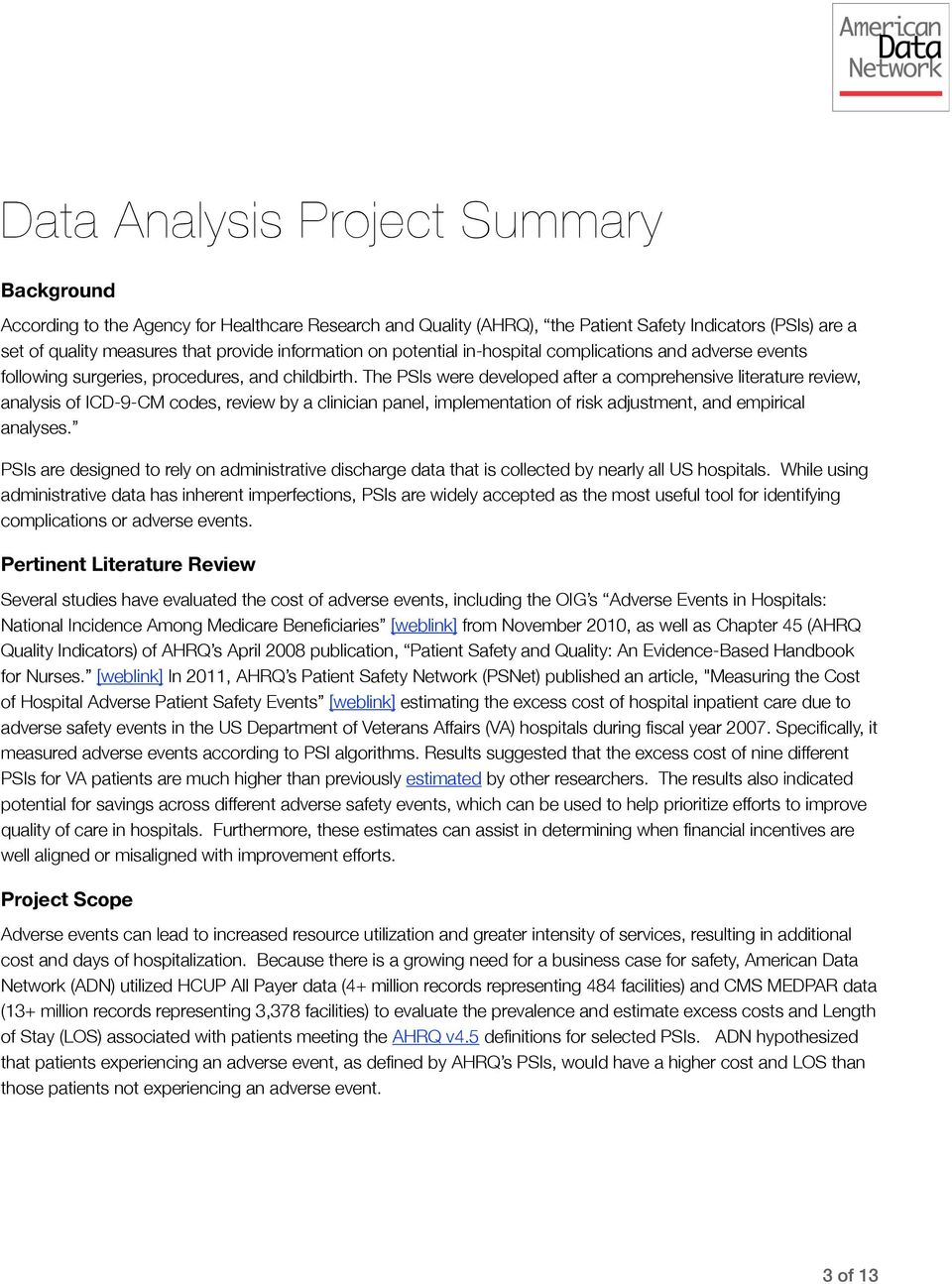
3 Data Analysis Project Summary Background According to the Agency for Healthcare Research and Quality (AHRQ), the Patient Safety Indicators (s) are a set of quality measures that provide information on potential in-hospital complications and adverse events following surgeries, procedures, and childbirth. The s were developed after a comprehensive literature review, analysis of ICD--CM codes, review by a clinician panel, implementation of risk adjustment, and empirical analyses. s are designed to rely on administrative discharge data that is collected by nearly all US hospitals. While using administrative data has inherent imperfections, s are widely accepted as the most useful tool for identifying complications or adverse events. Pertinent Literature Review Several studies have evaluated the cost of adverse events, including the OIG s Adverse Events in Hospitals: National Incidence Among Medicare Beneficiaries [weblink] from November 0, as well as Chapter (AHRQ Quality Indicators) of AHRQ s April 00 publication, Patient Safety and Quality: An Evidence-Based Handbook for Nurses. [weblink] In 0, AHRQ s Patient Safety Network (PSNet) published an article, "Measuring the of Hospital Adverse Patient Safety Events [weblink] estimating the excess cost of hospital inpatient care due to adverse safety events in the US Department of Veterans Affairs (VA) hospitals during fiscal year 00. Specifically, it measured adverse events according to algorithms. Results suggested that the excess cost of nine different s for VA patients are much higher than previously estimated by other researchers. The results also indicated potential for savings across different adverse safety events, which can be used to help prioritize efforts to improve quality of care in hospitals. Furthermore, these estimates can assist in determining when financial incentives are well aligned or misaligned with improvement efforts. Project Scope Adverse events can lead to increased resource utilization and greater intensity of services, resulting in additional cost and days of hospitalization. Because there is a growing need for a business case for safety, American Data Network (ADN) utilized HCUP All Payer data (+ million records representing facilities) and CMS MEDPAR data (+ million records representing, facilities) to evaluate the prevalence and estimate excess costs and Length of Stay () associated with patients meeting the AHRQ v. definitions for selected s. ADN hypothesized that patients experiencing an adverse event, as defined by AHRQ s s, would have a higher cost and than those patients not experiencing an adverse event. of
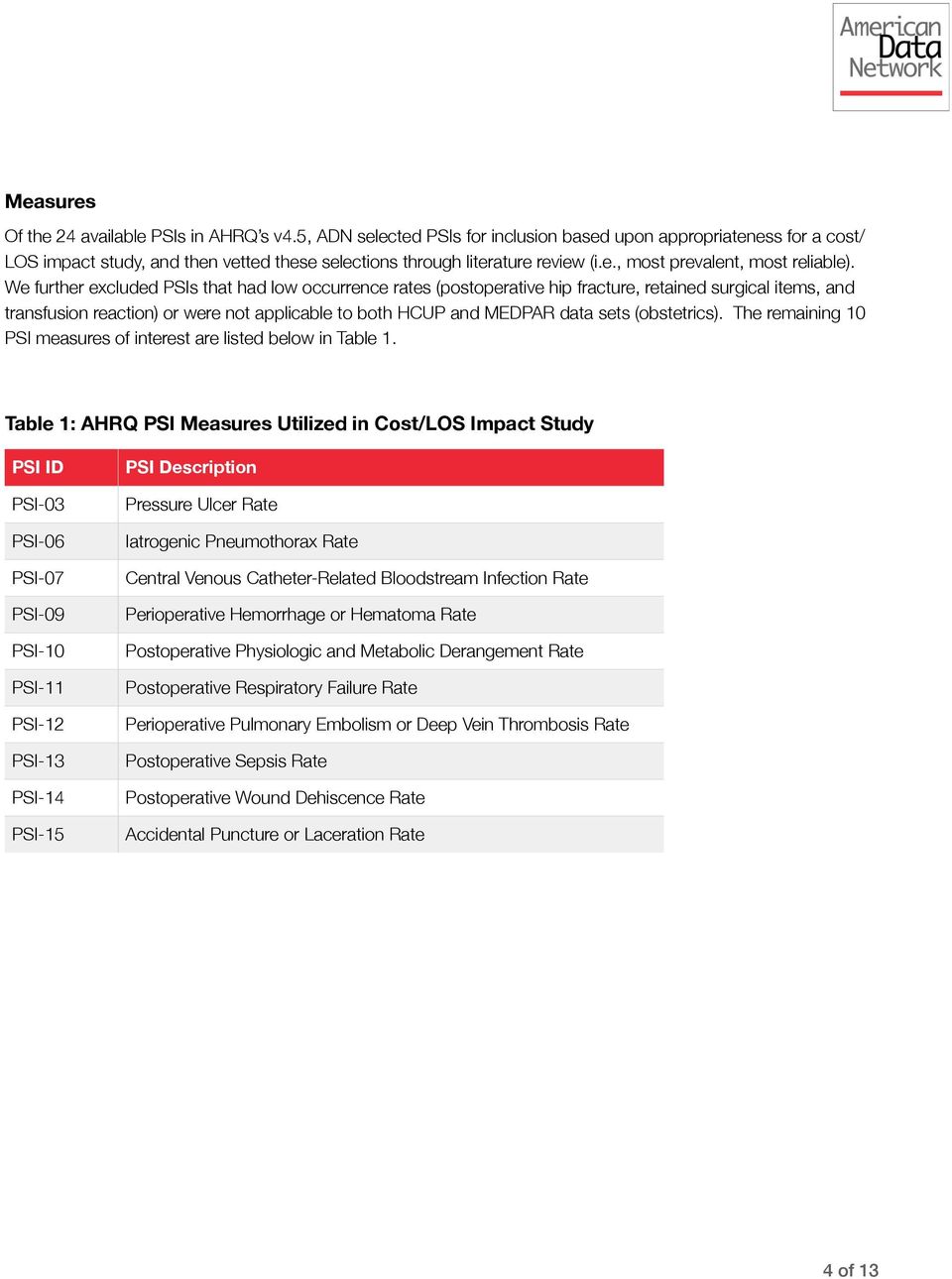
4 Measures Of the available s in AHRQ s v., ADN selected s for inclusion based upon appropriateness for a cost/ impact study, and then vetted these selections through literature review (i.e., most prevalent, most reliable). We further excluded s that had low occurrence rates (postoperative hip fracture, retained surgical items, and transfusion reaction) or were not applicable to both HCUP and MEDPAR data sets (obstetrics). The remaining measures of interest are listed below in Table. Table : AHRQ Measures Utilized in / Impact Study ID Description Pressure Ulcer Iatrogenic Pneumothorax Central Venous Catheter-Related Bloodstream Infection Perioperative Hemorrhage or Hematoma Postoperative Physiologic and Metabolic Derangement Postoperative Respiratory Failure Perioperative Pulmonary Embolism or Deep Vein Thrombosis Postoperative Sepsis Postoperative Wound Dehiscence Accidental Puncture or Laceration of
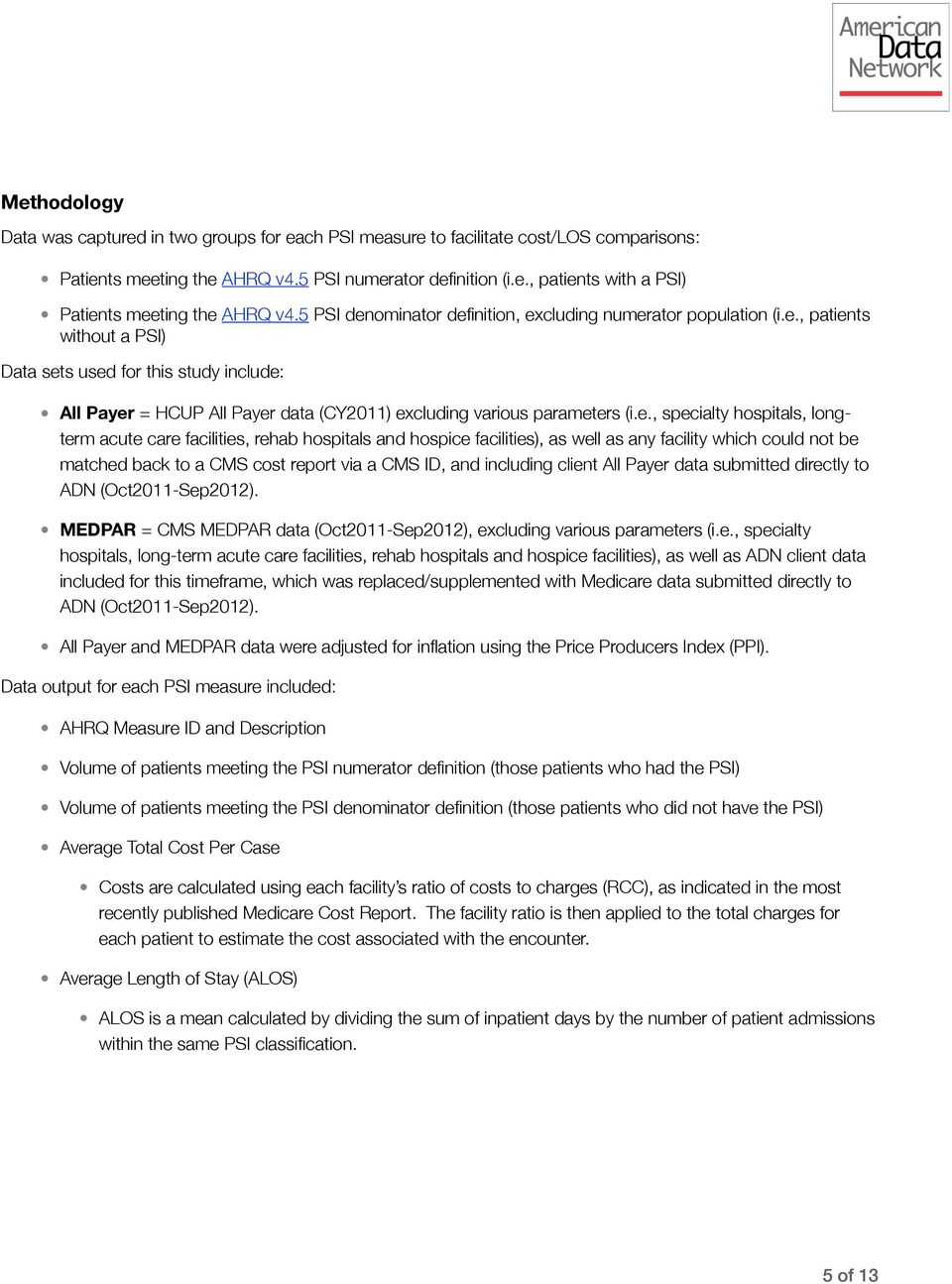
5 Methodology Data was captured in two groups for each measure to facilitate cost/ comparisons: Patients meeting the AHRQ v. numerator definition (i.e., patients with a ) Patients meeting the AHRQ v. denominator definition, excluding numerator population (i.e., patients without a ) Data sets used for this study include: All Payer = HCUP All Payer data (CY0) excluding various parameters (i.e., specialty hospitals, longterm acute care facilities, rehab hospitals and hospice facilities), as well as any facility which could not be matched back to a CMS cost report via a CMS ID, and including client All Payer data submitted directly to ADN (Oct0-Sep0). MEDPAR = CMS MEDPAR data (Oct0-Sep0), excluding various parameters (i.e., specialty hospitals, long-term acute care facilities, rehab hospitals and hospice facilities), as well as ADN client data included for this timeframe, which was replaced/supplemented with Medicare data submitted directly to ADN (Oct0-Sep0). All Payer and MEDPAR data were adjusted for inflation using the Price Producers Index (PPI). Data output for each measure included: AHRQ Measure ID and Description Volume of patients meeting the numerator definition (those patients who had the ) Volume of patients meeting the denominator definition (those patients who did not have the ) Average Per Case s are calculated using each facility s ratio of costs to charges (RCC), as indicated in the most recently published Medicare Report. The facility ratio is then applied to the total charges for each patient to estimate the cost associated with the encounter. Average Length of Stay (A) A is a mean calculated by dividing the sum of inpatient days by the number of patient admissions within the same classification. of
6 Explanation of Data Fields w/ = Number of patients meeting the AHRQ v. numerator definition of the indicator w/ = Average Per Case for patients meeting the AHRQ v. numerator definition of the indicator w/ = Average for patients meeting the AHRQ v. numerator definition of the indicator w/o = Number of patients meeting the AHRQ v. denominator definition of the indicator w/o = Average Per Case for patients which meet the AHRQ v. denominator definition of the indicator w/o = Average for patients which meet the AHRQ v. denominator definition of the indicator of Pt w/ = Difference in w/ (Column ) and w/o (Column ). To be interpreted as avoidable costs. = of (Column ) divided by w/ (Column ) multiplied by 0. To be read as Patients with this are estimated to cost X more than patients without this. Facilities are encouraged to use when applying study findings. See section below. of Pt w/ = Difference in w/ (Column ) and w/o (Column ). To be interpreted as avoidable days. = of (Column ) divided by w/ (Column ) multiplied by 0. To be read as Patients with this are estimated to stay X longer than patients without this. Facilities are encouraged to use when applying study findings. See section below. of

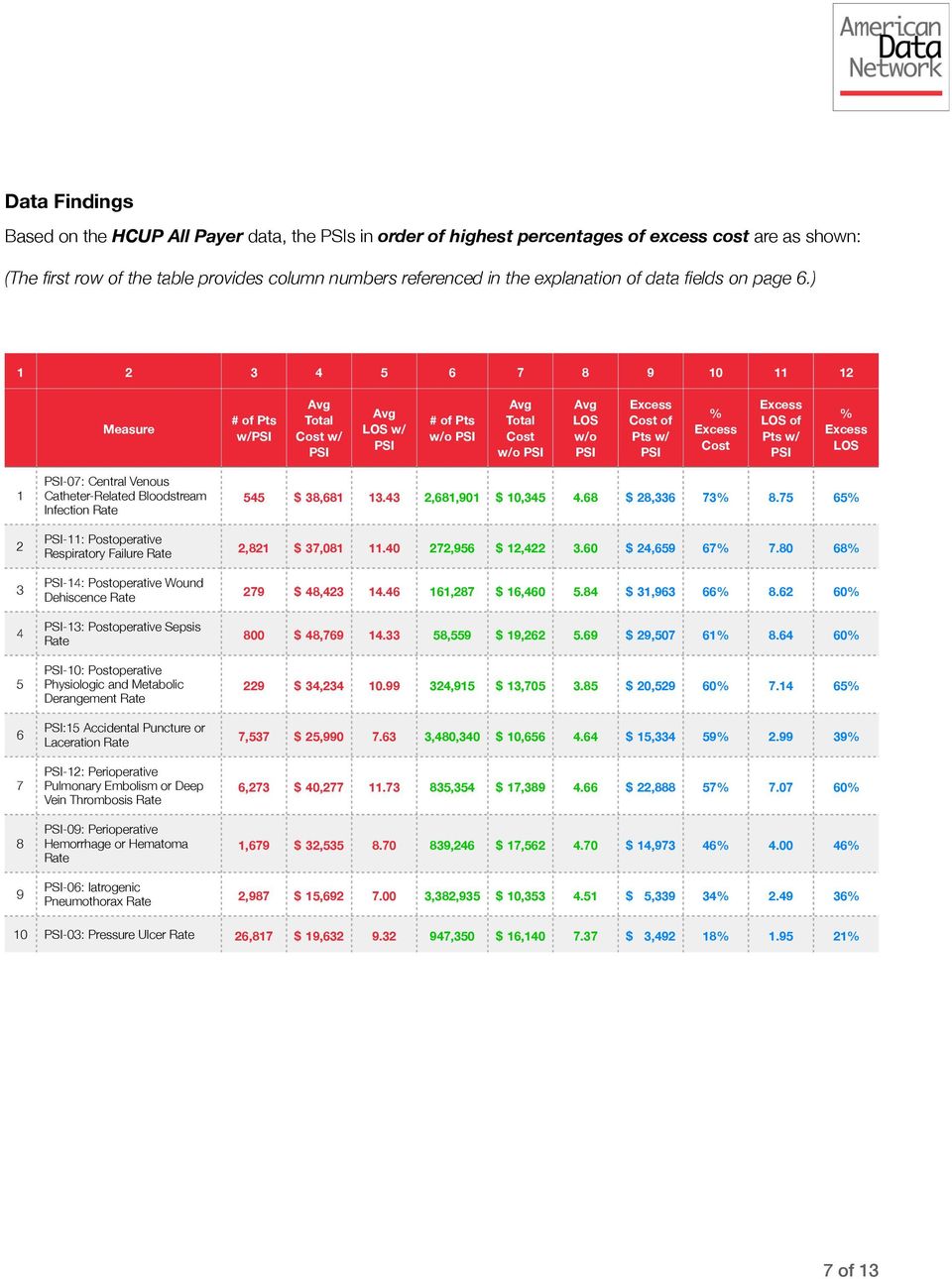
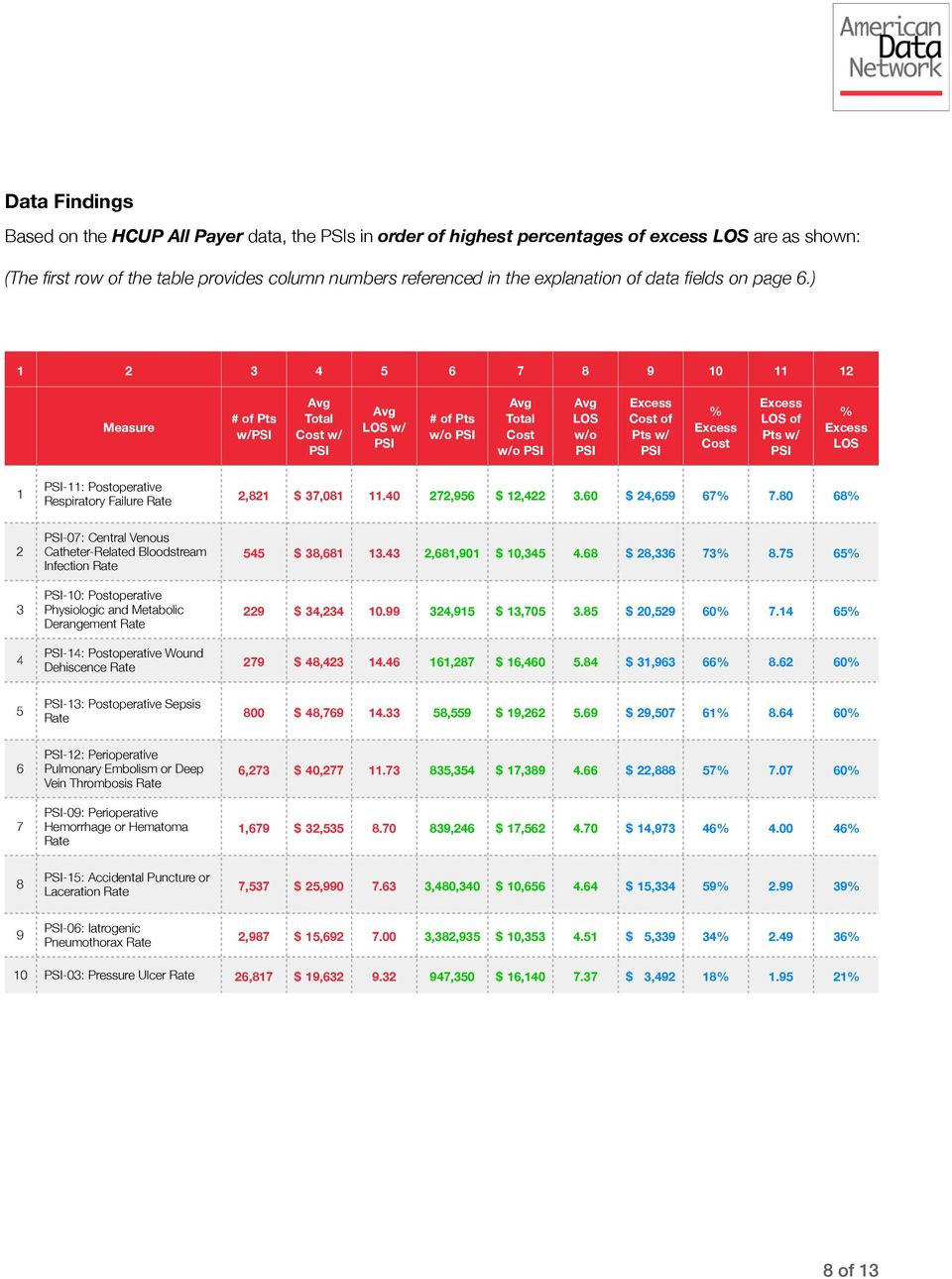
7 Data Findings Based on the HCUP All Payer data, the s in order of highest percentages of excess cost are as shown: (The first row of the table provides column numbers referenced in the explanation of data fields on page.) Measure w/ w/ w/ w/o w/o w/o of of -0: Central Venous Catheter-Related Bloodstream Infection $,.,,0 $,. $,. -: Postoperative Respiratory Failure, $,0.0, $,.0 $,.0 -: Postoperative Wound Dehiscence $,., $,0. $,. 0 -: Postoperative Sepsis 00 $,., $,. $,0. 0 -: Postoperative Physiologic and Metabolic Derangement $,., $,0. $ 0, 0. : Accidental Puncture or Laceration, $,0.,0,0 $,. $,. -: Perioperative Pulmonary Embolism or Deep Vein Thrombosis, $ 0,., $,. $,.0 0-0: Perioperative Hemorrhage or Hematoma, $,.0, $,.0 $,.00-0: Iatrogenic Pneumothorax, $,.00,, $,. $,. -0: Pressure Ulcer, $,.,0 $,0. $,. of
8 Data Findings Based on the HCUP All Payer data, the s in order of highest percentages of excess are as shown: (The first row of the table provides column numbers referenced in the explanation of data fields on page.) Measure w/ w/ w/ w/o w/o w/o of of, $,0.0, $,.0 $,.0 -: Postoperative Respiratory Failure -0: Central Venous Catheter-Related Bloodstream Infection $,.,,0 $,. $,. -: Postoperative Physiologic and Metabolic Derangement $,., $,0. $ 0, 0. -: Postoperative Wound Dehiscence $,., $,0. $,. 0 -: Postoperative Sepsis 00 $,., $,. $,0. 0 -: Perioperative Pulmonary Embolism or Deep Vein Thrombosis, $ 0,., $,. $,.0 0-0: Perioperative Hemorrhage or Hematoma, $,.0, $,.0 $,.00 -: Accidental Puncture or Laceration, $,0.,0,0 $,. $,. -0: Iatrogenic Pneumothorax, $,.00,, $,. $,. -0: Pressure Ulcer, $,.,0 $,0. $,. of
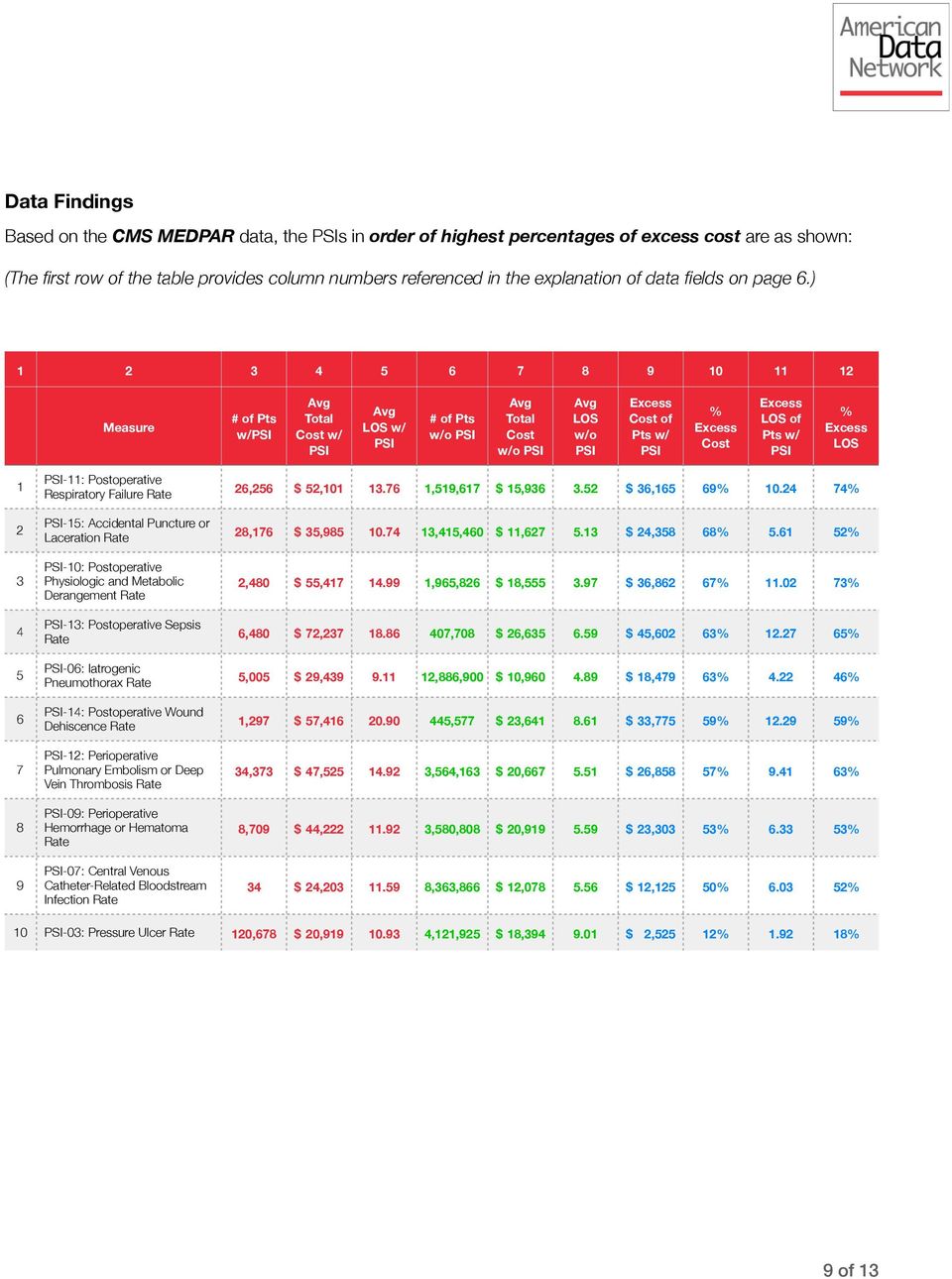
9 Data Findings Based on the CMS MEDPAR data, the s in order of highest percentages of excess cost are as shown: (The first row of the table provides column numbers referenced in the explanation of data fields on page.) Measure w/ w/ w/ w/o w/o w/o of of -: Postoperative Respiratory Failure, $,.,, $,. $,. -: Accidental Puncture or Laceration, $,.,,0 $,. $,. -: Postoperative Physiologic and Metabolic Derangement,0 $,.,, $,. $,.0 -: Postoperative Sepsis,0 $,. 0,0 $,. $,0. -0: Iatrogenic Pneumothorax,00 $,.,,00 $,0. $,. -: Postoperative Wound Dehiscence, $, 0.0, $,. $,. -: Perioperative Pulmonary Embolism or Deep Vein Thrombosis, $,.,, $ 0,. $,. -0: Perioperative Hemorrhage or Hematoma,0 $,.,0,0 $ 0,. $,0. -0: Central Venous Catheter-Related Bloodstream Infection $,0.,, $,0. $, 0.0-0: Pressure Ulcer 0, $ 0,.,, $,.0 $,. of
10 Data Findings Based on the CMS MEDPAR data, the s in order of highest percentages of excess are as shown: (The first row of the table provides column numbers referenced in the explanation of data fields on page.) Measure w/ w/ w/ w/o w/o w/o of of -: Postoperative Resp Failure, $,.,, $,. $,. -: Postoperative Postoperative Physiologic/ Metabolic Derangement,0 $,.,, $,. $,.0 -: Postoperative Sepsis,0 $,. 0,0 $,. $,0. -: Perioperative PE or DVT, $,.,, $ 0,. $,. -: Postoperative Wound Dehiscence, $, 0.0, $,. $,. -0: Perioperative Hemorrhage or Hematoma,0 $,.,0,0 $ 0,. $,0. -: Accidental Puncture or Laceration, $,.,,0 $,. $,. -0: Central Venous Catheter Related Bloodstream Infection $,0.,, $,0. $, 0.0-0: Iatrogenic Pneumothorax,00 $,.,,00 $,0. $,. -0: Pressure Ulcer 0, $ 0,.,,.0 $,. $, of
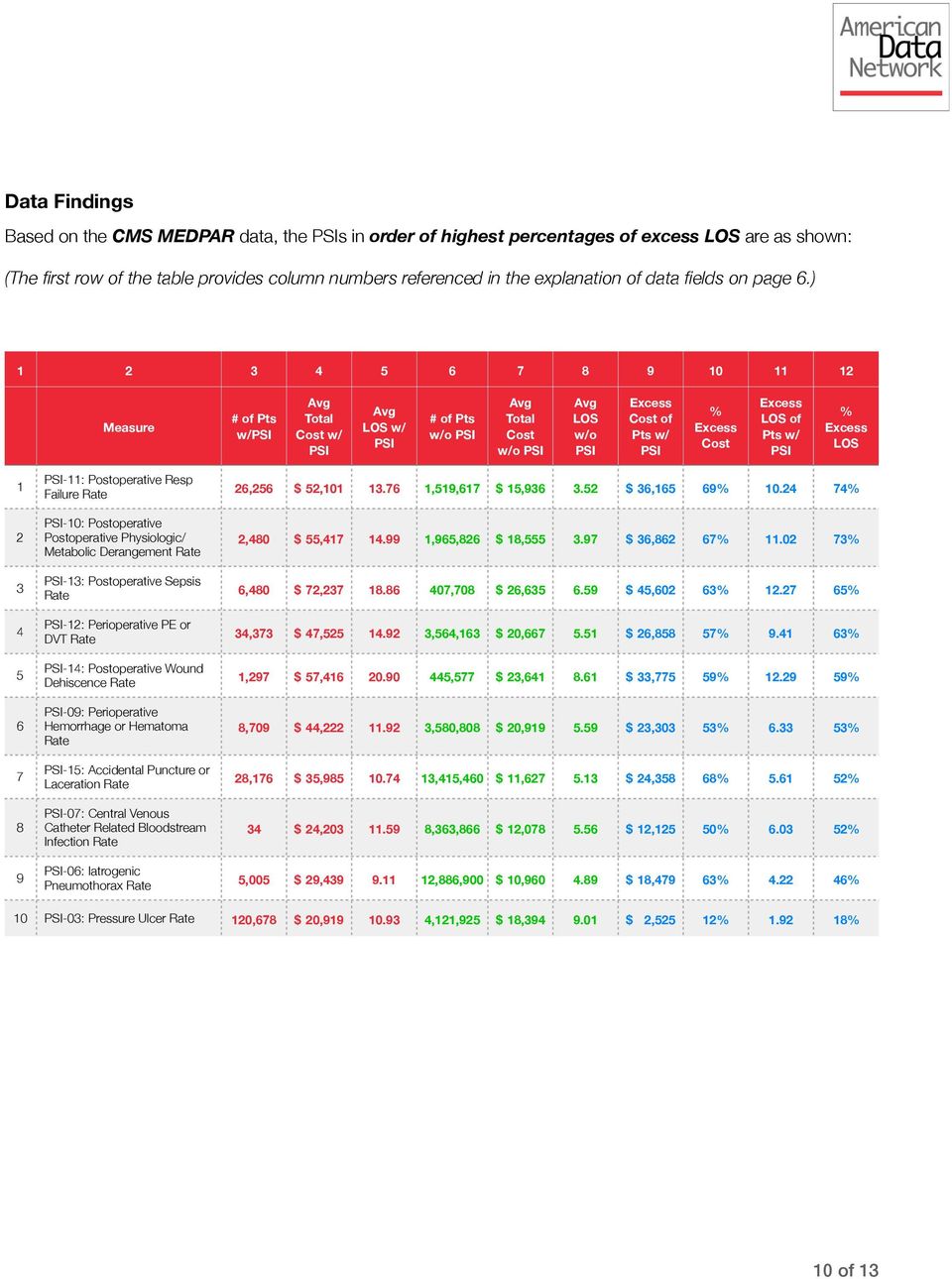
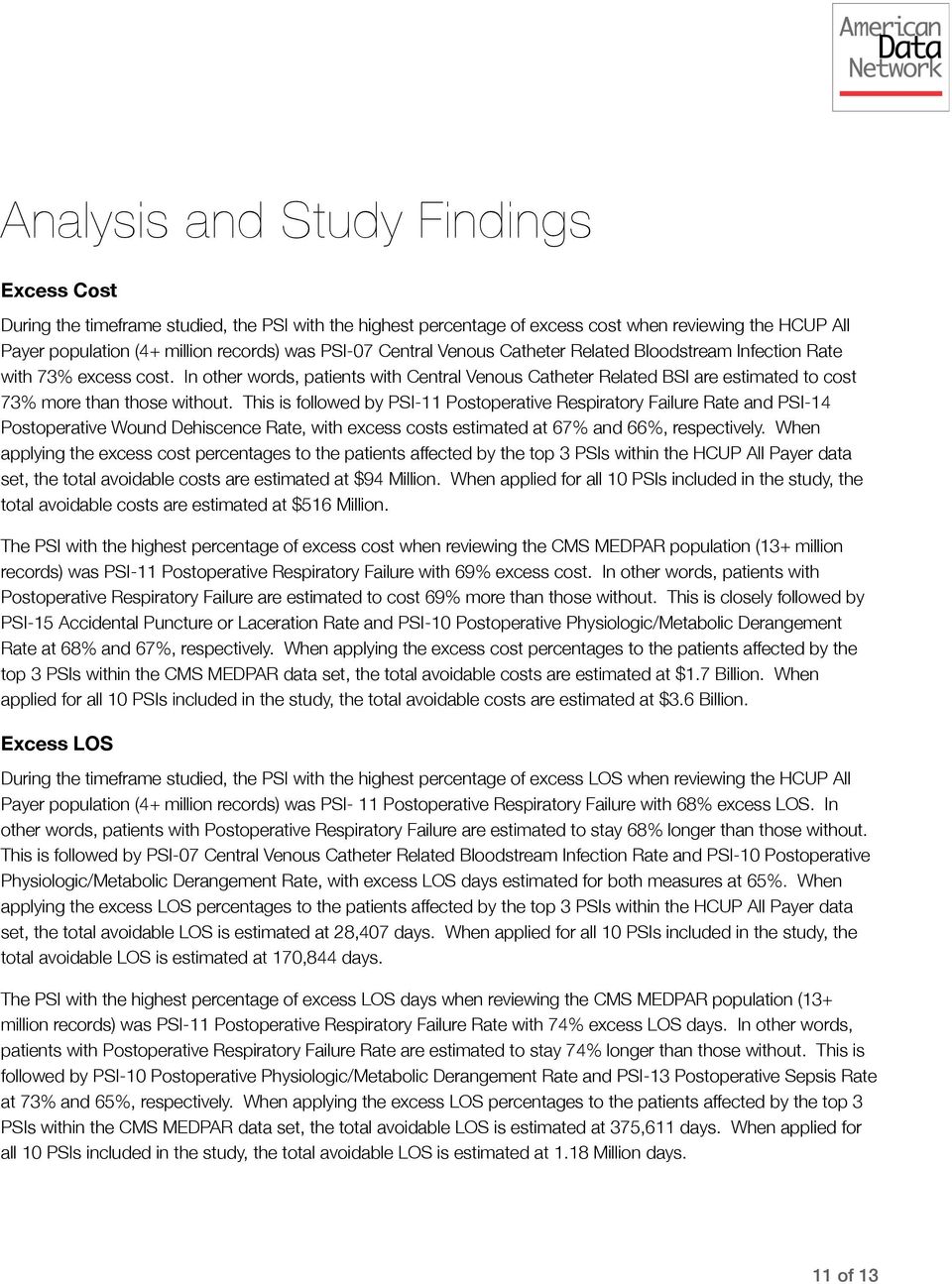
11 Analysis and Study Findings During the timeframe studied, the with the highest percentage of excess cost when reviewing the HCUP All Payer population (+ million records) was -0 Central Venous Catheter Related Bloodstream Infection with excess cost. In other words, patients with Central Venous Catheter Related BSI are estimated to cost more than those without. This is followed by - Postoperative Respiratory Failure and - Postoperative Wound Dehiscence, with excess costs estimated at and, respectively. When applying the excess cost percentages to the patients affected by the top s within the HCUP All Payer data set, the total avoidable costs are estimated at $ Million. When applied for all s included in the study, the total avoidable costs are estimated at $ Million. The with the highest percentage of excess cost when reviewing the CMS MEDPAR population (+ million records) was - Postoperative Respiratory Failure with excess cost. In other words, patients with Postoperative Respiratory Failure are estimated to cost more than those without. This is closely followed by - Accidental Puncture or Laceration and - Postoperative Physiologic/Metabolic Derangement at and, respectively. When applying the excess cost percentages to the patients affected by the top s within the CMS MEDPAR data set, the total avoidable costs are estimated at $. Billion. When applied for all s included in the study, the total avoidable costs are estimated at $. Billion. During the timeframe studied, the with the highest percentage of excess when reviewing the HCUP All Payer population (+ million records) was - Postoperative Respiratory Failure with excess. In other words, patients with Postoperative Respiratory Failure are estimated to stay longer than those without. This is followed by -0 Central Venous Catheter Related Bloodstream Infection and - Postoperative Physiologic/Metabolic Derangement, with excess days estimated for both measures at. When applying the excess percentages to the patients affected by the top s within the HCUP All Payer data set, the total avoidable is estimated at,0 days. When applied for all s included in the study, the total avoidable is estimated at, days. The with the highest percentage of excess days when reviewing the CMS MEDPAR population (+ million records) was - Postoperative Respiratory Failure with excess days. In other words, patients with Postoperative Respiratory Failure are estimated to stay longer than those without. This is followed by - Postoperative Physiologic/Metabolic Derangement and - Postoperative Sepsis at and, respectively. When applying the excess percentages to the patients affected by the top s within the CMS MEDPAR data set, the total avoidable is estimated at, days. When applied for all s included in the study, the total avoidable is estimated at. Million days. of
12 Attribution of / ADN attributed Average and for each of the s studied by calculating the difference between two comparison groups, Patients with a and Patients without a. As discussed above, Patients with a are defined as meeting the AHRQ v. numerator criteria. Patients without a are defined as meeting the AHRQ v. denominator criteria, as well as excluding those who met the numerator criteria. Since this attribution methodology was applied at the individual level, our study did not account for patients who may have met the numerator criteria for any of the other s studied. Thus, we queried the numerator data across all s originally reviewed to better understand how many patients were impacted by more than one. We identified that only of HCUP All Payer and. of CMS MEDPAR numerator patients were affected which we deem negligible. This finding substantiates that the Average and presented for Patients with a can be reasonably attributed to the single measured. ADN also queried the denominator data to better understand how many patients experienced zero s. We found that. of HCUP All Payer and. CMS MEDPAR denominator patients did not meet numerator criteria for any studied, including those we ultimately excluded from this focused study (due to low occurrence rates or non-applicable to both HCUP All Payer and CMS MEDPAR data sets). This finding substantiates that the Average and reasonably represent the data displayed for Patients without a. With the findings for the two comparison groups affirmed, ADN feels assured that the estimates presented for Average and can be safely used by facilities to approximate avoidable costs and avoidable days for each adverse event studied. of

13 How to Apply Findings to Your Facility Free Calculator Tool To calculate the excess costs of adverse events at your facility, click here to access our free calculator tool. Facility Data ADN clients can retrieve the numerator volume for each indicator by logging into ADN s Quality Module via the Clinical Benchmarking System (CBS). Change the Sort By parameter to Measure Source and the Category parameter to AHRQ ; next, select the name in the Measure drop-down. To retrieve the Average Per Case or Average for the numerator population, drill into the Incidence volume to return a list of patients; then, run the Summary Stats using the Σ button. The Average per Case and Average is included in the Basic Statistics table. Contact For more information on tracking your facility s patient safety event data, contact Kristi Toblesky, Product/Services Specialist, at American Data Network for more information: [email protected]. of

National Provider Call: Hospital Value-Based Purchasing (VBP) Program
 National Provider Call: Hospital Value-Based Purchasing (VBP) Program Fiscal Year 2016 Overview for Beneficiaries, Providers and Stakeholders Cindy Tourison, MSHI Lead, Hospital Inpatient Quality Reporting
Overview of the Hospital Value-Based Purchasing (VBP) Fiscal Year (FY) 2017
 Overview of the Hospital Value-Based Purchasing (VBP) Fiscal Year (FY) 2017 Bethany Wheeler Hospital VBP Program Support Contract Lead HSAG February 17, 2015 2 p.m. ET Purpose This event will provide an
CMS Office of Public Affairs 202-690-6145 MEDICARE PROPOSES NEW HOSPITAL VALUE-BASED PURCHASING PROGRAM
 For Immediate Release: Friday, January 07, 2011 Contact: CMS Office of Public Affairs 202-690-6145 MEDICARE PROPOSES NEW HOSPITAL VALUE-BASED PURCHASING PROGRAM OVERVIEW: Today the Centers for Medicare
How To Improve A Hospital'S Performance
 FY 16 MHAC Methodology Redesign HSCRC Performance Measurement Work Group February 20, 2014 1 Presentation Contents Background: Reason to change, guiding principles, timing Measurement Methodology Payment
Value-Based Purchasing Program Overview. Maida Soghikian, MD Grand Rounds Scripps Green Hospital November 28, 2012
 Value-Based Purchasing Program Overview Maida Soghikian, MD Grand Rounds Scripps Green Hospital November 28, 2012 Presentation Overview Background and Introduction Inpatient Quality Reporting Program Value-Based
Description of the OECD Health Care Quality Indicators as well as indicator-specific information
 Appendix 1. Description of the OECD Health Care Quality Indicators as well as indicator-specific information The numbers after the indicator name refer to the report(s) by OECD and/or THL where the data
INSTRUCTIONS Documentation and Coding for Patient Safety Indicators
 INSTRUCTIONS Documentation and Coding for Patient Safety Indicators What is this tool? The purpose of this tool is to facilitate improvements to documentation and coding processes to ensure that PSI rates
Measures of Patient Safety Based on Hospital Administrative DataCThe Patient Safety Indicators
 Technical Review 5 Measures of Patient Safety Based on Hospital Administrative DataCThe Patient Safety Indicators Prepared for: Agency for Healthcare Research and Quality Department of Health and Human
Certified Clinical Documentation Specialist Examination Content Outline - 2016
 Certified Clinical Documentation Specialist Examination Content Outline - 2016 1. Healthcare Regulations, Reimbursement, and Documentation Requirements Related to the Inpatient Prospective Payment System
Evidence Based Practice to. Value Based Purchasing. Barb Rogness BSN MS Building Bridges May 2013
 Evidence Based Practice to Value Based Purchasing Barb Rogness BSN MS Building Bridges May 2013 Why this topic? Value based Purchasing is here and not going away. It will grow by leaps and bounds. The
Value Based Care and Healthcare Reform
 Value Based Care and Healthcare Reform Dimensions in Cardiac Care November, 2014 Jacqueline Matthews, RN, MS Senior Director, Quality Reporting & Reform Quality and Patient Safety Institute Cleveland Clinic
Adverse Events and Medical Errors
 Adverse Events and Medical Errors Dennis Tsilimingras, M.D., M.P.H. Director, Center on Patient Safety Assistant Professor of Family Medicine & Rural Health The Florida State University College of Medicine
Cognos Web-based Analytic Tool Overview
 Cognos Web-based Analytic Tool Overview Market, Quality and Physician Data Analysis with Drill-thru Feature Mari Tietze, PhD, RN-BC Director, Nursing Research and Informatics DFWHC ERF 2009 1 UB-04 Source
IDENTIFYING CLINICAL RESEARCH QUESTIONS THAT FIT PRACTICE PRIORITIES. Module I: Identifying Good Questions
 1 IDENTIFYING CLINICAL RESEARCH QUESTIONS THAT FIT PRACTICE PRIORITIES Module I: Identifying Good Questions Objective Describe how to find good clinical questions for research. 2 ntifying good clinical
Eliminating Pressure Ulcers in Ascension Health
 Eliminating Pressure Ulcers in Ascension Health Cissy Shanks RN BSN CEN & Pam Kleinhelter RN MSN CNA-BC Nursing Managers St Vincent s Health System Jacksonville, Florida Objectives Participants will be
KPIs for Effective, Real-Time Dashboards in Hospitals. Abstract
 KPIs for Effective, Real-Time Dashboards in Hospitals Abstract The disparate and disjointed data silos across various hospital departments constitute the biggest decision-making bottleneck. They impede
Measure Information Form (MIF) #275, adapted for quality measurement in Medicare Accountable Care Organizations
 ACO #9 Prevention Quality Indicator (PQI): Ambulatory Sensitive Conditions Admissions for Chronic Obstructive Pulmonary Disease (COPD) or Asthma in Older Adults Data Source Measure Information Form (MIF)
Hospital Inpatient Quality Reporting (IQR) Program
 Clinical Process Measures Program Changes for Fiscal Year 2014 Beginning with January 1, 2012 discharges; hospitals will begin data collection and submission for 4 new measures. Hospitals will not be required
Patient Optimization Improves Outcomes, Lowers Cost of Care >
 Patient Optimization Improves Outcomes, Lowers Cost of Care > Consistent preoperative processes ensure better care for orthopedic patients The demand for primary total joint arthroplasty is projected to
Hospital Compare Downloadable Database Data Dictionary
 System Requirements Specification Hospital Compare Downloadable Database Data Dictionary Centers for Medicare & Medicaid Services https://data.medicare.gov/data/hospital-compare of Contents Introduction...
Hospital Inpatient Quality Reporting Program: Part 1 of 4: A Detailed Review of the Final CMS FY 2014 IPPS Rule
 Hospital Inpatient Quality Reporting Program: Part 1 of 4: A Detailed Review of the Final CMS FY IPPS Rule - 1 - Welcome and Introductions Vicky Mahn DiNicola RN, MS, CPHQ VP Research and Market Insights
September 12, 2011. Dear Dr. Corrigan:
 September 12, 2011 Janet M. Corrigan, PhD, MBA President and Chief Executive Officer National Quality Forum 601 13th Street, NW Suite 500 North Washington, D.C. 20005 Re: Measure Applications Partnership
Hospital Value-based Purchasing Specifications 2016 Updated August 2015
 Description Methodology Measurement Period Allowable Exclusions Total Performance Score Individual measures CMS incentive program for PPS hospitals. The purpose is to achieve value by tying payment to
UNIVERSITY OF ILLINOIS HOSPITAL & HEALTH SCIENCES SYSTEM: FINANCIAL REPORT AND SYSTEM DASHBOARDS May 29, 2013
 UNIVERSITY OF ILLINOIS HOSPITAL & HEALTH SCIENCES SYSTEM: FINANCIAL REPORT AND SYSTEM DASHBOARDS May 29, 2013 Office of the Vice President for Health Affairs Board of Trustees Spring Chicago Meeting UI
Truven Health Analytics: Market Expert Inpatient Volume Projection Methodology
 Truven Health Analytics: Market Expert Inpatient Volume Projection Methodology Truven s inpatient volume forecaster produces five and ten year volume projections by DRG and zip code. Truven uses two primary
June 25, 2012. Dear Acting Administrator Tavenner,
 June 25, 2012 Marilyn B. Tavenner, RN, Acting Administrator Centers for Medicare and Medicaid Services Department of Health and Human Services Attention: CMS-1588-P P.O. Box 8011 Baltimore, MD 21244-1850
Clinical Nurse Leader Informational Paper
 Association of California Nurse Leaders 1 2 Clinical Nurse Leader Informational Paper DRAFT 3 4 5 6 7 8 9 10 Background In 2006, the Professional Practice Committee and the Regional Taskforce South hosted
Improving Safety: Developing Safety Metrics and Improving Error Reporting. Petra Khoury, Pharm D Adnan Tahir, MD
 Improving Safety: Developing Safety Metrics and Improving Error Reporting Petra Khoury, Pharm D Adnan Tahir, MD Learning Objectives List Prevalent patient safety issues reported within hospitals Identify
Project Database quality of nursing (Quali-NURS)
 Project Database quality of nursing (Quali-NURS) Summary Introduction. The literature provides considerable evidence of a correlation between nurse staffing and patient outcomes across hospitals and countries
Reporting Adverse Events and Concerns at Stroger Hospital
 Reporting Adverse Events and Concerns at Stroger Hospital Case Pt on coumadin comes in for community acquired pneumonia and is started on levaquin After several days, you note a lot of bruising.. You realize
ICD-9 Basics Study Guide
 Board of Medical Specialty Coding ICD-9 Basics Study Guide for the Home Health ICD-9 Basic Competencies Examination Two Washingtonian Center 9737 Washingtonian Blvd., Ste. 100 Gaithersburg, MD 20878-7364
Teena Robinson NZRN, MN,FCNA (NZ) NP Nurse Practitioner: adult elective perioperative
 Teena Robinson NZRN, MN,FCNA (NZ) NP Nurse Practitioner: adult elective perioperative Information to.. talk to our patients & families help with clinical decisions help staff allocation support new nurse
Preventing Readmissions
 Emerging Topics in Healthcare Reform Preventing Readmissions Janssen Pharmaceuticals, Inc. Preventing Readmissions The Patient Protection and Affordable Care Act (ACA) contains several provisions intended
ADVERSE EVENTS IN HOSPITALS: NATIONAL INCIDENCE AMONG MEDICARE BENEFICIARIES
 Department of Health and Human Services OFFICE OF INSPECTOR GENERAL ADVERSE EVENTS IN HOSPITALS: NATIONAL INCIDENCE AMONG MEDICARE BENEFICIARIES Daniel R. Levinson Inspector General November 2010 E X E
Value Based Payment Models: What are they and strategies for success
 Value Based Payment Models: What are they and strategies for success Melinda Hancock National Chair Elect Region IV March 2015 Shaping the Curve 2 The Continuum of Risk Source: Hancock, M., Hannah, B.
Hospital Performance Management: From Strategy to Operations
 Hospital Performance Management: From Strategy to Operations Every hospital wants to be on top in terms of revenue and quality of care. It is tough enough to get to the top, but tougher still to stay there.
Quality Scorecard overall heart attack care overall heart failure overall pneumonia care overall surgical infection rate patient safety survival
 Quality Scorecard s are required to report quality statistics to the s for Medicare and Medicaid Services (CMS) and the Department of Health (DOH). This information is made available at www.hospitalcompare.hhs.gov
Creating a Hybrid Database by Adding a POA Modifier and Numerical Laboratory Results to Administrative Claims Data
 Creating a Hybrid Database by Adding a POA Modifier and Numerical Laboratory Results to Administrative Claims Data Michael Pine, M.D., M.B.A. Michael Pine and Associates, Inc. [email protected] Overview
This proposed rule clarifies and makes updates to details regarding this program that were finalized in
 2014 Ambulatory Surgery Center (ASC) and Outpatient Prospective Payment System (OPPS) A Summary of the Quality Provisions of the Proposed Rule Overview On July 8, 2013, the Centers for Medicare and Medicaid
Dashboard Views. Email Alerts
 Dashboard Views There are a range of different dashboard views available as standard within the system. The expandable list view (HED Signals, NHS Choice Indicators, Nationally Published Indicators and
SECTION 4 COSTS FOR INPATIENT HOSPITAL STAYS HIGHLIGHTS
 SECTION 4 COSTS FOR INPATIENT HOSPITAL STAYS EXHIBIT 4.1 Cost by Principal Diagnosis... 44 EXHIBIT 4.2 Cost Factors Accounting for Growth by Principal Diagnosis... 47 EXHIBIT 4.3 Cost by Age... 49 EXHIBIT
Combined Assessment Program Summary Report. Evaluation of Pressure Ulcer Prevention and Management at Veterans Health Administration Facilities
 Department of Veterans Affairs Office of Inspector General Report No. 14-05132-90 Office of Healthcare Inspections Combined Assessment Program Summary Report Evaluation of Pressure Ulcer Prevention and
Collected Input: Administrative Practices (Staffing/Service Volume & Staffing Mix)
 Collected Input: Administrative Practices (Staffing/Service Volume & Staffing Mix) Original information from MDH worksheet is in orange highlight, italicized serif font. When original information is used
May 7, 2012. Submitted Electronically
 May 7, 2012 Submitted Electronically Secretary Kathleen Sebelius Department of Health and Human Services Office of the National Coordinator for Health Information Technology Attention: 2014 edition EHR
Medical Assistance EHR Incentive Program MAPIR Application. 2014 EH Stage 2 Screen Shots
 Medical Assistance HIT Initiative Medical Assistance EHR Provider Incentive Program Eligible Hospital Provider Manual v.3.1 Medical Assistance EHR Incentive Program MAPIR Application 2014 EH Stage 2 Screen
Title: Practice variation in Japan: A cross-sectional study of patient outcomes and costs in total joint replacement procedures.
 1 Title: Practice variation in Japan: A cross-sectional study of patient outcomes and costs in total joint replacement procedures. Authors: Denis A. Cortese, MD; Natalie Landman, PhD; Robert K. Smoldt,
Patient Criteria: Modeling in LTRAX
 Patient Criteria: Modeling in LTRAX Mary Dalrymple Managing Director, LTRAX Kristen Smith, MHA, PT Senior Consultant Overview Objectives Review background on upcoming LTCH patient criteria Examine LTRAX
Florida Center for Health Information and Policy Analysis
 Florida Center for Health Information and Policy Analysis Data Overview for the Commission on Healthcare and Hospital Funding May 20, 2015 1 Office of Data Collection and Quality Assurance Collection of
CLINICAL QUALITY MEASURES FINALIZED FOR ELIGIBLE HOSPITALS AND CRITICAL ACCESS HOSPITALS BEGINNING WITH FY 2014
 CLINICAL QUALITY MEASURES FINALIZED FOR ELIGIBLE HOSPITALS AND CRITICAL ACCESS HOSPITALS BEGINNING WITH FY 2014 e 55 0495 2 Emergency Department (ED)- 1 Emergency Department Throughput Median time from
Managing Surgical Services Lines Under Accountable Care and Value-Based Purchasing. Becker s Healthcare Jeffry Peters February 28, 2013
 Managing Surgical Services Lines Under Accountable Care and Value-Based Purchasing Becker s Healthcare Jeffry Peters February 28, 2013 Learning Objective How ACA/VBP changes how we measure surgical services
Patient Safety. Annual Continuing Education Modules. Contents
 Annual Continuing Education Modules Patient Safety This self-directed learning module contains information you are expected to know to protect yourself, our patients, and our guests. Target Audience: Contents
Massachusetts Hospital Cost Report 1
 Massachusetts Hospital Cost Report 1 HOSPITAL STATEMENT OF COSTS, REVENUES, AND STATISTICS 1 MA Hospital Cost Report was last updated in 2016 1 Contents Contents... 2 General Instructions... 8 Tab 1 Identification
NEVER EVENT LISTS ENDORSED BY NATIONAL QUALITY FORUM & MEDICARE
 Never Events : Medicare s and Health Plan s Policies on Providing Payment for Serious and Preventable Hospital Errors BACKGROUND Preventable medical errors are a leading cause of death in the United States
Unity Point Health PROBLEM LISTS IN THE ELECTRONIC HEALTH RECORD
 Unity Point Health PROBLEM LISTS IN THE ELECTRONIC HEALTH RECORD Introduction The problem list is a critical part of electronic documentation and serves as a communication tool between all care providers.
NSQHS Standard 1 Governance
 NSQHS Standard 1 Governance Definitions sheet Governance Audit Tools Definitions Contents 1. Open Disclosure Program Page 1 2. ACUTE Clinical Record Audit Tools Page 2 -----------------------------------------------------------------------------------
Measures for the Australian health system. Belinda Emms Health Care Safety and Quality Unit Australian Institute of Health and Welfare
 Measures for the Australian health system Belinda Emms Health Care Safety and Quality Unit Australian Institute of Health and Welfare Two sets of indicators The National Safety and Quality Indicators Performance
Three-Star Composite Rating Method
 Three-Star Composite Rating Method CheckPoint uses three-star composite ratings to enable consumers to more quickly and easily interpret information about hospital quality measures. Composite ratings combine
convey the clinical quality measure's title, number, owner/developer and contact
 CMS-0033-P 153 convey the clinical quality measure's title, number, owner/developer and contact information, and a link to existing electronic specifications where applicable. TABLE 20: Proposed Clinical
2009 Nursing Strategic Plan. Atrium Medical Center
 2009 Nursing Strategic Plan Atrium Medical Center Mission Nurses at Atrium Medical Center are empowered to serve our patients by providing personalized, compassionate care with integrity and respect because
NPUAP Mission. International Guideline
 NPUAP Mission The National Pressure Ulcer Advisory Panel (NPUAP) serves as the authoritative voice for improved patient outcomes in pressure ulcer prevention and treatment through public policy, education
STATISTICAL BRIEF #151
 HEALTHCARE COST AND UTILIZATION PROJECT STATISTICAL BRIEF #151 Agency for Healthcare Research and Quality March 2013 Trends in Potentially Preventable Hospital Admissions among Adults and Children, 2005
Home Health Care ICD-10-CM Coding Tip Sheet Overview of Key Chapter Updates for Home Health Care and Top 20 codes
 Home Health Care ICD-10-CM Coding Tip Sheet Overview of Key Chapter Updates for Home Health Care and Top 20 codes Chapter 4: Endocrine, Nutritional and Metabolic Diseases (E00-E99) ICD-10-CM diabetes mellitus
DISTRIBUTION: This Patient Safety Plan shall be distributed hospital-wide and online.
 PURPOSE: The purpose of this plan is to institute a Patient Safety Program for the organization. This plan facilitates education, communication, consistency and effectiveness of the program. This patient
Institutional Billing Guide
 Program KANSAS MEDICAL ASSISTANCE PROGRAM Institutional Billing Guide Updated 10.2013 Institutional Billing The Kansas Medical Assistance Program (KMAP) offers different billing options to all providers.
EDUCATIONAL PLANNING TOOL:
 EDUCATIONAL PLANNING TOOL: Designing a Continuing Medical Education (CME) Activity This planning tool has been designed to lead you through the educational planning process and facilitate the collection
NOAC Reversal Agent Think Tank Follow-Up: Post Approval Safety & Effectiveness Pharmacoepidemiologic Approaches and Big Data
 NOAC Reversal Agent Think Tank Follow-Up: Post Approval Safety & Effectiveness Pharmacoepidemiologic Approaches and Big Data Nancy Dreyer, PhD Chief of Scientific Affairs Copyright 2014 Quintiles FDA Feb