
US Code (Unofficial compilation from the Legal Information Institute)
|
|
|
- Nelson Pitts
- 9 years ago
- Views:
Transcription
1 US Code (Unofficial compilation from the Legal Information Institute) TITLE 26 - INTERNAL REVENUE CODE Subtitle D - Miscellaneous Excise Taxes CHAPTER 43 QUALIFIED PENSION, ETC., PLANS Please Note: This compilation of the US Code, current as of Jan. 7, 2011, has been prepared by the Legal Information Institute using data from the U.S. House of Representatives, Office of the Law Revision Counsel. It is not an official U.S. government publication. For more details please see: Notes on this document: The content in this document is taken directly from the US Code, with the following exceptions: page headers and footers, page numbering, and all formatting are artifacts of this presentation. Divider lines have been inserted between sections. The notes are set off by a vertical line and a larger left margin. The table of contents immediately following this title page is machine-generated from the headings in this portion of the Code. Commonly available fonts are used. The Legal Information Institute promotes worldwide, free public access to law via the Internet. Founded in 1992, the LII created the first legal information website. It continues to be a pre-eminent "law-not-com" publisher of legal information and an important outreach activity of the Cornell Law School.

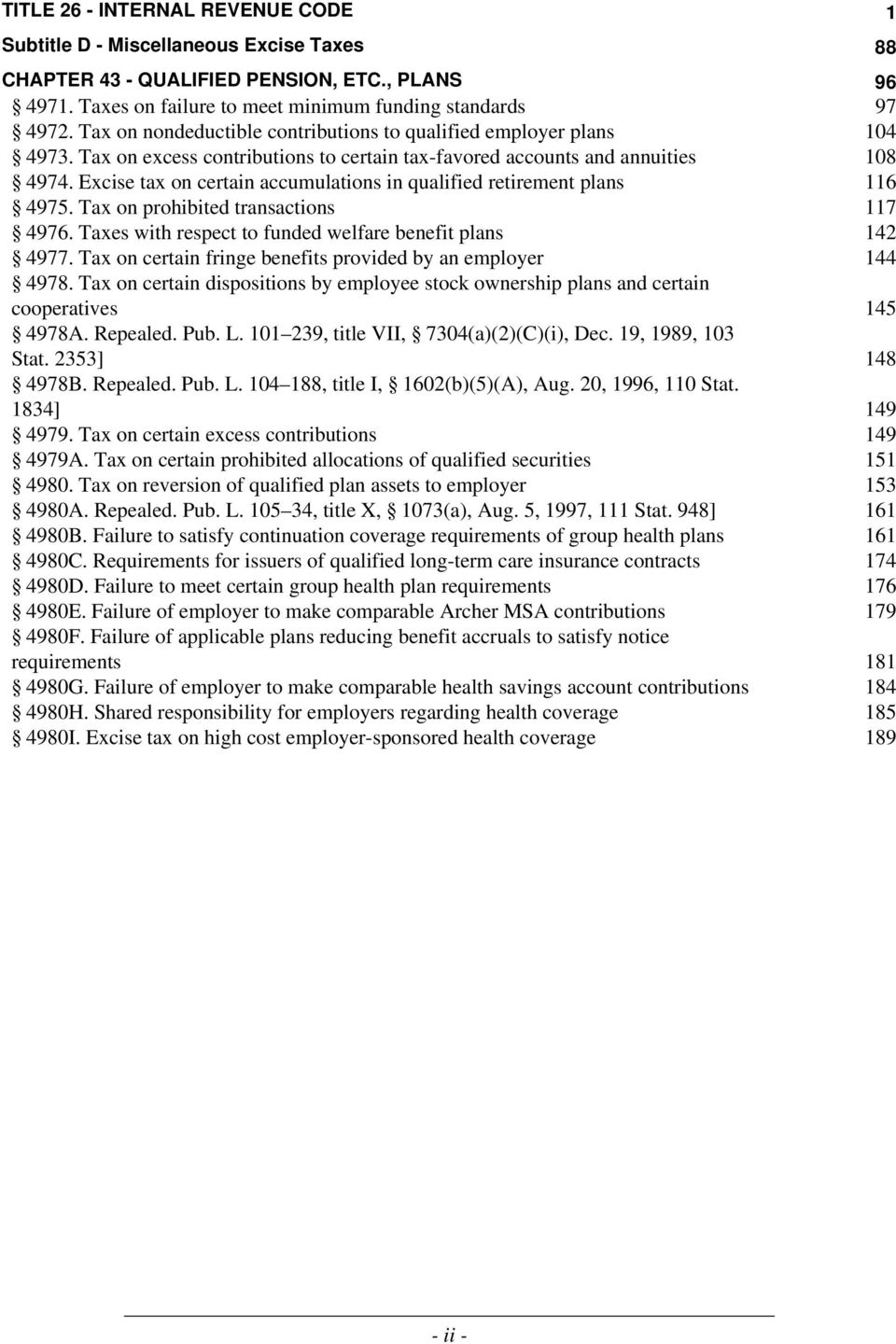
2 TITLE 26 - INTERNAL REVENUE CODE 1 Subtitle D - Miscellaneous Excise Taxes 88 CHAPTER 43 - QUALIFIED PENSION, ETC., PLANS Taxes on failure to meet minimum funding standards Tax on nondeductible contributions to qualified employer plans Tax on excess contributions to certain tax-favored accounts and annuities Excise tax on certain accumulations in qualified retirement plans Tax on prohibited transactions Taxes with respect to funded welfare benefit plans Tax on certain fringe benefits provided by an employer Tax on certain dispositions by employee stock ownership plans and certain cooperatives A. Repealed. Pub. L , title VII, 7304(a)(2)(C)(i), Dec. 19, 1989, 103 Stat. 2353] B. Repealed. Pub. L , title I, 1602(b)(5)(A), Aug. 20, 1996, 110 Stat. 1834] Tax on certain excess contributions A. Tax on certain prohibited allocations of qualified securities Tax on reversion of qualified plan assets to employer A. Repealed. Pub. L , title X, 1073(a), Aug. 5, 1997, 111 Stat. 948] B. Failure to satisfy continuation coverage requirements of group health plans C. Requirements for issuers of qualified long-term care insurance contracts D. Failure to meet certain group health plan requirements E. Failure of employer to make comparable Archer MSA contributions F. Failure of applicable plans reducing benefit accruals to satisfy notice requirements G. Failure of employer to make comparable health savings account contributions H. Shared responsibility for employers regarding health coverage I. Excise tax on high cost employer-sponsored health coverage ii -
3 TITLE 26 INTERNAL REVENUE CODE TITLE 26 INTERNAL REVENUE CODE Act Aug. 16, 1954, ch. 736, 68A Stat. 3 The following tables have been prepared as aids in comparing provisions of the Internal Revenue Code of 1954 (redesignated the Internal Revenue Code of 1986 by Pub. L , 2, Oct. 22, 1986, 100 Stat. 2095) with provisions of the Internal Revenue Code of No inferences, implications, or presumptions of legislative construction or intent are to be drawn or made by reason of such tables. Citations to R.A. refer to the sections of earlier Revenue Acts. Table I 1939 Code section number 1986 Code section number 1 Omitted (a) 3, 4 Omitted (a), (b)(1), (2) 12(b)(3), (c) 1 12(d) 2 12(e) 12(f) 1 12(g), 13(a) 13(b) 11 13(c) (f), 14 15(a), (b) 11 Omitted Omitted Omitted Omitted 15(c) (a) 61 22(b)(1) (b)(2)(A) 72 22(b)(2)(B) 72, (b)(2)(C) 72 22(b)(3) (5) (b)(6) (b)(7) (b)(8) 115, 526, 892, 893, 911, 912, 933, (b)(9), (10) (b)(11) (14) 109, (b)(15) (b)(16), (17) 114, (c) (d)(1) (5) (d)(6) 22(e) 1321, 6155(a) 301(a) 22(f) (g) 861, 862, 863, (h) 22(i) 22(j) 76 22(k) 71 Chapter 1, Subchapter G, Part III Omitted - 1 -

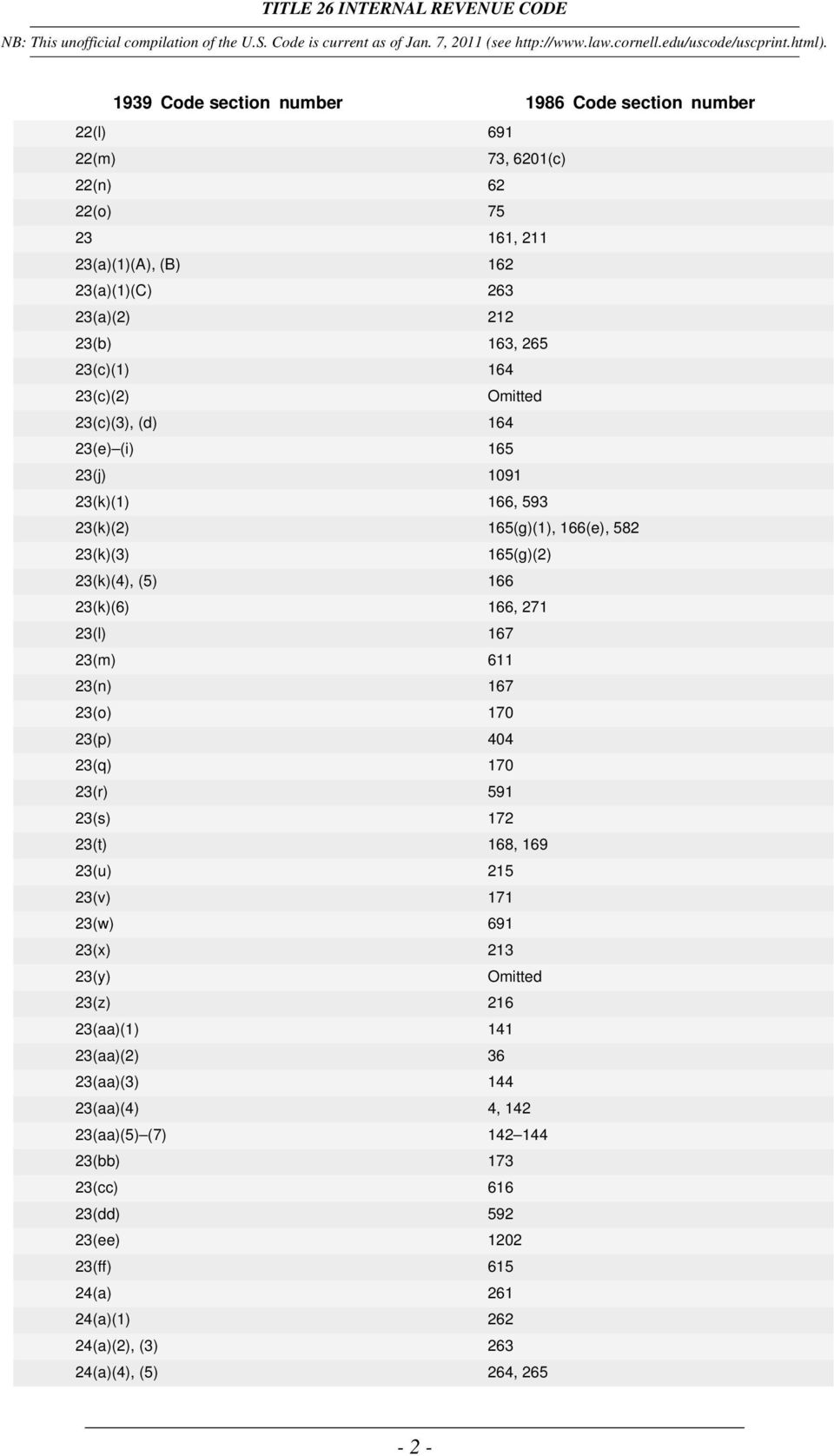
4 TITLE 26 INTERNAL REVENUE CODE 1939 Code section number 1986 Code section number 22(l) (m) 73, 6201(c) 22(n) 62 22(o) , (a)(1)(A), (B) (a)(1)(C) (a)(2) (b) 163, (c)(1) (c)(2) Omitted 23(c)(3), (d) (e) (i) (j) (k)(1) 166, (k)(2) 165(g)(1), 166(e), (k)(3) 165(g)(2) 23(k)(4), (5) (k)(6) 166, (l) (m) (n) (o) (p) (q) (r) (s) (t) 168, (u) (v) (w) (x) (y) Omitted 23(z) (aa)(1) (aa)(2) 36 23(aa)(3) (aa)(4) 4, (aa)(5) (7) (bb) (cc) (dd) (ee) (ff) (a) (a)(1) (a)(2), (3) (a)(4), (5) 264,
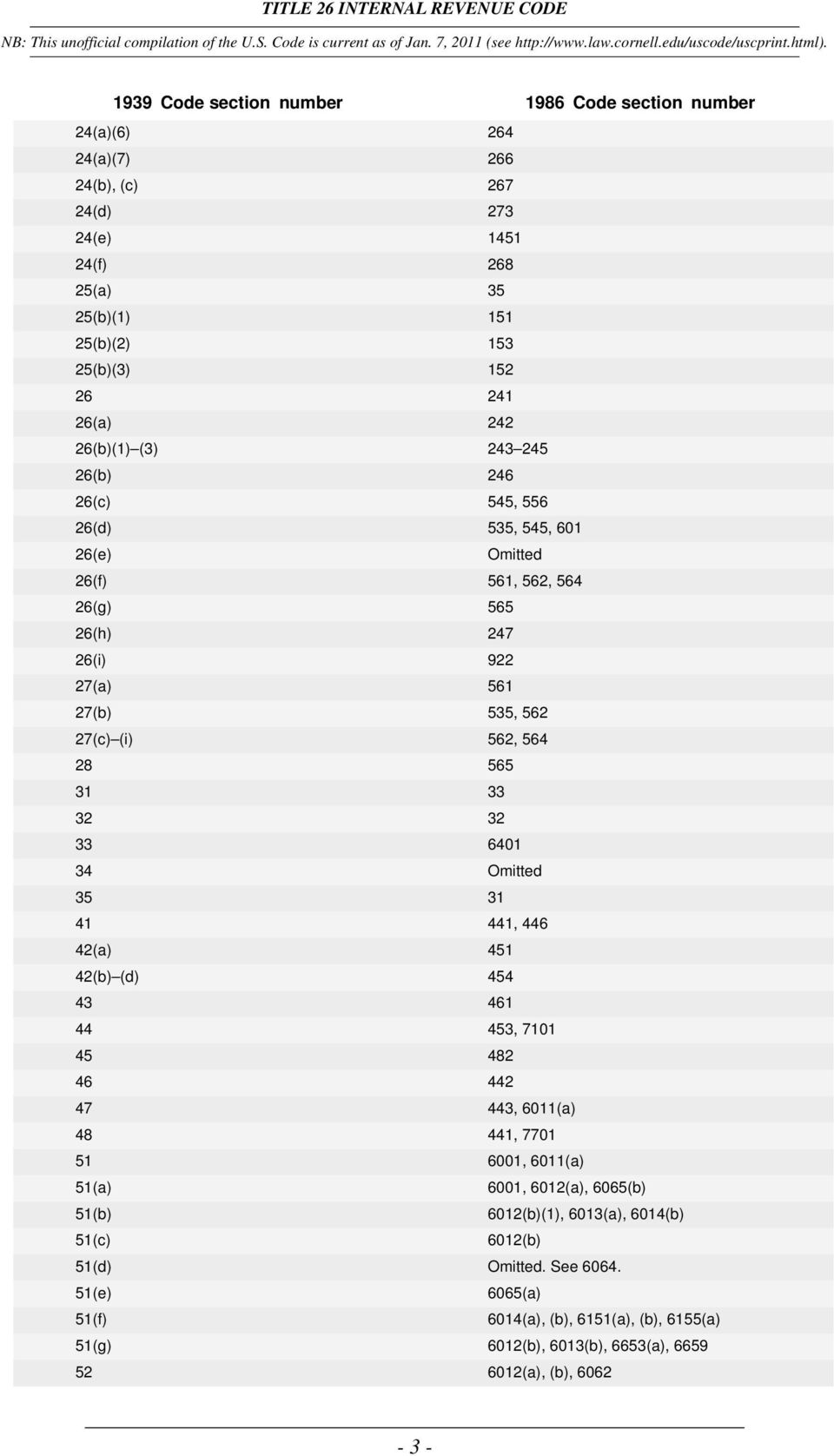
5 TITLE 26 INTERNAL REVENUE CODE 1939 Code section number 1986 Code section number 24(a)(6) (a)(7) (b), (c) (d) (e) (f) (a) 35 25(b)(1) (b)(2) (b)(3) (a) (b)(1) (3) (b) (c) 545, (d) 535, 545, (e) Omitted 26(f) 561, 562, (g) (h) (i) (a) (b) 535, (c) (i) 562, Omitted , (a) (b) (d) , , 6011(a) , , 6011(a) 51(a) 6001, 6012(a), 6065(b) 51(b) 6012(b)(1), 6013(a), 6014(b) 51(c) 6012(b) 51(d) Omitted. See (e) 6065(a) 51(f) 6014(a), (b), 6151(a), (b), 6155(a) 51(g) 6012(b), 6013(b), 6653(a), (a), (b),
6 TITLE 26 INTERNAL REVENUE CODE 1939 Code section number 1986 Code section number , 6081, (a) (b) (c) (e) 54(f) Omitted 6033(a), 6065(b) , 7213(a) 56(a) 56(b) 6151(a) 6152, 6601(c)(2) 56(c) 6161(a), 6162(a), 6165, (d) (f) Omitted 56(g) (h) 56(i) 56(j), 57 Omitted 6151(b) Omitted (b), 6015, 6064, 6065, 6073(a), (c), 6081(a), 6091(b), 6103, 6161(a) 59(a) (c) (d) 6201(b), 6315, 6601(g) (g), 6073(b), (d), (e), 6091(b), 6153(b), (d), (e) 61 Omitted (1) (11), (13) (19) (12) 521, (a) 531, (b), (c) (d), (e) 535, (f) (a) (b) (a), (b) 1301, (c) 1304(a) 107(d) (e) (b) (a) (b)(1) (b)(2) (b)(3) 354, (b)(4) (b)(5)

7 TITLE 26 INTERNAL REVENUE CODE 1939 Code section number 1986 Code section number 112(b)(6) (b)(6)(D) (b)(7) (b)(8) (b)(9) (b)(10) (b)(11) (c) 351, 356, 371, (d) 361, (e) 351, 356, 361, 371, (f) (g), (h) (i) (j) Omitted 112(k) 357, (l) (m) (n) (a) (a)(1) (a)(2) (4) (a)(5) (a)(6) 358, (a)(7), (8) (a)(9) (a)(10) (a)(11), (12) 1051, (a)(13) 723, (a)(14) (a)(15) (a)(16) (a)(17) (a)(18) (a)(19) (a)(20), (21) (a)(22) (a)(23) (b) (b)(1), (2) (b)(3), (4) 1017, (c), (d) 1019, (e) (a) 167(f) 114(b)(1) (b)(2) Omitted 114(b)(3) 613(b)(3) 114(b)(4) 613(b)(4) 115(a) 301,

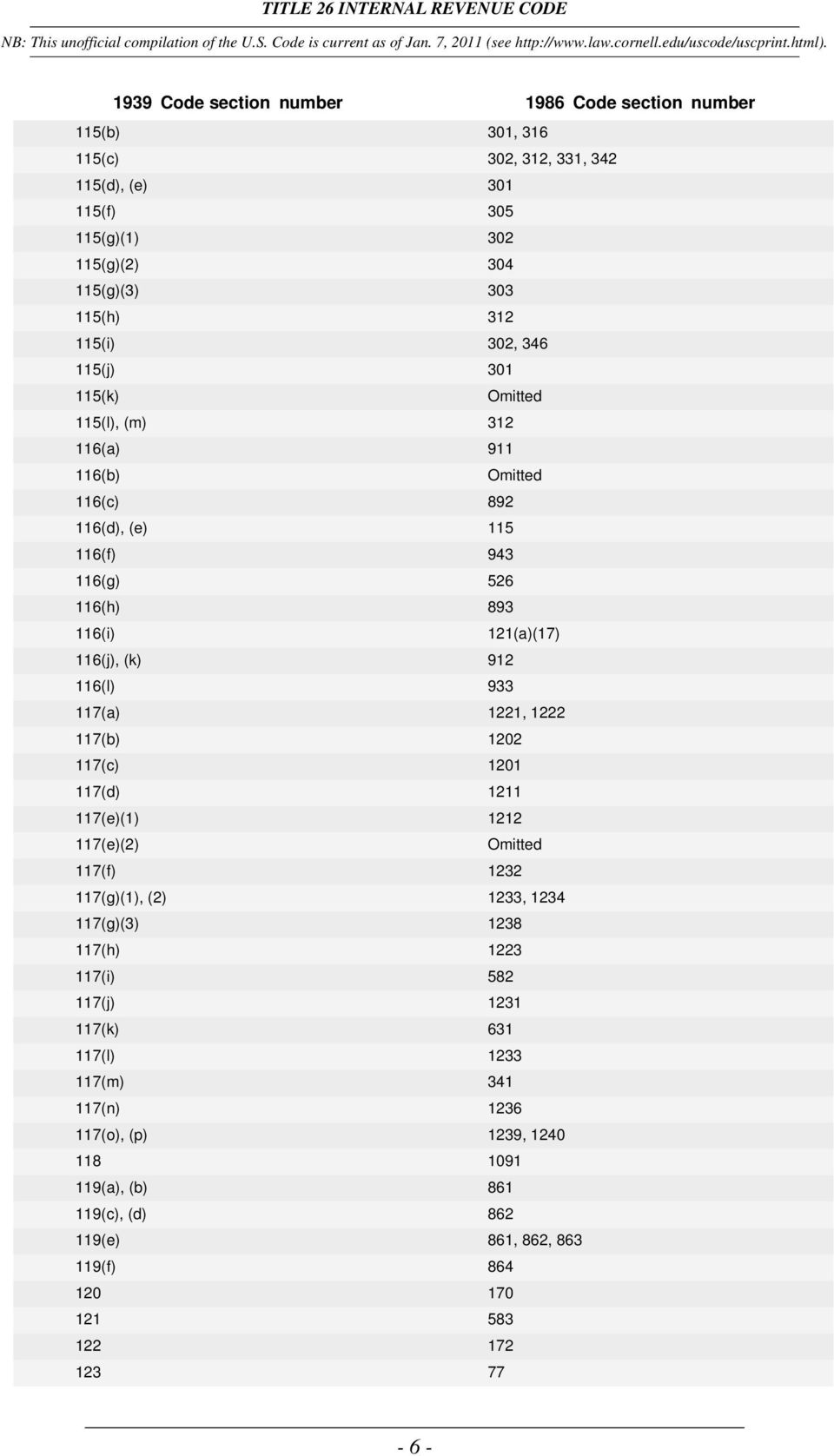
8 TITLE 26 INTERNAL REVENUE CODE 1939 Code section number 1986 Code section number 115(b) 301, (c) 302, 312, 331, (d), (e) (f) (g)(1) (g)(2) (g)(3) (h) (i) 302, (j) (k) Omitted 115(l), (m) (a) (b) Omitted 116(c) (d), (e) (f) (g) (h) (i) 121(a)(17) 116(j), (k) (l) (a) 1221, (b) (c) (d) (e)(1) (e)(2) Omitted 117(f) (g)(1), (2) 1233, (g)(3) (h) (i) (j) (k) (l) (m) (n) (o), (p) 1239, (a), (b) (c), (d) (e) 861, 862, (f)
9 TITLE 26 INTERNAL REVENUE CODE 1939 Code section number 1986 Code section number 124 Omitted 124A, 124B 168, (a), (b) Omitted 127(c)(1) (5) (d) (e), (f) , , A (a) (b) (c) 905, 6155(a), (d), (e) (f) (g) 901(c) 131(h) (i) , 6071, 6081(a), 6091(b)(2), 6503(a)(2) (a), (b), 6065(a) 143(a) (b) (c) 143(d), (e) 1462, (f) 1464, (g) (h) 1443, , 6151(a) 1461, 6011(a), 6072(a), 6091(b), 6151(a) , 7202, 7203, , 6155(a), 6601(a), 6658, 6851, (b), (c), 6071, 6081(a), 6091(a) , 6043, 6044, 6065(a), 6071, 6081(a), 6091(a) , 6065(a), 6071, 6081(a), 6091(a) , 6081(a), 6091(a), 7001(a), Omitted 153(a) 153(b) 153(c) (d) 7201, (a) 6033(b), 6071, 6081(a), 6091(a) 6034, 6071, 6081(b), 6091(a) 642(c) 162(b) 651, 652, 661, (c) (d) 643, (e), (f)

10 TITLE 26 INTERNAL REVENUE CODE 1939 Code section number 1986 Code section number 162(g) (a)(1), (2), (b) (c) 642(a)(1) , (a) 401, 501(a) 165(b) (d) , , (a) (c) 584, (d)(1) (4), (e) (f) 6032, 6065(a) 169(g) , , , (a), (b) 702, (c) (d) 703(a) 184, , 6063, 6065(a) , Omitted (a)(1) (a)(2), (3) (b) (c)(1) (7) 803(a) (g) 201(d) (f) 803(h) (j) 201(g), 202(a) Omitted 202(b) 804(a) 202(c) Omitted 203A (a)(1) 831(a) 204(a)(2) 831(b), (a)(3) 831(b) 204(b)(1) 832(b)(1) 204(b)(2) 832(a) 204(b)(3) (7) 832(b)(2) (6) 204(c) (e) 832(c) (e) 204(f) 832(c)(12) 205, , (a)(1), (2) 821(a) 207(a)(3), (4) 821(b), (c) 207(a)(5) 822(e) 207(a)(6) 821(d) - 8 -

11 TITLE 26 INTERNAL REVENUE CODE 1939 Code section number 1986 Code section number 207(b)(1) 822(a), (b) 207(b)(2), (3) 823(1), (2) 207(b)(4) 822(a) 207(b)(4)(A) (F) 822(c) 207(c), (d) 822(d)(1), (2) 207(e) 822(e) 207(f) 822(d)(3) 207(g), 208 Omitted 211, , (a) (c) (d) 142(b)(1) , 6011(a), 6065(b) (a), 6012(a), 6072(c) 218(a) 6151(a) (a) (b), (c) 882(a), (b) 231(d) (a), (b) , 6065(a) (a) 882, 6011(a), 6072(c) 235(b) 6012(a) 236(a) 6151(a) 236(b) 884(1) (3) (4) , 6011(a) , 6653(c)(1) 272(a) 6212(a), (b)(2), 6213(a) 272(b) 6155(a), 6215(a) 272(c) 6155(a), 6213(c) 272(d) 6213(d) 272(e) 6214(a) 272(f) 6212(c), 6213(b)(1) 272(g), (h) 6214(b), (c) 272(i) 6152(c), 6601(c)(2) 272(j) 6161(b), 6165, (k) 6212(b) - 9 -
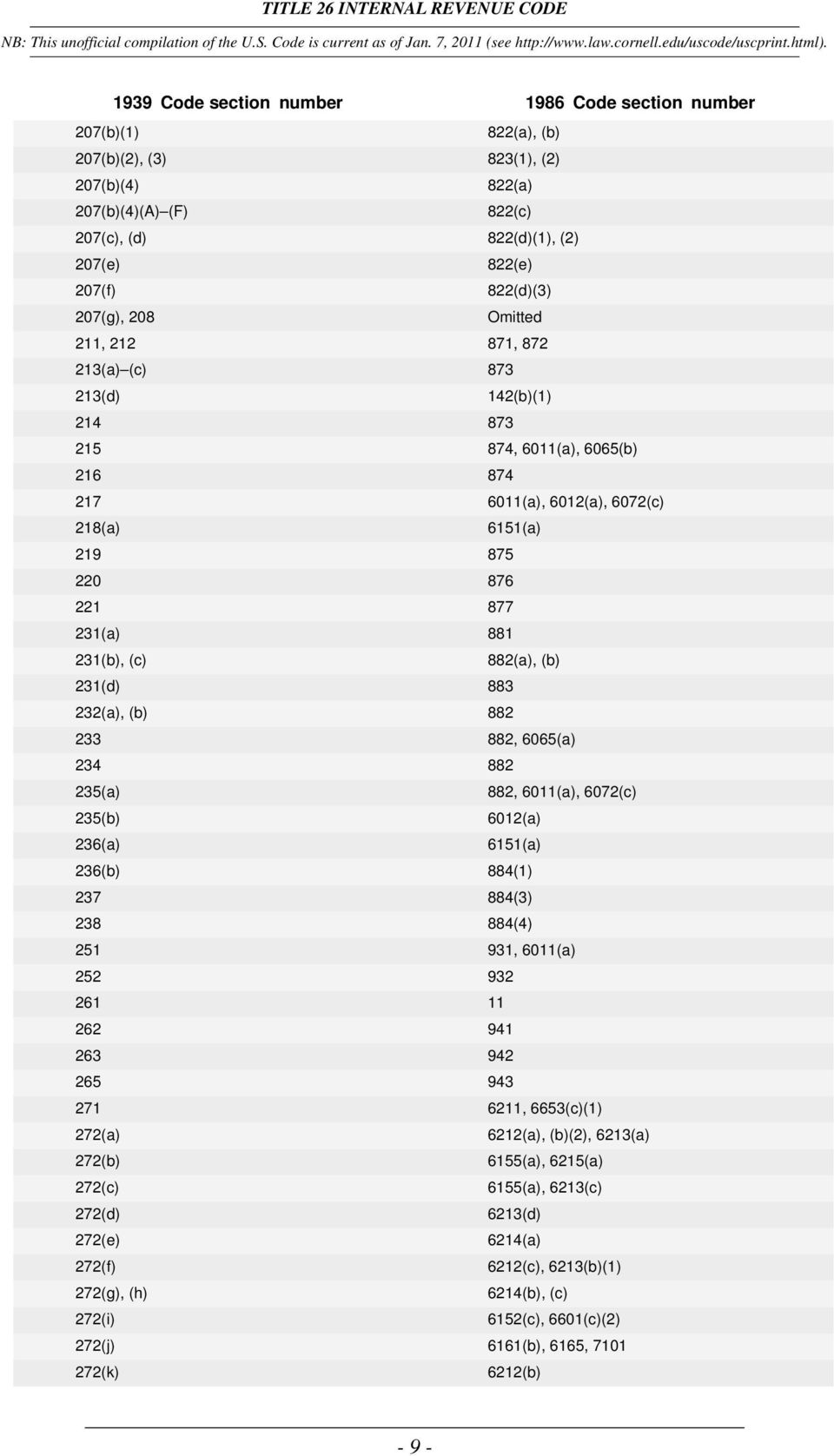
12 TITLE 26 INTERNAL REVENUE CODE 1939 Code section number 1986 Code section number 273(a) (i), (k) 6155, 6861, 6863(a), (b), (j) 6404(b) , 6155(a), 6161(c), 6503(b), 6871, 6872, (c), 6502(a) (a) (a), (a), (a), (b), , 6651(c), 6654(a) , , Omitted (a)(1) (3) 6401, (a)(4) (b)(1) (3) (b)(4) 322(b)(5), (6) 322(c) 322(d) 322(e) 322(f) 322(g) 6151(c), 6513(a), 6611(d) 6511(d) 6512(a) 6512(b) 6151(c), 6513(b), 6611(d) Omitted 6511(d) , 336(a) (c) (d) (a) (b) , , , 394(a) (c) Omitted 394(d) (e), (f), 395, , Omitted 421(a), (b) 501, (c), (d) (a) (b), 423, , 514, , , ,
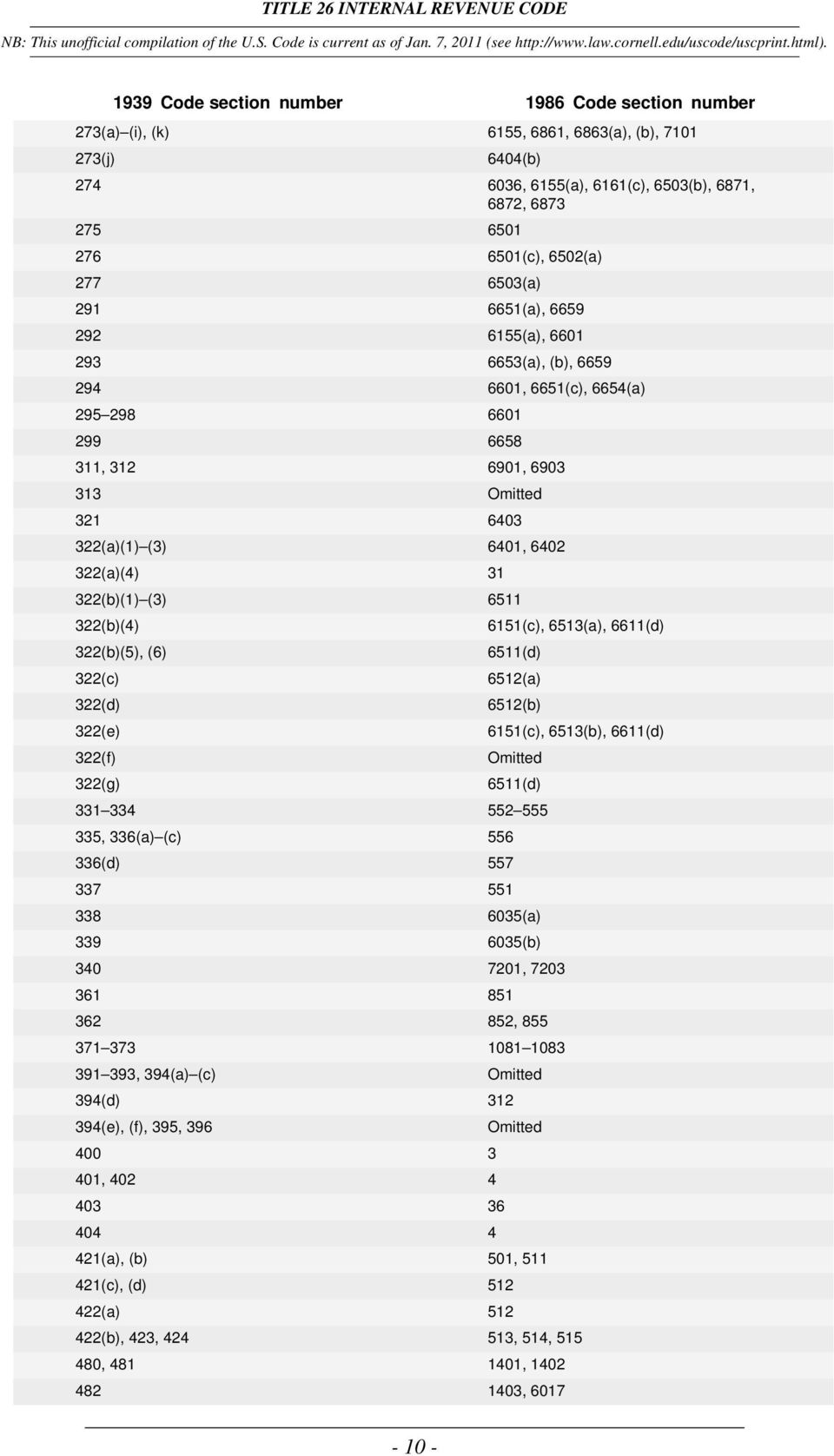
13 TITLE 26 INTERNAL REVENUE CODE 1939 Code section number 1986 Code section number (a), (b) (c) 562, (d) Omitted 504(e) (a) (c) (d) Omitted 505(e) (a) (h) (i), (j), 507(a) Omitted 507(b) Omitted Chapter 1, Subchapter G, Part III , 7213(a) 650, (g) , , 802 Omitted (a), 2011(a), (b) (a) 811(a), (b) 2033, (c) 2035, 2036, (d)(1) 2038(a)(1) 811(d)(2) 2038(a)(2) 811(d)(3) 2038(b) 811(d)(4) Omitted 811(e) (g) (h) (i) 2043(a) 811(j) (k), (l) 2031(b), (m) Omitted (a) Omitted 812(b) 2043(b), 2053, (c) (d), (e) Omitted. See 2055, (a)(1) Omitted 813(a)(2) (b) (c) , 6091(a) 821(a) 6018, 6065(a) 821(b) 6071, 6075(a), 6081(a) 821(c) 6091(b) 821(d) (e) Omitted
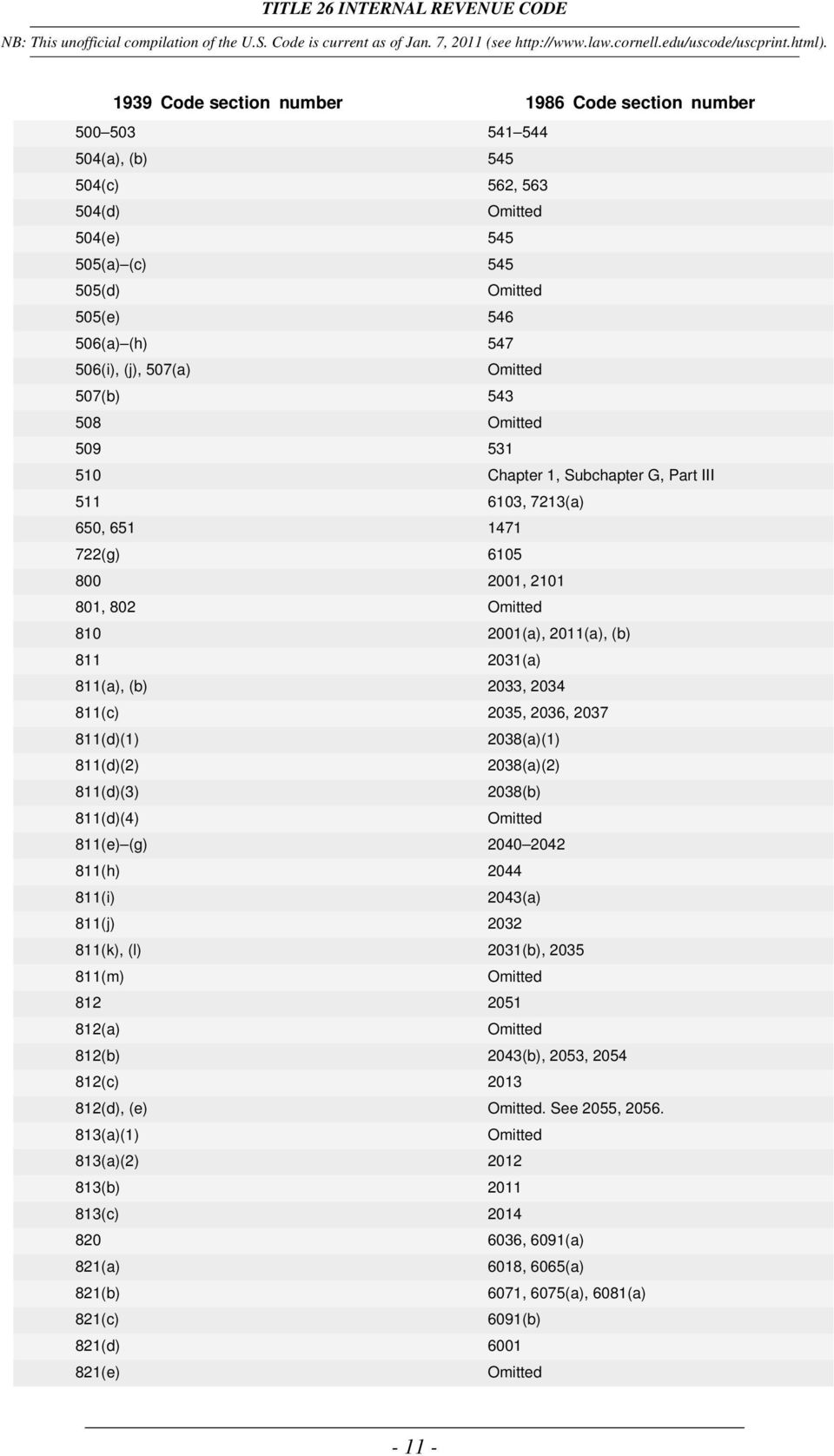
14 TITLE 26 INTERNAL REVENUE CODE 1939 Code section number 1986 Code section number 822(a)(1) 6151(a) 822(a)(2) 6161(a)(2), 6165, 6503(d), (b) (b) 824 Omitted (a) (b) (d) (a) 6324(a)(1), 6325(a)(1) 827(b), (c) 6324(a)(2), (3) 828, 840, 841 Omitted Omitted , 2103, , , (a) 6018, 6065(a) 864(b) 6071, 6075(a), 6081(a) 864(c) 6091(b) 865 Omitted (a), 6653(c)(1) 871(a) 6212(a), 6213(a) 871(b) 6155(a), 6215(a) 871(c) 6155(a), 6213(c) 871(d), (e) 6213(d), 6214(a) 871(f) 6212(c), 6213(b) 871(g) 6214(c) 871(h) 6161(b)(2), 6165, 6503(d), (i) 6155(a), 6653(b), 6659(a) 872(a) 6155(a), 6861(a) 872(b) (e) 6861(b) (e) 872(f) 6863(a), (b)(2), (g) 6155(a), 6863(b)(1) 872(h) 6863(a), (b)(2) 872(i) 6155(a), 6861(f) 872(j) 6861(g) (b) 874(a) 6501(a) 874(b)(1) 6501(c)(1), (3) 874(b)(2) 6502(a) 874(b)(3) 2016, 6071, 6081, 6091, (a)(1) 876 Omitted (a), (b), (f)(1) (a), 6601(a), (d), (f)(1) (a), (c)(3) (a), (c), (f) 894(a) 6651(a), 6653(a)

15 TITLE 26 INTERNAL REVENUE CODE 1939 Code section number 1986 Code section number 894(b) 7201, 7202, 7203, 7207, 7269, (a) 6901(a), (b) 900(b), (c) 6901(c), (f) 900(d) 6904, 7421(b) 900(e) 6901(h) 901(a), (b) 6903(a) 901(c) 6903(b) 901(d) 6212(b) 910, 911, , 6512(a), (b) 913, 920, 921 Omitted (a), 6601(a), (b) (a), (a) (b) (d), 931 Omitted , 2052, (a) Omitted 936(b), (c) 2012, (a), (a) (b) 2511(a) 1000(c) (d), (e) Omitted 1000(f) (g) Omitted 1001(a), (b) 2502(a), (c) 1001(c) Omitted (b) (a)(1) (3) (b), (c) 2522, (a) 1006(a) 6019(a), 6065(a) 1006(b) 6075(b), 6091(b)(1) (a) 2502(d), 6151(a) 1008(b) 6161(a)(1) 1008(c) Omitted 1008(d) (e) 6314(a) (b), 6325(a)(1) 1010 Omitted (a), 6653(c)(1) 1012(a) 6212(a), 6213(a) 1012(b) 6155(a), 6215(a) 1012(c) 6155(a), 6213(c)

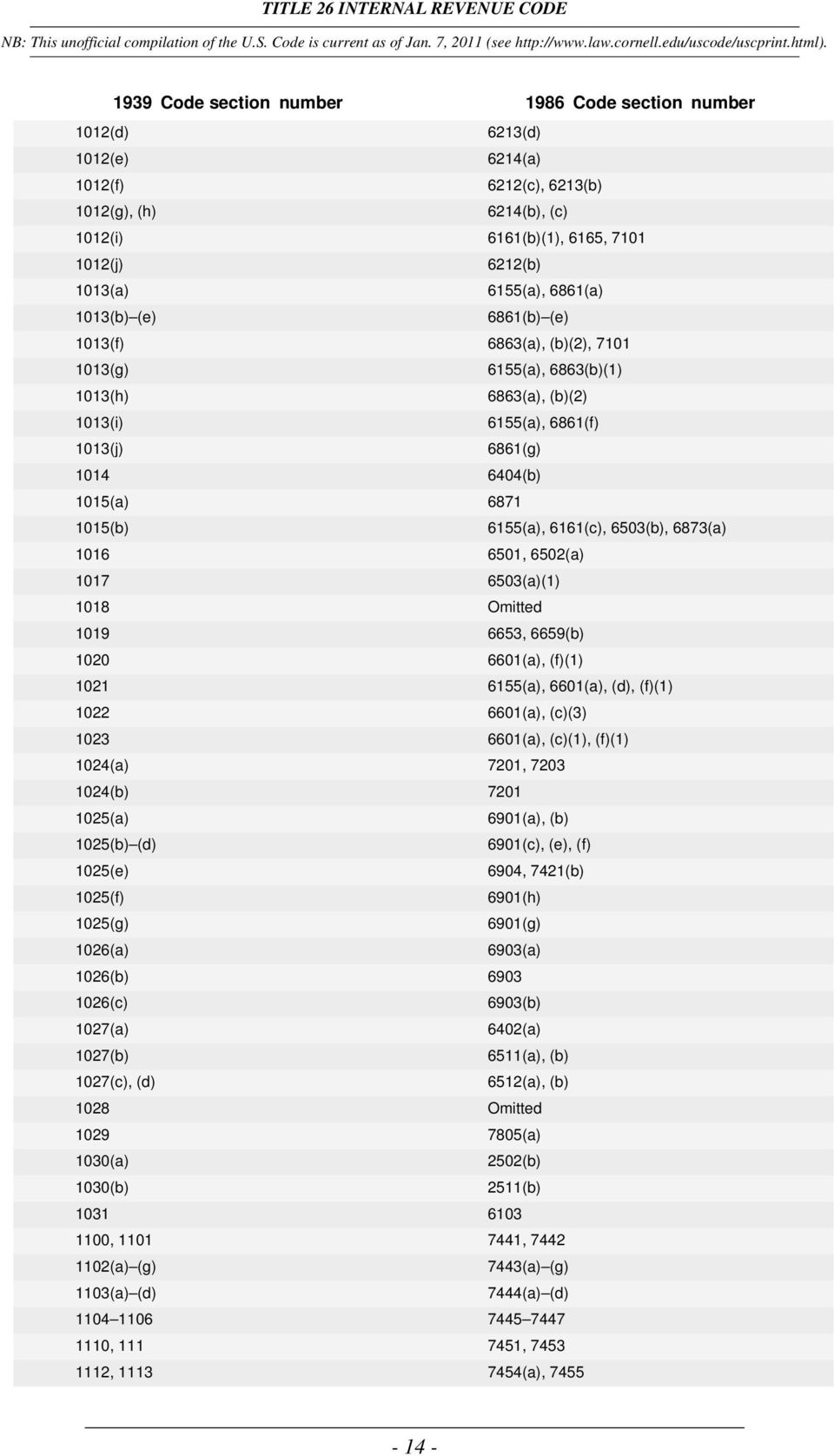
16 TITLE 26 INTERNAL REVENUE CODE 1939 Code section number 1986 Code section number 1012(d) 6213(d) 1012(e) 6214(a) 1012(f) 6212(c), 6213(b) 1012(g), (h) 6214(b), (c) 1012(i) 6161(b)(1), 6165, (j) 6212(b) 1013(a) 6155(a), 6861(a) 1013(b) (e) 6861(b) (e) 1013(f) 6863(a), (b)(2), (g) 6155(a), 6863(b)(1) 1013(h) 6863(a), (b)(2) 1013(i) 6155(a), 6861(f) 1013(j) 6861(g) (b) 1015(a) (b) 6155(a), 6161(c), 6503(b), 6873(a) , 6502(a) (a)(1) 1018 Omitted , 6659(b) (a), (f)(1) (a), 6601(a), (d), (f)(1) (a), (c)(3) (a), (c)(1), (f)(1) 1024(a) 7201, (b) (a) 6901(a), (b) 1025(b) (d) 6901(c), (e), (f) 1025(e) 6904, 7421(b) 1025(f) 6901(h) 1025(g) 6901(g) 1026(a) 6903(a) 1026(b) (c) 6903(b) 1027(a) 6402(a) 1027(b) 6511(a), (b) 1027(c), (d) 6512(a), (b) 1028 Omitted (a) 1030(a) 2502(b) 1030(b) 2511(b) , , (a) (g) 7443(a) (g) 1103(a) (d) 7444(a) (d) , , , (a),
17 TITLE 26 INTERNAL REVENUE CODE 1939 Code section number 1986 Code section number 1114(a), (b) 7456(a), (c) 1115(a), (b) 7457(a), (b) (a) (f) 7459(a) (f) 1117(g) 6155(a), 6659, (h) Omitted , 1120, , 7461, Omitted , 7485(a) , 6071, 6081(a), 6091(a), 6151(a) (a), (b) 3102(a), (b) 1401(c) 6205(a), 6413(a)(1) 1401(d)(1), (2) Omitted 1401(d)(3), (4) 6413(c)(1), (2) (a) (a), 6413(a) (a) (b) 6601(a), (f)(1) 1420(c) 6011(a), 6071, 6081(a), 6091(a), 6302(b) 1420(d) (e) (b), 6413(b) (a) 6802(1) 1423(b), (c) 6803(a)(1), (2) (a) (b) 7208(1) 1426(a) (e) 3121(a) (e) 1426(f) 7701(a)(1) 1426(g) (l) 3121(f) (k) 1427, , (a), (c) 1430, 1431 Omitted (a), (b) 3202(a), (b) 1501(c) 6205(a)(1), 6413(a)(1) (b), 6413(b)
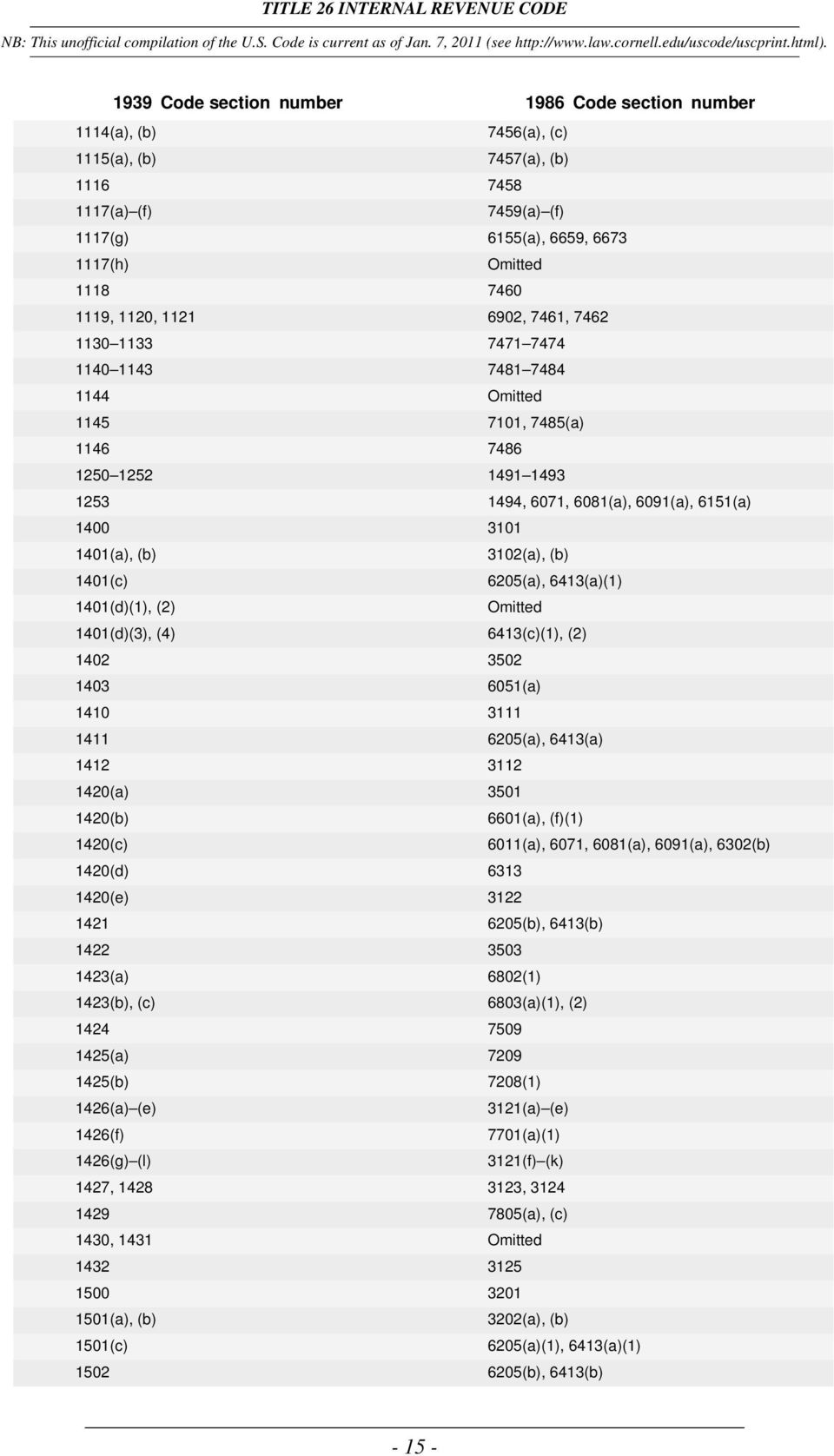
18 TITLE 26 INTERNAL REVENUE CODE 1939 Code section number 1986 Code section number (a) 1510, 1511, , 3212, (a)(1), 6413(a)(1) (b), 6413(b) 1530(a) (b) 6011(a), 6071, 6081(a), 6091(a), 6151(a) 1530(c) 6601(a), (f)(1) 1530(d) (a) (e) 3231(a) (e) 1532(f) 7701(a)(9) 1532(g), (h) 3231(f), (g) 1532(i) 7701(a)(1) (a), (c) 1536, 1537 Omitted (a) (c) (d) 6413(d) (a) 6011(a), 6065, 6071, 6091(b)(1), (2) 1604(b) 6081(a) 1604(c) (a) (b) 6601(a), (f)(1) 1605(c) 6152(a)(3), (b), 6155(a), 6601(c)(2) 1605(d) 6161(a)(1) 1605(e) (a) (j) 3306(a) (j) 1607(k) 7701(a)(1) 1607(l) (o) 3306(k) (n) (a), (c) 1610 Omitted (a), (b) 3402(a), (b) 1622(c)(1)(A) Omitted 1622(c)(1)(B), (2) (5) 3402(c) 1622(d) 3402(d) 1622(e) 3502(b) 1622(f)(1) (f)(2) 6401, (g) (k) 3402(e) (i)

19 TITLE 26 INTERNAL REVENUE CODE 1939 Code section number 1986 Code section number , 6011(a) 1625(c) 6081(a) 1626(a) (b) (d) Omitted (a) (a), (b) 6051(a) (d) 1633(c) 6081(a) 1634(a) (b) 6659, (a) 6501(a) 1635(b) 6501(c)(1), (3) 1635(c) 6501(c)(2) 1635(d) 6502(a) 1635(e) 6501(b)(2) 1635(f), (g) Omitted 1636(a)(1) 6511(a), (b)(1) 1636(a)(2) 6511(b)(2) 1636(b) Omitted 1636(c) 6513(c) 1636(d), (e) Omitted , 4011, 4021, Omitted 1656(a), (b), (c) 5063(a), (b), (c) Omitted , 4232, 6011(a) , (a) (b), (c) 6151(a) 1715(d) 6415(b), (c), (d), 6416(a) 1716(a) 6011(a), 6065(a) 1716(b) 6071, 6081(a) 1716(c) 6091(b)(1), (2) (a), (f)(1) 1718(a) 7201, (b) 7201, (c) 6659, 6671(a), (d) 6671(b), (b)

20 TITLE 26 INTERNAL REVENUE CODE 1939 Code section number 1986 Code section number Omitted , 4311, , 4312, 4314, 4315, , 4302, 4304, 4321, 4322, 4323, 4341, 4342, 4343, 4344, 4351, 4352, 4353, , 4372, , 4892, 4894, 4895, 4896, 7701(a)(1) , 4373, , 4454, 4893, 6201(a)(2), 6801(a), (b) Omitted 1817(a) (c) 6802(1) (3) 1818(a) 6803(b)(1), (b) 6803(b)(2) 1819 Omitted (2), (3) 1821(a)(1) 7201, (a)(2) 7201, (a)(3) 6653(e), 6659, 6671(a), (a)(4) 6671(b), (b)(3) 4374, (b)(4) (3), 7271(1) (1) 1823(a) (c) 7208(2) (4) , 4455, Omitted (a) 6011(a), 6065(a), (b) 6091(b)(1), (2) 1853(a), (b) 1853(c) 6151(a) 6601(a), (f)(1) (a), (b), (d) 1855, 1856 Omitted , 1859 Omitted 1900, 1901, , 4883, (a)(1) 6011(a), 6065(a), (a)(2) 6091(b)(1), (2) 1902(a)(3), (b) 6151(a) Omitted 1905, ,
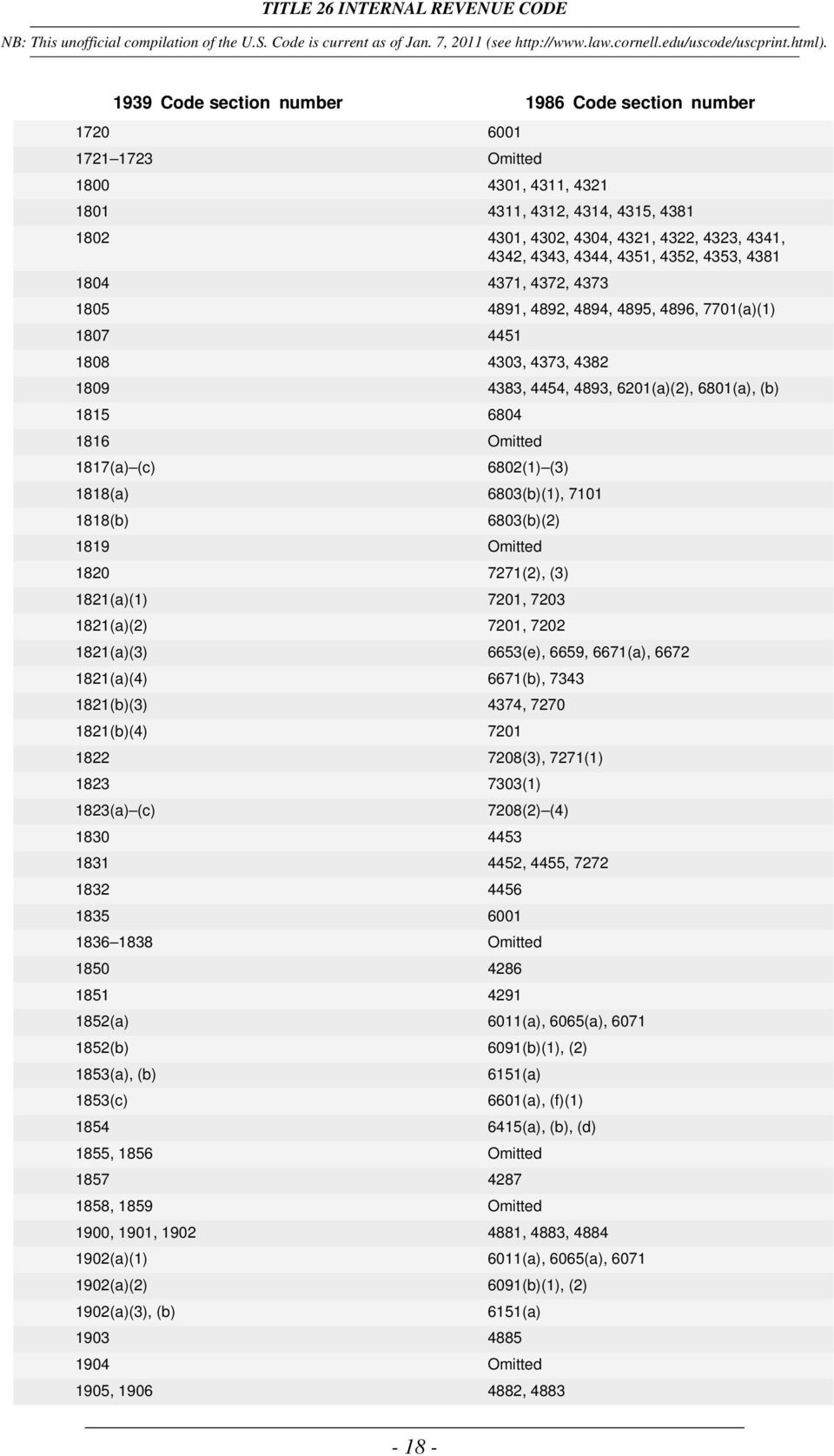
21 TITLE 26 INTERNAL REVENUE CODE 1939 Code section number 1986 Code section number 1907 Omitted 1920(a), (b) 4851(a), (b) 1920(c) 4871, , , (a) 7233(1), (2) 1929(b) 7263(b) 1929(c) 7263(a) , , 7701(a)(1) Omitted (a), (b) 5701(a) 2000(c)(1), (2) 5701(b), (c) 2000(d) 5701(d), (e) 2000(g)(1) (3) 5707(a) (c) 2001(a) 5703(a) 2002(b) 5703(d) 2002(c) 5703(a) (b) (a), (b) (a), (b) (e) (a), (b) (a) 5711(a), (b) 2039(b) 5722, (c) (b)(1) (a), (b) (a), (b) 2055 Omitted
22 TITLE 26 INTERNAL REVENUE CODE 1939 Code section number 1986 Code section number Omitted , Omitted 2100(a), (b) 5723(a) 2100(c)(1) 5723(d) 2100(c)(2) 5723(a) 2100(d) 5723(b), (c) 2100(e) 5723(a) (c) (a) 2103(a)(1) 5723(a) 2103(e) (a) 5751(a) 2110(a), (b) 5702(c), (d) 2111(a)(1), (2) 5723(a) 2111(a)(3) 5723(d) 2111(b) 5723(a) 2111(c) 5723(b), (c) 2111(d), (e)(1) 5723(a) 2111(e)(2) 5723(d) 2111(f) 5704(a), 5723(d) 2112(a)(1) 5723(a) 2112(e) (a) 2130(a), (b) 5723(a), 5762(a)(4), (6) 2130(c) 5723(a), (d) 5704(d) 2135(a)(1), (2) 5704(b), (c) 2135(a)(3) 5704(b) 2136(a) (a) 2150 Omitted (a)(5) Omitted 2155(a) 5762(a)(4), (5) 2155(b) 5763(a) 2156(a) 5762(a)(2), (3) 2156(b) 5762(a)(3) 2156(c) 5761(b) 2160(a) 5762(a)(4) 2160(b) (d) 5762(a)(5) 2160(e) 5762(a)(6) 2160(g)(1), (2) 5762(a)(8), (9) 2160(g)(3) 5762(a)(6) 2160(h) 5763(a) 2160(i) 5762(a)(9), (10)
23 TITLE 26 INTERNAL REVENUE CODE 1939 Code section number 1986 Code section number 2161(a) 5762(a)(1) 2161(b) 5763(c) 2161(c) 5762(a)(1) 2161(e) (g) 5762(a)(2) 2161(h) 5763(b) 2161(i)(1) 5763(b) 2161(j)(1) 5763(b) 2161(l)(1) 5763(b) 2161(m)(1) 5761(a) 2161(m)(2) 5763(b) 2162(a)(2) 5762(a)(1) 2162(a)(3) (5) 5762(a)(2) 2162(b)(1) 5762(a)(4), (5) 2163 Omitted 2170(a)(2) 5751(a), 5762(a)(5) 2170(a)(4) 5762(a)(6) 2170(b) 5762(a)(5), 5763(a) 2171(a) 5763(a) 2171(b)(1) 5762(a)(4) 2171(b)(2) 5762(a)(4), (5) 2172(a) 5762(a)(8) 2172(b) 5762(a)(6) 2172(c) 5762(a)(9) 2172(d) 5762(a)(6) 2172(e), (f) 5762(a)(9) 2173(a), (a)(5) (a) 2176(a)(2) 5762(a)(10) 2176(a)(3) 5762(a)(8) 2180(a) 5762(a)(1) 2180(b) 5763(c) 2180(d) (f) 5762(a)(2) 2180(g)(1) 5763(b) 2180(h) 5763(b) 2180(i)(1) 5763(b) 2180(k)(1) 5763(b) 2180(l)(1) 5761(a) 2180(l)(2) 5763(b) 2181 Omitted Omitted (a), 5722, (b) 5704(b) (a) , , 4596, 6001, 7101, , 4597,
24 TITLE 26 INTERNAL REVENUE CODE 1939 Code section number 1986 Code section number , , (a) 2308(b) 2308(c) 2308(d) 2308(e) 2308(f) 2308(g) 2308(h), (i) 2308(j) 7234(a) 7265(a)(1) 7234(b) 7234(d)(4) 7265(b) Omitted 7234(d)(2) 7234(c), (d) 7265(c) (2), (3), (5) 2310 Omitted , Omitted , , 4826, 6001, 7101, , , (a) 2326(b), (c) 7235(a), 7265(a) 7235(b), (c) , 4813, 4816, 4818, 7235(e), 7265(b), (c) , 4832, 6201(a)(2)(A) , 4846, 6001, 7101, , , , , 7266(b) (f) (2), (4), (5) 2359 Omitted Omitted , , , (a) 2403(b) 2403(c) , , , (a), 6065(a), 6071, 6081(a), 6091(b)(1), (2) 6151(a), 6601(a), (f)(1) (a), (b) 2408 Omitted
25 TITLE 26 INTERNAL REVENUE CODE 1939 Code section number 1986 Code section number , 2411 Omitted , 4003, 4012, (a) 6011(a), 6071, 6081(a), 6091(b)(1), (2), 6151(a) 2451(b) 2452(a) 2452(b) 6151(a), 6601(a), (f)(1) 6416(b)(2)(D) 6416(a) , 6416(b)(2)(A) 2454, 2455 Omitted , (a), 6065(a), 6071, 6081(a), 6091(b)(1), (2) (a) (a) , 6417(b), (a), (f)(1) , 2479 Omitted (a) 2481, 2482 Omitted , 4571, , 4562, 4571, 4572, 4581, , Omitted , (c) 6302(b) , , , (a) 6065(a) 2555(b) (c) 6065(a), (c)(1) (a) 2557(b)(1) 6081(a), 6091(a) 7237(b) 7237(a) 2557(b)(2) 7201, (b)(3) 7201, (b)(4) 6671(a), (b)(8) 6671(b), , 4733, 7301(a)
26 TITLE 26 INTERNAL REVENUE CODE 1939 Code section number 1986 Code section number 2559, 2560 Omitted Omitted , , , (b) (d) (d)(4) , 7301(a) , , (a) (a) , 7301(a) 2599, 2600 Omitted , 2606 Omitted , (c)(2) 6201(a)(2)(A) 2652(a) 6801(a) (b) 6001, (d) , (a) 7206(4) 2656(b) 7239(a) 2656(c) 7271(1), 7303(6)(B) 2656(d) 7239(b) 2656(f) (g) (h) 7267(d) 2656(i) 7267(c) 2656(j), (k) 7267(a), (b) 2657(a), (b) 7303(6)(B) 2657(c) 7303(6)(A) 2657(d)
27 TITLE 26 INTERNAL REVENUE CODE 2657(e) 2657(f) 1939 Code section number 1986 Code section number 7301(c) 7303(6)(B) 2658 Omitted Omitted , 4182, 4224, (a), 6065(a), 6071, 6081(a), 6091(b)(1), (2) (a) 2703(a) 6416(f) , 6416(e) (a), (f)(1) 2707(a) 6671(a), (b) 7201, (c) 7201, (d) 6671(b), (b) Omitted , 6001(a) (a) (c) , , (a), (b) 5862(a), (b) (a) (e) 2800(a) 2800(a)(1) 2800(a)(1)(A) 2800(a)(1)(B) (a)(2) 2800(a)(3) 2800(a)(4) 2800(a)(5) 2800(a)(6) 2800(b)(2) 2800(c) 2800(d) 2800(e)(1) 2800(e)(2) 2800(e)(3) 2800(e)(4) 2800(f) 7701(a)(1) 6071, 6091(a) 5001(a)(9) (Rev. See 5001(a)(8)) 5001(a)(1), 5005(a), 5006(a) 5026(a)(1), 5007(a) 5001(a)(2) 5001(a)(3), 5007(b)(2) 5001(a)(4) (Rev. See 5001(a)(10)), 5007(c) (Rev. See 7652, 7805) 5021(a), 5025(b) 5001(a)(5) (Rev. See 5001(a)(4)) 5006(c) 5001(b) 5005(b) 5004(a)(1) 5004(a)(2) (Rev. See 5004(b)(2)) 5004(a)(3) (Rev. See 5004(b)(3)) 5004(a)(4) (Rev. See 5004(b)(4)) 5006(d), 5007(b)(1)
28 TITLE 26 INTERNAL REVENUE CODE 2801(b) 1939 Code section number 1986 Code section number 2801(c)(1) (c)(2) 2801(d) 2801(e) (e)(1) 2801(e)(2) 5021(b) (Rev. Omitted) 5025(e) (Rev. See 5025(f)) 5281 (Rev. See 5201(a)) 2801(e)(3) 5386(b), (e)(4) 5272(a) (Rev. See 5173(a), (d)), 5281(a) (Rev. See 5201(a)) 5273(a) (Rev. See 5178(a)), 5627 (Rev. See 5687)) 5386(a) 2801(e)(5) 5023 (Rev. See 5687) 2801(f) 5628 (Rev. See 5601(a)(10), 5687) 2802(a) 2802(b) 5009(a) (Rev. See 5205(c)(1), (f), 5206(c)), 5010(a) (Rev. See 5205(e)) 5010(b) (Rev. See 5205(f)) 2802(c) 5027(a) (Rev. See 5061, 5205) 2803(a) 2803(b) 2803(c) 2803(d) 2803(e) 2803(f) 5008(b)(1)(E) (Rev. See 5205(c)(2)) 5008(b)(3) (Rev. See 5205(g)) 5008(b)(4) 5008(b)(2) (Rev. See 5205(g)) 5008(b)(5) 5640 (Rev. See 5613(b)) 2803(g) 5642 (Rev. See 5604(a)(1), (4) (6), (10), (12) (15), (b)) (Rev. See 5311) 2805(a) 2805(b) 5688(a) 5688(b) 2806(a)(1), (2) 5634 (Rev. See 5601(a)(13), 5615(7)) 2806(b)(1) 5645 (Rev. See 7214) 2806(c) 2806(d) 5625 (Rev. See 5612(a)) 5639 (Rev. See 5613(a)) 2806(e) 5646 (Rev. See Subtitle F) 2806(f) 5626 (Rev. See 5602, 5615(3)) 2806(g) 5687 (See 7301, 7302) (Rev. See 5610) 2808(a) 2809(a) 2809(b)(1) 2809(b)(2) 2809(c) 2809(d) 5212(a) (Rev. See 5204(b)) 5002(a) (Rev. See 5002(a)(5)) 5002(b)(1) (Rev. See 5002(a)(6)(A)) 5002(b)(2) (Rev. See 5002(a)(6)(B)) 5002(c) (Rev. See 5002(a)(7)) 5002(d) (Rev. See 5002(a)(8)) 2810(a) 5174(a) (Rev. See 5179(a), 5505(d)), 5601 (Rev. See 5505(i), 5601(a)(1), 5615(1)) (a), (a) 5175(a) (Rev. See 5171(a), 5172), 5271 (Rev. See 5171(a), (c), 5172, 5178(a)(1)(A), (4)(B) (D)), 5603 (Rev. See 5601(a)(2), (3)) 2813(a) 5282 (Rev. See 5201(a), 5202(a), 5204(a), (c), 5205(d), 5206(c), 5251)
29 TITLE 26 INTERNAL REVENUE CODE 2814(a)(1) 2814(a)(2) 1939 Code section number 1986 Code section number 5176(a), (c) (Rev. See 5173(a), (b), 5176(a)), 5177(c) (Rev. See 5173(b)(1), 5551(c)), 5604 (Rev. See 5601(a)(4), (5), 5615(3)) 5176(d) (Rev. See 5173(b)) 2815(a) 5177(a), 5605 (Rev. See 7214) 2815(b)(1)(A) 2815(b)(1)(B) 2815(b)(1)(C) 2815(b)(1)(D) 2815(c) (e) 5177(b)(1) (Rev. See 5173(b)(1)(A)) 5177(b)(2) (Rev. See 5173(b)(1)(B)) 5177(b)(3) (Rev. See 5173(b)(1)(C)) 5177(b)(4) (Rev. See 5173(b)(3)) 5551(a), (b)(1), (c) 2816(a) 5178 (Rev. See 5171(a), 5172) 2817(a) 2817(b) 2818(a) 5179(a) (Rev. Omitted) 5179(b) (Rev. Omitted) 5105(a) 2818(b) 5602 (Rev. See 5615(2), 5687) (Rev. See 5178(a)(1)(B), (b), (c)(2), 5505(b), 5601(a)(6)), 5607 (Rev. See 5505(i), 5601(a)(6)) 2820(a) (a) 2823(a) 2824 Omitted 5173(b) (Rev. See 5178(a)(2)(B), 5202(b)), 5192(b) (Rev. See 5202(b)), 5193(a) (Rev. See 5201(a), 5202(f), 5204(a), 5205(b), 5206(a), (c), 5211) 5173(a) (Rev. See 5178(a)(1)(A), (2)(C)), 5618 (Rev. See 5687) 5173(c) (Rev. See 5173(a)(2)(C)) (Rev. See 5201(c), 5312(a), (c), 5373(a), 5562) 2826(a) 2827(a) 2828(a) 2829(a) 2830(a) 5196(a) (Rev. See 5203(a)), 5617 (Rev. See 5687) 5196(b) (Rev. See 5203(b)), 5616 (Rev. See 5687) 5196(c) (Rev. See 5203(c)), 5283 (Rev. See 5203(c), (d)), 5615 (Rev. See 5203(c), (e), 5687) 5552 (See 5503, 5505(e)) 5196(d) (Rev. See 5203(d)), 5283 (Rev. See 5203(c), (d)) (a) (Rev. See 5115), 5180(a), 5274(a) (Rev. See 5180), (Rev. See 5171(a), 5172, 5173(a), 5178(a)(1)(A), 5601(a)(2), (4)) 2833(a) 5606 (Rev. See 5601(a)(4), 5602, 5615(3)) (a) (Rev. See 5222(a)(1), (2)(D), 5501, 5502(a), 5503, 5504(a), (b), 5505(a), (c), 5601(a)(7), (8), (9)(A)), 5608(a), (b) (Rev. See 5601(a)(7), (8), (9)(A), (12), 5615(4)) 2835 Omitted (a) (Rev. See 5201(c)), 5613 (Rev. See 5687) 2837 Omitted (c) (Rev. See 5202(a), (b)), 5612 (Rev. See 5687)
30 TITLE 26 INTERNAL REVENUE CODE 2839(a) 1939 Code section number 1986 Code section number 2840 Omitted 2841(a) 2841(b) 5196(e) (Rev. See 5203(b), (c)), 5619 (Rev. See 5687) 5197(a)(1)(A) (Rev. See 5207(a), (d)) 5197(a)(1)(B) (Rev. See 5207(a), (d)) 2841(c) 5620 (Rev. See 5603, 5615(5)) (Rev. See 5603) (Rev. See 5603) 2844(a) 2845 Omitted 2846(a) 2847(a) 2848 Omitted 5197(b) (Rev. See 5207(c)) 5007(e)(1) (Rev. See 5004(b)(1), 5006(a)(3)) 5007(e)(2) (Rev. Omitted) (a) (Rev. See 5221(a)) 2850(a) (a) (Rev. See 5221(a)), 5650 (Rev. See 5601(a)(14), 5615(3)) (Rev. See 5611) 2853(a) 5623 (Rev. See 5609) (Rev. See 5614) 2855(a) 5285(a) (Rev. See 5207(b)) (Rev. See 5610(a)(10), (11)) 2857(a) (b) 5114(a) (Rev. See 5114(a)(1), 5146(a)), 5285(b) (Rev. See 5207(c)), 5621 (Rev. See 5603) (a)(2) (Rev. See 5207(a)), 5621 (Rev. See 5603) 2860 Omitted 2861(a) 2862(a) 2863(a) 5282(b) (Rev. See 5202(a), 5204(a), (c), 5205(d), 5206(c)) 5282(c) (Rev. See 5205(d)) 5115(a) (Rev. See 5205(d)) 2865(a) 5630 (Rev. See 5687) (c) (Rev. See 5205(g)), 5636 (Rev. See 5604(a)(2), (3), (7) (9), (17), 7301) (Rev. See 5604(a)(17)) (Rev. See 5604(a)(18)) (Rev. See 5604(a)(19), 5613, 7301, 7302) (b) (Rev. See 5201(c)), 5614 (Rev. See 5687, 7301) (a) (Rev. See 5301(a)), 5641 (Rev. See 5606, 5613, 7301, 7302, ) (Rev. See 5171(a), 5172, 5173(a), 5178(a)(1)(A), (B), (3)(A), (B)), 5241(b) (Rev. See 5202(a), (c), (d)) (Rev. See 5171(a), 5172, 5173(a), 5178(a)(1)(A), (B), (3)(A), (B)), 5241(a) (Rev. See 5201(a), 5202(a), (c)) 2874(a) 5252 (Rev. See 5236)
31 TITLE 26 INTERNAL REVENUE CODE 1939 Code section number 1986 Code section number (Rev. See 5171(a), 5172, 5173(a), 5178(a)(1)(A), (B), (3)(A), (B)), 5246(a) (Rev. See 5212) (Rev. See 5601(a)(12), 5615(6), 5687) 2877(a) 5192(d) (Rev. See 7803; T ) 2878(a) 2878(b) 2878(c) 2878(d) 2879(a) 2879(b) 2879(c) 2879(d) 2880(a) 2881(a) 5193(a) (Rev. See 5201(a), 5202(f), 5204(a), 5205(b), 5206(a), (c), 5211) 5009(c), 5193(b) (Rev. See 5206(a), 5214(a)(4)) 5193(c) (Rev. See 5206(b)) 5193(d) (Rev. See 5204(c)) 5242(a) (Rev. See 5211, 5231(a)) 5006(a) (Rev. See 5006(a)(1), (2), 5008(c)) 5232(a) (Rev. See 5005(c)(1), 5006(a)(2), 5173(a), (c)(1)) 5232(a), (c) (Rev. See 5005(c)(1), 5006(a)(2), 5173(a), (c)(1), 5176(a), (b)) 5006(b) 5245 (Rev. See 5204(a)) 2882(a) 5244 (Rev. See 5213) 2883(a) 5194(a) (Rev. See 5211(a), 5212, 5213) 2883(b) 5194(d) (Rev. See 5214(a)) 2883(c) 5194(c) (Rev. See 5241) 2883(d) 5194(e)(1) (Rev. See 5212, 5213) 2883(e) 5025(d), 5194(f) (Rev. See 5005(c)(1), 5212, 5223(a), (d)) 2883(f) 5194(g) (Rev. See 5201(a), 5204(a), 5212) 2883(g) 2884(a) 2885(a) 2885(b) 5194(h) (Rev. Omitted) 5250(a) (Rev. See 5205(b)) 5247(a) (Rev. See 5175(a), 5206(a), 5214(a)(4)) 5009(b) (Rev. See 5205(i)(4)), 5247(b) 2885(d) 5648 (Rev. See 5608) 2886(a) 5247(c) (a) (Rev. See 5009) 2888(a) 2889, 2890 Omitted 2891(a) 2891(b) 5247(d) (Rev. See 5206(a)) 5522(a) (Rev. See 5214(a)) 5011(a) (Rev. See 5008(a)) (a) (Rev. See 5006(a)(1), (2), 5008(c)) 2901(a)(1) 2901(a)(2) 2901(b) 5011(a)(1)(A) (Rev. See 5008(a)(1)(A)) 5011(a)(1)(B) (Rev. See 5008(a)(1)(B)), 5011(b) (Rev. See 5008(b)(1)) 5011(a)(1)(B), (2) (Rev. See 5008(a)(1)(B), (2)) 2901(c) 5011(a)(3) (Rev. See 5008(a)(3), (4)) 2901(d) 2903(a) 5011(a)(4) (Rev. See 5008(a)(4)) 5243(a) (Rev. See 5171, 5172, 5178(a)(3), (4)(A), 5233(a), (b)) 2903(b) 5008(a)(1) (Rev. See 5205(a)(1), (3)) 2903(c) 2903(d) 5008(a)(2) (Rev. See 5205(a)(3)) 5008(a)(3)
32 TITLE 26 INTERNAL REVENUE CODE 2903(e) 2903(f) 2903(g) 1939 Code section number 1986 Code section number 5008(a)(4) 5243(d) (Rev. See 5206(c)) 5243(c) (Rev. See 5233(c)) 2904(a) 5243(a), (b) (Rev. See 5171, 5172, 5178(a)(3), (4)(A), 5202(g), 5233(a), (b)) (e) (Rev. See 5175, 5206(c), 5214(a)(4)) (Rev. See 5601(a)(12), 5604(a)(11), (12), (16), 5615(6), 5687) (Rev. See 5604(a)(4), (5), (10)) 2910(a) 5243(b) (Rev. See 5202(g), 5233(b)) (f) (Rev. See T ) 2912, (Rev. See 5601(a)(12), 5615(6)) 2914(a) 5633 (Rev. See 7214) 2915(a) 5241(c) (Rev. See 7803; T ) 2916(a) 3030(a) 5194(b) 5001(a)(9) (Rev. See 5001(a)(8)) 3030(a)(1) 5001(a)(5), (9) (Rev. See 5001(a)(4), (8)), 5041(a), 5041(b), 5042(a)(2), 5362, 5368(b) 3030(a)(2) 3030(b) 5022, 5041(b)(4) 5043(b) 3031(a) 5354, 5362, 5373(b)(1), 5373(b)(3), (a) 3033(a) 3034(a), (a), 5382(b)(2) 5373(b)(1) (f) (Rev. See 5025(g)), 5373(a), 5381, 5382(a), (b)(1), (2), 5383(a), (b)(3), (4), (a) 3038(a) (a) 5362, 5373(b)(4) 5370(a)(1) 3040(a) 5351, 5354, 5356, 5368(a), (b), (a) 5043(b), 5368(a) 3042(a) 5192(a) (Rev. See 5202(a)), (a) 5661(a) (See Chapter 68), (b), 5385(b) , 5382, 5383, , 5382, 5384, (a) 3070(b) 5331(a) (Rev. See 5171(a), 5172, 5173(a), (c), 5178(a)(5), 5202(e), 5207(a), (c), (d), 5214(a), 5241, 5242, 5273(b)(1), (2), (d), 5275) 5331(b), (c) (Rev. See 5214(a), 5273(a), (b)(1), (2), (d)) (Rev. See 5273(b)(1), (2), (d), 5601(a)(12), 5607, 5615(6)) 3073(a) 5332 (Rev. See 5273(c)) 3074(a) 5333 (Rev. See 5243) 3100(a) 5301 (See 5171(a), (b)(1), 5172, 5173(a), (b)) 3101(a) 5302 (Rev. See 5171(a), (b)(1), 5172, 5173(a), (c), 5178(a)(3)(A), (B), 5201(a), 5206(a))
33 TITLE 26 INTERNAL REVENUE CODE 1939 Code section number 1986 Code section number (Rev. See 5171(a), (b)(1), 5172, 5173(a), (c), 5178(a)(5), 5241, 5242, 5273(b)(1), (2), (d)) (Rev. See 5025(d), (e)(1), 5103, 5113(a), 5173(c), 5201(a), (c), 5204(c), 5243(a)(1)(A), 5306), 5312(c) 3104(a) 3105(a) 3106(a) (Rev. See 5222(b)), 5412 (Rev. See 5222(b), 5412) 5305 (Rev. See 5171, 5172, 5173(a), 5178(a)(1)(A), (5), 5201(a), (b), 5207(a), (c), (d), 5211, 5223(a), 5235, 5273(b)(1), (2), (d), 5275, 5312(b)) 5307 (Rev. See 5178(a)(2)(A), 5201(a)) (Rev. See 5212, 5223(a)) 3108(a) 5310(a) (Rev. See 5214(a), 5241, 5242, 5273(b)(1), (2), (d)) 3108(b) 5310(b) (Rev. See 5214(a), 5313) 3108(c) 3108(d) 5310(c) (Rev. See 5214(a)) 5310(d) (Rev. See 5272(b)) (a) (Rev. See 5214(a), 5241, 5242, 5273(b)(1), (2), (d)) (Rev. Omitted) (a)(6) 3112(a) 5004(b) (Rev. See 5004(a)(1), (b)(1)), 5005(c) (Rev. See 5005(a), (b)(1), (c)(1)) 3112(b) 5007(d) (Rev. See 5007(a)(1)), (a) 3114(a) 3114(b) 3114(c) 3114(d) 5011(c) 5304(a) (Rev. See 5171(b)(1), 5271(a), (b), (c), (e)(1), (f), 5272(a)) 5304(b) (Rev. See 5271(e)) 5304(c) (Rev. See 5271(e)) 5304(d) 3115(a) 5686(a) (Rev. See 5687) (b) (Rev. See 5505(i), 5686(a)), (a) 5314 (Rev. See 5557) (d) (a), (c) 5313(a), (b) (Rev. See 5275) 3121(d) 5317(b) (Rev. See 5274) (a) (Rev. See 5314(a)(2)) 3124(a) 3125(a) 5119 (Rev. See 5002(a)) 5001(a)(8) (Rev. See 5001(a)(9)), 5007(d) (Rev. See 5007(a)(1)), 5311 (Rev. See 5232) 3125(b) 5310(b) (Rev. See 5214(a), 5313) 3126 Omitted 3150(a) 3150(b)(1) 3150(b)(2) 5051(a) 3150(b)(3) (c) 5054 (Rev. See 5054(a)(1)) 5055 (Rev. See 5054(a)(1), (2), (c), (d)) 5051(b)
34 TITLE 26 INTERNAL REVENUE CODE 1939 Code section number 1986 Code section number 3152 Omitted 3153(b) 3153(c) 3155(a), (b) 3155(c) 5053(a), 5401(b) 5053(b) 5401(a), (b) 5415(a) 3155(f) 5412, 5413, Omitted 3157(a) (a), (Rev. See 5054(a)(1), (2), (c), (d)) 3159(a) (c) 5671, 5672, 5673, (e) (i) 5676(1) (5) 3159(j) (b) 3170 Omitted 3171(a) 3172(a) 5367, 5555(a) (Rev. See 5207(b) (d)) 5061(b) 3173(a) (b)(1) (3) 5684 (Rev. See 5687 and Subtitle F) 3173(b)(4) (c) (d) 5688(c) (Rev. See 5065) (Rev. See 5560) 3176(a) 3177(a) 5556 (Rev. See 5505(h)) 5521(a) 3177(b) 5521(c)(1), (2) 3177(c) 5521(b) 3177(d)(1), (2) 5521(d)(1), (2) (a), (b) 5062(a), (b) 3180 Omitted 3182(a) (b) 3183(a) 5001(a)(7) 5217(a) (Rev. See 5005(c)(1), (2), 5025(d), (e)(2), 5212, 5223(a), 5234(b)) 3183(b) 5217(b) (Rev. See 5561) 3183(c) Omitted (c) (Rev. Omitted) (d), , (a) , 6001, 6151(a) Omitted
35 TITLE 26 INTERNAL REVENUE CODE 1939 Code section number 1986 Code section number (a) , 7343, 7701(a) , 4752, 6151(a) , 6001, 6065(a), 6071, 6081(a), 6091(a) (a) , 7701(a) 3239 Omitted 3250(a)(1) 3250(a)(3) 3250(a)(4) 3250(b)(1) 3250(b)(2) 3250(b)(4) 5111(a)(1) (Rev. See 5111(a)) 5111(a)(2) (Rev. See 5112(b)) 5113(a) 3250(c)(1) (d)(1) 3250(d)(2) 3250(d)(3) 3250(e)(1) 3250(e)(2) 3250(e)(3) 3250(e)(4) 3250(f)(1) (g) 3250(h) 3250(i) 3250(j)(1) (j)(3) 3250(l)(1), (2) 5121(a)(1) (Rev. See 5121(a)) 5122(c) (Rev. See 5121(a)(2)) 5121(a)(2) (Rev. See 5122(a), (b)) 5111(b)(1) (Rev. See 5111(b)) 5111(b)(2) (Rev. See 5112(c)) 5091, 5113(b) (Rev. See 5113(a)) 5121(b)(1) (Rev. See 5122(b)) 5121(b)(2) (Rev. See 5122(b)) 5121(c) (Rev. See 5121(c), 5122(c)) 5123(a) (Rev. See 5113(a)) 5113(c) (Rev. See 5113(a)) 5025(g) (Rev. See 5025(h)) 5025(h) (Rev. See 5025(i)) 5106 (Rev. See 5106(b)) 5131(a), (b) 3250(l)(3) (5) (a) 3251(b) 3251(c) 3252(a) 3252(b) 3252(c) 5113(d)(1) (Rev. See 5113(c)(1)) 5113(d)(2) (Rev. See 5113(c)(2)) 5123(c) (Rev. See 5113(e)) 5124(a) 5124(b) (Rev. See 5146(a)) 5124(c) (Rev. See 5146(a)) 3252(d) 5692 (Rev. See 5603) (Rev. See 5607, 5613, 5615, 5661(a), 5671, 5673, 5676(4), 5683, 7301, 7301(a), 7302) 3254(b) 3254(c)(1) 5112(a) (Rev. See 5111(a), 5112(b)) 5122(a) (Rev. See 5121(a)(1), 5122(a))
36 TITLE 26 INTERNAL REVENUE CODE 3254(c)(2) 3254(d) 3254(e) 3254(f) 3254(g) 1939 Code section number 1986 Code section number 5111 (Rev. See 5111(a), (b), 5112(b), (c)) 5052(a), 5092, 5402(a) 5112(b) (Rev. See 5112(c)) 5122(b) 3254(h) (a) 3255(b) 5025(c), 5082, 5387(c) 5123(b)(1) 5123(b)(2) (Rev. See 5123(b)(2)(A)) 3255(c) 5123(b)(3) (Rev. See 5113(d)(1), (2)) (a) 3261(a) (b) (a) 3263(b) 5854(a) 5854(a), (b) , 4462, , 4472, (a) (a) 3271(b) 3271(c)(1) 3272(a) 3273(a) 3273(b) 5141, 7011(a) 5142(a) 5142(b), 6151(a) 5104, 5142(c) 5143(a) (Rev. See Subtitle F), 6011(a), 6065(a), 6071, 6081(a), 6091(b), 6151(a) 5145 (Rev. See 5144), 6801(a) 5146 (Rev. See 6806(a), 7273(a)), 6806(a) (Rev. See 5692), 7273(a) (Rev. See 6107), , 5148 (Rev. See 5145) , 5144(a) (Rev. See 5143(a)) , 5144(c) (Rev. See 5113(a), 5143(c)(1) (3)) , 5144(b) (Rev. See 5143(b)) 3280(a) 4905, 5144 (Rev. See 5113(a) 5143), 7011(b) (b) (Rev. See 5147), 6302(b) , 5144(e) (Rev. See 5143(e)) , 4402, 4404, , 6091(b) , 4903, 4907, (c) , 7273(b) (a) 6801(a)
37 TITLE 26 INTERNAL REVENUE CODE 1939 Code section number 1986 Code section number 3300(b) (c) (a) 6801(b), (b) Omitted 3304(a) (d) 6805(a) (d) 3304(e), 3305 Omitted (a) 3310(a) 6011(a), 6071, 6601(c)(4), (b) 6011(a), 6601(c)(4), (c) 6601(a), (f)(1), (d) 6155(a), 6601(f)(1), (e) (f)(1) 6011(a), 6071, 6081(a) 3310(f)(2) 5703(c), 6302(c) (a), 6201(a)(2)(A), 6601(c)(4), (a) 6501(a) 3312(b) 6501(c)(1), (3) 3312(c) 6501(c)(2) 3312(d) 6502(a) (a), 6511(a), (b)(1), (2) 3314 Omitted 3320(a) (b) Omitted (4) 3321(b) (c) Omitted (d) 3323(a)(1), (2) 7271(4) 3323(a)(3) 7208(5) 3323(b) 7303(7) 3324(a) (c) 7341(a) (c) (a) (b), Omitted 3350(a), (b) 7652(b)(1), (2) 3351(a) 7653(a)(2) 3351(b), (c) 7653(b), (c) 3360(a) 7652(a)(1) 3360(b) 7101, 7652(a)(2), 7803(c) 3360(c) 7652(a)(3) 3361(a) 7653(a)(1) 3361(b), (c) 7653(b), (c) 3400(a), (c) 4071, 4072, (b), 3401 Omitted , 4062,
38 TITLE 26 INTERNAL REVENUE CODE 3403(e) 1939 Code section number 1986 Code section number 6416(c) , 4142, 4143, 4151, , 4112, (a)(1) (a)(2) Omitted 3406(a)(3) (a)(4) 4171, 4172, (a)(5) Omitted 3406(a)(6) 4191, (a)(7) (9) Omitted 3406(a)(10) (b) (c) Omitted , 4182, 4224, , (b) 6416(d) 3409(a) (b) Omitted 3412(a) (f) 4081, 4082, 4083, 4101, 4102, 7101, (g) 6412(b) , 4092, 4093, , 3415, 3416 Omitted , 4531, 4541, , , 4552, , Omitted , , , 3445, , 4219, Omitted 3448(a) 3448(b) 3449, 3450 Omitted Omitted 6011(a), 6065(a), 6071, 6081(a), 6091(b), 6151(a) 6151(a), 6601(a), (f)(1) , 4282, (a), 6065(a), 6071, 6081, 6091(b), 6151(a) 3462 Omitted , 4252, 4253, , , 6011(a), 6065(a), 6071, 6081(a), 6091(b), 6151(a), 6161(a)
39 TITLE 26 INTERNAL REVENUE CODE 1939 Code section number 1986 Code section number 3468 Omitted 3469(a), (b), (c) 4261, (d) 3469(e) 4291, 6011(a), 6065(a), 6071, 6091(b), 6151(a) 6081(a), 6161(a) 3469(f) 4262, (a), 6601(a), (f) , 6416(f) Omitted 3475(a) 4271, (b) 4272, (c) 4271, 4291, 6011(a), 6065(a), 6071, 6091(b), 6151(a) 3475(d) 6081(a), 6161(a) 3475(e) 4273, , , 4332, 4341, 4342, 4343, 4344, , , , 6011(a), 6071, 6091(b), 6151(a) (a) 3493(b) 3494(a) 3494(b) 6418(b) 6511(e)(2) 6418(a) 6511(e)(1) (a), (f) Omitted 3500, , , 7701(a) , 6412(d) (a) 3601(a)(1), (2) 3601(b) (c) 7606(a), (b) 7212(a), (b) 3602 Omitted (a) 3604(b) 6046(a), 6071, 6091(a) 6046(b), (c), 6065(a) 3604(c) 7201, (a)(1) 3611(a)(2) 3611(b) (a), 6065(a), 6081(a), 6091(a), (b)(1), (2) 6020(a), 6065(a) 3611(c) 6065(a), 6071, 6091(a), (b)(1), (2) 3612(a), (c) 3612(d)(1) 3612(d)(2) 6020(b) 6651(a) 6653(b)
40 TITLE 26 INTERNAL REVENUE CODE 1939 Code section number 1986 Code section number 3612(e) Omitted 3612(f) 6201(a)(1) , 7605(a) (a) 3615(a) (c) (d) (e) 7604(b) 3616(a) (b) (c), 3617 Omitted (b) 3632(a) 7622(a) 3632(a)(1) (b) 7622(b) (b) 3633(a) 7604(a) 3633(b) Omitted (a) (a) Omitted , 3646 Omitted (a) (a)(1) (a)(2), (b) Omitted (a) 3653(a), (b) 7421(a), (b) 3654 Omitted 3655(a) 6303(a), (b) 6601(a), (f)(1), (a)(1) 6311(a) 3656(a)(2)(A), (B) 6311(b)(1), (2) 3656(b)(1) 6311(a) 3656(b)(2) 6311(b)(1) (a) (a) 6314(a) 3659(b) Omitted (a) 3660(a) 6155(a), (b) 6863(a), , 3663 Omitted
41 TITLE 26 INTERNAL REVENUE CODE 1939 Code section number 1986 Code section number (a), (b) 6323(a), (d) 3673(a), (b) 6325(a)(1), (2) 3674(a), (b) 6325(b)(1), (2) (c) Omitted (a) 7424(a) 3679(b) Omitted 3679(c), (d) 7424(b), (c) 3680 Omitted (a), (b) (a), (b), 6334(c) (e)(2)(E) 3693(a) (c) 6335(a), (b), (d) 3693(d) 6335(e)(2)(F) (a) 3695(a) 6335(e)(1), (2)(A) 3695(b) 6335(e)(2), 7505(a) 3695(c) 7505(b) (a) 3697(a) (d) 6339(a)(1) (4) 3698 Omitted (a), (b) (e)(2)(E) 3701(a) (c) 6335(a), (b), (d) 3701(d) 6335(e)(1), (2)(A), (B) 3701(e) 6335(e)(1) 3701(f) 6335(e)(2)(D), (F), (3) 3702(a) 6337(a) 3702(b)(1), (2) 6337(b)(1), (2) 3702(c) 6337(c) 3703(a) 6338(c) 3703(b) 6338(a) 3704(a) 6338(c) 3704(b) 6338(b) 3704(c)(1), (2) 6339(b)(1), (2) 3705 Omitted 3706(a), (b) 6340(a) 3706(c) (e) Omitted 3706(f) 6340(b) 3707 Omitted 3710(a), (b) 6332(a), (b) 3710(c) 6332(c),
42 TITLE 26 INTERNAL REVENUE CODE 1939 Code section number 1986 Code section number (c), 6342(b) 3713, 3714(a) Omitted 3714(b) 6502(b) (c) Omitted 3720(a)(1) (3) 7301(a) (c) 3720(b) (c) Omitted 3721, , (a), (b) 7324(1), (2) 3722(c) 7101, 7324(3) 3722(d) 7324(4) 3723(a) (c) 7323(a) (c) 3723(d) Omitted , Omitted , 3743, 3745 Omitted 3746(a) 7405(a) 3746(b) 6532(b), 7405(b) 3746(c) Omitted 3746(d) , , (5) 3770(a)(1) 6402(a), 6404(a) 3770(a)(2) 6401(a) 3770(a)(3) (a)(4) 6402(a) 3770(a)(5) 6402(a), 6404(a) 3770(b) (b)(1), (2) 7423(1), (2) 3770(c) 6401(c) 3771(a) 6611(a) 3771(b)(1) 6611(b)(1) 3771(b)(2) 6611(b)(2), (e) 3771(c) 6611(c) 3771(d) Omitted 3771(e) 6611(f) 3771(f), (g) Omitted 3772(a)(1) 7422(a) 3772(a)(2), (3) 6532(a)(1), (4) 3772(b) 7422(b)
43 TITLE 26 INTERNAL REVENUE CODE 1939 Code section number 1986 Code section number 3772(c) Omitted 3772(d), (e) 7422(c), (d) 3773 Omitted (a) 3774(b) 6532(a)(2) (b) 3777(a) (c) 6405(a) (c) 3778 Omitted 3779(a) 6091(a), 6164(a) 3779(b) 6065(a), 6071, 6081(a), 6164(b) 3779(c) (g) 6164(c) (g) 3779(h) 6155(a), 6164(h) 3779(i) 6601(a), (e), (f)(1) 3780(a) 6065(a), (b), 6071, 6091(a), 6411(a) 3780(b) 6411(b) 3780(c) 6213(b)(2) (i), 6411(c) , 6611(g) 3791(a) 6071, 6081(a), 6091(a), (b)(1), (2), 7805(a) 3791(b) 7805(b) (3) 3793(a)(2) 7303(8) 3793(b) 7206(2), (b)(2) (a) 3795(a) (d) 7506(a) (d) 3797(a)(1) (11) 7701(a)(1) (11) 3797(a)(12) 7701(a)(13) 3797(a)(13) Omitted 3797(a)(14) (20) 1465, 7701(a)(14) (20) 3797(b), (c) 7701(b), (c) (a) (a) 3804(a) 7508(a) 3804(b), (c) Omitted 3804(d) 7508(b) 3804(e) Omitted 3804(f) 7508(a) (e) Omitted 3809(a) 7206(1) 3809(b) 6061,
44 TITLE 26 INTERNAL REVENUE CODE 1939 Code section number 1986 Code section number 3809(c) 6065(a) 3810 Omitted , , (a) 6801(a), 7805(c) 3901(b) 7803(b)(2) 3905, 3906, 3910, 3911, 3915, 3916 Omitted 3920, (a) 3930(a) 7801(b) 3930(b) Omitted 3931, (b), (c) Omitted , 7803(c) 3944, , Omitted (a), (b) 7809(a), (b) 3971(b)(1) (3) 7809(b)(1) (3) (d) 3990, 3991 Omitted , 7402(d), 7803(c) 3993, 3994 Omitted 3995(c) 7402(d) 3996, 3997 Omitted (a) Omitted , 7803(c) 4011, 4012 Omitted 4013(a) (b) (d) Omitted , Omitted (b)(1) 4041(a) 7803(a) 4041(b) Omitted (c) Omitted 4047(a)(1) 7213(b) 4047(b) 7214(b) 4047(c), (d) Omitted 4047(e) 7214(a) Table II 1986 Code section number 1939 Code section number 1 11, 12(b)(3), (c), (f)
45 TITLE 26 INTERNAL REVENUE CODE 1986 Code section number 1939 Code section number 2 12(d) (aa)(4), 401, 402, , 15, 104(b), , 322(a)(4) (aa)(2) (a) 62 22(n) (k) 72 22(b)(2) 73 22(m) (o) 76 22(j), (b)(1) (b)(3) (b)(4) (b)(5) (b)(6) (b)(9), (10) (b)(11) (b)(12) (b)(13) (b)(14) (b)(16) (b)(8), 116(d), (e) (b)(17), 116(i) (aa)(1) (aa)(4), (5), 213(d)
46 TITLE 26 INTERNAL REVENUE CODE 1986 Code section number 1939 Code section number (aa)(6) (aa)(3), (7) (b)(1) (b)(3) (b)(2) (a)(1) (b) (c), (d) (e), (f), (g)(1), (2), (3), (4), (h), (i), (k)(2) (k) (l), 23(n), 114(a) (t), 124A (t), 124B (o), (q), (v), (s), (bb) (a)(2) (x) (u) (z) (a) (b)(1) (b)(2) (b)(3) (b) (h) (a) (a)(1) (a)(1)(C), 24(a)(2), (3) (a)(4), (6) (b), 24(a)(5) (a)(7) (b), (c) (f) (k)(6)
47 TITLE 26 INTERNAL REVENUE CODE 1986 Code section number 1939 Code section number (d) (e), 115(a), (b), (d), (e), (j) (c), (g)(1), (i) (g)(3) (g)(2) (f) (a)(19) (c), (h), (l), (m), 394(d) (a), (b) (c) (b)(6) (b)(7) (a)(15), (18) (m) (c) (i) (b)(5), (c), (e) (b)(3) (b)(3), (11) (c), (e) (k) (a)(6), (23) (b)(4), (d), (e) (a)(7), (8) (i) (g)(1), (2), (h) (b)(10), (c), (d), (e), (k), (l) (a)(22) (b)(9), 113(a)(20), (21) (a) (b), (c), (d) (b)(2)(B)
48 TITLE 26 INTERNAL REVENUE CODE 1986 Code section number 1939 Code section number (p) A , 48(a), (b) (a), (c), (e), (g); 146(a) (a) (b), (c), (d) (c) (d)(1) (5) except (12) and last par.; 165(a), Last par (c), (d); (b) (12)(A) (12)(B) (g) (a) (a) (b), (c) (d), 27(b)(2), 102(d) (f) , 507(b) (c), (d); 504, (e) (c), 335,
49 TITLE 26 INTERNAL REVENUE CODE 1986 Code section number 1939 Code section number (d) (f), 27(a) (f), 27(b) (i) (c) (f), 27(c) (i) (g), (a) (k)(2), 117(i) , second sentence of (r) (dd) (k) (d) (m) (b)(1) (b)(3), (4) (ff) (cc) (b)(15) (k) (a), (e), (f); 163, 168, 170, (d) (b) (b), (b), (c) (b), (c), (d) (g)
50 TITLE 26 INTERNAL REVENUE CODE 1986 Code section number 1939 Code section number , 183, 184, 186, , , 3797(a)(2) (a)(13) (a)(13) (a)(2) (b) (a)(1) (c)(1) (7), (d), (e) (b) A(b), (c), (d) (c) (a)(2), (3) (a) (a)(5), (b)(1), (4), (c), (d), (e), (f) (b)(2), (3) (a) (a)(2), (b) (f) (a), (b)(1) (7) (b)(8) (a), (b), (e)
51 TITLE 26 INTERNAL REVENUE CODE 1986 Code section number 1939 Code section number (c), (d), (e) (e) (f) (a), (b), (c) , , (a) (b), (c); 232(a), (b); 233, 234, 235(a) (d) (b), 237, (c) (h) (b)(7) (a), (g) (f)(1), (2) (h) (b)(1) (c), (d), (e) (a) (j), (k) (i) (l) (f), (a) (b), except (1) (4) (a) (a)(1) (a)(5) (a)(2), (3), (4) (b)(1), (2) (b)(3) (b)(4) (c) (d) (e) (b)(1), (c)(1), (e), 113(a)(6)
52 TITLE 26 INTERNAL REVENUE CODE 1986 Code section number 1939 Code section number (f), 113(a)(9) (n) (b)(2) (a)(11) (a)(12), (16) (a)(14) (m) (b)(8), , 113(a)(17) , 113(a)(10) (c) (ee), 117(b) (d) (e) (a)(1) (a)(2) (10) (h) (j) (f) (e), (g)(1) (g)(2) (n) (g)(3) (o) (p) (a) (b) (d) (c), (e) (b) (b) (a) (c), (d), (e), (f), (g) (d)(6) (c)(1) (c)(2) (c)(3) (c)(4) (c)(5) (d)
53 TITLE 26 INTERNAL REVENUE CODE 1986 Code section number 1939 Code section number (e), (f) (b) (h) (a) (c) (d) (e) (f) (a)(16) , (a) (b) (c) (d), (e), (f), (g) (h), (i) (c) , (b) , 813(b) (a)(2), 936(b) (c), 936(c) (b)(3) (k) (j) (a) (b) (c)(1)(A), 811(1) (c)(1)(B) (c)(1)(C), (c)(2), (3) (d)
54 TITLE 26 INTERNAL REVENUE CODE 1986 Code section number 1939 Code section number (e) (f); 403(d)(2) R.A. 1942; 2, P.L. 635 (80th Cong.) (g) (i), 812(b) (h) (c) (b) (b) (d) (e) , (a)(2) (a) (a) (a) (b) (c) (d) (a) (a), (b); 1008(a), 1030(a) (a), 1003(b) (b), 1030(b) , (f) (c); 452(b)(2) R.A. 1942; 2, P.L. 635 (80th Cong.) (a)(1) (a)(2), 1004(b) (a)(3) (c) (a), (b) (a) (e), (g) (l) (e)
55 TITLE 26 INTERNAL REVENUE CODE 1986 Code section number 1939 Code section number (a), (b) (a) (e), (g), (h) (a), (b), (c) (a) (j), (l) (o) (a) (d), (g) (k) (a), 1530(a), 1605(a) , 1503, 1512, 1622(e) , , (a) , 2412(b) , , 2412(a) (b) , 2402(a) (a), (b) (a) (c) , (a), (b), (c) (c), (d) (a) (c) (a) (a)
56 TITLE 26 INTERNAL REVENUE CODE 1986 Code section number 1939 Code section number (b), 3412(c) (a) (d) (e) (b) (a)(3) (a) (a) (b) (a), 3404(b) (d) (d) (a)(1) (a) (a)(4) (a)(4) (a), (b)(2), 3407; 706, P.L. 911 (81st Cong.) (a)(6) (a)(6) (a) (a) , (b), 3408(b) , (b), 3407, 3442(3) (e), , , 3466(b), (c)
57 TITLE 26 INTERNAL REVENUE CODE 1986 Code section number 1939 Code section number (a), (b), (f) (a), (c) (a), (b) (e) (a) (b) (c) (a), 1851, 3467(b), 3469(d), 3475(c) (a), 3469(f), 3475(b)(1) R.A , 1802(a) (a) (g) (a) , , 1802(b) (b) (b) , 3481(a) (a) (b), 3481(a) (b), 3481(a) (c), 3481(b) (b), (b), 3481(a) (b), 3481(a) (b), 3481(a) , (a) (c) (a) (d) , 1808(b)
58 TITLE 26 INTERNAL REVENUE CODE 1986 Code section number 1939 Code section number (b)(3) , 1802(a), (b) (a) (f), except (b), (a) (a), (c), (d) (e) (f) (b) (a) (a) (b) (a) (b) (c) , 3268(a) (a) (a) (a), 3491(a), 3500, , (b) (a)(1), (2) (a)(2), 2470(b), , , , , (a) , 2491(a)
59 TITLE 26 INTERNAL REVENUE CODE 1986 Code section number 1939 Code section number (a) , 2491(b), 2491(d) (f) , 2491(c) (c), (g), , 2311(a) , , (e) (c) , (a), (b) (a), (b), (c) (a) (a), (c) (a) (b), (a) (a) P.L. 240, (83d Cong.); 3228(a) (b) ; P.L. 238, (83d Cong.) (a), (b) (a) (a) (b), (c), (d)
60 TITLE 26 INTERNAL REVENUE CODE 1986 Code section number 1939 Code section number , (c)(1), (2); 2552(b), 2590(c), 2592(b) , , , , (a), (b) (c), 2659(a) , (a), (b) , 2327(a) , 2321(c), 2327(a), (d) (b) (e) (c), , 2327(a) , 2327(a) , 2322(a), 2323(a), (b); (a), (b); (c), 2355, 2356, (b) (e) (b), 2354(b), (c) , 2352(a), 2353(a), 2354(a) (a), (b)
61 TITLE 26 INTERNAL REVENUE CODE 1986 Code section number 1939 Code section number (c) , (a) , , (a)(1), (4), (6), (c); 3030(a)(1); 3111; 3125(a); 3182(b) (a), (b)(1), (2), (c), (d) (e)(1), (2), (3), (4); (a)(1), (d); (a)(1), (b)(2), (f); 2879(b); 2880, 2900(a) (f), (a)(3), (4); 2846(a), 2847(a); 3112(b); 3125(a) (a) (e), 2903(b) (e) , 2885, (a), (b); (b), 2901(a), (b), (c), (d); (a)(5), 2801(b) (a)(2) (e)(5) (a)(5); 2801(c)(2), (e); 2883(e), 3036(a), 3250(h), (i); 3254(g) (a)(1)(A) (c)
62 TITLE 26 INTERNAL REVENUE CODE 1986 Code section number 1939 Code section number (a)(1), (2) (a)(1) (b), (a), (c) , (b)(c) (b)(1) (b)(2), 3157(a) (a) (a), (b) (a), (b), (c) (f)(1) (g) (c)(1), (d)(3) (d) (j)(1) (h) (c)(1) (a) (j)(3) (a)(1), (a)(3), (d)(1), (d)(2); 3254(c)(2) (b), (e) (a)(4), (d)(3), (g); 3251(a), (b) , (b)(1), (b)(4), (e)(1), (2), (3) (b)(2), 3254(c)(1), (f) (e)(4); 3251(c); 3255(a), (b), (c) (a), (b), (c) (l)(1), (2) (l)(3) (l)(4) (l)(5) (a), (b), (c) (a)
63 TITLE 26 INTERNAL REVENUE CODE 1986 Code section number 1939 Code section number , 3278, 3279, 3280(a), (a) (b) (a) (a), 2822, (a)(1), (a)(2) (a)(1); 2815(a), (b)(1)(a), (B), (C), (D) (a), (b) , 2850(a) , 2838, 2877, , 2878(a), (b), (c), (d) (a) (g), , , 2827, 2828, 2830, , 2844, (a), (b), (c) , 2873, (c), (d) , 2873, 2915, 4013(a) (a) (a), (f), (g); 2904, 2905, 2910, (a), (b), 2886, (e)(1) (e)(2)
64 TITLE 26 INTERNAL REVENUE CODE 1986 Code section number 1939 Code section number (e)(1), (d) , 2861, , , (a) (d); 3109, 3125(b) (a) (a), (c) (d), (a), (b) (a), (a)(1), 3031(a), 3037, 3038; 19 U.S.C. 81(c), 1309, , 3035, (a)(1), 3040,
65 TITLE 26 INTERNAL REVENUE CODE 1986 Code section number 1939 Code section number , 3032, 3033, 3036, 3037(a) , 3044(a), , 3036, 3044, , 3044(b), (c) (a) (e)(3), (4) (g) (c), (e)(3); 3031(a) , 3044(b), (b); 3155(a), (b) , 3254(d) , 3155(f) (f) (c) (a) (a), (b), (c), (d)(1) (a) (c), (d), (e) (a)
66 TITLE 26 INTERNAL REVENUE CODE 1986 Code section number 1939 Code section number (a), (c) (f) (e)(2) (f) , (a) (a)(1)(2) (d) (f) (g) (b)(1) (e) (d) (f) (e), (f), (g), (h), (i)
67 TITLE 26 INTERNAL REVENUE CODE 1986 Code section number 1939 Code section number , (a) (b) (c) , (g) (a) (b); 3118, 3173(d), 63 Stat. 377 et seq (a)(1)(B), 3112(b), 3150(b)(3) (b)(4) , 2030, 2050, , 2002(b), (c), 2194, 3310(f)(2) , 2101, 2111(f); 2130(d); 2135(a)(1), (2), (3); 2197(b); 2130(d) , 2198, (g)(1), (2), (3) , 2033, 2039(a), , 2032, , , , 2038, 2039(b), , 2102, 2103(a)(1), 2111, 2112(a)(1), 2130(a), (b), (c) , , 2037, 2039(b)(1), 2056, (a), 2113, 2170(a)(2) (e), 2112(e) (c), 2161(m)(1), 2180(1) (a), (b), (c); 2151(a), (c); 2155(a), 2156, 2160(a) (e), (g), (i); 2161(a), (c), (e) (g); 2162(a)(2), (4), (b); 2170(a)(2), (4), (b); 2171(a), (b)(2); 2172, 2173(a), 2174, 2176(a)(2), (3); 2180(a), (d) (f) (b), 2160(h), 2161(b), (h), (i)(1), (j)(1), (l)(1), (m)(2); 2170(b), 2171(a), 2175, 2180(b), (g)(1), (h), (i), (k), (l)(1), (2) (a)
68 TITLE 26 INTERNAL REVENUE CODE 1986 Code section number 1939 Code section number , (b) (a) (b) (c) , 54(a), (b); 821(d), 1007(a), (b); 1720, 1835, 1928(b), 2302, 2303, 2322(c), 2324, 2352, 2555, 2569(d), 2594(a), 2653(b), 2709, 2724, 3220(c), 3233(a), (a) 6011(b) 6012(a) 6012(b)(1) 6012(b)(2) 6012(b)(3) 6012(b)(4) 6012(b)(5) 47(a), 51, 143(c), 215(a), 217, 235, 251(g), 1420(c), 1530(b), 1604(a), 1624, 1700 (c)(2), (d)(2), (e)(2); 1716(a), 1852(a), 1902(a)(1), 2403(a), 2451(a), 2471, 2701, 3272(a), 3310(a), (b), (f)(1), 3448(a), 3461, 3467(b), 3469(d), 3475(c), 3491(a), 3611(a)(1) 51(a), 52(a), 142(a)(2), (3), (4); 217(b), 235(b) 51(b)(4), (c), (g)(5); 142(a)(1) 51(c), 58(f), 142(a) 52(a) 142(a) 142(b) 6013(a) 51(b)(1), (2), (3), (4), (5) 6013(b) 51(g)(1) (5) 6014(a) 51(f)(1), (2), (4) 6014(b) 6015(a) 6015(b) 6015(c) 6015(d) 6015(e) 6015(f) 6015(g) 6015(h) (b)(1), 51(f)(3) 58(a) 58(c) 58(b) 58(b) 58(d)(2) 58(d)(3) 60(b) 58(a) (a) 6018(a) 821(a)(1), 864(a)(1), (b) 6019(a) 821(a)(2), 864(a)(2) 1006(a)
69 TITLE 26 INTERNAL REVENUE CODE 6019(b) 6020(a) 6020(b) 6020(c) 1986 Code section number 1939 Code section number (a)(2) 3612(a), (c) (f) 6033(a) 6033(b) 6033(c) 6034(a) 6034(b) 54(f) 153(a) 153(b) 153(b) 6035(a) (b) (a), (a) 6041(b) 6041(c) 6041(d) 147(b)(2) 147(b)(1) 147(c) (a), (b), (c) (d), (e) 6044(a) 6044(b) 6044(c) 148(f) 148(f) 148(f) (a) 6046(b) 6046(c) 6046(d) 6051(a) 6051(b) 6051(c) 6051(d) 3604(a) 3604(b) 3604(b) 1403, 1633(a), (b) 1633(a) 1633(b) 1633(b) (b) (a) (g), 3809(b) 6065(a) 6065(b) 142(a), (b), 148(a), (d), (e); 149, 169(f), 187, 233, 821(a), 864(a), 1006(a), 1604(a), 1716(a), 1852(a), 1902(a)(1), 2403(a), 2471, 2555(a), (c); 2701, 3233(a), 3272(a), 3330, 3448(a), 3461, 3467(b), 3469(d), 3475(c), 3604(b), 3611(a), (c), 3779(b), 3780(a), 3809(c) 51(a), 54(f), 58(b), 215(a), 3780(a) (b), 147(a), 148(a), (b), (c), (e); 149, 150, 153(a), (b), 821(b), 864(b), 874(b)(3), 1253(a), 1420(c), 1530(b), 1604(a), 1716(b), 1852(a), 1902(a)(1), 2403(a), 2451(a), 2471, 2555(b), (c), 2701, 2734(e), 3233(a), 3272(a), 3310(a), (f)(1); 3448(a), 3461,
70 TITLE 26 INTERNAL REVENUE CODE 6072(a) 6072(b) 6072(c) 6072(d) 1986 Code section number 1939 Code section number 3467(b), 3469(d), 3475(c), 3491(a), 3604(a), 3611(b), (c); 3779(b), 3780(a), 3791(a) 53(a)(1), 143(c) 53(a) 6072(e) (a) 6073(b) 6073(c) 6073(d) 6073(e) 6074(a) 6074(b) 6074(c) 6075(a) 6075(b) 6081(a) 6081(b) 6081(c) 6091(a) 6091(b)(1) 6091(b)(2) 6091(b)(3) 6091(b)(4) 217(a), 235(a) 58(d)(1) 60(a) 58(d)(2) 60(b) 60(c) 821(b), 864(b) 1006(b) (a) 6103(b) 6103(c) 6103(d) 6103(e) 6103(f) 53(a)(2), 58(e), 141(b), 147(a), 148(a), (b), (c), (e); 149, 150, 153(a), (b); 821(b), 864(b), 874(b)(3), 1253(a), 1420(c), 1530(b), 1604(b), 1625(c), 1633(c), 1716(b), 2403(a), 2451(a), 2471, 2555(c)(1), 2701, 3233(a), 3272(a), 3310(f)(1), 3448(a), 3461, 3467(b), 3469(e), 3475(d), 3611(a)(1), 3634, 3779(b), 3791(a) 147(a), 148(b), (c), (d), 149, 150, 153(a), (b), 820, 874(b)(3), 1253(a), 1420(c), 1530(b), 2555(c)(1), 2734(e), 3233(a), 3604(a), 3611(a)(1), (c); 3779(a), 3780(a), 3791(a) 53(b)(1), 58(d)(2), 60(b), 143(c), 821(c), 864(c), 1006(b), 1604(a), 1716(c), 1852(b), 1902(a)(2), 2403(a), 2451(a), 2471, 2701, 3272(a), 3291(a), 3448(a), 3461, 3467(b), 3469(d), 3475(c), 3491(c), 3611(a)(1), (c); 3791(a) 53(b)(2), 141(b), 143(c), 1604(a), 1716(c), 1852(b), 1902(a)(2), 2403(a), 2451(a), 2471, 2701, 3272(a), 3291(a), 3448(a), 3461, 3467(b), 3469(d), 3475(c), 3491(c), 3611(a)(1), (c); 3791(a) 821(c), 864(c) 55(a) 55(b) 55(c) 55(d) 58(h) 55(e) (c) (g)
71 TITLE 26 INTERNAL REVENUE CODE 1986 Code section number 1939 Code section number (c) , (a) 6151(b) 6151(c) 6152(a)(1) 6152(a)(1)(A) 6152(a)(1)(B) 6152(a)(2) 6152(a)(3) 6152(b)(1) 6152(b)(2) 6152(c) 6152(d) 6153(a) 6153(b) 6153(c) 6153(d) 6153(e) 6153(f) (a) 6155(b) (a)(1) 6161(a)(2) 6161(b)(1) 6161(b)(2) 6161(c) 6161(d) 6162(a) 6162(b) 56(a), 143(c), (h); 144, 218(a), 236(a), 822(a)(1), 1008(a), 1253(a), 1530(b), 1715(b), (c); 1853(a), (b); 1902(a)(3), (b); 2403(b), 2451(a), (b); 2472, 2702(a), 3220, 3230, 3271(b), 3272(a), 3448(a), (b); 3461, 3467(b), 3469(b), 3470, 3475(c), 3491(a), (c) 51(f)(2), 56(i) 322(b)(4), (e) 56(b)(2)(A) 56(b)(2)(A) 56(b)(2)(B) 56(b)(1) 1605(c) 56(b)(3)(A), 1605(c) 56(b)(3)(B) 272(i) 56(b)(4) 59(a) 60(a) 59(b) 60(b) 60(c) 59(c) 22(d)(6)(F), 51(f)(2), 131(c), 146(a), 272(b), (c); 273(a), (g), (i); 274(b), 292(a), 871(b), (c), (i); 872(a), (g), (i); 874(b)(3), 891, 1012(b), (c); 1013(a), (g), (i); 1015(b), 1021, 1117(g), 1605(c), 3310(d), 3311, 3660(a), 3779(h) 56(c), 58(e), 1008(b), 1605(d), 3467(b), 3469(e), 3475(d) 822(a)(2) 272(j), 1012(i) 871(h) 274(b), 1015(b) 56(c)(2) 6163(a) 925, (b) 6164(a) 6164(b) 6164(c) 6164(d) 3779(a) 3779(b) 3779(c) 3779(d)
72 TITLE 26 INTERNAL REVENUE CODE 1986 Code section number 1939 Code section number 6164(e) 3779(e) 6164(f) 3779(f) 6164(g) 3779(g) 6164(h) 3779(h) 6164(i) (c)(2), 272(j), 822(a)(2), 871(h), 1012(i) 6201(a) 3640, (a)(1) 3612(f) 6201(a)(2)(A) 1809(b)(2), 2351(c)(2), 2651(c)(2), (a)(2)(B) 6201(a)(3) 6201(b) 59(d) 6201(c) 22(m)(4) 6201(d) (a)(1) 1401(c), 1411, 1501(c), (a)(2) (b) 1421, 1502, (a) 271(a), 870, (b)(1) 271(b)(1) 6211(b)(2) 271(b)(2) 6211(b)(3) 271(b)(3) 6212(a) 272(a), 871(a), 1012(a) 6212(b)(1) 272(k), 1012(j) 6212(b)(2) 272(a) 6212(b)(3) 901(d) 6212(c)(1) 272(f), 871(f), 1012(f) 6212(c)(2) 6213(a) 272(a), 871(a), 1012(a) 6213(b)(1) 272(f), 871(f), 1012(f) 6213(b)(2) 3780(c) 6213(b)(3) 6213(c) 272(c), 871(c), 1012(c) 6213(d) 272(d), 871(d), 1012(d) 6213(e) 6214(a) 272(e), 871(e), 1012(e) 6214(b) 272(g), 1012(g) 6214(c) 272(h), 871(g), 1012(h) 6215(a) 272(b), 871(b), 1012(b) 6215(b) (a)(1) 6302(a) (b) 1420(c), 1719, 2550(c), 2708, 3281, (c) 3310(f)(2)
73 TITLE 26 INTERNAL REVENUE CODE 6303(a) 6303(b) (a) 6311(b)(1) 6311(b)(2) 1986 Code section number 1939 Code section number 3655(a) 6312(a) (b) 3656(a)(1), (b)(1) 3656(a)(2)(A), (b)(2) 3656(a)(2)(B) (g), 1008(d), 1420(d), 1530(d), 1605(e), (a) 6314(b) (c) (d) (a) 6323(a)(1) 6323(a)(2) 6323(a)(3) 6323(b) 6323(c) 6323(d)(1) 6323(d)(2) 6323(e) 6324(a)(1) 6324(a)(2) 6324(a)(3) 1008(e), 3659(a) 3672(a) 3672(a)(1) 3672(a)(2) 3672(a)(3) 3672(b)(1) 3672(b)(2) 827(a) 827(b) 827(c) 6324(b) (c) 6325(a)(1) 6325(a)(2) 6325(b)(1) 6325(b)(2) 827(a), 1009, 3673(a) 3673(b) 3674(a) 3674(b) 6325(c) (d) (a) 3310, 3660, 3690, 3692, (b) 3690, 3692, (c) (d) 6332(a) 6332(b) 6332(c) 3710(a) 3710(b) 3710(c) (a) 6334(b) 3691(a) 3691(b) 6334(c)
74 TITLE 26 INTERNAL REVENUE CODE 1986 Code section number 1939 Code section number 6335(a) 3693(a), 3701(a) 6335(b) 3693(b), 3701(b) 6335(c) (d) 3693(c), 3701(c) 6335(e)(1) 3695(a), 3701(d), (e) 6335(e)(2) 3695(b) 6335(e)(2)(A) 3695(a), 3701(d) 6335(e)(2)(B) 3701(d) 6335(e)(2)(C) 6335(e)(2)(D) 3701(f) 6335(e)(2)(E) 3693, (e)(2)(F) 3693(d), 3701(f) 6335(e)(3) 3701(f) (a) 3696, (b)(1) 3702(b)(1) 6337(b)(2) 3702(b)(2) 6337(c) 3702(c) 6338(a) 3703(b) 6338(b) 3704(b) 6338(c) 3703(a), 3704(a) 6339(a)(1) 3697(a)(1) 6339(a)(2) 3697(b) 6339(a)(3) 3697(c) 6339(a)(4) 3697(d) 6339(a)(5) 6339(b)(1) 3704(c)(1) 6339(b)(2) 3704(c)(2) 6340(a) 3706(a), (b) 6340(b) 3706(f) (a) (b) (a) 3770(a)(2) 6401(b) 322(a)(2) 6401(c) 3770(c) 6402(a) 1027(a), 3770(a)(1), (4), (5) 6402(b) 322(a)(3) (a) 3770(a)(1), (5) 6404(b) 273(j), 873, (c) 6405(a) 3777(a) 6405(b) 3777(b) 6405(c) 3777(c)
75 TITLE 26 INTERNAL REVENUE CODE 1986 Code section number 1939 Code section number (a)(3) 6411(a) 6411(b) 3780(a) 3780(b) 6411(c) (a) 6412(b)(1) 6412(b)(2) 6412(c) 6412(d) (e) 3412(g)(1) 3412(g)(2) 6413(a)(1) 1401(c), 1411, 1501(c), (a)(2) (b) 1421, 1502, (c)(1) 6413(c)(2) 6413(d) 1401(d)(3) 1401(d)(4) 1601(d) (f), 1622(f)(1) 6415(a) 6415(b) 6415(c) 6415(d) 6416(a) 6416(b)(1) 6416(b)(2)(A) 6416(b)(2)(B) 6416(b)(2)(C) 6416(b)(2)(D) 6416(b)(2)(E) 6416(b)(2)(F) 6416(b)(2)(G) 6416(b)(2)(H) 6416(b)(3) 6416(c) 6416(d) 1854(a), 3471(a) 1715(d)(1), (2); 1854(b), (c); 3471(b), (c) 1715(d)(2) 1715(d)(1), 1854(c), 3471(c) 1715(d), 2407(b), 2452(b), 3443(a)(3)(B), (b), (d) 2407(a), 3443(a)(2) 3443(a)(3)(A)(i) 3443(a)(3)(A)(ii) 3443(a)(3)(A)(iii) 2452(a) 3443(a)(3)(A)(iv) 3443(a)(3)(A)(v) 3443(a)(3)(A)(vi) 3443(a)(3)(A)(vii) 3443(a)(1) 3403(e) 3408(b) 6416(e) (f) 6417(a) (b) (a) 6418(b) 2703(a), 3471(b) 3494(a) 3493(a) (a) 6501(b)(1) 6501(b)(2) 6501(b)(3) 6501(c)(1) 275(a), 874(a), 1016(a), 1635(a), 3312(a) 275(f) 1635(e) 276(a), 874(b)(1), 1016(b)(1), 1635(b), 3312(b)
76 TITLE 26 INTERNAL REVENUE CODE 6501(c)(2) 6501(c)(3) 6501(c)(4) 6501(c)(5) 6501(d) 1986 Code section number 1939 Code section number 6501(e)(1)(A) 6501(e)(1)(B) 6501(e)(2) 6501(f) 6501(g) 6502(a) 6502(b) 1635(c), 3312(c) 276(a), 874(b)(1), 1016(b)(1), 1635(b), 3312(b) 276(b) 275(b) 275(c) 275(d)(1) 276(c), 874(b)(2), 1016(b)(2), 1635(d), 3312(d) 3714(b) 6503(a)(1) 277, 875, (a)(2) 6503(b) 6503(c) 6503(d) 6503(e) (h) 274(b), 1015(b) 822(a)(2), 871(h) 6511(a) 322(b)(1), 910, 1027(b)(1), 1636(a)(1), (b)(1) 322(b)(1), 910, 1027(b)(1), 1636(a)(1), (b)(2) 322(b)(2), 910, 1027(b)(2), 1636(a)(2), (c) 6511(d)(1) 6511(d)(2)(A) 6511(d)(2)(B) 6511(d)(3) 6511(e)(1) 6511(e)(2) 6511(f) 6512(a) 6512(b) 6513(a) 6513(b) 6513(c) 6513(d) 322(b)(3) 322(b)(5) 322(b)(6) 322(g) 3494(b) 3493(b) 322(c), 911, 1027(c) 322(d), 912, 1027(d) 322(b)(4) 322(e) 1636(c) 6514(a) (b) (a) 6532(a)(1) 6532(a)(2) 6532(a)(3) 6532(a)(4) 6532(b) (a)(2) 3774(b) 3772(a)(3) 3746(a), (b), (c)
77 TITLE 26 INTERNAL REVENUE CODE 6601(a) 1986 Code section number 1939 Code section number 6601(b) 890(a), (c)(1) 6601(c)(2) 146(f), 292(a), (c), (d); 294(a)(1), (2), (b), (c); 295, 296, 297, 298, 890(a), (b), 891, 892, 893(a)(1), (2); (b)(1), (2), (3), (4); 925, 1020(a), (b), 1021, 1022, 1023(a)(1), (2); (b)(1), (2), (3), (4), (5), 1420(b), 1530(c), 1605(b), 1717, 1853(c), 2403(b), 2451(b), 2475, 2706, 3310(c), 3448(b), 3470, 3495, 3655(b), 3779(i), (a)(2), 296, 893(a)(2), (b)(3); 1023(a)(2), (b)(3) 56(b), 272(i), 1605(c) 6601(c)(3) 297, 892, (c)(4) 3310(a), (b), (d) 292(a), 891, (e) 6601(f)(1) 6601(f)(2) 6601(f)(3) 6601(g) 6601(h) 292(c), 3779(i) 292(a), 294(b), 295, 296, 298, 890(a), (b), 891, 893(a), (b), 1020(a), (b), 1021, 1023(a), (b), 1420(b), 1530(c), 1605(b), 1717, 1853(c), 2403(b), 2451(b), 2475, 2706, 3310(c), (d), 3448(b), 3470, 3495, 3655(b), 3779(i) 59(d) (d) 6611(a) 6611(b)(1) 6611(b)(2) 6611(c) 3443(c), 3771(a) 3771(b)(1) 3771(b)(2) 3771(c) 6611(d) 322(b)(4), (e); (e) 6611(f) 3771(b)(2) 3771(e) 6611(g) (a) 6651(b) 6651(c) (a) 6653(b) 291, 894(a), 1631, 3612(d)(1) 294(d)(1)(A) 6653(c)(1) 271, 870, (c)(2) 6653(d) 6653(e) 51(g)(6)(A), 293(a), 894(a) 1019(a) 51(g)(6)(B), 293(b), 871(i), 1019(b), 3612(d)(2) 1821(a)(3) (d)(1)(B) (f)
78 TITLE 26 INTERNAL REVENUE CODE 1986 Code section number 1939 Code section number (g)(6), 291, 293, 871(i), 1019, 1117(g), 1634(b), 1718(c), 1821(a)(3), 3310(a) (e), 3311, 3655(a)(b) 6671(a) 6671(b) 1718(c), 1821(a)(3), 2557(b)(4), 2707(a) 1718(d), 1821(a)(4), 2557(b)(8), 2707(d) (c), 1821(a)(3), 2557(b)(4), 2707(a) (g) (b) 6801(a) 6801(b) 1809(b)(1), 2652(a), 3273(a), 3300(a), 3901(a)(2) 1809(b)(1), 3301(a) 6802(1) 1423(a), 1817(a) 6802(2) 1817(b) 6802(3) 1817(c) 6803(a)(1) 6803(a)(2) 6803(b)(1) 6803(b)(2) 1423(b) 1423(c) 1818(a) 1818(b) , 1920(c), 3301(a) 6805(a) 6805(b) 6805(c) 6805(d) 6806(a) 6806(b) 3304(a) 3304(b) 3304(c) 3304(d) 3273(b) 6806(c) (a)(1) 6851(a)(2) 6851(b) 6851(c) 6851(d) 6851(e) 6861(a) 6861(b) 6861(c) 6861(d) 6861(e) 6861(f) 6861(g) 6861(h) 6862(a) 6862(b) 6863(a) 6863(b)(1) 6863(b)(2) (a) 146(a)(1) 146(a)(2) 146(d) 146(e) 146(b) 273(a), 872(a), 1013(a) 273(b), 872(b), 1013(b) 273(c), 872(c), 1013(c) 273(d), 872(d), 1013(d) 273(e), 872(e), 1013(e) 273(i), 872(i), 1013(i) 273(k), 872(j), 1013(j) 3660(a) 273(f), (h); 872(f), (h); 1013(f), (h); 3660(b) 273(g), 872(g), 1013(g) 273(f), (h); 872(f), (h); 1013(f), (h) 274(a), 1015(a)
79 TITLE 26 INTERNAL REVENUE CODE 6871(b) 1986 Code section number 1939 Code section number (a) 6873(a) 6873(b) 6901(a) 6901(b) 6901(c) 6901(d) 6901(e) 6901(f) 6901(g) 6901(h) 6901(i) 6902(a) 6902(b) 6903(a) 6903(b) (a) (b) 7011(a) 7011(b) (a), 1015(a) 274(b), 1015(b) 311(a), 900(a), 1025(a) 311(a), 900(a), 1025(a) 311(b), 900(b), 1025(b) 311(b)(4) 311(c), 1025(c) 311(d), 900(c), 1025(d) 311(e), 1025(g) 311(f), 900(e), 1025(f) 1119(a) 1119(b) 312(a), 901(a), 1026(a) 312(c), 901(c), 1026(c) 3270(a) 3280(a) (d), 56(c)(2), 112(b)(6)(D), 131(c), 146(b), 272(j), 273(f), 822(a)(2), 871(h), 872(f), 926, 1012(i), 1013(f), 1145, 1818(a), 2302(e), 2322(e), 2352(e), 2474, 2569(b), 2653(d), 3360(d)(2)(B), 3412(d), 3413, 3660(b), 3722(c), 3724(c), 3943, 3992, 4010, and 6 U.S.C (a) (b) (a) (b) (a), (b), 153(d), 340, 894(b)(2)(B), (C); 937, 1024(a), (b); 1718(a), (b); 1821(a)(1), (2), (b)(4); 2557(b)(2), (b)(3); 2656(f), 2707(b), 2707(c), 3604(c) (b), 894(b)(2)(C), 1718(b), 1821(a)(2), 2557(b)(3), 2707(c) (a), 153(d), 340, 894(b)(2)(B), 937, 1024(a), 1718(a), 1821(a)(1), 2557(b)(2), 2707(b), 3604(c) (a) (d) 7206(1) 3809(a) 7206(2) 3793(b) 7206(3) 3793(a) 7206(4) 2656(a),
80 TITLE 26 INTERNAL REVENUE CODE 1986 Code section number 1939 Code section number 7206(5) (b)(2), 3616(a), 3672, 3793(b) (b) 7208(1) 1425(b) 7208(2) 1823(a) 7208(3) 1822, 1823(b) 7208(4) 1823(c) 7208(5) 3323(a)(3) (a) (b) (a) 3601(c) 7212(b) 3601(c)(2) 7213(a)(1) 55(f)(1) 7213(a)(2) 55(f)(2) 7213(a)(3) 55(f)(3) 7213(b) 4047(a)(1) 7213(c) 7214(a) 4047(e) 7214(b) (c) (d) 7233(1) 1929(a)(1) 7233(2) 1929(a)(2) 7234(a) 2308(a) 7234(b) 2308(c) 7234(c) 2308(h) 7234(d)(1) 2308(i)(1) 7234(d)(2)(A) 2308(g)(1) 7234(d)(2)(B) 2308(g)(2) 7234(d)(3) 2308(i)(2) 7234(d)(4) 2308(d) 7235(a) 2326(a) 7235(b) 2326(b) 7235(c) 2326(c) 7235(d) 3207(b) 7235(e) (b) 7237(a) 2557(b)(1), 2596, 3225, (b) 2557(a) (a) 2656(b) 7239(b) 2656(d) (a) 7263(a) 1929(c)
81 TITLE 26 INTERNAL REVENUE CODE 7263(b) 1986 Code section number 1939 Code section number 1929(b) (a) 7265(a)(1) 7265(a)(2) 7265(b) 7265(c) 7266(a)(1) 7266(a)(2) 7266(a)(3) 7266(b) 7266(c) 7266(d) 7266(e) 7266(f) 7267(a) 7267(b) 7267(c) 7267(d) 2308(b) 2326(a)(2) 2308(e), 2327(a) 2308(j), 2327(a) 3211(a) 3211(b) 3211(c) 2357(a) 2357(c) 2357(d) 2357(e) 2357(f) 2656(j) 2656(k) 2656(i) 2656(h) (a) (b)(1) (b)(3) 7271(1) 1822, 2656(c) 7271(2) 1820(b) 7271(3) 1820(a) 7271(4) 3323(a)(1), (2) 7272(a) 7272(b) 7273(a) (b) 1831(c), 2656(g), 3475(e) 3294(b) (a) 2558(a), (b); 2571, 2598(a), (b), (c); 3253, 3321(b)(1), 3720(a)(1) 7301(b) 7301(c) 3321(b)(1), 3720(a)(2) 2657(e), 3321(b)(1), 3720(a)(3) 7301(d) 3321(b)(2), (e) (1) (b)(3) 7303(2) 2309(b), 2358(b) 7303(3) 2309(d) 7303(4) 2358(a) 7303(5) 2309(b), 2358(b) 7303(6)(A) 7303(6)(B) 2657(c) 7303(7) 3323(b) 7303(8) 3793(a)(2) (b) 2656(c), 2657(a)(b), (f)
82 TITLE 26 INTERNAL REVENUE CODE 1986 Code section number 1939 Code section number (a) 7323(b) 7323(c) 3723(a) 3723(b) 3723(c) (a) 7341(b) 7341(c) 3324(a) 3324(b) 3324(c) (b) (d), 894(b)(2)(D), 1718(d), 1821(a)(4), 2557(b)(8), 2707(d), 3228, 3710(c), 3793(b)(2) (a) (b) (c) (d) 7402(e) 7403(a) 7403(b) 7403(c) 7403(d) 3992, 3995(c) 3678(a) 3678(b) 3678(c) 3678(d) (a) 7405(a) 7405(b) 7405(c) 7405(d) 3746(a) 3746(b) (a) 7421(b) 7422(a) 7422(b) 7422(c) 7422(d) 7422(e) 7422(f) 3653(a) 3653(b) 3772(a)(1) 3772(b) 3772(d) 3772(e) 7423(1) 3770(b)(1) 7423(2) 3770(b)(2) 7424(a)(1) 7424(a)(2) 7424(a)(3) 7424(b) 3679(a)(1) 3679(a)(2) 3679(a)(3) 3679(c)
83 TITLE 26 INTERNAL REVENUE CODE 1986 Code section number 1939 Code section number 7424(c) 3679(d) (a) 1102(a) 7443(b) 1102(b) 7443(c) 1102(c) 7443(d) 1102(d) 7443(e) 1102(e) 7443(f) 1102(f) 7443(g) 1102(g) 7444(a) 1103(a) 7444(b) 1103(b) 7444(c) 1103(c) 7444(d) 1103(d) (a) 1106(a) 7447(b) 1106(b) 7447(c) 1106(c) 7447(d) 1106(d) 7447(e) 1106(e) 7447(f) 1106(f) 7447(g) 1106(g) (b), R.A (a) (b) (a) (b) 7456(c) 1114(b) 7457(a) 1115(a) 7457(b) 1115(b) (a) 1117(a) 7459(b) 1117(b) 7459(c) 1117(c) 7459(d) 1117(d) 7459(e) 1117(e) 7459(f) 1117(f) 7459(g) 7460(a) 1118(a) 7460(b) 1118(b)
84 TITLE 26 INTERNAL REVENUE CODE 1986 Code section number 1939 Code section number 7471(a) 1130(a) 7471(b) 1130(b) 7471(c) (a) 1141(a) 7482(b) 1141(b) 7482(c) 1141(c) (a) (b) (b) (a) (b) (a) 3695(b) 7505(b) 3695(c) 7506(a) 3795(a) 7506(b) 3795(b) 7506(c) 3795(c) 7506(d) 3795(d) 7507(a) 3798(a) 7507(b) 3798(b) 7507(c) 3798(c) 7507(d) 3798(d) 7508(a) 3804(a) 7508(b) 3804(d) (a) (b) , 3615(a), (b), (c); 3632(a)(1) (d) 7604(a) 3633(a) 7604(b) 3615(e) 7604(c) 7605(a) 3614, (b)
85 TITLE 26 INTERNAL REVENUE CODE 7606(a) 7606(b) 7606(c) Code section number 1939 Code section number (a) 7622(b) 3601(a)(1) 3601(a)(2) 3632(a) 3632(b) (c), 2322(c), 2352(c), 2569(d)(4), 2653(b) 7651(2)(A) (a)(1) 7652(a)(2) 7652(a)(3) 7652(b)(1) 7652(b)(2) 7653(a)(1) 7653(a)(2) 7653(b) 7653(c) 7653(d) 3360(a) 3360(b) 3360(c) 3350(a) 3350(b) 3361(a) 3351(a) (a)(1) 7701(a)(2) 7701(a)(3) 7701(a)(4) 7701(a)(5) 7701(a)(6) 7701(a)(7) 7701(a)(8) 7701(a)(9) 7701(a)(10) 7701(a)(11) 7701(a)(12) 7701(a)(13) 7701(a)(14) 7701(a)(15) 7701(a)(16) 7701(a)(17) 7701(a)(18) 7701(a)(19) 7701(a)(20) 7701(a)(21) 7701(a)(22) 7701(a)(23) 7701(a)(24) 3351(b), 3361(b) 3351(c), 3361(c) 1426(f), 1532(i), 1607(k), 1805, 1931(b), 2733(i), 3228(a), 3238(a), 3507(a), 3797(a)(1) 3797(a)(2) 3797(a)(3) 3797(a)(4) 3797(a)(5) 3797(a)(6) 3797(a)(7) 3797(a)(8) 3797(a)(9) 3797(a)(10) 3797(a)(11) 3797(a)(12) 3797(a)(14) 3797(a)(15) 3797(a)(16) 3797(a)(17) 3797(a)(18) 3797(a)(19) 3797(a)(20) 48(a) 48(b)
86 TITLE 26 INTERNAL REVENUE CODE 1986 Code section number 1939 Code section number 7701(a)(25) 7701(a)(26) 7701(a)(27) 7701(a)(28) 7701(b) 7701(c)(1) 7701(c)(2) 48(c) 48(d) 3797(b) 3797(c) 7801(a) Reorg. Plan No. 26 of (b) 3930(a), (c) (a) 7803(b)(1) (b)(2) 3920, 3921, 4000, 4041(a) 3901(b) 7803(c) 3360(b)(2)(B), 3943, 3992, (d) 3975, 3976, 3977, (a) 616 R.A (b) 7805(a) 7805(b) 7805(c) 7806(a) 2 3, P.L. 567 (82d Cong.) 62, 3791(a) 3791(b) 3901(a)(2) 7806(b) Ch. 1, Sec. 6, P.L (a) 7807(b) (a) 7809(b) 7809(b)(1) 7809(b)(2) 7809(b)(3) 2480, 3971(a) 3971(b) 3971(b)(1) 3971(b)(2) 3971(b)(3) 7851(a) See 26 U.S.C. 3, (b) 7851(c) 7851(d) 7852(a) 3803 See 26 U.S.C. 4(b) See 26 U.S.C. 4(c) See 26 U.S.C. 4(d) 7852(b) See 26 U.S.C. 4(a), 5, (c) 7852(d) R.A. 1941; 109 R.A. 1942; 136 R.A. 1943; 214 R.A. 1950; 615 R.A. 1951; See 22(b)(7)
87 TITLE 26 INTERNAL REVENUE CODE An Act to revise the internal revenue laws of the United States Be it enacted by the Senate and House of Representatives of the United States of America in Congress assembled, That (a) Citation (1) The provisions of this Act set forth under the heading Internal Revenue Title may be cited as the Internal Revenue Code of 1986 [formerly I.R.C. 1954]. (2) The Internal Revenue Code enacted on February 10, 1939, as amended, may be cited as the Internal Revenue Code of (b) Publication This Act shall be published as volume 68A of the United States Statutes at Large, with a comprehensive table of contents and an appendix; but without an index or marginal references. The date of enactment, bill number, public law number, and chapter number, shall be printed as a headnote. (c) Cross reference For saving provisions, effective date provisions, and other related provisions, see chapter 80 (sec and following) of the Internal Revenue Code of (d) Enactment of Internal Revenue Title into law The Internal Revenue Title referred to in subsection (a)(1) is as follows: * * *. (Aug. 16, 1954, ch. 736, 68A Stat. 3; Pub. L , 2, Oct. 22, 1986, 100 Stat ) Amendments 1986 Subsecs. (a)(1), (c). Pub. L substituted Internal Revenue Code of 1986 for Internal Revenue Code of Redesignation of Internal Revenue Code of 1954; References Pub. L , 2, Oct. 22, 1986, 100 Stat. 2095, provided that: (a) Redesignation of 1954 Code. The Internal Revenue Title enacted August 16, 1954, as heretofore, hereby, or hereafter amended, may be cited as the Internal Revenue Code of (b) References in Laws, Etc. Except when inappropriate, any reference in any law, Executive order, or other document (1) to the Internal Revenue Code of 1954 shall include a reference to the Internal Revenue Code of 1986, and (2) to the Internal Revenue Code of 1986 shall include a reference to the provisions of law formerly known as the Internal Revenue Code of INTERNAL REVENUE TITLE Subtitle A. Income taxes. B. Estate and gift taxes. C. Employment taxes. D. Miscellaneous excise taxes. E. Alcohol, tobacco, and certain other excise taxes. F. Procedure and administration. G. The Joint Committee on Taxation. H. Financing of Presidential election campaigns. I. Trust Fund Code. J. Coal industry health benefits. 1 K. Group health plan requirements
88 TITLE 26 INTERNAL REVENUE CODE Amendments 1997 Pub. L , title XV, 1531(b)(3), Aug. 5, 1997, 111 Stat. 1085, added subtitle K heading Group health plan requirements and struck out former subtitle K heading Group health plan portability, access, and renewability requirements Pub. L , title IV, 401(b), Aug. 21, 1996, 110 Stat. 2082, added subtitle K heading Group health plan portability, access, and renewability requirements Pub. L , title III, 307(b)(2), 308 (a), Sept. 3, 1982, 96 Stat. 590, 591, provided that, applicable to payments of interest, dividends, and patronage dividends paid or credited after June 30, 1983, subtitle C heading is amended to read Employment taxes and collection of income tax at source. Section 102(a), (b) of Pub. L , title I, Aug. 5, 1983, 97 Stat. 369, repealed subtitle A ( ) of title III of Pub. L as of the close of June 30, 1983, and provided that the Internal Revenue Code of 1954 [now 1986] [this title] shall be applied and administered (subject to certain exceptions) as if such subtitle A (and the amendments made by such subtitle A) had not been enacted Pub. L , title I, 103(c)(2), Dec. 29, 1981, 95 Stat. 1638, added subtitle I heading Trust Fund Code Pub. L , title XIX, 1907(b)(2), Oct. 4, 1976, 90 Stat. 1836, substituted in subtitle G heading The Joint Committee on Taxation for The Joint Committee on Internal Revenue Taxation Pub. L , title IV, 408(a), Oct. 15, 1974, 88 Stat. 1297, added subtitle H heading Financing of Presidential election campaigns. Table of Contents This Table of Contents is inserted for convenience of users and was not enacted as part of the Internal Revenue Code of Subtitle A Income Taxes Chapter...Sec. 1. Normal taxes and surtaxes Tax on self-employment income A. Unearned income Medicare contribution Withholding of tax on nonresident aliens and foreign corporations Taxes to enforce reporting on certain foreign accounts [5. Repealed.] 6. Consolidated returns Subtitle B Estate and Gift Taxes 11. Estate tax Gift tax Tax on generation-skipping transfers Special valuation rules Gifts and bequests from expatriates Subtitle C Employment Taxes 21. Federal insurance contributions act Railroad retirement tax act Federal unemployment tax act A. Railroad unemployment repayment tax Collection of income tax at source on wages General provisions relating to employment taxes Subtitle D Miscellaneous Excise Taxes 31. Retail excise taxes Manufacturers excise taxes Facilities and services Taxes on certain insurance policies Taxes on wagering Certain other excise taxes [37. Repealed.] 38. Environmental taxes Registration-required obligations General provisions relating to occupational taxes
89 TITLE 26 - Subtitle D Miscellaneous Excise Taxes 41. Public charities Private foundations; and certain other tax-exempt organizations Qualified pension, etc., plans Qualified investment entities Provisions relating to expatriated entities Golden parachute payments Certain group health plans Maintenance of minimum essential coverage a 49. Cosmetic services b 50. Foreign procurement c Subtitle E Alcohol, Tobacco, and Certain Other Excise Taxes 51. Distilled spirits, wines, and beer Tobacco products and cigarette papers and tubes Machine guns, destructive devices, and certain other firearms Greenmail Structured settlement factoring transactions Subtitle F Procedure and Administration 61. Information and returns Time and place for paying tax Assessment Collection Abatements, credits, and refunds Limitations Interest Additions to the tax, additional amounts, and assessable penalties General provisions relating to stamps Jeopardy, receiverships, etc Transferees and fiduciaries Licensing and registration Bonds Closing agreements and compromises Crimes, other offenses, and forfeitures Judicial proceedings Miscellaneous provisions Discovery of liability and enforcement of title Definitions General Rules Subtitle G The Joint Committee on Taxation 91. Organization and membership of the Joint Committee Powers and duties of the Joint Committee Subtitle H Financing of Presidential Election Campaigns 95. Presidential election campaign fund Presidential primary matching payment account Subtitle I Trust Fund Code 98. Trust Fund Code Subtitle J Coal Industry Health Benefits 99. Coal industry health benefits Subtitle K Group Health Plan Requirements 100. Group health plan requirements Footnotes 1 Editorially supplied. Subtitle J added by Pub. L without corresponding amendment of title analysis
90 TITLE 26 - Subtitle D Miscellaneous Excise Taxes Subtitle D Miscellaneous Excise Taxes Chapter...Sec Retail excise taxes Manufacturers excise taxes Facilities and services Taxes on certain insurance policies Taxes on wagering Certain other excise taxes [37. Repealed.] 38. Environmental taxes Registration-required obligations General provisions relating to occupational taxes Public charities Private foundations; and certain other tax-exempt organizations Qualified pension, etc., plans Real estate investment trusts Provisions relating to expatriated entities Golden parachute payments Certain group health plans Maintenance of minimum essential coverage a 49. Cosmetic services b 50. Foreign procurement c Amendments 2011 Pub. L , title III, 301(a)(2), Jan. 2, 2011, 124 Stat. 3666, added item for chapter Pub. L , title X, 10907(c), Mar. 23, 2010, 124 Stat. 1020, added item for chapter 49. Pub. L , title IX, 9017(b), Mar. 23, 2010, 124 Stat. 872, which directed amendment of analysis by adding item for chapter 49, was not executed in view of Pub. L , title X, 10907(a), Mar. 23, 2010, 124 Stat. 1020, which provided that the amendments made by section 9017 of Pub. L were deemed null, void, and of no effect. Pub. L , title I, 1501(c), title VI, 6301(e)(2)(B)(ii), Mar. 23, 2010, 124 Stat. 249, 747, added items for chapters 34 and 48 and struck out former item for chapter 34 Documentary stamp taxes Pub. L , title VIII, 802(c)(2), Oct. 22, 2004, 118 Stat. 1568, added item for chapter Pub. L , title XI, 11801(b)(17), Nov. 5, 1990, 104 Stat , struck out item for chapter 37 Sugar, coconut and palm oil Pub. L , title VI, 6202(b)(4)(B), title VII, 7841(d)(4), Dec. 19, 1989, 103 Stat. 2233, 2428, substituted semicolon for comma in item for chapter 42 and struck out large after Certain in item for chapter Pub. L , title I, 1941(b)(3)(A), Aug. 23, 1988, 102 Stat. 1324, struck out item for chapter 45 Windfall profit tax on domestic crude oil Pub. L , title X, 10712(c)(8), Dec. 22, 1987, 101 Stat , substituted and certain other tax-exempt organizations for black lung benefit trusts in item for chapter Pub. L , title IX, 9319(d)(2), Oct. 21, 1986, 100 Stat. 2012, added item for chapter Pub. L , div. A, title I, 67(d)(2), July 18, 1984, 98 Stat. 587, added item for chapter Pub. L , title V, 512(b)(2)(B), Jan. 6, 1983, 96 Stat. 2177, substituted Retail excise taxes for Special fuels in item for chapter Pub. L , title III, 310(b)(4)(B), Sept. 3, 1982, 96 Stat. 598, added item for chapter Pub. L , title II, 211(b), Dec. 11, 1980, 94 Stat. 2801, added item for chapter 38. Pub. L , 101(a)(2), Apr. 2, 1980, 94 Stat. 250, added item for chapter Pub. L , 4(c)(2)(C), Feb. 10, 1978, 92 Stat. 22, inserted, black lung benefit trusts after foundations in item for chapter Pub. L , title XIII, 1307(d)(3)(A), title XVI, 1605(c), title XIX, 1904(b)(7)(E), (10)(G), 1952 (n)(6), Oct. 4, 1976, 90 Stat. 1728, 1755, 1815, 1818, 1846, substituted 41. Public charities for 41. Interest
91 TITLE 26 - Subtitle D Miscellaneous Excise Taxes equalization tax added item for chapter 44 and struck out items for chapters 38. Import taxes and 39. Regulatory taxes Pub. L , title II, 1016(b)(2), Sept. 2, 1974, 88 Stat. 932, added item for chapter Pub. L , title I, 101(j)(59), Dec. 30, 1969, 83 Stat. 532, added item for chapter Pub. L , 2(b), Sept. 2, 1964, 78 Stat. 841, added item for chapter 41. Imposition of Annual Fee on Branded Prescription Pharmaceutical Manufacturers and Importers Pub. L , title IX, 9008, Mar. 23, 2010, 124 Stat. 859, as amended by Pub. L , title I, 1404(a), Mar. 30, 2010, 124 Stat. 1064, provided that: (a) Imposition of Fee. (1) In general. Each covered entity engaged in the business of manufacturing or importing branded prescription drugs shall pay to the Secretary of the Treasury not later than the annual payment date of each calendar year beginning after 2010 a fee in an amount determined under subsection (b). (2) Annual payment date. For purposes of this section, the term annual payment date means with respect to any calendar year the date determined by the Secretary, but in no event later than September 30 of such calendar year. (b) Determination of Fee Amount. (1) In general. With respect to each covered entity, the fee under this section for any calendar year shall be equal to an amount that bears the same ratio to the applicable amount as (A) the covered entity s branded prescription drug sales taken into account during the preceding calendar year, bear to (B) the aggregate branded prescription drug sales of all covered entities taken into account during such preceding calendar year. (2) Sales taken into account. For purposes of paragraph (1), the branded prescription drug sales taken into account during any calendar year with respect to any covered entity shall be determined in accordance with the following table: With respect to a covered entity s aggregate branded prescription drug sales during the calendar year that are: Not more than $5,000,000 0 percent More than $5,000,000 but not more than $125,000, percent More than $125,000,000 but not more than $225,000, percent More than $225,000,000 but not more than $400,000, percent More than $400,000, percent. The percentage of such sales taken into account is: (3) Secretarial determination. The Secretary of the Treasury shall calculate the amount of each covered entity s fee for any calendar year under paragraph (1). In calculating such amount, the Secretary of the Treasury shall determine such covered entity s branded prescription drug sales on the basis of reports submitted under subsection (g) and through the use of any other source of information available to the Secretary of the Treasury. (4) Applicable amount. For purposes of paragraph (1), the applicable amount shall be determined in accordance with the following table: Calendar year Applicable amount 2011 $2,500,000,
92 TITLE 26 - Subtitle D Miscellaneous Excise Taxes 2012 $2,800,000, $2,800,000, $3,000,000, $3,000,000, $3,000,000, $4,000,000, $4,100,000, and thereafter $2,800,000,000. (c) Transfer of Fees to Medicare Part B Trust Fund. There is hereby appropriated to the Federal Supplementary Medical Insurance Trust Fund established under section 1841 of the Social Security Act [42 U.S.C. 1395t] an amount equal to the fees received by the Secretary of the Treasury under subsection (a). (d) Covered Entity. (1) In general. For purposes of this section, the term covered entity means any manufacturer or importer with gross receipts from branded prescription drug sales. (2) Controlled groups. (A) In general. For purposes of this subsection, all persons treated as a single employer under subsection (a) or (b) of section 52 of the Internal Revenue Code of 1986 or subsection (m) or (o) of section 414 of such Code shall be treated as a single covered entity. (B) Inclusion of foreign corporations. For purposes of subparagraph (A), in applying subsections (a) and (b) of section 52 of such Code to this section, section 1563 of such Code shall be applied without regard to subsection (b)(2)(c) thereof. (3) Joint and several liability. If more than one person is liable for payment of the fee under subsection (a) with respect to a single covered entity by reason of the application of paragraph (2), all such persons shall be jointly and severally liable for payment of such fee. (e) Branded Prescription Drug Sales. For purposes of this section (1) In general. The term branded prescription drug sales means sales of branded prescription drugs to any specified government program or pursuant to coverage under any such program. (2) Branded prescription drugs. (A) In general. The term branded prescription drug means (i) any prescription drug the application for which was submitted under section 505(b) of the Federal Food, Drug, and Cosmetic Act (21 U.S.C. 355 (b)), or (ii) any biological product the license for which was submitted under section 351(a) of the Public Health Service Act (42 U.S.C. 262 (a)). (B) Prescription drug. For purposes of subparagraph (A)(i), the term prescription drug means any drug which is subject to section 503(b) of the Federal Food, Drug, and Cosmetic Act (21 U.S.C. 353 (b)). (3) Exclusion of orphan drug sales. The term branded prescription drug sales shall not include sales of any drug or biological product with respect to which a credit was allowed for any taxable year under section 45C of the Internal Revenue Code of The preceding sentence shall not apply with respect to any such drug or biological product after the date on which such drug or biological product is approved by the Food and Drug Administration for marketing for any indication other than the treatment of the rare disease or condition with respect to which such credit was allowed
93 TITLE 26 - Subtitle D Miscellaneous Excise Taxes (4) Specified government program. The term specified government program means (A) the Medicare Part D program under part D of title XVIII of the Social Security Act [42 U.S.C. 1395w 101 et seq.], (B) the Medicare Part B program under part B of title XVIII of the Social Security Act [42 U.S.C. 1395j et seq.], (C) the Medicaid program under title XIX of the Social Security Act [42 U.S.C et seq.], (D) any program under which branded prescription drugs are procured by the Department of Veterans Affairs, (E) any program under which branded prescription drugs are procured by the Department of Defense, or (F) the TRICARE retail pharmacy program under section 1074g of title 10, United States Code. (f) Tax Treatment of Fees. The fees imposed by this section (1) for purposes of subtitle F of the Internal Revenue Code of 1986, shall be treated as excise taxes with respect to which only civil actions for refund under procedures of such subtitle shall apply, and (2) for purposes of section 275 of such Code, shall be considered to be a tax described in section 275 (a)(6). (g) Reporting Requirement. Not later than the date determined by the Secretary of the Treasury following the end of any calendar year, the Secretary of Health and Human Services, the Secretary of Veterans Affairs, and the Secretary of Defense shall report to the Secretary of the Treasury, in such manner as the Secretary of the Treasury prescribes, the total branded prescription drug sales for each covered entity with respect to each specified government program under such Secretary s jurisdiction using the following methodology: (1) Medicare part d program. The Secretary of Health and Human Services shall report, for each covered entity and for each branded prescription drug of the covered entity covered by the Medicare Part D program, the product of (A) the per-unit ingredient cost, as reported to the Secretary of Health and Human Services by prescription drug plans and Medicare Advantage prescription drug plans, minus any per-unit rebate, discount, or other price concession provided by the covered entity, as reported to the Secretary of Health and Human Services by the prescription drug plans and Medicare Advantage prescription drug plans, and (B) the number of units of the branded prescription drug paid for under the Medicare Part D program. (2) Medicare part b program. The Secretary of Health and Human Services shall report, for each covered entity and for each branded prescription drug of the covered entity covered by the Medicare Part B program under section 1862(a) of the Social Security Act [42 U.S.C. 1395y (a)], the product of (A) the per-unit average sales price (as defined in section 1847A(c) of the Social Security Act [42 U.S.C. 1395w 3a (c)]) or the per-unit Part B payment rate for a separately paid branded prescription drug without a reported average sales price, and (B) the number of units of the branded prescription drug paid for under the Medicare Part B program. The Centers for Medicare and Medicaid Services shall establish a process for determining the units and the allocated price for purposes of this section for those branded prescription drugs that are not separately payable or for which National Drug Codes are not reported. (3) Medicaid program. The Secretary of Health and Human Services shall report, for each covered entity and for each branded prescription drug of the covered entity covered under the Medicaid program, the product of (A) the per-unit ingredient cost paid to pharmacies by States for the branded prescription drug dispensed to Medicaid beneficiaries, minus any per-unit rebate paid by the covered entity under section 1927 of the Social Security Act [42 U.S.C. 1396r 8] and any State supplemental rebate, and (B) the number of units of the branded prescription drug paid for under the Medicaid program. (4) Department of veterans affairs programs. The Secretary of Veterans Affairs shall report, for each covered entity and for each branded prescription drug of the covered entity the total amount paid for each such branded prescription drug procured by the Department of Veterans Affairs for its beneficiaries. (5) Department of defense programs and tricare. The Secretary of Defense shall report, for each covered entity and for each branded prescription drug of the covered entity, the sum of (A) the total amount paid for each such branded prescription drug procured by the Department of Defense for its beneficiaries, and (B) for each such branded prescription drug dispensed under the TRICARE retail pharmacy program, the product of (i) the per-unit ingredient cost, minus any per-unit rebate paid by the covered entity, and (ii) the number of units of the branded prescription drug dispensed under such program
94 TITLE 26 - Subtitle D Miscellaneous Excise Taxes (h) Secretary. For purposes of this section, the term Secretary includes the Secretary s delegate. (i) Guidance. The Secretary of the Treasury shall publish guidance necessary to carry out the purposes of this section. (j) Effective Date. This section shall apply to calendar years beginning after December 31, (k) Conforming Amendment. [Amended section 1395t of Title 42, The Public Health and Welfare.] [Pub. L , title I, 1404(b), Mar. 30, 2010, 124 Stat. 1064, provided that: The amendments made by this section [amending section 9008 of Pub. L , set out above] shall take effect as if included in section 9008 of the Patient Protection and Affordable Care Act [Pub. L ]. ] Imposition of Annual Fee on Medical Device Manufacturers and Importers Pub. L , title IX, 9009, Mar. 23, 2010, 124 Stat. 862, as amended by Pub. L , title X, 10904(a), Mar. 23, 2010, 124 Stat. 1016, provided for the imposition of an annual fee on medical device manufacturers and importers in calendar years beginning after 2010, prior to repeal by Pub. L , title I, 1405(d), Mar. 30, 2010, 124 Stat [Pub. L , title I, 1405(d), Mar. 30, 2010, 124 Stat. 1065, provided that the repeal of section 9009 of Pub. L , formerly set out above, is effective as of Mar. 23, 2010.] Imposition of Annual Fee on Health Insurance Providers Pub. L , title IX, 9010, title X, 10905(a) (f), Mar. 23, 2010, 124 Stat. 865, , as amended by Pub. L , title I, 1406(a), Mar. 30, 2010, 124 Stat. 1065, provided that: (a) Imposition of Fee. (1) In general. Each covered entity engaged in the business of providing health insurance shall pay to the Secretary not later than the annual payment date of each calendar year beginning after 2013 a fee in an amount determined under subsection (b). (2) Annual payment date. For purposes of this section, the term annual payment date means with respect to any calendar year the date determined by the Secretary, but in no event later than September 30 of such calendar year. (b) Determination of Fee Amount. (1) In general. With respect to each covered entity, the fee under this section for any calendar year shall be equal to an amount that bears the same ratio to the applicable amount as (A) the covered entity s net premiums written with respect to health insurance for any United States health risk that are taken into account during the preceding calendar year, bears to (B) the aggregate net premiums written with respect to such health insurance of all covered entities that are taken into account during such preceding calendar year. (2) Amounts taken into account. For purposes of paragraph (1) (A) In general. The net premiums written with respect to health insurance for any United States health risk that are taken into account during any calendar year with respect to any covered entity shall be determined in accordance with the following table: With respect to a covered entity s net premiums written during the calendar year that are: Not more than $25,000,000 0 percent More than $25,000,000 but not more than $50,000, percent More than $50,000, percent. The percentage of net premiums written that are taken into account is: (B) Partial exclusion for certain exempt activities. After the application of subparagraph (A), only 50 percent of the remaining net premiums written with respect to health insurance for any United States health risk that are attributable to the activities (other than activities of an unrelated trade or business as defined in section 513 of the Internal Revenue Code of 1986) of any covered entity qualifying under paragraph (3), (4), (26), or (29) of section 501(c) of such Code and exempt from tax under section 501(a) of such Code shall be taken into account
95 TITLE 26 - Subtitle D Miscellaneous Excise Taxes (3) Secretarial determination. The Secretary shall calculate the amount of each covered entity s fee for any calendar year under paragraph (1). In calculating such amount, the Secretary shall determine such covered entity s net premiums written with respect to any United States health risk on the basis of reports submitted by the covered entity under subsection (g) and through the use of any other source of information available to the Secretary. (c) Covered Entity. (1) In general. For purposes of this section, the term covered entity means any entity which provides health insurance for any United States health risk during the calendar year in which the fee under this section is due. (2) Exclusion. Such term does not include (A) any employer to the extent that such employer self-insures its employees health risks, (B) any governmental entity, (C) any entity (i) which is incorporated as a nonprofit corporation under a State law, (ii) no part of the net earnings of which inures to the benefit of any private shareholder or individual, no substantial part of the activities of which is carrying on propaganda, or otherwise attempting, to influence legislation (except as otherwise provided in section 501(h) of the Internal Revenue Code of 1986), and which does not participate in, or intervene in (including the publishing or distributing of statements), any political campaign on behalf of (or in opposition to) any candidate for public office, and (iii) more than 80 percent of the gross revenues of which is received from government programs that target low-income, elderly, or disabled populations under titles XVIII, XIX, and XXI of the Social Security Act [42 U.S.C et seq., 1396 et seq., 1397aa et seq.], and (D) any entity which is described in section 501(c)(9) of such Code and which is established by an entity (other than by an employer or employers) for purposes of providing health care benefits. (3) Controlled groups. (A) In general. For purposes of this subsection, all persons treated as a single employer under subsection (a) or (b) of section 52 of the Internal Revenue Code of 1986 or subsection (m) or (o) of section 414 of such Code shall be treated as a single covered entity (or employer for purposes of paragraph (2)). (B) Inclusion of foreign corporations. For purposes of subparagraph (A), in applying subsections (a) and (b) of section 52 of such Code to this section, section 1563 of such Code shall be applied without regard to subsection (b)(2)(c) thereof. If any entity described in subparagraph (C) or (D) of paragraph (2) is treated as a covered entity by reason of the application of the preceding sentence, the net premiums written with respect to health insurance for any United States health risk of such entity shall not be taken into account for purposes of this section. (4) Joint and several liability. If more than one person is liable for payment of the fee under subsection (a) with respect to a single covered entity by reason of the application of paragraph (3), all such persons shall be jointly and severally liable for payment of such fee. (d) United States Health Risk. For purposes of this section, the term United States health risk means the health risk of any individual who is (1) a United States citizen, (2) a resident of the United States (within the meaning of section 7701(b)(1)(A) of the Internal Revenue Code of 1986), or (3) located in the United States, with respect to the period such individual is so located. (e) Applicable Amount. For purposes of subsection (b)(1) (1) Years before In the case of calendar years beginning before 2019, the applicable amount shall be determined in accordance with the following table: Calendar year Applicable amount 2014 $8,000,000,
96 TITLE 26 - Subtitle D Miscellaneous Excise Taxes $11,300,000, $11,300,000, $13,900,000, $14,300,000,000. (2) Years after In the case of any calendar year beginning after 2018, the applicable amount shall be the applicable amount for the preceding calendar year increased by the rate of premium growth (within the meaning of section 36B(b)(3)(A)(ii) of the Internal Revenue Code of 1986) for such preceding calendar year. (f) Tax Treatment of Fees. The fees imposed by this section (1) for purposes of subtitle F of the Internal Revenue Code of 1986, shall be treated as excise taxes with respect to which only civil actions for refund under procedures of such subtitle shall apply, and (2) for purposes of section 275 of such Code shall be considered to be a tax described in section 275 (a)(6). (g) Reporting Requirement. (1) In general. Not later than the date determined by the Secretary following the end of any calendar year, each covered entity shall report to the Secretary, in such manner as the Secretary prescribes, the covered entity s net premiums written with respect to health insurance for any United States health risk for such calendar year. (2) Penalty for failure to report. (A) In general. In the case of any failure to make a report containing the information required by paragraph (1) on the date prescribed therefor (determined with regard to any extension of time for filing), unless it is shown that such failure is due to reasonable cause, there shall be paid by the covered entity failing to file such report, an amount equal to (i) $10,000, plus (ii) the lesser of (I) an amount equal to $1,000, multiplied by the number of days during which such failure continues, or (II) the amount of the fee imposed by this section for which such report was required. (B) Treatment of penalty. The penalty imposed under subparagraph (A) (i) shall be treated as a penalty for purposes of subtitle F of the Internal Revenue Code of 1986, (ii) shall be paid on notice and demand by the Secretary and in the same manner as tax under such Code, and (iii) with respect to which only civil actions for refund under procedures of such subtitle F shall apply. (3) Accuracy-related penalty. (A) In general. In the case of any understatement of a covered entity s net premiums written with respect to health insurance for any United States health risk for any calendar year, there shall be paid by the covered entity making such understatement, an amount equal to the excess of (i) the amount of the covered entity s fee under this section for the calendar year the Secretary determines should have been paid in the absence of any such understatement, over (ii) the amount of such fee the Secretary determined based on such understatement. (B) Understatement. For purposes of this paragraph, an understatement of a covered entity s net premiums written with respect to health insurance for any United States health risk for any calendar year is the difference between the amount of such net premiums written as reported on the return filed by the covered entity under paragraph (1) and the amount of such net premiums written that should have been reported on such return. (C) Treatment of penalty. The penalty imposed under subparagraph (A) shall be subject to the provisions of subtitle F of the Internal Revenue Code of 1986 that apply to assessable penalties imposed under chapter 68 of such Code. (4) Treatment of information. Section 6103 of the Internal Revenue Code of 1986 shall not apply to any information reported under this subsection. (h) Additional Definitions. For purposes of this section
97 TITLE 26 - Subtitle D - CHAPTER 43 QUALIFIED PENSION, ETC., PLANS (1) Secretary. The term Secretary means the Secretary of the Treasury or the Secretary s delegate. (2) United states. The term United States means the several States, the District of Columbia, the Commonwealth of Puerto Rico, and the possessions of the United States. (3) Health insurance. The term health insurance shall not include (A) any insurance coverage described in paragraph (1)(A) or (3) of section 9832(c) of the Internal Revenue Code of 1986, (B) any insurance for long-term care, or (C) any medicare supplemental health insurance (as defined in section 1882(g)(1) of the Social Security Act [42 U.S.C. 1395ss (g)(1)]). (i) Guidance. The Secretary shall publish guidance necessary to carry out the purposes of this section and shall prescribe such regulations as are necessary or appropriate to prevent avoidance of the purposes of this section, including inappropriate actions taken to qualify as an exempt entity under subsection (c)(2). (j) Effective Date. This section shall apply to calendar years beginning after December 31, [Pub. L , title I, 1406(a)(3)(C), Mar. 30, 2010, 124 Stat. 1065, which directed amendment of section 9010(c) of Pub. L , set out above, by substituting subparagraph (C) or (D) for subparagraph (C)(i)(I), (D)(i)(I), or (E)(i) in par. (3)(A), was executed by making the substitution in concluding provisions of par. (3), to reflect the probable intent of Congress.] [Pub. L , title I, 1406(b), Mar. 30, 2010, 124 Stat. 1067, provided that: The amendments made by this section [amending section 9010 of Pub. L , set out above] shall take effect as if included in section 9010 of the Patient Protection and Affordable Care Act [Pub. L ]. ] [Pub. L , title X, 10905(g), Mar. 23, 2010, 124 Stat. 1019, provided that: The amendments made by this section [amending section 9010 of Pub. L , set out above] shall take effect as if included in the enactment of section ] Footnotes 1 Section numbers editorially supplied
98 TITLE 26 - Subtitle D - CHAPTER 43 QUALIFIED PENSION, ETC., PLANS CHAPTER 43 QUALIFIED PENSION, ETC., PLANS Sec Taxes on failure to meet minimum funding standards Tax on nondeductible contributions to qualified employer plans Tax on excess contributions to certain tax-favored accounts and annuities Excise tax on certain accumulations in qualified retirement plans Tax on prohibited transactions Taxes with respect to funded welfare benefit plans Tax on certain fringe benefits provided by an employer Tax on certain dispositions by employee stock ownership plans and certain cooperatives. [4978A, 4978B. Repealed.] Tax on certain excess contributions. 4979A. Tax on certain prohibited allocations of qualified securities Tax on reversion of qualified plan assets to employer. 4980A. Tax on excess distributions from qualified retirement plans B. Failure to satisfy continuation coverage requirements of group health plans. 4980C. Requirements for issuers of qualified long-term care insurance contracts. 4980D. Failure to meet certain group health plan requirements. 4980E. Failure of employer to make comparable Archer MSA contributions. 4980F. Failure of applicable plans reducing benefit accruals to satisfy notice requirements. 4980G. Failure of employer to make comparable health savings account contributions. 4980H. Shared responsibility for employers regarding health coverage. 4980I. Excise tax on high cost employer-sponsored health coverage. Amendments 2010 Pub. L , title I, 1513(b), title IX, 9001(b), Mar. 23, 2010, 124 Stat. 256, 853, added items 4980H and 4980I Pub. L , title XII, 1201(d)(4)(B), Dec. 8, 2003, 117 Stat. 2478, added item 4980G Pub. L , title IV, 417(17)(B), Mar. 9, 2002, 116 Stat. 56, substituted Archer MSA contributions for medical savings account contributions in item 4980E Pub. L , title VI, 659(a)(2), June 7, 2001, 115 Stat. 139, added item 4980F Pub. L , title VI, 6023(18)(B), July 22, 1998, 112 Stat. 825, substituted certain tax-favored accounts and annuities for individual retirement accounts, certain section 403 (b) contracts, and certain individual retirement annuities in item Pub. L , title III, 301(c)(4)(B), 326 (b), title IV, 402(b), Aug. 21, 1996, 110 Stat. 2050, 2066, 2087, added items 4980C, 4980D, and 4980E. Pub. L , title I, 1602(b)(5)(B), Aug. 20, 1996, 110 Stat. 1834, struck out item 4978B Tax on disposition of employer securities to which section 133 applied Pub. L , title VII, 7301(d)(2), 7304 (a)(2)(c)(iii), Dec. 19, 1989, 103 Stat. 2348, 2353, struck out item 4978A Tax on certain dispositions of employer securities to which section 2057 applied and added item 4978B Pub. L , title I, 1011A(g)(1)(B), title III, 3011(c), Nov. 10, 1988, 102 Stat. 3479, 3625, redesignated item 4981A as 4980A and added item 4980B Pub. L , title X, 10413(b)(2), Dec. 22, 1987, 101 Stat , added item 4978A Pub. L , title XI, 1117(b)(2), 1121 (a)(2), 1131 (c)(2), 1132 (b), 1133 (b), title XVIII, 1854(a)(9)(C), 1899A (75), Oct. 22, 1986, 100 Stat. 2462, 2465, 2478, 2480, 2483, 2877, 2963, added item 4972, inserted section in item 4973, substituted Excise tax on certain accumulations in qualified retirement plans for Tax on certain accumulations in individual retirement accounts in item 4974, struck out and allocations after certain dispositions in item 4978, and added items 4979, 4979A, 4980, and 4981A
99 TITLE 26 - Section Taxes on failure to meet minimum funding standards 1984 Pub. L , div. A, title IV, 491(d)(56), title V, 511(c)(2), 531 (e)(2), 545 (b), July 18, 1984, 98 Stat. 852, 862, 886, 896, substituted and certain individual retirement annuities for certain individual retirement annuities, and certain retirement bonds in item 4973 and added items 4976 to Pub. L , title II, 237(c)(2), Sept. 3, 1982, 96 Stat. 511, struck out item 4972 Tax on excess contributions for self-employed individuals Pub. L , title II, 1013(b), 2001 (f)(2), 2002 (h)(3), Sept. 2, 1974, 88 Stat. 920, 957, 970, added chapter heading and analysis of sections 4971 to Footnotes 1 Section repealed by Pub. L without corresponding amendment of chapter analysis Taxes on failure to meet minimum funding standards (a) Initial tax If at any time during any taxable year an employer maintains a plan to which section 412 applies, there is hereby imposed for the taxable year a tax equal to (1) in the case of a single-employer plan, 10 percent of the aggregate unpaid minimum required contributions for all plan years remaining unpaid as of the end of any plan year ending with or within the taxable year, and (2) in the case of a multiemployer plan, 5 percent of the accumulated funding deficiency determined under section 431 as of the end of any plan year ending with or within the taxable year. (b) Additional tax If (1) a tax is imposed under subsection (a)(1) on any unpaid minimum required contribution and such amount remains unpaid as of the close of the taxable period, or (2) a tax is imposed under subsection (a)(2) on any accumulated funding deficiency and the accumulated funding deficiency is not corrected within the taxable period, there is hereby imposed a tax equal to 100 percent of the unpaid minimum required contribution or accumulated funding deficiency, whichever is applicable, to the extent not so paid or corrected. (c) Definitions For purposes of this section (1) Accumulated funding deficiency The term accumulated funding deficiency has the meaning given to such term by section 431. (2) Correct The term correct means, with respect to an accumulated funding deficiency, the contribution, to or under the plan, of the amount necessary to reduce such accumulated funding deficiency as of the end of a plan year in which such deficiency arose to zero. (3) Taxable period The term taxable period means, with respect to an accumulated funding deficiency or unpaid minimum required contribution, whichever is applicable, the period beginning with the end of the plan year in which there is an accumulated funding deficiency or unpaid minimum required contribution, whichever is applicable 1 and ending on the earlier of (A) the date of mailing of a notice of deficiency with respect to the tax imposed by subsection (a), or (B) the date on which the tax imposed by subsection (a) is assessed. (4) Unpaid minimum required contribution (A) In general
100 TITLE 26 - Section Taxes on failure to meet minimum funding standards The term unpaid minimum required contribution means, with respect to any plan year, any minimum required contribution under section 430 for the plan year which is not paid on or before the due date (as determined under section 430 (j)(1)) for the plan year. (B) Ordering rule Any payment to or under a plan for any plan year shall be allocated first to unpaid minimum required contributions for all preceding plan years on a first-in, first-out basis and then to the minimum required contribution under section 430 for the plan year. (d) Notification of the Secretary of Labor Before issuing a notice of deficiency with respect to the tax imposed by subsection (a) or (b), the Secretary shall notify the Secretary of Labor and provide him a reasonable opportunity (but not more than 60 days) (1) to require the employer responsible for contributing to or under the plan to eliminate the accumulated funding deficiency or unpaid minimum required contribution, whichever is applicable, or (2) to comment on the imposition of such tax. In the case of a multiemployer plan which is in reorganization under section 418, the same notice and opportunity shall be provided to the Pension Benefit Guaranty Corporation. (e) Liability for tax (1) In general Except as provided in paragraph (2), the tax imposed by subsection (a), (b), or (f) shall be paid by the employer responsible for contributing to or under the plan the amount described in section 412 (a)(2). (2) Joint and several liability where employer member of controlled group (A) In general If an employer referred to in paragraph (1) is a member of a controlled group, each member of such group shall be jointly and severally liable for the tax imposed by subsection (a), (b), (f), or (g). (B) Controlled group For purposes of subparagraph (A), the term controlled group means any group treated as a single employer under subsection (b), (c), (m), or (o) of section 414. (f) Failure to pay liquidity shortfall (1) In general In the case of a plan to which section 430 (j)(4) applies, there is hereby imposed a tax of 10 percent of the excess (if any) of (A) the amount of the liquidity shortfall for any quarter, over (B) the amount of such shortfall which is paid by the required installment under section 430 (j) for such quarter (but only if such installment is paid on or before the due date for such installment). (2) Additional tax If the plan has a liquidity shortfall as of the close of any quarter and as of the close of each of the following 4 quarters, there is hereby imposed a tax equal to 100 percent of the amount on which tax was imposed by paragraph (1) for such first quarter. (3) Definitions and special rule (A) Liquidity shortfall; quarter
101 TITLE 26 - Section Taxes on failure to meet minimum funding standards For purposes of this subsection, the terms liquidity shortfall and quarter have the respective meanings given such terms by section 412 (m)(5). 2 (B) Special rule If the tax imposed by paragraph (2) is paid with respect to any liquidity shortfall for any quarter, no further tax shall be imposed by this subsection on such shortfall for such quarter. (4) Waiver by Secretary If the taxpayer establishes to the satisfaction of the Secretary that (A) the liquidity shortfall described in paragraph (1) was due to reasonable cause and not willful neglect, and (B) reasonable steps have been taken to remedy such liquidity shortfall, the Secretary may waive all or part of the tax imposed by this subsection. (g) Multiemployer plans in endangered or critical status (1) In general Except as provided in this subsection (A) no tax shall be imposed under this section for a taxable year with respect to a multiemployer plan if, for the plan years ending with or within the taxable year, the plan is in critical status pursuant to section 432, and (B) any tax imposed under this subsection for a taxable year with respect to a multiemployer plan if, for the plan years ending with or within the taxable year, the plan is in endangered status pursuant to section 432 shall be in addition to any other tax imposed by this section. (2) Failure to comply with funding improvement or rehabilitation plan (A) In general If any funding improvement plan or rehabilitation plan in effect under section 432 with respect to a multiemployer plan requires an employer to make a contribution to the plan, there is hereby imposed a tax on each failure of the employer to make the required contribution within the time required under such plan. (B) Amount of tax The amount of the tax imposed by subparagraph (A) shall be equal to the amount of the required contribution the employer failed to make in a timely manner. (C) Liability for tax The tax imposed by subparagraph (A) shall be paid by the employer responsible for contributing to or under the rehabilitation plan which fails to make the contribution. (3) Failure to meet requirements for plans in endangered or critical status If (A) a plan which is in seriously endangered status fails to meet the applicable benchmarks by the end of the funding improvement period, or (B) a plan which is in critical status either (i) fails to meet the requirements of section 432 (e) by the end of the rehabilitation period, or (ii) has received a certification under section 432 (b)(3)(a)(ii) for 3 consecutive plan years that the plan is not making the scheduled progress in meeting its requirements under the rehabilitation plan, the plan shall be treated as having an accumulated funding deficiency for purposes of this section for the last plan year in such funding improvement, rehabilitation, or 3-consecutive year period (and each succeeding plan year until such benchmarks or requirements are met)
102 TITLE 26 - Section Taxes on failure to meet minimum funding standards in an amount equal to the greater of the amount of the contributions necessary to meet such benchmarks or requirements or the amount of such accumulated funding deficiency without regard to this paragraph. (4) Failure to adopt rehabilitation plan (A) In general In the case of a multiemployer plan which is in critical status, there is hereby imposed a tax on the failure of such plan to adopt a rehabilitation plan within the time prescribed under section 432. (B) Amount of tax The amount of the tax imposed under subparagraph (A) with respect to any plan sponsor for any taxable year shall be the greater of (i) the amount of tax imposed under subsection (a) for the taxable year (determined without regard to this subsection), or (ii) the amount equal to $1,100 multiplied by the number of days during the taxable year which are included in the period beginning on the day following the close of the 240-day period described in section 432 (e)(1)(a) and ending on the day on which the rehabilitation plan is adopted. (C) Liability for tax (i) In general The tax imposed by subparagraph (A) shall be paid by each plan sponsor. (ii) Plan sponsor For purposes of clause (i), the term plan sponsor has the meaning given such term by section 432 (i)(9). (5) Waiver In the case of a failure described in paragraph (2) or (3) which is due to reasonable cause and not to willful neglect, the Secretary may waive part or all of the tax imposed by this subsection. For purposes of this paragraph, reasonable cause includes unanticipated and material market fluctuations, the loss of a significant contributing employer, or other factors to the extent that the payment of tax under this subsection with respect to the failure would be excessive or otherwise inequitable relative to the failure involved. (6) Terms used in section 432 For purposes of this subsection, any term used in this subsection which is also used in section 432 shall have the meaning given such term by section 432. (h) Cross references For disallowance of deduction for taxes paid under this section, see section 275. For liability for tax in case of an employer party to collective bargaining agreement, see section 413 (b)(6). For provisions concerning notification of Secretary of Labor of imposition of tax under this section, waiver of the tax imposed by subsection (b), and other coordination between Secretary of the Treasury and Secretary of Labor with respect to compliance with this section, see section 3002(b) of title III of the Employee Retirement Income Security Act of Footnotes 1 So in original. Probably should be followed by a comma. 2 See References in Text note below
103 TITLE 26 - Section Taxes on failure to meet minimum funding standards (Added Pub. L , title II, 1013(b), Sept. 2, 1974, 88 Stat. 920; amended Pub. L , title XIX, 1906(b)(13)(A), Oct. 4, 1976, 90 Stat. 1834; Pub. L , title II, 204, Sept. 26, 1980, 94 Stat. 1287; Pub. L , 2(a)(1)(J), (2)(H), Dec. 24, 1980, 94 Stat. 3469, 3471; Pub. L , title IX, 9304(c)(1), 9305 (a), Dec. 22, 1987, 101 Stat , ; Pub. L , title VII, 751(a)(9)(B), Dec. 8, 1994, 108 Stat. 5020; Pub. L , title I, 1464(a), Aug. 20, 1996, 110 Stat. 1824; Pub. L , title I, 114(e)(1) (4), title II, 212(b), Aug. 17, 2006, 120 Stat. 854, 855, 915; Pub. L , title I, 101(d)(2)(F), 102 (b)(2)(i), (3)(A), Dec. 23, 2008, 122 Stat. 5099, 5103.) Amendment of Section For termination of amendment by section 221(c) of Pub. L , see Effective and Termination Dates of 2006 Amendment note below. References in Text Section 412, referred to in subsec. (f)(3)(a), was amended generally by Pub. L , title I, 111(a), Aug. 17, 2006, 120 Stat. 820, and as so amended, no longer contains a subsec. (m)(5). Section 3002(b) of title III of the Employee Retirement Income Security Act of 1974, referred to in subsec. (h), is classified to section 1202 (b) of Title 29, Labor. Amendments 2008 Subsec. (b)(1). Pub. L , 101(d)(2)(F)(i), substituted minimum required for required minimum. Subsec. (c)(3). Pub. L , 101(d)(2)(F)(ii), inserted or unpaid minimum required contribution, whichever is applicable after accumulated funding deficiency in two places in introductory provisions. Subsec. (d)(1). Pub. L , 101(d)(2)(F)(ii), inserted or unpaid minimum required contribution, whichever is applicable after accumulated funding deficiency. Subsec. (e)(1). Pub. L , 101(d)(2)(F)(iii), substituted section 412 (a)(2) for section 412 (a)(1)(a). Subsec. (e)(2)(a). Pub. L , 102(b)(3)(A), amended directory language of Pub. L , 212(b)(2). See 2006 Amendment note below. Subsec. (g)(4)(b)(ii). Pub. L , 102(b)(2)(I)(i), substituted day following the close of for first day of. Subsec. (g)(4)(c)(ii). Pub. L , 102(b)(2)(I)(ii), added cl. (ii) and struck out former cl. (ii). Prior to amendment, text read as follows: For purposes of clause (i), the term plan sponsor in the case of a multiemployer plan means the association, committee, joint board of trustees, or other similar group of representatives of the parties who establish or maintain the plan Subsecs. (a), (b). Pub. L , 114(e)(1), amended subsecs. (a) and (b) generally. Prior to amendment, subsecs. (a) and (b) read as follows: (a) Initial tax. For each taxable year of an employer who maintains a plan to which section 412 applies, there is hereby imposed a tax of 10 percent (5 percent in the case of a multiemployer plan) on the amount of the accumulated funding deficiency under the plan, determined as of the end of the plan year ending with or within such taxable year. (b) Additional tax. In any case in which an initial tax is imposed by subsection (a) on an accumulated funding deficiency and such accumulated funding deficiency is not corrected within the taxable period, there is hereby imposed a tax equal to 100 percent of such accumulated funding deficiency to the extent not corrected. Subsec. (c)(1). Pub. L , 114(e)(2)(A), substituted section 431 for the last two sentences of section 412 (a). Subsec. (c)(4). Pub. L , 114(e)(2)(B), added par. (4). Subsec. (e)(1). Pub. L , 114(e)(3), substituted section 412 (a)(1)(a) for section 412 (b)(3)(a). Subsec. (e)(2)(a). Pub. L , 212(b)(2), 221 (c), as amended by Pub. L , 102(b)(3)(A), temporarily substituted If an for In the case of a plan other than a multiemployer plan, if the and (f), or (g) for or (f). See Effective and Termination Dates of 2006 Amendment note below. Subsec. (f)(1). Pub. L , 114(e)(4), substituted section 430 (j)(4) for section 412 (m)(5) in introductory provisions and section 430 (j) for section 412 (m) in subpar. (B)
104 TITLE 26 - Section Taxes on failure to meet minimum funding standards Subsecs. (g), (h). Pub. L , 212(b)(1), 221 (c), temporarily added subsec. (g) and redesignated former subsec. (g) as (h). See Effective and Termination Dates of 2006 Amendment note below Subsec. (f)(4). Pub. L added par. (4) Subsec. (e)(1), (2)(A). Pub. L , 751(a)(9)(B)(i), substituted (a), (b), or (f) for (a) or (b). Subsecs. (f), (g). Pub. L , 751(a)(9)(B)(ii), added subsec. (f) and redesignated former subsec. (f) as (g) Subsec. (a). Pub. L , 9305(a)(2)(A), struck out at end The tax imposed by this subsection shall be paid by the employer responsible for contributing to or under the plan the amount described in section 412 (b)(3)(a). Pub. L , 9304(c)(1), substituted 10 percent (5 percent in the case of a multiemployer plan) for 5 percent. Subsec. (b). Pub. L , 9305(a)(2)(B), struck out at end The tax imposed by this subsection shall be paid by the employer described in subsection (a). Subsecs. (e), (f). Pub. L , 9305(a)(1), added subsec. (e) and redesignated former subsec. (e) as (f) Subsec. (b). Pub. L , 2(a)(1)(J), substituted taxable period for correction period. Subsec. (c)(1). Pub. L , 204(1), substituted last two sentences for last sentence. Subsec. (c)(3). Pub. L , 2(a)(2)(H), substituted provision defining taxable period as the period beginning with the end of the plan year in which there is an accumulated funding deficiency and ending on the earlier of the date of mailing of a notice of deficiency with respect to the tax imposed by subsec. (a) of this section or the date on which the tax imposed by subsec. (a) of this section is assessed for provision defining correction period as the period beginning with the end of a plan year in which there is an accumulated funding deficiency and ending 90 days after the date of mailing of a notice of deficiency under section 6212 of this title with respect to the tax imposed by subsec. (b) of this section, extended by any period in which a deficiency cannot be assessed under section 6213 (a) of this title and by any other period which the Secretary determines reasonable and necessary to permit a reduction of the accumulated funding deficiency to zero. Subsec. (d). Pub. L , 204(2), inserted provisions relating to a multiemployer plan in reorganization Subsecs. (c), (d). Pub. L struck out or his delegate after Secretary wherever appearing. Effective Date of 2008 Amendment Amendment by Pub. L effective as if included in the provisions of Pub. L to which the amendment relates, except as otherwise provided, see section 112 of Pub. L , set out as a note under section 72 of this title. Effective and Termination Dates of 2006 Amendment Amendment by section 114 (e)(1) (4) of Pub. L applicable to taxable years beginning after 2007, but only with respect to plan years beginning after 2007 which end with or within any such taxable year, see section 114(g) of Pub. L , as added by Pub. L , set out as an Effective Date of 2006 Amendment note under section 401 of this title. Amendment by section 212(b) of Pub. L applicable with respect to taxable years beginning after 2007, but only with respect to plan years beginning after 2007 which end with or within such taxable year, with special rules for certain notices and certain restored benefits, see section 212(e) of Pub. L , set out as a note under section 412 of this title. Amendment by section 212(b) of Pub. L inapplicable to plan years beginning after Dec. 31, 2014, with exception for certain funding improvement and rehabilitation plans, see section 221(c) of Pub. L , set out as a note under section 412 of this title. Effective Date of 1996 Amendment Section 1464(b) of Pub. L provided that: The amendment made by this section [amending this section] shall take effect as if included in the amendment made by clause (ii) of section 751(a)(9)(B) of the Retirement Protection Act of 1994 [Pub. L ] (108 Stat. 5020). Effective Date of 1994 Amendment Amendment by Pub. L applicable to plan years beginning after Dec. 31, 1994, see section 751(b)(1) of Pub. L , set out as a note under section 401 of this title
105 TITLE 26 - Section Tax on nondeductible contributions to qualified employer plans Effective Date of 1987 Amendment Section 9304(c)(2) of Pub. L provided that: The amendments made by this subsection [amending this section] shall apply to plan years beginning after Amendment by section 9305(a) of Pub. L applicable with respect to plan years beginning after December 31, 1987, see section 9305(d) of Pub. L , set out as a note under section 412 of this title. Effective Date of 1980 Amendments For effective date of amendment by Pub. L with respect to any first tier tax and to any second tier tax, see section 2(d) of Pub. L , set out as an Effective Date note under section 4961 of this title. Amendment by Pub. L effective Sept. 26, 1980, see section 210(a) of Pub. L , set out as an Effective Date note under section 418 of this title. Effective Date Section applicable, except as otherwise provided in section 1017(c) through (i) of Pub. L , for plan years beginning after Sept. 2, 1974, and, in the case of plans in existence on Jan. 1, 1974, for plan years beginning after Dec. 31, 1975, see section 1017 of Pub. L , set out as an Effective Date; Transitional Rules note under section 410 of this title. Applicability of Amendments by Subtitles A and B of Title I of Pub. L For special rules on applicability of amendments by subtitles A ( ) and B ( ) of title I of Pub. L to certain eligible cooperative plans, PBGC settlement plans, and eligible government contractor plans, see sections 104, 105, and 106 of Pub. L , set out as notes under section 401 of this title. Special Rule for Certain Benefits Funded Under an Agreement Approved by the Pension Benefit Guaranty Corporation For applicability of amendment by section 212(b) of Pub. L to a multiemployer plan that is a party to an agreement that was approved by the Pension Benefit Guaranty Corporation prior to June 30, 2005, and that increases benefits and provides for certain withdrawal liability rules, see section 206 of Pub. L , set out as a note under section 412 of this title. Exemption From Excise Taxes for Certain Multiemployer Pension Plans Pub. L , title II, 214, Aug. 17, 2006, 120 Stat. 918, provided that: (a) In General. Notwithstanding any other provision of law, no tax shall be imposed under subsection (a) or (b) of section 4971 of the Internal Revenue Code of 1986 with respect to any accumulated funding deficiency of a plan described in subsection (b) of this section for any taxable year beginning before the earlier of (1) the taxable year in which the plan sponsor adopts a rehabilitation plan under section 305(e) of the Employee Retirement Income Security Act of 1974 [29 U.S.C (e)] and section 432(e) of such Code (as added by this Act); or (2) the taxable year that contains January 1, (b) Plan Described. A plan described under this subsection is a multiemployer pension plan (1) with less than 100 participants; (2) with respect to which the contributing employers participated in a Federal fishery capacity reduction program; (3) with respect to which employers under the plan participated in the Northeast Fisheries Assistance Program; and (4) with respect to which the annual normal cost is less than $100,000 and the plan is experiencing a funding deficiency on the date of enactment of this Act [Aug. 17, 2006]. Plan Amendments Not Required Until January 1, 1998 For provisions directing that if any amendments made by subtitle D [ ] of title I of Pub. L require an amendment to any plan or annuity contract, such amendment shall not be required to be made before the first day of the first plan year beginning on or after Jan. 1, 1998, see section 1465 of Pub. L , set out as a note under section 401 of this title
106 TITLE 26 - Section Tax on nondeductible contributions to qualified employer plans Tax on nondeductible contributions to qualified employer plans (a) Tax imposed In the case of any qualified employer plan, there is hereby imposed a tax equal to 10 percent of the nondeductible contributions under the plan (determined as of the close of the taxable year of the employer). (b) Employer liable for tax The tax imposed by this section shall be paid by the employer making the contributions. (c) Nondeductible contributions For purposes of this section (1) In general The term nondeductible contributions means, with respect to any qualified employer plan, the sum of (A) the excess (if any) of (i) the amount contributed for the taxable year by the employer to or under such plan, over (ii) the amount allowable as a deduction under section 404 for such contributions (determined without regard to subsection (e) thereof), and (B) the amount determined under this subsection for the preceding taxable year reduced by the sum of (i) the portion of the amount so determined returned to the employer during the taxable year, and (ii) the portion of the amount so determined deductible under section 404 for the taxable year (determined without regard to subsection (e) thereof). (2) Ordering rule for section 404 For purposes of paragraph (1), the amount allowable as a deduction under section 404 for any taxable year shall be treated as (A) first from carryforwards to such taxable year from preceding taxable years (in order of time), and (B) then from contributions made during such taxable year. (3) Contributions which may be returned to employer In determining the amount of nondeductible contributions for any taxable year, there shall not be taken into account any contribution for such taxable year which is distributed to the employer in a distribution described in section 4980 (c)(2)(b)(ii) if such distribution is made on or before the last day on which a contribution may be made for such taxable year under section 404 (a)(6). (4) Special rule for self-employed individuals For purposes of paragraph (1), if (A) the amount which is required to be contributed to a plan under section 412 on behalf of an individual who is an employee (within the meaning of section 401 (c)(1)), exceeds (B) the earned income (within the meaning of section 404(a)(8)) of such individual derived from the trade or business with respect to which such plan is established, such excess shall be treated as an amount allowable as a deduction under section 404. (5) Pre-1987 contributions
107 TITLE 26 - Section Tax on nondeductible contributions to qualified employer plans The term nondeductible contribution shall not include any contribution made for a taxable year beginning before January 1, (6) Exceptions In determining the amount of nondeductible contributions for any taxable year, there shall not be taken into account (A) so much of the contributions to 1 or more defined contribution plans which are not deductible when contributed solely because of section 404 (a)(7) as does not exceed the amount of contributions described in section 401 (m)(4)(a), or (B) so much of the contributions to a simple retirement account (within the meaning of section 408 (p)) or a simple plan (within the meaning of section 401 (k)(11)) which are not deductible when contributed solely because such contributions are not made in connection with a trade or business of the employer. For purposes of subparagraph (A), the deductible limits under section 404 (a)(7) shall first be applied to amounts contributed to a defined benefit plan and then to amounts described in subparagraph (A). Subparagraph (B) shall not apply to contributions made on behalf of the employer or a member of the employer s family (as defined in section 447 (e)(1)). (7) Defined benefit plan exception In determining the amount of nondeductible contributions for any taxable year, an employer may elect for such year not to take into account any contributions to a defined benefit plan except, in the case of a multiemployer plan, to the extent that such contributions exceed the full-funding limitation (as defined in section 431 (c)(6)). For purposes of this paragraph, the deductible limits under section 404 (a)(7) shall first be applied to amounts contributed to defined contribution plans and then to amounts described in this paragraph. If an employer makes an election under this paragraph for a taxable year, paragraph (6) shall not apply to such employer for such taxable year. (d) Definitions For purposes of this section (1) Qualified employer plan (A) In general The term qualified employer plan means (i) any plan meeting the requirements of section 401 (a) which includes a trust exempt from tax under section 501 (a), (ii) an annuity plan described in section 403 (a), (iii) any simplified employee pension (within the meaning of section 408 (k)), and (iv) any simple retirement account (within the meaning of section 408 (p)). (B) Exemption for governmental and tax exempt plans The term qualified employer plan does not include a plan described in subparagraph (A) or (B) of section 4980 (c)(1). (2) Employer In the case of a plan which provides contributions or benefits for employees some or all of whom are self-employed individuals within the meaning of section 401 (c)(1), the term employer means the person treated as the employer under section 401 (c)(4). (Added Pub. L , title XI, 1131(c)(1), Oct. 22, 1986, 100 Stat. 2477; amended Pub. L , title I, 1011A(e)(1), (2), title II, 2005(a)(1), Nov. 10, 1988, 102 Stat. 3477, 3610; Pub. L , title VII, 755(a), Dec. 8, 1994, 108 Stat. 5023; Pub. L , title I, 1421(b)(9)(D), Aug. 20, 1996, 110 Stat. 1798; Pub. L , title XV, 1507(a), Aug. 5, 1997, 111 Stat. 1067; Pub. L , title VI, 616(b)(2)(B), 637 (a), (b), 652 (b), 653 (a), June 7, 2001, 115 Stat. 103, 118, 130; Pub. L
108 TITLE 26 - Section Tax on nondeductible contributions to qualified employer plans , title IV, 404(c), 408 (b)(9), Oct. 4, 2004, 118 Stat. 1188, 1193; Pub. L , title I, 114(e)(5), title VIII, 803(c), Aug. 17, 2006, 120 Stat. 855, 996.) Prior Provisions A prior section, added Pub. L , title II, 2001(f)(1), Sept. 2, 1974, 88 Stat. 955; amended Pub. L , title XIX, 1906(b)(13)(A), Oct. 4, 1976, 90 Stat. 1834; Pub. L , title III, 312(e)(3), Aug. 13, 1981, 95 Stat. 285; Pub. L , title I, 103(c)(10)(B), Jan. 12, 1983, 96 Stat. 2377; Pub. L , div. A, title IV, 491(d)(40), July 18, 1984, 98 Stat. 851, related to tax on excess contributions for self-employed individuals, prior to repeal applicable to years beginning after Dec. 31, 1983, by Pub. L , title II, 237(c)(1), Sept. 3, 1982, 96 Stat Amendments 2006 Subsec. (c)(6)(a). Pub. L , 803(c), amended subpar. (A) generally. Prior to amendment, subpar. (A) read as follows: so much of the contributions to 1 or more defined contribution plans which are not deductible when contributed solely because of section 404 (a)(7) as does not exceed the greater of (i) the amount of contributions not in excess of 6 percent of compensation (within the meaning of section 404 (a) and as adjusted under section 404 (a)(12)) paid or accrued (during the taxable year for which the contributions were made) to beneficiaries under the plans, or (ii) the amount of contributions described in section 401 (m)(4)(a), or. Subsec. (c)(7). Pub. L , 114(e)(5), substituted except, in the case of a multiemployer plan, to the extent that such contributions exceed the full-funding limitation (as defined in section 431 (c)(6)) for except to the extent that such contributions exceed the full-funding limitation (as defined in section 412 (c)(7), determined without regard to subparagraph (A)(i)(I) thereof) Subsec. (c)(6). Pub. L , 408(b)(9), amended directory language of Pub. L , 652(b)(3). See 2001 Amendment note below. Subsec. (c)(6)(a)(ii). Pub. L , 404(c), amended cl. (ii) generally. Prior to amendment, cl. (ii) read as follows: the sum of (I) the amount of contributions described in section 401 (m)(4)(a), plus (II) the amount of contributions described in section 402 (g)(3)(a), or Subsec. (c)(6). Pub. L , 652(b)(4), substituted Subparagraph (B) for Subparagraph (C) in concluding provisions. Pub. L , 652(b)(3), as amended by Pub. L , 408(b)(9), substituted subparagraph (A) for subparagraph (B) in two places in concluding provisions. Pub. L , 652(b)(2), in concluding provisions, struck out first sentence which read as follows: If 1 or more defined benefit plans were taken into account in determining the amount allowable as a deduction under section 404 for contributions to any defined contribution plan, subparagraph (B) shall apply only if such defined benefit plans are described in section 404 (a)(1)(d). Pub. L , 637(b), in concluding provisions, inserted at end Subparagraph (C) shall not apply to contributions made on behalf of the employer or a member of the employer s family (as defined in section 447 (e)(1)). Subsec. (c)(6)(a). Pub. L , 652(b)(1), redesignated subpar. (B) as (A) and struck out former subpar. (A) which read as follows: contributions that would be deductible under section 404 (a)(1)(d) if the plan had more than 100 participants if (i) the plan is covered under section 4021 of the Employee Retirement Income Security Act of 1974, and (ii) the plan is terminated under section 4041(b) of such Act on or before the last day of the taxable year,. Pub. L , 637(a), struck out and at end. Subsec. (c)(6)(b). Pub. L , 652(b)(1), redesignated subpar. (C) as (B). Former subpar. (B) redesignated (A). Pub. L , 637(a), substituted, or for period at end. Subsec. (c)(6)(b)(i). Pub. L , 616(b)(2)(B), substituted (within the meaning of section 404 (a) and as adjusted under section 404 (a)(12)) for (within the meaning of section 404 (a)). Subsec. (c)(6)(c). Pub. L , 652(b)(1), redesignated subpar. (C) as (B). Pub. L , 637(a), added subpar. (C)
109 TITLE 26 - Section Tax on nondeductible contributions to qualified employer plans Subsec. (c)(7). Pub. L , 653(a), added par. (7) Subsec. (c)(6)(b). Pub. L amended subpar. (B) generally. Prior to amendment, subpar. (B) read as follows: contributions to 1 or more defined contribution plans which are not deductible when contributed solely because of section 404 (a)(7), but only to the extent such contributions do not exceed 6 percent of compensation (within the meaning of section 404 (a)) paid or accrued (during the taxable year for which the contributions were made) to beneficiaries under the plans Subsec. (d)(1)(a)(iv). Pub. L added cl. (iv) Subsec. (c)(6). Pub. L added par. (6) Subsec. (c). Pub. L , 1011A(e)(1), amended subsec. (c) generally, revising and restating as pars. (1) to (4) provisions of former pars. (1) and (2). Subsec. (c)(4), (5). Pub. L , 2005(a)(1), added par. (4) and redesignated former par. (4) as (5). Subsec. (d)(1). Pub. L , 1011A(e)(2), amended par. (1) generally. Prior to amendment, par. (1) read as follows: The term qualified employer plan means (A) any plan meeting the requirements of section 401 (a) which includes a trust exempt from the tax under section 501 (a), (B) an annuity plan described in section 403 (a), and (C) any simplified employee pension (within the meaning of section 408 (k)). Effective Date of 2006 Amendment Amendment by section 114(e)(5) of Pub. L applicable to taxable years beginning after 2007, but only with respect to plan years beginning after 2007 which end with or within any such taxable year, see section 114(g) of Pub. L , as added by Pub. L , set out as a note under section 401 of this title. Amendment by section 803(c) of Pub. L applicable to contributions for taxable years beginning after Dec. 31, 2005, see section 803(d) of Pub. L , set out as a note under section 404 of this title. Effective Date of 2004 Amendment Amendment by section 404(c) of Pub. L effective as if included in the provision of Pub. L to which such amendment relates, see section 404(f) of Pub. L , set out as a note under section 45A of this title. Effective Date of 2001 Amendment Amendment by section 616(b)(2)(B) of Pub. L applicable to years beginning after Dec. 31, 2001, see section 616(c) of Pub. L , set out as a note under section 404 of this title. Pub. L , title VI, 637(d), June 7, 2001, 115 Stat. 118, provided that: The amendments made by this section [amending this section] shall apply to taxable years beginning after December 31, Amendment by section 652(b) of Pub. L applicable to plan years beginning after Dec. 31, 2001, see section 652(c) of Pub. L , set out as a note under section 404 of this title. Pub. L , title VI, 653(b), June 7, 2001, 115 Stat. 130, provided that: The amendment made by this section [amending this section] shall apply to years beginning after December 31, Effective Date of 1997 Amendment Section 1507(b) of Pub. L provided that: The amendments made by this section [amending this section] shall apply to taxable years beginning after December 31, Effective Date of 1996 Amendment Amendment by Pub. L applicable to taxable years beginning after Dec. 31, 1996, see section 1421(e) of Pub. L , set out as a note under section 72 of this title. Effective Date of 1994 Amendment Section 755(b) of Pub. L provided that: (1) Section 4972 (c)(6)(a). Section 4972(c)(6)(A) of the Internal Revenue Code of 1986 (as added by this section) shall apply to taxable years ending on or after the date of enactment of this Act [Dec. 8, 1994]
110 TITLE 26 - Section Tax on excess contributions to certain tax-favored accounts a... (2) Section 4972 (c)(6)(b). Section 4972(c)(6)(B) of such Code (as added by this section) shall apply to taxable years ending on or after December 31, Effective Date of 1988 Amendment Amendment by section 1011A(e)(1), (2) of Pub. L effective, except as otherwise provided, as if included in the provision of the Tax Reform Act of 1986, Pub. L , to which such amendment relates, see section 1019(a) of Pub. L , set out as a note under section 1 of this title. Amendment by section 2005(a)(1) of Pub. L effective as if included in the amendment made by section 1131(c) of Pub. L , see section 2005(e) of Pub. L , as amended, set out as a note under section 404 of this title. Effective Date Section applicable to taxable years beginning after Dec. 31, 1986, with special rules in case of plans maintained pursuant to collective bargaining agreements, see section 1131(d) of Pub. L , as amended, set out as an Effective Date of 1986 Amendment note under section 404 of this title. Construction of 2001 Amendment Pub. L , title VI, 637(c), June 7, 2001, 115 Stat. 118, provided that: Nothing in the amendments made by this section [amending this section] shall be construed to infer the proper treatment of nondeductible contributions under the laws in effect before such amendments. Applicability of Amendments by Subtitles A and B of Title I of Pub. L For special rules on applicability of amendments by subtitles A ( ) and B ( ) of title I of Pub. L to certain eligible cooperative plans, PBGC settlement plans, and eligible government contractor plans, see sections 104, 105, and 106 of Pub. L , set out as notes under section 401 of this title. Increase in Amount for Plan Termination Insurance Under Employee Retirement Insurance Security Act of 1974 Section 1011A(e)(5) of Pub. L provided that: In the case of any taxable year beginning in 1987, the amount under section 4972(c)(1)(A)(ii) of the 1986 Code for a plan to which title IV of the Employee Retirement Income Security Act of 1974 [29 U.S.C et seq.] applies shall be increased by the amount (if any) by which, as of the close of the plan year with or within which such taxable year begins (A) the liabilities of such plan (determined as if the plan had terminated as of such time), exceed (B) the assets of such plan. Plan Amendments Not Required Until January 1, 1998 For provisions directing that if any amendments made by subtitle D [ ] of title I of Pub. L require an amendment to any plan or annuity contract, such amendment shall not be required to be made before the first day of the first plan year beginning on or after Jan. 1, 1998, see section 1465 of Pub. L , set out as a note under section 401 of this title. Plan Amendments Not Required Until January 1, 1989 For provisions directing that if any amendments made by subtitle A or subtitle C of title XI [ and ] or title XVIII [ A] of Pub. L require an amendment to any plan, such plan amendment shall not be required to be made before the first plan year beginning on or after Jan. 1, 1989, see section 1140 of Pub. L , as amended, set out as a note under section 401 of this title Tax on excess contributions to certain tax-favored accounts and annuities (a) Tax imposed In the case of (1) an individual retirement account (within the meaning of section 408 (a)), (2) an Archer MSA (within the meaning of section 220 (d)),
111 TITLE 26 - Section Tax on excess contributions to certain tax-favored accounts a... (3) an individual retirement annuity (within the meaning of section 408 (b)), a custodial account treated as an annuity contract under section 403 (b)(7)(a) (relating to custodial accounts for regulated investment company stock), (4) a Coverdell education savings account (as defined in section 530), or (5) a health savings account (within the meaning of section 223 (d)), there is imposed for each taxable year a tax in an amount equal to 6 percent of the amount of the excess contributions to such individual s accounts or annuities (determined as of the close of the taxable year). The amount of such tax for any taxable year shall not exceed 6 percent of the value of the account or annuity (determined as of the close of the taxable year). In the case of an endowment contract described in section 408 (b), the tax imposed by this section does not apply to any amount allocable to life, health, accident, or other insurance under such contract. The tax imposed by this subsection shall be paid by such individual. (b) Excess contributions For purposes of this section, in the case of individual retirement accounts or individual retirement annuities, the term excess contributions means the sum of (1) the excess (if any) of (A) the amount contributed for the taxable year to the accounts or for the annuities (other than a contribution to a Roth IRA or a rollover contribution described in section 402 (c), 403 (a)(4), 403 (b)(8), 408 (d)(3), or 457 (e)(16)), over (B) the amount allowable as a deduction under section 219 for such contributions, and (2) the amount determined under this subsection for the preceding taxable year reduced by the sum of (A) the distributions out of the account for the taxable year which were included in the gross income of the payee under section 408 (d)(1), (B) the distributions out of the account for the taxable year to which section 408 (d)(5) applies, and (C) the excess (if any) of the maximum amount allowable as a deduction under section 219 for the taxable year over the amount contributed (determined without regard to section 219 (f)(6)) to the accounts or for the annuities (including the amount contributed to a Roth IRA) for the taxable year. For purposes of this subsection, any contribution which is distributed from the individual retirement account or the individual retirement annuity in a distribution to which section 408 (d)(4) applies shall be treated as an amount not contributed. For purposes of paragraphs (1)(B) and (2)(C), the amount allowable as a deduction under section 219 shall be computed without regard to section 219 (g). (c) Section 403 (b) contracts For purposes of this section, in the case of a custodial account referred to in subsection (a)(3), the term excess contributions means the sum of (1) the excess (if any) of the amount contributed for the taxable year to such account (other than a rollover contribution described in section 403 (b)(8) or 408 (d)(3)(a)(iii)), over the lesser of the amount excludable from gross income under section 403 (b) or the amount permitted to be contributed under the limitations contained in section 415 (or under whichever such section is applicable, if only one is applicable), and (2) the amount determined under this subsection for the preceding taxable year, reduced by (A) the excess (if any) of the lesser of (i) the amount excludable from gross income under section 403 (b) or (ii) the amount permitted to be contributed under the limitations contained in section 415 over the amount contributed to the account for the taxable year (or under whichever such section is applicable, if only one is applicable), and
112 TITLE 26 - Section Tax on excess contributions to certain tax-favored accounts a... (B) the sum of the distributions out of the account (for all prior taxable years) which are included in gross income under section 72 (e). (d) Excess contributions to Archer MSAs For purposes of this section, in the case of Archer MSAs (within the meaning of section 220 (d)), the term excess contributions means the sum of (1) the aggregate amount contributed for the taxable year to the accounts (other than rollover contributions described in section 220 (f)(5)) which is neither excludable from gross income under section 106 (b) nor allowable as a deduction under section 220 for such year, and (2) the amount determined under this subsection for the preceding taxable year, reduced by the sum of (A) the distributions out of the accounts which were included in gross income under section 220 (f)(2), and (B) the excess (if any) of (i) the maximum amount allowable as a deduction under section 220 (b)(1) (determined without regard to section 106 (b)) for the taxable year, over (ii) the amount contributed to the accounts for the taxable year. For purposes of this subsection, any contribution which is distributed out of the Archer MSA in a distribution to which section 220 (f)(3) or section 138 (c)(3) applies shall be treated as an amount not contributed. (e) Excess contributions to Coverdell education savings accounts For purposes of this section (1) In general In the case of Coverdell education savings accounts maintained for the benefit of any one beneficiary, the term excess contributions means the sum of (A) the amount by which the amount contributed for the taxable year to such accounts exceeds $2,000 (or, if less, the sum of the maximum amounts permitted to be contributed under section 530 (c) by the contributors to such accounts for such year); and (B) the amount determined under this subsection for the preceding taxable year, reduced by the sum of (i) the distributions out of the accounts for the taxable year (other than rollover distributions); and (ii) the excess (if any) of the maximum amount which may be contributed to the accounts for the taxable year over the amount contributed to the accounts for the taxable year. (2) Special rules For purposes of paragraph (1), the following contributions shall not be taken into account: (A) Any contribution which is distributed out of the Coverdell education savings account in a distribution to which section 530 (d)(4)(c) applies. (B) Any rollover contribution. (f) Excess contributions to Roth IRAs For purposes of this section, in the case of contributions to a Roth IRA (within the meaning of section 408A (b)), the term excess contributions means the sum of (1) the excess (if any) of (A) the amount contributed for the taxable year to Roth IRAs (other than a qualified rollover contribution described in section 408A (e)), over (B) the amount allowable as a contribution under sections 408A (c)(2) and (c)(3), and
113 TITLE 26 - Section Tax on excess contributions to certain tax-favored accounts a... (2) the amount determined under this subsection for the preceding taxable year, reduced by the sum of (A) the distributions out of the accounts for the taxable year, and (B) the excess (if any) of the maximum amount allowable as a contribution under sections 408A (c)(2) and (c)(3) for the taxable year over the amount contributed by the individual to all individual retirement plans for the taxable year. For purposes of this subsection, any contribution which is distributed from a Roth IRA in a distribution described in section 408 (d)(4) shall be treated as an amount not contributed. (g) Excess contributions to health savings accounts For purposes of this section, in the case of health savings accounts (within the meaning of section 223 (d)), the term excess contributions means the sum of (1) the aggregate amount contributed for the taxable year to the accounts (other than a rollover contribution described in section 220 (f)(5) or 223 (f)(5)) which is neither excludable from gross income under section 106 (d) nor allowable as a deduction under section 223 for such year, and (2) the amount determined under this subsection for the preceding taxable year, reduced by the sum of (A) the distributions out of the accounts which were included in gross income under section 223 (f)(2), and (B) the excess (if any) of (i) the maximum amount allowable as a deduction under section 223 (b) (determined without regard to section 106 (d)) for the taxable year, over (ii) the amount contributed to the accounts for the taxable year. For purposes of this subsection, any contribution which is distributed out of the health savings account in a distribution to which section 223 (f)(3) applies shall be treated as an amount not contributed. (Added Pub. L , title II, 2002(d), Sept. 2, 1974, 88 Stat. 966; amended Pub. L , title XV, 1501(b)(8), title XIX, 1904(a)(22), Oct. 4, 1976, 90 Stat. 1736, 1814; Pub. L , title I, 156(c)(3), (5), 157 (b)(3), (j)(1), title VII, 701(aa)(1), Nov. 6, 1978, 92 Stat. 2803, 2804, 2809, 2921; Pub. L , title I, 101(a)(13)(C), (14)(B), Apr. 1, 1980, 94 Stat. 204; Pub. L , title III, 311(h)(7), (9), (10), 313 (b)(2), Aug. 13, 1981, 95 Stat. 282, 286; Pub. L , div. A, title IV, 491(d)(41) (44), (55), July 18, 1984, 98 Stat. 851, 852; Pub. L , title XI, 1102(b)(1), title XVIII, 1848(f), Oct. 22, 1986, 100 Stat. 2415, 2858; Pub. L , title I, 1011(b)(3), Nov. 10, 1988, 102 Stat. 3456; Pub. L , title V, 521(b)(41), July 3, 1992, 106 Stat. 313; Pub. L , title I, 1704(t)(70), (72), Aug. 20, 1996, 110 Stat. 1891; Pub. L , title III, 301(e), Aug. 21, 1996, 110 Stat. 2051; Pub. L , title IV, 4006(b)(1), Aug. 5, 1997, 111 Stat. 333; Pub. L , title II, 213(d), title III, 302(b), Aug. 5, 1997, 111 Stat. 817, 828; Pub. L , title VI, 6004(d)(10), 6005 (b)(8), 6023 (18)(A), July 22, 1998, 112 Stat. 795, 799, 825; Pub. L , 1(a)(7) [title II, 202(a)(6), (b)(2)(c), (6), (10)], Dec. 21, 2000, 114 Stat. 2763, 2763A 628, 2763A 629; Pub. L , title IV, 401(a)(2), (g)(2)(d), 402 (a)(4)(a), title VI, 641(e)(11), June 7, 2001, 115 Stat. 57, 60, 121; Pub. L , 1(b)(1)(C), (2)(B), (4), July 26, 2001, 115 Stat. 197; Pub. L , title XII, 1201(e), Dec. 8, 2003, 117 Stat. 2478; Pub. L , title IV, 408(a)(22), Oct. 4, 2004, 118 Stat ) Amendment of Section For termination of amendment by section 901 of Pub. L , see Effective and Termination Dates of 2001 Amendment note below
114 TITLE 26 - Section Tax on excess contributions to certain tax-favored accounts a... Amendments 2004 Subsec. (c). Pub. L substituted subsection (a)(3) for subsection (a)(2) in introductory provisions Subsec. (a)(5). Pub. L , 1201(e)(1), added par. (5). Subsec. (g). Pub. L , 1201(e)(2), added subsec. (g) Subsec. (a)(4). Pub. L , 1(b)(1)(C), substituted a Coverdell education savings for an education individual retirement. Subsec. (b)(1)(a). Pub. L , 641(e)(11), substituted 408(d)(3), or 457(e)(16) for or 408(d)(3). Subsec. (e). Pub. L , 1(b)(4), substituted Coverdell education savings for education individual retirement in heading. Pub. L , 402(a)(4)(A), which directed the substitution of qualified tuition for qualified State tuition wherever appearing in subsec. (e), could not be executed because the term qualified State tuition did not appear subsequent to amendment by section 401(g)(2)(D) of Pub. L , which struck out par. (1)(B). See below. Subsec. (e)(1). Pub. L , 1(b)(2)(B), substituted Coverdell education savings for education individual retirement in introductory provisions. Subsec. (e)(1)(a). Pub. L , 401(a)(2), (g)(2)(d), 901, temporarily substituted $2,000 for $500 and inserted and at end. See Effective and Termination Dates of 2001 Amendment note below. Subsec. (e)(1)(b), (C). Pub. L , 401(g)(2)(D), 901, temporarily redesignated subpar. (C) as (B) and struck out former subpar. (B) which read as follows: if any amount is contributed (other than a contribution described in section 530 (b)(2)(b)) during such year to a qualified State tuition program for the benefit of such beneficiary, any amount contributed to such accounts for such taxable year; and. See Effective and Termination Dates of 2001 Amendment note below. Subsec. (e)(2)(a). Pub. L , 1(b)(2)(B), substituted Coverdell education savings for education individual retirement Subsec. (a)(2). Pub. L , 1(a)(7) [title II, 202(b)(10)], substituted an Archer for a Archer. Pub. L , 1(a)(7) [title II, 202(a)(6)], substituted Archer MSA for medical savings account. Subsec. (d). Pub. L , 1(a)(7) [title II, 202(a)(6), (b)(2)(c), (6)], substituted Archer MSAs for medical savings accounts in heading, Archer MSAs for medical savings accounts in introductory provisions, and Archer MSA for medical savings account in concluding provisions Pub. L , 6023(18)(A), amended section catchline generally. Prior to amendment, catchline read as follows: Tax on excess contributions to individual retirement accounts, medical savings accounts, certain section 403 (b) contracts, and certain individual retirement annuities. Subsec. (b)(1)(a). Pub. L , 6005(b)(8)(B)(i), inserted a contribution to a Roth IRA or after other than. Subsec. (b)(2)(c). Pub. L , 6005(b)(8)(B)(ii), inserted (including the amount contributed to a Roth IRA) after annuities. Subsec. (e)(1). Pub. L , 6004(d)(10)(A), reenacted heading without change and amended text of par. (1) generally. Prior to amendment, text read as follows: In the case of education individual retirement accounts maintained for the benefit of any 1 beneficiary, the term excess contributions means (A) the amount by which the amount contributed for the taxable year to such accounts exceeds $500, and (B) any amount contributed to such accounts for any taxable year if any amount is contributed during such year to a qualified State tuition program for the benefit of such beneficiary. Subsec. (e)(2)(b), (C). Pub. L , 6004(d)(10)(B), redesignated subpar. (C) as (B) and struck out former subpar. (B) which read as follows: Any contribution described in section 530 (b)(2)(b) to a qualified State tuition program. Subsec. (f). Pub. L , 6005(b)(8)(C), made technical amendment to directory language of Pub. L , 302(b). See 1997 Amendment note below. Subsec. (f)(1)(a). Pub. L , 6005(b)(8)(A)(i), substituted Roth IRAs for such accounts. Subsec. (f)(2)(b). Pub. L , 6005(b)(8)(A)(ii), substituted by the individual to all individual retirement plans for to the accounts Subsec. (a)(4). Pub. L , 213(d)(1), added par. (4)
115 TITLE 26 - Section Tax on excess contributions to certain tax-favored accounts a... Subsec. (d). Pub. L inserted or section 138 (c)(3) after section 220 (f)(3) in concluding provisions. Subsec. (e). Pub. L , 213(d)(2), added subsec. (e). Subsec. (f). Pub. L , 302(b), as amended by Pub. L , 6005(b)(8)(C), added subsec. (f) Pub. L , 301(e)(1), inserted medical savings accounts, after accounts, in section catchline. Subsec. (a). Pub. L , 301(e)(1) (3), struck out or at end of par. (1), added par. (2), and redesignated former par. (2) as (3). Subsec. (b)(1)(a). Pub. L , 1704(t)(72), provided that section 521(b)(41) of Pub. L shall be applied as if section appeared instead of sections in the material proposed to be stricken. See 1992 Amendment note below. Pub. L , 1704(t)(70), substituted section for sections. Subsec. (d). Pub. L , 301(e)(4), added subsec. (d) Subsec. (b)(1)(a). Pub. L , which directed the substitution of sections 402 (c) for sections 402 (a)(5), 402 (a)(7), was executed by substituting sections 402 (c) for section 402 (a)(5), 402 (a)(7). See 1996 Amendment note above Subsec. (b). Pub. L substituted shall be computed without regard to section 219 (g) for (after application of section 408 (o)(2)(b)(ii)) shall be increased by the nondeductible limit under section 408 (o)(2)(b) in last sentence Subsec. (b). Pub. L , 1102(b)(1), inserted at end For purposes of paragraphs (1)(B) and (2)(C), the amount allowable as a deduction under section 219 (after application of section 408 (o)(2)(b)(ii)) shall be increased by the nondeductible limit under section 408 (o)(2)(b). Pub. L , 1848(f), in introductory provisions, substituted or individual retirement annuities for, individual retirement annuities, or bonds, in par. (1)(A), substituted (other than a rollover contribution described in section 402 (a)(5), 402 (a)(7), 403 (a)(4), 403 (b)(8), or 408 (d)(3)), over for or bonds (other than a rollover contribution described in section 402 (a)(5), 402 (a)(7), 403 (a)(4), 403 (b)(8), 405 (d)(3), or 408 (d)(3)), over, and in par. (2)(A), struck out or bonds after for the annuities Pub. L , 491(d)(55), substituted and certain individual retirement annuities for certain individual retirement annuities, and certain retirement bonds in section catchline. Subsec. (a). Pub. L , 491(d)(41), inserted or at end of par. (1), struck out or at end of par. (2), struck out par. (3) which imposed a tax in the case of a retirement bond, within the meaning of section 409, established for the benefit of any individual, and in the concluding provision substituted or annuity for, annuity, or bond and or annuities for, annuities, or bonds. Subsec. (b). Pub. L , 491(d)(43), substituted in provision following par. (2)(C) or the individual retirement annuity for, individual retirement annuity, or bond. Subsec. (b)(1)(a). Pub. L , 491(d)(42), which directed the amendment of subpar. (A) by substituting and 408(d)(3) for 408(d)(3), and 409(b)(3)(C) was executed, as the probable intent of Congress, by substituting or 408(d)(3)) for 408(d)(3)), or 409(b)(3)(C). Subsec. (c)(1). Pub. L , 491(d)(44), substituted or 408(d)(3)(A)(iii) for, 408(d)(3)(A)(iii), or 409(b)(3)(C) Subsec. (a). Pub. L , 311(h)(9), substituted The tax imposed by this subsection shall be paid by such individual for The tax imposed by this subsection shall be paid by the individual to whom a deduction is allowed for the taxable year under section 219 (determined without regard to subsection (b)(1) thereof) or section 220 (determined without regard to subsection (b)(1) thereof), whichever is appropriate. Subsec. (b)(1)(a). Pub. L , 313(b)(2), inserted 405(d)(3), after 403(b)(8),. Subsec. (b)(1)(b). Pub. L , 311(h)(7), substituted section 219 for section 219 or 220. Subsec. (b)(2)(c). Pub. L , 311(h)(7), (10), substituted section 219 for section 219 or 220, and section 219 (f)(6) for sections 219 (c)(5) and 220 (c)(6) Subsec. (b)(1)(a). Pub. L , 101(a)(14)(B), inserted reference to section 402 (a)(7). Subsec. (c)(1). Pub. L , 101(a)(13)(C), substituted 409(b)(3)(C) for 409(d)(3)(C) Subsec. (b)(1)(a). Pub. L , 156(c)(3), inserted reference to section 403 (b)(8). Subsec. (b)(2). Pub. L , 157(b)(3), substituted reduced by the sum of for reduced by the excess (if any) of, struck out the maximum amount allowable as a deduction under section 219 or 220 for the taxable year over
116 TITLE 26 - Section Tax on excess contributions to certain tax-favored accounts a... the amount contributed to the accounts or for the annuities or bonds for the taxable years and reduced by the sum of the distributions out of the account (for the taxable year and all prior taxable years) which were included in the gross income of the payee under section 408 (d)(1) in provision preceding par. (A), and added subpars. (A), (B), and (C). Subsec. (b). Pub. L , 157(j)(1), 701 (aa)(1), struck out in last sentence if such distribution consists of an excess contribution solely because of employer contributions to a plan or contract described in section 219 (b)(2) or by reason of the application of section 219 (b)(1) (without regard to the $1,500 limitation) or section 220 (b)(1) (without regard to the $1,750 limitation) and only if such distribution does not exceed the excess of $1,500 or $1,750 if applicable, over the amount described in paragraph (1)(B) after as an amount not contributed. Subsec. (c)(1). Pub. L , 156(c)(5), inserted (other than a rollover contribution described in section 403 (b)(8), 408 (d)(3)(a)(iii), or 409 (d)(3)(c)) after account Subsec. (a)(3). Pub. L , 1501(b)(8)(A), 1904 (a)(22)(a), substituted the individual to whom a deduction is allowed for the taxable year under section 219 (determined without regard to subsection (b)(1) thereof) or section 220 (determined without regard to subsection (b)(1) thereof), whichever is appropriate for such individual, effective for taxable years beginning after December 31, 1976 and substituted such individual for the individual to whom a deduction is allowed for the taxable year under section 219 (determined without regard to subsection (b)(1) thereof) or section 220 (determined without regard to subsection (b)(1) thereof), whichever is appropriate, effective for the first day of the first month which begins more than 90 days after Oct. 4, Subsec. (b)(1)(b). Pub. L , 1501(b)(8)(B), inserted or 220 after under section 219. Subsec. (b)(2). Pub. L , 1501(b)(8)(C), inserted or 220 after under section 219 and the taxable year and before all prior taxable years and struck out provisions relating to the treatment of contributions out of individual retirement accounts, annuities or bonds to which section 408 (d)(4) applied. Subsec. (c). Pub. L , 1904(a)(22)(B), substituted subsection (a)(2) for subsection (a)(3) in provisions preceding par. (1). Effective Date of 2003 Amendment Amendment by Pub. L applicable to taxable years beginning after Dec. 31, 2003, see section 1201(k) of Pub. L , set out as a note under section 62 of this title. Effective and Termination Dates of 2001 Amendments Amendment by Pub. L effective July 26, 2001, see section 1(c) of Pub. L , set out as a note under section 26 of this title. Amendment by section 401(a)(2), (g)(2)(d) of Pub. L applicable to taxable years beginning after Dec. 31, 2001, see section 401(h) of Pub. L , set out as a note under section 25A of this title. Amendment by section 402(a)(4)(A) of Pub. L applicable to taxable years beginning after Dec. 31, 2001, see section 402(h) of Pub. L , set out as an Effective Date of 2001 Amendment note under section 72 of this title. Amendment by section 641(e)(11) of Pub. L applicable to distributions after Dec. 31, 2001, see section 641(f)(1) of Pub. L , set out as an Effective Date of 2001 Amendment note under section 402 of this title. Amendment by section 401(a)(2), (g)(2)(d) of Pub. L inapplicable to taxable, plan, or limitation years beginning after Dec. 31, 2012, and the Internal Revenue Code of 1986 to be applied and administered to such years as if such amendment had never been enacted, see section 901 of Pub. L , set out as a note under section 1 of this title. Effective Date of 1998 Amendment Amendment by section 6023(18)(A) of Pub. L effective July 22, 1998, see section 6023(32) of Pub. L , set out as a note under section 34 of this title. Amendment by sections 6004(d)(10) and 6005(b)(8) of Pub. L effective, except as otherwise provided, as if included in the provisions of the Taxpayer Relief Act of 1997, Pub. L , to which such amendment relates, see section 6024 of Pub. L , set out as a note under section 1 of this title. Effective Date of 1997 Amendments Amendment by section 213(d) of Pub. L applicable to taxable years beginning after Dec. 31, 1997, see section 213(f) of Pub. L , set out as a note under section 26 of this title. Amendment by section 302(b) of Pub. L applicable to taxable years beginning after Dec. 31, 1997, see section 302(f) of Pub. L , set out as a note under section 219 of this title
117 TITLE 26 - Section Tax on excess contributions to certain tax-favored accounts a... Amendment by Pub. L applicable to taxable years beginning after Dec. 31, 1998, see section 4006(c) of Pub. L , set out as an Effective Date note under section 138 of this title. Effective Date of 1996 Amendment Amendment by Pub. L applicable to taxable years beginning after Dec. 31, 1996, see section 301(j) of Pub. L , set out as a note under section 62 of this title. Effective Date of 1992 Amendment Amendment by Pub. L applicable to distributions after Dec. 31, 1992, see section 521(e) of Pub. L , set out as a note under section 402 of this title. Effective Date of 1988 Amendment Amendment by Pub. L effective, except as otherwise provided, as if included in the provision of the Tax Reform Act of 1986, Pub. L , to which such amendment relates, see section 1019(a) of Pub. L , set out as a note under section 1 of this title. Effective Date of 1986 Amendment Amendment by section 1102(b)(1) of Pub. L applicable to contributions and distributions for taxable years beginning after Dec. 31, 1986, see section 1102(g) of Pub. L , set out as a note under section 219 of this title. Amendment by section 1848(f) of Pub. L effective, except as otherwise provided, as if included in the provisions of the Tax Reform Act of 1984, Pub. L , div. A, to which such amendment relates, see section 1881 of Pub. L , set out as a note under section 48 of this title. Effective Date of 1984 Amendment Amendment by Pub. L applicable to obligations issued after Dec. 31, 1983, see section 491(f)(1) of Pub. L , set out as a note under section 62 of this title. Effective Date of 1981 Amendment Amendment by section 311(h)(7), (9), (10) of Pub. L applicable to taxable years beginning after Dec. 31, 1981, see section 311(i)(1) of Pub. L , set out as a note under section 219 of this title. Amendment by section 313(b)(2) of Pub. L applicable to redemptions after Aug. 13, 1981, in taxable years ending after such date, see section 313(c) of Pub. L , set out as a note under section 219 of this title. Effective Date of 1980 Amendment Amendment by Pub. L effective, except as otherwise provided, as if it had been included in the provision of the Revenue Act of 1978, Pub. L , to which such amendment relates, see section 201 of Pub. L , set out as a note under section 22 of this title. Effective Date of 1978 Amendment Amendment by section 156(c)(3), (5) of Pub. L applicable to distributions or transfers made after Dec. 31, 1977, in taxable years beginning after such date, see section 156(d) of Pub. L , set out as a note under section 403 of this title. Amendment by section 157(b)(3) of Pub. L applicable to determination of deductions for taxable years beginning after Dec. 31, 1975, see section 157(b)(4)(A) of Pub. L , set out as a note under section 219 of this title. Section 157(j)(2) of Pub. L provided that: The amendment made by paragraph (1) [amending this section] shall apply to contributions made for taxable years beginning after December 31, Section 701(aa)(2) of Pub. L provided that: The amendment made by paragraph (1) [amending this section] shall apply as if included in section 1501 of the Tax Reform Act of 1976 [section 1501 of Pub. L ] at the time of the enactment of such Act [Oct. 4, 1976]. Section 703(j)(13) of Pub. L provided that: Notwithstanding section 1904(d) of the Tax Reform Act of 1976 [Pub. L , set out as an Effective Date of 1976 Amendment note under section 4041 of this title], the amendment made by section 1904(a)(22)(A) of such Act [amending this section] shall take effect on the date of the enactment of such Act [Oct. 4, 1976]
118 TITLE 26 - Section Excise tax on certain accumulations in qualified retirement p... Effective Date of 1976 Amendment Amendment by section 1501(b)(8) of Pub. L applicable to taxable years beginning after Dec. 31, 1976, see section 1501(d) of Pub. L , set out as a note under section 62 of this title. Amendment by section 1904(a)(22) of Pub. L effective on first day of first month which begins more than 90 days after Oct. 4, 1976, see section 1904(d) of Pub. L , set out as a note under section 4041 of this title. Effective Date Section 2002(i)(2) of Pub. L provided that: The amendments made by subsections (d) through (h) except subsection (g)(5) and (6) [enacting this section and sections 4974 and 6693 of this title and amending sections 37, 46, 50, 56, 72, 801, 805, 901, 3401, and 6047 of this title] shall take effect on January 1, Plan Amendments Not Required Until January 1, 1994 For provisions directing that if any amendments made by subtitle B [ ] of title V of Pub. L require an amendment to any plan, such plan amendment shall not be required to be made before the first plan year beginning on or after Jan. 1, 1994, see section 523 of Pub. L , set out as a note under section 401 of this title. Plan Amendments Not Required Until January 1, 1989 For provisions directing that if any amendments made by subtitle A or subtitle C of title XI [ and ] or title XVIII [ A] of Pub. L require an amendment to any plan, such plan amendment shall not be required to be made before the first plan year beginning on or after Jan. 1, 1989, see section 1140 of Pub. L , as amended, set out as a note under section 401 of this title Excise tax on certain accumulations in qualified retirement plans (a) General rule If the amount distributed during the taxable year of the payee under any qualified retirement plan or any eligible deferred compensation plan (as defined in section 457 (b)) is less than the minimum required distribution for such taxable year, there is hereby imposed a tax equal to 50 percent of the amount by which such minimum required distribution exceeds the actual amount distributed during the taxable year. The tax imposed by this section shall be paid by the payee. (b) Minimum required distribution For purposes of this section, the term minimum required distribution means the minimum amount required to be distributed during a taxable year under section 401 (a)(9), 403 (b)(10), 408 (a)(6), 408 (b)(3), or 457 (d)(2), as the case may be, as determined under regulations prescribed by the Secretary. (c) Qualified retirement plan For purposes of this section, the term qualified retirement plan means (1) a plan described in section 401 (a) which includes a trust exempt from tax under section 501 (a), (2) an annuity plan described in section 403 (a), (3) an annuity contract described in section 403 (b), (4) an individual retirement account described in section 408 (a), or (5) an individual retirement annuity described in section 408 (b). Such term includes any plan, contract, account, or annuity which, at any time, has been determined by the Secretary to be such a plan, contract, account, or annuity. (d) Waiver of tax in certain cases If the taxpayer establishes to the satisfaction of the Secretary that (1) the shortfall described in subsection (a) in the amount distributed during any taxable year was due to reasonable error, and (2) reasonable steps are being taken to remedy the shortfall, the Secretary may waive the tax imposed by subsection (a) for the taxable year
119 TITLE 26 - Section Tax on prohibited transactions (Added Pub. L , title II, 2002(e), Sept. 2, 1974, 88 Stat. 967; amended Pub. L , title XIX, 1906(b)(13)(A), Oct. 4, 1976, 90 Stat. 1834; Pub. L , title I, 157(i)(1), Nov. 6, 1978, 92 Stat. 2808; Pub. L , title XI, 1121(a)(1), title XVIII, 1852(a)(7)(B), (C), Oct. 22, 1986, 100 Stat. 2464, 2866.) Amendments 1986 Pub. L , 1121(a)(1), amended section generally, substituting provisions imposing an excise tax on certain accumulations in qualified retirement plans for provisions imposing an excise tax on certain accumulations in individual retirement accounts and annuities. Subsec. (a). Pub. L , 1852(a)(7)(B), substituted section 408 (a)(6) or 408 (b)(3) for section 408 (a)(6) or (7), or 408 (b)(3) or (4). Subsec. (b). Pub. L , 1852(a)(7)(C), substituted section 408 (a)(6) or 408 (b)(3) for section 408 (a)(6) or (7) or 408 (b)(3) or (4) Subsec. (c). Pub. L added subsec. (c) Subsec. (b). Pub. L struck out or his delegate after Secretary. Effective Date of 1986 Amendment Amendment by section 1121(a)(1) of Pub. L applicable to years beginning after Dec. 31, 1988, with special provisions for plans maintained pursuant to collective bargaining agreements ratified before Mar. 1, 1986, and transition rules, see section 1121(d) of Pub. L , set out as a note under section 401 of this title. Amendment by section 1852(a)(7)(B), (C) of Pub. L effective, except as otherwise provided, as if included in the provisions of the Tax Reform Act of 1984, Pub. L , div. A, to which such amendment relates, see section 1881 of Pub. L , set out as a note under section 48 of this title. Effective Date of 1978 Amendment Section 157(i)(2) of Pub. L provided that: The amendment made by paragraph (1) [amending this section] shall apply to taxable years beginning after December 31, Effective Date Section effective Jan. 1, 1975, see section 2002(i)(2) of Pub. L , set out as an Effective Date note under section 4973 of this title. Plan Amendments Not Required Until January 1, 1989 For provisions directing that if any amendments made by subtitle A or subtitle C of title XI [ and ] or title XVIII [ A] of Pub. L require an amendment to any plan, such plan amendment shall not be required to be made before the first plan year beginning on or after Jan. 1, 1989, see section 1140 of Pub. L , as amended, set out as a note under section 401 of this title Tax on prohibited transactions (a) Initial taxes on disqualified person There is hereby imposed a tax on each prohibited transaction. The rate of tax shall be equal to 15 percent of the amount involved with respect to the prohibited transaction for each year (or part thereof) in the taxable period. The tax imposed by this subsection shall be paid by any disqualified person who participates in the prohibited transaction (other than a fiduciary acting only as such). (b) Additional taxes on disqualified person In any case in which an initial tax is imposed by subsection (a) on a prohibited transaction and the transaction is not corrected within the taxable period, there is hereby imposed a tax equal to 100 percent of the amount involved. The tax imposed by this subsection shall be paid by any disqualified person who participated in the prohibited transaction (other than a fiduciary acting only as such). (c) Prohibited transaction
120 TITLE 26 - Section Tax on prohibited transactions (1) General rule For purposes of this section, the term prohibited transaction means any direct or indirect (A) sale or exchange, or leasing, of any property between a plan and a disqualified person; (B) lending of money or other extension of credit between a plan and a disqualified person; (C) furnishing of goods, services, or facilities between a plan and a disqualified person; (D) transfer to, or use by or for the benefit of, a disqualified person of the income or assets of a plan; (E) act by a disqualified person who is a fiduciary whereby he deals with the income or assets of a plan in his own interests or for his own account; or (F) receipt of any consideration for his own personal account by any disqualified person who is a fiduciary from any party dealing with the plan in connection with a transaction involving the income or assets of the plan. (2) Special exemption The Secretary shall establish an exemption procedure for purposes of this subsection. Pursuant to such procedure, he may grant a conditional or unconditional exemption of any disqualified person or transaction, orders of disqualified persons or transactions, from all or part of the restrictions imposed by paragraph (1) of this subsection. Action under this subparagraph may be taken only after consultation and coordination with the Secretary of Labor. The Secretary may not grant an exemption under this paragraph unless he finds that such exemption is (A) administratively feasible, (B) in the interests of the plan and of its participants and beneficiaries, and (C) protective of the rights of participants and beneficiaries of the plan. Before granting an exemption under this paragraph, the Secretary shall require adequate notice to be given to interested persons and shall publish notice in the Federal Register of the pendency of such exemption and shall afford interested persons an opportunity to present views. No exemption may be granted under this paragraph with respect to a transaction described in subparagraph (E) or (F) of paragraph (1) unless the Secretary affords an opportunity for a hearing and makes a determination on the record with respect to the findings required under subparagraphs (A), (B), and (C) of this paragraph, except that in lieu of such hearing the Secretary may accept any record made by the Secretary of Labor with respect to an application for exemption under section 408(a) of title I of the Employee Retirement Income Security Act of (3) Special rule for individual retirement accounts An individual for whose benefit an individual retirement account is established and his beneficiaries shall be exempt from the tax imposed by this section with respect to any transaction concerning such account (which would otherwise be taxable under this section) if, with respect to such transaction, the account ceases to be an individual retirement account by reason of the application of section 408 (e)(2)(a) or if section 408 (e)(4) applies to such account. (4) Special rule for Archer MSAs An individual for whose benefit an Archer MSA (within the meaning of section 220 (d)) is established shall be exempt from the tax imposed by this section with respect to any transaction concerning such account (which would otherwise be taxable under this section) if section 220 (e)(2) applies to such transaction. (5) Special rule for Coverdell education savings accounts An individual for whose benefit a Coverdell education savings account is established and any contributor to such account shall be exempt from the tax imposed by this section with respect to any transaction concerning such account (which would otherwise be taxable under this section) if section 530 (d) applies with respect to such transaction
121 TITLE 26 - Section Tax on prohibited transactions (6) Special rule for health savings accounts An individual for whose benefit a health savings account (within the meaning of section 223 (d)) is established shall be exempt from the tax imposed by this section with respect to any transaction concerning such account (which would otherwise be taxable under this section) if, with respect to such transaction, the account ceases to be a health savings account by reason of the application of section 223 (e)(2) to such account. (d) Exemptions Except as provided in subsection (f)(6), the prohibitions provided in subsection (c) shall not apply to (1) any loan made by the plan to a disqualified person who is a participant or beneficiary of the plan if such loan (A) is available to all such participants or beneficiaries on a reasonably equivalent basis, (B) is not made available to highly compensated employees (within the meaning of section 414 (q)) in an amount greater than the amount made available to other employees, (C) is made in accordance with specific provisions regarding such loans set forth in the plan, (D) bears a reasonable rate of interest, and (E) is adequately secured; (2) any contract, or reasonable arrangement, made with a disqualified person for office space, or legal, accounting, or other services necessary for the establishment or operation of the plan, if no more than reasonable compensation is paid therefor; (3) any loan to an 1 leveraged employee stock ownership plan (as defined in subsection (e)(7)), if (A) such loan is primarily for the benefit of participants and beneficiaries of the plan, and (B) such loan is at a reasonable rate of interest, and any collateral which is given to a disqualified person by the plan consists only of qualifying employer securities (as defined in subsection (e)(8)); (4) the investment of all or part of a plan s assets in deposits which bear a reasonable interest rate in a bank or similar financial institution supervised by the United States or a State, if such bank or other institution is a fiduciary of such plan and if (A) the plan covers only employees of such bank or other institution and employees of affiliates of such bank or other institution, or (B) such investment is expressly authorized by a provision of the plan or by a fiduciary (other than such bank or institution or affiliates thereof) who is expressly empowered by the plan to so instruct the trustee with respect to such investment; (5) any contract for life insurance, health insurance, or annuities with one or more insurers which are qualified to do business in a State if the plan pays no more than adequate consideration, and if each such insurer or insurers is (A) the employer maintaining the plan, or (B) a disqualified person which is wholly owned (directly or indirectly) by the employer establishing the plan, or by any person which is a disqualified person with respect to the plan, but only if the total premiums and annuity considerations written by such insurers for life insurance, health insurance, or annuities for all plans (and their employers) with respect to which such insurers are disqualified persons (not including premiums or annuity considerations written by the employer maintaining the plan) do not exceed 5 percent of the total premiums and annuity considerations written for all lines of insurance in that year by such insurers (not including premiums or annuity considerations written by the employer maintaining the plan);
122 TITLE 26 - Section Tax on prohibited transactions (6) the provision of any ancillary service by a bank or similar financial institution supervised by the United States or a State, if such service is provided at not more than reasonable compensation, if such bank or other institution is a fiduciary of such plan, and if (A) such bank or similar financial institution has adopted adequate internal safeguards which assure that the provision of such ancillary service is consistent with sound banking and financial practice, as determined by Federal or State supervisory authority, and (B) the extent to which such ancillary service is provided is subject to specific guidelines issued by such bank or similar financial institution (as determined by the Secretary after consultation with Federal and State supervisory authority), and under such guidelines the bank or similar financial institution does not provide such ancillary service (i) in an excessive or unreasonable manner, and (ii) in a manner that would be inconsistent with the best interests of participants and beneficiaries of employee benefit plans; (7) the exercise of a privilege to convert securities, to the extent provided in regulations of the Secretary but only if the plan receives no less than adequate consideration pursuant to such conversion; (8) any transaction between a plan and a common or collective trust fund or pooled investment fund maintained by a disqualified person which is a bank or trust company supervised by a State or Federal agency or between a plan and a pooled investment fund of an insurance company qualified to do business in a State if (A) the transaction is a sale or purchase of an interest in the fund, (B) the bank, trust company, or insurance company receives not more than a reasonable compensation, and (C) such transaction is expressly permitted by the instrument under which the plan is maintained, or by a fiduciary (other than the bank, trust company, or insurance company, or an affiliate thereof) who has authority to manage and control the assets of the plan; (9) receipt by a disqualified person of any benefit to which he may be entitled as a participant or beneficiary in the plan, so long as the benefit is computed and paid on a basis which is consistent with the terms of the plan as applied to all other participants and beneficiaries; (10) receipt by a disqualified person of any reasonable compensation for services rendered, or for the reimbursement of expenses properly and actually incurred, in the performance of his duties with the plan, but no person so serving who already receives full-time pay from an employer or an association of employers, whose employees are participants in the plan or from an employee organization whose members are participants in such plan shall receive compensation from such fund, except for reimbursement of expenses properly and actually incurred; (11) service by a disqualified person as a fiduciary in addition to being an officer, employee, agent, or other representative of a disqualified person; (12) the making by a fiduciary of a distribution of the assets of the trust in accordance with the terms of the plan if such assets are distributed in the same manner as provided under section 4044 of title IV of the Employee Retirement Income Security Act of 1974 (relating to allocation of assets); (13) any transaction which is exempt from section 406 of such Act by reason of section 408(e) of such Act (or which would be so exempt if such section 406 applied to such transaction) or which is exempt from section 406 of such Act by reason of section 408(b)(12) of such Act; (14) any transaction required or permitted under part 1 of subtitle E of title IV or section 4223 of the Employee Retirement Income Security Act of 1974, but this paragraph shall not apply with respect to the application of subsection (c)(1) (E) or (F); (15) a merger of multiemployer plans, or the transfer of assets or liabilities between multiemployer plans, determined by the Pension Benefit Guaranty Corporation to meet the requirements of section
123 TITLE 26 - Section Tax on prohibited transactions 4231 of such Act, but this paragraph shall not apply with respect to the application of subsection (c)(1)(e) or (F); (16) a sale of stock held by a trust which constitutes an individual retirement account under section 408 (a) to the individual for whose benefit such account is established if (A) such stock is in a bank (as defined in section 581) or a depository institution holding company (as defined in section 3(w)(1) of the Federal Deposit Insurance Act (12 U.S.C (w)(1)), 2 (B) such stock is held by such trust as of the date of the enactment of this paragraph, (C) such sale is pursuant to an election under section 1362 (a) by such bank or company, (D) such sale is for fair market value at the time of sale (as established by an independent appraiser) and the terms of the sale are otherwise at least as favorable to such trust as the terms that would apply on a sale to an unrelated party, (E) such trust does not pay any commissions, costs, or other expenses in connection with the sale, and (F) the stock is sold in a single transaction for cash not later than 120 days after the S corporation election is made; (17) Any 3 transaction in connection with the provision of investment advice described in subsection (e)(3)(b) to a participant or beneficiary in a plan that permits such participant or beneficiary to direct the investment of plan assets in an individual account, if (A) the transaction is (i) the provision of the investment advice to the participant or beneficiary of the plan with respect to a security or other property available as an investment under the plan, (ii) the acquisition, holding, or sale of a security or other property available as an investment under the plan pursuant to the investment advice, or (iii) the direct or indirect receipt of fees or other compensation by the fiduciary adviser or an affiliate thereof (or any employee, agent, or registered representative of the fiduciary adviser or affiliate) in connection with the provision of the advice or in connection with an acquisition, holding, or sale of a security or other property available as an investment under the plan pursuant to the investment advice; and (B) the requirements of subsection (f)(8) are met, 4 (18) any transaction involving the purchase or sale of securities, or other property (as determined by the Secretary of Labor), between a plan and a disqualified person (other than a fiduciary described in subsection (e)(3)) with respect to a plan if (A) the transaction involves a block trade, (B) at the time of the transaction, the interest of the plan (together with the interests of any other plans maintained by the same plan sponsor), does not exceed 10 percent of the aggregate size of the block trade, (C) the terms of the transaction, including the price, are at least as favorable to the plan as an arm s length 5 transaction, and (D) the compensation associated with the purchase and sale is not greater than the compensation associated with an arm s length 5 transaction with an unrelated party, 4 (19) any transaction involving the purchase or sale of securities, or other property (as determined by the Secretary of Labor), between a plan and a disqualified person if (A) the transaction is executed through an electronic communication network, alternative trading system, or similar execution system or trading venue subject to regulation and oversight by (i) the applicable Federal regulating entity, or
124 TITLE 26 - Section Tax on prohibited transactions (ii) such foreign regulatory entity as the Secretary of Labor may determine by regulation, (B) either (i) the transaction is effected pursuant to rules designed to match purchases and sales at the best price available through the execution system in accordance with applicable rules of the Securities and Exchange Commission or other relevant governmental authority, or (ii) neither the execution system nor the parties to the transaction take into account the identity of the parties in the execution of trades, (C) the price and compensation associated with the purchase and sale are not greater than the price and compensation associated with an arm s length 5 transaction with an unrelated party, (D) if 6 the disqualified person has an ownership interest in the system or venue described in subparagraph (A), the system or venue has been authorized by the plan sponsor or other independent fiduciary for transactions described in this paragraph, and (E) not less than 30 days prior to the initial transaction described in this paragraph executed through any system or venue described in subparagraph (A), a plan fiduciary is provided written or electronic notice of the execution of such transaction through such system or venue, 4 (20) transactions described in subparagraphs (A), (B), and (D) of subsection (c)(1) between a plan and a person that is a disqualified person other than a fiduciary (or an affiliate) who has or exercises any discretionary authority or control with respect to the investment of the plan assets involved in the transaction or renders investment advice (within the meaning of subsection (e)(3)(b)) with respect to those assets, solely by reason of providing services to the plan or solely by reason of a relationship to such a service provider described in subparagraph (F), (G), (H), or (I) of subsection (e)(2), or both, but only if in connection with such transaction the plan receives no less, nor pays no more, than adequate consideration, 4 (21) any foreign exchange transactions, between a bank or broker-dealer (or any affiliate of either) and a plan (as defined in this section) with respect to which such bank or broker-dealer (or affiliate) is a trustee, custodian, fiduciary, or other disqualified person person, 7 if (A) the transaction is in connection with the purchase, holding, or sale of securities or other investment assets (other than a foreign exchange transaction unrelated to any other investment in securities or other investment assets), (B) at the time the foreign exchange transaction is entered into, the terms of the transaction are not less favorable to the plan than the terms generally available in comparable arm s length 5 foreign exchange transactions between unrelated parties, or the terms afforded by the bank or broker-dealer (or any affiliate of either) in comparable arm s-length foreign exchange transactions involving unrelated parties, (C) the exchange rate used by such bank or broker-dealer (or affiliate) for a particular foreign exchange transaction does not deviate by more than 3 percent from the interbank bid and asked rates for transactions of comparable size and maturity at the time of the transaction as displayed on an independent service that reports rates of exchange in the foreign currency market for such currency, and (D) the bank or broker-dealer (or any affiliate of either) does not have investment discretion, or provide investment advice, with respect to the transaction, 4 (22) any transaction described in subsection (c)(1)(a) involving the purchase and sale of a security between a plan and any other account managed by the same investment manager, if (A) the transaction is a purchase or sale, for no consideration other than cash payment against prompt delivery of a security for which market quotations are readily available, (B) the transaction is effected at the independent current market price of the security (within the meaning of section a 7(b) of title 17, Code of Federal Regulations),
125 TITLE 26 - Section Tax on prohibited transactions (C) no brokerage commission, fee (except for customary transfer fees, the fact of which is disclosed pursuant to subparagraph (D)), or other remuneration is paid in connection with the transaction, (D) a fiduciary (other than the investment manager engaging in the cross-trades or any affiliate) for each plan participating in the transaction authorizes in advance of any cross-trades (in a document that is separate from any other written agreement of the parties) the investment manager to engage in cross trades at the investment manager s discretion, after such fiduciary has received disclosure regarding the conditions under which cross trades may take place (but only if such disclosure is separate from any other agreement or disclosure involving the asset management relationship), including the written policies and procedures of the investment manager described in subparagraph (H), (E) each plan participating in the transaction has assets of at least $100,000,000, except that if the assets of a plan are invested in a master trust containing the assets of plans maintained by employers in the same controlled group (as defined in section 407(d)(7) of the Employee Retirement Income Security Act of 1974), the master trust has assets of at least $100,000,000, (F) the investment manager provides to the plan fiduciary who authorized cross trading under subparagraph (D) a quarterly report detailing all cross trades executed by the investment manager in which the plan participated during such quarter, including the following information, as applicable: (i) the identity of each security bought or sold; (ii) the number of shares or units traded; (iii) the parties involved in the cross-trade; and (iv) trade price and the method used to establish the trade price, (G) the investment manager does not base its fee schedule on the plan s consent to cross trading, and no other service (other than the investment opportunities and cost savings available through a cross trade) is conditioned on the plan s consent to cross trading, (H) the investment manager has adopted, and cross-trades are effected in accordance with, written cross-trading policies and procedures that are fair and equitable to all accounts participating in the cross-trading program, and that include a description of the manager s pricing policies and procedures, and the manager s policies and procedures for allocating cross trades in an objective manner among accounts participating in the cross-trading program, and (I) the investment manager has designated an individual responsible for periodically reviewing such purchases and sales to ensure compliance with the written policies and procedures described in subparagraph (H), and following such review, the individual shall issue an annual written report no later than 90 days following the period to which it relates signed under penalty of perjury to the plan fiduciary who authorized cross trading under subparagraph (D) describing the steps performed during the course of the review, the level of compliance, and any specific instances of non-compliance. The written report shall also notify the plan fiduciary of the plan s right to terminate participation in the investment manager s cross-trading program at any time, 4 or (23) except as provided in subsection (f)(11), a transaction described in subparagraph (A), (B), (C), or (D) of subsection (c)(1) in connection with the acquisition, holding, or disposition of any security or commodity, if the transaction is corrected before the end of the correction period. (e) Definitions (1) Plan For purposes of this section, the term plan means (A) a trust described in section 401 (a) which forms a part of a plan, or a plan described in section 403 (a), which trust or plan is exempt from tax under section 501 (a),
126 TITLE 26 - Section Tax on prohibited transactions (B) an individual retirement account described in section 408 (a), (C) an individual retirement annuity described in section 408 (b), (D) an Archer MSA described in section 220 (d), (E) a health savings account described in section 223 (d), (F) a Coverdell education savings account described in section 530, or (G) a trust, plan, account, or annuity which, at any time, has been determined by the Secretary to be described in any preceding subparagraph of this paragraph. (2) Disqualified person For purposes of this section, the term disqualified person means a person who is (A) a fiduciary; (B) a person providing services to the plan; (C) an employer any of whose employees are covered by the plan; (D) an employee organization any of whose members are covered by the plan; (E) an owner, direct or indirect, of 50 percent or more of (i) the combined voting power of all classes of stock entitled to vote or the total value of shares of all classes of stock of a corporation, (ii) the capital interest or the profits interest of a partnership, or (iii) the beneficial interest of a trust or unincorporated enterprise, which is an employer or an employee organization described in subparagraph (C) or (D); (F) a member of the family (as defined in paragraph (6)) of any individual described in subparagraph (A), (B), (C), or (E); (G) a corporation, partnership, or trust or estate of which (or in which) 50 percent or more of (i) the combined voting power of all classes of stock entitled to vote or the total value of shares of all classes of stock of such corporation, (ii) the capital interest or profits interest of such partnership, or (iii) the beneficial interest of such trust or estate, is owned directly or indirectly, or held by persons described in subparagraph (A), (B), (C), (D), or (E); (H) an officer, director (or an individual having powers or responsibilities similar to those of officers or directors), a 10 percent or more shareholder, or a highly compensated employee (earning 10 percent or more of the yearly wages of an employer) of a person described in subparagraph (C), (D), (E), or (G); or (I) a 10 percent or more (in capital or profits) partner or joint venturer of a person described in subparagraph (C), (D), (E), or (G). The Secretary, after consultation and coordination with the Secretary of Labor or his delegate, may by regulation prescribe a percentage lower than 50 percent for subparagraphs (E) and (G) and lower than 10 percent for subparagraphs (H) and (I). (3) Fiduciary For purposes of this section, the term fiduciary means any person who (A) exercises any discretionary authority or discretionary control respecting management of such plan or exercises any authority or control respecting management or disposition of its assets, (B) renders investment advice for a fee or other compensation, direct or indirect, with respect to any moneys or other property of such plan, or has any authority or responsibility to do so, or
127 TITLE 26 - Section Tax on prohibited transactions (C) has any discretionary authority or discretionary responsibility in the administration of such plan. Such term includes any person designated under section 405(c)(1)(B) of the Employee Retirement Income Security Act of (4) Stockholdings For purposes of paragraphs (2)(E)(i) and (G)(i) there shall be taken into account indirect stockholdings which would be taken into account under section 267 (c), except that, for purposes of this paragraph, section 267 (c)(4) shall be treated as providing that the members of the family of an individual are the members within the meaning of paragraph (6). (5) Partnerships; trusts For purposes of paragraphs (2)(E)(ii) and (iii), (G)(ii) and (iii), and (I) the ownership of profits or beneficial interests shall be determined in accordance with the rules for constructive ownership of stock provided in section 267 (c) (other than paragraph (3) thereof), except that section 267 (c)(4) shall be treated as providing that the members of the family of an individual are the members within the meaning of paragraph (6). (6) Member of family For purposes of paragraph (2)(F), the family of any individual shall include his spouse, ancestor, lineal descendant, and any spouse of a lineal descendant. (7) Employee stock ownership plan The term employee stock ownership plan means a defined contribution plan (A) which is a stock bonus plan which is qualified, or a stock bonus and a money purchase plan both of which are qualified under section 401 (a), and which are designed to invest primarily in qualifying employer securities; and (B) which is otherwise defined in regulations prescribed by the Secretary. A plan shall not be treated as an employee stock ownership plan unless it meets the requirements of section 409 (h), section 409(o), and, if applicable, section 409 (n), section 409(p), and section 664 (g) and, if the employer has a registration-type class of securities (as defined in section 409 (e)(4)), it meets the requirements of section 409 (e). (8) Qualifying employer security The term qualifying employer security means any employer security within the meaning of section 409 (l). If any moneys or other property of a plan are invested in shares of an investment company registered under the Investment Company Act of 1940, the investment shall not cause that investment company or that investment company s investment adviser or principal underwriter to be treated as a fiduciary or a disqualified person for purposes of this section, except when an investment company or its investment adviser or principal underwriter acts in connection with a plan covering employees of the investment company, its investment adviser, or its principal underwriter. (9) Section made applicable to withdrawal liability payment funds For purposes of this section (A) In general The term plan includes a trust described in section 501 (c)(22). (B) Disqualified person In the case of any trust to which this section applies by reason of subparagraph (A), the term disqualified person includes any person who is a disqualified person with respect to any plan to which such trust is permitted to make payments under section 4223 of the Employee Retirement Income Security Act of
128 TITLE 26 - Section Tax on prohibited transactions (f) Other definitions and special rules For purposes of this section (1) Joint and several liability If more than one person is liable under subsection (a) or (b) with respect to any one prohibited transaction, all such persons shall be jointly and severally liable under such subsection with respect to such transaction. (2) Taxable period The term taxable period means, with respect to any prohibited transaction, the period beginning with the date on which the prohibited transaction occurs and ending on the earliest of (A) the date of mailing a notice of deficiency with respect to the tax imposed by subsection (a) under section 6212, (B) the date on which the tax imposed by subsection (a) is assessed, or (C) the date on which correction of the prohibited transaction is completed. (3) Sale or exchange; encumbered property A transfer or real or personal property by a disqualified person to a plan shall be treated as a sale or exchange if the property is subject to a mortgage or similar lien which the plan assumes or if it is subject to a mortgage or similar lien which a disqualified person placed on the property within the 10-year period ending on the date of the transfer. (4) Amount involved The term amount involved means, with respect to a prohibited transaction, the greater of the amount of money and the fair market value of the other property given or the amount of money and the fair market value of the other property received; except that, in the case of services described in paragraphs (2) and (10) of subsection (d) the amount involved shall be only the excess compensation. For purposes of the preceding sentence, the fair market value (A) in the case of the tax imposed by subsection (a), shall be determined as of the date on which the prohibited transaction occurs; and (B) in the case of the tax imposed by subsection (b), shall be the highest fair market value during the taxable period. (5) Correction The terms correction and correct mean, with respect to a prohibited transaction, undoing the transaction to the extent possible, but in any case placing the plan in a financial position not worse than that in which it would be if the disqualified person were acting under the highest fiduciary standards. (6) Exemptions not to apply to certain transactions (A) In general In the case of a trust described in section 401 (a) which is part of a plan providing contributions or benefits for employees some or all of whom are owner-employees (as defined in section 401 (c)(3)), the exemptions provided by subsection (d) (other than paragraphs (9) and (12)) shall not apply to a transaction in which the plan directly or indirectly (i) lends any part of the corpus or income of the plan to, (ii) pays any compensation for personal services rendered to the plan to, or (iii) acquires for the plan any property from, or sells any property to, any such owner-employee, a member of the family (as defined in section 267(c)(4)) of any such owner-employee, or any corporation in which any such owner-employee owns, directly or indirectly, 50 percent or more of the total combined voting power of all classes of stock
129 TITLE 26 - Section Tax on prohibited transactions entitled to vote or 50 percent or more of the total value of shares of all classes of stock of the corporation. (B) Special rules for shareholder-employees, etc. (i) In general For purposes of subparagraph (A), the following shall be treated as owner-employees: (I) A shareholder-employee. (II) A participant or beneficiary of an individual retirement plan (as defined in section 7701 (a)(37)). (III) An employer or association of employees which establishes such an individual retirement plan under section 408 (c). (ii) Exception for certain transactions involving shareholder-employees Subparagraph (A)(iii) shall not apply to a transaction which consists of a sale of employer securities to an employee stock ownership plan (as defined in subsection (e)(7)) by a shareholder-employee, a member of the family (as defined in section 267(c)(4)) of such shareholder-employee, or a corporation in which such a shareholder-employee owns stock representing a 50 percent or greater interest described in subparagraph (A). (iii) Loan exception For purposes of subparagraph (A)(i), the term owner-employee shall only include a person described in subclause (II) or (III) of clause (i). (C) Shareholder-employee For purposes of subparagraph (B), the term shareholder-employee means an employee or officer of an S corporation who owns (or is considered as owning within the meaning of section 318 (a)(1)) more than 5 percent of the outstanding stock of the corporation on any day during the taxable year of such corporation. (7) S corporation repayment of loans for qualifying employer securities A plan shall not be treated as violating the requirements of section 401 or 409 or subsection (e)(7), or as engaging in a prohibited transaction for purposes of subsection (d)(3), merely by reason of any distribution (as described in section 1368 (a)) with respect to S corporation stock that constitutes qualifying employer securities, which in accordance with the plan provisions is used to make payments on a loan described in subsection (d)(3) the proceeds of which were used to acquire such qualifying employer securities (whether or not allocated to participants). The preceding sentence shall not apply in the case of a distribution which is paid with respect to any employer security which is allocated to a participant unless the plan provides that employer securities with a fair market value of not less than the amount of such distribution are allocated to such participant for the year which (but for the preceding sentence) such distribution would have been allocated to such participant. (8) Provision of investment advice to participant and beneficiaries (A) In general The prohibitions provided in subsection (c) shall not apply to transactions described in subsection (d)(17) if the investment advice provided by a fiduciary adviser is provided under an eligible investment advice arrangement. (B) Eligible investment advice arrangement For purposes of this paragraph, the term eligible investment advice arrangement means an arrangement (i) which either
130 TITLE 26 - Section Tax on prohibited transactions (I) provides that any fees (including any commission or other compensation) received by the fiduciary adviser for investment advice or with respect to the sale, holding, or acquisition of any security or other property for purposes of investment of plan assets do not vary depending on the basis of any investment option selected, or (II) uses a computer model under an investment advice program meeting the requirements of subparagraph (C) in connection with the provision of investment advice by a fiduciary adviser to a participant or beneficiary, and (ii) with respect to which the requirements of subparagraphs (D), (E), (F), (G), (H), and (I) are met. (C) Investment advice program using computer model (i) In general An investment advice program meets the requirements of this subparagraph if the requirements of clauses (ii), (iii), and (iv) are met. (ii) Computer model The requirements of this clause are met if the investment advice provided under the investment advice program is provided pursuant to a computer model that (I) applies generally accepted investment theories that take into account the historic returns of different asset classes over defined periods of time, (II) utilizes relevant information about the participant, which may include age, life expectancy, retirement age, risk tolerance, other assets or sources of income, and preferences as to certain types of investments, (III) utilizes prescribed objective criteria to provide asset allocation portfolios comprised of investment options available under the plan, (IV) operates in a manner that is not biased in favor of investments offered by the fiduciary adviser or a person with a material affiliation or contractual relationship with the fiduciary adviser, and (V) takes into account all investment options under the plan in specifying how a participant s account balance should be invested and is not inappropriately weighted with respect to any investment option. (iii) Certification (I) In general The requirements of this clause are met with respect to any investment advice program if an eligible investment expert certifies, prior to the utilization of the computer model and in accordance with rules prescribed by the Secretary of Labor, that the computer model meets the requirements of clause (ii). (II) Renewal of certifications If, as determined under regulations prescribed by the Secretary of Labor, there are material modifications to a computer model, the requirements of this clause are met only if a certification described in subclause (I) is obtained with respect to the computer model as so modified. (III) Eligible investment expert The term eligible investment expert means any person which meets such requirements as the Secretary of Labor may provide and which does not bear any material affiliation or contractual relationship with any investment adviser or a related person thereof (or any employee, agent, or registered representative of the investment adviser or related person). (iv) Exclusivity of recommendation
131 TITLE 26 - Section Tax on prohibited transactions The requirements of this clause are met with respect to any investment advice program if (I) the only investment advice provided under the program is the advice generated by the computer model described in clause (ii), and (II) any transaction described in (d)(17)(a)(ii) 8 occurs solely at the direction of the participant or beneficiary. Nothing in the preceding sentence shall preclude the participant or beneficiary from requesting investment advice other than that described in clause (i), but only if such request has not been solicited by any person connected with carrying out the arrangement. (D) Express authorization by separate fiduciary The requirements of this subparagraph are met with respect to an arrangement if the arrangement is expressly authorized by a plan fiduciary other than the person offering the investment advice program, any person providing investment options under the plan, or any affiliate of either. (E) Audits (i) In general The requirements of this subparagraph are met if an independent auditor, who has appropriate technical training or experience and proficiency and so represents in writing (I) conducts an annual audit of the arrangement for compliance with the requirements of this paragraph, and (II) following completion of the annual audit, issues a written report to the fiduciary who authorized use of the arrangement which presents its specific findings regarding compliance of the arrangement with the requirements of this paragraph. (ii) Special rule for individual retirement and similar plans In the case of a plan described in subparagraphs (B) through (F) (and so much of subparagraph (G) as relates to such subparagraphs) of subsection (e)(1), in lieu of the requirements of clause (i), audits of the arrangement shall be conducted at such times and in such manner as the Secretary of Labor may prescribe. (iii) Independent auditor For purposes of this subparagraph, an auditor is considered independent if it is not related to the person offering the arrangement to the plan and is not related to any person providing investment options under the plan. (F) Disclosure The requirements of this subparagraph are met if (i) the fiduciary adviser provides to a participant or a beneficiary before the initial provision of the investment advice with regard to any security or other property offered as an investment option, a written notification (which may consist of notification by means of electronic communication) (I) of the role of any party that has a material affiliation or contractual relationship with the fiduciary adviser, 9 in the development of the investment advice program and in the selection of investment options available under the plan, (II) of the past performance and historical rates of return of the investment options available under the plan, (III) of all fees or other compensation relating to the advice that the fiduciary adviser or any affiliate thereof is to receive (including compensation provided by any third
132 TITLE 26 - Section Tax on prohibited transactions party) in connection with the provision of the advice or in connection with the sale, acquisition, or holding of the security or other property, (IV) of any material affiliation or contractual relationship of the fiduciary adviser or affiliates thereof in the security or other property, (V) the 10 manner, and under what circumstances, any participant or beneficiary information provided under the arrangement will be used or disclosed, (VI) of the types of services provided by the fiduciary adviser in connection with the provision of investment advice by the fiduciary adviser, (VII) that the adviser is acting as a fiduciary of the plan in connection with the provision of the advice, and (VIII) that a recipient of the advice may separately arrange for the provision of advice by another adviser, that could have no material affiliation with and receive no fees or other compensation in connection with the security or other property, and (ii) at all times during the provision of advisory services to the participant or beneficiary, the fiduciary adviser (I) maintains the information described in clause (i) in accurate form and in the manner described in subparagraph (H), (II) provides, without charge, accurate information to the recipient of the advice no less frequently than annually, (III) provides, without charge, accurate information to the recipient of the advice upon request of the recipient, and (IV) provides, without charge, accurate information to the recipient of the advice concerning any material change to the information required to be provided to the recipient of the advice at a time reasonably contemporaneous to the change in information. (G) Other conditions The requirements of this subparagraph are met if (i) the fiduciary adviser provides appropriate disclosure, in connection with the sale, acquisition, or holding of the security or other property, in accordance with all applicable securities laws, (ii) the sale, acquisition, or holding occurs solely at the direction of the recipient of the advice, (iii) the compensation received by the fiduciary adviser and affiliates thereof in connection with the sale, acquisition, or holding of the security or other property is reasonable, and (iv) the terms of the sale, acquisition, or holding of the security or other property are at least as favorable to the plan as an arm s length 5 transaction would be. (H) Standards for presentation of information (i) In general The requirements of this subparagraph are met if the notification required to be provided to participants and beneficiaries under subparagraph (F)(i) is written in a clear and conspicuous manner and in a manner calculated to be understood by the average plan participant and is sufficiently accurate and comprehensive to reasonably apprise such participants and beneficiaries of the information required to be provided in the notification. (ii) Model form for disclosure of fees and other compensation
133 TITLE 26 - Section Tax on prohibited transactions The Secretary of Labor shall issue a model form for the disclosure of fees and other compensation required in subparagraph (F)(i)(III) which meets the requirements of clause (i). (I) Maintenance for 6 years of evidence of compliance The requirements of this subparagraph are met if a fiduciary adviser who has provided advice referred to in subparagraph (A) maintains, for a period of not less than 6 years after the provision of the advice, any records necessary for determining whether the requirements of the preceding provisions of this paragraph and of subsection (d)(17) have been met. A transaction prohibited under subsection (c) shall not be considered to have occurred solely because the records are lost or destroyed prior to the end of the 6-year period due to circumstances beyond the control of the fiduciary adviser. (J) Definitions For purposes of this paragraph and subsection (d)(17) (i) Fiduciary adviser The term fiduciary adviser means, with respect to a plan, a person who is a fiduciary of the plan by reason of the provision of investment advice referred to in subsection (e)(3)(b) by the person to a participant or beneficiary of the plan and who is (I) registered as an investment adviser under the Investment Advisers Act of 1940 (15 U.S.C. 80b 1 et seq.) or under the laws of the State in which the fiduciary maintains its principal office and place of business, (II) a bank or similar financial institution referred to in subsection (d)(4) or a savings association (as defined in section 3(b)(1) of the Federal Deposit Insurance Act (12 U.S.C (b)(1)), but only if the advice is provided through a trust department of the bank or similar financial institution or savings association which is subject to periodic examination and review by Federal or State banking authorities, (III) an insurance company qualified to do business under the laws of a State, (IV) a person registered as a broker or dealer under the Securities Exchange Act of 1934 (15 U.S.C. 78a et seq.), (V) an affiliate of a person described in any of subclauses (I) through (IV), or (VI) an employee, agent, or registered representative of a person described in subclauses (I) through (V) who satisfies the requirements of applicable insurance, banking, and securities laws relating to the provision of the advice. For purposes of this title, a person who develops the computer model described in subparagraph (C)(ii) or markets the investment advice program or computer model shall be treated as a person who is a fiduciary of the plan by reason of the provision of investment advice referred to in subsection (e)(3)(b) to a participant or beneficiary and shall be treated as a fiduciary adviser for purposes of this paragraph and subsection (d)(17), except that the Secretary of Labor may prescribe rules under which only 1 fiduciary adviser may elect to be treated as a fiduciary with respect to the plan. (ii) Affiliate The term affiliate of another entity means an affiliated person of the entity (as defined in section 2(a)(3) of the Investment Company Act of 1940 (15 U.S.C. 80a 2 (a)(3))). (iii) Registered representative The term registered representative of another entity means a person described in section 3(a)(18) of the Securities Exchange Act of 1934 (15 U.S.C. 78c (a)(18)) (substituting the entity for the broker or dealer referred to in such section) or a person described in
134 TITLE 26 - Section Tax on prohibited transactions section 202(a)(17) of the Investment Advisers Act of 1940 (15 U.S.C. 80b 2 (a)(17)) (substituting the entity for the investment adviser referred to in such section). (9) Block trade The term block trade means any trade of at least 10,000 shares or with a market value of at least $200,000 which will be allocated across two or more unrelated client accounts of a fiduciary. (10) Adequate consideration The term adequate consideration means (A) in the case of a security for which there is a generally recognized market (i) the price of the security prevailing on a national securities exchange which is registered under section 6 of the Securities Exchange Act of 1934, taking into account factors such as the size of the transaction and marketability of the security, or (ii) if the security is not traded on such a national securities exchange, a price not less favorable to the plan than the offering price for the security as established by the current bid and asked prices quoted by persons independent of the issuer and of the party in interest, taking into account factors such as the size of the transaction and marketability of the security, and (B) in the case of an asset other than a security for which there is a generally recognized market, the fair market value of the asset as determined in good faith by a fiduciary or fiduciaries in accordance with regulations prescribed by the Secretary of Labor. (11) Correction period (A) In general For purposes of subsection (d)(23), the term correction period means the 14-day period beginning on the date on which the disqualified person discovers, or reasonably should have discovered, that the transaction would (without regard to this paragraph and subsection (d)(23)) constitute a prohibited transaction. (B) Exceptions (i) Employer securities Subsection (d)(23) does not apply to any transaction between a plan and a plan sponsor or its affiliates that involves the acquisition or sale of an employer security (as defined in section 407(d)(1) of the Employee Retirement Income Security Act of 1974) or the acquisition, sale, or lease of employer real property (as defined in section 407(d)(2) of such Act). (ii) Knowing prohibited transaction In the case of any disqualified person, subsection (d)(23) does not apply to a transaction if, at the time the transaction is entered into, the disqualified person knew (or reasonably should have known) that the transaction would (without regard to this paragraph) constitute a prohibited transaction. (C) Abatement of tax where there is a correction If a transaction is not treated as a prohibited transaction by reason of subsection (d)(23), then no tax under subsections (a) and (b) shall be assessed with respect to such transaction, and if assessed the assessment shall be abated, and if collected shall be credited or refunded as an overpayment. (D) Definitions For purposes of this paragraph and subsection (d)(23) (i) Security
135 TITLE 26 - Section Tax on prohibited transactions The term security has the meaning given such term by section 475 (c)(2) (without regard to subparagraph (F)(iii) and the last sentence thereof). (ii) Commodity The term commodity has the meaning given such term by section 475 (e)(2) (without regard to subparagraph (D)(iii) thereof). (iii) Correct The term correct means, with respect to a transaction (I) to undo the transaction to the extent possible and in any case to make good to the plan or affected account any losses resulting from the transaction, and (II) to restore to the plan or affected account any profits made through the use of assets of the plan. (g) Application of section This section shall not apply (1) in the case of a plan to which a guaranteed benefit policy (as defined in section 401(b)(2)(B) of the Employee Retirement Income Security Act of 1974) is issued, to any assets of the insurance company, insurance service, or insurance organization merely because of its issuance of such policy; (2) to a governmental plan (within the meaning of section 414 (d)); or (3) to a church plan (within the meaning of section 414 (e)) with respect to which the election provided by section 410 (d) has not been made. In the case of a plan which invests in any security issued by an investment company registered under the Investment Company Act of 1940, the assets of such plan shall be deemed to include such security but shall not, by reason of such investment, be deemed to include any assets of such company. (h) Notification of Secretary of Labor Before sending a notice of deficiency with respect to the tax imposed by subsection (a) or (b), the Secretary shall notify the Secretary of Labor and provide him a reasonable opportunity to obtain a correction of the prohibited transaction or to comment on the imposition of such tax. (i) Cross reference For provisions concerning coordination procedures between Secretary of Labor and Secretary of the Treasury with respect to application of tax imposed by this section and for authority to waive imposition of the tax imposed by subsection (b), see section 3003 of the Employee Retirement Income Security Act of Footnotes 1 So in original. Probably should be a. 2 So in original. Another closing parenthesis probably should precede the comma. 3 So in original. Probably should not be capitalized. 4 So in original. The comma probably should be a semicolon. 5 So in original. Probably should be arm s-length. 6 So in original. The word if probably should not appear. 7 So in original. 8 So in original. Probably should be subsection (d)(17)(a)(ii). 9 So in original. The comma probably should not appear. 10 So in original. Probably should be of the. (Added Pub. L , title II, 2003(a), Sept. 2, 1974, 88 Stat. 971; amended Pub. L , title XIX, 1906(b)(13)(A), Oct. 4, 1976, 90 Stat. 1834; Pub. L , title I, 141(f)(5), (6), Nov. 6, 1978,
136 TITLE 26 - Section Tax on prohibited transactions 92 Stat. 2795; Pub. L , title I, 101(a)(7)(C), (K), (L)(iv)(III), (v)(xi), Apr. 1, 1980, 94 Stat ; Pub. L , title II, 208(b), 209 (b), Sept. 26, 1980, 94 Stat. 1289, 1290; Pub. L , 2(a)(1)(K),(L), (2)(I), (3)(F), Dec. 24, 1980, 94 Stat. 3469, 3471; Pub. L , title III, 305(d)(5), Jan. 12, 1983, 96 Stat. 2400; Pub. L , div. A, title IV, 491(d)(45), (46), (e)(7), (8), July 18, 1984, 98 Stat ; Pub. L , title XI, 1114(b)(15)(A), title XVIII, 1854(f)(3)(A), 1899A (51), Oct. 22, 1986, 100 Stat. 2452, 2882, 2961; Pub. L , title XI, 11701(m), Nov. 5, 1990, 104 Stat ; Pub. L , title I, 1453(a), 1702 (g)(3), Aug. 20, 1996, 110 Stat. 1817, 1873; Pub. L , title III, 301(f), Aug. 21, 1996, 110 Stat. 2051; Pub. L , title II, 213(b), title X, 1074(a), title XV, 1506(b)(1), 1530 (c)(10), title XVI, 1602(a)(5), Aug. 5, 1997, 111 Stat. 816, 949, 1065, 1079, 1094; Pub. L , title VI, 6023(19), July 22, 1998, 112 Stat. 825; Pub. L , 1(a)(7) [title II, 202(a)(7), (b)(7), (10)], Dec. 21, 2000, 114 Stat. 2763, 2763A 628, 2763A 629; Pub. L , title VI, 612(a), 656 (b), June 7, 2001, 115 Stat. 100, 134; Pub. L , 1(b)(1)(D), (3)(D), July 26, 2001, 115 Stat. 197; Pub. L , title XII, 1201(f), Dec. 8, 2003, 117 Stat. 2479; Pub. L , title II, 233(c), 240 (a), Oct. 22, 2004, 118 Stat. 1434, 1437; Pub. L , title IV, 413(a)(2), Dec. 21, 2005, 119 Stat. 2641; Pub. L , title VI, 601(b)(1), (2), 611 (a)(2), (c)(2), (d)(2), (e)(2), (g)(2), 612 (b), Aug. 17, 2006, 120 Stat. 958, 959, 967, , 974, 976; Pub. L , title I, 106(a)(2), (b)(2), (c), Dec. 23, 2008, 122 Stat ) References in Text The Employee Retirement Income Security Act of 1974, referred to in text, is Pub. L , Sept. 2, 1974, 88 Stat Part 1 of subtitle E of title IV of such Act is classified generally to part 1 (29 U.S.C et seq.) of subtitle E of subchapter III of chapter 18 of Title 29, Labor. Sections 401, 405 to 408, 3003, 4044, 4223, and 4231 of such Act are classified to sections 1101, 1105 to 1108, 1203, 1344, 1403, and 1411, respectively, of Title 29. For complete classification of this Act to the Code, see Short Title note set out under section 1001 of Title 29 and Tables. The date of the enactment of this paragraph, referred to in subsec. (d)(16)(b), is the date of enactment of Pub. L , which was approved Oct. 22, The Investment Company Act of 1940, referred to in subsecs. (e)(8) and (g), is title I of act Aug. 22, 1940, ch. 686, 54 Stat. 789, as amended, which is classified generally to subchapter I ( 80a 1 et seq.) of chapter 2D of Title 15, Commerce and Trade. For complete classification of this Act to the Code, see section 80a 51 of Title 15 and Tables. The Investment Advisers Act of 1940, referred to in subsec. (f)(8)(j)(i)(i), is title II of act Aug. 22, 1940, ch. 686, 54 Stat. 847, as amended, which is classified generally to subchapter II ( 80b 1 et seq.) of chapter 2D of Title 15, Commerce and Trade. For complete classification of this Act to the Code, see section 80b 20 of Title 15 and Tables. The Securities Exchange Act of 1934, referred to in subsec. (f)(8)(j)(i)(iv), (10)(A)(i), is act June 6, 1934, ch. 404, 48 Stat. 881, as amended, which is classified principally to chapter 2B ( 78a et seq.) of Title 15, Commerce and Trade. Section 6 of the Act is classified to section 78f of Title 15. For complete classification of this Act to the Code, see section 78a of Title 15 and Tables. Amendments 2008 Subsec. (d)(17). Pub. L , 106(a)(2)(A), substituted that permits for and that permits in introductory provisions. Subsec. (d)(18). Pub. L , 106(b)(2)(A), in introductory provisions, substituted disqualified person for party in interest and subsection (e)(3) for subsection (e)(3)(b). Subsec. (d)(19) to (21). Pub. L , 106(b)(2)(B), substituted disqualified person for party in interest wherever appearing. Subsec. (d)(21)(c). Pub. L , 106(b)(2)(C), struck out or less before than 3 percent. Subsec. (f)(8)(a). Pub. L , 106(a)(2)(B)(i), substituted subsection (d)(17) for subsection (b)(14). Subsec. (f)(8)(c)(iv)(ii). Pub. L , 106(a)(2)(B)(ii), substituted (d)(17)(a)(ii) for subsection (b)(14)(b)(ii). Subsec. (f)(8)(f)(i)(i). Pub. L , 106(a)(2)(B)(iii), substituted fiduciary adviser, for financial adviser. Subsec. (f)(8)(i). Pub. L , 106(a)(2)(B)(iv), substituted subsection (c) for section
137 TITLE 26 - Section Tax on prohibited transactions Subsec. (f)(8)(j)(i). Pub. L , 106(a)(2)(B)(v), substituted a participant for the participant in introductory provisions and concluding provisions, inserted referred to in subsection (e)(3)(b) after investment advice in introductory provisions, and substituted subsection (d)(4) for section 408 (b)(4) in subcl. (II). Subsec. (f)(11)(b)(i). Pub. L , 106(c), inserted of the Employee Retirement Income Security Act of 1974 after section 407 (d)(1) and of such Act after section 407 (d)(2) Subsec. (d)(17). Pub. L , 601(b)(1), added par. (17). Subsec. (d)(18). Pub. L , 611(a)(2)(A), added par. (18). Subsec. (d)(19). Pub. L , 611(c)(2), added par. (19). Subsec. (d)(20). Pub. L , 611(d)(2)(A), added par. (20). Subsec. (d)(21). Pub. L , 611(e)(2), added par. (21). Subsec. (d)(22). Pub. L , 611(g)(2), added par. (22). Subsec. (d)(23). Pub. L , 612(b)(1), added par. (23). Subsec. (f)(8). Pub. L , 601(b)(2), added par. (8). Subsec. (f)(9). Pub. L , 611(a)(2)(B), added par. (9). Subsec. (f)(10). Pub. L , 611(d)(2)(B), added par. (10). Subsec. (f)(11). Pub. L , 612(b)(2), added par. (11) Subsec. (d)(16)(a). Pub. L , 413(a)(2)(A), inserted or a depository institution holding company (as defined in section 3(w)(1) of the Federal Deposit Insurance Act (12 U.S.C (w)(1)) after a bank (as defined in section 581). Subsec. (d)(16)(c). Pub. L , 413(a)(2)(B), inserted or company after such bank Subsec. (d)(16). Pub. L , 233(c), added par. (16). Subsec. (f)(7). Pub. L , 240(a), added par. (7) Subsec. (c)(6). Pub. L , 1201(f)(1), added par. (6). Subsec. (e)(1)(e) to (G). Pub. L , 1201(f)(2), added subpar. (E) and redesignated former subpars. (E) and (F) as (F) and (G), respectively Subsec. (c)(5). Pub. L , 1(b)(1)(D), (3)(D), in heading, substituted Coverdell education savings for education individual retirement and in text, substituted a Coverdell education savings for an education individual retirement. Subsec. (e)(1)(e). Pub. L , 1(b)(1)(D), substituted a Coverdell education savings for an education individual retirement. Subsec. (e)(7). Pub. L , 656(b), inserted, section 409 (p), after 409(n) in concluding provisions. Subsec. (f)(6)(b)(iii). Pub. L , 612(a), added cl. (iii) Subsec. (c)(4). Pub. L , 1(a)(7) [title II, 202(b)(10)], substituted an Archer for a Archer. Pub. L , 1(a)(7) [title II, 202(a)(7), (b)(7)], substituted Archer MSAs for medical savings accounts in heading and Archer MSA for medical savings account in text. Subsec. (e)(1)(d). Pub. L , 1(a)(7) [title II, 202(b)(10)], substituted an Archer for a Archer. Pub. L , 1(a)(7) [title II, 202(a)(7)], substituted Archer MSA for medical savings account Subsec. (c)(3). Pub. L , 6023(19)(A), substituted exempt from the tax for exempt for the tax. Subsec. (i). Pub. L , 6023(19)(B), substituted Secretary of the Treasury for Secretary of Treasury Subsec. (a). Pub. L , 1074(a), substituted 15 percent for 10 percent. Subsec. (c)(4). Pub. L , 1602(a)(5), substituted if section 220 (e)(2) applies to such transaction. for if, with respect to such transaction, the account ceases to be a medical savings account by reason of the application of section 220 (e)(2) to such account. Subsec. (c)(5). Pub. L , 213(b)(2), added par. (5). Subsec. (d). Pub. L , 1506(b)(1)(B)(ii), struck out concluding provisions which read as follows: The exemptions provided by this subsection (other than paragraphs (9) and (12)) shall not apply to any transaction with
138 TITLE 26 - Section Tax on prohibited transactions respect to a trust described in section 401 (a) which is part of a plan providing contributions or benefits for employees some or all of whom are owner-employees (as defined in section 401 (c)(3)) in which a plan directly or indirectly lends any part of the corpus or income of the plan to, pays any compensation for personal services rendered to the plan to, or acquires for the plan any property from or sells any property to, any such owner-employee, a member of the family (as defined in section 267(c)(4)) of any such owner-employee, or a corporation controlled by any such owner-employee through the ownership, directly or indirectly, of 50 percent or more of the total combined voting power of all classes of stock entitled to vote or 50 percent or more of the total value of shares of all classes of stock of the corporation. For purposes of the preceding sentence, a shareholder-employee (as defined in section 1379, as in effect on the day before the date of the enactment of the Subchapter S Revision Act of 1982), a participant or beneficiary of an individual retirement account or an individual retirement annuity (as defined in section 408), and an employer or association of employees which establishes such an account or annuity under section 408 (c) shall be deemed to be an owner-employee. Pub. L , 1506(b)(1)(B)(i), substituted Except as provided in subsection (f)(6), the prohibitions for The prohibitions in introductory provisions. Subsec. (e)(1)(d) to (F). Pub. L , 213(b)(1), struck out or at end of subpar. (D), added subpar. (E), and redesignated former subpar. (E) as (F). Subsec. (e)(7). Pub. L , 1530(c)(10), inserted and section 664 (g) after section 409 (n) in concluding provisions. Subsec. (f)(6). Pub. L , 1506(b)(1)(A), added par. (6) Subsec. (a). Pub. L , 1453(a), substituted 10 percent for 5 percent. Subsec. (c)(4). Pub. L , 301(f)(1), added par. (4). Subsec. (d)(13). Pub. L , 1702(g)(3), substituted 408(b)(12) for 408(b). Subsec. (e)(1). Pub. L , 301(f)(2), reenacted heading without change and amended text generally. Prior to amendment, text read as follows: For purposes of this section, the term plan means a trust described in section 401 (a) which forms a part of a plan, or a plan described in section 403 (a), which trust or plan is exempt from tax under section 501 (a), an individual retirement account described in section 408 (a) or an individual retirement annuity described in section 408 (b) (or a trust, plan, account, or annuity which, at any time, has been determined by the Secretary to be such a trust, plan, or account) Subsec. (d)(13). Pub. L inserted before semicolon at end or which is exempt from section 406 of such Act by reason of section 408(b) of such Act Subsec. (d). Pub. L , 1899A(51), inserted a closing parenthesis after and (12) in second sentence. Subsec. (d)(1)(b). Pub. L , 1114(b)(15)(A), substituted highly compensated employees (within the meaning of section 414 (q)) for highly compensated employees, officers, or shareholders. Subsec. (e)(7). Pub. L , 1854(f)(3)(A), inserted, section 409 (o), and, if applicable, section 409 (n) in last sentence Subsec. (d). Pub. L , 491(d)(45), substituted in provision following par. (15) or an individual retirement annuity (as defined in section 408) for, individual retirement annuity, or an individual retirement bond (as defined in section 408 or 409). Subsec. (e)(1). Pub. L , 491(d)(46), struck out or 405(a) after section 403 (a) and or a retirement bond described in section 409 after section 408 (b), and substituted or annuity for annuity, or bond and or account for account, or bond. Subsec. (e)(7). Pub. L , 491(e)(7), substituted section 409 (h) for section 409A (h), section 409 (e)(4) for section 409A (e)(4), and section 409 (e) for section 409A (e). Subsec. (e)(8). Pub. L , 491(e)(8), substituted section 409 (l) for section 409A (l) Subsec. (d). Pub. L inserted, as in effect on the day before the date of the enactment of the Subchapter S Revision Act of 1982 after section 1379 in last sentence Subsec. (b). Pub. L , 2(a)(1)(K), substituted taxable period for correction period. Subsec. (d)(14), (15). Pub. L , 208(b), added pars. (14) and (15). Subsec. (e)(7). Pub. L , 101(a)(7)(K), (L)(iv)(III), (v)(xi), substituted references to an employee stock ownership plan, for references to a leveraged employee stock ownership plan wherever appearing therein, and substituted provisions relating to treatment of a plan as an employee stock ownership plan, for provisions relating to treatment of a plan as a leveraged employee stock ownership plan
139 TITLE 26 - Section Tax on prohibited transactions Subsec. (e)(8). Pub. L , 101(a)(7)(C), substituted provisions defining qualifying employer security within the meaning of section 409A (l), for provisions defining such term as stock, or otherwise an equity security, or within the meaning of section 503 (e)(1) to (3). Subsec. (e)(9). Pub. L , 209(b), added par. (9). Subsec. (f)(2)(b), (C). Pub. L , 2(a)(2)(I), added subpar. (B) and redesignated former subpar. (B) as (C). Subsec. (f)(4)(b). Pub. L , 2(a)(1)(L), substituted taxable period for correction period. Subsec. (f)(6). Pub. L , 2(a)(3)(F), struck out par. (6), which defined correction period, with respect to a prohibited transaction, as the period beginning on the date on which the prohibited transaction occurs and ending 90 days after the date of mailing of a notice of deficiency with respect to the tax imposed by subsec. (b) of this section under section 6212 of this title, extended by any period in which a deficiency cannot be assessed under section 6213 (a) of this title and any other period which the Secretary determines is reasonable and necessary to bring about the correction of the prohibited transaction Subsec. (d)(3). Pub. L , 141(f)(6), substituted leveraged employee for employee. Subsec. (e)(7). Pub. L , 141(f)(5), substituted in heading Leveraged employee for Employee, and in text, leveraged employee for employee and inserted provision that a plan not be treated as a leveraged employee stock ownership plan unless it meet the requirements of section 409A (e) and (h) Subsecs. (c) to (f). Pub. L struck out or his delegate after Secretary wherever appearing. Effective Date of 2008 Amendment Amendment by Pub. L effective as if included in the provisions of Pub. L to which the amendment relates, except as otherwise provided, see section 112 of Pub. L , set out as a note under section 72 of this title. Effective Date of 2006 Amendment Pub. L , title VI, 601(b)(4), Aug. 17, 2006, 120 Stat. 966, as amended by Pub. L , title I, 106(a)(3), Dec. 23, 2008, 122 Stat. 5106, provided that: Except as provided in this subsection [amending this section and enacting provisions set out as notes under this section], the amendments made by this subsection shall apply with respect to advice referred to in section 4975(e)(3)(B) of the Internal Revenue Code of 1986 provided after December 31, Pub. L , title VI, 611(h), Aug. 17, 2006, 120 Stat. 975, provided that: (1) In general. Except as provided in paragraph (2), the amendments made by this section [amending this section and sections 1002, 1108, and 1112 of Title 29, Labor] shall apply to transactions occurring after the date of the enactment of this Act [Aug. 17, 2006]. (2) Bonding rule. The amendments made by subsection (b) [amending section 1112 of Title 29] shall apply to plan years beginning after such date. Pub. L , title VI, 612(c), Aug. 17, 2006, 120 Stat. 977, provided that: The amendments made by this section [amending this section and section 1108 of Title 29, Labor] shall apply to any transaction which the fiduciary or disqualified person discovers, or reasonably should have discovered, after the date of the enactment of this Act [Aug. 17, 2006] constitutes a prohibited transaction. Effective Date of 2005 Amendment Amendment by Pub. L effective as if included in the provision of the American Jobs Creation Act of 2004, Pub. L , to which such amendment relates, see section 413(d) of Pub. L , set out as a note under section 1361 of this title. Effective Date of 2004 Amendment Amendment by section 233(c) of Pub. L effective Oct. 22, 2004, see section 233(e) of Pub. L , set out as a note under section 512 of this title. Pub. L , title II, 240(b), Oct. 22, 2004, 118 Stat. 1437, provided that: The amendment made by this section [amending this section] shall apply to distributions with respect to S corporation stock made after December 31, Effective Date of 2003 Amendment Amendment by Pub. L applicable to taxable years beginning after Dec. 31, 2003, see section 1201(k) of Pub. L , set out as a note under section 62 of this title
140 TITLE 26 - Section Tax on prohibited transactions Effective Date of 2001 Amendments Amendment by Pub. L effective July 26, 2001, see section 1(c) of Pub. L , set out as an Effective and Termination Dates of 2001 Amendment note under section 26 of this title. Pub. L , title VI, 612(c), June 7, 2001, 115 Stat. 100, provided that: The amendment made by this section [amending this section and section 1108 of Title 29, Labor] shall apply to years beginning after December 31, Amendment by section 656(b) of Pub. L applicable to plan years beginning after Dec. 31, 2004, except that in the case of any employee stock ownership plan established after Mar. 14, 2001, or established on or before such date if employer securities held by the plan consist of stock in a corporation with respect to which an election under section 1362 (a) of this title is not in effect on such date, amendment applicable to plan years ending after Mar. 14, 2001, see section 656(d) of Pub. L , set out as a note under section 409 of this title. Effective Date of 1997 Amendment Amendment by section 213(b) of Pub. L applicable to taxable years beginning after Dec. 31, 1997, see section 213(f) of Pub. L , set out as a note under section 26 of this title. Section 1074(b) of Pub. L provided that: The amendment made by this section [amending this section] shall apply to prohibited transactions occurring after the date of the enactment of this Act [Aug. 5, 1997]. Amendment by section 1506(b)(1) of Pub. L applicable to taxable years beginning after Dec. 31, 1997, see section 1506(c) of Pub. L , set out as a note under section 409 of this title. Amendment by section 1530(c)(10) of Pub. L applicable to transfers made by trusts to, or for the use of, an employee stock ownership plan after Aug. 5, 1997, see section 1530(d) of Pub. L , set out as a note under section 401 of this title. Amendment by section 1602(a)(5) of Pub. L effective as if included in the provisions of the Health Insurance Portability and Accountability Act of 1996, Pub. L , to which such amendment relates, see section 1602(i) of Pub. L , set out as a note under section 26 of this title. Effective Date of 1996 Amendments Amendment by Pub. L applicable to taxable years beginning after Dec. 31, 1996, see section 301(j) of Pub. L , set out as a note under section 62 of this title. Section 1453(b) of Pub. L provided that: The amendment made by this section [amending this section] shall apply to prohibited transactions occurring after the date of the enactment of this Act [Aug. 20, 1996]. Amendment by section 1702(g)(3) of Pub. L effective, except as otherwise expressly provided, as if included in the provision of the Revenue Reconciliation Act of 1990, Pub. L , title XI, to which such amendment relates, see section 1702(i) of Pub. L , set out as a note under section 38 of this title. Effective Date of 1990 Amendment Amendment by Pub. L effective, except as otherwise provided, as if included in the provision of the Revenue Reconciliation Act of 1989, Pub. L , title VII, to which such amendment relates, see section 11701(n) of Pub. L , set out as a note under section 42 of this title. Effective Date of 1986 Amendment Amendment by section 1114(b)(15)(A) of Pub. L applicable to years beginning after Dec. 31, 1988, see section 1114(c)(3) of Pub. L , set out as a note under section 414 of this title. Amendment by section 1854(f)(3)(A) of Pub. L effective Oct. 22, 1986, see section 1854(f)(4)(A) of Pub. L , set out as a note under section 409 of this title. Effective Date of 1984 Amendment Amendment by section 491(d)(45), (46) of Pub. L applicable to obligations issued after Dec. 31, 1983, see section 491(f)(1) of Pub. L , set out as a note under section 62 of this title. Amendment by section 491(e)(7), (8) of Pub. L effective Jan. 1, 1984, see section 491(f)(3) of Pub. L , set out as a note under section 401 of this title. Effective Date of 1983 Amendment Amendment by Pub. L effective on date of enactment of Subchapter S Revision Act of 1982 [Oct. 19, 1982], see section 311(c)(4) of Pub. L , set out as a note under section 1368 of this title
141 TITLE 26 - Section Tax on prohibited transactions Effective Date of 1980 Amendments For effective date of amendment by Pub. L with respect to any first tier tax and to any second tier tax, see section 2(d) of Pub. L , set out as an Effective Date note under section 4961 of this title. Amendment by section 208(b) of Pub. L effective Sept. 26, 1980, see section 210(a) of Pub. L , set out as an Effective Date note under section 418 of this title. Amendment by section 209(b) of Pub. L applicable to taxable years ending after Sept. 26, 1980, see section 210(c) of Pub. L , set out as an Effective Date note under section 418 of this title. Section 101(b)(1)(C) of Pub. L provided that: The amendment made by subparagraph (C) of subsection (a)(6) [probably should be (a)(7), which amended this section] shall apply to stock acquired after December 31, Amendment by section 101(a)(7)(K), (L)(iv)(III), (v)(xi) of Pub. L effective, except as otherwise provided, as if it had been included in the provision of the Revenue Act of 1978, Pub. L , to which such amendment relates, see section 201 of Pub. L , set out as a note under section 32 of this title. Effective Date of 1978 Amendment Section 141(h) of Pub. L , as added by Pub. L , title I, 101(a)(7)(B), Apr. 1, 1980, 94 Stat. 197; Pub. L , 2, Oct. 22, 1986, 100 Stat. 2095, provided that: Paragraphs (5) and (6) of subsection (f) [section 141(f)(5), (6) of Pub. L ] shall apply (1) insofar as they make the requirements of subsections (e) and (h)(1)(b) of section 409A [now section 409] of the Internal Revenue Code of 1986 [formerly I.R.C. 1954] applicable to section 4975 of such Code, to stock acquired after December 31, 1979, and (2) insofar as they make paragraphs (1)(A) and (2) of section 409A (h) [now section 409 (h)] of such Code applicable to such section 4975, to distributions after December 31, Effective Date; Savings Provision Section 2003(c) of Pub. L , as amended by Pub. L , 2, Oct. 22, 1986, 100 Stat. 2095, provided that: (1)(A) The amendments made by this section [enacting this section and amending section 503 of this title] shall take effect on January 1, (B) If, before the amendments made by this section [enacting this section and amending section 503 of this title] take effect, an organization described in section 401(a) of the Internal Revenue Code of 1986 [formerly I.R.C. 1954] is denied exemption under section 501(a) of such Code by reason of section 503 of such Code, the denial of such exemption shall not apply if the disqualified person elects (in such manner and at such time as the Secretary or his delegate shall by regulations prescribe) to pay, with respect to the prohibited transaction (within the meaning of section 503 (b) or (g)) which resulted in such denial of exemption, a tax in the amount and in the manner provided with respect to the tax imposed under section 4975 of such Code. An election made under this subparagraph, once made, shall be irrevocable. The Secretary of the Treasury or his delegate shall prescribe such regulations as may be necessary to carry out the purposes of this subparagraph. (2) Section 4975 of the Internal Revenue Code of 1986 (relating to tax on prohibited transactions) shall not apply to (A) a loan of money or other extension of credit between a plan and a disqualified person under a binding contract in effect on July 1, 1974 (or pursuant to renewals of such a contract), until June 30, 1984, if such loan or other extension of credit remains at least as favorable to the plan as an arm s-length transaction with an unrelated party would be, and if the execution of the contract, the making of the loan, or the extension of credit was not, at the time of such execution, making, or extension, a prohibited transaction (within the meaning of section 503(b) of such Code) or the corresponding provisions of prior law); (B) a lease of joint use of property involving the plan and a disqualified person pursuant to a binding contract in effect on July 1, 1974 (or pursuant to renewals of such a contract), until June 30, 1984, if such lease or joint use remains at least as favorable to the plan as an arm s-length transaction with an unrelated party would be and if the execution of the contract was not, at the time of such execution, a prohibited transaction (within the meaning of section 503(b) of such Code) or the corresponding provisions of prior law; (C) the sale, exchange, or other disposition of property described in subparagraph (B) between a plan and a disqualified person before June 30, 1984, if (i) in the case of a sale, exchange, or other disposition of the property by the plan to the disqualified person, the plan receives an amount which is not less than the fair market value of the property at the time of such disposition; and (ii) in the case of the acquisition of the property by the plan, the plan pays an amount which is not in excess of the fair market value of the property at the time of such acquisition:
142 TITLE 26 - Section Tax on prohibited transactions (D) Until June 30, 1977, the provision of services to which subparagraphs (A), (B), and (C) do not apply between a plan and a disqualified person (i) under a binding contract in effect on July 1, 1974 (or pursuant to renewals of such contract), or (ii) if the disqualified person ordinarily and customarily furnished such services on June 30, 1974, if such provision of services remains at least as favorable to the plan as an arm s-length transaction with an unrelated party would be and if the provision of services was not, at the time of such provision, a prohibited transaction (within the meaning of section 503(b) of such Code) or the corresponding provisions of prior law; or (E) the sale, exchange, or other disposition of property which is owned by a plan on June 30, 1974, and all times thereafter, to a disqualified person, if such plan is required to dispose of such property in order to comply with the provisions of section 407 (a)(2)(a) (relating to the prohibition against holding excess employer securities and employer real property) of the Employee Retirement Income Security Act of 1974 [29 U.S.C (a)(2)] and if the plan receives not less than adequate consideration. For the purposes of this paragraph, the term disqualified person has the meaning provided by section 4975(e)(2) of the Internal Revenue Code of Regulations Secretary of the Treasury or his delegate to issue before Feb. 1, 1988, final regulations to carry out amendments made by section 1114 of Pub. L , see section 1141 of Pub. L , set out as a note under section 401 of this title. Determination of Feasibility of Application of Computer Model Investment Advice Programs for Individual Retirement and Similar Plans Pub. L , title VI, 601(b)(3), Aug. 17, 2006, 120 Stat. 964, provided that: (A) Solicitation of information. As soon as practicable after the date of the enactment of this Act [Aug. 17, 2006], the Secretary of Labor, in consultation with the Secretary of the Treasury, shall (i) solicit information as to the feasibility of the application of computer model investment advice programs for plans described in subparagraphs (B) through (F) (and so much of subparagraph (G) as relates to such subparagraphs) of section 4975(e)(1) of the Internal Revenue Code of 1986, including soliciting information from (I) at least the top 50 trustees of such plans, determined on the basis of assets held by such trustees, and (II) other persons offering computer model investment advice programs based on nonproprietary products, and (ii) shall on the basis of such information make the determination under subparagraph (B). The information solicited by the Secretary of Labor under clause (i) from persons described in subclauses (I) and (II) of clause (i) shall include information on computer modeling capabilities of such persons with respect to the current year and preceding year, including such capabilities for investment accounts maintained by such persons. (B) Determination of feasibility. The Secretary of Labor, in consultation with the Secretary of the Treasury, shall, on the basis of information received under subparagraph (A), determine whether there is any computer model investment advice program which may be utilized by a plan described in subparagraph (A)(i) to provide investment advice to the account beneficiary of the plan which (i) utilizes relevant information about the account beneficiary, which may include age, life expectancy, retirement age, risk tolerance, other assets or sources of income, and preferences as to certain types of investments, (ii) takes into account the full range of investments, including equities and bonds, in determining the options for the investment portfolio of the account beneficiary, and (iii) allows the account beneficiary, in directing the investment of assets, sufficient flexibility in obtaining advice to evaluate and select investment options. The Secretary of Labor shall report the results of such determination to the committees of Congress referred to in subparagraph (D)(ii) not later than December 31, (C) Application of computer model investment advice program. (i) Certification required for use of computer model. (I) Restriction on use. Subclause (II) of section 4975(f)(8)(B)(i) of the Internal Revenue Code of 1986 shall not apply to a plan described in subparagraph (A)(i). (II) Restriction lifted if model certified. If the Secretary of Labor determines under subparagraph (B) or (D) that there is a computer model investment advice program described in subparagraph (B), subclause (I) shall cease to apply as of the date of such determination
143 TITLE 26 - Section Tax on prohibited transactions (ii) Class exemption if no initial certification by secretary. If the Secretary of Labor determines under subparagraph (B) that there is no computer model investment advice program described in subparagraph (B), the Secretary of Labor shall grant a class exemption from treatment as a prohibited transaction under section 4975(c) of the Internal Revenue Code of 1986 to any transaction described in section 4975(d)(17)(A) of such Code with respect to plans described in subparagraph (A)(i), subject to such conditions as set forth in such exemption as are in the interests of the plan and its account beneficiary and protective of the rights of the account beneficiary and as are necessary to (I) ensure the requirements of sections 4975 (d)(17) and 4975 (f)(8) (other than subparagraph (C) thereof) of the Internal Revenue Code of 1986 are met, and (II) ensure the investment advice provided under the investment advice program utilizes prescribed objective criteria to provide asset allocation portfolios comprised of securities or other property available as investments under the plan. If the Secretary of Labor solicits any information under subparagraph (A) from a person and such person does not provide such information within 60 days after the solicitation, then, unless such failure was due to reasonable cause and not wilful neglect, such person shall not be entitled to utilize the class exemption under this clause. (D) Subsequent determination. (i) In general. If the Secretary of Labor initially makes a determination described in subparagraph (C)(ii), the Secretary may subsequently determine that there is a computer model investment advice program described in subparagraph (B). If the Secretary makes such subsequent determination, then the class exemption described in subparagraph (C)(ii) shall cease to apply after the later of (I) the date which is 2 years after such subsequent determination, or (II) the date which is 3 years after the first date on which such exemption took effect. (ii) Requests for determination. Any person may request the Secretary of Labor to make a determination under this subparagraph with respect to any computer model investment advice program, and the Secretary of Labor shall make a determination with respect to such request within 90 days. If the Secretary of Labor makes a determination that such program is not described in subparagraph (B), the Secretary shall, within 10 days of such determination, notify the Committee on Ways and Means and the Committee on Education and the Workforce [now Committee on Education and Labor] of the House of Representatives and the Committee on Finance and the Committee on Health, Education, Labor, and Pensions of the Senate of such determination and the reasons for such determination. (E) Effective date. The provisions of this paragraph shall take effect on the date of the enactment of this Act [Aug. 17, 2006]. Coordination of 2006 Amendment With Existing Exemptions Pub. L , title VI, 601(c), Aug. 17, 2006, 120 Stat. 966, provided that: Any exemption under section 408(b) of the Employee Retirement Income Security Act of 1974 [29 U.S.C (b)] and section 4975(d) of the Internal Revenue Code of 1986 provided by the amendments made by this section [amending this section and section 1108 of Title 29, Labor] shall not in any manner alter existing individual or class exemptions, provided by statute or administrative action. Plan Amendments Not Required Until January 1, 1998 For provisions directing that if any amendments made by subtitle D [ ] of title I of Pub. L require an amendment to any plan or annuity contract, such amendment shall not be required to be made before the first day of the first plan year beginning on or after Jan. 1, 1998, see section 1465 of Pub. L , set out as a note under section 401 of this title. Plan Amendments Not Required Until January 1, 1989 For provisions directing that if any amendments made by subtitle A or subtitle C of title XI [ and ] or title XVIII [ A] of Pub. L require an amendment to any plan, such plan amendment shall not be required to be made before the first plan year beginning on or after Jan. 1, 1989, see section 1140 of Pub. L , as amended, set out as a note under section 401 of this title. Intent of Congress Concerning Employee Stock Ownership Plans Section 803(h) of Pub. L provided that: The Congress, in a series of laws (the Regional Rail Reorganization Act of 1973, the Employee Retirement Income Security Act of 1974, the Trade Act of 1974, and the Tax Reduction Act of 1975) and this Act has made clear its interest in encouraging employee stock ownership plans as a bold and innovative method of strengthening the free private enterprise system which will solve the dual problems of securing capital funds for necessary capital growth and of bringing about stock ownership by all corporate employees. The Congress is deeply concerned that the objectives sought by this series of laws will be made unattainable by regulations
144 TITLE 26 - Section Taxes with respect to funded welfare benefit plans and rulings which treat employee stock ownership plans as conventional retirement plans, which reduce the freedom of the employee trusts and employers to take the necessary steps to implement the plans, and which otherwise block the establishment and success of these plans. Because of the special purposes for which employee stock ownership plans are established, it is consistent with the intent of Congress to permit these plans (whether structured as pension, stock bonus, or profit-sharing plans) to distribute income on employer securities currently Taxes with respect to funded welfare benefit plans (a) General rule If (1) an employer maintains a welfare benefit fund, and (2) there is a disqualified benefit provided during any taxable year, there is hereby imposed on such employer a tax equal to 100 percent of such disqualified benefit. (b) Disqualified benefit For purposes of subsection (a) (1) In general The term disqualified benefit means (A) any post-retirement medical benefit or life insurance benefit provided with respect to a key employee if a separate account is required to be established for such employee under section 419A (d) and such payment is not from such account, (B) any post-retirement medical benefit or life insurance benefit provided with respect to an individual in whose favor discrimination is prohibited unless the plan meets the requirements of section 505 (b) with respect to such benefit (whether or not such requirements apply to such plan), and (C) any portion of a welfare benefit fund reverting to the benefit of the employer. (2) Exception for collective bargaining plans Paragraph (1)(B) shall not apply to any plan maintained pursuant to an agreement between employee representatives and 1 or more employers if the Secretary finds that such agreement is a collective bargaining agreement and that the benefits referred to in paragraph (1)(B) were the subject of good faith bargaining between such employee representatives and such employer or employers. (3) Exception for nondeductible contributions Paragraph (1)(C) shall not apply to any amount attributable to a contribution to the fund which is not allowable as a deduction under section 419 for the taxable year or any prior taxable year (and such contribution shall not be included in any carryover under section 419 (d)). (4) Exception for certain amounts charged against existing reserve Subparagraphs (A) and (B) of paragraph (1) shall not apply to post-retirement benefits charged against an existing reserve for post-retirement medical or life insurance benefits (as defined in section 512 (a)(3)(e)) or charged against the income on such reserve. (c) Definitions For purposes of this section, the terms used in this section shall have the same respective meanings as when used in subpart D of part I of subchapter D of chapter 1. (Added Pub. L , div. A, title V, 511(c)(1), July 18, 1984, 98 Stat. 861; amended Pub. L , title XVIII, 1851(a)(11), Oct. 22, 1986, 100 Stat. 2861; Pub. L , title I, 1011B(a)(27)(A), (B), title III, 3021(a)(1)(C), Nov. 10, 1988, 102 Stat. 3487, 3626; Pub. L , title II, 203(a)(2), Nov. 8, 1989, 103 Stat. 830.)
145 TITLE 26 - Section Tax on certain fringe benefits provided by an employer Codification Pub. L amended this section to read as if the amendments made by section 1011B(a)(27) of Pub. L (enacting subsec. (c)) had not been enacted. Subsequent to enactment by Pub. L , subsec. (c) was amended by Pub. L , 3021(a)(1)(C). See 1988 Amendment note below. Amendments 1989 Subsec. (b)(5). Pub. L amended subsec. (b) to read as if amendments by Pub. L , 1011B(a)(27)(B), had not been enacted, see 1988 Amendment note below. Subsecs. (c), (d). Pub. L amended this section to read as if amendments by Pub. L , 1011B(a)(27)(A), had not been enacted, see 1988 Amendment note below Subsec. (b)(5). Pub. L , 1011B(a)(27)(B), added par. (5) relating to limitation in case of benefits to which section 89 applies. Subsec. (c). Pub. L , 1011B(a)(27)(A), added subsec. (c) relating to tax on funded welfare benefit funds which include discriminatory employee benefit plan. Former subsec. (c) redesignated (d). Subsec. (c)(1)(b). Pub. L , 3021(a)(1)(C)(i), substituted any testing year (as defined in section 89 (j)(13)) for any plan year, see Codification note above. Subsec. (c)(2)(a). Pub. L , 3021(a)(1)(C)(ii), substituted testing for plan in cls. (i) and (ii), see Codification note above. Subsec. (d). Pub. L , 1011B(a)(27)(A), redesignated former subsec. (c) as (d) Subsec. (b). Pub. L amended subsec. (b) generally. Prior to amendment, subsec. (b) read as follows: For purposes of subsection (a), the term disqualified benefit means (1) any medical benefit or life insurance benefit provided with respect to a key employee other than from a separate account established for such owner under section 419A (d), and (2) any post-retirement medical or life insurance benefit unless the plan meets the requirements of section 505 (b)(1) with respect to such benefit, and (3) any portion of such fund reverting to the benefit of the employer. Effective Date of 1989 Amendment Amendment by Pub. L effective as if included in section 1151 of Pub. L , see section 203(c) of Pub. L , set out as a note under section 79 of this title. Effective Date of 1988 Amendment Amendment by section 1011B(a)(27)(A), (B) of Pub. L effective, except as otherwise provided, as if included in the provision of the Tax Reform Act of 1986, Pub. L , to which such amendment relates, see section 1019(a) of Pub. L , set out as a note under section 1 of this title. Amendment by section 3021(a)(1)(C) of Pub. L effective as if included in the amendments by section 1151 of Pub. L , see section 3021(d)(1) of Pub. L , set out as a note under section 129 of this title. Effective Date of 1986 Amendment Amendment by Pub. L effective, except as otherwise provided, as if included in the provisions of the Tax Reform Act of 1984, Pub. L , div. A, to which such amendment relates, see section 1881 of Pub. L , set out as a note under section 48 of this title. Effective Date Section applicable to benefits provided after Dec. 31, 1985, see section 511(e)(7) of Pub. L , set out as a note under section 419 of this title. Plan Amendments Not Required Until January 1, 1989 For provisions directing that if any amendments made by subtitle A or subtitle C of title XI [ and ] or title XVIII [ A] of Pub. L require an amendment to any plan, such plan amendment shall not be required to be made before the first plan year beginning on or after Jan. 1, 1989, see section 1140 of Pub. L , as amended, set out as a note under section 401 of this title
146 TITLE 26 - Section Tax on certain fringe benefits provided by an employer Tax on certain fringe benefits provided by an employer (a) Imposition of tax In the case of an employer to whom an election under this section applies for any calendar year, there is hereby imposed a tax for such calendar year equal to 30 percent of the excess fringe benefits. (b) Excess fringe benefits For purposes of subsection (a), the term excess fringe benefits means, with respect to any calendar year (1) the aggregate value of the fringe benefits provided by the employer during the calendar year which were not includible in gross income under paragraphs (1) and (2) of section 132 (a), over (2) 1 percent of the aggregate amount of compensation (A) which was paid by the employer during such calendar year to employees, and (B) was includible in gross income for purposes of chapter 1. (c) Effect of election on section 132 (a) If (1) an election under this section is in effect with respect to an employer for any calendar year, and (2) at all times on or after January 1, 1984, and before the close of the calendar year involved, substantially all of the employees of the employer were entitled to employee discounts on goods or services provided by the employer in 1 line of business, for purposes of paragraphs (1) and (2) of section 132 (a) (but not for purposes of section 132 (h)), all employees of any line of business of the employer which was in existence on January 1, 1984, shall be treated as employees of the line of business referred to in paragraph (2). (d) Period of election An election under this section shall apply to the calendar year for which made and all subsequent calendar years unless revoked by the employer. (e) Treatment of controlled groups All employees treated as employed by a single employer under subsection (b), (c), or (m) of section 414 shall be treated as employed by a single employer for purposes of this section. (f) Section to apply only to employment within the United States Except as otherwise provided in regulations, this section shall apply only with respect to employment within the United States. (Added Pub. L , div. A, title V, 531(e)(1), July 18, 1984, 98 Stat. 885; amended Pub. L , title XVIII, 1853(c)(1), (2), Oct. 22, 1986, 100 Stat. 2871; Pub. L , title XIII, 13213(d)(3)(D), Aug. 10, 1993, 107 Stat. 474; Pub. L , title I, 1704(t)(66), Aug. 20, 1996, 110 Stat ) Amendments 1996 Subsec. (c). Pub. L substituted section 132 (h) for section 132 (i)(2) in closing provisions Subsec. (c). Pub. L substituted section 132 (i)(2) for section 132 (g)(2) in closing provisions Subsec. (c)(2). Pub. L , 1853(c)(1), amended par. (2) generally. Prior to amendment, par. (2) read as follows: as of January 1, 1984, substantially all of the employees of the employer were entitled to employee discounts or services provided by the employer in 1 line of business,. Subsec. (f). Pub. L , 1853(c)(2), added subsec. (f)
147 TITLE 26 - Section Tax on certain dispositions by employee stock ownership plans... Effective Date of 1993 Amendment Amendment by Pub. L applicable to reimbursements or other payments in respect of expenses incurred after Dec. 31, 1993, see section 13213(e) of Pub. L , set out as a note under section 62 of this title. Effective Date of 1986 Amendment Amendment by Pub. L effective, except as otherwise provided, as if included in the provisions of the Tax Reform Act of 1984, Pub. L , div. A, to which such amendment relates, see section 1881 of Pub. L , set out as a note under section 48 of this title. Effective Date Section effective Jan. 1, 1985, see section 531(h) of Pub. L , set out as a note under section 132 of this title. Plan Amendments Not Required Until January 1, 1989 For provisions directing that if any amendments made by subtitle A or subtitle C of title XI [ and ] or title XVIII [ A] of Pub. L require an amendment to any plan, such plan amendment shall not be required to be made before the first plan year beginning on or after Jan. 1, 1989, see section 1140 of Pub. L , as amended, set out as a note under section 401 of this title. Application of Subsection (c) of this Section to Agricultural Cooperatives Incorporated in 1964 Section 1853(c)(3) of Pub. L provided that: For purposes of determining whether the requirements of section 4977(c) of the Internal Revenue Code of 1954 [now 1986] are met in the case of an agricultural cooperative incorporated in 1964, there shall not be taken into account employees of a member of the same controlled group as such cooperative which became a member during July Tax on certain dispositions by employee stock ownership plans and certain cooperatives (a) Tax on dispositions of securities to which section 1042 applies before close of minimum holding period If, during the 3-year period after the date on which the employee stock ownership plan or eligible worker-owned cooperative acquired any qualified securities in a sale to which section 1042 applied or acquired any qualified employer securities in a qualified gratuitous transfer to which section 664 (g) applied, such plan or cooperative disposes of any qualified securities and (1) the total number of shares held by such plan or cooperative after such disposition is less than the total number of employer securities held immediately after such sale, or (2) except to the extent provided in regulations, the value of qualified securities held by such plan or cooperative after such disposition is less than 30 percent of the total value of all employer securities as of such disposition (60 percent of the total value of all employer securities as of such disposition in the case of any qualified employer securities acquired in a qualified gratuitous transfer to which section 664 (g) applied), there is hereby imposed a tax on the disposition equal to the amount determined under subsection (b). (b) Amount of tax (1) In general The amount of the tax imposed by subsection (a) shall be equal to 10 percent of the amount realized on the disposition. (2) Limitation The amount realized taken into account under paragraph (1) shall not exceed that portion allocable to qualified securities acquired in the sale to which section 1042 applied or acquired in the qualified gratuitous transfer to which section 664 (g) applied determined as if such securities were disposed of
148 TITLE 26 - Section Tax on certain dispositions by employee stock ownership plans... (A) first from qualified securities to which section 1042 applied or to which section 664 (g) applied acquired during the 3-year period ending on the date of the disposition, beginning with the securities first so acquired, and (B) then from any other employer securities. If subsection (d) applies to a disposition, the disposition shall be treated as made from employer securities in the opposite order of the preceding sentence. (3) Distributions to employees The amount realized on any distribution to an employee for less than fair market value shall be determined as if the qualified security had been sold to the employee at fair market value. (c) Liability for payment of taxes The tax imposed by this subsection shall be paid by (1) the employer, or (2) the eligible worker-owned cooperative, that made the written statement described in section 664 (g)(1)(e) or in section 1042 (b)(3) (as the case may be). (d) Section not to apply to certain dispositions (1) Certain distributions to employees This section shall not apply with respect to any distribution of qualified securities (or sale of such securities) which is made by reason of (A) the death of the employee, (B) the retirement of the employee after the employee has attained 591/2 years of age, (C) the disability of the employee (within the meaning of section 72 (m)(7)), or (D) the separation of the employee from service for any period which results in a 1-year break in service (within the meaning of section 411 (a)(6)(a)). (2) Certain reorganizations In the case of any exchange of qualified securities in any reorganization described in section 368 (a)(1) for stock of another corporation, such exchange shall not be treated as a disposition for purposes of this section. (3) Liquidation of corporation into cooperative In the case of any exchange of qualified securities pursuant to the liquidation of the corporation issuing qualified securities into the eligible worker-owned cooperative in a transaction which meets the requirements of section 332 (determined by substituting 100 percent for 80 percent each place it appears in section 332 (b)(1)), such exchange shall not be treated as a disposition for purposes of this section. (4) Dispositions to meet diversification requirements This section shall not apply to any disposition of qualified securities which is required under section 401 (a)(28). (e) Definitions and special rules For purposes of this section (1) Employee stock ownership plan The term employee stock ownership plan has the meaning given to such term by section 4975 (e)(7). (2) Qualified securities The term qualified securities has the meaning given to such term by section 1042 (c)(1); except that such section shall be applied without regard to subparagraph (B) thereof for purposes of
149 TITLE 26 - Section Tax on certain dispositions by employee stock ownership plans... applying this section and section 4979A with respect to securities acquired in a qualified gratuitous transfer (as defined in section 664 (g)(1)). (3) Eligible worker-owned cooperative The term eligible worker-owned cooperative has the meaning given to such term by section 1042 (c)(2). (4) Disposition The term disposition includes any distribution. (5) Employer securities The term employer securities has the meaning given to such term by section 409 (l). (Added Pub. L , div. A, title V, 545(a), July 18, 1984, 98 Stat. 894; amended Pub. L , title XVIII, 1854(e), Oct. 22, 1986, 100 Stat. 2880; Pub., L , title X, 10413(b)(1), Dec. 22, 1987, 101 Stat ; Pub. L , title I, 1011B(j)(4), Nov. 10, 1988, 102 Stat. 3492; Pub. L , title VII, 7304(a)(2)(C)(ii), Dec. 19, 1989, 103 Stat. 2353; Pub. L , title I, 1602(b)(4), Aug. 20, 1996, 110 Stat. 1834; Pub. L , title XV, 1530(c)(11) (14), Aug. 5, 1997, 111 Stat. 1079; Pub. L , title IV, 408(a)(23), Oct. 4, 2004, 118 Stat ) Amendments 2004 Subsec. (a)(2). Pub. L substituted (60 percent for 60 percent Subsec. (a). Pub. L , 1530(c)(11)(A), inserted or acquired any qualified employer securities in a qualified gratuitous transfer to which section 664 (g) applied after section 1042 applied in introductory provisions. Subsec. (a)(2). Pub. L , 1530(c)(11)(B), inserted before comma at end 60 percent of the total value of all employer securities as of such disposition in the case of any qualified employer securities acquired in a qualified gratuitous transfer to which section 664 (g) applied). Subsec. (b)(2). Pub. L , 1530(c)(12)(A), inserted or acquired in the qualified gratuitous transfer to which section 664 (g) applied after section 1042 applied in introductory provisions. Subsec. (b)(2)(a). Pub. L , 1530(c)(12)(B), inserted or to which section 664 (g) applied after section 1042 applied. Subsec. (c). Pub. L , 1530(c)(13), substituted written statement described in section 664 (g)(1)(e) or in section 1042 (b)(3) (as the case may be) for written statement described in section 1042 (b)(3). Subsec. (e)(2). Pub. L , 1530(c)(14), inserted before period at end ; except that such section shall be applied without regard to subparagraph (B) thereof for purposes of applying this section and section 4979A with respect to securities acquired in a qualified gratuitous transfer (as defined in section 664 (g)(1)) Subsec. (b)(2). Pub. L added subpars. (A) and (B) and closing provisions and struck out former subpars. (A) to (D) and closing provisions which read as follows: (A) first, from section 133 securities (as defined in section 4978B (e)(2)) acquired during the 3-year period ending on the date of such disposition, beginning with the securities first so acquired. (B) second, from section 133 securities (as so defined) acquired before such 3-year period unless such securities (or proceeds from the disposition) have been allocated to accounts of participants or beneficiaries. (C) third, from qualified securities to which section 1042 applied acquired during the 3-year period ending on the date of the disposition, beginning with the securities first so acquired, and (D) then from any other employer securities. If subsection (d) or section 4978B (d) applies to a disposition, the disposition shall be treated as made from employer securities in the opposite order of the preceding sentence Subsec. (b)(2). Pub. L substituted determined as if such securities were disposed of, subpars. (A) to (D), and concluding provision for (determined as if such securities were disposed of in the order described in section 4978A (e)) Subsec. (d)(4). Pub. L added par. (4)
150 TITLE 26 - Section [4978A - Repealed.] 1987 Subsec. (b)(2). Pub. L substituted (determined as if such securities were disposed of in the order described in section 4978A (e)) for (determined as if such securities were disposed of before any other securities) Subsec. (a)(1). Pub. L , 1854(e)(1), substituted than for then. Subsec. (b)(1). Pub. L , 1854(e)(2), substituted subsection (a) for paragraph (1). Subsec. (c). Pub. L , 1854(e)(3), substituted section 1042 (b)(3) for section 1042 (a)(2)(b). Subsec. (d)(1)(c). Pub. L , 1854(e)(4), substituted section 72 (m)(7) for section 72 (m)(5). Subsec. (d)(3). Pub. L , 1854(e)(7), added par. (3). Subsec. (e)(2). Pub. L , 1854(e)(5), substituted section 1042 (c)(1) for section 1042 (b)(1). Subsec. (e)(3). Pub. L , 1854(e)(6), substituted section 1042 (c)(2) for section 1042 (b)(1). Effective Date of 1997 Amendment Amendment by Pub. L applicable to transfers made by trusts to, or for the use of, an employee stock ownership plan after Aug. 5, 1997, see section 1530(d) of Pub. L , set out as a note under section 401 of this title. Effective Date of 1996 Amendment Amendment by section 1602(b)(1) of Pub. L applicable to loans made after Aug. 20, 1996, with exception and provisions relating to certain refinancings, see section 1602(c) of Pub. L , set out as an Effective Date of Repeal note under former section 133 of this title. Effective Date of 1989 Amendment Amendment by Pub. L applicable to estates of decedents dying after Dec. 19, 1989, see section 7304(a)(3) of Pub. L , set out as a note under section 409 of this title. Effective Date of 1988 Amendment Amendment by Pub. L effective, except as otherwise provided, as if included in the provision of the Tax Reform Act of 1986, Pub. L , to which such amendment relates, see section 1019(a) of Pub. L , set out as a note under section 1 of this title. Effective Date of 1987 Amendment Section 10413(c) of Pub. L provided that: The amendments made by this section [enacting section 4978A of this title and amending this section] shall apply to taxable events (within the meaning of section 4978A(c) of the Internal Revenue Code of 1986) occurring after February 26, Effective Date of 1986 Amendment Amendment by Pub. L effective, except as otherwise provided, as if included in the provisions of the Tax Reform Act of 1984, Pub. L , div. A, to which such amendment relates, see section 1881 of Pub. L , set out as a note under section 48 of this title. Effective Date Section 545(c) of Pub. L provided that: The amendments made by this section [enacting this section] shall apply to taxable years beginning after the date of enactment of this Act [July 18, 1984]. Plan Amendments Not Required Until January 1, 1989 For provisions directing that if any amendments made by subtitle A or subtitle C of title XI [ and ] or title XVIII [ A] of Pub. L require an amendment to any plan, such plan amendment shall not be required to be made before the first plan year beginning on or after Jan. 1, 1989, see section 1140 of Pub. L , as amended, set out as a note under section 401 of this title A. Repealed. Pub. L , title VII, 7304(a)(2)(C)(i), Dec. 19, 1989, 103 Stat. 2353] Section, added Pub. L , title X, 10413(a), Dec. 22, 1987, 101 Stat ; amended Pub. L , title VI, 6060(a), Nov. 10, 1988, 102 Stat. 3699, related to tax on certain dispositions of employer securities to which section 2057 applied
151 TITLE 26 - Section [4978B - Repealed.] Effective Date of Repeal Repeal applicable to estates of decedents dying after Dec. 19, 1989, see section 7304(a)(3) of Pub. L , set out as an Effective Date of 1989 Amendment note under section 409 of this title B. Repealed. Pub. L , title I, 1602(b)(5)(A), Aug. 20, 1996, 110 Stat. 1834] Section, added Pub. L , title VII, 7301(d)(1), Dec. 19, 1989, 103 Stat. 2347; amended Pub. L , title XI, 11701(e), Nov. 5, 1990, 104 Stat , related to tax on disposition of employer securities to which former section 133 of this title applied. Effective Date of Repeal Repeal applicable to loans made after Aug. 20, 1996, with exception and provisions relating to certain refinancings, see section 1602(c) of Pub. L , set out as a note under former section 133 of this title Tax on certain excess contributions (a) General rule In the case of any plan, there is hereby imposed a tax for the taxable year equal to 10 percent of the sum of (1) any excess contributions under such plan for the plan year ending in such taxable year, and (2) any excess aggregate contributions under the plan for the plan year ending in such taxable year. (b) Liability for tax The tax imposed by subsection (a) shall be paid by the employer. (c) Excess contributions For purposes of this section, the term excess contributions has the meaning given such term by sections 401 (k)(8)(b), 408 (k)(6)(c), and 501 (c)(18). (d) Excess aggregate contribution For purposes of this section, the term excess aggregate contribution has the meaning given to such term by section 401 (m)(6)(b). For purposes of determining excess aggregate contributions under an annuity contract described in section 403 (b), such contract shall be treated as a plan described in subsection (e)(1). (e) Plan For purposes of this section, the term plan means (1) a plan described in section 401 (a) which includes a trust exempt from tax under section 501 (a), (2) any annuity plan described in section 403 (a), (3) any annuity contract described in section 403 (b), (4) a simplified employee pension of an employer which satisfies the requirements of section 408 (k), and (5) a plan described in section 501 (c)(18). Such term includes any plan which, at any time, has been determined by the Secretary to be such a plan. (f) No tax where excess distributed within specified period after close of year (1) In general No tax shall be imposed under this section on any excess contribution or excess aggregate contribution, as the case may be, to the extent such contribution (together with any income allocable thereto through the end of the plan year for which the contribution was made) is distributed (or, if forfeitable, is forfeited) before the close of the first 21/2 months (6 months in the case of an excess
152 TITLE 26 - Section Tax on certain excess contributions contribution or excess aggregate contribution to an eligible automatic contribution arrangement (as defined in section 414 (w)(3))) of the following plan year. (2) Year of inclusion Any amount distributed as provided in paragraph (1) shall be treated as earned and received by the recipient in the recipient s taxable year in which such distributions were made. (Added Pub. L , title XI, 1117(b)(1), Oct. 22, 1986, 100 Stat. 2461; amended Pub. L , title I, 1011(l)(8) (11), Nov. 10, 1988, 102 Stat. 3470, 3471; Pub. L , title IX, 902(e)(1) (3)(A), Aug. 17, 2006, 120 Stat ) Amendments 2006 Subsec. (f). Pub. L , 902(e)(1)(B), substituted specified period after for 21/2 months of in heading. Subsec. (f)(1). Pub. L , 902(e)(1)(A), (3)(A), inserted through the end of the plan year for which the contribution was made after thereto and (6 months in the case of an excess contribution or excess aggregate contribution to an eligible automatic contribution arrangement (as defined in section 414 (w)(3))) after 21/2 months. Subsec. (f)(2). Pub. L , 902(e)(2), reenacted heading without change and amended text of par. (2) generally. Prior to amendment, text read as follows: (A) In general. Except as provided in subparagraph (B), any amount distributed as provided in paragraph (1) shall be treated as received and earned by the recipient in his taxable year for which such contribution was made. (B) De minimis distributions. If the total excess contributions and excess aggregate contributions distributed to a recipient under a plan for any plan year are less than $100, such distributions (and any income allocable thereto) shall be treated as earned and received by the recipient in his taxable year in which such distributions were made Subsec. (a)(1). Pub. L , 1011(l)(8), struck out a cash or deferred arrangement which is part of after contributions under. Subsec. (c). Pub. L , 1011(l)(9), struck out 403(b), and substituted 408(k)(6)(C) for 408(k)(8)(B). Subsec. (d). Pub. L , 1011(l)(10), inserted sentence at end relating to determination of excess aggregate contributions under certain annuity contracts. Subsec. (f)(2). Pub. L , 1011(l)(11), substituted Year of inclusion for Included in prior year as heading, and amended text generally. Prior to amendment, text read as follows: Any amount distributed as provided in paragraph (1) shall be treated as received and earned by the recipient in his taxable year for which such contribution was made. Effective Date of 2006 Amendment Amendment by Pub. L applicable to plan years beginning after Dec. 31, 2007, see section 902(g) of Pub. L , set out as a note under section 401 of this title. Effective Date of 1988 Amendment Amendment by Pub. L effective, except as otherwise provided, as if included in the provision of the Tax Reform Act of 1986, Pub. L , to which such amendment relates, see section 1019(a) of Pub. L , set out as a note under section 1 of this title. Effective Date Section applicable to plan years beginning after Dec. 31, 1986, with special provisions for plans maintained pursuant to collective bargaining agreements ratified before Mar. 1, 1986, and for annuity contracts under section 403 (b) of this title, see section 1117(d) of Pub. L , set out as an Effective Date of 1986 Amendment note under section 401 of this title. Regulations Secretary of the Treasury or his delegate to issue before Feb. 1, 1988, final regulations to carry out this section, see section 1141 of Pub. L , set out as a note under section 401 of this title
153 TITLE 26 - Section 4979A - Tax on certain prohibited allocations of qualified securities Plan Amendments Not Required Until January 1, 1989 For provisions directing that if any amendments made by subtitle A or subtitle C of title XI [ and ] or title XVIII [ A] of Pub. L require an amendment to any plan, such plan amendment shall not be required to be made before the first plan year beginning on or after Jan. 1, 1989, see section 1140 of Pub. L , as amended, set out as a note under section 401 of this title A. Tax on certain prohibited allocations of qualified securities (a) Imposition of tax If (1) there is a prohibited allocation of qualified securities by any employee stock ownership plan or eligible worker-owned cooperative, (2) there is an allocation described in section 664 (g)(5)(a), (3) there is any allocation of employer securities which violates the provisions of section 409 (p), or a nonallocation year described in subsection (e)(2)(c) with respect to an employee stock ownership plan, or (4) any synthetic equity is owned by a disqualified person in any nonallocation year, there is hereby imposed a tax on such allocation or ownership equal to 50 percent of the amount involved. (b) Prohibited allocation For purposes of this section, the term prohibited allocation means (1) any allocation of qualified securities acquired in a sale to which section 1042 applies which violates the provisions of section 409 (n), and (2) any benefit which accrues to any person in violation of the provisions of section 409 (n). (c) Liability for tax The tax imposed by this section shall be paid (1) in the case of an allocation referred to in paragraph (1) or (2) of subsection (a), by (A) the employer sponsoring such plan, or (B) the eligible worker-owned cooperative, which made the written statement described in section 664 (g)(1)(e) or in section 1042 (b)(3)(b) (as the case may be), and (2) in the case of an allocation or ownership referred to in paragraph (3) or (4) of subsection (a), by the S corporation the stock in which was so allocated or owned. (d) Special statute of limitations for tax attributable to certain allocations The statutory period for the assessment of any tax imposed by this section on an allocation described in subsection (a)(2) of qualified employer securities shall not expire before the date which is 3 years from the later of (1) the 1st allocation of such securities in connection with a qualified gratuitous transfer (as defined in section 664 (g)(1)), or (2) the date on which the Secretary is notified of the allocation described in subsection (a)(2). (e) Definitions and special rules For purposes of this section (1) Definitions Except as provided in paragraph (2), terms used in this section have the same respective meanings as when used in sections 409 and (2) Special rules relating to tax imposed by reason of paragraph (3) or (4) of subsection (a)
154 TITLE 26 - Section 4979A - Tax on certain prohibited allocations of qualified securities (A) Prohibited allocations The amount involved with respect to any tax imposed by reason of subsection (a)(3) is the amount allocated to the account of any person in violation of section 409 (p)(1). (B) Synthetic equity The amount involved with respect to any tax imposed by reason of subsection (a)(4) is the value of the shares on which the synthetic equity is based. (C) Special rule during first nonallocation year For purposes of subparagraph (A), the amount involved for the first nonallocation year of any employee stock ownership plan shall be determined by taking into account the total value of all the deemed-owned shares of all disqualified persons with respect to such plan. (D) Statute of limitations The statutory period for the assessment of any tax imposed by this section by reason of paragraph (3) or (4) of subsection (a) shall not expire before the date which is 3 years from the later of (i) the allocation or ownership referred to in such paragraph giving rise to such tax, or (ii) the date on which the Secretary is notified of such allocation or ownership. (Added and amended Pub. L , title XI, 1172(b)(2), title XVIII, 1854(a)(9)(A), Oct. 22, 1986, 100 Stat. 2514, 2877; Pub. L , title VII, 7304(a)(2)(D), Dec. 19, 1989, 103 Stat. 2353; Pub. L , title I, 1704(t)(22), Aug. 20, 1996, 110 Stat. 1888; Pub. L , title XV, 1530(c)(15) (17), Aug. 5, 1997, 111 Stat. 1079, 1080; Pub. L , title VI, 656(c), June 7, 2001, 115 Stat. 134.) Amendments 2001 Subsec. (a). Pub. L , 656(c)(1), added pars. (3) and (4) and, in concluding provisions, substituted there is hereby imposed a tax on such allocation or ownership equal to 50 percent of the amount involved. for there is hereby imposed a tax on such allocation equal to 50 percent of the amount involved. Subsec. (c). Pub. L , 656(c)(2), amended heading and text of subsec. (c) generally. Prior to amendment, text read as follows: The tax imposed by this section shall be paid by (1) the employer sponsoring such plan, or (2) the eligible worker-owned cooperative, which made the written statement described in section 664 (g)(1)(e) or in section 1042 (b)(3)(b) (as the case may be). Subsec. (e). Pub. L , 656(c)(3), amended heading and text of subsec. (e) generally. Prior to amendment, text read as follows: Terms used in this section have the same respective meaning as when used in section Subsec. (a). Pub. L , 1530(c)(15), amended heading and text of subsec. (a) generally. Prior to amendment, text read as follows: If there is a prohibited allocation of qualified securities by any employee stock ownership plan or eligible worker-owned cooperative, there is hereby imposed a tax on such allocation equal to 50 percent of the amount involved. Subsec. (c). Pub. L , 1530(c)(16), amended heading and text of subsec. (c) generally. Prior to amendment, text read as follows: The tax imposed by this section shall be paid by (1) the employer sponsoring such plan, or (2) the eligible worker-owned cooperative, which made the written statement described in section 1042 (b)(3)(b). Subsecs. (d), (e). Pub. L , 1530(c)(17), added subsec. (d) and redesignated former subsec. (d) as (e) Subsec. (c). Pub. L amended directory language of Pub. L , 7304(a)(2)(D)(ii). See 1989 Amendment note below Subsec. (b)(1). Pub. L , 7304(a)(2)(D)(i), struck out or section 2057 after section
155 TITLE 26 - Section Tax on reversion of qualified plan assets to employer Subsec. (c). Pub. L , 7304(a)(2)(D)(ii), as amended by Pub. L , struck out or section 2057 (d) after section 1042 (b)(3)(b) in concluding provisions Subsec. (b)(1). Pub. L , 1172(b)(2)(A), inserted reference to section Subsec. (c). Pub. L , 1172(b)(2)(B), inserted reference to section 2057 (d). Effective Date of 2001 Amendment Amendment by Pub. L applicable to plan years beginning after Dec. 31, 2004, except that in the case of any employee stock ownership plan established after Mar. 14, 2001, or established on or before such date if employer securities held by the plan consist of stock in a corporation with respect to which an election under section 1362 (a) of this title is not in effect on such date, amendment applicable to plan years ending after Mar. 14, 2001, see section 656(d) of Pub. L , set out as a note under section 409 of this title. Effective Date of 1997 Amendment Amendment by Pub. L applicable to transfers made by trusts to, or for the use of, an employee stock ownership plan after Aug. 5, 1997, see section 1530(d) of Pub. L , set out as a note under section 401 of this title. Effective Date of 1989 Amendment Amendment by Pub. L applicable to estates of decedents dying after Dec. 19, 1989, see section 7304(a)(3) of Pub. L , set out as a note under section 409 of this title. Effective Date of 1986 Amendment Amendment by section 1172(b)(2) of Pub. L applicable to sales after Oct. 22, 1986, with respect to which election is made by executor of an estate who is required to file the return of the tax imposed by this title on a date (including extensions) after Oct. 22, 1986, see section 1172(c) of Pub. L , set out as a note under section 409 of this title. Effective Date Section 1854(a)(9)(D) of Pub. L provided that: The amendments made by this paragraph [enacting this section and amending section 1042 of this title] shall apply to sales of securities after the date of the enactment of this Act [Oct. 22, 1986]. Plan Amendments Not Required Until January 1, 1989 For provisions directing that if any amendments made by subtitle A or subtitle C of title XI [ and ] or title XVIII [ A] of Pub. L require an amendment to any plan, such plan amendment shall not be required to be made before the first plan year beginning on or after Jan. 1, 1989, see section 1140 of Pub. L , as amended, set out as a note under section 401 of this title Tax on reversion of qualified plan assets to employer (a) Imposition of tax There is hereby imposed a tax of 20 percent of the amount of any employer reversion from a qualified plan. (b) Liability for tax The tax imposed by subsection (a) shall be paid by the employer maintaining the plan. (c) Definitions and special rules For purposes of this section (1) Qualified plan The term qualified plan means any plan meeting the requirements of section 401 (a) or 403 (a), other than (A) a plan maintained by an employer if such employer has, at all times, been exempt from tax under subtitle A, or (B) a governmental plan (within the meaning of section 414 (d))
156 TITLE 26 - Section Tax on reversion of qualified plan assets to employer Such term shall include any plan which, at any time, has been determined by the Secretary to be a qualified plan. (2) Employer reversion (A) In general The term employer reversion means the amount of cash and the fair market value of other property received (directly or indirectly) by an employer from the qualified plan. (B) Exceptions The term employer reversion shall not include (i) except as provided in regulations, any amount distributed to or on behalf of any employee (or his beneficiaries) if such amount could have been so distributed before termination of such plan without violating any provision of section 401, (ii) any distribution to the employer which is allowable under section 401 (a)(2) (I) in the case of a multiemployer plan, by reason of mistakes of law or fact or the return of any withdrawal liability payment, (II) in the case of a plan other than a multiemployer plan, by reason of mistake of fact, or (III) in the case of any plan, by reason of the failure of the plan to initially qualify or the failure of contributions to be deductible, or (iii) any transfer described in section 420 (f)(2)(b)(ii)(ii). (3) Exception for employee stock ownership plans (A) In general If, upon an employer reversion from a qualified plan, any applicable amount is transferred from such plan to an employee stock ownership plan described in section 4975 (e)(7) or a tax credit employee stock ownership plan (as described in section 409), such amount shall not be treated as an employer reversion for purposes of this section (or includible in the gross income of the employer) if the requirements of subparagraphs (B), (C), and (D) are met. (B) Investment in employer securities The requirements of this subparagraph are met if, within 90 days after the transfer (or such longer period as the Secretary may prescribe), the amount transferred is invested in employer securities (as defined in section 409 (l)) or used to repay loans used to purchase such securities. (C) Allocation requirements The requirements of this subparagraph are met if the portion of the amount transferred which is not allocated under the plan to accounts of participants in the plan year in which the transfer occurs (i) is credited to a suspense account and allocated from such account to accounts of participants no less rapidly than ratably over a period not to exceed 7 years, and (ii) when allocated to accounts of participants under the plan, is treated as an employer contribution for purposes of section 415 (c), except that (I) the annual addition (as determined under section 415 (c)) attributable to each such allocation shall not exceed the value of such securities as of the time such securities were credited to such suspense account, and (II) no additional employer contributions shall be permitted to an employee stock ownership plan described in subparagraph (A) of the employer before the allocation of such amount. The amount allocated in the year of transfer shall not be less than the lesser of the maximum amount allowable under section 415 or 1/8 of the amount attributable to the
157 TITLE 26 - Section Tax on reversion of qualified plan assets to employer securities acquired. In the case of dividends on securities held in the suspense account, the requirements of this subparagraph are met only if the dividends are allocated to accounts of participants or paid to participants in proportion to their accounts, or used to repay loans used to purchase employer securities. (D) Participants The requirements of this subparagraph are met if at least half of the participants in the qualified plan are participants in the employee stock ownership plan (as of the close of the 1st plan year for which an allocation of the securities is required). (E) Applicable amount For purposes of this paragraph, the term applicable amount means any amount which (i) is transferred after March 31, 1985, and before January 1, 1989, or (ii) is transferred after December 31, 1988, pursuant to a termination which occurs after March 31, 1985, and before January 1, (F) No credit or deduction allowed No credit or deduction shall be allowed under chapter 1 for any amount transferred to an employee stock ownership plan in a transfer to which this paragraph applies. (G) Amount transferred to include income thereon, etc. The amount transferred shall not be treated as meeting the requirements of subparagraphs (B) and (C) unless amounts attributable to such amount also meet such requirements. (4) Time for payment of tax For purposes of subtitle F, the time for payment of the tax imposed by subsection (a) shall be the last day of the month following the month in which the employer reversion occurs. (d) Increase in tax for failure to establish replacement plan or increase benefits (1) In general Subsection (a) shall be applied by substituting 50 percent for 20 percent with respect to any employer reversion from a qualified plan unless (A) the employer establishes or maintains a qualified replacement plan, or (B) the plan provides benefit increases meeting the requirements of paragraph (3). (2) Qualified replacement plan For purposes of this subsection, the term qualified replacement plan means a qualified plan established or maintained by the employer in connection with a qualified plan termination (hereinafter referred to as the replacement plan ) with respect to which the following requirements are met: (A) Participation requirement At least 95 percent of the active participants in the terminated plan who remain as employees of the employer after the termination are active participants in the replacement plan. (B) Asset transfer requirement (i) 25 percent cushion A direct transfer from the terminated plan to the replacement plan is made before any employer reversion, and the transfer is in an amount equal to the excess (if any) of (I) 25 percent of the maximum amount which the employer could receive as an employer reversion without regard to this subsection, over (II) the amount determined under clause (ii). (ii) Reduction for increase in benefits
158 TITLE 26 - Section Tax on reversion of qualified plan assets to employer The amount determined under this clause is an amount equal to the present value of the aggregate increases in the accrued benefits under the terminated plan of any participants or beneficiaries pursuant to a plan amendment which (I) is adopted during the 60-day period ending on the date of termination of the qualified plan, and (II) takes effect immediately on the termination date. (iii) Treatment of amount transferred In the case of the transfer of any amount under clause (i) (I) such amount shall not be includible in the gross income of the employer, (II) no deduction shall be allowable with respect to such transfer, and (III) such transfer shall not be treated as an employer reversion for purposes of this section. (C) Allocation requirements (i) In general In the case of any defined contribution plan, the portion of the amount transferred to the replacement plan under subparagraph (B)(i) is (I) allocated under the plan to the accounts of participants in the plan year in which the transfer occurs, or (II) credited to a suspense account and allocated from such account to accounts of participants no less rapidly than ratably over the 7-plan-year period beginning with the year of the transfer. (ii) Coordination with section 415 limitation If, by reason of any limitation under section 415, any amount credited to a suspense account under clause (i)(ii) may not be allocated to a participant before the close of the 7-year period under such clause (I) such amount shall be allocated to the accounts of other participants, and (II) if any portion of such amount may not be allocated to other participants by reason of any such limitation, shall be allocated to the participant as provided in section 415. (iii) Treatment of income Any income on any amount credited to a suspense account under clause (i)(ii) shall be allocated to accounts of participants no less rapidly than ratably over the remainder of the period determined under such clause (after application of clause (ii)). (iv) Unallocated amounts at termination If any amount credited to a suspense account under clause (i)(ii) is not allocated as of the termination date of the replacement plan (I) such amount shall be allocated to the accounts of participants as of such date, except that any amount which may not be allocated by reason of any limitation under section 415 shall be allocated to the accounts of other participants, and (II) if any portion of such amount may not be allocated to other participants under subclause (I) by reason of such limitation, such portion shall be treated as an employer reversion to which this section applies. (3) Pro rata benefit increases (A) In general
159 TITLE 26 - Section Tax on reversion of qualified plan assets to employer The requirements of this paragraph are met if a plan amendment to the terminated plan is adopted in connection with the termination of the plan which provides pro rata increases in the accrued benefits of all qualified participants which (i) have an aggregate present value not less than 20 percent of the maximum amount which the employer could receive as an employer reversion without regard to this subsection, and (ii) take effect immediately on the termination date. (B) Pro rata increase For purposes of subparagraph (A), a pro rata increase is an increase in the present value of the accrued benefit of each qualified participant in an amount which bears the same ratio to the aggregate amount determined under subparagraph (A)(i) as (i) the present value of such participant s accrued benefit (determined without regard to this subsection), bears to (ii) the aggregate present value of accrued benefits of the terminated plan (as so determined). Notwithstanding the preceding sentence, the aggregate increases in the present value of the accrued benefits of qualified participants who are not active participants shall not exceed 40 percent of the aggregate amount determined under subparagraph (A)(i) by substituting equal to for not less than. (4) Coordination with other provisions (A) Limitations A benefit may not be increased under paragraph (2)(B)(ii) or (3)(A), and an amount may not be allocated to a participant under paragraph (2)(C), if such increase or allocation would result in a failure to meet any requirement under section 401 (a)(4) or 415. (B) Treatment as employer contributions Any increase in benefits under paragraph (2)(B)(ii) or (3)(A), or any allocation of any amount (or income allocable thereto) to any account under paragraph (2)(C), shall be treated as an annual benefit or annual addition for purposes of section 415. (C) 10-year participation requirement Except as provided by the Secretary, section 415 (b)(5)(d) shall not apply to any increase in benefits by reason of this subsection to the extent that the application of this subparagraph does not discriminate in favor of highly compensated employees (as defined in section 414 (q)). (5) Definitions and special rules For purposes of this subsection (A) Qualified participant The term qualified participant means an individual who (i) is an active participant, (ii) is a participant or beneficiary in pay status as of the termination date, (iii) is a participant not described in clause (i) or (ii) (I) who has a nonforfeitable right to an accrued benefit under the terminated plan as of the termination date, and (II) whose service, which was creditable under the terminated plan, terminated during the period beginning 3 years before the termination date and ending with the date on which the final distribution of assets occurs, or (iv) is a beneficiary of a participant described in clause (iii)(ii) and has a nonforfeitable right to an accrued benefit under the terminated plan as of the termination date
160 TITLE 26 - Section Tax on reversion of qualified plan assets to employer (B) Present value Present value shall be determined as of the termination date and on the same basis as liabilities of the plan are determined on termination. (C) Reallocation of increase Except as provided in paragraph (2)(C), if any benefit increase is reduced by reason of the last sentence of paragraph (3)(A)(ii) or paragraph (4), the amount of such reduction shall be allocated to the remaining participants on the same basis as other increases (and shall be treated as meeting any allocation requirement of this subsection). (D) Plans taken into account For purposes of determining whether there is a qualified replacement plan under paragraph (2), the Secretary may provide that (i) 2 or more plans may be treated as 1 plan, or (ii) a plan of a successor employer may be taken into account. (E) Special rule for participation requirement For purposes of paragraph (2)(A), all employers treated as 1 employer under section 414 (b), (c), (m), or (o) shall be treated as 1 employer. (6) Subsection not to apply to employer in bankruptcy This subsection shall not apply to an employer who, as of the termination date of the qualified plan, is in bankruptcy liquidation under chapter 7 of title 11 of the United States Code or in similar proceedings under State law. (Added Pub. L , title XI, 1132(a), Oct. 22, 1986, 100 Stat. 2478; amended Pub. L , title I, 1011A(f)(1) (3), (6), (7), title V, 5072(a), title VI, 6069(a), Nov. 10, 1988, 102 Stat. 3478, 3479, 3681, 3704; Pub. L , title XII, 12001, (a), Nov. 5, 1990, 104 Stat ; Pub. L , title I, 1704(a), Aug. 20, 1996, 110 Stat. 1878; Pub. L , title IX, 901(a)(2)(C), Aug. 17, 2006, 120 Stat. 1029; Pub. L , title I, 108(i)(3), Dec. 23, 2008, 122 Stat ) Amendments 2008 Subsec. (c)(2)(b)(iii). Pub. L added cl. (iii) Subsec. (c)(3)(a). Pub. L substituted if the requirements of subparagraphs (B), (C), and (D) are met for if (i) the requirements of subparagraphs (B), (C), and (D) are met, and (ii) under the plan, employer securities to which subparagraph (B) applies must, except to the extent necessary to meet the requirements of section 401 (a)(28), remain in the plan until distribution to participants in accordance with the provisions of such plan Subsecs. (a), (d). Pub. L provided that, except as otherwise expressly provided, whenever in title XII of Pub. L an amendment or repeal is expressed in terms of an amendment to, or repeal of, a section or other provision, the reference shall be considered to be made to a section or other provision of the Internal Revenue Code of Sections and 12002(a) of title XII of Pub. L directed the amendment of this section without specifying that the amendment was to the Internal Revenue Code of See 1990 Amendment note below Subsec. (a). Pub. L , 12001, which directed the substitution of 20 percent for 15 percent in section 4980 (a) without specifying the Internal Revenue Code of 1986, was executed to subsec. (a) of this section. See 1996 Amendment note above. Subsec. (d). Pub. L , 12002(a), which directed the addition of subsec. (d) to section 4980 without specifying the Internal Revenue Code of 1986, was executed to this section. See 1996 Amendment note above Subsec. (a). Pub. L , 6069(a), substituted 15 for 10. Subsec. (c)(1)(a). Pub. L , 1011A(f)(1), substituted subtitle A for this subtitle
161 TITLE 26 - Section Tax on reversion of qualified plan assets to employer Subsec. (c)(3)(a). Pub. L , 1011A(f)(2), inserted or a tax credit employee stock ownership plan (as described in section 409) after section 4975 (e)(7) in introductory text, and, except to the extent necessary to meet the requirements of section 401 (a)(28), after must in cl. (ii). Subsec. (c)(3)(c). Pub. L , 1011A(f)(3), struck out (by reason of the limitations of section 415) after not allocated in introductory text, and inserted sentence at end relating to minimum amount allocated in year of transfer. Pub. L , 1011A(f)(7), inserted sentence at end relating to dividends on securities held in suspense account. Subsec. (c)(3)(f), (G). Pub. L , 1011A(f)(6), added subpars. (F) and (G). Subsec. (c)(4). Pub. L , 5072(a), added par. (4). Effective Date of 2008 Amendment Amendment by Pub. L effective as if included in the provisions of Pub. L to which the amendment relates, except as otherwise provided, see section 112 of Pub. L , set out as a note under section 72 of this title. Effective Date of 2006 Amendment Amendment by Pub. L applicable to plan years beginning after Dec. 31, 2006, with special rules for collectively bargained agreements and certain employer securities held in an ESOP, see section 901(c) of Pub. L , set out as a note under section 401 of this title. Effective Date of 1990 Amendment Section of Pub. L provided that: (a) In General. Except as provided in subsection (b), the amendments made by this subtitle [subtitle A ( ) of title XII of Pub. L , amending this section and sections 1002, 1104, and 1344 of Title 29, Labor] shall apply to reversions occurring after September 30, (b) Exception. The amendments made by this subtitle shall not apply to any reversion after September 30, 1990, if (1) in the case of plans subject to title IV of the Employee Retirement Income Security Act of 1974 [29 U.S.C et seq.], a notice of intent to terminate under such title was provided to participants (or if no participants, to the Pension Benefit Guaranty Corporation) before October 1, 1990, (2) in the case of plans subject to title I [29 U.S.C et seq.] (and not to title IV) of such Act, a notice of intent to reduce future accruals under section 204(h) of such Act [29 U.S.C (h)] was provided to participants in connection with the termination before October 1, 1990, (3) in the case of plans not subject to title I or IV of such Act, a request for a determination letter with respect to the termination was filed with the Secretary of the Treasury or the Secretary s delegate before October 1, 1990, or (4) in the case of plans not subject to title I or IV of such Act and having only 1 participant, a resolution terminating the plan was adopted by the employer before October 1, Effective Date of 1988 Amendment Amendment by section 1011A (f)(1) (3), (6), (7) of Pub. L effective, except as otherwise provided, as if included in the provision of the Tax Reform Act of 1986, Pub. L , to which such amendment relates, see section 1019(a) of Pub. L , set out as a note under section 1 of this title. Section 5072(b) of Pub. L provided that: The amendment made by subsection (a) [amending this section] shall apply to reversions after December 31, Section 6069(b) of Pub. L provided that: (1) In general. The amendment made by subsection (a) [amending this section] shall apply to reversions occurring on or after October 21, (2) Exception. The amendment made by subsection (a) shall not apply to any reversion on or after October 21, 1988, pursuant to a plan termination if (A) with respect to plans subject to title IV of the Employee Retirement Income Security Act of 1974 [29 U.S.C et seq.], a notice of intent to terminate required under such title was provided to participants (or if no participants, to the Pension Benefit Guaranty Corporation) before October 21, 1988, (B) with respect to plans subject to title I of such Act [29 U.S.C et seq.], a notice of intent to reduce future accruals required under section 204(h) of such Act [29 U.S.C (h)] was provided to participants in connection with the termination before October 21, 1988,
162 TITLE 26 - Section Tax on reversion of qualified plan assets to employer (C) with respect to plans not subject to title I or IV of such Act, the Board of Directors of the employer approved the termination or the employer took other binding action before October 21, 1988, or (D) such plan termination was directed by a final order of a court of competent jurisdiction entered before October 21, 1988, and notice of such order was provided to participants before such date. Effective Date Section 1132(c) of Pub. L , as amended by Pub. L , title I, 1011A(f)(4), (5), Nov. 10, 1988, 102 Stat. 3479, provided that: (1) In general. The amendments made by this section [enacting this section] shall apply to reversions occurring after December 31, (2) Exception where termination date occurred before january 1, (A) In general. Except as provided in subparagraph (B), the amendments made by this section shall not apply to any reversion after December 31, 1985, which occurs pursuant to a plan termination where the termination date is before January 1, (B) Election to have amendments apply. A corporation may elect to have the amendments made by this section apply to any reversion after 1985 pursuant to a plan termination occurring before 1986 if such corporation was incorporated in the State of Delaware in March, 1978, and became a parent corporation of the consolidated group on September 19, 1978, pursuant to a merger agreement recorded in the State of Nevada on September 19, (3) Termination date. For purposes of paragraph (2), the term termination date is the date of the termination (within the meaning of section 411(d)(3) of the Internal Revenue Code of 1986) of the plan. (4) Transition rule for certain terminations. (A) In general. In the case of a taxpayer to which this paragraph applies, the amendments made by this section shall not apply to any termination occurring before the date which is 1 year after the date of the enactment of this Act [Oct. 22, 1986]. (B) Taxpayers to whom paragraph applies. This paragraph shall apply to (i) a corporation incorporated on June 13, 1917, which has its principal place of business in Bartlesville, Oklahoma, (ii) a corporation incorporated on January 17, 1917, which is located in Coatesville, Pennsylvania, (iii) a corporation incorporated on January 23, 1928, which has its principal place of business in New York, New York, (iv) a corporation incorporated on April 23, 1956, which has its principal place of business in Dallas, Texas, and (v) a corporation incorporated in the State of Nevada, the principal place of business of which is in Denver, Colorado, and which filed for relief from creditors under the United States Bankruptcy Code on August 28, (5) Special rule for employee stock ownership plans. Section 4980(c)(3) of the Internal Revenue Code of 1986 (as added by subsection (a)) shall apply to reversions occurring after March 31, Transfer of Excess Assets From Qualified Pension Plan to Welfare Benefit Plan Pub. L , title VII, 7861(b), Dec. 19, 1989, 103 Stat. 2430, provided that: (1) Notwithstanding any other provision of law, in the case of any qualified pension plan and welfare benefit plan described in paragraph (2), the assets of such pension plan in excess of its liabilities may be transferred to such welfare benefit plan upon the termination of such pension plan if such assets are to be used to provide retiree health benefits. (2) For purposes of paragraph (1), a qualified pension plan and welfare benefit plan are described in this paragraph if (A) both such plans are jointly administered pursuant to a collective bargaining agreement between the employer maintaining such plans and one or more employee representatives, (B) the welfare benefit plan provides retiree health benefits, and (C) the qualified pension plan has assets in excess of liabilities (determined on a termination basis) and the welfare benefit plan has assets which are less than the present value of the benefits to be provided under the plan (determined as of the time of termination of the pension plan). (3) For purposes of the Internal Revenue Code of 1986, any transfer of assets to which paragraph (1) applies shall be treated as a reversion of such assets to the employer maintaining the plan which is includible in the gross income of such employer and subject to the tax imposed by section 4980 of such Code
163 TITLE 26 - Section [4980A - Repealed.] Plan Amendments Not Required Until January 1, 1989 For provisions directing that if any amendments made by subtitle A or subtitle C of title XI [ and ] or title XVIII [ A] of Pub. L require an amendment to any plan, such plan amendment shall not be required to be made before the first plan year beginning on or after Jan. 1, 1989, see section 1140 of Pub. L , as amended, set out as a note under section 401 of this title A. Repealed. Pub. L , title X, 1073(a), Aug. 5, 1997, 111 Stat. 948] Section, added Pub. L , title XI, 1133(a), Oct. 22, 1986, 100 Stat. 2481, 4981A; renumbered 4980A and amended Pub. L , title I, 1011A(g)(1)(A), (2) (6), (9), Nov. 10, 1988, 102 Stat ; Pub. L , title V, 521(b)(42), July 3, 1992, 106 Stat. 313; Pub. L , title I, 1401(b)(12), 1452 (b), Aug. 20, 1996, 110 Stat. 1789, 1816, related to tax on excess distributions from qualified retirement plans. Effective Date of Repeal Section 1073(c) of Pub. L provided that: (1) Excess distribution tax repeal. Except as provided in paragraph (2), the repeal made by subsection (a) [repealing this section] shall apply to excess distributions received after December 31, (2) Excess retirement accumulation tax repeal. The repeal made by subsection (a) with respect to section 4980A(d) of the Internal Revenue Code of 1986 and the amendments made by subsection (b) [amending sections 691, 2013, 2053, and 6018 of this title] shall apply to estates of decedents dying after December 31, B. Failure to satisfy continuation coverage requirements of group health plans (a) General rule There is hereby imposed a tax on the failure of a group health plan to meet the requirements of subsection (f) with respect to any qualified beneficiary. (b) Amount of tax (1) In general The amount of the tax imposed by subsection (a) on any failure with respect to a qualified beneficiary shall be $100 for each day in the noncompliance period with respect to such failure. (2) Noncompliance period For purposes of this section, the term noncompliance period means, with respect to any failure, the period (A) beginning on the date such failure first occurs, and (B) ending on the earlier of (i) the date such failure is corrected, or (ii) the date which is 6 months after the last day in the period applicable to the qualified beneficiary under subsection (f)(2)(b) (determined without regard to clause (iii) thereof). If a person is liable for tax under subsection (e)(1)(b) by reason of subsection (e)(2)(b) with respect to any failure, the noncompliance period for such person with respect to such failure shall not begin before the 45th day after the written request described in subsection (e)(2)(b) is provided to such person. (3) Minimum tax for noncompliance period where failure discovered after notice of examination Notwithstanding paragraphs (1) and (2) of subsection (c) (A) In general
164 TITLE 26 - Section 4980B - Failure to satisfy continuation coverage requirements of gro... In the case of 1 or more failures with respect to a qualified beneficiary (i) which are not corrected before the date a notice of examination of income tax liability is sent to the employer, and (ii) which occurred or continued during the period under examination, the amount of tax imposed by subsection (a) by reason of such failures with respect to such beneficiary shall not be less than the lesser of $2,500 or the amount of tax which would be imposed by subsection (a) without regard to such paragraphs. (B) Higher minimum tax where violations are more than de minimis To the extent violations by the employer (or the plan in the case of a multiemployer plan) for any year are more than de minimis, subparagraph (A) shall be applied by substituting $15,000 for $2,500 with respect to the employer (or such plan). (c) Limitations on amount of tax (1) Tax not to apply where failure not discovered exercising reasonable diligence No tax shall be imposed by subsection (a) on any failure during any period for which it is established to the satisfaction of the Secretary that none of the persons referred to in subsection (e) knew, or exercising reasonable diligence would have known, that such failure existed. (2) Tax not to apply to failures corrected within 30 days No tax shall be imposed by subsection (a) on any failure if (A) such failure was due to reasonable cause and not to willful neglect, and (B) such failure is corrected during the 30-day period beginning on the 1st date any of the persons referred to in subsection (e) knew, or exercising reasonable diligence would have known, that such failure existed. (3) $100 limit on amount of tax for failures on any day with respect to a qualified beneficiary (A) In general Except as provided in subparagraph (B), the maximum amount of tax imposed by subsection (a) on failures on any day during the noncompliance period with respect to a qualified beneficiary shall be $100. (B) Special rule where more than 1 qualified beneficiary If there is more than 1 qualified beneficiary with respect to the same qualifying event, the maximum amount of tax imposed by subsection (a) on all failures on any day during the noncompliance period with respect to such qualified beneficiaries shall be $200. (4) Overall limitation for unintentional failures In the case of failures which are due to reasonable cause and not to willful neglect (A) Single employer plans (i) In general In the case of failures with respect to plans other than multiemployer plans, the tax imposed by subsection (a) for failures during the taxable year of the employer shall not exceed the amount equal to the lesser of (I) 10 percent of the aggregate amount paid or incurred by the employer (or predecessor employer) during the preceding taxable year for group health plans, or (II) $500,000. (ii) Taxable years in the case of certain controlled groups For purposes of this subparagraph, if not all persons who are treated as a single employer for purposes of this section have the same taxable year, the taxable years taken into account shall be determined under principles similar to the principles of section
165 TITLE 26 - Section 4980B - Failure to satisfy continuation coverage requirements of gro... (B) Multiemployer plans (i) In general In the case of failures with respect to a multiemployer plan, the tax imposed by subsection (a) for failures during the taxable year of the trust forming part of such plan shall not exceed the amount equal to the lesser of (I) 10 percent of the amount paid or incurred by such trust during such taxable year to provide medical care (as defined in section 213 (d)) directly or through insurance, reimbursement, or otherwise, or (II) $500,000. For purposes of the preceding sentence, all plans of which the same trust forms a part shall be treated as 1 plan. (ii) Special rule for employers required to pay tax If an employer is assessed a tax imposed by subsection (a) by reason of a failure with respect to a multiemployer plan, the limit shall be determined under subparagraph (A) (and not under this subparagraph) and as if such plan were not a multiemployer plan. (C) Special rule for persons providing benefits In the case of a person described in subsection (e)(1)(b) (and not subsection (e)(1)(a)), the aggregate amount of tax imposed by subsection (a) for failures during a taxable year with respect to all plans shall not exceed $2,000,000. (5) Waiver by Secretary In the case of a failure which is due to reasonable cause and not to willful neglect, the Secretary may waive part or all of the tax imposed by subsection (a) to the extent that the payment of such tax would be excessive relative to the failure involved. (d) Tax not to apply to certain plans This section shall not apply to (1) any failure of a group health plan to meet the requirements of subsection (f) with respect to any qualified beneficiary if the qualifying event with respect to such beneficiary occurred during the calendar year immediately following a calendar year during which all employers maintaining such plan normally employed fewer than 20 employees on a typical business day, (2) any governmental plan (within the meaning of section 414 (d)), or (3) any church plan (within the meaning of section 414 (e)). (e) Liability for tax (1) In general Except as otherwise provided in this subsection, the following shall be liable for the tax imposed by subsection (a) on a failure: (A) (i) In the case of a plan other than a multiemployer plan, the employer. (ii) In the case of a multiemployer plan, the plan. (B) Each person who is responsible (other than in a capacity as an employee) for administering or providing benefits under the plan and whose act or failure to act caused (in whole or in part) the failure. (2) Special rules for persons described in paragraph (1)(B) (A) No liability unless written agreement Except in the case of liability resulting from the application of subparagraph (B) of this paragraph, a person described in subparagraph (B) (and not in subparagraph (A)) of paragraph (1) shall be liable for the tax imposed by subsection (a) on any failure only if such person
166 TITLE 26 - Section 4980B - Failure to satisfy continuation coverage requirements of gro... assumed (under a legally enforceable written agreement) responsibility for the performance of the act to which the failure relates. (B) Failure to cover qualified beneficiaries where current employees are covered A person shall be treated as described in paragraph (1)(B) with respect to a qualified beneficiary if (i) such person provides coverage under a group health plan for any similarly situated beneficiary under the plan with respect to whom a qualifying event has not occurred, and (ii) the (I) employer or plan administrator, or (II) in the case of a qualifying event described in subparagraph (C) or (E) of subsection (f)(3) where the person described in clause (i) is the plan administrator, the qualified beneficiary, submits to such person a written request that such person make available to such qualified beneficiary the same coverage which such person provides to the beneficiary referred to in clause (i). (f) Continuation coverage requirements of group health plans (1) In general A group health plan meets the requirements of this subsection only if the coverage of the costs of pediatric vaccines (as defined under section 2162 of the Public Health Service Act) 1 is not reduced below the coverage provided by the plan as of May 1, 1993, and only if each qualified beneficiary who would lose coverage under the plan as a result of a qualifying event is entitled to elect, within the election period, continuation coverage under the plan. (2) Continuation coverage For purposes of paragraph (1), the term continuation coverage means coverage under the plan which meets the following requirements: (A) Type of benefit coverage The coverage must consist of coverage which, as of the time the coverage is being provided, is identical to the coverage provided under the plan to similarly situated beneficiaries under the plan with respect to whom a qualifying event has not occurred. If coverage under the plan is modified for any group of similarly situated beneficiaries, the coverage shall also be modified in the same manner for all individuals who are qualified beneficiaries under the plan pursuant to this subsection in connection with such group. (B) Period of coverage The coverage must extend for at least the period beginning on the date of the qualifying event and ending not earlier than the earliest of the following: (i) Maximum required period (I) General rule for terminations and reduced hours In the case of a qualifying event described in paragraph (3)(B), except as provided in subclause (II), the date which is 18 months after the date of the qualifying event. (II) Special rule for multiple qualifying events If a qualifying event (other than a qualifying event described in paragraph (3)(F)) occurs during the 18 months after the date of a qualifying event described in paragraph (3)(B), the date which is 36 months after the date of the qualifying event described in paragraph (3)(B). (III) Special rule for certain bankruptcy proceedings
167 TITLE 26 - Section 4980B - Failure to satisfy continuation coverage requirements of gro... In the case of a qualifying event described in paragraph (3)(F) (relating to bankruptcy proceedings), the date of the death of the covered employee or qualified beneficiary (described in subsection (g)(1)(d)(iii)), or in the case of the surviving spouse or dependent children of the covered employee, 36 months after the date of the death of the covered employee. (IV) General rule for other qualifying events In the case of a qualifying event not described in paragraph (3)(B) or (3)(F), the date which is 36 months after the date of the qualifying event. (V) Special rule for PBGC recipients In the case of a qualifying event described in paragraph (3)(B) with respect to a covered employee who (as of such qualifying event) has a nonforfeitable right to a benefit any portion of which is to be paid by the Pension Benefit Guaranty Corporation under title IV of the Employee Retirement Income Security Act of 1974, notwithstanding subclause (I) or (II), the date of the death of the covered employee, or in the case of the surviving spouse or dependent children of the covered employee, 24 months after the date of the death of the covered employee. The preceding sentence shall not require any period of coverage to extend beyond February 12, (VI) Special rule for TAA-eligible individuals In the case of a qualifying event described in paragraph (3)(B) with respect to a covered employee who is (as of the date that the period of coverage would, but for this subclause or subclause (VII), otherwise terminate under subclause (I) or (II)) a TAA-eligible individual (as defined in paragraph (5)(C)(iv)(II)), the period of coverage shall not terminate by reason of subclause (I) or (II), as the case may be, before the later of the date specified in such subclause or the date on which such individual ceases to be such a TAA-eligible individual. The preceding sentence shall not require any period of coverage to extend beyond February 12, (VII) Medicare entitlement followed by qualifying event In the case of a qualifying event described in paragraph (3)(B) that occurs less than 18 months after the date the covered employee became entitled to benefits under title XVIII of the Social Security Act, the period of coverage for qualified beneficiaries other than the covered employee shall not terminate under this clause before the close of the 36-month period beginning on the date the covered employee became so entitled. (VIII) Special rule for disability In the case of a qualified beneficiary who is determined, under title II or XVI of the Social Security Act, to have been disabled at any time during the first 60 days of continuation coverage under this section, any reference in subclause (I) or (II) to 18 months is deemed a reference to 29 months (with respect to all qualified beneficiaries), but only if the qualified beneficiary has provided notice of such determination under paragraph (6)(C) before the end of such 18 months. (ii) End of plan The date on which the employer ceases to provide any group health plan to any employee. (iii) Failure to pay premium The date on which coverage ceases under the plan by reason of a failure to make timely payment of any premium required under the plan with respect to the qualified beneficiary. The payment of any premium (other than any payment referred to in the last sentence of
168 TITLE 26 - Section 4980B - Failure to satisfy continuation coverage requirements of gro... subparagraph (C)) shall be considered to be timely if made within 30 days after the date due or within such longer period as applies to or under the plan. (iv) Group health plan coverage or medicare entitlement The date on which the qualified beneficiary first becomes, after the date of the election (I) covered under any other group health plan (as an employee or otherwise) which does not contain any exclusion or limitation with respect to any preexisting condition of such beneficiary (other than such an exclusion or limitation which does not apply to (or is satisfied by) such beneficiary by reason of chapter 100 of this title, part 7 of subtitle B of title I of the Employee Retirement Income Security Act of 1974, or title XXVII of the Public Health Service Act), or (II) in the case of a qualified beneficiary other than a qualified beneficiary described in subsection (g)(1)(d) entitled to benefits under title XVIII of the Social Security Act. (v) Termination of extended coverage for disability In the case of a qualified beneficiary who is disabled at any time during the first 60 days of continuation coverage under this section, the month that begins more than 30 days after the date of the final determination under title II or XVI of the Social Security Act that the qualified beneficiary is no longer disabled. (C) Premium requirements The plan may require payment of a premium for any period of continuation coverage, except that such premium (i) shall not exceed 102 percent of the applicable premium for such period, and (ii) may, at the election of the payor, be made in monthly installments. In no event may the plan require the payment of any premium before the day which is 45 days after the day on which the qualified beneficiary made the initial election for continuation coverage. In the case of an individual described in the last sentence of subparagraph (B)(i), any reference in clause (i) of this subparagraph to 102 percent is deemed a reference to 150 percent for any month after the 18th month of continuation coverage described in subclause (I) or (II) of subparagraph (B)(i). (D) No requirement of insurability The coverage may not be conditioned upon, or discriminate on the basis of lack of, evidence of insurability. (E) Conversion option In the case of a qualified beneficiary whose period of continuation coverage expires under subparagraph (B)(i), the plan must, during the 180-day period ending on such expiration date, provide to the qualified beneficiary the option of enrollment under a conversion health plan otherwise generally available under the plan. (3) Qualifying event For purposes of this subsection, the term qualifying event means, with respect to any covered employee, any of the following events which, but for the continuation coverage required under this subsection, would result in the loss of coverage of a qualified beneficiary (A) The death of the covered employee. (B) The termination (other than by reason of such employee s gross misconduct), or reduction of hours, of the covered employee s employment. (C) The divorce or legal separation of the covered employee from the employee s spouse
169 TITLE 26 - Section 4980B - Failure to satisfy continuation coverage requirements of gro... (D) The covered employee becoming entitled to benefits under title XVIII of the Social Security Act. (E) A dependent child ceasing to be a dependent child under the generally applicable requirements of the plan. (F) A proceeding in a case under title 11, United States Code, commencing on or after July 1, 1986, with respect to the employer from whose employment the covered employee retired at any time. In the case of an event described in subparagraph (F), a loss of coverage includes a substantial elimination of coverage with respect to a qualified beneficiary described in subsection (g)(1)(d) within one year before or after the date of commencement of the proceeding. (4) Applicable premium For purposes of this subsection (A) In general The term applicable premium means, with respect to any period of continuation coverage of qualified beneficiaries, the cost to the plan for such period of the coverage for similarly situated beneficiaries with respect to whom a qualifying event has not occurred (without regard to whether such cost is paid by the employer or employee). (B) Special rule for self-insured plans To the extent that a plan is a self-insured plan (i) In general Except as provided in clause (ii), the applicable premium for any period of continuation coverage of qualified beneficiaries shall be equal to a reasonable estimate of the cost of providing coverage for such period for similarly situated beneficiaries which (I) is determined on an actuarial basis, and (II) takes into account such factors as the Secretary may prescribe in regulations. (ii) Determination on basis of past cost If a plan administrator elects to have this clause apply, the applicable premium for any period of continuation coverage of qualified beneficiaries shall be equal to (I) the cost to the plan for similarly situated beneficiaries for the same period occurring during the preceding determination period under subparagraph (C), adjusted by (II) the percentage increase or decrease in the implicit price deflator of the gross national product (calculated by the Department of Commerce and published in the Survey of Current Business) for the 12-month period ending on the last day of the sixth month of such preceding determination period. (iii) Clause (ii) not to apply where significant change A plan administrator may not elect to have clause (ii) apply in any case in which there is any significant difference between the determination period and the preceding determination period, in coverage under, or in employees covered by, the plan. The determination under the preceding sentence for any determination period shall be made at the same time as the determination under subparagraph (C). (C) Determination period The determination of any applicable premium shall be made for a period of 12 months and shall be made before the beginning of such period. (5) Election For purposes of this subsection
170 TITLE 26 - Section 4980B - Failure to satisfy continuation coverage requirements of gro... (A) Election period The term election period means the period which (i) begins not later than the date on which coverage terminates under the plan by reason of a qualifying event, (ii) is of at least 60 days duration, and (iii) ends not earlier than 60 days after the later of (I) the date described in clause (i), or (II) in the case of any qualified beneficiary who receives notice under paragraph (6)(D), the date of such notice. (B) Effect of election on other beneficiaries Except as otherwise specified in an election, any election of continuation coverage by a qualified beneficiary described in subparagraph (A)(i) or (B) of subsection (g)(1) shall be deemed to include an election of continuation coverage on behalf of any other qualified beneficiary who would lose coverage under the plan by reason of the qualifying event. If there is a choice among types of coverage under the plan, each qualified beneficiary is entitled to make a separate selection among such types of coverage. (C) Temporary extension of COBRA election period for certain individuals (i) In general In the case of a nonelecting TAA-eligible individual and notwithstanding subparagraph (A), such individual may elect continuation coverage under this subsection during the 60-day period that begins on the first day of the month in which the individual becomes a TAA-eligible individual, but only if such election is made not later than 6 months after the date of the TAA-related loss of coverage. (ii) Commencement of coverage; no reach-back Any continuation coverage elected by a TAA-eligible individual under clause (i) shall commence at the beginning of the 60-day election period described in such paragraph and shall not include any period prior to such 60-day election period. (iii) Preexisting conditions With respect to an individual who elects continuation coverage pursuant to clause (i), the period (I) beginning on the date of the TAA-related loss of coverage, and (II) ending on the first day of the 60-day election period described in clause (i), shall be disregarded for purposes of determining the 63-day periods referred to in section 9801 (c)(2), section 701(c)(2) of the Employee Retirement Income Security Act of 1974, and section 2701 (c)(2) 1 of the Public Health Service Act. (iv) Definitions For purposes of this subsection: (I) Nonelecting TAA-eligible individual The term nonelecting TAA-eligible individual means a TAA-eligible individual who has a TAA-related loss of coverage and did not elect continuation coverage under this subsection during the TAA-related election period. (II) TAA-eligible individual The term TAA-eligible individual means an eligible TAA recipient (as defined in paragraph (2) of section 35 (c)) and an eligible alternative TAA recipient (as defined in paragraph (3) of such section)
171 TITLE 26 - Section 4980B - Failure to satisfy continuation coverage requirements of gro... (III) TAA-related election period The term TAA-related election period means, with respect to a TAA-related loss of coverage, the 60-day election period under this subsection which is a direct consequence of such loss. (IV) TAA-related loss of coverage The term TAA-related loss of coverage means, with respect to an individual whose separation from employment gives rise to being an TAA-eligible individual, the loss of health benefits coverage associated with such separation. (6) Notice requirement In accordance with regulations prescribed by the Secretary (A) The group health plan shall provide, at the time of commencement of coverage under the plan, written notice to each covered employee and spouse of the employee (if any) of the rights provided under this subsection. (B) The employer of an employee under a plan must notify the plan administrator of a qualifying event described in subparagraph (A), (B), (D), or (F) of paragraph (3) with respect to such employee within 30 days (or, in the case of a group health plan which is a multiemployer plan, such longer period of time as may be provided in the terms of the plan) of the date of the qualifying event. (C) Each covered employee or qualified beneficiary is responsible for notifying the plan administrator of the occurrence of any qualifying event described in subparagraph (C) or (E) of paragraph (3) within 60 days after the date of the qualifying event and each qualified beneficiary who is determined, under title II or XVI of the Social Security Act, to have been disabled at any time during the first 60 days of continuation coverage under this section is responsible for notifying the plan administrator of such determination within 60 days after the date of the determination and for notifying the plan administrator within 30 days of the date of any final determination under such title or titles that the qualified beneficiary is no longer disabled. (D) The plan administrator shall notify (i) in the case of a qualifying event described in subparagraph (A), (B), (D), or (F) of paragraph (3), any qualified beneficiary with respect to such event, and (ii) in the case of a qualifying event described in subparagraph (C) or (E) of paragraph (3) where the covered employee notifies the plan administrator under subparagraph (C), any qualified beneficiary with respect to such event, of such beneficiary s rights under this subsection. The requirements of subparagraph (B) shall be considered satisfied in the case of a multiemployer plan in connection with a qualifying event described in paragraph (3)(B) if the plan provides that the determination of the occurrence of such qualifying event will be made by the plan administrator. For purposes of subparagraph (D), any notification shall be made within 14 days (or, in the case of a group health plan which is a multiemployer plan, such longer period of time as may be provided in the terms of the plan) of the date on which the plan administrator is notified under subparagraph (B) or (C), whichever is applicable, and any such notification to an individual who is a qualified beneficiary as the spouse of the covered employee shall be treated as notification to all other qualified beneficiaries residing with such spouse at the time such notification is made. (7) Covered employee For purposes of this subsection, the term covered employee means an individual who is (or was) provided coverage under a group health plan by virtue of the performance of services by the individual for 1 or more persons maintaining the plan (including as an employee defined in section 401 (c)(1))
172 TITLE 26 - Section 4980B - Failure to satisfy continuation coverage requirements of gro... (8) Optional extension of required periods A group health plan shall not be treated as failing to meet the requirements of this subsection solely because the plan provides both (A) that the period of extended coverage referred to in paragraph (2)(B) commences with the date of the loss of coverage, and (B) that the applicable notice period provided under paragraph (6)(B) commences with the date of the loss of coverage. (g) Definitions For purposes of this section (1) Qualified beneficiary (A) In general The term qualified beneficiary means, with respect to a covered employee under a group health plan, any other individual who, on the day before the qualifying event for that employee, is a beneficiary under the plan (i) as the spouse of the covered employee, or (ii) as the dependent child of the employee. Such term shall also include a child who is born to or placed for adoption with the covered employee during the period of continuation coverage under this section. (B) Special rule for terminations and reduced employment In the case of a qualifying event described in subsection (f)(3)(b), the term qualified beneficiary includes the covered employee. (C) Exception for nonresident aliens Notwithstanding subparagraphs (A) and (B), the term qualified beneficiary does not include an individual whose status as a covered employee is attributable to a period in which such individual was a nonresident alien who received no earned income (within the meaning of section 911 (d)(2)) from the employer which constituted income from sources within the United States (within the meaning of section 861 (a)(3)). If an individual is not a qualified beneficiary pursuant to the previous sentence, a spouse or dependent child of such individual shall not be considered a qualified beneficiary by virtue of the relationship of the individual. (D) Special rule for retirees and widows In the case of a qualifying event described in subsection (f)(3)(f), the term qualified beneficiary includes a covered employee who had retired on or before the date of substantial elimination of coverage and any other individual who, on the day before such qualifying event, is a beneficiary under the plan (i) as the spouse of the covered employee, (ii) as the dependent child of the covered employee, or (iii) as the surviving spouse of the covered employee. (2) Group health plan The term group health plan has the meaning given such term by section 5000 (b)(1). Such term shall not include any plan substantially all of the coverage under which is for qualified long-term care services (as defined in section 7702B (c)). (3) Plan administrator The term plan administrator has the meaning given the term administrator by section 3(16)(A) of the Employee Retirement Income Security Act of (4) Correction
173 TITLE 26 - Section 4980B - Failure to satisfy continuation coverage requirements of gro... A failure of a group health plan to meet the requirements of subsection (f) with respect to any qualified beneficiary shall be treated as corrected if (A) such failure is retroactively undone to the extent possible, and (B) the qualified beneficiary is placed in a financial position which is as good as such beneficiary would have been in had such failure not occurred. For purposes of applying subparagraph (B), the qualified beneficiary shall be treated as if he had elected the most favorable coverage in light of the expenses he incurred since the failure first occurred. Footnotes 1 See References in Text note below. (Added Pub. L , title III, 3011(a), Nov. 10, 1988, 102 Stat. 3616; amended Pub. L , title VI, 6202(b)(3)(B), 6701 (a) (c), title VII, 7862(c)(2)(B), (3)(C), (4)(B), (5)(A), 7891 (d)(1)(b), (2)(A), Dec. 19, 1989, 103 Stat. 2233, 2294, 2295, 2432, 2433, 2446; Pub. L , title XI, 11702(f), Nov. 5, 1990, 104 Stat ; Pub. L , title XIII, 13422(a), Aug. 10, 1993, 107 Stat. 566; Pub. L , title I, 1704(g)(1)(A), (t)(21), Aug. 20, 1996, 110 Stat. 1880, 1888; Pub. L , title III, 321(d)(1), title IV, 421(c), Aug. 21, 1996, 110 Stat. 2058, 2088; Pub. L , div. A, title II, 203(e)(3), Aug. 6, 2002, 116 Stat. 971; Pub. L , div. B, title I, 1899F(b), Feb. 17, 2009, 123 Stat. 429; Pub. L , title I, 116(b), Dec. 29, 2010, 124 Stat ) References in Text The Public Health Service Act, referred to in subsec. (f)(1), does not contain a section The reference probably should be to section 1928 of the Social Security Act, which is classified to section 1396s of Title 42, The Public Health and Welfare, and which relates to pediatric vaccines. The Social Security Act, referred to in subsec. (f)(2)(b)(i)(iv), (VII), (VIII), (iv)(ii), (v), (3)(D), (6)(C), is act Aug. 14, 1935, ch. 531, 49 Stat Titles II, XVI, and XVIII of the Social Security Act are classified generally to subchapters II ( 401 et seq.), XVI ( 1381 et seq.), and XVIII ( 1395 et seq.), respectively, of chapter 7 of Title 42, The Public Health and Welfare. For complete classification of this Act to the Code, see section 1305 of Title 42 and Tables. The Employee Retirement Income Security Act of 1974, referred to in subsecs. (f)(2)(b)(i)(v), (iv)(i), (5)(C)(iii), and (g)(3), is Pub. L , Sept. 2, 1974, 88 Stat Part 7 of subtitle B of title I of the Act is classified generally to part 7 ( 1181 et seq.) of subtitle B of subchapter I of chapter 18 of Title 29, Labor. Sections 3(16)(A) and 701(c)(2) of the Act are classified to sections 1002 (16)(A) and 1181 (c)(2), respectively, of Title 29. Title IV of the Act is classified principally to subchapter III ( 1301 et seq.) of chapter 18 of Title 29. For complete classification of this Act to the Code, see Short Title note set out under section 1001 of Title 29 and Tables. The Public Health Service Act, referred to in subsec. (f)(2)(b)(iv)(i), is act July 1, 1944, ch. 373, 58 Stat Title XXVII of the Act is classified generally to subchapter XXV ( 300gg et seq.) of chapter 6A of Title 42, The Public Health and Welfare. For complete classification of this Act to the Code, see Short Title note set out under section 201 of Title 42 and Tables. Section 2701 of the Public Health Service Act, referred to in subsec. (f)(5)(c)(iii), was classified to section 300gg of Title 42, The Public Health and Welfare, was renumbered section 2704, effective for plan years beginning on or after Jan. 1, 2014, with certain exceptions, and amended, by Pub. L , title I, 1201(2), 1563 (c)(1), formerly 1562(c)(1), title X, 10107(b)(1), Mar. 23, 2010, 124 Stat. 154, 264, 911, and was transferred to section 300gg 3 of Title 42. A new section 2701, related to fair health insurance premiums, was added and amended by Pub. L , title I, 1201(4), title X, 10103(a), Mar. 23, 2010, 124 Stat. 155, 892, and is classified to section 300gg of Title 42. Amendments 2010 Subsec. (f)(2)(b)(i)(v), (VI). Pub. L substituted February 12, 2011 for December 31, Subsec. (f)(2)(b)(i)(v). Pub. L , 1899F(b)(2), added subcl. (V). Former subcl. (V) redesignated (VII). Subsec. (f)(2)(b)(i)(vi). Pub. L , 1899F(b)(2), added subcl. (VI). Former subcl. (VI) redesignated (VIII). Pub. L , 1899F(b)(1), designated concluding provisions as subcl. (VI) and inserted heading
174 TITLE 26 - Section 4980B - Failure to satisfy continuation coverage requirements of gro... Subsec. (f)(2)(b)(i)(vii), (VIII). Pub. L , 1899F(b)(2), designated subcls. (V) and (VI) as (VII) and (VIII), respectively Subsec. (f)(5)(c). Pub. L added subpar. (C) Subsec. (f)(2)(b)(i). Pub. L , 421(c)(1)(A), in concluding provisions, substituted at any time during the first 60 days of continuation coverage under this section for at the time of a qualifying event described in paragraph (3)(B), struck out with respect to such event after (II) to 18 months, and inserted (with respect to all qualified beneficiaries) after 29 months. Pub. L , 1704(t)(21), made technical amendment to directory language of Pub. L , 6701(a)(1). See 1989 Amendment note below. Subsec. (f)(2)(b)(i)(v). Pub. L , 1704(g)(1)(A), substituted Medicare entitlement followed by qualifying event for Qualifying event involving medicare entitlement in heading and amended text generally. Prior to amendment, text read as follows: In the case of an event described in paragraph (3)(D) (without regard to whether such event is a qualifying event), the period of coverage for qualified beneficiaries other than the covered employee for such event or any subsequent qualifying event shall not terminate before the close of the 36-month period beginning on the date the covered employee becomes entitled to benefits under title XVIII of the Social Security Act. Subsec. (f)(2)(b)(iv)(i). Pub. L , 421(c)(1)(B), inserted (other than such an exclusion or limitation which does not apply to (or is satisfied by) such beneficiary by reason of chapter 100 of this title, part 7 of subtitle B of title I of the Employee Retirement Income Security Act of 1974, or title XXVII of the Public Health Service Act) before, or. Subsec. (f)(2)(b)(v). Pub. L , 421(c)(1)(C), substituted at any time during the first 60 days of continuation coverage under this section for at the time of a qualifying event described in paragraph (3)(B). Subsec. (f)(6)(c). Pub. L , 421(c)(2), substituted at any time during the first 60 days of continuation coverage under this section for at the time of a qualifying event described in paragraph (3)(B). Subsec. (g)(1)(a). Pub. L , 421(c)(3), inserted at end Such term shall also include a child who is born to or placed for adoption with the covered employee during the period of continuation coverage under this section. Subsec. (g)(2). Pub. L , 321(d)(1), inserted at end Such term shall not include any plan substantially all of the coverage under which is for qualified long-term care services (as defined in section 7702B (c)) Subsec. (f)(1). Pub. L inserted the coverage of the costs of pediatric vaccines (as defined under section 2162 of the Public Health Service Act) is not reduced below the coverage provided by the plan as of May 1, 1993, and only if after only if Subsec. (d)(1). Pub. L amended par. (1) generally. Prior to amendment, par. (1) read as follows: any failure of a group health plan to meet the requirements of subsection (f) if all employers maintaining such plan normally employed fewer than 20 employees on a typical business day during the preceding calendar year, Subsec. (f)(2)(b)(i). Pub. L , 6701(a)(1), as amended by Pub. L , 1704(t)(21), inserted at end In the case of a qualified beneficiary who is determined, under title II or XVI of the Social Security Act, to have been disabled at the time of a qualifying event described in paragraph (3)(B), any reference in subclause (I) or (II) to 18 months with respect to such event is deemed a reference to 29 months, but only if the qualified beneficiary has provided notice of such determination under paragraph (6)(C) before the end of such 18 months. Subsec. (f)(2)(b)(i)(v). Pub. L , 7862(c)(5)(A), added subcl. (V). Subsec. (f)(2)(b)(iv). Pub. L , 7862(c)(3)(C), substituted entitlement for eligibility in heading and inserted which does not contain any exclusion or limitation with respect to any preexisting condition of such beneficiary after or otherwise) in subcl. (I). Subsec. (f)(2)(b)(v). Pub. L , 6701(a)(2), added cl. (v). Subsec. (f)(2)(c). Pub. L , 7862(c)(4)(B), amended last sentence generally. Prior to amendment, last sentence read as follows: If an election is made after the qualifying event, the plan shall permit payment for continuation coverage during the period preceding the election to be made within 45 days of the date of the election. Pub. L , 6701(b), inserted at end In the case of an individual described in the last sentence of subparagraph (B)(i), any reference in clause (i) of this subparagraph to 102 percent is deemed a reference to 150 percent for any month after the 18th month of continuation coverage described in subclause (I) or (II) of subparagraph (B)(i). Subsec. (f)(6). Pub. L , 7891(d)(1)(B)(ii), inserted after and below subpar. (D) the following new flush sentence The requirements of subparagraph (B) shall be considered satisfied in the case of a multiemployer plan in connection with a qualifying event described in paragraph (3)(B) if the plan provides that the determination of the occurrence of such qualifying event will be made by the plan administrator
175 TITLE 26 - Section 4980B - Failure to satisfy continuation coverage requirements of gro... Pub. L , 7891(d)(1)(B)(i)(II), inserted (or, in the case of a group health plan which is a multiemployer plan, such longer period of time as may be provided in the terms of the plan) after 14 days in last sentence. Subsec. (f)(6)(b). Pub. L , 7891(d)(1)(B)(i)(I), inserted (or, in the case of a group health plan which is a multiemployer plan, such longer period of time as may be provided in the terms of the plan) after 30 days. Subsec. (f)(6)(c). Pub. L , 6701(c), inserted before period at end and each qualified beneficiary who is determined, under title II or XVI of the Social Security Act, to have been disabled at the time of a qualifying event described in paragraph (3)(B) is responsible for notifying the plan administrator of such determination within 60 days after the date of the determination and for notifying the plan administrator within 30 days of the date of any final determination under such title or titles that the qualified beneficiary is no longer disabled. Subsec. (f)(7). Pub. L , 7862(c)(2)(B), substituted the performance of services by the individual for 1 or more persons maintaining the plan (including as an employee defined in section 401 (c)(1)) for the individual s employment or previous employment with an employer. Subsec. (f)(8). Pub. L , 7891(d)(2)(A), added par. (8). Subsec. (g)(2). Pub. L , 6202(b)(3)(B), substituted section 5000 (b)(1) for section 162 (i). Effective Date of 2010 Amendment Pub. L , title I, 116(d), Dec. 29, 2010, 124 Stat. 3616, provided that: The amendments made by this section [amending this section, section 1162 of Title 29, Labor, and section 300bb 2 of Title 42, The Public Health and Welfare] shall apply to periods of coverage which would (without regard to the amendments made by this section) end on or after December 31, Effective Date of 2009 Amendment Except as otherwise provided and subject to certain applicability provisions, amendment by Pub. L effective upon the expiration of the 90-day period beginning on Feb. 17, 2009, see section 1891 of Pub. L , set out as an Effective and Termination Dates of 2009 Amendment note under section 2271 of Title 19, Customs Duties. Pub. L , div. B, title I, 1899F(d), Feb. 17, 2009, 123 Stat. 430, provided that: The amendments made by this section [amending this section, section 1162 of Title 29, Labor, and section 300bb 2 of Title 42, The Public Health and Welfare] shall apply to periods of coverage which would (without regard to the amendments made by this section) end on or after the date of the enactment of this Act [Feb. 17, 2009]. Effective Date of 2002 Amendment Amendment by Pub. L applicable to petitions for certification filed under part 2 or 3 of subchapter II of chapter 12 of Title 19, Customs Duties, on or after the date that is 90 days after Aug. 6, 2002, except as otherwise provided, see section 151 of Pub. L , set out as a note preceding section 2271 of Title 19. Effective Date of 1996 Amendments Amendment by section 321(d)(1) of Pub. L applicable to contracts issued after Dec. 31, 1996, see section 321(f) of Pub. L , set out as an Effective Date note under section 7702B of this title. Section 421(d) of Pub. L provided that: The amendments made by this section [amending this section, sections 1162, 1166, and 1167 of Title 29, Labor, and sections 300bb 2, 300bb 6, and 300bb 8 of Title 42, The Public Health and Welfare] shall become effective on January 1, 1997, regardless of whether the qualifying event occurred before, on, or after such date. Section 1704(g)(2) of Pub. L provided that: The amendments made by this subsection [amending this section, section 1162 of Title 29, Labor, and section 300bb 2 of Title 42, The Public Health and Welfare] shall apply to plan years beginning after December 31, Effective Date of 1993 Amendment Section 13422(b) of Pub. L provided that: The amendment made by subsection (a) [amending this section] shall apply with respect to plan years beginning after the date of the enactment of this Act [Aug. 10, 1993]. Effective Date of 1990 Amendment Amendment by Pub. L effective as if included in the provision of the Technical and Miscellaneous Revenue Act of 1988, Pub. L , to which such amendment relates, see section 11702(j) of Pub. L , set out as a note under section 59 of this title
176 TITLE 26 - Section 4980C - Requirements for issuers of qualified long-term care insuran... Effective Date of 1989 Amendment Amendment by section 6202(b)(3)(B) of Pub. L applicable to items and services furnished after Dec. 19, 1989, see section 6202(b)(5) of Pub. L , set out as a note under section 162 of this title. Section 6701(d) of Pub. L provided that: The amendments made by this section [amending this section] shall apply to plan years beginning on or after the date of the enactment of this Act [Dec. 19, 1989], regardless of whether the qualifying event occurred before, on, or after such date. Section 7862(c)(2)(C) of Pub. L provided that: The amendments made by this paragraph [amending this section and section 1167 of Title 29, Labor] shall apply to plan years beginning after December 31, Amendment by section 7862(c)(3)(C) of Pub. L applicable to (i) qualifying events occurring after Dec. 31, 1989, and (ii) in the case of qualified beneficiaries who elected continuation coverage after Dec. 31, 1988, the period for which the required premium was paid (or was attempted to be paid but was rejected as such), see section 7862(c)(3)(D) of Pub. L , set out as a note under section 162 of this title. Section 7862(c)(4)(C) of Pub. L provided that: The amendments made by this paragraph [amending this section and section 1162 of Title 29, Labor] shall apply to plan years beginning after December 31, Section 7862(c)(5)(C) of Pub. L provided that: The amendments made by this paragraph [amending this section and section 1162 of Title 29] shall apply to plan years beginning after December 31, Section 7891(d)(1)(C) of Pub. L provided that: The amendments made by this paragraph [amending this section and section 1166 of Title 29] shall apply with respect to plan years beginning on or after January 1, Section 7891(d)(2)(C) of Pub. L provided that: The amendments made by this paragraph [amending this section and section 1167 of Title 29] shall apply with respect to plan years beginning on or after January 1, Effective Date Section applicable to taxable years beginning after Dec. 31, 1988, but not applicable to any plan for any plan year to which section 162 (k) of this title (as in effect on the day before Nov. 10, 1988) did not apply by reason of section 10001(e)(2) of Pub. L , see section 3011(d) of Pub. L , set out as an Effective Date of 1988 Amendment note under section 162 of this title. Construction of 2002 Amendment Nothing in amendment by Pub. L , other than provisions relating to COBRA continuation coverage and reporting requirements, to be construed as creating new mandate on any party regarding health insurance coverage, see section 203(f) of Pub. L , set out as a note under section 2918 of Title 29, Labor. Notification of Changes in Continuation Coverage Section 421(e) of Pub. L provided that: Not later than November 1, 1996, each group health plan (covered under title XXII of the Public Health Service Act [42 U.S.C. 300bb 1 et seq.], part 6 of subtitle B of title I of the Employee Retirement Income Security Act of 1974 [29 U.S.C et seq.], and section 4980B(f) of the Internal Revenue Code of 1986) shall notify each qualified beneficiary who has elected continuation coverage under such title, part or section of the amendments made by this section [amending this section, sections 1162, 1166, and 1167 of Title 29, Labor, and sections 300bb 2, 300bb 6, and 300bb 8 of Title 42, The Public Health and Welfare] C. Requirements for issuers of qualified long-term care insurance contracts (a) General rule There is hereby imposed on any person failing to meet the requirements of subsection (c) or (d) a tax in the amount determined under subsection (b). (b) Amount (1) In general The amount of the tax imposed by subsection (a) shall be $100 per insured for each day any requirement of subsection (c) or (d) is not met with respect to each qualified long-term care insurance contract. (2) Waiver
177 TITLE 26 - Section 4980C - Requirements for issuers of qualified long-term care insuran... In the case of a failure which is due to reasonable cause and not to willful neglect, the Secretary may waive part or all of the tax imposed by subsection (a) to the extent that payment of the tax would be excessive relative to the failure involved. (c) Responsibilities The requirements of this subsection are as follows: (1) Requirements of model provisions (A) Model regulation The following requirements of the model regulation must be met: (i) Section 13 (relating to application forms and replacement coverage). (ii) Section 14 (relating to reporting requirements), except that the issuer shall also report at least annually the number of claims denied during the reporting period for each class of business (expressed as a percentage of claims denied), other than claims denied for failure to meet the waiting period or because of any applicable preexisting condition. (iii) Section 20 (relating to filing requirements for marketing). (iv) Section 21 (relating to standards for marketing), including inaccurate completion of medical histories, other than sections 21C (1) and 21C (6) thereof, except that (I) in addition to such requirements, no person shall, in selling or offering to sell a qualified long-term care insurance contract, misrepresent a material fact; and (II) no such requirements shall include a requirement to inquire or identify whether a prospective applicant or enrollee for long-term care insurance has accident and sickness insurance. (v) Section 22 (relating to appropriateness of recommended purchase). (vi) Section 24 (relating to standard format outline of coverage). (vii) Section 25 (relating to requirement to deliver shopper s guide). (B) Model Act The following requirements of the model Act must be met: (i) Section 6F (relating to right to return), except that such section shall also apply to denials of applications and any refund shall be made within 30 days of the return or denial. (ii) Section 6G (relating to outline of coverage). (iii) Section 6H (relating to requirements for certificates under group plans). (iv) Section 6I (relating to policy summary). (v) Section 6J (relating to monthly reports on accelerated death benefits). (vi) Section 7 (relating to incontestability period). (C) Definitions For purposes of this paragraph, the terms model regulation and model Act have the meanings given such terms by section 7702B (g)(2)(b). (2) Delivery of policy If an application for a qualified long-term care insurance contract (or for a certificate under such a contract for a group) is approved, the issuer shall deliver to the applicant (or policyholder or certificateholder) the contract (or certificate) of insurance not later than 30 days after the date of the approval. (3) Information on denials of claims If a claim under a qualified long-term care insurance contract is denied, the issuer shall, within 60 days of the date of a written request by the policyholder or certificateholder (or representative) (A) provide a written explanation of the reasons for the denial, and
178 TITLE 26 - Section 4980D - Failure to meet certain group health plan requirements (B) make available all information directly relating to such denial. (d) Disclosure The requirements of this subsection are met if the issuer of a long-term care insurance policy discloses in such policy and in the outline of coverage required under subsection (c)(1)(b)(ii) that the policy is intended to be a qualified long-term care insurance contract under section 7702B (b). (e) Qualified long-term care insurance contract defined For purposes of this section, the term qualified long-term care insurance contract has the meaning given such term by section 7702B. (f) Coordination with State requirements If a State imposes any requirement which is more stringent than the analogous requirement imposed by this section or section 7702B (g), the requirement imposed by this section or section 7702B (g) shall be treated as met if the more stringent State requirement is met. (Added Pub. L , title III, 326(a), Aug. 21, 1996, 110 Stat ) Effective Date Section 327 of title III of Pub. L provided that: (a) In General. The provisions of, and amendments made by, this part [part II ( ) of subtitle C of title III of Pub. L , enacting this section and amending section 7702B of this title] shall apply to contracts issued after December 31, The provisions of section 321 (f) [set out as an Effective Date note under section 7702B of this title] (relating to transition rule) shall apply to such contracts. (b) Issuers. The amendments made by section 326 [enacting this section] shall apply to actions taken after December 31, D. Failure to meet certain group health plan requirements (a) General rule There is hereby imposed a tax on any failure of a group health plan to meet the requirements of chapter 100 (relating to group health plan requirements). (b) Amount of tax (1) In general The amount of the tax imposed by subsection (a) on any failure shall be $100 for each day in the noncompliance period with respect to each individual to whom such failure relates. (2) Noncompliance period For purposes of this section, the term noncompliance period means, with respect to any failure, the period (A) beginning on the date such failure first occurs, and (B) ending on the date such failure is corrected. (3) Minimum tax for noncompliance period where failure discovered after notice of examination Notwithstanding paragraphs (1) and (2) of subsection (c) (A) In general In the case of 1 or more failures with respect to an individual (i) which are not corrected before the date a notice of examination of income tax liability is sent to the employer, and (ii) which occurred or continued during the period under examination,
179 TITLE 26 - Section 4980D - Failure to meet certain group health plan requirements the amount of tax imposed by subsection (a) by reason of such failures with respect to such individual shall not be less than the lesser of $2,500 or the amount of tax which would be imposed by subsection (a) without regard to such paragraphs. (B) Higher minimum tax where violations are more than de minimis To the extent violations for which any person is liable under subsection (e) for any year are more than de minimis, subparagraph (A) shall be applied by substituting $15,000 for $2,500 with respect to such person. (C) Exception for church plans This paragraph shall not apply to any failure under a church plan (as defined in section 414 (e)). (c) Limitations on amount of tax (1) Tax not to apply where failure not discovered exercising reasonable diligence No tax shall be imposed by subsection (a) on any failure during any period for which it is established to the satisfaction of the Secretary that the person otherwise liable for such tax did not know, and exercising reasonable diligence would not have known, that such failure existed. (2) Tax not to apply to failures corrected within certain periods No tax shall be imposed by subsection (a) on any failure if (A) such failure was due to reasonable cause and not to willful neglect, and (B) (i) in the case of a plan other than a church plan (as defined in section 414 (e)), such failure is corrected during the 30-day period beginning on the first date the person otherwise liable for such tax knew, or exercising reasonable diligence would have known, that such failure existed, and (ii) in the case of a church plan (as so defined), such failure is corrected before the close of the correction period (determined under the rules of section 414 (e)(4)(c)). (3) Overall limitation for unintentional failures In the case of failures which are due to reasonable cause and not to willful neglect (A) Single employer plans (i) In general In the case of failures with respect to plans other than specified multiple employer health plans, the tax imposed by subsection (a) for failures during the taxable year of the employer shall not exceed the amount equal to the lesser of (I) 10 percent of the aggregate amount paid or incurred by the employer (or predecessor employer) during the preceding taxable year for group health plans, or (II) $500,000. (ii) Taxable years in the case of certain controlled groups For purposes of this subparagraph, if not all persons who are treated as a single employer for purposes of this section have the same taxable year, the taxable years taken into account shall be determined under principles similar to the principles of section (B) Specified multiple employer health plans (i) In general In the case of failures with respect to a specified multiple employer health plan, the tax imposed by subsection (a) for failures during the taxable year of the trust forming part of such plan shall not exceed the amount equal to the lesser of (I) 10 percent of the amount paid or incurred by such trust during such taxable year to provide medical care (as defined in section 9832 (d)(3)) directly or through insurance, reimbursement, or otherwise, or
180 TITLE 26 - Section 4980D - Failure to meet certain group health plan requirements (II) $500,000. For purposes of the preceding sentence, all plans of which the same trust forms a part shall be treated as one plan. (ii) Special rule for employers required to pay tax If an employer is assessed a tax imposed by subsection (a) by reason of a failure with respect to a specified multiple employer health plan, the limit shall be determined under subparagraph (A) (and not under this subparagraph) and as if such plan were not a specified multiple employer health plan. (4) Waiver by Secretary In the case of a failure which is due to reasonable cause and not to willful neglect, the Secretary may waive part or all of the tax imposed by subsection (a) to the extent that the payment of such tax would be excessive relative to the failure involved. (d) Tax not to apply to certain insured small employer plans (1) In general In the case of a group health plan of a small employer which provides health insurance coverage solely through a contract with a health insurance issuer, no tax shall be imposed by this section on the employer on any failure (other than a failure attributable to section 9811) which is solely because of the health insurance coverage offered by such issuer. (2) Small employer (A) In general For purposes of paragraph (1), the term small employer means, with respect to a calendar year and a plan year, an employer who employed an average of at least 2 but not more than 50 employees on business days during the preceding calendar year and who employs at least 2 employees on the first day of the plan year. For purposes of the preceding sentence, all persons treated as a single employer under subsection (b), (c), (m), or (o) of section 414 shall be treated as one employer. (B) Employers not in existence in preceding year In the case of an employer which was not in existence throughout the preceding calendar year, the determination of whether such employer is a small employer shall be based on the average number of employees that it is reasonably expected such employer will employ on business days in the current calendar year. (C) Predecessors Any reference in this paragraph to an employer shall include a reference to any predecessor of such employer. (3) Health insurance coverage; health insurance issuer For purposes of paragraph (1), the terms health insurance coverage and health insurance issuer have the respective meanings given such terms by section (e) Liability for tax The following shall be liable for the tax imposed by subsection (a) on a failure: (1) Except as otherwise provided in this subsection, the employer. (2) In the case of a multiemployer plan, the plan. (3) In the case of a failure under section 9803 (relating to guaranteed renewability) with respect to a plan described in subsection (f)(2)(b), the plan. (f) Definitions For purposes of this section
181 TITLE 26 - Section 4980E - Failure of employer to make comparable Archer MSA contributi... (1) Group health plan The term group health plan has the meaning given such term by section 9832 (a). (2) Specified multiple employer health plan The term specified multiple employer health plan means a group health plan which is (A) any multiemployer plan, or (B) any multiple employer welfare arrangement (as defined in section 3(40) of the Employee Retirement Income Security Act of 1974, as in effect on the date of the enactment of this section). (3) Correction A failure of a group health plan shall be treated as corrected if (A) such failure is retroactively undone to the extent possible, and (B) the person to whom the failure relates is placed in a financial position which is as good as such person would have been in had such failure not occurred. (Added Pub. L , title IV, 402(a), Aug. 21, 1996, 110 Stat. 2084; amended Pub. L , title XV, 1531(b)(2), Aug. 5, 1997, 111 Stat. 1085; Pub. L , title IV, 412(ww), Dec. 21, 2005, 119 Stat ) References in Text Section 3(40) of the Employee Retirement Income Security Act of 1974, referred to in subsec. (f)(2)(b), is classified to section 1002 (40) of Title 29, Labor. The date of the enactment of this section, referred to in subsec. (f)(2)(b), is the date of enactment of Pub. L , which was approved Aug. 21, Amendments 2005 Subsec. (a). Pub. L substituted plan requirements for plans requirements Subsec. (a). Pub. L , 1531(b)(2)(A), substituted plans for plan portability, access, and renewability. Subsec. (c)(3)(b)(i)(i). Pub. L , 1531(b)(2)(B), substituted 9832(d)(3) for 9805(d)(3). Subsec. (d)(1). Pub. L , 1531(b)(2)(C), inserted (other than a failure attributable to section 9811) after on any failure. Subsec. (d)(3). Pub. L , 1531(b)(2)(D), substituted section 9832 for section Subsec. (f)(1). Pub. L , 1531(b)(2)(E), substituted section 9832 (a) for section 9805 (a). Effective Date of 1997 Amendment Section 1531(c) of Pub. L provided that: The amendments made by this section [enacting sections 9811 and 9812 of this title, amending this section and sections 9801 and 9831 of this title, and renumbering sections 9804 to 9806 of this title as sections 9831 to 9833 of this title] shall apply with respect to group health plans for plan years beginning on or after January 1, Effective Date Section 402(c) of Pub. L provided that: The amendments made by this section [enacting this section] shall apply to failures under chapter 100 of the Internal Revenue Code of 1986 (as added by section 401 of this Act) E. Failure of employer to make comparable Archer MSA contributions (a) General rule
182 TITLE 26 - Section 4980E - Failure of employer to make comparable Archer MSA contributi... In the case of an employer who makes a contribution to the Archer MSA of any employee with respect to coverage under a high deductible health plan of the employer during a calendar year, there is hereby imposed a tax on the failure of such employer to meet the requirements of subsection (d) for such calendar year. (b) Amount of tax The amount of the tax imposed by subsection (a) on any failure for any calendar year is the amount equal to 35 percent of the aggregate amount contributed by the employer to Archer MSAs of employees for taxable years of such employees ending with or within such calendar year. (c) Waiver by Secretary In the case of a failure which is due to reasonable cause and not to willful neglect, the Secretary may waive part or all of the tax imposed by subsection (a) to the extent that the payment of such tax would be excessive relative to the failure involved. (d) Employer required to make comparable MSA contributions for all participating employees (1) In general An employer meets the requirements of this subsection for any calendar year if the employer makes available comparable contributions to the Archer MSAs of all comparable participating employees for each coverage period during such calendar year. (2) Comparable contributions (A) In general For purposes of paragraph (1), the term comparable contributions means contributions (i) which are the same amount, or (ii) which are the same percentage of the annual deductible limit under the high deductible health plan covering the employees. (B) Part-year employees In the case of an employee who is employed by the employer for only a portion of the calendar year, a contribution to the Archer MSA of such employee shall be treated as comparable if it is an amount which bears the same ratio to the comparable amount (determined without regard to this subparagraph) as such portion bears to the entire calendar year. (3) Comparable participating employees For purposes of paragraph (1), the term comparable participating employees means all employees (A) who are eligible individuals covered under any high deductible health plan of the employer, and (B) who have the same category of coverage. For purposes of subparagraph (B), the categories of coverage are self-only and family coverage. (4) Part-time employees (A) In general Paragraph (3) shall be applied separately with respect to part-time employees and other employees. (B) Part-time employee For purposes of subparagraph (A), the term part-time employee means any employee who is customarily employed for fewer than 30 hours per week. (e) Controlled groups For purposes of this section, all persons treated as a single employer under subsection (b), (c), (m), or (o) of section 414 shall be treated as 1 employer
183 TITLE 26 - Section 4980F - Failure of applicable plans reducing benefit accruals to sat... (f) Definitions Terms used in this section which are also used in section 220 have the respective meanings given such terms in section 220. (Added Pub. L , title III, 301(c)(4)(A), Aug. 21, 1996, 110 Stat. 2049; amended Pub. L , 1(a)(7) [title II, 202(a)(8), (b)(2)(d)], Dec. 21, 2000, 114 Stat. 2763, 2763A 629; Pub. L , title IV, 417(17)(A), Mar. 9, 2002, 116 Stat. 56.) Amendments 2002 Pub. L substituted Archer MSA contributions for medical savings account contributions in section catchline Subsec. (a). Pub. L , 1(a)(7) [title II, 202(a)(8)], substituted Archer MSA for medical savings account. Subsecs. (b), (d)(1). Pub. L , 1(a)(7) [title II, 202(b)(2)(D)], substituted Archer MSAs for medical savings accounts. Subsec. (d)(2)(b). Pub. L , 1(a)(7) [title II, 202(a)(8)], substituted Archer MSA for medical savings account. Effective Date Section applicable to taxable years beginning after Dec. 31, 1996, see section 301(j) of Pub. L , set out as an Effective Date of 1996 Amendment note under section 62 of this title F. Failure of applicable plans reducing benefit accruals to satisfy notice requirements (a) Imposition of tax There is hereby imposed a tax on the failure of any applicable pension plan to meet the requirements of subsection (e) with respect to any applicable individual. (b) Amount of tax (1) In general The amount of the tax imposed by subsection (a) on any failure with respect to any applicable individual shall be $100 for each day in the noncompliance period with respect to such failure. (2) Noncompliance period For purposes of this section, the term noncompliance period means, with respect to any failure, the period beginning on the date the failure first occurs and ending on the date the notice to which the failure relates is provided or the failure is otherwise corrected. (c) Limitations on amount of tax (1) Tax not to apply where failure not discovered and reasonable diligence exercised No tax shall be imposed by subsection (a) on any failure during any period for which it is established to the satisfaction of the Secretary that any person subject to liability for the tax under subsection (d) did not know that the failure existed and exercised reasonable diligence to meet the requirements of subsection (e). (2) Tax not to apply to failures corrected within 30 days No tax shall be imposed by subsection (a) on any failure if (A) any person subject to liability for the tax under subsection (d) exercised reasonable diligence to meet the requirements of subsection (e), and
184 TITLE 26 - Section 4980F - Failure of applicable plans reducing benefit accruals to sat... (B) such person provides the notice described in subsection (e) during the 30-day period beginning on the first date such person knew, or exercising reasonable diligence would have known, that such failure existed. (3) Overall limitation for unintentional failures (A) In general If the person subject to liability for tax under subsection (d) exercised reasonable diligence to meet the requirements of subsection (e), the tax imposed by subsection (a) for failures during the taxable year of the employer (or, in the case of a multiemployer plan, the taxable year of the trust forming part of the plan) shall not exceed $500,000. For purposes of the preceding sentence, all multiemployer plans of which the same trust forms a part shall be treated as 1 plan. (B) Taxable years in the case of certain controlled groups For purposes of this paragraph, if all persons who are treated as a single employer for purposes of this section do not have the same taxable year, the taxable years taken into account shall be determined under principles similar to the principles of section (4) Waiver by Secretary In the case of a failure which is due to reasonable cause and not to willful neglect, the Secretary may waive part or all of the tax imposed by subsection (a) to the extent that the payment of such tax would be excessive or otherwise inequitable relative to the failure involved. (d) Liability for tax The following shall be liable for the tax imposed by subsection (a): (1) In the case of a plan other than a multiemployer plan, the employer. (2) In the case of a multiemployer plan, the plan. (e) Notice requirements for plans significantly reducing benefit accruals (1) In general If an applicable pension plan is amended to provide for a significant reduction in the rate of future benefit accrual, the plan administrator shall provide the notice described in paragraph (2) to each applicable individual (and to each employee organization representing applicable individuals) and to each employer who has an obligation to contribute to the plan. (2) Notice The notice required by paragraph (1) shall be written in a manner calculated to be understood by the average plan participant and shall provide sufficient information (as determined in accordance with regulations prescribed by the Secretary) to allow applicable individuals to understand the effect of the plan amendment. The Secretary may provide a simplified form of notice for, or exempt from any notice requirement, a plan (A) which has fewer than 100 participants who have accrued a benefit under the plan, or (B) which offers participants the option to choose between the new benefit formula and the old benefit formula. (3) Timing of notice Except as provided in regulations, the notice required by paragraph (1) shall be provided within a reasonable time before the effective date of the plan amendment. (4) Designees Any notice under paragraph (1) may be provided to a person designated, in writing, by the person to which it would otherwise be provided. (5) Notice before adoption of amendment
185 TITLE 26 - Section 4980F - Failure of applicable plans reducing benefit accruals to sat... A plan shall not be treated as failing to meet the requirements of paragraph (1) merely because notice is provided before the adoption of the plan amendment if no material modification of the amendment occurs before the amendment is adopted. (f) Definitions and special rules For purposes of this section (1) Applicable individual The term applicable individual means, with respect to any plan amendment (A) each participant in the plan, and (B) any beneficiary who is an alternate payee (within the meaning of section 414 (p)(8)) under an applicable qualified domestic relations order (within the meaning of section 414 (p)(1)(a)), whose rate of future benefit accrual under the plan may reasonably be expected to be significantly reduced by such plan amendment. (2) Applicable pension plan The term applicable pension plan means (A) any defined benefit plan described in section 401 (a) which includes a trust exempt from tax under section 501 (a), or (B) an individual account plan which is subject to the funding standards of section 412. Such term shall not include a governmental plan (within the meaning of section 414 (d)) or a church plan (within the meaning of section 414 (e)) with respect to which the election provided by section 410 (d) has not been made. (3) Early retirement A plan amendment which eliminates or reduces any early retirement benefit or retirement-type subsidy (within the meaning of section 411 (d)(6)(b)(i)) shall be treated as having the effect of reducing the rate of future benefit accrual. (g) New technologies The Secretary may by regulations allow any notice under subsection (e) to be provided by using new technologies. (Added Pub. L , title VI, 659(a)(1), June 7, 2001, 115 Stat. 137; amended Pub. L , title IV, 411(u)(1), Mar. 9, 2002, 116 Stat. 51; Pub. L , title V, 502(c)(2), Aug. 17, 2006, 120 Stat. 941.) Amendments 2006 Subsec. (e)(1). Pub. L inserted and to each employer who has an obligation to contribute to the plan before period at end Subsec. (e)(1). Pub. L , 411(u)(1)(A), substituted the notice described in paragraph (2) for written notice. Subsec. (f)(2)(a). Pub. L , 411(u)(1)(B), amended subpar. (A) generally. Prior to amendment, subpar. (A) read as follows: any defined benefit plan, or. Subsec. (f)(3). Pub. L , 411(u)(1)(C), struck out significantly before reduces and before reducing. Effective Date of 2006 Amendment Pub. L , title V, 502(d), Aug. 17, 2006, 120 Stat. 941, provided that: The amendments made by this section [amending this section and sections 1021, 1054, and 1132 of Title 29, Labor] shall apply to plan years beginning after December 31,
186 TITLE 26 - Section 4980G - Failure of employer to make comparable health savings accoun... Effective Date of 2002 Amendment Amendment by Pub. L effective as if included in the provisions of the Economic Growth and Tax Relief Reconciliation Act of 2001, Pub. L , to which such amendment relates, see section 411(x) of Pub. L , set out as a note under section 25B of this title. Effective Date Pub. L , title VI, 659(c), June 7, 2001, 115 Stat. 141, as amended by Pub. L , title IV, 411(u)(3), Mar. 9, 2002, 116 Stat. 52, provided that: (1) In general. The amendments made by this section [enacting this section and amending section 1054 of Title 29, Labor] shall apply to plan amendments taking effect on or after the date of the enactment of this Act [June 7, 2001]. (2) Transition. Until such time as the Secretary of the Treasury issues regulations under sections 4980F(e)(2) and (3) of the Internal Revenue Code of 1986, and section 204(h) of the Employee Retirement Income Security Act of 1974 [29 U.S.C (h)], as added by the amendments made by this section, a plan shall be treated as meeting the requirements of such sections if it makes a good faith effort to comply with such requirements. (3) Special notice rule. (A) In general. The period for providing any notice required by the amendments made by this section shall not end before the date which is 3 months after the date of the enactment of this Act. (B) Reasonable notice. The amendments made by this section shall not apply to any plan amendment taking effect on or after the date of the enactment of this Act if, before April 25, 2001, notice was provided to participants and beneficiaries adversely affected by the plan amendment (and their representatives) which was reasonably expected to notify them of the nature and effective date of the plan amendment G. Failure of employer to make comparable health savings account contributions (a) General rule In the case of an employer who makes a contribution to the health savings account of any employee during a calendar year, there is hereby imposed a tax on the failure of such employer to meet the requirements of subsection (b) for such calendar year. (b) Rules and requirements Rules and requirements similar to the rules and requirements of section 4980E shall apply for purposes of this section. (c) Regulations The Secretary shall issue regulations to carry out the purposes of this section, including regulations providing special rules for employers who make contributions to Archer MSAs and health savings accounts during the calendar year. (d) Exception For purposes of applying section 4980E to a contribution to a health savings account of an employee who is not a highly compensated employee (as defined in section 414 (q)), highly compensated employees shall not be treated as comparable participating employees. (Added Pub. L , title XII, 1201(d)(4)(A), Dec. 8, 2003, 117 Stat. 2478; amended Pub. L , div. A, title III, 306(a), Dec. 20, 2006, 120 Stat ) Amendments 2006 Subsec. (d). Pub. L added subsec. (d). Effective Date of 2006 Amendment Pub. L , div. A, title III, 306(b), Dec. 20, 2006, 120 Stat. 2951, provided that: The amendment made by this section [amending this section] shall apply to taxable years beginning after December 31,
187 TITLE 26 - Section 4980H - Shared responsibility for employers regarding health coverage Effective Date Section applicable to taxable years beginning after Dec. 31, 2003, see section 1201(k) of Pub. L , set out as an Effective Date of 2003 Amendment note under section 62 of this title H. Shared responsibility for employers regarding health coverage (a) Large employers not offering health coverage If (1) any applicable large employer fails to offer to its full-time employees (and their dependents) the opportunity to enroll in minimum essential coverage under an eligible employer-sponsored plan (as defined in section 5000A (f)(2)) for any month, and (2) at least one full-time employee of the applicable large employer has been certified to the employer under section 1411 of the Patient Protection and Affordable Care Act as having enrolled for such month in a qualified health plan with respect to which an applicable premium tax credit or cost-sharing reduction is allowed or paid with respect to the employee, then there is hereby imposed on the employer an assessable payment equal to the product of the applicable payment amount and the number of individuals employed by the employer as full-time employees during such month. (b) Large employers offering coverage with employees who qualify for premium tax credits or cost-sharing reductions (1) In general If (A) an applicable large employer offers to its full-time employees (and their dependents) the opportunity to enroll in minimum essential coverage under an eligible employer-sponsored plan (as defined in section 5000A (f)(2)) for any month, and (B) 1 or more full-time employees of the applicable large employer has been certified to the employer under section 1411 of the Patient Protection and Affordable Care Act as having enrolled for such month in a qualified health plan with respect to which an applicable premium tax credit or cost-sharing reduction is allowed or paid with respect to the employee, then there is hereby imposed on the employer an assessable payment equal to the product of the number of full-time employees of the applicable large employer described in subparagraph (B) for such month and an amount equal to 1/12 of $3,000. (2) Overall limitation The aggregate amount of tax determined under paragraph (1) with respect to all employees of an applicable large employer for any month shall not exceed the product of the applicable payment amount and the number of individuals employed by the employer as full-time employees during such month. (3) Special rules for employers providing free choice vouchers No assessable payment shall be imposed under paragraph (1) for any month with respect to any employee to whom the employer provides a free choice voucher under section of the Patient Protection and Affordable Care Act for such month. (c) Definitions and special rules For purposes of this section (1) Applicable payment amount The term applicable payment amount means, with respect to any month, 1/12 of $2,000. (2) Applicable large employer
188 TITLE 26 - Section 4980H - Shared responsibility for employers regarding health coverage (A) In general The term applicable large employer means, with respect to a calendar year, an employer who employed an average of at least 50 full-time employees on business days during the preceding calendar year. (B) Exemption for certain employers (i) In general An employer shall not be considered to employ more than 50 full-time employees if (I) the employer s workforce exceeds 50 full-time employees for 120 days or fewer during the calendar year, and (II) the employees in excess of 50 employed during such 120-day period were seasonal workers. (ii) Definition of seasonal workers The term seasonal worker means a worker who performs labor or services on a seasonal basis as defined by the Secretary of Labor, including workers covered by section (s)(1) of title 29, Code of Federal Regulations and retail workers employed exclusively during holiday seasons. (C) Rules for determining employer size For purposes of this paragraph (i) Application of aggregation rule for employers All persons treated as a single employer under subsection (b), (c), (m), or (o) of section 414 of the Internal Revenue Code of 1986 shall be treated as 1 employer. (ii) Employers not in existence in preceding year In the case of an employer which was not in existence throughout the preceding calendar year, the determination of whether such employer is an applicable large employer shall be based on the average number of employees that it is reasonably expected such employer will employ on business days in the current calendar year. (iii) Predecessors Any reference in this subsection to an employer shall include a reference to any predecessor of such employer. (D) Application of employer size to assessable penalties (i) In general The number of individuals employed by an applicable large employer as full-time employees during any month shall be reduced by 30 solely for purposes of calculating (I) the assessable payment under subsection (a), or (II) the overall limitation under subsection (b)(2). (ii) Aggregation In the case of persons treated as 1 employer under subparagraph (C)(i), only 1 reduction under subclause (I) or (II) 1 shall be allowed with respect to such persons and such reduction shall be allocated among such persons ratably on the basis of the number of full-time employees employed by each such person. (E) Full-time equivalents treated as full-time employees Solely for purposes of determining whether an employer is an applicable large employer under this paragraph, an employer shall, in addition to the number of full-time employees for any month otherwise determined, include for such month a number of full-time employees
189 TITLE 26 - Section 4980H - Shared responsibility for employers regarding health coverage determined by dividing the aggregate number of hours of service of employees who are not full-time employees for the month by 120. (3) Applicable premium tax credit and cost-sharing reduction The term applicable premium tax credit and cost-sharing reduction means (A) any premium tax credit allowed under section 36B, (B) any cost-sharing reduction under section 1402 of the Patient Protection and Affordable Care Act, and (C) any advance payment of such credit or reduction under section 1412 of such Act. (4) Full-time employee (A) In general The term full-time employee means, with respect to any month, an employee who is employed on average at least 30 hours of service per week. (B) Hours of service The Secretary, in consultation with the Secretary of Labor, shall prescribe such regulations, rules, and guidance as may be necessary to determine the hours of service of an employee, including rules for the application of this paragraph to employees who are not compensated on an hourly basis. (5) Inflation adjustment (A) In general In the case of any calendar year after 2014, each of the dollar amounts in subsection (b) and paragraph (1) shall be increased by an amount equal to the product of (i) such dollar amount, and (ii) the premium adjustment percentage (as defined in section 1302(c)(4) of the Patient Protection and Affordable Care Act) for the calendar year. (B) Rounding If the amount of any increase under subparagraph (A) is not a multiple of $10, such increase shall be rounded to the next lowest multiple of $10. (6) Other definitions Any term used in this section which is also used in the Patient Protection and Affordable Care Act shall have the same meaning as when used in such Act. (7) Tax nondeductible For denial of deduction for the tax imposed by this section, see section 275 (a)(6). (d) Administration and procedure (1) In general Any assessable payment provided by this section shall be paid upon notice and demand by the Secretary, and shall be assessed and collected in the same manner as an assessable penalty under subchapter B of chapter 68. (2) Time for payment The Secretary may provide for the payment of any assessable payment provided by this section on an annual, monthly, or other periodic basis as the Secretary may prescribe. (3) Coordination with credits, etc. The Secretary shall prescribe rules, regulations, or guidance for the repayment of any assessable payment (including interest) if such payment is based on the allowance or payment of an applicable premium tax credit or cost-sharing reduction with respect to an employee, such allowance or
190 TITLE 26 - Section 4980H - Shared responsibility for employers regarding health coverage payment is subsequently disallowed, and the assessable payment would not have been required to be made but for such allowance or payment. Footnotes 1 So in original. Probably means subclause (I) or (II) of clause (i). (Added and amended Pub. L , title I, 1513(a), title X, 10106(e) (f)(2), 10108(i)(1)(A), Mar. 23, 2010, 124 Stat. 253, 910, 914; Pub. L , title I, 1003, Mar. 30, 2010, 124 Stat ) References in Text The Patient Protection and Affordable Care Act, referred to in subsecs. (a)(2), (b)(1)(b), (3) and (c)(3)(b), (C), (5)(A)(ii), (6), is Pub. L , Mar. 23, 2010, 124 Stat Sections 1302(c)(4), 1402, 1411, and 1412 of the Act are classified to sections (c)(4), 18071, 18081, and 18082, respectively, of Title 42, The Public Health and Welfare. Section of the Act enacted section 139D of this title and section of Title 42, amended sections 36B, 162, 4980H, 6056, and 6724 of this title and section 218b of Title 29, Labor, and enacted provisions set out as notes under sections 36B, 139D, 162, 4980H, and 6056 of this title. For complete classification of this Act to the Code, see Short Title note set out under section of Title 42 and Tables. Amendments 2010 Subsec. (b). Pub. L , 1003(d), redesignated subsec. (c) as (b) and struck out former subsec. (b) which related to large employers with enrollment waiting periods exceeding 60 days. Pub. L , 10106(e), amended subsec. (b) generally. Prior to amendment, subsec. (b) related to large employers with enrollment waiting periods exceeding 30 days. Subsec. (c). Pub. L , 1003(d), redesignated subsec. (d) as (c). Former subsec. (c) redesignated (b). Subsec. (c)(1). Pub. L , 1003(b)(1), substituted an amount equal to 1/12 of $3,000 for 400 percent of the applicable payment amount in concluding provisions. Subsec. (c)(3). Pub. L , 10108(i)(1)(A), added par. (3). Subsec. (d). Pub. L , 1003(d), redesignated subsec. (e) as (d). Former subsec. (d) redesignated (c). Subsec. (d)(1). Pub. L , 1003(b)(2), substituted $2,000 for $750. Subsec. (d)(2)(d). Pub. L , 1003(a), amended subpar. (D) generally. Prior to amendment, text read as follows: In the case of any employer the substantial annual gross receipts of which are attributable to the construction industry (i) subparagraph (A) shall be applied by substituting who employed an average of at least 5 full-time employees on business days during the preceding calendar year and whose annual payroll expenses exceed $250,000 for such preceding calendar year for who employed an average of at least 50 full-time employees on business days during the preceding calendar year, and (ii) subparagraph (B) shall be applied by substituting 5 for 50. Pub. L , 10106(f)(2), added subpar. (D). Subsec. (d)(2)(e). Pub. L , 1003(c), added subpar. (E). Subsec. (d)(4)(a). Pub. L , 10106(f)(1), inserted, with respect to any month, after means. Subsec. (d)(5)(a). Pub. L , 1003(b)(3), substituted subsection (b) and paragraph (1) for subsection (b)(2) and (d)(1) in introductory provisions. Subsec. (e). Pub. L , 1003(d), redesignated subsec. (e) as (d). Effective Date of 2010 Amendment Pub. L , title X, 10106(f)(3), Mar. 23, 2010, 124 Stat. 911, provided that: The amendment made by paragraph (2) [amending this section] shall apply to months beginning after December 31, Pub. L , title X, 10108(i)(1)(B), Mar. 23, 2010, 124 Stat. 914, provided that: The amendment made by this paragraph [amending this section] shall apply to months beginning after December 31,
191 TITLE 26 - Section 4980I - Excise tax on high cost employer-sponsored health coverage Effective Date Pub. L , title I, 1513(d), Mar. 23, 2010, 124 Stat. 256, provided that: The amendments made by this section [enacting this section] shall apply to months beginning after December 31, I. Excise tax on high cost employer-sponsored health coverage (a) Imposition of tax If (1) an employee is covered under any applicable employer-sponsored coverage of an employer at any time during a taxable period, and (2) there is any excess benefit with respect to the coverage, there is hereby imposed a tax equal to 40 percent of the excess benefit. (b) Excess benefit For purposes of this section (1) In general The term excess benefit means, with respect to any applicable employer-sponsored coverage made available by an employer to an employee during any taxable period, the sum of the excess amounts determined under paragraph (2) for months during the taxable period. (2) Monthly excess amount The excess amount determined under this paragraph for any month is the excess (if any) of (A) the aggregate cost of the applicable employer-sponsored coverage of the employee for the month, over (B) an amount equal to 1/12 of the annual limitation under paragraph (3) for the calendar year in which the month occurs. (3) Annual limitation For purposes of this subsection (A) In general The annual limitation under this paragraph for any calendar year is the dollar limit determined under subparagraph (C) for the calendar year. (B) Applicable annual limitation (i) In general Except as provided in clause (ii), the annual limitation which applies for any month shall be determined on the basis of the type of coverage (as determined under subsection (f)(1)) provided to the employee by the employer as of the beginning of the month. (ii) Multiemployer plan coverage Any coverage provided under a multiemployer plan (as defined in section 414 (f)) shall be treated as coverage other than self-only coverage. (C) Applicable dollar limit (i) 2018 In the case of 2018, the dollar limit under this subparagraph is (I) in the case of an employee with self-only coverage, $10,200 multiplied by the health cost adjustment percentage (determined by only taking into account self-only coverage), and
192 TITLE 26 - Section 4980I - Excise tax on high cost employer-sponsored health coverage (II) in the case of an employee with coverage other than self-only coverage, $27,500 multiplied by the health cost adjustment percentage (determined by only taking into account coverage other than self-only coverage). (ii) Health cost adjustment percentage For purposes of clause (i), the health cost adjustment percentage is equal to 100 percent plus the excess (if any) of (I) the percentage by which the per employee cost for providing coverage under the Blue Cross/Blue Shield standard benefit option under the Federal Employees Health Benefits Plan for plan year 2018 (determined by using the benefit package for such coverage in 2010) exceeds such cost for plan year 2010, over (II) 55 percent. (iii) Age and gender adjustment (I) In general The amount determined under subclause (I) or (II) of clause (i), whichever is applicable, for any taxable period shall be increased by the amount determined under subclause (II). (II) Amount determined The amount determined under this subclause is an amount equal to the excess (if any) of (aa) the premium cost of the Blue Cross/Blue Shield standard benefit option under the Federal Employees Health Benefits Plan for the type of coverage provided such individual in such taxable period if priced for the age and gender characteristics of all employees of the individual s employer, over (bb) that premium cost for the provision of such coverage under such option in such taxable period if priced for the age and gender characteristics of the national workforce. (iv) Exception for certain individuals In the case of an individual who is a qualified retiree or who participates in a plan sponsored by an employer the majority of whose employees covered by the plan are engaged in a high-risk profession or employed to repair or install electrical or telecommunications lines (I) the dollar amount in clause (i)(i) shall be increased by $1,650, and (II) the dollar amount in clause (i)(ii) shall be increased by $3,450, 1 (v) Subsequent years In the case of any calendar year after 2018, each of the dollar amounts under clauses (i) (after the application of clause (ii)) and (iv) shall be increased to the amount equal to such amount as in effect for the calendar year preceding such year, increased by an amount equal to the product of (I) such amount as so in effect, multiplied by (II) the cost-of-living adjustment determined under section 1 (f)(3) for such year (determined by substituting the calendar year that is 2 years before such year for 1992 in subparagraph (B) thereof), increased by 1 percentage point in the case of determinations for calendar years beginning before If any amount determined under this clause is not a multiple of $50, such amount shall be rounded to the nearest multiple of $50. (c) Liability to pay tax
193 TITLE 26 - Section 4980I - Excise tax on high cost employer-sponsored health coverage (1) In general Each coverage provider shall pay the tax imposed by subsection (a) on its applicable share of the excess benefit with respect to an employee for any taxable period. (2) Coverage provider For purposes of this subsection, the term coverage provider means each of the following: (A) Health insurance coverage If the applicable employer-sponsored coverage consists of coverage under a group health plan which provides health insurance coverage, the health insurance issuer. (B) HSA and MSA contributions If the applicable employer-sponsored coverage consists of coverage under an arrangement under which the employer makes contributions described in subsection (b) or (d) of section 106, the employer. (C) Other coverage In the case of any other applicable employer-sponsored coverage, the person that administers the plan benefits. (3) Applicable share For purposes of this subsection, a coverage provider s applicable share of an excess benefit for any taxable period is the amount which bears the same ratio to the amount of such excess benefit as (A) the cost of the applicable employer-sponsored coverage provided by the provider to the employee during such period, bears to (B) the aggregate cost of all applicable employer-sponsored coverage provided to the employee by all coverage providers during such period. (4) Responsibility to calculate tax and applicable shares (A) In general Each employer shall (i) calculate for each taxable period the amount of the excess benefit subject to the tax imposed by subsection (a) and the applicable share of such excess benefit for each coverage provider, and (ii) notify, at such time and in such manner as the Secretary may prescribe, the Secretary and each coverage provider of the amount so determined for the provider. (B) Special rule for multiemployer plans In the case of applicable employer-sponsored coverage made available to employees through a multiemployer plan (as defined in section 414 (f)), the plan sponsor shall make the calculations, and provide the notice, required under subparagraph (A). (d) Applicable employer-sponsored coverage; cost For purposes of this section (1) Applicable employer-sponsored coverage (A) In general The term applicable employer-sponsored coverage means, with respect to any employee, coverage under any group health plan made available to the employee by an employer which is excludable from the employee s gross income under section 106, or would be so excludable if it were employer-provided coverage (within the meaning of such section 106). (B) Exceptions The term applicable employer-sponsored coverage shall not include
194 TITLE 26 - Section 4980I - Excise tax on high cost employer-sponsored health coverage (i) any coverage (whether through insurance or otherwise) described in section 9832 (c)(1) (other than subparagraph (G) thereof) or for long-term care, or (ii) any coverage under a separate policy, certificate, or contract of insurance which provides benefits substantially all of which are for treatment of the mouth (including any organ or structure within the mouth) or for treatment of the eye, or (iii) any coverage described in section 9832 (c)(3) the payment for which is not excludable from gross income and for which a deduction under section 162 (l) is not allowable. (C) Coverage includes employee paid portion Coverage shall be treated as applicable employer-sponsored coverage without regard to whether the employer or employee pays for the coverage. (D) Self-employed individual In the case of an individual who is an employee within the meaning of section 401 (c)(1), coverage under any group health plan providing health insurance coverage shall be treated as applicable employer-sponsored coverage if a deduction is allowable under section 162 (l) with respect to all or any portion of the cost of the coverage. (E) Governmental plans included Applicable employer-sponsored coverage shall include coverage under any group health plan established and maintained primarily for its civilian employees by the Government of the United States, by the government of any State or political subdivision thereof, or by any agency or instrumentality of any such government. (2) Determination of cost (A) In general The cost of applicable employer-sponsored coverage shall be determined under rules similar to the rules of section 4980B (f)(4), except that in determining such cost, any portion of the cost of such coverage which is attributable to the tax imposed under this section shall not be taken into account and the amount of such cost shall be calculated separately for self-only coverage and other coverage. In the case of applicable employer-sponsored coverage which provides coverage to retired employees, the plan may elect to treat a retired employee who has not attained the age of 65 and a retired employee who has attained the age of 65 as similarly situated beneficiaries. (B) Health FSAs In the case of applicable employer-sponsored coverage consisting of coverage under a flexible spending arrangement (as defined in section 106 (c)(2)), the cost of the coverage shall be equal to the sum of (i) the amount of employer contributions under any salary reduction election under the arrangement, plus (ii) the amount determined under subparagraph (A) with respect to any reimbursement under the arrangement in excess of the contributions described in clause (i). (C) Archer MSAs and HSAs In the case of applicable employer-sponsored coverage consisting of coverage under an arrangement under which the employer makes contributions described in subsection (b) or (d) of section 106, the cost of the coverage shall be equal to the amount of employer contributions under the arrangement. (D) Allocation on a monthly basis
195 TITLE 26 - Section 4980I - Excise tax on high cost employer-sponsored health coverage If cost is determined on other than a monthly basis, the cost shall be allocated to months in a taxable period on such basis as the Secretary may prescribe. (3) Employee The term employee includes any former employee, surviving spouse, or other primary insured individual. (e) Penalty for failure to properly calculate excess benefit (1) In general If, for any taxable period, the tax imposed by subsection (a) exceeds the tax determined under such subsection with respect to the total excess benefit calculated by the employer or plan sponsor under subsection (c)(4) (A) each coverage provider shall pay the tax on its applicable share (determined in the same manner as under subsection (c)(4)) of the excess, but no penalty shall be imposed on the provider with respect to such amount, and (B) the employer or plan sponsor shall, in addition to any tax imposed by subsection (a), pay a penalty in an amount equal to such excess, plus interest at the underpayment rate determined under section 6621 for the period beginning on the due date for the payment of tax imposed by subsection (a) to which the excess relates and ending on the date of payment of the penalty. (2) Limitations on penalty (A) Penalty not to apply where failure not discovered exercising reasonable diligence No penalty shall be imposed by paragraph (1)(B) on any failure to properly calculate the excess benefit during any period for which it is established to the satisfaction of the Secretary that the employer or plan sponsor neither knew, nor exercising reasonable diligence would have known, that such failure existed. (B) Penalty not to apply to failures corrected within 30 days No penalty shall be imposed by paragraph (1)(B) on any such failure if (i) such failure was due to reasonable cause and not to willful neglect, and (ii) such failure is corrected during the 30-day period beginning on the 1st date that the employer knew, or exercising reasonable diligence would have known, that such failure existed. (C) Waiver by Secretary In the case of any such failure which is due to reasonable cause and not to willful neglect, the Secretary may waive part or all of the penalty imposed by paragraph (1), to the extent that the payment of such penalty would be excessive or otherwise inequitable relative to the failure involved. (f) Other definitions and special rules For purposes of this section (1) Coverage determinations (A) In general Except as provided in subparagraph (B), an employee shall be treated as having self-only coverage with respect to any applicable employer-sponsored coverage of an employer. (B) Minimum essential coverage An employee shall be treated as having coverage other than self-only coverage only if the employee is enrolled in coverage other than self-only coverage in a group health plan which provides minimum essential coverage (as defined in section 5000A (f)) to the employee and at least one other beneficiary, and the benefits provided under such minimum essential coverage
196 TITLE 26 - Section 4980I - Excise tax on high cost employer-sponsored health coverage do not vary based on whether any individual covered under such coverage is the employee or another beneficiary. (2) Qualified retiree The term qualified retiree means any individual who (A) is receiving coverage by reason of being a retiree, (B) has attained age 55, and (C) is not entitled to benefits or eligible for enrollment under the Medicare program under title XVIII of the Social Security Act. (3) Employees engaged in high-risk profession The term employees engaged in a high-risk profession means law enforcement officers (as such term is defined in section 1204 of the Omnibus Crime Control and Safe Streets Act of 1968), employees in fire protection activities (as such term is defined in section 3(y) of the Fair Labor Standards Act of 1938), individuals who provide out-of-hospital emergency medical care (including emergency medical technicians, paramedics, and first-responders), individuals whose primary work is longshore work (as defined in section 258(b) of the Immigration and Nationality Act (8 U.S.C (b)), determined without regard to paragraph (2) thereof), and individuals engaged in the construction, mining, agriculture (not including food processing), forestry, and fishing industries. Such term includes an employee who is retired from a high-risk profession described in the preceding sentence, if such employee satisfied the requirements of such sentence for a period of not less than 20 years during the employee s employment. (4) Group health plan The term group health plan has the meaning given such term by section 5000 (b)(1). (5) Health insurance coverage; health insurance issuer (A) Health insurance coverage The term health insurance coverage has the meaning given such term by section 9832 (b)(1) (applied without regard to subparagraph (B) thereof, except as provided by the Secretary in regulations). (B) Health insurance issuer The term health insurance issuer has the meaning given such term by section 9832 (b)(2). (6) Person that administers the plan benefits The term person that administers the plan benefits shall include the plan sponsor if the plan sponsor administers benefits under the plan. (7) Plan sponsor The term plan sponsor has the meaning given such term in section 3(16)(B) of the Employee Retirement Income Security Act of (8) Taxable period The term taxable period means the calendar year or such shorter period as the Secretary may prescribe. The Secretary may have different taxable periods for employers of varying sizes. (9) Aggregation rules All employers treated as a single employer under subsection (b), (c), (m), or (o) of section 414 shall be treated as a single employer. (10) Denial of deduction For denial of a deduction for the tax imposed by this section, see section 275 (a)(6). (g) Regulations
197 TITLE 26 - Section 4980I - Excise tax on high cost employer-sponsored health coverage The Secretary shall prescribe such regulations as may be necessary to carry out this section. Footnotes 1 So in original. The comma probably should be a period. (Added and amended Pub. L , title IX, 9001(a), title X, 10901(a), (b), Mar. 23, 2010, 124 Stat. 847, 1015, 1016; Pub. L , title I, 1401(a), Mar. 30, 2010, 124 Stat ) References in Text The Social Security Act, referred to in subsec. (f)(2)(c), is act Aug. 14, 1935, ch. 531, 49 Stat Title XVIII of the Act is classified generally to subchapter XVIII ( 1395 et seq.) of chapter 7 of Title 42, The Public Health and Welfare. For complete classification of this Act to the Code, see section 1305 of Title 42 and Tables. Section 1204 of the Omnibus Crime Control and Safe Streets Act of 1968, referred to in subsec. (f)(3), is classified to section 3796b of Title 42, The Public Health and Welfare. Section 3(y) of the Fair Labor Standards Act of 1938, referred to in subsec. (f)(3), is classified to section 203 (y) of Title 29, Labor. Section 3(16)(B) of the Employee Retirement Income Security Act of 1974, referred to in subsec. (f)(7), is classified to section 1002 (16)(B) of Title 29, Labor. Amendments 2010 Subsec. (b)(3)(b). Pub. L , 1401(a)(1), designated existing provisions as cl. (i), inserted heading, substituted Except as provided in clause (ii), the annual for The annual, and added cl. (ii). Subsec. (b)(3)(c). Pub. L , 1401(a)(2)(A), struck out introductory provisions which read: Except as provided in subparagraph (D). Subsec. (b)(3)(c)(i). Pub. L , 1401(a)(2)(B)(i), substituted 2018 for 2013 in heading and introductory provisions. Subsec. (b)(3)(c)(i)(i). Pub. L , 1401(a)(2)(B)(ii), substituted $10,200 multiplied by the health cost adjustment percentage (determined by only taking into account self-only coverage) for $8,500. Subsec. (b)(3)(c)(i)(ii). Pub. L , 1401(a)(2)(B)(iii), substituted $27,500 multiplied by the health cost adjustment percentage (determined by only taking into account coverage other than self-only coverage) for $23,000. Subsec. (b)(3)(c)(ii), (iii). Pub. L , 1401(a)(2)(C), added cls. (ii) and (iii). Former cls. (ii) and (iii) redesignated (iv) and (v), respectively. Subsec. (b)(3)(c)(iv). Pub. L , 1401(a)(2)(D), inserted covered by the plan after whose employees in introductory provisions, added subcls. (I) and (II), and struck out former subcls. (I) and (II) which read as follows: (I) the dollar amount in clause (i)(i) (determined after the application of subparagraph (D)) shall be increased by $1,350, and (II) the dollar amount in clause (i)(ii) (determined after the application of subparagraph (D)) shall be increased by $3,000. Pub. L , 1401(a)(2)(C), redesignated cl. (ii) as (iv). Subsec. (b)(3)(c)(v). Pub. L , 1401(a)(2)(E)(i), (ii), substituted 2018 for 2013 and clauses (i) (after the application of clause (ii)) and (iv) for clauses (i) and (ii) in introductory provisions. Pub. L , 1401(a)(2)(C), redesignated cl. (iii) as (v). Subsec. (b)(3)(c)(v)(ii). Pub. L , 1401(a)(2)(E)(iii), inserted in the case of determinations for calendar years beginning before 2020 after 1 percentage point. Subsec. (b)(3)(d). Pub. L , 1401(a)(3), struck out subpar. (D) which provided transition rule for States with highest coverage costs. Subsec. (d)(1)(b)(i). Pub. L , 10901(b), substituted section 9832 (c)(1) (other than subparagraph (G) thereof) for section 9832 (c)(1)(a). Subsec. (d)(1)(b)(ii), (iii). Pub. L , 1401(a)(4), added cl. (ii) and redesignated former cl. (ii) as (iii). Subsec. (d)(3). Pub. L , 1401(a)(5), added par. (3)
198 TITLE 26 - Section 4980I - Excise tax on high cost employer-sponsored health coverage Subsec. (f)(3). Pub. L , 10901(a), inserted individuals whose primary work is longshore work (as defined in section 258(b) of the Immigration and Nationality Act (8 U.S.C (b)), determined without regard to paragraph (2) thereof), before and individuals engaged in the construction, mining. Effective Date of 2010 Amendment Pub. L , title X, 10901(c), Mar. 23, 2010, 124 Stat. 1016, as amended by Pub. L , title I, 1401(b)(2), Mar. 30, 2010, 124 Stat. 1060, provided that: The amendments made by this section [amending this section] shall apply to taxable years beginning after December 31, Effective Date Pub. L , title IX, 9001(c), Mar. 23, 2010, 124 Stat. 853, as amended by Pub. L , title I, 1401(b)(1), Mar. 30, 2010, 124 Stat. 1060, provided that: The amendments made by this section [enacting this section] shall apply to taxable years beginning after December 31,
Visa Smart Debit/Credit Certificate Authority Public Keys
 CHIP AND NEW TECHNOLOGIES Visa Smart Debit/Credit Certificate Authority Public Keys Overview The EMV standard calls for the use of Public Key technology for offline authentication, for aspects of online
Online EFFECTIVE AS OF JANUARY 2013
 2013 A and C Session Start Dates (A-B Quarter Sequence*) 2013 B and D Session Start Dates (B-A Quarter Sequence*) Quarter 5 2012 1205A&C Begins November 5, 2012 1205A Ends December 9, 2012 Session Break
18 USC 1030. NB: This unofficial compilation of the U.S. Code is current as of Jan. 4, 2012 (see http://www.law.cornell.edu/uscode/uscprint.html).
 TITLE 18 - CRIMES AND CRIMINAL PROCEDURE PART I - CRIMES CHAPTER 47 - FRAUD AND FALSE STATEMENTS 1030. Fraud and related activity in connection with computers (a) Whoever (1) having knowingly accessed
Page 1417 TITLE 12 BANKS AND BANKING 2802
 Page 1417 TITLE 12 BANKS AND BANKING 2802 loans to the Corporation for such purpose in the same manner as loans may be made for insurance purposes under such section, subject to the maximum limitation
Community College of Philadelphia Calling Code 218 Employer Scan Client Approved: November 17, 2005 Region (CIRCLE) City MSA
 Community College of Philadelphia Calling Code 218 Employer Scan Client Approved: November 17, 2005 Region (CIRCLE) City MSA Zip V0 V1 V2 Month/ Day/ Year of Contact: Business Name: Address: V3 City: V4
SERVER CERTIFICATES OF THE VETUMA SERVICE
 Page 1 Version: 3.4, 19.12.2014 SERVER CERTIFICATES OF THE VETUMA SERVICE 1 (18) Page 2 Version: 3.4, 19.12.2014 Table of Contents 1. Introduction... 3 2. Test Environment... 3 2.1 Vetuma test environment...
TITLE 26 INTERNAL REVENUE CODE. or organized in the United States for the exclusive benefit of an individual or his beneficiaries,
 408 Page 1148 Pub. L. 98 369, set out as a note under section 62 of this title. EFFECTIVE DATE OF 1983 AMENDMENT Amendment by Pub. L. 98 21 applicable to plans established after Apr. 20, 1983, except that
42 USC 256b. NB: This unofficial compilation of the U.S. Code is current as of Jan. 4, 2012 (see http://www.law.cornell.edu/uscode/uscprint.html).
 TITLE 42 - THE PUBLIC HEALTH AND WELFARE CHAPTER 6A - PUBLIC HEALTH SERVICE SUBCHAPTER II - GENERAL POWERS AND DUTIES Part D - Primary Health Care subpart vii - drug pricing agreements 256b. Limitation
Page 271 TITLE 26 INTERNAL REVENUE CODE 47. the building was first placed in service before
 Page 271 TITLE 26 INTERNAL REVENUE CODE 47 [formerly I.R.C. 1954] (as added by subsection (c)) [subsec. (e) of this section] applies. 47. Rehabilitation credit (a) General rule For purposes of section
I Have...Who Has... Multiplication Game
 How to play the game: Distribute the cards randomly to your students. Some students may get more than one card. Select a student to begin by reading their card aloud. (example: 35. who has 4x4?) 35 4 x
PUBLIC LAW 105 311 OCT. 30, 1998 FEDERAL EMPLOYEES LIFE INSURANCE IMPROVEMENT ACT
 FEDERAL EMPLOYEES LIFE INSURANCE IMPROVEMENT ACT 112 STAT. 2950 PUBLIC LAW 105 311 OCT. 30, 1998 Oct. 30, 1998 [H.R. 2675] Federal Employees Life Insurance Improvement Act. 5 USC 8701 note. Public Law
SERVER CERTIFICATES OF THE VETUMA SERVICE
 Page 1 Version: 3.5, 4.11.2015 SERVER CERTIFICATES OF THE VETUMA SERVICE 1 (18) Page 2 Version: 3.5, 4.11.2015 Table of Contents 1. Introduction... 3 2. Test Environment... 3 2.1 Vetuma test environment...
IRS Instructions for Employee Copies of 2015 W-2 Forms
 Notice to Employee IRS Instructions for Employee Copies of 2015 W-2 Forms Do you have to file? Refer to the Form 1040 Instructions to determine if you are required to file a tax return. Even if you do
15 USC 80b-2. NB: This unofficial compilation of the U.S. Code is current as of Jan. 4, 2012 (see http://www.law.cornell.edu/uscode/uscprint.html).
 TITLE 15 - COMMERCE AND TRADE CHAPTER 2D - INVESTMENT COMPANIES AND ADVISERS SUBCHAPTER II - INVESTMENT ADVISERS 80b 2. Definitions (a) In general When used in this subchapter, unless the context otherwise
TAXATION OF REGULATED INVESTMENT COMPANIES
 TAXATION OF REGULATED INVESTMENT COMPANIES January 2012 J. Walker Johnson and Alexis MacIvor I. In General A. Economic functions 1. Pooling of investments 2. Investment diversity 3. Investment advice and
-CITE- 41 USC CHAPTER 10 - DRUG-FREE WORKPLACE 01/08/2008 -EXPCITE- TITLE 41 - PUBLIC CONTRACTS CHAPTER 10 - DRUG-FREE WORKPLACE
 http://uscode.house.gov/download/pls/41c10.txt 41 USC 01/08/2008 -MISC1- Sec. 701. Drug-free workplace requirements for Federal contractors. 702. Drug-free workplace requirements for Federal grant recipients.
Calculation of Valu-Trac Statuses
 Calculation of Intrinsic Value Yield Latest Cash Earnings (Net Income + Depreciation and Amortization) (put aside) Dividend (subtract) Provision for Depreciation (Net Assets x Inflation Rate) (subtract)
Pattern Co. Monkey Trouble Wall Quilt. Size: 48" x 58"
 .............................................................................................................................................. Pattern Co..........................................................................................
Welcome! First Steps to Achieving Effective Inventory Management
 Welcome! First Steps to Achieving Effective Inventory Management Tuesday, January 25, 2011 10 a.m. 11 a.m. EST Housekeeping Items This meeting will run for approximately one hour. Submit all questions
INTERNAL REVENUE SERVICE NATIONAL OFFICE TECHNICAL ADVICE MEMORANDUM December 12, 2002
 Number: 200330002 Release Date: 7/25/2003 INTERNAL REVENUE SERVICE NATIONAL OFFICE TECHNICAL ADVICE MEMORANDUM December 12, 2002 Index (UIL) No.: CASE MIS No.: 0812.00-00 TAM-144382-02/CC:FIP:B4 Taxpayer's
TAXATION OF REAL ESTATE INVESTMENT TRUSTS. January 2012 J. Walker Johnson and Alexis MacIvor
 TAXATION OF REAL ESTATE INVESTMENT TRUSTS January 2012 J. Walker Johnson and Alexis MacIvor I. Taxation of Real Estate Investment Trusts A. Qualification as a REIT 1. Eligible entities Section 856(a) lists
12 USC 1715z-7. NB: This unofficial compilation of the U.S. Code is current as of Jan. 4, 2012 (see http://www.law.cornell.edu/uscode/uscprint.html).
 TITLE 12 - BANKS AND BANKING CHAPTER 13 - NATIONAL HOUSING SUBCHAPTER II - MORTGAGE INSURANCE 1715z 7. Mortgage insurance for hospitals (a) Purpose The purpose of this section is to assist the provision
Internal Revenue Service
 Internal Revenue Service Index Number: 302.03-00, 355.00-00 302.02-00, 355.04-00 Number: 199923011 Release Date: 6/11/1999 Department of the Treasury Washington, DC 20224 Person to Contact: Telephone Number:
Page 705 TITLE 38 VETERANS BENEFITS 4301 CHAPTER 43 EMPLOYMENT AND REEM- PLOYMENT RIGHTS OF MEMBERS OF THE UNIFORMED SERVICES
 Page 705 TITLE 38 VETERANS BENEFITS 4301 ices to a covered person before a non-covered person or, if resources are limited, giving access to such services to a covered person instead of a non-covered person.
A New Decade of Advancing Oral Health in Kansas Work Plan June 10, 2013
 A New Decade of Advancing Oral Health in Kansas Work Plan June 10, 2013 GOAL 1: PROJECT STEERING COMMITTEE Set up a project steering committee to oversee the project objectives related to improving the
2005 Cumulative List of Changes in Plan Qualification Requirements
 Part III Administrative, Procedural and Miscellaneous 2005 Cumulative List of Changes in Plan Qualification Requirements Notice 2005-101 I. PURPOSE This notice contains the 2005 Cumulative List of Changes
ACTION: Final regulations and removal of temporary regulations. SUMMARY: This document contains final regulations under section 415 of the Internal
 [4830-01-p] DEPARTMENT OF THE TREASURY Internal Revenue Service 26 CFR Parts 1 and 11 [TD 9319] RIN 1545-BD52 Limitations on Benefits and Contributions Under Qualified Plans AGENCY: Internal Revenue Service
SPLIT-INTEREST CHARITABLE GIFTS: WHAT YOU NEED TO KNOW ABOUT CLTS AND CRTS
 SPLIT-INTEREST CHARITABLE GIFTS: WHAT YOU NEED TO KNOW ABOUT CLTS AND CRTS Prepared for State Bar of Texas Intermediate Estate Planning & Probate Course June9,2014 John R. Strohmeyer 713.226.6690 [email protected]
TITLE 12 BANKS AND BANKING
 1403 Page 272 Farm Credit Administration shall find that the financial structure of such corporation is sound and unimpaired and by him approved, nor shall any loan be made upon the capital stock of such
Trust Arrangements Purporting to Provide Nondiscriminatory Post- Retirement Medical and Life Insurance Benefits
 Part III -- Administrative, Procedural, and Miscellaneous Trust Arrangements Purporting to Provide Nondiscriminatory Post- Retirement Medical and Life Insurance Benefits Notice 2007-84 Sections 419 and
0242-1. HSR TRAINING COURSE REQUIREMENTS HSR Training Course Guidance Booklet 2
 0242-1 HSR TRAINING COURSE REQUIREMENTS HSR Training Course Guidance Booklet 2 SafeWork SA 2 Contents Introduction... 4 Learning resources... 4 PART 1 UNDERPINNING PRINCIPLES FOR THE DEVELOPMENT OF A SAFEWORK
Overview of the Unrelated Business Income Tax
 Overview of the Unrelated Business Income Tax Michele A. W. McKinnon Although organizations described in Internal Revenue Code section 501(c)(3) are exempt from federal income tax, certain activities can
26 CFR 601.201: Rulings and determination letters. (Also: Part I, 170, 642(c), 2055, 2522; 1.170A-6, 20.2055-2, 25.2522(c)-3)
 Part III Administrative, Procedural, and Miscellaneous 26 CFR 601.201: Rulings and determination letters. (Also: Part I, 170, 642(c), 2055, 2522; 1.170A-6, 20.2055-2, 25.2522(c)-3) Rev. Proc. 2007-45 SECTION
Instructions for Form 8960
 2014 Instructions for Form 8960 Net Investment Income Tax Individuals, Estates, and Trusts Department of the Treasury Internal Revenue Service Section references are to the Internal Revenue Code unless
SECURITIES ACT OF 1933 [AS AMENDED THROUGH P.L. 112-106, APPROVED APRIL 5, 2012]
![SECURITIES ACT OF 1933 [AS AMENDED THROUGH P.L. 112-106, APPROVED APRIL 5, 2012]](/thumbs/20/418874.jpg "SECURITIES ACT OF 1933 [AS AMENDED THROUGH P.L. 112-106, APPROVED APRIL 5, 2012]") SECURITIES ACT OF 1933 [AS AMENDED THROUGH P.L. 112-106, APPROVED APRIL 5, 2012] TABLE OF CONTENTS Sec. 1. Short Title. Sec. 2. Definitions. Sec. 2A. Swap Agreements. Sec. 3. Exempted Securities. Sec.
SECURITIES ACT OF 1933 [AS AMENDED THROUGH P.L. 112-106, APPROVED APRIL 5, 2012] TABLE OF CONTENTS Sec. 1. Short Title. Sec. 2. Definitions. Sec. 2A. Swap Agreements. Sec. 3. Exempted Securities. Sec.
-HEAD- CHAPTER 16 - DRUG ABUSE PREVENTION, TREATMENT, AND REHABILITATION
 21 USC CHAPTER 16 - DRUG ABUSE PREVENTION, TREATMENT, AND REHABILITATION 02/01/2010 SUBCHAPTER II - DRUG ABUSE POLICY COORDINATION 1111 to 1114. Repealed. 1115. Notice relating to the control of dangerous
Important Effective Dates for Employers and Health Plans
 Brought to you by Sullivan Benefits Important Effective Dates for Employers and Health Plans On March 23, 2010, President Obama signed the health care reform bill, or Affordable Care Act (ACA), into law.
Internal Revenue Service, Treasury 1.960 1
 Internal Revenue Service, Treasury 1.960 1 Section 959 (c)(1) amounts: Section 959(c)(1) net amount for 1963 (as determined under paragraph (b) of this example)... $30 Less: Distribution for 1964 allocated
Montgomery GI Bill Selected Reserve (MGIB-SR) Command/Servicing Personnel Office Review
 Overview Montgomery GI Bill Selected Reserve (MGIB-SR) Command/Servicing Personnel Office Review Introduction This transaction is used to record a Reserve member s Montgomery GI Bill-SR (MGIB-SR) eligibility
USB HID to PS/2 Scan Code Translation Table
 Key Name HID Usage Page HID Usage ID PS/2 Set 1 Make* PS/2 Set 1 Break* PS/2 Set 2 Make PS/2 Set 2 Break System Power 01 81 E0 5E E0 DE E0 37 E0 F0 37 System Sleep 01 82 E0 5F E0 DF E0 3F E0 F0 3F System
"HIGHER EDUCATION VALUES AND OPINIONS SURVEY" ADVANCED PLACEMENT TEACHERS and GUIDANCE COUNSELORS May-June 1994
 "HIGHER EDUCATION VALUES AND OPINIONS SURVEY" ADVANCED PLACEMENT TEACHERS and GUIDANCE COUNSELORS May-June 1994 VARIABLE SURVEY ANSWER NAME QUESTION CATEGORIES Facsimile the original mail questionnaire
I. SECTION 403(b) TAX-SHELTERED ANNUITY ARRANGEMENTS by Ron Hallsten and Bob Architect
 I. SECTION 403(b) TAX-SHELTERED ANNUITY ARRANGEMENTS by Ron Hallsten and Bob Architect 1. Introduction This chapter describes the rules pertaining to Internal Revenue Code 403(b) plans or arrangements
Anti-Bribery Provision. 30A of the Securities Exchange Act of 1934. [15 U.S.C. 78dd-1]
![Anti-Bribery Provision. 30A of the Securities Exchange Act of 1934. [15 U.S.C. 78dd-1]](/thumbs/32/15505276.jpg "Anti-Bribery Provision. 30A of the Securities Exchange Act of 1934. [15 U.S.C. 78dd-1]") Anti-Bribery Provision 30A of the Securities Exchange Act of 1934 [15 U.S.C. 78dd-1] 30A - Prohibited Foreign Trade Practices by Issuers (a) Prohibition It shall be unlawful for any issuer which has a
Anti-Bribery Provision 30A of the Securities Exchange Act of 1934 [15 U.S.C. 78dd-1] 30A - Prohibited Foreign Trade Practices by Issuers (a) Prohibition It shall be unlawful for any issuer which has a
Computer Fraud & Abuse Act
 Computer Fraud & Abuse Act Computer Fraud and Abuse Act (18 USC 1030) COMPUTER FRAUD AND ABUSE STATUTE ' 1030. Fraud and related activity in connection with computers (a) Whoever (1) knowingly accesses
Advanced Encryption Standard by Example. 1.0 Preface. 2.0 Terminology. Written By: Adam Berent V.1.7
 Written By: Adam Berent Advanced Encryption Standard by Example V.1.7 1.0 Preface The following document provides a detailed and easy to understand explanation of the implementation of the AES (RIJNDAEL)
YOUR DUTIES UNDER THE FAIR CREDIT REPORTING ACT
 YOUR DUTIES UNDER THE FAIR CREDIT REPORTING ACT The Staff of the Consumer Financial Protection Bureau (CFPB) has prepared the following required notices in compliance with the Fair Credit Reporting Act
TERMS OF REFERENCE FOR THE HUMAN RESOURCES AND COMPENSATION COMMITTEE
 I. PURPOSE The purpose of the Human Resources and Compensation Committee (the Committee ) is to assist the Board in fulfilling its obligations relating to human resource and compensation policy and related
49 USC 48102. NB: This unofficial compilation of the U.S. Code is current as of Jan. 4, 2012 (see http://www.law.cornell.edu/uscode/uscprint.html).
 TITLE 49 - TRANSPORTATION SUBTITLE VII - AVIATION PROGRAMS PART C - FINANCING CHAPTER 481 - AIRPORT AND AIRWAY TRUST FUND AUTHORIZATIONS 48102. Research and development (a) Authorization of Appropriations.
Advanced Encryption Standard by Example. 1.0 Preface. 2.0 Terminology. Written By: Adam Berent V.1.5
 Written By: Adam Berent Advanced Encryption Standard by Example V.1.5 1.0 Preface The following document provides a detailed and easy to understand explanation of the implementation of the AES (RIJNDAEL)
HOW TO PAGE A DOCUMENT IN MICROSOFT WORD
 1 HOW TO PAGE A DOCUMENT IN MICROSOFT WORD 1 PAGING A WHOLE DOCUMENT FROM 1 TO Z (Including the first page) 1.1 Arabic Numbers (a) Click the Insert tab. (b) Go to the Header & Footer Section and click
CROSS REFERENCE. Cross Reference Index 110-122. Cast ID Number 110-111 Connector ID Number 111 Engine ID Number 112-122. 2015 Ford Motor Company 109
 CROSS REFERENCE Cross Reference Index 110-122 Cast ID Number 110-111 Connector ID Number 111 112-122 2015 Ford Motor Company 109 CROSS REFERENCE Cast ID Number Cast ID Ford Service # MC Part # Part Type
Luxembourg (Luxembourg): Trusted List
 Luxembourg (Luxembourg): Trusted List Institut Luxembourgeois de la Normalisation, de l'accréditation de la Sécurité et qualité des produits et services Scheme Information TSL Version 4 TSL Sequence Number
Kansas State Department of Education
 Agency 91 Kansas State Department of Education Editor s Note: Regulations adopted under constitutional authority exempt from general filing act. See, Opinion of Attorney General No. 81-236. Filing requirements
PUBLIC LAW 105 347 NOV. 2, 1998 CONSUMER REPORTING EMPLOYMENT CLARIFICATION ACT OF 1998
 CONSUMER REPORTING EMPLOYMENT CLARIFICATION ACT OF 1998 112 STAT. 3208 PUBLIC LAW 105 347 NOV. 2, 1998 Nov. 2, 1998 [S. 2561] Consumer Reporting Employment Clarification Act of 1998. 15 USC 1601 note.
Electricity Supply (General) Amendment (Large Customers) Regulation 2005
 New South Wales Electricity Supply (General) Amendment (Large Customers) Regulation 2005 under the Electricity Supply Act 1995 His Excellency the Lieutenant-Governor, with the advice of the Executive Council,
HEROES EARNINGS ASSISTANCE AND RELIEF TAX ACT OF 2008
 PUBLIC LAW 110 245 JUNE 17, 2008 HEROES EARNINGS ASSISTANCE AND RELIEF TAX ACT OF 2008 VerDate Aug 31 2005 09:44 Jun 23, 2008 Jkt 069139 PO 00245 Frm 00001 Fmt 6579 Sfmt 6579 E:\PUBLAW\PUBL245.110 APPS10
AUSTRALIAN PRUDENTIAL REGULATION AUTHORITY SUPERANNUATION CIRCULAR NO. II.D.3 ACQUISITION OF ASSETS FROM RELATED PARTIES
 AUSTRALIAN PRUDENTIAL REGULATION AUTHORITY SUPERANNUATION CIRCULAR NO. II.D.3 ACQUISITION OF ASSETS FROM RELATED PARTIES November 2000 DISCLAIMER AND COPYRIGHT NOTICE 1. The purpose of this Circular is
Special Rules for Health Insurance Costs of 2-Percent Shareholder-Employees
 Part III Administrative, Procedural, and Miscellaneous Special Rules for Health Insurance Costs of 2-Percent Shareholder-Employees Notice 2008-1 PURPOSE This notice provides rules under which a 2-percent
URL encoding uses hex code prefixed by %. Quoted Printable encoding uses hex code prefixed by =.
 ASCII = American National Standard Code for Information Interchange ANSI X3.4 1986 (R1997) (PDF), ANSI INCITS 4 1986 (R1997) (Printed Edition) Coded Character Set 7 Bit American National Standard Code
BALANCED THREE-PHASE CIRCUITS
 BALANCED THREE-PHASE CIRCUITS The voltages in the three-phase power system are produced by a synchronous generator (Chapter 6). In a balanced system, each of the three instantaneous voltages have equal
A DIVISION OF THE MENO. Meno proposes a question: whether virtue can be taught. Three conversations or discussions following question
 A DIVISION OF THE MENO 70A 70B-100B Meno proposes a question: whether virtue can be taught Three conversations or discussions following question 70B-80D Conversation on a question before Meno's: what is
Using Securities Markets for Financing and Investing Opportunities
 Chapter 19 Using Securities Markets for Financing and Investing Opportunities McGraw-Hill/Irwin Copyright 2014 by The McGraw-Hill Companies, Inc. All rights reserved. Chapter Nineteen NAME that COMPANY
Instructions for Form 5329
 2014 Instructions for Form 5329 Additional Taxes on Qualified Plans (Including IRAs) and Other Tax-Favored Accounts Department of the Treasury Internal Revenue Service Section references are to the Internal
TITLE I REDUCTION OF ABUSIVE LITIGATION
 109 STAT. 737 Public Law 104 67 104th Congress An Act To reform Federal securities litigation, and for other purposes. Be it enacted by the Senate and House of Representatives of the United States of America
Important Effective Dates for Employers and Health Plans
 Brought to you by Krempa Associates, Inc. Important Effective Dates for Employers and Health Plans On March 23, 2010, President Obama signed the health care reform bill, or Affordable Care Act (ACA), into
(C) A statement of current policies concerning campus law enforcement, including--
 Jeanne Clery Disclosure of Campus Security Policy and Campus Crime Statistics Act 20 USC 1092 (f) Disclosure of campus security policy and campus crime statistics (1) Each eligible institution participating