
Chapter 2 The Rustle of Language
|
|
|
- Allan Cameron
- 9 years ago
- Views:
Transcription
1 Chapter 2 The Rustle of Language Rosinka Chaudhuri Abstract In this essay, named, after Roland Barthes, The Rustle of Language, the author explores the manner in which Rabindranath crafted his poetic voice in the poem Nirjharer Swapnabhanga [The Waterfall Awakens from a Dream], published when he was twenty-one, out of the vicissitudes of his early experimentation with meter and form in the shadow of other voices, other rhythms. The author demonstrates how in this poem the poet constructed, out of materials he had already played with before, his particular poetic voice. This discussion attempts thereby to understand why the English translation of Rabindranath's Bengali poetry inevitably fails at many levels, most of all failing to capture the repetion and rhythm of the Bengali words and lines as they rustle and murmur on the page or in the ear with a life of their own. Keywords Poetics Bengali literature Literary history Creativity Psychology Nirjharer Swapnabhanga At the start of the year 1877, when he was just sixteen, Rabindranath lay down one day in the inner quarters of a corner room of his ancestral home in Jorasanko, Calcutta, and wrote a line upon a slate: gahana kusuma kunja majhe (within the dense flowering woods). In his recollection, It had one day become very cloudy at mid-day. In that cloud-darkened delight of leisure, lying on my stomach upon a bed in a room, I wrote upon a slate: gahana kusuma kunja majhe. Writing it made me very happy. (Jibansmriti, 462). And rightfully so, for this was one of the finest lines in the collection of poems/songs that appeared in every issue of Bharati save one between the years and was later to be known in book form as Bhanusingher Padabali. All translations in this chapter from Rabindranath Tagore are mine. R. Chaudhuri (*) Centre for Studies in Social Sciences Calcutta (CSSSC), Kolkata, India [email protected] Springer India 2015 D. Banerji (ed.), Rabindranath Tagore in the 21st Century, Sophia Studies in Cross-cultural Philosophy of Traditions and Cultures 7, DOI / _2 15

2 16 R. Chaudhuri The first line he wrote, however, was not the first poem he published in this collection. He had published the first poem of Bhanusingha in the Ashwin (September/ October) issue of Bharati in 1877; this poem was to later undergo many revisions and become standardized as the song sawan gagane ghor ghanaghata / nishitha yamini re (Splendidly dark with clouds is the monsoon sky / in the dead of night). This was the start of the regular serial publication in Bharati of poems written under the pseudonym Bhanusingha, the name that meant Rabindranath, which appeared listed on the contents page of that periodical as Bhanusingher Kabita (Bhanusingha s Poems). 1 The story behind the publication of these poems by a sixteen-year-old Rabindranath has been told many times and is well known. Like most of the reconstruction of his early work, this story too is heavily premised upon Rabindranath s own version of its composition as he presented it in Jibansmriti. From 1874 onward, three years before the first line of Bhanusingha was written, Akshaychandra Sarkar, Saradacharan Mitra, and Barodakanta Mitra had edited and published a selection of poems titled Prachin Kavyasangraha (Collection of Old Poetry) serially in the Sadharani periodical, edited by Akshaychandra. Here, the verses of the medieval Vaishnava poet Vidyapati were reprinted along with footnotes; Rabindranath has described how the volumes of the periodical were purloined by him from his brother Jyotirindranath s collection. [ My elders were regular subscribers but not regular readers. Therefore, to collect and take them away was not too much trouble (Jibansmriti, 453)]. Reading the poetry of Vidyapati enraptured him, and making a careful study of the use of language in this old dialect in self-made notebooks, he proceeded to fashion in that language a number of poems in the style of the medieval poet. 2 It should not, perhaps, be surprising that Rabindranath first found his voice in poetry in the disguise of an imagined medieval poet long dead, in a language strangely obscure and archaic, tangentially placed within modern Bengali as it was spoken and written at the time in literary quarters. Inspired by the legend of Thomas Chatterton, whom he had first heard about from his brother s friend, Akshay Chaudhuri, the person he credited with introducing him to much of English literature in this period, he set about replicating the achievement. Keeping aside the unnecessary part about his suicide, he writes, I rolled up my sleeves and began my endeavour to become the second Chatterton (Jibansmriti, 461). 1 The name Bhanusingha was derived from Bhanu, another word for the sun, or Rabi. The full name in both cases would then mean lord of the sun ; it has been speculated that the name was one given to him by Kadambari Debi. Many of the poems that were being published in Bharati at this time, apart from the ones that belong to this collection of the Bhanusingher Padabali, were signed with the initial letter Bh, revealing the extent to which the half-hidden half-revealed productions of this period shelter under the anonymity of pseudonyms and one-letter signatures, shy of proclaiming their nature and identity out loud and in the open. 2 His mastery over the subject was so complete that a few years later, upon re-reading Akshaychandra s text, he wrote (no doubt goaded by that critic s unsparing criticism of his own poetry so far) a trenchant and unsparing critique of the lazy and slipshod manner in which much of the work had been done in presenting Vidyapati in Prachin Kavyasangraha.

3 2 The Rustle of Language 17 The difficulty and ambiguity of the Maithili dialect (a mixture of old Hindi and Bengali prevalent in eastern India) that he simulated to write these poems appealed to him for precisely those very reasons: their half-hidden, half-revealed nature, similar, he said, to the attraction held by the seeds of trees, containing a mystery undiscovered underneath the earth. Those were seeds that contained embryonically within their encrypted code, in the disguise of Bhanusingha, the core of Rabindranath s poetic vocation, the musicality and mystery that his mature poetry would convey later with a direct intensity. Pretending that he had discovered an old and tattered manuscript of a medieval poet named Bhanusingha in the library of the Brahmo Samaj, he read his poems out to a friend. The friend, in turn, excited by their beauty, claimed they were better than anything written by Chandidas or Vidyapati, and wanted them for publication, at which point Rabindranath informed him that the poems were his own by showing him his exercise book in which they had been written. The friend then apparently became very grave, and had to concede, Not bad at all (Jibansmriti, 462). At the time that the poems were appearing serially in Bharati, Dr. Nishikanta Chattopadhyay, an academic, was said to have written a dissertation on these poems while in Germany, comparing them to European lyric poetry, thereby obtaining his doctorate on the subject, Rabindranath reported inaccurately, but with great pride, in Jibansmriti (p. 462). Nevertheless, this section on the Bhanusingha poems in his autobiography, Jibansmriti, ends with a disclaimer. While expressing his satisfaction with the language of the poems, which closely resembled the language of the medieval Vaishnava poets, he nevertheless concludes by saying that they do not stand up to careful scrutiny as their made-up nature is then revealed; they are not like the flowing, heart-melting tune of the nahabat (shehnai performance), but merely like the sound of the contemporary cheap English organ s tung tang (62). In later life too, he referred to this collection as an example of unlawful entry (anadhikar prabesh) into the precincts of literature, (cited in Prabodhchandra Sen, Bhorer Pakhi, 131) and it has been surmised that he might never have published the poems separately in book form if not for the shocking suicide in April 1884 of his beloved sister-in-law Kadambari Debi, wife of his older brother Jyotirindranath, close friend, childhood companion, and muse, at this time. In the dedication to Bhanusingha Thakurer Padabali, he wrote: You had requested, many a time, that I publish the poems of Bhanusingha. At that time I did not grant your request. Today I have done so, and you are not here to see it. Yet his own attachment to these adolescent compositions can be seen from the fact that although he omitted almost every other poem he wrote at this time from the precincts of the Rabindra Rachanabali, this group of poems were not conferred the same ignominy, but remain enshrined in his Collected Works in their rightful place. After the first line of Bhanusingha had come into being, it took another six years to the publication of Prabhatsangeet in 1883, his breakthrough volume of poetry. (In the meanwhile, his first collection of poems, Sandhyasangeet, had been published to indifferent praise.) This collection included a poem that he felt bore the stamp of his own individual voice with a certainty and clarity not evident so

4 18 R. Chaudhuri far Nirjharer Swapnabhanga ( The Waterfall Awakens from a Dream ) which was first published in Bharati on December 2, When it was later incorporated into Prabhatsangeet, the poem added sixty-seven lines to the original two hundred and one lines; subsequently, it underwent many changes and is currently available in the Rabindra Rachanabali in one hundred and fifty-four lines; however, the version in the Sanchayita is compressed to a mere forty-three lines. It was with the publication of Prabhatsangeet that the tide of literary criticism turned substantially in his favor within the field of Bengali letters critics and journalists across the spectrum, from Bhudeb Mukhopadhyay in the Education Gazette to the reviewers in Somprakash and Sanjibani all published praise for the simple, unaffected marvel of language accomplished in some of the poems in this volume. Rabindranath grudgingly acknowledged as much of his own early work here: In the period of Sandhyasangeet my mind was taken over by a cloying articulation of my inner forceful feelings alone. With the season of Prabhatsangeet, a few spontaneous forms began to be seen; that is, these productions were not the flowers but the fruit of harvest, although grown on uneducated, un-tilled farm land (quoted in Pal, 132). A long poem (in some versions perhaps too long), revised over and over again, the free flowing lyricism of Nirjharer Swapnabhanga was contained in a meter and rhythm of astonishing suppleness; the words on the page quiver and tremble with an intensity captured almost entirely through sound and language, constituting a magnum leap forward toward a form and style that was to become so distinctively his own. Revelatory and celebratory in its incantation of the beauty of morning, the poem s narrative resides entirely in feeling and sensation, capturing the wonder of the world as the poet sees it one extraordinary dawn. While his essays and letters of this period were self-assured, argumentative, and sometimes sharp and impassioned, his poetry was still afloat upon a vague inner turbulence. Returning home from England in 1880, he had published, in quick succession, four different volumes Balmiki Pratibha, Bhagnahriday, Rudrachanda, and Europe Prabashir Patra each in a separate genre, and each achieving some element of success within its own precinct. Yet in the matter of poetry, although he had just published the collection, Sandhyasangeet, he was still to make an advance into his own domain, both in his own perception as well as in the reader s. With this poem, that breakthrough was finally accomplished. Constructing the story of his beginning as a poet later in life, he regarded the poetic accomplishments before this as merely the prelude to Nirjharer Swapnabhanga, a poem that he said inaugurated his adult career as a poet, as is evident in his description of it as the Preface or Introduction to his entire poetic corpus ( amar shamasta kabyer bhumika ) (Jibansmriti, 492). Written in one sitting over the entire afternoon and evening of a day of extraordinary experience, Rabindranath has immortalized the poem not only on its own merit, but also upon the basis of the revelation on which it was sourced, an experience of whose importance he wrote repeatedly. Describing the sensation in Jibansmriti, he wrote: At the place where the Sudder Street road came to an end one could see the trees in the garden of perhaps the Free School. One morning I stood on the

5 2 The Rustle of Language 19 veranda and looked in that direction. At that time, the sun was rising from behind the leaves of those trees. As I stood there and looked, suddenly, in a moment, the curtain fell from my eyes. I looked, and saw the world and this earth enveloped in an astonishing glory, everything swaying in joy and beauty. Piercing in one moment through the many layers of dejection in which my heart was covered, my entire inner self was scattered in the light of the universe. On that day itself, Nirjharer Swapnabhanga seemed to flow out of me like a waterfall (492). This was not the only occasion wherein Rabindranath had felt such revelatory joy he catalogs many other instances in his childhood and life of a similar nature but certainly it was the most sustained and powerful experience among them. Piercing the veil was an expression he used repeatedly to indicate, as Dipesh Chakrabarty has pointed out, seeing beyond the pratyahik or the everyday, which was anitya, impermanent, subject to the changes of history. The realm of the poetic laced the everyday but had to be revealed by the operation of the poetic eye (168). The expression of wonder insists always upon that which cannot be understood but at the same time that which is undeniably premised upon the exigency of the experience. Ranajit Guha calls this heightened joy of wonder by its name in Indian esthetics, chamatkara, pointing out that it is usually rendered in English as supernormal rapture (67). Of the three similar childhood experiences cited by Rabindranath in the last essay of his life, Sahitye Aitihasikata (Historicality in Literature), 3 of glistening dew, gathering clouds, and a cow licking a foal, each occasion was in fact a repetition or premonition of that central experience on Sudder Street, which was a matter of seeing in a way Tagore claims to have been uniquely his own (77). Guha then quotes Rabindranath himself in corroboration: It is in this [seeing] that one is a poet (80). 4 To experience the world as an outsider was a feeling that animated other poems written at this time ( Prabhat Utsav, Ananta Maran, and Ananta Jiban, Maha Swapna, Srishti, Stithi, Pralay ), but nowhere more clearly and extensively as in this one, Nirjharer Swapnabhanga. The feeling had partly animated his composition of Balmiki Pratibha as well, where, in language that was strangely reminiscent of his experience of writing Nirjharer Swapnabhanga, he had said he wanted to capture, in the character of Balmiki, how a deep pity from within had pierced the dacoit s stern exterior. His natural humanity had been covered over by hard habit. One day, there was turmoil, and the inner man was suddenly impelled into the open (Tagore, Balmiki Pratibha 1). Whatever the internal impulse of wonder upon which Nirjharer Swapnabhanga was composed, however, it is in its formal execution that the poem achieves a rupture in relation to Rabindranath s entire poetic corpus. This might not be his finest poem and is certainly not among the best poems of his career, but in it he constructs, out of material he has already played with before in Bhanusingher Padabali, his particular poetic voice. Discarding the disguise of 3 All quotes from this essay follow Guha s translation in the appendix to his book (pp ). 4 Critic and poet Sankha Ghosh has just written on the importance of dekha [seeing] to Rabindranath in an eponymous special issue of Desh in May 2011.

6 20 R. Chaudhuri the Vaishnava poet, he assumes his own contemporary form, in the accomplishment of which there was at work not some mystical revelation alone but a hard fought attainment at a formal level. With this poem, the early style, prickly with the impediment of other poetic preoccupations and voices, largely disappears. If Rabindranath s adolescent nationalist poems had been written in imitation of Hemchandra Bandyopadhyay and the patriotic feelings in the air at the time, and if the first lyric poems too were modeled in imitation of Biharilal, Shelley, and the other Romantics, then here, in this poem mainly, the tone and rhythm, the language, and feeling that permeate his poetic voice a voice so distinctively his own that it later becomes instantly recognizable are put into place for the first time. What is remarkable about the poem is also the manner in which the poet lets himself loose, sets himself free of all previous conventions and expectations: Bahudin pare ekti kiran Guhay diyachhe dekha, Porechhe amar andhar shalile Ekti kanaka rekha. Praner abeg rakhite nari Thara thara kore kanpichhe bari, Talamala jal kare thal thal, Kal kal kari dhorechhe taan. Aaji e prabhate ki jani keno re Jagiya uthechhe pran (Rabindra Rachanabali, I:51). (After many days has one ray Appeared in the cave, Upon the dark waters of my heart Has fallen a single trace of light. I cannot contain my heart s ardour The water trembles, it trembles, It talks and sings a complicated tune. Today in this morning I don t know why My heart has awakened.) The translation into English of Rabindranath s Bengali not only here, but usually fails on many levels, inevitably; but most of all, it fails to capture the repetition of the words and the rhythm of the lines as they are spoken aloud. In their content and subject matter, they repeat the first words of poetry Rabindranath thought he read in Vidyasagar s children s primer, Jal pare, pata nore (Jibansmriti, 412) (Water falls, the leaves move), which for him, he said, constituted the substance of all poetry. In their original spoken Bengali rhythm, the words work to constitute what Barthes famously called the rustle of language : to rustle is to make audible the very evaporation of noise: the tenuous, the blurred, the tremulous are received as the signs of an auditory annulation (76). Can language rustle? Barthes asks, for it seems impossible, as in language, there always remains too much meaning for that to happen.

7 2 The Rustle of Language 21 But what is impossible is not inconceivable: The rustle of language forms a utopia. Which utopia? That of a music of meaning; in its utopian state, language would be enlarged, I should even say denatured to the point of forming a vast auditory fabric in which the semantic apparatus would be made unreal; the phonic, metric, vocal signifier would be deployed in all its sumptuosity, without a sign ever becoming detached from it (ever naturalizing this pure layer of delectation), but also and this is what is difficult without meaning being brutally dismissed, dogmatically foreclosed, in short castrated (77). Into that utopia of freedom to paraphrase Rabindranath in Where the Mind is Without Fear has this poem awoken; and the poet is aware of the impossible nature of this attainment. Over and over again, in poems ranging from Balaka to Sonar Tori to Manasi, this would be the unique character of Rabindranath s achievement, as he touched again and again with a surer and surer touch this state of utopia where what he achieves in language is that meaning which reveals an exemption of meaning or the same thing that non-meaning which produces in the distance a meaning henceforth liberated from all the aggression of which the sign, formed in the sad and fierce history of men, is the Pandora s box (78). It is utopia, as Barthes points out, that often guides the investigations of the avant-garde, and it is to be found in many experimentations of the avant-garde. His own discovery of it is far removed from the world of Rabindranath, but has much to say in aid of pinpointing exactly the quality of the auditory that resides in Rabindranath s untranslatable poems. It was while watching, one evening, Antonioni s film on China, particularly a certain scene in which some children sit on a village street against a wall and read aloud together, but each from a different book, that Barthes discovers the rustle of language in the doubly impenetrable Chinese of different simultaneous readings. What he hears, however, in a kind of hallucinated perception, is what one hears in the poetry of Rabindranath: the music, the breath, the tension, the application (p. 78). Is that all one needs, Barthes wonders, in order to make language rustle, in the rare fashion, stamped with delectation just speak all at the same time? No, of course not; the auditory scene requires an erotics (in the broadest sense of the term), the élan, or the discovery, or the simple accompaniment of an emotion (p. 79). This was present for him in that moment in the countenances of the Chinese children, and it is present for the readers of Bengali, stamped with delectation, as Barthes felt, when they read, or read out, the lines Aaji e prabhate ki jani keno re/jagiya uthechhe pran in Nirjharer Swapnabhanga above. (Other lines from other poems fulfill a similar function; so we can think of, for instance, the famous lines in the poem Duhsamay : tobu bihanga, ore bihanga mor, /ekhoni, andha, bandha koro na pakha (Rabindra Rachanabali) ( And yet, O bird, O bird of mine, /do not blind, do not close your wings just now). What Barthes calls the erotics, the élan or the simple accompaniment of an emotion are an essential adjunct to the sound of the language in Rabindranath s best poetry, which accomplishes its effect upon these twin premises. The reader of poetry, especially the poetry of Rabindranath, must feel akin to the ancient Greek as described by Hegel that Barthes ends his brief essay with: He interrogated, Hegel

8 22 R. Chaudhuri says, passionately, uninterruptedly, the rustle of branches, of springs, of winds, in short, the shudder of Nature, in order to perceive in it the design of an intelligence. To interrogate that shudder of meaning, Barthes says in closing, is to listen to the rustle of language, that language which for me, modern man, is my Nature (79). Modern man is the term that tenuously links the likes of Barthes with Tagore, for the experience upon which both premise their engagement with the creative is that of modernity. What Rabindranath achieves with the poem Nirjharer Swapnabhanga may be compared to what Adorno had said about the apotheosis of Beethoven s accomplishment in the Appassionata, that it was more compacted, closed, and harmonic than the late quartets, as well as in equal measure more subjective, autonomous and spontaneous (13). 5 From Nirjharer Swapnabhanga onward, in the mystery of his most beautiful poems, the subjectivist approach predominates the rejection of all conventions, and the remoulding of those that prove inevitable in accordance with the requirements of expression. It is this subjectivity that will go on to create the mature works of perfection, works that are the products of a subjectivity or personality uncompromisingly articulating itself, which for the sake of its own expression, breaks open the roundness of conventional forms (Adorno 12). The best poems of Rabindranath will follow Nirjharer Swapnabhanga in achieving within themselves a similar harmonic synthesis as in Beethoven s best works that was apparently miraculously attained in that poem on an extraordinary morning in Sudder Street, Calcutta, in Bibliography Adorno, T. W. (2009). Night music: Essays on music London: Seagull. Barthes, R. (1989). The rustle of language. Berkeley: University of California Press. Chakrabarty, D. (2001) Provincializing Europe: Postcolonial thought and historical difference. New Delhi: Oxford University Press. Clark, T. J. (2014, 5 June). The Urge to Strangle. The London Review of Books, 36(11). Guha, R. (2002). History at the limit of world-history. New York: Columbia University Press. 5 It might be worth mentioning, in the contexts of both creativity and modernity, that T. J. Clark, writing recently in the London Review of Books, has invoked Barthes Rustle of Language in the context of an exhibition of Matisse s cut outs. Looking at a documentary film on Matisse as he cuts out the shapes from paper he writes: I thought, looking at the film sequence, that I could hear the paper shapes rustle. And the word the imagined sound sent me back to a wonderful essay by Roland Barthes called The Rustle of Language, and especially to its last two sentences: I imagine myself today something like the ancient Greek as Hegel describes him: he interrogated, Hegel says, passionately, uninterruptedly, the rustle of branches, of springs, of winds, in short, the shudder of Nature, in order to perceive in it the design of an intelligence. And I it is the shudder of meaning I interrogate, listening to the rustle of language, that language which for me, modern man, is my Nature. Was Matisse at the end of his life the Greek or the modern? It is the question posed by this extraordinary show, and one in which the whole meaning and fate of modern art is, triumphantly and sometimes painfully, at stake (Clark 2014).

9 2 The Rustle of Language 23 Pal, P. (2009). Rabijibani (Vol. 2). Kolkata: Ananda Publishers. Sarkar, A., Mitra, S. C., & Mitra, B. (1884). Prachin kavyasangraha. Kolkata: Bangabasi Machine Press. Tagore, R. (2000, January February). Rabindra rachanabali. Santiniketan: Visva-Bharati. Magh 1407BE. Tagore, R. (2000, January February). Bhanusingha Thakurer padabali, Rabindra rachanabali (Vol. 1, pp ). Tagore, R. (2000, January February). Balmiki pratibha, Rabindra rachanabali (Vol. 1, pp ). Tagore, R. (2000, January February). Duhsamay, Rabindra rachanabali (Vol. 4, pp ). Tagore, R. (2000, January February). Jibansmriti, Rabindra rachanabali (Vol. 9, pp ). Tagore, R. (2000, January February). Prabhatsangeet, Rabindra rachanabali (Vol. 1, pp ).

10

PUSD High Frequency Word List
 PUSD High Frequency Word List For Reading and Spelling Grades K-5 High Frequency or instant words are important because: 1. You can t read a sentence or a paragraph without knowing at least the most common.
THEME: God wants us to walk as children of light.
 Devotion NT330 CHILDREN S DEVOTIONS FOR THE WEEK OF: LESSON TITLE: Children of Light THEME: God wants us to walk as children of light. SCRIPTURE: Ephesians 5:1-18 Dear Parents Welcome to Bible Time for
D36. Core Analysis Frame: Poetry. Examine Content. Examine Form and Structure. (continued on page D37)
 Core Analysis Frame: Poetry D36 The questions on this analysis frame will help you achieve a basic understanding of any poem you read. For more advanced, in-depth analysis of each element, use the following
Fry Phrases Set 1. TeacherHelpForParents.com help for all areas of your child s education
 Set 1 The people Write it down By the water Who will make it? You and I What will they do? He called me. We had their dog. What did they say? When would you go? No way A number of people One or two How
Grade 8 English Language Arts 90 Reading and Responding, Lesson 9
 GRADE 8 English Language Arts Reading and Responding: Lesson 9 Read aloud to the students the material that is printed in boldface type inside the boxes. Information in regular type inside the boxes and
God, the Great Creator
 Pre-Session Warm Up God, the Great Creator (Genesis 1: 2:3) Today we re going to start a new series of lessons all about God s attributes. An attribute is a character trait or quality about someone. For
INDIVIDUAL POEMS. 2008 NCUSCR 71 West 23rd Street, Suite 1901 New York, NY 10010-4102 (212) 645-9677 www.ncuscr.org
 The following poems were composed by Teachers Exchange Program participants at the Mid- Year Conference for Chinese Teachers in January 2010. The teachers wrote the poems in a demonstration class during
THERE IS ONE DAY THAT IS OURS. THERE IS ONE
 p T w o T h a n k s g i v i n g D a y G e n t l e m e n THERE IS ONE DAY THAT IS OURS. THERE IS ONE day when all Americans go back to the old home and eat a big dinner. Bless the day. The President gives
[i carry your heart with me(i carry it in] i carry your heart with me(i carry it in. my heart)i am never without it(anywhere
![[i carry your heart with me(i carry it in] i carry your heart with me(i carry it in. my heart)i am never without it(anywhere](/thumbs/40/21579009.jpg "[i carry your heart with me(i carry it in] i carry your heart with me(i carry it in. my heart)i am never without it(anywhere") 1 2 3 4 5 6 7 8 9 10 Edward Estlin Cummings (E.E. Cummings) was born in Cambridge, Massachusetts on October 14, 1894, to a well-known family. His father was a professor at Harvard University. His mother,
1 2 3 4 5 6 7 8 9 10 Edward Estlin Cummings (E.E. Cummings) was born in Cambridge, Massachusetts on October 14, 1894, to a well-known family. His father was a professor at Harvard University. His mother,
THE SELFISH GIANT. Oscar Wilde
 1 1888 THE SELFISH GIANT Oscar Wilde Wilde, Oscar (1854-1900) - An Irish-born English poet, novelist, and playwright. Considered an eccentric, he was the leader of the aesthetic movement that advocated
Tha h nk n sg s iving g Praye y r
 Thanksgiving Prayer The People Today we have gathered and we see that the cycles of life continue. We have been given the duty to live in balance and harmony with each other and all living things. So now,
TWAS THE NIGHT BEFORE CHRISTMAS STUDY GUIDE
 TWAS THE NIGHT BEFORE CHRISTMAS STUDY GUIDE TEACHERS: Twas The Night Before Christmas is a very special type of show. This performance is the sequel to our highly popular show, The 12 Days Of Christmas.
PERSONALITY STYLES ASSESSMENT
 PERSONALITY STYLES ASSESSMENT Each of us has a dominant personality style that reflects our individual values and principles and affects our relationship with others. There are four basic personality styles
The Birth of Jesus Christ Brought Joy to the Earth
 Lesson 7 The Birth of Jesus Christ Brought Joy to the Earth Purpose To help each child feel the joy that Jesus Christ s birth brought to the earth. Preparation 1. Prayerfully study Luke 2:1 20. 2. Bring
A Guide to Text Types:
 SAMPLE A Guide to Text Types: Narrative, Non-fiction and poetry Overview of structure, language features and key knowledge Text Types Information on a range of text types for literacy is contained here.
Opening Prayers Opening Prayer Opening Prayer Opening Prayer
 s Lord, let us not dwell in the past, nor worry about the future. We cannot undo what is done. We cannot foresee what will come. Let us instead dwell in your peace, love and be loved, heal and be healed.
Christmas Eve Sermon 2015. John 1: 1 5. Woodridge. John 1: 1-5
 1 Christmas Eve Sermon 2015 John 1: 1 5 Woodridge John 1: 1-5 In the beginning was the Word, and the Word was with God, and the Word was God. He was in the beginning with God. All things came into being
WELCOME TO GOD S FAMILY
 WELCOME TO GOD S FAMILY To all who received him, to those who believed in his name, he gave the right to become children of God children born not of natural descent, nor of human decision or a husband
With critical approaches, Bible scholars learn more about the work and make judgments about its meaning.
 Reading Glasses: Literary Criticism By Brennan Breed Bible scholars have several different ways of studying and appreciating biblical texts. These methods are like reading glasses that allow readers to
Lesson 3. The Novel ASSIGNMENT 8. Introduction to the Novel. Plot. Character
 The Novel ASSIGNMENT 8 Read the following Introduction to the Novel and the background to The Call of the Wild by Jack London. Then read pages 1 24 in the novel. When you finish your reading, study the
Rabindranath Tagore. Literature. Rabindranath Tagore Life & Noatable Works A BRIEF-BIOGRAPHY & CONTRIBUTIONS TO ENGLISH LITERATURE
 Rabindranath Tagore A BRIEF-BIOGRAPHY & CONTRIBUTIONS TO ENGLISH LITERATURE P.Raja Rao M.A.(Eng), M.Phil, (Ph.D.), M.B.A. www.rajaraop.wordpress.com [email protected] R A J A R A O P A G I D
Ordinary Moments of Grace
 Ordinary Moments of Grace To everything there is a time and a season for every purpose under heaven. A time to be born and a time to die. A time to sow and a time to reap. A time to laugh and a time to
Good Night Baby. Good night baby I hope you have sweet dreams We ve turned the page on this day And now it s time to sleep
 Good Night Baby Good night baby I hope you have sweet dreams We ve turned the page on this day And now it s time to sleep Good night baby It s faster than it seems I used to be the baby And my mom sang
AP ENGLISH LITERATURE AND COMPOSITION 2009 SCORING GUIDELINES
 AP ENGLISH LITERATURE AND COMPOSITION 2009 SCORING GUIDELINES Question 1 (Shakespeare s Henry VIII, Cardinal Wolsey s Speech) The score reflects the quality of the essay as a whole its content, its style,
HarperOne Reading and Discussion Guide for The Weight of Glory. Reading and Discussion Guide for. The Weight of Glory. C. S. Lewis.
 Reading and Discussion Guide for The Weight of Glory by C. S. Lewis The Weight of Glory is a series of essays and talks that Lewis wrote over a long period (roughly between 1939 and 1956). We have organized
Greetings, Blessings, Scott DeWitt Director of Spiritual Outreach Casas por Cristo
 Team Devotional Greetings, Welcome to Casas por Cristo! If you are reading this, then more than likely you are embarking on a week-long adventure serving our Lord and Savior along the U.S. / México border
World Youth Day USA Krakow Kickoff July 7, 2015 Bishop Frank J Caggiano s Opening Remarks (Video Clip 1)
 World Youth Day USA Krakow Kickoff July 7, 2015 Bishop Frank J Caggiano s Opening Remarks (Video Clip 1) Thank you for coming here this afternoon to inaugurate the Pilgrim Year of Preparation for World
NATIONAL CURRICULUM LINKS
 Special Places Key Stage 1 < < Special Places SUMMARY OF ACTIVITY Based around a Native American theme whereby pupils spend time in the outdoors on their own, but with each pupil supported by their own
The Story of an Hour by Kate Chopin
 1 The Story of an Hour by Kate Chopin Student Charts: Lesson 2 This is the second lesson about The Story of an Hour by Kate Chopin. In this section of the lesson, you will learn more about the life of
SCHEHERAZADE LESSON PLAN. Discovering the world of the Arabian Nights fairy tales through the music of Rimsky-Korsakov s Scheherazade
 Content focus: Music Visual Arts Language Arts History/Social Sciences SCHEHERAZADE LESSON PLAN Discovering the world of the Arabian Nights fairy tales through the music of Rimsky-Korsakov s Scheherazade
The Fox and the Crow
 A narrative is a framework that tells a story. It has a plot, with a complication and resolution. Examples of this type of writing include fairytales, novels, myths, legends, fables, fantasy and poems.
GOD S BIG STORY Week 1: Creation God Saw That It Was Good 1. LEADER PREPARATION
 This includes: 1. Leader Preparation 2. Lesson Guide GOD S BIG STORY Week 1: Creation God Saw That It Was Good 1. LEADER PREPARATION LESSON OVERVIEW Exploring the first two chapters of Genesis provides
The Life Story Interview
 The Life Story Interview Dan P. McAdams, Northwestern University Revised 1995 Introductory Comments This is an interview about the story of your life. We are asking you to play the role of storyteller
LESSON TITLE: Jesus is the Way, the Truth, and the Life
 Devotion NT271 CHILDREN S DEVOTIONS FOR THE WEEK OF: LESSON TITLE: Jesus is the Way, the Truth, and the Life THEME: We can always trust Jesus. SCRIPTURE: John 14:1-6 Dear Parents Welcome to Bible Time
EXAMS Leaving Certificate English
 EXAMS Leaving Certificate English Theme Language focus Learning focus Learning Support Language Support Exams: English Key vocabulary for exam questions, type and structure of questions. Understanding
You will by now not be surprised that a version of the teleological argument can be found in the writings of Thomas Aquinas.
 The design argument The different versions of the cosmological argument we discussed over the last few weeks were arguments for the existence of God based on extremely abstract and general features of
LESSON 2: JESUS, THE LIGHT OF THE WORLD, IS BORN
 LESSON 2: JESUS, THE LIGHT OF THE WORLD, IS BORN Leader Guide for One Room Classroom: M y Classroom Luke 2:1-20 06/06/2016 Teachers Dig In Dig In to the Bible Read: Luke 2:1-20 In This Passage: Mary and
Using sentence fragments
 Lesson 8 Descriptive Essays Description is not a distinct mode of writing, like expository, narrative, and persuasive, but the ability to write descriptively is essential to a host of writing genres. Many
FILMS AND BOOKS ADAPTATIONS
 FILMS AND BOOKS Reading a book is very different to watching a film. The way that we understand both is also different. We firstly need to think of the ways in which films and books tell their stories.
LESSON TITLE: Our Chief Cornerstone. THEME: Jesus is our cornerstone! SCRIPTURE: Ephesians 2:19-22 CHILDREN S DEVOTIONS FOR THE WEEK OF: Dear Parents
 Devotion NT328 CHILDREN S DEVOTIONS FOR THE WEEK OF: LESSON TITLE: Our Chief Cornerstone THEME: Jesus is our cornerstone! SCRIPTURE: Ephesians 2:19-22 Dear Parents Welcome to Bible Time for Kids! This
MACMILLAN READERS ELEMENTARY LEVEL JACK LONDON. White Fang. Retold by Rachel Bladon MACMILLAN
 MACMILLAN READERS ELEMENTARY LEVEL JACK LONDON White Fang Retold by Rachel Bladon MACMILLAN Contents A Note About the Author 4 A Note About This Story 5 The Places in This Story 6 A Picture Dictionary
THEME: God has a calling on the lives of every one of His children!
 Devotion NT298 CHILDREN S DEVOTIONS FOR THE WEEK OF: LESSON TITLE: Paul s First Missionary Journey THEME: God has a calling on the lives of every one of His children! SCRIPTURE: Acts 12:25 13:52 Dear Parents
About This Lesson: Figurative Language and Imagery
 About This Lesson: Figurative Language and Imagery Common Core State Standards Grade 6 Grade 7 Grade 8 RL 4 Determine the meaning of words and phrases as they are used in a text, including figurative and
Reading and Taking Notes on Scholarly Journal Articles
 Reading and Taking Notes on Scholarly Journal Articles Set aside enough time in your schedule to read material thoroughly and repeatedly, until you understand what the author is studying, arguing, or discussing.
Fry s Sight Word Phrases
 The people Write it down By the water Who will make it? You and I What will they do? He called me. We had their dog. What did they say? When would you go? No way A number of people One or two How long
LESSON TITLE: Jesus Heals Blind Bartimaeus
 Devotion NT257 CHILDREN S DEVOTIONS FOR THE WEEK OF: LESSON TITLE: Jesus Heals Blind Bartimaeus THEME: Jesus always has time for us! SCRIPTURE: Mark 10:46-52 Dear Parents Welcome to Bible Time for Kids!
DEATH AND LIFE ARE IN THE POWER OF THE TONGUE; AND THOSE WHO LOVE IT WILL EAT ITS FRUIT FOLLOW UP ACTIVITY WHAT DID GOD SAY?
 FOLLOW UP ACTIVITY WHAT DID GOD SAY? LESSON 5 Objectives to be Understood: For children to know: 1) God made you to be like Him 2) God s Word is alive and true 3) God s Word is like a sword 4) God s Word
Love thy neighbour. every
 Love thy neighbour every Presentation notes These notes will help you share the stories of Morsheda and Feroza with your congregations, groups or classes this Christian Aid Week. Please adapt the script
ST. FRANCIS DAY RESOURCES THE BLESSING OF THE ANIMALS
 ST. FRANCIS DAY RESOURCES Blessing of the Animals Service St. Francis Day Eucharistic Service Outline Other Resources for St. Francis Day THE BLESSING OF THE ANIMALS Leader: All : Leader: The Lord be with
GOD MADE ALL THINGS FOR HIS PRAISE
 GOD MADE ALL THINGS FOR HIS PRAISE Adapted from Leading Little Ones to God by Marian M. Schoolland (Eerdmans Publishing Co.) For more downloadable teachings see: www.altogetherlovely.org (FREE TEACHINGS)
Devotion NT273 CHILDREN S DEVOTIONS FOR THE WEEK OF: LESSON TITLE: The Garden of Gethsemane. THEME: We always need to pray! SCRIPTURE: Luke 22:39-53
 Devotion NT273 CHILDREN S DEVOTIONS FOR THE WEEK OF: LESSON TITLE: The Garden of Gethsemane THEME: We always need to pray! SCRIPTURE: Luke 22:39-53 Dear Parents Welcome to Bible Time for Kids. Bible Time
Jesus Parables in Chronological Order. Three Kingdom of Heaven Parables (#13-#15) Parable #13 Mark 4:26-29 The Growing Seed
 Jesus Parables in Chronological Order Three Kingdom of Heaven Parables (#13-#15) Parable #13 Mark 4:26-29 The Growing Seed 26 He also said, This is what the kingdom of God is like. A man scatters seed
C-14: God Created the World and People Spoiled It
 Title: GOD CREATED THE WORLD AND PEOPLE SPOILED IT Theme / Bible Basis: Review of Genesis 1-11 Bible Reading: Psalm 148, NLT Introduction: In our recent messages, we have read together from several stories
So worship begins with God, it s rooted in God, and we re using The FRUIT of Worship as a word picture for our response to Him.
 July 5, 2015 - The FRUIT of Worship: all your MIND Today is week 4 of a series of worship reflections called: The FRUIT of Worship. We began this series by saying that: WORSHIP is our RESPONSE to God s
Composition as Explanation Gertrude Stein
 Composition as Explanation Gertrude Stein First delivered by the author as a lecture at Cambridge and Oxford, this essay was first published by the Hogarth Press in London in 1926 and revived in the volume
Peace Contents Prayer leader introduction note. Prayer handout sheet. Prayer outline. Handout content (for reference only)
 Peace Contents Prayer leader introduction note. Prayer handout sheet. Prayer outline. Handout content (for reference only) Dear Prayer Leader, Thank-you for leading this prayer on the charism of Peace.
AP ENGLISH LITERATURE AND COMPOSITION 2015 SCORING GUIDELINES
 AP ENGLISH LITERATURE AND COMPOSITION 2015 SCORING GUIDELINES Question 1 (Derek Walcott, XIV ) The score should reflect the quality of the essay as a whole its content, style, and mechanics. Reward the
Thai Language Self Assessment
 The following are can do statements in four skills: Listening, Speaking, Reading and Writing. Put a in front of each description that applies to your current Thai proficiency (.i.e. what you can do with
YOU ARE NOT AN ACCIDENT. Key Verse I am your creator. You were in My care even before you were born Isaiah 44:2 YOU ARE NOT AN ACCIDENT
 YOU ARE NOT AN ACCIDENT UN (Relationship with amily and Community) 15 Minutes 1. If you have any new people, take a few minutes to introduce yourselves. Briefly share how you heard about this group. 2.
In Defense of Kantian Moral Theory Nader Shoaibi University of California, Berkeley
 In Defense of Kantian Moral Theory University of California, Berkeley In this paper, I will argue that Kant provides us with a plausible account of morality. To show that, I will first offer a major criticism
Formal, Analytical Essay Writing. Review: Literary Analysis Format; Plagiarism (page # s refer to Writers Inc.)
 Formal, Analytical Essay Writing Review: Literary Analysis Format; Plagiarism (page # s refer to Writers Inc.) What is an Literary Analysis Essay? (pg 245-252) An essay is essentially an argument, based
ACTIVITY SHEET A CRITIC FOR A DAY. 1. In which theatre you saw the musical. 2. A brief account of the plot (don t give too much away)
 A CRITIC FOR A DAY Now that you have seen My Fair Lady, write the kind of review that might go into a newspaper. Try looking in a few of the Sunday newspapers to get ideas about how they are written. Make
JESUS STOOD STILL MARK 10:46-52
 Text: Mark 10:49 JESUS STOOD STILL MARK 10:46-52 Mark 10:49 49 And Jesus stood still, and commanded him to be called. And they call the blind man, saying unto him, Be of good comfort, rise; he calleth
Contents. A Word About This Guide... 3. Why Is It Important for My Child to Read?... 4. How Will My Child Learn to Read?... 4
 Contents A Word About This Guide............................... 3 Why Is It Important for My Child to Read?................ 4 How Will My Child Learn to Read?....................... 4 How Can I Help My
PRAYING FOR OTHER PEOPLE
 PRAYING FOR OTHER PEOPLE SESSION ONE HOW TO PRAY FOR OTHER PEOPLE When friends get together, they talk about their problems. Sometimes your friends will share with you about their own personal difficulties
Main Point: God gives each of us gifts and abilities. We should use them to glorify Him.
 The Ten Talents Matthew 18:21-35 PPT Title The Ten Talents Main Point: God gives each of us gifts and abilities. We should use them to glorify Him. Key Verse: God s gifts of grace come in many forms. Each
Classical Music Ludwig Van Beethoven
 Non-fiction: Classical Music Ludwig Van Beethoven Classical Music Ludwig Van Beethoven When Beethoven met Mozart in Vienna in 1787, Mozart said, You will make a big noise in the world. Mozart was right.
SPENDING TIME IN GOD S PRESENCE
 SPENDING TIME IN GOD S PRESENCE Helps for a Meaningful Time with God Preparing ahead... 4 During your time... 5 Devotional Guides Lectio Divina... 6 Meditation... 8 How to Have a Quiet Time You Won t Want
Role of husbands and wives in Ephesians 5
 Role of husbands and wives in Ephesians 5 Summary The aim of this study is to help us think about relationships between men and women. It is meant to get us thinking about how we should behave in intimate
IN A SMALL PART OF THE CITY WEST OF
 p T h e L a s t L e a f IN A SMALL PART OF THE CITY WEST OF Washington Square, the streets have gone wild. They turn in different directions. They are broken into small pieces called places. One street
Science and Religion
 1 Science and Religion Scripture: Colossians 1:15-20 By Pastor John H. Noordhof Williamsburg Christian Reformed Church October 21, 2012 Morning Service People of God: Today we will deal with the troubling
Phonics. High Frequency Words P.008. Objective The student will read high frequency words.
 P.008 Jumping Words Objective The student will read high frequency words. Materials High frequency words (P.HFW.005 - P.HFW.064) Choose target words. Checkerboard and checkers (Activity Master P.008.AM1a
Primary and Secondary Qualities Charles Kaijo
 Primary and Secondary Qualities Charles Kaijo From examining John Locke s distinction between primary and secondary qualities in an object and Bishop George Berkeley s refutation to Locke s argument, it
Writing Our Journey: Poems and Essays by Family Caregivers
 Writing Our Journey: Poems and Essays by Family Caregivers Each meeting has a suggested prompt, or idea, for people to write about. Everyone is free to interpret that prompt however they d like. Below
Introduction. Slowly, this strange fear grew into horror. Yes, horror. If I tell you why, you will not believe me. You will think I am mad.
 Introduction Slowly, this strange fear grew into horror. Yes, horror. If I tell you why, you will not believe me. You will think I am mad. The Black Cat is one of Edgar Allan Poe s most famous horror stories.
A PRAYER IN THE GARDEN
 BOOK 3, PART I, LESSON 4 A PRAYER IN THE GARDEN THE BIBLE: Luke 22:39-53, Mark 14:32-50 THEME: We remember that Jesus taught about love and showed love in everything he did. During Lent and Easter we remember
BREWS AND HYMNS SET 5/01/16. 1. I Saw the Light. 2. 10,000 Reasons. 3. Great Is Thy Faithfulness. 4. All Creatures of our God and King
 BREWS AND HYMNS SET 5/01/16 1. I Saw the Light 2. 10,000 Reasons 3. Great Is Thy Faithfulness 4. All Creatures of our God and King 5. Amazing Grace 6. Tis So Sweet To Trust in Jesus 7. Great are You Lord
Ghazal Mimi Khalvati. Mimi Khalvati was born in Tehran and moved to the Isle of Wight as child. She had her first poetry published in 1991.
 Ghazal Mimi Khalvati The Ghazal is a particular form of poetry that has its origins in the Middle East. It was common in Persia (now Iran). It is a poem that could have been sung and is structured in couplets.
Self-Acceptance. A Frog Thing by E. Drachman (2005) California: Kidwick Books LLC. ISBN 0-9703809-3-3. Grade Level: Third grade
 Self-Acceptance A Frog Thing by E. Drachman (2005) California: Kidwick Books LLC. ISBN 0-9703809-3-3 This Book Kit was planned by Lindsay N. Graham Grade Level: Third grade Characteristic Trait: Self Acceptance
Traditional Academic Writing Developing Your Own Writing Style: Comments on Essay Extract
 Traditional Academic Writing Developing Your Own Writing Style: Comments on Essay Extract The following extract is taken from the introduction to an essay: The Benefits of Good Writing: Or Why Does It
Model answer: Timeline
 Teaching package: answer sheet Vincent van Gogh. An artist s struggle This graphic novel about the life of Vincent van Gogh can be used in lessons in a variety of ways and is an ideal introduction to a
Dear...Letter Poems to Animals
 Dear...Letter Poems to Animals Grades: 5 to 9 Subject: Language Arts Group size: Whole class, working individually Duration: 50-minute period with potential for take-home work Skills: Creativity, writing
1. Find a partner or a small team of three or four classmates to work on this lesson.
 Culture Inspiration for this lesson came from ESL Special Collection found at: http://www.literacynet.org/esl/tta5.html. Within that website, there is Building Bridges: A Peace Corps Guide to Cross-Cultural
Starting point for theatrical production Entity that remains intact after production Blueprint for production or for reader s imagination
 Chapter 3: The Play The Play is: Starting point for theatrical production Entity that remains intact after production Blueprint for production or for reader s imagination The play may serve as the basis
МИНИСТЕРСТВО НА ОБРАЗОВАНИЕТО И НАУКАТА ЦЕНТЪР ЗА КОНТРОЛ И ОЦЕНКА НА КАЧЕСТВОТО НА УЧИЛИЩНОТО ОБРАЗОВАНИЕ ТЕСТ ПО АНГЛИЙСКИ ЕЗИК ЗА VII КЛАС
 МИНИСТЕРСТВО НА ОБРАЗОВАНИЕТО И НАУКАТА ЦЕНТЪР ЗА КОНТРОЛ И ОЦЕНКА НА КАЧЕСТВОТО НА УЧИЛИЩНОТО ОБРАЗОВАНИЕ ТЕСТ ПО АНГЛИЙСКИ ЕЗИК ЗА VII КЛАС PART ONE: LISTENING COMPREHENSION Listening A Directions: You
Devotion NT267 CHILDREN S DEVOTIONS FOR THE WEEK OF: LESSON TITLE: The Second Coming. THEME: Jesus is coming again. SCRIPTURE: Matthew 24:27-31
 Devotion NT267 CHILDREN S DEVOTIONS FOR THE WEEK OF: LESSON TITLE: The Second Coming THEME: Jesus is coming again. SCRIPTURE: Matthew 24:27-31 Dear Parents Welcome to Bible Time for Kids. Bible Time for
TOOLKIT 1 HOW TO ACHIEVE YOUR PERSONAL GOALS
 TOOLKIT 1 HOW TO ACHIEVE YOUR PERSONAL GOALS Achieve your hopes and aspirations. Learn from high performing people. Get real focus and direction in your life. This is a very personal toolkit it s about
Language Arts Literacy Areas of Focus: Grade 6
 Language Arts Literacy : Grade 6 Mission: Learning to read, write, speak, listen, and view critically, strategically and creatively enables students to discover personal and shared meaning throughout their
SIXTH GRADE UNIT 1. Reading: Literature
 Reading: Literature Writing: Narrative RL.6.1 RL.6.2 RL.6.3 RL.6.4 RL.6.5 RL.6.6 RL.6.7 W.6.3 SIXTH GRADE UNIT 1 Key Ideas and Details Cite textual evidence to support analysis of what the text says explicitly
ROMEO AND JULIET Study Questions
 ROMEO AND JULIET Study Questions As you read the play either at home or in class, try to answer the questions as best you can and plan to come to class seeking the answers you could not get on your own.
California Treasures High-Frequency Words Scope and Sequence K-3
 California Treasures High-Frequency Words Scope and Sequence K-3 Words were selected using the following established frequency lists: (1) Dolch 220 (2) Fry 100 (3) American Heritage Top 150 Words in English
THE CONTEST BETWEEN THE SUN AND THE WIND. Outcome: Students will learn about Aesop and Aesop s fables.
 Outcome: Students will learn about Aesop and Aesop s fables. World map or globe Sun Graphic Organizer worksheet Blackboard or Whiteboard Unlined paper Lined paper Markers or pastels Optional: Cleveland,
GLENVIEW NEW CHURCH SUNDAY MORNING PROGRAM Preschool Lessons, Phase 2 Lesson 14 The Wise Men (Matthew 2:1-12)
 GLENVIEW NEW CHURCH SUNDAY MORNING PROGRAM Preschool Lessons, Phase 2 Lesson 14 The Wise Men (Matthew 2:1-12) Theme: Christmas - The Lord's Birth I. Underlying Ideas for the Teacher A. The Lord's corning
God is Eternal Lesson 1
 Preschool Curriculum (4K / 5K) August 15 th & 16 th, 2009 God is Eternal Lesson 1 Divine Attribute: Heart Response: God is Eternal Be Amazed Memory Verse: Jesus Christ is the same yesterday, today and
Radio Montage Steps / by Ulrike Werner / Illustration and Layout: sandruschka
 Radio Montage 2 From the Original Interview to a Complete Story Steps by Ulrike Werner From a Pile of Material to a Complete Montage You want to tell a story with your montage. That is why you have recorded
The Fall of the House of Usher
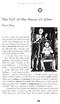 E d g a r A l l a n P o e p The Fall of the House of Usher Part One It was a dark and soundless day near the end of the year, and clouds were hanging low in the heavens. All day I had been riding on horseback
Masonic Questions and Answers
 Masonic Questions and Answers by Paul M. Bessel iii Masonic Questions and Answers A Cornerstone Book Copyright 2005 by Paul M. Bessel All rights reserved under International and Pan-American Copyright
King Midas & the Golden Touch
 TM Celebration Press Reading DRA2 Level 30 Guided Reading Level N Genre: Fiction Traditional Tale Reading Skill: Analyze Theme King Midas & the Golden Touch Retold by Alan Trussell-Cullen Illustrated by
Lyrics on following pages
 Unit 23 Elementary Worship Songs: May 14-15 Better Than the Best Thank You I will Follow May 21-22 Jump Shout Faithful May 28-29 Jesus Freak Shout I will Follow June 4-5 Jesus Freak Jump Better Than the
THEME: God tells us how we can be leaders in His church.
 Devotion NT338 CHILDREN S DEVOTIONS FOR THE WEEK OF: LESSON TITLE: So You Want to Be a Leader? THEME: God tells us how we can be leaders in His church. SCRIPTURE: 1 Timothy 3:1-16 Dear Parents Welcome