
Opportunities and Challenges for Developing Small Ruminant Systems
|
|
|
- Lorin Quinn
- 9 years ago
- Views:
Transcription
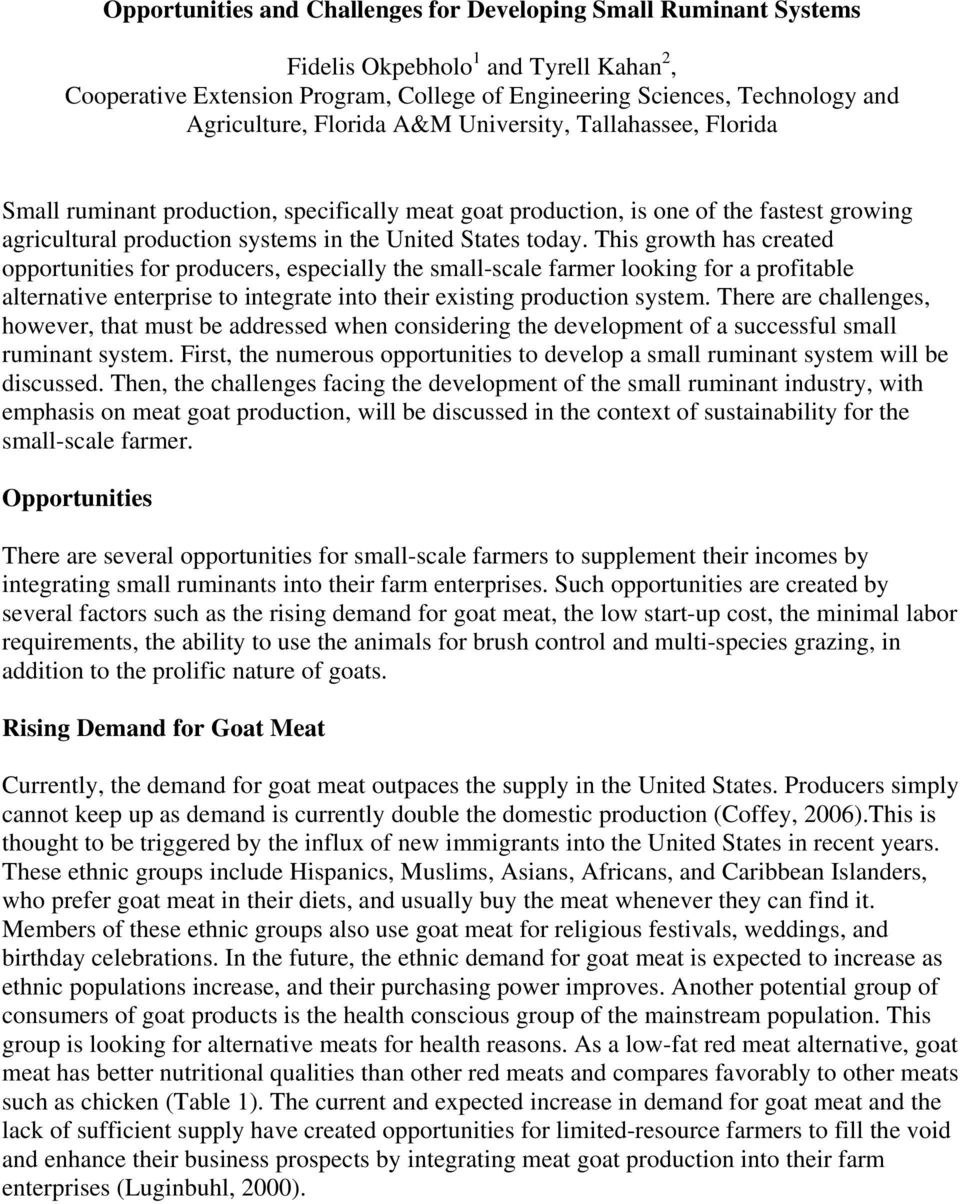
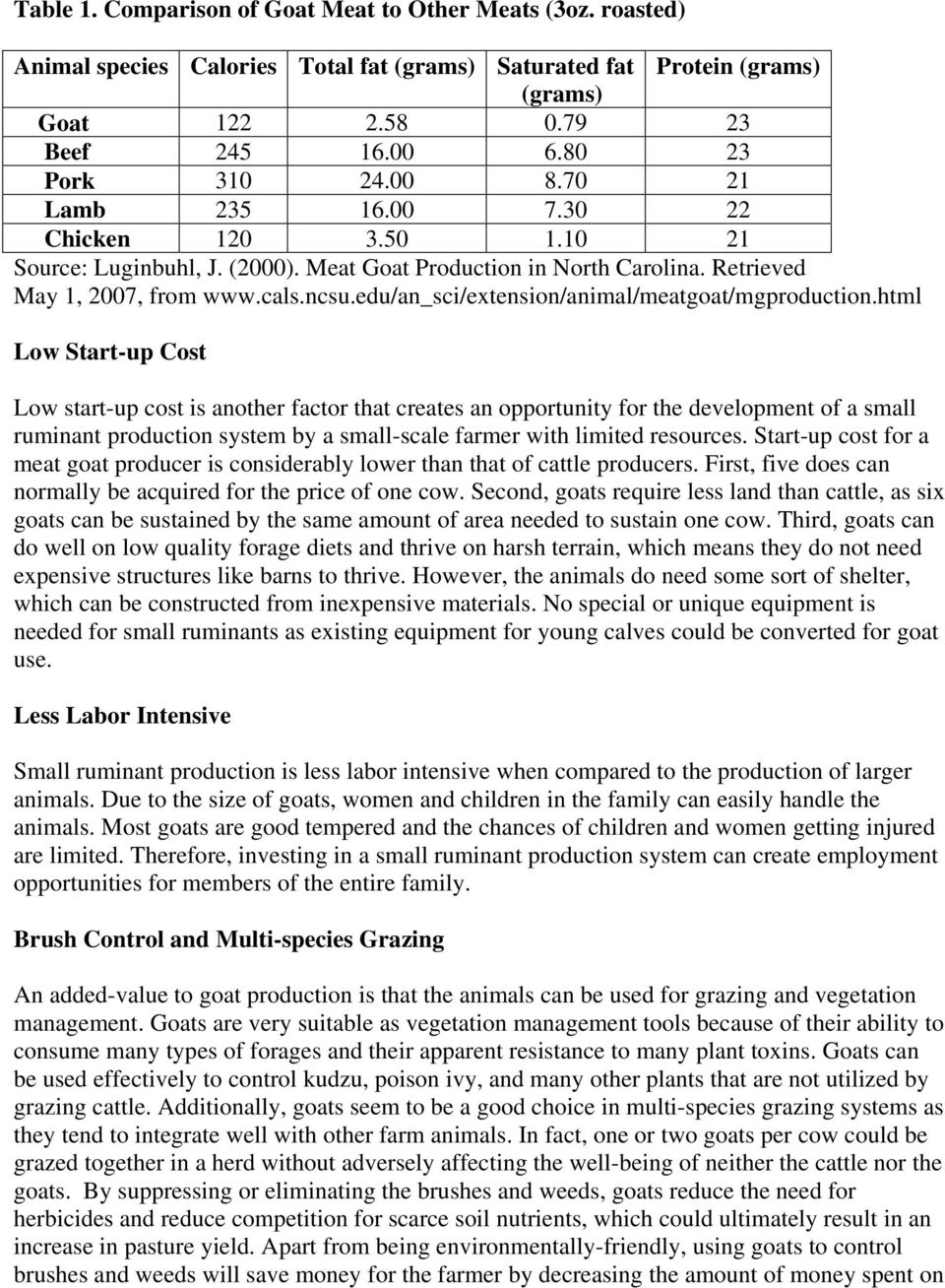
1 Opportunities and Challenges for Developing Small Ruminant Systems Fidelis Okpebholo 1 and Tyrell Kahan 2, Cooperative Extension Program, College of Engineering Sciences, Technology and Agriculture, Florida A&M University, Tallahassee, Florida Small ruminant production, specifically meat goat production, is one of the fastest growing agricultural production systems in the United States today. This growth has created opportunities for producers, especially the small-scale farmer looking for a profitable alternative enterprise to integrate into their existing production system. There are challenges, however, that must be addressed when considering the development of a successful small ruminant system. First, the numerous opportunities to develop a small ruminant system will be discussed. Then, the challenges facing the development of the small ruminant industry, with emphasis on meat goat production, will be discussed in the context of sustainability for the small-scale farmer. Opportunities There are several opportunities for small-scale farmers to supplement their incomes by integrating small ruminants into their farm enterprises. Such opportunities are created by several factors such as the rising demand for goat meat, the low start-up cost, the minimal labor requirements, the ability to use the animals for brush control and multi-species grazing, in addition to the prolific nature of goats. Rising Demand for Goat Meat Currently, the demand for goat meat outpaces the supply in the United States. Producers simply cannot keep up as demand is currently double the domestic production (Coffey, 2006).This is thought to be triggered by the influx of new immigrants into the United States in recent years. These ethnic groups include Hispanics, Muslims, Asians, Africans, and Caribbean Islanders, who prefer goat meat in their diets, and usually buy the meat whenever they can find it. Members of these ethnic groups also use goat meat for religious festivals, weddings, and birthday celebrations. In the future, the ethnic demand for goat meat is expected to increase as ethnic populations increase, and their purchasing power improves. Another potential group of consumers of goat products is the health conscious group of the mainstream population. This group is looking for alternative meats for health reasons. As a low-fat red meat alternative, goat meat has better nutritional qualities than other red meats and compares favorably to other meats such as chicken (Table 1). The current and expected increase in demand for goat meat and the lack of sufficient supply have created opportunities for limited-resource farmers to fill the void and enhance their business prospects by integrating meat goat production into their farm enterprises (Luginbuhl, 2000).
2 Table 1. Comparison of Goat Meat to Other Meats (3oz. roasted) Animal species Calories Total fat (grams) Saturated fat Protein (grams) (grams) Goat Beef Pork Lamb Chicken Source: Luginbuhl, J. (2000). Meat Goat Production in North Carolina. Retrieved May 1, 2007, from Low Start-up Cost Low start-up cost is another factor that creates an opportunity for the development of a small ruminant production system by a small-scale farmer with limited resources. Start-up cost for a meat goat producer is considerably lower than that of cattle producers. First, five does can normally be acquired for the price of one cow. Second, goats require less land than cattle, as six goats can be sustained by the same amount of area needed to sustain one cow. Third, goats can do well on low quality forage diets and thrive on harsh terrain, which means they do not need expensive structures like barns to thrive. However, the animals do need some sort of shelter, which can be constructed from inexpensive materials. No special or unique equipment is needed for small ruminants as existing equipment for young calves could be converted for goat use. Less Labor Intensive Small ruminant production is less labor intensive when compared to the production of larger animals. Due to the size of goats, women and children in the family can easily handle the animals. Most goats are good tempered and the chances of children and women getting injured are limited. Therefore, investing in a small ruminant production system can create employment opportunities for members of the entire family. Brush Control and Multi-species Grazing An added-value to goat production is that the animals can be used for grazing and vegetation management. Goats are very suitable as vegetation management tools because of their ability to consume many types of forages and their apparent resistance to many plant toxins. Goats can be used effectively to control kudzu, poison ivy, and many other plants that are not utilized by grazing cattle. Additionally, goats seem to be a good choice in multi-species grazing systems as they tend to integrate well with other farm animals. In fact, one or two goats per cow could be grazed together in a herd without adversely affecting the well-being of neither the cattle nor the goats. By suppressing or eliminating the brushes and weeds, goats reduce the need for herbicides and reduce competition for scarce soil nutrients, which could ultimately result in an increase in pasture yield. Apart from being environmentally-friendly, using goats to control brushes and weeds will save money for the farmer by decreasing the amount of money spent on
3 purchasing herbicides and other weed control devices. Prolific Nature of Goats Although goats are seasonal breeders, a doe (mature female goat) can be bred and successfully give birth (or kid) three times every two years. Moreover, goats have more reproductive cycles than cattle within the same period of time. In a period of two years, it is possible for a doe to give birth to six kids because of its high twinning rate, whereas a cow is most likely to produce two calves for the same period. This quick turn over rate is an advantage to the producer in terms of cash flow and the building up of his or her herd size. Challenges Although there are many opportunities for limited-resource farmers who decide to enter into the small ruminant industry, the challenges that influence their success are real and must be addressed. The main challenges that have created the largest obstacles to the development of a viable small ruminant industry in the United States are lack of an effective means to control internal parasites, lack of effective marketing strategies for products derived from goat meat, inadequate expertise information, and limited access for limited-resource farmers to financial support. The Control of Internal Parasites The control of infestations of small ruminants by internal parasites (especially nematodes) is the most serious problem that challenges the small ruminant industry today. Infestations of these parasites can cause major economic losses to producers because of the cost of treatment, production loss, and death of heavily infested animals. Proper and effective management of internal parasites is extremely important for the survivability of the small ruminant industry. The ability to detect the clinical signs of a major worm infestation, to properly treat the infected animals, and to effectively reduce the herd s exposure to these parasites are all very important for effective internal parasite management. Worms that infect small ruminants have developed resistance against most of the available and widely used anthelmintics (dewormers). This is mainly attributed to the fact that many of these drugs are not approved for use in goats, are frequently used, and the animals are commonly under-dosed. Since there are few anthelmintics approved for use in goats, the dosage used for goats are normally extra-label or the producer uses the same dosage rates that are recommended for cattle or sheep. Goats are known to metabolize anthelmintics faster than cattle and sheep, which points to the fact that they require a higher dosage. Even though there is a need for drugs that have approved dosage rates for goats, it is unlikely there will be any new types or classes of anthelmintics for goats in the near future because the limited markets for these drugs do not validate the high discovery and developmental cost needed to create the drugs. Although preventive measures such as low stocking rate, pasture rotation, and proper nutrition could reduce the level and the effects of infestation by these parasites, prevention strategies that effectively reduce the need for anthelmintics and decrease parasitic infestations are needed. Effective prevention of parasitic infestations would bring a huge boost to the
4 development of the small ruminant industry. Marketing Goat Meat Despite the increasing demand, marketing goat meat is still a major challenge to the development of the meat goat industry. The current market situation is erratic and not organized. There are no established standards for marketing goat meat. Also, there are not enough government-approved processing plants for goats, and these plants are mostly located in large cities and are far from farmsteads. Consequently, the producer s ability to market his products is limited because of the difficulty and expense required to transport the animals to these slaughter facilities. Additionally, the link between the farmers and the ethnic consumers needs to be strengthened because these ethnic groups prefer fresh meat slaughtered on the farm, and buying directly from the producers increases the producers profit margin as compared to marketing through stock yard auctions. Other serious marketing challenges facing the goat production industry are how to convince the mainstream sector of the population to consume goat meat, and how to establish a viable marketing outlet for this group. Large and established grocery companies are skeptical about the inclusion of goat meat in their stock because of the uncertainty of reliable and constant supplies, the uniformity of cuts, and the lack of a wide range of products from goat meat that will appeal to these emerging, mainstream groups. Predictable and consistent products like precooked and pre-packaged products from goat meat should enhance the consumption by the mainstream. Also, a boost in the consumption of goat meat may come when the mainstream population becomes better informed about the health benefits they can receive from the consumption of goat meat. These are vital issues in the development and long-term sustainability of the meat goat industry. Limited Expertise and Information Available expertise and information for meat goat production are very limited when compared to what are available for the production of traditional meat animals such as cattle and swine. For example, there are no accurate statistics on the number of goats produced or sold, appropriate feeding regimes for goats are not yet determined, and standard goat herd health programs are not very developed. However, researchers are working in these areas and hope to develop a standard of production and a marketing strategy for goat meat in the near future. Limited Access to Financial Support Meat goat production is a relatively new industry in the United States. Lenders are skeptical of this enterprise because there is little or no available information for them to determine its profitability. This makes it difficult for owners of small farms to secure loans for meat goat enterprises.
5 Conclusion With the existing market from ethnic groups and the potential market from the mainstream consumers, the demand for goat meat will continue to increase. The rising demand, coupled with other factors such as low start-up cost, minimal labor requirements, ability to use goats for brush control and multi-species grazing, and the prolific nature of goats has made meat goat production systems a viable alternative and profitable enterprise to revive or upgrade smallscale farms. Although there is a wealth of opportunities, there are also challenges plaguing the industry. While the most serious of these challenges is the control of internal parasite, other challenges such as marketing goat-derived products, limited expertise and information, and limited financial support all pose problems for the development of this small ruminant industry. These challenges must be addressed in order for the meat goat industry to arrive to the potential level that it can attain. For more information, please contact the FAMU Cooperative Extension Program by phone at (850) Also, visit the Herd Health Program website at and the Statewide Goat Program website at References Coffey, L (2006). Meat Goats: Sustainable Production. ATTRA. Retrieved February 5, 2007, from Geary, T. G., N. C. Sangster, et al. (1999). Frontiers in anthelmintic pharmacology. Veterinary Parasitology 84(3-4): Luginbuhl, J. (2000). Meat Goat Production in North Carolina. Retrieved May 1, 2007, from Footnotes 1 Fidelis Okpebholo, Extension and Farm Management Specialist, Florida A&M University 2 Tyrell Kahan, Animal Care Specialist, Florida A&M University All correspondence should be addressed to: Dr. Ray Mobley, Extension Veterinarian Cooperative Extension Program College of Engineering Sciences, Technology and Agriculture 215 Perry-Paige Building South Florida A&M University Tallahassee, Florida Telephone: Fax: [email protected]. Published in the July 2007 official newsletter of the Florida Meat Goat Association, the Caprine Chronicle, Volume 22, Issue 4.
The A to Z of Meat Goat Production
 The A to Z of Meat Goat Production Russell Ramsey, Regional Agriculture Business Management Specialist, University of Missouri Extension SARE National Conference-August 15-17, 17, 2006 Oconomowoc, Wisconsin
Goat Program at Langston University Web site www2.luresext.edu Research Nutrient Requirements Vegetative Mgt Internal Parasites Quarterly newsletter F
 Build a Comprehensive Management Plan Steve Hart Langston University Goat Program at Langston University Web site www2.luresext.edu Research Nutrient Requirements Vegetative Mgt Internal Parasites Quarterly
Livestock Budget Estimates for Kentucky - 2000
 Livestock Budget Estimates for Kentucky - 2000 Agricultural Economics Extension No. 2000-17 October 2000 By: RICHARD L. TRIMBLE, STEVE ISAACS, LAURA POWERS, AND A. LEE MEYER University of Kentucky Department
Meat Goats An Overview of Marketing, Demand and a Few Basics
 Meat Goats An Overview of Marketing, Demand and a Few Basics Sharon Fox Gamble UF/IFAS Extension Agent, IV Goats and sheep are among the oldest domesticated species. The meat goat industry is one of the
Eastern Kentucky Meat Goat Budget Analysis
 Eastern Kentucky Meat Goat Budget Analysis Agricultural Economics Extension No. 2000-11 May 2000 By: ALIOUNE DIAW AND A. LEE MEYER University of Kentucky Department of Agricultural Economics 400 Charles
WATER HARVESTING AND AQUACULTURE FOR RURAL DEVELOPMENT INTRODUCTION TO AQUACULTURE
 WATER HARVESTING AND AQUACULTURE FOR RURAL DEVELOPMENT INTRODUCTION TO AQUACULTURE 2 INTERNATIONAL CENTER FOR AQUACULTURE AND AQUATIC ENVIRONMENTS AUBURN UNIVERSITY 3 INTRODUCTION More than one-fourth
Management of goats at pasture. Barry W Norton School of Land and Food, University of Queensland, Australia
 Management of goats at pasture Barry W Norton School of Land and Food, University of Queensland, Australia Introduction In Australian and most Asian production systems, goats are held continuously at pasture
Lesson Title: Beef Cattle-Animal Care is Everywhere Grade Level: K-4 Time: 1 hour Content Area: Science, Language Arts Objectives:
 Lesson Title: Beef Cattle-Animal Care is Everywhere Grade Level: K-4 Time: 1 hour Content Area: Science, Language Arts Objectives: Identify the needs of beef animals Compare the needs of beef animals to
How To Make Money From Farming
 Limited Versus Intensive Management of Sheep & Goats Jodie Pennington and Helen Swartz Lincoln University, Neosho and Jefferson City, MO Husbandry defined--- varies with management level The cultivation
Meat Goat Production & Marketing. Martha Mobley N.C. Cooperative Extension Franklin County Center
 Meat Goat Production & Marketing Martha Mobley N.C. Cooperative Extension Franklin County Center Why important? Strong Demand for goat meat Interest in ecologically sound forms of vegetative control Increased
GETTING STARTED IN THE MEAT GOAT BUSINESS
 GETTING STARTED IN THE MEAT GOAT BUSINESS Bulletin I, Vol. II An Enterprise Budget For Meat Goat Producer s: Its Characteristics and Importance By Gilbert Queeley and Angela McKenzie-Jakes Extension Animal
Nepalese organic baby clothing
 Running head: EXPORTING ORGANIC CLOTHES FOR BABIES Nepalese organic baby clothing Gabriela Gomes de Lima AGR*2150 Plant Agriculture for International Development University of Guelph November, 2014 - Fall
the Business environment of Beef
 the Business environment of Beef understanding the Business environment of Beef The farmers and ranchers who raise cattle for beef face many of the same, if not more, unpredictable and forceful influences
Why Do Sheep and Goat Fecal Egg Counts
 Why Do Sheep and Goat Fecal Egg Counts Quantitative fecal egg counting is a procedure that determines the number of eggs per gram (EPG) of strongylid eggs, including barber pole worm (Haemonchus contortus),
Overview of the Cattle Immune System 1
 Oregon State University BEEF043 Beef Cattle Library Beef Cattle Sciences Overview of the Cattle Immune System 1 Reinaldo F. Cooke 2 Introduction On average, the U.S. cattle industry loses more than $1
DETERMINING YOUR STOCKING RATE
 DETERMINING YOUR STOCKING RATE Mindy Pratt and G. Allen Rasmussen Range Management Fact Sheet May 2001 NR/RM/04 To determine how many animals your land will support (stocking rate), you need to know two
reduce the probability of devastating disease outbreaks reduce the severity of disease agents present in a herd improve the value of products sold.
 Vaccination Programs: Beef Cow Calf Operations Timothy Jordan, D.V.M Beef Production Medicine Program North Carolina State University College of Veterinary Medicine Goals A comprehensive herd health and
Business Planning and Economics of Sheep Farm Establishment and Cost of Production in Nova Scotia
 Business Planning and Economics of Sheep Farm Establishment and Cost of Production in Nova Scotia Prepared by: Christina Jones, Economist, Nova Scotia Department of Agriculture Although care has been taken
FAMACHA Parasite Monitoring System
 FAMACHA Parasite Monitoring System Brenda Postels U of MN Extension Educator Wright County Abcidy Acres-- --Sheep and Goat Producer Haemonchus contortus (Barber Pole Worm) Sheep, goats, deer, exotic ruminants.
GROSS MARGINS : HILL SHEEP 2004/2005
 GROSS MARGINS GROSS MARGINS : HILL SHEEP 2004/2005 All flocks Top third Number of flocks in sample 242 81 Average size of flock (ewes and ewe lambs) 849 684 Lambs reared per ewe 1.10 1.25 ENTERPRISE OUTPUT
BREEDING SOUNDNESS EVALUATION OF BULLS
 Proceedings, Applied Reproductive Strategies in Beef Cattle November 12 and 13, 2005, Texas A&M University, College Station BREEDING SOUNDNESS EVALUATION OF BULLS Derry Magee Clinical Associate Professor
Fayette County Appraisal District
 Fayette County Appraisal District Agricultural Guidelines July 7, 2010 A SUPPLEMENT TO THE STATE OF TEXAS PROPERTY TAX MANUAL FOR THE APPRAISAL OF AGRICULTUAL LAND AND WILDLIFE MANAGEMENT ACTIVITIES AND
Can You Make Money With Sheep? David L. Thomas Department of Animal Sciences University of Wisconsin-Madison [email protected]
 Can You Make Money With Sheep? David L. Thomas Department of Animal Sciences University of Wisconsin-Madison [email protected] Before entering into sheep production, you should be aware of the capital
R E S T R I C T E D B R E E D I N G A N D R O T A T I O N A L G R A Z I N G
 R E S T R I C T E D B R E E D I N G A N D R O T A T I O N A L G R A Z I N G J O R G E L U I S S A N C H E Z B R I C E Ñ O H E R M O S I L L O S O N O R A M E X I C O The problem that is always faced in
The Strategic Marketing Institute Working Paper
 The Strategic Marketing Institute Working Paper Market Opportunities for Meat Goats William A. Knudson 2-0106 January 2006 PRODUCT CENTER For Agriculture and Natural Resources Room 80 Agriculture Hall,
Farm Business Development Programs in Vermont
 Business planning and technical skills development for Vermont s farmers Below is an outline of programs and services available throughout Vermont to assist farmers in developing technical and business
ADVICE FOR OWNERS OF PET PIGS AND MICRO PIGS
 ADVICE FOR OWNERS OF PET PIGS AND MICRO PIGS General guidance for keeping your pig ADVICE AND GUIDANCE Keeping pigs or micro pigs animals specially bred to be smaller in adulthood than most other pig species
2013-2014 Goat and Sheep Situation & Outlook
 2013-2014 Goat and Sheep Situation & Outlook 2013 Southern Region Agricultural Outlook Conference Max Runge, Ag Economist Alabama Cooperative Extension System Auburn University Source: Dr. Greg Ibendahl,
Economic and environmental analysis of the introduction of legumes in livestock farming systems
 Aspects of Applied Biology 79, 2006 What will organic farming deliver? COR 2006 Economic and environmental analysis of the introduction of legumes in livestock farming systems By C REVEREDO GIHA, C F E
Beef Cow Share Lease Agreements
 Institute of Agriculture and Natural Resources EC841 Beef Cow Share Lease Agreements Aaron L. Berger, Extension Educator Introduction Cow-calf enterprises require large investments in capital, labor, and
Academic Offerings. Agriculture
 Academic Offerings This section contains descriptions of programs, majors, minors, areas of concentration, fields of specialization, and courses. Semesters following course titles indicate when each course
The Pillars of Agricultural Literacy
 The Pillars of Agricultural Literacy Overview The following standards offer a framework for agricultural literacy throughout life. Foundational Knowledge is addressed first. This section provides a guide
BREAK-EVEN COSTS FOR COW/CALF PRODUCERS
 L-5220 9/98 BREAK-EVEN COSTS FOR COW/CALF PRODUCERS L.R. Sprott* CALCULATING BREAK-EVEN COSTS of production can help cow/calf producers make better management decisions for the current year or for the
1. Basic Certificate in Animal Health and Production (CAHP)
 1. Basic Certificate in Animal Health and Production (CAHP) NTA Level 4: Modules covered S/N Code Module Name 1. GST 04101 Introduction to Computer 2 GST 04202 Introduction to Sociology and. Communication
Arizona Ranchers Management Guide
 Arizona Ranchers Management Guide Edited by Russell Tronstad Department of Agricultural and Resource Economics Jim Sprinkle Area Extension Agent, Animal Science George Ruyle School of Renewable Natural
Total Income from Farming in the United Kingdom. First estimate for 2015
 28 April 2016 Total Income from Farming in the United Kingdom First estimate for 2015 This release presents the first estimate of Total Income from Farming for the United Kingdom for 2015. Total Income
G. Cliff Lamb. North Florida Research and Education Center, Marianna, Florida University of Florida. Introduction
 COST ANALYSIS OF IMPLEMENTING A SYNCHRONIZATION OR AI PROGRAM-USING DECISION-AID TOOLS G. Cliff Lamb North Florida Research and Education Center, Marianna, Florida University of Florida Introduction Estrous
Faculteit Diergeneeskunde. Prof. dr. G. Opsomer Faculty of Veterinary Medicine Ghent University.
 Faculteit Diergeneeskunde Integrated veterinary herd health management as the basis for sustainable animal production (dairy herd health as an example) Prof. dr. G. Opsomer Faculty of Veterinary Medicine
Sheep Nutrition. Sheep Nutrition. Nutrient Needs. Sheep Nutrition Water. Products Produced. Use of Pasture\Range and Forages.
 Products Produced Muscle (Meat) Milk Fiber (wool, mohair, cashmere) Use of Pasture\Range and Forages Able to produce acceptable product on forage Nutrient Needs Water Energy (TDN, ME, or NE) Protein (CP
REPRODUCTION AND BREEDING Crossbreeding Systems for Beef Cattle
 Beef Cattle REPRODUCTION AND BREEDING Crossbreeding Systems for Beef Cattle Pete Anderson University of Minnesota Beef Team It has been well documented that crossbreeding improves performance of beef cattle.
Dietary Sources of Iron in Uganda
 Dietary Sources of Iron in Uganda Data from the 2009/2010 Uganda National Panel Survey Jack Fiedler, Leanne Dougherty, Celeste Sununtnasuk Uganda National Panel Survey 2009/10 UNPS A national survey representative
What is the Cattle Data Base
 Farming and milk production in Denmark By Henrik Nygaard, Advisory Manager, [email protected] Danish Cattle Federation, Danish Agricultural Advisory Centre, The national Centre, Udkaersvej 15, DK-8200
PASTURE AND GRAZING MANAGEMENT FOR PARASITE CONTROL
 PASTURE AND GRAZING MANAGEMENT FOR PARASITE CONTROL Uma Karki, Ph.D. Assistant Professor and Livestock Specialist Tuskegee University Cooperative Ext. Program and Dept. of Agric. Environ. Sci. How Goats
Sheep Farming. 1. Introduction. 2. Scope for Sheep Farming and its National Importance
 Sheep Farming 1. Introduction Sheep with its multi-facet utility for wool, meat, milk, skins and manure, form an important component of rural economy particularly in the arid, semi-arid and mountainous
Resources for Wisconsin Farmers
 Resources for Wisconsin Farmers The following web-based resource links can get you started in identifying sources of information for your farm. This is a short list focused on Wisconsin sustainable agriculture.
Selenium and Selenium Yeast Use in Feed. Division of Regulatory Services University of Kentucky April 25, 2005
 Selenium and Selenium Yeast Use in Feed Division of Regulatory Services University of Kentucky April 25, 2005 REVISED JULY 19, 2007 Meagan Davis, Feed Registration Specialist Selenium, long known for its
The Costs of Raising Replacement Heifers and the Value of a Purchased Versus Raised Replacement
 Managing for Today s Cattle Market and Beyond March 2002 The Costs of Raising Replacement Heifers and the Value of a Purchased Versus Raised Replacement By Dillon M. Feuz, University of Nebraska Numerous
What is Nitrite Toxicity? Georgia Cattleman, June 2002 John Andrae, Forage Extension Specialist
 What is Nitrite Toxicity? Georgia Cattleman, June 2002 John Andrae, Forage Extension Specialist Many beef producers are familiar with high nitrates in forages and their toxic effects in cattle. Probably
Research to improve the use and conservation of agricultural biodiversity for smallholder farmers
 Research to improve the use and conservation of agricultural biodiversity for smallholder farmers Agricultural biodiversity the variability of crops and their wild relatives, trees, animals, arthropods,
UGIP Technical Committee Key Principles of Grazing Management
 UGIP Technical Committee Key Principles of Grazing Management Why Grazing Management? Sustain land health and productivity Demonstrate good land stewardship Ensure a future for livestock grazing Monitoring
Science of Life Explorations
 Science of Life Explorations Celebrate the Growing Year: The Farmer s Year A Farmer s Year While you are in school or on a vacation, farmers are working hard to provide us with the foods we eat and the
Section 6: Cow-Calf Cash Flow Enterprise Budget Analysis 101
 Section 6: Cow-Calf Cash Flow Enterprise Budget Analysis 101 Lets get started with some basics the Cow Calf Profit Equation The Cow Calf Profit Equation There is no single goal that will satisfy every
INTRODUCTION. The 3-year upper primary syllabus development was guided by the RNPE, 1994, which called for the review of the Primary curriculum.
 INTRODUCTION The 3-year upper primary syllabus development was guided by the RNPE, 1994, which called for the review of the Primary curriculum. It followed the introduction of lower primary Environmental
Reducing methane emissions through improved lamb production
 Reducing methane emissions through improved lamb production www.hccmpw.org.uk Hybu Cig Cymru / Meat Promotion Wales Tŷ Rheidol, Parc Merlin, Aberystwyth SY23 3FF Tel: 01970 625050 Fax: 01970 615148 Email:
The Treasury. Yn Tashtey. Assessor I Q Kelly PRACTICE NOTE. PN 26/89 Date:11 September 1989
 The Treasury Yn Tashtey INCOME TAX DIVISION Government Office, Douglas Isle of Man, British Isles IM1 3TX Assessor I Q Kelly Telephone: (01624) 685400 Fax: (01624) 685351 E-mail: [email protected] Website:
Arctic Goat Husbandry - Market potential for goat products
 Arctic Goat Husbandry - Market potential for goat products Is the potential for goat husbandry in circumpolar arias utilized? Can an arctic profile be a competitive advantage for goat products? Is there
DRYSTOCK BIOSECURITY GUIDELINES SEVEN INTERVENTION POINTS FOR ON-FARM BIOSECURITY
 JUNE 2013 DRYSTOCK BIOSECURITY GUIDELINES SEVEN INTERVENTION POINTS FOR ON-FARM BIOSECURITY PREPARED BY BEEF + LAMB NEW ZEALAND AND DEER INDUSTRY NEW ZEALAND DRYSTOCK BIOSECURITY GUIDELINES SEVEN INTERVENTION
Beginning Farm Business Plan. Example. Prepared June 2008
 Beginning Farm Business Plan Example Prepared June 2008 This is a sample farm business plan, provided by NYFarmNet / NYFarmLink. It is based on a real farm plan written by a real farm family in Upstate
Hayin Beef Acres. Business Plan
 Hayin Beef Acres Business Plan University of Maryland Extension *Disclaimer: The information contained in this case study is to be used only as a case study example for teaching purposes. The information
Projections of Global Meat Production Through 2050
 Projections of Global Meat Production Through 2050 Dr. Thomas E. Elam Center for Global Food Issues President, FarmEcon Summary: Meat production growth is driven by a combination of increases in economic
ZONING INFORMATION LIVESTOCK AND PASTURE MAINTENANCE STANDARDS
 City of Lewiston, Idaho Community Development Department Page 1 Section 37-195. Purpose. ZONING INFORMATION LIVESTOCK AND PASTURE MAINTENANCE STANDARDS The purpose of this article is to provide standards
Tech Prep Articulation
 Tech Prep Articulation Agriculture & Natural Resources Tech Prep Education: Tech Prep education in Missouri is an articulated two-year secondary and two or more year post-secondary education program which:
A comparison of greenhouse gas emissions from the New Zealand dairy sector calculated using either a national or a regional approach.
 A comparison of greenhouse gas emissions from the New Zealand dairy sector calculated using either a national or a regional approach December 2008 A comparison of greenhouse gas emissions from the New
How To Write A Business Plan
 Business Planning for Livestock Producers James McWhorter UF/IFAS Highlands County Livestock Agent Introduction Why create a business plan Components of a business plan Financial statements Five C s of
A diversified approach to fighting food insecurity and rural poverty in Malawi
 case study A diversified approach to fighting food insecurity and rural poverty in Malawi Map of Malawi Malawi: Facts and Figures Ø Population: 13.1 million Ø Human development index ranking: 164 out of
SAMPLE COSTS FOR FINISHING BEEF CATTLE ON GRASS
 UNIVERSITY OF CALIFORNIA COOPERATIVE EXTENSION 12 SAMPLE COSTS FOR FINISHING BEEF CATTLE ON GRASS SACRAMENTO VALLEY (Northern Sacramento Valley) Larry C. Forero Roger S. Ingram Glenn A. Nader Karen M.
DAIRY FARMING IN SOUTH AFRICA WHERE TO NOW? William Gertenbach Institute for Animal Production Western Cape Departement of Agriculture
 DAIRY FARMING IN SOUTH AFRICA WHERE TO NOW? William Gertenbach Institute for Animal Production Western Cape Departement of Agriculture INTRODUCTION The dominant variable in livestock farming is the supply
Chapter 12 The South Section Notes Video Maps History Close-up Images Quick Facts
 Chapter 12 The South Section Notes Growth of the Cotton Industry Free Southern Society The Slave System History Close-up Southern Plantation Quick Facts Chapter 12 Visual Summary Video Regional Economies
Creep Feeding Beef Calves Dan E. Eversole, Extension Animal Scientist, Virginia Tech
 publication 400-003 Creep Feeding Beef Calves Dan E. Eversole, Extension Animal Scientist, Virginia Tech OVERVIEW Creep feeding is the managerial practice of supplying supplemental feed (usually concentrates)
Records and record keeping on sheep and goat farms
 MoARD TECHNICAL BULLETIN No.30 Records and record keeping on sheep and goat farms Further information: Ethiopia Sheep and Goat Productivity Improvement Program (ESGPIP) Tel. +251 011 416 6962/3 Fax: +251
benefits of consuming organic as opposed to conventional foods.
 Smith 0 Rhetorical Context Subject: Organic food v.s Conventional food Audience: People who are misinformed, unaware, or are apathetic to the differences between the benefits of consuming organic as opposed
Animal Health Management on Organic Farms
 Animal Health Management on Organic Farms September 2011 Pat Barry Teagasc Organic Specialist Advisor Moorepark Advisory Office Fermoy Co Cork. [email protected] Animal Health Management on Organic
Supplementary information on the Irish Dairy sector in support of
 Research and Information Service Paper 30/15 26 th January 2015 NIAR 21-15 Mark Allen Supplementary information on the Irish Dairy sector in support of 1 Background 29/15 NIAR 912-14 This briefing note
Cattle. MRDP and Heifer
 Cattle MRDP and Heifer 1. Redwater 2. Blackquarter 3. Lumpy skin 4. Heartwater 5. Gallsickness and Sweating sickness 6. Warts 7. Snotsiekte and Sleeping Sickness 8. Worms and Fluke 9. External parasites
Animal Health key for Future Food
 Animal Health key for Future Food Dr René M.L. Aerts Agenda Impact disease on food production Animal Health, zoonotics and antibiotics How to meet increased food demand 2004-2014 Schothorst Feed Research.
History of the Animal Science Industry
 History of the Animal Science Industry Early Domestication Humans began domesticating animals more than 10,000 years ago beginning with dogs. Ruminants (cattle, sheep and goats) were the first food animals
Natural Breeding vs. Artificial Insemination: A Cost Comparison Analysis. By Patrick Jacobsen
 Natural Breeding vs. Artificial Insemination: A Cost Comparison Analysis By Patrick Jacobsen Table of Contents Introduction Problem Study Assumptions Natural Breeding Costs Artificial Insemination Costs
Increasing Profitability Through an Accelerated Heifer Replacement Program
 Increasing Profitability Through an Accelerated Heifer Replacement Program Robert B. Corbett, D.V.M Dairy Health Consultation Accelerating heifer growth has been a very controversial subject in recent
Beef Cattle Frame Scores
 Beef Cattle Frame Scores AS-1091, May 1995 John Dhuyvetter, Area Livestock Specialist Frame scores are an objective, numerical description of cattle skeletal size which reflect the growth pattern and potential
BASELINE SURVEY: PRA TOOLS
 DEVELOPMENT AND APPLICATION OF DECISION SUPPORT TOOLS TO CONSERVE AND SUSTAINABLY USE GENETIC DIVERSITY IN INDIGENOUS LIVESTOCK & WILD RELATIVES BASELINE SURVEY: PRA TOOLS Collaborating Institutions; FAnGR
Managing cattle for the kind of beef you want your kids to eat.
 Managing cattle for the kind of beef you want your kids to eat. A cooperative program by Texas and Southwestern Cattle Raisers Association, Texas Beef Council and the Texas AgriLife Extension Service Table
Ecology - scientific study of how individuals interact with their environment 34.1
 Biology 1407 Exam 4 Notes - Ecology Ch.35-36 Ecology - scientific study of how individuals interact with their environment 34.1 - organisms have adapted to - evolved in - a particular set of conditions;
Livestock Rental Lease
 Livestock Rental Lease NCFMEC-06A For additonal information see NCFMEC 06 (Beef Cow Rental Arrangements For Your Farm). This form can provide the landowner and operator with a guide for developing an agreement
This Little Piggy Math in the Pig Barn
 Area This Little Piggy Math in the Pig Barn Math Background Math is very important in agriculture when determining weights of animals. It is neded for marketing; administration of vacines, determining
Feeding Corn to Beef Cows
 ExEx 2048 September 2005 Animal & Range Sciences COLLEGE OF AGRICULTURE & BIOLOGICAL SCIENCES / SOUTH DAKOTA STATE UNIVERSITY / USDA Feeding Corn to Beef Cows Cody Wright, Extension beef specialist In
Collection Policy: ANIMAL SCIENCE
 Collection Policy: ANIMAL SCIENCE Subject Scope Priority Tables Other policies... 1.0 TEACHING, RESEARCH AND EXTENSION PROGRAMS 1.1 Mission and emphases of the department The major focus of the department
LELY VOYAGER. Automatic grazing system. Frontal grazing: the innovative way. innovators in agriculture. www.lely.com
 LELY VOYAGER Automatic grazing system Frontal grazing: the innovative way Reduces forage waste Increases cows harvesting efficiency Avoids variations in milk production and milk composition Labour saving
The Economics of Ranching
 Montana Cowboy College Kent Hanawalt Fiddle Creek Road Livingston, MT 59047 Home:406-686-4426 Work 406-683-9111 [email protected] The Economics of Ranching Ranching is easy right? All you
Beef Cattle Breeds and Biological Types Scott P. Greiner, Extension Animal Scientist, Virginia Tech
 publication 400-803 Beef Cattle Breeds and Biological Types Scott P. Greiner, Extension Animal Scientist, Virginia Tech Worldwide there are more than 250 breeds of beef cattle. Over 60 of these breeds
Overview of Artificial Insemination of Kentucky Meat and Dairy Goats Terry Hutchens, Extension Associate University of Kentucky (G10307)
 Overview of Artificial Insemination of Kentucky Meat and Dairy Goats Terry Hutchens, Extension Associate University of Kentucky (G10307) General Prospective Kentucky goat producers can make great strides
Business Plan. Every Business Has Essentially Three Tasks. Production Marketing Financing
 Business Plan Every Business Has Essentially Three Tasks Production Marketing Financing Business Plan Describes How These Function And Convinces Bank to Give You a Loan Components of a Business Plan Description
Value-Added Agriculture in Tennessee: A Summary of 2012 Census Results December 2014 SP 769
 Value-Added Agriculture in Tennessee: A Summary of 2012 Census Results December 2014 SP 769 Authors Rob Holland Director Center for Profitable Agriculture Megan Bruch Leffew Extension Specialist Center
Replacement Policy and Management Michael McHugh Chief Sheep Specialist, Teagasc, Ballyhaise, Co. Cavan
 Replacement Policy and Management Michael McHugh Chief Sheep Specialist, Teagasc, Ballyhaise, Co. Cavan On average 20% of the ewe flock is replaced annually.replacement cost is a substantial cost in sheep
Business Plans for Agricultural Producers
 E-492 RM3-1.0 10-08 Risk Management Business Plans for Agricultural Producers Dean McCorkle and Stan Bevers* A business plan is a road map for a business. It describes the key functions of the business
S.W.O.T. Analysis Identifying Your Strengths, Weaknesses, Opportunities, and Threats
 S.W.O.T. Analysis Identifying Your Strengths, Weaknesses, Opportunities, and Threats A SWOT analysis is a term used to describe a tool that is effective in identifying your Strengths and Weaknesses, and
THIS REPORT CONTAINS ASSESSMENTS OF COMMODITY AND TRADE ISSUES MADE BY USDA STAFF AND NOT NECESSARILY STATEMENTS OF OFFICIAL U.S.
 THIS REPORT CONTAINS ASSESSMENTS OF COMMODITY AND TRADE ISSUES MADE BY USDA STAFF AND NOT NECESSARILY STATEMENTS OF OFFICIAL U.S. GOVERNMENT POLICY Voluntary - Public Date: 1/19/2016 GAIN Report Number: