
Introduction: Coping with the Changes in Early Childhood Education Today
|
|
|
- Joy Fleming
- 9 years ago
- Views:
Transcription
1 Introduction: Coping with the Changes in Early Childhood Education Today As the twenty-first century has begun, early childhood education has undergone some major changes. These changes have wide-ranging effects on what is happening for young children in child care, preschool, and prekindergarten programs. The directors, staff development specialists, coaches, and mentors involved with these programs have been placed in a very difficult position. How do they effectively help their teaching staff to embrace the changes and yet not give up what they know are best practices for young children? These practices include play-based curricular approaches and authentic assessment methods. In this book, we will explore these issues and provide ideas and strategies for early childhood leaders to help them address these changes and to provide staff development and ongoing support to the teachers in their programs. In our work as college instructors and consultants, we feel deeply committed to helping those in the field do what is best for young children. We also recognize that change can be a good thing. We think that as a field, we must grow and learn, and continue to develop in order to be relevant and viable. Yet we must remain true to our core beliefs and incorporate them into the change process. We believe that there are many good things happening in relation to early education today. We also have some serious concerns and hear those concerns voiced by directors, specialists, teachers, and care providers in our work with them. We recognize that the change process can be difficult and takes time. We hope this book will provide ways to embrace the changes going on in early education that are beneficial to children, and to resist and oppose those that are not in their best interests. This book is for those in leadership as staff development specialists and program directors who share our commitment and concerns. Early Learning Standards guts.indd 1

2 2 Introduction The Changes in Early Education Today What s in the mix then? What are the primary changes we see happening in early education? We see the following six changes as having an impact at this time: The general public is seeing the benefits of early education. Early learning standards have been developed by most U.S. states. NAEYC revised its accreditation requirements. A clear definition of curriculum in early education has not been articulated, resulting in inappropriate and inadequate curricula often being recommended and adopted. Calls for accountability have raised a debate about the best assessment approaches for young children. Early educators have been resistant to change, unsure about the direction in which the above changes were taking the field. We will elaborate on each of these changes. Recognition of the Benefits of Early Education First and foremost, the general public, politicians, and policymakers have recognized that there are benefits to early education. Hooray! This is good news. Many governors have started initiatives to support PreK programs or to fund all-day kindergarten. Long-term research studies, such as the Perry Preschool Project (Schweinhart et al. 2005) and the Carolina Abecedarian Project (Campbell et al. 2001), have received publicity in major newspapers and magazines. Their findings of long-term positive results of preschool interventions have helped fuel the political climate that has placed more emphasis on providing services to young children. States Are Developing Learning Standards This new valuing of preschool education has resulted in the development of learning standards for preschoolers in most states across the nation. This development is within a climate of emphasis on standards in kindergarten through twelfth grade as well. How those early learning standards are used and what impact they have on the practices of early educators may vary from state to state. They can become a helpful tool to identify common expectations across early childhood programs. But among early childhood professionals they Early Learning Standards guts.indd 2

3 Coping with the Changes in Early Childhood Education Today 3 have raised many fears and worries that are finding expression in an increasing number of workshops on this topic in conferences across the country. In session after session, discussions focus around how best to respond to the inappropriate uses of early learning standards and how to be more clear about what the field believes is right for young children. At the NAEYC Professional Development Conference in San Antonio in June of 2006 we heard questions such as: Will the recommended practices of planning for play and exploration go by the wayside? Will they be replaced by direct instruction focusing on skills found in the early learning standards? Will the individualization that has been so treasured by early educators be replaced by a one-size-fits-all approach to teaching and learning? Will authentic assessment be replaced by inappropriate testing or on-demand assessments tied to the early learning standards? NAEYC Accreditation Requirements Revised The National Association for the Education of Young Children (NAEYC) has recently revised its requirements for accreditation, including some new language regarding curriculum and assessment. To receive accreditation, programs are expected to have a written statement of philosophy and use one or more written curricula or curriculum frameworks consistent with its philosophy that address central aspects of child development (NAEYC 2006). The expectations around assessment endorse authentic assessment procedures but require that programs be ready to clarify their assessment processes. Many early educators welcome more meat and substance to the accreditation requirements so that an accredited program truly does reflect the best practices endorsed by the field. However, many are questioning just what the recommendations regarding curriculum and assessment mean. Must educators buy a published, curricular package? If they have been using an assessment process designed in-house, will that meet the criteria for accreditation? Again, fears and worries are heard from the field. Lack of a Clear Definition of Curriculum With the early learning standards and the accreditation requirements, many early educators perceive that there is now a push for some sort of standardized curriculum for preschoolers. They wonder if they can justify activity times Early Learning Standards guts.indd 3

4 4 Introduction where children play and investigate with blocks, art materials, dramatic play materials, manipulatives, and sand and water. They fear that the push for meeting standards will require that they engage in more teacher-led group times with a focus on literacy and math skills, and less on providing opportunities for children to develop those skills as well as other concepts and knowledge as they play, participating in self-directed activities with adults as guides and facilitators. Ultimately, we think the crux of the matter is a lack of a clear definition of curriculum that is just right for preschoolers. Early education is now functioning within a climate of external pressures from policymakers and the public. Both are demanding that learning and standards be the focus of preschool programs. Within that climate, then, early educators are struggling to define preschool curriculum. The criticism, All they do is play in that program, still stings. Parents ask whether their child will experience enough academics to be ready for kindergarten and first grade. Policymakers ask for curricular approaches that clearly address the early learning standards developed for the state. Funding agencies expect a formal curriculum to be adopted, assuming that will mean that their money is well spent in supporting a particular program. Early educators who have long supported developmentally appropriate practices (DAP) are at a loss as to how to translate that set of philosophical beliefs into a coherent curricular framework. Publishers are stepping into this vacuum and providing packaged curricula that may address some aspects of the new requirements and expectations. However, some of these packaged curricula are woefully lacking in their adaptability, both to the unique needs of different settings, as well as to the individual needs of each child two traits long recognized as vital to quality care and education. Instead of responding to the challenge by explaining how their teachers are addressing curriculum as they plan for children s play and interactions throughout each day, many early childhood leaders are succumbing to the pressures and purchasing inappropriate curricula just to be able to say to funding agencies and policymakers: This is what we use. Questions about Assessment The increased accountability includes more attention to assessment practices. Again, the changing climate in kindergarten through twelfth grade education has been influential, where testing has become more and more prevalent. This has brought many outside of the field of early education to assume testing will be right for preschoolers as well. The field has responded with position papers and recommendations for authentic assessment methods such as teacher observation, portfolios, and checklists (NAEYC and NAECS/SDE 2004). But as calls for reliability and validity dominate the debate, driving the need Early Learning Standards guts.indd 4

5 Coping with the Changes in Early Childhood Education Today 5 for large-scale data collection and reporting, the recommended practices of observation and portfolios have been received by some as cumbersome and unscientific. Determining methods for gleaning numerical data from teachers anecdotal records or portfolios is difficult and labor-intensive. Authentic assessment procedures are sometimes being thrown out for that reason alone as the pressures to measure children s performance can appear overwhelming to many early educators. Resistance to Change Those of us involved in the field of early education are a special group of people. We often describe our jobs as joyful as we revel in the curiosity and enthusiasm of the children and relish their accomplishments. We feel we are giving much-needed services to families and we enjoy the strong relationships that we build with parents and children. In this new climate of standards and accountability, the changes occurring including the additional paperwork and reporting that are often required may not appear to some teachers to be in the best interest of children and the teachers resist making changes. The results can vary, from low staff morale to teachers moving slowly in implementing new curricular and assessment practices, all the way to teachers deciding to leave the field completely. Resistance to change is normal and healthy, in fact, it can become a part of the change process itself. However, when the changes are breaking the spirits of dedicated early childhood professionals and causing them to lose their passion and compromise their beliefs about what is best for young children, something is terribly wrong. We believe strongly that there are ways to embrace the good points about the changes going on in early education today and to redefine them in such a way as to eliminate the negative elements. As a field, we owe it to ourselves and to the children and families we serve to remain committed to our core beliefs and speak out boldly with a clearly articulated message. We want others to see the value of early education and the specific qualities that make it valuable for children, and to see that playbased curricular approaches can address learning standards and be assessed through authentic measures. The Focus of This Book In this book, we will explore in-depth the issue of early learning standards and how they can be integrated into curriculum and assessment practices that are just right for young children. Suggestions for planning and implementing effective staff development sessions will be shared. Ideas for providing Early Learning Standards guts.indd 5

6 6 Introduction coaching and ongoing support to teachers, as well as dealing with resistance to change, will be offered. We will provide frameworks and tools that will help early educators represent to others the ways in which early education is most beneficial to children. We will address change issues and provide suggestions for dealing with change effectively. And we will provide numerous ideas and strategies for the leaders in the field of early childhood education to help their teaching staffs grow and learn. We hope this book will empower each reader to figure out the best ways to help others adapt to the many changes in early education today and to continue to work on behalf of children each and every day. Chapter 1 will address the misperception that there is no connection between developmentally appropriate practices and early learning standards. Chapter 2 will focus on the change process and offer management techniques and ideas to help early childhood leaders deal with the changes in the field effectively. In chapter 3 we will share our philosophy regarding staff development strategies. Chapters 4 through 7 will focus on twenty-four staff development activities to help teachers integrate early learning standards and best practices in curriculum and authentic assessment. In Chapter 8, we will provide additional coaching and mentoring strategies to help teachers make changes in their practices for both curriculum and assessment. We want early education teachers, directors, and administrators to no longer feel defensive or inadequate in responding to inappropriate expectations from policymakers and funding agencies. Rather, we want early childhood professionals to gather together in a beautiful chorus of voices to tell others what we know and believe are the best ways to provide quality education to young children in the U.S. We believe that staff development specialists, program directors, mentors, and coaches have the important task of conducting this chorus of voices! We hope that this book will provide you with many ideas, tips, and strategies to help as you work in your leadership role with teachers, assisting them in embracing the good things in the changes in early education today and resisting the inappropriate ones. References Campbell, F. A., E. P. Pungello, S. Miller-Johnson, M. Burchinal, and C. T. Ramey The development of cognitive and academic abilities: Growth curves from an early childhood educational experiment. Developmental Psychology 37: Lynch, Robert G Preschool pays. In Annual editions: Early childhood education 06/07. 27th ed., ed. Daren Menke Paciorek. Dubuque, Iowa: McGraw Hill Contemporary Learning Series. Early Learning Standards guts.indd 6

7 Coping with the Changes in Early Childhood Education Today 7 National Association for the Education of Young Children NAEYC Academy for early childhood program accreditation. Accessed June 5, 2007, at National Association for the Education of Young Children and the National Association of Early Childhood Specialists in State Departments of Education (NAECS/SDE) Where we stand on curriculum, assessment, and program evaluation. Accessed June 5, 2007, at positions/cape.asp. Schweinhart, L. J., J. Montie, Z. Xiang, W.S. Barnett, C.R. Belfield, and M. Nores Lifetime effects: The high/scope perry preschool study through age 40. Ypsilanti, Mich.: High/Scope Press. Early Learning Standards guts.indd 7

WHY INVESTMENT IN EARLY EDUCATION MATTERS. Pennsylvania Association for the Education of Young Children
 WHY INVESTMENT IN EARLY EDUCATION MATTERS Pennsylvania Association for the Education of Young Children A child's brain develops so rapidly in their first years, it's almost impossible for us to imagine.
of Education (NAECS/SDE).
 NAEYC & NAECS/SDE position statement 1 POSITION STATEMENT Early Childhood Curriculum, Assessment, and Program Evaluation Building an Effective, Accountable System in Programs for Children Birth through
EARLY CHILDHOOD EDUCATION CENTER
 The Isadore Joshowitz EARLY CHILDHOOD EDUCATION CENTER HILLEL ACADEMY OF PITTSBURGH The Isadore Joshowitz Early Childhood Center at Hillel Academy of Pittsburgh is a warm, nurturing, and inclusive environment
Standards for Preschool and Kindergarten Mathematics Education. Sue Bredekamp
 Standards 1 Standards for Preschool and Kindergarten Mathematics Education Sue Bredekamp The standards-based accountability movement that has dominated elementary and secondary education reform for the
Early Bird Catches the Worm: The Causal Impact of Pre-school Participation and Teacher Qualifications on Year 3 NAPLAN Outcomes
 Early Bird Catches the Worm: The Causal Impact of Pre-school Participation and Teacher Qualifications on Year 3 NAPLAN Outcomes This research looks at the causal impact of attendance at pre-school i in
TEXAS RISING STAR WEBINAR SERIES: CURRICULUM AND EARLY LEARNING GUIDELINES RECORDED OCTOBER 29, 2015 NOTES
 TEXAS RISING STAR WEBINAR SERIES: CURRICULUM AND EARLY LEARNING GUIDELINES RECORDED OCTOBER 29, 2015 NOTES The topics that will be addressed during these webinars include: 1. The General Overview: Curriculum
Gaye Gronlund, M.A. Early Childhood Education Consultant Tucson, AZ & Traverse City, MI [email protected]
 Assessment in Preschool and Kindergarten: Strategies that Provide the Most Informative and Reliable Information to Plan Curriculum Appropriate for Each Child Gaye Gronlund, M.A. Early Childhood Education
Early Childhood Education. Remarks by. Ben S. Bernanke. Chairman. Board of Governors of the Federal Reserve System. via prerecorded video.
 For release on delivery 8:45 a.m. EDT July 24, 2012 Early Childhood Education Remarks by Ben S. Bernanke Chairman Board of Governors of the Federal Reserve System via prerecorded video to the Children
Assessment Techniques and Tools for Documentation
 Assessment Techniques and Tools for Documentation 47 Assessing the Kindergarten Student s Learning Assessment and evaluation are fundamental components of teaching and learning. Assessment is the process
Pre-Requisites EDAM-5001 Early Literacy Guiding Principles and Language
 . EDAM EDAM-5001. EARLY LITERACY: GUIDING PRINCIPLES AND LANGUAGE DEVELOPMENT This course is the prerequisite for all other courses in the Early Childhood Literacy program. It outlines the philosophical
The University of North Carolina at Pembroke 2015-2016 Academic Catalog
 338 The University of North Carolina at Pembroke 2015-2016 Academic Catalog COURSES BIRTH TO KINDERGARTEN (ECE) ECE 2020. Foundations of Early Childhood (3 credits) This course is designed to introduce
Curriculum and Instruction
 Curriculum and Instruction Core curriculum is the foundation of Tier 1 instruction and is the basis for building K-12 literacy in Arizona students. The curriculum at each level must be based upon the 2010
Social Marketing for Social Change. Matt Wood University of Brighton 2014 ESM Conference Rotterdam [email protected]
 Social Marketing for Social Change Matt Wood University of Brighton 2014 ESM Conference Rotterdam [email protected] Ecological model Bronfenbrenner, Urie Developmental Psychology, Vol 22(6),
PRIDE. CHALLENGE. ACHIEVEMENT.
 PRIDE. CHALLENGE. ACHIEVEMENT. CREDENTIAL YEAR 2016 2017 Credentials Child Development Associate (CDA) skills certificate 17 cr Early Childhood Education certificate 27 cr. Early Childhood Education AAS
Creating and Maintaining Positive Partnerships With Parents. Mona Spells Adou
 Creating and Maintaining Positive Partnerships With Parents Mona Spells Adou Creating and Maintaining Positive Partnerships with Parents Partnerships are: Mutually supportive interactions between families
Family Engagement and Ongoing Child Assessment
 Family Engagement and Ongoing Child Assessment The partnership between parents and Head Start staff is fundamental to children s current and future success and their readiness for school. This relationship
Requirements EDAM-5002. WORD STUDY K-3: PRINT AWARENESS, LETTER KNOWLEDGE, PHONICS, AND HIGH FREQUENCY WORDS
 LETTER OF ENDORSEMENT: TEACHER LEADERSHIP AND INSTRUCTIONAL COACHING Requirements Dr. Grace Surdovel, Director of Master's Programs/Faculty of Practice The Letter of Endorsement in Teacher Leadership and
Alignment of the Hawaii Preschool Content Standards With HighScope s Preschool Child Observation Record (COR), 2nd edition
 Alignment of the Hawaii Preschool Content Standards With HighScope s Preschool Child Observation Record (COR), 2nd edition The following chart shows how items from the Hawaii Preschool Content Standards
Program Administrator Definition and Competencies
 I. Program Administrator Definition The program administrator is the individual responsible for planning, implementing, and evaluating a child care, preschool or kindergarten program. The role of the administrator
Introduction and Overview of the Program
 California State University, Fresno (07-08) Section A-1 Contextual Information Masters Degree in Education or Advanced Specialist Certification Early Childhood Education Emphasis California State University,
How To Assess A Child
 assessment report......... Marcy Guddemi, Ph.D. Betsy J. Case, Ph. D. February 2004 (This updated version was originally published as: Guddemi, M. P. (2003). The important role of quality assessment in
DIABLO VALLEY COLLEGE CATALOG 2016-2017
 EARLY CHILDHOOD EDUCATION ECE Obed Vazquez, Dean Social Sciences Division Faculty Office Building, Room 136 Possible career opportunities Early childhood educators focus on children from zero to age five.
Numbers Plus Preschool Mathematics Curriculum: Teacher s Manual
 Number and operations involves understanding whole numbers and realizing that numbers represent quantity. It includes learning number words and symbols, counting, comparing and ordering quantities, composing
Preparing Early Childhood Professionals
 Preparing Early Childhood Professionals NAEYC s Standards for Programs Marilou Hyson, Editor NAEYC s Standards for Initial Licensure, Advanced, and Associate Degree Programs Also includes standards material
Best Practices In Using Child Assessments: Lessons from NAEYC Program Standards
 National Early Childhood Summer Institute June 25, 2013 Nashville, TN Best Practices In Using Child Assessments: Lessons from NAEYC Program Standards Kyle Snow Senior Scholar and Director Center for Applied
DEFINING PRESCHOOL QUALITY: THE IMPORTANCE OF HIGHLY-QUALIFED TEACHERS. Caitlyn Sharrow Education Law and Policy. I. Introduction
 DEFINING PRESCHOOL QUALITY: THE IMPORTANCE OF HIGHLY-QUALIFED TEACHERS Caitlyn Sharrow Education Law and Policy I. Introduction In recent years more research and attention has been paid to early childhood
Enrollment in Early Childhood Education Programs for Young Children Involved with Child Welfare
 RESEARCH BRIEF Theodore P. Cross and Jesse J. Helton December 2010 Young children who have been maltreated are at substantial risk developmentally, both because of the abuse or neglect they have suffered
Policy Brief: Penn State Study of Early Childhood Teacher Education 1. 2. James E. Johnson, Richard Fiene, Kate McKinnon, & Sudha Babu
 Policy Brief: Penn State Study of Early Childhood Teacher Education 1. 2 James E. Johnson, Richard Fiene, Kate McKinnon, & Sudha Babu The Pennsylvania State University University Park Introduction Pre
Core Qualities For Successful Early Childhood Education Programs. Overview
 Core Qualities For Successful Early Childhood Education Programs Overview The National Council of La Raza (NCLR) the largest national Hispanic civil rights and advocacy organization in the United States
READING WITH. Reading with Pennsylvania Reading Specialist Certificate
 READING WITH PENNSYLVANIA READING SPECIALIST CERTIFICATE Reading with Pennsylvania Reading Specialist Certificate Program Coordinator: Ms. Anne Butler The Master of Science degree in Education with a concentration
Mindset: The New Psychology of Success Carol S. Dweck, Ph.D.
 Mindset: The New Psychology of Success Carol S. Dweck, Ph.D. Chapter 1: The Mindsets Chapter 1 presents the two different mindsets fixed and growth. Ms. Dweck reveals that she came upon the idea of researching
Jean Piaget: Cognitive Theorist 1. Theorists from centuries ago have provided support and research about the growth of
 Jean Piaget: Cognitive Theorist 1 Theorists from centuries ago have provided support and research about the growth of children in many different developmental areas. Theorists have played and still play
~Empowering and Motivating for Today and Tomorrow~
 Lindsay Unified School District Mission Statement ~Empowering and Motivating for Today and Tomorrow~ - Adopted by Lindsay Unified School Board: May 21, 2007 Mission: Empowering and Motivating for Today
Children are active and engaged.
 Shawnee State University Children s Learning Center Curriculum Protocol: Early Childhood Curriculum, Assessment and Program Evaluation Building an Effective, Accountable Preschool Program Based on a Joint
Learning Good Habits Through Nutrition Education
 Lesson Overview Lesson Participants: CACFP personnel and other child care staff. Type of Lesson: Short face-to-face training session Time Needed to Conduct the Lesson: 10 minutes Lesson Description: This
Thought for the Day Master Lesson
 Welcome and Introductions Lesson 2 LESSON 2 Thought for the Day Master Lesson Thought for the Day Education is not the filling of a pail, but the lighting of a fire. William Butler Yeats Overview: The
INVESTORS IN PEOPLE ASSESSMENT REPORT PERPETUITY RESEARCH & CONSULTANCY INTERNATIONAL
 INVESTORS IN PEOPLE ASSESSMENT REPORT PERPETUITY RESEARCH & CONSULTANCY INTERNATIONAL Page: 1 of 11 Page Description 3 Key Information 3 Conclusion 4 Introduction to Perpetuity Research & Consultancy International
NAEYC EARLY CHILDHOOD ASSOCIATE DEGREE ACCREDITATION
 Benefits of: NAEYC EARLY CHILDHOOD ASSOCIATE DEGREE ACCREDITATION FOR HIGHER EDUCATION ADMINISTRATORS The National Association for the Education of Young Children (NAEYC) Commission on Early Childhood
Delivering Accredited Coach Training for Over 15 Years, Globally
 Delivering Accredited Coach Training for Over 15 Years, Globally Where it all began International Coach Academy (ICA) was created in the year 2000 with a vision to create a vibrant global community of
Expanded Teaching Staff Survey For use in Step 1: Enrollment/Self-Study Only Page 1 of 8
 Page 1 of 8 We are collecting information to determine how well our program is meeting the needs of children and families in relation to nationally recognized standards and criteria developed by the National
Department of. Curriculum, Foundations, and Reading. Curriculum, Foundations, and Reading. Degrees. Endorsement. Doctoral Degrees
 Georgia Southern University 1 Department of Curriculum, Foundations, and Reading The Department of Curriculum, Foundations, and Reading provides a service function to all other programs in the College.
Master of Science in Early Childhood Education Singapore, 2005 2006
 Master of Science in Early Childhood Education Singapore, 2005 2006 Offered by RTRC Asia in Collaboration with Wheelock College s Center for International Education, Leadership, and Innovation Background
Montessori Education: An Exploration of the Approach to Education By: Molly McDermott
 Montessori Education: An Exploration of the Approach to Education By: Molly McDermott The following paper explores what a Montessori school is and Dr. Maria Montessori s beliefs that shaped the Montessori
Master of Science in Early Childhood Education Singapore, 2004 2005
 Master of Science in Early Childhood Education Singapore, 2004 2005 Sponsored by Wheelock College s Center for International Education, Leadership, and Innovation and RTRC Asia in Singapore Background
NAEYC ACCREDITATION IN GEORGIA
 NAEYC ACCREDITATION IN GEORGIA A Position Statement of the Georgia Association on Young Children (GAYC) 368 Moreland Avenue NE, Suite 240, Atlanta GA 30307-1927 Phone: (404)222-0014 Fax: (404)222-0107
EARLY CHILDHOOD EDUCATION SUBSTITUTIONS for SOUTHWESTERN COLLEGE COURSEWORK
 EARLY CHILDHOOD EDUCATION SUBSTITUTIONS for SOUTHWESTERN COLLEGE COURSEWORK EDUC311 Introduction to Early Childhood From Butler: CD 122 Principles of EarlyChildhood Education I. 3 credit hours. This course
WV e-learning 2013-2014. Early Childhood Classroom Assistant Teacher. Requirements for Authorization
 WV e-learning 2013-2014 Early Childhood Classroom Assistant Teacher Requirements for Authorization Early Childhood Classroom Assistant Teacher - Permanent Authorization 2 Early Childhood Classroom Assistant
Principles to Actions
 Principles to Actions Executive Summary In 1989 the National Council of Teachers of Mathematics (NCTM) launched the standards-based education movement in North America with the release of Curriculum and
LITERACY: READING LANGUAGE ARTS
 IMPORTANT NOTICE TO CANDIDATES: The assessment information in this document is aligned with NBPTS Literacy: Reading Language Arts Standards, Second Edition (for teachers of students ages 3 12). If you
School of Education MASTER OF ARTS IN TEACHING. Master of Arts in Teaching
 School of Education MASTER OF ARTS IN TEACHING Master of Arts in Teaching 2012-2014 The Master of Arts in Teaching Program The Master of Arts in Teaching program is designed for: 1. A person with an appropriate
Gifted & Talented Program Description
 Gifted & Talented Program Description The purpose of Cedar Unified School District s gifted and talented program is to nurture academic excellence and improve student achievement among all students. To
Investments in Early Childhood Development Yield High Public Returns
 Investments in Early Childhood Development Yield High Public Returns February 6, 2015 Rob Grunewald Federal Reserve Bank of Minneapolis 0.6 Vermont Population Projections, Ages 15 to 64 Average annual
How Our Early Childhood Products. help strengthen
 How Our Early Childhood Products help strengthen Program Quality & School Readiness With these high-quality, research-based books and assessment tools from Brookes Publishing, you ll strengthen the quality
Teacher Questionnaire
 PCAP Main Administration (2010) Teacher Questionnaire Council of Ministers of Education, Canada Funds for the Pan Canadian Assessment Program are provided by participating jurisdictions through the Council
Report of the Delaware School Library Survey 2004
 1 Report of the Delaware School Library Survey 2004 On behalf of the Governor s Task Force on School Libraries Delaware USA Prepared by Dr Ross J Todd Director of Research, Center for International Scholarship
New Discipline Proposal - Teacher Education
 Why is this new discipline needed? New Discipline Proposal - Teacher Education Frequently Asked Questions Prepared by Steve Bautista, Santa Ana College [email protected] This proposal seeks to create
BOK Course Title Course Description Access to Children
 ECE Online Courses Course Number BOK Course Title Course Description Access to Children 18CI1001 TI Educational Technology This course encompasses effectively analyzing, designing, Must videotape a developing,
B.A. in Education Specialization: Early Childhood Education (P-3) Student Handbook
 B.A. in Education Specialization: Early Childhood Education (P-3) Student Handbook Rowan University College of Education Teacher Education Department 1 Table of Contents Program Description 3 ECED Program
AND LEARNING 21st Century Teaching and Learning
 21ST CENTURY TEACHING AND LEARNING 21st Century Teaching and Learning Dr. Grace Surdovel, Director of Master's Programs/Faculty of Practice The Master of Science in Education with a major in 21st Century
JOB DESCRIPTION PATERSON BOARD OF EDUCATION. TEACHERS 3033 Master Teacher Early Childhood Education Page 1 of 7
 Page 1 of 7 JOB TITLE: MASTER TEACHER EARLY CHILDHOOD EDUCATION REPORTS TO: Assistant Superintendent of Early Childhood SUPERVISES: Preschool Teachers NATURE AND SCOPE OF JOB: The Master Teacher Early
EA 597 School Planning and Facilities Management (3)
 EA 581 Basic Concepts of Educational Administration (3) An introduction to the basic concepts underlying school building administration. The theory and practice of educational administration is analyzed
PART 2: DEVELOPING COURSES OF STUDY AND TRANSITION SERVICES
 PART 2: DEVELOPING COURSES OF STUDY AND TRANSITION SERVICES SPONSORED BY THE NH TRANSITION COMMUNITY OF PRACTICE; NH RESPONDS, A RESPONSE TO INTERVENTION (RTI) PROJECT OF THE NH DEPARTMENT OF EDUCATION;
The Elementary Education Program Brandeis University Waltham, MA 02454
 The Elementary Education Program Brandeis University Waltham, MA 02454 The Brandeis Education Program seeks to prepare teachers with a strong liberal arts background who possess the knowledge, point of
Systemic or school wide, coordinated efforts designed to create a climate for learning
 Systemic or school wide, coordinated efforts designed to create a climate for learning What is this? A positive school climate is one that evidences norms, values and patterns of behavior that support
NEW JERSEY DEPARTMENT OF EDUCATION STANDARDS REVISION EXECUTIVE SUMMARY
 NEW JERSEY DEPARTMENT OF EDUCATION STANDARDS REVISION EXECUTIVE SUMMARY In May 2015, Governor Chris Christie called on the New Jersey Department of Education to review the English Language Arts and mathematics
The 360 Degree Feedback Advantage
 viapeople Insight - Whitepaper The 360 Degree Feedback Advantage How this powerful process can change your organization Karen N. Caruso, Ph.D. Amanda Seidler, Ph.D. The 360 Degree Feedback Advantage Champions
Positive Affirmations For The New Mom
 Positive Affirmations by Laura J. Rude www.postpartum-living.com Copyright Postpartum Living All rights reserved How Positive Affirmations Can Help You I sn t it great to know you are doing everything
Early Childhood Authentic Assessment
 Early Childhood Authentic Assessment Authentic Assessment 1. Meaningful and relevant to the context of each child s life. 2. Based on classroom experiences and activities 3. Allows children to demonstrate
The Effects of Early Education on Children in Poverty
 The Effects of Early Education on Children in Poverty Anna D. Johnson Doctor of Education Student Developmental Psychology Department of Human Development Teachers College, Columbia University Introduction
Master of Science in Education Teacher Education
 Master of Science in Education Teacher Education Program Director Marcia Matanin 2407 Beeghly Hall (330) 941-3251 [email protected] Program Description The master teacher education program provides advanced
Master of Science in Education Teacher Education
 Master of Science in Education Teacher Education Program Director Marcia Matamin 2321 Beeghly Hall (330) 941-3652 [email protected] Program Description The master teacher education program provides advanced
Education Specialist. Early Childhood Certificate
 Education Specialist Early Childhood Certificate California State University, Chico VOLUME IV Table of Contents Standards for Early Childhood Special Education Certificate Standard 1: Typical and Atypical
Lessons by CDA Content
 Lessons by CDA Content The following lessons are a mix of On Demand Lessons and Lessons by Mail you can use to meet the 120 CDA Hours. CDA 1 Competency Goal: To establish and maintain a safe, healthy,
A Principal s Guide to Intensive Reading Interventions for Struggling Readers in Reading First Schools
 BUILDING A C OMMUNITY OF R EADING E XPERTS A Principal s Guide to Intensive Reading Interventions for Struggling Readers in Reading First Schools PROFESSIONAL DEVELOPMENT We will never teach all our students
Share This White Paper!
 1 Introduction In the field of employee development, an area that creates much confusion is the differences between business coaching and business mentoring. This confusion often causes companies to opt
Ten Tips for Coaching Adults
 Ten Tips for Coaching Adults An Emotionally Healthy Approach Rebecca Ruth Curtis, Joy Allen Humbarger, and Terrell Ellene Mann KCPT Kansas City Public Television Sarah (program director, smiling as she
THE FOUR NON NEGOTIABLES
 THE FOUR NON NEGOTIABLES ACADEMIC EXCELLENCE COLLEGE AND CAREER READINESS SAFE AND SUPPORTIVE LEARNING ENVIRONMENT PURPOSEFUL, TIMELY TWO WAY COMMUNICATION ECISD STRATEGIC PLAN 2015 2016 1 Beliefs Definition:
o Ivy Tech ECED 100 Introduction to Early Childhood Education ECED 101 Health, Safety and Nutrition ECED 103 Curriculum in Early Childhood Classroom
 Indiana Department of Education Academic Course Framework EARLY CHILDHOOD EDUCATION I Early Childhood Education I prepares students for employment in early childhood education and related careers that
Breakout Session Presenter s Bios
 Breakout Session Presenter s Bios Maria Beam, LMSW Maria Beam is the director of Oakland University Social Work Program. She earned her BA in psychology and MSW from Michigan State University and is a
Contents. A Word About This Guide... 3. Why Is It Important for My Child to Read?... 4. How Will My Child Learn to Read?... 4
 Contents A Word About This Guide............................... 3 Why Is It Important for My Child to Read?................ 4 How Will My Child Learn to Read?....................... 4 How Can I Help My
School of Education MASTER OF SCIENCE IN EARLY CHILDHOOD EDUCATION. MSED: Early Childhood Education
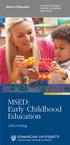 School of Education MASTER OF SCIENCE IN EARLY CHILDHOOD EDUCATION : Early Childhood Education 2012-2014 Master of Science in Education () (Early Childhood Education) Purpose The Master of Science in Education
Financial Coaching: Understanding the Skills Needed to Become a Successful Coach
 Financial Coaching: Understanding the Skills Needed to Become a Successful Coach Financial Coaching: Understanding the Skills Needed to Become a Successful Coach $ A Learning Series from the Financial
* Lab Experience Course Code: (1) General Studies/Core (3) Major ** Field Experience (2) Enhanced General Studies (4) Professional Education
 Tennessee Teacher Licensure Standards: Page 1 of 9 Introduction Candidates for licensure as a reading specialist complete advanced studies in reading and leadership, enabling them to fulfill multiple responsibilities
Preschool Development Grant Planning Meeting
 Preschool Development Grant Planning Meeting Administered by the Arizona Department of Education Early Childhood Education Section Agenda Welcome and Introductions Overview of School Readiness Overview
Faculty of Social and Behavioral Sciences
 Faculty of Social and Behavioral Sciences Chair: Basma Faour, Ed.D. Mission The Faculty of Social and Behavioral Sciences (SBS) provides culturally and contextually relevant educational curricula that
Coaching. Outcomes: Participants gain an understanding and self-confidence in the basics of coaching and motivating others to perform their best;
 Coaching Summary: Participants in this session will learn when to coach and have an opportunity to practice specific coaching skills. During the practice session, participants will identify strengths and
Chapter 9 EARLY CHILDHOOD SPECIAL EDUCATION AND SCHOOL NURSE
 Chapter 9 EARLY CHILDHOOD SPECIAL EDUCATION AND SCHOOL NURSE Section 1. Basic Programs For Those Who Do Not Hold a Teaching Endorsement. These programs are designed for persons providing professional consultation
Washington Teachers Union Local 6, AFT, AFL-CIO DC Candidate Questionnaire, April 2016 LEON T. ANDREWS JR RESPONSE
 Washington Teachers Union Local 6, AFT, AFL-CIO DC Candidate Questionnaire, April 2016 LEON T. ANDREWS JR RESPONSE Please return to: [email protected] by 5pm on April 12, 2016 1. Reclaiming the Promise
Data-Based Decision Making
 Data-Based Decision Making To use data effectively, school leaders must know which questions to ask to find the data they need. By Anastasia Kalamaros Skalski and Montina Romero Anastasia Kalamaros Skalski
The Constitutional Convention
 The Constitutional Convention By: Meghan Smith and Chelsea Sullivan Introduction: For our Curriculum Project, we have created a five-day unit based on the Constitutional Convention. This unit is designed
What Are the Benefits of Analyzing Student Work?
 01-Bella.qxd 11/17/03 3:40 PM Page 1 What Are the Benefits of Analyzing Student Work? 1 W hat s in it for me? That s the question many educators secretly ask themselves when they are presented with a new