
Standard Operating Procedures
|
|
|
- Daniella Robinson
- 9 years ago
- Views:
Transcription


1 Standard Operating Procedures Ffff H a r v a r d L o n g w o o d M e d i c a l A r e a Office of Human Research Administration 90 Smith St. Suite 335 Boston, MA /

2 SOP: Definitions HRP-001 6/10/2013 D. Wolf D. Wolf 1 of This policy establishes the definitions followed by the human research protection program. 2.1 None. 3.1 Adverse Event: Any untoward or unfavorable medical occurrence in a human subject, including any abnormal sign (for example, abnormal physical exam or laboratory finding), symptom, or disease, temporally associated with the subject s participation in the research, whether or not considered related to the subject s participation in the research. 3.2 Allegation of Non-Compliance: An unconfirmed assertion of Non-Compliance. 3.3 Community Based Participatory Research (CBPR): CBPR includes community members in all aspects of research including the conception, design, analysis and dissemination of the research. This approach to research engages community partners in collaboration with researchers to solve problems relevant to human health in communities. 3.4 Continuing Non-Compliance: A pattern of Non-Compliance that indicates a deficiency likely to result in further Non-Compliance or a circumstance in which an investigator fails to cooperate with investigating or correcting Non-Compliance. 3.5 Experienced IRB Member: An IRB member is considered experienced if the member has three years of IRB experience (serving as an IRB member or working in the field of human research administration) and is considered to be knowledgeable by the IRB chair. 3.6 Expiration Date: The first date that the protocol is no longer approved. The date after the end date of the approval period. 3.7 ESTR: Electronic Submission, Tracking & Reporting system for Harvard investigators and IRBs. 3.8 Designated Reviewer: The IRB chair or an Experienced IRB Member designated by the IRB chair to conduct Non-Committee Reviews. 3.9 Finding of Non-Compliance: Non-Compliance in fact Human Research: Any activity that either: Is Research as defined by DHHS and involves Human Subjects as defined by DHHS; or Is Research as defined by FDA and involves Human Subjects as defined by FDA Human Subject as Defined by DHHS: A living individual about whom an investigator (whether professional or student) conducting research obtains (1) data through Intervention or Interaction with the individual, or (2) information that is both Private Information and Identifiable Information. For the purpose of this definition: Intervention: Physical procedures by which data are gathered (for example, venipuncture) and manipulations of the subject or the subject s environment that are performed for research purposes Interaction: Communication or interpersonal contact between investigator and subject Private Information: Information about behavior that occurs in a context in which an individual can reasonably expect that no observation or recording is taking place, and information which has been provided for specific purposes by an individual and which the individual can reasonably expect will not be made public (for example, a medical record) Identifiable Information: Information that is individually identifiable (i.e., the identity of the subject is or may readily be ascertained by the investigator or associated with the information). 1 The terms Human Subject Research, Research Involving Human Subjects, Human Participant Research, Research Involving Human Participants, Clinical Research, Clinical Investigation, Clinical Study and similar phrases are considered to be synonyms for the term Human Research.

3 SOP: Definitions HRP-001 6/10/2013 D. Wolf D. Wolf 2 of Human Subject as Defined by FDA: An individual who is or becomes a subject in research, either as a recipient of the test article or as a control. A subject may be either a healthy human or a patient. A human subject includes an individual on whose specimen a medical device is used Immediate Family: Spouse, domestic partner; and dependent children Institutional Official: HSPH: Associate Dean for Research (ADR) is designated as the Institutional Official (IO) HMS/HSDM: Chief Research Operations Officer of Harvard Medical School (HMS) is designated as the Institutional Official (IO) IRB Review Specialist: An OHRA Staff, who is an experienced IRB member and Certified IRB Professionals (CIP). IRB Review Specialist is a Designated Reviewer that conducts Non- Committee Review Legally Authorized Representative: An individual or judicial or other body authorized under applicable law to consent on behalf of a prospective subject to the participant's participation in the research procedure(s) Minimal Risk: The probability and magnitude of harm or discomfort anticipated in the research that are not greater in and of themselves than those ordinarily encountered in daily life or during the performance of routine physical or psychological examinations or tests For research involving prisoners Minimal Risk is the probability and magnitude of physical or psychological harm that is normally encountered in the daily lives, or in the routine medical, dental, or psychological examination of healthy persons Non-Committee Review: Any of the following: Determination of whether an activity is Human Research Determination of whether Human Research is exempt from regulation Reviews of non-exempt research using the expedited procedure Determination of which subjects can continue in expired research Non-Compliance: Failure to follow applicable regulations/directives, or the requirements or determinations of the IRB OHRA: Office of Human Research Administration that consists of IRB Operations and Quality Improvement Program (QIP). OHRA supports, manages and oversees all human research conducted by faculty, staff and students of Harvard Medical School (HMS), Harvard School of Dental Medicine (HSDM) and Harvard School of Public Health (HSPH) Related to the Research: A financial interest is Related to the Research when the interest is in (1) the sponsor of the research; (2) a competitor of the sponsor of the research; (3) the product or service being tested; or (4) a competitor of the product or service being tested Research as Defined by DHHS: A systematic investigation, including research development, testing and evaluation, designed to develop or contribute to generalizable knowledge Research as Defined by FDA: Any experiment that involves a test article and one or more human subjects, and that meets any one of the following: Must meet the requirements for prior submission to the Food and Drug Administration under section 505(i) of the Federal Food, Drug, and Cosmetic Act meaning any use of a drug other than the use of an approved drug in the course of medical practice; 2 The phrase ordinarily encountered in daily life or during the performance of routine physical or physiological examinations or tests should not be interpreted to include the inherent risks certain categories of subjects face in their everyday life. For example, the risks imposed in research involving human subjects focused on a special population should not be evaluated against the inherent risks encountered in their environment (e.g., emergency responder, pilot, soldier in a combat zone) or having a medical condition (e.g., frequent medical tests or constant pain).

4 SOP: Definitions HRP-001 6/10/2013 D. Wolf D. Wolf 3 of Must meet the requirements for prior submission to the Food and Drug Administration under section 520(g) of the Federal Food, Drug, and Cosmetic Act meaning any activity that evaluates the safety or effectiveness of a device; OR Any activity the results of which are intended to be later submitted to, or held for inspection by, the Food and Drug Administration as part of an application for a research or marketing permit Restricted: Applies to investigators or research staff members who are delinquent in meeting IRB requirements Serious Adverse Event: Any Adverse Event that (1) results in death; (2) is life-threatening (places the subject at immediate risk of death from the event as it occurred); (3) results in inpatient hospitalization or prolongation of existing hospitalization; (4) results in a persistent or significant disability/incapacity; (5) results in a congenital anomaly/birth defect; or (6) based upon appropriate medical judgment, may jeopardize the subject s health and may require medical or surgical intervention to prevent one of the other outcomes listed in this definition Serious Non-Compliance: Non-Compliance that affects the rights or welfare of participants Suspension of IRB Approval: An action of the IRB, IRB chair, OHRA Director or Institutional Official and/or designee to temporarily or permanently withdraw IRB approval of some or all research procedures short of a Termination of IRB Approval. Suspended studies remain open and are subject to continuing review Termination of IRB Approval: An action of the IRB to permanently withdraw IRB approval of all research procedures. Terminated studies are permanently closed and no longer require continuing review Unanticipated Problem Involving Risk to Participants or Others: Any information that is (1) unanticipated; (2) related or possibly related to participation in the research; and (3) indicates that participants or others are at increased risk of harm. 4.1 Individuals writing policies and procedures are to indicate terms defined in this policy with a double underline. 4.2 Individuals using policies and procedures are to consult this policy for the definitions of double underlined terms. 5.1 Not applicable. 6.1 None CFR CFR 50.3, 21 CFR , 21 CFR 312.3, 21 CFR 812.2(a). 21 CFR 812.3(p)

5 SOP: Observation of the Consent Process HRP-012 5/06/2013 D.Wolf D. Wolf 1 of This procedure establishes the process to observe the consent process. 1.2 The process begins when the IRB determines that the consent process should be observed. 1.3 The process ends when the IRB determines that the consent process no longer should be observed. 2.1 None. 3.1 The IRB may consider observation of the consent process when: The IRB needss verification from sources other than the investigator that no material changes have taken place since prior IRB review There are allegations or findings of Non-Compliance The nature of the research indicates that the consent process can be improved through observation. 3.2 The IRB designates who conducts the observation. The IRB may have the observation conducted by: QIP staff IRB staff IRB members A person recommended by the investigator An independent person hired by the IRB, but paid for by the investigator s funds. 4.1 The person designated to conduct the observation of the consent process carries out these procedures. 5.1 Observe the consent process and determine whether the information in the consent document and any other written information was accurately explained to, and apparently understood by, the participant or the participant s Legally Authorized Representative, and that informed consent was freely given by the participant or the Legally Authorized Representative If no, indicate that consent is not legally effective and the prospective participant may not be entered into the research If yes, document in writing that the consent process was observed and that informed consent was freely given by the participant or Legally Authorized Representative. 6.1 None.

6 SOP: Legally Authorized Representatives, Children, and Guardians HRP-013 5/06/2013 D. Wolf D. Wolf 1 of This policy provides applicable definitions to meet DHHS and FDA requirements when the research is conducted in Massachusetts: Legally authorized representative Children Guardian 2.1 None. 3.1 Under DHHS and FDA regulations a legally authorized representative means an individual or judicial or other body authorized under applicable law to consent on behalf of a prospective subject to the subject s participation in the research procedure(s). Unless the IRB has waived the requirement to obtain consent, when research involves adults unable to consent, permission must be obtained from a legally authorized representative. When research is conducted in Massachusetts the following individuals meet this definition: For medical research and minimal risk non-medical research: A health care agent as defined in M.G.L. c. 201D A guardian as defined in 115 CMR 10.02, M.G.L. c , 6A, 6B. ( Individual, organization or agency, if any that has been appointed legal guardian of the person found to be incompetent by a court of competent jurisdiction. ) A responsible party as defined in M.G.L. c. 201D, For all other research, legal counsel has to determine that the individuals proposed to serve as legally authorized representatives meet the federal definition of legally authorized representative. 3.2 For research outside Massachusetts, a determination of who meets the DHHS and FDA definitions of legally authorized representative is to be made with consultation from legal counsel. 3.3 Under DHHS and FDA regulations children are persons who have not attained the legal age for consent to treatments or procedures involved in the research, under the applicable law of the jurisdiction in which the research will be conducted. Subpart D of the DHHS must be applied if and only if an individual involved in the research meets this definition. When research is conducted in Massachusetts all individuals under the age of 18 years meet this definition with the following exceptions: Emancipated minors, defined as individuals who meet one of the following criteria, do not meet the DHHS and FDA definition of children : (M.G.L. c F) Married/widowed/divorced; A parent; A member of the armed forces; Living apart from parents and managing his or her own finances; or In the case of a female, pregnant or believes herself to be pregnant, unless the procedures involved in the research include abortion as described below Individuals under the age of 18 when the research procedures are limited to: Diseases dangerous to the public health; Drug dependency (but not alcohol dependency) Pregnancy, unless the procedures involved in the research include abortion as described below.
7 SOP: Legally Authorized Representatives, Children, and Guardians HRP-013 5/06/2013 D. Wolf D. Wolf 2 of Exception: If the research procedures involve abortion, a female under the age of 18 who is not and has never been married meets meet the DHHS and FDA definition of children. (M.G.L. c S) 3.4 For research outside Massachusetts, a determination of who meets the DHHS and FDA definitions of children is to be made with consultation from legal counsel. 3.5 Under DHHS and FDA regulations a guardian means an individual who is authorized under applicable State or local law to consent on behalf of a child to general medical care. When research involves children and parental permission is required, consent may only be obtained from parents (biologic or adoptive) or a guardian as defined by DHHS and FDA regulations. When research is conducted in any jurisdiction and permission for a child to participate in research is to be obtained from an individual other than biological or adoptive parents, the individual providing such permission must provide written documentation of the legal ability to consent to the child s general medical care. A copy of this documentation is to be kept with the consent document in the investigator s files. 4.1 Investigators are to follow this policy when obtaining permission for adults unable to consent or children to take part in research. 5.1 None. 6.1 None.

8 SOP: Incoming Items Directed to the IRB HRP-020 5/06/2013 D. Wolf D. Wolf 1 of This procedure establishes the process to triage information submitted to the IRB. 1.2 The process begins when any communication is received by the IRB. 1.3 The process ends when an IRB staff member determines the appropriate action for the received information. 2.1 None. 3.1 None. 4.1 IRB staff members carry out these procedures. 5.1 Submission is routed and assigned to IRB Review Specialists through Electronic Submission, Tracking & Reporting (ESTR) system. 5.2 If the information represents a request to withdraw from consideration a new protocol or modifications to an approved protocol Update the protocol record in ESTR Follow the SOP: IRB Records. 5.3 If the information represents a request for an approval (approval of new research, continuing review of research, or modification to previously approved research) or a determination whether an activity is exempt Human Research or is not Human Research: Update the protocol record in ESTR Follow the SOP: Pre-Review. 5.4 If the information represents a response to modifications required to secure approval: Update the protocol record in ESTR Follow the SOP: Modifications Required to Secure Approval. 5.5 If the information represents a notification of completion of required HRPP training update ESTR and set the training expiration date to three years after the completion date 5.6 If the information represents an investigator s request to continue participants in expired research: Update the protocol record in ESTR Have the IRB chair follow SOP: Expiration of IRB Approval. 5.7 If the information represents an item that does not fit into the above categories: Update the protocol record in ESTR (if applicable) If the information represents a question, concern, or complaint: Document the nature of the question, concern, or complaint and the contact information of the person contacting the IRB Answer any questions that are basic or general in nature. For more complicated questions, take a message and consult with the IRB Administrative Chair, QIP Director, and/or OHRA Director to identify the best course of action for the questions concerns, and/or complaints Follow SOP: New Information. 6.1 SOP: Expiration of IRB Approval.
9 SOP: Incoming Items Directed to the IRB HRP-020 5/06/2013 D. Wolf D. Wolf 2 of SOP: IRB Records. 6.3 SOP: Modifications Required to Secure Approval. 6.4 SOP: New Information. 6.5 SOP: Pre-Review. 7.1 None.
10 SOP: Pre-review HRP-021 5/06/2013 D. Wolf D. Wolf 1 of This procedure establishes the process to pre-review a request for approval (approval of new research, continuing review of research, or modification to previously approved research) or a determination whether an activity is exempt Human Research or is not Human Research. 1.2 The process begins when the IRB receives a request for approval. 1.3 The process ends when the information has been placed on the queue for an IRB meeting or has been provided to a Designated Reviewer. 2.1 None. 3.1 None. 4.1 IRB Review Specialists carry out these procedures. 5.1 Use the WORKSHEET: Submission Materials and to review the application materials. 5.2 If the information is not complete, contact the investigator and offer the opportunity to provide additional information If the investigator will not provide additional materials, update the system and note that the submission was withdrawn If the investigator will provide additional materials, continue processing. 5.3 If the investigator or research staff member is Restricted, contact the investigator. Explain that the investigator or research staff member is Restricted, give reasons, and indicate that if the protocol goes to the IRB and the activity is Human Research, the IRB policy is to not approve the research except where necessary to maintain protection of current participants If the investigator will not take steps to remove the Restricted status, update system and note that the submission was withdrawn If the investigator will take action, continue processing. 5.4 Evaluate the most likely level of review: If the request can be handled as a Non-Committee Review and the investigators and research staff are not Restricted, Follow the SOP: Non-Committee Review Preparation Otherwise put in the queue for a convened IRB meeting. 6.1 SOP: Non-Committee Review Preparation. 6.2 WORKSHEET: Submission Materials. 7.1 None.
11 SOP: Modifications Required to Secure Approval HRP-022 5/06/2013 D.Wolf D. Wolf 1 of This procedure describes the process to handle investigator submissions of modifications required to secure approval. 1.2 The process begins when modifications required to secure approval are received by the IRB. 1.3 The process ends when the acceptance or rejection of the modifications is provided to the investigator. 2.1 None. 3.1 The IRB reports its findings and actions to the investigator. 3.2 These reporting procedures are to be completed within ten business days of receipt of the modification. 4.1 IRB Review Specialists carry out these procedures. 5.1 If the investigator requests a review by the convened IRB, place on the schedule for review by a convened IRB and take no further action under this procedure. 5.2 Otherwise follow SOP: Non-Committee Review Preparation. 6.1 SOP: Non-Committee Review Preparation CFR (b)(4)(i) CFR (a)(1)
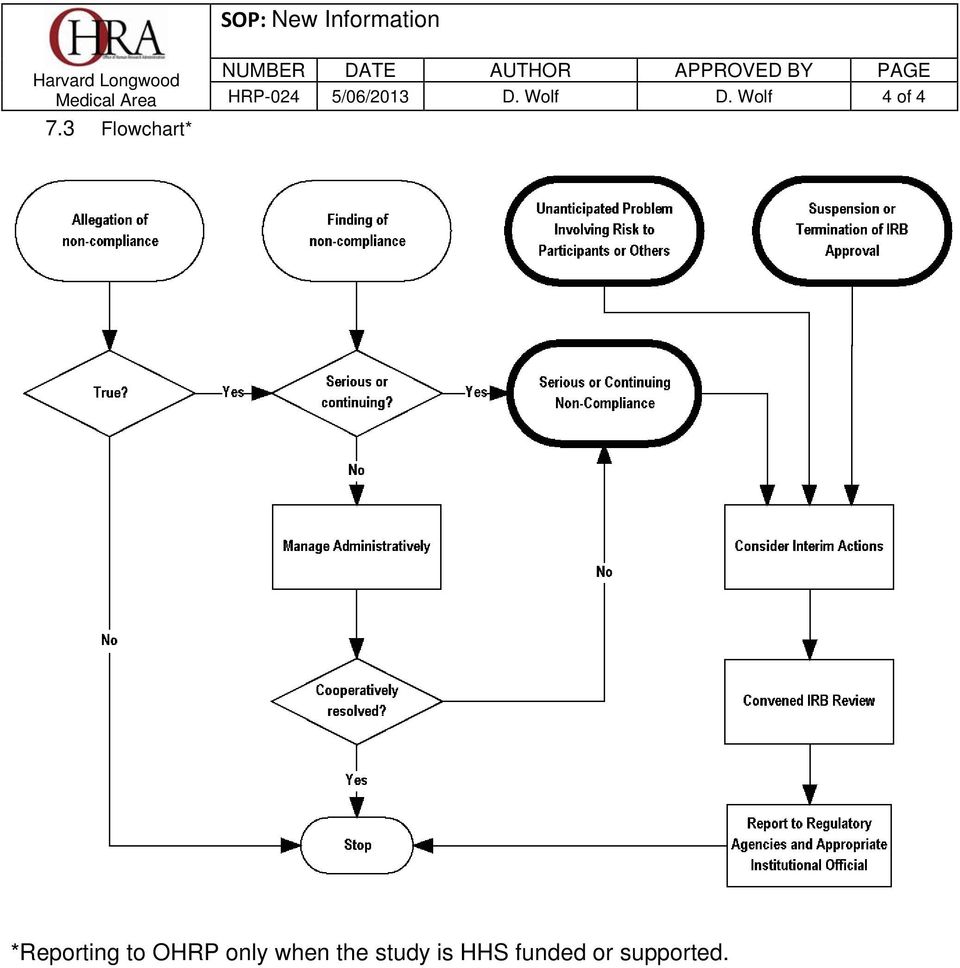
12 SOP: New Information HRP-024 5/06/2013 D. Wolf D. Wolf 1 of This procedure establishes the process to manage information reported to the IRB to ensure that information that represents Non-Compliance, Unanticipated Problems Involving Risk to Participants or Others, Suspensions of IRB Approval, and Terminations of IRB Approval are managed to protect the rights and welfare of participants. 1.2 The process begins when the IRB receives a report of new information form. 1.3 The process ends when the information item is determined not to represent a problem that requires management, is managed administratively, or referred to the convened IRB for review. 2.1 None. 3.1 The IRB staff or the IRB chairs may request assistance from the Quality Improvement Program (QIP) to gather additional information when in their opinion additional information is needed to answer a question required by this SOP. 3.2 Protocol history is maintained in system. 3.3 OHRA will promptly notify the federal department or agency funding the research of any for cause investigation of that research by another federal department or agency or national organization For Department of Defense (DOD) research the report is sent to the DOD human research protection officer. 3.4 The organization will promptly notify the Department of Defense (DOD) if the IRB of record changes. 4.1 The IRB staff members carry out this procedure. 5.1 Review each item of information and answer the following questions: (See attached flowchart for a diagram of the flow of this procedure.) Is this an Allegation of Non-Compliance? Is this a Finding of Non-Compliance? Is this an Unanticipated Problem Involving Risk to Participants or Others? Is this a Suspension or Termination of IRB Approval? 5.2 If the IRB staff member is unable to answer a question, consult the OHRA Director or IRB chair 5.3 If the OHRA Director and/or IRB chair is unable to answer a question, follow the SOP: Investigations. 5.4 If the answer is no to all questions, skip section 5.5 and continue with section If the answer is yes to one or more questions, then follow the corresponding sections below: Allegations of Non-Compliance: Determine whether each Allegation of Non-Compliance has any basis in fact If yes, follow the procedures under Findings of Non-Compliance If no, follow any other corresponding sections Findings of Non-Compliance: Determine whether each Finding of Non-Compliance is Serious Non-Compliance or Continuing Non-Compliance If no, follow the procedures under Non-Serious/Non-Continuing Non- Compliance If yes, follow the procedures under Serious or Continuing Non-Compliance Non-Serious/Non-Continuing Non-Compliance
13 SOP: New Information HRP-024 5/06/2013 D. Wolf D. Wolf 2 of Work with the individual or group responsible for the Non-Compliance to develop and implement a suitable corrective action plan If unable to work with the individual or group responsible for the Non- Compliance to develop and implement a suitable corrective action plan, consider the Non-Compliance to be Continuing Non-Compliance and follow the procedures for Serious or Continuing Non-Compliance Serious Non-Compliance; Continuing Non-Compliance; Suspension of IRB Approval; Termination of IRB Approval; or Unanticipated Problem Involving Risk to Participants or Others Complete Section 1 of CHECKLIST: Review of Information Items Place on the IRB agenda as an item of Serious Non-Compliance; Continuing Non-Compliance; Suspension of IRB Approval; Termination of IRB Approval; or Unanticipated Problem Involving Risk to Participants or Others. 5.6 If in the opinion of the IRB staff member reviewing the new information the rights and welfare of participants might be adversely affected before the convened IRB can review the information, contact the IRB chair to consider a Suspension of IRB Approval following the SOP: Suspension or Termination of IRB Approval. 5.7 If the notification involves a subject becoming a Prisoner in a study not approved by the IRB to involve Prisoners: Confirm that the subject is currently a Prisoner If the subject is currently not a Prisoner no other action is required Consider whether stopping all research interactions and interventions with, and obtaining identifiable private information about, the now-incarcerated subject until the regulatory requirements for research involving Prisoners are met or until the subject is no longer a Prisoner would present risks to the subject If the subject s involvement in the research cannot be stopped for health or safety reasons, do one of the following: Keep the subject enrolled in the study and review the research for involvement of Prisoners. If the research is subject to DHHS oversight, notify OHRP Remove the subject from the study and provide the study intervention as clinical care or compassionate use If the subject s involvement in the research can be stopped, inform the investigator that all research interactions and interventions with, and obtaining identifiable private information about, the now-incarcerated subject must be stopped immediately until the regulatory requirements for research involving Prisoners are met or until the subject is no longer a Prisoner, For Department of Defense (DOD) research promptly report all decisions to the Department of Defense (DOD) The Department of Defense (DOD) must concur with the IRB before the subject can continue to participate while a prisoner. 5.8 Take any additional actions required to resolve any concerns or complaints associated with the information. 5.9 If the information does not involve a Serious Non-Compliance; Continuing Non-Compliance; Suspension of IRB Approval; Termination of IRB Approval; or Unanticipated Problem Involving Risks to Subjects or Others and a response is expected, complete and send a TEMPLATE LETTER: Review of Information Item to the person submitting the information..

14 SOP: New Information HRP-024 5/06/2013 D. Wolf D. Wolf 3 of WORKSHEET: Review of Information Items 6.2 SOP: Investigations. 6.3 SOP: IRB Records. 6.4 SOP: Suspension or Termination of IRB Approval. 6.5 SOP: Directed Audit 6.6 TEMPLATE LETTER: Review of Information Item CFR (b) CFR (b)(5), 45 CFR (a)
15 SOP: New Information HRP-024 5/06/2013 D. Wolf D. Wolf 4 of Flowchart* *Reporting to OHRP only when the study is HHS funded or supported.
16 SOP: Investigations HRP-025 5/06/2013 D. Wolf D. Wolf 1 of This procedure establishes the process to conduct investigations by appointing an Investigative Committee. 1.2 The process begins when the IRB staff members and chair cannot answer a question required by SOP: New Information. 1.3 The process ends when the investigation is complete and the answer has been provided to the OHRA Director. 2.1 None. 3.1 The investigation committee may request assistance from the Quality Improvement Program (QIP) to gather additional information. 4.1 The OHRA Director: In consultation with the IO, appoints the members of the investigative committee based on the expertise and background needed to answer the question Appoints a chair of the investigative committee Charges the investigative committee with the question to be answered. 4.2 The investigative committee carries out these procedures within 60 days. 4.3 Investigative committee members make their decisions based on a preponderance of the evidence. 4.4 Investigative committee decisions are made by majority vote. 4.5 Individuals being interviewed may have counsel present. However, counsel cannot address the investigative committee. The investigative committee, by a vote of the majority, may exclude counsel when in the opinion of the investigative committee that person s presence is disruptive. 5.1 Notify the investigator that an investigation is being conducted, the question to be answered, and the time frame for completion. 5.2 Determine what information to gather and what individuals to interview. 5.3 Gather information and interview individuals. 5.4 If the investigative committee believes that a transcription of the interviews will be required to make a proper decision, the investigative committee may request a court stenographer to record all interviews. 5.5 Repeat information gathering and interviews until a decision can be made. 5.6 The investigative committee provides a written report of the decision to the OHRA Director. 6.1 SOP: New Information. 6.2 SOP: Directed Audit. 7.1 None

17 SOP: Suspension or Termination of IRB Approval HRP-026 5/07/2013 D. Wolf D. Wolf 1 of This procedure establishes the process for someone other than the convened IRB to institute a Suspension of IRB Approval or a Termination of IRB Approval. 1.2 The process begins when the OHRA Director institutes a Suspension of IRB Approval or a Termination of IRB Approval. 1.3 The process ends when the Suspension of IRB Approval or a Termination of IRB Approval has been placed on the agenda for review by the convened IRB. 2.1 None. 3.1 The Institutional Official may suspend or terminate IRB approval for research for any reason. 3.2 The IRB chair may institute a Suspension of IRB Approval when in the opinion of the IRB chair participants may be at risk of adverse effects on their rights and welfare before action may be considered by the convened IRB. 3.3 The OHRA Director may institute a Suspension of IRB Approval or Termination of IRB Approval for any reason. 3.4 The Institutional Official, IRB chair, or OHRA Director may request assistance from the Quality Improvement Program (QIP) to gather additional information when in their opinion additional information is needed to answer a question required by this SOP. 4.1 The individual instituting a Suspension of IRB Approval or Termination of IRB Approval follow these procedures. 5.1 Notify the investigator of the Suspension of IRB Approval or Termination of IRB Approval by preparing and sending TEMPLATE LETTER: External Report along with the reasons for the decision. 5.2 Ask the investigator for a list of participants currently involved in the research. 5.3 Ask the investigator whether any actions are required to protect those participants rights and welfare. 5.4 Consider whether any of the following additional actions are required to protect those or other participants rights and welfare: Transferring participants to another investigator Making arrangements for clinical care outside the research Allowing continuation of some research activities under the supervision of an independent monitor Requiring or permitting follow-up of participants for safety reasons Requiring adverse events or outcomes to be reported to the IRB and the sponsor Notification to current participants Notification to former participants. 5.5 Refer to the IRB staff to place on the agenda of the next IRB meeting for review. 6.1 TEMPLATE LETTER: External Report CFR (b)(3), 21 CFR CFR (b)(5)(ii), 45 CFR (a), 45 CFR

18 SOP: Designated Reviewers HRP-030 6/10//2013 D. Wolf D. Wolf 1 of This procedure establishes the process for the IRB chair to designate IRB members, other than IRB Review Specialist who can conduct Non-Committee Reviews. 1.2 The process begins when the IRB chair designates an Experienced IRB Member to conduct Non-Committee Reviews. 1.3 The process ends when the IRB member has been noted in the IRB roster to conduct Non-Committee Reviews. 2.1 None. 3.1 IRB Review Specialist is a Designated Reviewers by Definition (HRP-001). 4.1 IRB staff members carry out these procedures. 5.1 Obtain the name of the Experienced IRB Member designated to conduct Non-Committee Reviews. 5.2 Verify that the IRB member is an Experienced IRB Member 5.3 Update the DATABASE: IRB Roster to indicate that the IRB member has been designated to conduct Non-Committee Reviews. 6.1 DATABASE: IRB Roster CFR (b) CFR (b).

19 SOP: Non-Committee Review Preparation HRP-031 6/10/2013 D. Wolf D. Wolf 1 of This procedure establishes the process to prepare for a Non-Committee Review. 1.2 The process begins when an IRB Review Specialist identifies an application as being possibly eligible for Non-Committee Review. 1.3 The process ends when the IRB Review Specialist assigns the study in ESTR for Non-Committee Review. 2.1 None. 3.1 None. 4.1 IRB staff members carry out these procedures. 5.1 Refer to the Department Assignment and select a Department-assigned IRB Review Specialist If a Department-assigned IRB Review Specialist is not available, other IRB Review Specialist can serve as the Designated Reviewer or schedule the protocol to be reviewed by the convened IRB. 5.2 Prepare a packet of materials in ESTR (or make the materials available) that includes all information that would have been provided to any IRB member. 5.3 Add to the packet or make available: CHECKLIST: Non-Committee Review. 5.4 Add to the packet or make available when appropriate: CHECKLIST: Human Research Determination CHECKLIST: Exemption Determination CHECKLIST: Eligibility for Review Using the Expedited Procedure (Initial and continuing review) CHECKLIST: Eligibility for Review Using the Expedited Procedure (Modifications) CHECKLIST: Information Security Level Determination. 5.5 For modifications required to secure approval add to the packet or make available: Copy of all IRB meeting minutes relevant to the submission Copy of previous CHECKLIST: Non Committee Review. 5.6 Place a copy of all correspondence in the protocol file. 6.1 CHECKLIST: Non Committee Review 6.2 CHECKLIST: Human Research Determination 6.3 CHECKLIST: Exemption Determination 6.4 CHECKLIST: Eligibility for Review Using the Expedited Procedure (Initial and continuing review) 6.5 CHECKLIST: Eligibility for Review Using the Expedited Procedure (Modifications) 6.6 CHECKLIST: Information Security Level Determination 6.7 DATABASE: IRB Roster CFR (b) CFR (b).

20 SOP: Non-Committee Review Conduct HRP-032 6/11/2013 D. Wolf D. Wolf 1 of This procedure establishes the process for an IRB Review Specialist to conduct a Non-Committee Review. 1.2 The process begins when the IRB Review Specialist is assigned the submission in ESTR. Note that as per the OHRA-HLMA policies, for submissions that undergo Non-Committee Review, the IRB Review Specialist completes both the pre-review and designated review. 1.3 The process ends when the IRB Review Specialist (Designated Reviewer) completes the review and issues the determination letter in ESTR. 2.1 None. 3.1 Designated Reviewers cannot disapprove research. 4.1 The Designated Reviewer carries out these procedures. 5.1 Take ownership of the submission in ESTR via the Assign IRB Contact activity. 5.2 Review the submission for completeness and accuracy If changes/additional information are not needed, submit the pre-review (step 5.3) If changes are needed or additional information required, request clarifications via the Request Pre-Review Clarification activity. Once changes are submitted, review them and if no further changes/clarifications are needed, submit the pre-review (step 5.3). 5.3 If prepared to move the submission to the next phase of review, submit the pre-review in ESTR (via the Submit Pre-Review activity) by indicating the responsible regulatory oversight and selecting special populations, determinations and waivers (if applicable), initial risk level determination and type of research. In addition, any missing materials and suggested contingencies should be noted and relevant supporting documents (if any) should be attached. If there are special populations, determinations and waivers, complete the corresponding checklist(s) needed to document that review: Authorization / Waiver of Authorization (HIPAA) - Use the CHECKLIST: HIPAA Waiver of Authorization to document a waiver or alteration of HIPAA authorization Children or children who are wards of the state - Use CHECKLIST: Research Involving Children when research involves children as subjects (including children who are wards of the state) Cognitively impaired adults - Use CHECKLIST: Research Involving Cognitively Impaired Adults when research involves cognitively impaired adults as subjects FERPA - Use WORKSHEET: FERPA Compliance to determine whether personally identifiable information can be released from student educational records. Note that this worksheet does not need to be completed or retained Harvard students - No checklist needed Neonates of uncertain viability - Use CHECKLIST: Research Involving Neonates of Uncertain Viability when research involves neonates of uncertain viability as subjects Non-significant risk device - Use CHECKLIST: Non-Significant Risk Device when research involves an abbreviated IDE Non-viable neonates - Use CHECKLIST: Research Involving Non-Viable Neonates when research involves non-viable neonates as subjects Pregnant Women - Use CHECKLIST: Research Involving Pregnant Women when research involves pregnant women as subjects.

21 SOP: Non-Committee Review Conduct HRP-032 6/11/2013 D. Wolf D. Wolf 2 of Prisoners - Use CHECKLIST: Research Involving Prisoners when research involves prisoners as subjects Students - No checklist needed Waiver of consent documentation - Use CHECKLIST: Waiver of Written Documentation of the Consent Process when research involves the waiver of written documentation of consent Waiver/alteration of the consent process - Use CHECKLIST: Waiver or Alteration of Consent Process when research involves waiver or alteration of the consent process. 5.4 Select the Designated Reviewer (IRB Review Specialist) via the Assign Designated Reviewer activity If any changes/additional information are required at this stage, request clarifications via the Request Clarification by Designated Reviewer activity. Once changes are submitted, review them and if no further changes/clarifications are needed, submit the designated review (step 5.6) If changes/additional information are not needed, complete the designated review (step 5.6). 5.5 Complete the designated review (via the Submit Designated Review activity) by indicating the determination, review level, and risk level, approval interval and data security level (for initial applications and continuing renewals only). If modifications are required (i.e. for a Modifications Required to Secure Approval determination), they should be described and any relevant supporting documentation should be attached. Relevant worksheets should be reviewed for guidance, but do not need to be completed or retained Not Human Research - Review the WORKSHEET: Human Research Determination to determine whether the activity is Human Research Exempt Human Research - Review the WORKSHEET: Exemption Determination to determine whether the Human Research meets the exemption criteria and the organization s ethical requirements Human Research approved using the expedited procedure - Review WORKSHEET: Criteria for Approval and Additional Considerations and WORKSHEET: Eligibility for Review Using the Expedited Procedure to determine whether the Human Research can be approved. 5.6 If consultation is needed follow SOP: Consultation to the IRB CHECKLIST: HIPAA Waiver of Authorization CHECKLIST: Research Involving Children CHECKLIST: Research Involving Cognitively Impaired Adults CHECKLIST: Research Involving Neonates of Uncertain Viability CHECKLIST: Non-Significant Risk Device CHECKLIST: Research Involving Non-Viable Neonates CHECKLIST: Research Involving Pregnant Women CHECKLIST: Research Involving Prisoners CHECKLIST: Waiver of Written Documentation of the Consent Process CHECKLIST: Waiver or Alteration of Consent Process WORKSHEET: FERPA Compliance WORKSHEET: Human Research Determination WORKSHEET: Exemption Determination WORKSHEET: Criteria for Approval and Additional Considerations
22 SOP: Non-Committee Review Conduct HRP-032 6/11/2013 D. Wolf D. Wolf 3 of WORKSHEET: Eligibility for Review Using the Expedited Procedure SOP: Consultation to the IRB CFR (b) CFR (b).
23 SOP: IRB Meeting Preparation HRP-040 6/13/2013 D.Wolf D. Wolf 1 of This procedure establishes the process to prepare for a convened IRB meeting. 1.2 The process begins the day after the submission deadline, approximately fifteen business days before a meeting date. 1.3 The process ends when agenda items have been assigned through ESTR and where applicable, packets have been placed in the mail for delivery to IRB members. 2.1 None. 3.1 At least one IRB member or consultant is responsible for scientific/scholarly review of research. 3.2 Protocols are reviewed by IRB members and consultants with sufficient expertise. 3.3 When IRB members review research that involves vulnerable participants, at least one individual who is knowledgeable about or experienced in working with such participants will be present at the meeting. 3.4 IRB members are provided sufficient information so that each member can provide an opinion on whether the regulatory criteria for approval are met. 3.5 Alternate IRB members serve the same function as other IRB members, except that if the alternate IRB member and the regular IRB member for whom the alternate member is substituting are both present, only one member may vote. 3.6 Agenda materials are provided to all IRB members at least 5 business days before convened meetings. 4.1 IRB staff members carry out these procedures. 5.1 Confirm which IRB members (regular, alternate, and chairs) will be present at the meeting. 5.2 Consult the current IRB roster to be aware of the experience, expertise and representational capacity of the IRB. 5.3 Review all submissions placed on the queue for a convened IRB meeting. 5.4 Prepare an agenda for the meeting Assign a scientific/scholarly (primary) reviewer to each agenda item who has scientific/scholarly expertise in the area of the research Assign a secondary reviewer to each agenda item. 5.5 Use the CHECKLIST: Evaluation of Quorum and Expertise to ensure that the meeting will be appropriately convened and to ensure the IRB will have the appropriate expertise for each protocol If the meeting will not meet the quorum and expertise requirements, take steps to obtain the required attendance members and consultants or cancel the meeting Follow the procedures in SOP: Consultation to the IRB to obtain consultants. Note any consultants on the agenda. 5.6 Upload agenda to meeting workspace within ESTR. 5.7 Assign Designated Reviewers within ESTR to each agenda item 6.1 CHECKLIST: Evaluation of Quorum and Expertise. 6.2 SOP: Consultation to the IRB CFR (b)
24 SOP: IRB Meeting Preparation HRP-040 6/13/2013 D.Wolf D. Wolf 2 of CFR (b)
25 SOP: IRB Meeting Conduct HRP-041 6/07/2013 D.Wolf D. Wolf 1 of This procedure establishes the process to conduct convened meetings. 1.2 The process begins when the IRB members gather for a convened meeting. 1.3 The process ends when the meeting is adjourned. 2.1 None. 3.1 The IRB reviews research in accordance with the applicable regulatory criteria for approval. 3.2 The IRB chair votes as a regular member. 3.3 If quorum is lost during a meeting, the IRB cannot take votes until the quorum is restored, even if more than half of the members are still present. 3.4 Substantive changes or requirements, requests for more information for IRB consideration, and other issues related to the criteria for approval require review and approval by the convened IRB. 3.5 Minor or prescriptive changes or requirements may be reviewed for approval by the IRB chair. 3.6 The worksheets and checklists described in WORKSHEET: Review Materials and listed below in Section 6: MATERIALS are provided to IRB members in advance of meetings per SOP: IRB Meeting Preparation to conduct meetings and meet regulatory requirements 4.1 The IRB chair carries out these procedures. 4.2 Primary and secondary reviewers lead IRB members through consideration of the regulatory criteria for approval. 5.1 Call the meeting to order. 5.2 Ask IRB members whether anyone has a conflicting interest in any item on the agenda. Note this on the agenda. 5.3 Ask IRB members whether anyone has questions regarding the Expedited Studies Approved in the last 45 days Report. 5.4 For each business item: Table the item when notified by IRB staff when requirements for review of a specific item as defined in CHECKLIST: Evaluation of Quorum and Expertise are not met If there are IRB members with a conflicting interest, invite the IRB to ask questions of those members and then ask those members to leave for discussion and voting If there is a consultant present, ask the consultant to present their review to the IRB If a consultant provided written information to the IRB, present that information to the IRB Have the primary and secondary reviewers present their reviews to the IRB Note any contingencies required by IRB staff Have the primary and secondary reviewers lead the IRB through the review as described below Open the floor for additional discussion Review any modifications required by the IRB to secure approval to ensure that the IRB staff has recorded them Entertain a motion Call for a vote Only IRB members may vote If a member and an alternate are both present, only one may vote.
26 SOP: IRB Meeting Conduct HRP-041 6/07/2013 D.Wolf D. Wolf 2 of Consultants may not vote For a motion to be approved, it needs the approval of more than half of the members present at the meeting. (If there are 10 or 11 members present at the meeting, 6 votes are required for approval, which is greater than 5 and 5.5, respectively.) Re-invite IRB members with a conflicting interest back into the meeting Provide any written information provided by a member or consultant to the IRB staff. 5.5 For each protocol requesting approval have the primary reviewer: Use the CHECKLIST: Criteria for Approval and Additional Considerations and all referenced checklists (listed below) to have the convened IRB determine which regulatory criteria are met, which are not met, and which would be met if the investigator modified the protocol as requested by the IRB Restate the IRB s consensus regarding protocol specific findings justifying a determination when required by a checklist Make a motion for one of the following actions: Approve (with a specific continuing review interval for initial or continuing review): Made when all criteria for approval are met Modifications Required to Secure Approval (with a specific continuing review interval for initial or continuing review): Made when IRB members require specific modifications such that the Designated Reviewer can determine whether an investigator has made the required changes without judging whether a change meets the regulatory criteria for approval. When making this motion, the assigned reviewers restate the modifications required by the IRB members and the IRB members reasons for those changes Tabled: made when the IRB cannot approve the research at a meeting for reasons unrelated to the research, e.g., loss of quorum Defer: Made when the research does not qualify for Approval or Modifications Required to Secure Approval and the IRB has recommendations that might make the protocol approvable. When making this motion, the assigned primary reviewer describes the IRB members reasons for the decision and describes recommendation(s) to make the research approvable Disapprove: Made when the research does not qualify for Approval or Modifications Required to Secure Approval and the IRB has no recommendations that might make the protocol approvable. When making this motion, the assigned primary reviewer describes the IRB members reasons for the decision. The investigator is provided an opportunity to respond to the IRB in person or in writing. 5.6 For each unanticipated problem involving risk to subjects or others, serious or continuing noncompliance item, or suspension or termination of IRB approval, have the primary reviewer: Use the CHECKLIST: Review of Information Items to have the convened IRB make any necessary determinations Make a motion reflecting any actions required by the IRB members. 5.7 If the IRB approves a motion involving a Suspension of IRB Approval or Termination of IRB Approval follow SOP: Suspension or Termination of IRB Approval. 5.8 Temporarily adjourn the meeting when notified by IRB staff that quorum has been lost. 5.9 Adjourn the meeting when there is no further business. 6.1 WORKSHEET: Advertisements
27 SOP: IRB Meeting Conduct HRP-041 6/07/2013 D.Wolf D. Wolf 3 of WORKSHEET: Payments 6.3 WORKSHEET: Short Form of Consent Documentation 6.4 CHECKLIST: Criteria for Approval and Additional Considerations 6.5 CHECKLIST: Evaluation of Quorum and Expertise 6.6 CHECKLIST: Non-Significant Risk Device 6.7 CHECKLIST: Cognitively Impaired Adults 6.8 CHECKLIST: Children 6.9 CHECKLIST: Neonates of Uncertain Viability 6.10 CHECKLIST: Non-Viable Neonates 6.11 CHECKLIST: Pregnant Women 6.12 CHECKLIST: Prisoners 6.13 CHECKLIST: Review of Information Items 6.14 CHECKLIST: Waiver or Alteration of the Consent Process 6.15 CHECKLIST: Waiver of Written Documentation of Consent 6.16 SOP: Suspension or Termination of IRB Approval 6.17 SOP: IRB Meeting Preparation CFR 50.20, 50.25, 50.27, , CFR , ,
28 SOP: IRB Meeting Attendance Monitoring HRP-042 6/13/2013 D.Wolf D. Wolf 1 of This procedure establishes the process to monitor quorum at convened IRB meetings. 1.2 The process begins when the IRB staff member responsible for monitoring quorum notifies the IRB chair that quorum has been attained. 1.3 The process ends when the meeting is adjourned. 2.1 None. 3.1 Except when an expedited review procedure is used, the IRB reviews proposed research at appropriately convened meetings. 4.1 IRB staff members carry out these procedures. 5.1 Prior to the meeting ensure that an alternate is available if any member has indicated that they will need to leave early. 5.2 At meetings consult the WORKSHEET: Evaluation of Quorum and Expertise to determine that the meeting is appropriately convened by meeting the QUORUM REQUIREMENTS and notify the IRB chair when the meeting is appropriately convened. 5.3 Before each protocol consult the WORKSHEET: Evaluation of Quorum and Expertise to determine that the meeting is appropriately convened by meeting the EXPERTISE REQUIREMENTS and notify the IRB chair when the meeting is not appropriately constituted for the review of that protocol. 5.4 When a member leaves the meeting room for any reason (including a conflicting interest) consult the WORKSHEET: Evaluation of Quorum and Expertise to determine that the meeting continues to be appropriately convened by meeting the QUORUM REQUIREMENTS and notify the IRB chair when the meeting is not appropriately convened. 6.1 WORKSHEET: Evaluation of Quorum and Expertise CFR (b) CFR (c)
29 SOP: IRB Meeting Minutes HRP-043 6/13/2013 D.Wolf D. Wolf 1 of This procedure establishes the process to record minutes for convened meetings. 1.2 The process begins when the meeting is called to order. 1.3 The process ends when the minutes are approved by the IRB chair. 2.1 None. 3.1 Minutes are to comply with regulatory and guidance requirements. 3.2 Minutes are to record separate deliberations for each action. 3.3 Minutes are officially approved by the IRB chair. 3.4 IRB members may make corrections to minutes. 3.5 The IRB staff writes minutes and the minutes are approved by the IRB Chair (assigned to the meeting) within approximately 5 business days of the meeting date. 3.6 Minutes are made available to the IRB for review at least 5 business days before the next meeting date. 3.7 Minutes may not be altered by anyone including a higher authority once accepted by the convened IRB. 4.1 IRB staff members carry out these procedures. 5.1 Use the TEMPLATE: Minutes to record observations at meetings. 5.2 Under Attendance Table record each voting member (regular members and alternates) present at the meeting at any time: Name Status: E.g., chair, vice chair, scientific member, non-scientific member, unaffiliated member, representative of vulnerable population (specify), prisoner representative, or alternate member, voting, non-voting For alternate members who are substituting for a regular member, indicate the name of the regular member for whom the alternate member is substituting Whether the member was present by teleconference. Record Table of members 5.3 Record Guests 5.4 Record the total number of members present on the current IRB roster. Exclude alternate members in this count. 5.5 Record the number of members required for quorum. Divide the number of members by two and select the next whole number. For example, if there are 10 IRB members on the roster, then 10/2 = 5 and the next whole number is 6. If there 11 IRB members on the roster, then 11/2=5.5 and the next whole number is Record members eligible to vote on each agenda item 5.7 Indicate whether members present by teleconference received all pertinent material before the meeting and were able to actively and equally participate in all discussions. Delete if no members were present by teleconference. 5.8 Record the meeting start time. 5.9 For each protocol reviewed record: Protocol Number.
30 SOP: IRB Meeting Minutes HRP-043 6/13/2013 D.Wolf D. Wolf 2 of Protocol title Investigator name Funding Type of review: Initial review, continuing review, or review of modifications to previously approved research Consultant report: Summarize the key information provided the consultant. Delete if there was no consultant Controverted issues (when the IRB members express a difference of opinion among themselves) and their resolution. Indicate None or record using the Controverted Issue/Resolution table. If there was no resolution, indicate this Motion: Approved, Approved with Modifications, Deferred, Disapproved. For initial or continuing review add the period of approval to the motion. If the protocol was deferred, indicate this and provide the reason for deferral Vote: Record as the number of members for, against, abstaining, absent, and recused. Do not count votes of consultants. If both a regular IRB member and the alternate IRB member are present at the meeting record the vote of just one For: Voting for the motion Against: Voting against the motion Abstain: Present for the vote, but not voting For or Against Absent: Listed under Members Present but not present for the discussion and vote on this protocol for reasons other than a Conflicting Interest. List the names of absent members in the vote. For example: For: 7 Against: 3 Abstain: 2 Absent: 2 (John Smith, Jane Doe) Recused: Recused: Listed under Members Present but not present for the discussion and vote on this protocol for because of a Conflicting Interest. List the names of recused members in the vote. For example: For: 7 Against: 3 Abstain: 2 Absent: 0 Recused: 2 (John Smith, Jane Doe) Level of risk determined by the convened IRB: Minimal risk or greater than minimal risk Regulatory determinations and protocol-specific findings supporting those determinations: Use the template tables in the TEMPLATE: Minutes to record the required determinations and protocol specific findings justifying those determinations Justification of any deletion or substantive modification of information concerning risks or alternative procedures contained in the DHHS-approved sample consent document: Delete if a DHHS-approved sample consent form was not reviewed. Otherwise indicate None or describe the changes and the rationale Rationale for a significant/non-significant device determination: Delete if there were no investigational devices being reviewed. Otherwise describe the rationale for the determination Modifications required to secure approval: Delete if there were no modifications required to secure approval. Otherwise, include the Modifications Required to Secure Approval Table Reasons the IRB deferred the protocol: Delete if the IRB did not table the protocol Reasons for the deferral or disapproval and recommended changes: Delete if the IRB did not defer or disapprove the research For each problem reviewed record: Description of problem Protocol Title: Omit if there is no specific protocol Protocol ID: Omit if there is no specific protocol.
31 SOP: IRB Meeting Minutes HRP-043 6/13/2013 D.Wolf D. Wolf 3 of Individual(s) involved: Controverted issues and their resolution: Motion: Include any IRB determination of whether the problem is (1) an unfounded Allegation of Non-Compliance, (2) Non-Compliance that is neither Serious nor Continuing Non-Compliance, (3) Serious or Continuing Non-Compliance, (4) not an Unanticipated Problem Involving Risk to Participants or Others, or (5) an Unanticipated Problem Involving Risk to Participants or Others Vote: Record as the number of members for, against, abstaining, absent, or recused. List the names of IRB members who were absent or recused Reasons for Suspension or Termination of IRB Approval Record the meeting end time Within five business days, IRB Administrative Chair revises minutes for accuracy and provide them to the IRB chair for review and approval Once approved by the IRB chair, provide a copy of the minutes by to: IRB members Institutional Official OHRA Director 5.14 Once approved by the IRB chair, upload the minutes into the meeting workspace on ESTR IRB members have 5 business days to review the minutes and communicate any proposed corrections to the IRB Administrative Chair or Chair Follow the SOP: IRB Records. 6.1 TEMPLATE: Minutes. 6.2 SOP: IRB Records CFR (a)(2) CFR (a)(2)
32 SOP: Review of Not Otherwise Approvable Research HRP-044 5/07/2013 D. Wolf D. Wolf 1 of This procedure establishes the process for the organization to review research that is not otherwise approvable under the regulations, but because the research is not subject to those regulations DHHS and FDA will not conduct a review of this research to determine whether it can be approved. 1.2 This process begins when the IRB determines that research involving children, pregnant women, or fetuses as participants is not otherwise approvable, but presents a reasonable opportunity to understand, prevent, or alleviate a serious problem affecting those participants health or welfare. 1.3 The process ends when the OHRA Director communicates a decision to the IRB and the IRB chair. 2.1 None. 3.1 When research is not otherwise approvable under DHHS or FDA regulations, but because the research is not subject to those regulations DHHS and FDA will not conduct a review of this research to determine whether it can be approved, HSPH will conduct its own review that parallels the regulatory process. 3.2 The criteria used to make a determination are: that the research in fact satisfies the conditions of IRB approvable research in CHECKLIST: Non-Viable Neonates, CHECKLIST: Neonates of Uncertain Viability, or CHECKLIST: Children All of the following criteria are met: The research presents a reasonable opportunity to further the understanding, prevention, or alleviation of a serious problem affecting the health or welfare of children or pregnant women, fetuses or neonates The research will be conducted in accordance with sound ethical principles; Adequate provisions are made for soliciting the assent of children, the permission of their parents or guardians, and the consent of subjects as required by WORKSHEET: Criteria for Approval, CHECKLIST: Non-Viable Neonates, CHECKLIST: Neonates of Uncertain Viability, or CHECKLIST: Children. 4.1 The OHRA Director carries out these procedures. 5.1 Identify a panel of five or more experts in pertinent disciplines (e.g., science, medicine, education, ethics, law) and relevant participant advocates to review the protocol. 5.2 Screen for conflicting interests of panel members using SOP: Conflicting Interests of IRB Members. 5.3 Inform potential experts that they will be asked to provide individual written recommendations and that their reports, as well as their identities, will be publicly available during the public review and comment period. 5.4 Publish in a form accessible to the public: A request for written comments, including an Internet link to the protocol, relevant sections of grant applications, parental permission and assent documents, and relevant excerpts from the IRB minutes and correspondence The date and location of the expert panel meeting (to be held a minimum of four weeks after the notice is posted.) Indicate that the panel meeting will be open to the public and that the public will be given an opportunity to comment at the panel meeting.
33 SOP: Review of Not Otherwise Approvable Research HRP-044 5/07/2013 D. Wolf D. Wolf 2 of Note that written comments on posted materials must be submitted at least one week before the day of the panel meeting to be considered by the panelists (which will allow the public three weeks to comment on posted materials); Indication that the panelists reports/recommendations (see below) will be posted two weeks after the panel meets Invite comments for up to 30 days after the meeting of the convened panel for review and consideration by the panel. 5.5 Open the meeting to the public. 5.6 After the convened panel discussion occurs and public comments are received, have each panel member write an independent recommendation as to whether the protocol should proceed, proceed with modifications, or not proceed. 5.7 Post panel reports on the organization s website for informational purposes for 30 days after the panel meeting. 5.8 Review the panel deliberations, reports, public comments, and make one of the following recommendations within 90 days of the convened panel meeting: The Institutional Official approves support of the research as submitted; The Institutional Official approves support of the research, but with required and/or recommended modifications; or The Institutional Official disapproves support of the research. 5.9 Inform the IRB Chair and the investigator Post the decision on the OHRA Website. 6.1 SOP: Conflicting Interests of IRB Members CFR , 45 CFR CFR 50.24(e), 21 CFR 50.54(b), 21 CFR
34 SOP: Conflicting Interests of IRB Members and Consultants HRP-050 5/07/2013 D. Wolf D. Wolf 1 of This procedure establishes the process to identify and manage Conflicting Interest of IRB members. 1.2 The process begins when an IRB member is asked to review an IRB submission. 1.3 The process ends when an IRB member has either identified a Conflicting Interest and notified IRB staff, or when an IRB member has determined that he or she does not have a Conflicting Interest. 2.1 None 3.1 IRB members are responsible to know the definition of Conflicting Interest and self-identify when they have a Conflicting Interest. 4.1 IRB members (regular and alternate) follow these procedures. 5.1 Before reviewing research, IRB members are to determine whether they have a Conflicting Interest with research. 5.2 If an IRB member has a Conflicting Interest for review outside a meeting (e.g., the expedited procedure), he or she is to notify the IRB staff and return all materials. 5.3 If an IRB member has a Conflicting Interest for review of a submission for which he or she has been assigned as a primary or scientific reviewer, he or she is to notify the IRB staff so the submission can be re-assigned. 5.4 If an IRB member has a Conflicting Interest for review of research at a meeting, he or she is to notify the meeting chair, stay in the meeting room only to answer questions about the research, and to leave the meeting room for discussion and voting regarding that research. 6.1 None CFR (e) CFR (e).
35 SOP: Consultation to the IRB HRP-051 5/07/2013 D. Wolf D. Wolf 1 of This procedure establishes the process for the IRB to obtain consultants. 1.2 The process begins when the IRB staff or IRB member has identified the need for consultation. 1.3 The process ends when the consultant has provided additional expertise to the IRB. 2.1 None 3.1 The IRB invites consultants with competence in special areas to assist in the review of issues which require expertise beyond or in addition to that available on the IRB. 3.2 Consultants with a Conflicting Interest may not provide information to the IRB. 4.1 For review by a convened IRB, IRB staff members carry out these procedures. 4.2 For Non-Committee Review, the Designated Reviewer carries out these procedures. 5.1 Identify a consultant with the required expertise who can provide a review. Identify individuals as follows: IRB members from other committees Other employees of the organization External consultants 5.2 Contact the consultant and determine availability for review. 5.3 Determine whether the consultant has a Conflicting Interest as defined in SOP: Definitions. If so, obtain another consultant. 5.4 For review by the convened IRB: Make the consultant s written comments, if any, available to the IRB members attending the meeting If the consultant did not provide a written report or if requested by an IRB member, invite the consultant to the IRB meeting. 5.5 For Non-Committee Review: Directly obtain the information (oral or written) from the consultant Document information received with the name of the consultant. 6.1 SOP: Definitions CFR (f) CFR (f)
36 SOP: Post-Review HRP-052 6/13/2013 D. Wolf D. Wolf 1 of This procedure describes the actions that occur after a protocol is reviewed. 1.2 The process begins when: A Designated Reviewer has completed a Non-Committee Review; OR An IRB meeting has adjourned and the IRB chair has approved the minutes. 1.3 The process ends when all correspondence related to IRB determinations and actions have been sent to the Principal Investigator and additional tasks have been completed. 2.1 None. 3.1 The IRB reports its findings and actions to the investigator. 3.2 The IRB reports its findings and actions to the institution. 3.3 When the IRB disapproves research, it provides the investigator with a statement of the reasons for the decision and gives the investigator an opportunity to respond in person or in writing. 3.4 These reporting procedures are to be completed within 10 business days of the IRB meeting or submission of the Non-Committee Review in ESTR. In the event that the IRB finds serious or continuing non-compliance, unanticipated problems involving risks to participants or others, or suspension or termination of IRB approval, such event(s) will be reported to applicable external agencies including OHRP within 20 business days. 4.1 IRB staff members carry out these procedures. 5.1 If the Non-Committee Review indicated a conflicting interest or a lack of expertise, follow SOP: Non-Committee Review Preparation. 5.2 Generate and prepare the determination letter via the Prepare Letter activity, ensuring to select the appropriate template, and upload the draft letter once prepared. 5.3 Send the determination letter via the Send Letter activity. The draft correspondence may be reviewed prior to executing the Send Letter activity to ensure accuracy. Completion of this activity will send the determination letter to the principal investigator and primary contact and will also change the status of the submission in ESTR to reflect the IRB s determination. 5.4 For approvals of initial applications or continuing renewals, update the Expiration Dates in ESTR (if necessary) via the Update Expiration Date activity. Note that this activity is available only from the main study workspace in ESTR. 5.5 If necessary, complete the Edit Consent Forms activity to verify that the consent forms uploaded in the online application are the correct versions and are ready for watermarking. Note that this activity is available only from the main study workspace in ESTR. 5.6 Approve relevant files that were attached to the submission via the Finalize Documents activity, selecting all files that require watermarking. For a continuing renewal or modification, the Finalize Documents activity must be completed from the submission workspace AND from the main study workspace. For initial applications, this activity is only to be done in the main study workspace. 5.7 Refer to WORKSHEET: Approval Intervals to calculate approval intervals. 5.8 Refer to WORKSHEET: Communication of Review Results and send all applicable letters. 5.9 Follow SOP: IRB Records. 6.1 WORKSHEET: Communication of Review Results 6.2 WORKSHEET: Approval Intervals
37 SOP: Post-Review HRP-052 6/13/2013 D. Wolf D. Wolf 2 of SOP: Non-Committee Review Preparation 6.4 SOP: IRB Records CFR (b)(4)(i), 45 CFR , 45 CFR (2)(C), 45 CFR (2)(D), 45 CFR CFR (a)(1), 21 CFR 50.24(e), 21 CFR 50.54(b), 21 CFR
38 SOP: Financial Conflicts of Interests NUMBER DATE AUTHOR APPROVED BY PAGE HRP-055 6/10/2013 L. Howes D. Wolf 1 of This policy establishes how the organization evaluates individual financial interests. 1.2 The process begins when the IRB receives a disclosure of financial interest. 1.3 The process ends when the IRB has reviewed the conflict of interest and notified the PI of IRB determination, including management plan if appropriate, 2.1 None 3.1 HSPH applies Harvard University Policy and Individual Financial Conflicts of Interest for Persons Holding Faculty and Teaching Appointments and the HSPH Implementation Plan for the Harvard University Policy on Individual Financial Conflicts of Interest for Persons Holding Faculty and Teaching Appointments and/or Conducting Work on School Sponsored Grants to all sponsored and non-sponsored Human Research. 3.2 HMS/HSDM applies Faculty of Medicine Interim Policy on Conflicts of Interest and Commitment to all sponsored and non-sponsored Human Research. 3.3 In addition to Harvard University policy, individuals subject to this policy are required to disclose financial interests Related to Research directly to the IRB using FORM: Financial Interest Disclosure: On submission of an initial review; At least annually on submission of continuing review; Within 30 days of discovering or acquiring (e.g., through purchase, marriage, or inheritance) a new financial interest. 4.1 The IRB Administrative Chair/Chair carries out these procedures. 5.1 Review FORM: Financial Interest Disclosure Form. 5.2 Determine whether the reported financial interest is Related to the Research: If the financial interest is not Related to the Research, prepare a notification letter to the PI and/or person submitting the information If the financial interest is Related to the Research and the investigator has appropriately managed, reduced, or eliminated the interest, prepare a notification letter to the PI and/or person submitting the information If the financial interest is Related to the Research and the investigator s proposed management plan is sufficient, prepare the submission for review at the next full Board meeting. (for disclosures submitted by HMS and HSDM investigators, the management plan will be reviewed and revised by the HMS COI Committee before submitting to the next full Board meeting). 5.3 When review of the reported financial interest is complete, prepare a notification letter including management plan determined by full Board, if applicable, to the PI and/or person submitting the information. 6.1 FORM: Financial Interest Disclosure CFR CFR 94
39 SOP: Annual Evaluations of the Human Research Protection Program HRP-060 6/10/2013 L. Howes D. Wolf 1 of This procedure establishes the process to conduct annual evaluations of the human research protection program. 1.2 The process begins no later than the first business day of each October. 1.3 The process ends when all evaluations have been completed and communicated to those evaluated. 2.1 None 3.1 The human research protection program is evaluated annually. 4.1 QIP Director or designee ensures completion of these procedures. 5.1 Ensure that the OHRA Director or designee evaluates the resources provided to the human research protection program and make adjustments as part of the budgeting process, including: Space Staff HRPP educational program IRB member conflicts of interests Quality improvement plan 5.2 Evaluate whether the number of IRBs is appropriate with regard to the volume and types of research reviewed Provide a copy of the evaluation to the OHRA Director or designee If the number of IRBs is not appropriate to the volume and types of research reviewed, work with the OHRA Director or designee to modify the IRB structure. 5.3 Ensure that the IRB Administrative Chair evaluates the knowledge, skills, and performance of each regular and alternate IRB member using IRB Member Self-Evaluation Provide a copy of the completed self-evaluations to the OHRA Director or designee Provide a copy of the completed self-evaluation with customized performance feedback to each IRB member If needed, work with each IRB member to develop a plan to improve the individual s knowledge, skills, and performance Provide aggregate feedback to the entire membership and provide training, when appropriate. 5.4 Ensure that the OHRA Director or designee evaluates the knowledge, skills, and performance of each IRB chair using IRB Chair Self-Evaluation Provide a copy of the completed self-evaluation to the OHRA Director or designee Provide a copy of the completed self-evaluation to each IRB chair with specified performance aggregated feedback from IRB members If needed, work with each IRB chair to develop a plan to improve the individual s knowledge, skills, and performance. 5.5 Follow the Human Resources annual employee evaluation process to evaluate the knowledge, skills, and performance of ORARC staff members.
40 SOP: Annual Evaluations of the Human Research Protection Program HRP-060 6/10/2013 L. Howes D. Wolf 2 of Collect a copy of the completed employee self-evaluation Provide a copy of the completed manager and employee self-evaluations to the OHRA Director or designee. Submit the signed originals to HR Provide a copy of the manager evaluation to each OHRA staff member If needed, work with each OHRA staff person to develop a plan to improve the individual s knowledge, skills, and performance. 5.6 Ensure that the QIP Director validates staff and unit-specific performance, identifies areas which need improvement (both in function and knowledge), and implements changes when appropriate using IRB Staff Self-Evaluation Provide a copy of the self-evaluation to the OHRA Director Provide a copy of the completed self-evaluation with customized performance feedback to each IRB staff If needed, develop a plan to improve the individual s knowledge, skills, and performance; adjust individual workload or unit-specific targets, and/or justify additional staffing. 5.7 Ensure that the QIP Director validates staff and unit-specific performance, identifies areas which need improvement (both in function and knowledge), and implements changes when appropriate using QIP Staff Self-Evaluation Provide a copy of the self-evaluation to the OHRA Director Provide a copy of the completed self-evaluation with customized performance feedback to each QIP staff If needed, develop a plan to improve the individual s knowledge, skills, and performance; adjust individual workload or unit-specific targets, and/or justify additional staffing. 5.8 Complete the WORKSHEET: IRB Composition to evaluate whether the composition of the IRB meets regulatory and organizational requirements Provide a copy of the evaluation to the OHRA Director or designee If the composition of an IRB does not meet regulatory and organizational requirements, work with the OHRA Director or designee to modify the IRB composition. 5.9 Evaluate the participant outreach plan Provide a copy of the evaluation to the OHRA Director or designee If the participant outreach program is not meeting organizational goals, work with the OHRA Director or designee to modify the plan Check when the last time each IRB registration was updated or renewed. If more than 2 years, update/renew the registration. 1 IRB Registration is valid for 3 years Check when the last update or renewal of the federalwide assurance (FWA) occurred. If more than 4 years, update/renew the federalwide assurance (FWA). 2 FWA is valid for 5 years OHRA Director provides a summary of Evaluation to the IOs 6.1 WORKSHEET: IRB Composition 6.2 IRB Chair Self-Evaluation See 2 See
41 SOP: Annual Evaluations of the Human Research Protection Program HRP-060 6/10/2013 L. Howes D. Wolf 3 of Member Self-Evaluation 6.4 IRB Staff Self-Evaluation 6.5 QIP Staff Self-Evaluation 7.1 None
42 SOP: Quarterly Evaluations of the Human Research Protection Program HRP-061 5/07/2013 L. Howes D. Wolf 1 of This procedure establishes the process to conduct quality improvement of the human research protection program. 1.2 The process begins the first business day of each quarter. 1.3 The process ends when all evaluations have been completed and communicated to those evaluated. 2.1 None 3.1 The goal of the quality improvement plan is to achieve and maintain compliance and to achieve targeted levels of quality, efficiency, and effectiveness of the HRPP. 3.2 Objectives of the quality improvement program are to: Improve compliance of investigators and their study staff Improve compliance of IRB Operations Increase efficiency of recording and finalizing meeting minutes Increase efficiency of IRB review and approval process Ensure effective communication among other HRPP units. 3.3 The measures of the quality improvement program are defined in: CHECKLIST: Investigator Quality Improvement Assessment CHECKLIST: Minutes Quality Improvement Assessment 4.1 QIP staff ensure completion of these procedures. 5.1 Review the results of CHECKLIST: Investigator Self-Assessment sent each quarter, track the results, and examine for significant trends If the results demonstrate high variability, implement an intervention to reduce variability If the results are outside performance target, implement an intervention to achieve performance target. 5.2 Send CHECKLIST: Investigator Self-Assessment to at least 10 investigators To identify Investigators, run report in system capturing all continuing reviews received during the first month of each quarter. Exclude from this list continuing reviews requesting study closure, continuing reviews where QIP conducted onsite review within the past year for any study of the PI, continuing reviews where PI Self-Assessment was completed for the PI within the past year for any of his or her studies, and ceded reviews where HSPH is serving as the relying institution, 5.3 Complete CHECKLIST: Minutes Quality Improvement Assessment on the minutes of the current month within 3 business days of meeting completion date.. Track compliance and the days required to complete minutes. Provide a copy to the IRB Administrative Chair and/or designee. 5.4 Run report in system capturing IRB review and investigator response times for not human subjects research and exemption requests, initial and continuing applications, and modifications. Provide a copy of the Protocol Efficient Report to the IRB Administrative Chair and HRA Director. 6.1 CHECKLIST: Investigator Self-Assessment
43 SOP: Quarterly Evaluations of the Human Research Protection Program HRP-061 5/07/2013 L. Howes D. Wolf 2 of CHECKLIST: Minutes Quality Improvement Assessment 7.1 None
44 SOP: Expiration of IRB Approval HRP-063 5/07/2013 D.Wolf D. Wolf 1 of This procedure establishes the process for the IRB chair to determine whether current participants may continue in expired research. 1.2 The process begins when the IRB Chair or Administrative Chair is notified of a request by an investigator of a request for current participants to continue in expired research. 1.3 The process ends when the IRB Chair or Administrative Chair has communicated a decision and documented the decision in writing. 2.1 None. 3.1 None. 4.1 The IRB chair or Administrative Chair is responsible for carrying out these procedures. 5.1 Determine from the investigator which participants need to continue in the expired research, what procedures are being requested to continue, and why. 5.2 Under no circumstances can new participants be enrolled. 5.3 Determine which participants can continue in the research based on these principles: In general, research procedures should be discontinued when this can be done safely In general, the only research procedures that should continue are those that are not available outside of the research context. If the required procedures can be provided as standard of care, these should be provided as such In general, research procedures conducted to collect data with no direct benefit to the participant should not continue In some cases, an ethical issue may be raised where the above general principles may not be followed. 5.4 Communicate with the investigator using TEMPLATE LETTER: Continuation of Participants in Expired Research. 5.5 Follow the SOP: IRB Records to file submitted materials and correspondence to and from the IRB. 6.1 SOP: IRB Records. 6.2 TEMPLATE LETTER: Continuation of Participants in Expired Research. 7.1 None
45 SOP: IRB Records HRP-070 5/07/2013 D. Wolf D. Wolf 1 of This procedure establishes the process to maintain IRB records. 1.2 The process begins when records are to be filed. 1.3 The process ends when records have been filed. 2.1 None. 3.1 IRB records are to include: Protocol files Minutes of IRB meetings Copies of all correspondence between the IRB and the investigators IRB member rosters IRB member files Policies and procedures. 3.2 Protocol files are to include: Protocols Scientific evaluations DHHS-approved sample consent document and protocol, when they exist Progress reports submitted by investigators Reports of injuries to participants Records of continuing review submission Correspondence between the IRB and investigator related to the protocol Statements of significant new findings provided to participants For initial and continuing review of research by the expedited procedure: The specific permissible category Description of action taken by the reviewer Any findings required under the regulations For not human subjects research determinations (when requested) the rationale for making the determination For exemption determinations the specific category of exemption Unless documented in the IRB minutes determinations required by the regulations and protocol-specific findings supporting those determinations for: Waiver or alteration of the consent process Research involving pregnant women, fetuses, and neonates Research involving prisoners Research involving children Significant/non-significant device determinations For each protocol s initial and continuing review, the frequency for the next continuing review Problems submitted to the IRB under the prompt reporting requirements including the adverse events and protocol violations that require prompt reporting to the IRB. 3.3 Protocol files are maintained in chronological order with the latest information in front. 3.4 Policies and procedures are to include: Checklists.
46 SOP: IRB Records HRP-070 5/07/2013 D. Wolf D. Wolf 2 of Forms SOPs Template letters Template minutes Worksheets. 3.5 IRB member files include a resume, FORM: IRB Member, and copy of appointment letter for each member. 4.1 OHRA staff members are responsible to carry out these procedures. 5.1 Protocol files are stored in ESTR 5.2 Minutes of IRB meetings: File in minutes binder. 5.3 Copies of all correspondence between the IRB and the investigators: Upload to ESTR 5.4 IRB member rosters: File in IRB member roster binder. 5.5 IRB membership records: File in IRB member files. 5.6 Policies and procedures: File current policies and procedures in polices and procedures binder or maintained electronically File replaced policies and procedures in the policies and procedures history file or maintained electronically. 6.1 None. 7.1 None
47 SOP: Standard Operating Procedures HRP-071 5/07/2013 D. Wolf D. Wolf 1 of This procedure establishes the process to create and update standard operating procedures and associated checklists worksheets, and submission forms. 1.2 The process begins when the OHRA Director determines that a standard operating procedure needs to be created or modified. 1.3 The process ends when the new or revised standard operating procedure has been approved and filed. 2.1 None. 3.1 None. 4.1 The OHRA Director carries out these procedures. 5.1 For new standard operating procedure, assign a number. 5.2 Assign an author and approver. 5.3 Have the author create or update the standard operating procedure following the TEMPLATE SOP or update the associated checklist or worksheet. 5.4 Have the approver review and approve the document. 5.5 Once approved by the approver: Update the approval date File the approved new or revised document in the standard operating procedure files Post the approved procedure on the OHRA website File the old document, if any, in the standard operating procedure files electronically Send an to affected individuals informing them of the change. 6.1 TEMPLATE SOP. 7.1 None
48 SOP: IRB Record Retention HRP-072 5/07/2013 D. Wolf D. Wolf 1 of This procedure establishes the process to retain IRB records. 1.2 The process begins each year in June. 1.3 The process ends when records that no longer need to be retained are destroyed. 2.1 None. 3.1 Documents are to be retained at least as long as required by applicable laws and regulations, and then destroyed. 3.2 Protocols in which there was no participant enrollment or no research was conducted are to be retained the same as protocols where research was conducted. 3.3 IRB records are accessible for inspection and copying by authorized representatives of federal agencies or departments at reasonable times and in a reasonable manner. 3.4 Records maintained that document compliance or non-compliance with Department of Defense (DOD) regulations shall be made accessible for inspection and copying by representatives of the DOD at reasonable times and in a reasonable manner as determined by the supporting DOD component. 3.5 All records for research subject to FDA regulations are to be accessible for inspection and copying by authorized representatives of FDA at reasonable times and in a reasonable manner. 4.1 OHRA staff members carry out these procedures. 5.1 Destroy minutes of IRB meetings when all studies reviewed at that meeting have been closed or terminated for more than seven years. 5.2 Destroy IRB member rosters when all studies reviewed by the IRB have been closed or terminated for more than seven years. 5.3 Destroy protocol files for the Department of Defense (DOD) research when approved by the Department of Defense. The agency may require submitting records to the Department of Defense for archiving. 5.4 Destroy policies and procedures that were replaced with revised policies and procedure more than five years ago. 5.5 Destroy/shred protocol files when the protocol was not human subjects research, exempt, closed, withdrawn, or terminated more than seven years ago. 5.6 Destroy/shred information in IRB member files more than five years old. 6.1 None. 7.1 None
49 SOP: QIP Records HRP-073 6/12/2013 L. Howes D. Wolf 1 of 1 / 1.1 This procedure establishes the process to maintain QIP records. 1.2 The process begins when records are to be filed. 1.3 The process ends when records have been filed. 2.1 None. 3.1 QIP records are to include: Protocol files Policies and procedures. 3.2 Protocol files are maintained by Investigator last name; contents of each file are organized in chronological order with the latest information in front. 3.3 Policies and procedures are to include: SOPs Checklists Template letters Tools. 4.1 QIP staff are responsible for carrying out these procedures. 5.1 Protocol files: Create a new folder for each protocol scheduled for review Place a copy of the IRB-/Investigator-request for review in the folder along with any significant correspondence ( or otherwise) and letters between QIP and the investigators in chronological order Place a copy of prepared Checklists, Tools, and reviewer notes, and Letters in the folder in chronological order. 5.2 Policies and procedures: File current policies and procedures in polices and procedures folder maintained electronically on the shared drive File replaced policies and procedures in the policies and procedures archive folder maintained electronically on the shared drive. 6.1 None. 7.1 None.
50 SOP: QIP Records Retention HRP-074 5/07/2013 L. Howes D. Wolf 1 of This procedure establishes the process to retain QIP records. 1.2 The process begins each year in June. 1.3 The process ends when records that no longer need to be retained are destroyed. 2.1 None. 3.1 Documents are to be retained and then destroyed. 4.1 QIP staff are responsible for carrying out these procedures. 5.1 Destroy policies and procedures that were replaced with revised policies and procedure more than three years ago. 5.2 Destroy protocol files when the protocol was terminated more than seven years ago. 6.1 None. 7.1 None.
51 SOP: IRB Membership Addition HRP-082 6/12/2013 D. Wolf D. Wolf 1 of This procedure establishes the process to add a new IRB member (regular or alternate) or IRB chair. 1.2 The process begins when the HRA Director/IO has appointed a new IRB member/chair to an IRB. (This may be a completely new IRB member/chair, the addition of a previous member to another IRB, or the re-appointment of a previous member/chair for another term.) 1.3 The process ends when the IRB roster is updated with OHRP and the new member has completed training. 2.1 None. 3.1 IRBs are constituted in accordance with regulatory requirements. 4.1 OHRA Director, OHRA staff members and IO carry out these procedures. 5.1 HSPH: The OHRA Director appoints HSPH IRB members and alternate members with consultation from the IRB chair(s); OHRA Director appoints HSPH IRB chair with consultation from HSPH Institutional Official. OHRA Director signs appointment letter. HMS: The HMS IO appoints HMS/HSDM IRB members and alternate members with consultation from the OHRA Director and IRB Chair; the IO appoints HMS/HSDM IRB Chair with consultation from OHRA Director. The IO and the Dean for Academic and Clinical Programs co-signs appointment letter 5.2 Determine from the OHRA Director the appointment term for the IRB member. Regular and alternate IRB members are granted 1-2 year term positions; IRB chairs are granted 2-3 year term positions. The OHRA Director may determine a member s specific term based on experience, expertise, and overall membership composition needs. 5.3 Have the individual complete the FORM: IRB Member Information. 5.4 Obtain a copy of the individual s résumé or curriculum vitae. 5.5 Update electronic copy of the DATABASE: IRB Roster. Complete WORKSHEET: IRB Composition and revise the membership as needed to ensure that the IRB is appropriately constituted. 5.6 Prepare a notification of appointment for the individual. 5.7 Provide to the HRA Director for review and approval: FORM: IRB Member Information Résumé or curriculum vitae Notification of appointment letter 5.8 If not approved, select another individual and restart at Once the appointment letter is signed: Send notification of appointment letter to the individual If the individual requires training, schedule the individual for training Update the registration of all affected IRBs Print and file FORM: IRB Member Information, and the individual s résumé or curriculum vitae, and notification of appointment letter. 1 See Use the form at or use the Web site:
52 SOP: IRB Membership Addition HRP-082 6/12/2013 D. Wolf D. Wolf 2 of Follow the SOP: IRB Records. 6.1 FORM: IRB Member Information. 6.2 WORKSHEET: IRB Composition. 6.3 DATABASE: IRB Roster. 6.4 SOP: IRB Records CFR , 45 CFR (b)(3), 45 CFR (a)(5) CFR , 21 CFR (a)(5).
53 SOP: IRB Membership Removal HRP-083 5/07/2013 D.Wolf D. Wolf 1 of This procedure establishes the process to remove an IRB member (regular or alternate) or IRB chair. 1.2 The process begins when an IRB member/chair resigns, fulfills his/her term, or is removed from one or more IRBs. This SOP applies if an individual is a member of more than one IRB and is being removed from some but not all IRBs. 1.3 The process ends when the IRB registration is updated. 2.1 None. 3.1 IRBs are constituted in accordance with regulatory requirements. 4.1 OHRA staff members carry out these procedures. 4.2 The OHRA Director/IO may remove IRB members and alternate members with consultation from the IRB chair(s). The OHRA Director may remove IRB chair(s) with consultation from the IO. 5.1 Remove the individual from the DATABASE: IRB Roster. 5.2 Complete CHECKLIST: IRB Composition to ensure that the IRB is appropriately constituted If not, identify one or more replacement members and follow SOP: IRB Membership Addition. 5.3 Prepare a letter have it signed by the OHRA Director, and send to the individual. 5.4 Update electronic copy of the registration of all affected IRBs Print and file the WORKSHEET: IRB Composition, and letter. 5.6 Follow the SOP: IRB Records. 6.1 WORKSHEET: IRB Composition. 6.2 DATABASE: IRB Roster. 6.3 SOP: IRB Membership Addition. 6.4 SOP: IRB Records. 7.1 AAHRPP Evaluation Instrument for Accreditation: II.1.D, II.1.E CFR , 45 CFR (b)(3), 45 CFR (a)(5) CFR , 21 CFR (a)(5) 1 See electronically using the website:
54 SOP: IRB Meeting Scheduling and Notification HRP-084 5/07/2013 D. Wolf D. Wolf 1 of This procedure establishes the process to schedule and notify individuals of convened meetings. 1.2 The process begins when there are fewer than three months of meetings on the current schedule. 1.3 The process ends when meetings are scheduled at least six months in advance and individuals in the organization are notified of the schedule. 2.1 None. 3.1 Whenever possible the IRB schedules meetings at least three months in advance. 4.1 The IRB Staff carries out these procedures. 5.1 Create a schedule of meetings for each IRB. 5.2 Post the schedule on the OHRA website. 5.3 Notify the following individuals of the updated schedule with an providing a link to the Web page with the schedule information: IRB members and chairs Investigators and research staff. 6.1 None. 7.1 None
55 SOP: Directed Audit HRP-090 6/12/2013 L. Howes D. Wolf 1 of This procedure establishes the process for QIP to conduct directed audits. 1.2 The process begins when the IRB has identified the need for directed audit. Directed audits may be conducted in response to participant or sponsor complaints, requests from HSPH or HMS institutional officials, IRB Chairs, or concerns from government agencies (e.g., FDA, NIH, and OHRP). 1.3 The process ends when QIP has provided a formal report of the findings from the onsite review and recommended corrective actions to the investigator and IRB. 2.1 None. 3.1 QIP conducts domestic and international directed audits of study documentation to ensure regulatory compliance including protocol adherence, accurate record keeping, and appropriate informed consent process. 3.2 QIP provides corrective actions and offers quality improvement suggestions to facilitate best practices and enhance overall study conduct. 4.1 QIP Staff are responsible for carrying out these procedures. 5.1 Schedule a directed audit with the investigator and additional members of the study staff when appropriate. 5.2 If HSPH or HMS has been designated as the IRB of Record under the Harvard Catalyst Common Reciprocal Reliance Agreement, notify the Director or designee (see Catalyst Designated Contacts list) prior to conducting the audit via providing: PI name, Protocol number, Protocol Title, date of audit, and reason for audit. 5.3 Review corresponding IRB file and prepare onsite review tools using the CHECKLIST: Audit Tool as a guide. 5.4 Review electronic and hard copy regulatory documentation and participant files available onsite. 5.5 When possible, conduct an exit interview. Provide investigator and additional members of the study staff with preliminary findings and an opportunity to correct, explain, and/or ask questions. 5.6 Communicate with the investigator and IRB, HSPH/HMS institutional officials, and/or government agencies (e.g., FDA, NIH, and OHRP) within 5 business days using TEMPLATE LETTER: Directed Audit Letter and, when appropriate, TEMPLATE LETTER: Directed Audit Report. 5.7 Discuss findings and recommendations with IRB Administrative Chair and, when appropriate, HRA Director. 5.8 If HSPH/HMS has been designated as the IRB of Record under the Harvard Catalyst Common Reciprocal Reliance Agreement, notify the Director or designee (see Catalyst Designated Contacts list) of audit completion within 30 days using the Catalyst Audit Notification/Closure form. 5.9 Follow the SOP: QIP Records and SOP: IRB Records to file correspondence Work with investigator to implement recommendations and required actions A copy of QIPs Audit Report will be filed in the IRB files as well as submitted to any regulatory bodies, if required.
56 SOP: Directed Audit HRP-090 6/12/2013 L. Howes D. Wolf 2 of CHECKLIST: Audit Tool 6.2 TEMPLATE LETTER: Directed Audit Letter 6.3 TEMPLATE LETTER: Directed Audit Report 6.4 SOP: QIP Records 6.5 SOP: IRB Records 7.1 None.
57 SOP: Routine Onsite Review HRP-091 6/12/2013 L. Howes D. Wolf 1 of This procedure establishes the process for QIP to conduct routine onsite review. 1.2 The process begins when the investigator and/or study staff has identified the need for routine onsite review, or the study meets OHRA s criteria for QIP-initiated routine onsite review support service. 1.3 The process ends when QIP has provided information to the investigator. 2.1 This SOP now incorporates SOPs for QIP-initiated routine onsite reviews and updated materials. 3.1 QIP conducts domestic and international routine onsite review of study documentation to ensure regulatory compliance including protocol adherence, accurate record keeping, and appropriate informed consent process. 3.2 QIP provides corrective actions and offers quality improvement recommendations to facilitate best practices and enhance overall study conduct. 4.1 QIP Staff are responsible for carrying out these procedures. 5.1 Schedule routine onsite review with the investigator and additional members of the study staff when appropriate. 5.2 If HSPH/HMS has been designated as the IRB of Record under the Harvard Catalyst Common Reciprocal Reliance Agreement, notify the Director or designee (see Catalyst Designated Contacts list) prior to conducting the review via providing: PI name, Protocol Number, Protocol Title, date of audit, reason for audit. 5.3 Review corresponding IRB file and prepare onsite review tools using the CHECKLIST: Audit Tool as a guide. 5.4 Review electronic and hard copy regulatory documentation and participant files available onsite. 5.5 When possible, conduct an exit interview. Provide investigator and additional members of the study staff with preliminary findings and an opportunity to correct, explain, and/or ask questions. 5.6 Communicate with the investigator within 5 business days using TEMPLATE LETTER: Onsite Review Letter and, when appropriate, TEMPLATE LETTER: Onsite Review Report. 5.7 If HSPH/HMS/HSDM has been designated as the IRB of Record under the Harvard Catalyst Common Reciprocal Reliance Agreement, notify the Director or designee (see Catalyst Designated Contacts list) of review completion within 60 days using the Catalyst Audit Notification/Closure form. 5.8 Follow the SOP: QIP Records to file correspondence to and from QIP. 5.9 Work with the investigator to implement recommendations and best practices. 6.1 CHECKLIST: Audit Tool 6.2 TEMPLATE LETTER: Onsite Review Letter 6.3 TEMPLATE LETTER: Onsite Review Report 6.4 SOP: QIP Records 7.1 None.
58 SOP: Routine Onsite Review HRP-091 6/12/2013 L. Howes D. Wolf 2 of 2
Guidance on IRB Continuing Review of Research
 NOTE: THIS GUIDANCE SUPERSEDES OHRP S JANUARY 15, 2007 GUIDANCE ENTITILED GUIDANCE ON CONTINUING REVIEW. CLICK HERE FOR THE JANUARY 15, 2007 GUIDANCE. Office for Human Research Protections Department of
IOWA STATE UNIVERSITY Institutional Review Board. Reporting Adverse Events and Unanticipated Problems Involving Risks to Subjects or Others
 IOWA STATE UNIVERSITY Institutional Review Board Reporting Adverse Events and Unanticipated Problems Involving Risks to Subjects or Others Introduction This policy details the Institutional Review Board
ST. MICHAEL S HOSPITAL Guidelines for Reporting Serious Adverse Events / Unanticipated Problems to the SMH Research Ethics Board (REB) July 09, 2014
 ST. MICHAEL S HOSPITAL Guidelines for Reporting Serious Adverse Events / Unanticipated Problems to the SMH Research Ethics Board (REB) July 09, 2014 1. Introduction The St. Michael s Hospital (SMH) REB
12.0 Investigator Responsibilities
 v. 5.13.13 12.0 Investigator Responsibilities 12.1 Policy Investigators are ultimately responsible for the conduct of research. Research must be conducted according to the signed Investigator statement,
INVESTIGATOR MANUAL. Table of Contents
 Table of Contents HRP-910 001 10 Sep 2014 Page 1 of 7 What is the purpose of this manual?... 2 What is Human Research?... 2 What is the Human Research Protection Program?... 2 What training does my staff
University of California Davis. Investigator Manual. Revised March 10, 2016
 University of California Davis Investigator Manual Revised March 10, 2016 HRP-103 03/10/2016 2 of 41 Table of Contents Scope... 3 What is the purpose of this manual?... 3 What is Human Research?... 3 What
Principal Investigator and Sub Investigator Responsibilities
 Principal Investigator and Sub Investigator Responsibilities I. Purpose To define the roles and responsibilities of Principal Investigators conducting research at GRU. II. Definition The term Principal
Principal Investigator Responsibilities for Education and Social/Behavioral Researchers
 Principal Investigator Responsibilities for Education and Social/Behavioral Researchers Introduction The purpose of this module is to provide a basic understanding of the responsibilities of the principal
Guidance on Reviewing and Reporting Unanticipated Problems Involving Risks to Subjects or Others and Adverse Events
 Office for Human Research Protections (OHRP) Department of Health and Human Services (HHS) Guidance on Reviewing and Reporting Unanticipated Problems Involving Risks to Subjects or Others and Adverse Events
Evaluation Instrument for Accreditation January 1, 2016
 Evaluation Instrument for Accreditation January 1, 2016 Copyright 2002-2014 AAHRPP. All rights reserved. Use of the Evaluation Instrument for Accreditation The Evaluation Instrument for Accreditation is
Evaluation Instrument for Accreditation January 1, 2015
 Evaluation Instrument for Accreditation January 1, 2015 Copyright 2002-2014 AAHRPP. All rights reserved. Use of the Evaluation Instrument for Accreditation The Evaluation Instrument for Accreditation is
Human Research Protection Program Good Clinical Practice Guidance for Investigators Investigator & Research Staff Responsibilities
 This Guidance Document is to ensure that investigators and research personnel recognize their responsibilities associated with the conduct of human subject research by outlining their responsibilities,
2 Applicability: Effective Date: 1/15/2010 Revised: 8/13/2010, 9/10/10, 5/9/14
 2 Applicability: Effective Date: 1/15/2010 Revised: 8/13/2010, 9/10/10, 5/9/14 NDSU research may involve the collaboration or assistance of other research institutions, schools, hospitals, clinics, private
Laurie Shaker-Irwin, Ph.D., M.S. Co-Leader, Regulatory Knowledge and Research Ethics UCLA Clinical and Translational Science Institute
 Laurie Shaker-Irwin, Ph.D., M.S. Co-Leader, Regulatory Knowledge and Research Ethics UCLA Clinical and Translational Science Institute Understand the protocol completely Recognize institutional polices
Investigator responsibilities for research conducted under the authority of the UTHSCSA Institutional Review Board (IRB)
 March 1, 2006 M E M O R A N D U M F O R R E C O R D TO: FROM: SUBJECT: Deans Department Chairs Principal Investigators Brian Herman, Ph.D. Vice President for Research Investigator responsibilities for
University of Hawai i Human Studies Program. Guidelines for Developing a Clinical Research Protocol
 University of Hawai i Human Studies Program Guidelines for Developing a Clinical Research Protocol Following are guidelines for writing a clinical research protocol for submission to the University of
Guide for Research Sites Seeking Accreditation
 Guide for Research Sites Seeking Accreditation (For research sites that only conduct research and do not have their own IRBs) November 16, 2010 Purpose of the Guide The accreditation process for most research
UNIVERSITY OF CALIFORNIA, SAN DIEGO HUMAN RESEARCH PROTECTIONS PROGRAM. DoD/DON-funded Research
 UNIVERSITY OF CALIFORNIA, SAN DIEGO HUMAN RESEARCH PROTECTIONS PROGRAM DoD/DON-funded Research Policy In 2006, the Department of the Navy (DON) enhanced its human subject protection requirements, including
2014 Metrics on Human Research Protection Program Performance
 2014 Metrics on Human Research Protection Program Performance Updated May 15, 2015 About the Metrics Improving the quality of human research protection programs (HRPP) is a top priority of AAHRPP. Effective
Minimum Education Requirements for DoD Personnel Involved in Human Research Protection
 Minimum Education Requirements for DoD Personnel Involved in Human Research Protection The Department of Defense (DoD) is committed to conducting high-quality and ethical research, development, test, and
Reliance Agreement for Institutions Utilizing Stony Brook University s Institutional Review Board(s)
 Name of Organization Providing IRB Review: Stony Brook University ( SBU IRB ) Name of Institution Relying on the SBU IRB ( Institution ): Latest AAHRPP Accreditation Date (if applicable) OHRP Federal Wide
STANDARD OPERATING POLICY AND PROCEDURE
 STANDARD OPERATING POLICY AND PROCEDURE SUBJECT: Biospecimen Request and Release Policy Number: 500.0 Policy Date: 1/16/2009 Amendment Date: N/A Revision Date: 5-3-2010 I. INTRODUCTION AND PURPOSE The
HIPAA Privacy Rule Primer for the College or University Administrator
 HIPAA Privacy Rule Primer for the College or University Administrator On August 14, 2002, the Department of Health and Human Services ( HHS ) issued final medical privacy regulations (the Privacy Rule
Guidance on Withdrawal of Subjects from Research: Data Retention and Other Related Issues
 Office for Human Research Protections (OHRP) Department of Health and Human Services (HHS) Guidance on Withdrawal of Subjects from Research: Data Retention and Other Related Issues This guidance represents
Page 191 TITLE 21 FOOD AND DRUGS 355 1
 Page 191 TITLE 21 FOOD AND DRUGS 355 1 APPEALS TAKEN PRIOR TO OCTOBER 10, 1962 Section 104(d)(3) of Pub. L. 87 781 made amendments to subsec. (h) of this section inapplicable to any appeal taken prior
This policy applies to all clinical research conducted at Beaumont Health System.
 CLINICAL RESEARCH QUALITY AND PROCESS IMPROVEMENT PROGRAM 113 1 of 6 PURPOSE Prior The purpose of this policy is to provide an overview of the Clinical Research Quality and Process Improvement Program
Department of the Navy Human Research Protection Program
 Department of the Navy Human Research Protection Program Roles and Responsibilities of Principal Investigators May 2013 HISTORY AND REGULATIONS 2 US Historical Underpinnings Tuskegee Experiment Began in
Code of Federal Regulations. TITLE 45 PUBLIC WELFARE Department of Health and Human Services PART 46 PROTECTION OF HUMAN SUBJECTS
 Code of Federal Regulations TITLE 45 PUBLIC WELFARE Department of Health and Human Services PART 46 PROTECTION OF HUMAN SUBJECTS * * * Revised January 15, 2009 Effective July 14, 2009 SUBPART A Basic HHS
SAN DIEGO COMMUNITY COLLEGE DISTRICT INSTITUTIONAL REVIEW BOARD (IRB) INVESTIGATOR GUIDELINES FOR RESEARCH USING HUMAN SUBJECTS
 BACKGROUND SAN DIEGO COMMUNITY COLLEGE DISTRICT INSTITUTIONAL REVIEW BOARD (IRB) INVESTIGATOR GUIDELINES FOR RESEARCH USING HUMAN SUBJECTS The first priority of the SDCCD Institutional Review Board (IRB)
Instructions for Form: Application for Claim of Exemption
 Instructions for Form: Application for Claim of Exemption In order to decide whether your activity involves research that may be reviewed and approved at the exempt level, review the following information.
USE OF HUMAN SUBJECTS IN RESEARCH PRESENTED BY BRIAN WEIMER TULANE UNIVERSITY RESEARCH COMPLIANCE OFFICER
 USE OF HUMAN SUBJECTS IN RESEARCH PRESENTED BY BRIAN WEIMER TULANE UNIVERSITY RESEARCH COMPLIANCE OFFICER June 14, 2011 Objectives of Presentation What is the role of the Research Compliance Officer? Why
The University of North Carolina at Greensboro Procedures for Human Research Protection
 The University of North Carolina at Greensboro Procedures for Human Research Protection Spring 2013 i 1 Mission... 1 1.1 Introduction... 1 1.2 Ethical Principles: The Belmont Report... 2 2 Definitions...
IRB Submissions and Human Subjects Research Compliance. Georgia Health Sciences University
 IRB Submissions and Human Subjects Research Compliance Offi f H R hp t ti Office of Human Research Protection Georgia Health Sciences University Objectives Identify the steps required to submit a protocol
What is Covered under the Privacy Rule? Protected Health Information (PHI)
 HIPAA & RESEARCH What is Covered under the Privacy Rule? Protected Health Information (PHI) Health information + Identifier = PHI Transmitted or maintained in any form (paper, electronic, forms, web-based,
CLINICAL RESEARCH ROLES CLINICAL RESEARCH ROLESCLINICAL RESEARCH ROLES
 CLINICAL RESEARCH ROLESCLINICAL RESEARCH ROLES 1. Clinical Study Team Principal Investigator Co Principal Investigator (Co PI) Research Coordinator Study Monitor Data manage Sponsor Post Doctoral Scholar
Human Subjects Research (HSR) Series
 Human Subjects Research (HSR) Series CITI Program s HSR series consists of modules from two basic tracks, Biomedical (Biomed) and Social- Behavioral- Educational (SBE), and a set of Additional Modules
Human Subjects Research at OSU
 Office of Responsible Research Practices 300 Research Foundation 1960 Kenny Road Columbus, OH 43210-1063 Human Subjects Research at OSU Phone (614) 688-8457 Fax (614) 688-0366 www.orrp.osu.edu Behavioral
CORPORATE GOVERNANCE GUIDELINES. (Adopted as of June 2, 2014)
 CORPORATE GOVERNANCE GUIDELINES (Adopted as of June 2, 2014) The following corporate governance guidelines have been approved and adopted by the Board of Directors (the Board ) of Arista Networks, Inc.
INVESTIGATOR HANDBOOK
 INVESTIGATOR HANDBOOK Liberty IRB, Inc. 1450 S. Woodland Blvd., Suite 300A Deland, Florida 32720 Phone (386) 279-4318 Fax: (386)868-4563 Website: www.libertyirb.com Business hours: Monday Friday, 8:00am
Guidance for IRBs, Clinical Investigators, and Sponsors
 Guidance for IRBs, Clinical Investigators, and Sponsors IRB Continuing Review after Clinical Investigation Approval U.S. Department of Health and Human Services Food and Drug Administration Center for
Special Considerations for Pediatric Trials
 Special Considerations for Pediatric Trials Clinical research with minors poses several significantly different issues than research conducted on adults. Therefore, researchers must address a number of
PMAs, 510(k)s, and Advanced IDE Topics
 PMAs, 510(k)s, and Advanced IDE Topics Kenneth J. Cavanaugh Jr., Ph.D. Scientific Reviewer Division of Cardiovascular Devices Office of Device Evaluation Center for Devices and Radiological Health [email protected]
CHAPTER 48 Bioresearch Monitoring
 FOOD AND DRUG ADMINISTRATION COMPLIANCE PROGRAM GUIDANCE MANUAL PROGRAM 7348.809 CHAPTER 48 Bioresearch Monitoring SUBJECT: INSTITUTIONAL REVIEW BOARDS REVISION: IMPLEMENTATION November 28, 2011 COMPLETION
DAIDS Bethesda, MD USA POLICY
 Overview NIH policy requiring independent data and safety monitoring boards (DSMB) for all multicenter Phase III trials has existed since 1979; the most recent restatement was issued in 1998 (NIH Policy
Revision(s) to an Approved Study Form
 Revision(s) to an Approved Study Form Revisions may range from a request to change a typographical error in the consent form to a significant change in the study design. Federal regulations and University
INSTITUTIONAL REVIEW BOARD
 INSTITUTIONAL REVIEW BOARD Policies and Procedures Manual January 2015 Revision 5.0 TABLE OF CONTENTS 1.0 Purpose, Regulatory Overview, and Institutional Policy 1.1 Introduction and Purpose 1.2 Laws, Regulations,
To IRB, or Not to IRB? That Is the Question!
 To IRB, or Not to IRB? That Is the Question! A presentation by Mary Sapp, Ph.D. Assistant Vice President, Planning & Institutional Research University of Miami and Thomas K. Martin, Ph.D. Associate Vice
Study Start-Up SS-204.01. STANDARD OPERATING PROCEDURE FOR Site Initiation Visit (SIV)
 Study Start-Up SS-204.01 STANDARD OPERATING PROCEDURE FOR Site Initiation Visit (SIV) Approval: Nancy Paris, MS, FACHE President and CEO 08 March 2012 (Signature and Date) Approval: Frederick M. Schnell,
IMMUNOTEC INC. AUDIT AND DISCLOSURE POLICY MANAGEMENT COMMITTEE CHARTER AND WHISTLEBLOWER POLICY
 IMMUNOTEC INC. AUDIT AND DISCLOSURE POLICY MANAGEMENT COMMITTEE CHARTER AND WHISTLEBLOWER POLICY ORGANIZATION There shall be a committee of the Board of Directors of the Corporation (the Board ) to be
RESEARCH INVOLVING DATA AND/OR BIOLOGICAL SPECIMENS
 RESEARCH INVOLVING DATA AND/OR BIOLOGICAL SPECIMENS 1. Overview IRB approval and participant informed consent are required to collect biological specimens for research purposes. Similarly, IRB approval
Adventist HealthCare, Inc.
 IRB POLICY ON HUMAN RESEARCH PROTECTION (HRP) AND GOOD CLINICAL PRACTICE (GCP) TRAINING Collaborative Institutional Training Initiative (CITI) Requirements at Adventist Healthcare, Inc. I. Required Human
Nova Southeastern University Institutional Review Board Policies and Procedures
 Nova Southeastern University Institutional Review Board Policies and Procedures Monitoring of Approved Research, Approval Duration, and Continuing Review Effective 03/08/2007; Revised 10/14/2010; 8/29/2011;
HIPAA NOTICE OF PRIVACY PRACTICES
 HIPAA NOTICE OF PRIVACY PRACTICES Human Resources Department 16000 N. Civic Center Plaza Surprise, AZ 85374 Ph: 623-222-3532 // Fax: 623-222-3501 TTY: 623-222-1002 Purpose of This Notice This Notice describes
WHEN I WANT TO: I NEED TO SUBMIT: {for CIRB studies, see the specific FAQ}
 IRB forms and materials to be submitted WHEN I WANT TO: I NEED TO SUBMIT: {for CIRB studies, see the specific FAQ} 1 2 Request a determination as to whether AHC is the appropriate IRB of record (i.e. is
MILITARY HEALTH SYSTEM NOTICE OF PRIVACY PRACTICES. Effective April 14, 2003
 HEALTH AFFAIRS MILITARY HEALTH SYSTEM NOTICE OF PRIVACY PRACTICES Effective April 14, 2003 THIS NOTICE DESCRIBES HOW MEDICAL INFORMATION ABOUT YOU MAY BE USED AND DISCLOSED AND HOW YOU CAN GET ACCESS TO
GENERAL INFORMATION. Adverse Event (AE) Definition (ICH GUIDELINES E6 FOR GCP 1.2):
 Make copies of the blank SAE report form as needed. Retain originals with confirmation of all information faxed to DMID Pharmacovigilance Group Clinical Research Operations and Management Support (CROMS
Guidance for IRBs, Clinical Investigators, and Sponsors. Considerations When Transferring Clinical Investigation Oversight to Another IRB
 Guidance for IRBs, Clinical Investigators, and Sponsors Considerations When Transferring Clinical Investigation Oversight to Another IRB U.S. Department of Health and Human Services Food and Drug Administration
AAHRPP DOCUMENT # 84 UNIVERSITY OF ALABAMA HUMAN RESEARCH PROTECTIONS PROGRAM FORM: NOTIFICATION TO IRB OF EMERGENCY USE OF A TEST ARTICLE
 1 AAHRPP DOCUMENT # 84 UNIVERSITY OF ALABAMA HUMAN RESEARCH PROTECTIONS PROGRAM FORM: NOTIFICATION TO IRB OF EMERGENCY USE OF A TEST ARTICLE Instructions Test Article means any drug, biological product,
52.07 Implementation of agreements reached under M.G.L. c. 32B, 21 to 23
 1 2 3 4 5 6 7 8 9 10 11 12 13 14 15 16 17 18 19 20 21 22 23 24 25 26 27 28 29 30 31 32 33 34 35 36 37 38 39 40 41 42 43 44 45 46 NEW REGULATIONS 801 CMR 52.00 MUNICIPAL HEALTH INSURANCE 52.01 General provisions
Health Insurance Portability and Accountability Policy 1.8.4
 Health Insurance Portability and Accountability Policy 1.8.4 Appendix C Uses and Disclosures of PHI Procedures This Appendix covers procedures related to Uses and Disclosures of PHI. Disclosures to Law
Subject: No. Page PROTOCOL AND CASE REPORT FORM DEVELOPMENT AND REVIEW Standard Operating Procedure
 703 1 of 11 POLICY The Beaumont Research Coordinating Center (BRCC) will provide advice to clinical trial investigators on protocol development, content and format. Upon request, the BRCC will review a
Determining who the investigators are and who the principal investigator is:
 Responsibilities of the IRBs of the Health System and University for Research Conducted by Investigators from a Combination of the Following Institutions: the Health System, University, and Medical School
Study Protocol Template
 Study Protocol Template (Chart Reviews) Instructions: This protocol template is a tool to facilitate the development of a study protocol specifically designed for the investigator initiated studies. It
Research Coordinator - PI s who have research coordinators or secretarial support can designate individuals to manage their IRB protocols in Mentor.
 Mentor Online IRB System IRB s require lots of documentation and managing this process can get to be a burden for both investigators and the IRB committee and administrator. The Mentor IRB system is designed
HIPAA MANUAL. Most health plans and health care providers that are covered by the new Rule must comply with the new requirements by April 14, 2003.
 HIPAA MANUAL What is HIPAA? Health Insurance Portability and Accountability Act. The Health Insurance Portability and Accountability Act (HIPAA) provides rights and protections for participants and beneficiaries
118 MISSISSIPPI HEALTHCARE DATA REGISTRY SYSTEM 118.01 REPORTING REQUIREMENTS AND PROCEDURES
 118 MISSISSIPPI HEALTHCARE DATA REGISTRY SYSTEM 118.01 REPORTING REQUIREMENTS AND PROCEDURES 1. Authority-Mississippi Code Annotated 41-63-4 requires certain licensed health care facilities operating in
REGULATION NO. 6 REGULATIONS GOVERNING THE LICENSING AND PRACTICE OF OCCUPATIONAL THERAPISTS
 REGULATION NO. 6 REGULATIONS GOVERNING THE LICENSING AND PRACTICE OF OCCUPATIONAL THERAPISTS 1. APPLICATION FOR LICENSURE. Any person who plans to practice as a licensed occupational therapist or occupational
Regulatory Binder Instructions 25 April 2016
 Regulatory Binder Instructions 25 April 2016 Instructions This Regulatory Binder is available to help study sites achieve and maintain regulatory compliance and adhere to high standards of practice in
FINAL DOCUMENT. Guidelines for Regulatory Auditing of Quality Management Systems of Medical Device Manufacturers Part 1: General Requirements
 GHTF/SG4/N28R4:2008 FINAL DOCUMENT Title: Guidelines for Regulatory Auditing of Quality Management Systems of Medical Device Manufacturers Authoring Group: GHTF Study Group 4 Endorsed by: The Global Harmonization
NOTICE OF PRIVACY PRACTICES for the HARVARD UNIVERSITY MEDICAL, DENTAL, VISION AND MEDICAL REIMBURSEMENT PLANS
 NOTICE OF PRIVACY PRACTICES for the HARVARD UNIVERSITY MEDICAL, DENTAL, VISION AND MEDICAL REIMBURSEMENT PLANS THIS NOTICE DESCRIBES HOW MEDICAL INFORMATION ABOUT YOU MAY BE USED AND DISCLOSED AND HOW
IRBNet Instructions for SBU and BNL Investigators
 IRBNet Instructions for SBU and BNL Investigators October 2014 Stony Brook University uses IRBNet for the electronic administration and management of its IRB s, the Committees on Research Involving Human
Standard Operating Procedures for Research Involving Human Subjects
 Section I: Introduction v07/2015 Standard Operating Procedures Indiana University and its affiliates are dedicated to protecting the rights and welfare of human participants recruited to participate in
A Review of Guardian ad Litem Activity at the Bristol Division of the Juvenile Court Department For the period July 1, 2013 through December 31, 2014
 Official Audit Report Issued May 2, 2016 A Review of Guardian ad Litem Activity at the Bristol Division of the Juvenile Court Department For the period July 1, 2013 through December 31, 2014 State House
Site visit inspection report on compliance with HTA minimum standards. London School of Hygiene & Tropical Medicine. HTA licensing number 12066
 Site visit inspection report on compliance with HTA minimum standards London School of Hygiene & Tropical Medicine HTA licensing number 12066 Licensed under the Human Tissue Act 2004 for the storage of
No. 706. Page 1 of 5. Issue Date 4/21/2014
 Subject: ROUTINE MONITORING VISITS Standard Operating Procedure Prepared By: Beaumont Research Coordinating Center, Research Institute PURPOSE Prior Issue Date 8/15/2011 No. 706 Issue Date 4/21/2014 Page
South Dakota Parental Rights and Procedural Safeguards
 South Dakota Parental Rights and Procedural Safeguards Special Education Programs Revised July 2011 Prior Written Notice... 1 Definition of Parental Consent... 3 Definition of a Parent... 3 Parental Consent...
Guidelines for preparing Standard Operating Procedures (SOP) for Institutional Ethics Committee for Human Research
 Guidelines for preparing Standard Operating Procedures (SOP) for Institutional Ethics Committee for Human Research 1. Objective: The objective of this SOP is to contribute to the effective functioning
234 CMR: BOARD OF REGISTRATION IN DENTISTRY 234 CMR 8.00: CONTINUING EDUCATION. Section
 234 CMR 8.00: CONTINUING EDUCATION Section 8.01: Purpose 8.02: General Requirements 8.03: Required Biennial Continuing Education 8.04: Criteria for Acceptance: Responsibilities of Licensees and Sponsors
Health Authority Abu Dhabi. HAAD Standard for the Allocation of Physicians in Residency Training Programs in the Emirate of Abu Dhabi (TANSEEQ)
 Health Authority Abu Dhabi HAAD Standard for the Allocation of Physicians in Residency Training Programs in the Emirate of Abu Dhabi (TANSEEQ) 1. Purpose 2. Scope 1.1 The Health Authority - Abu Dhabi encourages
NOTICE OF PRIVACY PRACTICES effective April 14, 2003
 NOTICE OF PRIVACY PRACTICES effective April 14, 2003 This document outlines the privacy practices of Dental Clinic of Marshfield S.C. and Dental Com Insurance Plan, Inc. All references to Dental Clinic
Hollie Goddard Sr. IRB Coordinator McKesson Specialty Health
 Hollie Goddard Sr. IRB Coordinator McKesson Specialty Health We are responsible for acquiring, analyzing, and protecting medical information vital to providing quality patient care HIM professionals ensure
Winthrop University Hospital Research Financial Interests Disclosure Policy
 This policy sets forth Winthrop-University Hospital s (WUH) requirements and guidelines for disclosing applicable Research Financial Interests. It includes: I. Definitions of Key Terms II. Policy and Procedures
Submission Date: Project Start Date: Approximate Project End Date:
 APPLICATION FOR INITIAL APPROVAL Submission Date: Project Start Date: Approximate Project End Date: Research Protocol Title: Principal Investigator: Research Study Contact: Email: Institution: Phone: SENIOR/KEY
The Health and Benefit Trust Fund of the International Union of Operating Engineers Local Union No. 94-94A-94B, AFL-CIO. Notice of Privacy Practices
 The Health and Benefit Trust Fund of the International Union of Operating Section 1: Purpose of This Notice Notice of Privacy Practices Effective as of September 23, 2013 THIS NOTICE DESCRIBES HOW MEDICAL
The Prince Charles Hospital Human Research Ethics Committee (EC00168) Terms of Reference. Metro North Hospital and Health Service
 The Prince Charles Hospital Human Research Ethics Committee (EC00168) Terms of Reference Metro North Hospital and Health Service Page 1 of 3 Contents... Error! Bookmark not defined. Introduction... 3 Preamble...