
A new way to ensure metal protection with Waterborne Dispersion
|
|
|
- MargaretMargaret Jacobs
- 9 years ago
- Views:
Transcription
1 Mars 2013 A new way to ensure metal protection with Waterborne Dispersion I. Bétremieux (a), A. Boone (b), C. Chambat (b), G. Delmas (b) (a) : ARKEMA Coating Resins, Colombes, France (b) : ARKEMA Coating Resins, Verneuil en Halatte, France ABSTRACT Metals and their alloys are excellent materials with high strength and outstanding mechanical properties; they have been used for centuries. However, when they are exposed to a corrosive environment, surface of the steel structures will corrode and thus pose a potential danger to the whole steel structure and reduce its service life. The huge economic impact of the corrosion of metallic structures is a very important issue for all modern societies. Today, the corrosion protection of metal is often obtained by multi-layer systems involving at least a primer and a top coat. These two coats are often based on different technologies implying solvent borne and water borne binders and formulations. It introduces complexity in the applications and drying equipment and processes. Arkema has developed a new waterborne acrylic technology that provides by itself a very high protection to corrosion and a good adhesion on a large variety of substrates, under hard conditions. Due to these key features, this new Arkema s technology offers the advantage that it can be used as single Direct To Metal coating (DTM). In the article, the new properties will be presented, as well as mechanisms and fundamentals which have been used to develop the technology. 1. INTRODUCTION Within Arkema, the driven factors of our polymer development can be summarised by sustainability and market needs. In the protective coatings market which we target, these factors are linked. When we speak about sustainability, we include of course, the reduction of volatile organic compound (VOC) emissions, but also the fact that we will not use toxic compounds and the fact that the coatings formulated with our binders will increase the durability of the steel structures and so increasing its service life. One other parameter of the sustainability will also be to reduce the number of coating layers applied. Today, the anticorrosive protection is achieved by using, at least, two layers, the primer and the top coat. The principal properties required for a primer are adhesion, corrosion and water resistance (barrier properties). Concerning the top coat, the main properties are exterior UV durability, lack of dirt pickup, chemical resistance and gloss. Developing a binder, that can be used as single Direct To Metal coating (DTM) will fit with this last parameter of sustainability. Water-borne anticorrosion maintenance coatings are generally more appreciated than solventborne ones in order to reduce volatile organic compound (VOC) emissions. Traditionally, the performance of available water-borne anticorrosion coatings has not been able to provide sufficient long time protection for steel structures especially in extremely corrosive environments. However, the development of novel binder technology will allow us to access resins that can be formulated in aqueous systems easily, and form very good hydrophobic and barrier films that are suitable for anticorrosion coating applications. Of course, the other sustainability s parameters described previously will be used to achieve our target of developing a new waterborne acrylic technology that can be used in a one layer (DTM), one compound (1K) and air drying system. In this paper, we will investigate in the first part, how we develop this new technology, studying the influence of the functional monomers and their polymerisation process, the film formation and reticulation. The second part will be dedicated to how this technology fits with the protective coatings needs. 1

2 2. EXPERIMENTAL 2.1. Materials Three acrylic dispersions have been used for this study. They differ in terms of hydrophoby, functional and cross-linking monomers. Their characteristics are summarized in Table 1. Acrylic dispersion WB Acrylic 1 WB Acrylic 2 WB Acrylic 3 Hydrophoby High Moderate High Process Standard New New Functional monomers Yes Yes Yes Cross-linking system No No Yes Solids content C ISO 3251 % Brookfield 23 C ISO 2555 mpa.s MFFT (+/- 2 C) ISO 2115 C Particle size ISO (nm) ph ISO Tg C (DSC) Table 1: Characteristics of the acrylic dispersions 2.2. Varnishes formulations The varnish formulations are respectively based on WB Acrylic 1, WB Acrylic 2 or WB Acrylic 3 added by 15% of coalescent agent for WB Acrylic 1 and 5% of coalescent agent for WB Acrylic 2 and 3 (on solid binder). These varnishes have been used to realise the polymeric films Metallic substrates The metallic substrates used to evaluate the different applicative properties are: Cold rolled steel QD 36 from Q-panels, Cold rolled steel DC04 from Rocholl, Ground finish steel S36 from Q-panels, Aluminium A36 from Q-panels, Electro-galvanized steel DC 01, Hot rolled steel DD11, Fire tinted steel DX51 from Rocholl Minimum Film Formation Temperature measurements The Minimum Film Formation Temperature is measured on a COESFELD device according to the ISO 2115 norm. The MFFT is the temperature at which a continuous, transparent film with no cracks is formed Microscopic evaluation of the film formation The varnish films applied on glass plates at a wet film thickness of 100µm dried during 7 days at room temperature 23 C, 50% relative humidity have been characterised by reflection optical microscopy in order to evaluate the quality of the film formation. The microscope used is a Leica DMRM. The magnification is x Glass Temperature measurements The determination of glass transition temperatures i.e. Tg is done on a Mettler Toledo DSC1 device. The temperature varies from 40 C to 100 C at a rate of 10 C.min Dynamic Mechanical Thermal Analysis Tensile tests - Differential Scanning Calorimetry Films: Varnishes were applied on polypropylene plate at a wet film thickness of 600 µm, dried during 14 days at 23 C, 50% relative humidity. Conditions for the DMA analysis: 2

3 Viscoelastic properties are evaluated by DMA measurements on a RSAII device in traction mode. The temperature is increased from 50 C to 200 C at a rate of 3 C/min and a frequency of 1Hz. Tensile tests: Done on a MTS machine Temperature: 23 C, Relative Humidity: 50% Speed: 5 mm/min Cell: 50 N Samples geometries: The samples have been cut with a punch 2.8. Water uptake test WB Acrylics 1, 2 and 3 have been applied on polypropylene plate at a wet film thickness of 600 µm and dried in a climatic chamber at a temperature above 20 C to the MFFT, with a humidity condition decreasing from 90% to 50%. Discs of 29mm diameter are cut in the films prepared and stored during 7 or 14 days at 23 C, 50% relative humidity. The discs a re immerged into water at 23 C and the weight evolution during time is measured. m(t) m o Water uptake % = X 100 m o m o : Initial weight and m(t) weight in time 3. RESULTS DISCUSSION 3.1. New waterborne acrylic technology development In this part, we will describe how our new technology has been built and developed in order to meet key properties for corrosion protection. Many properties can be adjusted and improved in the paint formulation thanks to additives and especially anticorrosive pigments; however our main targeted properties for the binder itself were first an excellent multi-substrate adhesion and excellent barrier properties. It is well known in the literature that the way to improve adhesion of acrylic dispersions onto metallic substrates is to introduce functional monomers such as acids, amines, sulfonate, phosphate or phosphonate (1). All these functions are highly electronegative and can exchange electrons or create complex with metals and their oxides generating stable chemical bondings. It is also well known in the literature that such monomers are often hydrophilic and will not be incorporated homogeneously into the polymer particle with emulsion polymerization process but will be shared between the aqueous phase, the surface of the particle and the particle (2). It is easy to anticipate that this partition will have consequence on the final adhesion. To achieve good barrier properties thanks to a polymer film, it is important to reduce as much as possible the diffusion of water through the film. The two main parameters that can influence it highly are the chemical nature of the polymer and its cross-linking density Polymer structures-properties evaluation Functional monomers The choice and the level of the functional monomers are really key parameters in order to develop a polymer which can achieve multi-substrates adhesion. However if their incorporation is not well controlled their effect on adhesion will be very poor. For each of the functional monomer selected, we optimized the conditions of polymerisation (process of introduction as well as ph in case of ionisable ones) in order to locate the maximum amount at the surface of the particle where it will be the more efficient to improve adhesion. All functional monomers that polymerize in the water phase, and so not linked to the polymer or buried inside the particle, will not contribute to the adhesion. The WB Acrylic 1 where the polymerisation of the functional monomers is not well controlled shows a bad multi-substrate adhesion. On the opposite when the polymerisation of the functional monomers is well controlled which is the case of the WB Acrylic 2, we recover adhesion on cold rolled steel. To achieve a good multi-substrates adhesion we also need to optimise the level and the nature of these functional monomers. This is the case of the WB Acrylic 3. All the 3

4 multi-substrates adhesion results are illustrated on the Graph 1 and have been done on the varnishes after 7 days of drying. Following the ISO 2409 method, a quotation of zero means perfect adhesion and a quotation of five means complete loss of adhesion. WB Acrylics : Adhesion multisubtrates 5 4 Cotation ISO WB Acrylic 1 WB Acrylic 2 WB Acrylic Cold Rolled Steel QD 36 Cold Rolled Steel DC 04 Aluminium A 36 Graph 1: Cross test adhesion on Cold Rolled Steel & Aluminium for varnishes based on WB Acrylics The trend has been also confirmed using the pull off test (ISO 4624). The results summarised in the Table 2, have been obtained on the varnishes applied on cold rolled steel QD 36 at a dry film thickness of 50 µm. The pull off adhesion has been done after only 24 hours of drying at 23 C, 50% relative hum idity. Samples Strength at break (N) Fracture pattern WB Acrylic /- 25 The varnish is completely removed from the substrate WB Acrylic /- 110 Only a part of varnish is removed from the substrate WB Acrylic /- 10 Only a part of varnish is removed from the substrate Table 2: Varnishes - Pull off test adhesion on Cold Rolled Steel (QD 36) after 24 hours drying- DFT 50µm Film formation and cross-linking If the adhesion has been identified as a key property in our application, it is not the only one. In terms of anticorrosive properties, and to protect the metallic substrate the role of the binder is to ensure high barrier properties against water. To reach the target, we played on the hydrophoby of the polymer backbone, on film formation and cross-linking. The film formation of our three binders has been observed by microscopy (pictures 1, 2, 3), and it confirms that all our binders WB Acrylic 1, 2 and 3 have a good film formation. 100 µm Picture 1: Film formation of varnish Picture 2: Film formation of varnish Picture 3: Film formation of varnish based on WB Acrylic 1 based on WB Acrylic 2 based on WB Acrylic 3 4

5 Dynamic Mechanical Thermal analysis as well as tensile tests, carried on plasticized films in order to eliminate difference of Tg effects, helped us to characterize the level of cross-linking that we could develop in our three generations of dispersions. We see that WB Acrylic 1 and 2 are not cross-linked and that the introduction of a cross-linking system in WB Acrylic 3 is effective thanks to the plateau we have on the modulus and the reinforcement of the stress when we elongate the film of polymer. Contrainte (MPa) E' ( ) [Pa] tan_d = 2.22 Ta = 30 C tan_d = 1.95 Ta = 33 C tan_delta = 1.53 Ta = 39 C WB Acrylic 1 WB Acrylic 2 WB Acrylic tan_delta ( ) [ ] Déformation (%) Graph 2: Tensile tests on varnishes film based on WB Acrylics Temp [ C] Graph 3: The Dynamic Mechanical Thermal on varnishes film based on WB Acrylics Cross-linking is important to develop barrier properties however it shouldn t be in competition with the film formation otherwise we would loose all the benefit of cross-linking and would damage the barrier properties. The compromise, we need to achieve between the two phenomena is well explained in the literature (3,4) ; film formation is characterized by a diffusion time (time for which the diffusion is optimal without any cross-linking agent) and cross-linking is characterized by a reaction time (time when every polymer chain has one cross-linking and has lost all mobility). The ratio Time diff /Time react describes well the system and in order to have a homogeneous cross-linking within the film it is important that the time of reaction is not too short compared to the time of diffusion. We have quantified by different means cross-linking and film formation of the three generations of binder. We carried on chemical resistance, water uptake test, Electrochemical Impedance Spectroscopy (EIS) study, and Salt Spray resistance and we will now discuss the results. Chemical resistance test The varnishes based respectively on WB Acrylic 1, 2 and 3, have been applied on steel (S36) at a dry film thickness of 60 µm and dried during 7 days at 23 C, 50% relative humidity. The chemical resis tance has been done using as solvent Methyl Ethyl Ketone (MEK) with a 1Kg mechanical hammer. The results are summarised in the Table 3. The very poor result obtained with WB Acrylic 1 is probably due to the very poor adhesion of the varnish on the steel and in that case we can t measure its chemical resistance. Otherwise, for the two other dispersions which don t present any problem of adhesion, we clearly see an improvement of the chemical resistance when the system is cross-linked. Varnishes based on MEK Resistance (s) WB Acrylic 1 < 10 WB Acrylic 2 40 WB Acrylic 3 90 Table 3: Chemical resistance double rubs with MEK 5

6 Water uptake test The WB acrylic 1 shows a very quick water uptake followed by a partial solubilisation (this explains the shape of the red curve - Graph 3 and 4), this behaviour is probably due to the fact that the introduction of functional monomers was not optimized and gave high quantity of hydrophilic oligomers free in the polymer film. These ones are easily extracted from the film and it contributes to quick degradation of the polymer film. We obtain nearly the same results after 7 days and 14 days of drying. On the WB Acrylic 2 we observe a big difference in terms of water uptake between 7 and 14 days of film drying, this could be explained by the film formation (after 7 days the film is not fully formed, the inter-diffusion of polymer chains to ensure a good autohesion between particles is not completed). Nevertheless this binder gives us a medium water uptake (around 50% after 14 days drying). The best result is obtained with the WB Acrylic 3 which has a good compromise between film formation and cross-linking. Indeed we obtain no big difference between 7 and 14 days of drying and we achieve the lowest level of water uptake (around 25%). Compared to what we observe with WB acrylic 2, it seems to be interesting to have this quick development of good film formation and also cross-link in order to have high barrier properties and not to rely only on full film formation, since ultimate polymer diffusion may need several weeks % Time (hours) WB Acrylic 3 WB Acrylic 2 WB Acrylic 1 Graph 3: WATER UPTAKE Immersion into 23 C of films after 7 days of drying % Time (hours) WB Acrylic 2 WB Acrylic 3 WB Acrylic 1 Graph 4: WATER UPTAKE Immersion into 23 C of fil ms after 14 days of drying Electrochemical Impedance Spectroscopy (EIS) The protective properties of the clear coating (varnishes applied at 50µm dry on QD 36) were studied by electrochemical impedance spectroscopy measurements (EIS) obtained in aqueous 0.3% Na 2 SO 4, solution which can simulate an aggressive corrosive environment. The EIS measurements were obtained in general on intact coatings (without artificial defects) at the free corrosion potential using a potentiostat and FRA equipment, signal amplitude 20 mv, frequency range 100KHz-0.01 Hz and testing area about 15 cm2. A classical three electrodes arrangement was used. An Ag/AgCl ( V vs SHE) electrode and a platinum wire were used respectively as reference and counter electrode. The cell was obtained fixing a plastic tube on the sample surface. This test has been realized by Prof. Flavio Deflorian s team at the University of Trento (Italy) Z Impedance [Ω cm 2 ] ARKEMA.B.W Frequency (Hz) 0h 24h 48h 72h 96h 192h 360h 528h Z Impedance [Ω cm 2 ] h 12h h 48h h ARKEMA.B.W Frequency [Hz] Graph 5: WB Acrylic 1 Graph 6: WB Acrylic 2 6

7 Z Impedance [Ω cm 2 ] h 24h h 72h h h 674h h A R KE M A.B.W Frequency [Hz] Graph 7: WB Acrylic 3 The impedance spectra for WB Acrylic 3 (Graph 7) has shown extremely high impedance, in the order of a Ohm.cm 2, at the low frequency just after immersion, which is an indication of very good barrier properties. Furthermore, the coating seems to remain stable after several hours of analysis. The ingress of aggressive ions and/or water coming from the electrolyte through the coating layer might have caused the slight reduction in the impedance modulus ( Z ) after 674 hours. To a certain extent, 10 9 Ohm.cm 2 can be qualified as a high value of impedance. With WB Acrylic 1 (Graph 5), the behaviour is quite different. At the beginning the impedance is very similar to the WB Acrylic 3, but drops quickly after 48h of exposure. We can suppose, for this kind of material, a more defective structure with possible ionic paths through the coating causing the failure of the system. WB Acrylic 2 (Graph 6) shows again very high impedance starting values for short immersion time, but the impedance drops reaching very low values (around 10 7 Ohm.cm 2 ) after a few days of immersion. The conclusion is that WB Acrylic 1 and WB Acrylic 2 have less reliable protective properties in comparison with WB Acrylic 3. Salt Spray resistance The measure of corrosion resistance has been done on coated metal at 35 C with a salted solution (50g/l) into a corrosion chamber following the norm ISO The previous EIS s results were confirmed by continuous Salt Spray tests. The varnishes based on WB Acrylic 1, WB Acrylic 2, WB Acrylic 3 were applied on steel S36 from Q panel at a dry film thickness of 40-50µm, dried during 14 days at 23 C, 50% RH, and put into the continuous Salt Spray Picture 4: WB Acrylic 1 Picture 5: WB Acrylic 2 Picture 6: WB Acrylic 3 Continuous Salt Spray results after 185 hours exposure The corrosion results after 185 hours of exposure (Picture 4, 5, 6) clearly indicate excellent anticorrosion properties for the varnish based on WB acrylic CONCLUSIONS In this part, we showed that the choice, level and polymerisation process of the functional monomers are key in order to achieve the right level of multi-substrates adhesion. When the polymerisation is not well controlled (WB acrylic 1) the direct effect is clearly linked with the loss of adhesion. On the 7

8 opposite when the level and polymerisation of the functional monomers is well controlled the benefit on adhesion has been clearly identified. This is the case of WB acrylic 2 with an optimum with WB acrylic 3. Concerning the high level of barrier properties that help us to reduce the corrosion of metallic substrates, we demonstrated that the good balance between film formation and cross-linking allows us to well protect the metal. The combination and control of these parameters in the design of the polymer permits us to generate our new waterborne acrylic technology SECHA (SElf-Crosslinking Hydrophobic Acrylic). The optimum of this series has been obtained with the WB Acrylic How this new technology fulfils the market and customers requirements We demonstrated in the previous part of the article that our new technology SECHA (WB Acrylic 3), has quite promising properties. The properties requested for an application on metal and in particularly as Direct To Metal (DTM) application could fit with the intrinsic properties of WB Acrylic 3. Low VOC level Excellent barrier proprieties Very good film formation Good adhesion on different metallic substrates Good Gloss Good durability In this part, we will go deeply into the final applicative properties at the user s end. To realise that, we formulated a white gloss paint and tested it White gloss paint formulation The white gloss paint has been made according to the formulation presented in the Table 4. This formulation didn t contain any anticorrosive additives or anticorrosive pigments. The pigment concentration in volume (PVC) has been fixed at 15 %. Table 4: White gloss paint formulation and specifications Level of volatile organic compound (VOC) in our paint Following the paint formulation prepared previously we can easily achieve the level of volatile organic compound (VOC) below 50 g/l, and in our case we were at 20g/l Cross test adhesion The good results obtained with WB Acrylic 3 on varnish have been confirmed and extended to the white gloss paint. All the multi-substrates adhesion results are illustrated on the Table 5 and have been done after 7 days of drying. Following the ISO 2409 method, a quotation of zero means perfect adhesion. 8

9 Multi-substrates adhesion of the paint based on WB acrylic 3 (ISO 2409) Cold Rolled Steel QD 36 Cold Rolled Steel DC 04 Aluminium A 36 Electrogalvanized steel DC 01 Hot rolled steel DD11 Fire tinted steel DX Table 5: White gloss paint adhesion on different metallic substrates Gloss The level of gloss we achieved with the paint fits with the market requirement, indeed we obtain: 60UB at 20 (angle measurement) and 80 UB at 60 (a ngle measurement) Corrosion protection Due to the high level of barrier properties of WB Acrylic 3, we manage to maintain an excellent corrosion protection and this without the addition of any anticorrosive pigments. To give a comparison we used as reference WB acrylic 1 formulated in the white gloss paint according to the Table 4. Picture 7: WB Acrylic 1 Picture 8: WB Acrylic 3 Continuous Salt Spray results after 240 hours exposure The corrosion results (Picture 7 & 8) obtain on continuous salt spray test after 240 hours of exposure; show a very good protection of WB Acrylic 3 against the corrosion Wet adhesion In order to complete the market and customers requirements, the adhesion of paint has been tested in a more sever condition. We tested what we call the wet adhesion. This wet adhesion has been realised following the ISO 2409 method and 2 hours later the 240 hours salt spray test. The panels are stored at 23 C, 50% relative humidity during these 2 hours. In this condition, we still maintain the perfect adhesion as a quotation of zero has been achieved. The picture 9 illustrates it. Cross test adhesion checked 2 hours after the salt spray exposure Picture 9: Wet cross test adhesion on white paint based on WB Acrylic 3 9

10 4. CONCLUSIONS In conclusion, we demonstrated that optimization of the following parameters; the hydrophoby of the polymer backbone, the influence of the process conditions, the functional monomers, and the balance between film formation and cross-linking; we were able to develop a new waterborne technology that provides excellent multi-substrate adhesion and excellent barrier properties by itself. We demonstrated also that this type of technology fits with the final end user application needs in terms of protective metal. Indeed our new waterborne acrylic technology (SECHA) can be used in paint as a single layer for Direct to Metal (DTM), in one component system (1K), for air drying application for protective coatings. Acknowledgements This work has been supported by Steelcoat Project (project no: ) NMP Substitution of materials or components utilizing Green Nanotechnology, FP7 program of European Commission. The authors also thank the Professor Flavio Deflorian s team at the University of Trento (Italy) for his high contribution on the EIS measurements. References 1 - B.L.Rivas and al, Prog. Polym. Sci. 28 (2003) M.Slawinski Strategic apect of the acrylic acid in emulsion polymerisation Technische Universiteit Eindhoven (1999). 3 - H.H.Pham Polymer interdiffusion versus cross-linking in carboxylic acid-carbodiimide latex films, University of Toronto (2000) 4 - A.A.Aradian Quelques problèmes de dynamique d interfaces molles, University of paris 6 (2001) 10

Radiation Curable Components and Their use in Hard, Scratch Resistant Coating Applications
 Radiation Curable Components and Their use in Hard, Scratch Resistant Coating Applications William Schaeffer Steven Tyson Indu Vappala Robert Kensicki Sartomer USA, LLC 502 Thomas Jones Way Exton, PA 19343
family of products is really Reichhold s answer to the growing need to meet more stringent regulations and performance requirements.
 Alkyd performance. Water cleanup. Beckosol AQ is a new platform of low VOC alkyd latex resins made from renewable resources. We take conventional alkyd chemistry and emulsify it in water to deliver a unique
A thermal cure is then applied to obtain final properties of the paint film.
 CHARACTERIZATION OF OXIDE LAYERS FORMED ON ALUMINUM ALLOYS DURING NEW PPG ELECTRODEPOSITED STRUCTURAL PAINT ECODESIGN - GRANT AGREEMENT N 267285 Dr Marion Collinet Ecole Nationale Supérieure de Chimie
Scotch-Weld TM. Acrylic Adhesives. DP8405NS Green. Product Data Sheet. Date: March 2014 Supersedes: August 2013
 Scotch-Weld TM Product Data Sheet Acrylic Adhesives Date: Supersedes: August 2013 Product Description 3M TM Scotch-Weld Acrylic Adhesives are high performance, twopart acrylic adhesives that offer good
Acrylic Binders for Water-borne Industrial Coatings
 Dow Coating Materials Industrial Coatings Solutions Acrylic Binders for Water-borne Industrial Coatings Version January 2016 Dow Coating Materials 2 Industrial Coatings Solutions Industrial Coatings: tough
Basic Properties and Application of Auto Enamels
 Basic Properties and Application of Auto Enamels Composition of Ceramic Automotive Glass Enamels Ceramic automotive glass colours are glass enamels that fire on to the glass during the bending process
Gloss, reactivity and adhesion
 UV Coatings , reactivity and adhesion Terra UV coatings provide finishing on the highest level, protect the printed product perfectly and enable a smooth further processing. UV coatings cure under ultraviolet
Araldite AV 170. Advanced Materials. One component epoxy adhesive. Structural Adhesives. Key properties. Description. Product data.
 Advanced Materials Araldite AV 170 Structural Adhesives Araldite AV 170 One component epoxy adhesive Key properties Cures at 140-180 C Heat resistant to 120 C Very good peel strength Good chemical resistance
Light metal corrosion protection with water-borne silane systems
 Platzhalter Titelbild Light metal corrosion protection with water-borne silane systems Dr. Philipp Albert 14.06.2011 Agenda 1. lanes, hydrolysis and condensation, sol-gel process 2. Water-borne sol-gel
How To Test A Base Axe
 Scotch-Weld DP760 Product Data Sheet Updated : February 2009 Supersedes: June 2001 Product Description DP760 epoxy adhesive is a non-sag, two-part room temperature curing adhesive designed for use when
Dispersions for the adhesive industry Innovative raw materials for numerous applications
 Dispersions for the adhesive industry Innovative raw materials for numerous applications Not all are the same! These days, almost all industries are dependent on innovative adhesive technologies. Modern
Scotch-Weld TM. Epoxy Adhesive 1838 B/A Green 1838 B/A Tan 1838-L B/A Translucent. Technical Data February, 2016. Product Description
 3 Scotch-Weld TM 1838 1838 1838-L Technical Data February, 2016 Description 3M TM Scotch-Weld TM s 1838 and are controlled flow products; Scotch-Weld 1838-L is flowable. These epoxy adhesives are two-part,
MARTIN TESTING LABORATORIES (MTL) PAINTS AND COATINGS TESTING CAPABILITIES
 Liquid Coating Properties Composition VOC Content, ASTM D2369 Water Content, ASTM D4017 Physical Properties Calculating Physical Constants of Coatings, ASTM D5201 Density, ASTM D1475 Flash Point, ASTM
Arkema at the European Coatings Show 2009
 Arkema at the European Coatings Show 2009 On the occasion of the European Coatings Show 2009, Arkema exhibits its latest innovations for the coating and painting industry: Arkema expands its CRP (Controlled
Crystal Clear Sealant
 Crystal Clear Sealant Technical Data February, 2012 Product Description 3M Crystal Clear Sealant is a one component thermoplastic elastomer which forms permanent elastic bonds when used in surface sealing
Double Coated Urethane Foam Tapes
 3 Double Coated Urethane Foam Tapes 4004 4008 4016 4026 4032 4052 4056 4085 Technical Data April, 2009 Product Description 3M Double Coated Urethane Foam Tapes are conformable foams that offer high shear
RHOPLEX SG-10M 100% Acrylic Emulsion For Interior/Exterior Semigloss Latex Paints
 RHOPLEX SG-10M 100% Acrylic Emulsion For Interior/Exterior Semigloss Latex Paints Description RHOPLEX SG-10M emulsion is a versatile 100% acrylic copolymer that was designed for use in high-quality interior/exterior
FASTRACK 3427 Polymer Emulsion for Waterborne Traffic Marking Paints
 Technical Data Sheet FASTRACK 3427 Polymer Emulsion for Waterborne Traffic Marking Paints Regional Product Availability Description North America FASTRACK 3427 Polymer Emulsion is a second generation all-acrylic
Scotch-Weld TM. DP410 Off-White. Product Data Sheet. Product Description. Key Features Rapid cure at room temperature; cure rate may be accelerated
 Scotch-Weld TM Product Data Sheet DP410 Off-White Supersedes: October 2001 Product Description DP410 epoxy adhesive is a low flow, two-part epoxy based structural adhesive. It is designed for use where
RTV162. Electronic Grade Silicone Adhesive Sealant
 RTV162 Product Description Electronic Grade Silicone Adhesive Sealant RTV162 adhesive sealant from GE Silicones is one-component, readyto-use electronic grade silicone sealant. It cures to a tough, resilient
SIGMACOVER 300. PRODUCT DATA SHEET December 12, 2014 (Revision of November 1, 2013) DESCRIPTION
 DESCRIPTION Two-component, high-build, polyamine adduct-cured, coal tar epoxy coating PRINCIPAL CHARACTERISTICS Outstanding (sea)water resistance (outside hull and ballast tanks) Outstanding water- and
1. PECVD in ORGANOSILICON FED PLASMAS
 F. FRACASSI Department of Chemistry, University of Bari (Italy) Plasma Solution srl SURFACE MODIFICATION OF POLYMERS AND METALS WITH LOW TEMPERATURE PLASMA OUTLINE METAL TREATMENTS 1 low pressure PECVD
Best Available Technology for Sodium Hypochlorite Storage Tanks
 Best Available Technology for Sodium Hypochlorite Storage Tanks Michael G. Stevens, Senior Staff Scientist, Ashland Inc. Paul Cohen, Diamond Fiberglass ABSTRACT Sodium hypochlorite disinfection has become
Dow Coating Materials Acrylic Binders for Waterborne Industrial Coatings
 Dow Coating Materials Acrylic Binders for Waterborne Industrial Coatings Less chemical, more chemistry The Acrylic Advantage Few binder chemistries for industrial coatings match the simplicity and performance
How compact discs are made
 How compact discs are made Explained by a layman for the laymen By Kevin McCormick For Science project at the Mountain View Los Altos High School Abstract As the major media for music distribution for
10P20-44 High Solids Epoxy Primer
 Technical Data Sheet Product Group High solids epoxy primer Characteristics Product Information A high solids urethane compatible, Skydrol resistant primer for the exterior of aircraft. It provides excellent
The BASA Guide to the ISO 11600 Classification of Sealants for Building Construction
 The BASA Guide to the ISO 11600 Classification of Sealants for Building Construction SEALANTS IN BUILDING AND CONSTRUCTION Glazing Sealants (G) Construction Sealants (F) Class 25 Class 25LM Class 25 Class
Performance of Carbon-PTFE Electrodes and PTFE Separators in Electrochemical Double Layer Capacitors (EDLCs)
 Performance of Carbon-PTFE Electrodes and PTFE Separators in Electrochemical Double Layer Capacitors (EDLCs) David Zuckerbrod, Robert Sassa, Marianne Szabo, Meagan Mizenko Abstract: W. L. Gore & Associates
3M Thermal Bonding Film AF42
 Technical Data August 2015 3M Thermal Bonding Film AF42 Product Description 3M Thermal Bonding Film AF42 is an epoxy, thermoset film adhesive developed for structural bonding of metal, glass and other
Corrosion of Copper in Water
 Corrosion of Copper in Water Digby D. Macdonald Center for Electrochemical Science and Technology Department of Materials Science and Engineering Pennsylvania State University 209 Steidle Bldg University
Development of an innovative bio-based structural adhesive
 Development of an innovative bio-based structural adhesive Blanca Palomo, R&D Engineer [email protected] RESCOLL Independent research company located in Pessac (33) specialized in technologic innovation
TIGER Drylac U.S.A., Inc. 3855 Swenson Avenue St Charles, IL T 800 243 8148 F 877 926 8148 [email protected] www.tiger-coatings.
 Product Data Sheet SERIES 69 - DRYZINC ZINC-RICH PRIMER (69/90500) Epoxy zinc-rich powder coating primer. Part of a two-coat TIGER Shield system. Designed to impart superior corrosion protection to steel
SIGMAFAST 210. PRODUCT DATA SHEET December 12, 2014 (Revision of April 1, 2013) DESCRIPTION
 DESCRIPTION Two-component, high-build zinc phosphate polyurethane primer/finish PRINCIPAL CHARACTERISTICS Specially designed for in-shop application Fast-curing Easy application by airless spray Unlimited
Technical Data Sheet February 2014
 Scotch-Weld Technical Data Sheet February 2014 Product Description s are high performance, two-part acrylic adhesives that offer excellent shear, peel, and impact performance. These toughened products
Selective Laser Sintering of Duraform TM Polyamide with Small-Scale Features
 Selective Laser Sintering of Duraform TM Polyamide with Small-Scale Features Vinay Sriram, Kristin Wood, David Bourell and Joseph J Beaman Department of Mechanical Engineering Laboratory of Freeform Fabrication
Decorative Matt Emulsion Paint
 Hydrous Kaolins for Decorative Matt Emulsion Paint Hydrous Kaolin Highly recommended for decorative matt emulsions PERFORMANCE MINERALS Hydrous Kaolin Increases opacity by improving TiO 2 spacing. Hydrous
TAIYO PSR-4000 AUS703
 TAIYO PSR-4000 AUS703 LIQUID PHOTOIMAGEABLE SOLDER MASK Designed for Flip Chip Packaging Applications Halogen-Free (300ppm) Excellent Thermal and Crack Resistance Low Water Absorption RoHS Compliant Excellent
AkzoNobel Aerospace Coatings. Aerowave. Series Next generation structural waterborne coatings
 AkzoNobel Aerospace Coatings Aerowave Series Next generation structural waterborne coatings Most of the internal, structural parts of an aircraft are sealed into areas of the structure that will never
Plastics and Polymer Business. Properties enhancement for Plastics
 News Letter Vol. 18, issue October-December, 2012 Hyperdispersants and Coupling Agents for Thermoplastics and Thermosets Solplus, Ircolplus and Solsperse hyperdispersants and coupling agents have been
Automotive Engineered Attachment Systems
 Automotive Engineered Attachment Systems (TR-12721) Technical Data Sheet Acrylic Foam RT8000 Series General Information : The acrylic Foam RT8000 Series, which is made by a special process, has a superior
SYNTHEMUL 90-416 Product Code: 90416-00 All-Acrylic Latex SEMI-COMMERCIAL
 APRIL 2005 SYNTHEMUL 90-416 Product Code: 90416-00 All-Acrylic Latex SEMI-COMMERCIAL DESCRIPTION SYNTHEMUL 90-416 is high-performance; ultra-low VOC acrylic latex ideal for cosolvent-free exterior house
Water-based Polyurethane and Acrylate Dispersions. for Flexible Substrates
 Water-based Polyurethane and Acrylate Dispersions for Flexible Substrates Exemption clause: The aforesaid information is based on our present state of knowledge and shall inform on our products and their
HIGH PERFORMANCE PRE-APPLIED SYSTEM FOR BLIND SIDE & BELOW GRADE WATERPROOFING APPLICATIONS
 BSW HIGH PERFORMANCE PRE-APPLIED SYSTEM FOR BLIND SIDE & BELOW GRADE WATERPROOFING APPLICATIONS BSW is a fully reinforced Pre-Applied system membrane designed for horizontal and vertical external blind-side
A. The CONTRACTOR shall provide pipe coating, complete and in place, in accordance with the Contract Documents.
 POLYURETHANE COATING ON STEEL PIPE PART 1 -- GENERAL 1.1 THE REQUIREMENT A. The CONTRACTOR shall provide pipe coating, complete and in place, in accordance with the Contract Documents. 1.2 REFERENCE SPECIFICATIONS,
Slip and Flow Additives Radiation-Curing Additives. TEGO Glide TEGO Flow TEGO Rad
 Slip and Flow Additives Radiation-Curing Additives TEGO Glide TEGO Flow TEGO Rad The customer's wish: the perfect finish Diverse demands are made on paints and varnishes. On the one hand, the requirement
CORROSION PROTECTION METHODS OF STRUCTURAL STEEL AGAINST ATMOSPHERIC CORROSION
 CORROSION PROTECTION METHODS OF STRUCTURAL STEEL AGAINST ATMOSPHERIC CORROSION E. Daflou a, E. Rakanta b, *G. Batis c a Chemical Engineer, Chemical Engineering School, Section of Materials Science and
K-KAT Guide to Tin-Free Catalysts For Urethane Coatings
 SPECIALTY CHEMICALS K-KAT Guide to Tin-Free Catalysts For Urethane Coatings K-KAT catalysts are metal compounds designed for accelerating the crosslinking reaction of isocyanates with polyols. In addition
Are these noise cancelling devices needed to make your chiller quiet??
 Are these noise cancelling devices needed to make your chiller quiet?? Not on this chiller! Some sound barriers should never be broken. Government authorities recommend that exposure to loud noise over
Coating Thickness and Composition Analysis by Micro-EDXRF
 Application Note: XRF Coating Thickness and Composition Analysis by Micro-EDXRF www.edax.com Coating Thickness and Composition Analysis by Micro-EDXRF Introduction: The use of coatings in the modern manufacturing
Two component epoxy paste adhesive
 Advanced Materials Araldite 2015 Structural Adhesives TECHNICAL DATA SHEET Araldite 2015 Two component epoxy paste adhesive Key properties Toughened paste Ideal for bonding GRP, SMC and dissimilar substrates
Adhesive Bonding of Natural Stone
 Adhesive Bonding of Natural Stone Section I: Basics of Stone Adhesion Adhesive Theory There are many theories concerning the forces that are at work in forming an adhesive bond between two (2) different
Comparison of steel bridge coatings
 NSCC2009 Comparison of steel bridge coatings K. Jyrkäs 1 & T. Harju 2 1 HAMK University of Applied Sciences, Sheet Metal Development Centre, Hämeenlinna, Finland 2 Ruukki Construction, Infrastructure construction,
Adhesion measurements methods
 Adhesion measurements methods Laurence Podgorski, Véronique Georges, Nicolas Condomines, Jean-Denis Lanvin CTBA Technical Centre for Wood and Furniture Allée de Boutaut BP 227, F-33028 Bordeaux Cedex,
Specification of 5 Wire Analog Touch Panel
 Specification of 5 Wire Analog Touch Panel 5 WIRE ANALOG RESISTIVE TOUCH PANEL A. Application This specification applies to the 5 Wire Analog Resistive Touch Panel. B. Environmental Conditions 1. Operating
Capa Polyols. For excellent properties in crosslinked coatings. European Coating SHOW 2013 Nürnberg Pär Jörgensen Specialist
 Capa Polyols For excellent properties in crosslinked coatings European Coating SHOW 2013 Nürnberg Pär Jörgensen Specialist Outline Introduction of Perstorp Introduction of Caprolactones (Capa ) Use of
EXPERIMENT #9 CORROSION OF METALS
 EXPERIMENT #9 CORROSION OF METALS Objective The objective of this experiment is to measure the corrosion rate of two different metals and to show the effectiveness of the use of inhibitors to protect metals
Rubber-to-Metal Bonding
 The Delta Rubber Thought Leadership Series Rubber-to-Metal Bonding Part Art, Part Science By Kevin Violette The Delta Rubber Company Automotive and industrial manufacturers are increasingly are turning
POLYURETHANE LINING AND COATING ON PIPE RAW WATER
 POLYURETHANE LINING AND COATING ON PIPE RAW WATER PART 1 -- GENERAL 1.1 THE REQUIREMENT A. The CONTRACTOR shall provide pipe coating, complete and in place, in accordance with the Contract Documents. 1.2
PIEZOELECTRIC FILMS TECHNICAL INFORMATION
 PIEZOELECTRIC FILMS TECHNICAL INFORMATION 1 Table of Contents 1. PIEZOELECTRIC AND PYROELECTRIC EFFECTS 3 2. PIEZOELECTRIC FILMS 3 3. CHARACTERISTICS PROPERTIES OF PIEZOELECTRIC FILMS 3 4. PROPERTIES OF
CHAMELEON THERMOCHROMIC UV FLEXO INK
 LCR Hallcrest Ltd. Riverside Buildings, Dock Road, Connah s Quay, Flintshire, CH5 4DS U.K. Tel: +44 (0)1244 817107 Fax: +44 (0)1244 818502 Email: [email protected] Web: www.lcrhallcrest.com Advanced
Derakane epoxy vinyl ester resins: The Evolution of Corrosion Resistant FRP
 A Brief History on Corrosion Derakane epoxy vinyl ester resins: The Evolution of Corrosion Resistant FRP Corrosion in industrial processes has always threatened pipes, ducting, process equipment, scrubbers
Adhesive Transfer Tapes with Adhesive 200MP 467MP 468MP 467MPF 468MPF 7952MP 7955MP 7962MP 7965MP 9172MP 9185MP 9667MP 9668MP
 Adhesive Transfer Tapes with Adhesive 200MP 467MP 468MP 467MPF 468MPF 7952MP 7955MP 7962MP 7965MP 9172MP 9185MP 9667MP 9668MP Technical Data March, 2014 Product Description 3M High Performance Acrylic
Dispersing Powders in Liquid
 Dispersing Powders in Liquid Mark Bumiller [email protected] Definitions Typical powder: individual particles and clumps stuck together by weak or strong forces Agglomerates: assemblage of particles
New Developments in Adhesive Resins for Oriented Barrier // PP Film Applications. Development Center Materials Lab.
 New Developments in Adhesive Resins for Oriented Barrier // PP Film Applications Development Center Materials Lab. HIROTAKA UOSAKI Contents 1. Characteristics of Adhesive Resins 2. New Developments in
The Mechanical Properties of Glass
 The Mechanical Properties of Glass Theoretical strength, practical strength, fatigue, flaws, toughness, chemical processes Glass Engineering 150:312 Professor Richard Lehman Department of Ceramics and
As published in PIM International
 As published in PIM International www.pim-international.com 64 Powder Injection Moulding International September 2012 Rapid prototyping of highperformance ceramics opens new opportunities for the CIM industry
FEM analysis of the forming process of automotive suspension springs
 FEM analysis of the forming process of automotive suspension springs Berti G. and Monti M. University of Padua, DTG, Stradella San Nicola 3, I-36100 Vicenza (Italy) [email protected], [email protected].
RTV159. RTV157 and RTV159 High Strength Silicone Adhesive Sealants
 RTV159 RTV157 and RTV159 High Strength Silicone Adhesive Sealants Product Description RTV157 and RTV159 are one-component, ready-to-use, high strength silicone rubber adhesive sealants. They cure to tough
Chapter 2 Basis of design and materials
 Chapter 2 Basis of design and materials 2.1 Structural action It is necessary to start a design by deciding on the type and layout of structure to be used. Tentative sizes must be allocated to each structural
Summit Racing Equipment s Paint and Auto Refinishing System was developed specifically for the home enthusiast and small shop owner wanting a
 Summit Racing Equipment s Paint and Auto Refinishing System was developed specifically for the home enthusiast and small shop owner wanting a professional-looking paint job for hundreds of dollars less
The advantages of networking
 The advantages of networking Poly(vinylidene fluoride)-acrylic IPN structures for solvent and waterborne coatings. Kurt A. Wood. Poly(vinylidene fluoride) (PVDF) is a semi-crystalline fluoropolymer which
SIGMACOVER 280. PRODUCT DATA SHEET December 10, 2014 (Revision of March 1, 2014) DESCRIPTION
 DESCRIPTION Universal epoxy anticorrosive primer, based upon pure epoxy technology PRINCIPAL CHARACTERISTICS Universal epoxy primer system suitable for Ballast Tanks, Decks, Topside, Superstructure, Hull
Temperature C 10 15 23 40. Cure time to reach hours - - - - LSS > 1MPa minutes 20 12 8 2
 Advanced Materials Araldite 2021 Structural Adhesives TECHNICAL DATA SHEET Araldite 2021 Two component toughened methacrylate adhesive system Key properties Rapid curing High peel strength Multi purpose
expectation as hot dip galvanizing?
 FREQUENTLY ASKED QUESTIONS ********************************* Q. 1.What exactly is Cold galvanizing? A. Cold galvanisation is an organic, single-component zinc coating of minimum 92% (weight) zinc in the
Numerical Analysis of Independent Wire Strand Core (IWSC) Wire Rope
 Numerical Analysis of Independent Wire Strand Core (IWSC) Wire Rope Rakesh Sidharthan 1 Gnanavel B K 2 Assistant professor Mechanical, Department Professor, Mechanical Department, Gojan engineering college,
Handling Corrosive or Abrasive Liquids
 Handling Corrosive or Abrasive Liquids Defining abrasion and corrosion An abrasive liquid is one that has particles in it. Some, like inks, have very fine particles, while others, like some paints, contain
Electrochemical Impedance Spectroscopy (EIS): A Powerful and Cost- Effective Tool for Fuel Cell Diagnostics
 Electrochemical Impedance Spectroscopy (EIS): A Powerful and Cost- Effective Tool for Fuel Cell Diagnostics Electrochemical Impedance Spectroscopy (EIS) is a powerful diagnostic tool that you can use to
ROVACE HP-2931 High Performance Vinyl Acetate/Acrylic Copolymer Emulsion
 ROVACE HP-2931 High Performance Vinyl Acetate/Acrylic Copolymer Emulsion Description ROVACE HP-2931, vinyl acetate acrylic copolymer emulsion, is designed for use in formulation high performance adhesives
CHAPTER 6 WEAR TESTING MEASUREMENT
 84 CHAPTER 6 WEAR TESTING MEASUREMENT Wear is a process of removal of material from one or both of two solid surfaces in solid state contact. As the wear is a surface removal phenomenon and occurs mostly
2009-12-23 ICS: 93.160. Strengthening retrofitting of reinforced concrete structures by gluing of fibre reinforced polymeric fabrics (FRP fabrics)
 36888 ежглеяис тгс йубеямгсеыс (теувос еутеяо) 20091223 ICS: 93160 150114010801:2009 H HELLENIC CHNICAL SPECIFICATION (FRP ) Strengthening retrofitting of reinforced concrete structures by gluing of fibre
ENVIRONMENTAL EFFECTS ON COATINGS
 ENVIRONMENTAL EFFECTS ON COATINGS Surfaces exposed to the environment, may be damaged by elements such as water, snow, ice, heat, dirt, smog, humidity, brake dust, grime, salts, chemical attack, and acid
ZINCROLYTE VS DUPLEX 700
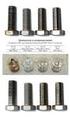 TEST REPORT Date: 03-05-2012 Reference: Duroc NV Corrosion Protection Moerelei 149 2610 Antwerp Belgium Written by: Ing. Martijn Wirken - [email protected] ZINCROLYTE VS DUPLEX 700 This document is not legally
Barrier Coatings: Conversion and Production Status
 Transparent SiO 2 Barrier Coatings: Conversion and Production Status E. Finson and J. Felts, Airco Coating Technology, Concord, CA Keywords: Permeation barrier coatings; Reactive evaporation; SiO 2 ABSTRACT
3 Single-Coated Foam Tapes
 3 Single-Coated Foam Tapes Technical Data May, 2008 Product Description 3M Single-Coated Foam Tapes will adhere to a variety of substrates, including latex-painted wood, lacquered wood, enameled steel,
Scotch-Weld. Low-Odor Acrylic Adhesives DP810 DP810 NS. Technical Data June, 2004
 3 Scotch-Weld TM Technical Data June, 2004 Product Description 3M Scotch-Weld Low-Odor Acrylic Adhesive DP810 and DP810 NS are twopart, 1:1 mix ratio, toughened structural adhesives with less odor than
Biomaterials in tissue engineering
 Biomaterials in tissue engineering S. Swaminathan Director Centre for Nanotechnology & Advanced Biomaterials School of Chemical & Biotechnology SASTRA University Thanjavur 613 401 Tamil Nadu Page 1 of
Separation of Amino Acids by Paper Chromatography
 Separation of Amino Acids by Paper Chromatography Chromatography is a common technique for separating chemical substances. The prefix chroma, which suggests color, comes from the fact that some of the
AVANSE 200 Resin Waterborne Acrylic Resin for Industrial Coatings
 Technical Data Sheet AVANSE 200 Resin Waterborne Acrylic Resin for Industrial Coatings Description Features and Benefits Typical Physical Properties Potential Applications AVANSE 200 Resin is an aqueous
Profiles for floors of same height Cerfix Projoint
 PROFILPAS S.P.A. VIA EINSTEIN, 38 35010 CADONEGHE (PADOVA) ITALY TEL. +39 (0)49 8878411 +39 (0)49 8878412 FAX. +39 (0)49-706692 EMAIL: [email protected] s for floors of same height Cerfix Projoint Application
Use of UV-Spectroscopy for Detection of MCI Migration Depth in Concrete
 Use of UV-Spectroscopy for Detection of MCI Migration Depth in Concrete Ming Shen, Josh Hicks Cortec Corporation. St Paul, MN Abstract Migrating Corrosion Inhibitors (MCI) are organic inhibitors based
SOCAL UP. Innovative High Performance Precipitated Calcium Carbonate for Emulsion Paints. PCC Division Solvay Special Chemicals
 SOCAL UP Innovative High Performance Precipitated Calcium Carbonate for Emulsion Paints PCC Division Solvay Special Chemicals Socal UP benefits in Emulsion paints Up to 60 % TiO 2 substitution (1 : 1)
The chemical interactions of the template molecule are primarily dependent on the choice of polymer
 Study of the Surface Morphology of Methyl 4-nitrobenzoate Template Thin-film Molecularly Imprinted Polymers Gary Kaganas Dartmouth College and Center for Nanomaterials Research at Dartmouth, Hanover NH
Challenges and. Opportunities of. Digital Printing. Andreas Koch Managing Director Digital Division
 Challenges and Opportunities of Digital Printing Andreas Koch Managing Director Digital Division Contents Why digital printing? The Marabu way Ink technologies Case study 2 Why digital printing? You can
This test may be carried out with the IGT printability testers A1-3, A2-3 and AIC2-5 with the accompanying inking unit AE.
 This test may be carried out with the IGT printability testers A1-3, A2-3 and AIC2-5 with the accompanying inking unit AE. INTRODUCTION With absorption the speed is meant with which the ink penetrates
Atomic Structure. Atoms consist of: Nucleus: Electrons Atom is electrically balanced equal electrons and protons. Protons Neutrons
 Basics of Corrosion Performance Metals Sacrificial anode manufacturer Specialize in aluminum alloy anodes All products made in the USA (Berks county, PA) ISO9001/2001 Certified Quality System Also traditional
Electroluminescent Materials
 Electroluminescent Materials Electroluminescent Materials Overview. Product Range. GEM s products are based on a unique curing process that results in the low temperature formation of a thermosetting polymer
Two component epoxy paste adhesive. Ideal for bonding GRP, SMC and dissimilar substrates
 Advanced Materials Araldite 2015 Structural Adhesives TECHNICAL DATA SHEET Araldite 2015 Two component epoxy paste adhesive Key properties Toughened paste Ideal for bonding GRP, SMC and dissimilar substrates
Construction. 3-part thixotropic epoxy patching mortar. Product Description. Tests
 Product Data Sheet Edition 05/12/2014 Identification no: 020204030010000044 Sikadur -41 CF Rapid 3-part thixotropic epoxy patching mortar Construction Product Description Uses Characteristics / Advantages
Tiangang TM BW-10LD (622)
 Tiangang TM BW-10LD Oligomeric Hindered Amine Light Stabilizer (HALS) Poly-(N-β-hydroxyethyl-2,2,6,6-tetramethyl-4-hydroxy-piperidyl-succinate) CAS number 65447-77-0 BW-10LD BW-10LD is a highly effective
The Anatomy of a Label
 The Anatomy of a Label Three key elements make up a label: face stock, release liner, and adhesive. Face Stock: Face stock is the material of the label that carries the imprint. The print can be applied