
Draft ETSI EN V1.0.0 ( )
|
|
|
- Scarlett Wade
- 9 years ago
- Views:
Transcription
1 Draft EN V1.0.0 ( ) European Standard Electronic Signatures and Infrastructures (ESI); Policy and security requirements for Trust Service Providers issuing certificates; Part 3: Policy Requirements for Certification Authorities issuing public key certificates

2 2 Draft EN V1.0.0 ( ) Reference DEN/ESI Keywords e-commerce, electronic signature, public key, security 650 Route des Lucioles F Sophia Antipolis Cedex - FRANCE Tel.: Fax: Siret N NAF 742 C Association à but non lucratif enregistrée à la Sous-Préfecture de Grasse (06) N 7803/88 Important notice Individual copies of the present document can be downloaded from: The present document may be made available in more than one electronic version or in print. In any case of existing or perceived difference in contents between such versions, the reference version is the Portable Document Format (PDF). In case of dispute, the reference shall be the printing on printers of the PDF version kept on a specific network drive within Secretariat. Users of the present document should be aware that the document may be subject to revision or change of status. Information on the current status of this and other documents is available at If you find errors in the present document, please send your comment to one of the following services: Copyright Notification No part may be reproduced except as authorized by written permission. The copyright and the foregoing restriction extend to reproduction in all media. European Telecommunications Standards Institute All rights reserved. DECT TM, PLUGTESTS TM, UMTS TM and the logo are Trade Marks of registered for the benefit of its Members. 3GPP TM and LTE are Trade Marks of registered for the benefit of its Members and of the 3GPP Organizational Partners. GSM and the GSM logo are Trade Marks registered and owned by the GSM Association.

3 3 Draft EN V1.0.0 ( ) Contents Intellectual Property Rights... 5 Foreword... 5 Introduction Scope References Normative references Informative references Definitions, abbreviations and notation Definitions Abbreviations Notation General concepts General Policy Requirements Concepts Certification Authority Certification services Certificate policy and certification practice statement Other CA statements Subscriber and subject EV Certificates Purpose of EVCs Introduction to certificate policies Overview Identification User community and applicability Conformance Conformance claim Conformance requirements Obligations, warranties and liability Certification Authority obligations and warranties Subscriber obligations Information for relying parties Liability Requirements on CA practices Certification practice statement Public key infrastructure - Key management life cycle Certification Authority key generation Certification Authority key storage, backup and recovery Certification Authority public key distribution Key escrow Certification Authority key usage End of CA key life cycle Life cycle management of cryptographic hardware used to sign certificates CA provided subject key management services Secure user device preparation Certificate management life cycle Subject registration Certificate renewal, rekey and update Certificate generation Dissemination of terms and conditions Certificate dissemination Certificate revocation and suspension... 28

4 4 Draft EN V1.0.0 ( ) 7.4 CA management and operation Security management Asset classification and management Personnel security Physical and environmental security Operations management System access management Trustworthy systems deployment and maintenance Business continuity management and incident handling CA termination Compliance with legal requirements Recording of information concerning certificates Organizational Framework for the definition of other certificate policies Certificate policy management Additional requirements Conformance Annex A (informative): Model PKI disclosure statement A.1 Introduction A.2 The PDS structure Annex B (informative): IETF RFC 3647 and present certificate policy document cross reference Annex C (informative): Revisions made since TS V Annex D (normative): Auditors qualification Annex E (informative): Bibliography History... 44

5 5 Draft EN V1.0.0 ( ) Intellectual Property Rights IPRs essential or potentially essential to the present document may have been declared to. The information pertaining to these essential IPRs, if any, is publicly available for members and non-members, and can be found in SR : "Intellectual Property Rights (IPRs); Essential, or potentially Essential, IPRs notified to in respect of standards", which is available from the Secretariat. Latest updates are available on the Web server ( Pursuant to the IPR Policy, no investigation, including IPR searches, has been carried out by. No guarantee can be given as to the existence of other IPRs not referenced in SR (or the updates on the Web server) which are, or may be, or may become, essential to the present document. Foreword This draft European Standard (EN) has been produced by Technical Committee Electronic Signatures and Infrastructures (ESI), and is now submitted for the Public Enquiry phase of the standards Two-step Approval Procedure. The present document is part 3 of a multi-part deliverable. Full details of the entire series can be found in part 1 [i.5]. The present document was previously published as TS [i.6]. Proposed national transposition dates Date of latest announcement of this EN (doa): Date of latest publication of new National Standard or endorsement of this EN (dop/e): Date of withdrawal of any conflicting National Standard (dow): 3 months after publication 6 months after doa 6 months after doa Introduction Electronic commerce, in its broadest sense, is emerging as a way of doing business and communicating across public and private networks. An important requirement of electronic commerce is the ability to identify the originator and protect the confidentiality of electronic exchanges. This is commonly achieved by using cryptographic mechanisms which are supported by a certification-service-provider issuing certificates, commonly called a Certification Authority (CA). For participants of electronic commerce to have confidence in the security of these cryptographic mechanisms they need to have confidence that the CA has properly established procedures and protective measure in order to minimize the operational and financial threats and risks associated with public key crypto systems. EN [18] identifies general policy requirements for Trust Service providers supporting Electronic Signatures regardless the service they provide. EN [13] provides a baseline for policy requirements for certification authorities issuing qualified certificates in line with the Directive 1999/93/EC [i.1] of the European Parliament and of the Council on a Community framework for electronic signatures (hereinafter referred to as "the Electronic Signature Directive"). The present document is based on the same approach as EN [13] but is applicable to the general requirements of certification in support of cryptographic mechanisms, including other forms of electronic signature as well as the use of cryptography for authentication and encryption. Moreover, where requirements identified have general applicability they are carried forward into the present document. Annex A of the present document identifies significant differences to EN [13]. Both documents reference EN [18] for the common general requirements.
6 6 Draft EN V1.0.0 ( ) Article 5.2 of the Electronic Signature Directive states that an electronic signature "is not denied legal effectiveness solely on the grounds that [it is] not based on a qualified certificate ". Hence, certificates issued by certification authorities operating in accordance with the present document are applicable to electronic signatures as described in article 5.2. The present document includes options for supporting the same level of quality by certification authorities issuing qualified certificates (as required article 5.1 of the Electronic Signature Directive 1999/93/EC [i.1]) but "normalized" for wider applicability and for ease of alignment with other similar specifications and standards from other sources and institutions. Through such harmonization the quality level set by the Electronic Signature Directive can become embodied in more widely recognized and accepted specifications. The present document applies also to certification authorities that include attributes in qualified certificates. Policy requirements for Attribute Authorities, i.e. for authorities that issue Attribute Certificate, are specified in TS [11]. Due to recent and increasingly sophisticated attacks on websites, e.g. via spoofing and DNS servers "poisoning", the CA/Browser Forum - CAB Forum - ( released the EV Certificate Guidelines (EVCG [14]) This technical specification includes provisions consistent with the requirements for issuing Extended Validation Certificates (EVC), as specified in the above mentioned CAB Forum EVC Guidelines (EVCG [14]). As a consequence, EVC issued by CAs operating in compliance with the EVC related provisions as indicated in the present document can be assessed as meeting the requirements specified by the CAB Forum in their EVCG [14] plus recognised good practice for CA's issuing certificates. The present document is derived from the requirements specified in TS "Policy requirements for certification authorities issuing public key certificates" [i.6].

7 7 Draft EN V1.0.0 ( ) 1 Scope The present document specifies policy requirements relating to Certification Authorities (CAs) issuing public key certificates, including Extended Validation Certificates (EVCs). It defines policy requirements on the operation and management practices of certification authorities issuing and managing certificates such that subscribers, subjects certified by the CA and relying parties may have confidence in the applicability of the certificate in support of cryptographic mechanisms. The policy requirements are defined in terms of five reference certificate policies and a framework from which CAs can produce a certificate policy targeted at a particular service. The first reference policy defines a set of requirements for CAs providing a level of quality the same as that offered by qualified certificates, without being tied to the Electronic Signature Directive (1999/93/EC [i.1]) and without requiring use of a secure user (cryptographic) device. This is labelled the "Normalized" Certificate Policy (NCP). It is anticipated that the NCP may be used as the basis for realizing the quality level set by the Qualified Certificate Policy (as defined in EN [13]) but without the legal constraints of the Electronic Signature Directive (1999/93/EC [i.1]). In addition to the NCP quality level, the present document specifies four alternative variants of NCP, the requirements of which may be used where alternative levels of service can be justified through risk analysis. The alternatives are referred to as: the Lightweight Certificate Policy (LCP) for use where a risk assessment does not justify the additional costs of meeting the more onerous requirements of the NCP (e.g. physical presence); the extended Normalized Certificate Policy (NCP+) for use where a secure user device is considered necessary; the Extended Validation Certificates Policy (EVCP) for use where provisions, additional to those indicated in NCP, are required to issue EVCs, consistently with what is specified in the EV Certificates Guidelines [14] issued by the CAB Forum; the enhanced Extended Validation Certificates Policy (EVCP+) for use where, in addition to the requirements to issue EVCs, a secure user device is considered necessary. EVCP and EVCP+ are based on NCP and NCP+ respectively, therefore, except where explicitly specified, all the relevant NCP and NCP+ requirements apply in addition to those specifically required for EVC. Certificates issued under these policies requirements may be used in support of any asymmetric mechanisms requiring certification of public keys including electronic and digital signatures, encryption, key exchange and key agreement mechanisms. The present document may be used by competent independent bodies as the basis for confirming that a CA provides a reliable service in line with recognized practices. As far as it regards EVC it can be used by: Auditors, operating in a European framework for evaluation of Certification Authorities, to evaluate whether these Certification Authorities meet the requirements for issuing EV Certificates as Specified in the CAB Forum EV Certificate Guidelines [14]; Certification Authorities, operating under the previous versions of this Technical Specification, that intend to adapt their policies and practices to issuing EV Certificates; Certification Authorities planning to issue EV Certificates within a context that fits European standard practices for CAs. Applications of EV Certificates include SSL web server certificates and certificates for code signing. It is recommended that subscribers and relying parties consult the certificate policy and certification practice statement of the issuing CA to obtain details of the requirements addressed by its certificate policy and how the certificate policy is implemented by the particular CA.

8 8 Draft EN V1.0.0 ( ) The policy requirements relating to the CA include requirements on the provision of services for registration, certificate generation, certificate dissemination, revocation management, revocation status and if required, secure subject device provision. Support for other trusted third party functions such as time-stamping and attribute certificates are outside the scope of the present document. In addition, the present document does not address requirements for Certification Authority certificates, including certificate hierarchies and cross-certification, except where explicitly specified in the cases of EVCP and/or EVCP+. Consistently with EVCG [14], within the clauses of the present document related to issuing EVCs the keyword "SHOULD" has the meaning specified in RFC 2119 [16] that indicates that there may exist valid reasons in particular circumstances to ignore a particular item, but the full implications need to be understood and carefully weighed before choosing a different course. The present document does not specify how the requirements identified may be assessed by an independent party, including requirements for information to be made available to such independent assessors, or requirements on such assessors. NOTE 1: See TS [i.2] for guidance on assessment of CA processes and services against the present document. The present document references EN [18] for policy general requirements common to all classes of CSP service. NOTE 2: See TR [i.4] for guidance on the use of the present document to the CA Browser Forum Guidelines for Extended Validation [14]. 2 References References are either specific (identified by date of publication and/or edition number or version number) or non-specific. For specific references, only the cited version applies. For non-specific references, the latest version of the reference document (including any amendments) applies. Referenced documents which are not found to be publicly available in the expected location might be found at NOTE: While any hyperlinks included in this clause were valid at the time of publication, cannot guarantee their long term validity. 2.1 Normative references The following referenced documents are necessary for the application of the present document. [1] FIPS PUB 140-1: "Security Requirements for Cryptographic Modules". [2] FIPS PUB (2001): "Security Requirements for Cryptographic Modules". [3] ISO/IEC (parts 1 to 3): "Information technology -- Security techniques -- Evaluation criteria for IT security". [4] CEN Workshop Agreement : "Security Requirements for Trustworthy Systems Managing Certificates for Electronic Signatures - Part 1: System Security Requirements". [5] CEN Workshop Agreement (2004): "Security Requirements for Trustworthy Systems Managing Certificates for Electronic Signatures - Part 2: Cryptographic Module for CSP signing operations with backup - Protection profile (CMCSOB-PP)". [6] CEN Workshop Agreement (2004): "Security Requirements for Trustworthy Systems Managing Certificates for Electronic Signatures - Part 3: Cryptographic module for CSP key generation services - Protection profile (CMCKG-PP)".

9 9 Draft EN V1.0.0 ( ) [7] CEN Workshop Agreement (2004): "Security Requirements for Trustworthy Systems Managing Certificates for Electronic Signatures - Part 4: Cryptographic module for CSP signing operations - Protection profile - CMCSO PP". NOTE: CEN Workshop Agreement is currently under revision to become the basis of a European Norm in CEN TC 224. [8] ISO/IEC /ITU-T Recommendation X.509: "Information technology - Open Systems Interconnection - The Directory: Public-key and attribute certificate frameworks". [9] Council Directive 93/13/EEC of 5 April 1993 on unfair terms in consumer contracts. [10] ISO/IEC (2005): "Information technology -- Security techniques -- Code of practice for information security management". NOTE: ISO/IEC (2005) was re-numbered as ISO/IEC on [11] TS : "Electronic Signatures and Infrastructures (ESI); Policy requirements for Certification Service Providers issuing attribute certificates usable with Qualified certificates". [12] TS : "Electronic Signatures and Infrastructures (ESI); Algorithms and Parameters for Secure Electronic Signatures; Part 1: Hash functions and asymmetric algorithms". [13] EN : "Electronic Signatures and Infrastructures (ESI); Policy and security requirements for Trust Service Providers issuing certificates; Part 2: Policy requirements for certification authorities issuing qualified certificates ". [14] CA/Browser Forum: "Guidelines for The Issuance and Management of Extended Validation Certificates, CA Browser Forum". [15] IETF RFC 5280: "Internet X.509 Public Key Infrastructure Certificate and Certificate Revocation List (CRL) Profile". [16] IETF RFC 2119: "Key words for use in RFCs to Indicate Requirement Levels". [17] ISO/IEC 17021: "Conformity assessment -- Requirements for bodies providing audit and certification of management systems". [18] EN : "Electronic Signatures and Infrastructures (ESI); General Policy Requirements for Trust Service Providers supporting electronic signatures". 2.2 Informative references The following referenced documents are not necessary for the application of the present document but they assist the user with regard to a particular subject area. [i.1] [i.2] [i.3] [i.4] [i.5] [i.6] Directive 1999/93/EC of the European Parliament and of the Council of 13 December 1999 on a Community framework for electronic signatures. TS : "Electronic Signatures and Infrastructures (ESI); Trust Service Provider Conformity Assessment - General requirements and guidance". IETF RFC 3647: "Internet X.509 Public Key Infrastructure - Certificate Policy and Certification Practices Framework". TR : "Electronic Signatures and Infrastructures (ESI); Guidance on TS for Issuing Extended Validation Certificates for Auditors and CSPs". EN : "Electronic Signatures and Infrastructures (ESI); Policy and security requirements for Trust Service Providers issuing certificates; Part 1: Overview". TS : "Electronic Signatures and Infrastructures (ESI); Policy requirements for certification authorities issuing public key certificates".

10 10 Draft EN V1.0.0 ( ) 3 Definitions, abbreviations and notation 3.1 Definitions For the purposes of the present document the terms and definitions defined in EN [18] and the following apply: certificate: public key of a user, together with some other information, rendered un-forgeable by encipherment with the private key of the Certification Authority which issued it Certificate Policy (CP): named set of rules that indicates the applicability of a certificate to a particular community and/or class of application with common security requirements NOTE: This is a specific type of CP as specified in EN [18]. Certificate Revocation List (CRL): signed list indicating a set of certificates that are no longer considered valid by the certificate issuer NOTE: See ITU-T Recommendation X.509 [8]. Certification Authority (CA): authority trusted by one or more users to create and assign certificates NOTE: See clause 4.1 for further explanation of the concept of Certification Authority. Certification Practice Statement (CPS): statement of the practices which a Certification Authority employs in issuing managing, revoking, and renewing or re-keying certificates NOTE: See RFC 3647 [i.3]. code signing certificate: certificate used for signing code in order to secure it enhanced Extended Validation Certificate (EVCP+): EVCP requiring use of a secure user device EV certificate: See Extended Validation Certificate. Extended Normalized Certificate Policy (NCP+): normalized certificate policy requiring use of a secure user device Extended Validation Certificate (EVC): certificate that is issued and maintained in compliance with the Extended Validation Certificate Policy or the enhanced Extended Validation Certificate Extended Validation Certificate Policy (EVCP): NCP enhanced to incorporate requirements in EVCG [14] Lightweight Certificate Policy (LCP): certificate policy which offers a quality of service less onerous than the qualified certificate policy NOTE: The qualified certificate policy is as defined in EN [13]. Normalized Certificate Policy (NCP): certificate policy which offers a quality of service equivalent to the qualified certificate policy NOTE: The qualified certificate policy is as defined in EN [13]. relying party: recipient of a certificate who acts in reliance on that certificate and/or digital signatures verified using that certificate NOTE: See RFC 3647 [i.3]. secure user device: device which holds the user's private key, protects this key against compromise and performs cryptographic functions on behalf of the user
11 11 Draft EN V1.0.0 ( ) 3.2 Abbreviations For the purposes of the present document, the abbreviations given in EN [18] and the following apply: CA CP CPS CRL CSP DNS EAL EV EVC EVCG EVCP EVCP+ LCP NCP NCP+ OCSP PDS PIN PKI QCP RA SSL TLS Certification Authority Certificate Policy Certification Practice Statement Certificate Revocation List Certification Service Provider Domain Name System Evaluation Assurance Level Extended Validation Extended Validation Certificate Extended Validation Certificate Guidelines Extended Validation Certificate Policy Enhanced Extended Validation Certificate Policy Lightweight Certificate Policy Normalized Certificate Policy Extended Normalized Certificate Policy Online Certificate Status Protocol PKI Disclosure Statement Personal Identifier Number Public Key Infrastructure Qualified Certificate Policy Registration Authority Secure Socket Layer Transport Layer Security 3.3 Notation The requirements identified in the present document include: a) mandatory requirements that must always be addressed. Such requirements are indicated by clauses without any additional marking; b) requirements that must be addressed if applicable to the services offered under the applicable certificate policy. Such requirements are indicated by clauses marked by "[CONDITIONAL]"; c) requirements that include several choices which ought to be selected depending on the quality of the service offered under the applicable certificate policy. Such requirements are indicated by markings by "[CHOICE]" with a subsequent indicator relating to the relative quality: - "[LCP]", "[NCP]", "[NCP+]", "[EVCP]", [EVCP+]. d) text copied from EVCG [14] is italicised. 4 General concepts 4.1 General Policy Requirements Concepts The concepts described in EN [18] clause 4 apply.

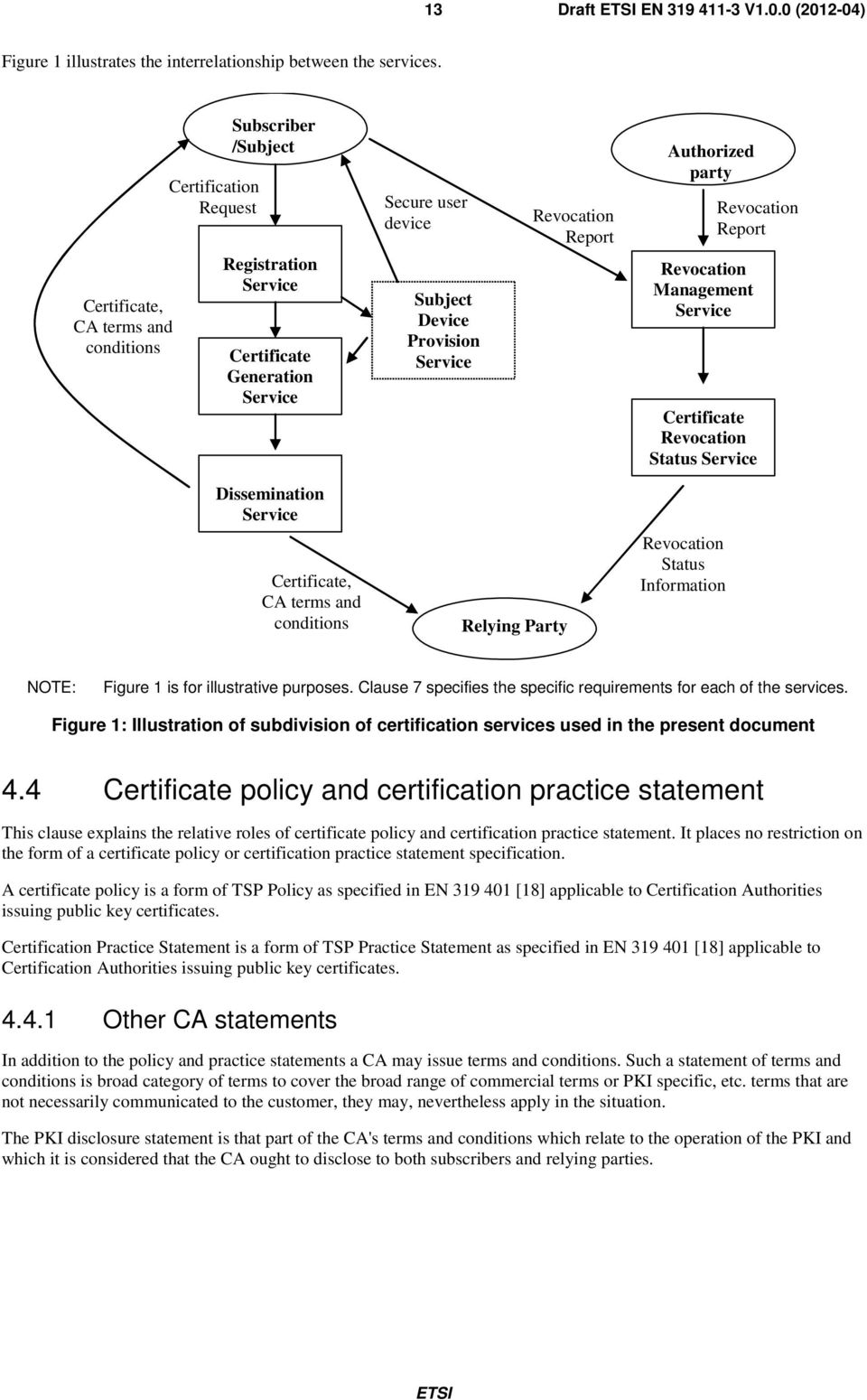
12 12 Draft EN V1.0.0 ( ) 4.2 Certification Authority The authority trusted by the users of the certification services (i.e. subscribers as well as relying parties) to create and assign certificates is called the Certification Authority. The Certification Authority has overall responsibility for the provision of the certification services identified in clause 4.3. The Certification Authority is identified in the certificate as the issuer and its private key is used to sign certificates. A Certification Authority is a trust-service-provider, as described in EN [18], and also a form of certification service provider as defined in the Electronic Signatures Directive 1999/93/EC [i.1], which issues public key certificates. 4.3 Certification services The service of issuing certificates is broken down in the present document into the following component services for the purposes of classifying requirements: Registration service: verifies the identity and, if applicable, any specific attributes of a subject. The results of this service are passed to the certificate generation service. Certificate generation service: creates and signs certificates based on the identity and other attributes verified by the registration service. Dissemination service: disseminates certificates to subjects, and if the subject consents, makes them available to relying parties. This service also makes available the CA's terms and conditions, and any published policy and practice information, to subscribers and relying parties. Revocation management service: processes requests and reports relating to revocation to determine the necessary action to be taken. The results of this service are distributed through the revocation status service. Revocation status service: provides certificate revocation status information to relying parties. This may be based upon certificate revocation lists or a real time service which provides status information on an individual basis. The status information may be updated on a regular basis and hence may not reflect the current status of the certificate. and optionally: Subject device provision service: prepares and provides signature-creation devices, or other secure user device, to subjects. NOTE: Examples of this service are: - a service which generates the subject's key pair and distributes the private key to the subject; - a service which prepares the subject's signature-creation module and enabling codes and distributes the module to the registered subject. This subdivision of services is only for the purposes of clarification of policy requirements and places no restrictions on any subdivision of an implementation of the CA services.

13 13 Draft EN V1.0.0 ( ) Figure 1 illustrates the interrelationship between the services. Certificate, CA terms and conditions Certification Request Subscriber /Subject Registration Service Certificate Generation Service Secure user device Subject Device Provision Service Revocation Report Authorized party Revocation Report Revocation Management Service Certificate Revocation Status Service Dissemination Service Certificate, CA terms and conditions Relying Party Revocation Status Information NOTE: Figure 1 is for illustrative purposes. Clause 7 specifies the specific requirements for each of the services. Figure 1: Illustration of subdivision of certification services used in the present document 4.4 Certificate policy and certification practice statement This clause explains the relative roles of certificate policy and certification practice statement. It places no restriction on the form of a certificate policy or certification practice statement specification. A certificate policy is a form of TSP Policy as specified in EN [18] applicable to Certification Authorities issuing public key certificates. Certification Practice Statement is a form of TSP Practice Statement as specified in EN [18] applicable to Certification Authorities issuing public key certificates Other CA statements In addition to the policy and practice statements a CA may issue terms and conditions. Such a statement of terms and conditions is broad category of terms to cover the broad range of commercial terms or PKI specific, etc. terms that are not necessarily communicated to the customer, they may, nevertheless apply in the situation. The PKI disclosure statement is that part of the CA's terms and conditions which relate to the operation of the PKI and which it is considered that the CA ought to disclose to both subscribers and relying parties.
14 14 Draft EN V1.0.0 ( ) 4.5 Subscriber and subject EN [18] defines that a subscriber may be an organization comprising several end-users or an individual end-user. In some cases certificates are issued directly to individuals for their own use. However, there commonly exist other situations where the party requiring a certificate is different from subject to whom the certificate applies. For example, a company may require certificates for its employees to allow them to participate in electronic business on behalf of the company, or a computer system may perform automated commerce on behalf of the owner organization. In such situations the entity subscribing to the Certification Authority for the issuance of certificates is different from the entity which is the subject of the certificate. Another common example is the case of server certificates, where the certificate is required for a computer system acting on behalf of the owner organization. In the present document to clarify the requirements which are applicable to the two different roles that may occur two different terms are used for the "subscriber" who contracts with the Certification Authority for the issuance of certificates and the "subject" to whom the certificate applies. The subscriber bears responsibility towards the CA for the use of the private key associated with the public key certificate but the subject is the individual entity that is authenticated by the private key and that has control over its use. In the case of certificates issued to individuals for their own use the subscriber and subject can be the same entity. In other cases, such as certificates issued to employees or computer systems as mentioned above, the subscriber and subject are different. The subscriber would be, for example, the employer or owner organization. The subject would be the employee or computer system. Within the present document we use these two terms with this explicit distinction wherever it is meaningful to do so, although in some cases the distinction is not always clear. 4.6 EV Certificates Purpose of EVCs The specific purpose of EV Certificates is clarified in EVCG [14], section 6 "Basic Concepts of the EV Certificate" that states: 6.1 Purpose of EV Certificate: EV Certificates are intended for establishing Web-based data communication conduits via TLS/SSL protocols and for verifying the authenticity of executable code Primary Purposes: (1) Identify the legal entity that controls a website (2) Enable encrypted communications with a website (3) Identify the source of executable code Secondary Purposes: to help establish the legitimacy of a business claiming to operate a website or distribute executable code, and to provide a vehicle that can be used to assist in addressing problems related to phishing, malware and other forms of online identity fraud Excluded Purposes: EV Certificates focus only on the identity of the Subject named in the Certificate, and not on the behavior of the Subject. Additionally, EVCG [14] Appendix G "Code-signing: Introduction (Informative) - 1. Purpose" states: "Purpose of EV Code Signing Certificates. EV Code Signing Certificates are intended to be used to verify the identity of a holder of an EV code signing certificate (Subscriber) and the integrity of its code. They provide assurance to a user or platform provider that code verified with the certificate has not been modified from its original form and is distributed by the legal entity identified in the EV Code Signing Certificate by name, Place of Business address, Jurisdiction of Incorporation or Registration, and other information. EV Code Signing Certificates may help to establish the legitimacy of signed code, help to maintain the trustworthiness of software platforms, help users to make informed software choices, and limit the spread of malware." No particular software object is identified by an EV Code-Signing Certificate, only its distributor is identified.

15 15 Draft EN V1.0.0 ( ) 5 Introduction to certificate policies 5.1 Overview A certificate policy is a "named set of rules that indicates the applicability of a certificate to a particular community and/or class of application with common security requirements" [8], [18]. The policy requirements are defined in the present document in terms of certificate policies. Certificates issued in accordance with the present document include a certificate policy identifier which can be used by relying parties in determining the certificates suitability and trustworthiness for a particular application. The present document specifies five certificate policies: 1) A Normalized Certificate Policy (NCP) which offers the same quality as that offered by the Qualified Certificate Policy (QCP) as defined in EN [13] but without the legal constraints implied by the Electronic Signature Directive (1999/93/EC) [i.1] and without requiring the use of a Secure Signature Creation Device. NOTE 1: The certificate policy NCP is particularly suited to the support of Advanced Electronic Signatures, as defined by the Electronic Signature Directive (1999/93/EC) [i.1], for legal entities if they use physical means to provide reasonable confidence that the signing key remains under their sole control. 2) An extended Normalized Certificate Policy (NCP+) which offers the same quality as that offered by the Qualified Certificate Policy (QCP) as defined in EN [13] but without the legal constraints implied by the Electronic Signature Directive (1999/93/EC) [i.1] and, instead of requiring the use of a Secure Signature Creation, requires the use of a secure user device. NOTE 2: The certificate policy NCP+ is particularly suited to the support of Advanced Electronic Signatures, as defined by the Electronic Signature Directive (1999/93/EC) [i.1], for human beings as well as legal entities since the use of a secure user device provides confidence that the signing key remains under the sole control of the signatory. 3) A Lightweight Certificate Policy (LCP) which incorporates less demanding policy requirements. 4) An Extended Validation Certificate Policy (EVCP) that includes, except where explicitly indicated, all the Normalized Certificate Policy (NCP) requirements, plus additional provisions suited to support EVC issue, usage and maintenance as specified in EVCG [14], section ) An enhanced Extended Validation Certificate Policy (EVCP+) that includes, except where explicitly indicated, all the extended Normalized Certificate Policy (NCP+) requirements, enhanced with additional provisions suited to support EVC issue, usage and maintenance as specified in EVCG [14], section when the EVCs owner must operate make use of a secure device. Clause 8 specifies a framework for other certificate policies which enhance or further constrain the above policies. 5.2 Identification The identifiers for the certificate policies specified in the present document are: a) NCP: Normalized Certificate Policy itu-t(0) identified-organization(4) etsi(0) other-certificate-policies(2042) policy-identifiers(1) ncp (1) b) NCP+: Normalized Certificate Policy requiring a secure user device itu-t(0) identified-organization(4) etsi(0) other-certificate-policies(2042) policy-identifiers(1) ncpplus (2)
![[8], [18]. The policy requirements are defined in the present document in terms of certificate policies.](/docs-images/46/21110687/images/page_15.jpg "Certificates issued in accordance with the present document include a certificate policy identifier which can be used by relying parties in determining the certificates suitability and")
16 16 Draft EN V1.0.0 ( ) c) LCP: Lightweight Certificate Policy itu-t(0) identified-organization(4) etsi(0) other-certificate-policies(2042) policy-identifiers(1) lcp (3) d) EVCP: Extended Validation Certificate Policy itu-t(0) identified-organization(4) etsi(0) other-certificate-policies(2042) policy-identifiers(1) evcp (4) e) EVCP+: Extended Validation Certificate Policy requiring a secure user device itu-t(0) identified-organization(4) etsi(0) other-certificate-policies(2042) policy-identifiers(1) evcpplus (5) By including one of these object identifiers in a certificate the CA claims conformance to the identified certificate policy. 5.3 User community and applicability The policies defined in the present document place no constraints on the user community and applicability of the certificate. 5.4 Conformance Conformance claim The CA shall only claim conformance to the present document as applied in the certificate policy (or policies) identified in the certificate that it issues if: a) It claims conformance to the identified certificate policy and makes available to subscribers and relying parties on request the evidence to support the claim of conformance. NOTE 1: This evidence can be, for example, a report from a TSP conformity assessment body confirming that the CA conforms to the requirements of the identified policy. See TS "Policy Requirements and Guidance for TSP Conformity Assessment" [i.2]. b) It has a current assessment of conformance to the identified certificate policy by a competent independent party. The results of the assessment shall be made available to subscribers and relying parties on request. NOTE 2: See TS "Policy Requirements and Guidance for TSP Conformity Assessment" [i.2]. NOTE 3: CAs may issue certificates for internal and testing purposes provided that such certificates are not made available to for any other uses. c) If the CA is later shown to be non-conformant in a way that significantly affects the ability of the CA to meet the objectives identified in the present document, then it shall cease issuing certificates using the identifiers in clause 5.2 until it has demonstrated or been assessed as conformant, otherwise the CA shall take steps to remedy the non-conformance within a reasonable period. NOTE 4: Even if a CA is known to be critically non-conformant, it may issue certificates for internal and testing purposes provided that such certificates are not made available to for any other uses. d) The CA compliance shall be checked on a regular basis and whenever major change is made to the CA operations. e) [EVCP] and [EVCP+] The CA and its Root CA before issuing EV Certificates MUST successfully and respectively complete a point-in-time readiness assessment audit against the present document for the primary certification of the CA (readiness) and a period-in-time assessment has to be stated with the supervisory audit at least every year.

17 17 Draft EN V1.0.0 ( ) Conformance requirements A conformant CA must demonstrate that: a) it meets its obligations as defined in clause 6.1; b) it has implemented controls which meet the requirements, including options applicable to the implemented policies, as specified in clause 7. 6 Obligations, warranties and liability 6.1 Certification Authority obligations and warranties The obligations specified in EN [18] clause 5.1 apply. The CA shall ensure that all requirements on CA, as detailed in clause 7, are implemented as applicable to the selected certificate policy (see clauses and 8.3). The CA has the responsibility for conformance with the procedures prescribed in this policy, even when the CA functionality is undertaken by sub-contractors. 6.2 Subscriber obligations The CA shall oblige through agreement (see clause m)) the subscriber to address all the following obligations. If the subject and subscriber are separate entities, the subscriber shall make the subject aware of those obligations applicable to the subject (as listed below): a) accurate and complete information is submitted to the CA in accordance with the requirements of this policy, particularly with regards to registration; b) the key pair is only used in accordance with any limitations notified to the subscriber (see clause 7.3.4); c) reasonable care is exercised to avoid unauthorized use of the subject's private key; d) [CONDITIONAL] if the subscriber or subject generates the subject's keys: i) subject keys are generated using an algorithm recognized by industry as being fit for the uses of the certified key as identified in the certificate policy; a key length and algorithm is used which is recognized as being fit for the uses of the certified key as identified in the certificate policy during the validity time of the certificate. NOTE 1: See TS [12] giving guidance on algorithms and their parameters. e) [CONDITIONAL] if the subscriber or subject generates the subject's keys and the private key is for creating electronic signatures the subject's private key can be maintained under the subject's sole control; f) [NCP+] only use the subject's private key for cryptographic functions within the secure user device; g) [NCP+] [CONDITIONAL] if the subject's keys are generated under control of the subscriber or subject, generate the subject's keys within the secure user device; h) notify the CA without any reasonable delay, if any of the following occur up to the end of the validity period indicated in the certificate: i) the subject's private key has been lost, stolen, potentially compromised; or i control over the subject's private key has been lost due to compromise of activation data (e.g. PIN code) or other reasons; and/or inaccuracy or changes to the certificate content, as notified to the subscriber or to the subject.
![1 Certification Authority obligations and warranties The obligations specified in EN 319 401 [18] clause 5.1 apply.](/docs-images/46/21110687/images/page_17.jpg "The CA shall ensure that all requirements on CA, as detailed in clause 7, are implemented as applicable to the selected certificate policy (see clauses 5.4.2 and 8.3).")
18 18 Draft EN V1.0.0 ( ) i) following compromise, the use of the subject's private key is immediately and permanently discontinued; j) in the case of being informed that the CA which issued the subject's certificate has been compromised, ensure that the certificate is not used by the subject. NOTE 2: Where [EVCP] or [EVCP+] is involved, additional guidance from the EVCG [14] should be taken into account, namely from section 9.3 and from appendix A. For EV code signing certificates, appendixes G and H apply. 6.3 Information for relying parties The general obligations specified in EN [18] clause 5.3 apply. The terms and conditions made available to relying parties (see clause 7.3.4) shall include a notice that if it is to reasonably rely upon a certificate, it shall: a) verify the validity, suspension or revocation of the certificate using current revocation status information as indicated to the relying party (see clause 7.3.4); and NOTE 1: Depending on CA's practices and the mechanism used to provide revocation status information, there may be a delay of up to 1 day in disseminating revocation status information. Where [EVCP] or [EVCP+] is involved, please refer to clause 7.3.6, item h) i. b) take account of any limitations on the usage of the certificate indicated to the relying party either in the certificate or the terms and conditions supplied as required in clause 7.3.4; and c) take any other precautions prescribed in agreements or elsewhere. NOTE 2: Depending on CA's practices related to the problem reporting and response capability, where [EVCP] and [EVCP+] are involved, refer to section 11.3 of EVCG [14]. 6.4 Liability The CA shall specify any disclaimers or limitations of liability in accordance with applicable laws. Where [EVCP] or [EVCP+] is involved, please refer to section of EVCG [14]. 7 Requirements on CA practices The CA shall implement the controls that meet the following requirements. The present document includes the provision of services for registration, certificate generation, dissemination, revocation management and revocation status (see clause 4.3). Where requirements relate to a specific service area of the CA then it is listed under one of these subheadings. Where no service area is listed, or "CA General" is indicated, a requirement is relevant to the general operation of the CA. These policy requirements are not meant to imply any restrictions on charging for CA services. The requirements are indicated in terms of the security objectives followed by more specific requirements for controls to meet those objectives where considered necessary to provide the necessary confidence that those objective will be met. NOTE: The details of controls required to meet an objective is a balance between achieving the necessary confidence whilst minimizing the restrictions on the techniques that a CA may employ in issuing certificates. In case of clause 7.4 (CA management and operation) reference is made to other more general standards which may be used as a source of more detailed control requirements. Due to these factors the specificity of the requirements given under a given topic may vary.
19 19 Draft EN V1.0.0 ( ) 7.1 Certification practice statement The general requirements specified in EN [18], clause 6.1 apply. In addition the following particular requirements apply: a) [EVCP] and [EVCP+]: The CA's certification practice statement shall include the item 1 and item 3 from sections and 15.1 of EVCG [14]. b) The CA shall make available its certification practice statement, and other relevant documentation, as necessary to assess conformance to the certificate policy: 1) to subscribers and relying parties; 2) [EVCP] and [EVCP+]: EVCG [14], section item 1 c) and NOTE: The CA is not generally required to make all the details of its practices public. c) The CA shall have a high level management body with final authority and responsibility for approving the certification practice statement. d) The CA shall document the algorithms and parameters employed. e) [EVCP] and [EVCP+]: The CA SHALL address the provisions specified in EVCG [14], sections and Public key infrastructure - Key management life cycle Certification Authority key generation Certificate generation The requirements identified in EN [18] clause shall apply. In addition the following particular requirements apply: a) Certification Authority key generation shall be undertaken in a physically secured environment (see clause 7.4.4) by personnel in trusted roles (see clause 7.4.3) under, at least, dual control. The number of personnel authorized to carry out this function shall be kept to a minimum and be consistent with the CA's practices. b) [CHOICE]: [LCP] CA key generation shall be carried out in a product, application or device which ensures that the keys are generated in a trustworthy manner and do not compromise the security of the private key and which: i) meets the requirements identified in FIPS PUB [1], or FIPS PUB [2] level 2 or higher; or is a trustworthy system which is assured to EAL 3 or higher in accordance to ISO/IEC [3], or equivalent security criteria. [NCP] CA key generation shall be carried out within a device which either: i meets the requirements identified in FIPS PUB [1], or FIPS PUB [2] level 3 or higher; or iv) meets the requirements identified in one of the following CEN Workshop Agreement [5], CWA [6] or CWA [7]; or v) is a trustworthy system which is assured to EAL 4 or higher in accordance to ISO/IEC [3], or equivalent security criteria. This shall be to a security target or protection profile which meets the requirements of the present document, based on a risk analysis and taking into account physical and other non-technical security measures.

20 20 Draft EN V1.0.0 ( ) NOTE 1: The rules of clause b) to e) apply also to key generation even if carried out in a separate system. c) Certification Authority key generation shall be performed using an algorithm recognized by industry as being fit for the CA's signing purposes. d) The selected key length and algorithm for CA signing key shall be one which is recognized by industry as being fit for the CA's signing purposes. TS [12] giving guidance on algorithms and their parameters. [EVCP] and [EVCP+]: EVCG [14] appendix A (1) and (2) also apply. EVCG [14] appendix A will prevail in case of conflict. e) A suitable time before expiration of its CA signing key (for example as indicated by expiration of CA certificate), the CA shall generate a new certificate-signing key pair and shall apply all necessary actions to avoid disruption to the operations of any entity that may rely on the CA key. The new CA key shall also be generated and distributed in accordance with this policy. NOTE 2: In order to meet this requirement these operations need to be performed timely enough to allow all parties that have relationships with the CA (subjects, subscribers, relying parties, higher level CAs, etc.) to be timely aware of this key changeover and to implement the required operations to avoid inconveniences and malfunctions. This does not apply to a CA which will cease its operations before its own certificatesigning certificate expiration date. f) [EVCP] and [EVCP+]: EVCG [14], section applies. In case of EV code signing certificates Appendix H of EVCG [14] applies Certification Authority key storage, backup and recovery Certificate generation The requirements identified in EN [18], clause shall apply. In addition the following particular requirements apply: a) [CHOICE]: [LCP] The CA private signing key shall be held and used in a product, application or device which does not compromise the security of the private key and which: i) meets the requirements identified in FIPS PUB [1], or FIPS PUB [2], level 2 or higher; or is a trustworthy system which is assured to EAL 3 or higher in accordance to ISO/IEC [3], or equivalent security criteria. [NCP] The CA private signing key shall be held and used within a secure cryptographic device which: i meets the requirements identified in FIPS PUB [1], or FIPS PUB [2] level 3 or higher; or iv) meets the requirements identified in one of the following CEN Workshop Agreement [5], CWA [6], CWA [7]; or v) is a trustworthy system which is assured to EAL 4 or higher in accordance to ISO/IEC [3], or equivalent security criteria. This shall be to a security target or protection profile which meets the requirements of the present document, based on a risk analysis and taking into account physical and other non-technical security measures. b) [CHOICE]: [LCP] When outside the signature-creation product, application or device, the secrecy of the CA's private key shall be ensured. NOTE: This may be achieved using physical security or encryption. [NCP] When outside the signature-creation device (see a) above) the CA private signing key shall be protected in a way that ensures the same level of protection as provided by the signature creation device.
21 21 Draft EN V1.0.0 ( ) c) The CA private signing key shall be backed up, stored and recovered only by personnel in trusted roles using, at least, dual control in a physically secured environment (see clause 7.4.4). The number of personnel authorized to carry out this function shall be kept to a minimum and be consistent with the CA's practices. d) Backup copies of the CA private signing keys shall be subject to the same or greater level of security controls as keys currently in use. e) Where the keys are stored in a dedicated key processing hardware module, access controls shall be in place to ensure that the keys are not accessible outside the hardware module Certification Authority public key distribution Certificate generation and certificate distribution The requirements identified in clause shall apply. In addition the following particular requirements apply: The CA shall ensure that the integrity and authenticity of the CA signature verification (public) key and any associated parameters are maintained during its distribution to relying parties. In particular: a) CA signature verification (public) keys shall be made available to relying parties in a manner that assures the integrity of the CA public key and authenticates its origin. NOTE: For example, Certification Authority public keys may be distributed in certificates signed by itself, along with a declaration that the key authenticates the CA, or issued by another CA. By itself a self signed certificate cannot be known to come from the CA. Additional measures, such as checking the fingerprint of the certificate against information provided by a trusted source, is needed to give assurance of the correctness of this certificate Key escrow a) [CONDITIONAL] If the subject's key is to be used for electronic signatures with the meaning of Directive 1999/93/EC [i.1], then the CA shall not hold the subject's private signing keys in a way which provides a backup decryption capability (commonly called key escrow). b) [CONDITIONAL] If a copy of the subject's key is kept by the CA then the CA shall ensure that the private key is kept secret and only made available to appropriately authorized persons Certification Authority key usage The CA shall ensure that CA private signing keys are not used inappropriately. In particular: Certificate generation a) CA signing key(s) used for generating certificates, as defined in clause 7.3.3, and/or issuing revocation status information, shall not be used for any other purpose. b) The certificate signing keys shall only be used within physically secure premises.
22 22 Draft EN V1.0.0 ( ) End of CA key life cycle The CA shall ensure that CA private signing keys are not used beyond the end of their life cycle. In particular: Certificate generation a) The use of the corresponding CA's private key, shall be limited to that compatible with the hash algorithm, the signature algorithm and signature key length used in the generating certificates, in line with current practice as in clause d). b) All copies of the CA private signing keys shall be destroyed or put beyond use at the end of their life cycle Life cycle management of cryptographic hardware used to sign certificates The requirements identified in EN [18], clause shall apply. In addition the following particular requirements apply: Certificate generation In particular the CA shall ensure that: a) certificate and revocation status information signing cryptographic hardware is not tampered with during shipment; b) certificate and revocation status information signing cryptographic hardware is not tampered with while stored; c) the installation, activation, back-up and recovery of the CA's signing keys in cryptographic hardware shall require simultaneous control of at least of two trusted employees; d) certificate and revocation status information signing cryptographic hardware is functioning correctly; and e) CA private signing keys stored on CA cryptographic hardware are destroyed upon device retirement. This destruction does not affect all copies of the private key. Only the physical instance of the key stored in the cryptographic hardware under consideration will be destroyed CA provided subject key management services The CA shall ensure that any subject keys, that it generates, are generated securely and the secrecy of the subject's private key is assured. Certificate generation [CONDITIONAL] If the CA generates the subject's keys: a) CA-generated subject keys shall be generated using an algorithm recognized by industry as being fit for the uses identified in the certificate policy during the validity time of the certificate. b) CA-generated subject keys shall be of a key length and for use with a public key algorithm which are recognized by industry as being fit for the purposes stated in the certificate policy during the validity time of the certificate. [EVCP] or [EVCP+]: guidance SHALL be taken from the EVCG [14], appendix A but SHALL not override a) and b). NOTE: See TS [12] giving guidance on algorithms and their parameters. EVCG [14] appendix A will prevail in case of conflict. c) CA-generated subject keys shall be generated and stored securely before delivery to the subject.
23 23 Draft EN V1.0.0 ( ) d) The subject's private key shall be delivered to the subject in a manner such that the secrecy and integrity of the key is not compromised. e) [CONDITIONAL] If a copy of the subject's private key is not required to be kept by the CA, or other authorized entity, (see clause 7.2.4), once delivered to the subject, the private key can be maintained under the subject's sole control. Any copies of the subject's private key held by the CA shall be destroyed Secure user device preparation [NCP+] and [EVCP+] The CA shall ensure that if it issues to the subject secure user device this is carried out securely. In case of a EV code signing certificate follow indications of Appendix H item 10 of EVCG [14]. Subject device provision [CONDITIONAL]: In particular, if the CA issues a secure user device: a) Secure user device preparation shall be securely controlled by the service provider. b) Secure user device shall be securely stored and distributed. c) Secure user device deactivation and reactivation shall be securely controlled. d) Where the secure user device has associated user activation data (e.g. PIN code), the activation data shall be securely prepared and distributed separately from the signature-creation module. NOTE: Separation may be achieved by ensuring distribution of activation data and delivery of secure signature creation device at different times, or via a different route. 7.3 Certificate management life cycle Subject registration The CA shall ensure that evidence of subscriber's and subject's identification and accuracy of their names and associated data are either properly examined as part of the defined service or, where applicable, concluded through examination of attestations from appropriate and authorized sources, and that certificate requests are accurate, authorized and complete according to the collected evidence or attestation. In particular: Registration a) Before entering into a contractual relationship with a subscriber, the CA shall inform the subscriber of the terms and conditions regarding use of the certificate as given in clause b) [CONDITIONAL]: If the subject is a person and not the same as the subscriber, the subject shall be informed of his/her obligations. c) The CA shall communicate this information through a durable (i.e. with integrity over time) means of communication, which may be transmitted electronically, and in readily understandable language. NOTE 1: A model PKI disclosure statement which may be used as the basis of such a communication is given in annex B. d) The service provider shall collect either direct evidence, or an attestation from an appropriate and authorized source, of the identity (e.g. name) and, if applicable, any specific attributes of subjects to whom a certificate is issued. Submitted evidence may be in the form of either paper or electronic documentation. Verification of the subject's identity shall be at time of registration by appropriate means and in accordance with national law. [EVCP] and [EVCP+]: Guidance on Information Verification requirements SHALL be taken from the EVCG [14], section 10.
24 24 Draft EN V1.0.0 ( ) e) [CHOICE]: [LCP] No requirement. [NCP] If the subject is a physical person evidence of the subject's identity (e.g. name) shall be checked against a physical person either directly or shall have been checked indirectly using means which provides equivalent assurance to physical presence (see note 2). Evidence for verifying other entities shall involve procedures which provide the same degree of assurance. NOTE 2: An example of evidence checked indirectly against a physical person is documentation presented for registration which was acquired as the result of an application requiring physical presence. f) [CONDITIONAL] If the subject is a physical person, evidence shall be provided of: i) full name (including surname and given names consistent with the applicable law and national identification practices); date and place of birth, reference to a nationally recognized identity document, or other attributes which may be used to, as far as possible, distinguish the person from others with the same name. NOTE 3: It is recommended that the place be given in accordance to national conventions for registering births. g) [CONDITIONAL] If the subject is a physical person who is identified in association with a legal person, or organizational entity (e.g. the subscriber), evidence shall be provided of: i) full name (including surname and given names, consistently with the applicable law and national identification practices) of the subject; i iv) date and place of birth, reference to a nationally recognized identity document, or other attributes of the subscriber which may be used to, as far as possible, distinguish the person from others with the same name; full name and legal status of the associated legal person or other organizational entity (e.g. the subscriber); any relevant existing registration information (e.g. company registration) of the associated legal person or other organizational entity; v) evidence that the subject is associated with the legal person or other organizational entity. h) [CONDITIONAL] If the subject is an organizational entity, evidence shall be provided: i) of full name of the organizational entity (private organization, government entity or non-commercial entity); [EVCP] and [EVCP+]: Guidance on Information Verification requirements SHALL be taken from the EVCG [14], sections 10.2 to 10.6; i of reference to a nationally recognized registration, or other attributes which may be used to, as far as possible, distinguish the organizational entity from others with the same name; [EVCP] and [EVCP+]: EVCG [14]. Section item 1) and 2) apply. NOTE 4: This provision MAY be also enforced when registering subjects related to non EV certificates. i) [CONDITIONAL] If the subject is a device or system operated by or on behalf of an organizational entity, evidence shall be provided of: i) identifier of the device by which it may be referenced (e.g. Internet domain name); [EVCP] and [EVCP+]: Domain verification requirements SHALL be taken from the EVCG [14], section 10.6; i full name of the organizational entity; a nationally recognized identity number, or other attributes which may be used to, as far as possible, distinguish the organizational entity from others with the same name.
25 25 Draft EN V1.0.0 ( ) j) The CA shall record all the information necessary to verify the subject's identity and, if applicable, any specific attributes of the subject, including any reference number on the documentation used for verification, and any limitations on its validity. k) If an entity other than the subject is subscribing to the CA services (i.e. the subscriber and subject are separate entities - see clause 4.5) then evidence shall be provided that the subscriber is authorized to act for the subject as identified (e.g. is authorized for all members of the identified organization). [EVCP] and [EVCP+]: Guidance on roles SHALL be taken from the EVCG [14], section l) The subscriber shall provide a physical address, or other attributes, which describe how the subscriber may be contacted. [EVCP] and [EVCP+]: Guidance on Verification of the applicant's location should be taken from the EVCG [14], section m) The CA shall record the signed agreement with the subscriber including: i) agreement to the subscriber's obligations (see clause 6.2); i iv) if required by the CA, agreement by the subscriber to user secure user device; consent to the keeping of a record by the CA of information used in registration, subject device provision, including whether this is to the subscriber or to the subject where they differ, and any subsequent revocation (see clause ), the identity and any specific attributes placed in the certificate, and the passing of this information to third parties under the same conditions as required by this policy in the case of the CA terminating its services; whether, and under what conditions, the subscriber requires and the subject consents to the publication of the certificate; v) confirmation that the information held in the certificate is correct. NOTE 5: The subscriber may agree to different aspects of this agreement during different stages of registration. For example, agreement that the information held in the certificate is correct may be carried out subsequent to other aspects of the agreement. NOTE 6: This agreement may be in electronic form. vi) [EVCP] and [EVCP+]: Guidance on Verification of the signatures and of the approval of EV request shall be taken from the EVCG [14], sections 10.8 and n) The records identified above shall be retained for the period of time as indicated to the subscriber (see c) above) and as necessary for the purposes for providing evidence of certification in legal proceedings. [EVCP] and [EVCP+]: at least seven years after any EV Certificate based on that documentation ceases to be valid as stated in EVCG [14], section NOTE 7: The factors that need to be taken into account in identifying "applicable law" are: i) the law of the country where the CA is established should always be considered; i where subjects are registered through a registration authority in another country to where the CA is established then that RA should also apply its own country's regulations; where some subscribers are also in another country then contractual and other legal requirements applicable to those subscribers should also be taken into account. o) [CONDITIONAL] If the subject's key pair is not generated by the CA, the certificate request process shall ensure that the subject has possession of the private key associated with the public key presented for certification. p) The CA shall ensure that the requirements of the applicable national data protection legislation are adhered to (including the use of pseudonyms if applicable) within their registration process.
26 26 Draft EN V1.0.0 ( ) q) The CA's verification policy shall only require the capture of evidence of identity sufficient to satisfy the requirements of the intended use of the certificate. r) [EVCP] and [EVCP+]: the CA MUST abide by EVCG [14] requirements in section The Acceptable methods of verifications are specified in EVCG [14] requirements in section s) [EVCP] and [EVCP+]: For a dual control procedure follow EVCG [14], section t) [EVCP] and [EVCP+]: The subscriber shall satisfy the requirements stated in EVCG [14] section 7.2. u) [EVCP] and [EVCP+]: Certificate requests shall obtain the information from the subscriber as specified in EVCG [14] section Certificate renewal, rekey and update The CA shall ensure that requests for certificates issued to a subject who has previously been registered with the same CA are complete, accurate and duly authorized. This includes certificate renewals, rekey following revocation or prior to expiration, or update due to change to the subject's attributes. NOTE: The subscriber may, if the CA offers this service, request a certificate renewal for example where relevant attributes presented in the certificate have changed or when the certificate is nearing expiry. In particular: Registration a) The CA shall check the existence and validity of the certificate to be renewed and that the information used to verify the identity and attributes of the subject are still valid. b) If any of the CA terms and conditions have changed, these shall be communicated to the subscriber and agreed to in accordance with clause a), b), c) and m). c) If any certified names or attributes have changed, or the previous certificate has been revoked, the registration information is verified, recorded, agreed to by the subscriber in accordance with clause d) to l). d) The CA shall issue a new certificate using the subject's previously certified public key, only if its cryptographic security is still sufficient for the new certificate's validity period and no indications exist that the subject's private key has been compromised Certificate generation The CA shall ensure that it issues certificates securely to maintain their authenticity. In particular: Certificate generation a) The certificates shall include, in accordance with X.509 [8] and RFC 5280 [15]: i) identification of the CA (certification-service-provider) and the country in which it is established; i iv) the name of the subject, or a pseudonym which shall be identified as such; provision for a specific attribute of the signatory to be included if relevant, depending on the purpose for which the certificate is intended; the public key which corresponds to the private key under the control of the subject; v) an indication of the beginning and end of the period of validity of the certificate; vi) the serial number of the certificate; v the electronic signature of the Certification Authority issuing it;
27 27 Draft EN V1.0.0 ( ) vi limitations on the scope of use of the certificate, if applicable; and ix) limits on the value of transactions for which the certificate can be used, if applicable; x) [EVCP] and [EVCP+]: Requirements in clauses 8.1 and 8.2 on certification content and on policy identification shall be applied. Guidance on Validity period SHALL be taken from the EVCG [14], section 8.3. In the case of EV certificate for SSL/TSL EVCG [14], Appendix B applies. In case of an EV code signing certificate Appendix H of EVCG [14] applies. b) The CA shall take measures against forgery of certificates, and, in cases where the CA generates the subjects' private key, guarantee confidentiality during the process of generating such data. c) The procedure of issuing the certificate is securely linked to the associated registration, certificate renewal or rekey, including the provision of any subject-generated public key. d) [CONDITIONAL] if the CA generated the subject's key: i) the procedure of issuing the certificate is securely linked to the generation of the key pair by the CA; i [LCP], [NCP] the private key is securely passed to the registered subject; [NCP+] the secure user device containing the subject's private key is securely passed to the registered subject. e) The CA shall ensure that over the life time of the CA a distinguished name which has been used in a certificate by it is never re-assigned to another entity. f) The confidentiality and integrity of registration data shall be protected, especially when exchanged with the subscriber/subject or between distributed CA system components. g) The CA shall verify that registration data is exchanged with recognized registration service providers, whose identity is authenticated, in the event that external registration service providers are used Dissemination of terms and conditions The general obligations specified in EN [18] clause 6.2 apply. In addition the CA shall ensure that the terms and conditions are made available to subscribers and relying parties. In particular: a) The indication of the certificate policy being applied shall include: i) the certificate policy being applied, including a clear statement as to whether the policy is for certificates issued to the public and whether the policy requires the use of any particular product, application or device for the purposes of applying the key-pair associated with the certificate being issued; i iv) any limitations on its use; the subscriber's obligations as defined in clause 6.2, including whether the policy requires the use of any particular product, application or device for the purposes of applying the key-pair associated with the certificate being issued; information on how to validate the certificate, including requirements to check the revocation status of the certificate, such that the relying party is considered to "reasonably rely" on the certificate (see clause 6.3); v) any limitations of liability, including the purposes/uses for which the CA accepts (or excludes) liability; vi) the period of time which registration information (see clause 7.3.1) is retained; v the period of time which CA event logs (see clause ) are retained; vi procedures for complaints and dispute settlement;
28 28 Draft EN V1.0.0 ( ) b) The information identified in a) above shall be available through a durable (i.e. with integrity over time) means of communication, which may be transmitted electronically, and in readily understandable language. NOTE 1: A model PKI disclosure statement which may be used as the basis of such a communication is given in annex B. Alternatively this communication may be provided as part of a subscriber/relying party agreement. These terms and conditions may be included in a certification practice statement provided that they are conspicuous to the reader. NOTE 2: Regarding contractual terms and conditions for certificates issued to the public attention is drawn to requirements of consumer legislation including implementation of Directive 93/13/EEC on unfair terms in consumer contracts [9] Certificate dissemination The CA shall ensure that certificates are made available as necessary to subscribers, subjects and relying parties. In particular: Dissemination a) Upon generation, the complete and accurate certificate shall be available to the subscriber or subject for whom the certificate is being issued. b) Certificates are available for retrieval in only those cases for which the subject's consent has been obtained. c) The CA shall make available to relying parties the terms and conditions regarding the use of the certificate (see clause 7.3.4). d) The applicable terms and conditions shall be readily identifiable for a given certificate. e) [CHOICE]: i) [LCP] the information identified in b) and c) above shall be available as specified in the CA's Certification Practice Statement; [NCP] the information identified in b) and c) above shall be available 24 hours per day, 7 days per week. Upon system failure, service or other factors which are not under the control of the CA, the CA shall apply best endeavours to ensure that this information service is not unavailable for longer than a maximum period of time as denoted in the certification practice statement. f) [CONDITIONAL] If the CA is issuing certificate to the public the information identified in b) and c) above shall be publicly and internationally available Certificate revocation and suspension The CA shall ensure that certificates are revoked in a timely manner based on authorized and validated certificate revocation requests. In particular: Revocation management a) The CA shall document as part of its certification practice statement (see clause 7.1) the procedures for revocation of certificates including: i) who may submit revocation reports and requests; i how they may be submitted; any requirements for subsequent confirmation of revocation reports and requests; NOTE 1: For example, a confirmation may be required from the subscriber if a compromise is reported by a third party.
29 29 Draft EN V1.0.0 ( ) iv) whether and for what reasons certificates may be suspended; v) the mechanism used for distributing revocation status information; vi) the maximum delay between receipt of a revocation request or report and the change to revocation status information being available to all relying parties. This shall be at most [CHOICE]: [LCP] 72 hours; [NCP] 24 hours. b) Requests and reports relating to revocation (e.g. due to compromise of subject's private key, death of the subject, unexpected termination of a subscriber's or subject's agreement or business functions, violation of contractual obligations) shall be processed on receipt. NOTE 2: As indicated in sections (5) and (5) of EVCG [14]. c) [EVCP] and [EVCP+]: Requirement from EVCG [14], sections and d) Requests and reports relating to revocation shall be authenticated, checked to be from an authorized source. Such reports and requests will be confirmed as required under the CA's practices. e) A certificate's revocation status may be set to "suspended" whilst the revocation is being confirmed. The CA shall ensure that a certificate is not kept suspended for longer than is necessary to confirm its status. NOTE 3: Support for certificate suspension is optional. f) The subject, and where applicable the subscriber, of a revoked or suspended certificate, shall be informed of the change of status of the certificate. g) Once a certificate is definitively revoked (i.e. not suspended) it shall not be reinstated. h) [CHOICE]: i) [LCP] Where Certificate Revocation Lists (CRLs) including any variants (e.g. Delta CRLs) are used, these shall be published at least every 72 hours; [NCP] Where Certificate Revocation Lists (CRLs) including any variants (e.g. Delta CRLs) are used, these shall be published at least every 24 hours; i [EVCP] and [EVCP+]: Requirement from EVCG [14], section , item 1) and item 2). i) Where Certificate Revocation Lists (CRLs) including any variants (e.g. Delta CRLs) are used as the sole means of providing revocation status information: i) every CRL shall state a time for next scheduled CRL issue; and i a new CRL may be published before the stated time of the next CRL issue; the CRL shall be signed by the Certification Authority or an authority designated by the CA. NOTE 4: In order to maximize interoperability it is recommended that the CA issue Certificate Revocation Lists as defined in ITU-T Recommendation X.509 [8]. Revocation status j) [CHOICE]: i) [LCP] Revocation status information shall be available as specified in the CA's Certification Practice Statement. [NCP] Revocation status information, shall be available 24 hours per day, 7 days per week. Upon system failure, service or other factors which are not under the control of the CA, the CA shall make best endeavours to ensure that this information service is not unavailable for longer than a maximum period of time as denoted in the certification practice statement.
30 30 Draft EN V1.0.0 ( ) i [EVCP] and [EVCP+]: Requirement from EVCG [14], section NOTE 5: Revocation status information may be provided, for example, using on-line certificate status service or through distribution of CRLs through a repository. k) [EVCP] and [EVCP+]: Requirement from EVCG [14], section l) [EVCP] and [EVCP+]: Requirement from EVCG [14], section m) [EVCP] and [EVCP+]: Requirement from EVCG [14], section n) The integrity and authenticity of the status information shall be protected. o) [CONDITIONAL] If the CA is issuing certificates to the public, Revocation status information shall be publicly and internationally available. p) Revocation status information shall include information on the status of certificates at least until the certificate expires. q) If the code signing is supported, in case of an EV code signing certificate, the CA should follow the revocation procedures indicated in Appendix H item 13 of EVCG [14]. 7.4 CA management and operation Security management The requirements identified in shall apply. In addition the following particular requirements apply: a) [EVCP] and [EVCP+] section of EVCG [14] also applies. b) [EVCP] and [EVCP+]: Requirements of EVCG [14], section 13.3 shall also be taken into account Asset classification and management The requirements identified in clause shall apply Personnel security The requirements identified in EN [18], clause shall apply. In addition the following particular requirements apply: a) [EVCP] and [EVCP+]: regarding the validation procedures and duties, section of EVCG [14] applies. b) [EVCP] and [EVCP+]: sections and of EVCG [14] apply Physical and environmental security The requirements identified in EN [18], clause shall apply. In addition the following particular requirements apply: Certificate generation, subject device provision (in particular preparation) and revocation management a) The facilities concerned with certificate generation, subject device preparation (see clause 7.2.9) and revocation management shall be operated in an environment which physically protects the services from compromise through unauthorized access to systems or data. b) Any persons entering this physically secure area shall not be left for any significant period without oversight by an authorized person.
31 31 Draft EN V1.0.0 ( ) c) Physical protection shall be achieved through the creation of clearly defined security perimeters (i.e. physical barriers) around the certificate generation, subject device preparation (see clause 7.2.9) and revocation management services. Any parts of the premises shared with other organizations shall be outside this perimeter. d) Physical and environmental security controls shall be implemented to protect the facility housing system resources, the system resources themselves, and the facilities used to support their operation. The CA's physical and environmental security policy for systems concerned with certificate generation, subject device preparation (see clause 7.2.9) and revocation management services shall address the physical access control, natural disaster protection, fire safety factors, failure of supporting utilities (e.g. power, telecommunications), structure collapse, plumbing leaks, protection against theft, breaking and entering, and disaster recovery, etc. e) Controls shall be implemented to protect against equipment, information, media and software relating to the CA services being taken off-site without authorization. NOTE: Other functions may be supported within the same secured area provided that the access is limited to authorized personnel. f) [EVCP] and [EVCP+]: this applies to EVCG [14], section Operations management The requirements identified in EN [18] clause items a) to h) shall apply for all service components. In addition the following particular requirements apply: System planning a) [CHOICE]: i) [LCP] no requirement; [NCP] capacity demands are monitored and projections of future capacity requirements made to ensure that adequate processing power and storage are available. Incident reporting and response b) The CA shall act in a timely and co-ordinated manner in order to respond quickly to incidents and to limit the impact of breaches of security. All incidents shall be reported as soon as possible after the incident. c) Audit processes, meeting requirements specified in clause , shall be invoked at system startup, and cease only at system shutdown. d) Audit logs shall be monitored or reviewed regularly to identify evidence of malicious activity. NOTE: [EVCP] and [EVCP+]: Requirement from EVCG [14], sections 11.2 and apply. Certificate generation, revocation management Operations procedures and responsibilities The requirements identified in EN [18], clause item i) shall apply to the above service components System access management The requirements identified in EN [18], clause shall apply. In addition the following particular requirements apply: NOTE 1: With regards general requirement "Sensitive data shall be protected" [18], Sensitive data includes registration information. a) [EVCP] and [EVCP+]: section of EVCG [14] applies. NOTE 2: Sensitive data includes registration information.
32 32 Draft EN V1.0.0 ( ) c) [EVCP] and [EVCP+]: EVCG [14], section 13.1 item C applies. Certificate generation d) The CA shall ensure that local network components (e.g. routers) are kept in a physically secure environment and their configurations periodically audited for compliance with the requirements specified by the CA. e) Continuous monitoring and alarm facilities shall be provided to enable the CA to detect, register and react in a timely manner upon any unauthorized and/or irregular attempts to access its resources. NOTE 3: This may use, for example, an intrusion detection system, access control monitoring and alarm facilities. Dissemination f) Dissemination application shall enforce access control on attempts to add or delete certificates and modify other associated information. Revocation management g) Continuous monitoring and alarm facilities shall be provided to enable the CA to detect, register and react in a timely manner upon any unauthorized and/or irregular attempts to access its resources. NOTE 4: This may use, for example, an intrusion detection system, access control monitoring and alarm facilities. Revocation status h) Revocation status application shall enforce access control on attempts to modify revocation status information Trustworthy systems deployment and maintenance The requirements identified in clause shall apply. NOTE: Requirements for the trustworthy systems may be ensured using, for example, systems conforming to CEN TS [4] (under development) or to a suitable protection profile (or profiles), defined in accordance with ISO/IEC [3] Business continuity management and incident handling The requirements identified in EN [18], clause shall apply. In addition the following particular requirements apply: CA systems data backup and recovery a) CA systems data necessary to resume CA operations shall be backed up and stored in safe places suitable to allow the CA to timely go back to operations in case of incident/disasters. NOTE 1: In line with ISO/IEC [10], clause : Back-up copies of essential information and software should be taken regularly. Adequate back-up facilities should be provided to ensure that all essential information and software can be recovered following a disaster or media failure. Back-up arrangements should be regularly tested to ensure that they meet the requirements of business continuity plans. b) Back up and restore functions shall be performed by the relevant trusted roles specified in clause NOTE 2: If risk analysis identifies information requiring dual control for management, for example keys, then dual control should be applied to recovery. CA key compromise c) The CA's business continuity plan (or disaster recovery plan) shall address the compromise or suspected compromise of a CA's private signing key as a disaster and the planned processes shall be in place. d) Following a disaster the CA shall, where practical, take steps to avoid repetition of a disaster.
33 33 Draft EN V1.0.0 ( ) Revocation status e) In the case of compromise the CA shall as a minimum provide the following undertakings: i) inform the following of the compromise: all subscribers and other entities with which the CA has agreements or other form of established relations, among which relying parties and CAs. In addition, this information shall be made available to other relying parties; indicate that certificates and revocation status information issued using this CA key may no longer be valid. NOTE 3: It is recommended that when a CA is informed of the compromise of another CA, any CA certificate that it has issued for the compromised CA is revoked. Algorithm compromise f) Should any of the algorithms, or associated parameters, used by the CA or its subscribers become insufficient for its remaining intended usage then the CA shall: i) inform all subscribers and relying parties with whom the CA has agreement or other form of established relations. In addition, this information shall be made available to other relying parties; revoke any affected certificate CA termination The requirements identified in EN [18], clause shall apply. In addition the following particular requirements apply: a) With regards requirement "the CSP shall transfer obligations to a reliable party for maintaining all information necessary to provide evidence of the operation of the CSP for a reasonable period;" this shall apply to registration information (see clause 7.3.1), revocation status information (see clause 7.3.6) and event log archives (see clause ) for their respective period of time as indicated to the subscriber and relying party (see clause 7.3.4); b) With regards requirement "The CSP shall state in its practices the provisions made for termination of service" this shall also include: i the handling of the revocation status for unexpired certificates that have been issued Compliance with legal requirements The requirements identified in EN [18], clause shall apply. In addition the following particular requirements apply: a) Some records may need to be securely retained to meet statutory requirements, as well as to support essential business activities (see clause ). NOTE: Data protection issues specific to these policy requirements are addressed in: i) registration (including use of pseudonyms) (see clause 7.3.1); confidentiality of records (clauses a) and f)); i protecting access to personal information (see clause 7.4.6); iv) user consent (see clause m)).
34 34 Draft EN V1.0.0 ( ) Recording of information concerning certificates The requirements identified in EN [18], clause shall apply. In addition the following particular requirements apply: NOTE 1: Records concerning certificates include registration information (see clause 7.3.1) and information concerning significant CA environmental, key management and certificate management events. NOTE 2: [EVCP] and [EVCP+]. Requirement from EVCG [14], sections and a) With regards requirement "Records concerning the operation of services shall be made available if required for the purposes of providing evidence". The subject, and within the constraints of data protection requirements (see clause ) the subscriber, shall have access to registration and other information relating to the subject. Registration a) The CA shall ensure all events relating to registration including requests for certificate re-key or renewal, are logged. b) The CA shall ensure that all registration information including the following is recorded: i) type of document(s) presented by the applicant to support registration; i iv) record of unique identification data, numbers, or a combination thereof (e.g. applicant's drivers license number) of identification documents, if applicable; storage location of copies of applications and identification documents, including the signed subscriber agreement (see clause m)); any specific choices in the subscriber agreement (e.g. consent to publication of certificate) see clause m); v) identity of entity accepting the application; vi) method used to validate identification documents, if any; v name of receiving CA and/or submitting Registration Authority, if applicable. c) The CA shall ensure that privacy of subject information is maintained. Certificate generation d) The CA shall log all events relating to the life-cycle of CA keys. e) The CA shall log all events relating to the life-cycle of certificates. Subject device provision f) The CA shall log all events relating to the life cycle of keys managed by the CA, including any subject keys generated by the CA. g) If applicable, the CA shall log all events relating to the preparation of secure user devices. Revocation management h) The CA shall ensure that all requests and reports relating to revocation, as well as the resulting action, are logged.
35 35 Draft EN V1.0.0 ( ) 7.5 Organizational The requirements identified in clause 6.5 shall apply. In addition the following particular requirements apply: Certificate generation, revocation management a) The parts of the CA concerned with certificate generation and revocation management shall be independent of other organizations for its decisions relating to the establishing, provisioning and maintaining and suspending of services in conformance with the applicable certificate policies; in particular its senior executive, senior staff and staff in trusted roles, must be free from any commercial, financial and other pressures which might adversely influence trust in the services it provides. b) The parts of the CA concerned with certificate generation and revocation management shall have a documented structure which safeguards impartiality of operations. 8 Framework for the definition of other certificate policies This clause provides a general framework for other policies for CAs issuing public key certificates. A CA may claim conformance to this general framework as defined in clause 8.3. In general terms this requires conformance to the requirements in clauses 6 and 7 excluding those applicable only to CAs issuing certificates to the public. 8.1 Certificate policy management The authority issuing the certificate policy shall ensure that the certificate policy is effective. In particular: a) The certificate policy shall identify which of the certificate policies defined in the present document it adopts as the basis, plus any variances it chooses to apply. b) There shall be a body (e.g. a policy management authority) with final authority and responsibility for specifying and approving the certificate policy. c) A risk assessment shall be carried out to evaluate business requirements and determine the security requirements to be included in the certificate policy for the stated community and applicability. d) Certificate policy(s) shall be approved and modified in accordance with a defined review process, including responsibilities for maintaining the certificate policy. e) A defined review process shall exist to ensure that the certificate policy is supported by the CA's Certification Practice Statement. f) The CA shall make available the certificate policies supported by the CA to its user community. NOTE: The CA's user community includes the subscribers/subjects eligible to hold certificates issued under the policy and any parties which may require relying upon those certificates. g) Revisions to certificate policies supported by the CA shall be made available to subscribers and relying parties. h) The certificate policy shall incorporate, or further constrain, all the requirements identified in clauses 6 and 7. i) A unique object identifier shall be obtained for the certificate policy of the form required in ITU-T Recommendation X.509 [8].
36 36 Draft EN V1.0.0 ( ) 8.2 Additional requirements Subscribers and relying parties shall be informed, as part of implementing the requirements defined in clause 7.3.4, of the ways in which the specific policy adds to or further constrains the requirements of the certificate policy as defined in the present document. [EVCP] and [EVCP+]: for code signing services Appendix J of EVCG [14]. 8.3 Conformance The CA shall only claim conformance to the present document and the applicable certificate policy: a) if the CA claims conformance to the identified certificate policy and makes available to subscribers and relying parties on request the evidence to support the claim of conformance; or NOTE 1: This evidence can be, for example, a report from an auditor confirming that the CA conforms to the requirements of the identified policy. The auditor may be internal to the CA organization but should have no hierarchical relationship with the department operating the CA. b) if the CA has a current assessment of conformance to the identified certificate policy by an independent party. The results of the assessment shall be made available to subscribers and relying parties on request; c) if the CA is later shown to be non-conformant in a way that significantly affects the ability of the CA to meet the objectives identified in the present document, it shall cease issuing certificates using its certificate policy identifier until it has demonstrated or been assessed as conformant, otherwise the CA shall take steps to remedy the non-conformance within a reasonable period; NOTE 2: Even if a CA is known to be critically non-conformant, it may issue certificates for internal and testing purposes provided that such certificates are not made available to for any other uses. d) the CA compliance shall be checked on a regular basis and whenever major change is made to the CA operations. A conformant CA must demonstrate that: e) it meets its obligations as defined in clause 6.1; f) it has implemented controls which meet the requirements specified in clause 7; g) uses a certificate policy which meets the requirements specified in clause 8.1; h) it has implemented controls which meet the additional requirements of the certificate policies employed; i) it meets the additional requirements specified in clause 8.2; j) [EVCP] and [EVCP+]: it meets the requirements specified in EVCG [14].
37 37 Draft EN V1.0.0 ( ) Annex A (informative): Model PKI disclosure statement A.1 Introduction The proposed model PKI disclosure statement is designed for use by a CA issuing certificates as a supplemental instrument of disclosure and notice. A PKI disclosure statement may assist a CA to respond to regulatory requirements and concerns. Further, the aim of the model PKI disclosure statement is to foster industry "self-regulation" and build consensus on those elements of a certificate policy and/or certification practice statement that require emphasis and disclosure. Although certificate policy and certification practice statement documents are essential for describing and governing certificate policies and practices, many PKI users, especially consumers, find these documents difficult to understand. Consequently, there is a need for a supplemental and simplified instrument that can assist PKI users in making informed trust decisions. Consequently, a PKI disclosure statement is not intended to replace a certificate policy or certification practice statement. This annex provides an example of the structure for a PKI disclosure statement, illustrating the harmonized set of statement types (categories) that would be contained in a deployed.
38 38 Draft EN V1.0.0 ( ) A.2 The PDS structure The PDS contains a clause for each defined statement type. Each clause of a PDS contains a descriptive statement, which MAY include hyperlinks to the relevant certificate policy/certification practice statement sections. Statement types CA contact info: Certificate type, validation procedures and usage: Reliance limits: Obligations of subscribers: Certificate status checking obligations of relying parties: Limited warranty and disclaimer/limitation of liability: Applicable agreements, certification practice statement, Certificate: Privacy policy: Refund policy: Applicable law, complaints and dispute resolution: CA and repository licenses, trust marks, and audit: NOTE: Statement descriptions The name, location and relevant contact information for the CA/PKI. A description of each class/type of certificate issued by the CA, corresponding validation procedures, and any restrictions on certificate usage. The reliance limits, if any. The description of, or reference to, the critical subscriber obligations. The extent to which relying parties are obligated to check certificate status, and references to further explanation. Summary of the warranty, disclaimers, limitations of liability and any applicable warranty or insurance programs. Identification and references to applicable agreements, certification practice statement, certificate policy and other relevant documents. A description of and reference to the applicable privacy policy. A description of and reference to the applicable refund policy. Statement of the choice of law, complaints procedure and dispute resolution mechanisms (anticipated to often include a reference to the International Chambers of Commerce's arbitration services). Summary of any governmental licenses, seal programs; and a description of the audit process and if applicable the audit firm. Specific Requirements of certificate policy (see clause 7.3.4) Any limitations on its use. Whether the policy is for certificate issued to the public. Indication that the certificate is only for use with electronic signatures. The period of time which registration information and CA event logs (see clause ) are maintained (and hence are available to provide supporting evidence). The subscriber's obligations as defined in clause 6.2, including whether the policy requires use of a secure user device. Information on how to validate the certificate, including requirements to check the revocation status of the certificate, such that the relying party is considered to "reasonably rely" on the certificate (see clause 6.3). Limitations of liability (see clause 6.4). Certificate policy being applied. See note. The procedures for complaints and dispute settlements. The applicable legal system. If the CA has been certified to be conformant with a certificate policy, and if so through which scheme. CAs under this policy are required to comply with the requirements of Data Protection Legislation.
39 39 Draft EN V1.0.0 ( ) Annex B (informative): IETF RFC 3647 and present certificate policy document cross reference NOTE: There is a difference in organization between RFC 3647 [i.3] and the present document, and in some cases RFC 3647 [i.3] is more detailed. The same clause from the present document may be related to several sections in RFC 3647 [i.3]. Table B.1: Cross-reference RFC 3647 [i.3] clauses and policy references RFC 3647 [i.3] section Present document reference 1 INTRODUCTION 1.1 Overview Document name and identification PKI participants Introductory text 1.4 Certificate usage Policy administration see covering pages Organization administering the document Contact person See cover pages Person determining CPS suitability for the policy CPS approval procedures Definitions and acronyms 3 2 PUBLICATION AND REPOSITORY RESPONSIBILITIES 2.1 Repositories Publication of certification information 7.3.5, 7.3.6, Time or frequency of publication 7.3.5, Access controls on repositories IDENTIFICATION AND AUTHENTICATION 3.1 Naming Initial identity validation Identification and authentication for re-key requests Identification and authentication for revocation request CERTIFICATE LIFE-CYCLE OPERATIONAL REQUIREMENTS 4.1 Certificate Application Certificate application processing Certificate issuance Certificate acceptance Key pair and certificate usage 6.2, Certificate renewal Certificate re-key Certificate modification Certificate revocation and suspension Certificate status services End of subscription Key escrow and recovery FACILITY, MANAGEMENT, AND OPERATIONAL CONTROLS 5.1 Physical controls 7.4.1, 7.4.4, Procedural controls 7.4.5, 7.4.3, Personnel controls Audit logging procedures Records archival Key changeover Compromise and Disaster Recovery CA or RA termination TECHNICAL SECURITY CONTROLS 6.1 Key pair generation and installation 7.2.1, 7.2.3, 7.2.8, Private Key Protection and Cryptographic Module Engineering Controls 7.2.1, 7.2.2, 7.2.6, Other aspects of key pair management 7.2.1, 7.2.2, Activation data 7.2.7, Computer security controls 7.4.5, 7.4.6, Life cycle technical controls 7.4.5, 7.4.6, 7.4.7
40 40 Draft EN V1.0.0 ( ) RFC 3647 [i.3] section Present document reference 6.7 Network security controls Time-stamping N/A 7 CERTIFICATE, CRL, AND OCSP PROFILES 7.1 Certificate profile a) 7.2 CRL profile OCSP profile - 8 COMPLIANCE AUDIT AND OTHER ASSESSMENTS 8.1 Frequency or circumstances of assessment Identity/qualifications of assessor TS [i.2] 8.3 Assessor's relationship to assessed entity TS [i.2] 8.4 Topics covered by assessment 5.4.2, 5.4.3, Actions taken as a result of deficiency 5.4.1, Communication of results OTHER BUSINESS AND LEGAL MATTERS 9.1 Fees 7 intro 9.2 Financial responsibility Confidentiality of business information 9.4 Privacy of personal information o), e), , j) 9.5 Intellectual property rights Cover pages 9.6 Representations and warranties Disclaimers of warranties Limitations of liability Indemnities Term and termination Individual notices and communications with participants Amendments Procedures 9.13 Dispute resolution provisions Governing law Compliance with applicable law Miscellaneous provisions Other provisions 7.5
41 41 Draft EN V1.0.0 ( ) Annex C (informative): Revisions made since TS V2.1.3 Requirements are the same as in TS [i.6] but restructured. For general requirements applicable to TSPs refer to EN [18].
42 42 Draft EN V1.0.0 ( ) Annex D (normative): Auditors qualification This annex states requirements of bodies that may audit conformance of implementations of the present document if conformance is to be certified. The body carrying out the audit shall be accredited for the purpose of auditing organisations implementing the present technical specification by an official accreditation body (such as the signatories to the Multilateral Agreement (MLA) of the European Cooperation for Accreditation as conforming to ISO/IEC [17]. The auditing body shall also be accredited as having the necessary competence for carrying out the audit such as specified in TS clause 6 [i.2]. The "Independent Auditors Report" shall confirm that "the examination was conducted in accordance with European Standards/Specifications, in particular EN part 3 followed by a list of other applicable standards e.g. TS [i.2], CA Browser Forum Guidelines for The Issuance and Management of Extended Validation Certificates [14]."
43 43 Draft EN V1.0.0 ( ) Annex E (informative): Bibliography ITU-T Recommendation X.843/ISO/IEC 15945: "Information technology - Security techniques - Specification of TTP services to support the Application of Digital Signatures". ITU-T Recommendation X.842/ISO/IEC 14516: "Information technology - Security techniques - Guidelines on the use and management of Trusted Third Party services". ISO/IEC TR (1996): "Information technology - Guidelines for the management of IT Security - Part 1: Concepts and models for IT Security". ISO/IEC TR (1997): "Information technology - Guidelines for the management of IT Security - Part 2: Managing and planning IT Security". ISO/IEC TR (1998): "Information technology - Guidelines for the management of IT Security - Part 3: Techniques for the management of IT Security". ISO/IEC TR (2000): "Information technology - Guidelines for the management of IT Security - Part 4: Selection of safeguards". ANS X9.79: "Public Key Infrastructure - Practices and Policy Framework".
44 44 Draft EN V1.0.0 ( ) History Document history V1.1.1 April 2002 Publication as TS V1.2.1 May 2005 Publication as TS V1.2.2 June 2005 Publication as TS V1.2.3 December 2006 Publication as TS V1.2.4 March 2007 Publication as TS V1.3.4 December 2007 Publication as TS V2.1.1 May 2009 Publication as TS V2.1.2 April 2010 Publication as TS V2.2.1 December 2011 Publication as TS V1.0.0 April 2012 Public Enquiry PE : to
ETSI TS 101 456 V1.4.3 (2007-05)
 TS 101 456 V1.4.3 (2007-05) Technical Specification Electronic Signatures and Infrastructures (ESI); Policy requirements for certification authorities issuing qualified certificates 2 TS 101 456 V1.4.3
ETSI TS 102 042 V2.4.1 (2013-02)
 TS 102 042 V2.4.1 (2013-02) Technical Specification Electronic Signatures and Infrastructures (ESI); Policy requirements for certification authorities issuing public key certificates 2 TS 102 042 V2.4.1
How To Understand And Understand The Certificate Authority (Ca)
 TS 102 042 V1.1.1 (2002-04) Technical Specification Policy requirements for certification authorities issuing public key certificates 2 TS 102 042 V1.1.1 (2002-04) Reference DTS/SEC-004006 Keywords e-commerce,
ETSI TR 103 123 V1.1.1 (2012-11)
 TR 103 123 V1.1.1 (2012-11) Technical Report Electronic Signatures and Infrastructures (ESI); Guidance for Auditors and CSPs on TS 102 042 for Issuing Publicly-Trusted TLS/SSL Certificates 2 TR 103 123
ETSI SR 003 091 V1.1.2 (2013-03)
 SR 003 091 V1.1.2 (2013-03) Special Report Electronic Signatures and Infrastructures (ESI); Recommendations on Governance and Audit Regime for CAB Forum Extended Validation and Baseline Certificates 2
Reference DEN/ESI-0019411-1. Keywords e-commerce, electronic signature, extended validation certificat, public key, security, trust services ETSI
 Draft EN 319 411-1 V1.0.0 (2015-06) EUROPEAN STANDARD Electronic Signatures and Infrastructures (ESI); Policy and security requirements for Trust Service Providers issuing certificates; Part 1: General
ETSI TS 102 640-3 V1.1.1 (2008-10) Technical Specification
 TS 102 640-3 V1.1.1 (2008-10) Technical Specification Electronic Signatures and Infrastructures (ESI); Registered Electronic Mail (REM); Architecture, Formats and Policies; Part 3: Information Security
ETSI EN 319 401 V1.1.1 (2013-01)
 EN 319 401 V1.1.1 (2013-01) European Standard Electronic Signatures and Infrastructures (ESI); General Policy Requirements for Trust Service Providers supporting Electronic Signatures 2 EN 319 401 V1.1.1
ETSI TS 102 640-3 V2.1.1 (2010-01) Technical Specification
 TS 102 640-3 V2.1.1 (2010-01) Technical Specification Electronic Signatures and Infrastructures (ESI); Registered Electronic Mail (REM); Part 3: Information Security Policy Requirements for REM Management
Draft ETSI EN 319 401 V1.1.1 (2012-03)
 Draft EN 319 401 V1.1.1 (2012-03) European Standard Electronic Signatures and Infrastructures (ESI); General Policy Requirements for Trust Service Providers supporting Electronic Signatures 2 Draft EN
ETSI EN 319 411-2 V2.1.1 (2016-02)
 EN 319 411-2 V2.1.1 (2016-02) EUROPEAN STANDARD Electronic Signatures and Infrastructures (ESI); Policy and security requirements for Trust Service Providers issuing certificates; Part 2: Requirements
ETSI TS 102 640-3 V2.1.2 (2011-09)
 TS 102 640-3 V2.1.2 (2011-09) Technical Specification Electronic Signatures and Infrastructures (ESI); Registered Electronic Mail (REM); Part 3: Information Security Policy Requirements for REM Management
Technical Specification Electronic Signatures and Infrastructures (ESI); ASiC Baseline Profile
 TS 103 174 V2.2.1 (2013-06) Technical Specification Electronic Signatures and Infrastructures (ESI); ASiC Baseline Profile 2 TS 103 174 V2.2.1 (2013-06) Reference RTS/ESI-0003174v221 Keywords ASiC, electronic
ETSI TS 102 778 V1.1.1 (2009-04) Technical Specification
 TS 102 778 V1.1.1 (2009-04) Technical Specification Electronic Signatures and Infrastructures (ESI); PDF Advanced Electronic Signature Profiles; CMS Profile based on ISO 32000-1 2 TS 102 778 V1.1.1 (2009-04)
ETSI EN 319 412-2 V2.1.1 (2016-02)
 EN 319 412-2 V2.1.1 (2016-02) EUROPEAN STANDARD Electronic Signatures and Infrastructures (ESI); Certificate Profiles; Part 2: Certificate profile for certificates issued to natural persons 2 EN 319 412-2
ETSI EN 319 403 V2.2.2 (2015-08)
 EN 319 403 V2.2.2 (2015-08) EUROPEAN STANDARD Electronic Signatures and Infrastructures (ESI); Trust Service Provider Conformity Assessment - Requirements for conformity assessment bodies assessing Trust
ETSI TS 119 403 V2.1.1 (2014-11)
 TS 119 403 V2.1.1 (2014-11) TECHNICAL SPECIFICATION Electronic Signatures and Infrastructures (ESI); Trust Service Provider Conformity Assessment - Requirements for conformity assessment bodies assessing
ETSI TS 182 024 V3.0.0 (2015-10)
 TS 182 024 V3.0.0 (2015-10) TECHNICAL SPECIFICATION Network Technologies (NTECH); Hosted Enterprise Services; Architecture, functional description and signalling 2 TS 182 024 V3.0.0 (2015-10) Reference
ETSI TS 102 778-3 V1.1.2 (2009-12) Technical Specification
 TS 102 778-3 V1.1.2 (2009-12) Technical Specification Electronic Signatures and Infrastructures (ESI); PDF Advanced Electronic Signature Profiles; Part 3: PAdES Enhanced - PAdES-BES and PAdES-EPES Profiles
Danske Bank Group Certificate Policy
 Document history Version Date Remarks 1.0 19-05-2011 finalized 1.01 15-11-2012 URL updated after web page restructuring. 2 Table of Contents 1. Introduction... 4 2. Policy administration... 4 2.1 Overview...
Final draft ETSI EN 300 440-2 V1.3.1 (2008-11)
 Final draft EN 300 440-2 V1.3.1 (2008-11) Harmonized European Standard (Telecommunications series) Electromagnetic compatibility and Radio spectrum Matters (ERM); Short range devices; Radio equipment to
DraftETSI EN 301 691 V1.1.1 (2000-03)
 Draft EN 301 691 V1.1.1 (2000-03) European Standard (Telecommunications series) Integrated Services Digital Network (ISDN); Remote Control (RC) service; Service description 2 Draft EN 301 691 V1.1.1 (2000-03)
EUROPEAN STANDARD Electronic Signatures and Infrastructures (ESI); Policy and Security Requirements for Trust Service Providers issuing Time-Stamps
 EN 319 421 V1.1.1 (2016-03) EUROPEAN STANDARD Electronic Signatures and Infrastructures (ESI); Policy and Security Requirements for Trust Service Providers issuing Time-Stamps 2 EN 319 421 V1.1.1 (2016-03)
ETSI EN 300 440-2 V1.4.1 (2010-08) Harmonized European Standard (Telecommunications series)
 EN 300 440-2 V1.4.1 (2010-08) Harmonized European Standard (Telecommunications series) Electromagnetic compatibility and Radio spectrum Matters (ERM); Short range devices; Radio equipment to be used in
ETSI EN 319 401 V2.1.1 (2016-02)
 EN 319 401 V2.1.1 (2016-02) EUROPEAN STANDARD Electronic Signatures and Infrastructures (ESI); General Policy Requirements for Trust Service Providers 2 EN 319 401 V2.1.1 (2016-02) Reference REN/ESI-0019401V211
Land Registry. Version 4.0 10/09/2009. Certificate Policy
 Land Registry Version 4.0 10/09/2009 Certificate Policy Contents 1 Background 5 2 Scope 6 3 References 6 4 Definitions 7 5 General approach policy and contract responsibilities 9 5.1 Background 9 5.2
ETSI TS 102 640-4 V2.1.1 (2010-01) Technical Specification
 TS 102 640-4 V2.1.1 (2010-01) Technical Specification Electronic Signatures and Infrastructures (ESI); Registered Electronic Mail (REM) Part 4: REM-MD Conformance Profiles 2 TS 102 640-4 V2.1.1 (2010-01)
ETSI GS NFV 003 V1.1.1 (2013-10)
 GS NFV 003 V1.1.1 (2013-10) Group Specification Network Functions Virtualisation (NFV); Terminology for Main Concepts in NFV Disclaimer This document has been produced and approved by the Network Functions
ETSI TS 102 573 V1.1.1 (2007-07)
 TS 102 573 V1.1.1 (2007-07) Technical Specification Electronic Signatures and Infrastructures (ESI); Policy requirements for trust service providers signing and/or storing data for digital accounting 2
ETSI EN 302 208-2 V2.1.1 (2015-02)
 EN 302 208-2 V2.1.1 (2015-02) HARMONIZED EUROPEAN STANDARD Electromagnetic compatibility and Radio spectrum Matters (ERM); Radio Frequency Identification Equipment operating in the band 865 MHz to 868
ETSI TS 102 280 V1.1.1 (2004-03)
 TS 102 280 V1.1.1 (2004-03) Technical Specification X.509 V.3 Certificate Profile for Certificates Issued to Natural Persons 2 TS 102 280 V1.1.1 (2004-03) Reference DTS/ESI-000018 Keywords electronic signature,
ETSI TS 102 778-1 V1.1.1 (2009-07) Technical Specification
 TS 102 778-1 V1.1.1 (2009-07) Technical Specification Electronic Signatures and Infrastructures (ESI); PDF Advanced Electronic Signature Profiles; Part 1: PAdES Overview - a framework document for PAdES
ETSI TS 102 723-10 V1.1.1 (2012-11)
 TS 102 723-10 V1.1.1 (2012-11) Technical Specification Intelligent Transport Systems (ITS); OSI cross-layer topics; Part 10: Interface between access layer and networking & transport layer 2 TS 102 723-10
ETSI EN 301 489-17 V2.1.1 (2009-05) Harmonized European Standard (Telecommunications series)
 EN 301 489-17 V2.1.1 (2009-05) Harmonized European Standard (Telecommunications series) Electromagnetic compatibility and Radio spectrum Matters (ERM); ElectroMagnetic Compatibility (EMC) standard for
Draft EN 300 426 V1.2.1 (1998-10)
 European Standard (Telecommunications series) Private Integrated Services Network (PISN); Inter-exchange signalling protocol; Call intrusion supplementary service [ISO/IEC 14846 (1996), modified] 2 Reference
ETSI TS 102 640-5 V2.1.1 (2010-01) Technical Specification
 TS 102 640-5 V2.1.1 (2010-01) Technical Specification Electronic Signatures and Infrastructures (ESI); Registered Electronic Mail (REM); Part 5: REM-MD Interoperability Profiles 2 TS 102 640-5 V2.1.1 (2010-01)
Draft EN 300 362 V1.2.1 (1998-10)
 European Standard (Telecommunications series) Private Integrated Services Network (PISN); Inter-exchange signalling protocol; Call offer supplementary service [ISO/IEC 14843 (1996), modified] 2 Reference
ETSI TR 183 070 V3.1.1 (2009-08) Technical Report
 TR 183 070 V3.1.1 (2009-08) Technical Report Telecommunications and Internet converged Services and Protocols for Advanced Networking (TISPAN); Resource and Admission Control Sub-System (); Rr interface
Technical Specifications (GPGPU)
 TS 131 116 V6.7.0 (2005-03) Technical Specification Digital cellular telecommunications system (Phase 2+); Universal Mobile Telecommunications System (UMTS); Remote APDU Structure for (Universal) Subscriber
ETSI TS 131 221 V9.0.0 (2010-02) Technical Specification
 TS 131 221 V9.0.0 (2010-02) Technical Specification Universal Mobile Telecommunications System (UMTS); LTE; Contact Manager Application Programming Interface (API); Contact Manager API for Java Card (3GPP
ETSI TS 102 639-5 V1.1.1 (2009-04) Technical Specification
 TS 102 639-5 V1.1.1 (2009-04) Technical Specification Access and Terminals, Transmission and Multiplexing (ATTM); Third Generation Transmission Systems for Interactive Cable Television Services - IP Cable
ETSI TS 124 088 V5.0.0 (2002-06)
 TS 124 088 V5.0.0 (2002-06) Technical Specification Digital cellular telecommunications system (Phase 2+); Universal Mobile Telecommunications System (UMTS); Call Barring (CB) Supplementary Service; Stage
TTP.NL Guidance ETSI TS 101 456
 ECP.NL TTP.NL on ETSI TS 101 456 Project TTP.NL on ETSI TS 101 456 30 May 2002 ECP.NL, CCvD-TTP.NL TTP.NL on ETSI TS 101 456 Table of Contents Table of Contents... 2 Foreword... 3 1 Scope... 4 2 References...
ETSI TR 102 678 V1.2.1 (2011-05) Technical Report
 TR 102 678 V1.2.1 (2011-05) Technical Report Speech and multimedia Transmission Quality (STQ); QoS Parameter Measurements based on fixed Data Transfer Times 2 TR 102 678 V1.2.1 (2011-05) Reference RTR/STQ-00184m
Final draft ETSI ES 202 913 V1.2.1 (2004-05)
 Final draft ES 202 913 V1.2.1 (2004-05) Standard Access and Terminals (AT); POTS requirements applicable to ADSL modems when connected to an analogue presented PSTN line 2 Final draft ES 202 913 V1.2.1
ETSI TR 102 071 V1.2.1 (2002-10)
 TR 102 071 V1.2.1 (2002-10) Technical Report Mobile Commerce (M-COMM); Requirements for Payment Methods for Mobile Commerce 2 TR 102 071 V1.2.1 (2002-10) Reference RTR/M-COMM-007 Keywords commerce, mobile,
Ericsson Group Certificate Value Statement - 2013
 COMPANY INFO 1 (23) Ericsson Group Certificate Value Statement - 2013 COMPANY INFO 2 (23) Contents 1 Ericsson Certificate Value Statement... 3 2 Introduction... 3 2.1 Overview... 3 3 Contact information...
ETSI TS 184 009 V2.0.0 (2008-06) Technical Specification
 TS 184 009 V2.0.0 (2008-06) Technical Specification Telecommunications and Internet converged Services and Protocols for Advanced Networking (TISPAN); Rules covering the use of TV URIs for the Identification
CERTIFICATION PRACTICE STATEMENT UPDATE
 CERTIFICATION PRACTICE STATEMENT UPDATE Reference: IZENPE-CPS UPDATE Version no: v 5.03 Date: 10th March 2015 IZENPE 2015 This document is the property of Izenpe. It may only be reproduced in its entirety.
TECHNICAL REPORT End to End Network Architectures (E2NA); Location of Transcoders for voice and video communications
 TR 103 279 V1.1.1 (2014-08) TECHNICAL REPORT End to End Network Architectures (E2NA); Location of Transcoders for voice and video communications 2 TR 103 279 V1.1.1 (2014-08) Reference DTR/E2NA-00006-Loc-Transcoders
ETSI EN 301 002-1 V1.3.1 (2001-06)
 EN 301 002-1 V1.3.1 (2001-06) European Standard (Telecommunications series) Integrated Services Digital Network (ISDN); Security tools (SET) procedures; Digital Subscriber Signalling System No. one (DSS1)
ETSI TS 102 176-2 V1.2.1 (2005-07)
 TS 102 176-2 V1.2.1 (2005-07) Technical Specification Electronic Signatures and Infrastructures (ESI); Algorithms and Parameters for Secure Electronic Signatures; Part 2: Secure channel protocols and algorithms
ETSI EN 300 328-2 V1.1.1 (2000-07)
 EN 300 328-2 V1.1.1 (2000-07) Candidate Harmonized European Standard (Telecommunications series) Electromagnetic compatibility and Radio spectrum Matters (ERM); Wideband Transmission systems; data transmission
CA Certificate Policy. SCHEDULE 1 to the SERVICE PROVIDER AGREEMENT
 CA Certificate Policy SCHEDULE 1 to the SERVICE PROVIDER AGREEMENT This page is intentionally left blank. 2 ODETTE CA Certificate Policy Version Number Issue Date Changed By 1.0 1 st April 2009 Original
Draft EN 301 068-1 V1.1.1 (1997-12)
 European Standard (Telecommunications series) Broadband Integrated Services Digital Network (B-ISDN); Digital Subscriber Signalling System No. two (DSS2) protocol; Connection characteristics; ATM transfer
ETSI EN 300 356-7 V4.1.2 (2001-07)
 EN 300 356-7 V4.1.2 (2001-07) European Standard (Telecommunications series) Integrated Services Digital Network (ISDN); Signalling System No.7 (SS7); ISDN User Part (ISUP) version 4 for the international
ETSI TS 132 454 V10.0.0 (2011-04) Technical Specification
 TS 132 454 V10.0.0 (2011-04) Technical Specification Universal Mobile Telecommunications System (UMTS); LTE; Telecommunication management; Key Performance Indicators (KPI) for the IP Multimedia Subsystem
ETSI TS 184 011 V3.1.1 (2011-02) Technical Specification
 TS 184 011 V3.1.1 (2011-02) Technical Specification Telecommunications and Internet converged Services and Protocols for Advanced Networking (TISPAN); Requirements and usage of E.164 numbers in NGN and
BUYPASS CLASS 3 SSL CERTIFICATES Effective date: 11.06.2013
 CERTIFICATE POLICY BUYPASS CLASS 3 SSL CERTIFICATES Effective date: 11.06.2013 PUBLIC Version: 2.0 Document date: 11.05.2013 Buypass AS Nydalsveien 30A, PO Box 4364 Nydalen Tel.: +47 23 14 59 00 E-mail:
Technical Report Electronic Signatures and Infrastructures (ESI); Data Preservation Systems Security; Part 2: Guidelines for Assessors
 TR 101 533-2 V1.2.1 (2011-12) Technical Report Electronic Signatures and Infrastructures (ESI); Data Preservation Systems Security; Part 2: Guidelines for Assessors 2 TR 101 533-2 V1.2.1 (2011-12) Reference
Apple Corporate Email Certificates Certificate Policy and Certification Practice Statement. Apple Inc.
 Apple Inc. Certificate Policy and Certification Practice Statement Version 2.0 Effective Date: April 10, 2015 Table of Contents 1. Introduction... 4 1.1. Trademarks... 4 1.2. Table of acronyms... 4 1.3.
ETSI TS 124 423 V8.4.0 (2012-01)
 TS 124 423 V8.4.0 (2012-01) Technical Specification Digital cellular telecommunications system (Phase 2+); Universal Mobile Telecommunications System (UMTS); LTE; TISPAN; PSTN/ISDN simulation services;
Final draft ETSI EN 302 217-4-2 V1.4.1 (2008-11)
 Final draft EN 32 217-4-2 V1.4.1 (28-11) Harmonized European Standard (Telecommunications series) Fixed Radio Systems; Characteristics and requirements for point-to-point equipment and antennas; Part 4-2:
Vodafone Group CA Web Server Certificate Policy
 Vodafone Group CA Web Server Certificate Policy Publication Date: 06/09/10 Copyright 2010 Vodafone Group Table of Contents Acknowledgments... 1 1. INTRODUCTION... 2 1.1 Overview... 3 1.2 Document Name
INDEPENDENT AUDIT REPORT BASED ON THE REQUIREMENTS OF ETSI TS 101 456. Aristotle University of Thessaloniki PKI (www.pki.auth.gr) WHOM IT MAY CONCERN
 Title INDEPENDENT AUDIT REPORT BASED ON THE REQUIREMENTS OF ETSI TS 101 456 Customer Aristotle University of Thessaloniki PKI (www.pki.auth.gr) To WHOM IT MAY CONCERN Date 18 March 2011 Independent Audit
ENTRUST CERTIFICATE SERVICES
 ENTRUST CERTIFICATE SERVICES Certification Practice Statement Version: 2.13 February 12, 2016 2016 Entrust Limited. All rights reserved. Revision History Issue Date Changes in this Revision 1.0 May 26,
ETSI TS 129 119 V9.0.0 (2010-01) Technical Specification
 TS 129 119 V9.0.0 (2010-01) Technical Specification Universal Mobile Telecommunications System (UMTS); LTE; GPRS Tunnelling Protocol (GTP) specification for Gateway Location Register (GLR) (3GPP TS 29.119
CERTIFICATE POLICY (CP) (For SSL, EV SSL, OSC and similar electronic certificates)
 (CP) (For SSL, EV SSL, OSC and similar electronic certificates) VERSION : 09 DATE : 01.12.2014 1. INTRODUCTION... 10 1.1. Overview... 10 1.2. Document Name and Identification... 11 1.3. Participants...
ETSI TS 124 238 V8.2.0 (2010-01) Technical Specification
 TS 124 238 V8.2.0 (2010-01) Technical Specification Universal Mobile Telecommunications System (UMTS); LTE; Session Initiation Protocol (SIP) based user configuration; Stage 3 (3GPP TS 24.238 version 8.2.0
Statoil Policy Disclosure Statement
 Title: Statoil Policy Disclosure Statement Document no. : Contract no.: Project: Classification: Distribution: Open Anyone Expiry date: Status 2019-06-11 Final Distribution date: : Copy no.: Author(s)/Source(s):
Ford Motor Company CA Certification Practice Statement
 Certification Practice Statement Date: February 21, 2008 Version: 1.0.1 Table of Contents Document History... 1 Acknowledgments... 1 1. Introduction... 2 1.1 Overview... 3 1.2 Ford Motor Company Certificate
ETSI TR 101 303 V1.1.2 (2001-12)
 TR 101 303 V1.1.2 (2001-12) Technical Report Telecommunications and Internet Protocol Harmonization Over Networks (TIPHON) Release 3; Requirements definition study; Introduction to service and network
Neutralus Certification Practices Statement
 Neutralus Certification Practices Statement Version 2.8 April, 2013 INDEX INDEX...1 1.0 INTRODUCTION...3 1.1 Overview...3 1.2 Policy Identification...3 1.3 Community & Applicability...3 1.4 Contact Details...3
ETSI TR 101 643 V8.0.0 (2000-06)
 TR 101 643 V8.0.0 (2000-06) Technical Report Digital cellular telecommunications system (Phase 2+); General network interworking scenarios (GSM 09.01 version 8.0.0 Release 1999) GLOBAL SYSTEM FOR MOBILE
Security framework. Guidelines for trust services providers Part 1. Version 1.0 December 2013
 Security framework Guidelines for trust services providers Part 1 Version 1.0 December 2013 European Union Agency for Network and Information Security www.enisa.europa.eu Security framework Guidelines
ETSI TS 102 588 V7.1.0 (2007-07) Technical Specification
 TS 102 588 V7.1.0 (2007-07) Technical Specification Smart Cards; Application invocation Application Programming Interface (API) by a UICC webserver for Java Card platform; (Release 7) 2 TS 102 588 V7.1.0
Certification Practice Statement
 FernUniversität in Hagen: Certification Authority (CA) Certification Practice Statement VERSION 1.1 Ralph Knoche 18.12.2009 Contents 1. Introduction... 4 1.1. Overview... 4 1.2. Scope of the Certification
Apple Inc. Certification Authority Certification Practice Statement Worldwide Developer Relations Version 1.14 Effective Date: September 9, 2015
 Apple Inc. Certification Authority Certification Practice Statement Worldwide Developer Relations Version 1.14 Effective Date: September 9, 2015 Table of Contents 1. Introduction... 5 1.1. Trademarks...
ING Public Key Infrastructure Technical Certificate Policy
 ING Public Key Infrastructure Technical Certificate Policy Version 5.1 - May 2010 Commissioned by ING PKI Policy Approval Authority (PAA) Additional copies Of this document can be obtained via the ING
Auditor view about ETSI and WebTrust criteria. Christoph SUTTER
 Auditor view about ETSI and WebTrust criteria Christoph SUTTER Outline 1. Conformity Assessment (in general) relevant standards criteria / normative document certification object (here certification service
ETSI TS 102 778-5 V1.1.1 (2009-07) Technical Specification
 TS 102 778-5 V1.1.1 (2009-07) Technical Specification Electronic Signatures and Infrastructures (ESI); PDF Advanced Electronic Signature Profiles; Part 5: PAdES for XML Content - Profiles for XAdES signatures
apple WWDR Certification Practice Statement Version 1.8 June 11, 2012 Apple Inc.
 Apple Inc. Certification Authority Certification Practice Statement Worldwide Developer Relations Version 1.8 Effective Date: June 11, 2012 Table of Contents 1. Introduction... 4 1.1. Trademarks... 4 1.2.
ETSI TR 101 891 V1.1.1 (2001-02)
 TR 101 891 V1.1.1 (2001-02) Technical Report Digital Video Broadcasting (DVB); Professional Interfaces: Guidelines for the implementation and usage of the DVB Asynchronous Serial Interface (ASI) European
ETSI TS 182 023 V2.1.1 (2009-01) Technical Specification
 TS 182 023 V2.1.1 (2009-01) Technical Specification Telecommunications and Internet converged Services and Protocols for Advanced Networking (TISPAN); Core and enterprise NGN interaction scenarios; Architecture
e-tuğra CERTIFICATE POLICY E-Tuğra EBG Bilişim Teknolojileri ve Hizmetleri A.Ş. Version: 3.1 Validity Date: September, 2013 Update Date: 30/08/2013
 e-tuğra CERTIFICATE POLICY E-Tuğra EBG Bilişim Teknolojileri ve Hizmetleri A.Ş. Version: 3.1 Validity Date: September, 2013 Update Date: 30/08/2013 Ceyhun Atıf Kansu Cad. 130/58 Balgat / ANKARA TURKEY
ETSI EN 301 462 V1.1.1 (2000-03)
 EN 301 462 V1.1.1 (2000-03) European Standard (Telecommunications series) Human Factors (HF); Symbols to identify telecommunications facilities for deaf and hard of hearing people 2 EN 301 462 V1.1.1 (2000-03)
TeliaSonera Root CA v1 Certificate Practice Statement. Published by: TeliaSonera AB
 2007-10-18 1 (46) TeliaSonera Root CA v1 Certificate Practice Statement Published by: TeliaSonera AB Company Information Created Modified Approved Valid from 2007-10-12 Reg. office: Printed Coverage Business
Vodafone Group Certification Authority Test House Subscriber Agreement
 Vodafone Group Certification Authority Test House Subscriber Agreement Publication Date: 12/05/09 Copyright 2009 Vodafone Group Table of Contents Vodafone Group Certification Authority Test House Subscriber
ETSI TS 101 903 V1.4.2 (2010-12) Technical Specification. Electronic Signatures and Infrastructures (ESI); XML Advanced Electronic Signatures (XAdES)
 TS 101 903 V1.4.2 (2010-12) Technical Specification Electronic Signatures and Infrastructures (ESI); XML Advanced Electronic Signatures (XAdES) 2 TS 101 903 V1.4.2 (2010-12) Reference RTS/ESI-000112 Keywords
ETSI TR 133 919 V6.1.0 (2004-12)
 TR 133 919 V6.1.0 (2004-12) Technical Report Universal Mobile Telecommunications System (UMTS); Generic Authentication Architecture (GAA); System description (3GPP TR 33.919 version 6.1.0 Release 6) 1
GlobalSign Subscriber Agreement for DocumentSign Digital ID for Adobe Certified Document Services (CDS)
 GlobalSign Subscriber Agreement for DocumentSign Digital ID for Adobe Certified Document Services (CDS) Version 1.1 PLEASE READ THIS AGREEMENT CAREFULLY BEFORE USING THE DIGITAL CERTIFICATE ISSUED TO YOU
Trustis FPS PKI Glossary of Terms
 Trustis FPS PKI Glossary of Terms The following terminology shall have the definitions as given below: Activation Data Asymmetric Cryptosystem Authentication Certificate Certificate Authority (CA) Certificate