
Retirement Health Care Costs and Income Replacement Ratios
|
|
|
- Dwain Jennings
- 9 years ago
- Views:
Transcription
1 Retirement Health Care Costs and Income Replacement Ratios
2 SUMMARY Financial advisors, plan sponsors, and millions of investors rely on income replacement ratios (IRRs) a percentage of pre-retirement income to estimate how much will be needed to maintain desired lifestyles in retirement. IRRs have provided advisors with a streamlined, top-down approach for assessing a client s retirement readiness without having to calculate and project individual line-item expenses: a bottom-up strategy that is more comprehensive, but also time-consuming. A key assumption underpinning the use of IRRs is that pre-retirement income is a good basis for calculating income needs in retirement. Unfortunately, when it comes to health care this is not the case. Those who have saved for retirement using an IRR believe they will have sufficient savings to cover major expenses, but since most Americans are only paying 25% of their health care costs when working, IRRs only cover a portion of future health care costs. In addition, IRRs assume that household expenses in retirement can be projected forward using the general inflation rate of 2.5% to 3%. Unfortunately, health care costs are expected to rise at approximately 6% a year for the foreseeable future. Over time, this disparity will widen the gap between retiree savings and health-related expenditures. The purpose of this paper is to examine the effectiveness of income replacement ratios through the very narrow lens of retirement health care costs. HealthView s research indicates that current IRRs, which do not include unexpected out-of-pocket medical expenses, accurate health care inflation rates, life expectancy projections, and Medicare means-testing surcharges, will likely fail to produce sufficient income for retirees to afford quality health care and maintain the standard of living they have planned for. The research also reveals that while the health care savings gap will be substantial, it can be managed through modest additional contributions to 401(k) plans, HSAs, Roths, annuities, or other products, such as life insurance. For a 45 year-old as little as $90 per pay period can reduce, or possibly even eliminate, the impact of unplanned medical expenses in retirement For the purpose of this paper, the abbreviation IRR will be used to refer to income replacement ratios INCOME REPLACEMENT RATIOS The most widely used range of income replacement ratios is 75-85% of pre-retirement income. In fact, 80% is so widespread that it has evolved into a basic retirement planning rule. The figure is not arbitrary and has been the subject of a significant research and debate. Income data from the Health and Retirement Study (HRS), a comprehensive 16-year analysis that began in 1992 and finished its ninth cohort in 2008, discovered that the median replacement ratio in the first or second year of retirement was Some experts believe the most widely used IRRs are insufficient, and that individuals and families with low annual incomes often need replacement ratios of 90% or more. According to Patrick Purcell of Social Security s Division of Policy Evaluation, Lower-income households typically need higher replacement ratios than middleincome households because they spend a larger proportion of their incomes on necessities. 2 2

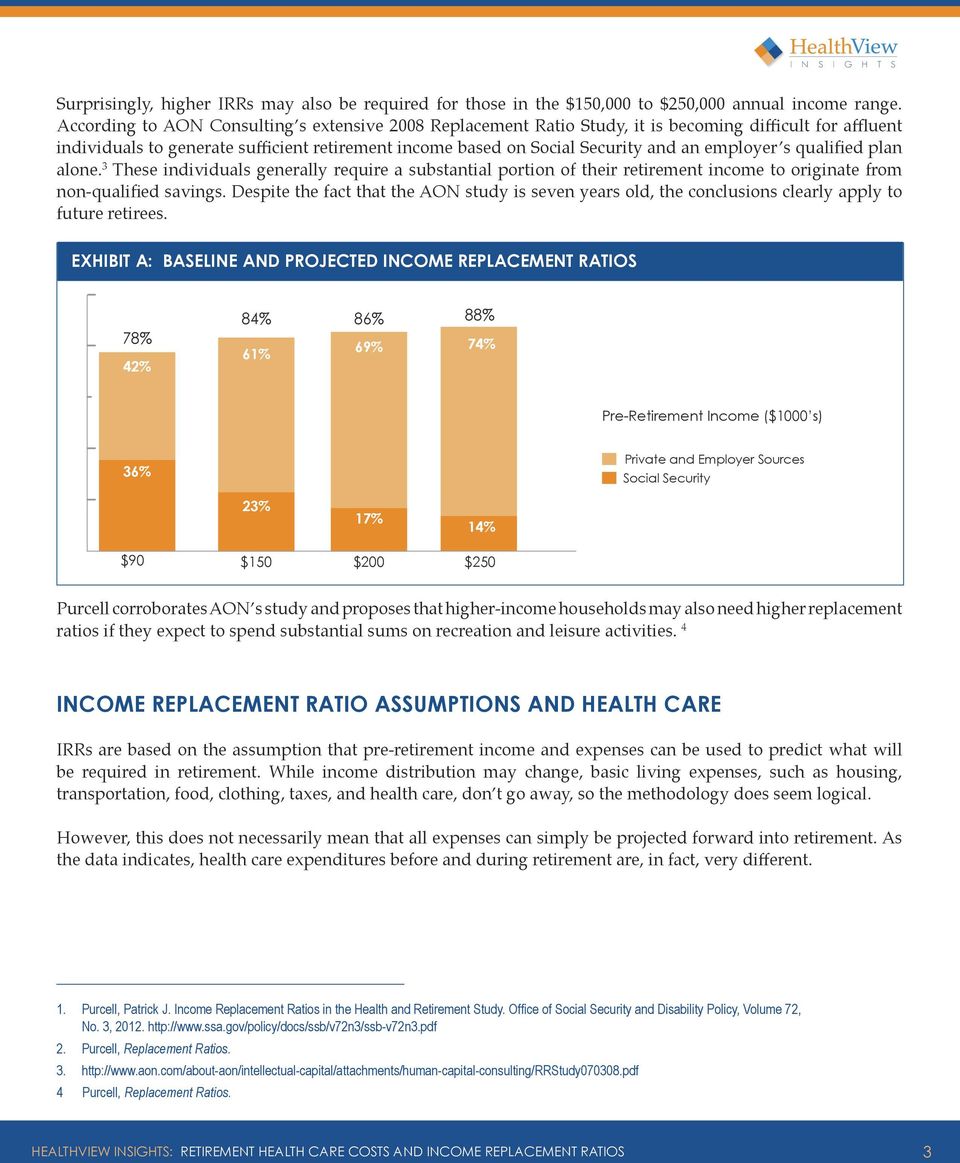
3 Surprisingly, higher IRRs may also be required for those in the $150,000 to $250,000 annual income range. According to AON Consulting s extensive 2008 Replacement Ratio Study, it is becoming difficult for affluent individuals to generate sufficient retirement income based on Social Security and an employer s qualified plan alone. 3 These individuals generally require a substantial portion of their retirement income to originate from non-qualified savings. Despite the fact that the AON study is seven years old, the conclusions clearly apply to future retirees. EXHIBIT A: BASELINE AND PROJECTED INCOME REPLACEMENT RATIOS 78% 42% 84% 86% 88% 61% 69% 74% Pre-Retirement Income ($1000 s) 36% Private and Employer Sources Social Security 23% 17% 14% $90 $150 $200 $250 Purcell corroborates AON s study and proposes that higher-income households may also need higher replacement ratios if they expect to spend substantial sums on recreation and leisure activities. 4 INCOME REPLACEMENT RATIO ASSUMPTIONS AND HEALTH CARE IRRs are based on the assumption that pre-retirement income and expenses can be used to predict what will be required in retirement. While income distribution may change, basic living expenses, such as housing, transportation, food, clothing, taxes, and health care, don t go away, so the methodology does seem logical. However, this does not necessarily mean that all expenses can simply be projected forward into retirement. As the data indicates, health care expenditures before and during retirement are, in fact, very different. 1. Purcell, Patrick J. Income Replacement Ratios in the Health and Retirement Study. Office of Social Security and Disability Policy, Volume 72, No. 3, Purcell, Replacement Ratios Purcell, Replacement Ratios. 3
4 EMPLOYER-SPONSORED HEALTH CARE VS MEDICARE AND SUPPLEMENTAL INSURANCE According to HealthView data, employees pay approximately 25% of group insurance premiums, while employers subsidize the remaining 75%. In order to maintain a similar level of coverage enjoyed during employment, retirees must sign up for Medicare Parts A, B and D, and purchase a supplemental policy, most of which have premiums and copays. (Note that Part A is free for most Americans because it is subsidized through payroll taxes.) Vision, hearing, and dental are not covered by Medicare or supplemental insurance and must be paid out-of-pocket. IRR calculations use the same 25% figure that employees contribute for health care premiums enrolled in group plans, but retirees are responsible for almost 100% of their health care costs. Since IRRs only include a portion of future health care costs, at retirement many retirees will face a substantial budget shortfall if, like most, they assume achieving their IRR goal will cover all of their health care expenses when they stop working. Some may contend that since Medicare is subsidized, pre- and post-retirement outlays should be comparable. The following example demonstrates that after switching from an HMO to Medicare, a 64-year-old s costs jump from $1,245 to $3,563 an increase of 186% in the first year of retirement. EXHIBIT B: PRE-RETIREMENT VERSUS IN RETIREMENT FOR A 65 YEAR OLD MALE* Employer Group Plan Medicare** PPO HMO HDHP Parts B, D, Gap Total Cost of Premiums $5,361 $4,982 $4,251 $3,563 Percent Covered By Recipient 25% 25% 25% 100% Recipient Cost in real dollars $1,340 $1,245 $1,062 $3,563 *Since health care premiums covered under employer plans are based on an average 45-year-old male, other out-of-pocket costs for the 64-year-old may be even higher. **Medicare includes Medicare Part B, Part D and MedSup premiums, which is basically the equivalent of commercial group plan insurance. It is important to note that these calculations do not factor the impact of health care inflation, catastrophic health-related events, or long-term care premiums. Also, depending upon the chosen plan, out-of-pocket costs for working Americans under the Affordable Care Act are capped at $8,500 for an individual and $13,200 for a couple, but are unlimited for retirees. The stark reality is that health care is going to cost more than most retirees have saved using traditional IRRbased plans. HEALTH CARE COST INFLATION The second main assumption of IRRs is that retirement expenses can be projected forward using the general inflation rate; however, the data indicates that IRRs using an industry-average 2.5-3% inflation rate will fall far short of the savings and income required to address health care. HealthView s 2015 Retirement Health Care Costs Data Report projects health care inflation (including Medicare Part B) to grow at an average of 6% annually for the next ten years. These estimates are consistent with a year-end summary from the Centers for Medicare 4

5 HEALTH CARE COST INFLATION (CONTINUED) and Medicaid, which expects retirees to endure at least eight years of health care inflation between 5% and 7%. 5 Medicare Part D premiums, which have been growing at approximately 12% annually, are projected to drop to an average of 8% per year over the next decade. Despite this adjustment, the differential between the inflation rate incorporated into IRRs and the actual projected Medicare inflation rate will, over time, create a significant shortfall in retiree savings. THE COMPOUNDING EFFECT OF HEALTH CARE INFLATION Most are aware of the benefits of compounding interest. Unfortunately, this concept can work the same in reverse. If health care inflation rates are underestimated by around 3% annually, as the majority of IRRs are, future premiums will compound like a high-interest-rate credit card and expand medical costs beyond what retirees have allocated in their budgets. EXHIBIT C: IMPACT OF HEALTH CARE INFLATION ON A 45-YEAR-OLD RETIRING AT AGE 65 Projected Cost Based on 3% inflation Actual Retirement Health Costs Incremental Costs Age 65 $6,912 $13,203 $6,291 Age 70 $8,013 $18,521 $10,508 Age 75 $9,289 $25,831 $16,542 Age 80 $10,768 $35,694 $24,926 Age 86 $12,858 $52,104 $39,246 The table above illustrates the incremental increases between actual retirement health care costs at an average 6% inflation rate and projected retirement health costs at a 3% inflation rate for a 45-year-old male retiring at 65. Because of the differential, as this man ages, the gap will continue to widen, causing a shortfall of nearly $40,000 in his last year of life (age 86). LIFE EXPECTANCY An additional assumption built into IRRs is average longevity. Simply put: living longer will result in higher health care costs, and consequently, more savings will be needed to fund them. This discrepancy has not been factored into commonly used income replacement ratios and will likely create greater deficits in retiree budgets. A 55-year-old male with an average life expectancy of 86 who lives to age 88 will be responsible for an additional $69,627 in health care costs that are not included in top-down IRR-based calculations. MEDICARE SURCHARGES Medicare surcharges, which are triggered when Modified Adjusted Gross Income (MAGI) surpasses $85,000 for individuals and $170,000 for couples, can more than double Medicare Parts B and D premiums, but this additional expense is generally absent from income replacement ratios. While these surcharges typically impact

6 MEDICARE SURCHARGES (CONTINUED) more-affluent Americans, as salaries rise and eventually surpass these income thresholds, which are not expected to adjust for inflation, more retirees will inevitably face higher premiums. Depending on retirement income, Medicare means testing can increase B and D premiums from 37% to over 200%. Projecting forward, a 55-year-old who plans to retire at age 65, has a life expectancy of 86 and generates over $85,000 per year in retirement income will exceed MAGI thresholds and can expect to pay up to $373,706 in lifetime premium surcharges (in real dollars) in retirement. EXHIBIT D: MEANS-TESTING SURCHARGES Income Level Health Care Costs Marginal Increase Total Increase $85,000 or less $183,360 $85,001 - $107,000 $250,407 37% 37% $107,001 - $160,000 $353,226 41% 93% $160,001 - $214,000 $456,045 29% 149% Above $214,000 $557,066 22% 204% For basic Medicare (Parts A, B and D), the lifetime premium of just under $200,000 can grow as high as over $550,000 with the addition of surcharges. Anyone who earns a dollar more than $85,000 (or $170,000 for a married couple) will see surcharges of at least 37%. Given the potential impact of Medicare surcharges, future retirees must manage MAGI through account diversification and asset/product optimization. Investing in non-qualified annuities, Roth and Roth 401(k)s, life insurance, and longevity insurance may effectively lower lifetime health care costs by hundreds of thousands of dollars. This topic is covered extensively in a prior HealthView paper, Understanding the Impact of Modified Adjusted Gross Income on Retirement Health Care Costs: Strategies to Reduce Medicare Income Surcharges. CASE STUDIES: ADDRESSING THE HEALTH CARE COST GAP IN IRRS Americans currently using IRRs in long-term investment plans have already addressed a portion of future health care costs, but not enough. The following case studies highlight the additional savings required to reduce the gap. While these case studies focus on 401(k) contributions, making a lump-sum investment in a range of capital market and insurance products can achieve the same outcome. In both cases, Paul and John begin investing at their current ages, and 401(k) savings will compound at an average 6% return based on a 60% stock/40% bond portfolio. Their advisors employ traditional 80% IRRs using an average inflation rate of 3% to account for basic household needs (including medical expenses). Health care costs are projected to grow at an average 6% inflation rate. PAUL AT 45 Paul is a healthy 45-year-old male who earns $50,000 per year. He is enrolled in his firm s 401(k) plan and would like to retire in 20 years. He is making the necessary contributions, based on a standard IRR, to earn 80% of his final employed income (growing at 3% annually) beginning at age 65. 6

7 CASE STUDIES (CONTINUED) In order to maintain comparable health care coverage in retirement to that of his current group plan, Paul will have to enroll in Medicare Parts A, B, and D, and purchase a supplemental insurance policy. His projected lifetime retirement health care costs, less Medicare Parts A (already paid through FICA tax) and B (deducted from Social Security), are $504,349. This includes out-of-pocket costs associated with elected coverage, such as copays and deductibles. (All calculations are based on the national average and presented in real dollars.) It is assumed that Paul s salary will increase by 3% per year for the next 20 years, resulting in a future annualized salary of $90,305. In order to generate 80% of his pre-retirement income after he stops working, Paul will require $72,244, which he will earn through a combination of savings and Social Security benefits. EXHIBIT E: PAUL S RETIREMENT INCOME BASED ON AN 80% IRR Paul s Salary at 45 Paul s Salary at 65 Paul s Retirement Income Needs Based on 80% IRR $50,000 $90,305 $72,244 While employed, Paul is responsible for 25% of his group health insurance premiums, which are deducted from his payroll check, and all other out-of-pocket expenses such as copays and deductibles, which he pays directly to providers. Paul s current 401(k) contribution of $2,933 is projected to achieve his 80% IRR. This IRR-based figure assumes his portion of pre-retirement health care costs will rise at 3% annually. Unlike most of Paul s other expenses, health care is expected to increase at approximately 6% annually (basically double the historical 3% U.S. average inflation rate). When retired, Paul will also be responsible for 100% of premiums (not 25%) associated with three separate health insurance policies, as well as other out-of-pocket expenses, such as the cost of hearing aids, which are not included in IRR calculations. Because Paul s pre-retirement health insurance coverage and costs are not directly comparable to those in retirement, he is actually underfunding his 401(k). Paul believes his contributions to his 401(k), which will reach $114,358 at the point of retirement, will cover his future health care expenses. However, he will actually require $249,296 at that point, which would leave him short $134,937. In other words, the annual contribution necessary to cover his costs is $6,393, but he is only saving $2,933 in retirement contributions, leaving him $3,460 short. Paul will need to increase his 401(k) contributions by $3,460 annually, or around $90 per pay period (assuming 26 pay periods per year and a 50% employer match), to eliminate this gap. EXHIBIT F: PAUL S UNDERFUNDED AND PROPERLY FUNDED 401(K) Current savings earmarked for health care: $2,933 Total Savings required: $6,393 Shortfall: $3,460 Additional contribution per pay period $90 Pay periods per year 26 Company match: $45 Rate of return: 6% Total additional savings: (Based on a 60% stock, 35% bond and 5% cash portfolio) $135 7

8 CASE STUDIES (CONTINUED) Exhibit G reveals Paul s risk of continuing to underfund his 401(k). If he waits until 55, his annual shortfall will increase from $3,460 to $9,658, a difference of $6,198. Should Paul do nothing and wait until age 64, he will need to make a lump-sum investment of $127,299 (in addition to his ongoing $2,933 annual contribution) to fully cover health care expenses in retirement. EXHIBIT G: ADDITIONAL LUMP SUM SAVINGS REQUIRED AT AGE 64 Annual increase in contribution beginning at age 45: $3,460 Annual increase in contribution beginning at age 55: $9657 Lump-sum investment at age 64 $127,299 Accumulated savings based on IRR allocation beginning at age 45: $ Additional savings required at age 64: $249,296 JOHN AT 55 Let s examine a 55-year-old healthy male named John, who is retiring at 65, will earn under $85,000 per year, and has a life expectancy of 86. Coverage in retirement will include Medicare Parts A, B, D, a Medicare supplemental plan, dental insurance, and all other out-of- pocket costs. (Totals are based on the national average and presented in real dollars.) EXHIBIT H: JOHN S RETIREMENT HEALTH CARE COSTS Part B Part D Medicare Supplemental Dental Out of Pocket Costs Total Health Care Costs $95,586 $89,955 $114,934 $18,939 $69,456 $388,870 John s projection reveals that he will be responsible for close to $390,000 in retirement health care costs. The total is substantial, but it represents John s lifetime medical-related expenditures over a 21-year period (age 65-86). EXHIBIT I: SAVINGS NEEDED TO COVER HEALTH CARE WITHOUT AN IRR-BASED SAVINGS PLAN Total Cost for Coverage Lump Sum Investment at age 55 without IRR Retirement Plan Based on a 6% Return Annual Savings for 10 Years starting at 55 $388,870 $81,328 $10,424 As the table above indicates, if John hadn t already partially saved for health care, he would need a lump-sum investment of $81,328 to pay for his health care in retirement. John assumed that using an 80% IRR would cover all of his health care, but as indicated in Exhibit J, John must add $25,679 to reach that goal. A modest $3,291 annual investment, (or $274 per month) over ten years at a 6% return would also allow John to the close this gap. EXHIBIT J: SAVINGS NEEDED TO COVER HEALTH CARE WITH AN IRR-BASED SAVINGS PLAN Total Cost for Coverage Lump Sum if Meeting IRR Requirements Annual Investment $388,870 $25,679 $3,291 8

9 CASE STUDIES (CONTINUED) If John decides to take action, he will need to increase his 401(k) contributions by $84 per pay period (assuming 26 pay periods in a year and a 50% employee match). As mentioned above, it is also important to remember that Medicare surcharges are not included in standard IRRs. For example, if John s retirement MAGI income surpasses $85,000 annually, his premiums will be significantly higher because of means-testing surcharges. CONCLUSION Retirees who have invested in IRR-based plans will be better positioned to face retirement health care expenses than those who have not saved at all, but as the data has shown, these tools will not generate enough income to cover all health care expenses in retirement. When it comes to health care, which cannot simply be projected into retirement using pre-retirement costs and the general U.S. inflation rate, the assumptions that underpin IRRs are flawed. IRRs also fail to account for longevity and Medicare surcharges in their calculations. Retirees will have to pay more for comparable health care coverage in retirement than while they were working because they will be 100% responsible for Medicare Parts B, D, and supplemental insurance premiums, as well as all other out-of-pocket expenses, including co-pays, hearing, vision, and dental. Americans who have used IRR-based savings plans may well have to adjust their retirement expectations because of rising health care costs unless they take action. As detailed in the case studies, the additional savings needed to close the health care savings gap can be modest. Boosting 401(k)/Roth 401(k) contributions and benefiting from company matching; investing in a health savings account (HSA); annuities; life insurance; IRAs, and a Roth are the best strategies to not only address medical expenses, but also avoid means testing. Advisors who adjust portfolios to include MAGI-reducing investment products can save clients hundreds of thousands of dollars in lifetime Medicare surcharges. Consequently, choosing the right product mix is as important as asset allocation when creating retirement plans. ABOUT HEALTHVIEW SERVICES Founded in 2008 by a team of seasoned financial professionals, health care industry executives, and expert physicians, HealthView Services is the nation s leading producer of health care cost-projection software. The firm s suite of tools covers Medicare costs, long-term care expenses, and Social Security optimization strategies, which prepare current and future retirees for the impact of health care costs. HealthView has also emerged as a thought leader in this evolving domain, producing substantial educational content on the importance of integrating health care expenses into retirement plans. HealthView Services HealthWealthLink is an integrated retirement-planning platform that draws upon cost data from more than 50 million annual health care cases to assist financial advisors in preparing personalized estimates of retirement health care costs. The system provides advisors with the tools necessary to implement various strategies to achieve clients retirement goals. HealthView Services also provides retirement health care cost planning tools for individuals through its website. 9

10

Understanding the Impact of Modified Adjusted Gross Income on Retirement Health Care Costs
 Understanding the Impact of Modified Adjusted Gross Income on Retirement Health Care Costs STRATEGIES TO REDUCE MEDICARE INCOME SURCHARGES I N S I G H T S SUMMARY In terms of retirement planning, many
Aon Consulting s 2008 Replacement Ratio Study. A Measurement Tool For Retirement Planning
 Aon Consulting s 2008 Replacement Ratio Study A Measurement Tool For Retirement Planning A Measurement Tool for Retirement Planning For twenty years, Aon Consulting and Georgia State University have published
Vertex Wealth Management LLC 10/22/2013
 Vertex Wealth Management LLC Michael J. Aluotto, CRPC President Private Wealth Manager 1325 Franklin Ave., Ste. 335 Garden City, NY 11530 516-294-8200 [email protected] Retirement Basics 10/22/2013
www.booneinsuranceassociates.com Copyright by BIA 1 MEDICARE MADE SIMPLE BIA 1/14/2016 Boone Insurance Associates Education Guide: New
 www.booneinsuranceassociates.com Copyright by 1 MEDICARE MADE SIMPLE Boone Insurance Associates Education Guide: New Today s Agenda 2 About Introduction & History of Medicare Medicare Parts A, B, C, D
Retiree Drug Coverage under the MMA: Issues for Public Comment to Maximize Enhancement in Drug Coverage and Reductions in Drug Costs for Retirees
 Retiree Drug Coverage under the MMA: Issues for Public Comment to Maximize Enhancement in Drug Coverage and Reductions in Drug Costs for Retirees Discussion Paper: CMS Employer Open Door Forum I. Summary:
Highlights of the. Boehringer Ingelheim. Retirement Savings Plan Retirement Plan. This brochure is intended for eligible employees of
 Highlights of the Boehringer Ingelheim: Retirement Savings Plan Retirement Plan This brochure is intended for eligible employees of Boehringer Ingelheim hired after December 31, 2003. Table of Contents
Healthcare costs in retirement
 Healthcare costs in retirement Preparing today to help protect your wealth tomorrow Options for handling distributions, rollovers and conversions Life s better when we re connected Preparing for healthcare
Medicare Quick Reference
 Medicare Quick Reference 2016 Income Investment Estate Retirement Social Security NOT FDIC INSURED NO BANK GUARANTEE MAY LOSE VALUE This guide provides general Medicare information. Part A Part C (Medicare
A Consumer s Guide To
 A Consumer s Guide To 401(k) Plans NYSUT Member Benefits wants NYSUT members to be the best-informed consumers in the state. This Consumer Guide is one of our contributions towards achieving that goal.
PNC Health Savings Account
 PNC Health Savings Account FREQUENTLY ASKED QUESTIONS Thank you for choosing PNC to be your HSA provider. Enclosed is everything you need to know about opening your account. Should you have questions about
Healthcare costs in retirement Preparing today to protect your wealth tomorrow
 Healthcare costs in retirement Preparing today to protect your wealth tomorrow Preparing for healthcare costs to protect your retirement lifestyle Merrill Lynch Wealth Management makes available products
Long-Term Care: Frequently Asked Questions About Long- Term Care Insurance
 FACT SHEET LTC: FAQ s About Long-Term Care Insurance (H-003) p. 1 of 5 Long-Term Care: Frequently Asked Questions About Long- Term Care Insurance Long-Term Care (LTC) insurance only pays for long-term
Understanding Health Insurance Options in Retirement
 Understanding Health Insurance Options in Retirement A White Paper by Manning & Napier www.manning-napier.com 1 Over the past several years, the spike in the cost of health care and insurance premiums
HEALTH CARE ACT TAX OVERVIEW INDIVIDUALS. Expanded Medicare taxes and other changes make planning critical
 HEALTH CARE ACT TAX OVERVIEW INDIVIDUALS Expanded Medicare taxes and other changes make planning critical 1 The agenda The health care act s tax impact on individuals Medicare tax increase on earned income
Benefits Enrollment for Dow Corning Retirees. October 2015
 Benefits Enrollment for Dow Corning Retirees October 2015 Challenges 2 Challenges in Retiree Benefits Costs continue to increase at a rate greater than inflation Government has reduced subsidies to employers
Frequently Asked Questions. High Deductible Health Plan (HDHP) with Health Savings Account (HSA)
 Frequently Asked Questions High Deductible Health Plan (HDHP) with Health Savings Account (HSA) There are two components to the High Deductible Health Plan (HDHP) with HSA Medical Plan the HDHP Health
Annuity Owner Mistakes Tips and Ideas That Could Save You Thousands
 Annuity Owner Mistakes Tips and Ideas That Could Save You Thousands Provided to you by: Milton D. Flanagan ChFC, CLU, CASL, MBA Annuity Owner Mistakes Written by Financial Educators Provided to you by
Tax Subsidies for Private Health Insurance
 Tax Subsidies for Private Health Insurance Matthew Rae, Gary Claxton, Nirmita Panchal, Larry Levitt The federal and state tax systems provide significant financial benefits for people with private health
Franklin Templeton SIMPLE IRA EMPLOYEE S GUIDE
 Franklin Templeton SIMPLE IRA EMPLOYEE S GUIDE Franklin Templeton SIMPLE IRA Roadmap to Retirement You ve been offered an opportunity to participate in a Franklin Templeton SIMPLE IRA (Savings Incentive
WILL WE HAVE TO WORK FOREVER?
 Work Opportunities for Older Americans Series 4, July 2006 WILL WE HAVE TO WORK FOREVER? By Alicia H. Munnell, Marric Buessing, Mauricio Soto, and Steven Sass* Introduction Today, the average retirement
2015 Health Savings Account (HSA) Frequently Asked Questions. Table of Contents
 2015 Health Savings Account (HSA) Frequently Asked Questions Table of Contents Health Savings Account (HSA) Plans What is a Health Savings Account (HSA)?...pg. 1 How does an IU Health HSA work?...pg. 1
Annuities. Introduction 2. What is an Annuity?... 2. How do they work?... 3. Types of Annuities... 4. Fixed vs. Variable annuities...
 An Insider s Guide to Annuities Whatever your picture of retirement, the best way to get there and enjoy it once you ve arrived is with a focused, thoughtful plan. Introduction 2 What is an Annuity?...
Advanced Cafeteria Plans. 2016 Employee Benefits Corporation. Copyright 2015 Employee Benefits Corporation
 Advanced Cafeteria Plans 2016 Employee Benefits Corporation 2 1 Erin Freiberg, JD Compliance Attorney Employee Benefits Corporation The material provided in this webinar is by Employee Benefits Corporation
You can use life insurance
 Life & Health Insurance Advisor MRCT Benefits Plus is a comprehensive employee benefits, wellness and Human Resources consulting firm offering a variety of financial services to businesses and individuals
Frequently Asked Questions
 Frequently Asked Questions What is a Health Savings Account (HSA)? A Health Savings Account (HSA) is an alternative to traditional health insurance; it is a savings product that offers a different way
Medicare Prescription Drug Coverage
 Medicare Prescription Drug Coverage Information for Seniors and People with Disabilities Medicaid and Medicaid Spenddown A Question and Answer Guide Produced by the CHOICES Program * * * * * * * * * *
A Guide to Planning for Retirement INVESTMENT BASICS SERIES
 A Guide to Planning for Retirement INVESTMENT BASICS SERIES It s Never Too Early to Start What You Need to Know About Saving for Retirement Most of us don t realize how much time we may spend in retirement.
FINANCIAL ANALYSIS ****** UPDATED FOR 55% BENEFIT ****** ****** FOR ALL SURVIVORS ******
 FINANCIAL ANALYSIS ****** UPDATED FOR 55% BENEFIT ****** ****** FOR ALL SURVIVORS ****** This fact sheet is designed to supplement the Department of Defense brochure: SBP SURVIVOR BENEFIT PLAN FOR THE
Medicare Part D. MMA establishes a standard Part D drug benefit, which consists of four components or phases.
 Medicare Part D The Medicare Prescription Drug, Improvement, and Modernization Act of 2003 (MMA) added voluntary prescription drug coverage to Medicare, the federal health insurance program for seniors
FACULTY RETIREMENT PLANS: THE ROLE OF RETIREE HEALTH INSURANCE
 TRENDS AND ISSUES SEPTEMBER 2015 FACULTY RETIREMENT PLANS: THE ROLE OF RETIREE HEALTH INSURANCE Robert L. Clark Zelnak Professor Poole College of Management North Carolina State University Retiree health
S e c t i o n 4 - P S E R S P o s t e m p l o y m e n t H e a l t h c a r e P r o g r a m s
 S e c t i o n 4 - P S E R S P o s t e m p l o y m e n t H e a l t h c a r e P r o g r a m s Health Options Program... Tab 17 Premium Assistance Program... Tab 18 This page intentionally left blank Pursuant
10 MISTAKES PEOPLE MAKE IN RETIREMENT
 10 MISTAKES PEOPLE MAKE IN RETIREMENT by Bill Elson, CFP 3705 Grand Avenue Des Moines, IA 50312 (515) 255-3306 or (800) 616-4392 [email protected] KEYWORDS: RETIREMENT PLANNING, RETIREMENT INCOME, RETIREMENT
CONGRESS What Do They Have In Store For Our 401(k) And 403(b) Plans? Richard S. Sych, F.S.A. President and Consulting Actuary April 2013
 CONGRESS What Do They Have In Store For Our 401(k) And 403(b) Plans? Richard S. Sych, F.S.A. President and Consulting Actuary April 2013 Agenda Why All The Fuss? What s On The Table? What s Next? What
Health Savings Accounts (HSA)
 What is a Health Savings Account? Health Savings Accounts (HSAs) were created so that individuals covered by qualified highdeductible health plans could receive tax-preferred treatment for money saved
G U A R A N T E E D I N C O M E S O L U T I O N S NEW YORK LIFE LIFETIME INCOME ANNUITY
 G U A R A N T E E D I N C O M E S O L U T I O N S NEW YORK LIFE LIFETIME INCOME ANNUITY NEW YORK LIFE: BUILT FOR TIMES LIKE THESE New York Life Insurance Company, the parent company of New York Life Insurance
WITH A ROLLOVER IRA. Retirement Reimagined. Your life may change...your plans for retirement don t have to.
 Retirement Reimagined TAKE CONTROL WITH A ROLLOVER IRA Your life may change......your plans for retirement don t have to. One of the most consistent elements of life is change career changes, family changes,
_ Retirement. Planning for the Stages of. Getting started Your 20s and early 30s
 Planning for the Stages of _ Retirement _ Retirement is being reinvented. It s no longer our parent s retirement. Social Security alone w o n t see us through retirement, especially for higher income earners.
MEDICARE. Costs and Coverage Options Enrollment. Out-of-Pocket. Guidelines. Health-Care Costs. What the Future Might Hold
 UNDERSTANDING MEDICARE Costs and Coverage Options Enrollment Guidelines Out-of-Pocket Health-Care Costs What the Future Might Hold Foreword Since it was established in 1965, Medicare has provided a safety
Resource Guide. Creating a plan for lifetime income in retirement
 Resource Guide Creating a plan for lifetime income in retirement Freedom in retirement starts with income in retirement When it comes to planning for your future, nothing should be left to chance. That
Fact Book on Retirement Income 2010. A Review of the Trends and Activity in the Retirement Income Market
 Fact Book on Retirement Income 2010 A Review of the Trends and Activity in the Retirement Income Market Fact Book on Retirement Income 2010 A Review of the Trends and Activity in the Retirement Income
Annuity Owner Mistakes Tips and Ideas That Could Save You Thousands
 Annuity Owner Mistakes Tips and Ideas That Could Save You Thousands Provided to you by: Victoria Woods & Damon King 405-348-0909 Annuity Owner Mistakes Written by Financial Educators Provided to you by
optimizing the independent contractor status
 optimizing the independent contractor status Who cares more about your financial future than you? The financial distinction between employees and the independent contractor can be summarized this way:
2016 Tax Planning & Reference Guide
 2016 Tax Planning & Reference Guide The 2016 Tax Planning & Reference Guide is designed as a reference and is not intended to function as tax advice. Please consult your professional accounting advisor
The underrated impact of taxes on retirement
 The underrated impact of taxes on retirement Research study Nearly one out of every three dollars spent by high-income retirees goes to taxes, according to a study by Lincoln Financial Group. Most future
UND U E ND R E S R T S A T ND A I ND NG N TR T ADI AD TI T ONAL O AN A D R N O D R T O H I T R H I AS A INVESTO T R GUIDE RETIREMENT
 UNDERSTANDING TRADITIONAL AND ROTH IRAS INVESTOR GUIDE RETIREMENT Not FDIC Insured May Lose Value Not Bank Guaranteed Get Ready for Retirement... Your Way Forget rocking chairs and lingering sunsets. Your
Medicare Economics. Part A (Hospital Insurance) Funding
 Medicare Economics Medicare expenditures are a substantial part of the federal budget $556 billion, or 15 percent in 2012. They also comprise 3.7 percent of the country s gross domestic product (GDP),
How To Get A Health Care Plan
 Your financial well-being Everyone needs to plan ahead for Medicare Having a thorough understanding of how Medicare works and the choices you need to make about its coverage is an essential part of retirement
P lanning for Healthcare C osts in Retirement. What you don t know might hurt you!
 P lanning for Healthcare C osts in Retirement What you don t know might hurt you! 76 Million Baby Boomers 10,000 retiring each day Controlling close to $19 Trillion in assets Source: US Census Common Goal
Planning for the Stages of Retirement
 Planning for the Stages of Retirement The Financial Planning Association (FPA ) connects those who need, support and deliver financial planning. We believe that everyone is entitled to objective advice
SOLID DISCOVER THE POSSIBILITIES. Retirement Plan Rollover Guide HELPS YOU
 SOLID HELPS YOU DISCOVER THE POSSIBILITIES Retirement Plan Rollover Guide Rollover Guide Table of Contents Retirement Planning Checklist.... 1 Comparing Your Options.... 2 Distribution Details....3 5 Rollover
Annuity Owner Mistakes
 Annuity Owner Mistakes Tips and Ideas That Could Save You Thousands Provided to you by: William E. Watson III, RFC Registered Financial Consultant Annuity Owner Mistakes Written by Javelin Marketing, Inc.
Health Savings Account (HSA)
 Health Savings Account (HSA) Your employer is offering you the opportunity to enroll in a Health Savings Account, or HSA. An HSA is a tax-advantaged account, owned by an individual who makes account contributions
Aetna HealthFund Health Savings Account
 Aetna HealthFund Health Savings Account Take Control of Your Health Care and Your Health Care Dollars! 14.02.305.1 (10/05) The Aetna HealthFund Health Savings Account (HSA) by Aetna Life Insurance Company
Health Savings Accounts
 Raymond James & Associates, Inc. Anne Bedinger, WMS Vice President, Investments 2255 Glades Road, Suite 120-A Boca Raton, FL 33431 561-981-3661 800-327-1055 [email protected] www.annebedinger.com
TRENDS AND ISSUES EARLY RETIREE HEALTH INSURANCE ISSUES. By Marilyn Moon, American Institutes for Research and TIAA-CREF Institute Fellow
 EARLY RETIREE HEALTH INSURANCE ISSUES By Marilyn Moon, American Institutes for Research and TIAA-CREF Institute Fellow March 2007 EXECUTIVE SUMMARY Individuals considering early retirement, i.e., retirement
Retirement Products Changes to Annual Account Maintenance Fee
 Retirement Products Changes to Annual Account Maintenance Fee Effective December 11, 2015, the annual account maintenance fee (Fee) for OppenheimerFundssponsored retirement products will change and will
Health Savings Accounts: Common Questions and Their Answers
 Health Savings Accounts: Common Questions and Their Answers I. General HSAs II. Qualified High-Deductible Health Plan HDHPs III. Contributions to an HSA Distributions BlueAccount I. General HSAs I.1 What
Orange High Deductible Health Plan (HDHP) with Health Savings Account (HSA) HDHP Basics
 Orange High Deductible Health Plan (HDHP) with Health Savings Account (HSA) FAQ (Frequently Asked Questions): The following questions and answers will help you better understand Hope College s New High
I don t have health insurance, can I get an HSA? Unfortunately, you cannot establish and contribute to an HSA unless you have coverage under a HDHP.
 FREQUENTLY ASKED QUESTIONS (Information obtained from US Treasury HSA website) HSA Basics What is a Health Savings Account ( HSA )? A Health Savings Account is an alternative to traditional health insurance;
December 2014. Tax-Efficient Investing Through Asset Location. John Wyckoff, CPA/PFS, CFP
 John Wyckoff, CPA/PFS, CFP Your investment priorities are likely to evolve over time, but one goal will remain constant: to maximize your investment returns. Not all returns are created equal, however.
Health Care Reform Legislation and You
 (Customizable space for CPA Firm Logo to go here) Health Care Reform Legislation and You Timelines and Implications of the New Law for Individuals Updated as of January 2011 The Health Care Reform Legislation
Health Savings Accounts & High Deductible Health Plans
 Health Savings Accounts & High Deductible Health Plans Definitions Consumer Driven Health Plan ( CDHP ) A health insurance plan designed to give you more control over your health care spending. CDHPs incorporate
Health Savings Account Frequently Asked Questions
 Health Savings Account Frequently Asked Questions (for Core 60 Medical Plan Members) The Health Savings Account (HSA) is a great way to save for health care expenses incurred today or in the future for
Retirement and Estate Planning
 6P A R T Retirement and Estate Planning Should you invest in a retirement plan? Chapter 19 Retirement Planning Chapter 20 Estate Planning How much should you contribute to your retirement plan? How should
Cash Balance Plan Overview
 Cash Balance Plan Overview A Cash Balance Plan is a type of qualified retirement plan that is a hybrid between a traditional Defined Contribution Plan and a traditional Defined Benefit Plan. Like traditional
NOT FDIC INSURED NO BANK GUARANTEE MAY LOSE VALUE. Tax-advantaged IRAs. Invest in your retirement savings while reducing taxes
 NOT FDIC INSURED NO BANK GUARANTEE MAY LOSE VALUE Taxadvantaged IRAs Invest in your retirement savings while reducing taxes Find the answers inside Why invest for retirement? p. 1 Discover three good reasons
Peach State Reserves PEACH STATE RESERVES FAQ. Peach State Reserves General Questions
 Peach State Reserves PEACH STATE RESERVES FAQ Peach State Reserves General Questions What is Peach State Reserves The Georgia Retirement Investment Plan? What is a Deferred Compensation/Defined Contribution
Preparing for Retirement Healthy Directions for Medicare Retirees
 Preparing for Retirement Healthy Directions for Medicare Retirees Introduction Eligibility Healthy Directions for Medicare Retirees is designed for John Deere U.S. Flex retirees* who: Are eligible for
GUARANTEES. Income Diversification. Creating a Plan to Support Your Lifestyle in Retirement
 GUARANTEES growth FLEXIBILITY Income Diversification Creating a Plan to Support Your Lifestyle in Retirement Contents Build a Retirement Plan that Can Last a Lifetime 2 Retirement Is Different Today 4